
John G. Neihardt
Black Elk Speaks
The Complete Edition
National and International Honors Received by John G. Neihardt.
9. The Rubbing Out of Long Hair
11. The Killing of Crazy Horse
18. The Powers of the Bison and the Elk
22. Visions of the Other World
24. The Butchering at Wounded Knee
Appendix 2: Neihardt Letter to Julius House, August 1930
Appendix 3: Drawings by Standing Bear
1. Title Page of the First Edition
2. An Indian Way of Writing a Name
3. The Battle of the Hundred Slain.
4. The Two Spirits Coming for Black Elk.
5. Black Elk Leaving to Visit the Six Grandfathers.
6. Black Elk before the Six Grandfathers in the Flaming Rainbow Tepee.
8. Black Elk under the Tree of Life.
9. Black Elk at the Center of the Earth.
11. Custer’s Battle: Reno’s Retreat.
12. Custer’s Battle: Custer’s Defeat.
13. Custer’s Battle: Siege of Reno’s Troops.
14. Black Elk Living in Fear of the Thunder Beings.
15. In the Horse Dance: The Four Maidens.
16. Horse Dance (Chief): West.
17. Horse Dance (Chief): North.
19. Horse Dance (Chief): South.
20. The Dog Vision: Butterflies and Dragonflies.
21. The Dog Vision: Killing the Dog.
22. Black Elk’s Spirit Journey Home.
25. Black Elk in the Other World.
26. The Wanekia under the Holy Tree.
27. The Battle of Wounded Knee: Disarming Big Foot’s People.
28. The Battle of Wounded Knee: The First Shots.
29. Wounded Knee Battle: The Massacre.
30. Black Elk Protected by the Sacred Bow.
Appendix 4: Neihardt Letter to Nick Black Elk, November 1930
Appendix 5: A Great Indian Poet
Appendix 6: John G. Neihardt and Nicholas Black Elk
Appendix 7: John G. Neihardt beyond Black Elk
Appendix 8: Neihardt and Black Elk
Appendix 9: “Origin of the Peace Pipe”
Black Elk Speaks, the story of the Oglala Lakota visionary and healer Nicholas Black Elk (1863–1950) and his people during momentous twilight years of the nineteenth century, offers readers much more than a precious glimpse of a vanished time. Black Elk’s searing visions of the unity of humanity and Earth, conveyed by John G. Neihardt, have made this book a classic that crosses multiple genres. Whether appreciated as the poignant tale of a Lakota life, as a history of a Native nation, or as an enduring spiritual testament, Black Elk Speaks is unforgettable.
Black Elk met the distinguished poet, writer, and critic John G. Neihardt in 1930 on the Pine Ridge Reservation in South Dakota and asked Neihardt to share his story with the world. Neihardt understood and conveyed Black Elk’s experiences in this powerful and inspirational message for all humankind.
This complete edition features a new introduction by historian Philip J. Deloria and annotations of Black Elk’s story by renowned Lakota scholar Raymond J. DeMallie. Three essays by John G. Neihardt provide background on this landmark work along with pieces by Vine Deloria Jr., Raymond J. DeMallie, Alexis Petri, and Lori Utecht. Maps, original illustrations by Standing Bear, and a set of appendixes rounds out the edition.
John G. Neihardt (1881–1973) is the author of several classics, including A Cycle of the West and Eagle Voice Remembers, both available in Bison Books editions. He was named Nebraska’s first poet laureate and foremost poet of the nation by the National Poetry Center in 1936.
“The compelling story of a cross-cultural collaboration that continues to engage scholars and lay readers alike.”
—Choice
“The experience of Black Elk ... comes to one great statement, which for me is a key statement to the understanding of myth and symbols.”
—Joseph Campbell in an interview with Bill Moyers, The Power off Myth
“[Black Elk Speaks] is now deservedly recognized as a classic in literature.... It is sufficient that Black Elk Speaks is an extraordinarily human document—and beyond that, the record of a profoundly spiritual journey, the pilgrimage of a people towards their historical fulfillment and culmination, towards the accomplishment of a worthy destiny.”
—N. Scott Momaday
“An American classic.”
—Western Historical Quarterly
“Visionary, action-filled, culturally and historically revealing.”
—Utah Historical Quarterly
“If any great religious classic has emerged in [the twentieth] century or on this continent, it must certainly be judged in the company of Black Elk Speaks.”
—from Vine Deloria Jr.’s foreword
“Without question, Black Elk Speaks has been the gateway into the study of Native American religions and literatures for countless thousands of people in many countries.”
—Suzanne Lundquist, Native American Literatures
“A religious classic, both to Indians and non-Indians.”
—South Dakota History
“If a religious text of powerful import occurred in the twentieth century, it was Black Elk Speaks. If both Eastern (Buddhist/Taoist) and Western (Judeo-Christian/Muslim) religious canons are to be challenged and grounded in new theology, a major source will be Black Elk Speaks.”
—Whole Earth
“Once a classic, always a classic. But this one gets better with age.”
—Lincoln (Nebraska) Journal Star

Black Elk Speaks
The Complete Edition
John G. Neihardt
With a new introduction by Philip J. Deloria
and annotations by Raymond J. DeMallie
University of Nebraska Press
Lincoln and London
© 2014 by the Board of Regents of the University of Nebraska.
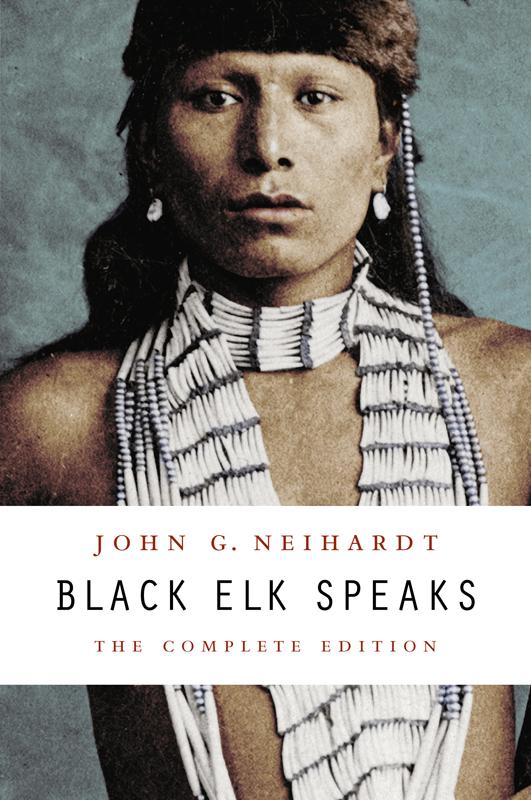
Cover image is from the National Anthropological Archives, Smithsonian Institution.
All rights reserved.
Original printings: © 1932, 1959, 1972 by John G. Neihardt; © 1961 by the John G. Neihardt Trust; Foreword © 1979 by the University of Nebraska Press; © 2000 by the University of Nebraska Press; “John G. Neihardt beyond Black Elk” and “Neihardt and Black Elk” © 2004 by the Board of Regents of the University of Nebraska. Unless otherwise mentioned, the photographs are reproduced by permission of the John G. Neihardt Trust. They may not be used in any manner without the written permission of the John G. Neihardt Trust.
Library of Congress Cataloging-in-Publication Data
Black Elk, 1863–1950.
Black Elk speaks / John G. Neihardt; introduction by Philip J. Deloria; foreword by Vine Deloria Jr.—The complete edition.
pages cm
Includes bibliographical references and index.
ISBN 978-0-8032-8391-6 (paperback: alk. paper)
ISBN 978-0-8032-8393-0 (epub)
ISBN 978-0-8032-8394-7 (mobi)
1. Black Elk, 1863–1950. 2. Oglala Indians—Biography. 3. Oglala Indians—Religion. 4. Teton Indians. I. Neihardt, John Gneisenau, 1881–1973.
II. Title.
E99.O3B4838 2014
978.004’9752440092—dc23
[B]
2013049580
The publisher does not have any control over and does not assume any responsibility for author or third-party websites or their content.
What is good in this book is given back to the six grandfathers and to the great men of my people.
Black Elk
Illustrations
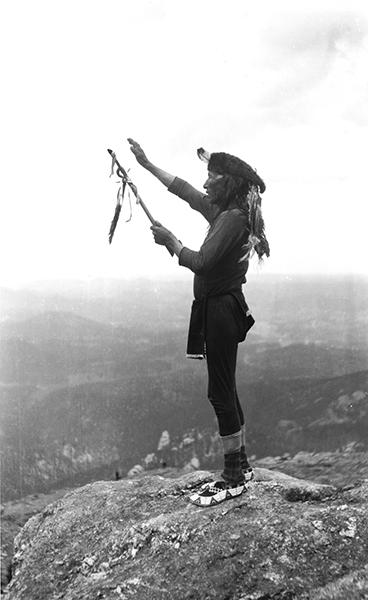
Frontispiece: Black Elk atop Harney Peak
Maps
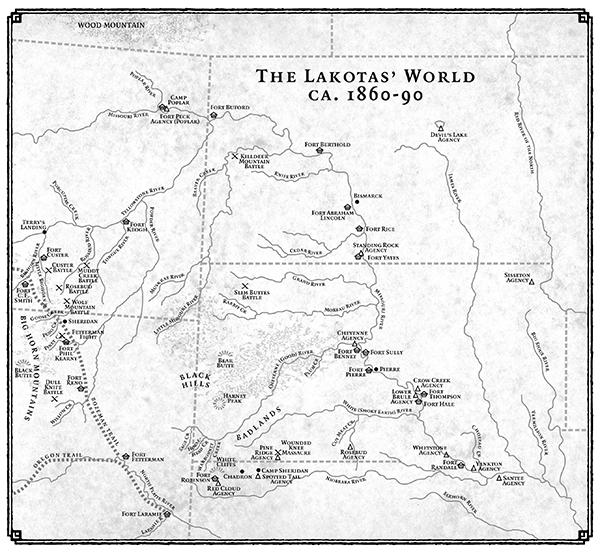
1. The Lakotas’ World ca. 1860–90
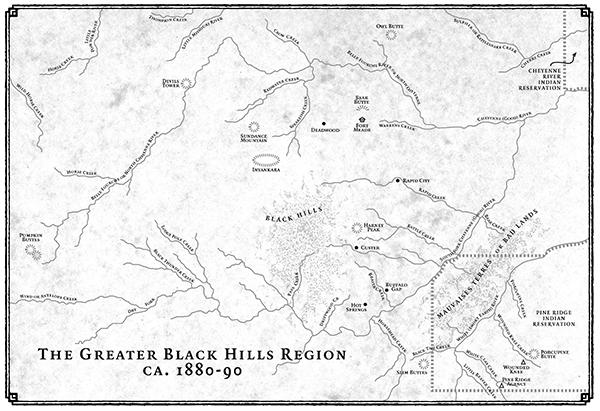
2. The Greater Black Hills Region ca. 1880–90
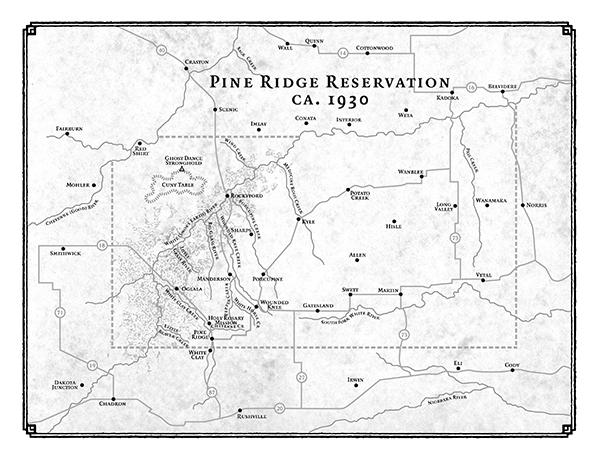
3. Pine Ridge Reservation ca. 1930
Figures
1. Black Elk Speaks, 1972 cover
2. The Sixth Grandfather, 1984 cover
3. Black Elk Speaks, 1988 cover
4. Black Elk Speaks, 1961 cover
Photographs
1. Black Elk and Elk while touring Europe
2. Enid Neihardt, Nick Black Elk, Ben Black Elk, Standing Bear, and John G. Neihardt
3. John G. Neihardt in his home
4. Black Elk and Standing Bear
5. Black Elk at a feast given by Neihardt
6. Standing Bear at Neihardt’s feast
7. Hilda Neihardt, Black Elk, Chase-in-the-Morning, and John G. Neihardt
8. Black Elk and Neihardt at the Sioux Victory celebration
9. John G. Neihardt with Black Elk’s drum
10. Sample from Neihardt’s handwritten draft
11. Sample from Neihardt’s handwritten draft
Standing Bear’s Drawings
1. Title Page of the First Edition
2a. An Indian Way of Writing a Name: Black Elk’s Name Sign
2b. An Indian Way of Writing a Name: Standing Bear’s Name Sign
3. The Battle of the Hundred Slain
4. The Two Spirits Coming for Black Elk
5. Black Elk Leaving to Visit the Six Grandfathers
6. Black Elk before the Six Grandfathers in the Flaming Rainbow Tepee
7. Killing the Drought
8. Black Elk under the Tree of Life
9. Black Elk at the Center of the Earth
10. A Bison Hunt
11. Custer’s Battle: Reno’s Retreat
12. Custer’s Battle: Custer’s Defeat
13. Custer’s Battle: Siege of Reno’s Troops
14. Black Elk Living in Fear of the Thunder Beings
15. In the Horse Dance: The Four Maidens
16. Horse Dance (Chief): West
17. Horse Dance—Chief: North
18. Horse Dance (Chief): East
19. Horse Dance (Chief): South
20. The Dog Vision: Butterflies and Dragonflies
21. The Dog Vision: Killing the Dog
22. Black Elk’s Spirit Journey Home
23. The People in Despair
24. Going to the Other World
25. Black Elk in the Other World
26. The Wanekia under the Holy Tree
27. The Battle of Wounded Knee: Disarming Big Foot’s People
28. The Battle of Wounded Knee: The First Shots
29. Wounded Knee Battle: The Massacre
30. Black Elk Protected by the Sacred Bow
Foreword
Vine Deloria Jr.
The twentieth century has produced a world of conflicting visions, intense emotions, and unpredictable events, and the opportunities for grasping the substance of life have faded as the pace of activity has increased. Electronic media shuffle us through a myriad of experiences which would have baffled earlier generations and seem to produce in us a strange isolation from the reality of human history. Our heroes fade into mere personality, are consumed and forgotten, and we avidly seek more avenues to express our humanity. Reflection is the most difficult of all our activities because we are no longer able to establish relative priorities from the multitude of sensations that engulf us. Times such as these seem to illuminate the classic expressions of eternal truths and great wisdom comes to stand out in the crowd of ordinary maxims.
How fortunate it was that in the 1930s as the nation was roaring into a new form of industrialism a Nebraska poet named Neihardt traveled northward to the reservation of the Oglala Sioux in search of materials for his classic epic work on the history of the West. That their conversations and companionship should produce a religious classic, perhaps the only religious classic of this century, is a testimony indeed to the continuing strength of our species. Black Elk Speaks was originally published in 1932, when people still believed that progress and the assembly line were identical and that the Depression was but a temporary interlude in an inevitable march toward the millennium. Its eloquent message was lost in the confusion of the times. It was not rejected, but it was hardly received with the veneration it now enjoys. The reception, in fact, reflected one of those overly romantic but simplistic views which suggests that all religions have some validity if they prevent us from acts of bestiality and even the most primitive expressions of religious truth are an effort to connect with the larger reality of Western civilization.
Black Elk Speaks did not follow other contemporary works into oblivion. Throughout the thirties, forties, and fifties it drew a steady and devoted readership and served as a reliable expression of the substance that undergirded Plains Indian religious beliefs. Outside the Northern Plains, the Sioux tribe, and the western mind set, there were few people who knew the book or listened to its message. But crises mounted and, as we understood the implications of future shock, the silent spring, and the greening of America, people began to search for a universal expression of the larger, more cosmic truths which industrialism and progress had ignored and overwhelmed. In the 1960s interest began to focus on Indians and some of the spiritual realities they seemed to represent. Regardless of the other literature in the field, the scholarly dissertations with inflections and nuances, Black Elk Speaks clearly dominated the literature dealing with Indian religions.
Today the book is familiar reading for millions of people, some of whom have no clear conception of Black Elk’s tribe, the Oglala Sioux, and others of whom do not, as a rule, even like Indians. The spiritual framework of the pipe ceremonies and the story of Black Elk’s life and vision are well known, and speculations on the nature and substance of Plains Indian religion use the book as the criterion by which other books and interpretive essays are to be judged. If any great religious classic has emerged in this century or on this continent, it must certainly be judged in the company of Black Elk Speaks and withstand the criticism which such a comparison would inevitably invite.
The most important aspect of the book, however, is not its effect on the non-Indian populace who wished to learn something of the beliefs of the Plains Indians but upon the contemporary generation of young Indians who have been aggressively searching for roots of their own in the structure of universal reality. To them the book has become a North American bible of all tribes. They look to it for spiritual guidance, for sociological identity, for political insight, and for affirmation of the continuing substance of Indian tribal life, now being badly eroded by the same electronic media which are dissolving other American communities.
Black Elk shared his visions with John Neihardt because he wished to pass along to future generations some of the reality of Oglala life and, one suspects, to share the burden of visions that remained unfulfilled with a compatible spirit. Black Elk might have been greatly surprised at the popularity of the book today. He could not help but be pleased by it. If the old camp circle, the sacred hoop of the Lakota, and the old days have been rudely shattered by the machines of a scientific era, and if they can be no more in the traditional sense, the universality of the images and dreams must testify to the emergence of a new sacred hoop, a new circle of intense community among Indians far outdistancing the grandeur of former times. So important has this book become that one cannot today attend a meeting on Indian religion and hear a series of Indian speakers without recalling the exact parts of the book that lie behind contemporary efforts to inspire and clarify those beliefs that are “truly Indian.”
As successful as the book is, the future appears unlimited in contrast with its present achievements. We have not yet seen that generation of theologians who always attend the birth of great religious traditions. The present generation of Indian college students may well be harbingers of this era. Christianity and Buddhism both took half a millennium to adequately express in theological and philosophical frameworks the vision of universal substance which their founders promulgated and lived. Neihardt’s Black Elk Speaks and When the Tree Flowered, and The Sacred Pipe by Joseph Epes Brown, the basic works of the Black Elk theological tradition, now bid fair to become the canon or at least the central core of a North American Indian theological canon which will someday challenge the Eastern and Western traditions as a way of looking at the world. Certainly in Black Elk’s visions we have a natural relationship to the rest of the cosmos devoid of the trial-court paradigm but incorporating the theme of sacrifice so important to all religions in a consistent and comprehensible way.
Present debates center on the question of Neihardt’s literary intrusions into Black Elk’s system of beliefs and some scholars have said that the book reflects more of Neihardt than it does of Black Elk. It is, admittedly, difficult to discover if we are talking with Black Elk or John Neihardt, whether the vision is to be interpreted differently, and whether or not the positive emphasis which the book projects is not the optimism of two poets lost in the modern world and transforming drabness into an idealized world. Can it matter? The very nature of great religious teachings is that they encompass everyone who understands them and personalities become indistinguishable from the transcendent truth that is expressed. So let it be with Black Elk Speaks. That it speaks to us with simple and compelling language about an aspect of human experience and encourages us to emphasize the best that dwells within us is sufficient. Black Elk and John Neihardt would probably nod affirmatively to that statement and continue their conversation. It is good. It is enough.
Preface to the 1932 Edition
The first time I went out to talk to Black Elk about the Ogalala Sioux, I found him sitting alone under a shelter of pine boughs near his log cabin that stands on a barren hill about two miles west of Manderson Post Office.
I had learned that Black Elk was related to the great Chief Crazy Horse and had known him intimately; so, in company with my son and an interpreter, I went to see him, expecting no more than the satisfaction of exchanging a few words with one who had, not once but many times, “seen Shelley plain.” Nor did I feel certain of even so much; for, on the way, my interpreter said that he had taken another writer to Black Elk that morning without success. “I can see that you are a nice-looking woman,” the old man had remarked, “and I can feel that you are good; but I do not want to talk about such things.”
Black Elk paid me no compliments, but he talked all that August afternoon, save for frequent brooding silences when he sat hunched up, with folded elbows on his knees, staring upon the ground with half blind eyes.
It was not of worldly matters that he spoke most, but of things that he deemed holy and of “the darkness of men’s eyes.” Although my acquaintance with the Indian consciousness had been fairly intimate for more than thirty years, the inner world[1] of Black Elk, imperfectly revealed as by flashes that day, was both strange and wonderful to me.
Also, I was deeply impressed by the scope of the man’s life experience. In addition to having lived the common life of his people in the good old times as well as in the tragic and heroic years of their final defeat and degradation, from early youth he had lived in and for a world of higher values[2] than those of food and shelter, and his years had been one long, passionate devotion to those values as he conceived them. As hunter, warrior, practicing holy man, and indubitable seer, he seemed even then to represent the consciousness of the Plains Indian more fully than any other I had ever known; and when I became well acquainted with his inner world, I knew this to be true.[3]
The following year, in company with my daughters, Enid and Hilda, I returned to Black Elk’s home for an extended visit, that he might relate his life story to me in fulfillment of a duty that he felt incumbent upon him.[4] The nature of that duty as he conceived it will be apparent to readers who may approach the book in no condescending mood as of a civilized person more or less curious about the “savage” mind, but with the humble desire of one groping human being to understand another and perhaps to learn a little more in a world where so very little can be known. Such a reader should find much in Black Elk’s consciousness for earnest pondering, especially in view of the present state of affairs throughout the whole scale of human values as our civilization has dealt with them.
But even those who seek merely to be entertained need not fear to listen when Black Elk speaks. He has been a participating witness to various stirring events, both in the physical and in the spiritual world, and he tells of these with a thoroughly unself-conscious simplicity that makes for easy reading. If at times his insights and poetic reaches approach sublimity, it will be granted that upon occasion his sense of humor is sufficiently lively to keep him in close touch with his fellow men.
In his intimate every day family life Black Elk may fairly be described as a saint in the deeper meaning of that term, as signifying a rare form of genius. The members of his family and his friends all feel this, and the devotion shown to him by those who know him best is striking. Though a profoundly melancholy man, he is cheerful in all his human contacts and radiates an atmosphere of kindliness even when he sits brooding with that look of heart-break in his face that has made at least one white man love him. He longs for the time when he can enter the “Outer World,”[5] and yet during our extended visit with him and his friends, he was never slow to enter into any sport that might make my daughters happier, and he could remember many a funny story and good joke to liven the spirits of our party in our duller moments. He could enter into a game of hoop-and-spear with the gusto of a care-free boy, and he would dance half the night away with us under the stars to the booming of the drums and the strangely beautiful songs that he knew in his youth.
When I first met Black Elk he was almost blind.[6] Recently he has become totally so, a fact of which he informed me quite casually and apparently without sense of affliction. Is he not thus released from “the darkness of the eyes,” and so a little nearer to his visioned world of reality?
Black Elk is illiterate;[7] but thoughtful readers will allow that he is none the less an educated man in the fine sense of a term that sometimes seems to have lost its vital meaning for us in this excessively progressive age. For how may an educated man be described correctly, save by saying that in his consciousness racial experience has been recapitulated to build a rich personality? And surely in Black Elk we find the culture of his people in full flower.
I would suggest that this narrative should not only appeal to average human beings with a normal interest in other human beings, but that students of social theory, of essential religion, and of psychical research especially, should find the book worthy of consideration. Incidentally, those who seek for meaning in the visions, particularly the Great Vision, are likely to be repaid for the effort.
I wish to express gratitude to my friends among the Ogalala Sioux for helping me in many ways, and for their human kindness, although most of them will never learn that I have done so. I am especially indebted to Benjamin,[8] son of Black Elk, for his painstaking and efficient service as my interpreter through many days, and to my daughter, Enid, for the voluminous stenographic record of the conversations out of which this book has been wrought as a labor of love. Government officials were generous in helping me, and I have good reason to be grateful to Secretary of the Interior, Ray Lyman Wilbur; Malcolm McDowell, Secretary of the Board of Indian Commissioners; Flora Warren Seymour, a member of the Board; and to B. G. [W. B.] Courtright, Field Agent in Charge at Pine Ridge.
John G. Neihardt
Branson, Missouri
Preface to the 1961 Edition
It was during August, 1930, that I first met Black Elk. I was then working on The Song of the Messiah, which now stands as the fifth and final narrative poem in my Cycle of the West. This Song is concerned with what white men have called the “Messiah craze”—the great Messianic dream that came to the desperate Indians in the middle 80’s of the 19th century and ended with the massacre at Wounded Knee, South Dakota, on December 29, 1890.
With my son, Sigurd, I had gone to Pine Ridge Reservation for the purpose of finding some old medicine man who had been active in the Messiah Movement and who might somehow be induced to talk to me about the deeper spiritual significance of the matter. I had known many of the Oglala Sioux for some years, and had good friends among the old “longhairs.”[9] It was not information that was lacking for my purpose. I had the facts, both from the records and from old men who had lived through that time, sharing the great hope and the tragic disillusionment. What I needed for my purpose was something to be experienced through intimate contact, rather than to be received through telling. (Those of my readers who may be familiar with my Song of the Messiah will know what is meant.)
Mr. W. B. Courtright, then Field Agent-in-Charge at Pine Ridge Agency, was a “fan” of mine, being especially well acquainted with my Song of the Indian Wars, and through him I learned of an old Sioux by the name of Black Elk, who lived among the barren hills some twenty miles east of the Agency near the combination store and post office called Manderson. Black Elk was a “kind of a preacher,” I was told—that is to say, a wichasha wakon [10] (holy man, priest)—and he had been of some importance in the Messiah affair. Also, he was second cousin to Crazy Horse, the principal hero of my Song of the Indian Wars, and had known the great chieftain well.
So my son and I drove over to Manderson to try our luck with the old man. Flying Hawk,[11] an interpreter with whom I was slightly acquainted, was living there, and he was willing to go with us to see Black Elk at his home about two miles west of Manderson. On the way over, Flying Hawk remarked that he was afraid the old man would not talk to me. I asked why, adding that I had known Indians for many years and they had always talked to me. “Well,” he said, “there’s something peculiar about this old man. Last week a lady came up from Lincoln, Nebraska, to see him. She wanted to write an article on Crazy Horse, who was the old man’s second cousin. I took her over, but the old man wouldn’t talk. He is almost blind, and, after he had squinted at her awhile he said, ‘I can see that you are a nice-looking woman, and I can feel that you are good; but I do not care to talk to you about these things.’ Maybe he will talk to you, but I doubt it.”
I myself began to doubt, for, in the first place, I was aware that the knowledge of a holy man was regarded as sacred. Nevertheless I was eager to meet the old man, if for no other reason than that he knew Crazy Horse; and, being a man, I might have better luck than did the lady mentioned.
It was a dead-end road that led through the treeless, yellow hills to Black Elk’s home—a one-room log cabin with weeds growing out of the dirt roof. Two old “long-hairs,” who lived in similar cabins in sight of the road, mounted ponies and followed us, curious to know what might be going on yonder. Little else but weather ever happened in that country—other than the sun and moon and stars going over—and there was little for the old men to do but wait for yesterday.
When we arrived, Black Elk was standing outside a shade made of pine boughs. It was noon. When we left, after sunset, Flying Hawk said, “That was kind of funny, the way the old man seemed to know you were coming!” My son remarked that he had the same impression; and when I had known the great old man for some years I was quite prepared to believe that he did know, for he certainly had supernormal powers.
Shaking hands with Black Elk, I told him that I was well acquainted with the Omaha Indians and with many of the Sioux; that I had come to get acquainted with him and have a little talk about old times.
“Ah-h-h!” he said, indicating that my suggestion was satisfactory. I was well stocked with packages of cigarettes, and I passed these around, giving special attention to our two uninvited guests, who had squatted near their ponies at a respectful distance with their backs to us, not wishing to intrude but none the less eager to share in the meeting. Then we sat down on the ground, smoking and waiting in silence.
Black Elk, with his near-blind stare fixed on the ground, seemed to have forgotten us. I was about to break the silence by way of getting something started, when the old man looked up to Flying Hawk, the interpreter, and said (speaking Sioux, for he knew no English): “As I sit here, I can feel in this man beside me a strong desire to know the things of the Other World. He has been sent to learn what I know, and I will teach him.”
He was silent again for some minutes; then he spoke to his little grandson, who sat near us, and the boy ran up to the log cabin at the top of the hill. Presently he returned with a sacred ornament which, I learned later, had belonged to Black Elk’s father (who also was a holy man) and had been used for many years by both father and son in their sacred ceremonies.[12] It consists of a leather star tinged with blue, and from the center of the star hangs a strip of hide from the breast of a buffalo, together with a feather from the wing of an eagle. The ornament is suspended from a leather loop to be placed about the neck. Holding the star before us, Black Elk said: “Here you see the Morning Star. Who sees the Morning Star shall see more, for he shall be wise.” Then lifting the eagle feather, he said: “This means Wakon Tonka[13] (the Great Mysterious One); and it also means that our thoughts should rise high as the eagles do.” Then, lifting the strip of buffalo hide, he said: “This means all the good things of this world—food and shelter.” Handing the ornament to me, he said: “My friend, I wish you all these things. Put it around your neck.”
I thanked the old man and did as he directed. Thereafter we all smoked in silence for awhile, Black Elk with bowed head, staring at the ground.
Finally, the old man began talking about a vision that had come to him in his youth. It was his power-vision, as I learned later, and his fragmentary references to it were evidently intended only to arouse my curiosity, for he could not speak freely about a matter so sacred before the assembled company. It was like half seeing, half sensing a strange and beautiful landscape by brief flashes of sheet lightning.
Often I broke the old man’s prolonged silences by referring to the old times before the evil days began and the white men possessed the land. I recalled great battles, high moments in Sioux history, and he would respond politely; but it was increasingly clear that his real interest was in “the things of the Other World.”
The sun was near to setting when Black Elk said: “There is so much to teach you. What I know was given to me for men and it is true and it is beautiful. Soon I shall be under the grass and it will be lost. You were sent to save it, and you must come back so that I can teach you.” And I said: “I will come back, Black Elk. When do you want me?” He replied, “In the spring when the grass is so high” (indicating the breadth of a hand).
That winter I corresponded with Black Elk through his son, Ben, who had attended Carlisle [14] for a year or two, and thus arrangements were made for an extended visit the following spring.
During early May, 1931, in company with my eldest daughter, Enid, who had been my secretary for several years, and my second daughter, Hilda, I returned to Black Elk’s home that he might relate his life-story to me in fulfillment of a duty that he felt incumbent upon him. His chief purpose was to “save his Great Vision for men.”
Great preparations had been made for our coming. Many small pine trees, brought from a considerable distance, were set up around the log cabin, and a sacred tepee, painted with spiritual symbols, had been erected for our dwelling.
The talks began each day shortly after breakfast and often continued until late at night. There were occasional brief intervals of rest when the old man, without comment or apology, would lie down with his head on his arm and fall asleep almost immediately. In a few minutes he would waken, evidently greatly refreshed, and continue his narrative as though there had been no interruption. Most of the time old “long-hair” friends of Black Elk, some much older than he, were present, occasionally supplementing his narrative with their own memories.
Black Elk’s son, Ben, acted as interpreter throughout the visit, and my daughter, Enid, a skilled stenographer, kept a faithful record of the narrative and the conversations.[15] Her voluminous stenographic notes, together with her transcript thereof, are preserved among my papers in the Western Historical MSS Collections of the University of Missouri.
John G. Neihardt
Columbia, Missouri
December 1, 1960
Preface to the 1972 Edition
It was my function to translate the old man’s story, not only in the factual sense—for it was not the facts that mattered most—but rather to re-create in English the mood and manner of the old man’s narrative. This was often a grueling and difficult task, requiring much patient effort and careful questioning of the interpreter.
Always I felt it a sacred obligation to be true to the old man’s meaning and manner of expression. I am convinced there were times when we had more than the ordinary means of communication.
For the last forty years it has been my purpose to bring Black Elk’s message to the white world as he wished me to do. This book has had, and is still having a remarkable career. First printed in 1932, it received an enthusiastic reception from literary critics who regarded it as a strangely beautiful book, although they had little knowledge of Indians.
The general public, with practically no knowledge of Indians, gave it a very modest reception. In less than two years the publisher “remaindered” the edition at forty-five cents a copy and the book was forgotten.
A generation passed, but the book refused to die.
Somehow a copy found its way to Zurich, Switzerland, and was appreciated by a group of German scholars, including the late Carl Jung, the famous psychologist and philosopher.
The news of the book reached America and found some friendly appreciators. Copies were obtainable only in rare book stores and sold at premium prices.
In 1961, Black Elk Speaks was reissued in paperback and was enthusiastically received, particularly among young people. In the words of the Christian Herald, it became “the current youth classic.” In 1971, as a result of Dick Cavett’s television interview with the author, the book exploded into surprising popularity.
Black Elk Speaks’ fame is spreading throughout the United States and also in Europe, having been translated into eight languages.
The old prophet’s wish that I bring his message to the world is actually being fulfilled.
Those who are acquainted with Black Elk Speaks will remember the old man’s prayer on Harney Peak when he wept in the drizzling rain and cried out in desperation to the Grandfathers of the Universe: “A pitiful old man you see me here, and I have fallen away and have done nothing.”
Perhaps with his message, spreading across the world he has not failed.
John G. Neihardt
Columbia, Missouri
November 1971
Introduction
Philip J. Deloria
I first read Black Elk Speaks in the early 1970s. I still have the actual copy (published by Pocket Books in 1972) and it sits beside me now, binding cracked, cover worn, pages loose. Why did I pick up the book that first time? Family legacy issues, to be sure, for my grandfather had known Black Elk, and my father made sure I knew it. But just as important was the way Simon and Schuster (of which Pocket Books was an imprint) framed the book as a “must read” for seekers and aspiring mystics. That category easily expanded to include anxious young people such as myself who were contemplating seriously for the first time the meanings of life. Black Elk’s great vision and his other spiritual experiences—so compellingly narrated “through” the Nebraska poet laureate John G. Neihardt—were to be taken as guideposts and exemplars of a richer, more engaged transcendent life.
The book’s cover featured an odd composite image built around the sad, wise, brown face of an old American Indian man. Disembodied and framed by a brown circle on a black background, the face floats above the shirtless figure of a younger man, arms outstretched in prayer. This young man explodes out of a blue circle that overlaps the brown and is connected by two strips of “Indian design.” His arms echo the lines of the brown circle and the effect is powerful: a complicated sense of relationship between a young man’s sacred experience and an older man’s spiritual wisdom. For those in the know, the complicated image has an odd edge of realism. For the man is indeed Black Elk, with his old face and the “Indian design” drawn based on a photograph taken by Joseph Epes Brown in 1947.
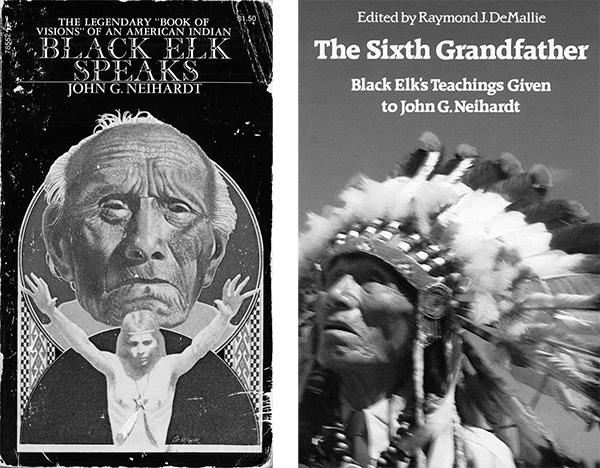
The cover offered me other interpretive clues. Rather than the formal subtitle (“Being the Life Story of a Holy Man of the Oglala Sioux”) the Pocket Books edition carries this description: “The Legendary ‘Book of Visions’ of an American Indian.” Inside the jacket is this elaboration: “A book of legend, of personal vision that makes an LSD trip pale by comparison.” An LSD trip! Wasn’t I looking for something like that? Indeed, like many others, I first read Black Elk Speaks as modeling a quest for meaning gained through mystical experience of the spiritual power of the natural world.
At the same time, however, the edition explicitly placed Black Elk’s own possibilities in the past. On the back cover readers will find familiar words and phrases that define the very essence of the vanishing Indian: “sorrow,” “I may never call again,” “empty sky,” “death of his people,” “the great story of the Sioux is ended,” “the sacred hoop of life is broken,” and more. The book necessarily insists that if Black Elk’s great vision was no longer operative for American Indian people, it could nevertheless live on “for all men.” And it was better than an LSD trip! The cover captured key tensions that haunt the book to this day: John Neihardt’s willingness to believe simultaneously in both the power of Black Elk’s vision and in the vision’s end—and thus in the tragic end of Indian lives and peoples.
Experienced readers of Black Elk Speaks will note that there is nothing new in this little bit of analysis. The book has sold more copies than any other Native American studies title, and it has generated a huge array of smart critical commentary. What matters in my telling is the way in which the book spoke to me—hard and powerfully—about the possibilities for a mystical insight into spiritual life.
In 1979 my father, Vine Deloria Jr., authored the introduction to a new Bison Books edition in which he shifted the focus, famously calling Black Elk Speaks a “bible of all tribes” and a North American religious classic that captured the spiritual power embedded in the continent. He spoke of a “Black Elk theological tradition” and placed it in the context of world-historical contributions to religious thought. Where once a broad American “we” read the book for the possibilities it offered for personal meaning, now a broad tribal “we” might embrace it as a general signifier of Indian practice—even as the historical specificity of its author(s) gave way to a claim for its transcendent truth. I read that edition while taking a Native American Religions class at the University of Colorado and found that my father’s pan-Indian and universal claims played well with my classmates. My dad was good at that kind of thing—the big provocative statement—and the linkage of “bible” and “all tribes” laid out the new terrain quite nicely. There were quiet complaints, however: young people from non-Plains tribes preferring the relative speed of the vision quest over the longer and slower ceremonies of their own tribes; a worry about the taking of one particular life story as key to such a large claim about meaning; and the uncertainty built into the narrating relationship between Black Elk and John Neihardt. During that reading I found myself more interested in the odd interstices of history: no longer the captivating imagery of the great vision but now the time spent in Europe, alone and with Buffalo Bill. For me (and perhaps for readers like me) the book had changed its character. It made me a little uneasy.
That uneasiness exploded in 1984 with the publication of Raymond DeMallie’s The Sixth Grandfather: Black Elk’s Teachings as Given to John G. Neihardt, which collected the original stenographic notes and laid bare, once and for all, the literary overlay introduced by John Neihardt. I read The Sixth Grandfather on a train running from Colorado to California, and I was alternatively disillusioned (in relation to my mystical first readings) and fascinated (in relation the historical focus of my second). For many Black Elk readers, DeMallie’s book engendered both a crisis of confidence in the text (“you mean to tell me that Neihardt—a quintessentially confident poet himself—rewrote some of the things Black Elk said?”) and a new curiosity about a deeply uncertain terrain of translation among oral text, transcribed notes, and literary expression. Indeed, the cover of the book captures and even celebrates that uncertainty, as it features an almost willfully blurry color photograph of Black Elk. Wearing a headdress and a shirt and tie, he is boxed into the lower left corner as he gazes up and away from the viewer. The Sixth Grandfather, as a number of critics have pointed out, basically set the table for a post-structuralist crisis of meaning in relation to a book that had come to serve as a foundational text. Now it had multiple readerships: with or without, before or after DeMallie. And it had gotten progressively more difficult to pin down.
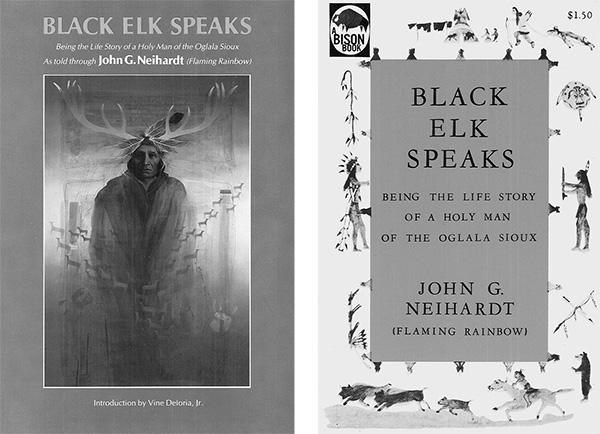
In 1989 and 1990 I taught the 1988 Bison Books edition, which featured a Frank Howell painting, Elk Horn and Herbs, on the cover. Howell’s pastiche image—beautiful but emblematic of the 1980s excesses of what was called “Santa Fe Style”—helped reframe the book yet again as a kind of gateway drug for New Age mystical seekers, an even larger, global audience of next-gen descendants of the readers of the Pocket Books edition. For me, Black Elk had come full circle but now I carried other kinds of reading burdens. If not wiser, I was at least more experienced than I had been that first time around, and correspondingly less taken with it. If not a postmodern cynic, I nonetheless had a strong skepticism about both the origins and the politics of it and other similar texts. I was, frankly, tired of the book, which had by now acquired a huge supplementary critical literature and an enormous and knowing audience. Black Elk Speaks was the property of everyone, and the intimate and powerful meanings I had once taken from it were, I thought, fatally compromised. Sadly, the book had lost many of its satisfactions.
It’s not like there was nothing else to read. Plenty of great American Indian writing came out during those years: stunning fiction and powerful nonfiction, work new and work reclaimed from the archives. Caught up by Louise Erdrich, Sherman Alexie, Leslie Marmon Silko, and other Native writers, many readers had few incentives to revisit Black Elk Speaks. And so I did little more than take note as the 2000 Bison Books edition came out, and—though Ray DeMallie is the preeminent scholar of Black Elk—did more or less the same with his annotated 2008 SUNY Press Premier Edition.
Shortly after that, however, I found in a used bookstore a copy of the 1961 Bison Books edition. On a whim I bought it, and found that my reading had changed and matured yet again. It was clear to me that Black Elk Speaks could never be the kind of book I had once taken it to be: an innocent, curious, and powerful literary account of the reminiscences of a Lakota life. Those days were over. The 1961 cover, for example, has a primitivist pictographic feel that conjures up a feeling of innocence with its white background peppered with what seem to be miniature visual quotations from the Standing Bear drawings that accompanied the original text. An earlier version of me might have taken those images at face value. But that is no longer the nature of this book, for its critical history creates a burden of knowing that insists on thoughtful scrutiny. I found myself comparing the cover drawings and the Standing Bear images and decided that the bulk of the cover was either imagined or drawn from other sources! This particular critical insight is not life changing, but it points to the ways that this book—born and bred to be unstable in its meanings—always demands complex interrogation.
At the same time, however, when I curled up with the book yet again, I said farewell to all that. For there is something about Black Elk Speaks—its stories, word choices, syntax—that is uniquely compelling and captivating. It does not read like any other “as told to” narrative in which Indians relate histories to a white recorder. Nor does it read like Neihardt’s poetry, with its epic couplets, clean rhymes, and narrative drive. What makes Black Elk Speaks great—and it is great—is exactly the thing that we cannot know well and that we therefore pick at constantly: the combined aesthetic and spiritual relationship between Black Elk and John Neihardt that shows up in the gaps of meaning and the interlocked words and phrases of narrator, translators, and author. Is the spiritual content of the book transcendent? Perhaps it is. I am not the one to say. Clearly, readers (myself included) have, for a very long time, found real transcendence in the power of the words on the page.
I’ve lost count of the number of times I have read Black Elk Speaks, and that in itself is testament to the power of the book. This time around I found myself lingering on the small things that pop up in the breaks between the great vision, the battle histories, the accounts of ceremonies, and the Wild West episodes. These are sweet reminders of the presence of a lived life to be found among the book’s gripping stories and literary beauty: the porcupines crying in the cold, the frank confession that wailing and grieving could be a lot of work, the moments when it was hard to start fires with wet wood, the boys pulling old women across All-Gone-Tree Creek with rawhide ropes, the boy who—for whatever reason—climbed the flagpole at the fort and cut off the top, the kissing of fish, the mystery of Watanye’s chronically sore lips, the woman killed by a tree limb falling on her tipi, the shakiness of a young warrior trying to braid a feather in his hair while holding his pony, a broken leg, and skin ripped away with a gun that had frozen to mittenless hands.
Black Elk Speaks has been introduced, prefaced, forwarded, annotated, and explained many times over the years, and I have no illusions about the importance of my own experiences with the book. Yet it has always been my feeling that others have been there, reading with me and perhaps experiencing the book in similar ways, maybe even echoing my own cycle of fascination, exhaustion, and return. For me, the lessons of the book continue to gain clarity with the passing of time and with each new edition and each new reading: there is real power built into it, which makes it fundamentally mysterious; there is deep historical complexity built into it, which makes it a puzzle for contemplation; and there is aesthetic beauty built into it, which makes reading Black Elk Speaks a timeless act of pleasure. All these things are gifts, and we should take them as such.
National and International Honors Received by John G. Neihardt.
1919: Song of Three Friends named Best Volume of Verse by the Poetry Society of America.
1921: Named Poet Laureate of Nebraska by act of the Nebraska State Legislature.
1925: Admitted as the first civilian member to the Order of the Indian Wars of the United States, Washington DC.
1927: The Song of the Indian Wars is chosen as one of the 500 Volumes of World Literature for the White House Library, Washington DC. Neihardt is designated Foremost Poet of the Nation by the National Poetry Center, New York.
1943: Admitted as member to the National Institute of Arts and Letters, New York.
1947: Receives Doctor of Letters degree from the University of Missouri, Columbia.
1951: Named Chancellor of the Academy of American Poets, New York (serves until 1967).
1953: A Cycle of the West chosen as one of the World’s Best Books from Homer to Hemingway.
1959: Named a Fellow of the International Institute of Arts and Letters, Lindau, Germany.
1967: Named Nebraska’s Poet of the Century. Named one of the top ten persons making the most significant contribution to Nebraska in the first 100 years of statehood (poll of historians and history teachers conducted by the World-Herald Newspapers, Omaha). Named Prairie Poet Laureate of America by United Poets Laureate International.
1971: Receives the Mari Sandoz Award from the Nebraska State Library Association.
1972: Receives the Nebraska Builder Award from the University of Nebraska, Lincoln. Receives Doctor of Letters degree from Midland Lutheran College, Fremont NE.
1974: January 8: Honored by the Nebraska State Legislature for fifty-two years of service as Poet Laureate of Nebraska. March 21: Inducted into the Nebraska Hall of Fame.
1982: Named Poet Laureate in Perpetuity by the Nebraska Committee for the Humanities.
2000: Black Elk Speaks chosen as one of the Top Ten Spiritual Books of the Century.
Since its initial publication, Black Elk Speaks has been translated into more than twenty languages, including French, Italian, Finnish, and Latvian.
1. The Offering of the Pipe
Black Elk Speaks:
My friend, I am going to tell you the story of my life, as you wish; and if it were only the story of my life I think I would not tell it; for what is one man that he should make much of his winters, even when they bend him like a heavy snow? So many other men have lived and shall live that story, to be grass upon the hills.
It is the story of all life that is holy and is good to tell, and of us two-leggeds sharing in it with the four-leggeds and the wings of the air and all green things; for these are children of one mother and their father is one Spirit.
This, then, is not the tale of a great hunter or of a great warrior, or of a great traveler, although I have made much meat in my time and fought for my people both as boy and man, and have gone far and seen strange lands and men. So also have many others done, and better than I. These things I shall remember by the way, and often they may seem to be the very tale itself, as when I was living them in happiness and sorrow. But now that I can see it all as from a lonely hilltop, I know it was the story of a mighty vision given to a man too weak to use it; of a holy tree that should have flourished in a people’s heart with flowers and singing birds, and now is withered; and of a people’s dream that died in bloody snow.
But if the vision was true and mighty, as I know, it is true and mighty yet; for such things are of the spirit, and it is in the darkness of their eyes that men get lost.
So I know that it is a good thing I am going to do; and because no good thing can be done by any man alone, I will first make an offering and send a voice to the Spirit of the World,[16] that it may help me to be true. See, I fill this sacred pipe with the bark of the red willow; but before we smoke it, you must see how it is made and what it means. These four ribbons hanging here on the stem are the four quarters of the universe. The black one is for the west where the thunder beings[17] live to send us rain; the white one for the north, whence comes the great white cleansing wind; the red one for the east, whence springs the light and where the morning star lives to give men wisdom; the yellow for the south, whence come the summer and the power to grow.[18]
But these four spirits are only one Spirit after all, and this eagle feather here is for that One, which is like a father, and also it is for the thoughts of men that should rise high as eagles do. Is not the sky a father and the earth a mother, and are not all living things with feet or wings or roots their children? And this hide upon the mouthpiece here, which should be bison hide, is for the earth, from whence we came and at whose breast we suck as babies all our lives, along with all the animals and birds and trees and grasses. And because it means all this, and more than any man can understand, the pipe is holy.[19]
There is a story about the way the pipe first came to us. A very long time ago, they say, two scouts were out looking for bison; and when they came to the top of a high hill and looked north, they saw something coming a long way off, and when it came closer they cried out, “It is a woman!,” and it was. Then one of the scouts, being foolish, had bad thoughts and spoke them; but the other said: “This is a sacred woman; throw all bad thoughts away.” When she came still closer, they saw that she wore a fine white buckskin dress, that her hair was very long and that she was young and very beautiful. And she knew their thoughts and said in a voice that was like singing: “You do not know me, but if you want to do as you think, you may come.” And the foolish one went; but just as he stood before her, there was a white cloud that came and covered them. And the beautiful young woman came out of the cloud, and when it blew away the foolish man was a skeleton covered with worms.
Then the woman spoke to the one who was not foolish: “You shall go home and tell your people that I am coming and that a big tepee shall be built for me in the center of the nation.” And the man, who was very much afraid, went quickly and told the people, who did at once as they were told; and there around the big tepee they waited for the sacred woman. And after a while she came, very beautiful and singing, and as she went into the tepee this is what she sang:
A voice I am sending as I walk.
In a sacred manner I am walking.
With visible tracks I am walking.
In a sacred manner I walk.”
And as she sang, there came from her mouth a white cloud that was good to smell. Then she gave something to the chief, and it was a pipe with a bison calf carved on one side to mean the earth that bears and feeds us, and with twelve eagle feathers hanging from the stem to mean the sky and the twelve moons, and these were tied with a grass that never breaks. “Behold!” she said. “With this you shall multiply and be a good nation. Nothing but good shall come from it. Only the hands of the good shall take care of it and the bad shall not even see it.” Then she sang again and went out of the tepee; and as the people watched her going, suddenly it was a white bison galloping away and snorting, and soon it was gone.[20]
This they tell, and whether it happened so or not I do not know; but if you think about it, you can see that it is true.
Now I light the pipe, and after I have offered it to the powers that are one Power,[21] and sent forth a voice to them, we shall smoke together. Offering the mouthpiece first of all to the One above—so—I send a voice:
Hey hey! hey hey! hey hey! hey hey!
Grandfather, Great Spirit, you have been always, and before you no one has been. There is no other one to pray to but you.[22] You yourself, everything that you see, everything has been made by you. The star nations all over the universe you have finished.[23] The four quarters of the earth you have finished. The day, and in that day, everything you have finished. Grandfather, Great Spirit, lean close to the earth that you may hear the voice I send. You towards where the sun goes down, behold me; Thunder Beings, behold me! You where the White Giant [24] lives in power, behold me! You where the sun shines continually, whence come the day-break star and the day, behold me! You where the summer lives, behold me! You in the depths of the heavens, an eagle of power, behold! And you, Mother Earth, the only Mother, you who have shown mercy to your children!
Hear me, four quarters of the world—a relative I am! Give me the strength to walk the soft earth, a relative to all that is! Give me the eyes to see and the strength to understand, that I may be like you. With your power only can I face the winds.
Great Spirit, Great Spirit, my Grandfather, all over the earth the faces of living things are all alike. With tenderness have these come up out of the ground. Look upon these faces of children without number and with children in their arms, that they may face the winds and walk the good road to the day of quiet.
This is my prayer; hear me! The voice I have sent is weak, yet with earnestness I have sent it. Hear me![25] It is finished. Hetchetu aloh![26]
Now, my friend, let us smoke together so that there may be only good between us.[27]
2. Early Boyhood
I am a Lakota of the Ogalala band.[28] My father’s name was Black Elk, and his father before him bore the name, and the father of his father, so that I am the fourth to bear it. He was a medicine man and so were several of his brothers. Also, he and the great Crazy Horse’s father were cousins, having the same grandfather. My mother’s name was White Cow Sees; her father was called Refuse-to-Go, and her mother, Plenty Eagle Feathers. I can remember my mother’s mother and her father. My father’s father was killed by the Pawnees[29] when I was too little to know, and his mother, Red Eagle Woman, died soon after.
I was born in the Moon of the Popping Trees (December) [30] on the Little Powder River in the Winter When the Four Crows Were Killed (1863),[31] and I was three years old when my father’s right leg was broken in the Battle of the Hundred Slain.{1} From that wound he limped until the day he died, which was about the time when Big Foot’s band was butchered on Wounded Knee (1890). He is buried here in these hills.
I can remember that Winter of the Hundred Slain as a man may remember some bad dream he dreamed when he was little, but I can not tell just how much I heard when I was bigger and how much I understood when I was little. It is like some fearful thing in a fog, for it was a time when everything seemed troubled and afraid.
I had never seen a Wasichu{2} then, and did not know what one looked like; but every one was saying that the Wasichus were coming and that they were going to take our country and rub us all out and that we should all have to die fighting. It was the Wasichus who got rubbed out in that battle, and all the people were talking about it for a long while; but a hundred Wasichus was not much if there were others and others without number where those came from.
I remember once that I asked my grandfather about this. I said: “When the scouts come back from seeing the prairie full of bison somewhere, the people say the Wasichus are coming; and when strange men are coming to kill us all, they say the Wasichus are coming. What does it mean?” And he said, “That they are many.” [32]
When I was older, I learned what the fighting was about that winter and the next summer. Up on the Madison Fork the Wasichus had found much of the yellow metal that they worship and that makes them crazy, and they wanted to have a road up through our country to the place where the yellow metal was; but my people did not want the road.[33] It would scare the bison and make them go away, and also it would let the other Wasichus come in like a river. They told us that they wanted only to use a little land, as much as a wagon would take between the wheels; but our people knew better. And when you look about you now, you can see what it was they wanted.
Once we were happy in our own country and we were seldom hungry, for then the two-leggeds and the four-leggeds lived together like relatives, and there was plenty for them and for us. But the Wasichus came, and they have made little islands for us and other little islands for the four-leggeds, and always these islands are becoming smaller, for around them surges the gnawing flood of the Wasichu; and it is dirty with lies and greed.
A long time ago my father told me what his father told him, that there was once a Lakota holy man, called Drinks Water,[34] who dreamed what was to be; and this was long before the coming of the Wasichus. He dreamed that the four-leggeds were going back into the earth [35] and that a strange race had woven a spider’s web all around the Lakotas. And he said: “When this happens, you shall live in square gray houses, in a barren land, and beside those square gray houses you shall starve.” They say he went back to Mother Earth soon after he saw this vision, and it was sorrow that killed him. You can look about you now and see that he meant these dirt-roofed houses we are living in, and that all the rest was true. Sometimes dreams are wiser than waking.
And so when the soldiers came and built themselves a town of logs there on the Piney Fork of the Powder,[36] my people knew they meant to have their road and take our country and maybe kill us all when they were strong enough. Crazy Horse was only about 19 years old then, and Red Cloud was still our great chief. [37] In the Moon of the Changing Season (October)[38] he called together all the scattered bands of the Lakota for a big council on the Powder River, and when we went on the warpath against the soldiers, a horseback could ride through our villages from sunrise until the day was above his head, so far did our camp stretch along the valley of the river; for many of our friends, the Shyela{3} and the Blue Clouds,{4} had come to help us fight.
And it was about when the bitten moon was delayed (last quarter)[39] in the Time of the Popping Trees when the hundred were rubbed out. My friend, Fire Thunder here, who is older than I, was in that fight and he can tell you how it was.
Fire Thunder Speaks:
I was 16 years old when this happened, and after the big council on the Powder we had moved over to the Tongue River where we were camping at the mouth of Peno Creek. There were many of us there. Red Cloud was over all of us, but the chief of our band was Big Road. We started out on horseback just about sunrise, riding up the creek toward the soldiers’ town on the Piney, for we were going to attack it. The sun was about half way up when we stopped at the place where the Wasichu’s road came down a steep, narrow ridge and crossed the creek. It was a good place to fight, so we sent some men ahead to coax the soldiers out. While they were gone, we divided into two parts and hid in the gullies on both sides of the ridge and waited. After a long while we heard a shot up over the hill, and we knew the soldiers were coming. So we held the noses of our ponies that they might not whinny at the soldiers’ horses. Soon we saw our men coming back, and some of them were walking and leading their horses, so that the soldiers would think they were worn out. Then the men we had sent ahead came running down the road between us, and the soldiers on horseback followed, shooting. When they came to the flat at the bottom of the hill, the fighting began all at once. I had a sorrel horse, and just as I was going to get on him, the soldiers turned around and began to fight their way back up the hill. I had a six-shooter that I had traded for, and also a bow and arrows. When the soldiers started back, I held my sorrel with one hand and began killing them with the six-shooter, for they came close to me. There were many bullets, but there were more arrows—so many that it was like a cloud of grasshoppers all above and around the soldiers; and our people, shooting across, hit each other. The soldiers were falling all the while they were fighting back up the hill, and their horses got loose. Many of our people chased the horses, but I was not after horses; I was after Wasichus. When the soldiers got on top, there were not many of them left and they had no place to hide. They were fighting hard. We were told to crawl up on them, and we did. When we were close, someone yelled: “Let us go! This is a good day to die. Think of the helpless ones at home!” Then we all cried, “Hoka hey!”[40] and rushed at them. I was young then and quick on my feet, and I was one of the first to get in among the soldiers. They got up and fought very hard until not one of them was alive. They had a dog with them, and he started back up the road for the soldiers’ town, howling as he ran. He was the only one left. I did not shoot at him because he looked too sweet;{5} but many did shoot, and he died full of arrows. So there was nobody left of the soldiers. Dead men and horses and wounded Indians were scattered all the way up the hill, and their blood was frozen, for a storm had come up and it was very cold and getting colder all the time. We left all the dead lying there, for the ground was solid, and we picked up our wounded and started back; but we lost most of them before we reached our camp at the mouth of the Peno. There was a big blizzard that night; and some of the wounded who did not die on the way, died after we got home. This was the time when Black Elk’s father had his leg broken.
Black Elk Continues:
I am quite sure that I remember the time when my father came home with a broken leg that he got from killing so many Wasichus, and it seems that I can remember all about the battle too, but I think I could not. It must be the fear that I remember most. All this time I was not allowed to play very far away from our tepee, and my mother would say, “If you are not good the Wasichus will get you.”[41]
We must have broken camp at the mouth of the Peno soon after the battle, for I can remember my father lying on a pony drag[42] with bison robes all around him, like a baby, and my mother riding the pony. The snow was deep and it was very cold, and I remember sitting in another pony drag beside my father and mother, all wrapped up in fur. We were going away from where the soldiers were, and I do not know where we went, but it was west.
It was a hungry winter, for the deep snow made it hard to find the elk; and also many of the people went snowblind. We wandered a long time, and some of the bands got lost from each other. Then at last we were camping in the woods beside a creek somewhere, and the hunters came back with meat.
I think it was this same winter when a medicine man, by the name of Creeping, went around among the people curing snowblinds. He would put snow upon their eyes, and after he had sung a certain sacred song that he had heard in a dream, he would blow on the backs of their heads and they would see again, so I have heard. It was about the dragonfly that he sang, for that was where he got his power, they say.[43]
When it was summer again we were camping on the Rosebud, and I did not feel so much afraid, because the Wasichus seemed farther away and there was peace there in the valley and there was plenty of meat. But all the boys from five or six years up were playing war. The little boys would gather together from the different bands of the tribe and fight each other with mud balls that they threw with willow sticks. And the big boys played the game called Throwing-Them-Off-Their-Horses, which is a battle all but the killing; and sometimes they got hurt. The horsebacks from the different bands would line up and charge upon each other, yelling; and when the ponies came together on the run, they would rear and flounder and scream in a big dust, and the riders would seize each other, wrestling until one side had lost all its men, for those who fell upon the ground were counted dead.[44]
When I was older, I, too, often played this game. We were always naked when we played it, just as warriors are when they go into battle if it is not too cold, because they are swifter without clothes. Once I fell off on my back right in the middle of a bed of prickly pears, and it took my mother a long while to pick all the stickers out of me. I was still too little to play war that summer, but I can remember watching the other boys, and I thought that when we all grew up and were big together, maybe we could kill all the Wasichus or drive them far away from our country.
It was in the Moon When the Cherries Turn Black (August)[45] that all the people were talking again about a battle, and our warriors came back with many wounded. It was The Attacking of the Wagons,{6} and it made me afraid again, for we did not win that battle as we did the other one, and there was much mourning for the dead. Fire Thunder was in that fight too, and he can tell you how it was that day.
Fire Thunder Speaks:
It was very bad. There is a wide flat prairie with hills around it, and in the middle of this the Wasichus had put the boxes of their wagons in a circle, so that they could keep their mules there at night. There were not many Wasichus, but they were lying behind the boxes and they shot faster than they ever shot at us before. We thought it was some new medicine of great power that they had, for they shot so fast that it was like tearing a blanket. Afterwards I learned that it was because they had new guns that they loaded from behind, and this was the first time they used these guns.{7} We came on after sunrise. There were many, many of us, and we meant to ride right over them and rub them out. But our ponies were afraid of the ring of fire the guns of the Wasichus made, and would not go over. Our women were watching us from the hills and we could hear them singing and mourning whenever the shooting stopped. We tried hard, but we could not do it, and there were dead warriors and horses piled all around the boxes and scattered over the plain. Then we left our horses in a gulch and charged on foot, but it was like green grass withering in a fire. So we picked up our wounded and went away. I do not know how many of our people were killed, but there were very many. It was bad.
Black Elk Continues:
I do not remember where we camped that winter but it must have been a time of peace and of plenty to eat.
Standing Bear Speaks:
I am four years older than Black Elk, and he and I have been good friends since boyhood.[46] I know it was on the Powder that we camped where there were many cottonwood trees. Ponies like to eat the bark of these trees and it is good for them. That was the winter when High Shirt’s mother was killed by a big tree that fell on her tepee. It was a very windy night and there were noises that ‘woke me, and then I heard that an old woman had been killed, and it was High Shirt’s mother.[47]
Black Elk Continues:
I was four years old then, and I think it must have been the next summer that I first heard the voices. It was a happy summer and nothing was afraid, because in the Moon When the Ponies Shed (May)[48] word came from the Wasichus that there would be peace and that they would not use the road any more and that all the soldiers would go away. The soldiers did go away and their towns were torn down; and in the Moon of Falling Leaves (November),[49] they made a treaty with Red Cloud that said our country would be ours as long as grass should grow and water flow. You can see that it is not the grass and the water that have forgotten.[50]
Maybe it was not this summer when I first heard the voices, but I think it was, because I know it was before I played with bows and arrows or rode a horse, and I was out playing alone when I heard them. It was like somebody calling me, and I thought it was my mother, but there was nobody there. This happened more than once, and always made me afraid, so that I ran home.
It was when I was five years old that my Grandfather made me a bow and some arrows. The grass was young and I was horseback. A thunder storm was coming from where the sun goes down, and just as I was riding into the woods along a creek, there was a kingbird sitting on a limb.[51] This was not a dream, it happened. And I was going to shoot at the kingbird with the bow my Grandfather made, when the bird spoke and said: “The clouds all over are one-sided.”[52] Perhaps it meant that all the clouds were looking at me. And then it said: “Listen! A voice is calling you!” Then I looked up at the clouds, and two men were coming there, headfirst like arrows slanting down; and as they came, they sang a sacred song and the thunder was like drumming. I will sing it for you. The song and the drumming were like this:
All over the sky a sacred voice is calling.”
I sat there gazing at them, and they were coming from the place where the giant lives (north). But when they were very close to me, they wheeled about toward where the sun goes down, and suddenly they were geese.[53]
Then they were gone, and the rain came with a big wind and a roaring.
I did not tell this vision to any one. I liked to think about it, but I was afraid to tell it.
3. The Great Vision
What happened after that until the summer I was nine years old is not a story. There were winters and summers, and they were good; for the Wasichus had made their iron road{8} along the Platte and traveled there. This had cut the bison herd in two, but those that stayed in our country with us were more than could be counted, and we wandered without trouble in our land.
Now and then the voices would come back when I was out alone, like someone calling me, but what they wanted me to do I did not know. This did not happen very often, and when it did not happen, I forgot about it; for I was growing taller and was riding horses now and could shoot prairie chickens and rabbits with my bow. The boys of my people began very young to learn the ways of men, and no one taught us; we just learned by doing what we saw, and we were warriors at a time when boys now are like girls.
It was the summer when I was nine years old, and our people were moving slowly towards the Rocky Mountains. We camped one evening in a valley beside a little creek just before it ran into the Greasy Grass,{9} and there was a man by the name of Man Hip who liked me and asked me to eat with him in his tepee.
While I was eating, a voice came and said: “It is time; now they are calling you.” The voice was so loud and clear that I believed it, and I thought I would just go where it wanted me to go. So I got right up and started. As I came out of the tepee, both my thighs began to hurt me, and suddenly it was like waking from a dream, and there wasn’t any voice. So I went back into the tepee, but I didn’t want to eat. Man Hip looked at me in a strange way and asked me what was wrong. I told him that my legs were hurting me.
The next morning the camp moved again, and I was riding with some boys. We stopped to get a drink from a creek, and when I got off my horse, my legs crumpled under me and I could not walk. So the boys helped me up and put me on my horse; and when we camped again that evening, I was sick. The next day the camp moved on to where the different bands of our people were coming together, and I rode in a pony drag, for I was very sick. Both my legs and both my arms were swollen badly and my face was all puffed up.
When we had camped again, I was lying in our tepee and my mother and father were sitting beside me. I could see out through the opening, and there two men were coming from the clouds, headfirst like arrows slanting down, and I knew they were the same that I had seen before.[54] Each now carried a long spear, and from the points of these a jagged lightning flashed. They came clear down to the ground this time and stood a little way off and looked at me and said: “Hurry! Come! Your Grandfathers are calling you!”[55] Then they turned and left the ground like arrows slanting upward from the bow. When I got up to follow, my legs did not hurt me any more and I was very light. I went outside the tepee, and yonder where the men with flaming spears were going, a little cloud was coming very fast. It came and stooped and took me and turned back to where it came from, flying fast. And when I looked down I could see my mother and my father yonder, and I felt sorry to be leaving them.
Then there was nothing but the air and the swiftness of the little cloud that bore me and those two men still leading up to where white clouds were piled like mountains on a wide blue plain, and in them thunder beings lived and leaped and flashed.
Now suddenly there was nothing but a world of cloud, and we three were there alone in the middle of a great white plain with snowy hills and mountains staring at us; and it was very still; but there were whispers.
Then the two men spoke together and they said: “Behold him, the being with four legs!”
I looked and saw a bay horse standing there, and he began to speak: “Behold me!” he said, “My life-history you shall see.” Then he wheeled about to where the sun goes down, and said: “Behold them! Their history you shall know.”
I looked, and there were twelve black horses yonder all abreast with necklaces of bison hoofs, and they were beautiful, but I was frightened, because their manes were lightning and there was thunder in their nostrils.
Then the bay horse wheeled to where the great white giant lives (the north) and said: “Behold!” And yonder there were twelve white horses all abreast. Their manes were flowing like a blizzard wind and from their noses came a roaring, and all about them white geese soared and circled.
Then the bay wheeled round to where the sun shines continually (the east) and bade me look; and there twelve sorrel horses, with necklaces of elk’s teeth, stood abreast with eyes that glimmered like the day-break star and manes of morning light.
Then the bay wheeled once again to look upon the place where you are always facing (the south), and yonder stood twelve buckskins all abreast with horns upon their heads and manes that lived and grew like trees and grasses.
And when I had seen all these, the bay horse said: “Your Grandfathers are having a council. These shall take you; so have courage.”[56]
Then all the horses went into formation, four abreast[57]—the blacks, the whites, the sorrels, and the buckskins—and stood behind the bay, who turned now to the west and neighed; and yonder suddenly the sky was terrible with a storm of plunging horses in all colors that shook the world with thunder, neighing back.
Now turning to the north the bay horse whinnied, and yonder all the sky roared with a mighty wind of running horses in all colors, neighing back.
And when he whinnied to the east, there too the sky was filled with glowing clouds of manes and tails of horses in all colors singing back. Then to the south he called, and it was crowded with many colored, happy horses, nickering.
Then the bay horse spoke to me again and said: “See how your horses all come dancing!” I looked, and there were horses, horses everywhere—a whole skyful of horses dancing round me.
“Make haste!” the bay horse said; and we walked together side by side, while the blacks, the whites, the sorrels, and the buckskins followed, marching four by four.
I looked about me once again, and suddenly the dancing horses without number changed into animals of every kind and into all the fowls that are, and these fled back to the four quarters of the world from whence the horses came, and vanished.
Then as we walked, there was a heaped up cloud ahead that changed into a tepee, and a rainbow was the open door of it;[58] and through the door I saw six old men sitting in a row.
The two men with the spears now stood beside me, one on either hand, and the horses took their places in their quarters, looking inward, four by four. And the oldest of the Grandfathers spoke with a kind voice and said: “Come right in and do not fear.” And as he spoke, all the horses of the four quarters neighed to cheer me. So I went in and stood before the six, and they looked older than men can ever be—old like hills, like stars.[59]
The oldest spoke again: “Your Grandfathers all over the world are having a council, and they have called you here to teach you.” His voice was very kind, but I shook all over with fear now, for I knew that these were not old men, but the Powers of the World. And the first was the Power of the West; the second, of the North; the third, of the East; the fourth, of the South; the fifth, of the Sky; the sixth, of the Earth. I knew this, and was afraid, until the first Grandfather spoke again: “Behold them yonder where the sun goes down, the thunder beings! You shall see, and have from them my power; and they shall take you to the high and lonely center of the earth that you may see; even to the place where the sun continually shines, they shall take you there to understand.”
And as he spoke of understanding, I looked up and saw the rainbow leap with flames of many colors over me.
Now there was a wooden cup in his hand and it was full of water and in the water was the sky.
“Take this,” he said. “It is the power to make live, and it is yours.”
Now he had a bow in his hands. “Take this,” he said. “It is the power to destroy, and it is yours.”
Then he pointed to himself and said: “Look close at him who is your spirit now, for you are his body and his name is Eagle Wing Stretches.”
And saying this, he got up very tall and started running toward where the sun goes down; and suddenly he was a black horse that stopped and turned and looked at me, and the horse was very poor and sick; his ribs stood out.
Then the second Grandfather, he of the North, arose with a herb of power in his hand, and said: “Take this and hurry.” I took and held it toward the black horse yonder. He fattened and was happy and came prancing to his place again and was the first Grandfather sitting there.
The second Grandfather, he of the North, spoke again: “Take courage, younger brother,” he said; “on earth a nation you shall make live, for yours shall be the power of the white giant’s wing, the cleansing wind.” Then he got up very tall and started running toward the north; and when he turned toward me, it was a white goose wheeling. I looked about me now, and the horses in the west were thunders and the horses of the north were geese. And the second Grandfather sang two songs that were like this:[60]
They are appearing, may you behold!
The thunder nation is appearing, behold!
They are appearing, may you behold!
They are appearing, may you behold!
The white geese nation is appearing, behold!”
And now it was the third Grandfather who spoke, he of where the sun shines continually. “Take courage, younger brother,” he said, “for across the earth they shall take you!” Then he pointed to where the daybreak star was shining, and beneath the star two men were flying. “From them you shall have power,” he said, “from them who have awakened all the beings of the earth with roots and legs and wings.” And as he said this, he held in his hand a peace pipe which had a spotted eagle outstretched upon the stem; and this eagle seemed alive, for it was poised there, fluttering, and its eyes were looking at me. “With this pipe,” the Grandfather said, “you shall walk upon the earth, and whatever sickens there you shall make well.” Then he pointed to a man who was bright red all over, the color of good and of plenty, and as he pointed, the red man lay down and rolled and changed into a bison that got up and galloped toward the sorrel horses of the east, and they too turned to bison, fat and many.
And now the fourth Grandfather spoke, he of the place where you are always facing (the south),[61] whence comes the power to grow. “Younger brother,” he said, “with the powers of the four quarters you shall walk, a relative. Behold, the living center of a nation I shall give you, and with it many you shall save.” And I saw that he was holding in his hand a bright red stick[62] that was alive, and as I looked it sprouted at the top and sent forth branches, and on the branches many leaves came out and murmured and in the leaves the birds began to sing. And then for just a little while I thought I saw beneath it in the shade the circled villages of people and every living thing with roots or legs or wings, and all were happy. “It shall stand in the center of the nation’s circle,” said the Grandfather, “a cane to walk with and a people’s heart; and by your powers you shall make it blossom.”
Then when he had been still a little while to hear the birds sing, he spoke again: “Behold the earth!” So I looked down and saw it lying yonder like a hoop of peoples, and in the center bloomed the holy stick that was a tree, and where it stood there crossed two roads, a red one and a black.[63] “From where the giant lives (the north) to where you always face (the south) the red road goes, the road of good,” the Grandfather said, “and on it shall your nation walk. The black road goes from where the thunder beings live (the west) to where the sun continually shines (the east), a fearful road, a road of troubles and of war. On this also you shall walk, and from it you shall have the power to destroy a people’s foes. In four ascents you shall walk the earth with power.”
I think he meant that I should see four generations, counting me, and now I am seeing the third.
Then he rose very tall and started running toward the south, and was an elk; and as he stood among the buckskins yonder, they too were elks.
Now the fifth Grandfather spoke, the oldest of them all, the Spirit of the Sky. “My boy,” he said, “I have sent for you and you have come. My power you shall see!” He stretched his arms and turned into a spotted eagle hovering. “Behold,” he said, “all the wings of the air shall come to you, and they and the winds and the stars shall be like relatives. You shall go across the earth with my power.” Then the eagle soared above my head and fluttered there; and suddenly the sky was full of friendly wings all coming toward me.
Now I knew the sixth Grandfather was about to speak, he who was the Spirit of the Earth, and I saw that he was very old, but more as men are old. His hair was long and white, his face was all in wrinkles and his eyes were deep and dim. I stared at him, for it seemed I knew him somehow; and as I stared, he slowly changed, for he was growing backwards into youth, and when he had become a boy, I knew that he was myself with all the years that would be mine at last. When he was old again, he said: “My boy, have courage, for my power shall be yours, and you shall need it, for your nation on the earth will have great troubles. Come.”
He rose and tottered out through the rainbow door, and as I followed I was riding on the bay horse who had talked to me at first and led me to that place.
Then the bay horse stopped and faced the black horses of the west, and a voice said: “They have given you the cup of water to make live the greening day, and also the bow and arrow to destroy.” The bay neighed, and the twelve black horses came and stood behind me, four abreast.
The bay faced the sorrels of the east, and I saw that they had morning stars upon their foreheads and they were very bright. And the voice said: “They have given you the sacred pipe and the power that is peace, and the good red day.” The bay neighed, and the twelve sorrels stood behind me, four abreast.
My horse now faced the buckskins of the south, and a voice said: “They have given you the sacred stick and your nation’s hoop, and the yellow day; and in the center of the hoop you shall set the stick and make it grow into a shielding tree, and bloom.” The bay neighed, and the twelve buckskins came and stood behind me, four abreast.
Then I knew that there were riders on all the horses there behind me, and a voice said: “Now you shall walk the black road with these; and as you walk, all the nations that have roots or legs or wings shall fear you.”[64]
So I started, riding toward the east down the fearful road, and behind me came the horsebacks four abreast—the blacks, the whites, the sorrels, and the buckskins—and far away above the fearful road the daybreak star was rising very dim.
I looked below me where the earth was silent in a sick green light, and saw the hills look up afraid and the grasses on the hills and all the animals; and everywhere about me were the cries of frightened birds and sounds of fleeing wings. I was the chief of all the heavens riding there, and when I looked behind me, all the twelve black horses reared and plunged and thundered and their manes and tails were whirling hail and their nostrils snorted lightning. And when I looked below again, I saw the slant hail falling and the long, sharp rain, and where we passed, the trees bowed low and all the hills were dim.
Now the earth was bright again as we rode. I could see the hills and valleys and the creeks and rivers passing under. We came above a place where three streams made a big one—a source of mighty waters{10}—and something terrible was there. Flames were rising from the waters and in the flames a blue man lived.[65] The dust was floating all about him in the air, the grass was short and withered, the trees were wilting, two-legged and four-legged beings lay there thin and panting, and wings too weak to fly.
Then the black horse riders shouted “Hoka hey!” and charged down upon the blue man, but were driven back. And the white troop shouted, charging, and was beaten; then the red troop and the yellow.
And when each had failed, they all cried together: “Eagle Wing Stretches, hurry!” And all the world was filled with voices of all kinds that cheered me, so I charged. I had the cup of water in one hand and in the other was the bow that turned into a spear as the bay and I swooped down, and the spear’s head was sharp lightning. It stabbed the blue man’s heart, and as it struck I could hear the thunder rolling and many voices that cried “Un-hee!,”[66] meaning I had killed. The flames died. The trees and grasses were not withered any more and murmured happily together, and every living being cried in gladness with whatever voice it had. Then the four troops of horsemen charged down and struck the dead body of the blue man, counting coup; and suddenly it was only a harmless turtle.
You see, I had been riding with the storm clouds, and had come to earth as rain, and it was drouth that I had killed with the power that the Six Grandfathers gave me. So we were riding on the earth now down along the river flowing full from the source of waters, and soon I saw ahead the circled village of a people in the valley. And a Voice said: “Behold a nation; it is yours. Make haste, Eagle Wing Stretches!”
I entered the village, riding, with the four horse troops behind me—the blacks, the whites, the sorrels, and the buckskins; and the place was filled with moaning and with mourning for the dead. The wind was blowing from the south like fever, and when I looked around I saw that in nearly every tepee the women and the children and the men lay dying with the dead.
So I rode around the circle of the village, looking in upon the sick and dead, and I felt like crying as I rode. But when I looked behind me, all the women and the children and the men were getting up and coming forth with happy faces.
And a Voice said: “Behold, they have given you the center of the nation’s hoop to make it live.”
So I rode to the center of the village, with the horse troops in their quarters round about me, and there the people gathered. And the Voice said: “Give them now the flowering stick that they may flourish, and the sacred pipe that they may know the power that is peace, and the wing of the white giant that they may have endurance and face all winds with courage.”
So I took the bright red stick and at the center of the nation’s hoop I thrust it in the earth. As it touched the earth it leaped mightily in my hand and was a waga chun, the rustling tree,{11} very tall and full of leafy branches and of all birds singing. And beneath it all the animals were mingling with the people like relatives and making happy cries. The women raised their tremolo of joy, and the men shouted all together: “Here we shall raise our children and be as little chickens under the mother sheo’s{12} wing.”
Then I heard the white wind blowing gently through the tree and singing there, and from the east the sacred pipe came flying on its eagle wings, and stopped before me there beneath the tree, spreading deep peace around it.
Then the daybreak star [67] was rising, and a Voice said: “It shall be a relative to them; and who shall see it, shall see much more, for thence comes wisdom; and those who do not see it shall be dark.” And all the people raised their faces to the east, and the star’s light fell upon them, and all the dogs barked loudly and the horses whinnied.
Then when the many little voices ceased, the great Voice said: “Behold the circle of the nation’s hoop, for it is holy, being endless, and thus all powers shall be one power in the people without end. Now they shall break camp and go forth upon the red road, and your Grandfathers shall walk with them.” So the people broke camp and took the good road with the white wing[68] on their faces, and the order of their going was like this:
First, the black horse riders with the cup of water; and the white horse riders with the white wing and the sacred herb; and the sorrel riders with the holy pipe; and the buckskins with the flowering stick. And after these the little children and the youths and maidens followed in a band.
Second, came the tribe’s four chieftains[69] and their band was all young men and women.
Third, the nation’s four advisers[70] leading men and women neither young nor old.
Fourth, the old men hobbling with their canes and looking to the earth.
Fifth, old women hobbling with their canes and looking to the earth.
Sixth, myself all alone upon the bay with the bow and arrows that the First Grandfather gave me. But I was not the last; for when I looked behind me there were ghosts of people like a trailing fog as far as I could see—grandfathers of grandfathers and grandmothers of grandmothers without number. And over these a great Voice—the Voice that was the South—lived, and I could feel it silent.
And as we went the Voice behind me said: “Behold a good nation walking in a sacred manner in a good land!”
Then I looked up and saw that there were four ascents ahead, and these were generations I should know. Now we were on the first ascent, and all the land was green. And as the long line climbed, all the old men and women raised their hands, palms forward, to the far sky yonder and began to croon a song together, and the sky ahead was filled with clouds of baby faces.
When we came to the end of the first ascent we camped in the sacred circle as before, and in the center stood the holy tree, and still the land about us was all green.
Then we started on the second ascent, marching as before, and still the land was green, but it was getting steeper. And as I looked ahead, the people changed into elks and bison and all four-footed beings and even into fowls, all walking in a sacred manner on the good red road together. And I myself was a spotted eagle soaring over them. But just before we stopped to camp at the end of that ascent, all the marching animals grew restless and afraid that they were not what they had been, and began sending forth voices of trouble, calling to their chiefs. And when they camped at the end of that ascent, I looked down and saw that leaves were falling from the holy tree.
And the Voice said: “Behold your nation, and remember what your Six Grandfathers gave you, for thenceforth your people walk in difficulties.”
Then the people broke camp again, and saw the black road before them towards where the sun goes down, and black clouds coming yonder; and they did not want to go but could not stay. And as they walked the third ascent, all the animals and fowls that were the people ran here and there, for each one seemed to have his own little vision that he followed and his own rules; and all over the universe I could hear the winds at war like wild beasts fighting.{13}
And when we reached the summit of the third ascent and camped, the nation’s hoop was broken like a ring of smoke that spreads and scatters and the holy tree seemed dying and all its birds were gone. And when I looked ahead I saw that the fourth ascent would be terrible.
Then when the people were getting ready to begin the fourth ascent, the Voice spoke like some one weeping, and it said: “Look there upon your nation.” And when I looked down, the people were all changed back to human, and they were thin, their faces sharp, for they were starving. Their ponies were only hide and bones, and the holy tree was gone.
And as I looked and wept, I saw that there stood on the north side of the starving camp a sacred man who was painted red all over his body, and he held a spear as he walked into the center of the people, and there he lay down and rolled. And when he got up, it was a fat bison standing there, and where the bison stood a sacred herb sprang up right where the tree had been in the center of the nation’s hoop. The herb grew and bore four blossoms on a single stem while I was looking—a blue,{14} a white, a scarlet, and a yellow—and the bright rays of these flashed to the heavens.
I know now what this meant, that the bison were the gift of a good spirit and were our strength, but we should lose them, and from the same good spirit we must find another strength. For the people all seemed better when the herb had grown and bloomed, and the horses raised their tails and neighed and pranced around, and I could see a light breeze going from the north among the people like a ghost; and suddenly the flowering tree was there again at the center of the nation’s hoop where the four-rayed herb had blossomed.
I was still the spotted eagle floating, and I could see that I was already in the fourth ascent and the people were camping yonder at the top of the third long rise. It was dark and terrible about me, for all the winds of the world were fighting. It was like rapid gun-fire and like whirling smoke, and like women and children wailing and like horses screaming all over the world.
I could see my people yonder running about, setting the smoke-flap poles and fastening down their tepees against the wind, for the storm cloud was coming on them very fast and black, and there were frightened swallows without number fleeing before the cloud.[71]
Then a song of power came to me and I sang it there in the midst of that terrible place where I was. It went like this:
This the nation above has said.
They have given me the power to make over.[72]
And when I had sung this, a Voice said: “To the four quarters you shall run for help, and nothing shall be strong before you. Behold him!”
Now I was on my bay horse again, because the horse is of the earth, and it was there my power would be used.[73] And as I obeyed the Voice and looked, there was a horse all skin and bones yonder in the west, a faded brownish black. And a Voice there said: “Take this and make him over; and it was the four-rayed herb that I was holding in my hand. So I rode above the poor horse in a circle, and as I did this I could hear the people yonder calling for spirit power, “A-hey! a-hey! a-hey! a-hey!” [74] Then the poor horse neighed and rolled and got up, and he was a big, shiny, black stallion with dapples all over him and his mane about him like a cloud. He was the chief of all the horses; and when he snorted, it was a flash of lightning and his eyes were like the sunset star. He dashed to the west and neighed, and the west was filled with a dust of hoofs, and horses without number, shiny black, came plunging from the dust. Then he dashed toward the north and neighed, and to the east and to the south, and the dust clouds answered, giving forth their plunging horses without number—whites and sorrels and buckskins, fat, shiny, rejoicing in their fleetness and their strength. It was beautiful, but it was also terrible.
Then they all stopped short, rearing, and were standing in a great hoop about their black chief at the center, and were still. And as they stood, four virgins, more beautiful than women of the earth can be, came through the circle, dressed in scarlet, one from each of the four quarters, and stood about the great black stallion in their places; and one held the wooden cup of water, and one the white wing, and one the pipe, and one the nation’s hoop. All the universe was silent, listening; and then the great black stallion raised his voice and sang. The song he sang was this:
My horses, neighing they are coming;
Prancing, they are coming.
All over the universe they come.
They will dance; may you behold them.
(4 times)
May you behold them.”
(4 times)
His voice was not loud, but it went all over the universe and filled it.[75] There was nothing that did not hear, and it was more beautiful than anything can be. It was so beautiful that nothing anywhere could keep from dancing. The virgins danced, and all the circled horses. The leaves on the trees, the grasses on the hills and in the valleys, the waters in the creeks and in the rivers and the lakes, the four-legged and the two-legged and the wings of the air—all danced together to the music of the stallion’s song.
And when I looked down upon my people yonder, the cloud passed over, blessing them with friendly rain, and stood in the east with a flaming rainbow over it.
Then all the horses went singing back to their places beyond the summit of the fourth ascent, and all things sang along with them as they walked.
And a Voice said: “All over the universe they have finished a day of happiness.” And looking down I saw that the whole wide circle of the day was beautiful and green, with all fruits growing and all things kind and happy.
Then a Voice said: “Behold this day, for it is yours to make. Now you shall stand upon the center of the earth to see, for there they are taking you.”
I was still on my bay horse, and once more I felt the riders of the west, the north, the east, the south, behind me in formation, as before, and we were going east. I looked ahead and saw the mountains there with rocks and forests on them, and from the mountains flashed all colors upward to the heavens. Then I was standing on the highest mountain of them all, and round about beneath me was the whole hoop of the world.{15} And while I stood there I saw more than I can tell and I understood more than I saw; for I was seeing in a sacred manner the shapes of all things in the spirit, and the shape of all shapes as they must live together like one being. And I saw that the sacred hoop of my people was one of many hoops that made one circle, wide as daylight and as starlight, and in the center grew one mighty flowering tree to shelter all the children of one mother and one father. And I saw that it was holy.[76]
Then as I stood there, two men were coming from the east, head first like arrows flying, and between them rose the day-break star. They came and gave a herb to me and said: “With this on earth you shall undertake anything and do it.” It was the day-break-star herb, the herb of understanding, and they told me to drop it on the earth. I saw it falling far, and when it struck the earth it rooted and grew and flowered, four blossoms on one stem, a blue, a white, a scarlet, and a yellow; and the rays from these streamed upward to the heavens so that all creatures saw it and in no place was there darkness.
Then the Voice said: “Your Six Grandfathers—now you shall go back to them.”
I had not noticed how I was dressed until now, and I saw that I was painted red all over, and my joints were painted black, with white stripes between the joints.[77] My bay had lightning stripes all over him, and his mane was cloud. And when I breathed, my breath was lightning.
Now two men were leading me, head first like arrows slanting upward—the two that brought me from the earth. And as I followed on the bay, they turned into four flocks of geese that flew in circles, one above each quarter, sending forth a sacred voice as they flew: Br-r-r-p, br-r-r-p, br-r-r-p, br-r-r-p!
Then I saw ahead the rainbow flaming above the tepee of the Six Grandfathers, built and roofed with cloud and sewed with thongs of lightning; and underneath it were all the wings of the air and under them the animals and men. All these were rejoicing, and thunder was like happy laughter.
As I rode in through the rainbow door, there were cheering voices from all over the universe, and I saw the Six Grandfathers sitting in a row, with their arms held toward me and their hands, palms out; and behind them in the cloud were faces thronging, without number, of the people yet to be.
“He has triumphed!” cried the six together, making thunder. And as I passed before them there, each gave again the gift that he had given me before—the cup of water and the bow and arrows, the power to make live and to destroy; the white wing of cleansing and the healing herb; the sacred pipe; the flowering stick. And each one spoke in turn from west to south, explaining what he gave as he had done before, and as each one spoke he melted down into the earth and rose again; and as each did this, I felt nearer to the earth.
Then the oldest of them all said: “Grandson, all over the universe you have seen. Now you shall go back with power to the place from whence you came, and it shall happen yonder that hundreds shall be sacred, hundreds shall be flames! Behold!”[78]
I looked below and saw my people there, and all were well and happy except one, and he was lying like the dead—and that one was myself. Then the oldest Grandfather sang, and his song was like this:
There is someone—on earth he lies.
In a sacred manner I have made him to walk.”[79]
Now the tepee, built and roofed with cloud, began to sway back and forth as in a wind, and the flaming rainbow door was growing dimmer. I could hear voices of all kinds crying from outside: “Eagle Wing Stretches is coming forth! Behold him!”
When I went through the door, the face of the day of earth was appearing with the day-break star upon its forehead; and the sun leaped up and looked upon me, and I was going forth alone.
And as I walked alone, I heard the sun singing as it arose, and it sang like this:
In a sacred manner I appear.
For the greening earth a pleasantness I make.
The center of the nation’s hoop I have made pleasant.
With visible face, behold me!
The four-leggeds and two-leggeds, I have made them to walk;
The wings of the air, I have made them to fly.
With visible face I appear.
My day, I have made it holy.”[80]
When the singing stopped, I was feeling lost and very lonely. Then a Voice above me said: “Look back!” It was a spotted eagle that was hovering over me and spoke. I looked, and where the flaming rainbow tepee, built and roofed with cloud, had been, I saw only the tall rock mountain at the center of the world.
I was all alone on a broad plain now with my feet upon the earth, alone but for the spotted eagle guarding me. I could see my people’s village far ahead, and I walked very fast, for I was homesick now. Then I saw my own tepee, and inside I saw my mother and my father bending over a sick boy that was myself. And as I entered the tepee, some one was saying: “The boy is coming to; you had better give him some water.”
Then I was sitting up; and I was sad because my mother and my father didn’t seem to know I had been so far away.
4. The Bison Hunt
When I got back to my father and mother and was sitting up there in our tepee, my face was still all puffed and my legs and arms were badly swollen; but I felt good all over and wanted to get right up and run around. My parents would not let me. They told me I had been sick twelve days, lying like dead all the while, and that Whirlwind Chaser, who was Standing Bear’s uncle and a medicine man, had brought me back to life.[81] I knew it was the Grandfathers in the Flaming Rainbow Tepee who had cured me; but I felt afraid to say so. My father gave Whirlwind Chaser the best horse he had for making me well, and many people came to look at me, and there was much talk about the great power of Whirlwind Chaser who had made me well all at once when I was almost the same as dead.
Everybody was glad that I was living; but as I lay there thinking about the wonderful place where I had been and all that I had seen, I was very sad; for it seemed to me that everybody ought to know about it, but I was afraid to tell, because I knew that nobody would believe me, little as I was, for I was only nine years old. Also, as I lay there thinking of my vision, I could see it all again and feel the meaning with a part of me like a strange power glowing in my body; but when the part of me that talks would try to make words for the meaning, it would be like fog and get away from me.
I am sure now that I was then too young to understand it all, and that I only felt it.[82] It was the pictures I remembered and the words that went with them; for nothing I have ever seen with my eyes was so clear and bright as what my vision showed me; and no words that I have ever heard with my ears were like the words I heard. I did not have to remember these things; they have remembered themselves all these years. It was as I grew older that the meanings came clearer and clearer out of the pictures and the words; and even now I know that more was shown to me than I can tell.
That evening of the day when I came back, Whirlwind Chaser, who had got a great name and a good horse for curing me, came over to our tepee. He sat down and looked at me a long time in a strange way, and then he said to my father: “Your boy there is sitting in a sacred manner. I do not know what it is, but there is something special for him to do, for just as I came in I could see a power like a light all through his body.”
While he was looking hard at me, I wanted to get up and run away, for I was afraid he might look right into me and see my vision there and tell it wrong, and then maybe all the people would think that I was crazy. For a long while after that, whenever I saw Whirlwind Chaser coming, I would run away and hide for fear he might see into me and tell.
The next morning all the swelling had left my face and legs and arms, and I felt well as ever; but everything around me seemed strange and as though it were far away. I remember that for twelve days after that I wanted to be alone, and it seemed I did not belong to my people. They were almost like strangers. I would be out alone away from the village and the other boys, and I would look around to the four quarters, thinking of my vision and wishing I could get back there again. I would go home to eat, but I could not make myself eat much; and my father and mother thought that I was sick yet; but I was not. I was only homesick for the place where I had been.
I could not tell what I had seen and heard even to my mother’s father, Refuse-To-Go,[83] although before that I used to think that I could tell him anything, for he liked everything a boy could like, and there was no end to the wonderful things he would tell. It was he who made the first bow I ever had, and he always had more arrows ready for me when I had lost all those that he had given me. I loved my father, but Refuse-To-Go was different, and I used to be with him a great deal. This was the first thing I could not tell him.
One day during this time I was out with the bow and arrows my Grandfather had made for me, and as I walked along thinking of my vision, suddenly I felt queer, and for a little while it seemed that the bow and arrows were those that the First Grandfather in the Flaming Rainbow Tepee had given me. Then they were only those that Refuse-To-Go had made, and I felt foolish and tried to make myself think it was all only a dream anyway. So I thought I would forget about it and shoot something. There was a bush and a little bird sitting in it; but just as I was going to shoot, I felt queer again, and remembered that I was to be like a relative with the birds. So I did not shoot. Then I went on down toward a creek, feeling foolish because I had let the little bird go, and when I saw a green frog sitting there, I just shot him right away. But when I picked him up by the legs, I thought: “Now I have killed him,” and it made me want to cry.
Standing Bear Speaks:
I remember the time when my friend here was sick. I was four years older than he was. I am Minneconjou, but our mothers were cousins and we used to play together when our bands were camping in one place. It was at the headwaters of the Greasy Grass (Little Bighorn). Everybody in the village was well, and so was Black Elk. The next thing I heard was that he was dying and just breathing a little. Everybody was excited over it, and they sent for medicine to other bands, but nobody knew what the sickness was. I saw him during this time. He looked dead, and everybody was talking about him. Then he was well all at once, and everybody wondered and talked about it.
I remember too how it was after he got up. Right after that we moved camp to the mouth of Willow Creek, south about two days, and while the village was moving, I rode back to where the smaller boys were in the rear, for I wanted to see my young friend. I said to him: “How, younger brother! You got well after all!” And he said: “How! Yes, I am not sick at all now!” But as we rode along together and talked, he was not like a boy. He was more like an old man. And I can remember his father talking to my father in our tepee while we were eating one evening. He said something like this: “Since my boy was sick, he is not the same boy. He has queer ways and he does not like to be at home. I feel sorry about the way he is, poor boy!”
Then we went on a big hunt and the people did not talk about it any more.
Black Elk Continues:
Yes, we went on a big hunt after we had been at Willow Creek awhile, and it helped me to quit thinking about my vision all the time.
One morning the crier[84] came around the circle of the village calling out that we were going to break camp. The advisers were in the council tepee, and he cried to them: “The advisers, come forth to the center and bring your fires along.” It was their duty to save fire for the people, because we had no matches then.
“Now take it down, down!” the crier shouted. And all the people began taking down their tepees, and packing them on pony drags.
Then the crier said: “Many bison, I have heard; many bison, I have heard! Your children, you must take care of them!” He meant to keep the children close while traveling, so that they would not scare the bison.
Then we broke camp and started in formation, the four advisers first, a crier behind them, the chiefs next, and then the people with the loaded pony drags in a long line, and the herd of ponies following. I was riding near the rear with some of the smaller boys, and when the people were going up a long hill, I looked ahead and it made me feel queer again for a little while, because I remembered the nation walking in a sacred manner on the red road in my vision. But this was different, and I forgot about it soon, for something exciting was going to happen, and even the ponies seemed to know.
After we had been traveling awhile, we came to a place where there were many turnips[85] growing, and the crier said: “Take off your loads and let your horses rest. Take your sticks and dig turnips for yourselves.” And while the people were doing this, the advisers sat on a hill nearby and smoked. Then the crier shouted: “Put on your loads!” and soon the village was moving again.
When the sun was high, the advisers found a place to camp where there was wood and also water; and while the women were cooking all around the circle I heard people saying that the scouts were returning, and over the top of a hill I saw three horsebacks coming. They rode to the council tepee in the middle of the village and all the people were going there to hear. I went there too and got up close so that I could look in between the legs of the men. The crier came out of the council tepee and said, speaking to the people for the scouts: “I have protected you; in return you shall give me many gifts.” The scouts then sat down before the door of the tepee and one of the advisers filled the sacred pipe with chacun sha sha, the bark of the red willow,[86] and set it on a bison chip in front of him, because the bison was sacred and gave us both food and shelter. Then he lit the pipe, offered it to the four quarters, to the Spirit above and to Mother Earth, and passing it to the scouts he said: “The nation has depended upon you. Whatever you have seen, maybe it is for the good of the people you have seen.” The scouts smoked, meaning that they would tell the truth. Then the adviser said: “At what place have you stood and seen the good? Report it to me and I will be glad.”
One of the scouts answered: “You know where we started from. We went and reached the top of a hill and there we saw a small herd of bison.” He pointed as he spoke.
The adviser said: “Maybe on the other side of that you have seen the good. Report it.” The scout answered: “On the other side of that we saw a second and larger herd of bison.”
Then the adviser said: “I shall be thankful to you. Tell me all that you have seen out there.”
The scout replied: “On the other side of that there was nothing but bison all over the country.”
And the adviser said: “Hetchetu aloh!”{16}
Then the crier shouted like singing: “Your knives shall be sharpened, your arrows shall be sharpened. Make ready, make haste; your horses make ready! We shall go forth with arrows. Plenty of meat we shall make!”
Everybody began sharpening knives and arrows and getting the best horses ready for the great making of meat.
Then we started for where the bison were. The soldier band[87] went first, riding twenty abreast, and anybody who dared go ahead of them would get knocked off his horse. They kept order, and everybody had to obey. After them came the hunters, riding five abreast. The people came up in the rear. Then the head man of the advisers went around picking out the best hunters with the fastest horses, and to these he said: “Good young warriors, my relatives, your work I know is good. What you do is good always; so to-day you shall feed the helpless. Perhaps there are some old and feeble people without sons, or some who have little children and no man. You shall help these, and whatever you kill shall be theirs.” This was a great honor for young men.
Then when we had come near to where the bison were, the hunters circled around them, and the cry went up, as in a battle, “Hoka hey!” which meant to charge. Then there was a great dust and everybody shouted and all the hunters went in to kill—every man for himself. They were all nearly naked, with their quivers full of arrows hanging on their left sides, and they would ride right up to a bison and shoot him behind the left shoulder. Some of the arrows would go in up to the feathers and sometimes those that struck no bones went right straight through. Everybody was very happy.
Standing Bear Speaks:
I remember that hunt, for before that time I had only killed a calf. I was thirteen years old and supposed to be a man, so I made up my mind I’d get a yearling. One of them went down a draw and I raced after him on my pony. My first shot did not seem to hurt him at all; but my pony kept right after him, and the second arrow went in half way. I think I hit his heart, for he began to wobble as he ran and blood came out of his nose. Hunters cried “Yuhoo!”[88] once when they killed, but this was my first big bison, and I just kept on yelling “Yuhoo!” People must have thought I was killing a whole herd, the way I yelled. When he went down, I got off my horse and began butchering him myself, and I was very happy. All over the flat, as far as I could see, there were men butchering bison now, and the women and the old men who could not hunt were coming up to help. And all the women were making the tremolo of joy[89] for what the warriors had given them. That was in the Moon of Red Cherries (July).[90] It was a great killing.
Black Elk Continues:
I was well enough to go along on my pony, but I was not old enough to hunt. So we little boys scouted around and watched the hunters; and when we would see a bunch of bison coming, we would yell “Yuhoo” like the others, but nobody noticed us.
When the butchering was all over, they hung the meat across the horses’ backs and fastened it with strips of fresh bison hide. On the way back to the village all the hunting horses were loaded, and we little boys who could not wait for the feast helped ourselves to all the raw liver we wanted. Nobody got cross when we did this.
During this time, women back at camp were cutting long poles and forked sticks to make drying racks for the meat. When the hunters got home they threw their meat in piles on the leaves of trees.
Then the advisers all went back into the council tepee, and from all directions the people came bringing gifts of meat to them, and the advisers all cried “Hya-a-a-a!,”[91] after which they sang for those who had brought them the good gifts. And when they had eaten all they could, the crier shouted to the people: “All come home! It is more than I can eat!” And people from all over the camp came to get a little of the meat that was left over.
The women were all busy cutting the meat into strips and hanging it on the racks to dry. You could see red meat hanging everywhere. The people feasted all night long and danced and sang. Those were happy times.
There was a war game that we little boys played after a big hunt. We went out a little way from the village and built some grass tepees, playing we were enemies and this was our village. We had an adviser, and when it got dark he would order us to go and steal some dried meat from the big people. He would hold a stick up to us and we had to bite off a piece of it. If we bit a big piece we had to get a big piece of meat, and if we bit a little piece, we did not have to get so much. Then we started for the big people’s village, crawling on our bellies, and when we got back without getting caught, we would have a big feast and a dance and make kill talks,[92] telling of our brave deeds like warriors. Once, I remember, I had no brave deed to tell. I crawled up to a leaning tree beside a tepee and there was meat hanging on the limbs. I wanted a tongue I saw up there in the moonlight, so I climbed up. But just as I was about to reach it, the man in the tepee yelled “Ye-a-a!”[93] He was saying this to his dog, who was stealing some meat too, but I thought the man had seen me, and I was so scared I fell out of the tree and ran away crying.
Then we used to have what we called a chapped breast dance. Our adviser would look us over to see whose breast was burned most from not having it covered with the robe we wore; and the boy chosen would lead the dance while we all sang like this:
My breast is red.
My breast is yellow.”
And we practiced endurance[94] too. Our adviser would put dry sunflower seeds on our wrists. There were lit at the top, and we had to let them burn clear down to the skin. They hurt and made sores, but if we knocked them off or cried Owh!, we would be called women.
5. At the Soldiers’ Town
After all the meat was dried, the six bands{17} of our nation that had come together about the time when the great vision came to me, broke camp at the mouth of Willow Creek and scattered in all directions. A small part of our band, the Ogalalas, started south for the Soldiers’ Town{18} on Smoky Earth River (the White), for some of our relatives were there and we wanted to see them and have a feast of aguiapi and paezhuta sapa with chahumpi ska in it.{19} All the rest of the Ogalalas stayed in the country with Crazy Horse, who would have nothing to do with the Wasichus. This was late in the Moon When the Cherries are Ripe (July)[95] and we boys had a good time playing. There were not many boys in our small band, and we all played together. I had quit thinking about my vision. The queer feeling had left me and I was not bashful any more; but whenever a thunder storm was coming I felt happy, as though somebody were coming to visit me.
We camped first on Powder River, then on the headwaters of the north fork of Good River (the Cheyenne) where there is a big butte that we called Sits-With-Young-One, because it has a little butte beside it.[96] Then we camped on Driftwood Creek, then on the Plain of Pine Trees, and next on Plum Creek. When we got there, the plums were turning red, but they were not quite ripe yet. My grandfather went out and got some big red ones and they tasted good. When we got to War Bonnet Creek, which is not very far from the Soldiers’ Town, my aunt and other relatives were there waiting for us with bread and coffee, and we had a big feast. I was sick all that night, and the next day my parents made me ride on a pony drag, because they were afraid I would surely die this time. But I think it was only too much bread and coffee, and maybe the plums. We camped again at Hips Hill, and by this time most of our people from the Soldiers’ Town were among us. The next day about twenty tepees of us went on, and the rest stayed back. We camped with our relatives by White Butte[97] near the Soldiers’ Town and stayed there all winter, and we had a good time sliding down hill with sleds made out of bison jaws and ribs tied together with rawhide.
I was ten years old that winter, and that was the first time I ever saw a Wasichu. At first I thought they all looked sick, and I was afraid they might just begin to fight us any time, but I got used to them.
That winter one of our boys climbed the flagpole and chopped it off near the top. This almost made bad trouble, for the soldiers surrounded us with their guns; but Red Cloud, who was living there, stood right in the middle without a weapon and made speeches to the Wasichus and to us. He said the boy who did it must be punished, and he told the Wasichus it was foolish for men to want to shoot grown people because their little boys did foolish things in play; and he asked them if they ever did foolish things for fun when they were boys. So nothing happened after all.[98]
Red Cloud was a great chief, and he was an Ogalala. But at this time he was through with fighting. After the treaty he made with the Wasichus five years before (1868) he never fought again, and he was living with his band, the Bad Faces, at the Soldiers’ Town. Crazy Horse was an Ogalala too, and I think he was the greatest chief of all.[99]
In the Moon of the Red Grass Appearing (April) about thirty tepees of us broke camp and started for the Black Hills to cut tepee poles.[100] We followed down Horse-Head-Cutting Creek to its mouth, and while we were camped there one day I was away from the village alone, when I heard a spotted eagle whistle. I looked up and there he was, hovering over me. The queer feeling came back very strong, and for a little while it seemed that I was in the world of my vision again.
From there we moved on to Buffalo Gap at the foot of the Hills, and my father and I went out alone to look for deer. We climbed up through the timber to the top of a big hill, and it was hard for my father, who was lame from the wound he got in the Battle of the Hundred Slain. When we were on top, my father looked down and said: “There are some yonder. You stay here, and I will go around them.” Then the queer feeling came back, and I said without knowing why I said it: “No, father, stay here; for they are bringing them to us.” He looked at me hard, and said: “Who is bringing them?” I could not answer; and after he had looked hard at me again, he said: “All right, son.” So we lay down there in the grass and waited. They did come to us, and my father got two of them.
While we were butchering and I was eating some liver, I felt sorry that we had killed these animals and thought that we ought to do something in return. So I said: “Father, should we not offer one of these to the wild things?” He looked hard at me again for a while. Then he placed one of the deer with its head to the east, and, facing the west, he raised his hand and cried, “Hey-hey” four times and prayed like this: “Grandfather, the Great Spirit, behold me! To all the wild things that eat flesh, this I have offered that my people may live and the children grow up with plenty.”
That was another happy summer, for the big trouble had not come yet. We cut plenty of tepee poles up along the creeks that came down the east side of the Black Hills, and there was all we wanted to eat, for the Hills were like a big food pack for our people. Iron Bull, a little boy my age, and I had great fun fishing. We always made an offering of bait to the fish, saying: “You who are down in the water with wings of red, I offer this to you; so come hither.” Then when we caught the first fish, we would put it on a forked stick and kiss it. If we did not do this, we were sure the others would know and stay away. If we caught a little fish, we would kiss it and throw it back, so that it would not go and frighten the bigger fish. I don’t know whether all this helped or not, but we always got plenty of fish, and our parents were proud of us. We tried to catch as many as we could so that people would think much of us.
There was a man by the name of Watanye[101] who was good at spearing fish, and he had very sore lips so that he did not dare to laugh. They were cracked all around his mouth. People would try to make him laugh, but he would just walk away from them. One day he said to me: “Younger brother, I will show you how to spear fish.” So we went up the creek, and there was a fish this long (to his elbow) lying in a pool. “Take the spear,” Watanye said, “and strike deep, for they are always farther down than they look.” I took the spear and thrust with it as hard as I could; but the clear water was much deeper than it seemed. I missed and went over head-first into the cold pool. When I scrambled out, Watanye was all doubled up, hugging his belly, and going “hunh, hunh, hunh!” Blood was running down his chin. He ran away as fast as he could, and for a long while after that, whenever he saw me coming, he would turn and run, so that he would not have to laugh again. Once I hid in a bush until he came along, just to see him run when I jumped out.
I think Watanye liked me a good deal, because he often used to take me out alone to fish or hunt, and he was always teaching me things. Also, he liked to tell me stories, mostly funny ones when he did not have sore lips. I still remember one story he told me about a young Lakota called High Horse, and what a hard time he had getting the girl he wanted. Watanye said the story happened just as he told it, and maybe it did. If it did not, it could have, just as well as not. I will tell that story now.
6. High Horse’s Courting
You know, in the old days, it was not so very easy to get a girl when you wanted to be married. Sometimes it was hard work for a young man and he had to stand a great deal. Say I am a young man and I have seen a young girl who looks so beautiful to me that I feel all sick when I think about her. I can not just go and tell her about it and then get married if she is willing. I have to be a very sneaky fellow to talk to her at all, and after I have managed to talk to her, that is only the beginning.[102]
Probably for a long time I have been feeling sick about a certain girl because I love her so much, but she will not even look at me, and her parents keep a good watch over her. But I keep feeling worse and worse all the time; so maybe I sneak up to her tepee in the dark and wait until she comes out. Maybe I just wait there all night and don’t get any sleep at all and she does not come out. Then I feel sicker than ever about her.
Maybe I hide in the brush by a spring where she sometimes goes to get water, and when she comes by, if nobody is looking, then I jump out and hold her and just make her listen to me. If she likes me too, I can tell that from the way she acts, for she is very bashful and maybe will not say a word or even look at me the first time. So I let her go, and then maybe I sneak around until I can see her father alone, and I tell him how many horses I can give him for his beautiful girl, and by now I am feeling so sick that maybe I would give him all the horses in the world if I had them.
Well, this young man I am telling about was called High Horse, and there was a girl in the village who looked so beautiful to him that he was just sick all over from thinking about her so much and he was getting sicker all the time. The girl was very shy, and her parents thought a great deal of her because they were not young any more and this was the only child they had. So they watched her all day long, and they fixed it so that she would be safe at night too when they were asleep. They thought so much of her that they had made a rawhide bed for her to sleep in, and after they knew that High Horse was sneaking around after her, they took rawhide thongs and tied the girl in bed at night so that nobody could steal her when they were asleep, for they were not sure but that their girl might really want to be stolen.
Well, after High Horse had been sneaking around a good while and hiding and waiting for the girl and getting sicker all the time, he finally caught her alone and made her talk to him. Then he found out that she liked him maybe a little. Of course this did not make him feel well. It made him sicker than ever, but now he felt as brave as a bison bull, and so he went right to her father and said he loved the girl so much that he would give two good horses for her—one of them young and the other one not so very old.
But the old man just waved his hand, meaning for High Horse to go away and quit talking foolishness like that.
High Horse was feeling sicker than ever about it; but there was another young fellow who said he would loan High Horse two ponies and when he got some more horses, why, he could just give them back for the ones he had borrowed.
Then High Horse went back to the old man and said he would give four horses for the girl—two of them young and the other two not hardly old at all. But the old man just waved his hand and would not say anything.
So High Horse sneaked around until he could talk to the girl again, and he asked her to run away with him. He told her he thought he would just fall over and die if she did not. But she said she would not do that; she wanted to be bought like a fine woman.[103] You see she thought a great deal of herself too.
That made High Horse feel so very sick that he could not eat a bite, and he went around with his head hanging down as though he might just fall down and die any time.
Red Deer was another young fellow, and he and High Horse were great comrades, always doing things together. Red Deer saw how High Horse was acting, and he said: “Cousin, what is the matter? Are you sick in the belly? You look as though you were going to die.”
Then High Horse told Red Deer how it was, and said he thought he could not stay alive much longer if he could not marry the girl pretty quick.
Red Deer thought awhile about it, and then he said: “Cousin, I have a plan, and if you are man enough to do as I tell you, then everything will be all right. She will not run away with you; her old man will not take four horses; and four horses are all you can get. You must steal her and run away with her. Then afterwhile you can come back and the old man cannot do anything because she will be your woman. Probably she wants you to steal her anyway.”
So they planned what High Horse had to do, and he said he loved the girl so much that he was man enough to do anything Red Deer or anybody else could think up.
So this is what they did.
That night late they sneaked up to the girl’s tepee and waited until it sounded inside as though the old man and the old woman and the girl were sound asleep. Then High Horse crawled under the tepee with a knife. He had to cut the rawhide thongs first, and then Red Deer, who was pulling up the stakes around that side of the tepee, was going to help drag the girl outside and gag her. After that, High Horse could put her across his pony in front of him and hurry out of there and be happy all the rest of his life.
When High Horse had crawled inside, he felt so nervous that he could hear his heart drumming, and it seemed so loud he felt sure it would ’waken the old folks. But it did not, and afterwhile he began cutting the thongs. Every time he cut one it made a pop and nearly scared him to death. But he was getting along all right and all the thongs were cut down as far as the girl’s thighs, when he became so nervous that his knife slipped and stuck the girl. She gave a big, loud yell. By this time High Horse was outside, and he and Red Deer were running away like antelope. The old man and some other people chased the young men but they got away in the dark and nobody knew who it was.
Well, if you ever wanted a beautiful girl you will know how sick High Horse was now. It was very bad the way he felt, and it looked as though he would starve even if he did not drop over dead sometime.
Red Deer kept thinking about this, and after a few days he went to High Horse and said: “Cousin, take courage! I have another plan, and I am sure, if you are man enough, we can steal her this time.” And High Horse said: “I am man enough to do anything anybody can think up, if I can only get that girl.”
So this is what they did.
They went away from the village alone, and Red Deer made High Horse strip naked. Then he painted High Horse solid white all over, and after that he painted black stripes all over the white and put black rings around High Horse’s eyes. High Horse looked terrible. He looked so terrible that when Red Deer was through painting and took a good look at what he had done, he said it scared even him a little.
“Now,” Red Deer said, “if you get caught again, everybody will be so scared they will think you are a bad spirit and will be afraid to chase you.”
So when the night was getting old and everybody was sound asleep, they sneaked back to the girl’s tepee. High Horse crawled in with his knife, as before, and Red Deer waited outside, ready to drag the girl out and gag her when High Horse had all the thongs cut.
High Horse crept up by the girl’s bed and began cutting at the thongs. But he kept thinking, “If they see me they will shoot me because I look so terrible.” The girl was restless and kept squirming around in bed, and when a thong was cut, it popped. So High Horse worked very slowly and carefully.
But he must have made some noise, for suddenly the old woman awoke and said to her old man: “Old Man, wake up! There is somebody in this tepee!” But the old man was sleepy and didn’t want to be bothered. He said: “Of course there is somebody in this tepee. Go to sleep and don’t bother me.” Then he snored some more.
But High Horse was so scared by now that he lay very still and as flat to the ground as he could. Now, you see, he had not been sleeping very well for a long time because he was so sick about the girl. And while he was lying there waiting for the old woman to snore, he just forgot everything, even how beautiful the girl was. Red Deer who was lying outside ready to do his part, wondered and wondered what had happened in there, but he did not dare call out to High Horse.
Afterwhile the day began to break and Red Deer had to leave with the two ponies he had staked there for his comrade and girl, or somebody would see him.
So he left.
Now when it was getting light in the tepee, the girl awoke and the first thing she saw was a terrible animal, all white with black stripes on it, lying asleep beside her bed. So she screamed, and then the old woman screamed and the old man yelled. High Horse jumped up, scared almost to death, and he nearly knocked the tepee down getting out of there.
People were coming running from all over the village with guns and bows and axes, and everybody was yelling.
By now High Horse was running so fast that he hardly touched the ground at all, and he looked so terrible that the people fled from him and let him run. Some braves wanted to shoot at him, but the others said he might be some sacred being and it would bring bad trouble to kill him.
High Horse made for the river that was near, and in among the brush he found a hollow tree and dived into it. Afterwhile some braves came there and he could hear them saying that it was some bad spirit that had come out of the water and gone back in again.
That morning the people were ordered to break camp and move away from there. So they did, while High Horse was hiding in his hollow tree.
Now Red Deer had been watching all this from his own tepee and trying to look as though he were as much surprised and scared as all the others. So when the camp moved, he sneaked back to where he had seen his comrade disappear. When he was down there in the brush, he called, and High Horse answered, because he knew his friend’s voice. They washed off the paint from High Horse and sat down on the river bank to talk about their troubles.
High Horse said he never would go back to the village as long as he lived and he did not care what happened to him now. He said he was going to go on the war-path all by himself. Red Deer said: “No, cousin, you are not going on the war-path alone, because I am going with you.”
So Red Deer got everything ready, and at night they started out on the war-path all alone. After several days they came to a Crow camp just about sundown, and when it was dark they sneaked up to where the Crow horses were grazing, killed the horse guard, who was not thinking about enemies because he thought all the Lakotas were far away, and drove off about a hundred horses.
They got a big start because all the Crow horses stampeded and it was probably morning before the Crow warriors could catch any horses to ride. Red Deer and High Horse fled with their herd three days and nights before they reached the village of their people. Then they drove the whole herd right into the village and up in front of the girl’s tepee. The old man was there, and High Horse called out to him and asked if he thought maybe that would be enough horses for his girl. The old man did not wave him away that time. It was not the horses that he wanted. What he wanted was a son who was a real man and good for something.
So High Horse got his girl after all, and I think he deserved her.
7. Wasichus in the Hills
It was the next summer, when I was 11 years old (1874), that the first sign of a new trouble came to us. Our band had been camping on Split-Toe Creek in the Black Hills, and from there we moved to Spring Creek, then to Rapid Creek where it comes out into the prairie. That evening just before sunset, a big thunder cloud came up from the west, and just before the wind struck, there were clouds of split-tail swallows[104] flying all around above us. It was like a part of my vision, and it made me feel queer. The boys tried to hit the swallows with stones and it hurt me to see them doing this, but I could not tell them. I got a stone and acted as though I were going to throw, but I did not. The swallows seemed holy. Nobody hit one, and when I thought about this I knew that of course they could not.
The next day some of the people were building a sweat tepee for a medicine man by the name of Chips,[105] who was going to perform a ceremony and had to be purified first. They say he was the first man who made a sacred ornament for our great chief, Crazy Horse. While they were heating the stones for the sweat tepee, some boys asked me to go with them to shoot squirrels. We went out, and when I was about to shoot at one, I felt very uneasy all at once. So I sat down, feeling queer, and wondered about it. While I sat there I heard a voice that said: “Go at once! Go home!” I told the boys we must go home at once, and we all hurried. When we got back, everybody was excited, breaking camp, catching the ponies and loading the drags; and I heard that while Chips was in the sweat tepee a voice had told him that the band must flee at once because something was going to happen there.
It was nearly sundown when we started, and we fled all that night on the back trail toward Spring Creek, then down that creek to the south fork of the Good River. I rode most of the night in a pony drag because I got too sleepy to stay on a horse. We camped at Good River in the morning, but we stayed only long enough to eat. Then we fled again, upstream, all day long until we reached the mouth of Horse Creek.[106] We were going to stay there, but scouts came to us and said that many soldiers had come into the Black Hills; and that was what Chips saw while he was in the sweat tepee.[107] So we hurried on in the night towards Smoky Earth River (the White), and when we got there, I woke up and it was daybreak. We camped a while to eat, and then went up the Smoky Earth, two camps, to Robinson, for we were afraid of the soldiers up there.
Afterward I learned that it was Pahuska{20} who had led his soldiers into the Black Hills that summer to see what he could find. He had no right to go in there, because all that country was ours. Also the Wasichus had made a treaty with Red Cloud (1868) that said it would be ours as long as grass should grow and water flow. Later I learned too that Pahuska had found there much of the yellow metal that makes the Wasichus crazy;[108] and that is what made the bad trouble, just as it did before, when the hundred were rubbed out.
Our people knew there was yellow metal in little chunks up there; but they did not bother with it, because it was not good for anything.
We stayed all winter at the Soldiers’ Town, and all the while the bad trouble was coming fast; for in the fall we heard that some Wasichus had come from the Missouri River to dig in the Black Hills for the yellow metal, because Pahuska had told about it with a voice that went everywhere. Later he got rubbed out for doing that.[109]
The people talked about this all winter. Crazy Horse was in the Powder River country and Sitting Bull[110] was somewhere north of the Hills. Our people at the Soldiers’ Town thought we ought to get together and do something. Red Cloud’s people said that the soldiers had gone in there to keep the diggers out, but we, who were only visiting, did not believe it. We called Red Cloud’s people “Hangs-Around-The-Fort,”[111] and our people said they were standing up for the Wasichus, and if we did not do something we should lose the Black Hills.
In the spring when I was twelve years old (1875), more soldiers with many wagons came up from the Soldiers’ Town at the mouth of the Laramie River{21} and went into the Hills.
There was much talk all summer, and in the Moon of Making Fat (June)[112] there was a sun dance there at the Soldiers’ Town[113] to give the people strength, but not many took part; maybe because everybody was so excited talking about the Black Hills. I remember two men who danced together. One had lost a leg in the Battle of the Hundred Slain and one had lost an eye in the Attacking of the Wagons, so they had only three eyes and three legs between them to dance with. We boys went down to the creek while they were sun dancing and got some elm leaves that we chewed up and threw on the dancers while they were all dressed up and trying to look their best. We even did this to some of the older people, and nobody got angry, because everybody was supposed to be in a good humor and to show their endurance in every kind of way; so they had to stand teasing too.[114] I will tell about a big sun dance later when we come to it.
In the Moon When the Calves Grow Hair (September)[115] there was a big council with the Wasichus on the Smoky Earth River at the mouth of White Clay Creek.[116] I can remember the council, but I did not understand much of it then. Many of the Lakotas were there, also Shyelas and Blue Clouds{22}; but Crazy Horse and Sitting Bull stayed away. In the middle of the circle there was a shade made of canvas. Under this the councilors sat and talked, and all around them there was a crowd of people on foot and horseback. They talked and talked for days, but it was just like wind blowing in the end. I asked my father what they were talking about in there, and he told me that the Grandfather at Washington[117] wanted to lease the Black Hills so that the Wasichus could dig yellow metal, and that the chief of the soldiers had said if we did not do this, the Black Hills would be just like melting snow held in our hands, because the Wasichus would take that country anyway.
It made me sad to hear this. It was such a good place to play and the people were always happy in that country. Also I thought of my vision, and of how the spirits took me there to the center of the world.
After the council we heard that creeks of Wasichus were flowing into the Hills and becoming rivers, and that they were already making towns up there. It looked like bad trouble coming, so our band broke camp and started out to join Crazy Horse on Powder River. We camped on Horsehead Creek, then on the War Bonnet after we crossed the old Wasichu’s road{23} that made the trouble that time when the hundred were rubbed out. Grass was growing on it. Then we camped at Sage Creek, then on the Beaver, then on Driftwood Creek, and came again to the Plain of Pine Trees at the edge of the Hills.
The nights were sharp now, but the days were clear and still; and while we were camping there I went up into the Hills alone and sat a long while under a tree. I thought maybe my vision would come back and tell me how I could save that country for my people, but I could not see anything clear.[118]
This made me sad, but something happened a few days later that made me feel good. We had gone over to Taking-The-Crow-Horses Creek, where we found many bison and made plenty of meat and tanned many hides for winter. In our band there was a man by the name of Fat, who was always talking about how fast his horse could run. One day while we were camping there I told Fat my pony could run faster than his could, and he laughed at me and said that only crows and coyotes would think my pony was any good.[119] I asked him what he would give me if my pony could beat his, and he said he would give me some black medicine (coffee). So we ran, and I got the black medicine. All the while we were running I thought about the white wing of the wind that the Second Grandfather of my vision gave me; and maybe that power went into my pony’s legs.
On Kills-Himself Creek we made more meat and hides and were ready to join Crazy Horse’s camp on the Powder. There were some Hang-Around-The-Fort people with us, and when they saw that we were going to join Crazy Horse, they left us and started back to the Soldiers’ Town. They were afraid there might be trouble, and they knew Crazy Horse would fight, so they wanted to be safe with the Wasichus. We did not like them very much.[120]
We had no advisers, because we were just a little band, and when we were moving, the boys could ride anywhere. One day while we were heading for Powder River I was riding ahead with Steals Horses, another boy my age, and we saw some footprints of somebody going somewhere. We followed the footprints and there was a knoll beside a creek where a Lakota was lying. We got off and looked at him, and he was dead. His name was Root-of-the-Tail, and he was going over to Tongue River to see his relatives when he died. He was very old and ready to die, so he just lay down and died right there before he saw his relatives again.
Afterwhile we came to the village on Powder River and went into camp at the downstream end. I was anxious to see my cousin, Crazy Horse, again, for now that it began to look like bad trouble coming, everybody talked about him more than ever and he seemed greater than before. Also I was getting older.
Of course I had seen him now and then ever since I could remember, and had heard stories of the brave things he did. I remember the story of how he and his brother were out alone on horseback, and a big band of Crows attacked them, so that they had to run. And while they were riding hard, with all those Crows after them, Crazy Horse heard his brother call out; and when he looked back, his brother’s horse was down and the Crows were almost on him. And they told how Crazy Horse charged back right into the Crows and fought them back with only a bow and arrows, then took his brother up behind him and got away.[121] It was his sacred power that made the Crows afraid of him when he charged. And the people told stories of when he was a boy and used to be around with the older Hump[122] all the time. Hump was not young any more at the time, and he was a very great warrior, maybe the greatest we ever had until then. They say people used to wonder at the boy and the old man always being together; but I think Hump knew Crazy Horse would be a great man and wanted to teach him everything.
Crazy Horse’s father was my father’s cousin, and there were no chiefs in our family before Crazy Horse; but there were holy men; and he became a chief because of the power he got in a vision when he was a boy. When I was a man, my father told me something about that vision. Of course he did not know all of it; but he said that Crazy Horse dreamed and went into the world where there is nothing but the spirits of all things. That is the real world that is behind this one, and everything we see here is something like a shadow from that world. He was on his horse in that world, and the horse and himself on it and the trees and the grass and the stones and everything were made of spirit, and nothing was hard, and everything seemed to float. His horse was standing still there, and yet it danced around like a horse made only of shadow, and that is how he got his name, which does not mean that his horse was crazy or wild, but that in his vision it danced around in that queer way.[123]
It was this vision that gave him his great power, for when he went into a fight, he had only to think of that world to be in it again, so that he could go through anything and not be hurt. Until he was murdered by the Wasichus at the Soldiers’ Town on White River, he was wounded only twice, once by accident and both times by some one of his own people when he was not expecting trouble and was not thinking; never by an enemy. He was fifteen years old when he was wounded by accident; and the other time was when he was a young man and another man was jealous of him because the man’s wife liked Crazy Horse.[124]
They used to say too that he carried a sacred stone with him, like one he had seen in some vision, and that when he was in danger, the stone always got very heavy and protected him somehow. That, they used to say, was the reason no horse he ever rode lasted very long. I do not know about this; maybe people only thought it; but it is a fact that he never kept one horse long. They wore out. I think it was only the power of his great vision that made him great.
Now and then he would notice me and speak to me before this; and sometimes he would have the crier call me into his tepee to eat with him. Then he would say things to tease me, but I would not say anything back, because I think I was a little afraid of him. I was not afraid that he would hurt me; I was just afraid. Everybody felt that way about him, for he was a queer man and would go about the village without noticing people or saying anything. In his own tepee he would joke, and when he was on the warpath with a small party, he would joke to make his warriors feel good. But around the village he hardly ever noticed anybody, except little children. All the Lakotas like to dance and sing; but he never joined a dance, and they say nobody ever heard him sing. But everybody liked him, and they would do anything he wanted or go anywhere he said. He was a small man among the Lakotas and he was slender and had a thin face and his eyes looked through things and he always seemed to be thinking hard about something. He never wanted to have many things for himself, and did not have many ponies like a chief. They say that when game was scarce and the people were hungry, he would not eat at all. He was a queer man. Maybe he was always part way into that world of his vision. He was a very great man, and I think if the Wasichus had not murdered him down there, maybe we should still have the Black Hills and be happy. They could not have killed him in battle. They had to lie to him and murder him. And he was only about thirty years old when he died.[125]
One day after we had camped there on Powder River, I went upstream to see him again, but his tepee was empty and he was gone somewhere, maybe with a war-party against the Crows, for we were close to them now and had to look out for them all the time. Later I did see him. He put his arm across my shoulder and took me into his tepee and we sat down together. I do not remember what he said, but I know he did not say much, and he did not tease me. Maybe he was thinking about the trouble coming.
We did not stay together there very long, but scattered out and camped in different places so that the people and the ponies would all have plenty. Crazy Horse kept his village on Powder River with about a hundred tepees, and our band made camp on the Tongue. We built a corral of poles for the horses at night and herded them all day, because the Crows were great horse-thieves and we had to be careful. The women chopped and stripped cottonwood trees during the day and gave the bark to the horses at night. The horses liked it and it made them sleek and fat.
Beside the mouth of the corral there was a tepee for the horse guard, and one night Crow Nose was staying there and his wife was with him. He had a hole in the tepee so that he could look through. Afterwhile he got very sleepy, so he woke his wife and told her to get up and watch while he had a little rest. By and by she saw something dark moving slowly on the snow out there, so she woke her husband and whispered, “Old man, you’d better get up, for I think I see something.” So Crow Nose got up and peeped out and saw a man moving around the corral in the starlight looking for the best horse. Crow Nose told his wife to keep her eye at the hole and let him know when the man was coming out with a horse, and he lay down at the opening of the tepee with the muzzle of his gun sticking out of the flap. By and by they could hear the bar lifted at the mouth of the corral. When his wife touched him, Crow Nose thrust his head outside and saw the man just getting on a horse to ride away. He was black against the sky, so Crow Nose shot him, and the shot woke the whole camp so that many came running with guns and coup sticks. Yellow Shirt was the first to count coup{24} on the dead Crow, but many followed. A man who has killed an enemy must not touch him, for he has already had the honor of killing. He must let another count coup. When I got there to see, a pile of coup sticks was lying beside the Crow and the women had cut him up with axes and scattered him around. It was horrible. Then the people built a fire right there beside the Crow and we had a kill dance.[126] Men, women, and children danced right in the middle of the night, and they sang songs about Crow Nose who had killed and Yellow Shirt who had counted the first coup.
Then it was daylight, and the crier told us we would move camp to the place where Root-of-the-Tail died. Crow Nose dressed up for war, painted his face black[127] and rode the horse the enemy had tried to steal. When the men paint their faces black, the women all rejoice and make the tremolo, because it means their men are going to kill enemies.
When we camped again, one of Red Cloud’s loafers who had started back for the Soldiers’ Town because they were afraid there might be trouble, came in and said the Crows had killed all his party but himself, while they were sleeping, and he had escaped because he was out scouting.
During the winter, runners came from the Wasichus and told us we must come into the Soldiers’ Town right away or there would be bad trouble. But it was foolish to say that, because it was very cold and many of our people and ponies would have died in the snow. Also, we were in our own country and were doing no harm.[128]
Late in the Moon of the Dark Red Calves (February)[129] there was a big thaw, and our little band started for the Soldiers’ Town, but it was very cold again before we got there. Crazy Horse stayed with about a hundred tepees on Powder, and in the middle of the Moon of the Snowblind (March)[130] something bad happened there. It was just daybreak. There was a blizzard and it was very cold. The people were sleeping. Suddenly there were many shots and horses galloping through the village. It was the cavalry of the Wasichus, and they were yelling and shooting and riding their horses against the tepees. All the people rushed out and ran, because they were not awake yet and they were frightened. The soldiers killed as many women and children and men as they could while the people were running toward a bluff. Then they set fire to some of the tepees and knocked the others down. But when the people were on the side of the bluff, Crazy Horse said something, and all the warriors began singing the death song[131] and charged back upon the soldiers; and the soldiers ran, driving many of the people’s ponies ahead of them. Crazy Horse followed them all that day with a band of warriors, and that night he took all the stolen ponies away from them, and some of their own horses, and brought them all back to the village.{25} These people were in their own country and were doing no harm. They only wanted to be let alone. We did not hear of this until quite awhile afterward; but at the Soldiers’ Town we heard enough to make us paint our faces black.[132]
8. The Fight with Three Stars
We stayed at the Soldiers’ Town this time until the grass was good in the Moon When the Ponies Shed (May). Then my father told me we were going back to Crazy Horse and that we were going to have to fight from then on, because there was no other way to keep our country. He said that Red Cloud was a cheap man and wanted to sell the Black Hills to the Wasichus; that Spotted Tail[133] and other chiefs were cheap men too, and that the Hang-Around-the-Fort people were all cheap and would stand up for the Wasichus. My aunt, who was living at the Soldiers’ Town, must have felt the way we did, because when we were breaking camp she gave me a six-shooter like the soldiers had, and told me I was a man now.[134] I was thirteen years old and not very big for my age, but I thought I should have to be a man anyway. We boys had practiced endurance, and we were all good riders, and I could shoot straight with either a bow or a gun.
We were a small band, and we started in the night and traveled fast. Before we got to War Bonnet Creek, some Shyelas (Cheyennes) joined us, because their hearts were bad like ours and they were going to the same place. Later I learned that many small bands were doing the same thing and coming together from everywhere.
Just after we camped on the War Bonnet, our scouts saw a wagon train of the Wasichus coming up the old road that caused the trouble before.{26} They had oxen hitched to their wagons and they were part of the river of Wasichus that was running into the Black Hills. They shot at our scouts, and we decided we would attack them. When the war party was getting ready, I made up my mind that, small as I was, I might as well die there, and if I did, maybe I’d be known. I told Jumping Horse, a boy about my age, that I was going along to die, and he said he would too. So we went, and so did Crab and some other boys.
When the Wasichus saw us coming, they put their wagons in a circle and got inside with their oxen. We rode around and around them in a wide circle that kept getting narrower. That is the best way to fight, because it is hard to hit ponies running fast in a circle. And sometimes there would be two circles, one inside the other, going fast in opposite directions, which made us still harder to hit. The cavalry of the Wasichus did not know how to fight. They kept together, and when they came on, you could hardly miss them. We kept apart in the circle. While we were riding around the wagons, we were hanging low on the outside of the ponies and shooting under their necks. This was not easy to do, even when your legs were long, and mine were not yet very long. But I stuck tight and shot with the six-shooter my aunt gave me. Before we started the attack I was afraid, but Big Man[135] told us we were brave boys, and I soon got over being frightened. The Wasichus shot fast at us from behind the wagons, and I could hear bullets whizzing, but they did not hit any of us. I kept thinking of my vision, and maybe that helped. I do not know whether we killed any Wasichus or not. We rode around several times, and once we got close, but there were not many of us and we could not get at the Wasichus behind their wagons; so we went away. This was my first fight. When we were going back to camp, some Shyela warriors told us we were very brave boys, and that we were going to have plenty of fighting.
We were traveling very fast now, for we were in danger and wanted to get back to Crazy Horse. He had moved over west to the Rosebud River, and the people were gathering there. As we traveled, we met other little bands all going to the same place, until there was a good many of us all mixed up before we got there. Red Cloud’s son[136] was with us, but Red Cloud stayed at the Soldiers’ Town.
When we came to the ridge on this side of the Rosebud River, we could see the valley full of tepees, and the ponies could not be counted. Many, many people were there—Ogalalas, Hunkpapas, Minneconjous, Sans Arcs, Black Feet, Brules, Santees, and Yanktonais; also many Shyelas and Blue Clouds had come to fight with us. The village was long, and you could not see all the camps with one look. The scouts came out to meet us and bring us in, and everybody rejoiced that we had come. Great men were there: Crazy Horse and Big Road of the Ogalalas; Sitting Bull and Gall and Black Moon and Crow King of the Hunkpapas; Spotted Eagle of the Sans Arcs; the younger Hump and Fast Bull of the Minneconjous; Dull Knife and Ice Bear of the Shyelas; Inkpaduta with the Santees and Yanktonais. Great men were there with all those people and horses. Hetchetu aloh!{27}
About the middle of the Moon of Making Fat (June) the whole village moved a little way up the River to a good place for a sun dance. The valley was wide and flat there, and we camped in a great oval with the river flowing through it, and in the center they built the bower of branches in a circle for the dancers, with the opening of it to the east whence comes the light. Scouts were sent out in all directions to guard the sacred place. Sitting Bull, who was the greatest medicine man of the nation at that time, had charge of this dance to purify the people and to give them power and endurance. It was held in the Moon of Fatness because that is the time when the sun is highest and the growing power of the world is strongest. I will tell you how it was done.[137]
First a holy man was sent out all alone to find the waga chun,{28} the holy tree that should stand in the middle of the dancing circle. Nobody dared follow to see what he did or hear the sacred words he would say there. And when he had found the right tree, he would tell the people, and they would come there singing, with flowers all over them. Then when they had gathered about the holy tree, some women who were bearing children would dance around it, because the Spirit of the Sun loves all fruitfulness. After that a warrior, who had done some very brave deed that summer, struck the tree, counting coup upon it; and when he had done this, he had to give gifts to those who had least of everything, and the braver he was, the more he gave away.
After this, a band of young maidens came singing, with sharp axes in their hands; and they had to be so good that nobody there could say anything against them, or that any man had ever known them; and it was the duty of any one who knew anything bad about any of them to tell it right before all the people there and prove it. But if anybody lied, it was very bad for him.
The maidens chopped the tree down and trimmed its branches off. Then chiefs, who were the sons of chiefs, carried the sacred tree home, stopping four times on the way, once for each season, giving thanks for each.
Now when the holy tree had been brought home but was not yet set up in the center of the dancing place, mounted warriors gathered around the circle of the village, and at a signal they all charged inward upon the center where the tree would stand, each trying to be the first to touch the sacred place; and whoever was the first could not be killed in war that year. When they all came together in the middle, it was like a battle, with the ponies rearing and screaming in a big dust and the men shouting and wrestling and trying to throw each other off the horses.
After that there was a big feast and plenty for everybody to eat, and a big dance just as though we had won a victory.
The next day the tree was planted in the center by holy men who sang sacred songs and made sacred vows to the Spirit. And the next morning nursing mothers brought their holy little ones to lay them at the bottom of the tree, so that the sons would be brave men and the daughters the mothers of brave men. The holy men pierced the ears of the little ones, and for each piercing the parents gave away a pony to some one who was in need.[138]
The next day the dancing began, and those who were going to take part were ready, for they had been fasting and purifying themselves in the sweat lodges, and praying. First, their bodies were painted by the holy men. Then each would lie down beneath the tree as though he were dead, and the holy men would cut a place in his back or chest, so that a strip of rawhide, fastened to the top of the tree, could be pushed through the flesh and tied.[139] Then the men would get up and dance to the drums, leaning on the rawhide strip as long as he could stand the pain or until the flesh tore loose.
We smaller boys had a good time during the two days of dancing, for we were allowed to do almost anything to tease the people, and they had to stand it. We would gather sharp spear grass, and when a man came along without a shirt, we would stick him to see if we could make him cry out, for everybody was supposed to endure everything. Also we made pop-guns out of young ash boughs and shot at the men and women to see if we could make them jump; and if they did, everybody laughed at them. The mothers carried water to their holy little ones[140] in bladder bags, and we made little bows and arrows that we could hide under our robes so that we could steal up to the women and shoot holes in the bags. They were supposed to stand anything and not scold us when the water spurted out. We had a good time there.[141]
Right after the sun dance was over, some of our scouts came in from the south, and the crier went around the circle and said: “The scouts have returned and they have reported that soldiers are camping up the river. So, young warriors, take courage and get ready to meet them.”
While they were all getting ready, I was getting ready too, because Crazy Horse was going to lead the warriors[142] and I wanted to go with him; but my uncle, who thought a great deal of me, said: “Young nephew,[143] you must not go. Look at the helpless ones. Stay home, and maybe there will be plenty of fighting right here.” So the war parties went on without me. Maybe my uncle thought I was too little to do much and might get killed.
Then the crier told us to break camp, and we moved over west towards the Greasy Grass{29} and camped at the head of Spring Creek while the war parties were gone. We learned later that it was Three Stars{30} who fought with our people on the Rosebud that time.{31} He had many walking soldiers and some cavalry, and there were many Crows and Shoshones with him. They were all coming to attack us where we had the sun dance, but Crazy Horse whipped them and they went back to Goose Creek where they had all their wagons.[144] My friend, Iron Hawk, was there that day, and he can tell you how it was.
Iron Hawk Speaks:
I am a Hunkpapa. I was fourteen years old that summer, and I was a big boy. Two war parties went out, a very large one from the south end of the camp, and a small one from the north end. I went with the small one, and there were only about forty of us. The big party got there early in the morning, and when we came, they had been fighting a long while. There is a wide valley there at the bend of the river with some bluffs and hills around it, and it looked as though people were fighting all over that place. There were Crows with the soldiers, and we began fighting with some of them. It looked as though we were getting the best of them. Then the soldiers began to advance on the other side of us, and we had to retreat. We were heading for where the big party was, but the soldiers were after us, and the Crows got braver and fought harder because of the soldiers. When we got to the bend, the Crows were right among us, and it was all mixed up fighting there. I don’t know whether I killed anybody or not, but I guess I did, for I was scared and fought hard, and the way it was you couldn’t keep from killing somebody if you didn’t get killed, and I am still alive. There was a Lakota with me by the name of Without-a-Tepee, and a big Crow pulled him right off his horse and he disappeared. Of course, me—I ran for my life, because we could not fight all those Crows and the soldiers too, and I was scared. But I was not running alone. We were all running, with the Crows after us. Then all at once we saw a band of cavalry coming right ahead of us—about thirty of them. I do not know how they got there. Maybe they were returning from a scouting trip. It looked bad for us. Then I heard voices crying in our language: “Take courage! This is a good day to die! Think of the children and the helpless at home!” So we all yelled “Hoka hey!” and charged on the cavalrymen and began shooting them off their horses, for they turned and ran. They were running toward their big party, and I could see many people were fighting over there, but everything was all mixed up, and you could not tell what was happening. It was a pitiful, long-stretched-out battle. They fought all day. Then the Crows were on us from behind, and we turned around and charged back on them. But many soldiers were behind them, coming. So we all had to run, crying “yea-hey”[145] because there were not enough of us. By now I was very scared, and I ran for my life. I came to a rocky place, and my pony stepped between two stones and nearly tore his hoof off.
There was a very brave Shyela by the name of Sitting Eagle. He was a friend of mine and he had been with me in the fight. When I got off my pony to look at his hoof, a single Crow was coming after me. Then I saw my friend, the Shyela, going to meet the Crow. They fought hand-to-hand, and the Crow went down. I wish I had stayed with Sitting Eagle, because then I could have been the first to coup that Crow. But another man did it.
I ran on foot, leading my horse, who was hopping on three legs. Then I saw smoke coming out of a deep gully where there was a creek. I went over to the smoke, and there were three Lakotas who had killed a bison and were having a feast right there while all the fighting was going on over the hill. They invited me, so I sat there and ate, for I was about fourteen years old and I was always hungry. We had to watch out while we ate. One of the men took some clotted blood from the bison and put it in some raw bison hide and fastened it around my pony’s hoof so that I could ride.
After we had been eating there a long time, a Lakota came upon his horse with blood and dirt all over his face, and he was angry. He said: “What are you doing here? We’re fighting! All you think of is to eat! Why don’t you think about the helpless ones at home? Come, make haste! We have got to stand our ground!”
I felt ashamed, so I got on my horse and we started. My horse could go better with his hoof tied up that way. We came to a ridge, and I could see all over the valley of the Rosebud where the fighting was going on. You could not tell who was getting whipped. It looked all mixed up. Some Crows attacked us there and I never got to the big party that was doing the hard fighting, but it was bad enough where I was, except when I was eating. I must have eaten a great deal, for it was evening now. Of course when we got there, they had been fighting a good while already.
We all came away when it was dark, to guard the women and children, and the enemy did not follow us. Of course I thought the Wasichus had whipped us; but I learned it was not so. It was not a finished battle because the night stopped it, but the Wasichus got whipped anyway, and did not attack our village. They went back to their wagons on Goose Creek and stayed there.
Standing Bear Speaks:
I was not in that fight. There were many who were not. The warriors came back in the dark, and everybody was so excited that nobody slept all night.
The next morning, about twenty of us young fellows started out to see where the fight had been. First we saw a dead horse without shoes. Then we saw a dead horse with shoes, and near this one was a soldier full of arrows. We got to where the soldiers had camped after the fight, and there was a place where the ground was fresh and a big fire had been built on it. We started to dig there to see what was hidden. We got down on our hands and knees and dug in the loose ground. After a while we came to a blanket and there was a dead soldier in it, and it was tied around his legs and waist and neck. We pulled him out, and one of the men said: “This is my blanket. I have been looking for this blanket. I will have this blanket.” So he took it.
Under that was another dead soldier tied up in a blanket, and then another and another under that. The fourth one was a black Wasichu (Negro).[146] Each time somebody said, “This is my blanket,” and took it. I got the fifth one, and the man inside was young, and he had a ring on his finger with a white stone in it that sparkled. I cut off the finger and I had the ring for a long time. One of our men scalped a soldier and started home with the scalp on a stick.[147] When we got on top of the ridge we could see the soldiers of Three Stars retreating toward Goose Creek a long way off. A big dust was rising there. Then we went home.
The village stayed at the head of Spring Creek several days. Then we all broke camp and moved over to the Greasy Grass.
9. The Rubbing Out of Long Hair
Black Elk Continues:
Crazy Horse whipped Three Stars on the Rosebud that day, and I think he could have rubbed the soldiers out there. He could have called many more warriors from the villages and he could have rubbed the soldiers out at daybreak, for they camped there in the dark after the fight.
He whipped the cavalry of Three Stars when they attacked his village on the Powder that cold morning in the Moon of the Snowblind (March). Then he moved farther west to the Rosebud; and when the soldiers came to kill us there, he whipped them and made them go back. Then he moved farther west to the valley of the Greasy Grass. We were in our own country all the time and we only wanted to be let alone. The soldiers came there to kill us, and many got rubbed out. It was our country and we did not want to have trouble.[148]
We camped there in the valley along the south side of the Greasy Grass before the sun was straight above; and this was, I think, two days before the battle. It was a very big village and you could hardly count the tepees. Farthest up the stream toward the south were the Hunkpapas, and the Ogalalas were next. Then came the Minneconjous, the San Arcs, the Blackfeet, the Shyelas; and last, the farthest toward the north, were the Santees and Yanktonais.[149] Along the side towards the east was the Greasy Grass, with some timber along it, and it was running full from the melting of the snow in the Bighorn Mountains. If you stood on a hill you could see the mountains off to the south and west. On the other side of the river, there were bluffs and hills beyond. Some gullies came down through the bluffs. On the westward side of us were lower hills, and there we grazed our ponies and guarded them. There were so many they could not be counted.
There was a man by the name of Rattling Hawk who was shot through the hip in the fight on the Rosebud, and people thought he could not get well. But there was a medicine man by the name of Hairy Chin who cured him.
The day before the battle I had greased myself and was going to swim with some boys, when Hairy Chin called me over to Rattling Hawk’s tepee, and told me he wanted me to help him. There were five other boys there, and he needed us for bears in the curing ceremony, because he had his power from a dream of the bear.[150] He painted my body yellow, and my face too, and put a black stripe on either side of my nose from the eyes down. Then he tied my hair up to look like bear’s ears, and put some eagle feathers[151] on my head.
While he was doing this, I thought of my vision, and suddenly I seemed to be lifted clear off the ground; and while I was that way, I knew more things than I could tell, and I felt sure something terrible was going to happen in a short time. I was frightened.
The other boys were painted all red and had real bear’s ears on their heads.
Hairy Chin, who wore a real bear skin with the head on it, began to sing a song that went like this:
And while he sang, two girls came in and stood one on either side of the wounded man; one had a cup of water and one some kind of a herb. I tried to see if the cup had all the sky in it, as it was in my vision, but I could not see it. They gave the cup and the herb to Rattling Hawk while Hairy Chin was singing. Then they gave him a red cane, and right away he stood up with it. The girls then started out of the tepee, and the wounded man followed, learning on the sacred red stick; and we boys, who were the little bears, had to jump around him and make growling noises toward the man. And when we did this, you could see something like feathers of all colors coming out of our mouths. Then Hairy Chin came out on all fours, and he looked just like a bear to me. Then Rattling Hawk began to walk better. He was not able to fight next day, but he got well in a little while.
After the ceremony, we boys went swimming to wash the paint off, and when we got back the people were dancing and having kill talks all over the village, remembering brave deeds done in the fight with Three Stars on the Rosebud.
When it was about sundown we boys had to bring the ponies in close, and when this was done it was dark and the people were still dancing around fires all over the village. We boys went around from one dance to another, until we got too sleepy to stay up any more.
My father ‘woke me at daybreak and told me to go with him to take our horses out to graze, and when we were out there he said: “We must have a long rope on one of them, so that it will be easy to catch; then we can get the others. If anything happens, you must bring the horses back as fast as you can, and keep your eyes on the camp.”
Several of us boys watched our horses together until the sun was straight above and it was getting very hot. Then we thought we would go swimming, and my cousin said he would stay with our horses till we got back. When I was greasing myself, I did not feel well; I felt queer. It seemed that something terrible was going to happen. But I went with the boys anyway. Many people were in the water now and many of the women were out west of the village digging turnips. We had been in the water quite a while when my cousin came down there with the horses to give them a drink, for it was very hot now.
Just then we heard the crier shouting in the Hunkpapa camp, which was not very far from us “The chargers are coming! They are charging! The chargers are coming!” Then the crier of the Ogalalas shouted the same words; and we could hear the cry going from camp to camp northward clear to the Santees and Yanktonais.
Everybody was running now to catch the horses. We were lucky to have ours right there just at that time. My older brother had a sorrel, and he rode away fast toward the Hunkpapas. I had a buckskin. My father came running and said: “Your brother has gone to the Hunkpapas without his gun. Catch him and give it to him. Then come right back to me.” He had my six-shooter too—the one my aunt[152] gave me. I took the guns, jumped on my pony and caught my brother. I could see a big dust rising just beyond the Hunkpapa camp and all the Hunkpapas were running around and yelling, and many were running wet from the river. Then out of the dust came the soldiers on their big horses. They looked big and strong and tall and they were all shooting.{32} My brother took his gun and yelled for me to go back. There was brushy timber just on the other side of the Hunkpapas, and some warriors were gathering there. He made for that place, and I followed him. By now women and children were running in a crowd downstream. I looked back and saw them all running and scattering up a hillside down yonder.
When we got into the timber, a good many Hunkpapas were there already and the soldiers were shooting above us so that leaves were falling from the trees where the bullets struck. By now I could not see what was happening in the village below. It was all dust and cries and thunder; for the women and children were running there, and the warriors were coming on their ponies.
Among us there in the brush and out in the Hunkpapa camp a cry went up: “Take courage! Don’t be a woman! The helpless are out of breath!” I think this was when Gall[153] stopped the Hunkpapas, who had been running away, and turned them back.
I stayed there in the woods a little while and thought of my vision. It made me feel stronger, and it seemed that my people were all thunder-beings and that the soldiers would be rubbed out.
Then another great cry went up out in the dust: “Crazy Horse is coming! Crazy Horse is coming!” Off toward the west and north they were yelling “Hoka hey!” like a big wind roaring, and making the tremolo; and you could hear eagle bone whistles screaming.[154] The valley went darker with dust and smoke, and there were only shadows and a big noise of many cries and hoofs and guns. On the left of where I was I could hear the shod hoofs of the soldiers’ horses going back into the brush and there was shooting everywhere. Then the hoofs came out of the brush, and I came out and was in among men and horses weaving in and out and going up-stream, and everybody was yelling, “Hurry! Hurry!” The soldiers were running upstream and we were all mixed there in the twilight and the great noise. I did not see much; but once I saw a Lakota charge at a soldier who stayed behind and fought and was a very brave man.{33} The Lakota took the soldier’s horse by the bridle, but the soldier killed him with a six-shooter. I was small and could not crowd in to where the soldiers were, so I did not kill anybody. There were so many ahead of me, and it was all dark and mixed up.
Soon the soldiers were all crowded into the river, and many Lakotas too; and I was in the water awhile. Men and horses were all mixed up and fighting in the water, and it was like hail falling in the river. Then we were out of the river, and people were stripping dead soldiers and putting the clothes on themselves. There was a soldier on the ground and he was still kicking. A Lakota rode up and said to me: “Boy, get off and scalp him.” I got off and started to do it. He had short hair and my knife was not very sharp. He ground his teeth. Then I shot him in the forehead and got his scalp.
Many of our warriors were following the soldiers up a hill on the other side of the river. Everybody else was turning back down stream, and on a hill away down yonder above the Santee camp there was a big dust, and our warriors whirling around in and out of it just like swallows, and many guns were going off.{34}
I thought I would show my mother my scalp, so I rode over toward the hill where there was a crowd of women and children. On the way down there I saw a very pretty young woman among a band of warriors about to go up to the battle on the hill, and she was singing like this:
When I rode through the Ogalala camp I saw Rattling Hawk sitting up in his tepee with a gun in his hands, and he was all alone there singing a song of regret that went like this:
When I got to the women on the hill they were all singing and making the tremolo to cheer the men fighting across the river in the dust on the hill. My mother gave a big tremolo just for me when she saw my first scalp.
I stayed there awhile with my mother and watched the big dust whirling on the hill across the river, and horses were coming out of it with empty saddles.
Standing Bear Speaks:
I am a Minneconjou, and our camp was third from the south. We got up late the morning of the fight. The women went out to dig turnips and two of my uncles were hunting. My grandmother, who was very old and feeble, and one of my uncles and I stayed in a tepee. When the sun was overhead, I went back down to the river to swim, and when I came back all I had on was a shirt. My grandmother cooked some meat in the ashes and fed us. While we were eating, my uncle said: “When you have eaten, you must go to the horses right away. Something might happen.” An older brother of mine and another man were herding the horses in two bunches on Muskrat Creek down stream below the Santee camp.
Before I finished eating, there was an excitement outside. Then I heard our crier saying that the chargers were coming. When we heard this, my uncle said: “I told you before that something might happen. You’d better go right away and help bring in the horses.”
I crossed the Greasy Grass, which was breast deep, and got on top of Black Butte to look. On the other side of the Hunkpapas toward the south, I saw soldiers on horseback spreading out as they came down a slope to the river. They crossed and came on at a trot.{35} I started down the butte, but I was barefoot and there was a big bed of cactus there. I had to go slow, picking my way. A dust cloud was rising up yonder; and then I could see that the Hunkpapas were running, and when I looked over onto the hills toward the south and east I saw other soldiers coming there on horseback.{36} I did not go to the horses. I went down through the cactus as fast as I could and into the village. There were voices all over, and everybody was shouting something and running around. After awhile my older brother came driving our horses, and my uncle said: “Hurry up! We shall go forth!” I caught my gray horse and took my six-shooter and hung my bow and arrows over my shoulder. I had killed a red bird[157] a few days before and I fastened this in my hair. I had made a vow that I would make an offering if this would keep me from getting hurt in the next fight; and it did.
We started and went down stream to the mouth of Muskrat Creek beyond the Santee camp. We were going to meet the second band of soldiers.{37} By the time we got there, they must have been fighting on the hill already, because as we rode up east from the mouth of Muskrat Creek we met a Lakota with blood running out of his mouth and down over his horse’s shoulders. His name was Long Elk. There were warriors ahead of us, the “fronters,” who are the bravest and have had most practice in war. I was sixteen years old and I was in the rear with the less brave, and we had waited for our horses quite awhile.
Part way up we met another Lakota. He was on foot and he was bleeding and dizzy. He would get up and then he would fall down again. When we got farther up the hill, I could see the soldiers. They were off their horses, holding them by the bridles. They were ready for us and were shooting. Our people were all around the hill on every side by this time. I heard some of our men shouting: “They are gone!” And I saw that many of the soldiers’ horses had broken loose and were running away. Everywhere our warriors began yelling: “Hoka hey! Hurry! Hurry!” Then we all went up, and it got dark with dust and smoke. I could see warriors flying all around me like shadows, and the noise of all those hoofs and guns and cries was so loud it seemed quiet in there and the voices seemed to be on top of the cloud. It was like a bad dream. All at once I saw a soldier right beside me, and I leaned over and knocked him down with the butt of the six-shooter. I think I had already shot it empty, but I don’t remember when. The soldier fell off and was under the hoofs. There were so many of us that I think we did not need guns. Just the hoofs would have been enough.
After this we started down the hillside in formation toward the village, and there were dead men and horses scattered along there too. They were all rubbed out.
We were all crazy, and I will tell you something to show how crazy we were. There was a dead Indian lying there on his face, and someone said: “Scalp that Ree!”{38} A man got off and scalped him; and when they turned the dead man over, it was a Shyela—one of our friends. We were all crazy.
We could see the women coming over now in a swarm and they were all making the tremolo. We waited around there awhile, and then we saw soldiers coming on a hill toward the south and east.{39} Everybody began yelling: “Hurry!” And we started for the soldiers. They ran back toward where they came from. One got killed, and many of us got off and couped him. Then we chased all the soldiers back to the hill where they were before.
They had their pack mules and horses on the inside and they had saddles and other things in front of them to hide themselves from bullets, but we surrounded them, and the hill we were on was higher and we could see them plain. We put our horses down under the hills so that they were safe. We all kept shooting at the soldiers and their horses. It was very hot, and there were some soldiers who started down the hill with kettles to get water from the river. They did not get far, and what was left of them went running back up the hill. I heard that some soldiers did get some water later, but I did not see them. Once a Lakota on the other side charged alone right up to the soldiers to show how brave he was, but they killed him, and we could not get his body.[158]
By now it was nearly sundown. I had not been feeling hungry because there was the smell of blood everywhere; but now I began to feel hungry anyway. The bravest of the braves got together and talked over what we should do that night. They decided that some of us should go home and eat and bring back something for those who stayed to watch the soldiers. We could not get at the soldiers, so we were going to starve and dry them out.
I went back home with the others, and it was sundown then. At first I thought they had broken camp, but they had not. They had only gathered all the camps together in one solid village.
I did not go back to the hill with the others that night. We built fires all over the camp, and everybody was excited. I couldn’t sleep because when I shut my eyes I could see all those horrible sights again. I think nobody slept.
Next morning early the crier went around and said: “The remainder of the soldiers shall die to-day!” So after we had eaten, we all got ready. This time I was dressed and had my moccasins and leggings on. The day before I had only a shirt. This time I had my saddle too. I was prepared to fight.
We all rode over there, and the party that had watched all night went home. We were scattered all around the soldiers, with our horses under the hill; but it was harder to hit the soldiers now, because they had been digging in the night. The day was very hot, and now and then some soldiers would start crawling down toward the river for a drink. We killed some of these, then the others would run back. Maybe some got water. I do not know.[159] We kept shooting at each other. Once I heard some one cry “Hey-hey!” I crawled over there, and a Lakota had been shot above the eyebrow and he was dead.[160]
After a long while we heard that more soldiers were coming.{40} Then everybody started back home, and there the people were saying: “We will leave this and let it go!”
Then we all broke camp and started for the Bighorn Mountains.
If those soldiers had not come, we would have rubbed them all out on the hill.
Iron Hawk Speaks:
I am a Hunkpapa, and, as I told you before, I was fourteen years old. The sun was overhead and more, but I was eating my first meal that day, because I had been sleeping. While I was eating I heard the crier saying: “The chargers are coming.” I jumped up and rushed out to our horses. They were grazing close to camp. I roped one, and the others stampeded, but my older brother had caught his horse already and headed the others off. When I got on my horse with the rope hitched around his nose, the soldiers were shooting up there and people were running and men and boys were catching their horses that were scared because of the shooting and yelling. I saw little children running up from the river where they had been swimming; and all the women and children were running down the valley.
Our horses stampeded down toward the Minneconjous, but we rounded them up again and brought them back. By now warriors were running toward the soldiers, and getting on the ponies, and many of the Hunkpapas were gathering in the brush and timber near the place where the soldiers had stopped and got off their horses. I rode past a very old man who was shouting: “Boys, take courage! Would you see these little children taken away from me like dogs?”
I went into our tepee and got dressed for war as fast as I could; but I could hear bullets whizzing outside, and I was so shaky that it took me a long time to braid an eagle feather into my hair. Also, I had to hold my pony’s rope all the time, and he kept jerking me and trying to get away. While I was doing this, crowds of warriors on horses were roaring by up stream, yelling: “Hoka hey!” Then I rubbed red paint all over my face and took my bow and arrows and got on my horse. I did not have a gun, only a bow and arrows.
When I was on my horse, the fight up stream seemed to be over, because everybody was starting back downstream and yelling: “It’s a good day to die!” Soldiers were coming at the other end of the village, and nobody knew how many there were down there.
A man by the name of Little Bear rode up to me on a pinto horse, and he had a very pretty saddle blanket. He said: “Take courage, boy! The earth is all that lasts!” So I rode fast with him and the others downstream, and many of us Hunkpapas gathered on the east side of the river at the foot of a gulch that led back up the hill where the second soldier band{41} was. There was a very brave Shyela with us, and I heard someone say: “He is going!” I looked, and it was this Shyela. He had on a spotted war bonnet and a spotted robe made of some animal’s skin and this was fastened with a spotted belt.[161] He was going up the hill alone and we all followed part way. There were soldiers along the ridge up there and they were on foot holding their horses. The Shyela rode right close to them in a circle several times and all the soldiers shot at him. Then he rode back to where we had stopped at the head of the gulch. He was saying: “Ah, ah!” Someone said: “Shyela friend, what is the matter?” He began undoing his spotted belt, and when he shook it, bullets dropped out. He was very sacred and the soldiers could not hurt him. He was a fine looking man.
We stayed there awhile waiting for something and there was shooting everywhere. Then I heard a voice crying: “Now they are going, they are going!” We looked up and saw the cavalry horses stampeding. These were all gray horses.[162]
I saw Little Bear’s horse rear and race up hill toward the soldiers. When he got close, his horse was shot out from under him, and he got up limping because the bullet went through his leg; and he started hobbling back to us with the soldiers shooting at him. His brother-friend, Elk Nation, went up there on his horse and took Little Bear behind him and rode back safe with bullets striking all around him. It was his duty to go to his brother-friend even if he knew he would be killed.[163]
By now a big cry was going up all around the soldiers up there and the warriors were coming from everywhere and it was getting dark with dust and smoke.
We saw soldiers start running down hill right towards us. Nearly all of them were afoot, and I think they were so scared that they didn’t know what they were doing. They were making their arms go as though they were running very fast, but they were only walking. Some of them shot their guns in the air. We all yelled “Hoka hey!” and charged toward them, riding all around them in the twilight that had fallen on us.
I met a soldier on horseback, and I let him have it. The arrow went through from side to side under his ribs and it stuck out on both sides. He screamed and took hold of his saddle horn and hung on, wobbling, with his head hanging down. I kept along beside him, and I took my heavy bow and struck him across the back of the neck. He fell from his saddle, and I got off and beat him to death with my bow. I kept on beating him awhile after he was dead, and every time I hit him I said “Hownh!”[164] I was mad, because I was thinking of the women and little children running down there, all scared and out of breath. These Wasichus wanted it, and they came to get it, and we gave it to them. I did not see much more. I saw Brings Plenty kill a soldier with a war club. I saw Red Horn Buffalo fall. There was a Lakota riding along the edge of the gulch, and he was yelling to look out, that there was a soldier hiding in there. I saw him charge in and kill the soldier and begin slashing him with a knife.
Then we began to go towards the river, and the dust was lifting so that we could see the women and children coming over to us from across the river. The soldiers were all rubbed out there and scattered around.
The women swarmed up the hill and began stripping the soldiers. They were yelling and laughing and singing now. I saw something funny. Two fat old women were stripping a soldier, who was wounded and playing dead. When they had him naked, they began to cut something off that he had, and he jumped up and began fighting with the two fat women. He was swinging one of them around, while the other was trying to stab him with her knife. After awhile, another woman rushed up and shoved her knife into him and he died really dead.[165] It was funny to see the naked Wasichu fighting with the fat women.
By now we saw that our warriors were all charging on some soldiers that had come from the hill up river[166] to help the second band that we had rubbed out. They ran back and we followed, chasing them up on their hill again where they had their pack mules. We could not hurt them much there, because they had been digging to hide themselves and they were lying behind saddles and other things. I was down by the river and I saw some soldiers come down there with buckets. They had no guns, just buckets. Some boys were down there, and they came out of the brush and threw mud and rocks in the soldiers’ faces and chased them into the river. I guess they got enough to drink, for they are drinking yet. We killed them in the water.
Afterwhile it was nearly sundown, and I went home with many others to eat, while some others stayed to watch the soldiers on the hill. I hadn’t eaten all day, because the trouble started just when I was beginning to eat my first meal.
Black Elk Continues:
After I showed my mother my first scalp, I stayed with the women awhile and they were all singing and making the tremolo. We could not see much of the battle for the big dust, but we knew there would be no soldiers left. There were many other boys about my age and younger up there with their mothers and sisters, and they asked me to go over to the battle with them. So we got on our ponies and started. While we were riding down hill toward the river we saw gray horses with empty saddles stampeding toward the water. We rode over across the Greasy Grass to the mouth of a gulch that led up through the buff to where the fighting was.
Before we got there, the Wasichus were all down, and most of them were dead, but some of them were still alive and kicking. Many other little boys had come up by this time, and we rode around shooting arrows into the Wasichus. There was one who was squirming around with arrows sticking in him, and I started to take his coat, but a man pushed me away and took the coat for himself. Then I saw something bright hanging on this soldier’s belt, and I pulled it out. It was round and bright and yellow and very beautiful and I put it on me for a necklace. At first it ticked inside, and then it did not any more. I wore it around my neck for a long time before I found out what it was and how to make it tick again.
Then the women all came over and we went to the top of the hill. Gray horses were lying dead there, and some of them were on top of dead Wasichus and dead Wasichus were on top of them. There were not many of our own dead there, because they had been picked up already; but many of our men were killed and wounded.[167] They shot each other in the dust. I did not see Pahuska,{42} and I think nobody knew which one he was. There was a soldier who was raising his arms and groaning. I shot an arrow into his forehead, and his arms and legs quivered. I saw some Lakotas holding another Lakota up. I went over there, and it was Chase-in-the-Morning’s brother, who was called Black Wasichu. He had been shot through the right shoulder downward, and the bullet stopped in his left hip, because he was hanging on the side of his horse when he was hit. They were trying to give him some medicine. He was my cousin, and his father and my father were so angry over this, that they went and butchered a Wasichu and cut him open. The Wasichu was fat, and his meat looked good to eat, but we did not eat any.
There was a little boy, younger than I was, who asked me to scalp a soldier for him. I did, and he ran to show the scalp to his mother. While we were there, most of the warriors chased the other soldiers back to the hill where they had their pack mules. After awhile I got tired looking around. I could smell nothing but blood, and I got sick of it. So I went back home with some others. I was not sorry at all. I was a happy boy. Those Wasichus had come to kill our mothers and fathers and us, and it was our country. When I was in the brush up there by the Hunkpapas, and the first soldiers were shooting, I knew this would happen. I thought that my people were relatives to the thunder beings of my vision, and that the soldiers were very foolish to do this.
Everybody was up all night in the village. Next morning another war party went up to the hill where the other soldiers were, and the men who had been watching there all night came home. My mother and I went along. She rode a mare with a little colt tied beside her and it trotted along with its mother.
We could see the horses and pack mules up there, but the soldiers were dug in. Beneath the hill, right on the west side of the Greasy Grass, were some bullberry bushes, and there was a big boy by the name of Round Fool who was running around the bushes. We boys asked him what he was doing that for, and he said: “There is a Wasichu in that bush.” And there was. He had hidden there when the other soldiers ran to the hill-top and he had been there all night. We boys began shooting at him with arrows, and it was like chasing a rabbit. He would crawl from one side to the other while we were running around the bush shooting at him with our bows. Once he yelled “Ow.” After awhile we set fire to the grass around the bushes, and he came out running. Some of our warriors killed him.
Once we went up the back of the hill, where some of our men were, and looked over. We could not see the Wasichus, who were lying in their dugins, but we saw the horses and pack mules, and many of them were dead. When we came down and crossed the river again, some soldiers shot at us and hit the water. Mother and I galloped back to the camp, and it was about sundown. By then our scouts had reported that more soldiers were coming up stream;[168] so we all broke camp. Before dark we were ready and we started up the Greasy Grass, heading for Wood Louse Creek in the Bighorn Mountains. We fled all night, following the Greasy Grass. My two younger brothers and I rode in a pony-drag, and my mother put some young pups in with us. They were always trying to crawl out and I was always putting them back in, so I didn’t sleep much.
By morning we reached a little dry creek and made camp and had a big feast. The meat had spots of fat in it, and I wish I had some of it right now.
When it was full day, we started again and came to Wood Louse Creek at the foot of the mountains, and camped there. A badly wounded man by the name of Three Bears had fits there, and he would keep saying: “Jeneny, jeneny.” I do not know what he meant. He died, and we used to call that place the camp where Jeneny died.
That evening everybody got excited and began shouting: “The soldiers are coming!” I looked, and there they were, riding abreast right toward us. But it was some of our own men dressed in the soldiers’ clothes. They were doing this for fun.
The scouts reported that the soldiers had not followed us and that everything was safe now. All over the camp there were big fires and kill dances all night long.
I will sing you some of the kill-songs that our people made up and sang that night. Some of them went like this:
So his woman is crying, crying.
Looking over here, she cries.”
.....
“Long Hair, guns I had none.
You brought me many. I thank you!
You make me laugh!”
.....
“Long Hair, horses I had none.
You brought me many. I thank you!
You make me laugh!”
.....
“Long Hair, where he lies nobody knows.
Crying, they seek him.
He lies over here.”
.....
“Let go your holy irons (guns).[169]
You are not men enough to do any harm.
Let go your holy irons!”
After awhile I got so tired dancing that I went to sleep on the ground right where I was.
My cousin, Black Wasichu, died that night.
10. Walking the Black Road
We stayed in that country near the Bighorn Mountains for about a moon, maybe a little more. My father told me all the fighting had not done any good, because the Hang-Around-the-Fort people were getting ready to sell the Black Hills to the Wasichu anyway, and that more soldiers were coming to fight us. He said that Three Stars was on Goose Creek and that many other soldiers were up on the Yellowstone, and that these would come together and have us between them.[170]
Some of our people had been leaving us, a few at a time, and going in to live at the agencies the Wasichus had made.[171] But there were many of us left, and so we started with all our ponies to get away from the soldiers.[172]
We traveled in a very long line down the Rosebud and camped where the river flows through between high bluffs. Then we moved on down stream to where we had the big sun dance before the rubbing out of Long Hair. The soldiers had come through that way, and the holy place was all cut up with shod hoofs and made dirty with horse droppings. Then we moved on down stream to a sacred place where there is a big rock bluff right beside the water, and high up on this bluff pictures used to appear, foretelling something important that was going to happen soon.[173] There was a picture on it then, of many soldiers hanging head downward; and the people said it was there before the rubbing out of Long Hair. I do not know; but it was there then, and it did not seem that anybody could get up that high to make a picture.[174]
We moved over to the Tongue River and camped a little while. When we were there, scouts came in and said that a big fire-boat{43} had come up the Yellowstone with a load of corn for the soldiers’ horses, and that it was piled on the other side of the river. Some of our young men went to see, and one of them, Yellow Shirt, got killed by the fireboat’s soldiers over there.[175] But the others brought corn home and they gave us some. We parched it, and it was good.
About this time, in the Moon of Black Cherries (August), the scattering of the people began, because by now we learned that the soldiers were coming again. Dull Knife and the Shyelas went over to Willow Creek in the Bighorn Mountains. Many of the Lakotas stole away in small parties and started for the agencies. The rest of us, still a great many, started east, and the soldiers of Three Stars followed us. Our people set fire to the grass behind us as we went, and the smoke back there was wide as the day and the light of the fire was wide as the night. This was to make the soldiers’ horses starve.
Then it began to rain, and it kept on raining for days while we traveled east. Our ponies had to work hard in the deep mud, and it must have been bad for the soldiers’ horses back there with nothing to eat.[176]
Sitting Bull and Gall with some people left us and started for Grandmother’s Land (Canada),[177] and other people were going away from us all the time, but Crazy Horse would not leave the country that was ours.
In the Moon of the Black Calf (September)[178] we were camping near the head of the Grand River when American Horse with many tepees had a fight with the soldiers of Three Stars by the Slim Buttes on Rabbit Creek.{44} They fought hard there in the rain, and the soldiers killed American Horse and chased the women and children out of their homes and took all the papa (dried bison meat)[179] that they had made to feed themselves that winter. Then Crazy Horse went over there with a band of our warriors and chased the soldiers through the rain. They fled southward toward the Black Hills, and many of their horses died in the deep mud. He followed them a long way and made them fight as they fled.
Wherever we went, the soldiers came to kill us, and it was all our own country. It was ours already when the Wasichus made the treaty with Red Cloud, that said it would be ours as long as grass should grow and water flow. That was only eight winters before, and they were chasing us now because we remembered and they forgot.[180]
After that we started west again, and we were not happy anymore, because so many of our people had untied their horses’ tails{45} and gone over to the Wasichus. We went back deep into our country, and most of the land was black from the fire, and the bison had gone away. We camped on the Tongue River where there was some cottonwood for the ponies; and a hard winter came on early. It snowed much; game was hard to find, and it was a hungry time for us. Ponies died, and we ate them. They died because the snow froze hard and they could not find the grass that was left in the valleys and there was not enough cottonwood to feed them all. There had been thousands of us together that summer, but there were not two thousand now.
News came to us there in the Moon of the Falling Leaves (November) that the Black Hills had been sold to the Wasichus and also all the country west of the Hills—the country we were in then.{46} I learned when I was older that our people did not want to do this. The Wasichus went to some of the chiefs alone and got them to put their marks on the treaty. Maybe some of them did this when they were crazy from drinking the minne wakan (holy water, whiskey)[181] the Wasichus gave them. I have heard this; I do not know. But only crazy or very foolish men would sell their Mother Earth. Sometimes I think it might have been better if we had stayed together and made them kill us all.
Dull Knife was camping with his band of Shyelas on Willow Creek in the edge of the Bighorn Mountains, and one morning very early near the end of the Moon of Falling Leaves the soldiers came there to kill them.{47} The people were all sleeping. The snow was deep and it was very cold. When the soldiers began shooting into the tepees, the people ran out into the snow, and most of them were naked from their sleeping robes. Men fought in the snow and cold with nothing on them but their cartridge belts, and it was a hard fight, because the warriors thought of the women and children freezing. They could not whip the soldiers, but those who were not killed and did not die from the cold, got away and came to our camp on the Tongue.
I can remember when Dull Knife came with what was left of his starving and freezing people. They had almost nothing, and some of them had died on the way. Many little babies died. We could give them clothing, but of food we could not give them much, for we were eating ponies[182] when they died. And afterwhile they left us and started for the Soldiers’ Town on White River to surrender to the Wasichus; and so we were all alone there in that country that was ours and had been stolen from us.[183]
After that the people noticed that Crazy Horse was queerer than ever. He hardly ever stayed in the camp. People would find him out alone in the cold, and they would ask him to come home with them. He would not come, but sometimes he would tell the people what to do. People wondered if he ate anything at all. Once my father found him out alone like that, and he said to my father: “Uncle, you have noticed me the way I act. But do not worry; there are caves and holes for me to live in, and out here the spirits may help me. I am making plans for the good of my people.”
He was always a queer man, but that winter he was queerer than ever. Maybe he had seen that he would soon be dead and was thinking how to help us when he would not be with us any more.[184]
It was a very bad winter for us and we were all sad. Then another trouble came. We had sent out scouts to learn where the soldiers were, and they were camping at the mouth of the Tongue.[185] Early in the Moon of Frost in the Tepee (January),[186] some of our scouts came in and said that the soldiers were coming up the Tongue to fight us, and that they had two wagon guns (cannon) with them.
There was no better place to go, so we got ready to fight them; and I was afraid, because my father told me we had not much ammunition left. We moved the village a little way off up stream, and our warriors were ready on a high bluff when the walking soldiers and their wagons came in the morning.{48} The soldiers built fires and ate their breakfast there in the valley while our people watched them and were hungry. Then they began shooting with the wagon guns that shot twice, because the iron balls went off after they fell. Some of them did not go off, and we boys ran after one of these and got it.[187]
Then the walking soldiers started up the bluff, and it began to snow hard and they fought in the blizzard. We could not stop the soldiers coming up, because we had not much ammunition. The soldiers had everything. But our men used spears and guns for clubs when the soldiers got there, and they fought hand to hand awhile, holding the soldiers back until the women could break camp and get away with the children and ponies. We fled in the blizzard southward up the Tongue and over to the Little Powder River. The soldiers followed us awhile, and there was fighting in our rear. We got away, but we lost many things we needed, and when we camped on the Little Powder, we were almost as poor as Dull Knife’s people were the day they came to us. It was so cold that the sun made himself fires,[188] and we were eating our starving ponies.[189]
Late in the Moon of the Dark Red Calf (February) or early in the Moon of the Snowblind (March), Spotted Tail,[190] the Brule, with some others, came to us. His sister was Crazy Horse’s mother. He was a great chief and a great warrior before he went over to the Wasichus. I saw him and I did not like him. He was fat with Wasichu food and we were lean with famine. My father told me that he came to make his nephew surrender to the soldiers, because our own people had turned against us, and in the spring when the grass was high enough for the horses, many soldiers would come and fight us, and many Shoshones and Crows and even Lakotas and our old friends, the Shyelas, would come against us with the Wasichus. I could not understand this, and I thought much about it. How could men get fat by being bad, and starve by being good? I thought and thought about my vision, and it made me very sad; for I wondered if maybe it was only a queer dream after all.[191]
And then I heard that we would all go into the Soldiers’ Town when the grass should appear, and that Crazy Horse had untied his pony’s tail and would not fight again.
In the Moon of the Grass Appearing (April) our little band started for the Soldiers’ Town ahead of the others,[192] and it was early in the Moon When the Ponies Shed (May) that Crazy Horse came in with the rest of our people and the ponies that were only skin and bones. There were soldiers and Lakota policemen in lines all around him when he surrendered there at the Soldiers’ Town. I saw him take off his war bonnet. I was not near enough to hear what he said. He did not talk loud and he said only a few words, and then he sat down.[193]
I was fourteen years old. We had enough to eat now and we boys could play without being afraid of anything. Soldiers watched us, and sometimes my father and mother talked about our people who had gone to Grandmother’s Land with Sitting Bull and Gall, and they wanted to be there. We were camped near Red Cloud’s Agency, which was close to the Soldiers’ Town. What happened that summer is not a story.[194]
11. The Killing of Crazy Horse
One night early in the Moon When the Calf Grows Hair (September) we broke camp there at Red Cloud Agency without making any noise, and started. My father told me we were going to Spotted Tail’s camp, but he did not tell me why until later. We traveled most of the night and then we camped.[195]
But when we were moving again next day, a band of Red Cloud’s people overtook us and said there would be bad trouble if we did not come back right away. Some of us turned around then and went back, and soldiers sent the others back a little later; but Crazy Horse went on to his uncle’s camp.
After what happened my father told me why Crazy Horse had done this. He was afraid somebody might start trouble down there where all the soldiers were, and the Wasichus had taken our guns away from us, so that we could do nothing if there was bad trouble.[196] The Wasichus had made Spotted Tail head chief of all the Lakotas because he would do what they wanted,[197] and Crazy Horse thought we might be safer there with his uncle. Afterwards, the Hang-Around-the-Fort people said that he was getting ready to tie up his horse’s tail again and make war on the Wasichus. How could he do that when we had no guns and could not get any? It was a story the Wasichus told, and their tongues were forked when they told it. Our people believe they did what they did because he was a great man and they could not kill him in battle and he would not make himself over into a Wasichu, as Spotted Tail and the others did. That summer, my father told me, the Wasichus wanted him to go to Washington with Red Cloud and Spotted Tail and others to see the Great Father there; but he would not go. He told them that he did not need to go looking for his Great Father. He said: “My Father is with me, and there is no Great Father between me and the Great Spirit.”[198]
In the evening of the next day after we got back to Red Cloud’s Agency, some soldiers came there bringing Crazy Horse with them. He was riding his horse alone a little way ahead. They did not stay there long, but rode on over to the Soldiers’ Town, and my father and I went along with many others to see what they were going to do.
When we got over there we could not see Crazy Horse, because there were soldiers and Lakota policemen all around where he was and people crowding outside.
In just a little while I could feel that something very bad was happening in there, and everybody was excited all at once, and you could hear voices buzzing all around. Then I heard a loud cry in our own language, and it said: “Don’t touch me! I am Crazy Horse!” And suddenly something went through all the people there like a big wind that strikes many trees all at once. Somebody in there yelled something else, but everybody around me was asking or telling everybody what had happened, and I heard that Crazy Horse was killed, that he was sick, that he was hurt; and I was frightened, because everything felt the way it did that day when we were going up to kill on the Greasy Grass, and it seemed we might all begin fighting right away.
Then everything got quiet, and everybody seemed to be waiting for something. Then the people began to break up and move around, and I heard that Crazy Horse had just taken sick and maybe he would be all right soon.
But it was not long until we all knew what had happened in there, because some of the people saw it happen, and I will tell you how it was.
They told Crazy Horse they would not harm him if he would go to the Soldiers’ Town and have a talk with the Wasichu chief there. But they lied. They did not take him to the chief for a talk. They took him to the little prison with iron bars on the windows, for they had planned to get rid of him. And when he saw what they were doing, he turned around and took a knife out of his robe and started out against all those soldiers. Then Little Big Man, who had been his friend and was the one who told us boys that we were brave before my first fight when we attacked the wagons on War Bonnet Creek, took hold of Crazy Horse from behind and tried to get the knife away. And while they were struggling, a solder ran a bayonet into Crazy Horse from one side at the back and he fell down and began to die. Then they picked him up and carried him into the soldier chief’s office. The soldiers stood all around there and would not let anybody in and made the people go away. My father and I went back to our camp at Red Cloud Agency.
That night I heard mourning somewhere, and then there was more and more mourning, until it was all over the camp.
Crazy Horse was dead. He was brave and good and wise. He never wanted anything but to save his people, and he fought the Wasichus only when they came to kill us in our own country. He was only thirty years old. They could not kill him in battle. They had to lie to him and kill him that way.
I cried all night, and so did my father.
When it was day, Crazy Horse’s father and mother brought him over to our camp in a wagon. Then they put him in a box, and I heard that they had to cut him in two because the box was not long enough. They fastened the box on a pony drag and went away alone toward the east and north. I saw the two old people going away alone with their son’s body. Nobody followed them. They went all alone, and I can see them going yet. The horse that pulled the pony drag was a buckskin. Crazy Horse’s father had a white-faced bay with white hind legs. His mother had a brown mare with a bay colt.[199]
The old people never would tell where they took the body of their son. Nobody knows to-day where he lies, for the old people are dead too. Many have talked about the place, and some have said they knew where it was and would not tell, and many think it is somewhere on Bear Creek in the Badlands. I know one thing, and this is it. The old people came with the body right down Pepper Creek which is just a little way south across the hill from where we are.{49} There were two hunters who were hunting along the creek there and they saw two old people coming with a pony drag, and when they told my father about this, they said a buckskin was pulling the drag that had a box on it; that the old man rode a white-faced bay with white hind legs and the old woman rode a brown mare with a bay colt. These hunters saw the old people coming down Pepper Creek, and later on they saw the old people again on White Horse Creek which is just a little way down Pepper Creek from where they were before. And the hunters said the box was not on the drag any more. So I think that maybe they hid the body somewhere on Pepper Creek over there because the hunters had seen them, and maybe they went back again at night and took the box away into the Badlands. But Crazy Horse might be lying over there just a little way from us right now on Pepper Creek across that hill yonder. I do not know.
It does not matter where his body lies, for it is grass; but where his spirit is, it will be good to be.[200]
12. Grandmother’s Land
At the end of the Moon of Falling Leaves (October), after they had killed Crazy Horse, the Wasichus told us we must move from where we were over to the Missouri River and live there at different agencies they had made for us. One big band started with Red Cloud, and we started with another big band under Spotted Tail. These two bands were about a day’s travel apart.
Our people were all sad because Crazy Horse was dead, and now they were going to pen us up in little islands and make us be like Wasichus. So before we had gone very far, some of us broke away and started for the country where we used to be happy. We traveled fast, and the soldiers did not follow us. But when our little band came to the Powder River country, it was not like it used to be, and we were not ready for the winter. So we kept on traveling north, and we went fast,[201] because we wanted to be with our relatives under Sitting Bull and Gall in Grandmother’s Land.{50}
It was very cold before we reached Clay Creek[202] where our relatives were; but they were glad to see us and took care of us. They had made plenty of meat, for there were many bison in that country; and it was a good winter. The soldiers could not come to kill us there.
I was fifteen years old that winter, and I thought much of my vision and wondered when my duty was to come; for the Grandfathers had shown me my people walking on the black road and how the nation’s hoop would be broken and the flowering tree be withered, before I should bring the hoop together with the power that was given me, and make the holy tree to flower in the center and find the red road again. Part of this had happened already, and I wondered when my power would grow, so that the rest might be as I had seen it in my vision. But I could say nothing about this to anyone, because I was only a boy and people would think I was foolish and say: “What can you do if even Sitting Bull can do nothing?”
When the grasses appeared again we went bison hunting, and I was big enough now to hunt with the men. My uncle, Running Horse, and I were out together alone one day. I was riding a bay and leading my roan, which was very fast. My uncle was riding a roan and leading a brown horse. We came to Little River Creek and crossed it, and just then I began feeling queer and I knew something was going to happen. So I said to my uncle: “I have a queer feeling and I think something is going to happen soon. I will watch while you kill a bison and we will make quick work of it and go.” He looked at me in a strange way awhile. Then he said “How” and started after a bison. There were several grazing in the valley. I held my horses and watched. When he had killed a fat cow, I went to help him butcher, but I held my horses while I was doing this, for I still had the queer feeling. Then I heard a voice that said: “Go at once and look!” I told Running Horse I would go to the top of the hill and see what was there. So I rode up and I saw two Lakota hunters galloping after a bison across a valley toward some bluffs. Just after they went out of sight behind a bluff, my horse began to prick up his ears and look around and sniff the air. Then I heard some fast shooting over there, then many horses’ hoofs. Then I saw a band of about fifty horsebacks coming out from behind the bluff where the two hunters had disappeared. They were Crows, and afterwards we learned that they had killed the two hunters.
So my uncle and I took as much meat as we could and rode fast back to our village and told the others.
This showed that my power was growing, and I was glad.
In the Moon of Making Fat (June), Sitting Bull and Gall had a sun dance at Forest Butte,[203] and afterwards we went hunting again. A man by the name of Iron Tail was with me this time, and we were out alone. I killed a big fat bison cow and we were butchering, when a thunder storm was coming up. Then it began to pour rain, and I heard a voice in the clouds that said: “Make haste! Before the day is out something will happen!”
Of course when I heard this I was excited and told Iron Tail I had heard a voice in the clouds and that we must hurry up and go. We left everything but the fat of the cow, and fled. When we got to the camp of our little band, we were excited and told the people we must flee. So they broke camp and started. We came to Muddy Creek. It was still raining hard and we had trouble getting across because the horses sank in the mud. A part of us got across, but there was an old man with an old woman and a beautiful daughter whose pony drag got stuck in the middle of the creek. Just then a big band of Crows came charging, and there were so many of them that we could not hold them off and we had to flee, shooting back at them as they came after us.
There was a man called Brave Wolf who did a very great deed there by the ford that day. He was close to the pony-drag of the two old people and the beautiful girl when it got stuck in the mud, so he jumped off his horse, which was a very fast bison-runner, and made the beautiful girl get on. Then he stood there by the two old people and fought until all three were killed. The girl got away on his fast horse. My cousin, Hard-to-Hit, did a brave deed too, and died. He charged back alone at a Crow who was shooting at a Lakota in a bush, and he was killed.
The voice in the clouds had told the truth, and it seemed that my power was growing stronger all the time.
When my cousin, Hard-to-Hit, was killed, it was my duty to protect his wife, so I did; [204] and we got lost from our little party in the dark. It rained all night, and my cousin’s wife cried so hard that I had to make her quit for fear some enemy might hear her and find us.
When we reached the big camp in the morning my relatives began mourning for my cousin, Hard-to-Hit. They would put their arm across each other’s shoulders and wail. They did this all day long, and I had to do it too. I went around crying, “hownh, hownh,” and saying over and over: “My cousin—he thought so much of me and I thought so much of him, and now he is dead. Hownh, hownh.” I liked my cousin well enough, but I did not feel like crying all day. This was what I had to do, and it was hard work.[205]
We stayed on Clay Creek in Grandmother’s Land all that summer and the next winter when I was sixteen years old. That was a very cold winter. There were many blizzards, game was hard to find, and afterwhile the papa (dried meat) that we had made in the summer was all eaten. It looked as though we might starve to death if we did not find some game soon, and everybody was downhearted. Little hunting parties went out in different directions, but it is bad hunting in blizzard weather. My father and I started out alone leading our horses in the deep snow. When we got to Little River Creek we made a shelter with our bison robes against a bank of the stream and started a fire. That evening I saw a rabbit in a hollow tree, and when I chopped the tree down there were four rabbits in there. I killed them all, because the snow was so deep they could not get away. My father and I roasted them and we ate all four of them before we went to sleep, because it was hard walking in the snow and we had been empty a good while.
The wind went down that night and it was still and very cold. While I was lying there in a bison robe, a coyote began to howl not far off, and suddenly I knew it was saying something. It was not making words, but it said something plainer than words, and this was it: “Two-legged one, on the big ridge west of you there are bison; but first you shall see two more two-leggeds over there.”
My father had dozed off, so I wakened him and said: “Father, I have heard a coyote say that there are bison on the big ridge west of us, and that we shall first see two people over there. Let us get up early.”
By this time my father had noticed that I had some kind of queer power, and he believed me. The wind came up again with the daylight, and we could see only a little way ahead when we started west in the morning. Before we came to the ridge, we saw two horses, dim in the blowing snow beside some bushes. They were huddled up with their tails to the wind and their heads hanging low. When we came closer, there was a bison robe shelter in the brush, and in it were an old man and a boy, very cold and hungry and discouraged. They were Lakotas and were glad to see us, but they were feeling weak, because they had been out two days and had seen nothing but snow. We camped there with them in the brush, and then we went up on the ridge afoot. There was much timber up there. We got behind the hill in a sheltered place and waited, but we could see nothing. While we were waiting, we talked about the people starving at home, and we were all sad. Now and then the snow haze would open up for a little bit and you could see quite a distance, then it would close again. While we were talking about our hungry people, suddenly the snow haze opened a little, and we saw a shaggy bull’s head coming out of the blowing snow up the draw that led past us below. Then seven more appeared, and the snow haze came back and shut us in there. They could not see us, and they were drifting with the wind so that they could not smell us.
We four stood up and made vows to the four quarters of the world, saying: “Haho! haho!” [206] Then we got our horses from the brush on the other side of the ridge and came around to the mouth of the draw where the bison would pass as they drifted with the wind.
The two old men were to shoot first and then we two boys would follow the others horseback. Soon we saw the bison coming. The old people crept up and shot, but they were so cold, and maybe excited, that they got only one bison. They cried “Hoka!” and we boys charged after the other bison. The snow was blowing hard in the wind that sucked down the draw, and when we came near them the bison were so excited that they back-tracked and charged right past us bellowing. This broke the deep snow for our horses and it was easier to catch them. Suddenly I saw the bison I was chasing go out in a big flurry of snow, and I knew they had plunged into a snow-filled gulch, but it was too late to stop, and my horse plunged right in after them. There we were all together—four bison, my horse and I all floundering and kicking, but I managed to crawl out a little way. I had a repeating rifle that they gave me back at the camp, and I killed the four bison right there, but I had thrown my mittens away and the gun froze to my hands while I was shooting, so that I had to tear the skin to get it loose.
When I went back to the others, the other boy had killed three, so we had eight bison scattered around there in the snow. It was still morning, but it took till nearly dark for my father and the other old man to do the butchering. I could not help, because my hands were frozen. We finally got the meat all piled up in one place, and then we made a camp in a fine shelter behind a big rock with brush all around it and plenty of wood. We had a big fire, and we tied our tanned robes on our horses and fed them plenty of cottonwood bark from the woods by the stream. The raw robes we used for the shelter. Then we had a big feast and we sang and were very happy.
The wind went down and it grew very cold, so we had to keep the fire going all night. During the night I heard a whimpering outside the shelter, and when I looked, there was a party of porcupines huddled up as close as they thought they dared to be, and they were crying because they were so cold. We did not chase them away, because we felt sorry for them.
We started afoot for camp next day with as much meat loaded on the horses as they could carry. The rest of it we cached by a big tree where it would be easy to find. We traveled all that day very slowly because the snow was deep, and all the while it seemed to be growing colder. At about sundown of the second day we reached camp, and the people were glad to see us with all the meat. Some other men went back later to bring in the meat we had cached.
The morning after we reached home I went out to look for our horses that were in a draw where there was cottonwood, and five of them had frozen to death. The cold was very bad after the wind stopped blowing.
We began to feel homesick for our own country where we used to be happy. The old people talked much about it and the good days before the trouble came. Sometimes I felt like crying when they did that.[207]
13. The Compelling Fear
When the grasses were showing their tender faces again, two families of us started for our own country where we used to be happy. We had only five horses among us, because all the others had died in the cold, and we traveled on foot. It was a very rainy time. After awhile we came to All-Gone-Tree Creek. We came there in the afternoon and camped, and I thought I would take the horses out to eat where the grass was good. But when I had gone only a little way, all of a sudden the queer feeling came again, and I heard a voice that said: “Be careful and watch! Something you shall see!” The voice was so clear that I looked around to see who was there, and nobody was there. So I staked the horses right there not far from the camp, and sat down to think about it. There was a tall bluff a little way from the camp, and it had two points on it. So I went over there and climbed to one of the tops where there were some big rocks scattered around. I lay down in those rocks and looked all around, but I could see nothing, and I began to wonder if I was only queer in thinking I had heard a voice.
Then I looked over to the other point of the bluff not far away, and there were two men crawling up toward the top on their bellies. I knew they were enemies, and I thought they were Crows; but later I learned that they were Blackfeet.[208] I lay as flat as I could and peeped around a rock at the two men. They were so near that I could have thrown a rock over there, and I thought if I only had my gun I could kill them both. They stopped near the top, and one crawled a little farther and peeped over at our tepees in the valley where the women were having a hard time to get the fires started with wet wood. Then the first one motioned to the second, and they both looked over. I could hear them talking now, and I knew they were planning how to attack us. After a little while they crawled down backwards a short way, then got up and ran downhill and disappeared. When they were gone, I crawled to the other side of the bluff and went down. When I reached the bottom, I sat down and thought of my vision and began to pray to the spirits. I said: “Grandfathers, something may happen to me. But I will depend on the power you have given me. Hear me and help me!” Then I ran over to our tepees and told the people we must flee at once, because I had seen enemies planning to attack.
We were so small a party that we did not dare wait to take our tepees down, so we started right away and traveled very fast. We had to cross All-Gone-Tree Creek and it was bank-full and roaring with the big rains. So two of us boys swam across with rawhide ropes, which the old women fastened around them under their arms, and we pulled them across through the deep water. They nearly drowned before we could drag them out, because the water was swift. Our horses swam across, and we went fast, with the old people on the horses.
As we fled east, a thunder cloud came from the west behind us, and I knew it was coming to protect us. I could hear the thunder beings crying “Hey hey!” to me. The cloud stood over us and did not rain much, but it was full of lightning and of voices.
We had not gone so very far, and it was growing dark, when we heard shooting behind us in the direction of our deserted camp, and we thought the enemies were shooting into the tepees, thinking that we might be in there yet.
It grew very dark, for the thunder cloud with the many voices hung over us, and we traveled fast all night. Then after awhile the cloud broke, and it was daybreak. We camped to eat and sleep.
I knew better than ever now that I really had power, for I had prayed for help from the Grandfathers and they had heard me and sent the thunder beings to hide us and watch over us while we fled.
When we had eaten and slept, we started again and came to a camp of Minneconjous. After that we traveled with our relatives to the mouth of the Poplar River and crossed over the Missouri on a fire-boat that was there. Then after we had hunted awhile, we went to the Soldiers’ Town at the mouth of Tongue River and camped there with others of our people who had wandered away from the reservations into our old country.[209]
The soldiers took our guns away from us and most of our horses, leaving us only two horses for every tepee.
There in the Moon of Making Fat we had a sun dance, and after this it seemed I could think of nothing but my vision. I was sixteen years old and more, and I had not yet done anything the Grandfathers wanted me to do, but they had been helping me. I did not know how to do what they wanted me to do.
A terrible time began for me then, and I could not tell anybody, not even my father and mother. I was afraid to see a cloud coming up; and whenever one did, I could hear the thunder beings calling to me: “Behold your Grandfathers! Make haste!” I could understand the birds when they sang, and they were always saying: “It is time! It is time!” The crows in the day and the coyotes at night all called and called to me: “It is time! It is time! It is time!”[210]
Time to do what? I did not know. Whenever I awoke before daybreak and went out of the tepee because I was afraid of the stillness when everyone was sleeping, there were many low voices talking together in the east, and the daybreak star would sing this song in the silence:
Your nation shall behold you!”[211]
I could not get along with people now, and I would take my horse and go far out from camp alone and compare everything on the earth and in the sky with my vision. Crows would see me and shout to each other as though they were making fun of me: “Behold him! Behold him!”
When the frosts began I was glad, because there would not be any more thunder storms for a long while, and I was more and more afraid of them all the time, for always there would be the voices crying: “Oo oohey![212] It is time! It is time!”
The fear was not so great all the while in the winter, but sometimes it was bad. Sometimes the crying of coyotes out in the cold made me so afraid that I would run out of one tepee into another, and I would do this until I was worn out and fell asleep. I wondered if maybe I was only crazy; and my father and mother worried a great deal about me. They said: “It is the strange sickness he had that time when we gave the horse to Whirlwind Chaser for curing him; and he is not cured.” I could not tell them what was the matter, for then they would only think I was queerer than ever.
I was seventeen years old that winter.
When the grasses were beginning to show their tender faces again, my father and mother asked an old medicine man by the name of Black Road to come over and see what he could do for me. Black Road was in a tepee all alone with me, and he asked me to tell him if I had seen something that troubled me. By now I was so afraid of being afraid of everything that I told him about my vision, and when I was through he looked long at me and said: “Ah-h-h-h!,” meaning that he was much surprised. Then he said to me: “Nephew, I know now what the trouble is! You must do what the bay horse in your vision wanted you to do. You must do your duty and perform this vision for your people upon earth. You must have the horse dance first for the people to see. Then the fear will leave you; but if you do not do this, something very bad will happen to you.”
So we began to get ready for the horse dance.
14. The Horse Dance
There was a man by the name of Bear Sings, and he was very old and wise. So Black Road asked him to help, and he did.
First they sent a crier around in the morning who told the people to camp in a circle at a certain place a little way up the Tongue from where the soldiers were. They did this, and in the middle of the circle Bear Sings and Black Road set up a sacred tepee of bison hide, and on it they painted pictures from my vision. On the west side they painted a bow and a cup of water; on the north, white geese and the herb; on the east, the daybreak star and the pipe; on the south, the flowering stick and the nation’s hoop. Also, they painted horses, elk, and bison. Then over the door of the sacred tepee, they painted the flaming rainbow. It took them all day to do this, and it was beautiful.
They told me I must not eat anything until the horse dance was over, and I had to purify himself in a sweat lodge with sage spread on the floor of it, and afterwards I had to wipe myself dry with sage.[213]
That evening Black Road and Bear Sings told me to come to the painted tepee. We were in there alone, and nobody dared come near us to listen. They asked me if I had heard any songs in my vision, and if I had I must teach the songs to them. So I sang to them all the songs that I had heard in my vision, and it took most of the night to teach these songs to them. While we were in there singing, we could hear low thunder rumbling all over the village outside, and we knew the thunder beings were glad and had come to help us.
My father and mother had been helping too by hunting up all that we should need in the dance. The next morning they had everything ready. There were four black horses to represent the west; four white horses for the north; four sorrels for the east; four buckskins for the south. For all of these, young riders had been chosen. Also there was a bay horse for me to ride, as in my vision. Four of the most beautiful maidens in the village were ready to take their part, and there were six very old men for the Grandfathers.
Now it was time to paint and dress for the dance. The four maidens and the sixteen horses all faced the sacred tepee. Black Road and Bear Sings then sang a song, and all the others sang along with them, like this:
Father, paint the earth on me.
Father, paint the earth on me.
A nation I will make over.
A two-legged nation I will make holy.[214]
Father, paint the earth on me.”
After that the painting was done.
The four black-horse riders were painted all black with blue lightning stripes down their legs and arms and white hail spots on their hips, and there were blue streaks of lightning on the horses’ legs.
The white-horse riders were painted all white with red streaks of lightning on their arms and legs, and on the legs of the horses there were streaks of red lightning, and all the white riders wore plumes of white horse hair on their heads to look like geese.
The riders of the sorrels of the east were painted all red with straight back lines of lightning on their limbs and across their breasts, and there was straight black lightning on the limbs and breasts of the horses too.
The riders of the buckskins of the south were painted all yellow and streaked with black lightning. The horses were black from the knees down, and black lightning streaks were on their upper legs and breasts.
My bay horse had bright red steaks of lightning on his limbs, and on his back a spotted eagle, outstretching, was painted where I sat. I was painted red all over with black lightning on my limbs.[215] I wore a black mask, and across my forehead a single eagle feather hung.
When the horses and the men were painted they looked beautiful; but they looked fearful too.
The men were naked, except for a breech-clout; but the four maidens wore buckskin dresses dyed scarlet, and their faces were scarlet too. Their hair was braided, and they had wreaths of the sweet and cleansing sage, the sacred sage, around their heads, and from the wreath of each in front a single eagle feather hung. They were very beautiful to see.[216]
All this time I was in the sacred tepee with the Six Grandfathers, and the four sacred virgins were in there too. No one outside was to see me until the dance began.
Right in the middle of the tepee the Grandfathers made a circle in the ground with a little trench, and across this they painted two roads—the red one running north and south, the black one, east and west. On the west side of this they placed a cup of water with a little bow and arrow laid across it; and on the east they painted the day-break star. Then to the maiden who would represent the north they gave the healing herb to carry and a white goose wing, the cleansing wind. To her of the east they gave the holy pipe. To her of the south they gave the flowering stick, and to her who would represent the west they gave the nation’s hoop. Thus the four maidens, good and beautiful, held in their hands the life of the nation.
All I carried was a red stick to represent the sacred arrow, the power of the thunder beings of the west.
We were now ready to begin the dance. The Six Grandfathers began to sing, announcing the riders of the different quarters. First they sang of the black horse riders, like this:
They will appear—may you behold them!
A horse nation will appear.
A thunder-being nation will appear.
They will appear, behold!
They will appear, behold!”
Then the black riders mounted their horses and stood four abreast facing the place where the sun goes down.
Next the Six Grandfathers sang:
A horse nation will appear, behold!
A geese nation will appear, may you behold!”
Then the four white horsemen mounted and stood four abreast, facing the place where the White Giant lives.
Next the Six Grandfathers sang:
A buffalo nation, they will appear, behold!
A horse nation, they will appear, may you behold!”
Then the red horsemen mounted and stood four abreast facing the east.
Next the Grandfathers sang:
May you behold!
A horse nation will appear,
Behold!”
The four yellow riders mounted their buckskins and stood four abreast facing the south.
Now it was time for me to go forth from the sacred tepee, but before I went forth I sang this song to the drums of the Grandfathers:
An eagle for the eagle nation will appear.
May you behold!”
While I was singing thus in the sacred tepee I could hear my horse snorting and prancing outside. The virgins went forth four abreast and I followed them, mounting my horse and standing behind them facing the west.
Next the Six Grandfathers came forth and stood abreast behind my bay, and they began to sing a rapid, lively song to the drums, like this:
They are coming to behold you.
The horse nation of the west[217] is dancing.
They are coming to behold!”
Then they sang the same of the horses of the north and of the east and of the south. And as they sang of each troop in turn, it wheeled and came and took its place behind the Grandfathers—the blacks, the whites, the sorrels and the buckskins, standing four abreast and facing the west. They came prancing to the lively air of the Grandfathers’ song, and they pranced as they stood in line. And all the while my bay was rearing too and prancing to the music of the sacred song.
Now when we were all in line, facing the west, I looked up into a dark cloud that was coming there and the people all became quiet and the horses quit prancing. And when there was silence but for low thunder yonder, I sent a voice to the spirits of the cloud, holding forth my right hand, thus, palm outward, as I cried four times:
“Hey-a-a-hey! hey-a-a-hey! hey-a-a-hey! hey-a-a-hey!”
Then the Grandfathers behind me sang another sacred song from my vision, the one that goes like this:
They have said this to me!”
And as they sang, a strange thing happened. My bay pricked up his ears and raised his tail and pawed the earth, neighing long and loud to where the sun goes down. And the four black horses raised their voices, neighing long and loud, and the whites and the sorrels and the buckskins did the same; and all the other horses in the village neighed, and even those out grazing in the valley and on the hill slopes raised their heads and neighed together. Then suddenly, as I sat there looking at the cloud, I saw my vision yonder once again—the tepee built of cloud and sewed with lightning, the flaming rainbow door and, underneath, the Six Grandfathers sitting, and all the horses thronging in their quarters; and also there was I myself upon my bay before the tepee. I looked about me and could see that what we then were doing was like a shadow cast upon the earth from yonder vision in the heavens, so bright it was and clear. It knew the real was yonder and the darkened dream of it was here.
And as I looked, the Six Grandfathers yonder in the cloud and all the riders of the horses, and even I myself upon the bay up there, all held their hands palms outward toward me, and when they did this, I had to pray, and so I cried:
Spirits of the World, you behold!
What you have said to me, I am now performing!
Hear me and help me!”[219]
Then the vision went out, and the thunder cloud was coming on with lightning on its front and many voices in it, and the split-tail swallows swooped above us in a swarm.[220]
The people of the village ran to fasten down their tepees, while the black horse riders sang to the drums that rolled like thunder, and this is what they sang:
Myself, I wore an eagle relic.[221]
I myself made them fear.
Myself, a lightning power I wore.
I myself made them fear,
Made them fear.
The power of the hail I wore,
I myself made them fear,
Made them fear!
Behold me!”
And as they sang, the hail and rain were falling yonder just a little way from us, and we could see it, but the cloud stood there and flashed and thundered, and only a little sprinkle fell on us. The thunder beings were glad and had come in a great crowd to see the dance.
Now the four virgins held high the sacred relics that they carried, the herb and the white wing, the sacred pipe, the flowering stick, the nation’s hoop, offering these to the spirits of the west. Then people who were sick or sad came to the virgins, making scarlet offerings[222] to them, and after they had done this, they all felt better and some were cured of sickness and began to dance for joy.
Now the Grandfathers beat their drums again and the dance began. The four black horsemen, who had stood behind the Grandfathers, went ahead of the virgins, riding toward the west side of the circled village, and all the others followed in their order while the horses pranced and reared.
When the black horse troop had reached the western side, it wheeled around and fell to the rear behind the buckskins, and the white horse band came up and led until it reached the north side of the village. Then these fell back and took the rear behind the blacks, and the sorrels led until they reached the east. Then these fell back behind the whites, and the buckskins led until they reached the south. Then they fell back and took the rear, so that the blacks were leading as before toward the western quarter that was theirs. Each time the leading horse troop reached its quarter, the Six Grandfathers sang of the powers of that quarter, and there my bay faced, pricking up his ears and neighing loud, till all the other horses raised their voices neighing. When I thus faced the north, I sent a voice again and said: “Grandfather, behold me! What you gave me I have given to the people—the power of the healing herb and the cleansing wind. Thus my nation is made over. Hear and help me!”
And when we reached the east, and after the Grandfathers had sung, I sent a voice: “Grandfather, behold me! My people, with difficulty they walk. Give them wisdom and guide them. Hear and help me!”
Between each quarter, as we marched and danced, we all sang together:
Neighing, they come!
Prancing, they come!
May you behold them.”
When we had reached the south and the Grandfathers had sung of the power of growing, my horse faced yonder and neighed again, and all the horses raised their voices as before. And then I prayed with hand upraised: “Grandfather, the flowering stick you gave me and the nation’s sacred hoop I have given to the people. Hear me, you who have the power to make grow! Guide the people that they may be as blossoms on your holy tree, and make it flourish deep in Mother Earth and make it full of leaves and singing birds.”
Then once more the blacks were leading, and as we marched and sang and danced toward the quarter of the west, the black hail cloud, still standing yonder watching, filled with voices crying: “Hey-hey! hey-hey!” They were cheering and rejoicing that my work was being done. And all the people now were happy and rejoicing, sending voices back, “hey-hey, hey-hey”; and all the horses neighed, rejoicing with the spirits and the people. Four times we marched and danced around the circle of the village, singing as we went, the leaders changing at the quarters, the Six Grandfathers singing to the power of each quarter, and to each I sent a voice. And at each quarter, as we stood, somebody who was sick or sad would come with offerings to the virgins—little scarlet bags of the chacun sha sha, the red willow bark. And when the offering was made, the giver would feel better and begin to dance with joy.
And on the second time around, many of the people who had horses joined the dance with them, milling round and round the Six Grandfathers and the virgins as we danced ahead. And more and more got on their horses, milling round us as we went, until there was a whirl of prancing horses all about us at the end, and all the others danced afoot behind us, and everybody sang what we were singing.
When we reached the quarter of the west the fourth time, we stopped in new formation, facing inward toward the sacred tepee in the center of the village. First stood the virgins, next I stood upon the bay; then came the Six Grandfathers with eight riders on either side of them—the sorrels and the buckskins on their right hand, the blacks and whites upon their left. And when we stood so, the oldest of the Grandfathers, he who was the Spirit of the Sky, cried out: “Let all the people be ready. He shall send a voice four times, and at the last voice you shall go forth and coup the sacred tepee, and who shall coup it first shall have new power!”[223]
All the riders were eager for the charge, and even the horses seemed to understand and were rearing and trying to get away. Then I raised my hand and cried hey-hey four times, and at the fourth the riders all yelled “hoka hey,” and charged upon the tepee. My horse plunged inward along with all the others, but many were ahead of me and many couped the tepee before I did.
Then the horses were all rubbed down with sacred sage and led away, and we began going into the tepee to see what might have happened there while we were dancing. The Grandfathers had sprinkled fresh soil on the nation’s hoop that they had made in there with the red and black roads across it, and all around this little circle of the nation’s hoop we saw the prints of tiny pony hoofs as though the spirit horses had been dancing while we danced.[224]
Now Black Road, who had helped me to perform the dance, took the sacred pipe from the virgin of the east. After filling it with chacun sha sha, the bark of the red willow, he lit and offered it to the Powers of the World, sending a voice thus:
“Grandfathers, you where the sun goes down, you of the sacred wind where the white giant lives, you where the day comes forth and the morning star, you where lives the power to grow, you of the sky and you of the earth, wings of the air and four-leggeds of the world, behold! I, myself, with my horse nation have done what I was to do on earth. To all of you I offer this pipe that my people may live!”
Then he smoked and passed the pipe. It went all over the village until every one had smoked at least a puff.
After the horse dance was over, it seemed that I was above the ground and did not touch it when I walked. I felt very happy, for I could see that my people were all happier. Many crowded around me and said that they or their relatives who had been feeling sick were well again, and these gave me many gifts. Even the horses seemed to be healthier and happier after the dance.
The fear that was on me so long was gone, and when thunder clouds appeared I was always glad to see them, for they came as relatives now to visit me. Everything seemed good and beautiful now, and kind.
Before this, the medicine men would not talk to me, but now they would come to me to talk about my vision.
From that time on, I always got up very early to see the rising of the daybreak star. People knew that I did this, and many would get up to see it with me, and when it came we said: “Behold the star of understanding!”
15. The Dog Vision
We stayed there near the mouth of the Tongue until the end of the Moon of Making Fat (June). Then the soldier chief[225] told us that we could not be in that country because we had sold it and it was not ours any more.[226] We had not sold it; but the soldiers took all the rest of our horses from us[227] and what guns we had and loaded us on a big fire-boat that carried us down the Yellowstone and the Missouri to Fort Yates.[228] There they unloaded us, and it was one of the new reservations they had made for the Lakota. Many of Sitting Bull’s and Gall’s people were there, but Gall and Sitting Bull were still in Grandmother’s Land. The soldiers had taken the ponies away from all our people, and they said the Great Father in Washington would pay us for them; but if he ever did I have not heard of it.
I learned that my own band, the Ogalalas, had been taken back to the country where we are now, and I decided that I ought to go there and perform my duty. So in the Moon When the Plums Are Scarlet (September)[229] I started with three others. We had to go afoot and we had only bows and arrows for weapons.
The Brules had been taken to the place where they are now on Rosebud Creek while I was in Grandmother’s Land, and we set out first for where they were, camping seven times on the way.
One evening we crossed Smoky Earth River (the White) and camped on the south side. We camped by a plum thicket, and the plums were ripe. That is all we had to eat. There was a bluff close by, and I went up there alone and sat down with my face to where the sun was setting. It was a clear evening with no wind, and it seemed that everything was listening hard to hear something. While I was looking over there I felt that somebody wanted to talk to me. So I stood up and began to sing the first song of my vision, the one that the two spirits had sung to me.
All over the sky a sacred voice is calling!”
While I was singing this song, suddenly the two men of my vision were coming again out of the sunset, head first like arrows slanting down. They were pointing at me with their bows. Then they stopped and stood, raising their bows above their heads and looking at me. They said nothing, but I could feel what they wanted. It was that I should do my duty among the Ogalalas with the power they had brought me in the vision. I stood there singing to them, and afterwhile they turned around and went back into the sunset, head first like arrows flying.
When I went back to our little camp by the plum thicket, the others there, who knew of my power and had heard me on the bluff, asked what I had seen up there. I told them I was only singing to some people I knew in the outer world.[230]
I stayed only a little while among the Brules on Rosebud Creek, and then I came on alone to White Clay Creek where the Wasichus were building Pine Ridge Agency for the Ogalalas. Our people called it the Seat of Red Cloud or the Place Where Everything Is Disputed.[231] There I stayed, and that winter in the Moon of Popping Trees I was eighteen years old.{51}
That was a very hard winter, and it was just like one long night, with me lying awake, waiting and waiting and waiting for daybreak. For now the thunder beings were like relatives to me and they had gone away when the frost came and would not come back until the grasses showed their tender faces again. Without them I felt lost, and I was alone there among my people. Very few of them had seen the horse dance or knew anything about my vision and the power that it gave me. They seemed heavy, heavy and dark; and they could not know that they were heavy and dark. I could feel them like a great burden upon me; but when I would go all through my vision again, I loved the burden and felt pity for my people.
And now when I look about me upon my people in despair, I feel like crying and I wish and wish my vision could have been given to a man more worthy. I wonder why it came to me, a pitiful old man who can do nothing. Men and women and children I have cured of sickness with the power the vision gave me; but my nation I could not help. If a man or woman or child dies, it does not matter long, for the nation lives on. It was the nation that was dying, and the vision was for the nation; but I have done nothing with it.[232]
When I was still young, I could feel the power all through me, and it seemed that with the whole outer world to help me I could do anything.
I had made a good start to fulfill my duty to the Grandfathers, but I had much more to do; and so the winter was like a long night of waiting for the daybreak.
When the grasses began to show their faces again, I was happy, for I could hear the thunder beings coming in the earth and I could hear them saying: “It is time to do the work of your Grandfathers.”
After the long winter of waiting, it was my first duty to go out lamenting. So after the first rain storm I began to get ready.
When going out to lament[233] it is necessary to choose a wise old medicine man, who is quiet and generous, to help. He must fill and offer the pipe to the Six Powers and to the four-leggeds and the wings of the air, and he must go along to watch. There was a good and wise old medicine man by the name of Few Tails, who was glad to help me. First he told me to fast four days, and I could have only water during that time. Then, after he had offered the pipe, I had to purify myself in a sweat lodge, which we made with willow boughs set in the ground and bent down to make a round top. Over this we tied a bison robe. In the middle we put hot stones, and when I was in there, Few Tails poured water on the stones. I sang to the spirits while I was in there being purified. Then the old man rubbed me all over with the sacred sage. He then braided my hair,[234] and I was naked except that I had a bison robe to wrap around me while lamenting in the night, for although the days were warm, the nights were cold yet. All I carried was the sacred pipe.
It is necessary to go far away from people to lament, so Few Tails and I started from Pine Ridge toward where we are now.{52}
We came to a high hill close to Grass Creek, which is just a little way west from here. There was nobody there but the old man and myself and the sky and the earth. But the place was full of people; for the spirits were there.
The sun was almost setting when we came to the hill, and the old man helped me make the place where I was to stand. We went to the highest point of the hill and made the ground there sacred by spreading sage upon it. Then Few Tails set a flowering stick in the middle of the place, and on the west, the north, the east, and the south sides of it he placed offerings of red willow bark tied into little bundles with scarlet cloth.
Few Tails now told me what I was to do so that the spirits would hear me and make clear my next duty. I was to stand in the middle, crying and praying for understanding. Then I was to advance from the center to the quarter of the west and mourn there awhile. Then I was to back up to the center, and from there approach the quarter of the north, wailing and praying there, and so on all around the circle. This I had to do all night long.
It was time for me to begin lamenting, so Few Tails went away somewhere and left me there all alone on the hill with the spirits and the dying light.
Standing in the center of the sacred place and facing the sunset, I began to cry, and while crying I had to say: “O Great Spirit, accept my offerings! O make me understand!”
As I was crying and saying this, there soared a spotted eagle from the west and whistled shrill and sat upon a pine tree east of me.
I walked backwards to the center, and from there approached the north, crying and saying: “O Great Spirit, accept my offerings and make me understand!” Then a chicken hawk came hovering and stopped upon a bush towards the south.
I walked backwards to the center once again and from there approached the east, crying and asking the Great Spirit to help me understand, and there came a black swallow flying all around me, singing, and stopped upon a bush not far away.
Walking backwards to the center, I advanced upon the south. Until now I had only been trying to weep, but now I really wept, and the tears ran down my face; for as I looked yonder towards the place whence come the life of things, the nation’s hoop and the flowering tree, I thought of the days when my relatives, now dead, were living and young, and of Crazy Horse who was our strength and would never come back to help us any more.[235]
I cried very hard, and I thought it might be better if my crying would kill me; then I could be in the outer world where nothing is ever in despair.[236]
And while I was crying, something was coming from the south. It looked like dust far off, but when it came closer, I saw it was a cloud of beautiful butterflies of all colors. They swarmed around me so thick that I could see nothing else.
I walked backwards to the flowering stick again, and the spotted eagle on the pine tree spoke and said: “Behold these! They are your people. They are in great difficulty and you shall help them.” Then I could hear all the butterflies that were swarming over me, and they were all making a pitiful, whimpering noise as though they too were weeping.
Then they all arose and flew back into the south.
Now the chicken hawk spoke from its bush and said: “Behold! Your Grandfathers shall come forth and you shall hear them!”
Hearing this, I lifted up my eyes, and there was a big storm coming from the west. It was the thunder being nation, and I could hear the neighing of horses and the sending of great voices.
It was very dark now, and all the roaring west was streaked fearfully with swift fire.
And as I stood there looking, a vision broke out of the shouting blackness torn with fire, and I saw the two men who had come to me first in my great vision. They came head first like arrows slanting earthward from the long flight; and when they neared the ground, I could see a dust rising there and out of the dust the heads of dogs were peeping.[237] Then suddenly I saw that the dust was the swarm of many-colored butterflies hovering all around and over the dogs.
By now the two men were riding sorrel horses, streaked with black lightning, and they charged with bows and arrows down upon the dogs, while the thunder beings cheered for them with roaring voices.
Then suddenly the butterflies changed, and were storm-driven swallows, swooping and whirling in a great cloud behind the charging riders.
The first of these now plunged upon a dog’s head and arose with it hanging bloody on his arrow point, while the whole west roared with cheering. The second did the same; and the black west flashed and cheered again. Then as the two arose together, I saw that the dogs’ heads had changed to the heads of Wasichus;[238] and as I saw, the vision went out and the storm was close upon me, terrible to see and roaring.
I cried harder than ever now, for I was much afraid. The night was black about me and terrible with swift fire and the sending of great voices and the roaring of the hail. And as I cried, I begged the Grandfathers to pity me and spare me and told them that I knew now what they wanted me to do on earth, and I would do it if I could.
All at once I was not afraid any more, and I thought that if I was killed, probably I might be better off in the other world. So I lay down there in the center of the sacred place and offered the pipe again. Then I drew the bison robe over me and waited. All around me growled and roared the voices, and the hail was like the drums of many giants[239] beating while the giants sang: “Hey-a-hey!”
No hail fell there in the sacred circle where I lay, nor any rain. And when the storm was passed, I raised my robe and listened; and in the stillness I could hear the rain-flood singing in the gulches all around me in the darkness, and far away to eastward there were dying voices calling: “Hey-a-hey!”
The night was old by now, and soon I fell asleep. And as I slept I saw my people sitting sad and troubled all around a sacred tepee, and there were many who were sick. And as I looked on them and wept, a strange light leaped upward from the ground close by—a light of many colors, sparkling, with rays that touched the heavens. Then it was gone, and in the place from whence it sprang a herb was growing and I saw the leaves it had. And as I was looking at the herb so that I might not forget it, there was a voice that ‘woke me, and it said: “Make haste! Your people need you!”
I looked and saw the east was just beginning to turn white. Standing up, I faced the young light and began to mourn again and pray. Then the daybreak star came slowly, very beautiful and still; and all around it there were clouds of baby faces smiling at me, the faces of the people not yet born. The stars about them now were beautiful with many colors,[240] and beneath these there were heads of men and women moving around, and birds were singing somewhere yonder and there were horses nickering and blowing as they do when they are happy, and somewhere deer were whistling and there were bison mooing too. What I could not see of this, I heard.
I think I fell asleep again, for afterwhile I was startled by a voice that said: “Get up, I have come after you!” I looked to see a spirit, but it was the good old man, Few Tails, standing over me. And now the sun was rising.
So we brought the sacred pipe back home and I went into the sweat lodge after offering the pipe to the Six Powers. When I was purified again, some very old men who were good and wise asked me to tell them what I had heard and seen.[241] So after offering and smoking the sacred pipe again, I told it all to them, and they said that I must perform the dog vision on earth to help the people, and because the people were discouraged and sad, I should do this with heyokas,[242] who are sacred fools, doing everything wrong or backwards to make the people laugh. They said they did not know but I would be a great man, because not many men were called to see such visions. I must wait twenty days, they said, and then perform my duty. So I waited.
16. Heyoka Ceremony
Twenty days passed, and it was time to perform the dog vision with heyokas. But before I tell you how we did it, I will say something about heyokas and the heyoka ceremony, which seems to be very foolish, but is not so.[243]
Only those who have had visions of the thunder beings of the west can act as heyokas. They have sacred power and they share some of this with all the people, but they do it through funny actions. When a vision comes from the thunder beings of the west, it comes with terror like a thunder storm; but when the storm of vision has passed, the world is greener and happier; for wherever the truth of vision comes upon the world, it is like a rain. The world, you see, is happier after the terror of the storm.
But in the heyoka ceremony, everything is backwards, and it is planned that the people shall be made to feel jolly and happy first, so that it may be easier for the power to come to them. You have noticed that the truth comes into this world with two faces.[244] One is sad with suffering, and the other laughs; but it is the same face, laughing or weeping. When people are already in despair, maybe the laughing face is better for them; and when they feel too good and are too sure of being safe, maybe the weeping face is better for them to see. And so I think that is what the heyoka ceremony is for.
There was a man by the name of Wachpanne (Poor)[245] who took charge of this ceremony for me, because he had acted as a heyoka many times and knew all about it. First he told all the people to gather in a circle on the flat near Pine Ridge, and in the center, near a sacred tepee that was set there, he placed a pot of water which was made to boil by dropping hot stones from a fire into it.[246] First, he had to make an offering of sweet grass to the west. He sat beside the fire with some sweet grass in his hand, and said: “To the Great Spirit’s day, to that day grown old and wise, I will make an offering.”[247] Then, as he sprinkled the grass upon the fire and the sweet smoke arose, he sang:
Behold it!
A sacred praise I am making.
A sacred praise I am making.
My nation, behold it in kindness!
The day of the sun[248] has been my strength.
The path of the moon shall be my robe.
A sacred praise I am making.
A sacred praise I am making.”
Then the dog had to be killed quickly and without making any scar, as lightning kills, for it is the power of the lightning that heyokas have.
Over the smoke of the sweet grass a rawhide rope was held to make it sacred. Then two heyokas tied a slip noose in the rope and put this over the neck of the dog. Three times they pulled the rope gently, one at each end of the rope, and the fourth time they jerked it hard, breaking the neck. Then Wachpanne singed the dog and washed it well, and after that he cut away everything but the head, the spine and the tail. Now walking six steps away from the pot, one for each of the Powers, he turned to the west, offering the head and spine to the thunder beings, then to the north, the east and the south, then to the Spirit above and to Mother Earth.
After this, standing where he was, six steps away, he faced the pot and said: “In a sacred manner I thus boil this dog.” Three times he swung it, and the fourth time he threw it so that it fell head first into the boiling water. Then he took the heart of the dog and did with it just what he had done with the head and spine.
During all this time, thirty heyokas, one for each day of a moon,[249] were doing foolish tricks among the people to make them feel jolly. They were all dressed and painted in such funny ways that everybody who saw them had to laugh. One Side[250] and I were fellow clowns. We had our bodies painted red all over and streaked with black lightning. The right sides of our heads were shaved, and the hair on the left side was left hanging long. This looked very funny, but it had a meaning; for when we looked toward where you are always facing (the south) the bare sides of our heads were toward the west, which showed that we were humble before the thunder beings who had given us power. Each of us carried a very long bow, so long that nobody could use it, and it was very crooked too. The arrows that we carried were very long and very crooked, so that it looked crazy to have them. We were riding sorrels with streaks of black lightning all over them, for we were to represent the two men of my dog vision.
Wachpanne now went into the sacred tepee, where he sang about the heyokas:
These are sacred,
They have said,
They have said.
These are sacred,
They have said.”
Twelve times he sang this, once for each of the moons.[251]
Afterward, while the pot was boiling, One Side and I, sitting on our painted sorrels, faced the west and sang:
Half the universe has sent voices.
In a sacred manner they have sent voices to you.”
Even while we were singing thus, the heyokas were doing foolish things and making laughter. For instance, two heyokas with long crooked bows and arrows painted in a funny way, would come to a little shallow puddle of water. They would act as though they thought it was a wide, deep river that they had to cross; so, making motions, but saying nothing, they would decide to see how deep the river was. Taking their long crooked arrows, they would thrust these into the water, not downwards, but flat-wise just under the surface. This would make the whole arrow wet. Standing the arrows up beside them, they would show that the water was far over their heads in depth, so they would get ready to swim. One would then plunge into the shallow puddle head first, getting his face in the mud and fighting the water wildly as though he were drowning. Then the other one would plunge in to save his comrade, and there would be more funny antics in the water to make the people laugh.
After One Side and I had sung to the west, we faced the pot, where the heart and the head of the dog had been boiling. With sharp pointed arrows, we charged on horseback upon the pot and past it. I had to catch the head upon my arrow and One Side had to catch the heart, for we were representing the two men I had seen in the vision. After we had done this, the heyokas all chased us, trying to get a piece of the meat, and the people rushed to the pot, trying to get a piece of the sacred flesh.[252] Ever so little of it would be good for them, for the power of the west was in it now. It was like giving them medicine to make them happier and stronger.
When the ceremony was over, everybody felt a great deal better, for it had been a day of fun. They were better able now to see the greenness of the world, the wideness of the sacred day, the colors of the earth, and to set these in their minds.
The Six Grandfathers have placed in this world many things, all of which should be happy. Every little thing is sent for something, and in that thing there should be happiness and the power to make happy. Like the grasses showing tender faces to each other, thus we should do, for this was the wish of the Grandfathers of the World.[253]
17. The First Cure
After the heyoka ceremony, I came to live here where I am now between Wounded Knee Creek and Grass Creek. Others came too, and we made these little gray houses of logs that you see, and they are square. It is a bad way to live, for there can be no power in a square.
You have noticed that everything an Indian does is in a circle, and that is because the Power of the World always works in circles, and everything tries to be round. In the old days when we were a strong and happy people, all our power came to us from the sacred hoop of the nation, and so long as the hoop was unbroken, the people flourished. The flowering tree was the living center of the hoop, and the circle of the four quarters nourished it. The east gave peace and light, the south gave warmth, the west gave rain, and the north with its cold and mighty wind gave strength and endurance. This knowledge came to us from the outer world with our religion. Everything the Power of the World does is done in a circle. The sky is round, and I have heard that the earth is round like a ball, and so are all the stars. The wind, in its greatest power, whirls. Birds make their nests in circles, for theirs is the same religion as ours. The sun comes forth and goes down again in a circle. The moon does the same, and both are round.[254] Even the seasons form a great circle in their changing, and always come back again to where they were. The life of a man is a circle from childhood to childhood, and so it is in everything where power moves. Our tepees were round like the nests of birds, and these were always set in a circle, the nation’s hoop, a nest of many nests, where the Great Spirit meant for us to hatch our children.
But the Wasichus have put us in these square boxes. Our power is gone and we are dying, for the power is not in us any more. You can look at our boys and see how it is with us. When we were living by the power of the circle in the way we should, boys were men at twelve or thirteen years of ago. But now it takes them very much longer to mature.
Well, it is as it is. We are prisoners of war while we are waiting here. But there is another world.
It was in the Moon of Shedding Ponies (May) when we had the heyoka ceremony. One day in the Moon of Fatness (June), when everything was blooming, I invited One Side to come over and eat with me. I had been thinking about the four-rayed herb that I had now seen twice—the first time in the great vision when I was nine years old, and the second time when I was lamenting on the hill. I knew that I must have this herb for curing, and I thought I could recognize the place where I had seen it growing that night when I lamented.
After One Side and I had eaten, I told him there was a herb I must find, and I wanted him to help me hunt for it. Of course I did not tell him I had seen it in a vision. He was willing to help, so we got on our horses and rode over to Grass Creek. Nobody was living over there. We came to the top of a high hill above the creek, and there we got off our horses and sat down, for I felt that we were close to where I saw the herb growing in my vision of the dog.
We sat there awhile singing together some heyoka songs. Then I began to sing alone a song I had heard in my first great vision:
After I had sung this song, I looked down towards the west, and yonder at a certain spot beside the creek were crows and magpies, chicken hawks and spotted eagles circling around and around.
Then I knew, and I said to One Side: “Friend, right there is where the herb is growing.” He said: “We will go forth and see.” So we got on our horses and rode down Grass Creek until we came to a dry gulch, and this we followed up. As we neared the spot the birds all flew away, and it was a place where four or five dry gulches came together. There right on the side of the bank the herb was growing, and I knew it, although I had never seen one like it before, except in my vision.
It had a root about as long as to my elbow, and this was a little thicker than my thumb. It was flowering in four colors, blue, white, red, and yellow.
We got off our horses, and after I had offered red willow bark to the Six Powers, I made a prayer to the herb, and said to it: “Now we shall go forth to the two-leggeds, but only to the weakest ones, and there shall be happy days among the weak.”
It was easy to dig the herb, because it was growing in the edge of the clay gulch. Then we started back with it. When we came to Grass Creek again, we wrapped it in some good sage that was growing there.
Something must have told me to find the herb just then, for the next evening I needed it and could have done nothing without it.
I was eating supper when a man by the name of Cuts-to-Pieces came in, and he was saying: “Hey, hey, hey!” for he was in trouble. I asked him what was the matter, and he said: “I have a boy of mine, and he is very sick and I am afraid he will die soon. He has been sick a long time. They say you have great power from the horse dance and the heyoka ceremony, so maybe you can save him for me. I think so much of him.”
I told Cuts-to-Pieces that if he really wanted help, he should go home and bring me back a pipe with an eagle feather on it. While he was gone, I thought about what I had to do; and I was afraid, because I had never cured anybody yet with my power, and I was very sorry for Cuts-to-Pieces. I prayed hard for help. When Cuts-to-Pieces came back with the pipe, I told him to take it around to the left of me, leave it there, and pass out again to the right of me. When he had done this, I sent for One Side to come and help me. Then I took the pipe and went to where the sick little boy was. My father and my mother went with us, and my friend, Standing Bear, was already there.
I first offered the pipe to the Six Powers, then I passed it, and we all smoked. After that I began making a rumbling thunder sound on the drum. You know, when the power of the west comes to the two-leggeds, it comes with rumbling, and when it has passed, everything lifts up its head and is glad and there is greenness. So I made this rumbling sound. Also, the voice of the drum is an offering to the Spirit of the World. Its sound arouses the mind and makes men feel the mystery and power of things.
The sick little boy was on the northeast side of the tepee, and when we entered at the south, we went around from left to right, stopping on the west side when we had made the circle.
You want to know why we always go from left to right like that. I can tell you something of the reason, but not all. Think of this: Is not the south the source of life, and does not the flowering stick truly come from there? And does not man advance from there toward the setting sun of his life? Then does not he approach the colder north where the white hairs are? And does he not then arrive, if he lives, at the source of light and understanding, which is the east? Then does he not return to where he began, to his second childhood, there to give back his life to all life, and his flesh to the earth whence it came? The more you think about this, the more meaning you will see in it.
As I said, we went into the tepee from left to right, and sat ourselves down on the west side. The sick little boy was on the northeast side, and he looked as though he were only skin and bones. I had the pipe, the drum and the four-rayed herb already, so I asked for a wooden cup, full of water, and an eagle bone whistle, which was for the spotted eagle of my great vision. They placed the cup of water in front of me; and then I had to think awhile, because I had never done this before and I was in doubt.
I understood a little more now, so I gave the eagle bone whistle to One Side and told him now to use it in helping me. Then I filled the pipe with red willow bark, and gave it to the pretty young daughter of Cuts-to-Pieces, telling her to hold it, just as I had seen the virgin of the east holding it in my great vision.
Everything was ready now, so I made low thunder on the drum, keeping time as I sent forth a voice. Four times I cried “Hey-a-a-hey,” drumming as I cried to the Spirit of the World, and while I was doing this I could feel the power coming through me from my feet up, and I knew that I could help the sick little boy.
I kept on sending a voice, while I made low thunder on the drum, saying: “My Grandfather, Great Spirit, you are the only one and to no other can any one send voices. You have made everything, they say, and you have made it good and beautiful. The four quarters and the two roads crossing each other, you have made. Also you have set a power where the sun goes down. The two-leggeds on earth are in despair.[255] For them, my Grandfather, I send a voice to you. You have said this to me: The weak shall walk. In vision you have taken me to the center of the world and there you have shown me the power to make over. The water in the cup that you have given me, by its power shall the dying live. The herb that you have shown me, through its power shall the feeble walk upright. From where we are always facing (the south), behold, a virgin shall appear, walking the good red road, offering the pipe as she walks, and hers also is the power of the flowering tree. From where the Giant lives (the north), you have given me a sacred, cleansing wind, and where this wind passes the weak shall have strength. You have said this to me. To you and to all your powers and to Mother Earth I send a voice for help.”
You see, I had never done this before, and I know now that only one power would have been enough. But I was so eager to help the sick little boy that I called on every power there is.
I had been facing the west, of course, while sending a voice. Now I walked to the north and to the east and to the south, stopping there where the source of all life is and where the good red road begins. Standing there I sang thus:
A sacred nation lies low.
In a sacred manner I have made them walk.
A sacred two-legged, he lies low.
In a sacred manner, he shall walk.”[256]
While I was singing this I could feel something queer all through my body, something that made me want to cry for all unhappy things, and there were tears on my face.
Now I walked to the quarter of the west, where I lit the pipe, offered it to the powers, and, after I had taken a whiff of smoke, I passed it around.
When I looked at the sick little boy again, he smiled at me, and I could feel that the power was getting stronger.
I next took the cup of water, drank a little of it, and went around to where the sick little boy was. Standing before him, I stamped the earth four times. Then, putting my mouth to the pit of his stomach, I drew through him the cleansing wind of the north. I next chewed some of the herb and put it in the water, afterward blowing some of it on the boy and to the four quarters. The cup with the rest of the water I gave to the virgin, who gave it to the sick little boy to drink. Then I told the virgin to help the boy stand up and to walk around the circle with him, beginning at the south, the source of life. He was very poor and weak, but with the virgin’s help he did this.
Then I went away.
Next day Cuts-to-Pieces came and told me that his little boy was feeling better and was sitting up and could eat something again. In four days he could walk around. He got well and lived to be thirty years old.
Cuts-to-Pieces gave me a good horse for doing this; but of course I would have done it for nothing.
When the people heard about how the little boy was cured, many came to me for help, and I was busy most of the time.
This was in the summer of my nineteenth year (1882), in the Moon of Making Fat.
18. The Powers of the Bison and the Elk
I think I have told you, but if I have not, you must have understood, that a man who has a vision is not able to use the power of it until after he has performed the vision on earth for the people to see. You remember that my great vision came to me when I was only nine years old, and you have seen that I was not much good for anything until after I had performed the horse dance near the mouth of the Tongue River during my eighteenth summer. And if the great fear had not come upon me, as it did, and forced me to do my duty, I might have been less good to the people than some man who had never dreamed at all, even with the memory of so great a vision in me. But the fear came, and if I had not obeyed it, I am sure it would have killed me in a little while.
It was even then only after the heyoka ceremony, in which I performed my dog vision, that I had the power to practice as a medicine man, curing sick people; and many I cured with the power that came through me. Of course it was not I who cured. It was the power from the outer world, and the visions and ceremonies had only made me like a hole through which the power could come to the two-leggeds. If I thought that I was doing it myself, the hole would close up and no power could come through. Then everything I could do would be foolish. There were other parts of my great vision that I still had to perform before I could use the power that was in those parts. If you think about my great vision again, you will remember how the red man turned into a bison and rolled, and that the people found the good red road after that. If you will read again what is written, you will see how it was.[257]
To use the power of the bison, I had to perform that part of my vision for the people to see.[258] It was during the summer of my first cure that this was done. I carried the pipe to Fox Belly, a wise and good old medicine man, and asked him to help me do this duty. He was glad to help me, but first I had to tell him how it was in that part of my vision. I did not tell him all my vision, only that part. I had never told any one all of it, and even until now nobody ever heard it all. Even my old friend, Standing Bear, and my son here have heard it now for the first time when I have told it to you. Of course there was very much in the vision that even I can not tell when I try hard, because very much of it was not for words. But I have told what can be told.[259]
It has made me very sad to do this at last, and I have lain awake at night worrying and wondering if I was doing right; for I know I have given away my power when I have given away my vision, and maybe I cannot live very long now. But I think I have done right to save the vision in this way, even though I may die sooner because I did it; for I know the meaning of the vision is wise and beautiful and good; and you can see that I am only a pitiful old man after all.[260]
Well, I told Fox Belly all that he needed to know that he might help me. And when he had heard even so little, he said: “My boy, you had a great vision, and I can see that it is your duty to help the people walk the red road in a manner pleasing to the Powers.”
This ceremony was not a long one, but it had great meaning, because it made a picture of the relation between the people and the bison, and the power was in the meaning.
First we made a sacred place like a bison wallow at the center of the nation’s hoop, and there we set up the sacred tepee.[261] Inside this we made the circle of the four quarters. Across the circle from south to north we painted a red road, and Fox Belly made little bison tracks all along on both sides of it, meaning that the people should walk there with the power and endurance of the bison, facing the great white cleansing wind of the world. Also, he placed at the north end of the road the cup of water, which is the gift of the west, so that the people, while leaning against the great wind with the endurance of bison, would be going toward the water of life.
I was painted red all over like the man of my vision before he turned into a bison. I wore bison horns, and on the left horn hung a piece of the daybreak-star herb, which bears the four-rayed flower of understanding. On the left side of my body I wore a single eagle feather, which was for my people, hanging on the side of the bison and feeding there.
One Side had come over to help me in this ceremony too. He was painted red all over, and he carried the drum and the pipe, and wherever I went, he followed, as the people follow the bison.
We stood inside the tepee at the south end of the good red road, and Fox Belly sang like this:
A sacred herb—revealing it, they walk.
Revealing this, they walk.
The sacred life of bison—revealing it, they walk.
Revealing this, they walk.
A sacred eagle feather—revealing it, they walk.
Revealing them, they walk.
The eagle and the bison—like relatives they walk.”
Then, after we had walked the red road, One Side and I went out of the tepee and the people flocked around us, and the sick came with scarlet offerings to be cured. We went all around among the people, acting like bison and making the sounds they make. Then we returned to the tepee, and there the people brought their little children to us, and to each I gave a little of the water of life from the wooden cup, that their feet might know the good red road that leads to health and happiness.
It is from understanding that power comes; and the power in the ceremony was in understanding what it meant; for nothing can live well except in a manner that is suited to the way the sacred Power of the World lives and moves.
After this, I went on curing sick people, and I was busy doing this. I was in doubt no longer. I felt like a man, and I could feel the power with me all the time.
It was during the next summer, when I was in my twentieth year (1883), that I performed the elk ceremony, as a duty to that part of my great vision.[262] You will remember how the pipe and the bison were in the east and the elk in the south.
This ceremony of the elk was to represent the source of life and the mystery of growing.[263]
I sent a pipe to Running Elk, who was Standing Bear’s uncle and a good and wise old man. He came and was willing to help me. We set up a sacred tepee at the center as before. I had to use six elks and four virgins. The elks are of the south, but the power that they represented in my vision is nourished by the four quarters and from the sky and the earth; so there were six of them. The four virgins represented the life of the nation’s hoop, which has four quarters; so there were four virgins. Running Elk chose two of the elks, and I, who stood between the Power of the World and the nation’s hoop,[264] chose the four others, for my duty was to the life of the hoop on earth. The six elk men wore complete elk hides on their backs and over their heads. Their limbs were painted black from the knee and elbow down, and yellow from there up; for the growing power is rooted in mystery like the night, and reaches lightward. Seeds sprout in the darkness of the ground before they know the summer and the day. In the night of the womb the spirit quickens into flesh. The four virgins wore scarlet dresses, and each had a single eagle feather in her braided hair; for out of the woman the people grows, and the eagle feather again was for the people as in the bison ceremony. The faces of the virgins were painted yellow, the color of the south, the source of life. One had a daybreak star in red upon her forehead. One had a crescent moon in blue, for the power of woman grows with the moon and comes and goes with it. One had the sun upon her forehead; and around the mouth and eyebrows of the fourth a big blue circle was painted to mean the nation’s hoop. On the back of each of the elk men was painted the nation’s hoop, for upon the backs of men the nation is carried, and in the center of each hoop hung a single eagle feather for the people. They had yellow masks upon their faces, for behind the woman’s power of life is hidden the power of man. They all carried flowering sticks cut from the sacred rustling tree (the cottonwood) with leaves left at the top, and the sticks were painted red. The woman is the life of the flowering tree, but the man must feed and care for it. One of the virgins also carried the flowering stick, another carried the pipe which gives peace, a third bore the herb of healing and the fourth held the sacred hoop; for all these powers together are women’s power.[265]
Of course, before any of this was done, those who were to take part were purified in the sweat lodge as always.
We were all inside the sacred tepee, and Running Elk sang this song:
Advancing to the quarters,
They are coming to behold you.
Advancing to the quarters,
Advancing to the quarters,
They are coming to behold you.”
Then the elk men all made the elk sound, unh, unh, unh. Running Elk then sang again:
Singing, I send a voice as I walk.
A sacred hoop I wear as I walk.”
It was time now to come out of the sacred tepee: first came the virgin with the pipe; next she who bore the flowering stick, then the one who held the herb; and last, the bearer of the nation’s hoop. The four virgins stood abreast, facing the west. Then we six elk men came out, snorting and stamping our feet. We stopped abreast, behind the virgins, who now held up the sacred things they carried, offering them to the thunder beings. When they had done this, they walked abreast to the north, while we elk men danced around them in a circle, and there they offered their sacred objects to the great white cleansing wind. In the same way we went to the east and to the south, the virgins making the offering at each place, and we elk men dancing around them in a circle all the while.
From the south, the four virgins turned straight north, following the good red road to the center of the village where the sacred tepee stood, and we elk men followed, dancing around them, for the power of the man encircles and protects the power of the woman.[266]
The four maidens entered the tepee: first, she with the sacred hoop; then she who bore the flowering stick; next, the one who held the cleansing herb; and after her, the bearer of the pipe.
When they had all entered, we elk men followed into the tepee.
This was the ceremony, and as I said before, the power of it was in the understanding of its meaning; for nothing can live well except in a manner suited to the way the Power of the World lives and moves to do its work.[267]
19. Across the Big Water
As I told you, it was in the summer of my twentieth year (1883) that I performed the ceremony of the elk. That fall, they say, the last of the bison herds was slaughtered by the Wasichus. I can remember when the bison were so many that they could not be counted, but more and more Wasichus came to kill them until there were only heaps of bones scattered where they used to be. The Wasichus did not kill them to eat; they killed them for the metal that makes them crazy, and they took only the hides to sell. Sometimes they did not even take the hides, only the tongues; and I have heard that fire-boats came down the Missouri River loaded with dried bison tongues. You can see that the men who did this were crazy. Sometimes they did not even take the tongues; they just killed and killed because they liked to do that. When we hunted bison, we killed only what we needed. And when there was nothing left but heaps of bones, the Wasichus came and gathered up even the bones and sold them.[268]
All our people now were settling down in square gray houses, scattered here and there across this hungry land, and around them the Wasichus had drawn a line to keep them in. The nation’s hoop was broken, and there was no center any longer for the flowering tree. The people were in despair. They seemed heavy to me, heavy and dark;[269] so heavy that it seemed they could not be lifted; so dark that they could not be made to see any more. Hunger was among us often now, for much of what the Great Father in Washington sent us must have been stolen by Wasichus who were crazy to get money. There were many lies, but we could not eat them. The forked tongue made promises.[270]
I kept on curing the sick for three years more, and many came to me and were made over;[271] but when I thought of my great vision, which was to save the nation’s hoop and make the holy tree to bloom in the center of it, I felt like crying, for the sacred hoop was broken and scattered. The life of the people was in the hoop, and what are many little lives if the life of those lives be gone?[272]
But late in my twenty-third summer (1886), it seemed that there was a little hope. There came to us some Wasichus who wanted a band of Ogalalas for a big show that the other Pahuska{53} had. They told us this show would go across the big water to strange lands, and I thought I ought to go, because I might learn some secret of the Wasichu that would help my people somehow. In my great vision, when I stood at the center of the world, the two men from the east had brought me the daybreak-star herb and they had told me to drop it on the earth; and where it touched the ground it took root and bloomed four-rayed. It was the herb of understanding. Also, where the red man of my vision changed into a bison that rolled, the same herb grew and bloomed when the bison had vanished, and after that the people in my vision found the good red road again. Maybe if I could see the great world of the Wasichu, I could understand how to bring the sacred hoop together and make the tree to bloom again at the center of it.
I looked back on the past and recalled my people’s old ways, but they were not living that way any more. They were traveling the black road, everybody for himself and with little rules of his own, as in my vision. I was in despair, and I even thought that if the Wasichus had a better way, then maybe my people should live that way. I know now that this was foolish, but I was young and in despair.[273] My relatives told me I should stay at home and go on curing people, but I would not listen to them.[274]
The show people sent wagons from Rushville on the iron road to get us, and we were about a hundred men and women. Many of our people followed us half way to the iron road and there we camped and ate together. Afterward we left our people crying there, for we were going very far across the big water.
That evening where the big wagons were waiting for us on the iron road, we had a dance. Then we got into the wagons. When we started, it was dark, and thinking of my home and my people made me very sad. I wanted to get off and run back. But we went roaring all night long, and in the morning we ate at Long Pine. Then we started again and went roaring all day and came to a very big town in the evening.{54} Then we roared along all night again and came to a much bigger town.{55} There we stayed all day and all night; and right there I could compare my people’s ways with Wasichu ways, and this made me sadder than before. I wished and wished that I had not gone away from home.
Then we went roaring on again, and afterwhile we came to a still bigger town—a very big town.{56} We walked through this town to the place where the show was.{57} Some Pawnees and Omahas[275] were there, and when they saw us they made war-cries and charged, couping us. They were doing this for fun and because they felt glad to see us. I was surprised at the big houses and so many people, and there were bright lights at night, so that you could not see the stars, and some of these lights, I heard, were made with the power of thunder.[276]
We stayed there and made shows for many, many Wasichus all that winter. I liked the part of the show we made, but not the part the Wasichus made. Afterwhile I got used to being there, but I was like a man who had never had a vision. I felt dead and my people seemed lost and I thought I might never find them again. I did not see anything to help my people. I could see that the Wasichus did not care for each other the way our people did before the nation’s hoop was broken. They would take everything from each other if they could, and so there were some who had more of everything than they could use, while crowds of people had nothing at all and maybe were starving. They had forgotten that the earth was their mother.[277] This could not be better than the old ways of my people. There was a prisoner’s house on an island where the big water came up to the town,[278] and we saw that one day. Men pointed guns at the prisoners and made them move around like animals in a cage. This made me feel very sad, because my people too were penned up in islands, and maybe that was the way the Wasichus were going to treat them.
In the spring it got warmer, but the Wasichus had even the grass penned up. We heard then that we were going to cross the big water to strange lands. Some of our people went home and wanted me to go with them, but I had not seen anything good for my people yet; maybe across the big water there was something to see, so I did not go home, although I was sick and in despair.
They put us all on a very big fire-boat, so big that when I first saw, I could hardly believe it; and when it sent forth a voice, I was frightened.[279] There were other big fire-boats sending voices, and little ones too.
Afterwhile I could see nothing but water, water, water, and we did not seem to be going anywhere, just up and down; but we were told that we were going fast. If we were, I thought that we must drop off where the water ended; or maybe we might have to stop where the sky came down to the water. There was nothing but mist where the big town used to be and nothing but water all around.
We were all in despair now and many were feeling so sick that they began to sing their death songs.
When evening came, a big wind was roaring and the water thundered. We had things that were meant to be hung up while we slept in them. This I learned afterward. We did not know what to do with these, so we spread them out on the floor and lay down on them. The floor tipped in every direction, and this got worse and worse, so that we rolled from one side to the other and could not sleep. We were frightened, and now we were all very sick too. At first the Wasichus laughed at us; but very soon we could see that they were frightened too, because they were running around and were very much excited. Our women were crying and even some of the men cried, because it was terrible and they could do nothing. Afterwhile the Wasichus came and gave us things to tie around us so that we could float. I did not put on the one they gave me. I did not want to float. Instead, I dressed for death, putting on my best clothes that I wore in the show, and then I sang my death song. Others dressed for death too, and sang, because if it was the end of our lives and we could do nothing, we wanted to die brave. We could not fight this that was going to kill us, but we could die so that our spirit relatives would not be ashamed of us. Everything we had eaten came right up, and then it kept on trying to come up when there was nothing there.
We did not sleep at all, and in the morning the water looked like mountains, but the wind was not so strong. Some of the bison and elk that we had with us for the show died that day, and the Wasichus threw them in the water. When I saw the poor bison thrown over, I felt like crying, because I thought right there they were throwing part of the power of my people away.
After we had been on the fire-boat a long while, we could see many houses and then many other fire-boats tied close together along the bank.[280] We thought now we could get off very soon, but we could not. There was a little fire-boat that had come through the gate of waters and it stopped beside us, and the people on it looked at everything on our fire-boat before we could get off. We went very slowly nearly all day, I think, and afterwhile we came to where there were many, many houses close together, and more fire-boats than could be counted. These houses were different from what we had seen before. The Wasichus kept us on the fire-boat all night and then they unloaded us, and took us to a place where the show was going to be. The name of this very big town was London. We were on land now, but we still felt dizzy as though we were still on water, and at first it was hard to walk.
We stayed in this place six moons; and many, many people came to see the show.
One day we were told that Majesty was coming. I did not know what that was at first, but I learned afterward. It was Grandmother England (Queen Victoria), who owned Grandmother’s Land where we lived awhile after the Wasichus murdered Crazy Horse.
She came to the show in a big shining wagon, and there were soldiers on both sides of her, and many other shining wagons came too. That day other people could not come to the show—just Grandmother England and some people who came with her.[281]
Sometimes we had to shoot in the show, but this time we did not shoot at all. We danced and sang, and I was one of the dancers chosen to do this for the Grandmother, because I was young and limber then and could dance many ways. We stood right in front of Grandmother England. She was little but fat and we liked her, because she was good to us. After we had danced, she spoke to us. She said something like this: “I am sixty-seven years old.[282] All over the world I have seen all kinds of people; but to-day I have seen the best-looking people I know. If you belonged to me, I would not let them take you around in a show like this.” She said other good things too, and then she said we must come to see her, because she had come to see us. She shook hands with all of us. Her hand was very little and soft. We gave a big cheer for her, and then the shining wagons came in and she got into one of them and they all went away.
In about a half-moon after that we went to see the Grandmother. They put us in some of those shining wagons and took us to a very beautiful place where there was a very big house with sharp, pointed towers on it. There were many seats built high in a circle, and these were just full of Wasichus who were all pounding their heels and yelling: “Jubilee! Jubilee! Jubilee!” I never heard what this meant.[283]
They put us together in a certain place at the bottom of the seats. First there appeared a beautiful black wagon with two black horses, and it went all around the show place. I heard that the Grandmother’s grandson, a little boy, was in that wagon. Next came a beautiful black wagon with four gray horses. On each of the two right hand horses there was a rider, and a man walked, holding the front left hand horse. I heard that some of Grandmother’s relatives were in this wagon. Next came eight buckskin horses, two by two, pulling a shining black wagon. There was a rider on each right-hand horse and a man walked, holding the front left hand horse. There were soldiers, with bayonets, facing outward all around this wagon. Now all the people in the seats were roaring and yelling “Jubilee!” and “Victoria!” Then we saw Grandmother England again. She was sitting in the back of the wagon and two women sat in the front, facing her. Her dress was all shining and her hat was all shining and her wagon was all shining and so were the horses. She looked like a fire coming.
Afterward I heard that there was yellow and white metal all over the horses and the wagon.
When she came to where we were, her wagon stopped and she stood up. Then all those people stood up and roared and bowed to her; but she bowed to us. We sent up a great cry and our women made the tremolo. The people in the crowd were so excited that we heard some of them got sick and fell over. Then when it was quiet, we sang a song to the Grandmother.
That was a very happy time.
We liked Grandmother England, because we could see that she was a fine woman, and she was good to us. Maybe if she had been our Grandmother, it would have been better for our people.
20. The Spirit Journey
Yes, that was a happy time; but it was all over. We went to Manchester and had a show there for several moons.[284]
When the show was going to leave very early next morning, three other young men and myself got lost in Manchester, and the fire-boat went away without us.[285] We could not talk the Wasichu language and we did not know what to do, so we just roamed around. Afterwhile we found two other Lakotas who had been left behind, and one of these could talk English. He said if we went to London we could get money in another show that was there, and then we could go home. We were all sick to go home. So the English-talker got some tickets with the money we all had together, and we went to London on the iron road.
The show was called Mexican Joe.[286] It was a small show, but they gave us a dollar every day for being in it. After we had been in London awhile, Mexican Joe took us to Paris, and we had a show there a long while. There was a Wasichu girl who came to the show very often. She liked me and took me home to see her father and mother. They liked me too and were good to me. I could not talk their language. I made signs, and the girl learned a few Lakota words.
From Paris, we went into Germany and from there to a place where the earth was burning. There was a tall butte, shaped at the top like a tepee, and it was burning up there. I heard that a long time ago a big town and many people disappeared in the earth there.[287]
I was more and more sick to go home all the time now, because it had been two winters since I went away. I could not think of anything else, and afterwhile this made me really sick, but I thought I would have to stay with the show until I could get money enough to go home.
Mexican Joe took us back to Paris, but I could not be in the show because I was so sick now. The girl I told you about took me home to her father and mother, and they made me well. Then one morning I did go home for awhile.
That morning I had on Wasichu clothes and shoes and everything. The only difference was that my hair was long. It was not braided, just hanging back over my shoulders. I was feeling well and we were just sitting down to eat the first meal. This girl-friend of mine was sitting by me, and her mother and father and two sisters were sitting down too.
As we sat there, I looked up at the roof and it seemed to be moving. The house was going around up at the top, and stretching upward as it went around. I could see that we were all rising fast with the whole house, and it was turning around as it ’rose. Then a cloud was coming down as we ’rose, and suddenly I was on it and the other people and the house were falling back away from me.
Them I was alone on this cloud, and it was going fast. I clung to it hard, because I was afraid I might fall off. Far down below I could see houses and towns and green land and streams, and it all looked flat. Then I was right over the big water. I was not afraid any more, because, by now, I knew I was going home. It was dark, and then it was light again, and I could see a big town below me, and I knew it was the one where we first got on the big fire-boat, and that I was in my own country again. I was very happy now. The cloud and I kept on going very fast, and I could see towns and streams and towns and green land. Then I began to recognize the country below me. I saw the Missouri River. Then I saw far off the Black Hills and the center of the world where the spirits had taken me in my great vision.
Then I was right over Pine Ridge, and the cloud stopped. I looked down and could not understand what I saw, because it seemed that nearly all of my people of the different bands were gathered together there in a big camp. I saw my father’s and mother’s tepee. They were outside, and she was cooking. I wanted to jump off the cloud and be with them, but I was afraid it would kill me. While I was looking down, my mother looked up, and I felt sure she saw me. But just then the cloud started back, going very fast. I was very sad, but I could not get off. There were streams and green land and towns going backward very fast below me. Soon the cloud and I were going right over the very big town again. Then there was only water under me, and the night came without stars; and I was all alone in a black world and I was crying. But afterwhile some light began to peep in far ahead of me. Then I saw earth beneath me and towns and green land and houses all flying backwards. Soon the cloud stopped over a big town, and a house began coming up toward me, turning around and around as it came. When it touched the cloud, it caught me and began to drop down, turning around and around with me.
It touched the ground, and as it touched I heard the girl’s voice, and then other voices of frightened people.
Then I was lying on my back in bed and the girl and her father and her mother and her two sisters and a doctor were looking at me in a queer way, as though they were frightened. The English-talker came from the show and he told me how it was. While I was sitting at breakfast, they said I had looked up and smiled, and then I had fallen like dead out of my chair. I had been dead three days, except that once in awhile I would breathe just a little. Often they said they could not feel my heart at all. They were sure I would soon be really dead, and they were getting ready to buy my coffin.
Maybe if I had not come back to life that time, they would have given me a good coffin; but as it is, I think it will be only a box.
I did not tell the people where I had been, because I knew they could not believe me.
A few days after that, these people heard that Pahuska was in town again.[288] So they took me to where he had his show, and he was glad to see me. He had all his people give me three cheers. Then he asked me if I wanted to be in the show or if I wanted to go home. I told him I was sick to go home. So he said he would fix that. He gave me a ticket and ninety dollars. Then he gave me a big dinner. Pahuska had a strong heart. Afterwhile a policeman came and told me to get my things. He took me to the iron road, and in the morning I was by the big water and they put me on another big fire-boat. We were on the water eight days. I was sick part of the time, but I was not sad, because I was going home.
When the fire-boat was back at the big town in my own country again, I started right away on the iron road.
It was early in the morning when we came to Rushville. There were no Lakotas there at all, but there was a covered wagon with mules starting out for Pine Ridge, so I rode in the wagon.
When I got to Pine Ridge, everything was just as I had seen it from the cloud. All the Lakotas were there, as I had seen them, because that was the year of the treaty (1889) when the Wasichus bought some more of our land—all that was between the Smoky Earth (the White) and Good River (the Cheyenne). I had been away nearly three years and knew nothing about this foolish thing until then.[289]
My mother’s tepee was right where I had seen it when I looked down from the cloud, and other people were camped exactly where I saw them.
My parents were in great joy to see me and my mother cried because she was so happy. I cried too. I was supposed to be a man now, but the tears came out anyway. My mother told me she had dreamed one night in her sleep that I had come back on a cloud, but could not stay. So I told her about my vision.
21. The Messiah
There was hunger among my people before I went away across the big water, because the Wasichus did not give us all the food they promised in the Black Hills treaty. They made that treaty themselves; our people did not want it and did not make it. Yet the Wasichus who made it had given us less than half as much as they promised. So the people were hungry before I went away.
But it was worse when I came back. My people looked pitiful. There was a big drouth, and the rivers and creeks seemed to be dying. Nothing would grow that the people had planted, and the Wasichus had been sending less cattle and other food than ever before. The Wasichus had slaughtered all the bison and shut us up in pens. It looked as though we might all starve to death. We could not eat lies, and there was nothing we could do.
And now the Wasichus had made another treaty to take away from us about half the land we had left. Our people did not want this treaty either, but Three Stars{58} came and made the treaty just the same, because the Wasichus wanted our land between the Smoky Earth and the Good River. So the flood of Wasichus, dirty with bad deeds, gnawed away half of the island that was left to us. When Three Stars came to kill us on the Rosebud, Crazy Horse whipped him and drove him back. But when he came this time without any soldiers, he whipped us and drove us back. We were penned up and could do nothing.[290]
All the time I was away from the home across the big water, my power was gone, and I was like a dead man moving around most of the time. I could hardly remember my vision, and when I did remember, it seemed like a dim dream.
Just after I came back, some people asked me to cure a sick person, and I was afraid the power would not come back to me; but it did. So I went on helping the sick, and there were many, for the measles had come among the people who were already weak because of hunger. There were more sick people that winter when the whooping cough came and killed little children who did not have enough to eat.[291]
So it was. Our people were pitiful and in despair.
But early that summer when I came back from across the big water (1889) strange news had come from the west, and the people had been talking and talking about it. They were talking about it when I came home, and that was the first I had heard of it. This news came to the Ogalalas first of all, and I heard that it came to us from the Shoshones and Blue Clouds (Arapahoes). Some believed it and some did not believe. It was hard to believe; and when I first heard of it, I thought it was only foolish talk that somebody had started somewhere. This news said that out yonder in the west at a place near where the great mountains (The Sierras) stand before you come to the big water, there was a sacred man among Paiutes who had talked to the Great Spirit in a vision, and the Great Spirit had told him how to save the Indian peoples and make the Wasichus disappear and bring back all the bison and the people who were dead and how there would be a new earth.[292] Before I came back, the people had got together to talk about this and they had sent three men, Good Thunder, Brave Bear and Yellow Breast,[293] to see this sacred man with their own eyes and learn if the story about him was true. So these three men had made the long journey west, and in the fall after I came home, they returned to the Ogalalas with wonderful things to tell.
There was a big meeting at the head of White Clay Creek, not far from Pine Ridge, when they came back, but I did not go over there to hear, because I did not yet believe. I thought maybe it was only the despair that made people believe, just as a man who is starving may dream of plenty of everything good to eat.
I did not go over to the meeting, but I heard all they had to tell. These three men all said the same thing, and they were good men. They said that they traveled far until they came to a great flat valley{59} near the last great mountains before the big water, and there they saw the Wanekia,{60} who was the son of the Great Spirit, and they talked to him. Wasichus called him Jack Wilson, but his name was Wovoka. He told them that there was another world coming, just like a cloud. It would come in a whirlwind out of the west and would crush out everything on this world, which was old and dying. In that other world there was plenty of meat, just like old times; and in that world all the dead Indians were alive, and all the bison that had ever been killed were roaming around again.
This sacred man gave some sacred red paint and two eagle feathers to Good Thunder. The people must put this paint on their faces and they must dance a ghost dance that the sacred man taught to Good Thunder, Yellow Breast, and Brave Bear. If they did this, they could get on this other world when it came, and the Wasichus would not be able to get on, and so they would disappear. When he gave the two eagle feathers to Good Thunder, the sacred man said: “Receive these eagle feathers and behold them, for my father will cause these to bring your people back to him.”
This was all that was heard the whole winter.
When I heard this about the red paint and the eagle feathers and about bringing the people back to the Great Spirit, it made me think hard. I had had a great vision that was to bring the people back into the nation’s hoop, and maybe this sacred man had had the same vision and it was going to come true, so that the people would get back on the red road. Maybe I was not meant to do this myself, but if I helped with the power that was given me, the tree might bloom again and the people prosper. This was in my mind all that winter, but I did not know what vision the sacred man out there had seen, and I wished I could talk to him and find out. This was sitting deeper in my mind every day, and it was a very bad winter, with much hunger and sickness.
My father died in the first part of the winter from the bad sickness that many people had. This made me very sad. Everything good seemed to be going away. My younger brother and sister had died before I came home, and now I was fatherless in this world. But I still had my mother. I was working in a store[294] for the Wasichus so that I could get something for her to eat, and I just kept on working there and thinking about what Good Thunder, Yellow Breast, and Brave Bear had told; but I did not feel sure yet.
During that winter the people wanted to hear some more about this sacred man and the new world coming, so they sent more men out there to learn what they could. Good Thunder and Yellow Breast, with two others, went from Pine Ridge.[295] Some went with them from other agencies, and two of these were Kicking Bear and Short Bull. News came back from these men as they traveled west, and it seemed that everywhere people believed all that we had heard, and more. Letters came back telling us this. I kept on working in the store and helping sick people with my power.
Then it was spring (1890), and I heard that these men had all come back from the west and that they said it was all true. I did not go to this meeting either, but I heard the gossip that was everywhere now, and people said it was really the son of the Great Spirit who was out there; that when he came to the Wasichus a long time ago, they had killed him; but he was coming to the Indians this time, and there would not be any Wasichus in the new world that would come like a cloud in a whirlwind and crush out the old earth that was dying. This they said would happen after one more winter, when the grasses were appearing (1891).
I heard many wonderful things about the Wanekia that these men had seen and heard, and they were good men. He could make animals talk, and once while they were with him he made a spirit vision, and they all saw it. They saw a big water, and beyond it was a beautiful green land where all the Indians that had ever lived and the bison and the other animals were all coming home together. Then the Wanekia, they said, made the vision go out, because it was not yet time for this to happen. After another winter it would happen, when the grasses were appearing.
And once, they said, the Wanekia held out his hat for them to look into; and when they did this, all but one saw there the whole world and all that was wonderful. But that one could see only the inside of the hat, they said.[296]
Good Thunder himself told me that, with the power of the Wanekia, he had gone to a bison skin tepee; and there his son, who had been dead a long time, was living with his wife, and they had a long talk together.
This was not like my great vision, and I just went on working in the store. I was puzzled and did not know what to think.
Afterwhile I heard that north of Pine Ridge at the head of Cheyenne Creek, Kicking Bear had held the first ghost dance, and that people who danced had seen their dead relatives and talked to them. The next thing I heard was that they were dancing on Wounded Knee Creek just below Manderson.
I did not believe yet, but I wanted to find out things, because all this was sitting more and more strongly in my heart since my father died. Something seemed to tell me to go and see. For awhile I kept from going, but at last I could not any more. So I got on my horse and went to this ghost dance on Wounded Knee Creek below Manderson.
I was surprised, and could hardly believe what I saw; because so much of my vision seemed to be in it. The dancers, both women and men, were holding hands in a big circle, and in the center of the circle they had a tree painted red with most of its branches cut off and some dead leaves on it.[297] This was exactly like the part of my vision where the holy tree was dying, and the circle of the men and women holding hands was like the sacred hoop that should have power to make the tree to bloom again. I saw too that the sacred articles the people had offered were scarlet, as in my vision, and all their faces were painted red. Also, they used the pipe and the eagle feathers. I sat there looking on and feeling sad. It all seemed to be from my great vision somehow and I had done nothing yet to make the tree to bloom.
Then all at once great happiness overcame me, and it all took hold of me right there. This was to remind me to get to work at once and help to bring my people back into the sacred hoop, that they might again walk the red road in a sacred manner pleasing to the Powers of the Universe that are One Power.[298] I remembered how the spirits had taken me to the center of the earth and shown me the good things, and how my people should prosper. I remembered how the Six Grandfathers had told me that through their power I should make my people live and the holy tree should bloom. I believed my vision was coming true at last, and happiness overcame me.
When I went to the dance, I went only to see and to learn what the people believed; but now I was going to stay and use the power that had been given me. The dance was over for that day, but they would dance again next day, and I would dance with them.
22. Visions of the Other World
So I dressed myself in a sacred manner,[299] and before the dance began next morning I went among the people who were standing around the withered tree. Good Thunder, who was a relative of my father and later married my mother,[300] put his arms around me and took me to the sacred tree that had not bloomed, and there he offered up a prayer for me. He said: “Father, Great Spirit, behold this boy! Your ways he shall see!” Then he began to cry.
I thought of my father and my brother and sister who had left us, and I could not keep the tears from running out of my eyes. I raised my face up to keep them back, but they came out just the same. I cried with my whole heart, and while I cried I thought of my people in despair. I thought of my vision, and how it was promised me that my people should have a place in this earth where they could be happy every day. I thought of them on the wrong road now, but maybe they could be brought back into the hoop again and to the good road.
Under the tree that never bloomed I stood and cried because it had withered away. With tears on my face I asked the Great Spirit to give it life and leaves and singing birds, as in my vision.
Then there came a strong shivering all over my body, and I knew that the power was in me.
Good Thunder now took one of my arms, Kicking Bear the other, and we began to dance. The song we sang was like this:
It is one who seeks his mother!”[301]
It was what the dead would sing when entering the other world and looking for their relatives who had gone there before them.[302]
As I danced, with Good Thunder and Kicking Bear holding my arms between them, I had the queer feeling that I knew and I seemed to be lifted clear off the ground. I did not have a vision all that first day. That night I thought about the other world and that the Wanekia himself was with my people there and maybe the holy tree of my vision was really blooming yonder right then, and that it was there my vision had already come true. From the center of the earth I had been shown all good and beautiful things in a great circle of peace, and maybe this land of my vision was where all my people were going, and there they would live and prosper where no Wasichus were or could ever be.
Before we started dancing next day, Kicking Bear offered a prayer, saying: “Father, Great Spirit, behold these people! They shall go forth to-day to see their relatives, and yonder they shall be happy, day after day, and their happiness will not end.”
Then we began dancing, and most of the people wailed and cried as they danced, holding hands in a circle; but some of them laughed with happiness. Now and then some one would fall down like dead, and others would go staggering around and panting before they would fall. While they were lying there like dead they were having visions, and we kept on dancing and singing, and many were crying for the old way of living and that the old religion might be with them again.[303]
After awhile I began to feel very queer. First, my legs seemed to be full of ants. I was dancing with my eyes closed, as the others did. Suddenly it seemed that I was swinging off the ground and not touching it any longer. The queer feeling came up from my legs and was in my heart now. It seemed I would glide forward like a swing, and then glide back again in longer and longer swoops. There was no fear with this, just a growing happiness.
I must have fallen down, but I felt as though I had fallen off a swing when it was going forward, and I was floating head first through the air.[304] My arms were stretched out, and all I saw at first was a single eagle feather right in front of me. Then the feather was a spotted eagle dancing on ahead of me with his wings fluttering, and he was making the shrill whistle that is his. My body did not move at all, but I looked ahead and floated fast toward where I looked.
There was a ridge right in front of me, and I thought I was going to run into it, but I went right over it. On the other side of the ridge I could see a beautiful land where many, many people were camping in a great circle. I could see that they were happy and had plenty. Everywhere there were drying racks full of meat. The air was clear and beautiful with a living light that was everywhere. All around the circle, feeding on the green, green grass, were fat and happy horses; and animals of all kinds were scattered all over the green hills, and singing hunters were returning with their meat.
I floated over the tepees and began to come down feet first at the center of the hoop where I could see a beautiful tree all green and full of flowers. When I touched the ground, two men were coming toward me, and they wore holy shirts made and painted in a certain way. They came to me and said: “It is not yet time to see your father, who is happy. You have work to do. We will give you something that you shall carry back to your people, and with it they shall come to see their loved ones.”
I knew it was the way their holy shirts were made that they wanted me to take back. They told me to return at once, and then I was out in the air again, floating fast as before. When I came right over the dancing place, the people were still dancing, but it seemed they were not making any sound. I had hoped to see the withered tree in bloom, but it was dead.
Then I fell back into my body, and as I did this I heard voices all around and above me, and I was sitting on the ground. Many were crowding around, asking me what vision I had seen. I told them just what I had seen, and what I brought back was the memory of the holy shirts the two men wore.
That evening some of us got together at Big Road’s tepee and decided to use the ghost shirts I had seen. So the next day I made ghost shirts all day long and painted them in the sacred manner of my vision.[305] As I made these shirts, I thought how in my vision everything was like old times and the tree was flowering, but when I came back the tree was dead. And I thought that if this world would do as the vision teaches, the tree could bloom here too.
I made the first shirt for Afraid-of-Hawk and the second for the son of Big Road.
In the evening I made a sacred stick like that I had seen in my first vision and painted it red with the sacred paint of the Wanekia.[306] On the top of it I tied one eagle feather, and this I carried in the dance after that, wearing the holy shirt as I had seen it.
Because of my vision and the power they knew I had, I was asked to lead the dance next morning. We all stood in a straight line, facing the west, and I prayed: “Father, Great Spirit, behold me! The nation that I have is in despair.[307] The new earth you promised you have shown me. Let my nation also behold it.”
After the prayer we stood with our right hands raised to the west, and we all began to weep, and right there, as they wept, some of them fainted before the dance began.
As we were dancing I had the same queer feeling I had before, as though my feet were off the earth and swinging. Kicking Bear and Good Thunder were holding my arms. Afterwhile it seemed they let go of me, and once more I floated head first, face down, with arms extended, and the spotted eagle was dancing there ahead of me again, and I could hear his shrill whistle and his scream.
I saw the ridge again, and as I neared it there was a deep, rumbling sound, and out of it there leaped a flame. But I glided right over it. There were six villages ahead of me in the beautiful land that was all clear and green in living light. Over these in turn I glided, coming down on the south side of the sixth village. And as I touched the ground, twelve men were coming towards me, and they said: “Our Father, the two-legged chief, you shall see!”
Then they led me to the center of the circle where once more I saw the holy tree all full of leaves and blooming.
But that was not all I saw. Against the tree there was a man standing with arms held wide in front of him. I looked hard at him, and I could not tell what people he came from.[308] He was not a Wasichu and he was not an Indian. His hair was long and hanging loose, and on the left side of his head he wore an eagle feather. His body was strong and good to see, and it was painted red. I tried to recognize him, but I could not make him out. He was a very fine-looking man. While I was staring hard at him, his body began to change and became very beautiful with all colors of light, and around him there was light. He spoke like singing: “My life is such that all earthly beings and growing things belong to me. Your father, the Great Spirit, has said this. You too must say this.”
Then he went out like a light in a wind.[309]
The twelve men who were there spoke: “Behold them! Your nation’s life shall be such!”
I saw again how beautiful the day was—the sky all blue and full of yellow light above the greening earth. And I saw that all the people were beautiful and young. There were no old ones there, nor children either—just people of about one age, and beautiful.
Then there were twelve women who stood in front of me and spoke: “Behold them! Their way of life you shall take back to earth.” When they had spoken, I heard singing in the west, and I learned the song I heard.
Then one of the twelve men took two sticks, one painted white and one red,[310] and, thrusting them in the ground, he said: “Take these! You shall depend upon them. Make haste!”
I started to walk, and it seemed as though a strong wind went under me and picked me up. I was in the air, with outstretched arms, and floating fast. There was a fearful dark river that I had to go over, and I was afraid. It rushed and roared and was full of angry foam. Then I looked down and saw many men and women who were trying to cross the dark and fearful river, but they could not. Weeping, they looked up to me and cried: “Help us!” But I could not stop gliding, for it was as though a great wind were under me.
Then I saw my earthly people again at the dancing place, and fell back into my body lying there. And I was sitting up, and people were crowding around me to ask what vision I had seen.
I told my vision through songs, and the older men explained them to the others. I sang a song, the words of which were those the Wanekia spoke under the flowering tree, and the air of it was that which I heard in the West after the twelve women had spoken. I sang it four times, and the fourth time all the people began to weep together because the Wasichus had taken the beautiful world away from us.
I thought and thought about this vision. The six villages seemed to represent the Six Grandfathers that I had seen long ago in the Flaming Rainbow Tepee, and I had gone to the sixth village, which was for the Sixth Grandfather, the Spirit of the Earth, because I was to stand for him in the world. I wondered if the Wanekia might be the red man of my great vision,[311] who turned into a bison, and then into the four-rayed herb, the daybreak-star herb of understanding. I thought the twelve men and twelve women were for the moons of the year.
23. Bad Trouble Coming
While these things were happening, the summer (1890) was getting old. I did not then know all that was going on at other places, but some things I heard, and much more I heard later.
When Good Thunder and Kicking Bear came back in the spring from seeing the Wanekia, the Wasichus at Pine Ridge put them in prison awhile, and then let them go. This showed the Wasichus were afraid of something. In the Moon of Black Cherries (August) many people were dancing at No Water’s Camp on Clay Creek,[312] and the agent came and told them to stop dancing. They would not stop, and they said they would fight for their religion if they had to do it. The agent went away, and they kept on dancing. They called him Young-Man-Afraid-of-Lakotas.[313]
Later, I heard that the Brules were dancing over east of us; and then I heard that Big Foot’s people were dancing on the Good River reservation; also that Kicking Bear had gone to Sitting Bull’s camp on Grand River, and that the people were dancing there too. Word came to us that the Indians were beginning to dance everywhere.
The people were hungry and in despair, and many believed in the good new world that was coming. The Wasichus gave us less than half the beef cattle they promised us in the treaty, and these cattle were very poor. For a while our people would not take the cattle, because there were so few of them and they were so poor. But afterwhile they had to take them or starve to death. So we got more lies than cattle, and we could not eat lies. When the agent told the people to quit dancing, their hearts were bad.[314]
From the dancing on Wounded Knee I went over to the Brules, who were camping on Cut Meat Creek at this time, and I took with me six shirts like those I had seen the twelve men wearing in my vision, and six dresses like the twelve women wore. I gave these to the Brules and they made others for themselves.
We danced there, and another vision came to me. I saw a Flaming Rainbow, like the one I had seen in my first great vision. Below the rainbow was a tepee made of cloud.[315] Over me there was a spotted eagle soaring, and he said to me: “Remember this.” That was all I saw and heard.
I have thought much about this since, and I have thought that this was where I made my great mistake. I had had a very great vision, and I should have depended only upon that to guide me to the good. But I followed the lesser visions that had come to me while dancing on Wounded Knee Creek. The vision of the Flaming Rainbow was to warn me, maybe; and I did not understand. I did not depend upon the great vision as I should have done; I depended upon the two sticks that I had seen in the lesser vision. It is hard to follow one great vision in this world of darkness and of many changing shadows. Among those shadows men get lost.[316]
When I came back from the Brules, the weather was getting cold. Many of the Brules came along when I came back, and joined the Ogalalas in the dancing on Wounded Knee.[317] We heard that there were soldiers at Pine Ridge and that others were coming all the time. Then one morning we heard that the soldiers were marching toward us,[318] so we broke camp and moved west to Grass Creek. From there we went to White Clay and camped awhile and danced.
There came to us Fire Thunder, Red Wound[319] and Young American Horse with a message from the soldiers that this matter of the ghost dance must be looked into, and that there should be rulings over it; and that they did not mean to take the dance away from us. But could we believe anything the Wasichus ever said to us? They spoke with forked tongues.[320]
We moved in closer to Pine Ridge and camped. Many soldiers were there now, and what were they there for?
There was a big meeting with the agent, but I did not go to hear. He made a ruling that we could dance three days every moon, and the rest of the time we should go and make a living for ourselves somehow.[321] He did not say how we could do that. But the people agreed to this.
The next day, while I was sitting in a tepee with Good Thunder, a policeman came to us and said: “I was not sent here, but I came for your good to tell you what I have heard—that they are going to arrest you two.”[322]
Good Thunder thought we ought to go to the Brules, who had a big camp on Wounded Knee below Manderson. So that evening we saddled and started. We came through Pepper Creek and White Horse Creek to Wounded Knee and followed it down to the Brule camp. They were glad to see us.
In the morning the crier went around and called a meeting. I spoke to the Brules, and this is what I said: “My relatives, there is a certain thing that we have done. From that certain sacred thing, we have had visions. In those visions we have seen, and also we have heard, that our relatives who have gone before us are in the Other World that has been revealed to us, and that we too shall go there. They are right now with the Wanekia. If the Wasichus want to fight us, let them do it. Have in your minds a strong desire, and take courage. We must depend upon the departed ones who are in the new world that is coming.”
More Brules came there from Porcupine and Medicine Root creeks, and we all broke camp, moving down the Wounded Knee to Smoky Earth River (the White). There a Black Robe (Catholic Priest) came and tried to coax us to return. Our people told him that Wasichu promises were no good; that everything they had promised was a lie. Only a few Ogalalas turned back with the Black Robe. He was a good man and he was badly wounded that winter in the butchering of Big Foot’s band. He was a very good man, and not like the other Wasichus.{61}
From Smoky Earth River we moved to High Pockets’ place southwest of the Top of the Badlands.{62} While we were there, American Horse and Fast Thunder came to us. They were both chiefs, and they came to bring us in to Pine Ridge. We had to obey. The Brules would not obey and tried to keep us from going.[323] They struck us, and there was quite a struggle for a while; but we went anyway, because we had to go.[324] Kicking Bear stayed with the Brules that time, but he came in to Pine Ridge a little later. A very few of the Brules went along with us.
We camped on White River, then on White Clay, then on Cheyenne Creek north of Pine Ridge. Most of the Ogalalas were camping near there too.
It was about this time that bad news came to us from the north. We heard that some policemen from Standing Rock had gone to arrest Sitting Bull on Grand River, and that he would not let them take him; so there was a fight, and they killed him.[325]
It was now near the end of the Moon of Popping Trees, and I was twenty-seven years old (December, 1890). We heard that Big Foot was coming down from the Badlands with nearly four hundred people.[326] Some of these were from Sitting Bull’s band. They had run away when Sitting Bull was killed, and joined Big Foot on Good River. There were only about a hundred warriors in this band, and all the others were women and children and some old men. They were all starving and freezing, and Big Foot was so sick that they had to bring him along in a pony drag.{63} They had all run away to hide in the Badlands, and they were coming in now because they were starving and freezing. When they crossed Smoky Earth River, they followed up Medicine Root Creek to its head. Soldiers were over there looking for them. The soldiers had everything and were not freezing and starving. Near Porcupine Butte the soldiers came up to the Big Foots, and they surrendered and went along with the soldiers to Wounded Knee Creek where the Brenan store[327] is now.
It was in the evening when we heard that the Big Foots were camped over there with the soldiers, about fifteen miles by the old road from where we were. It was the next morning (December 29, 1890) that something terrible happened.
24. The Butchering at Wounded Knee
That evening before it happened, I went in to Pine Ridge and heard these things, and while I was there, soldiers started for where the Big Foots were. These made about five hundred soldiers that were there next morning. When I saw them starting I felt that something terrible was going to happen. That night I could hardly sleep at all. I walked around most of the night.
In the morning I went out after my horses, and while I was out I heard shooting off toward the east, and I knew from the sound that it must be wagon-guns (cannon) going off.[328] The sounds went right through my body, and I felt that something terrible would happen.
When I reached camp with the horses, a man rode up to me and said: “Hey-hey-hey! The people that are coming are fired on! I know it!”
I saddled up my buckskin and put on my sacred shirt. It was one I had made to be worn by no one but myself. It had a spotted eagle outstretched on the back of it, and the daybreak star was on the left shoulder, because when facing south that shoulder is toward the east. Across the breast, from the left shoulder to the right hip, was the flaming rainbow, and there was another rainbow around the neck, like a necklace, with a star at the bottom. At each shoulder, elbow, and wrist was an eagle feather; and over the whole shirt were red streaks of lightning. You will see that this was from my great vision, and you will know how it protected me that day.
I painted my face all red, and in my hair I put one eagle feather for the One Above.
It did not take me long to get ready, for I could still hear the shooting over there.
I started out alone on the old road that ran across the hills to Wounded Knee. I had no gun. I carried only the sacred bow of the west that I had seen in my great vision.[329] I had gone only a little way when a band of young men came galloping after me. The first two who came up were Loves War and Iron Wasichu. I asked what they were going to do, and they said they were just going to see where the shooting was. Then others were coming up, and some older men.
We rode fast, and there were about twenty of us now. The shooting was getting louder. A horseback from over there came galloping very fast toward us, and he said: “Hey-hey-hey! They have murdered him!”[330] Then he whipped his horse and rode away faster toward Pine Ridge.
In a little while we had come to the top of the ridge where, looking to the east, you can see for the first time the monument and the burying ground on the little hill where the church is. That is where the terrible thing started. Just south of the burying ground on the little hill a deep dry gulch runs about east and west, very crooked, and it rises westward to nearly the top of the ridge where we were. It had no name, but the Wasichus sometimes call it Battle Creek now. We stopped on the ridge not far from the head of the dry gulch. Wagon guns were still going off over there on the little hill, and they were going off again where they hit along the gulch. There was much shooting down yonder, and there were many cries, and we could see cavalrymen scattered over the hills ahead of us. Cavalrymen were riding along the gulch and shooting into it, where the women and children were running away and trying to hide in the gullies and the stunted pines.
A little way ahead of us, just below the head of the dry gulch, there were some women and children who were huddled under a clay bank, and some cavalrymen were there pointing guns at them.
We stopped back behind the ridge, and I said to the others: “Take courage. These are our relatives. We will try to get them back.” Then we all sang a song which went like this:
A thunder being nation I am, I have said.
You shall live.
You shall live.
You shall live.
You shall live.”
Then I rode over the ridge and the others after me, and we were crying: “Take courage! It is time to fight!” The soldiers who were guarding our relatives shot at us and then ran away fast, and some more cavalrymen on the other side of the gulch did too. We got our relatives and sent them across the bridge to the northwest where they would be safe.
I had no gun, and when we were charging, I just held the sacred bow out in front of me with my right hand. The bullets did not hit us at all.
We found a little baby lying all alone near the head of the gulch. I could not pick her up just then, but I got her later and some of my people adopted her. I just wrapped her up tighter in a shawl that was around her and left her there. It was a safe place, and I had other work to do.
The soldiers had run eastward over the hills where there were some more soldiers, and they were off their horses and lying down. I told the others to stay back, and I charged upon them holding the sacred bow out toward them with my right hand. They all shot at me, and I could hear bullets all around me, but I ran my horse right close to them, and then swung around. Some soldiers across the gulch began shooting at me too, but I got back to the others and was not hurt at all.
By now many other Lakotas, who had heard the shooting, were coming up from Pine Ridge, and we all charged on the soldiers. They ran eastward toward where the trouble began. We followed down along the dry gulch, and what we saw was terrible. Dead and wounded women and children and little babies were scattered all along there where they had been trying to run away. The soldiers had followed along the gulch, as they ran, and murdered them in there. Sometimes they were in heaps because they had huddled together, and some were scattered all along. Sometimes bunches of them had been killed and torn to pieces where the wagon guns hit them. I saw a little baby trying to suck its mother, but she was bloody and dead.[331]
There were two little boys[332] at one place in this gulch. They had guns and they had been killing soldiers all by themselves. We could see the soldiers they had killed. The boys were all alone there and they were not hurt. These were very brave little boys.
When we drove the soldiers back, they dug themselves in, and we were not enough people to drive them out from there. In the evening they marched off up Wounded Knee Creek, and then we saw all that they had done there.
Men and women and children were heaped and scattered all over the flat at the bottom of the little hill where the soldiers had their wagon-guns, and westward up the dry gulch all the way to the high ridge, the dead women and children and babies were scattered.
When I saw this I wished that I had died too, but I was not sorry for the women and children. It was better for them to be happy in the other world, and I wanted to be there too. But before I went there I wanted to have revenge. I thought there might be a day, and we should have revenge.
After the soldiers marched away, I heard from my friend, Dog Chief, how the trouble started, and he was right there by Yellow Bird when it happened. This is the way it was:
In the morning the soldiers began to take all the guns away from the Big Foots, who were camped in the flat below the little hill where the monument[333] and burying ground are now. The people had stacked most of their guns, and even their knives, by the tepee where Big Foot was lying sick. Soldiers were on the little hill and all around, and there were soldiers across the dry gulch to the south and over east along Wounded Knee Creek too. The people were nearly surrounded, and the wagon-guns were pointing at them.
Some had not yet given up their guns, and so the soldiers were searching all the tepees, throwing things around and poking into everything. There was a man called Yellow Bird, and he and another man were standing in front of the tepee where Big Foot was lying sick. They had white sheets around and over them, with eyeholes to look through, and they had guns under these. An officer came to search them. He took the other man’s gun, and then started to take Yellow Bird’s. But Yellow Bird would not let go. He wrestled with the officer, and while they were wrestling, the gun went off and killed the officer.[334] Wasichus and some others have said he meant to do this, but Dog Chief was standing right there, and he told me it was not so. As soon as the gun went off, Dog Chief told me, an officer shot and killed Big Foot who was lying sick inside the tepee.
Then suddenly nobody knew what was happening, except that the soldiers were all shooting and the wagon-guns began going off right in among the people.
Many were shot down right there. The women and children ran into the gulch and up west, dropping all the time, for the soldiers shot them as they ran. There were only about a hundred warriors and there were nearly five hundred soldiers. The warriors rushed to where they had piled their guns and knives. They fought soldiers with only their hands until they got their guns.
Dog Chief saw Yellow Bird run into a tepee with his gun, and from there he killed soldiers until the tepee caught fire. Then he died full of bullets.[335]
It was a good winter day when all this happened. The sun was shining. But after the soldiers marched away from their dirty work, a heavy snow began to fall. The wind came up in the night. There was a big blizzard, and it grew very cold. The snow drifted deep in the crooked gulch, and it was one long grave of butchered women and children and babies, who had never done any harm and were only trying to run away.[336]
25. The End of the Dream
After the soldiers marched away, Red Crow and I started back toward Pine Ridge together, and I took the little baby that I told you about. Red Crow had one too.
We were going back to Pine Ridge, because we thought there was peace back home; but it was not so. While we were gone, there was a fight around the Agency, and our people had all gone away.[337] They had gone away so fast that they left all the tepees standing.
It was nearly dark when we passed north of Pine Ridge where the hospital is now, and some soldiers shot at us, but did not hit us. We rode into the camp, and it was all empty. We were very hungry because we had not eaten anything since early morning, so we peeped into the tepees until we saw where there was a pot with papa (dried meat) cooked in it. We sat down in there and began to eat. While we were doing this, the soldiers shot at the tepee, and a bullet struck right between Red Crow and me. It threw dust in the soup, but we kept right on eating until we had our fill. Then we took the babies and got on our horses and rode away. If that bullet had only killed me, then I could have died with papa in my mouth.
The people had fled down Clay Creek,[338] and we followed their trail. It was dark now, and late in the night we came to where they were camped without any tepees. They were just sitting by little fires, and the snow was beginning to blow. We rode in among them and I heard my mother’s voice. She was singing a death song for me, because she felt sure I had died over there. She was so glad to see me that she cried and cried.
Women who had milk fed the little babies that Red Crow and I brought with us.
I think nobody but the little children slept any that night. The snow blew and we had no tepees.
When it was getting light, a war party went out and I went along; but this time I took a gun with me. When I started out the day before to Wounded Knee, I took only my sacred bow, which was not made to shoot with; because I was a little in doubt about the Wanekia religion at that time, and I did not really want to kill anybody because of it.
But I did not feel like that any more. After what I had seen over there, I wanted revenge; I wanted to kill.
We crossed White Clay Creek and followed it up, keeping on the west side. Soon we could hear many guns going off. So we struck west, following a ridge to where the fight was. It was close to the Mission, and there are many bullets in the Mission yet.[339]
From this ridge we could see that the Lakotas were on both sides of the creek and were shooting at soldiers who were coming down the creek. As we looked down, we saw a little ravine, and across this was a big hill. We crossed and rode up the hillside.
They were fighting right there, and a Lakota cried to me: “Black Elk, this is the kind of a day in which to do something great!” I answered: “How!”{64}
Then I got off my horse and rubbed earth on myself, to show the Powers that I was nothing without their help.[340] Then I took my rifle, got on my horse and galloped up to the top of the hill. Right below me the soldiers were shooting, and my people called out to me not to go down there; that there were some good shots among the soldiers and I should get killed for nothing.
But I remembered my great vision, the part where the geese of the north appeared. I depended upon their power. Stretching out my arms with my gun in the right hand, like a goose soaring when it flies low to turn in a change of weather, I made the sound the geese make—br-r-r-p, br-r-r-p, br-r-r-p; and, doing this, I charged. The soldiers saw, and began shooting fast at me. I kept right on with my buckskin running, shot in their faces when I was near, then swung wide and rode back up the hill.
All this time the bullets were buzzing around me and I was not touched. I was not even afraid. It was like being in a dream about shooting. But just as I had reached the very top of the hill, suddenly it was like waking up, and I was afraid. I dropped my arms and quit making the goose cry. Just as I did this, I felt something strike my belt as though some one had hit me there with the back of an ax. I nearly fell out of my saddle, but I managed to hold on, and rode over the hill.
An old man by the name of Protector was there, and he ran up and held me, for now I was falling off my horse. I will show you where the bullet struck me sidewise across the belly here (showing a long deep scar on the abdomen). My insides were coming out. Protector tore up a blanket in strips and bound it around me so that my insides would stay in. By now I was crazy to kill, and I said to Protector: “Help me on my horse! Let me go over there. It is a good day to die, so I will go over there!” But Protector said: “No, young nephew![341] You must not die to-day. That would be foolish. Your people need you. There may be a better day to die.” He lifted me into my saddle and led my horse away down hill. Then I began to feel very sick.
By now it looked as though the soldiers would be wiped out, and the Lakotas were fighting harder; but I heard that, after I left, the black Wasichu soldiers came, and the Lakotas had to retreat.[342]
There were many of our children in the Mission, and the sisters and priests were taking care of them. I heard there were sisters and priests right in the battle helping wounded people and praying.[343]
There was a man by the name of Little Soldier who took charge of me and brought me to where our people were camped. While we were over at the Mission Fight, they had fled to the O-ona-gazhee{65} and were camped on top of it where the women and children would be safe from soldiers. Old Hollow Horn was there. He was a very powerful bear medicine man, and he came over to heal my wound. In three days I could walk, but I kept a piece of blanket tied around my belly.
It was now nearly the middle of the Moon of Frost in the Tepee (January). We heard that soldiers were on Smoky Earth River and were coming to attack us in the O-ona-gazhee. They were near Black Feather’s place. So a party of about sixty of us started on the war-path to find them. My mother tried to keep me at home, because, although I could walk and ride a horse, my wound was not all healed yet. But I would not stay; for, after what I had seen at Wounded Knee, I wanted a chance to kill soldiers.
We rode down Grass Creek to Smoky Earth, and crossed, riding down stream. Soon from the top of a little hill we saw wagons and cavalry guarding them. The soldiers were making a corral of their wagons and getting ready to fight. We got off our horses and went behind some hills to a little knoll, where we crept up to look at the camp. Some soldiers were bringing harnessed horses down to a little creek to water, and I said to the others: “If you will stay here and shoot at the soldiers, I will charge over there and get some good horses.” They knew of my power, so they did this, and I charged on my buckskin while the others kept shooting. I got seven of the horses; but when I started back with these, all the soldiers saw me and began shooting. They killed two of my horses, but I brought five back safe and was not hit. When I was out of range, I caught up a fine bald-faced bay and turned my buckskin loose. Then I drove the others back to our party.
By now more cavalry were coming up the river, a big bunch of them, and there was some hard fighting for a while, because there were not enough of us. We were fighting and retreating, and all at once I saw Red Willow on foot running. He called to me: “Cousin, my horse is killed!” So I caught up a soldier’s horse that was dragging a rope and brought it to Red Willow while the soldiers were shooting fast at me. Just then, for a little while, I was a wanekia{66} myself. In this fight Long Bear and another man, whose name I have forgotten, were badly wounded; but we saved them and carried them along with us. The soldiers did not follow us far into the Badlands, and when it was night we rode back with our wounded to the O-ona-gazhee.[344]
We wanted a much bigger war-party so that we could meet the soldiers and get revenge. But this was hard, because the people were not all of the same mind, and they were hungry and cold. We had a meeting there, and were all ready to go out with more warriors, when Afraid-of-His-Horses came over from Pine Ridge to make peace with Red Cloud, who was with us there.[345]
Our party wanted to go out and fight anyway, but Red Cloud made a speech to us something like this: “Brothers, this is a very hard winter. The women and children are starving and freezing. If this were summer, I would say to keep on fighting to the end. But we cannot do this. We must think of the women and children and that it is very bad for them. So we must make peace, and I will see that nobody is hurt by the soldiers.”
The people agreed to this, for it was true. So we broke camp next day and went down from the O-ona-gazhee to Pine Ridge, and many, many Lakotas were already there. Also, there were many, many soldiers. They stood in two lines with their guns held in front of them as we went through to where we camped.[346]
And so it was all over.
I did not know then how much was ended. When I look back now from this high hill of my old age, I can still see the butchered women and children lying heaped and scattered all along the crooked gulch as plain as when I saw them with eyes still young. And I can see that something else died there in the bloody mud, and was buried in the blizzard. A people’s dream died there. It was a beautiful dream.
And I, to whom so great a vision was given in my youth,—you see me now a pitiful old man who has done nothing, for the nation’s hoop is broken and scattered. There is no center any longer, and the sacred tree is dead.[347]
26. Author’s Postscript
After the conclusion of the narrative, Black Elk and our party were sitting at the north edge of Cuny Table, looking off across the Badlands (“the beauty and the strangeness of the earth,” as the old man expressed it).[348] Pointing at Harney Peak that loomed black above the far sky-rim, Black Elk said: “There, when I was young, the spirits took me in my vision to the center of the earth and showed me all the good things in the sacred hoop of the world. I wish I could stand up there in the flesh before I die, for there is something I want to say to the Six Grandfathers.”[349]
So the trip to Harney Peak was arranged, and a few days later we were there. On the way up to the summit, Black Elk remarked to his son, Ben: “Something should happen to-day. If I have any power left, the thunder beings of the west should hear me when I send a voice, and there should be at least a little thunder and a little rain.” What happened is, of course, related to Wasichu readers as being merely a more or less striking coincidence. It was a bright and cloudless day, and after we had reached the summit the sky was perfectly clear. It was a season of drouth, one of the worst in the memory of the old men. The sky remained clear until about the conclusion of the ceremony.
“Right over there,” said Black Elk, indicating a point of rock, “is where I stood in my vision, but the hoop of the world about me was different, for what I saw was in the spirit.”
Having dressed and painted himself as he was in his great vision, he faced the west, holding the sacred pipe before him in his right hand.[350] Then he sent forth a voice; and a thin, pathetic voice it seemed in that vast space around us:
“Hey-a-a-hey! Hey-a-a-hey! Hey-a-a-hey! Hey-a-a-hey! Grandfather, Great Spirit, once more behold me on earth and lean to hear my feeble voice.[351] You lived first, and you are older than all need, older than all prayer. All things belong to you—the two-leggeds, the four-leggeds, the wings of the air and all green things that live. You have set the powers of the four quarters to cross each other. The good road and the road of difficulties you have made to cross; and where they cross, the place is holy. Day in and day out, forever, you are the life of things.
“Therefore I am sending a voice, Great Spirit, my Grandfather, forgetting nothing you have made, the stars of the universe and the grasses of the earth.
“You have said to me, when I was still young and could hope,[352] that in difficulty I should send a voice four times, once for each quarter of the earth, and you would hear me.
“To-day I send a voice for a people in despair.[353]
“You have given me a sacred pipe, and through this I should make my offering. You see it now.
“From the west, you have given me the cup of living water and the sacred bow, the power to make live and to destroy. You have given me a sacred wind and the herb from where the white giant lives—the cleansing power and the healing. The daybreak star and the pipe, you have given from the east; and from the south, the nation’s sacred hoop and the tree that was to bloom.[354] To the center of the world you have taken me and showed the goodness and the beauty and the strangeness of the greening earth, the only mother—and there the spirit shapes of things, as they should be, you have shown to me and I have seen. At the center of this sacred hoop you have said that I should make the tree to bloom.
“With tears running, O Great Spirit, Great Spirit, my Grandfather—with running tears I must say now that the tree has never bloomed. A pitiful old man,[355] you see me here, and I have fallen away and have done nothing. Here at the center of the world, where you took me when I was young and taught me; here, old, I stand, and the tree is withered, Grandfather, my Grandfather!
“Again, and maybe the last time on this earth, I recall the great vision you sent me. It may be that some little root of the sacred tree still lives. Nourish it then, that it may leaf and bloom and fill with singing birds. Hear me, not for myself, but for my people; I am old. Hear me that they may once more go back into the sacred hoop and find the good red road, the shielding tree!”
We who listened now noted that thin clouds had gathered about us. A scant chill rain began to fall and there was low, muttering thunder without lightning. With tears running down his cheeks, the old man raised his voice to a thin high wail, and chanted: “In sorrow I am sending a feeble voice, O Six Powers of the World. Hear me in my sorrow, for I may never call again. O make my people live!”
For some minutes the old man stood silent, with face uplifted, weeping in the drizzling rain.[356]
In a little while the sky was clear again.
THE END
Appendix 1: Photographs
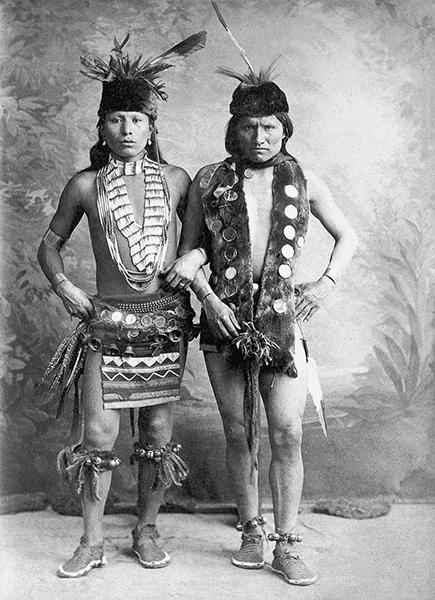
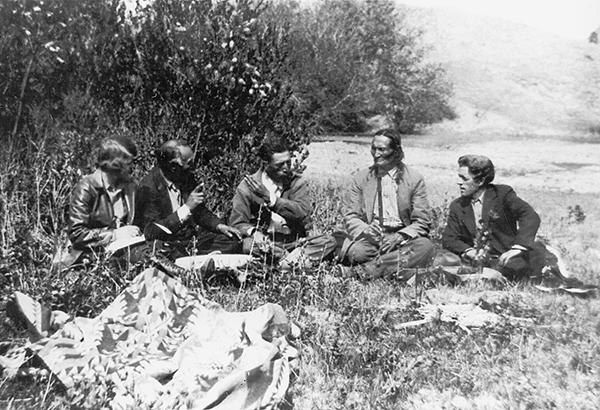
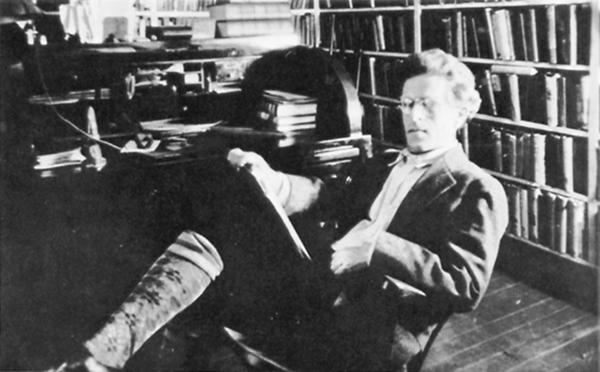
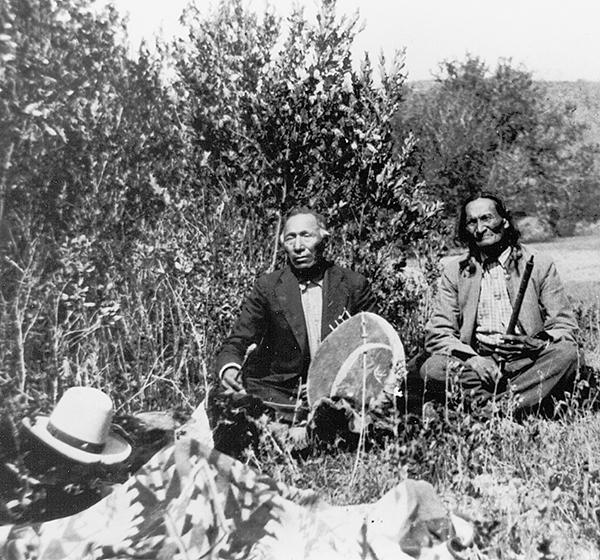
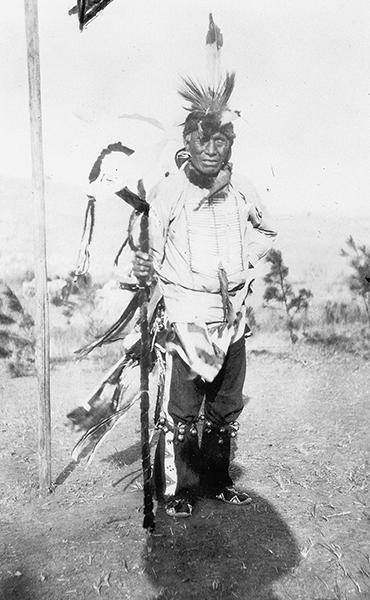
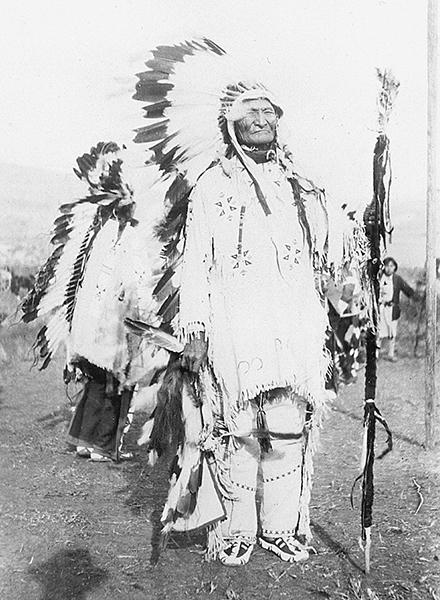
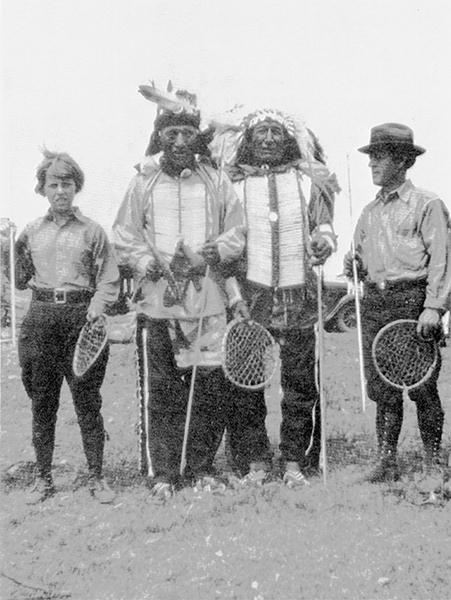
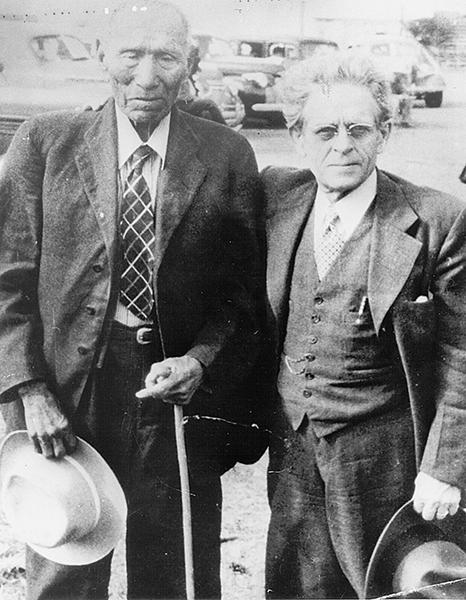
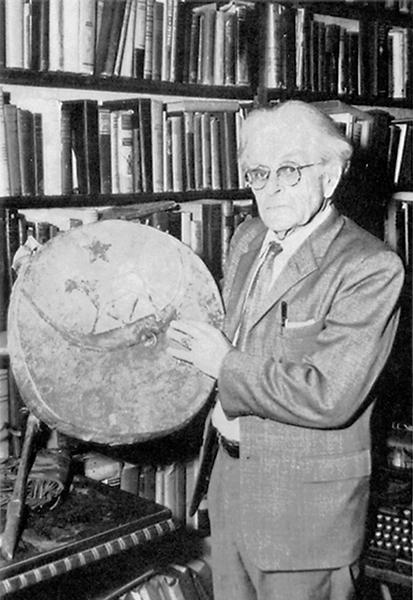
Appendix 2: Neihardt Letter to Julius House, August 1930
When trying to understand an event as important as the creation of the book Black Elk Speaks, any additional resource can be helpful. Correspondence such as the letter below is an example of such a resource. This particular letter, from Neihardt to his close friend Julius House, gives us a glimpse into what was going on in Neihardt’s mind—how exactly he was responding to the initial meeting with Black Elk that had just taken place.
It is important to remember that when looking at this letter—even though it was later published as “‘Messiah’ Is on the Way” in Present-Day American Literature (December 1930)—it was initially written as a personal letter to a friend. Neihardt’s other correspondence with House indicates that their relationship was one in which Neihardt felt free to discuss things he might otherwise keep to himself. It was in this relationship that Neihardt sometimes admitted feelings of discouragement or frustration—luxuries he didn’t allow himself in his public writing. So we can be fairly confident that this letter is an accurate indication of Neihardt’s early response.
It is also interesting to note that although Neihardt had spent only a few hours with Black Elk (the hours and days of interviews and companionship would not take place for another nine months), we see a dawning awareness on the part of both men of sympathetic understanding and a merging of consciousness.
Branson, Missouri, August 10, 1930
It has been a long time since I wrote you, but you can bet safely that it has not ever been long between deep thoughts of you.
The Dakota Excursion went off as per schedule and it was most successful in every way. Sig and I batted around the Black Hills, explored in the Bad Lands (which was like wandering in the moon) and I had a straight five hours of intimate talk of an extraordinary character with old Black Elk, hereditary medicine man of the Sioux. Black Elk had just turned down a bustling lady who had come to get a pot or two of local color for some writing that she had in mind. Black Elk had just told her that he could see that she was a very nice looking and good young lady, but that he did not feel inclined to talk about the things which she had in mind. This might seem very curious if one did not know Black Elk. He struck me as being a bit uncanny in his intuitions; not that he favored me, but that he seemed to know what was inside the visitor. He told me—the sphinx-like chap—that, as he sat there, he felt in my heart a very strong will to know the things of the other world and that a spirit, which stood behind me, had forced me to come to him that I might learn a little from him. In spite of the sound of this statement, he was very modest, modest as a man may be who is sure of what he knows and that what he knows is worth knowing. I had no difficulty whatever with him. He seemed to be expecting me and welcomed me as though he had seen me often. He began by saying that he must tell me his whole story in so far as it could be done in the time we had, but that it would take a long, long time to tell it all. First, he said that he could not speak to me without giving me some reason to know that he had authority to speak. “I am just a common man,” he said, “but I have a gift of vision, which has been hereditary in my family and I must tell you of my people before I tell you of my life so that you may trust me.” He then proceeded to give me something of his lineage much as an old Homeric hero used to do. He also stated that he was the nephew of Crazy Horse and it gave me satisfaction to tell him that I, myself, knew something of Crazy Horse and that I regarded him much as the average white man regards George Washington only that I thought my feeling was the deeper. It was wonderful to hear the old man tell of his early visions when he was becoming a medicine man. His purpose, of course, was to arrive at the time of the Messiah and its tragedy. It was gratifying to me to know that nothing of my deeper feeling of this whole affair varied in the least from what he told me. Very often it seemed as though I, myself, were telling the things he told me, but I got something from him that I cannot describe and you will know what it is. Also, it will appear in the messiah for those who can see. Old Black Elk incidentally stated, in answer to a question, that, yes, he had fought against Custer when he was only fourteen years old, and he added with a chuckle, “I got one scalp.” I have a feeling that I ought to go up there and live six months with Black Elk and his wise old friends. I ought to write the complete life of Black Elk, for it would be a revelation of the Indian consciousness from the depths. I may do this, though how I do not know. Before I left, Black Elk presented to me a beautiful old sacred ornament that he had used a long while in the sun dances in which he has officiated as priest. This ornament consists of a painted rawhide morning star to which are attached by thongs an eagle feather and a strip of buffalo hair. He told me the meaning of this. He said that the morning star signified the desire for and the certainty of more light to those who desire, that the eagle feather signified high thinking and feeling, as the eagle flies high, and that the buffalo hair signified plenty of that which is needed by men in this world. And as he gave me the sacred ornament, he said that he wished me all these things.
Black Elk speaks no English. Flying Hawk interpreted, and he did a fine job—knows English well.
Appendix 3: Drawings by Standing Bear
1. Title Page of the First Edition
2. An Indian Way of Writing a Name: Black Elk’s Name Sign and Standing Bear’s Name Sign
3. The Battle of the Hundred Slain
4. The Two Spirits Coming for Black Elk
5. Black Elk Leaving to Visit the Six Grandfathers
6. Black Elk before the Six Grandfathers in the Flaming Rainbow Tepee
7. Killing the Drought
8. Black Elk under the Tree of Life
9. Black Elk at the Center of the Earth
10. A Bison Hunt
11. Custer’s Battle: Reno’s Retreat
12. Custer’s Battle: Custer’s Defeat
13. Custer’s Battle: Siege of Reno’s Troops
14. Black Elk Living in Fear of the Thunder Beings
15. In the Horse Dance: The Four Maidens
16. Horse Dance (Chief): West
17. Horse Dance—Chief: North
18. Horse Dance (Chief): East
19. Horse Dance (Chief): South
20. The Dog Vision: Butterflies and Dragonflies
21. The Dog Vision: Killing the Dog
22. Black Elk’s Spirit Journey Home
23. The People in Despair
24. Going to the Other World
25. Black Elk in the Other World
26. The Wanekia under the Holy Tree
27. The Battle of Wounded Knee: Disarming Big Foot’s People
28. The Battle of Wounded Knee: The First Shots
29. Wounded Knee Battle: The Massacre
30. Black Elk Protected by the Sacred Bow
The Standing Bear drawings available today are courtesy of the Western Historical Manuscript Collection—Columbia, John G. Neihardt Papers, ca. 1858–1974.
1. Title Page of the First Edition
This collage of Standing Bear’s drawings includes twenty small tepees bordering the central rectangle. Top left: Two crossed long-stemmed pipes with T-shaped catlinite bowls. Top middle: Man and woman outside a tepee that is painted with a rainbow above the doorway, a horse on the left side, facing the doorway, and a buffalo on the right side, also facing the doorway. A drying rack covered with meat is to the left of the tepee. Top right: A man in winter dress, wearing a furred robe, leggings, and moccasins, with a quiver of arrows slung over his right shoulder and bow held in his right hand like a cane, drags a dead antelope, evidently over the snow. Upper middle right: A shield, painted blue, depicts a golden eagle; above the eagle are five stars and below are three rainbow designs; eagle tail feathers are attached to the sides and bottom. Center middle right: A man, wearing only a breechcloth and a spotted eagle feather in his hair, offers a pipe, the stem pointing upward. Lower middle right: A sacred bow lance, decorated at the top and bottom with two spotted eagle feathers, is crossed with an arrow. Bottom right: A bear, standing on its hind legs; this may serve as Standing Bear’s signature. Bottom: A man on horseback, with a furred robe tied around his waist and two feathers in his hair, holds a bow as he gallops after two buffalo and a calf. Bottom left: A ceremonial wand from the hųká (adoption) ceremony. Three woodpecker heads are attached to the wand, together with pendants of red horsehair, a fan of eagle tail feathers, and, at the tip, a pendant of downy plumes. Middle left: A man wearing the regalia of a men’s society. His body is painted red and he holds an undecorated lance, suggesting that he may be an officer in the Sotká yuhá ‘bare lance owners’ society. He wears a headdress that appears to be of cut raven feathers, tipped with red plumes or horsehair, surrounding five eagle tail feathers, also tipped with red. Around his left shoulder and across his body he wears a society sash decorated with eagle tail feathers. In battle he will not flee from the enemy but will stake the sash to the ground and not retreat unless he is victorious or is released by one of his fellow society members. Top left: A curved coup stick, wrapped with fur and decorated with four clusters of eagle tail feathers.
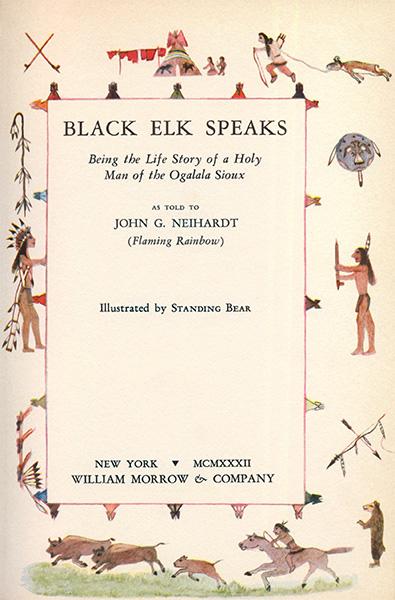
2. An Indian Way of Writing a Name
2a. Black Elk’s Name Sign. The name is depicted by a drawing of an elk head, colored black, connected by a line to the mouth of a human head drawn below.
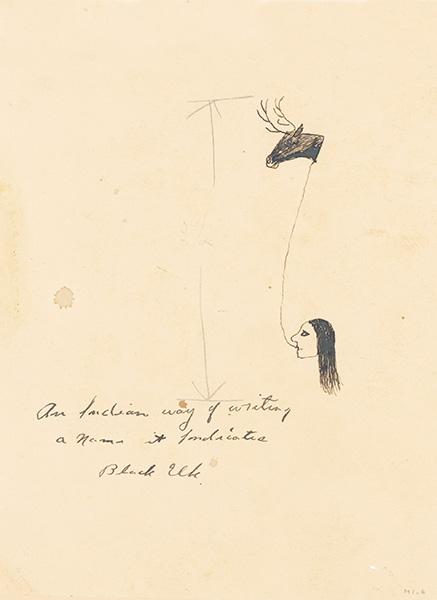

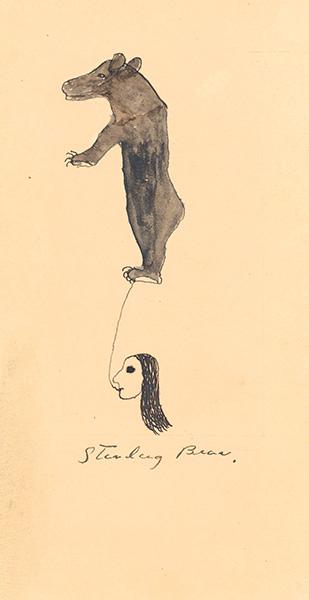
3. The Battle of the Hundred Slain.
The bodies of eight soldiers of Lt. Fetterman’s command lay intermingled with four Indian dead, three of whom wear war bonnets and one an eagle tail feather in his hair. The four dotted lines at top and bottom show the routes to the top of the ridge where the fight occurred. At the bottom appears what seems to be a cloud of smoke from the Indians’ guns, and surrounding the dead, arrows and puffs of smoke show how the Indians surrounded the soldiers. The three warriors shown on either side are so distinctly drawn that they must depict specific individuals. All but one wear only a breechcloth. The man at the top left seems to have tied all of his hair in a knot on top of his head, with a feather suspended from the back; he holds a drawn bow and arrow. Below him, the man in the middle wears a war bonnet and shirt and holds a feathered lance. The bottom figure wears a buffalo horn headdress with a short trailer of eagle tail feathers; his arms and legs are painted with lightning designs; he holds a sword and carries a shield that is painted with a buffalo head, lightning, and a crescent moon. The warrior at the top right has his hair tied in a knot, through which is inserted what appears to be a carved wooden pin or knife, and he wears an eagle tail feather in his hair at the back; he holds a drawn bow and arrow and a shield with a simple circular design and three triangular pendants. Below him is a man riding a horse painted with lightning designs and with the tail tied up for war; he holds a drawn bow and wears a bird skin attached to the hair at the top of his head. The bottom right figure also wears a bird skin on his head and carries a drawn bow and arrow; his legs are painted with lightning.
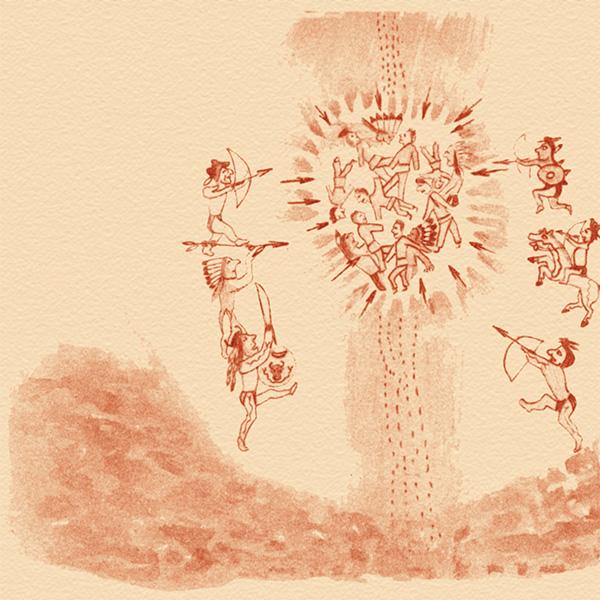
4. The Two Spirits Coming for Black Elk.
Black Elk, dressed only in a breechcloth and holding a bow and arrow, stands outside his family’s tepee. With outstretched arms, he looks upward at two men who are descending from storm clouds from which lightning flashes. They are dressed in breechcloths, with single eagle tail feathers in their hair and what appears to be paint along the part; their bodies are painted red, with dark bands around the knee and ankle joints, a common pattern for Lakota rituals. The wings on their shoulders indicate that they are human transformations of geese, birds symbolically associated with the North. Here they are serving as akíchita (messengers or enforcers) of the Six Grandfathers. They carry lances decorated with clusters of eagle tail feathers at the top and bottom; flames, symbolizing power, flash from the tips; the lances represent lightning.
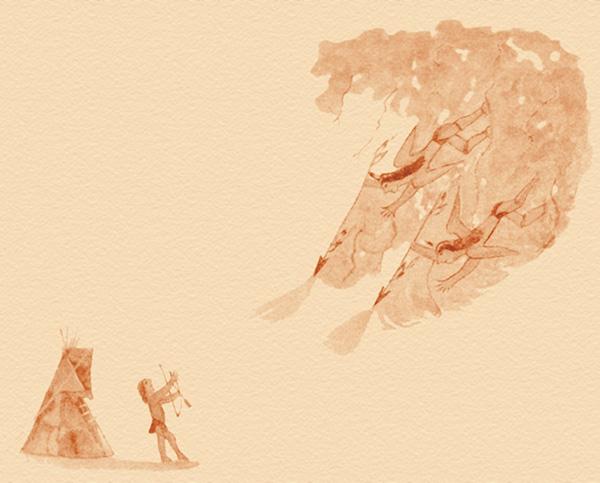
5. Black Elk Leaving to Visit the Six Grandfathers.
Black Elk is shown leaving his family tepee below and following the messengers of the Six Grandfathers as they return to the sky, walking on clouds. His arms are outstretched as the messengers lead him on. He is dressed in a buckskin shirt, leggings, and moccasins. His father and mother, wrapped in furred buffalo robes, look up and appear to be watching him as he departs. The messengers are now depicted wearing headbands, and their lances are decorated with blue pendants at each cluster of eagle feathers.
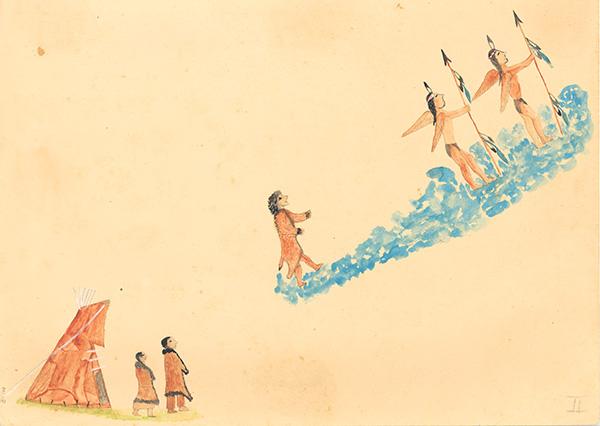
6. Black Elk before the Six Grandfathers in the Flaming Rainbow Tepee.
Here the two messengers stand on either side of the rainbow that forms the doorway to the tepee of the Six Grandfathers. In this drawing it is clear that their bodies are painted with wasé, red clay (a brownish red), and dark lines encircle the joints of their arms and legs. Flames in five colors flare up from the rainbow door, above which blue storm clouds streaked with red lightning suggest the shape of a tepee. In the sky to the left (south) a spotted eagle (an immature golden eagle) soars; to the right (north) is a smaller bird colored blue, perhaps a kingbird or a hawk. The green spots and splotches under the arc of the rainbow may represent rain. Above the clouds, on either side, are three plants depicted in light green; they may represent the sacred herbs given to Black Elk. Now dressed as a warrior in a breechcloth and holding a bow in his left hand and an arrow in his right, Black Elk stands facing the Six Grandfathers, each of whom holds out a cup of water, symbolizing the gift he presents to Black Elk. The Sixth Grandfather, representing the Earth, wears an eagle tail feather in his hair; Black Elk recognizes that it is himself in old age.
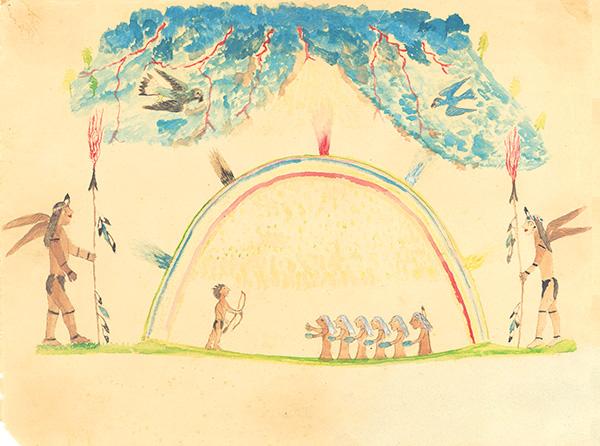
7. Killing the Drought.
Black Elk, dressed as a warrior and astride the bay horse, charges on the blue man, the spirit of Drought inhabiting the forks of the Missouri River. An eagle flies above Black Elk as, with his lance (representing lightning), he slays the blue man, who transforms into a turtle, here shown on its back. Close behind Black Elk, One Side rides a buckskin horse with a brown face and dark mane and tail, and a blue bird, apparently a swallow, flies above him. Flames shoot out from their horses’ manes, tails, and hooves. Six riders in each of the four directions witness the deed; their horses are depicted with curved horns (representing power) and they carry lances from which lightning flashes. On the west are black horses painted with blue lightning; two of the riders wear eagle feathers, three riders appear transformed into swallows, and one rider is not depicted. On the north are blue horses painted with red lightning; all six of their riders wear horns. On the east the horses are sorrels, painted with black lightning; two of the riders wear eagle tail feathers, two are shown as swallows, and two are not depicted. On the south the horses are white, painted with blue lightning; two riders wear eagle tail feathers, three appear as swallows, and one is not depicted. Note that Standing Bear has drawn the picture to represent the four quarters oriented according to the Lakota conception of the directions, that is, the semicardinal directions: northwest, northeast, southeast, southwest.
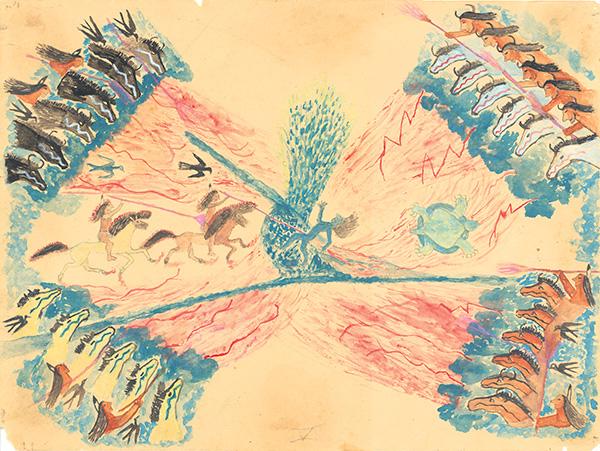
8. Black Elk under the Tree of Life.
Black Elk, dressed as a warrior, wearing a breechcloth and a single eagle tail feather in his hair, stands at the crossing of the two roads, the center of the hoop of the world, indicated by a blue circle. There, he raises his right arm toward the sacred tree, which is blooming with green leaves. The quarters are colored symbolically: northwest, blue; northeast, white; southeast, red; southwest, yellow. From the West, a man with a single eagle tail feather in his hair, representing the western grandfather, presents Black Elk with a bow and arrow and a cup of water; from the North he is given the cleansing wind and a healing herb; from the East, a sacred pipe, with a single eagle tail feather attached to the stem, and the morning star depicted as blue; from the South, the flowering stick and the hoop of the nation, depicted in bright blue. Also from the South come a father and mother with a boy child, each with their right arm outstretched toward the sacred tree, representing the continuity of generations.
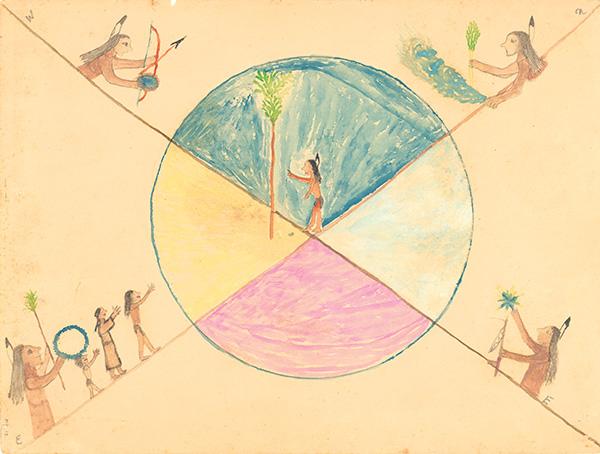
9. Black Elk at the Center of the Earth.
Black Elk on Harney Peak, in the Black Hills, the center of the world, where the sacred tree blooms and three birds (apparently swallows) circle above it. Encircling the Black Hills is a red path, bordered by pine trees, that represents the Race Track, a geological formation that surrounds the hills. There, long, ago, the two-leggeds and four-leggeds ran a race; because the two leggeds won, humans thereafter had the right to kill and eat buffalo and other animals. Black Elk is dressed as a warrior. He wears a headband and a single eagle tail feather; at the back of his head is a spotted eagle with its wings outstretched. He carries a lance decorated with eagle tail feathers, like those of the two messengers who led him into the sky. He rides the bay horse, whose mane and tail crackle with power, depicted as flames. Black Elk faces south, where a long-stemmed catlinite pipe rests at the mountain’s edge; it stands upright, with the bowl on the ground and the stem pointing upward. The lower half of the stem appears to be fletched like an arrow. From the stem, smoke rises in a blue line as though the pipe were being smoked by an unseen force, perhaps suggested by a fan of flames to the right of the smoke. Riders in the four directions, each emerging from a blue storm cloud flashing with red lightning, offer him gifts. The riders from the West and North have single eagle tail feathers in their hair, while those from the East and South have curved horns, perhaps pairs of eagle pinion feathers. All the horses have similar horns and their manes, too, are depicted as flaming. The horse of the western rider is black, painted with a streak of white lightning; that of the northern rider is blue, with red lightning; that of the East is red, with black lightning; and that of the South is white, with blue lightning. The rider from the West presents a bow and arrow; from the North, the cleansing wind (depicted as a torch); from the East, the morning star (colored red and flashing out red lines representing power); from the South, the flowering stick.
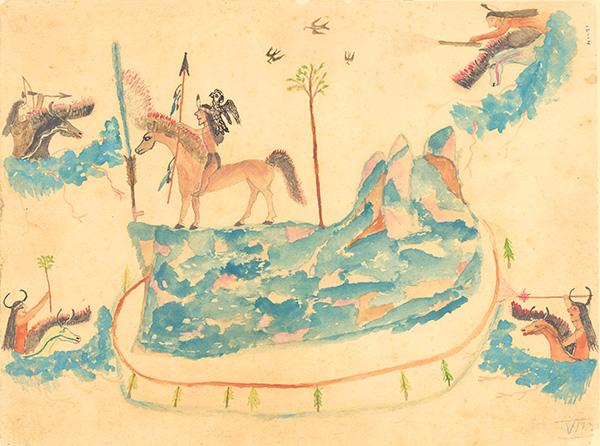
10. A Bison Hunt.
A mounted hunter wears leggings and moccasins and has a furred buffalo robe folded around his waist. In his hair he wears a feather partially stripped of its webbing and around his head is what appears to be a strip of red cloth. Holding a bow in his left hand, he draws an arrow with his right hand; a quiver full of arrows is at his left side. He chases two buffalo while a third lies to the side, dying. The hunt takes place in the winter, with snow depicted using bluish-gray paint.
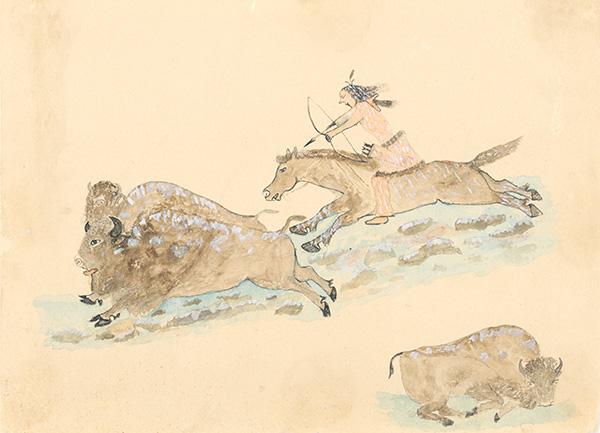
11. Custer’s Battle: Reno’s Retreat.
This drawing represents Reno’s troops fleeing from the south end of the great village on the Little Big Horn River. Five troopers, led by a Crow Indian scout (represented with long hair and wearing a fringed jacket and a hat) are fleeing on foot. In their haste, the soldiers have lost their hats. Their cartridge belts and boots are carefully depicted and they all fire their pistols wildly as they run; the pistol of the trooper second from right misfires, and the Indian scout fires a rifle as well as a pistol. Two mounted warriors are depicted; they wear only breechcloths and moccasins, and their horses’ tails are tied up for war. The man at top right has an eagle tail feather in his hair and carries a bow as though it were a club. The man at bottom right has his hair tied in a knot on top of his head and carries a distinctive lance, with a large point and an eagle tail feather attached to the end; he may be an officer in one of the men’s societies. The two men are racing to count coup on the soldiers. The arrows on all sides represent the large body of warriors who are engaged in the fight. To the left, represented by the elliptical line, is the hill across the Little Big Horn River on which Reno’s troops sought refuge; ten soldiers are depicted there, lying dead. The dotted lines at the right end of the ellipse represent the soldiers’ path up the hill.
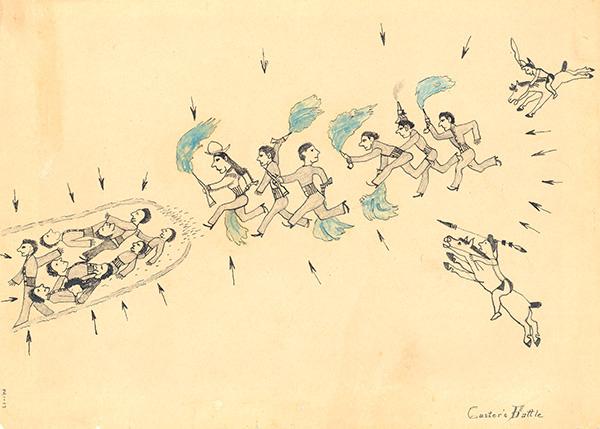
12. Custer’s Battle: Custer’s Defeat.
This drawing depicts Custer’s command on Last Stand Hill across the Little Big Horn from the northern end of the village. The jumble of bodies of fifteen men and eight horses, lying on the ground with three fallen guidons, is surrounded by arrows and clouds of gunsmoke representing the Indian forces. The soldiers’ boots and cartridge belts are carefully depicted, as are the horses’ saddles and bridles. No hats are among the bodies, perhaps a convention used by Standing Bear to emphasize that the soldiers are dead.
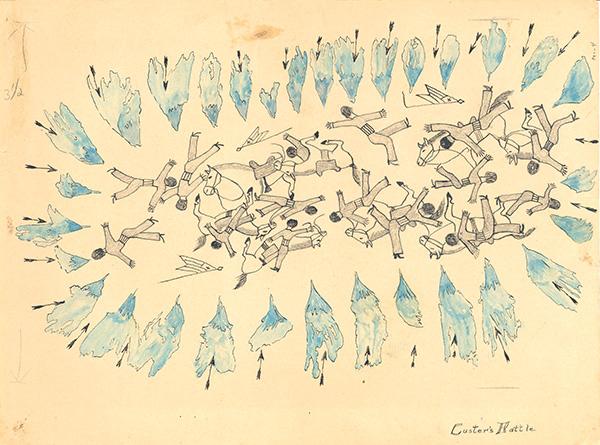
13. Custer’s Battle: Siege of Reno’s Troops.
The Indians laid siege on Reno and Benteen’s troops, who dug themselves in on the ridgetop across the Little Big Horn River. The cavalry is symbolized by a line of soldiers visible from the waist up behind their fortification, shown by the diagonal line in front of them. Five troopers are depicted wearing hats; the sixth figure at bottom right is a Crow Indian scout, symbolized by the pompadour hair style. The hoof prints behind the soldiers indicate that they have their horses with them. The Indian forces are symbolized by the four figures on the left. The boy at the top is probably Standing Bear himself, shown astride his pony with a drawn bow and arrow; he is dressed only in a breechcloth. Below him are two warriors, both also wearing only breechcloths, with quivers of arrows slung over the left shoulder and holding drawn bows; one wears a war bonnet with a beaded band, the other seems to have his hair pulled up and tied at the top of his head. These two figures are drawn so distinctively that Standing Bear apparently intended them to represent specific individuals. At bottom left, Crazy Horse is depicted. He wears a breechcloth and distinctive calfskin shawl; his face and body are streaked with red paint; he wears a spotted eagle feather downward at the back of his head; in his mouth is an eagle bone war whistle, and he holds a drawn bow. The horse, too, is streaked with red paint, and suspended from the reins are what appear to be two eagle plumes. The line of arrows in the center symbolizes the Indians’ continual firing on the soldiers.
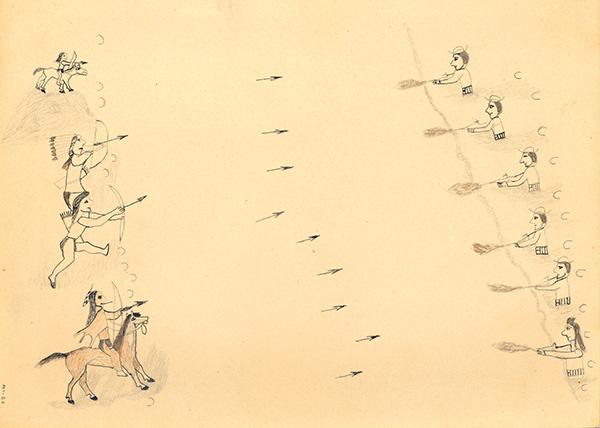
14. Black Elk Living in Fear of the Thunder Beings.
Black Elk is shown here as an adolescent, dressed in a buckskin shirt, leggings, and moccasins. His arms are outstretched as he faces a semicircle of twelve tepees, each depicted distinctively, representing the hoop of the nation. Interspersed with the tepees are various kinds of plants, perhaps the sacred herbs of Black Elk’s great vision. Behind him are the Thunder Beings of his vision. At the top is the bay horse, with the spotted eagle flying over head; then come two blue horses (North), two blacks (West), two buckskins (East), and two sorrels (South). Birds—swallows and perhaps hawks—fly above the horses, all of which are depicted with horns and flaming manes, and lightning coming from the mouth of one horse in each direction flashes through the blue storm clouds (yellow lightning from the north, red from the west, green from the east, and black from the south). Previously published with the caption “Black Elk teaching his people the use of the Ghost Shirt,” this drawing seems to represent the time of adolescence when Black Elk described himself as living in fear of the Thunder Beings.
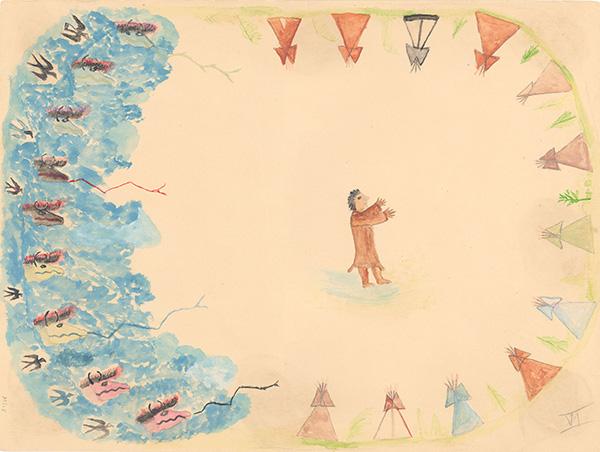
15. In the Horse Dance: The Four Maidens.
The four maidens wear red dresses, leggings, and beaded moccasins; on their heads they wear wreathes of sage, with what appear to be puffs of eagle down and a single eagle tail feather. The maiden on the left represents the East; on her forehead a morning star is painted and she carries a T-shaped catlinite pipe with a long stem decorated with an outstretched bird, representing the eagle of Black Elk’s vision. Next is the maiden representing the North; painted on her forehead is a curved line, perhaps a rainbow, and on her chin a crescent, perhaps the moon; she holds a bowl that likely contains water and the healing herb from the North. The third maiden represents the West; she has a crescent painted on her forehead and holds a hoop representing the hoop of the nation. The fourth maiden represents the South; she has a curved line painted on her forehead and a crescent on her chin; she carries a staff, representing the flowering stick of Black Elk’s vision.
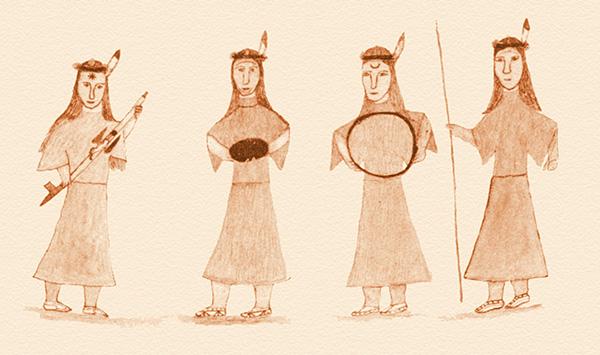
16. Horse Dance (Chief): West.
In his great vision, Black Elk saw a chief in each of the four quarters of the universe (Sixth Grandfather, 118). The Standing Bear drawings depict the chief riders of the four directions as personified in the Horse Dance, Black Elk’s reenactment of his great vision. The western rider is painted black with white hail spots on his torso and white lightning across his chest and arms and down his legs. Not visible in the drawing is a depiction of the morning star painted at the base of the rider’s spine (Sixth Grandfather, 216). He wears only a breechcloth and a black hooded mask with round cutout eye holes that covers his entire head; it has horns (perhaps eagle pinion feathers). In his left hand he holds a small bow and arrow, the gift to Black Elk from the grandfather of the West. With both hands he holds above his head a slender branch bent into an arc; its significance is not recorded. The horse, too, is black and is painted with white hail spots and lightning on the front and back quarters, and wears horns similar to those of the rider. On the horse’s back, just above the tail, a bird is painted, apparently a swallow. Below the horse’s jaws a swallow appears to soar.
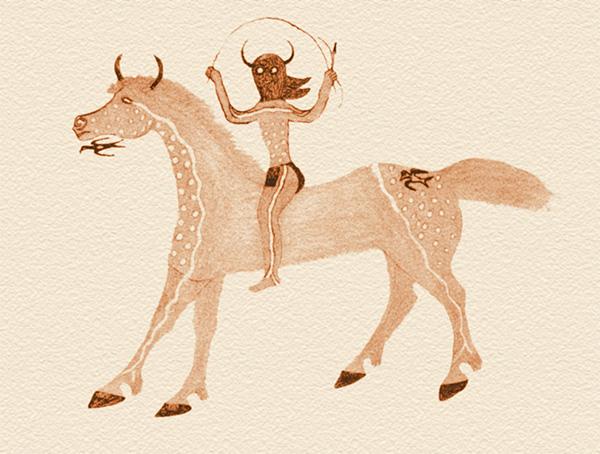
17. Horse Dance (Chief): North.
The northern rider is painted white with red hail spots on his torso and legs and red lightning across his chest and arms and down his legs. He wears only a breechcloth. With both hands he holds above his head a slender branch bent into an arc. He wears a headband; in his hair he has a single spotted eagle feather; a short trailer of eagle feathers (Black Elk refers to them as white plumes) is attached to the back of his head, symbolic of geese (Sixth Grandfather, 216). He rides a white horse whose front and hindquarters are painted similar to his rider, with red lightning and hail spots; the horse wears horns, probably eagle pinion feathers.
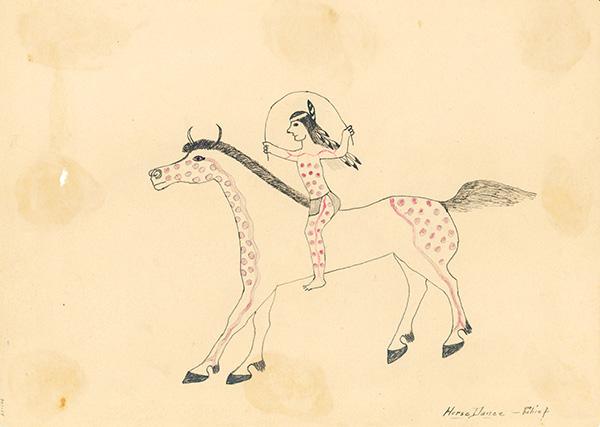
Drawing 17.
18. Horse Dance (Chief): East.
This eastern rider is dressed only in a breechcloth; he is painted red, with black lightning on his arms and legs. He wears a headband; in his hair he has a single spotted eagle feather, and a short trailer of eagle feathers is attached to the back of his head. He carries what appears to be a rawhide cutout of the morning star, painted blue. He rides a sorrel horse, painted with black lightning on the front and hindquarters.
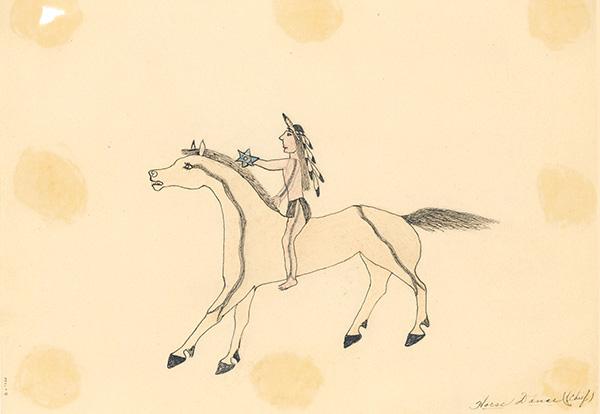
19. Horse Dance (Chief): South.
This southern rider also wears only a breechcloth and is painted yellow, with lightning (depicted here as blue, although Black Elk said it was black; Sixth Grandfather, 216) across his chest and arms and on his legs. He wears a black, hooded mask with horns that is identical to that worn by the western rider except that in addition to oval eye holes there is also a cutout at the mouth. In his right hand he carries a hoop representing the nation and in his left a stick representing the flowering tree (although either Standing Bear did not complete drawing the stick or it has faded). He rides a buckskin horse painted with blue (black?) lightning on the front and hindquarters and wearing horns of eagle pinion feathers.
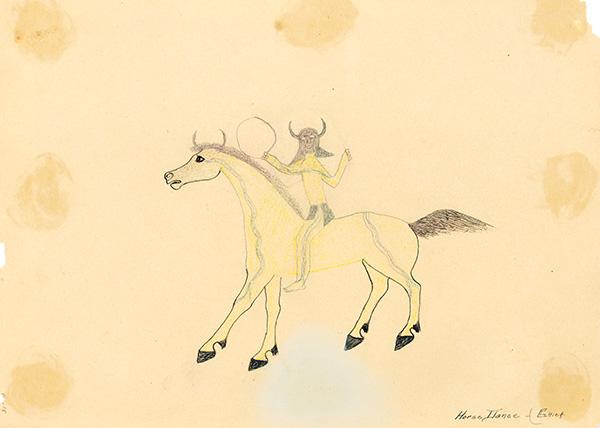
20. The Dog Vision: Butterflies and Dragonflies.
Black Elk is depicted on a high butte wearing only a furred buffalo robe, with his hair unbraided and face unpainted. In his right hand he holds the T-shaped bowl of a decorated, long-stemmed pipe. He stands in the middle of a sacred place marked at the four corners by chokecherry saplings, to the tops of which are tied short sticks with attached bundles of ch ąšáša (red willow bark) or tobacco wrapped in cloth. In his vision he is surrounded by a cloud of butterflies and dragonflies that come from the south; they represent the Lakota people. Sacred herbs grow at the base of the butte.
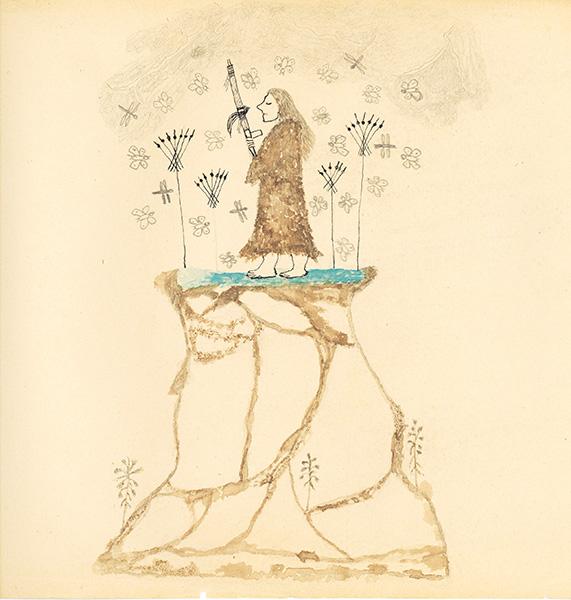
21. The Dog Vision: Killing the Dog.
Two warriors on horseback charge on the dog in the midst of flames. They are the messengers who took Black Elk to visit the Six Grandfathers in his boyhood vision. The men wear only breechcloths and their bodies are painted, probably red, with dark bands around the joints of their arms and legs. Both wear headbands, with a single eagle tail feather in the hair on top of the head and trailers of eagle feathers behind. Both carry bow lances decorated below the tip and at the bottom with eagle tail feathers. The dog’s mouth is open, apparently barking and baring his teeth as the warrior in the lead is about to strike it. Overhead a storm cloud is filled with lightning and an eagle and a flock of swallows soar about, watching the event.
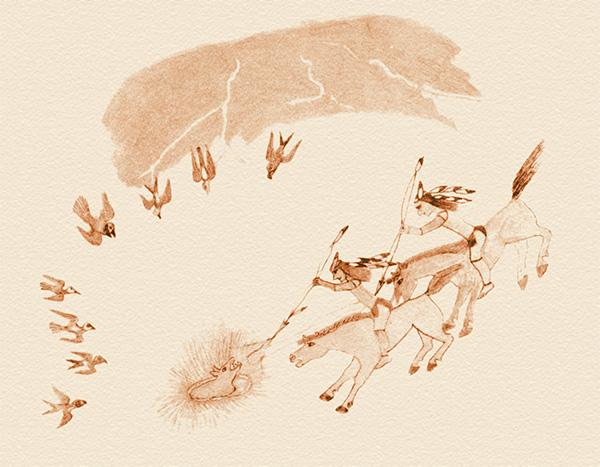
22. Black Elk’s Spirit Journey Home.
In the vision that he had while living in Europe, Black Elk, with his arms outstretched, kneels on a cloud that hovers above the tepees of the Oglala camp at Pine Ridge. Dressed in white men’s clothing, his long hair unbraided, he is seen only by his mother, who later tells him that she dreamed he had returned on a cloud.
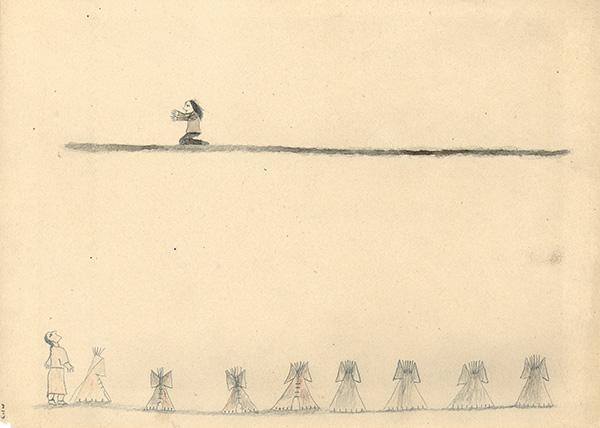
23. The People in Despair.
This drawings depicts the situation at Pine Ridge when Black Elk returned from his European trip and found his people in despair. The hoop of the nation is suggested by the tepees drawn around the periphery and the red circle on the ground surrounding the sacred tree. Black Elk, wearing a breechcloth and moccasins, stands with his right arm raised toward the tree, which is withered and apparently dead. On either side of the drawing, men wearing breechcloths and women wearing cloth dresses are depicted as in sorrow, with their heads bowed.
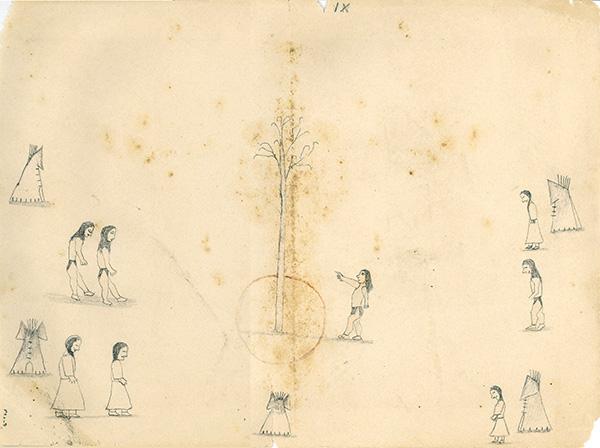
24. Going to the Other World.
The sacred tree stands in the middle of the Ghost Dance ground and appears to be bursting into bloom. Six individuals, four men and two women or girls, holding one another’s hands, represent the circle of dancers surrounding the tree. They have single feathers or plumes in their hair and wear the sacred Ghost Dance shirts and dresses, which are made of cloth and decorated with paint and eagle tail feathers. They dance facing the tree. A long-stemmed pipe with a T-shaped catlinite bowl is propped up against the tree. Black Elk is shown in a trance, lying on his back near the tree. To the right he is depicted again, with arms outstretched, soaring upward as a spotted eagle leads him to the other world, the land of ghosts.
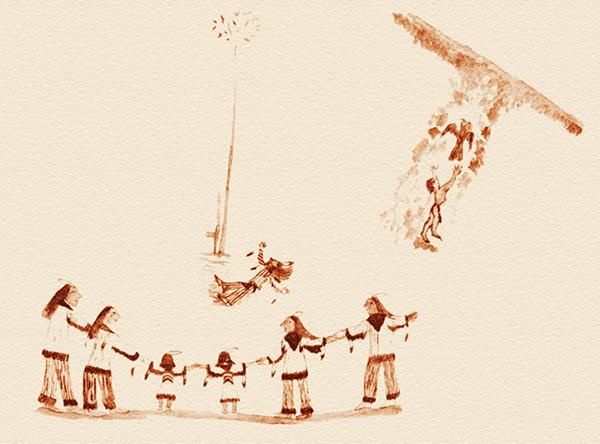
25. Black Elk in the Other World.
In his Ghost Dance vision Black Elk visited the other world, where he was welcomed by twelve men, depicted here. Four of the men are chiefs, who are seated in a row and wear fringed shirts, with single eagle tail feathers in their hair; each holds a long-stemmed catlinite pipe upright before him. The tree is in bloom, under a bright sun, with birds flying about it—the spotted eagle that was Black Elk’s guide and four smaller birds, perhaps swallows. Black Elk also has a single eagle tail feather in his hair and wears his Ghost Dance shirt, decorated with eagle tail feathers. He stands at the base of the tree, with arms uplifted, and sees the Wanekia (Wovoka, the Ghost Dance Messiah), who is standing on a cloud. He wears an eagle tail feather in his hair and he is painted red, though only his face and hands are visible since he wears what appears to be a Ghost Dance shirt. The Wanekia raises his right arm, as in blessing, and the eight men around the tree—three on the left and five on the right (those who are not chiefs)—raise their right arm as well, returning the gesture.
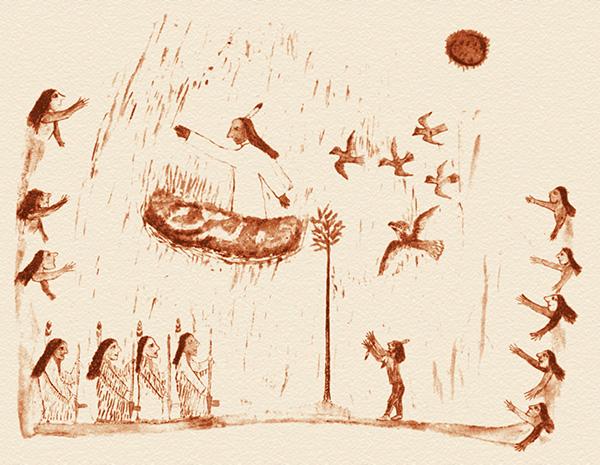
26. The Wanekia under the Holy Tree.
This drawing depicts a circular village in the other world, represented by eleven tepees, with the blooming tree in the center. The Wanekia is now on the ground, standing against the tree with his arms outstretched. Around the lower half of his body he wears a buffalo robe with the head attached; the robe seems to be a living buffalo. (In Black Elk’s childhood vision the eastern grandfather showed him a man painted red who transformed into a buffalo. Since Black Elk also saw the Wanekia painted red, Standing Bear may have considered them to be the same, and thus his drawing may depict the transformation from man to buffalo.) On the left, the four chiefs of the previous drawing offer their pipes to him. The chief nearest the Wanekia holds two sticks, one white and one red, a gift to Black Elk from the Messiah. On the right, Black Elk falls to his knees and raises his arms to the Wanekia; he is wearing his Ghost Dance shirt, decorated with eagle tail feathers. He will return to his people with the sacred sticks.
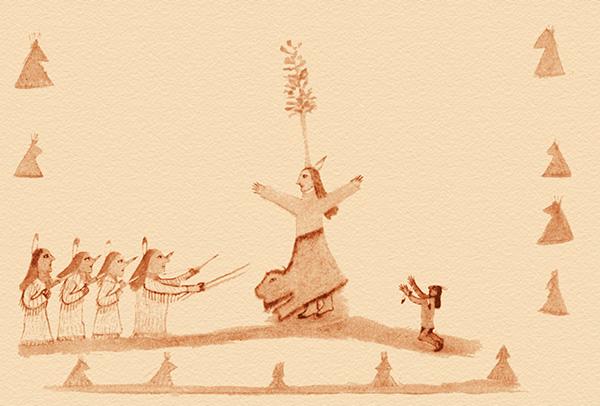
27. The Battle of Wounded Knee: Disarming Big Foot’s People.
This drawing depicts the Seventh Cavalry disarming Big Foot’s people. The men have been separated from the women. Big Foot, holding the pipe that symbolizes his position as chief, sits in front of the men at the left. Along the left side, three men are wrapped in blankets (two black and one red) and wear hats, each with a single eagle tail feather attached. The men stand with their right arm extended and hand open; apparently, they have just surrendered their weapons. Behind them stand three other men, wrapped head to foot in sheets, perhaps hiding their weapons. At bottom left, an officer (identified by the epaulets) points a pistol at a Lakota man who is surrendering his rifle; this man wears a blue blanket and a hat with a red feather. On the right side of the drawing a soldier carries a pile of confiscated weapons (rifles, a hatchet, a knife, and an awl) while three other soldiers, again pointing pistols, disarm three women, each of whom wears a cloth dress and is wrapped in a blanket. At the top, a soldier confiscates an awl; in the middle, an officer takes away an ax; at the bottom, a soldier takes a knife. At the right edge, the three tepees, depicted in red, represent the village.
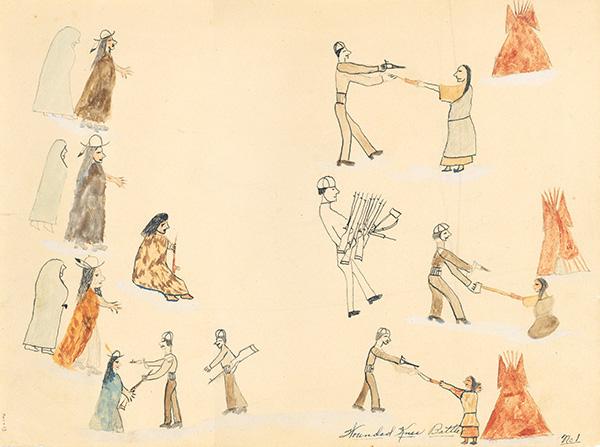
28. The Battle of Wounded Knee: The First Shots.
Big Foot sits holding his chief’s pipe, while a soldier struggles with a Lakota man, trying to wrench the man’s rifle away from him. The man wears a blanket or sheet (under which he had hidden the rifle); his face is painted blue and he wears a single eagle tail feather in his hair. As the rifle discharges into the air, the soldier fires his pistol; these shots precipitate the battle. The line of fifteen soldier’s heads on the right symbolizes the cavalry, whose fire is shown by the blue streaks of gunsmoke. Six Lakota men are shown lying dead, killed by the soldiers’ bullets. In the middle of the line of soldiers is a Hotchkiss gun, an exploding shell from which is depicted as a round blue smudge at the far left; the bodies of a man and a girl are propelled into the air by the explosion. At bottom left, a woman and two girls are attempting to flee into the gulch of Wounded Knee Creek; one of the girls has fallen and the other seems about to fall. The line curving across the bottom of the drawing represents Wounded Knee Creek.
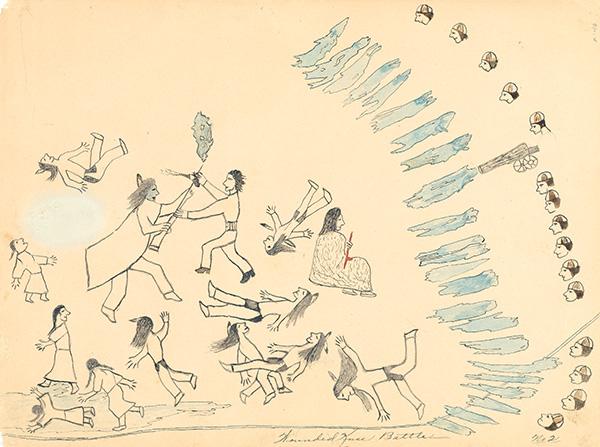
29. Wounded Knee Battle: The Massacre.
The soldiers, again symbolized by six heads, and their Hotchkiss gun, continue to fire on the fleeing women and children in the gulch at Wounded Knee. Thirteen women and children, including one boy and a baby, are shown lying dead.
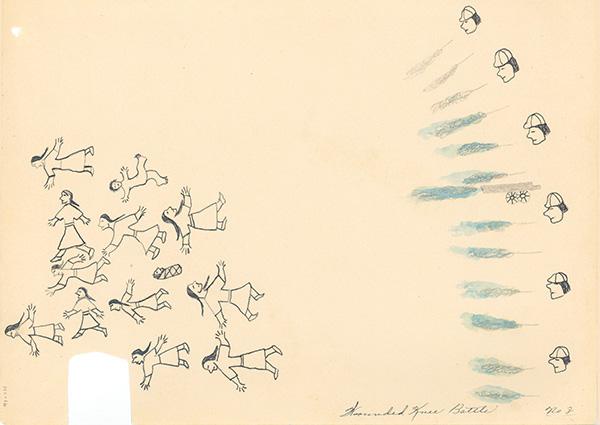
30. Black Elk Protected by the Sacred Bow.
Black Elk is portrayed on horseback, wearing a painted and fringed Ghost Dance shirt, breechcloth, and beaded moccasins; he wears a headband and has a single spotted eagle feather in his hair. In his left hand he holds upright the sacred bow (a bow lance decorated with an eagle tail feather below the tip and at the bottom) that provides protection from a hail of soldiers’ bullets as he covers the retreat of a woman and her children, who are running for their lives. Standing Bear portrays the woman with a blanket wrapped tightly around her and secured with a belt, a baby on her back; her leggings and garters are carefully depicted. The soldiers are portrayed symbolically along the right edge by a row of six heads and twelve puffs of gunsmoke.
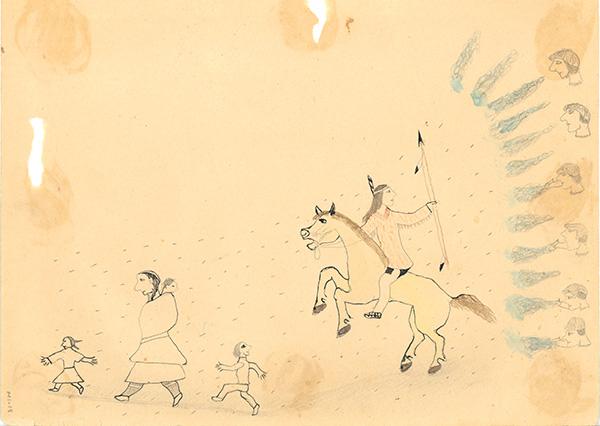
Appendix 4: Neihardt Letter to Nick Black Elk, November 1930
Nick Black Elk
Oglala, South Dakota
Dear Friend,
Your letter of November 3 has just reached me and I am very happy to hear from you! I wondered why I did not hear from you. But I was sure that you would write to me, for I felt when we parted at your home in Manderson that we were friends and that you would not fail me. I see now why you did not write sooner.
I am glad to know that you are willing to make the picture story of the Messiah and of Wounded Knee for me. You say if I will send you $7 for the material, you can go ahead on this work, and I am sending you the money with this letter, so that you can get started. You did not tell me how much you will want for your work. Please do. I think that fawn skin will be even better for the picture than rawhide.[357]
Now I have something to tell you that I hope and believe will interest you as much as it does me. After talking with you four and a half hours and thinking over many things you told me, I feel the whole story of your life ought to be written truthfully by somebody with the right feeling understanding of your people and of their history. My idea is to come back to the reservation next spring, probably in April, and have a number of meetings with you and your old friends among the Oglalas who have shared the great history of your race, during the past half century or more.
I would want you to tell the story of your life beginning at the beginning and going straight through to Wounded Knee. I would have my daughter, who is a shorthand writer, take down everything you would say, and I would want your friends to talk any time about, and share in, the different things that you would tell about. This would make a complete story of your people since your childhood.
So, you see, this book would be not only the story of your life, but the story of the life of your people. The fact that you have been both a warrior and a medicine man would be of great help in writing the book, because both religion and war are of great importance in history. The book that I sent you at Manderson [The Song of the Indian Wars] is a poem dealing only with the wars between the Sioux and white men and does not tell everything that ought to be told. This book about you would be written in prose, and I would use as much of your language in it as possible. My publisher is eager to have me do this, for I have told him all about it.
I would, of course, expect to pay you well for all the time that you would give me. It would probably be necessary for us to have eight or ten meetings. Does this plan seem a good one to you, and if it seems good to you, will you not be willing to help me make it successful? I do feel that so much is known by you Indians that our white people do not know and should know, that I am very eager to write this book if you will help me. Write and tell me how much you think you should be paid for each meeting, and there should be from six to ten meetings. And tell me if you think you could get three or four of the fine old men that you know to meet with us and talk about old times while you are telling your story to me.
This is not a money-making scheme for me. I can make money much faster and easier in other ways. I want to do this book because I want to tell the things that you and your friends know, and I can promise you that it will be an honest and a loving book.
I often look at the beautiful ornaments you gave me, and I am very proud of them. And also when I look at them, I think of what they tell me, and that makes them more beautiful still.
With every kind thought for you and your family.
Your friend,
John G. Neihardt
Courtesy Joint Collection, Western Historical Manuscript Collection, University of Missouri, Columbia, and State Historical Society of Missouri Manuscripts.
Appendix 5: A Great Indian Poet
In 1931 John G. Neihardt was not only a researcher preparing to write the story of the life and vision of the Oglala Lakota Holy Man Black Elk but was also a respected member of the staff of the St. Louis Post-Dispatch. Since 1926 he had been literary editor for the newspaper, providing the bulk of the material for “Of Making Many Books,” a daily column of book reviews and literary essays. Over the years Neihardt had developed a close relationship with his readers, and so it is not surprising that he would want to tell them about this most extraordinary man that he had just met.
Neihardt knew, as he acknowledges in his 1972 preface to Black Elk Speaks, that the general public of the early 1930s had “practically no knowledge of Indians.” The prevailing attitude was that Native culture was uncivilized. In fact, the book had “a very modest reception,” and within two years it was forgotten. However, Neihardt thought highly enough of his readers to try to connect them with the wonder he had felt in his interaction with the holy man. Neihardt was not a writer given to overstatement. He often spoke in his columns against hysterical critics who exhausted their vocabularies of superlatives in attempts to out shout each other with praises of the “greatest this or the mostest that” ever written. Neihardt gave praise when he felt it was due, and when he did find genius, he made it clear to his readers. It is remarkable praise indeed, this acknowledgment to his readers that “he had been sitting at the feet of a poet fit to dine with the finest spirits that have sung in his discordant world and are now among the tallest of the dead.”
The following was originally published as “A Great Indian Poet” on June 20, 1931.
This writer has just returned to the modern world after spending a month in a contemporary antiquity that, in certain cultural respects, may be described as pre-Homeric. In company with his two daughters he has been living with his friends, the Ogalala [sic] Sioux, in lonely country empty of white men where there was little to remind one of our civilization save the usual injustice and the resultant poverty of a conquered people who deserve a better fate.
The writer had only casual contacts with the younger generation, who, having little of their own racial culture and less of ours, seem lost somewhere in a shadowy borderland that lies between the white man and the red and that has been crossed far less often by people by our race than is generally supposed. The writer’s host and intimate associates were the old pahuskas, that is to say, the longhaired old-timers who have retained their “pagan” culture with a passionate devotion; men who were in at the death when Fetterman and his 80 troopers died that blizzard day on Piney Creek now more than 60 years ago; men who, as boys of 12 and 14 and 16, slaughtered Reno’s panic-stricken cavalrymen “like fat cows” in the valley of the Little Big Horn, and helped to rub out Custer in the darkness of the hoof-dust and the smoke upon the hill; men who went through the tragic affair at Wounded Knee when their felling women and children were murdered as they fled and where a great dream died in the bloody snow.
Well, we killed a bull and had a feast, cooking in the ancient way, and there were enough of us so that when the feast was finished little remained but the hide and the horns and hoofs. (To be quite accurate, later on we ate the hoofs.) And the old men and women danced in full dress and wrinkled old-timers made “killtalks,” remembering their youth before they had become prisoners of war, recounting deeds of prowess in quite the true Homeric manner while the rawhide drums boomed at high points in the story and the old women sent forth the tremolo of admiration.
And it happened, so powerful was the spell of it all, that we three danced, too, mere white folks that we were, and we did it in no spirit of derision, but with a happy humility, as was fitting. And that night we danced the rabbit dance under the stars to the booming of the big drum while the young drummers sang and the old and the young, the dark and the white, the men and the boys and the women and the girls, seemed of one age and of one color and of no sex at all. The pure lyric joy of it is very good to remember.
But it wasn’t the dancing or the Gargantuan feasting that mattered most in the end. It wasn’t even the eating of raw liver hot from the bull—an act of communion with the old warriors and hunters far more satisfactory as a symbolism, be it confessed, than as a gustatory experience! The best of it all came out in the long days of constant talk with the old men, and especially with our host, Heraka Sapa [sic] (Black Elk), who is the second cousin of the great chief Crazy Horse. Black Elk is a great “medicine man,” that is to say, a priest and a seer of visions. At the age of 13 he did a man’s share of the bloody work on the Little Big Horn, and he fought at Wounded Knee and at White Clay Creek in the Badlands during the Messiah trouble of 1890. But war, to him, was only an unavoidable necessity. He has lived for spiritual values and his visions, as set forth in careful detail for this writer, rank easily in beauty and profundity of significance with the supreme things in the rich literature of the Aryan peoples. His great vision, which came to him first at the age of 9, during a 12-day period of apparent unconsciousness, is in itself a very great work of art, both as to form and to content. Unfortunately, for us white people, literature, in our sense, never developed among Black Elk’s people. His culture never passed the evolutionary stage of the dance ritual and accordingly the great vision can be adequately expressed only in the dance ceremony, with its accompanying song. One portion of the vision alone—the horse dance, which is poetry of a sublime order—would require some five of six hours to produce. No white man has ever seen it performed, and no white man until now has ever heard it described in its astonishing beauty; but that one white man, who has spent his life in awe of the great ones of our literature, felt that he had been sitting at the feet of a poet fit to dine with the finest spirits that have sung in his discordant world and are now among the tallest of the dead. Black Elk is truly a great poet; and if ever our world shall be privileged to see and understand his masterpiece, the horse dance—as this writer hopes it may—there will be few to question the indubitable truth of this statement.
Appendix 6: John G. Neihardt and Nicholas Black Elk
Raymond J. DeMallie
Black Elk Speaks is arguably the single most widely read book in the vast literature relating to North American Indians. John G. Neihardt’s poetic rendering of the life story of an Oglala Lakota holy man captivates the imagination of readers, drawing them into a meaning-charged world of symbols and otherness. We come away from our experience of Black Elk through Neihardt not with analytical understanding of the old Lakota religious life, but, as Neihardt wrote after his first meeting with Black Elk, with insights into the holy man’s “inner world, imperfectly revealed as by flashes.” That experience, in Neihardt’s words, is for us, as it was for him, “both strange and wonderful” (BES, xvii).
The mystery of the intellectual and emotional bond that these two men recognized between one another, and that led to their creative collaboration, adds a very human dimension to the narrative. As Neihardt explained to Black Elk in a letter about the proposed book about his life, “I would use as much of your language in it as possible” (SG, 29).[358] Indeed, Neihardt was so successful in blending his own voice with Black Elk’s that they became a single voice, a literary device so convincing that Neihardt faded into the background, allowing readers the sensation that Black Elk was speaking to them directly, without an intermediary.
Having grown up hunting buffalo, witnessing Custer’s demise at the Little Big Horn, experiencing visions and living as a medicine man, traveling with Buffalo Bill, and participating in the Ghost Dance and the aftermath of Wounded Knee, Black Elk’s life stretched back across the historical epoch that Neihardt celebrated in his epic poem, A Cycle of the West. Admittedly, when he first met Black Elk, Neihardt’s only intention was to gain a sense of what the Ghost Dance beliefs were like and how the ritual felt in order to infuse his Song of the Messiah with an emotional authenticity. But in that first meeting in August 1930, Black Elk offered much more, a sharing of his vision, of the story of his life, and of his people. And Neihardt jumped at the opportunity.
From the beginning, Neihardt understood that the “very peculiar merging of consciousness” (SG, 40) that he experienced with Black Elk had a mystical basis. Black Elk told him on that first visit, Neihardt wrote, “that a spirit, which stood behind me, had forced me to come to him that I might learn a little from him” (SG, 27). Neihardt believed that his interest in “the things of the other world,” which Black Elk instantly intuited, provided the Lakota holy man with the opportunity to pass on the knowledge of things that were sacred in the old ways of his people. For more than a quarter of a century Black Elk had put aside those old ways and embraced Catholicism and the ways of the white people. He had served as a catechist and a missionary and was a staunch member of the Catholic Indian community. He had given up his traditional ceremonies and healing practices and had not shared with his children any of his old sacred knowledge. Although Black Elk’s commitment to Catholicism would not waver, Neihardt understood that the failure to live up to the mandate of his vision was a heavy burden for the Lakota holy man. But suddenly, with Neihardt’s arrival, and his obvious desire to learn about the “other world,” Black Elk could transfer his burden to another man—a writer, who could preserve the sacred knowledge in a book. So it was arranged for Neihardt to return in the spring and set down in writing that which Black Elk wished to tell him.
When Neihardt returned in May 1931, with financial support from William Morrow, a New York publisher, his project was very clearly defined. As he wrote to Black Elk during the winter, “I would want you to tell the story of your life beginning at the beginning and going straight through to Wounded Knee ... this book would be not only the story of your life, but the story of the life of your people” (SG, 29). For his part, Black Elk was ready. He had enlisted the help of three friends—men older than he—who could tell with firsthand authority about events of which Black Elk could not speak from his own experience. He had obviously carefully thought through what he would tell Neihardt since he related his life story very nearly in chronological order, without the need to go back and fill in gaps.
But before the work could properly begin, it was necessary for Black Elk to formalize his relationship with Neihardt by adopting him as a relative (SG, 31–38). Black Elk accepted Neihardt as a writer, a “word sender,” and clearly respected him for it, but the relationship they were establishing as Black Elk gave to Neihardt the sacred knowledge he had never shared with anyone before required establishing a bond of kinship. So, at the beginning of their work together, in the public context of a feast, Black Elk adopted Neihardt as a son and gave him the name Flaming Rainbow. The name reflected a striking image in his great vision, a rainbow door radiating multicolored flames through which Black Elk had to pass to gain the knowledge and gifts of the Six Grandfathers. Neihardt himself would be the conduit through which that knowledge would subsequently pass to the world at large. Also representing images from his vision, Black Elk named Enid Neihardt She Walks with Her Sacred Stick, while Hilda Neihardt was called Daybreak Star Woman. These were not casual names and the adoption ceremony was not an insignificant spectacle for the edification of non-Indian visitors. Rather, these new identities were central to the collaboration that would ever after link Black Elk to Neihardt, and their families to one another.
Throughout the interviews, as Black Elk spoke, Neihardt’s primary task was to clarify his meaning by questioning Ben Black Elk as he translated his father’s words. Frequent repetition was required to clear up ambiguities; only then did Enid Neihardt transcribe the sentences in her notebook. Her notes were recorded in Gregg shorthand, except for proper names and Lakota words, which were written out in full to prevent confusion. The precision and neatness of her notes reveal that once a sentence was clarified and transcribed there was very little revision. The record reveals only a very few occasions when Neihardt asked substantive questions; the interviews were structured by Black Elk himself.
Neihardt was intimately familiar with the nineteenth-century historical record of conflicts between the whites and the Lakotas, and he had long acquaintance and amicable relationships with individuals among the Omaha, Crow, and Lakota peoples. He was less familiar with the ethnographic record of Plains Indian cultures, nor did he evince interest in cultural description for its own end. He was a storyteller and, as he wrote to Black Elk, “people like stories” (SG, 50). Black Elk Speaks is filled with cultural details but they are carefully selected to advance the story and to provide necessary context. The interview notes abound with additional details that Neihardt omitted in the interest of writing a book that would speak to a broad audience. His interest was universalistic, the identification of commonalities between Lakota culture and that of white America, both as a means of promoting understanding and of using Lakota spiritual and social values to critique modern America.
Central to the success of their collaboration was a shared sense of the significance of the dream or vision. Black Elk told Neihardt in detail about his vision experiences, most importantly, the great vision he had at the age of nine, when he lay unconscious for twelve days. It was that dream that set his life course and placed the burden on him to serve his people as an intercessor with the spirit world. In return, Neihardt told Black Elk about the dream he experienced at the age of eleven, when he lay in a fever. Repeated three times during the night, Neihardt felt himself hurtling through a vast emptiness at a dreadful speed, his arms stretched forward, a great voice driving him on. Neihardt interpreted the dream as a mandate for his life’s work, to choose a path with higher purpose, which finally settled into his vocation as a poet. Almost two decades later Neihardt returned to the dream and transformed it into a poem, “The Ghostly Brother,” that conceptualized the cosmic force in the dream as a spiritual alter ego, a fate or guide: “I am you and you are I.” The poem expresses the tension between the two egos, the spiritual leading forward, urging the other to follow “through the outer walls of sense,” toward a higher reality, while the earthly fears the challenge and begs to stop and enjoy life’s worldly pleasures.[359]
Black Elk found Neihardt’s dream perfectly comprehensible. It was, in his words (as interpreted by Ben), “a power vision.” Black Elk identified Neihardt’s unseen guide: “I think this was an Indian brother from the happy hunting grounds who is your guide.” For Black Elk, it was natural that one’s life work should be revealed in a dream; he said to Neihardt, “The work you were assigned was man thinker.” Moreover, Neihardt’s invisible guide and his vocation as a writer linked him directly to Black Elk. Before he met Neihardt, Black Elk confided, he would think about his vision and become sad because he wanted the world to know about his vision but was powerless to do so. “It seems that your ghostly brother has sent you here to do this for me” (SG, 43).
Neihardt’s mission was clear: to preserve Black Elk’s vision and to share it with the world. When he returned home from his visit with Black Elk and the other old Lakota men he felt as though he was returning to the twentieth century. He had been lost, he wrote, “in the consciousness of those essentially primitive men, and it so happened that the whole mood of the experience was determined by one of them in whom the highest spiritual conceptions of his race have flowered in beauty and wisdom.” The beauty and wisdom of Lakota culture, as articulated by Black Elk, served as a stark counterpoint to “the dominant contemporary consciousness” (SG, 49).
As he composed Black Elk Speaks, using Enid’s transcript of her shorthand notes as the basic source, Neihardt was concerned that the book be factual, but more importantly—as he wrote in his introduction to a paperback reprint forty years after the first edition was published—“to recreate in English the mood and manner of the old man’s narrative” (BES, xxvii). The task was to create a literary Black Elk real enough to be accepted by twentieth-century readers. The first-person voice obviated the problems of description and explanation that would have faced a third-person narrative. Readers would have to judge for themselves what Black Elk’s experiences, actions, and beliefs truly signified. Neihardt, as recorder, would not serve as an intermediary between Black Elk and the readers of the book.
The material, however, was challenging for general readers, for whom visions and spiritual intervention in the affairs of this world seemed both archaic and suspect. This became clear to Neihardt when the editors in New York proposed relegating the account of the great vision to an appendix, a suggestion that Neihardt adamantly rejected. The conflict exemplified how unprepared non-Indian readers could be to take Native American spirituality seriously. Neihardt won that battle, but he lost when it came to the title. He wanted to call the book “The Tree that Never Bloomed,” focusing on this central symbol of Black Elk’s vision and of his hope for the future of his people. In the end, Neihardt settled for Black Elk Speaks, a tactful compromise suggested by his wife, Mona (SG, 53).
Neihardt’s literary Black Elk, as his character developed from boyhood to manhood, became a spiritual leader devoted to using prayer, sacred songs, and ceremonies to cure the sick and to heal his people. His visions placed a burdensome responsibility on him to use the powers given him for the benefit of the Lakotas, whose way of life and reason for living were both casualties of the Euroamerican conquest of the West. The metaphors of restoring the hoop of the nation and making the tree bloom summed up what Black Elk felt himself called to do, the responsibility that he had failed. And so the literary Black Elk delivers an elegy on Harney Peak, the feeble cry of a pitiful old man, defeated, but who still hopes that his people may have a future.
The power of Neihardt’s book to move readers to an appreciation of Black Elk’s sense of the other world, the reality of his visions, and the tragedy of his people is undeniable. Whether read in English or the half-dozen other languages into which the book has been translated, readers respond viscerally to Black Elk Speaks. Because the book speaks so eloquently about our common humanity and fulfills our desire, in Neihardt’s words, “to learn a little more in a world where so very little can be known” (BES, xviii), it has become a religious classic, the paradigm of American Indian religions, and Black Elk an icon of the wise and holy medicine man.
For the first three decades after its publication Black Elk Speaks attracted an audience primarily of scholars interested in other cultures and specialists in American literature. When it was reprinted in paperback in 1961 it soon drew a countercultural audience of youths who found in the book an alternative to the alienation of twentieth-century industrial culture. Many of them, in turn, passed on their enthusiasm to their children and grandchildren, with each new generation finding in Black Elk an antidote to their discontents and a promise of meaningful connection to the world in a cosmic sense.
The popularity of Neihardt’s book inevitably drew the attention of scholars, who, over the past four decades, have fashioned a veritable industry in analyzing and commenting on Black Elk. Two other works also present material dictated by Black Elk, and they, too, have been part of the scholarly debate.
The first is Neihardt’s When the Tree Flowered: An Authentic Tale of the Old Sioux World (1951). In 1944, while employed by the Office of Indian Affairs, Neihardt once again visited Black Elk, who told him a series of stories that constituted a history of the Lakotas. Distressed that Black Elk Speaks, in its initial edition, had failed to find a popular audience, Neihardt decided to try again. When the Tree Flowered combines incidents from the life of another aged Oglala, Eagle Elk, with a reworking of Black Elk’s story of his travels with Buffalo Bill and of the Ghost Dance. The time frame of the two books is the same, but When the Tree Flowered takes a broader view of Lakota society and is somewhat less focused on the spiritual aspects of Lakota culture. Unlike the earlier book, it employs a non-Indian narrator to frame Eagle Elk’s first-person narrative, telling the story as a series of visits to the old man.
The second work is Joseph Epes Brown’s The Sacred Pipe: Black Elk’s Account of the Seven Rites of the Oglala Sioux (1953). In 1947 and 1948, Brown, a student of comparative religion, was moved by reading Black Elk Speaks to seek out the Oglala holy man. Brown visited Black Elk, who welcomed him as he had Neihardt, adopting him and enlisting him to write a book recording the traditional ceremonies of Lakota religion. While Black Elk had described to Neihardt ceremonies based on his personal visions, he had not touched on the communal rituals central to Lakota religious practice. Black Elk was in truth the aged sage Neihardt had portrayed; now, toward the close of his life (he died at age 86 in 1950), the material that he dictated to Brown reflected a mature integration of Lakota tradition with Catholicism. For an obvious example, throughout Neihardt’s interviews, Black Elk consistently used six as the sacred number; when he worked with Brown, the sacred number was seven, and his account of the seven Lakota rituals is structured in a way that parallels the seven sacraments of the Catholic Church.
These three works—Black Elk Speaks, When the Tree Flowered, and The Sacred Pipe—are the primary texts around which debate swirls endlessly.
Because I have myself contributed to the Black Elk literature, it may be fair to state my involvement. I learned of Black Elk through The Sacred Pipe, which I purchased in a bookstore in Rochester, New York, in 1960. It led me to Black Elk Speaks, which I found in the public library, but loved so much that I located and purchased a copy from the catalog of an antiquarian bookseller—my first such purchase. The next year I found in Lowdermilk’s bookstore in Washington DC, a copy of the British edition of When the Tree Flowered, published under the title Eagle Voice. Reading and rereading these volumes throughout my high school years played a major role in my choice of a career in anthropology.
As a college student I was fortunate to have been able to spend three summers in the mid-1960s working in the old Bureau of American Ethnology Archives at the Smithsonian Institution. Surrounded by original manuscripts documenting generations of scholars’ work studying American Indians, I was deeply impressed by the wealth of knowledge they contained. Sitting at a desk behind the rose window of the Smithsonian Castle—a desk I could use after hours and on the weekends—and reveling in the heady sense of direct contact with history, I wrote to Neihardt asking whether it would be possible to read the original transcript of his interviews with Black Elk. He graciously agreed to allow a photocopy to be made from the original in the Western Historical Manuscripts Collection at the University of Missouri. The notes amazed me with the treasury of ethnographic detail they contained.
I returned to the transcript again and again, referring to them in college term papers, in my Ph.D. dissertation, and in some of my early publications. They form such an important source for the anthropological study of Lakota culture that I was convinced that they should be published. Finally, in 1980, when I had gained tenure at Indiana University, I felt in a position to undertake the job. I proposed the project to Hilda Neihardt, who allowed it to proceed and ultimately gave permission to publish not only the 1931 interviews, but also those from 1944, for which she had served as her father’s stenographer. The book, called The Sixth Grandfather: Black Elk’s Teachings Given to John G. Neihardt (1984) includes a biographical introduction about Black Elk and a complete and corrected version of the 1931 notes based on a retranscription of Enid’s original shorthand. While the publisher wanted a title that would attract attention, perhaps “Black Elk Speaks Again,” I preferred something that reflected the message that Black Elk wished to send, so I based the title on his statement, “the sixth grandfather was myself, who represented the spirit of mankind” (SG, 141). For the subtitle I wanted to avoid “interviews” and thought about Black Elk’s statement to Neihardt at their first meeting in 1930: “He has been sent to learn what I know, and I will teach him” (BES, xxiii).
The Black Elk literature has become impressively large in size and scope, ranging over and between disciplines as diverse as anthropology, Native American studies, literature, rhetoric, philosophy, history, and religious studies. This is not the place to attempt a systematic review. Readers can gain a good sense of the variety of issues and approaches involved from The Black Elk Reader, edited by Clyde Holler (2000).[360] Here I wish to focus on two debates that shaped this literature and that are relevant for readers of Black Elk Speaks. First is the authorship of the book, which inevitably leads to the question of authenticity. Second is Black Elk’s identity as a Catholic and the question of Christian influences on his account of traditional Lakota religion.
The question of authorship and authenticity began with one of the first reviews of Black Elk Speaks in 1932, which accused Neihardt of inventing the narrators of the book: “perhaps them ain’t Indians at all ... how could they talk that way?”[361] Most reviewers, however, went to the other extreme and accepted the book as a transcript of Black Elk’s words, understanding Neihardt’s role to have been that of a recorder. They, like readers of the book in general, took the words on the title page literally: “the Life Story of a Holy Man of the Ogalala Sioux told to John G. Neihardt.” To counter this misunderstanding, beginning with the 1972 edition, Neihardt reworded the title page: “told through John G. Neihardt.”
Scholarly debate over authenticity began in the early 1970s, with the first critics being students of literature. Robert Sayre was apparently the first to compare parts of the book with Enid’s transcript, on the basis of which he concluded that Neihardt had been faithful to Black Elk’s words and intentions. Sally McCluskey interviewed Neihardt and asked directly for his assessment. The reply was definitive: “Black Elk Speaks is a work of art with two collaborators, the chief one being Black Elk. My function was both creative and editorial.” Note that he does not say “two authors,” for the writing of the book was entirely Neihardt’s. The only parts of the text that he left largely unchanged from the interview transcript are the song lyrics. As to the voice in which the work is written “it is absurd to suppose that the use of the first person singular is not a literary device.” Neihardt is absolutely clear in stating his approach to writing the book: “The beginning and ending are mine; they are what he would have said if he had been able.” Neihardt perceived that Black Elk was unable to express fully his thoughts and emotions through a translator. Even though the translator was Black Elk’s son Benjamin, he was completely unfamiliar with his father’s traditional religion, and this, combined with the limitations of his English, made translating Black Elk’s words a challenging task. It therefore became the poet’s duty to synthesize what Black Elk would have said, had he been an English speaker with a literary bent. Neihardt is very specific about his writing method: “At times I changed a word, a sentence, sometimes created a paragraph. And the translation—or rather the transformation—of what was given me was expressed so that it could be understood by the white world.”[362]
In 1983, Michael Castro published an insightful and well-reasoned essay on Neihardt and Black Elk that dealt in part with the process of writing Black Elk Speaks, focused particularly on the great vision. Using Enid Neihardt’s transcript, he compared Neihardt’s additions, and was the first contributor to the Black Elk literature to discuss his deletions. Castro characterizes those editorial strategies as follows: “Unlike most other poets who took liberties in translating Indian materials, Neihardt’s changes tend to read like extensions of the informant’s consciousness, reflecting less the white writer’s independent and impressionistic judgment than a hard-earned mutual understanding and trust.”[363] His discussion of deletions focuses on the omission of the vision scenes devoted to war and the power to destroy.
Brian Holloway, a professor of English, in Interpreting the Legacy: John Neihardt and Black Elk Speaks (2003), discusses the responses of literary critics to Black Elk Speaks, especially in terms of authorship and of the genre of American Indian autobiography. Of special value is Holloway’s own analysis of the ways in which Black Elk Speaks fits into the broader picture of Neihardt’s literary work, and in particular his mysticism. Neihardt once commented that “the essence of religion is mystical experience” (p. 61), and it is the common bond of mystical experience that forged his relationship with Black Elk and led the poet to consider telling Black Elk’s story as “a sacred obligation” (p. 2).
The heart of the book has the greatest relevance for anyone wishing to understand the making of Black Elk Speaks. Here Holloway presents a selection of photocopied pages of Enid Neihardt’s interview transcripts together with the corresponding pages of Neihardt’s handwritten manuscript, with corrections, strikeouts, and additions, that allow a reader to see step-by-step the transformation of the raw material into the published book. Holloway discusses the literary voice that Neihardt created for this work, arguing that it skillfully reproduces oral narrative and demonstrating its influence on later writers.
A more recent interpretation by Dana Anderson from a perspective of rhetorical theory contributes to an understanding of Black Elk Speaks by examining alternative identities. He examines issues of authenticity, the dynamics of Christian conversion, and presents an insightful summary of the relevant literature.
Turning to the debate over Christianity, there is no questioning the fact that the Oglalas, the people of Pine Ridge Reservation, knew Nicholas Black Elk from 1904 until his death in 1950 first and foremost as a leader in the Catholic Church. In his younger years he served as a missionary to other tribes and for much of his life he served his community of Manderson as a catechist. Black Elk taught generations of children to say the rosary and gave them their first lessons in Catholic dogma. It is therefore not surprising that when copies of Black Elk Speaks circulated at Pine Ridge in 1932 the Jesuit missionaries were infuriated. They blamed Neihardt for failing to carry Black Elk’s life story forward to his conversion to Catholicism and repudiation of the old system of belief. In a document written in Lakota and translated into English in 1934, Black Elk affirmed his commitment to the faith.
Because of his identification with the church, some critics cast doubt on the authenticity of the material Black Elk told Neihardt, and the Catholic priests at that time claimed that the vision accounts were amalgams of stories Black Elk had learned from others. Many years later, Michael F. Steltenkamp, a young Jesuit priest who was a graduate student at Michigan State University, recorded reminiscences of Black Elk from individuals who had known him. They became the basis for his dissertation, later published as Black Elk: Holy Man of the Oglala (1993). They included stories told by Black Elk’s daughter, Lucy Looks Twice, a staunch Catholic who spoke of her father’s activities in the Church and of his use of the Two Roads Map, a pictorial catechism in the form of a scroll that was used to teach Christian doctrine without requiring any written text. Steltenkamp argued that the two roads of the catechism—one leading to heaven, the other to hell—might have been amalgamated by Black Elk into the memory of his childhood vision. (This argument leaves unresolved how the circular form of the vision could be merged with the linear form of the catechism.) Rather than conceptualizing traditional religious practice and Catholicism as two stages of his life, Steltenkamp’s interpretation opens the possibility that Black Elk blended the two and that Neihardt, since he was unprepared to recognize Christian influences in Black Elk’s narrative, simply failed to understand them. In short, for some Jesuits, Black Elk exemplified fulfillment theology, in which native traditions are interpreted as laying the moral foundation for the eventual introduction of Christianity.[364]
More recently, writing in a postcolonial framework, Damian Costello argued in Black Elk: Colonialism and Lakota Catholicism (2003) that, under the tutelage of the Jesuit priests, Black Elk’s generation developed a creolization of Native and Christian traditions (p. 50). While this is undoubtedly true, the implications that Costello draws seem implausible. Drawing particularly on parallels to the Book of Revelation, Costello characterizes Black Elk’s great vision as “christiological,” a “salvation history” in which “Black Elk redescribed the Lakota tradition to avoid contradiction with the Christian story and also to show how Christ permeated the entire Lakota tradition as its central theme” (p. 93).
Many writers conceptualize Black Elk as having accepted Christianity without forsaking the old religion; see, for example, Marie Therese Archambault, Meditations with Black Elk. Others, like Ed McGaa, in Mother Earth Spirituality, are concerned to defend Black Elk against the charge that he had forsaken his traditional religion. In Black Elk’s Story: Distinguishing Its Lakota Purpose, Julian Rice argues—to me, unconvincingly—that Black Elk’s main concern was to perpetuate Lakota tradition, and that his apparent adherence to Christianity was entirely opportunistic. Clyde Holler, a philosopher of religion, argues persuasively in Black Elk’s Religion: The Sun Dance and Lakota Catholicism that Black Elk drew creatively on both religions to forge his own spiritual path. Frank Fools Crow, a nephew of Black Elk’s and also a holy man, is reported to have told the writer Thomas Mails, “Black Elk told me he had decided that the Sioux religious way of life was pretty much the same as that of the Christian churches, and there was no reason to change what the Sioux were doing.”[365]
Ultimately, the two issues of authenticity and Christianity impinge on the appreciation of Black Elk Speaks. In their harshest forms, critics dismiss the book completely. Anthropologist William K. Powers declares that “in Black Elk Speaks and other books written by white men for a white audience, the ideas, plots, persons, and situations of these books have been constructed to conform to the expectations of a white audience.”[366] Julian Rice suggests that Black Elk Speaks “may perhaps be relegated to the ranks of nineteenth century curios, reflecting white misconceptions of Indians.”[367] The contrast between these evaluations and that of Vine Deloria, Jr., the Lakota scholar, activist, and religious thinker, is stark. Writing in a foreword to the 1979 reprint, he characterized Black Elk Speaks as “a religious classic, perhaps the only religious classic of this century.” Deloria observed that “Present debate centers on the question of Neihardt’s literary intrusions into Black Elk’s system of beliefs ... It is, admittedly, difficult to discover if we are talking to Black Elk or John Neihardt.” But for Deloria, this question is of little relevance: “The very nature of great religious teachings is that they encompass everyone who understands them and personalities become indistinguishable from the transcendent truth that is expressed. So let it be with Black Elk Speaks.”[368]
Not everyone shares Deloria’s sense of equanimity. Perhaps it is my nature as an anthropologist to try, to whatever extent possible, to disentangle the voices. For that reason, I was eager to take up the invitation to prepare this annotated edition. Interested readers who follow the footnotes will find facts and figures, explanations of matters Neihardt left implicit, Lakota words and phrases, identification of those sections written by Neihardt and those that vary from the interview notes, and bibliographical suggestions that lead into the vast literature of which Black Elk Speaks forms a part. I have undertaken this with a kind of remorse, realizing that the aesthetic pleasure of reading the book for the first time is, to quote once again Vine Deloria, Jr., “That it speaks to us with simple and compelling language” (xvi). My goal, simply, has been to produce the kind of edition of the text that I would like to have had when I first read it many years ago.
So, with apologies to Deloria, and to Neihardt himself, I have taken on the job of explicating authorship.
The annotations I have added throughout the text provide comparisons between the book as published and the transcript of the interview notes. Recognizing the impracticality of sentence-by-sentence or even paragraph-by-paragraph comparison (truly devoted readers can perform that task for themselves by comparing the book with the transcript in The Sixth Grandfather), I have limited myself to points that I found significant or just interesting. Such comparison makes apparent material in the book that is either lacking in the transcript or has been substantially reworked. Limited as we are to the written sources, it is possible that some of the material lacking in the transcript did originate in the interviews. Such is apparently the case with the story of High Horse’s courting (chapter 6), which is not found in the transcript. While some anecdotes and details may have been preserved in Neihardt’s memory, it is very clear that he depended closely on the transcript to write the book. He promised Black Elk to use as much of his language in the book as possible, and he was faithful to that promise.
The bulk of the material found in Black Elk Speaks that seems to be written entirely by Neihardt, without reference to the Black Elk interviews, is of two kinds: historical events and cultural context. Both types of additions were necessary in order to make the book accessible to readers who have neither previous knowledge of the history of Indian-white relations on the northern plains nor any understanding of Lakota culture.
When Black Elk and the other old men told their stories, Neihardt did not interrupt the flow of their narratives with questions. The transcript records very few occasions when Neihardt asked any questions at all. Black Elk was prepared to tell his life story and knew in advance the topics about which he would speak. He spoke about himself and his people, but said relatively little about their relationship with the white people beyond military engagements, from the Fetterman Fight (Battle of the Hundred Slain) at Fort Phil Kearny in 1866 to the Wounded Knee Battle in 1890. It was therefore up to Neihardt to fill in the historical context in which these military encounters occurred. Based on his reading of the literature and correspondence with old frontiersman that had formed the basis for his Song of the Indian Wars, Neihardt was able easily to add material on the building of the Union Pacific Railroad in the 1860s; the 1868 treaty that created the Great Sioux Reservation; the military expeditions into the Black Hills in 1874 and 1875 and the discovery of gold; the subsequent influx of miners into the Hills; the government order for the Lakotas to return to their agencies before January 31, 1876, or be considered hostile; Reynolds’ attack on a Sioux and Cheyenne camp on March 17, 1876; Miles’s attack on American Horse’s village at Slim Buttes, September 9, 1876; the Black Hills Agreement in September 1876; the Battle of Wolf Mountains, January 8, 1877, a fight with Miles’s troops; the surrender of Crazy Horse at Fort Robinson in May 1877 and his death there on September 5 of that year; the destruction of the buffalo herds in the early 1880s; the corruption at the Lakota agencies that led to hunger and despair; the 1889 Agreement by which the Lakotas surrendered a large part of their reservation and were reduced to five smaller ones; the origin of the Ghost Dance among the Paiutes; the death of Sitting Bull, December 15, 1890; and the description of the dead at Wounded Knee, December 31, 1890. This historical background bolstered Black Elk’s narrative and transformed it from Black Elk’s story to the story of the Lakotas as a people, with Black Elk as their representative and spokesman.
Neihardt’s additions that provide cultural context were more modest. The most substantive of them is the account of the Sun Dance (chapter 8). Both Black Elk and Standing Bear told Neihardt about the pranks boys played on adults during the Sun Dance, but they did not describe the ceremony itself. Neihardt also added a discussion of the relationship between vision experience, public performance of the vision, and use of powers granted in the vision to cure the sick (chapter 18), and added some explanatory comments about the heyoka and elk ceremonies.
Less easy to specify is the manner in which Neihardt shaped the narrative. While being faithful to the transcript of what Black Elk said, the story is told, as the revised title page reads, “through John G. Neihardt.” By his choice of words and by the selection of material he decided to omit, Neihardt necessarily interpreted Black Elk’s meanings, both literal and emotional. To the extent practical, I have added annotations to draw attention to those choices, which reveal a writer grappling with his art.
Neihardt justifies his role along two grounds. One is empathy. Their common vision experience leads Neihardt to read into Black Elk’s experience meanings and emotions similar to his own. He transforms Black Elk’s “other world” into his own concept of the “outer world,” doing so apparently naturally, perhaps unconsciously. The other factor is the language barrier. Speaking through his son Benjamin as translator, the meaning of what Black Elk said was sometimes obscure. It was necessary for Neihardt to hone expression and explicate meaning. By choosing to write in the first person, he took on himself the burden of speaking for and as Black Elk—literally taking over the burden of his vision—creating a literary Black Elk that, as Neihardt later expressed it to McCluskey, was “a work of art with two collaborators.”
Black Elk as a literary character created by Neihardt may be characterized as humble; dedicated to a higher purpose in life; a sage whose wisdom is universal, transcending time and cultures; a primitive thinker, outside the systems of Western knowledge and Christian theology; a man who quietly suffered outrage at the mistreatment of Indians and whose life epitomized the pathos of a dying people. In combination with the exoticism of Lakota culture and the sense of inevitable doom in the face of modern civilization, the narrative appeals in a fundamentally human sense, even to readers with no specific interest in learning about American Indians.
Neihardt underscores Black Elk’s humility from the very start of the book: “what is one man that he should make much of his winters”? (BES, 1). As for his famed powers as a medicine man, he takes no personal credit: “it was not I who cured. It was the power from the outer world” (BES, 127).
That mankind has a higher purpose in life is fundamental to the persona of the literary Black Elk: “the thoughts of men ... should rise high as eagles do” (BES, 2). Yet all one can do is strive for understanding, which is always beyond human grasp. Neihardt has Black Elk say, speaking of the symbolism of the pipe: “because it means all this, and more than any man can understand, the pipe is holy” (BES, 2). No matter how much a person learns about the holy, as in vision experiences, we are only human and fall short of our potential: “It is hard to follow one great vision in this world of darkness and of many changing shadows. Among those shadows men get lost” (BES, 157). None of these sentiments are expressed in the transcript; they are authored by Neihardt, expressing in words what he felt Black Elk’s meanings to be.
The universality of Black Elk’s teachings gives them their special literary significance. The literary Black Elk wishes to share his vision of the universe: “It is the story of all life that is holy and is good to tell, and of us two-leggeds sharing in it with the four-leggeds and the wings of the air and all green things; for these are children of one mother and their father is one Spirit” (BES, 1). What was true in Black Elk’s youth, his great vision experience, must still be true, no matter how drastically life has changed: “if the vision was true and mighty, as I know, it is true and mighty yet; for such things are of the spirit, and it is in the darkness of their eyes that men get lost” (BES, 1). The vision relates not just to the Lakotas, but has universal meaning: “And I saw that the sacred hoop of my people was one of many hoops that made one circle, wide as daylight and as starlight, and in the center grew one mighty flowering tree to shelter all the children of one mother and one father. And I saw that it was holy” (BES, 26).
While he was with Black Elk and the other Lakota elders, as Neihardt wrote shortly after his visit, he “was able to lose himself in the consciousness of those essentially primitive men” (SG, 49). Fundamental truths become obvious: “Is not the sky a father and the earth a mother, and are not all living things with feet or wings or roots their children?” (BES, 2). These truths are arrived at without outside influence, even though Black Elk (the literary figure), may have heard bits of the white men’s knowledge: “the Power of the World always works in circles, .... This knowledge came to us from the outer world with our religion.... The sky is round, and I have heard that the earth is round like a ball, and so are all the stars” (BES, 121). Neihardt uses “Power of the World,” “the powers that are one Power,” and “Spirit of the World,” and “Spirit,” as alternate translations for Black Elk’s “Great Spirit,” the literal translation of the Lakota designation, Wakhá tháka, a subtle change that lends a universal sense.
Even though the literary Black Elk is devoted to harmony with all creatures and all peoples, he nonetheless expresses his bitterness toward the whites for taking the Lakotas’ lands and destroying their way of life. In the Dog Vision, when the spirit riders kill the dogs, Black Elk comments: “I saw that the dogs’ heads had changed to the heads of Wasichus” (BES, 115). This personification of the enemy as white men is not found in the transcript, but Neihardt uses it to transform the vision into a powerful symbol of the Lakotas’ disdain for the whites. After the death of Crazy Horse, Black Elk says, “now they were going to pen us up in little islands and make us be like Wasichus” (BES, 91). Then came the extermination of the buffalo: “That fall [1883], they say, the last of the bison herds was slaughtered by the Wasichus. I can remember when the bison were so many that they could not be counted, but more and more Wasichus came to kill them until there were only heaps of bones scattered where they used to be. The Wasichus did not kill them to eat; they killed them for the metal that makes them crazy” (BES, 133). Confined to the reservations: “Hunger was among us often now, for much of what the Great Father in Washington sent us must have been stolen by Wasichus who were crazy to get money. There were many lies, but we could not eat them” (BES, 133). Greed was intrinsic to the white men’s character. Speaking of his experiences with the Buffalo Bill Show in the East and in Europe, the literary Black Elk observes, “I could see that the Wasichus did not care for each other the way our people did before the nation’s hoop was broken” (BES, 135). Commenting on the 1889 Agreement, Black Elk says: “So the flood of Wasichus, dirty with bad deeds, gnawed away half of the island that was left to us” (BES, 144). This critique of white civilization is a major theme in the book, but it is Neihardt’s critique, written on Black Elk’s behalf.
The theme of despair and the death of the Lakota people permeates the narrative. Black Elk’s pathos epitomizes that of his people: “And now when I look about me upon my people in despair, I feel like crying and I wish and wish my vision could have been given to a man more worthy. I wonder why it came to me, a pitiful old man who can do nothing.... It was the nation that was dying, and the vision was for the nation; but I have done nothing with it” (BES, 112). Through repetition, Neihardt drives this theme home. The literary Black Elk says: “The people were in despair. They seemed heavy to me, heavy and dark; so heavy that it seemed they could not be lifted; so dark that they could not be made to see any more” (BES, 133). Five times in the book Black Elk characterizes himself as a “pitiful old man,” and Neihardt heightens the sense by giving the impression of Black Elk’s great age: “now that I can see it all as from a lonely hilltop”; “When I look back now from this high hill of my old age” (BES, 1, 169). This is an effective literary device, but Black Elk was only sixty-seven years old and not once in the transcripts does he refer to himself as a pitiful old man. Yet an aged narrator is better able to represent in his person the symbols of the dying nation, the tree that withered and died, the hoop of the people that was broken and scattered.
Another perspective on Neihardt’s portrayal of Black Elk is provided by focusing on the material he omitted in the process of creating Black Elk Speaks. Comparison of the interview transcript, published in The Sixth Grandfather, with the book reveals some of Neihardt’s decisions as to which material to cut out. Cuts were necessary, given the length of the transcript and the necessity for Neihardt to add material on essential events and topics that Black Elk had failed to discuss. Many of the cuts eliminated detail that, while historically and ethnographically important, cluttered the narrative and made it harder to read. But having characterized Black Elk in the preface of the book as “a saint in the deeper meaning of that term, as signifying a rare form of genius” (BES, xviii), some of the cuts seem motivated by the desire to make Black Elk both empathetic and believable.
In relating Black Elk’s great vision, for example, Neihardt omitted the parts directly relating to warfare and emphasized, instead, those relating to healing. He made no mention of the episode in which Black Elk and his companions attack a being in the midst of flames that transforms into a dog after Black Elk kills it. Black Elk commented to Neihardt, “This meant that when you go to war you should kill your enemy like a dog” (SG, 122). Neihardt also omitted the entire episode in the vision in which he saw warfare personified as a horned man, painted black, with lightning flashing all over his body as he moved. The man transformed into another sacred herb that Black Elk was given, the soldier weed of destruction, which had the power to kill indiscriminately. This episode occurs in the fourth ascent of the vision, when Black Elk returns from the center of the world to the Six Grandfathers. He meets four riders on different colored horses (bay, gray, sorrel, and white), each wearing a headdress of living eagles and other animals; the sorrel rider carries a lance that is a living serpent. Even though this is one of the most powerful visual images in the vision, Neihardt omits it. The riders represent a time in the fourth ascent when there would be warfare throughout the world. In the vision, Black Elk was told that he would be thirty-seven years old and that by using the soldier weed he would defend his people, even though it would kill many men, women, and children. Black Elk told Neihardt that he refused to cause such destruction and said that when he reached that age, he gave up his vision and joined the Catholic Church (SG, 135–37).[369]
Neihardt includes in the book the story of Black Elk’s first cure as a medicine man, a remarkable account that reveals the psychological process by which he moved from the abstraction of the vision to the ritual acts of curing, convincing himself, as well as others, that he had the power to heal. However, Neihardt omits a central part of Black Elk’s system of shamanic curing. When, in his great vision, he returns to the Six Grandfathers, the Grandfather of the North gives him a cup of water to drink in which there is a tiny man, painted blue, holding a bow and arrow. When Black Elk drank the water, as his grandfather instructed him, he drank down the man as well, transformed into a fish that represented the healing power of the water. During his first cure, Black Elk felt the blue man moving in his chest, then felt him in his mouth as he drew through the patient’s body the healing power of the North wind, removing the sickness. Black Elk commented that whenever he was curing a patient, “I could actually make this little blue man come out and swim in the cup I used” (SG, 139). An in-dwelling spirit being is an element of shamanism found widely throughout North America, as is the concept of illness caused by an intrusive object, and curing by sucking it out. Clearly, the blue man was central to Black Elk’s healing rituals. Doubtless Neihardt sensed that including this aspect of Black Elk’s story in the book would test the reader’s credulousness and render the literary Black Elk unbelievable.
In the same vein, not wanting Black Elk to seem gullible or simply superstitious, Neihardt in some instances softens Black Elk’s accounts of seemingly miraculous events. For example, in describing the pictographs seen high on Deer Rocks that the Indians believed foretold Custer’s defeat, Neihardt writes: “There was a picture on it then, of many soldiers hanging head downward; and the people said it was there before the rubbing out of Long Hair. I do not know; but it was there then, and it did not seem that anybody could get up that high to make a picture” (BES, 81). In comparison, the transcript reveals no shade of doubt about the picture’s mysterious origin: “Next we stopped at a sacred place where a big rock bluff was. The Indians claim that before the Custer fight the whole thing was pictured on it. No man could possibly get up to where the picture is” (SG, 198). Similarly, when Black Elk returns to the preparation tepee after the Horse Dance, Neihardt has him say: “we saw the prints of tiny pony hoofs as though the spirit horses had been dancing while we danced” (BES, 109). The transcript, however, is definitive as to the source of the hoof prints: “On the fresh dirt we could see small horse tracks all over the tipi floor. The spirit horses had been dancing around the circle of the tipi” (SG, 224).
Another example involves an omission. In fall 1875, as Neihardt has Black Elk tell it: “I went up into the [Black] Hills alone and sat a long while under a tree. I thought maybe my vision would come back and tell me how I could save that country for my people, but I could not see anything clear” (BES, 51). In fact, according to the transcript, Black Elk did experience a vision on this occasion: “I went up into the Black Hills alone and had another vision under a tree and found out that the duty I was to do was to come to me and that I would probably save the Black Hills. It looked as though it were impossible, but I was anxious to perform my duty on earth” (SG, 164). Perhaps because this vision inevitably led back to the herb of destruction in the great vision, Neihardt chose to omit it.
One final instance is worth noting. Early in 1877, just before his people go to Fort Robinson to surrender, Neihardt’s literary Black Elk comments: “I thought and thought about my vision, and it made me very sad; for I wondered if maybe it was only a queer dream after all” (BES, 86). The corresponding passage in the transcript seems to relate to the fall of 1877, after the killing of Crazy Horse, when his people left the agency and headed north: “I recalled my vision now and then and wondered when my duty was to come” (SG, 204). Nowhere in the transcript does Black Elk express any doubt about the significance of his great vision. And whereas Black Elk Speaks leaves the nature of Black Elk’s “duty” unspecified, it seems clear from the transcript that Black Elk understood his duty to be saving the Black Hills.
In writing Black Elk’s story Neihardt created some powerful images and crafted many quotable sentences. Some are well-crafted versions of old stereotypes: “It [the land] was ours already when the Wasichus made the treaty with Red Cloud, that said it would be ours as long as grass should grow and water flow”; “only crazy or very foolish men would sell their Mother Earth”; “could we believe anything the Wasichus ever said to us? They spoke with forked tongues” (BES, 83, 157). Others are lyrical and deeply evocative. For example, regarding Crazy Horse: “It does not matter where his body lies, for it is grass; but where his spirit is, it will be good to be” (BES, 90). Regarding the heyoka: “You have noticed that the truth comes into this world with two faces. One is sad with suffering, and the other laughs; but it is the same face, laughing or weeping” (BES, 117). The importance of the nation’s unity: “The life of the people was in the hoop, and what are many little lives if the life of those lives be gone?” (BES, 134). The inexorable greed of the whites for Lakota land: “So the flood of Wasichus, dirty with bad deeds, gnawed away half of the island that was left to us” (BES, 144). The victims of Wounded Knee: “The snow drifted deep in the crooked gulch, and it was one long grave of butchered women and children and babies, who had never done any harm and were only trying to run away” (BES, 164).
After studying the transcript of the interviews, it is not clear that any of these images are based on words Black Elk spoke; they are Neihardt’s. But Neihardt did not invent them alone, for his narrative flowed from the experience of listening to Black Elk and absorbing, in his own way, what Black Elk had to teach him. So, after my attempt to disentangle their voices, I am led back to Vine Deloria’s conclusion concerning Black Elk Speaks: “That it speaks to us with simple and compelling language about an aspect of human experience and encourages us to emphasize the best that dwells within us is sufficient. Black Elk and John Neihardt would probably nod affirmatively to that statement and continue their conversation. It is good. It is enough” (p. xvi).
The historical Black Elk lived on for two more decades after first meeting John Neihardt. During that time Neihardt visited him for the entire summer of 1934, while he finished writing The Song of the Messiah; for a week in 1944 (during which he recorded a second set of interviews, focused on Lakota history and culture); and for brief periods in 1945 and 1946. During those years that saw the Great Depression, the Dust Bowl, and World War II, Pine Ridge became progressively less isolated from the rest of the country and the Oglalas became progressively more involved in the world outside the reservation, working as migrant farm laborers, moving to nearby cities for employment, volunteering for the army, or doing war-related work. For at least a decade beginning in 1934, Black Elk returned to the work he had done in his youth with Buffalo Bill and organized an Indian show in the Black Hills, designed to teach tourists about historical Lakota culture. The pageant took place throughout the summers at the Duhamel’s Crystal Caverns attraction near Rapid City and provided the opportunity to live in tepees in the coolness of the Hills and make money as well. Unlike the Wild West shows, which glorified Indian warfare, Black Elk’s pageant—a series of vignettes—focused primarily on traditional sacred rituals, including the Sun Dance (SG, 63–66).[370]
Then, in 1947, Joseph Brown sought out Black Elk and took on the task of writing Black Elk’s last book, which Brown characterized as a “history” of the sacred pipe. While Black Elk does speak of the origin of the pipe as the gift of White Buffalo Cow Woman, The Sacred Pipe is devoted to detailed accounts of what Black Elk considered to be the seven fundamental rituals of traditional Lakota religion. Brown experienced the same sense of transcendent mystery in meeting Black Elk as had Neihardt. Apparently, Black Elk was anxious for someone to help him preserve an account of Lakota sacred rituals in writing. Perhaps this was the “great work” that Black Elk told Neihardt in a letter he wished to accomplish “before we are both laid in the ground” (SG, 69).
Because his relationship with Black Elk was so meaningful to him, Brown was reluctant to talk about it freely. I clearly recall my sense of puzzlement, overcome by embarrassment, when my questions to him about his work with Black Elk were met with silence. Recently, however, Brown’s daughter, Marina Brown Weatherly, his widow, Elenita Brown, and Michael O. Fitzgerald, who was once Brown’s teaching assistant and is a student of Plains Indian religions, published extracts from a series of letters that Brown wrote while working with Black Elk. They are invaluable for the light they shed on their collaboration. According to Brown, Black Elk was not only engaged in making a record of sacred ceremonies, but was doing so in order to insure that they would continue into the future. He wished to enlist the other old Lakota men in establishing “the Order of the Pipe,” a revitalized Lakota religion. In this, he was encouraged by a Catholic priest, Father Gall, an ordained Trappist monk in Belgium who was clearly ahead of his time in his attitude toward Indian religion. Brown wrote, “Black Elk says that he is sorry that his present action towards reviving Lakota spiritual traditions shall anger the priests [the Jesuits at Holy Rosary Mission], but that their anger is proof of their ignorance; and that in any case Wakan-Tanka is happy; for he knows that it is His Will that Black Elk does this work.”[371]
Brown’s material supports the hypothesis that after Neihardt’s initial visits, Black Elk came to consider comparatively the fundamental truths of Lakota tradition in relation to those of Catholicism. That this should be so is not surprising. The gradual opening of the reservations to influences from the wider society necessarily cast Indian and white cultures in a different light. What had seemed an unquestionable hierarchical relationship, with Euroamerican civilization eclipsing native cultures, began to appear comparatively. Each had its strengths, in a practical sense, for those who would survive. In middle age, Black Elk had accommodated to the white man’s way. He found it congenial during his trip with the Wild West shows, and after the failure of the Ghost Dance visions to protect the people at Wounded Knee, there seemed no alternative. He embraced Catholicism enthusiastically, serving as missionary to other reservations and as catechist in his own community. His role in the church provided him with social standing and modest economic reward. But when Neihardt reawakened in him the vivid reality of his visions and the realization that this white man had been led to him to learn about the Lakota path to the other world, the experience did not prompt him to reject the Catholic religion, but to reaffirm his traditional religion. Just as Black Elk regretted his action after the Wounded Knee Battle when he relied solely on his Ghost Dance vision and put aside the visions of his youth, he may have regretted putting aside Lakota belief and relying solely on Catholicism in middle age. None of the three were incompatible; all paths lead to the same transcendent truth.
This conclusion, simple as it is, will not end the debate over Black Elk’s religious life or the interpretation of Black Elk Speaks. Proponents of every interpretation of what Black Elk said or meant are passionate in defense of their perspective. I do not consider them all of equal merit, but I do consider the passion of the debate to be a clear reflection of the power that Black Elk, primarily through Neihardt’s portrayal of him in Black Elk Speaks, has to inspire readers to think about and even experience a kind of transcendence sorely lacking in our workaday lives. We need from time to time to be shaken out of our certainties and be given glimpses of alternate realities. As the literary Black Elk says, in Neihardt’s words, speaking of when he was a boy, just after experiencing his great vision: “when the part of me that talks would try to make words for the meaning, it would be like fog and get away from me.... It was as I grew older that the meanings came clearer and clearer out of the pictures and the words; and even now I know that more was shown to me than I can tell” (BES, 30–31). Even now, after multiple efforts over many years to analyze Neihardt’s work critically, I return to Black Elk Speaks with appreciation and a sense of awe as fresh as that I experienced on my first reading. I trust that other readers, too, will find that the experience of following the processes of Neihardt’s creativity through the annotations in this edition adds a dimension of understanding and enjoyment to reading this classic book.
Appendix 7: John G. Neihardt beyond Black Elk
Alexis N. Petri
Readers of John G. Neihardt may know this story. Certainly it is recorded in numerous places but it seems fitting to begin here, in the summer of 1930, with a long, dusty trip in a 1920s-model automobile from Branson, Missouri, to Pine Ridge, South Dakota. Neihardt—poet, writer, and literary critic—and his son Sigurd were speaking and performing on a lecture circuit and decided to make a detour to do some research. For the past eighteen years, Neihardt had been working on an epic poem called A Cycle of the West (1949), of which Song of the Messiah (1935) would become its fifth and final song. He wanted to meet and become acquainted with a Sioux holy man who was reputed to have participated in or had firsthand knowledge of the Ghost Dance, a Messianic movement at the end of the nineteenth century that expressed the longing of Native Americans to return to a life free from the hunger, epidemic disease, and divisiveness experienced under their subjugation by the U.S. government. He hoped to collect material for Messiah, but what he most desired to learn was holy. As a white man, becoming privileged to this knowledge was unlikely.
From previous research, Neihardt was acquainted with W. B. Courtright, a field agent at the Pine Ridge Agency, and so he began his inquiries there. Courtright told him about an old Sioux holy man named Black Elk, who might have participated in the Ghost Dance movement and who lived close by in Manderson. Because Black Elk did not speak English, Neihardt made arrangements for Flying Hawk, an interpreter, to join them. This was not Flying Hawk’s first trip to take a writer to interview Black Elk, and on the road to Manderson, Neihardt listened to Flying Hawk’s caution that Black Elk might not talk to them. In addition to being a holy man, Black Elk was also second cousin to Crazy Horse and had known the great warrior well. Despite Flying Hawk’s counsel Neihardt pressed on in hopes of having the opportunity to talk to someone who would be able to discuss the deeper spiritual significance of the Messianic movement. As soon as the small party approached, they spotted Black Elk, who stood in the shade beneath some pine boughs and appeared to be expecting Neihardt. At that moment Black Elk and John Neihardt began their friendship.[372]
Black Elk, Neihardt, and a few other Sioux Indians talked all afternoon, and after their initial visit, Black Elk and Neihardt began making arrangements for a longer conversation. That afternoon Black Elk gave Neihardt a star-shaped sacred ornament that held great value for him; both Black Elk and his father had used it in ceremonies. Black Elk told Neihardt that he wanted to give him an even greater gift: he wanted to teach Neihardt about a special spiritual vision given to him when he was a boy. While they got to know each other during the first day of their friendship, Black Elk asked Neihardt to record his spiritual vision for future generations. Several accounts of this most famous moment in Neihardt’s life exist—some deriving from Neihardt and others from Black Elk’s descendants.[373] Each account is clear about one thing—Black Elk wanted to teach Neihardt about his beliefs, experiences, and knowledge so that he might be able to keep his vision alive by sharing it with others. In a letter to Julius T. House, Neihardt’s friend and first biographer, Neihardt wrote:
He told me ... that, as he sat there, he felt in my heart a very strong will to know the things of the other world and that a spirit, which stood behind me, had forced me to come to him that I might learn a little from him.... I have a feeling that I ought to go up there and live six months with Black Elk and his wise old friends. I ought to write the complete life of Black Elk, for it would be a revelation of the Indian consciousness from the depths. (258–59)
Clearly, Neihardt felt a powerful connection with Black Elk and began planning how he could arrange to travel again to South Dakota to become Black Elk’s student. He also began talking to his publisher regarding a book about Black Elk’s life. The following spring he returned with two of his daughters, Enid and Hilda, and lived for several weeks on Black Elk’s land. Black Elk and many others of his generation spoke very little English, but they wanted to talk about their most sacred, spiritual beliefs, so they needed someone they knew and trusted to translate. Black Elk’s son Ben, who spoke a good amount of English, served as interpreter to Black Elk and his family and friends. From their in-depth conversations Neihardt wrote Black Elk Speaks: Being the Life of a Holy Man of the Oglala Sioux and also collected the material he needed to write Messiah.
Neihardt was uniquely qualified to write Black Elk Speaks through a combination of his personal philosophy, sense of spirituality, research capability, knowledge of American history, life experiences, and lifelong, close friendships with Native Americans, particularly among the Omahas and Sioux. One of the most remarkable aspects of their first meeting was their immediate connection. Neihardt made a good choice for representing the richness and complexity of Black Elk’s spiritual vision. He had too much consideration for his friends and their beliefs and experiences to pursue what he would have called sentimental tales of the noble savage and the types of “Indian lore” that were the usual and popular presentation of Native American culture in the first half of the twentieth century. In his introduction to The End of the Dream and Other Stories, a collection of Neihardt’s short stories, Jay Fultz quotes from a book review Neihardt wrote for the St. Louis Post-Dispatch in 1927:
From Cooper onward it is true the Indian has been misrepresented.... Either he was a painted white man with feathers as in Cooper, or a blood thirsty brute, as in lurid thrillers, or a milksop, as in Longfellow, or an interesting subject for dilettante enthusiasts. The only way to understand a race is to get inside the racial consciousness through intimate and sympathetic contact.[374]
Interested in more than producing tales or collecting lore, Neihardt sought to communicate deeper spiritual significance through his writing. Neihardt’s work clearly illustrated his ability as a poet to know and empathize with the subject. To accomplish this level of familiarity, he approached writing in this fashion: read everything that is printed in books—history, theory, social criticism—and then go find people with direct experience or knowledge and learn about the subject from them. He had a talent for fusing the theories and the power of firsthand knowledge in his writing, which required that he develop trust-building skills to inspire the rapport essential for a discussion at a deeper level—a level that both spirituality and poetry aim to reach. Neihardt’s research surpassed the fact-gathering and observations relied on for the biographical sketches of “dilettante enthusiasts” and extended beyond the familiar who, what, where, when, why, and how of journalism. Although he did not know it when he first met Black Elk, Neihardt had been preparing to write Black Elk Speaks for thirty years.
While he was not a pessimist, Neihardt believed that he lived during troubled times. The end of the nineteenth century, the beginning of the modern era, increasing movement toward science as well as technological advances, and a shift in the population base of the country from rural to urban molded the sociocultural environment in which he wrote. As a poet and writer Neihardt felt a duty to engage this quickly shifting world around him in dialogue with a more enduring world of spirituality, philosophy, and humanity. Neihardt grew up during a time he called a “watershed of history.” Born in 1881 in Illinois, he was a direct descendant of people who traveled west in covered wagons. He grew up primarily in Kansas, where he lived on the plains in a sod house, and in Bancroft, a northeastern Nebraska town that bordered the Omaha Reservation and served as a point of access for explorations and trading. As a child and young man, Neihardt became well acquainted with lingering traces of frontier life. He often sought the opportunity to listen to his elders talk about the early days of exploration and homesteading. From their stories, Neihardt learned about courage and adventure but was also introduced to a “world being born in agony,” as he would call these years in his introduction to Cycle.[375] The last years of the nineteenth century, from Neihardt’s perspective, were not victorious ones. He was deeply moved by the American Indian experience as well as by the hardships of explorers, trappers, and pioneers forging a life on the plains.
At the close of the nineteenth century, opportunities for formal education were few and those that existed were individually structured. Neihardt showed strong academic potential, and with support from his mother and the educational guidance of his teachers, he was able to work through a course of study and prepare for college by age twelve. In 1893 he enrolled in the Nebraska Normal College in Wayne. His mother negotiated with the president of the college for a work-study opportunity that would finance his education. How fitting for the future poet to have worked his way through college as bell-ringer with the primary responsibility of notifying the campus when to change classes. Stories still circulate among his friends and family that while tugging on the great bell ropes, he would recite poetry to keep the job interesting. Neihardt also enjoyed the seclusion of the bell tower for reflection and study. As he was an excellent student, his college experience sparked a lifelong love of the classics—and a particular passion for “the Greeks,” as he called them. Neihardt came to feel that reading was the most important part of his education, and he extended this practice well past the years he spent in college.[376]
While in Wayne, Neihardt befriended a local “infidel”—the town tombstone carver and intellectual—called “Professor” Durrin. Through Durrin, Neihardt began reading books in Oriental studies, which were fashionable at the time, especially Hindu scriptures. In the 1890s tent revivals provided opportunities to listen to the preaching of traveling ministers. One particularly blustery prairie day, a revivalist preacher promised his audience that the Lord assured him the tent would not blow down. In a matter of minutes the tent rather mysteriously caught fire and burned down—fortunately everyone escaped without injury. Young Neihardt, struck by the irony, composed a good-humored mock epic called “The Tentiad,” which delighted a few of the intellectuals, such as Durrin, but brought about scorn from everyone else. Through his reading, Neihardt had been exploring different forms of mysticism and other religious beliefs; this coincidence had sparked his poetic imagination. Now on his way as poet, Neihardt extended the bounds of religious experience and spirituality from his Protestant upbringing and galvanized his preference for a broader definition of spirituality and mysticism through his first published, book-length poem, The Divine Enchantment (1900), which celebrated the Hindu gods and religion he had read about. Soon after the book was published Neihardt became self-conscious, fearing that the book provided evidence of his technical, poetic growing pains, and he purchased every copy he could find. Neihardt later remarked, “They kept the kitchen fire burning for weeks.” The few copies of the first edition that escaped the fire are now a collector’s item.[377]
As a young man, Neihardt worked in Bancroft as a clerk for an Indian trader. Through his work he met and became friends with many Omaha Indians—such good friends, his daughter Hilda says, that on occasion Omaha Indians would set up their teepee in Neihardt’s yard and spend many hours in conversation with him. Chief White Horse on one occasion stopped a ceremony to introduce Neihardt as a “fine young man who has the heart of an Indian.” During this time Neihardt wrote many successful short stories inspired by what he learned from his friendships with the Omaha. He sold the stories to the popular magazines of the day: Overland, Outing, the American, Smart Set, and Munsey’s. Neihardt scholars agree that his early short stories anticipated his later poetry in both style and theme. For example, Neihardt framed his stories with an outer layer of narrative and relied on dialogue to express the humanity of his characters and portray them multi-dimensionally. This technique became part of Neihardt’s style in his narrative poems and in works like Black Elk Speaks. Three collections of Neihardt’s short stories are currently in print: Indian Tales and Others (1926) was compiled during his life. The End of the Dream and Other Stories (1991) and The Ancient Memory (1991) were edited posthumously. Today Neihardt readers and scholars consider the short stories a warmup for his later work. In particular the short story “The Ancient Memory” prefigures one of Neihardt’s literary preoccupations, a concept he would later define as “Otherness,” which explores a writer’s connection to a realm beyond the physical world. An important trait of Neihardt’s writing could be described as unity of theme: a steadfast clarity about what he wanted to accomplish through his writing.
Early in his career Neihardt focused his energy on lyric poems, writing three books: A Bundle of Myrrh (1907), Man-Song (1909), and The Stranger at the Gate (1912). At first the literary world did not classify Neihardt as a regionalist, although his writing always addressed themes influenced by his beliefs and experiences derived from his life in the Midwest. Neihardt began his poetic career influenced by Walt Whitman and was writing free verse several years before his contemporaries. Although later known as a formalist poet, Neihardt spent a great deal of energy practicing and defending free verse during these years. His early poetry combines classical treatments of nature with imagistic qualities of the French symbolists, such as Baudelaire, Rimbaud, or Verlaine, who wrote in reaction to the coldness of the realistic novel in the last thirty years of the nineteenth century. Neihardt’s early poetry also had much in common thematically with the symbolists, who often explored the mystery of human existence. Several years before the moderns developed imagism in protest of the stiffness and sentimentality of the Georgian poets (who closed the nineteenth century in Britain and America), Neihardt experimented with symbolism and imagery in his poetry, to great success and rave reviews. Some of his most enduring poems appear in A Bundle of Myrrh. In “Let Down Your Hair” he reveals a sensual side in lines such as “Unbind your hair, and let its masses be / Soft midnight on the weary eyes of me.” In “The City of Dust” he connects a classical setting with another early exploration of what would become Otherness in a style that is quite modern:
The shadow of an ancient laughing thing!
Fallen columns disintegrated with time;
Sacred mounds insulted with the growth of scornful weeds;
... And once in this long fallow garden a lily grew;
It was my lily—it grew for me.
Weeds grow there now and flaunt their ragged coats in the sun—
Ruffians and shameless.[378]
One of the most famous poems from Myrrh is “Let Me Live Out My Years,” in which Neihardt, in a mixture of plea, prayer, and command, writes, “And grant me, when I face the grisly Thing, / One haughty cry to pierce the gray Perhaps! / Oh let me be a tune swept fiddle string / That feels the Master Melody—and snaps!” A Bundle of Myrrh enjoyed such success that it reached a woman named Mona Martinsen who was studying sculpture in Paris under Rodin. She and Neihardt began an epistolary romance and came to understand that they were soul mates. The first time they met was when Neihardt greeted the worldly and cultured Mona at the train station in Bancroft. Later that day they married.
In 1912 Neihardt completed The Stranger at the Gate, which included some of his most memorable lyric poems: “Hark the Music,” “April Theology,” “When I Have Gone Weird Ways,” “L’Envoi,” and “The Ghostly Brother.” The last poem is particularly significant because it continues Neihardt’s preoccupation with the theory of Otherness. In her foreword to the second volume of collected short stories, The Ancient Memory and Other Stories, Hilda Neihardt defines Otherness as “an unseen reality of which the observable world is only a shadow.”[379] This is an important concept in understanding Neihardt’s writing because it is connected to his commitment as a poet. Neihardt became dedicated to poetry when at age eleven he had a mystical experience while fighting a high fever. In a dream, while soaring, propelled by an unknown force, he developed a vision for and sense of duty to write poetry that never left him. One reading of “The Ghostly Brother” shows how he crystallized this sense of duty in the poem, a dialogue between two “brothers” in which the speaker realizes:
Like a shadow, you pursue.
Do I conquer? You are there,
Claiming half the victor’s share.
When the night-shades fray and lift,
’Tis your veiled face lights the rift.
In the sighing of the rain,
Your voice goads me like pain.[380]
In this poem Neihardt explores how those with the gift of poetic sight can see traces—like shadows, but not cast from the sun—of an eternal world in the visible world. When thinking about this theory of “Otherness” it is difficult to resist looking forward to the shadow that Black Elk saw standing next to Neihardt and the similarity in time between Neihardt’s fever dream at age eleven and the visions that Sioux boys had at the age of ten, described by Black Elk to Neihardt. Neihardt’s vision set a course in his life and compelled him to make decisions about his art that went against the tastes and trends of his day.
As a writer and as an individual, Neihardt felt and acted in ways out of step with the zeitgeist. This can be seen in several of the choices he made in his early adulthood. Responding to his lifelong vision of becoming a poet, he stopped writing short stories at a time when they were very much in demand. This represented his decision to be a John G. Neihardt instead of, say, a Jack London. Second, soon after his thirtieth birthday and at a time when many poets began writing in free verse, Neihardt made an old-fashioned move toward writing in forms. His decision was rooted in a strong admiration for the classics and for the British poets who wrote longer, narrative verse. Deciding to write narrative poetry, Neihardt sought a subject for a rigorous poetic exploration of the “human stuff of life.” His first plans for this epic centered on a grand exploration of the French Revolution. One of our family stories recounts a conversation between John and Mona in which the poet announces his theme. During some discussion, Mona advises him, “John, don’t waste your time with that rot. Write about what you know.” Neihardt said years later in telling the story, “I did, and it came up through the soles of my feet.” This simple advice launched Neihardt on a twenty-nine-year journey that ultimately earned him the reputation of the “American Homer.”
Although they might have moved to New York, especially since Mona had grown up in European cities, the Neihardts made their home in the Midwest, another choice that was out of step with the zeitgeist. At a time when the intellectual set looked to urban areas as power centers, Neihardt surrounded himself with and drew strength from the country. Earning a living as a writer in the Midwest was not always easy, but he stuck to his poetic vision. When many men and women had to pack up their dreams in the great struggle to survive, Neihardt kept his dreams alive, sometimes driving himself to exhaustion while balancing his poetry with the responsibilities of raising a family and earning a living. Living up to his responsibilities as a husband and father of four was an important value to him. At times when he tried to set aside his poetic vision for work, he became sick at heart. Neihardt never truly had a choice in the matter—he was born to be exactly the man he was.
Neihardt believed that if he did not live up to his responsibilities as a man, he would have little to say as a poet, at least little that would resonate with his readers. During the years of writing the Cycle, he earned a living as literary editor and literary critic for the Minneapolis Journal, Kansas City Journal-Post, New York Times, and the St. Louis Post-Dispatch. During the course of his thirty-year career, he published more than twenty-five hundred book reviews. His literary criticism, collected and edited by Neihardt scholar Lori Utecht in Knowledge and Opinion: Essays and Literary Criticism of John G. Neihardt (2002), shows the breadth of Neihardt’s knowledge. He read widely on just about every subject imaginable. In his critical writing, Neihardt showed a populist streak by encouraging his readers to tackle great works of literature and books of theoretical importance. Even though he wrote a column called “The Book Nook,” there was nothing quaint about Neihardt’s reviews. He developed a sizeable readership during the course of his career and approached his criticism in an educational manner.
Hilda, Neihardt’s second daughter, remembers her father working in his study each morning on the book reviews and his poetry. When he wrote he concentrated so intently that when she would knock on his door to tell him dinner was ready he seemed to look right through her. Hilda also remembers that her father was handy around the house and never minded pitching in on projects and maintenance. She appreciates that he thought enough of his children to share with them his great love of reading and books—through an organized reading program beginning with the classics but not omitting the big thoughts of their day. When Neihardt organized a lecture tour for extra money, he often took his son Sigurd along. When old enough, the Neihardt children accompanied their father on research trips that he thought would interest them, educate them, or otherwise help him out. This is how Hilda, with the title “official observer,” and her sister Enid, “stenographer,” happened to accompany Neihardt during the 1931 conversations with Black Elk in South Dakota.
For twenty-nine years Neihardt researched and wrote his epic, A Cycle of the West. It is easy to assume that a work of poetry is largely “creative” in that it is imagined or made up. While it is true that Neihardt used his intense faculties for creativity and imagination, his vision was to present an epic story that would rekindle an American sense of freedom and contribute to American literature a voice that was neither East Coast nor urban. To succeed, his work had to be as historically accurate as possible. Neihardt read all of the historical accounts published during his day and sought primary sources in western documents, records, and diaries. He pored through state historical society collections and special collections in university libraries. He also read secondary sources such as biographies and histories to help fill in a framework of the people, struggles, and events that took place during the settling of the West. He could not find much of what he wanted to portray in documents and records, so he interviewed as many people as he could find—at that time elderly men and women—about their experiences. He interviewed Native Americans, soldiers who fought in the Indian Wars, survivors of the Indian Wars, and descendants and friends of the explorers and traders. He interviewed Major Lemly, who witnessed the death of Crazy Horse and who was so outraged at the treatment of Crazy Horse that he put in a request to transfer. Neihardt also visited historical sites to gain a sense of the geographies, vistas, landscapes, and vegetation to render an authentic setting in his writing.
In approximately seventeen thousand rhymed blank verse lines, Neihardt wrote about the history of America from 1822, when the Ashley-Henry men traveled up the Missouri River on a fur-trading mission, through years of exploration, settlement, and Indian Wars, ending his story with the devastation at the Battle of Wounded Knee in 1890. It would be easy to imagine that a series of narrative poems this long would buckle under the restriction of rhyme. Just the opposite is so. Neihardt displays mastery of the structure and meter of poetry by varying the lines to shift emphasis from rhyming words to lines that move the meaning along and reduce a sing-song effect. He also manipulated his line breaks using caesura and enjambment to avoid monotony and set a pace appropriate to the subject matter at hand. Neihardt had a gift for writing directly and clearly and for creating meaningful images to sustain the narrative sequence. He was a master of the memorable line—some little image, efficiently conveyed in a line or two that, once considered, amount to volumes of thought and observation. In the poetry of the Cycle, symbolist roots remain in lines such as “The still white wind was blowing out the stars.” There are a few unwritten, unspoken, common perceptions underlying epic poems: long ago and far away, elite and intellectual, dusty and awkward. Perhaps too many of us were assigned to read weak translations of “the Greeks” in high school textbooks. But Neihardt could read Greek and thereby derived his inspiration from a powerful, classical source, which he brought to the reader of his poetry while refuting those common perceptions.
The last two songs in the Cycle focus on the Indian Wars and the Ghost Dance movement. This is difficult and painful subject matter for all who read it, and it is important to know that Neihardt did not write the Cycle to take sides in this distressing history of our country. As discussed earlier, he felt that he lived in a “world born of agony,” and throughout the Cycle he concentrates on the struggle of individuals for what he referred to as “higher values.” History’s lessons weaken when presented only as a series of dates and explanations. Neihardt’s writing puts human faces on the struggle and turmoil and loss that underpin the settling of the West. Neihardt spent twenty-nine years of his life studying and synthesizing many of the fundamental events of that era and presented this sweep of history in individual stories in which the reader can recognize or gain insight into human experience and perhaps even find some value to bring back to his or her own life. Meeting Black Elk and writing Black Elk Speaks was paramount to Neihardt’s completion of his Cycle of the West. He felt that experience was pivotal in his spiritual and human understanding, a belief that resulted in an influential friendship to which this book is a testament. Neihardt intended each song to build toward a deepening of spirituality. In his introduction to the collected Cycle (1949), Neihardt wrote, “In addition to their progress in time and across the vast land, those who may feel as I have felt while the tales were growing may note a spiritual progression also—from the level of indomitable physical prowess to that of spiritual triumph in apparent worldly defeat.”[381]
Neihardt had the benefit of being recognized as a writer during his lifetime and received many honors—too numerous to list here. When unable to attend a dedication of a memorial to him in Wayne, Nebraska, in 1925 he instead sent a letter to be read at the ceremony, in which he wrote:
I believe that your purpose is not to honor a certain little man who might arrive on the 11 a.m. train from Emerson with a handbag and a dusty grin of satisfaction. That one would certainly be an imposter.... You have come, first of all, to remember some—thing precious that is in yourselves ... your sense of necessary human values other than those of bread and meat and money.... If at any time, in anything that bears my name, you have felt more keenly than usual how human life, for all the hurt and pity of it, is shot through and through with a justifying glory, then you have met the best of me.[382]
The greatest honor for Neihardt was readers’ personal responses to his writing and teaching, which was his primary reason for being a poet and his main hope for poetry. Although he greatly appreciated the honors bestowed upon him, he did not write for them.
I do not want to give the impression that the end achievement of his work amounted to the recognition he was fortunate to receive. At the same time, a biographical essay would not be complete without some mention of the success and recognition Neihardt enjoyed in his own lifetime. In 1921 Neihardt was bestowed the honor of Poet Laureate of Nebraska and the Prairie; in 1982 the people of Nebraska asked that the state legislature name him “Poet Laureate in Perpetuity.” To this day Neihardt remains Poet Laureate, and Nebraska has switched over to a state poet system. He was also named “Prairie Poet Laureate of America” in 1968 by Poets Laureate International. Neihardt served as chancellor of the Academy of American Poets, and in 1919 he received the Poetry Society National Prize. In 1942 he was elected to the National Institute of Arts and Letters, an honor that deeply moved him, as membership is limited to 250 U.S. citizens, of which 50 are elected to the academy for notable achievements in art, literature, or music. The Poetry Center in New York awarded Neihardt the gold medal as foremost poet of the nation in 1963. In 1968 the governor of Nebraska proclaimed that the first Sunday of August be celebrated as Neihardt Day. Neihardt also received honorary doctorate degrees from the University of Nebraska (1917), Creighton University (1928), the University of Missouri (1947), and Midland Lutheran College (1972). He was also the first civilian member of the Order of Indian Wars. Finally, the state capitols of Nebraska and Missouri display bronze busts of Neihardt that were sculpted by his wife, Mona.[383]
After Neihardt completed the Cycle, his eyes began to weaken and he sought a job that involved less reading. In 1942 Neihardt and his wife moved to Chicago, where he found work with John Collier at the Bureau of Indian Affairs. Neihardt wrote and edited a journal as well as compiled social histories of the American Indians that he had befriended as a younger man. These social histories, in combination with his earlier research, resulted in his most acclaimed work of fiction, When the Tree Flowered (1952). Although in the strictest sense the book is fiction, like all of Neihardt’s writing, much of it is real and true. When the Tree Flowered presents a loose collection of Lakota Sioux stories and legends held together by the life of Eagle Voice.
After World War II, Neihardt was invited to work in Washington dc and to continue his work with the Bureau of Indian Affairs. Tiring of city life and missing their home in Branson, the Neihardts returned to Missouri. After a few years of living in Branson, Neihardt was offered his dream job. In 1949 he became poet-in-residence at the University of Missouri, a position he held until 1966. The Neihardts sold their Branson home and moved to a farm just outside Columbia, which they named Skyrim. This move marked the beginning of another era in Neihardt’s life: professor.
As poet-in-residence Neihardt taught creative writing courses, most notably poetics. Neihardt insisted that his students develop skills in poetic forms. His most popular course, Epic America, appealed to a wider audience of literary enthusiasts; it was based on his Cycle and offered students an interdisciplinary look at that time in American history. Once again Neihardt proved to be ahead of his time and lived up to this challenge with great success based on a lifetime of reading. Neihardt lectured on a wide variety of subjects that related the theme of the course to history, geography, folklore, anthropology, and personal philosophy. The students in Epic America packed an auditorium each semester, and fortunately the University of Missouri had the foresight to videotape his course, which is still offered through the distance education department. Neihardt always prized being a descendant of “covered wagon people,” and so it is no surprise that when the university decided to inaugurate television courses, Neihardt was an early pioneer of lecturing on television. In 1958 he presented forty-seven live, half-hour lectures. Teaching brought Neihardt great pleasure and provided a happy occupation for the last decades of his life. After retiring from teaching Neihardt wrote two autobiographies: All Is But a Beginning (1972) and Patterns and Coincidences (1978). In these accounts of his early years, his energy and zest for life are contagious. In that sense these are incredibly giving books. His celebrations of youth make it possible for him to be young with subsequent generations of readers.
The world has changed even more since Neihardt died in 1973, but his writing, like other classics, still speaks to the current mood of the age in the distinct meter of eternal truths. This is a poet’s gift. Black Elk Speaks means many different things to many different people, which is a mark of a classic. I’ve read it several times with wonder and awe—as a student reading a work of literature full of imagery that teaches and invites and as a descendant reading language lovingly crafted. I’ve heard Black Elk Speaks discussed in an English literature seminar among other writers and readers interested in the plains and the American West. I’ve also met people from many different countries who have come to admire the book in translation. As Neihardt’s great-granddaughter, I am honored to share what I have learned about his life, work, and qualifications for writing Black Elk Speaks.
Many people have the stories of those who walked around in the world before them—a great personage or two about which he or she hears when growing up. As my great-grandfather, John Neihardt fills that familial seat of honor. To me this information is a precious treasure, and his writing provides a source of inspiration as well as being a marvel. I am familiar with his words because I grew up with them; if they were human they would be a cousin of sorts. If I search the corners of my mind, I also have a few memories of Neihardt from the earliest days of my childhood. It would be impossible to forget him because even in old age he had such a compelling presence. His life overlapped mine by only a few years, and my memories are mostly small, ordinary, and not in the least valuable for an essay. When I search those memories though, I always encounter a strong sense of Neihardt as a person—his humor, wisdom, and kind way of looking at the world. Everything he wrote, he wrote from his best vision; everything he taught, he taught from that same best vision. I think he would have liked that his descendants remember him not only as John Neihardt, poet, but also as a person with vision, talent, and scruples, ready to learn and to teach.
Appendix 8: Neihardt and Black Elk
Lori Utecht
A casual observer looking at the circumstances that brought John G. Neihardt and Nicholas Black Elk together in the summer of 1930 might use the word “coincidence” to describe the encounter that ultimately resulted in the book Black Elk Speaks: Being the Life Story of a Holy Man of the Oglala Sioux. It is clear, however, from the record of the two participants and other witnesses that neither Black Elk nor Neihardt would have used such a word to describe anything about their relationship.
Neihardt, an established author, had traveled to the Pine Ridge Reservation in South Dakota to research material for the final song in his epic A Cycle of the West. He was looking for firsthand accounts from old men who had been a part of the Ghost Dance religious movement and had witnessed the massacre at Wounded Knee. Black Elk, an old man at the time of their meeting, was no longer living the life of a traditional medicine man and was, in fact, a visible leader in the Catholic Church on the reservation. Though neither anticipated the direction their conversations would take, both soon recognized that they had been brought together to fulfill a sacred obligation: bringing the story of Black Elk’s vision, which had lain slumbering for nearly half a century, to the world outside of Black Elk’s tribal community.
Black Elk Speaks tells the story of the life of the Oglala Holy Man, born in 1863 into a time of turbulence for his people, the Lakotas. Readers learn of his early life on the Great Plains, his relationships among the tribe (including his relationship with his second cousin Crazy Horse), the story of his great vision, the battles won and lost, travels to Europe with Buffalo Bill’s Wild West Show, and the tragedy of Wounded Knee, which brought tribal life as he had known it to an end.
Neihardt’s 1961 preface to the book also provides information about what led to the encounter—his research for the final piece of his cycle, The Song of the Messiah. Neihardt explains that he had the historical details but felt he could not adequately present the story without getting a sense of the deeper spiritual significance of the religious movement. He traveled to the Pine Ridge Reservation to find someone who could help him gain that perspective.
What is not revealed is how both Black Elk and Neihardt came to a place in their lives where Black Elk, after holding his vision to himself for decades, recognized in Neihardt the chance for the fulfillment of his vision, and where Neihardt saw himself as both co-creator and conduit of Black Elk’s story.
Neihardt’s respect for Black Elk’s gift is evident in his preface to the 1932 edition. He pays tribute to the holy man’s devotion to a world of higher values and expresses gratitude for the moments when Black Elk shared glimpses into his inner world, “imperfectly revealed as by flashes,” a world Neihardt found “both strange and wonderful” (xvii). Neihardt chose to indicate the special nature of their collaboration by listing both their names as authors: “as told through John G. Neihardt (Flaming Rainbow)” and “by Nicholas Black Elk.”
This is not the tale, however, of a writer who just happened onto the story of a lifetime. In truth, Neihardt’s entire life had prepared him for the task he embraced. He was a mature man of fifty when he sat down with Black Elk to record his stories. Neihardt had impressive credentials: he was a well-respected poet, novelist, short-story writer, journalist, historian, critic, lecturer, thinker, and philosopher and was highly qualified to tackle such a demanding project.
Neihardt’s standing as an informed recorder of western history is well documented. He was particularly knowledgeable about the Trans-Missouri River country and the stories of exploration, expansion, and eventual conflict between a westward-moving U.S. populace and the Native peoples living on the Great Plains. However, while Neihardt celebrated the courageous spirit of such early explorers as Hugh Glass, Thomas Fitzpatrick, and Jedediah Smith, he did not ignore the tragic cost of this westward expansionism. He had great respect as well for men like Red Cloud, Sitting Bull, and Crazy Horse. His portrayals of the conquered leaders are sympathetic and deal with individual human glories and failings rather than “types.” From the very beginning of The Song of the Indian Wars, Neihardt divides our sympathies: “And there were those, and they were also men.”
Neihardt also brought a highly tuned sensitivity to his environment to this merging of artistic gifts. Over and over, his writing reflects his connection to place, his lifelong love for the western landscape. One of Neihardt’s early memories was of standing with his father on a Kansas City bluff overlooking the Missouri River in flood. He described the feeling of both kinship and awe in that moment in The River and I as the beginning of a lifelong relationship with this “turbulent friend, who has since become as a brother to me.” In his early years toiling on the land Neihardt absorbed a sense of the mystery of all life and the infusion of the God-spirit in everything, a common theme in his lyric poetry. In the early years of the twentieth century, when Neihardt worked as a clerk on the Omaha Reservation, his conversations with the Omaha elders cemented this understanding as he saw a people who considered themselves as well as the creatures and creation around them as one with the Great Mystery. It is difficult to find a description of landscape in Neihardt’s writing that doesn’t have this sense of mystery. Neihardt saw all of life as filled with spirit, and this sensibility is reflected in his writings of the western land as sacred space.
It is likely that Black Elk was not as interested in Neihardt’s qualifications as historian or writer as he was in something much less tangible. The record of their initial meeting is brief, but it indicates recognition by Black Elk of something in this man Neihardt, something in the meeting itself that was beyond the ordinary. The interaction between Neihardt and Black Elk is filled with moments of intuitive understanding and spiritual kinship. Hilda Neihardt recalls in her book Black Elk and Flaming Rainbow (Nebraska 1995) that Black Elk listened and responded politely to questions posed by Neihardt but seemed to be interested in something outside the scope of Neihardt’s inquiry. In the preface to the 1961 edition of Black Elk Speaks, Neihardt wrote that Black Elk asked him to return so that he could tell him of his vision and his life story. Black Elk says, in their very first meeting, that Neihardt had a desire to know the things of the other world, and that a spirit standing behind Neihardt had forced him to come. Neihardt, for his part, also sensed something out of the ordinary in this holy man who appeared to be a “bit uncanny in his intuitions” and who “seemed to know what was inside the visitor” (182).
The reader gets a clearer sense of a growing awareness of their joint calling as one year later they spent three weeks together, sitting long hours as Black Elk talked, Ben Black Elk interpreted, Neihardt clarified, and Enid Neihardt recorded. The story documented in Black Elk Speaks is a powerful one; when coupled with the details of events and conversations surrounding the interviews, a remarkable collaboration is revealed, evidencing a sense of mystical connectedness that only deepened as time went on. Hilda Neihardt writes of the completion of the collaboration, shortly after they had come down from Harney Peak. At an evening meal shared among the Neihardts and the Black Elks, the mood was subdued. They were all “enveloped in the feeling that we had been in the presence of something very large, very mystical, very meaningful,” and Hilda says, “that feeling was to remain with us all and to grow in power.”[384]
After parting, the Neihardts planned to visit the Custer Battlefield and then return home, but an automobile breakdown forced a change in plans. While waiting in Spearfish, South Dakota, for parts to be sent from Denver, Neihardt wrote to his friend Julius House. He spoke of spending four glorious weeks with Black Elk and other members of the tribe and of the vision, which was “a marvelous thing, vast in extent, full of profound significance and perfectly formed. If it were literature instead of a dance ritual, it would be a literary masterpiece.” Neihardt revealed to his friend that “the vision has never been told, as a whole, to anyone, not even to Black Elk’s son, who interpreted for me” (June 3, 1931).[385]
In that letter Neihardt revealed his impressions of a sympathy of understanding between the two men:
A strange thing happened often while I was talking with Black Elk. Over and over he seemed to be quoting from my poems, and sometimes I quoted some of my stuff to him, which when translated into Sioux could not retain much of their literary character, but the old man immediately recognized the ideas as his own. There was often an uncanny merging of consciousness between the old fellow and myself and he seemed to have remembered it.
Neihardt also describes the acknowledgment by Black Elk of his contribution to the collaborative endeavor in a naming ceremony, in which he is given the name Flaming Rainbow in recognition of his gift as “word sender.” As Black Elk explained, “The earth is like a garden and over it your words go like rain making it green, and after your words have passed the meaning of them will stand long in the West like a Flaming Rainbow.”[386]
Neihardt also shared his impressions in a June 1931 letter to his publisher, William Morrow: “There was a very peculiar merging of consciousness between me and Black Elk, and his son, who interpreted for me, commented on the fact. Very often it seemed as though Black Elk were only repeating my own thoughts or my own poetry although he knows no English and is utterly unaware of the existence of literature.” In this letter, Neihardt makes clear his understanding of the purpose behind Black Elk’s sharing of his vision:
At various times Black Elk became melancholy over the thought that at last he had given away his great vision, and once he said to me, “now I have given you my vision that I have never given to anyone before and with it I have given you my power. I have no power now, but you can take it and perhaps with it you can make the tree bloom again, at least for my people and yours.
Black Elk’s pain at giving away his power vision is coupled with hope that in doing so he is at last fulfilling his sacred obligation.
Neihardt also recorded his impressions of the interviews with the readers of his St. Louis Post-Dispatch columns. In a second essay, he reflects upon his time spent with the old men of the Oglalas where he “was able to feel with extraordinary intensity the profound and perhaps fatal truth about our civilization in its dominant aspect.” Especially profound were revelations by Black Elk, “one of them in whom the highest spiritual conceptions of his race have flowered in beauty and wisdom.” Neihardt felt he was able to lose himself in the “empty country and social vacuum,” reminded only occasionally, though forcefully, of the culture he left behind. For example:
when the old Ogalala seer happened to say something like the following: “The Great Spirit made the Two-Legged to live like relatives with the Four-Legged and the Wings of the Air and all things that live and are green. But the white man has put us in a little island and in other little islands he has put the four-legged beings; and steadily the islands grow smaller; for around them surges the hungry flood of the Wasichu (white men) and it is dirty with lies and greed.”
At such a time one could insist with pathetic truth that there are many, many good men and women among the “Wasichu.” “Of course,” was the reply, “but surely they, too, shall drown.”[387]
The very preparation of the interview settings indicated Black Elk’s sense of the importance of the process. One of the first events Black Elk arranged was an adoption ceremony of Neihardt, which served as public testimony of the intimacy of the relationship and also created the kinship necessary for Black Elk to share sacred stories and ceremonies with the writer. Black Elk invited other old men of the tribe to participate in the interviews, to provide additional memories that he did not have, and also to affirm the truth of what he was saying.
Black Elk’s impressions can be gleaned from Enid’s record of the trip. She not only took shorthand notes of the actual interviews but also kept a detailed diary of events and conversations that occurred throughout the trip. Raymond DeMallie has made the behind-the scenes record accessible in The Sixth Grandfather: Black Elk’s Teachings Given to John G. Neihardt (Nebraska 1984). It is an amazing account.
As the two men got to know each other, Neihardt not only listened to Black Elk’s stories of mystical events but also told some of his own experiences. In one case Neihardt related to Black Elk an incident that had occurred while he was writing The Song of Hugh Glass, the story of an early explorer who is mauled by a bear along the banks of the Grand River and then crawls over a hundred miles to safety. The landscape and Glass’s tedious crawl are described in minute detail; however, because Neihardt was unable to visit the site before writing the tale, he was forced to rely on intuition to capture the details of the setting. During a 1923 trip with some friends to erect a monument to Glass at the site where the crawl began, Neihardt nervously awaited the discrepancy that was bound to be revealed between the actual landscape and the landscape of his narrative. To his astonishment, he told Black Elk, the two corresponded to an uncanny degree. Black Elk, however, was not surprised, nor did he feel it to be coincidental. Rather, he sensed a kind of power working in Neihardt that was similar to the power that had come to him in his vision: “As you sit there, in your mind there is a kind of a power that has been sent you by the spirits; and while you are doing this work in describing this land, probably there is a kind of power that did the work for you, although you think you are doing it yourself.”[388]
As we know from Black Elk Speaks, Black Elk related to Neihardt the story of the vision that had come to him as a boy. Neihardt also told Black Elk of a vision he had had at age eleven. Extremely ill, the young Neihardt lay for several days with a fever. During this time he experienced a vision in which he left his feverish body and flew through space at dizzying speeds. He felt the presence of what he came to call his ghostly brother urging him on. The sense of this presence did not leave him once he recovered from his illness, and from that point on Neihardt considered himself to be a poet and the ghostly brother the “something” that both drove and aided him in his writing. Black Elk responded by telling Neihardt that the spirit he had seen standing behind him when they first met was this ghostly companion.
This incident seems central in affirming Black Elk’s decision that Neihardt was indeed the man to help fulfill his sacred obligation to his vision. DeMallie includes this transcript from Enid’s notes:
Before I ever saw you I wondered about the dream; and your brother ghost has put you here to do good to your people, and through you your people have their knowledge. Furthermore, this vision of mine ought to go out, I feel, but somehow I couldn’t get anyone to do it. I would think about it and get sad. I wanted the world to know about it. It seems that your ghostly brother has sent you here to do this for me. You are here and have the vision just the way I wanted, and then the tree will bloom again and the people will know the true facts. We want this tree to bloom again in the world of true that doesn’t judge.[389]
Black Elk had taken his vision to his people by performing it in ceremonial dance, a public act fulfilling a sacred obligation. But the sacred tree had not flowered, and Black Elk recognized in his meetings with Neihardt that here, perhaps, was an answer. The boundaries of the community of Black Elk’s vision had been expanded to include “the world.” To meet this obligation for the vision to go “out,” he needed to unite his gifts with those of a kindred spirit who had the tools to make the vision accessible in a different way. For this new circle of recipients, a reenactment of the horse dance might enhance but not complete understanding. This world needed words, and Black Elk sensed that John Neihardt would be as true as a human could be in creating the words to express his vision. It wasn’t just a matter of translating from one language, Lakota, to another language, English, but of translating mystery into language.
Neihardt recognized the difficulty and yet accepted responsibility for this task. In fact, Neihardt’s understanding of the responsibility of the artist demanded such a response. He believed that the artist has an expanded consciousness and is able to peer into a world most people are unaware of. It is the artist’s responsibility to bridge the gap between ordinary states of awareness and the outer boundaries of consciousness. In its highest expression, art —poetry, music, painting, sculpture—captures and then shares, sometimes for just an instant, a glimpse into mystery. It was this gift that Neihardt brought to that inauspicious meeting with the holy man, this gift that Black Elk intuited on their first meeting.
Black Elk recognized as well that this joining of artistic vision would bind the two men (and indeed their families) together forever. Once again there is a blending of sadness with hope: “The more I talk about these things the more I think of old times, and it makes me feel sad, but I hope that we can make the tree bloom for your children and for mine.” Black Elk saw a relationship that would be ongoing, that they would forever be relatives—in fact, that aspect had already come into existence—but even more, that “we will think of that deeply and set that remembrance down deep in our hearts—not just thinly, but deeply in our hearts it should be marked.”[390]
Neihardt’s sense of relationship and obligation also continued after Black Elk Speaks was published. Though the book was launched to critical acclaim, it wasn’t a commercial success and quickly went out of print. It was not until the University of Nebraska Press reissued it in 1961 that it found a public following. But even during those quiet decades the two men and their families remained in contact, and Neihardt continued to speak about Black Elk’s vision and the amazing gift he felt he had been privileged to bring to the world.
The record of the interaction between the two men—letters, stenographic record of conversations, memories by family members of both Black Elk and Neihardt—indicates a clear understanding that, regardless of the initial burden on Black Elk alone as recipient of the vision, a subsequent demand was the combination of artistic gifts to meet sacred obligation. There is an understanding that this story is meant to be sent out into the world and the two mystics fulfilled that demand. Black Elk Speaks has become a spiritual classic that has enriched understanding for thousands of readers, sustaining Black Elk’s hope that the tree of his vision will bloom again. The story of the collaboration itself can be a guide for those who seek a greater understanding of mystery. Two gifted artists, who not only recognized but carried through on sacred obligation, offer the world a glimpse, however momentary, into the outer boundaries of mystery.
Appendix 9: “Origin of the Peace Pipe”
During the Black Elk interviews, as John Neihardt has described in the preface to the 1961 edition, “a faithful record of the narrative and conversations” was kept by his daughter Enid, a skilled stenographer, and a transcript of her notes lay before him when he wrote Black Elk Speaks. To illustrate concretely how Neihardt interpreted the spirit of Black Elk’s narrative, this appendix presents the transcript of Black Elk’s oral account of the origin of the peace pipe for comparison with the corresponding passages in Neihardt’s handwritten draft. (For comparison with the printed version, see page 2, line 23, through page 4, line 4.)
A comparison of the transcript and the draft reveals that Neihardt suppressed unnecessary details, altered awkward expressions, and introduced a tone of reverence and solemnity, transmuting the oral narrative into literature. For the general reader the omitted details clutter up the story, making it harder to follow; but for anthropologists, folklorists, and students of religion some of these details are significant. For example, from the beginning of the story the woman is seen to be carrying something, and when she arrives at the camp she first places this bundle down facing east. A dozen or so of these specific details which do not appear in the story can be found in the transcript.
The Transcript
Origination of Peace Pipe
The Indians were in camp and they had a meeting to send scouts out to kill buffalo. The scouts were on top of a hill and as they looked to north in the distance something was appearing. They were going on, but they wanted to find out what it was and they kept looking and finally it came closer; then they found out it was a woman. Then one of the men said: “That is a woman coming.” One of them had bad thoughts of her and one them said: “This is a sacred woman, throw all bad thots aside.” She came up the hill where they were. She was very beautiful, her long hair hanging down and she had on a beautiful buckskin coat. She put down what she was carrying and covered it up with sage. She knew what they had in their minds. She said: “Probably you do not know me, but if you it to do as you think, come.” So the one said to other, “That is what I told you, but you wouldn’t listen to me.” So one of the men went and just as he faced her, there was a cloud that came and covered them. The beautiful woman walked out of the cloud and stood there. Then the cloud blew off and the man was nothing but a skeleton with worms eating on it. That is what happened to him for being bad. She turned to the other one and said, “You shall go home and tell thy nation that I am coming. Therefore in the center of thy nation they shall build a big teepee and there I will come.” So this man left at once and he was very scared, for his friend was a skeleton. He told the tribe what had happened and they all got excited and right away they prepared a place for her to come. They built a teepee right in the center and she was now in it. She put what she was carrying facing the East. All the people gathered right there. She sang a song as she entered the teepee:
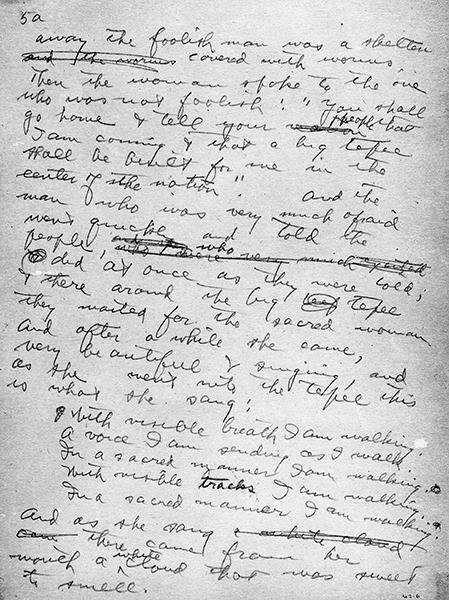
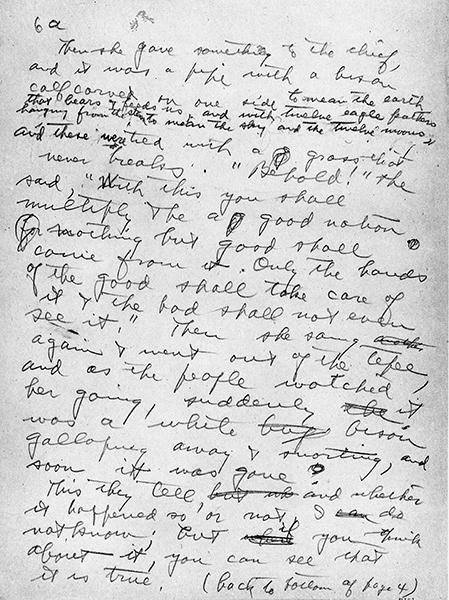
A voice I am sending as I walk.
In a sacred manner I am walking.
With visible tracks I am walking.
In a sacred manner I am walking.”
Then she presented the pipe to the chief. It was an ordinary pipe but there was a calf carved in one side and there were twelve eagle feathers tied on with a grass that never breaks. She said: “Behold this, for you shall multiply with this and a good nation thou shalt be. You shall get nothing but good from this pipe, so I want it to be in the hands of a good man and the good shall have the privilege of seeing it, but the bad shall not have the privilege of seeing it.” This pipe is still in the possession of the Sioux. The first man who kept it was a man by the name of High Hollow Horn. The pipe is handed down from son to son.
She taught them to “keep spirits” and if a man’s son dies, the man keeps a piece of his son’s hair. This woman was really a white buffalo. Thus the respect for the white buffalo. She told them that when there was no food they should offer this pipe the Great Spirit and they would know from this pipe when they were going to have trouble. The pipe gets long at certain times and this means hard times. When it gets short the times are good. After she went back she sang another song. As she went it of the teepee everyone saw a white buffalo kicking up his hind legs and leaving in a hurry snorting as it went.
The Handwritten Draft
There is a story about the way the pipe first came to us. A very long time ago, they say, two scouts were out looking for bison; and when they came to the top of a high hill and looked north they saw something coming a long way off, and when it came closer they cried out, “It is a woman!”, and it was. Then one of the scouts, being foolish, had bad thoughts & spoke them; but the other said: “That is a sacred woman; throw all bad thoughts away.”
When she came still closer, they saw that she wore a fine white buckskin dress, that her hair was very long and that she was young & very beautiful. And she knew their thoughts and said in a voice that was like singing: “You do not know me, but if you want to do as you think, you may come.” And the foolish one went, but just as he stood before her, there was a white cloud that came & covered them. And the beautiful young woman came out of the white cloud, and when it blew away the foolish man was a skeleton covered with worms. Then the woman spoke to the one who was not foolish: “You shall go home & tell your people that I am coming & that a big tepee shall be built for me in the center of the nation.” And the man who was very much afraid went quickly and told the people, who did at once as they were told; & there around the big tepee they waited for the sacred woman. And after a while she came, very beautiful & singing, and as she went into the tepee this is what she sang:
A voice I am sending as I walk.
In a sacred manner I am walking.
With visible tracks I am walking.
In a sacred manner I am walking.”
And as she sang there came from her mouth a white cloud that was sweet to smell. Then she gave something to the chief, and it was a pipe with a bison calf carved on one side to mean the earth that bears & feeds us, and with twelve eagle feathers hanging from the stem to mean the sky and the twelve moons, and these were tied with a grass that never breaks. “Behold!” she said. “With this you shall multiply & be a good nation. Nothing but good shall come from it. Only the hands of the good shall take care of it & the bad shall not even see it.” Then she sang again & went out of the tepee, and as the people watched her going, suddenly it was a white bison galloping away & snorting, and soon it was gone. This they tell, and whether it happened so or not I do not know; but if you think about it, you can see that it is true.
Joint Collection, Western Historical Manuscript Collection, University of Missouri, Columbia, and State Historical Society of Missouri Manuscripts.
Appendix 10: Lakota Words Used in the Text
John G. Neihardt spelled Lakota words as he heard them, attempting to use the sounds of English to convey the rhythm of Indian speech. Some of his translations of those terms into English were effective and evocative of deeper meanings, but they did not always get across the literal meanings of the words. He also created plurals of Lakota words as though they were English, by adding s. This, of course, does not reflect the grammar of Lakota. For clarification, the following list gives modern linguistic transcriptions of the Lakota words in Black Elk Speaks, with literal translations.
aguiapa: agúyapi ‘bread’ (literally, ‘caused to brown’)
Black Kettles (note 1, chapter 5): confusion of Black Feet and Two Kettles
Black Feet: Sihásapa ‘Blackfeet’ (one of the seven Lakota tribes)
Blue Clouds: Mahpíyatho ‘Arapaho Indians’
Brules: Sičhągu ‘Burned Thighs’ (one of the seven Lakota tribes)
chacun sha sha: čhąšaša ‘kinnikinick’ (the inner bark of red willow, used as an additive to tobacco for smoking)
chahumpi ska: čhąhąpiska ‘sugar’ (literally, ‘white tree sap’)
Hetchetu aloh!: Héčhetu yeló ‘So it is!’
Hey-hey!: Hé hé! ‘Look here!’ (an interjection, used in prayer and ritual to call the attention of spirit beings)
heyoka: heyókha ‘contrary; sacred clown’
Hoka hey!: Hókhahé ‘Onward!’ (a rallying cry, used to encourage others, as in battle)
Hunkpapa: Húkpapha ‘Head of the Camp Circle’ (one of the seven Lakota tribes)
Hya-a-a-a!: Hiyé! ‘Thanks!’ (an exclamation, used ritually)
Inkpaduta: Íkpaduta ‘Red Tip’ (name of a Santee Dakota chief )
Lakota: Lakhóta ‘Teton Sioux’ (the western division of the Sioux)
Minneconjou: Mnikóhowožu ‘Planters by Water’ (one of the seven Lakota tribes)
O-ona-gazhee: ónažiča, onákižį ‘refuge’ (called “The Stronghold” in English; Cuny Table, in the badlands north of Pine Ridge, where the Ghost Dancers took refuge after theWounded Knee Massacre)
Ogalala: Oglála ‘Scatter One’s Own’ (one of the seven Lakota tribes)
paezhuta sapa: phežúta sápa ‘coffee’ (literally, ‘black medicine’)
Pahuska: Phehí˛ há˛ska ‘Long Hair’ (a personal name used both for Maj. Gen. George A. Custer and forWilliam [Buffalo Bill] Cody)
papa: pápa ‘dried meat’
Red Cloud’s Agency, Red Cloud Agency: Red Cloud Agency, later renamed Pine Ridge Agency, home of the Oglala; also called owákpamni ‘Indian agency’ (literally, ‘place of distribution’; Neihardt called it “the PlaceWhere Everything Is Disputed”)
Sans Arcs: Itázipčho ‘Without Bows’ (one of the seven Lakota tribes)
sheo: šiyó ‘prairie chicken’
Shyela: Šahíyela ‘Cheyenne Indians’
Two Kettles: Oóhenųpa ‘Two Boilings’ (one of the seven Teton Tribes)
Un-hee!: Hųhé! (an interjection expressing surprise)
Wachpanne: Wahˇhpánica ‘Poor’ (a personal name)
waga chun: wágačhą ‘cottonwood’
Wakon Tonka: Wakhą Thąka ‘Great Spirit, God’
Wanekia: Waníkhiya ‘Savior’ (literally, ‘One Who Makes Live’, a personal name used for Wovoka and for Jesus)
Wasichu: wašíču ‘white people’; also, ‘something holy, incomprehensible’
Watanye: Watąye ‘Bait’ (a personal name)
wichasha wakon: wičháša wakhą ‘holy man’
Yanktonais: Ihąkthųwąna ‘Little End Village’ (one of the three divisions of the Sioux)
Ye-a-a!: Hiyá! ‘No!’
Yuhoo!: Yuhú! (an interjection, apparently expressing triumph)
Notes
Appendix 6
I am grateful to John G. Neihardt for his permission to study the transcripts of his interviews with Black Elk, and to Hilda Neihardt Petri for permission to publish them. I wish especially to express my gratitude to Coralie Hughes and Gary Dunham for their encouragement of this annotated edition. I wish to express my thanks to Raymond A. Bucko, S.J., Douglas R. Parks, and Patrick Warren for their assistance, both editorial and substantive. Special thanks goes to David C. Posthumus who contributed to every aspect of this project and who compiled the data for the maps.
Appendix 7
I am hugely indebted to my grandmother, Hilda Neihardt, for guidance and material for this essay—both recently and over the course of my life.
References
Aly, Lucile F. John G. Neihardt: A Critical Biography. Amsterdam, Netherlands: Rodopi, 1977.
Anderson, Dana. Identity’s Strategy: Rhetorical Selves in Conversion. Columbia: University of South Carolina Press, 2007.
Andersson, Rani-Henrik. The Lakota Ghost Dance of 1890. Lincoln: University of Nebraska Press, 2008.
Archambault, Sr. Marie-Theresa. A Retreat with Black Elk: Living in the Sacred Hoop. Cincinnati: St. Anthony Messenger Press, 1998.
Bad Heart Bull. A Pictographic History of the Oglala Sioux. Text by Helen H. Blish. Lincoln: University of Nebraska Press, 1967.
Badhorse, Beverly. “Petroglyphs: Possible Religious Significance of Some.” Wyoming Archaeologist 23, no. 2 (October–December 1930): 377–98.
Billington, Ray Allen. Westward Expansion: A History of the American Frontier. Fourth Edition. New York: Macmillan, 1974.
Boas, Franz., and Ella Deloria. “Dakota Grammar.” Memoirs of the National Academy of Sciences 23, no. 2 (1941).
Born, David O. “Black Elk and the Duhamel Sioux Indian Pageant.” North Dakota History: Journal of the Northern Great Plains 61 (1994): 22–29.
Bray, Kingsley M. Crazy Horse: A Lakota Life. Norman: University of Oklahoma Press, 2006.
Brininstool. E. A. Crazy Horse: The Invincible Ogalalla Sioux Chief. Los Angeles: Wentzel, 1949.
———. Troopers with Custer: Historic Incidents of the Battle of the Little Big Horn. Harrisburg PA: Stackpole, 1952.
Brown, Dee. Fort Phil Kearny: An American Saga. New York: G. P. Putnam’s Sons, 1982.
Brown, Joseph Epes, recorder and ed. The Sacred Pipe: Black Elk’s Account of the Seven Rites of the Oglala Sioux. Norman: University of Oklahoma Press, 1953.
—. The Spiritual Legacy of the American Indian: Commemorative Edition with Letters While Living with Black Elk. Edited by Marina Brown Weatherly, Elenita Brown, and Michael Oren Fitzgerald. Introduction by Åke Hultkrantz. Bloomington IN: World Wisdom, 2007.
Buechel. Eugene, S. J. A Dictionary of the Teton Dakota Sioux Language. Edited by Paul Manhart, S.J. Pine Ridge SD: Red Cloud Indian School, 1970.
Buecker, Thomas R., and R. Eli Paul, eds. The Crazy Horse Surrender Ledger. Foreword by Harry H. Anderson. Lincoln: Nebraska State Historical Society, 1994.
Bucko, Raymond A. The Lakota Ritual of the Sweat Lodge. Lincoln: University of Nebraska Press, 1998.
—. “When Does a Cactus Become an Angry Buffalo? Traditional Games of the Lakotas.” Montana: The Magazine of Western History 5, no. 2 (2007): 14–31.
Bushotter, George. Lakota Texts. Ms. 4800, National Anthropological Archives, Smithsonian Institution, Washington DC.
Castro, Michael. Interpreting the Indian: Twentieth-Century Poets and the Native American. Albuquerque: University of New Mexico Press, 1983.
Clark, W. P. The Indian Sign Language, with Brief Explanatory Notes of the Gestures Taught Deaf-Mutes in Our Institutions for Their Instruction, and a Description of Some of the Peculiar Laws, Customs, Myths, Superstitions, Ways of Living, Code of Peace and War Signals of Our Aborigines. Philadelphia: L. R. Hamersly, 1885.
Costello, Damian. Black Elk: Colonialism and Lakota Catholicism. Maryknoll NY: Orbis, 2005.
Culin, Stewart. Games of the North American Indians. Smithsonian Institution, Bureau of American Ethnology, Annual Report 24. Washington DC, 1907.
Curtis, Edward S. The North American Indian, vol. 3. 1908. Reprint. New York: Johnson Reprint Corporation, 1970.
Deloria, Ella C. The Dakota Way of Life. Manuscript, Dakota Indian Foundation, Chamberlain SD.
—. Speaking of Indians. New York: Friendship, 1944.
—. “The Sun Dance of the Oglala Sioux.” Journal of American Folk-Lore 42 (1929): 354–413.
Deloria, Vine, and Raymond J. DeMallie, eds. Documents of American Indian Diplomacy: Treaties, Agreements, and Conventions, 1775–1979. 2 vols. Norman: University of Oklahoma Press, 1999.
DeMallie, Raymond J. “The Sioux in Dakota and Montana Territories: Cultural and Historical Background of the Ogden B. Read Collection.” In Vestiges of a Proud Nation: The Ogden B. Read Northern Plains Indian Collection, ed. by Glenn E. Markoe, 18–69. Burlington VT: Robert Hull Fleming Museum, 1986.
—. “Kinship and Biology in Sioux Culture.” North American Indian Anthropology: Essays on Society and Culture, edited by Raymond J. DeMallie and Alfonso Ortiz, 125–46. Norman: University of Oklahoma Press, 1994.
—. “Sioux Until 1850,” in Handbook of North American Indians, Volume 13, Plains, 718–60. Washington DC: Smithsonian Institution, 2001.
———, ed. The Sixth Grandfather: Black Elk’s Teachings Given to John G. Neihardt. Lincoln: University of Nebraska Press, 1984.
Densmore, Frances. Teton Sioux Music. Bureau of American Ethnology Bulletin 61, 1918.
Dodge, Richard Irving. The Plains of the Great West and Their Inhabitants, Being a Description of the Plains, Game, Indians, &c. of the Great North American Desert. New York: G. P. Putnam’s Sons, 1877.
Dorsey, James Owen. “Games of Dakota Children.” American Anthropologist, o.s. 4 (1890): 329–45.
———. “A Study of Siouan Cults.” In* Smithsonian Institution, Bureau of [American] Ethnology, Annual Report *11, 351–544. Washington DC, 1894.
Erikson, Erik Homburger. Observations on Sioux Education. Journal of Psychology 7 (1939): 101–56.
Fletcher, Alice C. “The Elk Mystery or Festival: Ogallala Sioux.” Seventeeth and Eighteenth Annual Reports of the Trustees of the Peabody Museum of American Archaeology and Ethnology 3, nos. 3 and 4, 276–88. Cambridge, 1884.
Foley, Thomas W. Father Francis M. Craft: Missionary to the Sioux. Lincoln: University of Nebraska Press, 2002.
Friswald, Caroll, ed. The Killing of Chief Crazy Horse: Three Eyewitness Views by the Indian, Chief He Dog; the Indian-White, William Garnett; and the White Doctor, Valentine T. McGillycuddy, edited by Robert A. Clark. Glendale CA: Arthur H. Clark, 1976.
Gallop, Alan. Buffalo Bill’s British Wild West. Phoenix Hill, UK: Sutton, 2001.
Gilmore, Melvin R. “Use of Plants by the Indians of the Missouri River Region.” In Smithsonian Institution, Bureau of American Ethnology, Annual Report 33, 43–154. Washington DC, 1919.
Gonzalez, Mario, and Elizabeth Cook-Lynn. The Politics of Hallowed Ground: Wounded Knee and the Struggle for Indian Sovereignty. Urbana: University of Illinois Press, 1999.
Graham, W. A. The Custer Myth: A Source Book of Custeriana. Harrisburg PA: Stackpole, 1953.
Gray, John S. Centennial Campaign: The Sioux War of 1876. Ft. Collins CO: Old Army Press, 1976.
Greene, Candace S., and Russell Thornton, eds. The Year the Stars Fell: Lakota Winter Counts at the Smithsonian. Lincoln: University of Nebraska Press, 2007.
Greene, Jerome A. Slim Buttes, 1876: An Episode of the Great Sioux War. Norman: University of Oklahoma Press, 1982.
———. Yellowstone Command: Colonel Nelson A. Miles and the Great Sioux War, 1876–1877. Lincoln: University of Nebraska Press, 1991.
Hammer, Kenneth, ed. Custer in ’76: Walter Camp’s Notes on the Custer Fight. Provo UT: Brigham Young University Press, 1976.
Handbook of North American Indians, Volume 13, Plains. 2 pts. General Editor William C. Sturtevant; Volume Editor Raymond J. DeMallie. Washington DC: Smithsonian Institution, 2001.
Hanson, Joseph Mills.* The Conquest of the Missouri: Being the Story of the Life and Exploits of Captain Grant Marsh*. Chicago: A. C. McClurg, 1909.
Hardorff, Richard G., comp. and ed. Cheyenne Memories of the Custer Fight: A Sourcebook. Spokane WA: Arthur H. Clark, 1995.
———, comp. and ed. Lakota Recollections of the Custer Fight: New Sources of Indian-Military History. Spokane WA: Arthur H. Clark, 1991.
———, comp. and ed.* The Surrender and Death of Crazy Horse: A Source Book about a Tragic Episode in Lakota History*. Spokane WA: Arthur H. Clark, 1998.
Hassrick, Royal B. The Sioux: Life and Customs of a Warrior Society. Norman: University of Oklahoma Press, 1964.
Hebard, Grace Raymond, and E. A. Brininstool, eds.* The Bozeman Trail: Historical Accounts of the Blazing of the Overland Route into the Northwest and the Fights with Red Cloud’s Warriors*. 2 vols. Cleveland: Arthur H. Clark, 1922.
Hill, Edward E.* The Office of Indian Affairs, 1824–1880: Historical Sketches*. New York: Clearwater, 1974.
Holler, Clyde. Black Elk’s Religion: The Sun Dance and Lakota Catholicism. Syracuse: Syracuse University Press, 1995.
—, ed. The Black Elk Reader. Syracuse: Syracuse University Press, 2000.
Holloway, Brian. Interpreting the Legacy: John Neihardt and Black Elk Speaks. Boulder: University of Colorado Press, 2003.
Howard, James H., trans. and ed. The Warrior Who Killed Custer: The Personal Narrative of Chief Joseph White Bull. 1968. Reprint, retitled Lakota Warrior: Joseph White Bull. Introduction by Raymond Bucko. Lincoln: University of Nebraska Press, 1998.
Hyde, George E. Red Cloud’s Folk: A History of the Oglala Sioux Indians. Norman: University of Oklahoma Press, 1937; rev. ed., 1957.
—. A Sioux Chronicle. Norman: University of Oklahoma Press, 1956.
———. Spotted Tail’s Folk: A History of the Brulé Sioux. Norman: University of Oklahoma Press, 1961.
Jensen, Richard E., ed. The Indian Interviews of Eli S. Ricker, 1903–1919. Voices of the American West, vol. 1. Lincoln: University of Nebraska Press, 2005.
———, ed. The Settler and Soldier Interviews of Eli S. Ricker, 1903–1919. Voices of the American West, vol. 2. Lincoln: University of Nebraska Press, 2005.
Jensen, Richard E., E. Eli Paul, and John E. Carter. Eyewitness at Wounded Knee. Lincoln: University of Nebraska Press, 1991.
Kadlecek, Edward, and Mabell Kadlecek. To Kill an Eagle: Indian Views on the Last Days of Crazy Horse. Boulder CO: Johnson Books, 1981.
Kappler, Charles J., comp. and ed. Indian Affairs: Laws and Treaties, Vol. II (Treaties). Washington DC: Government Printing Office, 1904. Reprint, retitled Indian Treaties, 1778–1883. New York: Interland Publishing, 1972.
Larson, Robert W. Gall: Lakota War Chief. Norman: University of Oklahoma Press, 2007.
—. Red Cloud: Warrior-Statesman of the Lakota Sioux. Norman: University of Oklahoma Press, 1997.
Mails, Thomas. Fools Crow. New York: Doubleday, 1979.
Mallery, Garrick. “Picture-Writing of the American Indians.” Smithsonian Institution, Bureau of [American] Ethnology, Annual Report 10. Washington DC, 1893.
Marquis, Thomas B. A Warrior Who Fought Custer. Minneapolis: Midwest, 1931.
McCluskey, Sally. “Black Elk Speaks: and So Does John Neihardt.” Western American Literature 6 (1972): 231–42.
McCrady, David G.* Living with Strangers: The Nineteenth-Century Sioux and the Canadian-American Borderlands*. Lincoln: University of Nebraska Press, 2006.
McCreight, M. L.* Firewater and Forked Tongues: A Sioux Chief Interprets U.S. History*. Pasadena CA: Trail’s End, 1947.
McGaa, Ed (Eagle Man).* Mother Earth Spirituality: Native American Paths to Healing Ourselves and Our World*. San Francisco: Harper & Row, 1990.
McGregor, James H.* The Wounded Knee Massacre from the Viewpoint of the Sioux*. Minneapolis MN: Lund Press, 1940.
Meeker, Louis L. “Oglala Games.” Bulletin of the Free Museum of Science and Art (Philadelphia) 3 (1901): 23–46.
Michno, Gregory F. Lakota Noon: The Indian Narrative of Custer’s Defeat. Missoula MT: Mountain Press, 1997.
Mooney, James. The Ghost-Dance Religion and the Sioux Outbreak of 1890. Smithsonian Institution, Bureau of [American] Ethnology, Annual Report 14, pt. 2. Washington DC, 1896. Rpt. ed. with Introduction by Raymond J. DeMallie. Lincoln: University of Nebraska Press, 1991.
Neihardt, Hilda.* Black Elk and Flaming Rainbow: Personal Memoirs of the Lakota Holy Man and John Neihardt*. Lincoln: University of Nebraska Press, 1995.
Neihardt, Hilda, and Lori Utecht, eds. Black Elk Lives: Conversations with the Black Elk Family. Lincoln, University of Nebraska Press, 2000.
Neihardt. John G.* Black Elk Speaks: Being the Life Story of a Holy Man of the Ogalala Sioux*. New York: William Morrow, 1932.
—. Collected Poems. New York: MacMillan, 1926.
———. Poetic Values: Their Reality and Our Need of Them. New York: MacMillan, 1925.
—. The Song of the Indian Wars. New York: MacMillan, 1925.
—. The Song of the Messiah. New York: MacMillan, 1935.
———. When the Tree Flowered: An Authentic Tale of the Old Sioux World*. New York: Macmillan, 1951. British ed., Eagle Voice: An Authentic Tale of the Sioux Indians. London: Andrew Melrose, 1953.
Olson, James C. Red Cloud and the Sioux Problem. Lincoln: University of Nebraska Press, 1965.
Ostler, Jeffrey.* The Plains Sioux and U.S. Colonialism from Lewis and Clark to Wounded Knee*. Cambridge: Cambridge University Press, 2004.
Parks, Douglas. “Pawnee,” in Handbook of North American Indians, vol. 13: Plains, 515–47. Washington DC: Smithsonian Institution, 2001.
Paul, E. Eli, ed. Autobiography of Red Cloud, War Leader of the Oglalas. Helena: Montana Historical Society Press, 1997.
Peterson, Roger Tory. A Field Guide to Western Birds. Second ed. Boston: Houghton Mifflin, 1961.
Powell, Father Peter John.* People of the Sacred Mountain: A History of the Northern Cheyenne Chiefs and Warrior Societies, 1830–1879, with an Epilogue, 1969–1974*. 2 vols. San Francisco: Harper & Row, 1981.
Powers, William K. “When Black Elk Speaks, Everybody Listens.” In Religion in Native North America, ed. Christopher Vecsey, 136–51. Moscow: University of Idaho Press, 1990.
Prucha, Francis Paul. The Great Father: The United States Government and the American Indians. 2 vols. Lincoln: University of Nebraska Press, 1984.
———. A Guide to the Military Posts of the United States, 1789–1895. Madison: State Historical Society of Wisconsin, 1964.
—, ed. Documents of United States Indian Policy. Lincoln: University of Nebraska Press, 1975.
Rice, Julian. Black Elk’s Story: Distinguishing Its Lakota Purpose. Albuquerque: University of New Mexico Press, 1991.
Riegert, Wilbur A.* Quest for the Pipe of the Sioux as Viewed from Wounded Knee*. Rapid City: privately printed, 1975.
Rorabacher, J. Albert.* The American Buffalo in Transition: An Historical and Economic Survey of the Bison in America*. St. Cloud MN: North Star Press, 1970.
Russell, Don. The Lives and Legends of Buffalo Bill. Norman: University of Oklahoma Press, 1960.
Sandoz, Mari. The Buffalo Hunters: The Story of the Hide Men. New York: Hastings House, 1954.
———. Crazy Horse: The Strange Man of the Oglalas. New York: Alfred A. Knopf, 1942.
Sell, Henry Blackman, and Victor Weybright. Buffalo Bill and the Wild West. New York: Oxford University Press, 1955.
Spring, Agnes Wright, The Cheyenne and Black Hills Stage and Express Routes. Glendale CA: Arthur H. Clark, 1949.
Standing Bear, Luther. My People the Sioux. Boston: Houghton Mifflin, 1928.
Steinmetz, Paul B., S.J.* Pipe, Bible, and Peyote among the Oglala Lakota: A Study in Religious Identity*. Knoxville: University of Tennessee Press, 1990.
Steltenkamp, Michael F. Black Elk: Holy Man of the Oglala. Norman: University of Oklahoma Press, 1993.
Stewart, Edgar I. Custer’s Luck. Norman: University of Oklahoma Press, 1955.
Sword, George. “The Story of the Ghost Dance.” The Folk-Lorist 1(1) (July 1892): 28–30.
Utley, Robert M.* Frontier Regulars: The United States Army and the Indian, 1866–1890*. New York: Macmillan, 1973.
———. The Lance and the Shield: The Life and Times of Sitting Bull. New York: Henry Holt, 1993.
—. The Last Days of the Sioux Nation. Second Edition. New Haven CT: Yale University Press, 2004.
Vaughan, J. W. With Crook at the Rosebud. Harrisburg PA: Stackpole, 1956.
Vestal, Stanley. Warpath: The True Story of the Fighting Sioux Told in a Biography of Chief White Bull. 1934. Reprint, Introduction by Raymond J. DeMallie. Lincoln: University of Nebraska Press, 1984.
Viola, Herman J.* Little Bighorn Remembered: The Untold Indian Story of Custer’s Last Stand*. New York: Times Books, 1999.
Walker, James R. Lakota Belief and Ritual. Edited by Raymond J. DeMallie and Elaine A. Jahner. Lincoln: University of Nebraska Press, 1980.
—. Lakota Society. Edited by Raymond J. DeMallie. Lincoln: University of Nebraska Press, 1982.
—. “Oglala Games I.” Journal of American Folk-Lore 18 (1905): 277–90.
—. “Oglala Games II.” Journal of American Folk-Lore 19 (1906): 29–36.
—. “The Sun Dance and Other Ceremonies of the Oglala Division of the Teton Dakota.” Anthropological Papers of the American Museum of Natural History 16, no. 2 (1917): 55–221.
Warren, Louis S. Buffalo Bill’s America: William Cody and the Wild West Show. New York: Alfred A. Knopf, 2005.
White, Bruce M. “Encounters with Spirits: Ojibwa and Dakota Theories about the French and Their Merchandise,” Ethnohistory 41, no. 3: 369–405.
Wissler, Clark. “Societies and Ceremonial Associations in the Oglala Division of the Teton-Dakota.” American Museum of Natural History, Anthropological Papers 11, no. 1 (1912): 1–99.
Yost, Nellie Snyder.* Buffalo Bill: His Family, Friends, Fame, Failures and Fortunes*. Chicago: Swallow, 1979.
Index
Page numbers refer to the print edition.
Italicized page numbers indicate illustrations.
adoption ceremony, 187, 243–44,248, 287, 301n7
advisers, 22, 36, 37,52, 305n17
Afraid-of-Hawk, 152
Afraid of Hawk, Emil, 300n3
African Americans. See black Wasichus
agencies: Indians summoned to, 55–56, 58,87, 256,310n25, 316n2; for Lakotas,81, 82,91, 314n2, 317n1. See also Cheyenne River Agency; Pine Ridge Agency; Red Cloud Agency; reservations; Spotted Tail Agency; Standing Rock Agency
akíchita. See messengers
Alexie, Sherman, xxxiii
Algonquian speakers, 317n1
All-Gone-Tree Creek, xxxiv,97–98
All Is But a Beginning (Neihardt), 280
Allison, William H., 50, 56,309n13, 310n25
American flag, 39, 307n4
American Horse (Minneconjou), 82
American Horse (Oglala), 82, 158–59
The Ancient Memory (Neihardt), 272–74
Anderson, Dana, 252
animals: drawings of, 187, 200; in great vision, 16, 21, 23, 26; and Messiah Movement, 147; offering to, 112; as relatives, 6, 22, 32,305n14; and sacred pipe, 2, 301n8; and whites’ intrusion, 7. See also specific animals
April. See Moon of the Red Grass Appearing (April)
“April Theology” (Neihardt), 273
Arapaho Indians, 7, 50, 59,136, 145, 323n12,325n3
Archambault, Marie Therese, 253
Arikara Indians. See Ree Indians
arrows: of Crazy Horse, 52; and dog vision,114, 119, 120; from grandfather,12, 31–32, 198; in great vision,19, 22, 26–27, 111,194, 200; and horse dance,103, 213; of Iron Hawk, 74,75; on Little Bighorn, 77, 208; as only weapon, 110; shooting at Wasichu in bush,78; at Sun Dance on Rosebud, 61
art, xxxiii, 185–237, 241,250, 256–57, 330n1
Ashley-Henry men, 277
Atlantic Ocean, 136–37
Attacking the Wagons. See Wagon Box Fight
August. See Moon When the Cherries Turn Black (August)
awls, 231
axes, 231
Bad Faces band, 39
Bad Heart Bull, 312nn1–2
Badlands: and Black Elk, 120,170, 241, 321n11; Crazy Horse in, 89, 90; gathering in (1890),158–59, 327n13; Neihardts’ initial visit to,181–83; Red Cloud in, 329n9; sheltering place in, 167, 168. See also South Dakota
Baltimore MD, 324n3
Bancroft NE, 270–73
Battle Creek, 161
Battle of Little Bighorn. See Little Bighorn River
Battle of Slim Buttes, 82, 315n11
Battle of the Hundred Slain, 5–9, 40,50, 51, 191, 240,255. See also Fetterman, W. J.; Fort Phil Kearny
Battle of Wolf Mountains, 85
bay horse: in great vision, 15, 16,19, 22, 25, 27,100, 196, 200,210, 260; and horse dance, 102,104, 105, 107. See also horses
Bear Creek, 89
bears, 66, 167, 187,188, 287, 312n3,318n2
Bear Sings, 101, 102
Bear Society, 312n3
Beaver Creek, 51
Belle Fourche River, 38, 307n2
belt, spotted, 74, 75, 314n14. See also clothing
Benteen, Frederick W., 208, 312n1
Bible, 253, 299n7
bible of all tribes, xiv–xv, xxxi
Big Foot, 5, 156,158–60, 163–64, 231,232, 327n15
Bighorn Mountains, 65,73, 79, 81,82, 84
Big Road, 7, 59, 91,152, 317n1
Big Road’s son, 152
birds: in Battle of the Hundred Slain, 191; and circles,121; and curing power, 122; and dog vision, 113–15, 223; and drought,196; exhortation of, 99; in great vision,16, 21, 23, 194,210, 212, 213; holiness of,48; offering to, 112; in race, 200; as relatives, 32; on sacred ornaments, 318n9; and sacred pipe, 2; in sacred tree, 107, 150,229; in Standing Bear’s hair, 71,313n10; thunder beings as, 300n2; on title page, 187. See also chicken hawks; crows; hawks; kingbirds; swallows; Thunderbirds
Birmingham, England, 140, 324n1
Bismarck ND, 308n5
bison: ceremony for, 127–29,130; coyote’s direction to, 94–95; division of herd, 13; and dog vision, 116; en route to agencies, 91, 92; extermination of, 133,144, 256, 259,323n1; feast on during fight, 63; in great vision, 18, 23, 24,134, 155, 230; hunting of,32–36, 202; ocean crossing of,137; origin of, 7, 302n8; in race,200; restoration of, 145, 146; sacred nature of, 34; and sacred pipe, 3,291–96; on sacred tepee, 101; at Taking-The-Crow-Horses Creek, 51; term for herds,302n5; tongues of, 133; wallow of, 128, 322n5; and whites’ intrusion,6. See also buffalo hides; meat; red man
Bison Books editions, xxx–xxxiv
Black Buffalo Woman, 53, 310n21
Black Butte, 70
Black Elk (father of Black Elk): on ammunition supply, 85; broken leg of, 5, 9, 40; in Canada, 94; on council with Wasichus, 50; on Crazy Horse’s behavior, 84; and curing, 123; death of, 146; family relations of, 53,77, 306n1; at Ghost Dance, 152; and great vision, 14, 29–32, 193; and horse dance, 101–2; hunting for deer,40; and killing of Crazy Horse, 88–90; on Little Bighorn, 67, 81; memories of,5–6; near Fort Robinson, 39; recognition of son’s power, 94, 100; sacred ornament of, xxiii, 268; in spirit journey,141; and Spotted Tail, 86,87; surrender of, 86; on Washington delegation, 87–88; on whites’ intrusion, 7
Black Elk (grandfather of Black Elk): on whites’ intrusion,6, 7, 302n5
Black Elk, Benjamin, 174; at Harney Peak,170, 330n9; knowledge of great vision, 128; schooling of, xxiv,300n6; translation by, xix,xxiv–xxv, 244, 245,250–51, 257, 268–69,285, 286; and World War I, 23
Black Elk, Nicholas, 173–76, 178,179; age of, 129–30, 171,259–61, 322n6, 330n8,331n12; birth of, 5; blindness of,xix, xxii, 299n6; as clown,118–20; employment of, 147, 148,325n5; first fight of, 58; at Harney Peak,xxviii, 170–72; home of,xvii,xxi, xxii,89, 121, 252, 267,323n10; homesickness of, 140–42; humility of, 128, 182, 257–58,322n4; illness of, 14, 29,30, 32, 39,100; images of, xxix–xxxii; interviews of, 244, 247, 248,255, 263–64, 268–69,276, 285, 287; interviews of acquaintances of, 252–253; John Neihardt’s first meeting with, xvii,xxi–xxii, 181–83,242–43, 267–70,282–85, 289, 331n1; life experiences of, xiv,xvii–xviii,1, 2,237–38, 240–43, 255,263–65, 282, 284,301n4; literacy of, xix, 23,299n7; literature about, 247–63; mistake of,157, 265; mood and manner of,xviii–xix, xxii,xxvii, 2,181–82, 243, 246,267, 301n4; on peace pipe,291–96; powerlessness of, 112,134, 245, 247, 259,286; powers of, xxii, 92–93,98, 109, 125,144–45, 150; as preacher, xxi–xxii,241, 300n2; relationship with John Neihardt,242–66, 283, 285–86,288–90; revenge for Wounded Knee, 163; signature of, 187; swimming in Little Bighorn,66, 67; teaching of, xxiii–xxv,101, 243, 249,252–53, 257–58, 263–65,268; threat to arrest, 158,327n11; wound of, 166–68
Black Elk and Flaming Rainbow (Neihardt), 284,331n1
Black Elk: Colonialism and Lakota Catholicism (Costello),253
Black Elk: Holy Man of the Oglala (Steltenkamp), 252–53
The Black Elk Reader (Holler), 250
Black Elk Speaks (Neihardt): cover art of,xxix–xxxiii; ethnographical value of,249, 260; history in, xxxi,xxxiii–xxxv, 49, 247–48,255–56, 260, 263–64,308n6; intention of, 237–41,278, 282–83; omissions and additions in,251, 255–57, 260–63,291–96; Philip Deloria on,xxix–xxxv; reception of, xiii–xv,xxvii–xxviii,xxx–xxxiii, 239, 242,246–48, 250, 280–81,289–90; scholarship on, xiv,xxvii, xxxiii,247–66; source for, 183,239, 246, 249–52,255, 269, 282–83, 292–93; title of, 187, 246; tone of,244–45, 272, 284–85
Black Elk’s Religion (Holler), 253
Black Elk’s Story (Rice), 253
Black Feather, 168
Blackfeet (Piegan) Indians, 97–98,317n1
Blackfoot Sioux, 38, 59,65, 301n1,312n2, 314n2. See also Sioux Indians
Black Fox, Lizzie, 150,325n3
Black Hills: Black Elk’s comment about, 120,321n11; Black Elk’s duty to save, 51,262, 309n15; gold mining camps in,57–58; in great vision,26, 200; Indian camps in, 39–41,48; Indian show in, 264; loss of, 54, 81; negotiation for,50, 309n13; Neihardts’ initial visit to,181–83; origin of buffalo near, 302n8; soldiers in, 49–51, 82,110, 256, 308n5; in spirit journey, 141. See also land; South Dakota
Black Hills Agreement (1876), 83,87, 316n2
black horses, 15–17, 19–22, 25–26,102–8, 196, 210. See also horses
Black Kettles Indians, 38
black medicine, 38, 39,51
Black Moon, 59
black paint: after attack at Powder River, 56; on Crow Nose,55; and curing of Rattling Hawk, 66; and dog vision, 114; and drought, 196; and elk ceremony, 130; in great vision, 27,200; and heyoka ceremony, 119; on High Horse, 45, 46; and horse dance,102, 213, 216,218, 318n3; meaning of, 310n24,310n29; and power of west, 24; and warfare,260. See also body paint
black ribbon, 2
Black Road, 100–102, 109
black road, 18–20, 23,91–92, 103, 109,134, 171, 305n10
Black Robe. See Craft, Father Francis M.
black Wasichus, 64, 77, 80,167, 311n14, 329n6. See also whites
Blackwell’s Island, 136, 323n11
blankets, 64, 74, 175,231, 232, 236
blue (color): and drought, 196; and elk ceremony,130; in great vision, 198,200, 210; and horse dance,102, 216, 218; on sacred herb, 24, 27, 123; on sacred ornament, 300n4
Blue Clouds. See Arapaho Indians
blue man, 20, 196, 261,305n12, 306n25
body paint: in Battle of the Hundred Slain, 191; for bison ceremony, 129; and curing of Rattling Hawk,66, 67; and dog vision, 223; in great vision, 27, 306n24; for heyoka ceremony,118–19; and horse dance, 102,103, 318n3; of Six Grandfathers,194; of spirit messengers, 192; at Sun Dance on Rosebud, 60. See also black paint; red paint; ritual action(s); white paint
Book of Revelation, 253. See also Bible
bow(s): of Crazy Horse, 52; and dog vision,114; from grandfather, 12, 31–32; and heyoka ceremony, 119; and horse dance,101, 103; of Iron Hawk,74, 75; at Little Bighorn, 204; as only weapon, 110; and shooting at Wasichu in bush, 78; at Sun Dance on Rosebud, 61
bow, sacred: in great vision, 17, 19,20, 22, 27, 171,194, 198, 200,213; at Wounded Knee, 161, 162,166, 236, 328n2
Bozeman Trail: abandonment of army posts on, 12,303n23; closing of, 57; crossing of, 51; George Crook on, 56,311n12; opposition to, 6, 7,12, 302n6; protection of travelers on,302n9
braids, 74, 103, 112,130, 319n10. See also hair
branch, slender, 213, 214
Branson MO, 174, 280
Brave Bear, 145–47
brave deeds: after bison hunt, 36; in Canada,93; of Crazy Horse, 52; dance of,55, 310n23; and death, 137; on Little Bighorn, 67, 72; of soldiers,69; at Sun Dance on Rosebud, 59–60; as virtue,307n14
Brave Wolf, 93
breechcloths, 170, 300n1,329n3. See also clothing; warrior(s), dress and paint of
Brennan, John R., 159, 327n16
Brings Plenty, 76
Brooke, John R., 327n7
Brown, Elenita, 264
Brown, Joseph Epes, xv, xxix,248–49, 264–65, 310n24
Brule Indians: agency for, 91,315n2, 317n1; dancing of,156, 157; gathering in Badlands (1890), 158–59, 327n12; and Lakota nation,38; Loafers band of, 49,309n8; to Pine Ridge, 157, 326n6; on Rosebud, 59, 110,111; surrender of, 85–86; and treaty of 1868,12, 303n23; as Western Sioux,301n1; on Wounded Knee Creek, 158. See also Lower Brule Reservation
buckskin horses: in great vision, 15, 16,18–22, 25, 210; and horse dance,102, 104, 105, 107,108, 218; on Little Bighorn,67–68; One Side on, 196. See also horses
Buddhism, xv
Buffalo Bill’s Wild West Show: Black Elk in, 134–39,173, 259, 264,265, 282, 323n7; correspondence from, 299n7; in Europe, xxxi,140; John Neihardt’s writing about,248; in Paris, 142, 324n5; performers in, 136, 323n12. See also Cody, William F.; Shelly, Mexican Joe; whites
Buffalo Gap, 40
buffalo hides, xxiii, 2, 51,101, 133,183, 300n4, 318n9,329n3. See also bison
Bullock’s oriole, 313n10
A Bundle of Myrrh (Neihardt), 272, 273
Bureau of American Ethnology, 249
Bureau of Indian Affairs, 247, 279,280, 325n5
Bushotter, George, 302n14, 311n9
butterflies, 114, 221
Caddoan speakers, 301n2
Campbell County WY, 38, 307n2
camps, xv, 22, 305n17. See also specific locations
Canada. See Grandmother’s Land (Canada)
cane (sagyé), 304n9
cannons, 85, 160,161, 163, 164,232, 234, 328n1,328n6. See also gun(s)
Carlisle Indian School, xxiv, 300n6
Castro, Michael, 251
Catholic Church, 158, 243, 248,250, 252–54, 261,265, 282, 299n1,300n2, 331n12. See also Christianity; Drexel (Holy Rosary) Mission; Jesuit missionaries; religion
Cavett, Dick, xxviii
Central Pacific railroad, 13
ceremonies, sacred: for bison and elk, 128–32; and curing,66, 127,312n3; Joseph Epes Brown on, 248; naming,285–86; ornament in, xxiii,268; prohibition of, 156–57,325n5; and visions, 241. See also specific ceremonies
chacun sha sha. See red willow bark
chapped breast dance, 36–37. See also dancing
Chase-in-the-Morning, 77, 178
Cheyenne Creek, 148, 159
Cheyenne Indians: after Little Bighorn, 82; attack on General Miles, 85; attacks on, 61,65, 84,256, 311n12, 312n1; capture of,85; courting by, 41–46, 255,308n1; on Little Bighorn,65, 74–75,312n2, 314n20; prophecy of Hundred Slain,5; on Rosebud River, 59,63; scalping of, 72; summoning to agencies,56, 310n25; surrender of, 84,315n14; in Wagon Box Fight, 10, 11; war against soldiers, 7; at War Bonnet Creek,57; and Wasichus, 50,58, 86; in Wild West Show, 136,323n12
Cheyenne River. See Good River
Cheyenne River Agency, 314n2. See also agencies
Cheyenne River Reservation, 143, 159,324n6, 327n15. See also reservations
Cheyenne WY, 13, 51,57
Chicago IL, 135, 279
chicken hawks, 113, 114, 122. See also birds
chiefs, 22, 53, 60,305n16
children: attacked in Cheyenne village, 84; in Big Foot’s band, 159; and bison ceremony, 129; on bison hunt, 33; capture of Cheyenne, 85; care at Mission, 167; and Crazy Horse, 54; and dog vision, 115; in great vision, 21,22, 26, 258; hair of,299n1; illnesses of, 112, 145; killed at Powder River, 56; on Little Bighorn,68, 69, 74–76, 240; maturity of, 122; peace for sake of, 169; at Pine Ridge, 165, 166; pranks of, 39, 50, 61, 256,307n4, 309n11, 311n9; on Rabbit Creek, 82; at rabbit dance, 240; on Rosebud River, 59–61, 63; on Tongue River,85; and weed of destruction, 261; at Wounded Knee, 161–66, 232, 234,236, 263, 328nn4–5
Chips (medicine man), 48–49,308n2
Christ, 153, 326nn10–11
Christian Herald, xxviii
Christianity, xv, 2, 250,252–54, 300n1, 310n24,323n10. See also Catholic Church; religion
circles: in bison ceremony, 128; and dog vision,115; fighting in, 58; in Ghost Dance,148, 151, 152,228, 230; in great vision,253, 258; of horse dance tepee,109, 319n12; of life, 124; power of, 121–22, 321n1; at Sun Dance on Rosebud, 59, 60. See also hoop, nation’s sacred; hoop of the world
“The City of Dust” (Neihardt), 273
Clark, W. P., 316n24
clothing: American-style, 299n1; in battle,10; in Battle of the Hundred Slain, 191; on bison hunt, 202; of Cheyenne, 74,75, 314n14; for death, 137; and dog vision, 221, 223; drawings of,187; at feast, 240; for Ghost Dance,150, 157,228, 325n1; in great vision,192, 193, 194; at Harney Peak, 170, 329n3; in horse dance, 102, 212–14, 216,218; for lamenting, 112, 115; at Little Bighorn, 204; of men’s societies,187, 204; of people in despair,226; of soldiers, 77, 79; in spirit journey, 224; of Wanekia, 230; of warriors, 55, 56, 198,200, 204, 208,310n29; at Wounded Knee,160, 236. See also breechcloths; Ghost Dance shirts; head ornaments; masks; war bonnet(s)
clouds: in great vision, 14–16, 21,23, 24, 26–28, 105,157, 194, 200,210, 304n5, 326n4; and horse dance, 105, 106, 108,109; and Messiah Movement, 146,229; one-sided, 12, 304n25; and peace pipe, 294, 295; in spirit journey,141–43, 224; and thunder beings,98, 99, 300n2. See also rain; storms; thunder
clowns, ceremonial. See heyoka ceremony
Cody, William F., 134, 140,142, 324n2. See also Buffalo Bill’s Wild West Show
coffee. See black medicine
Collier, John, 279
Columbia MO, 280
Company E, 75, 314n15. See also U.S. Army
consciousness, Indian, xvii,xix, 181, 183,243, 246, 251, 258,268, 269, 285–86,289
corn, 82
Costello, Damian, 253
cottonwood, 11, 21, 54,59–60, 83, 95, 96,130. See also tree(s)
counting coup: on Crow horse thief, 55; in great vision,20; at horse dance, 108, 319n11; and kill talks, 36, 307n12; on Little Bighorn,72, 204; at Sun Dance on Rosebud,59–60; by Wild West performers, 135
coup sticks, curved, 187
Court of Indian Offenses, Pine Ridge, 325n4
Courtright, B. G., xix,xxi, 267
coyote(s), 94, 99
Crab, 58
Craft, Father Francis M., 158, 167,329n7
Crawford NE, 38, 39,307n3
Crazy Horse: age of, 52, 309n19; attitude toward Wasichus, 38; band to Canada,317n1; behavior of, 53–54, 84; Black Elk’s admiration of, 39, 114,307n5; Black Elk’s relationship with,xvii, xxii,5, 53–54, 182,241, 267, 282; death of, 53, 54,87–90, 256,262, 277, 310n3; fight for country, 57–59, 61,65, 144; invited to Washington, 87–88; John Neihardt on, 283; on Little Bighorn, 68,208; Minneconjous with, 315n11; mother of,85; name of, 53, 309n20; in Powder River Country, 49–52, 56; on Rabbit Creek,82; remains of, 89–90, 263,317n5; rescue of brother, 52,309n18; sacred ornament of,48; sacred power of, 52,53; Spotted Tail to camp of, 85–86,315n21; stealing of Black Buffalo Woman, 53,310n21; surrender of, 86, 256,316nn23–24; on Tongue River, 85; war against soldiers, 7; war medicine of, 308n2
Creeping (medicine man), 9
Creighton University, 279
crescent moon, 130, 212. See also moons
criers, 33–34, 61, 67,73, 306n4
Crook, George: attack on Crazy Horse’s village, 56; deposition of Red Cloud, 87,316n3; at Goose Creek, 81,314n1; on Rosebud River, 61–65, 67,311n12; at Slim Buttes, 82; treaty with,144
Crow Dog, 159, 327n13
Crow Indians: in Canada, 92, 93; and Crazy Horse, 52; with George Crook, 61–63,311n12; High Horse with, 46–47; horse theft of,54–55; John Neihardt’s relationships with, 244; on Little Bighorn, 204, 208; mistaken for Blackfeet, 97; with Wasichus, 86
Crow King, 59
Crow Nose, 54–55
Crow Reservation, 169, 329n9. See also reservations
crows, 99, 122, 303n24. See also birds
Cuny Table, 158–59, 170
curing powers: and bison ceremony, 129; in great vision,20, 24, 305n12,305n19; source of, 66, 312n3; use of, 121–26, 134, 145,147, 256, 261. See also illness; medicine men
Custer, George Armstrong: in Black Hills, 49,308n5; foretelling of defeat, 261–62; kill dance songs about, 79–80; on Little Bighorn, 49,65–80, 182–83,204, 206, 208,240, 312n1, 314n20; name for,134
Cut Meat Creek, 157
Cuts- to-Pieces, 123–26
A Cycle of the West (Neihardt),xxi, 242,267, 270, 275–80,282
dancing: after bison hunt, 36–37; clothing for,329n3; condemnation of, 151,325n5; and Crazy Horse, 53, 54; in elk ceremony, 131, 322n10; at feast,240; and great vision, 26, 240,288–89; and Little Bighorn, 67, 80; and Wild West Show, 135, 138. See also Ghost Dance; horse dance; kill dances; scalp dance; Sun Dance
daybreak star. See morning star
death: description at Wounded Knee, 162,328n4, 328n6; giveaways after,325n5; and hats, 206; and knowledge of great vision, 128, 322n4; and Messiah Movement,145, 148,150, 151,327n6; thoughts of, 114, 163; travel south after, 304n8; and vision performance,99, 318n3
death songs, 56, 136–37,165, 310n28
December. See Moon of the Popping Trees (December)
deer, 40, 116
Deer Rocks, 81, 261–62,315n4
Deloria, Philip J., xxix–xxxv
Deloria, Vine, Jr., xiii–xvi,xxix–xxxi, 254, 263
DeMallie, Raymond J., xxxi–xxxiii,242–66, 287, 288
despair, 171, 330n6. See also sadness
destruction, power of, 17, 18, 27,28, 251, 260–62,306n25
dirt, 166, 329n4
The Divine Enchantment (Neihardt), 271,332n6
Dodge, Richard I., 50
Dog Chief, 163–64
dogs, 8, 22, 118,223, 258–60, 306n25,321n8. See also dog vision
Dog’s Backbone, 73, 313n13
dog vision, 110–16, 122,127, 221,223, 258–59, 320n17. See also dogs; heyoka ceremony; vision(s)
dragonflies, 9, 221, 303n16
Drexel (Holy Rosary) Mission, 166–67, 329n3,329n7. See also Catholic Church
Driftwood Creek, 39, 51
Drinks Water, 7, 302n7
drought, 21, 144–47, 196,305n12
drums and drumming, 175, 180; and bison ceremony, 129; and curing, 123–25; and dog vision, 115, 320n15; at feast,240; at horse dance, 104–7; at Sun Dance on Rosebud, 60; with voices, 12
Duhamel’s Crystal Caverns, 264
Dull Knife, 59, 82, 84,85
Durrin, “Professor,” 271
eagle bone whistles, 68, 124,208, 313n7
Eagle Elk, 248
eagle feathers: and bison ceremony, 129; and curing,66, 123, 313n4; in dog vision,223; and drought, 196; and elk ceremony,130; in Ghost Dance, 148, 151–53,228–30; in great vision, 192–94; at Harney Peak, 170, 200,329n3; and horse dance, 102, 103,212–14, 216, 218,318n4; in Iron Hawk’s hair, 74; at Little Bighorn, 204, 208; and Messiah Movement,146; on sacred ornament, xxiii,183, 300n4; on sacred pipe, 2,3, 198, 294–96; at Wounded Knee,160, 231,232, 236. See also feathers, red and white
eagle relic, 106
eagles, headdresses of live, 260
eagles, spotted: and curing, 122, 124; in Ghost Dance, 151–53, 228,229; in great vision, 17–19, 21,23, 24, 28–29, 157,194, 200, 210,212; and horse dance, 102,214, 216; and lamenting, 113,114; on sacred shirt,160; whistle of, 40
Eagle Voice, 279
Eagle Voice (Brown), 248–49
Eagle Wing Stretches, 17, 20, 21,28
Earl’s Court, England, 137, 138,323n13, 324n14
ear piercing, 60, 311n6
earth: Black Elk’s comment about, 120, 321n11; Black Elk’s duty on, 26–28, 305n20; burning place of, 140, 324n4; and curing, 125; in elk ceremony, 130; and great vision, 20, 21, 99,155, 194; and heyoka ceremony,118; in horse dance song, 102,318n2; and horses, 305n20; as mother,136; power from, 16–19, 21,25, 166; renewal through Messiah Movement,145–47, 153, 156,158; retreat of animals into, 7,302n8; roundness of, 121,258, 321n1; and sacred pipe, 2,3, 34, 295, 300n3
earth, center of: Black Elk at, 16, 26,28, 51, 125, 134,148, 151, 170,171, 200, 260; and horse dance,105; in spirit journey, 141
east (direction): and bison ceremony, 130; and curing,121, 124, 125; and dog vision, 113, 115; and elk ceremony,131; gift from, 171, 198,330n7; in great vision, 15, 16–19,22, 25–27, 134, 200,210, 230, 305n10; and heyoka ceremony, 118; and horse dance,101–5, 107, 109,212, 216; and sacred pipe, 2,294. See also four directions
East River (New York City), 136, 323n11
Elk, 173
elk, 9, 18, 23, 101,129–32, 137, 187, 256
Elk Horn and Herbs (Howell), xxxii
Elkhorn Scraper Society, 72
Elk Nation, 75
elm leaves, 50, 309n11, 311n9
The End of the Dream and Other Stories (Neihardt), 269,272
endurance, 37, 50, 59,61, 121, 128,307n14
enemies, 115, 320n14
England, 136–40, 323nn12–13,324n14, 324n1. See also Europe
English language, xxiii, 140,183, 251, 257,267–69
“L’Envoi” (Neihardt), 273
Erdrich, Louise, xxxiii
Europe, xxviii, xxxi, 145,259, 282, 323n7,324n2. See also England; Germany; Italy; Paris; Switzerland
Exposition Universelle, 142, 324n5
false mallow, 321n10
Far West (steamboat), 82, 315n6
Fast Bull, 59
fasting, 60, 101, 112
Fast Thunder, 158–59
Fat (man), 51
fat, 302n5
fear: absence at Ghost Dance, 151; in Canada,92–93; compelling, 97–100,127; and Crazy Horse,53–54, 88; of curing power, 123; and dog vision, 115; in great vision, 19–20,23, 305n18; and horse dance, 100,109; of Indian ceremonies, 156; in John Neihardt’s writing, 245; on Little Bighorn,66, 67; of ocean crossing, 136–37; and spirit journey, 141; of thunder beings,210; on Tongue River, 85; before Wounded Knee battle, 160
feasts, 36, 38, 39,60, 63, 79, 95,176, 177, 240
feathers, red and white, 74, 314n14. See also eagle feathers; red paint; white (color)
February. See Moon of the Dark Red Calves (February)
Fetterman, W. J., 5, 191,240. See also Battle of the Hundred Slain
Few Tails, 112, 113, 116
Fifth Cavalry, 81, 314n1. See also U.S. Army
Fifth Infantry, 81, 314n1. See also U.S. Army
fire, swift, 114–15
Fire Thunder, 7–11, 157
fish, 261
fishing, 41
Fitzgerald, Michael O., 264
Fitzpatrick, Thomas, 283
flagpole incident, 39, 307n4
flames: in dog vision, 223; and drought,196; in Ghost Dance, 153; in great vision,28, 194, 200,210, 306n25, 321n8; symbolism of, 192
Flaming Rainbow. See Neihardt, John G.
flowers, 59
flycatchers. See kingbirds
Flying Hawk, xxii, xxiii, 183,267, 300n3
fools, sacred. See heyokas
Fools Crow, Frank, 253–54
Forest Butte, 92
Forsyth, James W., 327n15
Fort Abraham Lincoln, 308n5, 311n12
Fort C. F. Smith, 12, 303n23
Fort Ellis, 311n12
Fort Fetterman, 56, 311n12
Fort Keogh, 84, 98–99, 315n16,318n2
Fort Laramie, 12, 50, 303n23,309n8
Fort Phil Kearny, 5, 7, 10,12, 302n9, 303n23. See also Battle of the Hundred Slain
Fort Reno, 12, 303n23
Fort Rice, 12, 303n23
Fort Robinson: avoidance of, 49; Cheyennes’ surrender at,84, 315n14; Crazy Horse killed at,87, 256,316n1; deposition of Red Cloud at,87, 316n3; Oglalas to,38–41, 49, 52,86, 262, 316n23; soldiers from,50
Fort Yates, 110
four (number), 15, 18, 22,60, 304n4
four ascents, 22–23, 260–61,305n20
four directions: in bison ceremony, 128; and dog vision,221; in elk ceremony, 130; in great vision,170, 196, 198,200, 330n3; pipe offered to, 34; powers from, 2, 3, 24, 25,121, 171, 300n3,330n7. See also east (direction); four quarters; north (direction); Six Grandfathers; south (direction); west (direction)
four quarters, 196, 198. See also four directions
Fox Belly, 128, 129
France, 272–73, 275, 277. See also Paris
French, Thomas H., 69
Frenchman River. See White Clay Creek
friends, 75, 314n16
Fultz, Jay, 269
Gall, 59, 68, 82, 86,91, 92, 110,313n6, 317n1
Garnett, William, 316n24
geese: in great vision, 15, 17, 27,166–67, 192, 304n7; and horse dance, 101–13, 214; as messengers, 12, 14, 192,304n1, 304n26
generations, 18, 22–23, 198,247, 258, 268,289–90, 294, 330n9. See also old people; young people
generosity, 307n14
Germany, xxvii,140. See also Europe
Ghost Dance: Black Elk’s first, 149,150; Black Elk’s leading of,153–54; description of, 148,325n8; information about, 325n3; John Neihardt’s writing about, 248, 267,277, 282; misinterpretation of vision from, 157, 265; origin of, 256; pictographic record of, 228, 229,237, 330n1; at Pine Ridge,148, 157, 326n6; rulings over,157–58, 327nn10–11; songs of,150–51, 154,325n3, 325n4; teaching of, 146. See also dancing; Messiah Movement
Ghost Dance shirts, 150,152–53, 157, 210,228–30, 236, 325n1,326n7. See also clothing
“The Ghostly Brother” (Neihardt), 245, 273–74
Gibbon, John, 78, 81,311n12, 312n1, 314n1, 314n21
gifts, 24, 30, 34,36, 60, 306n2. See also Powers of the World
giveaways, 325n5
Glass, Hugh, 283
gold, 6, 49, 50–51,57, 133,256, 259, 302n6, 308n5
Golden Jubilee, 137–39, 323n13,324n16
Good River, 38, 49,143, 144,156, 159, 324n6
Good Thunder, 145–48, 150,153, 156, 158,325n4, 325n2, 327n11
Goose Creek, 61, 63, 64,81, 311n12,314n1
Gordon Press, 271, 332n6
Grandfathers. See Six Grandfathers
Grandfather at Washington. See U.S. presidents
Grandmother’s Land (Canada), 82, 86,91–96, 110,137, 315n8, 317n7
Grand River, 82, 159, 287–88
Grass Creek, 113, 121–23,157, 168
grasses, 2, 3, 82, 83,294, 295, 311n9,315n7
Gravesend, England, 137, 323n13
gray horses, 260. See also horses
Greasy Grass River. See Little Bighorn River
Great Depression, xiii, 263
“A Great Indian Poet” (Neihardt), 239–41
Great Sioux Reservation, 12, 83,91, 143, 256,303n23, 317n1, 324n6. See also reservations; Sioux Indians
Great Spirit: and circles, 121; Crazy Horse’s devotion to, 87–88; and lamenting,113; and Messiah Movement, 145–47,150, 151,153, 154, 326n11; and sacred pipe, 3–4, 294, 300n1,301n7; term, 258
great vision: Black Elk’s interpretation of,30–33, 266, 306n2; Black Elk’s recalling of, 1,40, 48, 51,58, 66, 68, 78,86, 91–92, 99,114, 134, 141,144–45, 150,157, 170–72, 245,262, 316n22, 323n6; Black Road’s knowledge of, 100; burden of, 111–12,127, 243,245–47, 257, 290; Christian elements in, 253; and curing, 124–25,261; description of, xxiii–xxiv,13–29, 240; drawings and paintings of, 101, 192–94,196, 198, 200,210, 212, 213,223; geese in, 166; herb in,122; and heyoka ceremony, 118,321n8; and horse dance, 105–6,109; John Neihardt on, xix, 26,28, 134, 260, 285,304n2, 306n23, 306n27,323n6; and John Neihardt’s name, 244; literary treatment of, 246, 251, 256,258–59; and Messiah Movement, 146,148–49, 151–55, 230,326n8, 326n13; performance of,128–32, 256, 288–89,322n4; Philip Deloria on, xxix–xxx; at Pine Ridge, 169; scene of, 172,330n9; songs of, 111; telling others about,31, 128, 245–46, 258,268, 282–86, 288–90; and Wounded Knee battle, 160–61. See also vision(s)
Greek classics, 271, 277
growth, power of, 2, 130
gun(s): from aunt/sister, 57,58, 67–68, 310n2; of brother,67–68; in Canada, 95; confiscation of Indians’,87, 99,110, 163, 164,231, 232, 316n2; drawings of,204; and flagpole incident, 39; Lakota word for, 80, 314n22; of Nelson Miles,85, 315n18; at prison, 136; of Rattling Hawk, 69; in Wagon Box Fight, 11; in Wild West Show, 138. See also cannons
hail, 102, 106, 108, 115,214, 320n15
hair: in Battle of the Hundred Slain, 191; on bison hunt,202; of Black Elk in Paris, 141; cutting of,xxi, 299n1; and dog vision, 221, 223; and elk ceremony,130; in Ghost Dance, 228,229; in great vision, 192,194, 200; for heyoka ceremony,119; and horse dance, 103, 214,216, 318n4; of Iron Hawk, 74; and lamenting, 112, 319n10; at Little Bighorn,204, 208; and peace pipe,294; red bird in, 71; in spirit journey,224; white, 124; at Wounded Knee,160, 232,236. See also braids; long-hairs
Hairy Chin, 66–67, 312n3
Hang-Around-The-Fort people, 49–52, 55,57,81,87, 309n8
Hard-to-Hit, 93
“Hark the Music” (Neihardt), 273
Harney Peak, xxviii, 26, 28,170–72, 200, 247,285, 330n9
Harrison, Benjamin, 327n7
hásapa. See black Wasichus
hat(s), 147, 206, 208,231, 325n7
Hat Creek. See War Bonnet Creek
hawks, 113, 114, 122,210, 303n24. See also birds
Hayes, Rutherford B., 317n1
head of dog, 118, 120
head ornaments, 71, 313n10. See also clothing
healing powers. See curing powers; medicine men
heart of dog, 118, 120
Henry, Guy V., 167, 329n6
herb: and bison ceremony, 129; and curing, 66,122–26; and dog vision, 115,221; and elk ceremony, 131,132; in great vision, 17, 22,24–27, 134, 155, 171,194, 198, 210,260, 262; and horse dance,101, 103, 106,107, 212; search for, 122–23
heyoka ceremony: description of, 117–20,122; literary treatment of, 256; power from,123, 127; and thunder beings, 116, 320n18. See also dog vision; humor
heyokas: appearance and actions of, 118–20,263, 321n10; and dog vision, 116; number of, 118, 321n7. See also humor
High Backbone. See Hump, older
High Hollow Horn, 294
High Horse, 41–46, 255, 308n1
High Pockets. See Cuny Table
High Shirt, 11
Hinduism, 271
Hips Hill, 39
holiness, 26, 257. See also holy men; religion; sacred manner; spirituality
Holler, Clyde, 250, 253
Holloway, Brian, 251–52
holy men, xxi–xxii, 53,59, 60. See also holiness
holy water. See whiskey
hoop, nation’s sacred: in bison ceremony, 128; breaking and scattering of, 23, 24,91–92, 133,134, 169, 226,247, 259–60; and elk ceremony,130–32, 322n8; and Ghost Dance,148, 152; as gift, 171,198, 330n7; in great vision, 18,19, 21–25, 146, 210; and horse dance, 101, 103,106, 107, 109,212, 218; and interest in Black Elk Speaks, xv; and lamenting, 113–14; powers from, 121, 171, 321n1; universal significance of, 258. See also circles; nation
hoop and spear game, 178
hoop of the world, 26, 170,198, 258, 306n23. See also circles
Horn Cloud, Joseph, 163, 328n6
horns, 103, 196, 200,210, 213, 214,218, 260, 318n4
horse dance: description of, 101–9,212–14, 216, 218,262; knowledge of, 111; performance of,100, 127,240, 289; power from, 123. See also dancing
Horsehead Creek, 49
Horse-Head-Cutting Creek, 39
Horsemeat March, 82
horses: in Canada, 95, 96; confiscation from soldiers, 168; confiscation of Indians’, 56,99, 110, 316n3,319n3; corn for soldiers’, 82; and courting,42, 43, 46–47,308n2; of Crazy Horse, 53; for curing,30, 31, 100,126; and dog vision, 114–16; and drought,196; eating of, 83–85, 315n13; in great vision, 15–26, 210,305n22; in Lakota culture, 305n20; on Little Bighorn, 66, 67, 70,73–75, 77, 78, 204,206, 208, 314n15; in other world, 152; protection from theft, 54–55; racing of, 51; on Rosebud River, 59,60, 63; on sacred tepee,101; untying tails of, 83. See also bay horse; black horses; buckskin horses; gray horses; sorrel horses; white horses
Horseshoe Creek, 51
Hotchkiss guns. See cannons
House, Julius T., 181–83, 268,285
houses, 7, 121, 122,133, 137
Howell, Frank, xxxii
hųká ceremony. See adoption ceremony
humans: and holiness, 257; kinship of, 305n14; in ritual language, 102, 318n2; and sacred pipe offering, 301n8; symbolists on, 273; unity of, 258, 263, 278
humility, 112, 119, 128,182, 257–58, 319n10, 322n4
humor, 50, 54, 61, 69,117, 135, 263,313n8. See also heyoka ceremony; heyokas
Hump, older, 52, 309n19
Hump, younger, 59
Hunkpapa Indians, 38, 59,62, 65,67–68, 73, 78, 301n1,314n2
Ice Bear, 59
Illinois, 135, 279
illness: of Big Foot, 159, 163–64; and bison ceremony, 129; of Black Elk, 14,29, 30, 32,39, 100, 141–42; Black Elk’s curing of, 112, 123–26; causes of,261; and dog vision, 115; during drought,145, 146; in Europe, 141; during ocean crossing, 136–37; offerings for, 106,108, 109; visions during, 245. See also curing powers
Indian affairs commissioner: and Black Hills Agreement, 83; on ceremonial dances, 151, 325n5; on Indians to agencies, 56, 310n25; reduction of rations,144, 324n1. See also Office of Indian Affairs
Indiana University, 249
Indian police, 86, 88, 158,159, 327n12, 328n1
Indian Tales and Others (Neihardt), 272
Indian Wars, 277
industrialism, xiii, xiv, xv,247, 270
Inkpaduta, 59
inner world, xvii,299n1. See also outer world
integrity, 307n14
Interpreting the Legacy (Holloway), 251–52
Iron Bull, 40
Iron Hawk, 61–63, 73–76, 314n14
Iron Plume. See American Horse (Minneconjou)
Iron Tail, 92–93
Iron Wasichu, 161
Italy, 140, 324n3. See also Europe
Jeneny (camp), 79
Jenny, Walter P., 50
Jesuit missionaries, 252, 253. See also Catholic Church
joints, 27, 306n24. See also body paint
July. See Moon of Red Cherries (July)
Jumping Horse, 58
June. See Moon of Making Fat (June)
Jung, Carl, xxvii
Jutz, Father John, 167, 329n7
Kansas, 270
Kansas City Journal-Post, 275
Kansas City MO, 284
Keeps His Tipi. See Refuse-to-Go (maternal grandfather of Black Elk)
Kicking Bear, 147, 148,150–51, 153,156, 159, 327n13,328n1
kill dances, 55, 79, 310n23,312n15. See also dancing
killing: Black Elk’s attitude toward, 32, 40,48, 166–68,260–61; and face paint, 310n24; in great vision, 20–21, 306n25; of Indians at Powder River, 56; Wasichus’ fondness for,133
Kills-Himself Creek, 51
Kills the Enemy. See One Side
kill talks, 36, 67, 239,307n12
kingbirds, 12, 303n24. See also birds
kinship, 22, 61, 69–70, 75,243–44, 287, 289, 305n14,311n11, 313n9, 314n16
Kiowa Indians, 136, 323n12
Kit Fox society, 70, 313n9
knives, 76, 88–89, 163,164, 231
Knowledge and Opinion (Utecht), 275–76
Lakota culture: hairstyles in, 299n1; horses in,305n20; in John Neihardt’s writing, 248,255–56, 263–64, 286–87; kinship in, 61, 243–44, 287,289, 305n14, 311n11; preservation of, 243–47, 253, 264–65; scholarship on, 249; show about, 264
Lakota Indians: accounts of Wounded Knee, 328n8; agencies for, 81, 82,314n2; attacked on Little Bighorn,65, 312n1; attack on General Miles, 85; Black Elk’s teaching about,182; and Blackfeet (Piegans),97, 317n1; and Black Hills Agreement, 83; calendar of, 321n7; on Christians, 2, 300n1; conception of directions,196; continuity of generations, 330n9; divisions of, 38; duty to widows,93, 317n4; ear piercing of, 60,311n6; fiction about, 279; four virtues of,37, 307n14; head ornaments of, 71,313n10; history of, 247–48,255–56; hunting grounds of, 6,302n6; John Neihardt’s relationships with,244; killed on Little Bighorn, 314n20; marriage practices of, 43, 93,150, 308n2,317n4, 325n2, 325n5; to northwest after Wounded Knee, 165,328n1; to Pine Ridge, 159,327n13; plan to attack on Rosebud, 61,311n12; as prisoners of war, 110,319n4; reservations for, 110; ritual number of, 304n4; sacred hoop of, xv; social norms during Sun Dance, 50, 309n11; soldier band of, 34, 307n7; and spirit journey,143; Spotted Tail as chief of,87, 316n3; summoning to agencies, 55, 56, 310n25; surrender of, 84, 86, 99, 169,262, 318n2, 329nn9–10; in Wagon Box Fight, 10–11; and western beliefs,121, 321n1; at White Clay Creek,166–67; with whites, 50, 86,327n15; on whites as bogey men, 9,302n14; on whites’ intrusion, 6–9; in Wild West Show, 136, 140,323n12; at Wounded Knee, 161–62. See also nation; Sioux Indians
Lakota language: for angry, 156,326n3; Black Elk’s literacy in, xxiii,299n7, 323n10; for electricity,135, 323n9; of girl in Paris,140; transcription of, 244,255; White River in, 38
lamenting, 112–16, 122. See also mourning
Lame White Man, 72
lance(s): in Battle of the Hundred Slain, 191; in dog vision, 223; of lightning, 196; at Little Bighorn, 204; of living serpent, 260; of men’s societies, 187, 313n9; of spirit messengers, 192, 193, 200; at Wounded Knee, 236
land: confinement on, 6, 144; John Neihardt’s description of Grand River, 287–88; treaties for, 12, 49,57, 83, 143,144, 256, 259,263, 303n23, 308n5,315n11, 324n1, 324n6. See also Black Hills; other world; reservations
Laramie River, 50
Last Stand Hill, 206
Lemly, Major, 277
“Let Down Your Hair” (Neihardt), 273
“Let Me Live Out My Years” (Neihardt), 273
life, 124, 130
light, 2, 115, 121,124, 135, 153–54, 323n9
lightning: death by, 99, 116,318n3, 320n18; and dog vision,114, 223; in great vision, 20,27, 194, 196,200, 210, 305n12; and heyoka ceremony, 118, 119; and horse dance,102, 105, 106,213, 214, 216,218; protection by, 98; on sacred shirt,160; and warfare,260
Little Bear, 74, 75
Little Bighorn River: accounts of fight on,65–81, 182–83,204, 206, 208,239, 240, 312n1; attack plan on, 65, 312n1; Black Elk’s fear on, 88; camps on,13, 32, 61,64, 65,67–71, 73, 74, 78,312n2; casualties on, 77, 314n20
Little Big Man, 58, 89, 310n3
Little Powder River, 5, 85
Little River Creek, 92, 94
Little Soldier, 167
Little Wound, 157, 327n8
liver, eating of raw, 239
London, 137–40, 324n1
Long Bear, 168
Long Elk, 71
Long Hair. See Custer, George Armstrong
long-hairs, xxi–xxiv,239, 243, 299n1. See also hair
Long Pine, 135
Long Road, 72, 313n11
Looks Twice, Lucy, 252
Loves War, 161
Lower Brule Reservation, 143, 324n6. See also Brule Indians; reservations
Mackenzie, Ranald S., 84
Madison Fork, 6
Madison Square Garden, 135
magpies, 122. See also birds
Manchester, England, 140, 324n1
Manderson SD: Black Elk as catechist in, 252; Black Elk’s home near, xvii,xxi, xxii,89, 267; Brules near, 158; clothing from, 329n3; Ghost Dance near, 148; John Neihardt’s visit to, 237; lamenting near,112–13; store in, 147, 325n5
Man Hip, 13–14
Man-Song (Neihardt), 272
Manypenny, George W., 83
March. See Moon of the Snowblind (March)
Maryland, 324n3
masks, 103, 213, 218,318n4. See also clothing
Mason Valley NV, 146
May. See Moon When the Ponies Shed (May)
McChesney, Charles E., 69, 314n20
McCluskey, Sally, 250, 257
McDowell, Malcolm, xix
McGaa, Ed, 253
measles, 145. See also illness
meat: boiling of, 320n4; in Canada, 93–96; drying of, 36, 38; en route to agencies, 91; in heyoka ceremony,120, 321n10; at Little Bighorn feast,79; and Messiah Movement, 146,152; reduction of rationed, 144,156, 324n1; of soldier,77; at Taking-The-Crow-Horses Creek, 51; theft of, 82. See also bison; rations
medicine, 101, 120,318n1. See also war medicine
medicine men: and bears, 167; in Black Elk’s family,5,127, 182,240, 261; and Black Elk’s power,299n6; of Crazy Horse,48–49, 308n2; curing of Black Elk, 30, 31; curing of Rattling Hawk,66–67, 312n3; curing of snowblindness,9; and great vision, 100, 109,128; and lamenting, 112; at Sun Dance on Rosebud, 59; suppression of, 325n5; tepee for,48. See also curing powers
Medicine Root Creek, 158, 159
Meditations with Black Elk (Archambault), 253
men: Order of the Pipe for, 265; in other world,153–55, 157, 229; powers of,130, 131, 322n7,322n10; at Wounded Knee, 231. See also Lakota Indians, marriage practices of
men’s society regalia, 187, 204. See also clothing
Merritt, Wesley, 81, 314n1
messengers: Brule police as, 159, 327n12; and dog vision, 114–15, 119, 120,223; dragonflies as, 303n16; geese as,12, 14, 192, 304n1,304n26; in great vision, 14–15, 24,26–27, 111, 112, 134,192, 200, 304n1,305n11, 305n18; soldier band as,34, 307n7; swallows as, 106,318n8. See also spirit(s)
“‘Messiah’ Is on the Way” (Neihardt), 181
Messiah Movement: Black Elk in,xxi–xxii, 182,237, 240, 267; John Neihardt’s writing about, 282–83; and killing,166; news of, 145–49, 325n3. See also Ghost Dance; other world; religion; Wanekia
Midland Lutheran College, 279
Miles, Nelson A.: fight with, 84–85,110, 256, 315n16,315n18, 319n1; at Pine Ridge,169, 327n7, 329n9; reinforcement by, 81, 314n1
Miles City MT, 315n16
Milky Way, 304n8
Minneapolis Journal, 275
Minneconjou Indians: agency for, 314n2; camp with,98; with Crazy Horse, 315n11; Hump with,309n19; and Lakota nation, 38; on Little Bighorn, 65,69, 70, 73, 74,313n13, 314n20; to Pine Ridge,159, 327n15; on Rosebud River, 59; at Slim Buttes, 82; Standing Bear with, 32; as Western Sioux, 301n1
Missouri, 174, 279, 280,284
Missouri River: agencies on, 91,317n1; Ashley-Henry men on, 277; bison tongues on, 133; crossing of, 98; fort near, 308n5; Great Sioux Reservation near, 12,303n23; in great vision, 20, 21,196, 306n25; John Neihardt’s knowledge of,283, 284; in spirit journey, 141; transport of prisoners on, 110,319n4; Wasichus across, 49
Montana: Blackfeet of, 97,317n1; gold in, 6, 302n6; Great Sioux Reservation in, 12, 303n23; John Gibbon from, 311n12; Nelson Miles in, 315n16; rock bluff in, 81, 315n4; Young Man Afraid of His Horses in, 169, 329n9
months, 118, 119, 301n3,321n7, 321n9
Moon of Falling Leaves (November), 12, 84
Moon of Frost in the Tepee (January), 84–85,167–68
Moon of Making Fat (June), 50, 59,92, 99, 110,122, 126
Moon of Red Cherries (July), 35,38
Moon of the Black Calf (September). See Moon When the Calves Grow Hair (September)
Moon of the Changing Seasons (October), 7
Moon of the Dark Red Calves (February), 56,85–86
Moon of the Falling Leaves (November) (October on p. 91),83, 91
Moon of the Grass Appearing (April). See Moon of the Red Grass Appearing (April)
Moon of the Popping Trees (December), 5,7–9, 111, 159, 301n3
Moon of the Red Grass Appearing (April), 39–40,86
Moon of the Snowblind (March), 56,65, 85–86,303n16
moons, 3, 119, 121,155, 295, 301n3,321n6, 321n9. See also crescent moon
Moon When the Calves Grow Hair (September), 50,82, 87,110
Moon When the Cherries are Ripe (July). See Moon of Red Cherries (July)
Moon When the Cherries Turn Black (August), 10,82, 156
Moon When the Plums Are Scarlet (September). See Moon When the Calves Grow Hair (September)
Moon When the Ponies Shed (May), 12,57, 86, 122
morning star: and bison ceremony, 129; and dog vision,115, 320n16; and elk ceremony,130; in great vision, 19, 20,22, 26–27, 134, 155,171, 200, 305n14; and horse dance, 101, 103, 109,212, 213, 216; on sacred ornament, xxiii, 183; and sacred pipe,2, 198; on sacred shirt,160; song of, 99,318n4
Morrow, William, 243, 246, 286
Mother Earth Spirituality (McGaa), 253
mourning, 11, 21, 89,93. See also lamenting
Muddy Creek, 93
Muskrat Creek, 70, 71
mysticism, xxix, xxx, xxxii,243, 251, 271, 284–85,287, 289, 290
name signs, 184–89
Naples, Italy, 140, 324n3
Napoleon guns, 85, 315n18. See also gun(s)
nation: appearance in great vision, 21, 28–29,33; bison as gift to, 24; happiness of,151–52; medicine for, 120; and sacred pipe,294–96, 301n8; saving of, 18,19, 24, 91–92,110–16,127, 130,134, 145, 146, 148,150, 154,246–48, 259–63, 319n8; in spirit journey, 141; symbol of Lakota, 18,221, 304n9; throwing away power of,137. See also hoop, nation’s sacred; Lakota Indians
Native American identity, xiv–xv, xxxi,269, 270, 279
Native American literature, xxxiii
Nebraska, 13, 38,39, 51, 57,135, 270–73, 278, 279,301n2, 307n3
Nebraska Normal College, 270–71
Neihardt, Enid: at Harney Peak, 330n9; Indian name of,244; notes of, xviii–xix,xxiv–xxv, 237, 244,246, 250–52, 276,285, 287, 291–96,300n7, 319n7; visits to Black Elk,174, 239, 268
Neihardt, Hilda: on father’s work habits, 276; at Harney Peak, 330n9; Indian name of, 244; on Omaha Indians, 271–72; on Otherness, 273–74; visits to Black Elk, xviii–xix, xxiv,178, 239, 268,284, 331n1
Neihardt, Hilda: and publication of transcript, 249
Neihardt, John G., 174, 178–80; background of, 270–71; correspondence of, 237–41,242, 249, 268,273, 285, 286; death of,280; as family man, 275; feast given by,176, 177; flying dream of,151, 245, 257, 274,288, 325n6; on gifts from four directions,171, 330n7; at Harney Peak,330n9; honors of, 278–79; Indian name of,244, 285–86; on Indian poet,239–41; initial meeting with Black Elk,xvii,xxi–xxii, 181–83,242–43, 267–70,282–85, 289, 331n1; interviews by, 244, 247, 255,263–64, 268–69, 276–77,285, 287; legacy of, 280–81; literary intervention of, xv–xvi,xxix–xxxi, xxxiv, 2,13, 23, 25,49, 51, 52, 54,56, 59, 65,70, 76, 81–83,85–87, 90, 91,96, 112, 114, 115,117, 118,121,127, 130,131, 133, 134,136, 138, 144,145, 147, 148,156, 159, 162,171, 242, 246–48,250–52, 254–63, 266,291, 301n4, 304n2,304n25, 305n20, 307n5,308n6, 309n18,309nn15–16, 309nn19–20,310n5, 310n22, 310n25,310n29, 312n1, 313n6,313n9, 314n18, 315n3,315n7, 315n11, 315n21,316n1, 316n24, 317n1,317n6, 317n7, 319n8,320n1, 320n5, 320n12,320n15, 321n1, 321n8,322n1, 322n7, 322n9,322n10, 323nn1–2, 323n6,323n10, 324nn1–2, 324n15,325n3, 325n7, 325n9,326n3, 327n14, 328n4,330n8; on peace pipe, 291–96; poetry and short stories of, 242, 245,267–69, 280, 283; reading habits of, 271, 275–76, 331n5; relationship with Black Elk, 242–66,283, 285–86, 288–90; research of,xiii, 242–43,267–70, 276–77, 279,282–84; sent by spirits,170, 245, 329n1; writing style of, 239, 251,272–75, 277
Neihardt, Mona Martinsen, 246, 273,275, 279
Neihardt, Sigurd, xxi,xxii, 181–83, 267,276
Nevada, 146
New York City, 135, 136,140, 279, 323n11,323n12, 324n2
New York Times, 275
Ninth Cavalry (African-American), 167, 329n6. See also U.S. Army
No Bows Indians, 301n1
No Ears winter count, 11, 303n20
North Dakota, 308n5
north (direction): and curing, 121,124–26, 261; geese from, 12,192, 304n26; gift from, 171,198, 330n7; in great vision,15–19, 24–26, 28,200, 210, 304n1,304n7, 305n12, 306n25; and heyoka ceremony, 118; and horse dance,101–5, 107, 212,214; and lamenting, 113; and sacred pipe,2. See also four directions
Northern Cheyenne Indians. See High Horse; Lame White Man
Northern Cheyenne Reservation, 81,315n4. See also reservations
Northern Pacific Railroad, 308n5. See also railroad
North Platte River, 302n6
November. See Moon of Falling Leaves (November)
No Water, 53, 156,310n21, 328n1
October. See Moon of the Changing Seasons (October)
Office of Indian Affairs, 247, 279,280, 325n5
Oglala Sioux: agency for, 81,91, 314n2, 317n1; Black Elk as member of, 5, 252; Black Elk’s duty to, 110, 111; at Crazy Horse’s village, 56; dancing on Wounded Knee Creek,157; gathering in Badlands (1890), 158–59,327n12; horses of, 316n3; interest in,xiii–xv, xvii,xix, xxi,237–38; John Neihardt’s books about,247–48; life at Pine Ridge, 264; on Little Bighorn, 65, 67,69, 312n2;
Oglala Sioux (cont.)Loafers band of, 49,309n8; and Messiah Movement, 145; name of small band of, 306n3; Neihardts with,239–41, 286; permission for Ghost Dance,157–58, 327n10; Red Cloud as chief of,39; on Rosebud River, 59; scattering of,38; and treaty of 1868, 12,303n23; as Western Sioux, 5,301n1. See also Sioux Indians
Oklahoma, 301n2
Old Hollow Horn, 167
old people, 22, 159. See also generations; Six Grandfathers
Omaha Indians, xxii, 135, 244,269–72, 284, 323n8
Omaha NE, 13, 135
One Side, 118–20, 122–24, 129,196
O-ona-gazhee, 167–69
Order of the Indian Wars, 279
Order of the Pipe, 265
Oregon Trail, 302n6
ornament, sacred, xxiii,48, 183, 238,268, 300n4. See also relics, sacred
Otherness, 272–74
other world: Black Elk in, 228, 229; Black Elk’s wish for, 163; and dog vision, 115; expectation of, 122; John Neihardt’s interest in,xxiii, xxiv, 182,243, 247, 257, 265,284; and Messiah Movement, 146,151–55, 158, 230; term,299n5. See also land; Messiah Movement
Otis, Elwell S., 81, 314n1
outer world, xviii, 111, 112,114, 121,127, 257,299n5. See also inner world
oyáte, 301n8. See also nation
Pahuska. See Cody, William F.; Custer, George Armstrong
pahuskas. See long-hairs
Painted Rocks. See Deer Rocks
Paiute Indians, 145, 256, 325n3
Paris, 140–42, 224,273, 324n5. See also Europe; France
Parker, Mrs. Z. A., 325n8, 326n7
Pass Creek, 327n6
Patterns and Coincidence (Neihardt), 280
Pawnee Indians, 5, 135,136, 301n2, 323n8,323n12
peace, 17–19, 21–22, 121
Peno Creek, 5, 7, 9
Pepper Creek, 89–90, 158
Petri, Alexis N., 267–81
Petri, Hilda Neihardt. See Neihardt, Hilda
Phaláni, 72
pictographic records, 61, 81,237, 252–53, 261,314n20, 315n4, 330n1
Pine Ridge Agency: building of, 111; Daniel Royer at,156, 326n2; and heyoka ceremony,117–18; Lakotas to, 159,327n13; and lamenting, 112–13; names for,111, 319n7; soldier and Lakota camp near,327n15; surrender at, 169,329n10; W. B. Courtright at, 267; Wounded Knee survivors at, 165,328n1. See also agencies
Pine Ridge Reservation: army occupation of, 169,329n9; arrest of dancers at, 158,327n11; Big Foot to, 159, 327n15; Black Elk’s home on, 89, 252,267, 323n10; conditions at,145, 324n2; creation of, 143,324n6; daily life on, 264; end of dream at,169; Ghost Dance near, 148, 157,326n6; John Neihardt at, xix,xxi, 282–83; Messiah Movement at, 145, 147,325n4; missionaries from, 167,329n7; Oglalas at, 159,160, 327n12; Red Cloud at, 169; soldiers at, 157–59,327n7; and spirit journey, 141,143, 224; Victory celebration at,179; and Wounded Knee battle, 162,165. See also reservations
Piney Fork, 7–8, 239
pipe(s): at Crazy Horse’s surrender, 316n24; for curing,123–25; and dog vision, 221; in Ghost Dance,148, 228–30; and horse dance,212; at Wounded Knee, 231,232. See also smoking; tobacco
pipe, sacred: and bison ceremony, 128–30; and bison hunt,34; Black Elk with, 175; and elk ceremony,130–32; in great vision, 17–19, 21,22, 25, 27, 198; at Harney Peak, 170, 171,200, 330n3, 330n9; and horse dance, 101, 103, 106,109; Joseph Brown’s book on, 264–65; offering of, 1–4, 112,115, 116, 294; story of,2–3, 291–96; symbolism of,257. See also smoking; tobacco
pipe ceremonies, xiv, 118, 320n5
Plain of Pine Trees, 39, 51
Plains Indians, xiv, xviii–xix,244
Platte River, 13
Plenty Eagle Feathers (maternal grandmother of Black Elk),5
Plum Creek, 39
plums, 39, 110
pneumonia, 159. See also illness
Pocket Books edition, xxix–xxx
Pompeii, 140, 324n4
pony drag(s), 9, 14, 33,39, 49, 79, 93,159, 303n15
popguns, 61, 311n9
Poplar River, 98
Porcupine Butte, 159
Porcupine Creek, 158
porcupines, 96
Powder River: Big Road on, 317n1; camp on,38; Crazy Horse near, 49,51, 52, 54, 56,65; en route to agencies,91; soldiers’ arrival on, 7–9; supply depot near, 82, 315n6; woman killed by tree at, 11
Powell, James W., 11
Powers, William K., 254
Powers of the World: and bison ceremony, 129; and circles,121, 258, 321n1; and curing, 123, 125; and elk ceremony,130, 132, 322n8; and great vision, 16–22, 24, 304n10,305n12; help from, 166; and heyoka ceremony,118; and lamenting, 112, 116; and Messiah Movement, 148, 325n9; and sacred pipe,3, 109, 300n3. See also gifts; Six Grandfathers
power-vision. See great vision
prayers: and Blackfeet attack, 98; and curing power,123; and dog vision, 113, 115,118, 320n5; at Ghost Dance,150, 151,153; and great vision, 28, 306n27; on Harney Peak, xxviii,170–72, 330n6,330n9; at horse dance, 106; interjection in,25, 305n21; and relationships with spirits,22, 305n14; and sacred pipe, 3–4,301n10; at Sun Dance on Rosebud, 60
prison, 136, 323n11
prisoner of war camp, 99, 318n2
prisoners of war, 110, 122,319n4
Promontory Point UT, 13
protection: Black Elk’s duty of, 93; from bullets,75, 162, 236; of Crazy Horse,53, 308n2; by sacred shirt,160; by scouts, 34; by thunder beings, 98; of women by men, 131,322n10. See also war medicine
Protector (old man), 167
Pumpkin Buttes, 38, 307n2
purification, 59, 60,101, 112, 131,318n1
Rabbit Creek, 82
rabbit dance, 239. See also dancing
rabbits, 94
race, 239–41, 246, 269. See also whites
Race Track, 200
railroad, 13, 134–35, 137,140, 142–43, 256,308n5, 323n13
rain: at All-Gone-Tree Creek, 98; in Canada,92–93; and dog vision, 112, 115;
rain (cont.)en route to agencies, 82, 315n7; George Crook’s retreat in, 82; as gift from west,121; in great vision, 21,26, 194; at Harney Peak,170, 172, 330n9; and heyoka ceremony, 117; at horse dance,106; and sacred pipe, 2. See also clouds; storms
rainbows: in great vision, 16, 19,26–28, 105, 154–55,157, 194, 244,304n5, 326n4; and horse dance,212; on sacred shirt,160; on sacred tepee,101
Rapid City SD, 264
Rapid Creek, 48
rations, 91, 111,144, 317n1, 319n7,324n1. See also meat
Rattling Hawk, 66–70, 313n9
Red Cloud: at agency, 39, 58,91; deposition as chief,87, 316n3; John Neihardt on, 283; peace with Afraid-of-His-Horses, 169; people of, 49–50; at Pine Ridge, 328n1,329n9; son of, 58, 310n4; treaty with, 12, 39, 49, 83,303n23, 315n11; war against soldiers,7; to Washington, 88; and Wasichus,57
Red Cloud Agency: camp near, 86–89; establishment of,38, 314n2; flagpole incident at, 39, 307n4; negotiation for Black Hills near, 50, 309n13; Spotted Tail as chief at,87, 316n3; Sun Dance near, 50, 309n10. See also agencies
Red Cloud, Jack, 58, 310n4
Red Cloud’s War, 302n6, 303n23
Red Crow, 165, 166
Red Deer, 43–47
Red Eagle Woman (paternal grandmother), 5
Red Horn Buffalo, 76
Red Horse, 69, 312n1, 314n20
red man, 18, 24,127, 129,134, 155, 230,326n13. See also bison
red osier dogwood, 307n6
red paint: for bison ceremony, 129; and curing of Rattling Hawk, 66; and dog vision, 223; and drought,196; and elk ceremony, 130; in Ghost Dance,148, 153, 154,229, 326n8; in great vision, 27,192, 194, 200; and heyoka ceremony, 119; and horse dance, 102–4,214, 216; on Iron Hawk, 74; on Little Bighorn, 208; of men’s societies,187; and Messiah Movement, 146,154, 230, 326n12; simulation of, 170, 329n3; and Wounded Knee battle, 160. See also body paint; feathers, red and white; scarlet (color); stick, sacred red flowering
red ribbon, 2
Red River Métis, 92, 317n3
red road: and bison ceremony,127–29, 322n4; and curing, 125; and elk ceremony, 131; in great vision, 18–20, 22, 23,33, 148, 171, 304n10; and horse dance, 103, 109; and Messiah Movement, 146; regaining of, 92,134
Red Willow, 168
red willow bark, 34, 108, 109,113, 123, 124,221, 307n6
Red Wound. See Little Wound
Ree Indians, 72
Refuse-to-Go (maternal grandfather of Black Elk),5, 31–32, 306n3
Refuse-to-Go (maternal grandfather of Black Elk), 39
relics, sacred, 106, 318n9. See also ornament, sacred
religion: in Black Elk Speaks, xiii, xv,xvi, xix, xxxi,242, 244–45, 247–48,251, 258; Christian influence on Lakota,250, 252–54; conceptualization of Black Elk’s,xvii, 265–66,299n1; condemnation of Indian, 151,325n5; John Neihardt’s interest in, 271; knowledge of, 121, 251,264–65; prohibition of Indian,156–57. See also Catholic Church; Christianity; holiness; holy men; Messiah Movement; spirituality; Wanekia
Reno, Marcus, 68, 70, 77,204, 208, 239,312n1, 313n13, 314n20
reservations: confinement to, 144, 259; courts on, 325n5; creation of, 143,256, 324n6; for Lakotas,110; societal influences on, 264,265. See also agencies; Cheyenne River Reservation; Crow Reservation; Great Sioux Reservation; land; Lower Brule Reservation; Northern Cheyenne Reservation; Pine Ridge Reservation; Rosebud Reservation; Standing Rock Reservation
Returns from Scout, wife of, 326n7
Reynolds, Joseph J., 56, 256
ribbons, 2, 170,330n3
Rice, Julian, 253
ritual action(s): before bison hunt, 34; books about,247–48; counting coup as, 108,319n11; of curing, 261; and despair,171, 330n6; expressions of,301n7; in Indian show, 264; numbers in,304n4; painting of joints as, 27,306n24; sage in, 101,318n1; scarlet offerings as, 106,319n10; seven fundamentals of, 264–65; and six directions, 2, 300n3. See also body paint
The River and I (Neihardt), 284
roads of good and difficulty. See black road; red road
robe, spotted, 74. See also clothing
Rocky Mountains, 13
Rodman rifles, 85, 315n18. See also gun(s)
Root-of-the-Tail, 52, 55
Rosebud County MT, 81, 315n4
Rosebud Creek, 110, 111
Rosebud Reservation, 143, 324n6. See also reservations
Rosebud River, 9, 58–59, 61–67,81, 144,311n12, 314n1
Round Fool, 78
Royer, Daniel F., 156–58, 326n2,327n7, 327nn10–11
Running Elk, 130, 131
Running Horse, 92
Rushville NE, 134–35, 143
sacred manner, 28, 31, 33,99, 125, 128, 129,148, 309n11. See also holiness
The Sacred Pipe (Brown), xv, 248–49,264
sacrifice, xv, 60, 311n7
sadness: and dog vision, 115; during drought,145–47; and knowledge of great vision, 245,288, 289; offerings for, 106,108; over broken nation, 134–36,148, 150,151, 153, 154,156, 226, 259; over dead bison and elk, 137; over killing, 32; in spirit journey, 142; of truth,117, 263. See also despair
sage, 101, 103, 108,112, 113, 123, 212,291–93, 318n1
Sage Creek, 51
Sans Arc Indians, 38, 59,65, 72,312n2, 313n11, 314n2
Santee Indians, 59, 65,67, 69–71, 312n2
sashes, society, 187
Saskatchewan, 92, 317n3. See also Grandmother’s Land (Canada)
Sayre, Robert, 250–51
scalp dance, 310n23. See also dancing
scalping, 64, 69, 70, 72,76, 78, 183, 310n24,312n15
scarlet (color): dresses of, 25, 103,130, 212; offerings of, 106,108, 113, 129, 148,319n10; on sacred herb, 24, 27,123. See also red paint
scouts: and attack on Crazy Horse’s village, 56; and bison hunt, 33–34; with George Crook, 311n12; with George Custer, 72, 204, 208; and sacred pipe, 2–3, 291–95; on soldiers in Black Hills, 49, 61; on whites’ intrusion,6
screech owl hoot. See tremolo
seasons, 121. See also Lakota Indians, calendar of; summer; winter(s)
Seat of Red Cloud. See Pine Ridge Agency
September. See Moon When the Calves Grow Hair (September)
seven (number), 248
Seventh Cavalry, 160,231, 312n1, 327n15,328n1. See also U.S. Army
Seymour, Flora Warren, xix
Shelly, Mexican Joe, 140–43,324n3–4. See also Buffalo Bill’s Wild West Show
Sheridan WY, 311n12
Short Bull, 147, 157, 159,326n6, 327n13, 328n1
Short Man, 61
Shoshone Indians, 61, 86, 145,311n12, 325n3
Shyela. See Cheyenne Indians
Sierra Mountains, 145, 146
Silko, Leslie Marmon, xxxiii
Simon and Schuster, xxix
singing: after bison hunt, 95; and Crazy Horse,54; for lamenting, 112; on Little Bighorn,69–70, 76, 313n8; at rabbit dance,239; at Sun Dance on Rosebud, 59–60; at Wagon Box Fight, 11; in Wild West Show, 138,139. See also songs
Sioux Indians: interest in Black Elk Speaks, xiv; John Neihardt’s familiarity with, 269; Joseph Reynold’s attack on, 56, 256; and negotiation for Black Hills,50, 83, 309n13; peace pipe of,294; and Rees, 72; tribes of,5, 301n1; Victory celebration of,179. See also Blackfoot Sioux; Great Sioux Reservation; Lakota Indians; Oglala Sioux
Sits-With-Young-One butte, 38,307n2
Sitting Bull: to Canada, 82, 86,91, 110,317n1; and council with Wasichus, 50; death of,159, 256, 327n14; John Neihardt on, 283; north of Black Hills, 49; on Rosebud River, 59; Sun Dance of, 92, 317n3
Sitting Eagle, 63
six (number), 248
Six Grandfathers: Black Elk’s recalling of, 51,148; bow and arrows from, 32; and curing,30, 261; duty to, 14,19, 112, 115, 305n11; and great vision, 15, 16–23, 27–28,192–94, 198, 244,260, 304n7; and happiness, 120; help from, 98, 99; and horse dance,102–9; in other world vision, 154–55; prayers to, xxviii, 98,170–72, 330n9. See also four directions; old people; Powers of the World
Sixth Cavalry, 168, 329n8. See also U.S. Army
Sixth Grandfather. See earth
The Sixth Grandfather (DeMallie), xxv,xxxi–xxxii, 249, 255, 260,287, 300n7
sky: in cup of water, 66; in elk ceremony, 130; and great vision, 99; and heyoka ceremony, 118; and horses, 305n20; power from, 16–19; roundness of, 121, 258; and sacred pipe, 3, 34, 295–96,300n3; travel south across, 304n8
Skyrim (farm), 280
Slim Buttes, 82, 315n11
Smith, Jedidiah, 283
Smithsonian Institution, 249, 302n4
smoking, xxiii, 4, 34,301n12. See also pipe(s); pipe, sacred; tobacco
Smoky Earth River: camps on, 49, 110,158, 159; council on, 50,309n13; Crazy Horse murdered at, 53; Oglalas to fort on, 38; soldiers on, 53,55, 84, 159, 167–68; Wasichus’ purchase of land on, 143,144, 324n6
snow, 93–96, 164, 202,302n4. See also winter(s)
snowblindness, 9, 303n16
Soldier’s Town. See Fort Robinson
The Song of Hugh Glass (Neihardt), 287
The Song of the Indian Wars (Neihardt),xxi, xxii,86, 238, 255–56, 283,316n24
The Song of the Messiah (Neihardt),xxi, 242,263–64, 267, 269,282–83
songs: authenticity of lyrics, 250; and bison ceremony,129; and chapped breast dance, 37; and curing,66, 125; of Cycle, 278,282; of death, 56, 136–37,165, 310n28; and elk ceremony,131; at Ghost Dance,150–51, 154,325nn3–4; and great vision, 12, 17,24–26, 28, 101,111, 240, 304n7,306nn26–27; and heyoka ceremony,118–20, 122, 320n5; and horse dance, 101–7, 318n7; at kill dance,79–80; of Kit Fox society, 69–70,313n9; of morning star, 99, 318n4; and peace pipe, 294–96; at Wounded Knee,161–62. See also singing
sorrel horses: and dog vision, 114; and drought,196; in great vision, 15, 16,18–22, 25, 210, 260; and heyoka ceremony, 119; and horse dance,102, 104, 105, 108,216; on Little Bighorn, 67–68. See also horses
Sotká yuhá (bare lance owners) society, 187
south (direction): always facing, 18, 304n8; and curing, 121, 124,125; and dog vision, 113, 221; and elk ceremony, 130, 131; gift from,171, 198, 330n7; in great vision, 15–19, 21, 22,25, 26, 28, 200,210, 306n26; and heyoka ceremony,118, 119; and horse dance,101–5, 107, 212,218; and sacred pipe, 2. See also four directions
South Dakota, 12, 89, 264,268, 285, 303n23. See also specific places in
Spearfish SD, 285
spirit(s): attention of, 25, 305n21; bison as gift from, 24; and bravery in face of death,137; and curing, 261; in great vision,17, 148; High Horse painted as,45–46; and horse dance, 109, 262,319n12; John Neihardt sent by,170, 243, 274,284, 288, 329n1; and lamenting,112, 113, 319n10; and Messiah Movement, 147–48, 151, 325n4; powers bestowed by, 99, 318n3; relationships with, 22, 305n14; supplication to,171, 330n6; world of, 53,245, 299n5. See also messengers
spirit journey, 141–43, 224. See also vision(s)
Spirit of the World, 2, 123–25,258, 300n1
spirituality, 245, 246, 253–54,269–71, 278, 283,284, 286, 290. See also holiness; religion
Split-toe Creek, 48
Spotted Eagle (Sans Arc), 59
Spotted Tail, 57, 85–88,91, 315n21, 316n3
Spotted Tail Agency, 50, 85,87, 309n10,315n2, 315n21, 316n3. See also agencies
Spring Creek, 48, 49,61, 64
Springfield rifles, 11. See also gun(s)
Standing Bear, 174, 175,177; on bison hunt, 35; on Black Elk’s illness, 32; in Buffalo Bill’s Wild West Show,134; and curing, 123; drawings of,xxxiii, 185–237, 304n1,318n4, 330n1; and elk ceremony,130; knowledge of great vision, 128; on Little Bighorn, 70–73, 208, 312n2; on pranks at Sun Dance, 61, 256,311n9; representation of death, 206; on Rosebud River fight, 64; on sacred pipe prayer,301n10; signature of, 187,188; uncle of, 30,306n1; war medicine of, 71,313n10; on woman killed by tree, 11
Standing Rock Agency, 110, 314n2,319n4. See also agencies
Standing Rock Reservation, 143, 159,324n6. See also reservations
stars, 115, 121, 135,258, 320n16, 321n1
starvation: in Canada, 93–95; dream about, 7; effect on Wasichus, 259; in great vision,23–24; and peace pipe, 294; of soldiers’ horses, 82; times of, 83, 84,86, 133,144–45, 156,159, 256
State of Nebraska (steamship), 136, 323n12
Steals Horses, 52
steamboats: across Atlantic, 136–37,140, 142–43; attack on,82, 315n6; on Missouri River, 98,110, 133; in spirit journey, 141; on Yellowstone River,81–82, 110,319n4
Steltenkamp, Michael F., 252–53
stick, sacred red flowering: and curing, 66,124; and elk ceremony, 130–32; in great vision, 18, 19, 21, 22,27, 198, 200,304n9; and horse dance, 101,103, 106, 107,212, 218; and lamenting, 113,114; at Wounded Knee, 161, 328n2. See also red paint; tree, sacred
sticks (Ghost Dance), 153, 154,157, 230, 326n8
St. Louis Post-Dispatch, 239, 269,275, 286
St. Nicholas, feast of, 261, 331n12
stone, sacred, 53
storms: Black Elk’s attitude toward, 38,99; in Canada, 92–94, 96; and dog vision, 112, 115, 223; in great vision, 15, 21, 200,210; and heyoka ceremony, 117; soldiers’ attack during, 56; and thunder beings,2, 300n2; at Wounded Knee, 164. See also clouds; rain; thunder
The Stranger at the Gate (Neihardt), 272,273
summer, 2. See also seasons
sun, 28, 59, 85, 103–4,118, 121, 130,315n19, 321n6
Sun Dance: between agencies, 50, 309n10; in Canada, 92, 317n3; condemnation of,325n5; counting coup at, 319n11; description of, 59, 310n5; in Indian show,264; literary treatment of, 256; ornament from, 183, 300n4; on Rosebud River,59–61; social norms during, 50,309n11; on Tongue River, 99. See also dancing
sunflower seeds, 37
SUNY Press Premier Edition, xxxiii
swallows: and dog vision, 113, 114,223; and drought, 196; in great vision,24, 48, 200,210, 213, 305n18; as messengers, 106, 308n1, 318n8; in other world, 229. See also birds
sweat lodge, 48–49, 60,101, 112, 116,131, 320n17
sweet grass, 118
Switzerland, xxvii. See also Europe
Sword, George, 145, 325n4, 325n3
symbolists, French, 272–73, 277
Taking-The-Crow-Horses Creek, 51
té, 76, 314n18
“The Tentiad” (Neihardt), 271
tepees: burned by soldiers, 56; for Chips,48; and circles,121, 230; cutting poles for,39–40; and dog vision, 115; in great vision,16, 27–29, 105, 157,192–94, 210, 304n5,326n4; as hoop of nation, 226; in Indian show, 264; in Neihardts’ yard, 272; and sacred pipe, 2–3, 294, 295; soldiers’ searching at Wounded Knee, 163; in spirit journey,141–43, 224; woman killed in, 11
tepee, sacred: for bison ceremony, 128, 129; of Black Elk, xxiv; for elk ceremony, 130–32; for heyoka ceremony, 117–19; for horse dance,101–4, 108–9, 262,319n12
Terry, Alfred H., 73, 78,81, 311n12, 312n1,314n1, 314n21, 315n6
Thames River, 137, 323n13
Three Bears, 79
Three Stars. See Crook, George
Throwing-Them-Off-Their-Horses (game), 10
thunder: in Canada, 92–93; and city lights,135, 323n9; communication of, 98,99; and curing, 123–25; and great vision,17, 27, 48,304n7; at Harney Peak, 170,172. See also storms
thunder beings: and Black Elk’s duty, 112,319n8; on black road, 18; and elk ceremony,131; fear of, 210; and heyoka ceremony,116, 117, 119,320n18; and horse dance, 101,103, 105, 106, 109; on Little Bighorn, 68, 78; messengers of,106, 318n8; protection by, 98,99; as relatives, 111, 112,114; and sacred pipe, 2, 300n2; song about, 161–62
Thunderbirds, 303n16. See also birds
tobacco, 106, 221, 307n6,319n10. See also pipe(s); pipe, sacred; smoking
Tongue River, 7, 52, 54,81, 83–85, 99,101, 110,127
treaty (1868), 12, 49,57, 303n23,308n5. See also land, treaties for
tree(s): and dog vision, 221; in Ghost Dance,148, 150,152–54, 228–30; spotted eagle in,113; woman killed by, 11. See also cottonwood
tree, sacred: and breaking of nation’s hoop,133, 134, 226; counting coup on, 319n11; and curing, 125; flowering of, 107, 121,152, 218, 247,286, 288–90, 327n6; in great vision, 19, 21, 23, 26,148–51, 198, 200,258; and lamenting, 113–14; and Messiah Movement, 146, 152; powers from,171, 172; revival of, 329n1,330n9; and sacred pipe, 1,2; at Sun Dance on Rosebud, 59–60; as symbol,18, 304n9, 304n10; and title of Black Elk Speaks, 246; withering of, 23–24,91–92, 169, 260. See also stick, sacred red flowering
tremolo: after bison hunt, 35, 307n9; at feast,239; in great vision, 21; at kill dance,55; on Little Bighorn, 68, 70,72, 76; at Wild West Show, 139
truth, 34, 117, 254,263, 265–66, 280, 286–88,320n1
turnips, 33, 67, 70,307n5
turtle, 20, 196, 305n12
Twenty-Second Infantry, 81,314n1. See also U.S. Army
two faces, 117, 320n1
Two Kettles Indians, 38,65, 301n1,312n2, 315n2
Two Roads Map, 252–53
Two Strike, 159, 327n13, 328n1
underground world, 302n8
Union Pacific Railway/Railroad, 13,256
universe, 2, 26, 258, 300n3,305n22, 306n23
University of Colorado, xxxi
University of Missouri, xxv, 249,279, 280
University of Nebraska, 279, 289–90,332n6
U.S. Army: abandonment of Bozeman Trail posts, 12,303n23; arrival in Lakota country, 7–9,50, 302n9; attack on Cheyenne village,84; attack plan on Rosebud, 61,311n12; in Battle of the Hundred Slain,5–6, 239; Big Foot’s surrender to, 159, 160; Black Elk’s surrender to, 99, 318n2; camp with Lakotas, 327n15; confiscation of guns, 163; Congressional Medals of Honor for, 73, 313n12; corn for horses of, 82; drawings of, 204; establishment of Fort Kearny, 7, 302n9; fight in Black Hills, 58; and flagpole incident, 39; on Indians to agencies, 55–56,87, 91,316n2; and John Neihardt, 255–56,277; killing of Crazy Horse, 53,54, 88–90; on lease of Black Hills,50–51, 110; on Little Bighorn,68–81, 206, 208,313n12, 314n15; and marriages to Indian women,309n8; Oglalas in, 264; at O-ona-gazhee,167–68; at Pine Ridge, 157–58,165, 169, 327n7,329n9; post in Black Hills, 49,308n5; on Rosebud River, 61–65; threat if no surrender, 86; to Tongue River camp, 84–85; at White Clay Creek, 166, 167; at Wounded Knee,161–64, 231, 232,234, 236. See also Company E; Fifth Cavalry; Fifth Infantry; Ninth Cavalry (African-American); Seventh Cavalry; Sixth Cavalry; Twenty-Second Infantry; whites
U.S. Congress, 91, 110,317n1, 319n3
Uses for Bait. See Watanye
U.S. government, xix, 50, 56,256, 309nn13–14, 310n25
U.S. presidents: on agencies, 317n1; and Black Hills,50, 83; compensation to Indians,110, 133,259; delegation to,87–88; name for, 50,309n14; prevention of outbreak, 327n7. See also Washington DC
U.S. Secretary of the Interior, 151, 325n5
U.S. Secretary of War, 327n7
Utah, 13
Utecht, Lori, 275–76, 282–90
Victoria, Queen, 137–39, 315n8,323n13, 324nn15–16
victory dance. See kill dances
virgins, 25–26, 102–4, 106–9,124–26, 130–32, 212. See also women
vision(s): of Black Elk, 12, 51, 53,182, 240, 245,309n15; and Black Elk’s duty, 112,319n8; Christian elements in, 252; clouds in,304n5; comparison to John Neihardt’s dream,274; following of, 157, 265; and Ghost Dance shirt, 152, 326n7; at Harney Peak,170; humility of seekers, 112,319n10; interest in Black Elk’s, xiv,xv, 265; John Neihardt’s interpretation of,xvi, xix, 247, 257; and lamenting, 114–15; of other world, 151–55,157, 158, 325n6,326nn7–8; performance of, 99, 116,127, 128,318n3; powers bestowed in, 30,66, 99, 117,127, 256,306n2, 312n3, 318n3; songs of Ghost Dance, 151, 325n4; thunder beings in,116, 320n18; and whites’ intrusion,7; of Wovoka, 146, 147. See also dog vision; great vision; spirit journey
vision quest, 112, 319n9
voices: Black Elk’s hearing of, 12, 14,92–93, 97, 99,105, 106, 108, 114,115, 122; for curing, 124–25
wachékiya, 305n14
Wachpanne (Poor), 117–19
waga chun. See cottonwood; tree, sacred
Wagon Box Fight, 10–11, 50
Wakhá tháka, 258
Wakon Tonka (Great Mysterious One), xxiii
Walker Lake, 146
walking, sacred manner of, 99, 125,128, 129, 148
Wanekia: Black Elk as, 168; Good Thunder and Kicking Bear to, 156; news of, 146–48; and other world vision, 151, 153–55,158, 229, 326n13; in song,150, 325n3; under tree,230. See also Messiah Movement; religion; Wovoka
waphíya, 305n19
war, 18, 240, 251, 260–61
war bonnet(s), 74, 86, 208,314n14, 316n24. See also clothing
War Bonnet Creek, 39, 51,57, 89
war club, 76
war medicine, 71, 308n2, 313n10. See also medicine; protection
warrior(s): in Big Foot’s band, 159; boy pretending to be,10; counting coup, 319n11; dance of,55, 310n23; in dog vision, 223; and dragonflies, 303n16; dress and paint of,55, 56, 198, 200,204, 208, 310n29; and flagpole incident, 307n4; High Horse as, 46; on Little Bighorn, 68, 71, 74–76,78, 313n7; quitting of, 83; on Rabbit Creek, 82; on Rosebud River, 59–64; Wild West performers as, 135; at Wounded Knee, 164
wasé, 194
Washington DC, 87–88,280, 309n13, 317n1. See also U.S. presidents
Wasichus. See whites
Watanye, xxxiv, 41, 308n7
water, 112, 117–20, 320n4,321n10
water, cup of living: in bison ceremony, 128,129; and curing, 66, 124–26; as gift, 171, 198, 330n7; in great vision, 16–17, 19, 20,22, 25, 27, 171,194, 261, 305n12; and horse dance, 101, 103, 212
Wayne NE, 270–71, 278
Wazíya. See White Giant
Weatherly, Marina Brown, 264
Weir, Thomas B., 72
Weir advance, 72, 76, 314n19
West, American, xiii, 247,276–78, 280, 283–84
west (direction): and bison ceremony, 128; and curing,121–25; and elk ceremony, 131; and Ghost Dance, 153, 154; in great vision,15, 16–19, 24–26,200, 210, 304n7,305n10, 305n18; and heyoka ceremony,116, 118–20, 320n18; and horse dance, 101–8, 212,213; and lamenting, 113–15; Messiah Movement in, 145–47; powers from, 2, 171,198, 300n2, 303n16,330n7. See also four directions
“When I Have Gone Weird Ways” (Neihardt), 273
When the Tree Flowered (Neihardt), xv, 247–48,279
Whirlwind Chaser, 30, 31,100, 306n1
whiskey, 83, 315n12
white (color), 24, 27, 123. See also feathers, red and white; white paint; wind, white cleansing
White Buffalo Cow Woman, 264, 291–95
White Bull, 5, 10, 11,312n1, 313n11, 313n13,314n20
White Butte, 39, 307n3
White Clay Creek: camps on, 157, 159; council on, 50; dance at, 156; en route to agencies, 91; fight at,166–67, 240; Ghost Dance on,325n8; Lakotas fleeing along, 328n1,329n10; meeting about Messiah Movement at,145; Pine Ridge Agency on, 111; refugees to,165
White Cliffs. See White Butte
White Cow Sees (mother of Black Elk): and cactus stickers,10; concern for son, 100, 168; and curing, 123; death song of,165; dream of Black Elk’s return,143; and great vision, 14, 29–31,193; and horse dance, 101–2; on Little Bighorn, 78, 79; marriage to Good Thunder, 150, 325n2; memories of, 5; near Fort Robinson,39; scalp for, 69–70, 76; in spirit journey, 141–43, 224; surrender of,86; warnings about Wasichus, 9,302n14; as widow, 147
white feathers. See feathers, red and white
White Giant, 3, 17, 21,104, 125, 171, 301n9
White Horse, 272
White Horse Creek, 90, 158
white horses, 15, 16, 19–22,25, 102, 104, 105,107, 108, 260. See also horses
White Mud River. See White Clay Creek
white paint: and drought, 196; in great vision,27, 200; on High Horse, 45; and horse dance, 102, 213, 214; and Messiah Movement, 154, 230,326n12. See also body paint; feathers, red and white; white (color)
White River. See Smoky Earth River
whites: bitterness toward, 6,133, 258–59; Black Elk’s connection to, xxvii,xxxiv; Black Elk with in Paris,140–42; building of Pine Ridge Agency,111; continuity of generations, 330n9; council on Smoky Earth River, 50–51; and Crazy Horse,38, 53, 54,88–89; in dog vision, 115, 320n14; in England, 138–39; first seeing of, 39; fleeing from, 48–56; and Indians’ loss of power, 122; Indians with, 50, 52,83, 86; John Neihardt’s writing for,251, 254, 261, 283;
whites (cont.)knowledge of Indians, 238,239, 240, 244–45,254, 255, 267; Lakota acceptance of, 265, 299n1; and Messiah Movement, 145–47, 151, 154; peace with, 12; prohibition of ceremonies,156–58, 325n5; promises of,133, 144,156, 158, 263; purchase of land, 57–58,81, 83, 143; railroad of, 13; slaughter of bison,133; surrender to, 84,86; in Wagon Box Fight, 10–11; warnings about,6–7, 9, 302n5, 302n14; ways of, 134–36, 259, 263,286–87, 323n6, 323n10. See also black Wasichus; Buffalo Bill’s Wild West Show; race; U.S. Army
Whitman, Walt, 272
Whitside, Samuel M., 327n15
whooping cough, 145. See also illness
wichasha wakon. See holy men
Wilbur, Ray Lyman, xix
Willow Creek, 32–33, 38,82, 84
Wilson, Jack. See Wovoka
wind, white cleansing: in bison ceremony, 128; and curing,125, 126, 261; and elk ceremony,131; in great vision, 17, 21,22, 25, 27, 51,171, 198, 200,305n15, 330n7; and horse dance,103, 107; and sacred pipe, 2,300n3. See also white (color)
Wind Cave, 302n8
winds: as four directions, 2, 300n3; as gift from north, 121; in great vision, 21,23, 24, 48; in other world, 154
winter(s), 84–85, 93–96, 111–12,159, 202, 302n4. See also seasons; snow
winter counts, 11, 61, 302n4,303n20
Winter When the Four Crows Were Killed (1863), 5
wisdom, 2, 22, 305n14
Without-a-Tepee, 62
women: on All-Gone-Tree Creek, 97; attack and capture of Cheyenne, 84, 85; in Big Foot’s band, 159; and bison hunt, 35–36,307n9; boys calling each other, 37; buying and stealing of, 43–45, 53, 308n2,310n21; chopping of cottonwood, 54; curing of,112; in despair, 226; and dog vision,115; at feast, 239; in Ghost Dance,148; in great vision, 21, 22,25, 26, 258; killed at Powder River, 56; on Little Bighorn, 67–70,72, 75–78, 239,313n8; marriage to soldiers, 309n8; during ocean crossing, 136–37; in other world, 154,155, 157; peace for sake of, 169; protection of, 93, 130–31, 317n4,322n10; on Rabbit Creek, 82; on Rosebud River,59–61, 63; and sacred pipe, 2–3,291–95; and scalpings, 310n23,312n15; on Tongue River, 85; and Wagon Box Fight, 11; and weed of destruction, 261; in Wild West Show, 139; at Wounded Knee, 161–64,231, 232, 234,236, 263. See also Lakota Indians, marriage practices of; virgins
Wooden Leg, 312n2
Wood Louse Creek, 79
Wood Mountain, 92
World War I, 23
World War II, 264
Wounded Knee Creek, 148, 157,158, 159, 163,232, 234
Wounded Knee SD: battle at, 5,160–65, 231,232, 234, 236,237, 239, 240,255, 256, 263, 277,282, 328n1, 328n8; Black Elk’s residence near, 121; cannons at,160, 328n1; effect on Black Elk, 168, 265; Father Craft at,158; and Messianic dream,xxi; monument at, 163,328n6; sacred bow to, 166; and sacred pipe,1; soldier and Lakota camp at,327n15; trading post at, 159,327n16; wounded and refugees from, 167,329n7
Wovoka, 145–48, 229, 325n3,325n7. See also Wanekia
Wyoming: Black Elk’s people in, 51,57; Bozeman Trail in,302n6; buttes in, 38,307n2; George Crook from, 311n12; Great Sioux Reservation in, 12, 303n23; railroad in,13; Young Man Afraid of His Horses in,329n9
Yanktonai Indians, 59,65, 67,312n2, 314n2
years, 302n4. See also Lakota Indians, calendar of
yellow (color), 19, 20, 24,27, 66, 102, 104,123, 130, 218
Yellow Bird, 163, 164, 328n7
Yellow Breast, 145–47
yellow ribbon, 2
Yellow Shirt, 55, 82
Yellowstone River, 81–82, 84,315n6, 315n16
Young American Horse, 157
Young Man Afraid of His Horses, 168–69, 329n9
Young-Man-Afraid-of-Lakotas. See Royer, Daniel F.
young people, xiv–xv, xxviii,xxix, xxxii, 247. See also generations
Zurich, Switzerland, xxvii
About the Author
John G. Neihardt (1881–1973) is the author of several classics, including A Cycle of the West and Eagle Voice Remembers, both available in Bison Books editions. He was named Nebraska’s first poet laureate and foremost poet of the nation by the National Poetry Center in 1936.
[1] Neihardt uses the expression “inner world” only in this preface. He conceptualized Black Elk’s traditional religious beliefs and practices as an “entire system of knowledge that his vision represented,” knowledge that he kept locked inside himself after accepting the white men’s religion and joining the Catholic Church (The Sixth Grandfather: Black Elk’s Teachings Given to John G. Neihardt, 28).
[2] The exploration of “higher values” was a central theme of Neihardt’s life. See his Poetic Values: Their Reality and Our Need of Them.
[3] For Neihardt’s account of his first meeting with Black Elk, written soon afterward, see Sixth Grandfather, 27–28.
[4] See Hilda Neihardt, Black Elk and Flaming Rainbow: Personal Memories of the Lakota Holy Man and John Neihardt, for an intimate reminiscence of Neihardt’s relationship with Black Elk. For the 1931 interviews, see Sixth Grandfather, 101–296.
[5] The expression “outer world” occurs only once in the transcript of Neihardt’s conversations with Black Elk: “spirit (outer) world” (Sixth Grandfather, 220). “Outer world” is Neihardt’s gloss; in the transcript, Black Elk uses “spirit world” twice and “other world” nine times. See Neihardt’s discussion of “outer field,” the fundamental dimension beyond time and space, characterized by images, rather than words (Poetic Values, 111). In his poem, “The Ghostly Brother,” based on a childhood dream, Neihardt is beckoned “Through the outer walls of sense” (Collected Poems, 164).
[6] Black Elk’s impaired vision, according to oral accounts, resulted from his practice as a medicine man. As a demonstration of his power, he would hide charges of gunpowder in a fire, which allowed him to cause seemingly spontaneous explosions; one time the powder exploded in his face (Sixth Grandfather, 13–14).
[7] Neihardt likely did not know that Black Elk was literate in his native language. Not only had he read parts of the Bible in Dakota, but beginning in 1888, when he was traveling with Buffalo Bill’s Wild West show in England, he wrote letters in Lakota that were published in church newspapers. See Sixth Grandfather, 8–10, 17–21.
[8] For the transcript of a talk given by Benjamin Black Elk in 1969, see H. Neihardt and Utrecht, Black Elk Lives, 3–22.
[9] During the late nineteenth and early twentieth centuries, cutting the hair, together with the change to Euro-American style clothing, was symbolic of Lakota men’s acceptance of the white men’s way of life. When boys attended school their braids were shorn away, their hair was cut short, and they could no longer wear breechcloths and blankets. By the 1930s, only a few men refused to cut their hair. They were called “long hairs,” a term that designated not merely their hairstyle but their orientation to traditional Lakota culture.
[10] Wicháša wakhá ‘holy man.’ The characterization of Black Elk as a “kind of a preacher” was probably intended to designate his role as a catechist in the Roman Catholic Church, not his identity as a traditional Lakota holy man, but at that time Neihardt would not have understood this.
[11] In Sixth Grandfather, 26–27, I hypothesized that the interpreter was Emil Afraid of Hawk. That identification now appears to be an error. The interpreter was apparently Flying Hawk (1852–1931), who was a decade older than Black Elk. For Flying Hawk’s life story, see McCreight, Firewater and Forked Tongues: A Sioux Chief Interprets U.S. History.
[12] Neihardt wrote that it had been used by Black Elk for “a long while in the sun dances in which he has officiated as priest” (Sixth Grandfather, 28). The sacred ornament is a circle with triangular notches cut around the circumference. It was made from a rawhide parfleche (that is, a rectangular storage container); the front is painted deep blue, while the back reveals part of the original painted design of the parfleche. A dark mottled eagle wing feather is suspended from the center, together with some shed buffalo hair woven with thread to form a pendant.
[13] Wakhá tháka ‘great holy.’
[14] Carlisle Indian Industrial School, in Carlisle, Penn., a boarding school for Indian students founded in 1879. See Prucha, The Great Father, vol. 2, 694–700. Benjamin Black Elk attended the school from 1915–17 (Sixth Grandfather, 23–24).
[15] The complete transcript of the shorthand notes is published in Sixth Grandfather.
[16] Neihardt’s expression “Spirit of the World” corresponds to Black Elk’s “Great Spirit” (Wakhá tháka ‘great holy’), the traditional Lakota conception of the totality of all that is sacred, powerful, and mysterious). The Lakotas also use this word to designate the Christian See Walker, Lakota Belief and Ritual, 68–80.
[17] The thunder beings (Wakíyą) are embodiments of the power of the West, manifested in the violence and destructiveness of storms of thunder and lightning. They are conceptualized as giant birds whose outstretched wings are black clouds and the flash of whose eyes is lightning. See Walker, Lakota Belief and Ritual, 119–20, 155–57, 278–80.
[18] The four directions (world quarters) are personified as winds, each designated by a symbolic complex of colors, animals or birds, and distinctive powers (see Walker, Lakota Belief and Ritual, 124–27). Two other directions, up and down, were recognized in addition to the four winds, making a total of Ritual actions, such as offering the pipe, include all six directions in order to call upon and bring together the powers of the universe.
[19] The first six paragraphs are Neihardt’s, expressing in his own words his sense of Black Elk’s mood and motivation for telling his life story.
[20] See Sixth Grandfather, 283–85. A longer version of this story as told by Black Elk is in Brown, The Sacred Pipe, 3–9. For other tellings of the story, see Lone Man (Teton from Standing Rock) in Densmore, Teton Sioux Music, 63–67; Finger and Thomas Tyon (Oglalas) in Walker, Lakota Belief and Ritual, 109–12, 148–50. The bringing of the pipe marks the beginnings of the Lakotas as a See DeMallie, “Kinship and Biology in Sioux Culture,” 127–30.
[21] The phrase “the powers that are one Power” is Neihardt’s.
[22] “Great Spirit, you have been always, and before you no one has There is no one to pray to but you.” Compare with a prayer of the hųká (adoption) ceremony: “Tuwá thókeca kephíca šni Wakhá thá- ka, niyé thokéya nicága” ‘No one else may be mentioned [There can be no other]. Great Spirit, you were the first to exist’ (Curtis, The North American Indian, 3, 77, 151). These are Lakota ritual expressions that are addressed in turn to each of the powers called upon. Here, Neihardt’s wording gives a sense of monotheism. See discussion in Sixth Grandfather, 91.
[23] The Lakota word translated as “nation” is oyáte ‘people’, in the sense of a social It is used not only for humans but also for animals (for example, the four-legged nation, the buffalo nation); birds (the winged nation); celestial phenomena (stars), and any other type of living thing. Here, “finished” means “created.”
[24] The White Giant is Wazíya, the spirit of the North. He is a contrary figure who wraps himself in his robe during the summer, but removes it in winter, shaking it to produce snow. See Walker, Lakota Belief and Ritual, 120–21.
[25] This is a traditional Lakota Standing Bear commented to Neihardt that he first heard it when he was twenty years old (Sixth Grandfather, 285).
[26] Héchetu yeló! ‘So it is!’
[27] The Lakotas believe that when men smoke a sacred pipe in common, “its influences are supposed to bind them together forever in amicable relationship” (Walker, Lakota Belief and Ritual, 90).
[28] Lakhóta ‘Allies’ is the self-designation of the Western Sioux; they comprise seven tribes: the Oglála, Brule (Sichágu), Minneconjou (Mnikhówo žu), Hunkpapa (Húkpapha), Two Kettles (Oóhenųpa), No Bows (Itázipchola), and Blackfoot Sioux (Sihásapa). See DeMallie, “Sioux Until 1850,” 718–60.
[29] The Pawnees, a Caddoan-speaking tribe, lived in earthlodge villages in east-central Nebraska. They and the Lakotas warred with one another until the federal government removed the Pawnees to Oklahoma in the 1870s. See Parks, “Pawnee,” 515–47.
[30] Months were designated by moons and named to reflect the changing of the seasons. Chąnáphopa wi ‘popping trees moon’ refers to the loud cracking of trees during the coldest part of the winter. For Black Elk’s list of names of the moons, see Sixth Grandfather, 291–92; compare Walker, Lakota Society, 123.
[31] Years were designated as “winters,” beginning with the first snowfall, and were named after memorable events. Pictographic calendars (waníyetu yawápi ‘winter counts’) served to record the passing winters, the names serving the same function as dates in Euroamerican culture. See Walker, Lakota Society, 111–57. The winter count collection preserved in the Smithsonian Institution is published in Greene and Thornton, The Year the Stars Fell.
[32] Black Elk’s grandfather told him that, before white men came, the term wašícu designated buffalo in large herds, and he associated it with fat. Unfortunately, this section of the transcript is confusing. Many folk etymologies have developed to explain the name, including “fat-takers” and “big talkers,” both of which Black Elk mentions. See Sixth Grandfather, 150–51. Neihardt’s summary here, “That they are many,” represents a part of what Black Elk said.
[33] This was the Bozeman Trail, a cutoff from the Oregon Trail on the North Platte River that led through Wyoming to the gold fields of Montana. See Hebard and Brininstool, The Bozeman Trail, 1:211–35. First blazed in 1862, the trail went through the Lakota hunting grounds and was the major source of contention that led to what is often called Red Cloud’s War, 1866–68. The Lakotas designate gold by the expression mázaska-zi ‘yellow white-metal,’ that is, “yellow silver.”
[34] Drinks Water’s Lakota name was probably Wíyatke ‘Drinking Cup’; in his 1944 interviews with Black Elk Neihardt recorded the name as “Wooden Cup. ” See Sixth Grandfather, 290, 337–41.
[35] The Lakotas believed that buffalo were created within the womb of mother earth and that, in times of evil, they returned underground. Wind Cave, near the Black Hills, was believed to be a conduit to that underground world. See George Bushotter in Dorsey, “A Study of Siouan Cults,” 476–77.
[36] Fort Phil Kearny, established by the U.S. Army on June 13, 1866, to protect travelers on the Bozeman Trail (Prucha, Military Posts of the United States, 97). For a very readable history, see Brown, Fort Phil Kearny.
[37] For the life of Crazy Horse, see Sandoz, Crazy Horse: Strange Man of the Oglalas*, and Bray, Crazy Horse: A Lakota Life; for Red Cloud, see Paul, Autobiography of Red Cloud; Olson, Red Cloud and the Sioux Problem; and Larson, Red Cloud: Warrior-Statesman of the Lakota Sioux.
[38] Ítokheca wi ‘changing moon.’
[39] For Black Elk’s list of names for the phases of the moon, see Sixth Grandfather, 292.
[40] Hóka hé! ‘Come on! Charge!’
[41] Lakota parents induced good behavior in their children by portraying the whites as bogey men. George Bushotter, a Lakota, described in his autobiography, written in 1887, how, when he misbehaved, his mother’s threat to call in a white man to punish him was a terrifying and immediate deterrent (Bushotter, “Lakota Texts,” no. 101; also see Erikson, “Observations on Sioux Education,” 141).
[42] The pony drag is a travois, made of two lodge poles tied together where they cross over a horse’s withers, the ends dragging on the ground and supporting a platform of cross pieces that served to transport baggage. See Handbook of North American Indians, vol. 13: Plains, 7, 606.
[43] Snowblindness, caused by sunlight reflecting off the snow-covered landscape, was such a problem for the Lakotas that they named March “the Moon of the Snowblind.” Dragonflies represented the powers of the West; they were messengers (akíchita) of the Thunderbirds (Wakíyą) (see Walker, “Sun Dance,” 68, 84). As a symbol they were frequently associated with warfare since, like dragonflies, warriors needed to be fast and agile in battle.
[44] Lakota boys’ games are extensively documented; see Culin, Games of the North American Indians; Dorsey, “Games of Teton Dakota Children”; Meeker, “Oglala Games”; Walker, “Sioux Games”; Bucko, “When Does a Cactus Become an Angry Buffalo? Traditional Games of the Lakotas.”
[45] Chąphá sápa wi ‘black cherries moon.’
[46] For a biographical sketch of Standing Bear, see Warren, Buffalo Bill’s America, 390–96.
[47] Known on the No Ears winter count as the year when “an old woman was killed by a tree” (Walker, Lakota Society, 146).
[48] Šúkawakhą hįpáhpa wi ‘ponies shed moon.’
[49] Chąwápekasna wi ‘falling leaves moon.’
[50] Chiefs of the Brules and southern Oglalas signed the treaty of 1868 at Fort Laramie in April and May; chiefs of the other Sioux tribes signed at Fort Rice in July. The treaty created the Great Sioux Reservation—essentially that portion of present South Dakota west of the Missouri—although it reserved a large area stretching westward into Wyoming and Montana as unceded territory in which the Sioux could continue to hunt. As promised in the treaty, the army abandoned the posts on the Bozeman Trail in July and August—Forts C. F. Smith, Phil Kearny, and Reno. Red Cloud and other northern Oglala chiefs waited until November to come to Fort Laramie to sign the treaty, finally ending what became known as Red Cloud’s War. See Hyde, Red Cloud’s Folk, 164–67; Olson, Red Cloud and the Sioux Problem, 74–82. Although Neihardt added the comment, “as long as the grass should grow and the water flow,” it does not appear in the stenographic transcript of his interviews with Black Elk. The phrase captures the spirit of many of the treaties, but it does not in fact appear in any treaty with the Sioux. For the treaty and signatures of the leaders, see Kappler, Indian Affairs: Laws and Treaties, vol. 2, 998–1007; the text of the treaty, without the signatures, is also printed in Olson, Red Cloud and the Sioux Problem, 341–49.
[51] Kingbirds, or flycatchers, (wasnásnaheca) are small birds that aggressively defend their nesting area, attacking larger birds, even crows and hawks. See Peterson, A Field Guide to Western Birds, 189.
[52] Metaphorically, one-sided (wasánica) implies success, such as victory in battle. In this vision, the clouds seem to be promising Black Elk success in the future. The suggestion that the expression means that the clouds were looking at Black Elk does not appear in the stenographic transcript and should probably be attributed to Neihardt.
[53] Geese, symbolically, are akíchita ‘messengers; enforcers’ of the power of the North. For discussions of the role of the akíchita, see Wissler, “Societies and Ceremonial Associations of the Oglala Division of the Teton Dakota,” 9–10; Walker, “Sun Dance,” 75–77, and Lakota Society, 28–31.
[54] The two messengers are geese transformed into men, the akíchita of the North. In his drawings, Standing Bear portrays them as humans with wings on their shoulders, indicating their true identity as birds.
[55] In retelling Black Elk’s great vision Neihardt simplified and systematized some details and abridged the account as recorded in the interview transcript. For a summary of these changes and omissions, see Sixth Grandfather, 93–98.
[56] Blihéic’iya po! ‘Take courage!’ is a common Lakota expression used in war or when facing difficulty.
[57] Four is an important ritual number for the Lakotas, as well as for most North American Indian tribes. See the account by Thomas Tyon, an Oglala, in Walker, “Sun Dance,” 159–60.
[58] A tepee formed of storm clouds is a frequent motif in Lakota visions. The rainbow is called wígmųke ‘trap,’ because it is believed to hold back the rain. This explains its function as the doorway to the cloud tepee.
[59] The description “old like hills, like stars,” does not appear in the transcript; the wording is apparently Neihardt’s.
[60] The interview transcript shows that the first song was actually sung by the first grandfather, representing the thunder nation of the West, while the second song was sung by the second grandfather, representing the white geese nation of the North (Sixth Grandfather, 117).
[61] After death the soul travels south across the sky, following the Milky Way (wanági thacháku ‘ghost’s road’) to the land of the dead. Thus, throughout life, one is always “facing south.”
[62] The Lakota word chᲠmeans ‘wood,’ ‘stick,’ and ‘tree.’ In Black Elk’s vision and subsequent rituals the flowering stick serves as a portable symbol of the flowering tree, which represents the Lakotas as a people. The cane (sagyé) is likewise symbolic of the flowering tree, something on which the people can lean in times of adversity.
[63] The two roads that cross in the center, where the sacred tree is to bloom, foretell the people’s future and they also represent the powers given to Black Elk personally, both to do good and to defend the people from their enemies. In the transcript, the black road is described as going from east to west. See Sixth Grandfather, 118–19.
[64] In this role, Black Elk is the akíchita of the grandfather of the West.
[65] The blue man symbolizes drought (sickness). In the vision, Black Elk overcomes the blue man by striking him with lightning, after which the man transforms into a turtle (symbol of fertility and long life). By this victory Black Elk gains power over the blue man. Toward the end of the vision the second grandfather (North) presents Black Elk with a cup of water in which there was a small man painted blue; Black Elk drinks the water and swallows the man, who thereafter resides within his body and gives him the power to cure (Sixth Grandfather, 139). In later life, Black Elk would doctor individuals who were sick by reenacting on earth the cosmic cure that he accomplished in the vision when he rid the world of drought.
[66] Hųhé! is an interjection expressing surprise.
[67] The morning star symbolizes wisdom; intrinsic to that wisdom is the understanding that the life forms of the entire universe comprise a system of relationships with humans. Thus kinship is the central trope of the Lakotas’ world. Black Elk said to Neihardt: “[T]he buffalo, elk, and birds in the air—they are just like relatives to us and we get along fine with them, for we get our power from them and from them we live” (Sixth Grandfather, 127). Prayer is the invocation of relationship between humans and spirit beings; wachékiya means both ‘to pray’ and ‘to address a relative’ (Deloria, Speaking of Indians, 28–29).
[68] “Wing” is apparently an error for “wind.” Because the people are walking from south to north, the cleansing white wind is in their faces.
[69] These chiefs are called nacá.
[70] The advisors, called wakíchųza, are appointed to oversee a moving camp. See Walker, Lakota Society, 60.
[71] The transcript reads, “swallows were coming under the cloud” (Sixth Grandfather, 130). Again, these are the akíchita of the West and should be considered more frightening than frightened.
[72] Phiyá ‘to make over’ implies “to heal”; a healer is called waphíya ‘one who makes over.’
[73] This sentence is apparently Neihardt’s, added to explain that now, for the fourth ascent, Black Elk returns to the earth. The transcript reads, “I am now ready to return to the earth after being in the air with the fowls” (Sixth Grandfather, 128). In Lakota conception, horses are associated as much with the sky as with the earth.
[74] Hé hé! An interjection used by men in prayer and ritual to call the attention of spirit beings.
[75] Black Elk commented to Neihardt, “The horse’s voice went all over the universe like a radio and everyone heard it. It was more beautiful than anything could be” (Sixth Grandfather, 133).
[76] The last part of this paragraph (from “And while I stood there ...”) is Neihardt’s (compare Sixth Grandfather, 134). Here, Neihardt transforms Black Elk’s vision, which related specifically to the Lakota people, into a universalistic vision for the future of all humankind. Black Elk himself provided the basis for Neihardt’s interpretation. In the transcript, when telling about the great vision, Black Elk says, “The sacred hoop means the continents of the world and the people shall stand as one” (Sixth Grandfather, 129).
[77] Painting the joints (wrists, elbows, shoulders, hips, knees, and ankles) with narrow bands of contrasting color was a standard Lakota ritual practice. See, for example, “War Insignia,” plates 1, 3, 8, in Walker, Lakota Belief and Ritual, following p. 226.
[78] In the transcript of Neihardt’s interviews this paragraph is spoken by the second grandfather, representing the North (Sixth Grandfather, 139). The phrase “hundreds shall be sacred, hundreds shall be flames” is enigmatic but apparently refers to the powers given to Black Elk to do good and to destroy. The blue man in the Missouri River is portrayed as being in the midst of flames (above) and in a later episode of the vision that Neihardt omitted, Black Elk kills an enemy in the midst of flames who then transforms into a dog (Sixth Grandfather, 131–32).
[79] In the transcript this song is sung by the fourth grandfather, representing the South (Sixth Grandfather, 140).
[80] Neihardt recorded this song as a part of Black Elk’s prayer ceremony associated with the vision, rather than as a part of the vision itself (Sixth Grandfather, 287–88). In the transcript, the line “With visible face, behold me!” is “With a visible face I am appearing.” The next line is: “Your earth on it the four-leggeds, I have made them walk”; the song does not mention the two-leggeds or wingeds.
[81] The transcript specifies that Whirlwind Chaser was Standing Bear’s mother’s brother, and that Black Elk’s father and Standing Bear’s father were cousins-in-law (Sixth Grandfather, 150).
[82] An individual could use the spiritual gifts received in visions “only by effort and study” (Densmore, Teton Sioux Music, 85n2); for Black Elk, they lay dormant for many years until he achieved the maturity to understand and activate them.
[83] At this point in the transcript, the name is given as Keeps His Tipi (Sixth Grandfather, 150). They are likely alternative translations of the same name, perhaps Igláka Thehíla ‘unwilling to move camp.’ This was also the name of a small Oglala band (DeMallie, “Sioux Until 1850,” 745).
[84] The crier (éyapaha) was generally an old man with a strong voice who was selected by the council to walk around the camp circle and shout out announcements. See Walker, Lakota Society, 31.
[85] Prairie turnips (Psoralea esculenta), called thípsila by the Lakotas and pommes blanches by the French-speaking voyageurs, were dug in June and early July. Some were eaten fresh, but most were braided together in strings and dried for later use. They were boiled with dried meat to make a soup. See Gilmore, “Uses of Plants by Indians of the Missouri River Region,” 92–93.
[86] Chąšáša ‘kinnikinick,’ often referred to as “red willow,” is actually the inner bark of red osier dogwood; it was smoked in ritual contexts and used as an additive to tobacco. See Walker, Lakota Belief and Ritual, 88, 132, and Lakota Society, 75–76; Gilmore, “Uses of Plants by the Indians of the Missouri River Region,” 107–8.
[87] “Soldier band” refers to the akíchita appointed by the council to oversee order during the hunt.
[88] Yuhú! is an interjection that apparently expresses triumph.
[89] The sound of the Lakota women’s tremolo is a rapid, high-pitched lililililili! that is called ųgnágicala hothúpi ‘screech owl hoot’ (Boas and Deloria, “Dakota Grammar,” 151).
[90] Chąphá ša wi ‘Red cherries moon.’
[91] Hayé! ‘Thanks!’ An exclamation, often used ritually.
[92] Counting coup on an enemy in battle, that is, touching or striking him, was the highest war honor a man could achieve. In Lakota the act is called kté ‘kill,’ a figurative use of the word. Thus a “kill talk” is a man’s stylized recitation of a coup.
[93] Hiyá! ‘No!’
[94] The Lakotas recognized four fundamental virtues: bravery, generosity, fortitude (endurance), and integrity (Walker, “Sun Dance,” 62).
[95] Chąphá sápa wi ‘black cherries moon.’
[96] Pumpkin Buttes, near the head of the Belle Fourche River in Campbell County, Wyoming.
[97] White Cliffs, near present Crawford, Nebraska.
[98] Black Elk told Neihardt that “some of the Indian boys went up and chopped the flagpole down during the daytime” (Sixth Grandfather, 154). Neihardt misunderstood Black Elk and assumed the incident was a prank of mischievous boys. The Lakota word khoškálaka ‘young man’ is frequently translated as “boy.” The flagpole incident reflected the Lakotas’ opposition to flying an American flag at Red Cloud Agency; on October 23, 1874, a group of northern Lakota warriors visiting the agency chopped the flagpole to pieces as it lay on the ground, before it was even erected. See William Garnett’s account in Jensen, The Indian Interviews of Eli S. Ricker, 114–16; also see Hyde, Red Cloud’s Folk, 220–22, and Olson, Red Cloud and the Sioux Problem, 168–70.
[99] This statement about Crazy Horse does not appear in the interview transcript and apparently reflects Neihardt’s judgment. However, in 1944, Black Elk commented to Neihardt, “Crazy Horse is the last big chief, and then it’s all over” (Sixth Grandfather, 322).
[100] Pheží ša hinápha wi ‘red grass appearing month.’ The Lakotas visited the Black Hills to cut the tall, straight lodgepole pines to make tipi poles. See Gilmore, Uses of Plants by the Indians of the Missouri River Region, 63.
[101] The name Watháye ‘Uses for Bait’ seems to refer to his skill as a fisherman.
[102] The story of High Horse’s courting does not appear in the 1931 interview transcript. However, the 1944 interviews mention it: “Black Elk said High Horse’s courting is absolutely true.” High Horse, a Northern Cheyenne, was an old man when Black Elk visited him around 1900 and heard the story of his courting. See Sixth Grandfather, 346.
[103] The Lakotas practiced three forms of marriage. Elopement was the simplest, but least honorable. Marriage by mutual agreement was the most common. Marriage by purchase was the most honorable form for it allowed a woman to boast throughout her life that her husband thought so much of her that he had given a certain number of horses or other goods for her. See Deloria, The Dakota Way of Life, chap. 5; Walker, Lakota Society, 179n59.
[104] Swallows are the akíchita of the West.
[105] Chips (ca. 1836–1916) was an Oglala medicine man (wicháša wakhá ‘holy man’) who is particularly remembered for having provided the war medicine (wóthawe) that protected Crazy Horse in battle. See interview with Chips in Jenson, The Indian Interviews of Eli S. Ricker, 273–77.
[106] Horsehead Creek.
[107] Neihardt uses the terms sweat tepee, sweat house, and sweat bath interchangeably to designate the sweat lodge (iníthipi). For Black Elk’s account of the sweat lodge ritual (iníkagapi ‘renewing life’), see Brown, The Sacred Pipe, 31–43. The fullest study of the sweat lodge is Bucko, The Lakota Ritual of the Sweat Lodge.
[108] During summer 1874, Lt. Col. Custer led an expedition of some one thousand men into the Black Hills to select a location for building a military post. When they returned to Fort Abraham Lincoln, across the Missouri River from Bismarck (then the terminus of the Northern Pacific Railroad) they reported the discovery of gold in the hills. Despite the army’s efforts to discourage them, by summer 1875 some eight hundred miners were working illegally in the Black Hills, an area reserved for the Lakotas by the 1868 treaty. See Utley, Frontier Regulars, 243–45.
[109] The historical material in this and the preceding three paragraphs (beginning “Afterward I learned ...”) is Neihardt’s.
[110] For the life of Sitting Bull, the Hunkpapa chief, see Vestal, Sitting Bull, and Utley, The Lance and the Shield.
[111] The name refers to the Wágluhe ‘lives with his wife’s relatives,’ generally translated “Loafers.” This is the name of the mixed Oglala and Brule band that formed during the 1850s around Fort Laramie, where a number of Lakota women were married to soldiers. See Hyde, Red Cloud’s Folk, 86, 314, Spotted Tail’s Folk, 86.
[112] Wakíchepa wi ‘fattening moon’ (referring to the buffalo).
[113] This Sun Dance took place midway between Red Cloud and Spotted Tail agencies (Hyde, Spotted Tail’s Folk, 209).
[114] The Sun Dance was the one time during the year when social norms for proper behavior were temporarily relaxed. In the interview transcript Black Elk mentions throwing chewed elm leaves on people who were dressed up, including older people, but he does not mention doing this to the dancers (Sixth Grandfather, 160). Since they were in a sacred state it seems unlikely that boys would play pranks on them.
[115] Ptehícala hįúya wi ‘calves grow hair month.’
[116] In summer 1875 the secretary of the interior appointed a commission headed by Sen. William H. Allison to negotiate for the relinquishment of the Black Hills. The commissioners met with representatives of the Sioux from September 20–28 at a location on the White River some eight miles east of Red Cloud Agency. The chiefs were unwilling to comply and the commissioners were forced to return to Washington and report their failure. See Olson, Red Cloud and the Sioux Problem, 201–13; Hyde, Red Cloud’s Folk, 239–46, Spotted Tail’s Folk, 211–15; Utley, Frontier Regulars, 247–48.
[117] The Lakotas use the term thųkášila ‘grandfather’ to designate both the President of the United States and the U.S. government in general.
[118] The transcript is significantly different: “Then I went up into the Black Hills alone and had another vision under a tree and found out that the duty I was to do was to come to me and that I would probably save the Black Hills. It looked as though it were impossible, but I was anxious to perform my duty on earth” (Sixth Grandfather, 164).
[119] The expression “only crows and coyotes” is apparently Neihardt’s, since it does not occur in the transcript. See Sixth Grandfather, 164.
[120] This sentence was added by Neihardt.
[121] The story of Crazy Horse’s rescue of his brother was added by Neihardt.
[122] Hump’s Lakota name, Chąháha ‘buffalo hump,’ is also translated as High Backbone. He was a Minneconjou and was only a few years older than Crazy Horse. Neihardt misunderstood the age difference; Black Elk does not mention it in the interview transcript. See Bray, Crazy Horse, 13.
[123] The material in this paragraph was added by Neihardt. In the interview transcript, Black Elk makes no mention of the meaning of Crazy Horse’s name.
[124] In 1870, Crazy Horse stole Black Buffalo Woman, the wife of No Water. In retaliation, No Water shot Crazy Horse in the jaw and reclaimed his wife (Sandoz, Crazy Horse, 240–42; Bray, Crazy Horse, 143–47). In the transcript, Black Elk makes no mention of this incident.
[125] The last part of this paragraph (“Maybe he was always ...”) was added by Neihardt.
[126] The kill dance, usually called the victory dance (wakté-gli ‘return from killing’) was performed by men who returned victorious from war; in it, they enacted the brave deeds they had performed in battle. The scalp dance (iwákichipi ‘dance for one’s own’) was generally performed by women, who danced holding poles to which were affixed scalps or body parts taken by their husbands or brothers from slain enemies. See Densmore, Teton Sioux Music, 363–69.
[127] Black Elk told Neihardt that a man blackened his face to indicate that he had scalped or killed an enemy (Sixth Grandfather, 211). Also see Densmore, Teton Sioux Music, 359. In his old age, Black Elk reinterpreted this custom from a Christian perspective, telling Joseph Brown, “By going on the warpath, we know that we have done something bad, and we wish to hide our faces from Wakan-Tanka” (The Sacred Pipe, 92n4).
[128] This paragraph is Neihardt’s. Responding to the failure of the 1875 Allison Commission to obtain the surrender of the Black Hills, the commissioner of Indian affairs sent word through the Indian agents that the Lakotas and Cheyennes must return to their agencies by January 31, 1876, or they would be considered hostile (Hyde, Red Cloud’s Folk, 250–51; Olson, Red Cloud and the Sioux Problem, 216).
[129] Ptehícala stápi wi ‘dark red calves month.’
[130] Ištáwichayazą wi ‘sore eyes moon.’
[131] Íc’ilową, a personal song sung in time of extreme danger.
[132] This paragraph is also Neihardt’s. The poetic phrase “we heard enough to make us paint our faces black” actually inverts the relationship between black face paint and warfare; Lakota men painted their faces black to signify victory, not to signify that they were going to war.
[133] For the life of Spotted Tail, see Hyde, Spotted Tail’s Folk.
[134] In the transcript, Black Elk says the pistol was given to him by his sister (Sixth Grandfather, 170).
[135] This was Little Big Man, the Oglala who held Crazy Horse’s arms when he was killed (Sixth Grandfather, 170).
[136] Jack Red Cloud (1862–1928). In 1903, Red Cloud formally passed on his position as chief to his son Jack (Walker, Lakota Belief and Ritual, 137).
[137] Neihardt provided this description of the Sun Dance; Black Elk does not talk about the ceremony in the interview notes. For Black Elk’s account of the Sun Dance (wiwáyąg wachípi “looking-at-sun dance’), see Brown, The Sacred Pipe, 67–100. Other basic sources on the Sun Dance include Curtis, The North American Indian, vol. 3, 89–99; Deloria, “The Sun Dance of the Oglala Sioux,” 354–413 (transcription and translation of the account written in Lakota by George Sword); Densmore, Teton Sioux Music, 84–151; Dorsey, “A Study of Siouan Cults,” 450–64 (including a translation of the account written in Lakota by George Bushotter); Walker, “The Sun Dance and Other Ceremonies of the Oglala Division of the Teton Dakota,” 55–121.
[138] Historically, it was essential for an individual to have pierced ears in order to be considered fully Lakota (see Rocky Bear in Walker, Lakota Belief and Ritual, 191–93.)
[139] Small, pointed wooden pegs are inserted into pairs of slits made in the dancer’s flesh; then the rawhide ropes are looped around them.
[140] This is a folk etymology for the Lakota word for baby or small child, wakháheža or wakháyeža.
[141] Both Black Elk and Standing Bear told Neihardt about the pranks played by boys during the Sun Dance (Sixth Grandfather, 160, 173–74). Bushotter described a boys’ game played during the Sun Dance in which they threw wads of chewed elm leaves into the faces of boys belonging to other bands. He also described the game of throwing sharp grass and the making of popguns. See Bushotter, “Lakota Texts,” nos. 134, 157, 174.
[142] In the transcript, Black Elk does not mention Crazy Horse as the leader.
[143] In the transcript, Black Elk is addressed simply as “Nephew” (Sixth Grandfather, 174). Kinship terms are the usual form of address in Lakota culture, but they are not modified to indicate age.
[144] Following the failure of the winter campaign, the army planned a three-pronged assault on the Lakotas and Cheyennes. Brig. Gen. George Crook would move northward from Fort Fetterman in Wyoming, Gen. John Gibbon would come eastward from Fort Ellis in Montana, and Brig. Gen. Alfred H. Terry would march westward from Fort Abraham Lincoln in Dakota. Crook’s column, numbering 47 officers and one thousand men, followed the old Bozeman Trail and established a base camp on Goose Creek, at the site of present Sheridan, Wyoming. There he was joined by more than 250 Crow and Shoshone scouts. On June 17 Crook’s command engaged the Lakotas and Cheyennes in battle on the Rosebud River, then returned to their base camp to await reinforcements. See Utley, Frontier Regulars, 253–56; Vaughan, With Crook on the Rosebud. For Indian perspectives, see Powell, People of the Sacred Mountain, 2:994–1002. For White Bull’s eyewitness account, see Vestal, Warpath, 185–90, and Howard, The Warrior Who Killed Custer, 48–50.
[145] Héhé! A man’s expletive expressing resignation.
[146] The Lakotas called the first African Americans they met wašíchų sápa ‘black white men’; later they used the term hásapa ‘black skins.’
[147] It was customary to scalp fallen enemies. The scalp of a single individual could be divided among several men. A scalp was scraped clean, frequently stretched on a small hoop, and attached to the end of a pole. When a war party returned home, a man gave the scalps he took to a female relative to carry in the Victory Dance. See Densmore, Teton Sioux Music, 360; Hassrick, The Sioux, 83–84, 99.
[148] The first two paragraphs are Neihardt’s. Gen. Terry sent Lt. Col. George Armstrong Custer at the head of the Seventh Cavalry to drive the Lakotas and Cheyennes down the Little Big Horn toward Gen. Gibbon’s troops. Discovering the great village on June 25, Custer divided his forces, sending a detachment under Capt. Frederick W. Benteen to circle around to the south and west to prevent the Indians from escaping. Meanwhile, Maj. Marcus A. Reno’s detachment would attack the village from the south while Custer’s troops would attack from the north. See Utley, Frontier Regulars, 257–61. Gray, Centennial Campaign, is a useful summary. For Indian perspectives and a guide to Indian sources, see Powell, People of the Sacred Mountain, 2:1009–30, 1138. Participant accounts include Red Horse in Mallery, Picture-Writing of the American Indians, 563–66 and pl. 39–48; Graham, The Custer Myth, 45–100; White Bull in Vestal, Warpath, 191–205 and in Howard, The Warrior Who Killed Custer, 51–62, 69–70; Bad Heart Bull in Blish, A Pictographic History of the Oglala Sioux, 212–72; Hammer, Custer in ’76: Walter Camp’s Notes on the Custer Fight; Hardorff, Lakota Recollections of the Custer Fight and Cheyenne Memories of the Custer Fight; Michno, Lakota Noon: The Indian Narrative of Custer’s Defeat.
[149] Standing Bear sketched a map of the camp (preserved in the Neihardt Collection) that shows six camp circles, the Sans Arcs and Blackfoot Sioux, together with the Two Kettles, forming a single camp circle. All are shown near the Little Big Horn River except for the Oglala camp, which is located farther west of the others, away from the river. Indian accounts report varying numbers of camps. Wooden Leg, the Cheyenne, also reports six camp circles but notes that there were also stragglers from various bands whose lodges were not arranged in formal camp circles (Marquis, A Warrior Who Fought Custer, 208). Bad Heart Bull’s drawing depicts only five camps, omitting the Santees and Yanktonais (Blish, A Pictographic History of the Oglala Sioux, 215). Gray, Centennial Campaign, 346–47, estimates the village at “no more than a thousand lodges.”
[150] Here, Black Elk is enlisted by Hairy Chin, a Hunkpapa medicine man, to participate in the Bear ceremony. Black Elk said to Neihardt, “Maybe this medicine man knew that I had this power, so this is why he brought me over” (Sixth Grandfather, 178). Lakotas believed that the power to heal wounds was given to men in visions by the Bear spirit. Those who had such visions, as well as others who were healed by Bear medicine men, formed the Bear Society. See George Sword and Thomas Tyon in Walker, Lakota Belief and Ritual, 91–82, 157–59. Also see Wissler, “Societies and Ceremonial Associations in the Oglala Division of the Teton Dakota,” 88–90; and Densmore, Teton Sioux Music, 195–97.
[151] The transcript has “eagle plumes” (Sixth Grandfather, 179), that is, the downy feathers from under the bird’s tail.
[152] Again, the transcript reads “sister” (Sixth Grandfather, 181).
[153] In the transcript, Black Elk does not mention Gall; this seems to have been Neihardt’s addition. For the life of Gall, see Larson, Gall: Lakota War Chief.
[154] In battle, Lakota warriors used whistles made from the wing bone of an eagle. See Clark, Indian Sign Language, 402; Densmore, Teton Sioux Music, 388 and pl. 61.
[155] Neihardt substituted “brothers” for “brothers-in-law,” which was the first word of the song as Black Elk gave it (Sixth Grandfather, 183). Lakota women had a free, joking relationship with their brothers-in-law, whereas their relationship with their brothers was a formal one that prohibited direct communication between them. For a discussion of Lakota kin relationships, see DeMallie, “Kinship and Biology in Sioux Culture.” Neihardt apparently decided that, lacking an understanding of the behavioral patterns among relatives, readers would be puzzled by “brothers-in-law.”
[156] Rattling Hawk was an officer in the Kit Fox Society (thokhála okhólakichiye ‘kit fox friends-joined-together’). He had his society lance in front of him and sang a Kit Fox society song addressed to his fellow society members, whom he calls “friends” (kholá) (Sixth Grandfather, 184). See Densmore, Teton Sioux Music, 314–17; Wissler, “Societies and Ceremonial Associations in the Oglala Division of the Teton-Dakota,” 14–23. Again, by changing the first word to “brothers,” Neihardt speaks more directly to non-Indian readers. In the transcript, the song is not in the form of a question: “Friends, what you are doing, I cannot do.”
[157] The “red bird” (škelúta) is a Bullock’s oriole; males are black on top, with white stripes on the wings, and have a bright orange face and underside. The Lakotas frequently used them as head ornaments (waphégnake) (Buechel, Dictionary of the Teton Lakota Sioux Language, 464). On this occasion, Standing Bear depended on the bird as protective war medicine (wóthawe).
[158] White Bull identified this man as Long Road, a Sans Arc (Vestal, Warpath, 203).
[159] Nineteen soldiers volunteered to go for much-needed water. Four of them served as sharp-shooters to keep up a protective fire while the other fifteen made the trip down a ravine that led to the river. Over four hours they made trip after trip, filling canteens and kettles. One was killed and six were wounded. All received the Congressional Medal of Honor. See Brininstool, Troopers with Custer, 261–67; Gray, Centennial Campaign, 278, 294.
[160] This may have been Dog’s Backbone, a Minneconjou, although White Bull stated that he had been killed during the siege of Reno’s men the previous afternoon. See Vestal, Warpath, 203, and Sitting Bull, 173–74.
[161] Neihardt might have misunderstood Black Elk’s meaning. In the interview transcript, Iron Hawk identifies the man’s shawl only as “the skin of an animal of some kind,” and the belt simply as “hairy” (Sixth Grandfather, 190–91). The Lakota designation wapháha glegléga ‘striped warbonnet’ is sometimes translated as “spotted warbonnet.” It refers to a bonnet with alternating sections of red and white feathers. See Walker, Lakota Society, 146, and Lakota Belief and Ritual, 275 and war insignia plate 4). The identity of this Cheyenne warrior is not known. See Powell, People of the Sacred Mountain, 2:1024.
[162] These were the horses of Company E. See Graham, The Custer Myth, x; Stewart, Custer’s Luck, 449–50.
[163] Among the Lakotas, men who were kholá ‘friends’ to one another vowed to support one another, even to death.
[164] Hná! An expletive used by men, a snort or grunt used in anger or when facing danger.
[165] The phrase is Neihardt’s; since the Lakota word t’é means both ‘to die’ and ‘to faint,’ this expression is appropriate.
[166] The Weir advance.
[167] In the Battle of the Little Bighorn the army lost 263 men: 209 men died with Custer and 53 men of Reno’s command were killed. See Gray, Centennial Campaign, 293–97. Estimates of Indians killed vary widely. According to McChesney’s report, the Minneconjou chief Red Horse said that 136 Lakotas were killed in the battle; however, Red Horse’s pictographic record depicts 61 bodies (Mallery, Picture-Writing of the American Indians, 566; Viola, Little Bighorn Remembered, 96–97). White Bull, also a Minneconjou, reported only 19 Lakotas killed at the Little Big Horn (Vestal, Warpath, 203–4). The number of Cheyenne deaths is put at six or seven (Powell, People of the Sacred Mountain, 2:1373n15).
[168] The combined command of Gen. Terry and Gen. Gibbon.
[169] The Lakota word for gun is mázawakhą ‘sacred iron.’
[170] Following Custer’s defeat, the Fifth Cavalry under Col. Wesley Merritt was sent to reinforce Gen. Crook’s command. The Fifth Infantry, under Col. Nelson A. Miles, and the Twenty-Second Infantry, under Lt. Col. Elwell S. Otis, reinforced the combined command of Gen. Terry and Gen. Gibbon. Crook left his base camp on Goose Creek on August 5; his column now numbered 2,000 men. Terry left his new supply depot at the mouth of the Rosebud River on August 8; his column now numbered 1,700 men. They met upstream on the Rosebud on August 10 and combined forces. See Utley, Frontier Regulars, 268–69.
[171] The Lakota agencies were Red Cloud, for the Oglalas (established in its then-current location in 1871); Standing Rock, for the Hunkpapas, Blackfeet Sioux, and Yanktonais (1875); Cheyenne River, for the Minneconjous, Sans Arcs, and Two Kettles (1871); Spotted Tail, for the Brules (1875); and Lower Brule (1875). See Hill, The Office of Indian Affairs.
[172] The first two paragraphs are Neihardt’s.
[173] This is a sacred place known to the Cheyennes as Deer Rocks or Painted Rocks. The site is located in Rosebud County, Montana, above the Northern Cheyenne Reservation. See Marquis, A Warrior Who Fought Custer, 191–92, and Beverly Badhorse, “Petroglyphs: Possible Religious Significance of Some.”
[174] This sentence is not found in the interview transcript. See Sixth Grandfather, 198.
[175] On August 2, 1876, a party of Lakotas attacked the steamboat Far West at Terry’s old supply depot on the Yellowstone below the mouth of Powder River. See Hanson, The Conquest of the Missouri: Being the Story of the Life and Exploits of Captain Grant Marsh, 325–27.
[176] Neihardt added the details about burning the grass and the rain; Black Elk does not mention them in the interview notes.
[177] The Lakotas called Canada Ųcí thamákhoche ‘grandmother’s country,’ after Queen Victoria.
[178] Ptehícala hįsápa wi ‘black calf moon’ is an alternate name for September.
[179] Pápa.
[180] This paragraph and the next, referring to the 1868 treaty, were added by Neihardt. In the interview transcript, Black Elk notes only that the Minneconjous—the survivors of the Slim Buttes battle—joined with Crazy Horse to spend the winter of 1876–77 (Sixth Grandfather, 199).
[181] The Lakota designation for whiskey is mníwakhą.
[182] The transcript does not mention the Lakotas eating horses. See Sixth Grandfather, 201.
[183] The final sentence of this paragraph was added by Neihardt. The Cheyennes led by Dull Knife surrendered at Fort Robinson on April 21, 1877. See Powell, People of the Sacred Mountain, 2:1141–45.
[184] This sentence is apparently Neihardt’s.
[185] On August 28, 1876, Col. Miles established a cantonment on the Tongue River at its juncture with the Yellowstone, near modern Miles City, Montana; it was named Fort Keogh on November 8, 1877 (Prucha, Military Posts of the United States, 82).
[186] Thiyóheyųka wi ‘frost in the tepee moon.’
[187] Miles brought along two artillery pieces, a twelve-pounder Napoleon gun and a three-inch Rodman rifle gun. The Napoleon gun fired spherical exploding shells. See Greene, Yellowstone Command, 76–77.
[188] Wí achéic’ithi ‘sun making itself fires’ is the Lakota designation for “sun dogs,” a halo around the sun that indicates a coming change of weather. See Sixth Grandfather, 292.
[189] Again, the transcript does not mention eating ponies.
[190] Spotted Tail, heading a party of two hundred fifty men from his agency, set out for Crazy Horse’s camp in February and returned in early April. See Hyde, Red Cloud’s Folk, 289, Spotted Tail’s Folk, 243–44. The material in this paragraph was added by Neihardt; in the transcript, Black Elk does not talk about this incident, nor does he give an evaluation of Spotted Tail.
[191] In the transcript, Black Elk does not express doubt about the significance of his vision (Sixth Grandfather, 204).
[192] In the interview transcript Black Elk says that his family returned to Fort Robinson “in about May,” a few days in advance of Crazy Horse (Sixth Grandfather, 203). The army recorded the arrival of Black Elk’s family at Fort Robinson with the rest of Crazy Horse’s band, numbering 899 people, on May 6, 1877. See Buecker and Paul, The Crazy Horse Surrender Ledger, 159.
[193] Most of this paragraph was added by Neihardt. In the transcript, Black Elk does not mention being present when Crazy Horse surrendered. Although Neihardt imagined the scene poetically in The Song of the Indian Wars (p. 223), it seems unlikely that Crazy Horse wore a war bonnet on this occasion. Lt. W. P. Clark, the military officer who received Crazy Horse’s surrender, wrote that one of the headmen put a war shirt and war bonnet on Clark, and presented him with a pipe (Clark, The Indian Sign Language, 296). Moreover, William Garnett, a mixed blood, reported that he heard Crazy Horse tell that in a vision he had been instructed never to wear a war bonnet (Jensen, The Indian Interviews of Eli S. Ricker, 117).
[194] The last paragraph is Neihardt’s.
[195] In the transcript, Black Elk says little about the death of Crazy Horse (see Sixth Grandfather, 203–4). Most of the material in this chapter was provided by Neihardt. Crazy Horse was killed at Fort Robinson on September 5, 1877, while resisting arrest. See Olson, Red Cloud and the Sioux Problem, 237–49; Sandoz, Crazy Horse: The Strange Man of the Oglalas, 360–413; Bray, Crazy Horse: A Lakota Life, 374–90. Among the many sources on Crazy Horse’s death, see Brininstool, Crazy Horse: The Invincible Ogalala Sioux Chief; Friswald, The Killing of Crazy Horse; Kadlecek and Kadlecek, To Kill an Eagle: Indian Views on the Last Days of Crazy Horse; and Hardorff, The Surrender and Death of Crazy Horse.
[196] In August 1876 the army took over temporary control of the Sioux agencies. Soon after the chiefs signed the Black Hills cession agreement, the army confiscated the Lakotas’ guns and horses and forced them to move their camps to the agencies where they could be closely watched. See Hyde, Red Cloud’s Folk, 284–85; Olson, Red Cloud and the Sioux Problem, 231–33.
[197] After confiscating the horses belonging to the Oglalas, Gen. Crook called the men to a meeting at Fort Robinson for the purpose of announcing that he had deposed Red Cloud as head chief and now recognized Spotted Tail as chief of all the Lakotas at both Red Cloud and Spotted Tail Agencies. See Hyde, Red Cloud’s Folk, 285–86; Olson, Red Cloud and the Sioux Problem, 233–34.
[198] For detailed discussion of Crazy Horse’s refusal to visit Washington, see Bray, Crazy Horse, 322–35. The quotation from Crazy Horse is not found in the transcript.
[199] This account of Crazy Horse’s burial closely follows the interview transcript, except that Black Elk did not mention the accusation that the body had been cut in half. See Sixth Grandfather, 204.
[200] This sentence is one of the most frequently quoted in the entire book. The sentiment expressed is apparently Neihardt’s; it does not appear in the interview transcript.
[201] The first two paragraphs of this chapter present material that is not found in the transcript. In 1877 Congress insisted that the Oglalas and Brules be moved to the Missouri River; if they refused, they would receive no rations. A delegation of chiefs visited Washington in September 1877 and received President Hayes’s promise that if they agreed to spend the winter on the Missouri, in the spring they could choose new agency sites within the Great Sioux Reservation. Although Crazy Horse’s old band, now led by Big Road, started to make the move, they eventually broke away and headed north. After spending some time on Powder River they continued north and joined Sitting Bull in Canada. See Hyde, Red Cloud’s Folk, 299–300; Olson, Red Cloud and the Sioux Problem, 247–56; McCrady, Living with Strangers, 73–75.
[202] White Mud or Frenchman River.
[203] Wood Mountain, in present Saskatchewan, a trading center for the Red River Métis. See McCrady, Living with Strangers, 76–102. Vestal, Sitting Bull: Champion of the Sioux, 210, reports that Sitting Bull also held a Sun Dance there the previous summer, 1877.
[204] Lakota men had a duty to support the widows of brothers and cousins; they were potential spouses. See Hassrick, The Sioux, 120–21.
[205] For Lakota mourning customs, see Hassrick, The Sioux, 295–96; and Tyon in Walker, Lakota Belief and Ritual, 163–64.
[206] Hahó! Hahó! ‘Thanks!’, an exclamation of gratitude or joy.
[207] This paragraph is Neihardt’s. In the transcript, Black Elk merely says, “We started back to the U.S. because we were tired of being in Canada” (Sixth Grandfather, 210).
[208] The Blackfeet (Piegan) of Montana, an Algonquian-speaking people who were enemies of the Lakotas. They are not related to the Blackfeet Sioux. See McCrady, Living with Strangers, 91, for discussion of relations between the Lakotas and Blackfeet during this period.
[209] The group with which Black Elk and his family traveled arrived at Fort Keogh in June 1880. There they surrendered to the army and were placed in the prisoner of war camp. See Sixth Grandfather, 212–13.
[210] In visions, spirit-beings offered individuals powers that could be used for personal success as well as for the good of the people. Before he or she could activate those powers it was necessary to enact the vision ceremonially as a public testimony of the dream experience. A person who ignored the vision risked death by being struck by lightning. Hence Black Elk’s fear of thunderstorms. See Densmore, Teton Sioux Music, 157.
[211] In the transcript, the song of the daybreak star differs in tense: “In a sacred manner I am walking / Thy nation has beheld me” (Sixth Grandfather, 213). This seems to refer back to the vision, while Neihardt’s version looks forward to the Horse Dance.
[212] According to the transcript, this is an exclamation “meaning that they were charging” (Sixth Grandfather, 214).
[213] Sage (Artemisia), called pheží hóta ‘gray grass’ in Lakota, was extensively used in rituals. Black Elk explained that sage, because it is the most fragrant of plants, was used as medicine and was burned ritually, using the smoke to purify persons and things (Sixth Grandfather, 216–17). Its odor was said to drive away evil spirits. See Walker, Lakota Belief and Ritual, 77.
[214] Hunúpa oyáte ‘two-legged nation’ here clearly refers to humans; in ritual language, it may also refer to bears. See Walker, Lakota Belief and Ritual, 94,140. In the transcript, rather than “make holy,” the penultimate line reads, “I will make over,” i.e., heal (Sixth Grandfather, 216). “Paint the earth on me” refers to painting the participants with makhá (‘earth; clay’) paints.
[215] Black Elk mentioned that his forearms were also painted black (Sixth Grandfather, 217).
[216] According to the transcript, all of the riders, including Black Elk, wore black masks; they each wore two feathers in the hair, “like horns” (Sixth Grandfather, 216). See Standing Bear’s drawing, which depicts the mask and shows curved feathers, probably eagle pinion feathers. In the drawings, however, only one of the riders—presumably Black Elk—wears a mask.
[217] The transcript starts with the north: “To the north the horse nation is dancing, They are coming to behold them. (This song was repeated to the different sides.)” (Sixth Grandfather, 218).
[218] Referring to the bay horse that Black Elk rides.
[219] The song as given in the transcript is simpler: “Grandfathers, behold me. / What you have said unto me, I have thus performed. / Hear me” (Sixth Grandfather, 221).
[220] The swallows come as akíchita of the Thunder-beings.
[221] The word “relic” designates a symbolic ornament, generally of rawhide, a bird skin or feathers, or cloth.
[222] Small bundles of chąšáša or tobacco wrapped in red cloth, a traditional offering in ritual contexts.
[223] In rituals, as in war, men rushed on the “enemy” and counted coup. Compare, for example, counting coup on the sacred tree before it was cut down and on the spot where it would stand in the Sun Dance enclosure.
[224] Black Elk’s wording was more definitive: “The spirit horses had been dancing around the circle of the tipi” (Sixth Grandfather, 224).
[225] General Miles.
[226] This sentence is Neihardt’s.
[227] Despite promises of compensation for the loss of their herds, it was not until 1928 that Congress authorized a general investigation of the pony claims. That legislation stipulated that the claimants must not have been “members of any band of Indians engaged in hostilities against the United States at the time the losses occurred.” Of the thousands of claims filed, few were ever paid. See Mario Gonzalez and Elizabeth Cook-Lynn, The Politics of Hallowed Ground, 395.
[228] In May and June 1881, the Lakota prisoners of war—2,766 individuals—were sent by steamboat down the Missouri to Fort Yates, at Standing Rock Agency. Those, like Black Elk, who belonged at other agencies were allowed to return to their own people. See DeMallie, “The Sioux in Dakota and Montana Territories,” 54.
[229] Kháta ša wi ‘red plums month,’ an alternate name for September.
[230] The transcript has “other world” (Sixth Grandfather, 227).
[231] The Oglalas call the Pine Ridge Agency owákpamni ‘distribution place,’ indicating that it was the place from which goods were distributed to the people. In preparing the transcription of her stenographic notes, Enid Neihardt inadvertently wrote “disputed” instead of “distributed,” and Neihardt himself perpetuated the error.
[232] In this paragraph and the next one Neihardt uses his own wording to express his understanding of Black Elk’s perspective at this time. However, in the transcript, Black Elk does not characterize his nation as “dying.” He told Neihardt that in spring 1882 he had a brief vision in which he again saw the two men, the akíchita of the Thunder beings: “They said nothing but I knew that they wanted me to perform that duty” (Sixth Grandfather, 227).
[233] The vision quest is called hąblécheyapi ‘crying for a dream.’ For Black Elk’s detailed account of the ritual, see Brown, The Sacred Pipe, 44–66.
[234] This should be, “he then unbraided my hair”; the wording here repeats an error in the stenographic record (Sixth Grandfather, 227). Unbraided hair, like nakedness, was a sign of humility. Black Elk said that the vision seeker must make himself “lower than even the smallest ant” (Brown, The Sacred Pipe, 54n, 4). By making oneself pitiful, a man attracted the sympathy of the spirits.
[235] Neihardt added this reference to Crazy Horse.
[236] The transcript has “I just cried myself to death nearly” (Sixth Grandfather, 228). Again, Neihardt is attempting to articulate Black Elk’s emotions.
[237] In the transcript, Black Elk mentions seeing only a single dog’s head (Sixth Grandfather, 229).
[238] The transcript states that the dog’s head transforms into a man’s head, without specifying it as a white man’s head. Black Elk told Neihardt in a comment that failed to be included in the typescript but is preserved in the stenographic record, “The dog in this vision was a symbol of any enemy” (Sixth Grandfather, 229, 231).
[239] The expression, “the drums of many giants” is Neihardt’s; the transcript does not use either “drums” or “giants” in describing the sound of the hail (Sixth Grandfather, 230).
[240] The transcript has “The color of the star seemed to be all colors,” referring only to the morning star (Sixth Grandfather, 231).
[241] The transcript indicates that Black Elk told the old men about his vision while they were together in the sweat lodge (Sixth Grandfather, 231).
[242] When an individual had a vision of the Thunder-beings, he or she must participate in a heyókha ceremony (heyókha kága ‘make or impersonate heyoka’), enacting the role of ceremonial clown and publicly acknowledging the powers given by the West. Any who failed to make such acknowledgment, it was believed, would be killed by lighting. See Tyon in Walker, Lakota Belief and Ritual, 155–57.
[243] Basic ethnographic sources on the heyoka ceremony are Dorsey, “A Study of Siouan Cults,” 468–71 (including Bushotter’s account); Wissler, “Societies and Ceremonial Associations of the Oglala,” 82–85; Densmore, Teton Sioux Music, 157–72; Tyon in Walker, Lakota Belief and Ritual, 155–57.
[244] The metaphor of “two faces”—the classical tragedy and comedy—is Neihardt’s; it is not found in the transcript.
[245] Wahpánica.
[246] Water could be boiled in a buffalo stomach, suspended from a tripod. Rocks were heated in a fire, dropped into the water, and removed as they cooled, to be replaced with others. This was the oldest method known to the Lakotas for boiling meat. See High Hawk in Curtis, The North American Indian, vol. 3, 159. In this ceremony, however, it seems more likely that an iron kettle was used, placed over a fire. In the transcript, there is no mention of stone boiling.
[247] This offering prayer and the song that follows were not recorded as part of the heyókha ceremony. In the transcript they appear as part of the pipe ceremony under the heading “Prayer to Go with the Vision.” Neihardt has revised the wording of the prayer; in the transcript it reads: “To the Great Spirit’s day; to the center of that day I will go and make an offering” (Sixth Grandfather, 287).
[248] “The day of the sun” is apparently a mistranslation of ąpétu wí ‘day sun,’ which the Lakotas differentiate from hąhépi wí ‘night sun,’ the moon.
[249] In the transcript, Black Elk says that there were thirty heyokas, but he does not equate them with the number of days in a month (Sixth Grandfather, 233). Rather, the Lakotas recognized lunar months. Black Elk commented, “the moon lives twenty-eight days, and this is our month” (Brown, The Sacred Pipe, 80).
[250] In his great vision, when Black Elk killed the dog in the midst of flames, One Side accompanied him (Sixth Grandfather, 130–31). (Neihardt omitted this episode of the vision in Black Elk Speaks.) Black Elk told Neihardt that the man’s name was originally Kills the Enemy, but that after this ceremony he changed it to One Side (Sixth Grandfather, 235).
[251] The transcript has “repeated about twelve times,” without reference to the months (Sixth Grandfather, 233). The Lakotas, before adopting the western calendar, counted thirteen moons in a year. For Lakota time divisions, see Walker, Lakota Society, 122–23.
[252] The transcript makes clear that it is the other heyokas who rush to the pot, thrusting their hands in the boiling water to retrieve pieces of meat. It is they who pass them on to the people. See Sixth Grandfather, 234. The ceremony is called heyókha wóze ‘heyoka taking out food.’ The heyokas rubbed a paste made by chewing red false mallow (Malvastrum coccineum [Pursh]) on their hands and forearms to prevent them from being scalded. See Tyon’s account in Walker, Lakota Belief and Ritual, 155–57, and Gilmore, “Uses of Plants by the Indians of the Missouri River Region,” 103.
[253] Neihardt based the last two paragraphs on comments made by Black Elk during a visit to the Badlands, as they gazed westward toward the Black Hills in the distance: “We see here the strange lands of the world [the Badlands], and on this side you see the greenness of the world [the plains] and down there the wideness of the world [the prairies], the colors of the earth. And you will set them in your mind” (Sixth Grandfather, 44–45).
[254] In this paragraph Neihardt summarizes Black Elk’s discussion of the sacred hoop (Sixth Grandfather, 290–91), embellishing for literary effect. The expressions “Power of the World,” referring to Wakhá tháka, and “nest of many nests,” referring to the camp circle, are Neihardt’s. The sentence “I have heard that the earth is round like a ball, and so are the stars,” does not appear in the transcript and serves here to place Black Elk outside the sphere of western scientific knowledge, while at the same time suggesting compatibility between Lakota and western beliefs. Another significant discussion of the symbolism of the circle, by Tyon, is in Walker, “The Sun Dance and Other Ceremonies of the Oglala Division of the Teton Dakota,” 160.
[255] The transcript reads, “On this earth the two-leggeds will not perish” (Sixth Grandfather, 238).
[256] In the transcript, the last line is in the present tense, “I have made him walk” (Sixth Grandfather, 238).
[257] The first two paragraphs are Neihardt’s summary; they have no specific parallel in the interview transcript. The metaphor of Black Elk as “a hole through which the power could come” is apparently Neihardt’s.
[258] Basic ethnographic sources on the Buffalo ceremony are Dorsey, “A Study of Siouan Cults,” 475–76 (including Bushotter’s account); Wissler, “Oglala Societies,” 91–92; Densmore, Teton Sioux Music, 173–76; Tyon in Walker, Lakota Belief and Ritual, 153.
[259] This paragraph is Neihardt’s summary, based in part on the transcript. See Sixth Grandfather, 240.
[260] This paragraph is based on material dictated as part of the telling of the great vision. The transcript reads: “Black Elk says at this point [the episode of walking the red road from south to north] he has a queer feeling all the time he is telling this, and that he is giving his power away. He feels that he will die very soon afterward” (Sixth Grandfather, 126). The expression, “I am only a pitiful old man after all,” although it could be taken as a ritual expression as in prayer to the spirits, is here more likely Neihardt’s phrasing. Nowhere in the transcript does Black Elk refer to himself as “pitiful.”
[261] The transcript makes clear that the altar, in the shape of a buffalo wallow, was made inside the ceremonial lodge, on the east side, by the doorway. See Sixth Grandfather, 240.
[262] According to the transcript, this ceremony took place when Black Elk was twenty-one years old, 1884 (Sixth Grandfather, 242).
[263] This sentence is Neihardt’s. The Elk ceremony celebrates male generative power. Basic ethnographic sources on the Elk ceremony are Fletcher, “The Elk Mystery” (based on firsthand observation of a ceremony among the Oglalas in 1881); Wissler, “Oglala Societies,” 85–88; Densmore, Teton Sioux Music, 176–79; Walker, Lakota Belief and Ritual, 135.
[264] The image of Black Elk as standing “between the Power of the World and the nation’s hoop” has no correlate in the transcript.
[265] Again, this paragraph weaves into Black Elk’s account images that are distinctively Neihardt’s: seeds sprouting; “the night of the womb”; men’s power hidden behind women’s power of life; “The woman is the life of the flowering tree, but the man must feed and care for it”; and “all these powers together are women’s power.”
[266] That the ritual dancing of the elk impersonators represents the power of men encircling and protecting the power of women is Neihardt’s interpretation; there is no correlate in the transcript. Elk dreamers were believed to have power to charm women (Wissler, “Oglala Societies,” 87–88).
[267] This paragraph is Neihardt’s summary.
[268] This paragraph was added by Neihardt. The last survivors of the northern buffalo herds were killed off in 1881. For a readable history of the extermination of the buffalo, see Sandoz, The Buffalo Hunters.
[269] The characterization of the people as “dark” is apparently Neihardt’s.
[270] The last three sentences of this paragraph are Neihardt’s.
[271] Healed (waphíyapi).
[272] The last sentence of this paragraph is Neihardt’s.
[273] In this and the preceding paragraph, Neihardt added the references to the vision. In the interview transcript, Black Elk does not make a specific connection between his vision and the desire to see the world of the white men. See Sixth Grandfather, 245. This sentence (“I know now that was foolish ...”) is Neihardt’s addition.
[274] Black Elk contracted with the show for two years, during which he was to receive twenty-five dollars per month, plus all expenses for travel, food, clothing, medical care, and incidentals. When Black Elk joined the show, Buffalo Bill had not yet made arrangements for a European tour. See Sixth Grandfather, 7–8.
[275] In the transcript, Black Elk mentions the Pawnees, but not the Omahas (Sixth Grandfather, 246).
[276] The Lakota word for electricity is wakhágli ‘lightning,’ hence “the power of thunder.”
[277] The characterization of white people in this paragraph (“I could see that the Wasichus did not care for each other ...”) is Neihardt’s. In fact, in a letter written in Lakota in 1889, after he returned to Pine Ridge, Black Elk expressed admiration for the white people’s practice of the Christian value of charity. See Sixth Grandfather, 9–10.
[278] The New York City penitentiary, on Blackwell’s Island, in the East River.
[279] The Buffalo Bill show, including 133 Indians (Lakotas, Cheyennes, Arapahos, Kiowas, and Pawnees), left New York on the steamship State of Nebraska on March 31, 1887, bound for England (“Buffalo Bill’s Good-Bye,” New York Times, April 1, 1887). See Gallop, Buffalo Bill’s British Wild West, 40–41.
[280] Buffalo Bill’s troop arrived at Gravesend on April 16, 1887; the next day they sailed up the Thames to London and then took a train to Earl’s Court, where the show’s headquarters and exhibition arena were still under construction. The show was part of the American Exposition that was organized as part of the celebration of the Golden Jubilee of Queen Victoria’s reign. Buffalo Bill’s Wild West opened officially on May 9 and closed on October 31 (Russell, The Lives and Legends of Buffalo Bill, 327–29; Yost, Buffalo Bill, 186–203; Sell and Weybright, Buffalo Bill and the Wild West, 159–76; Gallop, Buffalo Bill’s British Wild West, 54–129).
[281] The private command performance for Queen Victoria at Earl’s Court was held on May 11, 1887. See Russell, The Lives and Legends of Buffalo Bill, 330; Sell and Weybright, Buffalo Bill and the Wild West, 169–71; Gallop, Buffalo Bill’s British Wild West, 95–102.
[282] In the transcript, Black Elk gives the Queen’s age as seventy-five (Sixth Grandfather, 249); Neihardt corrected it.
[283] On June 21, 1887, Buffalo Bill’s performers were assigned seats in one of the grandstands constructed for the spectacular parade of European royalty celebrating Queen Victoria’s Golden Jubilee. See Gallop, Buffalo Bill’s British Wild West, 112.
[284] After closing in London, the show moved first to Birmingham, where it ran from November 6 to November 26, then on to Manchester, where it opened on December 17 and closed on April 30, 1888. See Russell, The Lives and Legends of Buffalo Bill, 204–8; Gallop, Buffalo Bill’s British Wild West, 133–50.
[285] Following a final performance in Hull on May 5, Buffalo Bill sailed for New York on May 6, 1888. See Russell, The Lives and Legends of Buffalo Bill, 204–8; Gallop, Buffalo Bill’s British Wild West, 150–52.
[286] Captain Mexican Joe Shelly organized a rival Wild West Show to compete with Buffalo Bill. He apparently sailed from Baltimore in July 1887. See Sixth Grandfather, 252n10.
[287] Mexican Joe’s show apparently visited Naples, where Black Elk learned about Pompeii.
[288] Buffalo Bill’s Wild West opened in Paris at the Exposition Universelle on May 10, 1889 (Yost, Buffalo Bill, 221; Russell, The Lives and Legends of Buffalo Bill, 350).
[289] In the transcript, Black Elk merely says, “This was in the year of the treaty (1889)” (Sixth Grandfather, 254). The 1889 agreement reduced the Great Sioux Reservation by about half (eleven million acres) and created five smaller reservations out of the remainder. To the north, above the Cheyenne River, were Standing Rock and Cheyenne River Reservations; to the south, below the White River, were Pine Ridge, Rosebud, and Lower Brule Reservations. See Olson, Red Cloud and the Sioux Problem, 312–19; Hyde, A Sioux Chronicle, 198–228.
[290] The three introductory paragraphs are Neihardt’s. After the Sioux signed the 1889 agreement, the commissioner of Indian affairs reduced their beef rations by half. See Ostler, The Plains Sioux and U.S. Colonialism, 237–38; Olson, Red Cloud and the Sioux Problem, 320; Hyde, A Sioux Chronicle, 230–31.
[291] This paragraph is also Neihardt’s. Conditions at Pine Ridge had worsened considerably during the years of Black Elk’s European travels. See Olson, Red Cloud and the Sioux Problem, 320–21; Mooney, The Ghost-Dance Religion, 826–42.
[292] Neihardt provided the identification of the Messiah as a Paiute and the information that news of him came through the Shoshones and Arapahos. See Andersson, The Lakota Ghost Dance, for an insightful summary of the Ghost Dance from the Lakota point of view, as well as analyses from other perspectives, including those of Indian agents, settlers, journalists, the military, missionaries, and the U.S. Congress.
[293] George Sword, an Oglala and a judge of the Court of Indian Offenses at Pine Ridge, wrote that this delegation comprised Good Thunder and four or five others. See Mooney, The Ghost-Dance Religion, 797, 819.
[294] Black Elk was apparently a clerk in the store at Manderson. See Sixth Grandfather, 257.
[295] For discussion of this delegation, see Mooney, The Ghost-Dance Religion, 820–22.
[296] Neihardt apparently provided the story of the hat; it does not appear in the transcript.
[297] Mrs. Z. A. Parker, a reservation schoolteacher, wrote an excellent eyewitness description of a Ghost Dance on White Clay Creek in October 1890. See Mooney, “The Ghost-Dance Religion,” 916–17.
[298] The phrase “the Powers of the Universe that are one Power” is Neihardt’s.
[299] The transcript has, “I dressed up in the sacred clothes,” which seems to imply that Ghost Dance shirts were already in use (Sixth Grandfather, 259).
[300] Good Thunder was a brother of Black Elk’s father; it was customary among the Lakotas for a man to marry his deceased brother’s widow.
[301] The transcript gives a final line for this song: “Father has said this,” referring to the Wanekia. This is one of the well-known Lakota Ghost Dance songs. The text, as written in Lakota by Lizzie Black Fox, a Lakota woman, was published in George Sword’s “The Story of the Ghost Dance,” 34.
[302] The transcript reads: “To be said in the other world to someone coming there from here” (Sixth Grandfather, 260). Thus it is the spirits who were singing the song to the people who came there in their Ghost Dance visions.
[303] In 1882 the Secretary of the Interior condemned the practice of American Indian religions and directed the commissioner of Indian affairs to put an end to the Sun Dance and other public religious ceremonies and dances, to prohibit giveaways (the distribution of material goods after a relative’s death), to suppress the activities of medicine men, and to outlaw polygamy. In response, the Office of Indian Affairs established courts of Indian offenses on each reservation to enforce these prohibitions. See the report of Secretary of the Interior Henry M. Teller in Prucha, Documents of United States Indian Policy, 160–62.
[304] This vision had special resonance for Neihardt since he, at the age of eleven, had experienced a similar dream in which he flew through the air, arms outstretched. See Sixth Grandfather, 42.
[305] In the transcript, Black Elk explicitly states, “So I started the ghost shirt” (Sixth Grandfather, 262). However, he earlier stated (p. 259) that he dressed in sacred clothes to participate in the dance, and in describing the vision he says that the two men who spoke to him “were dressed with ghost shirts like I was dressed” (p. 261). Mrs. Parker observed that the Ghost Dance shirts and dresses were new in October 1890 and she was told that they had originated in a vision experienced by the wife of Returns from Scout (Mooney, The Ghost-Dance Religion, 916). It seems likely that several of the Ghost Dancers brought back from their visions specific designs for the sacred regalia used in the ceremonies.
[306] It is unclear to which vision Black Elk is referring. The transcript reads, “I got a stick to resemble the one I had seen in my vision ... I wanted all the people to know the facts of this vision” (Sixth Grandfather, 262). This makes it seem that Black Elk saw a sacred stick, painted red with the Messiah’s sacred paint, in his first Ghost Dance vision, but Neihardt seems to have assumed that the reference was to Black Elk’s great vision.
[307] The transcript has “difficulty,” not “despair” (Sixth Grandfather, 187).
[308] In the transcript, Black Elk comments: “He did not resemble Christ. He looked like an Indian but I was not sure of it” (Sixth Grandfather, 263).
[309] This is Neihardt’s expression. The transcript reads: “As I looked at him, his body began to transform. His body changed into all colors and it was very beautiful. All around him there was light. Then he disappeared all at once. It seemed as though there were wounds in the palms of his hands.” Later, he commented: “It seems to me on thinking it over that I have seen the son of the Great Spirit himself” (Sixth Grandfather, 263, 266).
[310] Red and white are the two colors of the Messiah’s sacred paints.
[311] In the transcript, Black Elk does not mention the possibility that the Messiah might be the red man of his great vision.
[312] White Clay Creek.
[313] Daniel F. Royer, who had no previous experience with Indian affairs, was appointed agent at Pine Ridge early in October 1890. See Mooney, The Ghost-Dance Religion, 848; Olson, Red Cloud and the Sioux Problem, 325.
[314] The first four paragraphs of this chapter are Neihardt’s. The Lakota expression chąté šíca ‘bad heart’ means “angry.”
[315] The image of a cloud tepee below the rainbow seems to be an error since the flaming rainbow in Black Elk’s great vision served as the doorway to the tepee. The transcript simply reads, “On either side of this rainbow was a cloud”* (Sixth Grandfather,* 265*).
[316] The last two sentences are Neihardt’s.
[317] Short Bull led the Brule Ghost Dancers to Pine Ridge Reservation, probably about the beginning of October, 1890. In a talk recorded by a newspaper reporter, he told his followers that the sacred tree was sprouting at Pass Creek, on Pine Ridge, and that they should go there to dance and meet their deceased relatives, who were about to return. See Mooney, The Ghost-Dance Religion, 788, 849.
[318] Responding to Agent Royer’s urgent pleas for military protection, President Benjamin Harrison decided on November 13, 1890, to authorize the secretary of war to take necessary action to prevent an Indian outbreak. Acting under orders from Gen. Miles, troops commanded by Gen. John R. Brooke began to arrive at Pine Ridge on November 19 (Mooney, The Ghost-Dance Religion, 850).
[319] Little Wound, the Oglala chief. “Red Wound” is an error in the original shorthand transcription.
[320] The last two sentences are Neihardt’s.
[321] On November 8, 1890, Agent Royer called a council of the chiefs in a vain attempt to convince them to give up the Ghost Dance. See Olson, Red Cloud and the Sioux Problem, 325. Historical records do not mention a promise to the Oglalas that they could perform the Ghost Dance three days a month.
[322] On November 25, 1890, Agent Royer recommended the arrest of 66 Ghost Dance leaders on Pine Ridge Reservation, including Black Elk and Good Thunder. See Sixth Grandfather, 268n16.
[323] In the transcript, Black Elk explains that it was the Brule akíchita, acting as camp police, who tried to prevent the Oglalas from leaving for Pine Ridge (Sixth Grandfather, 269).
[324] On December 16, some one thousand Lakotas under Two Strike and Crow Dog left the Badlands for Pine Ridge and went to the agency. By December 29, Kicking Bear and Short’s Bull’s people were also moving toward the agency. All the Lakotas had left the Badlands. See Mooney, The Ghost-Dance Religion, 861, 867–68.
[325] Neihardt authored this paragraph; in the transcript, Black Elk does not mention Sitting Bull’s death. See Utley, The Lance and the Shield, 296–305.
[326] Big Foot and his band of some three hundred Minneconjous fled from Cheyenne River Reservation on December 23, heading for Pine Ridge. They surrendered to Maj. Samuel M. Whitside and a detachment of the Seventh Cavalry on December 28, and together the Lakotas and the soldiers camped for the night at the village of Wounded Knee, about eighteen miles east of Pine Ridge Agency. There they were joined by the regimental commander, Col. James W. Forsyth, and the remainder of the Seventh Cavalry who arrived from Pine Ridge Agency. Combined, the force numbered about five hundred men. See Mooney, The Ghost-Dance Religion, 865–67; Utley, Last Days of the Sioux Nation, 197–202.
[327] The trading post at Wounded Knee. The post office there was named Brennan in honor of John R. Brennan, who served as the Pine Ridge Indian agent from 1900 to 1917; in 1932 the post office was renamed Wounded Knee (Jensen, The Settler and Soldier Interviews of Eli S. Ricker, 81; Riegert, Quest for the Pipe of the Sioux, 34).
[328] The Seventh Cavalry had four Hotchkiss guns, which were placed on the hill west of the Wounded Knee post office and store and overlooking the Indians’ camp.
[329] The transcript has “sacred red stick” rather than “bow”; later, however, Black Elk says “I had the sacred bow with me” (Sixth Grandfather, 272, 274).
[330] The transcript has, “they have murdered them!” (Sixth Grandfather, 272).
[331] Neihardt provided the description of the dead and wounded, and of seeing a baby suckling at his dead mother’s breast.
[332] According to the transcript, the boys were actually about fifteen years old (Sixth Grandfather, 274).
[333] The dead were buried in a common grave on the hill where the Hotchkiss guns had been. In 1903, Joseph Horn Cloud, a survivor of the battle, organized the effort to erect on the grave site a granite monument, which still stands today.
[334] The transcript states that Yellow Bird shot the officer, but it does not say that he killed him.
[335] The literature on Wounded Knee is extensive. The foundational account is in Mooney, The Ghost-Dance Religion, 843–86. The photographic record is presented and analyzed in Jensen, Paul, and Carter, Eyewitness at Wounded Knee. Valuable historical works include Utley, Last Days of the Sioux Nation, 200–30; and Ostler, The Plains Sioux and U.S. Colonialism, 338–60. Eyewitness Lakota accounts include Jensen, The Indian Interviews of Eli S. Ricker, 189–272; McGregor, The Wounded Knee Massacre, 103–40; Beard in Walker, Lakota Society, 157–68; non-Indian eyewitness accounts are in Jensen, The Settler and Soldier Interviews of Eli S. Ricker, 1–62. Details of the encounter vary widely and none are in complete agreement with Black Elk’s account.
[336] The last sentence is Neihardt’s.
[337] The sound of the Hotchkiss guns firing at Wounded Knee was heard at Pine Ridge Agency and soon survivors began to arrive with reports of the slaughter. Led by Two Strike, a group of warriors attacked the agency, which was defended by the Indian police. Most of the Lakotas at the agency fled northwest, down White Clay Creek, taking Red Cloud with them, apparently against the elderly chief’s wishes. On the way they met Short Bull and Kicking Bear’s people who were returning to the agency. They joined together—numbering some four thousand people—and camped near the site of No Water’s village, fifteen miles north of the agency. See Utley, The Last Days of the Sioux Nation, 251, and Mooney, The Ghost-Dance Religion, 873.
[338] White Clay Creek.
[339] The fight at Drexel (Holy Rosary) Mission, about four miles north of Pine Ridge Agency, took place on December 30, 1890. See Utley, The Last Days of the Sioux Nation, 237–40, and Mooney, The Ghost-Dance Religion, 875.
[340] Neihardt provided the meaning of Black Elk’s covering himself with dirt; it is not in the transcript. See Sixth Grandfather, 277.
[341] The transcript has, simply, “No, nephew” (Sixth Grandfather, 278). “Young nephew” is not a usual form of address in Lakota.
[342] The Ninth Cavalry (African-American), commanded by Maj. Guy V. Henry (Utley, Last Days of the Sioux Nation, 239).
[343] The transcript reads, “The priests and sisters were all over there [at Drexel Mission] praying” (Sixth Grandfather, 278). Fathers Craft and John Jutz, S. J., missionaries at Pine Ridge, were present at the battle; the five Franciscan sisters at the mission were not, but all cared for the wounded and refugees from Wounded Knee. See Mooney, The Ghost-Dance Religion, 872–74.
[344] This fight with the Sixth Cavalry took place on January 1, 1891. See Utley, Last Days of the Sioux Nation, 253.
[345] While the reservation was being occupied by the army, Young Man Afraid of His Horses, the leading chief at Pine Ridge, had been visiting the Crow Reservation in Montana. General Miles sent for him and had him return by railroad from Wyoming. He arrived back at Pine Ridge on January 7 or 8 and Miles immediately sent the chief to the Stronghold to negotiate for the Lakotas’ surrender. Red Cloud himself had left the Badlands on January 7 to return to the agency. See Utley, Last Days of the Sioux Nation, 258.
[346] The Lakotas from the Stronghold arrived at Pine Ridge Agency on January 15, 1891, and surrendered the following day. They pitched their camp of 742 tepees along White Clay Creek, just west of the agency. See Mooney, The Ghost-Dance Religion, 887–88.
[347] The last two paragraphs are Neihardt’s summary.
[348] At this time, Black Elk said to Neihardt, “Somehow the spirits have made you come to revive the tree that never bloomed.” See Sixth Grandfather, 44–45.
[349] In the transcript, Black Elk says, “I will send the voices to the six grandfathers” (Sixth Grandfather, 294).
[350] Stepping behind a rock, Black Elk removed his white man’s clothes and put on a black or dark blue breechcloth edged in green, which he wore over red long underwear—a substitute for red body paint—that Lakotas of the time wore in dances. On his feet he wore high, patterned stockings and fully beaded moccasins that he had gotten from the trader in Manderson. He wore a headdress of buffalo hide with the hair left on, a single tail feather from an immature golden eagle fixed transversely at the front and several others hanging down from the back, each feather tipped with plumes dyed pink. In his left hand he carried a pipe with a T-shaped catlinite bowl and a long stem from which colored ribbons hung, symbolizing the four directions, and a single eagle tail feather, symbolizing Wakhá tháka (Sixth Grandfather, 48).
[351] The phrase “lean to hear my feeble voice” is Neihardt’s. The transcript has, “I thus will send up a voice” (Sixth Grandfather, 295).
[352] The phrase, “when I was still young and could hope” is also Neihardt’s.
[353] In Lakota prayer, “despair” is a ritual expression of the supplicant’s helplessness before the overwhelming power of the spirits. When a man says, in prayer, “I am in despair,” one way of expressing it is matákunišni ‘I am nothing.’ For an example, see Curtis, North American Indian, vol. 3, 72, 151.
[354] Neihardt systematized mention of the gifts from the four directions. In the transcript, Black Elk begins with the north and the gift of wind, next the west and the cup of water, and then the south and the sacred hoop, omitting the east, apparently accidently (Sixth Grandfather, 295).
[355] “A pitiful old man” is Neihardt’s phrase; in this prayer, Black Elk does not refer to his age.
[356] For Black Elk, the trip to Harney Peak, where he had seen himself in his childhood vision, and the validation in the form of rain that the Six Grandfathers still heard him, offered hope for reviving the tree that never bloomed. Together, Black Elk and his son Benjamin, with Neihardt and his daughters Enid and Hilda, represented continuity with generations yet to come, both Lakotas and whites. In the transcript, the final words of the prayer are: “Grandfathers, behold this pipe. In behalf of my children and also my nephew’s [Neihardt’s] children, I offer this pipe, that we may see many happy days” (Sixth Grandfather, 296).
[357] There is no indication that Black Elk ever made a pictographic record of the Ghost Dance. Perhaps the reference here is to Black Elk advising Standing Bear on the content of the pictures he drew for Neihardt, which are reproduced in this volume.
[358] Throughout this essay I use “SG” to designate The Sixth Grandfather and “BES” for Black Elk Speaks.
[359] The poem appears in Neihardt’s Collected Works*, 164. See House, John G. Neihardt: Man and Poet, 29–32, 63–64; Aly, John G. Neihardt: A Critical Biography, 14, 50.
[360] For an extensive, well-annotated bibliography of publications relating to Black Elk Speaks up to 2000, see Holloway, Interpreting the Legacy: John Neihardt and Black Elk Speaks, 197–212.
[361] Aly, John G. Neihardt*, 172.
[362] McCluskey, “Black Elk Speaks, and So Does John Neihardt.”
[363] Castro, Interpreting the Indian*, 90.
[364] See, for example, Steinmetz, Pipe, Bible, and Peyote, 179–82.
[365] Mails, Fools Crow, 45.
[366] “When Black Elk Speaks, Everybody Listens,” 148.
[367] Black Elk’s Story: Distinguishing Its Lakota Purpose, 14.
[368] “Foreword,” xiii, xvi.
[369] Assuming that Black Elk was born, as he said, in 1863, he was just turning forty-one years old when he was baptized in the Catholic Church on December 6, 1904, the feast of St. Nicholas, whose name he was given (SG, 14).
[370] Also see Born, “Black Elk and the Duhamel Sioux Indian Pageant.”
[371] Brown, Spiritual Legacy of the American Indian*, 105.
[372] How John G. Neihardt and Nicholas Black Elk met and the reasons Neihardtwrote Black Elk Speaks (1932) are recounted inmuch greaterdetail in several prefaces to the book (1932, 1961, 1972). The story is also told in Hilda Neihardt’s book Black Elk and Flaming Rainbow: PersonalMemories of the Lakota Holy Man and JohnNeihardt (Lincoln:University of Nebraska Press, 1995). In this book Neihardt’s daughter writes about her memories of the interviews between the two great visionaries.
[373] Esther Black Elk DeSersa et al., Black Elk Lives: Conversations with the Black Elk Family (Lincoln: University of Nebraska Press, 2001).
[374] Review of The American Indian, North, South, and Central, by Hyatt Verrill, St. Louis Post-Dispatch, March 28, 1927, quoted in Jay Fultz, introduction to The End of the Dream and Other Stories by John G. Neihardt, compiled by Hilda Neihardt Petri (Lincoln: University of Nebraska Press, 1991), ix.
[375] John G. Neihardt, introduction to A Cycle of the West: The Song of Three Friends, The Song of Hugh Glass, The Song of Jed Smith, The Song of the Indian Wars, The Song of the Messiah (Lincoln: University of Nebraska Press, 1991), xiii.
[376] Neihardt amassed a huge and valuable library, which he donated to the University of Missouri–Columbia from a desire to keep it intact.
[377] Gordon Press published a facsimile reproduction in hardcover in 1974. In 1989 the University of Nebraska Press published a new edition in combination with Neihardt’s essay “Poetic Values: Their Reality and Our Need of Them.”
[378] Neihardt’s early poetry is collected in Lyric and Dramatic Poems of John G. Neihardt (Lincoln: University of Nebraska Press, 1965).
[379] For a discussion of “Otherness” see Hilda Neihardt, foreword, The Ancient Memory and Other Stories by John G. Neihardt, edited by Hilda Neihardt (Lincoln: University of Nebraska Press, 1991).
[380] Neihardt’s early poetry is collected in Lyric and Dramatic Poems.
[381] Introduction to A Cycle of theWest (Lincoln:University of Nebraska Press, 1991), ix–xiii.
[382] Letter from Neihardt read at dedication ceremony in Wayne, Nebraska, and published in the Omaha World-Herald, August 22, 1925; quoted in Lucile F. Aly, John G. Neihardt: A Critical Biography (Amsterdam: Rodopi, 1977), 127–28.
[383] I compiled this list of accomplishments with Hilda Neihardt and also from the research of Lucile F. Aly published in John G. Neihardt.
[384] Neihardt, Black Elk and Flaming Rainbow*, 96.
[385] Neihardt to Julius T. House, June 3, 1931. Shorthand drafts, John G. Neihardt Collection,Western History Manuscripts Collection, University of Missouri–Columbia.
[386] Neihardt toWilliam Morrow, June 1931. Shorthand drafts, Neihardt Collection.
[387] John G. Neihardt, “Merejkowski’s Thesis,” from Of Making Many Books, St. Louis Post-Dispatch, July 3, 1931.
[388] Quoted in DeMallie, 41.
[389] DeMallie, 43.
[390] DeMallie, 44.
{1} The Fetterman Fight, commonly described as a “massacre,” in which Captain Fetterman and 81 men were wiped out on Peno Creek near Fort Phil Kearny, December 21, 1866. [Lt. Col. W. J. Fetterman and his command were killed in the battle called “the Hundred Slain,” following a Cheyenne prophecy that the Indians would kill one hundred soldiers. The actual number, as Neihardt notes, was less. For White Bull’s eyewitness account of the battle, see Vestal, Warpath , 50–69, and Howard, The Warrior Who Killed Custer, 37–38. A detailed account from the Cheyenne perspective is given in Powell, People of the Sacred Mountain, 1:451–61. Also see Hyde, Red Cloud’s Folk, 145–49. —RDM]
{2} A term used to designate the white man, but having no reference to the color of his skin. [The historical record shows that when Lakotas first met white people they called them wašícu ‘spirits.’ See White, “Encounters with Spirits,” 381–93. Over time the term has lost its primary connotation as spirit and has come to be used almost exclusively as a designation for white people. —RDM]
{3} Cheyennes. [Šahíyela ‘Cheyennes’; a common folk etymology is “Red Talkers,” implying unintelligible speech. —RDM]
{4} Arapahoes. [Ma Hpíyatho ‘Blue Clouds.’ —RDM]
{5} Because of its current colloquial usage as a vapid sentimentalism, the expression may well seem off key in the mouth of the grizzled old warrior.
{6} The Wagon Box Fight, which took place about six miles west of Fort Phillip Kearny on August 2, 1867. [For White Bull’s eyewitness account of the Wagon Box Fight, see Vestal, Warpath, 70–83, and Howard, The Warrior Who Killed Custer, 33–39. A detailed account from the Cheyenne perspective is given in Powell, People of the Sacred Mountain, 2:747–54. Also see Hyde, , 159–60. —RDM]
{7} Breech-loading Springfields. [The army had replaced muzzle-loaders with breech-loading Springfield repeating rifles; the increased firepower allowed this small detachment to fend off the Lakota and Cheyenne warriors (see Hebard and Brininstool, The Bozeman Trail, 2:39–87). The figures for Indian casualties vary widely. White Bull claimed that only six Indians were killed (Vestal, Warpath, 78). Capt. James W. Powell, who led the troops in the fight, estimated the number of Indians killed at sixty (Utley, Frontier Regulars, 125). —RDM]
{8} The Union Pacific Railway. [Máza chąkú ‘iron road’ is the Lakota designation for railroad. Neihardt added this paragraph, including the historical context concerning the building of the railroad and the splitting of the buffalo into northern and southern herds (see Rorabacher, The American Buffalo in Transition, 38). The Union Pacific began laying track west of Omaha in 1865; in November 1867 the line reached Cheyenne, Wyoming, and in May 1869 it connected with the Central Pacific line at Promontory Point, Utah (Billington, Westward Expansion, 556–57). —RDM]
{9} The Little Bighorn River. [Phežísla wakpá ‘Greasy Grass River.’ —RDM]
{10} Black Elk thinks this was the Three Forks of the Missouri.
{11} The cottonwood.[Wágachą. —RDM]
{12} Prairie hen. [Šiyó. —RDM]
{13} At this point Black Elk remarked: “I think we are near that place now, and I am afraid something very bad is going to happen all over the world.” He cannot read and knows nothing of world affairs.[The last sentence may be for literary effect. Black Elk was well aware of world affairs. In fact, at this point in the interviews, he commented that even though his son wanted to join in the war (World War I), he would not permit him to do so (Sixth Grandfather, 126). —RDM]
{14} Blue as well as black may be used to represent the power of the west.
{15} Black Elk said the mountain he stood upon in his vision was Harney Peak in the Black Hills. “But anywhere is the center of the world,” he added.
{16} “It is so indeed.” [A detailed account of the ritual of the returned scouts before a buffalo hunt by Šiyáka (Yanktonai-Teton from Standing Rock) appears in Densmore, Teton Sioux Music, 440–42. —RDM]
{17} Ogalalas, Brules, Sans Arcs, Black Kettles, Hunkpapas, Minneconjous. [The Lakotas comprised seven major divisions, not six; although these groups are frequently referred to as bands, they are more accurately designated as independent tribes. Here, Neihardt has merged the Blackfoot Sioux and Two Kettles into a single group. —RDM]
{18} Fort Robinson. [Camp (later Fort) Robinson was established March 8, 1874, at Red Cloud Agency, near present Crawford, Nebraska (Prucha, Military Posts of the United States, 102). The Lakota name for the White River is Makhízita wakpá, ‘smoking earth river.’ —RDM]
{19} Aguiapi, “brown all over,” bread. Paezhuta sapa, “black medicine,” coffee. Chahumpi ska, “white juice of the tree,” sugar. [Agúyapi; phe žúta sápa; châhápi ska. —RDM]
{20} Long Hair, General Custer. [Phehi háska ‘long hair’ was the Lakota name given to Lt. Col. George Armstrong Custer. —RDM]
{21} Colonel Dodge with 400 men and 75 wagons from Fort Laramie escorted a geological expedition into the Hills that spring and remained until October. [Walter P. Jenny, a geologist, headed the expedition of summer 1875 into the Black Hills, accompanied by a military escort under Lt. Col. Richard I. Dodge. See Utley, Frontier Regulars, 245. —RDM]
{22} Cheyennes and Arapahoes.
{23} The Bozeman Trail. [At this time, Black Elk’s people were in northwestern Nebraska, far east of the Bozeman Trail. Here they crossed the road between Cheyenne, Wyoming Territory, and the gold mining camps in the Black Hills. —RDM]
{24} The act of striking an enemy, dead or alive, with a stick conferred distinction, the first coup naturally counting most.
{25} Colonel Reynolds with six companies of cavalry attacked Crazy Horse’s village as stated in the early morning of March 16, 1876. [The army planned a winter campaign against the Lakotas and Cheyennes who failed to come to the agencies. Brig. Gen. George Crook led an expedition of some nine hundred men up the Bozeman Trail from Fort Fetterman. On March 16 his scouts saw two Indians near Powder River and Crook sent Col. Joseph J. Reynolds with some three hundred men to follow them. The next day Reynolds found and attacked a camp of some one hundred lodges that he understood to have been the camp of Crazy Horse, but that was apparently a camp of Cheyennes with a small group of visiting Oglalas. Reynolds burned the tipis but his failure to press forward after his initial success cost him a court martial. See Hyde, Red Cloud’s Folk, 254–55; Olson, Red Cloud and the Sioux Problem, 217; Utley, Frontier Regulars, 249–51; Powell, People of the Sacred Mountain, 2:937–46. In the transcript, Black Elk does not mention this battle; Neihardt provided the information given here. —RDM]
{26} The Bozeman Trail, closed by the Treaty of 1868. [Again, Black Elk’s people were at this time in northwestern Nebraska. This attack must have taken place on the road between Cheyenne, Wyoming Territory, and the gold mining camps in the Black Hills. Continual Indian attacks were reported near the Hat Creek (Warbonnet Creek) station in May 1876 (Spring, The Cheyenne and Black Hills Stage and Express Routes, 144). —RDM]
{27} It is so indeed. [héchetu yeló! Neihardt added the names of the various chiefs present. —RDM]
{28} Rustling tree, cottonwood. [wágachą. —RDM]
{29} Little Bighorn.
{30} General Crook. [Wicháhpi Yámni ‘three stars’ was the Lakota name given to Gen. Crook. See the depiction in Short Man’s winter count pictograph for 1889 (Walker, Lakota Society). —RDM]
{31} June 17, 1876.
{32} This was Reno’s detachment attacking from the southern end of the village.
{33} Probably Captain French. [The Minneconjou chief Red Horse, who witnessed this event, called this soldier the bravest man the Indians had ever fought. From Red Horse’s description, Dr. Charles E. McChesney, an army surgeon and later an acting Indian agent, identified him as Capt. Thomas H. French, who survived the battle. See Mallery, Picture-Writing of the American Indians, 564; Graham, The Custer Myth, 61, 341. —RDM]
{34} Custer had attacked the camp at the northern end about four miles away.
{35} He saw Reno advancing to the attack about four miles away.
{36} Evidently Custer’s detachment, coming to attack at the northern end of the village.
{37} Custer’s.
{38} The Rees were enemies of the Sioux and Custer had Ree scouts with him. [The Rees are more formally known as Arikaras; the Lakotas call them Phaláni. The dead man was identified as Lame White Man, chief of the Elkhorn Scraper Society of the Northern Cheyennes (Powell, People of the Sacred Mountain, 2:1028). —RDM]
{39} A detachment of Reno’s command had set out to help Custer, and the rest of the command followed. They were driven back to the hill to which they had retreated after the disastrous fight in the valley at the southern end of the village. [This is the so-called Weir advance, named after Capt. Thomas B. Weir. See Gray, Centennial Campaign, 180; Stewart, Custer’s Luck, 396–407. —RDM]
{40} General Terry was coming up river to the scene of the battle from the mouth of the Little Bighorn.
{41} Custer’s.
{42} Custer. [Phehi háska ‘long hair.’ —RDM]
{43} Steamboat. [Wáta phéta ‘fire boat.’ —RDM]
{44} The Battle of Slim Buttes, September 9, 1876. [The American Horse whose village was attacked by Crook’s forces was a Minneconjou chief who was also known as Iron Plume; he was not related to the Oglala chief American Horse. Black Elk did not mention the Slim Buttes battle or the subsequent retreat in the rain to the Black Hills, an event that was called the Horsemeat March, since the soldiers were forced to rely on their horses for food. See Utley, Frontier Regulars, 270–71; Greene, Slim Buttes, 1876. —RDM]
{45} Left the war-path. [It was customary for men going to war to tie up their horses’ tails. See Sixth Grandfather, 203. —RDM]
{46} The treaty was signed in October, 1876. [Again, Neihardt added this paragraph about the 1876 Black Hills Agreement; Black Elk did not mention it. Following Custer’s defeat, the President appointed a commission, headed by former Commissioner of Indian Affairs George W. Manypenny, to secure the cession of the Black Hills. Councils were held at each of the Sioux agencies and the chiefs and headmen were intimidated into signing the agreement that not only ceded the Black Hills but also all claims to lands outside the Great Sioux Reservation. In doing this, the commissioners ignored the stipulation in the 1868 treaty that future land cessions would require the signatures of three-fourths of the adult Lakota males. See Olson, Red Cloud and the Sioux Problem, 224–30. For the text of the agreement, see Deloria and DeMallie, Documents of American Indian Diplomacy, 1: 261–71. —RDM]
{47} Colonel Mackenzie attacked the Cheyenne village as stated on November 26, 1876. [Col. Ranald S. Mackenzie with some 1,100 cavalry and Indian allies surprised the Cheyennes, drove them from their village, captured their pony herd, and burned all the lodges. See Powell, People of the Sacred Mountain, 2:1056–71. —RDM]
{48} General Miles attacked the village of Crazy Horse on the Tongue River, January 8, 1877. [Known as the Battle of the Wolf Mountains, January 8, 1877. Col. Miles (he was not promoted to brigadier general until 1880) headed an infantry column of 435 officers and men, accompanied by eight civilian and Indian scouts. They left the Tongue River cantonment toward the end of December 1876. In early January 1877 the soldiers skirmished with small parties of Indians, and on January 7 they captured a small group of Cheyenne women and children. The next day, Crazy Horse and Dull Knife led some 500 Lakota and Cheyenne warriors in an attack on Miles’s force, attempting unsuccessfully to rescue the captives. See Utley, Frontier Regulars, 276–77; Greene, Yellowstone Command, 154–76. Neihardt supplied much of the detail in this and the following paragraph; see Sixth Grandfather, 201–2. —RDM]
{49} Black Elk’s log cabin is situated about two miles west of Manderson Post Office, Pine Ridge Reservation, South Dakota.
{50} Canada.
{51} December, 1881.
{52} Black Elk’s home near Manderson P.O., South Dakota.
{53} Long Hair, Buffalo Bill. [The Lakotas called both George Armstrong Custer and William F. Cody (Buffalo Bill) by the same name, Phehi háska. There is a large literature on Buffalo Bill’s Wild West Show. See, for example, Sell and Weybright, Buffalo Bill and the Wild West; Russell, The Lives and Legends of Buffalo Bill; and Warren, Buffalo Bill’s America. Standing Bear, My People, the Sioux, 245–69, presents a good account of his experiences traveling with the show. —RDM]
{54} Omaha.
{55} Chicago.
{56} New York.
{57} Madison Square Garden. [Buffalo Bill’s Wild West opened in Madison Square Garden on November 24, 1886, and closed on February 22, 1887. See Yost, Buffalo Bill: His Family, Friends, Fame, Failures, and Fortunes, 170–82; Sell and Weybright, Buffalo Bill and the Wild West, 155–56. —RDM]
{58} General Crook headed the commission that arranged the treaty of 1889.
{59} Mason Valley, Nevada. [Located forty miles northwest of the Paiute Reservation at Walker Lake. See Mooney, The Ghost-Dance Religion, 767. —RDM]
{60} “One Who Makes Live.” [Waníkhiya ‘savior.’ This is the only name that Black Elk uses for the Messiah in the transcript. —RDM]
{61} This was Father Craft. [Šiná sápa ‘black robe’ is the Lakota designation for Roman Catholic priests. Bundled in an army overcoat and cap, Father Francis M. Craft was mistaken for a soldier and stabbed by a Lakota during the Wounded Knee fight. See Mooney, The Ghost-Dance Religion, 872; Utley, Last Days of the Sioux Nation, 215. Father Craft’s own account is in Foley, Father Francis M. Craft, 90–91. The last sentence of this paragraph is Neihardt’s. —RDM]
{62} Cuny Table, a high plateau in the midst of the Badlands. [The Oglalas and Brules began to gather in the Badlands in late November 1890, as troops arrived at Pine Ridge (Mooney, The Ghost-Dance Religion, 850). —RDM]
{63} He was very ill with pneumonia.
{64} Signifying assent. [Hau! ‘yes!’ —RDM]
{65} Sheltering place, an elevated plateau in the Badlands, with precipitous sides, and inaccessible save by one narrow neck of land easily defended. [Onákiži or ónažica ‘refuge.’ —RDM]
{66} A “make-live,” savior.