<www.newspapers.com/article/the-missoulian/189110291>
John Holt
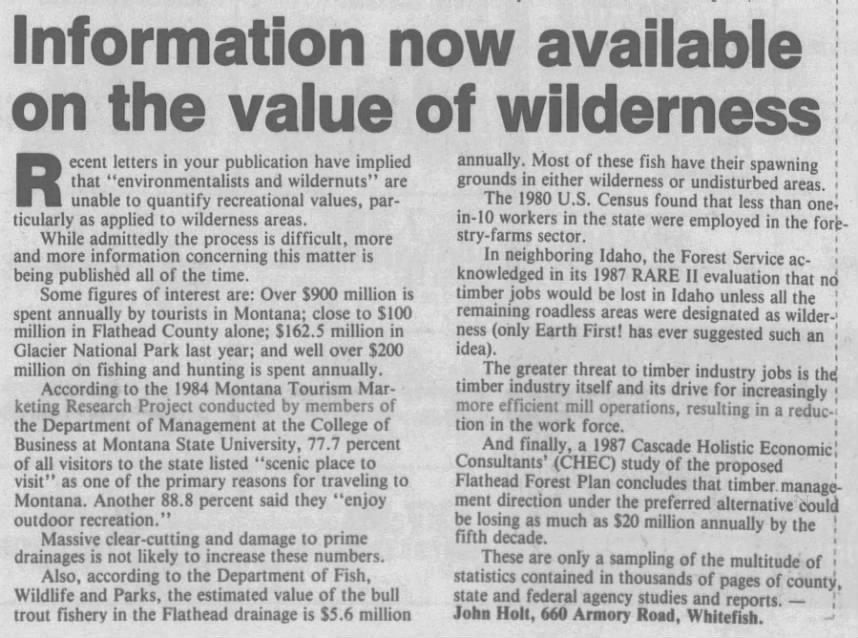
Information now available on the value of wilderness
Recent letters in your publication have implied that “environmentalists and wildernuts” are unable to quantify recreational values, particularly as applied to wilderness areas.
While admittedly the process is difficult, more and more information concerning this matter is being published all of the time.
Some figures of interest are: Over $900 million is spent annually by tourists in Montana; close to $100 million in Flathead County alone; $162.5 million in Glacier National Park last year; and well over $200 million on fishing and hunting is spent annually.
According to the 1984 Montana Tourism Marketing Research Project conducted by members of the Department of Management at the College of Business at Montana State University, 77.7 percent of all visitors to the state listed “scenic place to visit” as one of the primary reasons for traveling to Montana. Another 88.8 percent said they “enjoy outdoor recreation.”
Massive clear-cutting and damage to prime drainages is not likely to increase these numbers.
Also, according to the Department of Fish, Wildlife and Parks, the estimated value of the bull trout fishery in the Flathead drainage is $5.6 million annually. Most of these fish have their spawning grounds in either wilderness or undisturbed areas.
The 1980 U.S. Census found that less than one! in-10 workers in the state were employed in the forestry-farms sector.
In neighboring Idaho, the Forest Service acknowledged in its 1987 RARE II evaluation that and timber jobs would be lost in Idaho unless all the remaining roadless areas were designated as wilderness (only Earth First! has ever suggested such an idea).
The greater threat to limber industry jobs is the timber industry itself and its drive for increasingly • more efficient mill operations, resulting in a reduction in the work force.
And finally, a 1987 Cascade Holistic Economic! Consultants’ (CHEC) study of the proposed Flathead Forest Plan concludes that timber management direction under the preferred alternative could be losing as much as $20 million annually by the fifth decade.
These are only a sampling of the multitude of statistics contained in thousands of pages of county, slate and federal agency studies and reports. — John Holt, 660 Armon Road, Whitefish.