
Johnny Kern, Last of Highland City’s Many Thousands, Spent Life in Ghost City to Be Near Sweetheart’s Grave
AMONG the mountains south of Butte, where tall peaks are crowned with perpetual snow, amid which the storm clouds of summer are wont to gather in huge inky billows, preparatory to assaulting Summit valley beneath, where the mineralized mountain peaks are often the targets for electrical bombardments that light the sky with vicious, jagged flashes which fleck huge chunks from the sides of rugged boulders, and spell death for those who dare to venture within the electrically charged zone, stands the ghost city of Highland.
Amid these surroundings, backed by the towering peak of Red Mountain — appropriately named — surrounded by a dense forest and fortified against approach on all sides by deep, wooded ravines, brush-covered slopes, almost perpendicular declivities, and in winter by snow drifts 30 feet deep, the old town, its last citizen dead, its remaining cabins given up to snakes, bats, owls and mice, drowses in the sunlight or shivers under the fierce blasts of mountain winter, each day bringing nearer the time when its last vestige of human habitation will have vanished and the site alone remain.
Highland is a historic town. It loomed large in the early history of the western part of Montana. It is only 20 miles from Butte, air line, and 40 miles away by the most traveled road, and yet because of its comparative inaccessibility, this famous old mining camp of the ‘60s has almost ceased to be even a memory among the people on whom its ruins look down.
It is off the line of continental travel. The attention of tourists has never been called to it. It now has no claim to distinction save that it is a ghost city. Such places are no novelty to the people of the west.
Its Last Citizen
Highland City fell into decay in 1867. Except for a hardy few who were filled to the brim with the matchless faith of the born prospector, Highland has been a deserted city, saturated with colorful memories, for more than 40 years.
One by one the tiny remnant of its once numerous and virile population succumbed to time’s withering hand and crossed the ‘‘great divide” until at last, a few days since, the bugle of the Boy Scouts sounded taps for the last survivor, Johnny Kern, and Highland knows the sound of human voice no more.
In the snow-covered streets old fire hydrants stand, bent and dilapidated, rusting into nothingness. A half dozen log houses with boarded or broken windows are the sole remnants of a town that once housed thousands.
In the streets coyotes may be heard singing their weird songs as though even these denizens of the wild were oppressed with the utter loneliness. In the snow, the chance visitor will find huge cat-like tracks that tell of the visits of mountain lion which, with coyotes and jack rabbits, are the chief inhabitants of the surrounding wilds.
If one tarry a bit amid the desolation he will find himself warily approached by a bright-eyed bushy-tailed squirrel, which oddly enough seems disposed to meet friendly advances at least half way and which, if given a crust, will sit up like a grenadier to beg for more.
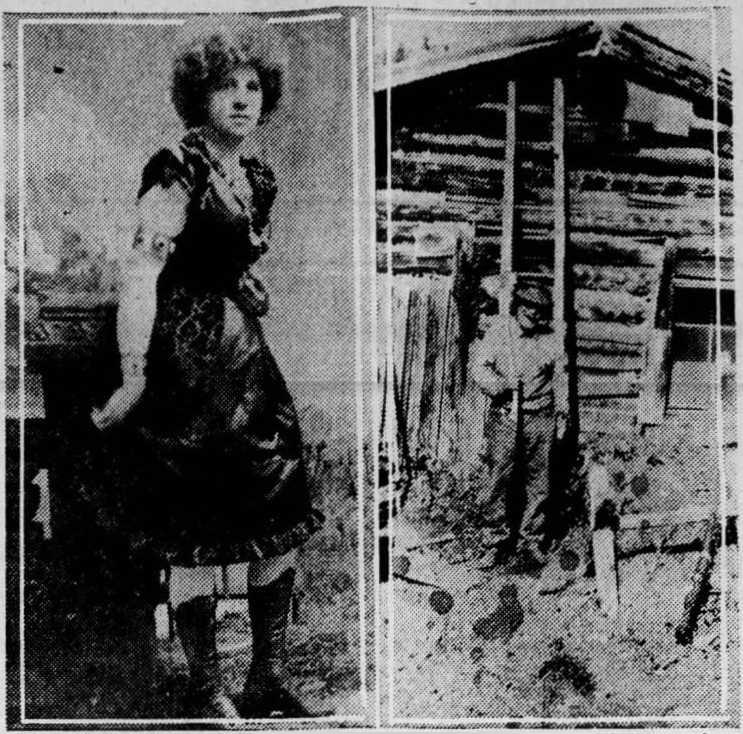
The picture of Johnny Kern, who passed away alone in his cabin in Highland City and who was buried last week, is from a snapshot taken by Boy Scouts last summer. It shows the old prospector before the only occupied building in the ghost city which once boasted a population of thousands. At the left is “Shotgun Liz,” a Russian dancing girl whom Johnny loved in the ‘60s, when Highland City was a roaring, bustling camp. The girl fell ill and died. She was buried in the cemetery under the towering slopes of Red Mountain. Johnny Kern tended the grave for more than 50 years. His dearest wish was that he might be buried beside her.
In Bygone Days
Here, in bygone days, when the west was young and full of romance, more than 6,000 adventurers are said to have congregated. As one views the scanty ruins that still survive it is difficult to believe that there could have been so many. The streams in those days were rich in nuggets and gold dust, the gold was of a high grade and the four quarters of the earth sent their quotas with pick and pan to gather up the prodigal richness of Montana’s high hills.
Here, too, came the merchant, the liquor dealer, the gambler and panderer, the variety show and the dance hall staffs.
Whether prospector or liquor dealer, gambler or merchant, they were men who had been tried in the crucible of western hardships and were, in the main, possessed of certain virtues which cast a sort of glamor over their vices.
In the days when “the weaklings died and cowards stayed at home,” only the most fearless and rugged of the trail blazers won their way to Highland City. They were men of undoubted courage; the swift ups and downs of western life—today a millionaire in embryo, tomorrow a pauper—had made them open-handed and generous. For the most part they were young and full of energy.
The crack of the Indian rifle was still common when Highland City mustered its hosts within its log cabins and dreamed of metropolitan greatness for itself. Human life was held cheaply. Among the rotting headboards in the old cemetery still stands one on which may be deciphered the legend that he who sleeps at its foot “was killed on the Fourth of July for getting too fresh.”
Under the shadow of Red Mountain, above the timber line, and sometimes even above the clouds themselves, life was full of zest. The miner, going to his diggings each morn, was spurred on by the hope of huge nuggets or mighty pans of gold dust; at night the gaming tables offered him an apparently easier but really a much more elusive chance to acquire wealth.
He Knew the Camp
Dr. S. C. Whitford of Floral Park, a pioneer and the son of the pioneer physician, O. B. Whitford, is one of the few Butte men who had acquaintanceship with Highland in the days when the name was synonymous with riches, generosity, excitement and joy of life. Referring to the death of the last survivor, John Kern, Dr. Whitford said: “I was a boy of about 15 in those days. I lived in Rochester and made frequent trips to Highland during the years 1867–68. The town was then in its final stage of decay—probably 150 or 200 people left. A few small placer claims were being worked, principally by the primitive method of the hand rocker, and a few quartz claims were being picked over, here and there.
Horace Countryman, the millwright, built the 30-stamp quartz mill in 1864–65 on the strength of a claim that had been exported by eastern people, who had pronounced it a bonanza. Evidently it was a great mistake or a big swindle, as the mill, to my knowledge, was never in use. It stands today a ruin, almost decayed.
“The only road to Highlands was from Twin Bridges through Rochester, thence to Highlands, 12 miles. Seven miles of this road was built over a marshy quagmire, through a deep canyon. The road was composed of poles and logs, laid crosswise, and I venture to say that it was the worst road in America.
“The mill material was transported over this road, much of it on the backs of burros and mules, and hardly a trip was made that an animal did not sustain a broken leg (and death in consequence), through slipping between the logs.
At Height of Excitement
“During the mining excitement, principally over the placer gold and during the construction of the mill, people came pouring in from all parts of the country and by 1865–66 there was a population of from 15,000 to 20,000 people. Saloons, gambling houses and hurdy-gurdy houses ran day and night and the same Alder gulch spirit of daring of 1863–64 prevailed.
“I remember attending dances at Highland, and most of those affairs were given by Tom Robbins, whom every old timer will remember, a big, genial, great-hearted man. The women wore the usual calico dresses and heavy shoes. The men, heavy bearded, flannel shirted, with open shirt bosoms showing hairy chests, pants in boots, half-shot with the wildest whiskey that was ever made, danced the nights away.
“This was after the ‘cleanup’ of the road agents (known as Plummer’s band), and at this time the proverbial gun on the hip was not in evidence. It was at one of these dances that I first met John Kern, a bright-eyed, healthy-cheeked youngster who traversed the long road from youth to old age under the shadow of Red mountain and who, at his passing, had won what was to him, no doubt, the most cherished distinction that could come to him—that of being the last survivor of the city to which he gave his all.
Deserted in ’83
“In 1883, while I was coroner and city physician, I got Rod Leggat to accompany me to Highland to hold an inquest on the body of John Wilson, who was found dead in his cabin. Wilson was one of the last of the old timers. Highland was then an almost deserted camp, only Kern and a few others who worked placers with hand rockers remaining.
“I was connected with a rather odd incident that occurred in Highland in 1868. A miner had been bed-ridden with rheumatism for some weeks and I was delegated to take him to town for treatment. After placing him comfortably in a wagon on a mattress, we started off. We had not gone far when the horses became frightened at a bear crossing the road, and ran away, striking a boulder and throwing myself and the patient up in the air and out by the roadside. The patient and the mattress alighted on a large rock. I was badly dazed but I can see him now, wild-eyed and white-faced, rise up and then start for town at a good lively pace. 1 had cured his rheumatism. I was taking this patient to my father to be treated, but cured him on the road. When he met my father later he said it was ‘the quickest and cheapest cure’ he had ever had.”
The casual visitor, the Boy Scouts who make their annual camp in Highland, and Butte people who knew Johnny Kern, frequently remarked: “What keeps that old fellow in Highland? Does he think he is going to strike it rich some day?” Johnny had found one of the large nuggets of the west, worth $1,880, about 15 years ago, and this caused the impression to prevail that the lure of gold tied Johnny to the deserted village.
But there was another side to Johnny’s character, a sentimental one, and from facts gleaned by Coroner John C. Murphy there were two reasons, not connected with gold, that held Johnny Kern chained to his mountain home up among the clouds.
Why He Stayed
In the great rush of 1865–66 there came, among others, a Russian girl, a clever dancer, of passing good looks and fine figure. Johnny Kern, whose true name was Kann, born in Pittsburgh, of German parents, found favor in the sight of the Russian dance hall girl. To Johnny, she was a dream of loveliness. Here among the granite boulders, surrounded by the primeval, a primitive passion between these two developed. The girl, when she arrived, was known as Lulu. When she had emptied the contents of a shotgun into a man who had sought to win her by caveman methods, she was dubbed “Shot-gun Liz” by the inhabitants.
The hectic life of a mining camp proved even too much for the dashing Russian dancer and she died one day in her rooms at the dance hall in 1867. She was buried in Highland cemetery. The chief mourner was John Kern.
He had relatives in the east with whom he had corresponded regularly but gradually he ceased to write after the death of “Shot-gun Liz.” In 1874, his papers show, he received a letter from a little girl cousin in Red Wing, Winn., begging him to write “at least once a year.” In 1882, so far as his effects show, he received his last letter from the outside world. These were all carefully stored in a tin box which showed the marks of the pack rat’s teeth.
True Until Death
Johnny Kern divided his time between his rocker and the little grave where the remains of his dance hall sweetheart lie. He tended it carefully during life. He wanted to be buried beside her in death. His associates had been told the particular spot in which he wished to lie.
It is said that Johnny was not the only Highland dweller who was tied to the place by his affection for a dead sweetheart. Another old-timer cherished the same feelings and waited for the time when he, too, would sleep by the side of her whom he had loved. But death was unkind to him. He lived while others dropped off one by one until at last, in a panic for fear he might be the last survivor, with no one to carry out his cherished wish, he committed suicide. Johnny Kern buried him. Only he and Johnny were left when he took his life.
“He died for love,” said Johnny to those who inquired as to what had become of his last pal.
Independent was old Johnny Kern. He asked favors of none. He would accept a grub stake because that was according to mining ethics, but charity from none. Under the guise of a grub stake—a sort of partnership in anything he might strike—a kindly bank cashier in Butte, who had known Johnny for 40 years, contrived to help the old man along. Kern did not realize that he was growing old, which is not unusual with men who have no one to remind them of the fact. Johnny Kern was willing to admit that he was not so strong as he once was, being temporarily “run down a bit,” from which he would soon recover and be as fit as ever.
During the past winter A. J. Davis was driving down the 18-mile road when he saw a man break cover in the ravine and come clamping out on the road muffled to the chin, his feet in heavy rubber boots.
“Going to Butte?” inquired Mr. Davis. The man nodded. “Get in and ride,” suggested the banker.
“I’m a good hand at walkin’,” said the man with a shift of his shoulders.
Just then Mr. Davis recognized him.
“That’s Johnny Kern isn’t it?” he asked. Johnny peered into the auto.
“Oh, it’s you, Mr. Davis,” he exclaimed. “Then I’ll get in. But I don’t accept lifts from every one. It isn’t just—well, it isn’t independent like.”
Time came when the body of Johnny Kern refused to obey the commands of Johnny Kern’s spirit. He had long since passed the alloted age of three score and 10—he was born in 1845.
When the cold snap of February came, it proved too much for the withered frame of genial old Johnny.
While busy about his cabin he dropped to the floor, probably unconscious from the cold which, like age, had insidiously struck to the marrow of his bones and laid him low.
His companion, a tame squirrel, came out from his nest in the old man’s bunk and wondered what had come over his friend. Being a squirrel, he could do nothing but sit up on his hind legs as Johnny had taught him and wonder. When his old master no longer moved, no longer furnished the crusts, the little bushytail went forth to fend for himself.
The coroner, after a heart-breaking trip on horses and snowshoes, finally reached Johnny’s home. The old man was frozen solid. He had been dead at least a week.
Thus passed the last of the Highland old-timers.