
Joseph Heller
Catch-22: A Dramatization
Based on the Novel Catch-22
FOREWORD BY THE AUTHOR
ILLUSTRATED WITH PHOTOGRAPHS
Praise for the book
“Any thought that Catch-22 might be a victim of overexposure is dispelled by the stage version that Joseph Heller has adapted from his novel.... Heller’s play accents the humor, the Marx Brothers side, of the novel ... and can stand alone.”
—Mel Gussow, The New York Times
Synopsis
Few books have had the impact of Catch-22; it has become a classic in its own time and the yardstick by which every comic and every anti-war novel is measured. It has sold nearly six million copies in this country alone.
Now Joseph Heller has captured its hilarity and depth for the stage. The essence is here: Yossarian’s mad sanity; Major Major’s unique office technique; Luciana, the whore who refuses to marry anyone willing to marry her; ex-P.F.C. Wintergreen, who really runs the army; Milo Minderbinder, the black market genius who invented chocolate-covered cotton; the publicity-crazed officers; the demented doctors; the chaplain who may have important papers hidden in a tomato; and Doc Daneeka, who has difficulty convincing people he’s still alive.
The new foreword by the author explains how the play came to be, why certain scenes were included and others deleted, and recounts the history of the production. In addition, Heller discusses the major themes of Catch-22 and draws astonishing parallels between the events in the book and the events in today’s newspapers.
JOSEPH HELLER wasborn in Brooklyn. During World War II he was decorated for his sixty missions as a B-25 bombardier in the Mediterranean Theater of Operations. He received his Bachelor’s degree from New York University, his Master’s from Columbia University, and he attended Oxford on a Fulbright scholarship. His first novel, Catch-22, has become an international bestseller, and it has been translated into every language in the civilized world. Joseph Heller is also the author of the play We Bombed in New Haven. Mr. Heller teaches creative writing and is currently a professor of English at City College of New York. He is married, has two children, and lives in Manhattan.
Front cover art by Riccardo Manzi
JACKET DESIGN BY Irv Bogen
Photograph by Jim McMullan
for Crawdaddy Magazine
DELACORTE PRESS
NEW YORK
Also by Joseph Heller
CATCH-22
(Novel)
WE BOMBED IN NEW HAVEN
(Play)
Copyright © 1971, 1973 by Scapegoat Productions, Inc.
All rights reserved.
No part of this book may be reproduced
in any form or by any means without
the prior written permission of the Publisher,
excepting brief quotes used in connection with
reviews written specifically for inclusion
in a magazine or newspaper.
Designed by Joel Schick
Manufactured in the United States of America
First Delacorte printing
Library of Congress Cataloging in Publication Data
Heller, Joseph.
Catch-22.
1. World War, 1939–1945—Drama. I. Title.
PS3558.E476C3 8i2’.5’4 72–10200
CAUTION:
Professionals and amateurs are hereby warned that CATCH-22 is subject to a royalty. It is fully protected under the copyright laws of the United States of America, the British Empire, including the Dominion of Canada, and all other countries of the Copyright Union. All rights, including performance rights, whether professional, amateur, motion pictures, recitations, lecturing, public hearings, radio broadcasting, television and the rights of translation into foreign languages are strictly reserved. In its present form the play is published for the use of the reading public only.
Permission for any other use, including, without limitation, readings or performances whether by professionals or amateurs, must be obtained in writing and royalties paid. Applications for such permission and for royalty rates should be made to Samuel French Inc., 25 West 45 St., New York, N.Y. 10036, or to Robert Lantz-Candida Donadio Literary Agency, Inc., in West 57 St, New York, N.Y. 10019.
To
LARRY ARRICK
who labors in the theater for love
though not always by intention.
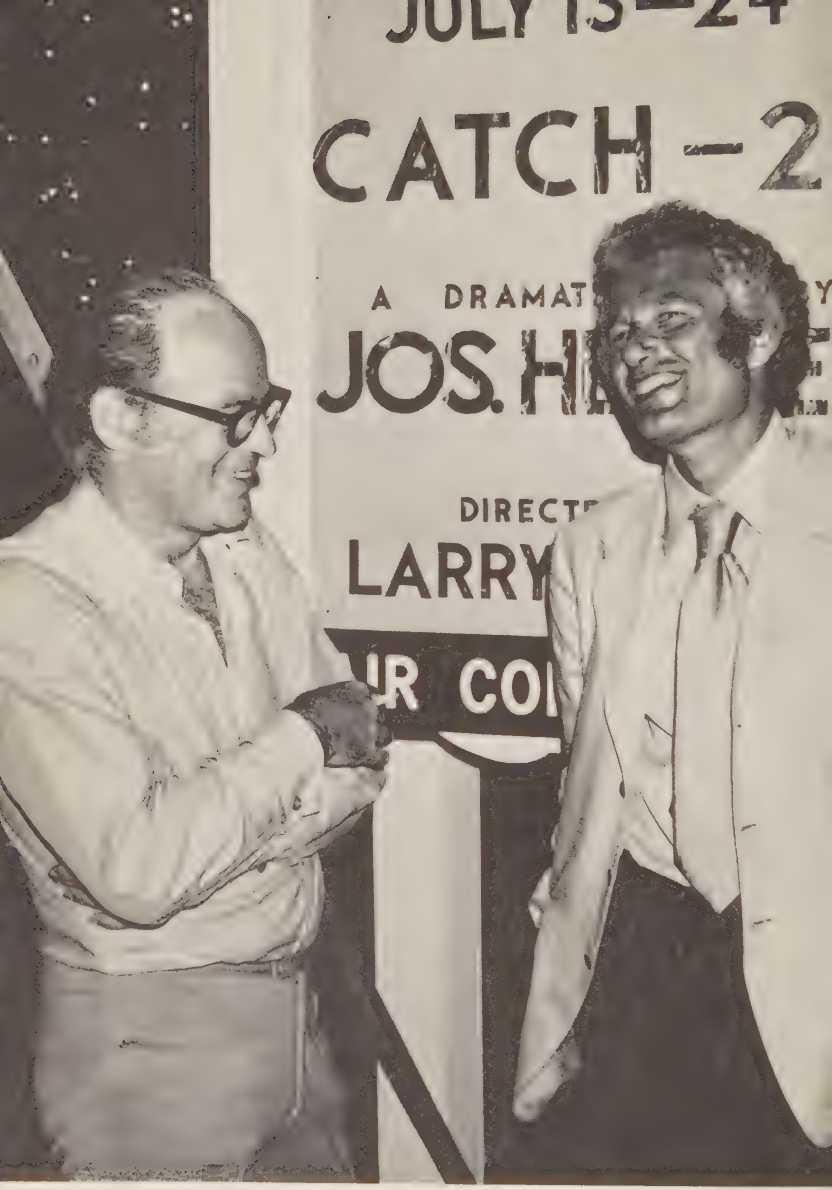
John Drew Theatre, East Hampton, N. Y.
July, 1971
Foreword
THE first performance of Catch—22 as a play was given at the John Drew Theater in East Hampton, New York, on July 13, 1971. It was directed by Larry Arrick, who had introduced my earlier play, We Bombed in New Haven, at the Yale School of Drama in 1967.
For me, for the John Drew Repertory Company, and for most of the audience and critics, the production was a success. There was praise from Alan Wallach in Newsday and William Raidy in the Long Island Star and other Newhouse newspapers, and a long and very favorable review by Mel Gussow appeared in the New York Times. Requests for permission to present the play began to arrive from college theater groups and other amateur and stock companies in different cities. Before the summer was over, a second production was in preparation in Chicago, by the Kingston Mines Theater Company under the direction of Gary Houston, where it played, triumphantly, I choose to assume, for twelve or sixteen weekends. There have been numerous productions since, in this country and abroad.
It was largely due to Larry Arrick that I completed the dramatization when I did. Arrick and I met again in early 1971 in connection with the videotaping of part of Ike Bombed in New Haven for National Education Television’s program “The Great American Dream Machine.” I remarked that I was busy with the final sections of my new novel and that in spare-time evenings I had been taking parts of Catch-22 and attempting to transform them into some kind of dramatic form. (The motion picture was finished, and the stage and television dramatization rights had reverted to me. ) Arrick disclosed that he would be directing the program for the John Drew Theater that summer and would be interested in including Catch-22 among his productions, if there was anything of Catch-22 to include.
Our agreement was simple. I would endeavor to hand him the first draft of a play within a month; he would produce and direct if he thought it worthwhile. At my insistence, all creative control was to be his, including the right to delete as much as he wanted to. All I had to do in return was come see the play after it had been running a few days. From his point of view, the arrangement was ideal: stage directors have learned that the most cooperative playwright is a dead one whose works are already in the public domain.
As it turned out, I had much the better of it, I feel. The play opened on a weekday to an audience, I was told by telephone, that was expectant and appreciative. The reviews in the two Long Island newspapers were laudatory. On Saturday, my wife and I, together with my nephew and his wife, drove to East Hampton from Fire Island, had a good dinner in a cozy restaurant, and enjoyed a brand-new thrilling play—Catch-22!—glittering (to my narcissistic eyes, anyway) with countless delightful staging and acting surprises I could not possibly have anticipated by keeping such distance. Most of these have been incorporated in the script. The theater was full. The audience was awake and responsive, in step with the quick tempo of the work from the start, and laughed and applauded generously; if anything, the play possibly was “too funny,” a bit more humorous in that first presentation than either I or Arrick had intended or would have wished.
A few days afterward the review in the daily edition of the influential New York Times appeared, praising both script and production extensively and, along with Raidy and Wallach earlier, authenticating, I felt, the adaptation as a bona fide theater work, as a play with an identity of its own apart from the novel and the movie. For me, there was a happy ending to an experience that had been gratifying and comfortable throughout. (Backstage, however, an air of fatigue was present, and it was easy to detect that some members of the company were no longer on congenial terms with all of the others. They worked a schedule that summer that was unimaginably hard.)
Though the idea of finishing Catch-22 as a play had come from Larry Arrick, the idea of starting it had been in my mind about ten years, from the time of the publication of the novel back in October, 1961: even while still writing the book I had the strong impression that many of the dialogues had a potential for effective staging, and other sections equally so if their content could be externalized competently into spoken words. This feeling was reinforced soon after publication by interest from people active in the theater. Strangers wrote, asking to be allowed to turn the novel into tragedies, comedies, and musicals, or certain chapters into one-act plays. Others did their dramatizations first and then asked permission. The book was soon a widely used source of exercise material for actors and directors working with training groups. Since so many people were already dramatizing Catch-22, I felt it made some sense for me to think seriously about doing it someday too. From David Merrick came a lenient and extremely liberal offer that would have let me try the adaptation without the help of a more experienced collaborator. At that time, though, I had neither the confidence nor the ambition to commit myself to a stage play. Nor did I wish to postpone the possibility of a sale of motion picture rights that would have enabled me to leave my advertising job with McCall’s magazine.
In August of 1962, therefore, with something like a month’s vacation on my hands, with no idea for a second novel in mind, and with much titillating chatter about Broadway buzzing in my ears, I began, purely as an experiment, a diversion, and a test, to take sections from the book almost at random and turn them into play-script form. At the end of August, the motion picture rights were sold, and I stopped. I reserved the stage and television dramatization rights for myself, but they were not to be used until after the release of the motion picture. By the time I stopped, I had transposed five scenes for the stage to my initial satisfaction: the trial of Clevinger, p. 76 (all page references are to the Dell paperback edition of the novel ) ; the seizure and trial of the Chaplain by three officers who refuse to identify themselves or state their sources of authority, p. 387; the interrogation of Yossarian by two of these same three mysterious officers after he has been stabbed by Nately’s whore and is lying in the hospital in need of medical attention, p. 439; a moody, intimate love scene on the beach between Yossarian and Nurse Duckett, which, in the novel, is portrayed in most general terms and contains no dialogue, PP- 345–347, 355; and the futile, desperate efforts of Doc Daneeka to establish that he is alive after an erroneous entry in a flight log places him aboard a plane that has crashed, p. 350. Tn the novel, the chapter about Doc Daneeka also contains almost no usable dialogue, although the progression of actions leading to his ultimate failure is stated specifically.
Already, one could diagnose in these five scenes, presumably picked with indifference, an unconscious partiality I was showing toward subjects I felt important. Four of the five are about law and repression. The other is about death.
Things have changed in the nine years since, but they have not changed much, and all but one of these scenes are included in the play. The exception is the trial of Clevinger, which was omitted for reasons of length and not of substance. By the time I went back to the play in 1971 the war in Viet Nam had been escalating openly for seven years, and the largest and most lethal belligerent in that devastating conflict was ... us.
There is much about law in the novel. Catch-22 itself, unread, unseen, perhaps even non-existent, becomes a handy edict for overriding all safeguards to individual liberty and safety, the key element in a tricky paradigm of democratic government that allows the law to do legitimately what the law expressly prohibits itself from doing. “Catch-22 says they have a right to do anything we can’t stop them from doing,” the old woman in the whorehouse explains to Yossarian (p. 416), and, in practice, she is shown to be correct. Throughout the novel, there are inquisitions, trials, sneaky undercover investigations, bullying interrogations, and numerous more cruel, unpunished acts of intimidation and persecution by people in positions of power, no matter how small, against others who are decent, innocent, and harmless, or whose offenses, if committed at all, are trivial. Many of these episodes are in the play. Thematically, in fact, the play is structured around such unchecked misuses of authority in an atmosphere of war.
Much of our national experience in recent years has been characterized by the same.
Anyone in touch with the news these past few years must be aware of the many legal actions of major scope and doubtful merit that have been launched against people who have been conspicuous critics of our military actions in Indochina or active opponents of racial discrimination here at home. With heavyweight champion Muhammed Ali (Cassius Clay), who was denied conscientious objector status as a Black Muslim and subsequently found guilty in the lower courts of violating the Selective Service Act, we had an example of both. One ought to note also the many times jurors have refused to convict in these trials and the other times convictions were set aside on appeal or prosecutions discontinued — often because of illegal eavesdropping activities by law-enforcement officials. The suspicion has often been strong from the start that the true motives behind these court proceedings were not lofty but selectively spiteful: to inflict severe, disabling punishments upon these individuals more for their irreverent opposition to official policy than for actions seriously criminal. The suspicion has been substantiated by the outcomes. Legally, these cases have been fiascoes. From the vindictive point of view of the prosecution, however, they have not been entirely wasteful, for the power to put people on trial is itself the power to punish heavily. Such trials, however, are rank persecutions.
In the trial of the Black Panthers in New Haven on charges of murdering one of their members, as in the charges against Angela Davis in California in connection with the shootings outside the Marin County courthouse, people were killed; but in so many of the others, it has been difficult to locate a crime that took place and impossible to identify a victim who suffered by it. Where acts were committed, they were acts more of impertinence than destruction. It is doubtless true that Father Philip Berrigan, Father Daniel Berrigan, and seven other people, who all together came to be known as the Catonsville 9, poured animal blood over records in a Selective Service office in Maryland. It is difficult, however, to measure this soberly as a “crime” against the people or to believe that society has been grievously crippled as a result. Who suffered?
For want of anything more concrete, the abstract charge of conspiracy has often been lodged, that rare and heinous crime of doing nothing more than talking about doing something illicit. (What illegal conspiracies have been formed more likely originate inside the halls of justice and more likely exist in the courtroom between prosecutor, judge, and policeman, who draw their paychecks from the same bank account and depend for promotion on the same political superiors.) The public announcements at the beginning have been grandiose, and the allegations are frequently wild.
Believe it or not, in Harrisburg, Pennsylvania, recently, with John Mitchell as U.S. Attorney General, Father Philip Berrigan, who had been in prison all the while for his role in the Catonsville action, Sister Elizabeth McAllister, and four other adults, collectively known as the Harrisburg 6, were indicted and tried, at an estimated cost to the federal government of two million dollars, on charges of conspiring to kidnap Henry Kissinger, a presidential aide, as a gesture of protest against the American war in Viet Nam and, furthermore, of conspiring to blow up the underground heating system in Washington, D.C.
The charges sounded preposterous. Their credibility was not enlarged by the evidence presented in court by the federal prosecutor. (In one of those beguiling coincidences that chance constantly takes pains to provide, his name was Lynch.{1}) The chief witness for the government in Harrisburg was a fellow-inmate of Father Berrigan’s in Lewisburg Prison, an habitual criminal working as a paid informer for the FBI for an asking price, it was revealed, of $50,000 tax free, though he received less. His testimony was unimpressive, even in Harrisburg. The jury voted ten to two for acquittal. The jurors in Harrisburg, a tranquil and conservative area selected as the site of the trial for precisely those qualities, either did not believe the government’s case or did not feel that conspiring to kidnap presidential aide Henry Kissinger and hold him hostage for a week was much of a crime.
In Boston earlier, Dr. Benjamin Spock, Reverend William Coffin of Yale, author Mitchell Goodman, and Michael Ferber, a graduate student, were brought to trial for attempting to build public resistance to government operations in the matter of the draft and the war. Here the charges were true. The activities and goals of the group were stated openly from the beginning and widely advertised. All went free.
As an outgrowth of the street disturbances during the National Democratic Convention in 1968, there was the trial of the Chicago 7 on very vague charges of conspiring to cross state lines for the purpose of creating those disturbances. Some of the seven were scarcely acquainted with the others if at all, and there had been no plans or communications in which all had participated. Yet, they were brought to court together, again under Attorney General John Mitchell, in a trial presided over by a distasteful old man whose crude and insulting bias soon made people stop wondering how he’d ever become a judge and start wondering how he’d ever gotten through law school. The jury acquitted the defendants of all the major charges. Because of the verdict, Black Panther leader Bobby Seale, whose case had been severed from the rest, will not be brought to trial.
Seale was acquitted also in New Haven with other Black Panthers on charges arising from the murder of one of their members. In New York City, some fifteen or so Black Panthers were tried and found not guilty of conspiring to detonate bombs in, among other places, Bloomingdale’s department store. By the time of their acquittal, most had spent nearly twenty months in prison. Bail averaging about $100,000 had been set for each, an amount widely viewed as excessive for a situation in which no acts of violence had been attempted, and it would have required approximately a million and a half dollars for all to be freed during the long wait for trial. Verdicts of not guilty do not necessarily signify that Blacks get fair trials; they get fair juries—if they are lucky.
Muhammed Ali was not lucky and was found guilty. He was deprived of his heavyweight championship and he paid millions for his principles before the verdict was reversed by the U.S. Supreme Court. Active and prospering again, and brash and wise as ever, he remains perplexing to his staid peers and superiors, for in this free-enterprise culture of ours, reputable citizens are not supposed to pay for their principles; they are supposed to profit from them. Otherwise, what good are they?
In California now Daniel Ellsberg and Anthony Russo, Jr., are slated to go on trial someday for espionage, theft, conspiracy, and whatnot for releasing classified government documents now known as the Pentagon Papers, a voluminous effort undertaken to assemble as history the private records leading to this country’s increasing involvement in the war in Indochina. One stark conclusion to be derived from the Pentagon Papers is that Lyndon Johnson and his staff cruelly and systematically lied to the press, to the American people, and to both houses of Congress about what was happening in Viet Nam and what they intended to do. (They could not lie so successfully to our “enemies” in Viet Nam, who knew the truth through experiencing it and were therefore less naive than Congress and most of the country.)
Another utterly appalling revelation is that none of these distinguished gentlemen, these models of rectitude who were welcome in second-best homes everywhere, seemed to have experienced any compelling discomfort over playing the parts of liars in a deception about a bloody enterprise that has already produced more American dead and wounded than World War I. None resigned in disgust to denounce the others. When McGeorge Bundy left, it was for a better-paying job with the Ford Foundation.{2}
As to the Ellsberg trial itself, the legal possibilities, as of this date, are intriguing. The defendants were authorized to have the material; they did not steal, but photocopied, it; they did not deliver it to a foreign power but made it available to the American public through the medium of the press. A number of other copies of the entire study were in the possession of people who no longer held government position. Is this espionage? In the aftermath, it is clear that nothing was damaged but the reputation for efficiency and probity of a Democratic administration that was already sunk in disdain. Astonishing as it may be, rumor has it that no law exists that was broken by the release of this information. So, while Ellsberg and Russo still may go on trial in California for violating laws that might not exist, a grand jury in Boston continues hearing secret testimony on the same matter in an investigation to find some, or at least turn up somebody who is guilty of something! (“The case against Clevinger was open and shut. The only thing missing was something to charge him with.” p. 73.)
Ellsberg is really being tried for embarrassment, for bringing confusion and ridicule to the present Nixon administration, which is not otherwise implicated by the Pentagon Papers. The charge against him and Russo is effrontery. as legally defined the crime of effrontery lies in a failure to show respect to people in high office who will never feel sure they deserve any.
Catch-22 begins with a secret investigation. In the play, which is shorter, it is introduced more quickly and made more explicit. An undercover search takes place to find the person or persons guilty of writing Washington Irving’s name on the envelopes of censored letters of enlisted men. Preposterous? Of course. But any more preposterous than maintaining in court with a straight face that the Harrisburg group was seriously engaged in a plot to kidnap Henry Kissinger, a presidential aide, and blow up the underground heating system of Washington, D.C.? The investigation widens, and in Act II the suspicion is voiced that the Chaplain has been concealing stolen secret documents inside a plum tomato. This is preposterous too, but hardly more improbable than the real-life event that suggested it: the Whittaker Chambers-Alger Hiss case of the 1940s in which the former produced evidence he declared had been hidden inside a pumpkin.
What all these illustrations of due process gone awry have to do with the adaptation that follows may seem somewhat remote. Reference to them, however, may help explain several of the fundamental choices made in taking subject matter from a complicated and perhaps rather long novel published ten years earlier for use in a play that must by necessity be shorter, swifter, simpler, and more direct.
It was clear from the outset that large changes would have to be made. Plays and motion pictures, unlike novels, I feel, require a distinct, prominent narrative line accelerating toward a climactic resolution that, at best, is both surprising and inevitable. Much of the book would be eliminated or compressed. Characters must be omitted or combined, and their relative importance different in the play than in the novel. The chronology was put in order. The need for unity and consolidation seemed obvious.
The first draft of the play was two hundred typewritten pages. The second, completed in time for the production in East Hampton, was down to an acceptable one hundred and thirty-one. Apart from a large number of small changes made after seeing the play performed, it is very much the same script that is published now and the one currently used in commercial and amateur productions.
Many well-known passages from the novel were excluded simply because they could not fit closely enough with what came before and what would follow. Some were discarded with joy, others abandoned reluctantly. For reasons alluded to earlier involving Reverend Coffin, both brothers Berrigan, and protest activities by other members of the clergy, I was pleased to be able to include almost in its entirety the callous arrest and trial of the Chaplain, and pleased as well to find room for the heartless insistence upon a security clearance for Yossarian before he is permitted to receive the medical care he needs. Each, in fact, helps justify the other. It was with relief that I set aside almost all of the “The Eternal City” (p. 413) and decided to omit entirely the character Orr. The former, a pivotal chapter in the novel, would, I felt, be superfluous and pedagogical in the smaller and more energetic context of the play; in addition, there would be staging problems requiring solutions that would depart egregiously_ from the stylistic nature of the rest. Orr, I thought, was intrinsically undramatic, for his true purposes are disguised from everyone until long after he is gone. I could have made him comical but only that, and he would have taken up space extravagantly in a narrative form in which the need for economy, I feel, is especially stringent.
The trial of Clevinger was taken out because it was too long. (As countless acting classes have discovered, the chapter “plays beautifully,” and possibly I will offer it soon as a one-act play, since most of the work of dramatizing it is done.) The scene ran nearly twenty pages, too many for a secondary character whose basic function in the total organization is to come on stage as a trusting, idealistic young man and be slaughtered.
Milo Minderbinder’s role is smaller; Wintergreen’s larger; and Major Major and Major Danby are combined.
Milo has fewer scenes in the play, but enough to demonstrate how virtue and viciousness can exist harmoniously within one soul—if that one soul is simple and determined enough—and to epitomize the ascendance of profits over people and even patriotism. At the end, Yossarian is a fugitive, and Babbit has the bomb.
Wintergreen is unimportant as a character but indispensable as a channel of expository information necessary to make other scenes operable. He is the nucleus of the lively segment in which Doc Daneeka strives fruitlessly to convince people he is alive; I cannot think how else this passage could have been dramatized without introducing Wintergreen into it as an all-knowing mail clerk who reads everything that passes through his hand. On each of the occasions Yossarian seeks him out for help, and is, of course, refused, Wintergreen supplies the audience, through remarks to Yossarian, with details preparing the way for much larger scenes involving the Chaplain, Milo, Colonel Cathcart, Major Major, and others.
Major Major and Major Danby are compatible people in the book. Several scenes were planned for Major Major, only one for Danby—the last. I thought it better to combine them than to bring a strange character on stage for that important discussion just before the end.
There are forty parts in the play and more scenes than I have counted, to be performed by a smaller number of actors playing multiple roles. The cast at East Hampton totaled twelve, ten males and two females. Michael Lombard played such dissimilar people as the whining hypochondriac Doc Daneeka, the mocking Colonel Korn, and a nervous, frantically determined C.I.D. man zooming down like a guided missile on a startled Major Major, shifting adroitly from one part to the other with just a slight change of outer garment. Anthony Holland was a comic delight as the snarling, sexually obsessed psychiatrist and frail and touching as the Chaplain, while Adam Arkin was cast as all five young men who die. The two actresses in the cast played the eight female parts. John Pleshette played only Yossarian, and it is probably better that the person playing Yossarian do only that part.
The play is consciously cinematographic. Characters come in sight when they are ready to speak or be spoken to and leave the stage as soon as they are through, commanding attention to themselves in much the same way that a movie camera directs the gaze of an audience from one person to another. Locales change rapidly.
Both novel and play begin and end in the hospital. The war continues. The effort to “look good” supplants all other military objectives in importance. A few trifling and whimsical actions by Yossarian at the start touch off irrational investigations threatening others ceaselessly. At the end, Yossarian must choose between alternatives that are dangerous or repugnant. There is no prospect of reprieve.
“No hope,” is the judgment agreed upon near the end. “No hope at all.”
Minna Diskow in Twentieth Century Literature (Vol. 12, January, 1967, pp. 186–193) has explained more .lucidly than I can how these words, which are repeated, relate to Yossarian’s “Night Journey” through Rome earlier (p. 420) and how both passages can be associated with Dante’s Inferno and that ominous warning at the entrance to Hell: “All hope abandon, ye who enter here.”
Yossarian turns back in defiance, and it is with a feeling of optimism and exultation that he elects the difficult course of escape.
“At least,” he says, “I’ll be trying.”
There’ve been optimistic signs in recent events that suggest such rebellious efforts at preserving one’s body and one’s soul may prove successful. [There is cause for pessimism too in events that are even more recent. J. H.] Outstanding among these favorable omens, I feel, are those startling, those amazing jurors, selected to the extent permissible for their built-in aversions to the defendants and the philosophies they are presumed to represent, who refuse to convict only because they are asked to. (I am aware that there have been countless cases receiving less attention in which atrocious penalties have been imposed for infractions that are petty or understandable. I am also aware that beyond a certain point there is no lawful remedy for these injustices perpetrated by the courts. )
There was that jury in San Jose, California, just a few weeks back that found Angela Davis not guilty on all counts charged! The key factors were against her: she was Black, she was educated, she was a Communist, she was militant, and she could be linked with at least one of the persons who
were involved in the killings and with the weapons used. Local hostility was virulent: a white dairy farmer who advanced bail was ostracized and put out of business. But the case against her must have been lamely, despicably weak: not once in the several ballots inside the jury room was there a single vote for conviction!
When put to the test, twelve ordinary people in upper California whose names I never even bothered to note displayed more intelligence and moral sensibility in a courtroom than the prosecution gave them credit for possessing, transcended those instinctual fears and prejudices that lurk inside all of us, braved the enmity and displeasure of others in their communities, and unanimously and emphatically declared: “Not guilty!”
Bravo to them.
July 1972
Catch-22: A Dramatization
Joseph Heller’s dramatization of Catch-22 was first performed by The John Drew Repertory Company at Guild Hall, East Hampton, Long Island, New York.
Cast of Characters
| JOHN PLESHETTE | Yossarian |
| DAVID ACKROYD | Major Major, Colonel Cathcart |
| ROSE ARRICK | Luciana, Patient’s Mother, Nately’s Mother, Old Woman, Daneeka’s Mother-in-Law |
| JAMES BRICK | Ex-PFC Wintergreen, Nately’s Father, Old Man, Investigating Major |
| ANTHONY HOLLAND | Chaplain, Psychiatrist |
| MARCIA JEAN KURTZ | Nurse Duckett, Nately’s Whore, Mrs. Daneeka |
| MICHAEL LOMBARD | Doc Daneeka, Lieutenant Colonel Korn, C.I.D. Man |
| JEFFREY NIELSON | Texan, English Intern, Captain Black |
| LOUIS PLANTE | Milo Minderbinder, Patient’s Father, Aarfy |
| ADAM ARKIN | Clevinger, Patient, Nately, McWatt |
| NEIL MOSS | Second Doctor, Corporal Whitcomb, Gus |
| WILLIAM REILLY | Sergeant Towser, First Doctor, Patient’s Brother, Wes, Investigating Captain |
Directed by Larry Arrick
Sets and lighting designed by Robert U. Taylor
Costumes designed by Patricia McGourty
Production stage manager Christopher Kelly
The Time: World War II.
The Place: An American air base off the coast of Italy.
Stage Set
Two desks, telephones, two beds, some chairs, a table. A door frame and a window frame. A few upright coat racks. The furniture is grouped in a loose semicircle, leaving stage space on both sides and in front.
Action within the area of furniture will be action that takes place indoors. Action outside it occurs outdoors.
The doorway is used for formal entrances and exits. At other times actors move as convenient directly to where they have to go.
Act-1
[The CHAPLAIN enters carrying a pad and moves to one of the desks]
CHAPLAIN
Dear wife. In the hospital today I met a likable young man ...
YOSSARIAN
[Entering]
Me.
[YOSSARIAN wears flight gear. He hangs his parachute harness and flight jacket on a coat rack and puts on a hospital bathrobe]
CHAPLAIN
... who has a very simple wish. He wants to live forever.
YOSSARIAN
Or at least die in the attempt.
[Lies down on bed and begins censoring letters]
The trouble is—
[The TEXAN enters, wearing pajamas and a robe, and pulls a chair up to the side of YOSSARIAN’s bed]
TEXAN
Hi, there. I’m from Texas. Thought I’d mosey on down the ward and get neighborly with you. What are you doing?
YOSSARIAN
Censoring letters.
TEXAN
Say, I bet that’s exciting—reading other people’s mail.
YOSSARIAN
Monotonous.
TEXAN
Ever hear of an officer here named ... Washington?
YOSSARIAN
George?
TEXAN
Irving.
[YOSSARIAN shakes his head]
Ever run into a guy named ... Irving?
YOSSARIAN
Irving what?
TEXAN
That’s his last name.
[Unhappily, as YOSSARIAN stares at him]
Washington.
YOSSARIAN
Washington?
TEXAN
Irving.
[YOSSARIAN shakes his head]
He’s been censoring letters in a most peculiar way. You’re not him, are you?
YOSSARIAN
I’m Yossarian.
TEXAN
I’m mighty glad to hear that. I’ll let you in on something. I’m an undercover agent, a C.I.D. man. Keep that quiet. I don’t want anybody to know.
YOSSARIAN
Everybody knows.
TEXAN
Who told them?
YOSSARIAN
You told them. You tell everyone. Why don’t you censor letters like the rest of us if you don’t want anybody to suspect?
TEXAN
It’s too monotonous. I’d much rather sit here and talk important topics with you. Would you like to know what I think about the republic?
[YOSSARIAN leaves the bed with a weary groan and hangs up his bathrobe]
I think that people of means ... decent folk ... should be given more votes than indecent folk ... people without means. Don’t you? It stands to reason that ...
[The TEXAN exits talking as YOSSARIAN retreats from him toward the CHAPLAIN, who rises to walk with him]
CHAPLAIN
The Texan turned out to be good-natured, generous, and likable.
YOSSARIAN
In three minutes I couldn’t stand him. He drove me out.
It’s still going on, isn’t it? Men go mad—and are rewarded with medals. And when I try to warn them, they think I’m crazy. Even Clevinger ...
[CLEVINGER enters and goes to the table]
... who you’d think would know better, says ...
CLEVINGER
[Shouting]
You’re crazy!
[YOSSARIAN spins around and joins CLEVINGER at the table as the CHAPLAIN continues offstage]
YOSSARIAN
They’re trying to kill me.
CLEVINGER
No one’s trying to kill you.
YOSSARIAN
Then why are they shooting at me?
CLEVINGER
They’re shooting at everyone. They’re trying to kill everyone.
YOSSARIAN
And what difference does that make? Clevinger, as far back as I can remember, somebody has always been hatching a plot that will kill me. And do you know why?
CLEVINGER
Because you’re crazy.
YOSSARIAN
Because I’m Assyrian.
CLEVINGER
See? You are crazy. There are no Assyrians. The race is extinct.
YOSSARIAN
There’s one left—me. And I want very much to preserve him. Clevinger, my friend, you are one of those people with lots of intelligence ... and no brains. In short, you are a dope.
CLEVINGER
Am I?
YOSSARIAN
Because your life is in danger—and you don’t seem to care. Well, I know what to do about mine.
CLEVINGER
What?
YOSSARIAN
I’m going to see Doc Daneeka and have him take me off combat duty and send me home. He’ll help.
CLEVINGER
He’ll laugh in your face. He’ll think you’re crazy.
YOSSARIAN
Let’s hope so.
[DOC DANEEKA enters, a thermometer in his mouth, a blood-pressure apparatus on his arm]
DOC DANEEKA
Ha ha ha.
[YOSSARIAN turns back to DOC DANEEKA as CLEVINGER continues offstage]
YOSSARIAN
What’s so funny?
DOC DANEEKA
You. You’re wasting your time if you expect me to help you.
You must be crazy.
YOSSARIAN
Okay. Can’t you ground someone who’s crazy?
DOC DANEEKA
Oh, sure. There’s a rule saying I have to ground anyone who’s crazy.
YOSSARIAN
There is?
DOC DANEEKA
[Removes thermometer]
Sure. I don’t feel so good. See? My temperature’s low.
YOSSARIAN
Then why don’t you ground me? I’m crazy.
DOC DANEEKA
Why don’t you ask me to? Squeeze this.
YOSSARIAN
I have to ask?
DOC DANEEKA
That’s what the rule says.
[Reads blood-pressure gauge and shakes his head]
First you have to ask. Look into my ears.
YOSSARIAN
That’s all I have to do?
DOC DANEEKA
That’s all. Just ask. The other ear, too.
YOSSARIAN
And then you can ground me?
DOC DANEEKA
No. Then I can’t ground you. Now listen to my heart.
YOSSARIAN
You mean there’s a catch?
DOC DANEEKA
Sure there’s a catch. Catch—22. Anyone who wants to get out of combat duty isn’t really crazy.
YOSSARIAN
Wow! I think I’m starting to get it. I’m crazy and can be grounded. All I have to do is ask, right?
DOC DANEEKA
Tap my chest. Lower.
YOSSARIAN
[More and more rapidly]
But as soon as I do ask, I will no longer be crazy and will have to fly more missions. I’ll be crazy to fly more missions and sane if I don’t. But if I’m sane, I have to fly them.
DOC DANEEKA
Now tap my back.
YOSSARIAN
If I fly them, I’m crazy and don’t have to, but if I don’t want to, I’m sane and—wowee! That’s some catch, that Catch-22.
DOC DANEEKA
It’s the best there is.
YOSSARIAN
Doc, you’ve got to help me. I’m afraid.
DOC DANEEKA
Of what?
YOSSARIAN
I’m afraid you’re not going to help me. I get screaming nightmares. Don’t you hear me?
DOC DANEEKA
I’ve got to laugh. I’ve really got to laugh when I hear you screaming your brains out every night. What about me?
YOSSARIAN
What about you?
DOC DANEEKA
What about me? My precious medical skills!
YOSSARIAN
What about them?
DOC DANEEKA
What about them? They’re rusting away here, while other doctors back home are cleaning up. Do you think I enjoy hanging around here day after day refusing to help you? I wouldn’t mind it so much if I could refuse to help you back in a nice plush Park Avenue office. But saying no to you here isn’t easy for me, either.
YOSSARIAN
Then stop saying no. Ground me and send me home.
DOC DANEEKA
I can’t. Where are you going?
[Waving a wooden tongue depressor]
I want to say “Aaaaah.”
YOSSARIAN
To see Major Major. If my flight surgeon won’t help me, my squadron commander will.
[Exits]
DOC DANEEKA
That’s what you think! He won’t even see ...
[Exits after YOSSARIAN as MAJOR MAJOR enters wearing a false mustache and large sunglasses, climbs through the window, and moves to a desk, taking off his disguise]
MAJOR MAJOR
Towser!
[SERGEANT TOWSER enters through the doorway, goes to MAJOR MAJOR, and salutes]
TOWSER
Sir?
MAJOR MAJOR
Sergeant Towser. From now on I don’t want anyone to come into my office to see me while I’m here. Is that clear?
TOWSER
Yes, sir. Does that include me?
MAJOR MAJOR
Yes.
TOWSER
I see. Will that be all?
MAJOR MAJOR
Yes.
TOWSER
What shall I say to people who come to see you while you are here?
MAJOR MAJOR
Tell them I’m in and ask them to wait.
TOWSER
Yes, sir. For how long?
MAJOR MAJOR
Until I’ve left.
TOWSER
How will you be able to leave, sir, when someone is waiting outside to see you?
MAJOR MAJOR
Through the window. From now on I’ll be coming and going through the window. I don’t want to see anyone anymore, and I don’t want anyone to see me. Is that clear?
TOWSER
Yes, sir. And once you’ve left, sir, what shall I do with them?
MAJOR MAJOR
I don’t care.
TOWSER
May I send them in to see you after you’ve left?
MAJOR MAJOR
Yes.
TOWSER
But you won’t be here then, will you?
MAJOR MAJOR
No. That will be all.
TOWSER
Yes, sir. Will that be all?
MAJOR MAJOR
Yes. No. Tell Milo Minderbinder I won’t be coming to the mess hall anymore. Tell him to have all my meals delivered to my trailer and left outside my door.
TOWSER
Yes, sir. Good-by, sir.
MAJOR MAJOR
Good-by, sergeant. And thank you. For everything.
[TOWSER leaves, MAJOR MAJOR puts on his mustache and sunglasses, climbs out the window, and starts away, yos-
Sarian springs out of concealment and brings MAJOR MAJOR and himself to the ground with a pouncing tackle]
YOSSARIAN
[Saluting]
Sir! Captain Yossarian requests permission to speak to the Major at once about a matter of life or death.
MAJOR MAJOR
Let me up, please. I can’t return your salute while I’m lying on my arm.
[YOSSARIAN releases him. Both men rise, MAJOR MAJOR returns YOSSARIAN’s salute]
I don’t think this is the best place to talk. Go around the front and tell Sergeant Towser to send you in to see me.
YOSSARIAN
Yes, sir.
[MAJOR MAJOR climbs back into the office through his window, YOSSARIAN starts around toward the doorway. MAJOR MAJOR counts a few seconds and then dashes suddenly back to the window and jumps out. YOSSARIAN comes dashing back around in time to tackle him again.]
YOSSARIAN
[Saluting]
Sir! Captain Yossarian requests permission to speak to the Major at once about a matter of life or death.
MAJOR MAJOR
Permission denied.
YOSSARIAN
No, sir. That won’t do.
[Both men rise]
MAJOR MAJOR
All right. Jump inside my office.
YOSSARIAN
After you.
[MAJOR MAJOR climbs back inside through the window and removes his disguise, YOSSARIAN climbs in after him]
MAJOR MAJOR
Well? What seems to be the trouble?
YOSSARIAN
I don’t want to fly any more combat missions.
MAJOR MAJOR
Why not?
YOSSARIAN
I’m afraid.
MAJOR MAJOR
That’s nothing to be ashamed of. We’re all afraid.
YOSSARIAN
I’m not ashamed. I’m just afraid.
MAJOR MAJOR
You wouldn’t be normal if you were never afraid. One of the biggest jobs we face in combat is to overcome our fear.
YOSSARIAN
Oh, come on, Major. Can’t we do without that horseshit?
MAJOR MAJOR
What do you want me to tell you?
YOSSARIAN
That I’ve flown enough combat missions and can go home.
MAJOR MAJOR
How many have you flown?
YOSSARIAN
Fifty-one. A man was killed in my plane on the mission to Avignon.
MAJOR MAJOR
You’ve only got four more.
YOSSARIAN
Colonel Cathcart will raise them again. He always raises them. He wants to be a general.
MAJOR MAJOR
Perhaps he won’t this time. Why don’t you fly the four more missions and see what happens?
YOSSARIAN
I don’t want to. I think I’d rather die than be killed.
MAJOR MAJOR
But suppose everybody on our side felt that way?
YOSSARIAN
Then I’d certainly be a damned fool to feel any other way. Wouldn’t I?
MAJOR MAJOR
There’s nothing I can do.
YOSSARIAN
You’re a major and my squadron commander.
MAJOR MAJOR
And there’s nothing I can do. Except sympathize with you secretly. I could send you to Rome.
YOSSARIAN
What for?
MAJOR MAJOR
On a rest leave. You could find a girl, get drunk, have some fun. Maybe the war will be over by the time you get back. It won’t, but that’s all I can do.
YOSSARIAN
It’s better than nothing.
[YOSSARIAN exits through the window and walks, while MAJOR MAJOR replaces his mustache and sunglasses, climbs through the window, and leaves, LUCIANA enters and calls out to YOSSARIAN in an Italian accent]
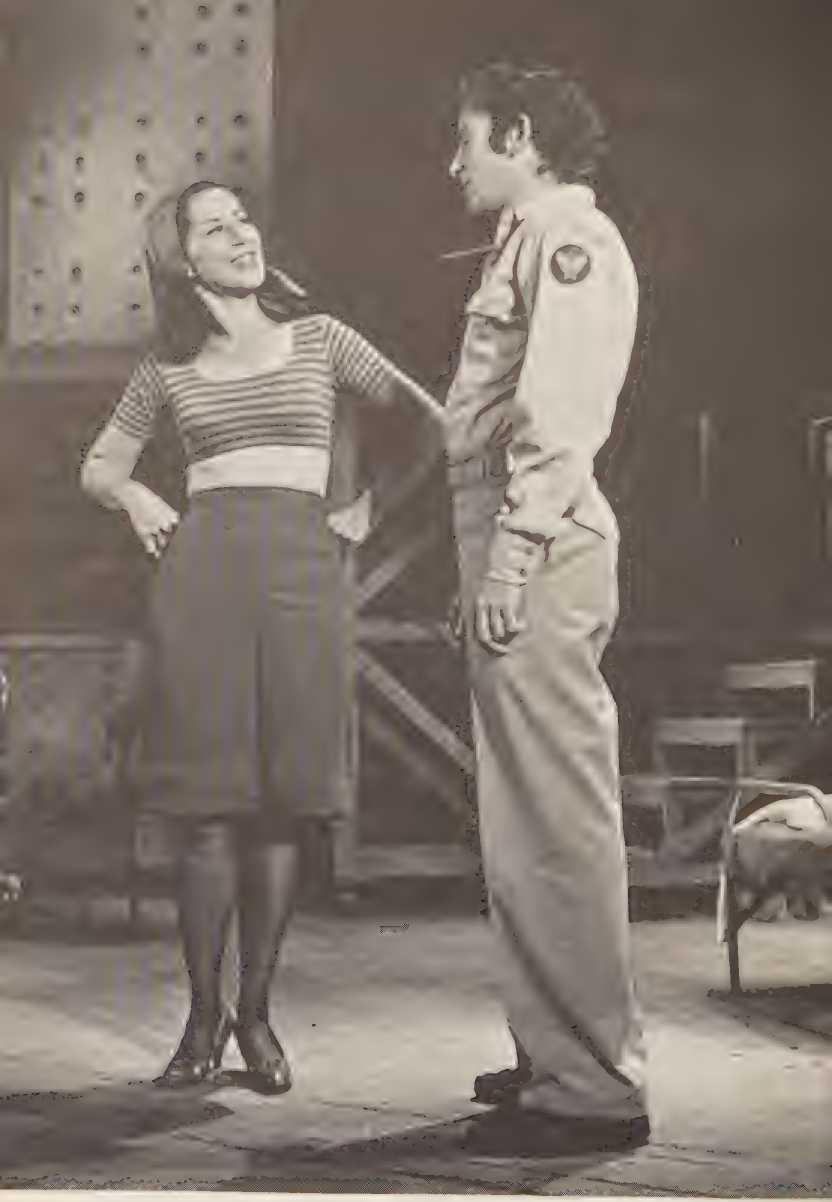
“I’m Luciana. Why don’t you pick me up?”
LUCIANA
Hey, Joe. Come here. I’m not so bad-looking.
YOSSARIAN
My name isn’t Joe.
LUCIANA
I’m Luciana. Why don’t you pick me up?
YOSSARIAN
My name is Yo-Yo.
LUCIANA
Okay, Joe-Joe. You picked me up. I’ll go dancing with you. But I won’t let you sleep with me.
YOSSARIAN
Who asked you?
[LUCIANA pulls him to her and makes him dance with her]
LUCIANA
You don’t want to sleep with me?
YOSSARIAN
I don’t want to dance with you.
LUCIANA
Okay, Joe-Joe. Then I will let you buy me dinner. But I won’t let you sleep with me.
YOSSARIAN
Who asked you?
LUCIANA
You don’t want to sleep with me?
YOSSARIAN
I don’t want to buy you dinner.
LUCIANA
Let’s go.
[She takes his hand, pulls him to the chairs at the table. She leans back with a sigh and pats her mouth daintily]
YOSSARIAN
You ate like a goddamn horse.
LUCIANA
Grazie. Now I feel better. Okay, Joe-Joe. Now I will let you sleep with me.
[Pulls away in alarm as YOSSARIAN grabs for her]
No—not here! Come.
[Takes his hand and leads him to one of the beds]
Aaaah—now.
[They embrace, YOSSARIAN’s attention is caught by something he feels on her back beneath her blouse]
YOSSARIAN
It’s long, isn’t it.
LUCIANA
[Tensing]
Si.
YOSSARIAN
I guess this must be just about the longest and deepest scar I ever felt.
LUCIANA
It’s the longest one I ever felt.
YOSSARIAN
Where did you get it?
LUCIANA
In an air raid.
YOSSARIAN
Germans?
LUCIANA
Americani.
YOSSARIAN
I was afraid you were going to say that. Luciana, I would like you to marry me.
LUCIANA
Tu sei pazzo.
YOSSARIAN
Why am I crazy?
LUCIANA
Perchè non posso sposare.
YOSSARIAN
Why can’t you get married?
LUCIANA
Because I am not a virgin. Who will marry me?
YOSSARIAN
I will.
LUCIANA
Ma non posso sposarti.
YOSSARIAN
Why can’t you marry me?
LUCIANA
Perchè sei pazzo.
YOSSARIAN
Why am I crazy?
LUCIANA
Perchè vuoi sposarmi.
YOSSARIAN
You won’t marry me because I’m crazy, and you say I’m crazy because I want to marry you. Is that right?
LUCIANA
Si.
YOSSARIAN
Tu sei pazzo.
LUCIANA
Perchè! Why am I crazy?
YOSSARIAN
Because you won’t marry me. Carina, ti amo. Ti amo molto.
LUCIANA
How can you love a girl who is not a virgin?
YOSSARIAN
It’s easy. Because I can’t marry you.
LUCIANA
[Heatedly]
Why can’t you marry me? Just because I am not a virgin?
YOSSARIAN
No. Because you’re crazy!
[LUCIANA laughs and they embrace again. She rises, smooths her hair, straightens her dress]
LUCIANA
Hey, Joe-Joe. Wake up. I have to leave now and go to work at my typewriter in my office.
[Takes his hand and walks with him]
Why don’t you ask me to write my name and address on a piece of paper so that you will be able to find me again when you come to Rome?
YOSSARIAN
Why don’t you write your name and address down for me on a piece of paper?
LUCIANA
[Haughtily]
Why? So you can tear it up into little pieces as soon as I leave?
YOSSARIAN
Who’s going to tear it up?
LUCIANA
You will. And then go walking away like a big shot because a young, beautiful girl like me, Luciana, let you sleep with her and did not ask you for money.
YOSSARIAN
How much money are you asking me for?
LUCIANA
Stupido! I am not asking you for money!
[She thrusts a slip of paper at him]
Here, don’t forget. Don’t forget to tear it into tiny pieces as soon as I am gone.
[Relenting, affectioNATELY]
Addio.
[Kisses him and starts away, YOSSARIAN hesitates, then tears the slip of paper into tiny pieces and scatters them. He starts away jauntily in the opposite direction]
LUCIANA
[At the side of the stage, exiting]
Tu sei pazzoi
[YOSSARIAN halts abruptly. He returns to the bits of paper and stares down at them hopelessly, WINTERGREEN walks on stage smoking a cigar and carrying a sack labeled “U.S. Mail”]
YOSSARIAN
Wintergreen!
WINTERGREEN
Hiyah, buddy.
YOSSARIAN
Wintergreen, I’m trying to find the name and address of a girl I met in Rome.
WINTERGREEN
Forget it. Come on inside, pal. I’ve got great news for you.
[WINTERGREEN settles himself at a desk and begins sorting correspondence, writing on some papers, tearing up others, YOSSARIAN follows]
I got my promotion. I’m a Pfc. now. Do you know what that means?
YOSSARIAN
You’re a private first class.
WINTERGREEN
I’m an officer now, just like you. It means lots more money and prestige. I get to travel in the highest social circles now, just like you. I’m gonna go into business, compete with Milo.
YOSSARIAN
Milo won’t like that.
WINTERGREEN
Good. I like to needle that bastard. Well, what can I do for you?
YOSSARIAN
Cathcart raised the number of missions again.
WINTERGREEN
I know that. I read all the mail he writes.
YOSSARIAN
Do you ever get to see any of the directives from Headquarters?
WINTERGREEN
Yo-Yo, I don’t just see them. I print them up on my mimeograph machine and distribute them—if I approve. Nothing gets done without my okay. I was going to cancel the Normandy invasion, until Eisenhower committed more armor.
YOSSARIAN
How many missions am I supposed to fly?
WINTERGREEN
Forty missions is all you have to fly as far as we here at Headquarters are concerned.
YOSSARIAN
Then I can go home, right? I’ve got fifty-one.
WINTERGREEN
No, you can’t go home. There’s a catch.
YOSSARIAN
Twenty-two?
WINTERGREEN
Sure. Catch-22 says you’ve always got to do what your commanding officer tells you to.
YOSSARIAN
But regulations say I can go home with forty missions.
WINTERGREEN
But regulations don’t say you have to go home. That’s the catch. Even if the colonel were disobeying an order by mak-
ing you fly more missions, you’d still have to fly them or you’d be guilty of disobeying an order of his. And then we would really jump on you.
YOSSARIAN
Then I really have to fly those fifty-five missions, don’t I?
WINTERGREEN
Sixty. See? He’s just raised them again.
YOSSARIAN
Goddamn him! What would they do to me if I refused to fly them?
WINTERGREEN
We would probably shoot you.
YOSSARIAN
Wei What do you mean, we? Since when are you on their side?
WINTERGREEN
[Collecting his stuff and preparing to leave]
If you’re going to be shot, whose side do you expect me to be on?
[WINTERGREEN walks off in one direction as MILO MINDERBINDER enters from another, carrying a dozen eggs]
YOSSARIAN
Milo! Have you heard the bad news?
MILO
I certainly have. Wintergreen’s cutting prices.
YOSSARIAN
That’s not what I meant. Colonel Cathcart just raised the missions to sixty.
MILO
Then I’m afraid you’ll just have to fly them. We all have to do what we can.
YOSSARIAN
What about you?
MILO
Me? I happen to be tied down at present with my responsibilities as mess officer. I have to go to Egypt to buy cotton.
YOSSARIAN
Cotton?
MILO
Yes, I have this great chance to corner the market on Egyptian cotton. It’s a big opportunity for the syndicate. And don’t forget—everybody has a share.
YOSSARIAN
Do I have a share?
MILO
Everybody has a share.
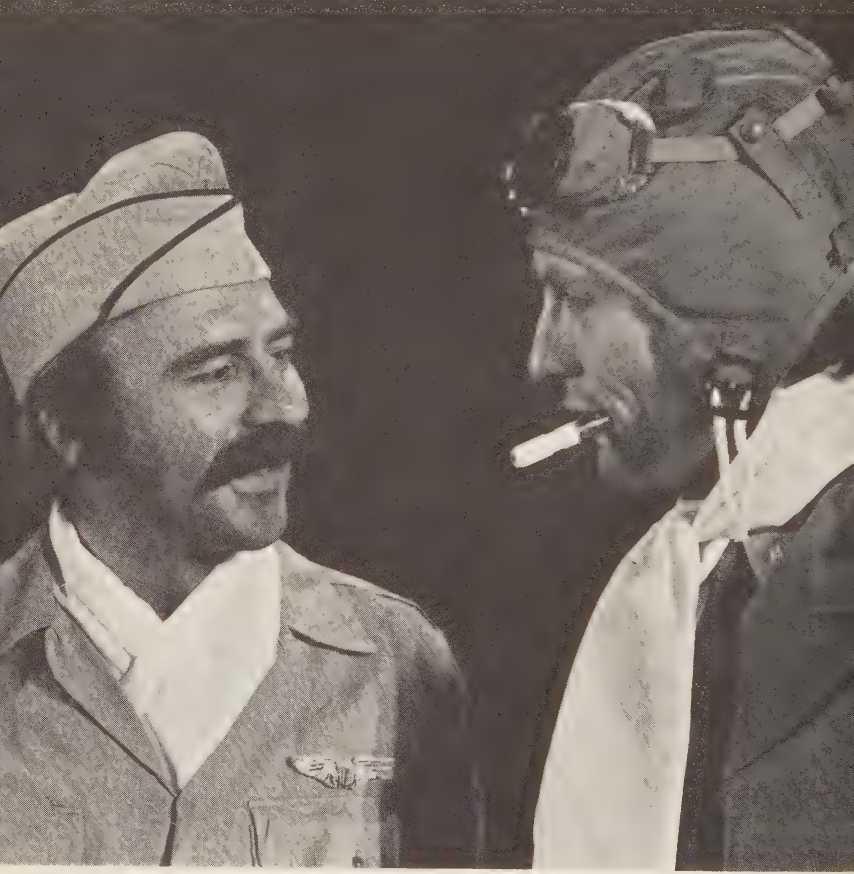
“I have this great chance to corner the market on Egyptian cotton.”
YOSSARIAN
[Pleased]
Gee, that’s really something. I always wanted to own a share.
[Sobering]
Does Snowden own a share?
MILO
Of course. Everybody in the squadron owns a share.
YOSSARIAN
Snowden isn’t in the squadron anymore. He was killed on the mission to Avignon.
MILO
That’s part of his share.
YOSSARIAN
There was no morphine in the first-aid kit. There was nothing I could give him for the pain.
MILO
I needed the morphine to trade for these fresh eggs. You get your share, don’t you?
YOSSARIAN
I don’t want my share. I’m going back into the hospital.
MILO
No, Yossarian. The best thing for us to do is for you to fly
your sixty missions, even if you get killed. You can’t keep running into the hospital like a crybaby every time—
YOSSARIAN
Oh yes I can.
[MILO shakes his head disapprovingly and exits as NURSE DUCKETT and FIRST DOCTOR take places at the desks inside the circle of furniture, YOSSARIAN moves around to the doorway and knocks. They pay no attention to him. He enters]
Hi. Hey!
[As they finally glance up]
I have this sharp, persistent, throbbing pain in the lower right side of my abdomen. I think it’s appendicitis.
FIRST DOCTOR
Beat it.
NURSE DUCKETT
We can’t tell him to beat it. We have to keep all abdominal complaints under observation for five days because so many of them have been dying after we make them beat it.
FIRST DOCTOR
[Leaving]
All right, Nurse Duckett. Put him under observation for five
days and then make him beat it. Give him an ice bag just to play safe.
[YOSSARIAN puts on a hospital robe]
NURSE DUCKETT
I think you’re faking.
[YOSSARIAN shrugs, moves to one of the two beds, and lies down, NURSE DUCKETT hands him an ice bag and leaves as English intern enters]
ENGLISH INTERN
Well, old boy. How is your liver?
YOSSARIAN
I think it’s my appendix.
ENGLISH INTERN
[Pressing YOSSARIAN’^ abdomen]
No, I’m afraid your appendix is no good, no good at all. If your appendix goes wrong, we can take it out and have you back on active duty in no time at all. But come to us with a liver complaint and you can fool us for weeks. Let’s throw this silly ice bag away before you die of pneumonia. The Ever, you see, is a large, ugly mystery to us. If you’ve ever eaten liver, you know what I mean.
YOSSARIAN
What’s an English medical officer doing on duty here?
ENGLISH INTERN
[Leaving]
I’ll tell you about that in the morning if I ever see you again. The way they whisk us around here, I never know where I’m going to—
[Arms reach in and pull him offstage on one side as NURSE DUCKETT and FIRST DOCTOR enter from the other]
FIRST DOCTOR
Well, good morning. Good morning, good morning, good morning. How is that sick appendix of yours?
YOSSARIAN
There’s nothing wrong with my appendix. It’s my liver.
NURSE DUCKETT
It was your appendix yesterday.
YOSSARIAN
It’s my liver today. I ought to know.
FIRST DOCTOR
Maybe it is his liver. What does his blood count show?
NURSE DUCKETT
He hasn’t had a blood count.
FIRST DOCTOR
Have one taken right away. We can’t afford to take chances
with a patient in his condition. We’ve got to keep ourselves covered in case he dies.
[Starting away]
In the meantime, keep that ice bag on. It’s very important.
YOSSARIAN
I don’t have an ice bag.
FIRST DOCTOR
No? Well, maybe it’s not so important. Just let someone know if the pain becomes unendurable.
[FIRST DOCTOR and NURSE DUCKETT exit as SECOND DOCTOR appears]
SECOND DOCTOR
Well, Yossarian, I’m afraid I have some very bad news for you. You’re in perfect health and have to go back to combat duty. Isn’t that good?
[Leaves. Suddenly, a PATIENT sits up in the next bed and shouts]
PATIENT
I see everything twice!
NURSE DUCKETT
[Reappearing]
What?
PATIENT
I see everything twice!
[FIRST DOCTOR comes running back in with alarm]
NURSE DUCKETT
He sees everything twice!
FIRST DOCTOR
What?
NURSE DUCKETT
He says he sees everything twice!
SECOND DOCTOR
Swell! Then it’s meningitis, I’d say.
FIRST DOCTOR
Why pick meningitis? Why not, let’s say, acute nephritis?
SECOND DOCTOR
Because I’m a meningitis man, that’s why, and not an acute nephritis man.
FIRST DOCTOR
Well I was here first.
SECOND DOCTOR
Why don’t we just roll him away into an isolation room and see what develops if he takes a turn for the worse?
FIRST DOCTOR
Suits me. There’s enough of him to go around.
[The bed is rolled off a few yards. The DOCTORS and NURSE DUCKETT start away]
SECOND DOCTOR
[Calling back toward YOSSARIAN]
And get that one out of here. He’s fit for duty.
YOSSARIAN
[Sits up in bed and shouts]
I see everything twice!
[The DOCTORS and NURSE DUCKETT rush back to yos- sarian’s bed]
FIRST DOCTOR
Hold it! I got here first again.
SECOND DOCTOR
That’s not fair.
FIRST DOCTOR
I don’t care whether it’s fair or not. You aren’t getting this one away from me, too.
[To YOSSARIAN, holding one finger up directly before him]
How many fingers do you see?
YOSSARIAN
Two.
FIRST DOCTOR
[Holding up two fingers]
How many fingers do you see now?
YOSSARIAN
Two.
FIRST DOCTOR
[Holds up none]
And how many now?
YOSSARIAN
Two.
FIRST DOCTOR
[Beaming]
By Jove, he’s right! He does see everything twice! Roll him away with that other one.
[YOSSARIAN’s bed is rolled beside the other bed. All but the SECOND DOCTOR stride away]
PATIENT
I see everything twice!
YOSSARIAN
[Winking at him]
I see everything twice!
PATIENT
The walls! The walls! Move back the walls!
YOSSARIAN
The walls! The walls! Move back the walls!
[The PATIENT emits a loud groan and flops back on the bed with his eyes shut, YOSSARIAN emits a loud groan and falls back, also. The SECOND DOCTOR feels the PATIENT’s pulse, shakes his head grimly, and draws the sheet over his face]
YOSSARIAN
What are you doing?
SECOND DOCTOR
He’s dead.
YOSSARIAN
[Sitting up in bed and shouting]
I see everything once!
[The FIRST DOCTOR and NURSE DUCKETT come running back]
FIRST DOCTOR
Lemme have him.
SECOND DOCTOR
Oh, no—you had him last time. I wanna do it. So shut up now—and be a good sport.
[Holding up one finger]
How many fingers do you see?
YOSSARIAN
One.
SECOND DOCTOR
[Holding up two fingers]
How many fingers do you see now?
YOSSARIAN
One.
SECOND DOCTOR
[Holding up ten fingers]
And how many now?
YOSSARIAN
One.
SECOND DOCTOR
I made him all better! Oh, boy—that calls for a drink.
[He exits with NURSE DUCKETT, leaving the FIRST DOCTOR behind]
FIRST DOCTOR
And just in time, too. Yossarian, some relatives are here to see you. Oh, don’t worry, not yours. It’s the mother, father,
and brother of that chap who died. They’ve traveled all the way from New York to see a dying soldier.
YOSSARIAN
I’m not dying.
FIRST DOCTOR
Of course you’re dying. Where else do you think you’re heading?
YOSSARIAN
They came to see their son.
FIRST DOCTOR
They’ll have to take what they can get.
YOSSARIAN
Suppose they start crying?
FIRST DOCTOR
I’ll come right in. All you’ve got to do is lie here a few minutes and die a little. Is that asking so much?
YOSSARIAN
All right. If it’s just for a few minutes. Why don’t you wrap a bandage around my head for effect?
FIRST DOCTOR
That sounds like a splendid idea.
[He hands a molded head bandage to YOSSARIAN, who fits it on]
YOSSARIAN
Why don’t you get some flowers? Old ones.
FIRST DOCTOR
We haven’t got time.
YOSSARIAN
At least darken the room.
FIRST DOCTOR
Shhhh!
[He exits. A poorly dressed OLD COUPLE enters with a belligerent young man in a sailor’s uniform. They approach timidly until they arrive at the side of the bed. They are Italian-American and reflect it in their speech]
FATHER
He looks terrible.
BROTHER
He’s sick, Pa.
MOTHER
Giuseppe.
YOSSARIAN
My name is Yossarian.
BROTHER
His name is Yossarian, Ma. Yossarian, don’t you recognize me? I m your brother John. Don’t you know who I am?
YOSSARIAN
You’re my brother John.
BROTHER
He does recognize me! Pa, he knows who I am. Yossarian, here’s Papa. Say hello to Papa.
YOSSARIAN
Hello, Papa.
FATHER
Hello, Giuseppe.
BROTHER
His name is Yossarian, Pa.
FATHER
I can’t get over how terrible he looks.
BROTHER
He’s very sick, Pa. The doctor says he’s going to die.
FATHER
I didn’t know whether to believe the doctor or not. You know how crooked those guys are.
MOTHER
Giuseppe.
BROTHER
His name is Yossarian, Ma. She don’t remember things too
good anymore. How’re they treating you in here, kid? They treating you pretty good?
YOSSARIAN
Pretty good.
BROTHER
That’s good. Just don’t let anybody in here push you around. You’re just as good as anybody else that’s dying, even though you are an Italian. You’ve got rights, too.
[YOSSARIAN winces and closes his eyes}
FATHER
Now see how terrible he looks.
MOTHER
Giuseppe.
BROTHER
Ma, his name is Yossarian. Can’t you remember?
YOSSARIAN
It’s all right. She can call me Giuseppe if she wants to.
MOTHER
Giuseppe.
BROTHER
Don’t worry, Yossarian. Everything is going to be all right.
YOSSARIAN
Don’t worry, Ma. Everything is going to be all right.
BROTHER
Did you have a priest?
YOSSARIAN
Sure.
BROTHER
That’s good. Just as long as you’re getting everything you’ve got coming to you. We were afraid we wouldn’t get here in time.
YOSSARIAN
In time for what?
BROTHER
In time to see you before you died.
YOSSARIAN
What difference would it make?
BROTHER
We didn’t want you to die by yourself.
YOSSARIAN
What difference would it make?
BROTHER
He must be getting delirious. He keeps repeating the same thing over and over again.
FATHER
That’s really very funny. All the time I thought his name
was Giuseppe, and now I find out his name is Yossarian. That’s really very funny.
BROTHER
Ma, make him feel good. Say something to cheer him up.
MOTHER
Giuseppe.
BROTHER
It’s not Giuseppe, Ma. It’s Yossarian.
MOTHER
What difference does it make? He’s dying.
[She starts to cry. The FATHER and brother start to cry, also]
YOSSARIAN
What are you crying about?
MOTHER
You’re dying.
[YOSSARIAN starts crying. The FIRST DOCTOR enters quickly, shooting YOSSARIAN a dirty look]
FIRST DOCTOR
It’s time to go now.
FATHER
[Pulling himself together]
Giuseppe.
BROTHER
Yossarian.
FATHER
Yossarian.
YOSSARIAN
Giuseppe.
FATHER
Soon you’re going to die.
[YOSSARIAN begins to sob again]
FIRST DOCTOR
Hey! Cut that out!
[To the others]
Have you any last words?
FATHER
When you talk to the man upstairs, I want you to tell Him it ain’t right for people to die when they’re young. Tell Him if they got to die at all, they got to die when they’re old. I don’t think He knows it ain’t right, because He’s supposed to be good, and it’s been going on for a long time. Okay?
BROTHER
And don’t let anybody up there push you around. You’ll be
just as good as anybody else in heaven, even though you are an Italian.
MOTHER
Dress warm.
[They exit]
FIRST DOCTOR
Thanks, kid. You did that real well. I think we’re going to have you die for us all the time.
YOSSARIAN
I think I’m going to get the hell out of here.
[YOSSARIAN goes to the coat rack and hangs up his bathrobe. The TEXAN enters]
TEXAN
Hi there, fella. I heard you were dying.
YOSSARIAN
That was somebody else.
[The CHAPLAIN comes on stage, and YOSSARIAN moves forward to meet him]
TEXAN
[To himself, ominously]
Don’t be too sure.
[Exits]
YOSSARIAN
It’s all Colonel Cathcart’s fault. Why don’t you do something? You’re the Chaplain. You’re supposed to help.
CHAPLAIN
Should I go see him? All right, I will. Even though I’m afraid of him. He’s so ...
[They exit.]
colonel cathcart enters wearing a black circle around one eye and an Indian headdress with several feathers. He has an empty cigarette holder in his mouth and carries a small box of tomatoes. He removes his black eye and headdress and presses a button on his desk. A deafening bell rings]
CATHCART
Korn! Colonel Korn!
KORN
[Dryly as he enters]
You rang, sir?
CATHCART
Come in, Korn. I need your advice. What do you think of this cigarette holder?
KORN
It’s imitation black onyx with inlaid chips of imitation ivory.
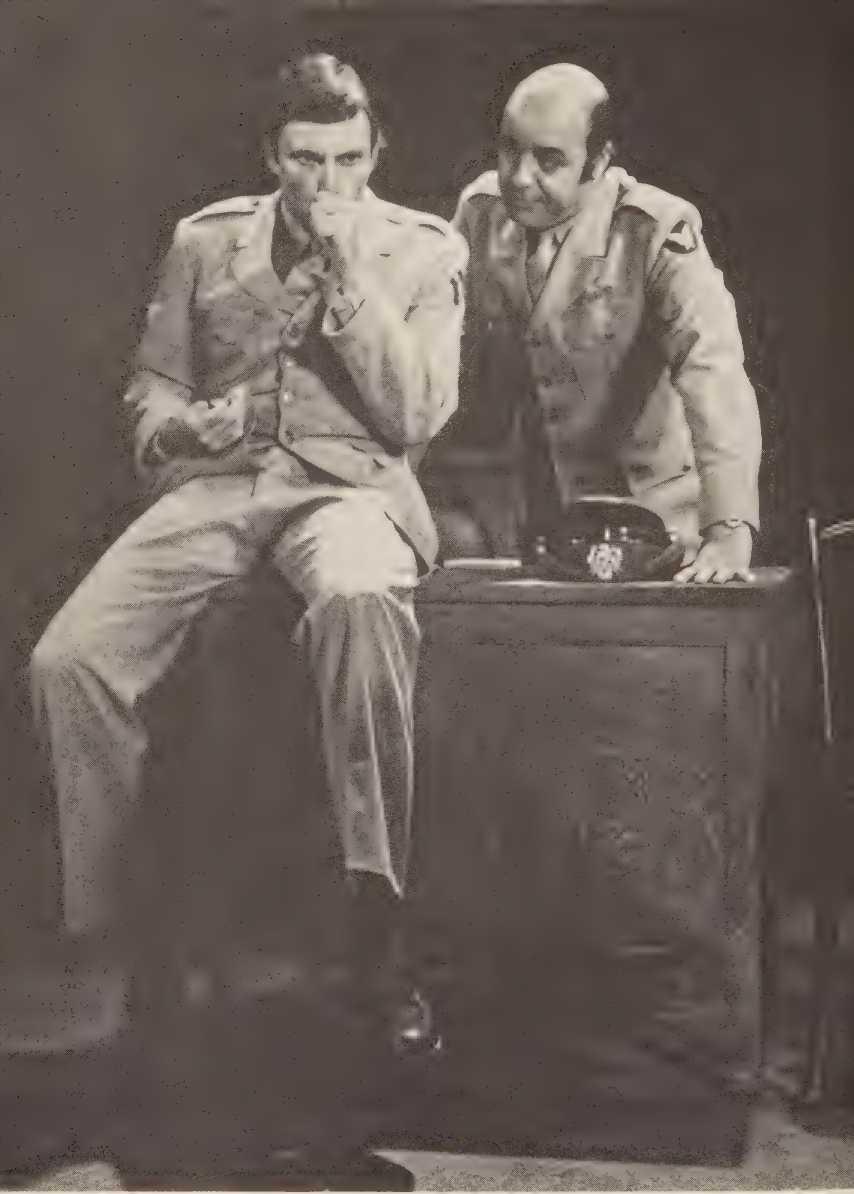
Ackroyd as Colonel Cathcart.
“With someone like General Dreedle, it could be a terrible black eye.”
CATHCART
That’s not what I mean. Will it help me become a general?
KORN
It might. With someone like General Dreedle, it could be a terrible black eye ...
[CATHCART’S face falls]
... while with someone like General Peckem ...
CATHCART
It could be another feather in my cap! I think I’ll take that risk. Now what about that farmhouse of mine in the hills?
KORN
A feather in your cap. But only if you use it.
CATHCART
I hate it there. I’ve got nothing to do. I’m not even sure where that farmhouse came from or who’s paying for it. How’d I get it, anyway?
KORN
You stole it.
CATHCART
Is that legal?
KORN
Sure.
CATHCART
Well, you’re the lawyer and you ought to know. How about these black-market tomatoes we’re buying up and selling to Milo illegally?
KORN
That’s legal, too.
CATHCART
Currency manipulation?
KORN
Legal.
CATHCART
Income-tax evasion?
KORN
That’s legal, also.
CATHCART
Well, if you say so. 1 wish you’d gone to Harvard or Yale, though, instead of a state university. It’s very degrading for someone like me to have to depend on someone like you.
KORN
I understand. That’s why I try to be so helpful.
CATHCART
I appreciate that. Get the Chaplain up here. There’s something I want to discuss with him.
KORN
He’s already here. There’s something he wants to discuss with you.
CATHCART
That’s what I call a real meeting of the minds, eh? Send him in.
[KORN exits. The CHAPLAIN enters]
Come on in, Chaplain.
CHAPLAIN
Thank you, sir. Sir, I want to speak—
CATHCART
Take a look at this copy of Life magazine. Here’s a big photograph of a colonel in England who has his chaplain say prayers in the briefing room before each mission. Do you think that prayers will work here as well as they do for these people in England?
CHAPLAIN
Yes, sir. I should think they would.
CATHCART
Then I’d like to give it a try. Maybe if we say prayers, they’ll put my picture in Life magazine. What are you staring at?
CHAPLAIN
Tomatoes—I think.
CATHCART
Wanna buy some?
CHAPLAIN
No, sir. I don’t think so.
CATHCART
That’s all right. Milo is glad to snap up all we can produce. What was it you wanted to speak to me about?
CHAPLAIN
Sir, I—
CATHCART
We’ll begin with the next mission. Now, I don’t want any of this Kingdom of God or Valley of Death stuff. That’s all too negative. What are you making such a face for?
CHAPLAIN
I’m sorry, sir. I happened to be thinking of the twenty-third Psalm as you said that.
CATHCART
How does that one go?
CHAPLAIN
That’s the one you were just referring to, sir. “The Lord is my shepherd; I—”
CATHCART
That’s the one I was just referring to. It’s out. What else have you got?
CHAPLAIN
“Save me, O God; for the waters are come in unto—”
CATHCART
No waters. I don’t like waters. Why don’t we try something musical? How about the harps on the willows?
CHAPLAIN
That has the rivers of Babylon in it, sir. ■ .. there we sat down, yea, we wept, when we remembered Zion.”
CATHCART
Zion? Let’s forget that one right now. I wonder how it even got in there. I’d like to keep away from the subject of religion altogether if we can.
CHAPLAIN
I’m sorry, sir. But just about all the prayers I know make at least some passing reference to God.
CATHCART
Then let’s get some new ones. Why can’t we take a more positive approach? Why can’t we all pray for something good, like a direct hit with all our bombs? Couldn’t we pray for a direct hit with all our bombs?
CHAPLAIN
Well, yes, sir, I suppose so.
CATHCART
Then that’s what we’ll do. It will be a feather in our cap if we pray for a direct hit with all our bombs—even if we get
a direct miss. We can slip you in while we’re synchronizing the watches. I don’t think there’s anything secret about the right time. Will a minute and a half be enough?
CHAPLAIN
Yes, sir. If it doesn’t include the time necessary to excuse the atheists and admit the enlisted men.
CATHCART
What atheists? There are no atheists in my outfit. Atheism is against the law, isn’t it?
CHAPLAIN
No, sir.
CATHCART
Then it’s un-American, isn’t it?
CHAPLAIN
I’m not sure, sir.
CATHCART
Well, I am! I’m not going to disrupt our religious services just to accommodate a bunch of lousy atheists. They can stay right where they are and pray with the rest of us. And what’s all this about enlisted men? Just how the hell do they get into this act?
CHAPLAIN
I’m sorry, sir. I just assumed you would want the enlisted men to be present.
CATHCART
Well, I don’t. They’ve got a God and a chaplain of their own, haven’t they?
CHAPLAIN
No, sir.
CATHCART
You mean they pray to the same God we do?
CHAPLAIN
Yes, sir.
CATHCART
And He listens?
CHAPLAIN
I think so, sir.
CATHCART
Well, I’ll be damned. I’d like to keep them out, anyway. Honestly, Chaplain, you wouldn’t want your sister to marry an enlisted man, would you?
CHAPLAIN
My sister is an enlisted man.
CATHCART
Are you trying to be funny?
CHAPLAIN
Oh, no, sir. She’s a master sergeant in the marines.
CATHCART
I see. Well, now that I think about it, having the men pray to God probably wasn’t such a hot idea, anyway. The editors of Life might not cooperate.
CHAPLAIN
Will that be all, sir?
CATHCART
Yeah. Unless you’ve got something else to say.
CHAPLAIN
Yes, sir, I have. Sir, some of the men are very upset since you raised the number of missions to sixty. They’ve asked me to speak to you about it.
CATHCART
Well, you just spoke to me about it.
CHAPLAIN
They wonder why they have to keep flying more and more missions.
CATHCART
That’s an administrative matter, Chaplain. Tell them it’s none of their business.
CHAPLAIN
Yes, sir.
CATHCART
Help yourself to a tomato, Chaplain. Go ahead, it’s on me. That’s an order.
CHAPLAIN
[Takes a tomato]
Thank you, sir. Sir—
CATHCART
Thanks for dropping around.
CHAPLAIN
Yes, sir.
[Bracing himself]
Sir, I’m particularly concerned about one of the bombardiers. Captain Yossarian.
CATHCART
Who?
CHAPLAIN
Yossarian, sir. A man was killed in his plane recently and—
CATHCART
That’s a funny name.
CHAPLAIN
He’s in a very bad way, sir. I’m afraid he won’t be able to suffer much longer without doing something desperate.
CATHCART
Is that a fact, Chaplain?
CHAPLAIN
Yes, sir. I’m afraid it is.
CATHCART
[Ponders]
Tell him to trust in God.
CHAPLAIN
[Giving up]
Thank you, sir. I will.
[CHAPLAIN exits, CATHCART puts on his headdress and BLACK eye and paces nervously]
CATHCART
[Wailing suddenly]
I want to be a general!
[Rings the clangorous bell]
Korn! Korn!
KORN
[Entering]
You rang, sir?
CATHCART
We may have a problem. There is a captain named Yossarian who doesn’t want to fly the sixty missions.
KORN
Yossarian? That’s a funny name.
CATHCART
It’s a terrible name, isn’t it? There are too many esses in it, like ...
KORN
Odious, and insidious.
CATHCART
Subversive. It’s not one of those good, crisp, clean-cut
American names like—
KORN
[Getting it in first]
Korn.
CATHCART
[Eyeing him resentfully]
Or Cathcart. I wonder how he ever got to be a captain, anyway.
KORN
You probably promoted him.
CATHCART
You probably told me to.
KORN
I probably told you not to. But you wouldn’t listen.
CATHCART
I should have listened.
KORN
You never listen.
CATHCART
From now on I’ll listen. Stop picking on me, will you? Maybe sixty missions are too many. Should I lower them?
KORN
Raise them. You won’t impress anybody by fighting less.
CATHCART
A man was killed in his plane.
KORN
One man? Colonel, if we’re going to start waxing sentimental about every man who might be killed ... we might just as well not have a war.
CATHCART
Korn, you’re right! I’ll raise them ... to seventy.
KORN
Put another feather in your cap.
CATHCART
It certainly won’t be a black eye, will it? Here—have one for your cap. And do you know what else? I’m going to volunteer the men for Bologna.
KORN
Bologna? That’s very brave of you.
CATHCART
Yes, it is. But I have confidence in my men. And I believe that no target in the world is too dangerous for them to attack. Tell Captain Black the good news. And let’s get these damn tomatoes over to Milo. Before the Chaplain snatches another one.
[They exit as CAPTAIN BLACK enters, rubbing his hands with glee]
BLACK
Bologna? Oh, boy! Ha, ha! I can’t wait to see those sons of bitches eat their liver when they find out about this one. Ha, ha, ha!
[The CHAPLAIN enters, carrying his tomato. Exiting]
Hey, Chaplain! Did you hear the good news? The men are going to Bologna. Ha, ha, ha. I can’t wait to tell those bastards.
[The CHAPLAIN glares disapprovingly and moves through the doorway to a desk. He clears his throat and calls out hesitantly]
CHAPLAIN
Whitcomb! Corporal Whitcomb. Come in please.
[CORPORAL WHITCOMB slouches onstage insolently]
WHITCOMB
What’s new?
CHAPLAIN
There’s nothing new. Was anyone here to see me?
WHITCOMB
No. Just that crackpot Yossarian again.
CHAPLAIN
I’m not so sure he’s a crackpot.
WHITCOMB
That’s right, take his part.
[CORPORAL WHITCOMB stamps out. He walks back in again]
You always side with the other people. That’s one of the things that’s wrong with you.
CHAPLAIN
I didn’t intend to side with him. I was just making a statement.
WHITCOMB
What did Colonel Cathcart want?
CHAPLAIN
Nothing important. He just wanted to discuss the idea of saying prayers in the briefing room before each mission.
WHITCOMB
All right, don’t tell me.
[He stamps out. He walks back in]
You don’t have confidence in your men. That’s another one of the things that’s wrong with you.
CHAPLAIN
Yes, I do. I have lots of confidence in you.
WHITCOMB
Then what about those letters?
CHAPLAIN
What letters?
WHITCOMB
How about letting me send out form letters to the next of kin of all the men we lose in combat?
CHAPLAIN
No, no. Not. while I’m in charge.
WHITCOMB
Is that so? It’s easy for you to sit there and shake your head while I do all the work. Didn’t you see that guy from Texas outside in the purple bathrobe? That was a C.I.D. man down from the hospital on official business. He’s conducting an investigation.
CHAPLAIN
I hope you’re not in any trouble.
WHITCOMB
No, I’m not in any trouble. You are. They’re going to crack down on you for signing Washington Irving’s name to all those letters.
CHAPLAIN
What letters?
WHITCOMB
All those letters you’ve been signing Washington Irving’s name to.
CHAPLAIN
I haven’t been signing Washington Irving’s name to any letters.
WHITCOMB
You don’t have to lie to me. I’m not the one you have to convince.
CHAPLAIN
I’m not lying.
WHITCOMB
I don’t care whether you’re lying or not. A lot of that correspondence you’ve been tampering with is classified information.
CHAPLAIN
I haven’t been tampering with any correspondence.
WHITCOMB
You don’t have to lie to me. I’m not the one you have to convince.
CHAPLAIN
I’m not lying!
WHITCOMB
I don’t see why you have to shout at me.
[Walks out. Walks back in]
That’s what I get for sticking my neck out to warn you.
[Walks out. Walks back in]
I just did you the biggest favor anybody ever did you in your whole life, and you don’t even know it. You don’t know how to show your appreciation. That’s another one of the things that’s wrong with you.
CHAPLAIN
I’m sorry. I’m really ver) grateful to you.
WHITCOMB
Then how about letting me send out those form letters?
CHAPLAIN
No, no, no. Let’s not talk about it now. Please.
WHITCOMB
I’m the best friend you’ve got in the whole world, and you
don’t even know it. Don’t you know what trouble you’re in? That C.I.D. man has gone back to the hospital to write a brand-new report about that tomato.
CHAPLAIN
What tomato?
WHITCOMB
The tomato you were hiding in your hand when you showed up here. The tomato you’re still hiding in your hand right this very minute!
CHAPLAIN
I’m not hiding it. I got this tomato from Colonel Cathcart.
WHITCOMB
You don’t have to lie to me. I don’t care whether you stole it from him or not.
CHAPLAIN
Stole it? Why should I steal a tomato from Colonel Cathcart?
WHITCOMB
That’s exactly what had us both stumped. And then the C.I.D. man figured out why. He figured out that you might have some important secret papers hidden away inside it.
CHAPLAIN
In a tomato? Here, see for yourself.
WHITCOMB
Not me. I don’t want it.
CHAPLAIN
Please take it. I didn’t even want it.
WHITCOMB
Oh, no. Don’t think you’re going to stick me with it.
CHAPLAIN
I’m not trying to stick you with it.
WHITCOMB
I’m not going to forget this!
[He stamps out. He stamps back in. He stamps back out, grinning with satisfaction once his back is to the CHAPLAIN]
CHAPLAIN
Dear wife. There is so much unhappiness in the world, and there does not seem to be anything I can do about anybody’s, not even my own. I have managed to offend Corporal Whitcomb again, and I don’t know how. And now the Colonel has increased the number of missions again and volunteered the men for Bologna.
[Exits as YOSSARIAN, CLEVINGER, and CAPTAIN BLACK enter]
YOSSARIAN
[Glumly]
Bologna?
BLACK
That’s right. Eat your liver, you bastards. This time you sons of bitches are really in for it. Ha, ha, ha!
[Exits, calling offstage]
Hey, you sons of bitches! Did you hear the good news? Ha, ha, ha.
YOSSARIAN
I don’t want to go.
CLEVINGER
You have to.
YOSSARIAN
Tm going to be killed at Bologna. You’re going to be killed.
CLEVINGER
We have to go, anyway.
YOSSARIAN
Are you crazy?
CLEVINGER
We’re at war, Yossarian. And we have to obey orders.
YOSSARIAN
Then I’ll change the orders. I’ve got influence. You’ll see.
[He moves inside the circle of furniture toward one of the desks]
Wintergreen! Hey, Wintergreen!
[WINTERGREEN enters with his mail sack and sits down. He begins sorting and marking letters, reading some, tearing others up]
I need your help.
WINTERGREEN
Everybody does. I’m the most crucial figure in this whole theater of operations.
YOSSARIAN
You’re only a mail clerk and a Pfc.
WINTERGREEN
Ex-Pfc. I was busted. For talking to generals by their first names. Now I’m just a poor buck private again.
YOSSARIAN
What are you doing?
WINTERGREEN
Sorting letters.
YOSSARIAN
You just tore one up.
WINTERGREEN
I didn’t like it. It was too long. I like the way you censor letters when you’re in the hospital. Why’d you sign Washington Irving’s name to them?
YOSSARIAN
How’d you know it was me?
WINTERGREEN
I recognized the handwriting. I recognize everybody’s handwriting. They’ve got a C.I.D. man in the hospital trying to find you.
YOSSARIAN
I know that. How’d you find out?
WINTERGREEN
I throw away all his reports. Then I throw away all the orders asking him for reports. They think he’s missing in action. They’ve got another secret agent poking around who think’s it’s Major Major.
YOSSARIAN
That’s funny.
WINTERGREEN
Yeah. Because Major Major has been signing Washington Irving’s name. See? You wrote the Chaplain’s name once, too, didn’t you?
YOSSARIAN
For variety.
WINTERGREEN
I remember the message. “Dear Mary. I yearn for you tragically. A. C. Tappman. Group Chaplain.” That really brought tears to my eyes. Say—do you want to buy some
Zippo cigarette lighters cheap? They were stolen right from quartermaster.
YOSSARIAN
Milo’s selling those, too. And his aren’t stolen.
WINTERGREEN
That’s what you think. I’m selling mine for a buck apiece. What’s he getting for his?
YOSSARIAN
A dollar and a penny.
WINTERGREEN
[Laughing]
I beat him all the time, don’t I?
YOSSARIAN
He’s pretty sore at you for going into competition with him.
WINTERGREEN
He’s pretty sore at everyone since he cornered the market on Egyptian cotton and can’t get rid of any of it. Okay, pal. Now what can I do for you?
YOSSARIAN
We have to fly to Bologna.
WINTERGREEN
Oh, I know that. I printed the orders.
YOSSARIAN
Listen—you’ve got a mimeograph machine, and you sort the mail. Couldn’t you print up orders canceling the mission and send them out to everybody involved?
WINTERGREEN
Oh, sure. I could do that.
YOSSARIAN
What would happen?
WINTERGREEN
The mission would be canceled.
YOSSARIAN
Will you do it?
WINTERGREEN
Oh, no! I wouldn’t do anything like that. There’s a war on, Yossarian, and we all have our jobs to do. My job is to unload these Zippo lighters at a profit if I can. Your job is to bomb the ammunition dumps at Bologna.
YOSSARIAN
But I might be killed.
WINTERGREEN
Then you’ll just have to be killed. Why can’t you be a fatalist about it, the way I am? If I’m destined to unload these lighters at a profit, then that’s what I’m going to do. And if you’re destined to be killed over Bologna, then you’re going to be killed, so you might just as well go out and die
like a man. Gimme a buck, will you? For the lighter. I hate to say this, Yossarian, but you’re turning into a chronic complainer.
[Exits as CLEVINGER comes on stage, YOSSARIAN moves downstage to join him]
CLEVINGER
Wintergreen is right.
YOSSARIAN
Clevinger, you’re crazy. The only reason we’re going is because Cathcart volunteered us.
CLEVINGER
Unfortunately, that’s none of our business.
YOSSARIAN
Do you really mean that? Do you really mean that it’s none of my business how or why I get killed and that it is Colonel Cathcart’s?
CLEVINGER
Yes, I guess I do. There are men in a better position than we are to decide how to win the war.
YOSSARIAN
Clevinger, open your eyes. It doesn’t make a damned bit of difference who wins the war to someone who’s dead.
CLEVINGER
Congratulations! I can’t think of another attitude that would give greater comfort to the enemy.
YOSSARIAN
The enemy is anybody who’s going to get you killed, no matter which side he’s on. And don’t you—
BLACK
[Entering]
Okay, boys. Let’s go. It’s time for Bologna.
YOSSARIAN
And don’t you forget that, because the longer you remember it, the longer you might live.
CLEVINGER
I’m going to Bologna.
[CLEVINGER takes a parachute harness from the coat rack]
BLACK
Move it along, you bastards. Move it along.
[YOSSARIAN hesitates, takes a parachute harness from the coat rack, and starts away with CLEVINGER]
YOSSARIAN
Okay, okay. But I’m warning you. I’m warning you all.
This is the last time I’m letting myself—
[Exits with CLEVINGER]
BLACK
Ha, ha, ha! Eat your liver, kid. That’s what I like to see.
Eat your liver.
[The CHAPLAIN enters, reading aloud from his stationery pad]
CHAPLAIN
My dear wife. Clevinger is dead.
[BLACK takes the news with an indifferent shrug and walks out as YOSSARIAN returns wearily]
YOSSARIAN
Poor bastard.
CHAPLAIN
That was the tragic flaw in all his trust and idealism, I suppose ...
YOSSARIAN
I warned him. I told him. But ... he wouldn’t believe me, and now ...
CHAPLAIN
... he is dead.
[The CHAPLAIN exits with his head bowed, as MILO enters, carrying a box of candy, and approaches YOSSARIAN nervously]
MILO
I’ve been looking all over for you.
YOSSARIAN
You should have looked here.
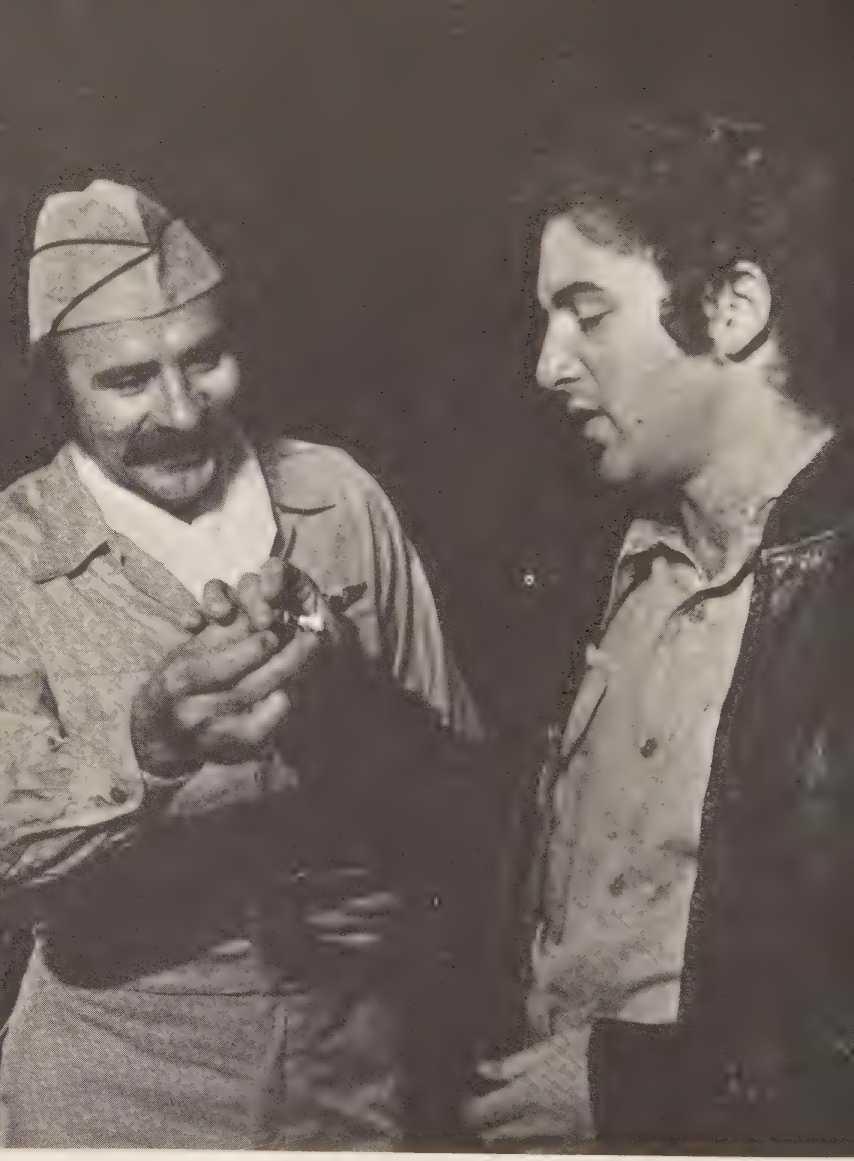
“Chocolate-covered cotton.”
MILO
Yossarian, I want you to help me, because you and I are friends, and that’s what friends are for. Please taste this and let me know what you think. I want to serve it to the men.
YOSSARIAN
[Taking a big bite]
What is it?
MILO
Chocolate-covered cotton.
YOSSARIAN
[Gagging]
What? Take it back! Jesus Christ! You didn’t even take the goddamn seeds out.
MILO
Give it a chance, will you? It can’t be that bad. Is it really that bad?
YOSSARIAN
It’s even worse.
MILO
But I’ve got to make the mess halls feed it to the men. I’ve got all this cotton and—
[Pointing]
Hey! Look at that, look at that! That’s the Chaplain. That’s a funeral. Isn’t it?
YOSSARIAN
They’re burying Clevinger.
MILO
Clevinger? What happened to him?
YOSSARIAN
He got killed.
MILO
Clevinger? Oh, that’s terrible. A fellow never had a better buddy than good old Clevinger. It really is terrible. And it will get even worse if the mess halls don’t buy my cotton. Yossarian, what’s the matter with them? Don’t they understand that what’s good for me is good for the country? How was I supposed to know there would be a glut? I’m still not even sure what a glut is.
YOSSARIAN
Ask Doc Daneeka.
MILO
Who ever thought the Nile Valley would be so fertile? Is it my fault I saw this wonderful opportunity to—oh, the coffin! They’re lowering the coffin! I can’t watch. I just can’t stand here and watch those mess halls let my syndicate die. Yossarian, try eating the rest of this chocolate-covered cotton. Maybe it will taste delicious now.
YOSSARIAN
Give up, Milo. People can’t eat cotton.
MILO
It isn’t really cotton. It’s really cotton candy, delicious cotton candy. Who will buy my delicious cotton candy? Try it and see.
YOSSARIAN
Now you’re lying.
MILO
I never lie!
YOSSARIAN
You’re lying now.
MILO
I only lie when it’s necessary. This is better than cotton candy. It’s made out of real cotton. Egyptian cotton is the finest cotton in the world.
YOSSARIAN
It’s indigestible. It will make them sick. Why don’t you try living on it yourself if you don’t believe me?
MILO
I did.
YOSSARIAN
And?
MILO
It made me sick.
YOSSARIAN
It’s all over.
MILO
It’s the end. We’re ruined. And all because I left them free to make their own decisions.
YOSSARIAN
Why don’t you sell your cotton to the government?
MILO
The government? Oh, no. The government has no business in business. But, wait—the business of government is business. Calvin Coolidge said that, and Calvin Coolidge was a president, so it must be true. And the government does have the responsibility of buying all the Egyptian cotton I’ve got that no one else wants. But how will I get the government to do it?
YOSSARIAN
Bribe it.
MILO
Bribe it? Yossarian, shame on you! Bribery is against the law. But wait—it’s not against the law to make a profit, is it? So it can’t be against the law for me to bribe someone in order to make a fair profit, can it? But how will I know who to bribe?
YOSSARIAN
Oh, don’t worry about that. Make the bribe big enough and they’ll find you. Just do everything right out in the open. Don’t act guilty or ashamed.
MILO
I wish you’d come with me. I won’t feel safe among people who take my bribes. They’re no better than a bunch of crooks.
YOSSARIAN
You’ll be all right. Just tell everybody that the security of the country requires a strong domestic Egyptian cottonspeculating industry.
MILO
It does. A strong Egyptian cotton-speculating industry means a much stronger America.
YOSSARIAN
Of course it does. And point out the great number of families that depend on it for jobs and income.
MILO
A great many families do depend on it.
YOSSARIAN
You see? You’re much better at it than I am. You almost make it sound true.
MILO
It is true.
YOSSARIAN
Now you’re ready.
MILO
You’re sure you won’t come with me?
YOSSARIAN
You won’t need me.
MILO
Good-by, Yossarian. Wish me luck. I’ll never forget you for your help in this.
[Exits. The CHAPLAIN returns as YOSSARIAN goes to the clothes rack, puts on a bathrobe, and lies down on a bed]
CHAPLAIN
And Yossarian has gone back into the hospital.
[NURSE DUCKETT enters to attend to YOSSARIAN]
He says—of all things—that he has a stone in his salivary gland.
[Exits]
NURSE DUCKETT
I think you’re faking again.
YOSSARIAN
You’re very efficient.
NURSE DUCKETT
I am.
YOSSARIAN
I may be able to help you.
NURSE DUCKETT
I don’t need your help.
YOSSARIAN
Who knows? Maybe ...
[YOSSARIAN slips his hand beneath NURSE DUCKETT’s skirt as she bends over and gives her a sudden touch. NURSE DUCKETT jumps and lets out a piercing shriek. FIRST DOCTOR runs in indignantly]
FIRST DOCTOR
What happened?
YOSSARIAN
[To NURSE DUCKETT]
Hey, take it easy. Calm down.
FIRST DOCTOR
[Taking NURSE DUCKETT’s arm]
Is anything wrong?
[NURSE DUCKETT screams again and pulls away from the DOCTOR into YOSSARIAN’s arms]
YOSSARIAN
Take your filthy hands off her.
[To NURSE DUCKETT]
There, there. There, there, my darling. Calm down. Have a good cry if it will make you feel better. I’m not going to let him harm you.
[NURSE DUCKETT nestles against YOSSARIAN]
NURSE DUCKETT
Oh, thank you, thank you, darling. You’re so kind ...
YOSSARIAN
Yes.
NURSE DUCKETT
... so understanding.
YOSSARIAN
I know.
[Fondling NURSE DUCKETT]
FIRST DOCTOR
What is going on here?
YOSSARIAN
Nothing, sir. A little accident. I happened to have my arm out, swinging it sort of, and, well ...
NURSE DUCKETT
[Pleased]
He gave me a goose.
FIRST DOCTOR
A what?
NURSE DUCKETT
A goose.
FIRST DOCTOR
A goose?
YOSSARIAN
Yeah, I guess you could call it that.
FIRST DOCTOR
How dare you give her a goose?
YOSSARIAN
I won’t do it again.
NURSE DUCKETT
[Disappointed]
Never?
FIRST DOCTOR
You’re going to be punished for this.
NURSE DUCKETT
Why?
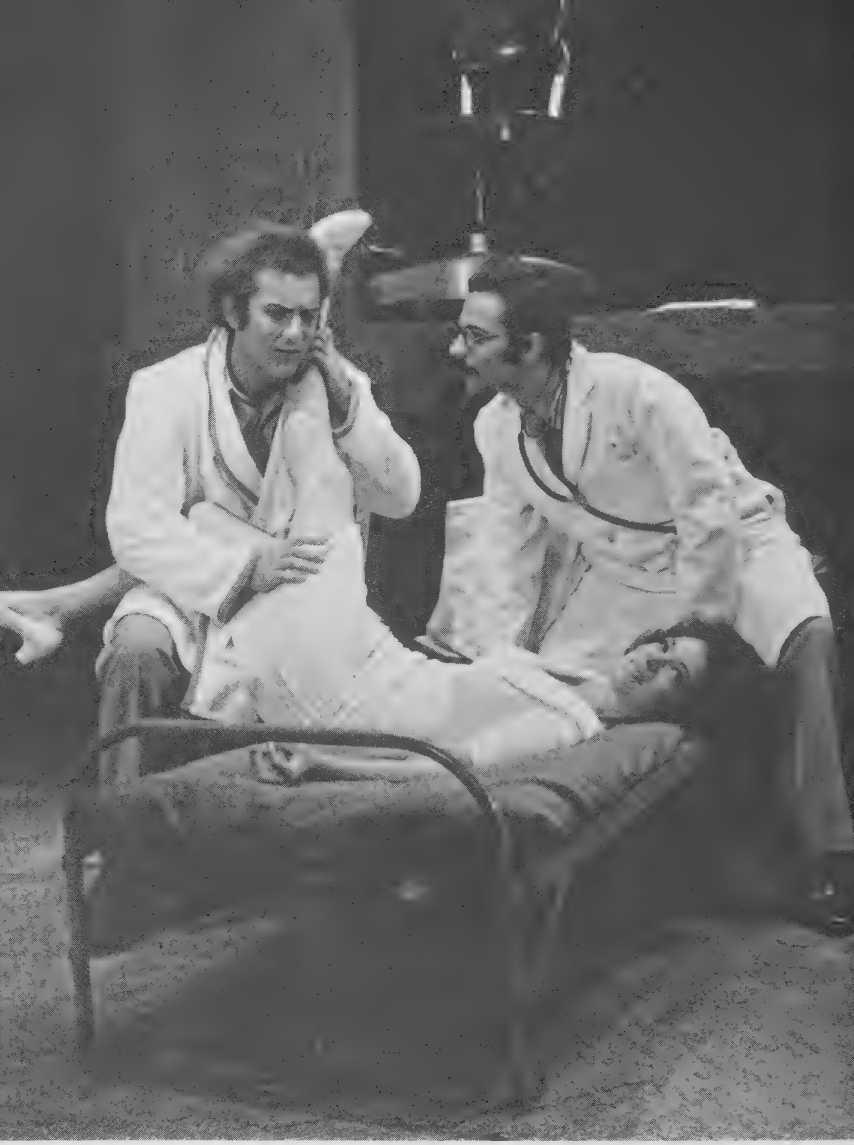
FIRST DOCTOR
I will not permit my patients to take such liberties with the nurses in my hospital.
NURSE DUCKETT
Why not?
FIRST DOCTOR
I’m not talking to you!
YOSSARIAN
What do you want from her? All she did was scream.
NURSE DUCKETT
[To YOSSARIAN, with ardent affection]
I never knew it could be this way.
FIRST DOCTOR
Stop it! Will you let go of each other? Are you both crazy?
YOSSARIAN
Maybe I am. Every night I dream I’m holding a live fish in my hand.
FIRST DOCTOR
[Coldly]
You do what?
NURSE DUCKETT
He dreams he’s holding a live fish in his hand.
FIRST DOCTOR
[To NURSE DUCKETT]
What kind of fish?
NURSE DUCKETT
Ask him.
FIRST DOCTOR
What kind of fish?
YOSSARIAN
I don’t know. I have trouble telling one kind of fish from another.
FIRST DOCTOR
In which hand do you hold it?
YOSSARIAN
It varies.
NURSE DUCKETT
[Helpfully]
It probably varies with the fish.
FIRST DOCTOR
Yes? And how come you seem to know so much about it?
[NURSE DUCKETT shrugs lamely]
YOSSARIAN
She’s in the dream.
FIRST DOCTOR
Well, I’ve got a man on my staff to listen to disgusting dreams like that. You go see Major Sanderson right now.
[Exits as MAJOR SANDERSON, the psychiatrist, enters and seats himself at a desk, YOSSARIAN moves to him]
PSYCHIATRIST
Come in. Come in, please. I’m Major Sanderson, your friendly staff psychiatrist. But you can call me Doctor. Just why do you think, by the way, that Colonel Ferridge finds your dream so disgusting?
YOSSARIAN
I suppose it’s either some quality in the dream or some quahty in Colonel Ferridge.
PSYCHIATRIST
That’s very well put. For some reason Colonel Ferridge has always reminded me of a sea gull. He doesn’t have much faith in psychiatry, you know.
YOSSARIAN
You don’t like sea gulls, do you?
PSYCHIATRIST
No, not very much. I think your dream is charming, and I hope it recurs frequently. This fish you’re holding in your hand. What does it remind you of?
YOSSARIAN
[Pondering]
Other fish.
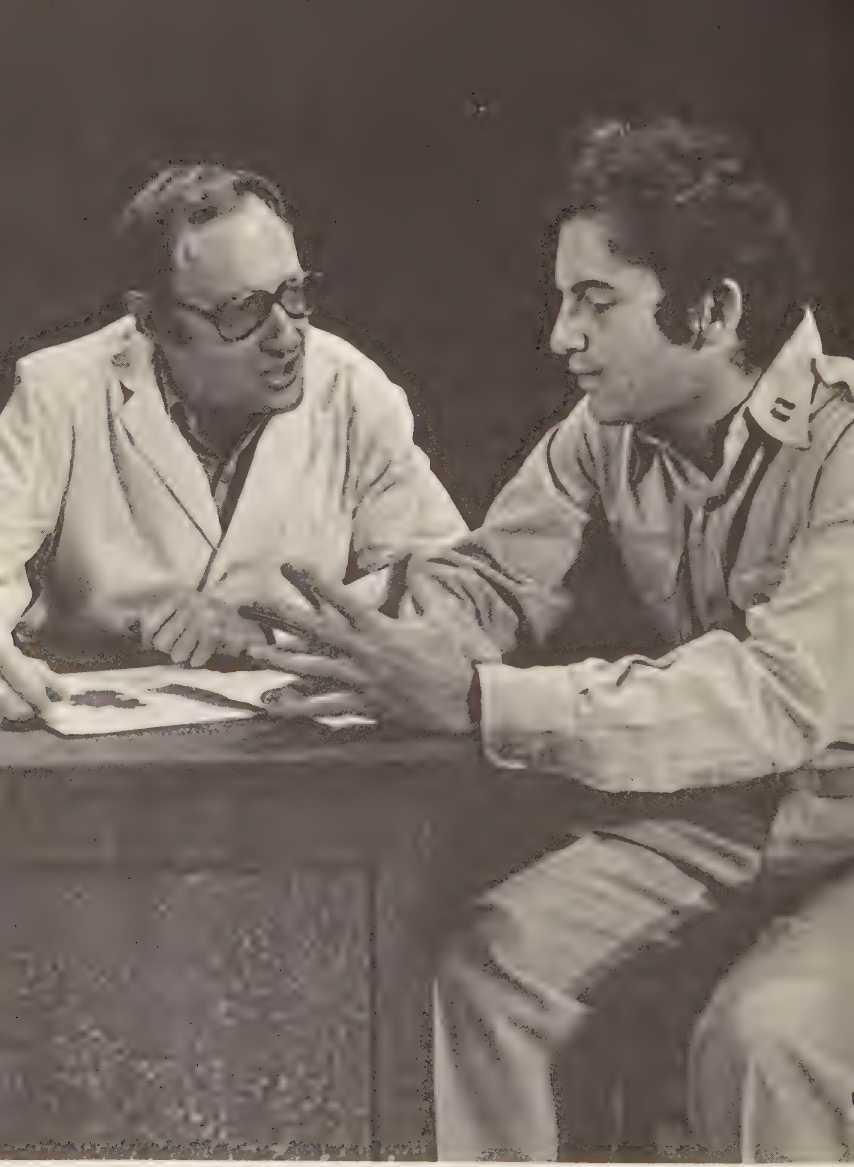
PSYCHIATRIST
And what do other fish remind you of?
YOSSARIAN
Other fish.
PSYCHIATRIST
I’m afraid that this line of exploration is leading us nowhere. I’d like to show you some ink blots now to find out what certain shapes and colors—
YOSSARIAN
Sex.
PSYCHIATRIST
What?
YOSSARIAN
Everything reminds me of sex.
PSYCHIATRIST
Does it? Now we’re really getting somewhere! Do you ever have any good sex dreams?
YOSSARIAN
My fish dream is a sex dream.
PSYCHIATRIST
No, I mean real sex dreams—the kind where you grab some beautiful naked bitch and rip her clothes off and throw her down to ravish her and burst into tears because you love and hate her so much you don’t know what to do. That’s
the kind of sex dreams I like to talk about. Don’t you ever have sex dreams like that?
YOSSARIAN
[Reflects a moment]
That’s a fish dream.
PSYCHIATRIST
[Recoils as though slapped]
Yes, of course. But I’d like you to dream one like that for me, anyway, just to see how you react. That will be all for today.
[YOSSARIAN walks from the desk to NURSE DUCKETT, who rests on the bed comfortably, reading a magazine as she waits for him. They embrace]
YOSSARIAN
I’m worried about Major Sanderson. He feels so rejected already. Have you got any good dreams for him?
NURSE DUCKETT
I’ve been having a very peculiar dream nearly all my life. I dream that I’m out swimming in water over my head and a shark is eating my left leg.
YOSSARIAN
That’s a wonderful dream! I bet Major Sanderson will love it.
[YOSSARIAN walks back to MAJOR SANDERSON]
PSYCHIATRIST
That’s a horrible dream! I’m sure you had it just to spite me. I’m not even sure you belong in the army with a disgusting dream like that.
YOSSARIAN
[Slyly]
Perhaps you’re right, sir.
PSYCHIATRIST
Tell me, Fortiori, why—
YOSSARIAN
Who?
PSYCHIATRIST
Fortiori—why did you touch Nurse Duckett so familiarly in such an intimate place?
YOSSARIAN
I didn’t do anything of the kind. I gave her a goose. That’s all.
PSYCHIATRIST
All? Has it always been your habit to give gooses to—
YOSSARIAN
Geese.
PSYCHIATRIST
Yes, of course. Geese. Has it always been your habit to give geeses to all the women you meet?
YOSSARIAN
Oh, no, not all ... but ... well, yeah.
PSYCHIATRIST
I don’t think I like you, Fortiori. I don’t like your personality.
YOSSARIAN
I’m not Fortiori, sir. I’m Yossarian.
PSYCHIATRIST
Who?
YOSSARIAN
My name is Yossarian, sir.
PSYCHIATRIST
Your name is A. Fortiori! And I’ve got an official army record right here to prove it.
YOSSARIAN
Oh, come on, Major! I ought to know who I am.
PSYCHIATRIST
Well, you don’t, and that’s your problem. You’ve got a split personality, that’s what I think. Yes, it’s split right down the middle.
[Grinning with cruel and insulting delight]
I’m not saying that to be cruel and insulting. I’m not saying that because you rejected me and hurt my feelings terribly.
I’m not saying it because I hate you and want revenge. No, I’m a man of medicine, and I’m being coldly objective.
[With enormous relish]
Yossarian, I have very bad news for you. Are you man enough to take it?
YOSSARIAN
God, no! I’ll go right to pieces.
PSYCHIATRIST
Can’t you do even one thing right? The trouble with you is that you think you’re too good for all the conventions of society. You probably think you’re too good for me, too, don’t you, just because I came to puberty late. Well, do you know what you are? You’re a frustrated, unhappy, disillusioned, undisciplined, maladjusted young man!
YOSSARIAN
Yes, sir. I guess you’re right.
PSYCHIATRIST
You’re immature. You’ve been unable to adjust to the idea of war.
YOSSARIAN
I think that’s true.
PSYCHIATRIST
You have a morbid aversion to dying.
[YOSSARIAN nods]
You have deep-seated survival anxieties. Subconsciously, subconsciously, there are many people you hate.
YOSSARIAN
Consciously, sir, consciously. I hate them consciously.
PSYCHIATRIST
You’re antagonistic to the idea of being robbed, exploited, degraded, humiliated, or deceived. Misery depresses you.
YOSSARIAN
Yes, sir. I think that misery does.
PSYCHIATRIST
Violence depresses you. Greed depresses you. Poverty depresses you. Corruption depresses you. You know, it wouldn’t surprise me if you’re a manic-depressive.
YOSSARIAN
Yes, sir. Perhaps I am.
PSYCHIATRIST
Don’t try to deny it.
YOSSARIAN
I’m not denying it, sir. I agree with everything you’ve said.
PSYCHIATRIST
Ah-hah! Then you admit you’re crazy, do you?
YOSSARIAN
Crazy? Why is any of that crazy? You’re the one who’s crazy!
PSYCHIATRIST
Calling me crazy is a typically sadistic and vindictive paranoiac reaction! You really are crazy!
YOSSARIAN
Then why don’t you send me home?
PSYCHIATRIST
And I’m going to send you home!
[YOSSARIAN hurries from the desk back to NURSE DUCKETT]
YOSSARIAN
Hey, baby, guess what! They’re going to send me home!
NURSE DUCKETT
No, darling, they’re not. They’re sending Fortiori home because he’s insane. You’ve been ordered back to your squadron.
YOSSARIAN
It’s an outrage! I’m the one who’s insane!
[He flings off his hospital robe and charges out the doorway]
Doc! Hey, Doc! Doc Daneeka!
[DOC DANEEKA enters gloomily]
DOC DANEEKA
I’m cold. I’ve got this chill all the time, and nobody can tell me what it is. Nobody even cares.
YOSSARIAN
Doc! Listen to me. Do you know what they just told me up at the hospital? I’m crazy. Did you know that?
DOC DANEEKA
So?
YOSSARIAN
Really crazy.
DOC DANEEKA
So?
YOSSARIAN
I’m nuts. Cuckoo. Don’t you understand? I’m off my rocker. I am insane.
DOC DANEEKA
So?
YOSSARIAN
So? Don’t you see what that means? Now you can take me off combat duty and send me home. They’re not going to send a crazy man out to be killed, are they?
DOC DANEEKA
Who else will go?
[DANEEKA exits, YOSSARIAN sits down with a pensive, sad expression, NURSE DUCKETT moves forward to join him]
NURSE DUCKETT
What are you doing out here?
YOSSARIAN
Feeling sad. What a lousy earth.
NURSE DUCKETT
Cheer up, darling. Can’t you?
YOSSARIAN
It’s cold—a cold, cold planet. Doc Daneeka’s cold, and I’m cold.
NURSE DUCKETT
We’ve still got a lot to be thankful for.
YOSSARIAN
Have we? You’re a scatterbrain, but I love you. To whom should we be thankful? God?
NURSE DUCKETT
No, not God. You know very well I don’t believe in God as much as you don’t.
YOSSARIAN
Kiss me. And stop bragging. Name one thing I’ve got to be thankful for.
NURSE DUCKETT
Well ... me. Aren’t you thankful for me?
YOSSARIAN
Sure. But I’ll bet I can name two things to be miserable about for every one you can name to be thankful for.
NURSE DUCKETT
Be thankful you’re healthy.
YOSSARIAN
Be bitter you’re not going to stay that way.
NURSE DUCKETT
Be glad you’re alive.
YOSSARIAN
Be furious you’re going to die.
NURSE DUCKETT
Things could be much worse.
YOSSARIAN
They could be one hell of a lot better.
NURSE DUCKETT
You’re naming only one thing. You said you could name two.
YOSSARIAN
And don’t tell me God works in mysterious ways. There’s nothing mysterious about it. He’s not working at all. He’s playing.
NURSE DUCKETT
You’d better not talk that way about Him, honey. He might punish you.
YOSSARIAN
Isn’t He punishing me enough? Why in the world did He ever create pain?
NURSE DUCKETT
Pain? Pain is a useful symptom. Pain is a warning to us of bodily dangers.
YOSSARIAN
And who created the dangers? Oh, He was really being charitable to us when He gave us pain. You know, we mustn’t let Him get away with it—no, not the kind of God you talk about. On the Judgment Day. Yes, that’s the day I’ll be able to sneak close enough to grab that little yokel by His neck and—
NURSE DUCKETT
[Hysterically]
Stop it! Stop it!
[She tries to beat him about the head with both fists. YOSSARIAN catches her wrists and restrains her gently]
YOSSARIAN
Hey, baby, baby. Easy. What are you getting so upset about? I thought you didn’t believe in God.
NURSE DUCKETT
I don’t. But the God I don’t believe in is a good God, a just God, a merciful God. Not the mean and stupid God you make Him out to be.
[YOSSARIAN laughs and embraces her again]
YOSSARIAN
Okay, then—let’s have a little more religious freedom between us. You don’t believe in the God you want to, and I won’t believe in the God I want to. Is that a deal?
[She nods, smiling through her tears, and returns his kiss]
Thank God.
NURSE DUCKETT
I like you. Even when you’re angry.
YOSSARIAN
Is that why you’re trying to change me?
NURSE DUCKETT
Of course. I couldn’t settle down with you the way you are. And I like you when you’re sad.
YOSSARIAN
I always get sad when I stare at the sea.
NURSE DUCKETT
What are you thinking about?
YOSSARIAN
Snowden and Clevinger. Snowden froze to death in the back of my airplane. On a hot day in August. It’s starting to get cold now. Do you know how many people have died under water since the world began? Neither do I. It must be millions. Sue Ann, what’s going to happen to us?
NURSE DUCKETT
We’re going to die.
YOSSARIAN
Must we all?
NURSE DUCKETT
That’s what the doctors say.
YOSSARIAN
Then there’s not much future for us, is there? Lately, I’ve taken to calling the roll of the dead each morning as soon as I wake up. I try to think of all the people I’ve ever met who are no longer alive, all the old people I knew as a child —the aunts, uncles, neighbors, parents, and grandparents, my own and everyone else’s. They’re all dead now. The number of dead people just keeps growing, doesn’t it? I he in my sleeping bag each morning, and that’s what I think of when I wake up. Snowden, Clevinger, the roll call begins.
NURSE DUCKETT
And at night?
YOSSARIAN
I drink whiskey. And try to see you.
NURSE DUCKETT
Yo-Yo, what’s going to happen to us?
YOSSARIAN
We’re going to die.
NURSE DUCKETT
Am I going to marry you?
YOSSARIAN
No. I don’t think you’ll want to.
NURSE DUCKETT
I’m glad. My mother wouldn’t like you. I’ll be much better off marrying somebody happy and stable. Like a doctor. I’m beginning to miss you already.
YOSSARIAN
I used to think I was going to live forever. I was sure that by the time I grew up all you people would find a cure for everything. But now I’m all grown up, and you haven’t, and I know I won’t. I know I’m going to lose.
NURSE DUCKETT
Don’t cry, darling.
YOSSARIAN
I’m not crying. It’s that damn ocean. And the chill in the air. And the spray. I guess I am. Sue Ann, I don’t want to die. I don’t want to die for Colonel Cathcart.
NURSE DUCKETT
Then don’t. Shhh. Be calm, darling.
[Kissing his ear]
I love to do this to you. Let’s go inside. I love to tease you like this and set you on fire.
YOSSARIAN
I’m glad.
NURSE DUCKETT
And then T love to satisfy you. I’m so glad you let me.
YOSSARIAN
Say things like that and I will want to marry you.
NURSE DUCKETT
Yossarian, tell me truthfully. Am I the only girl you ever loved?
YOSSARIAN
No.
NURSE DUCKETT
I’m so glad.
[Curtain]
Act-2
[YOSSARIAN enters carrying a bottle of beer and an overnight bag into which he puts some toilet articles.]
YOSSARIAN
My pal Nately is a pretty good kid. But a little crazy, too. He had a bad start—he came from a good family. Why, the poor kid had even had a very happy childhood. He got on well with all his brothers and sisters, and he did not hate his mother and father, even though they had both been very good to him.
[NATELY comes onstage with his FATHER and MOTHER, NATELY wears his uniform and carries a small overnight bag]
FATHER
Son, always remember that your mother is a Daughter of the American Revolution.
MOTHER
And your father is a son of a bitch.
FATHER
You are not a Vanderbilt ...
MOTHER
... whose fortune was made by a vulgar tugboat captain, or a Rockefeller ...
FATHER
... whose wealth was amassed through unscrupulous speculations in crude petroleum. You are a Nately.
MOTHER
And we Natelys have never done anything for our money.
FATHER
It is my wish that you join the Air Corps, where you can train safely as a pilot while the war ends.
MOTHER
As an officer you will associate only with gentlemen and frequent only the very best places.
[NATELY, nodding constantly, shakes hands with his FATHER, kisses his mother, and walks from them through the doorway to join YOSSARIAN]
NATELY
I’m back! I got my pass. Where is she? Darling—I’m here!
YOSSARIAN
Working, probably.
NATELY
Don’t say that about her.
YOSSARIAN
Don’t ask me about her. It’s not my fault you fell in love with a whore.
[NATELY’S WHORE enters in skirt and slip and embraces him warmly]
NATELY’S WHORE
Hey, caroì Caro mio. I miss you so much.
[The OLD MAN and the OLD WOMAN drift in, smiling at the lovers]
NATELY
Get dressed.
NATELY’S WHORE
[Puzzled]
Perchè?
NATELY
Why? Because I don’t want other men to see you without all your clothes on.
NATELY’S WHORE
Perchè no?
NATELY
Perchè noi Because it isn’t right, that’s why.
NATELY’S WHORE
Why not?
NATELY
Why not? Because I say so! I’m the man, and you have to do what I say. From now on I forbid you to leave your room unless you have all your clothes on.
NATELY’S WHORE
Are you crazy? Tu sei pazzo’.
[She begins to stamp offstage]
NATELY
And I don’t want you ever to talk to me that way.
NATELY’S WHORE
No? Tu sei pazzo/ Idiota! Tu sei un pazzo imbecille!
[Exits]
NATELY
[To OLD WOMAN]
From now on I want you to watch her all the time and see that she behaves properly.
OLD WOMAN
Lui è pazzol
YOSSARIAN
Si. He is stark, raving pazzo.
NATELY
[To YOSSARIAN]
From now on I don’t want you to look at her unless she’s fully dressed.
YOSSARIAN
Then make her keep her clothes on.
NATELY
She doesn’t listen to me. So from now on maybe you ought to stop hanging around here.
YOSSARIAN
Why should I? It’s my whorehouse.
NATELY
Then look in another direction when she comes in that way. Please?
[NATELY’S WHORE returns, buttoning her blouse]
NATELY’S WHORE
Marrone I
OLD WOMAN
Marrone!
NATELY
[To OLD MAN]
You, too. I don’t want you to hang around here, either.
OLD MAN
It’s my house.
NATELY
Marrone}
YOSSARIAN
The next thing you know, you’ll try to make her give up hustling.
NATELY
[To WHORE]
From now on I forbid you to be a prostitute anymore.
NATELY’S WHORE
Perchè?
NATELY
Perchè? It’s not nice, that’s why! I’ll give you all the money you need.
NATELY’S WHORE
And what will I do all day instead?
NATELY
What all your friends do.
NATELY’S WHORE
My friends are all prostitutes.
NATELY
Then get new friends! Prostitution is bad! Everybody knows that, even him.
[Turning to the OLD MAN]
Right?
OLD MAN
Wrong. It provides fresh air and lots of wholesome exercise.
NATELY
From now on I never want you to speak with this wicked old man.
NATELY’S WHORE
Va fongull What does he want from me? If you think my friends are so bad, tell your friends not to come here and ficky-fick all the time with my friends!
NATELY
[To YOSSARIAN]
From now on I think you and the other fellows ought to stop shacking up with her friends and settle down and get married, too.
YOSSARIAN
Va fongull
OLD MAN
He’s crazy.
NATELY’S WHORE
What’s the matter with you?
OLD WOMAN
È pazzo. That’s what’s the matter with him.
NATELY’S WHORE
Si. È pazzo. Now that you made me get dressed, I’m going to bed.
NATELY
What’s the matter with everyone? Are you all crazy?
NATELY’S WHORE
Are you coming?
YOSSARIAN
I’m going. So long, kid. Have a nice leave.
[Exits]
NATELY
Why doesn’t anybody listen to me?
OLD MAN
Why should we? You are so brave, and pure, and silly. You should try to be more like me.
NATELY
You? You’re immoral!
OLD MAN
Of course.
NATELY
Don’t you have any principles?
OLD MAN
Not many.
NATELY
Any patriotism?
OLD MAN
Not really.
NATELY
You should be ashamed! You’re cynical, selfish, and unscrupulous.
OLD MAN
I am also a hundred and seven years old. I see you don’t believe that, either.
NATELY
I don’t believe anything you say.
OLD MAN
It’s a pity. Because they are going to kill you if you don’t watch out. How old are you? Twenty-five? Twenty-six?
NATELY
Nineteen. I’ll be twenty in three weeks.
OLD MAN
If you live.
NATELY’S WHORE
[Reappearing]
Hey, Nately! Come to bed.
OLD MAN
Go. Make love.
NATELY
That’s a highly personal matter between me and her.
OLD MAN
All right. Go attend to your highly personal matter. And T will look the other way and pretend you are performing a very patriotic service.
[NATELY exits with WHORE]
OLD WOMAN
È pazzo?
OLD MAN
[Shrugging sadly]
Si. È pazzo.
[They leave, YOSSARIAN reappears on stage, looking grim and moves through doorway]
YOSSARIAN
Hey!
[OLD WOMAN enters]
Not you. Nately’s whore.
[NATELY’S WHORE enters]
I’ve got bad news for you. It’s Nately. He’s dead. A midair collision. We were coming off the target after this stupid mission to—
NATELY’S WHORE
[Lashing at his face]
Bruto!
[YOSSARIAN fights to restrain her]
Bruto! Bruto!
yossarian
[Flinging her away]
What do you want from me?
[NATELY’S WHORE seizes a letter opener from one of the desks and rushes at him]
NATELY’S WHORE
Assassino!
[YOSSARIAN twists the letter opener from her hand]
YOSSARIAN
Stop! Listen to me, will you?
[NATELY’S WHORE dives for the letter opener, YOSSARIAN disarms her again and throws the letter opener out the window. She seizes a pair of scissors and attacks again. Enter the OLD MAN]
OLD WOMAN
Nately. Dead.
YOSSARIAN
[Twists the scissors from her grasp]
But. I didn’t do it.
[To NATELY’S WHORE]
Now calm down. Please. That’s better. Now you’re being reasonable.
[NATELY’S WHORE kicks him in the groin, YOSSARIAN doubles over with a loud, quavering moan, NATELY’S WHORE mauls him with both fists and rushes out]
YOSSARIAN
Dumb bitch! Why is she blaming me? Go talk to her, will you? I think she’ll listen now. Try to get her—
[NATELY’S WHORE returns with a long bread knife and goes for YOSSARIAN’s back]
YOSSARIAN
Oh, no!
[YOSSARIAN struggles with her and knocks the knife from her hand]
Goddamn you! What do you want from me?
[They fall to the bed, YOSSARIAN on top of her, grappling.
She begins embracing him]
NATELY’S WHORE
Ooooh, caro.
YOSSARIAN
There, there. That’s better. There, there.
NATELY’S WHORE
Kiss me. Caro mio. Ooooh. Kiss me again.
[YOSSARIAN responds to her embraces. As one of her hands caresses and excites him, the other gropes for the knife]
YOSSARIAN
That’s good now. There, there. Should we be doing this?
NATELY’S WHORE
Si.
YOSSARIAN
Is it right, that you and I should be ...
NATELY’S WHORE
[Raising the knife to plunge it into his back]
Sii It’s right.
[YOSSARIAN turns in time. He wrests the knife from her and hurls it away. She begins to weep]
YOSSARIAN
[Consoling her]
Please. There, there, that’s right—have a good cry if it will make you feel better. There, there.
NATELY’S WHORE
[Meekly]
Grazie. Grazie.
[She sniffles. He gives her his handkerchief. She dries her tears]
Grazie. Grazie.
[She claws viciously at his eyes]
Ha! Assassino!
[YOSSARIAN, half blinded, flings her from him. She goes for the knife. He gets it first and hurls it away. He moves toward the door]
YOSSARIAN
I’m getting the hell out of here.
[He makes a menacing fist as she starts after him. She collapses in tears against the OLD MAN]
I was only trying to help.
OLD MAN
You go now—with your help.
[YOSSARIAN bolts out the door. He hurries around the circle of furniture. As he passes the window, NATELY’S WHORE stabs at him with another knife. He jumps out of the way and continues walking. The CHAPLAIN comes onstage to join him]
YOSSARIAN
Why was she blaming me? I didn’t kill him.
CHAPLAIN
We didn’t save him, either.
YOSSARIAN
I went all the way to Rome to do her a favor. I was going to give her money and help her get settled.
CHAPLAIN
Are you sure you didn’t imagine the whole thing?
YOSSARIAN
Huh?
[NATELY’S WHORE, wearing a BLACK eye, a false mustache, and military fatigues, comes tiptoeing up behind YOSSARIAN with a long knife raised to stab him]
CHAPLAIN
That you didn’t just imagine that Nately’s girl friend tried to kill you?
[YOSSARIAN whirls around in time as NATELY’S WHORE lunges at him with the knife]
NATELY’S WHORE
Caramba\
[They struggle, YOSSARIAN takes away the knife and pushes her to the CHAPLAIN]
YOSSARIAN
Hold her! Don’t let her go!
[Running out]
Me Watt! Me Watt!
NATELY’S WHORE
Let me go. Please. Hey, handsome. I’ll give you all the ficky-fick you want if you let me kill him.
CHAPLAIN
Oh, no! Please. I’m a happily married man.
NATELY’S WHORE
Okay. I give you ficky-fick first.
[She embraces the CHAPLAIN. Embarrassed, he loosens his grip. She starts away. He grabs her back. She caresses him again. His dilemma is excruciating. He releases her just as YOSSARIAN hurries back with MCWATT. YOSSARIAN grabs the tablecloth from the table and throws it over her head]
YOSSARIAN
McWatt! Here, I got her. Hold her. Do it for me, will you?
McWATT
Oh, well. What the hell ...
[YOSSARIAN pushes NATELY’S WHORE and MCWATT offstage and returns alone]
YOSSARIAN
Whew!
CHAPLAIN
What are you doing with her?
YOSSARIAN
McWatt will fly her back to Rome and dump her at the airport. Boy, am I glad to be rid of her!
CHAPLAIN
As I started to say—
YOSSARIAN
I wonder how she got here.
[Whirls around at an imaginary noise]
Maybe she’ll find her way back.
CHAPLAIN
Maybe you’re imagining the whole thing.
YOSSARIAN
What?
CHAPLAIN
That she tried to kill you.
YOSSARIAN
Imagining it? You were right here, weren’t you? She just tried it again.
CHAPLAIN
Maybe I’m imagining it, too.
YOSSARIAN
Maybe you’re only imagining that you’re imagining it.
[Exits]
CHAPLAIN
Dear wife. I think I am under a strain. I keep imagining that everything that happens has happened before and is going to happen again unless someone stands up and does
something that will stop everything that has happened from happening again. And now my assistant, Corporal Whitcomb, has been promoted to sergeant.
[WHITCOMB enters, getting into a shirt with sergeant’s stripes]
Not by me, of course. If it were up to me—
WHITCOMB
Colonel Cathcart wants to see you. Right away. You never should have stolen that plum tomato.
CHAPLAIN
I didn’t steal any plum tomato.
WHITCOMB
I’m not the one you have to convince. He wants to see you about the letters. ’
CHAPLAIN
What letters?
WHITCOMB
You never should have signed Washington Irving’s name to those letters.
CHAPLAIN
I didn’t sign Washington Irving’s name to any letters!
WHITCOMB
Not those letters. He wants to see you about the form letters I want to send home to the families of casualties.
CHAPLAIN
Those? How did he find out about them?
WHITCOMB
I went to his office and told him.
CHAPLAIN
You did what? Corporal Whitcomb, do—
WHITCOMB
Sergeant. It’s Sergeant Whitcomb now.
CHAPLAIN
Do you mean to tell me that you went over my head to the Colonel without asking my permission?
WHITCOMB
Yep. I sure did. And he promoted me to sergeant. Him and me are pretty good friends now, so you better watch out. You know something? That dumb bastard really thinks it’s one of the best ideas he’s ever heard.
[As WHITCOMB leaves in one direction, COLONEL CATHCART enters from another wearing his Indian headdress. The CHAPLAIN moves to him]
CATHCART
It’s a great idea! It might even get me into Life magazine. What are you staring at?
CHAPLAIN
Your hat. It’s Indian.
CATHCART
Oh. These are all feathers in my cap. And soon I’m going to have one more. You’ve got a good man in Corporal Whitcomb. I hope you’ve got brains enough to appreciate that.
CHAPLAIN
Sergeant Whitcomb.
CATHCART
I said Sergeant Whitcomb. Did you steal a plum tomato from me? Corporal Whitcomb says you did.
CHAPLAIN
No, sir. You gave it to me.
CATHCART
Have you been writing Washington Irving’s name on letters? Sergeant Whitcomb says you’ve been doing that, too.
CHAPLAIN
No, sir. I haven’t.
CATHCART
I’m afraid I’m going to have to look into all of these charges more closely. In the meantime I want you and Corporal Whitcomb to write a sincere letter of condolence for me to the next of kin of every man who’s killed, wounded, or missing in action. I want these letters filled with lots of personal details so there’ll be no doubt I mean every word you say.
CHAPLAIN
Sir, that’s impossible! We don’t know all the men that well.
CATHCART
So what? Sergeant Whitcomb brought me this basic form letter that takes care of every situation. “Dear Mrs., Mr., Miss, or Mr. and Mrs. blank.” Put in the name. “Words cannot express the deep personal grief I experienced when your husband, son, father, or brother was killed, wounded, or reported missing in action.” I think that opening sentence sums up my sentiments exactly. Chaplain, maybe you’d better let Corporal Whitcomb run this whole program.
CHAPLAIN
Yes, sir. If you insist.
CATHCART
Good. Say! I think I’ll volunteer the group for Avignon again.
CHAPLAIN
Avignon?
CATHCART
Why not? The sooner we get some casualties, the sooner we can make some progress on this.
[Picks up phone]
Get me Captain Black.
[To CHAPLAIN]
I’d like to get into the Christmas issue if we can.
[Into telephone]
Black? Colonel Cathcart. I’ve got good news for you!
[CAPTAIN BLACK enters chortling as CATHCART and the CHAPLAIN leave]
BLACK
Avignon? Eat your liver, boys. Ho, ho, ho. This time you
bastards are really in for it.
[YOSSARIAN and MCWATT enter, take parachute harnesses from the coat rack, and prepare for the mission]
McWATT
Avignon? That’s a scary one.
YOSSARIAN
That’s where that radio gunner of mine was killed.
McWATT
I’m too nervous to pilot a plane anymore.
YOSSARIAN
Did you try Doc Daneeka?
McWATT
He made me take his pulse and feel his forehead. He always feels cold.
YOSSARIAN
I feel cold.
McWATT
He makes me put his name down on my log so he can collect flight pay without going into an airplane. He’s afraid of crashing. He expects me to tell him why he’s cold all the time.
YOSSARIAN
I’m not gonna go. Dammit, I’ve made up my mind.
McWATT
Okay. I won’t go, either.
BLACK
Move along now, boys. It’s time.
McWATT
Oh, well, what the hell. You ready?
YOSSARIAN
Yeah. Let’s go. But one of these days ...
[They hurry off]
BLACK
Eat your liver, you bastards. Eat your liver. Oh, how I hate you sons of bitches.
[Exits as GUS and wes enter wearing white medical jackets and carrying some light medical paraphernalia]
GUS
Poor McWatt.
WES
C’est la guerre. Oh, Christ. Look who’s here.
[DOC DANEEKA enters with a thermometer in his mouth]
DOC DANEEKA
Ninety-six point eight. It isn’t right to have this low temperature all the time. Can’t you find anything wrong with me?
GUS
You’re dead, sir.
WES
That’s probably the reason you always feel so cold.
DOC DANEEKA
What are you talking about?
GUS
It’s true, sir. The records show that you went up in McWatt’s plane. There were no survivors, so you must have been killed.
WES
You ought to be glad you’ve got any temperature at all.
DOC DANEEKA
Have you both gone crazy? I’m going to report this to Sergeant Towser.
[DANEEKA bolts out the doorway, GUS and wes leave in one direction as SERGEANT TOWSER enters from another]
Sergeant Towser! Something terrible has happened.
TOWSER
I know. I’m sorry you’re gone.
DOC DANEEKA
I’m not gone. I’m right here.
TOWSER
That’s why I’m sorry. I don’t know how I’m going to handle this one.
DOC DANEEKA
What do you suggest I do?
TOWSER
I suggest you keep out of sight until I find out how to dispose of your remains.
DOC DANEEKA
Remains?
TOWSER
Yes, sir. Perhaps after the War Department telegraphs your wife ...
DOC DANEEKA
Oh, my God!
[DOC DANEEKA hurries out. TOWSER follows, WINTERGREEN enters reading a telegram]
WINTERGREEN
[Calling]
Hey, lady! Here.
[DANEEKA’S WIFE enters, WINTERGREEN hands her the telegram, DANEEKA hurries in from the other side]
DOC DANEEKA
I’m Doctor Daneeka.
WINTERGREEN
I’ve been reading all about you.
DOC DANEEKA
Has a telegram gone out yet? Has my wife been notified?
WINTERGREEN
[Nodding]
Doc, you can count on me. Your survivors are going to get everything that’s coming to them.
DOC DANEEKA
What survivors? I’m right—
[MRS. DANEEKA lets out a scream]
MRS. DANEEKA
Mother! Ma! Oh!
[DANEEKA’s MOTHER-IN-LAW enters and reads the telegram. DANEEKA sits at a desk and begins scribbling furiously]
He’s dead. He’s dead.
MOTHER-IN-LAW
I never really liked him, anyway.
MRS. DANEEKA
What am I going to do?
[WINTERGREEN hands a paper to MOTHER-IN-LAW]
MOTHER-IN-LAW
Here’s his G.I. Insurance policy for ten thousand dollars.
MRS. DANEEKA
It’s not enough.
[DOC DANEEKA finishes his letter and hands it to WINTERGREEN.]
DOC DANEEKA
Please. Mail this out.
[WINTERGREEN passes the letter to MRS. DANEEKA]
MRS. DANEEKA
Mom! It’s a mistake. He’s alive. Isn’t that wonderful?
MOTHER-IN-LAW
We’ll have to give back the ten thousand.
MRS. DANEEKA
[Writing]
I don’t care. “I was so happy to hear you’re alive.”
[Seals letter and hands it to WINTERGREEN]
He wants me to send a telegram to the War Department.
[Hands telegram to WINTERGREEN]
It was all an error. He’s alive and well and happy.
[WINTERGREEN bangs the letter with a rubber stamper and hands it back]
MRS. DANEEKA
[Reading]
“Killed in action.”
[WINTERGREEN hands a telegram to MOTHER-IN-LAW]
MOTHER-IN-LAW
“We regret to inform you there has been no error. Your husband is dead, dead as a doornail. Stop. You are un-
doubtedly the victim of some sadistic forger. We suggest you move. Stop. The president is sorry.”
DOC DANEEKA
[Returning]
I’m expecting an important letter from my wife.
WINTERGREEN
[Shakes his head]
You’re dead, Doc.
DOC DANEEKA
I’ve got to do something.
[Exits]
MRS. DANEEKA
What am I going to do?
MOTHER-IN-LAW
Keep the ten thousand.
WINTERGREEN
These might help.
[Hands letters to them]
MOTHER-IN-LAW
It’s from the Veterans Administration. You’re entitled to pension benefits for the rest of your natural life. Isn’t that
wonderful? And to a burial allowance of two hundred and fifty dollars.
MRS. DANEEKA
Here’s one from the Social Security Administration. It seems that under the provisions of the Old Age and Survivors Insurance Act of 1935 I’ll receive monthly support for myself and the children until they reach the age of eighteen. And a burial allowance of two hundred and fifty dollars.
MOTHER-IN-LAW
[From a drawer in the desk]
Wow! Look at these. Three life insurance policies for fifty thousand each.
MRS. DANEEKA
Mother, I want you to know that all these hundreds of thousands of dollars are not worth a single penny to me without my devoted husband to share this good fortune with me.
WINTERGREEN
Aw, honey, that’s no way to look at it. I’ll bet your husband would want you to make a new life for yourself.
MRS. DANEEKA
I wouldn’t know where to start.
WINTERGREEN
Get yourself some better clothes. That looks like a pretty nifty figure you’ve got there.
MOTHER-IN-LAW
And dye your hair blonde.
MRS. DANEEKA
Should I? I will.
WINTERGREEN
That’s the spirit. Look at these.
MRS. DANEEKA
His fraternal lodge is giving us a cemetery plot. Isn’t that sweet?
MOTHER-IN-LAW
His county medical association is giving him a burial allowance of two hundred and fifty dollars.
MRS. DANEEKA
Mother, I think it’s just wonderful the way so many people are doing so much to help us bury him.
[DOC DANEEKA enters]
DOC DANEEKA
I’m having a terrible time trying to keep my head above the ground.
WINTERGREEN
Dust thou wert, and dust thou shall returnit.
[The CHAPLAIN enters]
CHAPLAIN
I’m doing everything I can to bring you back to life.
DOC DANEEKA
What’s going to happen to me? They took away my tent. They took away my thermometer.
CHAPLAIN
Where do you live?
DOC DANEEKA
Outdoors. In the woods.
CHAPLAIN
Who does your laundry?
DOC DANEEKA
An Itahan lady in a farmhouse.
CHAPLAIN
What do you do when it rains?
DOC DANEEKA
I get wet. Maybe I ought to give up. I’m losing my will to live.
CHAPLAIN
No, you mustn’t give up. Write a letter to your wife. Plead with her to write directly to Colonel Cathcart. That way the truth will come out. And I’ll go to Group Headquarters to see what I can do.
[CHAPLAIN exits as DOC DANEEKA writes, COLONEL KORN strides in licking an envelope]
KORN
I just told the Chaplain, and now I’ll tell you. If I ever lay eyes on you again, I’ll have you cremated on the spot.
[To WINTERGREEN]
Send this letter out immediately. It’s from Colonel Cathcart.
[Exits]
DOC DANEEKA
Wintergreen, send this letter out immediately. It’s my last chance.
WINTERGREEN
Sure, Doc.
[WINTERGREEN takes the letter and hands it to MRS. DANEEKA. He hands KORN’s letter to DANEEKA’s mother- in-law]
MRS. DANEEKA
Mother, it’s from him! He says he’s alive. He wants me to write directly to his colonel for proof. Colonel Cathcart.
MOTHER-IN-LAW
Wait. This letter is from Colonel Cathcart.
MRS. DANEEKA
[Taking the letter and reading aloud]
“Dear Mrs., Mr., Miss, or Mr. and Mrs. Daneeka: Words cannot express the deep personal grief I experienced when your husband, son, father, or brother was killed, wounded, or reported missing in action.”
MOTHER-IN-LAW
I think we ought to move.
[MRS. DANEEKA nods, seals an envelope, and hands it back to WINTERGREEN. As they exit, WINTERGREEN passes the letter to DOC DANEEKA]
DOC DANEEKA
Left no forwarding address, huh. Guess I might as well give up the ghost.
WINTERGREEN
That’s the spirit.
[As DOC DANEEKA exits, the C.I.D. MAN enters looking about with an air of suspicious authority and approaches WINTERGREEN]
C.I.D. MAN
Hey, you! I’m looking for—
WINTERGREEN
I know, I know. I know everything. See Sergeant Towser in the orderly room.
[WINTERGREEN leaves as SERGEANT TOWSER comes onstage. The C.I.D. MAN moves through the doorway and goes to him]
C.I.D. MAN
I have to see Major Major right away. It’s a matter of great secrecy and importance.
TOWSER
Will you have a seat?
C.I.D. MAN
Thank you, sergeant. Is he in?
TOWSER
Yes, sir. He is.
C.I.D. MAN
About how long will I have to wait?
TOWSER
Until he goes out.
C.I.D. MAN
Sergeant?
TOWSER
Sir?
C.I.D. MAN
What was that answer?
TOWSER
What was your question?
C.I.D. MAN
About how long will I have to wait before I can go in?
TOWSER
Just until he goes out to lunch. Then you can go right in.
C.I.D. MAN
But he won’t be there then. Will he?
TOWSER
No, sir. But you can wait inside for him if you wish until he comes back.
C.I.D. MAN
When will he come back?
TOWSER
Right after lunch. Then you’ll have to come out till he leaves for dinner. Major Major never sees anyone in his office while he’s in his office.
C.I.D. MAN
Are you trying to make a fool out of me?
TOWSER
No, sir. Those are my orders. Major Major is always out when he’s in. He’s only in when he’s out. You can ask him when you see him.
C.I.D. MAN
When can I see him?
TOWSER
Never.
C.I.D. MAN
[Takes out a BLACKjack and seizes SERGEANT TOWSER by the shirtfront]
You’re under arrest.
TOWSER
What does that mean?
C.I.D. MAN
I’m a C.I.D. man, and you’re my prisoner. Now you go inside and tell Major Major I want to see him and that I’m going to keep you under arrest until I do.
TOWSER
Yes, sir.
[SERGEANT TOWSER moves timidly toward the other desk as MAJOR MAJOR climbs in through the window, removes his mustache and dark glasses, and sits down at the desk]
Excuse me, sir. I’m under arrest.
MAJOR MAJOR
I thought I told you never to come in here.
TOWSER
Yes, sir. But there’s a C.I.D. man outside who wants to see you. He’s going to keep me under arrest until you see him. Won’t you see him?
MAJOR MAJOR
Send him in.
TOWSER
Thank you, sir.
[Returns to C.I.D. MAN. MAJOR MAJOR puts on his false mustache and sunglasses and hurries toward the window]
It’s all right, sir. Please go in.
[The C.I.D. MAN bolts out the doorway suddenly and dashes around the furniture to the outside of the window. He gets there just as MAJOR MAJOR is ready to jump out]
C.I.D. MAN
Major Major?
MAJOR MAJOR
No.
C.I.D. MAN
Then you’re under arrest.
MAJOR MAJOR
Yes.
C.I.D. MAN
Then I have to talk to you.
MAJOR MAJOR
[Removing his disguise]
Okay. Go around again and come inside.
[C.I.D. MAN starts away, MAJOR MAJOR climbs back inside his office. He puts on his mustache and glasses and dashes for the window again. The C.I.D. MAN dashes back around the furniture and reaches the window just in time to intercept him again, MAJOR MAJOR sighs in resignation]
Okay. Come on in.
[The C.I.D. MAN enters through the window, MAJOR MAJOR removes his mustache and sunglasses and sits down]
C.I.D. MAN
I’m from the C.I.D. You’re the only one in the squadron who knows.
MAJOR MAJOR
Sergeant Towser knows.
C.I.D. MAN
I had to tell him in order to see you. But he won’t tell a soul.
MAJOR MAJOR
He told me.
C.I.D. MAN
That bastard. I’ll throw a security check on him right away. I wouldn’t leave any top-secret documents lying around if I were you.
MAJOR MAJOR
I don’t get any top-secret documents.
C.I.D. MAN
That’s the kind I mean. Lock them in your cabinet where Sergeant Towser can’t get his hands on them.
MAJOR MAJOR
Sergeant Towser has the only key to the cabinet.
C.I.D. MAN
I’m afraid we’re wasting time.
[Removes some papers from his briefcase]
Here’s a copy of some censored mail that was tampered with by the censoring officer. Can you make out his signature?
MAJOR MAJOR
Washington Irving.
C.I.D. MAN
Have you ever seen it before?
MAJOR MAJOR
No.
C.I.D. MAN
How about this one?
MAJOR MAJOR
Irving Washington.
[He shakes his head]
C.I.D. MAN
How about these? Official communications with your name on the routing list.
MAJOR MAJOR
I’ve never seen them before.
C.I.D. MAN
Is the man who signed these names in your squadron?
MAJOR MAJOR
I don’t think there’s a man with either of those two names in my squadron.
C.I.D. MAN
He’s a lot cleverer than we thought. He’s using a third name and posing as someone else. And I think I know what that name is.
[Gives MAJOR MAJOR another paper]
How about this?
MAJOR MAJOR
[Reading]
“Dear Mary. I yearn for you tragically. A. T. Tappman, Group Chaplain.”
C.I.D. MAN
Do you know who A. T. Tappman is?
MAJOR MAJOR
He’s the group chaplain.
C.I.D. MAN
That locks it up. Washington Irving is the group chaplain.
MAJOR MAJOR
A. T. Tappman is the group chaplain.
C.I.D. MAN
Are you sure?
MAJOR MAJOR
Yes.
C.I.D. MAN
Why should the group chaplain write this on a letter?
MAJOR MAJOR
Perhaps somebody else wrote it and forged his name.
C.I.D. MAN
Why should somebody want to forge the group chaplain’s name?
MAJOR MAJOR
To escape detection.
C.I.D. MAN
You may be right. Maybe we’re confronted with two men who have opposite names. One of them here in the squadron, one of them up at the hospital, and one of them with the chaplain. That makes three men, doesn’t it? Are you absolutely sure you never saw any of these documents before?
MAJOR MAJOR
I would have signed them if I had.
C.I.D. MAN
With whose name? Yours or Washington Irving’s?
MAJOR MAJOR
With my own. I don’t even know Washington Irving’s name.
C.I.D. MAN
Major, I’m glad you’re in the clear. We’ll be able to work together. You keep your eyes open and let me know the minute you hear anyone even talking about Washington Irving. I’ll throw a security check on the chaplain, Towser, and everyone else.
[The C.I.D. MAN exits through the door. The TEXAN, wearing his maroon hospital bathrobe, appears on the stage and enters through the window]
TEXAN
Who was that man?
MAJOR MAJOR
He’s a C.I.D. Man.
TEXAN
Like hell he is! I’m the C.I.D. man around here.
[Whining]
I shouldn’t even be here. I’m really a very sick man. I’ve got this terrible cough I can’t shake.
MAJOR MAJOR
I’m very sorry.
TEXAN
A lot of good that does me. You haven’t heard anyone talking about Washington Irving, have you?
MAJOR MAJOR
Yes. That man who was just in here. He was talking about Washington Irving.
TEXAN
Great! This might be just the break we need. You keep him under surveillance twenty-four hours a day while I rush back to the hospital and make my report.
[The TEXAN climbs out through the window and runs off. A moment later the first C.I.D. MAN rushes in through the door]
C.I.D. MAN
I just saw a man in a red bathrobe come jumping out your window and go running up the road! Didn’t you see him?
MAJOR MAJOR
He was here talking to me.
C.I.D. MAN
I thought that looked mighty suspicious, a man jumping out the window in a red bathrobe. At first I thought it was you hightailing it for Mexico. But now I see it wasn’t you. He didn’t say anything about Washington Irving, did he?
MAJOR MAJOR
As a matter of fact he did.
C.I.D. MAN
Great! This might be just the break we need. Do you know where we can find him?
MAJOR MAJOR
At the hospital. He’s really a very sick man.
C.I.D. MAN
That’s marvelous. I’ll go right up there after him. As a matter of fact I could use a checkup myself.
[The C.I.D. MAN exits with a limp, MAJOR MAJOR watches him go, puts on his false mustache and enormous sunglasses, and climbs out the window. The CHAPLAIN enters, and the two come face to face]
MAJOR MAJOR
I was coming to see you, Chaplain.
CHAPLAIN
I was coming to see you.
MAJOR MAJOR
I was coming to see you for help.
CHAPLAIN
I was coming to see you for help.
MAJOR MAJOR
Then there’s not much point to it, is there?
[Ducks his head down and scoots away offstage}
CHAPLAIN
Dear wife. Is there a God, or is there not? Somehow, that great question is no longer as important to me as the simple question of good manners.
[YOSSARIAN enters and joins him]
YOSSARIAN
To die or not to die, that is my question. And I’m going crazy trying to answer it.
CHAPLAIN
Men have to die in a war. That’s a matter of necessity.
YOSSARIAN
Yeah—but which men will die, though, is a matter of circumstance. And I think I’m willing to be the victim of
anything but circumstance. But ... that’s war, isn’t it? Take Milo, for instance.
[MILO enters carrying a small bouquet of flowers in one hand and a string of dried figs in the other]
MILO
Me? I was in Smyrna getting figs.
YOSSARIAN
I thought you might have been at Avignon getting killed.
MILO
I wish I could have gone, but ...
[He shrugs]
YOSSARIAN
Don’t apologize, Milo. Didn’t you fly fearlessly into the face of intense criticism by selling your cotton and ball bearings to the enemy?
MILO
At very good prices. Let me pass, please. I have business with Colonel Cathcart.
YOSSARIAN
I’ll bet you do.
[To the CHAPLAIN as he continues across stage with him and exits]
I’ll bet Colonel Cathcart is astonished now every time Milo comes to him and ...
[MILO moves through the doorway and approaches a desk, while COLONEL CATHCART strides onstage rapidly in time to receive him there, MILO hands him the bouquet of flowers]
CATHCART
For me?
MILO
Yes, sir. Sir, I’d like to fly more combat missions.
CATHCART
Milo, I am astonished! What in the world for?
MILO
I want to do my duty, sir.
CATHCART
But Milo, you are doing your duty. Who gave the men chocolate-covered cotton?
MILO
Being a good mess officer in wartime just isn’t enough.
CATHCART
Certainly it is, Milo. I don’t know what’s come over you.
MILO
[Pointedly]
Certainly it isn’t. Some of the men are beginning to talk.
CATHCART
Oh, is that it? Give me their names, Milo. And I’ll see to it that they go on every dangerous mission.
MILO
No, Colonel. I’m afraid they’re right.
CATHCART
How long have you been overseas now?
MILO
Eleven months, sir.
CATHCART
And how many missions have you flown?
MILO
Five.
CATHCART
Five?
MILO
Five, sir.
CATHCART
Five isn’t very good, is it?
MILO
[Sharply]
Isn’t it?
CATHCART
[Correcting himself]
On the contrary, five is very good, Milo. Five, you say? Just five?
MILO
Five.
CATHCART
And I’ll bet that doesn’t even include the time you bombed us.
MILO
Yes, sir. It does.
CATHCART
You didn’t actually fly on that mission, if I remember correctly, did you?
MILO
But it was my mission, sir. I organized it.
CATHCART
Yes, Milo, of course. Five is very good. Why that averages out to ... almost one combat mission every two months.
MILO
Many of the other men have seventy missions.
CATHCART
But they never produced any chocolate-covered cotton, did they? Milo, you’re doing more than your share.
MILO
But they’re getting all the medals. I want to win medals, too.
CATHCART
People like you and me serve in different ways. Look at my own record. I’ll bet it’s not generally known, Milo, that I myself have flown only four missions, is it?
MILO
No, sir. It’s generally known that you’ve flown only two missions.
CATHCART
All right, Milo. I can’t praise you enough. I’ll see that you’re assigned to the next sixty-five missions so that you can have seventy, too.
MILO
Thank you. Colonel. You don’t know what this means.
CATHCART
That’s all right, Milo. I know just what this means.
MILO
[Disagreeing pointedly]
No, sir, you don’t know what it means. I have figs in Smyrna.
CATHCART
So?
MILO
Someone will have to reap them. Someone else will have to
begin running the whole syndicate for me, take charge of the books, keep track of the records, look after the men, do buying and selling and shipping and storing and assume all responsibilities for—
CATHCART
Milo—
MILO
We’ve got cedars in Lebanon, zinc in Flint, and flint in Michigan—
CATHCART
Milo, wait—
MILO
—that must go from Atlanta to Holland to pay for the tulips to be shipped to Geneva to pay for the cheeses that must go to Vienna M.I.F.
CATHCART
M.I.F.?
MILO
Money in Front. And then there’s the peas.
CATHCART
Peas?
MILO
That are on the high seas, the cork from New York, shoes for Toulouse, nails from Wales, and the ham for Siam.
CATHCART
Milo, stop!
MILO
We have coals in Newcastle, sir.
CATHCART
Milo, you can’t fly sixty-five more missions! You can’t even fly one more mission. You’re like I am—indispensable’.
MILO
[Nodding contentedly]
Sir, are you forbidding me to fly any more combat missions?
CATHCART
Milo, I forbid you to fly any more combat missions.
MILO
But that’s not fair, sir. Why should I be penalized just because I’m a good mess officer?
CATHCART
I can’t think of anything we can do about it.
MILO
Maybe we can get someone else to fly my missions for me.
CATHCART
But maybe we can get someone else to fly your missions for you!
MILO
Why not the men in the squadron, sir? After all, I’m doing all this for them.
CATHCART
Why not the men in the squadron? You’re doing all this for them. They ought to be willing to do something for you in return.
MILO
What’s fair is fair. They could take turns, sir.
CATHCART
They might even take turns.
MILO
Who gets the credit?
CATHCART
You get the credit, Milo. And if a man wins a medal flying one of your missions, you get the medal.
MILO
Who dies if he gets killed?
CATHCART
Why, he dies, of course. After all, Milo, what’s fair is fair. There’s just one thing.
MILO
You’ll have to raise the number of missions.
CATHCART
I might have to raise the number of missions again. But this will be a good way to get that lousy rat Yossarian back into combat again.
MILO
Yossarian? Sir, Yossarian is a friend of mine. I’d give everything I own to Yossarian. But wait—since I don’t own everything, I can’t give everything I own to him, can I? So he’ll just have to take his chances with the rest of the men, won’t he?
CATHCART
We must never play favorites.
MILO
What’s fair is fair.
CATHCART
And as long as I’m going to raise the missions again, I might as well raise them to good ones. I’m going to volunteer the men for Avignon again.
MILO
Avignon?
CATHCART
Sure, Milo. You don’t want the men to fly easy, cowardly missions for you, do you?
MILO
I certainly do not. What kind of glory is that?
CATHCART
Good. I’m going to send them out to targets where you can be proud to wear those medals they earn for you.
[Into telephone]
Get me Captain Black. Black? This is Colonel Cathcart.
Have I got good news for you!
[CAPTAIN BLACK enters rubbing his hands with glee as
[COLONEL CATHCART walks off with MILO]
BLACK
Avignon? Ho, ho, ho. Wait till those sons of bitches hear that. Oh, are they going to eat their livers now.
[YOSSARIAN enters slowly and pauses at his parachute harness on the coat rack]
YOSSARIAN
Eighty missions?
BLACK
That’s right, you bastard. And do you know what this next one is? Avignon again. Okay, move along now.
[YOSSARIAN hesitates and shakes his head]
YOSSARIAN
No.
BLACK
No? What do you mean, no? Get going.
YOSSARIAN
Fuck you.
[YOSSARIAN backs out glancing nervously over each shoulder, BLACK follows after him in amazement as a phone on the desk begins to ring, COLONEL CATHCART hurries onstage in a violent emotional state wearing his Indian headdress and moves toward the desk to answer]
CATHCART
[Shouting]
Korn! Korn!
[He presses the loud bell for KORN, so there are two clangings before he picks up the phone]
Yeah? I know, I know! Where is he now? Keep me informed.
[Hangs up as COLONEL KORN enters leisurely, a feather in his shirt pocket]
KORN
[Dryly, as usual]
You rang, sir?
CATHCART
Yes. We may be in terrible trouble. It’s that bombardier Yossarian. He refuses to fly anymore.
KORN
Refuses? Who does he think he is? Achilles? Where is he now?
CATHCART
In the squadron, marching around backward. It’s that damn Chaplain’s fault. I told him to tell him to trust in God. Give me back the feather I gave you.
KORN
Marching backward? I suppose I’ll have to think of something before the rest of the men start marching around backward, too.
CATHCART
Milo is talking to him. They’re very good friends.
[YOSSARIAN comes on stage walking backward and spinning continuously as he keeps whirling around to look over his shoulder, MILO enters with him and is forced to keep running in circles around him in order to converse with him]
MILO
Yossarian, try to look at it this way. You’ll be doing it for me, if not for yourself.
YOSSARIAN
Don’t I know it!
MILO
Stand still, please. So we can discuss this like friends and gentlemen.
YOSSARIAN
Not a chance. I’ve got to cover my back.
MILO
I’ll cover your back.
YOSSARIAN
Not a chance. I’m going.
[Exits spinning]
MILO
You’ll be ...
[Spins dizzily through the doorway into the office, joining the COLONELS]
... sorry! I can’t tell you how disappointed I am in him.
KORN
Let’s send him to Rome on a rest leave. He’ll change his mind.
MILO
We can’t even do that. He’s already gone there.
KORN
Without a pass? That makes things so much easier for us.
Can I have my feather back?
MILO
Are those feathers in your cap expensive?
CATHCART
These? Oh, they’re very hard to come by. Where are you going?
MILO
Feathers.
[Drifting away in a trance]
Feathers. I’m going to corner the market on feathers.
CATHCART
What an idea!
[They exit after MILO as the CHAPLAIN enters alone. The INVESTIGATING MAJOR enters from a different direction and moves to the CHAPLAIN]
CHAPLAIN
Dear wife. Someone must have been telling lies about me, for without having done anything wrong ...
MAJOR
Chaplain Tappman?
CHAPLAIN
Yes?
[The TEXAN enters from one direction, still in his hospital bathrobe; the INVESTIGATING CAPTAIN comes on from another carrying a folder; he is a cool, sinister man. The CHAPLAIN is surrounded]
MAJOR
Come along.
CHAPLAIN
Where? Please—you’re hurting my arm.
TEXAN
You’d better come along with us, Father.
CHAPLAIN
What have I done?
MAJOR
Why don’t you keep your trap shut and let us ask the questions?
TEXAN
It isn’t necessary to be so disrespectful.
MAJOR
Then tell him to keep his trap shut and let us ask the questions.
TEXAN
Father, please keep your trap shut and let us ask the questions.
MAJOR
It isn’t necessary to call me Father. I’m not a Catholic.
TEXAN
Neither am I, Father. It’s just that I’m a very devout person, and I like to call all men of God Father.
CHAPLAIN
Who are you?
[They lead the CHAPLAIN through the doorway to one of the desks]
TEXAN
We’re from the government. That’s a very serious crime you’ve committed, Father.
CHAPLAIN
What crime?
MAJOR
We don’t know yet. But we sure know it’s serious. Please make yourself comfortable.
[The MAJOR takes a length of rubber hose from his briefcase and a box of matches. He strikes a match, holds the flame close to the CHAPLAIN’s face, and blows it out. He sets a metronome down and starts it ticking. He switches a lamp on and directs the beam into the CHAPLAIN’s face]
We want you to relax.
TEXAN
You’ve got nothing to be afraid of, Father, if you’re not guilty. What are you so afraid of? You’re not guilty, are you?
CHAPLAIN
Guilty of what? What did I do?
MAJOR
Write your name for us, please. In your own handwriting.
[To the TEXAN]
See? They’re not the same.
TEXAN
Father, I can’t tell you how disappointed I am.
CHAPLAIN
For what?
MAJOR
This isn’t your handwriting.
CHAPLAIN
But of course it is. Whose handwriting is it if not my own?
TEXAN
That’s just what we aim to find out.
MAJOR
Talk, Chaplain.
CHAPLAIN
That handwriting is mine. Where else is my handwriting if not there?
CAPTAIN
Right here.
[Tosses an envelope to the CHAPLAIN]
Would you mind reading aloud what’s written on that envelope?
CHAPLAIN
“Dear Mary. I yearn for you tragically. A. T. Tappman, Group Chaplain.”
CAPTAIN
Do you know who wrote that?
CHAPLAIN
No.
MAJOR
Whoever did it signed his name.
CHAPLAIN
That’s my name there.
MAJOR
Then you wrote it. Q.E.D.
CHAPLAIN
I didn’t write it. That’s not my handwriting, either.
MAJOR
Then you signed your name in somebody else’s handwriting again.
CHAPLAIN
Oh, this is ridiculous! You’ve got no right to keep me here.
[The CHAPLAIN jumps to his feet. The MAJOR pushes him down roughly]
MAJOR
Okay, Captain. He’s all yours.
CAPTAIN
[Advancing toward the CHAPLAIN]
Turn off the metronome, please. It’s very annoying.
[The TEXAN switches off the metronome]
CHAPLAIN
Thank you. And the light, too, please.
CAPTAIN
Leave the light. That doesn’t bother me. Chaplain, of what religious persuasion are you?
CHAPLAIN
I’m an Anabaptist, sir.
CAPTAIN
Doesn’t the word Anabaptist simply mean that you’re not a Baptist?
CHAPLAIN
Oh no, sir. There’s much more.
CAPTAIN
Are you a Baptist?
CHAPLAIN
No, sir.
CAPTAIN
Then you are not a Baptist, are you? You could easily be ... Washington Irving, couldn’t you?
CHAPLAIN
Washington Irving?
MAJOR
Come on, Washington. Why don’t you make a clean breast of it? We know you stole that plum tomato.
CHAPLAIN
Oh, now I’m beginning to understand. I didn’t steal that plum tomato, sir. Colonel Cathcart gave it to me.
MAJOR
Are you calling a superior officer a liar?
TEXAN
Is that why you tried to give it to Sergeant Whitcomb, Father? Because it was a hot tomato?
CHAPLAIN
No, no, no. Because I didn’t want it.
CAPTAIN
Why’d you steal it if you didn’t want it?
CHAPLAIN
I didn’t steal it!
CAPTAIN
Why are you so guilty, if you didn’t steal it?
CHAPLAIN
I’m not guilty!
CAPTAIN
Why would we be questioning you if you weren’t guilty?
CHAPLAIN
Oh, I don’t know.
MAJOR
He thinks we have time to waste.
CAPTAIN
Chaplain, I have here in my hand a signed statement from Sergeant Whitcomb in which he states he knew the tomato was hot from the way you tried to unload it on him.
CHAPLAIN
I swear to God I didn’t steal it, sir. I give you my word it was not a hot tomato.
MAJOR
Why don’t we knock his goddamn brains out?
TEXAN
Yeah, we could do that. He’s only an Anabaptist.
CAPTAIN
No, we’ve got to find him guilty first. Chaplain, we charge you with being Washington Irving and taking unlicensed liberties in censoring the letters of officers and enlisted men. Are you guilty or innocent?
CHAPLAIN
Innocent, sir.
MAJOR
Guilty.
TEXAN
Guilty.
CAPTAIN
That’s two to one, so guilty it is, then. Chaplain, we accuse you, also, of the commission of crimes and infractions we don’t even know about yet. Guilty or innocent?
CHAPLAIN
How can I say if you don’t tell me what they are?
CAPTAIN
How can we tell you if we don’t know?
MAJOR
Guilty.
TEXAN
Sure he’s guilty. If they’re his crimes and infractions, he must have committed them.
CAPTAIN
Guilty it is, then. He’s all yours, Major.
MAJOR
Okay, Chaplain. You heard the verdict. Get the hell out of here.
CHAPLAIN
Aren’t you even going to punish me?
MAJOR
Damn right. But we’re certainly not going to let you hang around while we decide how to do it. So beat it. Go on, hit the road.
CHAPLAIN
I’m free to go?
MAJOR
You can go. But you’re certainly not free. Is he?
[The three exit chuckling]
CHAPLAIN
Dear wife. Perhaps I have begun to imagine things. If so, I am imagining things that I have imagined before, because I seem to be imagining everything twice. Yossarian has gone away to Rome ...
[YOSSARIAN enters and walks along with the CHAPLAIN]
YOSSARIAN
Rome was in ruins when I got there. There was rubble at the airport. The Colosseum was a dilapidated shell, and the Arch of Constantine had fallen. I missed Nurse Duckett in Rome. I missed Luciana. I went looking for Nately’s whore ...
[YOSSARIAN moves toward the doorway as the CHAPLAIN continues across the stage and exits. The OLD WOMAN enters, sits in a chair, and begins to rock and moan]
OLD WOMAN
Gone.
YOSSARIAN
Where?
OLD WOMAN
Away. Chased away into the street. All the poor young girls.
YOSSARIAN
By who? Who did it?
OLD WOMAN
The tall soldiers with the hard white hats and clubs.
YOSSARIAN
Did they arrest them?
OLD WOMAN
They chased them away. Who will take care of me?
YOSSARIAN
What right did they have?
OLD WOMAN
Catch-22.
YOSSARIAN
What?
OLD WOMAN
Catch-22. Catch-22 says they have a right to do anything we can’t stop them from doing.
YOSSARIAN
How did you know it was Catch-22? Did they show it to you? Did they let you read it?
OLD WOMAN
They don’t have to show us Catch-22. The law says they don’t have to.
YOSSARIAN
What law says they don’t have to?
OLD WOMAN
Catch-22.
YOSSARIAN
Oh, damn! I bet it isn’t even there. Where’s the old man?
The one that said he was going to live forever?
OLD WOMAN
Dead. One minute he was living, one minute he was dead.
YOSSARIAN
Nately’s girl friend?
OLD WOMAN
Gone. Chased away with all the rest. They would not even let them take their coats.
YOSSARIAN
Who will take care of her?
OLD WOMAN
Who will take care of me?
[YOSSARIAN puts money in her lap]
It’s not enough.
YOSSARIAN
It’s all I have.
OLD WOMAN
Money is not enough.
YOSSARIAN
Money is all I have.
OLD WOMAN
Catch-22.
YOSSARIAN
Mother, there’s no such thing.
OLD WOMAN
Come?
YOSSARIAN
It doesn’t exist. But that makes no difference, because everyone thinks it does.
OLD WOMAN
Who will take care of me?
YOSSARIAN
No one.
VOICE
[Offstage]
Arf, arf! Arf, arf, arf!
YOSSARIAN
There was no one I knew in Rome but Aarfy, our lead navigator, who had never been able to find himself since leaving college. And the unattractive little maid who took care of our apartment, whom none of the men had ever wanted, none of the men but Aarfy, who ...
[YOSSARIAN stops and stares ahead offstage with a look of incredulous horror]
Oh, my God! I won’t believe it.
VOICE
[Offstage]
Arf, arf!
[AARFY saunters onstage amid the beds and chairs and gazes placidly through the window at YOSSARIAN]
YOSSARIAN
Aarfy!
[Rushes upstage directly to AARFY and pulls him around roughly]
What the hell did you do?
AARFY
[Barking jokingly]
Arf, Arf! Arf!
YOSSARIAN
Stop it—for Christ sake!
AARFY
Arf! Relax, Yossarian. It’s just the maid. I only raped her once.
YOSSARIAN
You killed her, too! You threw her out the window!
AARFY
Oh, I had to kill her after I raped her. I couldn’t let her go around saying bad things about us, could I?
YOSSARIAN
Why did you have to touch her at all? Why didn’t you go to a prostitute, if it came to that?
AARFY
Oh, no, not me. I never paid for it in my life.
YOSSARIAN
Aarfy, are you insane? You murdered a girl. They’re going to put you in jail.
AARFY
Oh no, not me. Not good old Aarfy. I hardly think they’re going to make too much of a fuss over one Italian servant girl. Do you?
YOSSARIAN
Listen.
[Sirens sound and approach]
Aarfy, they’re coming to arrest you. Don’t you understand?
You can’t take the life of another human being.
AARFY
[Lamely]
Oh, no, not me. They’re not coming to arrest good old Aarfy. Not good old Aarfy.
[Two MP’s enter, AARFY whimpers and shrinks back in fear as they stride through the door. They pass AARFY and seize YOSSARIAN]
MP
Captain Yossarian? You’re under arrest.
YOSSARIAN
Me? For what?
MP
You’re absent without official leave. You left your base without a pass.
YOSSARIAN
But he—
MP
Never mind him. Let’s go.
[To AARFY, saluting]
Sorry, sir. Forgive the intrusion.
AARFY
That’s quite all right. Hey, Yo-Yo.
[Gloating, and with an obscene Italian gesture]
Arf, arf!
[AARFY breaks into wild, barking laughter and leaves as the MP’s march YOSSARIAN out the doorway and around the circle of furniture, COLONEL CATHCART walks in carrying a bunch of feathers and a stack of BLACK eyes. The bell rings clangorously]
CATHCART
Korn! Korn!
KORN
[Dryly, as he enters]
You rang, sir?
CATHCART
Dammit, Korn! I’m getting sick and tired of that joke.
KORN
Forgive me, sir. You should of mentioned it.
CATHCART
I’ve got a pile of black eyes and a big bunch of feathers for my cap, and I don’t know which I’m going to need more of. Will you handle him?
KORN
Of course. Would you like a fig?
[COLONEL CATHCART shakes his head. The MP’s march YOSSARIAN around through the doorway and lead him inside just as KORN, munching on a fig, sits down comfortably on a desk to await him]
MP
Sir, we are pleased to report that the prisoner Yossarian—
KORN
Get out.
MP
Thank you, sir.
[MP’s exit]
KORN
Yossarian, huh? Do you know what we’re going to do to you? We’re going to send you home.
YOSSARIAN
You’re kidding.
KORN
No. But ... there’s a catch.
YOSSARIAN
Twenty-two?
KORN
Of course. Would you like a fig? We can’t simply send you home for refusing to fly more missions and expect the rest of the men to continue, can we? So we’ve worked out this little deal.
YOSSARIAN
What kind of deal?
KORN
Odious. But you’ll accept it quickly enough.
YOSSARIAN
Don’t be too sure.
KORN
It’s that or a court-martial. You’d leave us no alternative ...
[Emphasizing the words delightedly for the distress he knows they will cause COLONEL CATHCART]
... even though it might turn out to be a terrible black eye for Colonel Cathcart.
CATHCART
Goddamn it—I hate this cigarette holder! I wonder if it’s doing me any good.
KORN
It’s a feather in your cap with General Peckem, but a black eye for you with General Dreedle.
CATHCART
Which one am I supposed to please?
KORN
Both.
CATHCART
How?
KORN
By sending this man home a hero and getting all the others to fly more missions.
CATHCART
I want to be a general!
KORN
[To YOSSARIAN]
And there you have it. Everyone teaches us to aspire to higher things. A general is higher than a colonel, so we’re
both aspiring. Won’t you help us by doing everything you’re ordered to? This is your last chance to say yes.
YOSSARIAN
No.
KORN
In that case we’re going to have to send you home. Just do a few things for us, and—
YOSSARIAN
What things?
KORN
Oh, tiny insignificant things. We will issue orders returning you to the States—really, we will, safe and sound—and all you have to do in return is ...
YOSSARIAN
What?
KORN
Like us.
YOSSARIAN
Like you?
KORN
That’s right. Like us. Join us. Be our pal. Say nice things about us.
YOSSARIAN
That’s all?
KORN
That’s all.
YOSSARIAN
That isn’t going to be too easy.
KORN
Oh, it will be a lot easier than you think. We’re going to promote you to major and give you a medal. You’ll have big parades in your honor and make lots of speeches.
YOSSARIAN
I’m not sure I want to make speeches.
KORN
Then we’ll forget the speeches. We just don’t want anyone to know there’s ever been any friction between us.
YOSSARIAN
Suppose I denounce you when I get back to the States?
KORN
Why should you want to? You’re going to be one of the boys now, remember? You’d have to be a fool to throw it all away for just a moral principle.
YOSSARIAN
That’s a pretty scummy trick I’d be playing on the rest of the men, isn’t it?
KORN
Odious.
YOSSARIAN
But what the hell! Let them stand up and do something about it the way I did. Right?
KORN
Of course.
YOSSARIAN
There’s no reason I have to risk my life for them, is there?
KORN
Of course not.
YOSSARIAN
It’s a deal!
KORN
Welcome aboard.
[They all shake hands, NATELY’S WHORE tiptoes on stage in an army jacket carrying a long knife. She stations herself outside the doorway, hiding the knife]
YOSSARIAN
Thanks, Colonel. I—
KORN
Call me Blackie, John. We’re pals now, remember? Have a fig.
YOSSARIAN
Sure, Blackie. My friends call me Yo-Yo. Blackie, I—
KORN
His friends call him Yo-Yo. Why don’t you congratulate Yo-Yo on what a sensible move he’s making?
CATHCART
That’s a real sensible move you’re making, Yo-Yo.
YOSSARIAN
Thank you, Colonel, I—
KORN
Call him Chuck.
CATHCART
Sure, call me Chuck. We’re all pals now.
YOSSARIAN
Sure, Chuck.
CATHCART
Come on over for dinner with us some night, Yo-Yo. In the group dining room. How about tonight?
YOSSARIAN
I’d love to, sir.
KORN
[Correcting him genially]
Chuck.
YOSSARIAN
I’m sorry, Blackie. Chuck. I can’t get used to it.
CATHCART
That’s all right, pal.
KORN
Sure, pal.
YOSSARIAN
Thanks, pal.
CATHCART
Don’t mention it, pal.
KORN
So long, pal. Exit smiling.
[YOSSARIAN exits through the doorway laughing, NATELY’S WHORE salutes him]
YOSSARIAN
Hi. Say, don’t I know you from—
[She stabs him under the arm. YOSSARIAN sinks down in pain]
I’ve been looking all over for—
[Screaming, as she raises the knife to stab him again]
—oh, nooo!
[The COLONELS rush out. NATELY’S WHORE runs off. They chase after her.]
[YOSSARIAN staggers to a bed clutching his wound and collapses.]
[TWO DOCTORS and NURSE DUCKETT enter to treat him.
They carry medical equipment]
FIRST DOCTOR
Okay. Cut.
SECOND DOCTOR
You cut.
YOSSARIAN
[Sitting up]
No cuts.
FIRST DOCTOR
Now look who’s butting in. Are we going to operate or aren’t we?
NURSE DUCKETT
He doesn’t need an operation. Just stop the bleeding and put a few stitches in.
FIRST DOCTOR
But I’ve never had a chance to operate before. Which one is the scalpel? Is this one the scalpel?
SECOND DOCTOR
The other one. Well, go ahead and cut if you want to. Make the incision.
YOSSARIAN
[Sitting up again]
No incisions.
FIRST DOCTOR
Is he going to keep talking that way while I operate on him?
NURSE DUCKETT
You can’t operate until I admit him.
[INVESTIGATING MAJOR enters]
MAJOR
You can’t admit him until I clear him.
[INVESTIGATING CAPTAIN enters]
CAPTAIN
You can’t clear him until I investigate him.
[To YOSSARIAN]
Where were you born?
YOSSARIAN
On a battlefield.
MAJOR
No, no. In what state?
YOSSARIAN
In a state of innocence.
MAJOR
You don’t understand.
CAPTAIN
Let me handle him.
[To YOSSARIAN]
Are you a smart aleck or something?
NURSE DUCKETT
He’s still bleeding. He might even die.
MAJOR
Good for him.
CAPTAIN
It would serve the finky bastard right. All right, John, let’s speak out. We want to get to the truth.
YOSSARIAN
Everyone calls me Yo-Yo.
MAJOR
We want you to cooperate with us, Yo-Yo. We’re your friends, and we want you to trust us. We’re here to help you.
CAPTAIN
Let’s jab our thumb down inside his wound and gouge it.
[YOSSARIAN groans and lets his eyes fall closed]
FIRST DOCTOR
He’s fainted. Can’t we treat him now?
MAJOR
I hope the bastard does die.
CAPTAIN
I hate the sight of blood.
[They exit]
NURSE DUCKETT
[Whispering]
Aren’t you ashamed of yourself?
YOSSARIAN
No. Don’t go.
NURSE DUCKETT
I’m through with you. I want to marry a doctor.
FIRST DOCTOR
Then let’s start. I’m raring to operate. Should I wash my hands first?
YOSSARIAN
No operations.
SECOND DOCTOR
Can’t you make him shut up? You’re his girl.
NURSE DUCKETT
Not anymore. I could give him a total and knock him out.
SECOND DOCTOR
At least we’d have some quiet.
FIRST DOCTOR
Then I can take out his liver.
YOSSARIAN
No totals.
SECOND DOCTOR
There he goes again.
FIRST DOCTOR
Can I take out his liver?
NURSE DUCKETT
You can stitch up his wound.
FIRST DOCTOR
I’d rather take out his liver. Come on—knock him out.
YOSSARIAN
Don’t knock me—
[NURSE DUCKETT covers his face with an ether cone. YOSSARIAN sinks back unconscious, NURSE DUCKETT and the DOCTORS bend over him a moment and start away]
NURSE DUCKETT
We were never more than just friends.
[They exit in one direction as COLONEL KORN comes in from another, munching on a fig]
YOSSARIAN
[Aloud, to himself]
She wants to marry a doctor.
KORN
The deal is still on. We’ve got this wonderful cover story about a Nazi assassin who—
[YOSSARIAN grabs for KORN, misses, and begins retching loudly]
KORN
[With a grimace of disgust]
How vulgar!
[Exits as NURSE DUCKETT returns]
YOSSARIAN
What’s happening to me?
NURSE DUCKETT
I’m going to marry a doctor.
YOSSARIAN
Which doctor?
NURSE DUCKETT
Any doctor. My mother wouldn’t like you. Neither would her friends.
YOSSARIAN
Is that so important?
NURSE DUCKETT
We can still be friends.
YOSSARIAN
Friends?
NURSE DUCKETT
Nurse and patient, I mean. Give me a ring sometime when you need anything. Tee-hee-hee.
[Exits laughing at her own joke as the INVESTIGATING CAPTAIN enters wearing a bathrobe over his uniform]
CAPTAIN
We’ve got your pal, buddy. We’ve got your pal.
YOSSARIAN
What are you talking about?
CAPTAIN
[Leaving]
You know.
YOSSARIAN
Who’s my pal?
CHAPLAIN
[Entering]
Maybe I’m your pal. Yossarian, we’re all very proud of you.
YOSSARIAN
Proud?
CHAPLAIN
For risking your life to save Colonel Cathcart from that Nazi assassin.
YOSSARIAN
That was no Nazi assassin. That was Nately’s whore. And she was trying to kill me.
CHAPLAIN
The official report says—
YOSSARIAN
It’s part of the deal.
CHAPLAIN
What deal?
YOSSARIAN
The deal I made with Colonel Cathcart and Colonel Korn. They’ll let me go home a big hero if I say nice things about them and never criticize them for making the rest of the men fly more missions.
CHAPLAIN
But that’s shameful! Isn’t it?
YOSSARIAN
Odious is the word we agreed on. It’s that or a court-martial. They’d lock me in prison with a bunch of criminals.
CHAPLAIN
You can’t let them do that.
YOSSARIAN
Then maybe I’ll fly more missions.
CHAPLAIN
You might get killed.
YOSSARIAN
Then I guess I won’t. A funny thing happened before— maybe I dreamed it. I think a strange man came in here and told me he’s got my pal. “We’ve got your pal,” he said. He scared me.
[Near tears]
They’ve got all my pals, haven’t they?
CHAPLAIN
There, there. Try to sleep now. I’ll be back.
[Tiptoes out one side as WHITCOMB enters from another carrying a letter. He takes YOSSARIAN’.? pulse]
WHITCOMB
[Tearing up the letter]
Shit!
[To the TEXAN, who enters in his hospital robe as whitcomb leaves]
He’s going to live.
TEXAN
[Seating himself beside the bed]
Hi. Hey, wake up.
YOSSARIAN
You’re still in here, aren’t you?
TEXAN
I’m glad you’re alive.
YOSSARIAN
Why?
TEXAN
So I can slit your throat for you from ear to ear.
YOSSARIAN
[Terrified]
What are you talking about?
TEXAN
One time when you’re sound asleep, I’m going to tiptoe in here very quietly and slit your throat for you from ear to ear.
YOSSARIAN
Why?
TEXAN
Why not?
YOSSARIAN
Why are you sitting here?
TEXAN
I’m waiting for you to fall asleep, so I can slit your throat for you from ear to ear.
YOSSARIAN
Help!
[NURSE DUCKETT hurries in]
TEXAN
[Leaving]
He’s delirious, I think.
YOSSARIAN
He’s going to slit my throat for me from ear to ear.
NURSE DUCKETT
No, he’s not. They’re going to disappear you.
YOSSARIAN
What does that mean?
NURSE DUCKETT
I don’t know. I heard them talking.
YOSSARIAN
Who?
NURSE DUCKETT
I don’t know. I just heard them say they were going to disappear you.
YOSSARIAN
It doesn’t make sense. It isn’t even good grammar. What the hell does it mean when they disappear somebody?
NURSE DUCKETT
[Plaintively]
I don’t know.
YOSSARIAN
You’re a great help!
NURSE DUCKETT
Why are you picking on me? I only came here to warn you.
YOSSARIAN
I’m sorry.
[Tries to embrace her]
NURSE DUCKETT
[Pulling away]
Don’t.
YOSSARIAN
What should I do?
[NURSE DUCKETT shrugs and leaves by one side as the INVESTIGATING CAPTAIN returns from another]
YOSSARIAN
Did you come to disappear me?
CAPTAIN
We’ve got your, pal, buddy. We’ve got your pal.
YOSSARIAN
What the hell are you talking about?
CAPTAIN
You’ll find out, buddy. You’ll find out.
[YOSSARIAN lunges at him and misses. The CAPTAIN laughs and steps away]
YOSSARIAN
You give me chills.
CAPTAIN
[Moving away]
Good.
YOSSARIAN
[Rising to follow him]
You make my blood run cold.
CAPTAIN
I’m glad.
[Exits as SNOWDEN appears on stage in combat clothes. Doubled over, clutching his abdomen in pain, he sinks to the floor]
SNOWDEN
[Moaning]
I’m cold.
YOSSARIAN
[Turning back]
I’m freezing.
SNOWDEN
I’m cold. I’m cold.
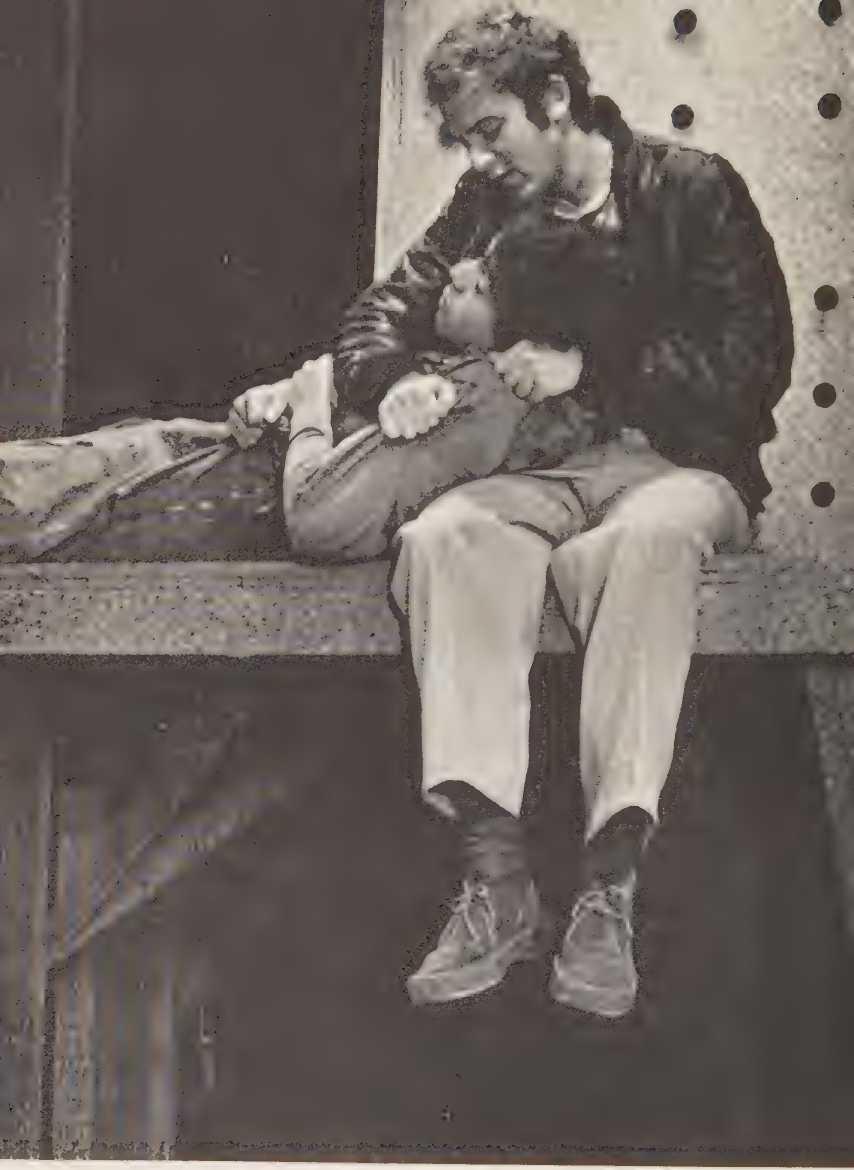
[YOSSARIAN notices him with surprise. He hangs his bathrobe on the coat rack and puts on a parachute harness. He takes a first-aid kit from the coat rack and moves across the stage to SNOWDEN]
SNOWDEN
I’m cold.
YOSSARIAN
You’re going to be all right, kid. You’re going to be all right.
SNOWDEN
I’m cold. I’m cold.
YOSSARIAN
There, there. There, there.
SNOWDEN
I’m cold. I’m cold.
YOSSARIAN
There, there. There, there.
[YOSSARIAN kneels, opens the first-aid kit, and begins treating SNOWDEN for his thigh wound, SNOWDEN moans]
Did I hurt you?
SNOWDEN
I’m cold. I’m cold.
YOSSARIAN
There, there. There, there.
SNOWDEN
I’m scared.
YOSSARIAN
You’re not in any danger. The bleeding stopped. All I’ve got to do is bandage you up and keep you warm until the plane lands.
SNOWDEN
It’s starting to hurt me!
YOSSARIAN
I’ll give you a shot of morphine. I’ll give you a double shot.
[Removes a box from the first-aid kit, opens it, and finds only a slip of paper inside]
Milo Minderbinder, you bastard!
[To SNOWDEN]
There is no morphine.
[Reading]
“What’s good for Milo Minderbinder is good for the country.”
SNOWDEN
[Moaning]
I’m cold.
YOSSARIAN
I’ve got two aspirins.
SNOWDEN
[Shaking his head]
I’m cold. I’m cold.
YOSSARIAN
It’s very warm. It’s very warm here in the plane.
SNOWDEN
I’m cold.
YOSSARIAN
I’m scared!
SNOWDEN
I’m cold.
YOSSARIAN
The edges of your mouth, they’re turning blue. How do you feel?
SNOWDEN
Cold. I’m cold.
YOSSARIAN
You’re going to be all right. There’s no more bleeding.
SNOWDEN
I’m cold. I’m cold.
YOSSARIAN
There, there. There, there. We’ll be back on the ground soon. You’re going to be okay.
[SNOWDEN shakes his head and points with his chin down toward his armpit. YOSSARIAN opens SNOWDEN’a flak suit, gapes in horror, and screams wildly]
SNOWDEN
I’m cold.
[YOSSARIAN forces himself to look again. He screams a second time and squeezes both hands over his eyes]
I’m cold. I’m cold.
YOSSARIAN
I’m cold. I’m cold, too.
SNOWDEN
I’m cold. I’m cold.
YOSSARIAN
[Holding SNOWDEN]
There, there. There, there.
SNOWDEN
I’m cold. I’m cold.
YOSSARIAN
There, there. There, there.
SNOWDEN
I’m cold.
[He dies]
YOSSARIAN
There, there. You’re going to be all ...
[He realizes SNOWDEN is dead and lowers him to the floor]
There, there.
[The CHAPLAIN enters, YOSSARIAN, rising slowly, addresses the CHAPLAIN as he moves away from SNOWDEN]
There was God’s plenty, all right—liver, lungs, kidneys, ribs, stomach, and bits of the stewed tomatoes Snowden had eaten that day for lunch.
[He goes to the coat rack and takes off his parachute harness]
I hate stewed tomatoes. All this time I had been treating Snowden for the wrong wound. I wondered how in the world to begin to save him now. There was Snowden’s secret, and he had spilled it all over the messy floor of the airplane. It was easy to read the message in his entrails. Man was matter, that was Snowden’s secret. Drop him out a window and he’ll fall. Set fire to him and he’ll burn. Bury him and he’ll rot, like other kinds of garbage. The spirit gone, man is garbage.
CHAPLAIN
I know.
YOSSARIAN
That was Snowden’s secret. Ripeness is all.
[Returns to the bed]
CHAPLAIN
Major is here.
YOSSARIAN
Major who?
CHAPLAIN
Major. Major Major. He has to speak to you.
[MAJOR MAJOR enters without disguise and moves hesitantly toward the doorway]
YOSSARIAN
Chaplain, help me! Get the rest of my clothes.
CHAPLAIN
Where? How will I get them?
YOSSARIAN
I don’t know. Ask Nurse Duckett. She’ll do anything she can to be rid of me.
CHAPLAIN
What are you going to do?
YOSSARIAN
I don’t know. But hurry. Please. For once in your life succeed at something.
[The CHAPLAIN leaves, MAJOR MAJOR enters through the doorway and approaches YOSSARIAN]
Who the hell are you?
[With a lame smile, MAJOR MAJOR puts his mustache and glasses on, then removes them]
Where’d you come from?
MAJOR MAJOR
Colonel Korn made me come here to talk to you. He says you disgust him. He says I disgust him, too. He wants me to tell you that the deal is still on.
YOSSARIAN
No, it isn’t. I’m breaking it.
MAJOR MAJOR
Oh, dear. Why did you agree to it if you didn’t like it?
YOSSARIAN
I did it in a moment of weakness. I wanted to save my life.
MAJOR MAJOR
They’re going to court-martial you.
YOSSARIAN
[Laughs and thumbs his nose]
No, they won’t. Please don’t lie to me. There’s an official report that says I was stabbed by a Nazi assassin.
MAJOR MAJOR
But, Yossarian! There’s another official report that says you were stabbed in the course of black-market operations involving the sale of military secrets to the enemy.
YOSSARIAN
Another official report?
MAJOR MAJOR
Yossarian, they can prepare as many official reports as they need. Didn’t you know that?
YOSSARIAN
Oh, dear. What a clear way you have of describing things.
MAJOR MAJOR
Please don’t blame me. I’m only trying to help you.
YOSSARIAN
That’s what that nice detective said before he decided to jab his thumb into my wound.
MAJOR MAJOR
I’m not a detective. I’m a college professor who’s trying to serve his country. And I wouldn’t lie to anyone.
YOSSARIAN
What would you do if one of the men in the squadron asked you about this conversation?
MAJOR MAJOR
I would lie to him.
YOSSARIAN
Look what they’ve done to us. How can you work for them?
MAJOR MAJOR
I try not to think of them. I try to think only of my country.
YOSSARIAN
Christ, Major, don’t tell me that. I’ve flown seventy Goddamn missions. But that war’s over. The country’s not in danger anymore. But I am. From Cathcart and Korn.
MAJOR MAJOR
Then let them send you home. It’s a way to save yourself.
YOSSARIAN
It’s a way to lose myself. Goddammit! I can’t join those bastards now. Getting stabbed by that bitch was the best thing that ever happened to me.
MAJOR MAJOR
Would you rather go to jail? Or fly more missions?
YOSSARIAN
What would you do?
MAJOR MAJOR
Me?
YOSSARIAN
Would you let them send you home?
MAJOR MAJOR
No. I don’t think so. Not under those conditions. But I certainly wouldn’t let them send me to jail.
YOSSARIAN
Then you’d fly more missions?
MAJOR MAJOR
No, of course not. That would be total capitulation. And I might get killed.
YOSSARIAN
Then you’d run away? Desert?
MAJOR MAJOR
Oh, no. I don’t think I could do that. There’d be no hope for me, would there?
YOSSARIAN
No. No hope for us at all?
MAJOR MAJOR
No hope at all. There just doesn’t seem to be anything you can do, is there?
YOSSARIAN
No.
[Perking up with an idea]
And that’s good. Since there’s nothing I can do, I know just what I can do.
MAJOR MAJOR
What?
YOSSARIAN
I’m going to run away.
MAJOR MAJOR
Where?
YOSSARIAN
To Sweden!
MAJOR MAJOR
Sweden? You’ll never get there.
YOSSARIAN
No. But I can get to Rome easily enough—if you keep your mouth shut long enough for me to catch a ride. And I can take my chances from there.
MAJOR MAJOR
No, no, no. Yossarian, you can’t run away. You’ll always be alone. You’ll always Eve in danger.
YOSSARIAN
I live that way now.
[The CHAPLAIN enters carrying a pillowcase stuffed with clothing and a musette bag]
CHAPLAIN
Yossarian! Guess what! I got them, I got them.
YOSSARIAN
You see, Major? There is hope.
MAJOR MAJOR
Chaplain, please talk to him, will you? He’s deserting. He wants to run away to Sweden.
CHAPLAIN
Wonderful! Run away to Sweden, Yossarian. And I’ll stay here and persevere. Yes, I’ll stay here and—
MAJOR MAJOR
Chaplain, will you please shut up? Yossarian, listen. You’ll never make it. It’s almost a geographical impossibility to get to Sweden from here.
YOSSARIAN
Hell, Major, I know that. But at least I’ll be trying.
MAJOR MAJOR
It’s absolutely insane. Your conscience will never let you rest.
YOSSARIAN
God bless it. I wouldn’t want to live in this world without strong misgivings.
MAJOR MAJOR
Chaplain, can’t you do something?
CHAPLAIN
Yes. I’m going to punch Captain Black in the nose.
[He shadowboxes]
Pow! Just like that.
[NATELY’S WHORE appears on stage, eavesdrops, and stealthily positions herself just outside the door carrying a long knife]
YOSSARIAN
Well, Major? Do you think you can disappear again long enough for me to catch a ride?
MAJOR MAJOR
It’s my duty to stop you.
YOSSARIAN
Are you going to try?
MAJOR MAJOR
What would you do? Beat me up?
YOSSARIAN
Why do you say that?
[The CHAPLAIN, feinting punches, shadowboxes close to MAJOR MAJOR]
CHAPLAIN
I will beat you up. You and Corporal Whitcomb and maybe
even Colonel Cathcart. Wouldn’t it be wonderful if I found I didn’t have to be afraid anymore?
YOSSARIAN
Are you going to stop me?
MAJOR MAJOR
[Reaching his decision]
No, of course not! Go, for God sakes, and hurry! Do you need money?
YOSSARIAN
I’ve got money.
MAJOR MAJOR
Here’s more.
CHAPLAIN
Good-by, Yossarian. And good luck. I’ll stay here and persevere.
YOSSARIAN
[Starting away toward the door]
So long, Chaplain. Thanks, Major.
MAJOR MAJOR
How do you feel?
YOSSARIAN
Fine. No, I’m frightened.
MAJOR MAJOR
That’s good. It proves you’re still alive. It won’t be fun.
YOSSARIAN
Yes, it will.
MAJOR MAJOR
I mean it, Yossarian. You’ll have to keep on your toes every minute of every day. They’ll bend heaven and earth to catch you.
YOSSARIAN
I’ll keep on my toes.
MAJOR MAJOR
You’ll have to jump.
YOSSARIAN
I’ll jump.
[YOSSARIAN exits through the doorway, NATELY’S WHORE moves behind him with the knife]
MAJOR MAJOR
Jump!
[YOSSARIAN jumps aside. The knife comes down, missing him by inches, and he runs off. NATELY’S WHORE chases out after him, brandishing the long knife]
CHAPLAIN
Run, Yossarian! Run!
[To MAJOR MAJOR, after YOSSARIAN and NATELY’S WHORE have gone]
Well, Major? What are you going to do?
[MAJOR MAJOR thinks a moment. Then he puts on his fake mustache and large sunglasses, offers a friendly wave, and exits by way of the window. The CHAPLAIN starts away with an exuberant expression]
My dear and darling beautiful wife. I have punched Colonel Cathcart in the nose. I await the consequences happily. They think I am crazy.
[He exits with a smile]
[Curtain]
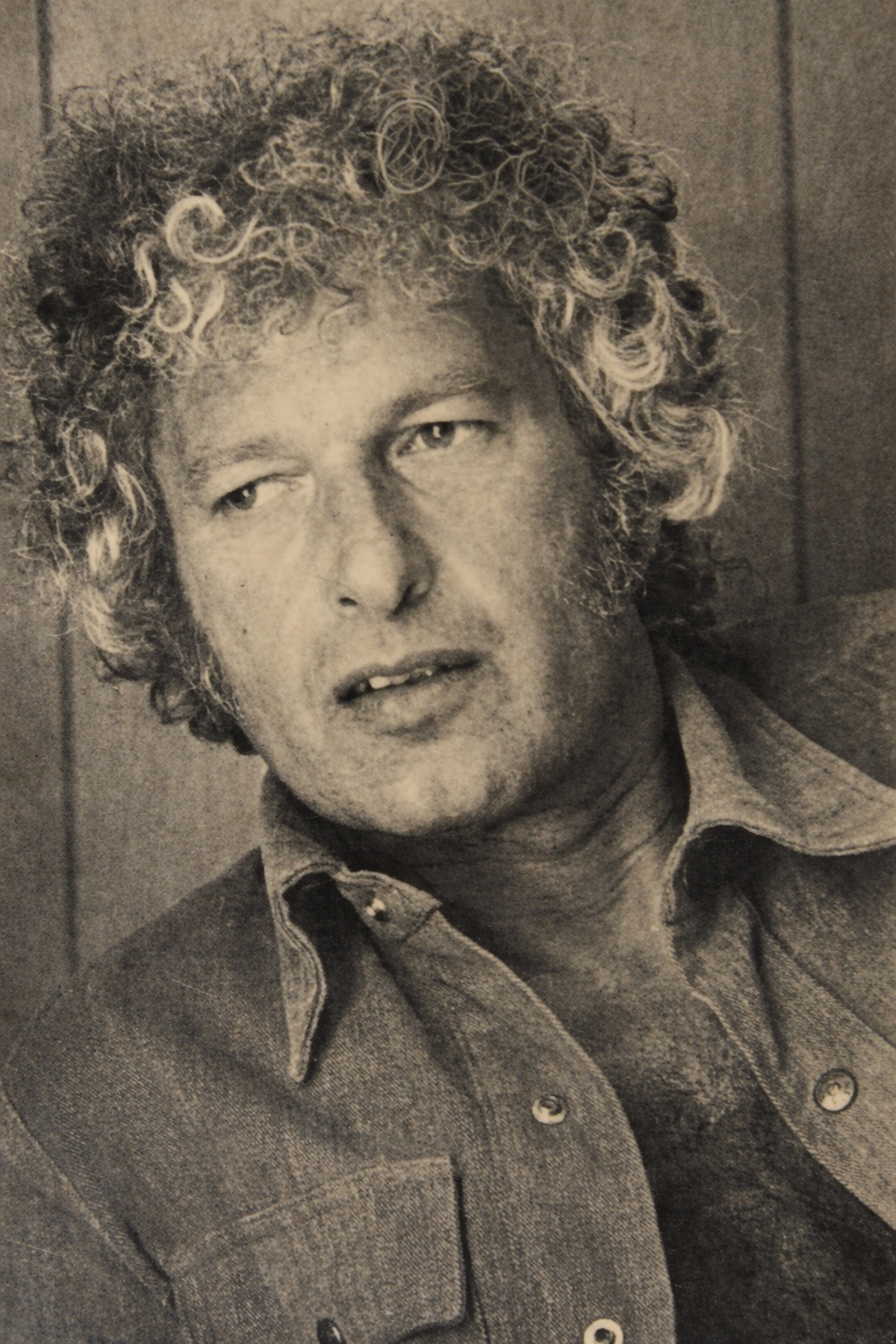
{1} In that amusing “vicuna-coat affair” of the Eisenhower administration, the fallen official was named Adams; the businessman was Goldfine; his secretary, if memory is correct, was Paperman; and a senator with concern for the textile industry in his state was Norris Cotton.
{2} In this Johnson circle as well, the names are Pickwickian, although the people were not. There were Deans, a brace of Bundys, a Rusk, Walt Whitman Rostow, and Hubert Humphrey, MacNamara’s band, and even two Balls, one of them good.