Kevin Johnson and Debbie Howlett
The World Of A Bombing Suspect
FBI files, acquaintances provide frightening info about suspected Unabomber
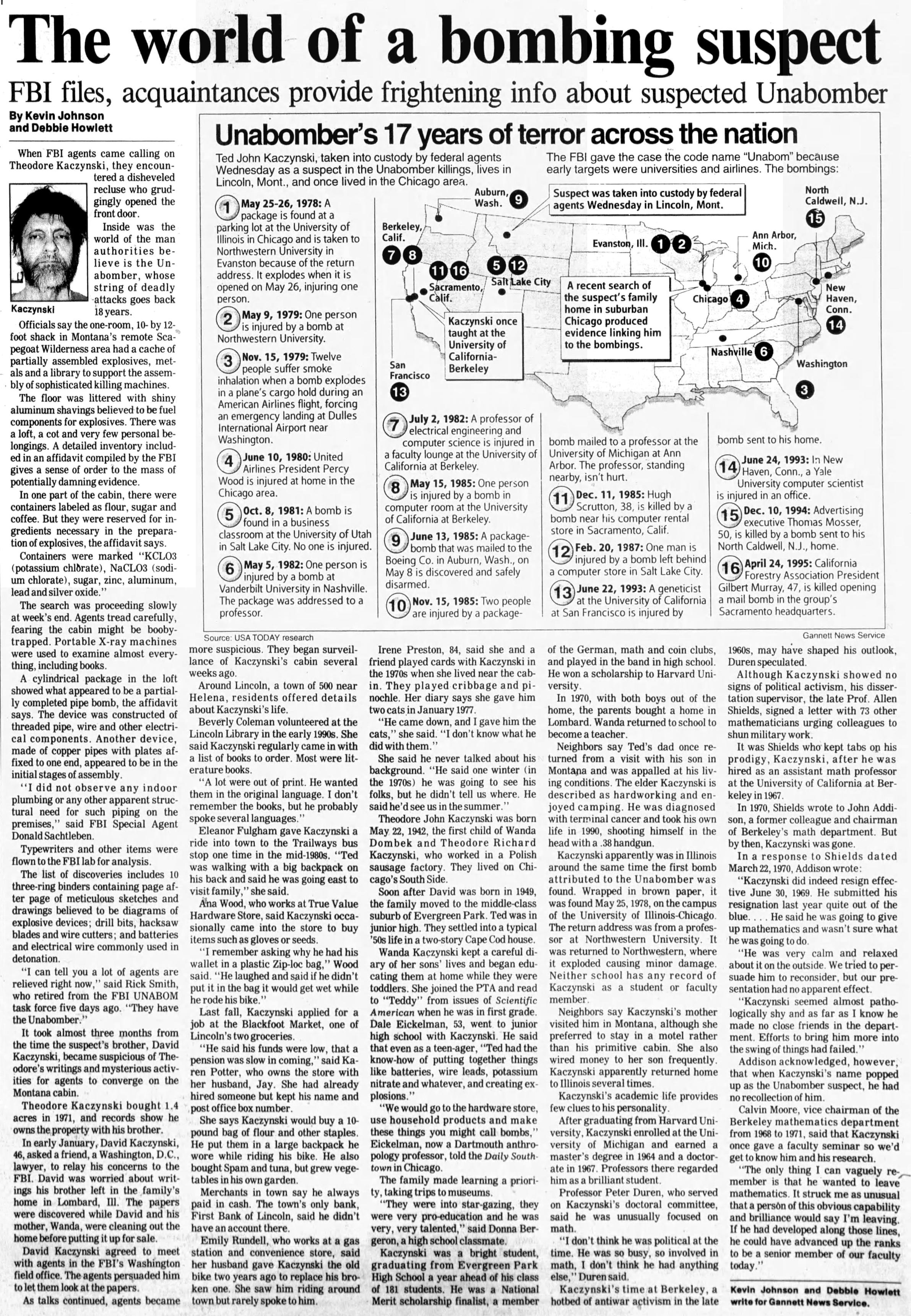
When FBI agents came calling on Theodore Kaczynski, they encountered a disheveled recluse who grudgingly opened the front door.
Inside was the world of the man authorities believe is the Unabomber, whose string of deadly attacks goes back 18 years.
Officials say the one-room, 10- by 12-foot shack in Montana’s remote Scapegoat Wilderness area had a cache of partially assembled explosives, metals and a library to support the assembly of sophisticated killing machines.
The floor was littered with shiny aluminum shavings believed to be fuel components for explosives. There was a loft, a cot and very few personal belongings. A detailed inventory included in an affidavit compiled by the FBI gives a sense of order to the mass of potentially damning evidence.
In one part of the cabin, there were containers labeled as flour, sugar and coffee. But they were reserved for ingredients necessary in the preparation of explosives, the affidavit says.
Containers were marked “KCLO3 (potassium chibrate), NaCLO3 (sodium chlorate), sugar, zinc, aluminum, lead and silver oxide. ”
The search was proceeding slowly at week’s end. Agents tread carefully, fearing the cabin might be booby-trapped. Portable X-ray machines were used to examine almost everything, including books.
A cylindrical package in the loft showed what appeared to be a partially completed pipe bomb, the affidavit says. The device was constructed of threaded pipe, wire and other electrical components. Another device, made of copper pipes with plates affixed to one end, appeared to be in the initial stages of assembly.
“I did not observe any indoor plumbing or any other apparent structural need for such piping on the premises,” said FBI Special Agent Donald Sachtleben.
Typewriters and other items were flown to the FBI lab for analysis.
The list of discoveries includes 10 three-ring binders containing page after page of meticulous sketches and drawings believed to be diagrams of explosive devices; drill bits, hacksaw blades and wire cutters; and batteries and electrical wire commonly used in detonation.
“I can tell you a lot of agents are relieved right now,” said Rick Smith, who retired from the FBI UNABOM task force five days ago. “They have the Unabomber.”
It took almost three months from the time the suspect’s brother, David Kaczynski, became suspicious of Theodore’s writings and mysterious activities for agents to converge on the Montana cabin.
Theodore Kaczynski bought 1.4 acres in 1971, and records show he owns the property with his brother.
In early January, David Kaczynski, 46, asked a friend, a Washington, D.C., lawyer, to relay his concerns to the FBI. David was worried about writings his brother left in the family’s home in Lombard, Ill. The papers were discovered while David and his mother, Wanda, were cleaning out the home before putting it up for sale.
David Kaczynski agreed to meet with agents in the FBI’s Washington field office. The agents persuaded him to let them look at the papers.
As talks continued, agents became more suspicious. They began surveillance of Kaczynski’s cabin several weeks ago.
Around Lincoln, a town of 500 near Helena, residents offered details about Kaczynski’s life.
Beverly Coleman volunteered at the Lincoln Library in the early 1990s. She said Kaczynski regularly came in with a list of books to order. Most were literature books.
“A lot were out of print. He wanted them in the original language. I don’t remember the books, but he probably spoke several languages.”
Eleanor Fulgham gave Kaczynski a ride into town to the Trailways bus stop one time in the mid-1980s. “Ted was walking with a big backpack on his back and said he was going east to visit family,” she said.
A’na Wood, who works at True Value Hardware Store, said Kaczynski occasionally came into the store to buy items such as gloves or seeds.
“I remember asking why he had his wallet in a plastic Zip-loc bag,” Wood said. “He laughed and said if he didn’t put it in the bag it would get wet while he rode his bike.”
Last fall, Kaczynski applied for a job at the Blackfoot Market, one of Lincoln’s two groceries.
“He said his funds were low, that a pension was slow in coming,” said Karen Potter, who owns the store with her husband, Jay. She had already hired someone but kept his name and post office box number.
She says Kaczynski would buy a 10-pound bag of flour and other staples. He put them in a large backpack he wore while riding his bike. He also bought Spam and tuna, but grew vegetables in his own garden.
Merchants in town say he always paid in cash. The town’s only bank, First Bank of Lincoln, said he didn’t have an account there.
Emily Rundell, who works at a gas station and convenience store, said her husband gave Kaczynski the old bike two years ago to replace his broken one. She saw him riding around town but rarely spoke to him.
Irene Preston, 84, said she and a friend played cards with Kaczynski in the 1970s when she lived near the cabin. They played cribbage and pinochle. Her diary says she gave him two cats in January 1977.
“He came down, and I gave him the cats,” she said. “I don’t know what he did with them.”
She said he never talked about his background. “He said one winter (in the 1970s) he was going to see his folks, but he didn’t tell us where. He said he’d see us in the summer.”
Theodore John Kaczynski was born May 22, 1942, the first child of Wanda Dombek and Theodore Richard Kaczynski, who worked in a Polish sausage factory. They lived on Chicago’s South Side.
Soon after David was born in 1949, the family moved to the middle-class suburb of Evergreen Park. Ted was in junior high. They settled into a typical ‘50s life in a two-story Cape Cod house.
Wanda Kaczynski kept a careful diary of her sons’ lives and began educating them at home while they were toddlers. She joined the PTA and read to “Teddy” from issues of Scientific American when he was in first grade. Dale Eickelman, 53, went to junior high school with Kaczynski. He said that even as a teen-ager, “Ted had the know-how of putting together things like batteries, wire leads, potassium nitrate and whatever, and creating explosions.”
“We would go to the hardware store, use household products and make these things you might call bombs,” Eickelman, now a Dartmouth anthropology professor, told the Daily South town in Chicago.
The family made learning a priority, taking trips to museums
“They were into star-gazing, they were very pro-education and he was very, very talented,” said Donna Bergeron, a high school classmate.
Kaczynski was a bright student, graduating from Evergreen Park High School a year ahead of his class of 181 students. He was a National Merit scholarship finalist, a member of the German, math and coin clubs, and played in the band in high school. He won a scholarship to Harvard University.
In 1970, with both boys out of the home, the parents bought a home in Lombard. Wanda returned to school to become a teacher.
Neighbors say Ted’s dad once returned from a visit with his son in Montana and was appalled at his living conditions. The elder Kaczynski is described as hardworking and enjoyed camping. He was diagnosed with terminal cancer and took his own life in 1990, shooting himself in the head with a .38 handgun.
Kaczynski apparently was in Illinois around the same time the first bomb attributed to the Unabomber was found. Wrapped in brown paper, it was found May 25,1978, on the campus of the University of Illinois-Chicago The return address was from a professor at Northwestern University. It was returned to Northwestern, where it exploded causing minor damage. Neither school has any record of Kaczynski as a student or faculty member.
Neighbors say Kaczynski’s mother visited him in Montana, although she preferred to stay in a motel rather than his primitive cabin. She also wired money to her son frequently. Kaczynski apparently returned home to Illinois several times.
Kaczynski’s academic life provides few clues to his personality.
After graduating from Harvard University, Kaczynski enrolled at the University of Michigan and earned a master’s degree in 1964 and a doctorate in 1967. Professors there regarded him as a brilliant student.
Professor Peter Duren, who served on Kaczynski’s doctoral committee, said he was unusually focused on math.
“I don’t think he was political at the time. He was so busy, so involved in math, I don’t think he had anything else,” Duren said.
Kaczynski’s time at Berkeley, a hotbed of antiwar activism in the late 1960s, may have shaped his outlook, Duren speculated.
Although Kaczynski showed no signs of political activism, his dissertation supervisor, the late Prof. Allen Shields, signed a letter with 73 other mathematicians urging colleagues to shun military work.
It was Shields who kept tabs op his prodigy, Kaczynski, after he was hired as an assistant math professor at the University of California at Berkeley in 1967.
In 1970, Shields wrote to John Addison, a former colleague and chairman of Berkeley’s math department. But by then, Kaczynski was gone.
In a response to Shields dated March 22,1970, Addison wrote:
“Kaczynski did indeed resign effective June 30, 1969. He submitted his resignation last year quite out of the blue.... He said he was going to give up mathematics and wasn’t sure what he was going to do.
“He was very calm and relaxed about it on the outside We tried to persuade him to reconsider, but our presentation had no apparent effect.
“Kaczynski seemed almost pathologically shy and as far as I know he made no close friends in the department. Efforts to bring him more into the swing of things had failed.”
Addison acknowledged, however, that when Kaczynski’s name popped up as the Unabomber suspect, he had no recollection of him.
Calvin Moore, vice chairman of the Berkeley mathematics department from 1968 to 1971, said that Kaczynski once gave a faculty seminar so we’d get to know him and his research.
“The only thing I can vaguely remember is that he wanted to leave* mathematics. It struck me as unusual that a person of this obvious capability and brilliance would say I’m leaving If he had developed along those lines, he could have advanced up the ranks to be a senior member of our faculty today.”
Kevin Johnson and Dabble Howlett write for Gannett Newt Service.