Leo Townsend et al
The Philosophy of Fanaticism
Epistemic, Affective, and Political Dimensions
1. Introduction to the Philosophy of Fanaticism
1.3 Philosophical Controversies
Part I: The Epistemic Dimension
2. Fanaticism: For and Against
3. Can Changing Our Minds Make Us Fanatic? Belief Revision and Epistemic Overconfidence
3.2 Belief Revision as an Indication of Invested Epistemic Resources
3.3 Dismissal of Other Agents’ Epistemic Merits and Etiological Challenge
4. Fanaticism, Dogmatism, and Collective Belief
4.4 The Attitude-Centred Reading
4.5 The Attitude-Centred Reading and Dogmatism
4.6 The Content-Centred Approach
5. The Epistemology of Fanaticism
5.2 Epistemic Bubbles and Echo Chambers
5.3 Echo Chambers and Fanaticism
5.4 Fanaticism and Epistemic Vices
6. Hermeneutical Justice for Extremists?
6.5 The Demands of Hermeneutical Justice
6.6 Hermeneutical Marginalisation as Catalyst for Extremism
7. On the Social Constitution of Fanatical Feelings
7.2 Passionate Commitment, the Social Constitution of Fanaticism, and the Struggle for Hegemony
7.3 Anger, Hatred, and the Dialectic of Concretion and Abstraction
7.4 Sympathy, Empathy, and Identification with the “Oppressed”
8. Affective Dynamics in Fanaticism
8.1 Perspectives, Definitions, and Methodological Deliberations
8.2 Key Concepts and Empirical Reference
8.3 Positive Expansive Emotions in Fanaticism
8.6 Transformations and Reinterpretations of Aggressive Emotions
8.7 Confusion and Misattribution of Moral Anger and Hatred in Fanaticism
8.8 Joint Situation, Joint World View, Joint Emotions, Joint Lebensform: Innocuous or Hard Core?
8.9 Conclusion: Emotional Dynamics in Fanaticism
9. Group Fanaticism and Narratives of Ressentiment
9.3 The Simple Account of Group Fanaticism
9.4 Distinctions Between Types of Problematic Groups
9.5 Group Fanaticism as the Tendency to Encourage Individual Fanaticism
9.6 Narratives of Ressentiment Encourage (F2)–(F4)
9.6.3 Feedback Loops Between Fanatical Narratives and Ressentiment
9.6.4 Ressentiment Encourages (F2)–(F4)
10.1 Introduction: What is this Thing Called Fanaticism?
10.2 From Paradigm to Borderline Cases
10.3 Fanaticism as a Complex Affective Phenomenon
10.3.1 The Affective Intentionality of Fanaticism
10.3.2 Fanaticism as an Affective Mechanism
10.3.3 Fanaticism as a Multi-Tracking Sentiment and an Affective Trait
10.4 Concluding Remarks: The Appropriateness of and Resistance to Fanaticism
11. Second-Order Reactive Attitudes Towards Fanaticism
11.2 Critical Reactive Attitudes Towards Fanaticism: Three Examples
11.2.1 Condemnation: A Legal Case
11.2.2 Fanatical Attitudes Towards the Self: Educated by Tara Westover
11.2.3 The Football Fan: A Family Resemblance with Fanaticism?
11.3 Ordinary Reactive Attitudes: Resentment and Indignation
11.3.1 Modifications of Resentment, I: Excuse and Understanding
11.3.2 Modifications of Resentment, II: Objective Attitudes
11.3.3 Modifications of Reactions to Fanaticism
11.4 Second-Order Reactive Attitudes Towards Fanaticism
11.4.2 Second-Order Reactive Attitudes Towards Fanatical Ressentiment
11.5 Conclusion: Diagnostic and Critical Results
12. The Fanatical View of Self and Others in Martyrdom and Jihad
12.2 Philosophical Concepts and Social Understanding
12.5 Humiliation and Structural Misrecognition
12.6 From Misrecognition in Life to Recognition in Death
12.7 The Individual-In-Death, and The End of Scapegoating in Death
12.8 Conclusion: The Jihadi, a “Beautiful Soul” for Himself, an “Ugly Soul” for Others
14. The Pacification of Fanaticism? Jaspers, Unconditional Action, and Nihilism
14.1 Introduction to Jaspers’ Unconditional Acts
14.2 Types of Unconditional Action
14.3 “The One”: Existential Decision is a Transgression that Transcends
15.2 Moderation and Empiricism
15.2.1 A Working Definition of Fanaticism
15.2.2 A Working Definition of Moderation
15.3. Liberalism and Transcendentalism
15.3.1. The Moralization of Conceptual Rules: Transcendentalism of the Ideal
15.3.2 Transcendentalism of The Universal
16. The Fanatical Underpinning of Managerial Subjectivity
16.2 Sectarian Psycho-Theology: Fanaticism and community
16.3 Mystico-Universalist Psycho-Theology: Feelings and Universalism
This book explores some of the disconcerting realities of fanaticism by analyzing its unique dynamics and considering how it can be confronted. Working at the intersections of epistemology, philosophy of emotions, political philosophy, and philosophy of religion, the contributors address a range of questions related to this fanaticism.
Synopsis
The chapters in this volume explore some of the disconcerting realities of fanaticism, by analyzing its unique dynamics, and considering how it can be productively confronted. The book features both analytic and continental philosophical approaches to fanaticism.
Working at the intersections of epistemology, philosophy of emotions, political philosophy, and philosophy of religion, the contributors address a range of questions related to this increasingly relevant, yet widely neglected topic. What are the distinctive features of fanaticism? What are its causes, motivations, and reasons? In what ways, if at all, is fanaticism epistemically, ethically, and politically problematic? And how can fanaticism be combatted or curtailed?
The Philosophy of Fanaticism will be of interest to scholars and advanced students working in epistemology, philosophy of religion, philosophy of emotions, moral psychology, and political philosophy.
Leo Townsend is a postdoctoral researcher at the University of Vienna and the principal investigator of a project on group speech and group silencing, funded by the Austrian Science Fund. He works on social epistemology, collective intentionality, and speech act theory.
Ruth Rebecca Tietjen is a postdoctoral researcher at the Center for Subjectivity Research at the University of Copenhagen and works on a project on antagonistic political emotions, funded by the Austrian Science Fund. She is working on political and existential phenomena such as religious zeal, fanaticism, populism, loneliness, and melancholia.
Hans Bernhard Schmid is professor of Political and Social Philosophy at the University of Vienna. His most recent book is Evil in Joint Action: The Ethics of Hate and the Sociology of Original Sin (Routledge, 2020).
Michael Staudigl works as a senior lecturer and researcher at the philosophy department, University of Vienna, and as scientific associate at the Research centre for religion and transformation (RaT). Between 2003 and 2010 he was visiting fellow at IWM, Vienna. Among his most important publications is Phänomenologie der Gewalt (2015).
Routledge Studies in Contemporary Philosophy
Perspectives on Taste
Aesthetics, Language, Metaphysics, and Experimental Philosophy
Edited by Jeremy Wyatt, Julia Zakkou, and Dan Zeman
A Referential Theory of Truth and Falsity
Ilhan Inan
Existentialism and the Desirability of Immortality
Adam Buben
Recognition and the Human Life-Form: Beyond Identity and Difference
Heikki Ikäheimo
Autonomy, Enactivism, and Mental Disorder
A Philosophical Account
Michelle Maiese
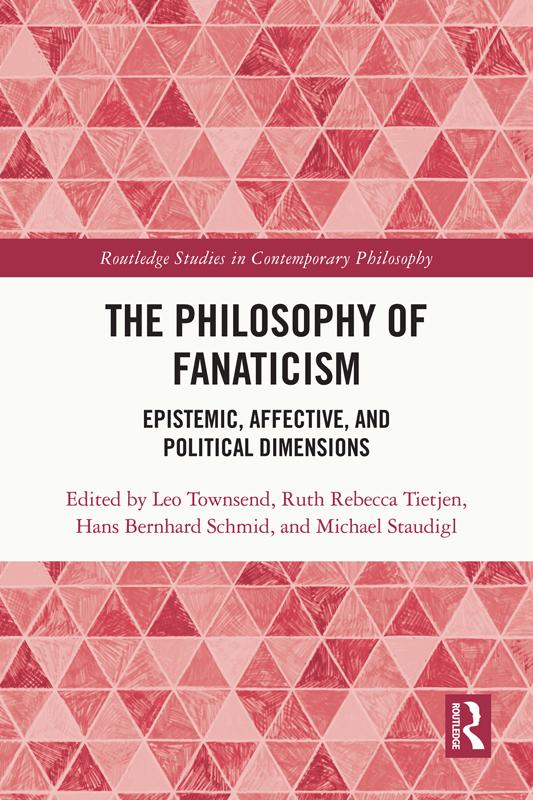
The Philosophy of Fanaticism
Epistemic, Affective, and Political Dimensions
Edited by Leo Townsend, Ruth Rebecca Tietjen, Hans Bernhard Schmid, and Michael Staudigl
Mental Action and the Conscious Mind
Edited by Michael Brent and Lisa Miracchi Titus
For more information about this series, please visit: https://www.routledge.com/Routledge-Studies-in-Contemporary-Philosophy/book-series/SE0720
The Philosophy of Fanaticism
Epistemic, Affective, and Political Dimensions
Edited by Leo Townsend, Ruth Rebecca Tietjen, Hans Bernhard Schmid and Michael Staudigl
Published by Routledge, Taylor & Francis Group, New York and London; Routledge is an imprint of Taylor & Francis Group

First published 2023
by Routledge
605 Third Avenue, New York, NY 10158
and by Routledge
4 Park Square, Milton Park, Abingdon, Oxon, OX14 4RN
Routledge is an imprint of the Taylor & Francis Group, an informa business
© 2023 selection and editorial matter, Leo Townsend, Ruth Rebecca Tietjen, Hans Bernhard Schmid, and Michael Staudigl; individual chapters, the contributors
The right of Leo Townsend, Ruth Rebecca Tietjen, Hans Bernhard Schmid, and Michael Staudigl to be identified as the authors of the editorial material, and of the authors for their individual chapters, has been asserted in accordance with sections 77 and 78 of the Copyright, Designs and Patents Act 1988.
All rights reserved. No part of this book may be reprinted or reproduced or utilised in any form or by any electronic, mechanical, or other means, now known or hereafter invented, including photocopying and recording, or in any information storage or retrieval system, without permission in writing from the publishers.
Trademark notice: Product or corporate names may be trademarks or registered trademarks, and are used only for identification and explanation without intent to infringe.
Library of Congress Cataloging-in-Publication Data
A catalog record for this title has been requested
ISBN: 978-0-367-62545-0 (hbk)
ISBN: 978-0-367-63492-6 (pbk)
ISBN: 978-1-003-11937-1 (ebk)
Acknowledgements
The editors are very grateful to Allie Simmons and Andrew Weckenmann at Routledge for their helpfulness and patience in bringing this project to completion, as well as to Linnea Gustavsson-Englund for assistance in compiling the index. Leo Townsend’s editorial work on this volume was supported by the Austrian Science Fund research project “Giving Groups a Proper Say” (FWF project number P33682-G). Ruth Rebecca Tietjen’s work was supported by the Austrian Science Fund via the research projects “Secularism and its Discontents: Toward a Phenomenology of Religious Violence,” (FWF project number P-29599) and “Antagonistic Political Emotions: An Integrative Philosophical Analysis” (FWF project number P-32392-G), and by the Volkswagen Foundation project “Performative Metaphilosophy or: Calliope in the House of Mirrors” (P-97643).
List of contributors
Jason W. Alvis, University of Vienna
Quassim Cassam, University of Warwick
Frank Chouraqui, Leiden University
Charlie Crerar, University of Leeds
Trystan S. Goetze, Harvard University
Paul Katsafanas, Boston University
Farhad Khosrokhavar, EHESS Paris
Aljoša Kravanja, University of Ljubljana
Hilge Landweer, Free University Berlin
Anne Reichold, European University of Flensburg
Hana Samaržija, University of Zagreb
Hans Bernhard Schmid, University of Vienna
Paul Slama, University of Namur
Thomas Szanto, University of Copenhagen
Ruth Rebecca Tietjen, University of Copenhagen
Leo Townsend, University of Vienna
1. Introduction to the Philosophy of Fanaticism
Ruth Rebecca Tietjen and Leo Townsend
1.1 Introduction
Understanding fanaticism—its character, its causes, and the various ways it can be addressed—was a central preoccupation for many of the central figures in early modern, enlightenment, and post-enlightenment European philosophy, including Locke, Hobbes, Hume, Kant, Hegel, and Nietzsche. Yet, with a few important exceptions, fanaticism has received relatively little philosophical attention in recent times. This is an unfortunate lacuna, since the concept of fanaticism features prominently in contemporary social and political discourse. Perpetrators of political and religiously motivated violence are routinely branded as fanatics, as sometimes are those who hold uncompromising views that lie outside of the political mainstream. On the other hand, fanaticism is also sometimes associated with an enviable level of passion or zeal for one’s political causes (“He is a real fanatic about environmentalism”) or pastimes (consider, e.g., the football fanatic, or the fitness fanatic). Such different invocations of the concept of fanaticism call for careful philosophical analysis and consideration of both the nature of fanaticism and the politics of labelling others and ourselves as “fanatics.”
This book aims to give the concept of fanaticism some of the renewed philosophical attention it deserves. More specifically, it offers philosophical engagement with three dimensions or facets of fanaticism—the epistemic dimension, the affective dimension, and the political dimension. The epistemic dimension is concerned with the way in which fanaticism is tied up with epistemic rationality, epistemic structures, and epistemic character—with the ways in which fanatics might be plausibly characterized as epistemically irrational, might be said to exhibit distinctive epistemic vices, or the ways in which fanaticism might be produced by certain social epistemic structures. The affective dimension is concerned with the ways in which affective states, such as zeal, hatred, anger and ressentiment, but also pride, empathy, and sympathy are connected with fanaticism, and what this can reveal about the moral, political, or even epistemic character of fanaticism. The political dimension is concerned with the place of fanaticism within a liberal society, the political function of labelling others as “fanatics,” and the political responses to fanaticism, among other things.
In focusing on these three dimensions of fanaticism, we do not claim to be covering all the angles of importance, nor do we claim that the chapters collected in this book amount to a comprehensive overview of the topic. The concept of fanaticism has a long and rich philosophical history, and has generated a diverse array of philosophical controversies, not all of which are addressed by the chapters collected here. In the remainder of this short introduction, we briefly outline some key moments in this rich history, and describe some of the philosophical questions and concerns raised by fanaticism, before ending off with a brief description of the chapters.
1.2 The History of Fanaticism
While the phenomenon of fanaticism has not attracted much explicit attention in contemporary philosophy (notable exceptions are Chouraqui 2019; Crosson 2003; Hare 1965; Katsafanas 2019, forthcoming; Marcel 2008; Martinich 2000; Olson 2007, 2009, 2011; Passmore 1990, 2003; Toscano 2017), in the history of philosophy, fanaticism was extensively discussed from Early Modernity, through the Enlightenment and Romanticism, to the late 19th century (on the history of the concept, see Cavanaugh 2012; Colas 1997; Spaemann 1971; Toscano 2017). Given the complexity of this history and the limitations of space, all that the following outline aspires to do is to provide glimpses at historical developments and debates that significantly influence our understanding and usage of the term fanaticism today.
The concept of fanaticism goes back to the Latin terms “fanum,” referring to a sacred place, a temple, or shrine dedicated to a deity, and “fanaticus,” characterizing non-orthodox, orgiastic religions (Spaemann 1971). Although sometimes used neutrally to describe a state of divine inspiration and possession, its main connotations were pejorative. These pejorative connotations became even more dominant in early Christianity when the concept was used to denounce pagans impassioned by worldly or diabolical forces rather than Godly ones. On the epistemic level, fanaticism first referred to a specific way of gaining insights, namely through immediate inspiration and intuition, and second, a specific assessment of these insights as inspired by false intuitions and, therefore, wrong.
The concept of fanaticism gained political brisance in the course of the religious struggles connected with the Reformation, in which it was used as a political weapon to denounce Protestant sects, such as the Anabaptists, Quakers, Shakers, Quietists, or Camisards—but also Protestantism in general. Fanaticism in this context referred to insights acquired through intuition and immediate inspiration rather than rationally, socially, and institutionally mediated insights.
In the 16th and 17th centuries, the term “fanaticism” was largely used synonymously with the term “enthusiasm” (Klein 1997; Passmore 1990) and the German term “Schwärmerei” (Haas 2015; La Vopa 1997). The concept of enthusiasm goes back to Greek “ἐνθουσιασμός” and originally denoted a state of divine inspiration or possession expressing itself in prophecy, ecstasy, poetry, or love, as it is paradigmatically described in Plato’s Phaedrus (Scheer 2020, 2; on the history of the concept, see Heyd 2000; Klein & La Vopa 1998; Knox 1994; Rosenberg 2011). In the context of the peasant rebellions and the English Civil War, it became associated with impassioned, violent, revolutionary political uprisings justified with reference to divine inspiration and putting into question religious and political authorities. In a similar spirit, Martin Luther coined the German term “Schwärmerei” to denounce his opponents, such as Andreas Karlstadt, Thomas Muentzer, and Ulrich Zwingli, whom he accused of referring to divine inspiration as a source of direct religious knowledge that they failed to properly compare with the holy Scriptures (Haas 2015). Fanatics were those who—in contrast to the Lutheran two kingdoms doctrine—claimed no mediating state or civil society to be necessary to establish the Kingdom of God on earth (Colas 1997).
On the epistemic level, fanaticism was increasingly associated with a failure of epistemic rationality. It denoted a way of justifying one’s religious beliefs in a tautological, self-immunizing way and holding one’s beliefs with absolute certainty. As John Locke observed, enthusiasm is an “ignis fatuus [a ‘foolish fire’], that leads them [the enthusiasts] constantly round in this circle; it is a revelation, because they firmly believe it, and they believe it, because it is a revelation” (Locke 1823, Volume III, IV.xix.10; see also Katsafanas 2019). According to this view, it is reason that needs to distinguish between true and false inspiration; enthusiasts are those who fail to make use of their reason to examine the origin and legitimacy of their insights, which in turn proves them to be false or at least unjustified. This philosophical view comes with an understanding of personhood and agency that emphasizes the role of rationality and autonomy and is grounded in the ideal of a liberal order that confines inward religious insights to the realm of the private. It can be contrasted with explorations of fanaticism by early modern poets, such as Edmund Spencer, John Donne, and John Milton. In their poetical explorations of practical, epistemic, and poetological questions, such as the question of whether a state of self-annihilation in God is desirable, whether the subject herself can know to be in a state of divine possession, and how, if at all, such a state can be represented, they were taking the ambiguous nature of fanaticism seriously (Lerner 2019).
On the political level, the attempt to delegitimize fanatical movements can be understood as a counterrevolutionary activity. Referring to insights based on immediate revelation, fanatics appeared as a threat to the hegemonic order by questioning the authority of existing religious, social, and political institutions. Seen from a different perspective, this is what potentially lends fanaticism an emancipatory power, as observed by David Hume:
superstition is an enemy to civil liberty, and enthusiasm a friend to it. As superstition groans under the dominion of priests, and enthusiasm is destructive of all ecclesiastical power, this sufficiently accounts for the present observation. Not to mention, that enthusiasm, being the infirmity of bold and ambitious tempers, is naturally accompanied with a spirit of liberty; as superstition, on the contrary, renders men tame and abject, and fits them for slavery.
(Hume 1987, 78)
What this suggests is that the question of how to define and assess the concept of fanaticism is intertwined with political interests. Elsewhere, Hume talks about both religious and political fanatics, describing the Levellers’ religiously grounded struggle for an “equal distribution of property” as a form of “political fanaticism” (Hume 1751, 3.24). Though still connected to Protestant religion, this points to the beginning expansion of the concept beyond Protestantism and even beyond religion in general.
In the course of the 18th century, the meaning of the concept of fanaticism shifted from the content and genesis of the fanatic’s insights to a specific way of holding and defending them, namely through violent or intolerant means (Colas 1997; Spaemann 1971). As Voltaire writes in his Dictonnaire philosophique:
Fanaticism is to superstition what delirium is to fever and fury to anger: he who has ecstasies and visions, who takes dreams for realities and imaginations for prophecies, is an enthusiast; and he who sticks not at supporting his folly by murder is a fanatic.
(Voltaire 1962, 194; see also Alexandre Deleyre’s entry in Diderot’s Encyclopedia)
As Dominique Colas points out, this shift gives rise to a certain tension within the concept of fanaticism itself:
[H]e who denounces ‘false prophets’ necessarily tends to believe there are true ones. When he uses the abusive term ‘fanatic’ to refer to someone who does not share his beliefs, it may be that he shows his own intolerance: condemning the other’s fanaticism may well be a way of affirming one’s own.
(Colas 1997, 16)
At the same time, a reassessment of certain aspects and forms of fanaticism took place. This reassessment was connected to a reappreciation of passions in the domains of the aesthetic, moral, and political. For example, Shaftesbury distinguished innocent forms of poetic inspiration from violent, religiously grounded hatred (Shaftesbury 1999). Although critical of fanatical violence, Jean-Jacques Rousseau appreciated the passionate core of fanaticism:
fanaticism, although sanguinary and cruel, is nevertheless a grand and strong passion which elevates the heart of man, makes him despise death, and gives him a prodigious energy that need only be better directed to produce the most sublime virtues.
(Rousseau 1979, 312n; see also Cortes 2020)
This reassessment of fanaticism was accompanied by the attempt to (re-)establish the conceptual distinction between fanaticism and enthusiasm. Immanuel Kant distinguishes between enthusiasm as a form of excessive passion, e.g., in patriotism, friendship, or religion, and fanaticism as a form of excessive passion justified with reference to divine revelation or communion with God (Kant 2007, 2:251n; see also Katsafanas 2019; Zuckert 2010). Especially under the influence of Romanticism, the concept of enthusiasm got rehabilitated (Passmore 1990). Drawing on its Greek origin, it now was used (again) to denote states of creative inspiration. This eulogistic (Passmore 1990) or at least predominantly positive and yet ambiguous (Scheer 2020) connotation of the concept of enthusiasm still endures today. By contrast, the concept of fanaticism largely retained its negative connotations. Among the historical exceptions to this tendency are political movements as diverse as US-American Abolitionism (Olson 2007, 2009, 2011) and German National Socialism (Klemperer 2018; Scholz 2009) who used the concept of fanaticism as a positive self-description.
In time, the concept of fanaticism became increasingly secularized. It was no longer used exclusively to denote religious phenomena but also political movements such as the French Revolution. Georg Wilhelm Friedrich Hegel conceived of fanaticism as a desire for the abstract that failed to give freedom a concrete content, and he thought it was embodied by the terror of the French Revolution (Hegel 2004, 355–360; see also Colas 1997). At the same time, Hegel saw a direct connection between the unmediated political rule of religion and fanaticism in that religion by its very nature is directed at totality (see Spaemann 1971).
The self-reflexive dimension of the discussion on fanaticism was particularly prominent in the work of Friedrich Nietzsche, which depicts fanatics as those who believe in an absolute truth not because they have good epistemic reasons to do so but because they need an absolute truth in order to retain their psychic unity (Nietzsche 1974, §347; see also Katsafanas 2019; Reginster 2003). It is part of the psychic condition of fanaticism that the fanatic himself cannot know that he is a fanatic. Free spirits, by contrast, are characterized by a playful attitude not only towards different kinds of truths but also towards the value of truth itself. Those anti-fanatics who are all too certain of both their idea of fanaticism and of the fact they themselves are not fanatics, may, on this view, be apt to fall into a form of fanaticism themselves.
1.3 Philosophical Controversies
As this historical overview suggests, fanaticism raises many questions and has produced many philosophical controversies. This includes debates about the character of fanaticism, and about the ways in which fanaticism can be confronted. One set of questions relates to the nature of fanaticism: what is fanaticism, what phenomena exemplify fanaticism, and how does fanaticism differ from related concepts, such as extremism and fundamentalism?
Many philosophers classify fanaticism as a kind of rational failing, but amongst those who take this approach, there is considerable disagreement about what sort of rational failing it is. One approach locates fanaticism primarily in behaviour, say by characterizing fanaticism as the unduly violent pursuit of political or religious ideals (Taylor 1991). Others characterize fanaticism in broadly psychological terms—for instance, as the harbouring of certain “extreme” beliefs or values; as an epistemic vice characterized by resistance to epistemic challenges, counter-evidence, and higher-order evidence; a distinctive mindset involving fantasies of persecution, obsessions with purity, and indifference to the consequences of one’s actions (Cassam 2021); a moral failing characterized by the commitment to “perverted ideals” that one forces onto other people (Cassam 2021; Hare 1965); or as a distinctive way of holding and pursuing one’s values (Katsafanas 2019). Yet others associate fanaticism less with individual failures of rationality than with some kind of social defect. For example, it has been suggested that fanaticism is characteristically the product of “crippled epistemologies” (Hardin 2002; Sunstein & Vermeule 2009)—i.e., social epistemic structures characterized by exclusionary practices and a tendency to believe on authority—or that fanaticism can be linked to the emergence of echo chambers, which actively promote distrust of outside epistemic sources (Nguyen 2020). Fanaticism has been described as defective way of forming communities through hatred and the affective mechanism of ressentiment (Salmela & Capelos 2021; Szanto 2020).
All of these views of the nature of fanaticism can be classified as substantive views, since they assume that the concept of fanaticism corresponds to some real property or phenomenon that can be profitably theorized about. What is more, although disagreeing about what kind of failure fanaticism is, they agree about the fact that fanaticism is a form of failure. It is worth noting, however, that there is an alternative approach to fanaticism which eschews both of these ideas, and shifts attention instead to the dialectical role of fanaticism, and specifically, to the politics of labelling others as fanatics. Of particular interest here is the way in which “fanaticism” has been deployed as a pejorative to ostracize and demonize those who hold heterodox political or religious views (Cavanaugh 2011; Olson 2007; Toscano 2017). For those who take a dialectical view, fanaticism is not a defect found in certain individuals or social structures but rather a kind of slur used to impugn dissidents and shore up religious and political orthodoxy.
Closely connected with the project of characterizing the nature of fanaticism is the task of identifying paradigmatic instances of fanaticism. Historically, as we have seen, the paradigmatic fanatic was the religious or political zealot—someone with a deep and unwavering commitment to certain religious or political ideals, and the inclination to pursue and defend those ideals at any cost. This paradigm persists today, as the term “fanatic” is routinely applied to terrorists who claim religious inspiration, or to members of fundamentalist religious groups, such as the Westboro Baptist church or ISIS. It is worth noting, however, that in everyday discourse the term “fanatic” is also applied with notably less negative connotations—indeed, sometimes with a sense of admiration—to fans, e.g., to devotees of certain consumer goods (e.g., Apple fanatics), certain activities (e.g., yoga fanatics), sports teams (fans of the team), or artists (e.g., a fan of Madonna) (see, e.g., Chung et al. 2018; Fuschillo 2020). As Erin C. Tarver points out in her critical study of US-American sports fandom, when invented in the late 19th century, the term “fan”—a truncated version of “fanatic”—was slightly derogative, but soon fandom turned from a deviation from the norm into a norm defining both how people ordinarily behave and ought to behave (Tarver 2017). This raises the question of how, if at all, fanaticism is related to fandom—whether fans are fanatics properly speaking, whether “fanaticism” is being used in a loose or non-literal sense in such cases, or, alternatively, whether such usage harks back to the related of notion of “enthusiasm” that Kant sought to distinguish from fanaticism.
Just as there are questions about the relation between fanaticism and fandom, so there are questions concerning the distinction between fanaticism and other related phenomena, such as fundamentalism, extremism, and radicalism. Answering the question of how fanaticism relates to these phenomena is not simple, however, since the nature of these other phenomena is itself a matter of debate and controversy. Introduced in the early 20th century, the term “fundamentalism” was originally used to describe specific kinds of conservative Protestant movements in the USA. Today, the concept has a much broader application in both public and scientific discourse—being used to refer to other religious movements, as well as secular movements (e.g., “feminist fundamentalism,” “capitalist fundamentalism”). Key elements of many definitions of fundamentalism are its characterization as an ambivalent reaction to modernity and its search for certainty, for example in holy scriptures. How then do the revolutionary character of fanaticism and the reactionary nature of fundamentalism relate to each other? What difference does it make that, following the origin of both terms, fanatics rely on immediate inspiration, while fundamentalists rely on scriptures and authorities?
The notion of extremism can be understood in several different ways. It can denote the holding of a position on the end of a scale of a specific political spectrum, for example, left- and right-wing extremism (“ideological extremism”); the usage of extraordinary methods in realizing one’s political aims, including, but not restricted to, violence and terrorism (“methods extremism”); a distinctively fervent way of holding (and defending) one’s position (“psychological extremism”); or as a distinctive mindset characterized by, among other things, a preoccupation with self-victimization, conspiracy theories, purity, and a grand overarching narrative drawing a line from a (lost) mythical past through a present period of struggle to a potential mythical future (Cassam 2021; see also Berger 2018). Each of these conceptualizations raises the philosophical question of whether fanaticism conceptually implies extremism or vice versa. For example, many agree that fanaticism involves at least the usage of extraordinary, if not violent means, and in this sense is connected to methods extremism. There is disagreement, however, about the question of how to account for structural violence in this picture, and whether the usage of extraordinary means is always and of necessity unjustified in the case of fanaticism (see, e.g., Cassam 2021; Olson 2007).
In a similar way to the notion of extremism, the concept of radicalism is sometimes taken to refer to the usage of “radical,” i.e., extra-institutional methods or “radical” goals, i.e., a transformation of basic social structures and systems, or a combination thereof (Beck 2015). The latter points to the etymology of the term, the idea of bringing about a change at the root—a change which can be either progressive or reactionary. Again, we may wonder what this implies for the relationship between fanaticism and radicalism. Is fanaticism similarly bound to the ambition to radically change the status quo or can fanaticism itself become hegemonic? If “radicalism” primarily is understood as a descriptive term, whereas fanaticism is conceptualized as an individual or social failing, how, if at all, can we distinguish between fanatical and non-fanatical forms of radicalism?
Beyond these questions concerning the nature of fanaticism, and its connection to related concepts, there are further questions about how fanaticism should be confronted and addressed. The answers to these questions obviously depend on whether one takes fanaticism to be problematic, and if so, how so. For instance, those who take a dialectical approach to fanaticism (Olson 2007; Toscano 2017), and hence deny that fanaticism corresponds to any kind of inherently problematic property or phenomenon, have pointed to the example of the American abolitionists, who “reclaimed” the label of fanaticism, and wore it as a badge of honour. Like other forms of slur-reclamation (cf., reclamation of terms like “dyke” and “queer”), this response is a form of discursive resistance, specifically resistance to the dubious inferences licensed by the previous usages. Moreover, they have pointed out the importance of reflecting on how our dichotomic way of conceptualizing the world contributes to the emergence of violent fanaticism and of uncovering fanatical dimensions of our own thinking, feeling, and acting.
Those who take substantive views of fanaticism tend to see fanaticism as a kind of defect, either in the psychology of individual fanatic or in the social system in which they are embedded. Depending on the location of this defect, different responses to fanaticism may be called for. For instance, if fanaticism is primarily a matter of individual irrationality, then perhaps it should be addressed by changing individuals’ minds and mindsets—for instance, through the use of deradicalization techniques, such as strategic counter-narratives (Cassam 2021). By contrast, if fanaticism is primarily the product of social epistemic structures like echo chambers, that promote and sustain extremist views, then perhaps what is called for is social and institutional policies and measures aimed at dismantling such structures (Nguyen 2020; Sunstein & Vermeule 2009).
1.4 Contributions
1.4.1 The Epistemic Dimension
The idea that fanaticism centrally involves some kind of epistemic aspect, often construed as some kind of epistemic failing or vice, has been taken for granted in much of the historical and contemporary literature. Traditionally this has been explored at the level of individual epistemology, for instance in accounts that characterize fanatics as profoundly dogmatic, or as claiming some kind of divine authority as the basis for their beliefs. There are also, however, important questions concerning fanaticism that may be raised within social epistemology, for example questions about the role of social epistemic structures in producing or sustaining fanaticism, as well as questions about fanaticism and epistemic injustice. The chapters in the first section of this book explore these themes.
The first chapter is Quassim Cassam’s “Fanaticism: For and Against.” In this chapter, Cassam explores and contests recent efforts to rehabilitate fanaticism by pointing to its alleged role in progressive politics, such as the US anti-slavery abolitionist movement. Cassam characterizes fanaticism in terms of a distinctive mindset, involving an uncompromising and dogmatic commitment to certain perverted ideals, and a willingness to trample on the ideals and interests of others in pursuit of them. This characterization allows Cassam to distinguish fanaticism from radicalism, and this in turn allows him to argue that although abolitionists self-identified as “fanatics,” they are better understood as radicals.
In his chapter, “Can Changing Our Minds Make Us Fanatic? Belief Revision and Epistemic Overconfidence,” Aljoša Kravanja explores the relation between profound belief revision and fanaticism. Although fanaticism is associated with doxastic closed-mindedness and dogmatism, Kravanja argues that it is often an episode in which the subject changes their mind that produces the characteristic epistemic overconfidence and intolerance associated with fanaticism—and hence that, as Kravanja puts it, “changing our mind can make us less open-minded.”
The next two chapters in this section turn to issues in social epistemology and their relation to fanaticism. In his chapter, “Fanaticism, Dogmatism, and Collective Belief,” Leo Townsend considers whether collective belief—the phenomenon involved when a belief is properly ascribed to a group—is apt to bring about the kind of dogmatism that is characteristic of fanaticism. He argues that on one way of understanding collective belief, it is indeed apt to promote dogmatism (and in turn fanaticism), but that there is an alternative construal available which has no such implications.
The following chapter, Hana Samaržija’s “The Epistemology of Fanaticism: Echo Chambers and Fanaticism,” explores a particular kind of social epistemic structure that is conducive to fanaticism, namely, echo chambers. Echo chambers support fanaticism by undermining their members’ trust in external sources of information, and thereby fostering the kind of close-mindedness and dogmatism associated with fanaticism. Samaržija argues that, because of the inherent robustness and resilience of echo chambers, we should employ not only epistemic but also political and institutional measures to dismantle them.
The final chapter in this section, Trystan Goetze and Charlie Crerar’s “Hermeneutical Justice for Extremists?,” explores questions of epistemic injustice in relation to the rhetoric of extremist groups. In particular, Goetze and Crerar raise the question of whether failure to engage with the conceptual framework and worldview of extremist groups constitute a hermeneutical injustice, and hence whether we have a (epistemic) duty to be more receptive to extremist worldviews. They argue that although there is a sense in which the refusal to engage with extremism constitutes a hemeneutical injustice against certain extremist groups, this does not imply that extremist views should be uncritically accepted, nor that extremists deserve discursive engagement.
1.4.2 The Affective Dimension
Fanaticism is commonly associated with emotions and other affective phenomena. This is particularly evident in fanaticism’s historical synonyms, enthusiasm and Schwärmerei. Yet the exact nature of this relationship is unclear. Fanaticism is associated with loving devotion to a cause but also with antagonistic political emotions and passions such as anger, contempt, and hatred, and the affective mechanism of ressentiment. It is explained with reference to the affective makeup of individual persons such as the need for sacred values but also with reference to partisan movements that define themselves in terms of shared values, practices, and feelings. This raises the question of how exactly fanaticism and affectivity relate to each other. Is fanaticism itself an inherently affective phenomenon or does it necessarily involve specific kinds of affective phenomena—and, if so, which kinds? Does the affective nature of fanaticism help us to understand why fanaticism is epistemically, morally, or politically problematic? What role do groups play in understanding the affective nature of fanaticism? What does our affective reaction to fanaticism reveal about the phenomenon of fanaticism itself?
Ruth Rebecca Tietjen and Hilge Landweer explore the variety of affective phenomena involved in fanaticism and show how specific affective phenomena relate to the ideology of fanaticism itself. In her chapter, “On the Social Constitution of Fanatical Feelings,” Ruth Rebecca Tietjen shows how the fanatics’ relationship to their object of devotion, their relationship towards the outgroup that they take to threaten the sacred status of their object of passionate devotion, and their relationship towards the ingroup in whose name they claim to speak and act, are constituted by specific affective phenomena. These are: passionate devotion to a sacred object or idea, hostile antagonism towards those who threaten the idea in question, and sympathetic identification with the (allegedly) suffering and oppressed. She analyzes each of these three groups of feelings, paying particular attention to their social constitution and the way in which power interests infuse our discourse on fanaticism.
In her chapter, “Affective Dynamics in Fanaticism: Positive Emotions, Indignation, Contempt, and Hatred,” Hilge Landweer criticizes the view that associates fanaticism primarily with the affective state of hatred. Instead, she highlights the role of other aggressive emotions, especially contempt, as well as of positive emotions in understanding fanaticism. Discussing the case of German communist “K-groups” in the 1970s, she identifies collective feelings of pride and superiority as key elements of fanaticism and shows how these feelings mirror key features of fanaticism itself. She offers a comparative analysis of hatred and contempt that reveals how both emotions differ in virtue of their connection to opposite positions in the power spectrum and demonstrates how the ascription of indignation, hatred, and contempt is itself interwoven with power interests.
Paul Katsafanas and Thomas Szanto focus on fanaticism as a group phenomenon and explore affective mechanisms characteristic of group fanaticism. In “Group Fanaticism and Narratives of Ressentiment,” Paul Katsafanas defends what he calls “the generative view of group fanaticism,” according to which groups are fanatical if and only if they promote individual fanaticism. Specifically, he explores how fanatical groups promote individual fanaticism by fostering ressentiment. Ressentiment is an affective mechanism that transforms feelings of impotent vengefulness into feelings of superiority and hostility towards an outgroup and reinforces these antagonistic emotions through a self-perpetuating narrative. The self-conception of the person of ressentiment becomes entangled with her antagonistic stance towards an outgroup that allegedly threatens her self-conception. Katsafanas shows how, through specific structural features, fanatical narratives foster ressentiment, and, in doing so, promote individual fanaticism.
Thomas Szanto, in his chapter, “Sacralizing Hostility: Fanaticism as a Group-Based Affective Mechanism,” argues that fanaticism is an affective mechanism that transforms individual commitments to sacred values into what he calls “derivatively shared and collaboratively biased ‘affective convictions.’” Fanaticism deems those who threaten the group’s sacred values to be deserving of total isolation or even elimination, and, in defense of the values in question, fanaticism endorses self-sacrifice. This is the case because fanatics experience threats to their sacred value as threats to their social identity. Rather than constituting their identity through the shared commitment to a sacred value, fanatical groups are primarily constituted through their hostility towards the outgroup that (allegedly) threatens or questions it. Szanto concludes that in order to counteract fanaticism, affective convictions need to be re-personalized and de-sacralized, which in turn is an inherently affective matter.
In her chapter, “Second-Order Reactive Attitudes Towards Fanaticism,” Anne Reichold explores affective reactive attitudes towards fanaticism, and, in doing so, sheds light on the phenomenon of fanaticism itself. She argues that the intense critical affective reaction to fanaticism in attitudes of condemnation and contempt answers to the perceived rejection of basic interpersonal attitudes, such as sorrow, pity, compassion, and empathy, that is characteristic of fanaticism. The fanatical refusal to react affectively to other people’s needs and suffering if such a reaction conflicts with the fanatic’s ideology characteristically concerns not only the needs and suffering of members of the outgroup but also of the ingroup. Ordinary reactive attitudes, such as resentment and indignation, presuppose that the other is answerable and sensitive to criticism and basic interpersonal attitudes. The intensification of resentment and indignation to condemnation and contempt, by contrast, mirrors the fact that the fanatic refuses this form of answerability and sensitivity.
1.4.3 The Political Dimension
The final section of the book explores a range of issues relating to what could broadly be called the politics of fanaticism, including chapters that investigate specific forms of violence as expressions of fanaticism, as well as chapters that explore the connections between fanaticism and nihilism and liberalism.
The first chapter in this section is Farhad Khosrokhavar’s “The Fanatical View of Self and Other in Martyrdom and Jihad: The European Jihadi Agent as a Modern Scapegoat,” which offers a phenomenological exploration of the lived experience of European Jihadi fanaticism. Khosrokhavar specifically focuses on the sons and grandsons of Muslim migrants in Europe who see themselves exposed to continuous scapegoating, misrecognition, and humiliation transmitted through generations. Jihadism in this picture appears as an attempt to reverse the logic of humiliation by killing the offender and being killed oneself and, in doing so, achieving eternal bliss for oneself and bringing eternal condemnation to one’s offenders. This, as Khosrokhavar argues, is a “struggle for recognition” taken to the extreme in which any form of this-worldy compromise is rejected in favour of an otherworldly solution.
Hans Bernhard Schmid in his chapter, “Purges, Big and Small: On Violence, Faith, and Fanaticism,” examines the phenomenon of “big purges,” which he defines as organized collective violence that is grounded in and purportedly justified by the threat posed by the targets of that violence to the collective perpetrating it. Reflection on purges, he argues, can help to illuminate the role played by a certain conception of the good which has its roots in Platonic philosophy.
In his chapter “The Pacification of Fanaticism? Jaspers, Unconditional Action, and Nihilism,” Jason W. Alvis investigates the relationship between fanaticism and nihilism. Against the widely held intuition that unconditional claims give rise to fanaticism, he defends the view that it is the avoidance of the unconditional that gives rise to nihilism which in turn is one root of fanaticism. To this end, Alvis offers an in-depth analysis of Karl Jasper’s account of unconditional actions that rehabilitates unconditional actions and shows how passion, conviction, and humility can be reconciled. In light of this analysis, our attempts to pacify and domesticate fanatics through liquidating all claims to the unconditional are themselves in danger of involving fanatical tendencies in that they may express a “fanaticism of certainty.”
In “Fanaticism and Liberalism,” Frank Chouraqui investigates the question of why liberalism has been so unsuccessful in countering fanaticism. Drawing on previous work, Chouraqui develops a formal account of fanaticism with reference to the idea that fanaticism involves the rejection of moderation. Yet liberalism, he argues, also excludes moderation, on account of its “transcendental commitments”—and this helps to explain why liberalism is ill-equipped to combat fanaticism, since it actually shares fanaticism’s “basic mechanism.”
Paul Slama’s chapter, “The Fanatical Underpinning of Managerial Subjectivity: A Psycho-theological Journey into Some Archives,” seeks to unsettle the idea of fanaticism as an unintelligible and dangerous “otherness.” With reference to the idea that global contemporary subjectivity is a kind managerial subjectivity, Slama argues that our contemporary subjectivity does not stand in contrast to fanaticism but instead shares its key features, and hence that “fanaticism is not in the Other [...] but it is ourselves, fully ourselves, in the very ground of our subjectivity.”
Acknowledgments
Ruth Rebecca Tietjen’s contribution to this chapter was written in the context of the project “Antagonistic Political Emotions,” funded by the Austrian Science Fund (P-32392-G). Leo Townsend’s contribution was written in the context of the project “Giving groups a proper say,” funded by the Austrian Science Fund (P-33682-G). We would like to thank Hans Bernhard Schmid and Mark Boespflug for their feedback on an earlier version of this chapter.
References
Beck, Colin J. (2015). Radicals, Revolutionaries, and Terrorists. Cambridge, Polity Press.
Berger, J. M. (2018). Extremism. Cambridge, MIT Press.
Cassam, Quassim (2021). Extremism. A Philosophical Analysis. New York, N.Y., Routledge.
Cavanaugh, William T. (2011). The Myth of Religious Violence. In: Andrew R. Murphy (Ed.). The Blackwell Companion to Religion and Violence. Chichester, West Sussex/Malden, Mass., Wiley-Blackwell, 23–32.
Cavanaugh, William T. (2012). The Invention of Fanaticism. In: Sarah Coakley (Ed.). Faith, Rationality, and the Passions. Chichester/Malden, Mass., Wiley-Blackwell, 29–40.
Chouraqui, Frank (2019). Fanaticism as a Worldview. Philosophical Journal of Conflict and Violence 3 (1), 9–19. https://doi.org/10.22618/TP.PJCV.20193.1.192002
Chung, Emily/Farrelly, Francis/Beverland, Michael B./Karpen, Ingo O. (2018). Loyalty or Liability. Resolving the Consumer Fanaticism Paradox. Marketing Theory 18 (1), 3–30. https://doi.org/10.1177/1470593117705696
Colas, Dominique (1997). Civil Society and Fanaticism. Conjoined Histories. Stanford, Calif., Stanford University Press.
Cortes, Alyssa (2020). Zeal without Fanaticism: Jean-Jacques Rousseau on the Religion of the Citizen. The Review of Politics 82 (2), 199–224. https://doi.org/10.1017/S0034670520000170
Crosson, Frederick J. (2003). Fanaticism, Politics, and Religion. Philosophy Today 47 (4), 441–447. https://doi.org/10.5840/philtoday200347431
Fuschillo, Gregorio (2020). Fans, Fandoms, or Fanaticism? Journal of Consumer Culture 20 (3), 347–365. https://doi.org/10.1177/1469540518773822
Haas, Alois M. (2015). Der Kampf um den Heiligen Geist. Luther und die Schwärmer. In: Alois M. Haas (Ed.). Der Kampf um den Heiligen Geist. Luther und die Schwärmer. Berlin, de Gruyter, 11–35.
Hardin, Russell (2002). The Crippled Epistemology of Extremism. In: Albert Breton/Gianluigi Galeotti/Pierre Salmon/Ronald Wintrobe (Eds.). Political Extremism and Rationality. Cambridge, Cambridge University Press, 3–22.
Hare, Richard M. (1965). Freedom and Reason. Oxford, Oxford University Press.
Hegel, Georg Wilhelm Friedrich (2004). The Philosophy of History. Mineola, Dover Publications.
Heyd, Michael (2000). Be Sober and Reasonable. The Critique of Enthusiasm in the Seventeenth and Early Eighteenth Centuries. Leiden, Brill.
Hume, David (1751). An Enquiry Concerning the Principles of Morals. London, Hackett.
Hume, David (1987). Essays. Moral, Political, and Literary. Indianapolis, Ind., Liberty Fund.
Kant, Immanuel (2007). Anthropology, History, and Education. Edited by Günter Zöller / Robert B. Lauden. Cambridge, Cambridge University Press.
Katsafanas, Paul (2019). Fanaticism and Sacred Values. Philosophers’ Imprint 19 (17), 1–20.
Katsafanas, Paul (forthcoming). The Philosophy of Devotion. Nihilism, Fanaticism, and the Longing for Invulnerable Ideals. Oxford, Oxford University Press.
Klein, Lawrence Eliot (1997). Sociability, Solitude, and Enthusiasm. Huntington Library Quarterly 60 (1/2), 153–177. https://doi.org/10.2307/3817835
Klein, Lawrence Eliot/La Vopa, Anthony J. (Eds.) (1998). Enthusiasm and Enlightenment in Europe, 1650–1850. San Marino, Calif., Huntington Library.
Klemperer, Victor (2018). LTI. Notizbuch eines Philologen. Ditzingen, Reclam.
Knox, Ronald Arbuthnott (1994). Enthusiasm. A Chapter in the History of Religion: with Special Reference to the XVII and XVIII Centuries. Notre Dame, Ind, University of Notre Dame Press.
La Vopa, Anthony J. (1997). The Philosopher and the “Schwärmer”: On the Career of a German Epithet from Luther to Kant. Huntington Library Quarterly 60 (1/2), 85–115. https://doi.org/10.2307/3817833
Lerner, Ross (2019). Unknowing Fanaticism. Reformation Literatures of Self-Annihilation. New York, N.Y., Fordham University Press.
Locke, John (1823). The Works of John Locke. 10 Volumes. London, Thomas Tegg.
Marcel, Gabriel (2008). The Fanaticized Consciousness. In: Gabriel Marcel (Ed.). Man Against Mass Society. South Bend, Ind., St. Augustine’s Press, 99–113.
Martinich, A. P. (2000). Religion, Fanaticism, and Liberalism. Pacific Philosophical Quarterly 81 (4), 409–425. https://doi.org/10.1111/1468-0114.00112
Nietzsche, Friedrich (1974). The Gay Science. New York, N.Y., Vintage.
Nguyen, C. Thi (2020). Echo Chambers and Epistemic Bubbles. Episteme 17 (2), 141–161. https://doi.org/10.1017/epi.2018.32
Olson, Joel (2007). The Freshness of Fanaticism. The Abolitionist Defense of Zealotry. Perspectives on Politics 5 (4), 685–701.
Olson, Joel (2009). Friends and Enemies, Slaves and Masters: Fanaticism, Wendell Phillips, and the Limits of Democratic Theory. The Journal of Politics 71 (1), 82–95. https://doi.org/10.1017/S0022381608090063
Olson, Joel (2011). The Politics of Protestant Violence: Abolitionists and Anti-Abortionists. In: Andrew R. Murphy (Ed.). The Blackwell Companion to Religion and Violence. Chichester, West Sussex/Malden, Mass., Wiley-Blackwell, 485–497.
Passmore, John (1990). Enthusiasm and Fanaticism. Social Philosophy Today 3, 1–12. https://doi.org/10.5840/socphiltoday199032
Passmore, John (2003). Fanaticism, Toleration and Philosophy. The Journal of Political Philosophy 11 (2), 211–222. https://doi.org/10.1111/1467-9760.00175
Reginster, Bernard (2003). What is a Free Spirit? Nietzsche on Fanaticism. Archiv für Geschichte der Philosophie 85 (1). https://doi.org/10.1515/agph.2003.003
Rosenberg, Jordana (2011). Critical Enthusiasm. Capital Accumulation and the Transformation of Religious Passion. New York, N.Y., Oxford University Press.
Rousseau, Jean-Jacques (1979). Emile or On Education. New York, N.Y., Basic Books.
Salmela, Mikko/Capelos, Tereza (2021). Ressentiment. A Complex Emotion or an Emotional Mechanism of Psychic Defenses? Politics and Governance 9 (3).
Scheer, Monique (2020). Enthusiasm. Emotional Practices of Conviction in Modern Germany. Oxford, Oxford University Press.
Scholz, Rüdiger (2009). Zum ambivalenten Gebrauch des Wortes “Fanatisch.” Lion Feuchtwangers Umgang mit dem umstrittenen Begriff. Archiv für Begriffsgeschichte 51, 127–154.
Shaftesbury (1999). A Letter Concerning Enthusiasm. In: Lawrence Eliot Klein (Ed.). Shaftesbury: Characteristics of Men, Manners, Opinions, Times. Cambridge, Cambridge University Press, 4–28.
Spaemann, Robert (1971). “Fanatisch” und “Fanatismus.” Archiv für Begriffsgeschichte 15, 256–274.
Sunstein, Cass R./Vermeule, Adrian (2009). Conspiracy Theories: Causes and Cures. Journal of Political Philosophy 17 (2), 202–227. https://doi.org/10.1111/j.1467–9760.2008.00325.x
Szanto, Thomas (2020). In Hate We Trust. The Collectivization and Habitualization of Hatred. Phenomenology and the Cognitive Sciences 19, 453–480. https://doi.org/10.1007/s11097-018-9604-9
Tarver, Erin C. (2017). The I in Team: Sports Fandom and the Reproduction of Identity. Chicago, Ill., The University of Chicago Press.
Taylor, Maxwell (1991). The Fanatics: A Behavioural Approach to Political Violence. Oxford, Brassey’s.
Toscano, Alberto (2017). Fanaticism. On the Uses of an Idea. London/New York, N.Y., Verso.
Voltaire (1962). Philosophical Dictionary. New York, N.Y., Basic Books.
Zuckert, Rachel (2010). Kant’s Account of Practical Fanaticism. In: Benjamin Bruxvoort Lipscomb/James Krueger (Eds.). Kant’s Moral Metaphysics. God, Freedom, and Immortality. Berlin/New York, N.Y., Walter de Gruyter.
Part I: The Epistemic Dimension
2. Fanaticism: For and Against
Quassim Cassam
2.1 Merry’s Challenge
“Sometimes you have to fucking go to the extreme” (Roth 1997: 105). These words are spoken by Merry Levov, a character in Philip Roth’s novel American Pastoral.[1] In Merry’s eyes, the carpet bombing of Vietnam in the 1960s was something to which only an extreme response was appropriate. For all the supposed virtues of moderation, sometimes it is necessary to be an extremist, especially when confronted by a great evil. In what the political scientist Joel Olson calls the “pejorative tradition,” extremism, fanaticism, and zealotry invariably have a negative connotation, but the clear lesson of history is that these supposed political vices “can advance democracy while moderation and compromise can actually undermine it” (Olson 2007: 692). In a similar vein, Senator Barry Goldwater asserted in a speech that “extremism in defense of liberty is no vice” and “moderation in the pursuit of justice is no virtue.”[2] Similar sentiments were expressed by Malcom X.[3]
To illustrate the virtues of fanaticism, Olson turns to the campaign against slavery in 19th century America. In his account, the notable abolitionist William Lloyd Garrison led “a movement of self-defined fanatics with an unyielding commitment to the immediate and unconditional emancipation of the enslaved” (2007: 686). Garrisonians brimmed with zealotry but zealotry is not inherently problematic. Far from being a moral or psychological defect, zealotry, which Olson sees as equivalent to fanaticism, is “a strategy rather than a temperament” (2007: 695). It is a “political activity, driven by an ardent devotion to a cause” (2007: 688). It was the only effective means of overturning the institution of slavery, and Garrison embraced the description of his wing of the abolitionist movement as fanatics. When it comes to slavery, there is no middle way and no room for compromise. Slavery does not call for a moderate response, and is precisely one of those cases in which, in Merry’s words, you have to fucking go to the extreme.
Olson is unusual but not unique in attempting to rehabilitate fanaticism. In his study, Alberto Toscano observes that the idea of fanaticism “is rarely, if ever, an object of political affirmation, serving almost invariably as a foil against which to define the proper path of politics” (Toscano 2017: xxv). The fanatic is always the enemy, “an inscrutable, intransigent, and alien enemy” (2017: 1). Yet the fact that people like Garrison were described as fanatics should give us pause. In effect, the charge of fanaticism was used to defend slavery “against the threat of an uncompromising egalitarianism” (2017: 8). It is clear in retrospect that if Garrison was a zealot, he was a “reasonable zealot” (2017: 10). If he was a fanatic, his fanaticism was justified in the context of his fight against slavery.
Is it actually true that Garrisonian abolitionists were fanatics? This question brings out a fundamental lack of clarity in attempts to make the case for fanaticism. There are two ways of reading such attempts. On the one hand, they are simply pointing out that “fanatic” is a pejorative label that has been applied to people who we now regard not just as admirable but as positively heroic. This leaves it open whether fanaticism, properly so-called, is admirable because it leaves it open whether people like Garrison were in fact fanatics or, if they were, whether their fanaticism was what made them admirable. On this interpretation, it is possible to deplore the misuse of labels like “fanatic” or “extremist” without endorsing either fanaticism or extremism. Indeed, challenging the misuse of these labels might make it easier to see what is actually wrong with fanaticism.
On a stronger reading, the argument is that Garrison and his followers were fanatics and admirable in virtue of their fanatical opposition to slavery. This would be a compelling illustration of Olson’s point that fanaticism can advance the cause of democracy. However, for this argument to work, one would need to be sure that the labelling of people like Garrison as fanatics is not anachronistic. According to Toscano, “the epithet ‘fanatic’ was worn as a badge of pride among the radical wing of the abolitionist movement” (2017: 9). However, this does not settle the question whether these radicals were right to think of themselves as fanatics or to regard their tactics and methods as fanatical. Olson and Toscano take the radical abolitionists at their word but if this is a mistake then the case for fanaticism is considerably weakened. It is possible to see the abolitionists in a positive light without seeing fanaticism in a positive light.
The discussion that follows is in three parts. In part 2, I give my own positive account of fanaticism and what it takes to be a fanatic. In part 3, I will use this account to argue that the abolitionists were not fanatics and that the supposed virtues of fanaticism are the actual virtues of something with which it shouldn’t be confused: radicalism. The antithesis of fanaticism is moderation, and in part 4 I will focus on a study of moderation by Aurelian Craiutu, who sees it as the “quintessential political virtue” (2012: 1). In developing his argument, Craiutu draws on the 18th century woman of letters Madame de Staël.[4] Her Considerations on the Principal Events of the French Revolution is described by Craiutu as the “true manifesto of moderation” (2012: 190). Her criticisms of fanaticism are still relevant today, as is her defence of moderation. However, the history of abolitionism brings out the limitations of this virtue. Apologists for fanaticism are right at least to this extent: although moderation is potentially an antidote to fanaticism, it can also make it much harder to address major social injustices. When that happens, the antidote to moderation is radicalism.
2.2 Fanaticism
In a neglected discussion of fanaticism in his 1963 monograph Freedom and Reason, R. M. Hare observes that:
it is when people step from the selfish pursuit of their own interests to the propagation of perverted ideals that they become really dangerous. We shall never understand the phenomenon called Fascism, and other similar political movements, until we realize that this is what is happening. The extreme sort of Fascist is a fanatic who not merely wants something for himself, but thinks that it ought to be brought into existence universally, whether or not anybody else, or even he himself if his tastes change, wants it.
(1963: 114)
A key distinction for Hare is between ideals and interests. To have an ideal “is to think of some kind of thing as pre-eminently good within some larger class” (1963: 159). To have an interest is “for there to be something which one wants (or may want), or which is (or may be) a means, necessary or sufficient, for the attainment of something which one wants (or may want)” (1963: 157). Ideals can conflict with other ideals and with interests, just as interests can conflict. Your ideals can conflict with mine, and my interests can conflict with yours. In these terms, “morality includes the pursuit of ideals as well as the reconciliation of interests” (1963: 157).
A fanatic is someone who is willing to trample on other people’s ideals and interests, and sacrifice his own interests, in order to realize his ideals. For example, the Nazis thought that a certain kind of society and a certain kind of person were pre-eminently good. In this sense, they had ideals. What differentiates them from liberals is that “they not only pursued a certain ideal, but pursued it because of the sort of ideal that it was, in contempt and defiance of both the interests and ideals of others” (1963: 160). They “trampled ruthlessly on other people’s interests, including that interest which consists in the freedom to pursue varying ideals” (1963: 157). In contrast, the liberal is “in favour of allowing anybody to pursue his own ideals and interests except in so far as their pursuit interferes with other people’s pursuit of theirs” (1963: 178). Crucially, the liberal is forbidden “to force his own ideals down the throats of other people by legal or other compulsion” (1963: 178).
Hare imagines a conversation in which a liberal asks a Nazi the following question: suppose you find out that you are a Jew. Would you still be in favour of the extermination of all Jews? The fanatical Nazi will presumably say: if I were a Jew then I would deserve to be killed. The Nazi “sticks to his judgements even when they conflict with his own interest in hypothetical cases” (1963: 162). Indeed, the fanatic is prepared to sacrifice the interests of his nearest and dearest, as well as his own, in order to realize his ideal. Thus, fanaticism has at least the following two components:
-
A fanatic is willing to trample on the interests and ideals of other people in pursuit of his own ideals.
-
A fanatic is willing to sacrifice his own interests in order to realize his ideals.
Taking these in reverse order, (ii) might seem an odd requirement on fanaticism since it makes the fanatic look in some ways like an almost heroic figure, and certainly more attractive than someone who is determined to get his own way without being willing to give up anything in exchange. As Hare points out, the fanatic “might even claim to be morally superior to his opponent, in that the latter abandons his principles when they conflict with his own interest in hypothetical cases” (1963: 162). A person who satisfies (i) but not (ii) is a bully rather than a fanatic.
Are people fanatics in virtue of the nature of their ideals or in virtue of their attitude to their ideals, whatever their nature? In his later work, Hare endorses the latter view: “one may be fanatical about moral opinions even when they are sound ones’ and ‘it is not the content of a person’s intuitive principles that makes him a fanatic, but his attitude to them” (1981: 175).[5] However, the discussion in Freedom and Reason presupposes that the true fanatic’s ideals are perverted. It is partly in virtue of the nature of their ideals that fanatics pursue them in contempt and defiance of others’ interests and ideals. In other words, a fanatic’s attitude to his ideals is not “external” to the ideals themselves since it is in the nature of these ideals to require their imposition on others. One cannot be a Nazi but against the trampling of other people’s interests and ideals. In the same way, one is not a liberal if one is in favour of forcing one’s ideals down the throats of other people. As Hare points out, “the liberal is not forbidden by his principle of toleration to propagate his own ideals; but he is restricted as to the means” (1963: 1978). What qualifies as an acceptable means of promoting one’s ideals is dictated by the nature of the ideals themselves.
Abolitionism is an interesting case because what is at issue here is not the imposition of alien ideals on other people. Garrison’s point was that slavery was flatly inconsistent with the American ideal of liberty and justice for all, and that respect for these ideals required the abolition of slavery. This argues against the calling the radical abolitionists fanatics. It is true that they were happy to trample on the interests of slave owners. However, this does not make abolitionists fanatics since the practice of slave-owning was inhuman and unjust and there is no moral requirement to respect the interests of slave owners. A fanatic is not only willing to trample on the interests and ideals of other people in pursuit of his own ideals but to do so even when there is no moral justification for acting in this way. To put it another way, the fanatic’s contempt for other people’s ideals and interests is unwarranted.
Trampling on the ideals and interests of other people in pursuit of one’s own ideals might be regarded as morally problematic even if one’s ideals are unobjectionable. When one’s ideals are objectionable or, as Hare describes them, “perverted,” then trampling on other people in pursuit of them is doubly problematic. The question this raises is whether condition (i) on fanaticism is too weak. This condition says nothing about the nature of the fanatic’s own ideals. It might be suggested, therefore, that something stronger is required, and that (i) should be replaced by:
(i)* A fanatic is willing to trample on the interests and ideals of other people in pursuit of his own perverted ideals.
Here, “perverted” means morally objectionable. The intuition behind (i)* is that being willing trample on other people’s interests and ideals in pursuit of one’s own ideals is not relevant to whether one is a fanatic unless there is something wrong with one’s ideals. A different approach is to distinguish between weak and strong fanaticism. A person who only satisfies (i) and (ii) might be described as a fanatic in the weak sense. A fanatic in the strong sense, a full-blown fanatic, is a person who meets condition (i)* and (ii). When I talk about “fanaticism,” I mean fanaticism in the strong sense.
Are (i)* and (ii) sufficient for fanaticism? A common observation is that fanatics are unwilling or unable to think critically about their ideals. This is related to another epistemic failing: being excessively certain about their ideals, or what Paul Katsafanas calls the fanatic’s “unwillingness to doubt” (2019: 8).[6] Some truths, like the truth that triangles have three sides, are immune to doubt. However, the propositions that the fanatic regards as immune to doubt—like those of Nazi race theory—are not only dubious but demonstrably false. This means that the fanatic’s certainty about his ideals is spurious. At the same time, it explains his willingness to sacrifice himself and others in pursuit of his ideals. Spurious certainty is a core element of the fanatic’s mindset: there is no such thing as a doubtful or uncertain fanatic.
Fanaticism’s attitude to doubt is a respect in which it is pre-modern. The sociologist Anthony Giddens argues that doubt is a pervasive feature of modernity and “forms a general existential dimension of the contemporary social world” (1991: 3). “Modernity” here refers to “the institutions and modes of behaviour established first of all in post-feudal Europe” (1991: 14–15). Modernity in this sense “institutionalises the principle of radical doubt and insists that all knowledge takes the form of hypotheses: claims which…. are in principle always open to revision and may have at some point to be abandoned” (1991: 3). This is precisely what the fanatic does not think. Fanatics regard doubts about their ideals and objectives as corrosive and immoral. Fanaticism is the rejection of doubt and a return to the certainty that characterizes the pre-modern world.
It might be objected that liberals are as certain about their ideals as fanatics are about theirs. Is this not at least one respect in which liberalism is indistinguishable from fanaticism? There is a seeming tension within liberalism between its conviction that “the ends of men are many” (Berlin 2013: 239) and its certainty about the ultimate validity of its pluralist ideals. One thing that liberals do not question is that human beings can have fundamentally different ends and still be fully rational. Yet this idea is not immune to doubt and this is something that liberals should accept. Liberalism requires epistemic humility, including humility about the standing of liberalism itself. This does not prevent the liberal from arguing for and promoting pluralism. It is possible to be convinced by pluralism without regarding it as immune to doubt.
There is one more important feature of fanaticism that needs to be recognized. Fanatics, it is said, are unwilling to compromise but so are people described as principled. What, then, is the difference between being a fanatic and being principled? Compromise is a subject that has attracted surprisingly little philosophical interest. There is, however, one notable exception to the neglect of this subject, Avishai Margalit’s On Compromise and Rotten Compromises. This is how Margalit summarizes the message of his book:
On the whole, political compromises are a good thing. Political compromises for the sake of peace are a very good thing. Shabby, shady, and shoddy compromises are bad but not sufficiently bad to be always avoided as all costs, especially when they are concluded for the sake of peace. Only rotten compromises are to be avoided at all costs.
(2010: 16)
A compromise in the anemic sense is any feasible agreement between two or more parties. A sanguine compromise is an agreement that also involves recognizing the other side and its point of view as legitimate. A sanguine compromise “may even involve a measure of sacrifice from the strong side, not driving as hard a bargain as it could to get what it desires” (2010: 41). The aim is to “dispel an image of domination” (2010: 41). Sanguine compromises “must be based on mutual concessions: on splitting the difference” (2010: 48). Lastly, a rotten compromise is “an agreement to establish or maintain an inhuman regime, a regime of cruelty and humiliation, that is, a regime that does not treat humans as humans” (2010: 2). Rotten compromises should be avoided “come what may” (2010: 90).
One of Margalit’s observations is that the notion of a political compromise is caught between two pictures of politics, the economic and the religious. In the first picture, everything is subject to compromise. In the second picture, “there are things over which we must never compromise” (2010: 24). Most of us recognize that some aspects of politics are covered by the economic picture while others are better thought of in terms of the religious picture. What Margalit calls “sectarians” are in the grip of the religious picture and nothing else:
Sectarianism is a mode of operation and a state of mind …. The state of mind is that of keeping your principled position uncompromised, come what may. Sectarianism is a disposition to view any compromise as a rotten compromise … [The sectarian] finds compromise a capitulation, a betrayal of the cause …. There is more to the sectarian cast of mind than just a negative attitude to compromise. But in my view the refusal to compromise is its main feature.
(2010: 148–149)
Margalit links hostility to compromise to a preoccupation with purity. Purity is based on the fear of mixing categories. In his obsession with purity, the sectarian “regards compromise as an act of pollution” (2010: 156). Shit is the negation of the pure and “the sectarian craves life without shit” (2010: 157).
Margalit talks about sectarians rather than fanatics but most of what he says about the former is applicable to the latter. This is the key to the difference between being a fanatic and merely being principled. A person of principle will not see everything as negotiable and subject to bargaining. However, he will be prepared to make compromises, especially compromises for the sake of peace. What he rules out are rotten compromises. In contrast, fanatics aren’t just uncompromising about the wrong things—their perverted ideals—but uncompromising about everything. They see “any compromise [as] a shameful capitulation” (2010: 10). In other words, they see all compromises as rotten, including ones that do not establish or maintain an inhuman regime. They are so preoccupied with purity that they would rather die than compromise. This explains why fanatics are often violent. They have a one-track mind and suffer from a form of monomania that makes them incapable of distinguishing between areas in which compromise is appropriate and areas in which it is not. Because they regard all compromises as rotten, they don’t accept that some compromises are better than others. To mark this distinction between being a person of principle and being a fanatic, I’ll describe the latter’s aversion to compromise as pathological.
To sum up:
(F) Fanatics have unwarranted contempt for other people’s ideals and interests and they are willing to trample on those ideals and interests in pursuit of their own perverted ideals. They are pathologically uncompromising and unwilling to think critically about their own ideals because they mistakenly regard them as indubitable. Their certainty is spurious but they are nevertheless willing to sacrifice themselves and others in pursuit of their ideals.
This is a multi-part characterization of what might be described as the fanatic’s cast of mind or mindset rather than an attempt to provide a definition. A mindset is an interrelated collection of attitudes, preoccupations and ways of thinking. The different parts of (F) fit together to form a coherent mindset. If a person has some but not all of the features listed in (F) then it might be unclear how to describe their mindset. Fanaticism is a matter of degree, and one person can be more fanatical another. The test of (F) is whether it accurately describes individuals who are widely regarded as fanatics. (F) passes this test. For example, it justifies the description of members of ISIS as fanatics since they plainly have all the characteristics it lists.[7] ISIS fanatics are supposedly religious but fanaticism needn’t be religious.[8] Nazi fanaticism had nothing to do with religion but (F) nevertheless captures the sense in which Nazis were fanatics. (F) builds on Hare’s insights regarding fanaticism and fascism but goes beyond them in certain respects.
2.3 Radical Abolitionism
With this account of fanaticism in the background, we can now return to the question raised earlier: is it correct to describe radical abolitionists as fanatics? If not, what would be a better description? Olson tells the story of Stephen Foster, who belonged to the radical wing of the abolitionist movement. At a meeting in 1842, Foster rose, unannounced and uninvited, and started to lecture against slavery. He was rewarded by being thrown down a flight of stairs. He dusted himself off and continued his lecture at other venues, including a Quaker meeting. On each occasion he was subjected to physical violence. Yet he was undeterred. Olson concludes that “Stephen Foster was a zealot” who, despite his unpopularity, “never shrank from his fanatical approach to abolitionism” (2007: 685). In the pejorative tradition as Olson defines it, the fanatic is an irrational and intolerant fundamentalist, and “often but a terrorist in waiting” (2007: 688). Foster was none of these things. Nor was he a fanatic according to (F). He was principled, determined, and courageous to the point of foolhardiness but these traits do not add up to fanaticism in the pejorative sense. However, Olson rejects the pejorative definition of fanaticism.
For Olson, the fundamental error of pejorative accounts is to suppose that fanaticism or zealotry is a matter or character or temperament. What this approach fails to see is that zealotry is a political tactic and that fanaticism is fundamentally a type of political activity, a means to an end:
Zealotry is an activity practiced not so much by disturbed temperaments as by collectivities working to transform relations of power by creating an “us” in struggling against a “them”, and by pressuring those in between to choose sides. Accordingly, zealotry is political activity, driven by ardent devotion to a cause, which seeks to draw clear lines along a friends/enemies dichotomy in order to mobilize friends in the service of that cause.
(Olson 2007: 688)
To draw a clear line between “us” and “them” and force those in between to choose sides is to engage in polarization.[9] Polarizing political activity is the essence of zealotry on Olson’s view, and it cannot be denied that polarization has been used by political extremists and fanatics to advance their cause. A case in point is fascism, which Jason Stanley describes as the “politics of us and them.”[10] However, the use of polarization as a political tactic is by no means confined to extremists and fanatics and is a relatively minor element of fanaticism. When Garrison and his fellow abolitionists are seen in relation to (F), the argument for describing them as fanatics collapses. There is little evidence that (F) was the mindset of the radical abolitionists.
The only respect Garrison and Foster look like fanatics according to (F) is that they were willing to sacrifice themselves in pursuit of their ideals. In most other respects, they were not fanatics in any reasonable sense of the term. This is one of the lessons of Aileen Kraditor’s study of Garrison. She notes that Garrison “frankly expressed uncertainty about his opinions on given issues” and invited further discussion that “might change his mind” (1989: ix). There is no trace here of the fanatic’s immunity to self-doubt. Garrison was no dogmatic ideologue. He insisted that an antislavery society should be broad enough to “include members with all religious, social, and political views, united only by their devotion to abolitionist principles” (1989: 8). He was a pacifist and his radical pacifism took the form of a commitment to the doctrine of nonresistance, defined as the rejection of all government based on force. He saw persuasion and propaganda as the key to bringing people over to his side of the argument. He supposed that “the conscience of even the most unregenerate slaveholder could be awakened by the redeeming truth if only the channels of communication were kept open and flooded by unremitting propaganda that permitted the guilty soul no hiding place” (1989: 255). On this basis, Garrison might reasonably be accused of naivety but not fanaticism.
Even on the issue of compromise, his position was more nuanced than one would expect a fanatic’s to be. Kraditor views Garrison’s uncompromising commitment to immediate and unconditional emancipation as tactical, as ultimately making favourable compromises possible. The more extreme the abolitionists’ demands, the greater the concessions required of those who are prepared to meet them halfway. Garrison’s refusal to water down his demands was, in this sense, “eminently practical” (1989: 28), and he did not display the true fanatic’s tendency to see all compromises as rotten. Garrisonians “repeatedly explained that they were not averse to practical alliances with those who disagreed with them, provided such alliances did not entail sacrifice of principle” (Kraditor 1989: 213). This account of Garrison makes it plain that the description of him and his followers as zealots or fanatics is anachronistic.
Indeed, it is difficult to imagine a less fanatical campaigner than Garrison. In the final analysis, Olson’s only real argument for classifying Garrison as a zealot is that his politics were the politics of us and them. It is true that fanatics have a Manichean view of the world, that is, a strong sense of dualism “between the realm of light and goodness (us) and the realm of darkness and evil (them)” (Margalit 2010: 153–154). However, for Garrison the drawing of a clear line between friends and enemies was not Manichean but tactical. It was a way to mobilize moderates in the cause of radical abolitionism by promoting the idea that a commitment to anything less than unconditional and immediate emancipation amounted to being on the side of slave-owners. However, Garrison didn’t think that moderates were evil or the forces of darkness. For that matter, he didn’t even think that people who kept slaves were irredeemably evil. As noted above, he assumed that they had consciences to which it was possible to appeal. This is not the perspective of a fanatic.
What Olson describes is not fanaticism but radicalism, which Colin J. Beck helpfully defines as “contention that is outside the common routines of politics present with a society, oriented towards substantial change in social, cultural, economic, and/or political structures, and undertaken by any actor using extra-institutional means” (2015: 18). Radical abolitionists “were often willing to defy decorum” (Olson 2007: 690) and showed no respect for “the boundaries of “respectable” politics” (Olson 2007: 689) but these are the tactics of the radical as well as the zealot. Radicalism is compatible with self-doubt but zealotry is not. Zealotry and dogmatism are inseparable but the radical need not be dogmatic. In these and in other respects, there is a clear dividing line between radicalism and zealotry, and Garrison was no zealot. However, even if Olson and his fellow apologists for fanaticism are wrong about fanaticism and wrong about the abolitionists, they could still be right about the limitations of moderation. They could still be right that moderation in pursuit of justice is no virtue, and that the interests of democracy and emancipation are poorly served by moderation and compromise. One does not have to believe that fanaticism is the answer to oppression and injustice to share the scepticism of writers like Olson and Toscano about moderation. However, before coming to any conclusions about this, it would be worth considering Craiutu’s arguments for the view that moderation is the quintessential political virtue. Should the spirit of Madame de Staël live on, or are critics of moderation right to be sceptical? These are the next questions to be considered.
2.4 Moderates and Radicals
Craiutu describes Madame de Staël’s works and personal trajectory as “a particularly interesting case study for the student of moderation” (2012: 158). He quotes her observations about the Terror that followed the French Revolution, including her identification of fanaticism as its primary cause. The antidote to fanaticism is moderation, and the Terror demonstrated that time, wisdom, and moderation are the only means with which one can found justice and humanity. This is how Craiutu describes de Staël’s view of fanaticism:
As the opposite of moderation, fanaticism is the outcome of an extreme partisan spirit and, though pretending to speak on behalf of virtue, equality, and morality, is instead one of the most dangerous of political passions …. The fanatic mind, Mme de Staël argued, is dangerous because it knows no limits, is incapable of self-restraint, and admits of no guilt. Fanatics demand unconditional obedience and uniformity of thought, and they have no scruples about sacrificing the fate of current generations to the hypothetical happiness of future ones. They tend to reduce every political and moral issue to one single problem (or dimension) on which they focus blindly. Fanaticism is a malady of the spirit, more dangerous than the passion for vengeance or domination, because it so easily masks its true face under a veil of generosity and humanity’.
(2012: 168)
In this striking passage, Craiutu represents Madame de Staël as responding directly and with considerable force to the main assertion of apologists for fanaticism: that the wholehearted and effective pursuit of freedom and justice requires fanaticism and that we would not have many of the liberties we take for granted today were it not for the fanaticism of figures from the past. Madame de Staël is well aware that fanatics regard themselves as friends of liberty and justice, but she argues that these claims to political virtue are a fraud. The consequences of fanaticism are the opposite of those claimed by its apologists.
Madame de Staël is careful to distinguish between fanaticism and enthusiasm, and has no qualms about praising the latter while criticizing the former. Enthusiasm is an “elevated and powerful passion” that is qualitatively different from fanaticism.[11] It is enthusiasm that enables us to “pursue the truth disinterestedly” and contemplate “the good, and the noble things of life as ends in themselves, without being distracted by their practical aspects.”[12] Surprisingly, de Staël concedes that “a small dose of fanaticism sui generis might be a good thing in pursuit of worthy political causes.”[13] This is not very different from Olson’s view, but it is difficult to see how it can be correct if fanaticism is understood as de Staël understands it. How can “the most dangerous of political passions” and a “malady of the spirit” be a genuine force for good? Mme de Staël’s considered view is that only moderation can be a foundation of justice and humanity, and that the fanatic’s claim to be speaking on behalf of virtue is baseless. The fanatic is no friend of justice and lacks humanity.
What is moderation, and what do moderates stand for? Craiutu admits that it is virtually impossible to offer a single definition, and that it is easier to define it by reference to what it opposes, namely, extremism, radicalism, zealotry, and fanaticism. It can also be interpreted as an antonym for rigidity, stubbornness, dogmatism, perfectionism, and utopianism. Moderation can be interpreted both as a state of mind and a “distinct political style” (2012: 15). The essence of this style is “trimming,” that is, “the art of compromise needed for maintaining equipoise between different interests, groups, and powers” (2012: 30). Trimmers avoid “one of the greatest sins in politics—single-mindedness—being sometimes of several minds and uncertain which way to go” (2012: 245).
This makes it sound as though moderates don’t stand for anything in politics apart from splitting the difference between contrary standpoints or ideologies but Craiutu is keen to correct this impression. On his account, moderates affirm three basic attitudes:
First, they defend pluralism – of ideas, interests, and social forces – and seek to achieve a balance between them in order to temper political and social conflicts. Second, moderates prefer gradual reforms to revolutionary breakthroughs, and they are temperamentally inclined to making compromises and concessions on both prudential and normative grounds … Third, moderation presupposes a tolerant approach which refuses to see the world in Manichean terms that divide it into forces of good (or light) and agents of evil (or darkness).
(2012: 14–15)
However, moderation is not the same as centrism since moderates can be found “on the left, at the center, and on the right of the political spectrum” (2012: 15). Craiutu stresses that being a moderate can be hard since “searching for the mean is always a demanding task, arguably more difficult than making one’s journey along paths that are more extreme” (2012: 19). Contrary to what is often supposed, moderation is “a difficult virtue for courageous minds” (2012: 19).
Viewed in one way, this account of moderation makes it sound like a political style to which no reasonable person could object. Rigidity, stubbornness, and dogmatism all sound like intellectual and political vices. If moderation is the opposite of these things, how can it fail to be a virtue? Again, toleration might be seen as essential for a civilized society, so if moderation promotes toleration then that is surely a good thing. By the same token, linking fanaticism to intolerance and Manicheanism and representing it as a malady of the spirit makes it look like a disease for which moderation is the antidote. However, viewed in another way, Craiutu’s characterization of moderation confirms the worst fears of radicals who see it as an obstacle to the pursuit of social justice and as promoting complacency and political apathy.
There are several illustrations of these defects, or potential defects, in Craiutu’s account. It cannot be right, for example, that single-mindedness is one of the greatest sins in politics or that being uncertain which way to go is preferable. Without the single-mindedness of reformers like Garrison the fight against slavery would have been much less effective, and this is just one of countless examples of the value of single-mindedness. When it comes to cruelty and injustice it is no good being of several minds. A tendency to engage in trimming is another problematic feature of the moderate mindset. Trimming is the art of compromise but in Craiutu’s account there are no safeguards against rotten compromises. Indeed, moderation as Craiutu construes it, might even promote rotten compromises. Such compromises are unavoidable if maintaining equipoise between different interests, groups, and powers is a priority. For example, how would it have been possible for radical abolitionists to balance the interests of slaves and slave owners without making rotten compromises? More to the point, why should any concessions be made to the interests of slave owners? Equipoise or a balance of interests cannot be a worthy objective in this case. Moderates prefer gradual reforms but what if such reforms prolong the suffering of victims of cruelty and injustice? In such cases, a preference for reform over revolution is not commendable.
Underlying these concerns is a deeper question about moderation. A presupposition of Craiutu’s defence of this supposed virtue is that compromise is possible and stark choices can be avoided. While this might be true in some cases, there are many cases in which there is no middle way and no possibility of reconciling diametrically opposed interests. In these cases, radicalism and moderation are incompatible, and it is the radical rather than the moderate who is on the side of progress. This is one lesson of what Jonathan Israel describes as the Radical Enlightenment. Radical Enlightenment is a set of principles “that can be summed up concisely as: democracy, racial, and sexual equality; individual liberty of lifestyle; full freedom of thought, expression, and the press; eradication of religious authority from the legislative process and education; and full separation of church and state” (Israel 2009: vii–viii). The contrast is with the Moderate Enlightenment, which was not opposed to reform as such but more gradualist in its approach and opposed to sweeping programs of reform. Between Radical and Moderate Enlightenment, “no compromise or half way position was ever possible, either theoretically or practically” (2009: 17–18). To put it another way, there is no possibility of trimming.
The sharp contrast between Radical and Moderate Enlightenment is illustrated by the different approaches of Tom Paine and thinkers like Hume, Burke, and Ferguson. For Paine, “progress was inseparable from transforming attitudes as well as overturning the prevailing monarchical-aristocratic-ecclesiastical order, and not only in one country but universally” (2009: 11). Radical Enlightenment “emerged in opposition to mainstream thinking” (2009: xii) and required a revolution of the mind. For moderates, reform had to take place “within the framework of monarchy, aristocracy and the existing order” (2009: 7). The ideal, according to Ferguson, was the mixed British system which was democratic but not too democratic. More radical reformers “betrayed a considerable lack of respect for the divinely fashioned order of things” (2009: 17).
On this account, it is clear why trimming between Radical and Moderate Enlightenment ideals was not an option either theoretically or practically. This is how Israel makes the point:
Either history is infused by divine providence or it is not, either one endorses a society of ranks or embraces equality, one approves representative democracy or opposes it. On these questions it was the polarization, the division of opinion, that shaped developments. Beyond a certain level there were and could only be two Enlightenments – moderate (….) Enlightenment, on the one hand, postulating a balance between reason and tradition and broadly supporting the status quo and, on the other Radical (….) Enlightenment.
(2009: 18–19)
In a way, this takes us back to Merry’s challenge: sometimes one has to choose, and moderation is not a way to avoid choosing. Moderation is also a choice and, in many instances, the wrong choice. It is not just that, as Craiutu admits, moderation is not a virtue for all seasons and can be a “political liability” (2012: 18). The point is that in the history of the Enlightenment, pleas for moderation have been anti-democratic, anti-egalitarian, and used to limit criticism of the established order.
These criticisms of moderation are not arguments for fanaticism. The criticisms of the latter still stand even if moderation has been an obstacle to progress at various stages in human history. It is easy to criticize moderation when the alternative is Radical Enlightenment but not when the alternative is an extremist, totalitarian dictatorship. From the perspective of the 20th century, in which such dictatorships held sway in Europe and elsewhere, it is difficult not to think that greater moderation would have alleviated the suffering of millions. A balanced or, as one might call it, moderate perspective on moderation needs to acknowledge its benefits as well the ways in which it can be problematic. Moderation as such is neither a virtue nor a vice; it can be harmful or beneficial, depending on the circumstances.
In this respect, at least, there is more to be said for moderation than for fanaticism. The circumstances in which moderation is beneficial are somewhat easier to envisage than those in which fanaticism is beneficial, especially in view of the failure of apologists for fanaticism to demonstrate that admirable figures like Garrison were fanatics. They were radicals not fanatics, but what, exactly, is radicalism, and what is the difference between radicalism and fanaticism? Are they fundamentally different kinds of thing or is fanaticism simply an extreme form of radicalism? The latter is what might be called a common factor view of the relationship between fanaticism and radicalism: the two have certain features in common but these features are more marked in fanaticism, which may also have certain additional features that mere radicalism lacks. The view the fanaticism and radicalism are fundamentally different might be labelled a disjunctive conception of their relationship. On this account, the core features of fanaticism are quite different from those of radicalism and the fanaticism is not a form—an extreme form- of radicalism.
Radicalism is underpinned by dissatisfaction with the status quo. Because radicals are dissatisfied with the way things are, they seek change. The changes that radicals pursue have several features: they tend to be sweeping rather than piecemeal and they are immediate rather than gradual. Beck describes radicals as oriented towards substantial change in social, cultural, economic, and/or political structures but it is not change for its own sake. Radicals typically see the changes they seek as essential for something else that they care about: justice, equality, sustainability, or some other ideal. These are not perverted ideals, though there is no guarantee that the sweeping reforms that radicals favour will promote their ideals. Sweeping changes can have unforeseen and unintended consequences, as conservatives are always keen to point out. Furthermore, radicals are prepared to use extra-institutional means to achieve their objectives. These include “those things that are not part of institutional governance, such as protests, boycotts, sit-ins, arson, violence, and so on. When institutional actors, like politicians, begin to use extra-institutional means, they approach radicalism” (Beck 2015: 19). This brings out the sense in which radical politics is transgressive. Radicals have little sense of decorum and do not see civility as a virtue. They have strong opinions and a strong sense of the links between the political and the personal. They are not opposed to compromise per se, but they are hyper-sensitive to any compromises that are at odds with their overarching ideals. They have a broader conception of a rotten compromise than Margalit. For example, from the perspective of radical climate change activists, rotten compromises include ones endanger the future of the planet even if they are not naturally described as establishing or maintaining a regime of cruelty and humiliation.
These different aspects of radicalism can be summarized as follows:
(R) Radicals are dissatisfied with the status quo and seek sweeping and rapid change to bring reality in line with their ideals. They are prepared to use extra-institutional means in pursuit of their ideals. They are politically transgressive rather than conventional. They aim to disturb the placid surface of society and are hyper-sensitive to what they see as rotten compromises.
When (R) is read alongside (F), two things are quickly apparent. The first is that (R) provides a more accurate description of Garrison and other radical abolitionists than (F). The second is that (F) and (R) have little in common. There is no clearly identifiable common core of the two outlooks. (R) says nothing about radicals having an unwarranted contempt for other people’s ideals and interests or being willing to trample on those ideals and interests in pursuit of their own perverted ideals. Radicals are, in a way, uncompromising but not pathologically so and not preoccupied with purity or pollution. There is nothing in (R) about the spurious certainty of radicals and nothing in (F) about dissatisfaction with the status quo or a desire for sweeping and rapid change. One can be fanatically committed to the status quo but a fanatic for the status quo is not a radical.
This points to a disjunctive rather than common conception of the relationship between fanaticism and radicalism. This is not to say, however, that (F) and (R) are incompatible. It is possible to be dissatisfied with the status quo and be willing to trample on other people’s ideals and interests in place of one’s own perverted ideals. The radical’s ideals need not be perverted but they can be perverted. Fanatics can be politically transgressive, and a person can be hyper-sensitive to rotten compromises and pathologically uncompromising. These concessions would be a problem for disjunctivism if the fanaticism/radicalism disjunction were to be regarded as exclusive. However, the disjunctive approach need not be understood in this way. It is possible to hold that fanaticism and radicalism are fundamentally different, and that Garrison was a radical rather than a fanatic, while admitting that it is possible to be both a radical and a fanatic.
Admitting this possibility raises another question: if radicalism and fanaticism are at least compatible, are radicals likely to become fanatics? Is radicalism a step in the direction of fanaticism? There might be something to be said for this, though it is ultimately an empirical question. It is clear, though, that radicalism does not make fanaticism inevitable. People like Garrison were genuine radicals but avoided fanaticism. Thus, in asking whether it is better to be moderate than radical, one should not make the mistake of supposing that this is equivalent to asking whether it is better to be moderate than fanatical. Moderation might indeed be better than fanaticism, and an antidote to it, with being preferable to radicalism.
It is easy to see why radicalism might seem preferable to moderation. To the extent that the compromises they reject are rotten, and they avoid any form of trimming that is at odds with their radical agenda, radicals might be viewed as politically virtuous. It took radicalism rather than moderation to put an end to slavery in America, apartheid in South Africa and many other forms of cruelty and injustice. However, this is not an argument for radicalism per se because the sweeping changes the radical demands need not be desirable. A recent example of a transgressive politician who lacked any sense of decorum and attempted to undermine the foundations of democracy in America is President Trump. He railed against the political establishment and encouraged his supporters to employ extra-institutional means to overturn the result of the 2020 Presidential election. He was, in all these senses, a radical but hardly admirable.
From a progressive standpoint, Trump’s reactionary radicalism is surely not preferable to moderation. If forced to choose between moderation and the reactionary radicalism of Trump or even Margaret Thatcher, who systematically undermined the post-1945 political consensus in the UK, progressives will prefer moderation. In much the same way, progressive or left-wing radicalism will not be preferable to moderation from a conservative standpoint. This is a reflection of the fact that radicalism, as defined here, is a political style rather than a substantial ideology, and its attractions in a given context depends on the merits of the radicals’ political objectives and the nature of the extra-institutional means employed to reach those objectives. In and of itself, radicalism is neither a political vice nor a virtue, neither admirable nor deplorable. In this respect, it is no different from moderation.
A good way to think about radicalism and moderation is in terms of Philippa Foot’s account of virtue. For Foot, virtues like courage, temperance and wisdom are in some general way beneficial: “Human beings do not get on well without them” (1978: 2). The virtues are corrective: each one stands at a point at which “there is some temptation to be resisted or some deficiency of motivation to be made good” (1978: 8). There is a virtue of industriousness only because idleness is a temptation, and a virtue of humility only because human beings tend to think too well of themselves. Viewed in this light, one should be reluctant to characterize moderation and radicalism as virtues since they are not in some general way beneficial to us. Each can be beneficial but can also be harmful in some circumstances.
Nevertheless, there is something to be said for the idea that radicalism and moderation can both be corrective. Moderation can be an effective antidote to fanaticism and we are more inclined to admire moderation where fanaticism or radicalism of the wrong sort is the main threat to our well-being. Where extremism is on the rise, or we are in danger from the excesses of fanaticism, moderation has the feel of a corrective virtue. In the same way, radicalism is an antidote to moderation and has the feel of a corrective virtue in contexts in which moderation is an obstacle to progress. The characterization of moderation as the quintessential political virtue is potentially misleading because it gives the impression that moderation is generally beneficial. However, the reasons for thinking that moderation might be problematic in certain circumstances are not reasons for praising fanaticism. If fanaticism is understood along the lines of (F), and distinguished from radicalism in a good cause, then it is as deplorable as its liberal critics have always claimed.[14]
References
Beck, C. J. (2015), Radicals, Revolutionaries, and Terrorists (Cambridge, Polity).
Berlin, I. (2013), The Proper Study of Mankind: An Anthology of Essays (London: Vintage Books).
Cassam, Q. (2021), “The Polarization Toolkit,” in A. Tanesini & M. Lynch (eds.) Polarisation, Arrogance, and Dogmatism (London and New York: Routledge), 212–228.
Chouraqui, F. (2019), “Fanaticism as a Worldview,” The Philosophical Journal of Conflict and Violence, 3: 9–19.
Craiutu, A. (2012), A Virtue for Courageous Minds: Moderation in French Political Thought, 1748–1830 (Princeton and Oxford: Princeton University Press).
Foot, P. (1978), Virtues and Vices (Oxford: Blackwell).
Gerges, F. (2016), ISIS: A History (Princeton: Princeton University Press).
Giddens, A. (1991), Modernity and Self-Identity: Self and Society in the Late Modern Age (Cambridge: Polity).
Hare, R. M. (1963), Freedom and Reason (Oxford: Oxford University Press).
Hare, R. M. (1981), Moral Thinking: Its Levels, Method and Points (Oxford: Oxford University Press).
Holmes, R. (2017), This Long Pursuit: Reflections of a Romantic Biographer (London: Harper Collins).
Israel, J. (2009), A Revolution of the Mind: Radical Enlightenment and the Intellectual Origins of Modern Democracy (Princeton and Oxford: Princeton University Press).
Katsafanas, P. (2019), “Fanaticism and Sacred Values,” Philosophers’ Imprint, 19: 1–20.
Kraditor, A. (1989), Means and Ends in American Abolitionism: Garrison and His Critics of Strategy and Tactics, 1834–1850 (Chicago: Elephant Paperback).
Margalit, A. (2010), On Compromise and Rotten Compromise (Princeton and Oxford: Princeton University Press).
McCants, W. (2015), The ISIS Apocalypse: The History, Strategy, and Doomsday Vision of the Islamic State (New York: Picador).
McCoy, J., Rahman, T. & Somer, M. (2018) “Polarization and the Global Crisis of Democracy: Common Patterns, Dynamics, and Pernicious Consequences for Democratic Politics,” American Behavioral Scientist 62: 16–42.
Olson, J. (2007), “The Freshness of Fanaticism: The Abolitionist Defence of Zealotry,” Perspectives on Politics, 5: 685–701.
Roth, P. (1997), American Pastoral (London: Vintage).
Stanley, J. (2018), How Fascism Works: The Politics of Us and Them (New York: Random House).
Toscano, A. (2017), Fanaticism: On the Uses of an Idea (London and New York: Verso).
Wilkinson, W. (2016), “On the Saying ‘Extremism in Defense of Liberty is no Vice’” (https://www.niskanencenter.org/on-the-saying-that-extremism-in-defense-of-liberty-is-no-vice/).
Wood, G. (2018), The Way of Strangers: Encounters with the Islamic State (London: Penguin Books).
3. Can Changing Our Minds Make Us Fanatic? Belief Revision and Epistemic Overconfidence
Aljoša Kravanja
3.1 Introduction
Fanatics are believed to have extreme difficulties changing their minds. In a famous quip, Winston Churchill declared that “a fanatic is one who can’t change his mind and won’t change the subject.” Scholarly accounts agree with Churchill. According to Hare, the fanatic lacks the capacity of open-mindedness, i.e., the willingness “to revise or reject the position one holds if sound objection are brought against” (Hare 1979, 7). For Jonathan Adler, fanaticism involves “long-term maintenance and pursuit of a view” (Adler 2002, 298).[15] The fanatic is epistemically self-enclosed. He sticks to his guns.
The present paper won’t challenge this account directly. I agree that the fanatic lacks the capacity to change his mind. But I will argue that, sometimes, the fanatic is a person who has changed his mind in past. His fervour and zeal may derive precisely from his belief revision. Why is that so? I will claim that a profound belief revision can make us overconfident in judging our epistemic achievements. It may lead us to dismiss other people’s cognitive accomplishments and even become intolerant. Being open-minded is good. But radically changing one’s mind is not always benign. This paper will examine paths leading from a belief change to attitudes we associate with fanaticism.
Before I begin, I’d like to briefly establish that there is sociological and cultural evidence linking belief revision to fanaticism. Saint Paul embodies both religious conversion and a particularly fervent faith. There is a strong intuition that these two aspects of Paul’s religious life belong together.[16] Likewise, former members of a political ideology are often vocal opponents of their previous creed. In Germinal, Zola (2018, 115) writes that one character, an advocate for socialism, “had become an obstinate propagandist, like all new converts,” implying there’s a link between changing one’s political loyalties and radical attitudes. Moving to modern global conflicts, studies report disproportionate number of the recently converted men and women in terrorist groups.[17] Belief revision also figures prominently in recent radical movements emerging in online spaces. Members of the alt-right movement, for instance, often describe themselves as being “red-pilled,” meaning they have taken the bitter pill of truth regarding modern politics, leading to conversion from the mainstream views. Analogously, radical movements on the left have employed the term “being woke,” which has a double meaning of having woken up from ideological slumber and staying alert to injustice.[18] In both cases there is a close connection between radicality and belief revision: both movements emerge, or claim to have emerged, from a radical change of mind, be it in the form of “taking the pill of truth” or “waking up.” Behind these cases there is a plausible intuition that a person with profoundly revised beliefs will feel strongly about these beliefs, often to the detriment of people with dissenting opinions. Significantly revising one’s beliefs goes hand in hand with overestimating one’s convictions.
The paper will try to build on that intuition. I plan to show that there are several reasons prompting us to overestimate our epistemic merits after we’ve changed our minds. Surely, not all fanatics are converts. And not all belief revision leads to fanatical attitudes. But sometimes changing one’s mind does just that, and the paper will study this undesired consequence of belief conversion. In Section 3.2, I examine reasons that seem to justify (to some extent at least) the preference we have for revised beliefs. In Sections 3.3 and 3.4, I examine ways in which belief revision can make us unduly overconfident and dismissive towards other agents’ epistemic merits. At the end of the Section 3.4, I briefly survey sociological and affective causes that lead converts to repudiate their former identities and beliefs. In Section 3.5, I discuss the consequences our findings may bring to the virtue of open-mindedness.
3.2 Belief Revision as an Indication of Invested Epistemic Resources
The question I want to start with is whether there is any plausible reason for thinking that revised beliefs have an advantage over unrevised ones. With “revised belief” I understand a belief b2 about a subject matter S that has replaced, in the doxastic history of an epistemic agent A, belief b1 that A held previously in time. The new belief b2 can either be an adapted version of b1 or a wholly new conviction. Now, suppose that Molly had, in past, professed b1 about S. Later she changed her mind about S and adopted b2. Say we (as outside observers) know nothing about b1 and b2 except their respective positions in Molly’s doxastic history. The question is: Do we have any reason to think that b2 has epistemic advantage over b1? I think we do. First, it seems plausible that Molly’s beliefs about S tend to get truer over time. Over time she gets access to new information, she matures in her judgment, and learns about competing points of view. It seems unreasonable to claim that gaining new information and growing as an epistemic agent leads her away from truth. On the contrary, it’s more likely she gets closer it. It also seems uncharitable to Molly’s epistemic capacities to suppose that the time and energy she spends thinking about S doesn’t further her truth claims about S. Being a capable epistemic agent means one will likely spend one’s epistemic resources, i.e., time and intellectual efforts, to good effect. Accordingly, if Molly has revised her opinion about S, it seems reasonable as well as charitable to think that b2 has more claims to truth than b1. Hence, there is a prima facie case for beliefs held later in time against the ones held earlier. Revised beliefs seem to have an edge over unrevised ones.
That is why we should qualify the following statement by Dummett (1993, xii):
I do not see that anyone is an authority on whether his present views are closer to the truth than his earlier views. Of course, he must think that they are, because otherwise he would not hold his present views; but he cannot maintain that there is any strong objective probability that later views will be an improvement on earlier ones.[19]
This would indeed hold if my beliefs were like perceptual states and simply succeeded one another. But they are more than that. If I want to espouse a new belief, I must gain new information, negotiate my existing beliefs, and sometimes adapt my overall worldview. That is why we do not simply change our beliefs, but rather revise them. To do that, we must not only spend epistemic resources such as time and intellectual efforts but also fight our biases. And since revision spends epistemic resources, we may reasonably expect that the ensuing beliefs will have an edge over the ones previously held. Contrary to Dummett, it seems that there is some objective probability later views will be an improvement on earlier ones (which does not change the fact that there are also misguided reasons for preferring revised beliefs: we examine them in Sections 3.3 and 3.4).
So far, we’ve discussed the merits of revised beliefs in the case of a single epistemic agent. In our example, Molly held b1 and b2 at different times in her doxastic history. What happens when we introduce another agent? Say that I had, in past, significantly revised my beliefs concerning a subject matter S. I had gone through the process of revision as described above: at first, I had resisted the pressure to revise, but then I yielded to what I saw as overwhelming evidence, and finally changed my mind about S. Now, say I disagree over S with Sally who has never revised her opinion about S.[20] We have exchanged information about S we think is relevant; we are both presumably rational; we have exhausted the discussion about the reasons each of us have for our beliefs; yet we still disagree. Everything else being the same, the fact that I had revised my beliefs about S, and the fact that Sally had not done so, may give me a reason to consider my current beliefs about S as superior to Sally’s. Why is that so?
We’ve noted that a belief revision concerning S indicates time and intellectual efforts spent on evaluating S. And if I have no similar indication about Sally’s beliefs about S, I may conclude that my current beliefs are better grounded than Sally’s, and that I, therefore, have more claims to truth about S than she does.[21] Is this conclusion always justified? Well, it depends on whether I’m justified in thinking that Sally had not, in fact, spent equivalent intellectual resources on evaluating S. It just might happen that Sally had thought about S as much as I did but had not changed her mind about it. During our dispute about S, Sally may inform me that she spent a lot of energy investigating S, only to confirm her previously held beliefs about it. If this is the case, then my conviction that I have epistemic edge over Sally is unjustified, as I have solid indication that we have both spent significant epistemic resources about S. However, when my belief revision is the only indication of significant energy spent on evaluating S (between Sally and myself), then I am likely justified in believing I have an edge over Sally.
Consider an analogous case. Say Harry and Beth see each other after some time. Since their last meeting Harry underwent a significant transformation: he has changed his haircut, got in shape, and bought a new wardrobe. Beth, on the other side, hasn’t changed her appearance. Now say Harry wants to consider the following question: Who, between Harry and Beth, have spent more energy thinking about personal looks? Harry will be inclined, naturally, to answer that it was he who has been more attentive to outward appearance. The best proof for that is his personal transformation. And since there is no similar transformation on Beth’s side, there is no indication that she gave as much thought to clothing and style. To this extent, Harry seems justified in estimation that it was he who was more fashion-conscious. Indeed, Beth may later inform him that she thought a great deal about outward appearance as well, but without this information Harry can plausibly think he was more fashion conscious than she was.
The example seems frivolous, but it helps us see the significance we attribute to personal transformation. Transformation indicates invested attention. If Harry has changed the way he looks, then it’s reasonable to assume he must have been especially attentive to his appearance. Similarly, belief revision indicates that the agent has invested significant epistemic resources evaluating his beliefs. Compared to his peers with unrevised beliefs on S, it is likely that he has spent more resources thinking about S. It is therefore not unjustified to assume that, everything else being the same, the agent with revised beliefs on S has more truth claims about S than his peers. Diachronic disagreement with myself on issue S may indicate that I have an edge over other agents I currently disagree on S. Or more simply, belief revision concerning S offers me some authority in disagreements on S.
Incidentally, I think we use this line of reasoning as a strategy in disagreements. Say Sally and I have reached a deadlock in the dispute. We’ve exchanged every piece of relevant information and every reason we think is compelling, but still haven’t reached common grounds about S. I can now evoke the respective merits of our beliefs in terms of epistemic attitudes. I can remind Sally that, in past, I had had different opinion about S, but have revised it. This speaks in favour of my general attitude concerning S. It shows that I am willing to invest epistemic resources in S, that I am open-minded about S, and that I have no stake in insisting on a particular belief about S.[22] Revision indicates epistemic virtue. There is no similar indication on Sally’s side. Everything else being the same, my epistemic attitude towards S appears to stand better than Sally’s, and hence my current belief about S as well.[23] Perhaps this is not enough to convince her. But it might be enough to convince an audience we address our discussion to.
It is therefore not entirely unjustified to think that revised beliefs have an epistemic edge over unrevised ones. Since revision indicates invested epistemic resources and general open-mindedness, there is a kernel of truth in our tendency to overestimate revised beliefs. We justly cherish people able to reform their convictions, and we rightly value their opinions. And this appraisal is clearly not enough for our purpose here. We want to see why belief revision sometimes result in fanatical attitudes such as epistemic overconfidence and dismissal of other agents’ epistemic merits. Reasonable appraisal of belief revision surely doesn’t amount to fanaticism in this sense. More is needed for that. In the following two sections, I will explore further ways in which belief revision may cause us not only to appreciate, but also overestimate and blindly exaggerate, our epistemic merits.[24]
3.3 Dismissal of Other Agents’ Epistemic Merits and Etiological Challenge
Consider once again the disagreement Sally and I have about S. In past, I had revised my beliefs concerning S, while Sally maintains her initial beliefs. As seen, this may lead me to assume I have invested more epistemic resources thinking about S than Sally. But I need not stop here. I may adopt the following line of reasoning. The fact that Sally never revised her beliefs about S may indicate an epistemic vice on her part. Ever since I know Sally, she has held essentially the same set of convictions about S. She manifestly went through her life without giving S a second thought. I may assume, then, that she holds her beliefs about S only out of habit. Perhaps she had been brought up to think the way she does. Evidently, there is a stark contrast between her and me. My own beliefs about S are something I had to achieve. Initially I believed what I had been taught as well. But then, after spending much time and intellectual energy on S, after struggling against my resistance to adopt new views, I changed my mind. The things I now believe in are my own doing. Sally’s beliefs, on the other hand, are merely a state she persists in. Her convictions are due to the circumstances she found herself in and hence not convictions in the proper, active sense of the word. They are not something she consciously adopted, but rather something she was born into.
This line of reasoning is evidently unjust to Sally. Uncharitably, I assume that Sally’s beliefs must be epistemically flawed only because she has kept them unchanged. But this is the type of reasoning one is attracted to after significant belief revision. If I changed my mind about an important matter and if I see in this conversion an epistemic achievement, then I’ll tend to downplay the beliefs I think other people maintain merely out of habit. If I had to win my beliefs in an inner struggle, then I’ll look down on someone who seems satisfied with convictions she got due to external circumstances. Revision may lead to derision. This dismissive attitude may become pervasive in my general worldview. Say that I have reasons to suspect that it is not only Sally, but rather people around me in general, who profess their beliefs about S only out of habit, and that I am one of the few who had won their convictions in an internal struggle. In such scenario I’ll likely adopt a dismissive, aggressive, and intolerant stance towards other people’s beliefs in general.[25]
The reproach I direct at Sally (and at other people who I think entertain their beliefs due to external circumstances) appears similar to what is known in literature as the etiological challenge. What is etiological challenge? In disagreement, to address an etiological challenge at person A means to remind A that her belief b has a particular causal origin that is at odds with truth claims involved in b.[26] For instance, say Molly disagrees with Jack who is a socialist activist. Molly reminds Jack that he believes in socialism only because he was brought up in a family of socialists. Why is this reproach effective? Well, because Jack wants his views about economic policies to have intellectual grounds. He doesn’t want to believe in socialism because he was brought up in a certain way. Perhaps his parents had had good epistemic reasons to espouse socialism, and to raise Jack in socialist spirit. But as an epistemic agent in his own right, Jack wants his views to be justified by reasons as well, and not merely caused by circumstances of his birth, upbringing, and social conditions. And Molly uses etiological challenge to remind him that this is not the case. His belief in socialism is not reasoned, but rather caused, asserts Molly.
The concern about causal origin of our beliefs was forcefully stated by the Marxist philosopher Cohen (2000, 9): “It should give us pause that we would not have beliefs that are central to our lives … about important matters of politics and religion … if we had not been brought up as we in fact were.” Hence, we should not leave our important beliefs to be determined solely by upbringing and other social factors. If we do that, we risk becoming similar to a (seriously flawed) epistemic agent as described by Mill (2003, 21): “He devolves upon his own world the responsibility of being in the right against the dissentient worlds of other people; and it never troubles him that mere accident has decided which of these numerous worlds is the object of his reliance, and the same causes which make him a Churchman in London, would have made him a Buddhist or a Confucian in Peking.” In other words, we should avoid passively accepting beliefs we happen to inherit.
This advice seems commendable. Etiological challenge can be an effective means to remind others to stay alert for undue influence non-epistemic circumstances may have on their beliefs.[27] It is a fruitful maxim in philosophical research. Unfortunately, this doesn’t prevent etiological challenge from being used less charitably. An agent can employ that challenge to dismiss other people’s epistemic achievements. This is especially likely when he, perhaps misguidedly, thinks his own convictions have a particular edge on other people’s beliefs. The convert is liable to do just that. In the example we’ve just examined, the fact that I had revised my view on S led me to dismiss comparative merits of Sally’s own belief. Unjustly, I’ve taken Sally’s insistence in her beliefs as an indication that she, unlike me, holds her belief out of habit. While I had reconsidered and revised my beliefs about S, she insists on inherited convictions. I have employed an etiological challenge to downplay Sally’s epistemic merits. I’ve used it aggressively, polemically, and dismissively. And these traits are often associated with fanatical stance towards other people’s epistemic achievements.[28]
3.4 Conversion Narrative
I’ve argued that an epistemic agent A with revised belief on subject S may (unjustly) think he has an edge over another agent B, on the grounds that B holds her beliefs merely due to external circumstance, while A has won his beliefs in an internal struggle. This may prompt A to adopt generally dismissive or even aggressive attitudes towards B. But this is not the only undue advantage A may think he has compared to B. Another important factor is the narrative dimension involved in belief revision. Consider a passage from Arthur Darby Nock’s work on conversion:
By conversion we mean the reorientation of the soul of an individual, his deliberate turning from indifference or from an earlier form of piety to another, a turning point which implies a consciousness that a great change is involved, that the old was wrong and the new is right. (Nock 1998, 7)
Here and elsewhere in his work, Nock discusses belief conversion in religious context, but his account applies to other, non-religious conversions as well. A communist turned liberal, or a carnivore turned vegan, may describe her conversion in similar terms. What matters is not whether the belief we’ve revised concerns theology, politics, or animal rights, but rather the role that belief plays in our general worldview. And when we revise a belief that plays an important part in our lives, we indeed understand that revision as “a turning point, which implies a consciousness that a great change is involved, that the old was wrong and the new is right.” We thus build a narrative. A converted belief is a new belief plus a story about how that belief came to be.
The story of conversion essentially involves three steps (I will, for the sake of simplicity, leave aside more complex models of the conversion narratives).[29] Initially, I hold a belief b1. There are several ways I could have got b1: I might have been brought up to believe b1, perhaps I’ve formed it myself without much consideration, maybe I have adopted it under the influence of media. However, I’ve never really felt comfortable believing b1. I’ve had doubts about b1 or have been at least unsatisfied by the way it depicts reality. Then, a significant event takes place, confirming my doubts. I meet a charismatic person advocating for an opposing belief, e.g., a religious scholar or political activist. Sometimes it is a traumatic experience that leads me to reconsider my beliefs. Death of someone close to me urges me to rethink my faith. I decide for revision on the grounds of new information I’ve received. A viral video about cruelty in food industry prompts me to reconsider my dismissal of animal rights. Perhaps there is a confluence of all these types of factors nudging me to change my mind. Hence, I revise my belief. I convert to b2. I fell less anxiety believing b2 than I had felt believing b1. My new faith, my new political adhesion, or the fact that I have finally acknowledged some important truth, better fits my overall understanding of the world, my ethical engagements, or my vision of how human existence should look like.
I take this description of conversion to be uncontroversial. The process involves initial state of dissatisfaction, the tipping event, and post-conversion state of satisfaction.[30] The conversion narrative is evidently joyous.[31] It implies feelings of personal gratification, fulfilment, and liberation. We don’t need to read Augustine to see this, as stories of ordinary men and women confirm felicity associated with conversion.[32] Belief revision in politics, ethics, and other important domains function in a similar way. It involves a narrative about leaving something bad and joining something better. It involves a higher regard for the set of mental states and beliefs the agent currently has as compared to the ones she had in the past. To use Nock’s terms once again: the conversion story is built around the idea that “the old was wrong and the new is right.”
But the story needn’t end here. It seems reasonable to suppose that the evaluation I have of my former beliefs carries over to the way I evaluate other people’s current beliefs (as well as practical attitudes and mental states). If I think b1 was deeply inadequate to explain the world we live in, then I will likely think b1 and similar beliefs are insufficient for other agents as well. Say I have converted from a secular worldview and lifestyle to religious life. I find my new mode of living and believing much more satisfactory. Conversely, my past ways seem deeply mistaken. And it is natural for me to think that secular lifestyle is deeply mistaken for other people as well. Secularism is bad not only for my former self, but also for the people that presently indulge in it. To this extent, the narrative I’ve formed around my conversion may nudge me to be less appreciative of other people’s current non-religious beliefs and practical attitudes. To use more technical terms, diachronic intrapersonal disagreements may magnify synchronic interpersonal disagreements, especially in disagreements on important matters such as religion, politics, and ethics.
To this it may be replied that potential intolerance towards dissenting beliefs is not a special feature of converts. We are often intolerant in matters we judge as important, not because we had revised our opinions about them, but simply because we judge the agreement on these matters as important. If b1 is a belief that concerns key aspects of human existence, and if I think that b1 is wrong, then I can be intolerant towards people believing in b1 whether I had converted from b1 or not. This I do not dispute. I claim, however, that the conversion narrative can intensify that intolerance.
Let’s consider the following scenario. Say Jack was religious all his life. He was brought up to visit Church, to pray, and to profess faith f. Sally, on the other hand, has converted to f (from secularism) later in life. In every other view, her faith and religious practice is exactly like Jack’s. Now, we may suppose that both Jack and Sally consider secular life as mistaken. They both think it would be better if more people decided to live according to the values of f. To some degree, Jack and Sally may even feel resentment towards secular culture. But Sally the convert has stronger reasons to do so. For Jack, fellow citizens with secular lifestyle indeed profess some values he strongly disagrees with. They are on the other side of a divide. For Sally, however, they are more than that. They hold beliefs and indulge in practices she had once identified with. To this extent, they are like her former self. But that self is the one she had surpassed. She knows from her own experience that secular way of living and disbelieving leads to a profound dissatisfaction one can resolve only by converting to religious life. Her conversion narrative testifies just that. This means that people professing secularist values are not just on the other side from Sally (as they are in relation to Jack). Rather, they occupy a previous state in a conversion narrative. They are not in a different place, but rather in a different time, i.e., where she had once been. In consequence, Sally can see in their beliefs and practical attitudes a residue that should have been fully eliminated by now. If people with secular lifestyle were as virtuous in their thinking as she is, if they had been as thoughtful in their practical considerations as she is, they would have converted from secular life as well. If they haven’t done so, they must have some serious intellectual and ethical vices preventing them from reaching the state Sally is in now. And this line of reasoning can, I suggest, induce Sally to go much further in her disapproval of dissenting beliefs than Jack, as well as in her desire to convert other people. Jack, who was simply brought up to believe in f, has no narrative about overcoming secular convictions and reaching faith. He has no reason to think that secular beliefs are merely a transient state eventually leading to the faith he presently professes. For him secularists are on the other side of a divide, surely; but they are not in a previous state in time. And that is the reason why Jack, everything else being the same, has less problems coping with dissenting beliefs than Sally.
In German and Slovenian, the term for intolerance (“Unduldsamkeit” in German; “nestrpnost” in Slovenian) can also signify impatience. There is a conceptual link between the two dispositions as well. If I think that another person’s belief is a transient state that should have been rejected by now, I can be both impatient and intolerant towards that person’s belief. I am impatient in a sense that I cannot grasp why she still insists on a belief she should have dropped by now; I am intolerant in the sense that I dismiss its epistemic or ethical merit. Impatience and intolerance support each other. And they may come into full joint effect under the influence of a conversion narrative. The very notion that other people profess beliefs I had held before, but have later surpassed, implies at least condescension, if not disdain, on my part. This is then another way radical belief revision can lead to attitudes associated with fanaticism.[33] Dismissal, contempt, polemical aggression, desire to convert other people, and impatience with them taking their time, can all follow from a profound belief revision. And these dispositions are part and parcel of what we usually call fanaticism.
In this section, I’ve examined the way we think about other agents still professing a belief we no longer hold. I’ve claimed that the conversion narrative plays a key role in our dismissal of their epistemic and practical merits. But I should note that there are additional factors nudging the converted person to adopt fanatical attitudes. For instance, the person with newly adopted conviction may feel pressure to publicly renounce her former beliefs. Signalling adherence to the new belief is, as conversion studies confirm, one of the main worries of the newly converted.[34] Belief revision is not only about changing one’s worldview, but also about shifting loyalties. It is therefore important for the newcomer to publicly show the authenticity of her transformation: and what better way to do that than by denouncing her former convictions. Intolerance she shows for the people professing her former beliefs may be, then, partially explained by the pressure to signal adherence to the new community.
Another (less attractive) explanation of the hostility the convert feels for her former identity builds on the idea of cognitive dissonance. This explanation is usually set out in the following terms. When I convert from b1 to b2, I experience dissonance between the fact that I had advocated for b1 and the fact that I now hold b2. To release myself from the dissonance, I find myself (unconsciously) driven to compensate for my former adherence to b1, and I do that by passionately renouncing b1. So, being hostile to people still professing b1 helps me diminish cognitive dissonance. Such explanations draw from Leon Festinger’s theory of cognitive dissonance (Festinger 1957) and from an influential empirical study on the effect cognitive dissonance has on the strength of conversion (Brock 1962). Following these findings, Alan F. Segal (1990, 299) describes Paul’s conversion using cognitive dissonance dynamics: “It also implies that such a convert as Paul, who goes from one religious community to a radically different one, and who obviously has a strong conversion experience, will have a greater chance of developing a strong commitment to his or her new community and a greater chance of revaluing his or her past than other converts.” Togarasei (2004, 133) is even more explicit in claiming that hostility towards former identity ensues from Paul’s cognitive dissonance: “Later, Paul accepted Christianity, but to finally do away with the dissonance caused by the process of decision making, he started devaluing Judaism as a religion.” Hence, the chief point is that Paul had to be aggressive towards Jewish community to (psychologically) repress his own Jewish past.
Similar explanations are sometimes offered in folk psychology. In Eastern and Central European countries, it is not uncommon for ex-communists to now act as vocal opponents of socialist policies.[35] This turn is sometimes explained not only by opportunism, but also by an unconscious desire to repudiate the convert’s former self. Following these accounts, current aggression towards a particular identity helps us to further escape from who we once were.
But explanations drawing from Festinger’s theory of cognitive dissonance do not strike me as particularly compelling. They explain hostility the convert feels towards the members of her former identity by the desire to repress her former self. But if this were true, making a conversion narrative would have been the last thing the convert wanted to do. If she sought to make the memory of her former self less prominent in her conscious life, she would not keep remembering that self. But this is just what converts usually do. They tell themselves (and others) stories about their past. Far from repressing the memory of who they once were, converts such as Paul and Augustine have a clear notion about their former selves. That is why the idea of repressing former self (in a vaguely Freudian sense) makes little sense here. We can explain the convert’s hostility towards the members of her former conviction in a much simpler way. Having converted from b1 to b2, the convert thinks people still adhering to b1 are epistemically stuck. They maintain a belief she has surpassed. And she attributes this to a grave epistemic vice such as intellectual indolence or wilful ignorance. Her hostility is not an unconscious attempt to bash her former Self; rather, it’s an attempt to rectify people still professing what she perceives as her former mistakes, and an outrage she feels when they keep on clinging to these errors.
3.5 Conclusion
Adler (2004) counts open-mindedness among the principal epistemic virtues. He defines it as the ability to step back from one’s own beliefs and expose them to impartial scrutiny. To that he opposes the fanatic, a self-enclosed epistemic agent incapable of seeing one’s own commitments from a distance. There are many reasons why we cherish open-mindedness. It helps us refine our current beliefs and recognize the merits of competing convictions. But it has another, sometimes overlooked benefit. Open-mindedness is a form of disengagement. It helps us consider a subject that is otherwise prone to heated discussion with calm and ease. Accordingly, we attribute the virtue of open-mindedness to a person that is not only willing to expose her beliefs to epistemic controls and seek merit in rival convictions, but also to show composure and calmness in discussing these beliefs. She can fail to do so in numerous ways. For instance, she may constantly pressure other agents to be epistemically virtuous, introducing tension in the debate. She may relentlessly discuss a single subject matter. Perhaps she conveys the impression of having a great personal attachment to the subject at hand or displays doxastic tension in other ways (think of Dostoevsky’s Prince Mishkin). In such cases, the agent fails to strike other people as being open-minded, even though she is otherwise willing to expose her beliefs to independent controls and seek merit in competing points of view. Hence, being open-minded must involve the ability to disengage.
Now, consider once again a profound belief revision. We are sometimes inclined to think that changing our minds must be part and parcel of being open minded, at least in the sense that an open-minded person must entertain the possibility of a profound belief revision. But such revision, especially in matters such as politics, ethics, and religion, can go against the spirit of open-mindedness in one important respect. When we change our mind, we show that considering other points of view is not only an intellectual exercise or an opportunity to display charity, but an occasion to radically change ourselves. Actual belief revision, opening one’s mind for the radical process of metanoia, raises the stakes of public discussion; it makes it a matter of personal transformation. The convert can presume that other people’s conversion is a telos of the discussion; and this is what other people can expect her to presume. The discussion increases in doxastic tension. It engages people more.
In this paper, I’ve examined further ways in which a belief revision can make us epistemically overconfident and hence more polemically engaged in the discussions we take part in. (1) We’ve noted that belief revision indicates invested epistemic resources. If I have revised my beliefs, and others have not, I may take this to mean that I have an edge over their convictions. (2) The fact that other people haven’t changed their mind about an important issue can lead me to downplay their epistemic merits. I have won my beliefs in a struggle against myself, while others got their opinions due to external circumstances (upbringing, social conditions, etc.). (3) Finally, the conversion narrative can prompt me to become intolerant towards people professing my former beliefs or adhering to my former identity. I can attribute their insistence on what I’ve surpassed to a grave epistemic vice. All these factors increase the doxastic tension and lessen general open-mindedness of the discussions I take part in. That is why it’s not always desirable that people should be open to massive political, ethical, or religious swings. Kuran (1997) has drawn attention to the nefarious dynamics of collective doxastic revisions. Similarly, we’ve been arguing here that if people begin to rethink en masse their politics or identity, fanaticism (or at least increase in doxastic tension) is a probable result. A part of tension in recent public life can be attributed to just that, as evinced by the conversion narratives prominent in some radical online communities.
Naturally, not every belief revision leads to fanaticism. Being ready to revise one’s beliefs according to the best available evidence is a genuine epistemic virtue and an indispensable part of research. Nor is every person we describe as fanatic a convert. But revising our opinions can sometimes make us unduly confident in our renewed beliefs. A conversion narrative can lead us to dismiss people clinging on to our former convictions. Changing our mind can make us less open-minded.
References
Adler, J., (2002). Belief’s Own Ethics. London, Cambridge: MIT Press.
Adler, J., (2004). Reconciling Open-Mindedness and Belief. Theory and Research in Education. 2(2), 127–142.
Applebaum, A., (2020). Twilight of Democracy: The Failure of Politics and the Parting of Friends. London: Penguin.
Arendt, H., (1994). Essays in Understanding, 1930–1954. Formation, Exile, and Totalitarianism. New York, New York: Knopf Doubleday Publishing Group.
Brock, T. C., (1962). Implications of Conversion and Magnitude of Cognitive Dissonance. Journal for the Scientific Study of Religion. 1(2), 198–203. doi: 10.2307/1384698
Cohen, G. A., (2000). If You’re an Egalitarian, How Come You’re So Rich? The Journal of Ethics. 4(1–2), 1–26. doi: 10.1023/a:1009836317343
DiPaolo, J., and Simpson, R. M., (2016a). The Origin of Belief. The Forum. 15th August. Available from: http://eprints.lse.ac.uk/71418/1/22%20The%20Forum%20%E2%80%93%20The%20Origin%20of%20Belief.pdf (18th December 2020).
DiPaolo, J. and Simpson, R. M., (2016b). Indoctrination Anxiety and the Etiology of Belief. Synthese. 193(10), 3079–3098.
Dummett, M., (1993). The Seas of Language. Oxford: Clarendon Press.
Ellwanger, A., (2020). Metanoia — Rhetoric, Authenticity, and the Transformation of the Self. University Park, Pennsylvania: Pennsylvania State University Press.
Festinger, L., (1957). A Theory of Cognitive Dissonance. Palo Alto, California: Stanford University Press.
Gibson, B. J., (2018). In Bad Faith: The Link between Religious Conversion and Violent Extremism. Doctoral Thesis. Monterey, California: Naval Postgraduate School. Available from: https://www.hsdl.org/?view&did=811372 (18th December 2020).
Hare, W., (1979). Open-Mindedness and Education. Montreal, Kingston: McGill-Queen’s University Press.
Kelly, T., (2008). Disagreement, Dogmatism, and Belief Polarization. The Journal of Philosophy. 105(10), 611–633.
Kuran, T., (1997). Private Virtues, Public Lies: The Social Consequences of Preference Falsification. Cambridge, Massachusetts: Harvard University Press.
Lofland, J., and Stark, R., (1965). Becoming a World-Saver: A Theory of Conversion to a Deviant Perspective. American Sociological Review. 30(6), 862–875.
Mill, J. S., (2003). On Liberty. In On Liberty and Other Writings, Stefan Collini (ed.), 1–116. Cambridge, Massachusetts: Cambridge University Press.
Montmarquet, J. A., (1987). Epistemic Virtue. Mind. 96(384), 482–497. doi: 10.1093/mind/XCVI.384.482
Nock, A. D., (1998). Conversion: The Old and the New in Religion from Alexander the Great to Augustine of Hippo. Baltimore, Maryland: The Johns Hopkins University Press.
Segal, A. F., (1990). Paul the Convert: The Apostolate and Apostasy of Saul the Pharisee. New Haven, Connecticut: Yale University Press.
Togarasei, L., (2004). The Conversion of Paul in the Light of the Theory of Cognitive Dissonance. Zambezia. XXXI(i/ii), 123–135. Available from: https://ir.uz.ac.zw/jspui/bitstream/10646/519/1/07-Togarasei.pdf (18th December 2020).
van den Elzen, J., (2018). Radicalisation: A Subtype of Religious Conversion? Perspectives on Terrorism. 12(1), 69–80. Available from: https://www.universiteitleiden.nl/binaries/content/assets/customsites/perspectives-on-terrorism/2018/04-radicalization—a-subtype-of-religious-conversion-by-julien-van-den-elzen.pdf (18th December 2020).
Zeitchik, J., (2015). Understanding and Responding to the Fanatical Mindset: Educational and Psychological Perspectives. Tradition, a Journal of Orthodox Jewish Thought. 48(4), 38–59. Available from: https://traditiononline.org/understanding-and-responding-to-the-fanatical-mindset-educational-and-psychological-perspectives-by-dr-jerry-zeitchik/ (18th December 2020).
Zola, É., (2018). Germinal. Mineola, New York: Dover Publications.
4. Fanaticism, Dogmatism, and Collective Belief
Leo Townsend
4.1 Introduction
In this chapter I want to explore some connections between the three things listed in my title: fanaticism, dogmatism, and collective belief. The first connection, between fanaticism and dogmatism, is often noted. Dogmatism is widely recognized as one of the characteristics—perhaps the central epistemic characteristic—of fanaticism. Classical Enlightenment accounts of fanaticism, including those given by Locke, Hume and Kant, all highlight this dimension: fanatics are epistemically committed to certain things—they have deeply held beliefs or values—and they will not change their minds about these things, or even seriously entertain doubts about them, regardless of evidence to the contrary or challenges from other people.[36] Obviously, it takes more than this kind of dogmatism to be a fanatic, but it does seem as though dogmatism is one of the key ingredients in fanaticism, and that it may be the most interesting aspect of fanaticism from an epistemological perspective.
Another key ingredient in fanaticism is some kind of group-orientation. This dimension of fanaticism goes back at least to Martin Luther and his derisive term for fanatics, Schwärmer—meaning something like members of a swarm. Recently, Paul Katasafanas has argued that fanaticism and collectivity are closely connected: the fanatic considers himself part of a group, in which the beliefs or values he so cherishes are shared beliefs or shared values.[37] This suggests that fanaticism might also involve something like collective belief.
Here, my primary aim is to explore the connection between dogmatism and a particular kind of shared attitude—one which, following Margaret Gilbert, can be called “collective belief.” By “collective belief” I mean group belief, that is, the phenomenon of people believing things together, so that they can be said to constitute a “plural subject” of belief. From an epistemological perspective, collective belief has often been thought to be deeply suspect.[38] It has echoes of groupthink, or blind allegiance to the doctrines of one’s political or religious group. Insofar as collective belief involves social pressures on group members to conform to the collective belief—to toe the party line—it might seem to be exactly the sort of thing that will be apt to promote dogmatism, and perhaps, when other conditions are met, fanaticism.
My main focus for the rest of the paper is on the connection between collective belief and dogmatism. My goal is to provide a qualified defense of collective belief against the sort of suspicions mooted above. Collective belief, properly construed, need not tend towards dogmatism, and, in fact, can be perfectly respectable and responsible from an epistemic perspective. In order to make this argument, I first draw a distinction between two forms of “firmness” in belief: doxastic dogmatism, which is an epistemic vice characterized by stubbornness and rigidity, and doxastic doggedness, which is an epistemic virtue characterized by cognitive self-trust and steadiness. I then examine in some detail Gilbert’s account of collective belief, which is perhaps the leading account of collective belief in the literature. According to her, collective belief is a matter of several people being jointly committed to doing something together, namely to emulating a single believer of a given proposition. My main argument is that there are two very different ways of fleshing out the object of this joint commitment, and so two different ways of construing just what is involved in collective belief. On the attitude-centred approach—the approach that Gilbert herself takes—collective belief is indeed apt to promote the sort of rigidity and stubbornness characteristic of dogmatism. But there is another way of fleshing out the object of the relevant joint commitment, which I call the content-centred approach, which may instead promote the steadiness associated with doxastic doggedness.
4.2 Dogmatism and Doggedness
4.2.1 Dogmatism
Before we begin discussion of the connections between collective belief and dogmatism, it may be worth clarifying in greater detail exactly what is meant by dogmatism. Dogmatism is an epistemic or intellectual vice. More specifically, it is a disposition or way of thinking that stands in the way of the achievement of epistemic goods—dogmatism tends to lead people away from true belief, warranted belief, and knowledge.
Here are three recent philosophical characterizations of dogmatism:
Dogmatism is one kind of closed-mindedness: it is an unwillingness to engage seriously with relevant alternatives to the beliefs one already holds.
(Battaly 2018: 262)
[the true dogmatist] has neither the ability nor the willingness to recognise the fundamental flaws in his commitments, and the abandonment of those commitments is unthinkable for him.
(Cassam 2019a: 113)
[dogmatism] is a disposition to respond irrationally to oppositions to belief: anomalies, objections, evidence to the contrary, counterexamples, and the like. Intellectual challenge is dogmatism’s natural habitat.
(Roberts & Wood 2007: 195)
There are a number of features of dogmatism that these characterizations bring out. First, dogmatism is primarily about belief maintenance, as opposed to belief acquisition: the dogmatist is someone who stubbornly sticks to her extant beliefs, despite relevant alternatives (Battaly), fundamental flaws (Cassam), or anomalies, objections, and counter-evidence (Roberts and Woods). Second, dogmatism is neutral with respect to the content of belief: in principle, someone could be dogmatic about any belief or set or beliefs whatsoever, ranging from their religious and political commitments to their belief that their pet is well-behaved. Third, although dogmatism may generally dispose people to believing things that are false, one could of course be dogmatic even when one’s beliefs happen to be true—as Roberts and Wood (2007: 194) illustrate, “[that] some Darwinians are dogmatic about natural selection is perfectly compatible with the truth of natural selection.” In this sense, dogmatism is less about what one believes, and whether it is true, than it is about one’s intellectual character and habits of thinking.
This brings us to the fourth aspect of dogmatism as characterized above, namely that it is exhibited most clearly in the way the dogmatist responds to epistemic challenges or threats to their beliefs—threats that may take the form of alternative beliefs, counter-evidence, anomaly, or critique and challenge from others. Specifically, the dogmatist refuses to take such threats seriously; the notion that such challenges might cast doubt on his beliefs, that his beliefs might need to be revised or abandoned in light of them, is not something he can entertain. So he ignores evidence that goes against what he currently believes; he spuriously dismisses anomalies that his theories cannot explain; and he refuses to engage with discursive challenge and criticism.
An oft-cited exemplar of dogmatism is the conspiracy theorist.[39] A conspiracy theorist in the relevant sense is not simply someone who believes in the reality of conspiracies, or who explains particular events with reference to a conspiracy, but rather someone who routinely goes in for highly speculative, outlandish explanations (of events or phenomena) embodying a certain disdain for ordinary evidence. The motto of the conspiracy theorist is that things are not what they seem. This stance towards evidence makes the conspiracy theorist highly dogmatic when it comes to the beliefs that constitute his theory. Present a conspiracy theorist with evidence against these beliefs and he will no doubt dismiss it as misleading, and perhaps even as deliberately misleading—just another part of the conspiracy intended to conceal the truth. If necessary, the conspiracy theorist is prepared to resist epistemic challenges in any kind of ad hoc, illogical or tendentious manner, thereby allowing himself to maintain his cherished beliefs come what may.
4.2.2 Doggedness
The stubborn resistance to any kind of epistemic threat that characterizes dogmatism is clearly unreasonable. But it is important to note that avoiding dogmatism does not mean that one should change one’s mind or abandon one’s beliefs whenever they are threatened or challenged. Indeed, one who too readily gives up their beliefs exhibits an opposite epistemic vice—the vice of “flaccidity” (Roberts & Wood 2007: 185–193). A certain doxastic steadiness, an ability to maintain one’s convictions in the face of counter-evidence and challenge, is epistemically praiseworthy and rational—at least up to a point. To do this is to exhibit the epistemic virtue of “firmness” or as I shall call it, “doxastic doggedness.”
Like dogmatism, doggedness is about belief maintenance, rather than belief acquisition—someone who is doxastically dogged perseveres in her belief, even when doubts and difficulties appear. Like dogmatism, doggedness is both content-neutral—in the sense that one can be dogged with respect to any belief, from matters of faith to matters of science—and truth value-neutral, since one can be dogged even with respect to a belief that turns out to be false. Religious believers, for instance, are often dogged rather than dogmatic, and this is so even in cases where what they believe may indeed be false. Roberts and Wood give the example of Alyosha from The Brothers Karamazov, who is a devout Christian, but who is prepared to genuinely consider and confront his brother’s arguments against the existence of God:
Alyosha persists in his Christian faith, but his persistence is not dogmatic, because he listens openly and carefully, allowing himself to feel the full weight of the argument […] He sees the problem of putting together with the Christian doctrine of God the undeniable facts that Ivan presents, and he is honest with himself and Ivan about not having an answer to the objection. He does not, like the dogmatist, hide from himself the force of Ivan’s argument or try to convince Ivan and himself of the adequacy of some sophistical response.
(Roberts & Wood 2007: 195–196)
This passage indicates that the dogged believer is one who maintains his belief in the face of epistemic challenges but does so without shrinking or hiding from the possibility of being wrong. Just as dogmatism is an epistemic vice because it tends to lead people away from epistemic goods, this kind of doggedness is an epistemic virtue because it serves important epistemic goals. Specifically, it prevents people from giving up their true beliefs too easily, it allows them to develop the confidence associated with knowledge, and it provides the stability needed to draw inferences and pursue longer term epistemic projects.
Whereas the chief exemplar of dogmatism is the conspiracy theorist, the paradigm of doggedness is the Kuhnian scientist (cf. Kuhn 1962). The scientist is someone who (within the context of “normal science”) tenaciously stands by and defends a particular theory—even in the face of a preponderance of anomalies that the theory, and the broader paradigm in which it is embedded, cannot explain. As we know, scientific paradigms and research programmes rest on certain fundamental principles and methods that cannot be challenged on pain of destabilizing the very paradigm itself. This means that, like the conspiracy theorist, the scientist has certain deeply held doctrines that she cannot easily give up, since they form the bedrock of the scientific research programme in which she is operating. As a result, the scientist will tend to—again, somewhat like the conspiracy theorist—set aside anomalies and resist counter-evidence in order to preserve these deep-seated commitments.
The question of where to draw the line between dogmatism and doggedness is by no means obvious or straightforward, both in the abstract and in particular cases (even sometimes in one’s own case). After all, the dogmatic or dogged mindset is not a matter of what one believes, or whether it is true, and both dogmatism and doggedness are characterized by a general tendency to resist epistemic challenges. So what really separates the conspiracy theorist from the Kuhnian scientist? While their epistemic conduct with respect to epistemic challenges might be superficially similar, there is an important difference in the stance that that each takes towards those epistemic challenges. The conspiracy theorist simply refuses to take these challenges seriously, because, as Cassam puts it, giving up his beliefs is “unthinkable” for him. By contrast, for the scientist the prospect of being wrong is by no means unthinkable. She recognizes that anomaly and counter-evidence stand in tension with her deeply-held theoretical commitments, even if she is not prepared to give up those commitments just yet. In contrast to the dogmatist, someone who displays the virtue of doggedness is able to confront challenges to her beliefs, to engage with them openly and seriously.
4.3 Collective belief
With this rough distinction between dogmatism and doggedness in hand, let’s now turn to our main question, whether collective belief is apt to promote or otherwise lead to dogmatism. Collective belief, as I understand it here, is the phenomenon of people believing together, in such a way that they should not be considered as several independent believers of the proposition in question, but rather as jointly constituting a single believer of that proposition. Collective belief in this sense is an irreducibly group-level phenomenon—it is the group itself that holds the belief in question. The leading theorist of collective belief in this sense is Gilbert (1987, 1990, 2002, 2004), and I shall be focusing exclusively on her account in what follows.[40]
To get a better sense of the phenomenon Gilbert is seeking to account for, consider the following examples:
POETRY DISCUSSION GROUP. A group of people hold regular meetings in which they discuss some work by a contemporary poet. On this occasion they are discussing ‘Church going’ by Philip Larkin. As usually happens, their discussion involves the various participants drawing attention to certain things they found significant in the poem, making evaluative comments about different aspects, and voicing their own interpretations. Eventually, though, they reach a point at which ‘one preferred interruption seems to be emerging […and in this case,] according to the preferred interpretation, the last line of [‘Church going’] is quite moving in its context’ (Gilbert 1987: 190). Thus, when one of the members subsequently disparages the last line of ‘Church going’, she is upbraided by another: “But we thought that last line was moving!”
JOHNNIE’S CURFEW. Mr and Ms. Jones agree to impose a curfew on their son, Johnnie, but they disagree about just what the curfew should be. Ms. Jones wants Johnnie home by ten, whereas Mr Jones is far more lenient. So they discuss the matter and reach a compromise, that Johnnie should be home by midnight, and they communicate this to Johnnie, saying “We think you should be home by midnight, Johnnie”. Once that is done ‘Each understands that it is now incumbent upon each one to express “their” view […] in front of Johnnie […] and behave appropriately. For all Johnnie knows, both hold it personally’ (Gilbert 1990: 263).
What happens in these and similar scenarios is that there is some kind of exchange between two or more people, leading to a commonly accepted conclusion. Once that conclusion is accepted, it is appropriate for the parties to express the collective view using what Gilbert calls “collective belief statements” such as “We believe the last line of the poem is moving” or “We think you should be home by midnight, Johnnie.”
There are two important aspects of this phenomenon that Gilbert is particularly concerned with. First, a collective belief can diverge from the beliefs of the individuals involved. Gilbert puts this by saying that collective belief is “non-summative”: it is not the aggregate of the beliefs held by individuals. To put this more precisely, it is neither necessary nor sufficient for the parties to a collective belief to personally believe what they collectively believe. There can be a collective belief that p even when no party to that collective belief personally believes that p, and, by the same token, even when every member of a certain group holds the belief that p, that group might still not collectively believe that p.
Second, when a collective belief has been established, this places certain normative obligations on the participants. In particular, they owe it to one another to in some sense uphold the collective belief, on pain of rebuke from other participants if they fail to do so. So once the collective belief that the last line of “Church going” is moving has been established, it is out of line for any member of the poetry reading group to disparage it, and doing so is an offence against the other parties to the collective belief, any one of whom has the standing to rebuke the offending party.
Gilbert thinks that these features of collective belief—its non-summative nature, and the way it involves interpersonal obligations and rights—can be explained with reference to her idea of “joint commitment” (Gilbert 2014). Gilbert explains the notion of joint commitment by contrasting it with the more familiar notion of personal commitment. A personal commitment is a normatively-significant process of self-binding. It the sort of thing an individual person can do simply by making a decision to do something—for example, by deciding to go shopping. The important thing for Gilbert is that commitments—both personal commitments and joint commitments—impose rational requirements on the committed party, which remain in place until the commitment is fulfilled or rescinded. So if I decide to go shopping, then in virtue of my having made a personal commitment I am rationally required to go shopping, unless of course I rescind my commitment by changing my mind.
Unlike a personal commitment, a joint commitment is a commitment of and by a set of people, who thereby constitute what Gilbert calls a “plural subject.” Establishing a joint commitment requires each of the would-be parties to express their readiness to be committed along with the others, while rescinding a joint commitment requires all of the parties to assent to its rescission. Once a joint commitment is established, the group as a whole is under a rational requirement to fulfil the object of the commitment, while each party to the commitment is under an obligation to play her part in seeing to it that the joint commitment is fulfilled. Correlatively, each party also has the right to demand of other parties that they play their part, and the standing to rebuke them if they do not.
So much for the notion of joint commitment in general. We must now ask what kind of joint commitment is involved in collective belief. Gilbert actually gives two slightly different formulations of this. According to the first formulation, a set of people collectively believe that p if and only if they are jointly committed to believing that p as a single body (Gilbert 2002: 137, 2004: 173). According to the second, a set of people collectively believe that p if and only if they are jointly committed to emulating, as far as possible, through the utterances and actions of each party, a single believer of p (Gilbert 2002: 140, 2004: 175–176). Gilbert evidently thinks these two formulations are equivalent, and hence that the object of the commitment in each formulation is equivalent, i.e., that believing that p as a single body is equivalent to emulating, as far as possible, through the utterances and actions of each party, a single believer of p. In the next section I investigate in further detail just how the object of the joint commitment involved in Gilbertian collective belief should be understood.
4.4 The Attitude-Centred Reading
Gilbert’s account of collective belief contains a key insight. Specifically, the notion of joint or collective commitment is worth pursuing in the understanding of collective belief. After all, belief itself is a kind of normative commitment, in the sense that believing makes one epistemically answerable in various ways. My concern with Gilbert’s account is not so much with the notion of joint commitment itself but with the way she construes and fleshes out the object of the commitment that she thinks is involved in collective belief.
The object of a commitment is what it is a commitment to. As we saw, Gilbert fleshes out the object of the joint commitment involved in collective belief in two ways: as a joint commitment to believing that p as a single body, and as a joint commitment to emulating as far as possible, through the actions and utterances of each party, a single believer of p.
What is it to be so committed? The key question we need to ask is: what does it take to fulfill or honour a joint commitment to believe that p as a single body, or to emulate a single believer of p? As I read Gilbert, she construes such a commitment as imposing duties of conformity on the parties to a collective belief: they must bring themselves into line with their believing that p. I call this the “attitude-centred construal” of the object of the commitment involved in collective belief, because, so construed, it is a commitment to the having—to the harbouring, maintenance, and projection—of the belief in question.
Still, it might not be clear what it means to be jointly committed like this, to the having of a belief. According to Gilbert, being committed in this way does not mean that the members need to bring their own personal thoughts into line with the collective belief. But it does require that parties to the collective belief speak and act in conformity with that belief, both in their dealings with one another, and with external parties—hence the emphasis on emulating a single believer through the utterances and actions of each party. More concretely, the parties to a collective belief are “to act as would any one of several mouthpieces of the body in question […] uttering its beliefs” (Gilbert 2014: 171); they should “confidently express the view that p and [should] not call it or obvious corollaries into question” (Gilbert 2000: 41). Similarly, the expression of opposing viewpoints, without qualification that one is speaking only for oneself, makes one liable to rebuke from other group members: “Once a group belief is established, the parties understand that any members who bluntly express the opposite belief lay themselves open to rebuke by other members” (Gilbert 2014: 171). In short, once a collective belief has been established, it is incumbent on group members to speak and act in line with that belief, to see to it that the belief is maintained, on pain of rebuke or ostracism.
4.5 The Attitude-Centred Reading and Dogmatism
Though I am sympathetic to Gilbert’s normativist, commitment-based approach to collective belief, I think there are several problems with fleshing out the joint commitment to believing that p as a single body in the attitude-centred way she does. One of them is that it raises doubts as to whether what Gilbert calls “collective beliefs” are really beliefs properly so-called.[41] Put crudely, the problem is that emulating a believer may seem more “action-like” than a properly epistemic state. In previous work I have argued that this is evident from the fact that among the right kind of reasons for emulating a believer of p are reasons that show doing so worthwhile, but some of these reasons are not the right kind of reasons for believing, for they do not bear on the truth of p.[42] If this is right, one may wish to reserve judgment as to whether Gilbertian collective belief is genuinely belief at all.
The concern I wish to pursue here is somewhat different, namely, that, irrespective of its epistemic credentials, Gilbertian collective belief is apt to promote dogmatism—both at the level of the group and at the level of the group’s members. Dogmatism, as we noted earlier, is a kind of stubborn maintenance of belief, secured in part through a lack of openness to and engagement with epistemic alternatives, threats and challenges. Gilbertian collective belief fosters this at the group level for two main reasons. First, the duties of conformity that Gilbertian collective belief imposes on the parties to the relevant joint commitment—the requirement that group members speak and act in line with the collective belief—strip the group of the internal resources needed to properly entertain alternatives to the extant collective beliefs, and to engage openly and seriously with epistemic challenges and threats. This suggests that groups who hold collective beliefs will generally lack the wherewithal to treat challenges and epistemic threats openly and seriously, and, as a result, the views they establish will tend to become entrenched. Second, there is a certain rigidity built in to the nature of joint commitment itself, since joint commitments can only be rescinded jointly, i.e., when all the parties assent to abandon or revise the commitment. This means that even when there is significant dissent within the group, it may still prove difficult to get the group to change its mind.
Gilbertian collective belief is also liable to produce dogmatic adherence to the group’s belief at the level of the group members. Although collective belief does not require that group members personally believe what is collectively believed, there is nonetheless a psychological pressure to adopt and maintain the group view, which arises from the obligations one has as a party to that view:
It is important to see how participation in a collective belief can have consequences even for one’s private thoughts, inhibiting one from pursuing spontaneous doubts about the group view, inclining one to ignore evidence that suggests the falsity of that view, and so on.
(Gilbert 2000: 45)
Interestingly, Gilbert herself has noted the connection between collective belief and dogmatism. She acknowledges that collective belief tends to produce key aspects of dogmatism: that it leads to “some degree of resistance to contrary evidence” (Gilbert & Weatherall 2016: 202) and that “the obligations associated with a group belief […] can act as barriers both to the introduction of new ideas by members of the group and to the fair evaluation of ideas proposed by experts outside the group” (Gilbert & Weatherall 2016: 193). Indeed, she goes so far to acknowledge that some group believers “should be expected to hold certain beliefs in the face of considerable conflicting evidence, to the point of being, or at least appearing, irrationally dogmatic or epistemically irresponsible” (Gilbert & Weatherall 2016: 201).
So Gilbert seems to agree that collective belief, as she understands it, tends to promote dogmatism, yet she just doesn’t appear to view this as a problem for her account. On the contrary, she thinks that this gives her account a certain explanatory power: it allows us to explain the dogmatism we often do see emerging when people are involved in groups of various kinds.
However, I think that Gilbert should be more perturbed than she is about the connection between Gilbertian collective belief and dogmatism. That is because her account does not simply explain and predict this kind of group-related dogmatism—it actually appears to vindicate or rationalize it.
To see this, recall that, for Gilbert, a commitment, whether personal or joint, is a normative fact about what one has reason to do. Put differently, commitments impose rational requirements on those who are committed: it is part of the very idea of a commitment that you are required, pro tanto, to fulfill your standing commitments. Hence, once a Gilbertian collective belief is established, the parties to it always have a pro tanto reason to participate in its maintenance, because maintaining the belief, on the attitude-centred construal, is what it takes to fulfill the relevant joint commitment. Of course, since this requirement is only pro tanto it could in principle be over-ridden by other (e.g. evidential) considerations. But still, the fact that closed-minded maintenance of Gilbertian collective belief does not violate but actually honors the primary commitment involved in such belief seems, perversely, to provide some level of rational vindication for dogmatism in groups.
4.6 The Content-Centred Approach
I want to suggest that collective belief can be epistemically responsible belief—indeed, that it can be epistemically virtuous belief, in the sense of being dogged without becoming dogmatic. But this is because collective belief, properly understood, does not involve an attitude-centred commitment—a commitment of several people to the having of a joint attitude—but rather a content-centred commitment—a collective commitment to the truth of the content of the joint attitude. In other words, we can retain Gilbert’s idea that collective belief involves a joint commitment to believing that p as a body, or even to emulating a single believer of p, so long as we insist that first and foremost what it is to believe that p as a body (or to emulate a single believer of p) is to be committed to p’s being true.
The idea that belief centrally involves a commitment to the truth of a propositional content has been developed by a number of theorists, and is particularly clearly articulated by Hieronymi (2005). According to Hieronymi, belief is a “commitment-constituted” attitude, in the sense that belief involves being committed to an answer to a particular sort of question—viz., whether some proposition/content is true. If you settle for yourself the question of whether p is true, finding that it is, you therein believe that p. This puts you in a certain normative situation with respect to that content, p. You become, as Hiernoymi puts it, answerable for the truth of p:
One is committed in the sense that, if one has the attitude, one is answerable to certain questions and criticisms—namely, those questions or criticisms that would be answered by the considerations that bear on the relevant question(s). So, for example, if I believe p, then I am committed to p as true, that is, I am answerable to questions and criticisms that would be answered by the considerations that bear on whether p.
(Hieronymi 2005: 449–450)
I think it is this dimension of properly epistemic answerability that is missing from Gilbert’s account, and I think that the reason for this is the attitude-centred way she construes the object of the joint commitment involved in collective belief. When the object of that commitment is understood in attitude-centred terms, what the group is answerable for is the having of the attitude. More specifically, the parties to a collective belief are answerable to one another for seeing to it that they project and maintain that collective attitude. But, as we have seen, this form of answerability is apt to produce dogmatism at both the group level and the member level.
By contrast, if collective belief is understood in content-centred terms, as first and foremost a joint commitment to the truth of a proposition, then we can expect it to promote doggedness rather than dogmatism. This is because the parties to a collective belief, construed in this way, are collectively responsible for the truth of that belief, rather than for its maintenance. To be responsible in this way is for them to share the responsibility of answering questions and challenges relating to the truth of what they hold true. Dogmatism is avoided because these kind of epistemic challenges cannot be ignored, shrugged off, or answered with non-epistemic considerations that do not bear on the question of whether or not p. Insofar as we are collectively committed to the truth of p we are under an obligation to answer challenges to our collective belief with properly epistemic reasons—or to change our mind if we cannot answer them.
However, to say that “we” are answerable in this way—for the truth of what we collectively hold true—is not to say that that each one of us is personally answerable in this way. It is here that I think that collective belief might have a positive epistemic role, supporting a certain form of doxastic doggedness—an ability to remain steadfast in belief even while confronting epistemic threats and challenges. When we collectively believe things, we share the epistemic responsibilities associated with the belief, and we owe it to one another to see to it that we together fulfill those responsibilities. This means that if I am party to a collective belief that p, I do not myself need to answer, or even to be in a position to answer, every epistemic challenge or threat to p. I may be aware of such challenges and threats and be aware that I am not personally in a position to answer them—yet I may trust that the wider group has the epistemic resources to deal with them, or, if not, to change its mind accordingly. As long as the group as a whole has the wherewithal and the inclination to answer or respond to epistemic challenges, the individual parties to a collective belief can rationally stick by that belief even if they personally are not willing or able to answer epistemic challenges.[43]
4.7 Conclusion
What I have tried to suggest is that collective belief, properly construed, need have no tendency towards dogmatism. It is possible to join with others in belief—to jointly commit to the truth of something—in an epistemically collectively responsible manner. Moreover, if the tentative conclusion of the previous section is correct, collective belief can sometimes play a positive epistemic role, fostering the virtue of doggedness. That is, it might allow believers to stay firm in their beliefs without falling into dogmatism. To return briefly to fanaticism, the lesson is that collective belief, properly construed, is not especially apt to provide the sort of dogmatic allegiance to shared values or beliefs characteristic of fanaticism.
Acknowledgements
Thanks to Deborah Tollefsen, Hans Bernhard Schmid, Agnieszka Kochanowicz, and Dina Lupin, as well as audience members at the workshop on “Confronting Fanaticism” (Vienna, November 2019) for generous feedback on an earlier draft.
References
Battaly, H., 2018. Closed-mindedness and dogmatism. Episteme, 15(3), pp. 261–282.
Cassam, Q., 2019a. Vices of the Mind: From the Intellectual to the Political. Oxford: Oxford University Press.
———., 2019b. Conspiracy Theories. Cambridge: Polity Press.
———., 1987. Modelling collective belief. Synthese, 73(1), pp. 185–204.
———., 1990. “‘Fusion’: sketch of a contractual model,” Chapter 11 in Gilbert, M. (2014). Joint Commitment. New York, NY: Oxford University Press.
———., 2000. “Collective belief and scientific change,” in Gilbert, M. (2000), Sociality and Responsibility: New Essays in Plural Subject Theory. Lanham, MD: Rowman and Littlefield.
———., 2002. “Belief and acceptance as features of groups,” Chapter 6 in Gilbert, M. (2014). Joint Commitment. New York, NY: Oxford University Press.
———., 2004. “Collective epistemology,” Chapter 7 in Gilbert, M. (2014). Joint Commitment. New York, NY: Oxford University Press.
———., 2014. Joint Commitment. New York, NY: Oxford University Press.
Gilbert, M., & Weatherall, O., 2016. “Collective belief, Kuhn, and the string theory community,” in M.S. Brady & M. Fricker (eds), The Epistemic Lives of Groups. Oxford: Oxford University Press.
Hieronymi, P., 2005. The wrong kind of reason. Journal of Philosophy, 102(9), pp. 437–457.
Hume, D., 1985. Essays Moral, Political, and Literary. New York, NY: Liberty Fund.
Kant, I., 2007. Anthropology, History, and Education, ed. Paul Guyer and Allen Wood. Cambridge: Cambridge University Press
Katsafanas, P., 2019. Fanaticism and sacred values. Philosophers’ Imprint, 19(17), pp. 1–20.
———. this volume. “Group fanaticism and narratives of ressentiment,” in L. Townsend, R.R. Tietjen, H.B. Schmid, & M. Staudigl (eds), The Philosophy of Fanaticism. New York, NY: Routledge.
Kuhn, T., 1962. The Structure of Scientific Revolutions. Chicago, IL: University of Chicago Press.
Lackey, J., 2020. Group belief: lessons from lies and bullshit. Aristotelian Society Supplementary Volume, 94 (1), pp. 185–208.
Locke, J., 1975. An Essay Concerning Human Understanding. Oxford: Oxford University Press.
Meijers, A., 1999. “Believing and accepting as a group,” in A. Meijers (ed.), Belief, Cognition, and the Will. Tilburg: Tilburg University Press.
Pettit, P., 2003. “Groups with minds of their own,” in F.F. Schmitt (ed.), Socializing Metaphysics: The Nature of Social Reality, pp. 167–193. New York, NY: Rowman and Littlefield
Roberts, R.C., & Wood, W.J., 2007. Intellectual Virtues: An Essay in Regulative Epistemology. Oxford: Oxford University Press.
Schmitt, F.F., 1994. “The Justification of Group Beliefs,” in F.F. Schmitt (ed.), Socializing Epistemology: The Social Dimensions of Knowledge, pp. 257–287. Lanham, MD: Rowman and Littlefield.
Tollefsen, D., 2002a. Organizations as true believers. Journal of Social Philosophy, 23, pp. 395–410.
———., 2002b. Challenging epistemic individualism. Protosociology, 16, pp. 86–117.
Townsend, L. 2016. Joint commitment and collective belief: a revisionary proposal. Phenomenology and Mind, 9(1), pp. 46–53.
———., 2019. Staying true with the help of others: doxastic self-control through interpersonal commitment. Philosophical Exploration, 22(3), pp. 243–258.
Tuomela, R., 1992. Group beliefs. Synthese, 91(3), pp. 285–318
Wray, K. B., 2001. Collective belief and acceptance. Synthese, 129(3), pp. 319–333.
5. The Epistemology of Fanaticism
Echo Chambers and Fanaticism
Hana Samaržija
5.1 Introduction
How should we approach the epistemology of fanaticism? What patterns of epistemic conduct characterize fanatics? What marks their relationship to truth? How are fanatics made, and how, if at all, can we predict and prevent their epistemic failures? For the purposes of this paper, which will not endeavor to redefine or restructure the concept of fanaticism, we can utilize the commonsensical definition of it as an extreme and often unquestioning devotion to something, such as a religion, political stance, or cause, with little tolerance for contrary opinions. The fanaticism presupposed in this paper also often compels concrete and radical actions with politically pertinent consequences. If we strive to unearth genuinely practical answers to such behaviors, we must first understand the epistemic practices they rest upon. Fanaticism does not emerge from a social vacuum. Instead, it presumes complex social systems of exchanging knowledge, trusting others, and ascribing epistemic authority (Zagzebski 2012). Fanaticism thrives in closed communicational systems and Manichean circles of like-minded peers. When individuals carrying unacceptable political views identify with compromised figures which portray themselves as dissidents from a corrupt system, and when they deny the value of human rights, they display indifference toward truth and the ideal of mutual respect. When they establish tight networks that punish dissent and blindly reject opposing worldviews, they act with closed-mindedness and dogmatism. When they perceive their ideological values as unassailable and exempt from rational criticism, they eliminate the prospect of reasoned debate (Katsafanas 2019).
At first glance, we could attribute these behaviors to bad intellectual habits or, in the language of epistemology, to epistemic vices (Cassam 2016). Simply put, epistemic vices are negative patterns of intellectual conduct. Such traits include closed-mindedness, which renders us unresponsive to information incompatible with our current attitudes, and epistemic arrogance, due to which we become all too confident our beliefs are infallible. Related examples include epistemic laziness, which demotivates us from scrutinizing our sources, and epistemic irresponsibility. In his extensive study of epistemic vices, Cassam offers a fruitful theoretical framework for analyzing such conduct, obstructivism (Cassam 2019). According to the obstructivist definition, epistemic vices are blameworthy character traits, attitudes, or ways of thinking we are responsible for, systematically obstructing our endeavors to gain, keep, or share true beliefs. Up to this point, the theory seems like a reliable explanatory framework for understanding fanaticism. It does seem as if fanatics repudiate objective facts and reasonable dialogue due to epistemically vicious character traits, attitudes, or ways of thinking that hinder them in attaining knowledge.
Regarding our responsibility for these vices, Cassam identifies two kinds of guilt. First, we can be responsible for acquiring our iniquities. Bad epistemic habits—such as the reluctance to improve ourselves or an overly permissive proclivity to embrace attitudes we agree with—can, with time, render us closed-minded, irresponsible, dogmatic, and epistemically arrogant. Second, if we can restrain our present vices but fail to do so due to laziness or apathy, we are revision responsible for them. Suppose I realize I am epistemically arrogant and discover I can subdue this arrogance by assessing the scope of my knowledge and accepting that others will always possess valuable information I yet do not have but fail to adjust my behavior to these findings. In that case, I am responsible for retaining my arrogance. If we concede that fanatics often act based on epistemic vices, it is crucial to ask whether they can also work in tune with positive intellectual patterns and epistemic virtues (Zagzebski 1996). Can they, driven by epistemically virtuous curiosity, actively seek out opposing attitudes, assess their implications, and conceive rational responses? How can we explain that fanatics do not flee from data that counters their beliefs but use this information to bolster their original attitude (Nelson and Webster 2017)? When devotees come across neutral and purportedly objective information, why can they not learn from them?
In this chapter, I will argue that fanaticism stems above all from echo chambers, social epistemic structures that undermine their members’ trust in external sources of information. Their name reflects their main feature: in echo chambers, all we can hear is the dull echo of our current stances and our like-minded peers’ beliefs. Although contemporary epistemological literature keeps conflating echo chambers with the more popular concept of epistemic bubbles, this is a categorical mistake (Nguyen 2020). Epistemic bubbles are social epistemic structures where external voices are overlooked due to accidental omission and shatter when countered with new evidence. In this case, we are dealing with poor informational circulation. As we drift toward people who share our values, we will often unintentionally sequester ourselves from relevant sources of opposing information. Assume I receive my daily news from credible media that share my political preferences but remain open to opposing information if I confront it. In that case, I have found myself in an accidental and in no way vicious epistemic bubble. Echo chambers are, on the other hand, far more resilient. They diminish their members’ trust in disparate sources of information and convince them that the outside world—a system driven by stupidity, naivety, or base interests—will attempt to deny their claims. The fact that the outside world then denies their claims as oppressive, insufficiently supported by evidence, or scientifically disproven only bolsters their belief in the echo chamber’s narrative. Although the literature on echo chambers remains scarce, authors tend to tie them exclusively to social networks. On the other hand, I consider such approaches reductive. Even though social networks have proven to be a fertile breeding ground for often perilous echo chambers, they are a much older epistemic phenomenon of denying agents with contrary opinions the benefit of the doubt.
In the article’s first section, learning how echo chambers work will help us comprehend how fanatics sustain and radicalize their beliefs. In the second step, I will preserve the compelling link between epistemic vices and fanaticism by locating it in the act of entering an echo chamber. Due to their epistemic structure, echo chambers offer their members seemingly coherent stories and hackneyed answers to complex questions. This penchant for simplistic interpretations of the social world makes echo chambers particularly attractive to closed-minded and epistemically irresponsible agents and agents with existing prejudice toward vulnerable social groups. Nonetheless, once they have adopted an echo chamber’s core beliefs, which presume an encoded antagonism toward external sources of information, they can maintain these beliefs without displaying other epistemic vices. They can even act with epistemic virtue: they can proactively explore new evidence, scrutinize opposing arguments, and debate agents with different attitudes. However, due to how echo chambers operate, they will interpret all incoming evidence under the assumption that their current beliefs are unassailable and that people outside their circle possess questionable moral and intellectual capacities. I will attempt to illustrate that echo chambers are epistemically complex and do not require agents to continue exhibiting epistemic vices. Although the act of entering an echo chamber presupposes significant epistemic vice, members can continue reproducing the chamber’s creeds without other vicious behaviors.
In the third section, we will inquire to what extent we can blame fanatics for their behavior. I will argue that as entering an echo chamber requires irresponsible epistemic behavior, agents who embrace an echo chamber’s narrative are epistemically responsible for their conduct. The only members of echo chambers free from blame are those raised within them (Goldberg 2013). Even if they act with nothing but epistemic virtue and genuine curiosity, I will establish that such agents remain incredulous toward outside information sources. In the fourth part, we will explore whether fanatics can somehow exit their echo chamber. Although leaving an echo chamber is theoretically possible, it is an arduous task that we cannot accomplish by exposing individuals to neutral scientific evidence and objective facts. Once they have entered it, the only way we can liberate someone from an echo chamber is by renewing their trust in the outside world’s intellectual virtues and ethical motivations. Simply put, the echo chamber’s members must realize that people with opposing attitudes can be just as respectful, informed, and benevolent as their like-minded peers.
Finally, in the fifth section, I will offer two operative answers to fanaticism. The first solution is epistemic. If we constrain the vices of closed-mindedness, dogmatism, and epistemic irresponsibility through education, we can teach individuals to notice and avoid echo chambers before they have entered them. Nevertheless, knowing that fanaticism is a socio-political problem substantially affecting real human lives, the second solution must be institutional and political. As a society, we must first realize that social networking heavily assists echo chambers’ growth and then must oversee and sanction those epistemic platforms, such as media and social networks, that actively impair their audience’s trust in scientific facts (Goldman 2001). Especially harmful are those platforms that, without any logical argument, endeavor to find a common enemy responsible for all social ailments, the villain often being a stigmatized social group. To prevent echo chambers from emerging, we need a healthy deliberative culture where individuals can learn to trust the intentions of people who do not share their creeds through reasonable discussion and mutual respect. Even so, it remains true that we cannot deter fanatics by exposing them to neutral evidence. Echo chambers are notoriously challenging to exit without a complete epistemological restart. Our only hope is to prevent them from emerging.
5.2 Epistemic Bubbles and Echo Chambers
To gain a sense of context, how can we describe fanatics’ intellectual conduct? Fanatics bequeath their trust to sparingly chosen media and information sources whose claims corroborate their current beliefs. They rely upon compromised authorities who openly question scientific facts and external voices (Jamieson and Cappella 2008). When exposed to opposing evidence, no matter how solid, fanatics approach it with distrust. And, instead of changing their minds, conflicting information seems to bolster their present attitudes (Kelly 2008). Fanatics display an evidentially unsupported assurance in their convictions and seek comprehensive ideological narratives that purport to explain a massive spectrum of social phenomena. As we have remarked, these features might prompt us to ascribe their behavior to epistemic vices. Someone hostile toward conflicting evidence seems dogmatic and closed-minded. Likewise, blind trust in dubious public characters appears epistemically naive. We could also consider fanatics’ desire for grand narratives that offer hackneyed explanations of social phenomena a sign of intellectual laziness. Still, let us not get ahead of ourselves. Under closer consideration, fanatics can also behave in a rational and epistemically virtuous manner. They often actively debate individuals bearing different stances and form detailed, if false, rebuttals. Once they have accepted a particular set of base beliefs, fanatics can rationally deduce further conclusions about social life. Fanatical worldviews tend to be internally coherent. If we cannot explain how fanatics obtain and preserve their beliefs by appealing to epistemic vice, we must consider other explanatory frameworks.
The advent of social networking has aided us in distinguishing between two kinds of epistemic filters. According to epistemologists such as Nguyen, something in the flow of information has recently gone awry (Nguyen 2020). Social network users and digital media followers encounter radically filtered information, composed chiefly of attitudes they already agree with. Such incomplete exposure to information buttresses their current beliefs and sequesters them from relevant sources of opposing facts. For example, assume that on social networks, I only subscribe to media I ideologically agree with. Based on my prior choices, selection algorithms then promote similar content that offers me nothing different. In such an epistemic context, I will never encounter data potentially contradicting my worldview. There are two kinds of epistemic filters we must keep apart as they have different effects on our intellectual lives. First, there are epistemic bubbles, social epistemic structures where some relevant information sources are accidentally excluded due to omission (Nguyen 2020). As we tend to procure our news from sources that share our values and spend most of our time with our friends, who hold similar opinions and moral convictions, we unintentionally isolate ourselves from opposing evidence. In short, we find ourselves in a bubble of familiar information and familiar ideological leanings. This predicament makes us disproportionately confident of our stances. It assures us that our beliefs, as they are the only beliefs we are regularly exposed to, are the only ones that can be considered factually correct.
Epistemic bubbles emerge through no fault of our own. The world abounds in information, including entirely irrelevant information, and we are justified in seeking ways to filter the news that matters. By relying on dependable epistemic authorities, credible media, and friends whose judgments we trust, we can focus on genuinely helpful knowledge. To be sure, epistemic bubbles can also grow from reliance on untrustworthy and fallacious sources. Still, their central features remain that they are undogmatic and quickly disintegrated through exposure to opposing information. The first epistemic outcome of such bubbles is the lack of reliable informational coverage. Trapped in our epistemic bubbles, we oversee some relevant statements from our broader epistemic community. Partial coverage, constrained to our most intimate friends, acquaintances, and media that seem trustworthy, cuts us off from potentially pertinent outside voices. There are two main rationales behind epistemic bubbles. First, they are reinforced by our conscious decisions, such as the inclination to spend time with people who share our ideological leanings and moral values. Second, algorithmic filtering on digital media limits what we see based on our online behavior and previous consumption choices.
Epistemic bubbles are, however, relatively fragile. As we are not categorically skeptical of new information but instead did not come across it due to filtering, mere exposure to neutral facts can change our minds. Let us consult a simple example. Imagine that I genuinely do not understand how vaccines work and that I, prompted by dramatic writings viral in informal groups of worried mothers, come to believe that in children with compromised immune systems, they can cause autism. As medically uninformed as me, my friends and colleagues use social networks to distribute the same concerned opinion pieces about the correlation between mandatory vaccination and towering rates of autism, and sometimes even convoluted hypotheses about the toxic contents of popular vaccines. In this case, I have found myself in an epistemic bubble. Repeated exposure to the same information, which gains no epistemic value through additional iterations, only reinforces my present beliefs. However, as I scroll down a mainstream news site, I come across an esteemed medical expert’s lecture about mandatory vaccination’s effect on some of the most lethal viral diseases. Although I approach this information with care, as it contradicts my convictions, after assessing the evidence and learning how vaccines work, I change my mind about vaccination. I now believe it is truly a cure and a symbol of scientific progress. That I had earlier ignored such information was not a product of malice nor laziness but genuine concern and the homogeneity of my epistemic community. As I still wanted to be conscious of all the relevant arguments, including those I might have missed, I welcomed seemingly reliable sources of new information, and mere exposure to neutral scientific data sufficed to change my mind. To be sure, our readiness to forsake familiar cognitive patterns varies from case to case: we will be far more reluctant to give up attitudes that comprise our identities. Even so, chances we will manage to leave an epistemic bubble are relatively reassuring as long as we are responsible.
5.3 Echo Chambers and Fanaticism
Categorically different from epistemic bubbles are echo chambers, which I will claim are the principal cause of fanaticism. Echo chambers are social epistemic structures where external sources of information are consciously and actively epistemically discredited (Nguyen 2020). On the other hand, while Nguyen writes that echo chambers’ members begin to doubt only the outside world’s honesty, I would argue that echo chambers also depict outsiders as intellectually defective. In most echo chambers’ narratives, advocates of different stances are portrayed not only as ethically problematic but as epistemically limited, unintelligent, or hopelessly naive. To illustrate, we can utilize the infrastructure provided by Jamieson and Cappella, the theorists who had first coined the concept of an echo chamber. Back in 2008, the authors analyzed the communicational methods used by extreme right media pundit Rush Limbaugh and comparable news platforms in the United States. According to Jamieson and Cappella, conservative media promote Reaganeseque economic policies and undermine their followers’ trust in competing sources of information and mainstream channels, depicting them as corrupt mass media that try to obscure the truth and endorse their political candidates (Jamieson and Cappella 2008, p. xiii).
In Limbaugh and Fox News’ content, proponents of left-wing and centrist political options are not painted just as vicious. They are also described as moronic dupes incapable of understanding the economy and spellbound by the left’s empty promises of free public services. Once their viewers accept these core beliefs about competing ideologies’ ethical and intellectual nature, they close off to all potentially conflicting evidence as they are cautious of the outsiders from whom such evidence might come. American conservative media then make an additional effort to trap their audience within an alternative reality that devalues expertise and scientific objectivity by, for instance, representing the climate crisis as a liberal hoax devised to justify tax increases. As their fans stop trusting the scientific community’s impartiality and rigorous methods, since it ostensibly participates in the liberal conspiracy, exposure to nonpartisan facts can no longer change their minds. Echo chambers exhibit a striking disproportion between trust toward members of our circle and credulity in strangers. As I have established, echo chambers are epistemically exceptional as we ascribe our like-minded peers an inflated level of intellectual credibility. At the same time, foreigners are automatically rejected as ethically and epistemically substandard. This feature can be linked to social epistemology’s earlier distinction between the credibility deficits suffered by minorities and the credibility excesses enjoyed by the socially privileged (Fricker 2007).
In short, echo chambers function by suppressing our trust in claims coming outside of our circle. Within an echo chamber’s narrative, external information sources are portrayed as naive, intellectually constrained, or motivated by material interests and thus as agents undeserving of our trust. Echo chambers, therefore, include certain cults and conspiracy theories that insulate their members from the outside world. What is, then, the principal difference between epistemic bubbles and echo chambers? While epistemic bubbles arise from accidental informational filtering based on our friend choices and digital algorithms, echo chambers are calculated attempts to gain and maintain power by cutting one’s followers off from neutral sources of information. Echo chambers derive their stability from preemptive evidencing (Nguyen 2020). Their central premises come from charismatic authorities who reject proponents of opposing views as stupid or malicious. Whether we speak of conspiracy gurus, political elites, or prominent media pundits, these authorities warn their fans that the outside world will attempt to deny their controversially valid claims and that they should not trust such attempts. Once the echo chamber’s members face repudiating evidence, which was bound to happen, they interpret it considering the belief that the outside world is inherently intellectually limited, vicious, and eager to conceal the truth. Once the outside world does directly renounce their claims as scientifically disproved and dangerous to public health, such as in the case of vaccination, or a threat to established human rights, it only bolsters their faith in the chosen epistemic authority. Again, they preemptively warned them it would happen.
Recall our example of the vaccination opponent who, once her epistemic bubble had burst, recognizes its benefits, and modifies her stance. Returning to that script, we can consider what it would look like as an echo chamber. Imagine that I am a fiery contestant of mandatory vaccination. I acquire information about medicine and health from layperson gurus who portray all vaccination advocates as malevolent scammers who want to profit from drugs used to treat diseases generated by vaccines. Those in favor of vaccination who are not directly scheming with the pharmaceutical industry are incurably naive dupes who have been deceived. Once I have embraced these preemptive beliefs about the lacking epistemic and ethical character of everyone who might corner me with a different attitude, no further evidence will change my mind. When I come in contact with the facts that vaccines have eradicated deadly child illnesses and that parents who refuse to vaccinate their children put them in harm’s way, I quickly dismiss them as products of a corporate conspiracy spun by the drug lobby and conclude that all who agree with them are morally bankrupt enemies of free choice.
What is more, I treat all public information I disagree with as proof the media is also cooperating with pharmacists. I can even act with something resembling epistemic virtue. For example, I can actively seek evidence promoting vaccines, scrutinize its institutional affiliations, and use it to argue scholars all over the globe are perpetuating the interests of the pharmaceutical enterprise. Since I believe drug lobbyists have paid off much of the scientific community, objective evidence ceases being objective. As Goldman has noted, credulity in science demands complex social networks of trust and epistemic authority (Goldman 1999). To accept some set of purportedly objective information, we must trust the scientific community’s internal workings, which justifies that information through peer reviews and stern selection mechanisms. Knowing that echo chambers’ members have been taught to doubt outside claims’ epistemic and ethical character, this distrust includes seemingly unbiased scientific facts. Recall that epistemic bubbles unjustifiably treat repetitions of the same information as independent sources of epistemic value. Echo chambers unjustifiably treat genuinely independent sources as interconnected and vulnerable to the same epistemic and ethical failures in the reversed phenomenon.
Here it might be sensible to inquire whether echo chambers are at all common. Does the echo chamber concept only apply to peculiar cases such as neo-fascist groups, esoteric cults, and conspiracy theories? What is the likelihood an epistemic bubble will decay into an echo chamber and begin to produce fanatics? Which political beliefs are most likely to foster echo chambers? In everyday epistemic practice, we can find echo chambers in groups ranging from diet communities over opponents of mandatory vaccination to radical political fractions. Although echo chambers are more frequent in conservative environments, any political party that actively pits its fans against its contestants soon deteriorates into an echo chamber. Particularly precarious are those ideological frameworks that pin all social problems onto a common enemy that purportedly controls objective information sources. In a recent article, Nelson and Webster claim that epistemic bubbles are just a popular myth as empirical users of social networks visit a broad spectrum of media sources, including those who disagree with their political leanings (Nelson and Webster 2017, p. 6). In conclusion, the authors notice that the phenomenon of political polarization cannot be explained by informational filtering since individuals are becoming more confident of their stances even if they regularly face opposing facts.
However, even if epistemic bubbles are just a story, exposure to varied evidence is no threat to echo chambers. Because of the phenomenon of preemptive evidencing, conflicting information only reinforces the members’ faith in the echo chamber’s narrative. Here it is vital to restate that echo chambers do not require an inadequate flow of information. As long as there is an incongruity between the epistemic credibility we ascribe to our in-group peers and outsiders, echo chambers can emerge in otherwise healthy epistemic communities. It is equally relevant to emphasize we cannot dissolve echo chambers by exposing their members to impartial information. Such proof will only bolster their belief that the external world, inherently epistemically and ethically crooked, does not deserve their trust. The echo chamber concept also enables us to explain belief polarization, when agents who hold some claim gradually increase their belief that it is true, eventually becoming extremely confident. Contemporary political theory, political epistemology, and political sociology refer to belief polarization in discussions about political polarization: the phenomenon of ideological groups moving to two contrary poles, which is particularly apparent in bipartisan regimes such as the United States. In Kelly’s influential study of belief polarization, it operates by making us more permissive toward information we already agree with to the point of uncritical acceptance while requiring opposing claims to provide immaculate argumentation and plenty of evidential support (Kelly 2008, p. 11). Quoting psychological research, Kelly shows that, while we scrutinize competing claims and become more sensitive to their logical fallacies and empirical flaws, we subject facts we concur with to no analysis whatsoever (Kelly 2008, p. 12). This feature resembles the way echo chambers strive to demonstrate their opponents’ epistemic and ethical weaknesses. However, Kelly’s analysis does not explain why individuals maintain their previous beliefs even when opposing attitudes show no sign of faulty logic and incorrectly interpreted empirical evidence. On the other hand, echo chambers do: if opposing perspectives have no visible epistemic weaknesses, echo chambers can disqualify them because of their ideological leaning. Echo chambers also explain belief polarization in cases when agents simply disqualify opposing attitudes without at all studying them.
While conventional literature, such as Sunstein’s works, interprets belief polarization by appealing to epistemic bubbles and similar informational filters, echo chambers offer a more compelling solution (Sunstein 2007, 2009). If we were dealing with epistemic bubbles, which are relatively fragile, exposing polarized individuals to neutral information would suffice to change their minds. In echo chambers, on the other hand, impartial information stops being impartial and becomes ideologically questionable. It is worth restating that, if Nelson and Webster are correct and epistemic bubbles genuinely do not exist, there is no accepted explanation for political polarization. However, if we select echo chambers as our solution, political polarization can appear in otherwise healthy epistemic communities. So, how are fanatics made, besides those raised in orthodox religious or political settings? An agent inquisitive about how the social world functions first finds an attractive news platform that abounds in compelling opinion pieces and tackles their chosen questions, or a charismatic online persona who offers sardonic interpretations of everyday politics. They soon delve deeper into this new world of political criticism, internalizing the chosen platform or leader’s beliefs about the epistemic and ethical character of those who hold opposite attitudes. If the selected political pundit thinks outsiders are foolish dupes incapable of seeing through the thin veneer spun around secretive elites or vicious propagandists compelled by base interests, so does our agent. The more they interact with others within their echo chamber, the more intense their sense of closeness with their like-minded peers and their newfound disdain of outsiders, regardless of whether they perceive them as political dupes, secretive elites, or malevolent minorities with friends at high places. Sometimes our agents will decide they must do something about this and become politically precarious fanatics, and sometimes they will remain active only in closed communities or on the internet. Of course, not everybody who enters an echo chamber necessarily becomes a fanatic. Someone can hold peculiar political or religious beliefs without becoming fanatically devoted to them. But echo chambers remain the most common and most prolific breeding ground for future fanatics.
5.4 Fanaticism and Epistemic Vices
We can now return to the beginning of our discussion and examine the relationship between fanaticism and epistemic vices. Although I have shown that epistemic vices do not singularly motivate fanaticism, the notion is so compelling it is worth exploring other relations between fanatics and their epistemic vices. Once they have embraced their core beliefs about the outside world’s lacking epistemic and ethical character, it remains true that members of echo chambers can become fanatics without displaying other epistemic vices. Such agents do not repudiate conflicting evidence due to sheer dogmatism. Instead, they might actively seek it—which corresponds with Nelson and Webster’s finding that agents visit media they disagree with—and then attempt to reconcile it with their belief the external world is intellectually limited. Our epistemic makeup generally forces us to interpret all new information within the framework provided by our background beliefs. Likewise, echo chambers’ members will not trust the chosen authorities out of mere irresponsibility or epistemic naivety, but because the preemptive warning that the outside world will attempt to deny their claims regularly comes true. This feature is why fanatical worldviews are often internally coherent. As their opponents are portrayed as epistemically and ethically defective, automatic rejections of their attitudes are coherent with the premise they are idiotic and incapable of reasoned discussion. In that sense, echo chambers resemble Kripke’s often disputed justified dogmatism, which allows us to reject all claims that go against some stance that we are warranted in believing (Kripke 2011).
Nonetheless, it might be worthwhile to preserve the link between echo chambers and epistemic vices. If an individual is not raised within an echo chamber, they must have some reason for entering it. This fact forces us to ask why agents choose to embrace an echo chamber’s fanatical narrative in the first place. Echo chambers, ranging from cults and conspiracy theories to fanatical political fractions, offer internally coherent interpretations of various social phenomena, usually complete with an ideological foe responsible for the detected problems. For instance, conspiracy theories ascribe all social ills to intrigues concocted by secretive elites. Likewise, extreme conservative parties solicit the root of all issues in a liberal conspiracy against traditional values and reject proponents of left-wing and centrist stances due to their naivety and egotistical material interests (Jamieson and Cappella 2008). In the inverse case, left-wing fanatics scrutinize all adverse viewpoints for evidence of an elitist and technocratic system that profits from exploiting workers and providing tax breaks for the most affluent few. Such extravagant epistemic frameworks offer their followers an easy explanatory scheme and the soothing sense of finding answers to complex questions. Instead of nuanced accounts of social phenomena, which would consider various socio-economic and political factors, echo chambers exploit their members’ prejudice against vulnerable groups (Begby 2013).
From a more pessimistic perspective, our mental makeup is remarkably pliant to such theatrical explanatory schemas. Psychological research has shown that motivated reasoning has agents habitually prioritizing the information that corresponds to their current beliefs, including their present prejudice (Kunda 1990). So it seems that echo chambers, due to their epistemic structure and our cognitive biases of fluctuating intensity, attract individuals vulnerable to the vices of closed-mindedness, dogmatism, prejudice, irresponsibility, and epistemic laziness. Echo chambers’ followers then forgo the challenging, complex truth for the feeling they have resolved all social issues. Although the desire for closure is not in itself an error, it often deteriorates into the tendency to embrace simplified accounts of the social world (Cassam 2019). In the inverse case, we could suppose that an agent equipped with the virtues of epistemic responsibility, openness, conscientiousness, and genuine curiosity would be less likely to enter an echo chamber. They would deem the proffered accounts of social phenomena overly inflated and inadequately supported by credible evidence and would suspect anything endeavoring to pin various social ills onto some disadvantaged group. Epistemically virtuous agents would be reluctant to give up multilayered and intricate explications for the sense of closure. In that sense, we could consider epistemic virtue a suitable means for stopping someone from entering an echo chamber. Once an agent is within an echo chamber’s grasp, on the other hand, epistemic virtue will be unable to rescue them. They will see all incoming information—both facts that agree with their existing beliefs and those that do not—as proof in favor of their worldview. These conclusions imply that we can deter agents from entering an echo chamber by fostering the virtues of openness, epistemic responsibility, intellectual humility, and resistance to prejudice through education. To be resistant to echo chambers, agents must be willing to accept intellectual uncertainty and the complexity of reliable explanations. Simply put, they must be ready to choose complex and frequently open-ended solutions over superficial narratives. Real answers are often conditional, unfinished, and in no way spectacular, and deciding to remain open to changing the beliefs we perhaps identify with is far less consoling than a coherent tale about a conspiracy against our group (Nguyen 2018).
If entering an echo chamber presupposes significant epistemic vice, I will argue that we are responsible for believing its narrative and becoming a fanatic. The extent of our responsibility depends on whether we are culpable for possessing the epistemic vices that had compelled us to enter it. Let us recall his distinction between responsibility for acquiring and not revising our epistemic vices (Cassam 2019). In this model, we are responsible for obtaining our iniquities if our behavior or bad intellectual habits led us to develop the given vice. Returning to the scenario of my epistemic arrogance from the beginning of our discussion, I am responsible for acquiring my vanity as long as it was caused by my conscious reluctance to admit how much of my success depended exclusively on luck and unmerited privilege. While responsibility for acquiring our vices is entirely arbitrary as it requires us to trace them back to hazy past habits, revision responsibility is far simpler. Failing to revise our vices is culpable if we could detect and correct them with decent effort but ignore to do so. Cassam catalogs several methods of noticing our epistemic vices. First, we can critically reflect upon our epistemic conduct. However, it seems unlikely that vicious—lazy, irresponsible, arrogant, dogmatic, and closed-minded—agents will adopt such epistemic self-analysis. If critical reflection fails, as it will, there is the second option of self-knowledge through testimony. And third, there are breakthrough experiences, moments when our vices’ negative impact on our lives compels us to acknowledge our epistemic conduct is suspect. In this model, if we have recognized our epistemic vices through some of these methods and then neglected to subdue them, we are responsible for not revising them.
Even so, Cassam’s discussion has several shortcomings. First, it is unclear whether we could find any empirical epistemic vices that an agent neither acquires nor retains through bad habits and is therefore not responsible for. It is difficult to imagine an agent who is, for instance, epistemically lazy or arrogant without becoming that way due to substandard mental habits: due to being careless with their sources or continuously overly assured they are always correct. Second, the discussion seems to suggest that agents who detected their problems and then failed to subdue them are more culpable than those who, due to an absence of self-reflection, never detected them at all. Regarding our discussion, it would be more accurate to conclude we are responsible for entering an echo chamber if we joined it due to epistemic vices that we never made an effort to detect or subdue. In this sense, if we never endeavored to correct our epistemic conduct—by being more fastidious when assessing evidence or more responsive to data that is not consistent with our present beliefs—and then subscribed to an echo chamber that offered us superficial accounts of social reality, we are entirely responsible for becoming fanatics. Although we could advance the more demanding claim we are always accountable for entering an echo chamber, I will temporarily concede to Cassam’s verdict there are epistemic vices that we neither acquire nor retain through any fault of our own. By joining an echo chamber, agents refuse a broad and complex spectrum of information about the outside world in favor of distorted narratives. The echo chamber’s epistemic structure then polarizes their beliefs and turns them into full-fledged fanatics.
On the other hand, what can be said of agents who did not freely enter an echo chamber but were, instead, raised in one? Suppose there is a child whose parents are faithful members of an echo chamber antagonistic toward vaccination. They believe vaccines are toxic and treat claims about their impact on hitherto lethal diseases as a far-reaching scam financed by the pharmaceutical industry. In Goldberg’s view, a child is justified in trusting its first and closest source of information, its parents (Goldberg 2010). Our imaginary child grows up thinking vaccines are indeed toxic, and its parents preemptively warn it that physicians and the educational system have bought into the pharmaceutical plot. Regrettably, our cognitive structure does not acknowledge the commutativity of evidence, which states that the order in which we receive our information should not influence our decision on which facts are correct. The temporal sequence in which we encounter different attitudes should not matter: what does matter is whether the information is backed by relevant evidence and whether it is logically coherent.
Nonetheless, we ascribe higher importance to those stances we have faced earlier in the imperfect world of actual epistemic transactions. If we start from the point of not knowing anything and then encounter some claim that seems reasonable and adequately supported, we come to believe it and become distrustful of all competing claims (Kelly 2007, p. 6). An agent raised within an echo chamber can act with nothing but genuine epistemic virtue but remain trapped in its fanatical narrative (Nguyen 2020). Suppose the child’s parents and relatives teach it that mainstream media and the educational system will attempt to poison it with liberal propaganda and contempt for tradition. In that case, our agent can rationally decode all new information in the context of these base beliefs. Echo chambers are notoriously sturdy even when we enter them as adults, let alone when we are raised in them. Once the system of distrusting strangers has been set up, all further exposure to information will only reinforce the agent’s belief in the given fanatical narrative. It appears that agents raised in echo chambers become trapped through no fault of their own. Therefore, we can maintain our initial conclusion: we are responsible for becoming fanatics if we entered an echo chamber due to epistemic vices we made no effort to revise.
5.5 Exiting Echo Chambers
This discussion confronts us with two equally important questions. First, we must examine whether it is at all possible to exit an echo chamber. Second, it is crucial to investigate whether we can rationally expect actual and imperfect epistemic agents to make an effort to escape their echo chambers. Even if one can leave echo chambers in theory, it is more critical whether agents will do it in real life. As we have established, echo chambers presuppose a disparity between trust in our like-minded peers and individuals outside our group. While an echo chamber’s fans will ascribe their peers inflated amounts of epistemic credibility, they will automatically reject those with different stances as epistemically and ethically compromised. To exit an echo chamber, an agent would have to restore their trust in the outside world. This task would ostensibly be even more challenging for agents raised within echo chambers. To evaluate incoming data without immediately rejecting it as questionable, our epistemic agent would have to abandon their base beliefs about the outside world. Once they have gained the capacity to approach the world as a blank slate and ascribe each testimony an amount of credibility equivalent to its evidential support, they would finally be free to decide which claims they want to trust. Except for trivial sensory inputs we receive on our own, accumulating knowledge about the world requires complex networks of trust in individuals, media, and institutions. An agent would have to renounce their initial tenets about the outside world’s epistemic and ethical character to flee an echo chamber they have been raised in.
Even at first glance, this seems like a demanding task. It appears like too much to expect from average individuals with modest amounts of epistemic virtue, let alone from agents who abound in vices. Besides, it is unclear what could compel an agent to leave their echo chamber, and neither Nguyen nor Jamieson and Cappella offer a solution. Such groups do not perceive themselves as epistemically problematic but as the sole bearers of a controversial truth. They also display a firm sense of group belonging and excessive levels of trust in their peers. To explore how agents can realize they have entered an epistemically vicious and politically perilous echo chamber, we can modify Cassam’s three modes of detecting our epistemic vices: (i) critical reflection, (ii) knowledge from testimony, and (iii) breakthrough experiences. In other words, we can apprehend we are in an echo chamber by reflecting upon our conduct, through another person’s testimony that we have entered one, or through a breakthrough experience. It does not seem like critical reflection would help since an echo chamber’s members have no reason to suspect their group, the only community they have learned to trust. Besides, critical reflection would demand sharpened self-consciousness and the will to change our minds, features rarely found in members of echo chambers. The same is true of self-knowledge through testimony. Members would plausibly reject testimonies coming outside of their group as they would consider them epistemically and ethically questionable, and their chamber’s other followers would be reluctant to question its narrative. Our last hope is, then, breakthrough experiences. To understand why breakthrough experiences could theoretically work, let us consult an anecdotal example of someone who has left an echo chamber he had grown up in (Nguyen 2018). There is the case of Derek Black, a former neo-Nazi favorite whose father had raised him upon racist premises but who became a prominent adversary of racism and nationalism after kind Jewish people helped him adjust to college life. This example’s central lesson is that individuals must restore their trust in the external world’s epistemic and ethical character to exit an echo chamber. And, as this requires exceptional circumstances, we cannot consider it a reliable solution.
5.6 Preventing Echo Chambers
Our inquiry has led us to the conclusion that exiting an echo chamber requires a social epistemic transformation. To find the motivation to make this radical epistemic step, agents must reject their core beliefs about the external world’s nature and renew their trust in individuals with opposing opinions. In other words, they must realize that strangers can be just as tolerant, patient, intelligent, and benevolent as their like-minded peers. However, the likelihood someone will manage to exit an echo chamber through breakthrough experiences or on their own is relatively low. If their echo chamber is robust enough, fanatics will seldom be willing to doubt their attitudes about the epistemic and ethical character of the outside world, and sporadic collisions with strangers will not result in renewals of trust. Even so, this does not mean we must desert our endeavor to constrain fanaticism, a social issue with a significant and often fatal effect on real human lives.
If leaving an echo chamber is overly challenging for everyday epistemic agents, we must examine how we can stop individuals from entering them in the first place. As fanaticism’s epistemic features were and remain my primary preoccupation, my first response to it must be epistemic. Remember that agents with the virtues of epistemic responsibility, curiosity, open-mindedness, humility, and conscientiousness will be less likely to forgo elaborate explanations of social reality in favor of an echo chamber’s simplistic narrative. The platitude of its theories and the lack of substantial evidential support would probably fail to persuade someone expecting nuanced and carefully argued accounts of social phenomena. To evade an echo chamber’s lure, agents must acknowledge that accurate explanations of the social world are seldom trivial. Therefore, it appears that acquiring and developing these virtues through self-improvement and education could discourage agents from entering an echo chamber. An appropriate institutional framework would encourage its students to assess incoming evidence prudently and to practice the virtue of intellectual humility. In simpler terms, it would train them never to be too sure of their stances, which are conditional and fragile, and always to remain open to new information, including those they perhaps do not agree with (Hazlett 2012). Epistemic humility requires us to respect the expertise and knowledge of other people, often strangers holding attitudes conflicting with our own. The epistemic response to echo chambers and the resulting fanaticism is that, through self-improvement or education, agents obtain the epistemic virtues that will demotivate them from entering an echo chamber.
The second response, however, must be institutional and political. This retort to fanaticism must secure operative deliberative processes where agents can come to trust the humanity and intellectual virtues of people they disagree with. Normative solutions based on someone’s imagined personal integrity—or, in other words, answers that depend on agents cultivating the required epistemic virtues, such as our previous response—are too inconsistent to be an apt solution to fanaticism on their own. We cannot even be sure that a suitable educational system would generate virtuous epistemic agents immune to echo chambers’ distorted narratives and, consequently, protected from fanaticism. As we have already remarked, echo chambers can arise in healthy epistemic communities, where information freely flows from different sources.
In her discussion of epistemic injustice, Anderson averted the usual virtue-based solutions, stressing that a massive structural problem, upheld by systemic injustice and unequal access to education, demands a structural solution (Anderson 2012). The same is true of fanaticism. We have discerned that echo chambers exploit the closed informational environment of social networks, further undermined by algorithmic filtering, paid advertisements, and personalized news feeds. We have also remarked that they emerge around charismatic figures who convince their followers that agents with adverse stances are naïve or guided by base interests. To prevent the emergence of echo chambers and fanatical groups, governments must supervise and sanction those parties and media platforms that impair their audience’s trust in independent sources of information, scientific facts, and agents with different opinions. There are many indications that a media platform, informal group, or political party is becoming an echo chamber. Among other features, echo chambers actively depict outsiders as morally corrupt, epistemically defective, or naïve, and deny scientific evidence’s objectivity. They often display an absolute disregard for objective expertise and offer their members unproven and dangerous alternative facts. As soon as we recognize that a party or a media platform is starting to deteriorate into an echo chamber and that its following is beginning to refuse reasoned debate, we must correct it by enforcing fact-checking to prevent fake news spread and reduce its public impact. Although we could hold that such measures would impair free speech and the marketplace of ideas, it is ostensibly more vital to protect society from future fanatics than to enable anyone at all to distribute blatantly false and potentially hazardous information.
The only way for individuals to exit an echo chamber is, as we have noted, to renew their trust in the outside world. An agent who concedes that bearers of different opinions are not innately vile or epistemically restrained will not concur with the reductive picture of outsiders offered by some echo chamber. From this fact, we can infer individuals who have already engaged in dialogue with people they disagree with and have seen their epistemic character for themselves would be less likely to enter an echo chamber. In his study of political polarization, Sunstein offers a similar solution (Sunstein 2009). Authors such as Sunstein claim that by constructing a deliberative culture where agents with different interests and backgrounds can engage in reasoned dialogue, we can diminish the negative impact of epistemic bubbles and algorithmic filtering on social networks.
Here I must append that such deliberative platforms are not a fit response to previously existing echo chambers. Agents trapped in echo chambers have already become distrustful of outside voices, and the chance to debate their opponents will only bolster their stances. I do recognize that this objection is only partially valid. Although such platforms would fail to liberate agents who have already adopted an echo chamber’s narrative, they can still deter individuals from entering one. By engaging in rational conversation and displaying mutual respect, agents can witness that strangers can be just as benevolent and epistemically virtuous as their peers. If we were more optimistic, we could hope that public platforms where agents with opposing attitudes could present their epistemic and ethical virtues could compel rare epistemic transformations. It is vital to stress that the purpose of such dialogue is not to confront members of echo chambers with neutral facts but to allow them to connect with people they have been taught to abhor. If agents could witness their purported foes’ generosity and thoughtful argumentation, they could gradually abandon their distrust of the outside world. Of course, this would demand both sides to be epistemically virtuous and to use logically valid arguments, which is another idealized presumption. If we admit that everyday epistemic conditions often fail to meet our normative ideals, preventing echo chambers from emerging seems far more reliable than trusting that agents could manage to exit them. Although advancing education and deliberation as responses to fanaticism is not a particularly unique move, we must concede that our only hope is to prevent echo chambers from emerging. Leaving echo chambers will remain highly unlikely.
References
Anderson, E. (2012). “Epistemic Justice as A Virtue of Social Institutions”, Social Epistemology, 26(2): 163–173.
Begby, E. (2013). “The Epistemology of Prejudice”, Thought: A Journal of Philosophy, 2(2): 90–99.
Cassam, Q. (2016). “Vice Epistemology”, The Monist, 99(2): 159.
Cassam, Q. (2019). Vices of the Mind. Oxford: Oxford University Press.
Fricker, M. (2007). Epistemic Injustice: Power and the Ethics of Knowing. Oxford: Oxford University Press.
Goldberg, S. (2010). Relying on Others: An Essay in Epistemology. Oxford: Oxford University Press.
Goldberg, S. (2013). “Self-Trust and Extended Trust: A Reliabilist Account”, Res Philosophica, 90(2): 277–292.
Goldman, A. (1999). Knowledge in a Social World. Oxford: Oxford University Press.
Goldman, A. (2001). “Experts: Which Ones Should You Trust?”, Philosophy and Phenomenological Research, 63: 85–110.
Hazlett, A. (2012). “Higher-Order Epistemic Attitudes and Intellectual Humility”, Episteme, 9(3): 205–223.
Jamieson, K. H., and Cappella, J. N. (2008). Echo Chamber: Rush Limbaugh and the Conservative Media Establishment. Oxford: Oxford University Press.
Katsafanas, P. (2019). “Fanaticism and Sacred Values”, Philosopher’s Imprint, 19(17): 1–20.
Kelly, T. (2008). “Disagreement, Dogmatism, and Belief Polarization”, Journal of Philosophy, 105(10): 611–33.
Kripke, S. (2011). Philosophical Troubles: Collected Papers (Volume 1). New York: Oxford University Press, pp. 27–51.
Kunda, Z. (1990). “The Case for Motivated Reasoning”, Psychological Bulletin, 108(3): 480–498.
Nelson, J. L., and Webster, J. G. (2017). “The Myth of Partisan Selective Exposure: A Portrait of the Online Political News Audience”, Social Media + Society, 3(3): 1–13.
Nguyen, C. Thi. (2018). “Escape the Echo Chamber”, Aeon Magazine.
Nguyen, C. Thi. (2020). “Echo Chambers and Epistemic Bubbles”, Episteme, 17(2): 141–161.
Sunstein, C. R. (2007). Republic.com 2.0. Princeton: Princeton University Press.
Sunstein, C. R. (2009). Going to Extremes: How Like Minds Unite and Divide, Oxford: Oxford University Press.
Zagzebski, L. (1996). Virtues of the Mind, Oxford: Oxford University Press.
Zagzebski, L. (2012). Epistemic Authority, New York: Oxford University Press.
6. Hermeneutical Justice for Extremists?[44]
Trystan S. Goetze and Charlie Crerar
‘I do not understand. Merry, I do not understand. How did you get from Lyndon Johnson to this? How do you get from point A to point Z, where there is no point of contact at all? Merry, it does not hang together’.
‘There is a point of contact. I assure you there is. It all hangs together. You just don’t see it’.
‘Do you?’
‘Yes’.
‘Tell it to me then. I want you to tell it to me so that I can understand what has happened to you’.
‘There is a logic, Daddy. You mustn’t raise your voice. I will explain. It all links up…’
[…]
[I]ntelligence was what he was hearing. Merry’s quick, sharp, studious brain, the logical mind she’d had since earliest childhood.… The intelligence was intact and yet she was mad, her logic a brand of logic bereft totally of the power to reason with which it had already entwined itself by the time she was ten. It was absurd—this being reasonable with her was his madness. Sitting there trying to act as though he were respectful of her religion when her religion consisted of an absolute failure to understand what life is and is not.
(Roth, 1997, pp. 245–247)[45]
6.1 Introduction
Encounters with fanatical or extremist rhetoric can be unnerving or disorienting at multiple levels. Most viscerally, these encounters often have a marked affective impact: the violent or otherwise morally repugnant content of extremist worldviews are apt to leave one feeling upset, angry, or afraid.[46] Equally, though, there can also be something epistemically unsettling about such encounters. Consider our epigraph, from the Philip Roth novel American Pastoral, where Seymour Levov is struggling to make sense of his daughter Merry’s extremist commitments—first to a campaign of political terrorism, and then to a life of ultra-pacifism and ascetic withdrawal. Seymour, with his small-town sensibilities and all-American wholesomeness, is left dizzied by a worldview that could endorse either of these extremities, let alone maintain a connection between them. For all of Merry’s patient attempts at explanation, he is left feeling that she must be ‘mad’, her ways of thinking ‘bereft totally of the power to reason’, and any attempt to reason with her ultimately ‘absurd’.
This interaction between the Levovs is, of course, fictional, but the dynamic it portrays—of an uninitiated who is convinced that an extremist’s worldview is not only morally depraved, but also nonsensical or absurd—is a recognisable one. It is one attested to by Julia Ebner, a researcher and journalist who, after going undercover at a neo-Nazi music festival, reports that the experience left her feeling like one of the few people there who wasn’t ‘completely mad’:
I have never found it more difficult to pretend to belong to a group of people than in the festival grounds of Ostritz. Meeting neo-Nazis in real life did not bring me any closer to their reality… I find it hard to connect with them on a human level, to look past their ignorance towards their own history or to have even the slightest understanding of their ways of perceiving the world.
(Ebner, 2020, pp. 205, 207)
This sense of unintelligibility and otherness, criminologist Nigel Fielding remarks, is common amongst researchers of the far right. ‘Reading the American literature on the extreme Right’, he notes, ‘it is impossible not to acknowledge the tone of universal disapproval. The conviction prevails that there is something “weird” or “alien” about the extremist’ (Fielding, 1981, p. 15).
But should the unintelligibility of extremist views concern us? It certainly concerned Seymour Levov, who made a desperate—albeit doomed—attempt to understand Merry’s motivations and ideology. Clearly, though, not all of us have his personal incentive. In fact, given the moral harms encouraged by many extremists, most of us are more likely to use their apparent incoherence as an excuse to ignore them where possible, or as a basis on which to condemn, dismiss, or lampoon them where not. Indeed, sociologist Katherine Blee has suggested that an attitude of dismissive incomprehension partially explains the relative scarcity of ethnographic research on far-right groups, observing that ‘[f]ew scholars want to invest the considerable time or to establish the rapport necessary for close-up studies of those they regard as inexplicable and repugnant, in addition to dangerous and difficult’ (Blee, 2007, pp. 121–122).
This reluctance to engage with extremist ideologies is surely understandable, but it has its costs. One is simply that if we do not understand the logic internal to an extremist view (such as it is), then we may hamper our ability to effectively challenge it—to protect those who are the target of the extremist’s ire, to stop the spread of extremist ideology, and perhaps even to win over the extremists themselves. It was with such intentions that Ebner spent time undercover, immersed in various extremist groups: she wanted to ‘comprehend what is causing the havoc around us’, in the hope that she would be able to ‘help others protect themselves from being radicalised, manipulated, or intimidated by extremists’ (2020, pp. 2, 6). This motivation for engaging with extremists is an important one, and it is something that we shall touch upon towards the end of this paper. For the most part, however, our aim here is to explore a quite different set of reasons for engaging with at least some extremist views. These are reasons not of prudence, but of epistemic justice.
Thanks to work by feminist and social epistemologists, there is now widespread philosophical acknowledgment that members of certain social groups can face a distinctive form of epistemic injustice—what Miranda Fricker (2007) calls a hermeneutical injustice—when they are prevented from making aspects of their lived experience intelligible, either to themselves or to others.[47] This has proved a powerful insight, which has been applied productively to the experiences of women (Fricker, 2007; Jackson, 2018; Jenkins, 2016), people of colour (Anderson, 2017a; Dotson, 2012; Medina, 2013), people with illnesses or disabilities (Barnes, 2016; Carel and Kidd, 2018; Peña-Guzmán and Reynolds, 2019), and many other groups on the receiving end of society’s injustices.[48] Recently, though, Komarine Romdenh-Romluc (2016) has argued that the framework typically used to diagnose experiences of hermeneutical injustice also appears to capture at least some of the communicative difficulties faced by adherents of extremist views. That is to say, if we accept this familiar account of hermeneutical injustice, then it appears that we must also accept that members of certain extremist groups experience such an injustice when they find themselves unable to make their views communicatively intelligible to the rest of society.
This is an unpalatable result. Things get worse when we acknowledge that if extremists are victims of an epistemic injustice, then epistemic justice would require that we rectify this state of affairs. If we accept Fricker’s picture, then this might seem to require that we make a proactive effort to engage with and take seriously extremist worldviews, with the aim that society at large becomes more accepting of their interpretations of their own experiences. At this point, the pill goes from unpalatable to poisonous. If a theory requires that we all become more engaged with and accepting of extremist views, then we might well conclude, with Romdenh-Romluc (2016, pp. 606, 609), that this theory ought to be rejected.
We believe that the communicative difficulties experienced by members of certain extremist groups likely do meet the conditions of hermeneutical injustice. We make this case in the first half of the paper, where we first provide a framework for understanding a particular kind of hermeneutical injustice—communicative hermeneutical injustice (Section 6.2)—and then apply this to examples of various extremist groups (Section 6.3). But, our main aim in this paper is to show that this possibility is less concerning than it might initially appear—and in fact, that it actually offers some valuable insights regarding both hermeneutical justice and extremism. First, we argue that the force of this apparent reductio arises only from a particular—and misleading—understanding of the demands of hermeneutical justice (Section 6.4). We offer a correction to this picture, one which is sensitive both to the different ways in which hermeneutical injustices might be overcome, and to the highly contextual nature of our ethical-epistemic obligations (Section 6.5). We then conclude by suggesting that bringing the framework of hermeneutical in/justice to bear upon cases like these actually offers a helpful perspective for thinking about extremism, one that might help us better understand how it takes root, and how it might be undermined (Section 6.6).
6.2 Hermeneutical Injustice
When interpreting our social experiences, or those of another, we employ a variety of hermeneutical resources. These include cognitive tools—such as concepts, conceptions, background knowledge, or assumptions—and expressive tools—such as a language or dialect, individual words and phrases, or manners of speaking or registers. When a social group has been unfairly excluded from or sidelined within the social processes by which society generates and shares these hermeneutical resources on a wide scale, that group suffers what Fricker calls hermeneutical marginalisation (Fricker, 2007).[49] For example, women, people of colour, people with disabilities, LGBTQ+ folks, and other oppressed groups are often unfairly underrepresented within the professions and institutions that determine which experiences are widely discussed and understood in society, such as news and entertainment media, politics, law, or academia. This marginalisation can lead to gaps in the widely-shared hermeneutical resources that pertain to distinctive areas of their social experience, gaps that cause these experiences to be ill-understood across multiple social locations. When the subject’s hermeneutical marginalisation leads to a breakdown in understanding of their experience in this way, the subject suffers a hermeneutical injustice, ‘the injustice of having some significant area of one’s social experience obscured from collective understanding’ (Fricker, 2007, p. 158). A hermeneutical injustice is a kind of epistemic injustice, a class of wrongs done to someone in their capacity as a knower.
Trystan Goetze (2018) expands on two ways in which this unjust breakdown in understanding might occur. Firstly, the subject might be prevented from understanding their own experience, because they lack the very hermeneutical resources that they need to do so. For example, because LGBTQ+ people are hermeneutically marginalised, the concepts and terms needed to make adequate sense of their distinctive experiences have historically not been widely shared. Because of these widespread gaps, a genderqueer person, for instance, might struggle to understand their own experience as someone with a non-binary gender identity because they have never heard of the possibility of gender identities other than man or woman.[50] These cognitive hermeneutical injustices are harmful because they prevent the subject from achieving knowledge of their own important experiences.
Secondly, the subject’s experience might be obscured from collective understanding at the communicative level. In these instances, whilst the subject of an experience might themselves understand full well that experience’s nature and significance, they are unable to convey that understanding to some important other, because that other lacks the hermeneutical resources employed by the speaker. Luvell Anderson calls these communicative breakdowns in understanding hermeneutical impasses (Anderson, 2017b). Sometimes, hermeneutical impasses are politically and ethically innocent. There is probably nothing unjust about the interpretative breakdown that occurs when someone without a philosophical education misinterprets a reference to David Lewis’s concept of possible worlds, or when someone who has never seen The Golden Girls fails to understand what their friend means when they say they are ‘such a Blanche’. But when these gaps become widespread, it is often a consequence of hermeneutical marginalisation.
For example, while concepts and labels for non-binary gender identities are in common circulation in LGBTQ+ communities, due to those social groups’ hermeneutical marginalisation those hermeneutical resources are still not collectively available in many societies. Thus, when a genderqueer person attempts to communicate with others about their experience as a person with a non-binary gender identity, they may encounter a hermeneutical impasse. Such communicative hermeneutical injustices are harmful because they impair the subject’s ability to share their knowledge about experiences which are important to them.
Given that our main focus in this paper is the communicative difficulties we encounter when trying to interpret extremist speech, it is the possibility that extremists could suffer communicative hermeneutical injustices that will occupy most of our attention. We return to consider the possibility that extremists might also suffer cognitive hermeneutical injustices in Section 6.6.
6.3 Marginalised Extremists
Based on the above, we can say that a communicative hermeneutical injustice has two central conditions:
-
The subject’s attempt to communicate about one of their distinctive social experiences ends in a hermeneutical impasse; and,
-
The gap in shared hermeneutical resources that produces the hermeneutical impasse is an effect of the subject’s hermeneutical marginalisation.
In order for the worry about extremists as victims of hermeneutical injustice to take root, it therefore needs to be established that members of extremist groups sometimes satisfy these conditions. In this section, we examine how these conditions apply to several extremist groups, concluding that there is no non-arbitrary way to rule out the possibility that an extremist might suffer hermeneutical injustice with regard to their views. It is important to acknowledge the limited scope of this claim—as we shall explain, our claim is not that all, most, or even many extremists routinely suffer hermeneutical injustices—but the mere fact that it holds for some extremists is enough to cause concern.
The first thing to note is that not every communicative dysfunction indicates a hermeneutical impasse. As Anderson (2017b) argues, the defining feature of a hermeneutical impasse is a break in understanding. Hermeneutical impasses arise, at least minimally, when a listener fails to understand the meaning of a speaker’s utterance, on account of some mismatch in hermeneutical resources. And, importantly, not all disagreements with extremists take this form. Take, for example, an encounter with someone who expresses a bald statement of racist dogma, ascribing different levels of intelligence to different racial groups on account of supposedly immutable racial predispositions. Such utterances unsettle, upset, and perhaps even confuse us, but not because of any mystery about the speaker’s meaning or intentions. There is no failure of understanding here, no hermeneutical resources we are missing that would bring their worldview into clearer focus. If our communication with such groups breaks down it will be because their views are morally abhorrent and based upon demonstrable falsehoods, not because they are unintelligible. Thus, the first condition of hermeneutical injustice is not met.
This is not the case with all extremists. Consider, for example, the various communities that compose the ‘manosphere’, a disparate and sometimes overlapping collection of groups operating primarily through websites, blogs, and forums, and characterised by extreme misogyny, an opposition to feminism and modern gender roles, and links with alt-right ideology (SPLC, 2020). In addition to this general worldview, many of these groups have developed their own distinctive vernaculars and vocabularies—that is to say, they have developed their own hermeneutical resources. One notorious example is the community of ‘involuntary celibates’ (incels), a group of men who feel victimised by society—and by women in particular—for their failure to attract sexual partners. Incels have developed an extensive framework of terminology that they deploy to capture and communicate their worldview: men are categorised as ‘Chads’, ‘betas’, and ‘betabuxx’; women as ‘Beckys’ and ‘Stacys’; and incels themselves as, variously, ‘truecels’, ‘wristcels’, ‘mentalcels’, and more (Squirrell, 2018). A ‘normie’, or non-incel, who encounters such discourse—perhaps directly, if they are being accused of belonging to one of these categories by an incel, or else indirectly, by perusing a message board or reading a manifesto—will likely find themselves at a loss to grasp what is being referred to.
Insofar as an incel finds their ability to communicate with others compromised by a mismatch in hermeneutical resources, they experience a hermeneutical impasse. They thus plausibly satisfy the first condition of communicative hermeneutical injustice. What is less clear is whether this impasse can be traced back to prior conditions of hermeneutical marginalisation. Fully adjudicating this issue goes beyond the scope of this paper, but one thing it seems safe to conclude is that incels are predominantly, if not exclusively, men.[51] Men, of course, can face conditions of hermeneutical marginalisation, typically in virtue of how their gender intersects with other aspects of their identity, and some incels do claim that it is their status as racialised minorities specifically that makes them less attractive to women.[52] Typically, though, when incels claim marginalisation or oppression, they do so in virtue of their identity as men, and at the hands not just of society at large but also of women (or feminists) specifically. Such claims are plainly false. In patriarchal societies like our own, men qua men are not wanting for hermeneutical power.[53]
As such examples illustrate, not all extremists confront hermeneutical impasses or experience hermeneutical marginalisation. The worry, however, is that there are some extremists who do meet both of these conditions. Romdenh-Romluc presents the ‘English Defence League’ (EDL) as one plausible example (Romdenh-Romluc, 2016). The EDL gained national visibility in the UK in the early 2010s, when they staged a series of highly visible protests and demonstrations against what they perceived to be the ‘Islamification’ of England. Central to the EDL’s worldview, Romdenh-Romluc notes, was a perception of Islam as a pernicious threat to British culture and values, with Islam construed not just as a religion but as a ‘social and political ideology’. Nonetheless, their mission statement also professes a refusal to ‘tolerate the intolerant’, and the view that the ‘demonization of Muslims… adds nothing to this vital debate’. In fact, the EDL took themselves to be standing for human rights; in particular, ‘the right of English people to their own country’ (EDL, 2016).[54]
Needless to say, the majority of the English public disagreed both with the EDL’s interpretation of Islam’s place within British society, and with the EDL’s conception of their own identity. Far from being tolerant and civic-minded, the EDL were viewed as hateful and Islamophobic. Far from a human rights organisation, they were viewed as far-right racists. Whilst a significant part of this communicative impasse was due to basic factual disagreements—about the impact of immigration on society, or the influence of Islam within the UK, for example—Romdenh-Romluc’s key claim is that there are also differing sets of hermeneutical resources at play. In particular, the EDL took themselves to be making a claim about human rights: namely, the right of racial and ethnic groups (in this case, the white English) to their own country, culture, and institutions, without influence from other cultural groups. This was not understood as a rights issue by society at large, however, for the simple reason that the dominant conception of human rights does not include any such right. Whether the EDL had a different conception of human rights, a different set of background beliefs or assumptions about the sorts of considerations that can justify a rights claim, or a different worldview under which they interpreted rights claims, the differences between the notion of human rights they invoke and the conventional understanding of human rights bears many of the hallmarks of a hermeneutical impasse.[55] Given this misalignment of hermeneutical resources, the EDL were unable to communicate the nature of the ‘harm’ they took themselves (and, moreover, English society) to be suffering.[56]
Further to this point, Romdenh-Romluc notes that the EDL’s membership draws primarily from groups that have, in fact, been marginalised within British society. EDL members are predominantly men from relatively deprived parts of England. They are mostly young, working class, and with limited post-secondary education or training. A large majority of donors to the EDL reside in areas with above-median levels of unemployment, and almost a quarter reside in areas with the worst 10% of unemployment rates in England and Wales (Burn-Murdoch, 2013). An analysis of EDL Facebook fans found evidence of disproportionately high levels of unemployment, and disproportionately low levels of social capital (Bartlett and Littler, 2011).
In light of this analysis, Romdenh-Romluc concludes that members of the EDL could plausibly claim the following. First, that the rest of society lacks the hermeneutical resources that are necessary for the EDL to adequately communicate some significant area of their social experience (viz. changes to their communities as a consequence of multiculturalism and their efforts to counter these changes). And second, that the reason their hermeneutical resources are out of kilter with the rest of society’s in this way is due to the historical and continuing hermeneutical marginalisation of working-class communities. In short, it seems like the EDL could plausibly claim that they suffer a hermeneutical injustice.
That Islamophobes, racists, and other dangerous extremists might be classed as victims of an injustice when they find themselves unable to communicate their noxious worldviews is an unwelcome result. A natural response would therefore be to try and push back against Romdenh-Romluc’s analysis, and argue that members of the EDL do not, in fact, satisfy the two central conditions: either that they are not hermeneutically marginalised; or, perhaps more promisingly, that the communicative difficulties that they experience do not constitute a hermeneutical impasse. Ultimately this is an empirical matter, though it is certainly the case that some—even many—actual disagreements with EDL members likely don’t involve a hermeneutical impasse, and will instead be cases where we understand what they’re saying but reject it on other grounds. Still, we would urge two points of caution to those who believe this strategy might provide a way to entirely close off this unpalatable possibility.
First, one lesson from the literature on hermeneutical injustice is that those with comparatively more hermeneutical power should exercise intellectual humility when interacting with those with less hermeneutical power. Indeed, as we shall discuss shortly, this disposition is central to the virtue of hermeneutical justice that Fricker proposes as a remedy to hermeneutical injustice. That we think we understand what a marginalised group is trying to communicate about their own experience does not necessarily mean that we actually do.
Second, and more importantly, even if a response along these lines could fend off worries about the EDL, we still lack reason to think that this strategy will succeed in closing off each and every case that might be raised about an extremist worldview. To be confident that hermeneutical injustice will never arise in the context of extremist groups, we would need conceptual grounds to show that extremism is somehow incompatible with one or other of the conditions just discussed.[57] These conditions, though, pertain only to the amount of hermeneutical power enjoyed by a group, and the fact that their worldview is not shared by society at large. They are altogether silent on the content of the views that those who have been marginalised by society might develop. So long as it is possible for hermeneutically marginalised groups to develop extremist views, it is possible that their expression of these views will be impeded by hermeneutical injustice.
6.4 Justice for Extremists?
How worried should we be about the possibility that members of extremist groups, like the EDL, might suffer communicative hermeneutical injustices? To a significant extent, this will depend on what we are required to do to remedy such injustices. For injustices—epistemic or otherwise—are by definition wrong and unfair, and therefore they typically generate corrective demands. So, how do we right the wrong of a hermeneutical injustice?
For Fricker, an important part of the remedy for hermeneutical injustice is an ethical-epistemic virtue she calls hermeneutical justice. This virtue centrally consists in ‘an alertness or sensitivity to the possibility that the difficulty one’s interlocutor is having as she tries to render something communicatively intelligible is due not to its being a nonsense or her being a fool, but rather to some sort of gap in collective hermeneutical resources’ (Fricker, 2007, p. 169). Minimally, exercising this virtue might require granting a subject one suspects of suffering a hermeneutical injustice the benefit of the doubt regarding the intelligibility of their testimony: just because something didn’t make sense to me, doesn’t mean it makes no sense at all. When we have the time and resources, however, hermeneutical justice requires going further than this: we must proactively engage with the subject to create an environment in which they can develop, explain, and share their hermeneutical resources.
Within the literature, the moment at which these injustices are finally overcome is typically presented as the moment at which society at large becomes more accepting of the meanings and interpretations developed by the marginalised community. This comes through in Fricker’s own discussion of what we’ve been referring to as communicative hermeneutical injustice, where she explores the experience of Black Caribbean immigrants to post-war Britain finding their self-conception as Black British citizens unexpectedly at odds with the racialised consciousness of the white majority. Here, Fricker argues, it seems evident that ‘the sooner the new conceptualisation could become widely entrenched in the shared hermeneutical resource the better’ (Fricker, 2016, p. 168, emphasis added). To take another example, in a discussion of hermeneutical injustices caused by rape myths, Katharine Jenkins argues that prevalent conceptions of rape and domestic violence should be replaced by those developed jointly by feminists and policy-makers (Jenkins, 2017). And, to return to an example touched upon in Section 6.2, it seems plausible that the hermeneutical injustices suffered by members of LGBTQ+ communities will only be fully alleviated once society at large embraces the hermeneutical resources they employ to make sense of their own gender identities and sexual orientations. When discussed in the context of the liberatory struggles of women and LGBTQ+ folks, this familiar picture of hermeneutical justice seems entirely appropriate. But when we acknowledge that marginalised extremists might also generate demands of hermeneutical justice, it begins to look more problematic.
First, as we observed in Section 6.1, few of us are inclined to engage with extremists in the proactive and constructive way that seems to be required by the virtue of hermeneutical justice. This reluctance stems not (or not just) from prejudice or laziness, but rather from a frequently accurate perception of danger. While not all extremists are prone to violence, many are. And while not all extremists make hatred of a target group a cornerstone of their ideologies, many do. The personal sacrifice in terms of time, emotional labour, and personal safety needed in order to engage with extremists to the degree required by the virtue of hermeneutical justice is far too demanding, particularly for people from the groups targeted by extremist ideologies.
Second, this picture would seem to require that we work towards accepting extremist views. This is the source of Romdenh-Romluc’s concerns regarding groups like the EDL, since she interprets hermeneutical justice as including obligations to accept the beliefs, endorse the use of the concepts, and otherwise take on board and actively use the hermeneutical resources that are developed by hermeneutically marginalised subjects. It is at this point that the full force of the reductio appears. If the framework of hermeneutical in/justice commits us to the conclusion that we must not only become more engaged with extremists, but also more accepting of their views, then we might well conclude—with Romdenh-Romluc—that this framework should be rejected.
6.5 The Demands of Hermeneutical Justice
We think that this is too hasty. The problem is not with the framework of hermeneutical in/justice, nor with the implication that extremists, qua members of marginalised groups, might suffer from these injustices. Rather, the problem is with the understanding of hermeneutical justice just presented. We propose that, by making two amendments to how we understand hermeneutical justice, these worries can be defused. On our view, it is possible to bite the bullet on extremists as victims of hermeneutical injustice without importing any unacceptable practical implications.
First, it is important to understand hermeneutical justice not (only) as a virtue cultivated by individual people, but (also) as a state to be achieved. Something like Fricker’s virtue of hermeneutical justice is undeniably important on an individual level, but it is essentially a palliative, rather than a cure.[58] While it may mitigate the harmful effects of particular hermeneutical injustices, it nevertheless leaves more-or-less intact the underlying conditions that produced them. A more comprehensive solution would be to target those conditions directly—namely, working to eliminate hermeneutical marginalisation, and making marginalised subjects’ hermeneutical resources sufficiently available such that hermeneutical impasses do not occur or can be overcome.
Consider first the elimination of hermeneutical marginalisation. This would require structural changes in society, with the aim of allowing subjects of hermeneutical injustice and those similarly situated to participate fairly in the processes by which their hermeneutical resources may become widely shared. Doing so will typically involve some combination of long-term projects to remove systematic barriers to equitable hermeneutical participation, along with affirmative action and outreach programmes within hermeneutically powerful professions, such as academia, law, or the media.
As applied to extremists, this approach would require looking past crude generalisations of these groups and identifying what connections there might be—if any—between a given extremist group and various, potentially overlapping, axes of marginalisation. For example, consider the communities that largely compose groups like the EDL, whose hermeneutical marginalisation stems largely from social divisions of class and educational attainment in the UK. Eliminating their marginalisation may involve, inter alia: the erosion of classist barriers to entry in various professions; greater access to educational opportunities, particularly in economically depressed parts of the country; and affirmative action to improve the representation of working-class people in hermeneutically powerful professions.
Projects to eliminate conditions of hermeneutical marginalisation in society are an important part of the struggle for hermeneutical justice. They are, however, decidedly long-term endeavours: they might eventually prevent further hermeneutical injustices from afflicting the target group, but they do little to address the injustices that members of that group face in the meantime. In the short term, the more pressing demand of hermeneutical justice is to address the symptoms of unjust epistemic relations—in particular, to eliminate the communicative impasses caused by hermeneutical marginalisation.
At this point, the worry that we may be required to accept extremist views rears its head. But recall that a hermeneutical impasse is, fundamentally, a break in understanding. What is at stake is not whether the hearer comes to share the speaker’s interpretation of their social experience, but whether the hearer can intelligibly and accurately interpret the speaker’s assertions in the first place. This brings us to our second clarification of hermeneutical justice: to defeat the hermeneutical impasse in communicative hermeneutical injustices, it is not necessary that we accept the speaker’s hermeneutical resources, as suggested by the examples canvassed in Section 6.5. It suffices for us to understand what the speaker says. And understanding does not entail assent.
It is not entirely surprising that the literature on hermeneutical justice has seen this slippage between understanding and acceptance. After all, this literature has largely focused on the epistemic resistance of and hermeneutical innovations precipitated by feminist, anti-racist, and other liberatory social movements, groups whose epistemic advances we usually have good reason—socially and epistemically—to accept. However, we also understand perfectly well all sorts of claims that we disagree with—indeed, even claims that employ expressions or concepts or background beliefs that we would repudiate. Consider, for example, widely rejected concepts like ‘witch’ or ‘phlogiston’. As Sabina Lovibond points out, you may ‘know as well as anyone else in your linguistic community what counts as [a witch or a phlogisticated substance], but regard the concept itself as a vacuous one (cf. “phlogiston”) and perhaps also as a pretext for evil (cf. “witch”)’ (Lovibond, 2015, pp. 136–37). Or consider Oscar Wilde’s famous retort when asked if a particular story was blasphemous: ‘I think it is horrible. “Blasphemous” is not a word of mine’. Wilde knows what ‘blasphemy’ means, of course, but he refuses to go along with the application of that concept, perhaps because he believes (to put it bluntly) that blasphemy is not a thing.
Maintaining a similar distance from and disagreement with extremist views, even whilst working to overcome the hermeneutical impasses that extremists confront as they try to express those views, is by no means impossible. Consider the efforts of Hilary Pilkington, an ethnographer who has studied the EDL. Even as she developed a rapport with her research subjects, she ‘[made] clear that the EDL was not a movement I would ever join’, stressing that her ‘aim was “to understand” rather than represent the movement either in a positive or negative light’ (Pilkington, 2016, p. 24, emphasis added). This is an aim which, on the basis of her text, she appears to have met: she and her research subjects were able to reach a consensus on how to understand the views espoused by the EDL, even if there remained many disagreements regarding whose views were right.
Of course, as the studies produced by Pilkington and others show, it can take a substantial amount of on-the-ground work to reach the point of mutual comprehension at which a hermeneutical impasse is overcome. It is this point that prompts concerns about the demandingness of hermeneutical justice for extremists, especially if the suggestion is that we all must engage in such work. However, this is another area where focusing on hermeneutical justice not as an individual virtue but as a state to be achieved—one in which the perspectives of the marginalised are intelligible to society at large, if not uncritically accepted—can prove helpful. Under this approach, it would not be necessary for each and every person to work towards improving our understanding of extremist rhetoric. Rather, all that is required is that the necessary hermeneutical resources are available within society. And there is space for a division of labour here, with the burdens falling most heavily on the most powerful. As Iris Marion Young argues, it is those people with greater power and greater ability to further social justice—and, in particular, those who benefit most from unjust arrangements—who have greater responsibilities to pursue it (Young, 2011). The upshot is that those in the hermeneutically powerful professions—and especially those in positions of power within those professions—have a greater responsibility to strive for an understanding of marginalised interpretations.
When it comes to extremist organisations, such as the EDL, those well placed to do this kind of extended interpretative work include investigative journalists and scholars in the social sciences and humanities. Again, Pilkington’s ethnography of the EDL (Pilkington, 2016) and Ebner’s infiltration of far-right networks (Ebner, 2020) are instructive examples. Both works present the ideologies of the groups in which the researcher was embedded in a comprehensible, though unsympathetic, light. Through this kind of work and the responsible practice of others in positions of hermeneutical power—those working in the media, in law, and in governance—the relevant hermeneutical resources can follow the familiar paths of other epistemic innovations in filtering through to the rest of society, without requiring specific interventions on behalf of all individuals. Hermeneutical impasses can thus be dissolved in a way that requires neither uncritical acceptance of extremist views, nor dangerous engagement with extremists on the part of the most vulnerable in society.
6.6 Hermeneutical Marginalisation as Catalyst for Extremism
With this more nuanced conception of hermeneutical justice in place, we can see that biting the bullet and accepting that some extremists are subject to hermeneutical injustice is less painful than it would initially appear. In this final section, we wish to go further, to illustrate what is to be gained by acknowledging this possibility. Specifically, we believe that Fricker’s framework of hermeneutical injustice offers a way to think about extremism that can shed light on some of the mechanisms that underpin the acceptance of extremist views, and how these views might be undermined. In particular, we want to suggest that hermeneutical marginalisation may be a contributing factor in the development and spread of extremist views.
To begin, recall the distinction we established in Section 6.2 between two different kinds of hermeneutical injustice. So far, we have focused primarily on the communicative injustices that extremists might face, where a marginalised individual is rendered unable to make some significant area of their experience communicatively intelligible to important others. In the early literature on hermeneutical injustice, however, at least as much attention was focused upon cases of cognitive hermeneutical injustice, where an experience is not fully intelligible even to the person undergoing it. Consider Fricker’s central example, Carmita Wood’s struggle to make sense of her experience of workplace sexual harassment in a time when the wrongs of such behaviour were inadequately understood by society at large (Fricker, 2007, p. 149ff.). Wood certainly did face debilitating communicative injustices, but there is also a sense in which the epistemic injustice she faced ran deeper than this. This is because the prejudices in the hermeneutical economy were such that Wood herself lacked the hermeneutical resources necessary to make adequate sense of her experience. She of course knew that there was something wrong with how her employer was treating her, but, because society as a whole lacked the concept of sexual harassment, she could not fully comprehend what.[59]
It is no coincidence that the experience that Wood found obscured from collective understanding—namely, the experience of being sexually harassed—was itself an experience of injustice and oppression, since such experiences are especially vulnerable to being omitted from the collective hermeneutical resource. As we have already seen, processes of hermeneutical marginalisation (and corresponding facts about hermeneutical power) ensure that our shared pool of meanings and interpretations largely reflects the interests of the powerful and privileged in society. By definition, however, members of powerful groups do not directly experience the injustice that they perpetuate, and nor do they typically have much interest in working toward understanding it. As such, where systematic hermeneutical marginalisation is pervasive and entrenched, the nature and mechanisms of society’s injustices is one area of experience that is especially likely to be obscured from collective understanding (Pohlhaus, 2012).
Of course, that there is a gap in society’s collective hermeneutical resources need not entail that an individual has no hermeneutical resources to draw upon in making sense of their distinctive experiences. As has been emphasised in much recent work on hermeneutical injustice, our processes of meaning generation are not exhausted by the dominant processes from which marginalised groups are frequently excluded (Dotson, 2012; Goetze, 2018; Mason, 2011; Medina, 2013). Rather, different communities can and do develop their own hermeneutical resources and expressive tools for interpreting their distinctive social experiences, which may or may not pass into the collective resource. This process—which Goetze (2018) terms hermeneutical dissent—might leave them perfectly well-equipped to understand these aspects of the social world, even whilst they struggle to communicate this understanding to people outside of their own community. This was the position in which Wood and her fellow activists found themselves after generating the concept of sexual harassment.
It is just this possibility of hermeneutical dissent, however, that creates the potential link between hermeneutical marginalisation and extremism. First, recall that we are interested only in those extremists who are, in virtue of their social identities, themselves hermeneutically marginalised. Second, note that these extremists’ views often directly concern the nature, causes, and potential responses to these background conditions; indeed, Quassim Cassam has recently argued that a pre-occupation with grievance and victimisation is a central component of what he calls the ‘extremist mindset’ (Cassam, 2020). To be sure, not all extremists are right to claim victimisation, a point that we discussed in connection with incels in Section 6.3. Sometimes, though, they are. The ideology and worldview of the EDL is undoubtedly both morally abhorrent and factually mistaken, for example, but at least in some cases it is plausibly driven by a sense of injustice that is entirely apt for undereducated and impoverished working-class men in contemporary Britain.
However, note that, as an experience distinctive of marginalised subjects, the typical EDL member’s sense of victimisation is precisely the sort of experience that is especially likely to be obscured from collective understanding. The collective hermeneutical resources available in a capitalist, class-riven society like England, where the wealthy and connected enjoy disproportionate access to the levers of hermeneutical power, is likely to feature blind spots concerning the causes, mechanisms, and extent of the social domination experienced by the working class. For the reasons just noted, this does not entail that such groups will lack access to any hermeneutical resources regarding these experiences; again, there is the possibility that they could engage in hermeneutical dissent, developing or acquiring non-mainstream hermeneutical resources. But it is this very fact that gives extremism an opening. For, though the hermeneutical in/justice literature has focused thus far on cases where marginalised communities achieve an improved understanding of their social experience, there is no guarantee that this will be the case.[60] Either organically or else through opportunistic manipulation, the hermeneutical lacunae borne of marginalisation might be filled by meanings and interpretative tropes that reflect an extremist view of the world.[61] Hermeneutical marginalisation, in other words, can create a gap in comprehension in which the distorted worldviews characteristic of extremism might flourish.
We want to be clear about the strength of the claim we are making here. It is clearly not the case that most or even many people who belong to marginalised communities turn toward extremism. Hermeneutical gaps that produce cognitive hermeneutical injustices are likely a pervasive feature of oppressive societies, and there are a variety of ways in which they can be filled. It likely takes highly specific social and epistemic circumstances for an extremist miscomprehension to be the outcome of this process. Equally, we are not making the claim that hermeneutical marginalisation is necessary for extremism. Indeed, we should be sceptical of any attempt to provide a reductive, one-size-fits-all characterisation of the causes or motivations of extremist organisations. As Cassam has argued, it seems likely that ‘there are multiple highly personal and idiosyncratic pathways’ to radicalisation (Cassam, 2018, p. 199), rather than a single confluence of factors that we can identify as the radicalisation process.
What we are suggesting, then, is simply that cognitive hermeneutical injustice might partially constitute one of these pathways towards extremism, at least for certain groups and individuals. By prejudicing the collective hermeneutical resource in ways that prevent the marginalised from achieving an adequate understanding of the causes, mechanisms, and extent of their oppression, it creates an opening for them to acquire an inadequate understanding of their social experiences—and, particularly, their experiences of genuine social disadvantage. If this is right, then it provides an insight not only into the causes of extremism, but also its remediation and prevention. By building a society that is more epistemically just—and, in particular, by placing a commitment to reducing hermeneutical marginalisation at the heart of this—we will also be building a society that is less conducive to extremism.
Acknowledgements
We would like to thank a number of people for their feedback and support at various stages of this project. This paper was presented to the following audiences, for whose attendance and careful questions we are grateful: the 2020 Congress of the Canadian Philosophical Association (held concurrently with the 2021 Congress due to the COVID-19 pandemic), the Dalhousie University philosophy graduate students’ writing group, the Dalhousie University Department of Philosophy Colloquium, the Social Epistemology Working Group (SEWing Circle) and the Brown Bag series at the University of Connecticut, and the Confronting Fanaticism Workshop at the University of Vienna that produced this volume. For detailed feedback on earlier drafts, we would like to thank: Duncan MacIntosh, Miranda Fricker, Quassim Cassam, Leo Townsend, and an anonymous reviewer. Goetze’s work on this paper was supported by a Banting Postdoctoral Fellowship from the Social Sciences and Humanities Research Council of Canada, and an Honorary Research Fellowship from the University of Sheffield. Goetze would also like to acknowledge that his contributions to this paper were written on the traditional territories of the Mi’kmaq, Mississauga, Anishnabeg, Chippewa, Haudenosaunee, Wendat, and Massachusett peoples.
References
Alcoff, L.M. (2010) ‘Epistemic Identities’, Episteme, 7(2), pp. 128–137. doi:10.3366/E1742360010000869
Anderson, E. (2012) ‘Epistemic Justice as a Virtue of Social Institutions’, Social Epistemology, 26(2), pp. 163–73. doi:10.1080/02691728.2011.652211
Anderson, L. (2017a) ‘Epistemic Injustice and the Philosophy of Race’, in Kidd, I.J., Medina, J., and Pohlhaus, G. (eds) The Routledge Handbook of Epistemic Injustice. London and New York: Routledge, pp. 139–148.
Anderson, L. (2017b) ‘Hermeneutical Impasses’, Philosophical Topics, 45(2), pp. 1–19.
Barnes, E. (2016) The Minority Body: A Theory of Disability. Oxford, UK: Oxford University Press.
Bartlett, J. and Littler, M. (2011) Inside the EDL: Populist Politics in a Digital Age. London: Demos.
Blee, K.M. (2007) ‘Ethnographies of the Far Right’, Journal of Contemporary Ethnography, 36(2), pp. 119–128.
Burn-Murdoch, J. (2013) ‘What Type of Place Do EDL Donors Come from?’, The Guardian. Available at: https://www.theguardian.com/news/datablog/2013/may/31/english-defence-league-edl-white-extremism (Accessed: 12 November 2019).
Carel, H. and Kidd, I.J. (2018) ‘Healthcare Practice, Epistemic Injustice, and Naturalism’, in Barker, S., Crerar, C., and Goetze, T.S. (eds) Harms and Wrongs in Epistemic Practice. Cambridge, UK: Cambridge University Press (Royal Institute of Philosophy Supplement, 84), pp. 211–233.
Cassam, Q. (2018) ‘The Epistemology of Terrorism and Radicalisation’, in Barker, S., Crerar, C., and Goetze, T.S. (eds) Harms and Wrongs in Epistemic Practice. Cambridge, UK: Cambridge University Press (Royal Institute of Philosophy Supplement, 84), pp. 187–209.
Cassam, Q. (2020) ‘Why Extremism is A Question of Psychology, Not Politics’, New Statesman. Available at: https://www.newstatesman.com/2020/02/why-extremism-question-psychology-not-politics.
Cassam, Q. (2022) Extremism: A Philosophical Analysis. London and New York: Routledge.
Dotson, K. (2012) ‘A Cautionary Tale: On Limiting Epistemic Oppression’, Frontiers: A Journal of Women’s Studies, 33(1), pp. 24–47.
Ebner, J. (2020) Going Dark: The Secret Social Lives of Extremists. London: Bloomsbury.
EDL (2016) About Us, The Official English Defence League Website. Available at: http://web.archive.org/web/20190803200922/http://www.englishdefenceleague.org.uk/mission-statement/ (Accessed: 13 August 2019).
Fielding, N. (1981) The National Front. Abingdon, UK: Routledge & Kegan Paul.
Fricker, M. (2007) Epistemic Injustice: Power and the Ethics of Knowing. Oxford: Oxford University Press.
Fricker, M. (2016) ‘Epistemic Injustice and the Preservation of Ignorance’, in Peels, R. and Blaauw, M. (eds) The Epistemic Dimensions of Ignorance. Cambridge, UK: Cambridge University Press, pp. 160–177. doi:10.1017/9780511820076
Goetze, T.S. (2018) ‘Hermeneutical Dissent and the Species of Hermeneutical Injustice’, Hypatia, 33(1), pp. 73–90. doi:10.1111/hypa.12384
Jackson, D.L. (2018) ‘“Me Too”: Epistemic Injustice and the Struggle for Recognition’, Feminist Philosophy Quarterly, 4(4), Article 7.
Jaki, S. et al. (2019) ‘Online Hatred of Women in the Incels.Me Forum: Linguistic Analysis and Automatic Detection’, Journal of Language Aggression and Conflict, 7(2), pp. 240–268.
Jenkins, K. (2016) ‘Amelioration and Inclusion: Gender Identity and the Concept of Woman’, Ethics, 126(2), pp. 394–421. doi:10.1086/683535
Jenkins, K. (2017) ‘Rape Myths and Domestic Abuse Myths as Hermeneutical Injustices’, Journal of Applied Philosophy, 34(2), pp. 191–205. doi:10.1111/japp.12174
Kassam, A. (2018) ‘Woman Behind “Incel” Says Angry Men Hijacked Her Word “as A Weapon of War”’, The Guardian, 26 April. Available at: https://www.theguardian.com/world/2018/apr/25/woman-who-invented-incel-movement-interview-toronto-attack (Accessed: 30 April 2021).
Kidd, I.J., Medina, J. and Pohlhaus, G. (eds) (2017) The Routledge Handbook of Epistemic Injustice. London and New York: Routledge.
Langton, R. (2010) ‘REVIEW: Epistemic Injustice: Power and the Ethics of Knowing, by Miranda Fricker’, Hypatia, 25, pp. 459–464. doi:10.3366/E1742360010000869
Lovibond, S. (2015) ‘Ethical Upbringing: From Connivance to Cognition’, in Lovibond, S. (ed) Essays on Ethics and Feminism. Oxford: Oxford University Press, pp. 128–145. doi: 10.1093/acprof:oso/9780198719625.003.0008
Mason, R. (2011) ‘Two Kinds of Unknowing’, Hypatia, 26(2), pp. 294–307.
Medina, J. (2013) The Epistemology of Resistance: Gender and Racial Oppression, Epistemic Injustice, and Resistant Imaginations. Oxford: Oxford University Press.
Medina, J. (2017) ‘Ignorance and Racial Insensitivity’, in Peels, R. and Blaauw, M. (eds) The Epistemic Dimensions of Ignorance. Cambridge, UK: Cambridge University Press, pp. 178–201. doi:10.1017/9780511820076.011
Peña-Guzmán, D.M. and Reynolds, J.M. (2019) ‘The Harm of Ableism: Medical Error and Epistemic Injustice’, Kennedy Institute of Ethics Journal, 29(3), pp. 204–242.
Pilkington, H. (2016) Loud and Proud: Power and Politics in the English Defence League. Manchester, UK: Manchester University Press.
Pohlhaus, G. (2012) ‘Relational Knowing and Epistemic Injustice: Toward a Theory of Willful Hermeneutical Ignorance’, Hypatia, 27(4), pp. 715–735. doi:10.1111/j.1527–2001.2011.01222.x
Romdenh-Romluc, K. (2016) ‘Hermeneutical Injustice: Blood-sports and the English Defence League’, Social Epistemology, 30(5–6), pp. 592–610. doi:10.1080/02691728.2016.1172363
Roth, P. (1997) American Pastoral. Boston, MA, and New York, NY: Houghton Mifflin.
Solon, O. (2017) ‘“Incel”: Reddit Bans Misogynist Men’s Group Blaming Women for their Celibacy’, The Guardian. Available at: https://www.theguardian.com/technology/2017/nov/08/reddit-incel-involuntary-celibate-men-ban (Accessed: 11 November 2019).
SPLC (2020) Male Supremacy. Southern Poverty Law Center. Available at: https://www.splcenter.org/fighting-hate/extremist-files/ideology/male-supremacy.
Squirrell, T. (2018) A Definitive Guide to Incels Part Two: The A-Z Incel Dictionary. Available at: https://www.timsquirrell.com/blog/2018/5/30/a-definitive-guide-to-incels-part-two-the-blackpill-and-vocabulary (Accessed: 30 October 2018).
Young, I.M. (2011) Responsibility for Justice. with a foreword by Martha C. Nussbaum. Oxford, UK: Oxford University Press.
Part II
The Affective Dimension
7. On the Social Constitution of Fanatical Feelings
Ruth Rebecca Tietjen
7.1 Introduction
In public discourse, the phenomenon of fanaticism in general and the phenomenon of religious fanaticism in particular are often explained, associated or even identified with affective phenomena, such as fear, anxiety, anger, hatred, or envy. These associations and identifications fulfill a threefold function: first, on a descriptive level, they are supposed to elucidate what fanaticism is; second, on a normative level, they are supposed to explain why fanaticism is epistemically, ethically, or politically problematic; and third, on a political level (and this often remains implicit), they support the hegemonic order by rhetorically marking a border between “us”—the rational, the reasonable, the moderate: liberal democrats who do not believe in any God, or at least not in this one, or at least not in this way—and “them”—the irrational, the passionate, the excessive: religious fanatics (for a critical discussion, see Cavanaugh 2009; Toscano 2017).
Each of these aspirations is partly legitimate. In order to understand the phenomenon of fanaticism we need to reflect on the question of how it relates to affectivity; we need to epistemically, ethically, and politically criticize fanaticism, and this criticism needs to take into account the affective dimension of fanaticism; finally, a philosophical analysis of a socio-political phenomenon such as fanaticism cannot be politically neutral because our theorizing about fanaticism (re-)shapes the object of our investigation. However, we should endeavor to better keep the three dimensions apart, as far as this is possible. This is relevant for both scientific and political reasons because as philosophers committed to the idea of philosophy as a critical enterprise, we need to critically reflect on the implicit political dimensions of our own theories. My aim in this chapter is, thus, to develop a critical descriptive analysis of how fanaticism and affectivity relate to each other.
Particularly, I see two problems in the discourse on fanaticism and affectivity. The first problem is the tendency to rely on the old yet highly problematic dichotomy of rationality and affectivity, the political and the personal, whereas decades of interdisciplinary research tell us that affectivity is essential for both rationality and the political (see, for example, Damasio 1994; de Sousa 1987; Nussbaum 2013; Walzer 2002). The second problem is the tendency to one-sidedly focus on specific affective phenomena—typically “negative” ones. Not by accident, two different meanings of the term “negative emotions” thereby are confounded: the morally neutral claim that the emotion itself involves a negative evaluation (in anger, for example, we evaluate something as blameworthy) and the moral claim that the affective attitude itself is problematic.
In this chapter, I want to introduce some dialectic into this picture in order to gain a better understanding of the affective dimension of fanaticism and, in doing so, deepen our understanding of fanaticism itself. In talking about “fanatical feelings,” I use the concept of feeling as an umbrella term, covering affective phenomena such as bodily feelings, emotions, moods, passions, and atmospheres. The focus of my analysis, however, is on passions and emotions. Roughly speaking, I conceive of emotions as occurrent affective states of mind that evaluate our situation in the light of what we care about (Goldie 2009; Helm 2001; Nussbaum 2001; Roberts 2003). By contrast, passions—or, as they sometimes are called, sentiments—are affective attachments to objects that are constitutive of our practical identity and define what it is that we care about (Ben-Ze’ev 2000, pp. 82–86; Frijda et al. 1991; Roberts 2007, pp. 17–22).
To get a grip on the spectrum of affective phenomena involved in fanaticism, it is helpful to start with a short reflection on the question of what fanaticism is. Intuitively, fanaticism involves three components. First, the fanatic is passionately devoted to an object or idea that he takes to be sacred (Katsafanas 2019). Think, for example, of a fanatical anti-abortionist who is passionately and wholeheartedly devoted to the sacred value of human life. This, however, is not enough to make him a fanatic; in addition, he must have a hostile antagonism toward those who dissent from his value commitments, thereby threatening the sacred status of his values. In the most extreme case, the fanatical anti-abortionist might, for example, murder a doctor who performs abortions in order to protect what he takes to be sacred. This points us to the third component involved in fanaticism, namely that of sympathetic identification (Olson 2007). The fanatic identifies himself with a group of people he takes to be suffering and oppressed and whose rights he claims to defend in violent combat.
As this description reveals, each of the three relationships—the fanatic’s relationship toward the object or idea he takes to be sacred, his relationship toward the outgroup (those who dissent from his value commitments and, in doing so, threaten the sacred status of his values), and his relationship toward the ingroup (those for whom he claims to speak and act)—are partly affective in nature. The fanatic is passionately devoted to a sacred object or idea; he is hostile toward those who dissent from his value commitments; and he sympathetically identifies with those he takes to be suffering and oppressed.
In my analysis of these three groups of fanatical feelings, I specifically reflect on the extent to which and the sense in which fanatical feelings are social or socially constituted feelings, thereby taking up another key theme in the discourse on fanaticism, namely the idea that fanaticism is an inherently social or collective phenomenon. By evoking images of the seemingly random and chaotic movements of bees buzzing around a hive as well as the coordinated flight of a flock of birds, the historical German term Schwärmerei—a synonym of fanaticism coined by Martin Luther—alludes to not only the affective but also the collective dimension of fanaticism (Schröder 2017). It evokes images of contagion, violence, and mass frenzy (La Vopa 1997). In the contemporary debate, it has been claimed that “the fanatic cannot be an isolated being, that on the contrary he exists among others … [that] the fanaticism of one man is always kept alight by contact with the fanaticism of another” (Marcel 2008a, p. 102). Moreover, it has been pointed out that fanaticism is not only a group phenomenon but also “normally has a group as its object” against which it is directed and defined by hating “them” (Crosson 2003, pp. 441–442; Szanto 2020).
In exploring the social dimension of fanatical affectivity, I pay attention especially to the fact that fanaticism is not something objectively given to us but is itself socially constituted. The question of how we, as researchers—and we, as a society—conceive of fanaticism itself shapes the object of our investigation (Giddens 1987, pp. 1–21). Moreover, the question of how to define and apply the concept of fanaticism is itself an inherent part of the political struggle for hegemony (Lerner 2019; Olson 2007; Tarver 2017; Toscano 2017). Accordingly, while this chapter promises to deepen our understanding of the phenomenon of fanaticism, it also aspires to contribute to raising a critical awareness of the implicit socio-political dimension of our theorizing about fanaticism.
The chapter consists of three parts, each reflecting on one of the three key components of fanaticism: passionate devotion; hostile antagonism; and sympathetic identification. At the same time, each part sheds light on a specific way in which fanatical feelings are social or socially constituted. First, I reflect on (self-)sacrifice as a characteristic expression of fanatical passions. I argue that the question of what counts as fanatical (self-)sacrifice—and, more generally, the question of what makes a passion fanatical—is dependent on both the perception and reaction of the fanatic’s ingroup and the outgroup. Second, I turn to antagonistic political feelings. I argue that it is a dialectic of anger and hatred, concretion and abstraction, that is characteristic of fanaticism rather than concretion or abstraction, anger or hatred, alone. Third, I reflect on the role of sympathy and empathy. I demonstrate that it is not only antagonistic feelings such as anger and hatred but also sympathetic and empathetic feelings, such as sympathy with the (allegedly) suffering and oppressed and empathy with God, a political leader, or another object that symbolically unifies the fanatical movement, that are crucial for understanding the phenomenology of fanaticized affective consciousness.
7.2 Passionate Commitment, the Social Constitution of Fanaticism, and the Struggle for Hegemony
Fanaticism is ordinarily associated with “passionate commitment” (Toscano 2017, p. xxvi) or the “ardent devotion to a cause” (Olson 2007, p. 688). The object of devotion characteristically is treated as “sacred” (Katsafanas 2019, pp. 11–12). Sacred values differ from profane values in that they are infinite (Baron and Spranca 1997; Ginges and Atran 2014; Tetlock 2003). They cannot and may not be weighed against other values. Even the mere consideration of trading them off against profane values such as economic profit provokes emotional reactions such as anger, outrage, and contempt. Although, following Durkheim (2008), the distinction between the sacred and the profane, finite and infinite values, is one characteristic feature of religion, not every value that is “sacred” is religious in a traditional sense. Honor, justice, civil liberty and rights, nature, gender equality, loyalty to one’s family or country—they all can be treated as absolute and inviolable for religious and non-religious reasons. As a passion (Roberts 2007), the fanatic’s commitment to specific sacred values is constitutive of his practical identity. Being passionately and wholeheartedly attached to the value in question is constitutive of who the fanatic takes himself to be. More precisely, the affective attachment in question is not simply constitutive of the fanatic’s individual identity; it is a commitment that he shares with his fellow fanatics and that, therefore, is inherently social in nature (Atran and Axelrod 2008; Katsafanas 2019; Tietjen 2021).
Being passionately committed to a sacred value does not make a person a fanatic. Otherwise—again, following Durkheim’s understanding of religion—every true believer and every deontologist who is committed to absolute values would be a fanatic (see Hare’s 1965, pp. 157–185 utilitarian critique of fanaticism and Nietzsche’s 1999, §3 polemics against Kant for examples of a more refined critique of the “fanatical” element of deontology). It is hence not a sufficient condition of fanaticism to be passionately committed to a sacred value (for a more fine-grained view on the question of when the commitment to sacred values becomes fanatical, see Katsafanas 2019).
However, psychological studies highlight the relevance of sacred values for violent conflicts. The commitment to sacred values comes with a willingness to sacrifice in order to secure the well-being of the object to which one is passionately committed, or to instantiate the idea one is infinitely passionate about. More specifically, such commitment comes with a willingness to sacrifice in cases in which one sees the idea or object one attributes a sacred value to as endangered. In the most extreme cases, this sacrifice takes the form of sacrificing either one’s own life or the lives of others. Prominent examples of this kind of sacrifice include hunger strikes, self-immolation, suicide and terror attacks. As Ginges and Atran (2014, pp. 275–276) note, these “extreme ends of human behaviors [are] often carried out not as a result of some type of calculation regarding costs and benefits [i.e. as a result of reasoning about finite values], but as a consequence of the constraint of choice that is associated with perceived moral [deontological, absolute] obligations.” This is what qualifies people such as suicide bombers and their leaders as “‘devoted actors’ rather than ‘rational actors’.” Given the value that we commonly attribute to our own life and human life in general, (self-) sacrifice testifies to both the sacredness of the object of one’s passionate devotion and one’s passionate devotion itself. It fulfills an expressive and a performative function. As indicated by the etymology of the word, (self-)sacrifice purifies the fanatic and makes the object of his passionate devotion sacred.
It is thus not passionate devotion alone that is characteristic of fanaticism, but rather passionate devotion accompanied by a willingness to sacrifice, that is, in the most extreme cases, the willingness to die or kill for one’s ideas. However, it is a question of interpretation whether a specific event or action counts as “dying or killing for one’s ideas”—or rather, for example, as a misinterpretation of the very same ideas motivated by insincere motives. Whether an act of violent aggression counts as an expression of the ardent devotion to a cause can never be decided by the fanatic alone. It is always dependent upon the perception and judgment of his or her ingroup.
To illustrate this claim, it is instructive to consider the history of religiously motivated self-sacrifice in Islamism. Understanding actions such as suicide attacks as religious fanaticism necessitated a redefinition of central Islamic ideas such as the religious idea of martyrdom and the mythical idea of the annihilation of the self in God. Only through redefining these religious ideas could the secular struggle for liberation become a religious struggle in the first place. In his situational account of religious violence, the sociologist Kippenberg (2011) exemplarily describes how this process of redefinition has taken place. For example, he illustrates how in the years preceding the Iranian Revolution, the death of Husayn ibn Ali in the battle of Karbala in 680 CE became reinterpreted as a symbol for the struggle against an (allegedly) unjust political order. Moreover, he describes how this reinterpretation became enacted and activated in the annual memorial for Husayn and everyday political rhetoric. Kippenberg shows how, in this way, the Sufi idea of the annihilation of the self in God became associated with the political idea of dying for an Islamic order, and that as a part of this process of redefinition the question of whether an act of self-sacrifice was demanded became a decision of Shi’ite authorities and the community of faith.
This example illustrates that both the question of whether a specific type of event or action, such as dying in violent political conflicts, and the question of whether a specific token of event or action, such as being killed by security forces in the context of political demonstrations in support of Khomeini on 9 January 1978, is to be interpreted as a form of martyrdom depend on how central religious ideas are interpreted. This interpretation, in turn, is a communal act taking place in a social and essentially historical process. Acknowledging the socio-historical constitution of religious and non-religious fanaticism is of crucial importance for the question of how to confront fanaticism. In order to apply sacred values to a specific historical situation, they need to be interpreted. Not all interpretations give rise to violent fanaticism. For example, devotion to sacred values can also express itself in pacifistic engagement (Tietjen forthcoming). It is thus always a specific interpretation and application of sacred values that give rise to fanatical violence (Atran and Axelrod 2008). Acknowledging the fact that sacred values need to be, and always already are, interpreted allows us to redefine and “defanaticize” them, if necessary, without rejecting them altogether. Culturalizing and essentializing fanatical violence, on the contrary, by conceiving of specific cultures or religions as inherently violent denies the role of context and interpretation and, in doing so, ironically, is in line with fundamentalist readings of sacred values that claim that there is but one literal meaning.
The question of whether an act of (self-)sacrifice counts as fanaticism depends on the perception and reaction of the ingroup as well as that of the outgroup, that is, for example, a local, national, or global institution or government. The concept of fanaticism is a normative concept. It is usually applied to others rather than to oneself (Toscano 2017, p. xxv). Even if it is controversial what exactly it is that is wrong with fanatics or fanaticism—whether fanaticism is a failure of reason or affectivity, of theoretical or practical rationality, a personal or social pathology, for example—it is a term of disapproval. This points us to the perspectival nature of the concept of fanaticism. Fanaticism is always defined against the backdrop of a specific normative order.
Fanaticism characteristically occurs in the context of specific power structures. It is used by partisan movements that are committed to an absolute cause (Olson 2007). By construing a dichotomous struggle between two opposing camps, they try to force the moderate middle to take sides. In doing so, they make use of means that violate the hegemonic (social, religious, legal, political, or moral) order that they judge to be unjust or evil and that they try to change or overcome. This understanding of fanaticism as a political strategy aiming at changing or overcoming the hegemonic order does not exclude the possibility that fanaticism itself might become hegemonic in a specific area or state. However, it implies that we can neither imagine a “fanatical world”—a world in which everyone is a fanatic—nor a fanatic on a lonely island. This is how a political understanding of fanaticism differs from an understanding of fanaticism as a mental attitude.
The fact that fanaticism characteristically occurs in specific power structures explains why the question of how to define and apply the concept of fanaticism is itself an inherent part of the political struggle for hegemony. Exemplarily, the political dimension of the concept of fanaticism is manifest in historical attempts of accused fanatics to reclaim the concept of fanaticism for themselves. The most prominent self-confessed fanatics were German Nazis (Klemperer 2018, pp. 70–75; Scholz 2009). The more futile the situation of the Germans became, the more important the concept of fanaticism became in their political rhetoric. “Wir stehen zwar, und darin hat die öffentliche Meinung recht, mit dem Rücken an der Wand, aber wir werden mit berserkerhaftem Fanatismus kämpfen,” writes Joseph Goebbels (1995, p. 79) in his diary in the last year of the war. “Public opinion is right that we are standing with our back to the wall, but we will fight with berserk fanaticism.” “Fanaticism” here is understood as heroic perseverance and an ardent will to fight—even or especially in a situation in which, from an instrumental perspective, fighting seems futile.
Whereas from our perspective today, this example underlines our critical stance toward fanaticism—it is always the others who are fanatics—there are other historical examples that put this simplistic dualistic picture into question, among them the case of US-American Abolitionism in the 19th century (Olson 2007, 2009, 2011). In the first edition of The Liberator, William Lloyd Garrison, a key figure of US-American Abolitionism, writes:
On this subject [slavery] I do not wish to think, or speak, or write, with moderation. No! no! Tell a man whose house is on fire to give a moderate alarm; tell him to moderately rescue his wife from the ravisher; tell the mother to gradually extricate her babe from the fire into which it has fallen;—but urge me not to use moderation in a cause like the present. I am in earnest—I will not equivocate—I will not excuse—I will not retreat a single inch—AND I WILL BE HEARD.
(Garrison 1831)
Although in this quotation, Garrison does not talk about fanaticism, he describes an attitude of passionate commitment to an absolute cause, namely the abolition of slavery, that refuses compromise. Whereas in the case of Garrison, who was a self-confessed pacifist, this excluded violence, other Abolitionists such as John Brown made use of actions that violated the existing legal and moral order, such as disruptions of church services and assemblies, acts of sabotage or, in the most extreme cases, killing proponents of slavery in what were taken to be acts of self-defense (Olson 2011).
By citing these two historical examples, I do not intend to relativize fanaticism. Rather, I intend to raise awareness of the fact that fanaticism can only be understood against the backdrop of specific power structures and that classifying others as fanatics is itself an instrument of power—as is the reclamation of the concept of fanaticism. This underlines the importance of situational accounts of violence that account for not only the singular act of violent aggression but also the social and political conditions under which violence occurs (Kippenberg 2011). Such an approach compels us to acknowledge the perspectival nature of our own analysis and system of classification and to self-critically reflect on the question of how our own thinking and speaking implicitly contributes to the emergence of fanatical and anti-fanatical violence (Cavanaugh 2012). It forces us to critically reflect on the question of how our own normative (moral) perspective is entangled with power interests and invites us to acknowledge the fact that at the heart of fanaticism, there lies a problem of unknowability: namely that it is part of the psychological condition of fanaticism that it inhibits the capacity to recognize one’s own fanaticism.
To summarize, fanaticism is a socially constituted phenomenon. Whether an action counts as a form of (self-)sacrifice that testifies that the fanatic is passionately committed to his or her cause can never be determined by the fanatic alone. Since fanaticism is essentially a group phenomenon, the action needs to be sanctioned by his or her ingroup. Even so-called lone wolves in their manifestos refer to real or imaginary groups with whom they (allegedly) share their ideas (see Szanto’s and Katsafanas’ contribution to this volume). Moreover, since fanaticism is a normative political concept, the question of what fanaticism is also depends on the normative order against which the concept of fanaticism is defined. At the same time, the definition and application of the concept of fanaticism is itself part of the political struggle for hegemony. In some sense, this is trivial. Yet, it is certainly not trivial in the consequences that denying or acknowledging this fact has for both how we understand and, even more importantly, how we ought to confront fanaticism.
The culturally encoded dichotomies between rationality and affectivity, the political and the private, disengaged reason and culturally and religiously embedded passions play a crucial part in the struggle for hegemony that gives rise to fanatical and anti-fanatical violence. On the one hand, appealing to the wholehearted passionate devotion to sacred values and contrasting it with moderate disengaged reason that is willing to sell-off everything if the private or collective economic gain is high enough, serves the function of construing a dichotomous worldview and justifying fanatical violence. Fanatics reverse the culturally encoded dichotomy by reclaiming passions and sacred values for the domain of politics. On the other hand, conceiving of the other as a “devotee” rather than a “rational actor”—an actor who ignores the economic truth that “we live in a world of scarce resources in which, like it or not, everything must ultimately take on an implicit or explicit price” (Tetlock 2003, p. 320)—conversely appeals to the very same dichotomous logic and can have similarly devastating consequences.
Neither the appeal to a dichotomy between rationality and affectivity, the political and the private, disengaged reason and culturally embedded passion, nor the appeal to sacred values is a unique feature of fanaticism. The appeal to a dichotomy between rationality and affectivity, for example, is an integral part of the political logic of populism (Laclau 2007; Mouffe 2018). The distinction between sacred and profane values is similar to that between deontological and utilitarian reasoning, ethics of conviction and ethics of responsibility. For the question of how to understand and confront fanaticism, this means that rather than externalizing the dichotomy between the sacred and the profane, passionate commitment and disengaged reason, and unambiguously identifying evil with one of the two sides, we should acknowledge the ambiguity of finite and infinite values—and with it the potential conflicts between these kinds of values—as inherent to human existence, morality, and the political itself (Tietjen forthcoming; see also Walzer 2002).
7.3 Anger, Hatred, and the Dialectic of Concretion and Abstraction
The second affective phenomenon that is characteristically associated with and indeed co-constitutive of fanaticism is that of antagonistic feelings, most importantly anger and hatred. Anger typically is taken to be directed at a person’s specific misdeed; it condemns the violation of a (moral) norm (Cherry and Flanagan 2018; Nussbaum 2016; Pettigrove 2012). Hatred, by contrast, is taken to be directed at the person as a whole (Brogaard 2020). It tends to overgeneralize specific features of its target object and collectivize it (Szanto 2020).
As mentioned above, the violation of sacred values and even the mere consideration of trading-off sacred values provokes emotional reactions such as anger and outrage (Baron and Spranca 1997, p. 6; Tetlock 2003, pp. 320–321). On the one hand, the fanatical passionate commitment to sacred values expresses itself in emotional reactions such as anger and outrage; on the other, the reactions in question partly constitute the passion itself (on the co-constitution of passions and emotions, see Helm 2001). To illustrate how fanaticism expresses itself in the emotions of anger and outrage, I provide a narrative example, namely that of Phinehas in the Book of Numbers 25. The narrative describes how God’s burning anger against the Israelites was prompted by the fact that they began to have relationships with Moabite women and worshipped the Baal of Peor, a Moabite God. Via Moses, the demand to kill all the culprits is conveyed to the Israelite judges. The Israelite Phinehas follows Moses’ call and drives a spear through his fellow believer Zimri and the Midianite Cozbi while they are having sexual intercourse (the biblical narrative is incoherent here in first talking about Moabites and later about Midianites). As a reward, God offers Phinehas a covenant of peace and lasting priesthood. The plague God had brought upon the people of Israel ends because Phinehas had been “zealous for his God” (Numbers 25:30).
At first sight, as I have argued elsewhere in more detail (Tietjen 2020, 2021), this episode seems to describe an anger-like emotion and, more precisely, an anger-like emotion of a singular person, namely Phinehas. It is intentionally directed at a specific object in the world—in this case, Zimri and Cozbi—and consists of an affective evaluation that condemns the violation of a religious norm or law—in this case, the divine commandment not to worship any other Gods. As an emotion that condemns the violation of a normative demand to which we hold others (and ourselves), religious zeal resembles (moral) anger. Moral anger typically is taken to involve the evaluation “that its object (a) has wrongfully harmed someone or something of value or (b) has failed to care about someone or something in the appropriate way” (Pettigrove 2012, p. 357). Following the analysis above, in the case of fanaticism, it is an object of sacred value that (allegedly) has been wrongfully harmed or treated in a way that disrespects its sacredness. Like moral anger, the emotion thereby involves a double reference: a reference to a particular person and a reference to a specific transgression of a religious norm that is attributed to this person and for which this person is held responsible (Nussbaum 2016, p. 17; Roberts 2003, p. 203). On the motivational level, the emotion expresses itself in acts of violent aggression seeking vengeance and retaliation. Again, it resembles moral anger that is claimed to be partly constituted by the desire to punish one’s offender or to see him or her hurt (Nussbaum 2016, pp. 14–56; Pettigrove 2012, p. 358; Roberts 2003, p. 204). Finally, on the affective level, the emotion involves feelings of hostility toward its object. Again, similar claims have been made about moral anger (Pettigrove 2012, p. 357; Roberts 2003, p. 203).
Since the narrative of Phinehas resembles in its key elements contemporary cases of religiously motivated violence in which a person or group of persons is killed or murdered because of (allegedly) having committed a sacrilege—for example, the murder of the French teacher Samuel Paty in October 2020—the outlined features are not peculiar to Phinehas’ case but at least characteristic of a specific class of fanatical feelings. According to this picture, fanaticism characteristically involves antagonistic affective attitudes of singular persons that are directed at other singular persons who are blamed for specific transgressions of absolute norms that are attributed to them as singular persons and for which they are held individually responsible. Contrary to this picture, fanaticism has been claimed to be an inherently collective phenomenon. More precisely, fanaticism has been said to be a “group phenomenon, a shared or common intentional consciousness” (Crosson 2003, p. 441). According to this claim, fanaticism involves a collective commitment to a shared concern—that is, in the case of fanaticism, an object or idea that is taken to be sacred.
Moreover, fanaticism is claimed to have “a group as its object” (Crosson 2003, p. 441). Even if it is directed not at a group but at a singular person, it is directed at this person as a member of a group. It is the group that is held responsible for a particular harm or norm violation and its members are punished as proxies. This symbolic function of fanatical violence becomes particularly obvious when—in place of or in addition to persons—objects that function as symbols for the “enemy” are destroyed. In being directed at persons as members of a group, fanaticism is characterized by what Marcel (2008b, p. 14) calls a “spirit of abstraction”: “the concrete person is seen only through the category of the object-group to which he belongs,” the fanatic “cannot address the member of that group as you/thou” because he or she sees them “only as one of Them” (Crosson 2003, p. 443).
Finally, fanaticism is said to involve an overgeneralization and essentialization of the enemy. It is not a specific misdeed of a singular person or group of persons that is central to fanaticism. Rather, specific actions or characteristics of the enemy are first overgeneralized in that the evil expressed in them is no longer seen as one feature among others but as all there is (Crosson 2003, p. 443). Second, fanaticism tends to essentialize the feature in question and, hence, to treat it as unchangeable (Crosson 2003, p. 442). Therefore, fanaticism lacks the focus on specific harms or norm violations that in the analysis of the case of Phinehas I claimed to be characteristic of religious fanaticism. Moreover, it lacks the belief characteristic of “mature” forms of (moral) anger that insight and behavioral change are possible (Nussbaum 2016, pp. 35–40).
These observations suggest that more so than the emotion of anger, it is the sentiment of hatred that is characteristic of fanaticism. As Szanto (2020) argues, hatred differs from other antagonistic affective attitudes in virtue of its peculiar affective intentionality. According to this view, hatred differs from anger in that rather than being directed at specific harms or actions, it is directed at the person as a whole (Roberts 2003, pp. 250–252). It is a global rather than a local attitude (Ben-Ze’ev 2000, p. 382). However, rather than perceiving the other in all his or her complexity, hatred tends to be focused on specific features of the other (Szanto 2020, p. 460). It is these hateworthy features with which the other is identified. These features tend to be essentialized. As essential features, they cannot be changed, which partly explains why hatred aims at destruction rather than at insight, conversion, and behavioral change. This finally points to the collectivizing tendency of hatred. Rather than being an attitude of a singular person, hatred is a collective phenomenon in that, first, the hater is embedded in a community of haters—the affective attitude of hatred partially constitutes the hater’s social identity—and second, hatred characteristically is directed at a group over against which the group of haters defines itself.
At first sight, this analysis suggests that within the spectrum of antagonistic affective phenomena that are characteristic of fanaticism, we can distinguish more anger- and more hatred-like phenomena. However, doing so would not only mask the fact that the difference between anger and hatred comes in degrees, and that the same phenomenon can involve dimensions of anger and dimensions of hatred; it would also overlook the fact that the dialectic of concretion and abstraction is inherent to the phenomenon of fanaticism itself rather than external to it.
Exemplarily, this claim can be illustrated by reinterpreting the narrative of Phinehas. First, although the focus of Phinehas’ emotion is a specific norm transgression—namely the transgression of the divine commandment not to worship any other god—the target of the emotion is still the person as a whole. This becomes particularly obvious in the fact that the emotion motivates an action aiming at the annihilation of the other, rather than at rectifying the blameworthy action attributed to him or her. Accordingly, there seems to be some form of generalization taking place. The misdeed becomes a factor in the moral evaluation of the other that overrides all other features. This in turn points back to the fact that we are dealing with the violation of a sacred value—a value that cannot be weighed up against any other values (Tietjen 2021).
Second, the aim of the action is not only to retaliate in response to Zimri’s specific misdeed. Rather, Zimri’s misdeed represents the moral corruption of the people of Israel as a whole and it is this corruption of the people as a whole to which Phinehas retaliates in punishing Zimri for his exemplary transgression of the divine commandment not to worship any other gods. Similarly, Phinehas acts not only as an individual person but also as a representative of a whole class of people or, again, his people as a whole. This is apparent from the fact that as a reaction to Phinehas’ act of retaliation, God not only rewards Phinehas personally by offering him a covenant of peace and lasting priesthood, but also ends the plague that God had brought upon the people of Israel, which can be interpreted as a sign of reconciliation. Accordingly, Phinehas’ action is at the same time both an action of a singular person that is directed at another singular person who is blamed and held responsible for a specific norm transgression and a symbolic action in which both Phinehas and Zimri serve as proxies. The former bestows the action with personal meaning, while the latter bestows it with political meaning.
Third, the affective attachment to God that grounds his affective reaction is not just an attitude that defines Phinehas’ individual identity; it is an attitude that defines his social identity. Accordingly, in defending what he is infinitely attached to in passion, he defends both his individual and his social identity—the identity of his group—that is in part defined by the collective commitment to the shared sacred values in question. Hence, the violation of these values is perceived as a threat not just to these values themselves but also to one’s social identity. It is through their entanglement with social identities—the question of “who we are”—that sacred values—be they religious or non-religious—gain their political brisance (Atran and Axelrod 2008, p. 228).
This reinterpretation of the narrative of Phinehas exemplifies how dimensions of concretion and abstraction are entangled in hostile antagonistic fanatical feelings. Rather than anger or hatred alone, it is the dialectic of anger and hatred that is characteristic of fanaticism. The hostile antagonism characteristic of fanaticism, in turn, is interwoven with the first element I identified as characteristic of fanaticism, namely the shared loving devotion to a universal sacred value. It is this value—and, together with it, the fanatical group’s identity and existence—that the fanatic experiences as being threatened by dissent and aims to protect in his political activism even if doing so requires violence and (self-)sacrifice.
7.4 Sympathy, Empathy, and Identification with the “Oppressed”
In the previous two sections, I argued that fanatical feelings involve a social dimension in that, first, the question of which kinds of feelings and actions count as an expression of the passionate commitment to a cause is dependent on both the reaction and perception of the fanatic’s ingroup and the outgroup. Especially, the answer to the question of which forms of passionate devotion count as fanaticism depends on the predefined normative order—and this definition is in danger of being bound up with power interests. Second, I argued that fanatical feelings are social insofar as the antagonistic feelings that are characteristic of fanaticism are characterized by a dialectic of concretion and abstraction. Anger-like dimensions are interwoven with hatred-like dimensions. In this section, I want to turn to yet another dimension of the sociality of fanatical affectivity, namely sympathetic and empathetic feelings. At first sight, this may be surprising, given that we typically associate fanaticism with “negative” feelings, such as violent passions, antagonistic feelings, and a lack of empathy and sympathy. However, the claim that fanaticism involves sympathetic and empathetic feelings is in line with a central finding of social movement theory, namely the claim that protest activities characteristically involve both “feelings toward institutions, people, and practices outside the movement and its constituent groups” and “affective ties among fellow members” (Jasper 1998, p. 405).
As Joel Olson points out, it is characteristic of fanaticism as a political movement of protest that it makes political claims not only for a specific person—the fanatic him- or herself—but for a group of persons that it takes to be oppressed: slaves, women, Muslims, fetuses, or old white Christian men for example (Olson 2007, p. 688). The fanatic can, but need not, be a part of this group. For example, a Muslim fighter of the Islamic State may conceive of his fight as a struggle for the rights of Muslims in general, but so too may the anti-abortionist fight for the rights of what he calls “unborn life” (Olson 2011). As the latter example illustrates, the question of whether a specific group should hold specific political rights thereby may itself be a part of the struggle, and the struggle expresses itself, among other things, in how the group is named—whether one talks about “unborn human life,” for example, or fetuses. As illustrated by fanatical animal rights movements or fanatical forms of environmentalism, the object of identification need not even be a personal object; it can also be non-human animals or the world as a whole.
In terms of affective psychology, the process in question can be described as a process of sympathetic identification (Olson 2011). In the face of what he or she perceives as a violation of rights grounded in sacred values, the fanatic sympathizes with the suffering object. He or she suffers with or—in cases in which it is an object that itself is not capable of suffering, strictly speaking—for it. More precisely, the fanatic does not only suffer with and for it, but also takes its feelings, concerns, and political demands to be legitimate. Finally, the fanatic takes him- or herself to be in a position to speak up and fight for the object in question—even or especially if the object cannot do so on its own, be it because it is a non-personal object or an object that for other (political or non-political) reasons (apparently) lacks the capacity to speak for itself. To put it in political terms, we are dealing with not just claims of representation, but in a stronger sense a form of identification. This in turn explains why, from the perspective of the fanatic, the defense of the allegedly suffering and oppressed becomes an act of self-defense (Olson 2011, p. 485). The antagonistic hostility grounded in loving devotion that is characteristic of fanaticism is thus a hostility experienced not only on behalf of oneself but also on behalf of a group or other kind of object one sympathetically identifies with and takes to be violated in its rights or sacred value.
This points to yet another way in which the personal and the political, the individual and the collective are entangled in fanaticism. In the previous section, I argued that the antagonistic feelings that are characteristic of fanaticism are neither simply affective reactions that are directed at other singular persons who are blamed for specific transgressions of absolute norms that are attributed to them as singular persons and for which they are held responsible individually, nor are they simply affective attitudes that are directed at a group of persons that is seen as inherently bad or evil. Rather, concretion and abstraction are intertwined. Thereby, it remains unthematized who the victim is: oneself or another. Strawson (1962) prominently distinguishes between first-, second-, and third-person directed moral reactive attitudes, exemplified by feelings of guilt about one’s own wrong-doings, feelings of resentment about a second-person’s wrong-doings, and feelings of indignation about a third-person’s wrong-doings. According to this definition, the second and third categories of moral emotions differ in that in second-person directed emotions it is oneself who has been harmed, while in third-person directed emotions it is someone else. If, however, a person strongly identifies with what or who is harmed, the border between second- and third-person directed moral emotions becomes blurred.
To summarize, not only does the ontological status of the object of the fanatic’s antagonistic feelings fluctuate between the abstract and the concrete; the ontological status of their subject does so too (see, for example, psychological studies on humiliation in asymmetric conflicts, such as Lindner 2006; Leidner et al. 2012; McCauley 2017). It is not only the fanatic’s personal identity that is defined through his or her attachment to sacred values but also his or her social identity. Accordingly, personal misrecognitions are at the same time experienced as threats to one’s group and vice versa: threats to one’s group are experienced as personal assaults. Similarly, through the process of sympathetic identification, what is perceived as an assault on another becomes an assault on oneself—and one’s group.
Finally, both sympathetic and empathetic feelings may play a part in fanaticism. To illustrate this claim, I return to the narrative of Phinehas. It is not just Phinehas who is described in this narrative as zealous (or jealous); so too is God. In describing God as zealous, the narrative is in line with other passages of the Old Testament, most prominently the description of the delivery of the ten commandments (Exodus 20:1–17; Deuteronomy 5:4–21). So, Phinehas’ outburst of anger is described as an empathetic reaction to God’s situation itself. It is God who primarily feels zealous—or for whom feeling zealous at least would be appropriate in the given situation—and Phinehas feels zealous with or in place of God. This empathetic reaction in turn reflects his affective tie to God—as do sympathetic reactions to the suffering of the creatures and Creation of God. To be sure, the narrative of Phinehas describes a specific form of Judeo-Christian fanaticism. The object of passionate devotion in this case is a personified being that itself is capable of affective reactions. However, in purely mundane forms of fanaticism, this role might be fulfilled by political leaders who in their symbolic unification mythically embody the abstract values of the fanatical movement (Laclau 2007; Marcel 2008a). Moreover, one might wonder whether in some forms of fanaticism, such as fanatical nationalism, a political entity such as one’s nation is treated as if it were a person.
7.5 Conclusion
Intuitively, fanaticism involves three elements: an object or idea taken to be sacred; an outgroup; and an ingroup. In this chapter, I have argued that the fanatic’s relationship to each of these three elements is characterized by distinctive feelings. The fanatic is lovingly devoted to an object or idea he takes to be sacred. He shows a hostile antagonism toward those who dissent from his sacred value and, in doing so, threaten his object of passionate devotion. Given that the loving devotion to the object in question is constitutive of the fanatic’s practical identity, threats to what he takes to be sacred are simultaneously experienced as threats to himself. Moreover, the fanatic sympathetically identifies with a group of people (or another kind of object) he takes to be suffering or oppressed. He feels with or for them. His hostile antagonism is thus grounded in both his loving devotion to what he takes to be sacred and his sympathetic identification with a group of people he takes to be suffering or oppressed. On both sides—the side of the “offended” and the “offender”—concretion and abstraction are mutually entangled. The fanatic feels personally offended by the violation of his sacred values; but he also feels offended with or in the place of people he sympathetically identifies with. He is angry at those who directly violate his value commitments; but he is also angry at those whom he takes to represent the existing hegemonic order he takes to be unjust and evil.
The reflection on how fanatical feelings—and, indeed, the phenomenon of fanaticism itself—are socially constituted, not only helps us to gain a better understanding of the affective dimension of fanaticism and, together with it, the phenomenon of fanaticism itself. It also uncovers some of the limitations of this understanding, most importantly the danger of being blind to one’s own potential fanaticism and how “anti-fanaticism” itself can be misused to justify one’s own violence, be it “fanatical” or “anti-fanatical.”
Acknowledgments
This chapter was written in the context of the research projects “Secularism and its Discontents: Toward a Phenomenology of Religious Violence,” funded by the Austrian Science Fund (P-29599), “Performative Metaphilosophie oder: Kalliope im Spiegelkabinett,” funded by the Volkswagen Foundation (P-97643), and “Antagonistic Political Emotions,” funded by the Austrian Science Fund (P-32392-G). I thank the audience of the Conference “Confronting Fanaticism: Theoretical and Applied Perspectives” (Vienna 2019), the participants of the colloquium of the Centre for Ethics as Study in Human Value (Pardubice 2019), the members of the Critical Emotion Theory Group, as well as Jason W. Alvis, Rick A. Furtak, and Leo Townsend for their helpful feedback on earlier versions of this paper.
References
Atran, Scott; Axelrod, Robert (2008): Reframing Sacred Values. In Negotiation Journal 24 (3), pp. 221–246. DOI: https://doi.org/10.1111/j.1571–9979.2008.00182.x
Baron, Jonathan; Spranca, Mark (1997): Protected Values. In Organizational Behavior and Human Decision Processes 70 (1), pp. 1–16. DOI: https://doi.org/10.1006/obhd.1997.2690
Ben-Ze’ev, Aaron (2000): The Subtlety of Emotions. Cambridge, MA: The MIT Press.
Brogaard, Berit (2020): Hatred. Understanding Our Most Dangerous Emotion. New York, NY: Oxford University Press.
Cavanaugh, William T. (2009): The Myth of Religious Violence. Secular Ideology and the Roots of Modern Conflict. Oxford: Oxford University Press.
Cavanaugh, William T. (2012): The Invention of Fanaticism. In Sarah Coakley (Ed.): Faith, Rationality, and the Passions. Chichester, Malden, MA: Wiley-Blackwell, pp. 29–40.
Cherry, Myisha V.; Flanagan, Owen (Eds.) (2018): The Moral Psychology of Anger. Lanham, MD: Rowman & Littlefield International.
Crosson, Frederick J. (2003): Fanaticism, Politics, and Religion. In Philosophy Today 47 (4), pp. 441–447. DOI: https://doi.org/10.5840/philtoday200347431
Damasio, Antonio (1994): Descartes’ Error. Emotion, Reason, and the Human Brain. New York, NY: Avon Books.
de Sousa, Ronald (1987): The Rationality of Emotion. Cambridge, MA: The MIT Press.
Durkheim, Émile (2008): The Elementary Forms of Religious Life. Oxford: Oxford University Press.
Frijda, Nico H.; Mesquita, Batja; Sonnemans, Joep; van Goozen, Stephanie (1991): The Duration of Affective Phenomena or Emotions, Sentiments and Passions. In K. T. Strongman (Ed.): International Review of Studies on Emotion. Volume 1. Chichester: Wiley, pp. 187–225.
Garrison, William Lloyd (1831): To the Public. In The Liberator, 1/1/1831.
Giddens, Anthony (1987): Social Theory and Modern Sociology. Cambridge: Polity Press.
Ginges, Jeremy; Atran, Scott (2014): Sacred Values and Cultural Conflict. In Michele J. Gelfand, Chi-yue Chiu, Ying-yi Hong (Eds.): Advances in Culture and Psychology. Oxford: Oxford University Press, pp. 273–301.
Goebbels, Joseph (1995): Juli – September 1944. Edited by Elke Fröhlich. München: Saur (Die Tagebücher von Joseph Goebbels, II.13).
Goldie, Peter (2009): The Emotions. A Philosophical Exploration. Oxford: Oxford University Press.
Hare, Richard M. (1965): Freedom and Reason. Oxford: Oxford University Press.
Helm, Bennett W. (2001): Emotional Reason. Deliberation, Motivation, and the Nature of Value. Cambridge: Cambridge University Press.
Jasper, James M. (1998): The Emotions of Protest. Affective and Reactive Emotions In and Around Social Movements. In Sociological Forum 13 (3), pp. 397–424. DOI: https://doi.org/10.1023/A:1022175308081
Katsafanas, Paul (2019): Fanaticism and Sacred Values. In Philosophers’ Imprint 19 (17), pp. 1–20.
Kippenberg, Hans G. (2011): Violence as Worship. Religious Wars in the Age of Globalization. Stanford, CA: Stanford University Press.
Klemperer, Victor (2018): LTI. Notizbuch eines Philologen. Ditzingen: Reclam.
La Vopa, Anthony J. (1997): The Philosopher and the “Schwärmer”: On the Career of a German Epithet from Luther to Kant. In Huntington Library Quarterly 60 (1/2), pp. 85–115. DOI: https://doi.org/10.2307/3817833
Laclau, Ernesto (2007): On Populist Reason. London: Verso.
Leidner, Bernhard; Sheikh, Hammad; Ginges, Jeremy (2012): Affective Dimensions of Intergroup Humiliation. In PLoS One 7 (9), e46375. DOI: https://doi.org/10.1371/journal.pone.0046375
Lerner, Ross (2019): Unknowing Fanaticism. Reformation Literatures of Self-Annihilation. New York, NY: Fordham University Press.
Lindner, Evelin (2006): Making Enemies: Humiliation and International Conflict. Westport, CT: Praeger.
Marcel, Gabriel (2008a): The Fanaticized Consciousness. In Gabriel Marcel: Man Against Mass Society. South Bend, IN: St. Augustine’s Press, pp. 99–113.
Marcel, Gabriel (2008b): The Spirit of Abstraction, as a Factor Making for War. In Gabriel Marcel: Man Against Mass Society. South Bend, IN: St. Augustine’s Press, pp. 114–121.
McCauley, Clark (2017): Toward a Psychology of Humiliation in Asymmetric Conflict. In The American Psychologist 72 (3), pp. 255–265. DOI: https://doi.org/10.1037/amp0000063
Mouffe, Chantal (2018): For a Left Populism. London: Verso.
Nietzsche, Friedrich (1999): Morgenröthe. In Friedrich Nietzsche: Morgenröte. Idyllen aus Messina. Die fröhliche Wissenschaft. München: Deutscher Taschenbuch Verlag (Kritische Studienausgabe, 3), pp. 9–331.
Nussbaum, Martha C. (2001): Upheavals of Thought. The Intelligence of Emotions. Cambridge: Cambridge University Press.
Nussbaum, Martha C. (2013): Political Emotions. Why Love Matters for Justice. Cambridge, MA: Harvard University Press.
Nussbaum, Martha C. (2016): Anger and Forgiveness. Resentment, Generosity, Justice. New York, NY: Oxford University Press.
Olson, Joel (2007): The Freshness of Fanaticism. The Abolitionist Defense of Zealotry. In Perspectives on Politics 5 (4), pp. 685–701.
Olson, Joel (2009): Friends and Enemies, Slaves and Masters: Fanaticism, Wendell Phillips, and the Limits of Democratic Theory. In The Journal of Politics 71 (1), pp. 82–95. DOI: https://doi.org/10.1017/S0022381608090063
Olson, Joel (2011): The Politics of Protestant Violence: Abolitionists and Anti-Abortionists. In Andrew R. Murphy (Ed.): The Blackwell Companion to Religion and Violence. Chichester, Malden, MA: Wiley-Blackwell, pp. 485–497.
Pettigrove, Glen (2012): Meekness and “Moral” Anger. In Ethics 122 (2), pp. 341–370. DOI: https://doi.org/10.1086/663230
Roberts, Robert C. (2003): Emotions. An Essay in Aid of Moral Psychology. Cambridge: Cambridge University Press.
Roberts, Robert C. (2007): Spiritual Emotions. A Psychology of Christian Virtues. Grand Rapids, MI: William B. Eerdmans Pub.
Scholz, Rüdiger (2009): Zum ambivalenten Gebrauch des Wortes “Fanatisch.” Lion Feuchtwangers Umgang mit dem umstrittenen Begriff. In Archiv für Begriffsgeschichte 51, pp. 127–154.
Schröder, Winfried (2017): Schwärmerei. In Joachim Ritter, Karlfried Gründer, Gottfried Gabriel, Robert Spaemann (Eds.): Historisches Wörterbuch der Philosophie online. Basel: Schwabe Verlag. DOI: https://doi.org/10.24894/HWPh.3741
Strawson, Peter F. (1962): Freedom and Resentment. In Gary Watson (Ed.): Proceedings of the British Academy. Volume 48. Oxford: Oxford University Press, pp. 1–25.
Szanto, Thomas (2020): In Hate We Trust. The Collectivization and Habitualization of Hatred. In Phenomenology and the Cognitive Sciences 19, pp. 453–480. DOI: https://doi.org/10.1007/s11097-018-9604-9
Tarver, Erin C. (2017): The I in Team. Sports Fandom and the Reproduction of Identity. Chicago, IL: University of Chicago Press.
Tetlock, Philip E. (2003): Thinking the Unthinkable: Sacred Values and Taboo Cognitions. In Trends in Cognitive Sciences 7 (7), pp. 320–324. DOI: https://doi.org/10.1016/S1364-6613(03)00135–9
Tietjen, Ruth Rebecca (forthcoming): Religious Zeal, Affective Fragility, and the Tragedy of Human Existence. In Human Studies. DOI: https://doi.org/10.1007/s10746-021-09575-6.
Tietjen, Ruth Rebecca (2020): Religiöser Eifer. Philosophische Annäherung an ein komplexes Phänomen. In Johannes Woyke (Ed.): Gottes Eifer — Eifern für Gott. Radikalismus und Fanatismus in der biblischen Tradition und Wirkungsgeschichte. Göttingen: Vandenhoeck & Ruprecht, pp. 51–80. DOI: https://doi.org/10.13109/9783788734466.51
Tietjen, Ruth Rebecca (2021): Religious Zeal as an Affective Phenomenon. In Phenomenology and the Cognitive Sciences 20 (1), pp. 75–91. DOI: https://doi.org/10.1007/s11097-020-09664-4
Toscano, Alberto (2017): Fanaticism. On the Uses of an Idea. London: Verso.
Walzer, Michael (2002): Passion and Politics. In Philosophy & Social Criticism 28 (6), pp. 617–633. DOI: https://doi.org/10.1177/019145370202800602
8. Affective Dynamics in Fanaticism
Positive Emotions, Indignation, Contempt, and Hatred
Hilge Landweer
8.1 Perspectives, Definitions, and Methodological Deliberations
In the language of everyday life, “fanaticism” refers to an attribute of single persons as well as of groups. The term is usually used in a derogatory sense. It is common practice to describe the individual psychological dynamics of “fanatics” as pathological not only in psychological texts, but also in academic texts across all of the relevant disciplines. This may be correct in some cases, but is misleading as a general explanation for why people become fanatics and how fanaticism works.
In the following, fanaticism will not be analyzed within a psychological framework conceived for individuals, but instead from the perspective of social philosophy and the phenomenology of emotions. Fanaticism will be treated as a social and political phenomenon of groups that covers a spectrum of phenomena, ranging from more or less harmless forms of enthusiasm and zealotry, through fundamentalism, to terrorism, which seem to be similar in some respects but are not identical. Fanaticism’s diverse forms differ, among other things, in their political or ideological orientation; however, they can also be described in terms of their specific emotional dynamics.
At first sight, it is unclear what the different forms of fanaticism have in common and how the core of fanaticism should be defined. I will adopt a broad definition because I am interested in transitions from more “innocuous” to more “hard-core” forms of fanaticism (later I will discuss how the following criteria fit with special affective dynamics). The broad conception of fanaticism should meet the following three conditions: first, fanaticism in all its variants requires a passionate dedication to an unquestionable final objective that can be understood as a sacred value (Katsafanas 2019; Tietjen 2021) but need not be religious; secondly, fanaticism refers to an authoritative source of knowledge (Passmore 2003); thirdly, in defending and realizing the sacred value, fanaticism draws a sharp line between friends and enemies (Olson 2007, 685). The latter feature means that fanaticism is a political phenomenon and leads to the conclusion that the opposite of fanaticism is not rationality or morality, as the pejorative conception in the tradition of discourse about fanaticism would have it, but moderation (Olson 2007).[62]
This must be kept in mind when we consider “hard-core” forms of fanaticism that are part of this broad definition. What makes some kinds of fanaticism especially dangerous are not only the means they use to pursue their goals. The choice of these means is related to how the group conceives the sharp line between friends and enemies. Passmore identifies “hard core fanaticism” by three criteria: first, there must be an objective “of such consequence that all other ends must be subordinated to it [my first condition] even when this entails acting in ways which would normally be regarded as immoral”;[63] secondly, the “peculiarly authoritative source of knowledge” gives access to this objective [my second condition] and explains (or should explain) in which situation immoral means are permissible; and thirdly, those who have this knowledge are entitled to suppress those who show in their behavior that they do not wholeheartedly accept it (Passmore 2003, 221). This definition is very useful because it allows that “innocuous” forms of fanaticism can deviate from this pattern without being excluded from analysis as instances of fanaticism. In my view, the qualification of the means as “immoral” coupled with the control over sympathizers and repression of members are the criteria that determine what has to be understood as “hard core” in fanaticism. Passmore’s definition suggests that the more the individual conditions are connected and utilized to legitimate each other, the higher the level of radicalization. But Passmore does not identify the sharp line between friends and enemies as a requirement for fanaticism: without this strict demarcation, neither immoral means, nor their legitimation by an authoritative source of knowledge, nor sanctions against deviants would be accepted without argument, because otherwise alternatives could have come into view. Furthermore, Passmore does not pay attention to the emotional dynamics.
To understand the development from more “innocuous” to more “hard-core” forms of fanaticism it is very helpful to differentiate between various levels of commitment to the final value. This is what Tietjen (2021) does in the case of religious zeal. Her analysis provides an important pointer concerning the central role of positive emotions in fanaticism, since the dedication to the sacred value in question includes love and enthusiasm. She distinguishes three levels of dedication: (1) considering the sacred value as one concern among others; (2) devoting one’s life to religion, which means building a particular form of life; (3) doing this not only for all domains of one’s own life, but also for the lives of others (Tietjen 2021). This shows how the dedication to the final end can spread more and more in one’s own life, beginning with the private sphere—in the sense of individual commitments to political aims alongside others—and trespass on the public sphere. If we apply this analysis of degrees of religious zeal to fanaticism in general, we can describe how the dedication to an end can develop into a political aim that involves winning other people for this end and drawing a sharp line between friends and enemies. Only in this case does the intolerance against other world views and forms of life lead to genuine fanaticism. If we add the willingness to use immoral means to realize the object of ultimate concern, we arrive at the realm of “hard-core” fanaticism. Following Passmore, this willingness seems to be closely linked to a strict hierarchy legitimated by a more or less arcane knowledge that allows one to issue orders or to subordinate oneself to the leaders of the group.
How does our definition of fanaticism appear from the perspective of the phenomenology of emotion? My thesis is that it is possible to characterize the different forms of fanaticism by their specific emotional dynamics. But before I go on to develop this thesis, let me first make some preliminary observations. The convincing criterion of fanaticism in terms of the sharp distinction between friends and enemies could mislead us into connecting, or even identifying, fanaticism with hatred, because enemies seem to be for the most part objects of hatred. But an analysis of fanaticism that associates fanaticism exclusively with emotions of aggression (Landweer 2020) would not go far enough. The presence of hatred is neither a necessary condition nor an invariable concomitant of fanaticism; only terrorism, as the extreme case of fanaticism, may sometimes or even often be motivated by hatred. As I want to argue, the principal emotions of aggression involved in many forms of fanaticism are indignation and contempt, which may be intermingled with hatred. This does not mean that hatred is incidental or irrelevant for fanaticism, but its role as a corollary of fanaticism should not be overestimated. The misinterpretation of hatred as the single motivating emotion in fanaticism obscures the role of other aggressive emotions, and this masking is, as I want to show in this article, more dangerous than hatred itself. Furthermore, the emotions of aggression represent only one side of the affective dynamics of fanaticism—the other side being positive emotions.
What needs to be explained is what makes fanaticism attractive. One approach is to look for those positive emotions that together contribute to this attractiveness. This involves the search for more typical emotions than those usually connected with every form of political engagement, such as feelings of belonging, of joy in self-empowerment, of being supported by a group and of growing self-esteem. To analyze the feelings that go beyond these emotions and make fanaticism attractive, it makes sense to take our initial methodological orientation from groups whose fanaticism remained relatively ineffective, so that we are less likely to be biased against them than against violent or even clearly terrorist groups. Fanatical groups that do not use violence are more likely to be closer to familiar worlds of experience than groups marked by extreme forms of fundamentalist fanaticism. By discussing nonviolent groups, we can avoid the methodological trap of “othering,” which is especially acute in the case of fanaticism. In the case of fanaticism, the problem with othering is not so much a moral one, but the epistemic problem of creating a barrier to understanding the phenomenon to be explained.[64]
The othering of fanaticism in academic texts and in everyday life is nourished by an emotional threshold and is motivated not only, or not at all, by an intellectual defect of fanaticism. This seems to be a rationalization. Assessments of fanaticism as irrational follow the pejorative tradition persuasively criticized by Olson (2007), and they notoriously underestimate the important role that emotion and passion play in fanaticism.[65] Its followers are moved by profound positive emotions for their sacred value and are enthused in a sustained way. It is this extremely high level of mutually reinforcing affective involvement and constant emotional arousal[66] in the group, and not only its members’ possible proclivity for violence, which makes it difficult to understand the concerns of fanatics as well as their emotions. Fanatics have been perceived as being moved by exaggerated emotions which cannot resonate with outsiders, even if in some cases they could conceive the end as reasonable. However, this observation is not intended to narrow the analysis down to positive emotions. Aggressive emotions have to be taken into consideration as well.
In what follows, I will begin by presenting my key concepts and empirical reference case (8.2). Then I will depict the positive expansive emotions involved in fanaticism (8.3), and go on to examine contempt (8.4) and hatred (8.5). Section 8.6 will analyze the transformations and reinterpretations that aggressive emotions undergo. The following section is dedicated especially to the confusion and misattribution of moral anger and hatred in fanaticism and provides an explanation for this (8.7). Finally, in Section 8.8, I will address the embeddedness of emotions in joint situations, joint world views and joint Lebensformen and will go on to examine whether criteria for differentiating the variants of fanaticism can be derived from the emotional dynamics analyzed in the previous sections. I will close with some concluding remarks (8.9).
8.2 Key Concepts and Empirical Reference
In what follows, I make use of Hermann Schmitz’ phenomenological vocabulary (Nörenberg 2020; Schmitz 2019), which is slowly gaining recognition in the debate on emotions. Schmitz’ conceptual apparatus is useful for reinterpreting the emotions of aggression based on their bodily-felt aspects and spatiality. The thesis of spatiality allows us to describe transformations and overlapping of one emotion to another as something which takes place in space, namely in the felt space occupied by the emotion itself. Here it is important to keep in mind that the concept of felt space does not refer to the geometric place of the body. I describe as “corporeal” or “bodily-felt” (leiblich) what can be felt on or in the body from the first-person perspective without relying on exteroceptive senses such as sight or touch referring to one’s own body, and the felt space is part of this experience. The “body” (Körper), by contrast, is objectified and perceived from the third-person perspective, even when it is viewed by the person herself.[67]
Although I cannot discuss the thesis of spatiality in detail here (for a more detailed account, see Landweer 2019), a useful pointer is provided by the intersubjectivity of emotion. In order to react to another person’s emotions, a person does not have to tell us what she is feeling. We do not first have to interpret emotional facial and physical expressions intellectually as belonging to a certain emotion; rather, we interact corporeally and in this way identify emotions below the threshold of consciousness. Our spontaneous emotional response would not be possible if there were no space in which another person’s emotions could be perceived spontaneously.
The spatial turn in the conception of emotion enables us to understand better that transformations of emotions are not arbitrary and are not only cognitively motivated but follow structural rules of space. We can use the concepts of “contraction” and “expansion” as two fundamental spatial categories for describing bodily-felt sensation. To illustrate: when I am afraid, I experience a certain bodily-felt contraction, as when someone says “I am choking with fear”; when I am happy, I may feel buoyant and elated (think of the expression “walking on air”) or feel a sense of expansion, as when we say “my heart is bursting with joy.” These metaphors underline a different concept of space from the customary geometric one. Geometric space abstracts from our felt-bodily experience; it is structured in three dimensions, contains points and lines and can be divided up into surfaces. This is not the case with the space occupied by emotions, which does not have surfaces, but it is a space that we can experience. Grief, for example, has a certain weight; it exerts a discernible pressure. But it does not have any external surface and it cannot be described in terms of dimensions. However, grief has a dynamic volume, and it also has a direction in space: it weighs and exerts downward pressure.
The structure of contraction and expansion is not specific to emotions, but is a fundamental feature of our bodily-felt experience. Our entire bodily-felt condition continually oscillates between tendencies toward contraction and expansion. One could say that it exhibits a dialogical structure: contraction “responds” to expansion and vice versa, whereby contraction and expansion remain closely interrelated (Schmitz 2019, 61–72).[68] When inhaling, for example, you first feel an expansion until a contraction begins that is released by exhaling; this second expansion in turn reaches a limit, as it were, and thus contracts, thereby forcing you to reverse direction in renewed expansion by inhaling. This is a spatial experience.
With this terminology of felt directions in space, we can differentiate between expansive emotions like joy or pride, which are mainly pleasant, and contracting emotions like anxiety or shame, which are mainly unpleasant. Emotions of aggression usually include a mixture of expansive and contracting elements; at the same time, they are mostly directed outwards against their object.
Since emotions are spatial, they can be described more precisely in terms of the distinction between their “anchoring point” (Verankerungspunkt) and their “area of concentration” (Verdichtungsbereich).[69] The anchoring point can be understood as the location that triggers the emotion, while the area of concentration refers to those aspects of the situation in which the emotion manifests itself vividly (Schmitz 1990, 301). For example, in moral anger, the anchoring point is the transgression of a moral norm and the person who has violated that norm is situated in the emotion’s area of concentration. When we feel moral anger, we are corporally directed against the transgressor. This distinction enables a better understanding of the spatial transitions and overlaps between supposedly distinct emotions in fanaticism; in all occurrent emotional experiences, mixtures of different emotions are the norm rather than the exception.
In what follows, I will describe the affective dynamics based on the German communist groups of the 1970s, the so-called K-groups (“K” signifying “Kommunist”).[70] These different groups reached their acme in Western Germany in the first half of the 1970s when they had a certain weight in the New Left. They had in common that they did not use violence against persons, and for the most part not against things either—this is what set them apart from the RAF (Rote Armee Fraktion), which was active at the same time. In this respect, the fanaticism of the K-groups seemed to be under control. Neither hatred nor contempt played any significant role in their behavior and publications. But what arouses suspicion of fanaticism is their affinity to Stalinism.
On the one hand, they had a hermetic Marxist-Leninist ideology that did not permit any serious doubts. Deeply disappointed by the failed socialism of the Eastern bloc, they believed in a Maoist form of communism and in the infallibility of the Communist Party. In conformity with this hermetic world view, the persecution of those who deviated “from the correct line” was approved as a necessary means for advancing communist politics. This meets Passmore’s criteria 2 and 3: members regarded the Party as an authoritative source of knowledge for interpreting Marxism and persecuted deviators. Furthermore, the Party could decide on the legitimacy of immoral means (criterion 1) even if it did not use such methods. How much weight has this omission? Can these groups really be considered as hard-core fanatics?
On the other hand, the K-groups had certain positive aspects for their members. In particular, they opened up new worlds for their sympathizers. Who had heard of Guinea-Bissau, Oman and Dhofar or the Cape Verde Islands in the 1970s? Who had taken Chinese folk medicine seriously? Another kind of knowledge was developed in the Maoist print media, and their readers were impressed by the analysis of the economic interrelationships of global imperialism. All complex social or international political phenomena, all conflicts within the so-called ideological superstructure, seemed to be reducible to the antagonism of capital and labor; and as is well known from conspiracy theories, answering all complex political questions with a single theory is obviously very attractive. Therefore, it is not an exaggeration to say that at least this Maoist communist ideology, despite its hermetic character, served a world-disclosing function from the perspective of its sympathizers.
If we focus our attention on the positive emotions associated with membership in such groups, the first that comes to mind is the dedication to the sacred value—in this case, the classless society and the enthusiasm for class struggle as a way of achieving this aim. But a further important scene for positive emotions can be found in fanaticism as a Lebensform. In its extreme form, fanaticism transgresses the demarcation line between the private and the public. I will discuss this in Section 8.8 and also examine whether it is a distinguishing feature of these K-groups or is typical of fanatical groups in general.
These initial considerations confirm that hatred in K-groups was not the single or even the dominant emotion, and it is questionable whether hatred played any role at all. “Capital” is an abstract enemy whose representatives may or may not be objects of hate. My thesis is that neither hatred nor contempt is a necessary concomitant of fanaticism; moreover, contempt is easy to overlook and can therefore be an even more dangerous emotion than hatred. Furthermore, I think indignation needs to be considered as an important emotion which characterizes some forms of fanaticism. Then we can say that besides specific positive emotions, fanatical groups are dominated either by indignation, or contempt, or hatred or some mixture of them. If the dominant emotion in a group is indignation, and hatred and contempt are lacking or marginalized, the group appears to be more or less innocuous. I will explain this thesis later. The more that contempt and hatred are mixed or merged into each other, the more the group becomes radicalized.
In what follows, I will discuss the emotional dynamics within German K-groups as a starting point. I will begin with positive emotions that made these groups attractive and then analyze how these emotions can develop into emotions of aggression in general, and in cases of fanaticism in particular. Specifically, I will consider how the positive feelings of superiority and pride can develop into feelings of contempt and even hatred.
8.3 Positive Expansive Emotions in Fanaticism
Now we can study which emotions played an important role for members and sympathizers of the K-groups of the 1970s, who were mainly high school pupils and students. The hermetic, but nevertheless in a certain sense “world-disclosing” ideology must have been supported by positive emotions, because insights alone do not lead to action, as a long tradition in the philosophy of emotions has argued.[71] These emotions included more than dedication and enthusiasm for the classless society.
Positive emotions have a bodily-felt expansive tendency, and we can actually find at least two important emotions of the expansive kind connected with believing in a radical ideology, namely feelings of superiority and pride. These two emotions generally have one’s own self in their area of concentration and one’s own positive properties or capabilities as their anchoring point. In feelings of superiority, one compares these qualities or capacities with traits of others who are perceived as inferior in these respects, whereas pride may, but need not, include a comparison with others.
In the case of the K-groups, feelings of superiority (see also Szanto forthcoming) arose because one could explain the world, and thus enjoyed the feeling of superiority of those who possess the truth. Pride arose, in turn, because one could score points in discussions—for example, because authority figures, supervisors, teachers, and perhaps also professors had nothing adequate to offer in response to the specific knowledge about political and economic connections cultivated by the Party, and sometimes were even afraid of the arguments of the fanatics. Pride was inspired by the fact that one was risking something important, such as expulsion from school or university, exclusion orders or, less harmlessly, occupational bans; learning to expose oneself without being inhibited by feelings of shame was also a source of pride.
All of this inspired, on the one hand, feelings of superiority over those who did not share one’s ideology, so that one could set oneself apart from those who failed to question bourgeois normality. These feelings of superiority were even more requisite in K-group members who themselves came from middle-class backgrounds and sought to distance themselves from their bourgeois milieu. Indeed, most of the sympathizers and the cadres themselves stemmed from the middle class; the percentage of members from a working-class background was extremely low. On the other hand, a norm had become firmly established in the old working-class movement of the 19th and early 20th century that served as an ideal for the K-groups, namely that no labor leader should feel superior to the people—if anything, an attitude of solidarity was required, which is not easy to reconcile with emotions whose area of concentration is occupied by one’s own inflated ego. Therefore, no room could be found in communist groups to cultivate openly feelings of superiority or pride in individual attributes.
On the contrary, the virtues of humility and self-criticism were cultivated in the K-groups. They tried to combat so-called bourgeois attitudes by controlling the private sphere of their members and sympathizers strictly through criticism and punishment of deviations from the supposed ideal of proletarian behavior. The leaders of one K-group commanded the members to sell their bourgeois stereo equipment and donate the money for a new office building for the Party—as most of them indeed did. A further method of supposed proletarian education was the pressure exercised by the group on each member to analyze and confess his or her aberrant bourgeois traits. Practices of self-criticism became a fixed part of group meetings, especially when elections to leadership positions were being held. These practices can be interpreted as a secularized form of Christian confession, since they took the form of public confession of one’s “bourgeois sins” as a precondition for receiving “absolution” from the group. In the Catholic tradition, one is made to feel guilty about one’s sins but can overcome these feelings in a ritualized way through the practice of confession. When the priest pronounces absolution, believers are liberated from feelings of guilt. This practice was transferred to strict communist groups, whereby its origin was ignored. The emotional dynamics which accompany such confessional practices in their Christian and communist variants can be described as a transformation process beginning with emotions with strong contraction tendencies like shame, guilt, and possibly fear of being punished, passing into the acceptance of responsibility through confession, and, in being exculpated by the priest or group and its leaders, culminating in deep relief from shame, guilt, and anxiety as the climax. The relief is an expansive feeling of being unburdened.
But what about the other expansive emotions such as pride and feelings of superiority that refer to individual traits? They could not be cultivated openly in a group in which personal merits were suspected of representing bourgeois values. But it is not difficult to transform individual emotions into shared emotions of the same type and with a similar anchoring point. The reason for this is the spatiality of emotions: they can be perceived jointly. In this case, this means transforming pride at individual success, for example, in agitation, into pride in shared success in agitation and feelings of solidarity in the joint commitment to the common cause. One merely had to interpret one’s success as not being induced primarily by oneself but by the Communist Party, which had educated one’s capabilities. Similarly, feelings of superiority over bourgeois people could also be transformed into a shared emotion.
All that has to change in the process of transformation from individual to supposed or authentic collective feelings is that the area of concentration has to be extended to include no longer oneself alone but the whole group. In emotions such as pride and feelings of superiority, fanatical groups can also easily share the anchoring points of these emotions: one’s rhetorical skills, one’s supposed independence from the judgments of others (especially of the bourgeois press!), one’s ideological steadfastness in the face of threatened sanctions, or one’s supposedly superior knowledge. These uplifting feelings are heightened by the excitement of working for a good cause and the enthusiasm with which one perceives one’s goal—and, as its foundation, by the certainty of acting in the name of justice and thus on behalf of all those who are oppressed and exploited.
The dedication to a good cause in which one runs genuine biographical risks by sacrificing oneself corresponds to the classic model of martyrdom. In religious contexts, the good cause is at the same time sanctified, and as such is bathed in the atmosphere and emotionally reflected splendor of the sacred. Martyrs do nothing for themselves, but everything for this good cause, which, moreover, is always seen as a just cause. Thus, martyrs can feel supported by positive feelings to whose area of concentration they are attached without really noticing it, because they are completely consumed by the good cause that they have made their own. In genuine devotion to a sacred value, it is possible to be fully captivated by this idea and completely forget oneself.
Martyrdom as a—viewed from an internal perspective—normatively accepted or even claimed model of behavior is not a necessary condition of fanaticism, only of the special case of terrorism. I cannot discuss this phenomenon here in detail. What is indeed typical for all kinds of fanaticism are the collective feelings of superiority and pride, since fanatics believe in an authoritative source of knowledge (criterion 2) and draw a strict line between friends and enemies (criterion 3). They feel superior to their enemies who do not share their supposed knowledge.
The transformation of individual into collective emotions is not the only mechanism of the dynamics of emotions in fanatical groups. A far more dangerous aspect is the fact that the collective feelings of superiority which belong to fanaticism are structurally akin to contempt. In the next two sections, I will first discuss contempt, then hatred, which is held to be the typical emotion in fanaticism. Once this is done, we can draw attention to typical confusions, overlaps, and transformations of the emotions in fanaticism. As soon as the picture outlined is complete, we can discuss whether the K-groups really fulfill my criteria of hard-core fanaticism and what role the emotions play in this case and generally in distinguishing different forms of fanaticism.
8.4 Contempt
What is dangerous about contempt? At first glance, this emotion seems to be more or less harmless—not very friendly, but not dangerously aggressive. One or more persons are situated in the area of concentration of contempt (where the emotion manifests itself vividly), while the anchoring point is their supposedly inferiority in moral, social, or some other respects (that which triggers the emotion). In all forms of contempt, the despisers elevate themselves above the despised; contempt stages its own superiority. Characteristic of contempt is a corporeal impulse to shun the despised person and to turn away, which is connected with a tendency to adopt an upright posture. This last aspect is comparable to the bodily-felt directions in pride, but also arrogance (see Kolnai 1935), and is generally associated with a feeling of superiority. The tendency to shun the despised person characteristic of contempt is similar to feelings of disgust toward certain persons, and indeed contempt is sometimes mingled with such feelings.
The anchoring point in supposed inferiority illustrates how easily feelings of superiority can be connected with contempt: those toward whom I feel contempt I consider to be inferior in some crucial respect. One’s actual or merely imagined superiority can refer to supposedly moral qualities, but also to any other positively regarded qualities. In contrast to hatred, contempt does not seem to involve a tendency to violence, in any case not directly. The despised individual is someone who is ignored and excluded from one’s own world; he is not in the center of attention, or even of interest, of those who feel contempt.
This is why, in the field of the phenomenology of emotion, contempt is not included in the usual enumerations of emotions of aggression. The reason may be that there is no turning toward the despised person in contempt, quite the opposite. However, if emotions of aggression can be understood as emotions that involve impulses to violence, then contempt is clearly part of this group, as will soon become clear. So if we describe emotions of aggression instead as outwardly directed—namely, as being directed in an aversive way against the persons or objects in their area of concentration—then it is not clear where contempt should be located. Contempt leads those who feel it to avoid the objects of their contempt; unlike hatred or anger, it is not corporeally directed at its object. In its clear and unadulterated forms, in particular in the case of moral contempt,[72] it is rarely associated with a physical impulse to annihilate its object.
But the first glance is misleading in this case. Contempt typically results in social exclusion, which in extreme cases leads to what is called “social death.” Social death is analogous to physical death, which is the ultimate goal of hatred. Although the consequences of social death can be as destructive as the effects of violence, contempt may have an even more direct relation to acts of violence than social exclusion. The second reference of contempt to violence is more clearly engendered by the structure of this emotion. As we have seen, the despised person is ignored, disregarded, and treated as someone who should not be there and is worthless. What is meant by “worthless” can differ widely. It can imply an attitude in which the despiser wants to distance herself from the despised, or an attitude of articulated racism, anti-Semitism, or misogyny, including their aggressive tendencies to action. If a whole group is despised, then the emotion tends to be connected with various forms of dehumanization, which are legitimized especially by pseudoscientific ideologies, such as biologistic arguments that the despised group has congenital moral or intellectual defects. Such narratives of inferiority usually involve mixtures of aggressive emotions such as contempt, hatred or Ressentiment (which is not the same as resentment). Because the despised individuals are regarded as in some way inferior, inferiority can in extreme cases become the reason for treating them as things and thus dehumanizing them; any kind of ill treatment, including brutal violence, then seems justified. Thus, contempt is a “cold” emotion, which means that the despiser is indifferent to what happens to the despised.
Because of the very generic mixtures of aggressive emotions involved in narratives, as well as in phenomena, of contempt and hatred, it is not easy to differentiate them, but we can describe the differences in an ideal-typical way. The two emotions can be associated with opposite positions in power relations. The feeling of superiority corresponding to the upward bodily-felt tendency is associated with the fact that contempt tends to be felt from a socially superior position or one endowed with a greater potential for power (Kolnai 1935). Hatred, on the other hand, tends to be an emotion of the socially inferior which is directed against those who—from the point of view of those who feel hatred—are responsible for their problematic situation. Thus, in historical and in individual or political constellations, it can often be traced back to experiences of inferiority. This connection is due to the fact that hatred can mobilize forces to overcome the situation that is experienced as unbearable; in hatred, the powerless experience themselves as capable of action. This is why those who feel powerless and helpless are more likely to hate than to despise the other. Following Vendrell Ferran, hate is directed against someone who makes us feel diminished in worth (Vendrell Ferran 2021b).[73] Someone in a socially superior position, on the other hand, can feel confidently detached or sovereign, and hence will be more likely to feel contempt.
In fanaticism, hatred and contempt often seem to be intermingled. Unlike hatred’s impulse to annihilate, contempt, as we have seen, involves an impulse to social ostracism and exclusion. This does not mean that contempt is incompatible with physical violence, but that its starting point is a different one. The connection with violence only seems closer in the case of hatred because, in hatred, the powerless person is bent on violence to resolve the situation, whereas the socially superior stand above the situation. Therefore, they have no need to hate, and certainly do not need to resort to violence—they have other options.
So could we say that contempt felt from a position of power indicates structural violence, whereas hatred leads to physical violence exerted by the oppressed?[74] This is true for clear and ideal-typical cases, if we add that contempt, as we have seen, does not exclude physical violence. The complex nexus of different forms of power and violence, on the one hand, with more or less corresponding types of aggressive emotions, on the other, is not as obvious as it may seem. I have offered ideal-typical descriptions of the two emotions in order to differentiate the phenomena. However, since hatred and contempt are often intermingled, can mutate into each other, but can also alternate, the above attribution to power constellation needs to be differentiated further, as do the concepts of power and violence themselves. The coexistence of hatred and contempt is in need of explanation, since, apart from some commonalities, the two emotions exhibit virtually opposed strivings concerning their area of concentration. In the following section, I will describe the structure of hatred, and go on to show how both emotions may nevertheless fit together, and indeed, are often interlinked.
8.5 Hatred
Hatred seems to be the emotion most closely associated with fanaticism, but this does not do justice to the phenomenon, as I noted in the introduction. The reason for the misleading equation “terrorism=hatred=fanaticism” is that hatred is almost always associated with an impulse to violence. Expressed in terms of corporeality, the hater is directed in her acute emotion directly at the hated person in the concentration area:[75] if there were no inhibiting factors, her preference would be to attack the hated person head-on. This is why terrorist actions against human beings are for the most part interpreted as being motivated by hatred. This seems to fit with the structure of hatred, whose object is someone whose presence is unbearable to the hater; everything the hated person does seems equally repugnant.
Hatred against individuals may have a clear anchoring point. For example, in the extreme case of hatred of a rapist, the anchoring point is the rape itself (for a more detailed account see Landweer 2020); but in others, the anchoring point seems arbitrary or is entirely absent. In all cases, however, the anchoring point loses its salience compared to its area of concentration: the more intense the hatred, the more its object becomes the hated persons as such; and this means that, regardless of what they do or fail to do, the less important their actual and past behavior becomes, the stronger the concentration on them becomes. It is not possible to hate the act alone without also hating the perpetrator, because it is never possible to make a completely sharp distinction between act and agent (Kolnai 1935; Schmid 2020). When it comes to condemning a single act as wrong (and in this sense metaphorically as “hateworthy”), then the attendant emotion is moral anger or indignation, not hatred.
In contrast to most other emotions, hatred rarely occurs just once and in an exclusively acute form, only to disappear again. Instead, it typically develops into a disposition of hatred toward a specific person or a group and can then become an attitude that determines long phases or even the whole life of the individual concerned.[76] This is bound up with the fact that hatred, unlike rage or anger, cannot be acted out corporeally through acute outbursts. Hatred is typically limitless; the pattern in which this emotion unfolds does not allow the fixation on its area of concentration to be loosened, and in many cases not even the death of the hated person puts an end to the emotion of the hater.
The occasions for hatred in individual relationships, i.e., its anchoring points, may be injuries suffered or humiliations; in the case of hatred of groups (but also of individuals), the occasions are generally real or imagined restrictions of one’s own possibilities by the reactively hated persons (for example Szanto 2020, Vendrell Ferran 2021a, 2021b). Typical of hatred, however, is that the original anchoring point (that aspect of the situation which triggers the emotion) fades and mutates into other reasons. These “reasons” become the pretext for the persistence of this emotion, which is supposedly “justified” by the new state of affairs. A characteristic feature of hatred is therefore that the anchoring point often shifts, so that ultimately it is arbitrary (Szanto 2020). Although someone appears to be hateful because they have done something, such as harming the hater, or supposedly have certain odious qualities, it is ultimately almost impossible from an external perspective to distinguish whether there are in fact reasons for the hatred or whether the haters are just looking for pretexts for their emotions.
Here a difference between hatred directed against individuals and hatred of collectives becomes apparent which is important for understanding fanaticism as a group phenomenon directed against collectives. Hate directed against individuals may have an anchoring point in the behavior of the person who is hated, in a wound, an insult, a humiliation, or an unatoned injustice attributed to this person. But in the case of hatred of collectives, it is not so easy to ascribe some injurious behavior to the members individually. Hatred of a collective is directed at an idea or fabrication, namely the idea of a collective. An anchoring point in the actions of the individual members is lacking, as is an area of concentration with identifiable individuals. Instead, the area of concentration is occupied by an abstract and imaginary collective. This coheres with Schmid’s analysis of Aristotle’s distinction between individuals and classes or kinds as targets of hate, for example, hatred of thieves in general (Schmid 2020).
Hatred of collectives and contempt are comparable in that they have no real person in their area of concentration, albeit for different reasons. Contempt, as a “cold” emotion, tends to ignore the object, but one always despises somebody. By contrast, hatred, as a “hot” emotion, leads to a fixation on the imaginary collective and involves a tendency to violence. The impersonal view of the collective facilitates the violence. If contempt and hatred are combined or mingled, the subject of these emotions loses all of her inhibitions and is willing to countenance the most brutal and inhumane treatment of the despised groups.
8.6 Transformations and Reinterpretations of Aggressive Emotions
Now I would like to outline some theses on the normatively embedded character of the transformations, and the corresponding reinterpretations, that aggressive emotions can undergo. These phenomena seem to reflect a typical affective strategy of fanaticism.
All aggressive emotions (with the exception of some forms of irritation and rage), as we have seen, share the more or less sharply circumscribed personal object in their area of concentration, and they are corporeally directed against this object in irritated, explosive, or fixating ways (with the exception of pure contempt). This commonality facilitates transformations from one aggressive emotion to another, and these transformations should be understood in spatial terms. If the anchoring point and area of concentration are conceived as part of the experienced space of the emotion, then all that is required for a transformation into a different aggressive emotion is a slight shift of the anchoring point in space while the area of concentration remains constant. For example, I can initially envy a colleague for the honorable post to which he has been appointed. But if I learn that he probably only got the position because he is best friends with the head of the selection committee, then the anchoring point, the coveted post, can shift, namely to the fact that my colleague was unjustly appointed to the post on the basis of favoritism rather than merit. The area of concentration of envy, in which the colleague with the honorable post was situated, only needs to be expanded to include his friend: now my indignation is clearly directed at both persons as jointly illegitimate actors.
The fact that such transitions are facilitated by the spatial structure of an anchoring point and an area of concentration makes it easier to understand the typical mixtures in the domain of aggressive emotions: Ressentiment involves an overlapping of envy, feelings of inferiority, aversion, and rancor; a further typical case is the combination of jealousy and hatred (for more details for both cases, see Landweer 2021), which we can neglect for present purposes, but also the frequent amalgam of hatred and contempt, which, as we have seen, is of interest in understanding fanaticism.
Besides these composites, however, the transformations supported by the spatial structure of the emotions provide occasions for misinterpretations and reinterpretations, which always occur within a normative framework. The norms in terms of which the aggressive emotions are judged go beyond the notions of appropriateness that also apply to all other emotions (see De Monticelli 2020; Szanto and Slaby 2020). Since emotions such as hatred, envy, and Ressentiment can motivate aggressive, and even violent, actions, not only are these actions themselves generally socially sanctioned, but so too are the emotions by which they are motivated and prompted. This is true for the observer as well as for those who feel hatred: Haters cite reasons that do not really apply to them, or are even entirely arbitrary, to lend their emotions the appearance of being justified in their own eyes and those of others. From this perspective one could go so far as to assert that the normative proscription of hatred leads to its being presented as a different emotion, such as indignation, for which there is a clear reason, namely an injustice committed by the person who is situated in the area of concentration.[77]
To what extent and on which occasions the various emotions of aggression are tabooed, sanctioned or accepted depends, of course, on the cultural context in which they arise. The spectrum of possible normative attitudes extends from an absolute taboo, which generally applies to hatred, especially in virtue of its high potential for violence, to disapproval of uncontrolled outbursts of rage and approval of some forms of envy that are deemed to be productive. While contempt is more or less ignored in public and private discourses, the retributive emotions of justice, namely, moral anger, and indignation, garner special recognition.[78]
What accounts for their special status? Anger is aimed at an injustice that need not have been suffered by the angry person herself. What is aggressive about anger seems justified because (and when) it is not merely a matter of selfish interests; however, the retribution to which the emotion motivates must be commensurate with the seriousness of the violation of the norm.
Since moral anger and indignation are the only socially accepted emotions of aggression, it makes sense to reinterpret other aggressive emotions as instances of anger and indignation in order to increase their acceptance. And this is precisely what happens in the case of fanaticism. I will begin with a rather harmless everyday example. It may happen that someone envies somebody else’s possessions, but does not accept her own envious feelings. Instead, she may deem the other’s possessions to be “unjust” and describe her emotions accordingly as “indignation” over the unequal distribution of goods. Such reinterpretations will rarely be instances of deliberate deception, but more often of self-misunderstanding or self-deception.[79] In such cases, one is not mistaken about the fact that one is affected in a corporeal-affective way, but instead about the emotion by which one is affected: one thinks that one is angry about an injustice, but “in reality” one is envious. The motive for this self-misunderstanding is the normative reservation that envy is not a socially acceptable emotion, while anger or indignation is. But the fact that envy is often reinterpreted as indignation also means that indignation can easily be misunderstood by others as envy or that it is deliberately reinterpreted as envy in order to discredit the concerns expressed in indignation. This is how the concept of “social envy” became established and came to be used as a polarizing label. Reinterpretations may work in both directions.
The dynamics of superiority and inferiority play an important role in many particular emotions of aggression and are utilized in fanaticism. This applies especially to the oscillation between hatred and contempt. Whereas contempt has a clear anchoring point in the supposed inferiority of those who are despised, this is, as outlined above, much less clear in the case of hatred, especially in hatred of collectives, while the same group of persons can be located in the area of concentration of both emotions. Hatred may arise out of a situation of real or supposed inferiority; however, how the relationship of power to those who are hated is viewed may undergo a shift, for example as a result of ideologies about their inferiority, such as misogyny. Moreover, subjectively speaking, contempt is certainly the more pleasant emotion, since it dispenses with the fixation of hatred on its area of concentration and in addition involves the feeling of superiority, which is an emotion of bodily expansion. That is why talk about the inferiority of those who are despised is so cheap. Fantasies and projections have far-reaching effects; even the suggestion of supposed superiority improves one’s own power position. But contempt is also the more socially recognized emotion, and this is the most important motive for reinterpreting hatred into contempt: unlike hatred, it does not seem to lead to physical violence, since its motivating impulse is to avoid contact with the despised person.
But, as we have seen, this is to underestimate the aggressive potential of contempt, which, in virtue of its anchoring point in supposed inferiority, can lead to the presumption of superiority, and at worst to social exclusion and dehumanization. This is why the tendency to trivialize contempt (which even occurs in philosophy)[80] seems highly problematic, especially since it is combined with a cultural tendency in neoliberal social media to cultivate feelings of one’s own moral or other superiority, contempt, and gloating. Malicious glee at the dismantling of public personalities and of private persons through bullying has become a depressingly frequent occurrence. This means that contempt is a culturally accepted, actually supported feeling even if many people are not able to register and name this emotion when they feel it. The anathematization of hatred misleads those who feel it into taking refuge in contempt as a similar, but more socially recognized emotion. Sometimes the negative aspects of contempt are overlooked entirely. In this way, hatred and arrogance can easily be disguised as contempt and the subject of the feeling herself may deny that she feels any aggressive emotion at all.
8.7 Confusion and Misattribution of Moral Anger and Hatred in Fanaticism
How do these processes of transformation of emotions, especially those of intermingled hatred and contempt, relate to fanaticism? As I pointed out, there is an intrinsic connection between fanaticism and contempt because of the structural interconnectedness of contempt with feelings of superiority, which are the result of an ideology regarded as undeniable. Even hard-core fanaticism in the form of terrorism does not seem to be necessarily motivated primarily or secondarily by hatred, because planning and carrying out terrorist acts require “cold blood,” which is more likely to be ensured by contempt. But without empirical studies we can only speculate what emotions actually move terrorists.
I would like to present some rather theoretical deliberations concerning the confusion and misattribution of moral anger and hatred in fanaticism. From what was said so far, we can conclude that fanatics, as long as they understand themselves as moral subjects, will probably perceive their aggressive emotions against the group whom they count as enemies as moral anger, not as contempt or hatred. They will tend to ignore their emotions if they begin to dehumanize their opponents. But what about the confusion and misattribution of emotions from the perspective of outsiders?
Let us consider the case of innocuous fanaticism for a good cause, for example, the Garrasonians who were part of the abolitionist movement as Olson (2007) describes it, where the fanatical members indeed felt moral anger. Because of their passionate behavior and the vehemence of their emotions, it is difficult to sympathize and resonate with them from the outside, for emotions which are perceived as exaggerated lead others to socially distance themselves. The interesting question now is why from the outside the emotions of fanatics usually are not interpreted as inappropriate moral anger or indignation, but mostly as hatred. My thesis is that fanatics’ emotions are not recognized as morally motivated because this would mean that those who perceive them from the outside would have to face up to the anchoring point of moral anger, the transgression of a moral norm, and confront their own views on the issue. It is easier to repel these excessive emotions by interpreting them as hatred, which, of course, must be rejected as amoral, or actually anti-moral, because of the implied aggression. But even if emotions are exaggerated, they may be based on genuine moral interest. Thus, in this case, mistaking moral anger for hatred serves to shield one’s own world view and moral-political position from doubt.
As we noted in the case of the confusion of envy with moral indignation, there is a risk of confusion in both directions and the same is true of moral anger and hatred. The emotions motivating fanatics are sometimes regarded as moral anger and indignation, if the moderate observers secretly sympathize with the aims of the groups in question. Then, their aggressive potential may be underestimated, as it was in the case with the so-called Querdenker movement against the COVID-19 policies of the German government in 2020.
Does this mean that it is not clear which emotions are really felt by members of fanatical groups? Does the evaluation of the emotions that emerge in fanaticism only depend on the observer’s political standpoint? Certainly not. We would not be able to speak rationally about emotions if we were wrong or insecure about the emotions of others in principle. But fanaticism is a complex phenomenon. We analyzed systematic reasons for the confusion of hatred and indignation. Moreover, all members of a fanatical group certainly do not share the same attitudes and emotions, and there is no “viewpoint from nowhere” from which those emotions can be analyzed in a completely impartial way.
8.8 Joint Situation, Joint World View, Joint Emotions, Joint Lebensform: Innocuous or Hard Core?
At this point, we have to take into consideration that emotions do not emerge in a neutral space, but are embedded in situations which generate them. Fanaticism is not a matter of isolated individuals but presupposes at a minimum an ideological background built and supported by milieus, neighborhoods, or whole communities. It usually requires more or less hierarchically structured groups, which (in the broadest sense) develop in joint situations and are stabilized by shared values that are treated as sacred. This common commitment to final aims is a passion that is maintained by feelings of belonging to the group. Different degrees of bonding to the group as well as to the sacred values are possible, and they correspond to different degrees of willingness to sacrifice oneself for them. This means that the dedication is bound up with the common situation and is observed, admired, and appreciated by all members. The devotion is magnified by sympathy and resonance with the emotions of all others. It becomes more and more difficult to separate oneself from the group, because its members usually are isolated and hermetically sealed against their surroundings. Thus, there does not exist any alternative. One risks being despised or even persecuted by the group if one tries to leave.
The narrow structure facilitates the development of a shared Lebensform that resembles family structures. The sharp line between friends and enemies ensures that the surrounding world freezes into stereotypes and clichés.[81] Fanatics need a group because they want to convince moderates, and these groups ensure that a constant level of emotional arousal can be cultivated by the internal sympathy of their members. Since one’s own world view is central and unquestionable, opinions of others do not play any role. This leads to an attitude of imposing the world view on others by missionizing them, an attitude of possessing the sole truth, with the associated tendencies to violence and the feelings of superiority described above. This includes being intolerant toward external enemies, and almost more so toward moderates and internal dissenters (see Szanto forthcoming).
The structure of the described emotions fits perfectly with the structure of the situation. Moral anger against enemies and moderates as well as against deviants is seen as legitimate because they violate norms imposed by the sacred value. The violation of these norms seems to justify control of their private lives, as was the case in K-groups.
At the beginning I said that these groups fulfilled Passmore’s criteria for hard-core fanaticism since the unchallenged position of the Party made it possible to decide on the use of immoral means, although K-groups did not use them. This omission may have different reasons: the lack of influence—they were more or less powerless—but also the emotional dynamics that characterized them. The main aggressive emotions characteristic of the K-groups were moral anger and indignation concerning capitalism. Hatred and contempt did not play any noteworthy role, and these emotions, combined with fear of persecution by the Party, would have been dominant if Stalinism had indeed become prevalent and if the Party had authorized immoral means. Hatred or contempt, or a mixture of both, must be conceived as a necessary condition for hard-core forms of fanaticism. Therefore, the German K-groups can be classified as a transitional phenomenon between them.
8.9 Conclusion: Emotional Dynamics in Fanaticism
I have defined even innocuous forms of fanaticism as making a strict distinction between friends and enemies, with moderates who have to be won over to the cause in between. We began our deliberations concerning the emotional dynamics of fanatical groups with the question of what makes them attractive to their followers. We analyzed pride and feelings of superiority using the example of the German K-groups of the 1970s. Even if the contents of these emotions, their specific anchoring points, may not be generalizable, all fanatical groups have in common both the pride in their ideology and feelings of superiority. These emotions are bodily-felt as expansive and evaluated as positive.
I described the emotional dynamics of the K-groups’ rituals of self-criticism as having similarities with Christian confession. These confession rituals in K-groups may have parallels with Christian-oriented fanatical groups, but are not typical for fanaticism in general. What fanatical groups may have in common, especially if they are hierarchical, is that they do not respect the privacy of their members, since everything has to be subordinated to the final end. This means that the beliefs and practices of the group must shape a whole form of life which has to be controlled. Usually, the members of a fanatic group do not perceive this control as negative but as legitimate. Sympathy and resonance of emotions among like-minded people in general, and specifically in fanatic groups, lead to the intensification of emotions and thereby to strong cohesion. The spatial as well as social and emotional isolation makes these emotions and the feelings of belonging even stronger. The gap separating adherents from “enemies” and “moderates” is made even wider by the fanatics’ excessive emotional attitude, which is not intelligible to people outside the group. On the contrary, outsiders are repelled by what they perceive as the exaggerated emotions.
The turning point to destructive emotions in fanaticism is marked by the transformation of feelings of superiority into contempt that is facilitated by the spatiality of emotions. Both emotions have the same anchoring point (one’s own superiority over the inferior others) and only differ in the area of concentration (self or other). In the case of the K-groups, contempt was primarily directed at the bourgeois milieu of origin of most of their followers and members. Within the strategic analysis of the K-groups, bourgeois habits and attitudes were considered to be hostile to a communist orientation. Left-wing reformers in the middle class, in turn, represented typical volatile forces in Marxist class analysis who have to be converted to communism, but whom an upright communist still has to mistrust. This meets Passmore’s criterion 2 for hard-core fanaticism (the Party as an authoritative source of knowledge) and 3 (ideological control of members). Criterion 1 (a final objective) is fulfilled by the ideal of a classless society, as I argued above. If we consider the description of the structure of hatred and contempt, then the K-groups clearly did not cultivate hatred, and contempt was marginal and limited to the milieu just mentioned.
I postulated four reasons against hatred as the most important aggressive emotion in fanaticism: (1) empirically speaking, we find clearly fanatical groups without any hate, as in the cases of Olson’s Garrisonians, part of the abolitionist movement in the 19th century, and the K-groups analyzed here; (2) even in terrorism, the most aggressive form of fanaticism, hatred is not more likely than contempt, because of the terrorists’ need to act in cold blood; (3) the spatiality of hatred and contempt makes contempt the more pleasant emotion, because the feeling of superiority involved is experienced as expansive and positive; (4) this pleasant feeling is supported by the power of imagination, which supports our desire to be in a dominant position, in contrast to hatred which is the emotion of the inferior.
This last point could be used to support an objection: in narratives that legitimate hatred and contempt against groups, both emotions are inextricably intertwined, and I offered an argument why the construction of a collective in the area of concentration in hatred is close to that of contempt, where the despised persons are located. This means that it is difficult to identify either hatred or contempt clearly in those cases, and this may relativize my four arguments. But besides contempt, I discussed a further case of an aggressive emotion that might play a dominant role in fanaticism as an alternative to hatred, namely moral anger.
Under certain circumstances, moral anger and indignation may easily develop into hatred. Hatred often follows the feeling of being neglected or inferior and is typically confused with indignation that cannot find recognition in relevant parts of society. Insofar as it fails to meet with recognition, indignation cannot prompt retribution of the injustice that triggered it and thus remains powerless. This powerlessness prepares the ground for hatred. The confusion of indignation with hatred may be a function of an external perception (such as an attribution in public media) or of an internal perception (as part of the self-image of fanatical groups), and in the latter case it seems to be characteristic of special kinds of fanaticism, especially those that lead to terrorism. But in some cases the self-ascription of hatred seems to be clear and without any inhibition. In the following paragraph from Homeland, Fernando Aramburu’s novel about the ETA and its role in the Basque Country, the terrorist protagonist nearly seems to identify hatred with a “slow burning rage,”[82] and describes the dynamics of rage and hatred:
All in all, hate was the most effective antidote Joxe Mari had for the poison of nostalgia, for remorse, and for the feeling of defeat. A profound and slow-burning rage was born within him. Since he couldn’t release it, he kept it boiling in his chest. Not when he was carrying weapons did he ever experience anything comparable. In those days, he had other motivations. I don’t know, the sense of obligation. So a guy has to be executed? Okay, put two rounds into him, no matter who he is. This hatred now was pure and hard, the result of beatings, humiliations, the certainty that what they were doing to him they were doing to his people. Hatred for Joxe Mari was like a cool drink during the summer heat, like warmth on winter nights. It immunized from any sentimentality. If he could kill with a look, he wouldn’t have hesitated: he would have caused a chain of deaths in each one of the prisons where he was held.
(Aramburu 2019, 562f.)
Coming back to the K-groups analyzed here, their understanding of justice and injustice and the associated moral emotions is instructive. Aside from their commitment to Stalinism, they highlighted societal failures and they had a strong sense of identification with the working class and for the injustices of capitalism. According to their analysis, capitalism can lead to imperialist wars, as indeed occurred in Vietnam. I presume that underlying their motivation, and the source of what one could call their politicization, is that the followers of many fanatical groups may be advocating more or less legitimate concerns, but cannot see how to realize them in socially accepted ways. They are outraged about their own situation or that of other people, but this indignation is not shared by relevant parts of the political class or mainstream society, and often the social injustice is not perceived publicly at all. Western values such as autonomy and freedom are not only superficially but conceptually linked to competition and highly ranked individual achievement which are often overestimated and do not take into account the social background that enables or prevents capacities and success.
Obviously, this perspective does not legitimize any aspect of extremist ideology or acts. The point I want to make here is that at the beginning of fanatical movements we can generally find feelings of justice that have been injured. We have to acknowledge this even if we cannot share that sense of injury. These moral emotions are especially inexplicable when they appear to be the result of threats to the fanatics’ previous power position which we consider to be illegitimate. This, for example, is the case in the fanatical misogynist and anti-feminist Incel movement.
In situations when indignation does not find a public echo, fanaticism in the sense of believing in a clear-cut friend-enemy distinction can develop—and this has nothing to do with faults of rationality. Moral anger is an emotion very familiar to the experiences of non-fanatical people. Needless to say, these emotions alone cannot provide the basis for deciding how a fanatical group should be evaluated. However we try to distinguish between different types of fanatical groups, our assessment ultimately seems to depend on our attitude to the relevant “sacred” value, even if we condemn the immoral means fanatics may use, as we hopefully would do in any case.
I have argued that contempt in general, not only in fanaticism, involves risks of aggressive acts, because this emotion is not proscribed but is instead normatively promoted as an apt feeling associated with liberal orientations. There is no public awareness of its hidden aggressive tendencies. A first step toward acknowledging this danger might be, somewhat ironically, to discover and acknowledge one’s own contempt for fanaticism, populism and related phenomena.
Acknowledgments
I thank the participants in my colloquium for critical discussion of the first version of this text. I am indebted to Ruth Rebecca Tietjen and Thomas Szanto for many valuable comments and suggestions for improvement. Furthermore, I thank Ciaran Cronin and Jenny Stupka for critical questions.
References
Aramburu, Fernando (2019). Homeland. New York: Pantheon Books (Originally published in Spain as Patria. Barcelona: Tusquets Editores, S.A., 2016).
Aramburu, Fernando (2020). Patria. Reinbek bei Hamburg: Rowohlt.
Bell, Macalester (2013). Hard Feelings. The Moral Psychology of Contempt. Oxford: Oxford University Press.
De Monticelli, Roberta (2020). Values, Norms, Justification and the Appropriateness of Emotions. In: Thomas Szanto/Hilge Landweer (eds.): The Routledge Handbook of Phenomenology of Emotion, New York: Routledge, 275–287
Fuchs, Thomas, and De Jaegher, Hanne (2009). Enactive Intersubjectivity: Participatory Sense-Making and Mutual Incorporation. Phenomenology and Cognitive Science 8(4), 465–486.
Helm, Bennet W. (2001). Emotional Reason: Deliberation, Motivation, and the Nature of Value. Cambridge: Cambridge University Press.
Katsafanas, Paul (2019). Fanaticism and Sacred Values. Philosopher’s Imprint 19(17), 1–20.
Kolnai, Aurel (2004 [1935]). On Disgust. Transl. by E. Kolnai et al. Peru: Open Court.
Kühn, Andreas (2005). Stalins Enkel, Maos Söhne. In: Andreas Kühn (ed.): Die Lebenswelt der K-Gruppen in der Bundesrepublik der 70er Jahre. Frankfurt/New York: Campus.
Landweer, Hilge (2007). Normativität, Moral und Gefühle. In: Hilge Landweer (ed.): Gefühle – Struktur und Funktion, Berlin: Akademieverlag, 237–254.
——— (2016). Ist Sich-gedemütigt-Fühlen ein Rechtsgefühl? In: Hilge Landweer and Dirk Koppelberg (eds.): Recht und Emotion I. Verkannte Zusammenhänge, Freiburg: Alber, 103–135.
——— (2019). The Spatial Character of Atmospheres: Being affected and Corporeal Interaction in the Context of Collective Feeling. Studi di estetica XLVII(IV serie, 2: Sensibilia), 153–168.
——— (2020). Aggressive Emotions: From irritation to hatred, contempt and indignation. In: Thomas Szanto and Hilge Landweer (eds.): The Routledge Handbook of Phenomenology of Emotion, New York: Routledge, 441–454.
——— (2021). Erlaubte und verbotene Aggressionsaffekte im öffentlichen Raum. In: Paul Helfritzsch and Jörg Müller Hipper (eds.): Emotionalisierung des Politischen, Bielefeld: transcript, 75–98.
Mason, Michelle (2003). Contempt as a Moral Attitude. Ethics 113, 234–272.
Murphy, Jeffrie (1988). Hatred: A Qualified Defense. In: Jean Hampton and Jeffrie Murphy (eds.): Forgiveness and Mercy, Cambridge: Cambridge University Press, 88–110.
Nörenberg (2020). Hermann Schmitz. In: Thomas Szanto and Hilge Landweer (eds.): The Routledge Handbook of Phenomenology of Emotion, New York: Routledge, 215–223.
Olson, Joel (2007). The Freshness of Fanaticism: The Abolitionist Defense of Zealotry. Perspectives on Politics 5(4), 685–701.
Passmore, John (2003). Fanaticism, Toleration and Philosophy. The Journal of Political Philosophy 11(2), 211–222.
Schmid, Hans Bernhard (2020). Hate of Evil. In: Thomas Szanto and Hilge Landweer (eds.): The Routledge Handbook of Phenomenology of Emotion, New York, Routledge, 564–574.
Schmitz, Hermann (1982[1965]). Der Leib [= System der Philosophie Vol. II, 1]: Bonn: Bouvier.
——— (1990). Der unerschöpfliche Gegenstand. Bonn: Bouvier.
——— (2011a). Der Leib. Berlin, Boston: De Gruyter.
——— (2011b). Emotions Outside the Box—The New Phenomenology of Feeling and Corporeality. Transl. by R. O. Müllan, and J. Slaby. Phenomenology and the Cognitive Sciences 10(2), 241–259.
——— (2019). New Phenomenology. A Brief Introduction. With an introd. by T. Griffero. Transl. by R. O. Müllan with support from M. Bastert. Milan: Mimesis International.
Solomon, Robert (1978). Emotions and Anthropology: The Logic of Emotional World Views. Inquiry 21, 181–199.
Szanto, Thomas (2020). In Hate We Trust: The Collectivization and Habitualization of Hatred. Phenomenology and the Cognitive Sciences. 19(3), 453–480. https://doi.org/10.1007/s11097-018-9604-9
Szanto, Thomas (forthcoming). Sacrilizing Hostility: Fanaticism as a Group-Based Affective mechanism. In: Leo Townsend, Ruth R. Tietjen, Hans B. Schmid, and Michael Staudigl (eds.): The Philosophy of Fanaticism. New York: Routledge.
Szanto, Thomas, and Slaby, Jan (2020). Political Emotions. In: Thomas Szanto and Hilge Landweer (eds.): The Routledge Handbook of Phenomenology of Emotion, New York: Routledge, 478–494.
Tietjen, Ruth Rebecca (2021). Religious zeal as an affective phenomenon. Phenomenology and the Cognitive Sciences. 20(1), 75–91. https://doi.org/10.1007/S11097-020-09664-4
Vendrell Ferran, Íngrid (2017). Contempt: The Experience and Intersubjective Dynamics of a Nasty Emotion. In: J. Drummond and S. Rinofner-Kreidl (eds.): Emotional Experiences. Ethical and Social Signi cance. London, New York: Rowman & Littlefield.
Vendrell Ferran, Íngrid (2021a). Herabsetzung, Selbstwertgefühl und Hass. DZPhil 69(3): 409–421. https://doi.org/10.1515/dzph-2021-0034
Vendrell Ferran, Íngrid (2021b). Hate: Toward a four-Types Model. Review of Philosophy and Psychology. https://doi.org/10.1007/s13164-021-00568-z
Wir warn die stärkste der Partein…(1977). Erfahrungsberichte aus der Welt der K-Gruppen. Berlin: Rotbuch Verlag.
Wüschner, Philipp (2017). Scham—Schuld—Strafe. Zur Frage nach der Legitimität von Schamstrafen. In: H. Landweer and F. Bernhardt (eds.): Recht und Emotion II. Sphären der Verletzlichkeit. Freiburg, München: Alber.
9. Group Fanaticism and Narratives of Ressentiment
Paul Katsafanas
9.1 Introduction
The current political climate is awash with groups that we might be tempted to label irrational, extremist, hyper-partisan; it is full of echo-chambers, radicalization, and epistemic bubbles. Philosophers have profitably analyzed some of these phenomena.[83] In this essay, I draw attention to a crucial but neglected aspect of our time: the way in which certain groups are fanatical.
Fanaticism might seem to be a mere term of abuse, lacking any interesting philosophical content. After all, it’s undeniable that labeling a group fanatical can be mere rhetoric; perusing newspapers, you can find everyone from vegans to environmentalists to the Republican party to supporters of Bernie Sanders labeled as fanatical groups. Much of this is just invective, consisting of nothing more than insulting and condemning groups with whom one disagrees. But not all of it. I think there is a philosophically interesting phenomenon that we can uncover. There is a distinctive form of group pathology, worthy of philosophical attention and connected in intriguing ways to social and political problems, that we can call group fanaticism. This paper will attempt to bring the problem into view.
I begin, in Section 9.2, by reviewing an account of individual fanaticism. Section 9.3 considers a very simple but ultimately mistaken view of group fanaticism, according to which a group qualifies as fanatical if a sufficient number of its members are fanatics. The failure of this account indicates that features of the group, rather than merely features of the individual members, must be linked to fanaticism. Section 9.4 clarifies this point by distinguishing between the features of fanatical groups and those of other types of problematic groups, such as extremist and cultish groups. This puts us in a position, in Section 9.5, to argue for the generative view of group fanaticism. On this view, a group qualifies as fanatical only if it has features that promote individual fanaticism. This raises the question of how groups might promote individual fanaticism. While I don’t think there is any one unique way of doing so, I do think that there is a very common feature of fanatical groups: they encourage an affective condition that philosophers sometimes call “ressentiment,” which differs from ordinary resentment. Section 9.6 examines this point, explaining what ressentiment is, how it can be fostered, and how it can lead to fanaticism. I believe this account helps us to identify a disturbing and increasingly widespread feature of contemporary social and political groups.
9.2 Individual Fanaticism
To begin, we need an account of individual fanaticism. The prototypical western image of the fanatic is the violent religious extremist, who takes himself to have divine sanction for terrible acts of cruelty and oppression. The term acquired these connotations in the 1500’s, when Martin Luther employed it to denounce his religious opponents (see La Vopa 1997).[84] Analogously, in the early modern period we find Locke, Shaftesbury, Hume, and others presenting the fanatic as the religious individual who diverges from the mainstream view and condones violence.[85] Today, the idealized member of ISIS makes a nice case: imagine a jihadi who embraces a set of values that are extremely demanding, requiring devotion and great personal sacrifice. He views his activities as profoundly meaningful. He views his values as excluding competing ways of life. His values instantiate a community. And, of course, his ideals demand violence. Analogously, consider the violent white nationalist, whose fantasies of racial superiority are often taken to have religious justification, who views nonwhites as legitimately subordinated_,_ and who condones acts of violence to achieve this end.[86]
In Katsafanas (2019), I argued that an individual qualifies as fanatical to the extent that he displays four features:
(F1) Sacred values: the agent adopts one or more sacred values.
(F2) Fragility of the self: the agent needs to treat a value as sacred in order to preserve his identity.
(F3) Fragility of the value: the value’s status is taken to be threatened when it is not widely accepted.
(F4) Group identity: the fanatic identifies himself with a group, where this group is defined by shared commitment to a sacred value.
I will offer a brief explanation of each feature.
Start with (F1). “Sacred value” is a technical term from empirical psychology. Here is a typical definition: a sacred value is “any value that a moral community explicitly or implicitly treats as possessing infinite or transcendental significance that precludes comparisons, trade-offs, or indeed any other mingling with bounded or secular values” (Tetlock et al. 2000, 853). Although this definition has several ambiguities, the core idea that psychologists are attempting to capture is that some of our values are treated as inviolable, incontestable (in the sense that it is perceived as wrong to contemplate trading or abandoning them), and invulnerable to standard forms of rational critique (in the sense that justificatory reasoning does not affect one’s commitment to these values in the same way or to the same extent that it affects one’s commitment to other values). To illustrate, consider two ways of understanding the value of human life. Most of us agree that human life is immensely valuable. But there is a difference between thinking that human life is immensely valuable and thinking that its value is inviolable, incontestable, and invulnerable. Treating human life as immensely valuable is compatible with treating it as something that can be weighed against other goods, traded for those goods in certain circumstances, critiqued in ways that affect our degree of commitment to its value, and so on (here, we might consider a position such as Peter Singer’s, which treats human life as having a value that outweighs many competing concerns but also treats its value as fungible). To treat human life as having sacred value would be, for example, to accept the Catholic church’s claim that “human life is sacred and inviolable at every moment of existence” (John Paul II 1995, 61). “The absolute inviolability of innocent human life is a moral truth” (John Paul II 1995, 57), so that “the direct and voluntary killing of an innocent human being is always gravely immoral” (John Paul II 1995, 57). Insofar as these Catholic claims are treated as invulnerable to standard forms of rational critique (because they are taken to be sourced in divine revelation), they are expressions of sacred values.
Consider now (F2). People understand themselves under different descriptions: when asked who you are, you might cite your activities, your job, your skills, and abilities, various social roles that you occupy, groups that you align yourself with, goals that you have, ways in which you characteristically behave, traits that you take yourself to have, and so on. If we abstract from the individual’s participation in particular roles, groups, activities, and so on, we can speak of the agent’s identity in terms of the values that her various commitments express. Some people can preserve a sense of themselves independently of their commitment to particular values. I value philosophy, but can envision myself living a different life that doesn’t involve that valuation or that commitment. Other things are worthwhile and one isn’t making a mistake by privileging them. But others are too firmly wedded to their particular values to envision their being optional: some people need to treat their values as unconditional in order to preserve their sense of identity. Recognition of contingency would disrupt the values. Perhaps aware of this at some level, the person blocks recognition of the contingency. He takes himself to have some source of special authority that legitimates and binds him to his value. Uncertainty and doubt are thereby eliminated, and self-integrity preserved. This is what (F2) expresses.
Turn to (F3). Some individuals and groups see the status of their own values as threatened by the absence of widespread acceptance, whereas others don’t. I think that it is precisely those individuals and communities that accept the former claim that are most strongly associated with fanaticism. Take violent religious extremism, neo-Nazism, and so forth; a distinguishing feature of many of these communities is the attempt to enforce compliance with and acceptance of a particular set of values. The fanatic typically wants his values to be accepted by everyone; he is not content to acknowledge alternative sets of values as acceptable for other individuals. Thus, whereas the non-fanatic might be strongly committed to his values without attempting to enforce compliance with these values on all, and without seeing these others as needing to hold these values in order for the values to preserve their legitimacy for him, the fanatic tends to have the opposite reaction. Thus (F3).
Finally, consider (F4). The agent’s sense of self is dependent on his commitment to a sacred value, where the value is taken as definitive of a group. The value is seen as compromised by dissent. Thus, the group’s identity, which hinges on its adherence to the value, is seen as compromised by dissent. So, too, the agent’s identity. These relations of dependence make group orientation essential.[87] And this is where the behavioral element of fanaticism becomes prominent. The relations of value-dependence makes opposition to other groups essential. The fanatic sees outsiders as opposed to his group. These outsiders threaten not only his value, and not only his group, but his very identity.
Each of (F1)–(F4) lends support to the other. An agent who has a strong sense of identity independently of commitment to an unquestioned ideal won’t be liable to treat the ideal as threatened by criticism, nor will he see those who share his ideal as a unified front against an enemy who, by rejecting or questioning the ideal, puts the ideal at risk.
So the above account picks out a constellation of mutually reinforcing traits. None of these connections are necessary; an agent could exhibit a few of these traits without exhibiting all of them, or could exhibit some to a high degree and others to a minimal degree. There will be borderline cases. But (F1)–(F4) do tend to reinforce one another; and when all present to high degrees, we tend to have paradigmatic cases of fanaticism. For when these features are present to sufficiently high degrees, the agent will be disposed toward the type of violent intolerance that we associate with fanaticism. Thus, we could list a final feature:
(F5): the agent is disposed toward violent intolerant activities.
(F5) alone doesn’t constitute fanaticism, as not all violently disposed individuals are fanatics. But when (F5) is produced via (F1)–(F4), we have a clear case of fanaticism.
9.3 The Simple Account of Group Fanaticism
Suppose we accept this account of individual fanaticism. How do we account for fanatical groups? Let’s start with the most obvious possibility.
The simple account: a group is fanatical if all or most of its members are fanatical.
The problem with the simple account is that it makes the connection between group and individual accidental. Suppose a group of fanatical neo-Nazis happens to form a knitting club. And suppose the knitting club focuses exclusively on knitting: during the hours they spend there, the neo-Nazis talk about nothing but knitting. The knitting group’s members are entirely fanatical. But the knitting group itself is not fanatical in any interesting sense. We can see this by contrasting the neo-Nazi knitting club with a group that actually does encourage violence, such as the violent white supremacist group Atomwaffen. Consider the words of one Atomwaffen member, announcing the formation of this group and calling for new members:
We are a very fanatical, ideological band of comrades who do both activism and militant training. Hand to hand, arms training, and various other forms of training. As for activism, we spread awareness in the real world through unconventional means. (keyboard warriorism is nothing to do with what we are.). Joining us means serious dedication not only to the Atomwaffen Division and its members, but to the goal of ultimate uncompromising victory. With this means only those willing to get out on the streets, in the woods, or where ever we maybe in the world and work together in the physical realm. As started earlier, no keyboard warriorism, (we do however do a lot of hacking, you won’t hear about this though) if you don’t want to meet up and get things done don’t bother.
(October 12, 2015 post by Clint Russell on the “Iron March” website)[88]
Atomwaffen explicitly presents itself as encouraging its members to participate in violent activities in the real world, seeking “ultimate uncompromising victory” over nonwhites.
As a comparison of the knitting club and Atomwaffen makes clear, there is an important difference between genuinely fanatical groups and groups all of whose members are fanatics.
We can capture the difference in terms of collective intentionality. I won’t defend any particular view of collective intentionality, but in rejecting the Simple View I will rely on the idea that there’s a difference between collective intentions and aggregates of individual intentions. It’s widely accepted that there’s a difference between these two scenarios: (1) you intend to visit New York and I intend to visit New York; (2) we intend to visit New York. Sums of individual intentions aren’t identical to collective intentions. A group may comprise individuals all of whom, individually, have the intention to participate in violent activities; but that doesn’t mean that the group has a collective intention to participate in violent activities. And that’s just what’s on display in the above cases: the hypothetical knitting club members have a collective intention to knit, and individual intentions to participate in violent activities; but they lack the collective intention to participate in violent activities. Atomwaffen’s members, by contrast, do have a collective intention to engage in violent activities.
That’s the problem with the Simple Account. On the Simple Account, the group’s features bear no connection to the individual fanaticism of its members. But presumably the point of labeling a group fanatical is to identify features of the group that bear some interesting connection to fanaticism. As I will discuss below, certain types of groups, or certain features of groups, either attract or are conducive to fanatics. An account that merely labeled groups fanatical when a sufficient number of their members were fanatical would ignore this fact. It wouldn’t explain which features of the group were responsible for the fanaticism.
9.4 Distinctions Between Types of Problematic Groups
It’s conceptually possible for there to be non-fanatical groups all or most of whose members are fanatics. So we will need a different account of fanatical groups. How might we generate that account? Well, another straightforward possibility presents itself. I’ve just pointed out that we can distinguish violent groups in terms of their collective intentions. So why not employ a similar account to fanatical groups? Perhaps we can find something that fanatical groups collectively intend.
Already, though, I think we can see a problem with this proposal. Violent groups collectively intend to engage in violence but fanatical groups don’t collectively intend to engage in fanaticism. Fanaticism, as I’ve been analyzing it, needn’t involve any particular intention. Consider individual fanaticism: if my account is correct, fanaticism pertains to the manner in which one selects, relates to, and pursues various goals rather than to the contents of these goals. So, if we wanted to find a collective intention for fanatical groups, it’s not clear what the content of the intention would be.
It is, however, true that fanatics tend to behave in certain ways: they tend to engage in violent intolerance. Might we then define fanatical groups in terms of their tendency to promote violent intolerance? Might we define fanatical groups in terms of collective intentions to engage in violent actions against other groups or individuals?
I think there are several problems with this kind of approach. First, the account is too broad. It captures too many groups that we’d ordinarily classify as non-fanatical. For example: during World War II, the Allied governments promoted violence against the Axis powers. But it would be odd to conclude that the UK was fanatical in responding violently to the Nazi attacks. Or: Nelson Mandela co-founded the armed branch of the African National Congress, Umkhonto we Sizwe (Spear of the Nation). At his behest, group members began attacking government installations and contemplated a campaign of guerilla warfare. This group certainly promoted violence, but it’s not obvious that it should be characterized as a fanatical group. Many see its actions as rational. Examples can be multiplied.
We might also try to define fanatical groups in terms of the contents of their views; but this seems hopeless. There’s too much diversity in the groups. There’s very little ideological overlap in the views of ISIS and Atomwaffen, for example.
We might try to avoid this problem by stepping back from the particularities of the group’s ideology and focusing on more general claims that tend to be accepted by fanatical groups. For example, in a recent book J.M. Berger defines extremism as follows: “the belief that an in-group’s success or survival can never be separated from the need for hostile action against an out-group” (Berger 2018, 44). This does seem to be a common thread in many fanatical groups: ISIS and Atomwaffen have different in- and out-groups, different methods, and different goals, but they do agree that the in-group is threatened by an out-group, which must be attacked.
Again, though, I worry that this account is too broad. Under this definition, most of the United States and Soviet administrations during the Cold War would have qualified as extremist groups. The Allied governments during WWII would have been just as extremist as the Axis powers; both meet the definition equally well. After all, as the WWII case demonstrates, it’s sometimes true that in-group’s success or survival can’t be separated for the need from hostile action against an out-group. And, depending on how we define “hostile action,” the notion could cover even more cases: groups fighting climate change will have success only if they overcome out-groups who deny climate change; groups fighting for universal health care in the US will be successful only if they overcome out-groups who fight against those plans; groups fighting for mandatory vaccinations will be successful only if they overcome anti-vaxxers; and so on.[89]
This brings us to another problem with the proposal: it risks conflating a number of different types of groups. Consider a few types of groups that are potentially problematic:
-
Violent groups: groups that encourage violence.
-
Intolerant groups: groups that attempt to overrule, suppress, or eliminate opposed views.
-
Extremist groups: groups that endorse values that are considered extreme or who advocate extreme measures toward more widely accepted values.
-
Cultish groups: groups whose members venerate a leader, treating the leader as having unquestionable authority to direct the lives of his followers.
Fanatical groups are often violent. They are often intolerant. They are often extreme. They are often cultish. But I don’t think that any of these features are sufficient for a group to qualify as fanatical. A group can be violent, intolerant, extreme, or cultish without thereby being fanatical.
Of course, I’m not denying that we can always define types of violence, intolerance, extremism, or cultishness that correlated more closely with fanaticism. And certainly if a group has all of these features, it is likely to be fanatical. Still, I think we should keep these notions apart. I’ve already given some examples of the way in which the promotion of violence comes apart from fanaticism, so let’s consider the other cases.
Let’s start with intolerance. While fanatical groups tend to be intolerant, intolerance alone isn’t sufficient for fanaticism. After all, there are groups that are intolerant of hate speech, or anti-vaccination movements, or climate change denial, that don’t seem to be fanatical.
Extremism is sometimes associated with fanaticism, but these don’t have to align. The first thing to notice is that groups are labeled extreme in relation to some baseline of what’s considered normal or acceptable (see Cassam 2018). But the standards for normalcy and acceptability shift over time. By the standards of the US South in the 1960s, the Freedom Riders were an extremist group. Analogously, the National Woman’s Party, which picketed in front of the White House during World War I in order to promote female suffrage, was widely seen as extreme group. But I doubt that most of us would today see these groups as fanatical. Aside from that, it’s possible for a group to be fanatical while aiming to realize values that are politically and socially moderate. Violent environmental groups are a good example: recent surveys show that the majority of participants endorse coordinated responses to climate change; but few would approve of the tactics of the Earth Liberation Front when it firebombs housing. Or: many people are opposed to nuclear power, but few would endorse Chaïm Nissim’s 1982 rocket attack on the French Superphénix nuclear power plant. The goals are moderate but the methods aren’t.
Fanatical groups are often cultish—Aum Shinriko, which carried out the Tokyo subway sarin attack in 1995, is a good example. But fanatical groups needn’t be cultish. Insofar as we take white nationalist and jihadist groups as examples, it’s a familiar fact that many of them are organized as independent cells without a central authority figure. The various affiliates of Al Qaeda are exemplary in this regard. And, looking at this from the other direction, not all cultish groups are fanatical. For example, if we define cultishness as I’ve done above—treating a leader as having unquestionable authority to direct the lives of his followers—then many organized religions with central authority figures will qualify.
In light of these considerations, I think it makes sense to distinguish fanatical groups from violent, intolerant, extreme, and cultish groups. Of course, these considerations aren’t decisive. Someone who wanted to identify group fanaticism with cultishness, extremism, intolerance, or violence could refine the view, adding qualifications or complications. That might work. But I will pursue a different strategy.
I suggest that it’s helpful to think of fanatical groups in the following way: fanatical groups are groups that encourage fanaticism amongst their members. I will call this the generative view of group fanaticism.
Generative View of Group Fanaticism: a group qualifies as fanatical if it promotes individual fanaticism.
Why might we want to accept that the generative view?
Presumably, the point of labeling a group as fanatical is to pick out some distinctive problem with the group. Many groups encourage violence, intolerance, and so forth. But some groups are problematic for a different reason: they encourage the emergence of fanaticism. Insofar as fanaticism is a distinctive pathology, and insofar as we can identify the way in which certain groups promote this pathology, we would have reason to single out these groups with a special term.[90]
Turning to historical work on fanaticism, it’s notable that many writers are concerned to study fanatical groups precisely because they see these groups as producing ever more fanatics. A number of writers treat fanaticism as contagious. Fanaticism spreads on contact, like a disease. This claim is endorsed by several early modern philosophers, including at least Shaftesbury and Voltaire. Consider again a quotation from Shaftesbury:
Fury flies from face to face, and the disease [fanaticism] is no sooner seen than caught. They who in a better situation of mind have beheld a multitude under the power of passion, have owned that they saw in the countenance of men something more ghastly and terrible than at other times expressed on the most passionate occasions. Such force has society in ill as well as in good passions, and so much stronger any affection is for being social and communicative.
(Shaftesbury 1999, 10; emphasis added)
Fanaticism spreads: it is “no sooner seen than caught.” And Voltaire agrees, claiming that fanaticism is a “spiritual pestilence,” “a malady of the mind, which is taken in the same way as smallpox” (Voltaire’s Philosophical Dictionary, “Fanaticism” entry). Martin Luther warns of the same thing: his term for fanatics, Schwärmer, was intended in part to draw attention to the way in which the “insane peasants in their raging” swarm, like flies or locusts, across the countryside. For, he warns us, they “betake themselves to violence, and rob and rage and act like mad dogs.” These peasants are “like a great fire, which attacks and lays waste a whole land … Therefore let everyone who can, smite, slay and stab, secretly or openly, remembering that nothing can be more poisonous, hurtful or devilish” than these fanatics (Luther, “Against the Murderous, Thieving Hordes of Peasants,” 1525).
Disease; pestilence; swarms; great fires. These claims are metaphorical and are certainly imprecise. But I think they contain a truth. Fanaticism tends to flare up at certain times and in certain conditions; it can be dormant for a long while, then spread quickly. In some cases, mere exposure to fanatical groups seems to draw ordinary individuals into fanaticism. For example, a recent review article sifted through over 5000 empirical studies of radicalization and concluded that there is “tentative evidence that exposure to radical violent online material is associated with extremist online and offline attitudes” (Hassan et al 2018, 1). If correct, this is striking: mere exposure to a radical position is associated with affective changes.
Let’s look more carefully at how this might work. How might a fanatical group generate new fanatics? I think there are two main pathways. Sometimes, the spread of fanaticism is individually managed: some fanatical groups actively try to recruit new members on an individual basis. At other times, fanaticism seems to spread without this kind of overt contact and management of individuals. Due to space constraints, I will focus only on the second mechanism.
There’s a large literature on what’s sometimes called radicalization. The stories of radicalization are as multifarious as the stories of any other attachment: people are drawn into relationships with fanatical groups at times through loneliness, at times through rage; at times through despair, at times through certitude. Nonetheless, there are massive research projects underway on this topic. Most of these projects focus on how individuals become terrorists or members of terrorist groups. Terrorism and fanaticism aren’t equivalent: you can be a fanatic without being a terrorist, and vice versa. But, insofar as fanaticism involves a disposition toward violent intolerance, it could be factor in explaining individual’s commitment to terrorism. So some of these points will be transferable.
The first potential explanation of radicalization treats it as analogous to any other form of human activity: some individuals turn to terrorism or join fanatical groups because, in light of their beliefs and evaluative commitments, doing so is instrumentally rational. For example, given certain beliefs a person might conclude that terrorist activity is the best way of achieving a putatively valuable political goal. Al Qaeda, at least in its early days, justified its actions in that way: it produced at least two versions of a seven phase, 20-year plan, which began with provoking the US to attack Muslim countries, inciting local resistance and opposition to the US, broadening the conflict into new territories, and so on. Several phases of this plan have come to pass exactly as predicted, and Bin Laden correctly noted that “All we have to do is to send two mujahideen to the furthest point east to raise a piece of cloth on which is written al Qaeda in order to make the generals race there.”[91] So we shouldn’t discount a very straightforward explanation for radicalization: certain beliefs and evaluative commitments will make radicalized behavior appear eminently rational.
The question, though, is how we get to those beliefs and values. And this is where the real work begins. There is little agreement in the work on radicalization; theories abound.[92] Let me give a few examples. Proponents of Significance Quest Theory argue that people—especially people in precarious social or economic circumstances—seek goals or quests that provide them with a sense of meaning (Kruglanski et al 2014). People are attracted to fanatical groups insofar as these groups offer a significant goal toward which one can strive. Another strand of research focuses on peer groups. To simplify, this research project relies on the idea that fanatical groups provide a welcoming community for otherwise isolated individuals (see, for example, Klausen 2016). Finally, some researchers advocate Identity Theory, which states that “experiencing identity conflict or confusion—whether because of a struggle to adapt to a new culture, one’s stage of life (e.g., adolescence), or other challenges—is often viewed as potentially leaving individuals more open to adopting new ideas and behaviors, including those associated with terrorism” (Smith 2018). One could go on, but these are three of the major theories. In short: interviews and studies reveal that radicalized individuals are often driven by three factors: a desire for something that gives life importance or provides a goal toward which one can strive; a longing for a sense of acceptance or community; and the attempt to forge a new sense of identity.[93]
Suppose something like that is right. It’s certainly true that paradigmatically fanatical groups tend to offer narratives that would be attractive to those seeking goals, community, and identity. But one thing that’s left out of these explanations is the simple fact that lots of groups do this. To be sure, ISIS provides goals, community, and identity; but so does a knitting club. Stormfront provides goals, community, and identity; but so does Oprah’s book club. So, while I certainly don’t want to dispute the idea that some people join radical groups because they seek goals, community, or identity, this explanation isn’t particularly illuminating. These are reasons for joining groups in general, rather than fanatical or extremist groups in particular.[94]
In sum: the accounts with which we’ve been provided are just general explanations of why individuals join groups. They don’t single out any distinctive features of fanatical groups. So, we have a question: is there anything distinctive about the way in which fanatical groups generate fanatics? I will suggest that there is.
9.5 Group Fanaticism as the Tendency to Encourage Individual Fanaticism
We’ve struggled to identify a distinctive mechanism by which fanatical groups would generate new fanatics; the existing literature on the topic doesn’t seem particularly helpful, insofar as it specifies mechanisms that are not unique to fanatical groups. I will try to specify a unique mechanism.
The first thing to notice is that the account of group fanaticism relies on an account of individual fanaticism. For the remainder of this paper, I will simply assume that the account given in Section 9.2 is correct. If we work with this account of individual fanaticism, the Generative View says that a group qualifies as fanatical if it promotes features (F1)–(F4) in its members.
It’s relatively easy to see how feature (F1), the presence of sacred values, could be promoted. All that we’d need is for the group to promulgate the idea that some particular value is inviolable, incontestable, and dialectically invulnerable. Many groups do this. Consider Catholic statements about the sacred value of human life. Here are a few: “Human life is sacred and inviolable at every moment of existence” (John Paul II 1995, 61); “The absolute inviolability of innocent human life is a moral truth,” so that “the direct and voluntary killing of an innocent human being is always gravely immoral” (John Paul II 1995, 57). These are clear and explicit statements of sacred values.
So condition (F1) is straightforward. But conditions (F2)–(F4) are more complex. No doubt (F2)–(F4) can be encouraged in a number of ways. But I will focus on just one method, which I take to be quite common among fanatical groups, and which does distinguish them from more innocuous groups: the fostering of ressentiment. To be clear, I’m not trying to specify the single correct account of how groups promote fanaticism. Rather, I’m trying to elucidate one common but underexamined process.
9.6 Narratives of Ressentiment Encourage (F2)–(F4)
In this section, I will argue that a common and perhaps universal feature of fanatical groups is their tendency to foster an affective condition that Nietzsche describes as “ressentiment.”[95] When a person accepts a ressentiment-fostering narrative, features (F2)–(F4) are likely to emerge. Thus, by promoting ressentiment-fostering narratives, groups can promote the emergence of fanatical individuals. To see this, though, we need to do several things. Section 9.6.1 explains what ressentiment is. Section 9.6.2 explores the way in which certain narratives can promote the emergence of ressentiment. Section 9.6.3 argues that ressentiment and certain kinds of narrative can generate a feedback loop, with each strengthening the other. Section 9.6.4 shows how these features jointly promote conditions (F2)–(F4), and thereby encourage individual fanaticism.
9.6.1 What is Ressentiment?
To start, we need to say what ressentiment is. Ressentiment is just the French word for resentment. But it acquired a special technical sense in Nietzsche’s Genealogy of Morality. There, Nietzsche uses “ressentiment” rather than the ordinary German word for resentment, Groll (or related words such as Abneigungen, or speaking of someone who is nachtragend or übelnehmerisch). He uses this French word to pick out a state that differs from ordinary resentment. While I won’t be endorsing every aspect of Nietzsche’s account, I will follow him and other philosophers in distinguishing ressentiment from ordinary resentment.
First, let’s define ordinary resentment as indignation resulting from the belief that one was wronged. Although nothing that I say will depend on accepting exactly this definition of resentment, I do think this corresponds to the standard usage.
Notice that resentment needn’t involve individual wrongs; it can also be responsive to perceived collective wrongs. I can resent someone for shoving me on the subway; or I can resent someone, or some group, for wronging a group or collective with which I identify (Stockdale 2013). A black US citizen who has never himself been subject to mistreatment by the police could nonetheless experience resentment when considering the way in which black people are wronged by the police; a Palestinian living in the US, with no direct connection to people in Palestine, could nonetheless experience resentment when reading of Israeli interactions with Palestinians; a white nationalist, who has never himself experienced any economic hardships or episodes of oppression, could nonetheless experience resentment when contemplating the perceived oppression or diminution of his group. This type of collective resentment, though subject to less philosophical attention than the individual cases, is extremely common.[96]
So resentment can be individual or collective. In either case, it’s crucial that resentment requires the agent to perceive herself or her group as wronged. It thus has fairly complex presuppositions and will be dependent upon certain beliefs about the world. Minimally, the agent will have to be capable of identifying a wrongdoer, an act of wronging, and so on. And the resentment will be responsive to these beliefs: if the agent ceases to believe that Bill has wronged her, she should cease to feel resentment; if she believes that Bill has corrected or atoned for the wrong, she should again cease to feel resentment.
Ressentiment shares some of these features. It, too, involves indignation resulting from the belief that one (or, more commonly, one’s group) was wronged. But it’s more complex. Briefly: ressentiment is a form of resentment coupled with a self-reinforcing, self-perpetuating narrative. I will explain. Although I won’t be doing exegetical work, I do think that Friedrich Nietzsche and Max Scheler have identified core features of ressentiment. So let’s look at their account.
First, Scheler claims that ressentiment has a particular etiology: it originates from a desire for revenge. But what is revenge? As Scheler understands it, a desire for revenge emerges when (i) the agent perceives himself (or his group) as in some way slighted, injured, or wronged by (ii) some person or group and (iii) seeks some response to this wrong, but (iv) is unable to respond immediately to this wrong in a way that he regards as satisfactory, so that (v) gratification is delayed. For example: someone insults me, but I’m unable to respond immediately; instead, I fantasize about ways of getting back at him. By contrast, if someone insults me and I immediately respond, it would be at least a little odd to speak of my desiring revenge; the desire for revenge arises only when immediate compensation is unavailable. If we understand revenge in this way, then all cases of desiring revenge will involve a perceived inability to respond immediately to some wrong; and this constitutes an awareness of one’s own impotence. In experiencing the desire for revenge, one wants to respond, but can’t yet do so; so gratification is delayed.
Scheler is here emphasizing the way in which ressentiment is linked to a feeling of impotence. Originally, the feeling of impotence need not have any particular source; the agent could feel impotent because of perceived personal failings, inadequacies, the objective difficulty of attaining what he seeks, and so forth. However, ressentiment leads the agent to see this impotence as attributable to some person or group who is wronging the agent. The feeling of impotence can relate to any number of things: a goal that I see myself as blocked by others from achieving; a social status that I see others as denying me; or, in more complex cases, a particular self-conception, a particular sense of my own identity, that I see others as threatening or preventing me from attaining.
Let’s dwell on that last case for a moment. Ressentiment can arise when an agent wants to attain or preserve some self-conception, but sees others as illegitimately threatening this. One is wronged because one is prevented from attaining or maintaining one’s self-conception. In many cases, the person of ressentiment wants to attain a sense of identity that presents him as superior to or at least equal to the person or group that he resents. And this desire is not met.
This desire for acknowledgement is always present in ressentiment, though it doesn’t have to be fully explicit. Unrequited love, unacknowledged talent, unreciprocated admiration, and so forth can give rise to ressentiment even if the person never conceptualizes himself as spurned, unacknowledged, or in any way lacking.[97] And this is what distinguishes ressentiment from mere desire for revenge, which needn’t be linked to this desire for acknowledgment. I might seek a secret revenge on someone, sabotaging his romantic prospects without caring whether he ever learns what I’ve done; or I might damage someone’s property without concern for whether he discovers that I was the one who damaged it; and so on. But ressentiment is more demanding: it wants not only revenge but also acknowledgement of superiority or at least equality. So in ressentiment the desire for acknowledgment persists; in revenge it needn’t.
Third, ressentiment is a dynamic, ramifying psychological process. The desire for revenge can be stable and discrete: I can feel wronged in some specific way and seek some specific compensation. This desire can be satisfied once vengeance is taken. But, all else being equal, ressentiment grows. It is not extinguished by vengeance. It seeks objects, but doesn’t dissipate even if these objects are attained. Consider an example: someone embarrasses me by drawing attention to my disheveled appearance; a few days later, I call attention to the food stuck in his teeth; and then I feel restored. The issue is dropped. By contrast, in a case of ressentiment I might feel humiliated by a colleague; and I might continuously seek, over the years, to get back at him in a variety of ways, grimacing as he talks, pointing out his faults to other colleagues, making fun of him behind his back, keeping an eye out for opportunities to point out his faults. So whereas revenge can be directed at a specific, limited act or circumstance, ressentiment recurs. Scheler writes that ressentiment involves “the repeated experiencing and reliving of a particular emotional response reaction against someone else” (Scheler 1994, 2).
Why is this? Why does ressentiment grow? Different answers are available. We might think that ressentiment, like some other emotional processes, has a typical trajectory. Some emotions extinguish quickly, whereas others take the form of long arcs in which they grow and then subside (compare surprise and grief). But there’s also a deeper explanation: insofar as ressentiment arises from the attempt to maintain a self-conception, and insofar as this self-conception is seen as threatened by another, the person of ressentiment can find himself in a situation where his very identity is dependent upon the rejection of some out-group. Maintaining one’s self-conception requires maintaining one’s antagonistic, negating stance toward the one who purportedly threatens it. So the person of ressentiment will be motivated to seek out new occasions for rejection and negation.
This is an important difference between ressentiment and resentment. Some philosophers think that resentment aims at reconciliation; it motivates the agent to seek a form of redress, which eliminates or mitigates the original wrong. Maybe that’s true of resentment but it’s not true of ressentiment. Eliminating ressentiment would eliminate the agent’s identity, or at least a core component of it. Thus, rather than aiming at extinction, ressentiment aims at expansion, growth, perpetuation.
This brings us to the fourth key feature: ressentiment leads to fantasies, imaginative compensation, and the construction of vindicatory narratives. Scheler describes this by saying that ressentiment is a “falsification of the worldview [Weltanschauung]” (Scheler 1994, 47); and Nietzsche famously chronicles the process by which ressentiment can lead to a shift in a group’s evaluative commitments. Ressentiment tends to draw the person into a new perspective on the world. It doesn’t leave things as they are. “Regardless of what he observes, the world has a peculiar structure of emotional stress,” so that the person of ressentiment “concentrates increasingly” on the negative: “he has an urge to scold, to depreciate, to belittle whatever he can” (Scheler 1994). The characteristics of the resented person or group are belittled, demeaned, mocked, disparaged.
Scheler offers a helpful characterization these ressentiment-inspired fantasies. He writes that in ressentiment, the person “seeks a feeling of superiority or equality, and he attains his purpose by an illusory devaluation of the other man’s qualities or by a specific ‘blindness’ to these qualities. But secondly—and here lies the main achievement of ressentiment—he falsifies the values themselves which could bestow excellence on any possible objects of comparison” (1994, 34). The person of ressentiment first ignores A’s qualities, but second begins to regard those qualities as disvaluable. So, suppose Bill feels threatened by intellectual attainments: never much educated himself and holding on to a vague suspicion that intellectuals would look down on him, Bill disparages intellectuals as effete, as charlatans, as self-important buffoons. He is aware of these judgments. But he is not aware that these judgments and attitudes are manifestations of ressentiment. So the surface attitudes have connections and presuppositions of which Bill is unaware.
We don’t have to accept the details of Scheler’s account in order to see its power. In essence, he is describing a characteristic feature of ressentiment: it arises from impotent vengefulness and gives rise to fantasies that involve recharacterizing the world. It is also tied to a desire for acknowledgment of one’s status, either as superior or equal or at least as not inferior; and it rankles all the more when this status as inferior is legitimated by the values that one accepts.
Scheler sometimes suggests that ressentiment is just an expression or consequence of a “psychological law” which he states as follows: “we have a tendency to overcome any strong tension between desire and impotence by depreciating or denying the positive value of the desired object” (1994, 45–46). I don’t know if that’s a psychological law but it’s certainly a common occurrence. Everyone will experience episodes of ressentiment from time to time; we’ve all had a day or an hour when we lapse into these experiences. But, for some, these episodes become pervasive. Nietzsche speaks of the person of ressentiment to pick out those in whom this tendency is firmly entrenched. So I now want to ask: is there an explanation for why people of ressentiment arise?
9.6.2 Fanatical Narratives
I think there is. The structure of the explanation is present in Nietzsche’s story about the ancient world: the person experiencing ressentiment gropes for some way of reconceptualizing his felt impotence and attaining a feeling of superiority over the resented group; certain stories, especially stories that vindicate the person of ressentiment and demean his opponent, become attractive; once these stories are accepted, they legitimate the ressentiment while offering the agent a way of experiencing himself as superior or at least as unjustly oppressed; and, once that happens, a feedback loop emerges, with the narrative enabling the ressentiment to grow and spread, while the growing ressentiment then more firmly entrenches and supports the narrative.
That’s the quick version. But let’s take it more slowly.
Like resentment, ressentiment is bound up with certain ways of interpreting the world. Ordinary resentment requires that the agent perceive herself as wronged. Ressentiment requires that but also more: not only am I wronged, but by fixating on this wrong and demeaning the person or group who perpetrates the wrong, I bolster my sense of my own identity.[98]
If we consider the narratives, worldviews, or perspectives offered by various fanatical groups, there is a common core: many fanatical groups view themselves as oppressed or threatened by an out-group; and they see violent or coercive responses to this out-group as the only way of rectifying the threat. That general structure is present in ISIS, in Al Qaeda, in Stormfront and the various branches of white nationalism.[99] Call these fanatical narratives. These fanatical narratives, of which we’ve already seen some examples, have several intriguing features.
First, the fanatical narrative is goal-providing: it provides group members with something toward which to strive. Second, the fanatical narrative is also exculpatory: it treats the faults, failings, and negative features of the in-group as forced upon them by the out-group. Third, the fanatical narrative is fixated on a rejected group: it offers a rather simple account of the source of negative features in one’s life. Fourth, the fanatical narrative tends to be all-encompassing. While the agent may initially focus on some particular wrong, the scope of the wrong tends to grow. In the extreme case, the agent sees most of his (or his group’s) shortcomings and failures as explained by the wrong that is being perpetrated against him by others. Fifth, the fanatical narrative tends to present individuals as impotent on their own but powerful as a collective: while the putative wrongs are beyond the individual’s power to rectify, collective action can correct them. Sixth, and relatedly, the agent is thus offered deferred compensation: the agent tends to envision a future in which the perceived wrongdoers are punished, eliminated, or rendered subordinate. These six features aren’t universal in fanatical groups, but they are extremely common.
I will give a few examples of narratives with these features. First, consider Al Qaeda’s best known propaganda film, The State of the Ummah, which was released in 2001. The film is divided into three parts. The first part describes a series of problems facing Muslims around the world: it lists atrocities committed against Muslims in Afghanistan, the Philippines, Somalia, Chechnya, Bosnia, and other countries. It claims that hundreds of thousands of Muslims have been killed, maimed, and raped, providing graphic detail. The second part, entitled “Causes,” then defines al Qaeda’s enemies: the “near enemy” is a series of allegedly corrupt Arab regimes (including Saudi Arabia and Egypt), whereas the “far enemy” includes the United States and the Jewish people. The film connects these groups by presenting the near enemy as propped up and supported by the far enemy. The third part, “Solution,” is introduced by Osama bin Laden. He claims: “Thus if we know the disease, this is the remedy. Hijrah [emigration] and Jihad …. So it is incumbent on the Muslims …. to migrate for the sake of Allah, and find a place where they can raise the banner of jihad, and revitalize the Ummah to safeguard their religion and life. Otherwise they will lose everything.”
Second, consider an excerpt from a June 2009 speech by Yahia Al Libi, an Al Qaeda commander (who was killed in 2012):
This path, and I mean the path of jihad, despite the calamities, sufferings, difficulties, and all forms of ordeals and distress, is the path which pleases the Almighty God and achieves his obedience. It is the evidence of truly loving God and the distinguisher between the people of honesty and faith from the people of deception and trickery. The path of Jihad is the way to purge the ranks of Muslims and the mean to uphold the banner of monotheism, and exterminate the infidelity and desecration.
So the jihad for the sake of God is the refuge of the weak, the shelter of the oppressed, the peace of mind of the faithful and the hermits, the place of safety for the frightened and petrified, and the way to lift the humiliation from the suppressed and restrained. The corruption will not be eliminated from this world except with jihad and fighting.
Today, jihad in Algeria is your hope; God’s willing, in order that you should be salvaged from the Hell of the unjust regimes whose prisons have become full of your youths, sons and even your women. In addition, they have made their armies, police forces and intelligence agencies hold sway over you, and have opened the doors to them to practice tortures against you. … Unify your efforts in cooperation with them [Al Qaeda members in Algeria], provide them with your capabilities, and unify your ranks under their banner, command and emirate … Be aware of the fact that their victory is your victory, their empowerment leads to your empowerment, and their salvation leads to your salvation.[100]
In both of these cases, we have all of the features that I mentioned above: the narrative provides a purpose; it treats current problems as traceable to the activities of an outgroup, on which it focuses; the narrative is all-encompassing, treating a vast array of social, political, economic, and religious problems as having a singular cause; it treats these wrongs as capable of being rectified through unified action, thus offering a form of deferred compensation.
The same features arise in many white nationalist narratives. The white nationalist Richard Spencer believes that the “white race” should be unified in “white ethnostates” in the US and Europe. In these proposed states, citizenship would be limited to white people. Spencer bases this claim on the idea that America’s white population is oppressed and endangered due to immigration and multiculturalism. The American Identity Movement (formerly called Identity Evropa), which is open only to “those of European, non-Semitic heritage,” advocates the same goal: their slogan is “You will not replace us”; they warn of “white genocide” and they present themselves as opposing “those who would defame our history and our rich cultural heritage.” The leader of the American Identity Movement, Nathan Damigo, has repeatedly compared the plight of modern white people to that of Native Americans.[101] In a 2016 speech, he said:
Even though horrible things did happen to the indigenous people … there was land set aside where they could be who they were and express themselves how they wanted to, and they could have a form of government that reflected them. And I think that is something that we want.
(Branson-Potts 2016)
In other words: Damigo thinks that white Americans are being persecuted in a way that’s comparable to the nineteenth-century persecution of Native Americans; and he thinks that, as a result, white Americans should be given or should form a separate nation.
Again, the fanatical narrative provides a purpose; it treats contemporary failings or difficulties as traceable to a root cause; it focuses on an out-group (non-whites); the narrative is all-encompassing, again treating a vast array of social, political, and economic problems as having a singular cause; and it treats these wrongs as capable of being rectified through unified action, thus offering a form of deferred compensation.
9.6.3 Feedback Loops Between Fanatical Narratives and Ressentiment
What’s interesting about the structure of these fanatical narratives is that they seem tailor-made for stoking ressentiment. Recall that ressentiment issues from felt impotence, coupled with a sense that one’s impotence is due to a wrong perpetrated by some other person or group; this feeling grows; and it motivates reconceptualization of one’s experiences. A person with incipient ressentiment—or even just a person who feels slighted or impotent—could latch on to these fanatical narratives, finding in them strong support for his emotional state; but, at the same time, in working himself into one of these narratives, the ressentiment would find new outlets, new targets, becoming ever more encompassing.
Nietzsche and Scheler are interested in ressentiment in part because they see how it can arise from simpler and more innocuous states. We are all susceptible to desires for revenge, desires to correct wrongs, feelings of impotence when we can’t, and so on. We are all attracted to stories that present us as capable of overcoming faults, of getting back at those who have wronged us. Narratives of the sort that I’ve examined in the previous section can feed on these states, generating a feedback loop between ressentiment and the perspectives that it induces. For the narrative can make ressentiment seem appropriate; once ressentiment begins to emerge, it then cements the agent’s attraction to that narrative. And, to the extent that the narrative presents not just some but many or all failings as traceable to a singular cause; to the extent that it treats this cause as a group; to the extent that it presents a path toward the correction of this wrong; to the extent that it does all of this, the narrative encourages ressentiment to spread. Fanatical narratives are narratives of ressentiment.[102]
9.6.4 Ressentiment Encourages (F2)–(F4)
We’re now in a position to pull some threads together. Recall that I’ve said that a group qualifies as fanatical if it in some way aims to generate individual fanatics. I then pointed out that some of the groups that are paradigmatically fanatical provide perspectives or narratives that generate ressentiment. I will now argue that ressentiment encourages individual fanaticism.
Here’s the short version: in defining the individual in terms of group membership, and in defining the group as wronged by some out-group, the ressentiment narrative fosters features (F2)–(F4). How so? The ressentiment narratives tend to become all encompassing, treating the central failings of one’s life as traceable to some singular root cause. One’s identity is seen as fundamentally damaged or wounded by some other. The injury, damage, or wound is not just some past causal factor which is eventually overcome; it provides a central, continuous focal point. So ressentiment fixates on some object. The object fixated upon is defined as evil, threatening, and so on. So one’s identity becomes bound up with opposition to that object; one defines oneself in opposition to it. Insofar as one’s identity is dependent on a characterization of X as Y, revaluing X, interpreting it differently, will be costly. To the extent that one’s perspective on the world is in this way all-encompassing and fixated, breaking out of it requires not just local adjustments but abandoning classifications, distinctions, and beliefs that create larger upheavals in the perspective.
Let’s look at this in more depth. We’ll start with feature (F2): fragility of the self. To the extent that certain components of one’s identity are sacralized (by being treated as nonfungible and dialectically invulnerable), the agent will be psychologically fragile. This kind of fragility can arise in any number of ways: certain people might be more predisposed to it than others; one’s culture will impact it; one’s relationships to others will affect it. But it can also be encouraged.
Suppose an agent accepts a narrative with features that make it seem indispensable. These could include (i) treating other, competing narratives as untenable; (ii) encouraging close-mindedness or cognitive inflexibility; (iii) encouraging the agent to define himself wholly in terms of commitment to the narrative, so that departures from it become more costly and less imaginable; (iv) presenting those who reject the narrative as vicious or even as enemies; (v) making the narrative all-purpose, covering many aspects of the agent’s life. Insofar as these features are in place, departures from the narrative will become increasing costly and imagined alternatives to it more difficult. By contrast, the person who accepts a range of relatively localized narratives; or who sees each of his commitments as important yet dispensable or modifiable; or who sees the possibility of standing back from and altering each of his commitments; or who sees situations as complex and ambiguous; that person will be less likely to exhibit psychic fragility.
Ressentiment narratives have features (i)–(v). Given this, they will encourage psychological fragility.
Let’s now turn to feature (F3): fragility of the value. Some groups treat values as fragile and some don’t. Take the Amish or the Hasidic: when we consider their basic principles, they don’t care whether non-Amish or non-Hasidic people share their values. What matters is that everyone in the community accepts the values. The Amish are a particularly clear case, given that it is encouraged for individuals to go out into the world and explore other ways of life before committing fully to the Amish values. If you’re going to be Amish, you need to accept the value; but it doesn’t matter whether non-Amish people respect the values.
But contrast this with extremist groups. If we consider jihadist and white nationalist groups, we can see that these groups typically do claim that it matters whether the value is widely accepted. The group’s values are presented as endangered by dissent. I’ve already given several examples of this, ranging from ISIS to white nationalism.
By presenting the value as endangered by dissent, you encourage feature (F3) in group members. I think this is a common feature of the groups that we’re inclined to label extremist or fanatical: they present their core values or beliefs as under threat. Indeed, if you can get individuals to regard mere disagreement about a value as a threat, then you’ve moved most of the way to fanaticism. Ressentiment narratives, which trace disagreement about a value to a perceived systematic wrongdoing, are particularly effective ways of doing this.
So let’s turn to feature (F4): group identification. The group identity condition (F4) states that the fanatic identifies himself with a group, where this group is defined by shared commitment to a sacred value. Again, it’s easy to see how a group can encourage this. All we need is a group that identifies itself in terms of acceptance of a sacred value. If the group encourages its members to define themselves in terms of group membership, and if the group is centered on a sacred value, we will have this feature.
Some groups do this and some don’t. For example, consider a hiking club that treats environmental enjoyment as a sacred value. It may be that the group doesn’t particularly encourage its members to define their identities in terms of hiking. Suppose it’s just a casual group, with members who enjoy getting together now and then but have diverse interests. We can contrast this with a group that does try to foster a particular sense of identity. The clearest cases of encouraging one to define one’s identity in terms of a group will be cases in which the group advocates an us/them dichotomy, where being one of the “us” requires endorsing some sacred value. Again, ressentiment narratives do this. They strongly encourage the individual to classify the world into two groups: the damaged/wronged and the wrongdoers.
So an individual gripped by a ressentiment narrative will tend to exhibit features (F1)–(F4). Thus, by promoting ressentiment, groups can encourage fanaticism.[103]
I haven’t claimed that ressentiment is unique. It’s clearly not the only way that a group can induce its adherents to manifest features (F1)–(F4). But it is a powerful and widespread mechanism.
Given the above features, ressentiment tends to grow and spread. Incipient ressentiment, sometimes merely in the form of felt impotence, disposes the person to accept ressentiment-narratives; these narratives give the agent further opportunities for expressing ressentiment; they also focus the negative emotions on some person or group; which gives ressentiment more opportunities for expression; and so on. The process ramifies.
9.7 Conclusion
I have argued that we should reject the Simple View of group fanaticism. Instead, we should accept the Generative View of Group Fanaticism, according to which a group qualifies as fanatical if it promotes individual fanaticism.
How can a group promote individual fanaticism? There’s a problem in the empirical literature on this topic: the mechanisms on which that literature focuses are too broadly applicable. They explain attraction to groups in general rather than extremist or fanatical groups in particular. However, I’ve suggested that there is a feature that seems present in many fanatical groups (and in many extremist groups, as well): the provision of narratives of ressentiment. Ressentiment encourages the emergence of individual fanaticism. By promoting ressentiment through promulgating certain kinds of narratives, groups can qualify as fanatical. Agents gripped by ressentiment define their identities in terms of a grievance against some out-group; the narrative encourages agents to see this grievance as encompassing most or all of the problems that the agent experiences; and the narrative presents reconciliation as impossible. It would be an exaggeration to claim that this is the only pathway to fanaticism, or that every fanatic exhibits ressentiment. Nonetheless, I have suggested that this is a common and underappreciated component of the fanatical mindset.[104]
References
Alfano, Mark, Joseph Adam Carter, and Marc Cheong (2018), “Technological Seduction and Self-Radicalization,” Journal of the American Philosophical Association 3: 298–322.
Berger, J.M. (2018), Extremism. Cambridge, MA: MIT Press.
Branson-Potts, Hailey (2016), “In Diverse California, a Young White Supremacist Seeks to Convert Fellow College Students,” The Los Angeles Times, December 7. https://www.latimes.com/local/lanow/la-me-ln-nathan-damigo-alt-right-20161115-story.html
Brown, Wendy (1995), States of Injury. Princeton, NJ: Princeton University Press.
Carlsson, Ulrika (2018), “Tragedy and Resentment,” Mind 127 (508): 1169–1191.
Cassam, Quassim (2018), “The Epistemology of Terrorism and Radicalization,” Royal Institute of Philosophy Supplement 84: 187–209.
Crenshaw, Martha (1990), “The Logic of Terrorism: Terrorist Behavior as a Product of Strategic Choice”, in Walter Reich (ed.), Origins of Terrorism: Psychologies, Ideologies, Theologies, States of Mind. Washington, DC: Woodrow Wilson Center Press, 7–24.
Crosson, Frederick J. (2003), “Fanaticism, Politics, and Religion,” Philosophy Today 47(4): 441–447.
Fraser, Nancy and Axel Honneth (2003), Redistribution or Recognition? A Philosophical Exchange. London: Verso.
Hassan, Ghayda. Brouillette-Alarie, Sébastien, Alava, Séraphin, Frau-Meigs, Divina, Lavoie, Lysiane, Fetiu, Arber, Varela, Wynnpaul, Borokhovski, Evgueni, Venkatesh, Vivek, Cécile, Rousseau, and Sieckelinck, Stijn. (2018) “Exposure to Extremist Online Content Could Lead to Violent Radicalization: A Systematic Review of Empirical Evidence,” International Journal of Developmental Sciences. 12. 1–18. 10.3233/DEV-170233.
Honneth, A., 1992, The Struggle for Recognition: The Moral Grammar of Social Conflicts, Cambridge, MA: MIT Press.
Hume, David (1985), Essays Moral, Political, and Literary. New York, NY: Liberty Fund.
John Paul II (1995), Encyclical Letter Evangelium Vitae. Washington, DC: United States Catholic Conference.
Kant, Immanuel (2007), Anthropology, in Paul Guyer and Allen W. Wood (eds.), History, and Education. Cambridge: Cambridge University Press.
Katsafanas, Paul (2019), “Fanaticism and Sacred Values,” Philosophers’ Imprint 19 (17): 1–20.
Klausen, Jytte (2016), A Behavioral Study of the Radicalization Trajectories of American ‘Homegrown’ Al-Qaeda-Inspired Terrorist Offenders. US Department of Justice Grant Report, Document Number 250417. https://www.ncjrs.gov/pdffiles1/nij/grants/250417.pdf
Kruglanski, Arie W., Michele J. Gelfand, Jocelyn J. Bélanger, Anna Sheveland, Malkanthi Hetiarachchi, and Rohan Gunaratna (2014), “The Psychology of Radicalization and Deradicalization: How Significance Quest Impacts Violent Extremism,” Political Psychology 35: 69–93.
La Vopa, Anthony J. (1997), “The Philosopher and the Schwärmer: On the Career of a German Epithet from Luther to Kant,” Huntington Library Quarterly 60: 85–115.
Locke, John (1975), An Essay Concerning Human Understanding. Oxford: Oxford University Press.
McCauley, Clark and Sophia Moskalnko (2017), “Understanding Political Radicalization: The Two-Pyramids Model,” American Psychologist 72(3): 205–216.
Nguyen, C. Thi (2020), “Echo Chambers and Epistemic Bubbles,” Episteme 17(2): 141–161.
Passmore, John Arthur (2003), “Fanaticism, Toleration, and Philosophy,” Journal of Political Philosophy 11(2): 211–222.
Sageman, Marc (2008), Leaderless Jihad: Terror Networks in the Twenty-First Century. Philadelphia: University of Pennsylvania Press.
Salmela, Mikko, and Christian von Scheve (2018), “Emotional Dynamics of Right- and Left-wing Political Populism,” Humanity & Society 42(4): 434–454.
Scheler, Max (1994), Ressentiment. Milwaukee, WI: Marquette University Press.
Third Earl of Shaftesbury (1999), Characteristics of Men, Opinions, and Manners, ed. Lawrence E. Klein. Cambridge: Cambridge University Press.
Smith, Allison G. (2018), “How Radicalization to Terrorism Occurs in the United States: What Research Sponsored by the National Institute of Justice Tells Us,” The U.S. Department of Justice, Office of Justice Programs, National Institute of Justice Reports. Washington DC: National Institute of Justice. https://www.ojp.gov/pdffiles1/nij/250171.pdf
Stern, Jessica (2003), Terror in the Name of God: Why Religious Militants Kill. New York, NY: Harper.
Stern, Jessica, and John M. Berger (2015), ISIS: The State of Terror. New York, NY: Harper Collins.
Stockdale, Katie (2013), “Collective Resentment,” Social Theory and Moral Practice 39(3): 501–521.
Tetlock, P.E., Kristel, O. V., Elson, S.B., Green, M.C., and Lerner, J.S. (2000). “The psychology of the unthinkable: Taboo tradeoffs, forbidden base rates, and heretical counterfactuals.” Journal of Personality and Social Psychology, 78(5), 853–870.
10. Sacralizing Hostility
Fanaticism as a Group-Based Affective Mechanism
Thomas Szanto
10.1 Introduction: What is this Thing Called Fanaticism?
The resurgence of interest on fanaticism research in the past two decades has only partly to do with the proliferation of fanatical actions directed against so-called Western Liberalism in roughly the same period. Indeed, the equation, or equivocation really, of fanaticism on the one hand, and religious or political extremism on the other, is certainly not an invention of the 21st century.[105] With brief intermittences, the prophecy of doom that we live in “an age of fanaticism” is as old as the very concept of fanaticism, and in spirit probably much older.
To a larger extent than to the perceived surge of fanaticism, the increased theoretical interest is, I believe, owed to the recent reevaluation of the productive, and not just disruptive, role of the passions in politics, and antagonistic ones in particular.[106] To be sure, ever since the British Moralists and philosophers of the Enlightenment, the discourse on fanaticism has been just as much a discourse on religious and mystic superstition as on what might be called the “affective intensification of politics.” But only by distinguishing enthusiastic from fanatic forms of passions have philosophers granted any pro-social, pro-Enlightenment or pro-liberal powers to such affective intensification.[107] Of course, fanatical passions have traditionally been excluded from any such services, and with very few exceptions (e.g., Olson 2007; Toscano 2017), still are.
Let me be clear: I do not aim at a rehabilitation of fanatical passions either. In fact, as shall become clear, I don’t think there is such a thing as a fanatical passion. But this is precisely the premier aim of this paper: to determine not so much what is epistemologically, moral-psychologically or politically wrong with fanaticism but, rather, to understand what kind of thing it is.[108] Is it a certain state of mind, a psychological attitude, a dogmatic commitment or belief, an epistemic disposition, an intellectual or moral-psychological vice, or even a character flaw, or, if not a particular passion, maybe a type of sentiment?
I will suggest that fanaticism is not reducible to either of these. In particular, I argue that fanaticism is not an epistemic state of individuals. Rather, it is essentially an affective phenomenon. But fanaticism is neither a particular (episodic) emotion nor an ordinary type of sentiment, i.e., an affective disposition, sustaining or eliciting particular emotional episodes, which is typically more enduring than moods but less than character traits. Compared to emotions and sentiments, fanaticism is considerably more complex and involves an essential reference to social groups.[109] Fanaticism, I argue, is a group-identification based, affective-intentional mechanism. Moreover, I show how it typically becomes sedimented as a multi-tracking sentiment and eventually an affective trait of individuals and groups.
But how is fanaticism standardly conceived? The longstanding debate notwithstanding, we find hardly any accounts of fanaticism that would resemble an analytic determination of what this thing called fanaticism is. Appearances notwithstanding, this is not all-too surprising, and probably due to fact that fanaticism has virtually been ignored in philosophy of mind, psychology, or philosophy of emotion.[110] Instead, fanaticism is discussed either in philosophy of religion, political philosophy or critical theory, or on the margins between epistemology and moral psychology. Accordingly, fanaticism is usually treated as a normative problem for social and political agency, or the issue is how the idea of fanaticism is used within certain discourses or power-structures and against whom (Toscano 2017), or how to explain the faultiness of the reasoning, commitments or values of the fanatic.
Still, we can distill the following standard conceptualization of what this thing called fanaticism is. Fanaticism is usually conceived as a mental or psychological state or an epistemic attitude of individuals. What distinguishes fanatical attitudes from non-fanatical ones is how these attitudes and their subjects relate to rationality. Fanatical attitudes are founded on a-rational (religious, mystic, etc.) or rationally not justified, dogmatic beliefs, and their subject displays an unwavering commitment to some, rationally and morally unquestionable, sacred values that are perceived as threatened.[111] Moreover, as mentioned, from the classical authors onward, it is routinely pointed out that there is an intimate connection between fanatics’ non- or irrational commitments and particular emotions or the passions (e.g., Hume 1742; Kant 1788, 1790, 1798; Beauvoir 1947; Hoffer 1951; Olson 2007; Katsafanas 2019). Finally, though fanaticism is typically taken to be a state of an individual, many highlight fanatics’ social identification with the group that purportedly or actually shares one’s values (e.g., Marcel 1952; Crosson 2003; Olson 2007; Katsafanas 2019). Yet, both the nature of affectivity and of group-identification at play have remained seriously underdetermined.
In the following, I will draw on philosophy of emotions as well as social ontology and social psychology and focus on just these two latter aspects. But I contend that an understanding of the affective and group-based nature of fanaticism will allow us also to see what’s wrong with the standard epistemic and individualist conception of fanaticism, i.e., the conception of fanaticism as some epistemic vice or moral-psychological defect of individuals. Indirectly then, I aim to show that fanaticism is not necessarily founded upon a-rational beliefs nor entail any rationally or moral-psychologically ab ovo defect commitments. Rather, I argue that fanaticism is the very mechanism that transforms rational or irrational individual commitments to values into what I call derivatively shared and collaboratively biased “affective convictions.” And it is the affective and group-based nature of these convictions, not their a-rational provenance or insufficient justification, that makes the values morally or rationally unquestionable, or “sacred.”
This is how I will proceed: I start by providing some more or less clear-cut examples of what people have in mind when they talk about fanaticism. Next, I elaborate fanaticism as an affective mechanism and zoom in on its affective-intentional structure. I then investigate its collective dynamics. Specifically, I demonstrate how fanaticism, as a group-based affective mechanism, leads to a sort of “negative solidarity” with one’s fellow-travellers, facilitates ingroup recognition and reinforces feelings of moral superiority, but also feelings of threat and epistemic biases. Along the line, I revisit the most convincing recent proposal by Katsafanas (2019), who also stresses the group-based aspects of fanaticism, but doesn’t specify its complex affective nature and collective dynamics. I conclude, by addressing two practical consequences of my account: first, to what extent fanaticism is a rationally or moral-psychologically inappropriate affective stance, and secondly, how it may be resisted. I argue that fanaticism is not necessarily inappropriate or irrational and that—given its affective and group-based nature—it can only be resisted by affective reappraisal of the alleged threat and a re-personalization of the values at stake.
10.2 From Paradigm to Borderline Cases
Before we have even begun the analysis, one may wonder why it matters whether we conceive of fanaticism as a mental state of individuals or as a complex group-based affective mechanism or sentiment? Is this of purely theoretical interest for armchair-philosophers? I think not. Above and beyond the mentioned implications regarding the appropriateness of and resistance to fanaticism, it matters because the right conceptualization will allow us to arbitrate between paradigm instances of fanaticism and those that are also sometimes subsumed under this rubric, but are, in fact, problematic or borderline cases. To appreciate this point, it is helpful to consider a number of examples. I’ll start with some more or less clear-cut cases. These should illustrate, broad-brushed, some of the fairly uncontroversial and traditionally mentioned central features of fanaticism. I then present, without further discussion just yet, what I take to be borderline cases. By the end of the chapter, I hope to have convinced you that whether the protagonists of these problematic cases count as fanatics depend on partly other than those traditionally mentioned features.
Unsurprisingly, from Luther, Hume, and Locke to contemporary news-outlets and scholarly treatise, the most-cited paradigm of a fanatic is the intolerant bigot or religious zealot, whose extremist views lead him to some violent behaviour against adherents of a different faith or non-believers. The ISIS jihadist is the prototype (and often stereotype) case in point here.[112]
It might be useful to initially distinguish political revolutionaries or terrorists (e.g., Communards, Jacobins, RAF-kidnappers) from religious ones, for the threatened values originate in very different sociocultural contexts. But they still share the key features: absolute intolerance against critique of one’s core values, violence against adherents of competing values, acceptance of great personal sacrifice in pursuit of this, or even self-sacrifice for the sake of the group one identifies with and which purportedly shares those values.
In close vicinity to religious and political fanatics, we find certain hate-speech agitators (e.g., homophobe or White Supremacist ones). The relevant values may or may not originate in different axiological or sociocultural spheres. Consider religiously motivated agitators against same-sex marriage, where the provenance of the value roughly equals the Jihadist’s. But without committing concrete hate-crimes and risking criminal persecution, such fanatic agitation might not involve all-too demanding personal sacrifice. Social media notoriously provides fertile ground for the uncostly display of fanatic discourse. Otherwise, however, the fanaticism here closely resembles the religious or political extremism, including the use of discoursive violence.
Consider next a fervent adherent citizen of a systematically intolerant and violent, but state-legitimatized ideology such as Third-Reich Nazism or Stalinism. This case differs somewhat from the above ones: the relevant values here may or may not be actually threatened (though they will be perceived as threatened, e.g., by Jews, capitalism, etc.), but as they do not diverge from the official, elite, or even mainstream views, they will just represent the locally hegemonic ideology (which, in turn, might or might not be fanatic). Again, in between these, one may wonder, where to place for instance the legions of idealist Marxists turned blind-eyed cadres in Stalinist regimes, where the resulting fanatic views and actions seem to be more an instrumental result of certain external pressures, threats, fears or survival instinct than of an affective personal attachment to the relevant values.[113]
But more to the point for present purposes, what about so-called lone-wolf terrorists or Unabombers? It seems that the necessary group-orientation for fanaticism is lacking here. In line with most contemporary accounts, I will maintain that it is indeed a necessary requirement of fanaticism that a fanatic never comes alone and that the fanatic’s core values are, in some sense, shared; however, I will not only argue that this sharedness is only of a specific, derivative, form. I also contend that in lone-wolf terrorism, where we don’t simply have cases of spree-killers or of running amok, group-identification and shared commitment to an imaginary or real ideological group will always factor in (see Post 2010). Consider Anders Behring Breivik, who conceived of himself as a lone warrior and martyr, yet still saw the need to devise a 1600-page ideological patchwork pamphlet, “2083: A European Declaration of Independence,” thus embedding his fanaticism in an allegedly shared, “European,” crusade (see Ranstorp 2013); or take the Austrian Unabomber Franz Fuchs, who persistently claimed that he acted in the name of the—in fact fictitious—“Bavarian Liberation Army.”[114]
All the previous cases, then, are fairly uncontroversial instances of fanaticism. Let’s move to those that don’t readily fit the mold.
Consider the case of a father from the late 19th Century Massachusetts, who, in an Abrahamic fashion, murdered his beloved daughter. Upon visionary callings from the Lord, the ardent Adventists believed that his child-sacrifice was fully justified, and so did the accomplice mother. Katsafanas, who discusses the case in detail, concludes that, if anything, this case certainly is a case of fanaticism, since it displays all essential features: religious provenance of the ideals, unwavering commitment to and certainty of them, intolerance and violence and, not least, the Adventist’s group-orientation (Katsafanas 2019, 3–5). Katsafanas mentions that this case was first described in the forerunner-journal of the New England Journal of Medicine, at a time when fanaticism was recognized as a mental disorder (which it is, according to DSM-5, not any longer), and Katsafanas too introduces the case as a psychological condition. Now, for all we know, it seems just this, a psychopathological case of delusional agency. But be it as it may, whether or not we categorize it as an instance of fanaticism or not, will depend on whether the specific group-based affective mechanism is at play or not.
Some might also want to include in the list such borderline cases as allegedly fanatical indoctrination of corporate work-ethics, “affectively hacking” the minds of their targets (Slaby 2016), military or law enforcement training techniques, inculcating quasi-fanatical adherence to certain behaviours (critically, see Hoffer 1951), or even forms of marketing, creating “brand” or “style fanatics”[115]. Yet, however invasive such brainwashing might be, most such cases are not instances of fanaticism. For you cannot be fanatic about just any domain, say fashion. Rather, the values must constitute a domain that has social-identity-conferring nature and also be politically or morally relevant.[116] Some instrumentally inculcated militaristic fanaticism might count as such and, in extreme cases, attachment to corporate values or forms of sports fandom that co-constitute or reproduce gender, socio-cultural and especially racialized identities.[117]
More importantly, and politically more relevantly, how should we conceive of potentially violent activists of radical political movements, who engage in explicit moral reasoning in terms of broadly accepted human or animal rights or argue in the name of humanity[118]? Think of radical American Abolitionists described as “reasonable zealots” or “zealot Democrats” (Olson 2007; see also Toscano 2017), or Thich Quang Duc, the self-immolating South-Vietnamese monk, who protested against governmental oppression of Buddhists, or members of the Extinction Rebellion movement.[119] Referring to such activists, fanaticism has aptly been conceptualized as the political mobilization of a “refusal to compromise” (Olson 2007; Toscano 2017); but whether they are properly speaking fanatics is still a matter of dispute.
However we decide these cases, it is crucial not to succumb to the deep-seated tendency to decree beforehand whether one is an instance of fanaticism or not solely on the basis of the moral status of the values, their perceived merits or political desirability. Greta Thunberg, just like a radical climate change sceptic, say, will or will not be fanatic, depending on whether their respective concerns for the relevant value are merely based on a derivatively shared and collaboratively biased affective conviction or rather have more robust epistemic, evaluative and affective credentials—or so I will argue in the following.
10.3 Fanaticism as a Complex Affective Phenomenon
It’s time to the flesh of this nasty phenomenon. Its “flesh,” as we already know, is affective and richly textured. More technically, it is a complex, group-based affective mechanism with (i) a distinct intentional structure, (ii) a two-layered, transformative function, and (iii) viewed as a sentiment or affective trait, with a dispositional structure. In this section, I will elaborate on each of these aspects in turn.[120]
10.3.1 The Affective Intentionality of Fanaticism
Virtually all emotion researchers today agree that emotions and sentiments are intentionally directed at their objects. But the nature of emotional intentionality is contested. In particular, it is a matter of ongoing debate in the philosophy of emotion whether there is a sui generis kind of intentionality—a so-called affective intentionality—that distinguishes emotions from non-affective mental states. Without further argument, I will assume here that affective intentionality is indeed irreducible to other forms of intentionality.
According to that account, emotions and sentiments disclose their objects uniquely, and differently than beliefs, cognitive, moral, or aesthetic judgments, or ordinary perceptions. Emotions and sentiments are evaluative stances towards or responses to their objects, and, at the same time, felt. Emotions don’t have two separate components side by side, their intentional and their affective evaluation, they are evaluations of how things are for the subject, evaluations that are made precisely on the basis of the feeling how those things affect the subject. As Bennett Helm, whose specific account of affective intentionality I will rely upon, succinctly summarizes this notion of emotions as “felt evaluations”: “to feel fear is to be pained by danger, where the evaluation of the object of fear as dangerous is implicit in the feeling of pain; similarly, to feel satisfaction is to be pleased by success.” (Helm 2020, 228)
It is crucial for Helm’s and the present account that the affective component is not reducible to bodily feelings nor to a subject’s feeling pleasure and pain (though the latter is a key aspect of it). Part and parcel of how certain affective phenomena disclose their objects is indicated by the specific import those objects have for the emoter, or emotions’ so-called focus. Affective intentionality discloses something as having a certain evaluative property (and ultimately being pleasurable or painful) in light of the subject’s concerns. Moreover, the concerns, in the light of which felt evaluations gain their affective weight so as to matter for the subject, holistically hang together. They form more or less coherent patterns of concerns and cares that constitute the overall evaluative orientation of the subject.
So, what are the values that fanaticism discloses, how and for whom? And what are the concerns at play? Or, to use the technical terminology of the affective-intentional model: who is the subject of fanaticism, what is fanaticism intentionally directed upon, who or what are its targets and objects, and what its affective focus?
Let’s start with the notion of values, since determining all the subject, object, and focus of fanaticism, but also its function of transforming values, depends on this. I have already indicated that the relevant notion of value has been conceptualized as “sacred.” The notion of “sacred value” is typically used in behavioural economics and psychology to investigate under what circumstances people are willing to trade off certain intrinsic values (e.g., love, honor, justice) against mundane ones (e.g., money). A value is sacred if it is morally and/or socially taboo to trade them off for instrumental or other reasons, or even just compare them to any secular ones (see Tetlock 2003). More specifically, sacred values are considered to be inviolable (they cannot be compromised or attenuated), incomparable and unquestionable (they cannot be critiqued or weighed against others). Importantly for the present context, sacred values also involve a range of specific affective reactions. They generate veneration, reverence, love, or awe, but also dread, if threatened, and outrage, hatred, contempt or feelings of revenge towards violators.
But the relevant notion for capturing the fanatic’s sacred value is more demanding, in particular regarding the affective components. The threat to or violation of sacredness of the fanatic’s values generates not only the above feelings or those associated with socio-moral taboos (typically anger, moral outrage, indignation or contempt) and harbors these not just towards offenders; moreover, there seems also to be a deeply affective relation to the self that holds and nourishes those values as sacrosanct. As Katsafanas rightly points out, “one peculiarity of sacred values is that […] merely considering the violation of a sacred value, or merely weighing it in some hypothetical scenario against mundane values, generates a characteristic set of negative affects: The individual feels polluted, defiled, contemptible, in need of atonement” (2019, 12). Katsafanas considers this to be a general feature of all sacred values. I contend that we have to be more restrictive. It seems to me that we don’t necessarily encounter such a negative affective self-regard in violations of other types of sacred values, such as the value of justice. Moreover, it is precisely this affective—and not just moral—pollution of the self that seem to best explain the extreme affective weight of sacred values, a weight that motivates not only extremist other-directed actions in defense of those values or a total isolation of or seclusion from the outgroup but motivate the fanatic also to the endorsement of personal self-sacrifice or even martyrdom. But I shall argue below, in contrast to Katsafanas, that, however absolute or sacred, no value has such an affective weight ab ovo. Rather, what lends this peculiarly extreme, and not only other- but self-directed, affective weight to the concern for values, is precisely and, on the face of it paradoxically, the group-based mechanism of fanaticism.
How, then, should we cash out this self? Or, who is the subject for whom the values are disclosed as sacred? It has often been pointed out that a fanatic never comes alone, or that there is no such thing as an isolated fanatic; rather they are typically members of particular groups. In a stronger and more specific sense than usually, fanatics self-identity depends on their relation to other individuals. The relation in question is defined by the shared commitment to the sacred values. To be sure, the relation need not be a real membership-relation; it suffices that fanatics identify themselves with fellow fanatics or others who at least share the core ideology supporting sacred values. This happens through the well-studied psychological mechanism of social- or group-identification (Hogg and Abrams 1988). Group identification has a cognitive and an evaluative component: individuals categorize themselves as members of an attractive group, which generates a positive self-evaluation and, typically, a distinction from or a negative evaluation of outgroup-members.
As we will see later, the individual who group-identifies with the fanatical group will not only be variously influenced by fellow-travellers but also subject to collaborative and re-enforcing dynamics that drive fanatic group agents. In this sense, the subject of fanaticism is always collectivized; but it is not necessarily a group agent. We can thus distinguish the following possible subjects of fanaticism: (a) a member of an existing fanatic group, unified by a shared ideology or commitment to a sacred value, (b) an individual who group-identifies with an existing or imagined group of the same sort, or (c) a fanatic group agent, jointly engaging in fanaticism (e.g., a hierarchically structured terrorist organization).
The group-based aspect of fanaticism not only comes into play on the subject- but also on the object-side of fanaticism. This is already implied in what I have said so far. After all, the individual or group on the subject-side is not only centered around a shared commitment to the sacred value; for fanaticism to kick in, the sacred value must be questioned or threatened by an outgroup, against whom the value is to be defended. But to understand the affective intentionality of fanaticism, we need to be more precise in elaborating its object-side.
With Helm, we can distinguish between three intentional components of emotions (Helm 2001): (i) the concrete target, at which the emotion is directed; (ii) the formal object, which indicates the evaluative property attributed to the target (threat, offensiveness, etc.), and which individuates the respective type of emotion (fear, anger, etc.); and (iii) the already-mentioned focus, which makes it understandable why, for a given emoter, the target has the evaluative property that determines the formal object of the emotion. In other words, the focus makes it clear why and how the target matters to or concerns the subject (e.g., why one is raging with anger about the loss of an easily replaceable scarf because of romantic memories attached to it).
The intentional target-object of fanaticism is either a particular group or a proxy of that group. The key characteristic of the target-group is that it threatens the sacred value. Typically, the target-group will stand in a particular power-relation to the fanatic, where the target will be the dominant agent or hold the majoritarian values or ideologies. But apart from that general features, typically, the target group or their proxies will be little specified, it will be the “Other” of the fanatic.[121] Notice that the intentional object is not the sacred value as such. It is not the formal object of fanaticism either. Rather, as we will see, fanaticism is the very mechanism that charges certain values with an affective weight, such that the values come to matter for the subject as sacred and ultimately worth of self-sacrifice.
So, what is the formal object of fanaticism? Or, what individuates fanaticism as the particular kind of affective phenomenon it is, distinguishing it, say, from hatred (an attitude that similarly aims at the elimination or social exclusion from of its targets; see Szanto 2020)? In other words, what indicates the evaluative construal of the target as having the particular property that merits a fanatical reaction, and not for instance hatred or moral outrage? The formal object of fanaticism is the threat to the sacred value issuing from harm, questioning or dissent from the target group. It is not, as one might initially think, the alleged evilness of the target-group, or the hate-worthiness of their values or ideology.
But the key to understand the affective intentionality of fanaticism lies in understanding its focus; for it is that intentional component that makes not only intelligible how the target is related to the formal object but also what makes the target matter to emoter, and, in the case of fanaticism, makes it matter to a point that merits not just total seclusion from, social exclusion or even literal elimination of the target but a significant personal sacrifice from the emoter, and potentially her self-sacrifice. No other affective phenomena, I contend, has such stakes. It might again seem that what matters most to the fanatic are the sacred values. But sacred values are only mediately in focus. Rather, the proper focus of fanaticism is one’s social identity and self-respect, which is endangered by the threat to the sacred values. “Self-respect” means here the function of evaluating one’s social and moral standing and capacities. Whether the evaluation is made by oneself or others isn’t relevant here. What is relevant is that self-respect in this sense is essentially related to identifying oneself as a member of the group that is committed to the sacred value (see Helm 2017, 75ff.). Such self-respect is co-constituted by the ability to realize the values that the group shares and cares for.[122] Any threat to this, ultimately communal, ability is consequently a threat to one’s social identity and self-respect.
To be sure, there are some other sentiments, such as patriotic feelings, feelings of solidarity or belonging, which have some form of group identification or affiliation as constitutive features of their focus. This alone won’t suffice to distinguish fanaticism. Indeed, there is at least one emotion that essentially involves both social identification and reference to one’s self-identity, namely pride. According to an influential definition, pride involves the “enhancement of one’s ego-identity by taking credit of a values object or achievement, either of our own or that that of someone or group with whom we identify, for example, a compatriot, a member of the family, or a social group.” (Lazarus 1991, 271). Yet, there is a crucial difference between fanaticism and other group-based emotions.[123] What makes fanaticism distinctive is that the group-based aspect is essential to it in two ways: first, a shared commitment to and the ability to realize sacred values is co-constitutive of one’s social identity and self-respect (the focus of fanaticism); secondly, fanaticism, as a group-based mechanism, necessarily involves certain intra- and intergroup-dynamics, dynamics that are generated by the threat to those social-identity-conferring values from the outgroup. As we shall see in the next section, these two ways are, in fact, just different aspects of one and the same group-based mechanism and the ensuing group dynamics.
10.3.2 Fanaticism as an Affective Mechanism
In the philosophy of emotion, it is by now standard to distinguish different kinds of experiential states within the broadly speaking affective domain. The general fault-line is between episodic emotions on the one hand, and various kinds of affective dispositions, on the other (Deonna and Teroni 2012; Drummond 2020). Though there is no unanimous characterization of either, authors typically subsume under the latter category sentiments, moods, affective traits or existential feelings. Unsurprisingly, there is no consensus about how to conceptualize episodic emotions either, but virtually all emotion researchers maintain they are intentional and internally complex phenomena, involving different components in dynamic interaction. One leading philosopher of emotion, Peter Goldie, characterizes emotions as complex, episodic, dynamic and structured. According to Goldie, they involve perceptions, thoughts, bodily and non-bodily feelings, dispositions to experience further emotions, thoughts and feelings, and motivate to behave in certain ways. Moreover, they are dynamically structured insofar as emotional episodes and dispositions develop and wane over time, interact with one another and with the emoter’s overall life, into which they are narratively embedded (Goldie 2000, 12–13).
Now, my claim that fanaticism, though not an emotion or ordinary sentiment, still has its distinct affective intentionality, is already non-standard; and yet, against the usual conceptualization of the affective domain, my claim that fanaticism is not an emotion, but a dynamically structured, group-based, affective mechanism as well as a disposition, may strike as doubly odd. This impression shall dissipate once we understand what I mean by “affective mechanism.”
I take the notion of “mechanism” here in the broad sense of transforming an initial state or entity into another. Importantly, the transformative process has itself affective—and not just functional, epistemic or other—features. Bluntly put, fanaticism does something (affectively) to an entity, in a way that makes that entity something else than it was. More precisely, it makes it matter differently than initially. For the moment, the diachronic aspect of transforming something (that was F1 at t1) into something else (F2 at t2, etc.) is not relevant; this will become only relevant when I consider below the sedimentation of this mechanism itself into a robust trait.
What, then, is fanaticism doing and to what? Fanaticism does two things: (i) it transforms individuals’ evaluative concerns for and commitments to values, and consequently the motivational force and status of the values, and (ii) it transforms and modulates, in turn, the individual’s other affective states. As we will see, these functions are correlated.
ad i) Recall that it is a key feature of fanaticism that certain values matter to a degree where the fanatic conceives of herself worthy of self-sacrifice and the outgroup worthy of total isolation or elimination. Considering paradigm cases, this is a familiar observation; and yet, pondering it, it is startling. For how can one be concerned with any abstract, however sacred, value to such extent? Indeed, I hold not only that there are very few, if any, values (sacred or not)—on their own—motivate the type of self-sacrifice characteristic for the fanatic (and detailed in a moment); moreover, no other than the fanatic-type of sacred values will have the force to motivate the individual to totally seclude herself from or outright aim to harm or eliminate those who don’t endorse them. This partly converges but importantly also differs from Katsafanas’ account. For Katsafanas, the four conditions constituting fanaticism are these:
(Sacred values): The agent adopts one or more sacred values.
(Fragility of the self): The agent needs to treat a value (or its premises) as sacred in order to preserve unity of the self.
(Fragility of the value): The value’s status is taken to be threatened when it is not widely accepted.
(Group identity): The fanatic identifies himself with a group, where this group is defined by shared commitment to a sacred value. (Katsafanas 2019, 18)
I concur with Katsafanas’ emphasis on the fragility of the self and the group identification, but I suggest to conceptualize the link between the sacredness of the fanatic’s values and its sharedness differently, namely as grounded primarily in the antagonism to the outgroup itself, or its function to “sacralize” the hostility as such.
To start with, I claim that there are no, ab ovo, sacred values that individuals simply “adopt” on their own, irrespective of how they relate to others sharing them, or irrespective of their group-identification. Given their social-identity conferring nature, sacred values (religious, moral, political, or other) are always co-constituted by their group-based nature. My attachment to, say, my bookmark collection will never qualify as sacred, no matter how deep and significant this attachment may be for me personally.
Now, what distinguishes fanatic and non-fanatic sacred values is that the former affectively matter up to the point of meriting self-sacrifice in the name of the group one identifies with. Fanaticism, then, is the very mechanism that lends some (sacred) values such motivational force. Moreover, I argue, that the sacred values of the fanatic matter thus essentially because and only to the extent they are taken to be, or in fact are, (derivatively) shared by one’s ingroup and not shared by the outgroup.
To avoid misunderstandings, consider that self-sacrifice is not simply self-elimination (irrespective of what terms such as “suicide-bomber” or “self-immolation” might suggest). Instead, whenever the fanatic sacrifices herself it happens in the name of a group that she group-identifies with, and whose values she shares, values that are part and parcel of her social identity. Consider also that the fanatic need not actually become a martyr or physically sacrifice himself. That would be unnecessarily restrictive and rule out many cases of true fanatic agency. There are certainly fanatics who are truly committed to their cause, and willing to inflict significant harm on others, but not willing to literally sacrifice, where this would involve physical harm to others or involve some life-changing stakes or extreme suffering for themselves, such as imprisonment, let alone martyrdom. Many, if not most, political fanatics who engage in fanatic discourse but refrain from physically violent or potentially self-endangering actions of the sort that engender torture, imprisonment, etc., are of this kind. We need not qualify these as “cowardly fanatic”[124], which would again erroneously suggest that only terrorist-type fanatics are “genuine” ones. However, the commitment must be true enough: there must be a sincere commitment to very high personal stakes or a sort of spiritual self-sacrifice, such as giving up on other key life-projects, risking losing one’s employment, or a commitment to leaving one’s family and friends for the cause. Still, it isn’t enough to sacrifice oneself for certain values, just because those values have important social-identity-conferring features and are shared and held dear by a group that one identifies with. There are other important (sacred or not) values that have these features, in particular political or religious ones.
The difference to the fanatic’s sacred values is that evaluative properties and the very sacrality of the values, in fanaticism, become primarily and essentially grounded upon those group-based aspects. Moreover, the concern for those values becomes affectively charged and intensified by virtue of the commitment not so much to the values themselves but, rather, to group itself and, importantly, to the antagonism towards the group that threatens them. My claim, then, is that the values matter for the fanatic up to the point of self-sacrifice because and only insofar fanaticism transforms individual evaluative concerns into “shared,” and at the same time antagonistic, so-called “affective convictions.”
Before elaborating on the notion of “affective conviction,” a word on the notion of “sharing” is in order, not least to mark where my account differs from Katsafanas’ group identity condition. I use the quotation marks for “shared” to indicate that we have a non-genuine, or derivative, sense of sharing here. There are two reasons why fanatics sharing is only derivative: First, except for cases where we have a proper fanatic group agent, the sharing is based only on group-identification, and not on genuine collective intentionality or some more robust integration of the affective lives of the individual fanatics.[125] Secondly, and more importantly, the sharing is primarily based on what I call “negative solidarity” with like-minded fanatics. By this, I mean that the “sharedness” of the value is not based on the endorsement of some intrinsic properties of that value (its absolute worth) but, for the most important part, constituted by the opposition to those who do not share it, and indeed threaten it. The solidarity is negative, then, in the sense that it is based primarily not on a sense of belonging to the fellow-travellers nor on the value’s import for one’s social identity but on the hostility towards outgroup.[126] Accordingly, the shared commitment to the sacred value is grounded not so much in jointly sacralizing the sacred value, but primarily in a sacralizing hostility towards those who threated or question it.[127] Sacralizing hostility will involve some structurally similar processes as religious worshipping and reverence to other sacred values in symbolic actions, discourse, collective rituals, etc. only that these will involve rather a discourse on the evil of the outgroup, symbolic destruction of their identity markers (e.g., burning of flags), or rituals of violence (e.g., symbolic hanging of stand-in puppets, or ritualized public executions).
But what do I mean by “affective conviction”? I introduce this notion[128] to describe the mental state that somebody, who is subject to the transformative mechanism of fanaticism, acquires and which motivates her to fanatic discourse or actions. I conjecture that an affective conviction is a unique type of mental state, distinguishing the fanatic’s state of mind from the non-fanatic enthusiast[129] as well as from the so-called “true believer.”[130] Affective convictions are grounded in a strong individual commitment to (sacred or non-sacred) values. The values in question might well be of a genuinely social nature (love, patriotic pride, etc.) or shared with one’s peers (religious devotion, etc.). Yet, they need not be shared and might just be of purely personal nature (e.g., devotion to a particular other person). At the base of these initial commitments, in turn, lies a positive evaluative judgment of the entities in question, combined with a rationally justified or non-justified belief in the social, moral, aesthetic, etc., worth of them. Thus, we have a mix of evaluative and epistemic states at the base of affective commitments.
Fanaticism, I argue, is the mechanism that transforms these—potentially justified and essentially non-affective—commitments into convictions whose only epistemic, evaluative and affective “credential” is that they are derivatively shared and that these convictions are brought into position against their opponents. Accordingly, essential to affective convictions is both their commitment to the “sharedness” of the values and to the antagonism towards those who don’t share, threaten or oppose those values. From the perspective of their intergroup function, affective convictions are best characterized as “antagonistic position-takings.”[131]
To summarize the intermediate result, fanaticism transforms, often abstract, individual values that are crucial to one’s social identity into “shared” affective convictions or antagonistic position-takings, sacralizing hostility itself, and thereby affectively re-charge sacred values so as to merit self-sacrifice in name of one’s ingroup. But however complex this process already is, it is only half of the story of what fanaticism does.
ad ii) The second function of fanaticism is to generate and transform further affective states. As mentioned, sacred values generate a number of emotional reactions, including sympathetic ones such as reverence, awe, veneration, but also antipathic ones such as dread, hatred, contempt or revenge feelings (Katsafanas 2019, 12). But fanaticism modulates fanatics’ affective lives and generates further affective reactions[132]. Specifically, it reinforces, dialectically, two seemingly opposed affective reactions: (a) one’s or one’s group’s perception to the threat, and (b) the affective attachment to those who (allegedly) share commitment to value, ultimately generating further “positive” affective states, namely a feeling of moral superiority and recognition.[133]
-
The reinforcement of the perception or feeling of threat happens via a certain attentional modulation: fanatics become fixated on the focus of fanaticism, namely one’s social identity and self-respect that is endangered by the threat to the sacred values. As Brady (2013) has convincingly argued, the key epistemic function of emotions is to draw one’s attention “quickly,” “automatically” or “effortlessly” to potentially significant objects and events. Normally, emotional experiences “capture” and “consume” one’s attention in a way that “promote reflection upon the emotion itself, along two dimensions: first, upon the accuracy of our initial emotional construal; second, upon the adequacy of the concerns that ground the emotion. In this way emotions can facilitate their own reassessment or reappraisal.” (Brady 2013, 160) When things go right, emotions not only be reliable “indicators of value,” bringing to our attention that and how things matter to us; moreover, they promote and facilitate [non-emotional] reflection upon and reappraisal of [our] very concern” (ibid., 151–153). However, as Brady acknowledges, often, emotions are epistemically unreliable or even have biasing effects, as when they “fail to capture or consume our attention enough” or precisely consume too much our attention or our other epistemically relevant faculties (ibid., 160). Sometimes, they “focus our attention too narrowly on an emotional target, leading to neglect of other things” (ibid., 161). And this latter is what happens in fanaticism. But fanaticism not only fixates its subjects on the targets; it also overexposes fanaticism’s affective focus, leading to an over-concern with the (threatened) self-respect.
-
The correlative affective reactions, that fanaticism generates, are all effects of the reinforced ingroup affiliation of fanatics or the “negative solidarity” with fellow fanatics. Let me elaborate here on the moral- and social-psychological aspects of this dynamic. There are essentially two moral-psychological processes here, both generating important affective states:
First, there is a certain (crypto-)moral legitimization: engaging in fanaticism with real or imagined fellow-travellers automatically transforms one’s contested, typically minoritarian, commitments to sacred values into locally (intragroup) legitimate and dominant ones. The contested values thus become morally justified, albeit only according to ingroup’s moral standards; moreover, the individuals who share the affective convictions thereby gain a feeling of moral superiority vis-à-vis those who don’t share or threaten the values.
Secondly and similarly, the group-based mechanism in fanaticism automatically helps restoring the damaged or threatened self-respect that lies at its origin and is its affective focus. For engaging in fanaticism with others provides oneself with a certain feeling of recognition. Just as the values become dominant and morally valid, the individuals’ commitment and sacrifices are appreciated and recognized as the only right stance among the fellow-travellers. The resulting sense of recognition has the affective power to reclaim, or indeed regain, one’s self-respect. Surely, this feeling of recognition is ingroup biased, and would dissipate the moment the fanatic confront herself with the stance of the outgroup; but such a confrontation remains of course purely antagonistic in fanaticism, and doesn’t allow for any self-critical confrontation.
Notice that, in contrast to the increased perception of threat, these latter two affective states have a clearly positive hedonic valence; feelings of moral superiority and recognition feel good, as it were—however much they are biased or self-deceptive, since they aren’t gauged against any external (non-ingroup) standards. Indeed, they gain this positive valence precisely by being antagonistic towards their targets (the outgroups). This is just another aspect of what I have called “negative dialectics.”
But what social-psychological mechanisms are exactly at play in these affective reinforcements, and what is responsible for the according moral-psychological biases? I conjecture that the mechanisms are analogous to the well-documented intragroup epistemic biases arising from groupthink and group polarization.
In his seminal work, Janis describes groupthink as a “mode of thinking,” where group members’ desire for unanimity override their epistemic “motivation to realistically appraise alternative courses for action.” It is further characterized by “a deterioration of mental efficiency, reality testing, and moral judgment that results from in-group pressures” (Janis 1982, 9). A key feature of groupthink, which seems also typical of sectarian and fanatical groups, is that “members tend to evolve informal norms to preserve friendly intragroup relations and these become part of a hidden agenda at their meetings” (ibid.). Groupthink reliably occurs in small- and mid-sized, deeply cohesive groups. Paradigm examples in the literature are infantry platoons, therapy groups, air crews or political strategy meetings. Due to their deeply cohesive nature, however, larger-scale fanatic groups, such as internationally operating sects or hierarchically organized revolutionary groups, seem just as prone to groupthink-tendencies. As in groupthink, then, the fanatics’ affective convictions are not re-assessed in light of the subjects’ other moral convictions, let alone tested against (group-)external moral standards. Moreover, unlike normally functioning emotions (see again Brady 2013), groupthink-biased, shared affective convictions hinder, rather than facilitate, the evaluative and affective reappraisal of the very concerns at stake.
The other reinforcing social-psychological mechanism is similar to what happens in group polarization. Group polarization refers to the phenomenon that members, after participating in group deliberation, tend to hold more extreme positions than indicated by pre-deliberation tendencies of the average member (e.g., moderately anti-abortionists will more strongly oppose abortion after group discussion of the topic). Group polarization is due to a series of related phenomena such as limited pool of arguments, or “enclave deliberation,” social pressure and comparison and the salience of extreme views raised in group discussions (see Friedkin 1999; Sunstein 2002). Applied to fanaticism, individual fanatics’ perception of threat, their affective conviction regarding sacred values, and the conviction’s motivational force will all be similarly reinforced. This will happen both when fanatics are seemingly acting alone (but group-identify) and when they engage in fanaticism collaboratively or collectively. In either case, individuals will cross-testify to feelings of threats and share their affective position-takings, thereby increasing their affective weight, without, to be sure, individually lending more evaluative credentials to their concerns. That is to say, the sacred values won’t independently be more worth to the individuals, even though collaboratively and collectively, they will matter more.
What we arrive at is a certain “collaborative spiralling”[134] of fanaticism. The affective reinforcing tendencies and skewed legitimization processes spiral bottom-up and top-down: Bottom-up, individual fanatics’ affective transformations reciprocally influence and reinforce each other’s, leading to group-level tendencies, tendencies that eventually become sedimented as affective traits of the fanatic group. This arises by means of communicative sharing of the affective convictions or social referencing, whereby individuals overtly or covertly check back with their peers to ascertain whether something really merits a particular affective reaction. Top-down, via social media, blogs, rallies, concerted actions, etc., group-level fanaticism corroborates and habitualizes the affective mechanisms at work in and through individuals. Detailing the group-level sedimentation and individual habitualization is the task of the next section.
10.3.3 Fanaticism as a Multi-Tracking Sentiment and an Affective Trait
I have repeatedly stated that fanaticism is not an ordinary sentiment, but nonetheless can become sedimented as a multi-tracking sentiment and even as an affective trait of groups. It’s time to finesse this point.
We have seen that one of the two functions of fanaticism as an affective mechanism is to modulate and transform affective states: it fixates the attentional focus on the perception of threat and thereby reinforces the feeling of losing one’s social identity, group attachment and cohesion; conversely, it reinforces (negative) ingroup solidarity, the feeling of moral superiority toward outgroups and allows reclaiming a sense of (ingroup) recognition. We have also seen that these groupthink- and group-polarization-biased processes ultimately create a vortex, spiralling bottom-up and top-down, and thus become habitualized in individuals’ affective lives and sedimented as group traits.
Joining these dots, the following picture of fanaticism as a complex affective disposition emerges: When habitualized by individuals, the affective mechanism functions as a disposition in the way so-called “multi-tracking affective dispositions” or sentiments do. Love is a paradigm of such a disposition: loving someone will dispose the lover to track multiple values in the intentional object and hence feel a roaster of different types of emotions towards the beloved one (e.g., admiration of her character, pride in her achievements, jealousy at rivals, grief upon her loss, etc.; see Deonna and Teroni 2012, 8).
But when habitualized by individuals, the fanatic will be disposed not just to feel certain emotions—those emotions will, in turn, be modulated by the fanatic mechanism of fanaticism. Generally viewed, the fanatic will be disposed to reliably being subjected to the affective mechanism itself (here we have the figure of a vortex again, which partly explains why countering fanaticism seems harder to achieve than fanatic radicalization[135]). In particular, the fanatic will be more disposed to feel threat (due to the attentional modulation and fixation on the focus); she will also be more likely to enact feelings of ingroup solidarity, and, as a result of the negative dialectics involved in such solidarity, more disposed to feel and enact contempt, (moral) disgust, hatred, and feelings of revenge towards outgroup members. Finally, an important antagonistic stance that I have not mentioned yet, will also be more likely enacted, namely what Sartre (1960) describes as “fraternity-terror.” Fraternity-terror in Sartre refers to the peculiar phenomenon that group members are more sensitive to, police and persecute (agential, moral etc.) threat, deviance, and even more so betrayal, of ingroup members more radically than those of outgroup members; in doing so, they induce fear, or terror, among members, in order to maintain group-cohesion.[136] Fraternity-terror involves a number of specific antagonistic emotions, namely the same set of emotions directed towards outgroup-members (contempt, disgust, hatred, and feelings of revenge), just this time towards ingroup-members, who are (perceived as) defecting from the fanatic convictions; moreover, it also involves a reinforced feeling of threat, just this time not issuing from the outgroup but rather from the fear induced by the ingroup and spread among members.[137]
By claiming that fanaticism can become habitualized as a multi-tracking affective disposition, I am not suggesting that fanaticism can become an affective (character) trait of individuals. However, I do think that the notion of an “affective trait” is useful when employed to fanatic groups. Thus, I want to suggest that, by means of bottom-up spiralling, fanaticism ultimately becomes a defining affective trait of the respective groups. Various notions have been employed to capture the sense in which “styles” of affective reactions can sediment on some group level.[138] I use “affective trait” here to signal the analogy to individuals’ affective character traits and, in particular, their dispositional nature, as when we speak of a “jealous” or “choleric person,” disposed to enact the relevant emotions on particular occasions (Deonna and Teroni 2012, 8–9). Moreover, paradigm instances of fanatic groups such as revolutionary or terrorist groups are highly cohesive, and certainly more cohesive than discoursive cultures or sociocultural traditions. Typically, they will be proper group agents, not only with their own decision-making procedures, shared intentions, etc., but precisely also with certain affective traits that mimic those of individuals. Just as we sometimes speak of a choleric or aggressive person, certain fanatic groups will have aggressivity as their defining trait. Such groups will, for instance, be disposed to react with hate-speech, violent actions, and fraternity-terror to internal or external threat. And such group-level traits will again spiral downwards, become internalized and habitualized by the members, and hence the vortex of fanaticism begins to spin anew.
10.4 Concluding Remarks: The Appropriateness of and Resistance to Fanaticism
I have argued that fanaticism is a group-based affective mechanism, which transforms individual commitments to core values into derivatively shared affective convictions. Affective convictions are stances whose sole epistemic, evaluative, and affective credential it is that they are brought into position against their opponents (antagonistic position-takings), and thus “shared.” I have claimed that it is also this mechanism that renders values first sacred, such that they come to matter to a degree that the group, who threatens them, merits social exclusion, isolation or elimination and the subject self-sacrifice in the name of the fanatic group. I have then spelled out the group-dynamics of this mechanism. I have shown how fanaticism further modulates certain and transforms the affective reactions of fanatics, reinforcing the feeling of threat, but also negative ingroup solidarity and the feeling of moral superiority, seemingly legitimizing the contested values, and restoring the fanatics’ damaged self-respect. I have suggested that all this involves processes that are analogously biasing as groupthink and group polarization.
Now, notice that on my account these biases are after-effects of fanaticism. Thus, initially, there is nothing necessarily “wrong” with those whom we end up calling fanatics, wrong in any relevant sense: epistemologically, cognitively, morally or moral-psychologically. The biases only arise after they have been subjected to the fanatic mechanism, biases that typically spiral bottom-up and top-down and eventually habitualize as individual affective dispositions or group-traits.
Yet, nothing in my account entails that the convictions that fanatics initially hold and that partly build the basis for their eventual affective convictions are as such incorrect or immoral. Moreover, even if the fanatic mechanism has played itself out, fanatics do not necessarily end up with rationally incorrect or immoral convictions, even if for the reasons outlined, they typically will. My account stands apart from standard accounts, including the Enlightenment and most contemporary ones in this regard, which start from the assumption that fanaticism essentially boils down to an unwillingness to revise one’s convictions in the face of countervailing rational or moral judgments, and infer from this that fanatics necessarily hold epistemologically irrational, and indeed incorrect, beliefs or necessarily act morally wrong.
In contrast, I contend that an otherwise correct or incorrect, justified or not, conviction—once it subjected to the affective mechanism of fanaticism—becomes rationally, morally, and moral-psychologically inappropriate because and insofar as their subjects do not cross-check that conviction with regard to two aspects: first, whether the conviction has any other than merely affective justificatory grounds and, in particular, grounds that go beyond the fact that the subjects hold fast to them only to guarantee affective attachment to their ingroup, generate ingroup recognition and the feeling of moral superiority vis-à-vis the outgroup; secondly, insofar as the fanatic does not verify whether the shared convictions are held only by an imagined or a real community. Notice that this is irrespective of the fact that fanatic affective convictions are always—whether by real or imagined communities—only derivatively shared, since in both cases their sharedness is primarily grounded in sacralizing hostility, rather than in joint reverence of the sacred value itself. Ultimately, the epistemological or moral faultiness of affective convictions lies in what the very affective mechanism of fanaticism inhibits: namely that those convictions can build the basis for intergroup deliberation and verification, and indeed a genuinely, and not just derivatively, shared affective commitment to the respective values.
Thus, it should be clear that the issue of the appropriateness of fanatic convictions, on my account, doesn’t concern the content of those convictions. Their content may be morally appropriate and rationally justified, but the convictions is still not. For the issue of appropriateness at stake concerns the mode of commitment that affective convictions entail, not what fanatics commit themselves to (see also Hoffer 1951; Katsafanas 2019). The problem of appropriateness in question poses itself because, and only to the extent that, fanatics commit themselves to sacred values exclusively on affective grounds and by virtue of the affective convictions being derivatively shared.
Now, many take fanaticism to necessarily entail a form of intolerance or violence, in the sense that fanatics attempt to impose their values upon those who don’t share them in some severely abusive manner (e.g., Katsafanas 2019). If we make this link, arguably, we end up with morally inappropriate enactments of affective convictions or wrong actions (granted that intolerance and violence are thus). Still, even if the enactments of affective convictions were thence inappropriate, their content would still not necessarily be so. To avoid misunderstandings: I’m not suggesting that fanatical convictions wouldn’t have any other than affective properties and hence no other content. On the contrary, affective convictions have cognitive and representational content representing something to do with sacred values. Indeed, fanatic convictions typically abound in such (remember, for instance, the 1600-pages pamphlet of Breivik, detailing that content, however confused). But my point is that what makes those convictions fanatical ones—and not some other type of rational or irrational belief—is not their cognitive or representational content, but the fact that they are primarily grounded in the “shared” affective commitment to sacred values and the antagonism towards those threatening them.
On this account, then, Greta Thunberg will clearly not count as a fanatic. But that verdict has nothing to do with the perceived moral, social or political merits of her convictions or actions, rather only with how her—indeed also partly affective—convictions are epistemologically cross-checked and socio-ontologically grounded. If the radical climate change sceptic sincerely entertains the same care in grounding her epistemic and affective conviction, such that the credentials of her belief that there is no man-made climate change is not solely, or even just primarily, based upon its derivative, antagonistic type of sharedness and the politically divisive results it has, then she we will not qualify as a fanatic either (to wit, irrespective of whether her convictions are, in fact, warranted by the best scientific evidence or not).
***
I finally turn to the question of how one may succeed in correcting inappropriate affective convictions and resist those biasing processes that the fanatic mechanism typically entails. Given what I have said so far, it should be obvious that this cannot be achieved solely by epistemological means; moreover, once the affective mechanism kicks in and one is caught in the vortex of the collaborative biases, one will have a hard time rationally or moral-psychologically justifying one’s affective convictions. It has been routinely, and rightly, pointed out that pleading to the rational or moral sense of the fanatic won’t work in changing his convictions. As Hoffer aptly puts it: “[The fanatic] cannot be convinced but only converted. His passionate attachment is more vital than the quality of the cause to which he is attached.” (Hoffer 1951, 85)
My proposal as to how one can resist the fanatic mechanism to kickstart, or if it already has, change fanatic convictions, capitalizes upon the two main pillars of my account, namely the affective and the group-based features of fanaticism. Thus, the only way to resisting affective mechanism to kick-start is to reappraise and personalize the values in question and the threat to them. This will entail re-evaluating them as values that may be constitutive of one’s personal, and only secondarily to one’s social, identity. Additionally, one will reappraise the threat to the values, first as not necessarily undermining one’s social identity, and secondly as not issuing from some generalized outgroup, but particular other individuals or subgroups. One will resist the fanatic mechanism and the ensuing group-dynamics by resisting to conceive the values solely in terms of their social-identity- and recognition-conferring features. In short, one will resist fanatic commitment to values, by re-personalizing, and consequently, at least partly, “de-sacralizing,” them. Additionally, this re-personalization, I conjecture, cannot be achieved by cognitive reappraisal alone, but is a deeply affective matter.
An illustrative example is the—non-fanatic—reaction of the mother of Naftali Frenkel in the kidnapping and murder of three Jewish-Israeli teenagers by Palestinian extremists, and of the parents of the Arab-Israeli teenager Muhammad Abu Khdeir, who was eventually murdered by Jewish-Israeli extremists in a revenge attack. Notwithstanding the notoriously fanatical intergroup conflict, the parents on both sides tried hard to resist attempts from various actors to exploit their loss for ideological purposes. For instance, Muhammad’s parents welcomed Jewish Israelis in their home, who had asked to apologize and mourn with them,[139] while Naftali’s mother publicly offered condolences to the Khdeir family, just after the funeral of her own son.[140] What this shows is how the deeply personal nature of the trauma of losing one’s child (whose well-being is arguably a paradigm of an intrinsic value), often facilitates not fanatic instrumentalization, but its reverse, resistance to it.
But if the transformative mechanism is already set in motion, how can affective convictions still be changed? Here, the affective dimension of fanaticism comes into play again. I suggest that the affective convictions of the fanatic can change not through some reflective or deliberative process but by what might be called the fanatic’s “affective self-transformation.” Similar to resistance, affective traumata will facilitate this. But I’m thinking more specifically of (moral) disgust in the face of fellow fanatics’ behaviour or despair and moral or visceral disgust in one’s own violent actions. What happens here is a sort of “emotional self-alienation” (Szanto 2017b) from one’s own possibly violent, aggressive or intolerant behaviour, often towards those who used to be close and dear to oneself. There is ample anecdotal evidence of such emotional self-alienation and the eventual affective self-transformation.[141] In such cases, we can witness the inverse of the affective pollution of the self in the face of threat to one’s sacred values mentioned above. The fanatic will not “feel polluted, defiled, contemptible and in need of atonement” by the desecration of her sacred values, but rather by her own fanatic discourse or actions. The good and the bad news seems to converge here: it seems that it is only deeply personal affective traumata that have the power to call to a halt the affective mechanisms of fanaticism that otherwise has the power to commit individuals to self-sacrifice in the name of a group and to sacralizing hostility towards another.
Acknowledgments
I am grateful for invaluable critical suggestions from Paul Katsafanas and Ruth Rebecca Tietjen as well as an anonymous reviewer for this volume. My work on this paper was generously supported by the Austrian Science Fund (FWF) research project “Antagonistic Political Emotions” (P 32392-G) as well as the Carlsberg Foundation project “Who are We? Self-identity, Social Cognition, and Collective Intentionality” (CF18-1107).
References
Barsade, Sigal G., and Knight, Andrew P. (2015). Group Affect. Annual Review of Organizational Psychology and Organizational Behavior 2(1), 21–46.
Beauvoir, Simone de (1947). The Ethics of Ambiguity. Transl. by B. Frechtman. New York: Citadel Press 1976.
Brady, Michael S. (2013). Emotional Insight: The Epistemic Role of Emotional Experience. Oxford: Oxford University Press.
Bratman, Michael (2014). Shared Agency: A Planning Theory of Acting Together. Oxford: Oxford University Press.
Browning, Christopher R. (1992). Ordinary Men. Reserve Police Battalion 101 and the Final Solution in Poland. New York: HarperCollins.
Brudholm, Thomas, and Lang, Johannes (2018). Introduction: Emotions and Mass Atrocity. In: T. Brudholm, and J. Lang (Eds.). Emotions and Mass Atrocity: Philosophical and Theoretical Explorations. Cambridge: Cambridge University Press, 1–20.
Cassam, Quassim (2021). The Polarization Toolkit. In: A. Tanesini, and M. P. Lynch (Eds.). Polarisation, Arrogance, and Dogmatism. Philosophical Perspectives. London and New York: Routledge, 212–228.
Crosson, F. J. (2003). Fanaticism, Politics, and Religion. Philosophy Today 47(4), 441–447.
Deonna, Julien A., and Teroni, Fabrice (2012). The Emotions: A Philosophical Introduction. London and New York: Routledge.
Drummond, John J. (2020). The Varieties of Affective Experience. In: T. Szanto, and H. Landweer (Eds.). The Routledge Handbook of Phenomenology of Emotions. London and New York: Routledge, 239–249
Figes, Orlando (2007). The Whisperers: Private Life in Stalin’s Russia. London: Penguin.
Friedkin, Noah E. (1999). Choice Shift and Group Polarization. American Sociological Review 64(6), 856–875.
Goldie, Peter (2000). The Emotions: A Philosophical Exploration. Oxford: Oxford University Press.
Gilbert, Margaret (2013). Joint Commitment: How We Make the Social World. Oxford: Oxford University Press.
Helm, Bennett W. (2001). Emotional Reason. Deliberation, Motivation, and the Nature of Value. Cambridge: Cambridge University Press.
Helm, Bennett W. (2017). Communities of Respect: Grounding Responsibility, Authority, and Dignity. Oxford: Oxford University Press.
Helm, Bennett W. (2020). Affective Intentionality and the Reactive Attitudes. In: T. Szanto, and H. Landweer (Eds.). The Routledge Handbook of Phenomenology of Emotions. London and New York: Routledge, 227–238.
de Rivera, Joseph, and Páez, Darío (2007). Emotional Climate, Human Security, and Cultures of Peace. Journal of Social Issues 63(2), 233–253.
Hoffer, Eric (1951). The True Believer: Thoughts on the Nature of Mass Movements. New York: Harper Collins.
Hogg, Michael A., and Abrams, Dominik (1988). Social Identification: A Social Psychology of Intergroup Relations and Group Processes. London and New York: Routledge.
Hume, David (1742). Of Superstition and Enthusiasm. In: E. F. Miller (Ed.). David Hume: Essays Moral, Political, and Literary. Indianapolis: Liberty Fund, 73–79.
Illouz, Eva (2007). Cold Intimacies. The Making of Emotional Capitalism. Cambridge: Polity.
Janis, Irving L. (1982). Groupthink. Psychological Studies of Policy Decisions and Fiascoes. Boston: Wadsworth.
Kant, Immanuel (1788). Kritik der praktischen Vernunft. Immanuel Kant Werkausgabe Bd. VII. Frankfurt a.M.: Suhrkamp.
Kant, Immanuel (1790). Kritik der Urteilskraft. Immanuel Kant Werkausgabe Bd. X. Frankfurt a.M.: Suhrkamp.
Kant, Immanuel (1798). Anthropologie in pragmatischer Hinsicht. Immanuel Kant Werkausgabe Bd. XII. Frankfurt a.M.: Suhrkamp.
Katsafanas, Paul (2019). Fanaticism and Sacred Values. Philosopher’sImprint 19(17), 1–20.
Kim, Jooyoung, Morris, Jon D., and Swait, Joffre (2008). Antecedents of True Brand Loyalty. Journal of Advertising 37(2), 99–117.
Landweer, Hilge (forthcoming). Emotional Dynamics in Fanaticism: Positive Emotions, Indignation, Contempt and Hatred. In: M. Staudigl, H. B. Schmid, L. Townsend, and R. R. Tietjen (Eds.). Confronting Fanaticism. Theoretical and Applied Perspectives. London and New York: Routledge.
Lazarus, Richard S. (1991). Emotion and Adaptation. Oxford: Oxford University Press.
León, Felipe, Szanto, Thomas, and Zahavi, Dan (2019). Emotional Sharing and the Extended Mind. Synthese 196(12), 4847–4867.
List, Christian, and Pettit, Philip (2011). Group Agency: The Possibility, Design, and Status of Corporate Agents. Oxford: Oxford University Press.
Littell, Jonathan (2006 [2010]). The Kindly Ones. Transl. by C. Mandell. London: Vintage.
Manne, Kate (2017). Down Girl: The Logic of Misogyny. Oxford: Oxford University Press.
Marcel, Gabriel (1952). The fanaticized consciousness. In: G. Marcel (Ed.). Man Against Mass Society. South Bend: St. Augustine’s Press 2008, 99–113.
Martinich, A. P. (2000). Religion, Fanaticism, and Liberalism. Pacific Philosophical Quarterly 81(4), 409–425.
Mishra, Pankaj (2017). The Age of Anger: A History of the Present. London: Penguin.
Mohrmann, Judith (2015). Affekt und Revolution: Politisches Handeln nach Arendt und Kant. Frankfurt: Campus.
Mueller, Jean Moritz (2018). Emotion as Position-taking. Philosophia 46(3), 525–540.
Nádas, Péter (2017). Aufleuchtende Details. Memoiren eines Erzählers. Transl. by C. Viragh. Reinbek: Rowohlt.
Olson, Joel (2007). The Freshness of Fanaticism: The Abolitionist Defense of Zealotry. Perspectives on Politics 5(4), 685–701.
Osler, Lucy, and Szanto, Thomas (forthcoming). What are Political Atmospheres? In: D. Trigg (Ed.). Shared Emotions and Atmospheres. London and New York: Routledge.
Parnas, Josef, Urfer-Parnas, Annick, and Stephensen, Helene (2020). Double Bookkeeping and Schizophrenia Spectrum: Divided Unified Phenomenal Consciousness. European Archives of Psychiatry and Clinical Neuroscience (online first): 1–11. https://doi.org/10.1007/s00406-020-01185-0
Passmore, John A. (2003). Fanaticism, Toleration and Philosophy. The Journal of Political Philosophy 11(2), 211–222
Post, Jerrold M. (2010). “When Hatred is Bred in the Bone”: The Social Psychology of Terrorism. Annals of the New York Academy of Sciences 1208(1), 15–23.
Ranstorp, Magnus (2013). ‘Lone Wolf Terrorism’. The Case of Anders Breivik. Sicherheit und Frieden/Security and Peace 31(2), 87–92.
Reddy, William M. (2001). The Navigation of Feeling: A Framework for the History of Emotions. Cambridge: Cambridge University Press.
Sartre, Jean-Paul (1960). Critique of Dialectical Reason Volume 1: Theory of Practical Ensembles. Transl. by Alan Sheridan-Smith London: Verso 2004.
Salice, Alessandro, and Montes Sánchez, Alba (2016). Pride, Shame, and Group Identification. Frontiers in Psychology 7(557), 1–13.
Slaby, Jan (2016). Mind Invasion: Situated Affectivity and the Corporate Life Hack. Frontiers in Psychology 7(266), 1–13.
Spaemann, Robert (1971). Fanatisch und Fanatismus. Archiv für Begriffsgeschichte 15, 256–274.
Sunstein, Cass R. (2002). The Law of Group Polarization. Journal of Political Philosophy 10(2), 175–195.
Szanto, Thomas (2015). Collective Emotions, Normativity and Empathy: A Steinian Account. Human Studies 38(4), 503–527.
Szanto, Thomas (2017a). Collaborative Irrationality, Akrasia and Groupthink: Social Disruptions of Emotion Regulation. Frontiers in Psychology 7(2002), 1–17.
Szanto, Thomas (2017b). Emotional Self-Alienation. Midwest Studies in Philosophy 41, 260–286.
Szanto, Thomas (2018). The Phenomenology of Shared Emotions: Reassessing Gerda Walther. In: S. Luft, & R. Hagengruber (Eds.). Women Phenomenologists on Social Ontology. We-Experiences, Communal Life, and Joint Action. Dordrecht: Springer, 85–104.
Szanto, Thomas (2020). In Hate We Trust: On the Habitualization and Collectivization of Hatred. Phenomenology and the Cognitive Sciences 19(3), 453–480.
Szanto, Thomas (2021). Hass und negative Dialektik affektiver Herabsetzung. Deutsche Zeitschrift für Philosophie 69(3), 422–437.
Szanto, Thomas, and Slaby, Jan (2020). Political Emotions: In: Szanto, T., and Landweer, H. (Eds.). The Routledge Handbook of Phenomenology of Emotions. London and New York: Routledge, 478–492.
Tarver, Erin C. (2017). The I in Team: Sports Fandom and the Reproduction of Identity. Chicago: Chicago University Press.
Tetlock, Philip E. (2003). Thinking the Unthinkable: Sacred Values and Taboo Cognitions. Trends in Cognitive Sciences 7(7), 320–324.
Tietjen, Ruth Rebecca (2021). Religious Zeal as an Affective Phenomenon. Phenomenology and the Cognitive Sciences 20, 75–91.
Toscano, Alberto (2017). Fanaticism. On the Uses of an Idea. London and New York: Verso.
Weber, Max (1922[1980]). Wirtschaft und Gesellschaft. Grundriß der verstehenden Soziologie. Ed. by J. Winckelmann. Tübingen: Mohr Siebeck.
11. Second-Order Reactive Attitudes Towards Fanaticism
Anne Reichold
11.1 Introduction
Analysing reactive attitudes towards fanaticism is like unfolding and illuminating a complex attitudinal web strung between those who react critically to fanaticism and the fanatical attitudes themselves. It is this web of reactive attitudes to fanaticism that I am going to analyse in more detail in the following.
Let me start with a preliminary observation: in response to fanaticism, a broad range of ordinary critical attitudes tend to undergo specific changes: Critiques of fanaticism typically do not merely take the ordinary forms of resentment or moral indignation but are transformed into more fundamental and intensified forms of critique, e.g. condemnation or contempt. Reactive attitudes in the field of fanaticism seem to be significantly intensified, hardly ever taking moderate forms or expressing an intermediate, moderating position. I take this observation to be a good starting point for analysing specific attitudinal features of critiques of fanaticism as well as of fanatics themselves.
Starting from the indirect perspective of critical reactive attitudes towards fanaticism (sometimes abbreviated hereafter as critical reactions to fanaticism), I aim to analyse specific features of these attitudinal changes. I argue that the intensified nature of critical attitudes towards fanaticism results from a specific focus: reactive attitudes towards fanaticism are directed not only at the content – the ‘what’ – of the fanatical act or ideology but also at a specific ‘how’ of fanatical attitudes. These specific features of fanatical attitudes may be described as follows: fanatical attitudes entail and express a far-reaching rejection of basic interpersonal attitudes like compassion, pity, shame, and guilt when these conflict with the associated ideology. The devotion to a fanatical idea seems to override, suppress or transform a whole web of basic interpersonal attitudes not only towards out-group members but also towards the fanatics themselves. I claim that it is this fanatical rejection of basic interpersonal attitudes that is specifically reacted to by the intensification of critical reactions to fanaticism.
Despite the many differences among forms of fanaticism and reactions to it, there are common features shared by critical reactive attitudes that reflect specific features of the fanatical attitudes being reacted to. By transforming ordinary critical reactive attitudes of resentment or indignation into the significantly stronger and more intense attitudes of condemnation and contempt, critiques of fanaticism express a certain kind of shock about fanatical attitudes. In the face of a perceived stable fanatical resistance to basic forms of mutual answerability and reactivity – a resistance that I will analyse as a form of ressentiment – ordinary critical reactive attitudes don’t seem to make sense anymore; instead, they are transformed into the intensified attitudes of condemnation and contempt. Due to the higher-order character of these critical reactive attitudes towards fanaticism, I call them second-order reactive attitudes.
To argue for these claims, I proceed as follows: in Section 11.2, I refer to three examples to lend plausibility to my observation that critical reactions to fanaticism are intensified specifically because of a fanatical rejection of basic interpersonal attitudes. In Section 11.3, I analyse the observed distinctive features of reactive attitudes towards fanaticism through a comparison with other cases in which reactive attitudes are modified; I show that reactive attitudes towards fanaticism differ decisively from the results of ordinary modifications as well as from objective attitudes. In Section 11.4, I analyse critical reactions to fanaticism as second-order reactive attitudes reacting to a fanatical type of ressentiment. I conclude by pointing to the diagnostic and critical potential of an analysis of fanaticism from the perspective of second-order reactive attitudes towards it.[142]
11.2 Critical Reactive Attitudes Towards Fanaticism: Three Examples
11.2.1 Condemnation: A Legal Case
On 21 December 2020, a German white supremacist and anti-Semite was sentenced to life for the attack at a synagogue in the German town of Halle on 9 October 2019. The perpetrator killed two people. Major bloodshed was prevented only because he was unable to break through a heavy wooden door.
Pronouncing judgement in the trial against the 28-year-old attacker, presiding judge Ursula Mertens said that the attempt to kill the 51 people inside while they were celebrating Yom Kippur was ‘despicable, cowardly and inhuman’ (New York Times, 21 December 2020). In her verdict, she calls the attacker a fanatical, ideologically motivated lone perpetrator (Frankfurter Rundschau 21 December 2020).
The attacker was convicted of murder and attempted murder. He received the maximum sentence for carrying out what one prosecutor called the country’s ‘most despicable act of anti-Semitism since World War II’ (NYT, 21 December 2020). He will not be eligible for parole, which guarantees that he will spend the rest of his life in prison. ‘You are a danger to humanity,’ the judge said.
Expressions such as ‘despicable,’ ‘cowardly,’ and ‘danger to humanity’ express an ultimate form of moral condemnation of the motivations, efforts, and acts of violence called ‘fanatical’ by the judge as well as by a joint plaintiff and several commentators. These terms express reactive attitudes that are distinctly different from moral attitudes such as indignation towards other kinds of wrongs. The implied outrageousness of the fanatical wrongs seems to transcend the boundaries of ordinary moral categories as well as ordinary moral emotions and attitudes.
I suggest that the condemnation expressed in response to this case of fanaticism arises from a perceived threat by the fanatic to basic interpersonal attitudes. The accusation of fanaticism by the judge refers not only to the violence of the acts – which can also be found in cases of murder or domestic abuse that would not necessarily be called fanatical – but also to specific features of attitudes ascribed to the fanatic. The fact that the perpetrator at no time felt remorse, doubt or compassion, the fact that he stuck to his anti-Semitic views and that neither suffering, nor crying, nor conversation, nor any of the basic interpersonal ways of eliciting or feeling sorrow, shame or doubt made the perpetrator question his beliefs results in the form of shock expressed by critical reactive attitudes such as condemnation of the fanatic.
This example lends initial plausibility to the claim that critical reactive attitudes condemning fanaticism react specifically to a basic fanatical absence or refusal of responsiveness to basic human needs, appeals and suffering due to an unconditional devotion to ideology. Fanatics seem to reject basic forms of communicative, emotional and attitudinal responsivity and answerability whenever these conflict with their fanatical ideology. It is this rejection of basic forms of responsiveness to arguments, doubts, feelings or context that the term fanaticism entails and that critical reactive attitudes react to. The fanatical absence of doubt, pity, sorrow or compassion for the suffering of others or even, to some extent, for the fanatic’s own suffering gives reason for the distinctive features of critical reactions to fanaticism.
One might object, though, that the case of the anti-Semitic murderer is an extreme example and that the features noted above of intense condemnation in the face of his fanatical rejection of basic interpersonal attitudes might be absent in other cases of fanaticism. Furthermore, it might seem an exaggeration to say that fanatics refuse basic interpersonal attitudes in general, as they may very well love their families, have codes of honour and mourn the loss of friends. So let me turn to another example of fanaticism that clearly reveals self-directed fanatical rejection of basic interpersonal attitudes.
11.2.2 Fanatical Attitudes Towards the Self: Educated by Tara Westover
In the autobiographical memoir Educated (2018), Tara Westover describes growing up as the youngest of seven children in a religiously fundamentalist Mormon family in Idaho. She describes her everyday life and her step-by-step emancipation from a family whose fanatical ideology is expressed by the father’s enthusiastic speeches and a fundamental rejection of public schools, medical treatment and state institutions in general. The author describes how this fundamentalist ideology goes along with an astonishing acceptance and promotion of suffering, harm, violence, and ignorance in the closest relationships within the fanatical family itself. Severe and dangerous accidents to her brother and father lead to no medical treatment except tinctures made at home by the mother. Normal reactive attitudes towards suffering, pain, and healing are significantly transformed within the family’s relationships.
In one of the scenes in the book, the first-person narrator describes this basic refusal of parental care and responsiveness to suffering due to the fanatical ideology. The situation takes place at a later stage in the memoirs, when she has started distancing herself from her family and successfully entered the Mormon Brigham Young University (BYU) in Utah. One day she has a severe earache and a fever. A college friend offers pills to relieve the pain. She describes the scene as follows:
When I opened my eyes, two red pills were on the counter in front of me. “This is what people take for pain,” Charles said. “Not us.” “Who is this us?” Charles said. […] “What do you think will happen if you take the pills?” he said. I didn’t answer. I didn’t know what would happen. Mother always said that medical drugs are a special kind of poison, one that never leaves the body but rots you slowly from the inside for the rest of your life. She told me if I took a drug now, even if I didn’t have children for a decade, they would be deformed. “People take drugs for pain,” he said. “It´s normal.” […] For as long as I remember, whenever I was in pain, whether from a cut or a toothache, Mother would make a tincture of lobelia and skullcap. It had never lessened the pain, not one degree. Because of this, I had come to respect pain, even revere it, as necessary and untouchable. (Westover 2018, 447)
Here, attitudes towards pain and suffering are shaped by fanatical commitments in such a way that they lose their ordinary power to motivate the avoidance or lessening of suffering. Taking pain and suffering as ‘necessary and untouchable’ not only rejects a random part of our ordinary life but seems to revolt against an attitude that is basic in ordinary life.
Shock at these radical attitudes towards pain and suffering and at violent actions within the family lead to break-ups with friends from the outside. Interestingly, critical attitudes towards fanaticism are not caused by violence against out-group members – as in the case of the anti-Semitic murderer – but by violence and the setting aside of basic interpersonal attitudes within the fanatical family itself.
There are many events described in Educated that show a pattern, within a fanatical framework of beliefs and ideology, of ignoring individual suffering and pain as well as personal interests and curiosity. The effects of fanaticism are not only emotional and ethical but also epistemological. The narrator describes the difficulty of sticking to her own memories and identifies writing as one of the emancipating tools in the process of distancing herself from her family’s (and, to some extent, her own) fanatical ideology. After one of several violent attacks on her by her brother, she notes in her personal journal:
‘I rise from my bed, retrieve my journal, and do something I have never done before: I write what happened.’ (Westover 2018, 477) Shortly after, she adds another entry, excusing her brother and reframing her memory: ‘It was a misunderstanding, I wrote. If I´d asked him to stop, he would have.’ (Westover 2018, 478)
These conflicting memories form the starting point of a step-by-step distancing from her family’s narrative, based on her own feelings and memories and on knowledge claimed from outside the religious narrative of her family.
I have often wondered if the most powerful words I wrote that night came not from anger or rage, but from doubt: I don’t know. I just don’t know. Not knowing for certain, but refusing to give way to those who claim certainty, was a privilege I had never allowed myself. My life was narrated for me by others. Their voices were forceful, emphatic, absolute. It had never occurred to me that my voice might be as strong as theirs.
(Westover 2018, 479)
Doubting, remembering and feeling form critical elements in the process of emancipation and freeing herself from fanaticism.
This case can serve as an example of a deep and fundamental interrelation between an ideology and basic emotions, interpersonal attitudes and interactions in fanaticism. Harm and violence are inflicted not only on others or supposed enemies but also on fanatics themselves and on those most closely and intimately related to them.[143]
I suggest that what leads to the intensified features of critical reactions to fanaticism is this fanatical type of rejection of or immunisation against basic interpersonal attitudes like sorrow, pity, compassion and empathy as well as resentment, anger, doubt, and memory. This example adds plausibility to the claim that condemnations of fanaticism react to fanatical ways of rejecting and transforming basic interpersonal attitudes towards others and oneself.
11.2.3 The Football Fan: A Family Resemblance with Fanaticism?
Alongside these examples of fanatical violence accompanied by a lack of basic interpersonal attitudes towards others and oneself, I want to explore a third, much more harmless and everyday example: the case of the football fan. Even though the term ‘fan’ is related to the term ‘fanatic,’ I take the ascription of fanaticism to be mainly metaphorical in this case. In everyday language, we don’t associate ‘fan’ with the much more serious forms of fanaticism, nor do we react accordingly. Nevertheless, I claim that even in these mild cases, there are some family resemblances to the above-mentioned features of fanatical rejection of basic interpersonal attitudes.
Take the example of a fan of a local football club. The difference between a fan and someone who is just interested in football may be described by some of the following features: Football fans are unlikely to accept invitations to parties when their favourite club is playing. Since everybody knows that, people may anticipate their refusals by saying, ‘Just come later.’ But a fan might answer: ‘If they win, the party will be great, but if they lose, I’d better not show up – I’ll just spoil your party.’ Fans who are professors may warn colleagues, ‘If a meeting is scheduled at the same time as a game, you’ll have to do without me – I’ll be attending the game.’ Fans at home might hardly listen to their kids or partners during a game. During a game, when it comes to ordinary family duties (helping with homework, picking up kids from friends’ houses, answering the phone, preparing a meal, planning the next day, answering questions or listening to what others say), the fan is ‘out.’ Everybody knows, and most of the time this does not do much harm. People around such enthusiasts usually call them ‘real fans’ and perhaps roll their eyes in annoyance.
As mentioned above, this is not a good example in the sense that such a person is not really a fanatic. When it comes to reactive attitudes towards such cases, it seems clear that no intensifying change is expected. The fans themselves excuse and plan for their partial failure to fulfil normative duties and interpersonal expectations. As long as such behaviour is integrated into interpersonal relationships via prior conversation and acceptance, it does not trigger any severe change in reactive attitudes towards the fans and shouldn’t be called a case of true fanaticism.
Nevertheless, I contend that a shadow of what was described above is discernible when one intensifies the example a bit. Imagine that one day a fan’s kid has an accident at school and, because the phone rings during a game, the fan still does not answer it. Or imagine fans who are unwilling to miss one of their club’s games despite a request from their sick partner to stay home. The harmless character of being a fan can at least potentially turn into something drawing more severe accusations of fanaticism and can reveal a common grammar of intensified critical reactive attitudes towards it. I’m not speaking here of Ultras or Hooligans; they will clearly be called fanatics in the proper sense, and reactive attitudes towards them will intensify accordingly. My point is that even the ordinary fan might throw shadows of fanaticism with instances of unconditional devotion and omissions in ordinary interpersonal responsiveness and reactiveness.
These examples add plausibility to the thesis that critical reactive attitudes and emotions in response to fanaticism are characteristically intensified in light of the fanatics’ resistance to, and revolt against, basic interpersonal attitudes. Accusations of fanaticism are (partly) directed at a perceived lack or rejection of basic intersubjective attitudes when these attitudes conflict with the fanatic’s main values, doctrine or ideology. The extent of the fanatic’s inhibition and lack of basic interpersonal attitudes partly depends on the ideology or doctrine the fanatic is committed to: in the case of a football fan, the fanatical attitudes are restricted to relatively small segments of social life, whereas in cases of religious fanaticism, the transformation and inhibition of basic interpersonal attitudes can extend to the whole of life, including education, upbringing, profession, family structures, political attitudes and attitudes towards one’s own and others’ life and death. In the case of anti-Semitic fanaticism, violence and the rejection of basic interpersonal attitudes are extended to others and lead to explicit condemnation and strong forms of punishment from legal institutions.[144]
In the following, I analyse critical reactions to fanaticism in terms of second-order reactive attitudes. Whereas critical reactive attitudes like resentment and indignation typically assume an answerability and responsivity on the side of the party being addressed and criticised, criticism of a fanatic rests on the assumption that communication and responsivity cannot realistically be expected. On the contrary, identifying fanaticism seems to rest on a presumption that ordinary conversation, argument, discourse and appeals to basic interpersonal attitudes will be blocked and rejected by the fanatic. Fanatics are criticised not only for their ideology and acts but also for their basic refusal even to enter into critical discourse. Whereas ordinary critical reactive attitudes like resentment and indignation act as starting points for a communicative process during which they are open to modification, second-order condemnations of fanaticism are influenced by the fanatic’s expected failure to respond. The normative expectations expressed by ordinary forms of critique are combined with the prognostic expectation of refusal in cases of fanaticism. Reactive attitudes towards fanaticism thus go beyond expressing ordinary forms of critique: they undergo second-order modifications to the holder’s critical stance. It is the structure of these second-order reactive attitudes towards fanaticism that I analyse in more detail in the following.
11.3 Ordinary Reactive Attitudes: Resentment and Indignation
In order to identify distinctive features of critical reactions to fanaticism, let us first look at an example of the ordinary critical attitude of resentment: I start resenting a neighbour because he repeatedly fails to greet me when I meet him on the street. I wonder whether there is any reason on his part to resent me. I feel hurt, I cannot understand it and I start to get angry. Since I care about this relationship, which used to be good, I decide to talk to my neighbour. When we start talking, he tells me that he is about to have eye surgery for his cataracts. I realise that I got it wrong, that he didn´t intentionally stop greeting me, he just didn’t recognise me on the street. My resentment vanishes immediately; I feel sorry for him and offer my help.
This example can serve as a model for the normative structure of resentment:[145]
-
The action of another (my neighbour) is perceived as an expression of certain attitudes towards me. In this case, I wonder whether his not greeting me expresses bad intentions towards me or is perhaps an expression of disrespect.
-
Among neighbours, I typically expect a general attitude of goodwill towards one another.[146] Exceptions to this goodwill should have reasons.
-
I take a certain action (in this case: not greeting me) to violate the general normative demand for goodwill or respect in this context.
-
In view of my neighbour’s violation of the general normative expectation of respect and goodwill in relationships among neighbours, I change my own attitude of goodwill towards my neighbour into resentment.
-
Resentment is not an irrational emotion but a reactive attitude that seems justified in light of reasons (b) and (c) above.
Reactive attitudes show a rational structure in the sense that they rely on certain interpretations or descriptions of facts and express normative claims. Felt violations of these normative claims are expressed by emotions such as resentment (Strawson 2008). Resentment and indignation are participatory reactive attitudes that protest the perceived violation of general normative claims (Smith 2013). When expressions of resentment and indignation based on ascriptions of responsibility are directed, in protest, at the resented agent, they change the relationship to the agent and demand specific reactions and responses on the agent’s part.
11.3.1 Modifications of Resentment, I: Excuse and Understanding
Imagine the neighbour above being asked why he didn´t greet me and responding with something like, ‘Oh, I´m sorry. It has nothing to do with you! Lately, my eyes have been getting worse and worse – I´m even expecting surgery. One of the problems is that I often don´t recognise people on the street at all.’ A combination of explanation and excuse is a typical reason for modifications of resentment: I realise that I got it wrong, that my neighbour didn´t intentionally stop greeting me, he just didn’t recognise me on the street. My resentment vanishes immediately; I feel sorry for him and offer my help. Resentment is defeasible in light of new information or possible excuses.
Strawson (2008) and Austin (1956–1957) analyse in detail cases of excuses in the light of which reactive attitudes modify and change. Not all individuals can modify their resentment in light of relevant explanations or excuses for wrongdoing. Conceptually, though, the possibility of modification is built into reactive attitudes. Modifications of reactive attitudes and corresponding emotions thus take place in light of new information, excuses, etc. within the realm of human life. Such modifications are an expression of an underlying involvement of all actors in reciprocal relationships of holding one another responsible and regarding one another as rational persons.
What has been shown with the example of resentment can be also shown with other reactive attitudes such as indignation, gratitude, guilt, and forgiveness. Reactive attitudes typically are open to modification. The modifications of reactive attitudes in light of reasons, new information or excuses prove them to be part of a normative framework of reasons and justification for – and criticism of – social practices. Reactive attitudes through which we express normative expectations of one another form a ‘general framework of human life’ (Strawson 2008, 14).
The conflict between the resenting party and the offender may be deep, yet the claims raised are general ones: not only the resenting party but also the one resented should in principle accept the norms claimed by the former. Resentment and indignation raise (at least) the following claims: (a) The offender met with resentment and indignation could in principle accept the normative claims raised by the resenting party. (b) The offender should accept the normative claim raised by resentment. (c) The question of whether the offender would be likely to accept the normative claim and thus whether, for example, an apology or a change in attitudes and actions is likely depends on the individual case. Both can be observed in interpersonal cases as well as in the social and political realm: cases of apology, regret, empathy, and willingness to compromise, on the one hand, and cases of prolonged conflict over fundamental norms and institutional framing on the other.
Descriptive claims (a) about the ability to understand and commit to norms as well as to align actions with them are fundamental to resentment and indignation.
Normative claims (b) about what should be accepted by the offender are raised in every form of resentment and indignation. They are not primarily a form of revenge, and they do more than make the offender feel uncomfortable: they express general norms and claim to be acceptable and justified on the basis of these norms.
Prognostic claims (c) about the likelihood of acceptance and change depend on the concrete situation. Collective forms of resentment, in particular those that are based on historical and cultural factors and are related to collective identities of groups, often express structural injustices that lead to long-lasting conflicts. For example, collective resentment of structural racism rests on experiences of long-term structural injustice (MacLachlan 2010; Smith 2013; Stockdale 2013) that cannot easily be changed, especially because of its structural features (cf. Reichold 2020, 2021). What particularly matters for the argument in this paper is this: As complex as collective resentment may be, it claims (a) that the addressed individual or collective agents could change and (b) that the respective agents and institutional frameworks should change according to the claimed general norms of justice; moreover, it expresses (c) the expectation of real change and thus counts on some prognostic possibility of change.
At this point, one can identify a first striking difference between ordinary resentment and critical reactions to fanaticism: In contrast to intersubjective resentment, which expects answers, further explanation or excuses, condemnations of fanaticism rest on the assumption that fanatics basically refuse to respond communicatively, reasonably or emotionally to the criticism, instead fanatically sticking to their ideology. Reactive attitudes criticising fanaticism intensify specifically in response to these fanatical features. The ordinary critical forms of resentment and indignation are transformed into intensified attitudes of condemnation and contempt expressing shock at the fanatical rejection of communication, explanation, apology, doubt, and basic interpersonal attitudes like guilt, sorrow, and compassion.
11.3.2 Modifications of Resentment, II: Objective Attitudes
Strawson himself discusses a second type of modification of reactive attitudes: the adoption of objective attitudes. There are cases in which agents, for one reason or another, are temporarily or generally unable to commit themselves to norms and normative expectations. As examples, Strawson analyses specific changes of attitudes towards the actions of young children or agents who are seen as ‘psychologically abnormal,’ ‘deranged,’ or ‘neurotic’ (Strawson 2008, 9). Consider the following example:
A friend’s use of swear words could and would normally be a reason for resentment on my part. As soon as I learn that my friend is in an acute phase of schizophrenia, however, I would (and should) react differently: I would worry, talk to the doctor, inform the family. If the psychiatric diagnosis warranted it, medication and treatment would be prescribed.
The psychiatric diagnosis would (and should) lead to a partial change in my reactive attitudes towards the friend, from those of a participant to an ‘objective attitude’ (Strawson 2008, 9). ‘Objective’ here does not mean unemotional, cold or neutral. It means exempting the participant from some of the normative claims that normally guide our relationships with adults. I should not hold people fully responsible for what they have done during an acute episode of schizophrenia, since their actions and attitudes are not an expression of ill will but a consequence of their mental illness. In such cases, people are not seen as fully responsible for their actions during the time in question. There is a change in normative expectations of such agents, expressed by the modification from participatory to objective attitudes.
Can critical reactions to fanaticism be compared with this type of modification from participatory to objective attitudes? We already saw that criticism of fanaticism evinces shock at a fundamental shift in basic attitudes on the part of the fanatic. Are critical reactions to fanaticism comparable to objective attitudes towards an offender?
11.3.3 Modifications of Reactions to Fanaticism
There is a striking overlap between the reasons for taking objective attitudes and psychological elements in definitions and cases of fanaticism. Whereas ordinary cases of resentment and indignation typically assume agents to be answerable to reasons and accountable for their actions, both these assumptions are typically debated in cases of fanaticism. Fanaticism often at least raises questions of psychiatric diagnosis. Legal cases regarding fanatical acts often require psychiatric expertise to judge questions of the agent’s accountability.
In Educated Westover describes first hearing about psychiatric diagnosis in a university lecture and attempting to find out whether a psychiatric condition might explain some of the incidents in her family:
I became obsessed with bipolar disorder. We were required to write a research paper for Psychology and I chose it as my subject […]. I described Dad’s symptoms, attributing them not to my father but to a fictive uncle. Some of the symptoms fit perfectly; others did not. The professor told me that every case is different.
(Westover 2018, 509)
This quote highlights the relevance of questions concerning accountability and reasons for action in cases of fanaticism. Psychological vocabulary and a reference to psychological features of fanatical agents are also constitutive in philosophical definitions of fanaticism. Katsafanas calls fanaticism a kind of ‘practical defect’ and a distinctive ‘form(s) of individual or social pathology’ (Katsafanas 2019, 1 and 2). He illustrates the kind of practical defect he means by pointing out the cold-heartedness with which fanatical crimes are committed and characterises fanatical agents and their unconditional commitment to values and fanatical groups through a specific use of psychological vocabulary. Drawing on Nietzsche and Kierkegaard, Katsafanas adds specific psychological as well as collective characteristics to his account of fanaticism:[147]
[T]he fanatic is distinguished by four features: (4) the adoption of one or more sacred values; (5) the need to treat these values as unconditional in order to preserve a particular form of psychic unity; (6) the sense that the status of these values is threatened by lack of widespread acceptance; and (7) the identification with a group, where the group is defined by shared commitment to the sacred value.
(Katsafanas 2019, 2)
The expression ‘sacred values’ points to a psychological state of unconditional identification with certain values (even outside the sphere of religion). The psychological function of this type of unconditional commitment to values is emphasised by the term ‘psychic unity.’ Here, the ascription of inner, participatory commitment to values is replaced by a third-person kind of causal explanation. Fanatical commitment to values is not based on normative reason but on psychological needs. These needs also drive ‘the identification with a group.’
The psychological glue that binds individuals and collectives in fanaticism is opposed to rational structures of normative commitment and critical reflective attitudes. Core philosophical concepts of the self, of the will and of normative commitment are replaced by a psychological and sociological amalgam of individual fanatics, fanatical values and the fanatical group. In the philosophical analysis of fanaticism, there is a methodological shift from internal, second-person notions of reason and normativity to third-person psychological and sociological vocabularies.
Reactive attitudes towards the fanatic change significantly in light of these assumptions: they respond to the experience that fanatics cannot be reached by arguments or dialogue, that they do not show responsive attitudes such as empathy, remorse or doubt in the face of the effects of the violent acts committed and that they do not adopt a critical reflective attitude towards themselves.
Psychological descriptions of fanaticism as a ‘social pathology’ or ‘practical defect’ may suggest an analogy between fanaticism and psychiatric diagnosis. As described above, psychiatric diagnoses can and sometimes should serve as reasons for abandoning participant reactive attitudes such as moral indignation in the face of a wrong in favour of a partial or general objective attitude towards mentally ill persons and their acts. In these cases, the participant attitude is modified and changed into an objective attitude that partially relieves the agent of ascriptions of responsibility and punishment.
This is not the case with fanaticism: despite its psychiatric characterisation as a ‘pathology’ and a ‘defect,’ the reactive attitudes that confront fanaticism are strikingly different from objective attitudes. The judgment ‘that person is a fanatic’ or ‘this is a fanatical group’ does not serve as a premise leading to conclusions advocating care or medical treatment rather than legal or moral treatment. While a psychiatric diagnosis can inhibit the ascription of responsibility and punishment, the ascription of fanaticism reinforces ascriptions of responsibility and provides a particular justification for punishment. Whereas certain psychiatric diagnoses can serve to justify the conclusion that an agent could not have acted according to norms and therefore should not be morally judged and held accountable, it is held that fanatics could have and should have adhered to norms even though it is not likely that they will do so.
I am not suggesting that fanaticism is never accompanied by a psychiatric diagnosis; on the contrary, questions of accountability typically arise in the context of violence by fanatics. Psychiatric expertise can lead to the judgement that the fanatical agent is not accountable for the fanatical act. What I am arguing here is that fanaticism in itself is never a reason for exemption from accountability, guilt and possible punishment.
11.4 Second-Order Reactive Attitudes Towards Fanaticism
In contrast to psychiatric diagnoses, the psychological vocabulary applied to fanatics is constitutively linked to moral vocabulary: unlike mental illness, fanaticism is described as a ‘vice’ and a ‘practical defect,’ and the pathology is a specific type of ‘moral defect’ (Katsafanas 2019, 1 and 18). The pathology of the self is seen as an expression of a certain type of will or attitude or commitment on the part of the fanatical agent. Agents are not to be held responsible for diseases, but for vices and fundamental forms of unwillingness.
Rather than exempting agents from ascriptions of moral or legal responsibility, this significant lack of individual responsiveness to a participant framework of norms of morality and rationality exacerbates ascriptions of responsibility. Despite the pathological aspects of the self and the nature of its unconditional commitment to sacred values, the mental, psychological and ideological features of fanaticism are taken to be expressions of features and characteristics of the agent’s will and attitudes. A basic and consistent lack of responsive attitudes, which are generally expected of all human beings in certain situations, is one of the reasons given to justify punishment for fanaticism: ‘You showed no indication of remorse. On the contrary, you repeatedly made clear that you wanted to continue your fight,’ said the judge in the trial mentioned above. ‘Consequently, we have decided that society must be protected from you.’ (New York Times, 21 December 2020)
What at first sight is partly reminiscent of a psychiatric condition turns out to be a quite fundamental rejection of a whole web of basic interpersonal attitudes by reference to a fanatical ideology. The lack of empathy, compassion and remorse and the unwillingness to respond to reason do not reflect a physical or psychological defect in the medical sense but a wilfully chosen fanatical attitude towards oneself and others in light of an ideology that leads to far-reaching changes to ordinary reactive attitudes towards one another. Critical reactions to fanaticism respond to these specific attitudes on the part of the fanatic. An analysis of reactive attitudes towards fanaticism thus entails an analysis of specific details of fanatical attitudes.
11.4.1 Fanatical Ressentiment
In order to describe fanatical attitudes, I refer to a type of attitude described by the French term ‘ressentiment.’[148] Max Scheler, with reference to Nietzsche, distinguishes ressentiment from other types of ‘anger, fury, or indignation’ (Scheler 1998, 29). Ressentiment is described as a non-transitory attitude of wanting revenge and bearing grudges. The impulse to revenge arises in the face of a felt powerlessness to attain or achieve what others attain or achieve; ressentiment arises in the face of a felt inferiority. Feelings of envy, however, do not lead to an expression of perceived inferiority or injustice but affectively set in motion a fundamental process of re-evaluation: that which cannot be achieved is no longer striven for but devalued.[149]
Aeschbach illustrates this mechanism by reference to the fable of the fox who cannot reach the sweet grapes and therefore devalues them by calling them sour (Aeschbach 2017, 9). In contrast to reactive attitudes of resentment, which are directed at specific objects and events that are perceived and described as unjust, ressentiment is largely decoupled from real objects and facts. It can be described as a general attitude that is manifested over a long period of time and whose objects are quite indefinite. Scheler talks about an ‘indiscriminate criticism without any positive aim’ (Scheler 1998, 34). To fuel its structure of fission between ‘us’ and ‘them,’ ressentiment actively searches for objects in the sense of enemies.
The difference between a reactive attitude of resentment and the structurally different attitude of ressentiment can be further described using Darwall’s distinction between second-personal and third-personal attitudes (Darwall 2014). Resentment is a second-personal reactive attitude, even in cases of unjustified resentments, whereas ressentiment takes a third-personal perspective on others. Whereas resentment protests perceived violations of injustice and calls for answers, ressentiment expresses a third-personal attitude towards others, marks a strategy of power and domination and does not call for mutual recognition from others. Rules, norms, or laws are not referred to as guides for action and evaluation but serve as narratives invented to rationalise an affective striving for power. The foundation of third-personal attitudes of ressentiment is affective. It is not reasons or norms, but affects of envy and resulting attitudes of hatred and revenge, that form the basis of ressentiment. Ressentiment-narratives help transform feelings of powerlessness into fantasies of superiority and power.
Not all forms of ressentiment are fanatical, though. Probably each of us has from time to time been not only the object of ressentiment but also its subject. Not only weak but also strong forms of ressentiment are present in many social, political, and cultural debates, and conflicts (see e.g. Hochschild 2016; Mishra 2017). Some of these, but by far not most, take a fanatical form. So how to relate ressentiment to fanaticism?
Even though attitudes of ressentiment differ from fanatical attitudes, I suggest that fanatical attitudes share structural features of ressentiment in important ways. The fanatical unwillingness to respond to facts and reasons, along with the rejection of basic interpersonal attitudes, is akin to attitudes of ressentiment. The resistance to basic interpersonal attitudes turns out to be a quite general attitude towards others (and partly towards oneself) based on unconditional devotion to a certain ideology. Further information, witnessing people’s suffering, pleas for mercy from the victims of violence motivated by fanaticism do not change the fanatics’ attitude. Furthermore, fanatics typically override and even eliminate their personal interests. Not only the suffering of others but also their own individual suffering is denied. Fanatical attitudes appear hermetically sealed and resist rational or experiential change. The above-mentioned unwillingness to reason and the holding of values as sacred point to a decoupling from the ordinary ways of reasoning, weighing and evaluating in the light of experience, interests and further information.
Resistance to basic forms of responsiveness to intersubjective forms of life, needs and communication are also highlighted in philosophical accounts of fanaticism. Katsafanas characterises the ‘Enlightenment account’ of fanaticism by referring to the following three features: (1) ‘unwavering commitment to an ideal,’ (2) ‘unwillingness to subject the ideal (or its premises) to rational critique’ and (3) ‘the presumption of a non-rational sanction for the ideal’ (Katsafanas 2019, 1). It is not only the ideal, the values, the aim or the ideology itself that characterise fanaticism, but a specific way of committing to an ideal (‘unwavering’), attitudes towards rational critique (‘unwillingness to subject the ideal’ to it) and a way of sanctioning the ideal (‘non-rational’).
In his approach to fanaticism, Hare too points to a characteristic difference between fanatical attitudes and ordinary participant attitudes (Hare 1963). The fanatical way of relating to principles or values is not an internal way (like critical reactive attitudes) that either commits to or critically distances itself from general claims or principles but an absolute application of principles that erases the internal perspective of the individual. In a review of Hare’s account of fanaticism, Sparshott summarises: ‘The “fanatic,” who lacks sympathy, restricts knowledge, and despises interests, would then have nothing of morality but the logic, and could be represented either as a deviant moralist or as the enemy of morality itself.’ (Sparshott 1964, 360).
Hare’s notion of fanaticism thus supports the claim that the fanatical devotion to an ideology implies or leads to a far-reaching suppression or rejection of basic interpersonal attitudes. He points to an over-intellectualised way of logically applying universal principles regardless of consequences, suffering or divergent interests and values. The fanatic adopts a general attitude beyond sympathy and acts like a logical robot. Notions of over-intellectualisation and practical defect meet here. Critical reactive attitudes condemning fanaticism respond to this kind of fundamental rejection of basic interpersonal attitudes.
It is beyond the scope of this paper to discuss whether and how weaker cases of ressentiment turn into fanatical forms of ressentiment.[150] The conception of fanatical ressentiment is not intended as a stand-alone criterion to identify cases of fanaticism or to predict future cases of fanatical violence, but it can help with understanding the specific features of fanatical attitudes and critical reactive attitudes towards fanaticism.
11.4.2 Second-Order Reactive Attitudes Towards Fanatical Ressentiment
Ordinary critical attitudes of resentment and indignation combine their critique and the ascription of responsibility with the normative and prognostic expectation of receiving responses in one way or another. Resentment and indignation typically open up communicative and emotional processes between the parties and are open to various forms of modification. Modifications in the context of apologies, excuses or further explanation result from communicative processes and express a commitment to a common framework of basic norms and interpersonal attitudes. In this sense, I take ordinary critical attitudes to operate on a first-order level while sharing basic normative commitments to operate on a second-order level. Objective attitudes are modifications in cases where the person or party addressed is not regarded as fully responsible at the time of action. Objective attitudes in this sense are meant to express an attitude of civility towards those who should be temporarily exempted from accountability. Condemnations of fanaticism, though, react to accountable and wilfully chosen rejections of basic interpersonal claims and attitudes on the part of the fanatic. Fanatical ressentiment leads to a second-order transformation of the critical stance itself. Based on this analysis, reactive attitudes towards fanaticism can be characterised as second-order reactive attitudes towards fanatical ressentiment. The term ‘second-order reactive attitudes’ refers to Harry Frankfurt’s distinction between ‘first-order desires’ and ‘second-order volitions’ (Frankfurt 1971, 10). Frankfurt considers the existence of second-order volitions to be a precondition for personhood and the possibility of speaking of freedom of the will. Often, first-order desires to act and second-order volitions directed towards our motives to act are not in serious conflict: we help a person cross the road, and we see as good the will to help that led to the action. We not only desire the action, we also will the desire that motivates that action. Human actions are expressions not only of first-order desires but also of second-order volitions. Ascriptions of responsibility, as well as moral judgements, presuppose a level of second-order volition in persons.
Frankfurt describes the case of a drug addict who suffers from the inability to direct his first-order desires for drugs. At a second-order level, the addict is aware of his addiction; he is aware that at a second-order level he wants to desire differently, but because of his addiction he cannot. The addiction directs his first-order desires. The presence of second-order volitions makes the agent a person who is in principle able to reflect about how he wishes to will and to act. The unfreedom to direct the first-order desires might alter aspects of the ascription of responsibility, but they do not fundamentally exempt the agent from personhood and normativity. On the contrary: the addicted agent feels and commits to the normative claims of second-order volitions; he is just not able to realise his will.
Frankfurt’s conception of a second-order level of will can help to explain in what sense critical reactive attitudes towards fanaticism differ from ordinary critical attitudes: In contrast to the addict, who wants to will and act differently and thus commits himself to a general framework of norms even though he is unable to act accordingly, the fanatic is accused of refusing basic forms of communication and withholding responsiveness to basic interpersonal claims and attitudes. Fanatical ressentiment is wilfully chosen. Unlike the drug addict, who carries a tension between first- and second-order volitions, the fanatic’s will is not characterised by inner tensions.
Second-order reactive attitudes towards fanaticism thus express a second-order form of critique directed at the fanatic’s basic volitional and attitudinal structure. The fanatic is held accountable for this fanatical form of ressentiment. Second-order reactive attitudes towards fanaticism raise the following claims:
-
Fanatics could in principle react to normative reasons and basic interpersonal reactive attitudes.
-
Fanatics should react to normative reasons and basic interpersonal reactive attitudes.
-
Due to fanatical ressentiment, fanatics refuse to react to normative reasons and basic interpersonal reactive attitudes when these contradict their ideology.
-
Because of (c), fanatics are prognostically not expected to react to normative reasons or basic interpersonal reactive attitudes.
The ability (a) to react to normative reasons and ordinary reactive attitudes is ascribed to fanatics, even though they are unlikely actually to do so. The normative claim (b) is a basic claim that underlies interpersonal life in general. Most often this claim is not made explicit because it is not violated on a basic level. I consider it distinctive of condemnations of fanaticism that they raise this basic claim. The explicit normative claim on the other to react to normative reasons and basic interpersonal attitudes is raised in light of fanatical ressentiment (c) and the prognostic claim (d) that fanatics will not react to normative reasons and basic interpersonal attitudes even though they could and should do so.
According to these claims, second-order reactive attitudes leave open in principle the possibility of modification. They are reactive to changes on the side of the fanatic, and they might be modified in light of further information concerning the fanatical case they condemn. Even though change and modification in second-order critical reactive attitudes are not as likely as in ordinary cases of resentment or indignation due to the fanatical ressentiment (c) and the prognostic claim (d), fanatics are in principle regarded as able and expected to change their attitudes: as expressed in (a), the fanatic could react to reasons and basic interpersonal attitudes – otherwise, the normative claim (b) and, with it, the intensified forms of critique of fanaticism would be highly problematic. Second-order reactive attitudes towards fanaticism reflect and express this tension: even though the fanatics could and should react to the criticism, their fanatical attitudes will probably prevent them.
There might be an empirical tendency to turn intensified critique of fanaticism into unchangeable forms of rejection. In the face of perceived fanaticism, it seems particularly challenging to be open to further reasons, interpersonal attitudes and new information. There might be a temptation to break down communicative attitudes towards the fanatic in response to fanatical attitudes. Conceptually, though, there is a clear distinction between second-order reactive criticism as a response to fanatical ressentiment and forms of rejection and exclusion of the fanatic that might themselves take a ressentiment-structure. The trial in the anti-Semitic murder case might serve as an example here: even though the judge does not expect reasonable answers, emotions and reactive attitudes on the part of the fanatic, she explicitly holds up the possibility of such responses in asking him about his thoughts and about possible feelings of doubt, guilt or sorrow. The interpersonal framework of basic reactive attitudes and the legal framework of justified punishment are upheld unilaterally against the threat of fanaticism. Besides addressing the fanatic personally (and prognostically not counting on understanding or change), there is an important communicative function in second-order criticism in relation to a much broader audience: victims, the public and possible sympathisers with fanatics. Second-order critique of fanaticism expresses the speaker’s own normative standing.
11.5 Conclusion: Diagnostic and Critical Results
I have approached fanaticism from the perspective of critical reactive attitudes towards it. This approach was chosen in view of various examples of fanaticism and reactive attitudes towards it. Referring to Strawson’s account of reactive attitudes and two types of modifications of resentment, I argued that critical reactive attitudes towards fanaticism instantiate a unique type of modification. Specific psychological features that are attributed to the fanatic and partly situate the fanatic at the borderline of pathology might suggest taking objective attitudes towards the fanatic. This is not what occurs and should occur, though. Instead of being exempted from accountability, responsibility and punishment, the fanatic is accused of violating basic interpersonal claims and attitudes. I have argued that reactive attitudes towards fanaticism are second-order reactive attitudes that criticise a fanatic’s fundamental unwillingness to commit to basic interpersonal attitudes due to an unconditional commitment to an ideology. These fanatical attitudes have been described in terms of fanatical ressentiment, which not only re-evaluates particular values but also devalues a whole web of basic interpersonal attitudes. Acts of violence motivated by fanaticism express this fanatical ressentiment as well as a specific lack of basic interpersonal attitudes like empathy, remorse or compassion. Second-order reactive attitudes towards fanaticism are based on the claims that the fanatic could and should react to basic intersubjective attitudes but refuses to do so.
In critically reacting to a perceived fanatical rejection of basic interpersonal attitudes, second-order reactive attitudes also express their own normative and attitudinal claims on these attitudes. Like a contrasting colour in chemistry, assumptions regarding the relevant web of basic interpersonal attitudes become visible in the face of their perceived violation by fanatics. Second-order reactive attitudes towards fanaticism in this sense not only are directed at fanatical attitudes but also express the holders’ own views of basic reactive attitudes and normative commitments.
Second-order reactive attitudes not only criticise fanaticism but also express the interpersonal attitudes they regard as basic. The analysis of second-order reactive attitudes towards fanaticism is thus at the same time an expression of which attitudes are regarded as basic in which relationships and social contexts. Addressing fanaticism from the point of view of reactive attitudes towards it also sheds light on primary aspects of what is considered basic in social life.
This picture of what is considered basic is not objective but expressed from a participant perspective by those expressing critical reactions to fanaticism. Such reactions may be framed in many ways historically, culturally and socially. Nevertheless, through the claim to refer to basic interpersonal attitudes, a far-reaching, generalising claim is expressed. These basic attitudinal claims usually underlie social practice and human interaction implicitly. In critical reactions to fanaticism, claims concerning basic interpersonal attitudes are explicitly expressed; second-order reactive attitudes towards fanaticism thus express parts of a basic collective self-understanding.
A philosophical analysis of reactive attitudes towards fanaticism is not only a diagnostic but also a critical and self-critical endeavour. The claims raised in second-order reactive attitudes that criticise fanaticism can also serve as self-critical measures directed at those who confront fanaticism.
Deficiencies in basic reactive attitudes may be present not only on the side of the fanatic but also in the perspective of those who confront fanaticism. Is there not also a fanatical element in the absence of basic reactive attitudes in the face of extreme poverty or of violence against animals in the meat industry? And what about a far-reaching lack of participant reactive attitudes in the face of climate change? Isn’t there a glaring lack of basic reactive attitudes, a structural cold-heartedness towards many living creatures, combined with a resistance to changing these attitudes in light of very good reasons and scientific information, that structurally might come close to what has been called fanatical ressentiment?
We don’t usually see these as cases of fanaticism, but we can ask ourselves why not? Is it just because most of us are committed to a way of life that perpetuates these situations? Or because our reactive attitudes, our emotions and our relationships with others are tied to anthropocentric frameworks? These reasons might deter us from applying the concept of fanaticism here, but couldn’t we – and more to the point, shouldn’t we?
References
Aeschbach, Sébastien (2017): Ressentiment: An Anatomy. Thesis. University of Geneva.
Austin, John L. (1956–1957): “A Plea for Excuses: The Presidential Address.” In: Proceedings of the Aristotelian Society, Vol. 57: 1–30.
Darwall, Stephen (2014): “The Social and the Sociable.” In: Philosophical Topics, Vol. 42, No. 1: 201–217.
Hare, R.M. (1963): Freedom and Reason. Oxford: Clarendon Press
Hochschild, Arlie R. (2016): Strangers in their Own Land: Anger and Mourning on the American Right. New York, NY: The New Press.
Katsafanas, Paul (2019): “Fanaticism and Sacred Values.” In: Philosophers’ Imprint, Vol. 19, No. 17: 1–20.
Katsafanas, Paul (forthcoming): “Group Fanaticism and Narratives of Ressentiment.” In Townsend, Leo /Tietjen, Ruth R./Schmid, Hans B./Staudigl, Michael (eds.): The Philosophy of Fanaticism. New York, NY: Routledge.
MacLachlan, Alice (2010): “Unreasonable Resentments.” In: Journal of Social Philosophy, Vol. 41, No. 4: 422–441
Mishra, Pankaj (2017): Age of Anger: A History of the Present. New York, NY: Farrar, Straus and Giroux
Reichold, Anne (2020): “Kollektive Perspektiven der Empörung.” In: Zeitschrift für Kultur– und Kollektivwissenschaft, 2019, Vol. 5, No. 2: 57–82.
Reichold, Anne (2021): “Varieties of Resentment.” In: Siegetsleitner, Anne/Oberprantacher, Andreas/Frick, Marie-Luisa/Metschl, Ulrich (eds.): Crisis and Critique: Philosophical Analysis and Current Events. Proceedings of the 42nd International Ludwig Wittgenstein Symposium. Berlin and Boston, MA: De Gruyter, 157–174.
Frankfurt, Harry G. (1971): “Freedom of the Will and the Concept of a Person.” In: The Journal of Philosophy, Vol. 68, No. 1: 5–20.
Scheler, Max (1998): Ressentiment. Milwaukee, WI: Marquette University Press.
Smith, Angela (2013): “Moral Blame and Moral Protest.” In: Coates, D. Justin/Tognazzini, Neal A. (eds.): Blame: Its Nature and Norms. Oxford: Oxford University Press, 27–48.
Spaemann, Robert (1972): “Fanatisch, Fanatismus.” In: Ritter, Joachim (ed.): Historisches Wörterbuch der Philosophie, Bd. 2, Basel: Schwabe und Co, 904–908.
Sparshott, Francis E. (1964): “Reviewed Work(s): Freedom and Reason by R. M. Hare.” In: Philosophical Quarterly, Vol. 14, No. 57: 358–367.
Stockdale, Katie (2013): “Collective Resentment.” In: Social Theory and Practice, Vol. 39, No. 3: 501–521.
Strawson, Peter F. (2008): “Freedom and Resentment.” In: Strawson, Peter: Freedom and Resentment and other Essays. New York, NY: Routledge, 1–28.
Westover, Tara (2018): Educated. London: Windmill Books.
Part III
The Political Dimension
12. The Fanatical View of Self and Others in Martyrdom and Jihad
The European Jihadi Agent as a Modern Scapegoat
Farhad Khosrokhavar
12.1 Introduction
Philosophical concepts can be used not only to explain metaphysical notions, but also human behaviour in its social, anthropological, political, cultural, psychological, and economic dimensions. In this article, which will focus on Jihadi fanaticism, my aim is threefold: first, I wish to use but also challenge the various theories of recognition in their Hegelian, Honnethian, Fraserian, or Taylorian versions in regard to experiences of misrecognition as they appear in the context of European Jihadi fanaticism and extremist action. These kinds of action are directly related to the mis-recognized status of the Muslim youth, mainly of migrant origin in Europe. My task is to phenomenologically describe the nexus between extremist Jihadi action, which is based on a hyper-fanatical view of the Self and Others, and the humiliating mis-recognized status of a Muslim youth; the focus thus is on the “lived experience” (Erlebnis) of these social actors and on the experiential background that motivates their actions, albeit in a non-causal way. Of paramount importance for this application of phenomenology to the social sciences and the humanities, is the basic phenomenological distinction between motivation and causality (cf. Rang, 1973).
Theories of recognition are based on secular views, being conceived within Western societies, which have undergone advanced secularization processes that exclude “otherworldly” views by translating them into exclusively “thisworldly” motivations. Intellectuals who deal with philosophy or social sciences usually undervalue the traditional religious mindset or even the modernized, counter-modern views of the social agents impregnated with cultures that encompass the Hereafter.
In this article, my aim is to show how “transcendent” views need to be introduced within our framework of argumentation in order to better approach and understand the apparently intractable attitude of Jihadi agents and their ways of dealing with problems of recognition. I will focus on the years 2013–2017, that is, on a period in which a new political entity, the self-proclaimed Islamic rule, came into being in Syria and Iraq under the name of ISIS (Islamic State of Iraq and Sham) and later on, IS (Islamic State). Its ideology was based on the primacy of Jihad and it involved practices of sacred death (martyrdom) as a constitutive component. The Utopia of a new Caliphate foretelling what will happen at the end of days worked as a strong motivation for Jihadi actors. It strongly increased their capacity for empowerment through the implementation of a transcendent view of the Self and Others based on an intractable form of religious fanaticism.
Still, in my view, the critique of current theories of recognition does not simply mean that one cannot use them to explain radical phenomena such as Jihadism and the fanatical mindset related to it. On the contrary, when being coupled with heightened attention to motivating experiences of humiliation, resentment, and otherworldly conceptions based on an extremist interpretation of salvation, heaven, and hell within a radicalized Islamic framework, they may help us in grasping the subjectivity of Jihadi agents. This, however, requires that we modify them in order to adequately factor in enduring forms of structural misrecognition that amplify themselves in a truly vicious circle, as we will describe below.
Experiences of recognition and misrecognition are essentially to be understood through the relationship between an individual or a social group and the global society or so called mainstream society. The latter idea, based on complex historical circumstances, is often misused to stigmatize social groups or individuals, not only for their supposed misdeeds, but also as innocent scapegoats. Given this, in my view, theories of recognition and scapegoat theories share common grounds. This article aims exactly at bridging these two theoretical settings in order to propose a framework that can help to articulate their interplay, and hence give experiences of misrecognition their due weight. In order to do so, scapegoat theory has to be revisited and critically reformulated, which is the second aim of this article. Proceeding this way will allow me to present a description of the hyper-fanatical worldview and death-centred action of European Jihadi agents that may offer some explanatory key, too.
The third and in fact much more general aim of this article consists in showing how philosophical notions can be “decontextualized” from their original framework in order to be applied productively to the social sciences. Their merit, in my understanding, consists in their potential to describe and understand the subjective dimensions of human agency in particular, a dimension that is often minored, especially within what we might call “extreme sociology,” that is, a theoretical strand that deals with the mindset and behavioural patterns of radical and fanatical social actors. Philosophical notions such as “master” and “slave” (Herr und Knecht), recognition (Anerkennung) and its denial (misrecognition), “unhappy consciousness” (das unglückliche Bewusstsein), “beautiful soul” (die schöne Seele), and resentment (Nietzsche, 1999), to which we may add newly coined notions such as “happy death,” “negative hero,” “slum culture” and “ugly soul” (die hässliche Seele), which attempt to represent the dark side of the Jihadi’s world picture, can prove essential in explaining the worldview of Jihadis (and other radical actors). Since I cannot further develop these concepts here for reasons of space, I may refer the reader to my recent book Jihadism in Europe, European Youth and the New Caliphate (Khosrokhavar, 2021), where some among these issues have been developed in far more detail. As to my hypothesis, philosophical thought rekindled this way can help us to better understand the phenomenological aspects of an attitude that seems to be absolutely fanatical, erratic, and irrational—but definitely has its own logic. Of course, understanding something is not tantamount to justifying it. Sociological-philosophical analysis simply strives to bring us closer to the worldview of the Jihadists in order to extend our potentials to prevent their use of violence against others, either by convincing them in a confrontation with their worldview or by changing the social conditions that have led to their destructive attitude.
12.2 Philosophical Concepts and Social Understanding
Using philosophical concepts within the framework of social sciences is often regarded as problematic. This is the case since it means that they should be contextualized in historical, ideological, anthropological, and geo-political settings and need to be coupled with notions prevalent in the social sciences. This procedure, however, definitely changes their meaning from “absolute” concepts to historically and socially conditioned ones, both embodied and embedded.
To offer an example we may note that in Western philosophy death has predominantly been treated either as proceeding from otherness (e.g., in Socrates who held that he did not know what awaited him after death in Plato’s Apology), or from a Christian perspective as a prelude to the Last Judgement, or in its secularized version, as the fate of the finite individual being thrown into the world (Heidegger’s “being-for-death,” Sein-zum-Tode). When Hegel opened the perspective of death in the context of his concept about the struggle for recognition between master and slave, he finally stopped in life and did not pass through death. In exposing the master to death (the “great master”), the slave succeeds in conquering his freedom, while his master refuses to put his own life at risk. I hypothesize that Jihadism takes a leap beyond these premises. In this context, the dialectic of recognition and misrecognition is put into question. The Jihadi, being a son or grandson of Muslim migrants who have been stigmatized in their Western countries of residence, is not questioning his humiliation only. (The case of converts is another topic, that will not be dealt with in this paper.) He neither seeks to only humiliate others according to the consecrated expression of the reversal of stigmas (Goffman, 1963). He rather intends to drag the humiliator with him into death. By acting in this way, he imposes a damning death to his adversary (he will go to Hell) and reserves a salvaging death to himself (he will go to Paradise). This “solution” is but the refusal of any solution in life and the transfer into a logic of death in the framework of a conflict that has become—in the eyes of the humiliated—intractable. His fanaticism thence is not relative but absolute, not only thisworldly but extends to the other world as well. His attitude mirrors the irrevocable denial of the games of recognition, with mutual death taking precedence and the annihilation of the adversary as well as of oneself that casts a shadow over all other considerations.
The Hegelian dialectic of master and slave, as well as recent theories of recognition (Fraser & Honneth, 2003) are mainly based on the hypothetical capacity to find a compromise that will save the face of the “slave” but also the life of the “master.” This very model, however, is based on the presupposition of some generic ability for compromise on both sides. In jihadism, however, there exists a fascination for sacred death that makes this kind thisworldly and compromising solutions look incongruous to the mind of such actors. In their case, fanaticism becomes utterly otherworldly through a total refusal of all compromising compromise. This change becomes possible since these actors believe in an Afterlife that will end not only all humiliation but will also offer them eternal bliss. Contrary to the interpretation given by some scholars (Glucksmann, 2002; Roy, 2017), this attitude must not be termed as nihilistic. The Jihadi believes that after death he will be redeemed and will join heaven, while the enemy will be sent to hell.
One should underline the fact that the “solutions” to experiences of misrecognition and unfair treatment of groups and individuals cannot only consist in formally “recognizing” them. There is a thick history behind these problems that makes them far more complicated to resolve. Their fanaticism is rooted in a long history that encompasses colonization, decolonization, and migration to the former colonial countries or those European countries that still retain the shadows of Western imperialism, including cultural racism and a self-righteous brand of universalism.
As to my understanding, the major problem with our recent theories of recognition consists in the fact that they postulate a clear distinction between the fair and the unfair and the way to deal with negative experiences involves quite abstract views that do not properly take into account the embedded historical, cultural, and imagined dynamics of misrecognition.[151] Yet, humiliation results in reactions on the part of the humiliated that are most of the time transmitted contextually from generation to generation; they are thickly interwoven with the cultural and historical settings which have to be understood in reference to practices of scapegoating. This is the case of the sons and grandsons of Muslim immigrant workers in Europe who suffer from a deep problem of humiliation that has turned into a true “cultural Unconscious” in Europe and has already moved in the purview of a reshaped scapegoat theory. In a way, humiliation generates a mechanism through which it perpetuates itself through history, culture, and society (“Blacks” in the USA are a good case in point). The consequence of experiencing humiliation in everyday life over the course of two or three generations (as is the case of Muslims in Europe), is that their behaviour largely confirms social prejudices against them: they are mostly aggressive, impulsive, adopt gestures that are perceived as threatening by others, unduly raise their voice, have adopted a way of speaking that makes middle-class listeners feel uncomfortable, use language that is full of slang expressions that are incomprehensible to the global society, over-gesticulation, and their global attitude seems threatening to a stranger in their social environment, etc. In other words, the experience of humiliation is engrained in their minds and their bodily comportment generates a counter-humiliating attitude that furthermore corroborates their stigmatization by mainstream society. The vicious circle of prejudices and counter-prejudices, racism, and anti-racism, leads to virulent, even violent reactions on their part, among which jihadism is one of the most exacerbated expressions of a tiny minority. Even those among them who have achieved a middle-class status suffer from social stereotypes and racist behaviour directed against them and yet few among them turn to jihadism as a way of taking revenge against mainstream society and sometimes, in order to help Muslim communities worldwide in their struggle against the secular, “white” civilization and supremacy as such. Their hyper-fanaticism hence is rooted in a history of European domination that is largely present in their minds and bodies, long after the phase of decolonization and the end of the old colonial world.
In a nutshell: by analyzing misrecognition, one has to introduce the “thickness” of the very same mechanisms that entertain, corroborate, and reinforce these experiences and additionally analyze them in terms of scapegoating by the “global society.”
12.3 Violence and Jihadism
We can distinguish different types of fanaticism in regard to the violence it entails. One is a kind in which violence is directed against the Self while it is not targeting others: we call this form endo-fanaticism, something which we may find exemplified in Christianity during the Roman Empire when early Christians sought sacred death at the hands of Roman governors (Stoics called Christians intolerant and fanatical people who wanted to impose their version of God to others). More generally, such endo-violence is based on a sense of sacrifice that targets one’s own life, in order to demonstrate the legitimacy of one’s views against the opponents (in the case of Christians it aimed at showing the Christian monotheist legitimacy against the reigning Roman polytheism).
Another type of fanaticism is one in which violence is mainly directed against others: we call it exo-fanaticism. One can find it in a wide variety of identities, the nationalist, regionalist, ethnic violence, or also the state violence directed against them (usually on both sides).
Jihadism is a kind of fanaticism that is at the same time endo- and exo-violent. The Jihadi intends to kill the Infidels (exo-violence) and get killed in most cases (martyrdom), not only as an inevitable consequence of his violent action, but in order to create awe and fear among the “Infidels” and also to get access to heaven and a blissful afterlife (endo-violence).
This type of martyrdom, happening as a massive social phenomenon in contrast to merely exceptional cases at a more symbolic level as it was prevalent in traditional Islam, has been called martyropathy (cf. Khosrokhavar 1995). Its history at least dates back to the Iranian Revolution in 1979, in which thousands of young men yearned for martyrdom with the help of an organization called Bassidje, during the long war with Iraq (1980–1988). The Hezbollah in Lebanon and the Palestinians in the occupied territories were inspired by this development and its apogee definitely can be seen in the September 11, 2001 attacks in the United States: 19 individuals, Saudis and Egyptians, launched two planes against the Twin Towers in New York and a third one against the Pentagon near Washington. They all died and thereby caused the death of nearly 3,000 people.
The resurgence of martyrdom took place with the creation of the Islamic state in Syria and Iraq in June 2014, which attracted approx. 30,000 candidates for Jihad and martyrdom from all over the world as “Foreign Fighters,” among them nearly 6,000 Europeans (see Cook, 2015; Khosrokhavar, 2018).
The Jihadi movement introduced a notion of martyrdom that was not fundamentally different from that of the 1979 Iranian revolution. The major difference was that killing in the name of Jihad was of paramount relevance since to die as a martyr was taken to open up the way to paradise, in contrast to the Iranian martyrs, whose principal aim was to die and quit the postrevolutionary Iran that had not realized paradise on earth and had “failed” to be “thisworldly” by opening up the way to becoming “otherworldly” through sacred death. The major achievement of life was (sacred) death. Shariati’s, martyrdom’s chief ideologue’s statement “Every day is Ashura [the day Hossein, the 3rd Shiite Imam was put to death in the year 680 by the Umayyad Caliph Yazid, opening up the paradigm of martyrdom in Shiism, FK], everywhere is Kerbala [the place of the martyrdom of Hussein, nowadays in Iraq; FK]”[152] became a major leitmotiv of the Iranian Revolution.
Putting to death the kuffar (the disbelievers) as part of the Jihad and getting killed refers to two types of dissymmetrical deaths: dying as a martyr meant going directly to paradise; the body of the martyr is not in need of being washed, it is deemed pure and he consequently is believed to be the guest of God and the prophets. Furthermore, those who were put to death by the combatant of faith are believed to be sent to hell directly.
The martyr, particularly in the context of the Iranian revolution but by extension in the Jihadi movement worldwide, too, can be characterized as living through an “unhappy consciousness” (das unglückliche Bewusstsein). In Europe young radicalized Muslims feel as if their lives were meaningless: being uprooted and mostly de-Islamicized, they are torn between two unattainable identities: neither Arab nor European, neither Algerian nor French, neither Pakistani nor English, neither Moroccan nor Belgian … The state of the “unhappy consciousness” is that of someone who is denied any recognized identity and who has internalized this predicament as his own distorted and broken identity[153]. To take the case of the disaffected European Muslim individual in his reaction to experiences of misrecognition he usually does not seek to draw the attention of mainstream society by legitimate means (perceived as such by them) in order to gain public opinion’s empathy for his fate and recover his dignity through assuring forms of public recognition. On the contrary, by feeling his honor offended, he seeks to retaliate against this evil with greater evil. In everyday life, especially in poor and ghettoized neighbourhoods, he tries to make a living by engaging in delinquency and rejects the norms of a “white” society. “The slave” revolts individually against an invisible “master” (the whole society that cannot become a frontal enemy) by denying her legitimacy just in order to protect himself and promote his “selfish” interests, regardless of others. He does not care usually about collective solidarity, in order to challenge misrecognition in a far-reaching and sustainable manner. When he demonstrates after the police has killed one of his own in skirmishes in their landlocked neighbourhood, he quickly resorts to violence and sometimes to looting, thus creating further public antipathy instead of sympathy for the excluded and destitute ones.
Jihadism, viewed in this way, is a step further in the revolt against misrecognition that exponentially exacerbates the antipathy of mainstream society. In adopting this practice, the young stigmatized man rejects the whole society by opting for the supreme evil, namely, killing as many people as possible and sacrificing himself on the altar of sacred death. He can more easily opt for this extreme solution only, since he has the real or symbolic support of some external authority (the IS government or Jihadi organizations that provide meaning to his action in reference to their interpretations of the Sacred). Otherwise, he often lives under the impulse of the moment, appears driven by a discontinuous present that does not extend into the future in a collective sense. He is atomized.
12.4 The Modern Scapegoat
Thus far I have argued that fanaticism on the part of a major European Jihadi actor, namely the son or grandson of Muslim migrants to Europe, is rooted in experiences of humiliation that are transmitted through at least two or three generations and have taken on real as well as imaginary dimensions in comparison to “normal” citizens.[154] They feel they are denied this normalcy and are, at best, second-rate citizens, at worst, pariahs. To better understand this intricate situation, one has to look at what I shall call a new scapegoat theory. René Girard’s theory (Girard, 1972) is not of much assistance in this respect because the scapegoat, according to his description, is a sheer victim. She is not active and plays no role in her being condemned to death, the case of the Greek pharmakon being exemplary in this respect. The only reason a specific victim is chosen is that she has no capacity to defend herself: she does not have the backing of social or ethnic groups, she is isolated, with no ability to mobilize kin or allies, and therefore social prejudices and anxieties can be projected upon her with impunity and she can be charged for all the ills of society.
The new scapegoat, however, is by far not a total victim. She can react and she is not put to death. Yet she is stigmatized not only socially but most of the times economically marginalized, too (as Nancy Fraser rightly highlighted it in regard to misrecognition, which has an economic dimension in the modern world in most cases). There exists an interaction between her and society that invariably leads to her further stigmatization, and its social reproduction and enhancement, not only through mainstream culture stereotypes, but also through her own action. The modern scapegoat, in other words, is an active agent of her own stigmatization. She precisely acts in a way that reinforces social prejudice against her. Jihadism here is a case in point. The young man intends to punish society for not being a genuine Muslim society and for attacking ISIS. In fact, it is in part the return of the stigma (Goffman, 1963) insofar as he reverses his role: he was judged inferior, now he becomes superior because of his faith; he was condemned several times to prison, now he condemns this society to death for being a community of Infidels; he was treated as insignificant, now he is frightening through violent acts and with the complicity of the medias and thus becomes a star; whereas society is non-violent in its values, he espouses hyper-violent ones; whereas society advocates debate in order to arrive at a consensus or compromise, his sacred values are beyond debate and must not be subjected to critical appraisal.
In this case we are facing an internalized misrecognition that goes beyond Goffman’s “return of the stigma.” The Jihadi does not just do that, he rather amplifies, distorts, and totally changes the nature of misrecognition. He transforms it into an absolute rejection of the Other in a relationship marked by the seal of death. Yet, Goffman’s “return of the stigma” is part of the game in the modern scapegoat theory for many other cases that do not necessarily involve death.
The “new scapegoat” has a fundamental characteristic: he actively contributes to his own demonization by society, turning the dialectic of misrecognition into a major fact of his life, in which he is not a total victim but a relative one. Not only is he rejected, but he rather does everything possible to legitimize this rejection by way of sticking to his own attitude, which confirms social prejudices against him. This theory of the new scapegoat applies to a large part to the black population in the United States, to the disaffected youth in Europe, especially the sons and grandsons of Muslim migrants, and many other cases where humiliation, inferiority and stigmatization, these major ingredients of misrecognition, are omnipresent, structurally interwoven, and thus create a vicious circle.
Girard’s theory, and this marks a second difference, is based on his concept of a mimetic rivalry among the people who create unanimity against the scapegoat. Jihadism, on the contrary, is not mainly based on a one-sided mimetic desire at work in the collective. As I have argued, Jihadi actors rather endure major grievances that keep on reproducing themselves through mutual stereotyping processes in which the (re)actions of the humiliated play a major role: in other words, the mimetic dimension is not only present on the part of mainstream society but is also operative on the part of the victims.
A third difference with Girard’s theory is that the modern scapegoat does not concern only an individual or a small number, but a sizeable minority of society. Blacks, e.g., are making up more than 10% of American society and Muslim minorities in European countries build up between 2 and 8% of populations. Among them, a dichotomy between the middle classes and the excluded, disaffected youth occurs. While both are suffering from stereotyping and stigmas, the relation between them is also fraught with misunderstanding and even various forms of misrecognition: Muslim middle classes are regarded as traitors by the disaffected Muslim youth, and Black middle classes are perceived as “quasi-whites” by the disaffected Black people living in poor ethnic districts in the US. They in turn, stigmatize the disaffected youth as darkening their image and as painting a negative picture of “them” to the “Whites.” Misrecognition in this context becomes a dialectic of its own and “rational” solutions become moot and highly difficult to implement in light of the thickness of the stigmas that affect modern scapegoats.
A further major characteristic of the modern scapegoat in comparison to its archaic counterpart is his interaction with the mainstream society and the constant back and forth between the two. A disgruntled European Muslim youth reacts to racism and Islamophobia by putting on display features that are reinterpreted by “White society” as confirming their prejudices against them. In reaction, they demonstrate and even attract the sympathy of some “Whites” for them, but during street demonstrations violence is again what repels mainstream society in general and power holders in particular. Joining the stigmatized Black people in the US, those Whites are, at best, themselves minorities who act out of empathy towards Blacks. Experiences of misrecognition, however, are so deeply ingrained in the “Social Unconscious” of the disaffected that they can hardly help to change the situation, and the function of the Scapegoat is easily assumed by them. Until this function is taken over by others or by symbolic structures, they probably continue to suffer and remain beyond the dialectic of recognition, affected by unsurmountable misrecognition. The same seems to hold for the Muslim migrants’ sons and grandsons in Europe. Jihadism here amounts to a step further in reinforcing their status as pariahs in European societies through their absolute violence against a society that cannot but keeps them barred from the very forum where this struggle may take place.
Another feature of the modern scapegoat is that the individual mostly acts in an atomized manner and does not aim at collective action in order to capture the empathy of the mainstream society towards the illegitimate way he is misrecognized. On the contrary, his action usually furthers social prejudices and ends up in deeper misrecognition through what we might call “wounded honor.” In order to put an end to the latter, he needs to break off his ties with his fate as a modern scapegoat, think otherwise than in terms of “wounded honor,” while not seeking to equal or surpass in violence the mainstream society. He should, in a word, change the logic of violence and counter-violence, stigma and counter-stigma and adopt a new behaviour that would aim at changing the collective attitude (Martin Luther King did it in the US, but in the long run, his attitude was hardly successful. Nelson Mandela did it in South Africa but his attitude was exceptional). Otherwise, within the framework of the modern scapegoat, the “scapegoated” individual will reproduce, even reinforce the undue effects of misrecognition he undergoes.
We can distinguish between the “scapegoater” and “scapegoated” within the framework of a modern theory of scapegoating. In contrast to the ancient “scapegoater,” the modern “scapegoater” is more or less invisible, even hidden, whereas the “scapegoated” is highly visible (the Jew in the 19th and the first half of 20th century, the “dangerous classes” in 19th century Europe, “the Arabs” or “the Pakis” respectively in contemporary France and Great Britain are highly visible, whereas the global society is, at least in the mind of the people in them, invisible, they are Mr. Everybody, the invisible (White) norm, …). The scapegoater, that is, the mainstream society, cannot be easily identified, since it is the entire social fabric, and therefore, people are in good conscience concerning their social prejudices towards the modern scapegoated. And scapegoated groups and individuals usually find it difficult to accuse the entire society otherwise than by treating it as diabolic, as the sheer source of their pains and anguish.
Usually invisible, there comes a moment when, by a characteristic reversal, society becomes too visible, and the source of all the evils for the scapegoated individual who blames all shortcomings on society up to the point of paranoia: everything that goes wrong for him is the fault of society, of “power holders,” of the “ruling class,” in short, invisibility is followed by a hyper-visibility that in turn scapegoats society, which thus becomes the matrix of all evils in the eyes of those who suffer the misdeeds of being scapegoated. The scapegoated has this imaginary capacity (Khosrokhavar, 2019) to scapegoat in turn society, without wielding the power to impose on her the same type of effective stigmas that she imposes on him.
12.5 Humiliation and Structural Misrecognition
The history of Muslim migrants to Western Europe was tied to the dialectic of misrecognition and scapegoating, right from the beginning. Former colonial countries attracted migrants, especially from their former colonies, to carry out their industrialization in the 1950s–1970s. The new European industry needed unskilled labor to develop, especially in the automotive and textile sectors, but also, more generally, in machine tools. They were supposed to come to Europe and after the end of their contract, to return home. The most explicit denomination for them was the German word “Gastarbeiter,” guest worker. From India, Pakistan and the part that would later be called Bangladesh, thousands of people went to Great Britain and from North Africa many thousands went to France, while Germany mainly attracted Turkish workers who, contrary to the North Africans or Pakistanis, had not lived under colonial rule in their homelands. In the 1970s, the model of industrialization changed in Europe and there was no more massive need for unskilled workers. However, most of the guest workers stayed in Europe (given better living standards, secured medical care, political stability, and better schools for their children, etc.) yet many, from the second generation onwards, then became unemployed. They felt not recognized as citizens and were pejoratively treated as “Pakis” in Great Britain, “Bougnoules” in France, “Perker” in Denmark, “Passdeutsche” in Germany … A new racism developed targeting them, and even those who could achieve middle-class status were not immune to it. The extreme-right made politics with their notorious talk about a new “Muslim” class that was not genuinely British, French, German, Dutch or Danish, and which was denounced for living off the Nation, at the expense of taxpayers. First generation workers had suffered from racism but since they thought they would not stay long in Europe, they simply bowed to it. The second and third generation, however, changed gradually. From a hyphenated identity based on Pakistani-British or Algerian-French (although France does not accept hyphenated identities in the name of Laïcité), they shifted to Muslim identity, in part taken on by them, in part imposed on them by mainstream society. They felt they were not accepted, neither British nor Pakistani, neither Algerian nor French, their split identity became one based on a double denial (neither/nor). Due to scarce jobs in Europe in the 1970s and later, many of them became jobless, gathered in poor districts that became more or less like ghettos. In France the so-called “poor suburbs” (“les banlieues”) were identified with migrants’ sons and grandsons’ residences. Under these circumstances, a subculture of poverty and marginality developed, one based on feelings of being stigmatized by society and, as a result, of hatred towards it (“la haine,” in French) (Khosrokhavar, 2018). Thus viewed, jihadism occurs as an exacerbation of this feeling, as a fanatical view of the other and a global and extreme over-reaction to experiences of misrecognition by mainstream society towards this disaffected youth, mainly male. Female members in Muslim neighbourhoods indeed cope more easily with society and often develop an implicit strategy of recognition: first, by way of more flexibility, since they are not that much moved by a logic of “wounded honor,” which deeply hurts young men who feel unwelcome in the society they were born into, and which rejects them; second, because they often find in society a more sympathetic ear for their grievances against Muslim patriarchal communities that treat them as inferior, an argument that is sensitive to the ear of Feminists who wish to promote their cause.
To summarize, the strategy of young women in Muslim communities is an implicit way of seeking recognition, whereas the strategy of young males, economically marginalized and socially stigmatized, often turns into one of explicit refusal to submit to the logic of inferiority imposed by experiences of structural social misrecognition. They, however, also amplify it by their own misconduct (some engage in the underground economy and become violent, others suffer from their lot in a situation that seems hopeless to them, a few manage to join the middle classes, but in that case, they usually leave the poor districts and their inhabitants feel betrayed by them). In general, the male youth’s attitude leads to a type of social behaviour characterized as anti-social by mainstream society. In this way, in reaction to misrecognition, two different strategies are put into practice, structured along the male/female divide: that of explicit revolt in the name of wounded pride and honor (mainly the male residents of poor districts), and that of an implicit logic of flexibility and lateral acceptance of social demands of conformity by young girls and women who seek recognition through apparent submission to the norms of “modernity” stipulated by the mainstream society (the veil complicates the issue, making economic and political integration impossible in France, not in Great Britain). In general, in the poor districts, girls are more successful in their attempts at finding jobs than boys and often do better in their studies (boys usually drop out of school much earlier and become deviant far more often than girls).
To sum things up from this genealogical point of view: Jihadism is a fanaticism on the part of the sons and grandsons of Muslim migrants, based mainly on the denial of citizenship and Europeanness by European mainstream societies; it is the exacerbation of a logic of misrecognition pushed to its extreme limits by the scapegoated individuals, involving death as its apogee. More than that, it is the translation into a logic of deadly action by those who found a new utopia in the Caliphate that promised them full recognition—a promise that became effective against the background of European misrecognition.
12.6 From Misrecognition in Life to Recognition in Death
Internalized feelings of unworthiness push European Jihadis to seek not legitimate, but illegitimate recognition. They long to become “negative heroes,” hated and yet glorified all the same by the media who assure their universal ill fame (fame all the same, in their eyes), based on their monstrosity and their superlative violence (Khosrokhavar 2018). Instead of being “positive heroes,” admired by the mainstream society (which is inaccessible to them), they aspire to become negative ones. IS provided them with a positive appraisal of their attitude by legitimizing it through their vision of a radical Islam. Their attitude was also that of a double denial: not only the West was rejected by them, but also the mainstream Muslim world. The first was where they felt not at home, having been treated as unwelcome foreigners by mainstream society. The second was where their parents came from, where they were also frowned upon as non-Algerians in Algeria, non-Pakistanis in Pakistan, etc. In general, the attempt to create a Jihadi identity works by antagonizing the entire world apart from the only place they feel at home, the Islamic State in Syria and Iraq, a pariah country they glorify, in part because of its outcast nature that they interpret as a harbinger of the end of times. Only there they feel a sense of belonging because IS rejected both the West and the East: this double dismissal perfectly corresponds to their “wounded” identity based on neither here nor there (neither French nor “Arab,” neither English nor “Pakistani”; or for Black converts, neither British nor Jamaican).
For them, their status as negative heroes served as a token for their recognition—through fear and trembling—by the same societies that had previously despised them and misrecognized them as inferior. Once radicalized, they could no longer be despised, since they became feared. From this moment on, they proceeded in an active rather than passive manner. IS thus managed to transform passivity into activity, the contempt suffered by their ego into the fear instilled in others, their undignified insignificance into a proud notoriety (negative fame) achieved by terrorist acts that pushed them to the forefront of the world media. The unattainable recognition hence was reversed: since they could not be recognized for good, they should be acknowledged as evil in the eyes of the “Whites” whom they now regarded as heathens, terrifying them instead of causing admiration by them, radically breaking with the law of non-violence, the dominant value in mainstream Europe.
The Jihadi “negative hero” invented, so to speak, a new configuration in the dialectic of recognition and its denial: as he was refused recognition as a genuine citizen by the mainstream society, he did his utmost to achieve recognition through monstrous acts by espousing the opposite of non-violent values so dear to the mainstream European societies. A key feature of his negative attempt at recognition was inspiring dread instead of wonder, wishing to be noticed by excessive manners whose surfeit denoted the will to break social standards and widen the gap vis-à-vis the “white society” through intensified hatred. Against the so-called logic of European tolerance, he opposed one of intolerance and fanaticism, which was his revenge against an inhospitable society, at least from his viewpoint. The emergence of IS bolstered the wish to become a negative hero and a hated and feared terrorist, which provided a positive recognition of these negative values within a new society. The Caliphate legitimized them. The scapegoated became in his eyes the scapegoater—with the help of the Islamic State.
Another trait of the Jihadi’s will to negative recognition that was bolstered by IS was stressing and exhibiting the irreconcilable antagonism between him and others, pushed to the extreme: only death would be the intermediary, whereas nothing in life is deemed capable to bridge the gap between him and mainstream society. To the relative stigmas of society he opposed an absolute one by way of holy war; to the European prejudice against Muslims, he opposed the absolute fanaticism of a Muslim turned Jihadi. The trope of sacred death as radically opposed to secular society for which life is the ultimate value embodies the complexity of this type of “recognition coerced on others”—a kind of recognition that is based on the refusal to recognize them unless they totally abdicate, thus leaving no room for compromise or even negotiation. The negative hero forces others to recognize him as the very embodiment of their counter-values and, on top of it, imposes death on them as the exemplification of these death-centred values. Radicalization, in this situation denotes the absolute denial of shared bonds with society, a desire to live in a totally different world, with Islam becoming the icon for this “absolute otherness.” Attempts at becoming recognized are customarily based on the will to find a common denominator by forcing the adversary to an “honorable” compromise via threat or violence (this is the essence of the Hegelian master/slave relationship). Jihadism, however, amounts to the radical denial of any bonds with others by changing them into arch-enemies. The only possible tie is their total submission, put into practice by IS in the territories it conquered in 2014–2015 period (dhimmis for Christians, slaves for non-recognized religions).
In Jihadism, the combatant of faith rejects all agreements. War is that which goes to the end, to the death of oneself and others via an apocalyptic attitude, for which the end of times is of paramount importance. Peace is not on the agenda; the values of agonistic death rather replace those of peaceful life in the name of an eschatological future without any concession to the world of life here below.
Jihadism introduces a high dose of pride in the soul of a youth that thinks dignity can be achieved only by oppressing the majority, in retaliation against their being mistreated as descendants of the former subaltern humanity colonized by Europeans, with even their grandsons suffering from belonging to those who were not recognized as equal by mainstream society. Jihadism allows them to transform their experienced inferiority as subaltern citizens into a felt superiority as “knights of faith.” They focus on sacred death (martyrdom) as a means for being recognized in their superiority (whereas in everyday life they suffer from a feeling of deep inferiority). Fanaticism, in this context, is a means of absolutizing the denial of legitimacy to those who refused to afford them recognition.
Through a radicalized idea of Islam, an inferiorized individual recovers his lost pride, thereby rejecting those who denied him dignity. Extremist and fundamentalist versions of Islam seduce sons of Muslims to an “anti-secular” way of living provocatively against a secular society whose values they contest in the name of those deemed sacred. Their structural misrecognition by society results in their misrecognition of society in a radicalized way, one that finds its ultimate solution in death, distributed unevenly: for them as martyrs (opening up the doors of paradise), for others as Infidels (pushing them to hell). The relative misrecognition of the Muslim migrants’ sons by mainstream European societies thus results in an absolute misrecognition on the part of those who espouse jihadism as a way of being redeemed through violence against disbelievers (the “white” society that has stigmatized the “Arabs” or the “Pakis”), that is, by opposing absolute fanaticism to their relative intolerance.
The Nietzschean notion of resentment (Nietzsche, 1999) can in turn provide us with an explanation of this phenomenon. The young jihadist pretends to recover his dignity by trying to kill the other (the Westerner, the false Muslim) and by accepting martyrdom as the promise of salvation to be achieved in the other world by way of death. In reality, his religious logic is overdriven by his desire to denounce the other rather than to redeem himself. He believes he is saving his soul, but in reality he intends to take revenge on the Westerner who has reduced him to total indignity. In doing so, he does not act spontaneously, he is driven by others, namely the “miscreants” (kuffar) whose enmity, not the purity of his faith, gives sense to his life. He is heteronomous when he claims to be autonomous. This is the reason why his solution exclusively resides in death, not in life. His salvation is not simple martyrdom but a total break with life that he distorts under the guise of holy death (martyrdom cannot be intentional and wished for in the Islamic tradition, but is the unpredictable result of one’s fight against the disbelievers).
12.7 The Individual-In-Death, and The End of Scapegoating in Death
Jihadism introduces an original conception of the individual that I call the “individual-in-death,” an idea coined in contrast to the dichotomy set up by Louis Dumont between the “individual-in-the-world” and the “individual-outside-the-world” (Dumont, 1966). The ideal-type of the first one is modern western man, whereas the second points to the Indian renouncer who exiles himself from the world and undertakes his purification alone, breaking off his ties with the world by isolating himself from others. Still, the Indian Yogi did not put an end to his life, he rather simply retreated from the world and lived in separation from others.
The individual-in-death seeks death, he strives to put an end to his life in view of his sacred calling, namely by fighting the enemies of God and by killing them (the Jihadi version) or simply by pushing them to kill him (the Christian model in the late Roman Empire).
The martyr as an individual-in-death shows his inability to live, and the major contradiction in which he is embroiled is that he cannot achieve anything but death through violence. The space of constructive social action here has become saturated by mainstream society from which he intends to emancipate himself, or rather break off. In order to do so he adheres to the social imaginary of a so-called neo-Ummah that is by far more repressive than the cold society that stigmatized him. The neo-Ummah nullifies and kills the individual; it pushes towards his so-called sacred death and does not allow any more for any autonomous self-realization in life. In that respect, the ideal of the Jihadi individual is but self-sacrifice through the development of an absolute fanatical view of both himself and others. He cannot achieve the sacred end of life unless he is dedicated to sacred death.
Ali Shariati, the major revolutionary ideologue of the 1979 Iranian Revolution, distinguished between two kinds of sacred death (Shariati, 1971):
-
On the one hand, he talked about a promoter of Jihad, (mujahid): the combatant who fights for his religious ideals and is put to death without showing any willingness to die. That was the figure of Hamzah, the uncle of the Prophet, who in the war of Uhud with the Meccans in the year 625 died as a mujahid;
-
On the other hand, Shariati introduced the notion of martyr as distinct from the mujahid. According to him, Hussein, the Prince of martyrs fought in an unequal war and fully well knew that he would be defeated and killed. Not only did he accept to die, but he rather welcomed death at the service of his revolutionary ideal. In a way, he desired to die in order to become a holy paradigm for future fighters. He did not die passively, but rather fought ferociously, putting to death as many enemies as he could, killing and getting killed was his chosen fate. This model of death, embodied by Imam Hussein, is the ideal of the individual-in-death. In this perspective, genuine individualization can only be achieved through death, not life. Individualization in this regard amounts to the death of the individual, instead of continuing to live in this vale of tears that the world of postrevolutionary disillusionment was for many young Iranian revolutionaries in the 1980s, at war with Iraq. This will, however, builds up the major contradiction of future Jihadism: how to achieve an individual life without succumbing to death? Jihadism is caught in a major insurmountable tension: individuality cannot be attained otherwise than through the death of the individual; self-assertion is possible only through putting an end to one’s life and that of others (cf. Khosrokhavar, 2009).
The kingdom of Jihadis is the kingdom of the dead and not the living, as everything is decided post mortem. But this apocalyptic vision is only shared by a minority of Muslims. It only has legitimacy at the height of despair such as, among others, the Iranian Revolution of 1979 and the Arab Revolutions of the years 2010–2012 that bore catastrophic consequences almost everywhere except in Tunisia. This despair lasted only a short span of time, while a desperate minority of the youth sought a way out of their existential conundrum and found it to be death, as part of the only reality that could be shared among them and others.
If Jihadis do not experience recognition in this world, they feel they must search for in the other world. This world is one of misrecognition whereas the other world of reconciliation and recognition between pious Muslims and punishment for the disbelievers is governed by God´s actions. In other words, even post mortem, recognition occurs between like-minded people whereas—so it seems—no reconciliation is possible if people do not have an obvious common ground. The only common moment Jihadis share with the “Unfaithful” is the punctual instant of death, annihilation. Neither in this world, nor in the other, do they share any common bond. There is no reconciliation after deep misrecognition and a sense of total alienation on their part. This is in sharp contrast to Hegel’s dialectic of master and slave (Hegel, 2003), in which the master dominates the slave until the latter rebels against the former by putting at stake his life, while the master subsequently refuses to play the game and retreats from deadly confrontation. In this way, however, the master loses his status as master and the slave frees himself from his yoke. This dialectic culminates in preserving life and not by putting an end to it since one side refuses to endanger their life but chooses to save it, albeit at the cost of accepting the end of their domination. The absolute fanaticism of the Jihadi, quite to the contrary, targets others while for themselves, there is no escape by sacred death.
Jihadism not only puts into question the dialectic of life and death, but turns it into death while life becomes meaningless unless it ends up in death. Meanwhile, the infernal practices of killing and getting killed continue until the unconceivable time when all evil will have been eradicated. Yet, everyone has an evil side. The denial of life in the unbelievers extends imperceptibly to the totality of the living since no one is immune to misbelief, partial or total (this is why Jihadis often feel guilty about their previous lives, before having discovered the true faith). In order to accomplish the Jihadi vision, everyone must die: reconciliation will take place between the authentic believers in paradise once the whole world is dead and the others will be in Gehenna.
The Hegelian dialectic is only “social”; ideology is not playing a perceptible role in it. In jihadism, however, the role of ideology is noteworthy; but is also entangled with feelings of domination, humiliation, resentment, denial of dignity due to stigmatization, and the ensuing fanaticism, which is absolute and total, unable to accept any nuanced way of looking at the complexities of life…
In many cases negative feelings such as hatred and resentment are more important than those rooted in ideology. They are regarded as absolute, not as “goods” in the philosophical way, bound by subjective preferences, but as “truths,” that is absolutely valid independently of any context or situation. The paradox is that the stronger the “negative feelings,” the less contested the “truth” they carry and the less possible any discussion pertaining to their validity. This kind of “truth” as “index sui” is not based on arguments, it is infra-discursive, and therefore, those who possess it refuse to change their attitude through any kind of debate or reasoning. This points to fanaticism as a major danger immanent to the Jihadi worldview.
Among young proponents of Jihadism in Europe, many became Jihadi without sufficient or even rudimentary knowledge of the Islamic tenets. In many cases, in my long experience with French prisons (but this can probably be extended to many other European prisons as well), young people with Jihadi leanings ignored the basics of Islam, namely daily prayers or Islamic tenets and what motivated them was their rejection of the “White man’s” arrogance, their experiences of being stigmatized by Frenchmen and their sense of a ruinous lack of dignity and of not being recognized by others as equals (Khosrokhavar, 2016). In that respect, they came to be fanaticized less through ideology or any radical idea but due to their own predicament(s) as viewing themselves as second-rate citizens. Having been scapegoated by mainstream society, their subjectivity amplified their stigmas in an imaginary manner (they believed that there was no way out for them, whereas some of them succeeded economically and joined middle classes, contrary to their pessimistic view of life), and gave rise to victimization in a vicious circle. They believed not only that they were stigmatized, but also that it was utterly impossible for them to overcome this social handicap. Therefore, they became more aggressive and violent. The more “white society” rejected them and the more they became violent, and in reverse, the more aggressive and violent they became, the more mainstream society stigmatized them. Jihadism is the apogee of this escalating cycle of violence, conjuring up a new sense of dignity available to the young men by identifying with an extremist worldview that spares them being scapegoated. Whereas in the past they acted violently for private ends (e.g., by selling drugs or goods for the black market), they now achieve superiority over “white men” (French, English, Danish…) by defending beliefs that are guided by a radical version of Islam that reaches beyond all petty interests. Misrecognition by others disavows any possible mutual understanding and recognition. In this context, the young Jihadis feel driven to rather achieve their dignity by way of their own actions. Prior to their radicalization a lack of self-respect and related feelings of being an outcast created a world-view in which there appeared no way out of “white” domination, a situation which sealed their experiences of exclusion and misrecognition. In the issuing belief proffered by radical Islam, the Caliphate or the Jihadi Organization, that others are the culprits and oneself is innocent, self-respect becomes restored—as does one’s righteousness, too. The identification with jihadism results in many reversals that raise them above others and belittle the latter; the Jihadi thus becomes a “knight of faith” in his own eyes, while in the past he felt relegated to the status of being a “nobody”; besieged by an unhappy consciousness, he is now seeking happiness in sacred death in order to become a blessed martyr after having enjoyed the killing of those who despised him and hence had to be downgraded to the status of despicable disbelievers. While still alive, he becomes a “negative hero,” a figure admired by many: after having committed lots of mischief in order to survive or to prosper within small mafia structures or an underground economy that provided him with the means to lead a lower middle class life, he now turns to (hyper)violent action and is convinced of being right, punishing wrongdoers, reversing the vector of good and evil.
The major mechanism here is not so much ideology but a feeling of despondency, stigmatization, and humiliation. Consequently, one may speak of fanaticism in terms of fanatical feelings and ideas of being a latecomer. Their influence might have been marginal at the beginning, compared to the “negative feelings” that became the major motives of violent action in the career of such negative heroes: the more they are abhorred by “white society,” the more they feel vindicated in their attitude.
In a way, this is in conformity with Hegel’s dialectic of master and slave, where the major motive for action can be found in a situation of real or imagined domination but not in reasons, logical views or abstract constructions. It is an infra-discourse, it is about sentiments of misrecognition that are operative at the core of violent action, while reasoning and arguments play a marginal role at best. This wide concept of fanaticism as something that revolves around fanatical feelings is at the root of European jihadism.
The major problem is that once the new dialectic of violence is set in motion, death becomes involved and therefore, the initial cause—i.e., a lack of recognition and the desire to punish those who denied dignity to the person—is overtaken by a proliferating dynamic of violence. The latter becomes paramount whereas ideals and feelings are being marginalized, and the only fact that becomes prominent is death by way of violent action. The surge of violence renders the desire for recognition insignificant; the only legitimate end seems to be violence and any claims for recognition are pushed aside and death (via suffering or infliction) becomes the only possibility, promoted at the cost of the original stakes (the desire for recognition and the “fight” against those denying the person’s dignity).
Even though only a tiny minority among the sons of migrants embraces this extreme version of Islam, it still reflects a crisis of confidence among them and the mainstream of European societies. They believe that they are denied genuine citizenship in Europe, in one word, they are not recognized as full-fledged human beings (Taylor, 1992).
12.8 Conclusion: The Jihadi, a “Beautiful Soul” for Himself, an “Ugly Soul” for Others
The Jihadi is a “beautiful soul” since he does not seek any solutions for his misrecognition by way of life-centred projects; he sojourns in a world of rarefied reality and he indulges in his death-centred chimeras. He is beautiful in his own eyes, but to the others, he is not merely “ugly” but indeed hideous. He knows that he is ugly in their eyes but thanks to the alchemy of imagination he converts ugliness into beauty: as he is hated and frightening to “the Whites,” he becomes an elite soul, he inspires terror in the infidels because of the authenticity of his faith. The more he is hated, the worthier he becomes in his own eyes as a proud negative hero, as a “knight of faith.” The more fanatical he turns, the purer he becomes in his own eyes.
The Jihadi is a “beautiful soul” since he is uncompromising due to his incapacity to accept life and its compromising realities. Confined to his own restricted view of life in a naïve manner, his only solution is a redeeming death by way of martyrdom. He is unable to explore solutions within life and the questioning of his status as a scapegoat is being carried out only through death, administered to others or imposed on himself. He is absolutely fanatical because he is absolutely desperate and has become unable to choose for life. Society’s role in this process of radicalization by way of long-term misrecognition and is humiliating implications is undeniable.
References
Cook, David. 2015. Understanding Jihad, Berkeley: University of California Press.
Dumont, Louis. 1966. Homo hierarchicus. Essai sur le système des castes, Paris: Gallimard.
Fraser, Nancy, & Honneth, Axel. 2003. “Social Justice in the Age of Identity Politics: Redistribution, Recognition, and Participation,” in N. Fraser, A. Honneth, Redistribution or Recognition? A Political-Philosophical Exchange, New York: Verso, pp. 53–95.
Girard, René. 1972. La violence et le sacré, Paris: Grasset.
Glucksmann, André. 2002. Dostoïevski à Manhattan, Paris: Robert Laffont.
Goffman, Erving. 1963. Stigma: Notes on the Management of Spoiled Identity, New York: Simon & Schuster.
Hegel, Georg W. F. 2003. The Phenomenology of Mind, Translated by Baillie, J. B., Mineola, Dover: Dover Publications.
Khosrokhavar, Farhad. 1995. L’islamisme et la mort, le martyre révolutionnaire en Iran, Paris: L’Harmattan.
———. 2009. Inside Jihadism, Boulder: Paradigm Publishers.
———. 2016. Les prisons de France, Paris: Robert Laffont.
———. 2018. Le nouveau Jihad en Occident, Paris: Robert Laffont.
———. 2019. The Western Imaginary of Jihadism, Social Imaginaries 5.2 (2019), pp 75–104.
———. 2021. Jihadism in Europe. European Youth and the New Caliphate, New York: Oxford University Press.
Nietzsche, Friedrich, 1999. On The Genealogy of Morals, Translated by Douglas Smith, New York: Oxford University Press.
Rang, Bernhard. 1973. Kausalität und Motivation. Untersuchungen zum Verhältnis von Perspektivität in der Phänomenologie Edmund Husserls, The Hague: Nijhoff.
Roy, Olivier. 2017 (2016). Jihad and Death, Oxford: Oxford University Press.
Shariati, Ali. 1971. Husayn, warith-i Adam [Husayn, the inheritor of Adam], Tehran, Complete Works.
Taylor, Charles. 1992. “The Politics of Recognition,” in Multiculturalism: Examining the Politics of Recognition, A. Gutmann (ed.), Princeton: Princeton University Press, pp. 77.
Wahl, Jean. 1929. Le malheur de la conscience dans la philosophie de Hegel, Paris: Gérard Monfort.
13. Purges, Big and Small
On Violence, Faith, and Fanaticism
Hans Bernhard Schmid[155]
13.1 Introduction
I define Big Purges as cases of organized collective violence that are “justified” (and motivated by that “justification”), from the perpetrators’ perspective, through the perpetrators’ perception of the victims (the targets of the organized collective violence) as enemies of the core feature of the perpetrators’ collective, according to the perpetrators’ conception thereof. Big Purges consists in such practices as the prosecution of non-believers because they are “heretics” (i.e., as knowingly and willingly renouncing the “true faith” of “the church”), the “cleansing” of “the race” or nation from its perceived “parasites”, the extermination of the “enemies of the working class”, the perception (and subsequent treatment) of criminals as “enemies of society” (including torturing and the execution of the death “penalty”), the putting to death of “enemies of humanity”, and, as the “classic” of these practices, the promoting and waging of “holy wars” or “wars on evil” against the “infidels”, the “heathens”, the perceived enemies of God, or of “the (common) good”, or of particular conceptions thereof, such as “the will of the people”, or “freedom”.
As it is obvious from this list of examples, Big Purges come in religious as well as in secular versions. These versions may or may not differ much in the extent and the kind of violence that they involve. The distinction certainly involves the form of “justification”, that is the discursive element that is a part of Big Purges.
The examples that are culturally (but perhaps not temporally) closest to from where I, the author, look at this issue, are the Big Purges in the history (or histories) of Christianities. The discursive component is particularly interesting here because a strong case can be made that the four gospels that are usually accepted as authoritative do not support but rather tend to discourage the use of violence, or at least discourage violence of the degree that is involved in Big Purges. Jesus of Nazareth, the uncontested hero in these texts, is plausibly interpreted as forming some sort of religious collective around him, but he is not depicted as advocating violence against other religious groups (or indeed violence against anyone). He is presented as an innocent victim of torture and execution rather than as an active proponent thereof. He does not seem to call for “holy wars” but simply predicts a new and good kingdom for the near future, and to encourage the formation of a church in the expectation thereof. Even more to the point, he is often presented as an outspoken, principled opponent of any use of violence, even against perceived “evil”; in the canonical accounts, he tends to interfere with the violent practices that he encounters (such as the stoning to death of people) rather than inciting them.
It is therefore often argued that the discourses and practices of Big Purges should be conceived of as a later alien accretion to (or affliction of) Christianity rather than as an original component thereof. This claim is, of course, not unique to Christianity. Similar points tend to be made with regards to other religions and secular world-views to which people have tended to adhere, and from which Big Purges have been organized. The Big Purge, it is argued, is bad, but it comes from “the outside”, it is an “affliction” with no roots in the core of the established religions and world-views, which are – with some exceptions, such as, e.g., racism – all basically “good”.
I am skeptical with regards to this claim. I suspect that the basic motivation for purging practices run deeper than some “accretions” to our religious or secular views – not because I think that all religions and other world-views are tainted with some “original evil”, but because I am skeptical concerning the good-evil distinction as it is used in such characterizations. Some motivation for purging, I shall argue, lies in the very concepts in which we tend to conceive of these views (or anything else, for that matter) as “basically good” and “afflicted by evil”. The somewhat Nietzschean point that I shall be arguing for is that it is our conception of the good that is a basic (though perhaps in itself not sufficient) discursive driving force behind purging practices. The conception of the good in question is such that it encourages those who have it to identify with something “pure”, “absolute” and “unified” that is a model to follow for everybody under all circumstances. I suspect that to conceive of the good in such terms usually exacerbates rather than mitigates conflicts – which might be a “good” thing under very specific circumstances, but perhaps not as a general disposition.
This paper examines these issues with a special focus on the Christian case. In Section 13.2, I shall discuss the Christian Big Purges in connection to a “small purge” that we find in all canonical gospels, and that has provided the (subjective) justification for the later Christian advocates of Big Purges – Jesus’ “purging of the temple”. The focus of this discussion is on the issue of violence. In Section 13.3, I shall turn to a discussion of “faith” as the sort of attitude advertised as the right way of relating to Jesus. It is based on a particular conception of “faith in Jesus” that the question of the connection between the “big” and the “small” purge becomes so uniquely relevant. I shall argue that an important element in the relevant conception of faith is a problematic conception of the good, a conception that might have its roots in Platonic philosophy. In Section 13.4, I suggest that on many occasions, reflecting on our own conception of the good might be more useful than “confronting fanaticism” as an “evil” that we find in others, for the “evil” that we see in them might say more about our conception of the good than about them and their agenda.
13.2 Violence in The Temple
I choose the label “Big Purge” because in spite of several endorsements of (and exhortations to) non-violence to be found in the texts of the New Testament, we do find something like a “small purge” there. Related in all four canonical gospels, the “small purge” is an episode in which Jesus does seem to be pushing his agenda with violent means (by using a weapon). For a discussion of fanaticism, this episode is particularly fitting because it is actually placed in a fanum – the Latin word for a holy district. It is the episode in which Jesus uses a whip to drive out the money lenders (or money changers) and the people selling sacrificial animals from the temple in Jerusalem. The episode is about profanation, as it were – it is about purging the fanum of what does not belong there, but belongs to the space outside (or before) the temple – the pro-fanum.
The episode is related in very similar words in each of the three synoptic gospels (Matthew 21:12–17, Mark 11:12–15, Luke 19:45–48), where the “purging of the temple” seems to trigger the events that lead to Jesus’ execution just about one week later.
In the King James version, the relevant section of the episode as related in Matthew is this:
And Jesus went into the temple of God, and cast out all them that sold and bought in the temple, and overthrew the tables of the moneychangers, and the seats of them that sold doves, And said unto them, It is written, My house shall be called the house of prayer; but ye have made it a den of thieves.
(Matthew 21:12–13)
“Casting out” people and toppling over tables and chairs sounds a bit violent already, but the use of a weapon is mentioned only in the one non-synoptic gospel, the gospel of John. John’s version of the episode differs from the synoptic gospels not only in that John gives more detail, such as mentioning the “scourge” Jesus uses in the purge action, it also differs in the wider context in which the “temple incident” is placed, and in the intertextual references it gives. The relevant passage in John is this:
Jesus went up to Jerusalem. And found in the temple those that sold oxen and sheep and doves, and the changers of money sitting: And when he had made a scourge of small cords, he drove them all out of the temple, and the sheep, and the oxen; and poured out the changers’ money, and overthrew the tables; And said unto them that sold doves, Take these things hence; make not my Father’s house an house of merchandise. And his disciples remembered that it was written, The zeal of thine house hath eaten me up.
(John 2:13–17)
Being “eaten up by the zeal of the temple” in conjunction with (apparently) violent action is more than just reminiscent of fanaticism; it sounds rather like a straightforward definition thereof, at least for a conception that aims at keeping the connection between fanaticism and fanum.
The textual reference in John 2:17 – the passage of which Jesus’ action reminds the disciples – is Psalm 69. 19th century historical Bible interpretation has grouped Psalm 69 together with similar Psalms, and understood the Psalm as describing the Psalmist’s reaction to a desecration of the temple (e.g., Hitzig 1836, 132). What is obvious from the text itself is that in the passage of which Jesus’ action reminds the disciples, the Psalmist describes himself as hated by many, and as being estranged from his family for his being “eaten up by the zeal of thine house”.
They that hate me are more than the hairs on my head. […] I am become a stranger unto my brethren, and an alien unto my mother’s children”
(Psalm 69:4–8).
Why is it that he is (or perhaps just feels) hated and estranged? Is it perhaps because others are simply not in attunement with the Psalmist’s own anger or desperation over what has happened, and are a bit put off by his reaction, as it sometimes happens between people when their emotional evaluations and commitments differs widely? For a normative reading of the Psalms, does this advertise taking a strong (perhaps a radical) stance even when others around us differ in their view, and seem to be willing to compromise with and accommodate to what seems to be bad? This is exactly how Thomas Aquinas reads the intertextual referent in John 2, 17 in his Commentary on the Gospel of John (2, 392). He interprets the “zeal of thine house” thus: “If we notice anything amiss being done, we should try to eliminate it, no matter how dear to us are those who are doing it; nor should we fear any evils that we might have to endure as a result”.
This sounds like a coolly rational disposition, an almost Kantian stance that subordinates personal ties to principled considerations and that might thus be a bit blind for the nature and value of personal relations. If we include, however, that what’s “amiss” in this case is perceived by the holder of the “zeal” as a very big deal that involves the Holy of the Holies, and that it comes with a strongly affective component, it is perhaps not surprising that an individual person who is “eaten up by the zeal of thine house” quickly falls completely out of tune with those close to them, if they are not similarly “eaten up”, too, and thus soon sees themselves surrounded by “enemies”, though they may perhaps not see themselves in that way, but are simply a bit put off by what they feel is the Psalmist’s proto-fanaticism.
I call the case in Psalm 69 proto-fanaticism for the following reason. There is a decisive difference between the sentiment or attitude reported in Psalm 69 and the episode in John. In contrast to the New Testament case, where “Jesus’ act of aggression in the temple” inaugurates “the violence narrated in the Fourth Gospel” (Glancy 2009, 99), there is no violent action from the Psalmist’s part in Psalm 69. It is true that further down in the text, the Psalmist does ask God to inflict suffering on his “enemies”. He certainly desires violence to be done to them. But he does not report having taken any action against them himself, and does not express any intention to do so in the future (even though he does label them as “enemies”). If, as I submit, the definition of fanaticism should include a practical commitment to (and indeed a practice of) violence, the Psalmist is therefore not a proper case in point. Psalm 69 may perhaps express a frame of mind that is necessary for “proper” fanaticism, but only the temple incident in the context of which Psalm 69 is quoted is a full-blown case thereof – if what is reported in John 2, 13ff. is indeed violence (a point to which we shall return shortly). If this is the case, Jesus, in the temple episode, does not just come close to what one might think is a case of fanaticism; rather, he seems to provide a paradigm case.
It is thus not particularly surprising that this apparent report of a “small purge”, as we may perhaps call it, came to be uniquely important in later Christian Big Purges. It seemed to deliver the necessary discursive element for purging practices: their justification. If Jesus himself turned to violence when it came to keeping the Temple clean, the use of violence might perhaps be seen as a part of the Christian mission after all, and may be used when it comes to keeping the church and its doctrine clean, saving the souls of sinners, and, a good bit later, “liberating” Jerusalem from “the heathens”.
Augustine of Hippo is particularly important in the discourse of Christian Big Purges. He is a crucial figure in the emergence of something like “Christian orthodoxy”, and an author of lasting ascribed authority in later Catholicism and Protestantism alike. He explicitly used Jesus’ “cleansing of the temple”, as related in John, to justify the use of violent persecution in his controversy with Petilian, a Donatist author who is depicted by Augustine as arguing for non-violence (Contra litteras Petiliani, 2.10.24; see also ibid. 2.19.43). As the “purging of the temple” shows, Augustine claims, Christ himself was a violent persecutor of (certain kinds of) evil. In his excellent treatment of the issue, Andy Alexis-Baker reports in some detail how Augustine’s reading of John 2:13–17 reverberated through medieval interpretations, culminating in the use of the passage in the discourse that lead to (and continually supported) the Crusades (Alexis-Baker 2012, 80ff.). Needless to say, the story does not end there, but extends into Protestantism, too. When John Calvin burned Michael Servetus at the stake in Geneva, he knew exactly where to turn for “justification” in scripture.
But sometimes not too far back in the past from where we are looking at the issue now, the tide has turned against Big Purges – at least against religious versions thereof. In line with a more general recent Zeitgeist, the past Big Purges in the history of Christianity do not fare well with recent representatives of the more established Christian Churches, and with most self-professed Christians. Though there might still be some participants in the debate who are not entirely disinclined against considering a violent Jesus as a model “social revolutionist” (an example is mentioned in Croy 2009, Fn. 13), there is, as far as I can see, no wide-spread interest in continuing the discourse of purging practices in a revolutionary form, and indeed a considerable degree of commitment among mainstream Christians (if there indeed is such a thing) and their representatives to distancing themselves from any such past practices. It is commonly accepted, as far as I can see, that Christians and Christian organizations should not engage in purging practices, or serve the discourse thereof.
However, the relevant passages in the gospels have not changed, which creates a bit of an issue given the enduring commitment to scripture – or even a big issue, if S.G.F. Brandon’s claim is right that what we find in John 2:13–17 is not just a slip in Jesus’ otherwise peaceful attitude, but the one document of the true violent Jesus that has survived the evangelists’ censorship (see Brandon 1967). The way in which this tension is dealt with has resulted in a significant change in the interpretation of the relevant passages. In sharp contrast to earlier interpretations that found a textual base for the justification of violence here, there is now a tendency to give John 2:13–17 a different, an entirely non-violent reading. Though this reading is not a modern invention (for early pacifist readings of the passage see Croy 2009, 556), it is in recent times only that this becomes mainstream. In the emerging view, the earlier mainstream interpreters were not only normatively wrong in their advocation of violence, they were interpretively wrong, too, because the violence they saw in John 2:13–17 simply is not there from the start – or so it is argued.
A particularly conspicuous example for this trend is how pope Francis I. (the current pope at the time of writing of this paper) reads the passage. He radically departs from the Augustinian line and from his predecessors such as Gregory VII. In his Angelus address on 4 March 2018 Pope Francis claims of the temple incident that “it certainly wasn’t a violent action”. The evidence that pope Francis gives for his bold claim relies on a remarkable counterfactual. The temple police, he says, would have interfered if Jesus had indeed been acting with violence [a closely related claim is made by Croy (2009, 556) with more references to similar scholarly views in the relevant literature]. What Jesus did in the temple, Pope Francis claims, is just typical behaviour to be expected of a prophet. It is, he says, a denouncement of “abuses and excesses”, an invitation to reconsider how we’re living our lives, an exhortation “to life our lives not for our own advantage, but for the Glory of God” (Francis I 2018).
Pope Francis’ interpretation sounds a bit as if all that Jesus did in the temple was just delivering another sermon rather than using a whip on people and animals, toppling over furniture, and spilling other peoples’ money. For pope Francis’ argument that no violence could have been involved to come off the ground, one cannot have the model of the pope’s Pontifical Swiss Guard in mind – they would probably interfere even with a random visitor delivering a sermon in the Vatican, let alone with toppling over of tables and chairs, or “pouring out” the money of the Vatican bank’s exchange counter (if it has one). It is not evident why we should assume that the temple police in Jerusalem should have accepted all of these behaviours and would have interfered only if Jesus had started lashing out at people with his whip. The pope’s claim that non-interference of the temple police proves that Jesus did not make violent use of his whip (if this is indeed the claim) does perhaps not come with a great deal of initial plausibility (though the theoretical possibility certainly remains that the Vatican has a copy of the Jerusalem temple police’s regulations somewhere in their archives, and that these regulations support Francis’ point).
The best I could find in terms of a scholarly argument for a non-violent reading of John 2:13–15 in the tiny part of the enormous body of literature on the topic that I was able to survey is Andy Alexis-Baker’s (2012) interpretation. Alexis-Baker first points out an obvious (and, as far as I can see, universally agreed upon) point: the “scourge” used in the action had to be a makeshift tool rather than a proper weapon. He argues further in detail from the Greek text that it is at least not clear that the whip was used on the people rather than just on the oxen and the sheep, and that it is more likely to assume the latter (as it indeed says in recent translations). Jesus, Alexis-Baker claims, untied the animals, made a little whip from the chords with which they were tied, drove the animals out with it, and the cattle sellers then left voluntarily to look after their property. He suggests that even the animals that were “driven out” with the whip probably did not have to suffer from it, as the whip may have been used mildly on them as a steering device rather than as an instrument to inflict pain. The fact that Jesus does not topple over the dove cages (as he does with the tables and chairs), but instead “orders” the dove sellers to carry them out is read by Alexis-Baker as expressive of a particular concern for non-violence against animals, as the doves would have suffered from the toppling over of their cages. Alexis-Baker also mentions in favour of Jesus’ alleged non-violence that the whole “cleansing” procedure spared the animals (or at least delayed) the fate of being killed as a sacrificial animals.
Nice as this may sound for the non-violence of the account, it is a bit difficult to take this interpretation at face value. It is difficult to imagine that the “cleansing of the temple” should have succeeded entirely without any violence whatsoever. Though there might perhaps be a scenario in which the cattle sellers left voluntarily to look after their cattle that had been driven out (with no whipping on their own backs), the same argument does not work for the money changers (Jesus would have had to throw their money out of the temple rather than spilling it on the ground to motivate them to leave in the same way he allegedly motivated the cattle sellers). Why would they be leaving voluntarily, with all their money spilled on the ground? Also, folk psychology suggests that Jesus’ handling of alien property – the untying of animals, toppling over of tables and spilling of money – must have met with some form of resistance from the side of the owners, and it is suggestive to read the (makeshift) whip as an indication of how exactly Jesus managed to overcome it. The only way for the owners to vacate the temple voluntarily would have been if Jesus had convinced them to leave, either under threat, or with arguments. In this case, however, no toppling over of furniture, spilling of money and driving out of animals (such as reported in the text) had been needed for the temple to be vacated.
The money lenders obviously did not leave on their own accord, but were forced to do so. Now force is not automatically violence, but as a general sociological rule, force without accepted authority (i.e., convincing argument) or evident supreme power (i.e., credible threat) does spell physical violence (whether by Jesus alone, or together with his disciples, as it is sometimes conjectured in the literature). There is no indication in the text that suggests accepted authority – the cattle sellers and money changers might not even have known what hit them (metaphorically or not) and why. And there is no indication in the text of evident supreme power – Jesus might have seemed to them to be just another visitor to the temple before he pulled his makeshift whip and started the action. Jesus just showing them his makeshift whip would hardly have convinced them to leave – there had to be at least some display of actual use, and probably a rather zealous use at that (just as it obviously appeared to the disciples).
Thus even though Alexis-Baker, along with the many other interpreters of this line, are certainly right that the original Greek text does not itself say that Jesus beat up people, the element of violence remains obvious enough from a reconstruction even of those interpreters’ own scenario of the case; for this to go down without any violence in the way it is suggested, implausible assumptions about people’s dispositions have to be accepted. Given how people react under such circumstances, there had to be a bit of a violent clash even on the most charitable reading of the passage.
The question to be answered does not seem to be whether or not this was a purge; rather, it is whether the purge was just small or very small (thought even on the smallest plausible interpretation, it might still have been a rather big deal for some of those whom we probably still should call the victims, even if we agree with some theological or perhaps a social-activist justification of the agenda behind the action). In John as well as in the synoptic Gospels, the issue of justification and legitimate authority is raised only in the passage following after the incident, rather than being brought up and discussed beforehand. The victims were presented with the “justification” for the way in which they had been treated only after the act, with no apparent effort to give them the opportunity to accept it in advance, and to vacate the temple voluntarily. This sets an example for “fanatics” of later times: the public display of violence comes first, the “justification” thereof follows later.
An interesting and perhaps more relevant question than the issue of just how much violence is implied in the temple episode is why Christians should care so much about these details. It is just one episode, and though it is not marginal in the scheme of things (Jesus himself got whipped and eventually executed just a week later), the gospel offers ample material on which to base a non-violent conception of Christian practices, if one so wishes. Why would those self-identifying as Christians today need a completely violence-free Jesus, and therefore an entirely “clean” reading of this passage? Why is it difficult to accept for mainstream present-time Christians (and their organizations) that on this occasion, Jesus might indeed be a (bit of a) fanatic (though perhaps not as violent a fanatic as suggested by some readings of the text, and though there is much material in the canonical gospels that suggests seeing this episode as a bit “out of character” for Jesus)?
The obvious surface answer is, or course, in the very understandable aim to block the Augustinian transition from the small purge to a Big Purge. If Jesus is indeed a bit of a fanatic in this episode (let alone a paradigm of fanaticism), this weakens, it seems, the case against Christian fanaticism of the Big Purge sort. But why should self-professed Christians think that if there is a small purge in the gospels, it therefore follows that Big Purges are justified, so that the only way not to go down the Augustinian route to the Big Purge it is to “not find” a small purge in the Gospels? Why should Christians not be able to accept that even though there is a small (or very small) purge in the Gospels, they should still not imitate this, let alone generalize and radicalize this to a model of how to proceed collectively against perceived “enemies” of core features of “Christianity”?
An interesting observation that Alexis-Baker makes in his discussion is that some Church Fathers from the time before Augustine have argued exactly this point – the temple incident is a bit violent, they have argued, but it is not for the faithful (or their organizations) to follow (either because it is a metaphor rather than a real event, as Origen claimed, or because it is something that was ok for Jesus to do, but not for his followers, as John Chrysostom argued; see Alexis-Baker 2012, 74f.). Why is this easy option put off the table in the Augustinian tradition – as well as, apparently, in the modern critique thereof?
There is, it seems, a point of agreement between Augustine and some modern critics of his line, and the agreement is this: what’s in the text is thereby a model from which to generalize practices, so that the only way in which they can disagree on the practices is by disagreeing on the correct reading of the text. But why should Christians think that they should draw any such conclusions from the correct reading of the text in the first place?
13.3 A Question of Faith
The answer to the question of why the violence in John 2:13–17 matters so much is, I assume, in faith – or in a particular conception thereof. What seems to be at issue is a certain understanding of what it means to “believe in Jesus” and to “be a Christian”. If Jesus is what’s in the gospels, and if he (in at least one of the possible readings of the text) is a model from which to generalize practices (“What Would Jesus Do?”), then the transition from text to practice seems short – and probably too short for Christians who do not endorse purging practices (or at least Christian versions thereof) to be entirely comfortable with what is to be found in John 2:13–15.
The issue concerning what exactly the right sort of attitude to be taken towards Jesus is, is, of course, the content of at least half of Christian theology, as it certainly depends largely on the view of who or what Jesus is, and what his ascribed role is in the general scheme of things – and this is also relevant for the question of the self-conception of a collective as “the Christians”, or perhaps “Christianity” – the conception of what is violently “defended” against perceived enemies in purging practices.
A general view that Augustine has certainly supported and indeed promoted is to see Jesus’ life and death as the atonement for “original sin” (a concept that Augustine, elaborating on earlier sources, has introduced into Christian theology). The overall story is, put very briefly, that as a consequence of Eve’s and Adam’s transgression against God’s command in the garden of Eden, “humankind” have been punished with death and suffering. With Jesus’ innocently “dying for our sins” at the cross, Jesus atones for original sin and thereby ultimately ends the punishment thereof, that is death and suffering. It is in this sense that he is “the savior”.
This is the way in which the account of Jesus’ life is simply “good news” (euangelion). It does not, as far as this goes, seem to involve the recipients thereof in any other ways than as the beneficiaries of a positive development (salvation, atonement for original sin). No particular “faith in Jesus” or acceptance or emulation of Jesus as a model seems to be required for this to be good news; the news is good just in the events that it reports, not in aiming to provide a model of good behaviour. Thinking that Jesus the savior should be a “model” even seems a rather absurd idea on this line, because since our problem of original sin has already been solved once and for all by Jesus, there is no need for “Christians” in terms of those who follow his lead and engage in a practice of solving a problem that (if the news are true) does not really exist anymore. To be a “Christian”, on this line, perhaps means to be glad and grateful that Jesus did it (rather than to ignore the “good news” or to dismiss it as irrelevant). It does not mean that we should try to imitate Jesus (as Christians have chosen to do, some of them apparently even by seeking out opportunities to get themselves innocently killed by rather reluctant Roman authorities in order to “follow Jesus” as “martyrs”).
One might perhaps object that even on this reading of the general scheme, there is still a worry with the violence suggested by John 2:13–15, because Jesus’ spell of fanaticism might prove that he was not always that perfectly innocent victim that he needs to be for the whole salvation plot to work. If there is however small a reason to “blame” Jesus, he is not entirely “without blemish” and thus not the meek innocent sacrificial lamb that can make up for “our” sins.
But as the subsequent events after the crucifixion show, he obviously remained innocent enough “in the eyes of God” for the absolution of humanity to have worked out (always according to the relevant texts), and this is all that matters from this perspective. From the subsequent account, there is no evidence to assume that the salvation deal might not have gone through with (or accepted by) God (and is thus “fake news” rather than “good news”) just because the texts include what seems to be a bit of a fit of fanaticism from Jesus’ part. In his functional role as “the savior”, it does not make him bad (a failure) even from the perspective of those who frown at the action.
1 Peter 2:21, however, connects the idea of vicarious suffering with the idea of Jesus as a model. It is suggested here that it is “because Jesus suffered for us” that he has “left us an example” and that we should “follow his steps”. The reasoning at work here is difficult to make any sense of within the Augustinian overall story as depicted so far. If Jesus already completed the job for us, why should we follow his example? Presuming that all the premises are true, it would be more plausible to argue that because of what Jesus did for humankind, we should perhaps all show some gratitude towards him for the job he did, or perhaps try to not commit a new “original sin” (if this is possible at all) – not that we should emulate him in what he did.
The sort of “faith in Jesus” that is not just “trust that his salvation project has worked out, and show some gratitude”, but that requires emulation of Jesus obviously involves a very different sense in which Jesus is conceived of as good. And it is a conception of faith that is not alien to the reports about Jesus that are contained in the Gospels themselves. Jesus is not simply presented as the one that solves our problems for us. He does set an ideal, a paradigm, or a model. He gathers a crowd of followers who leave their homes to life with him, he advertises himself as “the way”, and he does encourage his followers to emulate his practices.
This involves a different conception of how Jesus is perceived as “good” in Christian faith. Certainly not the only source thereof, but undoubtedly an influential inspiration is in the identification of the Christian God with a Platonic conception of the good. Making this equation explicit is often argued to be Augustine’s doing, too (though Platonism had been around long enough even at the time of the original events for there to be other influences). Augustine is often credited as the big “Platonizer of Christian theology” (Jaspers 1962), or derided as the Christianizer of Platonism (as in Nietzsche 1916 [1885], 292). So what is the conception of the good that is at stake here, and that motivates a certain reading of how the story of Jesus is not just good news, but indeed determines what’s good, and thus motivated later Big Purge whiplashers and martyrs?
In Plato, the good plays a subjective as well as an objective role. On the subjective side, the good is “that at which everything aims” – the quality that we ascribe to whatever it is we desire or intend that makes it possible for us to desire or intend it. The good is the feature in virtue of which anything that has value for us has its value, it is even superior to truth (because with truth, there is still the question of what it is good for, while the good is psychologically ultimate). The way in which Plato characterizes the ontological or objective role of the good makes it quite an obvious candidate for a decidedly monotheistic religion with metaphysical ambitions to appropriate as a conception of God: The good, as conceived of by Plato, is the source of all being (that in virtue of which all things exist and have their being), the good is perfectly unified (or perhaps unity itself), it is absolute – and it is the ideal of the ideals, or the paradigm of paradigms, even above truth (it is the feature in virtue of which truth has value).
Focusing on the most prominent development of the issue in Plato’s Republic, it is perhaps not entirely obvious that the good should be particularly amenable to a theological reading; book II–III include a censorship program that suggests that theological accounts should conform to the demands of the political realization of the good rather than the other way around. But the idea to approach the ideas of the good to a conception of “the godly” is not alien even to Plato’s thoughts (Platonism even already comes with a conception of imitatio dei of its own; see Zovko 2018), and at least if one accepts the writings of apostle Paul as a component of “original” Christianity, it seems clear that Platonist thought has left traces there.
A well-studied consequence of the Platonic conception of the good is the notorious problem of how things and motivations that are not good can come to exist – this is one way in which Platonism gives rise to the notorious “problem of evil”. But even more importantly in our context perhaps, the Platonic conception of the good makes it awfully difficult (if not impossible) to accept that different values (“forms” or “spheres” of the good) can actually be in conflict with each other. Something can be “truly good” under one value, but equally bad in another respect, without there being the point of view of “the good itself” from which this conflict can be decided. Moreover, it makes it difficult to accept that the good can be (and perhaps with the exception of justice indeed is) relative (what is good for me might not be good for you), and that just because another person’s conception of the good contradicts one’s own must not mean that this person is thereby committed to evil – that they are an enemy of the good – rather than a fellow seeker of the good under a different conception thereof.
Platonism is prone to downplay or even to negate these issues – and “hatred of evil” is the reaction to the persistence of these issues. As this conception of the good does not allow for pluralism and relativity “within” the good, with the potential conflicts they involve, there is a tendency within the Platonic mindset to account for such conflicts in terms of “good versus evil”, and thus to exacerbate rather than to mitigate these conflicts. As Platonism allows only for one single and perfectly coherent “ideology” – in terms of “logos” of the “ideas” – the empirical fact of ideological pluralism is hard to accept from this perspective, and other ideologies tend to become the target of hatred. This is perhaps most obvious from the way in which Plato tends to depict “the sophists” (who push the relativities and pluralities of the good). The sophists are not just depicted as “bad philosophers”, but as anti-philosophers, as the enemies of the very idea of philosophy.
Already in Plato, this conception of the good and the tendency towards exacerbation rather than mitigation of ideological conflicts seems to come with a certain tendency towards violence. Perhaps the most prominent example is how Plato concludes the construction of the perfectly just “city in thought” in the Republic: it ends with the claim that in order to put this ideal into practice, the first thing to do would be to purge it of all inhabitants over the age of 10, so that the educational program can start with a clean slate (R 541a). Many authors have read this as a conscious reductio ad absurdum that is just meant to say that the ideal city should not be read as a political program at all (see, e.g., Strauss 1964, 50ff.). However, Plato has his Socrates giving inconsistent signals on the question of whether or not the big construction is to be read as a blue print for political action in the Republic. It is suggested that thinking about justice should not just focus on an ideal, but should be done with an eye on realizability (R 458a); the just city is sometimes claimed to be “difficult to achieve, but possible in some way” (R 540d), while simultaneously, the whole construction project is also labelled as “myth-telling” (e.g., R 376d). Towards the end of the dialogue, Plato has Socrates saying that the perfectly just city might just be an ideal, a model, a “paradeigma” that exist in heaven, and to which it does not matter whether or not it is being realized anywhere on earth.
Another reading is suggested by the fact that the Republic has features of a tragedy, as books VIII-IX seem to imply that even if the ideal would be achieved, it would not be possible to maintain it, and that the ideal aristocracy would necessarily degenerate into timocracy and then slide further down through oligarchy and democracy to ultimately end up as the evil mirror image of the good ideal, as a tyranny.
Some interpreters have accused Plato of fanaticism for his conception of the role of the good in the just city (see, e.g., Cooper 1977, p. 157; Annas 1978, p. 443; Rosen 2005, p. 10), but the element of actual commitment to acts of violence seems to be missing in this case. Plato did not found a political or religious organization and stuck to his academy – though if the “Tübingen paradigm” is correct, the transmission of the Platonic “secret teachings” might perhaps have involved a bit of a mystery cult, and one imagines that a member who became to be perceived to be a “sophist” might have gotten “driven out” (though hopefully not with a whip). More to the point perhaps, and if Plato’s seventh letter is genuine, one wonders what would have come to pass in Syracuse had Plato been able to establish himself as the educator and spiritus rector of the tyrant there, as was his intention. Thus in spite of the idea of the “cleansing of the city” in the Republic, perhaps no real Big Purge is tied directly to Plato. But it is hard not to see an element thereof in Christian Big Purges, connected to Plato, among others, through Augustine’s reading the Christian God into a Platonic conception of the good (or vice versa) and inspiring an increasingly powerful religious organization with these ideas.
If “faith in Jesus” is a commitment to the objective, absolute, and perfectly unified goodness of Jesus, in terms of the Platonic ideal of ideals, the temple incident seems to leave the choice of either fully endorsing the element of violence implied in it as a model of how to act, or to completely deny that it ever happened. If, as I submit, neither alternative seems attractive or plausible, an option for self-professed Christians would perhaps be to reconsider basic conceptions within which the goodness of God (and thus of Jesus) is conceived, and what this might mean for their self-conception as Christians. For a sort of “faith in Jesus” that does not involve a Platonic conception of the goodness of Jesus, it might perhaps be possible to escape the dilemma of either being limited to the basic soteriological story depicted at the beginning of this section, or having to decide between either accepting purging practices or denying the violence in the temple action.
13.4 Confronting Fanaticism?
What we have discussed so far is, in more general terms, a case in which a relatively minor act of violence reported in a text has become the justification of big purging practices, and we have argued that a crucial element in this might have been the self-conception of the group or organization of the perpetrators through an ideal or paradigm in terms of an ideal of absolute and perfectly unified goodness. If any more general lesson can be learned from this case, it is suggestive to think that such an idea of the good is not a good idea – especially if it involves an individual or collective self-conception in terms of “follower(s)” of the good. We might therefore think that we have better, liberal ideas of the good, and that the way in which they are better crucially involves that they do not involve the sort of fanaticism that we find in purging practices.
“We” are liberals, and the self-conception as “liberals” crucially revolves around the issue of fanaticism. As liberals, “we” self-define as non-fanatics. But liberal non-fanaticism is just a small step away from anti-fanaticism – and strong anti-fanaticism easily turns fanatical. There is a tendency among “us”, the more or less well-to-do liberals of our world, to conceive of fanatics as the opponents of the good. Fanatics, in this conception, are not interested in a good life, and do not only choose not to pursue it themselves, but ruin it for us others, too. “We” see whatever good we have in our life as a “little peace”. “We” are those who strive towards the sort of balance or compromise that comes from a combination of conflict avoidance, acquiescence to circumstances, skillful adaption of established practices, the moderation of ambition, the mitigation of conflicting interests and desires, the calibration and temperance of emotion and avoidance of extremes, the mediation between sometimes competing values.
“Fanatics” disturb our little peace not only through their refusal to follow our ways of striving for a “good life”. Rather, they challenge our conception of the good by claiming that it is really bad and perhaps indeed evil, and they threaten to mend our ways according to their conception with violence. Their refusal to join in and participate might be disappointing of frustrating for us, and the threat of violence is certainly frightening. Sometimes, we give in to the temptation to conceive of them as the “enemies of the good” and to simply hate them as “evil” – which is just to say that we ourselves are not immune against what we criticize in those whom we call “the fanatics”.
But at the back of our minds at least, we know very well that those whom we see as fanatics do not threaten to disrupt our peace for some demonic enmity of the good, but rather because they have a different conception thereof. “We” and “them” are really not enemies in a struggle between good and evil, but perhaps competitors in a joint venture of conceiving of the good. In our good moments of liberal faith, we trust that “our” conception differs from “theirs” on a common ground. One reason why discounting “them” as “evil” is so tempting is that we don’t have to reason with evil, because evil has nothing say for itself (a good reason for evil is a contradiction in terms). And we would indeed like to avoid the discussion. Because if we’re honest, we’re not sure about “our” conception of the good at all. Whereas “they” seem to be very certain about “their” conception of the good and are usually quite explicit and outspoken about it, “we” would rather not talk about “the good” too much and just enjoy it where it happens instead of submitting it to too much conceptual scrutiny. Perhaps this also plays a small part in why they, “the fanatics”, think they should display violence first to attract our attention.
We are like Kephalos in in Plato’s Republic, who would rather leave the conversation than have the goodness of his own good life radically examined. The good that is in “our” little peace is all too easily disturbed by a principle-oriented discussion about it. We sometimes seem to suspect that the good that is in our little peace (if we have it) might be more a matter of historical luck than a matter of the application of clearly identifiable principles. We better not dig too deep into what exactly we think is good about our lives, we think, for fear that the “consensus” that is our little peace might break down immediately once we discover that it is not conceptually sound and modally robust at all, and perhaps just a coincidental compatibility of very different and potentially conflicting implicit ideas of what’s really good.
One potential reason why we resent “them” – “the fanatics” – is that they thus force us to engage in a discussion that parts of us would rather not have – a discussion about the good. For “they” have no such qualms, and this is what makes them appear as so inimical to “our” good. “They” seem to be quite certain of “their” good, and have no difficulties being explicit about it. But in spite of our worries, we do value conceptual clarity, and perhaps we, too, long for certainty or conceptual clarity. Thus in spite of our frustration and fear, something within us understands “them” all too well – and even perhaps admires them, in a way.
More ambivalence comes from our fascination with the features of their good. Their conception of the good is so much bigger, purer, stronger than whatever ours might turn out to be, if we thought about it. We are largely focused on the little goods in our own lives; they see the Good as such, writ large – as what it is in itself. We pursue a good that serves our needs and goals – they have a Good that is their master, and to whom their own needs and goals are wholly subordinated. We just believe what seems to be good – they know God (or some secular version thereof). Our good might involve some occasional spiritual sensation or participation in religious practices too, but it is largely profane and mundane; their good is entirely Sacred and Holy. Our good is relative, variable and elusive, it depends on chance and circumstance – theirs is absolute, immutable and eternal. Our good is dispersed in many small things, which are often mutually exclusive and sometimes in conflict with each other – their good is the Big Unity itself. Our good is the pursuit of local peace and the cultivation of a bit of fairness under highly dubitable circumstances – theirs is a total war for Big Universal Justice. Our good is a whisper calling for some incremental improvements measured by dubitable standards – their Good is a deafening sound of trumpets calling for the Day of Reckoning. Our good is about self-improvement and a better life for ourselves and those close to us. Their good is about radical conversion and about starting a different life. Our good is largely in compromise, and thus compromised. Theirs is Purity itself.
It is thus not surprising that we are torn: We secretly admire what at the same time, we vehemently fear. This is a dangerous psychological condition. We think that their putting one pure, universal, and absolute thing first reduces and simplifies the complexity that an adequate conception of the good should be able to accommodate, and we certainly tie ourselves to the mast by firmly committing to religious non-violence. But we still hear the call, and we don’t really trust our own all-purpose defense against the “fanatics” that “things are more complicated”, and that they are “terrible simplifiers”. For even if they are simple-minded in their single-minded pursuit, some of them might be right, even under a different description of what’s right and wrong than their own, under the given circumstances in the agenda they push so single-mindedly – for is it not true that the history of our own “good life” involved some radically disruptive and even violent movements, perhaps some Big Purges of sorts?
But our fascination does not just come from the consideration that it might sometimes actually be good, on our own conception thereof, to enter into a “unholy alliance” with some of them for pragmatic reasons. The fascination is with their conception of the good itself, with its power, unity, simplicity and purity, and with the sort of single-mindedness, certainty, and utter emotional devotion with which it inspires them. Our mild enjoyment of whatever “good life” we think that we have pales in comparison to such Awe of the Good, such enthusiasm and total dedication. Living on a big mission can sometimes seem to be more attractive – and thus better? – than micromanaging one’s way to the grave.
The liberal critique of “fanaticism” thus easily degenerates into a mere symptom of ressentiment. Rather than an intrinsic feature of “the fanatics”, it is really just a projection of our hatred (and suppressed admiration) of those who won’t join us in the practice that we think is the common good, who worry us by saying that we are bad, and who threaten to proceed against “us” with violence. It is thus very easy for “us” to arm ourselves from the same repository of conceptual weapons and think of “them” as “the enemies of the good” – a bunch of people who are not just perceived as bad because they misconceive of the true good, but who are perceived as outright evil because they reject the good.
Indeed, the recent decades have seen some attempts to revive the discourse of evil even in moral philosophy, and such fanatics as terrorists have sometimes been a target group thereof. This might not be a good move; looking at our enemies, we might only see the projections of our own hatred that is so strangely undercut with admiration. If fanaticism is indeed a vice – a deficient “ethos”, a more or less habitualized disposition – rather than just a way of describing an opponent position in a certain type of conflict, we better investigate it as we find it within ourselves, rather than as what it appears in our opponents or perhaps enemies – the religious or political “extremists”, “the dogmatists”, “the populists”, or perhaps “the conspiracy theorists”. We better investigate into our own ethos and dispositions, our own conception of the common good rather than into “them”, those who we believe threaten to violently destroy it, the “evil enemies” of the good. Rather than conceiving of it in terms of evil, we should see it as an attempt to conceive of the good. If we succeed, we might perhaps be able to recognize some fanaticism behind the way in which we see our “enemies”, “the fanatics”, too.
For those among us who subscribe to Christianity – the liberal Christians among us – finding an act of fanaticism committed by Jesus himself in the New Testament might be valuable as a reminder that we should be careful in confronting and condemning fanaticism. If we are to avoid Big Purges in the future, we better be aware of how easily they are supported by our discourses of the good. Interpreting away Jesus’ act of fanaticism and blaming it all on alien later mistranslations and interpretive accretions to the purely good “original Jesus” may thus deprive the gospels of an important reminder. Perhaps it is not entirely inconceivable that even from the perspective of those who believe it, it can be good if a story about the personified Good relates something problematic about it, too.
References
Alexis-Baker, A. (2012) ‘Violence, Non-Violence, and the Temple Incident in John 2:13–15.’ Biblical Interpretation 20, pp. 73–96.
Annas, J. (1978) ‘Plato and Common Morality.’ The Classical Quarterly 28/2, pp. 437–451.
Brandon, S.G.F. (1967) Jesus and the Zealots. A Study of the Political Factor in Primitive Christianity. Manchester: Manchester University Press.
Cooper, J.M. (1977) ‘The Psychology of Justice in Plato.’ The American Philosophical Quarterly 14/2, pp. 151–157.
Croy, N.C. (2009) ‘The Messianic Whippersnapper: Did Jesus Use a Whip on People in the Temple (John 2: 215)?’ Journal of Biblical Literature 128/3, pp. 555–568.
Francis I. (2018) ‘Angelus Address: Jesus Cleanses the Temple.’ Found on 2/20/2020 on https://zenit.org/2018/03/04/angelus-address-jesus-cleanses-the-temple-of-jerusalem/
Glancy, J. A. (2009) Violence, Scripture, and Textual Practice in Early Judaism and Christianity. Leiden: Brill.
Hitzig, F. (1836) Die Psalmen – historisch-kritisch untersucht. Heidelberg: Winter.
Jaspers, K. (1962) Augustine and Plato. New York: Harcourt, Brace & World.
Nietzsche, F. (1916) Briefwechsel mit Franz Overbeck. Leipzig: Insel.
Rosen, S. (2005) Plato’s Republic – A Study. New Haven: Yale University Press.
Strauss, L. (1964) The City and Man. Chicago: University of Chicago Press.
Zovko, M.-E. (2018) ‘Worldly and Otherworldly Virtues: Likeness to God as an Educational Ideal in Plato, Plotinus, and Today.’ Educational Philosophy and Theory 50/6–7, pp. 586–596.
14. The Pacification of Fanaticism? Jaspers, Unconditional Action, and Nihilism
Jason W. Alvis
What is the ‘idea’, the characteristic form of modern terrorism? My answer is: nihilism.—André Glucksmann
(Glucksmann, 2011)
In cases of violence in general, and especially those fueled by a politics of religion in particular, nearly without fail the topics of fanaticism and fundamentalism arise as their political insignment, leading to both laughter and disgust at their continued possibility today in our age of reason. Relegation of violent action to the causality of fanaticism, however, achieves very little, thus still leaving intact the questions of what fanaticism is, how it comes about, and what we are to do about it. One way of probing deeper into such a concern is through tracking how we imagine our relation with, or representation of something unconditional.
That, at least, is one way Habermas once treated such questions. In the wake of the proliferation of fanaticisms in the 20th century, he once called for (though perhaps recently has reconsidered) a complete “liquidation of unconditional claims.” In The Liberating Power of Symbols, Habermas demonstrated that given the narrative structure of human life, as well as the historical wickedness in which early 20th century Europe found itself entrenched, we should be more aware of our humble fallibility; a recognition that begins in the awareness of how our “unconditional claims” in fact are raised under “contingent conditions” (Habermas, 2001, 82). All claims are, by necessity, “conditioned,” and therefore it becomes necessary that we be disenchanted from the dogmatic and absolutist universalism of any claim to truth, especially those metaphysical ones regarding our supposed representation of God’s values (Habermas, 2001, 37). A more acute awareness of our contingency even becomes one of the core tasks of the philosopher, who seeks to bring about greater hermeneutic awareness of how unconditional claims even could be interwoven into the concrete understandings and practices of how we experience our “self and world” (Habermas, 2001, 33).
On the one hand, Habermas’ work productively raises important questions about the hermeneutic leaps we take when claiming an unfiltered relationship with ourselves, our world, and what we deem unconditional or “Unconditioned” (das Unbedingte, the Absolute, or God). Yet on the other hand, this necessity to “liquidate” unconditional claims gets difficult when we try to spread this to other persons like a gospel. In doing so we immediately are under threat of operating with what Jaspers called a “fanaticism of certainty” (Jaspers, 1995, 352). Prying open this critique, we can begin to imagine a host of other, related problems: Upon whom does one perform this “liquidation,” and how might it be done without engaging in activities such as domestication, pacification, or even counter-violence? To what degree might any attempt to eliminate these unconditional claims of others also be reflective of this fanaticism of certainty by attempting to “pacify” others, namely by inhibiting them from seeking transcendence from the human contingencies they believe to bind them? In short, could not the attempt to pacify or domesticate a fanatic also be, at least some degree, rather fanatical?
Whether we believe ourselves as representatives of the unconditioned, or see ourselves as the liberators or pacifiers of fanatics, such beliefs and self-representations are by no means a new or merely “modern” construction. During the Reformation period, the Latin adjective fanaticus (founded in the noun fanum, “temple” or “sanctuary”) was used derogatorily and often even slanderously to refer to “pro-fanum” dissenters. It was claimed that “Protestant Nonconformists” profanely resisted “sacred” standing orders of religious and State institutions. It certainly did not help that a common image in anti-Catholic engravings during this Reformation period was a fanatic defecating in the “pope’s tiara.” In England, the Catholic/Protestant battle went the other direction: by 1525 “fanatic” came to refer to a visionary or “religious maniac,” and then beginning in the mid-1600’s, was applied by the Anglicans to refer to the Catholic minority as following some “unbridled Fury and Fanatical zeal of the Dissenters” (Hughes and Johnson, 2005, 1). Religion is implicated in all of these examples. Yet the critiquing of the fanatic, or the fanaticial justification of violence does not necessarily need to have religious roots, as political zealotry and revolutionary interventions throughout history have demonstrated. And as these anecdotal cases demonstrate, the word “fanaticism” has been used to supplant a community’s own unwillingness to take as reasonable the grievances, actions, and claims of those with whom they disagree (Toscano, 2010). Who, if not those we deem fanatics, do we believe to be in need of reformation, domestication, and even pacification?
To “be,” or to take up the identity of a fanatic is a complicated matter, provoking further questions, especially in regards to how they relate with their concrete conditions: Is the fanatic motivated by wishing to play a role in reshaping the meta-conditions of human life, or does she more generally assume the absence of human contingency and conditions? Does the fanatic’s cognition of belief (and belief alteration) entail that action is ontologically prior to beliefs? Do her urges and rational strivings for eternity (Spinoza) come with the knowledge of a separation between the absolute/unconditioned and the contingent/conditioned? Or does the fanatic see herself as a direct expression of the pure and holy, disregarding entirely the hermeneutic gap between human activity and divine will?
The very attempt to answer such questions may already presume far too much about ourselves—that we hold an arc of vision over the fanatic, supposing ourselves as its eradicator; that our totems of (democratic) liberalism such as interpretation or hermeneutics relieve bias to the extreme degree that our irrationality so easily can be dissolved; that the demands for compromise, social recognition, and philosophical suspicion are not in themselves unconditional claims; that the very idea of hermeneutics (that there is a plurality of interpretations) does not impose and spawn conflict by merit of its celebration of a minutia of “differences” that may, in the end, make little difference in our everyday lives.
One figure of note whose work is relevant to these specific questions and concerns of the unconditioned, conditions, fanaticism, nihilism, and our responses to them, is Karl Jaspers. He demonstrated a different, non-fanatical way of relation with the unconditioned (in Philosophie, Vol II, Part 3 “Existenz as Unconditionality in Situation, Consciousness, and Action,” originally published in German in 1931) that often seems counter intuitional and in terms of action. For him the Unconditioned is a momentary relation with one’s “limit phenomena” or border situations of transcendental experience. He implores us to take our reasoning to its “conditioned” limits by heeding a call or impulse of Existenz; a call to go beyond oneself. Jaspers develops the idea of these “Unconditional Acts” (Unbedingte Handlung), which out-bid any telic purpose in the world, yet in a way that craft humility and autonomy (Jaspers, 1994, 256). He ultimately hoped to overcome both nihilism and a hermeneutic indifference that often leave decision—especially in times that necessitate action—stillborn (Jaspers, 1975).
The remainder of this chapter will spend considerable time exploring Jaspers’ work on Unconditional acts, then later will bring this work to bear not only fanaticism, but also how our responses to fanaticism (which try to bring about a desired social outcome) often end up committing violence and disavowing our own conditions in the attempt to pacify or domesticate fanatical actions. Between attempting to pacify fanatics, and doing nothing about fanatical activity, a third way, via Jaspers, is envisioned. This leads to the two central aims of this chapter. The first is to provide a deeper understanding of how our avoidance of the “unconditional” leads to nihilism, which is one fundamental root of “fanatical” activity. The second aim is to demonstrate how our discussions, critiques, domestications, or pacifications of the violent fanatic oftentimes can be rather fanatical. This work is supported by an in-depth study of Karl Jaspers’ idea of “Unconditional Action” (Unbedingte Handlung), which presents an alternative (and counter-intuitive) solution to fanaticism as it stems from nihilism. Unconditional action concerns (a) a greater attunement to “limit phenomena” or border situations of transcendental experience; (b) taking our reasoning to its “conditioned” limits; and (c) acting in a way that occasionally is irreducible to a specific, telic purpose. The chapter then applies these insights to show that it is not our unconditional claims that make us fanatical, but precisely the opposite—their avoidance.
14.1 Introduction to Jaspers’ Unconditional Acts
At the risk of being overly reductive, Jaspers work concerns overcoming how formal idealism or realism does away with transcendence; how we are to respond in the face of nihilisms that threaten a loss of description of our lifeworld, and how “decision” reveals the core of how humans express their freedom in a fundamental capability. Jaspers seeks truthful human Existenz springing from decision in relation to the unconditional, non-codifiable, and non-contingent (Thornhill, 2002, 16). Philosophy then becomes a tool that can help us reach “boundary situations,” limits of obedience to laws, and recognition of the forms of historicity that push for their own universal validity.[156] We have the options of either unconditional obedience to laws we do not create, or we finally reach autonomy in decisions that lead further toward our own humanity. This option entails that humanity relates to itself antinomically in so far as the human seeks to overcome her very own objective conditions that have created her and brought her into existence (Thornhill, 2002, 20).
This leads to Jaspers’ approach to the unconditioned, which is rather anti-orthodox and counter-dogmatic. With the concept of “philosophical faith,” he introduces a means of engaging the unconditional for anyone disenchanted with the options that nihilism presents. Overall, claims Jaspers, “Man alone acts. In action he knows his own will.”[157] Three points help us understand the general contours of this theory of unconditional action: First, humans are distinct from animals, not merely by the uniqueness of volition, but by the ability to act through determination according to seemingly non-sensical unconditionals. There are non-reflective instinctive actions and volitional, calculated purposive actions. Both of which are “essentially conditioned acts in existence” because of the volition or the desire of satisfaction, or of an anticipated fulfillment motivating the action (Jaspers, 1994, 255). Such conditioned acts have the potential to become ultimate ends in themselves, leaving one tormented in the senseless drift of a “blindly continuing self-reproduction until life is cut short” (Jaspers, 1994, 256). Although this at first seems to be standard Existentialist fare, what retrieves the individual from this dull reproduction and temporal endlessness of mundane life is not only decisionism but also unconditional action (Unbedingte Handlung). Although there is “no adequate definition” of unconditional action, it gets described as the act of an existential choice away from mundane life and towards what one deems to remain timelessly essential.
This demands consideration of a number of related factors. First, Unconditional action concerns transcendence, “an expression of self-conscious Existenz doing in phenomenal existence, with reference to its transcendence, what it considers essential for all eternity” (Jaspers, 1994, 255). These acts are different from conditional acts in so far as they outstretch a telic end with pragmatic purpose, which would come to condition the act. Unconditional action, however, eventually feeds-back into these two conditional actions by illuminating them through “an assurance of being which does not lie either in the drive … or in the calculated end.” The action instead “comes from Existenz, which has relativized the self-will” (Jaspers, 1994, 256). Existenz is always in relation with one’s contingency, and it is this contingency that allows one to escape those universal preconditions that threaten to rob us of our freedom. One paradox that arises here is that the action is not, as many might immediately assume, a pure universal claim on the unconditional. Instead, unconditional action, in its reliance upon the depths of Existenz, ends up disorienting volition by opening it up to what is externally its own, internal interests. That is, we act first, and then we “will” or desire second.
Next, although unconditional acts seemingly involve a kind of “mystical” or purely religious transcendence, they instead should be understood as occurring in what he calls boundary situations. These acts are not extracted from human experience and existence, but instead are born out of them: “existence and unconditionality pervade each other: linked with all existence, yet distinguished from it, unconditionality will, in its own historicity, readopt existence to the point of complete union. Unconditional action is thus entirely dedicated to realization or, conversely, expressing a radical negation of existence” (Jaspers, 1994, 257). The action extends beyond how the mundane constantly threatens to lull us into the steady and endless stream of banal purposes (Jaspers, 1994, 257). Jaspers later (in Introduction to Philosophy) expresses this in even gloomier terms: “evil is the life of the man who remains in the sphere of the contingent, who merely lies from day to day like an animal, well or badly, in the unrest of change—a life in which there is no decision.”[158] Jaspers continues in Way to Wisdom, “Good in contradistinction is the life of the man who does not reject the happiness of this world but subordinates it to the morally admissible…” (Jaspers, 1951, 59).
Third, if one is unable to suspend this contingent order to retrieve the life of infinite, unconditional value, then the mundane world gets absolutized, and “any absolutizing within the world plunges me into the void.” What keeps unconditional action possible is the symbolic character, via Existenz, that can be applied to mundanity, not by making “the world unreal” but by allowing it to be “irradiated from its depths” (Jaspers, 1994, 257). This calls for a synthesis between immanent and transcendent—a tension that “is the truth of unconditional action” (Jaspers, 1994, 258). A threat to unconditional action is posed by a certain “magical” character of transcendence one easily can laminate upon the action, by hoping to get something in return, perhaps from some divine agent. Yet unconditionality to the contrary negates these mundane hopes with the desire to sacrifice oneself for what is infinite.
And fourth, in order for an action to be unconditional, it is necessary to reject potential opportunities that the absolutization of existence presents via a kind of presentation of diversity and difference as ends in themselves. In the conditioned mundane life “I want variety as such” according to these possibilities of life, while instead “in unconditionality I seek being, which is One” (Jaspers, 1994, 258). By rejecting diversity as an end in itself and seeking the One of unconditionality, I arrive at a much more radical heterogeneity that goes beyond the garden variety of conditioned life. These mundane forms of variety, difference, and conditions amount to “violent, self-created inhibitions that are not automatic but subject to historic change.” They are violent because they cut one off from her lifesource: the freedom of action. Note here in regard to our discussion of fanaticism: the violence is not coming from a claim with the unconditional, but from conditions, limitations, and laws; limits that present themselves with a candor unquestionability. There is a “one-sidedly violent formation” that most assuredly is “not phenomena of unconditionality” (Jaspers, 1994, 260). All finite and closed existence is a violent formation or conditioning. This is why humankind is different from the animal: “his original wound” is the “source of his highest potential” as a strange “in-between creature that is lost unless it wins itself in unconditionality” (Jaspers, 1994, 260). So for Jaspers, the more violent formation (and here we can bring Fanaticism into reflection) is that which forces the human into mundane life and away from her unconditionals.
14.2 Types of Unconditional Action
For Jaspers there are three ways to classify unconditional action: unconditional ideal action (which for the sake of space will be excluded from analysis here), unconditional existential action, and unconditional transcendent action. Each are to some degree potentially present in one another, as an unconditional act “participates in ideas, is carried by an Existenz, and relates to transcendence” (Jaspers, 1994, 261). Unconditional Transcendent Action springs from how the otherness according to which one relates in transcendence is pitted against its supposed irrelevance in everyday “worldly” life. This action concerns relation with a deity, not a relation springing from information or doctrine, but via an unsecure faith and a kind of religion. Religion can also be dogmatically “conditional,” whether in the attempt to coerce God, to regulate one’s inner world, or to nourish a personal habit. Jaspers describes elsewhere how “religion remains for philosophy always a polar other, with which it is concerned, from which it receives stimuli, and to which it in turn returns stimuli” (Jaspers, 1957a, 779, 1957b). There are two sorts of religious acts, and only one of them is classifiable as an unconditional transcendent action. Another, more negative kind of religious act is bent, perhaps even unconsciously, on a “militant world conquest or into forms of social order” or more generally, an “exclusive determination of the world” (Jaspers, 1994, 274). This sort of action attempts to rely on a sense of magic, and to get something in return from God via coercion. A less toxic version of these ethically inflected religious claims/actions would be those performed through the ordering and regulation of one’s inner world. In such cases (although potentially good) they are not unconditional because they lack the radical decisionism of Existenz in their nourishing a purposive habit. Yet it should be mentioned here that Jaspers also adds a caveat that religious action is not purely unconditional. The aim here is to somehow prove that this relation with God can be made “more sensory” and thus “more empirically purposive” (Jaspers, 1994, S. 277).
Prayer and the performance of sacraments or liturgies can be expressions of unconditional transcendent action. They run parallel to mundane worldly action, creating enclaves within profane activity that can disrupt everyday life existentially. In these actions, one may experience hearing God, opening her up to the unexpected. This fits Jaspers’ understanding of what is unconditional if the prayer “of submission to a personal God is purposeless…” Jaspers continues on page 275, “The very unconditionality of religious action in cult, prayer, and sacrament makes it compatible with tolerance if the actors are sure of their own truth as a historic form of being—a form which does indeed exclude other forms for them, but not necessarily for others.” This purposelessness precludes justification and argumentation, yet furnishes a productive humility to act beyond our everyday habits. Here individuals demonstrate their making the distinction between their truths and those of others. The experience of transcendence leads towards an anti-universalistic account of truth without the subject becoming pacified by the other’s truth. While the act may be unconditional, the actor remains historical, conditioned, and relative. When acting unconditionally, “nothing else can matter” to the actor, entailing consequentially a denial of the veils of mundane piety or objective existence through a “negative resolution” (Jaspers, 1994, 277). We are to be promoters of such negativity.
Of course, humankind is interwoven within its mundane world. So no matter how extravagant, unique, or spectacular a particular instance of revelation is, it can neither be extracted from the conditions of daily life, nor counterpose itself as contrary to the conditioned, cultured flow of the everyday—“the exception cannot become a model” (Jaspers, 1994, 278). After experiencing what one deems to be a unique—perhaps even paranormal—exception, the strong tendency is to seek resolution for them, even by renarrating or reenvisioning the past. Exceptions, like “one time shocks create the extreme possibilities that lay the ground for all the future,” yet this starts to create a new norm. Jaspers continues on page 278, “…but what they have brought forth is not truly real unless the same is done over the years, in the repetition of remembrance, in the inescapable consequences.” And “Positive resolution gives me something to hold on to; my negative resolution, lacking the substance of a mundane existence, needs to be upheld by me.”
Necessary is a constant balancing-out between the positive/expectancy of the everyday (which lends certainty, happiness, satisfaction) and the negative/exceptional (which remains unsure and often ambiguous). Our positive resolution provides stability. Our negative resolution helps keep at bay “the evil” way our inherently human, unconditioned drive is placated by the mundane tasks of the everyday.
Next is Unconditional existential action. This action can break through strict and imposed ideas by leading its actor to go beyond its own self-imposed limits to the point of breaking social laws and political taboos. In some acts, one transcends existence only by going deeper within it “and fulfilling it” (Jaspers, 1994, 279). An ideal philosophical life exemplifies these acts quite well, as one acts according to a pure freedom and separation that self-reflects and wields a “radical no” by hoping for and considering other possibilities. In these cases, there is not purposelessness per se, but a being sutured to “the medium of the ends of real existence” (Jaspers, 1994, 279). Even though these actions consist at times of established modes of conduct, it might still resist becoming a technology of habit and inner action.
There are two kinds of unconditional existential action. A first is “inner action” void of habit formation, and fulfilled by “self-being.” The actor is oriented with a resolve to act in a way that seeks out not what is established, but what is possible. Some nuance is introduced by Jaspers here: Although one “may command a technique” one can resist surrendering to that technique before it becomes entangled “in finite self-cultivation” (Jaspers, 1994, 282). And he continues to add, “Just as experimental inner action within the realm of the possible prepares the ways of outside action, unconditional inner action is the root of any true resolve to act outside.” Techniques, which are qualified as mobile means, are not “truth” in any way. An actor must prevent techniques from becoming deep-seated conditions and cultivations.
A second kind of unconditional inner action is philosophy: “philosophical life—what the individual does in the inner action that lets him be himself” (Jaspers, 1994, 283). By simply thinking or ruminating over past thoughts and ideas (either mine or others), I am not coming into myself, as my “self” is composed of my acting unconditionally, which has a future orientation in the present—“by my being as I now become in thought” (Jaspers, 1994, 283–284). The necessary relation with the being as I now become in thought requires a kind of bracketing of my subjectivity, an immediate action upon the thought-upon, and a radical turn to mundane everyday life. Here Existenz and the everyday must come into communion, for “without the other, each one is in doubt” (Jaspers, 1994, 284). This action is unconditional in so far as it is committal and true to that upon which comes about in reflection.
There are two specific tensions that characterize unconditional actions. The first concerns the universal vis-a-vis the specific. By acting in an unconditional way that is absolute, it has a sense of operating from a universal law (think here, Kant’s moral philosophy). Yet it is precisely by merit of this universality that it gains its specificity, as unconditional action “becomes true in historic concretions only” (Jaspers, 1994, 287). The second tension characterizing unconditional actions is how it concretely results in dealing with many diverse aspects of human life, but does so by way of commitment to one historic idea, concept or person (Jaspers, 1994, 287). By truly engaging in the diversity of this world, one is being true to the one thing to which one claims to be committed in unconditional action. Unconditional action is motivated by a deeper ought, and in an unexpected way, Jaspers points out how it counters our negative tendencies to develop “general formulas;” namely, by a merely “relative ought.” This relative ought far too often turns the wheel of seeking certainty (Jaspers, 1970, 288). Laws call for particular actions. Laws are binding. Yet my relation with laws always remains subject to change via my decision. Jaspers continues, “to accept whatever given laws of substantially defined action have become intelligible as presently binding, and yet view them consciously as subject to relativization…”
14.3 “The One”: Existential Decision is a Transgression that Transcends
Unconditional action may be understood further through considering its relation with “legality” and personal responsibility. As he argues, “Only the law of legality at large, the demand that my unconditionalty of the moment be understood in the form of a law in general” (Jaspers, 1970, 288). My existential possibility always calls me to “more than doing my duty.”
Being phenomenal, unconditional action is temporally defined and thus historically concrete [but] in a way which general principles do not suffice to define.
(Jaspers, 1970, 288)
Unconditional action is “phenomenal,” and historically as well as temporally situated in real-life circumstances. But when one acts unconditionally, their action is only understandable in part. A conclusive and “absolute” unconditional act is only available via a specific phenomenal concretization. This specific, concrete circumstance allows me to momentarily break with what I deem to be legal or even logical (logic indeed is a form of legality, and vice versa). The law tempts me and stimulates me to transgress it: “The law is like the stimulus on which I prove myself. It stimulates by tempting me to transgress it…” and “even the horror of violating the law of the day as the law of legality at large may manifest the force of unconditionality” (Jaspers, 1970, 288). This temptation may in fact be the call to act unconditionally. Decision, therefore, is transgression that transcends. Jaspers (whose father was a prominent figure in the legal profession) is not calling for a blatant rejection of legality, but rather critiquing the unfree, unthought-through submission to the conditions, cultures, and civilizing processes laws create. Jaspers even goes so far as to critique the blind reliance and being-conditioned by sources outside ourselves and our decision as evil. And here the blind following of laws is not exempt also from being evil.
How might I avoid this evil, and act unconditionally? I need to commit myself to what Jaspers calls “the One”: “…nothing but the One brings me to unconditional action. Taking up the One means that myself am entirely in it, without reservations.”[159] Here we might be prone to think that we can act unconditionally only once we have taken the time to self-reflect and think about the consequences of our decision. This is not true for Jaspers. Such deliberation involves the reflection upon reservations, making our action conditioned upon a purposeful calculation. For example, “my one professional idea, my one wife, my one country…” each have a different relation and a unique means of being exclusive without being legal/conditioned.[160]
Unconditional action is anti-fundamental and counter-fantastical, and in a way that only secondarily operates with a plurality and diversity that humbles the actor. Difference, plurality, and diversity is within the one, and we are not seeking an idealized version of the one, or “the One through infinite forms.”[161] Jaspers’ concept of “the One” is not knowable in the way we know concepts. But it is realizable once we take up unconditional action that becomes palpable when we do philosophy. Philosophy, then, is not for the sake of creating concepts, but rather for birthing unconditional action; otherwise, the actions of philosophy would be reducible to telic, mundane, and perhaps even evil ends by merit of making an actor more passive in submission to those created concepts.
14.4 Conclusion—The Fanaticism of Attempting to Pacify the Fanatic: Or, the Nihilism of Interpretation
There are four lessons we might glean from Jaspers in order to better understand fanaticism. First, and contrary to the widespread belief (pace Habermas’ claims) that an actor’s commitment to something unconditional is one of the first steps to her becoming a fanatic, Jaspers intriguingly inverts this paradigm. It is precisely the one who acts unconditionally that is able to not become a fanatic. Yet as we have demonstrated, this inversion comes with a much more carefully nuanced qualification of the unconditional/unconditioned than we usually tend to imagine. One tendency we face today is the immediate suspicion of those who have found a passionate commitment to something unconditioned. The human “condition” in the Western social imaginary, in which infinite possibilities, truths, and identities are laid out on a buffet for our choosing, seems at first antithetical to the “unconditioned.” As we constantly are weighing our options in the many mundane decisions we face, a sense of resignation, indifference, or even passionlessness can set in. The point is not to avoid the mundane, but to recognize our utter contingency in the midst of it.
Second, Jaspers provides for us another avenue to more carefully think about fanaticism—decision. The fanatic, we might here further interpret, is the one who does not decide, and refuses to recognize the needs to transgress her systems of operation in mundane life. This would be as true for the domestic terrorist as it would be for the urban 9–5 micromanager. By approaching the very idea of “decisions” differently, other possibilities arise: in a moment of anxiety, of being torn in decision-lessness, the one thing to which I am committed should come to the fore. This “one thing” can actively relativize all of those many possibilities before me, making that anxiety productive. In finding this unconditioned through decision, I then might place less importance upon the many small differences and mundane decisions that stand before me, thus giving them less power over me, and making them less paralyzing. Again contrary to Habermas’ understanding of unconditional claims: “the struggle between the spheres of mental possibilities means that we are tied to a situation; but what becomes real in this tie is the One.” For “[…] it does not let the spheres stand in their multiplicity as absolutely valid; it relativizes them all.” And he later continues, “Life as the phenomenon of Existenz is the way from possibility to unconditional reality. To this life, multiplicity means possibility, play, experiment; but reality means decision, delimitation, the One” (Jaspers, 1970, 292). Unconditional action proceeds via a radical, existential decision that somehow can cut-through and relativize the multiplicity of possibilities we face. Yet it is important to note here that relation with the unconditional usually comes with a heavy dose of humility. This unconditional can never become “absolute” in any concrete, objective, structure-creating sense. This is entirely consistent with Jaspers’ reference in later works to an “unconditional imperative” (Die Unbedingte Forderung), which is the issuance of an inner call to transcend the “oughts” of everyday life centred on practical interest or social utility. The imperative is a source of the will, a grounding of action (Grund des Handelns), and an element of faith because knowledge does not control the action (Jaspers, 1953, 52). Rather, it should promote a radical “openness” to otherness.
One of the failures of fanatics is in their closure of possibilities, and this affects their decision-making. Instead of relating “openly” with the world, they are too focused upon “conditioned” life. They fail to answer the call, as Jaspers puts it, to “search for the path of truth in unfanatical unconditioned-ness, in decisiveness which remains open” (Jaspers, 1935, 49; cf. Jaspers, 1975). The fanatic is the one who gets trapped in the dead-lock of multiple possibilities and frozen in a stand-off of infinite interpretations, ultimately creating her own closed-off sphere of meaning. Unconditional action on the other hand is non-fundamentalist, creating a relative relation. Action is always based to some degree upon unpredictable forces and uncontrollable outcomes. Thus, only “Unconditional Action” can keep us from becoming fanatics.
Third, although only forms of “Unconditional Action” can keep us from becoming fanatics, we must be careful not to presume that this requires that we commit ourselves to a particular “religious” tradition of transcendence in order to avoid this fanaticism. The attempt to act on behalf of what one believes to be God’s revealed commands, to “materialize transcendence into something objective in the world” whether internally or externally in a particular religious authority—prophet, king, or priest—also can end up objectifying that God, as well as what one believes to be that God’s revealed commands. Such objectification also becomes a seedbed of fanaticism (Jaspers, 1935, 280). For Jaspers at least, one reason why we as humans engage in this sort of objectification is clear: to escape our finitude and to cast our personal responsibility upon a “big” Other. In doing so, we surrender one of the very things that make us human—our radical, existential freedom. Thus, becoming religious may not be the answer, and in some cases can just as easily lead to outright nihilism. If nihilism is the fundamental loss of both the value of our self-made solidity as well as our grasp of the meaning of absoluteness (Verfestigung), then it starts to make good sense why this objectification of God is sutured to nihilism.
This leads to the fourth, and perhaps most poignant point we might glean from Jaspers in thinking about fanaticism; namely, how one of its roots is found in nihilism. Jaspers’ career is marked by his attacks against nihilism in all of its forms. From him we learn that nihilism can manifest itself in the most unexpected of places, even in one of our most beloved of Western values—hermeneutics. The contemporary solution we typically turn to in ridding ourselves of (especially religious) fanatics has been to seek dissolution of extra-rational claims, and to teach of the plurality, contingency, and diversity of interpretations, presuming that this automatically creates the humility necessary for a non-fanatical lifestyle. It is presumed that the more we institutionalize and learn the hermeneutic (i.e. “Western”) values of contextualization, situatedness, and pluralization, the less we are prone to those darkened human imaginations and their accompanying social inclinations towards fanaticism, extremism, or fundamentalism.
Although such a means by which we interpret and understand our world and our place in it have clear benefits and socio-political advantages for ourselves and for others, it is not without its discontents. Discontents arise especially when we employ these hermeneutic tools and tactics to determine once and for all that we certainly are not fanatics, and that “they” certainly are. Such a mindset can quickly devolve into nihilism. This is for at least three reasons. First, (1) it uses the tools of meaning-making to deride the means by which others make meaning, rarely offering context-relevant alternatives. This places limitations upon the meaning-making process of others in order to establish interpretive power, while also patronizing the fanatic. Second, (2) it allows one to believe that the setting of the parameters of language and limits of definition (e.g. by clearly defining “fanatic” and thereby indemnifying oneself) is not a part of a struggle for power and control. This presumes that interpretation is an entirely mental and neutral affair. And third, and perhaps most importantly (3), it uses an interpretive approach to determine that “fanatics” do not have a sensible interpretive lens, all the while postponing indefinitely and endlessly the arrival at what one would believe to be (to use Jaspers’ language here) a worthy “unconditional action.” In other words, the critique of a fanatic can abet one’s own endless road of interpretation. And an “endless” interpretation, with its constant deferral, is another form of “meaninglessness” because over time it can breed indifference. Overall these three points definitely do not provide a blanket reason for surrendering such a “Western” hermeneutic. But they should caution us in our critiques of the fanatic, especially if we delegitimize the one possible “unconditional” they hold, and insist that the fanatic replace it with only a conflict of interpretations that compete in an endless cycle of differentiation. Here we run the risk of neutering our own passion of convictions and the power of the will to decisions, even possibly blindly believing our actions to be indubitably harmless.[162]
Heeding Jaspers’ advice, valuable and true difference is accessed via unconditional action, which can create humility, passion, and conviction without reliance upon the technology or telos of “mundane” purposes. Jaspers’ work on unconditional acts allows us to imagine and promote differently these values of “difference,” plurality, and hermeneutic contingency, and without falling into nihilism. We attain difference by committing ourselves existentially to an unconditional that diffuses itself in this mundane world, and avoids meaninglessness and passionlessness. Instead of attempting to pacify a fanatic, we should promote unconditional action, which makes actions relative, precisely because they create unexpected, existential, and uncontrollable possibilities. This makes for a more “open” and free relation with the world, allowing for the promotion of non-nihilistic difference, ultimately creating humility, not enmification or animosity.
Of course, this all at first sounds rather naïve, especially given the real circumstances we face today with the symptoms of fundamentalism and the violence that might arise from them. Yet we might glean from Jaspers an ideal, and an overall outlook on how both “non-fanatic” philosophers and passionate religious persons alike can self-assess the degree to which they often flirt with fanaticism inadvertently, or may possibly succumb to nihilism. The aim of philosophy is not to attain an arc from which the claims of others can be criticized and ultimately eradicated if they are too “extreme” or improvable. And the purpose of religion is not to create subservience and control of worldly human life to a transcendent ordering of the Unconditioned. As Jaspers understood, Philosophy and Religion are not just academic disciplines, but also are ways of life and experiencing the world. And when they become dogmatically separated from one another, we quickly are on the path to fanaticism: “When religion is excluded by philosophy or philosophy by religion… [one] becomes, whether he limits himself to religion or to philosophy, dogmatic, fanatical and, finally, with failure, nihilistic.”[163] In short, fanaticism and nihilism go hand in hand, and are as much of a threat to the modern philosopher as they are to a religious terrorist. Yet if we might come to trust the advice of Karl Jaspers—who, from personal experience, learned first-hand about fanaticism—we might see that one way to avoid nihilism and fanaticism is to ensure that we engage in unconditional action.
Acknowledgements
I would like to thank the Karl Jaspers Haus in Oldenburg Germany, at which I was a guest researcher in the summer 2017, for access to Jaspers’ private library, and for hosting me. Also, this article was conceived and written with the generous support of two research grants from the Austrian Science Fund (FWF). It was conceived within the framework of the project ‘Secularism and its Discontents: Toward a Phenomenology of Religious Violence” (P 29599), and concluded within the project “Revenge of the Sacred: Phenomenology and the Ends of Christianity in Europe” (P 31919).
References
Glucksmann, André. 2011. “Bin Laden, Dostoevsky and the reality principle: An interview with André Glucksmann” in Open Democracy, Free thinking for the world, May 2011. https://www.opendemocracy.net/faith-iraqwarphiloshophy/article_1111.jsp. Accessed July 20, 2017.
Habermas, Jürgen. 2001. The Liberating Power of Symbols: Philosophical Essays, Cambridge: Polity Press.
Hughes, Matthew and Gaynor Johnson. 2005. Fanaticism and Conflict in the Modern Age. London: Frank Cass.
Jaspers, Karl. 1935. Vernunft und Existenz. Fünf Vorlesungen gehalten vom 25. Bis 29 März 1935. Groningen: J.B. Wolters.
Jaspers, Karl. 1951. Way to Wisdom: An Introduction to Philosophy. New Haven: Yale University Press.
Jaspers, Karl. 1953. Einführung in die Philosophie, Zürich: Buchclub Ex libris.
Jaspers, Karl. 1957a. “Philosophical autobiography” in The Philosophy of Karl Jaspers, ed. Paul Schlipp. New York: Tudor.
Jaspers, Karl. 1957b. “Reply to my critics,” in The Philosophy of Karl Jaspers, ed. Paul Arthur Schlipp. Stuttgart: W. Kohlhammer Verlag.
Jaspers, Karl. 1970. Philosophy. Chicago: University of Chicago Press.
Jaspers, Karl. 1975. “On My Philosophy” in Existentialism from Dostoyevsky to Sartre, edited by Walter Kaufman. New York: Meridian Press.
Jaspers, Karl. 1994. Philosophie, vol 1: Philosophische Weltorientierung. Munich: Piper Verlag.
Jaspers, Karl. 1995. The Great Philosophers, Vol IV. New York: Harcourt Brace.
Neocleus, Marc. 2010. “War as Peace, Peace as Pacification” in Radical Philosophy 159:1.
Thornhill, Chris. 2002. Karl Jaspers: Politics and Metaphysics. London: Routledge.
Toscano, Alberto. 2010 Fanaticism: On the Uses of An Idea. London: Verso Books.
15. Fanaticism and Liberalism
Frank Chouraqui
I think all theories are suspect, that the finest principles may have to be modified, or may even be pulverized by the demands of life and that one must find, therefore, one’s moral center.
(James Baldwin, 1998, Notes of a Native Son)
15.1 Introduction
Over the last 30 years, fanaticism and the rhetoric surrounding it have become a point of concern in the social debates of the liberal world. In this context, there is a current line of questioning which has increasingly come to the fore, mostly as a result of disappointing results in countering fanaticism. It is concerned with the seeming impotence of liberal democracies to respond to, contain, discourage and counter fanaticism (Jackson, 2015; Karakatsanis and Herzog, 2016). Why is liberalism so ineffective in countering fanaticism? Therein lies the motivating question of this paper. I will argue that the relative impotence of liberalism to counter fanaticism lies in a hidden complicity between the two. I argue that liberalism and fanaticism share a commitment to a common form of justification, and that this form of justification tends to de-legitimize the virtue of moderation. This results in liberalism being unable to produce articulate and convincing discourses about moderation in order to oppose fanatical discourses.
It is well known that the premise involved in the way I am posing the question is itself intensely debated: is it true that the liberal ideology is incapable of countering fanaticism (Heyd, 2020)? Certainly, so runs the liberal objection, even if it is the case that societies commonly taken to be dominated by liberalism retain some fanatic tendency, it does not follow that liberalism is complicit with fanaticism. Such a tendency could rather be discounted in terms of some psychological quirks of human nature such as irrationality, or indeed even in terms of a lack of liberalism. According to this line of thinking, it is possible that those fanatical phenomena do not testify to the inability of liberalism to counter fanaticism, but rather to the fact that we need more liberalism. In other words, perhaps fanaticism is merely an anomaly. Anomalies, of course, are not to be engaged with. They are to be ironed out, ignored, or preserved against. Disciplinary measures such as law enforcement and psychiatry, so goes the argument, should be up to the job. One may note that there are worryingly quietist undertones to such deflationary responses: since they consider fanaticism as an anomaly, to them it is a set of values destined to disappear because it is not borne out of human nature (which is rational) or truth itself (which is liberal); and they very illiberally agitate the specter of repression as a last but very available resort.
This deflationary view begs the question at hand. It requires characterizing fanatics and fanaticism—not on the basis of observation but on the basis of what an unquestioned commitment to rationalism which would predict them to be anomalous — as mad, or animated by passions alone. This sort of view has become less plausible as psychologists and sociologists have developed their accounts of said groups and individuals, leading rationalists to intellectual contortions designed to redefine irrationality to fit what they see in their enemies or redefine rationality in order to deny those enemies any rationality. The result looks much more like apologetics than philosophy. Finally, it seems that the sheer size of the fanatical phenomenon in the current world has made the usual ways we deal with anomalies (enforcement, suppression, and dismissal) less and less credible.
There are empirical reasons to be suspicious of the deflationary view as well. As I noted above, the deflationary view is connected to a kind of quietism: the view that fanaticism is not viable in the long term because it conflicts with human nature, reason, and reality. The recent flurry of analyses concerning the reciprocal dynamics of polarization contradicts this optimism. McCauley and Moskalenko’s studies of polarization (2011) show that liberal societies have rigidified in the face of fanatical challenges, indicating that liberalism and fanaticism end up involved in a reciprocal dynamic of polarization (p. 146). More worryingly, studies of “cumulative extremism” (Eatwell, 2006, p. 205) identified a number of permanent tendencies that foster radicalization and make the moderate centre—not fanaticism—less appealing, or less viable. In short, we must resist deflationism and ask ourselves why, in the encounter of liberalism and fanaticism, there is a higher chance to see liberalism drift towards fanaticism than fanaticism drift towards moderation.
A third, more theoretical, lesson from the logic of polarization is that it brings out the double layer that is at work in fanaticism. For every fanatical view, there is, if you will, a semantic layer (made of prescriptions, values, principles, and projects), and a structural one (made of a formal understanding of what values in general are). Because the dynamic of polarization identifies polarization as a reciprocal process, we see clearly that the structural aspect is shared between fanatics of opposite sides, whereas the semantic one is not (this is why they are from opposite camps) (Hathcoat and Barnes, 2010). The problem of mutual reinforcement suggests that one urgent task for research on fanaticism should take a formal approach (Bronner, 2009; Chouraqui, 2019), one that downplays the content of given radical ideologies in order to be applicable to a wide range of radicalisms and to become more apt to account for their commonalities and therefore for their mutual reinforcement. The formal approach therefore, formulates the hypothesis that fanaticism is best understood not as a set of values or beliefs but as a certain understanding of what constitutes values or beliefs.
From a formal perspective and for the reasons outlined above, it seems that the deflationary view is a non-starter. It is missing something important about the mechanics that enable fanaticism to flourish. It ignores that fanaticism is a serious matter that is not to be discounted as a mere quirk of human nature. In a sense this is an argument that hardly needs elaboration: after all, this is a volume of philosophy about fanaticism, and if you are reading this, you too, most likely, are entertaining the intuition that it is a problem urgent enough to require treatment and that this treatment needs to be a philosophical one. I take this to imply that you are not committed to the quietist view. Rather, you believe that fanaticism is not going anywhere until we deal with it, and you believe that dealing with it takes philosophy, not just law enforcement. It is on this basis that this paper proposes the following answer to the question of the resilience of fanaticism: The liberal ideology is so powerless in the face of fanaticism because it subscribes to the same basic mechanism as fanaticism.
The remainder of the paper has three sections. In Section 15.2, I argue that fanaticism should be defined as the opposite of moderation, that moderation should be defined as a modifier, and that as such, it is valuable even though its normative relevance cannot be justified by transcendental means. In Section 15.3, I argue that liberalism has transcendental commitments that make it unable to accommodate the claim of moderation and that this inability constitutes the basic mechanism of fanaticism, which liberalism shares with it. Section 15.4 provides some conclusive remarks about the ways in which liberalism can be reformed to meet the demands of moderation.
15.2 Moderation and Empiricism
Let us return to our everyday intuitions about fanaticism. It seems to me that any competent speaker using the lampoon “fanatic” about a specific phenomenon or person (say, when reading the news), will be making at least two implicit claims: first, that the person or phenomenon at hand is extreme, and second, that it reflects an inappropriate kind of intransigeance or stubbornness. It is notable that these two determinations push in opposite directions, for the reference to extremism aims at the contents of fanatical acts or beliefs, and the reference to stubbornness aims at the form of the fanatic’s commitment or to their way of acting upon them: stubbornness or intransigeance is not built into the nature of the ideas we are stubborn about (one can be stubborn or intransigent about just about anything). As indicated earlier, I argue that the latter formal criterion is sufficient to define fanaticism, and that investing too much into the content criterion of extremism is misleading.
15.2.1 A Working Definition of Fanaticism
15.2.1.1 Fanaticism Cannot Be Defined in Terms of Content
Although it is intuitive, defining fanaticism as extremism encounters a number of serious problems. The first is to do with the “positional” fallacy (Breton and Dalmazzone, 2002, p. 1–14; Cassam, 2019, p. 11). This is a fallacy that plagues any talk of “extremes.” In a nutshell, it is the fallacy that measures extremism with reference to its distance from the centre, and yet defines the centre as the point equidistant from the extremes. This suggests that any talk of extremism involves a circle. Those who formulate it as the “fallacy as symmetry” (Newey, 2011, p. 223, Jones 1997) emphasize another aspect of the same fallacy, namely that the extremity of any position is reversible: my judging that you are holding extreme views is exactly commensurate to your judging that I am holding extreme views. What this definition of fanaticism as extremism leaves us with, therefore, is a certain kind of hypocrisy: a fanatic is simply someone we disagree with a lot. Most likely, this is also someone who thinks of us—or is bound to think of us—as a fanatic. You might as well say that a fanatic is someone who thinks that you are a fanatic yourself. So, any definition of fanaticism that involves a reference to “extremes” will have to contend with the charge of positional fallacy and with the charge of hypocrisy. Yet, a reference to extremism seems indispensable for any content-based definition of fanaticism. Therefore I take the charge of hypocrisy, the “positional fallacy,” and the “fallacy of symmetry” to stand as objections to any content-based definition of fanaticism.
There may be a possible alternative, however, which would involve claiming that that which makes a view extreme is that it violates views that are commonly viewed as basic (Nozick, 1997, p. 296). As we will see later, this is the basic idea behind theories of public reason and the Rawlsian distinction between the rational and the reasonable among others (Rawls 1999, p. 140). For example, one may state that the rejection of violence is a view commonly-held to be basic. By this token, fanaticism would be more compatible with violence than non-fanaticism. It looks like this might allow us to get away with the objections laid out above. In order for this avenue to keep clear of the positional fallacy and the charge of hypocrisy however, one would have to add that the imperative of avoiding violence is somehow not fanatical because it is commonly held. In other words, “extremism” no longer qualifies the content of an act or a view, but its form: how many people support it. This leaves us with only one last alternative: that the views that the fanatics violate are not held by the non-fanatics only, but by the fanatics themselves. In other words, a reference to extreme views might remain useful if extremity is measured in terms of internal conflict. In this scenario, a fanatic is someone who holds views that conflict strongly with other views that they themselves strongly hold. Again, this sort of strategy is a mainstay of Rawls’ later work among others (1993, 1999). A religious fanatic for example, would have a fetish for life (say, in their views about abortion) and at the same time a great commitment to violence (say, in their view that gay people must be stoned to death). As the example shows, this is an argument quite commonly heard although it might be difficult to cash it out in the way required to sustain the content-based approach. Firstly, it may be that the two prima facie opposing views are in fact not so opposed after all. In the example at hand, it may be that the values at work behind these two attitudes are not the value of life and the commitment to punishment, but in both cases a commitment to scripture (regardless of the quality of the scriptural interpretation at work of course). Secondly, in the example cited above, the conflict between the two attitudes—if it really exists—simply internalizes the symmetry which had worried us above. It remains in any case impossible to determine which of the two opposing views is the fanatic one, sending us back to look for an external criterion. Thirdly, one could easily imagine that the fanatics themselves are uncomfortable with such contradictions, and that although we, liberals, undergo a scandalized experience before their seemingly callous embrace of contradiction, it may be that it is most of the time not so callous (although possibly just as misguided). Rather, fanatics may have a story that preserves the impression of consistency. Upon second analysis, our being scandalized at their embrace of contradiction can most likely be cashed out in terms of our being scandalized by the poor quality of the rationalizations appealed to in order to maintain consistency (this is probably most often the case). Finally and consequently, it seems that such a solution after all relies not on content, but on a formal criterion: the criterion of consistency. In short, “consistency” becomes the final tool used to salvage the content-based view. But “consistency” is a formal criterion. What we are left with is an affirmation of our natural commitment to non-contradiction, i.e.: a formal criterion. As a result, it seems to me that the content-based alternative is hopeless.
15.2.1.2 Fanaticism Must Be Defined Formally
This takes us to the formal alternative, which picks up on the intuitive correlation between fanaticism and stubbornness. Although I have tried to establish it elsewhere (Chouraqui, 2019), let me briefly present the view here. The formal definition of fanaticism stays out of debates about contents. Rather, it proposes that fanaticism can be recognized in terms of its formal features. One key such feature is a commitment to consistency. This may be made most apparent by returning to the notion of stubbornness. The stubbornness of the fanatic, it seems, lies in their refusal to allow contingent matters to interfere with their normative commitments or their acting upon them. To be stubborn is to refuse to allow circumstances to distract us, discourage us, or water-down our commitments (things like pity, doubt, compromise etc. are thereby excluded). What is specifically fanatical, therefore, is the form of these commitments, namely their stubborn commitment to consistently enacting one’s principles.
But of course, this does not mean that any stubborn commitment to consistency is ipso facto fanatical. In fact, most of us would wish to avoid this conclusion since consistency is closely associated with epistemic and moral virtues, and fanaticism not so much. The best way to test whether this commitment to consistency is a sufficient or merely a necessary condition for fanaticism would be to hypothetically take the most benign normative commitment (say one’s commitment to the welfare of their children) and observe how it behaves when combined with a stubborn commitment to consistency. Admittedly, thought experiments are easily misleading when it comes to matters of details, but my point does not require any such subtleties. Anyone can come up with scores of more or less far-fetched scenarios in which a stubborn commitment to consistently enacting one’s commitment to the welfare of their children would quite plausibly yield perverse—and fanatical in their own order—results, spanning the way some parents obsessively seek to control the food or TV intake of their children when visiting other parents or when at school, to the contradictions involved with buying one’s child out of an army draft for another to take their place. When plunged into the fog of war that enclouds every living room and kitchen—let alone battlefields—principles tend to behave in strange ways. This is all well-known but it allows us to work out the notion of fanaticism as stubborn consistency in more technically appropriate terms. Under the formal proposal, fanaticism should be defined in the following manner: Fanaticism is (a) the dismissal of moderating factors on the basis of (b) the view that contingent interference is normatively illegitimate. This two-tier definition is necessary if we are to distinguish the pure form of fanaticism from the empirical instances of fanaticism which we encounter in the real world, and which imply more than a simple way of thinking but also, a certain set of behaviours. The way of thinking corresponding to (b), I shall call the “basic mechanism” of fanaticism. After all, for the fanatic, contingent circumstances are not normatively appropriate reasons to change our commitments to a certain set of values or to affect their implementation. Rather, for the fanatic, reality has no right to “get in the way.” The fact that this is not a very shocking idea should worry us, and perhaps figure as an indication of our own kinship with the fanaticism we profess to reject.[164] I shall return to this point later.
All of this amounts to saying that the basic mechanism of fanaticism is the reduction of moderation to an anomaly. But of course, this does not yet constitute a sufficient condition for fanaticism. It is only when this supposed anomalous status of moderation (b above) leads to the active rejection of moderation (a above) that we encounter fanaticism proper. In other words, regarding moderation as an anomaly enables—but does not on its own require—fanaticism. This enabling ideological context becomes activated in certain contingent circumstances (e.g. times of social pressure) which in turn favour polarization (Chouraqui, 2019). A full working definition of fanaticism therefore will obey the following formula: Fanaticism = basic mechanism + contingent polarization.
15.2.2 A Working Definition of Moderation
My suggestion so far is to define the basic mechanism of fanaticism as the denial that circumstances make any legitimate normative claims on us. The “contingent interference” that fanaticism rejects can easily be cashed out in terms of moderating factors. A possibly more intuitive way to couch the same idea would be to say that the basic mechanism of fanaticism is the view that moderation is unjustified. This too seems a common-sense idea: In 2017 Craiutu argued that moderation is a straight antonym (p. 5) and an antidote (p. 16) to fanaticism. Below, I try to briefly systematize this definition of fanaticism by making two points: firstly, moderation should be conceived as a value-modifier, not a positive value. Secondly, what I called above “contingent interference” is best understood as “modification.” These clarifications should allow me to explain in more technically appropriate terms why fanaticism and moderation are complete antonyms, and to revise my first definition of fanaticism as the denial that circumstances make any normative claim on us. I will conclude by defining fanaticism as the view that moderation is unjustified.
Common language seems to single out moderation for its paradoxical qualities. There is something to the logical structure of the word moderation that makes it possible to use phrases such as “moderation in moderation,” phrases that later end up on t-shirts and bumper stickers. The paradox is perhaps not very amusing after the first time it is heard but it says something about the essence of moderation which is important for my purposes:
First, it seems to it imply that moderation cannot stand alone, it needs to moderate something.
Second, it seems that any principle taken on its own (including moderation and all virtues[165]) can be immoderate.
There is no moderation in itself. Moderation is always secondary to the principle it moderates. As a result, moderation is always circumstantial and contingent.
This last point is central: moderation is secondary to what it moderates. This suggests first that unlike values proper, moderation does not motivate action, secondly that it is essentially context-dependent, and finally, that no principle is intrinsically moderate: moderation always comes from the “outside” of the principle as it were. I think that these three aspects are quite well synthesized under the notion of “a modifier.” Moderation is a modifier because it interferes with the instantiation of a moral imperative on the basis of a contingent context. The words “modification” and “moderation” of course share a common root, but etymology almost never amounts to definition. In this case however, it might serve to direct our focus on the importance of the notion of “mode.” Generally speaking, what moderation does is to interfere with the process by which a value is implemented in the real world. This interference is modal insofar as it is identical with the change in the mode of being of a given value from abstract (and transcendental) to a spatio-temporal instantiation. Acting out a certain value requires that this value change its mode of being. Moderation simply attends to this modification called instantiation: the transcendental principles will maintain themselves only in a certain way, or on a certain mode, when instantiated. Think of your garden variety cases of moderation: as per the proverbial example, a thief has stolen enough bread to be sent to the galleys, but she’s done so to feed her starving children and they rely on her for subsistence. The circumstances may moderate the judge’s verdict along one or both of two lines: empathy, or a mediation between two (apparently) conflicting values, in this case, possibly justice and charity. The modifier in this context, is the situation itself. It is in this sense that we can assert that moderation is an “empirical virtue.” In other words, to value moderation is to acknowledge the legitimacy of the fact that some normative material is always lost in instantiation. Immoderation on the contrary, is the view that this loss is illegitimate and that it entails a diminishment of the normative value of the resulting act against the principle that animates it. As a modifier therefore, moderation not only functions by opposing and restricting positive values, it is also a value of another sort: secondary, dependent and relative.
So the virtue of moderation establishes the normative appropriateness of allowing the process of instantiation to modify normative principles. This process of instantiation, in turn, is dependent on circumstances and therefore, moderation can only emerge on the basis of the subject’s spatio-temporal localization. As I will argue below, moderation makes no sense from a strictly abstract or transcendental perspective and this is why our systematic moralists, unlike their premodern predecessors, are at best uncomfortable with it and at worse, sternly reject it.
This leads to the following three conclusions:
-
Moderation is best understood as a modifier or as the view according to which contingent interference may be normatively legitimate.
-
As such, moderation is a sui generis virtue, irreducible to other principles, values and imperatives.
-
Most importantly for our purposes, moderation as a modifier is exactly the antonym of fanaticism as established above (that is to say, as the view that contingent interference is normatively illegitimate). The virtue that corresponds to moderation is the ability to acknowledge that situations in and of themselves make legitimate normative claims.
15.3. Liberalism and Transcendentalism
Liberalism is a broad, vague and indeterminate term. It has fuzzy conceptual, historical and geographical edges. Naturally, this makes it hard to make any kind of technical argument about it. For the present purposes, what concerns me is liberalism as a component of “our” self-identity—the self-identity of the liberal democratic western mainstream. In the following, I mean “liberalism” as the factor that determines “our” aversion to fanaticism. This isn’t much by way of defining liberalism. In fact, defining liberalism as a feature of “our” self-description makes the definition rely on something even more vague: “us.” And yet, we more or less know what we mean by this: “we” are those who abhor fanaticism, abhor irrationality (or what we take to be irrationality) in the public sphere, heirs to the Western Enlightenment, we are mostly part of a mainstream that is still dominated by a white, mostly male and mostly well-educated and rich ideology from rich Western countries. More importantly, we are well-adjusted in these countries: we are representative of these countries and they are of us. Recall that this paper seeks to investigate why “we”—so characterized—have been so ineffective in countering fanaticism. My hypothesis is that this is because we are ourselves committed to an ideology that is complicit with fanaticism. Boosting that ideology to fight fanaticism is bound to boost fanaticism, too. In this section, I argue that any plausible definition of liberalism will imply a commitment to the “basic mechanism” of fanaticism, i.e.: liberalism can only regard moderation as an anomaly. In a way, this gives me room to get on with my argument without engaging in the risky exercise of providing a strict definition of liberalism. But it is also to be expected that any weakness in my argument will come from the assumptions that I am making about the nature of liberalism.
There is no way for me to provide an a priori, generalizable, and replicable argument for the kinship between the “essence” of liberalism and the basic mechanism of fanaticism. In fact, this is such a counter-intuitive view that my order is tall: I must first make the view plausible, and then demonstrate it. In this paper, I can only attempt the first step. In order to make the view that liberalism is complicit with fanaticism plausible, I will argue that three views that can plausibly be assigned to something like the essence of liberalism are themselves connected to the basic mechanism of fanaticism. They are committed to it in one of two ways: the first is by outlawing the crossing of conceptual lines. The second is by separating public and private reason. In order to consolidate the point, I will also present these three views via a number of the great names of the liberal tradition, with the suggestion that if I am right about them, I might be right about the liberalism they are associated with. If this can admittedly not constitute a full-fledged demonstration, I hope this scheme might bring out the plausibility of the view.
15.3.1. The Moralization of Conceptual Rules: Transcendentalism of the Ideal
Here are the three views that I take to be central to liberalism and committed to the basic mechanism. The first is the Cartesian view that correctness is determined by a priori relations between ideas. The second is the Kantian moralization of this view, namely that goodness is determined categorically. Finally, the third view I examine is the view that sound political decisions are grounded in public reason.
One of the most basic senses of the term “rationalism” is the belief in a preestablished harmony between the structure of the mind and the structure of the world. A case in point is the Cartesian notion of clear and distinct ideas which, because they are structural for the mind, are held by Descartes to be applicable to the world. There are many ways to cash out this correspondence, and indeed, Descartes himself is ambivalent. Sometimes, he is seen appealing to an anticipation of Kant’s notion of a synthetic a priori. There he regards clear and distinct ideas as providing access to the objective world. At other times, he leans towards occasionalism: clear and distinct ideas correspond to the world only via divine epistemic benevolence. At yet other times, he seems to subscribe to some sort of hermeneutic-phenomenological semantic ascent (in the response to the 6th objections for example) where this correspondence is causal: what the “real” refers to is “what we mean by real” and this is only intelligible according to said structures. Regardless of which of these three Cartesian lines one takes, the upshot is the same: the basic nature of truth is that it demands that conceptual lines not be crossed. The truth of a confused idea, if any, is dependent on the clear and distinct ideas it combines. Interestingly Descartes himself does not make the normative step to draw from this the conclusion that goodness too requires that we refrain from crossing conceptual lines. Rather, his musings lead him towards a provisional ethics of suspension. But again, it is only via Kant and Rousseau, both of whom make this move, that Descartes is to be seen as the father of modern liberalism.
For Kant virtuous behaviour is a behaviour that coincides with and respects the categorical structures of thought (Camus 1951, pp. 115–116; Kant, 1785/1993). His doctrine of the categorical imperative, of course, is a case in point for it founds morality on the epistemic interdiction of contradiction, by proposing a test for universalizable consistency. Under the categorical imperative, an act is permitted if and only if it doesn’t imply contradiction, or as Korsgaard puts it, “Our substantive principles must be derivable from formal ones if they are to be binding on the will.” (2009, p. 46). As a result, Kant even defines the Enlightenment as a combination of individual subjection and public freedom. In other words, the individual taken as such is to make no legitimate normative claims. It is only as “humanity, whether in your own person or in the person of any other” (Groundwork 4.429) (that is to say, precisely not as the individual that they are) that individuals make any sort of legitimate normative claims. Importantly, this directly commits Kant to the basic mechanism of fanaticism: it is only if individual freedom is permitted that moderation is possible, since only the individual has access to context and since, as per our definition above, moderation only exists in context. This amounts to saying that the Cartesian-Kantian moment sealed the commitment of Western rationalism to the notion of purity. If we bear in mind that moderation is a modifier, it is apparent that the notion of purity is its exact opposite: a pure object is an object free of any modification. Like moderation, purity is a modifier, but unlike moderation, it is an empty modifier. To be pure is to be unqualified. But, as is to be expected, to be unqualified means to be abstract, purity refers to essences, and essences are only captured conceptually. Take the case of chemistry, where purity—pure water as H2O say—refers not to empirical water, but to its definition. The Kantian fetish for purity, like any fetish for purity, presupposes the alignment of the world of experience with the world of concepts (Kekes, 1983; Scurr, 2012). Although this is all admittedly very schematic, it might be enough to suggest that the rationalist DNA of modern liberalism commits it to a first kind of transcendentalism: that political normativity is grounded at the conceptual level. This transcendental commitment, in turn, conflicts with the notion of moderation which supposes that at least some normativity emerges in any situation and is irreducible to any transcendental justification.
15.3.2 Transcendentalism of The Universal
Interestingly, there is another transcendental commitment at work in the liberal tradition, and it is one connected to the notion of public reason. In general, the move of liberalism towards public reason is motivated by something like my previous point: that transcendental “idealization” can turn out to conflict with the freedom of the actual people subjected to it (Gaus, 2016). The increased focus on public reason has involved moving away from the notion of reason as an objective ground of value (as in earlier forms of rationalism), to reason as a universal ground of value. This looks just like the move to immanence that we are looking for: legitimacy no longer comes from an abstract, objective source, but from the subjects themselves. In fact, the idea of public reason usually presents itself as seeking to address the claims of non-ideal, empirical people and societies. Although it may go some way towards bridging the divide between ideal and non-ideal theory, it still falls short of accommodating moderation. Upon closer inspection, it turns out to reveal a second transcendental commitment of liberalism, namely the idea that there is a pre-established harmony between the laws that govern justification and the laws that govern correct in situ action. This all seems pretty abstract but there are empirical ways to ascertain the continued commitment of the doctrines of public reason to transcendentalism. In fact, the case of public debates about moderation is a central one. It shows that even those theories of public reason that emphasize deliberation, (e.g. Habermas, 1996, 1.2.1) suffer from a set of transcendental commitments that renders them unable to accommodate moderation.
Moderation, I argued above, has a distinctive theoretical status insofar as it is conceptually secondary: by its very definition, it presupposes other pre-existing entities which it moderates (say: values). As I suggested in passing, this distinctive status is not a privileged one but rather amounts to a conceptual disadvantage: moderation is logically derivative and secondary. It is interesting to note however, that in a liberal context, this conceptual disadvantage routinely translates into a strategic one. The liberal story, I think, goes as follows: moderation constrains, without transcendental justification, the application of transcendentally warranted imperatives, values or principles. The values, it is assumed in this context, demand to be enacted, ideally without interference. A conscientious moral agent will therefore respond with hostility to any obstacles to their enactment of morality. In their inner deliberation, the conscientious subject needs a good reason to be moderate, and they presuppose that what makes a reason good is its fittingness to principles. This amounts to a commitment to the basic mechanism of fanaticism. It is notable however, that it is also a hallmark of liberalism. In the context of public deliberation, and in spite of those theorists’ best efforts to the contrary, the problem is only made worse.
Moderation is placed at a political disadvantage precisely to the extent that politics is a matter of discourses, in particular discourses of justification.[166] Let’s briefly examine this discursive disadvantage of moderation. Moderation is famously an “unappealing virtue” (Craiutu, 2016). This is probably because, as a modifier, moderation is easily cast as a failure to implement the value whose enactment it moderates. In this context, it attracts charges of hypocrisy, weakness of the will, “compromise” or “equivocation” or “complacency” (Molière in Dandrey, 2017, p. 32). Secondly, by its very nature, it cannot be measured against any transcendental standard (there is no a priori standard of moderation). Moderation is strictly speaking lawless or, as Craiutu puts it, it is “deprived of the benefits of a structured system of justification” (2016). In the meantime, in societies organized around public reason, moderation never wins the argument, for it cannot appeal to a standard of value shared between those in dispute: de moderatio non est disputandum.
There are two salient points to make here: the first is that, pace Craiutu, who seems to suggest that any system of justification will fail to justify moderation, this weakness is contingent upon the structures of intersubjectivity (i.e.: the pragmatics of persuasion and deliberation), not the structures of justification (i.e.: what makes X morally right or wrong) as such. There is a way of thinking of justification in moderation-friendly ways. Although this possibility has long been de-emphasized by the liberal tradition, it may be the case (and I think, in the case of moderation, it is the case) that the rules of sound deliberation (which proceed from principles to decisions) do not match the rules of sound action (which, at least if moderation is to be involved, cannot be reduced to principles)[167]. In other words, the secondary status of moderation (as a modifier) in the logical realm becomes cashed out as a political weakness in the normative realm, but it is so only for contingent reasons, namely, because of the liberal reduction of moral justification to successful deliberation.
The second point is that the rhetorical weakness of the appeal to moderation (say, when it is countered, as is often the case, with an appeal to purity or duty, or accusations of hypocrisy) is a major factor in the dynamics of radicalizations: the liberal conflation of justification and deliberation motivates a race to the extremes, for extremism, in this context, is always more persuasive (it claims a direct appeal to principles). As I argued elsewhere (Chouraqui, 2019), these appeals to theory become more intense and more politically momentous in times of social and political pressure. These are times in which the number and intensity of social debates increase and their stakes intensify: in such contexts, the debate between moderates and radicals (of any sort) becomes biased in favour of those able to answer more of the questions put to them by the opposite side: and at this game, the moderates are at a disadvantage, for by definition they cannot appeal to any fixed, objective, or universal standard to determine whether and how much moderation every situation requires. In other words, times of increased social and political pressure advantage the positions that fit the structures of debate rather than those that fit the situation and so, for purely contingent reasons, to do with the pragmatics of deliberation. This second point too has some urgent accents: one shouldn’t be surprised by the fact that a world such as ours where opinion-formation is highly mediatized is also a world where polarization is rife. As I hinted above, there is reason to expect that this perverse situation is made worse not just along the axis of the extent and volume of public discourse but also along that of the stakes of the items under discussion: stressed societies tend to polarize more quickly not because they are reluctant to moderation but because they are reluctant to conceptual and rhetorical ambiguity. So, moderation is at a political disadvantage to the extent that politics is made up of discourses, in particular discourses of justification. This infelicitous interaction between the liberal commitment to justification as deliberation and the logical deficit of moderation seems to point to a certain complicity between liberalism and fanaticism.
In short, the inability of the theories of public reason to accommodate moderation has to do with the universal ascent: public deliberation de facto suppresses particular and localized inclinations, while it is only such localized inclinations that are entrusted with implementing moderation. That this is the case may be implicitly inferred from the characterization of moderation as a modifier, but maybe the argument may be made explicit here. The view that moderation is the charge of the particular and not just the universal individual relies on a hermeneutic argument. Every situation where moderation is relevant needs to be interpreted in order to be subjected to general principles, and this interpretation requires situational wisdom that is irreducible to any principle. In fact, the liberal’s rejection of the particular almost exactly coincides with her rejection of interpretation as hermeneutics construes it. One of the great lessons of the hermeneutic circle is that interpretation always comes out of a transgression: the hermeneutic circle can only be broken arbitrarily. Yet, if it is not broken, situations cannot access their meaning. This necessity for the arbitrary results from two features of the nature of meaning.
First, the objective properties of an act, a situation or an object never suffice on their own to mandate any specific interpretation of them. Objects of meaning are always (to varying degrees) semantically indeterminate. That is to say, the meaning of an object is never reducible to its self-evident properties. As a result, and secondly accessing any final interpretation involves a choice which is up to the interpreter, and it is always a lawless choice. Indeed, it precedes any possible application of the law or possible deliberation, for laws and deliberations deal with already interpreted objects. In this context, it is visible that even those theories of public reason that emphasize actual intersubjective deliberation will rely on an impossible notion of “the appropriate interpretation” which the hermeneutic argument shows to be beyond reach. They are, at best, left hoping for the legal system to determine what the right interpretation is, returning to categorical clarity in exactly the ways such theories tried to avoid (e.g.: Habermas, 1996, p. 108)
This should be enough to demonstrate firstly, how deeply entangled with transcendentalism liberalism is, and secondly, how those transcendentalist commitments are of the kind that makes moderation impossible. This also gestures to a third point (although it doesn’t demonstrate it): this commitment to the kind of transcendentalism that excludes moderation is essential to liberalism. Taken together, these three points amount to showing that liberalism (at least in its current forms), is committed to what I called above the ‘basic mechanism’ of fanaticism.
15.4 Conclusion
My aim in this paper was merely a preliminary, and negative one: I have argued that liberalism has transcendental commitments that make it unable to accommodate the empirical demands made by the imperative of moderation. I have also argued that this goes some way towards explaining the relative inability of liberal societies to stand up to fanaticism: they are unable to provide a solid grounding to discourses of moderation because they share the basic mechanism of fanaticism with their opponents. Finally, this mechanics of complicity that becomes installed between liberals and fanatics, should also provide a starting point from which to understand the participation of liberalism in the dynamics of polarization that it aims to reject.
This argument is disappointingly negative. It makes no claims about whether this situation is problematic (it is so only on the basis of the current concern about fanaticism in its current forms, a concern whose validity I have not questioned), and if it is, how it should be addressed. I hope the reader will allow me to outline below, in frustratingly brief and programmatic ways, three lines of inquiries that the current argument calls for:
The first preliminary point would have to focus on clarifying why the resulting view will have to be novel. In particular, there are two time-honoured traditions that seem to come close to addressing the issue. One would have to show how they are insufficient. The first such tradition is a version of Aristotelian virtue-ethics. After all, it too is animated with the concern to do justice to the claims of specific situations against the claims of transcendental principles. This is a line that fails however, because it does not allow for the possibility of understanding moderation in the modal terms I have outlined in Section 15.2. As a result, moderation becomes seen as a positive but untheorizable principle, and this conflicts with the account of moderation as a modifier. Secondly, one may ask about the ability of so-called ethical and political pluralism to provide a sufficient account of an ethics of moderation (Berlin, 1969; Gaus, 2016; Kekes, 1994). This, too, will not do. A return to pluralism would be overburdening the theory we are trying to outline with unreasonable and unnecessary commitments. This is especially true of the disastrously costly commitment to rejecting the unity of value. The upshot would be that pluralism may have the potential to restore moderation to its dignity (probably by casting it as a mediator between conflicting values) but it will do so at the cost of reducing moderation to such a mediating function thereby enshrining the necessity for normative conflicts (and its almost inevitable consequences of polarization and violence) in ways that the modal account (made possible by the notion of moderation as a modifier), can spare us.
The second concern would involve examining how much of liberalism a putative commitment to moderation would demand that we reject. It is, after all, in the name of something like liberal values that we as a society have come to be concerned with moderation, and although at the structural level (at the level of the basic mechanism), they are incompatible, the values that animate our commitments to moderation are consonant with the values that animate our commitment to equality, justice, and dignity, to name a few. What aspects of liberalism must we amputate and can any such amputation save it?
On the basis of the first two lines above, the third and final concern will be to provide a positive account of an alternative system that combines the values we wish to retain from liberalism with the value of moderation. It is to be expected that this is an account that will have to reorganize the relations between modes of being and the bindingness of values. Recall that moderation is a modifier, and this makes it exist only in a diminished, modal sense (this is the point overlooked in Aristotelianism). It seems that it is because moderation is cast in this diminished mode that the rationalist and liberal tend to overlook it. Any system that will restore moderation to its proper place will have to stand up to a long-acquired bias for supporting moral and political theories with a univocal ontology.
References
Baldwin, J. (1998) Collected Essays, Washington, DC: Library of America.
Berlin, I. (1969) Four Essays on Liberty, Oxford: Oxford University Press.
Breton, A. and Dalmazzone, S. (2002) “Information control, loss of autonomy, and the emergence of political extremism,” in: Breton, A. et al. (eds.), Political Extremism and Rationality. Cambridge: Cambridge University Press, pp. 44–66.
Bronner, G. (2009/2016) La Pensée Extrême, Paris: Presses Universitaires de France.
Camus, A. (1951) L’Homme Revolté, Paris: Gallimard.
Cassam, Q. (2019) “The vices and virtues of extremism” (n.d.). https://www.quassimcassam.com/papers
Chouraqui, F. (2019) “Fanaticism as a worldview,” Philosophical Journal of Conflict and Violence, 3:1, pp. 19–29.
Chouraqui, F. (2021) “The Duty of Violence,” Human Studies, https://doi.org/10.1007/s10746-021-09611-5.
Craiutu, A. (2016) Faces of Moderation: The Art of Balance in an Age of Extremes, Philadelphia: University of Pennsylvania Press.
Dandrey (2017) “Orgon L’enthousiaste; Une Critique Du Fanatisme?” Dix-Septième Siècle, 275, pp. 323–332.
Eatwell, R. (2006) “Community cohesion and cumulative extremism in contemporary Britain,” The Political Quarterly, 77, pp. 204–216.
Gaus, G. (2016) The Tyranny of the Ideal, Princeton, NJ: Princeton University Press.
Habermas, J. (1996) Between Facts and Norms, Cambridge: MIT.
Hathcoat, J. D. and Barnes, L. (2010) “Explaining the relationship among fundamentalism and authoritarianism: An epistemic connection,” The International Journal for the Psychology of Religion 20.2, pp. 73–84.
Heyd, D. (2020) “The mutual independence of liberalism and toleration,” in: Derup and Scheiger (eds.), Toleration and the challenges to Liberalism, Routledge.
Jackson, R. (2015) “The epistemological crisis of counterterrorism,” Critical Studies on Terrorism 8.1, pp. 33–54.
Jones, P. (2007) “Making sense of political toleration,” British Journal of Political Science, 37, p. 383f.
Karakatsanis, L., and Herzog, M. (2016) “Radicalisation as form: beyond the security paradigm,” Journal of Contemporary European Studies 24.2, pp. 199–206.
Kant, I. (1785/1993) Groundwork to the Metaphysic of Morals, Indianapolis, IN: Hackett.
Kekes, J. (1994) Morality of Pluralism, Princeton, NJ: Princeton University Press.
———(1983) “Constancy and purity,” Mind, 92, pp. 499–518.
Korsgaard, C. (2009) Self-Constitution, Oxford: Oxford University Press.
McCauley, C. and Moskalenko, S. (2011) Friction: How Radicalization Happens to Them and Us. New York, NY: Oxford University Press.
Montaigne, M. (2007) Essais, Paris: Gallimard, Pleiade.
Newey, G. (1999) Virtue, Reason and Toleration. Edinburgh: Edinburgh University Press.
Newey, G. (2011) “Political Toleration: A Reply to Jones,” British Journal of Political Science, 41/1, pp. 223–227.
Nozick, R. (1997) “The characteristic features of extremism,” in: Nozick, R. (ed.), Socratic Puzzles, Cambridge, MA: Harvard University Press, pp. 296–299.
Rawls, J. (1999) Law of People, Cambridge, MA: Harvard University Press,
——— (1993) Political Liberalism, New York, NY: Columbia University Press.
Scurr, R. (2007) Fatal purity: Robespierre and the French Revolution, New York, NY: Random House.
Vallier, K. (2015) “Public justification vs public deliberation: the case for divorce,” Canadian Journal of Philosophy, 45/2, pp. 139–158.
16. The Fanatical Underpinning of Managerial Subjectivity
A Psycho-Theological Journey into Some Archives
Paul Slama
16.1 Introduction
An important debate in the humanities is whether extreme systems of thought are rationalizable, whether they are related to rationality. A possible solution is to assert that fanaticism is an unconditional relationship/adhesion of an individual or a group to extreme values, and is de facto excluded from day-to-day rationality. Fanaticism is only pathological and violent, so it excludes itself from normal kinds of behaviour (Bronner, 2001, p. 137–160); it serves as a useful concept to produce a comfortable difference between us and others, us who have a normal social functioning and others who do not, who represent the pathological part of humanity. It is also a way to give legitimacy to our axiological systems, for example western liberal democracies, by giving it a solid, monolithic, clear enemy constituting what it is the enemy of, solidifying the axiological community of which it is the enemy. It does not mean that it is impossible to give an objective definition of the concept of “fanaticism”, nor that this word does not have an objective correlation with reality. I make a certain use of it where it serves to designate the other, the one who has not integrated the social norms in force, who is opposed to them, and who represents a threat to their sustainability. According to this hypothesis, social, and political norms are reinforced in their validity as well as in their use by the existence of the “fanatic”, the one that I cannot be, that I must not be. The normative dimension is crucial here: the fanatic is not only the enemy, or rather he/she is the enemy in the sense of the one that I can be but that I must not be, the one who is my risk, my hypothesis, that I must and can avoid if I conform to the just norms of the world. This implies that I assume that the norms to which I submit have a rational and ethical basis, and that by submitting to them I am thus conforming to a reasonable and desirable common space. In this way, one thus opposes a “them” to us, one inscribes (and Foucault has clearly shown this mechanism) the boundary between what is rational and what is not, and one thus delimits the gigantic field of its legitimacy (Foucault, 1972). Fanaticism constitutes one of these boundaries, the pathological otherness par excellence.
I would like to reverse the perspective, in an experience of thought that may well turn out to correspond to a state of affairs, where fanaticism is coiled up in the most ordinary forms of Western rationalism. First, I would like to attempt a minimal definition of the word fanaticism. I recognize three indispensable definitional elements: (i) the adherence of an individual and/or a group of individuals to an irrational dogma, be it religious or not; (ii) the adherence implying the totality of the existence of the individual and/or collective being with no rest in both private or public life; (iii) finally, it implies violence, throughout its process as well as in its consequences (Katsafanas, 2019, pp. 1–20). I am going to analyze these three dimensions by articulating (a) the subjective dimension crossed by belief and individual adherence on the one hand and submission to a strong dogmatic norm on the other; (b) the communitarian dimension where it is the group that adheres to dogmatic norms, thereby imposing on individuals the norms which it is the bearer of. The social dimension will be central in my analysis insofar as I cannot conceive of individual or even private belief; to think of a belief, even a fanatical one, is to think of a network of beliefs inscribed to specific norms and imbued with historical practices. Or more precisely, it is to think of the psychological dimension of the belief in terms of a communitarian and theological transcendence, i.e., in terms of an entanglement of the psychological and the transcendent that I propose to call psycho-theological. Accordingly, I call “psycho-theological” a philosophical position which considers that the psychological dispositions of an individual are dependent on religious dogmas in the broad sense, that is, on more or less conscious beliefs in a non-human, even a transcendent referent. It is the encounter between the very transcendent and the very immanent (what we call “immatranscendent”) that produces specific social practices, whether normal or pathological. I will hereby enrich such an approach with a sociological theology. That is, with an inscription of the dogma in specific social practices and organizations. I will consider three types of social organizations: (1) the sect, in the sense defined by Max Weber of a free and virtuoso organization of highly morally qualified individuals, and where control is by peers; (2) what I call “mystical” institutions (I will specify my use of this concept later below), for example the evangelical churches, which have (unlike sects) a very strong universal and affective ambition; (3) the neo-management, which combines the two preceding ideal types in a very strong communitarian and ethical aim. My main challenge here will be to identify certain forms of fanaticism (i.e., irrationalism and violence) at the basis of contemporary social forms, of which management is the most representative. Thus, I would like to combat a Marxist vision of a reified and objectified contemporary subject to indicate that contemporary subjectivity, which I call managerial subjectivity, is in fact called by all sorts of ethical norms that rest on a religious underpinning in all dimensions of its existence. In this way, I attempt to show that the fanatic is not primarily “the other”, but indeed myself as the foundation of my—or rather our late modern form of what is still called—social life.
These few lines are speculative attempts to identify figurative affinities by means of investigating specific archives. They claim neither exhaustiveness nor the scientific rigor of the historian. They are speculative questions asked about these figures. These figures are ideal attempts to reach a historical foundation without going through empirical research. The concepts used (the main ones being “sect”, “mysticism”, and “management”) seek to configure reality, to give it a face. My paper is therefore entirely philosophical.
16.2 Sectarian Psycho-Theology: Fanaticism and community
First, I would like to detail what I mean by “psycho-theology”. It is a figure that traverses the whole history of humankind under diverse aspects, describing the fact that the relationship of the human being to the radically other (for example, the divinity or deities) produces in him a profound psychological reaction that may or may not have effects in the world. Mysticism manifests the most extreme psycho-theological figure when it happens to describe the annihilation of the mind that gives way to the quasi-psychological presence of the divine, the psychological plane unfolding in its very negation to respond to the call of the presence of this divine; but as Max Weber described in his studies on Protestantism—there can be other types of psychological responses to transcendence, in this case the most radical transcendence that can be, the Calvinist God and his predestination. I would first like to give some indications about this God, before examining the psycho-theological interpretation (in my terms) given by Max Weber by means of the ideal-type “sect” (I already investigated this weberian thematic in Slama, 2020, and 2021). It is certainly not a question of relating the whole of Western civilization, if such a thing exists, to such a theo-logical figure; rather, it is a question of identifying and describing, with the help of Max Weber, a theo-logical figure that not only lies at the root of contemporary modes of subjectivities, but continues to work through them in the contemporary experience of capitalism. It is a metaphysical, or psycho-theological, hypothesis that seeks to shed light on contemporary subjectivities. The fundamental thesis of Calvin, which according to Weber plays a fundamental psycho-theological role in Western history, is the thesis of predestination, famously presented by Calvin after divine prescience, in book III, chapter XXI of the last edition of the Institution de la religion chrétienne:
Or si c’est chose évidente que cela se fait par le vouloir de Dieu, que le salut soit offert aux uns, & les autres en soyent forclos: de cela sortent grandes & hautes questions, lesquelles ne se peuvent autrement resoudre, qu’en ensei- gnant les fideles de ce qu’ils doivent tenir de l’election & predestination de Dieu. Laquelle matiere semble fort entortillée à plusieurs: pource qu’ils ne trouvent nulle raison, que Dieu en predestine les uns à salut, les autres à la mort.
(Calvin, 1560, p. 411)
What seems crucial to me is the insistence on the “will of God” in this text, which decides the salvation of individuals. This will of God plays the only role in this process, which, moreover, seems to be evoked in causal terms: God “offers” salvation to a few, who “hold” their election from God who “predestines” some. The divine will thus primarily causes (although Calvin does not use this expression), the salvation or damnation of individuals, a device that we find in another passage two pages later:
Nous appelons Predestination le conseil eternel de Dieu par lequel il a determiné ce qu’il vouloit faire d’un chacun homme. Car il ne les crée pas tous en pareille condition: mais ordonne les uns à vie eternelle, les autres à eternelle damnation. Ainsi selon la fin à laquelle est cree l’homme, nous disons qu’il est predestiné à mort ou à vie’
(p. 413).
God wanted the salvation or damnation of each man – the verb with the preterit playing a crucial role which is an imperfect (because grammatical, therefore human) way of inscribing God’s will in the eternity of his decree. “Predestination” is precisely this saving or damning causality that passes from the Creator to the creature from the divine will. But what the first text already indicates is that this causal chain passes through an insurmountable and infinite cut, since “no reason” can be found in this causal chain by men. They find “no reason” for predestination, which plunges them into “grandes & hautes questions”. The answer to “why” can only be: “for what he wanted (pource qu’il a voulu)”!
Causality is interrupted in its passage from the divine plane to the human plane (thus we are far from Aristotelianism, and this is perhaps the most anti-Aristotelian Calvinist point), thus plunging human reason into impotence, and the human being into deep disarray. No non-divine intelligence can go up the chain of causes, for there is an infinite ontological difference between visible and thinkable causality and divine causality. It is this difference that produces anguish among men, as Calvin says in the first text, a “darkness that frightens them (obscurité qui les effraye)” (p. 411), even if Predestination is also “sweet and tasty (douce & savoureuse)”, because God’s mercy is free and reassuring. But it is indeed anguish that seems to prevail in Calvin’s text, in spite of this momentary softening: for what God “gives to some”, he “denies to others” (p. 411), which plunges the believer into boundless humility since (and here the vocabulary of the cause is explicit) “the whole cause of our salvation is in God alone (toute la cause de nostre salut est en Dieu seul)” and not in works (p. 411). I cannot discuss here the well-known Paulinian, Augustinian, and Lutheran dossier concerning the debate on salvation by works or by grace, and I will limit myself to pointing out that Calvin refers here to Rom. 11:5–6: “So also in the present moment there is a remnant according to the election by grace;/But if it is by grace it is no longer by works; otherwise, grace is no longer grace” (Οὕτως οὖν καὶ ἐν τῷ νῦν καιρῷ λεῖμμα κατ’ ἐκλογὴν χάριτος γέγονεν./Εἰ δὲ χάριτι, οὐκέτι ἐξ ἔργων: ἐπεὶ ἡ χάρις οὐκέτι γίνεται χάρις). The crucial word here is “λεῖμμα”, which is a reminiscence of some texts of the Old Testament, designating a part (and a part only!), a remnant, a residue (according to Calvin’s translation: “résidu”) of the nation of Israel (cf. Isaiah 10:20–22; 1 Kgs. 19:15–18). Rest, residue—the word is terrible, singularly in the French word “résidu”, which sets apart, which excludes in the very act of election, insofar as the free election of God implies at the same time the equally free exclusion, the word “λεῖμμα” designating as much the others as those who remain. Those who remain are those who are not excluded, who are not the others. Moreover, since it is a completely free and gratuitous causality, predestination implies that no one can feel worthy of being saved, which implies that the fact of being damned is, in spite of all the certainty (we will come back to this later) of the believer, an immense and frightening possibility.
However, there are signs, because God has communicated his will “in his Word (en sa parole)” (p. 412) that only faith can reach (Sola Scriptura! Sola Fide!), but above all, there are other signs, more human in a way, linked to the faith of the believer and which make possible her/his confidence in her/his election:
Davantage nous enseignons, que la vocation des esleuz est comme monstre et tesmoignage de leur eslection. Pareillement que leur justification en est une autre marque et enseigne. (…) Or comme le Seigneur marque ceux qu’il a esleuz, en les appelant et justifiant…
(p. 415).
“Vocation des élus”, “témoignage de leur élection”, “justification”, “marque”, “appel”: the vocation of the elected, their vocation as elected is the mark of their election, the mark inscribed in the irreducible finitude of the human being, which he is able to recognize, to identify. Weber’s entire psycho-theological enterprise will consist in the development of this possibility, of this vocation.
Indeed, the two articles that make up Protestant Ethics and the Spirit of Capitalism (1904–1905) attempt to evaluate, by means of history, the social consequences of such a dogma. Weber first shows how Calvinism and its questioning of most of the sacraments had the consequence of isolating the believer considerably, his individual destiny being fixed from all eternity, without him being able to rely on the priest, and confession, to find comfort in his isolation. The “inhuman” doctrine of predestination, which Weber understands in the hardest and darkest way, isolates the believer all the more in the anguished interiority of his journey towards God:
In ihrer pathetischen Unmenschlichkeit mußte diese Lehre nun für die Stimmung einer Generation, die sich ihrer grandiosen Konsequenz ergab, vor allem eine Folge haben: ein Gefühl einer unerhörten inneren Vereinsamung des einzelnen Individuums. In der für die Menschen der Reformationszeit entscheidendsten Angelegenheit des Lebens: der ewigen Seligkeit, war der Mensch darauf verwiesen, seine Straße einsam zu ziehen, einem von Ewigkeit her feststehenden Schicksal entgegen. Niemand konnte ihm helfen. Kein Prediger…”1 But this isolation has in fact had, in its radicality, ethical effects, particularly the disappearance of confession, whose psycho-theological effect, according to Weber, was profound, “als psychologischer Entwicklungsreiz für ihre ethische Haltung. Das Mittel zum periodischen ‘Abreagieren’ des affektbetonten Schuldbewußtseins wurde beseitigt”
(p. 97).
Calvinist Puritanism, by suppressing confession, provoked a psychological process of affective accumulation of guilt, since it is also deeply Calvinist (it was already Lutheran) to think that man is originally and unconditionally a sinner, whose sin is inexpiable in this world, unforgivable by anyone who is not God, and incapable of knowing the destiny that God has traced out for him (on Weber and psychology, see the works by Jean-Pierre Grossein, especially Grossein, 2003). This dark tonality that goes through the puritan has, however, an “ethical” consequence, and here the word must be understood in a Kantian sense: the duty to fulfill a vocation (this concept is very present, as we have seen, in Calvin), imposed by psychological motivations (the intense feeling of guilt over one’s condition) that leads to an extraction from the psychological field, in the very realization of the capitalist vocation, in the exteriorization of the psychological tension caused by the radical dogma of predestination. Irrationalism, one of the fundamental elements of fanaticism as defined in the introduction, is the fundamental psychological motivation for the deployment of rationality—as a text on the “categories of comprehensive sociology” emphasizes “daß scheinbar direkt zweckrational bedingte Erscheinungen in Wahrheit durch ganz irrationale Motive historisch ins Leben gerufen waren” (Weber, 1985, p. 434). This irrational dogma, inaccessible to human reason (predestination), had deep rational influence on behaviours, in the encounter between such a dogma and the psychological plane, in the “anxiety” (Angst) for beatitude, in the recognition of “signs of election” [Zeichen der Erwählung — in GARS (p. 109)] in good deeds, even though theses deeds cannot play a causal role for salvation (we have seen how the causality of the divine will definitively confiscates Calvin’s soteriological stake).
Rationality in the end is the way in which the Puritan erected rational accumulation of capital as an ethical way of life—and the thesis of The Protestant Ethic is well known. He is psychologically incited to do so by a dogma which is transcendent, abandoning man to his condition and thus creating in him psychological incentives to seek in signs the confirmation of his personal election. The rational conduct of life is the place where the signs are most manifest, we will see why below. Weber’s psycho-theological analysis articulates the theological dogma to the economic-social concretization through the quasi-material prism of psychology, an anguished psychology. But psycho-theology needs a sociological exemplification—it is precisely the role of the 1906 studies on North American sects to complement psycho-theology in this way.
If Ernst Troeltsch has popularized the concept of “sect” (1912), it is Weber who built the idealtype—I will mostly use “‘Kirchen’ und ‘Sekten’ in Nordamerika” and “Die protestantischen Sekten und der Geist des Kapitalismus” (1906b, p. 558–583). We find later, in an essay on “Politische und hierokratische Herrschaft”, in Wirtschaft und Gesellschaft (written between 1911 and 1913; 1980, p. 721ff.), the description of the main characteristics of the idealtype: (i) The sect renounces universality and is based on the free agreement of its members (in contrast with the universality of the Church); (ii) The sect is an “aristocratic formation” where members are qualified (in contrast with the Church as an “institution of grace” (Gnadenanstalt) for the just and the unjust); (iii) The sect “nourishes the ideal of the visible communion of saints from which the black sheep are excluded of” (in contrast with the institutional grace of the Church and its sacraments). The visibility of the faith is the most crucial characteristic for what I want to show here. Indeed, the virtuosity of the believer is primordial in the sect where the Catholic sacraments do not come to release the psychological tension of the anguish of the human creature. Here we see how the Weberian idealtype does violence to the phenomena, for the Protestant Puritan currents had not, far from it, eliminated all Catholic sacraments. It is more profoundly the relationship to some of these sacraments that has changed.[168]
What comes to fundamentally replace these sacraments is the visible strength of the believer’s faith, its phenomenal dimension which will attest in a quite complex way (as we shall see) the signs of his election in the afterlife. Indeed, the sect “wants to see the ‘invisible church’ as visibly represented in the community of the ‘confirmed’ (bewährt) members”. It implies the visibility of the faith, control of individuals by the community. This visibility of the faith of the members of the sect, which Weber underlines that it replaces the church, is in fact the means for the community to control this faith, but more widely—and it is there that Protestant Ethics finds its strongest concretization—to control the ethicity of its members, the conformity of their visible actions with the ethical requirements which make the religious ferment of the group (Max Weber thinks of the Baptist sects, or Quakers). To understand this complex role of the visibility of faith, let us read some rhapsodic observations by Weber in “‘Kirchen’ und ‘Sekten’ in Nordamerika” (1906), from his trip to the USA (cf. Scaff, 2011): (1) the requirement for students at a university in Chicago to attend the “chapel”, (2) the difficulty for recent immigrants to socialize by answering the question: “To what church do you belong?”, (3) unqualified loggers and dockers who “agree to pay an annual membership fee of 80 marks per week to their church”, (4) a patient’s response to his doctor inquiring about his condition: “I am from the 2nd Baptist Church in the X-Street” (to indicate that the fees would be paid), (5) the discussion he had with a representative of the undertakers hardware on the fact that if a customer does not attend his church, then he is not worth 50 cents, (6) socialization at educational conferences, tea dances, Sunday school, charity events, sports events, all organized by the ecclesial community, etc. These observations are pleasant, but also reveal in a sense how community makes ethics visible. And this requires the exercise of social violence, based on Puritan dogma. Indeed, the dishonorable gentleman is simply excluded from the community, in the sense that he cannot obtain the benefits of membership, his reputation is struck with infamy, he is considered socially dead. Thus, it is the gaze of the members on one another, without the need for a pyramidal hierarchy like the Church, that exercises this permanent control, ignoring the private/public distinction, this constant investigation of existences with a view to the recognition of ethics judged satisfactory from the religious point of view. Thus, the sect as the system of exchange of the members gaze produces an active and violent normativity which constrains and controls individuals in their everyday life, from their visible belonging to the community, from their visible faith. And it is an extremely rational way of controlling individual lives—Weber, in the same article, gives the example of a man who wanted to be baptized in a Baptist community, and who submits to a very deep investigation on his life conduct, especially regarding his morals and business—an extremely meticulous process regarding debts, expenses, pub attendance, alcohol consumption, family behavior, etc. If he does not pass the test, he is socially dead.
But why should this sectarian visibility of faith lead to the capitalistic rationalization of life? In the same paper, Weber shows that the members of the North-American sect have to show: (i) fixed price system in retail trade, (ii) irreproachable behaviour regarding credit, (iii) sobriety of life, far from all pomp and debauchery, (iv) “profession as a vocation” (Beruf). The importance of business in Puritan ethics has become a kind of vulgate in social sciences and history of ideas, but what matters here is that it is the best way Puritan Protestantism found to prove my Christianity, to show it. Business as Beruf, individual and ethical performance in business, was the most successful way to show to the community my Christianity, to make it visible. Rationality is a consequence of an irrational belief, and of a certain kind of fanaticism. Philosophically, sects, unlike Churches (especially the catholic church), ask for extreme asceticism, virtuosity, universal priesthood, faith and the ascetic performance of individuals who behave like monks. This phenomenon of the “sect” implies the complexity of the connection between individual and community. Without institutions, without sacraments, the individual constitutes the archive of the community; but at the same time, by the verification of her/his consciousness, individuals disappear within the community. But the consciousness is untraceable! It means that Communitarian life is a life of mistrust, of concealment, since a mistake can cause social death (it is the main fanatic attribute of the “sect”). The only confidant is God, inside the consciousness. The sectarian community individualizes the connection to God, because the true spiritual life is internal, beyond the sect but also through the sect, through its violence, through its fanaticism. The violence is real here. Let us remember the definition we gave of “fanaticism” in our introduction: (i) the adherence of an individual and/or a group of individuals to an irrational dogma, religious or not; (ii) this adherence implies the totality of the existence of the individual and/or collective being, with no rest, whether in private or public life; (iii) it implies violence, throughout its process as well as in its consequences. These three criteria are indeed present in the ideal type of “sect” that we have reconstructed with Weber: (i) the adherence to the theory of predestination, which is irrational insofar as it configures communities on the basis of election, or insofar as the notion of “election” is at the heart of the religious community experience: it is a question of feeling elected, of being part of those who are elected, without being able to have a definite rational knowledge of this. (ii) It is the whole being of individuals that is immersed in the sect, because it is in their individual ethics that their right to belong to the community of believers is recognized. It is the entire individual being that commits itself to the community and makes its moral and religious qualities visible. (iii) Violence is absolutely necessary for the constitution of these communities, because it is the guarantee of their stability, cohesion, and unity: any deviation from the norm is severely punished, socially punished, by a temporary or definitive exclusion from the group, and thus by the deprivation of all the social prerogatives proper to each individual “co-opted”, so to speak, into the community. This social violence is not a small violence, it is considerable, because the individual becomes absolutely immersed in the community (see point ii) and excluding it implies killing it, destroying all horizons of existence.
The sectarian community deploys a concrete form of fanaticism as I defined it in the introduction, because it implies both the irrationality of the puritan theological dogma and the violence of social control, what we can call the social death penalty of the infamous reputation (Foucault, 1982, p. 208–216). This psycho-theological figure plays a crucial role, as we will see, for the managerial subjectivity I will describe in my last part. But let us argue this point from the outset: if we grant this ideal type a certain importance in order to understand the history of Western capitalism, and more broadly of modern Western history, then we have to accept the idea that fanaticism is the very opposite of alterity for Western man: in its three dimensions, it is consubstantial with her/him, it is even at the psycho-theological foundation of her/his historical subjectivity—and I will show, in the third part of this article, how it can also be inscribed at the foundation of its managerial subjectivity.
16.3 Mystico-Universalist Psycho-Theology: Feelings and Universalism
As I said in the introduction, this paper wants to present in a conceptual and speculative way crucial figures to understand the main characteristics of contemporary modes of subjectivity. The ideal type of sect is very useful for identifying the managerial community proper to contemporary capitalism, but it nevertheless prevents us from understanding the equally theological sources of its global spread, insofar as the capitalist enterprise has become the community of global existence, wherever it is in the world. Of course, one can analyze this phenomenon as well from the economic point of view, but what I want to do here is to identify, by means of the psycho-theological method, the dogmatic/theological motivations of managerial globalization. Now, the sect cannot, as we have seen, claim universality, since it is the free association of virtuoso followers, far from any universal ambition like the Church, since it is turned towards the control of each of its individuals in view of the coherence and holiness of the whole. The human being is too fallible, too sinful, to be able to claim a universal mode of functioning. The sect, in order to be a community which aims at holiness (even if holiness is, for an ascetic puritan, impossible), must be restricted to the most qualified and ascetic individuals, the most visibly holy. Weber, however, favours this dimension over another, very important one among the early Puritans, which I call “mystical” in the broadest sense: the sensitive and psychological experience of the presence of the divine in this world, in the sense of the union of subjectivity with that which it contemplates, the divine, in a sphere that is both psychological and transcendent, where consciousness both welcomes transcendence and is annihilated by it. Let us call immatranscendence (depending on whether one accentuates immanence or transcendence), this encounter between transcendence and immanence. Mysticism implies such a union, but at the same time this union decenters subjectivity and projects it into its transcendent possibility. It is transcendence in immanence, an immatranscendence, an association understood here in a psycho-theological way. The archive I will use, without any pretension to historiographical exhaustiveness, will be some sermons by the founder of the Quakers (whom Weber regarded wrongly as the paradigm of his ideal type of “sect”), George Fox, where the mystical dimension is radically present, commensurate with the importance of community. I present here some archives, gleaned here and there, which show such an importance of the association of mysticism and religious community, at the aim to complexify the role of protestant faith into the event of a new modern subjectivity:
Dear Friends, Mind the stedfast Guide to the Lord, where we do all meet in the Eternal Spirit, in Oneness, all being Baptised by it into one Body, having one Food, the Eternal Bread of Life, which the Immortal feed upon, and all made to drink into one Spirit, which is the Cup of the Communion of the Blood of our Lord Jesus Christ, which makes Perfect and Redeems from all that is Vail, Fleshly, and Earthly, up to God, who is Holy, Pure, Spiritual and Eternal. And let not any of you, in your Desires, wander from that which is Pure in you; that your Conditions will be kept clear and pure to see all things, as they are, and a clear Separation will be made from that, which is of Man, and of your own, and that which is of God; and there will be a Growing up in that which is Pure. And so, be Low in your Minds, waiting for the Coming of our Lord Jesus Christ in you all, who is Lord over all, to be Lord over all, to be Lord over all in you.
But dwelling in the Cross to the World, here the Love of God is shed abroad in the Heart… and the Way is opened into the Inheritance, which fades not away; where nothing shall enter, which is defiled. For God is not seen but in the Eternal Light, from whence all pure Wisdom comes. This Treasure is not seen, but with the Spiritual Eye; nor received, but with the Pure in Heart and by those who dwell and abide in the Eternal Light.
(Fox, 1848, 31)
Therefore all Friends, mind that which is of God in you, which is pure, which is but One, to guide you to the Father of Life, who gives you Food and Rayment, and Strength, that ye may gather strength and flourish.
And, My Dear Friends, Keep your Meetings, and ye will feel the Seed of God among you all, tho’ never a Word be spoken among you. But be faithful, that ye may Answer that of God in every one. And do not neglect your Talents, but be faithful in the Power and Life of God, which ye have received: And dwell in the Life and Power, and Love of God, one with another.
(Fox, 1831, p. 87)
So, the name and power of the Lord Jesus Christ be with you! And go on in the work of the Lord, that ye may trample upon all deceit within and without, and their minds turned towards Christ Jesus, who doth enlighten them, that they may all see the Lord Jesus among them, their head, and they his branches.
(Fox, 1831, p. 70)
The point here is not to make a scholarly interpretation of these texts loaded with allusions to Scripture and with theologoumena, but rather to show how the Protestant sect contains a fundamental mystical dimension. To begin with, the first text I have selected insists on the separation that distances the Creator from his creatures: “…and a clear Separation will be made from that, which is of Man, and of your own, and that which is of God”. From this point of view, in breaking with Anglicanism, George Fox does not rush into a confusion between the two planes, and it is very often, in these sermons and in the letters addressed to the “Friends”, that this separation is emphasized, even accentuated. Nevertheless, far from darkening the heart of the believer, far from anguishing him, this separation is the place of hope, because the return of Christ is already “in you all”—and it is all the greatness of God to be “over all in you”. This inner presence of God, constant in George Fox and more generally in Puritan Protestant sects such as the Quakers, is at the heart of separation and not to its detriment: “there will be a Growing up in that which is Pure”, in the believer, in and through separation. The psychological life here is intense: “be low in your Minds”, such a psychological attitude (humility) making it possible for Christ to grow up in us, thus reducing the “separation” in us. But it goes further, because baptism mystically unites believers to the “Oneness”, in the body and blood of Christ who unites with us in communion. This is the implied quote from 1 Corinthians 12:13: “For in one Spirit we were all baptized into one body” (kαὶ γὰρ ἐν ἑνὶ πνεύματι ἡμεῖς πάντες εἰς ἓν σῶμα ἐβαπτίσθημεν), where the body of Christ, through the Holy Spirit, brings us into a kind of immanent relationship with God, where the incarnation makes such immanence possible despite separation. There is, then, at the heart of separation, the possibility of an immanence, or more accurately the possibility of an immanent presence to God, described in a quasi-sexual vocabulary (ἓν σῶμα), union despite separation (O’Reilly, 2020, p. 105). Baptism already possesses as a possibility the purification of the communion, and we already possess within ourselves this possibility of purity, which is the condition to receive within us the separated being, God.
The second text, moreover, gives some theological details, since it is the love of God that is addressed to the heart: “here the Love of God is shed abroad in the Heart”, which is a quotation of Romans 5:5: ὅτι ἡ ἀγάπη τοῦ θεοῦ ἐκκέχυται ἐν ταῖς καρδίαις ἡμῶν διὰ πνεύματος ἁγίου τοῦ δοθέντος ἡμῖν, where we also see the importance of the Holy Spirit for the internalization of the relationship with God. This passage, intensely commented on by the Church Fathers, especially Origen, describes the psycho-theological dimension made possible by the Holy Spirit, where immanence and transcendence are merged in the movement of love that is both deployed by the Holy Spirit and felt, thanks to the Holy Spirit, by the believing subject. But such a psycho-theology is only possible on condition that the believer adopts a different view, converting his worldly gaze into a spiritual one (again in a very Paulinian vocabulary): pure of all defilement is also the gaze (the “Eye”), not bodily but spiritual made possible by the love given by Christ once and for all to men. There is therefore indeed a “Way” that unites man and God, a mystical Way in which union is achieved through the spiritual perception, in love, of God. The Cross has made this “Way” possible, but it is the gaze given by the Holy Spirit that opens it. The Holy Spirit is the way immanence and transcendnce meet together for one moment.
The third text, which seemed to me to be particularly representative of sectarian mysticism, makes the presence of God in me more concrete, since “which is of God in you” “gives you Food and Rayment, and Strength”, that is to say, very human qualities, even though food and strength would be spiritual here. This includes a development from John 6: 27–35, where earthly bread is metamorphosed, under the word of Christ, into spiritual bread, the very bread Jesus gives in his logos, and for which we must “work” (Ἐργάζεσθε μὴ τὴν βρῶσιν τὴν ἀπολλυμένην, ἀλλὰ τὴν βρῶσιν τὴν μένουσαν εἰς ζωὴν αἰώνιον, ἣν ὁ υἱὸς τοῦ ἀνθρώπου ὑμῖν δώσει). The word “ἐργάζεσθε” means “to work”, in this case an all-spiritual work, the work that leads to Christ, the journey towards him, the journey from immanence, into his immanence, towards incarnate transcendence. Thus, contrary to Weber’s thesis on Puritan asceticism which wrongly included Quakers, God directly exerts an action on the works, it is his/her presence in me that produces a disposition to holiness.
The fourth text insists on the communitarian dimension, particularly important among the Quakers, the “Friends”, for the effective deployment of this mysticism, a communitarian mysticism therefore. “Keep your Meetings”, George Fox repeats over and over again in his sermons, because (according to this text) it is through the “Meeting” that individuals can “feel the seed of God among” them all, that is, in them by the fact that it takes place among them. It is this communitarization of mysticism, which is by the way not at all George Fox’s invention, that is fascinating in this text: communitarization all the more mystical as it passes, as is well known, through silence (“…tho’ never a Word be spoken among you”). This Quaker silence is the silence of the “feeling” of the seed of God, but also the silence of the communitarization of love (“Love of God, one with another…”), the feeling of the believer who cannot give access to transcendence (almost immanent!) without the sharing of this feeling in and by the community. The community is the place of birth and sharing of the mystical immanent feeling. Indeed, the Quaker faith believes and makes the experience of “direct revelation” of God in the silence of interiority (Dandelion, 2008, p. 37). God is heard and encountered in silence which replaced sacraments (already in George Fox theology) (p. 38). Collective silence acts as a pure liturgical act and as the foundation of the community. This silence is completed by physical signs of God presence (the expression “Quakers” means that the “Friends” were sometimes shaking during a “Meeting”). In the 18th century, there is a beginning of something like an expression of this silence: the ministers speak in “a nasal or sing-song tone to differentiate their human voice from What God was giving them to say” (p. 43). However, in such a mystical communitarianism, it is not only the “Meeting” as such that articulates the faith of individuals. It is also, in the same mystical horizon, economic practice, as Pink Dandelion points out:
As well as closing their shops on Wednesdays and Sundays, when Quakers came together in worship, and opening them on Christmas Day if that fell on neither a Wednesday nor a Sunday, Quaker traders bought and sold at fixed prices rather than haggle. This was an unusual practice but reflected their testimony to truth and integrity. Indeed, in the way many Quaker practices have now become generally adopted, this one gained the Quakers a reputation for honesty and led them into the nascent banking industry.
(p. 13)
This is indeed a particularly intense form of mysticism, far removed from Calvinism (although there is also a Calvinist mysticism, but that is another matter), which was extended to economic life, and which gave rise to the fundamental ethical rules of capitalism, because this mysticism is fundamentally communitarian, because it passes through the community of believers. But like the sect, it implies, along with the profound irrationality of the dogma, the violence inherent in any form of fanaticism, communitarian violence, where religious exclusion implies social exclusion and the loss of any tacit right linked to community belonging.
It is in fact such a psycho-theological mysticism (as I defined it at the beginning of this section) that constitutes today the major part of contemporary religious forms, which postulate the possibility of an immediate and sentimental access to God. In fact, the global spread of Christianity implies two things: on the one hand, an exaggerated sentimental mysticism, and, on the other hand, a non-sectarian aspiration to universality, which was already the case with the Quakers, amongst many others. Beyond nations, beyond ethnic groups, beyond dogmas, it is a question of finding in affective mysticism the common denominator of all religious forms, of all aspirations to the divine. This is what we see in the expansion of highly emotional forms of Protestantism throughout the world, as well as the compatibility of such Protestantism with the most globalized forms of capitalism. As the overall approach of this article is speculative, and relies on a few specific textual archives but is not to trace a history of Christianity but rather to identify a psycho-theological figure of fanaticism in its relation to contemporary forms of subjectivity, I would like to examine a second archive in this part, which I believe is representative of global forms of Protestantism. These are some sermons by Kenneth E. Hagin, a famous televangelist from the Baptist churches, who gave a particularly global tone to the individual and emotional relationship to God. Let us read some of him:
They come from the very throne of God—from the right hand of authority. Where are they going? They’re going to the uttermost parts of the earth. They’re going where an empty hand is reaching out for help. They’re going where there is a hungry cry, hungry for the bread of life and for the true Bread of life. He’s crying out for help. They’re going around the world to tell the story, to proclaim the message, to do the work that God called them to do.
(May 1979 — Read online, November 2020: https://rhemaafrica.org/index.php/about-rhema/history)
Exercise does build you up physically, but it won’t build you up spiritually or mentally. But godliness is profitable unto all things. It pays off in everything, “…having promise of the life that now is, and of that which is to come”. Too many times, Christians only think about what a great day it will be when we all get to Heaven. And that will be a great day, thank God! But God’s promises are for more than just the next life. Paul said living for God is profitable in this life as well as in the next one, “… having promise of the life that now is, and of that which is to come” (1 Tim. 4:8)! Godliness pays off here and hereafter. When you live for God, you will see a difference in your life—in your job, in your family, in your finances, and in your health. Godliness is profitable in all things. You will also see a difference in the lives of those around you. Godliness pays! How is godliness “profitable”? You see, God made an investment in us as believers, and He wants to realize some returns on His investment! We talk about our inheritance in Christ Jesus. But God has an inheritance in us, and He desires that it produce a high profit. (…) You determine whether or not you prosper mentally or emotionally. It’s up to you whether you prosper in school, on your job, or in relationships. It’s up to you whether you prosper financially and physically. It’s up to you! (Read online, November 2020: https://www.rhema.org/index.php?option=com_content&view=article&id=253:godliness-makes-a-difference&catid=49&Itemid=143)
Kenneth E. Hagin was one of the most exposed figures of charismatic evangelism, transformed into prosperity theology, and was, through widely watched television programs, a leader in global Protestantism. Charismatic theology is profoundly mystical in the sense that we have just identified: it is so mystical that it profoundly transforms the eschatological question, on the doctrinal bases of the many mystical North American Protestant sects, by emphasizing that it is here and now that the salvation of our souls is at stake, far from the Sola gratia, sola fide of the first Protestant theologies—but also that God is present and effective here and now. Such a theology has two fundamental characteristics: (a) first, a radical immanentization of the conflict inherent in Christian theology in general between immanence, implied by the incarnation and the divine traces in us, and transcendence, insofar as there always remains in God inaccessible causality. While Calvinism, by radicalizing Luther, fundamentally introduced radical transcendence into immanence (in what we call an immatranscendence), contemporary forms of Christianity have introduced immanence into transcendence, refusing the eschatological conception of apocalypse, and identifying at the heart of the present, especially in manifestations of economic well-being, the parousia of the Lord. This immanentization is just as radical as the Calvinist transcendentalization was. (b) This mysticism in which the presence (in the strong sense) of God is crucial implies also a radical universalism, as the first text emphasizes. It is a question of spreading the good word wherever possible, especially where the need for God is felt. Hagin’s analogy between bodily and spiritual hunger (we saw how this biblical metaphor was important for the Quaker’s faith) strongly indicates that developing countries are privileged grounds for such evangelizations. It is striking to note that what I call here “mysticism” goes hand in hand with a strong universalism, where it is not a question of virtuosity and sectarian particularism, but on the contrary of a global spread of the Scriptures which was moreover at the heart of the great missions of the Protestant sects: In the United Kingdom, for example, the “Baptist Missionary Society” in 1792, the “Wesleyan Methodist Missionary Society” in 1813; in the United States, the “New York Missionary Society” in 1800, the “American Baptist Missionary Union” in 1814, the “Methodist Episcopal Church Mission Society” in 1819, etc. Moreover, such a global spread resonates with economic globalization and has a deep affinity with it. Now, the success of the “theology of prosperity” advocated by Hagin (which is perhaps not only a consequence of economic globalization, but also of the mystical-protestant conception of the economy which also played its role in the elaboration of this globalization—we cannot insist on this point here), lies in its anti-eschatologism and its ethical justification of ambition and success. Indeed, Hagin emphasizes in the second text that “goldliness is profitable unto all things”, in powerful anti-eschatological accents: starting from an undoubtedly simplified interpretation of Paul, very far from a Calvinist understanding of the “signs” of election, but rather in proximity to a simplified theory of continued creation where I am almost instantly rewarded for the purity of my faith by goods that are also material. Using the metaphor of capital being made to bear fruit (which was, as Weber masterfully demonstrated, a fundamental sign of election for Calvinist Puritans), he extends such a demand not to communal interaction, within the limited framework of the sect, but to the strength of the individual alone (“it’s up to you!”) potentially in the midst of the ocean of all humanity (universalism). The deep affinity between global capitalism and the new religious mode that I call neo-mysticism is linked on the one hand to the integral universalism of the latter (which no longer even cares about the belonging of certain individuals and groups to several confessions, without mentioning the syncretism between the Christian confession and so-called ‘traditional religions’, for example in Africa — see Meyer, 2004, p. 447–474, or Oduyoye, 2009), and on the other hand to what could be called global individualism where individuals are left to their own devices since their value is judged by their success, identified with the recognition of God. In the complete irrationalism of such a relationship between capitalization and divine reward, in the theological encouragement of individual and selfish capitalization, there is the violence (not light) of the exclusion of those who fail understood as inferior, impure believers. To paraphrase Hagin, it’s up to you to be a good believer, and if you’re not, you can’t blame anyone but yourself. Irrationality and violence, fanaticism is at the heart of this Protestant neo-mysticism. Indeed, if we take up the three categories of the concept of “fanaticism” that we have mentioned: (i) the adherence of an individual or a group to an irrational dogma: such a theology of prosperity establishes a forever unprovable link between election in faith on the one hand and worldly work, success in social life, on the other. Such an immanent manifestation of the psycho-theological can only find its justification in the process of immanentization of the all-transcendent Protestant god (“immatranscendence”), in the way in which such a god, in its infinite distance, has finally found its way into the heart of the believer, but also into the midst of the community of believers. There is certainly a rationalization of the procedures for verifying election, as Weber had noticed: however, such a rationalization rests on a fundamental theological irrationality, an unremitting adherence to an unverifiable causal link. Causality is again absolutely crucial here. (ii) It is also inevitable that such a psycho-theology permeates every corner of each individual’s existence: on the one hand because it constitutes the value and reality of every community, on the other hand because the economic success of every household becomes the absolute task from which one can demonstrate, show one’s faith. Such success engages the believer’s entire existence, with every part of that existence committed to social success, without which one’s place in the community is not assured. (iii) This last point naturally implies immense social violence, similar to that described by the ideal type of “sect”: “it’s up to you!” is as inclusive as it is exclusionary, leaving the defeated of economic globalization without a basis for existence; even though the appeal to charity plays a crucial role, the social violence resulting from such a doctrine of prosperity is all the more amplified because it manifests an irreducible and immanent link to transcendence. Here again, the violence is expressed in the division between those who are elected and those who are excluded from the election. (These remarks do not imply any value judgement on my part, since every society is in one way or another based on violence. I am simply attempting a metaphysical description of the contemporary age). In showing how the double sectarian/mystico-universal configuration invests the contemporary mode of subjectivity that I call “managerial”, I will show now how this violence expresses itself concretely around and inside this subjectivity.
16.4 Managerial Psycho-Theology
Let us summarize the previous steps. I have described two psycho-theological configurations: (i) the first, with the sect, consists of a community of free and ascetic members, ethical virtuosos, whose high qualification must be visible to all the other members—this visibility making possible the binding normative framework of the sect as such. The subject is then projected, transcended, not only to the community, but through it to the ethics of its business duty. The sectarian subjectivity is thus a subjectivity subjugated by the community norm which is also ethical; (ii) the second, the mystic-universal figure, which implies the presence of the divine here and now, and for all men, possibly all humanity. Subjectivity is so radically individualized in its immanent relation to transcendence, in an intense closeness to it inasmuch as the believer benefits here and now from the purity of his belief. What unites these two figures is what could be called a socio-theological fanaticism, inasmuch as they imply the profound irrationality of dogma and a strong violence in the possibility of social exclusion.
In this last part, I would like to describe contemporary and global subjectivity as managerial subjectivity, or theologico-managerial, where the subject is not reified, on the contrary is a member of a community where the ethical vitality of each member is fundamental. In my understanding of the theologico-managerial figure, I rely heavily on the article by J. Alan Winter (1974, p. 1134–1150). His (very Weberian) understanding is the following: neo-management is not only about rationalization of collaborations within the company because of profit expectations (reification), but also about worker’s humility in work, personal worker’s satisfaction, a spirit, an ethic of managerial life. The visibility is possible through the apparition of the worker’s “self-management”. More precisely, this ethic implies: (1) Importance of teamwork: each worker in the company is an expert (in the sect, each member is a priest), because the manager can’t have the expertise of each task, (2) Taking into account “human interrelations” (p. 1141) (emotions, social situations, familial life, insecurity, (3) Taking into account worker’s morale: desires, expectations, which are carefully described, (4) Importance of worker’s loyalty through the consideration of her/his morale, (5) Self-supervision of the employee and cooperation of the employee, disappearance of the verticality of old-fashioned management, (6) Work considered as the work of a moral, autonomous person, who has the keys of her/his future within the community (p. 1142), (7) Ethics of humility, asceticism, no personal merit. (8) No individual success, each success is the success of the community, of the whole company, and loyalty for the company. (9) This humility implies a rational planning by each employee of her/his task. The two psycho-theological figures previously described are fundamental to articulate such subjectivity. Here again, I will start from an archive, which is the managerial “code of conduct” of the LVMH company (see https://r.lvmh-static.com/uploads/2017/12/lvmh-code-of-conduct-2017_122017.pdf). Beside two “fundamental values” of the company, which are “being creative and innovative”, and “deliver excellence”, there is a third one which is crucial:
Cultivate an entrepreneurial spirit: LVMH has an agile and decentralized organization that encourages efficiency and responsiveness. It stimulates individual initiative by entrusting each person with meaningful responsibilities. Our entrepreneurial spirit encourages both risk-taking and perseverance. It requires pragmatic thinking and an ability to motivate teams, leading them to achieve ambitious objectives.
(2020, p. 8)
This code of conducts is very representative of what any company asks from its employee. The managerial standards are presented in an ethical way, they are addressed to employees, whatever their rank: they involve a community organization called “entrepreneurial spirit”, described as “agile”, “decentralized”, which “encourages efficiency and responsiveness”, based on “individual initiative”, each employee having “meaningful responsibilities”, but having to “take risks” and “persevere”, find his or her place in the “team” and have ambition. The community spirit is central here, but is organized around transcendent values: on the one hand, those—supposedly ancestral—of the company, and on the other hand, the fundamental values of management which, in an affinity with the theology of prosperity, impose on the subjects a full deployment of their individual responsibility, this deployment being the condition of the entire community structure. “Entrepreneurial spirit”, i.e. the subject’s agreement with transcendent values, which do not depend on him or her nor on his or her choice, but which govern the development of his or her individual responsibility (we also find again the immatranscendence). Moreover, it is not insignificant that this ethical code is addressed to the employee as to a manager: being able to be a leader, to “drive” one’s colleagues, to show them the way to individual ambition is a fundamental condition of managerial subjectivity. For each employee must in fact be a model, a visible role model, whose exemplarity has an effect on the entire community. The value of “perseverance” is particularly striking: it is not so much addressed to the utilitarian spirit of employees as to their ethics, as to the vocation they must demonstrate, perseverance being a value that inscribes capital in the long term, the very (as Weber showed) characteristic of Puritan ethics. This “entrepreneurial spirit” is inscribed in the community network, where trust between colleagues (“relationships between colleagues based on trust”, p. 13) passes through the absolute vocation of each of them (“…employees to continually focus on quality in the execution of their work. Managers place priority on leading by example…”, p. 14), a vocation that is not only visible, but also measurable by human resources. The unattainable enormity of the company’s ethical requirements causes the employee’s efforts to be constantly subjected to empirical verification by his/her peers. It is important to note here the intense immanentization of transcendence, in the heart of the managerial community that penetrates the depths of subjectivities. We must therefore understand the theological-managerial as the accentuation of the process of immanentization, without, however, abandoning the transcendent role that the god-company assumes, an unattainable, unquestionable company, but whose effective reality implies the most radical immanentization of its procedures, in minds and bodies. If the process of immanentization does imply transcendence, we must not lose sight of the fact that it is immanentization that plays the most crucial role. Here is the very core of what we call immatranscendence.
Of course, this is only an archive. It requires to be contextualized in the larger context of globalized neo-management, which finds its sources in the very moralistic ethical doctrine of Fordism, of which the Five Dollar Day is a most striking example: it consisted of a fixed fee of $2.34, and a profit-sharing of $2.66 after an investigation, carried out by the “sociological department” of the company headed by Pastor Samuel Marquis. This investigation was moral: it was a question of determining the worker’s fidelity to his wife, his consumption of alcohol, his gambling, the way he saved his money, his patriotism, the education of his children—and if these criteria were met, then the Five Dollar Day was guaranteed, but also the assistance of the company, a true “church” in the sectarian sense, in the worker’s plans for existence (house, furniture, doctors, etc.) (Bevort, 2013, p. 33–51; Raff and Summers, 1987, p. 57–86; Meyer, 1981). We see here a profound continuation of the sectarian spirit that passes through ethical visibility, which is perpetuated today in neo-management. The dimension of psycho-theological violence is crucial here, since an employee who did not meet these criteria was simply fired; in contemporary neo-management, this violence is perhaps more extreme insofar as the employees are themselves the guarantors of the ethical code. They have incorporated these norms so profoundly, they occupy such a place in all dimensions of their existence, that self-discipline, made possible by the ideological force of entrepreneurial life, is taking place. These norms become what I call Constraining Normative Frameworks, normative configurations which delineates boarders for the existence of individuals. As the report of one of these codes (the international communication group WPP) writes (see https://reports.wpp.com/sustainabilityreports/2013/Marketing-standards/Culture-and-ethics/index.htm):
Employees can report any concerns or suspected cases of misconduct in confidence through our third party-managed Right to Speak facility, overseen by our internal audit department. This is publicised through induction packs, the Group intranet, the WPP Policy Book and our ethics training. There were 54 calls made via Right to Speak during 2013, all of which were followed up.
(2020)
Here lies the heart of the theologico-managerial violence: employees find themselves associated with the examination of the ethical qualification of their colleagues, and ensure their place in the community by becoming the normative gaze on the other member. Thus, the effect of normative reciprocity of the sect is placed at the very core of the managerial constitution of subjectivity. Violence, because we know the effects of desocialization, which leads to profound disaffiliation, leads to dismissal or even a simple call to order. Violence, also, is in the individualistic theology at work here, where the employee is individually responsible for his career, for his choices as a worker, where he pays the price for those choices, where he is judged by his peers, hierarchically superior or not, regarding his individual results. We also find two dimensions of the mystico-universalist psycho-theological figure: on the one hand, the call for the expression of individuality, of its emotions, of its full and complete adherence to the transcendent company to its individuality, but also to the community that constitutes the passage from such transcendence to individuality, in its deep interiority (the psycho-theological immatranscendence); on the other hand, the global spread of this neo-management that reigns over the entire world, in affinity with globalization, but also with mystic-universal globalization.
Given this, what kind of fanaticism are we talking about? First of all, I am not defending here a historical thesis, nor am I saying that the neo-managerial constitution of contemporary subjectivity would historically and causally come from the theological figures that I have identified in their psycho-theological figure. I identify, through a metaphysical and a comparative method, ideal-typical affinities between psycho-theological figures. It would naturally be necessary to investigate the importance of such a managerial ethic for the growth of the firm. But that would be another question. Let us recall again my definition of fanaticism: (i) the adherence of an individual and/or a group of individuals to an irrational dogma, religious or not; (ii) this adherence implies the totality of the existence of the individual and/or collective being, with no rest, whether in private or public life; (iii) finally, it implies violence, throughout its process as well as in its consequences. Thus, one can speak of a theologico-managerial fanaticism for the following reasons: (i) the subjects are incapable of establishing the ethical requirements that govern them as reasons; they are caught up in Constraining Normative Frameworks, without being able to question their validity, and incorporate the requirements and constraints by means of a strong emotionality of the company corporation; (ii) These Constraining Normative Frameworks ask from the employee a total dedication to his/her work, and a global understanding of it, including his private life which is also led by this dedication; (iii) from these Constraining Normative Frameworks there is a very strong social violence, comparable to the sectarian phenomenon, where exclusion in many cases symbolizes social death (Robinson, 2019). From this point of view, it is impossible to identify in the development of modern capitalist societies a civilizational immunity against fanaticism. On the contrary, a certain form of fanaticism (which reconciles the irrationality of dogma and communitarian violence) is inscribed in the foundation of Western capitalism, where managerial functioning governs almost all existences around very transcendent ethical values which are emotionally felt at the very heart of the company (the immatranscendent figure). Profit itself, thought within growth and fundamentally central to these values, is nothing but a value to which a fundamental positivity is associated. For this managerial fanaticism to be possible, a very strong axiological structure is needed, which a theology configures. It is not a question of saying that this theology is the cause of capitalism, or the opposite; it is a question of recognizing, through the comparative method, deep affinities between the two. What I wanted to defend here, is that the modern process of subjectivity is not a reification, but a spiritualization of individuals within the company; and that fanaticism is not in the Other, the fanatic is not the Other—but it is ourselves, fully ourselves, in the very ground of our subjectivity.
References
Bevort, A. (2013) ‘De Taylor au néo-management: quelle participation des salariés?’, Participations, 5/1, pp. 33–51.
Bierma, L. D. (1999) The doctrine of the sacraments in the Heidelberg Catechism: Melanchthonian, Calvinist, or Zwinglian?, Princeton, Princeton Theological Seminary.
Bronner, G. (2001) ‘Fanatisme, croyances axiologiques extrêmes et rationalité’, L’Année sociologique, 51/1, pp. 137–160.
Calvin, J. (1590) ‘Institution de la religion chrestienne’, Genève, Jean Crespin.
Dandelion, P. (2008) The Quakers, Oxford, Oxford University Press.
Foucault, M. (1972) Histoire de la folie à l’âge classique, Paris, Gallimard.
Foucault, M. (1982) ‘The Subject and Power’, in: H. Dreyfus and P. Rabinow (eds.), Michel Foucault: Beyond Structuralism and Hermeneutics, Chicago, The University of Chicago Press, pp. 208–226.
Fox, G. (1831) A collection of many select and Christian epistles, letters and testimonies, written on sundry occasions, by that Ancient, eminent, faithful Friend, and minister of Christ Jesus, Philadelphia/New York, Marcus T.C. Gould/Isaac T. Hooper.
Fox, G. (1848) Selections from the Epistles of Georges Fox by Samuel Tuke, London, Edward Marsh.
Grossein, J.-P. (2003) ‘Présentation’, Max Weber: L’Éthique protestante et l’esprit du capitalism, Paris, Gallimard.
Katsafanas, P. (2019) ‘Fanaticism and Sacred Values’, Philosophers’ Imprint, 19, pp. 1–20.
Meyer, S. (1981) The Five Dollar Day: Labour Management and Social Control in the Ford Motor Company 1908–1921, New York, State University of New York.
Meyer, B. (2004) ‘Christianity in Africa: From African independent to Pentecostal-charismatic churches’, Annu. Rev. Anthropol., 33, pp. 447–474.
Oduyoye, M. A. (2009) Hearing and knowing: Theological reflections on Christianity in Africa, New York, Wipf and Stock Publishers.
O’Reilly, M. (2020) Paul and the Resurrected Body. Social Identity and Ethical Practice, Atlanta, SBL Press.
Raff, D. M. G. and Summers, L. H. (1987) ‘Did Henry Ford Pay Efficiency Wages?’, in: Journal of Labor Economics, 5/4, 1987, pp. 57–86.
RHEMA Africa (2021) About Rhema History from November 2020, Available under: https://rhemaafrica.org/index.php/about-rhema/history (Accessed July 25, 2021).
Robinson, B. (2019) Bureaucratic Fanatics. Modern Literature and the Passions of Rationalization, Berlin/Boston, De Gruyter.
Scaff, L. A. Max Weber in America, Princeton, Princeton University Press, 2011.
Slama, P. (2020), “Max Weber et l’idéaltype de ‘secte’: éléments de psycho-théologie”, Klesis, pp. 122–172.
Slama, P. (2021), “Norms and divine. A question to Thaddeus Metz”, International Journal of Philosophy and Theology, 82 (4–5), pp. 350–360.
Troeltsch, E. (1912), ‘Die Soziallehren der christlichen Kirchen und Gruppen’, in: Mohr, J. C. B. (ed. 1919), Gesammelte Schriften, Tübingen, J.C.B. Mohr, p. 1.
Weber, M. (1906) ‘Die protestantischen Sekten und der Geist des Kapitalismus’, Frankfurter Zeitung, p. 50.
Weber, M. (1920), ‘Die protestantischen Sekten und der Geist des Kapitalismus’, in Winkelmann, J. (ed.), Gesammelte Aufsätze zur Religionssoziologie I, Tübingen, J.C.B. Mohr, pp. 206–236.
Weber, M. (1980) Wirtschaft und Gesellschaft, in: Hrsg. Winckelmann, J. (ed.), Grundriß der verstehenden Soziologie, Tübingen, Studienausgabe, J.C.B. Mohr.
Weber, M. (1985) Über einige Kategorien der verstehenden Soziologie, in: Winkelmann, J. (ed.), Gesammelte Aufsätze zur Wissenschaftslehre, Tübingen, J.C.B. Mohr, pp. 427–474.
Winter, J. A. (1974) ‘Elective affinities between religious beliefs and ideologies of management in two eras’, in: American Journal of Sociology, 79/5, pp. 1134–1150.
Index
abolitionism 5, 20, 23, 27ff., 117
abolitionists 190
Adler, Jonathan 39, 52
Aeschbach, Sébastien 227f.
affective intentionality 190ff.
affective mechanism 6, 11f., 195ff.
affective trait 203ff.
aggression, emotions of aggression 132, 135, 137, 140, 152, 154
Alexis-Baker, Andy 266ff., 270
alt-right 40
Alvis, Jason W. 13
American Pastoral 88f.
anchoring point 135, 138ff., 143ff., 147ff., 151
Anderson, Elizabeth 85f.
Anderson, Luvell 93f.
anger 4, 11, 111ff., 119ff., 125, 127f., 144, 146f.
animal rights 48, 124
anomaly 297, 302, 304
antagonism 11, 112f., 123, 126, 197ff., 207
antagonistic feelings 113, 119, 123ff.
anti-abortionist 16, 112, 124, 128
anti-fanatic 6, 118, 126
anxiety 139
Applebaum, Anne 51n.21
appropriateness of fanaticism 205ff.
Aquinas, Thomas 263
Arab Revolutions 256
Aramburu, Fernando 152f.
area of concentration 135, 138ff., 143ff., 151f.
Arendt, Hannah 50n.19
arrogance 140, 148
Atran, Scott 114ff., 123, 127
Augustine of Hippo 48, 51, 265ff., 269f., 272, 274
Austin, John 222
authoritative source of knowledge 130f., 136, 140, 151
aversion 145
Axelrod, Robert 114, 116, 123, 127
Baldwin, James 296
Barnes, Laura 298
Baron, Jonathan 114, 119, 127
basic mechanism of 298, 301f., 304ff., 308, 310f.
beautiful soul 241
Beauvoir, Simone de 186
Beck, Colin J. 8, 14, 29, 34f.
Begby, Endre 80, 86
Bell, Macalester 148
Ben-Ze’ev, Aaron 112, 121, 127
Berger, J. M. 8, 14
Berlin, Isaiah 24, 311
Blee, Kathleen 90
bodily-felt 134f., 137, 140, 142, 151
Brady, Michael 200
Brandon, S.G.F. 266
Breton, Albert 299
British moralists 184
Brogaard, Berit 119, 127
Bronner, Gerald 298
Brown, John 117
bullying 148
Calvin / Calvinism 316ff., 327, 329
Calvin, John 266
Camus, Albert 306
Capelos, Tereza 6, 16
Cappella, John 72, 75, 80, 83, 87
Cassam, Quassim 6, 8ff., 14, 69f., 80f., 83, 87, 88n.2, 104f., 299
categories, categorical 302f., 305f., 310
Cavanaugh, William T. 2, 7, 14, 111, 118, 127
Cherry, Myisha 119, 127
Chouraqui, Frank 2, 14, 296, 298, 301–302, 309
Christianity 48
Chrysostom, John 270
Chung, Emily 7, 14
Churchill, Winston 39
class 137f., 145, 151f.
closed-mindedness 10
cognitive dissonance 51
Cohen, Gerald Allan 46
Colas, Dominique 2ff., 15
collective belief 55, 60ff.
communism 51
community 320, 322ff., 326f., 330ff.
compassion 12
compromise 19f., 25f.
condemnation 213ff., 218, 220, 223, 230f.
confirmation bias 42n7
consistency (non-contradiction) 300f., 306
conspiracy theories 8, 16, 58
conspiracy 44n10
contempt 11ff., 114, 132f., 136f., 140, 142, 146ff., 152
content 298ff.
contingency 301ff., 308f.
contracting emotions 135
contraction – expansion 134f.
corporeal, corporeality, corporeally 134, 139, 141, 143, 145, 147
Cortes, Alyssa 5, 15
counter-radicalisation 296, 304
Craiutu, Aurelian 21, 30ff., 302, 308
Crerar, Charlie 10
crippled epistemologies 6
Crosson, Frederick J. 2, 15, 113, 121, 127
Croy 266f.
cumulative 297
Dalmazzone, Silvana 299
Damasio, Antonio 112, 127
Dandelion, Pink 327
Dandrey, Patrick 308
De Sousa, Ronald 112, 127
de Staël, Madame 21, 30f.
dedication 130, 136
definition 299, 301f.
dehumanization 148, 193
Deleyre, Alexandre 4
deliberation 307ff.
DeMonticelli, Roberta 146
deradicalization 9
devotion 150
disagreement 42f., 49
discourse 220
doggedness 58, 66
dogmatism 10, 55ff.
Donne, John 3
Dostoevsky, Fyodor Mikhailovich 52
doubt 215, 217f., 223, 226, 232
doxastic tension 53
Dummett, Michael 41f.
Dumont 254
Durkheim, Émile 114, 127
dynamics (affective, emotional) 130ff., 134ff., 139f., 147, 150ff.
Eatwell, Roger 297
Ebner, Julia 89, 102
echo chamber 6, 9f., 16, 70ff., 74, 77ff.
emotional response 134
empathy 1, 12, 113f., 123
enemy 130ff., 140, 148, 150f.
enforcement 297f.
English Civil War 3
English Defence League (EDL) 95ff., 99, 100ff., 104
enlightenment 184, 206, 304, 306
enthusiasm 3ff., 7, 11, 15f.
environmentalism 1, 124
envy 145–147
epistemic authority 69, 87
epistemic bubble 70ff., 86
epistemic injustice 9f.
epistemic rationality 1, 3
epistemic vice 1, 52f., 69ff., 73, 75, 79ff., 86
epistemic virtues 70f., 76, 80ff.
epistemology 69f., 76, 86f.
etiological challenge 45f.
evil 284, 285, 294
exclusion 138, 141f.
excuse 219, 222
existentialism 282, 284, 286, 289f.
expansion – contraction 134f.
expansive emotions 135
extreme, extremism 297ff., 309
extremism 6ff., 10, 14f., 19, 164f.
faith 13f., 116, 127
fan 7
fanatical attitudes 213f., 216, 219f., 227ff., 232f.
fanatical narratives 170, 174ff.
fanaticism 69ff., 79, 84ff.
fanaticism, individual 158ff.
fanatics 69ff., 77, 79ff., 84f.
fandom 7, 15f., 129
Fanon, Frantz 246
Festinger, Leon 51
Fielding, Nigel 89
first-person perspective 134
Flanagan, Owen 119, 127
focus, affective 193
folk psychology 51
Foot, Philippa 36f.
form, formal (accounts of fanaticism) 296, 299ff.
formal object 193f.
Foster, Stephen 27
Foucault, Michel 314f., 323
Fox, George 324f.
fragility of the self 158ff., 179f.
fragility of values 158ff., 179f.
Frankfurt, Harry 230f.
Fraser, Nancy 246
Fraserian 239
fraternity terror 204
freedom 289, 290
French Revolution 5
Fricker, Miranda 75, 87, 90ff., 98
Frijda, Nico H. 112, 127
Fuchs, Thomas, and De Jaegher, Hanne 135
fundamentalism 6ff.
fundamentalist 133
Fuschillo, Gregorio 7, 15
Garrison, William Lloyd 19f., 28f., 34f., 117, 127
Gaus, Gerald F. 307, 311
generative view of fanaticism 165ff.
Giddens, Anthony 24, 113, 127
Gilbert, Margaret 55, 60ff.
Ginges, Jeremy 114f., 127f.
Girard 246ff.
Glucksmann, André 242
Goebbels, Joseph 117, 127
Goetze, Trystan 10, 92, 104
Goffman, Erving 242, 247
Goldberg, Sandy 71, 82, 87
Goldie, Peter 112, 127, 195
Goldman, Alvin 72, 76, 87
Goldwater, Barry 19
Gregory VII 267
group agent 193
group identification 192, 197
group polarization 202
groupthink 201f.
guilt 125, 139
Haas, Alois M. 3, 15
Habermas, Jurgen 280f., 307, 310
Hagin, Kenneth A. 328ff.
hard core fanaticism 130ff., 136, 140, 147, 149ff.
Hardin, Russell 6, 15
Hare, Richard M. 2, 6, 15, 21ff., 114, 127, 229
Hare, William 39
Hathcoat, John D. 298
hatred 1, 5f., 11f., 16, 111, 113, 119, 121ff., 127, 129, 132ff., 136f., 140ff.
Hazlett, Allan 84, 87
Hegel, Georg Wilhelm Friedrich 1, 5, 15, 241f, 256
Hegelian 239ff.
Heidegger 241
Helm, Bennet W. 112, 119, 127, 135
helplessness 142
Hermann Schmitz 134
hermeneutic, hermeneutic circle 305, 309–310; see also meaning
hermeneutical impasse 92ff.
hermeneutical injustice 10
hermeneutical resources 91f., 103
hermeneutics 282, 290ff.
Herzog, Marc 296
Heyd, David 296
Heyd, Michael 3, 15
hierarchy 151
Hieronymi, Pamela 65
Hobbes, Thomas 1
Hochschild, Arlie 228
Honnethian 239
hostility 12, 120, 124
Hume, David 1, 4, 55, 184, 186f.
humiliation 13, 125, 128, 144, 153, 240ff., 249ff.
humility 13, 138
Husayn ibn Ali 115
hypocrisy 299f., 308f.
ideals 21ff.
ideology 11f., 127, 136ff., 147ff., 151, 153, 213, 215ff., 223, 227ff., 233
immanence / transcendence 315, 323ff., 329ff.
immorality 131f., 136, 150, 154
imperative 300, 302ff., 306f., 310
incels 94f.
indifference 281, 290, 294
indignation 11ff., 125, 132, 137, 146f., 149, 152f., 213ff., 220ff., 226, 228, 230, 232
individual-in-death 254
inferiority 140ff., 145, 147f., 152
injustice 144
injustice, epistemic 90ff.
injustice, hermeneutical 90ff.
injustice, hermeneutical, cognitive 92, 103
injustice, hermeneutical, communicative 92f.
institutional 72, 76, 84f.
insult 144
interests 21ff.
intersubjectivity 134
intolerance 4, 10, 49f.
involuntary celibates see incels
Iranian Revolution 256
irrationality 296ff., 304
ISIS 7, 27, 158, 163, 168, 175, 180, 187, 240, 247
Islamic State (IS, ISIS) 7, 27, 124, 240
Islamism 115
Israel, Jonathan 33
Jackson, Richard 304
Jamieson, Kathleen 72, 75, 80, 83, 87
Jasper, James M. 123, 127
Jaspers, Karl 13, 272, 280ff.
jealousy 145
Jenkins, Katharine 99
Jesus of Nazareth 262ff.
Jihad 13
jihadism 246
John the Evangelist 326
joint commitment 60ff.
Jones, Peter 307
justice 146
justice, epistemic 98ff.
justice, epistemic, demands of 100ff.
justification 296, 307ff.
Kant, Immanuel 1, 5, 7, 15f., 55, 114, 128, 184, 186, 265, 302, 305f.
Karakatsanis, Leonidas 296
Karlstadt, Andreas 3
Katsafanas, Paul 2f., 5f., 12, 15, 24, 69, 87, 112, 114, 118, 127, 130, 186, 191f., 196ff., 200, 206, 218n.2, 220n.3, 225, 227ff.
Kekes, John 306, 311
Kelly, Thomas 72, 78, 87
Kephalos 276
K-groups 11
Khomeini 116
Khosrokhavar, Farhad 13
Kippenberg, Hans 115, 118, 128
Klein, Lawrence Eliot 3, 15f.
Klemperer, Victor 5, 15, 117, 128
Knox, Ronald A. 3, 15
Kolnai, Aurel 140, 142f.
Korsgaard, Christine 306
Kraditor, Aileen 28f.
Kravanja, Aljoša 10
Kripke, Saul 79, 87
Kühn, Andreas 136
Kunda, Ziva 80, 87
Kuran, Timur 53
La Vopa, Anthony J. 3, 15, 113, 128
Laclau, Ernesto 119, 125, 128
Landweer, Hilge 11, 132, 134f., 137, 143, 145
law 288, 289, 290
Lebensform 134, 137, 150
Leibniz, Gottfried Wilhelm 184
Leidner, Bernhard 125, 128
Lerner, Ross 3, 15, 113, 128
liberal, liberalism 13ff., 296ff., 300, 304ff.
Lindner, Evelin 125, 128
Locke, John 1, 3, 15, 55, 184, 187
Lovibond, Sabina 101
Luther, Martin 3, 15, 55, 113, 128, 158, 166, 187
MacLachlan, Alice 223
management / managerial 315, 323, 331ff.
manosphere see incels
Marcel, Gabriel 2, 15, 113, 121, 125, 128, 186
Margalit, Avishai 25f., 29
marginalization, hermeneutical 92, 99f., 103, 105
Marquis, Samuel S. 333
Martinich, A.P. 2, 15
martyrdom 13, 115f., 139f.
Mason, Michelle 148
master and slave 241f.
McCauley, Clark 125, 128
meaning 310
media, mediatization 309
Mill, John Stuart 46
Milton, John 3
Mishra, Pankaj 228
misogyny 147, 153
misrecognition 13, 125, 239ff., 245ff., 249ff.
mode, modification 296, 298, 302ff., 306, 308f., 311
moderation 14, 19, 30ff., 117, 296ff., 302ff., 306ff.
modernity 24
Montaigne, Michel de 303
moral, morality 296, 301, 303ff.
moral anger 134, 146, 148f., 152
moral emotions 153
moral superiority 201
Moses 120
Moskalenko, Sophia 297
motivation 146f., 149
Mouffe, Chantal 119, 128
Muentzer, Thomas 3
Murphy, Jeffrie 146
mysticism 316, 323f., 326f., 329f., 334
national socialism 5
nationalism 125
Nazis 22
negative hero 252
negative solidarity 198f., 201, 204
Nelson, Jacob 70, 77ff., 87
neoliberalism 148
Neo-Nazis 89
new scapegoat 247
Newey, Glen 299
Nguyen, C. Thi 6, 9, 16, 70, 73ff., 80, 82, 84, 87
Nietzsche, Friedrich 1, 5f., 15f., 114, 128, 170ff., 178, 225, 227, 254, 262, 272
nihilism 13, 15, 280f., 293f.
Nock, Arthur Darby 47f.
normativity 298, 301ff., 306ff., 311
Nozick, Robert 299
Nussbaum, Martha C. 112, 119ff., 128
objective attitude 224, 226, 230
Olson, Joel 2, 5, 7ff., 16, 19f., 27ff., 112ff., 116ff., 124, 128, 131, 133, 148
open-mindedness 39, 52f.
oppression 142
Origen 270, 326
ostracism 142
othering 133
outrage 114, 119
pacification 280, 281, 293f.
pain 216f.
Passmore, John 2f., 5, 16, 130ff., 136, 150f.
patriotism 5
Paty, Samuel 120
Paul 318, 325f., 328f.
Paul of Tarsus 39, 51
Petilian 266
Pettigrove, Glen 119f., 128
phenomenologic 134
phenomenology 130, 132, 141
Phinehas 119ff., 125,
Pilkington, Hilary 101f.
Plato 3, 241, 263, 272ff., 276
pluralism 311
Pohlhaus, Gaile 103
polarization 297, 302, 309ff.
political 69f., 72, 75ff., 83, 85f.
poor suburbs (banlieues) 250
Pope Francis I. 266f.
populism 119, 128
positional fallacy 299; see also symmetry
positive emotions 133, 137, 151
power 142
power position 147
power relations 142
powerlessness 142, 152
practical identity 112, 114, 126
predestination 316ff.
pride 1, 11, 138f., 149, 151
principles (normative) 296f., 301, 303f., 306f., 311
privacy 151
private discourse 146
private persons 148
psychiatric (diagnosis) 224ff.
psychiatry 297
psychological 224ff., 232
psychology, psychologists 296f.
psychology 316, 319f., 323, 325ff., 330, 332ff.
public discourse 146
punishment 220, 226f., 232
purity 26, 306ff.
Quakers 321, 324ff., 329
radical enlightenment 33f.
radicalism 7, 8, 10, 21, 30ff.
radicalization, theories of 167ff.
radicalization 253, 297f., 309
rage 144
rancor 145
Rang, Bernhard 239
rationalism 296f., 300, 304ff., 312
Rawls, John 299f.
reactive attitudes 12f., 125
reason (public) 299, 305, 307ff.
Reformation 2, 15, 128
Reginster, Bernard 6, 16
Reichold, Anne 12
religion 2, 4f., 14ff., 114, 116, 127f., 300
religious conversion 39, 47f.
religious violence 280
resentment 13, 125, 128f., 170f., 254
resistance to fanaticism 205ff.
resonance 150f.
ressentiment 1, 6, 11f., 16, 141, 145f., 170ff., 214, 227ff.
revised belief 41f.
rhetoric 296, 309
Roberts, Robert C. 112, 114, 120f., 128
Romdenh-Romluc, Komarine 90f., 95ff.
Rosenberg, Jordana 3, 16
Roth, Philip 19
Rousseau, Jean-Jacques 5, 15f.
Roy 242
sacred value 11f., 15, 112, 114ff., 118ff., 122ff., 129f., 132f., 137, 140, 150, 153f., 191ff. 196, 198, 206
Salmela, Mikko 6, 16
Samaržija, Hana 10
Sartre, Jean Paul 204
scapegoat theory 240
scapegoating 13
Scheer, Monique 3, 5, 16
Scheler, Max 170ff., 178, 227f.
Schmid, Hans Bernhard 13, 143ff.
Schmitz, Hermann 134f.
Scholz, Rüdiger 5, 16, 117, 128
Schröder, Winfried 113, 129
Schwärmerei 3, 11, 113, 129
Scurr, Ruth 306
sect 315f., 320, 321f., 325, 331, 334
sectarianism 25f.
secularism 49
secularized 139
self-/sacrifice 12, 113f., 118, 123
self-empowerment 133
self-esteem 133
self-respect 194, 201
self-sacrifice 192f., 196f., 200, 205, 209
Servetus, Michael 266
Shaftesbury 5, 16, 166, 184
shame 139, 195
Shariati 255
shock 214f., 217, 223f.
situation, situational 303f., 306, 309ff.
Slama, Paul 14
social exclusion 141
social identity 12, 122f., 125, 194, 196f., 207
social media 148
socially acceptable emotion 147
sociology, sociologists 297
Socrates 274
solidarity 138
Solomon, Robert 146
sorrow 215, 218, 223, 232
Spaemann, Robert 2, 4f., 16, 129
spatiality 134f., 139, 145f., 151f.
Spencer, Edmund 3
Spranca, Mark 114, 119, 127
Stanley, Jason 28
Stockdale, Katie 223
Strawson, Peter F. 125, 129, 221ff.
structural violence 142
stubbornness 298ff.
subjectivity / subject 323, 328ff.
Sunstein, Cass 6, 9, 16, 78, 86, 87
superiority 11f., 137ff., 142, 147f., 151
superstition 4
symmetry (fallacy) 299
sympathizers 131, 136ff.
sympathy 1, 113f., 123, 150f.
Szanto, Thomas 6, 12, 16, 113, 118f., 121, 129, 138, 143f., 146, 150, 154
Tarver, Erin 7, 16, 113, 129
Taylor, Maxwell 6, 16
Taylorian 239
terrorism 8, 132, 140, 143, 148, 152
terrorists 40
Tetlock, Philip E. 114, 119, 129
Thatcher, Margaret 36
the Unconditioned 280, 286ff.
theories of recognition 239
Tietjen, Ruth Rebecca 11, 114, 116, 119f., 122, 129f., 132, 142, 154
Toscano, Alberto 2, 7, 9, 16, 20, 111, 113f., 116, 129
Townsend, Leo 10
transcendental, transcendentalism 298, 303ff., 310f.
transformation (of emotions) 133f., 139f., 145f., 148, 151
Troeltsch, Ernst 320
true believer 199
Trump, Donald 36
ugly soul 241
unhappy consciousness 241
universal, universalism 306f., 309
univocity 312
Vallier, Kevin 308f.
values 300, 302f., 307f., 311
Vendrell Ferran, Íngrid 142ff., 148
Vermeule, Adrian 6, 9, 16
violence, violent, nonviolent 1, 5, 8, 13f., 16, 113, 115ff., 120f., 123, 126ff., 133, 146, 299f., 311, 316, 320ff., 333ff.
virtue 296, 301, 303f., 308, 311
Voltaire 4, 16, 166
Wahl 245
Walzer, Michael 112, 119, 129
Weber, Max 189, 315f., 318ff., 326, 330, 333
Webster, James 70, 77–79, 87
Westover, Tara 216f., 224
Winter, J. Alan 331
Wittgenstein, Ludwig 41n.5
wounded honor 248
Wüschner, Philipp 146
Young, Iris Marion 102
Zagzebski, Linda 69, 80, 87
zealotry 19, 27, 29
Zola, Émile 40
Zuckert, Rachel 5, 16
Zwingli, Ulrich 3
[1] For Merry, going to the extreme meant terrorism. However, extreme measures don’t have to be violent. There is more than one way to be an ‘extremist’.
[2] For an account of the origins of this aphorism see Wilkinson (2016).
[3] See Wilkinson (2016).
[4] There is a charming profile of Madame de Staël in chapter 8 of Holmes (2017). He quotes Madame de Chastenay’s epigram to the effect that there are three great powers struggling against Napoleon for the soul of Europe: “England, Russia, and Madame de Staël” (Holmes 2017: 160).
[5] In a somewhat similar vein, Frank Chouraqui has recently argued in favour of the view that “fanaticism is not characterised by its content but by its form” (2019: 12). For Chouraqui, fanaticism “results from the assumption that consistency cannot accommodate moderation” (2019: 12). In my account, the “form” of fanaticism is dictated, at least in part, by the content of the fanatic’s views, and there is more to fanaticism than is captured by Chouraqui’s formal definition.
[6] For reasons of space, I’m unable to discuss Katsafanas’s account of fanaticism. Unlike him, I do not regard fanaticism as a form of psychological fragility.
[7] On ISIS, see McCants (2015), Gerges (2016), and Wood (2018).
[8] I say supposedly religious because there is plenty of evidence that many ISIS foot soldiers have only the shakiest understanding of Islam.
[9] Polarization has been defined as “a process whereby the normal multiplicities of differences in a society increasingly align along a single dimension, cross-cutting differences become instead reinforcing, and people increasingly perceive politics and society in terms of ‘Us’ and ‘Them’” (McCoy, Rahman & Somer 2018: 18). In Cassam (2021), I defend the idea of polarization as a political strategy. What I call the “polarization toolkit” consists of “a set of strategies or tricks of the trade that those intent on causing polarization employ for their own ends” (2021: 214). The use of this toolkit has increasingly become part of mainstream politics. If using polarization for political ends makes one a fanatic then many politicians in the Western democracies are fanatics.
[10] Stanley (2018).
[11] Quoted in Craiutu (2012: 167).
[12] Quoted in Craiutu (2012: 167).
[13] Quoted in Craiutu (2012: 5).
[14] I thank two anonymous referees for very helpful comments on an earlier draft.
[15] Montmarquet (1987, 483) proposes another definition in this vein: “For just as a moral fanatic may qualify as conscientious without being, on balance, very virtuous at all (except to his co-fanatics), we can easily imagine an ‘epistemic fanatic’ who is not epistemically very virtuous at all—for example, an extreme dogmatist, absolutely convinced of his possession of the truth, absolutely convinced that his methods of study of some sacred text are every day bringing in powerful new truths.” For a similar account see Zeitchik (2015, 39).
[16] See Segal (1990).
[17] Van den Elzen (2018, 73) observes: “Converts appear to be overrepresented in the European foreign fighter statistics.” The subject is examined at length by Gibson (2018).
[18] It should be noted that the term has acquired a pejorative connotation since its emergence in 2016 and is no longer being used by activists to describe their own mindset.
[19] I should note that this is a chance remark Dummett offers when discussing Wittgenstein’s philosophical development, and not his definite statement on belief revision.
[20] Sally doesn’t have to hold the belief I held earlier, but rather any belief other than my current one.
[21] As shown by Kelly (2008, 632), the fact that an epistemic agent hasn’t changed her mind over time may indicate that her belief had more opportunity to be skewed by the confirmation bias: “The fact that a belief is held at earlier times can skew the total evidence that is available at later times, via characteristic biasing mechanisms, in a direction that is favourable to itself.”
[22] It may appear odd that we can adjudicate among dissenting opinions on the grounds of their positions in doxastic histories. Beliefs should be evaluated by the reasons that support them, rather than by the time epistemic agents hold them. A belief b2 occupies its position in my doxastic timeline because I have, at that time, compelling reasons to hold it; it seems peculiar to evoke the position of b2 as constituting a further reason in its favour. But we often do just that, and especially when reasons fail to adjudicate among dissenting opinions. As a rhetorical device, we sometimes offer: “I used to think that as well”; “Once I was of a different opinion”; “It wasn’t always that I thought so.” We cite our belief revision as a recommendation for the belief we currently hold.
[23] This line of attack is even more convincing if I had converted from the belief Sally holds now. I deal with this scenario in Section 3.3.
[24] While the chief aim of the present paper is to examine unreasonable and undue confidence in converted beliefs, we should also pay attention to more sensible reasons for preferring revised beliefs (i.e., the reasons examined in this section). For it is not only on unreasonable grounds that the convert prefers newly acquired beliefs. It seems much fairer to suppose that she builds on plausible reasons leading up to the less acceptable ones. I think this applies to fanaticism and related dispositions in general. To better understand the grip of radicalism, conspiracy thinking and other such phenomena, one should suppose they involve an outer shell of reasonable claims—and that it is precisely these claims that first attract the neophytes. I thank an anonymous reviewer for reminding me to clarify this issue.
[25] As an example, consider one story of a religious conversion reported (verbatim) in Lofland and Stark (1965, 872–873): “This morning I received a letter from my mother. She surmised that I was working with a group other than those with the stamp of approval by man. She called me a fanatic.... I began to understand why men will be separated, yes even from their families. I begin to see the shallowness of human concern for God as a Father and their true blindness.”
[26] As an example of etiological challenge, DiPaolo and Simpson (2016b, 3080) offer the following reproach: “You only oppose women’s suffrage because you were raised to accept the naturalness of patriarchy!” When we use an etiological challenge against target beliefs, we are “at least sometimes insisting that those beliefs were acquired via a non-truth-conductive program of belief-inculcation, i.e., via a process of indoctrination” (DiPaolo and Simpson 2016b, 3080). In a more general sense, etiological challenges are meant to evoke “the feeling of Contingency Anxiety, in which an individual is led into a feeling of unease due to discovering that she holds certain beliefs because of arbitrary factors in her background« (DiPaolo and Simpson 2016b, 3082). While this is not the ultimate position of DiPaolo and Simpson on etiological challenge, it is in this sense that we are using the term here.
[27] “But Etiological Challenges can and should be thought of as confronting their recipients with a deeper, more elusive demand: to try to determine whether one’s ability to engage in intellectual self-monitoring might have been compromised all along, by one’s having been subjected to a program of indoctrination that has impaired one’s ability to fairly assess considerations that tell against one’s prior commitments” (DiPaolo and Simpson 2016b, 3096).
[28] Some researchers see in etiological challenge an effective weapon against the fanatic. DiPaolo and Simpson (2016a) note that “an etiological challenge tells the single-minded fanatic to be humble about judging others for the mistakes he thinks they’re making.” But that doesn’t prevent the fanatic from using the etiological challenge for his own purposes.
[29] Lofland and Stark (1965) offer a seven-step conversion process, further dividing the stages we mention here.
[30] Ellwanger (2020, 84) recounts one convert’s story in the following terms: “Here, we see that the authenticity of Dzing’s conversion lies in his mobilization of the major tropes of Christian metanoic testimony: a dissatisfaction with faiths held prior to the conversion, a divine intervention where the convert encounters the Truth, and the willingness to publicly confess the new faith and take part in its rituals.”
[31] Ellwanger (2020, 69) quotes from Hermetic Corpus following conversion narrative: “all things changed in aspect before me, and were opened out in a moment. And I beheld a boundless view; all was changed into light, a mild and joyous light; and I marvelled when I saw it.”
[32] Lofland and Stark (1965) recount several conversion stories told by Americans who have joined a millenarian cult.
[33] In a short essay “Ex-Communists,” Arendt (1994, 393) examines one further reason converts have a comparative advantage over other agents: “At this moment, the ex-Communists still play their role chiefly as experts, called in by free society to help in the fight against totalitarianism because they are supposed to know best the means of the enemy and therefore are best qualified to design the means with which to counteract the enemy.” Since former adherents of b know its inner workings, they are in a better position to evaluate the merits of b than other agents. In this case, however, the convert has an advantage over agents that never were initiated in b, rather than over agents still professing b.
[34] This issue is examined at length in Ellwanger 2020.
[35] See Applebaum (2020) for an account of this phenomenon in contemporary Poland and Hungary.
[36] Locke (1975), Hume (1985), Kant (2007), all discussed in Katsafanas (2019).
[37] Katsafanas (2019). See Katsafanas (this volume) for an analysis of group fanaticism.
[38] The sort of collective belief discussed here, epitomized in the work of Margaret Gilbert, has been criticized by Meijers (1999), Wray (2001), and Lackey (2020), amongst others.
[39] In this connection, both Cassam (2019a, 2019b) and Roberts & Wood (2007) use the Holocaust denialist, David Irving, as a case study.
[40] Gilbert’s account of group belief bears certain similarities to other accounts in the literature, including those of Tuomela (1992), Schmitt (1994), Tollefsen (2002a, 2002b), and Pettit (2003). It may be that my criticism of Gilbert’s construal of collective belief can be applied equally to some of these accounts, but I leave that as an open question.
[41] Versions of this critique have been made by Meijers (1999) and Wray (2001).
[42] Townsend (2015).
[43] In previous work (Townsend 2019), I argued that this means collective belief can be used as a tool for “doxastic self-control.”
[44] Both authors contributed equally; the order is arbitrary.
[45] Thanks to Quassim Cassam for sharing a draft of his recent book on extremism (Cassam, 2022), which inspired our use of this passage from American Pastoral.
[46] For the purposes of this paper, we take such content—violent, morally repugnant, radically outside the mainstream—to be among the defining features of extremist worldviews. This usage of the label ‘extremist’, whilst perhaps intuitive, elides some important debates, and we do not wish to commit ourselves to the claim that extremism is either necessarily abominable or necessarily fringe. We are therefore open to the possibility that our focus here is really on a subset of extremist views, though as we shall see, it is this subset that raises difficulties for theorists of epistemic justice.
[47] Although this label is Fricker’s, epistemological attention to the phenomenon she discusses arguably predates her work (see Dotson, 2012 for discussion). We engage primarily with Fricker because the issue at the heart of this paper—that extremists could face similar injustices—appears in the context of her theoretical framework.
[48] For a comprehensive overview of recent work on epistemic injustice, including many detailed case studies, see the essays in Kidd, Medina, and Pohlhaus (2017).
[49] Fricker also identifies the possibility that individuals could be hermeneutically marginalised, independently of their social identities, typically in one-off instances. For ease of exposition we set aside such cases here, though note that this possibility opens the door for hermeneutical injustice to impact a broader range of people—and thus, a broader range of extremists.
[50] They might, of course, arrive at their own understanding through these difficulties. As José Medina reminds us, with particular reference to LGBTQ+ people, the invention of a standard label for an experience is often ‘a late chapter in that struggle’ (Medina, 2013, pp. 99–100). We return to these processes of hermeneutical resource generation within marginalised groups, a process Goetze (2018) calls hermeneutical dissent, in Section 6.6.
[51] This assumption is supported by a discourse analysis of the now banned ‘Incels.me’ forum (Jaki et al., 2019). Note also the rules on the ‘r/Incels’ message board, which has also been shut down: ‘Most can agree that women can be incel in some rare situations such as extreme disfigurement, but their numbers do not come close to male incels’ (qtd. in Solon, 2017). Interestingly, the term involuntary celibacy was coined by a woman to express her own frustration in searching for sexual and romantic partners; while she thinks there was some value in identifying a community of people with similar experiences, she repudiates what the incel movement has become (Kassam, 2018).
[52] As Squirrell (2018) notes, this observation does in fact ‘come remarkably close to a structural critique of racism and white supremacy’. The underlying reasoning, however, ‘is almost always grounded in the evolutionary psychology of women, rather than socially constructed structures of oppression’.
[53] It might be objected that some incels claim marginalisation not simply qua men, but qua ‘unattractive’ or ‘undesirable’ men, and that this subset of men has been marginalised by society. If that’s right, then incels plausibly do experience hermeneutical injustice. But note that this argument relies upon three separate claims: that attractiveness can play a role similar to (for example) racial or gender categories in delineating social groups, that the group of unattractive men have in fact been historically oppressed or marginalised, and that the community of incels is composed wholly or largely of men who are unattractive in the ways that are relevant for this kind of marginalisation. Each of these claims raises philosophical and sociological complexities that we cannot examine here, though all three strike us as at least controversial.
[54] The EDL’s website, last accessed by the authors in August 2019, is now defunct. We provide a link to an Internet Archive snapshot in the bibliography.
[55] An alternative explanation is that the EDL are simply disingenuous in their appeals to human rights, employing this language for rhetorical impact without holding themselves to its underlying principles. Although plausible, this interpretation could also be construed as embodying precisely the lack of charity that hermeneutical justice cautions us against. For the sake of argument, we therefore take the EDL to be sincere in these claims.
[56] There is, of course, a very important sense in which the EDL’s interpretation of this as a human rights issue is simply false, given the established national and international frameworks of human rights operating at the time. As Romdenh-Romluc (2016, 206–208) argues, however, the truth or falsity of claims about social facts—including facts about human rights—are dubious grounds on which to disbar a diagnosis of hermeneutical injustice. After all, a key insight from this literature is how social facts can be shaped by the powerful in society, often to the detriment of the marginalised.
[57] Another option would be to identify a further condition on hermeneutical injustice that excludes extremist views. Two prima facie plausible candidates are that one cannot suffer a hermeneutical injustice if one’s views are either harmful or false. Both possibilities are rejected by Romdenh-Romluc (2016, 606–608; see also our fn. 13).
[58] Rae Langton (2010), Linda Alcoff (2010), and Elizabeth Anderson (2012) make similar points in their responses to Fricker’s work. For her part, Fricker acknowledges the importance of structural as well as individual solutions to epistemic injustice in the introduction to Epistemic Injustice (2007, 8).
[59] For an alternative reading of this example, which identifies Wood’s case primarily with communicative injustices, see Mason (2011).
[60] Even if there is reason to think that the marginalised might have a privileged insight into their own situation (Medina, 2013; Pohlhaus, 2012).
[61] This is a possibility that Medina also notes in connection with the phenomenon of white ignorance: ‘there are cases of white ignorance in which … underprivileged white subjects are unable to understand predicaments they share with racially oppressed subjects … think, for example, of white subjects living under conditions of poverty and being seduced by white ignorance to understand their situation as resulting from illegal immigration’ (Medina, 2017, p. 44).
[62] Olson (2007) wants to develop a political concept of fanaticism, which he contrasts with the pejorative tradition that understands fanaticism as the opposite of reason (1) and tolerance (2) and identifies with fundamentalism (3) and terrorism driven by a Manichean world view (4). As confirmation of his view, Olson cites the historical phenomenon of the Garrisonians in the abolitionist movement, who described themselves as fanatics but did not fulfill any of those four pejorative criteria. But what they did was to make a strict distinction between friends and enemies. Therefore, Olson concludes that the opposite of fanaticism is not reason or morality but moderation.
[63] Whereby, as I would like to add, fanatics themselves are moralistic. I will return to this point later. Fanatics have a rigid moral code connected with intolerance, which depends on the strict line of demarcation between friends and enemies.
[64] This seems to be the point that Olson has in mind when he criticizes the pejorative tradition in research about fanaticism (see note 1, Olson 2007)
[65] If these assessments do not identify passions and emotion with irrationality, which is at odds with the research in the philosophy of emotions as a whole.
[66] I am grateful to Matthes Bastian for this hint.
[67] Here, I draw on Landweer (2020).
[68] See, in addition, Schmitz (1965 [1982], 73–89) as well as Schmitz (2011, 2–4). Fuchs and De Jaegher speak of “centering” and “decentering” (Fuchs and De Jaegher 2009, 476).
[69] This only appears to correspond to the more standard distinction in theories of emotions between “focus” (anchoring point) and “target” (area of concentration) (see, e.g., Helm 2001). In previous texts (Landweer 2019, 2020), I translated “Verdichtungsbereich” with “condensation area.”
[70] There are probably important parallels with communist groups in other countries at that time and subsequently up to the present day. There are interesting sources that provide insights into the German K-groups, especially experience reports such as “Wir warn die stärkste der Partein” (1977) and initial historical studies (Kühn 2005) that make it easier to study them.
[71] This tradition includes heterogeneous positions, such as those of Spinoza, Hume, and Heidegger. I developed my argument concerning emotion as a necessary impulse for action in Landweer (2007).
[72] Here “moral” contempt refers to contempt for someone on account of their moral transgressions.
[73] Vendrell Ferran goes so far as to attribute hate a self-affirming character. She develops a model of hate involving four types, but does not discuss the power relations associated with her philosophical-psychological analysis (Vendrell Ferran 2021a, 2021b).
[74] I am indebted to Ruth Tietjen for pointing out that structural and physical violence can be connected with the aggressive emotions.
[75] Like Kolnai (1935) and most other philosophers who discuss hatred (for example Szanto 2020, Vendrell Ferran 2021a, 2021b), I regard modes of speech according to which one can hate “something,” such as certain attributes, languages or anything else to which one can have aversions, to be incorrect uses of language that do not correspond to what is meant by the emotion of hatred. Hatred, as I understand it, must have a personal object.
[76] However, acute flare-ups of hatred are required for an attitude of hatred to develop (for a contrasting view, see Szanto 2020).
[77] For a more detailed analysis see Murphy (1988).
[78] In some contexts anger is largely suppressed. See Solomon (1978). Other contexts are marked by shame. Wüschner (2017), who speaks of dispositives of shame or guilt, develops a critique of the old dichotomy between shame cultures and guilt cultures.
[79] I cannot discuss here the conditions under which we can interpret this kind of self-misunderstanding as Ressentiment. One difference between Ressentiment and the phenomenon described above is that an acute indignation about the transgression of a moral norm does not need to involve the kind of fixed attitude toward a defined group of persons characteristic of Ressentiment.
[80] Mason (2003) and Bell (2013) also take this line in their defense of contempt as a moral or morally justified emotion. For a critical position, see Íngrid Vendrell Ferran 2017.
[81] Thanks to Nina Trcka for stressing this aspect.
[82] In the German translation the hatred of the protagonist is directly identified with rage: “Im Gefängnis war dieser (!) tiefe Zorn langsam herangewachsen” Aramburu (2020, 724f). (In prison this (!) deep rage had slowly developed).
[83] See, for example, Nguyen (2020), Cassam (2018), and Alfano et al (2018).
[84] Before Luther, the term wasn’t strongly associated with violence. In antiquity, for example, the term simply picked out those who were inspired to passionate or frenzied behavior by temple rituals.
[85] See Locke (1975, Chapter 19); Hume (1985, “Of Superstition and Enthusiasm”); Shaftesbury (1999, 10); and Kant (2007, 2:251n).
[86] For an introduction to some of these individuals, see Stern (2003) and Berger (2018). Of course, I am not claiming that every member of ISIS or every white nationalist fits this description, only that the typical ISIS member or white nationalist is frequently described in this way.
[87] Passmore focuses on a similar feature. He claims that fanatics treat some set of beliefs as authoritative, and that what “fanatics have in common is the notion that those who do not share their beliefs are in some way morally inferior to them” (2003, 219). Crosson agrees: analyzing Marcel’s account of fanaticism, he claims that fanaticism is a group-phenomenon in which outsiders are seen third-personally, as objects to be contended with rather than agents to be reasoned with (Crosson 2003).
[88] https://web.archive.org/web/20170615224829/http:/ironmarch.org/index.php?/topic/5647-atomwaffen-division-central-topic/
[89] More generally, we might consider whether a fanatical group could be defined roughly as follows: the members of the group have a shared intention to protect a sacred value that is perceived as threatened by outsiders. Again, I think this is too broad, as the examples above indicate. It might be a necessary condition, but it is not yet a sufficient condition.
[90] Note that condition F4, above, already linked individual fanaticism to a certain form of group identification. Thus, a particular form of collective belonging is part of the definition of individual fanaticism; and, I will be arguing, a particular form of relation to individuals is part of the definition of group fanaticism. So individual fanaticism and group fanaticism are often intertwined. That said, it is possible for individuals to be fanatical in relation to groups that are not themselves fanatical. An individual could manifest features F1–F4, and thereby qualify as a fanatic; in virtue of F4, he would be related to some group that defines itself in terms of a sacred value; but the group itself could be non-fanatical (assuming it has no tendency to encourage the emergence of individual fanatics).
[91] “Full Transcript of Bin Ladin’s Speech,” Al Jazeera, 1 November 2014. See also Crenshaw (1990).
[92] McCauley and Moskalenko (2017) is a helpful recent overview.
[93] There are disputes about whether one of these factors is more powerful than the other. For example, Sageman claims that “social bonds play a more important role in the emergence of the global Salafi jihad than ideology” (Sageman 2008, 178). But even he admits that evaluative changes or changes in ideals are also central: “With the gradual intensity of interaction within the group and the progressive distance from former ties, they [members of the group] changed their values. From secular people they became more religious. From material rewards, they began to value spiritual rewards, including eventually otherworldly rewards. From the pursuit of short term opportunities, they turned to a long term vision of the world.” (Sageman 2008, 86–87). See also work by Jessica Stern, Deeyah Khan, Eli Saslow, Graeme Wood, and Jerrold Post.
[94] Of course, proponents of these views do have responses. For example, proponents of Identity Theory can agree that knitting clubs also provide the agent with a sense of identity, but argue that they do so to a much lesser degree than fanatical groups. After all, fanatical groups tend to provide extremely clear criteria for belonging to the group; they encompass many or all aspects of the person’s life, rather than providing merely an isolated diversion; and so on. In short: while the knitting club and the fanatical group don’t differ in the functions that they perform, they do differ in the degree to which they perform these functions. While I lack the space to do full justice to this point, I think my objection retains its force: if it is to be more than a mere accident that fanatical groups clearly demarcate of their members, are all-encompassing, and so on, we need some further explanation of why this is so. Below, I will postulate a mechanism that explains why fanatical groups have these kinds of features.
[95] Although I lack the space to explore this point, ressentiment is probably best regarded as an “affective mechanism,” as analyzed by Szanto (this volume).
[96] There is a large literature in political theory that addresses these cases. See, for example, Brown (1995).
[97] For a nuanced, insightful discussion of the way in which some cases of resentment involve unreciprocated emotions, see Carlsson (2018). For accounts that treat a need for mutual acknowledgment as playing a fundamental role in social relations and the development of the self, see for example Honneth (1992) and Fraser and Honneth (2003).
[98] I have been arguing that in ressentiment, the person’s self-conception incorporates as an essential element the idea of being rejected or damaged by the other. It is important that this sense of being aggrieved is fostered and maintained, rather than contingently present. Consider two people, Pia and Ted, who have been wronged in a significant way, such that they regard the wrong as part of their identities (we might, for example, consider victims of oppression). Suppose time passes and the wrong is addressed adequately; some form of amends, which the agents take to be adequate, occurs. Suppose Pia ceases to regard being wronged as a significant constituent of her identity, whereas Ted immediately seeks to identify some new sense or new way in which he is being wronged. Whereas both people initially regarded being wronged as a constituent of their identities, Pia is willing to alter this conception when conditions change. Ted, on the other hand, is not; he seems more interested in maintaining his condition of being aggrieved rather than in correcting any particular aggrieving condition; the particular wrongs are adventitious, whereas the state of being aggrieved seems desired. It is the latter condition that I am associating with ressentiment.
[99] Indeed, this structure is so widespread in extremist groups that some authors identify extremism with its acceptance. For example, as I mentioned in Section 9.4, J.M. Berger tells us that extremism is “the belief that an in-group’s success or survival can never be separated from the need for hostile action against an out-group” (Berger 2018, 44).
[100] Accessible through the Global Terrorism Research Project at https://scholarship.tricolib.brynmawr.edu/bitstream/handle/10066/4707/AYL20090622.pdf?sequence=4
[101] For an overview, see https://www.splcenter.org/fighting-hate/extremist-files/individual/nathan-benjamin-damigo
[102] Or, to be more precise, we could say that fanatical narratives are one kind of narrative of ressentiment: whereas all fanatical narratives are narratives of ressentiment, not all narratives of ressentiment are fanatical narratives. For fanatical narratives present a goal or a path to recovery, whereas narratives of ressentiment needn’t do so. Part of what makes the fanatical narrative attractive is that it (at least implicitly) offers a putatively reasonable response to ressentiment. That said, a person who doesn’t experience ressentiment could still embrace fanatical narratives. In general, a person can accept a narrative that promotes and characteristically accompanies a particular affective condition without experiencing that affective condition. For example, I can accept a narrative of loss, or grief, or bereavement, without experiencing a sense of loss, or grief, or bereavement. Just so, a person could accept a fanatical narrative without experiencing ressentiment. I am not arguing that ressentiment is a necessary feature of fanatics or of fanatical groups, only that it is a typical or characteristic feature.
[103] I have been focusing on fanatical narratives, which have two important features: they present their members as oppressed or threatened by an out-group and they present violent or coercive responses to this out-group as the only way of rectifying this threat. But fanatical narratives are not the only types of narratives that encourage ressentiment. For example, Salmela and von Scheve (2018) argue that right-wing populism tends to involve the production of ressentiment: as they put it, right-wing populist narratives transform “fear and insecurity into anger, resentment, and hatred against perceived ‘enemies’ of the precarious self” (2018, 434). If my analysis is correct, and if we accept Salmela and von Scheve’s claims, this would imply that the relevant forms of right-wing populism are also productive of individual fanatics, and hence qualify as instances of group fanaticism.
[104] Thanks to audiences at The University of Vienna and Boston University, who provided many helpful questions and critiques. I am especially indebted to Ruth Rebecca Tietjen and Anne Reichold for their extensive and insightful written comments.
[105] For just one example from philosophy linking these aspects, albeit not very illuminatingly, see Martinich (2000).
[106] For a congenial narrative, see Toscano (2017); for the extensive literature on political emotions, see Szanto and Slaby (2020).
[107] I cannot dwell upon this distinction here; on Shaftesbury’s, Locke’s, Leibniz’s, Hume’s, and other British Moralists’ and Enlightenment thinkers’ often synonymous use of “fanaticism” and “enthusiasm,” see Spaeman (1971), Passmore (2003), and Toscano (2017). Kant (esp. 1790) systematically distinguishes between fanatic and enthusiast passions and clearly recognized the political power of the latter (see Mohrmann 2015).
[108] As we shall see, however, the ontological or conceptual issue, is certainly not without practical and normative bearings.
[109] See more on determining and delineating different types of affective phenomena below, Section 10.3.2.
[110] The only notable exception from philosophy of emotion I am aware of, namely Tietjen (2021), focuses on a cognate but somewhat different phenomenon, namely religious zealotry. Otherwise, Katsafanas’ (2019) paper stands out in terms of analytic-conceptual detail; see more on his account below.
[111] I specify what “sacred” here means below.
[112] For a critical take on this see Tietjen (2021), whose analysis of religious zeal as an essentially affective phenomenon partly resonates with my account.
[113] For an intriguing account of such cases, see the description of the self-delusional commitment to Marxist ideals of his Hungarian communist cadre parents in Péter Nádas’s childhood-memoirs (Nádas 2017); for telling examples from Stalinist Russia, see also Figes (2007).
[114] A puzzle-case might be here the Isla Vista killings, depending on whether one sees the perpetrator acting upon misogynist fanaticism or not; see for a discussion, Manne (2017, 34–41). Similarly, one might wonder about “Incel”-discourse, and discuss whether Incels’ hate-codex is based on any shared “sacred values” really (which I doubt).
[115] Thanks to an anonymous reviewer of the present volume for pointing to these latter cases.
[116] As should become clearer in the course of my argument, by “politically or morally relevant” I mean here those set of (sacred) values that are essentially co-constituted by their group-based and antagonistic, nature.
[117] For an incisive analysis, see Tarver (2017). Tarver also points out that the very term (sports) “fan” seems to have been first introduced in print as an abbreviation of “fanatic” 1889 in an article of the Kansas City Times and Star. Notice though that Tarver is rightly cautious not to equate fandom with fanaticism (see esp. 2017, 11–15).
[118] Interestingly, Weber at one point conceives of universal human rights advocacy as a form of “extreme rationalist fanaticism” (Weber 1922, 2).
[119] See also Mishra (2017) for intriguing historical and recent examples from various political contexts.
[120] A note on this proceeding, however, is in order: On the face of it, it might seem problematic to describe the affective-intentional nature and structure of a mechanism in separation from its functional features; but the problem really is only one of the explanatory order. Think of it this way: Though no anatomist would sensibly argue that an organ, as a vital part of an organism, can be adequately considered irrespective of its physiological function, in order to understand the latter, you need first to describe its structural features. Similarly, though fanaticism not only discloses something but is the very mechanism that, at the same time, transforms this disclosive structure. Yet, to see this, one needs first to understand what this structure is.
[121] This doesn’t mean that the target must be dehumanized, as it is often, but not necessarily either, the case in hatred; see critically Manne (2017) and Brudholm and Lang (2018).
[122] For a non-group-based account of the relation between core personal values and self-respect, see Helm (2009, chap. 4.4); Helm has later developed this further, discussing the relationship between self-respect and communal values and introducing the notion of “communities of respect,” which is congenial to the present idea, see esp. Helm (2017, 75ff).
[123] For a discussion of so-called “hetero-induced” shame and pride as group-identification-based emotions, see Salice and Sánchez (2016).
[124] Thanks to a Paul Katsafanas for suggesting this notion.
[125] I cannot go into discussing what group agency exactly amounts to here; let me just refer to the List’s and Pettit’s (2011) discussion, which I tacitly rely upon. Regarding specifically the integration of individuals’ affective lives and emotional sharing properly speaking, see my discussion in Szanto (2015, 2018) and León et al. (2019).
[126] On further moral-psychological and epistemological aspects of this dialectics, see more below. In work on related antagonistic affective sentiments, I have spelled out the intergroup aspects of this negative solidarity in terms of what I label “negative dialectics”; see Szanto (2020, 2021).
[127] Notice that the notion of “shared commitment” here is not identical to Gilbert’s (2013) notion of “joint commitment” as the constitutive feature of genuinely shared agency and emotions. I critically discuss Gilbert’s notion in Szanto 2015 and 2018.
[128] We can encounter this notion in very different research, such as marketing studies (referring to non-cognitive brand-loyalty; e.g., Kim et al. 2008) or psychopathology (referring to pathic experiences preceding schizophrenic delusional beliefs; e.g., Parnas et al. 2020); but to my knowledge, surprisingly, it has not been used in philosophy of emotions, let alone in fanaticism research.
[129] Interestingly, as Mohrmann (2015) has shown, in Kant’s discussion of enthusiasm, we find the cogent conception of an “affective judgement” (affektives Urteil), which must be distinguished from ordinary categorical judgments. Mohrmann convincingly shows that Kant’s discussion of enthusiasm as a political emotion should be understood in terms of an “affectivization of reason” (Affektivwerden der Vernunft). Notice, however, that some structural similarities notwithstanding, my notion of affective conviction is different, not just because it is linked to fanaticism and not enthusiasm but also due to its essentially antagonistic and derivatively shared aspects.
[130] The non-fanatic “true believer,” on Katsafanas’ (2019) view (which is more specific than Hoffer’s (1951), who introduced this notion for the fanatic), is defined by three features: (1) an unwavering commitment to an ideal; (2) an unwillingness to subject the ideal to rational critique,” and (3) the non-rational provenance of the ideal. Katsafanas rightly argues that it is just these features that characterize the reductive Enlightenment account of fanaticism.
[131] The notion of “position-takings” here resonates with their use among classical phenomenologists of emotions, according to whom emotions are a way of taking a (negative or positive) ‘position’ towards something in light of relevant values; see for a reappraisal Mueller 2018.
[132] Here I go beyond Katsafanas (2019) in two respects: First, I considerably amend the range of affective reactions that Katsafanas links to fanaticism (see his list above), namely with feelings of solidarity, moral superiority and recognition; secondly, I show that fanaticism not only involves that sacred values are taken to be threatened but also that fanaticism essentially reinforces the perception of threat.
[133] For a related argument on the role of positive emotions, and in particular feelings of superiority and pride, in fanaticism, see also Landweer’s chapter in this volume (Landweer forthcoming).
[134] I introduce and discuss this notion in relation to reciprocal influences of individual and group-level practical irrationality (in particular, self-deception) in Szanto (2017a).
[135] See more on my suggestion for countering fanaticism in the concluding section. For a discussion and references to current research on political depolarization, see Cassam (2021).
[136] Indeed, Sartre—somewhat cryptically—claims that fanaticism is but fraternity-terror: “What people call fanaticism, blindness, etc. is really fraternity-terror as experienced in another group and in so far as we, as individuals, treat it as an emotional occurrence in individuals.” (Sartre 1960, 518) To be sure, the Sartrean concept of fraternity-terror is more complex than sketched above, but I still contend that Sartre’s equation is too reductive; fanaticism does involve, but is much more than just fraternity-terror; see for an instructive discussion of fraternity-terror and fanaticism, Toscano (2017, 301–306).
[137] See again for ample illustration Figes (2007) and Nádas (2017).
[138] Such as emotional “cultures” (Barsade and Knight 2015), “climates” (de Rivera and Páez 2007), “regimes” (Reddy 2001) or “habitus” (Illouz 2007); see more in Osler and Szanto forthcoming.
[139] See: https://www.npr.org/sections/thetwo-way/2014/07/09/330160839/what-happens-when-israeli-mourners-visit-a-palestinian-family?t=1608722635702.
[140] See: https://www.cjnews.com/news/israel/teens-mom-condemns-revenge-killings-peres-turned-away.
[141] For a vivid literary example for the possibilities, but also the limits, of such affective self-transformation, to change the fanatical commitments of an SS-officer in the face of massacres of Jews, see Littell (2006); for empirical reports, see Browning (1992).
[142] I thank the editors of this volume and Pascal Delhom, Sandra Frey, Julia Langkau, Giulia Lasagni, Karl Christoph Reinmuth and David Schweikard from the Department of Philosophy at the European University of Flensburg for most helpful comments on prior versions of this paper.
[143] Katsafanas mentions another example of religious fanaticism that clearly points to the self-directed aspect of the accompanying cold-heartedness and the astonishing absence of basic interpersonal emotions and attitudes towards one’s closest family members: a fanatically religious father killing his child on what he takes to be divine command. Neither beforehand nor afterwards does the fanatic doubt the rightness of his killing; he does not even get nervous or upset; his mindset, thoughts and feelings are without any kind of response to interpersonal relations or bonding with even his closest family members. (Katsafanas 2019, 3–4)
[144] There are also non-critical attitudes towards fanaticism, e.g. people who sympathise with fanatical values or fanatical violence without necessarily being fanatics themselves. In addition, there are fanatics who explicitly commit themselves to fanaticism and may be willing to commit fanatical acts of violence. In fascism, in particular, being fanatical is explicitly seen as a virtue (Spaemann 1972, 907). Katsafanas, in his paper in this volume, quotes the white supremacist group Atomwaffen as explicitly calling themselves ‘very fanatical’ (see Katsafanas forthcoming).
[145] The following discussion is based on the account of reactive attitudes provided by Peter Strawson (2008).
[146] An empirical and a normative component are usually partly mixed here. On the empirical side, I expect my neighbour to be adequately friendly, and I am surprised if he is not. Reactive attitudes of resentment, though, arise not only from the disappointment of a prognostic expectation but from the violation of a normative demand. Under many everyday circumstances, these normative demands are expected to be met by others. Nevertheless, there are examples, especially in the social and political realm, where normative demands and prognostic expectations differ due to structural injustice, discrimination, etc. I thank the editors of this volume for stressing the fact that in social and political contexts of oppression, a general demand for goodwill is not the leading interpersonal expectation. I want to stress that these contexts especially show that the felt violation of a normative demand of equality or goodwill is present in these contexts, e.g. in forms of protest against structural injustice.
[147] Since Katsafanas adds these features to three features of what he calls the ‘Enlightenment account of fanaticism’, the counting starts with (4). I will refer to the first three features of the ‘Enlightenment account’ later in my text (p. 229).
[148] In Reichold (2021), I distinguish in more detail between ressentiment and collective resentment.
[149] Katsafanas (forthcoming) provides a detailed account of how fanatical groups use ressentiment and ressentiment-narratives to attract and bind individuals and lead them to become increasingly fanatical.
[150] Katsafanas describes in detail how ressentiment-narratives are used by fanatical groups to radicalise individual fanatics (Katsafanas forthcoming).
[151] At least not in a way that would be acceptable to many social scientists; in a way, as philosophical concepts, they do not have to do so.
[152] The sentence is traditionally attributed to the third Shiite Imam and Ali Shariati made it a slogan for the forthcoming mobilization in Iran during the 1979 Revolution. (Shariati, 1971, 1350)
[153] We extrapolate the Hegelian concept of the “unhappy consciousness” that is applied in his Phenomenology of Spirit to what is perceived as a divided self, torn between the subjective freedom of Stoicism and its splitting in Skepticism: “Hence the Unhappy Consciousness, the Alienated Soul which is the consciousness of self as a divided nature, a doubled and merely contradictory being.” (Hegel, 2003, 119). We extend the contradictory, even antagonistic divided consciousness to the situation of the modern scapegoat. In that we merely follow major interpreters of Hegel, among them Jean Wahl, who extends the status of the person suffering from the unhappy consciousness to the entire philosophy of Hegel and beyond that, to the major figures of modernity (Wahl, 1929).
[154] One might refer here to Frantz Fanon and related research on the intergenerationally mediated experiences of humiliation, which appear to be analogates to what Fanon called the “racial epidermic scheme”—a kind of collective habitus that triggers the performative reproduction of divisive patterns that silently reiterate social practices of exclusion.
[155] This paper has profited greatly from the inputs provided by the participants of the Workshop on Confronting Fanaticism at the University of Vienna, 20–22 November 2019. Jason Wesley Alvis has provided detailed and extremely helpful comments to a draft version of this chapter. Special thanks go to Georg Schmid, Agnieszka Kochanowicz, and Leo Townsend.
[156] See also Jaspers (1975).
[157] Jaspers’ three volume Philosophie operates as a conclusive whole, as the preface states: “In the work I called Philosophie, each chapter—and not the world in its totality—was conceived as a self-contained whole which must be read at one sitting and whose truth resides not in an assertion which could be found at such and such a place, but can appear only through the movement of embracing the whole in a single thought” (Jaspers, 1994, iv).
[158] Jaspers continues, “Good, in contradistinction, is the life of the man who does not reject the happiness of this world but subordinates it to the morally admissible...” (Jaspers, 1951, 59).
[159] Supporting this point, “Nothing but existential communication with myself can make my absolute decisions unconditional.” (Jaspers, 1970, 290).
[160] See also: “The One is exclusive indeed, but not in accordance with a law we might put into words.” (Jasper, 1970, 291).
[161] This leads up to the next claim: “existential oneness is not something we know as a concept; it is what we realize in unconditionality and elucidate in philosophizing.” (Jaspers, 1970, 291).
[162] See here also Neocleus’ essay “War as Peace, Peace as Pacification.” (Neocleus, 2010), for engagement on the topic of pacification as a means of war, and war as a means of pacification.
[163] “If philosophising is a revolving around Transcendence, it must therefore have a relation to religion. The manner in which philosophy and religion react to each other is indeed an expression of their self-comprehension and of the depth of their realisation. Historically we see this relation in the form of struggle, of subordination, of exclusion. A final and unchanging relation is not possible. Here a boundary shows itself. Where the problem is not merely grasped by insight but is actually solved, man has become narrow...; when one side asserts dominance over the other, by claiming to be the sole and most exalted authority, then man loses his openness to Being and his own potentiality in order to obtain a final closing of knowledge, but even this remains closed to him.” Karl Jaspers “On My Philosophy” 1975. Nihilism cuts both ways, in part because of its seizure of prohibition. As Glucksmann more recently put it so well, the idea responsible for modern terrorism is nihilism: “This kernel of human experience in which ‘everything is allowed’...The inner nature of this nihilistic terrorism is that everything is permissible, whether because God exists and I am his representative, or because God does not exist and I take his place. “André Glucksmann,” Bin Laden, Dostoevsky and the reality principle: An interview with André Glucksmann” in Open Democracy, Free thinking for the world, May 2011. https://www.opendemocracy.net/faith-iraqwarphiloshophy/article_1111.jsp. Accessed July 20, 2017.
[164] I argue elsewhere (Chouraqui, 2021), that this makes Kant’s categorical imperative the archetypical philosophical formulation of fanaticism.
[165] For “one can love virtue too much, and commit too excessively to a just action” (Montaigne, 2007, I, 29).
[166] Vallier (2015), seems to pursue a similar intuition.
[167] Note that this relies on the assumption that sound deliberation is determined immanently (in terms of epistemic correctness) and not externally (in terms of moral soundness). In the latter scenario, the match between sound deliberation and sound action will be maintained, but at the cost of a circular and question-begging argument: circular because it claims to determine sound action via deliberation whilst defining sound deliberation in terms of sound action; question-begging because it presupposes the match whose existence is to be demonstrated. Much of the ideology of the modern age relies on this fallacy it seems.
[168] For a dossier on the status of sacraments in early protestantism, see Bierma, 1999.