
Léon Wurmser
The Mask of Shame

1. Shame, the Veiled Companion of Narcissism
Shame in Neurosis; Clinical Examples
2. Phenomenological Study of Shame
Shame and Guilt About the Abuse of Power
Interweaving of Outer and Inner Reality and “Splits”
Intern Alization of Shame Conflicts
Shame, Narcissism, and Integrity
Definition of Various Shame Affects
The Temporal Sequence in Shame Proper
The Two-Layered Nature of Shame
3. The Adaptive Function of Shame
Power and Weakness in the Social Field
Shame as the Guardian of Inner Reality
Shame as a Complex Reaction Pattern
Symbolization of the Criticism
The Action of Punishment and Expiation
The “Aim” of Shame Anxiety: To Hide
5. Unlovability and the Magic Eye
Exhibition, Self-Expression, and Communication
The Conjunction of Content and Function
6. Archaic Forms of Shame: Clinical Observations
“Eye Power” and the “Shrouds of Shame”
The Breakthrough of Symbiotic Rage
The Delusion of the Ridiculous
“The Heavy Weight of a Thousand Unrelenting Eyes”
7. Drives for Magical Perception and Expression
The Zone of Perceptual Expressive Interaction
Zones, Modes, and Partial Drives
The Genesis of the Two Logical Levels
The Percepnjal-Expressive Zone and the Genesis of the Self
Drive, “Idealized Self-Object,” and “Grandiose Self’
Connection with Early Childhood Development
8. Constructions: The Genesis of Shame
A Synopsis of Unconscious Shame Conte Nts
Shame and Masochistic Character
Masochistic Excitement and “Triple Passivity”
Screen Effects Defending Against Shame
Defense by Countervailing Fantasy
Defense by Hubris and the Shame-Guilt Dialectic
Neurotic and Psychotic “Shame Syndrome”
10. The Compromise Character of Estrangement
Shame Conflict and the Role of Denial
Depersonalization and Shame Content
The Radical Denial in Psychotic Depersonalization
Estrangement as Denial of Fusion and Separateness
Psychotic Depersonalization and Shame
11. Schizophrenic Mystification as Defense and Wish Fulfillment
The Symbolic Meaning of Thought Disturbances
Basic Conflict and Protodefense
Value Privation and “Compromise of Integrity”
“The Worst of All Human Diseases”
13. Inferences for Psychoanalytic and Psychotherapeutic Technique
“Analysis Always Starts From the Surface of the Present”
Shame Veiled by Transference Actions
Turning the Tables as Transference of Defense
Transference of Defense in the Form of Projection
Resistance by Shame as Screen Affect
The Question of Structural Defects
The Problem of Countertransference
14. The Heroic Transcendence of Shame
Creativity and Being “Gripped” (Ergriffenheit)
Multiple Meaning and Delophilia
The Masked One: The Petrified Petrifier
The Mask of Shame fills a major gap in psychoanalytic literature with a thorough and comprehensive examination of a long-neglected topic—the affect of shame. Leon Wurmser, M.D., noted psychoanalyst and winner of the Distinguished Achievement Award of the American Mental Health Foundation, offers not only a new understanding of shame as an aspect of man’s inner life but also an appreciation of the role of shame in the development of mental disorders and in human cultural development. His perspective ranges from the clinical and theoretical to the historical, sociological, philosophical, and literary.
The book’s title carries a double meaning and foreshadows Wurmser’s discussions of “shame masked and masking,” the defensive attitudes and behaviors that lead to, as well as arise from, shame conflicts. Rooted in a broad range of feelings of being flawed and “a loser,” of masochistic excitement. and most centrally, of unlovability, shame appears in many guises, varying from haughty aloofness to submissiveness, spiteful contempt to timidity, and particularly in chronic feelings of estrangement. The author maintains that this diversity of manifestations reflects efforts to hide shame—and the perceptions that produce it—or to hide behind it.
Wurmser suggests that insufficient consistency in the analysis of defenses and of the superego may have led to the relative neglect of shame in earlier psychoanalytic studies, which have tended to emphasize guilt. Of the several differences between the two, he emphasizes that guilt is an affect reflecting the expansion of power and the infringement on the rights of others, while shame is an affect accompanying the exposure of failure: “Guilt limits strength; shame covers weakness.” Guilt serves as a guardian of object relations, shame as a guardian of inner reality, including creativity. In a bold expansion of psychoanalytic theory, the author studies basic drives inhibited by shame feelings, the conflicts involving these central strivings, and the cardinal effects such shame conflicts have on the formation of self and object relations. Thus, drive theory, self-psychology, and research into early infancy are tied together in a new conceptual framework that takes psychoanalytic conflict theory far more seriously than has previously been the case.
Yet The Mask of Shame also adds a new and valuable dimension to the practice of psychoanalysis and psychotherapy by offering a detailed study of defense analysis. Wurmser’s careful review of the existing scientific literature and his strong reliance on direct clinical material to support his scientific arguments enhance technique as they add to theory. However, the author keeps the issue of shame in proper perspective, avoiding the tendency to exaggerate its importance or prevalence, and offering significant new insights into systematic self-analysis, self-loyalty and shamelessness, creativity, masking, and ultimately love.
A distinctive prose style, rich in literary and mythological allusions and unencumbered by psychoanalytic jargon, makes Wurmser’s extensive scholarship and original theoretical contributions accessible to practicing psychoanalysts and non-professionals alike. The Mask of Shame is a book for anyone interested in the complex and often baffling nature of man’s inner self.
Leon Wurmser, M.D., is Director of the Alcohol and Drug Abuse Program, Director of the Center for Psycho-Social Studies, and professor of psychiatry at the University of Maryland, and clinical assistant professor of psychology at The Johns Hopkins University. His work with addicts and other severely disturbed patients led inevitably to his interest in shame. He is the author of Drug Abuse—The Hidden Dimension and Psychology of Murderers for Robbery. He is also coeditor of Psychiatric Foundations of Medicine and author of over two hundred articles on psychiatry and psychoanalysis.
Leon Wurmser, M.D., is Director of the Alcohol and Drug Abuse Program, Director of the Center for Psycho-Social Studies, and professor of psychiatry at the University of Maryland, as well as clinical assistant professor of psychology at The Johns Hopkins University. Author of Drug Abuse—The Hidden Dimension and Psychology of Murderers for Robbery, he is also coeditor of Psychiatric Foundations of Medicine and author of over two hundred articles on psychiatry and psychoanalysis.
With the editorial collaboration of Anne C. Lewis, Alice M. Swayne, and Eva McCullars
Copyright © 1981 by The Johns Hopkins University Press All rights reserved
Printed in the United States of America
The Johns Hopkins University Press, Baltimore, Maryland 21218 The Johns Hopkins Press Ltd., London
Library of Congress Cataloging in Publication Data
Wurmser, Leon.
The mask of shame
Bibliography p. 327.
Includes index.
1. Shame, 2. Psychoanalysis 3 Psychotherapy
I Title [DNLM. 1. Guilt. BF 575.G8 W968m| BF575.S45W87 152.4 81–964
ISBN 0-8018-2527-X AACR2
To Anne C. Lewis-; Paul Gray, and Leo Ranged
[Friends share everything.]
—Plato, Phaedrus
[How could something originate in its opposite? For instance, truth in error? Or the will for truth in the will for deception? Or the act of selflessness in selfishness? Or the pure sunlike looking of the wise in demandingness?]
Alles, was tief ist, liebt die Maske; die allertiefsten Dinge haben sogar einen Hass auf Bild und Gleichnis. Sollte mcht erst der Gegensatz die rechte Verkleidung sein, in der die Scham eines Gottes einherginge?
[Everything that is profound loves the mask; the very profoundest things even hate image and metaphor. May not the opposite be the right disguise in which the shame of a God would walk?]
—Nietzsche, Beyond Good and Evil
—Talmud, Sota
—Talmud, Baba Metzia
Preface
While it is hardly customary to open preface and book with deeply felt expressions of thanks, I do so because of the great difficulties encountered in completing the writing and editing of the work I now submit to a broader public.
Most of all, I would like to thank those friends who assisted me not only in the revising and editing of the manuscript, but, more important, in the trying circumstances attending the conclusion of this book—above all my colleagues and co-workers Anne C. Lewis, Clare Lebüng, Alan Zients, Paul Gray, Cibeles Vidaud, and Peter Warschawski Joseph Berman, Richard Carter, David Beres, and Stefan deSchill and my friends in Switzerland, Andre Haynal, Martin Stern, and Verna Wenger, were generous with their kind support. They must at times have felt with Balzac: “Les abimes ont leur magnetisme” [The abysses have their magnetic attraction] as they followed this work’s vicissitudes. But here it is—a monument to their loyalty and friendship, their patience, and their courage. They truly proved to be a “cenacle de grands esprits.”
The analytic work presented here benefited particularly much from advice and help given by Drs. Jenny Waelder-Hall, Paul Gray, Joseph Lichtenberg, James Bing, and Alan Zients—teachers and friends who not rarely supported my determination not to give up when my hope was fading, and who helped to pursue and regain insight when anger and discouragement imperiled the work.
Others have given their time, interest, and direct editorial help to make this book what it is: Pattie Sheehan from Butterworth. Anders Richter from The Johns Hopkins University Press, Dr. Dan Peris from the University of Mary land Hospital, and Dr. Ahron Lut of Israel.
Special thanks go to Leo Rangell, whose deep insights are woven into the texture of this book.
Felicia Pasker and Laurie Finkelstein typed and retyped the subsequent versions, braving the tedium of repetition. Our administrator, Jean Gray, smoothed out many bumps on the road. The support of the dean of the medical school. Dr. John M. Dennis, gave me the necessary freedom and salary to accomplish this, as well as many other tasks. His assistant. Paul Hoffstein, remained unfailingly supportive through mucn turmoil.
Finally, my family bravely put up with the turbulence that the writing of any book—and this one in particular—entails.
To all of them this book is given in gratitude.
A few words about the tenor and style of this book. I have used ample material from therapy sessions in direct quotations, mostly based on my own shorthand notes taken over more than twenty years. Carefully selected, screened, and often condensed as they might be, they still should provide that direct and immediate experience that is necessary if clinical generalizations and higher-level abstractions are to emerge with persuasive force and lasting effect. As with all such material, one reading will not yield the ripe fruits of understanding; only repeated, slow study can do that—a repetition in working through to which I myself have subjected much of the material. I realize how much of an imposition such a request, though ever so modestly and kindly made, may be for all who live in this time of rush, with its surfeit of demands on our attention and its floods of information.
A second stylistic element that I use with the same goal <s the presentation of ample literary and philosophical quotations—both within the text and as epigraphs. I have tried again, by carefully selecting and condensing material from many ages and several languages, to make the reader pause, to cause him to wonder and ponder and to look at what we encounter in our practice from a perspective much broader and longer than is customary, participating in a dialogue with the best minds that still speak directly to us across the abyss of death and time. Why should we so easily forfeit this unique privilege?
There may even be a “hidden agenda” in my defiantly keeping some of the quotations in their foreign languages (though they are always also translated). I deplore the current decay of the ability to know other languages and the teachings written in them. Not only is it true that “Who does not know another language, does not know his own” (Goethe), but I strongly feel that to learn a new language means to live in a new form and to see the world in an unaccustomed light (“apprendre une langue, c’est vivre de nouveau”). Therefore I mean these passages as a gentle nudge and a friendly appeal to all those who are interested in the extremely complex speech of our inner life, in its untranslatable poesy and music, to find approximations to it by the great literary sources, uncontaminated by translation.
This brings me to another topic. One of the much taunted, yet also much vaunted, parts of psychoanalytic discourse is high-level “metapsychological” abstraction. While I have not eschewed it entirely, I have kept its use to a minimum. Many who now follow the fashion of radical empiricism will chide me for remaining “entrapped” by classical metapsychology; others, on the contrary, will criticize me for having used it too little or too ineptly. However, I have tried to attain a prudent mean between concrete experience and permissible, even necessary, abstraction. Theory remains the skeleton that supports, structures, and holds together practice, while only experience gives full life to science. To paraphrase a well-known statement by Kant: To have experience and engage in practice without theory is blind; theory without concrete clinical experience is empty.
I also acutely disagree with the view that Freud’s theory is rooted in the natural sciences and prejudices of the late nineteenth century and should now be discarded; my opinion is rather that these constructs have emerged, though in important regards they differ sharply, from the thinking of Plato, Aristotle, and Descartes. And I hold it a hardy, if not foolhardy, enterprise to brush aside the thought structures of twenty-five hundred years, as some contemporaries are prone to do more out of the modern disregard for auctoritas (as “vouchsafing growth by truth and trust”) and traditio (as “entrusting to others what has been entrusted to oneself’) than out of any real new insight.
From time to time I engage in crass anthropomorphic language, having one part of our inner life “talk” to, “condemn,” “ridicule,” or “admire” another part. I shall talk boldly about “inner reality” and “the self’ in concrete terms that will horrify purists. When I do this in a theoretical context I mean it to be clearly metaphorical, for I strongly believe that sciences grow not by preset, rigid formulas, but by vivid imagery, with new connections and concepts suddenly and pictorially “seen.” In turn, such concrete language is strikingly close to inner experience—and what else do we try to study but such inner experience? While the dichotomy of inner versus outer reality may ultimately be Cartesian (which not only says nothing against its usefulness but is, I believe, an honor: to think, consciously, in the tradition of one of the greatest minds of all times), this understanding of our inner life as unceasing dialogue was one of the great discoveries in history, manifested first in Medea’s monologue as presented by Euripides in 431 B.C., then beautifully examined by the great Greek philosophers. Again, why should we shrink back when we know what we do?
I am firmly convinced that the progress of psychoanalysis lies in the opposite direction—not in narrowing its philosophical basis even further (than the natural science tradition already imposed) by following the dictates of radical empiricism, as represented by current linguistic behaviorism and positivism, but rather in following modern biology, physics, and philosophy in a very different direction. The striking value of “gestalt” and patterns of organization, of beauty and form, of inborn social needs and expressive-perceptual patterns, lets us surmise the contours of an entirely novel biology, one in which the Aristotelian concepts of form (εἶδος), “actualization,” and “essence” attain surprising new dignity and aptness. The clinical findings presented here link up in a way I had not predicted with Portmann’s recasting of classical biology, with the findings of research on newborns, and with recent developments in physics and neurophysiology.
Although this book cannot build such bridges, it may at least establish bridgeheads and, at the same time, clear away some of the constraints imposed by a too-narrow psychoanalytic biology. I owe particular gratitude to my philosopher friend Richard Carter for having pointed out such vistas opening beyond the confines set for this book
I end this somewhat critical statement with a thought most poignantly rendered by a poet and thinker who again is unfortunately more referred to than read and known—Goethe:
Sich weiss Rechenschaft zu geben,
Bleib im Dunkeln unerfahren, Mag von Tag zu Tage leben.
[Who cannot give an account of himself of three thousand years may remain in darkness and inexperience and live but from day to day.]
Introduction
δίκην κολυμβητῆρος ἐς βυθὸν μολεῖν
δεδορκὸς ὄμμα, μηδ᾽ ἄγαν ὠνωμένον·
ἄτης δ᾽ ἄβυσσον πέλαγος οὐ μάλ᾽ εὔπορον
τόδ᾽ ἐσβέβηκα, κοὐδαμοῦ λιμὴν κακῶν.
[We need profound, preserving care, that plunges
Like a diver deep in troubled seas,
Keen and unblurred his eye
Embarked on a sea of doom, uncrossed, abysmal,
Nowhere is anchorage.]
—Aeschylus, The Suppliant Maidens
ἐπιπορευόμενος ὁδόν· οὕτω βαθὺν λόγον ἔχει.
[The limits of the soul you cannot find, whatever path you may walk on; it has such a deep nature.]
—Heraclitus Fragments
Staring Eyes and Hidden Face
A severely depressed, hospitalized girl of twenty-two reports the following dream “I am walking with a girl friend under one coat and feel protected. Suddenly I notice that a black figure is pursuing us. My friend has a knife and protects me. Unexpectedly the black shape, which resembles a night owl, throws sand in my eyes. I have no defense.” This reminds her of her oldest dreams: “Ogres, cannibals are breaking in, giant men with gas masks and trunks and with huge, staring, punishing eyes—like my mother.” As a child she was afraid of birds: “I dreaded that the pigeons would pick out my eyes.” At home her parents often went around completely naked; as a little girl she was both fascinated and terrified. She was convinced she would become pregnant if she sat on the same chair as her father or if he touched her. Since her first sexual contact, she had suffered from paralyzing anxiety, suicidal despair, severe depersonalization, and eating disturbances. Eyes and blinding, exposure and sexual excitement formed central themes in her life, but the picture she presented was of a frozen, pale mask—expressionless, staring, mute. She was crushed by her sense of shame.
A middle-aged woman who was beaten and sexually abused by her alcoholic parents reports in psychotherapy: “When I get close to my unconscious I have nightmares and see dragons. They are horrible. I see monsters with faces made of steel and with yellow eyes. Some are in shrouds and have black, hideous human faces—not like Negroes, just black faces. They loom over me. One looks like a vulture with eyes that are pools of blood.” Inside she feels small, weak, worthless, a nobody. Every interpretation is taken as a criticism, as yet one more instance of derision, one more sign of her basic freakishness and lack of worth. “They hurt me, make fun of me, harm me in some direct way, put me down, make others think badly of me, blame me for things that aren’t my fault, and use me for their own advantage.” All her social and therapeutic interaction is conducted under the thick pall of shame—of censure and debasement. This shame is concretely expressed in her dreams of eyes that strike horror and of steely faces.
A thirty-year-old man undergoing great conflict over his homosexual leanings and pervasive social timorousness says: “I dreamed I was in the living room of the house where I grew up, ready to show a movie with a projector. I had pulled the blind down over the large window to use it as a screen, and I started the film. When I walked outside to look at the window, I realized that the film could be seen from the outside. Everybody could see it! I panicked and ran back inside and turned it off. Perhaps it was a pornographic movie.” After talking about his wish for secrecy and how much his self-image is overshadowed by his sense of shame, he admits that some time earlier he bought a pornographic homosexual movie. The meaning of the dream is: “People can see my secret thoughts from the outside; I project them through the window of my face [i.e. the eyes]. I want to show these wishes, but they are much too terrifying.” His shame is over his wishes to expose himself sexually and to engage in fellatio and anal intercourse, wishes he has never fulfilled.
A woman in late middle age, entangled in a number of furtive affairs, is concerned that a lover might use one of these affairs for blackmail. She dreams: “I walked into a tiny bathroom. Suddenly there was blood all over the floor It came from me. And there was a big thing that had come out of me, something between a kidney and an embryo. I was very upset that people could see it. I woke up because of this anxiety. I immediately felt that the dream dealt with shame for something coming out, and I wondered how to get out of this bloody mess. Why do I play with such danger?” Behind the terror about exposure of her furtive and shame-fraught behavior was the wish for something quite the reverse: to watch her parents in their furtive behavior, to push her mother aside and be alone with her always very seductive father.
From my own childhood I remember only too well the deep experience of shame and the pain of being humiliated. Once, when I was perhaps two or three, I picked a yellow flower sticking through the garden fence. I was compelled to return it to the neighbor. For a very long time I could not look at the woman or show my face to her. A little later I saw a farmhand brutally kick the horses entrusted to him. Once, on my daily walk, I thumbed my nose at him from behind my nursemaid’s petticoat The man’s employer complained about this brazen gesture of contempt, and I was forced to apologize. Again I felt deep shame. Innumerable words of shame still ring piercingly in my ears.
When I was about seven I was dismayed to learn from other children that I was unacceptable because I belonged to another “race.” Even though my family had lived in that little town for three generations, we still were treated as foreigners and intruders. For years my feeling of being an inferior, derided outcast was incessantly deepened by German propaganda from across the border only a few miles away, heaping shame and contempt on all I was and knew.
Like everything else this of course had deeper, more personal and hidden meanings; yet it contained an indelible force of its own. I therefore know very well from my own inner life the significance of shame and disgrace.
It has not been surprising to find this feeling of shame again and again, overtly or covertly, in my patients and acquaintances. It has appeared in many guises: concealed by a mask of coldness and haughty aloofness, expressed in self-humiliation by the submissive and obsequious, shut out by noisy acts of defiance, spite, and apparent contempt, or showing through in general inhibition and social timorousness.
It was consonant with my own experience to find shame concepts central in much literature—first in all the works of Dostoyevski, then in nearly all the Greek tragedies, and much later in many of Shakespeare’s plays.
I was very surprised then, close to twenty years ago, to find relatively little reflection on this topic in the psychoanalytic literature. Was it really plausible that unconscious life had much to do with guilt, but hardly anything with shame? Or were conflicts involving guilt simply more pathogenic than shame conflicts? Neither seemed obviously so; rather, the reverse held true. It appeared to me that this important issue was dealt with in a manner we know well from literature—that is, by decomposition.[1] It was splintered as if viewed through a prism. The broad spectrum of shame feelings was divided into fragments that were considered separately: narcissistic injury, embarrassment, dread of sexual issues, “social anxiety,” sense of inferiority. Though not always synonymous with the shame experience, all these at least touched on it or formed some segment of this spectrum.
Concomitantly I sometimes noticed that my friends were reluctant to use the term shame, as if it were somehow quaint or not quite appropriate. Occasionally it appeared that referring to shame violated scientific and even social tact; it was not comme il faut. I suspected that I ran the risk of overvaluing the entire concept. I therefore put my work and even my concepts aside for many years. However, in the face of continued clinical experience I became more and more convinced that there is another danger in psychoanalysis besides overvaluation: the danger of neglecting whatever does not fit neatly into the traditional system. It may be useful now to deal for a moment with these two opposite dangers in more general terms.
Two Dangers
Throughout its history, psychoanalysis has been doubly threatened from within, by the exaggeration of one element of insight at the cost of the rest, and by the foreclosure of the framework In the first instance one important issue of inner life risks becoming an absolute that is expected to explain everything else. Great dichotomies are set up to accommodate the centrality of some new and often extremely fruitful concept: the “persona” versus the “collective unconscious (Jung), individual versus social psychology (Adler), exclusive resistance analysis versus “content interpretations” (Reich, Kaiser), self versus structural paradigm (Kohut), borderline versus neurotic (Kernberg), object relations versus intrapsychic processes (Sullivan), preoedipal versus oedioal (M. Klein and the many neo Kleinan’.), mechanistic versus humanistic or action language (Home, Schafer), and so forth. Jn this way one or an entire set of valuable new acquisitions to knowledge and technique may at times become overextended and overemphasized; especially when disciples gather and zealously spread the gospel of the new revelation. Waves of fashion engendered by such initiations wash over the entire field. In line with this, some terms turn into “rubber concepts” (or, as Thomas Szasz called them twenty years ago, panchresta)[2] Though they are useful, they may become overextended, excessively applied and imbued with more and more meaning, yet become thinner and thinner in specifiable content. Narcissism, borderline states, object relations, and splitting are a few recent examples; identity, schizophrenia, autonomy, and even ego became such worn intellectual coin in the preceding years, coin that one unfairly asked to pay for more intellectual fare than it warranted. And even earlier, there were masochism and sadism, projection and identification.
Usually it taxes roughly a dozen years for most of this enthusiasm and the accompanying creativity to wane. The glorious harbinger of the future becomes the sect of the past with its stereotypes. It finds itself more and more sequestered from the rest of psychoanalysis, while the mainstream continues, still insufficiently integrating the valuable new contributions
This first error may be called the “pars pro toto fallacy”—selecting an important aspect of inner life and making it the hub of the wheel. While this new focusing may temporarily be of great heuristic value, in the long run it skews theory as well as technique and turns from fruitfulness into sterility.
On the other side, many exceedingly important aspects of inner life remain unexplained and disconnected; they may be recognized as relevant, but they are detached from the main body of the analytic framework. For example, though I think less of concrete examples and more of the contrast between the abundant puzzles in concrete treatment situations and the banality and repetitiveness of many professional presentations, one could point to such ideas as “search for meaning,” “integrity,” “identity,” and drives for creativity and self-expression. Or one is, more practically, reminded how little systematic inquiry is available into technical modifications of psychoanalytic method-modifications necessary in working with psychotics, addicts, homosexuals, or criminals. Or how little study has been done on the way the infinite shadings of affect serve as defenses against each other? How are the cognitive disturbances used for that purpose? In short, I find much still enigmatic and awesomely intricate and bewildering. True, cliches are readily found to square away these puzzles, but it is rather like Mephistopheles’ words, in free translation: “Just there, where concepts of a true understanding are missing, a cliche offers itself at the right time” (Denn eben, wo Begriffe fehlen, /Da stellt ein Wort zur rechten Zeit sich ein).
Sometimes new concepts are incorporated into the existing framework. All in all, though, the entire enterprise threatens to sink into mediocrity and lack of originality; into rote repetition of cliches; into uninspired, thoughtless rephrasing of what is known, belaboring the obvious and rehashing the categories and subcategories in scholastic finery. This may be called the “danger of inertia. ”
The dialectic nature, an essential quality of psychoanalytic theory and technique, is lost in both fallacies. What is meant by dialectic? The family theorist Ivan Boszormenyi-Nagy defines it as follows: “According to dialectical thought, a positive concept is always viewed in contrast with its opposite, in the hope that their joint consideration will yield a resolution through a more thorough and productive understanding.”[3] For example, “a person’s individuation has to be viewed in the perspective of its dynamic balance with symbiotic, de individuating forces.... The dialectical resolution is never a bland, gray compromise between black and white, it is living with live opposites.”[4]
Niels Bohr saw the (dialectical) complementarity principle as “the cornerstone of a new epistemology.”[5] He proposed “two sorts of truth: trivialities, where opposites are obviously absurd, and profound truths, recognized by the fact that the opposite is also a profound truth.”[6] This means that important insights may appear in the form of unsolvable paradoxes.[7] He chose for his coat of aims the words contraria sunt complementa (opposites complement each other). This is often forgotten in psychoanalysis, as I have already suggested in relation to the first fallacy. For example, the concepts of defect and of conflict are applicable in each person and reflect the truth only in conjunction. There is no “defect” without conflict and defense structure, be the latter ever so primitive and regressive. Without reservation the reverse holds true, in that no neurotic disturbance goes without some “defect”; there is no neurotic patient in whom no “primitive” defenses or “borderline mechanisms” are present. As a matter of fact, sometimes they are prominent Intrapsychic processes and object relational or family transactional processes are always complementary. The humanistic formulation of inner processes stands in dialectical complementarity to that arrived at by the method of the natural sciences; only together do they form a third, uniquely suited explanatory method. Similarly, Ricoeur defended the dialectical combination of biological energetics with the science of interpretation (hermeneutics) employed in psychoanalysis.[8] In the same way, the affects of shame versus guilt, anxiety versus depression are complementary in explaining psychopathology. After all, is not Freud’s “complementary senes” an almost prophetic anticipation of Bohr’s central thematic proposition? This dialectic principle of thinking underlies much of what will be presented here.
In this work I try to avoid the constantly looming twin dangers. I am not sure I have succeeded on both counts. My aim is to add a new and valuable perspective to work with patients by both enhancing the technique and adding to the theory, while also shunning narcissistic overinvestment and avoiding extension beyond warrant. Much is seen through the lens of shame, but that does not mean that it could or should be seen only through that lens. Everything in inner life must be examined from various perspectives and in various connections.
Still, the topic of shame has shown the allude of the two dangers ever since it caught my interest close to twenty years ago. Compared with its companion, guilt, shame was an affect vastly underestimated in literature, supervision, and discussion. My sympathy with this underdog of a clinical and theoretical concept was strongly reinforced by the steady reminder of its great importance as I worked with patients who were not in a narrow sense neurotic—that is, schizophrenics, those suffering chronic depersonalization or anorexia nervosa, drug addicts, and criminals. Yet I felt stymied. Sometimes stacks of references led me to mere sterile scholasticism, and at other times, while trying to recast the conceptual framework, I felt tempted to see almost everything in the light of shame and to revise in wild temerity even solidly built and useful theory. Beset by doubts, I set aside much of my material for more than ten years, only to take it up again when I could temper it with less idiosyncratic experience and look at it in a less starry-eyed way
Just a word more about the clinical implications of overvaluation—the first fallacy. Anyone who has been impressed by an important book, speaker, or supervisor has made this observation: that he sudaeniy comes to see the new concept in all the clinical material. His fascination skews his observation and his interventions (Alan Zients, pers. comm.). This is far more poignantly true in writing a book like this. To some extent I reduced the risk by selecting major portions of case observations made before my interest in this theme was rekindled.
To cut down on the second major risk, that of scholasticism and rehashing, I took another measure in preparing this book: I condensed the review of the literature and deferred it until the middle of the book. This direct plunge into the “raw data” will allow each reader to examine the material with a fresh perspective without the constrictions of theoretical controversies. Even more important, one achieves a much livelier approach to any scientific problem if one begins with observations, not with theories.
Style and Perspective
This book is written for psychoanalysts and for anyone else interested in man’s inner life. It is therefore imperative to avoid jargon as much as possible. I presuppose a certain perspective, but not scholarship in psychoanalytic terminology.
While it is of course evident that every scientific enterprise develops its own technical language and thus becomes increasingly esoteric, it is nonetheless true that, with a bit of care, most of its content can be expressed in a comprehensible, literarily rich, and not professionally cumbersome style. After all, much of what we learn must be communicated to our patients in a form that allows intellectual mastery without seducing them into empty theorizing and intellectualizing.
What is often tempting, though, is what may be dubbed “Mr. Micawber’s vice.’” This unforgettable character in Dickens’s David Copperfield was a master in the “formal piling up of words”: “The meaning or necessity of our words is a secondary consideration, if there be but a great parade of them.” This proves all the more inviting since no single word usually can render the fullness of inner experience, in contrast to the sharper verbal delimitation possible for outer reality. In clinical interpretations I regularly find myself using several overlapping terms, thus adumbrating the inner imagery with its own characteristic fluidity representations keep shading into each other. In a book one needs to resist such temptation as far as possible
At the same time, a novel account of this nature can hardly be expected to be simple. Although I have spared no effort to write in terms of common understanding, I could not always reduce some of the intricacies of the findings themselves. Inner life is complicated and, like a tapestry, is richly woven of many patterns and strands.
If inner life is faithfully depicted and presented in its deeper dimensions and multiple connections, it may open ilself only to repeated reading. Scientifically, it will be obvious that this inquiry most closely follows the careful defense-analytic work of Anna Freud, Otto Fenichel, Robert Waelder, Jenny Waelder Hall, and Paul Gray, but for overall literary style I have taken as my models the writings of Sigmund and Anna Freud. The eminent literary historian Walter Muschg said that Freud’s work was “perhaps the greatest example of an organically grown literary triumph” in the German language of the time.[9] Studying Freud in German, one sees the immense beauty of his style and is struck by a veracity that comes through not only in what he says, but in how he says it. It is painfully obvious that I remain far behind such lucidity, seeming simplicity, and sheer persuasive beauty.
When one deals with inner life, one must eschew dry technical language and borrow far more from the poets and philosophers than from the natural scientists. Isn’t much of Freud’s enduring power, even in translation, just this poetic force, a richness of metaphor and a subtlety of rhetoric that so nearly approximates the reality of inner life? Doesn’t one retain his deeper truth even if detailed observations or theoretical constructs are refuted?
This brings me from style to perspective. I consider inner life an object of inquiry that has its own unique dignity and peculiar lawfulness. A prominent characteristic of such a perspective is the belief that everything that goes on— thought, feeling attitude, action—has many layers of meaning. Nothing is simple and flat in inner reality: there are no cardboard figures, no one-to-one linear causalities. These deeper layers of significance, which seem of little weight in the bustle of daily life, are what hold the self together in its inmost continuity and essence, thus giving coherence to one’s life history. The psychoanalyst is the ambassador of a neglected reality—our inner life. Psycho analysis is under siege from those who try to reduce the language o. the self to the idioms of the outer world or who admit only certain categories of inner experience and shun others as unbecoming.
Psychoanalysis, weaving together that “right felicity of silence” with finding and submitting the right connections in their utmost specificity, is like solving a jigsaw puzzle. The pondering is incessant: How are all the pieces meaningfully connected? How does everything fit together to make a picture where each detail of life can find its place? Every session resembles the most intricate detective work: “What are the blurred tracks? The hidden evidence? The buried treasures that would give the secret, unified meaning to all the puzzling pieces?” No theory can do justice to the difficult but exciting work of each hour—moment to moment, layer after layer—until suddenly the spark of understanding leaps up.
The language of the self is like music, a symphonic pattern of meaning, in which many melodies and rhythms are interwoven and which tension and release endow with vitality.
Tension? The symphony of this inner reality streams on only because of the incessantly effective gradient formed by inner conflict. At every moment each part within ourselves is competing in silent or in perilously noisy combat with other parts—in strife that comes to resolution, fizzles out, or remains unreconciled. There is an incessant inner dialectic: what is true one moment is superseded by its opposite the next.
Is it thus also rather like dramatic poetry? There are major parts of the self that have long been known to stand in conflict with each other, as the literature ever since Plato attests. Here are the basic drives of emotional life —roughly, sensual desires and aggressive, power-oriented ones. Cicero called them libido and iracunaia—lust and vengefulness. Analytic theory is wont to describe them as the libido or sexual drive and as aggression. Both have always been seen by outstanding thinkers as two broad spectra of interchangeable inner forces. Freud organized this knowledge into a clear system and, above all, saw the effectiveness of these drives and their involvement in conflict from the very beginning of individual development. He recognized a characteristic developmental sequence (oral, anal, phallic) where such drive conflicts focus preferentially on these lead zones. The drives were in later (structural) psychoanalytic theory pulled together as the id—a term reflecting their impersonal, uncontrolled drivenness and demonic power.
Among the two large-scale drives, Freud singled out so-called partial or component drives, for example, sadism and masochism, exhibitionism and scopophiha (the wish to look, or curiosity).
A counterforce in all of us has been known throughout Western literature —the conscience, which sets up ideals to which one must aspire, which observes the self and punishes the self. Freud added that this elementary force —called by Socrates daimonion, one’s own little god speaking with a voice all his own—is also unconscious to a much larger extent than hitherto assumed. In accordance with some similar earlier terms in German philosophy, Freud called this enormously important force within the Over-I(Uberich), now commonly translated with a technical term as superego.
Obviously there is also a mediating power that, triggered by fine inner signals of unease and anxiety, tries to reconcile the claims of drives, conscience, and outer reality. This power, called again in line with long philosophical tradition the / (Latin ego), has at its own disposal all the tools of conscious life—motor activity, perception, rational thinking, memory, forethought, and planning. It aims, very importantly, to bring about a convincing synthesis of all these divergent tendencies within the personality—the ego’s synthetic function. Fingarette calls the ego in this sense “the autonomous drive towards meaning.”[10] Most relevantly, however, the ego uses its own way of saying “No—not so! Not this! Not now!” When a drive arises that could present dangers—either in one’s relationship to the outer world, or to one’s conscience, or to one’s need for integration and meaningful cohesion—this drive needs to be stopped, searched, and released only when its dangerous aspects have been removed. This “search and seizure” authority of the ego, deployed in many forms, is called its “defensive function.” Like the police, it has a great variety of methods, called defenses—in their most basic and elementary forms, “defense mechanisms.” It is crucial that these defense activities go on silently, unconsciously, as much outside awareness as the activities of conscience and drives. Modern psychoanalysts have become convinced that there is much more hope of long-term success if in treatment they focus on these unconscious defenses as they appear from moment to moment within treatment rather than stressing the unconscious drives and their representative memories.
The signal setting off such a defense is any form of anxiety. Some of the lead defenses follow. Most important of all is repression. It says, “I want to forget that I wish this, that I experience(d) this, that there is a connection.” A memory or a wish is deprived of its feeling tone. Closely related to it is denial’. “I cannot accept what I perceive because it is too painful or frightening.” Very frequent, but much underplayed in analytic writings, is reversal’, changing the direction or quality of a drive or an affect. One form is turning passive into active: “Instead of remaining the victim, I will be the attacker. Offense is the best defense.” A parallel form is its opposite, turning active into passive, especially turning anger against the self: “It is safer to attack myself, if ever so horribly, than to direct my anger against the adversary.” Derived from this are fantasies of the terrible retaliation meted out by such an adversary. In this there is already projection: “lam not furious; he is.” Conscience as well as sexual wishes may be projected after the corresponding inner impulses have been repressed: “I don’t love her; she loves me.” “I don’t feel guilty; he accuses me of wrongdoing. ” To return for a moment to reversal, the drive quality itself may also be altered: “I don’t love her, I hate her.” Affects are dealt with in similar turnabout ways: “I am not panic-stricken, I am enraged.”
Identification deals with loss: “If I am like the person I have lost, I symbolically preserve him within me; I am with him and loyal.” Introjection is closely related: “Instead of having the avenger of my misdeeds outside, I anticipate him and hear his warning voice within myself.” Much of the superego is formed of such steps of introjection; but there remains a distance from the core of the self—in contrast to identification. Reaction formation is an attitude stamped on the character: “I don’t want to do this—quite the contrary. Instead of being messy, I am clean. Instead of being sexually excited, I am frigid and emotionally cold [or a ‘child-wife’]. Instead of exhibiting myself, I am demure, prim, proper, and shy. Instead of being cruel and vicious. I am ever so mild, kind, and obsequious.” What is thus clamorously overcompensated for is a hidden, usually repressed, wish. It is typical, however, that such repression is imperfect and that “the repressed returns” in the very reaction formation. The shy wallflower exposes herself. The “oh so umble” Uriah Heep is a consummate rascal. The frigid hysteric is a sexual teaser And excessive cleanliness and orderliness turn into filthy hoarding or may show just those masturbatory traits that should have been kept out.
Undoing is self-explanatory. Isolation separates thought from affect; intellectualization, generalization, cliches—all are forms of isolation: “I don’t want to feel this, I only talk about it.” The feeling then often breaks through quite unexpectedly and unrelatedly.
Externalization is the defensive effort to resort to external action in order to support the denial of inner conflict. That is, an internal conflict is changed back into an external one. For example, ridicule, rejection, and punishment are provoked, not just suspected, from the outside world. Much of “acting out,” of “impulsiveness,” is such a defensive use of action, with the aim of taking magical, omnipotent control over the uncontrollable.
Two mechanisms that are crucial for understanding dreams, but that also serve as very important defense mechanisms, are displacement and condensation. A well-known example of the former is beating the dog instead of one’s boss (or one’s spouse). In condensation many feelings converge on one object: “All my feelings toward women—mother, sister, glorified ideal, despised slut —are concentrated on this one person.” A typical combination of both now is often, though I believe imprecisely, described as “splitting”: all the good qualities are condensed into one person, all the bad ones displaced onto another, similar one as a way to deal with severe ambivalence. One person or system is the idealized protector, the other the horrifying danger. Idealization itself is largely based on such amplifying condensation. Displacement must be accompanied by denial: “No—he isn’t that way, and I don’t feel this.” Regression, another defense mechanism, specifically refers to a retreat from a more advanced drive organization, ego state, or superego structure to an earlier one, typically: “It is too dangerous to love on a genital level: I would rather snuggle up like a baby into the other person and merge with him—or I engage in sadomasochistic games of teasing and withholding.” Sublimation, a concept used in this sense of defense by Nietzsche several decades earlier, just like the various reversals and even introjections, means a change of aim from direct drive gratification to a more symbolic and indirect one: “Instead of genital intercourse, we engage in spirited intellectual intercourse.” “Instead of beating each other, we discuss and debate”—both verbs again onginally expressing the undisguised, unmetaphorical drive aim. Discutere means “to smash to pieces”; battuere means “to thrash, to punch.” In a sense, sublimation is the art of using metaphor when one feels prohibited from engaging in the real thing.
Now a few other concepts outside of this “structural” system of id, superego, and ego. There has been much talk about the polarity self/objects, whereby “objects” mostly refer to other people; though I do not like this dehumanizing expression, I could not always replace it, much as I would have liked to.
“Primal scene” is a brief way of referring to a young child’s witnessing parental intercourse. The Oedipus complex refers not only to the well-known cluster of sensual wishes toward the parent of the opposite sex and rivalry and death wishes toward the one of the same sex, but (in its negative version) also to the switching-over of the two parents. Instead of the parents, other important persons may be taken as aim, such as governesses, siblings, friends. The typical triangular constellation of the oedipal situation is preceded by the more dyadic relationship of the “preoedipal” period.
Complementary series is a term Freud coined to designate the varied extent to which causative factors collaborate: that one cause (e.g., constitution) collaborates with an opposite cause (e.g., environment) in widely differing proportions from individual to individual; no explanation can operate with only one part of the pair.
Cathexis is the Greek for a German term Freud used (Besetzung) that means “occupation, charge, investment.” The Greek word was used by Alcibiades in Plato’s Symposium when he described Socrates’ peculiar gripping power: he “possesses the soul” (KaTexeudat). It is used for investment or strong interest, whether acknowledged or disavowed; unconscious cathexis is very mportant
A word about the analyst’s search for meaning: One will notice in the matenal presented how much attention is given to the context in which anything appears—more than to its logical connections. Things that belong together unconsciously appear in proximity, and this usually gives the clue to their deeper meaning.
Finally, in David Copperfield Dickens writes: “‘It’s a mercy that poor dear baby of a mother of yours didn’t live,’ said my aunt, looking at me approvingly, ‘or she’d have been so vain of her boy by this time, that her soft little bead would have been completely turned, if there was anything of it left to turn.’ (My aunt always excused any weakness of her own in my behalf, by transferring it in this way to my poor mother).” Psychoanalysis has taken over this term of transference from general literature and applied it somewhat more specifically to wishes, feelings, and defenses experienced in the relationship with the analyst, usually in a repetitive and unconscious fashion and as a special form of displacement from the past
I hope not to burden the reader with dry psychoanalytic theory, with scholastic exercises, or with dogmatic postulates, but to help him sense the living presence that psychoanalysis stands for a growing science incessantly tested, progressing, stymied, pondering in the one experiment that counts— the psychoanalytic situation. Yet there is always a sense of incompleteness, a felt need ever to enlarge upon what has been developed.
Before embarking on the text itself I must specify my position in terms of some of the powerful historical forces within psychoanalysis that often are presumed to form the leading edge of discovery.
Centrality of Conflict
What is the essence of psychoanalysis? This ultimately philosophical question should be answered, with Kris, “Psychoanalysis is the natural science of the mind ... the psychology of the innermost mental processes, of man in conflict”[11] Although the first part of this definition (“natural science”) contains a double meaning, the second part (“man in conflict”) is unequivocally clear and true. I believe that everything that lets the eye veer away from this centrality of conflict moves toward the periphery of psychoanalysis. This statement can be further sharpened by Freud’s well-known definition of psychoanalysis as a method of therapy focusing on transference and resistance. This means that psychoanalysis is the treatment of inner conflict as a living presence and the theory accounting for the immense complexities of such conflict. Although conflicts can be seen from moment to moment in multiple relationships and contexts, the therapeutic setting acts as a lens concentrating them at one point and thus allowing supreme observability This idea would be commonplace were it not continually neglected.
As I have postulated elsewhere,[12] psychoanalysis is ultimately a field of symbolic forms sui iuris et sui generis, of its own lawfulness and its own nature, that cannot be exhaustively formulated through the concepts of its three major neighbors—the physical sciences, the cultural sciences (the so-called humanities), and philosophy. While metaphors from these and other fields may be necessary, indeed basically indispensable, the conceptual structure of psychoanalysis must be formulated cohesively and separately from any other. I hold that the foundation for such a conceptual framework is just this reality of inner conflict—observable, central, indubitable. Its a priori premise, still antedating it, is the unprovable principle of psychic determinism, which is what makes any science of inner reality conceivable and possible, just as the principle of causality and orderliness is the precondition for any science of outer reality. Both are necessary to the systematic ordering of experience in general or universal terms.
Why this digression? At times the phenomena presented here have been swept up by the waves of fashion in psychoanalysis and have drifted out toward what I consider the periphery of the discipline—and even into other seas—tlius losing much of their unique value. Studying the history of psychoanalysis, one recognizes three recurrent, often parallel fashions—each one impetuously striving toward the golden expanses of another dimension. One moves in the direction of a philosophical phenomenology, often aspiring to literary beauty or religious profundity; the second moves toward society and culture, and the third moves toward biology. The first fashion can be proto-typically labeled with the name of Jung, the second with that of Adler, and the third with that of Klein. It is clear that all three divergences have ample precedence in Freud’s own writings.
All the neo-Jungians return to beautiful, often convincingly profound descriptions of the voyage of the self through the vast seas of life toward a distant goal. They see a floundering or a determinedjourney on uncharted waters, where men perish or prevail, but where each travels alone. There is much truth and value in such emphasis on synthesis, but conflict perforce recedes into the background. Erikson has ventured in this direction as well as the next, while retaining his home port in inner conflict. Kohut, I believe, has audaciously set sail toward these waters. Uis self psychology, more and more at variance with conflict psychology and moving further and further from “resistance” and “defense,” constitutes a deeply meaningful essay in phenomenology as von Gebsattel’s and Binswanger’s more mystical exercises did in earlier decades. The issues of shame, exhibitionism, and scopophilia that form the theme of this book are subsumed by Kohut under the beautiful images of the admired other, the aggrandized self, and the multiple disappointments in both; it is these disillusionments that deeply wound the person, causing defects that must be gently corrected by an empathic healer. I believe the whole gamut of such philosophical. neo-Jungian efforts should be treated with great respect. In many cases they contribute a valuable perspective and much-needed treatment skills. Still, I do not think they reflect that “depth,” inherent in inner struggle and in the sense of being torn, that a consistent consideration of conflict brings to therapy.
The neo-Adlerians have recently lost some luster. Their heyday was between 1940 and 1960, when Waelder in particular valiantly fought them— Horney, Fromm. Sullivan, Kardiner, Bion, and many others. They took their bearings from the concept of adaptation and saw inner conflict as derived from social conflict and social pressures; their endeavors eventuated in such very valuable efforts as interactional analysis and family theory, community psychiatry, and —more palely—various object-relations theories. Hartmann and Rapaport, by focusing on this issue of adaptation, tried to bring about an uneasy truce with these neo-Adlerian forces. Many may disagree, but I have found their efforts somewhat less than inspiringly successful. Such stress on social interaction and group psychology has great intrinsic value, especially for research, but it once again lends to obfuscate the centrality of inner conflict. It is understandable that the shame affects are particularly predisposed to be reduced to power conflicts, to deviances in the vicissitudes of shared focal attention and to other more observable and formal characteristics of interaction Their value as affect gets lost on the way.
Finally, what about Klein and her biologizing, even mechanizing, of psychoanalysis? Would not her focus on the centrality of “good” versus “bad” and on the defense of “splitting” contradict what I postulated? Have not the present neo-Kleinians brought the notion of inner conflict to its culmination, rather than being swept out to sea away from it? I believe one can devalue by exaggeration; we know this “defense by hyperbole” from many patients. In reading carefully the Kleinian literature, one is struck by the way all present problems are connected in a giant leap to a very few basic processes; the entire complexity of current conflict is reduced to the steady to and fro of introjection and projection. These two defenses, plus splitting, are supposed to deal with some carnivorous desires of great ferocity, concerned with dismembering, devouring, expelling, and bombarding. These are undoubtedly, as Waelder carefully proposed in a little-studied essay,[13] important and frequent fantasies of the oedipal period. They deal in strikingly regressed form with intense (oedipal) rivalry, competition, and sensual longings. But does focusing on these regressive impulses really do justice to the multiplicity, the immense richness of inner conflict? It does not seem so to me. It is hardly surprising, therefore, that shame and wishes for looking and showing have gained only the scantiest notice in the neo-Kleinian literature. Again, a facile dismissal of the group of fantasies studied by the Kleinians would deprive us of some valuable concepts of infantile ambivalence, of insights into envy jealousy, greed, and especially the broad range of primitive aggressions. As a uniform explanatory design, however, this approach leaves the study of inner conflict pitifully impoverished. The careful, layer-by-layer analysis downward from the surface is obviated, and resistance analysis is short-circuited.
All three schools—the neo-Jungians, the neo-Adlerians, and the neo-Kleinians—take one part of psychoanalysis and make it the pivotal, essential one. Their simplifications may be attractive. But do they answer our day-to-day—our only relevant—question. What helps us interpret to the patient most fittingly, most effectively, whatever we observe in him?
Although I emphasize a dynamic view, I do no* mean that conflict is the only important parameter in understanding mind; but it is central to psychoanalysis. The study of faculties that develop more or less independently of conflict (“autonomously”) ultimately falls into other psychological domains (e.g., neonatal research). All these varied perspectives can complement each other in beautiful enrichment of understanding: “In my Father’s house are many rooms.” Important in achieving such complementariness is the disciplined and organized use of one model to its limit—and the keen recognition of when this boundary is reached.
This book, then, is riveted to the premise of conflict I have written in the conviction that only a conflict psychology, one based in the study of clashing forces or contradictory parts of the personality, can do justice to the great frequency and variety of shame affects and shame conflicts. This model has been adumbrated by all the great tragedians (the three great Greek ones, Shakespeare, Schiller, and Ibsen); it has been foreshadowed by the dialectical method of Plato and the drive psychology of Aristotle. Goethe talks directly about inner conflict. It became the wedge of understanding for Nietzsche, whose works anticipated much of what I air going to present. And Freud made its study into a new science whose basic autonomy remains fai too often contested and questioned.
Let us, then, study shame—masked and masking—and the great forces underneath.
1. Shame, the Veiled Companion of Narcissism
[My friend, you don’t know how much impertinence a woman like my mother can put in a protective look, how much humiliation in a word, how much contempt in a greeting.]
—Balzac, Le Lys dans la Vallee
—Dickens, David Copperfield
[The darkening of the sky above man has always prevailed in proportion to how the shame of man in front of man has increased.]
—Nietzsche, The Genealogy of Morals
Inner Shame: Overt and Hidden
While a great profusion of works in psychoanalysis deal with highly abstract and general topics, the literature has remained relatively barren of studies that remain closer to clinical observations and allow our daily material to address us with a new voice and a fresh look. This does not mean we should reproduce detailed and undigested raw data—for example, direct notes or transcripts of tapes; rather, it seems that we can distill out of our daily experience many new insights of rather general validity if we open our minds and let the “facts” speak to us anew.
One of the voices that receives little attention in the literature is, as I have stated, the affect of shame. While guilt, anxiety, elation, and depression have received abundant attention, I am not aware of much systematic inquiry into shame, with its manifold aspects and related attitudes and feelings. It is particularly puzzling that, while the recent literature is flooded with books about narcissism, comparably little mention has been made of that intricate, multilayered group of affects that are conveniently put together under the heading of shame. They are, after all, interwoven with issues of narcissism—though the two realms are by no means identical. This is even more striking because narcissism is a drive term, whereas the current trend has been to give not only clinical, but also theoretical precedence to the role of affects over that of instinctual drives.[14]
Moreover, I daresay there might hardly be one psychoanalytic or psychotherapeutic session without the more or less conscious presence of shame or its cognate feelings of embarrassment and put down, of slight and humiliation, or of shyness, bashfulness, and modesty. True, these feelings may themselves be used as defenses, but far more typically they serve as motive forces for defense, initiating repression, denial, projection, and so forth. This means that shame in its typical features is complex and variable, a, range of closely related affects rather than one simple, clearly delimited one. It shades into moods on one side, into attitudes on the other. Moreover, it is clear that anxiety is a cardinal part of it. Yet evidently shame is more than anxiety, and anxiety is more than shame.
Most people—patients as well as sophisticatedobservers—have difficulty distinguishing shame from guilt. Often the two are routinely coupled, as if inseparable. The understanding is that guilt is fear of inner condemnation, while shame is the same dreaded from the outside. However, can one not be ashamed in front of oneself and feel guilty in front of someone else? Knowing one has committed a faux pas—for example, violated the confidence of a friend or a patient—one may indeed feel guilty within oneself. But there is much more —a feeling of being unworthy, of having failed profoundly. We may wince at ourselves in the mirror and despise and degrade ourselves for the dishonor we feel within.
In Jaeger’s magnificent study of the ideals of Greek culture we read: “It was Democritus’ substitution for the old social meaning of ai8Ce>(; (shame before one’s fellow-men) of a new sense, the shame which a man can feel for himself (aiSeia&ai eavrov). This creation of a new concept was highly important in the development of the ethical consciousness.”[15]
It is this inner sense of shame that will be the focus of my inquiry, though even this will often become recognizable only in reexternalized shapes, most of all, of course, in the many shades of transference shame. I will now present a few vignettes that show the masked form of shame.
A very gifted young woman broke off analysis after several years, in a storm of spite and defiance. As a little child her mother had left her with a schizophrenic aunt for much of the time and eventually passed her on to other caretakers. Though severely humiliated for bed-wetting and incurably dependent on a protective figure, she kept up a facade of independence and social poise. She ever more markedly defended against her deep sense of shame by not talking about any feelings, particularly shame feelings (“shame about shame”); by never being surprised by the analyst (she ultimately dismissed every interpretation by the response “so what?”); by refusing to wean her child (she still nursed her at age two and a half) or to toilet train her; and eventually by an attitude of intense spite against the entire analytic relationship.
A ten-year-old boy had difficulty expressing any but contrived feelings toward his parents. He was particularly unable to express real thanks for Christmas presents, precisely because he knew his despotic, brutal father demanded effusive expressions of gratitude. Every celebration ended in a hellish argument, with screaming, punching, and beating. This refusal to express a feeling, particularly one so insincere, was clearly motivated by spite. Not to refuse would have caused him unbearable shame because of his conviction that he had surrendered himself—his core of integrity—to brute force. Defiance was thus his last defense against overwhelming shame about an otherwise numbing sense of helplessness, against the coercion and pretense, possessiveness and suspicion that prevailed in the family. He felt sheer contempt for his younger brother, who had learned to ride the waves and conform to their father’s expectations
A highly successful lawyer in the middle of a bruising divorce battle reluctantly sought treatment. Her social and emotional life was marked by haugnty alootness and by angry rebuff of any attempt at closeness. She responded to even mild criticism with a frown, with a petulant demeanor, and, usually in a displaced way, with a scathingly contemptuous attack either on the critic or on a completely uninvolved person. Her episodes of rudeness, which veiled a deep sense of hurt, contrasted most strangely with her otherwise charming, intelligent, and concerned behavior and left most of her close coworkers offended, alienated, and angry. She recognized and yet denied that the contempt she was so liberal in dispensing was the same contempt she unceasingly focused on ner self, contempt being the form of aggression intrinsic to shame affects. Her self-esteem, despite her attainments, was very brittle and plunged quickly to a deep sense of unworthiness. Those who became close to her had to share in her shame and were tainted by it—her child, her husband, her friends, her profession, her therapist. She felt, “How can anything be of value if it partakes of me?” Her relationships showed a typical downward spiral. She responded to closeness with the frightened rebuff of some contemptuous remark and thus elicited an angry return of the slight, escalating offense and counteroffense and ending in a mutually frosty distance. Her sexual frigidity and more general emotional coldness hid envy and competitiveness as well as a sense of being hopelessly defeated and worthless. Whenever she faced conflict and potential slight or reported them in psychotherapy, her face took on a masklike, stony, and unmoved expression. The tragic pattern of her life reflected hei mother’s unfeeling coldness and brutality, which had hurt the sensitive girl to the core. She had effectively learned to turn the tables. Not surprisingly, she broke off treatment after a few sessions.
A patient (case 2, Anne, see below) was deeply afraid to encounter the therapist in the hallway, especially when he was coming out of the bathroom, or to “catch” him on the telephone or simply unawares Her primary fear was that he might be involved in some embarrassing activity such as masturbation or even intercourse. Yet there was another important element as well; she felt it was strictly forbidden and shame-laden to watch, observe, or overhear others and also to observe herself. It is rather commonly forgotten that curiosity is just as subject to shame as is self-exposure
A patient (Irene)[16] dealt with her intense sense of degradation by clowning. She had been called “stinkweed” by her stepfather and severely humiliated as a woman by her entire fami’y. Even her mother, who herself was deprecated, treated her with little respect. Before she broke down in a paralyzing depression, Irene’s jokes and masterly clowning made her “the life of the party.” She too had to avert impending humiliation by predicting every move and thought of the analyst, so as not to be caught unawares.
In social interchange the factor of shame is pervasive, though it is all too often unrecognized and not dealt with along with the more ponderable factors.
The director of a program recently had to argue with another official of the institution about whether to fire a co-worker. Because the employee had just turned sixty, he was unlikely to find other work, though he had done a creditable job. His pension would be below poverty level. The director felt that it was unfair to hurt this man, and he experienced profound guilt on behalf of himself and the institution. He pondered whether he should allocate part of his own salary to keep him on, but this presented other difficulties. Yet he also felt something else: that it would be “despicable and dishonorable to fire a sixtyyear-old man who had done his work competently”—dishonorable for the institution and for everyone identified with it: dishonorable, but not evil. There is a special feeling quality that does not pertain to the pain inflicted on the man, but reflects the stain marring the institution and himself—regardless of whether anyone else cares to see it. It is an affect concerned with self-respect and integrity, not with caring about the other. It is self-related, a narcissistically oriented, not an object-related, feeling, but one of great power and importance. No one else has to see this stain—the shame remains.
Why is this affect so much less studied than most of the others? Why has it been neglected in the psychoanalytic literature? Is this merely because it is far more prominent in cases where pathology is severe than in ordinary neurotics? Why is it only peripherally mentioned and not systematically explored in the decade when the bandwagon of narcissism is rolling through the land? I believe the answer has already been given. It lies in the incessant pull away from the centrality of conflict and, with that, away from the moment-to-moment study of defenses. Since the superego itself is actually just one large defense structure, this relative disregard affects careful superego analysis and hence, along with much else, the study of shame as resistance.
What then is shame? Instead of launching into a definition, it may be more useful first to study several clinical examples in greater detail. These are cases or sessions selected not because they contain any particular prominence of shame, but rather to show how affects of the shame spectrum really occur ubiquitously, how they are intertwined with other feelings, and how they emerge in the context of unconscious desires and defenses.
Shame in Neurosis; Clinical Examples
The method of this inquiry aims at detailed study of sequences and streams of associations and of therapeutic interventions in excerpts that do not primarily illuminate theoretical concepts but rather help them develop. Each case will contribute to the systematic study of shame affects and shame conflicts.
This approach through vignettes should open to the reader the immediacy of experience and observation that underlies all theory, and it may enable him to arrive at different, perhaps more accurate conclusions. Such a study of primary data is a more objective and in many regards more scientifically satisfying approach than the more traditional case and theory presentations, and it should circumvent the temptation to overemphasize newly gained insights.
Case 1: Jacob
A very intelligent and broadly gifted man in his late twenties, the younger of two brothers, entered analysis because of severe shyness and a sense of social isolation, deep depression, and doubts about his sexual preference. He never had been physically intimate beyond petting and preadolescent mutual masturbation with boys. A brief excerpt from an early session follows.
“We were talking about this fear of intimacy. It’s more a fear of meeting people, of breaking down any nitial barrier. I avoid going to parties. When I’m invited, I wish they’d leave me alone.... I don’t follow up when a girl suggests I should call her. Always when I have an opportunity I reject it; it’s accompanied by an inner feeling of dark depression. My smile changes to a grimace. I have a sense of unhappiness, of tightness in my chest. I become very quiet and stop speaking and withdraw. It’s not like fear or anxiety: there’s no sweating or accelerated heartbeat. It’s more a turning off, a retreating inward.... It’s being afraid of not coming off well, of not making a big impression.”
Jacob gradually began to discuss his homosexual infatuation, which “had a jarring effect, destroyed my whole equilibrium. When he [his friend] was not around, I ceased functioning. My depression became the greatest. I lost all interest in my former way of life. In a sense it may have been good, too: I was reawakened emotionally, although it was agony. He was the ultimate intrusion.”
Jacob: “Ha! That makes more sense! Here it’s even more ultimate how all the defenses I may have constructed are being exposed—and hopefully eliminated.”
He returned to his fear of people, his anxiety that he had nothing to say and would look awkward, afraid that both he and the other person would be embarrassed about being together. The associations moved on to a number of memories from early adolescence and to his fear that he was not capable of any sustained loving relationship. When he went out, he would quietly play the piano in an adjacent room while bis friend became involved with a girl. He shyly withdrew from any physical contact. He talked about his sexual play with a boy at age fourteen and about the bisexual fantasies he had had then. After a while the therapist asked, “Isn’t it easier to talk about masturbatory fantasies from ten or twelve years ago than about ones in the present?”
The therapist commented on the much more general presence of this defense by distancing of feelings, wishes, and fears.
Jacob: “It’s the same when I’m so withdrawn and turn aloof and cold, whenever I get close to somebody.”
Therapist: “And this comes up in the context of your question, Why am I so uncomfortable with people now? Your associations turned to masturbation, but eternities ago.”
Jacob chuckled, then talked again about the play with the neighbor’s boy, how he had tried to hide it and not to think about it.
This brief sequence begins with a fairly detailed description of current affects that fall within the wide range of sname feelings, then shifts to memories about masturbation and homosexual attraction that accentuate the sense of shame and clearly refer also to its intensification in the transference. Jacob feels exposed, intruded upon, perhaps deprecated as well as tempted in his homosexual inclinations. The defense of interposing distance in time and person is typical of the obsessive-compulsive character (probably a form of isolation). Superficially, the presenting complaint is a variety of unpleasant depressive and anxious affects, centering on the feelings. “I’m not worth much: I have nothing to offer; I’ll only make a fool of myself and be ridiculed. If I expose myself, I’ll fail and be humiliated.” The content of this shame feeling is, “I am not a real man; I am weak, helpless, vulnerable, a freak and a sissy, dependent on others, on stronger and more manly people who should protect me.” This loss of pride and submission is due to his turning anger against himself: “I would rather attack, emasculate, and imprison’ myself than to be a threat to my rivals [father and older brother] and feel guilty.”
Jacob’s guilt ultimately referred back to wishes to compete successfully against his older brother and his father—to “show” himself as the greater one and to “cut up” and “cut down” the powerful rivals or to “dismember and mutilate” them when amplified in fantasy. It was much too dangerous for him to fend for himself, to be assertive and gain any power. “My father is very self-conscious about his lack of a college education. It was almost triumph, but also defiance, for me to go on, especially in a field they didn’t like. I’m impatient with my lather’s timidity about scholarship, and I respond angrily, as if I were ridiculing his questions. Then I feel guilty for knowing more than he does and showing him up. This is why I speak so tentatively myself and assume you think I’m stupid.” Thus, the guilty, depressed, complaining, “woe is me” self-image was a generalized defense: “I’m not competing; look, I’m just a suffering, submissive, innocent little boy. I’m no threat to you or to anyone.” Yet this reaction formation in the form of weakness and suffering was in turn heavily laden with shame. Either Jacob competes, wins, and feels guilty, or he retreats, snows himself as weak, and feels ashamed.
What can be generalized from this example in regard to shame atfects and shame conflicts and their masked appearance? The “mask” in this case was broad inhibition and passivity, marked by stuttering and an amiable, though shy, smile. In this patient, who was not severely ill, shame itself was relatively easy to recognize in his fear of being exposed and laughed at and earning the contempt of others. Shame resistance in analysis was expressed as the fear, shown in halting speech and frequent silences, that the therapist would implement the threat he felt. The content he was ashamed of was passivity and weakness, especially in the form of homosexual and masturbatory fantasies, which in turn served as a character defense (reaction formation) against his guilt-evoking competitive wishes. In addition, this passivity and obsequiousness were themselves sexualized, as were his guilt feelings and self-directed aggression—another reason to feel embarrassed. That such sexualized self-aggression (masochism) is particularly shame-evoking will again be evident in the next case.
Case 2: Anne
A married woman, late in her successful analytic treatment, which she had entered because she suffered states of anxiety, anger, and suspiciousness and exhibited a generally masochistic and depressive orientation, has been talking more about her future career. Owing to her general self-devaluation and submission to an abusive, sadistic father, she had broken off her studies and remained for many years in a job that, though she performed it superbly, was far below her abilities and intelligence. She was afraid of competing with the therapist and other men for power, position, and penis and wished to assure him, “Don’t worry, I’m not going to take anything away from you and triumph over you”. This was duly noted and related to early childhood events (cf. chap 8) She is now pregnant for the first time
Anne opened the session: “I thought yesterday that it might be easier for me to take steps toward a career if I didn’t know I would be reporting back to you on what I’ve done. I feel uncomfortable in taking specific steps with you as an observer. I am aware that this may be just another excuse for me to postpone taking any step. But I definitely feel uncomfortable knowing that you’re watching, especially when I think about a profession similar to yours. I know we ve talked about my feeling of competition, of my not wanting you to think I take your power away. I had that fantasy that if I didn’t choose this kind of profession, you would be disappointed in me or perhaps insulted. It seems like a no-win situation. If I chose this profession I would feel very inferior to you and expect you to compare me with yourself. On the other hand, if I didn’t choose this I would get your disapproval.” She resumed her thought a little later in a somewhat disjointed, anxious manner: ‘T had a thought that perhaps serves to distract—I still have very strong feelings that your assessment of my abilities is wrong, and I have the fantasy that I am your special patient, that you like me a lot and want me to imitate you. But then I think, This is all a cruel trick.”
Anne: “To failure and humiliation ”
Therapist: “So that the discomfort is fear of feeling humiliated in front of me.”
Anne: “Yes, that’s true, and it would be so even if it weren’t a cruel trick and I simply failed.”
Therapist: “And what would that piece of the cruel trick add to the fantasy?”
Anne: “That you betrayed my trust in you ...”
Therapist: “Which makes me appear ...”
Anne: “As a sadistic, unethical person.”
Therapist: “Yes, and one who is out to humiliate you.”
Anne: “I think also ... I resent that you know everything about me, that I must tell you everything. And now I think about my comment and the effect it may have on you—that it may be a cruel thing to tell somebody who has helped me and followed my life for four years that I resent it; that I don’t want to tell you everything, all the time. I also think about my feeling that you’re leading me in this decision and that I resent being led. It makes me think of myself as a very passive person.”
Therapist: “Let’s look at this more carefully—how you deal with my comments about your need to devalue your abilities. We’ve both had lot’s of opportunity to see that you are well able to observe your inner processes, but that you depreciate these abilities as a defense against competing with me and other men. Our talking about this opened up the possibility of your making use of them and the fantasy of triumph over me. But this immediately had to be followed by fear that I would take revenge by humiliating you, and then you turned the anxiety against yourself: ‘I’m such a aimwit, really—passive, incompetent.’ The pattern of surrender and submission we know so well.”
Anne: “It reminds me very much of my behavior with my husband, in games—that I put myself down. Perhaps it’s also to get compliments from you. I’m sure that enters too. I put myself down so you can build me up.”
Therapist: “And not the reverse, with its revenge, that if you built yourself up, I might put you down.”
Anne: “My saying good things about myself would give you an irresistible temptation to humiliate me—by negating everything I say about myself, that I am stupid, a weakling, a sissy.” After a longer silence she added: “This has nothing to do with it. I had a conversation today with a man who works near me. He said his wife was having a baby—in the context of my being pregnant.”
Therapist: “So that just after the fantasy of utter degradation comes the reparative fantasy connected with the thought, “But now I’m pregnant.” And if we look at the ultimate degradation you fear I would inflict on you—in line with this fantasy of reparation—what would it be?”
Anne: “That I’m defective—because I’m a woman, and also defective as a woman. I’ve had both fears—definitely both,”
Although the shame feeling itself was, as in the previous case, relatively mild in the session, really of signal quality, it is obvious that this patient persistently ventures forth toward a more assertive, proud, self-confident, active stance. But, because she equates this with triumph over, even contempt for, the competitor (“the man”), she immediately becomes frightened, turns scorn and humiliation against herself, and enlists the therapist in this defense (“transference of defense”). This observable process is a working through in the transference of her lifelong feeling that she was mutilated as a woman—her nenis envy and castration shame—which had been greatly deepened by the child abuse she was subjected to. For her shame is to be watched and observed as failing. Her work on the process of self-observation itself was a constant battle against the specific shame resistance: “I should not look either at others or at myself. To observe and to be observed is dangerous.”
It is again evident that competition and fear of succeeding in such competition, with the ensuing failure and submission, sweep her to pervasive shame. What can we thus add to our theory of shame? A very important aspect looming up behind shame may easily be glossed over as narcissism and reduced to the wish to be “mirrored” in her grandiosity by an admiring and admired other: that is, the therapist serves as self-object.[17] That is present— but how? On a hitherto deeply unconscious, yet now accessible level, she wants to compete by taking away and thus to give in to her envy. She competes in fantasy by aggrandizing herself and by belittling others, yet she is terrified by such wishes. The mask of her shame lies in shaming others, in turning contempt from the self toward others. It is defense by reversal.
In this vignette the aggression inherent in shame becomes evident as contempt, the wish to put down and degrade.
The narcissistic imagery of idealization and grandiosity masks the pervasive fears that disguise the deeper wishes to deprecate and degrade. What shames her, thecontent of her shame, “the defect of the self,” varies greatly— being a failure, a weakling, showing feelings, speaking and being heard, observing and being observed, watching the analyst, and, very centrally again, her warded-off masochistic pleasures.
Up to now I have dealt with shame and embarrassment of a mitigated quality, expressed in careful self-evaluation and showing in fine detail some important ingredients of this range of affects. The following example evinces something much more dramatic: the overwhelming, panicky character of anxiety when one is faced with impending humiliation. Shame resistances of this nature belong to the most important factors leading to breakup of therapy.
Jason
A drug addict, married, had entered intensive treatment because of the severe anxiety underlying his massive, recurrent abuse of narcotics, sedatives, and cocaine. Jason was an only child. His parents’ marriage had fallen apart when he was five. From time to time he evinced a peculiar style of animated “free association.” He described in great detail his anxiety attacks, his sexual feelings leading up to them, his fights with his wife about her own drug abuse, and his tangled relationship with his mother. He again freely discussed his anger about having to come to his analytic session and then turned the anger against himself; he fell unworthy and hopeless. There was a driven, agitated quality to his speech that gradually made the therapist suspect he was hiding something It turned out that he had not wanted to talk about—had actually lied about—his having used narcotics, usually the evening before, as an antidote to his anxiety. He was afraid the analyst would say something like, “You’ve had your chance. You should be ashamed of abusing my patience. Get the hell out of here!” It reminded him of many other situations where he had provoked humiliations and put downs
Jason’s jovial behavior served as a screen for his embarrassment about having failed the analyst and his fear of being exposed as a weakling who was unable to control his life—as when he had been shamed by his father for urinating in the living room when he was four.
He talked about his recurrent need since early childhood to provoke punishment—“to do the forbidden, to be found out, and to be ashamed or to feel guilty.” He compared his attempts to seduce the therapist into humdiating and rejecting him with his bed-wetting and with his troubles in school and with the law. The deeper motive in this turned out to be: “Everybody I get close to will betray me; therefore I must betray him [or her] first.” He reenacted the same scene with his wife. Soon thereafter she left him, as she had originally left another man for Jason. He said, “When I married her, I knew her history; her ability to betray was built in. It isn’t cleansed and forgiven. I chose her initially to screen out something else. I married someone who had a potential for danger. I can identify this ongoing low-levei anxiety, and when I’m angry I feel that what happened there can happen to me.”
Jason: “Where I feel blocked leads back to my mother—I remember screaming when she left me alone and I waited the entire evening by the window.” He contemplated hospitalization but dismissed it for fear of shame, of admitting defeat, and of losing his business.
During another similar episode he said: “I bought some heroin and split it with my wife. Then I reminded myself that I’d violated our agreement again. I was angry and wanted to gloss it over. I thought about you. I was afraid of your reproach. I thought, ‘What do I need the analysis for?’ On balance, the shame afterward wasn’t worth it. At first I told myself, I’ll do it and say nothing about it and go on with my analysis and make progress.’ First I was angry at myself, then I turned it against you.”
Therapist: “Then you missed yesterday’s session because you didn’t want to confess ”
Jason: “Right—to bury it. I didn’t sleep well and didn’t want to be late today. I’m not angry now, but I’m ashamed ... that you say you can’t continue treating me.”
Therapist: “Wasn’t it an attack on me from the beginning, as if you were defiantly saying, ‘I’m not letting myself be dictated to’?”
Jason: “I also thought of the stigma of being in treatment.
In this case again the ready externalization of shame is demonstrated. But the case is interesting for several reasons. Lying was for Jason one great strategy of defense against shame. Every slight was felt “as if it hit me like a knife.” The consequence was, “Because I’m so afraid to be hurt and cut down, I always have to pretend I’m better than I am. Shame inhibits me from being i honest. From early on I lived with my fantasies as if they were a secret friend, / an extra protection against the world. They are so different from reality and from what the laws allow. I am actively acting out these fantasies that are contrary to what I try to deny.” Instead of having to be ashamed for being a “castrated,” hurt, betrayed little boy with a short, impotent penis, he lived as an imposter, aggressively triumphing over reality and defeating authority, yet bringing about discovery and humiliation so as eventually to attain forgiveness. His major defenses were directed not against the drives, but against conscience, authority, and outer reality. Lying and taking drugs were measures consciously instituted to support the major unconscious defense mechanisms of denial and externalization: yet they were unsuccessful; the denied sanctions and limitations continued to return from the outside in regressively detrimental form
His prominent shame anxiety covered the much deeper, intense fear of castration and separation. This shows that shame may often serve as a screen affect against dynamically more important anxieties.
Betrayal and shame are closely related. Jason’s major set of actions can be viewed as treacherous. Just as he felt betrayed by his parents, especially his mother, he needed to betray and lie actively after having so often felt betrayed and deceived. In consequence he was particularly embarrassed not about failure or loss of control, but about falling short of trustful expectations, of having misused someone else’s trust and confidence.
Betrayal is an act of central contempt for another; it violates a global image of trustworthiness and proves that one is not dependable as a partner or a member of a group. And it is responded to and avenged by equally intense contempt. Jason was bound in an endless cycle of turning the tables and returning the betrayal that had been inflicted on him, and thus he constantly evoked new betrayals.
What does this add to our understanding of shame? Above all, it emphasizes the central role of the superego and its capacity to become easily externalized in shame by enlisting the therapist in a variety of condemning roles, ; particularly in the role of humiliator. To provoke such humiliation by many indirect means or by the defense of externalization, whereby an inner conflict is changed back into a conflict with the environment, is a frequent mask of shame.
While “signal shame,” as depicted in cases 1 and 2, involves primarily a conflict between ego aspects, in this case, where shame tends to “flood” the patient overwhelmingly, the role of the superego becomes much more prominent. This judging part of the person seems diametrically opposed to the rest of the personality.[18]
Shame and guilt often are not clearly distinguished. I will attempt a more careful theoretical distinction in the following chapters, but the next clinical vignette can provisionally cast some light on this difference.
Tanya
An eighteen-year-old girl has just begun treatment because of pervasive anxiety, social inhibitions, eating disturbances, and depressive states. She is very uneasy about any physical contacts with men. She begins one of her first treatment sessions with these words: “I began dating this guy. He couldn’t believe I’m working on my diet. Most people tell me I don’t have to lose weight, but my mother keeps telling me I should. I thought the waiter in the restaurant was staring at me. My friend said, ‘it’s because you’re so beautiful.’ I can’t believe that. He tried to fool around with me sexually, but I got very upset. Still, I feel very guilty when I can’t let him do anything. It’s my fault, that most things embarrass me so.” She goes on talking about her fear not only of being fat, but of perspiring or smelling. This quickly leads to indications for her severely repressed curiosity about a particular “fatness” of her mother—that is, her pregnancy. She is ashamed about any sexual exposure and involvement, but she feels guilty toward her boyfriend for her restraint and nonparticipation.
In this example shame refers to an aspect of the self that needs to be disavowed, whereas guilt is evoked by a set of actions or omissions that hurt someone else; shame in a broad sense is self-related, guilt is object-related. To see in what way the description of shame gained so far can be systematized and how the distinction from guilt can be specified and qualified is the task of the next chapter.
Summary
The study of one range of affects that are conveniently grouped together as shame affects has been relatively neglected, though the clinical significance of shame seems paramount. Not only are shame affects directly observed and expressed in therapy, but, even more pervasively, they appear in veiled form. The more attention is paid to careful, mornent-by-moment defense analysis, the more prominence shame assumes, as part of the affects engendered by the superego.
Consistent microscopic observation of inner conflict, coupled with a creative openness to the bewildering layering and richness of inner life, makes it inescapable to assign inner shame a very important role.
The content of the affect of shame—what one is ashamed for or about— clusters around several issues: (1) I am weak, I am failing in competition; (2) I am dirty, messy, the content of my self is looked at with disdain and disgust; (3) I am defective, I have shortcomings in physical and mental makeup; (4) I have lost control over my body functions and my feelings; (5) I am sexually excited about suffering, degradation, and distress; (6) watching and selfexposing are dangerous activities and may be punished. Contempt is a very important part of the shame affect.
A number of defensive efforts for coping with shame emerge: turning passive into active by showing another person as ridiculous and contemptible instead of oneself; narcissistic imagery and claims in the form of grandiosity and idealization; depersonalization; lying and defeating the representatives of conscience; masochistic flaunting of degradation; and provoking humiliation (externalization).
Shame may serve as screen affect against more important, deeper anxieties (fear of castration and separation).
Simple examples of the often antithetical functions of shame and guilt are: “If I win in competition, I feel guilty; if I withdraw from it and lose, I am ashamed.” “If I expose myself sexually, I am embarrassed. If I hold myself back in modesty, I hurt my partner and feel guilty.”
Philosophically speaking, profound theoretical insight moves dialectically. Seeming opposite truths may complement each other, and only so can they be fully appreciated. And is not this old philosophy of dialectic, reaching back to Heraclitus and Plato, itself an epistemological prototype for our more narrowly defined conflict model in psychoanalysis?
Is not shame itself, then, part of overarching dialectical movements?
2. Phenomenological Study of Shame
[One was ashamed [then] about mildness, as one is nowadays ashamed about hardness.]
—Nietzsche, The Genealogy of Morals
τῆς κτήσεως, ἀλλὰ καὶ διὰ τὴν τῶν τιμῶν.
[Civil strife is caused not only by inequality of property, but also by inequality of honors.]
— Aristotle. Politics
τὰ κρυπτὰ γὰρ πέφηνε, διὰ δ’ ὄλλυσαι.
[We seek to turn shame into nobility.... What is nidden is revealed. You are destroyed.]
—Euripides, Hippolytus
—Talmud, Pesachim
The word shame is derived from a Germanic root skam/skem (Old High German scama, Anglo-Saxon scamu), with the meaning “sense of shame, being shamed, disgrace (Schande).’” It is traced back to the Indo-European root kam/kem: “to cover, to veil, to hide.”[19] The prefixed s (skam) adds the reflexive meaning—“to cover oneself.” The notion of hiding is intrinsic to and inseparable from the concept of shame. We will see how much this wish to hide forms part of the dynamic constellation of the affect of shame.
When and where and how do we feel ashamed? What is the outer tension and the inner movement in the shame situation and the state of shame? It is, I believe, most helpful in a general theoretical analysis of this theme to start off the systematic study of these affects with “the surface”: the conscious phenomenon of shame—its spectrum, its components. For this purpose we can build on the clinical observations in chapter 1 and, to elucidate further the ubiquitous (“normal”) nature of shame, add examples from literature and popular accounts as well.
Such a descriptive account cannot entirely dispense with psychoanalytic terms; in some instances I will need to resort to notions like “superego,” “identification,” and “externalization” as handy summarizing concepts, though I will not abandon the essentially phenomenological framework.
Shame-Inducing Situations
Case 5: Dora
“The summer I was eleven years old my parents decided to send me to camp. I had started puberty, and my aunt and uncle, whom I loved dearly, suggested to my parents that the [family] boat really wasn’t a good environment for me and that they should consider sending me to camp. So they sent me to a sports camp run by the church. They told me that I would go there for a two-week trial period, and that if I liked it I could stay longer the next year. I had mixed feelings about going since this was the first time I was going to be away from my family, but on the other hand it meant I didn’t have to stay on that boat all summer. Well, I wasn’t very keen on sports, but I did all right. In the very beginning we had tennis lessons, which started with them teaching us how to hold a racket, how to swing, etc. I did very well in this and apparently had good form. Well, the trouble started when we had to volley real balls across the net. I had good form, but I couldn’t hit the ball. I missed it every time, simply because of my impaired vision. At the time, however, I didn’t know exactly why, just that I missed that ball every time, although I was sure I was going to hit it. The teacher got increasingly angry with me, accused me of not trying, of lying to her, etc., etc. She ridiculed me in front of the whole group, and I was finally banned from the tennis court and got the job of retrieving the balls the other kids hit over the fence. In addition, I got demerits for not trying and for lying. I was severely ashamed and ridiculed.
“In the afternoon we all diet less strenuous jobs, because it was so hot. I had a job writing the camp newsletter, which was a three-hour assignment every day. One day I went into the cabin where the ‘newsroom’ was, and with me came a counselor, Ellen, who was the one to watch over me, since no activity, even a one-kid activity, could go unsupervised. After a short time, Ellen got bored and said she thought I was a big, responsible girl and that she could really leave me here alone and go to the canteen, because it really didn’t make sense to her. Why should she just sit here and watch me write? I agreed to this and felt it was nice of me to do Ellen a favor. After about an hour and a half I was finished with my newsletter and went to the canteen to tell Ellen, who had told me that if I needed her she would be there. But she wasn’t there. I looked all over the place but couldn’t find her. So I went back to the ‘newsroom’ and waited some more. After about another half hour I just thought that it was stupid of me to sit there and wait. So I took my manuscript, went to the canteen again to look for Ellen, didn’t find her again, and went to the secretary to give her the manuscript to type. She wasn’t there either, so I just left the manuscript there with a note that I was going to my bunk in my cabin. So that’s where I went. I lay down and read a book. After a wlule I heard a commotion, and finally a group of counselors burst into the cabin saying, ‘Aha, here you are. How come you’re here? You’re supposed to be in the newsroom!’ ”
From here on Dora was accused of abandoning her place, of not abiding by the rules, of lying—because they didn’t believe that Ellen had left and couidn t be found—and Ellen herself accused her of lying and said she had been in the canteen all the time Dora was made to feel that she had committed a heinous crime, and since her tennis teacher already had established the “fact” that she was a liar, there was no question that she was lying again.
Dora feels that Ellen had done something she was not supposed to do, that she panicked when she was about to be found out because Dora was not where she was supposed to be, and that Ellen probably was reprimanded. From then on Dora feels, Ellen was set on making life difficult for her. The campers were divided into the blue and the red teams, which were competing for points. The team that won each week got a trophy on Saturday night al the campfire. Not only did the members compete during sports events, but the behavior of each child in a group was counted toward the group’s total score. The next Saturday night at the campfire Ellen was the one to present the trophy. She got up and made a speech, saying that both teams had been very, very good all week and were very, very close in points, and that the losing team had lost by only two points. She said the losing team should not feel bad, since they had all been very good except for one child, and that they had only that child to blame for it. “So if you want to blame something, blame Dora, the one who’s sitting right here,” and pointed at her. After that the othe r children chanted “Get up, get up, get up,” pushed her toward the middle of the campfire ring, and shouted nasty words at her. Dora reacted to this by telling herself over and over again, “Just don’t cry, I just won’t cry!” When she went to her cabin to go to bed, the other gids told the cabin counselor that they did not want to sleep in the same cabin with Dora and that she should be thrown out. Dora remembers the counselor’s responding with: “Well, children, Dora is being punished enough, so no matter how we feel about her, let’s pretend to be nice.” The next morning when Dora came to breakfast the other children got up and left the table. Even though it was a rule that no one could leave the breakfast room before everyone was finished, Dora got up and left the room. She threw up, then went to her cabin and started to pack, since that was the day her parents were to pick her up in the afternoon to go home. After a while her cabin counselor came and reprimanded her for leaving the breakfast room, for refusing to go out and play with her “friends,” and finally—the absolutely worst sin—for refusing to go to church. Dora was told, “So you are turning your back on God.” The counselor finally left, telling Dora that she would report her to the director of the camp, who was a priest. Soon thereafter he appeared, already in bis full clerical regalia. He was kind and fatherly at first, so Dora felt she could trust him and tell him what had really happened. He replied that he saw she still insisted on lying, and that she must go to church to ask God for forgiveness for all the terrible things she had done during her stay at camp. He said she must stand in front of everyone in church and apologize.
This story needs no commentary: it’s the epitome of the way a child can be shamed -mercilessly.
Let us turn now to several characteristic situations where shame appears. The simplest prototype, familiar to everyone, is this: the child who wets the bed or who inadvertently or out of spite soils his pants realizes with shame what has occurred; in both situations he fears scolding and punishment from his parents.
A particularly important example, which starts early and remains throughout life, is shame about exposing one’s sexual organs, activities, and feelings. This paradigm is of such cardinal import that in most Western languages shame is practically synonymous with sexual exposure and with the sexual organs themselves.
Another example from childhood: a child “loses” his temper and starts kicking and screaming until “he looks at himself,” for example, in a mirror. Then he suddenly feels deeply ashamed of his outburst. He may, of course, also feel guilty for the way he has behaved toward his parents and for “hurting” them, but that does not change the circumstance that he is profoundly embarrassed and wants to hide—out of shame. Something similar happens with adults as well. They do not merely feel guilty if they lose themselves in rage; even deeper is their embarrassment and their sense of humiliation. Here again, as in the first paradigm, it is the loss of control that causes profound shame.
Jason (case 3) desorbed his embarrassment about losing control not only through the use of drugs but also through blind fury. When his wife taunted him, on several occasions he went into severe rages: once he demolished the bed and chased her with a bedpost. The symbolic meaning of this was obvious; he destroyed the site of humiliation caused by his impotence and used an erect weapon against her.
Another example is failure in achievement, for instance in school. The child is derided by his peers, chided by his parents or the teacher for not passing, and criticized for his inability to perform and to achieve. This type of shame is particularly typical in cultures that place high value on technological achievement, as in the United States, or on scholarly performance, as in Europe or China. In both, success in competition leads to pride; failure leads to shame.
One feels ashamed for a visible, glaring fault in one’s physical or social image, such as stuttering, a physical deformity, ugliness, belonging to a minority group or an outcast family—for example, one with a drunkard father-being an illegitimate child.[20]
Shameful Traits
Almost all cultures condemn as dishonorable certain deeper personal traits, not necessarily expressed in action, but of a more symbolic quality, and treat them as a disgrace. Considering the richness of meaning involved, more detailed and more literary sources may serve us well in deepening our phenomenological study.
One of the most common “faults” regarded as shameful is social weakness, whether it is poverty, dependency upon others, especially in the form of accepting charity, or a reputation as a loser. Poverty in particular has been viewed as a disgrace from antiquity. Knowing the reality of this, a welfare agency (Colei Polen) in the orthodox quarter of Jerusalem (Mea Shearim) takes as its main guideline in distributing charity “respect for the dignity of man”: “One of our Polish rabbis said that a man can die of shame sooner than of starvation. We don’t hand out eggs or soup but we give a poor man the means to go and buy them ”[21]
To the same category belong faults of character and attitude, again reflecting weakness; the weakling or sissy who feels that others do not accept him as a boy or a man because of his cowardice, his ineffectual behavior, his shyness, his fear of aggression, or his homosexual wishes often feels abysmal shame (as shown by case 1, Jacob). In many cultures and subcultures, particularly those that are predominantly Germanic, the mere expression of feelings, particularly feelings of tenderness and affection, such as showing tears, leads to humiliation and shame (cf. case 2 and many examples from Nietzsche). It is considered particularly unmanly and unbecoming for a male to show softness and kindness.
Another frequent social target for shame is falseness of character, as where phony kindness and submissiveness are a mantle for contempt and disregard and invite the same. As Cordelia put it in Shakespeare’s King Lear, “Time shall unfold what plaited cunning hides. / Who covers faults, at last shame them derides.” Above all, one may remember two great characters of Dickens—Mr. Pecksniff in Martin Chuzzlewit and Uriah Heep in David Copperfield. The former “was full of promise, but of no performance. He was always, in a manner, going to go, and never going.” “When I... remember the hypocrisy, the knavery, the meannesses, the false pretences, the lip service of that fellow, and his trading in saintly semblances for the very worst realities... I almost despise myself.” “There are some falsehoods ... on which men mount, as on bright wings, towards Heaven.” “If he is not the best of men, what is he?” “The worst. The falsest, craftiest, meanest, cruellest, most sordid, most shameless.”
Copperfield speaks about Uriah Heep’s “detestable cant of false humility” and quotes that “ugly and rebellious genie,” “I ate umble pie with an appetite.”
When such falseness of character leads to duplicity in behavior, as it perforce does, it is betrayal—a nearly inexhaustible theme. Treason is considered in all cultures a prototype of socially shameful actions.[22] It is not merely the act itself, it is the whole vileness of character that is condemned with outrage by a society that feels betrayed by one of its members:
Shamest thou to show thy dangerous brow by night,
When evils are most free? Oh, then by day
Where wilt thou find a cavern dark enough
To mask thy monstrous visage? Seek none, Conspiracy—
Hide it in smiles and affability.
[Julius Caesar, 2 1.77–82][23]
Usually these concepts of “betrayal” and “treason” (popularly explained as “cowardice” and “vileness of character”) imply that a code of honor has been breached. Common examples are the child who betrays his peer group to the adults (teachers and parents), the one who “tattles,” or, later on, the “stool pigeon” who discloses the gang’s use of drugs or other illicit activities.[24]
Jason (case 3) keeps coming back to the issue of having been “betrayed” or “treated treacherously” by his mother; having chosen a treacherous woman whom he enjoyed betraying and whom he provoked into betraying him; and of having committed a similar betrayal of the analytic compact. It is characteristic that ultimately he always feels deep shame about these breaches of trust.
If there are conflicting laws or values, the loyalties become diametrically opposed, and, contradictory views of what is honorable and what is shameful emerge.
Cowardice in particular is an outstanding motive for shame: “The gods do this in shame of cowardice” (Julius Caesar, 2.2.41). This holds true especially where there reigns a value hierarchy based on the honor and shame polarity, as it does in feudal ethics.
Innumerable examples could be adduced from the vast spans of time when culture was based on the feudadstic structure—centrally, of course, in Homer or in Shakespeare. This was still dominant in the postfeudal era in Greece, as expressed by the great tragedians Aeschylus and Sophocles, but it was pushed into the background by poets bound by a more bourgeois ideology, such as Euripides, and by many nineteenth century writers.
Yet the equation of courage with honor, of cowardice with shame is still not quite defunct. In the middle of a rising storm of suppression and dictatorial arbitrariness, after the invasion of Czechoslovakia, Andrei Voznessensky, the young Russian poet, wrote:
At most, we hem and haw.
I am ashamed of things
I’ve written myself.”[25]
In a perverse form, we find this idea again in gang culture; the “punk” who fails to meet the standards of violence in his culture is a disgrace. To avoid this stigma no crime is barred, as expressed in the words of a member who had committed a brutal homicide: “I didn’t want to show myself as a punk ... People would have respected me for what I’ve done and things like that. They would say, ‘There goes a cold killer.’ ”[26]
We, too, in our technological, postbourgeois world, have standards for earning the honor contained in terms like integrity, intellectual honesty, sincerity—and their betrayal brings disgrace and shame. I refer to professional standards and their violation. One may think of a physician who misuses his patients for vindictive purposes or sexually or a judge or policeman who is mercenary. Though he may feel guilty toward his victims for the harm he has inflicted, he is also expected to feel shame for his indecent behavior—both toward himself and in front of a professional board or society.
Even without any given feudal or professional standard, self-indulgence in “vile,” “low” pleasures is viewed as humiliation. To lose self-control to sexual pleasures is in most circumstances considered an act to be ashamed of; to maintain self-control is an act of manliness and honor. Even in today’s “shameless society”[27] this feeling cannot be completely wiped out but often appears merely displaced.
For an example we may turn to Shakespeare’s Prince Hal, the wayward friend of the alcoholic swaggerer Falslaff and a member of his gang of robbers and thieves. He stands accused before his father, King Henry IV, of indulging in “such inordinate and low desires, such poor, such bare, such lewd, such mean attempts, such barren pleasures, rude society” (7 Henry IV, 3.3.12–14).
It is this indulgence and “intemperance,” a behavior unbefitting to his social rank and obligation, that brings indignity on him, a shame “washed away” only by its extreme opposite:
And in the closing of some glorious day
Be bold to tell you that I am your son;
When I will wear a garment all of blood,
And stain my favors in a bloody mask
Which, washed away, shall scour my shame with it ”
[/ Henry IV, 3.3,132–37]
Though it is out of step with present-day moral standards, one may still encounter a deep sense of shame of this type in patients who engage in promiscuous sexual behavior. I think of a highly successful and rather sensitive but very narcissistic man who—out of a profound sense of loneliness and insecurity, and full of contemptuous disregard for any other person—engaged in an endless chain of affairs. He felt he “needed” this “discharge.” But he had little success in his endeavor. Not only did he not break out of his isolation in that way, but by profoundly degrading each woman he did not repair his selfimage as a castrated and despised boy. Rather, superimposed upon this deeper castration shame there was now a sense of shame for having no control over his impulses.
This shame is even more marked and must be yet more strongly hidden, displaced, and glossed over by rationalization if it has veiled anal and masochistic qualities: “The more shit he dishes out to me, the more I go back for more. The stronger the degradation, the greater the sexual attraction—and the deeper the shame.”
Yet another thought* Might it be that another dimension now widely and regrettably in disuse is a legitimate offspring of the feudal polarity of honor and disgrace—the tension between nobility and vulgarity? Impalpable and indefinable as this pair may be. the dichotomy still catches something 01 importance. May not nobility be the victory of form over passion or, put slightly more technically, of consistent ego restraint over the drives under the abiding guidance of an ideal? Is it then just a variant of integrity as related to style and consistent character? If this is so, vulgarity would be the virtual nonexistence of such restraint, save as dictated by inopportuneness. To be a scoundrel may be dangerous, but to be tasteless is only convenient. For the person bound by the ideal of nobility, slipping into vulgarity is a most embarrassing event.
Shame and Guilt About the Abuse of Power
Still more complicated is a situation known to us from private and social life, but perhaps more easily studied in some political examples. Throughout literature we see powerful men and nations who flee the shame of weakness in order to achieve honor and instead are viewed as disgraced by “arrogance of power.” The use of force for its own sake—violence—is looked at with contempt
To murder men, and give God thanks?
Desist for shame! Proceed no further!
God won’t accept your thanks for murder.”
[Robert Burns][28]
Reflecting about the authoritarianism and violence of the United States and the Soviet Union in the sixties, the Times of I ondon states. “There is one aspect of what has been happening in the two countries which really is alike and deserves a single condemnation. That is the use of unlawful violence by the forces of the state.... Violence in Chicago is paralleled by the increasing violence of American life, just as the violence in Czechoslovakia is paralleled by the suppression of intellectual dissent in the Soviet Union.... Both these countries should, at the present time, feel a deep shame for the disgraceful impression they have left upon the rest of the world.”[29]
In this connection we may take a brief look at the complex shame/guilt web of American entanglement in the war in Vietnam. What many experienced as immoral and evil was the use of power for its own sake, divorced from a higher goal, as Jakob Burckhardt put it a century ago, and what Senator Fulbright called the “arrogance of power,” the exploitation of one’s technical superiority.[30] The emphasis on shame and on guilt varied in crucial respects. The loss of long-range political perspective, the polemical, often magisterial tone, and the hypocrisy inherent in most positions where moral indignation is propounded must be seen in the emotional context of that time. Clearly, shame and guilt pronouncements are moral condemnations—just or unjust, founded or unfounded assumptions of the often pompous mantle of a superego figure.
A Swedish professor said in a television interview that it was shameful for a powerful nation like the United States to use all its might against a weak nation; a similar view was implied when de Gaulle condemned America’s behavior as “distasteful.” Anti-war protestors underscored the guilt aspects of America’s use of large-scale destruction (e.g., napalm) against a poor and weak people. Many of the moral leaders considered the support of the corrupt feudal regime in South Vietnam against what appeared to many as a popular upheaval to be a betrayal of the American dream, of the American tradition of democracy, a betrayal seen as a disgrace and a dishonor.
In contrast, the advocates of United States intervention distributed guilt, honor, and shame differently. Several members of the government, including President Johnson, stressed the honor of upholding the “word” of the United States and fulfilling her commitment to support a regime threatened by a terrorist organization that only claimed to fulfill the promise of popular self-determination; they implied that it would be shameful to break this pledge and that this would indeed violate “the American dream.” They talked with derision about the “nervous Nellies” who wanted “to turn tail and run” and lacked the enduring power “to resist aggression,” again implying the shame of cowardice. They cited their obligation toward the Vietnamese people to maintain freedom against the brutal onslaught of “Communist aggression” with its threat of “slavery”—thus implying guilt if the Vietnamese were not protected by their allies.
Nor should we bypass the sweeping statements referring to “loss of face”: what has been undertaken should not be given up: inconsistency, failure, and defeat represent lasting humiliation without reprieve. This was countered by analogy with the stubborn and suicidal pride of the main figures of Greek tragedy and bitingly derided in the caption on a caricature of President Johnson seen at a university. Switching from metaphor to the concrete, it said, “We are in Vietnam to save face. And this is the face we are saving. Help us change faces.”[31] From Johnson’s biography by Doris Kearns we know the roots of this fear in one man’s inner life: “So fearful was he of any remote appearance of weakness or loss of face, and so rigid was his definition of courage, that often he would shun situations where he was unable to assert his mastery ... self-esteem wounded by humiliation became vindictive.”[32]
Yet opponents of such a critique can point to the reign of terror that engulfed Southeast Asia after North Vietnam and her allies of that time, the Khmer Rouge, the Pathet Laos, and the so-called Viet Cong had eventually gained ascendancy. It has been asked: Is the plight of the hundreds of thousands of boat people and the millions of Cambodians that were expelled, tortured, starved, raped, drowned, and murdered any less ghastly, any less fraught with shame as well as guilt, than what was done in the name of the United States, ineptly and ignorantly though it may have been done?
It was possible to attempt to make a rational judgment without moral condemnation, by invoking not guilt or shame, protection or honor, but merely correct assessment versus error. Some felt that the Vietnam policy was based on “messianic fervor” and “ultimately theological imagery of worldwide struggle and the grand drama of the Last Days” and thus would lead to profound misjudgments.[33]
Equally, a rational statement could be considered that came to quite opposite conclusions: America’s position in the world, as seen by hindsight, was fatally undermined, and its security, even its survival as a free and democratic nation, would be severely compromised by a wavering, defeatistic policy in Southeast Asia, with the ensuing isolationism and unilateral disarmament.[34]
These judgments about the war in Vietnam, mostly involving shame or guilt, can be rendered in more abstract formulations: Violence of the powerful against the weak is shameful; it indicates moral weakness and betrays the rules of fairness. Violence of the powerful against the weak is reason for guilt because of the undeserved suffering it causes. The betrayal of the professed ideal of the nation, of its chosen identity since Wilson, as a model of democracy and a global leader for self-determination, is experienced with shame.
On the other side, to honor a promise regardless of the sacrifice is a value whose betrayal indicates moral weakness and thus indicates in a different way failure of the Wüsonian ideal; such a breach of promise is shameful
Cowardice is the betrayal of the value of fortitude: it indicates moral weakness and is shameful.
To abandon someone to aggression and servitude not only is shameful because it is betrayal, it is also cause for guilt because of the harm and suffering caused by this breach of faith.
To give up as such is shameful humiliation leading to “loss of face” and to added loss of power and influence.
If the American involvement is seen as a link in the chain of an illusionist, missionary diplomacy conceived by Woodrow Wilson, then the superego categories are superseded by a critical assessment of the realistic limits of American obligation. It is easy to go beyond such an ego-oriented stance and infer statements such as: “transgressing the limits of one’s power leads to guilt”; or “not to know one’s limits is shameful folly.” But this is not explicit in this judgment
Contrariwise, surrendering one’s strength has little to do with shame or humiliation, but it impinges on the central importance of self-preservation. To jeopardize one’s strategic survival in the service of whatever lofty value (“honor,” “integrity”) would be folly. The appeals to shame or guilt are superseded by the sober assessment of the radical threats to the very existence of the nation or of the democratic West. In such case the shifts of strategic balance during the period 1970–75 are seen as lastingly and catastrophically detrimental.
In the first seven instances, superego categories dominate the judgments; in the last two, ego considerations prevail.
To sum up, such a complex situation, where both guilt and shame categories can be adduced for both sides of the argument, is characteristic of many individual, social, and historical conflicts. Excellent examples can be found in the dramas of Sophocles and, to a lesser extent, in other tragedies as well, where this ‘’tragic dilemma”—the shame/guilt dialectic in its principally unsolvable and global version—forms the nuclear conflict.
To deepen our discourse in the direction of inner conflict, let me insert two still predominantly phenomenological vignettes, which are clinically frequent. They show again the complex interweaving of shame and guilt, in the first case as they pertain to triumph and defeat, in the second as they pertain to love and sexuahty. In addition, in both prototypes external dangers are interwoven with internal ones; the anxieties are related to both superego figures and superego functions.
Interweaving of Outer and Inner Reality and “Splits”
In the following two clinical situations lone personal, the other anonymous and generalized), inner and outer shame as well as inner and outer guilt are complexly interwoven. The back-and-forth emphasis usually is accompanied by a deep split in the ego—as described by Freud: On the one hand “he rejects and refuses to accept any prohibition; on the other hand, in the same breath he recognizes the danger of reality ... this success is achieved at the price of a rift in the ego which never heals.... The two contrary reactions to the conflict persist as the centre-point of a splitting of the ego.” It is as if the person led separate existences and lived in separate worlds, with gaps that are but tenuously bridged by multiple denial.
Case 6: Yona
A forty-year-old historian and poet sought analysis because of severe, at times near suicidal, depressions and because he formed bonds to unattainable women or to women who led him on and then rejected him. These bonds had a desperate, longing quality and were often of many years’ duration. Despite external success, his yearning for happiness was thwarted by these masochistic “addictions” and by a marnage, filled with strife, that bore out what Dickens wrote: “There can be no disparity in marriage like unsuitability of mind and purpose,” a marriage calamitously based on “the first mistaken impulse of [an] undisciplined heart” (David Copperfield). Yet Yona was afraid to leave his wife and children for a number of reasons that are not germane here. Only one particular episodic conflict from his adolescence, as revived in analytic reminiscence, will be presented at this point; other brief glimpses will follow.
Yona’s success was accompanied by a sense of pride because he had fulfilled his and his father’s expectations. Yet he also experienced it as a triumph over his father, and thus it led to guilt; in the competition with his father he had outshone his rival, and he dreaded his hatred and jealousy (realistically, as well as in a transformation of his own oedipal projections). Thus he came to experience success as aggressive attack.
His success, however, also evoked quite a different range cf affects; the power expressed in the triumph compensated for a deep sense of weakness and thus served to overcome neurotic shame; yet it often did not prevent this underlying shame from coloring the successful and triumphant exhibition Yona felt insecure and uneasy in his success. Counterphobically, trying to prove that his fears were unfounded, he hastened from success to success, yet felt more and more frightened to expose what needed to be painstakingly hidden. It all led to a near-paranoid state of all-pervasive embarrassment and ideas of reference, rooted in the not unwarranted feeling that he was helplessly exposed and utterly impotent beside his tyrannical father. Tenderness and sexual fantasies, as well as thwarted attempts at masturbatory satisfaction, were stowed away and expressed in indirect form through his poetry.
Failure, on the other hand, disappointed his and his parents’ exalted expectations and thus led to crushing, nearly paralyzing shame. Yet it also could be turned into a revenge against his father, showing the power of the weak, and it thus once again induced guilt. At the same time, it helped him avoid competition and forestalled guilt: “Look, I am too weak ever to compete with you by success.”
In this example, shame arose when Yona failed to fulfill expectations vested in a certain self-image held by himself as well as by his family—in brief, when he fell short of his narcissistic goal. Guilt was generated when he hurt another person.
A similarly typical dilemma, strongly promoted by our culture, is that of the hysteric. Frightened by the conjunction of love and sexuality she (much less frequently he) is ashamed that intense love, admiration, and tenderness for a heterosexual friend evoke sexual passion. She retreats into a loveless physical relationship, in which self degradation and disregard for her personal richness and worth come more and more to prevail. Inevitably this triangle leads to duplicity and loss of respect all around. Under a pretense of opportunely adjusting to the prevailing standard of shameless sexuality, affairs without love engender a nagging sense of self-contempt and expected contempt from outside—a spiral of shame and flight. In turn, love relationships without admission of genital sexuality are fraught with shame about being false and inauthentic. In both the trembling question lingers: Whose eyes will first pierce this falsum visagium, this mask? Thus shame about duplicity and betrayal of integrity is overridden by shame about imputing sexual wishes to an apparently idealized figure
Parallel with this goes guilt about destroying the very fabric of friendship and inflicting irreparable damage to the trust and honesty it contains—countered by guilt for using the unloved partner in genital practice without respect and admiration. Such guilt is compounded by an incessant to and fro of glowing surrender to and frightened withdrawal from both partners into cold distance and flimsy excuse.
The misery this involves for friendship and marriage probably is immensely mere widespread than is ever talked about. Here is a glimpse into this denial and split reality from Henry James’s The Golden Bowl: “I’ve simply to see the truth of the matter—see that Maggie thinks more, on the whole, of fathers than husbands.... I don’t say she doesn’t adore him [her husband] What I say is that she doesn’t think of him. One of those conditions doesn’t always, at all stages, involve the other. This isjust how she adores him.” Such “adoration” is stated with biting irony, because it covers a web of unresolved, perpetuated, but much disguised love bonds poisoning the marriages at issue.
As befits this phenomenological outline, the focus remains on conscious aspects. Still, I cannot refrain for a moment from a glimpse into the unconscious and clinically relevant background of this so frequent hysterical configuration, as a sort of modest preview of what is to come. I will restrict myself to the one most relevant strand. Quite superficially, the systematic courting of censure in the form of shame and guilt means, “I already feel down on myself for my ‘dirty thoughts’ and ‘evil wishes.’ If I am put down, rejected, and degraded from the outside, it is over and done with. I am relieved from the nagging inner guilt and shame—at least for the moment. Such surcease means forgiveness and love.” This part is the superego aspect. Second, at the next deeper line of defense, the attitude of sexual surrender to a humiliating, degrading partner also means, “As long as I suffer and am lowly, it is full proof that I do not compete: I do not take away any power—the penis—from my partner, or from any man.” This masochistic submission—as shameful as it is within and as much dishonor as it provokes sooner or later from the outside—is still better than the guilt for the intense envy and rivalry. It is an attack on the horrid self that quite generally wants to take away from others what they own. It is thus a kind of reaction formation: “I don’t want to compete. Quite the contrary, I am groveling—and I even love it.” This is the ego aspect
Third, the degradation entails a satisfaction of anal wishes, of both a sexual and an aggressive quality: “I love to eat shit. I crave humiliation. I know it’s sick, and yet I must.” It is a character defense against direct anal gratification—against intensely repressed fantasies of this nature: “I want to be penetrated from behind. I wish to play with the anus, the buttocks, even the feces. The anus is utterly fascinating and the most ‘productive,’ ‘creative’ area.” It is of course well known that infantile fantasies about pregnancy and birth also cluster around this body aperture. Once direct drive gratification of these anal fantasies becomes possible, when subordinated to true love for an admired and cared-for partner, it ceases to be perverse, unconscious, and defended against by these anal-masochistic character traits. This is the id aspect.
Lastly, such regression to anal sexuality occurs precisely when a true love relationship seems attainable. The dread is, “How can I love and be loved and yet still own up to, and be acceptable with, all these dirty thoughts and filthy wishes? To love well and also to be excited in this anal and masochistic way is much too ugly for myself and for the idealized man. Out of horror and disgust about such wishes I must split the two realities into an asexual, pure idealization and a sexual degradation.”
This is the aspect of drive regression as a defense against mature, genital love. Thus the affair serves as a defense against exactly that full love that would have integrated all those strivings into full pleasure and power and would have opened up a rich (“giving,” “owning”) and creative (“productive”) life.
These various strands converge and culminate in the following fantasy and its repeated enactment: “I am the helpless victim that needs to be rescued from a sadistic ogre. I invite the shining knight to deliver me—to be my chosen savior.” Not only is this rescue drama characteristically triangular, but fantasy and dramatic reenactment eventuate in downfall and destruction of the envied rescuer: “Who is admired, must be defeated and degraded—just as I feel debased in the core of myself. His humiliation undoes mine.” This drama of the “destroyed savior” is followed by the calamity of her own fall—as tragic punishment, invited from within, but meted out by the outside world in the form of ignominy or out-and-out disaster (much of Clytemnestra fits this image).
Such a hysteric-genital split (with all the accompanying guilt) is no less pernicious, pervasive, and frequent than the competitive split involving triumph and defeat. In the competitive split a grandiose ego ideal is pursued and aggression is fended off. In the hysterical split, idealization of the partner is paramount, and genital sexuality is combated as a besmirching of the adored idol. In the first it is the parent expectant versus the parent killed; in the second it is the parent extolled versus the parent irremediably tainted.
In both splits, inner and outer shame, inner and outer guilt, are bewilderingly interwoven.
The shame feelings described up to now, in simple or complicated examples, referred more or less (though hardly ever exclusively) to an outside judge—to one person or to an entire group or tribe that act as shaming agents.
All these situations of more or less “objective anxiety” (Realangst) in the form of shaming have in common that the person feels ashamed of behavior that indicates some profound personal flaw. It clusters around certain contents of overlapping meaning: weakness, defectiveness, and dirtiness appear to form a kind of fundamental triad that recurs and under which most derivatives can be subsumed, whether they relate to a lack of control, to a physical, mental, or emotional deformity, or to social compromise or betrayal, or whether the flaw is, as in the Greek tragedies, a fall caused by excessive, stubborn pride.
The only exception seems to be sexual shame. Why this shame about sexual exposure? Superficially considered, it does not seem to manifest the attributes obvious in other shame situations. Or is this a deception? I think it well may be. It is clear: one does not expose one’s sexual organs, functions, or even thoughts unless one is rather certain that one will be accepted in the state of self-idealization so typical for the sexual act. In other words, if the fascinating power of the sexual organ or activity is assured, shame does not exist. It appears only if we expect that our exposure would lead to rejection, derision, and, with that, to powerlessness and weakness, even defectiveness and dirti ness, which are often concretized in the form of “castration” or in anal terms of self-degradation
An example of sexual shame is the frequent fear that, in encountering a beautiful woman, one will get excited and that his penis will be noticed. Jokes cannot gloss over the profound embarrassment on both sides—unless the excitement is reciprocal. But it is strange how rarely this fear is brought up in analysis. Is it not shame that covers even its mention?
Parallel to this phobia of noticed erection is the equally ubiquitous shame about masturbation. Until recently, thinly disguised castration threats were used to discourage it (in Yona’s case: “You’ll get softening of the spinal cord— ‘spinal consumption’—if you don’t stop”; “Your balls will rot away”). But anal disparagement may now be preferred: “How can you be so filthy?” “Look, that swine!” Masturbation is put on a level with fecal smearing and bed-wetting and can be utterly shame-fraught.
Both situations lead io phobic avoidance. A young man was afraid to show himself in a swimming pool or—even worse—at a pool party. More generally, he avoided any social gathering, espec ally dancing, v’here it might become evident what he must hide. He was gawkily shy and retiring, and thus a loser in competing with more self-assured males in the company of women. He also feared sleeping in the same room with others and suffered severe insomnia when not by himself.
It is obvious from ail these examples that wherever, in one regard or another, one shows himself to be weak and failing, one experiences shame. In contrast, wherever one exerts a form of power, hurting another, one is faced with guilt, though one may have counteracted the sense of shame by exerting one’s power. Thus, all too often one has to navigate between the Scylla of shame and the Charybdis of guilt—again the “tragic dilemma” of classical tragedy.
A quite logical line leads from the external danger of shame to internal danger situations, from the dread of the judge in outer reality to the anxiety in front of the “inner judge.” But before we can proceed, we must address a crucial phenomenological quality of all that has been laid out up to now. I refer to the bipolar nature of this affect (as would presumably be the case for all other affects—in contrast to moods).
Bipolarity
In all the experiences I have described, we find two poles that shame seems to bridge. One is the factor in front of which one is ashamed, the object pole, while the other is the aspect of which one is ashamed, the subject pole. Let us go back to the simple example of the child who wets the bed. In most general outline, the feeling of shame entails the painful experience of being discovered by the mother and of facing her emotional reaction of disapproval, scolding, and derision. This is the pole in front of which one is ashamed; frequently symbolized by the eye of the observer, by his punishing look and disapproving expression
But the child is also ashamed of such an action because it indicates loss of control, and all that this may stand for, with its dirty results. This is the second pole signifying what the child is ashamed of (or about).
The two poles can be farther differentiated. The pole indicating “in front of whom” can be broken down into expectations, criticism, and punishment. In contrast to the global aspect of the mother’s disapproving expression, the child recognizes that disapproval or criticism is preceded by expectations that he does not wet his bed and followed by verbal criticism or physical punishment. This pole is originally always a person; later it is an inner representative of such a person, usually vested in the superego.
The pole indicating “what one is ashamed of can be subdivided nto the action itself, its results, and most importantly, its reflection on the whole acting person. The child is ashamed of his action of bed-wetting, which runs counter to the expectation of his mother, who has explicitly prohibited such loss of control. He also is ashamed of the mess that results from this action; but he is particularly and most painfully ashamed of the implication that he is now a “bad boy,” a “weak boy,” or a “dirty boy”—whatever the family culture chooses as intensely negative value. In other words, his shame is about how his seif-image and the image he presents to others are modified in the direction of such an anti-ideal. In our scrutiny of shame situations we suspected that this pole can always be reduced to some form of flaw of the self and its triad of meanings. This triple flaw of weakness, defectiveness, and dirtiness is thus the core of the subject nole of shame.
This bipolarity has another very important implication. Shame, like guilt, is always object-related. An extended and exaggerated sense of shame or guilt remains in relation to one’s images of external objects or as they become parts of the self (as they are internalized, introjected). Such objects may become universalized into all of mankind, God, or some hallucinated being. Most important, this object pole is perpetuated as part of one’s superego, what we might call one’s “inner eye” or the observing eye of conscience.
Such a statement does not bother those who like to speak, with Klein, of “inner objects.” But even if one eschews this term as somewhat sloppy and self-contradictory, one is still left with the retention of some object quality by an important part of the self. The superego retains a certain distance from the core of the self; this is expressed by the notion of “introjection,” in contradistinction to “identification.”[35] The bipolarity thus remains, even with full introjection of the object pole.
If we maintain that shame never entirely loses such a partial object character, we may doubt that there exists something like a shameful mood. Mood is defined in Webster’s dictionary as “a conscious state of mind or predominant emotion.” It is “a cross section through the entire state of the ego, lending a particular uniform coloring to all its manifestations for a longer or shorter period. Since moods do not relate to a specific content or object but find expression in specific qualities attached to all feelings, thoughts, and actions, they may indeed be called a barometer of the ego state.”[36] One would then rather say that the affect of shame typically induces an anxious or low, gloomy, depressed, or paranoid mood, but one would not speak of a “shame mood.” The same is applicable to guilt.
Intern Alization of Shame Conflicts
Introjection
Although I use here a psychoanalytic terminus technicus, it refers to a commonly observable and well-known process.
Among David Copperfield’s scenes of unforgettable poignancy is one in which Rosa, a spurned and disfigured woman, confronts the seduced beautiful girl Emily. Rosa, after heaping shame on Emily, “slowly, very’ slowly, broke into a laugh, and pointed at Emily with her hand, as if she were a sight of shame for gods and men.... Her mockery was worse than her undisguised rage.” Emily cries out: “Say anything of me, but don’t visit my disgrace and shame, more than I have done, on folks who are as honourable as you!” And, “‘I have deserved this’ cried Emily, ‘but it’s dreadful!’ ” Here outer shame reverberates and is massively amplified by inner shame, by the same condemnation by her conscience as that meted out by her accuser. It presupposes the process of introjection: “I take into myself the judgment and punishment by others.” This is introjection.
The elements just described can be further modified. As I have already mentioned, the object pole can become part of the self, where one is no longer ashamed only because others would see and condemn him, but because his own conscience disapproves.[37] More precisely, if he compares what he is or does with what he expects of himself and detects a marked discrepancy, he criticizes himself and may feel a painful sense of wanting to hide from himself. The expectations, criticism, and punishment inherent in shame are now vested in the conscious and unconscious parts of the conscience—the superego— instead of the outside world.
At the sanie time, the mediating function of comparing what one does or is with what one expects of oneself also becomes part of inner life. This measuring can best be seen as part of that inner executive and weighing part of the self that psychoanalytic theory calls the “ego.” This inner function now comes to replace the implicitly measuring look of the parent. This double external and internal nature of the object pole is described by Sandler: “Shame might be related to ‘I cannot see myself as I want others to see me.’ ”[38]
Parallel with such internalization goes further differentiation. The expectations come to involve more subtle values than mere control of sphincters, values usually on higher levels of abstraction. The self-expectation may, for example, refer to tact and discretion, and any violation of these may make the person blush as deeply as a more concrete version of exposure. Accordingly, criticism and punishment grow more discriminatory in the mature person and assume fine signal qualities instead of the massive, crushing sense of shame. An inflection of voice, a turning away by another, may be responded to by the tacit self-reproach, “Why have I done this?” and may lead to self-scrutiny.
Displacement
Correspondingly on the side of the subject pole, not only actions and behavior, but also hidden wishes, thoughts, and personality traits receive the label “shameful.” Furthermore, these actions and traits of which one is ashamed may be extended to the outside. With increasing complexity of true identifications, the subject pole is also widely expanded and assumes highly complex and subtle layerings; it grows to encompass close “objects” with whom the subject is partly identified. One becomes ashamed not merely of one’s own personality, but also of one’s family, of a friend, or of one’s ethnic group and nation, very akin to “borrowed guilt.” “Because of the pervasive and specifically unalterable character of experiences of shame, shame for one’s parents can pierce deeper than shame for oneself, and a sense of continuity with one’s parents is correspondingly important.”[39] “It makes the stoutest hearted man a slave if in his soul he knows his parents’ shame” (Euripides, Hippolytus).
Anothei instance is parents’ shame about deformed, retarded, or chronically ill children, who may be altogether hidden from the world. In line with these large-scale differentiations and sublimations aspects on the subject side that usually are shame-covered become “neutral” and are divested of shamearousing narcissistic intent. For example, Einstein wrote in 1949 to Besso, the friend of his youth: j When I write to you something, you can show it to anyone you like. I have long been above making secrets.”[40] And Freud was astonishingly free in revealing his own dreams, conflicts, and symptoms. In these cases, parts of the self have lost so much of their shame quality that they can be freely exposed.[41] The answer to how such a shift may occur, how core aspects of the self can be freed of these conflicts, will become clear shortly.
It is evident not only that the object pole of shame becomes increasingly internalized and “depersonalized” and the subject pole more differentiated, neutralized, and even displaced, but that the shame conflicts themselves undergo a variety of alterations after the object pole has become internalized.
Two vicissitudes of such inner shame conflicts need to be singled out— their reexternahzation. and shame in relationship to integrity.
Reexternalization
Since internalized shame is usually much more archaic and compelling than “realistic” shame (shame in response to outer reality), external shame may be used to shield against the much more menacing inner shame. Situations in outer life therefore may be actively created in which humiliation is expected and provoked, so that the person does not have to experience even more devastating and deeper feelings of unworthiness. Because this happens preponderantly so that the entire conflict is once again revived in external form, it may be better to talk about externalization than merely about projection. It is also clinically evident that, all in all, the internalization of shame is far less successful than the internalization of guilt.
A clear example is that of excessive shyness, as when a perfectionistic woman feels petrified in social situations because she cannot keep up with the flow of conversation and, out of a profound sense of stupidity, fears she will say the wrong things. Yet, precisely by trying to avoid shameful exposure, she brings it about.
In contrast there are the fools, clowns, and wayward hippies who exhibit themselves counterphobically, bringing about the very situation that is most frightening in order to master the danger and to prove, “Look, you don’t need to be afraid anymore.” In a gesture of spue, they are compelled to evoke contempt and disgust or, in the case of the clown, laughter. We may recognize such a counterphobic denial in the form of biting humor in George Bernard Shaw, “who, instead of being overwhelmed with shame and anxiety” at the spectacle of his drunken father, “has been so disabled by merriment ... that he has hardly been able to rush to the rescue of the hat and pilot its wearer to safety.” He bravely asserts his resolve: “If you cannot get rid of the family skeleton, you may as well make it dance.”[42]
Still others turn shame from a passive experience of humiliation into the active form of humiliating others and try to make everyone appear ridiculous. Who does not know those sarcastic know-it-alls and cynical snobs whose stereotyped attitude is scorn and arrogance?
Finally, the exhibitionist proper should not be forgotten He shows the magically powerful penis to assure himself that he is not weak and castrated, but he regularly presents himself as an extraordinarily shy, bashful individual whose exhibitionistic act is again a counterphobic attempt to deal with shame anxiety.
Most of the vignettes given in chapter 1 refer to various forms of such reexternalized shame—usually in dramatically altered (reversed) form
Shame, Narcissism, and Integrity
Yet there is clearly still more to “inner shame.” Two aphorisms of Nietzsche’s show the yet deeper dimension of shame: “To be ashamed of one’s immorality: that is one step on a stair that leads to shame also about one’s morality.”[43] “For hard men intimacy of feeling is a cause for shame—and something precious.”[44] In the former there is a sense of integrity and value compared with which conventional morality appears more and more as sheer opportunism and hence as a sign of ethical weakness. In the latter, the core of oneself, the deepest feelings for someone else or for a supreme value need to be protected and veiled against all eyes. Shame, then, is a guardian protecting the core of integrity. In this second example it is a preemptive act: “Lest I be ashamed, I hide what is most precious.” Here “shame” is prevention of actually being shamed.
In these two instances the two facets of shame—“shame about” and “shame protecting”— refer to something that has slipped in and out of focus in the literature as well as in the discussion up to now and has been insufficiently conceptualized. Here shame refers to integrity—to the concept of oneself as one who integrates all his strivings into a continuous self (“identity ) under the leadership of a hierarchy of values that can be shared with a historical or present community. Moreover, the forces participating in such leading ideals have to be largely sublimated; pursuit of a delusional idea or of naked drives, even though n a unity of intent, surely does not qualify as integrity. Integrity, its betrayal, and shame protecting the former and elicited by the latter are all phenomena involving narcissism.
How do I employ this overused term, one of the “rubber concepts” described? In brief, it refers to investing the self with psychological interest, whether of a libidinous or an aggressive nature, especially if both libido and aggression are given their very broad psychoanalytic meanings. Narcissism thus means anything pertaining to self-esteem, to the valuation of the self, high or low, as well as to the sense of entitlement and wish for power. It may be healthy or pathological, dependent on its extent and on its compulsiveness, rigidity, and insatiability
“Narcissistic conflicts” pertain to conflicts about self-esteem and selfworth. about power and self-love. Archaic forms refer to conflicts involving the “grandiose self’ and “the idealized self-object” since they originate at a time when there is no sharp demarcation between self and other. They involve wishes for massive overvaluation of the self and the pertinent other, leading to inevitable disillusionment and its consequent overwhelming affects, mostly in form of rage, shame, envy, loneliness, and then the primitive defenses, dealing with such affects as global denial, externalization, reversal, and projection. Thereby the conflicts about limits, limitations, and boundaries assume peculiar prominence.[45]
While integrity and related shame refer to a highly sublimated form of narcissism, that is, to the concern “In everything I do, I must always live up to the ideal of myself,” its obverse is narcissism in fiercely destructive form. One form of it has been described by Rangell as the “syndrome of the compromise of integrity.” Ambition, power, and opportunism (“the three horsemen”) “grow wild and proliferate”; this is narcissism gone out of control.[46] “Narcissism unbridled is the enemy of integrity.” So we have shame protecting integrity and, as its antithesis, shame evoked by injured or by overweening narcissism. If “integrity” is based on controlled, “normal,” sublimated narcissism, and if its violation by drives for power rests on pathological narcissism, then shame is clearly the companion affect to both forms of narcissism. That is, it is one specific type of affective attitude protecting sublimated narcissism and, equally, one type of anxiety that arises when narcissistic wishes are abruptly disappointed, when concerns of self-esteem are unexpectedly violated. I have called it the “veiled companion of narcissism”—lived out, but not spelled out. This is a necessary, but not a sufficient, condition for the correlation between narcissism and shame. Another specification needs to be added—the reference to concrete or metaphorical forms of observing and being observed.
Not only is much of what we are ashamed of or protect with shame internal. even pertaining to the nucleus of the self—hence by definition “narcissistic” —but also the “eye” to which such aspects of the self are exposed may be internal. In German the common expression, “Ich schame mich vor mir selbst” (“I am ashamed in front of myself’) captures this important and frequent experience very well. It means that the approval sought is that of the inner censor—and from that angle the issue falls squarely within the area of self-esteem regulation and narcissistic satisfaction. The censor itself is an agency eminently empowered with narcissistic authority.
Definition of Various Shame Affects
If we consider all these shame situations and the affective states they evoke, the questions arise: What does the broad category of “shame” really cover? Is it a special affect or a form of anxiety, a character trait, a symptom, or “a distinctly differentiated form of inner tension”?[47] Or is it an external situation?
Obviously, shame encompasses them all: Shame clearly is an affective state, either short-lived or enduring. It may be so enduring that it becomes an affective attitude. A special form of anxiety is an inherent part of this affect, but shame and anxiety cannot simply be equated, nor can one be subsumed under the other. If shame assumes the typical stereotyped, compulsive quality of a neurotic phenomenon, appearing without due regard for external reality, it is a symptom.[48] Furthermore, if it is analyzed according to the structural theory, shame, like other affects, reflects a tension between distinct structural elements,[49] between the ego ideal (what one wants to be) and the ego (what one perceives that one is).
Depending upon the time and organization involved, we can differentiate three major phenomenological types of shame. There is anxiety about something impending—shame anxiety; a reaction about something that has already occurred—shame affect in the narrower sense; and a character attitude that should prevent the other two—a shame attitude, shame as reaction formation, Schamhaftigkeit in German pudeur in French.
Shame Anxiety
Shame is a specific form of anxiety evoked by the imminent danger of unexpected exposure, humiliation, and rejection. Shame anxiety, like all anxiety, is twofold. Either it is a response to the overwhelming trauma of helplessness already experienced, like the trauma of massive exposure and rejection in the Emily scene from David Copperfield alluded to above, or the humiliation that led to Ajax’s suicide in Sophocles’ play.
Or shame may function merely as a signal, triggered by a milder type of rejection and warning lest a more intense one reach traumatic proportions; the signal affect thus prevents regression to the traumatic state.[50] The specific term used by Piers and Levin for this type of shame is shame anxiety. Yet this immediately raises the question: Isn’t there a contradiction between the definitions of anxiety as “imminent danger” and as “response to trauma?” Rangell tried to resolve this old quandary: “The danger in trauma is in its continuing, or getting worse, or never stopping, and, in its worst form, of its eventually overrunning the resources of the ego to the point of ’ts extinction.”[51] In that way, “anxiety is always a signal of danger.”
The reverse is also true: “While traumatic states are always an origin of anxiety, anxiety is also always preceded by the experience of a traumatic state, either large and present, or small and potentially larger. Both are signals of worse to come.”[52] He adds that anxiety is a reaction “always to a danger, which is always a traumatic situation, which is always present, and always anticipated.”
All this, mutatis mutandis, apolies to the twin anxiety about exposure and contempt
Shame Affect Proper
When the exposure and humiliation, the showing up of the weakness, have already occurred, whether mildly or traumatically, a much more complex affective and cognitive reaction pattern than mere shame anxiety usually ensues. It generally encompasses even deeper shame anxiety—as well as more profound anxieties. But it also entails self-condemnation and attempts somehow to expiate the disgrace incurred, both to wipe out the stain and to prevent further degradation. This complex affect is clearly the center of the entire range of shame affects
Shame Attitude
Shame (and even more so its German equivalent Scham) may be called a general attitude of bashfulness, of avoidance of situations and actions that would bring about humiliation. Jacobson, for example, describes shame as “a reaction formation to exhibitionistic wishes.”[53] In this sense it is a rigid defense structure built into the character and used against the risk of being humiliated, a risk viewed as continually present. It seems to me that an affective attitude closely related to this third form is one for which I really cannot find a good English equivalent. It is Scheu in German and aiScoq in Greek. Both mean shame in this third sense as well as “reverence, awe, respect as in front of something sacred.” The Greek word—with the typical double meaning of many affect-laden terms—also refers to disgrace and to sexual exposure.
Affective states related to these forms of shame are among others, embarrassment, shyness, humiliation, inferiority feelings and low self-esteem, a sense of degradation, and narcissistic mortification. They can be defined as follows: Shyness, bashfulness, and modesty are character traits that express an attitude of shame. Embarrassment is a mild form of shame proper. And the sense of humiliation isjust a strong form of such shame; humiliation itself is a shame-inducing situation. Disgrace, dishonor, degradation, and debasement are terms closely related to, if not largely synonymous with, humiliation; even the situations themselves that evoke such feelings are often called “shame” (e.g., “it’s a crying shame,” “for shame!”).
Self-consciousness “describes an accentuated state of awareness of the own self and also indicates the assumption that the same exaggerated amount cf attention is paid to one’s person by others.”[54] I believe it is a particularly intense form of shame anxiety, mostly, though not quite successfully, internalized. Narcissistic mortification[55] is a sense of terror (“a sudden loss of control over external or internal reality, or both”) and occurs when shame anxiety or other types of anxiety reach traumatic proportions. Inferiority feelings and decreased self-esteem are expressions of a discrepancy between selfexpectations and self-experience. They lead to shame only if the other characteristics of shame, above all the elements of exposure and rejection, are associated with them.
Directly opposite to the reaction pattern of shame is pride. Closely related affects are the sense of honor and of dignity, and the affect and attitude of respect.[56] Conceit can be viewed as the opposite of shyness: it is an incessant, quite compulsive attempt to demonstrate “I must not be ashamed; just the contrary! Look how great I am!” Vanity is synonymous with conceit. Vanity is described by Nietzsche as the behavior of “creatures that try to elicit a good opinion about themselves which they themselves do not have nor deserve, yet who still afterwards believe in this good opinion.”[57] Whereas in conceit the subjective self-experience is far higher than an objective self-evaluation would warrant, and this self-overvaluation is exhibited, in ambition the person endeavors in fact to overcome shame by objectively improving the value of self. One may say it is the instinctual drive of exhibition modified by shame.
The Temporal Sequence in Shame Proper
Exposure that is imminent or has occurred is accompanied in more or less pervasive form by the anxiety described and followed by the wish to hide and the need to control the affect. Clearly, these aspects are separated only rather artificially.
Exposure
An obligatory aspect of shame is the role discovery plays. It is usually a more or less sudden exposure, and exposure that abruptly brings to light the discrepancy between expectation and failure. Jacobson states, “Shame refers to visual exposure, guilt predominantly to verbal demands, prohibitions and criticism.”[58] Helen M. Lynd is more specific. She writes, “Experiences of shame appear to embody the root meaning of the word—to uncover, to expose, to wound They are experiences of exposure, exposure of peculiarly sensitive, intimate, vulnerable aspects of the self. The feeling of unexpectedness marks one of the central contrasts between shame and guilt.”[59]
With this we have the answer to the question raised above, in regard to the apparent “shamelessness” of poets and scientists: The less vulnerable one feels about ordinarily threatened parts of the self, or, in more technical terms, the more solid and conflict-free the narcissistic investment, the self-valuation, becomes, the less one will fear exposure, and hence shame. If we are confident of the value of our life as a whole, of its integrity and true wholeness, as we can assume Einstein and Freud were,we have less need to shield it against specific exposure. But the need for privacy in such circumstances protects something else that is now valued far more highly: the worth of the created work, which might be overshadowed and sullied by attention to the intimate details of the creator’s life and personality. This displacement of the vulnerability to exposure and shame from person to work is particularly important in normal psychology.
Shame Anxiety and Its Content
Obviously the affect of shame is profoundly unp’easant. As I mentioned initially, it has as a central ingredient a form of anxiety that spans the range from mild anticipation to crushing panic.
One fears one will be punished by “shaming” procedures after the exposure. What these procedures have in common is the affect tone of contempt, a specific type of rejection, regardless whether this shaming consists of looks, words, certain tones of speech, or outright pillorying. Yet what is the exact nature of this anxiety itself?
“Shame sets one apart,”[60] as Hawthorne remarked about Hester Prynne in The Scarlet Letter: She was under “the burden of her ignominy,” “as much alone as if she inhabited another sphere.”
Thus, according to Lynd, shame anxiety is the fear of a sudden break in a trustful relationship, of a sudden break of trust in general and of the overall meaningfulness of one’s existence; “the experience of shame is itself isolating, alienating, incommunicable.”[61]
Piers analyzes shame anxiety further by probing into its genesis: “Behind the feeling of shame stands not the fear of hatred, but the fear of contempt which ... spells fear of abandonment.”[62] Levin rejects Piers’s statement that “the unconscious irrational threat in shame anxiety is abandonment” and suggests instead “that the essential threat in shame anxiety is that of rejection (which may be communicated through criticism, ridicule, scorn, abandonment, etc.).”[63] This is quite true, but the fear of rejection is merely a more differentiated type of the anxiety about separation and abandonment. The rejected person feels utterly lonely.
We come therefore to the phenomenological definition of shame anxiety as that type of anxiety evoked by sudden exposure and signaling the danger of contemptuous rejection.
Shame anxiety has characteristically a “freezing” or, paradoxically, a burning (“searing”), numbing quality and is accompanied by a profound estrangement from world and self, present and past. All eyes seem to stare at the shamed one and pierce him like knives. Everyone seems full of taunts and mockery; everyone undoubtedly knows about his profound disgrace. This tendency for shame anxiety to spread from one situation to all situations makes it akin, even if not causally related, to paranoid ideas.
There is no doubt that shame evokes powerful vegetative reactions. Most typical is, of course, blushing—so typical that we may say, where there is blushing, the fire of shame is burning underneath. It may be that this sign leads to the experience of “burning” shame—just as immobilization and the blood’s receding from the periphery of the body induce the feeling of “freezing.” Overwhelming shame may, in fact, owing to this physiological response, lead to fainting or to a pervasive sense of weakness, of Ohnmacht—with trembling knees and leaden feet (a good example is again the Emily scene in David Copperfield).
The Pervasiveness of Shame
Several authors have noted that shame has a much more global quality than guilt. “Shame is an experience that affects and is affected by the whole self. This whole-self involvement is one of its distinguishing characteristics and one that makes it a clue to identity.... Coming suddenly upon us, experiences of shame throw a flooding light on what and who we are and what the world we live in is.”[64]
What is the reason for this all-pervasiveness of shame? Obviously, it does not always derive simply from an action or trait that affects the person as a whole—as often as this may be. The critical global quality has rather to be sought at the other pole, that of the expectations that are not met.
One is not ashamed simply if one falls short of a single expectation, no matter how vast this discrepancy may be. For example, the mere incongruence between the mother’s expectation that the child not wet his bed and his actual loss of control does not fully explain the sensation of shame. Rather, this expectation is part of a global set of expectations of how the mother wants to see the child and how the child wants her to see him. Only if a single disappointment is vastly incongruent with this global “wishful image’ does one feel shame. It is here that this encompassing quality of shame enters—not on the pole of “what one is ashamed of.” This means that this globality is derived from the object pole, not from the subject pole, and it presupposes an intricate, yet archaic, interplay of global images between child and mother—an interplay so far hardly explored.[65]
The “Aim” of Shame
Emily’s uncle says about her, “Whereby... I know, both as she would go to the wureld’s furdest end with me, if she could once see me again, and that she would fly to the wureld’s furdest end to keep off seeing me. For though she ain’t no call to doubt my love, and doen’t—and doen’t,’ he repeated, with a quiet assurance of the truth of what he said, ‘there’s shame steps in, and keeps betwixt us!’ ”
Thus, there is, besides feared contempt and isolation, another affective component in shame that follows exposure, anxiety, and the spreading of the affective reaction. It is the wish to hide, to flee, to “cover one’s face,” “to sink into the ground.” “Oh, lady, lady, shame would have it hid!” (King Lear, 2.1.95). “What trick, what device, what starting hole, canst thou now find out to hide thee from this open and apparent shame?”(7 Henry IV, 2.4.290–92).
Even a small child hides if he is shamed—retreats into a corner or another room or at least hides his face. The “aim” of anxiety in general is flight, and hiding is a form of flight
This goal of hiding as part of the shame affect certainly serves to prevent further exposure and, with that, further rejection, but it also atones for the exposure that has already occurred. In fact, punishment coming from the outside typically consists not only in further exposure, such as derision and public humiliation, but also in the demand to expiate by hiding: “I don’t want to see you anymore ”
Another aspect of the same goal-directedness of this affect is the “veiling” of reality ; it is as if a charitable curtain would cover the painful exposure of the ashamed person. A variant of such hiding is to become expressionless. The person inured to shame acquires Hester Prynne’s “marble quietude ... the frozen calmness of a dead woman’s features,” a masklike, stony expression.
The Attempt at Affect Control
Intrinsic in the sequence described is the attempt to master the affective storm triggered by exposure—and its failure in the form of overwhelming, traumatic shame.
For the following it is necessary to adduce psychoanalytic notions and theoretical structures, though the study remains descriptive (phenomenological). Although the phenomena are by and large conscious, even fairly directly observable, and though I could use more poetic or philosophical formulations for them, it simplifies matters to use these technical terms. In fact, I believe that in such a borderland we can usefully talk about psychoanalytic phenomeno logy—a description making use of psychoanalytic concepts. Peto distinguishes, with the help of the structural model, between controlled and uncontrolled affects and moods.[66] In the former, the affect remains only a “signal” given by the ego, whereas in uncontrolled affects superego-induced anxiety and direct drive qualities take over more and more.
Shame is, like guilt, by nature strongly superego-charged. Peto at least implies that it is an affect always involving at least some conflict between superego and ego (intersystemic conflict), hence its great propensity to overwhelm the person (“flooding”). I may add that here again we deal with a “complementary series” no affect is exclusively intrasystemic (within the ego), or intersystemic (between superego and ego); all are more or less toward one end of the spectrum or the other. That is, affects may be more controllable or less controllable. The latter is clearly the case for shame.[67]
Shame, even when initially of relative signal quality, as in the first two clinical examples I cited, quickly becomes general, as in the way Shakespeare’s Brabantio described his grief over the loss of his daughter: “For my particular grief / Is of so floodgate and o’erbearing nature / That it engluts and swallows other sorrows, / And it is still itself’ (Othello, 1.3.55–58).
Shame may well be called the most generalizable, most quickly spreading and flooding affect of them all. In any object relationship, and particularly in the treatment situation, exposure always looms, and thus the discrepancy between expectation and show may suddenly and deeply open up. This process of affect flooding is further promoted by the circular nature of shame, which immediately engenders the characteristic infinite regress of “shame about shame”[68]—“I am ashamed about looking embarrassed and dumbfounded.” Every new manifestation of the entire affect turns itself into new content to be ashamed about.
An example: The patient on the couch is afraid to expose a certain thought or feeling. She falls silent or speaks in a confused way. Now her shame refers to her way of dealing with shame anxiety instead of just with the preceding content; she mumbles a comment, apologizing for her jumbled speech. This in turn only opens up her overall feeling of being altogether unworthy and loathsome.
All affects show this feeding on themselves, but because of the intrinsic two-layered nature of shame, this process is exponentially increased and speeded up. Shame anxiety is specifically self-potentiating and thus especially prone to traumatic mobilization and loss of control.
The Two-Layered Nature of Shame
A particularly fascinating aspect of shame is its showing these two logical layers. One feels ashamed of one’s way of speaking as well as of what one says; of showing oneself physically as well as of looking dirty or dependent. One may be embarrassed that one looks and also of what one sees. In short, an important phenomenological aspect of shame is that it may affect either the functions of self-exposure or looking or merely a particular content that is exposed. This happens because exposure, and to a lesser degree perception also, occurs on two logical levels: on the level of the function itself and on the level of its content.
This distinction points back to Hartmann’s recommendation that we “differentiate contents and functions more clearly than is commonly done; in addition, it is advisable to distinguish, from the economic point of view, the cathexes of contents from the cathexes of functions. A thought content can be cathected, but so can the activity of thinking as such.”[69]
Guilt, by contrast, has no such inner division. It refers to action, not to communication. Its paradigm is, “I hurt you (defeat you, take something away from you, injure you); I fear your retaliation or reproach, and I feel guilty.” There is no content distinct from such action.
This immediately raises the question: How about the sadistic content of communication? The point is precisely that communication as a function never hurts and thus never causes guilt. Its content, however, very often does. “Thou hid’st a thousand daggers in thy thoughts, / Which thou hast whetted on thy stony heart / To stab at half an hour of my life” (2 Henry IV, 4.5.107–9). The thoughts themselves are neutral vessels; it is their content that “speaks daggers.” Therefore it remains true that two logical levels are the property specific for shame, but absent from guilt.
Shame in Biblical Mythology
It is not surprising that the two archaic affects of guilt and shame play a paramount role in mythology. First a philosophical justification. Susanne Langer writes: “Myth ... , at least at its best, is a recognition of natural conflicts, of human desire frustrated by non-human powers, hostile oppression, or contrary desires; it is a story of the birth, passion, and defeat by death which is man’s common fate. Its ultimate end is not wishful distortion of the world, but serious envisagement of its fundamental truths; moral orientation, not escape.” “And because the symbolic forms [of the embodiment of mythology in poetry] stand forth so clearly as pure articulations of fantasy, we see them only as fictions, not as the supreme concepts of life which they really represent, and by which men orient themselves religiously in the cosmos.”[70] Myths are “supreme concepts of life” in its ceaseless struggle with the triple forces of nature, tradition, and inner life. To read them against the foil of any of these three types of conflict is, I believe, fully justifiable, yet they are complementary.
Here I will undertake only a sketch on the basis of the biblical text itself and of the most respected traditional commentary, that of Rashi (1040–1105)
There are two methodological considerations that psychoanalysis can contribute to such exegesis and that are quite familiar in Talmudic and kabbalistic approaches and in Rashi’s way of reasoning. One consideration is that contiguity and similarity create “logical” connection. This is of course a basic law of primary process, central to psychoanalytic work, yet equally familiar from mythical argument, as seen in the postbiblical scriptures. The other consideration concerns shifts, especially by displacement, condensation, reversal, and decomposition.
Adam’s Fall
What do we hear in Genesis and especially in Rashi about Adam and Eve?[71] Man and woman had two faces. Both parents were united in one flesh in the child. They were naked but not ashamed (lo yitboshdshu). The snake was most clever and saw man and woman unashamedly engaging in sexual intercourse in front of every eye The tree of knowing right and wrong was forbidden—because such opening of eyes, such knowledge (ddat) would make man godlike. Not only that—the fruit was good to eat, a delight for the eyes and suitable for conveying insight (lehdskil). The effect of eating the fruit was that their eyes were unclosed (tippakdchna), opened, clear-sighted. Rashi adds, open for intelligent, abstract seeing (chochmd), not for concrete looking (reiya mamdshy. that is, they recognized that they were naked. Rashi interprets: they had been given one task (miz vah), but had stripped themselves from it. The name of the tree is hidden so as not to shame the tree too. They hid themselves when they heard God’s voice: “I was afraid (ird), because I was naked (erdm), and I hid myself’ (echave). “Who told you?” Rashi explicates: “Whence has the knowledge come to you, what shame (ma bdshet) there is in standing naked?” The answer: “I was deceived” (hissidniy Then come the manifold, painful punishments—including the cutting off of the serpent’s legs, the painful labor of woman and man, and the cursing of the ground itself. The culmination is the placing of the cherubim—sphinxlike beings, winged lions, bisexual—to defend the entrance to the garden with the flame of the revolving sword. The frame to this story is “the giving of names”—preceding and ending the myth of the expulsion.
What meaning can be given to this sequence? I believe it is the danger of looking, knowing, and having deeper insight, with the ensuing terror of exposure and fear of looking In short, it is the introduction of shame. Curiosity and self-exposure are suddenly discovered to be very dangerous and are accompanied by the constant repetition of references to shame. It begins and ends with doubleness, a hermaphroditic picture. May this refer to watching the doubleness of the parents in intercourse—fascinating to begin with, terrifying at the end? Perhaps so. It is placed in the middle of “giving names,” of developing language. Does this say—ontogenetically—that shame as a central and organized affect arises at the time of the discovery of language? Yet who wins? It is the guardian of the same symbolic nature as in the Oedipus myth: the enigmatic and omniscient, threatening and devouring sphinx, the cherub. Not only does it protect the entrance to what is forbidden—to the symbiotic intimacy, where separateness was incomplete—it is at the same time a symbol of mighty strength and protective power in general. What is this protective, yet threatening, double-natured being? May it not be, among other things, a beautiful image for the watchful, observing, and fending off part of the superego that now guards the boundary, the limit of Paradise—that world before we knew right and wrong? It is backward-looking, archaic, and harsh, but it is forward-looking as well, pointing toward maturation and adaptation.
My interpretation of this myth, then, would be that it reflects the introduction of the shame part of the superego—the prohibition against seeing, knowing, arid showing, the anxiety about drives for viewing and self-exposure. These drives would have such enormous inherent libidinous and aggressive force that they would make man “as one of us”—like God. a Faustian conqueror
Fratricide
Immediately after this comes the story of jealousy and rivalry, of rage and sin—the murder of Abel by Cain. Here is emphasis not on opening eyes, exposure, and hiding, but on sin (chatdt), on controlling the aggressive drive (yezer hard) and on being overwhelmed by it, on murder, blood, and retaliation. Vengeance is feared, and vengeance is averted by the sign on Cain’s forehead. Yet, again according to Rashi, vengeance is eventually exacted when Cain is slain by his offspring Lamech (nokem nikmdti—very strongly stressed). It seems to me that this myth of Cain and Abel is a beautifully precise reflection about the introduction of the theme of competition, jealousy, and murder and of the guardian affect of guilt.
Child Sacrifice
Obedience to a murderous, tormenting father—-Abraham to God, Isaac to Abraham—the intended slaughter of the child with the “devouring, flesheating knife,” the slaughter of the firstborn of Egypt, all these myths appear to hint at a cruel, sadistic, tormenting power that assumes the voice of authority and conscience. The tragic depth in these sacrificial myths of Isaac, of Joseph, of Moses, and of the Exodus is of terrible intensity and opens up the abyss of tragic suffering—just like all the other killings of children. The tragic hero is ultimately the sacrificed child who must be slaughtered to assure harvest and plenty.[72] It is yet another ever so mighty part of man’s superego—the monstrous parent murdering the little child, feared by the child because of his own murderous wishes but only too often also reflecting bloody, child-abusing reality. It develops into the implacably destructive, devastating force of the harsh, archaic conscience. It is the tragic darkness of universal traumatization, reflected by the self-murderous side of the superego.
Moses
Exodus and revelation on the Sinai, finally, are symbols much too rich to be dealt with quickly. But may they not be seen as the protective, assuring, promising side of the superego? “If you do as I tell you, you will have a blessed life in a land that I am going to give you.”
It seems to me, indeed, that these four myths show various sides of the superego. As with all myth, their essential truth lies in their cyclical, recurrent nature, in the endless returning of the past in the present, the secret of timelessness, as Thomas Mann so beautifully described it in his interpretation of these myths.[73] They obey another logic than our scientific schemes. May they not express multiple patterns of living with, fighting with, succumbing to, and integrating that force that mythically is called God, personally is experienced as the omnipotent parent of childhood, and psychologically can be understood as the several enigmatically contradictory facets of the superego?
Summary
Before proceeding to further analysis, we need to distinguish three forms of shame: shame anxiety, shame affect proper as a complex reaction pattern, and shame as a preventive attitude.
The danger lies in coupling the exposure of weakness, defectiveness, and dirtiness with ensuing rejection by contempt. There is always a subject pole and an object pole in this experience. The latter may be internalized, the former greatly displaced or “neutralized.” The aim in shame is hiding, the defense itself thus turning into a wish. Shame typically has two logical levels: it may pertain to the activity of exposing oneself as well as to the content of what is exposed
3. The Adaptive Function of Shame
[Shame, Remorse, and Misery are three Furies in whose hands women inevitably have to fall as soon as they cross the boundaries.]
—Balzac, Gobseck
—G B Shaw, Man and Superman
—Henry James. What Maisie Knew
He had gained confidence only with time, but when he had taken possession of the place it had been never again to come away. All of which success represented, it must be allowed, his one principle of pride.
—Henry James, The Golden Bowl
In the first book of Plato’s Republic Socrates debates the nature of justice with “the quarrelsome sophist Thrasymachus,” who represents the philosophy of power for its own sake. Thrasymachus proclaims justice to be simply what benefits the more powerful. Socrates forces him—step by step—to admit that, to the contrary, justice is what benefits the governed, the less powerful: “Thrasymachus made all the admissions, not fluently ... but with extreme reluctance ... and then I saw what I had never seen before: Thrasymachus blushing.”[74] He was proved wrong, defeated in his proudly, even arrogantly (“ferociously”) shouted ideology—and was ashamed.
In the beautiful dialogue about the many layers and dimensions of love, the Symposium, Socrates’ frivolous and unscrupulous, power- and prestige-hungry friend and obstreperous pupil Alcibiades opens and ends his exalted praise of Socrates with expressions of shame: “He is the only person who ever made me ashamed.... For I know that I cannot answer him or say that I ought not to do as he bids, but when I leave his presence the love of popularity gets the better of me. And therefore I run away and fly from him, and when I see him I am ashamed of what I have confessed to him.” He compares the power of Socrates’ words to those of the sirens, of satyrs or of musicians that take possession of the soul: “The mere fragment of you and your words .. amaze and possess the souls of every man.” To his homosexual entreaties, Socrates has not responded save with continued philosophical discourse, “so superior to my solicitations, so contemptuous and derisive and disdainful of my beauty” that Alcibiades feels torn between a deep sense of dishonor and admiration. And so “no one was ever more hopelessly enslaved by another.”
In the Apology, facing a possible death sentence, Socrates sets up a straw man: “Someone will say: And are you are not ashamed, Socrates, of a course of life which is likely to bring you to an untimely end?” Quite the contrary, is Socrates’ reply. He compares himself to Achilles, who “utterly despised danger and death, and instead of fearing them, feared rather to live in dishonor” than not to avenge his friend: “Wherever a man’s place is, whether the place which he has chosen or that in which he has been placed by a commander, there he ought to remain in the hour of danger: he should not think of death or of anything but of disgrace.” He proudly asserts his identity, his unstinting adherence to his sense of integrity: “I have been always the same in all my actions, public as well as private, and never have I yielded any base compliance to those who are slanderously teamed my disciplines, or to any other.” After being condemned, but before being sentenced to die. he does not swerve: “The unexamined life is not worth living.” And when sentenced: “I would rather die having spoken after my manner, than speak in your manner and live.” When offered escape from jail, in the Crito he engages in a “dialogue” with “the laws of the State.” They would say, Now you “are doing what only a miserable slave would do, running away and turning your back upon the compacts and agreements which you made as a citizen.... Do not make yourself ridiculous.... All patriotic citizens will cast an evil eye upon you as a subverter of the laws.... Will you go to them without shame and talk to them, Socrates? ... Will there be no one to remind you that in your old age you were not ashamed to violate the most sacred laws from a miserable desire of a little more life?” “This is the voice,” says Socrates, “that I hear murmuring in my ear. I cannot hear any other.” To betray one’s integrity, one’s identity, one’s guiding value, is followed by shame.
How can we reconcile these several social dimensions of shame—about being proved wrong and defeated, about being sexually rebuffed, about betraying one’s integrity?
Power and Weakness in the Social Field[75]
In the previous chapters it has already become evident that at least one important conflict engendering shame is that between external or internal demands for power and the realization of weakness, specifically when it is experienced “odiously, helplessly, in public.”[76] If this polarity of power and weakness is moved into the center, a puzzling and not yet clear correlation emerges. There is above all an area of inwardness and interior value that should not be violated by any agent from outside or even by other parts of one’s personality. If this area of integrity and self-respect is infringed upon, shame and often violent rage ensue
There is yer more to this. The power sphere around a person resembles territory in animals. There is an inner limit covering this intimate area that one does not want to show. Yet there is also an outer limit beyond which one should not expand one’s power. The inner limit may be called the “boundary of privacy,” the outer limit the “boundary of power expansion” (Geltung). If one person crosses another’s outer limits, he violates the other’s integrity, social prestige, and power, injuring him and causing pain. The transgressor feels guilty.
If one also crosses another’s inner limits, one violates his privacy, and he feels shame. The transgressor himself may now feel both guilt—for the transgression of the first boundary, for having inflicted hurt—and shame, owing to identification with the exposed object. Violation of privacy tends to evoke shame in both subject and object.
This same social (not genetic) observation can be rephrased in different pairs. Guilt prevents one from letting the outer boundary of one’s power infringe on another’s sphere, while shame prevents another from infringing on one’s inner boundary. Guilt limits strength; shame covers weakness. Guilt follows and blocks the expansion of power; shame is caused by and stops the reduction of power. If one makes exalted claims and fails, one’s territory of power shrinks and painful shame arises. But if the same claims succeed in infringing upon the rights of the other person, guilt is aroused. Two examples: Successful sexual exposure that hurts the partner is expected to cause guilt; but if this sexual exposure in words or physical approach fails to elicit any response, it leads to shame—in fact, to a deeper sense of humiliation than almost anything else. If our show .ng of emotions and giving of ourselves is responded to and accepted, it causes neither guilt nor shame. But an aggressive move to intrude upon and overpower the other can and should evoke guilt in us. Yet if this move is turned down, shrugged off, given the cold shoulder, we feel profound shame.
This power struggle and power limitation looming behind shame and guilt show archaic aspects of these affects: The area encircled by the inner boundary may indeed be derived from the original ideal self, a self still partly fused with the omnipotent other.[77] To lose this core of the self would mean annihilation. Primordial exchange through looking and appearing may be assumed to have built up this core of identity, presumably during the first months of life. (Cf. chap. 6.) The outer boundary encircles the area derived from the motorically active body self, which hits and is hit by the resistance of othei bodies, a body self that hurts and is hurt.
To be rejected in one’s inmost area means that the other turns away in contempt and disappears. Ultimately radical abandonment by the other also means disappearance of the self, “man being by nature a social [communal] creature,” as Aristotle so rightly said (Politics 1.9.1253a). Rejection in the outer area means hurt and injury; it involves painful attack, mutilation, and weakening of the self, but not its disappearance. The first rejection leads to traumatic shame, the second to traumatic guilt.
Both rejections are loss of love. The anxiety aspect is, as I have already shown, “Yet more of the same is to come.” Shame anxiety is experienced as radical abandonment and isolation, as disappearance of object and self; guilt anxiety involves emotional and physical pain
The two fears thus delimit the range of power; shame anxiety marks the boundary beyond which no one may intrude; guilt anxiety signifies the limits beyond which the subject may not step. During development these “limits” and their attending affects become partly internal, yet they retain their extreme social relevance.
In each of the Platonic instances given, another aspect of this sphere of intimacy or identity is violated or brushed—Thrasymachus’s roaring self-possession in the Republic (“he came at us like a wild beast, seeking to devour us”), if not arrogance; Alcibiades’ vestigial wish to be a man of greater integrity and greater personal fidelity to his revered personal ideal, then his reliance on sexual seduction; Socrates’ pride in his selfsameness (his “identity”)[78] and in his abiding loyalty to the supreme value of his life—and eventually to “laws.” From case to case, the felt centrality of the self and of shame-protected privacy moves from narcissistic presumption and prestige, past sexual prowess and fidelity, to a personalized ideal, to highly abstract values vested exclusively in inner reality, in an ego ideal securely fastened within and detached not only from without, but even from the survival of his bodily self.
Shame, protecting this social boundary, is aroused when one’s dominion over this “inmost self’ is threatened or temporarily broken. Where, now, lie the seeds for such threats to the sphere of “very much my own”?
The Family Scene
The question can be rephrased more precisely: Why are shame and the struggle for power so important for many people, particularly for seriously disordered persons? The answer is not necessarily that they have been exposed to excessive shaming—or that shame plays a particular role in the whole family situation—in other words, that they merely respond to borrowed shame, although this may indeed be the case. Rather, as with excessive guilt, shame is rooted in the intensity of the underlying conflict, the conflict of power through perception and expression versus rejection—rejection implicit or explicit.
This is usually the problem dominating the person’s whole family life.
There are four forms this can take: symbiosis, idealization, excessive aggression, and massive denial of perception (disorder of shared focal attention). Every relationship the patient builds up assumes these qualities (which have been described by a number of authors, notably Lidz,[79] Boszormenyi-Nagy,[80] and Wynne).[81]
The collusive avoidance of separation and individuation (symbiosis) is in itself a potent defense against wishes for underlying cutthroat competition and for destructive aggressiveness and thus a deviously acquired assurance that one can obtain or retain power and control. The underlying aggressions make the “separation work” impossible.[82] If these hidden aggressions have more the character of degradation, contempt, and overpowering, and if they surreptitiously infiltrate al) the family interactions, especially the very processes of communicating, then one encounters shame as a result. If they are more blatant and directly intended to hurt and destroy, one finds more archaic guilt.
Idealization is a device to endow the object with that omnipotence that the patient wants to possess himself and in which he hopes to partake. It is perhaps the most widespread and resilient defense against nagging envy. If this is not fulfilled, the incessant bickering and criticizing, screaming and degrading so typical for these families is an outlet for the aggression—an outward manifest aggression that is constantly entertained by secret and unfulfillable but omnipotent demands.[83]
Massive denial, and not hearing not seeing, not listening to what another expresses—the “disease of not listening, the malady of not marking” (2 Henry IV, 1.2)—operates in the service of the previous ploys. Not to see and not to hear means to pretend that something is not there and that no separateness exists. It is a highly omnipotent attitude. The -ules of social functioning and common sense are not seen as apply’ng; the family members consider themselves special and above Emits.
Shame as the Guardian of Inner Reality
Hegel defines shame as “this anger of love about individuality.”[84] “A pure person is not ashamed of his love, but is ashamed that this love is not perfect; he blames himself for the fact that there is still a force in him, something inimical which stands against perfection (and completion].”[85] Shame then would be directed at the weakness of loving and merger and thus should serve as a bridge between individuals. In contrast, in an early writing Hegel emphasized more the dividing function of shame: “In shame lies the separation of man from his natural and sensual Being.”[86]
In these and other excerpts Hegel focuses on three aspects of shame: (1) shame because one is limited, mortal, far away from an ideal of perfection; (2) shame because a total and absolute union with another person in love is never possible; and (3) shame as attitude (as anxiety and subsequent “pattern of prevention”), precluding naive self-exposure and self-expression.
The first two aspects mean that shame occurs whenever a highly omnipotent and narcissistic ego ideal is not reached or a complete symbiotic union with the object is not achieved—quite consonant with our observations of the clinical and literary examples, although the further specification, the importance of looking and exposing, is omitted.
Yet here we are more concerned with the third aspect: the function of shame not as the enemy of boundaries and limitations (as in the first two points), but as their guardian. As I have stated, shame guards the separate, private self with its boundaries and prevents intrusion and merger. It guarantees the selfs integrity. At the same time, it also protects the integrity of the human relationship and prevents complete isolation and rejection. More specifically, it shields the self against overexposure and intrusive curiosity. Shame is thus the social protection mechanism in expressive-communicative and perceptual-attentional interchanges. This concept implies that the main function of shame as a social protection mechanism is directed against exposure.
On the other hand, guilt fulfills a similar function in the motor active and aggressive field, protecting the physical integrity of the other person, rather than protecting the self against hurts. It prevents expansion beyond the outer limits of the social sphere and thus it regulates the wish to exert aggressive power and libidinous claim into the sphere of the other person.
Both shame and guilt may be evoked as “social anxiety” in a broader sense. The fear of public opinion may be more a form of shame; the fear of the authority in society, especially of the police, usually refers to guilt.
What is new and requires further inquiry is the cardinal role that (mainly visual) perception and expression play in the conflicts leading to the emergence not only of shame, but of the inner private area of the self and the core of identity, of basic trust and a balance between narcissistic investment and object relations. This raises the teleological question, Why, after all, would exposure and intrusive curiosity be considered social ills, “justifying” shame as an adaptive restraint? That it is “adaptive’ in our modern Western society is unquestionable, but why should such shame boundaries protecting the privacy of the self be so important? We recognize immediately why guilt as a basic protection mechanism for the integrity of the other is necessary for any society, but why shame?
I do not have a certain answer, but I would like to proffer this thought. Pinchas Noy recently elaborated the way we need primary process thought with its own laws to deal with inner reality, while we require the categories of secondary process thought for our dealings with outside reality.[87] “Primary process” thinking uses such mythical or illogical categories as likeness creating identity, contiguity meaning causality, displacement and condensation, concretization and pictorial representation, and expression by reversals. “Secondary process” thinking proudly bases itself on the Aristotelian categories of logic. Both are supremely important forms of symbolization, independent from each other, of equal standing and equal necessity for survival. Would one not expect that we would need a constantly vigilant guardian to protect the inner life from being overwhelmed by the spellbinding force of others? Assuming the centrality of the drives for power in the perceptual and expressive processes and the importance of their conflict resolution to the formation and maintenance of the self, shame would definitely be necessary—in whatever fonn a culture decides it shall be constituted.
A parallel inference can be drawn about the guardian role and inherent necessity of guilt. Object relationships, cardinally protected by this affect, are indispensable—in fact given by nature—as implied by the earlier quotation from Aristotle.[88] This inborn necessity of object relationships dictates the constitution of “reality testing.” Object relations without reality testing would be deeply flawed—as we know well from their clinical collapse. “Reality testing,” however, is really only another term for “secondary process.” Put into a more philosophical framework, this juxtaposition of “primary” versus “secondary process,” each possessing its own schema of logical relations and categories of symbolic thought, fully coincides with the laws ruling “mythical thinking,” on the one side, and those regulating “theoretical thinking” (abstract, rational, scientific) on the other.[89]
Would it be unreasonable, then, to presume that shame has, among other functions, the job of safeguarding mythical and creative thought in its unique value, while guilt is called upon to protect rational and scientific thought, just as other basic piotection mechanisms—disgust, pain, anxiety—guard other areas of human life? Would this not entail that the inner agency of the superego has the additional function of observing and watching over the integrity of both forms of thought processes?
Be this as it may, one thing is sure: shame is primaf’y a protection not against body exposure in a “sexual” (genital) sense, but against more archaic forms of exposure. We know of many cultures where shame about nakedness does not exist; it would be highly surprising, though, if there were not other contents of shame instead. The example I have in mind is ancient Greece. Men allowed themselves to be seen completely naked in any sports contest (the gymnasium, the Olympics and similar national competitions); they were celebrated and depicted completely exposed without hesitation. For them shame had that content I described before: social, emotional, or ethical weakness. Violations of a code of honor vis-a-vis gods or men caused shame.
Specifically I submit, then, that shame may be needed as a guard for the autonomy of the primary processes, the most intimate life we all have—our feelings, “the logic of the heart.” On the other end of the developmental spectrum it means that shame fences in that field of life that allows creativity to blossom and insight to arise.[90]
In one sentence then: Shame protects privacy; it functions as a guardian against any outer power that might exploit weakness in the essential realms of the self and interfere with one’s own inner logic.
So much for the social dimension of shame. Now it is time to turn to a thorough exploration of the dimension of dynamic and historical depth. This shift in focus will open up much that I have not yet addressed.
Summary
Shame guards; the boundary of privacy and intimacy; guilt limits the expansion of power. Shame covers up weakness; guilt limits strength. Shame protects an integral image of the self; guilt protects the integrity of an object. Since perceptual-expressive interchange is formative for the core of the self, shame can be viewed as the basic protection mechanism in the field of expressive-communicative and perceptual-attentional interchange. Guilt has the parallel function in the motor-active and motor-aggressive field, protecting the physical integrity (the body self) against hurt. The disturbances in shared focal attention typical for families of schizophrenics also make the prevalence of shame in severe psychopathology somewhat more plausible from the interactional (adaptational) point of view.
Teleologically, shame may be important as the protector of primary process thought—the language of the self. Guilt may fulfill the same purpose for secondary process thought—the language of object relations.
4. The Structure of Shame
AtSux eir’ epyois ndai, Kai upas aoi, ndrep, napaoTadproo.
[Yet Shame sits at the side of Zeus on her throne in whatever he docs; it should stand at your side too, my father.]
—Sophocles, Oedipus at Colonus
[Everyone is farthest away from himself.]
—Nietzsche. The Genealogy of Morals
[He who has contempt for himself, still thereby respects himself as the scorner.]
—Nietzsche. Beyond Good and Evil
Will ich nicht untersuchen; jene dringt
Ins tiefe Mark, und dieser ritzt die Haut.
Der Pfeil des Schimpfs kehrt auf den Mann zurück,
Der zu verwunden glaubt, die Meinung andrer
Befriedigt leicht das wohlgeführte Schwert— Doch ein gekranktes Herz erholt sich schwer.
[What hits harder—scorn or offense, I don’t want to examine. The former penetrates to the deep core, the latter but scratches the skin. The arrow of offense returns to the man who means to injure and the opinion of others is easily satisfied by the well-handled sword—but a heart scorned hardly recovers anymore.)
—Goethe. Torquato Tasso
Up to now shame has been studied as a conscious phenomenon, outwardly or inwardly related, bipolar in structure, multifaceted and rich in meaning, patterns, and connections. Let us now change our approach and turn to the depth dimension of shame. Much of what the phenomenological study has brought to light will now be reexamined in terms of psychoanalytic experience and enlarged to encompass more and more the deeper unconscious qualities and meanings of these processes.
Earlier I distinguished three major types of shame affects: simple shame anxiety; shame as a complex affective and cognitive reaction pattern; and shame as a character attitude preventing dangerous exposure. Up to now I have hedged somewhat in placing shame affect and shame attitude squarely in the context of inner conflict, though I could not escape referring to it oft and on. In fact, one may raise the criticism that I have quickly tended to change such conflict into an external one—between self and other—instead of viewing it unblinkingly as conflict between different parts of one’s inner life. Now, however, inner conflict moves to the center.
In the simplest terms, all three forms of shame, though by and large they originate in and are molded by interpersonal conflict, take on their peculiar human, symbolic, and pathogenic force only when they become intrapsychic. All three forms refer to specific wishes, ah refer to specific dangers, all evoke some preferred defenses.
Shame as a Complex Reaction Pattern
In the preceding chapters I have already briefly described the way conflicts involving exposure and looking, the aspects of weakness, anxiety, and ensuing rejection, become internalized and integrated into a compound inner structure. The affect of shame replaces the fear of external punishment by humiliation, scorn, and contempt. It is commonly assumed that such internalization and structuring occurs at the conclusion of the oedipal period, though partial internalizations happen much earlier (third and fourth subphase of separation and individuation, i.e., late second and third years of life).
Furthermore, it has become obvious that shame is much more complex and much richer in cognitive elements than affects such as rage, anxiety, or pleasure, which can be called “simple affects.” In its complexity it resembles emotions like jealousy, envy, and spite, love and hatred, elation and depression, and its own counterpart, pride, and thus belongs to the group of “compound” affects—highly complex composites of cognitive and emotional structures.[91]
Yet there is more to this. “The role of values, thrust so forcibly upon us by recent events, is ripe for examination by psychoanalysis itself. The first third of this psychoanalytic century was occupied with studies of the id; the second with the so-called ego activities; and now the third important psychic agency, the superego, is coming up for fuller attention and understanding.”[92] Though not restricted to it, shame analysis is essentially part of such an analysis of the superego. It refers us, technically, to the ubiquitous surface phenomena in analytic sessions that deal from moment to moment with the subtle shadings of resistance stemming from shame.
On the other side, there is a clear id aspect to shame—the fearsome and wished-for drives for looking and exposure in their manifold layerings. Also, the very archaic qualities inherent in the punishment meted out, that is, contemptuous casting away like dirt, are clearly aggressions of a nakedly anal vehemence.
Behind both superego and id aspects looms the omnioresent shadow of narcissism. The ideals inherent in the shame experience as well as in the voyeuristic and exhibitionistic drives have a pronounced “narcissistic” quality. They all refer to self-images of a wished-for, admirable, even overvalued quality or, on the contrary, to degraded and despised self-images. In other words, inherent in shame is a “measuring” of the image of the self as it is against the image as it ought to be. Yet this “measuring”—clearly an ego activity—is derived from such drive activities as observing, exposing, and, above all, comparing and competing, with their strong libidinous and aggressive force. In technical words, such “measuring” is a “sublimated” (“neutralized”) form of the drives.
So that the present inquiry will not appear too dry and schematic, I will interleave with it a highly condensed clinical example, another vignette from the analysis of Yona (case 6). Yona’s marriage moved in and out of episodes of calm but cool distance, correct, even kind, behavior, though practically without sexual or emotional intimacy, and periods of violent rage. One such episode of fury was initiated by an illness that was very painful, though it did not fully disable him. As usual when he was weak, his wife became pronouncedly irritable and took the first opportunity to pounce on their adult son. Yona stepped in, and a furious battle ensued.
She berated his family as a tribe of exploiters, tyrants, and abusers of people whose crowning glory he represented—exploiting her, spoiling her life, and “not doing anything.” He could not recognize in these accusations the profound displacements from her image of “man” in general as a brutal degrader and anal soiler, which she responded to by showing herself as a “dirty slave” in furious rebellion, humiliated to the core and abhorring genital sexuality.
Yet. Yona, a sedulous “workaholic,” blind to such “transference,” felt most humiliated just where he had claimed supreme pride and self-satisfaction. He grabbed at the handy humiliation and replied in wild “narcissistic rage” that had to cover much other shame, anger, and gnawing discontent. No words would do to erase the hurt. He smashed some plates, rather seriously injuring himself. He was forcioly restrained by his son. Dazed and profoundly embarrassed, he afterward sat for several hours on his bed, pondering alternately suicide and fight, in thoughts hammering at himself with impotent rage and looking at his bleeding wounds with a mixture of horror and glee. He felt as if in a dream—estranged, numb, unable to think clearly.
In this vignette we have several elements. Above all there is a set of expectafons: “I ought to be rational and respected, like the scholar I am. I must maintain my dignity, in front of myself as a man of reason and in front of my son as a reliable protector.” Then there is a set of judged aspects: “I’ve acted like a drunken fool, a vile beast, blindly thrashing about in violence. My lack of control is appalling and fraught with unbearable disgrace.” Third, there is selfobservation: “Here I sit, having done all these terrible things; I’m injured, the room is a mess. Look at me.” Then there is comparison and evaluation of the two sets of expectations and of judged behavior: “How do I measure up to what I ought to be?” This is immediately joined by criticism of the gross discrepancy—“What a contemptible sight”—and by the ensuing punishment—“You should kill yourself; the shame is unbearable; your injuries are well deserved.” Next comes fear of more subtle punishment in the foim of shame anxiety: “What will my son think of me? He’ll disparage me forever whenever he remembers this horrible scene.” Then there is the aim of such shame anxiety: “I want to hide so they’ll never see me again.” Eventually there is the preventive aspect: “I should not show myself as a creature of rage and disgrace. Anything of myself that I let show might reveal my seething anger. Even more frightening, it shows that I put up with a degrading situation and act as a masochist and a dependent, unmanly figure. It reminds me of all my vain efforts to be accepted as a man, to break out of the chronic state of isolation and helplessness. Whenever I assert my power I’m viewed as pushy and intrusive. I had better withdraw into the ivory tower of my studies and to the glorious peaks of my artistic work where I am not humiliated and castrated.” Recurrent dreams of snow and brightly shining mountain peaks and glaciers cover over the sense of such anal self-disparagement: “I am worth nothing—a heap of shit, ugly, nothing but a filthy Jew.”
Yona’s wife was herself, though decent and conscientious, a very withdrawn woman, always ready to take offense. Her self-esteem vacillated between shy self-debasement and an overweening attitude of “I have all the answers arid know everything belter than you.” Burdened by ever-ready shame and pushed by nagging envy, she tended to take a facial twitch or vocal coolness as deprecatory and each sign of success and accomplishment by others as a personal insult. She devoted herself to her wider family yet burst out in vituperation that they made her their “slave.” With her fragile self-esteem she was particularly intolerant of weakness in others, most of all in her husband. She attacked in him with ferocity what she feared and disavowed with most shame in herself.
The patterns just outlined give a framework for this structural analysis of shame; they are microstructures of this affect. Thus it will become clearer how the large structures, especially the superego, are involved in these substructures.
A parallel analysis could be carried out for guilt; in this chapter, though, I shall mention guilt only for contrast, notwithstanding that shame and guilt often overlap. One has to keep in mind that no sharp delineation is possible between shame and related affects—guilt, disgust, primary inhibition, primal anxiety.
The usual view has been that affects are “inborn discharge channels used by dammed-up drives as safety valves,” that they become progressively tamed and acquire signal quality.[93] Kernberg (1976), in an important new theoretical approach, turns the sequence around: it is the affects that precede instinctual drives: “The self-object-affects ‘units’ are primary determinants of the overall structures of the mind (id, ego and superego).”[94] Pleasurable and painful affects are the primary psychic elements.[95] The drives are secondarily organized as integrating systems based on these units (units of internalized object relations).[96] Kernberg bases this reformulation on neurophysiological and ethological research as well as on psychological research. Inborn affect dispositions are now seen as constituting the primary motivational systems and as making use, among other inborn capabilities (“instinctive ‘building blocks’ ”), of “inborn perceptive and behavior patterns.”[97]
For my purposes I retain the classical theory. Restricting myself to what can be observed psychologically, I use the conventional division into libidinous and aggressive drives, whether they ultimately derive from affects or vice versa, and I do not strive at this point to define exactly what the aggressive drive is (I prefer a definition as broad as that for libido, as I will show later). I am convinced, however, that no matter how far back we go in strictly psychological exploration, we always find the dialectic of affect and drive. They condition each other; one does not precede the other.[98]
The Set of Expectations
The set of expectations itself originates in the object pole of the original shame phenomenon, though its content may be derived from internal sources as well. The expectations active in shame usually maintain the double character of being both external and internal, despite the process of internalization. In Yona’s case: “I want to see myself as a decent, kind, honest, considerate man, maintaining a standard of dignity in all circumstances, a forceful protector and educator of young people, creative and respected by ali, yet most of all invariably respected by myself.”
In external form this means, “This is the image I want others to have of me.” Originally, for example, in the mother’s expectation of cleanliness and self-control from the child, it is “the parents’ ideal of a desirable and loved child, as perceived by the child.”[99] This “ideal child” is seen in the form of an image, a global gestalt, encompassing and transcending single actions and traits. Expectations like these are conveyed by the all-pervasive style of cognition and communication prevailing in the family. An example between stepfather and girl: “There was an extraordinary mute passage between her vision of this vision of his, his vision of her vision, and her vision of his vision of her vision.”[100] The more unrealistic the expectations of the parents, presupposing massive denial of emotional reality, the more likely that a discrepancy will arise between the “ideal child” and the “real child.” These external expectations may in turn become distorted by projections. For normal and for sick persons alike, all of life remains embedded in such external expectations, whether they are realistic or unrealistic, clear of diffuse, undisputed or conflicting.
The internal set of expectations consists of that part of the ego ideal that has been called the “ideal self,” the “self-I-want-to-be.”[101] Piers bases his definition of shame entirely on this structural concept, emphasizing its tension aspect. He defines shame structurally as a “tension between the Ego and the Ego-Ideal, not between Ego and Superego as in guilt.... Whereas guilt is generated whenever a boundary (set by the Super-ego) is touched or transgressed, shame occurs when a goal (presented by the Ego-Ideal) is not being reached. It thus indicates a real ‘shortcoming.’ Guilt anxiety accompanies transgression; shame, failure.... The unconscious, irrational threat implied in shame anxiety is abandonment, and not mutilation (castration) as in guilt.”[102]
The ego ideal is composed of identifications with aspects of the loved, admired, or feared persons; with the image of the “good” or “desirable” child as expected by others, above all the parents; and with ideal states of the self of earlier times. Piers separates the ego ideal from the rest of the superego—a distinction not usually made, and not very helpful. The ego ideal, especially the image of the ideal self, is only one of the components of the superego (as I outlined them in the Introduction).
What is beyond dispute is that there is an inner “measuring” of what is against the ideal “image” of the self vested largely in the superego and to a considerable extent unconscious.
Shame may occur when certain expectations are not fulfilled; these expectations may be largely conscious ego standards or largely unconscious standards of the ego ideal. Yet obviously this is a necessary but not a sufficient condition of the complex reaction pattern of shame. A number of additional criteria are required before failure to meet these standards will cause shame. A mere falling short of ego standards or even of the postulates of the ego ideal does not evoke shame. What is necessary in addition is that the inner wishful image of the self be “betrayed” and that certain self-critical, self-punishing, and reparative processes be set in motion. Only then does shame arise. If these criteria are not fulfilled, the failing of ego standards leads to loss of self-esteem, but not to shame.[103]
In snort, shame as a simple ego reaction appears to be a self-contradiction. If there is merely a conflict within the ego, the reaction is loss of selfesteem. We must assume that the complex affect of shame—in contrast to shame anxiety, its core—always involves the superego; it is therefore possible only after the formation of the superego as a system, probably only after the resolution of the Oedipus complex. In contrast to shame proper, its archaic precursors—notably shame anxiety and the archaic defense by hiding, which later become part of the shame structure—far antedate the oedipal stage. A similar differentiation seems valid for guilt: guilt anxiety or guilty fear is of archaic origin, far preceding the genesis of a structured superego, whereas guilt itself presupposes the existence of the superego.
This brings us now to a decisive point that Piers omitted, that, even in regard to the “ideal self,” the perceptual-expressive elements have to enter if shame is to arise. This is possible only if the ideal self is experienced as a complete and complex image, presented to the world and observed by the ego as a perceptual gestalt. In its more essential layers this “ideal image” has a clearly visual character. Even the word choice indicates this deeper stratum of meaning: “ideal” (from fifth-century a.d. Latin) is derived from the philosophically central Greek term idea (idea) = appearance, form, expression, derived from idem (18 etv) = to see, to look, to recognize We need to stress how intensely visual the ego ideal is.
Here, a terminological conflict arises that we must resolve before we can proceed. Obviously, the image I refer to is very different from, and much more enduring than, the fleeting images Sandler and Rosenblatt describe as the building blocks that constitute “representations.”[104] In contrast to such fleeting images, I refer to a composite, enduring inner imago of the ideal self with prominent visual features, an inner image of the self we want to be and to present to ourselves and to others. I will henceforth refer to this complex system of selfrepresentations as the “[image of] the ideal self’ or the “ideal image.” In shame, it is the imago of a whole person with ideal features that we use as a yardstick to measure the delimited aspects of ourselves of which we may feel ashamed. It is not necessary—though it often occurs—that we compare in shame the whole experienced self with this ideal image. we may also measure parts of the real self against the ideal self.
A relevant problem that I can only hint at here is the conflict between strongly contradictory and not integrated ideal selves. Loyalty to one ideal thus may mean betrayal of another. For example, a father’s ideal of his daughter may be that of a pure, ethereal angel, whereas her mother expects her to be the brave avenger of her own humiliation. No matter how the child behaves, she miserably fails one ideal image and inevitably incurs shame.[105]
In later developmental stages, these “images” assume a more abstract, symbolic quality; they become “ideals.” One comes to betray ideals, not images, and one feels shame for this betrayal.
The values represented and personified by this ’deal self vary, depending upon the ideals of culture, subculture, and family, and on the individual’s genesis.
In short, whenever the falling short of ego or superego standards evokes the inner image of the ideal self, one of the conditions for shame is fulfilled. The perceptual, mainly visual, nature of this image is essential.
In guilt, on the contrary, we use not an ideal image, but a complex system of ideal actions as a measure. This code is delimited and additive, not global. Here the set of expectations consists not in an external or internal image of the self, but in an external or internal number of ideal actions (postulates: “thou shalt”—what we ought to do), and of condemned actions (prohibitions: “thou shalt not”—what we ought not to do).
In our paradigm. Yona felt guilty toward his son because he hurt him by his crazy behavior; yet would have felt far more guilty had he not protected him against what he saw as unwarranted assault. Toward his wife his guilt about the destruction was somewhat tempered by his feeling that he was basically the wronged party. In this instance the differentiation between shame aspects and guilt aspects, between the global image and specific protective or harmful behavior. was subtle and finely drawn.
This code of ideal actions inherent in guilt also forms part of the ego ideal, though it is definitely not an image of the ideal self (or of the ideal object). If we compare the “image of the ideal self’ in shame with the “code of ideal actions’ in guilt, we recognize that the former is basically more archaic, more encompassing, and less differentiated than the latter. The first relates to the core of our seif, the second primarily to our motor activity. Shame is evoked if the most regressive and global expectations of the self are not met—as occurs mainly in narcissistic conflicts. Guilt arises if the expectations of acting toward the objects are not fulfilled; it is less global in nature.
What is the genesis of this element of the expectations? It is the heir to the narcissistic imagery of early childhood vested in both the self and the most important other—an overvalued, idealized picture mediated by vision.
The Set of Judged Aspects
In crass opposition to such an ideal stands what one is ashamed of. In Yona’s lamentable state: “What an uncontrollable, ridiculous temper tantrum! What a sight!” Preceding his outburst there was, though, another content of shame: When Yona’s wife questioned his integrity and honesty he felt outraged. Why? For a civilized person there are few insults as humiliating as those that touch his sense of honor and integrity—especially if he is not conscious of having committed any such betrayal. In every one of us—and the more sincere and genuine and open to his inner life he is, the more painful that feeling if attacked—is the gnawing sense of Hamlet’s “Use every man after his desert and who shall ’scape whipping?” Yet the silent shame of questioned integrity was quickly overridden by Yona’s shame about his temper outburst.
While the “ideal self’ is the yardstick used in the judgment, it is the “experienced self’ that is judged. More precisely, the experienced (or “real”) self as a whole or in single deprecated aspects falls into this category, which itself is of course derived from the subject pole of the archaic shame experience.
Either the judgment may affect the processes (functions) of looking and exposure because they themselves have become vehicles of conflictual drive demands, or it may affect the content of such perceiving. These two types of judgment correspond to the two logical levels of shame.
Functions
Whenever wishes to see or to expose oneself carry strong sensual or aggressive aspects and are countered by ideas of danger—that is, ideas of punishment for these libidinous and aggressive motivations or of doubts about their fulfillment, shame anxiety arises. Let me emphasize that only those perceptions and forms of self-exposure that are conflictual trigger the reaction pattern of shame.
It is the activity itself that does not conform to the image of the ideal self. One may use looking as an overpowering expression of intrusive curiosity, or one may exhibit one’s genitals or “dirtiness.” In both regards it is the functional aspect that counts. A body part (the content aspect) is shown that ought to be covered. The example of phallic or anal exhibition given earlier points to the difficulty of separating function from content. Shame is obviously directed at the wish and action of showing an aspect of the body self that in itself is not shameful; it is only the act of exhibition, not the existence of the phallus or anus, that normally is shame-provoking. The situation changes immediately, however, if we consider loss of control over the anal or urethral sphincters: here it is not the act of showing that causes shame, but the lack of self-control, the content of what is presented to the eyes of others.
The same difficulty arises when we examine shame about showing emotions. The emphasis may be on the showing: to have these feelings as such is not shameful, but to “lose control” over them and expose them to others is shame-inducing. In contrast, having strong emotions may in itself be experienced as a sign of being overwhelmed by feelings and may become equated with weakness; in this case having emotions is itself looked upon as shameful.
Content
Here it is not the activity of perception or expression itself that does not conform with the ideal self, but what is perceived or exposed. The basic content categories of shame have already been amply described; they were simplified into three basic clusters of weakness, dirtiness, and defectiveness, when looked at mainly phenomenologically. The clinical examples added several other closely related ones—losing in competition, masochistic excitement, Joss of control over feelings and body functions.
Is there not one underlying flaw, chougn. uniting all these disparate strands? The answer to this question will be given in the next chapter.
The content exposed may not only consist in one’s own weakness, defectiveness, or dirtiness but may equally refer to the lack of control shown by close relatives—for example, an angry outburst by a parent or the viewing of parental intercourse. This aspect of the “primal scene” experience is rarely referred to—that the child actually may experience profound shame/or his parents’ sexual activity, in addition to the other intense feelings aroused.[106] Shame on higher developmental and symbolic levels also usually affects the content, not the activities themselves; examples are the betrayals of professional or civic ethics or failure of social performance discussed earlier.
Shame is a very important defense against other affects; crucially though, these affects that one does not want to expose to others or even to oneself stand for weakness or for being flawed and tainted. I enderness, love, a soft mood, a sense of dependency—all may cause shame and are covered up. Or it may be shame itself that is covered by shame; manifest and delimited shame may cover a deeper and more global sense of shame.
It is well known that guilt arises in strongly ambivalent relationships. How about shame? It is my impression that shame emerges particularly in those family relationships that are involved in mutual power struggles and degradation. The ambivalence of shame-evoking relationships can be indicated by the conflict “I cannot live without the other person; I am helpless and alone without him Yet if I am with him we use each other; one tries to overpower the other and to make him weak, dependent, and despicable.” Mutual power claims and wishes for merger have assumed a particularly omnipotent quality and have invaded all communication and shared attention.
Again in contrast to shame, there is only one logical level in guilt. Exposure can have a content; action as such cannot. It may have implications, but not in the form of a communicated message. If, however, the action is indeed employed to express a message, if it is seen as a form of symbolic communication, it again falls into the category of expressive activities and thus may actually lead to shame. Motor actions that may serve “hurting” as well as exhibitionistic and scopophilic purposes are, for example, reading, writing, playing a musical instrument, and driving a car, and these may accordingly result either in guilt or in shame
How about communication that is sadistic, that hurts, and that indubitably leads to guilt? The medium itself (speech) is hardly ever hurtful and hence guilt-evoking. The content stands on its own as a symbolic version of the actually injurious action.
Since by and large shame is evoked by weakness and guilt by strength, it is evident that the person who defends against aggression by passivity is consequently more disposed to man fest shame than the one who turns his aggression into activity. That is, the primarily passive person tends to feel ashamed, the primarily active one guilty.
Agam a question of genesis: What would originally make seeing and showing so powerful and yet so dangerous? What would ultimately be the content that comes across as so shame-fraught? The answers to both questions must be deferred; the deeper inquiry into them will become the major focus of the following chapters.
Self-Observation
Before one can compare these two sets, expectations versus judged aspects, one has to observe oneself. All three psychic structures enter into this function.
1. Self-observation is one of the cardinal activities of the superego. Schafer assigns “the observation of the inner world for the sake of moral evaluation and regulation to the superego”[107] and refers to Freud’s statement that the superego has the task of “keeping a watch over the actions and intentions of the ego and judging them, in exercising a censorship.”[108]
2. Self-observation is a function of the ego. if it is “fact finding, organizing. and executive observation of the inner and outer worlds.”[109] Similarly, Stein mentions that “the implications of Hartmann’s closely reasoned work are that self observation becomes, with progress toward maturity, more and more an ego rather than a superego function.”[110]
3. Jones points to the scopophilic impulses revealed “in the alert watching and guarding attitude of the super-ego.”[111] I consider the third point, this “looking and spying at oneself’—the clear drive character of self-observation. basically the scopophilic nature cf the superego activity—to be one of the decisive elements in the structure of shame. Only so is the “real self’ exposed to the watchful looks of the inner censor in a way that may evoke shame. I emphasized before that a mere conflict within the ego cannot cause shame. The element of exposure and watching is indispensable. As I outlined when I spoke about imrojection, only the superego retains enough object character and direct aggressive energy to bring about such a sense of exposure. This quality is more easily discovered once it is projected again: “They observe me; what do they think of me?”
Its genesis is the intense power of seeing that is, as I will describe later, creating reality, transforming it, and destroying it, that has become appropriated by the unconscious parts of the conscience.
Self-Evaluation
The next step consists in the activity of comparing the set of expectations with the set of judged aspects. This is both a form of inner discrimination, and as such an ego function, and a form of judging values and as such a superego function. Depending upon how the discriminatory faculties of the ego are developed, the comparing may be focally sharp, clear, succinct, and realistic, or it may be rapidly shifting and unreliable, or vague, diffuse, and woolly. In short, the criteria worked out for “shared focal attention” apply to this inner comparison.[112] Typically, the more regressive the conflicts are, the more disturbed this process of comparison and discrimination is. Conflicts affect the cognitive style also in this regard. In turn, the cognitive style can also be studied from the angle of the defense structure: What defenses are employed to bring about blurring—or oversharp focusing and omitting the rest, and so forth?
In shame the image of the ideal self is compared with actions and traits of the experienced self. Ultimately it proves to be above all a comparison of qualities. For example, if one betrays somebody’s trust, the process of comparison consists of holding up the treacherous act itself, indicating a quality of disloyalty, against the yardstick of the ideal (global) image of a loyal trustworthy person, the ideal of loyalty.
In guilt we compare actions. If the same act of betrayal led to the actual damage or death of another person, one would feel guilt as well as shame. Here one compares the ideal action of protecting or not hurting one’s friend with the real action of having destroyed him. Thus one arrives at the emphatic contradistinction of the primary quality character of shame versus the primary action character of guilt
This effort of comparison originates directly in a recurrent motive for shame: competition. This has so far found little prominence in our phenomenological inquiry, but it becomes more and more central once one delves into the unconscious depths. The more competitive a person, the more sensitive he is to relative shortcomings and slights and the more indefatigable in comparing himself with his rival. Here the rival’s place has been taken overby the innef image of perfection. In short, the superego has taken the place of the envied competitor, as well as the judgment that one has failed in such aspiration—a judgment that will now be studied.
Criticism of the Discrepancy
What follows in the next two sections (on criticism and on punishment) is also (insofar as it is internalized) a very detailed form of defense analysis. The superego itself is a structure of defense, and the activities described now are those of the superego. Ail can be subsumed under such mechanisms as “identification with the aggressor,” “turning against the self,” “turning passive into active,” and “introjection.”
The comparison between the two sets (of “ideal self’ versus “real self’) is followed by criticism, disapproval, and condemnation, coming originally from the external authority (the parent), and now exerted by the introjected authority, the self-critical part of the superego.[113] This critical and condemning activity is no less aggressive in shame than it is in guilt. “How can I have behaved in such an intolerably disgraceful way? I feel irreparably sullied.” If we analyze this (self-) criticism we find it has two structural elements: a drive factor and a cognitive factor.
The Type of Aggression
The types of aggression used by the superego (or by outside authority) in criticism are the same as those described later under “punishment.” They are markedly different in guilt and in shame (see below).
Symbolization of the Criticism
The quality and configuration of the affective structure becomes more graphic if we think of it for a moment again in terms of its original external predecessor or its reexternahzed form. Again, as far as physiognomic/expressive functions are concerned, there exist rather marked differences between shame and guilt. In both afiects criticism employs such functions as direct facial expressions and gestures. Yet it is the punishing look, the scornful expression (e.g., frowning), the humiliating word, the derisive tone of voice and snickering, the rejecting gesture—thumbing the nose, sticking out the tongue—that signify shaming. These physiognomic signs and signals may subsequently be duplicated metaphorically when the censor is introjected in the form of the “eye” and the “voice” of the conscience. In turn, the accusing word and the glowering, angry expression symbouze and signify the condemnation set out to evoke guilt.
What is already different in this regard is the emphasis on the factor of being exposed or seeing oneself in this unfavorable light and the affect tone of contempt if the criticism is that of shame. The criticizing words are distinct, too: “You are [or this is] a disgrace!” “Don’t be ridiculous!” “How could yow do this!” are shaming remarks. In contrast, “How could you do this?” “Why have you done this to me?” emphasize the object relation and stress guilt.
This brings us to the main difference in the symbolization of this criticism within the means of “logical” expression. The words used in common as well as in literary language usually distinguish clearly between these two types of criticism. Certainly there are terms that cover both: condemnation, transgression, ugly, bad, and many others. Certainly also, the two types of terms are at times confounded, the differentiation not clearly recognized, the words of shame used for guilt and vice versa. Very often, though, this bespeaks the coexistence of both.
Still, a careful observer notices the distinct quality in the following lists of terms. There are those notions that are used to connote the criticism inherent in the affects of the shame spectrum, such as: disgrace, contempt, scorn, ridicule, contumely, dishonor, humiliating, despicable, vile, base, low, indecent, obscene, repugnant, repulsive, and degraded—not to speak of those derived directly from shame words, like shameless or impudent (pudor = “shame”). It is interesting that all these terms elicit associations of an anal character (“dirty, sullied, smeared, besmirched”).
On the other side we find the lisi of terms and concepts connoting (though less clearly) criticism of the affects of guilt: illegal, unlawful, sorry, painful, woeful, harmful, hurtful, destructive, violation of or interference with someone’s rights, intervention in someone’s affairs, sinful, bloodstained, and murderous—and again particularly the words directly derived from gui’t: guilty, incriminating, criminal, culpable, inculpating, even the word “accusation.” Associations wander to blood, injury, mutilation, and pain. These two quite distinct trains of association point to their genesis: to be treated like feces in the former, to be mutilated in the latter.
Punishment and Expiation
Punishment always springs from loss of love from the object and is, equally regularly, intended to induce a similar loss of self-love. Correspondingly, it can be conceived as an aggressive measure taken by the object and intended to induce a similar increase of aggression in the subject, but aggression directed against the self. However, both loss of love and increase of aggression are characteristically different in shame and in guilt.
The Affect of Punishment
First let us study this aspect again in the form of the relationship with an external censor. In shame, the censor uses contempt as punishment; in guilt it uses anger and hatred. Piers and Singer state, “Behind the feeling of shame stands not the fear of hatred, but the fear of contempt.”[114] Contempt is a more global type of aggression: it wants to eliminate the other being, as dirt is thrown away. It is a “cold” affect, treating the object as if it did not exist, and constitutes a very strong form of rejection, using abandonment and isolation. The relationship threatens to dissolve into nothing
Hatred and anger, however, are types of aggression that want to hurt, to mutilate, to kill, to smash into pieces. They are “hot” affects in which the objects unquestionably exist, albeit in a glaringly negative light
In shame one feels frozen, immovable, paralyzed, even turned into stone or into another creature, such as an ass or a pig (not only in jokes, but in dreams, delusions, and myths as well); contempt by another has succeeded in changing the human partner into a mere thing, into a nothing. In its extreme, this contempt for his individuality leads to the total loneliness of the schizophrenic and his change into a stonelike being. The loss of love in shame can be described as a radical decrease of respect for the subject as a person with his own dignity; it is a disregard for his having a self in its own right and with its own prestige. The aggression is the violent denial of any personal value in the self, the degradation of one’s value as a person, equating him particularly with a debased, dirty thing—a derided and low animal or waste. The thrust of this aggression is to dehumanize, really to change the person into excrement.
The guilty person walks around as The has been beaten; he fears he will be attacked and castrated. The loss of love in guilt can be seen in a decrease of allowing the subject to move around freely, to expand his area of power and (motor) activity, and to protect himself against physical or emotional pain. The aggression limits him to narrow confines and inflicts pain and injury, thus imposing on his physical and emotional integrity. The thrust of this aggression is to hurt.
The guilty person feels tormented, lacerated, bitten by his conscience, as is evidenced by the metaphorical use of substantives like “pangs” (meaning a “brief, keen spasm of pain, as in childbirth”; and “remorse” (literally, “backbiting”).
The difference between the two types of aggression was observed by Nietzsche: “One does not hate, as long as one has a low esteem [for someone), but only when one esteems [him| equally or more highly.”[115]
Perhaps we may similarly understand as shame punishment many of the fables in which witches change men into stone figures and animals. What on one level appears as a veiled castration of man by the archaic mother could perhaps more exactly be understood as a form of feminine revenge: contempt for contempt, petrifying shame for the man as counterpart to the withering shame men have meted out to women through the ages.
It should be noted that just as guik is often a screen affect, a defense against shame, so the qualities of self-hatred and self-directed rage are not rarely aefenses against the much more terrifying affect of self-contempt.
The affective and drive elements used by the censor against the self, of course, correspond very closely to the condemned aspects. If it is appearance (exposure) that is central in shame, disappearance is the logical outcome of shame—and contempt is the affect that brings this aim about. If physical attack is central in guilt, counterattack with physical force (leading to hurt and murder) or its immediate substitute is its retaliation—and hatred and anger bring it about.
The Action of Punishment and Expiation
The punishing actions of shaming usually consist in exposing the person even more, holding him up in the pillory to the mockery of the public. Every bit of his shamefulness and ignominy is dragged into the bght of day and exposed to public derision, because “laughter kills.” The person is, often forever, marked with the sign of shame, like the scarlet letter of Hester Prynne.
The second step is to send the person into hiding The humiliated one is shunned. He is sent into solitude, outside human intercourse, discarded from the communality of civilized society, driven into the wilderness like the prophets of the Old Testament or voted into exile in the trial by sherds (ostracism) as for the leaders of Athens, or evicted to the fringes of cultivated land, like Hester Prynne.
Thus one can expiate the sin of exposure of weakness by open degradation and subsequent disappearance. After introjection, the punishment also consists of atonement by confession (a type of exposure) and by hiding. One feels the urge to confide and thus to gam reacceptance—and, at the same time, one wants to disappear, or at least not to think about the shameful event any more. This hiding is brought about by denial and repression or, more radically, by suicide, running away, or intoxication.
In guilt the physical punishment is more in the center. Symbolically hurting words are used instead of beating. After introjection, self-damaging actions or words supplant the external punishment. The expiating acts consist in pain and self-mutilation and, on a more symbolic level, in undoing and restitution. I refer, for example, to the cases of chronic pain neurosis, of many cases of hypochondriacal preoccupation, of “fate neurosis,” and obviously the large gamut of masochistic bonds (where, however, I find it very difficult to separate the guilt and shame aspects).
In this context it is also noteworthy that one form of internalized shame consists in constant active attempts at bringing about punishment—just as happens with guilt. Piers and Singer descrioe this form of masochism very aptly.[116] There is a secret power (actually counteracting the sense of weakness in shame) in this “narcissistic maneuver that prevents the defeat from being inflicted by others by bringing it about oneself”[117] by acting in a particularly awkward way. It is an intermediate version between the defense by turning passive into active and turning against the self; actually it is both. The clown who makes others laugh at him thus resembles the criminal who commits crimes to make others punish him for his unconscious guilt.
Shame Anxiety
We have seen that the threat in shame is rejection with contempt, thus isolating the patient. The basic fear in shame is therefore the fear of losing love and eventually the love object itself, it is a version of separation anxiety. This anxiety ranges on a continuum from the panic in a traumatic situation of rejection and abandonment to a thoughtlike awareness of potential danger of rejection—from an affect reflecting the submersion of ego functions to an affect used by the ego as a signal in a subtle, flexible, and differentiated way. Fenichel, for example, mentions the shame signal along with disgust and pain signals as an affect signal.[118]
What aie the basic and archaic fears in shame? Provisionally it can be said they are loss of the object and, with it, loss of the self. The other person turns away in contempt. Contempt removes the right of presence and even of existence. He who is not loved stops loving himself; he feels he is “a nothing,” “empty,” “frozen”—“like a stone.” The basic fear to be faced is this total object loss and self-loss.
The signal function of anxiety in general may be directed toward external or internal reality.[119] In shame, the anticipated danger in external reality is rejection in all its forms (blame, teasing, frowning, severe humiliation). The danger in internal reality can be, on the one side, overpowering and percmotory wishes for self-exposure and curiosity and, on the other side, rigorous self-condemnat’on for failing the inner goals, often because they have been rooted in extravagant (narcissistic) self-expectations. In comparison, the anxiety in guilt is that one will be castrated, mutilated, cut to pieces, killed; thus in fantasy, death is due not so much to isolation as to physical attack.
On the signal end of the continuum, shame anxiety merely inoicates tension and guides the ego to reduce the excitation by appropriate means (e.g., by conscious renunciation or by avoiding situations of exposure). At the traumatic end of the continuum, shame anxiety has a drivelike quality. Some talk about its discharge function. Paralyzing inhibition may, as Jones noted,[120] partly serve such an aim of discharge, while it also isolates the person from the danger. It is a symbolic death, a most archaic instinct (Tots tel I refl ex) revived in traumatic shame. The somatic reactions of extreme shame—turning pale, fainting, dizziness, rigidity of all the muscles—may serve similar discharge and isolation purposes and are clearly of inborn physiological nature.
In these extreme states of shame anxiety, inhibition may appear in form of a nonspecific blocking (“freezing”) of all feelings, wishes, actions, and perceptions.[121] This primary inhibition or blocking is no longer shame but a very primitive precursor of one of the structural elements of shame: hiding. If isolation, paralysis, and discharge imposed by the superego fail, a state closely resembling Jones’s “aphanisis” may ensue, a total helplessness and hopelessness that is not infrequent in the psychotic catastrophe.
All in all, there lies in this inwardly imposed or externally expected punishment such an uncanny elementary force that one is impelled to these three conclusions: (1) If punishment is so powerful, it has been set up to counter an equally dangerous and similarly mighty force. (2) The punishment must make use of an original, physiologically deep-rooted drive. (3) Owing to the well-known isomorphism—the similarity, in form if not genesis, of defense and drive, of force and counterforce—punishment and warded-off drive have the same origin and are of basically similar nature. I will probe the nature of this topical anxiety in greater depth in the next chapter.
The “Aim” of Shame Anxiety: To Hide
Both archaic-traumatic shame anxiety and signal shame lead to a very specific pattern of behavior, directed at isolating the person from the danger situation.[122] We may call this the “aim” of shame. In the phenomenological analysis I have already used this teleological concept. It seems to me that every affect has an inherent “goal.” Anxiety in general has the “aim” of flight, whether it is actual or only metaphorical, whether it is global (running away) or partial (hiding, forgetting). Hatred and anger have the aim of fight and destruction; contempt has the aim of elimination and disappearance of the object; and love has the aim of partially or totally uniting with the object.
Mood, in contrast, appears to be without such an aim. Correspondingly, affect is object-oriented, mood is not.[123]
Shame anxiety leads to an avoidance reaction in the form of hid’ng and of blocking those perceptual activities that are used for the drive purposes. This avoidance reaction may be considered a “protodefense,” a very archaic type of drive restraint,[124] employed against the most global instinctual demands to fuse with the object, to gain power over it or to be overpowered by it.
Shame’s aim is disappearance. This may be, most simply, in the form of hiding; most radically, in the form of dissolution (suicide); most mythically, in the form of a change into another shape, an animal or a stone; most archaically in the form of freezing into complete paralysis and stupor; most frequently, in the form of forgetting parts of one’s life and one’s self; and at its most differentiated, in the form of changing one’s character.
Shame as Reaction Formation
The end point of this entire process of shame as complex affect is “shame as prevention,” shame as a “character attitude preventing dangerous exposure,” as it was called at the beginning of this chapter. This third form of shame (besides “shame anxiety” and “shame as complex affective and cognitive reaction pattern ) is what Freud called “reaction formation,” a specific and very important defense that “consists of the replacement in conscious awareness of a painful idea or feeling by its opposite.”[125] It may be even more accurate to stress the conjunction of drive and attitude present in this defense. I would explain it thus: With the help of this defense a frightening drive is replaced by its opposite; this opposite is anchored in a more or less enduring character attitude. Shame as a character attitude serves as a restraint of specific drives. Which ones?
Freud labeled shame, in the sense of such a general character attitude, as a form of resistance against libido, when he referred to certain mental forces that “impede the course of the sexual instinct and, like dams, restrict its flow-disgust, feelings of shame, and the claims of aesthetic and moral ideals”;[126] he defined it as “the force which opposes the voyeuristic (or scopophilic) drive and might be overcome by the latter.”[127] Yet we must keep it in mind that when Freud talked about “voyeuristic drive” (Schaulust), he referred in the context not merely to scopophilia and curiosity (the “active” form of this drive), but to exhibitionism and self-exposure as well (its “passive” and, as he stated in 1915, its secondary form).[128]
In 1908 he designated these counterforces “reaction formations”;[129] and, accordingly, Nunberg stated flatly: “Shame is a reaction formation of the ego to the wish to exhibit.”[130] Rapaport, in quoting Freud’s passage, called these counterforces “intrinsic developmental restraining factors” or “instinctual-drive restraints.”[131]
Along the same line, Fenichel described shame as a “sexual defense,”[132] that is, as reaction formation, but he was aware of the two previously described forms as well when he called shame an “affective motive of defense,”[133] like anxiety, guilt feeling, and disgust: “Shame as a motive for defense is mainly directed against exhibitionism and scopophilia ... rooted in a primitive physiological reflex pattern.”
All in all. however, it Becomes evident that the inexactness about the three forms “shame” comprises leads to varied and even contradictory theoretical assignments.
The third form, shame as a character attitude, which is the one most frequently defined, is that of a counterforce against the partial drives of looking and exhibiting: “The tendency to display one’s own person or to seek pleasure in regarding that of others is opposed by the development of personal modesty and shame.”[134] It becomes a solid “structure” preventing the emergence of these drives while in many ways also atoning for such wishes. In many instances this character structure directed against potential exposure is massive and rigid: a person’s entire character can show severe constriction because he is constantly on guard against shame experiences. Not only is he shy and withdrawn in his general behavior, but his thinking and feeling may be narrowed down to certain safe areas (e.g., daydreams). Self-assured inquisitiveness, daring originality, and creativity are stifled by the pervasive sense of failure, self-consciousness, and self-condemnation.
A typical manifestation of this rigid attitude of shame prevention is the excessive control of the facial muscles. The subjective sensation is that of a tense, spastic, frozen face. The physiognomy is rigid and overcontrolled. Furthermore, the gait may be puppetlike. I presume that much of what is nowadays called “alexithymia” is actually such a character defense against shameful exposure by freezing inhibition, denial, and reaction formation into a “concrete wall” of restraint.
An opposite form of reaction formation, this time against shame anxiety (not against the underlying drives), is the counterphobic attitude Fenichel mentions in a case where the attitude of shamelessness was a “reaction formation against a preceding period strongly characterized by intense shame.”[135] It would be what he called elsewhere “a reaction formation against a reaction formation.”[136] A number of sexual exhibitionists I have evaluated showed excessive shame; for them their perverted acts represented such a counterphobic reaction formation. Social exhibitionists and actors may employ the same defense.
Other characterological deformations dealing with severe underlying shame are the contemptuous and the spiteful characters; some vignettes of this type of character resistance were presented in chapter 1. I believe they are based on characterologically fixed drive reversals, turning the specific aggressions outward, toward the object. The person seeks to prove another helpless and contemptible instead of himself: “I ridicule him so that he will not ridicule me.”
Summary
The term shame is used to signify a type of anxiety, ranging on a continuum from panic to signal anxiety; a complex affective and cognitive reaction pattern; and a character attitude (or reaction formation). The reaction pattern of shame represents a structured affective-ideational complex built around the core of shame anxiety and developing in layers. A number of structural elements can be singled out: the set of expectations, the set of judged aspects, the functions of comparison, criticism, punishment and expiation, shame anxiety, and preventive patterns. These structural elements reflect on an intrapsychic level what some of the genetic precursors in interpersonal forms of shame show more primitively and concretely.
5. Unlovability and the Magic Eye
σκότος, ἐμὸν φάος,
ἔρεβος ὦ φαεννότατον, ὡς ἐμοί,
ἕλεσθ’ ἕλεσθέ μ’ οἰκήτορα,
ἕλεσθέ μ’· οὔτε γὰρ θεῶν γένος
οὔθ’ ἁμερίων ἔτ’ ἄξιος
βλέπειν τιν’ εἰς ὄνασιν ἀνθρώπων....
... οὐκέτ’ ἄνδρα μή...
τόνδ’ ... ἰδ’ ...
νῦν δ’ ἄτιμος ὧδε πρόκειμαι.
[Io, darkness that is my light, underworld my only brightness, take me, take me to be your dweller I cannot look to the race of gods for help, being no longer worthy nor yet to men.... you shall no longer see this man ... now in dishonor I lie abject]
—Sophocles, Ajax
Gar mancher Abgrund, den das Schicksal grub;
Doch hier in unserm Herzen ist der tiefste.
[Around us are many depths, dug by Fate;
but in our heart is the deepest abyss.]
—Goethe, Jorquato Tasso
—Henry James. The Golden Bowl
The Basic Flaw
The following passages not only will lead us to a deepened understanding of the “judged aspects of the self’ but in a sense will set the tone for all the rest of the book. They are intended to cast light, with the help of a paradigmatic case, on the depth dimension of both the content and the functions that are covered by shame.
Case 6: Yona (Continued)
Yona was a man of devouring curiosity, never satisfied with what he had found, always searching for more. While he certainly was somewhat less than modest and retiring in the renown he craved, his need to know, to gain mastery by finding connections, left every other drive far behind. His wish to create was only another version of the same—to find, all by himself, a new artistic form, one quite his own.
He was the oldest of several children of a mother whose time and liberty were totally preempted by an insanely jealous and possessive husband. Raised by governesses and maids, Yona longed for his mother—ever elusive and removed, never reliably available, though always kindly promising. His envy and greedy curiosity were, as analysis revealed, rooted above all in his conflicts about her recurrent pregnancies. Unable to possess her any other way, he identified with her—trying to be kind and generously giving as she was when present, frightened and submissive like her when she was threatened, and above all restlessly creating, as she had been procreating. His curious search had assumed, among other meanings, the function of a bridge in identifying with her: “If I find out how she creates, I am like her. To be like her is to be with her.” Yet also, “I shall discover how to eliminate those dangerous rivals who feed on her, from within and from without, and that rival who possesses her only to torment and strangle her. Then she must love me alone. ” Yet it also proclaimed: “If I am like her I do not have to hate and envy her—or compete for her.”
His curiosity, in short, was his endless and restless search for the lost mother—a mother resurgent in clouded and veiled form, only to be submerged again as living figure. No matter how much he searched for her with his eyes, she remained elusive—like Aphrodite, a mere creation of the waves.
Parallel to this incessant search of his mother’s smiling face was also the contempt of “sour grapes.” Although in this disdain for “Woman” Yona followed his ponderous and supercilious father, who treated the women and children of the household like cattle, his scorn was meant to cover up envy and yearning and to wipe out the gnawing sense of disappointment and rejection. His rage at “Woman” was eating away at him, hidden rage about being sacrificed on behalf of a father whose brutal grip he had been conscious of wanting to break at any cost since early childhood—with a murderous hatred that was echoed by his terror of some shapeless revenge
Although Yona’s curiosity stayed unhampered, his intense wish for selfexpression lay under a pall of shame from his earliest years. He could not imagine entering school, where he would have *o sing with the others. To show his voice appeared to him to be baring what was most intimate. And it was, in a sense: his mother was an accomplished soprano, who sang to him in the few hours they spent together. Singing thus was a means of sacred union between him and her. To fend off its secular use—or any other use of it by him—he twisted his voice into a girlish falsetto so as to repress all impotent demands for her. Moreover, in the circumstances, to prove himself in any such way as a hoy was horrifying. It meant indeed to rid himself of his most fearsome competitor, whose vindictive cruelty, whenever even slightly provoked, had been proved shattering.
What his penis meant to him was displaced onto eyes and voice. His potency became vested in greedily looking, in insatiable curiosity, while the prohibition in the form of shame covered the use of his voice and, moi e generally, much of his self-expression. Both carried the task—to intrude into his mother’s life, into her body, and to outshine and eliminate his rivals. Since these wishes were so intensely borne by the functions of looking and showing, it had to be far more shame than guilt that dominated him. Exposure and perception served both sensual, tender, uniting desires and those of competition, power, hatred, and destruction. In technical terms, curiosity and exhibition served both libido and aggression
Yona’s overall character split into a fiercely ambitious, restlessly industrious, investigative inner part and a shy, retiring, almost obsequious exterior. A phony smile expressed chronic embarrassment and a sense of falseness that he unceasingly tried to wipe out
His later childhood saw him more and more oppressed by guilt: the abused child viewed himself as a sinner, forced to repent for his own protest against his father’s violent attacks: “Maybe his suspicions about me were justified after all.” The chronic sense of guilt, remorse, and shame weighed on him as a crushing burden; all his childhood appeared as one gloomy, melancholic remembrance.
“Woman.” though,was not only the absent mother, but also the melancholic governess. Though efficient and kind, she did not like boys and for a long time dressed Yona as a girl. She was often severely depressed and was insidiously deprecated by Yona’s father. What Yona experienced as the worst were three unforgettable, frequently recurring events, small in themselves but of great portent: her staring right through him, her whispering secrets to her friends or co-workers—secrets endlessly shielded from his tireless curiosity— and her putting so much of his inner life down as “mere imagination,” as “silliness pure and simple.” Nothing of what was important to him could be shared with anyone.
Yona’s next younger brother was a bitter rival held up by his father as an ideal of unselfishness, while Yona was called a “cold egotist, selfish, a future criminal, and, worst, a murderer.” As a matter of fact, this sadistic father, who always was after Yona to show him love and uncritical admiration, always assaulting him for not showing a friendly enough smile, for not being quick enough to bring his slippers, for not greeting him joyfully enough, made it a standing locution that Yona was killing him, driving him to his grave: “Just wait till you stand by my open grave and cry for what you’ve done to me.” If Yona resisted any wish or opinion of his father’s, for whatever reason, the screamed-out refrain was the same: “My heart can’t take it anymore. You’re killing me.” Then he was gripped and shaken in his father’s iron fists, thrown across the room, and punched.
One wonders not only how deep the boy’s suppressed fury must have been, how severe his chronic guilt and shame, but also how much unconscious and severely blocked off sexual excitement must have been tied up with violence and “soul murder.”
There was one cardinal escape from such loneliness and lovelessness— spurious as in essence it was. Yona was raised in the United States by German-Jewish parents who, though uneducated, had high regard for erudition. The only safety for him therefore lay in exhibiting knowledge and scholarly capacity. Instead of love, he got admiration. For him in his starvation it was sweet cakes instead of solid bread and fruit—actually a stale and nauseating substitute. Yet it was in that groove that his life was henceforth fixed. He tried to break out through artistic creativity rather than just scholarship, but even there full success remained elusive. As he traveled to various countries he carried his shadow with him. His severely shame- and guilt-fraught masochism surfaced in his marriage to a woman who had suffered hardly less and was equally isolated and friendless.
His frequent, yet always surprising, humiliation by his wife touched his many vulnerable points. Superficially it proved his duplicity and “inauthenticity” and showed that his outer success was mere pretense, an appearance hiding his emptiness, a self that was worthless, weak, and false.
Worse, Yona once again saw himself confirmed as selfish, ungiving, and narcissistic. The worst attributes were once more conjured up and haunted him in his constant self-doubt. A lifetime of proving himself not to be what his father had accused him of proved to be in vain. He felt he was just the exploitative and self-centered, demanding and disloyal prig he most abhorred. Moreover, to have sexual wishes showed loss of control, a dirty business; to be self-assertive and to contradict meant to be “aggressive and paranoid.” “She said as much—so she must be right.” Although he questioned much of this criticism and distanced himself more and more from his wife emotionally, the shame and guilt feelings lingered on.
Yona’s maptal situation also fit all too well his sense of absolute helplessness and rage about being abandoned by his mother and entrusted to a succession of women who had practical power over him but elicited scant respect. Not least, his wife’s contempt was a condign punishment for all his deep wishes to find out everything and to exhibit himself, genitally and otherwise. That perhaps hit home most painfully.
His wite personified, in short, the defense against his central but most forbidden longings—and against his even more formidable hatred of “the treacherous, perfidious, yet always tormented Woman.” Ultimately her humiliation of him touched on his looming and frightful temptation to turn into a replica of his masochistic mother. Such emasculation, a throwback to bis unhappy childhood identity, had to be fought off with desperate ferocity—and yet he unwittingly sought it out time and again. Why? The depth of his longing for and idealization of Woman” (though not of his wife), and his rage when rejected, matched the depth of his underlying contempt, breaking out in his provocative derision of her.
This disdain was the more fearsome because of what it truly entailed: imitation of and homosexual and masochistic surrender to a father who broke his independence of spirit and had literally threatened the little boy with castration. Again, trying to be a man meant risking his emotional and physical integrity. More precisely, to show himself as a male rival and to uncover the secrets of the parents’ bedroom, where he so often heard the sounds of insinuation, threat, and domination, had to be channeled into safer pursuits, but of compulsive assiduousness and intensity. Thus in many forms shame permeated Yona’s life, inwardly and outwardly.
His deepest reason for persevering in a hopeless bond was his terror of separation and loneliness—the recasting of a very isolated childhood: “The dread of that utter aloneness and all-pervasive gloom stares me in the face, the feeling that nobody could possibly understand me, like me, or ever love me. As long as I was with the children and even, to some perverse degree, when I had my wife caring for me, I could keep this horror at bay, though only to an extent.”
Clearly, though only analytic work could reveal this, he had retreated from genital sexuality and self-assertion into anal masochistic self-debasement and acceptance of a virtually sexless marriage. Why this was so has at least been hinted at already: his competitive wishes connected with sexuality were so intense and the castration threat so profound and so rooted in serious child abuse that the regressive elements represented by the prevailing situation st>ll seemed the lesser evil, as long as the former conflicts had not been worked through. It was these regressive shifts that had brought in their wake so much shame and oversensitivity to being rejected or slighted.
The real core of this, however, was the uncon scious, but totally pervasive, sense of remaining a rejected child, as in fact he had been. In ways he could not fully understand, every attempt to break out of the icy loneliness into a love relationship was met at once by a rebuff that was as complete as was his total, unlimited giving of himself and his loving. Did his love, he asked himself, burst the vessels in which it was poured, as was so beautifully expressed in an old kabbalistic myth? Was his yearning simply so much that it frightened away the hoped-for partner? Was he trying to make up now for the unstillable hunger of a lifetime, for his being famished for trust, love, and acceptance? Was it that he wanted to heal his wounds in ways no woman could tolerate?
Or was he really unable to love, too narcissistic, giving only in appearance, not in essence? Was his true self an insatiable “give me, give me” that needed to be anxiously put out of sight by shame?
Probably all of this had some truth to it. Yet he had a deeper insight that broke through only during a new episode of his opening himself up and being rejected—broke through in his muted cry.
Eating at the core of his being was his continually reinforced conviction that he was not acceptable and lovable as a man—that no woman ever could really love him. No woman ever had, no matter how he had tried. He was respected. he may even have been liked, but he never was loved as a man. either by his wife or by a series of women he had been friendly with over the years. The conviction grew in him that under a veneer of likability he must be as loathsome as Uuah Heep, or the shunned Philoctetes with his putrid wound Every new rejection, every slight, added to this inner sentence that condemned him to remain unfulfilled and alone.
Clearly his obvious oedipal constellation, unrepressed from early on, served as a defense against this archaic nucleus of grave object loss, of magical recapturing through perception and expression, of the intense aggressions connected with this, and of the primitive, excessively harsh superego structures deployed to recoup the losses and tame the furies. Severe ambivalence was dealt with by condensation and idealization and by massive repression of aggression
A central fantasy lived out in many versions was that of being the secret rescuer of mistreated women. Yet the guilt that went with this fantasy doomed its consummation. Yona did not see how it was precisely his efforts to “rescue” and “give” that humiliated the woman, evoking the rebuff he had tried to avoid. Thus the rescuer was but a tyrant veiled, an oedipal usurper changed into the noble but defeated hero, aggression denied and undone. Even more specifically, his search aimed at that discovery that was meant to undo his traumatic early discoveries of violence and duplicity, just as being admired as “Wunderkind”—as exception and as special—was to undo his own helplessness as an unloved and impotent boy. He rescued in order to be rescued (R. Gillman, pers. comm.). “So fühlt man Absicht, und man ist verstimmt” [“One notices the intention and is annoyed”) (Goethe, Torquato Tasso). To be a rescuer nevertheless meant to enact the conviction: “I am the loving, soothing, approving conscience; I do not need to have a bad conscience anymore.” As long as he was rescuing, he could be above his “sins” of omission and commission, distant from his shames and guilts.
Yet his merciless conscience, repeating the horrors of the unrelieved past—not just the traumata suffered, but also his own rages muffled—could not be assuaged. All his rescue missions were bound to fail. His failures just deepened his shame, the sense of essential unlovability. Still deeper darkness loomed behind these oedipal fantasies.
This allows us now a theoretical breakthrough to the center of this book. If put generally, is this shame then, at its deepest layer, the ever-deepening conviction of one’s unlovability—in a man because of the surrender to pervasive castration anxiety? in a woman because of the sense of genital defectiveness? and more deeply, in both, because of an inherent sense that the entire self is “dirty,” “untouchable,” “rotten”—that at one’s core one can never be loved? The most radical shame is to offer oneself and be rejected as unlovable. This abyss of unlovability contains such a depth of wordless and imageless despair that any more delimited shame comes as a welcome friend; its visibility and concreteness protect against the gray ghost of that absolute shame. Basic shame is the pain of essential unlovability. It is beyond speech. Ibsen called it the crime of “soul murder”—this bringing about of unlovability.
Not only is provoked, concrete shame a protection against this nameless shame, but so is compulsive masturbation—a renewable source of the illusion that one is loved. So is driven, degrading sexuality with unloved partners. So are success and incessant work. So are drugs. So is power. Concepts like “penis envy” and “castration shame,” anal-masochistic self-degradation and oral-symbiotic default and fragmentation of the self—all appear to be only particular instances of this fundamental danger situation. How much inner work is done to avert this! How much horror dwells in this hellish profundity of ultimate unlovability—as man, as woman, as child’
The basic flaw for which one is ultimaiely ashamed is therefore this painful wound: “I have not been loved because I am at the core unlovable—and I never shall be loved.” So shame at bottom would then be not anxiety, but pain, hurt, woundedness? Let us examine this further. If true, it would contradict much of what has been propounded up to now.
Woundedness and Anxiety
“Trauma’ literally means “injury, woundedness.” It should be restored to its original meaning of a deep and massive wounding of the self. Trauma, according to Freud, is helplessness experienced. In actual or in anticipated helplessness, anxiety arises. I believe one should add to “helplessness” the qualifier “severe and with lasting injurious effect.”
“It isn’t the sting of wrongs past, but what I must look for in wrongs to come,”[137] Yona said—pain about the past, anxiety about its ever-impending recurrence and deepening. In the pain itself there is intense anxiety, the fear of worse to come, as Ranged mentions.
Just as guilt is, in Freud’s words, “a topographical variety of anxiety,” namely “the fear of the superego,”[138] so is shame. As I have noted, the sequence of exposure and contempt, the uncovering of one’s essential unlovability and the redemptive efforts that follow it, all become internalized quite early, no matter how often they may be reexternalized, and in fact brought about on the outside.
Just as there is a series of danger situations leading to guilt (helplessness in birth and infancy; loss of the love object; loss of love; castration; guilt), we can find a series leading to shame. It starts out with the same helplessness and also leads to loss of the love object (separation) and of love (rejection). The link to castration is less relevant than it is in guilt. Rather, the emphasis is on separation, rejection, and, most of all, on despising: “When you look at me, you discard and disregard me.”
The contents of this dread are evident now. The basic substrate, the core, is “I am unlovable.” This unlovability is parceled out among three major attributes: “because I am weak, dirty, and defective.” These are in turn modified: “I am weak in competition; I am a loser.” “I am dirty in my desires. My anal-masochistic wishes to wallow in humiliation and my sexual excitement in general mean that my mind and body are filled with filthy contents.” My defectiveness consists of my small penis or of my not having a penis at all. This is hinted at by any other visible deformity.” From this reasoning there come uncountable new derivatives, reshapings, metamorphoses, overlappings. Yet all point back to that one original content of shame— unlovability.
But this is only half the story. It has been made clear before that shame has two levels—content and function. Although they very often are combined, these two separately lead to this affect. What then about the functions?
The Magic Eye
Yona’s life had become centered on one overriding pursuit, to which everything else had been subordinated. Though he could not be happy in this, like some fragile scar tissue it covered over his wound and protected him much of the time against the pain and despair. That pursuit was to search, through his incessant curiosity, until he found out something novel.
He had to make his discovery, it is true, but he also had to express it, to show it, to fascinate others with what he had created or discovered. His most secret wish was that through his creations he might one day gain that full love that had eluded him year after year, day after day. To see and to show thus assumed central importance as tools for attaining love. His own magic eye was needed to find the lost face of his mother and to undo, once and for all, by magic expression, the wound of basic unlovability. The face that he sought also had just such a magic eye. It was beckoning, admiring, and promising healing love.
These two sets of unconscious wishes to find love through searching and through expressing were defended against by shame. We can now use this theoretically.
Perception and Attention
As we have observed in a number of cases, shame is a motive for defense against scopophilia: “‘I feel ashamed’ means ‘I do not want to be seen.’ Therefore, persons who feel ashamed hide themselves or at least avert their faces. However, they also close their eyes and refuse to look. This is a kind of magical gesture, arising from the magical belief that anyone who does not look cannot be looked at.”[139]
In other words, the anxiety accompanying primitive attempts of mastering, overpowering, and incorporating by looking as well as the avoidance pattern evoked by such anxiety are felt as typical shame. Love and power are vested in the gaze; but that also means that there will be exposure and rejection because of this “hungry look” and this “craving eye.” To seek forever with the eye and not to find leads to shame. The eyes are used to create reality and to fix it—lost reality, that is. Searching, finding, discovering becomes the absolute center of life. The absent or depressed mother is charmed by eye power into the present and satisfying one. Rut such inordinate craving to find is bound to lead to helpless despair and uncontrollable anxiety—the traumatic state. It becomes too dangerous to try to seek and find. Even discovery of the beloved inevitably leads only to new loss, to new disillusionment, to new rebuff. There is never a respite. “Avert your eyes, don’t look anymore. If you do, the pain will be unbearable.” In spite of all the protective shame, pain can scarcely be avoided.
Exhibition, Self-Expression, and Communication
Yona’s use of such a preventive shame attitude was, however, directed much more against the magic eye of others than against the use of his own. He tried to hide or at least to radically alter his voice. At times every word appeared painful. Every approach to another person, woman or man, was dangerous and had to be made against much inner resistance He was loath to use the telephone; it threatened exposure to rejection without his being able to see in the other’s face what he should expect: A derisive, mocking gleam? A frown? Disdain? Or approval? His body, he felt, was untouchable, gauche, unsightly —and of course it was never acceptable when naked.
He gradually overcame some of this oread of exposure by teaching and by expressing himself in writing, mostly poetry and dramatic creations. The more successful he became with this form of expression, the more his general wish for expressiveness was set free from the paralyzing shame that had blocked him for decades.
It also became obvious to the therapist that this exhibition of his body and the artistic and scientific expressiveness were dynamically hardly the bottom line—either in him or in other patients. This now allows some theoretical expansion.
When one talks about exposure and exhibition one thinks first, of course, of strictly physical actions and has in mind as prototype the act of exhibition of sexual organs in general, of urethral-erotic functions in particular.[140] There is no doubt that shame entails anxiety motivated by strong impulses to exhibit: “Look how big my penis is and how far I can squirt with it!”
Yet there is another human activity, also a form of exposure, that causes shame and actually reaches much farther back developmentally than impulses for physical exhibition. It is this form that opens up, I am convinced, new areas to psychoanalytic conceptualization and psychotherapeutic understanding. I mean the wish for expression. In every infant we see early movements, gestures, facial and eye expressions trying to express wishes, pleasure, and displeasure. The infant attempts to convey a message, to communicate, if not to gam power and to incorporate Later on, first babbling (preintellectual speaking),[141] then words and more structured communications serve the child’s wish to gain power and gratification by expressing himself both to other persons and later to himself.
If we observe families of schizophrenics we realize that one of the main arenas where the archaic conflicts are fought out is precisely this area of self-expression, that is, all forms of nonverbal and verbal communication.
Am I justified to label as shame the anxiety and the patterns of hiding and concealing evoked by self-expression? I think so. All the conditions and ingredients of the three forms of shame described before apply without exception; the negative feeling tone allows no doubt that it is the same affect. Most important, we have found a word and a context that help us interpret a large array of subjective experiences and objective symptoms in psychotics and “borderline” patients.
An early prototype of this double anxiety about looking and expressing may be stranger anxiety. A number of schizophrenic and borderline patients whose shame anxiety was of enormous and paralyzing proportion were reported to have been particularly shy of strangers at a very early age. An explanation for stranger anxiety may be that, unlike the mother, within the omnipotent symbiotic dyad, the stranger is not subject to the control and power of the child; he is, on the contrary, endowed with overwhelming power to impress, to control, and to paralyze the child by eyes and face, thus depriving him of his budding self. To ward off this frightening power, the child closes his eyes and averts his face, blocking off the area of perceptual-expressive power struggle.
It appears, then, that shame may go back to a very early protection mechanism against wishes for power and merger and to horror about the dangers connected with such drives, as specifically enacted in the field of perception and expression. The weakness and helplessness inherent in shame anxiety refer specifically to such defeat in the fields of expressive-perceptual power struggle and of expressive-perceptual libido. In turn, shame as reaction formation prevents such helplessness.
Both drives reach far back into pnylogeny. Even beauty, that majestic form linking perceptual and expressive drives in the service of both love and destruction, plays as cardinal a role in animal and even plant morphology as it dees in ours
Which of the two drives has priority in motivating this drive restraint? Is archaic shame primarily motivated by the instinctual drive to expose oneself— especially to express oneself—or by the drive to gain mastery by perceiving? Before we try to find an answer by turning to new clinical material, however, let us mesh the two findings about basic shame into a unity—that unity that forms the basis for al! the later considerations
The Conjunction of Content and Function
The two risks are to offer oneself and be proved unlovable, and to merge or to conquer by sight and expression and be proved helpless. The answer to where both strands combine is clearly this: Love resides in the face—in its beauty, in the music of the voice and the warmth of the eye. Love is proved by the face, and so is unlovability—proved by seeing and hearing, by being seen and heard. A child can be loved without being given the nipple; but love cannot exist without face and music.
But surely nourishment at least, even if not the nipple itself, is an indispensable part and symbol of love? I believe the two merge in the original experience—the nourishing breast (or at least milk) and the loving face and voice. To be unlovable means not to see a responsive eye and not to hear a responding voice, no matter how much they are sought. The helplessness of the searching eye and of the cry for love is the helplessness of feeling doomed to unlovability. Function and content are one in this primary trauma; they remain combined in the affect of shame. Even love and power, libido and aggression, are combined in this experience; lovelessness is powerlessness, object loss is self-loss.
Summary
In content, basic shame is the pain of feeling unloved and unlovable, reaching back to very early trauma and recast in the many particular contents of shame: weakness, defectiveness, dirtiness, masochistic excitement, and falling short in competition. In very severe shame-proneness this traumatic sense of radical unlovability is present; in more common neurotic or “normal” shame there only are derivatives of nontraumatic feelings of such basic shame.
In function, shame serves as a defensive attitude (as reaction formation) and drive restraint against two partial drives: the drive toward exhibitionism and the drive toward voyeurism (or scopophilia). There are indications that our concepts of both drives need to be expanded, the former to a more general and very early manifest need for self-expression and for attaining aggressive and libidinous aims through such expressive means, the latter to encompass the equally archaic wishes to gain love and power, communication and mastery through looking.
Shame anxiety occurs when the wishes for love and power in this perceptual-expressive interchange are thwarted and when traumatic helplessness about ever attaining such love and power sets in—momentarily or enduringly. Love and lovelessness in particular reside in this interchange of eye and voice.
6. Archaic Forms of Shame: Clinical Observations
[“So then, I am in the power of every man,” he thought, “if I am to be moved so lightly at every turn. How can I kill that humiliating sensitiveness?” he muttered, with rage.]
—Stendhal, The Red and the Black
—Hawthorne, The Scarlet Letter
[That feeling; “I am the center of the world!” occurs very intensely when one is suddenly attacked by disgrace. One stands there as if dumbfounded by the surf and feels blinded as though stared at by one big eye that looks at him and through him from all sides.]
—Nietzsche, Dawn
In this chapter and the next I will focus on the connection of shame with the drives of “scopophilia” and “exhibitionism,” as they are commonly, but unsatisfactorily, called. The other main strand in this book—the connection of shame with content, mostly unlovability—recedes for the moment into the background. Yet in the case studies that follow we will see everywhere that theme of unlovability, the triad of weakness, defectiveness, and dirtiness, and the motive for shame in masochistic desires and loss in competition.
In this chapter the theme of the epigraphs—especially the concept of the piercing, penetrating, annihilating eye—is studied in psychopathological depth. The center of this concept is the concreteness with which the main perceptual activities of self and others are experienced—a concreteness by which seeing, hearing, and touching are made into tools of sexual union or aggressive overpowering and destruction. Characteristically this use of perception goes both ways, from and to the self, is active and passive, and hence is deployed in the form of an id action as well as being feared as an archaic superego’s retribution.
I shall present the evidence step by step in increasingly regressed, hence more global, versions. In the first few examples the impression will prevail: “Oh, we know this quite well; perceptions are secondarily invaded by drive conflicts”; in other words, activities of primary autonomy are used in typically hysterical conversions to express symbolically certain phallic, anal, and oral drives and defenses. Yet the extremeness, thoroughness, and tenacity with which this “conversion” occurs makes us pause to wonder whether this dynamic explanation suffices or if there is not something deeper and more novel looming up behind. Let us turn, then, to the case material and hear it speak to us with growing insistence about a deeper level of inner reality.
The Fear of Synthesis
Case 7: Irene
Irene[142] suffered from severe chronic depression. She was seen in psychoanalysis for seven years (1,100 hours) and eventually, after numerous setbacks, successfully terminated treatment. For several years she was unable to work and lived on small amounts ghen by various social agencies.
When she began analysis she was in her late twenties, a short, slim woman with long redd’sh hair, bespectacled blue eyes, and a pale complexion. She had a longish nose and a receding chin, traits that bothered her deeply. At times she dressed in a conspicuously childish style, wearing an embroidered apron or a piece of red yarn through her hair. On warm days she would appear in a very short skirt or in shorts; often she dressed in strange colors, for example, all violet All in all, she looked peculiar, striking, and slightly unkempt—yet she was extremely self-conscious, tim’d, and retiring, often blushing and averting her gaze, if not her face.
The immediate reason for Irene’s referral to psychotherapy was that she had consulted a female gynecologist and asked for a prescription for contraceptives as medication against acne. When the physician refused to prescribe this without a pelvic examination, the patient requested general anesthesia. The gynecologist refused and started talking with her instead. Irene indicated that she was afraid of a pelvic examination; the reasons were not entirely clear to her but partly entailed humiliation. It also became evident that she had never had intercourse and had led a solitary, fantasy-devoted life. The gynecologist sent her to a female psychiatrist. During five months of psychotherapy, it emerged that for seven years Irene had had an almost exclusively fantasybased relationship with a Navy officer. All together she had seen him about half a dozen times, but she was constantly deeply preoccupied with marriage plans and pursued him with gifts, letters, telephone calls and quasi-unintentional encounters. According to her description, he kept her dangling, never giving her an outright no but offering just enough nice words that she could take them as signs of encouragement and hope. In their few encounters there had been only some minor petting. Eventually she followed up a long series of letters to her “boyfriend” by a phone call, only to find out that her fantasy husband was about to marry another girl. She was devastated; she had arranged her entire life around that fantasy, including her move to this city.
In the initial interview for psychoanalysis, she expressed her intense feelings of inferiority, ugliness, and worthlessness and her inability to establish meaningful relationships, especially with men. She had never had any heterosexual contact beyond petting.
In one of the first analytic sessions, she suddenly said that she believed she might have a tumor in her abdomen: “When I went to see the gynecologist, I was convinced I had a cancer inside that was growing and filling up my insides and that therefore I didn’t have my menstruation. I’m still sure I have a growth inside—it’s been there for years already. Intellectually I’m not always certain, but emotionally I’m convinced.”
History
Irene was the youngest of three children. She had two brothers two years apart in age. Her real father was allegedly a compulsive gambler, an alcoholic, and a sailor in the Navy. He left Irene’s mother while she was pregnant with Irene. Several years later the mother married another sailor who had served on the same ship as Irene’s real father. This stepfather left the Navy when Irene was about four and has worked as a craftsman smee then. The actual return to the family probably occurred at that time, though there is much evidence that he came home on frequent weekend furloughs long before while the family trekked from port to port to be near where he was stationed. He allegedly was unable to have any children of his own. Irene learned that he was not her real father when she was between six and ten years of age, during a severe altercation when he accused her mother of unfaithfulness; her mother, shouting that he was not their real father anyway, went after him with a butcher knife while the children tried to keep them apart.
Irene met her biological father, whom she cal’ed “George the Bastard.” only once or twice when she was thirteen. He died from chronic alcoholism about three years before she began analysis. Irene said he apparently had been in psychotherapy and that his psychiatrist had advised him to visit his first family. He showered Irene with gifts like jewelry, a bathrobe, and perfume, most of which were promptly taken over by her mother.
Irene described her mother as explosively aggressive and domineering She was the driving force behind the college education all three children got. Whenever she and Irene were together they quickly got into fights.The saying in the family was that the two could never be together without arguing. At times her mother told her, “It’s about time you came home—we haven’t had a good fight in a long time.” It was also a constant struggle when she visited Irene, since she tried to take over and run the minutiae of her daughter’s life.
Neither of the parents could listen. They kept interrupting each other’s speech and blamed each other for doing just that. Both had serious drinking problems; much of the severe aggression in their homelife may have been due to alcohol.
The stepfather was not successful in his work as an artisan, and when Irene was about nineteen he lost all his savings in a deal where his own dishonesty may have forced the family to get out of town. Because of this, there was subsequently a good deal of moving around all over the country. At first Irene described fondly how her stepfather was apparently far more tender to the children than was their mother. For instance, she remembered his holding her when she was brought into the hospital for several operations and bringing her a drink at night when she was crying in her cnb. On the other side, he could be very authoritarian—be would not tolerate the children’s talking at the table, and he used to punish the boys violently with his fists. One incident she remembered in the second hour of analysis. “My father was very quick-tempered. He demanded a lot of John (the oldest brother). John had a fight where a boy sunk his teeth into his head and had them knocked out. Dad got so furious that he broke a baseball bat beating John.”
Gradually, however, she began to talk with swelling bitterness about how he never listened to her and always told her to “shut up her sassy mouth,” how he derided her as a “French whore” when she used makeup, how she never counted for anything at home, how both parents still treated her as “the baby,” and how her father called her “stinkweed” or “stinky,” in a mixture of tenderness and devaluation.
Her oldest brother, John, is a successful businessman, unhappy in his personal life yet the enduring hero of Irene’s fantasies—an honest, hardworking “overachiever.” In contrast, she described Tony, the second brother, as a slob, an alcoholic, debt-ridden, unsuccessful, still asking for support from his impoverished parents, although he was for a while business manager of a large company. He was pictured as unclean, a “blob.” In college his friends called him “the man with the golden armpit.” “When he comes into a room, the odor arises around him like a wall.” While he was a student at nineteen, he was involved in a severe car accident in which his closest friend was killed. It was never clear whether the friend or Tony was driving; both were drunk. Except for John, no one in the family could be relied upon to keep promises. Dishonesty and lying were common.
In one of the first hours, Irene brought up some early memories. She remembered having seen her father nude when she was three or four: “And now I remember something awful. I’m glad I don’t see you. I spread my legs out and wanted him to insert his penis in me. I’m sure it was not at the same time I saw him nude. I told my mother that I had seen my father with ‘the thing.’ I didn’t know what to call it. She said I couldn’t have seen it. Also, when I was in the first grade I went into the woods with a boy. He urinated and I let my pants down. He rubbed his penis against my genitals.” She added then, but promptly forgot and denied later: “He showed how far he could urinate. I wished I had one.”
Two other memories were anal in nature. The first one originated w’hen she was two and a half years old; she was sitting under the kitchen table eating her own feces. In another she rode her sled down the slope behind their house. In the middle of the road was the pail from the outhouse. She plowed into it. It was filled with excrement that plastered her face and filled her mouth. Her mother’s reaction allegedly was wild laughter.
At age four or five she underwent two eye operations for strabism, but both were unsuccessful. She had another operation at age twenty-five but fared no better.
Other early memories included several very vivid recollections: her parents had gone next door, where her grandparents lived, or were otherwise unavailable. Irene woke up; it was pitch dark. She called for her parents, but nobody came and she began screaming for help. She still remembered herself standing in the crib, crying hysterically.
Irene occasionally mentioned that she had heard her parents having intercourse when she was a little child and that she talked with her brothers about it. She vividly remembered that her mother kept telling her stepfather in the adjacent room, “That’s all you men want.” She had screen memories of having walked in on them at age eight and of having heard heavy breathing earlier. Yet there was little tenderness or physical affection between the parents. Anything sexual was dismissed by both as dirty and not to be talked about.
A derivative memory: when she was ten or eleven, she came upon two dogs having intercourse in their driveway. The female was Irene’s dog. She first screamed at them, then started spanking the male cur and finally pulled at his penis to free the female dog—in vain. She felt particularly ashamed that “it” happened on their lor.
Until she was ten she slept in the same bed with Tony, but whenever her father was away she was taken into her mother’s bed. Typically she snuggled up to her mother’s body with her mother’s hand resting in Irene’s crotch. Even until recently, when her mother came to visit, regardless of the father’s presence, mother and daughter slept in the same bed.
Between fourteen and seventeen years of age, she had a fantasy relationship with a boy her age whom she had seen very briefly at a dance in another state. For these three years, she kept fantasizing that she would have a relationship with him. Whenever she saw a car from that state, her heart began pounding. At age seventeen, she finally met this boy again in reality and started dating him. Immediately the relationship was filled with argument and strife. On their first date, he three times walked off from the car where they were sitting. Although this relationship was broken off within a few weeks, Irene continued it in her fantasy for about six months longer.
She indicated that she did not masturbate until she was about twenty-two. She introduced that topic about six weeks after beginning the analysis: “I didn’t go to church for about five years. I was too scared to tell the priest, and I dread telling you this, but I have to. I went to confession three years ago and told that I had masturbated. For the church this is a mortal sin I felt I had done something dirty and ugly, but pleasant.... I always knew I had no vagina; I could never put in a tampon. When I grew up, I thought women had only two orifices and that sex went on through the urinary tract. In my freshman year in college I learned that men’s genitals had a name and that women had three orifices.” She still felt so dirty and filthy about masturbation that she took a bath after each time. She also mentioned that she had masturbated with a bottle and had cut herself. She was afraid she had harmed herself irreparably.
Irene was often asked for dates, but she usually turned down invitations because she hated all physical contact, even kissing. It became obvious to her that a man became interesting to her only when he was not drawn to her and, in turn, that she started feeling repelled by or contemptuous of men as soon as they show ed interest in her. Her mam way of communicating with friends, men and women alike, as well of making comments about herself, was sarcasm— sometimes very witty and funny indeed.
She went to college at great sacrifice. It took her about eight years to finish because she had to alternate semesters between school and working as a waitress Again contributing to her rage, bitterness, and envy (as she could admit only late in the analysis) was the fact that she had to send most of her money to tier brother, Tony, who thus was put through the university, though he kept failing his courses and wasting his money on drinking parties. Still her parents insisted that “his education” take priority over hers.
Irene’s main interest in college was art. She wanted to take up a career in art and showed most interest in working as an illustrator. Her counselors in college, however, advised her to train for a job she hated more and more as the years went by. She occasionally still drew and painted and her friends encouraged her to sell her artwork because it was outstanding. But she gave her paintings away as presents, not considering them valuable enough to be sold.
In striking contrast to her prevailing, Stirling depression, she often had (especially in earlier years) great success with her clowning, for she had great talent for seeing the comical in a situation and making full use of it. “Gaiety is often the reckless ripple over depths of despair.”
Transference Neurosis
Right from its inception the analysis mired down into a complex web of acting out. It was clear that a massive, widespread transference neurosis with many facets was rapidly being built up. The therapist was groping in the dark to understand its many manifestations and how to deal with it.
I will present several particularly prominent chunks of the transference neurosis, approximately in the sequence in which they made their first prominent appearance. From the first hours it was very difficult to maintain an analytic stance, since Irene kept asking questions, usually wishing to get assurance, guidance, decisions, and further clarification, and angrily badgering the therapist to answer her. He tried to cope with it in many ways: by direct interpretations, by silence, by returning the question—to no avail. Long periods were spent in angry, deprecating attacks that then usually turned into a morass of self-condemnation. His failure to answer directly was a confirmation of her feeling of being “used” and rejected: “I can’t stand the big silence in analysis; I just don’t want to be nothing and meaningless to anybody.”
Eventually it emerged that the transference aspect relevant to this intra-analytic acting out was: “You aren’t listening, you’re shutting me out, you’re paying no attention to me, you’re not caring about what I have to say. I’m just a nothing for you, like a picture on the wall ”
Behind this was the well-founded conviction that her family never paid much attention to her when she had something to say. Her opinion did not count. To disagree always meant: “You just want to fight. You always want to argue.” Women in general, her mother and she in particular, were “stupidos” in her father’s eyes. As a child she had often tried to gain a hearing by such insistent asking. To ask thus meant trying to overcome her deep shame and her sense of being unloved and unlovable by gaining acknowledgment.
Yet there were deeper levels to this combination of insistent angry curiosity and persistent demand to be listened to: her sense of being left out from primal scene experiences of massive early dimensions, which later on were stimulated by the sexual explorations with her brother and the neighbor boy.
But there is so much to tie in with this deep layer of affect storms surrounding very early primal scenes that I should give some of the evidence here. These events must have occurred repeatedly between age two and five, and eventually her dreams included some locations specific enough to permit this very early dating.
I have mentioned a series of suggestive screen memories: the scene with the butcher knife, the two screen memories of standing in the crib (at ages two and five), not being heard and screaming hysterically for her parents, and the scene with the copulating dogs she could not separate. When she witnessed a mock rape at a stage play, she was so overwhelmed with rage, terror, and confusion that she wanted to intercede and, talking to a friend later in the evening, “lied” and said she had undergone something like that herself. Both phases, the stage scene and her later narrating of it were accompanied by intense crying and trembling. She had a number of highly exciting dreams where she felt heavy breathing in her right ear. Overhearing sexual intimacies by her roommates filled her with intense rage and an excited watchfulness so that she could not sleep at all: “I was furious. I wanted to go in and say, ‘if you want to screw, go someplace else.’ ” Related to this was the general hypersensitivity to noise that made it necessary for her to hide in a tunnel in college to study for examinations. And even more: she had a curious propensity for compulsive lying. Very often its content was that some terrible accident or injury had happened to her or to a nonexistent sister. Any pleasure or excitement was accompanied by a sense of “bursting”: “I can’t stand it anymore.”
In the same context it became evident that she had experienced her eye operations at age four as a mutilating punishment for her horrified yet fascinated watching of the primal scene. Similarly, when she saw the therapist from the window (approaching the analytic institute) she had to hide: her intense curiosity to watch him, to find out, to listen, was covered by intense shame as if I had been caught in something forbidden, in staring at something I should not have seen ”
This preoccupation with watching and being caught will be taken up again shortly when I present the central dynamics of the case.
Closely related to this first piece of transference neurosis and acting out was a pervasive symptom that served not only as a powerful expression of resistance, but also as a tool of self-wrecking throughout her life: her pseudostupidity, a symptom of fluctuating severity. Yet it made it nearly impossible for her to get the necessary reading done in school; it blocked most of her professional aspirations. In detail, it consisted of an “inability” to read—more exactly, a compulsive rereading of each sentence or word, for fear she m’ght have “missed” something. As soon as she had a page finished, she felt she had completely forgotten it. The same often held true in lectures. It worked at its most efficient in wrecking the analyst’s most perceptive comments. There were literally weeks and months when none but the simplest comment was intelligible to her. As she described it, she became “hung up” on the first word or part of a sentence and missed the rest. In turn, even if the therapist tried to keep his comments terse and tied directly to what she had said, she could not understand what he referred to or how be came to such a conclusion —even if it was only a literal repetition of an earlier comment of hers. The sessions were filled with a perplexed sense of foundering and confusion and with massive anger at herself and the therapist. Occasionally he pointed out the aggressive aim, the wish to defeat him, to make him helpless, impotent, castrated—the chewing up and making into hash what was communicated to her, but these interpretations did not seem to hit the core of the symptom. Again, more about this later.
Now we must turn to the central, depressive part of the transference neurosis: the frenzy of shame, accusation, and clinical regression. This triple feature was indeed its center and the greatest menace to treatment. In a crescendo from month to month from the beginning days, Irene read into nearly every outside event and into most comments within the analysis a condemnation, a ridicule and put-down, a humiliation—yet further proof that she was worthless, ugly, boring, unlovable, a slob. In its extreme form she felt dead, totally isolated, practically without feeling, wishing only that she had never been born and that she would die as soon as possible.
For the analyst to ask her anything was in itself an attack on her narcissistic position and a global condemnation. To be questioned meant to be torn apart, to be ridiculed and condemned. Her reaction was rage: she questioned his right to question her. With “holier than thou” huffiness, she told him, “there’s nothing to look into, I’m right”; then she made the generalization, “Who in the hell are you to question me? You just dump on me, you make fun of me and put me down. You haven’t listened to me and you’ve never understood anything I said. Now I’m turning the tables: you’re no good; analysis is a ridiculous profession. I don’t believe a word you say, I never could trust you Nobody can be trusted.” And the tirade ended: “You’ll kick me out of analysis ”
This ascribing her own vicious self-deprecation to the analyst and then continually trying to provoke him into angrily rejecting her and putting her down became massive after she quit her job at the end of her second year in analysis because she could no longer endure her humiliation over repeated transfers and felt unable to handle the violence in the new job situations. She gloried in the defiant feeling that she had made the right decision by stopping work, spurned any consideration of other jobs as unwarranted degradation, haughtily refused even to consider that her complete financial dependence on family and agencies (and her very low fee arrangement in analysis), her intense rage and indignation about the system’s affronts, and her staying in bed until afternoon could be more than a perfectly acceptable natural reaction to the insufferable insults inflicted upon her.
Attempts to comment on her regression and its nature were usually treated as contemptuous attacks on her and as signs that the analyst really did not understand at all. Rarely did she feel during that year that it was she “who was to blame, who was so awful”; the previous severely depressive attitude now was mostly exchanged for long stretches of time by an alarmingly paranoid self-righteousness and provocativeness, suspiciousness, and accusation.
Yet even during that terrible third year there were interim periods when much work was possible—when she not only recognized that “you are like a mirror in which I see my condemnations because you know so much about me; I feel as if there’s an invisible shield or wall of shame between you and me” (456, 461), but could tie in her current narcissistic self-righteousness with the atmosphere at home and the shame, envy, and rage that pervaded her entire childhood.
This finally led up to a period of about five months when she repeatedly contemplated suicide and emphatically stated that analysis not only had not helped her, but had harmed her, and that she could count on the fingers of one hand the hours when she had felt helped. During this severe crisis, culminating at the end of the third year of analysis (528–40), the analyst raised the possibility that analysis might have to be changed for psychotherapy, that she had been “very successful” indeed in destroying what he could do for her in analysis. This (and especially his emphatic and probably sharp-sounding “and you’re very successful at it!”) brought a dramatic change. She told herself, “You’re trying to get kicked cut of analysis. You’re awful and difficult to deal with. He’s going to take just so much, to carry on for just so long. If someone has been put down from childhood, then he behaves so as to bring it about.” And she added: “I beat you to the punch if I reject you or provoke you to reject me before you do it on your own.” She turned passively suffered rejection into active rebuff and actively provoked humiliation. Thus, too, the not hearing and not understanding assumed a disguised aspect of turning passive into active. “The nicer someone is, the more vulnerable and dependent Td feel, terrified of trusting anyone, and the higher the fear of rejection and the more need to do it actively.” Her social isolation after the inception of analysis, which deepened after her retreat from work, appeared in a new light (instead of being explainable as just part of her narcissistic orientation): it was her rejecting the world first
After this crisis most of her at times suic’dal depression had been overcome. There were now a few months of excellent work and very little acting out: she ventured out of her bunker of solitary living, started with deep interest some new studies, and began dating.
The reader might wonder whatever happened to her “delusional” idea of having cancer. About four months after the crucial crisis and lysis she finally dared to make an appointment with the original gynecologist. The finding was a shock: she indeed had a large tumor in her lower abdomen that required immediate surgery.
Anxiety before the operation and resentment afterward, about being a woman and now being mutilated too, and probably infertile to boot, led to a new period of intense emotional storming within the sessions, with much acting out and little working through Much of her shame, rage, and envy remained focused on the analyst. “It’s always the woman who has to suffer—and you men have only the pleasure.”
Equally important was her immediate employment of her usual “disjunctive and dismembering isolation” (the “cutting to pieces” of meaning, here specifically of interpretations) and of turning passive into active by provocation when finally faced, in a comprehensive reconstructive interpretation, with the vast array of evidence for her profound penis envy. She recognized the “quibbl.ng” as part of the very problem she was working on. She disconnected, tore to pieces the interpretation, as she had felt mutilated herself.
Yet it also became clearer that her castration shame and penis envy must have been so traumatic for deeper, pregenital reasons, some already mentioned—mainly the very early primal scene experiences, the operations, the severe aggressions at home, and the “betrayal” by her mother in the symbiotic fusion.
Yet to understand this we have to turn to a more careful study of some of the links between shame and underlying conflicts.
Psychodynamics
At first I turn to the nuclear element in Irene’s dynamics—early childhood trauma—from which the rest will radiate like spokes from the hub.
The “Tilt”
As already noted, primal scene and early sexual exhibitionistic games verged into intense social shame on the one side and into playing the comedian on the other. Now this needs to be discussed more deeply.
So far the strongest screen memory of all has been omitted. It was almost the masochistic negative of the primal scene, including a kind of negative acoustic “halo”[143] in the form of a strange quiet, and it showed a peculiarly delusional quality. It was an “event” from age five or six. One evening Irene saw her parents whispering together. She “knew” that they were going to murder her. “I was not afraid. They were looking at me. I just knew they wanted to get rid of me, but I was not afraid. Only, ‘tonight is the night.’ Just as I feel now that I am a bother to everybody.”
Only at the end of her analysis was this “delusion” of her parents’ plotting to kill her resolved: “I’ve bitched and complained, I’ve been boring and decompensated and made you feel like a failure. You’ve endured not only my pain and my crying, but my fury toward you. I can’t deny anymore my murderous feeling as a child, the memories of my parents wanting to murder me. Today I completely accept that I wanted to kill them in every conceivable way. I can feel my gleeful desire to castrate all men and chop people to bits, step on them and mutilate them with a smile” (1,077). Yet on this level of the “delusion” this bloody aggression was turned against the self: the noise was reversed into strange calmness; the staring and seeing, the hearing and speaking were turned around in direction and quantity. Perception had changed from envious aggression to punishment. But there was more to this reversal and the ensuing need to hide and to shrink into self-loathing and disappearance. “You tolerate me as a patient, but you can’t like me. No one can like me who gets close to me as soon as they get to know me. Perhaps therefore I don’t allow people to be close.” She recalled having been a passive spectator, transfixed by what she was watching from the banana box in which she had been put to bed —some very violent goings-on between her parents (511).
Directly related to this was now that piece of the transference neurosis that posed a resistance particularly difficult to overcome; it was, as I have remarked, her not understanding and being confused, leading to a peculiar “nagging” and “quibbling” in the sessions.
The solution arrived on several levels. In the transference it was she herself that felt attacked, nagged, and condemned by any comment. In her view it was the therapist, not Irene, who was quibbling and viewed her as worthless. It led back in stages over the many traumatic events of aggressions in her family, to early and incomprehensible overstimulation, to bloody, violent castration and mutilation memories. But the major meanings turned out to be these:
Every comment was a penetration, and with that an aggressive and sexual act upon her that terrified and overwhelmed her. In a dream she saw the analyst intruding into her eye with a lighted ophthalmoscope that looked like a penis: “In-sight” had to be warded off like the awe-inspiring, frightening, cruel, and envied penis (and the instruments of operation!) (490).
Moreover, the not understanding and subsequent quibbling was a direct castrating attack against “the man,” a direct vengeful “turning of the tables” that made analysis almost impossible. The therapist felt keenly that she was “breaking” his analytic instrument.
Yet a particular form of the not understanding finally opened up the crucial level. Many comments and experiences within and outside the analysis evoked a sense of “tilt, ” a sense that “my computer goes bananas,” “the intake is shut off,” “there is too much input.” Dreams often ended in a similar state that the patient equated with this “tilt”: “A sense of fainting,” a “numbness coming down my forehead like molasses,” a “blackout from which I always wake up and feel my heart racing.” W as this “blackout” not a form of a “dream within a dream”? And, with that, was the numbing confusion not an actual historical memory? This blackout usually occurred at the end of dreams, for example, after one in which she “killed yellowjackets and bees” (with their stings) and had reduced the bald head of a terrifying car driver in the front seat to a penis stump, though he still raced down with her into disaster. These dreams showed her “penis hatred,” as she called it (the “shaft is missing”!), her “killing revenge,” then the terror of this menacing, penetrating monster, and ended in blinding confusion and numbness. The expression “tilt,” used for confusion and perplexity, probably a form of partial depersonalization and derealization, was in itself an interesting metaphor: it was like a signal on a pinball machine; “the system is overcharged” or “the ball goes in the wrong hole.”
Thus, not to hear, read, or understand expressed not only her fear of succumbing passively to intrusion, of passive surrender and merger, but above all her fear that she would be passively overwhelmed by the storms of the primal scene and the other traumas, especially the operations. “I want to see and hear and understand it, and yet I cannot and do not want to grasp it. It is too painful. I do not see what I see, I do not hear what I hear.” Just like her mother’s denial: “You could not have seen what you have seen.” The result: perplexity and confusion. The same in an association from the eye operations: the terror of the closing in of the ether mask, her attempt to tear it off—the fainting, the “molasses,” the numbness in dream after dream. “I could almost cry now; I feel like a frightened little child.”
Her shame—her becoming “paralyzed.” “blind,” and confused—repeated this archaic affect storm; so did other emotions, especially rage.
As will be immediately become clearer, however, there was an indissoluble tie between intense affect (rage, shame joy, pain, sexual excitement) and the curiosity vested in hearing and looking. Let us look now at this transition from one to the other via the bridge of the “tilt.”
“I’m all in fragments, all scattered. I don’t know how to tie it together, how to get in touch with my rage. It’s my rage that makes me so fragmented here. I thought of the flash flood that destroyed your office and of a violent suicide. I did a total ‘tilt’ then—just before you left—in my self-murderous rage. Now I’m in bits and pieces, unable to put them together.” In this inner chaos she craved order and structure. Her rage at being born, at her mother’s twisted “hate face,” at her father’s contempt—all were dealt with by this “being scattered and splintered.” “When I tilt, I can’t hear you anymore, as if I’m bombarded by too many feelings. Perhaps it goes back to very early childhood, when I heard things I didn’t want to hear. I destroyed what was happening.”
Not to be heard is one of the most recurrent dreads and injuries of her life. With every person her central concern is, “I want him to hear me, to listen to what goes on within me” (1,049). She felt it a monument of love that her analyst had been hearing her: “This is the first true love relationship of my life” (1,100). “You are a rock of trustworthiness” (701). Faced with termination, her eyes ache: “I don’t want to look at it—that the end is in sight. I cry and go into a tilt. I’m a voyeur, peeking at the end that is bad to look at, peeking at you.” Her art stepped in as visual expression—permitted! (1,094).
All the regressive moves and concerns—phallic resentments and repairs, anal and sadomasochistic wallowings, oral and symbiotic reveries—all these were but defensive shifts to deal with the central cluster of traumas and the consequent overcharge of perception with conflict. Withal, it is unmistakable how perception and thinking are intertwined: inhibited hearing or seeing entails scattered thinking. Denied seeing quickly becomes “I don’t understand” and “I don’t know.” “Severed thoughts” follow jumbled affects and drives. This defense by disjoining and severing needs yet deeper study, since it has proved to be applicable to many other patients as well.
All her observing and “thinking together” were sexualized. It was deeply sought and deeply feared “union by perception.” To “concentrate” meant to “unify meaning.” By overfocusing on small parts, by disjoining and fragmenting, she avoided all union—hers with the other person and, lastly, the union between her parents. She recognized all unity of meaning as a sexual equivalent and all fragmentation as a defense against such wild fancy. Thus it repeated the cardinal traumatic experience of the aggressive union and the threatened “butchering” of her parents, all these repeated observations reported with a mixture of rage and jealousy, sexually excited fascination and pervasive shame. Perception had assumed and maintained a highly cathected and conflicted quality: Every unifying activity—whether in the form of perceiving or concentrating, of thinking or associating, of touching or speaking—was threatening and had to be prevented. Thus the unity of every object and the union with the object were sought and yet defensively cut into fragments.
The arena of change was once more the transference: “I was irritated by your questions. I saw you as a dirty old man, a nosy lecher. I was so angry at you that I couldn’t hear you. I took your asking as ifyow were not listening, as if you were quibbling with me, nagging at me, that you were shutting me off.” The analyst was seen as blocking her out, attacking her, ano sexually teasing and penetrating her by his comments and questions. Language had become a tool of sexual curiosity and aggressive intrusion and devastation; thus in many of its forms it had to be invalidated: “I become Miss Dummy. I must go over and over it like an automatic eraser.” Besides this large-scale elimination of perception there was a restorative fantasy of being a neuter, but really of being bisexual, “buttercup and stem,” “snake and breast,” “milk and penis.” Instantly, once these connections had been lighted up, her reading block was lifted (684).
There was more to this defense by splitting up, disintegrating, and fragmenting: “I am almost paralyzed beginning a paper. I am unable to see the whole. All I see are the parts. Now I get all teary. It’s like a punch between the eyes. Ali synthesis is undone’ It’s bits and pieces, choppy, confusion and forgetting.” All the traumas—parental violence, intercourse, and operations— spill over her in ‘“blinding numbness, faintness, and crying”: “I’m just a frightened little child choking and wanting to tear off the mask.” Helplessness and crying change to rage: “I’m like a shredder. When I’m so furious, everything becomes segmented” (692).
All these wishes of undoing the traumas and turning the tables were eventually integrated into the central concern of triumph in competition—of outshining, vanquishing, and destroying “man”: “I, the wounded woman, am more brilliant than you” (506). She, the eternal “loser,” becomes the “most beautiful girl’ and a “smashing success,” yet only when united with an admired man in glorious fantasy, doggedly following a sadistic humiliator in reality.
What, however, was this disjoining defense, used in the service of shame anxiety and other fears, mostly directed against? It was curiosity and fascination,
Why then haa her curiosity and everything that hinged on it to remain so utterly blocked by shame? Wanting to perceive was fraught with multiple dangers. Seeing, hearing, and especially asking were perilous, because of the hidden intense curiosity: “To explore anything was bad. Questioning meant judging. I was afraid of my own curiosity. When you questioned me, then I was bad, not normal.” To inquire meant to attack and to destroy. “This touched on something. I felt again a convulsion in the stomach. Curiosity is bad; so are reading and learning. It meant to explore my body, my sexual feelings. My mother’s standard reply was: ‘Why do you have to ask so many questions?’ This is such a serious problem I must have been loaded with curiosity and fear: ‘What the hell is going on?’ I mean all the sex and the rage, around me and within me. the fights, the noises, nothing soothing, no answers. Nothing was expressed, nothing was explained; everything was left dangling. Also, always: ‘Don’t tell your father’—because of his rages! All hell would break loose. Hence all the lying, the duplicity” (900,
Not to get feedback from the analyst was to be thwarted in her wish: “Your response would tell me that I exist.” Response vouchsafed her self-continuity: “When he [her boyfriend] replied, I was alive. I must have been very frustrated as a child, that nobody answered: ‘Mom? Mom!’ I was pulling her skirt. No response. Until she said: ‘Get away!’ When you are silent, I get more and more anxious. I have a terrible need just to hear a h’m! from you” (952). “When I asked, my father cut me off: ‘Shut your yap; you’re always looking for an argument.’ ”
As shown by her gift as an entertainer and by her “anal productivity,” she could be very exhibitionistic for a while—only to be crushed by shame and revulsion afterward, wanting to crawl into a hole in the ground and never be seen again. “When I look proud, I really feel ashamed. I’m just full of lies.” For the first years of analysis she still engaged in massive lying—to cover up her pervasive shame. For Irene’s lying and for compulsive lying in general, Autolycus’s outcry serves as the epitome: “What a fool Honesty is’ And Trust, his sworn brother, a very simple gentleman!” (The Winter’s Tale, 4.4).
While this was prominent, still the taking in by seeing, hearing, and learning was far more severely inhibited by this affect. This leads us back to one of Irene’s leading fears—the dread of penetration originating in the described traumas of helpless passivity. Several strands of meaning converged in this overriding concern. Most important was that she used this fear as part of the stone wall of denial built against the overwhelming overstimulation, the terror, rage, and pain, the “bursting,” self-fragmenting excitement connected with the traumas.
Second, it was part of denying the anatomical truth. Penetration might pierce her wall of denial about having been “mutilated” and might shatter her wishful illusion of actually having a penis. Connected with this was that penetration had to be fought off at all cost because it would awaken her envious and greedy grabbing of the penis. It was based on the fantasy of her avenging castration by biting off the penis and keeping it. Derivatives of these fears of penetration were ubiquitous: self-exploration, physical examination, intercourse, interpretations—all were anxiously fought off: but it referred also to her mother’s intrusions, for example, her mother’s repeated statement to her grown daughter: “It doesn’t matter what you want: it’s what I want that counts.” Even social contacts in general, narcissistic slights (either so perceived or actually intended), all appeared to turn into equivalents of penetration. Shame was like a universal symbol for “I don’t want to be penetrated.”
Hidden behind shame and shaped as antidote to this pervasive fear she used all the regressive fantasies, starting with those of her double identity— being identified with both the sadistic and intrusive, yet “castrated” and vindictively rapacious mother and the passive, withdrawn, but suddenly furious and violent father. Clearly, as noted, shame on this level was strongly related to the primal scene. To look and see, to be transfixed with fascination and terror, with excitement and rage, led to the paramount attempt to block off all perception. Looking had become the vehicle for all affects, fantasies, and wishes contained therein and was called upon to overcome the trauma.
Yet shame in regard to this trauma also meant “I am left out.” This kept being driven home by her obvious treatment at home as second-rate, to be just a “humiliated, stupid woman.” That implied that in all competition she was a priori to be the loser. We are reminded now that her central depressive outcry was “I’m such a loser!” Her massive anality and masochism were only a regressively charged preoccupation with these traumas and the derivative sense of inferiority, humiliation, and dread.
Put there was a second, very powerful, pathogenic element that vastly overburdened perception: her mother’s unpredictability, her intrusive domination, coldness, and rage. The shamefully averted gaze hid the child’s searching look for warmth and kindness in her mother’s face. It was “the magic eye” defeated. More and more this “look of quest and query” became a response first to the therapist’s face, instead of the sullen frown, then to the faces of other people as well.
On this deeper level, then, the scopophilic drive in its broadest meaning had to be employed throughout early childhood mainly to establish and protect a stable object representation (object permanence) and a stable bond to the mother (object constancy). Parallel to this, it was crucial for the establishment of self-continuity as well, and it was forced to find its fullest satisfaction only in the world of the “inner looking,” her luxuriant fantasy life.
Shame, disgust, and pain formed a masochistic triad in Irene’s selfdegradation and provoked abasements and rejections; they were of intensely anal quality. Fantasies of smearing and being smeared were lived out mostly metaphorically. In similar “borderline” cases such self-smearing and “eating shit” (actually licking enemas) became literally enacted (without the patient having to be psychotic); here it remained fantasy and choice of similes.
Irene felt so worthless and dirty that she was sure no one could touch her, see her, or be with her without disgust. She tried time and again to provoke angry rejection and contempt from the therapist and everyone else by massive anality: her anal exhibition in her foul language, her depressive equation of the self with “shit,” her depreciation of her artistic or written products as worthless junk, her compulsive bloody picking of face, nose, and scalp, her stinginess, abruptly changing to throwing away her money, and her messiness. Her orgy of self-deprecation was like “eating shit”: “I’m a total loss and washout, such a loser. I know I stink, I’m bad, born to lose. I’m a misfit, qualified for nothing. I can’t stand to be in my own body. The odds are so much against my ever becoming a decent human being. I really have a toilet tongue and a potty mouth.” Or, “I bet you’d be so ashamed of me if I were your daughter. It makes me sick; I’m disgusted and embarrassed about all the shit here. I’m so desperate for attention and recognition; I need it, and I don’t want to have to need these things. I want to handle it on my own, and I’m ashamed that I can’t.” “My friend told me I’m a fantastic model, with such an expressive face. My feeling was, For what? A toilet advertisement?”
As already illustrated, most of all Irene proved a textbook case of a “negative therapeutic reaction.” Every gain had immediately to be buried in “fecal smearing,” in disparagement and deterioration. “Penetration by insight” was responded to by such a regressive shift from “castration shame” to “anal masochistic shame” (cf. chap. 8).
As to origin: “My mother told me about my toilet training: that I tuined blue screaming, I was so petrified.” Her negativism and the anal rage with which she defied therapist, world, and fate—a deeply embittered, deprived protest—had to counter her sense of helplessness, failure, and weak dependency. By her defiant no she tried to undo her shame. Anger once more served too to reestablish the boundaries and limits, not least by her attempts to provoke the therapist. His anger, she hoped, would affirm her boundaries. This constantly sought reconfirmation of boundaries and limits was an essential protection for her against the mutual intrusions. It was an ancient conflict transferred from the relationship with her mother to the relationship with the therapist. This ultimately self-induced affirmation of the boundaries was supported by defiant self-sufficiency: “I don’t need anything from the outside.”
I shall return to this need for self-isolation and negativism when I give brief attention to the symbiotic union. Now, however, more study of Irene’s overriding masochism is appropriate. Agam, her words will lead to theory.
“Why do I come so faithfully? To prove to Dr.------ that one day he won’t come-that he’s just like all the others and can’t be trusted. I want you to come every day, but if you didn’t come, I’d have a gleeful pleasure. I’d be crushed and really hurt, but it would also be like winning a victory, that I was right all along: I proved myself right. I knew it all along: Don’t depend on anybody. I won the point. It’s a masochistic win” (601). Along with this went her compulsive crying: “Instead of feeling angry, frightened, or happy, I begin to cry. Whatever the feeling may be, I can’t stand it. Joy or pain, the dam breaks. All feelings are generalized into crying.” Moreover, crying served as a general defense against intense feelings: “I’m not in touch with them anymore.” Instead, she just shows her suffering (598). Therefore also the negative therapeutic reaction: any progress would mean a small victory for the analyst, hence a new loss in the rivalry; more important, it would also mean self-worth=self-assertion=sadistic triumph, hence an aggressive gratification that was much too dangerous. The masochistic triumph stepped into its place at once.
Only after all the shame and the conflicts affecting perception had been plowed through did her masochism become really analyzable. Her masturbation fantasies were rampantly masochistic: to be stripped in front of a group of people, put naked on all fours, arms and legs strapped down, and then penetrated from behind by a donkey or another animal. Horror and debasement were crucial. She actually had her dog and later her cat lick her genitals. She felt utterly ashamed and humiliated during and about those fantasies—yet also very gratified (853). Her crying was a similarly gratifying masochistic display: “Look how much I suffer!” So were her bloody scalp-scratching and nail-biting. “I look for a mean man, somebody who would hurt me. My quibbling with you is an attempt to provoke you into attacking me. I need to be the victim. Consciously it’s so terrible, but I’m wallowing in it.... It makes sex more acceptable when the man makes it dirty and bad and treats me like a tramp” (1,035).
The regressive layering behind her masochistic symptomatology was therefore: “(1) I’m a loser in competition; I’m ashamed of being incomplete and mutilated (castration shame, penis envy); (2) I want to turn the tables by massive castrating and otherwise retaliatory [sadistic] violence; (3) this leads to overwhelming gui’t; therefore I have to turn all these attacks against myself in all conceivable versions of masochistic degradation, painting myself as a totally dumped upon, fecal, stupid mess; (4) shame and disgust become alpha and omega of my existence.” (For more about the theory of masochism, see chap. 8.)
This sequence was fully resolved by her analysis.
(Hamlet. 4.7)
It remains to look at the two deepest drives for union that were covered by shame—one on an anal level, the other one of oral symbiosis.
First a few theoretical remarks: Whatever is connected with taking in and giving out means exchange with the outer world and thus again proves the frightening fusion and union. If on the oral level there is a devouring or hypnotizing fusion that needs to be blocked by shame, so there is on the anal level the contaminating, “dirty” fusion. One could look at “dirt” as a substance that fuses inside and outside.[144] It is shameful to look at or to expose one’s body functions and dirtiness; one should be clean, pure, and autonomous. One should be in control of the dirt-producing processes.
The two affects of shame and disgust overlap. But I think there are distinctive features for each. In shame, the visual elements again are dominant. It is shameful to expose and to look at dirtiness and weakness in regard to body control and consequently many other physical and psychic elements. In d’sgust it is primarily the senses of taste and smell that provide the inherent physiological experiences. In addition, the things for which one feels disgust cover a much narrower area, mainly physical products. In metaphorical derivatives, however, disgust becomes almost synonymous with shame (e.g., “I am disgusted with you” = “You shoula be ashamed”).
On the border between oral and anal conflicts were Irene’s concerns about touching. Like many other patients she was obsessed with “acne”; she felt that her skin was a field of horrible bumps and scars, scaly, dirty, repulsive, “rotting away.” She experienced touching either as a violent threat of contempt and disgust, or, when sustained, as a deep expression of acceptance. Stroking and touching were thus most powerful proofs that her shame was not based in reality.
There were predominantly anal features to this primitive form of “shame” in regard to the touching of her skin. Occasionally she felt (like similar patients) as if her body were smeared all over with stool. There were also visual aspects: she was afraid she would expose all her inner badness, dirtiness, and destructiveness visibly on her skin.
Yet the tactile experiences of even earlier origins were discernible and underlay (as in parallel cases) the visual and anal shame experiences. It was as if this girl, daughter of a deeply angry and depressed mother and a brutal, yet seductive, father, said: “If I am not touched, I am rejected. I must be totally bad, inside and outside, if I can’t even be touched and looked at I must remain untouchable and invisible, I must avoid touching and looking—to avoid total destruction of others or of myself. Touching is total union and fusion, not touching is total isolation and separation.”
Untouchability and invisibility were concrete versions—proofs, in fact— of that conviction of unlovability that I put in the center of shame. There is, then, the overwhelming hope of undoing this trauma—by touching, looking, listening. Ultimately that meant total fusion of an oral-symbiotic nature and the ensuing defenses by equally radical isolation. Once again it was shame that served as the last barrier against such complete merger and dissolution. In her most regressive, most negativistic episodes she felt separated from the world by an empty space where everyone else also assumed a puppetlike, mechanical quality.
Besides these intensely preoccupying fantasies of symbiosis, other signs of orality were prominent: gorging binges with sweets, not taking no for an answer and a greedy, devouring demandingness, the all-or-nothing, the very centrality of an archaic form of narcissism. She was preoccupied in dreams with attacks by voracious, biting animals (sharks, lions, snakes) or their derivatives (claws, clawing forks, or shards); she bit her nails down to bloody stumps; she was so impatient that a delay of five-to-seven minutes of the hour made her feel outraged; and she lived out a passive-dependent, welfare-sustained existence, lying in bed until after noon.
More extensive oral-symbiotic fusion and isolation fantasies investing looking and being seen will be presented later on when we study more severely troubled patients. As a last task, we need to look briefly at the central restorative fantasy set up to undo these many layers of shame.
(Romeo and Juliet, 11)
Irene’s analysis began with the puzzle: “Why am I so addicted to unreachable lovers?” She wanted to fuse with the idealized man. Why?
Again, the transference neurosis proved to be the lens by which archaic fusion fantasies were collected and brought to focus. Many times Irene wanted to follow the therapist, invisible and unassuming like a fly on the wall, just to be with him day and night
Much of her anger at the analyst and her compulsive questioning and quibbling with him (“Do you hear? Do you understand?”) was really a protest: “When 7 know it, you have to know it.” She saw him as a mind reader who would know everything from minute hints. “I get very angry’ if you don’t understand me, or if I think you don’t.” She needed constant confirmation that he indeed was with her, part of her, approving and accepting her, a counterbalance against the crushing weight of her constantly condemning superego.
Most of all this desire repeated the yearned-for, though blocked, fusion with her mother, whose abrupt swings from overcloseness and intrusiveness to icy distancing had deeply bewildered the child (again, the compulsive asking meant, “Who are you really? Who am I really?”).
It was also likely that Irene had originally been overstimulated and “seduced” by her lonely mother, that she then felt betrayed by her, hated her intruding father (and all men) and identified with the pseudostupid, pseudohumble, but really resentment-laden and haughty mother who hid her depression with bitter anger. This would entail that the deepest narcissistic injury was not even “castration” and being a “loser” in competition, but having been utterly rejected and bewildered by her mother. After her mother’s betrayal, no one could ever again be trusted or expected to be faithful. Nothing and no one could be good enough after that grievously wrecked union. In this aspect, her fantasy loves had a reparative aim. They had to restore the “trustworthy, absolutely faithful mother” with whom she could merge again
It was, however, no less important to repair the same image of “man.” The bewilderment and polarization deepened when the early, seductively attentive sailor-stepfather turned out to be, upon his return, a brutal, rejecting, vicious man whom she more and more loathed and hated. Instead, she developed the fantasy of a highly idealized fantasy sailor-father who would totally accept her and with whom she could merge, who was all-giving, all powerful, and omniscient, a loving superman and hero. Only him would she love, in a clinging, sticky dependency, lacking any conscious aggression. When her father really appeared he was a total disappointment, but then this image became attached to a very select sequence of men, attachments that usually lasted about seven years each (including eventually the duration of the analysis). It was only about 950 hours into the analysis that she could clearly recognize and reexperience this nearly complete split into the monstrous father and the godlike father (“a choking gall and a preserving sweet” [Romeo and Juliet, 1.1]). Both extremes were reexperienced with the analyst: he was godlike, a rescuer and protector, omniscient; yet he also was a sadist, one who condemned her to death and whom she would like to kill; a greedy, despicable, dirty Jew; a vile man out to humiliate and degrade women, absolutely insensitive. The secret meaning of this double image was: “I want to change the most degraded, disappointing, and brutal man back into the most idealized, good, giving, and healing person. I want to heal my own woundedness and unlovability by magically restoring the good parent and merging with him.” Thus it served as defense: the addiction to a superman, the idealization of the longed-for hero was a protection against the overwhelming anger, hatred, envy, and greed (936). “I invented my own daddy”; I kept asking for him: Tell me who my real father was; give me my real father. Why did you send him away? What did I do wrong?” (1,024). How narcissistic this object choice was, she realized herself: “He was a hero, a god; I want someone else to be what I want to be.” Through such a stable, unified fantasy object, she could restore her own uncertain, vacillating, ‘‘whirligig” self and thus undo her pervasive shame.
In the “first true love relationship,” which, as I said earlier, the analysis had gradually become, the analyst was something in between: neither god nor devil, but a man with his limitations—helping, yet neither extolling nor destroying her, neither merged with her nor totally aloof and isolated from her. Eventually she was able to engage in a more and more fulfilling heterosexual relationship and acquired a new profession far more to her liking. She is now happily married, a highly respected professional—and as much master over her perceptions and thoughts as may be man’s lot.
The next case shows the use of the eyes for drive aims in even more dramatic form. Unfortunately, the treatment remained unsuccessful.
“Eye Power”
Case 8: Per
The following case has been contributed by my colleague Dr. Ahron Lut, who treated the patient, a refugee from Eastern Europe, some time ago in a country of Central Europe. His essay, which I very gratefully acknowledge, has been translated by me into English and adapted to the framework and style of this book.
Per, a scientist in his middle thirties, sought analysis to deal with a severe conflict between homosexual and heterosexual wishes. He had switched entirely to homosexuality but felt uneasy, embarrassed, and socially inferior. During several years of analysis he completely abstained from either form of sexual interaction.
Per was the younger of two sons, highly successful in his glamorous profession. Yet he unceasingly put himself into serious professional, social, and even legal jeopardy.
His father, himself originally a flashy, swaggenngly successful man, underwent operations for a recurrent brain tumor when Per was three and ten years old, ending up as a surly, sullen, at times explosively angry man, proper and scrupulous but now failing in all his vast ambitions. These, Per felt, were now vested in him. His mother was a chronically depressed, inhibited, and prim woman who more and more enlisted Per as her confidant and ally. Early on, though always preserving a placid, even splendid exterior, Per had retreated in his feelings and fantasies into a world of his own, centered for many years on a whole flock of teddy bears and followed by imagery about building houses and cities. Throughout his analysis his castration anxiety, his competitiveness, his broad narcissistic fantasies—wishing to be admired and to admire analyst, psychoanalysis, leaders—and his far-flung rescue and restoration fantasies and missions remained in the center; his rage about disappointments and homosexual fantasies, though he talked about them and related them to the analyst, had remained rather pare and shadowy. Somewhat less so was his masochistic posture in the transference. Clearly, something was missing. Throughout, intellectualization and other forms of isolation remained his major defenses.
The Split Self
As starting point for this case study, I will take the phenomenon of subjectively experienced “splitting,” of self-fragmentation in recurrent forms. In a first “mirror dream,” Per saw himself buying a ski mask.
“Then I went to the men’s room to see how I looked in the mirror. Instead of gray, the mask was black knit, very evil-looking and frightening. I pulled it off, but then I discovered in the mirror that a leering and lecherous-looking man was standing behind me. I saw him with a sudden start and with anxiety, wanted to confront him, but was so agitated that I woke up” (455). Besides obvious transference aspects (Shylock), Per insisted on seeing in the monster a most despised and condemned part of himself, a specter of all his desires. The dream repeated itself within a few days; the man behind him was motionless, smiling, but no less frightening. In a third dream, a few months later, he had an apparently opposite nightmare: “It was the TV show the ‘Vanishing Shadow.’ In the dream an archrival did the same. By touching the enemy he used the power to make a young man and his loving girl disintegrate, then become invisible, and finally reappear as robots. This was the most scary part: to find them as robots in closets” (491). Immediately he associated his own forms of detachment and dehumanization (depersonalization and derealization). He was reminded of his terrors of detachment and isolation, which he could overcome with alcohol, but also of his inner split into three parts (he himself used this notion: “the anxiety of being split up into parts”): the controlling, rational, very powerful ruling part; the lusty, greedy, unrestrained part; and the fully detached penis (it immediately became separate, nonself, when entering the vagina). Gradually two powerful selves, quite different personalities (“intersystemic suborganizations”),[145] emerged.
1. Most of the time Per was in powerful control, very conscientious, proper, considerate, “the buttoned-up good kid,” above all, very responsible. Yet with this there was a deep undercurrent of emptiness, of “having no substance, no meaning, no goal in life, beingjust a shell without a core.” He felt forced to deal with this emptiness and with disappointments, pain, and anxiety by this splitting up into three parts and the depersonalization of two of them. The (narcissisticaliy) all-powerful mind remained real. Going along with this, other people were also “dehumanized,” “stripped of humanness,” to avoid his being rejected and humiliated by them, being vulnerable and inferior to them, not in control over them. The price was, “I cannot love.” The extreme form of this state was represented by the extremely frightening symbol of the robot—in dream, fantasy, and metaphors of the “vanishing shadow,” of the “invisible, insubstantial, nonhuman self.”
2. In contrast, in dreams, in some fantasies, under the influence of alcohol, and in a number of frightful occurrences all these dehumanizing splits were lifted: power was given to “lust and greed.” The superego strictures were loosened, the injunctions mitigated, if not nullified—only to be followed by intense shame and guilt—the former about having lost control, the latter about having betrayed his sense of responsibility. During these brief episodes the “rational self’ merged with the two other parts, but this new union (not a real integration) quickly turned into the symbol of the most dreadful, lecherous, self-centered, even murderous monster, at its demoniacal extreme.
The splitting up in the “sanitized” version (all-powerful, rationally guided self agamst the lusty, greedy core self and the penis) were both due to guilt and shame, but its dehumanizing attributes appear to be due to shame rather than to guilt. The extreme form of this doubleness, the primitive, “unsanitized” version, was, as we saw, the split into the robot versus its counterpart in the form of lust, greed, and murder—the monster. The first suborganization was lived, but unauthentic, the second was suppressed, most of the time successfully avoided, but of overwhelming, terrifying reality.[146]
What may now be the dynamics leading to such a double 1116° In this context I can only present a somewhat one-sided excerpt, as befits the theme of this chapter, focusing on the magical power vested in the eyes and countered by pervasive shame.
“Eye Power” and the “Shrouds of Shame”
Although talk about varied forms of shame, embarrassment, and humiliation pervaded all the sessions nearly from the beginning, and though there were also rampant complaints about his showy, phony, pretentious, exhibitionistic, but insubstantial and depersonalized existence rattling on, it was not until about two years into Per’s analysis that a quite different inner power gradually took center stage. Whereas before there was much evidence for the wish to control the inner world and the environment with his sovereign reason (as shown in both forms of “splits”), this gradually changed into a more archaic version: the magical control by his eyes. His seeingformed, transformed, and destroyed the world. I>et us now listen to his thoughts.
“The single most secure world as a kid was riding in ihe car and observing Then I created my little head world where there was security and order, but also where everything was sterile and tidy” (445). “The power of my eyes structures the world. The eye power prevails nine to one over the power of the anns, the muscles, and the machines. I can live in that world of inner images, a beautiful spoiled |indulgent) world where I’m extremely in control and don’t have to confront anything bad” (478). This eye power, this preoccupation with observing, is shadowed by shame, as is evident from “mirror” experiences: “I never could stand looking in the mirror. It embarrasses me very much. You’re looking at “you seeing your own eye. I feel like a caricature, a grinning monkey. I have contempt for the image. It covers up what’s underneath: that I’m vulnerable and corrupt. The me behind the image is the corrupt self. The mirror provides a separation from the self. That’s more than I can handle. This is not the person I want to be” (502). The next chain of associations: “I thought more about the mirror comment. It’s really hidden vanity. I’m ashamed: there’s nothing to be vain about. I remember when I was riding in the car as a little boy that I felt as if the barbed wire and the telephone wires were cutting my eyes. I have a history of worrying a lot about my eyes. When I look in the mirror my eyes seem to be staring; they are too open, too piercing, as if they had acted in an offending way. The first thing that comes to mind: they saw that mother didn’t have a penis. I say it so—it was of course not me, but ‘the eyes’— again my great ability to segregate!” It was that now the eyes were just as detachable (depersonalized) as the penis had been. He continued: “I’ve always seen myself as a set of eyes, forever looking and taking in, filing away and assessing. I could avoid the tensions at home by knowing and seeing everything that was inanimate” (503). Love, especially heterosexual love, was much too frightening: “The notion of making the incredible commitment to love somebody boggles my imagination. When I’m insulated and isolated I’m invulnerable. I’ve never crossed the critical line to love. It’s not safe.” From the “grievous sin of looking at a girl in her nakedness” he immediately retreated to the safer looking at and exhibiting to a man. where envy replaced sexual arousal. “My narcissism is just overwhelming, the fear that I wouldn’t be loved and admired” (504). In masturbation he fantasized his own idealized image: stronger, more muscular, taller. He was concretely in love with himself, as he wanted to be, neither with another man nor with a woman, and his love, again literally, consisted in the admiration, even envy, of his own supermasculine mage. I have to stress this: he was—literally—sexually excited by an idealized image of himself where his entire body had acquired a super phallic appearance. He also envied other men and felt sexually attracted to them when they showed the same supermasculine strength as his wishful selfimage; through looking, admiring, and associating he would take over their hardiness and power. Shame and envy would thus be replaced by grandeur in this merger with superman.
Exhibition was intensely embarrassing. Why? “It’s the fear of being seen as fake, foolish, and insubstantial. It would be nice to go through life and let my guard down somewhere. But the core of this vulnerability is that I would love and commit myself, and then it would be dashed—how much I sought my father’s love. I think of myself as three years old. without many defenses. Then I see how the whole world is looking at me and I know I am vulnerable to their stares. I am permeable—I am seen into.” The stares are intrusive and invasive; had they been seeking the yearned-for, expected, admired father? Instead he was suddenly staring at his father’s bloody and disfigured face, staring at it with anxiety, contempt, and disgust. He had to avert that piercing and magically demolishing gaze. In turn he felt equally piercingly stared into. Love had turned into battle and defeat. Both looking and being looked at were covered with shame; both, too, were eminently aggressive.
Envy and rage were overcome by identification and underlay attraction: “I confuse being attracted with being envious. I want to be the person, not consume somebody. In envy you intensely dislike yourself and would rather be someone else—and I’m surely not envious of women. Envy has a profoundly visual aspect I am envious of appearances, and I fantasize merging with a man and his attributes—youth, tallness, handsomeness-not with a woman. A woman and I compete in greediness; I get submerged in her and lost Instead, I want to build myself up to be manly and complete. ” Thinking of a young man’s penis, he felt awed and startled—struck by the image of the “preinjured father”: “Am I startled because I want it or want to look at it? It is more because it is special, awe-inspiring” (578).
Love was enveloping, possessive, a claustrum, “like a leaden cloak, very heavy, that is pulled over my head and shoulders, confining and restricting” (595).
Love was much too frightening; the “eye power” was the instrument of control, repair, and compensation: “I keep the power games up with my head and my eyes” (598). Love meant submersion, extinction, and thus a kind of abysmal shame (“weakness and vulnerability”), while his looking, knowing, and thinking helped him to regain identity, cohesion, and control. They undid, as in Yona’s case, the deepest sense of shame, while leading to more superficial embarrassments and needs to “veil” himself.
The use of the eye power was protection against masochistic surrender to the man and symbiotic “drowning” in the woman.
Seeing was ruthlessly uncovering, intruding and demolishing. Therefore. “I could not allow myself to give in to my curiosity; I always left something shrouded, half-thought, mysterious and hidden.... I make myself fee! bad about being looked at because I make myself feel bad about looking at” (499/500).
It was quite clear, therefore, that his preoccupation with shame was rooted in a pervasive form of shame anxiety that was more importantly and deeply caused by curiosity (by scopophilic wishes) than by exhibitionism. The latter was itself already a defense by reversal. His main energy was devoted to restoring damaged houses and truncated streets in fantasy—by his eye power. His shame became sharpest when he noticed a woman’s absence of a penis. He was horrified by his own “leering” and “breaking of a taboo”: “that I do it demeaningly”; “I can see myself as the lusty three-year old who saw with acute shame that mother was without genitals.” Instead, he became “a performer”—a “razzle-dazzle artist who knew everything.” Shameful looking came first, partly embarrassing exhibiting came later.
To sum up what has been described up to now: His self-image, and his entire behavior, was split up into a part that was under his control and had power—reason, thinking, looking, a temperate form of social exhibitionism—and an unruly, ever more menacing part—body, penis, “greed and lust,” love, commitment, closeness. The former increasingly became symbolized by “eye power”—creating, transforming, and destroying, but culminating in identifying through the eyes with a powerful, idealized male. The latter crystallized in the horror of being utterly weak and vulnerable—a kind of abysmal shame that pointed back to the terrors of symbiotic merger with the devouring woman. All forms of power and defeat had become concentrated in “looking”; all fears had converged into shame anxiety. In short, traumatic shame anxiety seemed more and more to be the looming danger in all human encounters; from this terror he had to escape into a world under his control: the “little head world” of his (visual) imaginings, picturings, and structurings. Seeing meant the ultimate defense against self-loss in merger, shame anxiety pointed to the ultimate danger when such seeing was vanquished: disappearance.
Superficial embarrassments accompanied these goings-on of restructuring through looking and being watched.
This fantasy of “eye power” had its keenest meaning, however, as a rescue and restoration effort: “Was it I by my seeing who destroyed my father’s skull and face and my mother’s genitals? Am I the one who must restore by seeing what I destroyed by seeing?” This fantasy, endlessly lived out in displacements, proved to be doomed; why, we shall see shortly.
Idealization as Defense
Fascinatingly, there was now a close connection between such visual power and idealization. To idealize meant to glorify by seeing, as etymology has already shown (chap. 4). To idealize a man in homosexuality was a particular form of the aforementioned defense by seeing against fusion with his mother. Like all such archaic defenses, that by seeing was itself of intense drive quality: libidinous and aggressive.
Let us listen to Per’s fantasies again. His terror was about “the engulfing, smothering mother and the angry, loveless father”: he felt he was running back and forth between these two, fearing both so much that his only safety lay in making toy houses and toy cities (as a little boy); building gave him the sense of independence and completeness: “By the power of my eyes and my imagination I felt free of the terror of being engulfed or rejected. Here in the analysis I have a continuous secret conversation besides what I say; it forms a wall against the engulfment here. Eye power is such a powerful instrument protecting me against getting totally involved in anything. Independence is so important for me precisely because I do not have it and fear so much to lose myself’ (715). The secret dialogue paralleling the overt one was a replica of his ancient fantasy life, looking and self-expression being just two different versions of “selfness” and reclaiming of control.
“Woman” being so frightening, the goal in life and analysis was not to find her and “lust” with her, but “to solve the ideal [undamaged, preoperative] father’s problem: either to find him or to become him.” “The little boy is searching for power in the idealized male; I seek it in self-aggrandizement, having power over a group of sycophants—and myself becoming the idealized father with a big penis. Envy is at its core just thaf the search after the ideal father and his approval.” Since this wished-for identification with the powerful, undiminished man went by ocular identification (“I take him in and become him through looking”) it is clear that this fantasy had to be immediately followed by the “flash” of a poke or a spindle: “It is putting my eye out, puncturing it—as punishment.”
Quite like Irene, Per had to use such excess idealization as a defense against his profound rage—wanting to smash father and analyst to a pulp. The puzzle was then, “Why the eye?” “In the back of my head I have it that I saw something as a kid and that I want to put out my eye for having seen it—as a just retribution ... that the eye is the door into the self, a vulnerable part, the way into the head.” The eye is thus the window through which his murderous rage against his depressed mother and damaged father could be seen. Through identification via the eye would come triumph over the father, victory in competition with him and the older brother, and undoing of his own shame and envy. Through the eye would have to enter retaliation. Through the eye would come restoration, healing and establishment of power, perhaps even of love. Through the eye even the two disparate selves—the masochistic, submissive, vulnerable, weak one and the violent, furious, arrogant, powerful one—could be, if not reconciled, at least transcended, namely, “by the eye power”: “I want to identify with neither—or with both—and am frightened to identify; thus I remain the observer and am neither the powerful one nor the suomissive one, neither compelling nor compelled, neither guilty nor ashamed” (818). The endless rush of images served as a potent defense against feelings, mostly against his wild aggressions (“vicious attacks by teeth and hands” [933]) against the parents’ mysteriousness and “not hearing” him: “There was always a hidden agenda. If I just knew what the problem was! Something was going on and I didn’t understand it. She [mother] was not hearing me. Inside of me I was screaming, a scared kid, but I put up an enormous front of appearing to know—not to be vulnerable anymore” (862).
His eyes tried to intrude into his parents’ bedroom, but the door remained shut: symbolically and literally locked, closing him out from their secrets. “My eyes twitch because I didn’t see; the door stopped me from seeing. I turned away from the closed door and looked at all the spaces, trymg to get control over space, to order by designing, and to have, in my isolation, my teddy bears as my friends. Yet the most powerful image is this: the little boy in front of the closed door” (904/907). In this primal scene fantasy he tore the tableau apart—splitting up their union into fragments (just as Irene did). The same now with buildings: “I split it into pieces as a protection against seeing them together” (918).
Once again it was eye and thinking that had to deal with the profound, traumatically intensified conflicts about the many aspects of that important fantasy—unsuccessfully.
The Breakthrough of Symbiotic Rage
The eventually fatal resistance against therapy was touched upon: “As long as I value the analysis I can’t admit my anger. When I valued my parents less, the rage came closer to the surface” (940). That is, idealization remained the indispensable defense against overwhelming, catastrophic rage and contempt, triggered by helplessness in the face of symbiotic merger and self-loss; a helplessness announcing itself with a faint, but slowly growing, voice through the endless repetition of the shame theme; a helpless rage combated by the equally endless emphasis on “escape by looking and observing” (956). The fear of rage, contempt, and shame was defended against not only by idealization of the other, but also by idealization of the self: “I would like to seduce you into admiring me. It’s difficult for me to discuss traits that are not admirable; I always give you so much admirableness to balance it out.” That in a nutshell was also what he sought in homosexuality (at this point still relegated to fantasy) (960). Yet the area of safety remained inanimate; he idealized houses, while women and men were covered by contempt. His addiction to houses was a defense against his contempt for his previous ideals: his mother first and foremost, then his father—and eventually the analyst (979). His obsession with the power of seeing expressed the pathology of idealization and disillusionment and was preceded and followed by ever widening circles of shame. “It is easier to talk about the shrouds of shame around me than about the shame itself’— imagery and metaphors protecting him against the feelings themselves; “scissors and eye poke” equally stood for the actual fear of punishment for his multivalent looking.
With the collapse of the idealizing transference a sense of ruthless rage, as he felt belittled and scorned, broke through. The upsurge of murderous hatred, of competitive violence, and of biting disdain toward men in general, but now focused on the analyst, needed to be hurriedly counteracted by a wild flood of homosexual activities. The idealization of the partner and of the self in mutual orgiastic admiration and protective holding and being held served as a last-ditch defense against this overpowering rage and the underlying panic about passive “drowning” in the attractive woman. His dazzling exhibition to an admiring man proved him powerful, while with a woman he felt passively sucked into “a gooey morass.” Analysis was reduced to a process of endless submission, humiliation, and injured pride that had to be forcibly turned around; now the analyst had to be ridiculed and defeated (1,129): his constant enactment of passivity—of being “the good little patient with his nice little fantasies”—abruptly came to an end in an outburst of accusations about how much chaos, debacle, and irreparable damage the analyst had caused him. The fear of disintegration and self-loss loomed ever more menacingly; in despair Per sought a new idealized father to protect him against the devouring mother. It had to be a strong partner toward whom he himself could play the role of an even more powerful protector. The partner was the image of himself as a strong, undamaged, hearty little boy, while he himself played the aggressively potent, even stronger male, the role of the idealized father. The other had to acquiesce, “Yes, I want you.” “It is sharing without drowning, without the spongy gobbling up by a vagina.” Homosexuality defended against the claustrophobia with women, the sense of “being sucked in by quicksand.” To hold the man and be held by him meant, “I want to be loved by power and confirmed and proved as myself, as a solid, aggressive male” (1,166). “He is strong and unwounded, and I am manly. I feel very protected against anxiety and I protect him” (1,169). The central conflict unmistakably was now the horribly frightening wish for submersion and drown mg, countered by defiant isolation and separateness. All his counterforces, up to the breakthrough of unrestrained homosexuality, centered in his powers of looking and being looked at. “Eye power” protected him against total union and total isolation. The inanimate world of his houses had become animated by his visual imaginings; the intensity of his metaphors had protected him against that archaic conflict. In turn the persons, including much of his self, had become cardboard and puppetlike, flat, and deanimated owing to these visual metamorphoses. And the pervasiveness of shame had served as a shroud of decency and discretion around this eye power. The shame triad of being weak, dirty, and defective served to veil by these contents the deeper horror of the symbiotic selfloss, the traumatic form of shame anxiety and yet deeper terrors. The basic trauma was probably not, as had been assumed throughout the analysis, the collapse of the admired father image and the father’s return as a mutilated wreck, but had more likely occurred during the rapprochement phase (eighteen months) or even earlier and must have had something to do with an emotional withdrawal by his mother, where he had felt left “alone with the solace-seeking mother.” If he could not control or understand his mysterious mother, and later on his enigmatic and erratic father, he at least could enter “the glorious world of space control” and not have the spaces control him, all the while remaining the dutiful and loyal son (1,170) and pretending to be adjusted. However, no certain external corroboration of this reconstruction was possible.
The analysis was abruptly broken off in the l,172d session. Some thoughts about this failure will be given in chapter 9.
How deeply rooted in human nature is Per’s view of “eye power” may be demonstrated by a brief reference to Aristotle’s little essay “On Dreams,” where he notes that “just as seeing is passive, it is also active,” or, more forcefully translated: “that the organ of sight not only is acted upon by its object, but acts reciprocally upon it.” He continues: “If a woman looks into a highly polished mirror during the menstrual period, the surface of the mirror becomes clouded with a blood-red color.” Seeing “makes and moves” just like other bright [light-emitting] objects; it sets the medium of air into motion, just as light itself does. What it looks at, it “affects in turn” (aumroceL—“it counteracts”). There is deep inner truth, a verity bespeaking the laws of inner reality, in this concept—as these cases show.
Moving along on this scale of increasingly regressive use of perception and expression, I shall give only a brief documentation by a case presented in somewhat more detail elsewhere.[147] It will be followed by a more general description of the germane phenomena, as seen in a number of similar cases (including Tanya, briefly mentioned above—case 4); the actual case illustration that demonstrated many of these dynamics most persuasively had unfortunately to be omitted for legal reasons. They all belong to a group of pathology that I shall describe later on (chap. 9) as ‘“shame syndrome.”
Union and Isolation
Alexa
Alexa was twenty when she was first admitted to a psychiatric institution because of severe anxiety, estrangement, and stuporous depression.
A few years before, she had been treated in a general hospital with the diagnosis of anorexia nervosa. At that time she weighed only eighty pounds. “Remission” followed, owing to frequent gorging spells that made up for the weight loss.
In the hospital Alexa usually sat in her chair, blocked and mute, with a pale, waxy face like a statue. Occasionally she had some contacts with other patients and was apparently much more outgoing and responsive. After ten months of hospitalization she made a serious suicide attempt with two hundred pills of different sedatives. Intensive psychotherapy lasted for the following two and one-half years. In between there were innumerable telephone calls, usually deep in the night or on weekends, when she called on the verge of killing herself: “I’m on the bank of the river” or “I’m under the water tower.” The analyst spent hours in such magical rescue missions over the telephone.
All in all, Alexa responded well to treatment. About six months after beginning intensive therapy, she was discharged from the hospital and started studying medicine. At last report, many years ago, she had successfully finished her studies and was doing well.
Alexa’s father was a teacher and the leader of an extremist party. Because of his political views, he and the whole family were ostracized and despised. His remarkable artistic abilities were stymied, he felt, by the sticky narrowness of his bourgeois environment, though in reality it is more likely that they fell victim to his own devouring hatred, directed originally at his father, but spread out to society in general.
As deeply as he hated his father, so much he idealized his mother; he revered her as a saint leading the life of a martyr at the side of her cruel and alcoholic husband. Yet he himself was just as cruel and nagging toward his wife as his father had been; he constantly humiliated her. Once, when Alexa was twelve, he attacked his wife with a chair, screaming that he wanted to kill her He adored Alexa as a child but hated and despised her when she entered puberty and started making herself attractive. He derided her dresses and her makeup and forbade her to join her girl friends in outings. When she disobeyed some of his demands he threw dishes at her or refused for weeks to talk to her. Another very important element, besides this constantly threatening paranoid rage, was that he used to walk around the house entirely naked, obviously again protesting bourgeois conventions. Her mother followed a similar exhibitionistic practice. She made a very rigid, sour, unhappy impression, submitting to all her husband’s violence and contempt with an attitude of selfsacrifice—“like a beaten dog.” Often she cried about her unhappiness in front of the children, but she never felt free to express warm feelings toward them except in sudden outbursts of tenderness.
Alexa was the oldest of three children. Since the age of two (when her brother was born), Alexa had a severe problem with stool retention so that she continually needed enemas. A pediatrician threatened to cut her belly open! When she met a stranger she “turned into a pillar of salt.” At the age of four, she discovered her mother’s bloody sanitary napkins and hid them, full of shame and rage. She explained her mother’s pregnancy to herself (at the age of three and a half) as being caused by kissing. She was convinced the abdomen had to be slit open with a knife for delivery. From age five until puberty, she was very frightened that she would be made pregnant by her father through touching, bathing in the same tub he had used, sitting on the chair he had sat on, or simply through thoughts; so she scrupulously avoided his presence. When she was sitting near him it was like an “electric fluidum,” exciting and terrifying her and exerting an almost hypnotic spell. Another phobia from early years on was that pigeons and other birds would pick out her eyes.
When she was about six, an older boy persuaded her to undress in front of him. Subsequently there were similar episodes of mutual looking and touching of the naked body with some girl friends. She was convinced her parents would reject her forever if they discovered these games. When they actually did find out, she was severely scolded and threatened by her mother. Until the time of therapy she remained extremely ashamed of these incidents, paradoxical as this may seem in view of the parental exhibitionism.
After a seduction attempt by a stranger when she was seventeen, she became amenorrhoeic; her menstruation returned, very dramatically, only the evening after her first psychotherapy session, three years later.
Alexa was a brilliant, highly gifted youngster. Her fantasy life was vivid and productive. In school she was outstanding, and at the age of eighteen she managed to teach language courses at a highly respected university—this at the same time when she was spending her nights on the cold veranda, pressing her grandfather’s gun to her temple, or running her head violently against the wall, thus punishing herself for her sexual feelings.
When she was nineteen, while she was studying in another country, a brief platonic relationship with a boy broke up. She felt deeply rejected and humiliated, lonely and desperate. For a few days she hallucinated being choked and persecuted by men. Everything seemed distorted: the buses looked flat and long, like sardines; the movies showed scattered, disjointed grimaces. After her precipitous flight home she withdrew more and more. Since the objects of her vision seemed remote and blurred, she went to see an ophthalmologist. It was then that she doped herself massively with sedatives; her depersonalization, depression, and anxiety increased to such a degree that she had to be hospitalized.
Depersonalization prevailed: “All voices come from far away and hurt me. I don’t see things right any more; it’s as if there’s cotton between me and the world. I can’t consciously perceive them anymore. I reject even my own world; it’s chaos. I feel total apathy, no feelings. It’s as if all life had ceased. I don’t know where I am or whether I exist. I feel I become insane. My will is sick; I can hardly get up. It’s a diffuse dreaming without objects.” She felt her body as immovable, her head and abdomen as swollen, her own hand as far away, strange, and frigntemng. The voices and looks of others were perceived as piercing knives; people were faceless. She felt as if physically crushed by a steamroller. She saw the nurses as gravediggers, vividly imagining, and feeling terrified about, her own interment. She had brief hallucinations of intercourse with shapeless men or of flying through beautiful palaces. Death and darkness were of overpowering fascination; hatred and love were intertwined; death meant union and love, and sexual merger was total destruction. Everything else seemed unreal, freakish, and phony. She saw how much she had suppressed her own personality in order to please the ambitions of her father, whom she adored as well as detested: “All my life I played a role. They branded me as a model student. Everything now seems unessential and played.” She felt extremely excluded and despicable. This shame increased to semi-delusional ideas. It was as if the eyes of her girl friends hypnotized and persecuted her. Her fright was indescribable; it seemed that the whole community was uniting against her, that something unspeakable was approaching. Horrifying dreams and fantasies, which had occurred throughout her life since early childhood, now assumed more and more the character of reality: giant ogres with large, staring, punishing eyes closed in on her; a devouring blaze leaped after her. Her anxiety took on the almost real dream characterization of a huge black owl throwing sand jn her eyes and slitting her up. In nightmares she was drowning, or dogs attacked her and tore her flesh from her in pieces. She felt she was being dismembered. Eating, gorging herself, remained the only tie binding her to reality and counteracting the overwhelming fears—but only to lead to ever more pervasive self-condemnation. A plate was like a battlefield. She felt extremely ashamed of her gorging.
How dominant her shame in general was is evident from the fact that in therapy it took weeks before she could mention any names of persons or name any feelings beyond those of extreme estrangement and self-condemnation; it was several months before she could express any sexual feelings in words. Many hours she sat in stony, impenetrable silence, only occasionally whispering; “I don’t know what to do.” Her shame for her strongly sadistic sexuality was so intense, the fear of rejection and condemnation from outside and from her conscience were so unbearable that she limited and froze her movements and her speech as if she were a puppet.
She was ashamed of her “electrifying” sexual feelings for her father and for other men, ashamed really for her lack of autonomy and control over her feelings and desires, but also ashamed of and detesting her mother’s lack of pride and her humiliation, ashamed of her own femininity. In her shame she was convinced that she was condemned to extreme and lasting loneliness.
The conflict between exposure and condemnation was evident in the dream preceding her suicide attempt. She was paraded in full pomp to a place in front of the cathedral. While her father and all the dignitaries of the town looked on, she was led to the stake. As the flames rose from the pyre and reached her she felt indescribable bliss and love. The suicide attempt one day later appeared to her like a wedding, a final, total acceptance by her father and thus a transcending of the unbearable self-condemnation. Oedipal victory was total union and death in one.
Focusing now on what was dynamically typical for her and other patients of this “borderline” group (of the “shame syndrome”), we find the use of perception and self-presentation for purposes of union and isolation particularly prominent
They restrict their eye movements, at best casting furtive glances sideward. They are also afraid to be looked at, because the magic power of looking works both ways; thus they need to hide, feeling ridiculed, laughed at, and derided—and with that destroyed. Laughter can kill—through shame. During regressive episodes they may blur their vision, seeing everything as indefinite, hazy, without boundaries, like clouds. External reality and inner life (thoughts, memories) appear scattered, replaced by abundant omnipotent fantasies of total union, transformation, and destruction (even more regressively so than in Per’s case). Looking and exposing are equated with possession and power, with invasion and fusion. Although there are phallic elements in these equations, the bulk of these experiences are more archaic and express the magi cally transforming power of looking. Seeing means creating and destroying; being seen and exposed means being hypnotized, devoured, and destroyed. Hiding and not looking (shame) means guarding the boundaries.
The threat underlying this form of shame is that the patients will become lifeless—owing to the gaze of scorn and rejection; or that they will be swallowed up and annihilated—owing to union with someone else.
Overwhelming wishes for symbiotic union are at times unbearable and frighten them into paralyzing shame. They want to merge completely with the therapist or follow him like an invisible ghost. Alexa felt: “The relationships I want are impossible. Death is the only way to find fulfillment without guilt and shame. My body loses its boundaries, I merge with you in love, but then shame falls on me like a crushing weight.” Several patients with similar conflicts about union and separation said things like: “It’s as if closeness and love were like the sea; I’m terrified I’ll get lost. All I want then is to get back to the shore where I’d be safe again. Anger is the shore.” Anger, then, is not the main danger; love is (as we saw in Per).
Why is this union so frightening? “To be close means to be swallowed up, to lose myself, to be devoured. I become a passive puppet or am like putty in others’ hands. What they think I am compelled also to think.”
Thus on the one side their own perceiving (looking, hearing, and touching) is omnipotent, by looking they merge with people, transform and destroy them. All limits are broken. Looking, touching, and invading are all the same— despicable and cause for total unlovability, filthiness, and shamefulness. Shame is the ultimate control, limiting this penetrating evil power and protecting the boundaries.
Looking means, however, also to create reality. These patients experience the disappearance of the other as if he were dead and they had killed nim His return means they have resurrected him. Looking thus is a dangerous power that needs to be tamed. Again, all this is fantasy, not delusion; it is wishful, frightful, and condemnable imagination, such as we witnessed in Per.
On the other side, of course, they feel that other people’s looking must be just as devouring and potent. The active form (to see) and the passive version (to be seen—to be exposed) of the same instinctual activity appear as equivalent, as not differentiated out of one global mass: power through seeing means being overpowered Dy being seen; union and destruction through looks go both ways. They feel hypnotized and overpowered whenever somebody looks at them or talks with them. At once they turn into a mere part of the other person, without will or identity of their own. All feelings become disrupted, and they experience themselves first in rapid, whirling motion, then lifeless.
It is true that this power struggle involving looking and exposure has a strong ingredient of devouring, but this is not its essential force. It rather seems to me that it is direct hypnotizing, overpowering, and fascinating that forms the core of this struggle
In this condition the major defensive strategy must be withdrawal, selfisolation, where an empty space protects them against the intrusions and where everyone else becomes flat, meaningless, and puppetlike. Yet it does not take Jong before this defense by extreme isolation becomes even more frightening than fusion. In a combination of rage, despair, and panic, they try to reach out and gain possession of and control over the other person. Angrily they try to break out from loneliness and burst the limits of their constriction. Equally angrily, they again have to fight off intrusion and fusion and reestablish limits.
All inner content is drowned and molded by these fusions, as is particularly marked in regard to feelings. Shame is especially profound in regard to expressing and sharing feelings. Instead they prefer to go through “rituals”: doing what “one” was expected and supposed to do, chameleonlike, or substituting sexual for emotional intimacy.
Why, indeed, does the expression of feelings seem so embarrassing? Why would these patients feel entirely empty and like nothing, just a reflection of others? Why would their own inner vacancy be matched by the uncertainty and turmoil of other people’s inner lives?
All expression has, very concretely, become equated with intrusive, penetrating, invasive control. Just as we saw their talking, looking, and touching to be libidmously and aggressively charged, so is that of others experienced as a menacing onslaught by intrusion. Behind every word, every facial twitch of the other there lures a claim, a threat, an angry reproach, a guilt-evoking recrimination. a sign of scorn and disdain.
In turn, to express or even to acknowledge affect opens one up, makes one vulnerable. Any true feeling revealed is a piece of self given away. “Emptiness,” although an admission of failure, thus becomes a refuge for the weak, an asylum of inviolability for the desperate.
Blocking, freezing shame functions as a defense against this pervasive power struggle involving communication and attention, a defense not only against sharing feelings, but against even acknowledging them. Thus this radical inhibition blocks these patients from expressing their feelings not only to others, but to themselves as well. Self-awareness becomes just as warded off as self-exposure.
A very important derivative set of equations is particularly frequent in these cases, as will be taken up again in chapter 9. One form of equation is filling the vagina = filling the mouth (eating) = filling the body (gaining weight) = being exposed to (intruded by) the eyes. All four are heavily shameladen. The beginning of the equation is genital, often oedipally centered, sexuality that is then, owing to shame, regressively shifted to mouth, stomach, and perceptual interaction. “When I fast,” Tanya (case 4) typically said, “I have no sexual feelings. When I eat and gain weight or rapidly lose it, I lose the sense of who I am. When I am thin I define myself; I have a sense of self. When I am fat no one listens to me or responds to me. Either I am fasting and pure, though incomplete and frightened, or I am fat, full, dirty, and ashamed.” Fasting is subordination to an archaic, shame-oriented superego (“ideal of thinness”); gorging is giving in to the drives—not, as it may seem, primarily to oral drives, but to those for genitality. The preoccupations about eating are displaced from sexual conflicts, and so are the preoccupations about looking.
These archaic, very concretizing equations can be formulated yet more sharply in a second version. At least in many of these cases, the basic conflict is between suffered intrusion and sought control. To think and feel sexually means to feel exposed to sexual and, perhaps even more frighteningly, to aggressive intrusion and penetration. Concretely: to be looked at, to be given, to be told, and to be acted upon is viewed as terrifying intrusion and is fought off by anger, even rage. More important: all these “intrusions” of an interpersonal nature are displaced onto eating. The question, “How do I react generally, and how do I deal with sexual invitation, allusion, or possibility?” is replaced by the concern, “What shall I eat and how shall my food be prepared?” Eating is that form of intrusion that can be brought back under control in a way that looking, self-exposing, or sexual interaction cannot. The sequel: “If I rigidly control my eating, I am in control of interpersonal, interperceptual, and hence sexual and power-oriented interchange; I am therefore not suffering the latter; I am not masochistically excited!” The greater the fear of such masochistic excitement (about being intruded on and penetrated), the greater the need to establish control, on the one hand by strictly constraining ways and contents of eating, on the other by angry tantrums and rebuffs.
Therapists and analysts are not rarely led astray by the rampant oral and anal symbolism and the symbiotic behavior and fantasies. Yet all these may serve as potent defenses against the equations mentioned—equations ultimately between phallic-vaginal sexuality and perception-expression that are being masochistically experienced. In fact, there is a continuum from cases with predominantly phallic conflicts, veiled by these displacements onto eating and perception, to severely regressed ones where these archaic symbiotic conflicts (though kindled and fanned by oedipal-phallic ones) massively prevail; Tanya is paradigmatic for the former end of the spectrum, Alexa for the latter.
More about these “pseudopsychoses” and the entire “shame syndrome” will be found in chapter 9.
Thus it appears likely in retrospect that the patients discussed here used the primary modalities of touching and looking as phallic or anal instrumentalities; at the same time they revived very early primal sensations, boundary experiences, and terrors. I believe they served as (defensively employed) regression from phallic-oedipal and anal conflicts to the perceptual-expt essive areas of conflict, to fantasies and feelings of preverbal times and symbiotic qualities, to issues of union, overpowering, self-loss, and self-isolation, that involve primary drives of seeing and being seen, of showing and being exposed, of expressing and impressing. Irene and Per specifically demonstrated the intertwining of the formation of object constancy and selfsameness with looking, expressing, and shame.[148]
In the cases described up to now, I believe a regressive coloring of later pathogenic conflicts prevailed, whereas the cases that follow had their lead conflicts on these early levels and had remained fixated there. I infer this mostly from the types of defenses used, the basic intactness of Irene’s, Per’s, and Alexa’s cognitive functions, and the importance of oedipal factors.
Finally, the genetic development of shame in these patients can be summarized as follows: As a consequence of conflicts of the oral phase, shame has the content: “(a) I am ashamed in front of an ideal of limitless goodness, fullness, and total expansion (the doubleness of mother and child); (6) I am ashamed for wishes to merge emotionally and physically by perception and expression and for my annihilating, devouring desires invested in looking, for my object-creating and object-destroying wishes; (c) the fear in shame on this level is: I will be annihilated myself by total isolation, rejection, and fragmentation,”
As a consequence of conflicts of the anal phase, the content of shame is: “(a) I am ashamed in front of an ideal of self-sufficiency (autarky) and autonomy, of self-control and cleanliness ( the little pure man’); (b) I am ashamed for my wishes to remain dependent and weak and to enjoy my body products (including coprophagia), and for my desires to surrender masochistically to penetration and humiliation; (c) the fear is: I end up being despised and devalued like the feces with which I would like to play.”
As consequence ofphallic-oedipal conflicts, shame can be formulated so: “(a) I am ashamed in front of an ideal of being of hermaphroditic completeness, of being inseparably two in one; (b) I am ashamed for showing that I am castrated and incomplete as a girl (or as a belittled boy),/or wishes to exhibit as a strutting ‘bantam rooster,’ or for wishes to discover a penis hidden within me, or for fantasies to be penetrated, to rob the other of his powerful penis, and thus to acquire a sexual double identity; (c) the fear is: I will not be loved and respected but will be ridiculed for my lack and hole (as girl) or for being castrated and woefully defective (as boy).”
Yet, in the current context, what is central is the use of perception and expression for magic and highly conflicted sexual and power-oriented wishes—and the many “shrouds of shame” once again hiding from such “eye power,” “intrusion by noise,” and “judge power.”
How about true psychoses? They show all this even more remarkably and clearly. To them we now turn.
The Delusion of the Ridiculous
Larissa
An unusually beautiful twenty-two-year-old girl was hospitalized for three years, alternating between severe chronic “detachment” and psychotic breaks. These psychotic crises began gradually with ideas of reference (“everyone looks at me and talks about me as though I’m worthless and a total failure”) and developed into severe states of stupor, delusions of world cataclysm and salvation, hallucinations of being in hell (in deadly isolation) or of being part of all meaningful relatedness. Between these acute psychotic periods, the “detachment” was at times so severe, the feelings of isolation, worthlessness, and condemnation by others so painful, that she made several serious suicide attempts. Larissa described this estrangement as a feeling of being entirely empty, lifeless and without feeling or identity. “It’s a feeling of being so uninvolved, so passive, of not being a part of anything.” The world seemed to be behind a veil, indefinite, hazy, and blurred—“I cannot communicate”—so she was withdrawn and silent, brooding over her feelings of unworthiness and self-contempt.
Larissa’s depersonalization was pervasive: “The way I look isn’t really me—I’m false, a fake.” She felt that people could detect this discrepancy between appearance and existence and might start to laugh at her, ridiculing and scorning her: “It’s a conflict between appearing a certain way and the feeling when I’m by myself; there’s a separation between those two—and with that, I have a feeling of unreality and mounting anxiety.”
There were soon indications that the shame underlying Larissa’s feelings of unreality centered on a complex of looking and exposing similar to that in the previous case, but also that the basic and central shame feelings showed a much more diffuse and total quality. For example, she could not talk because talking was shameful exposure of her weakness and dependency and would at best eHeit some condescending tolerance and degrading support from others. By contrast, in silence lay her strength and power.
More clarification was gained from the psychotic experiences. The patient had gone through severe hallucinatory-delusional states, manifest as periods of complete mutism or incomprehensible fragmentation of speech, of frozen panic, serious self-injury, and fasting. These periods lasted two to three months, then she returned to the characteristic “frozen” state of severe “detachment” and unworthiness that had preceded the overt psychosis by six or seven years. During intensive therapy, first the psychosis dissolved and then (within four to five months) the state of estrangement and depression largely disappeared.
Now to the psychotic experience itself. It was a state where “everything was related and had so much meaning—every detail had to have a special significance.”[149] She felt it as a radical conflict involving her personally: The world, functioning as cosmic stage for her inner drama, was divided into three forces. “The first was evil— it was a cruel form of anger. I could see the devil himself speaking through people, in a spoken voice. The second kind of things were good: they had love in them—kindness, respect, giving, happiness.” Most relevant for our topic was the third type of force: “They were laughing at everything—in a way that lent no meaning to anything. It was a resignation to absurdity and coldness; it was taking it all with a kind of sarcasm.”
The evil (the first) was outright destruction directed at persons or things with the intent to destroy and kill them. The ridiculous (the third) was more vast—an all-pervasive nothingness even more horrible than the evil.
“Neither good nor evil could win—[both disappeared] and then there was oniy the ridiculous. No one could live after death. But I could still be in existence all alone. It would go on in eternity.” So good and bad disappeared; what remained was the aloneness of the “ridiculous,” of contempt and shame. This was her punishment for failing in her responsibility to save the world, an absolute condemnation for her weakness (“the inability to be in control”). But “ridiculousness,” this deepest and worst point in her psychosis, was also an active process: it helped her avoid derision from the outside: “To avoid the reaction of denial or rejection, I considered everything with absurdity.”
Interrupting the flow for a moment, one can interpret this tripartite system as the survival of only three parts of the self under the merciless assault of the psychotic regression: of very archaic aggression (“the evil”), of very archaic libido or wishes for union (“the good”), and of a very archaic superego, operating only with shame (“the ridiculous”). Both the higher ego functions and external reality had been severed, defended against by denial, and made into unrealities. Significantly enough, the archaic, shame directed superego was victorious even over the drives. One well may say that in many schizophrenic psychoses the ego ultimately sides mostly with the shame part of the superego against outer reality and even against the id.
Larissa’s basic shame focused on masturbation and on the “impurity” of skin and hair. Why? “Because it had to do with touch. I was ashamed to be touched—I actually wanted to be touched, but I felt I would have to avoid it, because otherwise I would be contemptible and rejected. And by trying to be completely pure, I realized that I was completely impure.” So touching became the main battlefield of the wish to be accepted without limit and the fear that she would be equally completely rejected. Again, the characteristic core of unlovability.
The next higher level in her own experience was the shame about looking. Here, too, she experienced love and rejection: “It was the same as in touching, but with more ‘misunderstanding’ ” (an increase in cognitive, differentiating functions and, with that, more of conflictual distortions of cognition). In love she was magically powerful through looking: “I could make their negative emotions vanish and give them renewed strength when they were enmeshed in the sense of the ridiculous.” So the looks of love could transiently overcome the power of hate and contempt, whereas the looks of scorn created total annihilation and loneliness.
And about the talking: “Talking seems to be the main way of expressing shame, of exposing oneself. If someone is looking at you, it is harder to keep the shame hidden. It makes you want to come out and say everything.”
Most powerful were the thoughts When she slept, their uncontrolled roaming was giving the chaos free rein over the entire world; she felt abysmally guilty for the destruction of the world.
I am inclined to see the thinking as simply drawn into those conflicts that were mainly carried out on the just-circumscribed field of perception and expression (touching, looking, hearing, talking) as well as on the well-known field of the primary apertures (mouth and anus).
It is obvious that this girl’s life was dominated by archaic types of shame and contempt, symbolized by “the ridiculous.” It loomed up behind the struggle between “good,” in the form of love and magically powerful attachment, and “evil,” in the form of anger and cruel attack, a struggle that placed all responsibility and guilt on her. The “ridiculous” was the deepest despair in her psychosis, a boundaryless, total, absolute loneliness leading far beyond any guilt feeling, far beyond delimited objects, down into an unbearable nothingness that was matched in its absoluteness only by the extent of her expectations both of herself and of the outside world. The superego had become the repository of this fatal sentencing to lovelessness. This archaic superego could well be called not the heir to the Oedipus complex, as is the case in neuroses, but the heir to child abuse and child neglect; in short, it continues the deed of “soul murder.”
It was the projection of her shame, in the form of delusional ideas of reference, that drove her to attempt suicide. Even when not acutely psychotic, she retained near-delusional ideas about her skin: that her light case of acne was an outward sign of her impurity and rottenness; she took elaborate measures to hide and cure it. But she also tried to hide generally—in detachment, in stuporous silence, and in sightless staring.
But during the psychosis, for a while everything became radiant and shining. She had to expose herself: she climbed on a piano to be seen; she had to talk and hoped through looking or thinking to redeem the world.
Larissa’s obstinate silence in therapy repeated the “wall of silence” around the dirty body parts and body functions and the silence of her contemptible father. Even the sound of her voice would reveal that she was weak, unworthy, and “not in command, not able to control things by superiority.” “The sound of my voice would destroy some image they [people] would have of me, and they wouldn’t like me. I’d be helpless, at the mercy of those around me My voice would reveal my weakness.”
In the psycnosis she felt a total estrangement from her voice. It did not belong to her; it was no longer her own voice. She had no power over it or identity with it. To express herself would mean giving up her autonomy, losing herself in the merger with someone else. Here again it was obvious that the voice, and with it talking and all expressiveness, took over the symbolic representation of a hidden penis. Not to talk, to be silent, expressed the conviction, “I have a hidden penis, and if I don’t try to show it, I will not run the risk of exposing the shame of castration. By hiding I can keep up the ideal image of myself, to be complete and perfect.” In this the penis, I believe, really was a symbol for her shattered self. All in all, such phallic and oedipal elements were symbols for the much more archaic imagery and state of conflict.
Another defense against shame, besides silence, was her contempt, a feeling of cruel coldness and detachment toward those around her. She laughed at her own “ridiculous weakness”—what Sidney Levin called “countershame” or “secondary shame” (pers. comm.). This was equally expressed in her reluctance to hear or use the word “shame.”
In Larissa we could observe that the “detachment,” the feeling of unreality, isolation, and emptiness was a relatively thin coverup of denial for her pervasive shame feelings, which broke through in the delusional states of schizophrenic depression. The humiliation was felt to occur in front of a superhuman ideal, which in turn was lived out in states of elation in the form of delusions of world redemption.
Ultimately Larissa was to be the savior of her weak, suffering father, thus invalidating her deep rage at him. She failed in this and in a substitute relationship and eventually killed herself by jumping off a bridge.
Two more general statements relevant to the overall topic of shame can now be made, one in regard to treatment, the other as a theoretical inference.
The treatment aspect refers to the severity and importance of shame resistance in many “borderline” and schizophrenic patients. It is true that they seem in many regards “shameless,” at least tc the nonpsychotic observer Yet it is evident that, as in the case of the genius (I referred earlier to Einstein and Freud), certain aspects of the self have become so dissociated and unimportant that they can be exposed without narcissistic pain, whereas the central activities of perceiving and expressing evoke the massive shame anxiety described.
I his can be considered a severely regressive type of superego resistance, but of a type quite different from the usual neurotic self-punishment. The shame anxiety so prominent in Larissa was the fear of being ridiculed, laughed at, scorned, and ultimately rejected by the therapist (and by herself) for every sign of relationship, for every wish for involvement, for every giving in to her basic yearning to merge fully with another person. In this state of forbidden love, anger and guilt would have been a relief compared with her abysmal feeling of shame. Suicidal or self-mutilating acts, running away, open rebellion, such as debasing prostitution and fire-setting in the hospital, were avenues Larissa sometimes chose to avoid the overwhelming shame. But her main type of acting out was silence within the therapy session: silence was power, was self-control and control of the situation. Talking was weakness and. w ith that, worthlessness; it was exposure of all the traits that did not fit her ideal selfimage: castration, hatred jealousy, sexual wishes of all states. Such exposure would have made her vulnerable to infinite rejection and absolute isolation— an isolation more cruel and deadly than any silence.
Even this last pomt (the content of exposure) can be sharpened. A great variety of feelings, wishes, and attitudes broadly symbolizing weakness formed this shameful content. But when we listen more carefully, one particular reference appears central, from which all the rest seem derived or displaced. This particular reference is What I have within me is dirt, a chaotic, confused mess, and as soon as I give it out and show it, it proves how filthy and contemptible I am. This is the reason I am irredeemably unlovable and ridiculous. I dwell in an abyss of lovelessness.
Now to the theoretical reflection. What are most deeply threatened in schizophrenia are delimitation, cohesion, and the core elements of the self, as is of course well known. It stands to reason that the drives for expression and perception are no less formative for this core self in the earliest times than are the drives for oral and skin gratification, and that very early and continued threats to this type of drive satisfaction would contribute to the brittleness of differentiation and integration of the self that is typical of schizophrenics. These threats and danger situations would then have to be conceived of as precursors to the later shame experience.
To put it more abstractly, the profound narcissistic conflicts underlying schizophrenic psychoses are very importantly enacted in the field of perception by eyes, ears, and skin, and in the field of expression first by eyes and gestures, somewhat later by physiognomy and musical cooing, and eventually by verbal communication. The narcissistic wishes necessary for self-formation encounter more or less massive frustrations, leaving the child in a nearly constant or often repeated state of severe helplessness. Such “primary anxiety,” devastating the formation and integration of the self and forming the nucleus of shame, would, if this consideration is correct, be caused when the gratification of these two drives is blocked. The role played by constitutional sensitivity to this particular frustration probably varies; once again the complementary series adduced by Freud is the likely answer
This concept will be taken up in greater depth shortly. It may be helpful, however, to examine yet another case that shows the phenomena at issue rather impressively.
“The Heavy Weight of a Thousand Unrelenting Eyes”
Blanche
In Blanche, more than in the previous cases, we see not only the centrality of archaic shame in her schizophrenic psychosis and the residual state remaining after the acute episodes, but also the intimate intertwining of the dynamics of shame with depersonalization, a topic that will occupy us later on. We shah see how her shame anxiety led to a severe psychotic breakdown once the protective shield of depersonalization had given way.
There is a crushing, psychotic form of guilt anxiety in many psychotic depressions, and in some depressive-catatonic forms of schizophrenia we encounter a form of shame anxiety that is probably even more pervasive and paralyzing. This type of anxiety leads to rage and fury as much as guilt can do in efforts to use reversal as a defense—reversal of content: “Instead of feeling terrorized, I terrorize others; instead of fearing crushing contempt, I treat the world as contemptible, ridiculous, absurd.” Shame may also be projected as guilt would be: that is, others are just as condemning and rejecting as one’s conscience is, just as full of disgust and “evil looks.” So the frequent ideas of reference are only projected shame: “Everybody looks at me and sees how freakish and phony I am—how dirty and disgusting, how contemptible.”
Blanche was twenty one when she was transferred to the hospital where the therapist was working at the time. He continued to see her for the next eleven years, first for about a year in the hospital, then as an out-patient.
This pretty, frail girl, the oldest of three children, came from a prominent German Lutheran family. The father was a respected scientist. The whole family was extremely conscientious and proper
Biance became manifestly JI when she suddenly started to suffer from what she called “self-consciousness.” The incident that triggered her illness was being kissed by a boy she was dating but did not love. She was deathly afraid that she might have been seen kissing him and looked at with contempt. She described this core symptom of self-consciousness as follows: ‘I’m terribly aware of other people observing me. I’m afraid of what impression I make on them, whether they accept me or reject me. I feel like people are looking at my face and are hating and despising me. But they really hate what’s inside; the expression is only the reflection of what’s inside. Then I feel the muscles of my face getting tense and tight. I doubt myself and I’m scared I’ll be rejected and abandoned. It’s a feeling of being unacceptable. I make a conscious effort to reach out and see the other person I’m with them but I’m not entirely like they are, and I don’t feel the same way. I try consciously to get to know them, but it’s as if I lack empathy.” She had an almost constant feeling of severe depersonalization: “Part of me isn’t here. My feelings aren’t here. My whole self isn’t in what I’m doing and saying.... It’s like going out with a stranger, myself. I don’t know myself ”
These feelings of self-consciousness and the accompanying terror increased so much during the next two years that she had to drop out of college. About three years after the onset of this compulsive self-doubt and estrangement from her feelings she admitted herself to a psychiatric hospital Within a few weeks she fell into a severe catatonic stupor. She did not eat or speak, but remained completely stiff and motionless, staring with tear-filled eyes into empty space. At times she desperately searched for her parents, who, she thought, were being killed by lions or by deadly rays. The world seemed to be drowning in an ocean of coldness and darkness. Only by not moving or even blinking could she stave off the disaster wrought by her thoughts and looks. This acute psychotic state lasted about four months and subsided shortly after the start of psychotherapy. About one year after the psychosis she left the hospital and resumed her studies.
If we turn now to a more careful inquiry into her psychotic conflicts, we encounter the theme of shame with particular clarity and sharpness—the wishes to express herself and to impress and please others, to see and to be seen, eliciting equally intense anxieties and countered by a barrage of defenses.
The starting point of the psychosis was an increase in the depersonalization of her feelings to a delusional degree. “I didn’t feel stimulated by anything; I wasn’t caring enough about things. I was present in body, but not in spirit. I cut myself off from other people, out of contact with life around me. I couldn’t have any part in it, and I didn’t know what to do.” This isolation and lack of feeling constituted an obvious protection against the extreme dependency on expectations: “I’m so dependent on what other people think. I wanted to get away from people—to be myself, to feel my own feelings. Why do other people affect me that much?” Her answer was, “I don’t have much respect for myself; I’m very vulnerable to the thought that no one loves me because I feel so worthless and weak. If they really knew me, they wouldn’t like me.” Out of this fear of contempt and condemnation, she conformed: “I’m so afraid: if I didn’t conform, I’d be totally isolated.”
Yet such conformity only increased her feelings of worthlessness and selfcontempt. Like Yona, she felt that “being herself’ was an act of aggression and egotism. The defense of identity, of selfsameness, by spite or assertion or sexual activity was a fundamental sin, while to be coreless, spineless, “selfless” in this deep sense was a fundamental cause for shame.
No wonder she assumed that everyone could read in her face how horrible she was, and that her face froze up more and more. “Others are frightening strangers.” She felt that her appearance was so awful that her parents would die if they saw her.
The next step was the wish to be forcibly put aside, “away from society and life.” She started to soil, not only to get relief from her incessant sense of exposure through the ensuing punishment by isolation, but also to block her overwhelming drive for mergei But now her shame anxiety and her fear of total rejection increased to cosmic delusions: “With my soiling I was contaminating the water system of the world by my body fluids. I had to be punished, but the whole world had to suffer from this punishment. There would be no more light and heat, warmth and comfort, and finally the sea would cover the land.” Thus the punishment aspect of her overwhelming sense of shame resulted in an absolute loss of love, an annihilating loneliness. In turn, the destructive omnipotence for which she felt so ashamed and guilty was expressed by her poisoning and destroying the world: “My brain was controlling the rest of the world, for instance through TV.... People seemed scared, as if something was going wrong and they didn’t know what to do about it. The balance of power in the umverse God had made was upset because he was mad at me. I was taking away people’s coordination and power. My parents were sent into a room next door, where a lion would be, and this was all my fault, because I had had the idea of their being devoured and I hadn’t tried hard enough to find and save them. I had an idea before this that they might be killed by the shock of seeing me because I looked so dead and acted as if I were in a trance. I saw things becoming disorganized all over the world because of me. E ating food was tied up with this. Somehow when I ate I felt as though I was eating [symbolically] my family. If I restrained myself and didn’t eat, I might save them, but I was so weak that I ate anyway. I dreamed I was eating the eyes of the world, that somehow I was upsetting the elements so that we would never have pure water again and that everything men had built up would be destroyed. I felt as though Judgment Day had come—or heaven on earth—and I was changing it into a catastrophe.... I was eating mother’s and daddy’s brains and eyes, their strength and soul—it was clean and white and pure-looking. I was eating the eyes of Christ, blinding him by my eating and drinking. My eating was destructive; it created the darkness. There was something electric or radioactive in my fingers and eyes, taking the fluid out of the people around me, like I dried people up and they had to die. I had always been passive and sort of taking in from other people, taking and not giving.”
Here, in an acute psychosis of extreme virulence, the dreaded strivings broke through: total annihilation of the world by means of devouring and soiling, of touching and looking, and of thinking. Only by her completely motionless, mute staring could she prevent these destructive forces from breaking out. As Erikson said, “He who is ashamed... would like to destroy the eyes of the world.”[150]
I consider the center of many a psychotic maelstrom to be just this shame anxiety, with its godly ideal of absolute goodness and self-sacrifice (the object pole), with its archaic impulses to devour, to control, to destroy—especially through looking and touching (the subject pole)—and, perhaps most important, with its exposure and absolute rejection: “They look at my face and condemn me.” This resulting punishment by the archaic superego becomes the sole survivor of the psychotic cataclysm.
Put differently, the ego tried to resolve the conflict between an archaic superego and an equally primitive id by fulfilling both claims in bizarre compromise formations while denying outer reality so far as it did not fit in with the categories of suoerego and id. Ultimately the shame part of the superego won out.
In this context we may now recognize how detachment and isolation—in the form of withdrawal, shame, and estrangement—functioned as a protective wall. I quote Blanche as she described this wall of shame and estrangement as a protection against her own destructiveness and against retaliation from the outside: “It’s as if there’s a wall there. I’m as far removed from the feeling of belonging as possible. It’s not only fear for myself and despair; I feel that I’m so horrible I migh* hurt and destroy other people and that I should withdraw from everyone. This retreat is a protection for myself too; by that I hope not to remain totally abandoned forever ”
Duong her many years of intensive psychotherapy. Blanche worked on all types of wishes about which she felt ashamed and guilty: the dependency, the devouring omnipotence, the contamination, the looking and showing—and, at the other pole, on all the facets of her ideal self and the family ideal.
Only gradually did it become recognized what one focus, perhaps the unconscious focus, of this abysmal shame was: it referred to the exposure of her “castrated” genitals. She remembered standing in the window when she was five or six years old and showing her naked body: “It was a feeling of pleasure and shame. I wished people would like me that way and wanted to be one with the world in a total union. It was as though I wanted someone to love my genitals or love me for that.” I would add, “and love me despite that [despite the mutilation j.”
The ensuing anger, envy, and wishes to castrate her younger brother made her feel not only guilty, but ashamed: they did not fit the ideal image of herself with which she covered this painful, shameful lack. Then her growing fear of losing the love of those around her led her to cover this layer of guilt and shame by a forced conformity and a life of pretense, a hiding of all envy and hate. But such a life of pretense and sham in turn made her feel ashamed and unworthy, ashamed for her lack of feelings, for her “weakness,” and for her ridiculous dependency upon external standards: “I am such a phony, such an empty, unfeeling fake.”
So we have in this case again a whole series of increasingly regressive coverings of shame: first the shame for her “defect,” then for her defiant selfexposure and exhibition (“love me despite the mutilation”), then for her jealousy and envy (this layer of shame together with guilt), then for her life of conformity, pretense, inauthenticity, and lack of feeling, then for her shy withdrawal (the “shame for the shame”). Each layer of shame seemed to have its own crust of estrangement—of lack of feeling and of self-split: “I don’t want to be that way, I want to be different. I am different.”
Again I would suspect that once more the penis really functioned as a concretely experienced representative for her deeply rent and “defective” self—a self tern by most archaic conflicts, hence “fragmented,” “split,” “weak,” and “false.”
Ultimately not only did emotional object-constancy and self-constancy collapse under the onslaught of such defensive regression, but so did cognitive object-permanence and self-permanence. The role that conflicts about looking and expressing, and hence about thinking and fantasizing, play in this doublestage regression (first in regard to constancy, then in regard to permanence) is, I submit, paramount
Whereas in Irene and Per we encountered predominantly the estrangement of the external world and of their own body reality parallel to the shame, Blanche demonstrated mostly the estrangement of her feelings and of her personal identity. If we try to explain this phenomenological difference dynamically, we can surmise that in Irene and Per it was the (active) “looking” that was barred by the strongest shame feelings, whereas <n Blanche it was the exposure, the exhibition, the passive “being looked at” that was covered by the most intense shame. Not only is the first form much less threatening than the second, but the main areas affected are different: in the first it is primarily external reality and body reality, in the second primarily emotional reality and one’s own existence
Active looking allowed Irene and Per, despite the defense barrier, a partial wish fulfillment in the form of symbiotic union through looking, whereas for Blanche any attempt to reach out through her main avenue of passive exposure only seemed to lead to further isolation and —at the deepest point—to a much more regressed type of union manifested by her cosmic delusions.
One element on the drive side of the conflict has up to now been neglected. It became more accessible through the transference. Blanche spent much of the time in endless ruminations in which she condemned herself not only for her weakness and shortcomings compared with her ideal, but also for the underlying, previously unconscious, motivations: for expecting magic omnipotence and wanting to impress and fascinate everybody, and for her vengeful fantasies that her thoughts killed her rivals, centering in the fear that the expression of her eyes and her face would kill or petrify people. These self-condemning ruminations, which she tried to reenact over and over in the therapeutic relationship, served, of course, to perpetuate the relationship as one built upon power and condemnation and thus to avoid an emotional acceptance of any interpretation and subvert any real change.
The main conflict was, “I want to impress others, but that forces me to show a facade and prevents me from being spontaneous, so everybody must reject me.” Thus the fulfillment of her wish (to impress) was inherently deprived of its effect; her attempt was made impotent because of the “lifelessness of the facade” and ended in punishment by paralyzing, freezing shame: “I feel like going into hiding because I feel exposed.” In her own words This was the major dominating force in my life: the wish to impress I want to impress you that I am special. I can’t give up this fantasy—that’s how it was with my parents. I constantly try to be seductive and attractive, and I can’t be spontaneous. I’m so concerned about making a good impression on you that I’m constantly trying to please you instead of being concerned with you as a person. I constantly watch how I’m looking, how people react to me. I try to get a good response. I’m not concerned about people’s welfare; I don’t care about them.” She saw people as dehumanized puppets on a stage and was very angry about her sense of isolation because of this narcissistic claim: “Sometimes I see myself as totally cut off from everybody—all people are disconnected.” But she also felt deeply ashamed for it and incessantly expected that I would condemn and reject her and would disdainfully break off the treatment; she was of course mainly angry because not even her therapist could fulfill her wish that he be utterly fascinated by her and fall entirely under her control. This rage and self-condemnation was based on her unquestioned premise that everybody expected her to be impressive. Indeed, her entire life seemed narrowed down to this one modality: “I want to impress others.” The content of what she wanted to impress others with was what she disparagingly called her “facade”: the family ideal of a sweet, selfless angel without aggressions, someone extraordinary and special.
We may call the polarity Blanche presents the classical form of an archaic shame conflict: Her wishes to express herself and to impress others were endowed with magical power to attain their aggressive and libidinous aims and were opposed by the feared reaction from others in the form of horror and death, resulting in punishment by radical and perpetual loneliness, iciness, and darkness. Such punishment became invested in the superego and more and more took on dynamic predominance, first at the cost of outer reality, then even of the archaic drives.
The premise of this conflict was a highly narcissistic state of demands toward others as well as toward herself, the frustration of which left her in a continuous state of helplessness and murderous rage. Her expressive activities were mere vehicles for these demands, this revenge, and the subsequent retaliation. Shame, not guilt, paralyzed this misuse of self-expression.
Summary
In borderline and schizophrenic patients that show a predominance of shame, archaic drive forms centering on wishes to create attachment and exert power by magical looking and to impress others by one’s facial expression assume particular dynamic importance. They appear to play a crucial role in the formation of the self. Severe early traumatization in object relations leads to a massive overcathexis of these two drives; they are called upon to “create reality” and to “change reality”—an appeal that inevitably ends in dismal failure. This endlessly repeated, futile effort entails a severe state of helplessness and despair about ever being able to love and be loved. The. drive gratifications centering on looking and impressing are more and more sought in a luxuriant fantasy world, yet also are ever more menacingly threatened by the shame portion of the superego. In the psychotic collapse, only the latter eventually survives in the form of frozenness and darkness, absurdity and ridiculousness.
Emotional object-constancy and self-constancy, developing roughly in the third year of life, are menaced by the conflicts described. If the regression goes even further, cognitive object-permanence and self-permanence, which develop at fifteen to eighteen months of age, become engulfed and destroyed by these massive conflicts. In the former the picture of “borderline” pathology in a narrow sense evolves; the latter eventuates in a full blown schizophrenic psychosis.
7. Drives for Magical Perception and Expression
Sich mitzuteilen ist Natur; Mitgeteiltes aufzunehmen, wie es gegeben wird ist Büdung.
[However one looks at oneself, always one thinks oneself seeing. I believe man dreams only for that reason that he would not cease seeing
To express oneself is nature; to take in what has been expressed as it has been given, is education].
—Goethe. Selective Affinities
γνῶναι ἐμαυτόν· γελοῖον δή μοι φαίνεται τοῦτο
ἔτι ἀγνοοῦντα τὰ ἀλλότρια σκοπεῖν.
[I am already not capable of understanding myself, as the oracle of Delphi bade me to do; it would appear ridiculous indeed to me to be curious for other things while I am ignorant of this.]
τὸ τοῦ κάλλους ῥεῦμα πάλιν εἰς τὸν καλὸν διὰ
τῶν ὀμμάτων ἰόν... ὥσπερ δὲ ἐν κατόπτρῳ ἐν τῷ
ἐρῶντι ἑαυτὸν ὁρῶν λέληθεν.
[The stream of beauty returns through the eyes back to the beautiful person.... he sees himself in the lover as in a mirror, without realizing it].
—Plato, Phaedrus
Using the material gathered up to now, we can examine the drive/anxiety/ defense constellation in shame conflicts more thoroughly.
Survey of the Literature
Throughout the early psychoanalytic papers of Freud we can find passing remarks about the instinctual aspects of looking and being looked at, and about the affect of shame. They can be summarized as follows: Shame is one of the major motive forces for repression, in addition to pain and self-reproach,[151] though it is not at first related specifically to the drive conflicts we are studying. Paranoid delusions of being watched and of watching others naked can be traced to lifelong severe shame.[152]
The study of dreams has represented the cardinal breakthrough to a truly dynamic perspective on shame. Dreams of nakedness and intense embarrassment are seen as expressing fear about unconscious exhibitionistic wishes, originally intoxicatingly pleasurable, but then much thwarted and profoundly distressing.[153] Distress and shame form the reaction of the “second system,” the inner censor or the ego, to these wishes for self-exposure.[154]
A first systematic attempt to establish a theory of shame and the drives and drive conflicts underlying it was made by Freud in 1905.[155] He considered the eye the specific erotically stimulating zone for the two major sexual drives of exhibitionism and Schaulust, the wish to look (curiosity, voyeurism, or— using the Greek word stem scop- for “spying, watching”—scopophilia): “In scopophilia and exhibitionism the eye corresponds to an erotogenic zone.”[156] The particular quality in a source that excites the eye in such a sexual way is experienced as beauty.[157] Freud adds that very early these drives involve other people. He views exhibitionism at this time as primary, scopophilia as secondary (if it is considered clearly sexual, genitally oriented activity). Shame gradually enters and is directed primarily against exhibitionism; only later does it refer to curiosity.[158] Exhibitionism is seen as the passive form of scopophilia; in their pregenital forms, these passive wishes to be seen genetically follow the intense wishes for looking.[159] Freud calls shame “a resistance,” a “mental dam,”[160] and, somewhat later on,[161] a counterforce against this double instinct. Looking itself is traced yet further back to touching[162] (as we observed in regard to Irene [case 7] and Larissa [case 10]).
When this double drive becomes restricted to the genitals, overrides disgust, and supplants ordinary intercourse, it becomes a perversion instead of just a component part of ordinary sexual life.[163] Since every active perversion is accompanied by its passive counterpart, the two instincts form an inseparable pair;[164] if repressed, they lead to neurotic symptoms.[165] On the other hand, Freud particularly stresses one sublimated version of this drive: the thirst for knowledge—as has been evident in Yona’s case: “Thirst for knowledge seems to be inseparable from sexual curiosity.”[166] In later writings, especially in his study of narcissism,[167] Freud draws a clear line of origin from the active form (the wish to look) to the passive form (the wish to be looked at):
He discerns four stages: (1) In the autoerotic stage, the subject looks at a part of his own body; (2) in the active stage, looking is directed toward an extraneous object; (3) in the stage of turning around upon the self, the change from an active to a passive instinctual aim is effected, and the aim is now to be looked at; (4) in the exhibitionistic stage an extraneous person is once more sought to whom one displays oneself so as to be looked at by him. The first stage as well as the passive third and fourth stages are called narcissistic.[168] Thus it may be assumed that Freud once more views looking as the primary and active form exhibiting and showing oneself as the secondary and passive form. This dichotomy raises important questions that I will address later on.
Freud describes the activity of self-observation, in an early structural context, not a dynamic context, but he assigns it a central role in the intrapsychic processes and sees it as one of the activities of the agency “conscience”: “It would not surprise us, if we were to find a special psychical agency which performs the task of seeing that narcissistic satisfaction from the ego ideal is ensured and which, with this end in view, constantly watches the actual ego and measures it by that ideal ” And “A power of this kind, watching, discovering and criticizing all our intentions, does really exist.”[169] “Delusions of being watched present this power in a regressive form, thus revealing its genesis and the reason why the patient is in revolt against it.”[170]
As he gave more attention to structural and economic considerations and his interest in the dynamic model receded, Freud made no further contributions to the problem discussed here. And the affect of shame abdicated its important role as a motivating force of repression in favor of the more and more important affects of castration anxiety and guilt.[171]
In short, then, Freud described the double drive of scopophilia/exhibitionism as very archaic, leading back to early autoerotic-narcissistic phases. He also makes passing references to the equations of eye=penis and blinding= castration throughout his writings. It appears that he viewed conflicts involving this instinctual drive as stemming mainly from the phallic and oedipal stages.
Abraham’s still very valuable 1913 study of scopophilia contributes many clinical details to this problem.[172] Here I need add only a few new elements.
Two basic equations are relevant in the unconscious meanings attached to seeing, as shown in dreams, myths, and schizophrenic delusions: the sun or light is equated with the father’s watchful eye, with paternal splendor and greatness, hence with h*s penis, while darkness represents the mother’s womb, death, and complete silence.[173] Since the eye is receptive too, it may also have female connotations.[174] The anxiety about scopophilia (as in photophobia) may be direct fear of punishment by blinding for forbidden looking, or it may be indirect, a displacement of castration anxiety from the genitals to the eye (cf. also the Oedipus myth).[175]
Derivatives (transformations) of scopophilia are a compulsive curiosity, a propensity to brooding, and an exaggerated inclination for everything problematical.[176] To this group belongs also “an exaggerated concentration of attention on objects and processes in the external world, and associated with it, a surprisingly faithful memory for the minutest details.”[177] Signs of its inhibition are not only symptoms like photophobia and neurotic blindness, but also “the ‘blackness’ arising before the eyes, so often described by neurotics,” the blocking of thoughts, a “want of sharpness of vision” (objects appearing blurred and indistinct, which I described as the second mode of derealization; cf. case 9 and chap. 10), and the compulsive twitching of the eyelids.[178]
Pathogenic conflicts about scopophilia are seen as originating in “the effect of witnessing parental sexual intercourse on a neurotically disposed child.”[179]
There is a particular relationship between looking and fantasies of magic power and omnipotence of thought: “One disturbance which occurs especially in neurotic women is the fear of causing sexual excitement in persons of the opposite sex by looking at them.”[180] This fancied omnipotence not only may be of an erotic nature but, in paranoid cases, may entail sadistic, murderous aims: “A young girl had the fear that her glance would horrify other persons to such a degree that they would become motionless and die on the spot,” as in the famous myth of Medusa’s head.[181]
Illuminating much of what we have studied before (chaps. 5 and 6), on an archaic level the equation exists: seeing = knowing = thinking. The brooding over unsolvable philosophical problems can be traced back to scopophilic conflicts: “His libido is no longer directed to the forbidden (incestuous) aim, no longer to that which one must not see, but to that which one cannot see.”[182] As Freud remarked, curiosity, the sublimated interest in knowledge, in research, in investigation, as well as in beauty, leads back to scopophilic wishes. Moreover, in a case described by Abraham, “the early forcing away of his scopophilic instinct from its real objects and aims led not only to a typical brooding, but also to a morbid propensity towards secret and mystical things.”[183] The objects of the instinct are usually the parents. For a psychologic exploration of mysticism, Abraham’s statement that “with the advance of the repression of their scopophilia the symbol which represents the father or mother has always to become more and more incorporeal”[184] is particularly relevant, since the equation of God = light is one of the central mystical ideas since the times of the gnostics.[185]
I realize that Abraham’s early paper about my subject—exploring mainly the scopophilic, not the exhibitionistic aspect—is explicit enough to tie scopophilia in with the oedipal conflict, especially with castration anxiety and displacement from the phallus to the eye. But in the material he presents we already find indications that this genetic view cannot be final. Such hints can be found in the bisexual nature of the symbols of eye and sun and in the central importance that glancing and watching have for schizophrenics.
In Fenichei’s work the problem assumes much greater depth and breadth. Suddenly this pair of drives becomes a central part of the impulses of the oral phase (and of later vicissitudes of oral drives). With that, they are connected with a number of highly significant fantasies and derivatives.
Scopophilia has intensely oral qualities as expressed in the central equation to look at = to devour,[186] or perceiving = incorporation of the perceived.[187] This incorporation through the eye is not only libidinous, but also sadistic: “The individual wants to see something in order to destroy it. ”[188] This sadism is also of an oral character,[189] but it is often intertwined with the phallic significance of the eye. Nor is it merely in active form: “The eye plays a double part. It is not only actively sadistic (the person gazing puts a spell on his victim) but also passively receptive (the person who looks is fascinated by that which he sees).”[190]
The consequences of this fascination lie in that one is paralyzed, transfixed, devoured, or, with particular importance, compelled to imitate all the movements the magician makes—thus leading to a particularly close relation between looking and identification. The goal is then not solely to injure the object seen, but also to share by means of empathy in its experience.[191]
The commensurate retribution is, “I hat which my eyes pierce, will pierce me,” and, “Just as I pierced it with my eyes, so the first thing it will pierce will be my eyes.”[192] Or, “I was always afraid that the pictures would jump out and bite me.”[193] In other words, while the phallic equations eye = penis and the eye fixed in a stare = the erect penis are maintained, the concept of ocular introjection (making what is seen part of oneself) is added, leading to an additional interpretation of the rigidity of glance and of fascination: “To be turned into stone is, like losing his sight, a very frequent punishment for the scoptophiliac.”[194]
“‘To be turned into stone’ by the sight of something means to be fascinated by it.... This fascination represents the child’s helplessness in face of the enormous masses of excitation experienced when he witnesses the primal scene.”[195] Moreover, there is an archaic turning of the tables, as in the case of the mythical stone prince: “The immobility of the person who looked was displaced onto the object looked at.”[196] And, since looking implies identification, “to be turned into stone means also to be punished for seeking to become that which one has seen ... he who looks at that which has been castrated (the head of Medusa) himself undergoes castration. He who looks at the dead is himself struck dead.”[197]
Fenichel concludes that “the rigidity of a person turned into stone stands for the fixed gaze and the rigidity of the whole muscular system of a person fascinated by something he sees, and that it signifies erection or [death andj castration. In this train of thought the essential point is that looking is conceived of as a means of identification.”[198]
Turning now to scopophilia’s counterpart, exhibitionism, Fenichel again observes that exhibitionism of the genitals in the male, or of the whole body in the female,[199] contains more archaic features behind the phallic facade. It is “especially apt to give narcissistic reassurance” and with that the sense of omnipotence—not only erotic pleasure.[200] This narcissistic satisfaction consists in a sense of magical influence on the audience: “This influence may be directed toward compelling the audience to applaud, toward threatening the audience, or at least toward showing the actor’s own superiority and power,” mostly to ward off castration fear.[201] His “omnipotence of gestures” gives the actor a feeling of superiority, but he is dependent upon the reassuring applause cf the audience that his narcissism requires.[202] The specific punishment for the exhibitionist is that “the eye which looks at him will bite off part of him or devour him whole,” leading to an exaggerated sense of shame.[203]
Shame as a specific form of anxiety is a motive of defense directed mainly against exhibitionism and scopophilia and is rooted in a primitive, physiological reflex pattern. “‘I feel ashamed’ means ‘I do not want to be seen.’ ” It leads not only to hiding but also to a refusal to look: “This is a kind of magical gesture, arising from the magical belief that anyone who does not look cannot be looked at.”[204] As in other forms of anxiety (e.g., guilt and disgust), a triple stratification can be detected: (1) Shame as an archaic physiological reaction pattern; (2) shame used by the ego as a signal; and (3) failure of the signal in high excitation: overwhelming, paniclike shame.[205]
Nunberg takes up Freud’s early comments about the scopophilic aspects of one’s conscience: “The glance turned inward, becomes a criticizing and spying faculty,” which once again is projected outward as “the evil eye” and paranoid fears. In psychosis the change lies in the direction of the drive; the wish to look at turns into the fear of “being looked at and being overheard (spied on).”[206] In his book Curiosity Nunberg adds a very important point.[207] After emphasizing again the relationship between looking and devouring and the intensely conflicted issue of observing parental intercourse,[208] he continues: “We have reason to believe that curiosity arises independently [from genital sexuality]. It seems, indeed, to set in shortly after birth. For the observer gets the impression that the suckling is searching for the erotogenic zones of his body.... It looks as if the child were born with a kind of instinct to investigate. ... It is clear that curiosity, in its earliest stages, is amalgamated with sexuality. In the course of development it loses its sexual component and, if we take into account the indefatigable compulsion to repeat inherent in curiosity, we cannot but agree with Freud that one of its functions is to help in mastering the external world, the reality. In the need for mastery we see a derivative of the aggressive instincts: indeed, -‘nfantile curiosity contains much aggression fused with the sexual instinct. ”[209] Nunberg even goes one step further and derives the synthetic function of the ego from the infantile sexual curiosity; both represent “the binding, unifying, creative quality of Eros”[210] (cf. Irene, above!).
With this comes recognition of the extremely early presence of the scopophilic drive and its use for aims involving sexual merger and exertion of power and aggressive mastery. In addition Nunberg now postulates that the relatively undisturbed development of this drive is a precondition for the eventual effectiveness of the synthetic function of the ego. In other words, the cohesiveness of the self depends on the resolution of very early scopophilic conflicts. This view therefore allows a deepened understanding of the important phenomena of “fragmentation,” “dissociation,” and “splitting.”
G. Piers and M. B. Singer’s Shame and Guilt and H. M. Lynd’s On Shame and the Search for Identity really formed the theoretical starting points and foundation for much of the original conceptualization that preceded the writing of this book; this is reflected in ample references throughout. The same holds true for some of the works of E. H. Erikson, now unduly undervalued— as, for a while, they were treated in the opposite direction—and the papers of Sidney Levin.
I must bypass a number of papers that are relevant but not central to my theme.[211] I will continue with Siegman’s original and most pertinent study.[212] He postulates an essentially independent origin and primary role for exhibitionism as separate from scopophilia. The aim of exhibitionism is the state of fascination in the object.[213] Exhibitionism is the active form of infantile states of fascination and is of very archaic, certainly pregenital, origin.[214] The state of fascination is derived from an ego state where one is perceived to be magically and omnipotently controlled in either an extremely pleasant or a disagreeable fashion.[215]
“The point I am trying to make is that the fascinating object is not usually the eye and that it need not be perceived only visually, although it is true that this is the most common means.”[216] Siegman points to the sirens in Homer’s Odyssey, whose spell was effected by singing, then goes on to fascination through swinging, rocking, or massage,[217] as made use of by rock concerts, revivalist meetings, and “sensitivity groups” like Esalen.
Inherent in such a spell are the archaic fears not only of being engulfed, but particularly of being completely controlled by the magician’s power, losing one’s volition, and being almost bodily transformed, thus becoming totally helpless. “The outside object is perceived as controlling us.... There is a threat of the loss of self-identity.” Disturbed children who have difficulty separating the self from what is being perceived are afraid to go to the movies— their sense of identity would be threatened by the state of fascination induced.[218]
Siegman makes three conjectures: (1) The state of fascination derives from early ego states in which there is an unstable differentiation between self and object, and it consists of a partial merging of self and object.[219] He adds that “the obvious phallic aspects of exhibitionism often cover preoedipal material.”[220] (2) In the state of fascination, omnipotence is granted to the object. He connects this state with catatonic symptoms and precursors of the “influencing machine.”[221] (3) In the state of fascination there are associated dangers, particularly where “unneutralized” (not sublimated) aggression is involved— for example, being devoured, being immutably changed, being lost. He believes that all these “may be subsumed under a fear of a surrender to the object leading to a loss of the self.”[222]
In turn, the basic aim of exhibitionism is to fascinate and thereby to regain the mantle of omnipotence. In contrast to the views of Freud and Nunberg, Siegman therefore sees in exhibitionism “another instance of the turning of passivity into activity.” He goes on to describe typical exhibitionistic fears of fascination and wishes to fascinate in terms of the oral, anal and phallic stages, but such a discussion cannot be entered into here.[223]
A few years ago a clinically rich little book appeared: David W. Allen’s The Fear of Looking, or Scopophilic-Exhibitionistic Conflicts.[224] Allen too traces scopophilia especially back to very early times, to the infant’s rooting reflex: “The rooting reflex with its fleeting searching associated with pleasure is a forerunner to the conscious pleasures of looking and curiosity. Conscious scopophilia is therefore more basic than conscious pleasure in exhibiting. From early infancy the urge to look is strong, and it is not long before showing or being looked at also clearly becomes pleasurable.”[225] Allen’s book has not received the attention it amply deserves.
When, during the past decade, “narcissism” and “borderline” states preempted much of the interest within psychoanalysis and became fashionable ideas far beyond its confines, one would have expected that the drives, conflicts, and shame affects dealt with here would have been given special attention. Rather, the opposite happened. Transfixed by these new moves, people forgot much that had been understood before. Shifts of focus in theory and practice occurred even in earlier decades that excluded from psychoanalytic treatment and from careful and thorough conflict analysis much that had been common understanding before. Today’s classical and divergent schools of psychoanalysis are no longer the same as when they started emerging so promisingly before the cataclysm of political persecution and World War II. By and large, there has been an undue extension of the term “psychosis” and, correspondingly, an unwarranted encroachment of the idea of “borderline” states into much of what were at one time well-studied, albeit severe, forms of neuroses. The study of the latter has been narrowed down in technique as well as theory.
Parallel with this clinical constriction there has been an equal impoverishment in regard to the background of psychoanalysts, psychotherapists, and psychiatrists in general. The vast symbolic fields of the humanities no longer form the shared matrix in which psychoanalytic work is organically embedded. Organizational and schematic structures have replaced what was once the vigorous common search for new symbolic connections on many layers—the vital dialectic in understanding. This holds true no less for what I alluded to in the Introduction as the neo-Jungian, neo-Adlerian and the neo-Kleinian offshoots. If anything, I am sorry to say, they have excluded rather more than they have added, and have narrowed more than they have truly broadened the understanding of severe pathology. I do not discount that in each there are nuggets that ought not to be lost, but I am concerned about the blight imparted by the shifts mentioned.
After this digression, let me make a few remarks specific to the topic of shame and underlying drives: Kohut’s important work shifts the attention from drives to archaic states and images of the self and the object. He refers often to exhibitionism, somewhat less frequently to voyeurism (scopophilia). His concept is best condensed in these quotations: “The mirror transference is the therapeutic reinstatement of that normal phase of the development of the grandiose self in which the gleam in the mother’s eye, which mirrors the child’s exhibitionistic display, and other forms of material participation in and response to the child’s narcissistic-exh<bitionistic enjoyment confirm the child’s self-esteem and, by a gradually increasing selectivity of these responses, begin to channel it into realistic directions.”[226] Conversely, voyeuristic preoccupations are understood as “attempts to supply substitutes for the idealized parent imago and its functions ... attempts to reestablish the union with the narcissistically invested lost object through visual fusion and other archaic forms of identification.”[227] Both drives are thus employed to revive the feeling of a cohesive seif and to overcome “the deeply frightening feelings of fragmentation and deadness.” His change in focus is very well summed up when he draws attention to “the shift in the meaning of clinical data-in my opinion a shift toward a deeper and more encompassing meaning—when we approach them from the point of view of a self struggling to maintain its cohesion—i.e. from the point of view of a self motivated by disintegration anxiety—rather than from the point of view of a psychic apparatus trying to deal with drives and structural conflict—i.e. from the point of view of an ego motivated by castration anxiety.”[228] Thus exhibitionism is viewed simply as activity of the grandiose self, while scopophilia reflects the wish to reestablish the omnipotent “selfobject.”
What about shame? Kohut rightly rejects the explanation of shame as a “reaction of an ego that has failed to fulfill the (perhaps unrealistic) demands and expectations of a strong ego ideal.” He adds, “Many shame-prone individuals do not possess strong ideals, but most of them are exhibitionistic people who are driven by their ambitions; i.e. their characteristic psychic imbalance (experienced as shame) is due to a flooding of the ego with unneutralized exhibitionism and not to a relative ego weakness vis-a-vis an overly strong system of ideals.” He goes on relating this narcissistic defeat not only to “searing shame,” but also to envy and narcissistic rage.[229]
One of the main contributions Kohut has made to our topic is more implicit—the technical handling of narcissism. I find his emphasis on therapeutic tact and his rebuke of stressing reality (realistic) concerns during analytic work his most valuable contribution. He advocates respecting and dealing nonjudgmentally with narcissistic wishes in the same way one would deal with any other mental content. This also means that every analytic intervention by the analyst and all expressions by the patient must be gauged according to their potential for eliciting this particular form of anxiety—that is, shame anxiety.
It is interesting that the three concepts dealt with here—exhibitionism, scopophilia, and shame—are barely mentioned in the important work of Kernberg. Similarly, Edith Jacobson, though she repeatedly refers to shame and stresses its importance, does not analyze its nature. She repeatedly refers to certain schizophrenics “in whose states of depression the gu’lt conflicts may be absent or recede in favor of paranoid fears of exposure,while feelings of shame and inferiority, self-consciousness and fears of feelings of loss of identity frequently appear as a characteristic triad of symptoms.”[230] Like Kohut, she states that in narcissistic personalities it is not so much a “high ego ideal” that underlies the propensity for shame; “but, on the contrary, they [shame conflicts] relate to aggrandized, wishful self images. These patients will express primitive narcissistic desires, such as becoming the greatest and most potent lover.”[231]
Almansi’s papers deepen our unaerstanding of the archaic, specifically oral nature of scopophilia.[232] His 1979 case description dynamically parallels my case 7 (Irene). In scopophilic impulses he basically sees “displacements of oral drives, including the wish to incorporate through the eyes.”[233] He assumes that early object loss and separation anxiety, accompanied by strong hostility against the mother, lend the activities of seeing and being seen great importance as a way to reestablish the bond between subject and object and as a tool of revenge.
To summarize what has been found so far in the psychoanalytic literature:
1. Though they possess important genital/oedipal components, conflicts involving exhibitionism and scopophilia typically reach back to the oral stage and have roots in intense impulses of an autoerotic-narcissistic, omnipotent, and devouring nature. The role of fascination, of loss of self-control to the object, appears to be a particularly important early aspect of experiences with this drive.
2. Self/nonself differentiation, the processes of identification, introjection, and superego formation, prominently use not only the vehicle of perception as such, but more specifically that of scopophilia. Very little attention has been paid so far to the role of this double drive in identity formation. The watching, observing activity of the superego is an internalized form of this instinctual drive. It is reexterr.alized in paranoid delusions.
3. Both scopophilia and exhibitionism use aggressive as well as libidinous energies. Merger and pleasurable contact on the one side, control, power, castration, and destruction on the other, are partial aims of both component instincts.
4. Yet at least two of the four criteria determining the nature of any drive remain rather unclear and controversial: Is the source really an erotogenous zone, namely, the eye? Then exhibitionism would be its passive counterpart. But, as Siegman noted, this is unsatisfactory. What is the aim? Is it pleasurable merger through looking? Or is it gaining control through eyes and gestures?
5. A particularly close link is seen and repeatedly described between these two drives and the cognitive processes (attention, thinking, knowing, concentrating, doubting, brooding, criticizing). The next step—to postulate a dynamic and pathogenetically central connection between schizophrenic attention and thought disorders on the one side, and specific archaic conflicts involving this instinct pair on the other—has not been made.
6. Shame is a specific form of anxiety evoked by these twin drives—either as a signal or in traumatic (paniclike) form. Its central role in borderline states and in some types of schizophrenics (especially paranoid cases) is recognized throughout the literature (e.g., Jacobson, Fenichel).
7. I have not mentioned the very important connection between the psychedelic experience evoked by marijuana and LSD and conflicts about being exposed—being looked into—and perceiving the world with powerful intensity. These drugs play an important pathogenic role in cases with dominant conflicts involving scopophilia and identity formation.[234]
8. Although it was discovered during the last two decades that visual perception as an active (explorative) process starts with the first days of life (Bruner, Escalona, etc.),[235] no attempt has so far been made to integrate these observations into the psychoanalytic conflict model. Is the oral stage really the main early phase from a dynamic point of view? And what about the early expressive movements, magical gestures, and actions beginning from the fifth to the eighth month, described by Piaget[236] as the third stage of sensorimotor development? Are they precursors of the later so-called exhibitionism? Unanswered also is the question whether there is really such a thing as primary autonomous ego activities. Of course, looking, searching, and showing are not formed by instinctual drives—nor is the moutn, or sucking, formed by them; but it may emerge as a new hypothesis that these activities function first just as much in the service of instinctual drives and are therefore as subject to conflicts and enduring conflict solutions in later life as are the activities involving mouth, anus , and phallus.
These observations open up a wide new area of research and theory formation—synthesizing perceptual studies of infants and schizophrenics with psychoanalytic dynamic and structural theories, with observations in the research of drug abuse and psychotomimetic drugs, and with the vast and psychologically still unexplored literature of mysticism.
In this section I will attempt to reformulate the theories dealing with these observations. Although I subscribe to the classical precept: Entia non multiplicanda praeter necessitatem (one should not unnecessarily multiply basic explicatory entities) at this point it may be more useful to introduce a new set of concepts than to reduce matters to the well-known framework. Still, in contrast to Kohut, Kernberg, Schafer, and other modern writers, I bel eve these observations can be integrated with the basic and classical model of conflicts, the system of defenses worked out by Anna Freud, and hence the stmctural theory. The only major alteration is on the side of the partial drives.
To do this I will have to indulge somewhat in what I called in the Introduction “Micawber’s vice,” lest the richness of overlapping meanings and the breadth of significance be unduly restricted.
The Zone of Perceptual Expressive Interaction
What we have found in the literature so far can be summarized most succinctly in Fenichel’s crucial formulation: “We have seen that being blinded and being turned into stone are the specific punishments of the active scoptophiliac. We can now add that there is a corresponding specific punishment for the exhibitionist: the eye which looks at him will bite off part of him or devour him whole. One often meets with ideas of this sort when analyzing an exaggerated sense of shame. Probably some similar notion of ocular introjection is a regular element in the sense of shame in general ”[237]
The wishes to see and to be seen and their corresponding punishments are viewed in terms of merging, intruding, devouring, biting, piercing, and petrifying. Moreover, imitation, introjection and identification—three central processes in self-formation—occur through “the magical property of a look: through the look itself the characteristics of that which is looked at are acquired by the person who looks”; “looking implies identification.”[238]
It is clear that shame, as the characteristic and specific pattern of anxiety and defense against scopophiha and exhibitionism, needs to be examined as part of a broader picture. The question is, then, How can these early forms of wishes best be conceptualized, and what light does this deepened understanding shed on their antithesis, the feared punishment by exposure, ridicule, vanishing, and becoming inanimate?
Fenicnel stresses the oral (devouring, biting) valence of archaic looking. The cases presented have given ample evidence for such oral-libidinous and oral-sadistic significance of watching and of being exposed.
There clearly is also phallic meaning in some of the metaphors encountered—stabbing, piercing, intruding, penetrating, invading. The person who is excessively shame-prone may see intrusiveness in an ordinary friendly gesture like being given a present or some advice and may either fight it off with contempt, seeing it as almost the equivalent of rape, or accept it as a sexual favor.
Is this the entire, or even the main, content of these archaic versions? I doubt it. When we look at some of the expressions used—to fascinate, to impress, to turn into stone, to shrivel into nothing, to become icy (in shame or contempt) or to burn in shame or with ambition, to succumb to a charm or be spellbound—it seems to me that the oral and the phallic (let alone anal) repertoire is far too limited to do justice to the wealth of feelings and imagery contained. It is clear that we deal here with archaic forms of libidinous drives, and with drives that are commonly, though really not too clearly, understood as aggressive, vested not in the mouth, but in other zones. They are effective from very early infancy, are acutely revived in severe nonpsychotic and particularly in psychotic regression, and form the substrate for a broad range of normal psychologic al phenomena
Zones, Modes, and Partial Drives
As I have indicated, the interactions of perceiving and exposing are commonly reduced to modes of the main erogenous zones: the sensory organs are considered receptive and incorporative, like the mouth, and their libidinous activities as displaced from[239] or not differentiated from the oral zones.[240] Acts of self-exposure and exhibition are essentially described in phallic terms of intruding and captivating; occasionally they are also reduced to basically oral concerns: to be devoured or bitten by being watched. Shame is being seen as rooted in anal-muscular and urethral eroticism and as opposed to self-control, autonomy, and self-reliance (“standing on one’s own feet”).[241] Indeed, all three derivations are based on a large collection of clinical experience.
Yet it seems that another model may be more appropriate, a model depicting these three activities as manifestations of a separate zone, of separate modes, and as involving separate types of conflicts—notwithstanding the massive influence of oral, anal, and phallic modes and conflicts. I am convinced that this concept could be helpful in the development of a more accurate and detailed theory of schizophrenia and of “borderline” pathology and could add to the theory of neuroses. In this model, the zone is that of perceptual and expressive interaction with the environment. The two basic modes could be called attentional and communicative, and the corresponding social modalities could be described as “being impressed.” with its modifications of being attentive, curious, exploring, and fascinated, and as “expressing oneself,” with its modifications of impressing, influencing, and fascinating others. Sexual scopophilia and exhibitionism would be narrower versions of these more broadly conceived partial drives.
It would then make more sense to coin two broader terms: theatophilia and delophilia. The Greek word theasthai(&edodcu)means “to see, to watch, to be gripped and fascinated, to wonder and admire, to be amazed and impressed.” The words “theater” and “theory” are both derived from this root.
Deloun (8p\ow) means “to show, to manifest, to reveal, to express, to exhibit”—delophilia implying again a much broader range than “exhibitionism.” The same stem has been used for “psychedelics” (=“revealing the soul”). The ending -philia refers to “liking, wishing, desiring.”
Theatophilia can be defined as the desire to watch and observe , to admire and to be fascinated, to merge and master through attentive looking, operating as a basic inborn drive from earliest infancy.
Delophilia is defined as the desire to express oneself and to fascinate others by one’s self-exposure, to show and to impress, to merge with the other through communication. Again, it would originate in archaic times.
All the modes in which these two drives appear may of course take coloring from the other erogenous zones, but they should be viewed as essentially independent and subject to early conflicts of a specific character.
All five organmodes, as described by Erikson,[242] are applicable to the processes of this zone: perception and expression may be passively receptive, actively incorporative, retentive, eliminative, and intrusive, but they are not restricted to these five modes. It appears, rather, that attentiveness and expressiveness are basically autochthonous aspects representing a sixth and a seventh mode. They are activated, and form their main structures, at a very early developmental stage, roughly in the late period of the first oral phase (middle and second part of the first year), but they continue to develop through the subsequent phases.
I have already raised the question of “autonomy” from conflict. It can. of course, not be proved whether this zone and its modes are primarily conflict-free and only secondarily drawn into conflict. On the basis of my experience with schizophrenics and their families. I assume that this zone is originally just as involved in libidinous and aggressive conflicts as the mouth, anus, or genitals, and that in fortunate circumstances it early develops secondary autonomy, whereas it retains its conflictual character in families where perception and communication are basically and radically disturbed.
The Primary Conflict
The primary conflict inherent in this zone is of a double nature: “I want to exert power and control over the object, but the object tries to overpower and control me”; “I want to love and be loved, to merge with the other, but I encounter cold disregard and absence.” This double struggle goes on with the help of perception and communication. Modifications of this primary conflict are. “I want to lose myself in the object and yet I want to remain myself. I want to intrude into it and to destroy it, yet I fear its retaliatory power.” These conflicts are re-created in the complex affect of shame, whenever the factors of weakness and powerlessness, lovelessness and unlovability enter into these perceptual-expressive conflicts. For example, the incorporative nature of perception (taking in) does not suffice; it requires the attributes of wanting to overpower (or to be strong) and of failing. Whenever this twin demand tor love and for power, invested in perception and particularly in expression/exposure, is thwarted, shame anxiety arises.
Sensorimotor Action Pattern
After formulating this concept in terms used by Erik Erikson,[243] let me go one step further and, following Peter Wolff,[244] introduce Piaget’s concept of the sensorimotor action pattern, thus attempting to answer the question whether shame is directed primarily against self-exposure or against perception.
The essence of this concept is that originally, sensation and motor action are not differentiated but form a global unity. Such a global sensorimotor schema is the (innate) matrix out of which, in the course of development, perception, action, and thought are differentiated. “Being impressed” and “expressing” are part and parcel of the same structure; neither is primary, neither is secondary. Shame is a defense structure used in this zone; we cannot state at all that it is originally used primarily against self-expression, though it cannot be doubted that eventually the expressive elements vastly prevail in the motivation for shame.
The Genesis of the Two Logical Levels
The concept of the independence of this zone, of its modes and conflicts, from the other zones—an independence that, of course, also entails a separate line of development[245]—allows us to differentiate genetically between conflicts involving the function of exposure or perception and those involving the content.
The function is the original mode of this perceptual-expressive zone or schema. If this function itself is heavily “cathected” and conflicted, the activity of perceiving or expressing per se evokes shame. Either it is primarily conflictual. the attempts to gain power through these functions having failed, or a “mode displacement”[246] from other zones has occurred.
Examples for the former are: “I want to impress and fascinate others, but I get only a cold stare, an unfeeling [unempathic] turning away of the face.” Or, “I want to be fascinated by the glorified image of my mother, yet instead I am assaulted by her screams and the distorted grimaces of a horrifying witch.” Therefore, “It is too dangerous for me to have such wishes of expressing myself and of allowing myself to be impressed. I will withdraw into a shell of not looking and not showing—shame.” Of course, much of this occurs preverbally. As to the latter, some typical and frequent examples for “mode displacement” are: looking has acquired a devouring, intruding, or destructive quality; expression and self-exposure are equated with giving oat; hiding is experienced as retention.
The perceptual functions affected by shame are predominantly visual (sometimes tactile or auditory). The expressive functions may be visual (gestures, facial expression) or auditory (crying, speech), occasionally olfactory.
At first sight the content may appear to be derived exclusively from other zones. Whenever perception and expression deal with repudiated activities or with sensations of oral, anal, urethral, and phallic nature (sucking dependency, lack of control, exhibition proper) or of higher levels of socialization (contemptible social behavior), shame covers the content, not the function itself.
The focal point of such condemned content consists in “lack of power in what is communicated”—any symbol of weakness, whether it be inner disintegration, dirtiness, or loss of control.
The more thought we give to this and the more we let the observations already presented speak to us, the more dubious seems the conclusion about the secondary role of the content dimension of shame. The quandary can be resolved in very simple form. If unlovability is the nucleus on the content side, failure to enlist loving responsiveness plays the same role on the function side. Both are naturally combined and simultaneous; they clearly condition each other, as already described briefly in chapter 5.
The principle of dialectic complementarity again shows up the likely truth of this conjunction. In brief terms, when the unity of loving interaction by perception and expression breaks down, the contents of what is perceived and expressed cluster more and more around unlovability, while the functions of perceiving and expressing assume more and more aggressive charges. Out of union through looking comes power and destruction through looking. Thus unlovability and failure in the perceptual-expressive power struggle are strictly parallel.
The doubleness itself is of course inherent in the semiotic and even symbolic nature of these drive activities. These two sign- and symbol-carrying activities develop very early, even from neonatal times, as is gradually becoming known, on these two logical levels: the function carries meaning. Shame partakes of all this unrestrictedly—though obviously not at such very early levels.
Awareness of such doubleness—for example, “I am afraid of looking” versus “I am afraid of seeing this object”—would enter far later. From retrospective insight I infer that such a rudimentary cleavage can be traced back to the rapprochement phase—age eighteen months—precisely the time when shame becomes visible and remembered as a separate affect.
Let me add here a few words about the genesis of the later contents of shame. In the direct observation of children we see that shame anxiety arises only in regard to anal and urethral loss of control, as part of what Erikson called the “battle for autonomy.”[247]
But how can we understand what Fenichel writes: “It is an interesting fact but not one easy to explain that shame seems to be connected in a specific manner with the phenomena of urethral eroticism”?[248] May it be that the act of urination is a particularly opportune moment to gratify the wishes to exhibit and to exert power, since the basic mode of “expressing” can be enacted and controlled in a most concrete and arbitrary, ambitious and “far-reaching” way? This sounds like a play on words, but if we hear about the territoriality of power and the functions of shame and guilt in demarcating these areas of privacy and power,[249] the equation of the area covered by the stream of urine with the area of privacy and even of power does not appear absurd, especially when we remember some ethological parallels.[250]
Theatophilia and Delophilia
While drives, the basic psychological motive forces, ultimately are biological in nature, it is my conviction that it would be premature to close the gap between psychological and biological explanations. When I speak about drives, therefore, I refer to deep, basically unconscious forces of a strictly psychological nature without making any claim about their somatic substrate.
The basic and broadly conceived drives of aggression and libido use the zone of perception and expression and its modes of attention and communication as they use others, and the partial drives of “theatophilia” and “delophilia” as I have defined them are two of their manifestations. These component drives serve sexual as well as aggressive aims. Experience shows that the combination of aggression and libido in these component drives manifests itself particularly and most typically in the power struggle described earlier. This is in tune with the archaic narcissistic state that is evident in these cases. Thus, self-exposure and expression on the one side and looking, hearing, and touching on the other may be accompanied either by feelings of powerlessness, helplessness, and passivity or by a triumphant sense of power or at least of mastery.
In this use of expressive and perceptual functions, fascination plays an important role. Siegman describes the state of fascination as derived “from a stage of development where one is perceived to be magically and omnipotently controlled either in an extremely pleasant or disagreeable fashion.”[251] Very typical fears in fascination are those “of being eaten” and “of being completely controlled by the magician’s power, i.e., losing one’s volition, leading to helplessness.”[252]
Depending on the aim, four different forms of these drives can be found; they may appear in the form of wishes or of fears. All four may be blocked by shame.
Active, magic exhibition includes the wish to fascinate. This is often manifested, for example, as an enigmatic, mystifying way of talking, as if every word should have a spellbinding, charming, overwhelming, and paralyzing quality. If this wish is blocked by shame anxiety, it results in silence and a depersonalization of the voice (“my voice does not belong to me ).
Passive exposure is usually much more feared than wished. The patient dreads being stared at, being overcome and devoured by the looks of others, and tries to fight back (cf. cases 10, 11). Actually, the most typical defense prompted by this fear of passive exposure I found not in this area of exhibition and perception, but displaced onto orahty: the gorging binge many of these patients experience serves to “counter devour” the “devouring” looks of others. Such voracity is thus both a weapon against shame and a new source of shame.
In active curiosity the patient wants to conquer by looking, to merge (by intrusive wanting to know) with the partner into an all-powerful, autarkic union, to incorporate the strength and value of the other person and attain control over him Attentiveness and curiosity may have a very strong oral tinge.[253] If they are blocked by shame the patient is unable to learn, to explore, even to think by himself (cf. Irene, case 7).
Passive experience of the exhibition of others implies being fascinated. Since self-exposure may assume a fantastically overpowering and intruding effect, exhibition by others, especially body exhibition by family members, must be equally frightening. Like the looks of the others, their self-expression and exhibition is experienced as exerting a hypnotizing, paralyzing spell and again may be fought off with the help of the gorging binge. In this attempt at regaining dower, the conflict on the level of the eyes again has either reverted or changed to a conflict on the level of the mouth.
Other versions of shame consequent to such bombardment by unbearable spectacles may lie in the bland, dull attitude of the proverbial three monkeys: “See nothing, hear nothing, say nothing.” The blank stare and the masklike face express the global denial of traumatically intense feelings: “I don’t want to respond by feeling to what I have witnessed.” I believe such severely traumatogenic shame underlies what is now often dubbed alexithymia, for example, in drug addicts, a majority of whom have been victims of child abuse.
In all four types of exposure and looking, punishment is of a global nature. Since in psychotic and “borderline” patients self and object are readily exchangable, exhibition (delophilia) and scopophilia (theatophilia) have roughly the same valence; and the typical fears or self-punishing behavior of both can be observed.
The condign punishment for delophilia, meted out by the superego, is to freeze up, to become an inanimate object like a statue or a picture, a puppet without life, to become rigid and expressionless. The commensurate penalty for scopophilia is to be blinded, unable to perceive, to deny and to be blocked in taking in what is happening—and to turn into the horror, into the monster itself, identifying with what one has looked at illicitly. Yet these two forms of shame largely overlap.
Frequently the patient is afraid of being devoured and swallowed up by another person, of becoming a nothing, if he expresses himself. Such punishment is anticipated and preventively employed against oneself by the defense of shame as a reaction formation (cf. chap. 4): “I myself am the first to block all my attention and communication; I show myself but as a frozen, wooden, stiff mask—so as not to suffer the fate of freezing, dehumanizing shame anxiety.”
From the preceding it is evident that one cannot simply call exhibition the passive form of the instinctual drive to look. One could with equal justification say the reverse: that “impressing others” is active, “being impressed by others’ is passive. It makes more sense to assign to both drives active and passive forms.
In presenting my thesis about shame, exposure, and perceptions, I have so far used almost exclusively examples from the visual sphere. Yet it is important to emphasize that other sensory modalities can be involved in the same conflicts (justifying the introduced broader terms of theatophilia and delophilia). Talking, touching, and spreading one’s body odor are forms of self-exposure and can cause massive shame.[254] In turn, not only looking, but also kinesthetic,[255] auditory, and tactile sensations can be perceived delusionally, as though one sucks in the strength of other people by these perceptions or has to hide from their overwhelming power. In that case again, shame blocks these frightening demands.
The Percepnjal-Expressive Zone and the Genesis of the Self
The Core of the Self
Perceptual-expressive interaction is the zone cardinally important for the development of the core of our identity. Only in seeing and being seen, in hearing and being heard, can we match our self-concept with the concept others have of us. The modes of attentive, curious grasping (the literal meaning of comprehendere) and of expressing oneself in nonverbal as well as verbal communication are the arena where, in love and hatred, in mastery and defeat, our self is forged and molded. If this interchange is blocked and warped, the core of the self-concept is severely and permanently disturbed, twisted, deformed.
Such interference may be due to the intensity of the inherited drives or drive restraints, an entirely hypothetical and probably unverifiable assumption, or it may be due to a family environment that can be readily observed. It may consist of massive concealing and hiding or it may be imparted by constant overpowering and shaming. The consequence of such an interference is that expectations and reality never seem to fit: “The real [experienced] self of me never matches what ‘they’ expect, nor do ‘they’ ever match what I expect.” Vast gaps open up between these different images: what I am, what I want to be, what they want me to be, what I appear to be; what they are, what they appear to be, what I want them to be, and what they themselves want to be. As Wynne and his co-workers[256] have explained, there are basically two ways these discrepancies can be dealt with: either by abrupt shifts (fragmentation) or by diffuseness and vagueness (amorphousness). But both result in profound bewilderment, despair, and rage and a sense of meaninglessness and purposelessness.
Perception and expression simply cannot be trusted They have turned into mere vehicles for union, power, and destruction, not for accurate cognition and mastery of real’ty.
In short, wherever shaming (humiliation), concealment, and warping of shared attention and communication springing from shame conflicts dominate the family interaction, the development of a consistent concept of the self (identity) and of the world is blocked.
Drive, “Idealized Self-Object,” and “Grandiose Self’
What has just been referred to in this multiple series of discrepancies has been summarized by Kohut as the disappointments about “grandiose self’ and “omnipotent (or ideaLzed) self object,” largely due to lack of empathy from the parent. I must therefore render, in the context of such an enlargement of psychoanalytic drive and affect theory, at least a brief account of how this relates to the important work of Kohut and his school. I am convinced that Kohut’s contribution to our technique and as part of our reconstructive work is invaluable.
My major criticism, to be taken up in more detail in chapter 13, is Kohut’s neglect of the conflict side of narcissism and of preoedipal conflicts generally, and his posing a false dichotomy of self psychology versus the structural theory (as it involves conflicts and defenses). He provides a valuable new perspective; it adds a new emphasis (especially technically, not so much theoretically), but we may also lose a great deal if conflict and defenses are neglected.
Kohut stresses the archaic images of self and object. I in turn usually find it more useful to see these images on the one side as expression of deep desires, and on the other, at least potentially, as’ defensive structures against overwhelming anxiety (helplessness). In the study of the phobic core of drug addiction, for example, idealized figures play a particularly important role as archaic protectors and as protective systems. Typically, idealization serves to defend against devastating rage and annihilating contempt. This is not in complete contradiction to much of what Kohut writes, yet it shifts the emphasis back to the conflict side.
Also, the concept of aggression used in this chapter is close to the one Kohut employs: I see this drive encompassing the entire assertiveness-power-attack-destruction continuum, but I would prefer to call it a drive for power rather than a drive for aggression. I also agree with Kohut that all erogenic “zones” are more than just parts of the body—that they are also entire configurations of the self, at least of fragments or nuclei of the self—and that our inner life is from the beginning, at least in its anlagen, very complex and cannot simply be reduced to certain body zones. Yet in pursuing this line one quickly runs the risk, as in all self and identity psychology, of moving out of the dealing with the unconscious, of losing the solid foothold in a dynamic understanding—moment by moment—in therapy, and thus of being driven in the direction of Jung’s rather static theory.
I see the grandiose self’ coordinatea with the delophilic drive, while the “idealized self object” correlates with the theatophilic drive. In the former the subject basically wants to overpower the object by the magic force of his expressions, ofhis looking, talking, and thinking; he wants to fascinate, charm, mesmerize, magnetize, subjugate the other and merge with him. In theatophilia the magical force of the object is incorporated, identified with, submitted to, and merged with, with the help of looking, hearing, and being touched; one is filled with, gripped by the power of the awe-inspiring object and becomes enthusiastically enriched.
In this way we come to see two axes, more consonant with Freud’s drive theory than with Kohut’s “bipolar self.” The first axis, that of the perceptual or theatophilic drive, originates in the zone (“belt”) of perceptual organs, especially the eye; its object is the powerful, gripping configuration or person, ultimately the idealized figure. Its aim is merger with and gaining power from this object. The affect accompanying and expressing the drive is admiration or, if even more intense, awe. Successful consummation of this desire is accompanied by enthusiasm and overwhelming joy. Its mode is curious attention.
The negative affect aroused when this drive is blocked in its gratification is an archaic form of shame anxiety—to be petrified by the look of the object.
The second axis, that of the expressive, exhibitionistic drive (delophilia), originates in the zone (“belt”) of expressive organs (face, expecially eyes and mouth, hands); its object is any other being; its aim is to impose one’s power or love (“the grandiose self’ in its image version) on this object, to “fascinate” and “spellbind” it, and thus to incorporate it in one’s own powerful and enriched self image. In its extreme form the object becomes a puppet, a mechanized thing. The affect accompanying and expressing this drive is pride and, if gratified, a sense of grandeur, glory, and ecstatic self confidence. The mode is that of expressive communication. If thwarted, there ensue contempt against the object and shame (as self-contempt), culminating in the same archaic shame anxiety noted under the first axis.
We may summarize it by this little schema:
| Drive | Affect | Image | Aim | Mode |
| First axis: Theatophilia |
Admiration/awe Shame, contempt |
Idealized object | Merger, enthusiasm | Attention |
| Second axis: Delophilia |
Pride, grandeur glory Shame, contempt |
Grandiose self | To fascinate, to overpower | Communication |
It is evident not only that ali of social life with its many layers of power relationships plays on these two drives, but that love at its most mature and richest brings them to their greatest unfolding and gratification. In a sense love at its peak means being as fully accepted as is humanly possible in the wish for enriching self-expression and in the desire to be gloriously and abidingly fascinated and impressed—and to have reciprocity in this on uncounted levels of communication and attentiveness.
Shame is the defeat of such love—the dark side of night compared with the shining brilliance of this “greatest and most creative power,” as Plato called Eros in the Symposium, the “best friend of man, the helper and the healer.”
Connection with Early Childhood Development
Although it has been assumed until very recently that the cognitive processes in general, and in particular the drive qualities invested in looking and hearing, do not exist at all at birth and emerge only gradually, new research tends to paint a radically different picture For example: “From the documentation provided by the new research, the neonate emerges as much closer to the tiny replica of self that delights his parents than to the not-yet-psychologically meaningful tension discharging organism that has been postulated by classical analytical theory,” writes Joseph Lichtenberg in an excellent most up-to-date review.[257] He adds, pertinent to our inquiry, that during his waking state the neonate does more than feed, he looks. “He exercises a capacity to fix his gaze and to pursue an object visually that at an earlier time he was not believed to be capable of ... he has preferences among the visual stimuli he sees.” Stimulation, then, is already sought, not shut out.
Instead of talking about a “hunger-centered theory of the oral phase” coupled with the quiescence of “primary narcissism,” Lichtenberg, I believe very rightly, adds that “the neonate emerges as an organism whose responsiveness is centered on and geared to a perceptual-motor-affective dialogue with his mother.” “Perceptual” refers not only to visual stimuli, but prominently to acoustic ones: “He responds selectively and actively to sound frequencies within the range of the human voice.... He will by two weeks look at his mother’s face longer than a stranger’s and at his mother’s face longer if she also talks to him.” By eight weeks there is “pre-speech activity,” specifically responsive to the mother’s chattering. The “oral phase drive ... becomes but one aspect of a basic regulatory core.” The neonate is even capable of linking his mother’s face with her voice and reacts negatively to an incongruity (mother’s face combined with a strange female’s voice). “In the earliest weeks of life the neonaie can screen perceptual input with reference to information stored from daily experience and can classify according to both categories of animate and inanimate and to visual and auditory matches.... Within a month he will engage in more intense non-nutritive sucking of a nipple in order to see a picture or to hear music.”
Of course, with these quotes I do not contend that the drives and the drive restraint described in this chapter can be fully and directly pursued back to birth. I do say, however, that there is evidence for an autochthonous drive activity first of “curiosity ” and then of “expression” reaching so far back that it makes less far-fetched the assumptions (1) that the core of the self and object world is from the inception formed by this double “quest”; (2) that libido and aggression may, early or later, use this double drive for their own purposes of “merger” and “conquest”; (3) that very early damage in the interaction between baby and mother would deleteriously affect this double drive and set the scene for later conflict—that is, that there would arise a kind of external “protoconflict” as early as the first few weeks of life, predisposing the infant to archaic forms of internal conflict toward the middle or end of the second year (or earlier); (4) that there exist early reactions of displeasure and withdrawal from the very first days of life that find far more highly developed expression eight months later in stranger anxiety and about eighteen months later in outward shame—that is, that there would be a developmental line of scopophobia, or rather of theatophobia: “It’s too dangerous, too unpleasant, to look or to hear—I must withdraw.” The fearsome danger would more and more be seen by the infant in the state of being separated, unloved and unlovable, of being powerless and helpless; eventually it culminates in the sense of unlovability that I postulated earlier as the core feeling in shame.
Summary
Two very important partial drives of broader and more archaic nature than “scopophilia” and “exhibitionism” are outlined: theatophilia and delophilia. They serve both libidinous and aggressive aims and cannot be reduced to oral, anal, or phallic elements. They are rooted in separate zones and lead to distinctly different organ modes
This new conceptualization Is seen as compatible with Freud’s and Fenichel’s drive theories. Kohut’s theory of narcissism is conceptually reoriented so that it may be more easily connected with conflict theory and thus integrated with defense analysis.
Recent neonatal research presents fascinating evidence for the extremely early visibility of “curiosity” and “expression,” as well as of avoidance in these fields. Connections between these phenomena and the later drive conflicts and shame, though they should be cautiously enteitained. cannot be dismissed out of hand.
8. Constructions: The Genesis of Shame
[... So we might see, but not be seen.]
—Euripides. The Bacchae
[She knew therefore that the source of the rays sent out by our eyes was in our souls for whom they served as ways to penetrate each other or to melt into a single one, to separate, to play like two women without suspicion who tell each other everything.]
—Balzac, Le Lys dans la vallee
—Henry James, IVhat Maisie Knew
As Poseidon’s son Antaeus needed from time to time to touch the earth, his mother, to renew his strength, so too after this theoretical detour we need to return to clinical observation. Forthat purpose I shall use several (re)constructions. “It is a ‘construction’ when one lays before the subject of the analysis a piece of his early history that he has forgotten.”[258] My intention is not to give an entire history of the main unconscious conflicts of a given patient, but to present those parts that are relevant here—the ones leading up to the symptomatic dominance of shame and of the defenses against this affect.
Again, I will pi esent the material much as it was gathered in actual clinical observation: much of it is reproduced verbatim, both to give it the necessary vividness and for the sake of scientific reliability. In the context of this chapter, “genetics” refers almost exclusively to retrospective inference, that is, to psychoanalytic “construction,” not to developmental theory (which was presented briefly in the preceding chapter).
It has become evident that, just as shame has two logical levels (function versus content), genetically it may have two roots. To put the distinction as simply as possible, shame originates on the one hand in anxiety related to theatophilic and delophilic impulses—in traumatic failure in the perceptual-expressive fields—leading to many layers of defenses and wishes. Shame also relates to a basic flaw: being a loser, defective, weak, or dirty—all redounding ultimately to the taint of unlovability. A great variety of fantasies is characteristic of such shame contents; these fantasies vary according to which conflict is dominant. Although these two strands always intertwine and converge in the dim past of the individual, in the failed craving for real responsive love, the emphasis in this chapter is more on the content side. In the following I try to maintain a rough sequence from developmentally higher to more and more primitive levels of conflict.
Shame About the Broken Self
The most accessible, largely preconscious, level of shame contents is a characteristic duplicity, one probably inherent in every one of us, a doubleness of “bow I want to appear” and “how I really am ”
A middle-aged, married woman, in analysis because of her deep discomfort over her compulsive engagement in multiple affairs, put this succinctly: “I’m always performing for somebody else’s expectations. When I dreamed fin the first dream of the analysis] about unwrapping my mother from her plastic coverings it referred to my lack of authenticity. I’m always afraid that if I let the real person show I’d be rejected.” Who is the real person? “Hostile, angry, jealous, opinionated, bossy, wanting things my way.” The rejection: “‘My God. I don’t want to love or know somebody as impossible as that. She’s no fun.’ He wouldn’t want to see me anymore.” After her last encounter with a man whom she angrily put down because of his unctuous manipulation, but during which she also discovered she had stained the bed with blood, she had a dream of seeing the pond in her backyard full of floating garbage: “I felt like garbage, and he has seen the garbagy part of me. I left my debris behind. Why should I feel that my discharge is garbage? It’s a very strong shame. That’s another fear women have—that they’re smelly. How horrified a writer was when a lover told her she had body odor.” Here the split between two parts of the self is quite obvious and conscious. In the following instance this is less so.
I have mentioned before that some patients keep searching for the lost ideal parent. Taking new partners in an unceasing sequence repeats the desperate attempt to undo the child’s disappointment in the parent of the opposite sex. This means that only the “good child” can ever hope to find the love of the “good parent” again. “It’s all my fault,” is the unconscious concern, “that my mother [or my father] doesn’t love me and is so treacherous, absent, or cruel.” We found this above all in Yona’s continued search for the image of a faithfully present mother as well as in Irene’s “love addiction.”
In a beautiful paper, Helene Deutsch wrote in 1930 about “hysterical fate neurosis”: “The fate neurosis is a form of suffering imposed on the ego apparently by the outer world with a recurrent regularity. The real motive of this fate lies ... in a constant, insoluble, inner conflict.”[259]
In the example just described, a quite typical constellation was discovered during the patient’s analysis: As a young woman she had gone through liaison after liaison with a degraded, sarcastic, self-centered man who in turn tended to put her down, cheat on her, treat her cheaply or with guile. She had not seen her absent father until she was in her teens. In her case the tragic fate consisted in the bond to a highly idealized, faraway father who, when she finally encountered him, turned out to be disappointing and devastatingly rude. The patient incessantly replayed this sequence in a lamentable waste of a rich life Every love relationship to a man was set up to undo the horrible rift in her image of her father. She compulsively chose men who were inferior, unstable, and rude, using, abusing, and deceiving her, promising and retreating—yet whom she was determined to reform. Yet to rescue and reform meant to restore a man to the glory of the “prince,” to make one good father figure out of the two so painfully opposed ones. Her life was spent attempting to mend this doubleness.
By giving all of herself, should, after all, this miracle not be made possible? It is entirely parallel to Yona’s determination to find a rejecting, unattainable, but “motherly” woman and to make her accept and love him. In both situations the unconsciousness of the goal—the intrinsic attempt to make the impossible possible, to attain a miracle in order to heal a lifetime’s wound— rendered it unattainable, forced in fact, the end’ess repetition of the tragedy.
Put somewhat differently, the aim was not to find the good parent, the idealized one; it was to find the severely damaged and disappointing parent, toward whom all the anger and pain were still raging, and to repair and restore him, to wipe out his peculiar damage, to undo his specific disappointments— and the greater his shortcomings, the more exciting the hope of his restoration.
Therein lies yet a deeper reciprocity: if she could heal the injured object, she would also heal her defective self. Again, just as with Yona and in many cases of “fate neurosis,” the aim was to make herself whole and healthy by rescuing and restoring the devastated, shattered parent of the opposite sex. In this instance it came down to undoing the deep split within herself of parts that were angelically pure, good, and giving versus parts that were rapacious, envy-ridden, and anal—came down in fact to undoing the anatomical “defectiveness” she had experienced early on.
As so often happens, a masochistic life pattern was established not to enjoy suffering, but to enjoy the eventual victory over past suffering. Of course, since this attempt at undoing the trauma was unconscious, it had to miscarry— hence the “tragedy of fate” neurosis.
Shame, though operative on nearly all levels of a complex picture, pointed back to the basic shame: “As I am, I am not good enough to be loved by the ideal father—the distant prince. I have to become absolutely good to be accepted by him.” Her wish to be a rescuer was a later version of this bettei self— to rescue the now also degraded father—a late ironic twist in a saga that spoke to her from a much older, much dimmer past, one aquis submersum.
But though thrown about, “at sea,” by this polarity, she manifested outwardly and experienced inwardly what another patient, Jacob (case 1), expressed very concisely: “I feel as if I’ve lost my sense of focus, as if my life has no central meaning anymore, no big idea or ideal, that is centrally important. I seem to be drifting, moving from one isolated event to another. There’s no real center.”
No matter how much these patients yearn to recapture their inner “sense of unity of mind and purpose,” their own stable feeling of “integrity,” by recapturing the integrity of the essential object, it remains unattainable. And the loss of such core integrity or core identity is accompanied by a gnawing sense of shame—the shame about the broken self, parallel to the bewilderment about the fractured reality— fractured where it counts most, in their love relationships.
The Loser
At least for neurotic patients and probably for “normal” people as well, the phallic elements of exhibition and failing in competition, with subsequent regression to masochistic submission, are the ubiquitous shell surrounding the nucleus of more archaic shame fantasies.
Case 12: Felix
A fifty-year-old physician (the younger of two sons of a high military officer), was seen not in psychoanalysis but in focal psychotherapy. He was hospitalized for five months because of barbiturate addiction after having caused a car accident. During his stay he was seen for two hours a week, and after discharge once a week. He had been severely alcoholic from late adolescence (medical school) up to age twenty-eight and thereafter had remained abstinent. About twelve years later he had gotten deeply into pills and was, except for a previous stay in the hospital, addicted to sedatives for another eleven years. He has now remained drug-free for more than two years and is working successfully. He has shown an unusual capacity to make use of his psychotherapy for introspection and often arrives at surprisingly deep insights, mostly by himself. The progress of discovery was relatively simple. Again, shame anxiety played a particularly prominent part. At first, though, he named simply anxiety as the reason for his taking drugs: ‘I’m afraid of something, but I don’t know what.” His fears concerned mistakes he might make in his practice that would make him appear to himself and to others as a poor physician. He always felt alone and could not share his fears or hopes with anybody. “I was always afraid I wouldn’t do the right thing—what others expected of me and what I expected of myself. My goals always seemed beyond what I could do.” He described the anxiety “as gnawing, as if I were about to burst, as if everything were closing in on me.” He took drugs “to get away from the crushing reality.”
Felix had always felt he had to perform a certain way. He felt looked down upon and put down by his still-living mother and his (much older) wife. As he said this he unexpectedly noticed a wild surge of rage against his wife. The murderousness was for a moment so intense that he felt faint. He had not had sex with her for years. Gradually his anxieties became more localized and more sharply defined; they occurred when speaking in front of others, when dealing with v/omen individually, when rushed, when faced with spiders, loud noises, exams—“everything that calls attention to me.” The therapist, on this evidence, asked directly whether he had ever been afraid of losing control of his bladder. It turned out that he had wet his bed until age ten and occasionally even later, and that his older brother enjoyed calling him a bed-wetter in front of groups of boys. His parents also brutally shamed him and always compared him unfavorably with his tormenting older brother. It suddenly became evident that his shame was displaced from this to most other social situations, and his panicky fear of hurrying and being late became clearer as well. He remembered that he had compared his penis with those of other boys and had been convinced it was smaller. Before meeting women he had to drink to give himself courage because of this sense of inferiority. A great deal of envy, anger, and rage at his brother emerged. Though it had been too dangerous for him to compete directly, he had actually tried to kill his pernicious rival a couple of times. This insight (about ten sessions into treatment) had a tremendous liberating effect; whenever he connected his anxiety with “just wetting the bed,” he broke out laughing and the anxiety was gone. His main defense was by displacement: from bed-wetting to many other social situations of exposure and exposed weakness, from the brother to his wife, to his oldest son (whom he had not treated well and felt in constant competition with), and to many others.
What Felix’s father had done to him, he now inflicted on his own oldest son, who stood for his brother, himself oldest son and his parents’ favorite. He felt “horribly, horribly guilty” about his measure of alcohol-induced child abuse. He talked it over with his son and wife and was able to establish a decent relationship with them very soon after he had this crucial insight, though his wife died suddenly just a few months later. Through this, however, he became all the closer to the previously feared and hated eldest son.
Yet the uncovering work continued too. His father had stressed punctuality. If Felix was even slightly late, his father ran outside for poplar switches, with which he mercilessly beat the boy. Again it was usually he, mot his brother, who got the thrashing. So to be late was to defy the father; but this rebellion was bought at the tremendous price of overwhelming anxiety. He remembered crawling under the bed, trying in vain to avoid the whippings. His brother regularly ridiculed him and gleefully informed on him to their father.
Even today one of his major problems is procrastination—combining defiance with a sense of humiliation. In the transference he put off submitting his claims for treatment to the insurance company, eventually lagging many months in payment.
He could never allow himself to be angry with his father. His sense of loyalty to him was unlimited; all the rage was displaced onto his brother and his son. Ironically, when his father died Felix was so late for the funeral that he missed it altogether! This became understood as a revenge of the survivor: “You bastard, as long as you were living you kept me under your thumb and made me be on time. Now what can you do?” He, however, would not have allowed himself such a statement; the therapist had to put it into words. But Felix conceded that he kept his watch considerably fast “so that I can at least be late by my watch.”
Therapist: “So you could have it both ways—be on time and late.”
Felix: “And intentionally so.” Time and again he came back to the fear of being laughed at by staff, patients, his family, the therapist—and to dreams of nakedness. His oldest son knew just how to infuriate him—by laughing: “It makes me feel so foolish.” This boy too had been a bed-wetter and had become an alcoholic. “I wanted to destroy him, to grab him by the throat and strangle him ” Again his father emerged: “I had to prove myself before my father, but I always stood there just like a little boy.” Even his son maneuvered him into this position of utter humiliation, the story of his life: “I’ve done nothing that people could ever respect and understand me for. I have to prove myself every minute.”
It also came out that his mother, who came from an ultrapatrician found ers’ family, was “supersnobbish” and looked down on the father’s upstart family. She also had completely broken off communication with Felix’s wife because the latter was not good enough for her: “I was never able to live up to what she wanted; I could never compete with my brother in that either.” With his mother he was always doing or saying the wrong thing. “Regardless of what I did. I always was and always would be a disappointment to her.” Felix really hated her, in contrast to his father. He could deal with his rage, but not with her contempt and cold distance
The more these feelings emerged, the less frightened he became and the less he needed to think about drugs.
Eventually Felix remembered that in very early childhood a nursemaid had stimulated him sexually; when Felix wanted to talk about it with his brother he was forbidden ever to mention it to anyone. Behind all his anxiety there loomed a distorted, horrifying face with piercing eyes—a composite of the disgusting nurse, his furious father, and his contemptuous mother. It seems to me that this Medusa face was an apt symbol for the core feeling of unlovability. More superficially, it stood for the partly conscious castration fear and castration shame.
He had led a life haunted by shame anxiety—all in regard to the content of exposure, not to the functions of exhibition or seeing: bed-wetting, being incompetent and inferior, having a small penis, being a drug-user, being ashamed of his shyness and his trembling. It was a vicious spiral of acts of humiliation and cause to feel humiliated, the so-typical self-confirming and self-potentiating process of shame. The factor of the “set of expectations,” as vested in the glorious image of his older, always superior brother, was in this case particularly prominent. The reconstruction of this focal history of shame that made the issues of guilt dwindle in importance brought about an almost complete disappearance of his three main symptoms: severe, near-suicidal chronic depression, paralyzing anxiety, and drug addiction.
The demonic force and fanatical persistence of comparison leaves the person perpetually defeated, constantly a humiliated loser and feeling the sting of envy and jealousy, “the green-eyed monster which doth mock the meat it feeds on.”
Confidentiality forbids that a very important issue be clinically demonstrated here. It has repeatedly been my experience that seemingly very severe states of depression with marked oral-symbiotic coloring yielded to the analysis of this competition-envy-shame constellation, or at least lost much of their apparent perniciousness. Defense by regression is time and again surprising in its power. So much “severe” pathology (“borderline”) can be dispelled by sagacity in this regard’
A Synopsis of Unconscious Shame Conte Nts
Before I proceed, a brief pause is necessary to ask, What have been the major content components of the unconscious shame experience observed in scattered instances throughout the previous chapters? The most superficial and pretty ubiquitous content is “I’m a loser in competition.” It is rooted in the rivalry with siblings and powerful adults for love, position, etc. Unconsciously this competitive shame merges into castration shame and forms really a main part of it.
1. “Castration shame”—for having a small penis or none at all—is an omnipresent unconscious factum. Despite its great importance, I found it clinically more prominent as a defense against what follows, especially masochistic wishes and the already described core of unlovability, than as the ultimate element in its own right. Perhaps again the complementarity of this with all or most of the following factors comes closest to the truth.
2. A masochistic orientation in women, particularly in the form of identification with the victim, as a strong regressive movement from oedipal sexuality. The fear of being exposed in one’s masochistic excitement behind the manifest suffering is an overriding terror, sometimes of suicidal proportions. Overall defenses are turning active into passive and turning against the self, in endless variations. The masochistic position is reexternalized, though now in the form of shame: “I am ridiculed, mocked, despised, humiliated.” The sexual nature of all this is massively repressed and appears only in an all-pervasive fear of being intruded upon and penetrated. The shame is displaced onto appearance, generalized “weakness,” stupidity and unworthiness, the dread of being a woman and of being essentially incomplete, and is lived out in bonds to inferior, envious, and degrading partners—the characteristic “fate neurosis.” Even much of “castration shame” is still a screen for such masochistic excitement. Vague inferiority feelings and depersonalization are cast over the entire personality.
What was briefly studied in chapter 2 as the hysterical split is a manifestation of this underlying masochism; the masochism itself, of course, as was noted there, is a potent defense against intensely competitive, envious strivings, a defense by regression from a phallic to an anal-masochistic drive organization or, as it were, from “castration shame” to “masochistic shame.”
3. A homosexual-masochistic orientation in men—often hidden behind a pseudomasculine boisterousness and swagger. This is the characteristic hidden shame of a common “macho type”: a seductive Don Juan, always “on the make, pompous, heftily imbibing to confirm and show off his brassy masculinity, the undisputed hero of cocktail parties and the lion of the salons of yesterday. The “virility” of many a strutting rooster is a trick, to hide profound shame—being woefully “short” (castrated), small, helpless—but also to hide the secret desire to submit, like a woman, to the strong, admired man whose envied power he tries to acquire by emulation. It is particularly easy and especially harmful to omit careful analysis of the detailed layering in this pathology. Shame anxiety is a screen for castration anxiety and wished-for homosexual submission.
4. Weakness of anal and urethral control (particularly bed-wetting) is an almost ubiquitous element in prominent shame. It typically says: “I am defeated in competition but make up for it in my sleep by my excitingly potent performance.” “Dirtiness” in innumerable ways serves shame, consciously or unconsciously.
5. Shame for general weakness and dependence, that is, for oral traits, is again easily discovered, but usually again is mostly a screen for what has been described under points 2 and 3, or for the shame pertaining to the functions of seeing and showing, or for the ultimately basic flaw described—cardinal unlovability.
6. In several of the cases studied a particularly important shame content was that of “feelings, ” referring to love, to tenderness, to needing, yearning for, liking someone else. It was equated with weakness, subjugation by and submission to another’s power. The statement “I love you” is met with contempt and derided as unmanly; it is shame reversed. The defense against this content may become so generalized that much of emotional life appears frozen under the thick ice of denial. Depersonalization hangs over all experience.
This general affect denial and affect repression, motivated by shame, reflects early traumatization of a very severe (emotional or physical) kind— typically in severely abused or neglected children—and the ensuing broad affect regression, well studied by Krystal. The traumatization is panphasic. I described it above as “soul murder.”
It is obvious that all six unconscious contents and many others eventually verge into versions of unconscious or conscious states of felt unlovability or, in the severely traumatized person, result in the entire core of the self being seen as irremediably unlovable. Unlovability is like the iron fetter holding all these contents together; yet it is also their iron heart and almost untreatably hard. Some derivatives of it are conscious; others are represented as castration anxiety and castration shame. Yet its real core is almost inaccessibly unconscious and walled off by despair, especially by the global affect denial just referred to.
Shame and Masochistic Character
We already repeatedly have had occasion to observe the curious juxtaposition of identification with the victim and chronic shame. The next case may give us an opportunity to study this correlation in greater depth.
Case 2: Anne (Continued)
We return to Anne, the very intelligent woman in her early thirties who had “sold herself short” by accepting a subordinate line of work (as a teacher without prospects for advancement). We noticed a history of severe child abuse. Her father withdrew into angry and complete silence for several months toward her and the entire family (but not toward strangers) after he had had a minor tussle with her. Among her earliest memories was his forcing her to stand in the corner for hours because she had muddied her shoes (age three). She described her mother as a chronically depressed, very shy and reticent woman, retiring, timid, unaffectionate, unable to protect her children against the often wild abuse and screaming of her husband. When Anne was five, her next brother was born; a sister and another brother followed at snort intervals. As I have already briefly mentioned, Anne had a particular fear of being observed and of observing, of being heard or of listening, of watching and observing herself, of catching anybody (especially the therapist) unawares. She dealt with thoughts and feelings as if they were actions, and for a long time she had great trouble talking. Her sessions were marked by many moderately long pauses (1–5 minutes). This hesitancy in speaking gradually decreased but it did not disappear altogether. Her entire demeanor was a mixture of shy uneasiness, born of a constant fear of being ridiculed, and sullen anger that could erupt violently when she felt slighted. By and large she submitted to a very restricted life-style that did little justice to her sensitivity and intelligence. In the course of analysis she gradually assumed a more forceful and self-assertive stance in all her relationships.
Occasionally she had brief spells of depersonalization; she would look at herself in the mirror and suddenly feel very detached and extremely lonely, as if very far away from every living person.
Analytically, most of the work centered on Anne’s masochistic features, including the sexually exciting quality of this masochism and the underlying sadistic wishes. These were well reconstituted in the transference: typically an angry and humiliating fantasy against the therapist was followed by her lead defense of turning the aggression against herself. Equally, it was evident that her father’s anal-sadistic behavior—underneath much disgust—evoked sexual excitement; the same excitement accompanied her own wishes to retaliate and to torment others. Secondarily, these aggressions had to be turned against herself. She told herself, “Remember whenever you feel warm and tender, he’ll reject you and you’ll be hurt and a bloody mess.” The conviction of being defective (mutilated) because she did not have a penis was displaced onto being defective as a woman (being centrally flawed in her femininity). Her father confirmed her quite explicitly in both views. Thus her shame spread from not having a penis to having a broken arm. to being nearsighted, to having small breasts, to being a weak, stupid, cowardly, inferior person who was just waiting to be kicked out by her rather bossy and seemingly self-confident spouse. There was much exposure in her home: her father walked around naked and proudly passed bad-smelling flatus. She was furious about his anal exhibitions. She repeatedly caught him masturbating. Although at first she recalled no primal scene experiences, she remembered having often gone to her parents’ bedroom to see whether her mother was still alive. She also remembered an intense feeling of reality dreaming in adolescence that her father tried to rape her. Though it is unlikely that such an event actually occurred, it bespoke her masochistic wishes toward him.
By once tacitly neglecting to pay for treatment, Anne tried to compel the therapist to become either a protector—by treating her for nothing—or a tyrant by rudely raising the question of her nonpayment. It was an attempt to reenact wish versus memory in relation to her father: “Either you really love me and I can attack you and take away your money, your penis, and everything you have, or you are again my cruel, stinking, unethical father and, in the depth of my humiliation and shame, I can have some sexual pleasure. Either I wrestle you to the ground and dominate you or you do it to me—but in the latter case I at least have the moral triumph of being the innocent victim and seeing you as the unfeeling brute.” Violence seemed to be the basic condition for her experiencing sexual pleasure, and the price to be paid for pride or joy. Paradoxically, when she felt most externally humiliated (even if only in a fantasy) she had the pride of being good, even saintly, whereas she felt rotten and guilty when anything worked out well. The specific masochistic triumph consisted in vesting all her narcissistic satisfaction in what appeared to be a humiliation. Deep down this fantasy meant, “When I suffer my father loves me. We both suffer together—in despair, pain, and death—and we love each other when we are victims together.” There was indication that her father was indeed a suffering, tormented man. He had been raised in an orphanage after his mother died and his father, an alcoholic, committed suicide in front ofhis children by throwing himself under a car.
As is evident, Anne’s major defense, besides turning against the self and thus also “identifying with the aggressor,” was regression from genital to anal-sadistic wishes, fantasies, and feats
Her father’s irascibility, and Anne’s rage at him, assumed a sexualized quality; it was easier to blame and attack him than *o feel tender toward him. The turning of the oedipal constellation into a passive experience where she was entirely innocent and guilt-free was manifested in the twin belief that her father might have raped her in her sleep and that he was killing her mother. Instead of having been born as the child of her dirty father and so being part of his own “deep dark secret,” his fecal nature, she wanted to be reborn in the analysis, not having to be burdened with guilt and shame, but curious and self-confident—and above all puie.
Her curiosity was particularly stifled in regard to her mother’s pregnancies: she could not remember having ever asked about them or even noticed. Similarly, this fear of asking was intense in the analysis: every curious thought had to be immediately disowned and squelched Her tentative style of speaking (“I guess,” “perhaps,” etc.) expressed the wish not to know, not to have been curious; in fact her entire style was a form of denial: “I don’t know if it’s real, but I wish it weren’t; it shouldn’t have happened.” The uncertainty served as a defense against anger caused by certain perceptions (much like Irene’s “tilt”) and against the punishment for knowing, looking, and expressing herself. The negation “I don’t know, I can’t know, and I don’t want to know” was thus a defense against “I want to know very exactly, I want to find out”—her curiosity. But if she gave in to her curiosity, “you would feel threatened and would degrade me.” The specific punishment for curiosity was degradation. Why?
In the context of the therapist’s impending vacation, the substrate became clearer: it was “oral” envy and competition, and having seen what she should not have seen. The therapist’s leaving and also his terminating exactly at the end of each hour reminded her of her mother, who had not given her enough time and warmth, had not helped her become a good woman, had not let her learn to bake.
Therapist: “And how should they get rid of him?”
Anne: “By flushing him down the toilet.”
An interrupting telephone call during the session increased this feeling of wanting to see analysis as substitute nurturing. She assumed the call was from an alcoholic who had drunk too much—just as her brother had. As a little child she pretended to drown her dolls, directly eliminating the rival by the same means of drinking. Similarly, she felt they should have been thrown to the animals in the zoo and eaten—certainly a condign measure again!
Her curiosity increased even more: “I thought you would be afraid of me—that I want to give in to my curiosity and follow you around.” A similar repeatedly expressed fantasy was that she would invisibly follow her therapist and observe everything he was doing without his knowing about it. So she could have it both ways: to know without being known, to see without being seen, thus fulfilling the aims both of curiosity (scopophilia) and of shame (hiding). She added that she could remember taking away her baby brother’s cookies and eating them “so ny mother would run out of food for him” (the cookies stood for her mother’s breast and belly). As a construction, the therapist suggested that the “primal eater” was not her brother, but her father in some act of oral sex. Yet the association showed the reverse: that men, now of course the analyst, were putting women down. She felt a new upsurge in her sense of humiliation and shame. Could it be that she saw her mother performing fellatio on her father in a humiliating position? At that moment a fear of choking overcame her, followed by that sensation itself—identification with the victim in a humiliating, but sexually exciting, situation—as a defense against her jealousy
Then suddenly it became evident that while on vacafion at her grandmother’s small house she may indeed have observed her parents in intercourse. Next association: “I thought about my grandmother’s story, that I was punished for getting my shoes dirty. I had the feeling I got punished for more than that: that I had made my father angry, I think, because I witnessed their intercourse.”
Anne: “I don’t know [again the negation mentioned before]. What comes to mind is that sex is messy.”
Therapist: “That you made a mess; that when you saw it you had a bowel movement—out of anxiety, anger, excitement—and that you were punished for it.” After a longer silence he continued, “So that the embarrassment is not even mainly for your catching others—me, for example—in a compromising situation, but because you went to the bathroom.”
Anne: “That reminds me of my habit of hiding in the closet [and watching others without being seen, which excited her very much] and then having to go to the bathroom. There was sexual excitement in it—in watching everybody else outside.”
Therapist: “To spy on your parents—we nrght even wonder whether the closet didn’t replicate something of the earlier memory.”
Anne: “The closet was dark—like the night—and in both I feel the same excitement: to know that other people didn’t know I was watching.”
Therapist: “And I believe that feeling was part of the original memory, except that the event itself was both exciting and utterly frightening. Couldn’t something else be connected with it—your sense of unreality and aloneness, just as when you go into the bathroom and look at yourself in the mirror?”
Anne: “I think I’m afraid then to continue that feeling [the excitement). I imagine that I would be confronted with my biggest shame.”
Therapist: “Doesn’t this feeling of estrangement mean, first, I’m alone’— utterly excluded; second, shame for the bowel movement that we’ve inferred; and, third, the unreality itself, precisely because what you saw was so real: ‘I wish it weren’t real’? One detail isn’t explained—the mirror.”
Anne: “My first thought was, my parents had a mirror in their bedroom.”
Therapist: “So that your father might have discovered you first in the mirror—or you him” (session 672).
The following night, when she had sex with her husband she was afraid that her mother, who was visiting, would overhear them and would get excited by listening—“a very unpleasant thought—it reminds me of the reverse.” She suddenly remembered having regularly taken baths with her father as a little girl; the memory itself came as a shock to her, about her father’s desire to show off. She again turned against herself: “If I’m not the best, I’m totally worthless.”
Here the construction of a crucial piece of her early childhood history showed Anne’s intense conflicts about seeing something that burdened all her perceptions with a storm of feelings, among which oral envy and identification with the humiliated victim stand out. It was followed by a very specific shameful event, her defecation, that added her own exposure to the processes covered with shame. There is reason to believe that this was not a solitary occasion and may easily have involved more derivative events and the entire issue of her mother’s later pregnancies; curiosity as well as exposure became severely inhibited, yet also exciting. The higher level of competition with and oral envy for brothers and other male competitors retained far more of these original shame qualities than the guilt to be expected. So did her masochistic preoccupations.
The central answer to her curiosity was, “I want to find out the hidden, forbidden truth about who creates and who does not create. I maraged to find this out: it is after all the mother, not this prick of a father whom I can make look silly by his pompous, cruel, but ignorant behavior. ‘Since you did not tell me and feared my curiosity, I discover the knowledge myself and show you what a fraud you are. I shall find you out’ ” (930). Instead, as counterfantasy: “I want to be a little girl that is mothered—even returns into the body [ closet 1.1 do not want to compete and do not want to uncover the hidden secrets. At most I watch when no one can see me” (934).
Superimposed on it was her deeply abhorred and disavowed identification with her paranoid and anal father: “I am very ashamed that I would be identified with him; I would like to undo it and say that I am in no way related to him and that it disgusts me.” It was mostly to undo this identification that she had the brief episodes of depersonalization, seeing herself specifically in the bathroom mirror, and, far more importantly, that she shunned any sign of selfassertiveness it could too easily turn into father’s ferocious “revenge against people who are mean and treat me shabbily” (942).
A final question remained to be answered, though Why did she need to revel in masochistic preoccupations, her sense of shame being only a prominent aspect of the overall sexually exciting quality of suffering?
A small event —her husband had a slight infection—made Anne aware that he could never tolerate her being sick and requiring attention but very much expected it for himself. She felt jealous of him and suddenly remembered that she told her mother, when her siblings had some disease, “that I wished there was something I could be operated for so that I could be in the hospital too.” Feeling unloved and deprived of attention, she was jealous of her rivals (siblings, husband) and then had to turn the feeling against herself in the form of a fantasy of suffering. But that was really not yet the striking new insight. It suddenly became evident that under the guise of her husband’s exploitation and even contempt and her own resentful, sullen submission and appeasement, she in truth was expected to be the strong even invincible, invulnerable mother while playing the surface role of a castrated, weak little girl. In a secret way this even held true in her relationship to her father: in all her suffering she held a kind of secret power over him and retained his very special, though paranoid, attention. In all the ritualistic scenes of his screaming, her breaking down in tears, and his eventually ending up as the loving and forgiving father, she was a powerful, motherlike figure around whom father’s interest—with all his tormenting—revolved. It was a facade of weakness, hiding her real strength. She added, “I really could say that in my family the relationship between my father and me was probably the most passionate one” (753). All her suffering was not too high a price to pay for this gain. What appeared to be contempt by “the man” was really his dependency on her—obviously a well-hidden fantasy not unknown in her transference relationship either.
Anne superbly uncovered and presented the conjunction of two elements, the hidden watching and the anal discharge, both intensely connected with sexual excitement and violence. The result of these two elements was a third— punishment in the form of humiliation, as if to say, “I can partake in the exciting, though frightfully watched event only by suffering. I identify with the excited victim by defecation.” Anal masochistic degradation became the common premise for sexual pleasure, for jealous and competitive anger, and for chrome expiatory shame.
The two strands of content and function are tied into the one knot that turns into almost unsolvable shame-readiness. The content: “My body content in the form of excitement, pleasure, rage jealousy, unmanageable tension, my body content in the form of everything I think and feel within me, finally my body content in form of all the fecal matter and urine and tears—all this content of my body self is dirty, horrible, ugly—and excitingly stinking.”
The function: “I want to observe and take away the pleasure, the milk, the penis that I see. I am afraid to intrude into this secret and take it from them. I am helpless; looking means intolerable stimulation and suffering. I am the weak helpless victim of my seeing and hearing; I am pierced by what I see and hear.”
There is a third fantasy, actually already contained in the latter, that needs to be spelled out separately: “To be exposed to sights [the passive form of seeing] and to be seen mean both to be penetrated in my inmost self.” This third, again deeply masochistic, fantasy will be taken up shortly.
In my opinion these three complex fantasies most frequently constitute the nucleus of neurotic shame. Later forms (especially that about phallic exhibition and castration) are imposed on these three massive pillars of anal masochistic conflict.
In this case one may finally also conjecture that the predominance of seeing was related to what I called in chapter 5’ the magic eye’ —using looking as a fundamental pathway to find the absent mother, to stir the depressed mother into love, and thus to try to master a very painful world all too early. This is the place to expand on some of these connections and to give them a more thorough metapsychological formulation.
Masochistic Excitement and “Triple Passivity”
Though we noticed earlier that shame contents are typically, though not exclusively, of a passive nature while guilt usually, though again not always, refers to an active behavior, it becomes clearer with a case like Anne’s that there is a state of “triple passivity” that seems to constitute a particular predisposition for severe shame later on. In the cases studied throughout this book it is striking how many patients suffered rather severe and real traumatization (an observation also true for compulsive drug users). Concretely, they see or hear crude sexual activities and often are directly exposed to sexual abuse and witness or suffer serious violence themselves.
They are compelled to watch helplessly what is unmanageably over-stimulating. Much of perception becomes “passively overloaded” by intolerable stimuli of both an exciting and an attacking kind. Sexual feehngs, passively experienced aggressions, watching and listening, and helplessness form a genetic tetrad verging into a severely masochistic character structure pervaded by the sense of shame.
The prominence of shame in such patients (who are rather common) can be understood by the convergence of three elements: (1) The perceptual functions are highly cathected, and thus frighteningly intense, and need to be warded off, selectively or wholesale; they are vehicles of impressions of traumatic intensity. To perceive means to be passively exposed to trauma. (2) The content of these perceptions is also passive: “I am the helpless onlooker, exposed to this onslaught of unbearable sounds and views. If I try to intervene, I am brutally assaulted.” (3) In addition to this passivity of the entire self in relation to the outer world, there is a more specific passivity of the ego toward the excitement, rage, and other uncontrollable feelings engendered by these spectacles.
In masochistic excitement much of this traumatic state is re-created. But why would this repetition occur? Clinically, there is really neither need nor justification for an inborn “primary masochism” or “death instinct” or a metapsychological basis for such “repetition compulsion beyond the pleasure principle.”[260] The “gain” in repeating this is fivefold, and the elements are usually combined:
1. The first element is an ego mechanism—turning passive into active. To provoke the traumatic state and, as one patient said, to “stage manage it himself’ is an illusory triumph over having suffered it passively. It is, as Fenichel repeatedly mentions, the active pursuit of one displeasure in order to avoid a worse one.
2. The second element is a superego grat ification. All libidinous gratification has to be bought at the price of suffering. The terror of the traumatic scene is replicated internally, the superego now having assumed, by introjection, the aggressions of both child and parents evoked by the severe trauma. Thus, as a narcotics addict remembered, love could be gained—in early childhood fantasies—only if she went “through the fires of hell” every night She, like a number of other patients of similar masochistic orientation, reported she had been convinced that she was likely to die during the night. Every evening she used to bid farewell to the world. We inferred a similar dreadful brutality of the superego in Yona and in Anne—brutality commensurate with the inner and encountered violence that was to be combated, fighting fire with fire
Isn’t this the psychological nature of what is often glibly and easily referred to as “introjection”? Namely, “He attacks me; I want to retaliate with murderous fury, a rage engendered by my own helplessness. Now I am sure he is going to respond with similar ferocity. I must prevent this by doing the same thing, just as ferociously, against myself; it would be unbearably dangerous to run the risk from the outside. Thus my own conscience more and more becomes the bearer of such ferocity against my own self.” The more abused the child, the more ferocious the superego and the more hopeless the attempt to live up to its demands and to gain its approval—a most powerful contribution to the conviction, “I’ll never be loved; to hell with everything.”
3. From the id perspective, continued traumas have let violence and terror themselves become libidinized—sexually exicting—yet even more frightening and forbidden; their fantasy derivatives are laden with shame and guilt. The shamefulness, I believe, is mostly due to the anal quality of this sadomasochism. I state this as if it were a self-evident truth, but why should sexual feeling accompany traumatizing violence and the resulting anger? Why, indeed, should rage and pain assume such intensely libidinous qualities? May it be “a prophylactic love toward him whom one fears?”[261] In that case, one could call it defense by propitiation. One could consider it once more a defense by affect reversal: “Instead of hating and fearing the aggressor, I really love and enjoy him.” As generalized attitude, this would fall under reaction formation. Looking at our cases, this answer may have to be modified by something Fenichel elaborates with particular keenness: “He does not sexualize where he experiences anxiety, but sexualizes that which contradicts his anxiety.”[262] Not all aggressions, then, would be exciting—only that violence that has been in some way anticipated, arranged for, provoked, and thus brought under the active control and mastery of the ego: “This violence is precisely not the one I had to suffer helplessly then. On the contrary, I even enjoy it.” Would the id aspect thus still basically redound to the egG function described already under point 1? Only if we narrowly define aggression as sadistic and destructive wishes. If we broaden its understanding, as I have done here, and see “power” drives as a particularly important part on the aggressive spectrum, the solution fits in: ‘’My sexual enjoyment proves that I am now in charge of my suffering, not totally helpless, as I was then.” It would, in short, be a counterphobic endeavor: “I need not be afraid anymore. See, it is even pleasurable.”
4. A special category of these id aspects is the narcissistic gain. The helplessly suffering and exposed, especially the directly abused, child becomes convinced, not even wrongly, that his suffering is the price he has to pay to have a “special” relationship with the tormentor, as is evident in the case of Anne. Such a price for a passionately intense relationship is paid “willingly,” though unwittingly, and is only reluctantly given up Put slightly differently (in a clearly religiously displaced format): “If I’m a martyr, God will favor me and reward me as a saint.” And parallel with this: “How sorry the brute will be for making me suffer like this! I’m so much better than he is.” It is a kind of grand undoing of the entire traumatic drama after the dues have been rendered.
5. Closely related to this narcissistic gain and several of the previous elements is the archaic identification with the victim, another ego mechanism whose purpose is to fulfill a thwarted love for that other person (for Anne, her mother; for Jason, his father—in both cases, the parent of the same sex). By sharing the suffering, one attains closeness and expresses loyalty. Moreover, a homosexual object choice becomes somewhat more tolerable.
The factor most relevant clinically, in the context of this book, is that pervasive shame, and hence shame resistance in treatment, is a particularly eminent cover for this masochistic character and symptom pathology. Shame, in turn, is covered by a layer of depersonalization, serving to deny the shame and to repress the underlying masochistic fantasy world.
Most superficially and finally, depersonalization itself is banished into a well-demarcated area (“mechanical sex”) and projected onto the therapist, who is viewed as trying to manipulate and pull the strings—“the puppet master.”
Thus we have this layering from surface to depth: (1) projected and (2) subjective but demarcated mechanicalness, evincing (3) partial depersonalization as denial of (4) shame, which in turn is set up as reaction formation against (5) masochistic excitement. This uses (6) the five masochistic “mechanisms” to deal with (7) the traumatic “triple passivity.”
Here let me add something that has found little mention up to now: the role of masturbation as content in pervasive shame. All these fantasies just described accompanied masturbation in early childhood and in adolescence as well as closely allied games throughout childhood. It appears that it was not so much masturbation in itself that was crucially shame laden as it was the sadomasochistic imagery and excitement that filled the masturbatory activities.
This finding has much more general validity: so far it appears to me that masturbation per se, whether tolerated or suppressed, causes much less shame than the content of the fantasies used. The more they entail anal-masochistic aspects, or feelings of losing out in phallic competition, or the desperate craving for a love never reliably received, the more strongly they are burdened with shame affects.
In some cases, there is however a different connection that deserves mention: masturbation itself may become a symbol for sexual defeat, for the incompetence and ineffectualness in attaining adult genital maturity. The masturbator feels a profound shortcoming and also sees himself as sorely shortchanged He views himself as a loser in the games adults play, a perpetual child, relegated by the stronger and preferred adults to impotence and a second-rate form of gratification
Penetration
As shown by the earlier case presentation of Irene (case 7, chap. 6), part of the masochistic orientation is to see every passively endured impingement as a penetration—sights, sounds, smells, all comments if they could “sink in,” especially all “hitting” interpretations. The fear of looking and hearing, such an important version of shame, shields the person against such penetration. Again, the fear of penetration of course serves as a regressive defense against competition—mostly envy and jealousy. Its linkage with shame is particularly prominent.
In the following vignette this issue of penetration is clearly preeminent. This wished, but mostly feared, penetration acts as a link, midway between oedipal-phallic competition and full-blown regression to anal-masochistic drive organization It partakes of both levels.
Case 13: Diana
Diana, a twenty-year-old student, initially entered psychotherapy for treatment of depression. She soon revealed that she was homosexual. Sne described paranoid fears and fantasies: “I’m afraid of meeting new people. I’m sure they can tell I’m gay, and they’ll probably disembowel me, slit my throat as soon as they can.” These fears were intertwined with sadomasochistic fantasies: “I have a fantasy that my mother prepares me to be raped by my father. He rapes me and I get pregnant. Then I have a son who grows up and rapes me. I have a recurring dream that I crush my father’s skull with a heavy lamp. I have another dream, a nightmare really, that I watch while my father ties my brother to a tree and cuts his legs off.” She had great difficulty reading: “When I was nine years old, I forgot how to tell time for about a year. I used to read voraciously, but I have stopped now. I can’t seem to read anymore. I can’t even read the newspaper; it’s really embarrassing.” She described an inability to complete various projects and works of art. “I designed a beautiful wooden alphabet. It’s in the dog’s room, half finished. I just don’t have any interest in it anymore.” She is terrified of being looked at or touched. “When I’m called on I hate getting up in front of the class. I spend most of the time showing slides. I can’t stand all those eyes peering at me. (When I was a kid, the worst day at school was when I got a haircut—everyone looked at me.) When Leslie [her lover] and I make love, I won’t let her touch me. I never let anyone touch me, maybe because it reminds me that I’m a woman.” During intercourse her friend had to be undressed while she herseif, sitting astride her, kept her clothes on Most striking is her fear and hatred of men. whom she views as “big penises, fucking the shit out of everything they can.’ In the following paragraphs I will attempt to show how Diana’s homosexuality resulted on the one hand from an overwhelmingly horrifying longing for penetration by her father, and on the other from an unbearably shameful concept of womanhood
Diana’s father was both sadistic and seductive toward her. He used to force me and mother to watch while he beat my brother. He would go on drunken rampages through the house, destroying all the furniture. He ran a pornography shop. It was filled with magazines that showed women spread-eagled, women being tied up and beaten, all types of things. I had to run the cash register. He would watch from the back while men made lewd remarks to me. When I was about six years old, he sat me down on the couch in the back of the store. He sat right next to me and showed me a picture of a horse fucking a woman. My whole body got stiff. I couldn’t move a muscle. I could hardly breathe.” Her father’s frequently stated attitude toward women was that they were “filthy cunts.” “It used to upset me. He was always making disgusting comments about women, calling them dirty cunts or old whores.”
Diana struggled to view her mother as an exception to this degraded image of women. “Mother was cold, unloving, unemotional. She ignored us completely. But she kept the house spotless. She was always cooking and cleaning. Father treated her tenderly, more like a mother. And she encouraged his dependency on her. She rejected her family. I remember father yelling at her, ‘Go kiss the kids goodnight.’ Sne didn’t want to. Finally she would run in, peck us on the head, then run out—just to get him to shut up.*’ Diana’s image of her mother was that of an asexual, aloof, distant, cold, unloving person. But even her mother could not completely escape the classification of “filthy cunt.” “One night I walked into their bedroom. Mother was reading a ladies’ magazine—her head was turned away from father. Father was reading too. One of mother’s breasts was uncovered, and father was playing with her nipple. Just rolling it between his fingers—neither of them looking at each other. It made me sick.”
So Diana could not make a positive identification with either sex: “If I am a woman, I am a filthy, degraded cunt—unbearably shameful. If I am a man, I am a cruel and destructive penis—overwhelmingly frightening. Therefore I can’t be either .. It infuriates me to be mistaken for a man. But I hate my breasts and hips. I don’t want to be attractive to men. I just want to be seen as neuter or androgynous.” Again, the broken self!
Although Diana did not want men to be attracted to her, she was attracted to her father and felt loathsome and aghast about this attraction. “He was an Adonis—strong, handsome; any girl would swoon for him. I have a recurring dream that he’s lying on his bed. I come up to him and sit on him. I have ar orgasm and then wake up.” This fantasy of being penetrated by her father sustained her shameful female self-image. It also kept her in a persistent (oedipal?) struggle with hei mother. Thus the resulting defense: “I am not attracted to any man (who might represent her father). In fact, I am only attracted to women and not penetrated by anything or anyone.” Yet more markedly: “By my sexual practices I remain loyal to my father. He is the only one permitted to penetrate me.”
Diana’s unconscious wish for penetration by her father is then projected to the rest of the world. She is hypersensitive to any perceived intrusion or violation of herself or her privacy. “That God-damned carpenter urinated in my bathroom without asking permission! The pig! He only did it because we’re women.” Since any intrusion represents penetration by her father, there is a concomitant exposure of her dirty, used, penetrated self-image. “I dreamed someone had broken into my house. Everything was a mess. Things had boiled over on the stove/’ With this comes the exposure of her castrated state: “I dreamed Leslie and I were walking together publicly. We were wearing skirts. A car was running over people. It was coming right at us.” She associated this to a newscast concerning two Palestinian mayors who had their legs blown off in a terrorist bombing.
Thus her neurotic fear of being looked at or touched was to be interpreted as a still more regressed displacement of the frightening wish to be sexually penetrated by her father, which in turn proved her state of defectiveness and mutilation and, with that, of severe degradation as a woman.
Any perceived violation also led to an unconscious resurgence of oedipal competition with her mother. This was immediately repressed, with an associated regression to “I’m just a piece of shit.” “I used my camera once, then threw it in the back of the closet. My photographs were pure shit.” “I keep my half-finished sculpture in the room where the dog shits.” This, then, explains her inability to complete projects and tasks, because completion and accomplishment would mean triumph over her mother.
As already pointed out, there was intense shame associated with maleness as well as with femaleness. “Mother never did girl-type things with me. She never told me about menstruation.” D’ana’s mother encouraged her to behave like a boy. Could she have been trying to protect Diana from the shame of womanhood that she herself experienced daily? Could she have been trying to protect her daughter against the real threat of seduction and penetration by her husband” While this pretense of maleness was fine at home, it produced great shame in public. In turn, attempts at femaleness produced great shame at home. “I didn’t have a dress until I was fifteen. She dressed me in my brother’s clothes. The kids at school made fun of me—they called me girl-boy. I tried on a dress for the first time when I was fifteen. I showed it to my father. He said, ‘Oh, you look so pretty, turn around.’ I started crying uncontrollably. I took the dress off and never put one on again. I didn’t want him to think of me that way. If I ever had sex with a man, I would not be able to face my father. But after sex with a woman, I can face my father without any shame.’
Diana’s intense need for maternal love and guidance became fused with sexual love. “One day mother sent me to school without a shirt on. I was only six or seven; I didn’t know. My teacher was a beautiful woman, always nicely dressed in feminine clothes. She came over to me, put her arm around my shoulder and whispered in my ear, ‘D ana, dear, go on home and put a shirt on. You must always wear shirts to school.’ I fell in love with her. That is the type of woman I look for now.”
What it came down to was the central fantasy: “The sole purpose of my life has been to be the sexual object for my father, and my mother has groomed me for this. But my surrender to him and his brutal penetration and abuse means total annihilation as a person and is utterly horrifying—an overwhelming event leading to death.” Against this largely, but not completely, unconscious fantasy she had three countervailing strategies. Either she actively enacted her masochistic suffering, in the form of self punishment, self-sabotage, and vicious self-criticism; or she fantasized the active, sexually consummated reenactment of such masochistic abuse with her father and other tormentors; or she completely turned the tables in an equally central countervailing fantasy: “I bash my father’s head in, for my having lost ‘the marbles,’ sleep with my mother, and torture my brother.” This sadistic reaction formation was the kernel of her homosexual bonds. All three strategies were based on the more or less far-reaching defense of turning passive into active and identification with the aggressor. All-pervasive shame anxiety verged at its source into a much more radical panic—that of disintegration and annihilation, Jones’s “aphanisis,” I believe.
The regression and massive fixation on anal masochism, homosexuality, and omnipresent avoidance of penetration partly served the purpose of avoiding sexual competition with her mother by repressing sexual feelings toward her father, atoning for the guilt about these feelings, and releasing anger over her violation. More important, however, there was from early on, and particularly during the oedipal phase, such an unusually severe sexual overstimulation, accompanied or followed not much later by the witnessing of brutal aggression, that both drives must have become extremely unmanageable in intensity. Dr. Verena Wenger has raised in a comment the intriguing question: “What is in such a state primarily defended against—the ‘economic’ flooding [the overstimulation], or the sadomasochistic content?” It seems to me that the two always, at least the way they are experienced, go hand in hand. Overstimulation at an early age is felt as exciting violence and as violent excitement and must be turned against the self. The economic and the dynamic aspects are but two sides of the same coin. It seems to me that in Diana’s case the regression thus also was necessary to deal with a drive danger that was even less manageable than anal masochism had been, namely phallic sexuality. In other words, it served as defense against a most massive drive danger. Shame was the anxiety guarding against penetration by being looked at, touched, or entered on all levels—concrete and abstract, genitally and in all other modes and zones. Most important, it held severe guard over her horrifying masochistic desire toward her father.
In less seriously traumatized cases, this fear of penetration has the following unconscious meaning. To be a woman means to “receive,” and to receive means “to take away, to grab, to appropriate what has been forfended—penis, power, and pride.” Such “grabbing” does not fit the image of the prim, good girl who yearns for the inaccessible father. Only the demure and innocent “sweetie” would ever be acceptable. To be victorious, however, mostly in the combat with “man,” would precisely confirm what she never would be allow ed to be—acquisitive, aggressive, triumphant over a man, and castrating. Envy is “felt to be more shameful than even felonious crime,” said Melville in Billy Budd—though it too, as we will see, serves as a defense hiding deeper shame. But to be penetrated means to take the penis away from the proud bearer and to keep it That is utterly unacceptable.
In brief, the masochistic version of the penetration fantasy (“I want and yet fear to be penetrated, pierced, intruded on”) hides the phallic-competitive predecessor: “I want to be penetrated in order to take the penis away and to keep it forever as a prize possession.” This deeply buried twin fantasy becomes conscious in innumerable displacements onto looking, exposure, touching, reading, listening, learning, receiving gifts, asking for help or favors, being thanked; in fact, it may spread to all emotional and physical intimacy. Shame covers the passive, masochistic version, guilt the acquisitive, castrating, more deeply repressed one. Shame also accompanies or even prompts in one form or another all the described displacements and generalizations. This “complex” is truly one of the great ones in psychopathology.
The Nucleus of Shame Contents
In most cases with prominent shame, the contents can be summarized, “I am weak, dirty, and defective.” In cases of competitive conflicts, there is merely the preceding conviction, “I am a loser because ...” and the reasons are usually still variants of these three elementary epithets We also have studied the heart of the problem as “unlovability.” Still, it may be useful to pay more attention to this characteristic triad of weakness, dirtiness, and defectiveness—as it were, the three self-consoling reasons for the unnamable terror of absolute unlovability
More thorough clinical studies reveal a surprising convergence in this pattern with recent research in child observation.[263] The characteristic, analytically accessible genetic triad of shame contents, at its most archaic and still recognizable, consists of these components:
1. It is shame about a weak self that is not able to stand on its own two feet but is dependent on and struggling against a powerful parental representative. This symbiotic other is both idealized and feared, sought as a protector and shunned as an engulfing, smothering claustrum. This weakness and succumbing pliability is felt as a source for such deep shame that it is quite likely and not rarely covered over by a crusty, contemptuous rebuff: “I don’t need you, and I don’t want any such invasion of my personal life.”
2. It is shame about having dirty body contents, about not being in control of them, but having to surrender them in prescribed forms, places, and times. The interior of the body and of the mental self is imagined to be a cavern full of chaotic forces, of dangerous demons, poisonous stuff, messy, smelly, and unaccountably horrid. To eat, to gorge, adds to this mass of filth; enemas get rid of some of it. Devil and hell are apt metaphors for this seif-imagery.
3. It is shame about having, at best, only a miniscule penis—a detachable one at that—if one has a penis at all. Boys also become alarmed about this state of affairs, just as girls become aggrieved when recognizing such spurious defectiveness. While up to then there had been positive pleasure almost since birth in one’s specifically masculine and one’s specifically feminine organs, now anxiety and a sense of deficiency settle in.
It is striking that these three fearsome and painful realizations—of a symbiotically bound self that tries to struggle free, of the somewhat less than welcome necessity to submit to toilet training, and of the early castration anxiety and castration shame—that all three coincide developmentally with the time when clear evidence of shame first arises. This happens during the so-called rapprochement phase, about the middle of the second year of life (fifteenth to twentieth month)
This crisis with these three convergent losses—symbiotic bond, excretory freedom, and genital self-confidence—usually passes quickly. But whenever there is specific traumatization at that time, a severe preponderance of shame conflicts besides other pathogenic conflicts, is very likely. The traumatization does not have to be nearly so serious as the ones referred to in the previous sections; an important separation, a hospitalization, an injury suffice to imprint deeply this genetic triad of shame
It is clear that the very core feeling of unlovability, enduringly set and repeatedly deepened, latches onto this genetic triad. It is my feeling that the sense of unlovability often predates even this triad, but there is no obstacle to the assumption that any severe traumatization in the first three or four years of childhood may cause this conviction of unlovability, which in turn then uses defensively such a clearly delimited “reason” as is contained in the genetic triad of weakness, dirtiness, and defectiveness What is more encompassing, even global, has by no means always to be earlier and more archaic, though it may.
Although psychoanalysis can rarely reach affectively these deep traumatic layers of a still mostly preverbal time, in many patients described here who had particularly intense shame, such time-specific and very early traumatization became more and more likely (Yona, Irene, Per, Alexa, Diana).
Primary Inhibition
If one traces the origins of shame even further back, in retrospection (not in developmental research), one reaches a stratum where it often becomes confluent with very archaic forms of guilt, disgust, and panic. These extremely primitive affects emerge as parts of the cardinal conflict in severely ill neurotic (“borderline”) patients and in psychotic patients. This basic conflict has been mentioned as the polarity between the wish for total union with the omnipotent object and its opposite, the protodefensive attempt to find the omnipotent self in separateness, ultimately in absolute isolation. Both drives are unfulfillable; both separation from the symbiotic object, experienced as icy coldness, and the feeling of self-loss and fragmentation when merging with the other result in furious and devastating rage.
As we saw in some of the cases in chapters 5 and 6, separation becomes equated with the murder of the other and therefore leads, as Modell descrioed it. to “diffuse unconscious guilt”: primary guilt.[264] “In those individuals who are burdened with intense ambivalence, from whatever source, separation is unconsciously perceived as resulting in the death of the object.” This unconscious guilt is diffuse and pervasive; “all pleasure that can be experienced with dignity and self-respect is undone and negated.” This “separation guilt” underlies the conviction that “one does not have the right to life... for the right to a life really means the right to a separate existence.”[265]
With the same right we may talk about primary shame, whenever the struggle of separation, of subsequent rage and despair, and of the attempts to recapture and to overpower the other ends in defeat, in the form of either renewed symbiotic dependence or, on the contrary, of contemptuous disregard—as with David Copperfield’s Murdstones or Felix de Vandenesse’s horrid mother.[266] Primary shame, of course, is nothing but the absolute sense of unlovability.
Yet even these extremely painful affective states have some recuperative meaning as well. Both try to stop the spiraling down even more deeply into the catastrophic conflict.
It may well be that the conflict leads to the more specific affects, dependent on the area where it is chiefly fought out. If the (libidinous) wishes for merger and the (aggressive) wishes for isolation are mainly enacted in the zone of perceptual-expressive interaction, one would mostly expect primary shame. If the libido and aggression mobilized are mainly of oral-biting and anal-muscular nature, the stopping line would be marked by primary guilt, and if they are mainly of oral-sucking nature, by primary disgust. But these three archaic affects are not clearly differentiated. It therefore makes more sense to talk about something like “primary self-condemnation,” “primary inhibition,” or “primary drive restraint.” One may be reminded of Jones’s term prenefarious inhibition.[267] Such primary inhibition would form the matrix from which guilt, shame, and disgust separately develop.
Jones describes as an essential and very archaic attribute of the superego a “sense of urgent ‘oughtness,’ a categorical imperative,” antedating any sense of right and wrong.[268] At this premoral stage, “prenefanous inhibition” forms “a simple barrier against the id-impulses, or rather against the intolerable anxiety that these produce in the ego.”[269] Its effect is, “I mustn’t because it is intolerable.”[270] It is this archaic form of drive restraint that dominates the dynamics of the schizophrenic and his family and so often manifests itself as a pervading sense of shame.
The anxiety engendered mostly by the radical murderous and selfdestructive impulses is of equally primeval, global nature and reaches panic proportions, often expressed as “bursting into little bits and pieces,” as fragmentation, or as “vanishing as a living self’ (Jones’s “aphanisis”)—as we just heard from Diana (case 13).
Summary
An important, usually rather preconscious, content of shame refers to the “broken self.” An extensive part of the person has to be secluded as not befitting the one overriding goal: to heal the damaged parent, to undo the rift between the ideal “princely” parent and the disappointing real one. Not to undo this radical trauma leaves one’s core integrity in tatters and leads to a pervasive, naggmg sense of shame
In neurotic patients the genital-oedipal fantasy central to the prevalence of shame is, “I want to compete, but I see myself fail and be shown up as loser. Either I give up competing altogether and sink into hopeless degradation and worthlessness, or I shift the competition to a place where I can prove to be unexcelled, where I can show that I really have nothing to hide” In most neurotic cases regression to a clearly earlier, pregenital shame complex occurs, one of an anal masochistic nature.
Three fantasies form the nucleus of this anal masochistic shame: (1) The content of the body self is dirty, but also exciting. Consequently, “Everything inside me is filthy and must not be exposed—feelings, fantasies, wishes, everything I eat and give out.” (2) Looking means intolerable stimulation and suffering: “I present myself as a martyr and I have to hide my secret sexual pleasure in my humiliation. I am afraid to look, because my gaze penetrates into what the others want to hide, and I reveal my dirty thoughts by my looking.” (3) Being exposed to sights and looks means to be penetrated and brings about masochistic excitement: “If I am looked at, especially if someone looks into my eyes, I am spellbound and penetrated by the superior force of the magical intruder I have to avert my gaze and use a stiff mask so as not to be overwhelmed, not to be raped.” The fear of penetration becomes so vastly generalized that it may lead to blocking off of wide areas of social and intimate functioning.
In severely ill (“borderline”) neurotic patients and in psychotic patients, the power and merger aspects investing theatophilic and delophilic needs must be warded off by primitive forms of shame and shame precursors. As to content, shame refers on this deeply regressed level to a triple fantasy: “The core of my self is ‘ridiculous’—helplessly and contemptibly weak and subjugated to the fascinating force of others. My body and mental self are filled with dangerous, demonic forces evoking severe disgust. My genital is defective and detachable.” The connecting link of all these contents and often its earliest and broadest form is the sense of unlovability. This content is also on a par with the deepest drive conflicts
To restore the self, the patient resorts to the underlying erotic drive for global merger and the aggressive drive for overpowering: “I want to merge with the powerful other and into a greater new unity. My looking and my being watched absorb the powers nto my weak self and make it strong, but they also provoke equally massive, global retaliation.” The archaic superego anticipates and preempts such revenge for the merger wishes by radical retreat. It uses preethical structures of globally inhibiting nature— Jones’s “prenefarious inhibition.”
9. Disguises
[Every philosophy also hides a philosophy; every opinion is also a hide-out, every word also a mask ]
—Nietzsche, Beyond Good and Evil
—Shakespeare. King Lear
—Shakespeare, Troilus and Cressida
The central thesis of this book is that much of severe psychopathology contains, but also disguises, shame conflicts and is set up to undo, yet also to perpetuate, the traumas that have brought about a searing sense of unlovability—myriad vain efforts to restore love and acceptance.
Defense Against Shame
Case 8: Per (Continued)
Late in treatment Per admitted he had led a double life in analysis by hiding most of the associations, feelings, and wishes that were of a homosexual nature. “Now the analysis has destroyed much of my illusion of hope—to find love anywhere.” He lamented this passivity in the form of “pleasing” the analyst by “being a good little patient, relinquishing homosexuality.” “Everyday I show up here with my tail between my legs to acquiesce again. Now I must take the knife and cut if off—the analysis.”
Per: “The dominating penis.”
Therapist: “You can feel free only when you castrate me.”
Per: “Exactly. And it’s more than being free; it means that I am important and have substance of my own. That is possible only by humiliating you, by cutting you off and making you into a ridiculous failure as an analyst.” (session 1,129).
Per was struck by the recognition that an ancient sense of numbness and detachment from large parts within himself was receding—to be replaced by increasingly violent rage at the analyst for “wanting to take away homosexuality” and looking down at him for it. The analyst began to seem like a cheat who had deceived him into believing he could be helped and had deprived him of many valuable years—no less disappointing, in fact, than his parents had been and expecting impossible glory from Per just as they had done. Just as he should have been the asexual savior of his mother and by his fame have avenged his father’s defeat, he should now, for the analyst’s sake, wipe off the shame of homosexuality No way! He engaged in homosexual orgies: “You’ve proved that you don’t understand anything about any of this. You’ve failed me. What a terribly uninformed person you are!” With these words he abruptly broke off his analysis in session 1,172
In rapid succession and with great variability, two entire ego states, consisting of attitudes, self images, affects, and behavior patterns alternately emerged. In one he was the acquiescing, proper little boy, somewhat depersonalized, detached, and fragmented, outwardly submissive, kind, a rescuer of the weak and downtrodden, sexually cold and experiencing his penis as an unruly, detachable part of himself that needed to remain subjugated. In the other state he was full of spite and violent rage, wanting to kill his father and the analyst, proving himself in homosexual partnerships as the aggressive male who held down the other. In a sense he thus impersonated the strong, unwounded father, holding the partner as if the latter were his own ancient self as a trustful, loving little boy. This homosexual love, accompanied by rage and contempt toward the weak, defeated analyst, served as a counterpoise against his deepest fear: that he would merge with and be gobbled up by the “gooey, smothering, suck ng in, quicksandlike” mother. The analyst had himself become such a frightening, damaged, deceptive mother figure and needed to be escaped from. “Homosexuality protects me against drowning in the confining enclosure [the claustrum] of woman, mother, analysis.” It was spiteful and triumphant manliness of a sadistic quality versus womanish shameful, masochistic subjection, both forming a broad defense against the deep pain, intense anger, and contempt against both disappointing, damaged parents. Only if he engaged in aggressive manliness was he loyal to his mother; only if he accepted submission was he loyal to his father. Only if he withdrew into a fantasy world or re-created and restored damaged buildings with the help of his eyes and his thoughts, only in this narcissistic “splendid isolation” was he able to overcome all that—shame about himself, contempt against them, and violent aggression caused by both.
Again. Per had not attained object-constancy and hence self constancy. He tried to restore the destroyed object again by the magic of looking, but also very much by the magic of exhibition, by his own body’s dazzlingly impressive and fascinating show. He needed to restore father, not mother—and absolutely so. That was his overriding goal. The error in treatment was the focus on competition with his father and his ensuing castration anxiety, powerfully deepened by his father’s mutilation. Although this was there, of course, the more important issue was the restoration of the idealized object by the means of looking and exhibiting and the shame evoked by the obvious powerlessness of his magic attempt. Underneath that was the same yearning to cure his mother’s profound, but muted, depression—again by the magical power of eye and word, in which he again helplessly failed. Like Yona’s, his life was tragically spent in the vain endeavor to undo those rifts in self and objects, to change the surly, wrathful, jealous God back into the protective teddy bear and the silently suffering mother into the joyfully generous, laughing young woman. His failure in his magic, and simultaneously the realization that he could not be loved or love as long as this split continued, were cause enough for the profound sense of shame that ruled his life.
And, to reiterate, the doubleness was characteristic: the traumatic doubleness of the parent could be healed only by the unity of the self; the traumatic rift of the self could be overcome only by the redemption of the “fallen angel,” the curing of the so deeply mutilated and damaged parent. Guilt was there, of course, but it seems to me that shame was the hinge on which this doubleness revolved—just as in Yona, Irene, and, later, in Olga.
But where did the conflict and anxiety lead? Why Per’s fear of seeing the therapist as protective and protected teddy bear? Why the fear of reenacting the doubleness in the transference? Why the rage, the terror, and eventually the flight? I believe the answer is that his renewed attempt to restore what had been shattered meant exposing himself once again to the earlier devastating helplessness. Trying to undo the trauma meant running the risk of repeating it, of again being abysmally disappointed. More, since the expectation of magic restitution was indeed so towering, the fall expected and the fall actually and ineluctably reexperienced amounted to being once again hurled from the mountain of hope into the chasm of despair. It was like Yona’s “abyss of unlovability” and “shipwreck.” This violence of despair, shame, and rage would be truly devastating and terrifying—hence the flight just at the edge.
The beckoning merger that would heal the rifts would turn into a horrifying, smothering claustrum that Per had to burst out from at all cost. It almost goes without saying that these rifts are essentially caused by conflict, not by some mystical primary deficit. The trauma cannot be undone, the miracle must fail—as long as they are unconscious. When this was spelled out and seen, Yona could become a “master of shades,” mastering the unnamable by “supreme clarity” and purpose and by knowing the differences. Not so Per.
Taken separately, all the behaviors and symptoms outlined had to serve as defenses of great complexity against shame: grandiosity, homosexuality, defiance, contempt, intellectual and “eye power,” partial depersonalization, paranoid ideas, rage and fragmentation, and ultimate secretiveness and deception.
It was, I believe, the combination of all these defenses that led this analysis to founder on the rock of shame conflicts, as reconstituted in the transference.
In the following pages a few of these themes will be taken up in more general terms, some in particular reference to the psychotherapeutic situation, where they can best be recognized.
Screen Effects Defending Against Shame
Contempt
We have repeatedly had occasion to see contempt, usually in a rather generalized fashion, as a defense against widespread, nonspecific shame, as a “reaction formation against a reaction formation.” Another more specific reaction is frequently encountered: A slight or putdown is returned, but on a substitute object or in strongly distorted form. One sees people who regularly make sudden snide or sneering comments to a friend or co-worker after being chided or finding occasion to feel hurt and insulted. And this pattern, with its torts unaccountably handed out, inevitably leads into the vicious cycle of shame and contempt.
One form of contempt (as reaction to hidden shame) is passing off another person as of no significance: ‘‘You don’t matter to me. What you’ve said doesn’t count. That our relationship has been impaired doesn’t mean anything to me. I feel very comfortable.” This is of course seen both within the transference and outside it.
“Strutting Rooster”
In the previous chapter I briefly referred to a character attitude of obtrusive machismo defending against profound castration anxiety and shame about flawed masculinity. A boy three years younger than his sister was derided by her and his parents as a “fat sow” —ridiculed for his obesity, effeminacy, and shortness. Ten years later, in adolescence, he became a drug abuser and addict. When seen in therapy he flung his legs over both chair supports, lasciviously spread ng his crotch, and condescendingly asked the young female resident (a clear replica of his sister) what she wanted to know. He added that he was fantasizing how he would approach her at a party. He insisted on remaining in control of the dialogue until the therapist made him aware that this self-assured, boisterous behavior and superciliousness had to hide lifelong shame
So often maschismo is a facade for shame; the affect defense is that of (pretended) self-confidence and security as antidote against the nagging sense of unworthiness.
Ridicule: Turning the Tables
Shame is very centrally the feeling, “I’m a fool; I’ve been cheated and not taken seriously; I’ve been treated with ridicule.” The fear is uppermost that this can be repeated by anyone—that eventually every close person is going to put down, humiliate, and laugh at the shame-ridden one. This is accentuated in analysis: to go into analysis or psychotherapy is itself an enterprise open to much derision from friends and family. Analysts are suspect; because of their uncanny knowledge of what is hidden, they are feared by people living in the logically ordered, intellectually categorizable day-to-day reality. This fear of their penetrating look particularly needs to be warded off by contempt and ridicule. The patients both share in and are afraid of this “stigma.”
Both motives, inner shame and outside snickering, combine in an important transference of defense. It mainly occurs in the form of turning passive into active. Instead of one’s feeling ashamed, contemptuous of himself, ridiculing himself and feeling cheated, deceived, and betrayed, this whole gamut of contents is turned around. It will hardly come as a surprise that it is usually particularly difficult to express fantasies of contempt toward the analyst, but of course this process goes on in all other relationships, even if only in rudimentary form. Contempt is often disguised as anger or rage, even hatred—the lesser evils: anger and hatred are much more tolerable than contempt, despite the hurt involved; they are less global and hence can be expected to be tolerated better by the analyst as well. But there they are: fantasies of how to ridicule, humiliate, defeat, and fool the analyst—fantasies, at the least, if not actual taunting actions.
Defiance
Besides haughty arrogance and contempt covering up fears of ridicule, there are some other notable ways of using affects to deal with shame.
One is spite and defiance, another kind of reversal of affect. Instead of being paralyzed by anxiety, one brazenly and defiantly confronts an encroaching, intrusive environment. Spite can be seen as a last-ditch defense, a defense of the integrity of the self, perhaps protecting the last vestige of autonomy from being bent and twisted by the wanton willfulness of others. Before turning into a false self in enforced submission, one opposes—blindly, irrationally, self-damagingly, yet in some corner still proudly. Again, if the correlations can be seen, spite that takes some or all of the analytic setting as its object—free association, accepting insight, listening to the analyst’s words, paying him, coming to the sessions on time or at all, and eventually breaking off the treatment at the brink of completion—needs to be analyzed and, if properly understood, may not have to be acted out. Here again the avoidance of any countertransference responses and observation of the exact context in which this feeling emerges is most useful. A similar form of affect reversal is acute rage.[271]
A very striking form of such reversal, combined with projection, is the frequent clinical and social occurrence of the attack upon someone else because of one’s own unbearable shame: “I am so afraid to be laughed at that I could not open my mouth for weeks. But then I attack the other (mother, father, friend): ‘You talk too loud, you eat too fast or with open mouth. Stop talking with your mouth full! Don’t be socially so awkwaid, so uncouth, so primitive, so pushy!’ ” One tries to wipe out one’s personal shame by ferociously attacking the family’s, the friend’s, or the colleague’s shame.
Frozenness and Boredom
A special problem is presented by severely ill patients who wear a mask of unmoved frozenness much of the time. I suggested earlier that at least many patients with so-called alexithymia hide all their feelings behind such a stony mask, since having feelings is weakness, and showing them would be an insufferable exposure. Henry Krystal has seen much progress in such cases with a consistent training in feeling, ascertaining, and labeling affects in their specificity of imagery and precipitation before uncovering therapy is earnestly begun.[272]
A kind of pervasive boredom is an alternate expression of this.
Boredom, a sign of repressed drives, is also a manifestation of a powerful defense against experiencing feelings; when feelings per se are viewed as unbecoming, their glare quenched, as it were, the clammy fog of boredom creeps in. Ultimately, however, I believe all these states of “frozenness” and “boredom” resolve themselves once again into severe forms of chronic depersonalization and hence denial and pervasive repression of affect.
Envy
Where there is envy, there is also a conscious or unconscious sense of painful disparity, usually of the character of shame. The content of envy is, “I want to be as rich in positive attributes or possessions as the other, so I will be loved, admired, respected, and powerful.” As naggingly unpleasant as envy is, it usually is less terrible than its counterpart, shame: “I cannot be loved or respected because I am devoid of everything he has—I am defective, poor, weak, and so on.” Envy serves once more as an affect defense against shame, one of the several forms of affect reversals (contempi and rage, brazenness and spurious self-confidence being others).
Penis envy and castration shame in women and to some extent in men belong together and may or may not, as described in chapter 8, hide other, usually still deeper contents, most frequently shame about masochistic tendencies or about failures at “rescuing” the destroyed ideal.
While envy is, I believe, intrinsically part of a competitive and comparative situation—“he or she has more and is more than I”—there is a precursor of it (in its developmental line), a basic feeling of deprivation: “I never get and never will get what I desperately need,” a kind of chronic hunger and deeply rooted sense of being unloved—either rejected and neglected or intruded upon and squelched. It is evident that this precursor of envy is very close to the basic sense of unlovability in shame. Are the two identical? I have to leave it open.
Love
An interesting additional offshoot of this thought is the question how much of love is a defense against envy and once again, therefore, though indirectly, a defense against shame and the basic sense of deprivation and unlovability. The more violent the latter, the more desperate the unconscious wish and craving to be loved—and the less likely it will succeed. In the physical and emotional fusion that love represents, envy and shame are conquered. In the terms of Plato’s Symposium: The one who loves is in need, in want, deprived—evSeiy:. Irresistibly, he craves to undo this central lack and thus to be healed. How? By trying to merge with the admired partner and thus to restore a primeval unity and wholeness—the ideal self, described by Socrates as “birth in beauty, whether of body or soul” and by Aristophanes as “longing to grow into one”: “So ancient is the desire of one another which is implanted in us reuniting our original nature, making one of two, and healing the state of man.... Eros will restore us to our original state, and heal us and make us happy and blessed.” What underlies this “lack,” this “incompleteness ”? The degradation of man, bis pride having been humbled by Zeus by the cutting of the “complete” being into two measly halves that forever search for each other Man should look at himself in this mutilated state in order to be more modest (κόσμιος). Diotima, in Socrates’ words, calls love the son of richness and of poverty. The one who loves is in need, desiring what he does not possess.
Even more poignantly, this endeia, orpenia—this lack or poverty—goading on the passionate search, is expressed in the Phaedrus: “The lover has an appetite and wants to feed upon you. As wolves love lambs, so lovers love their loves.” Yet still, “the madness of love is the greatest of heaven’s blessings.”
Translated into our terminology, the one who loves wants to undo a basic disparity in himself and acquire in the fusion with the partner what he is lacking inside. This lack is reflected both in shame and in envy. Love heals both. Thwarted love, whether blocked for outward or for inward reasons, lets both of these hurtful feelings resurge and makes the underlying pain of loss and separation, of grief and ultimately of the fear of unlovability, break through with increased ferocity. Only renewed love can quash the envy of the lost ideal other, the shame about falling short of one’s own ideal self, one’s imperfection, and the deep woundedness—Philoctetes’ wound or the “shipwreck” in Yona’s metaphors. Love thus is yet another, infinitely powerful, defense against envy, shame, grief, a basic sense of deprivation, while at the same time being the ultimate wish-fulfillment—matched only by its great antipode and discrete ally. What is this?
“To Thine Own Self Be True”
I believe it was Goethe who said (I quote from memory): “Man’s highest happiness is personality”—the fullest development of the self; I believe what would now be called “integnty” or “self-integration” or the cardinal sense of “mastery.” And once again we see that this second life goal, the fulfillment of Pindar’s exhortation: “Become who you are—by learning,” that is, “implement your own true self at its best”—while in my view derived from an inborn cardinal drive—serves also as an undoing of shame; but about that I have already spoken in chapter 3.
Other Defenses
Defense by Concretization
In the preceding chapters we detected a frequent constellation in patients with prominent shame symptoms. It was the combination of extensive exposure to nakedness and other sexual events in a concrete physical sense and a pervasive denial and repudiation of emotions in the family. It appears that especially paternal exhibition, as well as exposure to the primal scene, generally overstimulates the child (especially the girl) and specifically floods looking with aggressive and libidinous charges of unmanageable dimensions. As we saw in chapters 7 and 8, the specific drive restraint in the form of shame limits this overcathected function. Parallel with this goes a particular fear of being intruded upon and invaded and a shutting off of emotional expression by denial—not just on the child’s side but quite typically throughout the entire family.
It seems likely that all emotional expression and communication has become the preferred area of struggle for power, but also for love; it must above all be assiduously censored and veiled in obscurity. It may even be that this very emotional withholding is a keen exertion of power. In its stead physical, mostly anal and genital, exhibition seems to become the area of libidinal exchange set up to screen out its aggressive counterpart. Yet even that appears dubious. At least the patients I have seen viewed this, just like the emotional reticence, as a crass abuse of paternal power—and only as that. This aspect notwithstanding, it is probably accurate to say that a seemingly erotic activity serves to defend against gross aggression and to call it defense by concretization: the physical side of a drive is gratified in order to keep up massive denial and repression of its emotional side and of the conflicts involving the latter. Simpler, concrete physical exposure is used to hide emotions.
Pars pro Toto Defense
So often a very specific type of situation (being given a present, sharing a feeling, speaking in front of others) is particularly shame-evoking. As if focused by a lens, many more pervasive types of shame become condensed into one. More clearly, one well-demarcated trait or set of actions serves as the reiterated focus of all shame; humiliation is even invited and endured. Why? To avoid yet worse shame. As Per said, “Instead of the large chunk of shame I take the smaller ones where I feel defeated.” This may function as a defense against a much more profound and devastating sense of primary shame and could be called “defense by demarcation” or “defense by pars pro toto.” Similarly, shame anxiety and preoccupation with shame may also serve as resistance against other types of anxiety (castration anxiety, general drive anxiety).
Denial
In the next chapter we will study the genetic connection of the defense of denial with shame. Both are inhibitory mechanisms interfering with the perceptual (theatophilic) partial drive. Denial thus appears—tantalizingly, perhaps—as an archaic shame precursor and a link between “preideational primal anxiety,” “primary or prenefarious inhibition,” and “primary shame” on the one side, and structural and more or less internalized shame involving the superego on the other side.
Defense by Countervailing Fantasy
In a different context (compulsive drug use) I observed the great importance of protective fantasies—the images of protective persons, animals, or entire systems of objects (e.g., drugs). In the case of Per (8) the same observation was made (the symbol of the teddy bears). They are neither transitional objects nor fetishes in a proper sense. They fit specifically the prevailing (often phobic) anxiety that needs to be denied. Very often they show “tamed” features of the original anxiety object or anxiety situation. Anna Freud’s case vignette of the tamed lion is a beautiful example of this “denial in fantasy.”[273] Many symbiotic love bonds or similarly addictive or perverse cravings represent the desperate search for such a protective object or system. Usually the obsessive search in the mind for the image of the protector precedes the compulsive search in outer reality.
Can we find a connection with our topic? It would have to be found in an individually specific antidote to shame anxiety. It seems most likely to be located in a highly charged aspect of looking or self-exposing that has escaped blockage by shame. In some cases artistic creation represents such a protector.[274] For Jason (case 3) it was photography (of babies and weddings!) and drugs. In others it may be compulsive reading (as a defense against other forms of scopophilic devouring). Or the analyst may become the stormily cathected object of incessant preoccupation—both frightening judge and protector, tormentor and seducer, exciting and soothing guilt and shame.
Most relevantly, fateful ties to a partner are chosen as protective systems against deep shame, though, it seems to me, no less against profound guilt. Love bonds quite generally serve, as noted, by aspiring to merger with a deeply respected and admired other, to make up for the deeply lurking sense of one’s unworthiness. Once exposed to the partner in one’s infantile sexuality and vulnerability, the trembling dread, if not expectation, is, “Now he [or she] is surely going to reject me—and worse, despise me.” The craving is, “In spite of—no, because of—this exposure, please keep accepting me; don t put me down for what you’ve seen.” The deeper this sense of shame, the more important it is to select a partner that comes as close as possible to the original (internal) rejection and contempt, yet who always holds out the hope that he will still eventually come through and wipe it out—that, once and for all, he will undo the scorn.
Chis silent hope forms the glue of many a masochistic surrender to the emotional torment of another, indeed of one partner after another in succession. The kind, forgiving, accepting one does not count. It takes a tormentor to banish the fear of torment, a humiliator and castrator to undo the deed of castration and humiliation: “Now I know I am really accepted; he has seen and punished my unworthiness and still slept with me. I am cleansed and good at least for the moment.”
Something parallel holds true for the counterpart—for the selfish, avaricious, ungiving partner himself.
While the masochist in (his or) her love bond uses the defense of turning the aggression against the self as a redemptive ploy, the sadist and egotist caught up in a similar fate neurosis uses turning passive into active to undo his own shame by envious demolition of his partner. That is the dismal cement in many a fate neurotic bond: the hope for a shared protection system eliciting and then quenching shame by two opposite but matching methods. Another interesting connection germane here is the love bond between the “compulsive looker/searcher” and his object—the “hidden, mysterious other.” The “looking add.ct” (e.g., Per, Jason) is enslaved by the veiled, impenetrably mystifying partner
Last, the frantic search for the “protector” leads back to the defense against the superego; that is, to the novel and very important concept of the denied superego and its return. Shame analysis is, after all, only part of the analysis of the archaic superego.
These countervailing fantasies do not represent a defense mechanism of their own but are set up to bolster (as “countercathexis”) the defense by denial: “Now that I am specifically protected. I don’t have to feel frightened anymore.” A special case of this phenomenon is the lying out of shame encountered in Jason’s and Irene’s cases. The made-up reality is used as a bulwark against the undesirable reality.
Defense by Hubris and the Shame-Guilt Dialectic
It is well known that our inner life moves in cycles—waking and sleeping, activity and passivity, elevated and depressed moods, love and hate, receiving and giving, and many more. We also know that these phenomena are much more complex than a surface description and polarization admits.
It became apparent during the studies outlined in this book that a similar dialectic of two opposites that condition and presuppose each other, one defending against its antipode, may exist in regard to guilt and shame. As synergistic, overlapping, and not sharply distinguishable as these two ranges of affects are, they often operate anti {helically.
The dilemma is briefly this: either one uses one’s power and thus infringes upon, hurts, or destroys someone else’s integrity and well-being, possession, or rights, or one accepts instead one’s own weakness and failure, shows one’s taintedness, and flaunts one’s dependency. In the former case guilt is the prevalent affect; in the latter it is shame. Again, clinical reality shows the great complexity and intricacy of this dilemma, and often the rapid (dialectical) vacillations between the two
Two vignettes from cases already studied illustrate what I mean.
Case 3: Jason (Continued)
Jason talked about his tie to his mother: “She is overprotective, smothering, calling me too much. She says I’m the most important thing in her life. I want to hear that and I don’t want to hear it. I don’t want the responsibility. She tells me, ‘You are the only thing I live for; I love you more than my [third] husband.’ Which makes me feel extremely responsible. It puts a burden on me not to act in any wrong way. She would be heartbroken if I continued to be a criminal or a drug addict. She says it would kill her—figuratively. When she was single [after the death of her second husband] I had worries: Would I have to support her? Would she live with me? I was afraid; I didn’t want to see her weak. Who’d take care of me? The same with my wife. I was extremely angry when she didn’t fufill her role—when she was drunk and drugged. I wanted her to be strong. With many other people I can be pretty strong, but in these relationships I’m the little boy—to be taken care of, without responsibility, being protected. At first I came on as the contrary: as strong and masculine, taking care of her [his wife’s] needs. And this goes way back; it was always so with my mother: either I am dependent on her, or it has to be the opposite, I’m arrogant: ‘I don’t need you, go to hell’ and I’d refuse the attention—to make her feel sorry and forgiving. The same with my wife: I didn’t realize how ashamed I was when I was so dependent and weak, but I was.” When he wanted to be independent and adult and say “go to hell” to his wife or his mother in their intrusive demands, he would hear, “it would kill me”; his responsibility would weigh on him and, out of guilt, he would return. Yet when he submitted he felt weak, castrated, overprotected, engulfed, and “not a man, but a dependent child.” His shame about such servility would prompt him again to break out. Yet he heard, “Regardless of what happens you’ll be the center of my universe.” He felt trapped: “I don’t want to hear that, but when I’m forsaken for someone else I become angry and take drugs. It’s a no-win situation, caught between the desire to be all-important to my wife or my mother and the fear of being responsible for their well-being.” Deeper down, under this rather superficial shame/guilt dilemma or conflict between (humiliating) dependency and (guiltevoking) spiteful rebellion, is quite a different, less conscious conflict: yearning to trust his mother and possess her, even in some sensual ways, as sole proprietor, and his rage at her not only for remarrying, but for not compelling him to rejoin her and her new family when he resentfully refused to eat with them and withdrew to his room: “I wanted to be overruled and to be told ‘You’re part of us.’” This yearning to have a strong, firm, limiting, boundarysetting but reliable and consistent mother—and yet his fury when he encountered any no—underlay his justified conviction of owning up neither to pride nor to responsibility
In the next vignette the same conflict between guilt-laden self-assertion and self-humiliation briefly shows up, but it becomes intertwined with a parallel dialectic between the fear of envy by others and the wish to be proud. As in the previous vignette, the focus is on conflicting superego standards and attitudes
Case 2: Anne (Continued)
After reviewing their financial situation, Anne and her husband considered buying their own house. She felt, though, “that this would be sinful... that I don’t deserve it, that I am unworthy, that I would be struck down for having committed that sin.” She was afraid her parents might envy her—a rather clear reversal of her own earlier and unconscious envy of them—and that her conscience (the “envy of the gods,” the “Polycrates complex”) would not allow her to enjoy this because of the competitive wishes against friends (= siblings). She tried to bribe the “innerjudge,” to buy him off, by saying “I’ll go and get this house, but I feel lousy about it and undeserving.” It was a kind of split in the ego, a double accounting: “I enjoy it and do it, but I don’t like and deserve it.” She noted the exact parallel in the transference: She felt ready to terminate at the delivery of her (first) child, but she fantasized that the therapist would be insulted by her leaving, because it would mean she was grabbing for power. She immediately wanted to appease her superego by saying to the therapist, “You make the decision, not I; I won’t decide anything.” This appeasement again was necessary because of her competitive feelings. Then she switched for a brief moment over to the shame track, assuming that the analyst was thinking, “You fool, you think you’re already finished? You’ve got such a long way to go yet!” In this fantasy the analyst’s anger would revive what she had called “the most passionate relationship”—the one with her brutalizing and humiliating father. (Therapist: “And in this fantasy, it is / who would wish that this passion would not end.”) By ascribing it to him, she again would not have to feel guilty for such a wish. Briefly, she touched on how final such a break would be, “almost as if you were dead.” The baby, however, would represent a symbolic bridge between her wish for the continued “passionate,” but sadomasochistic, relationship and the complete severance; the baby was seen as her reborn self, reborn in the analysis: “It’s strange, but I feel very much in control of my life right now and pretty confident that I’ll be a good mother.” This statement alone showed by how much she had transcended her all-pervasive sense of unworthiness and shameful exposure as well as her more demarcated guilt about her murderous wishes against all rivals. “It’s as if I possess some grea* power that I can have a child, that having a child has given me more faith in myself, and I attribute this to my analysis as well.”
In this brief excerpt the movement of her thought can be paraphrased: “By buying a house, having a child, and deciding to end the analysis I have overcome my castration shame, my deep sense of being damaged and incomplete, and can now assert myself, feeling more power than ever before. But that arouses the envy of the superego [as represented by “the gods,” the parents, the husband’s friends, the analyst], because I take power [penis] away from them [competition]; I feel it is sinful to do that. They envy me because I envied them (penis envy|. But I still do it, in spite of my guilt feelings.”
Of course, to repeat, this is only one of the many polarities between which our inner life unceasingly moves back and forth, but it is one that has really not been looked at in the literature.
“Shame Depression”
Just as there is a depression filled with guilt, there is a parallel one where the conscience uses intense humiliation against the self. A good example for this was Irene, case 7. Such shame orientation in depression gives a paranoid tinge to the clinical picture.
Other Symptoms
Here only a most sketchy survey can be added to the many other examples already given—mostly to point to leads either taken up separately in the following chapters or not pursued any further.
There are several characteristic symptom formations dealing (inter alia, but importantly) with shame. All these symptoms represent compromise formations either between underlying drives involving exposure or perception and the defenses motivated by shame anxiety or else between the affect of shame itself and the defenses mobilized against it.
Erythrophobia and Blushing
Bergler points to the “defensive character of the exhibitionism in the symptom” of erythrophobia (intense fear of being seen red-faced) and shows that this exhibitionism, fought off by erythrophobia, “is a protective wall, a sort of moral alibi, against the still more forbidden voyeur wishes” of typically oral aggressive nature: these patients experience looking as a variant of oral devouring.[275]
Actual blushing as an unwitting giveaway for acute shame is far more important. It shows the deep physiological substrate for everything this book presents—an aspect I am in no position to study, but that could prove of great interest. How much of blushing is an unconscious communicative sign that others must respond to? Do they sensitively protect the embarrassed selfexposer, or do they sadistically exploit him? How much stony pallor and selfmasking is an autonomic countereffort set up to block the reddening of the face and the clamminess of the palms? I can only pose these questions.
Eating Disturbances
I have already discussed the functions of gorging binges as “counterdevouring” against the overpower ng looks and exhibitions of others.
Anorexia nervosa has a strong root in shame: the body is dirty and ugly and should not be seen anymore. All passivity and receptivity are shame-laden signs of egregious weakness. Eating is equated with sexual receptivity (vagina=mouth), hence with weakness (= lack of autonomy), penetration, and loss of control, and is shameful as such. The core of the feelings of shame in anorexia nervosa can be seen in fears of being passively overpowered by sadistic exhibition by others and thus in restitutive demands for power by looking and exposure. These are secondarily displaced to eating. In turn, oral sadistic, omnipotent demands are displaced from the mouth to the visual and expressive-exhibitionistic areas.
Acting out of Guilt and Anger
Many impulsive actions of massive guilt and rage, including suicides, are basically motivated by an unbearable sense of shame. Not only may the paralyzing anxiety in traumatic states of shame evoke a storm of rage, but the selfcondemnation of shame is easily displaced to guilt, which usually is much less crushing. “Acknowledgment of personal sin or confession of guilt may sometimes be a defense against the possibility that there may be no meaning in the world. After some experiences of shame and fear of emptiness, we may welcome guilt as a friend. Sin, guilt, punishment—each is, in one sense, an affirmation of order and significance. Shame questions the reality of any significance.”[276]
Paranoid States
Edith Jacobson writes (in reference to the identity conflicts of adolescents): “Whenever we find not only a preponderance of shame and inferiority feelings over guilt reactions, but a conspicuous absence of true guilt conflicts and their replacement with shame and inferiority conflicts and with paranoid fears of exposure, we are justified in suspecting regressive processes in the superego and ego, suggestive of borderline or paranoid schizophrenic conditions.”[277]
The suspiciousness and the ideas of reference of a paranoid character are more commonly dictated by shame than by guilt. “People look after me and stare at me, they reject me, because I’m a phony and a fake—or because I’m ugly—or because they can read my dirty thoughts—or because they might find out about my masturbation or other sexual activities,” and so forth.
All eyes seem to express condemnation, betrayal, scorn, and contempt; people whisper and talk disparagingly about the patient. Rage and anxiety engendered by increasing isolation and helplessness lead in turn to more shame and more withdrawal—in a spiral leading down to the radical alternative of the psychotic state, as is so impressively reported by Blanche (case 11).
The paranoid mood mentioned by Jacobson may come closest to a generalized state of shame,[278] where the affect of shame spreads out to the corresponding mood. In this paranoid-hostile or paranoid-depressive mood “the world may appear to be rejecting, accusing, intentionally slighting.”[279]
Voyeurism and Exhibitionism
These two perversions represent counterphobic symptom formations, with the upper layers defending against shame. As in all perversions and addictions, the triple stratification discussed by Fenichel and repeatedly mentioned above is the most satisfactory model: To become an observer or an exhibitor is a defense by identification with the aggressor against shame, which in turn acts as defense against the original strata of scopophilia and exhibitionism.
Writing and Speaking Block
In a number of highly gifted, creative colleagues as well as in numerous pat’ents I saw a specific block against presenting their most original thoughts and discoveries to any audience either in writing or by speaking; a similar inhibition may be directed against playing a musical instrument. Of course, the actual conflicts underlying these inhibitions vary greatly, but it is safe to assume that exhibitionistic wishes, fearfully fended off, play a cardinal role in them.
Obviously many other symptoms may defend against shame—as we saw in several cases, drug addiction, mendacity and pseudologia, sexual frigidity and other hysterical conversions, masochistic actions, and, as briefly referred to, homosexuality. They are all veils that both hide and reveal—as befits the Janus character of all symptoms.
Yet finally there are three particularly important solutions to shame conflicts: depersonalization, mysteriousness, and shamelessness. Because they are so telling, relevant and intricate, they will be treated in separate chapters, (chaps. 10,11, and 12). Here, however, our interest is attracted by a recurrent constellation that has a particularly close connection with our topic.
Neurotic and Psychotic “Shame Syndrome”
Throughout this book I have repeatedly referred obliquely to a characteristic syndrome, at tunes of clearly psychotic nature, in other instances of a neurotic quality and most often in between, of dubious nature, “borderline.”
The four leading symptoms in this group are: severe and persistent depersonalization, eating disturbances of the anorexia nervosa type, depression, with at times delusionally intense feelings of shameful exposure and subsequent total rejection (“delusions of shame”), and transient hallucinatory or dissociative states. The dynamics center on archaic conflicts between extreme demands for symbiotic dependency and equally radical wishes for self-isolation and autonomy, and, more specifically, between impulses for merger by looking and exposure, and fears of total rejection in the form of shame anxiety. Letting the condition run its spontaneous course and providing somatic treatment both give poor results, whereas intensive analytically oriented psychotherapy leads to a high degree of resocialization, if not to full recovery.
Before I start the description itself, I should present a bnef account of the literature on this topic. Abraham, Schilder, Storring, Bergler, Federn, and Meyer described the appearance of eating disturbances in cases of depersonalization.[280] In turn, in descriptions of anorexia nervosa one finds frequent allusions to states of depersonalization and depression, for example, in Binswanger’s “Ellen West” (a case that must be counted in this group) and in Zutt’s article.[281] Furthermore, the close connection between depression and estrangement is well known (Sadger, Gebsattel).[282]
The syndrome in its entirety has not been described, although Wulff and Fenichel apparently dealt with it as a clinical entity (as “oral symptom complex”) and also noted the importance of exhibitionistic conflicts in its pathogenesis.[283] They related it to hysteria. Binswanger even emphasized the relevance of shame for his patients.[284] The nineteenth century subsumed this syndrome under “chlorosis”; literary descriptions are not rare, e.g. in Balzac’s Le Lys dans la vallee. For case presentations, see Alexa, Larissa. Blanche, and Sibylle (cases 9, 10, 11, and 15).
The Four Lead Symptoms
The main symptom is that of chronic and severe depersonalization and derealization. Almost all experiences have such an “as if’ quality: as if strange, remote, not quite real and not existing; or as if blurred, hazy, confluent, and not separated; or as if scattered, chaotic, and not connected (the three modes of estrangement).
To give an example of derealization: “Everything looks flat, with no depth. It is as if a curtain separated me from the world. All voices sound far away.”
Depersonalization can affect body sensation, feelings, thoughts, and their own identity. For the body, “All my limbs seem paralyzed. I can’t open my eyelids. My body seems numb.” For the feelings, “I’m feelingless and empty. I just go through the motions of being angry or afraid ” And for the identity, “I don’t exist anymore. I don’t know where I am or whether I am. I’m going crazy; I’ve lost my mind.” There is a feeling that the self is being torn and broken. Sometimes the patient tries to grasp reality in desperate haste and greed or feels like chasing her real self.
The second important symptom is the depression, usually lasting many months or years. It is accompanied by severe panic and withdrawal from the world, to the point of catatonialike stupor, and it may lead to serious suicide attempts. The other signs of depression are present: slowing down of thoughts, self-deprecation, and feelings of nearness of death. “I feel the shadows of death like wings around me,” Alexa said. Or, as Binswanger’s patient “Ellen West” described it, “Death is a magnificent lady—white asters in her dark hair, big eyes dream deep and gray.”[285] The patients in these periods are almost unable to speak, and their faces freeze into masks. Most of them show this sign of the “frozen face”: the immovable, inscrutable, enigmatic expression of a sphinx — with the subjective experience of tightness and rigidity, of not being able to express any feelings. During psychotherapy this depression can suddenly be broken through, partly depending upon the accuracy of the interpretations. This obstinate, often stuporous, silence can be one of the most difficult obstacles in psychotherapy.
When these patients talk they express feelings either of extreme detachment or of total worthlessness and are convinced that everybody despises them. These ideas of reference and even openly delusional convictions center on the punishing eyes of others and on the exposed face of the patient (cf. Introduction). But other aspects of the interactions become involved too. It may be the voice that is felt as not belonging to the patient’s personality, as something to be estranged, hidden, and condemned (cf. Yona and Larissa, cases 6 and 10). Any kind of curious and explorative attention to the outside world, including reading and listening, any kind of self-exposing activity, is to be warded off by shame and condemned by the conscience (cf. Irene and Diana, cases 7 and 13). Such patients’ whole existence may be narrowed down to the feeling of shameful exposure, and in the extreme existence itself has to be extinguished so that the burning and freezing pain of shame can be assuaged. They attempt to do this by letting the body disappear—either by fasting or by suicide (cf. Larissa, case 10). In many, these systematic distortions of reality where everyone seems to condemn, reject, and deride them for their weakness and rottenness can be considered “delusions of shame” (Blanche, case 11).
These long depressive periods may alternate with episodes of elation, with hypomanic overactivity and apparent regaining of reality: such patients are motivated by a sudden freeing from shame, either during periods of self-starvation or following the resolution to commit suicide. It is a sense of triumph over their shamefulness and their isolation and, with that, of merger with their ideal object, which reigns in these euphoric moments. In regard to the first motive (self-starvation), Alexa said, “The thinner and more ethereal I became, the happier I felt.” The time before her suicide attempt, the hours between her decision and her actual taking of the pills, she described as a time of happiness and peacefulness beyond words: “It was like a sacrament, an inexpressible delight, the highest experience I ever had. I had the feeling not of leaving the others, but of getting closer to them in death. It was the reunion and commun ion with all the persons I love, a continued life of my soul in a higher form.”[286] To those around her she seemed unusually cheerful and harmonious. All her motor and mental paralysis disappeared.[287]
A third obligatory part of this syndrome consists in extended periods of eating disturbances. These fit the classic description of anorexia nervosa. Besides the drastic fasting, which, by the way, the patient vigorously denies, there are spells of compulsive gorging (bulimia). These episodes of wild devouring of meals, mainly of sweets, are anxiously disguised and covered with lies. Thus, it is typical that at home such patients furtively empty the refrigerator or that they steal food from other patients in the hospital (despite their often scrupulous honesty in all other regards).[288] These bulimic bouts, which most frequently follow threats of intrusive and overpowering closeness, lead to extremely strong feelings of guilt, shame, and disgust—guilt because of the destructive nature of their oral impulses, shame because of their weakness, as evidenced in their clinging dependency upon oral gratification, and disgust about the oral gratification itself. They typically atone for these bouts by fasting or by more active forms of self-destruction. I observed several times that the gorging binge led to such profound self-condemnation that the patient was hardly able to speak and felt driven to suicide. Although these episodes are often referred to as hunger spells, the patients assert that they are not accompanied by real hunger. On the contrary, the food is eaten with a mixed sensation of greediness and deep revulsion: “it tastes like mud, clay, or dirt.” There may even be “gorging spells without gorging”: episodes of greediness without actual eating; yet they are followed by the same paralyzing feeling of self-condemnation as the actual binge. Actually, the combination of anorexia and polyphagia can keep the patients’ weight in a labile (“normal”) balance.
Usually, there is pronounced constipation, independent of and preceding the anorexia.[289] Many of the patients take excessive amounts of laxatives or use enemas; this again is kept a deep secret, and it lasts a long time, until both the use of laxatives and the gorging binges are openly discussed in therapy. In fact, even in intensive treatment, these two things may elude the therapist’s awareness for a long time if he does not specifically ask the patient about them. Yet, the hiding just of these two facts can jeopardize therapy because of their crucial importance.
Amenorrhea or irregular menstruation is frequent, but not always present.
Fourth, thought disturbances are prominent in the extreme forms but mitigated in the milder (“hysterical”) version.
Some patients intermittently experience acute psychotic states, marked by all the signs of acute schizophrenia. Talking is fragmented, interrupted by blocking or by sudden disruptive shift. At times, complete mutism occurs. Hallucinations, misidentifications, and delusional connections are typical and reflect the feeling of universal relatedness and significance. Everything becomes meaningful: any sound, any noise, any word echoes with countless connections. Overgeneralization, concretization, and pressure of thought become rampant. In these states of acute psychosis the other pathognomonic signs of schizophrenia are present in addition to the thought disturbances proper.[290]
The emotional disturbances are striking. Patients undergo abrupt switches in affect (Registerziehen), from utter contempt to tenderness and submission, from extreme sadness to lacerating rage. Or they are blocked by unresolvable ambivalence. Their affective withdrawal into extreme autism is obvious.
The split in the self-image reaches delusional proportions: on the one side patients feel omnipotent, saintly, of godly purity—on the other side they feel persecuted for their worthlessness, filthiness, and weakness.
Owing to the extreme withdrawal, these acute episodes assume a dreamlike quality for the patient in retrospect as well as for the observer. They are clearly the culmination of long states of severe anxiety and depression. Between these acute stages, dissociation is absent or only slight, though there is occasionally some blocking, some pressure of thoughts.
What is typical, however, is the prominence and persistence of two thought disturbances that seem to me most characteristic for this entire group, mildly in neurotic patients, much more strongly in the sicker cases: the lack of boundaries between abstract and concrete, between symbols and things, and the attentional disorder.
The consequences of the former are overgeneralization and. particularly important, concretization. Relations, influences, causes, emotions, and thoughts are —consciously in psychotic cases, unconsciously in neurotics— conceived of as material, as concrete: “Dirty” thoughts, anger, and rage can be removed by enemas; emotional detachment and invasion of privacy are overcome by devouring food; contact is identical with intercourse and fatness w’th pregnancy; to hear, to read, and to learn are experienced as active or passive intrusions by foreign substances that must be either cut into little pieces and destroyed or pushed away. Words can destroy people, are like knives and literally murderous, and they have to be held back with the help of stony silence. Another aspect of concretization is the reification of thought and expression and the assumption of their magical omnipotence. This works both ways: patients assume they can destroy those around them by their looks or. at least, stun them into terrified stupefaction by their ghastly expression, and they are convinced that other people can read their thoughts and condemn them. Thoughts are treated as if they were actions. Concretization means protection (by retreat into isolation) against the boundless merging and floating: “Of the reality outside me, I occupied myself only with the concrete, with what I could touch, see, and count; so I had security in its continuity.” The patient does not want to accept any symbolic or emotional aspect of the outside reality: “People neither loved nor hated. All lives were emptiness.” In fact, concretization can be considered as one main form of defense for these patients: “Whenever something is wrong, I solve it by concentrating on something, usually eating. It’s like substituting this thing for a person, and I feel the closeness” (which would be too threatening with an actual person).
Overgeneralization or overinclusion—“the fluid diffuseness” of the notions, a form of condensation—is typical for some;[291] such an overextension of terms, of perceptions and feelings, can be marked. Overgeneralization again can be viewed as a symbolic performance of union: all objects are fusing and merging. Some patients are masters at logical overequations: noise is excessive; what is excessive is filthy; filth is intruding; intrusion is identity loss and therefore frightening and angering. Thus noise is angering—so much so that such a patient cannot sleep in the same room with any other patient. In this example, the back and forth of logical diffuseness and concreteness is obvious.
In some patients in this group the rigid concreteness seems to be the only thought disturbance; overgeneralization appears only in fantasies, in brief psychotic interludes, and in periods of freer participation in therapy. In others, overgeneralization is stronger than concreteness of thinking, though they try to cling to rigid categories in order not to lose themselves in the vagaries of the merging, fusing thoughts (which are compared or even equated with clouds). It became evident that concretization is the only protection these patients have against overgeneralization. Without clinging to the very concrete, controllable, rigid things and most basic categories, they would get lost in the floating cf the limitless all-union, in the confluent generalities. In short, concretization is less regressive than overgeneralization and is used as a defense against it.
The second area of persistent disturbance is focal attention, shown not only as inability to concentrate, but more generally as an “automatic” shutting out of the environment and withdrawing into a world of daydreams and other narcissistic preoccupations. This can also be understood as a defense against getting involved with the sunoundings in a devouring, destructive union. Part of this inability to maintain goal-directed activity and thinking is a severe difficulty with learning, reading, and working.
This symptom, the disturbance of focal attention, is considered by Wynne and Singer to be cardinally important in the genesis of schizophrenia.[292] It is, of course, most marked during the acute periods, but there is also a persistence of this drifting or sliding away between the exacerbations. This attentional disturbance is usually also the last symptom to disappear in psychotherapy. It is evident that disruption of focal attention can now best be understood as a symptom dealing with archaic theatophilic conflicts—wishes to take in, overpower, destroy, intrude into, and impregnate through looking.
Some patients easily slide back and forth over the border between neurosis and psychosis—at least in the earlier phases of treatment; just as every threat of separation or condemnation may rekindle a blaze of delusional and fragmented experience, so the confirmation of trust and respect may extinguish it again. I should also mention that the symptoms, including the brief psychotic episodes, typically peak during the premenstrual period.
In all cases of “shame psychosis” proper, all four types of symptoms appear as a cluster, though usually spread out over a long period of time. The sequence in which the symptoms appear can be traced back as follows: As children the patients are shy, withdrawn, and dreamy. Their fantasy life is unusually vivid, bordering at times on delusional thinking. They are model children, superficially well adapted and submissive. In early puberty, at about age thirteen and near the time of menarche, the states of depersonalization and anxiety set in. Between fourteen and seventeen, eating disturbances enter the picture; typically they are provoked by some sexual experience. At about eighteen, the insidious depression that has probably accompanied the patients most of their lives becomes so strong and evident that they stop working and break off all or most of their previous ties. On this lasting and deep depression, the single episodes of psychotic fragmentation, of severest withdrawal, and of extreme panic may then be superimposed necessitating hospitalization.
The things that differentiate “shame psychosis” from run-of-the-mill schizophrenia are mainly the phenomenological and psychodynamic relevance of shame and the prevalence of concretization, with most other types of thought disturbance receding. Indications for the first factor are the “delusions of shame,” the predominant shame—not guilt—character of the depression, and the f requency of external experiences of exposure in their anamnesis. The second factor, concretization, is based on the equation of perceptual processes with conflictual body functions and body products; thus these processes are severely impaired while the other logical functions are not only maintained, but often highly developed. Both criteria, shame and concretization, are used as archaic drive restraints against overwhelming libidinous and sadistic impulses invested in perceptual and expressive processes.
A Few Comments on Dynamics
The following discussion is restricted to what is germane to the theme of this book. As stated in chapter 6, looking and eating interchangeably not only are tools for power and destruction, but are, especially in the full-blown “archaic shame syndrome,” highly libidinized. Eating and seeing are both equated with sexual acts. “When I see, I take in; when I eat, I become pregnant. When I touch, semen may be transmitted.” To perceive, to receive, and to take in mean to conceive. “My fullness with food means I am full with child. To be full with child, however, also means: I am filled with feces, with dirt, with a demonic, eating, and poisonous mass. I am like my devalued pregnant mother, who has disgustingly engaged in sexual intercourse with this horrid, disgusting, and yet shamefully exciting man.”
Thus sexual (genital) merger wishes are regressively changed to similar ones through the eyes and defended against by eating. Eating itself, especially gorging, is already heavily shame-laden, but that shame defends against the worse ones, shame about looking and about wishes for intercourse and impregnation, especially of an incestuous nature—incestuous rather typically in consciousness, not deeply repressed.
To feel empty and hungry, in turn, means to be clean, pure, not filled with sex. dirt, and child. It is a denial of all these sexual wishes. Yet it also says, “If I am empty I do not feel anything; I am detached and numb.” This depersonalization is concretely warded off by renewed gorging: “At least I feel again. I break through the wall of isolation and insensibility.” In that sense, eating becomes itself an antidote to shame-fraught nothingness and insubstantiality. The ethereal person can “be walked all over” and is shame-laden because of being so weak. Yet the eating merely adds to “the black vomit inside me” and to the fecal masses, “to this through and through filthy nature of mine,” thus swelling further the sense of shame. Eating is taking in from and of another and thus is intrusion—but a controlled one, one actively performed, not passively suffered; yet, in its symbolic equation with the other, it needs to be rejected. To her who is entangled in shame, only suicide may be open, after every defense against shame, one after the other, has collapsed.
Beyond the area of perception and expression, beyond eating, an even more general dilemma appears. To be close means to be intruded upon and swallowed up by the other—clearly and insupportably a humiliating monument to one’s weakness. Distance, on the contrary, means rejection and disdain: “I am treated like the heap of trash I really am”—which once again is crushingly shameful.
Summarizing the main dynamics of the “shame syndrome” as developed in chapter 6 and in this chapter, they can now be conceptualized and synthesized in the following schema.
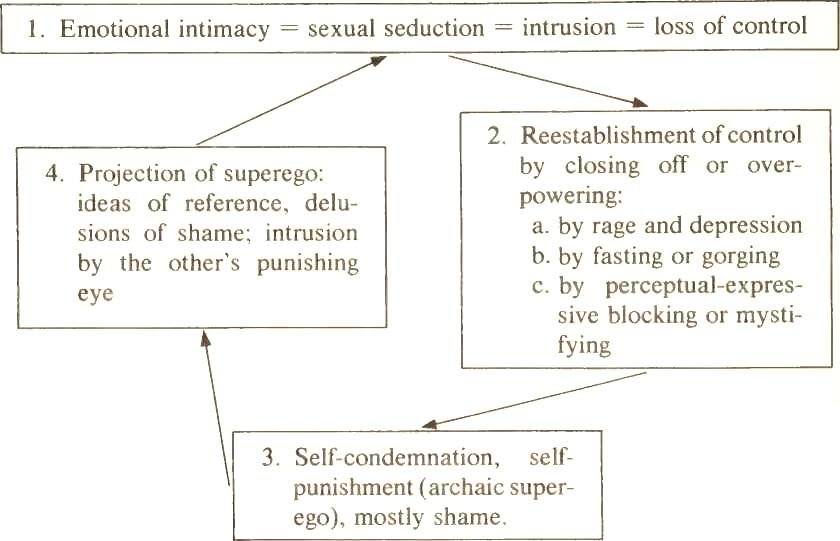
1. Emotional intimacy, interest, closeness, being given attention, are equated with sexual seduction, which is in turn equated with intrusion, penetration, and hence with loss of control and masochistic excitement; this is accompanied by overwhelming anxiety
2. The preoccupation with reestablishing control becomes paramount. There are two opposite ways to regain control: by closing off interaction with the outside and, contrariwise, by overwhelming and overpowering the outside world. This polarity is enacted mostly in three areas: (a) On the level of affects: closing off in the form of angry, defiant, spiteful fighting off; overpowering in the form of angry counterattack, leading to anger turned against the self in the form of obsessions with dying and death, (b) Displaced onto eating: regaining control over intrusion by fasting, as a form of closing off; overpowering by angry attack upon food; both preoccupations lead to the concerns, “How do I appear? I am on display [as fat or thin].” (c) Displaced onto perception and expression: closing off by hiding and curtailing self-expression and by not taking in, not learning or reading, not listening, not knowing; in extreme form, by affect blocking and “frozenness,” and by fragmentation of understanding. Other forms of closing off are sudden disappearing or fleeing, compulsive lying, and tenacious silence; clouding, veiling, or distance are central unconscious symbols. Overpowering may be vested in the magic force of looking or of fascinating, self-exposing display, by showing oneself as a monster or a dead, empty person, or by bewildering, mysterious behavior.
3. These strategies of regaining control lead to intense self-condemnation and attempts to expiate. Owing to the predominance of issues of weakness (loss of control) and of reestablishing control by perceptual-expressive means, the superego uses shame far more than guilt.
4. These self-punitive expectations are projected: people assume more and more the expression of shameful reproof: “the stare of the punishing eye,” ridicule, and so forth. The circle is closed, since these shaming looks are once more penetrating, piercing, intrusive, and brazenly unveiling. The sense of helplessness and loss of control becomes identical with the feeling of overwhelming, shameful exposure and unlovability.
In short, a phalhc-exhibitionistic conflict is regressively altered to an anal-masochistic and oral-symbiotic one, with a predominance of perceptual and expressive inhibition.
Family
The essential features of the family picture can only be summarized here: deep dissensions and disappointments, violent anger and grief are concealed by a facade of unity and sticky cohesion or are expressed in displaced form— for example, as accusations against the rest of the world or as silent reproach for small weaknesses of family members. These hidden angers and demands give all the emotional interactions a twist into a particular texture of denial and displacement, of vagueness and disruption, so characteristic for schizogenic and other severely pathogenic families.[293] Of special importance is the use of concrete means like food and nakedness to achieve spurious closeness.
This brings me to the only family feature I consider distinctive for this group as compared with all other schizophrenics: the already-described split between physical exhibition and bodily intimacy on the one side and the concealing of emotions and increase of communicative distance on the other side. Physical exhibition by the parents was reported by most of these patients (usually related with extreme revulsion, hatred, and fright). As we noticed above, physical exposure and curiosity are concrete ways for these parents to establish an extreme and destructive form of intimacy, opening each member up to the intrusions of the others and leaving the child helplessly overwhelmed by the power of the adult. Another way the child may be used for exhibitionistic purposes is by parading his or her artistic or intellectual gifts or beauty. The child is not seen as a person in his own right but as a symbol of prestige for the parents and as a cure for their injured narcissism.
On the other side, the highly ambivalent feelings within the entire family, especially extreme dependency and devouring rage, have to be anxiously disguised, denied, and displaced. In short, it is this particular aspect of using the concrete means of exhibitionistic intimacy to defend agamst the showing of emotions, especially of aggressive feelings, that I consider characteristic of the families of this group.
This makes it more understandable why shame is so distinctive for the symptomatology: it protects against the physical exposure used as a means of power within the family and against the exhibitionistic misuse of the child in society.
Summary
Shame is often hidden behind a vast array of clinical states, behavior patterns, symptoms, and character attitudes. Severe generalized depression and anxiety may have shame as a prominent and specific part of its core. Homosexuality, drug addiction, imposture and lying, paranoid symptoms and writing inhibition may be set up to deal with a gnawing sense of shame. A number of other affects may, temporarily or as a rigid character posture, defend against it: contempt, spite, rage, as well as “numbness.” Strategies built on defense by demarcation and concretization. on countervailing fantasies, and on arrogation of power may be used to keep shame unconscious or at least at bay. Especially the grand structures of narcissism, in the form of grandiosity and idealization, serve as powerful and specific countercathexes against shame.
Three symptoms are seen as particularly important in the fight against shame—depersonalization, lack of understandability, and shamelessness— and will be discussed in the next three chapters.
A separate diagnostic entity, “shame syndrome,” is postulated; its extreme form constitutes a distinct and detachable category within schizophrenia—“shame psychosis.”
10. The Compromise Character of Estrangement
εἴδωλ’ ὅσοιπερ ζῶμεν ἢ κούφην σκιάν.
[For I see the true state of all of us that live—We are dim shapes, no more, and weightless shadow.]
—Sophocles Ajax
And thus the native hue of resolution
Is sicklied o’er with the pale cast of thought.
—Shakespeare, Hamlet
—Dickens, Little Dorrit
—Hawthorne, The Scarlet Letter
Estrangement
Case 12: Felix (Continued)
After a year and a half of psychotherapy, Felix opened his session one day with these words: “I didn’t do much this weekend. On Monday when I left work and was heading home I had a sense of complete unreality, as if I were standing off somewhere and looking at myself. I felt that everything was slipping away, that I didn’t know how to stop myself from becoming insane. Everything was alien. The more I thought, the more alien it got. That used to happen to me pretty frequently, but this was the first time in a long while. It’s a peculiar feeling.” The therapist inquired about what had preceded this sudden onset. Several things had gone wrong for him that day. “It was as if there was no direction to the day. He had stayed much too long in bed, he felt (it was a halfholiday). “It seemed that I was missing everything” (time of waking up, meeting his son). “I felt very useless, as if I hadn’t accomplished anything; it was almost like What’s the use of trying, you cannot get anything done.’ I felt hopeless—and then this feeling of unreality came over me.” Asked to be more specific about this hopelessness, he added: “I was very down on myself. I felt like quitting, giving up. Then very rapidly I shifted gears to the feeling of unreality.”
Felix: “That it would be better for things to be unreal than for them to be as they were. It got me away from having to think about myself. The feeling isn’t pleasant, but it’s better than the other—the sense that nothing I do is right, that I’m completely worthless, that I’m foredoomed. It was to keep myself from this total no-good, worthless feeling.” He traced this feeling back: “When I used to talk with my father—or my grandparents—I felt the same; that I was absolutely no good. It is similar to my fear of speaking in front of people. I don’t let myself think about it. Before I begin I tell myself, ‘You have already two strikes against you.’ ”
Therapist: “Two strikes?”
Felix: “I don’t know what they are. That I start off wrong—as a person who is tainted—rotten, spoiled before I start. It’s almost as if I’m not quite as good as other people, rotten to begin with, that I’m unwanted. I think back to my father, that I wasn’t wanted by him. But that’s such a foolish way to feel; I know kt isn’t true.” Here the therapist repeated back some of the associations, still without giving any interpretation. Felix was very uncomfortable: “I don’t want to feel so and think about it. Nothing comes to mind. So often as child I was trying to do everything right and nothing came out right; even when I tried, it was wrong. So what’s the use of trying? I must give a lot of thought to this, because it’s something I don’t like to think about. This is really foolish. I think now of the times when I believed I wasn’t the real son of my parents.”
Therapist: “That they were not real ”
Felix: “Regardless of how hard I tried, there was always the basic imperfection in me—always that I would wet the bed again. This takes in everything that I should have been and wasn’t. It’s almost as if I’ve never looked at it in this light: it was almost like I had to have some basic imperfection so I would be what I thought I was, and taking drugs and alcohol served the same function.” Asked what he referred to, he continued: “I don’t like to admit it, but I often think of myself as a second-class citizen, not quite as good as everybody else. The very focusing on me in this manner—in such a negative way—shows how much I really think of myself, like using an imperfection as a weapon to cover up what you really think of yourself. I get confused now.” He repeated the figure of the two strikes and again was puzzled. “Whenever I had to deal with a situation I was afraid of I expected not to win. As far back as I remember I thought of myself as somebody not as good as other people. Whenever I compare myself with others way back, it makes me anxious.”
Therapist: “I think you know whom you compare yourself with.”
Felix: “My brother.”
Therapist: “And what are the Iwo strikes?”
Felix: “That he is bigger and older than I am ”
Therapist: “But the second strike? [He hung fire.] Tha* he was not a bed-wetter.”
Felix: “He was the first authority figure; he made me feel even smaller and would tell on me to everybody.”
Therapist: “He shamed you.” [Felix nodded.] “To be ashamed makes you feel unreal ‘I want to be different than I am’; and ‘Really nobody is looking at me now!’ ”
Felix: “You don’t know what will happen next, or whether your feet are on the ground. You have no control over what happens When I took a counteraction and did something I was familiar with the feeling immediately left. But I had really never felt so down on myself, not for a long time. It was the shame in the background. That is it probably, the feeling that I’m not what I should be. Especially when I set myself goals and then don’t fulfill them, when I fall short of what I should be, then I suddenly feel shame and then unreality.”
In looking at the phenomenology of shame we noticed that one form of punishment inherent in shame is “I don’t want to see you anymore.” Moreover, we saw that it was as if a curtain covered the painful exposure—as if to see and to be seen would have to be “blocked out” as too dangerous, drained of its lifeblood, so to speak, made into a strange quasi-reality. Yet this aim of shame coincides with a well-known twin symptom: depersonalization and derealization—in short, with “estrangement.”
Depersonalization is one of the most frequent psychiatric symptoms and is said to range third in frequency—after anxiety and depression.[294] Like these two phenomena, depersonalization cannot be explained dynamically by a unilinear cause-and-effect relationship. Still, when working with patients who complain about a continuous deep sense of estrangement, one is impressed in particular by a repetitive, almost regular correlation between depersonalization and shame.
“Estrangement” is used as a superordinate term for depersonalization and derealization. Roughly, it designates an experience as being changed: it lacks its familiar reality feeling and, perhaps most typically, it assumes a characteristic “as if’ quality. Janet describes it as “le sentiment negatif de n’etre pas assez un, de n’etre pas assez vivant, de n’etre pas assez reel” (“the feeling of a lacking, namely the experience of being not enough one and the same individual, of being not alive enough, of being not real enough”).[295] In the earlier descriptions (chap. 6) a differentiation into three modes appeared: (1) The object of experience (including the self) may be as if not existing, as if strange, remote, dead. (2) It may be as if blurred, fused, and indefinite, as if not separated. (3) Or it may seem scattered, chaotic, as if not connected.
One could also differentiate in regard to intensity and duration. There is a wide range of experiences of estrangement, from mild fleeting feelings over severe and prolonged nondelusional forms to delusional extremes in psychoses. It is utterly wrong to see in depersonalization itself an indicator of psychosis; nonpsychotic, mostly hysterical (or even toxic) estrangement is far more common.
Estrangement may affect different areas: external perceptions (derealization) as contrasted with perceptions of one’s body, thoughts, feelings, or one’s own identity (depersonalization)
There are hints here and there in the literature for the close connection between shame and estrangement. Janet’s patient, Claire, suffering from an “obsession de honte de soi” (obsession of shame of herself), is quoted as saying: “Everything within me is being extinguished, I have lost the feeling of reality, everything is veiled.”[296] Janet even calls depersonalization “an obsession belonging to the category of obsessions of shame.”[297]
Hartmann mentions the causative role of sad or embarrassing events in states of depersonalization and even suspects the importance of the scopophilic instinct.[298] The function of depersonalization as a defense against exhibitionistic and voyeuristic impulses, especially those of anal character, has been further emphasized by Bergler and Eidelberg.[299]
Edith Jacobson is very much aware of this connection. She sees the substratum of estrangement in “a narcissistic conflict caused by discrepancies between opposing identifications” and narrows this discrepancy further: “The deflated, castrated ego part becomes estranged, dead, because it is identified with devalued, castrated object images.”[300] She regards depersonalization as merely one form of disturbance of identity feelings.
Nowhere, however, did I find an unequivocal statement of the very close and specific correlations between depersonalization and shame postulated here. The following case fragment shows some of the connecting threads more clearly.
“Behind the Wall of Silence”
Case 14: Olga
Although this is a case of conversion hysteria, examining it will lead to conclusions that are also valid for those patients who, though they have had schizophrenic episodes, suffer from depersonalization of a nondelusional kind.
Olga was a woman in her late thirties, an artist, who had been hospitalized for eighteen months before the therapist started treating her with intensive psychoanalytically oriented psychotherapy, which lasted one year.
For half of this year Olga remained hospital zed. She suffered from marked depression and severe anxiety attacks, besides a severe state of estrangement consisting of numbness all over her body or a sensation of weightlessness, of feelings that everything ar ound her and within her was empty, not quite real, and hazy. Her self seemed unreal: “What am I? Am I?” Often—in the characteristic split of the depersonalized patient—she looked at herself with the eye of an inner observer who spied on her as on a stranger, incessantly despising and scorning her, seeing that she was without core, only a facade.
This state of depersonalization gave way when anxiety and depression became overwhelming. In such panic attacks she was afraid she would kill herself by jumping out of a skyscraper window (“floating” out) or by throwing herself under a train. She was also terrified that she might kill her son with a knife or that she would be stabbed and dismembered by an intruder during the night. But most frequently the anxiety attack consisted of the fear of losing her mind. These anxiety attacks often occurred when she was among people: on the street, on the bus, in her office. She felt everyone looked on her as a fake, a phony, a failure.
Actually Olga was unusually beautiful and almost always very neatly dressed and groomed. She was divorced and had a five-year-old son. Her husband had left her during the pregnancy and returned only briefly when the child was born. Olga was the older of two children; apparently her parents had married because her mother was pregnant. Her father was a commercial artist, but all his life he had wanted to be a painter and was very bitter because he could not follow an artist’c career. In a covert way he accused his wife and his two children of having spoiled his life plan. He had left his wife before Olga’s birth but returned shortly afterward. He died when Olga was eleven years old. She described him as a very angry person. “The memories I have of him are of rages and temper at myself, my brother, or my mother. Besides these outbursts. there seemed to be a controlled anger—much teasing, some of which hurt me more than the actual rages. My brother and I used to rush to meet him when he came home from work, but he would cross the street and pay no attention to us. Even though I knew it was a joke, it hurt.”
She described her mother as a deteriorated, neglected alcoholic. “She seems even more hazy in my memory. She stands out as being overly protective, yet she had little interest in us as persons. We weren’t permitted to go to and from school alone like our friends. Physical dangers seemed to lurk everywhere. I only remember her being attentive when I was ill. The only punishment was for being ‘impudent,’ for talking back. To speak up was to be rude.”
I cannot go deeply into her recollections of childhood events: how her father repeatedly prepared to leave the family after arguments with her mother and how the little girl sciearned and implored him to stay; how her father ridiculed her mother by sprinkling pepper on her palm when she stretched her hand out for reconciliation.
Olga’s brother, two years her junior, was, like her father, a frustrated artist, angry and bitter because he had to give up his artistic career to sustain his family.
Olga had been highly successful in her profession, though she always felt she was an imposter and one day would be unmasked.
Her husband, whom she met when she was about thirty was another frustrated artist, angry at society and resentful of its conventions. After the separation from him, Olga led a professionally, socially, and sexually hectic, self-forgetting life. Her son had severe fits of screaming, kicking, and destroying and thus contributed his share to the whirlwind of her life. She had many changing relationships; usually she went with two men at the same time—one she despised, who accompanied her to parties, and a second one whom she conquered during the party and started a relationship with. Soon she would begin despising him too, and then she would turn to a new friend.
Olga’s disease broke out suddenly when she thought she had finally taken care of her main problems (on the job and with her child). She had a date scheduled that evening with an attractive man with whom she had performed fellatio on the previous date. At noon she went to a restaurant and ordered milk and tuna fish for a small lunch. Suddenly, while sitting at the counter waiting for the food, she experienced an overwhelming anxiety attack—the first of its kind in her life. This anxiety consisted of fear of losing her mind. She saw it in the form of an inner image: her mind was like a thread that would be cut; she would fall into infinity, into empty space. She became panicky, paid without eating her meal, ran out, went to a friend, then to a doctor, and felt the almost irresistible impulse to jump out of the window of the skyscraper. Since then she had been hospitalized in various institutions, suffering from frequent attacks of panic, despair, and suicidal impulses and from an almost constant feeling of emptiness and unreality.
One of the first themes in therapy was the conflict between frightful separation and the hope to overcome this abandonment and loneliness by personifying an ideal.
A first breakthrough in therapy came when she reported with intense emotion a particular incident: She was about seven years old and was doing her homework. Her father was helping her. Her brother angered her with some prank and she threw her father’s silver pencil at him. Her father reacted with immediate rage and shouted: “You can never have this [silver pencil] again— never, never.” She pleaded, “In six months—in a year?” He remained firm: “Never!” The next morning her father, without talking to her again, left with her brother and went to the beach; she had to stay home with her mother. This “never-never,” the feeling of “lost forever” continued to resound throughout her life and seemed revived in the feeling of infinity and emptiness of the anxiety attack. For hours she cried in the therapy over the loss of the silver pencil that had come to symbolize her father’s love and recognition, in fact, all possible love and acceptance. It condensed and concretized into one image that she was degraded and unacceptable—because she was a “castrated” woman. Moreover, even being accepted the way she was meant for her an immediate degradation of the lover. “To love me—that means he’s no longer a man. If it’s so easy for me to get their affection, it points up how miserably I failed to get Daddy’s affection.” Thus, by despising men as soon as they started to love her, she was justifying her father and his rejection of her. Her father’s death crystallized this conflict: “The day he went to the hospital I didn’t know he was really so ill. I was very casual when he left. I didn’t even kiss him good-bye. His last words were, Be a good girl.’ ” To be a good girl?
The ideal she had for herself as well as for others was godlike—to be complete, perfect, and in total control. She was thrown into a rage of disappointment when she or the others did not live up to these expectations. In her depressive periods she turned this anger and contempt against herself and hammered at herself with self-reproaches: “You are worthless, decaying, weak.” One command of this ideal was to be so perfect, good, and free of anger that she would finally be acceptable to her father and thus win over her two rivals. Only by despising herself as she really was was she able to justify his rejection and to overcome it by emulating an ideal self image. She had not given up the hope of undoing her defeat in the competition for his love, though he had been dead for many years: the hope that he would return and accept her if only she was a good girl—if, in other words, she personified such an ideal.
Sharply conflicting with this largely unconscious ideal was everything that went on “behind the wall,” not only within herself, but also in the family. She recalled a scene when she had walked into her parents’ bedroom, surprising them in a scene of fellatio. Then there was a blackout in her memory, a feeling of dizziness, of extreme shame, embarrassment, and frozen rage. She was shoved out of the room while she tried to salvage the situation by claiming that she also had a milky secretion, from her breast. This was one of the first instances in therapy where the looking appeared as an activity in which desires and pleasure, shame and grief jealousy and guilt converged; an activity, also, that could lead to sudden identification in a traumatic situation—as is evident from the false memory of her own milk secretion.[301] In particular, it was a crystallization point for all her feelings of shame for her parents and the parallel shame for her own looking and uncovering.
This, by the way, also elucidated her sudden anxiety after she had ordered milk and fish, this telling double symbol, shortly before another anticipated scene of fellatio, where she would again be just as despicable and dirty as her mother (the devalued identification). It went with the dread about the impending breakthrough of all those overwhelming sexual as well as oral sadistic (“biting”) desires that were sealed behind the “wall of silence.” The anxiety attack covered an angry protest: “If I can’t have what I want, I’ll throw away what I do have. It’s only a poor substitute for what I long to possess and what was denied to me: penis and milk, love and recognition.” In quite analogous fashion, when she did not find her eraser or pencil in place she got both furious and panicky, feeling almost impelled to throw herself out of the window. Since such anger would only lead to complete rejection and humiliation, she had to “forget about it” by turning it against the self and feeling it as intense anxiety.
This repression called for additional support—once again a countervailing fantasy in the form of an ideal. It was unmistakably based on the reverse of mother’s image, a counteridentification: not to be dirty and a slob like her mother, not to be exposed like her, not to bite off the penis. Her mother in fact represented an “anti-deal” or negative ideal. It was a shame to be her daughter. Yet would it not also mean that Olga loved her, if such a strong part of her was “identified with the victim of degradation”? Her loyalty, to be sure, belonged not so much to the real figures of her parents as to their expectations of her. When she could not live ud to their highest standards—to be a little princess, an aristocrat—then she was all bad and dirty as her mother was in reality. Although depression, anxiety, and hidden rage had decreased significantly, still her vague feelings of worthlessness and estrangement continued more or less unchanged
It was about a year after inception of therapy that she, quite suddenly, remembered three interrelated groups of incidents that greatly deepened the understanding by clearly pointing out the centrality of her competition with her brother and her sense of defeat in it. The first memory was that when she was about four she was moved out of her room, which was the larger one, to make space for her newborn brother. She soon also had to relinquish her toy box to the younger rival; she was not supposed to play with it anymore. Occasionally, however, she was permitted to return to her old room: at twilight she may have sat with him at his window, there being truce after the incessant fighting, much as her anxiety now frequently quieted down in the early evening. Sometimes she was even allowed to sleep in her brother’s room, though as she remembered now, she wet her bed there. She suddenly recalled what a release the flowing of the urine was in the dream and she reexperienced the free, harmonious feeling of flowing and floating. Briskly following awakening, however, were shame and exposure—not only over wetting the bed. but also over realizing again that she was not complete as she had felt in the dream, where she had been able to squirt.
This led to a second memory, one that concerned seeing her brother’s penis. Her mother told her not to touch or hurt it, because “there is so much feeling there.” She had been conscious intellectually of her envy and sullen anger, derived from her assumption that her brother was more liked and valued because of this But it was only now, after recalling the intense feeling of shame accompanying this memory, that she became aware of her impulses to cut it off. She remembered how they used to be in the bathtub together and she thought: “He has a penis, I don’t. Why don’t I have one? It was cut off. I want to cut off his penis.” And then the retaliation: “I would be cut to shreds myself.” This cutting returned in the impulses to kill her little son, in the retaliatory fears of being lacerated by a man, and in the murderousness of exposing her entire body in jumping off a skyscraper. Thus castration shame, penis envy, angry attack, and guilt formed a chain of emotions repeated over and over again.
A third related memory was seeing her infant brother at the breast. To her it meant something like: “Mother and brother are a unity; I’m left out. I’m cut off from this oneness. He has the milk, not I—I’m eaten’ by jealousy.’ By a little step of displacement her anxiety attacks were indeed often triggered by eating. Being the excluded third ran like a red thread through her life, and shame formed the color of this thread. Compulsively she tried to turn the tables—to become with her male friends the one who did the excluding.
Very clearly her losing out in the competition for her father’s love in favor of her mother and brother led regressively to the competition for the union with her mother—and there to a yet more painful defeat. Correspondingly, wishes and dreams were regressively changed in a similar way—from genital rivalry to oral imagery, from specific shame to global loneliness and separation. These memories of shame and humiliating exclusion served as concrete and specific crystallization points, as foci and rationalizations, for the vague ambiguities and rejections suffered mainly at the hands of her father.
It was also evident that shame led to rage, and rage in turn not only evoked guilt, but heightened her shame feelings as well. Thus shame and anger, as noted in previous cases, reinforced each other to unsupportable and terrifying intensity.
These memories lent to the primal scene the same broader meaning that has already been referred to for Irene (case 7): This probably recurrent traumatic scene had led to a fascinating double identification—in her “wishful self’ image with her “complete,” but inherently humiliating, sadistic father, in her “real self’ image with her sexually excited, but humiliated, masochistic mother. A very important part of her identity had become irreconcilably split.
Another consequence was of course that, as in other cases (especially Anne, case 2), looking and exposing had become indissolubly tied up with shame. A third sequel was the equation of excitement and orgasm with a “falling” feeling of infinity and emptiness. Besides her “sinking feeling” and “put down,” another bridge was the “free floating” of the urine in the dream, which eventually became translated into the floating out into infinite space (falling through space) of the anxiety attacks. This “floating” was not only release, self-loss, and masochistic giving in, but also an act of showing herself falling. It was again the double identification. Frigidity prevented it from happening during sexual intercourse.[302]
Turning more specifically to the topic of this chapter, it became evident, after clarification of these core elements, that shame and exposure, looking and being looked at, were of special importance in her feelings of estrangement. Just like Felix in the earlier vignette, she felt, instead of shame, strange, unreal, not fully existing, numb.
In depersonalization, she saw herself as if from the outside: “I feel like a puppet, as if I were on strings—I can’t make myself be myself, as I want to be. I go around with a frozen face. I’m not really anxious; it’s like I’m trapped into observing myself. If’s like a mother telling her child, “Say something. Don’t say the wrong thing.’ If’s my trademark; ‘They’re going to discover....’ I suddenly wonder—very far back—that they discover I’m a girl. Or that I act like my mother. Suddenly, now, I see my contour at the wall—it’s mother’s. I shudder. She always looks frightened and scared to death.” She despised herself as she detested her mother. She needed to be forcibly different from her, to “disidentify” herself from her (Edith Jacobson, pers. comm). This particular conflict between the wish to deny or undo this part of herself and the knowledge that she really could not do so was spelled out: “I don’t want to be like my mother—yet, still, these are the rotten roots I come from.” Thus she expressed in the symptom of estrangement this vexing doubleness: “I am not like my mother, and yet I am like her.” In contrast, when she was sinking down into a sense of shame and, with this, living her degraded mother’s part, it meant, “At least now I know who I am, even if it’s to wallow in degradation.” Then she was not depersonalized, but depressed. In turn, when she felt elated, close to her ideal, distant from being identified with her mother, she felt the compulsion to eat, “to weight me down.” “In all the happiness, one thing was disturbing: Why was I so alone? I felt like betraying my mother.” Either she was independent, elated, but alone—or she was close to her mother, but dirty, full of shame, and depressed, or she lived a puzzling double life, based on denial and acknowledgment, and felt unreal.
Put differently, either she moved closer to her (parental) wishful self-image and felt happy, creative, elated, or she sank down into her (maternal) “actual self’ image, feeling depressed and filthy, or she was split between them and repudiated both in the estrangement.
However, it was not only the dentification with her mother that made her ashamed. All her wishes from “behind the wall,” all the aspects of her self that did not fit her ideal, evoked such shame. It was shame about being “castrated” and, regressively, about being dirty and dependent; it was shame about her desires: particularly to let her urine flow in a warm, pleasant, orgastic relaxation and liberation—and, again regressively, of her wish to attack her brother and to take his penis away, and, most primitively, her desire to be one with an idealized mother figure.
It is evident that in the periods of depersonalization she fought against awareness of the basic discrepancy within herself: the discrepancy between her image of herself as a clean, neat, and self-controlled person and a contrasting image that threatened to be exposed: that of a dirty, weak, and demanding—or a murderously jealous and cutting—child. While it is true that this discrepancy between ideal self and real self, between rigorous observer me and contemptible me, was fek as shame and self-contempt, just as with Felix, something more had to be added to bring about the feeling of unreality. The crucial element leading to the symptom at hand was not shame itself, but very precisely the defense against this affect.
Shame Conflict and the Role of Denial
In chapter 4 the discrepancy was discussed as part of the shame constellation—the gap between what one really is, does, feels, or wishes, and what one wants to he—the wishful concept of the self.
The crucial element is that in estiangement these two poles of the shame experience were defended against and mostly unconscious, though the defense was no longer entirely successful. What was recognized was the experience of a split: “It is real” and “it is not real.” This split has been described before; for example, Schilder and Hartmann called it a “Widerspruch im Erleben,” an “Aktcharacter der Widersprochenheit” (“a contradictoriness inherent in the act of experience”).[303] Yet it is also known that a similar split is the hallmark of the defensive maneuvers involved in denial.
These three phenomena—the observation of a crucial inner discrepancy in every experience of shame, the clinical observation of the split in depersonalization, and the known split between ego functions during the process of denial—fit so strikingly together that one feels there must be a deeper kinship between them.
There has been controversy about the nature, extent, and effect of denial. In particular, the dispute has been over whether what is denied is preconscious or dynamically unconscious. Jacobson neatly distinguished denial from repression: “Contrary to repression, which makes the ideas unconscious and inhibits the corresponding affects, denial can at best achieve no more than to prevent ideas which have reached the preconscious from becoming conscious.... Denial thus appears to establish a censorship or rather a protective screen between the preconscious and the conscious.”[304]
Trunnell and Holt, in contrast, returned to Freud’s original use of the term: “Disavowal or denial as originally described by Freud involves not an absence or distortion of actual perception, but rather a failure to fully appreciate the significance or implications of what is perceived.”[305] “The second element in Freud’s description is that a particular kind of split in the ego is constant in the mechanism of denial or disavowal.... ‘The disavowal is always supplemented by an acknowledgment; two contrary and independent attitudes always arise and result in the situation of there being a splitting of the ego.’ ”[306] They add that this split is “possibly regularly maintained by an invalidating fantasy.”[307] They maintain that what is denied is unconscious, just as the process itself operates unconsciously.[308] I follow them and define denial as that defensive operation that makes the affective implication of an accurate inner or outer perception unconscious, thus leading to the described characteristic splitting of the ego between acknowledgment and repudiation, and to subsequent partial falsification of the perception at issue.
Strikingly, we find an entirely parallel observation and conceptualization in Henry James’s The Golden Bowl: “Miss Assingham denied, as we know, that her husband had a play of mind; so that she could, on her side, treat these remarks only as if they had been senseless physical gestures or nervous facial movements. She overlooked them as from habit and kindness; yet there was no one to whom she talked so persistently of such intimate things.”
We may sharpen our understanding yet more. In Fenichel’s discussion of technique we read the intriguing statement: “So far we have used the expressions ‘defense’ and ‘defense against instinct’ synonymously. There exist, however, defenses against every kind of displeasure, against unpleasant perceptions as well as unpleasant affects, and especially against anxiety.”[309] If then, as we have already noticed, denial is the specific perceptual defense, its content, “I don’t want to see” (and its presupposition, “because what I see evokes anxiety”), shows us a deeper kinship with shame.
Again a passing remark of Fenichel’s may help us farther along: “The superego whose demands, analogous to instincts, are warded off, is in essence itself a defense structure.”[310] We may now add not only that the superego grows out of such important defense mechanisms as turning against the self, introjection, and identification with the aggressor, as is commonly stated, but that there is now evidence that at least its shame part has also developed out of this defense of denial. While the three others can be found in guilt as well as in shame, it seems to me that denial is uniquely reserved to assist in the composition of shame—precisely because shame is the intersystemic correlative to the specifically intrasystemic (intraego) defense mechanism of denial
With this I mean to say that while denial blocks out affectively disturbing parts of perceiving as an event within the ego in order to avoid unpleasure in general, in shame, percept ion is “prohibited” by the superego in order to avoid punishment in particular.
Returning to concrete clinical reality, we observe that it is above all a set of affects that had to be denied: disappointment about the entire external reality, centered in her parents; disappointment and shame about her entire personality, centered in all the “angriness” described; ultimately also shock and grief about having lost what counted most—the love, then the very existence, of her father, centered in the symbol of the silver pencil. With this denial of affect, the wishful images of her parents and of herself, as well as their opposites, the degraded, filthy, sex- and lust-laden presences, shapes, ghosts, vanished into unconsciousness or at least into a dim and vague shadow. What remained utterly real, however, was the staring eye of her conscience expressing reproof and scorn.
This denial could be put into words like “I am not really this bad girl in a horrid environment, not dirty like my mother. I want to be something else and somewhere else—lovable for the ideal man.” Though largely unconscious, this entire process evinced the characteristic doubleness of denial: the simultaneity of “No” and “Yes”—of “I don’t know and yet I do.” Castration shame, parental sex, irrevocable loss of love, formed the core of the feeling “It ought not to be real!” The rift in the ego showed in triplicate: in shame, in denial, in estrangement.
When denial could not be maintained, the previously denied bad, devalued side temporarily appeared exposed and even to a limited extent conscious: In the predominantly apathetic form of depression, the general feeling of worthlessness was not denied anymore and became conscious: “I am all bad, rotten, and decaying. My life is aimless and hopeless.” The ideational content of shame, though, the specific representations—particularly castration shame and shame for the bed-wetting—remained unconscious.
In the episodes of elation, the same denial of the experience of disappointment and rejection, of deprecation and shame took place as in depersonalization, and with that a lesser state of estrangement, of “weightlessness,” of “floating,” also ensued. The “bad,” shameful side was kept out of awareness, hence denied, while the “good” (ideal) side was now consciously experienced and identified with. Again, the more specific ideations of the ideal self (and, I may add, also of the ideal object), remained unconscious. Note that in the elation Olga denied not only the “bad side” but, as we saw, specifically the identification inherent in that side, namely the similarity to her mother And since identification is a protection against loss,[311] this elation was accompanied by an undercurrent of separation and loneliness. The union with the ideal object, a grand immortal and accepting father, was bought at the cost of attachment and loyalty to the real object, the “dirt mother.”
So far I have discussed only those aspects of shame that refer to the tension between ego ideal and the rest of the personality, to show how depersonalization can be understood as an outcome of this conflict. But, as we know, this explanation is by no rheans sufficient. We must add the second necessary specification, that this discrepancy is accompanied by the fear of self-exposure and the wish to hide and to disappear. Olga’s main disappointments centered on exposure of herself or of her parents, particularly exposure to looking. Thus it is hardly surprising that her main defensive efforts affected this area of perception most strongly. “Seeing” and “being exposed to looks” were most subject to defensive strictures, possibly repression, in estrangement (looking at herself as at a stranger and at reality as if it were removed).
The depression involved the defense of turning aggression against the self in the form of contempt. This again used perception; Olga felt she was being looked at as a fake and a phony. The opposite took place in elation (a flooding of this perceptual activity with libido) and in periods of creativity when she experienced reality in glowing colors. Accordingly, both poles of the shame experience, underlying depersonalization, were for this patient of a visual quality: her self-observation and self-derision as well as the strivings for which she was ashamed—exhibition and looking.
A confirmatory postscript: After many of these connections had been v/orked out, in one of the last sessions she reported an incident she had never mentioned before. When she went back to school right after her father’s death, she was consciously ashamed because her leader’s badge was rusty (“that was my image”) and also because she was accompanied by her mother: “It was the same fear of discovery and losing my position as a leader” as later prevailed in the self-observation compulsion. And there she suddenly went “blind”: her vision was reduced to a pinpoint and blurred. At recess she fell—owing to this hysterical “blindness”—and hurt herself. It was the same lightness and blankness, the feeling of emptiness and of falling through space[312] as in the earlier primal scene memories and in the later states of depersonalization and anxiety: namely to disappear for shame and to be blinded for shame—for having seen too much!
Looking back, one may ask whether there was cardmal denial not only in regard to shame but perhaps even more markedly in regard to her feelings about her father’s death. In fact, I wonder now whether shame might have served, at least partly, as a screen affect against denied grief and mourning. This conjecture notwithstanding, though, I do not believe that the denial of grief would have shaped the full syndrome of depersonalization itself.
The question we need to ponder is this. Which etiological factors are truly most specific, and which are mere accessories? I have yet to see a case of severe chronic, nonpsychotic depersonalization where the issue of largely unconscious shame did not play the paramount role. It leads me to assign etiological specificity and to submit that the classical, full-blown symptom of depersonalization is shame denied.
Not included in this classical symptom would be the vaguer forms of depersonalization, like numbness after severe loss, or translocation, or toxic forms. In these forms the characteristic prominence of self-observation (“I look at myself as if from outside”), Janet’s autoscopie, is missing. So is the nagging, centra! sense of detachment and inner split. It seems advisable, therefore, to clearly distinguish this symptom of structured depersonalization from that of diffuse depersonalization.
The question of course remains open whether this description of specific conflicts is unduly restrictive. Robert Wallerstein, in discussing my earlier formulation of these thoughts, wondered whether I might have “made unduly focused and specific what may well be a more general and less directly anchored phenomenon.... I would hold the way open to regarding this but one instance, one exemplification of a more general, and more generally applicable, set of relationships.”[313] This cautionary remark appears to me very much in order, if indeed one does not limit the remarks to the narrowly defined “classical” symptoms of “structured depersonalization.” I would even go so far as to put it pointedly: there is probably a correlation between depersonalization and unconscious feelings of shame similar to that between depression and unconscious guilt feelings. This is valid in regard to both the broad, non-specific nature of the symptom itself and the particular type of conflict underlying the severe chronic states with the full (“structured”) configuration of this symptom.
The Role of Loss
When the perspective is broadened and all forms of psychogenic estrangement—structured and diffuse, nonneurotic, neurotic, and psychotic—are encompassed, one can postulate that depersonalization as such may be, like depression, a relatively nonspecific, complex affective and cognitive state, encountered wherever there is the feared or actual experience of loss. Corresponding to the less specific etiology, the symptom picture in these forms is usually vaguer and less poignant. Autoscopy and the sense of an inner split, dizziness and panic, distancing or blurriness recede in importance or disappear altogether.
The loss may be that of an object (by separation, abandonment, severe rejection, a totally incomprehensible and unacceptable situation, or death) or that of a part of the self (degradation of self-esteem, feeling defective and castrated). It always entails a sense of loss of control and mastery over inner or outer reality. In this broad form, estrangement as denial of loss expresses: “The present is not real; I want to return to the [more familiar) past.”
It is the sense of self-loss when an Important relationship perishes. When this feeling and the ensuing grief, sadness, and mourning are largely denied (being intolerable, they must be made unconscious), deadness and nothingness of part or all of the self take over. The sharing with the lost object, the bond with the departed person, is sustained in the identification the self also being seen as distant or dead; mourning itself is made inoperative by maintaining this bond. What counts here is the denial of the affect of grief while acknowledging the loss—the typical split. It seems also to me that this precedes the introjection known in depressed patients. Rather, the patient is frozen in a state of yearning for the lost ideal and angry detachment from the living surroundings.
Every dreaded or actual experience of an overwhelming trauma[314] may lead to the feeling of loss of control, and with that to an attempt to regain control by denying its emotional impact. In this last sense, such less-specific depersonalization can be a denial of every “narcissistic mortification”[315] that is characterized by “a sudden loss of control over external or internal reality, or both,” leading to the affect of terror: the whole personality is being overwhelmed
So far I have proposed that there is one specific and particularly important experience of dreaded loss, namely the rejection due to exposure. As we have seen, rejection in shame (i.e., contempt) is the sudden and radical loss of love and respect from the other person. It is this particular anxiety situation that, as a decisive determinant and precipitant, almost uniformly underlies the severe, chronic, full-blown forms of depersonalization.
Magic Hood and Magic Looks
What then is the connection of meaning between these two phenomena— shame and estrangement? The wish inherent in the feeling of shame is, “I want to disappear as the person I have shown myself to be.” Or simpler but less precise: “I want to be [seen as] different than I am.” Correspondingly, in depersonalization the patient indicates, “I’m not this: this is someone else, not I” (cf. Gebsattel’s patient with depersonalization: “Das bin ich nicht, das ist ein anderer als ich”).[316]
This “being diffeient” once again entails a dichotomy: “I want to be looked at as a different person. I am afraid to be exposed as what I am,” versus the content “Part of me is despicable.” This means that estrangement results from the denial of both the functional and the content aspects of shame (at least as far as these typical chronic forms of estrangement are concerned).
Estrangement and Function
“Being looked at as a different person” is a direct fulfillment of the demands of the superego, inherent in shame. But at the same time, part of the warded-off wish forces its way through: the “being seen,” the exposure, in the form of the “self-observation compulsion,” one of the cardinal symptoms of typ’cal states of depersonalization.[317]
We have already encountered the split in the experience, especially the split of the self-experience (Ze sentiment du dedoublement),[318] as a characteristic of the state of depersonalization. We hear that the patients have lost their selves, but also that they “watch themselves” (autoscopie): “my true personality cries at the side of myself’; “I am like two persons; I give myself as a spectacle to myself.”[319] It is as if to say, “The part of myself of which I am most ashamed appears as most estranged, as not real, as lost, whereas the ‘eye’ of the [otherwise hidden] conscience remains open and unrelentingly staring.”
Similarly, it would often not be specific enough to translate the experience of derealization into words like, “The world is not as disillusioning and frustrating as I see or hear or sense it. It can’t be true—it is really better ”[320] Although this interpretation of the denial of disappointment may often be correct, generally it is too broad and vague. In the cases of severe, chronic estrangement, the more specific and therefore more accurate explanation is, “The world, in front of which I stand exposed [with my body, my voice], does not really look at me or listen to me.” In that form it would be the denial of the shame anxiety directed against exhibitionistic wishes. As another patient (Blanche, case 11) put it, “People don’t look real to me; they look as if they didn’t have eyes. If they were real, they would hurt me by humiliating me.” More frequent is its counterpart; it is correspondingly described by other patients: “My looking, hearing or touching cannot be done by myself; I would feel ashamed for it.” Here it is the perceptual processes per se that, because of their devouring or exciting quality, are warded off by shame anxiety (“I would feel ashamed if what I see or hear were true”) and covered by estrangement. For example, repeated watching of the primal scene may burden some or all perceptions with unbearable shame. To quote Arlow, “What is happening has nothing to do with me. I am only an observer.”[321]
Another patient described iransiucently the double experience of depersonalization and derealization, the veiling of perception and self-exposure: “I felt I was completely disappearing, and my awareness of everything was disappearing.”
So the symptom of estrangement fulfills the wish for both, the magic hood and the magic looks: not to be seen, and to transform outer reality. But it also reflects the fear of both: to turn into lifeless shells of being, into a world of meaningless shadows, and to become blind.
Of course we have to ask ourselves here, What is the primary wish that is to be prevented by shame anxiety and thus indirectly by depersonalization? Is it the wish to perceive or the wish to expose oneself?
My experience leads me to assume that it varies. In some patients the intensely sexual and aggressive character of theatophilic wishes is primary. In others it is rather delophilia, supporting Bergler’s view when he describes depersonalization as the outcome of three steps: (1) anal-exhibitionistic impulse, (2) narcissistic voyeur wish (“I do not want to show myself at all; I will look at myself’), and (3) “I do not look; I observe for the sake of conscience.”[322]
I will now put these correlations between shame anxiety and depersonalization into a clearer order: We saw before that the feeling of shame can be considered a form of signal anxiety, triggered by the wish for self-exposure. What is feared is contemptuous rejection and disappearance of the love object. The “goal” of the shame experience, in the sense of an anticipated punishment and expiation, has been seen in one’s own disappearance or petrification; I may add that shame is overcome when we are changed, are (seen as) different from before.
In depersonalization we find representatives of all these aspects. There is first the original wish for exposure, in the form of the self-observation compulsion. Then there is the fear of rejection and abandonment, in the form of the feeling of painful detachment and remoteness, and the fear of the disappearance of the world: “The whole world looks dead.” Third, one recognizes selfpunishment by lifelessness and petrification, in the experience of numbness and deadness, frozenness and lack of feeling; there is expiation by disappearing: “It’s as if I didn’t exist.” Finally, to overcome the conflict one would have to be different, to disappear as the person one was: “Can I ever find my poor self again? It seems to have disappeared.”[323]
I should also mention that shame and depersonalization are, like rage and shame, mutually potentiating and self-perpetuating states. One is estranged because of shame, and in turn one is ashamed for one’s lifelessness, frozenness, and strangeness.[324] This vicious circle may rapidly spiral down into a psychosis.
In short, the double structure of depersonalization on this level of conflict is obvious. The wish fulfillment is “I observe myself’; the danger is anticipated and prevented: “I am invisible” or, less specifically, “I am different.”
Depersonalization and Shame Content
It has been postulated that identifications play a decisive role in the genesis of depersonalization.[325] Thus, Edith Jacobson writes (pers. comm., 1965): “Regarding the question of identification in depersonalization, I meant that these patients got depersonalized when they tried to undo an unacceptable regressive type of identification.” This is confirmed in most cases I have observed. Usually these identifications clearly refer to content, not to functions. It could be put into words like, “I am not really as worthless (dirty, castrated, weak, etc.) as my father or mother was [or is].” Or, “I am not feminine like my mother is.” Just as we saw in Olga’s case, the patient chooses instead an ethereal ideal identity that she wants to maintain, denying everything that is identical with her parents.
It is perhaps even more accurate to say that the patient wants to deny the accompanying affect: the humiliating realization of the identification. It is the conflict that causes depersonalization—a conflict about a lively, though shameful and devalued, part of oneself—not the leaving behind of a dead sequestrum.[326]
These identifications are rather clearly delimited, circumscribed, and structuralized. They are split: the person the patient identifies with is experienced with extremely conflicting emotions. This ambivalence leads to an attempt to devalue and supplant the identification with its opposite (counter-identification), simultaneously with the attempt to realize it and to remain one and united with that model.
As to the content of such repudiated aspects of the self, we can apply everything that has been found in the preceding chapter about the genetics of shame in neurosis. The split may not be only between identifications with different objects (mother versus father), but rather may be between identifications with different aspects of the same person, or even—very important— identifications with parts of one’s own past self-image, in particular, with one’s own repressed wishes. I mean cases with depersonalization where one might say, ‘T’m not really as shameful as I was then or as I wanted to be.”
In line with the concept of the genetic triad of shame contents mentioned in chapter 8, the characteristic threesome is, “I’m not really as weak, as dirty, and as mutilated as I was or may appear—or as I unhappily feel I am.” The loss is triple as well: loss of the symbiotic object, loss of anal control, and loss of the penis. (This is true for boys as well as for girls; cf. above.) Deep down, it always ultimately comes down to a painful feeling: “I am an unlovable, despicable nothing; the core of myself is hollow; my self is lost.” One patient called it “this black vomit in me.”
This entire side of the self that is walled off can of course never really be satisfied. Whatever has secondarily become equated with this shameful part, for example, all feelings of tenderness or sexual pleasure, or of “giving” and “being given,” must be blocked as well. Such a large-scale and partly unsuccessful warding off leads to the nagging sense of inner detachment, unreality, and boredom: “The real me has given up hope of ever being gratified.” The devaluation, due to shame, leaves an emptiness and blankness, a burned-out sense in its wake—a crucial part of depersonalization.
Another part of this genetic triad is a typical dilemma in any relationship: “When somebody comes closer to me, I fear both intrusion and rejection.” The intrusion is again the self-loss in symbiotic merger or may be the penetration in masochistic surrender; the rejection aims at the discovered loss of control and all other shortcomings. Therefore, every intimacy irresistibly moves toward shame, since both intrusion and rejection are felt as humiliating. Hence “I must keep my distance all the time!” If worse comes to worst, “I feel detached from everyone and everything—I am totally estranged.”
The “Life Lie”
There is also a family pattern of such denial: the whole family is permeated by an air of “as if.” Anything that does not fit into the ideal image of the family or the mutual role expectations is considered unreal. One has to identify with a standard of insincerity, with a basic lie and deception, which leaves the whole rest of the self out of cognition.[327]
Schottlander wrote about “being blinded by images”:[328] one recognizes others only insofar as they fit into a specific, stereotyped role; what is discrepant with this image needs to be denied. Thus, the “as if of the estrangement reflects the “as if’ in the family: “1 ought not to be what no one in the family dares to be”—everything ‘bad” has to be denied (anger, weakness, real involvement or real independence). Yet, on the other side, the ideal cannot be reached either; to live as the ideal, to comply with the “life lie,” would be sheer phoniness, So the result is “I am not at all.”
It is evident that this problem of identification and counteridentification— the devaluation and denial of the real nature of the parents and of oneself and the adherence to an ethereal, yet phony ideal—as described up to now becomes part of the shame conflict. When the child has to play rigidly an assigned role in order to be accepted, for example, the role of a “model child” (“Mother loved this dummy, this bleak person, not me”), his whole life is overshadowed by an air of hiding, denying, and lying. Shame is the prevalent rule in this game cf mutual deception, and violent rage is the attempt to break out.
In all this, the double nature of the symptom of estrangement again is obvious. To fulfill the demands of the ideal is to be pure, without anger or sexuality. The patients state that they are without the dirty bodily reality. The devalued identification asserts itself in the unavoidable acts of “self-smearing”—the secret self-debasement and self-condemnation.
The Radical Denial in Psychotic Depersonalization
So far we have encountered estrangement as reflecting (1) the denial of shame, be it in regard to function, be it in regard to content, as it most specifically relates to the denying and undoing of deprecated identification (“disidentification,” “anti-ideal”); (2) the denial of mourning of the loss of an important, particularly an idealized, object relationship and hence of the sense of mastery and “entunedness” about one’s world. In both instances all that is not “ideal” and “complete” is defended against by denial, is made unreal. The fantasies of such perfection and ideality serve as countervailing structures against what is—tenuously enough—disavowed and repudiated. These counterpoised shining fantasies are desperately clung to, needed to prop up the tottering denials. Reality is made unreal; ideality is made into a bloodless sham reality, an “inauthentic, plastic mask and facade,” a “bait of falsehood,” and “a counterfeit presentment”: “Eyes without feeling, feeling without sight / Ears without hands or eyes, smelling sans all, / Or but a sickly part of one true sense / Could not so mope. Oh, Shame! Where is thy blush?” (Hamlet, 3.4.78–81).
Both of these forms of estrangement—denial of shame in “structured” depersonalization, and denial of grief in broad, unspecific “detachment” and “numbness”—become radically potentiated in a third version, turn in fact into aglobal sense of world-loss and self-loss, under severely regressive—psychotic or near-psychotic—conditions: “I could be bounded in a nutshell and count myself a king of infinite space were it not that I have bad dreams” (Hamlet, 2.2.260–62).
Throughout this book I have had occasion to refer to two particularly archaic conflicts basic to severe psychopathology, as is evident in this potentiation. They are the conflict of union versus separateness, and that of omnipotent delophilic and theatophilic tendencies versus shame, the latter being but a special case of the former.
In this most archaic layer, depersonalization is the denial of everything that is not absolute. Everything that is not total union and merger—or its opposite. total isolation and destruction—is denied, is unreal. Only the absolute gratification or the absolute nothingness and emptiness would be real.
The (ontogenetic and microgenetic) sequence would be: a wish for total union premature and threatening separateness, standing also for other types of frustrations —► the reaction by total aggression and destruction —► estrangement as protection against this flooding with all-pervasive, fragmenting rage.
On the one hand the wishes for merger and anion are denied. This denial can be put into words: “The object hasn’t hurt [rejected, left, or overwhelmed] me: I don’t need to overpower and destroy it. It is inanimate, a thing I can control” (derealization). And, similarly, the feelings of anguish, rage, and selfdestruction evoked by the frustrations of these impulses are muted by the robotlike emptiness: “I don’t want total satisfaction; I’m not hurt, I don’t need to be enraged or guilty. If I’m a lifeless thing, nothing can happen to me” (deperson al iz al ion).
in this connection, the prevention of separation anxiety by denial of the wishes for union seems to me of particular practial importance: “If I am already detached, no separation can hurt me further.” It is as if to say, “I have cut the ties myself; I have isolated myself.” And, since separa ion is equated with death, “I am already dead and in the nothingness—no abandonment can destroy me anymore.” And, similarly for the outside world, “The object is already distant and unreal; I can’t lose it anymore.” This can be viewed as a kind of counterphobic defense against a symbiotic bond, anticipating and preventing the dread of (passive) abandonment.
On the other hand, there is an equal denial of isolation and separation with the positive aim inherent in this type of estrangement: “If I’m away from reality, I’m close to the object with whom I want a symbiotic unity. If I destroy the world, I’m alone with mother. I’m not separated, I’m merging and losing myself.” If the patient degrades reality to a meaningless puppet play, imagination can take over the role of reality. At this point I will again interrupt the theoretical development to look back to an earlier clinical example.
Case 11: Blanche (Continued)
Blanche had suffered increasing “self-consciousness” and estrangement, culminating in a severe catatonic break. A brief survey of her experience in terms of the two major aspects underlying depersonalization/derealization follows:
Estrangement as Denial of Fusion and Separateness
Blanche’s deepest and broadest conflict was between the drive for devouring union and the opposite need for “self’-protective isolation This conflict was derived from her conviction that identity could be maintained only by avoiding closeness. Yet at the same time she was able to survive only by relating to a powerful, idealized other being.
During what she described as “self-consciousness” she felt she had no real feelings, that she was a phony, a fake, that she showed a mask of sweetness and conformity and constantly attempted to please people. Yet underneath she felt she hid a monster. If people knew her hideous real self, she would be isolated forever. She experienced this split between real self and facade as an increasing freezing up of all her facial expressions into a terrible grimace, rigid as stone, killing in its frightfulness.
At the beginning of therapy, the leading conflict seemed to be between an archaically rigid and radical superego and the rest of her personality: everything that did not live up to her ideal self-image of perfect goodness was rigorously condemned. In the course of therapy this ubiquitous intrapsychic conflict underlying depersonalization broadened into an interpersonal one. Now everything that fell short of total acceptance and unity was experienced as strange and unreal: “Things seemed so empty. I imagined what an ideal setting of life and nature would be—that somewhere life should be totally good. I wanted to live up to this ideal of myself, and so to reach a blissful union with someone ”
Yet this total acceptance and union was threatened by equally total rejection: “My need for acceptance is so deep that I cannot permit myself to get close I feel afraid with anybody I am close to—afraid I’ll disappoint them; I expect something to happen—but, really, why should I be so afraid? Partly, I guess, because when I feel close I want to merge, physically and emotionally. Yet I get scared of both parts: of losing my identity and of scaring the other person off. I’m afraid I’ll lose control and become very vulnerable, and then I’ll be in the other person’s power. So I always stop these feelings and cut them off. I have an image of myself wandering all through eternity alone.”
Blanche’s wishes for union were so overwhelming and total that they would lead to destruction of both subject and object. In the psychosis, she saw this devouring negative omnipotence as poisoning and destroying the world. Only by withdrawal, by being completely motionless, mute, and staring, could she prevent these destructive forces from breaking through. It was not only this physical self-isolation but also the emotional estrangement that formed a protective wall between her devouring, raging aggressivity and the expected retaliation from the outside.
I quoted Blanche earlier as describing her isolation as like “a physical wall,’ protecting others against destruction and herself against abandonment: The more real a person seems, the more it frightens me, and the stronger my fear of rejection becomes.” For this reason, then, she split herself into a “real me” and a “facade” (a “false self,” a “pseudoidentity”). “The facade is a protection,” she said. “If the real me is hurt, I would be destroyed. If the facade is hurt, I’m not; the real me is locked away and safe.” In short, “To be unfeeling and untouched is a protection against being dependent, because I get too involved when I let myself feel ”
Blanche followed a path leading her from a life of pleasing others to increasing conflicts between the “facade” of ideality and the “real self,” which were then covered by depersonalization. Her way into the psychosis spiraled down through overwhelming wishes to be loved and accepted, through fears of losing herself and others in the closeness, through all-pervasive rage and selfcondemnation, to the final self-isolation with its extremes of negative omnipotence and total loneliness. To make everything unreal prevented both the frightening union and the terrorizing isolation.
Psychotic Depersonalization and Shame
“I am terribly aware of other people observing me. I’m afraid of what impression I make on them, whether they acceptor reject me. I feel like people are looking at my face and are hating and despising me. Then I feel the muscles of my face getting tense and tight. My face becomes frozen. I make a conscious effort to reach out and see the person, but it’s like being on stage. I can’t be myself. I’m afraid I d be rejected if I exposed my feelings. I feel exposed and ashamed unless I have complete acceptance. I’m so aware of my w ish to be recognized as somebody special.” This was reflected when she thought in the midst of her psychosis that she was eating the eyes of the world.
I might mention again an etiological factor referred to in chapter 7. Blanche too was exposed to many instances of sexual exhibition in the family. For example, it was a family custom to leave the bathroom door open and keep conversations going while voiding. It was also considered part of the training in naturalness to put father and daughter together naked in the shower. This was in contrast to an extreme degree of bashfulness and unnaturalness in other regards. The rearing of the children followed strict guidelines according to different textbooks. Every expression, especially of anger, was severely shameladen. There existed a wide gap between the showing of physical nakedness and the hiding of emotions, owing to the defense by concretization: using the gratification of the physical aspect of a drive as a defense against the disturbing conflictual emotional involvement connected with it.
Let me sum up my observations about the correlations between shame and estrangement in Blanche as follows: “I am observed by everyone; I am seen as a fake; I am observing myself.” The denial: “I am not visible; I am numb; I am different.” Or, “I am not looking and hearing; everything is blurred or far away. There is a curtain between the world and me.”
This shame in regard to functions corresponded to the shame about content: The craving to admire and to be as perfect as possible remained unstilled, insatiably powerful and pressing. Blanche tried to achieve an idealized standard that represented the family ideal of unselfishness and self-sacrifice, personified by her grandmother As long as she complied with this ideal image, she should be accepted by everyone, admired as perfect and good, no matter how mechanical and robotlike she felt. On the other hand, hidden in her was the “real self’—separated by an abyss from that “ideal self’: “I feel that there is a gap between this world, which is nice, orderly, and calm, and that archaic world with those destructive thoughts.’ Whenever this abyss between the ideal and the real self widened, the feeling of emptiness and meaninglessness, of aloneness and coldness grew. It crystallized into the conviction, “If they really knew me, they would reject and despise me forever ”
This conflict between an ideal godlike image and a concealed, angry, destructive reality actually was her inner replica of the family picture: copy and response at the same time. What was concealed was a vast stream of silent anger. Each person in the family with whom the girl identified, and the family scene as a whole, was radically split into an absolutely good family ideal that was demonstrated as a showpiece of perfection, “an idol on a pedestal,” with emphasis on appearance and prestige, and a totally tabooed, shame-laden side of angry demands, unfulfilled yearnings for tenderness and trust, and bitter disappointments. It was shameful and guilt-provoking to rebel; yet it was equally shameful to conform and not be oneself and spontaneous. When she identified with this family ideal, she felt she was a phony because she submitted to the “family lie.” On the other hand, when she angrily tried to break through the stifling mask of compliance, she saw within herself an ogre, a devouring lion. In both identities she felt extremely cut off, isolated, not herself.
Thus we can see how identification formed a bridge between the “as if of the family and the “as if’ of the estrangement of our patient. This intraidentificatory conflict led to an exaggeration of the ideal into an ethereal image, accompanied by a demonization of the hated identification with the devalued aspect of the parent.
In this regard the compromise character of depersonalization was again obvious. The fulfillment of identification and unity by similarity was expressed as “I am not myself, but a puppet of my mother. I have no will and identity of my own.” Its denial was “1 am not dirty like my parents, I am not angry like my mother or weak like my father. I am pure and ascetic, though without feeling.”
Focal Depersonalization
Moving finally to the other extreme, from the radical, encompassing form to the very narrowly delimited one, one that is a treatment phenomenon rather than a symptom, some patients express a fear or sometimes a conviction that they are being manipulated and even mechanically programmed by the therapist.
Case 5: Dora (Continued)
An excerpt from one session (early in the psychotherapy of a severely depressed and at that time alcoholic artist in her forties) shows this phenomenon well. Dora said she wanted to say something that she really had not quite thought through. She had felt depressed over the weekend. She had not been as productive as usual for a while, and she had had erratic sleeping/waking patterns, sleeping for two hours some nights and for ten hours other nights. She felt she was right back where she had started from. Her own interpretation of why this was so was that she was finding the same relationship in this therapy that she had had with her parents. She sometimes thought, “This therapy is dangerous; it’s booby-trapped.” When asked what she meant by this, she said that, for example, the therapist had once said that to get a reaction from her he would have to make her angry. Of course there had never been any such statement, and the therapist inquired about this misunderstanding. She replied that she had not brought it up at the time because she always had delayed reactions, something she learned in her dealings with her (severely abusive) parents. Reacting immediately to them would have ended in difficult and potentially dangerous situations (serious mistreatment and sexual abuse). The therapist suggested that this might also be part of her way of protecting herself from being hurt or rejected like her retreating into her private (fantasy) world. She agreed to this:
Dora felt that the therapist was manipulating her “slightly” by taking a different attitude toward her every time. She felt that before she came to a session he said to himself, “I’ll take this attitude today and see how she reacts,” and that on another day he would take a different attitude. He suggested that this seemed much like her general attitude toward people with whom she was going to have an important relationship, an attitude of initial caution and of distrust—just another way of guarding herself against disappointment and hurt. She agreed with this by saying that there was no part of her present life that was not uncertain—it was like treading on quicksand. It was therefore very important to establish a reliable relationship in therapy which she could build, but she had the feeling that therapy in general was not safe—that she was manipulated, that she was not nurtured.
Dora ended by saying, “Well, one manipulation you never pulled on me is one that Dr. G did all the time until I told her to stop it: to just sit quietly and say nothing, thinking that silence is a void that must be filled. But I know this too well. I’m a trained interviewer myself, and I don’t fall for it. I’m skilled in interviewing people and I know how to get information out of them that they don’t want to tell. But with Dr. GI won!” The therapist then asked if she was glad she had won, and she said yes. He ended the session by saying: “There you had a struggle for control if you ever had one, and you won the control and were happy about it, weren’t you?” This left her wide-eyed and open-mouthed, since she had repeatedly stated vehemently that she hated all control and did not want to have control in a relationship.
Seeing the therapist as one who manipulates, one who wants to provoke productions, anger, or despair from the patient, gives him (in the patient’s fantasy) nearly total control and changes the patient into little more than a puppet. The contempt and deanimation these patients fear is only the reverse side of shame. It is denied by this focal depersonalization.
In Dora’s case the contempt-manipulation-shame constellation of a very chaotic and degrading family configuration was repeated. What is, however, hidden by this constellation of fantasy and affect is intense masochistic excitement.
Summary
Psychogenic depersonalization reflects a denial of loss—loss of the self paralleled by loss of part of the object world. Since the rejection inherent in shame is a special form of object loss, it is not surprising that chronic states of the full-blown, classical picture of depersonalization with split self-image and compulsive se’f-observation reflect the denial of pervasive shame (“structured depersonalization”). Chronic severe states of such depersonalization have the same frequent, regular relationship to unconscious shame as do chronic severe states of depression to unconscious guilt.
The loss of an idealized object and the denial of mournmg contribute to or may separately lead to estrangement of a more diffuse kind. The latter verges into radical, psychotic depersonalization where the symptom assumes the meaning that whatever is not total (total union or total isolation) is experienced as unreal.
In all instances depersonalization must, like other symptoms, be understood as a compromise formation (reflecting drive and defense).
11. Schizophrenic Mystification as Defense and Wish Fulfillment
—Instruction for King Merikere, 2100 B.C.
[Masked I advance | —Descartes
[He seemed to have the unmoved profundity of a sphinx who knows and sees everything but says nothing.]
—Balzac, Le Pere Goriot
Layers of Regression
The following is an essay about how to interpret some psychotic manifestations and view them as part of a model built upon the psychoanalytic theory of conflict. This does not mean, however, that the now widely mooted concept of “structural deficit” or “defect” is in any way rebuked. In schizophrenics in particular, such “defects” are of great importance. Nevertheless, this explanatory construct should not be used as a hedge behind which to hide and forsake what psychoanalysis centrally is: the study of man in conflict. Every schizophrenic symptom should at least be subjected to the attempt to dissolve it into polarities—into opposites in conflict—and to see it as a compromise formation. Only after the effort is successful (or has clearly failed) does it appear to me legitimate to examine how structural deviance sets this particular compromise and conflict solution apart from others. Again, Contraria sunt complementa!
Most schizophrenics make us all feel bewildered and puzzled. No matter how familiar we are with the primary process and with the meanings of condensed and displaced messages, the schizophrenic time and again is successful in catching us off guard and mystifying us. By now it is well known that this behavior reflects the mystifying nature of the family transactions in schizophrenogenic families (cf., e.g., Lidz, Bateson, Wynne).[329] Laing writes, “Mystification appears to be one technique, highly developed in the families of schizophrenics, to maintain the rigid role structure in such pseudomutual nexuses.”[330] And, “Mystification functions tc maintain stereotyped roles... and to fit other people into a preset mold, Procrustean fashion.”[331]
Here I will examine this phenomenon not from the vantage point of the whole family, as observed in intensive family therapy, but from that of the individual patient. I will focus upon the meaning of mystification as an activity and mysteriousness as a state in the inner dynamics as exemplified by a former patient of mine who was a master at mystifying me—yet was also a person haunted by the specter of shame without respite. More specifically, the conceptual framework developed in this book should at least be of some help in dealing with this clinical problem.
The two main terms can be defined as follows: to mystify means “to bewilder intentionally,” “to involve in mystery or obscurity”; mysteriousness is a state of being “strange, occult, incomprehensible.”
The case to be studied is a particularly striking example of what has been proposed in chapter 9 as the category of “shame psychosis.”
Several times in previous chapters it was observed that such patients showed a form of “spiraling down” into psychosis, a shift that probably not only is characteristic for this type, but may occur in a similar fashion in other forms of schizophrenia.
Case 15: Sibylle
The therapy done with Sibylle, a very disturbed and chronically schizophrenic girl, can only be sketched. It remained a fragment, since treatment had to be interrupted a few months after the psychotherapist had finally started making some sense of the unpredictable, meaningless maze of this girl’s bizarre talking and acting. Furthermore, I use Sibylle’s case primarily as paradigm to shed some light upon the regressive spiraling down after the breakdown of these defenses.
For that purpose, I focus here upon her main feature, the incomprehensibility and unpredictability that in her, as probably in all schizophrenics, proved to be a particularly sturdy resistance. This manifested itself on the one side by acting out during psychotherapy that often began in a most disconcerting and startling manner—suddenly running away during icy nights, wading into a pond in a “silly” suicidal gesture, falling into silent, nostalgic staring, or into bizarre posturing and dressing—and on the other side by her never quite understandable way of talking and reasoning, her abrupt shifts in attention, her paradoxical switches of context.
Sibylle suffered from a much more malignant form of decompensation than most other patients in this group: she showed an earlier onset and more persistent disturbances in form of paradoxical thinking and bizarre behavior All in all, she manifested more chronically hebephrenic features than other “shame psychotics.”
Sibylle was seventeen at the beginning, nineteen at the end of our therapy: she was hospitalized throughout the entire period. She had become manifestly sick at age fourteen, when she showed wild outbursts of rage and destruction. She interrupted church services by shouting and screaming, burned the family Bibles, tore up her clothes, wandered off Into the snowy woods, or withdrew to her room for weeks. She undertook bizarre rituals of purification with enemas and laxatives, fasting and washing, alternating with binges of gorging. She underwent several unnecessary cosmetic operations on her face and ears. Her speech was markedly diffuse and fragmented, or she was mute in a kind of histrionic stupor. All her bizarre behavior, posturing, and talking had the theatrical, often rather silly, air that is characteristic of a hebephrenic. Of course she was unable to continue in high school, and she was repeatedly hospitalized between the ages of sixteen and nineteen and a half.
A few words about her background: Sibylle’s father was an engineer, a very reticent man who was never able to show any feelings except for a few outbursts of anger. Her mother was religious, preaching that one should love everyone and give into everybody. This stilted emotional climate was once again coupled with unabashed physical exhibition: there was no attempt to hide intercourse and nakedness from the children.
Sibylle, the older of two children (she had a brother three years younger), was a “good child,” though quite dreamy and preoccupied.
During the nearly two years I saw her in psychotherapy, it was almost impossible to reach a consistent understanding, because of her endless vague generalizations and overequations, her exasperating sudden switching of emotions and trains of thought, and her constantly baffling paradoxical expressions. It was really only during the last third of our therapy, when we focused upon the connections presented below, that she gained more consistency and reliability. She soon was able to take her high-school equivalency examination and to start work. Unfortunately, shortly after this progress, I had to announce to her that, owing to external circumstances, I would have to end our treatment in a few months.
She maintained most of what she hau gained and continued working, though somewhat irregularly, but then she broke into several doctors’ offices in the hospital—including mine—and went through confidential documents. Subsequently, she had to be transferred to a state institution. After a brief stay there, she eloped with and married another patient from the state hospital. She started working as a typist, entered psychotherapy once a week with a colleague, and managed to stay on the outside without relapse into her previous hebephrenic state for nearly two years. All through her psychotherapy up to then she had been without psychotropic drugs. For the past decade I have not heard from or about her.
I will focus now upon a particular chain of motivations that may give some meaning to the bizarreness of this psychotic girl’s communications, which follow roughly the sequence of regression as manifested in her therapy.
Mysteriousness. Sibylle’s highest aim was to be outstanding: “I can’t be happy unless I build my life upon one thing only. I want to be completely different from any other person.” This extremely narcissistic aim of being unique could be reached only by mysteriousness: “I don’t want to be understood by anybody. If people do not understand me, then I have always got something left to build on.” This cramped attempt to impress others as enigmatic actually represented a curious mixture of exhibitionism and hiding that is encountered very frequently in schizophrenics, as we will see in more detail later on. It is as if they said, “I want to show the world how magnificently I can hide.”
This hiding as well as fascinating by mysteriousness was a protective move to create distance. Sibylle wrote: ‘T try to create a gap in everything I do by responding to things with the opposite of what is expected of me and by first pretending to feel one thing, then pretending to feel the opposite. In this way I keep people from knowing me, and I leave a blank empty space between. Also, it sets limits for me.”
Estrangement. This aim to be different, to be special in her mysteriousness, was pursued to hide the unreality of her feelings. All her feelings, as she experienced them, were pretense; they were “disgustingly made up.” In statements strangely reminiscent of some beautiful passages in Shakespeare (e.g., “Thou art not what thou seem’st” in The Tempest, or “I am not what I am” in Twelfth Night, and Macbeth’s “and nothing is but what is not”), she tries to express herself: “I don’t feel anything. I try to be what I’m not, and not to be what I am. Everything is freakish, I’m a total fool.... I’ve given away my core to other people, to imaginary, pretended people. I can pretend that I’m nothing but a game and that I’m different people. The lack of sincerity is the only thing that gives me self-esteem.” Sibylle had feelings, but as soon as she became conscious of them they assumed a character of unreality and evaporated: “As soon as I talk about it or become aware of it, I do not feel the anger or the fear of the jealousy anymore.”
This “as if’ quality of her feelings and her sense of feelinglessness presaged the deep underlying sense of emptiness; but the next element, that of shame, was intercalated between the two.
Shame. Sibylle’s made-up feelings and her varied “Identities” were only stereotyped roles, different masks hiding her pervasive conviction that she was ridiculous and contemptible. This shame was first tied to the playacting, to the insincerity and unreality of all her feelings: “People laugh because I have terrible, terrible things in me that aren’t expressible to anyone I’ve seen—so terrible that they always cover their faces with blank, gray masks, but underneath there’s laughter and mockery. People laugh because I have a terrible hollowness and emptiness in me. I’m feelingless. I cry and laugh sometimes, but I’m not really myself. I see things and don’t really see them, because I’m a dead person. I’m an object, not a person. So much of me is dead or was never born. The real self is too good for me—because of all the fake. Everything I have, see, understand is fake and worthless.” And, in turn, she had no feelings because she was ashamed to expose any feelings: “Nothing an individual feels should be expressed; it should be put away someplace where it can’t be touched. It should not be seen—like something dormant, that the person should not even feel hmself, that it should not in any way have any contact with the person himself or with the other people. To express a feeling is to intrude something very trivial upon other people.”
Thus she was caught in this vicious circle: she was ashamed and felt despised by everybody precisely because she had no feelings, no core; and she had no feelings because she was so deeply ashamed of her feelings.
Yet the deepest layer to this vicious circle of shame and feelinglessness already shone through: it was what she called the “horrible monstrous feature” cf her emptiness and weakness. The paradox really came down to this: feelings of any kind left her vulnerable to being used and manipulated by others. Therefore feelings were themselves a signal for her abject weakness and in some broad sense were vile and filthy. They had to be repudiated as if they were “pudenda,” shame-hidden genitals, and treated as if nonexistent. At the same time, however, to be without feelings meant to be without core and substance, a cardboard figure, an empty nothing that could be, spuriously and vilely, filled with gorged food, but that still remained a despicable nothing.
No matter where Sibylle turned, she fell into shame—into powerlessness and lovelessness.
Emptiness. Sibylle tried to couch this state of radical hollowness and corelessness in terms of physical imperfections and degradation. She called herself castrated, and therefore she had to be ashamed. She said she was a sexless monster and therefore disgusting. “I needed playing |in order] to give myself some gender. I am dead because I do not have any sex and am not suffering. My whole problem is to find sex instead of finding it in all the ridiculous ways like the eating.” In the gorging she overcame the emptiness and the shame of emptiness by a most concrete measure: “I’d like to feel there is a great deal of something inside me. I don’t want to feel empty. I want to be very large, so that people can’t walk on me and push me around and control me.” Typically, whenever she got close to anybody and felt intruded upon and exposed, she used devouring food as a counterattack. But this led not only to guilt, but to renewed shame because now, stuffed with food, she was full of dirt and had to purify herself by fasting, laxatives, and enemas.
If all of these attempts failed, she resigned herself to this state of emptiness and meaninglessness, which went hand in hand with a sense of inner fragmentation. “I have given up trying to organize myself; it is better to exist as pieces and fragments than to spend all my energy trying to be a whole person.” Or, “The open window symbolizes a lack of protection and the losing of secrets.... When I am lying by an open window, I feel as though little pieces of myself are going out through it.”
Once these shells covering the deepest sense of self-loss and object loss were stripped away, the cardinal conflict of the schizophrenic appeared: the conflict between union and separateness.
The Basic Conflict
This cardinal configuration can be (insufficiently enough) put into conceptual terms like: There is an overwhelming need to merge with the other person and to become omnipotent in that union. Yet this merger is illusory; separateness is inevitable, and the gleam of omnipotence gives way to the gloom of helplessness. Rage, despair and radical self-condemnation are the result. Without the omnipotent object, the self is lost and disintegrates. Only a self-isolation as radical as the original wish for union seems to prevent a recurrence of that sequence. And this self-isolation was to be found at the bottom of every defense Sibylle employed.
Merger. We saw how Sibylle vehemently condemned herself for her emptiness and hollowness. This sense of self-loss and disintegration expressed the underlying frustration of her basic wish for omnipotent merger with the world. She put this fundamental desire for union into these mystical words (in a note to me): “I am like the sea and sky which stretches endlessly through all space. I enclose all things, and in all things is my love.... You will find me in all things. I am time, I am peace, I am earth, I am water. I am rivers and lakes and streams. And yet my secrets are so beautiful that even I cannot bear to look upon them, for they are so vast as eternity and even I could not embrace eternity.... Everything outside of myself is only the reorganized form of what was and still is inside of me. Everything is a part of my being, nothing is a stranger to me.”
Since this union with the beauty and fullness of the universe was carried out, as we saw earlier, in particular by looking and by self-exposure, it had to be warded off by the primary form of her shame: “I fee! disgusting, because I release my sexual feelings indirectly. When I talk and when I look and stare at people, it’s something sexual. Iff watch people, I feel I’m a part of their activity—and this is sexual.” She experienced both her looking and her exposure as a umon, a symbolic intercourse, her eyes replacing a penis, making up for her basic “disgusting hollowness.”
Separateness. Sibylle’s demand for omnipotence and devouring union was perpetually frustrated by separation and limitation, and the psychotic fire of loneliness, despair, rage, and self-condemnation was consuming her.
She isolated herself in hatred and anger and fended off any kind of closeness, which she experienced as intrusion and unwarranted invasion of her reclusive privacy. She fought against her roommate: “It’s like an identity loss; it’s like being turned inside out. It’s like having another person inside oneself.”
She was afraid of therapy: “You must weigh a ton; I’m buried like a little bird.” And of all her relationships: “The others try to make me an image of their own empty selves. Mother would squeeze me to death with love; she wants to fill my whole life and presence with herself, so that there’s nothing but her body.”
She feared being invaded and hated light and noises that would flood into her head uninvited. “I never have been myself except in anger. I am desperately defending a private sphere, an autonomy without sharing, without mutual understanding, my own world. I want to be unique, different, alone, as a completely separate individual, separate from other people’s feelings. And the most satisfying thing in my life was to smear my hate all over God’s message to me by burning Bibles and books. I wanted to tear down the whole church so that everyone would die.”
She made a virtue of necessity: “I’m supposed to be superhuman, to be able to feel everything to an infinite capacity, to do everything—but if there’s nobody to expect anything of me, I don’t give anything. I want so much to be alone.”
Yet her despair and self-condemnation broke through: “It’s ridiculous. I’m supposed to be something very special in the life of everyone I meet—and when I’m not, I’m guilty for it, guilty for even existing, not worthy of having been born. I’m not worthy because I’m neither strong nor weak. And that’s why I hate psychotherapy so much, because it doesn’t let me play either role. You don’t let me carry anything to extremes—either to have incredible strength or to be completely crippled, depending on someone who does everything for me.”
Thus she lived a life of extremes: of total union in fantasy, of radical isolation from reality. What this conflict means in theoretical terms will be taken up shortly
The “Vicious Spiral”
If we look back we recognize a whole list of lines of defense: She wanted to be mysterious to make up for her lack of feelings and her shame about her freakishness. In turn she played roles, faking feelings out of a pervasive sense of shame for her emptiness. And this emptiness was the outward sign of the cardinal configuration consistently encountered in schizophrenics.
The defensive aspects of each of these attitudes—lack of understandability, depersonalization, and state of shame—represented merely more differentiated forms of the basic and broadest self-isolation, part of the cardinal conflict. All were protective moves with lasting countercathexes against the correspondingly archaic demands for total power over, and union with, the object. This is a rather consistent cluster of character traits used by the “shame psychotics” as reaction formations against the aggress’ve and libidinous impulses that flood their expressive and perceptual functions. They overpower by their looks and their exhibition, and they are overpowered, invaded, and devoured by the looks and displays of others.
The different layers of solutions of conflicts between instinctual need and defense can now be interpreted as follows, in a sequence from the most global and regressive to the most differentiated one, as encountered in Sibylle.
In her basic attitude of catatonic withdrawal, Sibylle indicated: “If I can’t merge with a totally gratifying object, I’ll cut the ties with all objects and retreat entirely into my fantasies.”
On the level of the all-pervasive shame, she implied: “If I can’t merge by my looks and the exposure of my body, I have to hide and disappear.”
On the level of depersonalization of her feelings and her identity, Sibylle’s self-isolation appeared in the modification: “If I can’t express my feelings and be recognized and accepted as a person by the object, I have to deaden my feelings toward the whole world and myself ”
And finally, on the level of mysteriousness, we may interpret it: “If I can’t exert magic power by my facial and verbal expression, I at least have the power to split myself off from mankind by breaking off all communication and making no sense.”
Yet, basically, all four types of attitudes—self isolation, shame, depersonalization. and mysteriousness—were attempts to deal with the emptiness and disintegiation caused by the frustrated union. And all four actually led to an increase of just what they tried to thwart. We can see this when we follow Sibylle from the most differentiated layer to the most global one. The more she broke off verbal communication, the more desperately and bizarrely she appealed to others by her posturing and intruded into the environment—and was rejected. The more she fought off her wishes for angry intrusions (into and by others) by feeling nothing and by playacting, the more she experienced and manifested herself as silly and ridiculous—and was rejected. The more she condemned herself with scorn and self-degradation in this state of shame, the haughtier and more arrogant she actually appeared—and was rejected. And the more she retreated into stuporous silence, the more megalomanic and removed from reality became her desires to embrace the universe. Whatever she tried, her emptiness and corelessness remained unchanged. No meiger could fill the hole, no retreat could heal her deep wound: her hunger to merge totally remained unsatiated.
This regressive process, whereby defenses and needs constantly reinforced each other and in ever more undifferentiated forms, one may call—if this word play is permitted—a “vicious spiral.”
These were archaic stages where the basic conflict of union versus separateness was enacted in various forms and on different levels and where we could follow Sibylle on a regressive path down from the level of communica tion by speech to that of sharing of emotions, from that to the exchange of looks and gestures, and, finally, to the basic undifferentiated symbiotic merger. On all four levels of communication, object relationship, and self-experience (if ever so primitive), we really deal mainly with phenomena derived from the oral stage.
Anal and phallic elements were used only to serve these more archaic polarities. Her emphasis on fear of dirt, on cleanliness and autonomy, was entirely in the service of the problems of shame and emptiness that were rooted in those earlier conflicts I have outlined. Her outbursts of spiteful rage and destruction, of scorn and defiance, were attempts to finally feel her self and to ascertain that there were living others around; they were meant to provide her with a sense of boundary.
Sibylle’s castration shame repeated in a pseudosexual form her basic humiliation about being too weak to live without the symbiotic object. Her sexual “acting out” (picking up men) was carried out only with the aim of returning to a state of primitive merger and repeating her shameful debasement.
In short, we see here once more the “genetic triad of archaic shame contents,’ reflecting loss of self, loss of body content (ananty), and loss of penis, with particular stress on the first. All point back to the sense of weakness, despair, and loneliness inherent in “the basic flaw”: unlovability. Everything Sibylle expressed seemed to call out: “I can never be loved the way I am. Love me, in spite of how I come through, without destroying me. But it can’t happen. Not to me.”
Mystification as Exhibition
So far I have focused almost exclusively upon the defensive aspects of mysteriousness and related self-isolating emotions and patterns of behavior. This was one-sided. It is obvious that in all these maneuvers we can also detect a wish-fulfilling element. How this holds true for depersonalization, state of shame, and withdrawal, I have described in previous chapters. Here it is enough to state that all three are compromise formations whereby one anti-instinctual move represents at the same time the fulfillment of an instinctual need, as in fact all mental activity does. (“In general, a behavior is a defense in relation to a drive more primitive than itself, and a drive in relation to a defense more advanced than itself.”)[332]
It is more obvious, however, that Sibylle used her mysteriousness not merely as a defense against communication but also as a method of aggressively active, though warped communication. She did not simply hide behind her enigmatic expressions; she reached out and tried to impress, to stupefy, to mystify those around her. In fact, she tried to fascinate them by her outrageous display of paradox.
This was the kind of showing off, of exhibition, that is very common in schizophrenics (either as a wish, as a fear, or as actual behavior): the schizophrenic tries to magically fascinate and thus overpower his partner, less by his body as a whole than by his voice, by his gestures, by his eyes or—as Sibylle did—by words. It is a particular form of omnipotence, a particular form of word magic, where the expression carries the whole weight of this claim for power. It resembles the exhibitionist’s attempt to fascinate his objects.[333] Yet, where the exhibitionist uses his penis, these patients show other parts of their bodies, primarily those employed for communication.
Mystification, like exhibition in general, is inherently also an aggressive, tantalizing activity. Not only is the instrument of mystification and incomprehensibility—namely, the disintegration of thinking (and talking)—very closely tied in with rage, as we will see later, but the delophilia itself used in mystification is an aggressive tool wielded by a furious and basically deeply frightened person. It is an archaic form of mastering one’s own helplessness and making the object helpless. A mild form of the same is the seductive and tantalizing use of unfinished sentences so frequent in these patients (and many less disturbed ones).
Very revealing of these patients’ intentions is the therapist’s reaction to these attempts: First he may be awed by the arrogant mysteriousness and haughty secretiveness of the patient. He feels attracted and fascinated by her enigmatic, sphinxliKe expression. Like a Prince Charming, he tries to rescue her from the castle of her seclusion by finding the redeeming word to break the spell. Yet soon he starts feeling guilty for his impotence, his “stupidity,” and his mounting anger. And finally bis own anger matches that of the mystifying patient. He may express his rage or try to outdo the patient with his own mystifying actions. Indeed, quite generally it is hard to resist acting out with the schizophrenic patient and reenacting the family scene with reversed roles where the patient plays the powerful, mystifying parent and the therapist personifies the baffled and infuriated child whose omnipotence has been elegantly thwarted. This, of course, threatens to lead to new guilt and new omnipotent restitution maneuvers. It reflects a very powerfully effective defense strategy of many severely ill patients—drug addicts, “borderline” patients, schizophrenics—in the form of “turning the tables,” a massive and usually compelling use of “turning passive into active’ in making the other person feel as defeated, ridiculous, and helplessly furious as the patient has felt throughout fife.
In this connection it is important to note that the mystifier herself (or himself) is just as mystified, just as much the victim of bewilderment, as her (or his) therapist. That much should be said about the aggressive side of exhibition and its sequelae
Mysteriousness is seen as a distorted gratification of the wish to exhibit, and thus to fascinate and overpower the other. This goal could be achieved by the choice of exquisite words, by bizarre formulations, or by peculiar clothing and posturing. Sibylle had mastered all these devices. Yet, as much as she used her bizarre style as a means of impressing and mystifying people, so she was also a victim of her own style. She may have mastered the art of bewildering others, but she herself succumbed to what underlay this bewilderment, as was manifested in her severe thought disorders.
The Symbolic Meaning of Thought Disturbances
We now switch from the exploration of the dynamic meaning of Sibylle’s use of incomprehensibility to an inquiry into the instrument of mystification. How was it possible that her thinking could be used for this purpose? The immediate answer is obvious: because it was based on primary process categories. We could be satisfied with this answer were it not for the nagging question, Can the main symptoms of schizophrenia, mainly the thought disorders, perhaps be understood as complex formations, expressive for different conflict solutions, not as mere regressions to a more archaic level (or simply radically different type) of thinking?
Since “concrete things are ridiculous and filthy,” Sibylle fled into vague generalities and lofty abstractions. In turn, to avoid losing herself in the vagaries of boundaryless union and disintegration, she returned and clung again to limited, concrete elements. For instance, she gorged herself with food to regain power and strength, and she employed endless cleansing rituals and cosmetic operations to free herself of her shame.
Just as she used abstractions and overinclusive generalities (Heinz Werner’s “fluid diffuseness”)[334] to gratify her wishes for union and, contrastingly, used concretizations to reestablish boundaries, continuity, and a feeling of herself, these same opposite tendencies were visible in her general style of talking and thinking. She overconnected and blurred on the one side in a symbolic act of union, yet disconnected, disrupted, and fragmented on the other side, thus symbolically performing her self-isolation and self-laceration.
With several almost incomprehensible patients I used the device of letting them write between and sometimes even during sessions; the continuity and concreteness of written expression seemed to be an antidote to the fluidity and “evaporation” of spoken communication. The following letter is an example of Sibylle’s style of overconnecting and overgeneralizing. “1 want to be masculine. When I see things that are feminine, I always feel that I am on fire. I want to take them and eat them up, and I resent the fact that I cannot do it: to make the vagina a part of myself. To have a male body means to have power and exaggerations, and nobody can laugh at me and say that I have nothing. But I am so weak and nothing, and they cannot understand what is wrong.”
This fluidness was combined with a much more subtly disruptive kind of discourse that was very evident in the rapid shifts during the sessions but may be better illustrated by a piece of self-description: “If I don’t do everything exactly the same way every day, I feel as though I’m scattering and falling into little pieces.... I’m little bits and pieces of things which give pleasure to myself and others, but none of these desirable qualities extend below the surface if pursued by another person (or myself).... In reality I’m nothing. Nothing, nothing! Except possibly a phony. The only thing real about me is my phonmess.”
There are two threats that trigger this disintegration: closeness experienced as intrusion and as being swallowed up, and separation felt as annihilating rejection. Both cause her overwhelming fright, and then rage, and with that the “scattering”: “My anger is so immense that I cannot grasp it and therefore I can’t express it. I become scattered and lacking in identity because I can’t articulate or define it. This is why I’m afraid to become angry. I fear it will be so immense I won’t be able to grasp it.” To repeat, it was not the self-loss in the union or the helplessness in the object loss per se that created this disintegration, but rather her rage following either
A particularly illustrative example for the connection between rage and disorganization, which can be frequently observed in other schizophrenics also, was the following note that Sibylle wrote to me about one year after beginning therapy, following a session where she had assumed I was angry at her and rejected and hated her:
“By suppertime I was so disorganized that I did not even know that I was disorganized. I knew that I was furiously angry and afraid of the hatred of the people around me but I could not express anything, and I felt guilty because I could not focus on anything. I was so nervous that I could hardly get my breath. I felt guilty for everything that I did, whether I looked up at the ceiling or looked out of the window, whether I asked for the sugar out of anger or did not ask for it out of fear. It is a feeling of having my whole self scattering all over the room, my feelings, thoughts and desires, and then screaming inside of myself because I am nothing, and I see it all in a vivid, technicolor nightmare, but I can do absolutely nothing to help myself because I feel too guilty even to move. So I sit there with a frozen, blank face while I scream and rage inside, because every second is so long it feels like knives plunging into my brain and because I want to flip the tablecloth or run out the door or scream or do something to relieve the horrible tension.... The first time I ran away I was going through this horrible tension and fear to the extent that I was running back and forth in the hall trying to clutch at something in my mind that would help me to organize myself. I felt like a tiny child who was being torn to pieces by giants, but I was so disorganized that I could not react in such a way [by outbreak of rage] to help myself. Then it finally occurred to me to escape from them.”
In this excerpt we see clearly how rejection in the symbiotic relationship was followed by furious rage and dissociation, followed in turn by her pervasive self-condemnation and the attempt to isolate herself entirely. Her disorganization appeared like a symbolic self-destruction, a cutting to pieces of her mind after she felt cut away from the symbiotic unity with the therapist. Since separation was experienced as an angry destruction of subject and object, she did the same to her thoughts: she separated, fragmented, and cut them in wild anger—actively doing to her own inner life what she had had to suffer passively from the outside. It appears that it was not anxiety that was the immediate “cause” of dissociation, but the denied and repressed rage, triggered by fright.
Just as I feel there is a particularly significant connection between the symptom of depersonalization and very strong unconscious feelings of shame, I observe a similarly tight correlation between the symptom of fragmentation and strong unconscious rage (and probably other forms of archaic aggressivity). This would lead to the theoretical assumption— which is by no means proved—that the schizophrenic treats his thoughts and feelings as if they were objects on which and by which he can perform mf rger on the one side, rage and self-isolation on the other. Thought disturbances would express in symbolic form the different aspects (especially the two poles) of the basic conflict of union versus separateness—theoretically, drive versus protodefense by aggression. I have only indirect evidence for this concept, which, if proved, would have considerable practical value; I hope, however, that this assumption will be verified or refuted by more systematic research.
Basic Conflict and Protodefense
A theoretical conclusion is in order here. It is part of fundamental psychoanalytic conceptualization that conflict is not between drives, but between the ego, as represented by its defenses, and one or several drives, or the superego, or external reality. Yet I have spoken again and again about the “conflict” of union versus isolation or put the same in developmental terms (Mahler) as symbiosis versus separation-individuation or, in yet a third formulation, merger in love versus self-preservation (in Freud’s middle phase drive and conflict theory). Clearly, here we are dealing with the clash between extremely archaic forces of libido and aggression, in their broadest meaning and as whole spectra of exchangeable tendencies. But is it conflict? And inner conflict to boot?
I have no brief on when inner conflict begins in the child. In a sense, inborn protection mechanisms, avoidance patterns, and drive restraints are, as Rapaport repeatedly stressed, protodefenses. It seems to me, therefore, that very primitive versions of inner conflict may indeed go as far back as there is discernible psychic life—that is, to the neonatal period. I know this contradicts classical analytical theory and might give my assumptions a false resemblance to the Kleinian constructs.
Be this chronological assignment as it may, I see in this conflict of union versus separateness very simply the conflict between the earliest, symbiotic shapes of libido and the earliest perceptible protodefenses in the form of shutting out the outside world. The Reizschutz (“stimulus barrier”) like the Reizsuche (“search for stimuli”) is an extremely archaic, inborn mechanism; the former is an instinctual protodefense, the latter is one among several instinctual, physiologically anchored protodrives. What is most fascinating is that this protection against outer and inner stimuli, as much as can be made out from regressive (retrospective) inquiries, uses aggression. Protodefense functions by aggression—mildly by the quest for overpowering, intensely by the quest for destruction. Thus power and destruction loom up as radical, archetypal defenses toward the outside world, rapidly and increasingly enlisted also against the inner world. Hartmann postulated the same.[335] This is, after all, hardly surprising, since the word implies as much. The words defensio and defendere as well as, incidentally, conflictus and confligere, plainly constitute martial metaphors and hence reflect stark aggression. The metaphors are apt; they reflect psychological truth
Furthermore, procodefense, by whatever primitive protoego we may postulate and using such primitive aggression, does not distinguish between object world and self; the aggression fluidly turns outward, inward, and outward again, thrashing around wildly to remove the irritant (“stimulus” again very aptly originally meaning “thorn, sting, goading, spike”). The depth and pervasiveness of the defense by drive reversals observed throughout this book becomes understandable from this viewpoint of aggressive protodefense. “Global, primary undifferentiated self-condemnation,” as I just called it again, “prenefarious inhibition,” or all the other terms mentioned before refer to this protodefense. What I mean is well repeated (from Sibylle): “I never have been myself except in anger.” And consequently, in Blanche’s words: “I had to be punished, but the whole world had to suffer from this punishment. There would be no more light and heat, warmth and comfort.... I have an image of myself wandering all through eternity alone. I have such a fear of dying without ever having been close to someone.”
In our context this aggressive protodefense manifests itself by these two complex symptoms (that contain, besides much protodefense, also intensely libidinal elements): mysteriousness and bizarre thinking.
In all of us this prototypic conflict of union versus separateness lives on— as the dilemma between love and self-concern, as the so-frequent conflict between wanting to surrender oneself to the other on whatever level of relationship and the need to be alone, to seek quiet and privacy to “find oneself again.” We have seen in chapter 9 this great polarity of much of our life loom up between eros and self-loyalty (or identity)—there as grand forms of defense against shame, here as derivatives of the aboriginal drives.
Summary
Returning to the original definition of mystification as an intentionally bewildering activity and mysteriousness as incomprehensibility, we have tried to understand some of the intentions of the first and to unravel some of the underlying processes leading to that blurring and fragmenting, to that over-generalizmg and rigid clinging to concrete details that contribute to the mysteriousness of schizophrenic communication. The basic conflict of union versus separateness is conceptualized as the conflict between libido in its broadest understanding and protodefense in the form of aggressive self-isolation and self-preservation by destroying those stimuli that interfere with the gratification of libido. Mystification of others as well as thought disturbances are understood as compromise formations of these two truly instinctual (inborn) tendencies.
Thought disturbances may be (1) simple regression to more primitive types of thinking, (2) faulty learning and identification with the mixed styles of communicating by the parents, and (3) complex, symbolically meaningful compromise formations between wish and defense.
The usual opinion is the first. Wynne and Singer, Lidz, and Jackson have proffered the second. I emphasize the third. I do not consider these three attempts at explanation mutually exclusive. In my view, schizophrenic thought and talk disorder is a regression to a more primitive and global type of conflict solution evolved in the interactions with mystifying and perplexing parents; the conflict centrally involves the perceptual-expressive (partial) drives postulated in chapter 7.
12. Shamelessness
—Talmud, Shabbath
[Voice of shamelessness’ Will you touch me?]
— Sophocles. Oedipus at Colonus
ἁπάντων τ’ εὐσέβεια θνατῶν.
[Then shall all shame be dead and all men’s piety.]
—Sophocles. Electra
[The more coldly you calculate, the fartner you get. Hit without pity and you will be feared. Accept men and women only like mail horses that you would wear down in each shift; you will thus attain your highest desires.... But if you have a true feeling, hide it like a treasure; never let it be suspected, you would be lost. You would not be the torturer anymore; you would become the victim. If you ever should love, guard well your secret! ... In Paris, success is everything; this is the key to power.... You will then know what the world is: a gathering of dupes and rogues.]
— Balzac, Le Pere Goriot
—Swift, “Thoughts on Various Subjects’”
“I gave up ideals a long time ago. You’re naive to be so idealistic. Were you born yesterday? This is a world for the rough and tough, not for philosophers. When the going gets tough, the tough get going—not with compassion. but with firm and cold manliness.”
“Big me comes first, above everything else. I only live once; nothing else can replace my own satisfaction.”
“Truth and sincerity may be good, fine, noble, but I don’t need any exaggerated honesty. You can’t succeed if you’re not a little bit of a psychopath: lie a little here, cheat a little there—it can be outright dangerous to be selfrevealing and frank ”
“What about fidelity and chastity and not having affairs? Aren’t you mature? Aren’t you cosmopolitan and liberated and modern? You don’t think I deserve to have fun? Since it doesn’t harm anybody, why shouldn’t I have my extramarital liaisons and quick motel rendezvous? Why should I hurt my wife by telling her about them? How could she, not being a swinger, appreciate the beauty of having such an unrestrainedly normal, uninhibitedly active sex life?”
“You don’t know me yet. You haven’t seen me drunk or stoned. It’s mature to delve into all experiences and to go along with social mores—not to be too much of an individual. You’re not moving with the times. You’re not hip; you’re hopelessly old-fashioned, square, outmoded—a stranger to the world.”
Sometimes this set of attitudes is in evidence more in disavowed, only implicitly effective form rather than being made explicit—often it is shown more in actions than in words. Though elusive, it is not rare; actually it is almost ubiquitous. What can we make of it? Out of the statements selected, one can abstract two basic attitudes—one of great generality where all ideals are dismissed, the other where a more specific disregard of sentiment, compassion, and commitment is flaunted, where one is not ashamed to be seen as ruthless, treacherous, unprincipled, and promiscuous. The latter is a brazen, arrogant loss ofpudor, of shame as attitude. Such impudence can be viewed against the broader context of the former, namely, the fight against values in general. This broad “value privation” should be looked at first.
Value Privation and “Compromise of Integrity”
Values are a highly subtle and refined flower of human existence, an abstract version of ideals. In many the growth of this blossom has been stunted a priori. In many more it has been arbitrarily cut off by inner conflict. Such stunting and warping and elimination of values appears in many versions. For example, it may be visible in form of Philistinism, of what Aristotle called banausia—insensitivity to esthetic values. Or it may be, more broadly, a cynical spuming of all idealization, especially the dismissal of love in all its complexity, depth, and richness. I believe this character trait of value privation. so frequently encountered both socially and in patients, is a form of pathology hitherto hardly considered: it forms an indispensable part of what Rangell has so well outlined as the “syndrome of the compromise of integrity.”[336] Thus this latter syndrome has two large branches: the defense against the conscience and the defense against ideals—and their replacement by dictates of narcissism: power, ambition, opportunism, revenge
Values and ideals are hierarchically ordered in ways that are individually specific; the summit of the value pyramid varies from person to person. The most important (partly overlapping) value groups, from which we select our own priorities in the form of a hierarchy that varies immensely between individuals, are ethical (justice, fairness, equality); esthetic (intensely expressive and impressive form, e.g.. beauty); health-directed (mental or physical); utilitarian; rational (truth, order, inner consistency); aristocratic (nobility, dignity); those of autonomy and freedom (outer and inner). The partial or large-scale abdication of any of these values leads, though not to symptoms, still to a jarring deficiency in the character structure of the person, to a cliche-encrusted mode of talking and thinking, and a glaring impoverishment of the quality of life. The extreme form is the almost complete perversion or abolition of values in the full subordination of life to the pleasure principle: “Take but degree away, untune that string, / And hark what discord follows.” And “appetite, an universal wolf, / So doubly seconded with will and power, / Must make perforce an universal prey / And last eat up himself.”[337]
One leading trait in this picture of value privation is cynicism, a particular form of contempt—scorn and derision for the higher values of others and, most important, of oneself. Is this then all there is to it—merely a lacuna in conscience and ideal formation, a deficit? The easy answer is, “Yes, and we have to drub it in. He must learn; we must set limits by carrot and stick.”
I wish indeed it were so simple, as some behavioristically tinged colleagues seem to assume. But in my work with “sociopaths” (especially with compulsive drug users) I have been struck not so much by the absence of ideals, values, and other superego features as by the various forms of defenses directed against them—externalization, denial, repression, and reversal above all. The affect engendering this defense is contempt.
Since shame is contempt against oneself, the “shameless” cynic may in his core very well be a traumatically humiliated, cruelly shamed person who originally suffered a profound disregard for the self in its autonomy and now deals with it by lifelong reversal. In him again narcissistic grandiosity and contemptuousness defend against a fatal brittleness and woundedness. Narcissistic indulgence by the family may prove to be as shaming and self-depriving an insult as violent humiliation, leading to the same result: haughty, cynical arrogance. Why? It bespeaks no less a disdain for the self in its autonomy than its opposite.
In the syndromes of compromise of integrity and value privation the ego sides with the id, directing at least one of its major defensive efforts against parts of the superego; the same occurs in perversions and impulse disorders, for example, the addictions, as we saw in the case of Jason (case 3). The contempt is d’rected against ideals.
We cannot go more deeply into this concept here, but a good case can be made that the central Greek concept of hubris is not pride, but a disregard for ‘the unwritten and unchanging Laws of Heaven.”[338] While shamelessness is an important part of this, nubris (or the Hebrew equivalent, chutzpa) is broader. I believe it is roughly synonymous with what has been, ever so briefly, sketched here as “value privation”—a major defensive effort against all values and hence a basic readiness to violate the limitations set by nature, history, and society.
“The Worst of All Human Diseases”
The concept of general value privation guides us to an issue of broad interest that has noth clinical and cultural, even philosophical, ramifications, a special form of value privation—shamelessness. Shamelessness is no simple regression to a stage before the establishment of a shame barrier. It is rather, like sadism, the outcome of a complex layering of defenses. Superficial shamelessness about betrayal, sexual provocation, and exhibition, coupled with biazen abuse of another person, undaunted by fear of ridicule and mockery, constitutes a defiant display of “power” in displaced form. The weakness about which the person is ashamed refers to tender feelings, to kindness, to warmth; these emotions represent subjugation and must be avoided at all costs.
Instead of an example from a patient, I take a few brief excerpts from Dostoyevski’s The Possessed.[339] Stavrogin, the son of a self-centered, haughty mother, “knew his mother loved him, but he did not seem to feel very much for her. She didn’t talk to him much and hardly ever prevented him from doing what he wanted, but somehow he felt the intensity with which she watched him, and that made him painfully ill at ease.... The reports [about Stavrogin] cited savage recklessness, people run down by his horses, and his unspeakably brutal behavior toward a lady of the highest society with whom he had an affair and whom he then insulted publicly.... His face reminded some people of a mask.... Suddenly, without any provocation, our prince committed several unprecedented outrages, different from anything one would have imagined, not at all the usual run-of-the-mill things. These were completely inane, unprovoked, childish outbursts of spite. One of the most venerable members of our club, Mr. Gaganov, had the harmless habit when excited, of adding the phrase, ‘Ah, no, I won’t let them lead me by the nose!’ to every sentence he uttered. What harm is there in that? Well once, as he made this remark to a group of important visitors, Stavrogin, who had been standing in a corner and had taken no part in the conversation, walked up to Mr. Gaganov and, suddenly thrusting out his hand, caught the old gentleman’s nose between his index finger and thumb and pulled him along a few steps behind him.... In any case, be didn’t seem in the least embarrassed. On the contrary, he smiled maliciously and looked highly amused, ‘without,’ as they put it, ‘the least sign of regret for what he’d done!’
“It was—one could see from the first glance—a deliberate and calculated insult to our entire society.” Of course it was interpreted as pride: “I’d say it was his pride that brought all that hatred down on him.”
Much later Stavrogin confessed to having “strange hallucinations ... that he seemed to see or feel close to him some evil creature, mocking and ‘rational.’ ... It’s myself in various forms—nothing else.” He came to the core of his shame: he had seduced a very young girl, who then killed herself: “I remember perfectly that I knew even then that I was a low and loathsome coward to have such a feeling of relief and that I would never regain my self respect.... There will still be those who know everything. They will stare at me and I will look at them. I want everyone to stare at me, although I don’t know whether it will really make it any easier for me ” Tikhon inquires, “‘Since you aren’t ashamed to admit your crime, should you be ashamed of your repentance?’ ‘Who says I’m ashamed?’ ‘You’re ashamed and afraid.’ ‘Afraid of what?’ Stavrogin grinned nervously and his upper lip started quivering again. ‘Let them stare at me, you said, but you—how will you look at them? You want hatred from them so you can answer them with an even greater hatred.... You seem to admire your attitude and use every detail to impress the reader with how insensitive and shameless you are, although, as a matter of fact, you may not be so at all....’ ‘You’re afraid I won’t be able to stand it? To stand their hatred?’ ‘Not only their hatred.’ ‘What else then?’ ‘Well—their laughter.. the world revels in its own filth and will make a laughing stock out of anyone who tries to clean it up, because ridicule is the quickest way to kill.’ ”
The shameless person is a variant of the “criminal out of guilt” who commits a crime so he can feel guilty for and expiate some known and clearly defined misdeed rather than remaining saddled with a vague, shapeless inner guilt about unconscious wishes. It could be viewed as a “reaction formation against a reaction formation”[340]—a brazen violation of a taboo to defend against the guilt, which in turn has been set up as a defense against the violation of a much deeper taboo. Similarly, shamelessness is a reaction formation against shame, which in turn is a reaction formation against delophilic and theatophilic wishes. Superficially it simply appears as shame displaced.
Stavrogin substitutes one comparably minor outrage, involving the humiliation of others and possibly inviting all kinds of hateful retaliation, for the one “utterly shameful, degrading crime.” It is a repetition in milder form of the degradation he inflicted on the young girl, for which he now incessantly feels haunting inner shame and fears contempt from outside. It is also a kind of externalization—an attempt to repeat time and again on the outside what has become an unbearable internal conflict. Most rnportant, however, it is, besides displacement of the shame conflict, besides the effort to reexternalize, besides the aspect of turning passive into active (because he fears he might end in suicidal shame, he inflicts degradation on everyone else), a similar kind of characterologically fixed reaction formation against shame, like the haughtiness and contemptuousness mentioned earlier: “Don’t worry about shame anymore; that’s the last of my anxieties. On the contrary, I can taunt the world.” “Much of the fun,” said a woman involved in a rush of affairs, “lies in thumbing my nose at my conscience. A good deal of the pleasure of sex comes from triumphing over guilt and shame. Precisely because it is forbidden, I seek it out. Once the shame is gone, once something has become generally acceptable, like cheating, it’s not exciting anymore. One needs more and more— swinging, homosexuality, cruising, anonymous sex. Sex is the victory over shame. Or is it really?” “Liberation” turns out to be the twin ol boredom, and boredom is but another face of repression.
Obviously, as with all perversions and impulse neuroses, techn cally one would have to get to the underlying shame in all its specificity.
We may generalize from this clinical-literary observation to our culture at large. Ours has been called (in an excellent little article by Lowenfeld) the “age of shamelessness.”[341] Everywhere there is an unrestrained exposure of one’s emotions and of one’s body, a parading of secrets, a wanton intrusion of curiosity into so many lurid details of private lives. Yet it seems to me again that, under the pretext of unmasking, what is really painful and humiliating in its weakness and failure remains masked and is ever more deeply hidden. One talks about crude affects and unveils violence, sex, and the primal scream (no less!). But one is peevishly embarrassed over talking about and engaging in friendship. It is astonishing to see how few patients, regardless of pathology, have solid, carrying friendships; how few people in general offer themselves in or can receive unrestrained, yet nonexploitative friendships It has, moreover, become hard to express tender feelings, feelings of respect, of awe, of idealization, of reverence. It almost belongs to the “good tone” to be irreverent. It is no accident that in German and in Greek words for shame are also words for reverence—Scheu in German, aiSok in ancient Greek. The culture cf shamelessness is also the culture of irreverence, of debunking and devaluing ideals. We are by no means alone in this. The age of the Sophists and the power politics of Athens leading up to the Peloponnesian Wars, the France of Stendhal and Balzac, the period described by The Possessed, the 1920s in Germany[342]— all were times of derision, of biting ridicule and shamelessness. One ridiculed feelings of tenderness, of commitment, of tact, of a child’s need for protection and inviolability, of loyalty to friends. Again from The Possessed, “I’d never be able to love anyone and... there was nothing but desire, as far as I was concerned.” Cynicism and betrayal were no dishonor, but weakness was, since power, prestige, and possession were all that counted. In Thucydides’ words: “Indeed it is generally the case that men are readier to call rogues clever than simpletons honest, and are as ashamed of being the second as they are proud of being the first. The cause of all these evils was the lust for power arising from greed and ambition; and from these passions proceeded the violence of parties once engaged in contention” (History’ of the Peloponnesian War, 3.82). Human commitment, respect, tradition, loyalty turned into symbols of weakness that called for shame.
It is evident, then, that the cultures of shamelessness simply shift their sense of shame (as typically occurs with reaction formations)—from violence and dishonor, from betrayal and sexual exhibition to feelings of kindness, of loyalty, of tender regard and tactful restraint. These now become viewed as signs of worthlessness and feebleness and have to be shunned.
What’s defended against tends to leak out; if it is shame that is fought against by shamelessness, it is shame that returns in spectral form. In the very lack of restraint there is a “forfeiture of any reality of frankness”[343] and genuineness. In the very crudeness of taste and in the advertisement and flaunting of uncommitted cohabitation there resides the fear of appearing old-fashioned, stuffy, not virile enough, or too Victorian. Form is replaced by rhythm and shrillness, tact by bedizened ostentation, integrity and competence by the vaunting of titles and the exercise of power; yet there is the haunting fear of failure and the specter of lovelessness and emptiness wherever one chooses to look Loneliness and a restless search for meaning erupt whenever the abyss of not loving, of not being loved, and of feeling radically unlovable opens in front of one’s feet—the abyss once again of basic shame.
Probably no work depicts this state of shamelessness more starkly than Euripides’ Medea, first presented at exactly the time of the outbreak of the Peloponnesian War of 431 B.C., whose ethos was so well characterized by Thucydides. Medea is the drama of a homeless woman who has forsaken everything—all her values, her family, her honor—to follow her lover, Jason. Yet, once in Greece, she is betrayed by him, abandoned and held up to the ridi cule of the people as a disgraced and helpless foreigner. Why? So he can engage in a propitious, financially and politically rewarding liaison with the royal house of Corinth. The chorus comments: “Good faith has gone and not more remains in great Greece a sense of shame [aiS ok]; it is unfollowed, in the sky.” Medea nerself tells Jason: this is neither overconfidence nor boldness that you do; “no, it is the worst of all human diseases, shamelessness [dpaiSeta].” Torn between pity for her children and rage over being delivered up to the laughter of the people, she four times changes her mind in a monologue that for the first time in history depicts inner conflict at its sharpest and most painful and unrelenting (there are predecessors in Aeschylus and Sophocles, but none so poignant). She kills her children so as not to be scorned and ridiculed: “my grief is gain when you cannot mock it.” The antithesis to Jason’s shameless “cleverness” and opportunistic “wisdom” is Medea’s archaic sense of humiliation and uncontrollable fury. It seems to me that these two opposites are best understooa as belonging together in one deep psychological unity (presented by “decomposition,” as decribed in the Introduction). The “shameless” person, like the “frozen” or ruthless person, acts to avoid the psychotic or near-psychotic terror of showing any of his feelings, because anyone who perceived them would gain power over him. To show most or any feelings would mean complete self-loss. It is basically the pervasive shame of a child exposed to tyrannical intrusiveness and extreme manipulativeness by the dominant parent—an archaic generalized shame, defended against, disguised by, this shameless, feelingless behavior—its own form of hiding.
Seeing this connection can become very important for the treatment of so-called sociopaths and psychotic or near-psychotic patients. They may be out to provoke hatred, rage, and horror—only so as not to experience their own profound shame, the murderous shame of Stavrogin.
But there is a much more general application even of this concept. In milder, “more normal” form this terror shows up in someone who gives himself unrestrainedly to a friend or a love partner—emotionally and ultimately physi cally—only to find himself suddenly betrayed. To see one’s “absolute” love not reciprocated, to hear one’s absolute openness and genuineness responded to by guile, by power ploys, rebuff, and evasion—by any kind of duplicity or even worse by egotism, by sarcasm, by calculation and envy—ends in crushing shame. How much physical exposure, promiscuous or “liberal” sexuality is just a flight from this horrible disappointment that would loom if one were to start really trusting? How much clinging to property and money is due to this fear of truly opening oneself up—and being shot down? How much social climbing is a turning away after having been wounded when daring to love—in early childhood, in adolescence, in middle age?
Summary
Rangell’s “syndrome of the compromise of integrity”—the defense against the superego—has two large branches: (1) the defense against the conscience and (2) the defense against ideals and values, and their replacement by the dictates of narcissism—power, ambition, opoortunism, and revenge A specific form of such a defense against ideals is “shamelessness.” It can be understood primarily as a reaction formation against shame. In the typ’cal “return of the repressed,” shame merely appears displaced.
13. Inferences for Psychoanalytic and Psychotherapeutic Technique
Fürs dritte genügt das Wort, dass seine erweckte Mannlichheit nicht wollte ins ieidend Weibliche herahgesetzt sein durch einer Herrin mannisches Werben, nicht Ziel, sondern Pfei) sein wollte der Lust, — so ist man verstandigt.
[You are no slave to the binding pattern of the Depth... ,| [Thirdly suffice it to say that his awakened manliness did not want to be downgraded to suffering femininity by a woman’s masculine courting; wanted to be not aim. but arrow of desire; thus one is informed.]
—Thomas Mann, Joseph and His Brothers
σήμαιν’, ὡς ὁ καιρὸς ηὑρῆσθαι τάδε.
[Tell me, because it is the right time (the Kairos), that these things are discovered.]
—Sophocles, Oedipus Rex
[It is terrible to be the mortal vessel of thy truth.... Who could enjoy life who has looked into its depths!]
—Schiller, Cassandra
Shame Resistance
“I begin feeling that because of analysis everything I do or think is no longer private—that it’s in a sense watched. It will come out in a session. I’ve given up a great deal of my privacy. It’s an extension of that other feeling [out in the world] that I’m being watched, that the things that should be private are on view. It’s probably an outgrowth of the feeling of guilt, this fear of discovery, to be found out—the difference being that you don’t criticize or punish. But nonetheless the fear is still difficult to overcome. I still feel embarrassment and humiliation, even though there’s no criticism involved. In a sense that makes analysis seem like an almost ever-present burden—that anything I may think or do will be exposed at some point. There’s no way of getting around it.”
This was the beginning of session 100 in the treatment of Jacob (case 1). It illustrates how analysis itself is a situation of almost ruthless exposure and intrusion into privacy. It is the art of self-revelation met by disciplined respect; yet shame is an unavoidable companion, inherent in this inevitably “shameless” procedure.
The continuation of the session just-quoted indicates, however, the value of being alert to what is involved here. After expatiating some more on his “dread of coming” and his fantasy of excusing himself from coming, Jacob switched to content, that is, to some memories brought up in the preceding session—“how I seemed to associate sexual feelings or sexual play [with other boys] with my parents’ going away or being away, that I had a sense of freedom with it” (the same excitement, now frightening, is rekindled when he travels— the adventures of sexual freedom beckoning, but phobicaily avoided: he stays home). Then he suddenly recalled a forgotten dream of the night before: “I was here, looking at my watch. I felt the time was up but was disappointed that there was still ten minutes to go. I never look at my watch here: I’m afraid you’d think I wish the session was already over. It’s one more way—this little dream—of saying, what a burden the analysis is! It’s like being told to give a fifty-minute speech and then I’ve run out of things to say but have ten minutes to go. The audience is waiting, expecting me to continue. This is one of my big fears— speaking. That’s why I didn’t go into college teaching. It was like being afraid of showing yourself as incompetent, being afraid you’ll look foolish in front of a hundred people,”
Jacob: “I can see the connection between speaking in front of an audience and the idea of being watched through the door in yesterday’s dream” [in which he looked at himself in the mirror, naked and masturbating, and then noticed that the door was ajar and people could watch him; although they did not, he still panicked]. He continued: “That all these eyes are on you, watching your sexual thoughts ”
Therapist’ “Not only thoughts.”
Jacob: “Acts?”
Therapist: “At least the erection.”
Jacob: “So that this fear of performing in public and talking in public is just like the fear of displaying myself sexually in public.”
Therapist: “Of being exposed having an erection—and perhaps also of seeing someone exposed having an erection.”
After considerable silence Jacob added: “That was a very concrete fear of mine—that I would have an erection while I was swimming. That would have been the ultimate humiliation and shame.”
Therapist: “So that ‘looking at your watch’ would have a deeper meaning too: that you have to watch yourself here not to have an erection while being looked at.”
Jacob laughed but fell silent. After a moment he said: “At times I’m distracted by the pattern of dots on the ceiling.”
Therapist: “And what do you see in them?”
Jacob: “Many holes seem to be filled in. It sounds like a sexual filling of the hole.”
The following session was opened by Jacob’s describing a dream where he became aware that in a public building he had had an orgasm and had semen all over his hands When he went to wash them he ran into male prostitutes. He felt strange—repelled but fascinated. After considerable digression he was reminded of a movie in which a dancer, after having been teased by girls, went on performing. Suddenly people started laughing. He had not noticed that he had ejaculated into his pants. “There was this traumatic look on his face.” This was followed by a memory: “When I was in eleventh grade I went out with a girl. We were just embracing each other, not even kissing. Suddenly I realized that the same thing had happened to me. I wondered whether she had noticed it. I pulled my sweater down to cover it. I got very embarrassed.” He stopped seeing the girl and has since avoided getting into more than the most casual relationships with women.
The example speaks for itself—transference shame, generalized to all of “what would come out” of him, focused on a central fear that is linked up with others: “I am not competent,” meaning “I am afraid to compete with you and defeat you. I should not show myself to be potent—I’d be afraid if I were.” It is above all the defense that is lived out in the transference: “You are going to ridicule me.” The wish is there, though: “I want to exhibit myself in front of you.” It shows the value of specifically analyzing what appears like a generalized shame resistance.
“Analysis Always Starts From the Surface of the Present”
It is commonly assumed that theory guides technique, that especially one’s view of genetics steers one’s therapeutic interventions. It seems to me, however, that while this is to some extent correct, the reverse is even more important: What we do and how we do it are crucial determinants of our concepts. The detailed study of technique, the exacting observation in trial and error of what happens in the crucible of the analytic hour, of what we do most helpfully and usefully, but also of the ways in which we actually harm the therapeutic process and hence the patient—this detailed study directly molds our theoretical concepts and constructs So many of the latter serve as mere rationalizations for what we do—poorly.
Too often poor technique leads to therapeutic failure, which is then attributed to a “structural defect” in the patient or, more generally, to the severity of his pathology. While these explanations certainly are often true, they should not serve as a fig leaf to disguise complacency and technical shortcomings. Also, one must be careful not to introduce new ad hoc concepts when therapy fails or runs into problems; again, the reason may lie in faulty technique, particularly in inattention to the sequence of anxieties and defenses at their most specific and thus in going too deep in one’s comments. (By the way, superego and defense interpretations may also be too deep, not only those referring to drives.)
Before we enter into a more detailed study of how the triple configuration of shame, theatophilia, and delophiha that forms the theme of this work affects problems of technique, it may be useful to give some more generally relevant thoughts on how psychoanalysis proceeds when it is most effective. In the following highly condensed reflections I follow the thinking of Anna Freud, Otto Fenichel, and Paul Gray.[344] Through my own training and deepening experience I have become ever more convinced that one should always work from the side of the ego and, more specifically, start very carefully from the surface. While this seems trite and commonplace, I concur with Gray that “it is a custom more honored in the breach than the observance,” and I recognize how important it is to focus on “perceiving how his [the patient’s] ego avoids his psychic reality.”[345]
Anxiety Analysis
Referring to a clinical example, Gray writes: “The ‘inside’ perceptual focus was, in fact, conveyed by showing the patient that, as the association to a potentially provocative view of his wife came to mind, rather than experience at that point, in the hour, a degree of anger against her, he was required, because of fear of having and revealing such feelings in my presence, to recapitulate an emotion-controlling sequence.”[346] This is a rephrasing of what Fenichel referred to: “Often the question should more correctly be put: ‘How could I have interpreted more superficially?’ ... For we must operate at that point where the affect is actually situated at the moment.” From this ensues the general rule, “Interpretation of resistance precedes interpretation of content.”[347] And, in even sharper distinction, we need to demonstrate to the patient “that he is defending himself, how he defends himself, wh v he does it, and what the defense is directed against”; this “must act as an education of the defending ego to a tolerance of more and more undistorted derivatives.”[348]
While there emerges then the dichotomy of defense analysis versus drive analysis, with emphasis and precedence given to the former, one may raise the question whether it would not be more accurate actually to talk about a trichotomy: that the observation microscopically should move from signal anxiety to the sequence of specific defenses, to what is warded off (drives), a move repeatedly examined during any given session and incorporated into the interpretation; that, in other words, the most “superficial” thing may not be defense or resistance but the fine shades of uneasiness, of displeasure, and of discomfort prompting the wish to avoid, to back away. This displeasure is mostly one of many forms of anxiety, but occasionally (or more frequently?) may also be the affect of depression (of loss, emotional pain, as Brenner suggested).[349] Or is it even in these instances simply the anxiety about more and worse to come that prompts defensive activity? I am rather inclined to Brenner’s view that depression itself is an important spring for defense.
Defense against Defense
“There is a resistance against the uncovering of resistance.”[350] “Almost always there is both, a breaking through of the warded off instincts in the defensive activity itself, and a further defense against the defensive actions themselves, permeated as they are with instinctual elements.”[351] Moreover, “all defense is ‘relative defense’; relative to one layer it is defense, and at the same time, relative to another layer it is that which is warded off. There exists in the human psyche a particularly impressive example of this: the superego whose demands, analogous to instincts, are warded off. is in essence itself a defense structure.”[352] Again it is crucial to observe what is the most superficial defensive layer and the surface anxiety motivating it.
Transference of Defense
It is one of the most important, yet also most overlooked, findings of Anna Freud that there is a “transference of defense” whose interpretation is more fruitful than that of the transference of libidinal impulses, and that it is also responsible for most of the technical difficulties.[353] As we will note, the very specific study of defenses enacted in the hour and in the relationship with the therapist will be given particular attention.
“Inside” Focus
One may define transference broadly as everything that goes on within (and even to some extent outside) the hour referring to the person of the analyst and to the analytic situation—or we may define it more narrowly as “all those impulses experienced by the patient in his relation with the analyst which are not newly created by the objective analytic situation but have their source in early—indeed, the very earliest—object relations and are now merely revived under the influence of the repetition compulsion.... Interpretations of the transference relate exclusively to the past and may light up in a moment whole periods of the patient’s past life.”[354]
If, as Gray suggests, our main focus in analysis is the patient’s “inner life” (“the analyst’s primary goal is always the analysis of the patient’s psyche, not the patient’s life”),[355] focal attention would have to be “inside” the hour, in the here and now. This, however, need not mean any neglect of current events, of history, and especially of genetic material in the form of reconstruction. For example, the sequence of memories would be related to how they emerge and bow the anxiety/defense/drive configuration manifests itself right at the moment (on the “surface”) in such a sequence of associations. Connections that occur to the analyst and, he feels, should be interpreted would then be not simply presented but shown in reference to the patient’s need to omit them.
Obviously all such comments have a direct bearing on the current analytic situation and involve feelings about the analyst. In a broader sense they reflect transference of signal anxiety and of defense, and the interpretation would continually encompass these transference aspects (though by no means be restricted to them). Since in most instances they do not, however, involve clear repetitions from the past (or most of the interpretations of them would not), it may again be conceptually better to distinguish the “inside” from the specific focus on transference.
“Outside” Focus
Ln contrast to concerns prevailing through much of the day-to-day psychoanalytic work, there are more integrating interventions that are indispensable in most analytic treatments and may be the prevalent mode especially w uh more seriously disturbed patients. In the latter instances the gradual training of the self-observing and self-controlling functions of the ego might be inappropriate and could even be dangerous. Much more directive and suggestive comments are needed. These do not restrict themselves to “what to do or not to do” (that may in most cases be rare) but mostly refer to direct cognitive restructuring of current reality and past history in a deeper understanding, in alliance with the patient: “How can we connect what you experience right now, here, with what goes on in your outside life and what has gone on before in your life?”
Yet such an integrative approach is also needed in the “crucial hours” (see below) in analysis. It consists of studying the patient’s life with him in a synthetic form that allows h<m to gain a sense of organization and, with that, of mastery over portions that are disparate, even split apart, and have remained disconnected or entirely forgotten. Such a synthetic perspective is always necessary when a “construction” is presented to the patient. In a sense the “crucial hours” are the culmination of psychoanalytic work. The careful training in self-observation “inside” the hours is used, but it is also clearly transcended at such moments of synthesis.
Frequent or regular use of such an “outside” focus in analysis and psychotherapy (as is much more commonly done) tends to substitute introjection of the analyst for the patiently attained education of the ego functions, introjection mostly into the superego of an idealized, revered, or, in less favorable cases, punitive, moralistic figure.[356]
How necessary it is to analyze closely the almost incessant occurrence of signal versions of shame affects in order to avoid precisely such introjection of the “stage manager” and “medicine man” will become clearer in what follows.
In turn, the attitude represented here always runs the risk of one-sidedness—of omitting id analysis by focusing on anxiety and defense analysis, of neglecting intuition and empathy by attempting to toe the line of “inside” focusing, and of concentrating too much on transference to the neglect of genetic reconstruction.
Again, only the dialectical approach does justice to the complexity of understanding inner reality.
Theatophilia and Technique
Both the psychoanalytic self-observation of the patient and the analyst’s role as a “neutral,” disciplined, and sympathetic observer require a sublimation of scopophilic interests: “Some patients remain ‘reality bound,’ not only to avoid a greater freedom of thought generally but because of a virtual inability to ‘look inward’ when such looking has become instinctually involved as a scopophilic activity.”[357] “Because there are varying degrees of sublimated scopophilic interests involved in the work of analyzing, thinking of the patient’s production in terms of actual events may for some tend to be a more interesting level of attention” (“counterresistance”).[358]
It is clear by now, therefore, how these technical issues of psychoanalysis are intertwined with conflicts in the perceptual-expressive “zone” and thus with the range of shame affects. Everything that has been clinically described up to now is in itself part of “how to do it.” Whatever we add in deeper understanding contributes to our empathy and tact and gives us new tools of therapeutic intervention. Increased attention to the affects and desires presented here and to the intricate connections that become visible with the novel “auxiliary constructs” in theory immediately enhances our skills.
Obviously it would be much exaggerated to say that this and most other phenomena described here should be understood only ip the way I have submitted; rather, this book only singles out one often overlooked motivational structure of considerable importance without advocating its singleminded pursuit.
Forms of Shame Resistance
General Shame Resistance
Fenichel states: “We already see how particularly important it is for analysis to take into consideration the general types of defense, since their effectiveness, if not attacked, destroys the value of all the work otherwise accomplished.”[359] Occasionally there are patients who react to every accurate interpretation as if it were an insult, a put down, because they did not think of it themselves. They may say; “Now I feel embarrassed; all my defenses are going up,” as if it were the specific content of the interpretation that had brought this about. Or they may pass off every fitting comment with a “so what?” or a “yes, but,” all hiding a pervasive sense of shame that needs to be analyzed as the primary resistance before other work can proceed.
As I have already noted, spite serves as a particularly important defense against underlying shame. “He isn’t going to tell me anything—what I am or what I’m going to do. I’ll do and think exactly the opposite.” Ana: “What a blow to my ego! You weren’t aware of what was behind that and that” You Jet yourself be surprised like that? That can’t be. I don’t want to hear it. I don’t need to be embarrassed even more than I am.” Last: “Why does he know and I don’t” Why is he on top?”
Besides such a generalized fear of humiliation in the analysis, there are a good number of more specific situations where the issues discussed up to now have a bearing on technique.
Shame Veiled by Transference Actions
In more severely ill patients, for example, those with chronic states of depersonalization and especially those with severe forms of the “shame syndrome” (neurotic or psychotic), shame resistance may appear in the form of a protracted, tense silence. Frequently it is combined with repetitive complaints about vague feelings of unworthiness and self-consciousness in the presence of the therapist. This fear of contempt from the outside inherent in this is a projection of self-contempt. It is obvious that with these patients it is particularly important to work through precisely those aspects of the superego that lead to shame, not to guilt—to self-contempt, not to self-hatred. On the one side this self-contempt implies: “Whatever is inside me is dirty, disgusting, ugly, horrible, and must be hidden.” This disgraceful, despicable content may be inner emptiness, rage, wishes for union, and so forth, but usually the shame affect spreads out from one specific content, from one fantasy or wish, to many, to all of “inner reality” and hence to the entire function of expressing oneself—talking, looking, writing, thinking. At the same time it makes the therapist feel foolish, helpless, and defeated.
Once the patient starts talking, one may find the kind of “primary inhibition” sketched briefly in chapter 8. The affect is resomatized—not felt as shame, anxiety, or pain anymore, but experienced as a general pressure in the body, especially on the chest or the stomach.
To insist that the patient speak about affect in words only adds to his sense of total unworthiness and his inability to be in touch with himself and with the therapist.
I only hint at the other aspect of silence: the denial of separation, the reestablishment of a paradisiacal, speechless, undifferentiated unity where communication supposedly is replaced by nonverbal knowing, by “reading the mind”—the wished-for state of primordial merger.
A most serious problem in the treatment of these more severely shame-sick patients is the danger of suicide. The patients who is ashamed wants to disappear, never to be seen anymore. Therapy, particularly in the beginning, may mobilize so much shame that the suicidal impulses can become over-wnelming. The best warning signals for the therapist are an increase of the silence, sometimes to the degree of catatonic stupor and expressions of increased “detachment.”
Corresponding to the deeper layers of conflict, pervasive rage and guilt can represent another almost insurmountable obstacle to therapy. Acute outbursts of rage (and other types of destructive acting out) and hence of psychotic disorganization may disrupt therapy during the inevitable times of crisis.
Another type of resistance in patients where the most archaic layer of conflict prevails is autistic withdrawal. The cautious and gradual building up of a relationship that increasingly takes on symbiotic features is a necessary step in the therapy. Only love in a very broad sense can overcome this armor of “detachment” and lack of feeling.
Still another form of “acting out” may be the defense by hyperbole, by consistently magnifying all affects into depressive or angry storms of pouting or crying with great vanability. Every suitable word of the therapist is latched onto in order to pump up an enormous rush of feeling and thus to prove that this affect storm is all the fault (or at least the result) of the analyst’s improvidence. Most times such storms refer to supposed slights: “So that’s what you really think about me!”
Generally, patients with marked depersonalization and shame need a much more active and engaging therapeutic approach than is usual in analysis. Long silences can contribute enormously to the patient’s self-degradation and loneliness. Equally harmful can be superficial reassurance and support, unless they are coupled with a deep, active interest in the underlying reasons for the self-devaluation and unless the therapist provides mastery by revealing the correct connections and secret meanings.
The breach of the taboo of secrecy may temporarily increase the fear of looking, but such embarrassed scopophobia usually is outweighed by the surprised and liberating feeling: “All this makes sense after all!”
Turning the Tables as Transference of Defense
Many forms of drive and affect reversals have been referred to throughout this book. Shame resistance in the form of systematic reversals is particularly difficult to handle, especially if it is acted out inside and outside the treatment situation. The therapist or substitute objects are fooled, deceived, betrayed, treated secretively and furtively. Bills are not being paid: promises are broken; illegal acts are even engaged in. The important thing in all this is that these actions can be analyzed—with difficulty, yes, and often ineffectually for periods. But principally they are, if clearly recognized, not beyond insight. The crucial recognition is: “You treat me now ... precisely as you felt you were treated so many times by.... You turn the tables.” Or, “It’s so much less painful to inflict this on someone else than to suffer it passively” and then to explicate its specific form. I have found the analysis of this defense by turning passive into active (not only of contempt and shaming, but of all other forms of aggression) one of the most effective technical tools at my disposal. Moreover, it allows me to avoid feeling humiliated and becoming angry myself—not that I have always been successful in preventing such countertransference— far from it. But it has often made it much easier.
Impenetrability
In a number of cases the masochistic restructuring of the transference made every intervention into a penetration (Jacob, Anne, Irene) that, because of its shamefully desired sexual quality, had to be fought off at any cost. Nothing is allowed to be taken in—insight, friendliness, gifts. Such patients cannot ask, because it would mean they would have to accept. Although this is more typical for women, men may have a similar inhibition.
This comes down to the following equation: “If I ask and get, receive and take into myself, I am penetrated. What penetrates is the penis of the ‘man’ or the overwhelmingly intensive power of the phallic ‘woman.’ What has penetrated me I want to take away and keep—at all cost, so that I will never again be deprived, envious and shamefully weak.” Hence, to get and to receive means to take away once and for all—and thus to diminish and castrate the other. Therefore the analyst’s comments are not allowed “to sink in,” to make sense, but are fought off with a derisive or spiteful “So what?”
Tuning Out
I believe another form of defense, most likely a compound of identification, reversal, and denial, is the blockage of attention. Shame is not the only motive for this difficulty in paying attention—in general to everyone, specifically to the therapist, even to one’s own words and tone of voice—but it struck me as particularly prominent. It is a pervasive “malady of not marking,” at times reminiscent of Hester Prynne’s “marble face,” an attitude of not hearing what goes on, of cutting the other off, of not receiving, not perceiving, not allowing anything to sink in. While some patients always interrupt, others hear only the first words and then begin to “quibble” and pontificate about them as seen in the case of Irene. Even outside therapy this block of perception works: such patients have great difficulty in listening and especially in reading. This blockage is like a shell they use so as not to be penetrated and not even to be touched by sights and sounds. They close themselves off and turn off much personal sensory input to defend their “inmost self’ against any intrusion. Their message is loud and clear: “I treat you as if you weren’t even there.”
What is the origin of this? Usually it is a similar attitude by the mother of disregarding the child’s individuality throughout. It shows in pure culture this very archaic sense of shame: feeling exposed and intruded upon in the inmost self, this realm of sacred privacy, and then disregarded The “tuning out” is turning the same disregard from passive to active as an encompassing character trait and hence a global resistance.
Transference of Defense in the Form of Projection
A particularly important transference of defense is the expectation of ridicule and contempt from the analyst. This particular reenactment of the shame conflict in the transference is easily overlooked.
Early in the analysis Jacob (case 1) complained that he felt detached from life, “just a spectator,” an outsider doomed to watch but not participate. No deep genetic material will be presented here; merely another rather ordinary situation where the correct handling of shame resistance in the transference was at issue.
Jacob opened the hour by saying that there was not much on his mind and that he had been wondering on the way what he would talk about. “I felt a need to come out with something, just to have something to talk about.” He felt concerned that the hour might be a waste: “What if I didn’t find anything to say the whole hour? ... Now I’m talking about being unable to talk. The point is that I am under a lot of pressure [to say something].” He would feel increasingly uncomfortable and ill at ease while thinking about this. He compared it to feeling intimidated by professors in front of whom he was tongue tied, becoming stiff and awkward; he spoke about his lack of confidence and poise during oral reports in school. The fear eventually turned out to be that “the others would laugh to themselves about me, and I would feel very embarrassed.... I was afraid everybody would think I was stupid; that they thought I was lacking in natural ability; that I was so uninformed and seemed to have nothing to say about anything ”
Jacob: “There’s a lot of similarity—this is like being put on the spot every day. and to know that...”
Therapist: “And we can also see now that the fear here is: that I might laugh at you and deride you as stupid.”
Jacob: “But here it’s different—here it isn’t conscious, because I perceive you as a professional, as impartial and understanding.”
Therapist: “Wouldn’t it then just be rationalized into a milder form with me?”
Jacob: “Or that the earlier feeling is so strong that it would be transferred[360] to this situation where it doesn’t make so much sense, that it’s like a vestige from that earlier feeling—kind of a carryover. It may not be rational, but it’s very powerful ”
He then proceeded to talk about a similar anxiety during gym class in childhood, seeing himself as weak and uncoordinated, particularly uncomfortable about being undressed in front of others: “When we used to have swimming, we had nude swimming. I disliked it intensely. I used to worry, What if I have an erection? I was already plagued with doubts about homosexuality and I was afraid I might give myself away with some of the homosexual feelings I had.”
Jacob: “That it would be very humiliating for me. My peers would have extreme feelings about it, probably to cover up their own doubts. It would be a very severe humiliation.”
Therapist: “Wouldn’t we have to assume that even this would not be totally foreign here?”
Jacob: “I guess you could say there is an overriding fear or reluctance about exposing this kind of very personal thing—the fear—that people are not accustomed to talk about very personal things, and they feel they are being judged.”
Therapist: “‘They’ meaning you?”
Jacob (laughs): “Yes.”
Therapist: “And again the carried-over fear of my judging you here for it.”
We see here not only the defense by projection of the superego-guided feelings of self-ridicule and self-contempt for a broad range of wishes and other aspects of the self—all symbols of weakness—onto the therapist, but also, at the very end, a brief use of a kind of “depersonalizing” strategy (using “they” instead of “I”). Both transference reactions were carried by a very intense denial of his shame feelings (with partial acknowledgment) in the here and now, yet quite evident in their return in projected form. I believe that going to the content of the shame (e.g., homosexual fantasies about the therapist) or seeing it as a cover for aggressive fantasies about the therapist would have been premature and not empathic.
This defense analytic approach yielded immediately, in the following session, a deeper view. Jacob related a fairly clear dream of primal scene significance, with specific details allowing, for the first time at least, access to a germane screen memory where he was the helpless, excluded spectator who reacted with vomiting to the storm and conflict of feelings evoked. Again it became evident that the primary activity and content warded off by shame was not being helplessly exposed, but rather helplessly watching and hearing.
Thus it was not only the ridicule inherent in shame (the defense), but also the seeing and watching itself (the drive) that was projected onto the analyst, as if to proclaim: “I’m really innocent. I haven’t looked—on the contrary. I’m the one being watched. Besides, I do all the penance anyway for any possible looking and being seen.” As usually happens in projection, the drive is changeo from active to passive (from observing to being observed) in the service of defense.
Projection in the form of transference ridicule can assume par anoid proportions. Studying such fears patiently and steadily as part of inner reality and tying them in with the immediate trigger during the session (perhaps a memory, a direct observation, or a misunderstanding) may be of great help even in very serious forms.
Resistance by Shame as Screen Affect
Jacob complained about his difficulty in falling asleep as a persistent problem that exacerbated his anxiety states during the day. The insomnia was particularly severe when he traveled. The therapist compared his fear of falling asleep to the fear of falling into free associations during the session and noted how his preplanning what to say assuaged this “fear of the unknown, of the chaos and the riot” (two metaphors from a dream in the previous session). What would get out of control?
Jacob: “I don t trust myself—that I could let go without fearing that I might slip into a totally indulgent, totally depraved and hedonistic (pattern), letting all my desires go rampant, being sexually free, able to have sex often with attractive women, perhaps getting involved with alcohol, maybe drugs, doing everything in pursuit of pleasure without caring about any consequences.” His associations wandered to past marijuana experiences, which he saw as “almost a homosexual act between us” (a friend and himself). The therapist pointed out that for a brief moment Jacob had allowed himself a few heterosexual thoughts but that they were quickly defended against by the fantasies about drugs and homosexuality. The patient added that he immediately felt that pleasure was bad, evil, and frightening. The next thought was the memory of a dream many years earlier when he was dating a girl. In the dream he had intercourse with her “on top of a wall, so that there were only a few feet on both side?, and then there was a drop. In the dream I had an orgasm, and I never fell off the wall. Looking back, the idea of having intercourse appeared so precarious, so dangerous.”
Therapist: “Like earlier today—the anxiety about letting yourself ‘fall’ asleep or into free associations.”
Jacob: “And the feeling I often have of hitting a wall, a brick wall [repression], of not getting any further.” He thought, “falling in love,” and the therapist amplified it by adding, “to be overwhelmed by sexual desires, that if you allowed yourself and let yourself go you would be flooded by these feelings and wishes.” Jacob confirmed this (superficially) by giving several (known) examples, first homosexual and then heterosexual ones, adding: “As if I were trained to fear any closeness; it is the immediate reaction: ‘That’s not for you. There’s no sense in getting hopeful about it; you can’t have her anyway.’ ” After more comments and associations relating to excitement by motion (train, swing, and rocking games), he admitted he could not see how this would have been translated into (general) fear of sex, how sex would have become so threatening. After a brief silence he sorrowfully added: “Sometimes I feel overwhelmed by life in general, that the rewards are not big enough to justify the existence. My life is so unrewarding.” The therapist suggested he change this statement slightly, to: “Sometimes I feel overwhelmed by these desires, but the rewards are not there; there’s no satisfaction to justify their existence; therefore I fear all this stimulation.”
It appears that at least on this level of exploration the quite general, yet still better localized, shame resistance hid a much broader and more threatening anxiety: the dread of overstimulation and of “traumatic” helplessness in regard to his infantile sexual wishes. Shame anxiety served in this instance as a screen affect defending against drive anxiety. This docs not mean that at deeper layers the reverse may not be true again. Only careful resistance analysis, layer by layer, without preemptive (and peremptory) constructions, can give the true picture and be of help to the patient.
When analysis had progressed much further it turned out that behind the superficial shame resistance and the general drive anxiety was a much more specific shame anxiety: that he would publicly have an erection and emission (cf. opening section of this chapter). Most specifically, it was with the same girl that he related the dream about that the inadvertent ejaculation had occurred, and he afterward shunned her with terror—a dread that gradually spread to all other girls.
Not only that These discoveries were at once followed by associations refernng to his generalized fear of any competition (especially “against other guys”) and to surgery, to amputations—“that my arm had to be cut off.”
Therapist: “The arm that masturbated?”
Jacob: “Or, I thought, the shame about the erection, the wish to cut off the penis itself.” A long silence ensued (was he cutting off thoughts and language?). He resumed: “It makes a lot of sense; I feel so tense here because the same feeling of shame in just talking about it is very pronounced.”
Therapist: “That my presence cuts off your thoughts and language?” Jacob: “I just thought about my cutting off from the relationships.” Therapist: “So that there is much cutting off as punishment for sexual excitement.”
Thus a very concrete instance of a severely shame-fraught memory was followed by a direct emergence of derivatives of castration anxiety. Shame, as happens so often, served to hide this deeply repressed danger.
The “Schlemiel Defense”
Schlemiel was originally a Hebrew phrase, sche lo moil, “someone who is good for nothing.” Many depressed patients complain about just that: that they are hopeless, no good, just too weak, stupid, and freakish. As Freud noted, there is a characteristic shamelessness in these self-debasing advertisements. A good caricature of this extremely frequent picture is Dickens’s Mrs. Gummidge: “I am a lone lorn creetur’, and everything goes contrairy with me” (David Copperfield). Under this exhibitionistic self-smearing often lies a much more specific shame that needs to be discovered in its individually characteristic configuration (e.g., being involved in love only on condition that one admits oneself beaten in any competition, as in the case of Jacob, or with a profound sense of unlovability as in the case of Yona [case 5]). Above all, it is evidence for the characteristic triple stratification described by Fcnichel: (1)1 want to show myself; (2) I defend by sname against it; (3) I show myself in degraded, shame-fraught, and yet also shameless form. Much of the masochistic character shows this defense as a specific form of exhibitionistic behavior.
In Jacob’s homosexual-masochistic attitude: “I sexually play with my brother [and his derivative figures] as protection against my hatred of the ‘old man’ [analyst, father], the stern authority: ‘Look, I really love men and don’t attack them; I do not have to be scared of their retribution for my hatred.’ And if I am incompetent, inadequate, and dependent, I have renounced on competing with the stern authority and avoid being cut down and emasculated by him. By doing the emasculation myself, instead of suffering it, it means: ‘I do it so you won’t.’ It is preemptive, hence preventive: Everyone sees that I do not defy and destroy the awesome competitor, since I show myself silly and submissive. Thus I am safe and even befriend the enemy: ‘Don’t cut me down; I have already cut myself down. I don’t even think of cutting you down’ ” (236).
Confusion and Fragmentation
The Question of Structural Defects
Throughout his writings Kohut stresses the elementary nature of certain “defects” that cannot be further reduced to inner conflicts, but rather come down to nonempathic parenting. He singles out states of confusion, of mechanicalness, and of fragmentation of the self or of the object world. The most helpful and specific treatment for them appears to be a kind of empathic holding by the analyst and the uncovering and airing of the yearning for the empathically mirroring and idealized, giving and powerful parent. He rather strictly distinguishes between such narcissistic, prestructural, nonconflictual problems (predominant in narcissistic personalities) and the structural, hysterical ones.
Clearly, everything that helps must have some truth value. I do not doubt that what Kohut describes and stresses is a set of valuable observations: archaic self and object images and feeling states that must—to a lesser or greater extent—be recognized in all patients (really not just in “narcissistic” ones). On the other side, however, I believe that discaraing the conflict moael for these early, clearly pregenital and preoedipal stages of affect, wish, and image-formation is unwarranted. Just the opposite is in order: the conflicts are, if anything, much more intense, radical, even global on these very early and regressively revived levels. It is part of these conflicts that, the earlier the developmental damage and the deeper the regression and fixation, the more likely there are to be “structural deficits” as an expression of the breadth and pervasiveness of such archaic conflicts; they involve, as we saw before, higher cognitive, perceptual, motoric, and somatic-physiologic functions to a much greater extent than those of more typically neurotic forms.
“Shame conflicts” are by nature “narcissistic conflicts” and. when mobilized, give rise to those phenomena Kohut describes as typical for narcissistic personalities—detachment and depersonalization, confusion, and especially fragmentation. They recur within the analytic setting. If seen in terms of the conflict model (which I hold), they may be understood as an outcome of defensive processes or as direct evidence of an overwhelming affect—shame and other forms of anxiety, rage, or contemot—being mobilized within or at least connected with the transference situation; in drug users in particular I saw as the most typical “structural deficit” such a “flip-flop” quality (“personality splits”)
The important theoretical and technical question is whether the “archaic” (“narcissistic”) conflicts involved and the defenses deployed do in fact account for such “splits” of ego and superego and of even furthergoing states of “fragmentation.” I assume they do—not fully, but to a considerable extent.
Why do I bring up these ponderings in a chapter on technique? Because our attitude to them determines what we undertake analytically or in exploratory psychotherapy. It may be helpful to adduce a metaphor, probably the metaphor implicitly underlying the controversy referred to. An architectural construction, such as a bridge, an arch, a dome, a pillar, the walls of a house, is in danger of collapsing. Cracks appear. There are two methods of dealing with such a problem. On the one side one focuses, somewhat statically, on the fissure itself, asking why the material is cracking and how . t can be strengthened. One may apply steel gi ders or cement locally or construct a support structure to surround the weakened part. If we refer to a biological structure (changing the metaphor somewhat), we hope in addition that this patching up, strengthening, repairing, and supporting will lead to a healing together of the organic elements that have been split. This is certainly an important and valuable method
The second method, however, turns its attention to the forces that create a field of vectors and points of intolerable strain leading to such fractures. Based on such calculation, one may revise the competing forces themselves and perhaps even rearrange the structure, for example, by changing the ratio of weight above to the solidity of the material below, possibly by altering some angles, and so on. In biological structures this is still easier: one alters the vectors causing pressure on a weakened soot.
In analysis the first methoa consists of stressing the influence of a person much more empathic than those the patient had in early childhood; the therapist needs to develop an entire technique around supporting the needs for growing self-esteem and admiration of the idealized object. This part of the technique cannot be dismissed and may at times require very unusual interventions: “holding” actions as described by Anna Freud for addicts, such as night calls or even home visits; a more active style and a firm insistence on what actions by the patient would not be compatible with outpatient treatment. Yet, as important as such measures are, it seems to me that this cannot remain the main part of the treatment even for very sick patients. Rather, focusing on some of the conflicts and affects presented throughout this book remains in my experience the essential and necessary part of effective treatment. Thus conflict analysis and structural support need to play variably into each other.
Shame—this particularly sensitive instrument for gauging narcissistic conflict—and the entire range of shame affects typically change the atmosphere of treatment. The shame-ridden patient has acute difficulty speaking or talking about certain things, since shame prompts hiding. How complex this hiding and petrification can be—this dumb and numb self-alteration, this disintegrating and even disappearing—has been brought up time and again throughout the preceding pages. In all these so-frequent states it is crucial to recognize the delicate interplay of varied affects and not to overlook in this symphony the specific correlation focused upon here. If we subsumed this spectrum of affects under guilt and the reactions to them under anger turned against the self, for example, we would miss a crucial element on the “surface.”
The same holds true for the deeper conflicts: to overlook archaic theatophilic or expressive wishes in favor of clearly oral-sadistic ones again may omit a critical aspect in need of deeper understanding.
Also, no sucn state can be analyzed well unless it is connected with the here and now of the analytic situation itself. Since, as noted, the specific modes of these drives are attention and communication, it is no wonder that it is here that many of the conflicts exact their highest price. Confusion and splintering of thinking, displacements and concretization, depersonalizing ploys (“they” or “you” instead of “I”—or “I don’t feel”) and woolly vagueness, displacements, and leaps of thoughts—this whole gamut of “thought disturbances” ensues quite specifically wherever shame conflicts predominate (cf. chap. 12). Such disturbances are simply more prominent in psychotic patients, but in mild form they are ubiquitous in neuroses as well, and the more severe the neurosis, the more striking the “thought disturbance.”
Technically it is germane that such “confusion” and all the other disruptions of thinking occur in a particular context and may be specifically related to transference shame of whatever form and the aggression inherent in and following this affect. Again, of course I do not say that every confusion or fragmentation has to do with shame, but this connection is not rare and needs attention.
The Problem of Countertransference
In response to any veiled or blatant resistance, but particularly any shame resistance—whether in the form of confusion and fragmentation, spite and anger, contempt or silence—there is particular counterresistance on the side of therapist or analyst: He feels pressured to rush in with theoretical explanations and constructions, with ambitious connections and covertly exhibitionistic metaphors. He sees himself called upon to “teach” and to advise. Such exegetic endeavors, really more suitable for pulpit or lectern, during any phase of treatment and no matter how they may be rationalized, serve narcissistic needs on the side of the frustrated therapist.
Much of the time it is rather likely that such “educational” interventions are an interference, based on unconscious needs of the analyst (Alan Zients, pers. comm.). Although they cannot always be entirely avoided, especially at the beginning of analysis and, of course, with more severely disturbed patients, one always must ask oneself how much they reflect a momentary, rather specific, intrusion of countertransference. This specific factor is by no means restricted to the topic of this inquiry, yet it appears that shame-induced transference phenomena are particularly prone to evoke such countertransference. What I refer to are lecturing, teaching, conversational comments—rather brief but clear deviations from the usual analytic method and stance.
At the same time one should not overlook the circumstance that such often-practiced intrusions may have supportive and suggestive effects of considerable value, no matter how dubious they are in psychoanalysis proper.
For the purpose of greater technical acumen, it is good to be alert to the following by no means infrequent constellation. The patient wavers between awe and contempt toward the analyst. More and more, contempt and distrust win out. The analyst has a desperate sense of needing to rescue a situation that seems to slide rapidly toward catastrophe, and so he rushes in with “teaching”. But contempt, as we know, is only the main aggression employed by the affect of shame. Instead of dealing with whatever triggered the sense of painful exposure in the patient, the therapist’s response actually deepens this feeling. Here the most tactful comments refer precisely to this being further exposed and humiliated. Most likely, they open up a rivulet, then a river, if not a flood, of deprecating, devaluing fantasies toward the therapist first and toward the self afterward (or alternatingly).
The dominant transference pattern in these states is the revival of these massive fantasies of contempt and ridicule, of scorn and disregard. To recognize them for what they are and to work them through by connecting them bit by bit to their genetic precursors has a specifically curative effect.
Diagnostic Hyperbole
From time to time throughout this book I have criticized what I consider an ill-advised shift in diagnosis toward more ominous pathology. The area of neuroses and their detailed and specific studies becomes unduly constricted by expanding the concepts of “psychoses” and “borderline” far beyond usefulness. Besides overall sloppiness in observation and treatment, this largesse, as I noted above, leads us to overlook much of what is already known. For example, ambivalence or severe conflict, denial and concomitant idealization and displacements tend more and more to become subsumed under “splitling.” Structural conflicts are submerged under “inner objects” and “object relations,” if not “self-psychology.” In short, the hyperbolic use of grave psychopathology only too often serves as resistance on the side of the therapist. It stresses his heroism, oversimplifies diagnostic and dynamic issues, and, most regrettably of all, obviates the quest for the reasons for therapeutic failure. I often wonder whether this really amounts to progress or whether we have an increase of dramatization at the cost of neglecting in-depth research on neuroses ano the expansion and refinement of their treatment.
I see a related phenomenon in that “naicissism” has nowadays become one of the most unthinkingly abused words, usually with a profoundly pejora tive ring. Anyone who is original, seeks his own way, and does not conform is liable to be called narcissistic. Every venture in self-revelation and creativity runs the risk of being invidiously beaten down as “so narcissistic!” Such envy, though, may suddenly be overthrown by the craving for admiration when shaming by that pejorative label fails to deter the maverick. Then the heretic suddenly is revered as a leader, hardly less unthinkingly than he was derogated before.
Inhibition and shyness are not “narcissism” in the usual deprecatory sense; nor are passion and love, profound grief, and deep commitment necessarily forms of symbiotic captivation.
There is a strange fascination with both myths, the myth of Narcissus and the myths about “borders,” “boundaries,” and “limits.” (Borders have always had a sacred, mythical quality.) Both myths are indeed centrally illustrative of archaic experience—early childhood, dreams, clinical regression. They need to be explored, traced back to conflict for the biggest part, instead of being abundantly and superfluously used in diagnosis.
Both dramatizing heroics and vilification of narcissism have great bearing on the technique of shame analysis. The former resorts to explaining by mechanical cliches that can hardly be put into effective interpretations, since they are not rooted in subjective experience, while their understanding as shame conflicts in all their intricacies opens up a wealth of meaningful, interpretable connections. The latter ends up teaching, preaching, and criticizing, where analyzing should begin
And that indeed I find most tragic: much is, by this double strike, excluded from analysis and analyzability that could, with or without modification, be quite suitably treated by this superbly versatile instrument. There may be a yet more specific bearing on our theme. I spoke about a “basic flaw” of unlovability and hence of severe helplessness and weakness in shame. Parallel “flaws” have haunted the psychoanalytic literature like demonic will-o’-the-wisps. Technically they have issued in precepts for nonanalytic, supportive, even loving actions and attitudes. While it is undoubtedly true that these may become necessary in very serious clinical situations, and while it is also clear that the psychoanalytic situation in itself entails a strongly “corrective emotional experience,” this shift in attention may easily lead us away from the central task of analyzing conflict. I still believe this is the task no matter how ill the patient is—provided, of course, that one has chosen psychoanalysis or psychoanalytically oriented psychotherapy. I do not agree with those many colleagues who contest the centrality of interpretation for our enterprise.
Insight: A Form of “Looking”
Since the crux of psychoanalytically informed treatment is insight, by the patient and by the therapist, some thought should be given to the elements of observing oneself, of being exposed and watched, and of mutual curiosity as they function and are impeded at both poles of the psychoanalytic or psychotherapeutic situation. A few thoughts should be added about self-analysis.[361]
Insight has two poles—the one anchored in the analyst, the second attained by the patient. In therapy interpretation usually forms a bridge between the two. A similar bipolarity is encountered in self-analysis, except that it consists of two discrepant ego states, almost two different selves—the self ruled by the primary process, by creative inspiration and regression, and the self of the secondary process, using creative form to bring about a new and logically acceptable synthesis. Both are brought together again by a process akin to interpretation.
Insight is foremost a type of creativity, as Pinchas Noy states: “The main feature common to the process of creativity and the phenomenon of insight in psychoanalysis is the ability to transcend the rigid, reality-oriented frame of the intellect and transform it into a flexible apparatus suitable for dealing with the self in its needs, its defenses, and its striving for expression and contact with objects.”[362]
This is not the place to study in detail the preconditions and premises underlying this ability for analytic insight. To some extent it is indeed a “gift,” but by and large it represents “the outcome of successful struggle with painful experiences leading to mastery and freer access to deeper levels of experience”; thus it facilitates empathy “as a trial identification which allows a reversible, shared, affective experience” (in Homer C. Curtis’s recent formulation).[363]
What are the cardinal principles of mutative insight (inner recognition that brings about change)? I believe such insight would have four major components: the ability to know in the greatest specificity; the ability to integrate the insight into a large synthesis; the ability to know the right time and the proper form of expressing it; and the ability to recognize, “feelingly,” the fit and surprising order of the material.
The Principle of Specificity
First and foremost, the analyst indeed must be what Oedipus sneeringly referred to as an “accurate, precise seer” when he taunted Teiresias (Sophocles, Oedipus Rex, v. 390). The one cardinal technical principle hardly ever referred to in our literature is this principle of specificity. It is not the general truths of the large classes of feelings, drives, attitudes—aggression, dependency, curiosity, and so forth—that have the greatest values of insight and interpetation, but the very specific observation of them in the current context: this specific ego strategy to deal with this specific anxiety in the transference situation, linked to this specific childhood antecedent and put in this or that specific dream metaphor or fantasy or mode of expression. The greater the specificity of these links, the more fitting and convincing the insight. I believe it is this factor of acuity and keenness that prompted Robert Waelder to state, “I would put less stock than many in what is often called empathy or psychological intuition... the odds may even favor the painstaking work with details over the intuition.”[364] In short, insight in analyst and patient has to be of the utmost specificity and exactness. Many failures can be attributed to the blunting of this therapeutic skill. It is, by the way, a mistake that also often invalidates generally practiced psychotherapy in contrast to sharply focal psychotherapy.
The Principle of Integration
Equally indispensable and even more taxing is the task of gaining a synoptic, synthetic view of the large connections and architectonic structure, which, for example, Freud presented to us in his case presentations and dream analyses. It is an overarching understanding and wisdom that recognizes the large, though invisible connections—those that can be taught, but even more those that are mysterious, unspeakable, dwelling in a different realm of reality, again as expressed by Teiresias, signifying his “sight.” This wisdom transcends the categories of everyday rationality in favor of a new unity of meaning.
We hear that Freud presented the case of the “Ratman” in a continuous talk lasting five hours with such a spellbinding capacity that the audience did not accept the offer of an interruption (Salzburg Kongress 1908).[365] When we compare this with the written version, we recognize the dramatic force of this “synthetic unity of understanding,” to borrow a central concept of Kant’s for an analogue highly germane to our work. The same impact can be observed in patients if an insight of great specificity is linked to similar ones over great spans of time so that everything seems to come together. This puts the highest demand on the analytic memory. Ultimately, it is an artistic conciliation of primary process and secondary process—conciliation, not domination.
Kairds
About half a century ago a little-known Swiss analyst, Arthur Kielholz, who had not jumped on the Jungian bandwagon, published a paper about the importance in analytic technique of the kairds, the right moment, the opportunity—also the right measure and form. To know the right time and the right form of saying it is a good part of what we would call analytic tact. Above all, it means to be in touch with the affect of anxiety, pain, or grief that is on the “surface” at any given moment and to fit one’s comments as closely as possible to this feeling. It also means not to overlook the positive affects within the patient, those of expectant discovery and of opening up new links in the course of his associations, to recognize and respect the patient’s increasing freedom to say what he has pushed aside before, to connect what has been disjointed before. Still most important is saying it in the right way and at the right time so that the patient is neither unnecessarily hurt nor unnecessarily spared and so no material that can be connected is overlooked by silence.
The Feeling of Fit
The feeling tone of insight, of “when all seemed to click,”[366] as Kris called it, has also been described as “startle or surprise,”[367] a sense of sudden illumination, a coming together of the pieces of the puzzle, a feeling of conviction. Freud talked about the amazed feeling—“I have known that all along.” Henry James had a particularly beautiful formulation for exactly this event’ It wasn’t only moreover that the word, with a click, so fitted the riddle, but that the riddle, in such perfection, fitted the word.” In that instance it effected a “measure of relief... given by his own actual sense of felicity” (The Golden Bowl).
Perhaps the feeling tone in patient and analyst can be further refined. At times the sense of order suddenly achieved at a scene that had been ruled by turmoil and clash evokes an exuberant sense of relief and mastery, a victory of the ego, that is similar to the happiness described by artists when they have found the right form and by scientists when they have discovered the right formulation. In both instances a type of beauty is attained. Isn’t it true that the feeling tone that often accompanies true insight is a basic pleasure of finding out, of seeing one’s thwarted curiosity suddenly fulfilled, of seeing one’s theatophilia not punished, but finally gratified under sanction and protection? Insight in all its specificity, integration, and aptness in time and form then becomes a feat of seeing without being afflicted by guilt and especially by shame for that observing, a victory prompted by, and overcoming, at least signal shame and signal guilt, a feat neither Teiresias nor Oedipus nor any other figure in tragedy was able to achieve. This then is the Teiresian gift in its ultimate fulfillment beyond its mythical prototype: to see what is hidden without closing one’s eyes in shame and fear. It is, in short, a victory of curiosity over shame.
As a postscript to these considerations I would like to add a philosophical thought It appears to me that particularly what I referred to last (“the clicking,” the “fit”) has a scientific dignity all its own that transcends such scientific concerns as objectivity and verifiability. In a most recent study about the “limits of human intellect” Leon Cooper writes: “In the absence of any theore*ica! preconception or organization, the so-called facts are almost meaningless ... these preconceptions often are the boldest strokes of organization.... It is surprising that, in some domains such as physics, mathematical structures of such compact elegance have been found and can be put into correspondence with experience. |One should add that hundreds, equally elegant, have been tried and did not succeed.) As Einstein expressed it, ‘The most incomprehensible thing about nature is that it is comprehensible.’ ”[368]
Every encompassing and fitting interpretation and insight is a new organization in which inner reality and intellectual construct are matched in a surprising ‘actualization”. And it is this last term which, in my opinion, enlarges the philosophical basis of psychoanalysis, from a primarily Cartesian one to one that shifts to a more Aristotelian one. Such a philosophical change in perspective is, however, an entire program that would focus on the question how the concepts of “actualization” (evreXexeia, evepyeta) and “essence”(ro rify cuw, ovoiu) are in fact central to psychoanalysis.
Here is not the place to go farther in that enticing direction.
Looking Inward
Since Sterba introduced the concept of the therapeutic split in the ego betwcn the observing and the experiencing functions (or, in a more concrete and felt way. betwen “parts” of the self),[369] little attention has been paid, at least in writing, to the specific question of how to “train” the self-observing function Perhaps the question should be how to free it from impediments, thougn all resistance is ultimately nothing but a partial blockage of this function and “therapeutic alliance” is nothing but an alliance between the observing functions of analyst and patient.
To look at oneself, especially in the beginning sessions of an analysis, may be very frightening. Among many things, it evokes the dread not only of being exposed to someone else’s intrusive glance, but, often even more threateningly, of being exposed to one’s own implacably ridiculing, contemptuous “mind’s eye.” This doubleness of looking and exposure reminds us both of the structure of shame (chap. 4) and of the structure of depersonalization (chap 10).
Technically, of course, the object is not to assuage this stern frown, nor necessarily to counter it by explicitly establishing a supportive relationship, as Zetzel and Greenson have suggested,[370] but, always very tactfully of course, to analyze the appearance of this fear in the transference as the transference of ridicule and also the transference of awe; behind both the transference of envy is visible. As we free the self-observing function from the major impediments constituted by the various affects and structural ingredients of shame, it gradually becomes an efficient tool for therapeutic change. The great challenge is how to apply the knowledge gained to a refined study of technique.
After all that has been said, it has become more and more drastically evident to me that one of the most important tasks of the skillful analyst or psychotherapist is subsumed under tact: to protect the patient’s narcissism from undue hurt and thus to enhance his curiosity. One of the great challenges of our work is to formulate every comment so that it stimulates the patient’s curiosity while it uncovers a painful truth hitherto hidden and warded off. It is very true that tact employs, as many have stated before, trial identifications with the patient:[371] “How do I feel when I imagine myself in this situation—this conflict—this fear?” Fingarette, in an outstanding study of this process, quotes the saying about a Confucian sage, that he “knows others by their analogy to himself.”[372]
It is usually taken for granted that part of this tact, of the avoidance of narcissistic injury, consists in not siding with morality or with outer reality. Yet I think this principle is far too often breached. Experience has not convinced me that such a breach should be seen in a favorable light. To comment on a patient’s fantasies or wishes as being unrealistic instead of focusing on his fear of looking at reality and the effort he makes to deny it violates basic psychoanalytic tact. To label a patient’s wishes, attitudes, or actions inappropriate, useless, dangerous, immoral, or illegal interferes with good analysis. True, there are times when a patient engages in such severe acting out that it jeopardizes the continuation of the analysis, his legal standing, and even his or someone else’s life. Jason (case 3) was an example because of his addiction, harboring fugitives, stealing, trafficking, and lying. Obviously, in such a case good analytic method must be interrupted, though transiently, preferably by hospitahzing the patient. For this, one may be forced to take on an outright superego stance. But its temporary necessity does not make it good analytic work.
Does tact suffice? Do sympathy, tolerance, respectful interest, sensitivity to the patient’s vulnerability in his self-esteem, the avoidance of shaming him even mildly? No—all this is simply not enough, no matter how indispensable. Tnie, it is preparatory in the sense that it supports in every session the unimpeded use of the patient’s own introspective, perceptual instrument. What is additionally necessary, as I have mentioned in the preceding pages, is the pulling together—the synthetic view, the right timing, the specificity, and the affectively toned sharing in the discovery. In other words, we need analytic tact, but v/e also need analytic intelligence and analytic curiosity. Perhaps these three together constitute what is often referred to as “empathy.”
Up to now I have mainly discussed the technical inferences drawn from the anxiety and defense side of the conflicts studied, but the drive side should not be omitted. There is no further need to describe how in the transference both idealization and grandiosity are can ied by the two archaic drives described above and thus deeply enmeshed in conflicts about viewing and communicating. It is clear that the study of transference opens up for analysis two often intense wishes: on the one side to identify with the powerful therapist, by looking at and listening to him. and on the other to fascinate and powerfully impress him.
A very specific and concrete example of the former wish follows (from the analysis of case 2, Anne). The patient analyzed her fantasies about “protecting” the analyst, which had emerged during that particular session (763):
Therapist: This comes up in the context of your discovering me as weak. Isn’t the link ‘If I satisfied my curiosity, I would take away his power and his knowledge. He would be weak and I would be strong’?”
Anne: “It reminds me of my fantasy of following you around and watching you, and one day I would see you display some weakness and disappoint me There is the wish to see weakness on your part.”
Therapist: Which would mean strength on your side, [gained] by the magical look. By your discovering and seeing, the power becomes yours.”
Self-Analysis
It is usually taken for granted that analytic training by itself already prepares a patient for self-analysis as he gradually takes over the task of analyzing from the analyst. It has been my observation, however, that in most instances this happens rather imperfectly. While it is true that some of the insights acquired during training analysis are later applied to concrete situations, they are commonly deployed in a rather mechanical, intellectual, and unsystematic fashion—on the spur of the moment, as forms of rationalization and as educational tools for self-correction and self-admonition, but hardly in the service of an ongoing process of analyzing, of making conscious what is truly unconscious.
I have found only one reliable antidote to such “wild self-analysis”— systematic self-analysis[373] with frequent regular time slots reserved (perhaps four or five times a week, for one to two hours). The analysis is done preferably in writing, by patiently applying the method of free association to each element of a dream, a parapraxia, a symptom, ajarring affect or mood, without premature foreclosure—just as Freud recommended in chapter 2 of The Interpretation of Dreams. In the second step, usually every ten to fifteen minutes, one should switch sides: the associations developed need to be observed, studied, intellectually examined, and “synthetically” put back together. I personally have found the careful written analysis of dreams most helpful for this purpose. Exactly as Freud suggested, each element should be used as a starting point for long chains of associations. In this way it still seems to me that dreams alone are the royal road to the unconscious. Just as in clinical psychoanalysis, the continuity of the self-analytic process, its intensity and regularity, appears to be crucial. The sense of being attuned to unconscious inner life can proceed exponentially depending on such intensity; moreover, the dreams take a role in a kind of inner dialogue, responding more and more lucidly to the puzzles of the previous day’s self-analytic work.
Shame has a direct bearing on self-analysis. Patients (and some analysts) fear the exposure and the narcissistic injury involved in their analysis and thus reserve the important issues for their self-analysis—instead of or after their own analysis. In self-analysis they prove to themselves, “I am much better than my analyst—or, for that matter, any possible analyst—conceivably could be. Why be outsmarted, surprised, looked into by someone else? I can do it by myself—and much better to boot!” Such motivation of course needs to be analyzed, and the process of self-analysis itself may be an implacable resistance against such an insight,
In turn, self-analysis ’tself runs up against the wall blocking selfrevelation—even if only to oneself. Even more, the use or description of this crucial part of psychoanalytic method and identity is phobically shunned—as may be much or all creativity.
In all this—and in self-analysis perhaps even more than in the treatment of others—theory is both a great ally and an insidious enemy. It is an ally when it helps us order what we experience and observe the hidden links behind what is visible—the “things teachable and the things not to be spoken,” in Oedipus’s words. It is a creeping enemy when it seduces us into premature conclusions and the use of facile cliches. Hence I will end this chapter with a quote from one of the great Swiss poets, Conrad Ferdinand Meyer (1825–98):
Ich bin ein Mensch mit seinem Widerspruch.
[That means: I am not a cleverly composed book,
But a man with his inner contradictions.]
[Meyer, Huttens letzte Tage ]
Summary
Shame poses many technical difficulties that, if not recognized and analyzed, stymie progress or even continuation. Shame resistance may take the form of silence, acting out and affective storms, confusion and other disruptions of thinking, turning the tables, spite against all interpretations, or projection and displacement. Shame may also be deployed as a screen affect. Shame resistance is particularly apt to evoke such countertransference actions as lecturing, preaching, and confronting
Insight is a form of inner looking and hence involves the triangle of shame, delophilia, and theatophilia. Four cardinal principles for mutative insight in psychoanalysis are specificity, integrative span, kairds (right time and right form), and the feeling that everything meshes. Such looking inward and selfanalysis are particularly likely to be hampered by shame, as the analyst’s curiosity may be.
14. The Heroic Transcendence of Shame
Gab nur ein Gott zu sagen, wie ich leide
[When man in his torment falls mute,
A god gave me the gift to say how I suffer.]
Du stehest fest und still,
Ich scheine nur die sturmbewegte Welle....
Zerbrochen ist das Steuer, und es kracht das Schiff
an alien Seiten.
[You stand fast and still.
I seem to be a mere storm-moved wave....
Broken is the steering wheel, and the ship
is breaking on all sides.]
—Goethe, Torquato Tasso
“Thou art not what thou seem’st.”
—Shakespeare, 1 Henry IV
[Being different is the mask that is more iron than every iron mask.]
—Nietzsche to his sister
We saw earlier that Yona (case 6) suffered from what Deutsch so aptly called a “fate neurosis”—the endless repetition in real life of a deep inner conflict—with an inevitably calamitous outcome. Yona’s fate neurosis clearly consisted in this” He always chose a woman who, for one reason or another, had to make him feel he was a “pushy intruder,” an interloper, the excluded third who wanted to have himself accepted. The women he chose themselves had a central fear of penetration and, moreover, were already attached to other men, usually self-centered, even cruel men, more or less akin to Yona’s father. This triangularity and fear of penetration were often fully hidden from Yona— yet his choice without fail fell on women in whom both held sway and who turned out to be “castrating” for him. It thus came down to an endless repetition of the castration trauma: “You want to intrude. You want to compete with a stronger rival. You must not do so under any circumstance. If you give yourself. you will be cut down.”
His reaction was first paralyzing despair, then an impotent outburst of rage and retaliatory contempt, followed by a faltering of his hopes of ever gaining love as well as the concrete relationship. The women he chose could not accept his phallic needs but had to reject them by nonresponsiveness, coldness or treachery at every approach. Magical eye and expressiveness similarly assumed such phallic power—but shared only to a limited extent in that defeat. In sublimated form they succeeded where his penis failed. Yet they also, as we saw, were invested with much deeper, pregenital claims for love and power.
What he feared most he always brought about—by his choice, by the intensity of his wishes, his fears, and his counterphobic efforts. His intimate life was doomed to tragic failure. The result was a sense of crushing shame, of blind despair, of endless, yet unsuccessful mourning for a mother who loomed as an always alluring, always evanescent specter behind every woman.
How did he try to overcome this cycle of renewed trauma, this Tasso-like shipwreck? By creativity, by a fanatical pursuit of self-loyalty and integrity— and by reaction formation against his rage and contempt in the form of idealization, the pursuit of “nobility,” and involvement in protective and rescuing endeavors. Whether his analysis can ever resolve this ominous repetition remains to be seen. His is a “tragic character.”
Instead of pursuing clinically this attempt to transcend an ominous fate, one laden with a crushing sense of unlovability, I will turn to some examples from art, literature, and folklore; yet the examples of Beethoven, Ibsen, and Sophocles are but amplifications of Yona’s fate,
Oedipus, the blind wanderer to his death, prays to the Erinyes, the goddesses of revenge, for their grace in giving him death: “Ladies whose eyes are terrible.... Slave as I am to such unending pain as no man had before. O hear my prayer, sweet children of original darkness” (Sophocles, Oedipus at Colonus, lines 84, 105–6). His suffering was unbearable; yet he says, hardly calmly, hardly resignedly, hardly stoically: “The sufferings and the vast accompanying time and as third my nobility have taught me to love” (lines 7–8 ).[374] Suffering, nobility, and love—these three themes, partly hidden, are formative for this book about shame; they constitute, together with several other themes, the “tragic experience.” Unlovability has been seen as the core of shame, the basic flaw. A case could be made for seeing in it at least part of the “tragic flaw”—the “mortal wound” all tragic heroes have. It is indeed not a moral flaw, as Oedipus too so vehemently protested (“You could discover no blame of willful wrong doing [dpapriac opetS oc] in me; unwilling have I acted”) (lines 966–67, 977, 986–87), though both Creon and Antigone chided him sharply for immoderate rage and stubbornness. It rather is the sense of a fundamental, a priori cursedness, preceding self-caused guilt and shame. “Why have I been born so that I do things and am so that the gods and mankind have to extrude me as unacceptable and unlovable and treat me as a monstrous aberration? Why must I walk through the world all alone?” This seems to me the outcry of an Oedipus, of a Philoctetes, of a Hamlet, of a Torquato Tasso and a Don Carlos. It was—in profundis—the cry of Yona, of Per, and of many others in this book. We saw it as the abyss of primal shame.
Yet it is characteristic of the tragic hero that he transcends his shame by what Sophocles repeatedly called nobility, to yewatov. In the following section we will study two such attempts to overcome profound woundedness— not just shame, though it is important, but grief, hurt, utter loneliness, rage, and despair—through creativity and self-loyalty. These attempts are followed by a bizarre, but very deeply rooted effort to use, yet also transcend, shame and mortality through masking.
Creativity and Being “Gripped” (Ergriffenheit)
Woundedness
Yona could have used as an epigraph for his life Goethe’s famous lines from Torquato Tasso, quoted at the head of this chapter. The greatest creativity (including the above-cited tragedy of Sophocles) often arises out of nearly unbearable inner suffering. Yet it also exerts a power of fascination, of spellbinding force transcending all boundaries of time and taste. It “grips” us with a vehemence that may change our lives. What is this experience?
Being gripped—whether as creator or as creatively reexperiencing recipient—is one form of what Kris has called “regression in the service of the ego.”[375] One could avo’d the rather pejorative connotation of regression by calling it the controlled use of primary process.[376] Phenomenologically, one experiences a breaking through of a wide variety of the most intense feelings. The boundaries between self and parts of the outside world, between various objects, between different feelings, moods images, and memories melt away. A heightened sense of being alive, of attaining the best within, the ultimate meaning of oneself, even an increasing feeling of bodily vitality, is accompanied by a reaching out to others: the primary audience to whom the creative work is directed, whom one wants to love and to be loved by, to admire and to be admired by. The creative experience is a form of love with strong narcissistic aspects. All creativity, poiesis, is, as Plato said in the Symposium, brought about by love, eros: “At the touch of Eros everyone becomes a poet.”
At the same time this bursting through of boundaries on so many levels, this glowing, warm fusion experience, stands against the dark foil of destruction. The old, stale forms must be broken; in the creative zeal there is a sense of ferocity, ruthlessness, contempt, even cruelty against what is confining and limiting. And this is not restricted to the artistic plane but extends to social life. The creative effort is clearly not merely a freeing up of love in its broadest sense, but an unbinding of aggression as well—at times in vicious forms. The creative exaltation of the self can thus be a most valuable form of narcissism; but it may also manifest all the devastation of narcissistic rage and narcissistic contempt.
A number of authors have studied psychoanalytically the nature of this phenomenon of being gripped. To select but a few: Greenacre has studied this process in regard to the artist’s inspiration. She ascribed it to particularly vivid body sensations, specifically of the phallic period,[377] and to a projection onto and peculiar sensitivity to cosmic phenomena; it is grounded in an extension of experiences from the personal object relationship to the “collective alternates,” to a great variety of other sensations. This underlies the “genuine collective love affair” with the world as an obligatory condition in the development of genius.[378] “The artistic product has rather universally the character of a love gift, to be brought as near perfection as possible and to be presented with pride and misgiving.” The oedipal object is not really renounced, but perseveres “in a glorified collective form,” as extended ideals, reawakened in intense individual object relationships. Thus “the development of the family romance in especially strong form is inevitable. Such a child must develop an early attitude of glorification of the parents in accordance with the peculiar vibrancy and capacity for near ecstasy derived from his own body states.” The addictionlike, compelling drive of creativeness is in Greenacre’s view a specific type of aggression, “the expansive aggression of growth... destructive to another without being hostile.”[379]
The connection between creativity and reparation has been mentioned by several analysts, most recently by Pollock and by Haynal. In Pollock’s view, “One of the motivating stimuli for creativity may be the wish for immortality for the individual and for his product.” “Art recreates, reunites, restores, and retains lost objects.... Perhaps the ultimate aim of art is to conquer death or the fear of death and to achieve immortality.”[380] Creativity would thus appear as a substitute mourning—not as a real and final renunciation of the object lost, but rather as its restoration through fantasy in an outer reality once again living and concrete, though symbolically transformed and above all exalted. It is its reconstitution in ideal form. Clearly, this quality of erotic and aggressive restitution and reconquest is one aim of the “drive for creativity.” It is not the only one. It also refers to its source, which at least partakes in what has turned out to be so important for the analysis of shame: unlovability. More now about source and aim. As a paradigm I take Beethoven.
Beethoven
In Beethoven loss and woundedness, yearning for love, wild, ruthless aggression, and a craving for the ideal were paramount. The following vignette relies on Maynard Solomon’s recent biography of Beethoven.[381]
Born into a violently “skewed,” unhappy family with strong parentification of the child, rampant alcoholism, depression, and child abuse, Beethoven developed a double delusion that he most grudgingly corrected only late in life that be was of noble, even royal descent (a classical “family romance”) and that his birthdate had been mixed up with that of an older dead child. Combined, these two delusional fantasies represented an ideal father (the noble and powerful, though tyrannical, grandfather, the king, and finally God) and an ideal self (the loved and lovable dead brother). Idealization formed one great pole of his life and work, and despair, anguish, catastrophe, fatal rage, and contempt for others and himself formed the other. In the tension between these two poles his greatest art unfolded.
The pole of idealization first: “Since my childhood I have learnt to love virtue—and everything beautiful and good.” The biographer adds: “It would appear, then, that virtue and service to humanity became Beethoven’s conscious goals from a very early age.”[382] “Throughout his life he was to be unfailingly guided by a conscious belief in the principles of political liberty, personal excellence, and ethical action.”[383] But this intense dedication to ideals is also defensive: “His devotion to art and beauty and his acceptance of the main notions of the Enlightenment—virtue, reason, freedom, progress, universal brotherhood—served, perhaps, to contain the eruptive forces within him.”[384] A contemporary said, “He is a great lover of truth and in this goes too far very often.”[385] Solomon states, “In a sense, all of Beethoven’s best music is utopian, in that it holds out images of beauty, joy, and renewal as models of future possibility”;[386] he refers to Schiller’s injunction that the artist “multiply ... the symbols of perfection, till appearance triumphs over reality, and art over nature ... it is through beauty that we arrive at freedom.”[387]
Beethoven himself saw the close connection between unfulfilled, idealizing yearning for love and art: “No, nothing but wounds have come to me from friendship and such kindred feelings—So be it then: for you, poor Bfeethoven], there is no happiness in the outer world, you must create it in yourself. Only in the ideal world can you find friends.”[388] The collapse in despair of his profoundest love, that for the Immortal Beloved (Antonie Brentano, as Solomon convincingly demonstrates), leans to an abortive suicide attempt, artistic sterility for about five years, and the bizarre, nearly psychotic wrangle with his sister-in-law over the guardianship of his nephew Karl.[389] The search for sexual and emotional fulfillment in love and its replacement by artistic creativity is one profound equation in Beethoven’s life: the search for the ideal in a love relationship, the search for an ideal in creativity are but two sides of the same coin. The quest for idealized brothers and fathers, for an ideal family, for true nobility, for beauty in nature, and (lastly and most intensively) for union with an idealized but unattainable mother figure went on throughout his life. In outer reality it was eventually desperately “acted out” with the rather gross companionship of admirers, in drinking, with prostitutes and other loose women; but in his art this search was ultimately reflected in ever more sublime, unconventional, uniquely individual symbols that touch some of the deepest strata of feeling and insight in the listener.
I believe that this central role of idealization in human life generally, and specifically for any creative endeavor, has not been sufficiently considered by psychoanalytic theory. It functions very prominently as a powerful counterpoise to, and “healing” of, the core of unlovability described in this book— though its function is surely much broader than that.
Yet there is also the other pole: the force of aggression, of violence, rage, suicidal despair, of heroic defiance. “Cherubini called him ‘an unlicked bear’; Goethe later called him ‘an utterly untamed personality.’ ” “Haydn was not the only one who regarded him as arrogant and overbearing.... His closest friends suffered his moods and sudden rages, which, most often, were followed by expressions of boundless penitence. Occasionally his temper crossed the boundary into physical violence.”[390] He injured his nephew in the genital region,[391] persecuted his sister-in-law with diabolical hatred, and forced his Czech friend, the important composer Vranitzky, to crawl like a dog. His style reflects this force in sublimated form: “There is a tension in Beethoven’s evolution between adherence to, and a rebellious need to dissolve—or at least to reshape—the Classical forms.”[392] “He placed the tragic experience at the core of his heroic style.... A unique characteristic of the Eroica Symphony—and of its heroic successors—is the incorporation into musical form of death, destructiveness, anxiety, and aggression, as terrors to be transcended within the work of art itself. And it will be this intrusion of hostile energy, raising the possibility of loss, that will also make affirmations worthwhile.”[393]
As in all tragic heroes, as well as all great art, both idealization and aggression were rooted in a primary woundedness. “All of Beethoven’s defeats were, ultimately, turned into victories. Like Henry James’s ‘secret wound’ and Dostoevsky’s ‘holy disease,’ even his loss of hearing was in some obscure sense necessary (or at best useful) to the fulfillment of his creative quest.”[394]
On the other side, for example, in his relationship to his admirers, supporters, and patrons, there was a repulsive, at times outrageous display of anal stubbornness and cruel autocracy and possessiveness. Much of it reflects a very archaic form of spite, such as is often witnessed in patients who have to fight off violent intrusiveness and emotional coldness of their parents.
Beethoven’s aggression strikes one as the defiant rebellion of someone wounded to the core: “Essentially his was a lonely, withdrawn childhood.... It is possible that Beethoven’s unclean and uncared-for appearance was a mute cry for help, an expression of an anguish which he could not express in words.”[395] “All of his fantasies, then, may have a single, transparent source: they may be the expression, denial, and symbolic transcendence of the feeling that he was unloved and unwanted. They are the rectification of a presumed illegitimacy. They are the heartfelt—and unanswered—cry of a child for his parents’ love.”[396] Stubbornly defiant insistence, a desperate longing for tenderness and sweetness, agony in catastrophe and triumph in victory—these are some of the most intense feelings his music evokes in the attentive, empathic listener.
Yet there is more: How often is a musical passage that may tend to sink into complacency abruptly broken off by a violent change in rhythm and melody, by a radical shift to an opposite mood! The same was true in his life: “It is a pity that we have only the insufficient word ‘ambivalence’ to describe such total reversals of emotional attitude—surely too tame a word for so turbulent a set of feelings.”[397] Similar sudden shifts of the total personality—the split into separate personalities, what I have called the “flip flop” phenomenon—are commonly seen in compulsive drug and alcohol abusers (and there are hints that Beethoven had a serious alcohol problem); this dramatic peripeteia is one of the most fascinating elements of his music.
Magic
Yet there is clearly much more than the triad of woundedness, idealization, and aggression to the force of “gripping art. ” A brief detour through magic may help us along The Swiss country doctor and poet Eduard Renner[398] wrote a beautiful work about the basic magical experience in the life of the mountain people in the Swiss canton of Uri. He calls the same state of “being gripped” (die Ergriffenheit} the fundamental feeling of magical man, his being touched by and alert to the expressive, numinous, personally meaningful yet constantly variable form of concrete things in nature and social life. This magical experience entails that all things are felt to be subject to will and counterwill, pulled into the incessant to and fro of conflict. They are confined within limits, then pulled beyond again by basic forces.
In the creative experience this magical level of experiencing is reawakened, along with the polarity in archaic inner reality. It is first the realm of the good and holy, or, more accurately, of the owned, controlled, and homely. This is opposed by the unpredictable wild forces, the uncontrollable powers, as seen in the ever-changing forms of nature on the other side. Third, them is the breakdown of this polarity when the sphere of control is violated and desecrated by human transgression or negligence. These three global figures are called by the residents of Uri “the Golden Ring,” the “it” (Es), and the “anathema” (Frevel).
The constantly variable, multiply meaningful form of magical experience and thus, of course, finally of all introspective accounts of inner reality is replicated in the work of art. Yet there is more to this. Not only does music in particular touch on the level of magical resonance in us, but it is, more specifically, a most archaic form of drawing a magic circle (or ring), a gesture of magical power (Bann). Renner describes such ancient forms of “banning” as yodeling, blowing the alpenhorn, ringing cowbells, uttering a particular yell, and flag throwing. They represent visually or acoustically the gesture of forming a ring (Binggebarde).[399]
This magic can be traced back much further. There is now archaeological evidence that virtually all our music instruments, at least in prototypical form, have been played (often in combination) for twenty-five thousand years: “Indeed, the strings, woodwinds, percussion and brass sections of modern orchestras have their origins in instruments invented as long as 25,000 years ago. and were refined by Bronze Age and Celtic societies of Europe, as well as other ancient cultures.”[400]
What has this magic by music to do with our topic? It all comes down to magical control by the power of expression: by gesture, by word, by drawing lines, by forming stark, uncanny figures that are spellbinding, and, perhaps most of all, by music. “Charm,” fascinating power, was concentrated in carmina, in songs. In the terminology of this book, this magic by delophilic means creates order and mastery—the “golden ring.” It keeps the uncontrollable demons outside the limits that are guarded by taboos, largely archaic versions of guilt and shame, and banishes them into an “it” (Es), to which ordered life has no safe access. If this magic is neglected or abused, the boundless terrors of unrestrained aggression and eros are unleashed in shameless hubris and in fata) catastrophe.
It seems clear to me that the gripping force of a work of music or of drama still has the signs of being a highly sublimated derivative of creating such a ‘golden ring” and “banning” the forces of disorder and terror and pain for a brief moment into an outside circle of night. For an hour the demons of our life are tamed or barred from the realm of supreme form and law—law, it should be marked, of our inner life, but inner law tempered by and reconciled with the laws of secondary process and social intercourse. This brings us to the fourth aspect of the gripping quality of creativity.
Multiple Meaning and Delophilia
It is characteristic of the inner life that it has, among its many laws that are so different from those of outer reality, a multiple layering of truth, a multiplicity of meaning, “depth within depth” in James’s words. Magic, mythical thinking, art, and the observations in psychoanalysis all deal with the language of the self—of inner, not outer, reality, as I pointed out in the Introduction and in chapter 3.1 also cautiously suggested that shame may be the guardian of this inner world in its autonomy (its intrinsic laws). In the magic of music (and in creativity in general) the self, triumphant over its deepest suffering, uses in a disciplined fashion those two grand forces—ordinarily restrained by shame— theatophiha and delophilia. The magic eye and the magic expression, so central for our understanding of psychopathology, turn out to be of equal importance for the comprehension of creativity.
Used at its very highest, magic is gripping art. By it all the depths of the soul are expressed, fascinatingly, “charmingly” communicated in a superabundance of meaning. “It is the essence of the great work of art that its meaning is many-layered, multidimensional and, in some few instances, possibly inexhaustible in meaning.”[401]
This surely can be said about Beethoven’s music and any other great musical work: each listening opens up new chords of feeling and meaning. The reader, observer, listener vicariously enjoys the creator’s triumph by his creation of an immortal, universally valid new form that ennobles but does not undo suffering and outrage. To partake in the creative life through being impressed and gripped in this way is akin to witnessing the hubris and pathos of the tiagic hero. Creator and hero strive ruthlessly after a high deal and suffer intensely for it: the spectator identifies with both and intensely shares idealization and love, but also rage and destruction
Thus the gripping experiences contain the following cardinal features for creator and recipient alike: (1) magical meaningfulness of form, its being directly expressive of wishes, fears, and willful overpowering force[402]; (2) intensity and breadth of reawakened ideals; (3) a more or less tamed, directed force of aggression communicated and shared in the service of such ideals; and (4) supreme tension between aggression and ideals as contained in the form of a novel and multiple, hierarchical synthesis. This is in addition to the deeper layers of woundedness, restoration by love, and reconquest by aggression, as expressed by delophilic means. This combination makes a work enduringly gripping and inspirational for the audience. The greater the tension contained, the richer the layers of meaning, and the greater the condensation of such meaning into constrained form, the more likely that the work will transcend time in its broad appeal
This is aelophilia and theatophilia at their highest, fulfilling a central destiny of humanity. The most felicitous creativity may at least for a moment overcome that mortal woundedness in the core of the self that we have witnessed in so many of the patients who have spoken in this book. For Beethoven, as for these patients, this search remained tragically unfulfilled, leading to despaiv, horror, and violence. No power, no triumph, no defense could erase the core of shame
Despite this tragic foil of woundedness and aggression that underlies all great creativity, great art is produced only when deep suffering is, at least temporarily, mastered by being transformed into great expressive form. It is, in a sense, magic in the service of the ego. To put it in the theoretical model of chapter 7, only when the theatophilic and delophilic drives are under the supreme mastery of the ego’s synthetic function and when the defense by denial and shame is tempered and moderated by the ego’s controlling function of form-giving have we changed this archaic conflict into creativity.
I end this passage with a quotation from Goethe referring to the centrality of idealization: “Was ihr nie überschatzt habt, habt ihr nie begriffen” [What you never have overvalued, you never have comprehended].[403]
Authenticity
In chapter 9 I spoke briefly about two great forces for ultimate wish fulfillment as well as defenses against shame—love, and the striving for selfintegrity, self-loyalty, or authenticity. I believe they are derivatives of the two original, deeply rooted drives of libido and what is inaccurately enough called aggression, which represent themselves in so many variants.
After this excursus into creativity, this child of eros, this is the point to turn our attention, if ever so cursorily, to the second of these two strivings, the striving for self-loyalty. It has become evident that shame and the issue of selfloyalty and integi’ty—and its opposite, self-betrayal—cannot be divorced. Many great personalities have expressed in their life and work the almost fanatical pursuit of truth in this personal sense of being loyal to something within, beyond all conventional verities and often in vehement contradiction to them.
We saw earlier that Socrates insisted that any betrayal of this selfsame core identity would lead to such profound shame that he preferred death to selfbetrayal. A few thoughts about this by Ibsen make the same point. (I rely on Michael Meyer’s excellent biography.)[404]
Isben, like Beethoven, was the child of a degraded, alcoholic, bankrupt, ineffectual, and brutal father and a martyrlike, depressed, withdrawn mother. He too lived under the shadow of rumored illegitimacy. He too was withdrawn, but fiercely proud and independent—an iconoclastic spirit. He too engaged in episodes of alcohol abuse and degradation, yearned for intimacy, closeness, and tenderness, but was rejected and rejecting, betrayed and betraying, an unhappy, angry, wounded man who lived for honesty and truth and refused to make peace with the smallness, treachery, and cowardice within himself and others: “To live is to war with trolls in heart and soul. To write is to sit in judgment of oneself.”[405] “I look inwards into myself; there is my battleground, where I now conquer, now suffer defeat.... Do not try to change me. I want to be true to myself.”[406] “When one invests one’s capital n a calling or mission in this life, one cannot afford to have friends.... Most critical objections ... boil down to a reproach against the writer for being himself, thinking, feeling, seeing and writing as himself, instead of seeing and writing as the critic would have done, had he been able. The essential thing is to protect one’s essential self, to keep it pure and free of all intrusive elements, and to draw a clear distinction between what one has merely experienced and what one has spiritually lived through; for only the latter is proper matter for creative writing.”[407] “My own conviction is that the strongest man is he who stands most alone.”[408] “I fear women, youth and inexperience as little as I fear the true artist. What I do fear is the wordly wisdom of the old; what I fear is men with little ambitions and little thoughts, little scruples and little fears, those men who direct all their thoughts and actions towards achieving certain little advantages for their own little and subservient selves.”[409]
This “being true to oneself,” which goes back to Hamlet (and farther),[410] sounds simple but is actually a complex and difficult psychological process. We have some clue again from Ibsen: “On the one hand, I have written of those visions of greatness and beauty, which have stirred me in rare glimpses, in my best hours. I have written of what, so to speak, rose above my ordinary daily self, and I wrote of it in order to set it permanently before me and in my heart. But I have also written of the opposite—of what, when one looks inwards, one sees as the slag and sediment of one’s personality. In this context writing has to me been like a bath, from which I felt myself to emerge cleaner, healthier and freer.”[411]
Thus, to be oneself means to stand up to the worst and the best within oneself, to own up to one’s meanness and smallness as well as to one’s greatness and ideals, to one’s loves and to one’s hatreds, to rationality and irrationality. Yet, lastly, it is the unswerving adherence to a guiding model, to a sense of mission or vocation,[412] to the devotion to a central ideal and the subordination of everything else to it
Critically, this idea! is set off sharply against the values embodied by prevailing opinion and defended against encroachments and seductions; it is seen as true knowledge and insight, versus mere hunches and beliefs. Any falling shon is accompanied by shame.
Lest we fall prey to a one-sided idealization of this attitude, we should at once note two issues that tend to be glossed over because of the admiration the creative person evokes. One is the depth of contempt toward others and even parts of oneself that both underlies and is effected by the exclusive dedication to this ideal of being true to oneself. In a sense it is the return of the shame that is so ferociously fought against. The other observation pertains to how ultimately the betrayal of the other for the sake of one’s own higher ideals paradoxically turns into self-betrayal and inner deadness, as, perhaps, is most dramatically exemplified by Ibsen’s last play, When We Dead Awaken. Again, the return of the denied and repressed!
The sequence most clearly observed in Ibsen—both in his biography and in his late works—is this: “I am so afraid to be untrue to myself that I sacrifice everything in me to this ideal of self-loyalty and brutal honesty. With that I kill the happiness and integrity of someone else, since in my conflict of commitments I put my ideals above the needs of others and my respect for them. My ruthless pursuit of my ideal destroys another’s right and core of existence; it is soul murder. Yet, strangely, his deadness and depersonalization come to haunt me and blight my creativity. My own self wilts and becomes inauthentic, alienated from itself. From the freezing sense of self-alienation and basic sense of shame I can break out only by reuniting with the other in an ecstatic merger Yet such ultimate, newly creative union paradoxically means the death of the other and myself.”
The return of the repressed in the self-loyal artist is that polarity between yearning for boundless union and murderous contempt that we kept encountering in our case descriptions. His self-loyalty is akin to the self-isolation by which the patients try desperately to preserve a remnant of selfness, of identity, of autonomy against intrusive encroachment and horrifying, dangerous overstimulation. They defend this island against the outside world by rage, shame, and contempt. Is Beethoven’s or Ibsen’s effort really all that different? I think not.
Thus, in a deeper sense the creative person does not mourn—he scorns, destroys, throws away. As Jon Shaw adds (pers. comm.), “He will create his own psychic world where love and beauty endure forever, since he cannot maintain them in real relationships with people.’” True, they were traumatically lost—as by Beethoven and Ibsen—but now passive, helplessly endured traumatization is turned again and again into active traumatizing Now the same contempt is being inflicted on others. The real miracle, however, is that in some of us this horror of the self and this violation of the other is so gloriously, so splendidly outweighed and transformed that it serves other suffering persons as a redeeming token of humanity. Yet at what cost!
The Masked One: The Petrified Petrifier
This book’s title, The Mask of Shame, as well as the many clinical references to self-masking and maskhke faces, reminds us of a last riddle to be looked at in the context of this study: What is the real meaning of masking? In a sense the answer will fit once again into the theme of this chapter—the transcending of shame—though it may often be somewhat less than heroic.
The masks of folklore are of ancient on gin. As the Swiss ethologist and philologist Karl Meuli (1891–1968) described them, they are at least partly derived from cults of the dead and represent the spirits of deceased ancestors.[413] Yet carnival processions and customs incorporate ridicule and often ruthless exposure. How can we account for this close connection between death and shame? Can it be that the shaming by masks is, paradoxically, the mask for shaming death itself?
The word shame goes back to the Old High German root scam a, “to cover oneself.” Sceme is “cover, mask.” Schemen in modern German means “shadow,” “ghost” (the “shadow soul”).[414] Many medieval masks carry derivative names (schembart, tschamele). There is a direct connection felt between all we have studied and the custom of wearing masks.
I chose the title of this book to reflect such a multiple relationship. For one thing, shame itself forces one to hide, to seek cover and to veil or mask oneself. Several patients quoted in the preceding pages chose this metaphor (“it is as if I wore a mask ’) In turn, as we have discovered over and over, shame itself in its many variants and aspects is masked, disguised, unrecognizable—and neglected. The hiding of shame is the shame about shame.
Yet he who literally wears a mask not only can act shamelessly (and is expected to do so) and is not only showing himself while hiding himself—quite like our mystifying patient—but he is out to put others down. He literally makes horror into jokes, as a standing locution in German says; he threatens whomever he finds with contumely and vilification, recites verses of ridicule, in ghostly fashion snips with long scissors the bonnets or clothes of women, pours ashes, blood, and manure on people unwilling to give, derides all order and authority, and smears obscene words on houses. Endless indeed are the forms of humiliation the masked troop engages in with impunity.
Clearly there is an archetypal relation between these two—between shame and mask. The mystery deepens when we read that masks originally represented the dead who come back asking for justice and putting the living on trial The names themselves give some clues.
Though I rely heavily cn Meuli’s explanations, they are not undisputed and should be taken with a grain of salt. It seems to me that we are dealing with a partial truth that can light up certain aspects, though probably by no means the entire field.
Mask (Old High German masca) may mean “mesh” or “net” (the word mesh may be derived from it) and would refer both to the net in which a corpse is shrouded and to the returning spirit in its net shroud; these meshed nets themselves should be a deteTent to the soul’s fleeing.[415] (This derivation is not at all certain.)
“Harlequin” is the “harHo-king,” the “king of the wiM host,” driving by on New Year’s night and blinding or killing whoever stands in the way. His tattered and blotched clothing (like that of so many other masked actors) reflects the decaying corpse.[416]
The “wild host” of the ghosts carried various “soul masks”—disheveled, bearded, blackened, tattered—or appeared as animals (wolves, foxes, bears). The raging, distorted, horrifying face of the ghost is called ure, tire, htirli, and so on, from which is derived Ule-spiegel (the “horribly distorted face,” ending up in the prankster Till Eulenspiegel).[417] The masks’ gait, rhythm, music, and way of speaking and moving are those of the spirits or soul-animals and -birds.
Larvae, probably Roman masks made of tree bark, classically meant the spirits of the dead, of the Lares, loitering at night around forks in the roads, trivia.[418]
“The real mask is possessed, and since it represents a soul [Seelenwesen], it is possessed by the spirit of a dead; in turn one can discover in animals that behave as if possessed the spirits of the dead.” The raving warriors fighting with frenz.ed fury were called berserker (Norse)—that is, “bear coats” or “bear masks.” Their identity was fused with those of raving but godlike animals and numinous spirits.[419]
The figures of “Frau Hoile” (in Grimm’s fairy tale the woman who lets the snow fly) and “Frau Perchta” are leaders of the army of ghosts haunting the time between Christmas and New Year.[420] The uncanny days when the gates of the world of the dead are opened belong to the deceased and returning ancestors They are All Souls (hallow-ewen— Halloween), New Year and early March. On those days jurisdiction is theirs: “Angry and avenging injustice, they drive around, claiming reverence, sacrifice and atonement. Everybody accepts the punishments and criticisms [Rtigen] that the tribunal of ghosts imposes in the form of humiliation and terror. Who knows himself free of all guilt? With abundant sacrificial meals one seeks to reconcile the wrathful spirits. Once the storm is over, the wrongs avenged, once the weird ones, pacified and satiated, have returned to their realm after having promised forgiveness, the guilt-laden heart is unburdened, the heaven cleared, and happiness and blessings return. The world has for once been atoned for [ist entsuhnt].”[421] “Thus the whole thing is one great ceremony of expiation and purification.”[422] Since the mask was always carried and secretly kept by im dated men, “it was an instrument of power, intimidation and terror against the economically predominant woman.”[423] a rebellion against the ancient matriarchy.
In his rhythmical dance the masked actor fully identifies with and relinquishes his own self to the spirit and the reality of another greater world—again a form of Ergriffenheit, of being gripped.
“Our masked players have experienced in awe \erschauernd] the great power of all blessing and all order, the gray avengers of all injustice in their dead ancestors; overcome by this directly felt insight, gripped by these demonic powers, they now rule as their initiated delegates [Mvsten], exerting their wrathful punishing and blessing power, and are endowed by supernatural holy authority. Extinguished are their selves, merged into beings of a higher world. The magic of this mystical transformation becomes by the ecstasy of power, music, and dance a deeply moving religious experience.”[424] While the passive spectator satisfies “a deep-rooted need for expiation, for ever-renewed liberation and purification from sins,” the active player stands high above all human Jaws. “Only the solemn law of the spirits is in force for him. Since he is sacredly possessed, it unties him from every shackle and empowers him to destroy and to punish, to take and to talk, to ridicule and to kiss, in whatever way he desires. All restraints and taboos are lifted for him. Everything that is and must be otherwise prohibited is now permitted; all the burdensome ties of shame [Zucht] and orderliness are dissolved. For once, all the dark drives for attack, revenge, and destruction are given free reign.” They are “legal anarchies.”[425] The step from the solemn to the comical, from horror to laughter is small and typically is made.[426]
The “law of the masks” is the “law of the spirits” (“Maskenrecht... ist Geisterrecht”) and encompasses the “right of ridicule and criticism” (Ruge rechf).[427]
Often these ancient mask games of reproof, expiation, and blessing are transformed into dramatic games (Athenian comedy, English “mummers’ piay”);[428] Meuli doubts, however, that Greek tragedy can be explained on this basis; he sees in it an original creation.[429] (I am less skeptical about this in the light of newer research.)
The particular contents and thus victims of such reproof (Ruge) are solitary (unsozial), miserly, and nagging persons, strangers, unclean or dirty people, arguing spouses, and particularly infertile persons—old spinsters and bachelors. In other words, anyone who deviates from the traditional order and “betrays” the central command of life, to propagate itself, is singled out as ridiculous and made the target of shaming by the masks.[430]
Meuli also rightly stresses the ambivalence toward the dead reflected in these customs: they are destructive, murderous and blinding, punishing and ridiculing, but they are also fair and blessing, justly and equitably redistributing goods, promising and guaranteeing fertility and nourishment. They are both “black” and shiningly “white.” Symbolically they transform the maskbearer from a limited human being into a powerful transcendental force that reigns above the laws of nature and society.
How can we connect these findings with the theses of this book?
1. Above all, wearing a mask and thus i mpersonating the uncanny powers of death is an identification with the phobic object—the target of aggressive wishes and the origin of frightful retaliation. Instead of being terrified by the limitless horror of death one makes it to some degree limited and defined, controllable and localized. Instead of the murderous revenge one expects, the “killed relative demands a retribution that can be rendered. This “identification with the aggressive, vindictive spirit” brings to both masked actor and spectator an enormous reduction of profound anxiety, especially of guilt. Magically, weak, mortal man has been transformed into a powerful spirit that transcends the boundaries between this life and eternal survival, between earthly law and the great cycles of cosmic law. Endowed and disguised by this magic, he is no longer seen as he has been known before, as a weak, feeble, ridiculous creature; he “estranges” himself into a being of great munificence and of horrible violence and sadism, but of unrestricted power; yet he is also a silly, dirty, deprecated clown who is laughed at. His role is in this sense the mirror image of what we noticed in depersonalization: whereas there the two poles of the shame experience (all-powerful and ideal versus degraded and disgusting) and the shame affects themselves are unconscious, while the sense of estrangement is conscious, here in the masked play the polarity and the ridiculousness are manifest, but the “strangeness” is “denied” in the form of the loud protestation: “I am the demon.” While creativity is delophilia, self-discovery, and selfrevelation, at its highest and thus a condensed symbol for all human life, wearmg the mask of a ghost is hiding at its most intense (extinguishing the wearer’s identity), shameless exhibition and a condensed symbol of death. It is well known that hiding in itself is, just like the rigid mask, a dream symbol for death.[431]
2. Ridicule and laughter are universally an important part of these rituals. I believe this is the second form of defense against the anxiety of death (identification with the specter being the first), that is, by ridicule and contempt: “When I can laugh about death and the dead, I don t need to be scared anymore.” This is evidently the wish of the spectators. Yet even this laughing is frightening; it too needs to be punished by the ceremonial reproof and ridicule of singled-out individuals in the form of the described Rügegericht (court of reproof). In short, the anxiety about the uncanniness of the dead and of death (a reflection of the ambivalence toward them) is defended against by ridicule and returns as punishment in the form of degradation. Instead of Hotspur’s “Tell truth, and shame the Devil,” it is “Unmask truth by masking it and shame death.” It is the defense by absurdity, derision, exaggeration, and contempt that we see so frequently clinically in the face of imminent severe anxiety and self-annihilating terror, particularly as a substitute for freezing into severe shame anxiety. The mask of contempt hides pervasive shame and terror.
3. The petrification and masklike rigidity of shame is similar to the masklike rigor and inanimateness (“petrification”) of death and is “counterfeited” in the form of the rigid, immobile, frozen mask, usually blocked in an exaggerated expression of horror. Shame, death, and mask share this frozenness; all three reflect a horrifying power that turns a living being into a spellbound, fascinated, charmed puppet, a horrifying power typically vested in the eye and the face The masked one turns passive into active: it is now the frozen, wooden puppet face itself, this falsum visagium[432] that casts its evil eye and glowering grimace on the spectator. Just as we heard clinically of the “castrated castrator,” we hear now of the “petrified petrifier,” the “shamed shamer.” It is the “terrified looker turned into the terrifying exhibitor”—probably partly a reversal of the anxiety of witnessing the primal scene (the turning point in other tragedies, but most specifically in Euripides’ Bacchae).
4. A quite general observation in clinical work is applicable here too: that defense assumes more and more the characteristics of what it tries to ward off. The power of justice and external order represented by its delegates—the spirits of the dead—turns wildly aggressive, sadistic, and obscene. What was awesomely, terrifyingly uncanny turns rambunctious, lascivious, and ridiculous. Superego forces change into blatant and brazen ambassadors of the id, of the instinctual drives—the “return of the repressed. ”
5. In shame one wants to change into another being or to hide—not to be seen anymore. The mask changes the shamefully exposed into the shameless exhibitor, one who fears to be seen as weak into one who is seen and feared as strong. It is the glorification of transformation, of metamorphosis—the transcendence of concrete individuality by turning into a universal symbol. While shame, to quote Hegel (cf. above, chap. 3), is the wrath over one’s imperfection and limitation, masking lifts one into a realm of Immortal types and illuminates the transpersonal in the person, the eternal in the present, the cyclical in unidirectional history, the invisible in the visible. It is the transgression of all boundaries that is both so frightening and so exhilarating—that transgression that occurs when oui private inner life with its primary process laws is suddenly imposed on public outer reality that should be ruled by secondary process. It changes what is usually hidden by the guardian of shame—inner reality—into powerfully fascinating images, gestures, and music. It is the victory of archaic forms of showing and seeing and the defeat of shame.
Yet it is also one example of the great force of creativity. And isn’t it the creative act that expresses what is hidden in a universally charming form, that combines inner and outer reality, that transforms what is most personal and shamefully protected into symbols transcending individuality and time? Isn’t this the victory of expression and observation over shame?
Summary
In creativity libido and aggression use the delophilic drive to undo a deep woundedness by means of an appeal toourown power of synthesis. By forming a whole of great architectonic span and inner structure, the tension between ideal and flaw, between most intense love and furious aggression, is contained in the medium marked by magic eye and, even more, by magic self-revelation.
The other great force of sublimation heroically transcending shame is the search for personal integrity and self-loyalty or authenticity; but this quest too may paradoxically end up discarding parts of the self and the immediate surroundings in contempt—in the return of the repressed.
Masking, understood as a defense against the fear of death, shames death by ridicule, but it also impersonates the uncanny force of the dead ancestors— the heroes—and vanquishes the fear by identification. Ultimately, it is a victory of the laws of inner life over all of society, brazenly played out.
[The attractiveness of insight would be small if there were not so much shame that, on the way to it, has to be overcome ]
[Nietzsche, Beyond Good and Evil]
Epilogue: The Healer
[Not to join in hatred, but in love have I been born.]
—Sophocles, Antigone
[Only fullness leads to clarity, And truth lies in the abyss.]
—Schiller
—Shakespeare, Troilus and Cressida
At the beginning I wrote that shame is the veiled companion of narcissism. In a superficial sense this is quite true: Where the clamor about narcissism now reigns, shame is always tacitly present. In a much deeper way, though, shame is both shadow and even the antithesis of love. Love is the true transcendence of shame, as Hegel implied, and in its optimal form it is truly heroic—striving for perfection, yet in most instances doomed a priori to failure and grief.
Let us then devote our parting thoughts to this elusive master over our lives as if we were modern participants in Plato’s Symposium. What is love at its best? I believe it has these five characteristics:
1. One has deep respect, if not admiration, for the other—for his (or her) person as a whole and for particular qualities. In many ways narcissism makes a valuable and indispensable contribution to love. Unless we see the other in some ways as truly superior and as an ideal, love will not survive for long. When disappointment breaks in, much of love collapses. Infatuation is idealization and admiration based on a spurious assessment or a vain hope of what the other should be. True love respects and admires because of knowledge, not illusion.
2. One trusts the other to the extent that unrestricted openness becomes not only possible, but highly desired—a confidence that nothing that has been entrusted will be abused and turned against one. This means that selfexposure, self-revelation in the inmost strivings expects not contempt or cold dismissal, but acceptance. When the doors of communication must be closed here and there because something given in trust is forged into a weapon and suddenly thrust where one is most vulnerable, love narrows and cannot survive.
3. One has both the desire to give and the readiness to receive without accounting—without “if-then,” and “but,” and “I want to have,” and “why don’t you give me?” It is the moment where one is willing and ready for the love offering of oneself while feeling it as an ultimate present from the other.
4. One wishes to protect the other from hurt and, positively, to support his (or her) growth without envy—in fact, to see one’s own growth as indissolubly bound to the other’s growth.
5. And not least: the physical union is not walled off as something foreign and impure but is part of such a supreme integration, a link in the chain of the other four, that it is no less respected, is not deprecated as infantile and dirty, but is lived as the fulfillment of the other four. It is in a true sense a victory over shame, guilt, and disgust, these three basic and pregenital protection mechanisms having outlived their usefulness once such genital supremacy has at least momentarily been attained. In such mature love the three great parts of the self—ego, id, and superego—act in harmony. Where this fifth element is split off and divided from the other four, pregenital drives keep unaermining what is seen as love. No matter how prominent genitality claims to be in such division, such partial integration really comes down to the lady and the gentleman protesting too much.
I see it as the true testament and dedication of this inquiry into shame that word is being lent to this ideal of love. It is in many a sense that true “transcendence” so many philosophers have been searching for—“Eros, the great Healer” of the Symposium. In it union and separateness are fulfilled and overcome in a higher reconciliation.
It is obvious that such love is highly complex, not an original drive, but a composite of drives, ideals, inner commands, and multiple ego defenses. Still, it is a force of greatest power, life-determining. Love at its best is an ideal, but not an unattainable cynosure.
Love’s enemy is neither shame nor self-loyalty, but the precedence of power, of self-concern Where the other is used, partially or fully, emotionally or physically, unconsciously or consciously, love fees and shame enters. This happens where part of the other is disregarded, where calculation and envy, comparing, competing, and accounting take over, where the growth of the other is put down, where stinginess enters and the demand for one’s rights and dues is thrown up, where “I am hurt” is more important than “what may I have done wrong?” Most of all, shame demolishingly takes over when one has given all of oneself only to be responded to by a selfish, calculating demand, by duplicity, a cold stare, a sarcastic comment. There is no greater humiliation than giving oneself trustingly and absolutely and being countered with selfishness and betrayal. Then privacy protected by the walls of shame becomes the only refuge in such a stunted relationship. Shame thus is, as I said earlier, the night side of love. When love is eclipsed by power, the somber hues of shame darken life.
Selected Bibliography
Baron, J L., ed. A Treasury of Jewish Quotations. Rev. ed. Cranbury, NJ.: A. S. Barnes, 1965
The Complete Greek Tragedies. Edited by David Grene and Richmond Lattimore. Chicago University of Chicago Press, 1942–60.
Erikson, Enk H. Identity and the Life Cycle. Psycliological Issues 1. New York: International Universities Press, 1959.
Fenichel, Otto. Collected Papers, vols. 1 and 2. New York: Norton, 1953, 1954.
-------- . Problems of Psychoanalytic Technique. Translated by David Brunswick.
New York: Psychoanalytic Quarterly, 1941
-------- The Psychoanalytic Theory of Neurosis. New York: Norton, 1945.
Freud, Anna. “The Ego and the Mechanisms of Defense” [1936], In The Writings of Anna Freud, vol. 2. New York: International Universities Press, 1971.
Freud, Sigmund. Three Essays on the Theory of Sexuality [1905]. In Standard Edition, vol. 1. New York: Hogarth Press. 195 3, pp 123–243.
Gray, Paul. “Psychoanalytic Technique and the Ego’s Capacity for Viewing Intrapsychic Activity.” J. Amer Psychoanal. Assn. 21 (1973): 474–94.
Jacobson, Edith. The Seif and the Object World. New York: International Universities Press, 1964.
Kohut, Heinz. The Analysis of the Self. New York: International Universities Press, 1971
Lynd, Helen Merrell. On Shame and the Search for Identity. New York: Science Editions, 1961.
Meuli, Karl. Gesammelte Schriflen. 2 vols. Basel: Schwabe, 1975.
Piers, Gerhart, and Singer, Milton B. Shame and Guilt: A Psychoanalytic and a Cultural Study. New ed. New York: Norton, 1971
Plato. The Dialogues. Translated by Benjamin Jowett. Great Books of the Western World, vol. 7. Chicago: Encyclopaedia Britannica, University of Chicago Press, 1952
Rangell, Leo. The Mind of Watergate: An Exploration of the Compromise of Integrity. New York Norton, 1980
Shakespeare, William. The Complete Works. Edited by G. R. Harrison. New York: Harcourt, Brace and World. 1948
Waelder, Robert. Psychoanalysis: Observation, Theory, Application. Edited by S. A. Guttman. New York’ International Universities Press, 1976.
Wurmser, Leon. The Hidden Dimension. New York: Jason Aronson, 1978.
Index
Abandonment, fear of, 53, 63, 73
Abel, 58
Abraham, 58
Abraham, K , 148–49, 209
Abrams, S . 323 n,18
Absurdity , defense by, 305
Achilles, 61
Acne, fear of, 115, 137
Actualization, 287
Adam, 57
Adaptation, 13; and shame 60–67
Addiction: to drugs, 24–27, 162; to houses, 125 ; to love partners, 116. See also Drug addiction; “Looking addicts” Love addiction
Adler, A., 4, 13
Admiration, 61, 118, 165; as defense against envy, 42
Aeschylus, 1, 34, 42, 263
Aifect(s): aims of, 84, compound, 69; control of, 54–55, as defense against other affects, 4, 25–26, 76, 81; “flooding” with, 55, 273; as inborn discharge channels, 71; and primary motivational systems, 72: as primary psychic elements, 71; reversal of, 197–200; simple, 69
Aggression concept of, 164–65, 184, 25 5, 299; in creativity, 29b-302; in curiosity, 151; drive of, 8, 72, 97; in guilt, 81; libidinization of, 183–84; manifest (in family), 64; in narcissism, 48; in perception and expression, 58, 75. 96, 98, 209–17, as protodefense, 255; in psychosis, 134 45; in shame, 69, 81; in theato philia and delophilia. 155–67
Alcibiades, 11. 60–61,63
Alcoholism. 101, 103, 241, 294, 297, 300
Alexithymia, 85, 162, 175, 199
Allen, D. W., 152
Almansi, R. J., 154
Ambition, 48, 51, 258
Ambivalence: and identification. 234–35; and masks, 304–5; and shame, 76
Amorphousness, as cognitive style, 164
Anal exhibition, 112–13, 177, 233
Anality, and shame, 41,69,71,80–82,133–34 Anal masochism. 41, 70, 93–94. 181, 188 Anger, 80–81, 84, 135; as defense against, selfloss, 248. See also Negativism; Spite
Anorexia nervosa, 6, 127, 207, 209–17
Antaeus, 168
Anti-ideal, 44, 224–25, 234, 236, 240
Anxiety , 27, 49 50, 69, 173: analysis of, 268; and aphanisis, 188; attacks of, 221–31; and helplessness in perceptual-expressive interchange, 95–97; libidinization of, 183–84; as signal of danger, 50; spectrum of, 83; superego versus objective. 43–47, 68–71,229; about symbiotic merger, 125; theory of, 50, 96; traumatic, 50–52, 93
Aphanisis (disappearance), 83, 188, 192. See also Disappearance; Hiding
Aristotle, 15; on banausia, 258: and “eye power,” 126; and “inequality of honors,” 29; philosophical relevance of, 287; and “secondary process” categories, 63, 65–66
Arlow, J. A., 233
Arrogance, 36, 47 60
Asking, compulsive, 103–4, 116 17
Atonement, 50, 54, 82, 303
Attention: blocked, 64, 101,104,132: disturbance of. in “shame syndrome,” 213; as mode, 158,281; shared focal. 14,67,72, 78, 164; shifts in, 244
Authenticity. 200, 256, 299–302
Autonomy, 4. 14; of perception and expression, 155–56, 158; and ego, 9
Autoscopie (self observation compulsion), 231–34
Avoidance reaction, 84
Awe, 51, 165; in transference. 282
Balzac. H de, 262; on contempt, 16, 191 n 9: on mysteriousness, 243; on penetrating gaze, 168; on ruthlessness, 257; on scorn for betrayal, 34 n.6; on shame, 60; and “shame syndrome,” 209
Bateson, G , 243
Beauty, 96, 147, 295. in insight 286
Bed-wetting 17, 25, 32, 43–44, 53, 172–75, 219,225
Beethoven, L. von, 292, 294–99
Being impressed, as social modality, 158
Beres, D., 312 h. 19
Bergler, E. 206, 209, 221, 233
Berserker, 303
Betrayal of Ideals, 74; of professional standards. 35, 76, of self, 73, 300–301; and shame. 17, 23, 26, 61, 73, 78. 117; as source of pride. 262
Bible, and shame, 56
Binswanger, L., 13, 209, 210
Bipolarity, 43–45. See also Object pole; Subject pole
Blinding, as punishment fortheatophilia (looking). 148, 156, 162, 230, 233
Blocking: of attention, 64. 101, 104, 215; of feeling, 219: perceptua’-expressive, 96, 101,112,132,163, 192; as shame resistance. 274; of thoughts, 148; as turning passive into active, 106: of writing and speaking, 208
Blushing, 53, 60, 99, 206–7
Bohr, N., 5
“Borderline” patients: and masochism, 113–15, model foi studying, 157–59; overextension of concept of. 4, 153, 174, 192–93, 282–83; and shame 6, 96, 144–45; and “shame syndrome,” 130–33,209–17 Boredom, 199, 235, 261 Borrowed shame. 46 63 Boszormenyi-Nagy, I., 5, 64
Boundaries, 62. See also Guilt toundary;
Limitations, Shame boundary
Brenner, C . 268
Brooding, and scopophilic conflicts. 148–49
Bruner, J., 155
Bulimia, 127
Burckhardt, J., 36
Burns, R., 36
Cain, 58
Calder, K. T, 324 n 30
Case 1 (Jacob), 20–22, 33,170,265–67, 275–79
Case 2 (Anne). 18 19,2 2–24,176–84. 205–6, 226, 288–89
Case 3 (Jason) 24–27, 32. 34. 202, 204-\ 259, 288
Case 4 (Tanya). 27, 127, 132–33
Case 5 (Dora), 30–32, 241 42
Case 6 (Yona). 17–18, 39–40, 43, 70–75, 79, 88–95. 140. 147, 169, 170. 183, 200, 291–93
Case 7 (Irene), 19, 99–118, 133, 143, 147, 151,154 162,169, 206
Case 8 (Per), 118–26,133,143, 194–96, 201–2
Case 9 (Alexa), 127–33
Case 10 (Larissa), 134–37, 147
Case 11 (Blanche), 139–44,208,233,237–40.
255–56
Case 12 (Felix), 171–74. 218–20
Case 13 (Diana), 185–92
Case 14 (Olga). 221–31
Case 15 (Sibylle), 244–56
Cassirer, E., 66 n 16
Castration anxiety, 28, 47, 57, 73, 81,91–92, 118, 148, 173, 291–92; early form of, 190
Castration shame, 24, 35,41,43, 93–94, 107, 114, 134, 137, 250; and depersonalization, 227,229; as major unconscious content, 174, 187; and penis envy, 225
Castration threat, 43, 83, 91
Catatonia. 140 152, 237–40, 249
Cathexis, 11
Character defense: alexithymia as, 85: contempt as, 18,86, shame as, 50–51,84–86, spite as, 18, 86
Character structure. 85
Chenib. 57; as shame par* of superego, 58
Child abuse, 22, 24, 58, 89, 91,136, 176–89; and affect ’•egression, 175; alcohol-induced, 172. 186, 294, 300; and denial, 175: and depersonalization, 241–42; and masochistic character 176 85; and shame, 1–2
Child sacrifice, 58
Chutzpa See Hubris
Cicero, 8
Claustrophobia, 122, 126, 195–96
Cliches, 4 5, 10
Closing of eyes, 94. 96
Clowning, 19, 47, 82,103; and exhibitionism, 107
Clytemnestra (Aeschylus), 42
Cognitive disturbances, as defense, 4, 78. See also Thought disorder
Cognitive processes, and theato- and delophilia, 155
Communication. See Expression
Comparison: of actions, in guilt, 78; ar. ego activity, 70; “ideal self’ versus “real self,” 79: origin of in competition, 70, 78–79.219: of qualities, in shame, 45.74, 78, 173
Competition and ego split, 39–40, and envy, 206. failure in, and shame, 24,32,76,94, 97, 171–74, 225–27; and murder. 58.64; as precursor of comparison, 70, 78–79; and proneness to shame, 78–79; symbiosis as defense against, 04
“Competitive split,” 39–43, 64
Complementarity, 5, 14
Complementary series, 5,11,55,139; and dia lectic, 5. See also Dialectic
Compromise formation, 251: depersonalization as, 218–42; schizophrenic symptoms as, 243–56; thouglitdisturbances as, 109 13, 136. 212–14, 252–54
“Compromise of integrity” syndrome, 48, 258–59, 264
Conceit, 51
Concreteness: of perception, 98; of shame, 93 Concretization. as archaic drive restraint, 214, 247, as defense, 93, 132, 201.213, 239, 243; as family style (shared defense), 201, 216–17, 239; and reestablishing boundaries, 253; as self-isolation, 253; in “shame syndrome,” 212–14
Condensation 10, 57
Confession. See Atonement
Conflict: anal, 133,216; archaic, 237,243–56; centrality of. 12, 15, 243, delophilia versus theatophilia. 63 64,75,110, 133, 143, 152, 155, 237; uiner, 8. 255, 263; interpretations of. 157; intersystemic. 55, 229; intraidentificatoty. 229, 235, 240, intrasystemic, 55, 229 235; and magic, 297–99: oral, in scopopbilia, 133, 155, 218; phallic, 134, 216; perceptual-expressive, 66, 133, 143, 158–59, 271; psychology of, 13. See also Union, total, versus isolation
Confusion, 279–81
Conscience: archaic. 58; defense against, 258; object pule introjected in, 45: projected, 9–10; and self-observation, 148
Contempt, as aggression in shame, 24.28,52; aim of, 84: and anality 80–82; in creativity 295–96, 301 2; as defense against shame 18, 47, 137, 197; definition of, 80–81; as denial of personal value, 81; in family, 64; fear of, in shame 50, 52, 59, 140; punished by humiliation, 2: as punishment, 59, 63, 69, 80–82; as reaction against shame, 86, 197, 259. 305, as return of repressed shame, 301; self-, 18; and transference of defense, 272–74,282; “turning the tables” of, 18; in value privation, 259
Context, as guide for interpretation, 11,23,56 Control, 119. 132; by “eye power,” 120–26; fascination and. 152; loss of, 32, 35, 51, 53, 70, 76, 130, 135; reestablishment of, in “shame syndrome,” 215–17
Conversion. 99, 230
Conversion hysteria, 221–31
Cooper, I N., 286–87
Core self: and delo- and theatoplülic drives, 96, 138. and perceptual-expressive conflicts, 96.138–39; and perceptual-expressive interaction, 62,66–67, 163–64,167; shame as guardian of, 48–49, 62–67. 75. See also Identity; Integrity; Self-loss; Union, total
Counteridentification, 235–36. See also Antüdeal
Counterphobic, 47, 85–86, 208, 23 7
Counterresistance, 271, 281 “Countershame ” 137
Countertransference, 251–52, 274, 281–83
Countervailing fantasy, 202–3, 224–25, 228, 236 See also Denial
Creativity, 4, 88, 95; and aggression, 293–94; and envy, 283; and fascination, 94, 293–99; insight as, 284 86; and love, 94–95, 293, as magic expression, 94, 292; as metamorphosis, 306; as transcendence of suffering, 293–302
Criticism, 4445, 53, 70 in shame and guilt, 79 80
“Crucial hours,” 270, 285–87
Crying: compulsive, 114; as masochistic display, 114: shame about. 114
Curiosity, 19, 27, 85, 94, 104, 148–51, 178–79; in analysis, 268–71,287–90; blocked by shame, 111–13,122,178–82; compulsive, 148; fear of, 57, 75, 83. 122, 178–82; and identification with others, 88. origin of, 151: and theatophilia, 162; and synthetic function of ego, 151; victory of, 286
Curtis, H C., 284
Cynicism. 47, 257–59, 262
Danger(s) (in shame) inner, 83; outer, 93; phenomenology of, 30–43
Death: and shame. 302–7; and masking, 302–7 Decomposition, 3, 57, 263
Defectiveness: as cause for shame, 24, 42–44, 76, 92, 94. 97, 189–90
Defects”: versus conflicts, 5,13,243,279; as phenomenological concept, 13
Defense(s): analysis of, 7, 9, 13, 19. 27, 167; and cognitive style, 78, 252–56; defense against. 269; by distancing 21; external shame as, 47; generalized, 21; in schizophrenia, 245–56: transference of, 21, 24, 267, 269. See also individual defense mechanisms
Defense analysis: neglect of, 14, 19, 270; superego analysis and. 19: technique of, 268–70. See also Defense(s)
Defense mechanisms, 9 11
Defiance. See Spite
Dehumanization, through contempt, 81, 119, M4
Delimitation, as defense, 93
Delophilia: and active exhibition, 161–62; in creativity, 297–99; definition of, 158, 165; in depersonalization, 233, 237–40; and passive exposure, 162; in schizophrenia. 139–44, 237–56; sexual and aggressive aims of, 161; in transference, 288–89; victory of. 306
Delusion, of being watched, 148, of the ridiculous, 134–37; and self-observing function of superego, 148. 155; of shame, 134 45, 209 17. See also Reference, ideas of
Democritus, and inner shame, 17
Denial, 9,17,41,48,82,109; of affect, 229; in child abuse, 162; counterphobtc, 47. definition of, 228: in depersonalization, 227–42,246–52; and ego split, 41–43,227–36; of emotional reality, 72,131–33, in family, 64, 72, 109, 201, 235–36; global, 48, 64.131,135,142,162,175–76,236 40. 246. 263, of grief, 230, 236: of isolation (of self), 237–40: as perceptual defense. 228; of personal value. 81; as precursor of shame. 202; in psychosis, 236–40’ and style of speaking, 178; and superego formation, 229; of union. 237–40
Depersonalization. 28, 53–54, 105, 119–21, 129, 134–35, 139–44, 176,246–52; definition of, 220; delusional, 140, 236–40; as denial of loss, 230–32, 236. —of shame, 137, 174, 184, 220–42, 246–47; —of what is not absolute, 237, 301; dynamics of, 218–42; focal. 240–42; modes of, 130, 148, 209,220: as neutralization of object pole, 46; psychotic, 236–40. 246–52; in “shame psychosis,” 243–56: in“shame syndrome,” 209–17; structured versus diffuse, 231,236: as undoing of identification. 180; of voice, 137, 162. See also Derealization
Depression, 20,22,27,105–7,173, and depersonalization. 221–42; as motive for defense. 268; schizophrenic, 137; in “shame syndrome,” 209–17
Derealization, 209. 220–21, 233, 237
Descartes, R., 243, 287
“Destroyed savior,” 42
Detachment. See Depersonalization
Deutsch, H., 169. 291
Devaluation, general, due to shame, 235–36 Devalued identification, 224, 235–36, 240 Dialectic. 5, 8, 28; of affect and drive, 16–17, 72; of anxiety and depression. 5 268; of castration shame and preoedipal shame. 174- of conflict analysis and structural support 280; of conflict model and selfpsychology. 13,154,164. 279; of defect and defense structure. 5,243, 279: of defense analysis and drive analysis, 270; of defense and cognitive style, 78; of energetics and hermeneutics. 5, of function and content, 160, of humanities and natural sciences, 5; of individuation and symbiosis, 5.127–34,209–17,237–56; of “inside” and “outside” focus, 270; of object relations and intrapsychic processes, 4, 5, 13–14: of shame and guilt. 22, 26, 36, 39–43 (see also Shame-guilt dialectic), of transference and genetics, 270 See also Complementarity; Dichotomies
Dichotomies, 4. 164
Dickens, C,. 11; and child abuse, 16,191; and derealization, 218; and hiding for shame, 54; and internalization of shame, 45. and marriage. 39; and “Mr. Micawber’s vice,” 7, 156; and “Schlemiel defense,” 278; and shame about falseness, 33; on “trans ference,” 12; and traumatic shame anxiety, 50; on unity of self, 171
Dignity. 51. 70
Dirt. 115, 247, 250
Dirtiness: disgust about, 115; shame about, 42–44. 70. 76, 92, 97, 175, 189–90
Disappearance. 63. 81–84, 188 230, 233–34. See also Aphanisis
Discovery’, 52, 88, 92, 94; scientific, 286–87 Discrepancy, inner criticism of, 79–80: in de personalization, 224–42; in family, 163- 64: in love. 200; between “ideal child” and “real child,” 72, 240; between self- expectations and self-experience, 45,51, 55, 70, 72, 227
Disgrace. See Dishonor; Humiliation Disgust. 83, 211; distinguished from shame.
115
Dishonor 19. 32–33, 41. 45, 51, 53, 61; and betrayal of professional standards, 35,76
Disiaentification, 226, 236. 240 Disintegration anxiety, 154, 188, 248 Disjunctive defense, 107–11
Displacement, 10,46,52,57,62,70.76. 172; from genitals to eyes and mouth 132: of shame, 172, 174, 177: in “shame syndrome,” 132–33, 21447
Distancing (as defense), 21
Dostoyevski, 3, 260–62, 296
Double identification, 112, 226
Double life, 120, 133, 169–71, 227, 233, 235 Dreams of shame, 1–2,147; of nakedness, 173 Drive analysis, 268
Drive danger, 182–85, 188, 277-“8
Drive regression, 41 -42
Drive restraint, 84, 192, 255
Drive reversal 86
Drives partial, 8. 167; to create, 4, 88, 94; to expose oneself, 69,75,83,96; forexpres sion, 95–97, 138–40, 146–67, to know. 58, 88, 147; for looking, 69. 75, 83; for mastery by perception, 58, 88, 94–98, 138, 146–47, for merger by perception, 94, 98; for power (aggression), 66, 164- 67,254–56, in self-observation, 77–78; to show, 58, 95; for union (libido), 115, 166–67, 254–56
Drug addiction: and anxiety, 25, 171, case of, 2427; child abuse tn, 162; as defense against superego, 259; phobic core in, 164; and protective fantasies, 202: shame in. 6, 162,171–74, 219; as symbolic hiding, 82: treatment of, 4
Duplicity. 169, 263
Eating: destructive omnipotence of, 141; the eyes of the world, 239; in “shame syndrome,” 209–17
Fating disturbances, and shame. 27, 207
Ecclesiastes, 111
Ecstasy, 165
Ego- aspects of, in shame, 69–70, as “autonomous drive towards meaning,” 9; concept of. 4. 9–11: defensive function of. 9; and form-giving, 299; mediating function of, 45, 70, 78; and self-observation, 77; split, 39, 205, 228–30. 232; synthetic function of and cunosity, 151
Ego ideal. 63.72–75,230; code of ideal actions as part of, 74–75; ideal image as part of, 65,73–75; unconscious nature of, 73. See also Guilt: Ideal image, “Ideal self”
Ego restraint, and nobility, 36
Ego standards conscious, 73
E idelberg, L . 221 See also Narcissistic mortification
Einstein, A , 46, 52. 287
Eissler, K. R., 298 n 28
Elation, 210. 227. 229–30; as triumph over shame, 210–11, 229
Embarrassment, 3, 17–18, 20, 25, 51, 55, 89 Emily (Dickens), 45, 50 53, 54
Empathy, 150, 280, 284 85, 288
Emptiness, 247, 252
Envy, 41–42, 48, 64, 69, 71. 88, 103, 121, 142; and competition, 172–74, 178: and destruction of the “admired rescuer,” 42; idealization as defense against, 64, J17; oral, 180’ and penetration. 189; and “Polycrates complex,” 205; of pregnan cy, 88: as screen affect against shame, 199. See also Penis envy
Erection, shame about, 43, 266
Ergriffenheit (being “gripped”), 293 304
Erikson, E. H., 13, 47 n.24, 151, 158–59; on “destroying the eyes of the world,” 141; on identity as selfsameness, 63 n 5
Eros, 200, 293, 300, 308–9
Erytlirophobia, 206 7
Escalona, S , 155
Essence, 287, 300
Estrangement 53, 70,127–29,137,143,246- 52; analysis of, 218–42; definition of, 220 as protective wall, 238. See also Depersonalization, Derealization
Etymology: of conflict, 255; of debate. 11: of defense, 255; of discussion, J1; of ideal, 73–74. of mask, 302 3: of shame, 29, 302; of stimulus, 255; of trauma, 93
Eulenspiegel, 303
Euripides, 29. 34, 46, 168. 306; on shamelessness, 26.3
Eve, 57
Excluded third, 225
Exhibition: active, magic, 161 62; and expression 95–97; passive experience of others’, 162, 177, 239; physical as defense against emotional intimacy, 201, 217; sexuai. 95
Exhibitionism, as ac tivity of “grandiose self,” 154; and aggressive-libidinous drives, 155; and delophilia, 161 -62; as drive, 51, 70, 75–77.85,95 98,121–22,147–53, in family, 1. 101, 128, 201, 216–17, 239, 245; as perversion, 4 7, 86, 208, punishment for, 150 Siegmanon, 151 52, wish for, 50, 232–33. See also Delophilia
Expectations, 40, 4 4–45, 70, 173; differentiation of 45–46; globality of, 53,72; “ideal self’ and, 72–75; internalization of, 44- 46
Experienced self See “Real self’
Expiation See Atonement
Exposure, 20, 23, 42, 49, 52–55. 82, 95; conflicts about, 69, 226, 237–40; fear of, 50, 57, 95; passive, and delophilta, 162; intrusion and. 20, 239; as penetration, 132 Expression: as intrusive, penetrating control, 131–32; libido and aggression in, 209–17; as mode, 15 8,281; and power. 63–64 96, 298; and shame, 65, 95, 140. 236–40; of union and isolation, 130–33, 209 17
Expressive-communicative interchanges, 65, 130–33
Externalization, 10,48,261;“actingout” and, 10. 26: reexternahzation of inner shame, 17, 26,46–47
Eye: as door to self, 124; as erotogenic (erogenous) zone, 147; evil, 151; inner, 151; piercing, penetrating, 98; persecuting, 129; punishing, 44
“Eye power,” 94–95, 118 26. as protection against masochistic surrender, 122; — against union, 126; and repair, 122–23
Facade. 144, 236–40
Face, 96–97; freezing of. 139–41, 210, 226, 238–40, 254, and “look of quest and query,” 113
Fainting. 53
Fallacy by inertia, 5; by pars pro toto, 4, 14
Falseness of character, 33
Falsum visagium (“mask”), 40, 306
Family dynamics: and ambivalence, 76–77; in depersonalization. 235–36, 240’ and mystification, 243; and shame, 63–64, 163–64; in “shame syndrome,” 216–17
Fantasy: as inner seeing, 113,145; reparative, 23- 24: and secret dialogue, 123
Fascination, 57, 111, 149–52, 161; as aim of delophilia, 151–52, 246, and creativity, 94, 293–99, in love, 42–43; as means of overpowering others, 42–43, 94, 143, 246–52; by mystification, 251; and primal scene. 104. 110, 150
Fate neurosis, 82, 169, 174, 203, 291
Feces, 80–81
Federn, P., 209
Fellatio, 179, 223–24
Fenichel. O , 7, 155, 167, 208, 261 n.5, 278; on defense against defense, 269 nn.8–9; on general types of defense, 271; on looking, 157; on masochism. 183. on “oral symptom complex,” 209: on perceptual defense, 228; on psychoanalytic technique, 268; on scopophilia and exhibitionism, 94, 149 51, 156, on shame, 85, 94n 3,16 !• on signal affect, 50 n 32,83; on superego as defense structure. 228–29; on triple stratification, 208, 278; on urethral eroticism. 161
Fingarette, H., 9, 288
Fit. feeling of. 286
Flaw basic, 87, 93, 168, 283; shame about, 32 42, 44. 87–97; iragic, 292 93
Form: destruction of, 262. magic of, 299; no- Pility as victory of, 3b
Fragmentation: as cognitive style, 164: of meaning. 107, 110 11, 215, 254 and penis envy, 107; and rage, 109–11, 192, 253–54; of self, 119,151,191,247,279–81, as separation by rage, 111, 124, of speech, 135, 245
Fratricide and guilt, 58
Freud, A.. 7,156, 159, 202, 268; on transference, 269; on treatment of addicts, 280
Freud, S., 13, 15, 152, 165. 167, 278; and complementary senes, 5. 138; on construction, 168. on psychoanalysis, 12; on denial, 228; and drive for self-preservation, 255; on ego split. 39; on insight, 286: on resistance against uncovenng resistance, 269 n 7 and self-analysis, 289; and self-observation, 77; and self-revelation, 46,52; on shame as defense, 84–85; on shame and drive theory, 146–48; spellbinding capacity of. 285; style of, 7; and structural theory, 8–11: on trauma, 93; on voyeurism and exhibitionism, 85
Friendship, 262
Frozenness, 53, 81–85, 129, 132, 144; in depersonalization 135, 199, 239: of face, 139–41, 210, 237–40; as mask, 305 6; preventive, 163; as punishment for dclo plnlia, 162 See also Face
Fulbright J. W., 36
Gebsattel, V E von. 13. 209, 232
Genetic point of view, 168
Genitality, regression from, 41–42, 70
Gill, M. M.. 251 n 4
Gillman, R., 92
Globality: of object pole, 44,54,72; of shame. 53–54; of wishful image, 54, 72
Goetlie, J. W., 92,296; on “abyss within,” 87; on centrality of seeing, 146; on creativity and suffering, 291,293, and idealization, 299; and inner conflict, 15” and Faust, 58: on scorn, 68; and sell-loyalty, 200
Gorging, 127, 129, 211; as defense against passive exposure, 162, 207; and sense of emptiness, 247–52
“Grandiose self’(Kohut), 13,24,42,48,121, 164–66; as defense against envy and rage, 124–25; —against shame, 24, 28, 217, 259; and delophiha, 165: as self-idealization in sexuality, 42–43; in transference. 288–89
Gray. P , 7, 268–71
Greek tragedy. 3. 15, 42, 304
Greenacre. P , 108 n 2, 294
Greenson, R , 287
Guilt: action character of, 78; additive nature of, 74; about anger, 81, borrowed, 46: and code of ideal actions, 74–75; in com petition, 21, 40–41 in countertransference, 252; as defense against shame, 207; distinguished from shame, 17,27–28, 32, 52, 56, 62, 66–67, 72–75, 77–82; about envy, 41; as guardian affect, 58,66; about hatred, 81, about hurting someone, 19, 27, 40. 43, 62, 74; internalization of, 47; interweaving of, with shame 36–42,203- 6; as limit on strength, 62; object-related- ness of, 19 67, 74–75; and object relations, 66; and Oedipus complex, 73; and pain 19, 63, 81; and power, 43, 60–67; precedence of, in psychoanalytic theory, 3, 56, 58, 148 primary, 191; projected, 10; as protection mechanism, 65; psychotic, 136 39: and rescue fantasy, 92; and revenge, 58, 113–14; reversal of, 10; as screen affect, 81 about self- assertion, 140 separation,” 191; versus shame, in Vietnam War, 36–39; in “shame syndrome” 211; in social interactions, 19; about spite, 140, tension aspect of, 73; as topographical anxiety, 93; about triumph, 21,23–24,39–40; about using people, 40; about violating trust and honesty 40, about winning, 22, 58. See also Shame- guilt dialectic
Guilt anxiety, 63, 73, 139
Guilt boundary. 62, 65, 298
Guilt vocabulary, 58, 80
Halo, acoustic, 108
Hamlet, 75, 113, 300
Hartmann, H., 13, 56, 77, 221, 227–28, 255
Hatred, 80 81, 84, 88
Hawthorne, N., 52. 54, 98, 139; on depersonalization and falseness, 218
Haynal, A., 294
Hegel, F., 64. 306, 308
Heraclitus, 1,28
Hester Prynne, 52, 54, 82, 98. 274
Hiding, 29,45,54,57,70,73,83–84,230 246; preemptive, 48, 137; as punishment, 82 See also Aphanisis; Disappearance
Holt, W. E., 228
Holton, G., 5 nn.5 -7
Home, H. J. 4
Homer, 34, 152
Homicide, and respect, 34
Homosexuality, 118–26, 194–96; and fear of penetration, 185–89; idealization in, 123, 126. and masochism, 175, 185–89; as protection against symbiotic self-loss, 126; and sadism, 188; shame about, 2, 20–22, 33, 275
Honor, 34–38, 51, 66 75
Hubris, 37, 42–43, 203 6. 298 99; and value privation. 259
Humiliation, 2, 23, 49, 51, 70–71, 105, 302; fear of, 50: prevention of, 19,21; provocation of, 25, 28, 41, 47, 106, punishment by, 69; turned around, 125
Hurt, and guilt, 19, 27, 40, 43, 62
Hyperbole’ defense by, 14, 273; diagnostic, 282–83
Hysteric split, 40–43
losen, H , 15.292,300–302; on “soul murder,” 93
Id: in shame. 69. in perception, 99; and selfobservation, 77–78. See also Drives
Idea, 73
Ideal(s), 48. 69, 73–74; conflict about, 74; defense against, 258; dismissal of, 258, ruthless pursuit of, 301
Ideal actions, code of. 74–75
“Ideal child,” 72
Ideal image. 40. 54, 72–75. 142,154.22.3 42;
global quality of, 72
Ideality, as facade, 236, 238–40
Idealization, 24, 42. 75; in creativity, 294- 302; as defense against contempt, 91; — against envy. 24, 42, 64, 117, —against hatred, 117; —against rage, 92, 125, 164,295; as “glorifying by seeing ” 123; and homosexuality, 123,126; as origin of expectations, 75; of self, 42; and shame, 217,292,295, spurning of, 258; in transference, 288; and woundedness, 294–97 “Idealized self-object” (Kohut), 13, 24, 48,
164–66, 229–30, 295; as defense, 24,28;
and theatophilia, 165
“Ideal self and expectations, 40,72,221–31; image of 40, 54, 62, 72–75, 142, 154, 229, 240, 295
Identification, 10, 44. 46, 62; with aggressor, 79,188, 305; and cognitive style, 256; as defense against loss, 230’ and deperson alization, 226, 234–36. 240; devalued, 224, 235; double, 112, 226; ocular, 88- 89, 123–24, 149–50, 156, 224; and scopophilia, 155; shame by 46,62,76; with victim, 174, 176–85, 224
Identity, 4, 48, 61, 63; double, 112, 226; and family transaction, 164; formation of, and scopophilic exhibitionism, 138 39, 155 See also Core self; Integrity; Selfloyalty
Images: broken, 41, 117, 170; as defense against regression, 124–25, degraded 70, 224, 226–27; global quality of, 53–54; of ideal self, 40, 54, 72–75; wishful, 54, 72, 226–27. See also Ideal image
Impenetrability, as resistance against shame, 274
Impressing. 140, 143–44, 239, 246. See also
Being impressed
Incorporation, through the eye, 124, 149–50 Individuation, 64, 69
Inferiority, feelings of, 3, 51
Inhibition. 22, 83, 132, 283
“Inmost self.” See Core self
Inner conflict, 8; shame and, 69–86
Inner life, 7–8, 64–67, 268–70; importance of context in, 11; laws of. 7–8, 65–67, 298- 99: multiplicity of meaning in, 8; shame as guardian of, 64–67
“Inner objects,” 44, 282
Insight: fear of, 57, 274; as looking (sublimated), 268–71, 284–90; as penetration (“in-sight”), 108. 113. 274: as primary process, 66
Instinct to mvestigate, 151
Integration, principle of, 285
Integrity, 4, 35–36, 47 48,63, 200; definition of, 48,301; recapturing of. 171.292; vio
lation of, and shame. 18 19, 40. 46–48, 61.63,75,258.300–301. See also “Compromise of integrity” syndrome
Internalization of guilt, 47; of shame, 45–47, 69, 72
Intimacy, 47,52,62,67, and primary process, 66
Introjection, 10,14,44–46,78–79; meaning of, 183; ocular, 149 50: and psychoanalytic technique, 270, and scopophilia, 155
Intrusion, 62–67, 75, 132: by eyes and selfexpression, 89, 122, 246. See also Penetration
Invisibility, 116–19; as aim of shame, 81–84 Isolation: defense of. 10, 21, 119; disjunctive and dismembenng form of 107; distancing by, 21 total, 116,126 . 130 See also Self-isolation
Isomorphism. 83–84
Jackson. D. D , 256
Jacobson, E., 154–55, 207–8. 221, 226, 228 234; on affect theory, 69 n.l; on loss of self-esteem versus shame, 73 n 13; on mood. 45 n. 18; on shame as reaction formation, 50, on visual aspect of shame, 52
Jaeger, W , 17
James, H., 62, 168; on “care,” 87; on denial 228; on “fit,” 286; and image of other, 72 n.10, and insincerity, 262, on multiple meaning. 298; on protection of “own mind.” 60: “secret wound” of, 296; on split reality in denial, 41
Janet, P., 220–21, 231, 233, nn.25–26, 234 n 30
Jealousy, 58, 69, 110
Johnson, L. B., 37
Jones, E., 77, 83, 85 n.44, 188, 191–93
Judged aspects, 70: and real or experienced self, 75
Jung., C. G., 4, 13, 165, 285
Kabbalism, 56. 91
Kairds, 265, 285–86
Kant, I., 285
Kearns, D., 37
Kernoerg, O., 4, 17 n 1, 71–72, 154, 156
Kielholz, A , 285
Kinesthesis, 152, 163
Klein, M . 4, 13, 14, 44. 255
Knowledge. 57, 88–95; drive for, 147
Kohut, H, 4, 24 n 4, 153–56, 164–67; criticism of, 164–65, 279–83; on self- versus conflict psychology, 13,154,164, 279–83
Kris, E . 12, 286, 293
Krystal, H. 175,199
Kubie. L. S., 49 n,30, 115 n.3
Laing, R D., 243–44
Langer, S. K., 56, 72 n.8, 299 n 29
Language development, and shame, 57
Levin, S., 50, 52–53, 137, 151
Libido 8, 72,96,97,132,214,299; in aggression, 183–84; in anxiety, 183–84; in curiosity, 151; in delophilia ano theatophilia, 155–67, in narcissism, 48; in perception and expression. 58, 75, 96, 98, 209 17, 248 in psychosis, 134–45; as wish for union with other, 135, 247–48
Lichtenberg, J., 119 n 4, 166
Lidz, T., 64, 243, 256
Lifelessness: as “aim” of shame 54, 81, 130, 144; as punishment for delophilia, 162, 233
“Life lie,” 235–36
Limitations: conflicts about, 48,62,64; recon- firmauon of, by anger, 114, 131,245–50
Looking: as biting, 156; conflicts about, 69, 123; danger of (fear of), 5 7,122,224–26; and identification, 150, 224; and imitation, 149; magic power of. 130,136,195; and orahty. 88–89. 206. and touching, 147
“Looking addict,” 203
“Look of quest and query,” 113
Love aim of, 84; and creativity, 293–97; as defense against envy and shame, 199 200: and face; 96–97; fear of, 40–43, 121–23; as healer, 166. 200. 292, 308 9; and idealization, 166, 295, 308; loss of SO- 81, 93,141,263,309; and music, 96–97, 294–99; in psychosis, 135–36: regression from, to anal masochism. 41; versus selfconcern, 256 and shame, 64. 308–9 and union, 64, 115–18
Love addiction. 116, 202; as restoration of split object, 117, —of split self, 117
Lowenfeld, H., 35 n 9, 261
Lut, A , 118
laying, 104; as defense against shame, 25–26, 28, 112, 203, 215; and gorging 211
Lynd, H M., 46 n 21. 52, 53 n.46, 207 n.6
Machismo, as defense against castration anxiety, 175, 197
Magic, 297 -98; in the service of the ego, 299
Magic expression, 94, 144, 251 52, 298
Magic eye, 94–97, 113,120,130,144,182; in creativity, 292, 298
Magic hood, 232–36
Magic looks, 232–36, 247 52
Mahler, M. S.. 255
Mann, T., 59, 262 n.7, 265
Maskis) 162–63,192, 260; death and 302–7; in folklore 302–6, law of the, 304, as metaphor for depersonalization, 236–40, 246,302; as preventive freezing, 18,163, 199,210,238–40; and shame, 17–19,22, 302; as spirits of the dead, 302–7
Masochism. 22, 24,41, 70. 82, 90, 107,1 ISIS, 122; and protective fantasy, 203; as regression from competition, 174–75; shame about, as major content, 174,176- 8.5; to undo past trauma, 170
Masochistic character: and exhibition, 278; and frigidity, 226; and shame, 176–85
Masochistic excitement, 24, 28, 76, 97, 133, 182–85, 215–17, 242
Masochistic triumph, 114, 177
Masturbation, 2, 20–22, 40, 43, 103; and anality. 43; masochistic fantasies in. 114, 184: narcissistic, 121; and shame. 184- 85; and unlovability, 93, 185
Measuring, 45, 70. 73. 148
Medea, 263
Medusa, myth of, 149 50, 173
Meissner W W., 44 n.17
Melville, H., 189
Mephistopheles (Goethe), 5
Merger See Union, total
Meuli, K 302–6
Meyer, C. F., 290
Meyer. J. E., 209
Meyer, M., .300- 302
“Micawber’s vice” (Dickens), 7, 156
Minor, as symbol, 119–21
Modalities, social, 158
Mode displacement, 159–60
Modell, A H., 191
Modes, 158, 281
Monster, self as, 120
Mood, 44–45
Moore, B E., 84 n.35, 228 n.14
Mortification, narcissistic, 51, 232
Moses. 58
Motor activity, 62, 65, 77, 81; and guilt, 75
Muschg, W., 7
Music, 8, 96–97, 294–99
Mutilation, 73, 80, 83, 107
Mysteriousness, 124. 126, 203; definition of, 244; dynamics of, 245–5 2
Mysticism, 149, 304
Mystification, 243–56. aggressive use of, 251- 52; definition of, 244; as exhibition, 251- 52; as reversal, 251–52
Mythical thinking, 56–59, 65–66, 283, 298
Narcissism, 3,16,40.47–49,63, 69–70,147; conflicts of, in schizoplirenia, 138, 245 56; —ui shame, 48,75,281,308, as coun- tercathexis against shame, 217,259; and creativity, 293–94; definition of, 48; and integrity, 258; in masochism, 184, and “mind’s eye,” 49, and neglect of shame, 24, 152–53; overextended use of 4, 48, 153, 283, and rage. 70, 263; as sexual perversion, 121; sublim ation of, 5 2; technical handling of, 154, 279 83, 287–90
Negation, 178–79
“Negative therapeutic reaction,” 113 15 Negativism, as reaffirmation of boundanes, 114. See also Spite
Neo-Adlerians, 13, 153
Neo-lungians 13, 153
Neo-Kleinians, 14. 153
Neonatal period, theatophilia and deiophilia in, 151 55, 166–67, 255
Neutralization, 46, 59, 70
Nietzsche, F., 68; on alienation, 291: on hatred versus contempt. 81; on luding, 194; and inner conflict, 15; on insigtit and shame, 307; on masking, 194,291; on the piercing eye of shame, 98; and self contempt. 68; on self-respect, 51 n.38: on shame, 16.29,33,47; on shamelessness, 46 n.23; and sublimation, 11; on vanity, 51
Nobility, 36, 292–93, 295; as victory of form over passion. 36
Noy, P , 65, 284
Nunberg, H , 85, 151–52
Object constancy, 133, 143, 145, 195; and scopophiha. 113
“Objective anxiety,” 42, 229
Object loss, 63, 83, 96, 242; global, 236 40, 246–52
Object permanence 143,145; and scopophilia, 113
Object pole, 43–45, 53, 72–75
Obiects, inner, 44
Odor, and shame, 163, 169
Oedipal period, 14, 69
Oedipus, myth of, 148, 284 286, 290 93
Oedipus complex, 11, 57, 73, 187, 291
Omnipotence, 64; destructive, 141, 238; by exhibition, 150; of gestures, 150, of per ception and thought, 130,135,141,148- 49
Opportunism, 34, 36, 48, 258
Orality and perception, 88–97, 115–18, 120- 23, 127–33, 139–44; regression to, 132 33, 142, 178, and shame, 133, 156–57; and theatophilia, 149–50, 154–55, 245- 56
Oral sadism, and looking, 88 89,149,156–57, 206
Oral symbiosis, 115–16, 174. 245–56
Ostracism, 82
Overgeneralization, 213,245,252, and wishes for union, 253
Overstimulation 182–85, 188, 277
Pain, 80–81, 83
Pancnresta, 4
Paranoia: as projection of shame. 53, 106, 129,146,155; states of. and shame, 207- 8
Pars pro toto, 4, 14. 2.01–2
Passivity: and masochistic excitement, 182- 85; as reaction against competitiveness, 22, 77; shame about, 2.0–22, 182–85 Pathos, 299
Pecksniff (Dickens), 33
Penetration, 108, 185–89, 209–17; being looked at as, 121,131–32, 181,189: and blocking off 192, centrality of, in “shame syndrome.” 214–17, closeness as, 248’ comments as, 108. 131–32, 185 89; and competition, 185–89; displacements of, 189- by expression of feelings. 131 32, 189, fantasy in, 189; fear of, 18, 108 192, 274, 291. gifts as, 132, 157, 189, 23,5; insiglit as. 113. 274, interpretation as, 108. 112 13, 274: and masochistic excitement, 174,235,274; noise as, 112, 134, 185, 189, 213. 248; perception as, 112, 121, 131, 168, 185–89, 212, 248;
physical examination as, 112; sexual and aggiessive meaning of, 108; sexual feeling as, 132; shame and, 112, 174, 185- 89; watching primal scene as, 109
Penis, as symbol for “defective” self. 143
Penis awe, 47, 122–23
Penis envy, 24 41, 93, 107, 114, 142; and castration, 108, 223–27, 274, and “cutting to pieces,” 107: displaced, 177; in men, 172; and penetration, 112, 189, 248, 274; in psychosis, 137, 142
Perception: as aggressive act, 98,209–17; early origin of, as active exploration. 155; as envious aggression 108; overcharged with conflict. 63–64, 110,182, 201,209- 17; as penetration, 108–9, 112, 182; as recapturing of lost object, 92,95, as retaliation, 108: as sexual union, 98, 110, 130,209–17, 248; and shame, 65, 73; as taking in, 88–92, 112
Perceptual-attention al interchanges, 65, 73
Perceptual defense, 228, 233
Perceptual-expressive interaction, zone of, 156–67, 191
Perplexity, 109
Peto, A , 27 n.5, 55
Petrification, 305–6
Phallic conflicts: and creativity, 294 regression from, 216; and shame, 132–34,148- 50, 157, 171–74, 292
Philoctetes (Sophocles), 92, 93 n 1,200, 293
Photophobia, 148
Physiognomy, 79
Piaget, J., 155. 159
Piers, G. 49 n.29, 72–73, 80, 82, 151; on shame anxiety, 50; on shame as fear of contempt, 52–53
Pindar, 200
Plato, 8, 11, 15; and cathexis, 11; and contents of shame, 60–67; and dialectic, 28; about Eros, 166, 200. 293, 308; on inward curiosity. 146. on lover as mirror, 146
Podhoretz, N., 38 n.16
Pollock, G., 294
“Polycrates complex,” 205
Power, 13, 48, 6 2–67, 25 8; and aggression, 255’ arrogance of. 36, 48, 60, 260 64; demarcation of, by shame and guilt, 62- 63, 297; drives for, 66, 164–67, 262; expansion of, 62, 161. guilt about, 43; versus love, 309; by magic, 297–98; through perception and expression, 63- 64, 96, 131–32. 237–56
Pregnancy envy, in men, 88
“Prenefarious inhibition,” 191, 255
Pretense 18, 142
Pride, 32,42,51.69,70,165,260; in humiliation, 177
Primal scene, 11, 57, 76. 102,104 150, 306; and affect storms, 104. 224: and depersonalization, 224–27, 233; as fantasy, 124; and fascination, 57, 104, 150
“Primary anxiety,” 138 39
“Primary guilt,” 191
“Primary inhibition,” 83, 191–93, 272
“Primary process” thinking, 65–67,243, 252, 284–85. and creativity, 65–6 7, 289–90, 293–302; and mythical flunking, 65,284, 306
“Primary shame,” 191, 293
Privacy 62–63,65–66,161,309; need for, 256
Procrastination, 172
Projection, 9, 14, 17, 47–48. 72, and ideas of reference, 136–44; of observing superego, 78; of shame, 106, 136, 275–76
Propitiation, defense by, 183
Protectors and idealized figures, 164, 202–3 Protoconflict (external). 161, 191–93 Protodefense, 84, 191. by aggression, 254–55 Protodrives, 255
Pseudoidentity, 239
Pseudopsychoses, 133
Pseudostupidity, 105, and fear of curiosity, 104–5, 107–13
Psychedelic experience, and exposure 155
Psychoanalysis: autonomy of, 12; and biological constructs, 161; centrality of inner conflict for, 12,15,243; determinism as a priori, 12–13; essence of, 12: as exposure, 265; foreclosure in, 3–5; and humanities, 153; pars pro toto in, 3–6; perspective of, 6 9; technique of 265–90
Psychosis, 83; and delophilia, 139 44, 237- 40, 243–56; shame in, 134 45, 236–40; and theatophilia, 146 51, 237–40, 243- 56, undue extension of, 153, 282–83; “vicious spiral” in, 142, victory of superego in, 142
Punishment, 44, 79–84
Rage, 48, 69–70, 88, 104; as affect defense, 104,109; as defense against penetration, 105; —by reversal, 139; — against shame, 198, 207; fragmentation and, 109–11; narcissistic, 70, 263; symbiotic, 125 26, 248, 254
Rangell, L., 48, 50. 69 n 2, 93, 258, 264
Rapaport, D., 13, 71 n 3, 84–85, 255
Rapprochement phase, 190
Rashi 56–58
Reaction formation, 10, 49; masochism as.
183, shame as, 50–51, 84–86, against shame. 86, 197, 259, 261; in “shame psychosis,” 249–52; submission as, 21- 22, 41
“Real child,” 72
Reality testing, 66
Real object, 230
“Real self.” 75–78, 210, 226–27, 236–40; judged aspects of. 75, and subject pole, 75
Reconstructions, 168–93, 270
Reference, ideas of, 40,53, 129, 139–44,207- 8, 210
Regression, 10, 14 91,99.106; of affect, 175; to anal sexuality, 41,110.177,188; double stage of, 143; layering of, 243–56; to oral aggression, 14,110, 132–33.142; to orality, against competition, 174, 226; thought disorder as, 256; “vicious spiral” of. 18. 40. 55. 142, 173, 208, 234. 237- 40, 243–56
Reich. A.. 51 n 36
Reich, W.. 4
Reizschutz (“stimulus barrier”), 255
Reizsuche (“search for stimuli”), 255
Rejection. 49–53, 59, 63, 69, 82–83; fear of total. 141, 209, 232, 238; provoking, 106; and untouchability, 115–16
Remorse 81
Renner, E., 297–98
Representations, 74
Repression. 9, 17. 82, 84, 92, 224, 228
Rescue, 42; fantasies of, 118,123; —and rage, 137; —and restoration. 170; secret drama of, 42. 92, 292
Resistance, 69. See also Shame resistance
Resistance analysis, 12, 14 See also Defense analysis
Respect, 51
Restoration of object. 117, 169–71, 196. by creativity, 294. 299
Return; of the denied superego, 26,47, 262; of the repressed, 10, 47, 262, 301, 306
Revenge, 58, 82, 88, 258
Reverence, 50–51
Reversal, 9, 47–48, 57, 86, 122, 139, 150–51, 225; of affect, 183. 197–200. 273; archaic nature of, 255; in cynicism, 259; of drive, 18, 24, 273; and perception, 108; and transference of defense, 273–74
Ricoeur F, 5
Ridicule: fear of, 21, 53; provocation of, 10
Ridiculing, as defense against shame, 47, 197
Ridiculousness, 135–37
Fing, magical. 297
Rivalry. See Competition
Robot (as symbol), 119–20
Rosenblatt, B , 74
“Rubber concepts,” 4, 48
Sadger, .1.209
Sadism, 186–89, as reaction formation, 188 Sado-masochistic fantasies, 176–79, 185 Sandler, J 44 n 17. 45, 72 n 9, 74 Sarcasm, 47, 103, 135
Schafer. R , 4, 77, 156
Schilder, P., 209, 227–28
Schiller, F., 15, 265, 295, 308
Schizophrenia: attention and thought disorders in, 155–56 and mystification, 243–56: and shame, 6. 67, 96, 144; and “shame psychosis,” 209–17; and theatophilic conflicts, 138,156- 57; theory of, 157–59; victory of superego in, 136,142; and wish to fascinate. 251
“Schlemiel defense.” 278–79
Schottlander, F., 54 n.47, 235–36
Scopophilia, 77, 85, 94, 98, 122, 147–5 3 and aggressive-libidinous drives, 155; and omnipotent “self object,” 154, and orai- ity. 124 150.154; and search for object, 113; and self-observation. 77–78. See also Curiosity; Perception; Theatophilia: Voyeuristic drive
Scopophobia. See Theatophobia
Scorn See Contempt
Screen affect. 26. 28, 76, 8’, 197–201, 230; and resistance, 276 78
Screen memories, 102, 104, 107–8. 276 “Secondary process” thinking 65–67, 285, 298
Seeing: as creating and destroying, 78. 94–97, 130; as defense against self loss, 123; and knowing, 121–24, 131, 145 magic of, 94–97,120.126; as part of shame, 49; phallic quality of 156–57, 248; shame about. 55–56, 75–76; and thinking, 121- 24, 131, 145; unconscious equations of. 148 49. See also Eye: T-ooking Orality; Perception; Theatophilia, Voyeuristic drive
Self. See Core self
Self analysis, 284, 285–86, 289–99
Self-cohesion, and scopophilia, 151, 154
Self-concern, 256
Self-condemnation, 40, 50, 79, 83, 104, 216, 255
Self-consciousness, 51, 99, 139–44. 237–40
Self-constancy, 143, 145, 164, 195
Self-continuity, and looking, 113, 133, 164
Self-criticism, 79–80
Self-esteem. 49, 51, 73
Self-evaluation. 78–79
Self expectation, 45–46
Self-exposure, fear of. 57, 83, 230
Self-expression. 95–97
Self-fragmentation, 119, 151, 191, 247
Self-humiliation: as defense against competitiveness, 21, 40–41; —against genital love, 40–41; as preemptive shame, 3, 20- 24.41
Self-image: aggrandized 154; degraded. 70; global. 53–54 wishful, 54 See also Ideal image Images
Self-isolation defense by, 131, 191–93, 248- 52, 254; by perception and expression, 130; and self-loyalty. 301–2, versus union 126–34, 191–93, 237 -40, 243–56. See also Isolation total; Negativism; Separation; Spite
Self-loss, 63, 83,96. 126,152; and aphanisis, 188. 191, 236–42; and showing of feelings. 246–52, 263
Self-loyalty, 200, 256, 292–302
Self observation- blocking of, by shame, 24, 230. compulsion for. in depersonaliza tion, 231–34 (see also Autoscopie); as part of shame, 70, 7 7–78, 147, 230; in therapy, 287–90
Self-permanence, 143, 145
Self-psychology 13, 164 66
Sensorimotor schema, 159
Separation, 64. 69, 83, 93; as annihilating rejection, 139–44, 253; demal of, 237–40; and individuation. 189–93, 248–49, 255
“Separation guilt,” 191
Sexual drive, 8. See also Libido
Sexual shame, 2, 27, 32, 42, 61–66. 85, 90, 128
Shakespeare, W., 15, 56, 75, 113, 115, 125, 246, 268; and aflect “tloodmg,” 55; and ambivalence in love, 116–17; and blocking of attention 64,236- 37; and counterfeit, 236, 291; and denial. 64, 236 37; and depersonalization, 218,236–37,246;
and disguise, 194; and disjunctive defense, 109, and dominance of pleasure principle, 259; and frequency of shame, 3; and hiding tor shame, 54; and lying, 112; on shame, 33–35, 236. 308
Sham, 18, 90, 236, 246
Shame as affect defense, 76, aim of, 71.81 — 84 (see also Disappearance; Hiding); and anality, 35, 80–82; about arrogance, 36; about l>ed wetting, 17, 25, 32, 43–44, 172–75, 225; about betrayal. 33–34; about betrayal of integrity, 40, 61, 63; and boundaries, 65, 131, 189; about ‘‘broken self,” 169–71; about i.astration (see Castration shame); and competitiveness, 18,24,32; and conflicts (oral, anal, phallic), 133–34 (see also Conflict); about conformity, 140 about conventional morality, 47; about cowardice, 34; about defects. 24, 42; as defense against penetration (intrusion), 18,112 (see also Penetration); delimited, as defense, 93; about aependency, 21, 33, 175, 247; about depersonalization, 234, 237–40, 246–47: about dimness, 42, 175, 227; about dishonor, 19, 33–35: as displacement r>f castration anxiety, 148; about duplicity, 40,169; about emptiness, 246 52: about envy, 189,227; about erection, 43; about ethnicity or race, 3; about expression of feelings, 33, 130–31, 175; about failure in competition, 18, 21, 23 — 24, 32, 40, 171–74, 225–27; about tall ing short of expectations, 40 173, 223- 27; about falseness, 33; about fault, 32; about fellatio, 179, 223–24. about femininity, 19, 112, 130, 187–88” about friendship, 262; global quality of. 53–54; as guardian affect 58, 189, 306. as guardian of creativity, 66; — of inner reality, 64–67,298” —of integrity, 48 ; — of primary thought process, 65–66. 298; about homosexuality, 2,20–22,33; about idealization, 262; about indulgence, 35; inner sense of. 16–17, 27, 45–47, 49; about intimacy offeelings,47,262; about looking, 55–56, 224; about loss of control, 32, 35, 130, 175, 227; about loss of face, 37, about loyalty, 262; masked form of, 17; about masochistic excitement, 24, 35, 224 27; about masochistic submission, 41, 176–85” about masturbation. 43, 184–85: as motive force for defense, 17, 146, 150; about nakedness, 57; negleet of, 3–6,16,19; —and neglect of defense analysis, 14 19, 271; object relat edness of, 43–44; omnipresence of, 17; outer, 17, 19, 29–45; for parents, 46–47, 224, about passivity, 20–23,33,77,176 85; about penetration (see Penetration); pervasiveness of, 53–54, about poverty, 33; about primal scene 224: primary, 191; about promiscuity, 35; as protection mechanism, 65; in psychoses, 134–45; quality character of, 78, about rage, 32, 226; as reaction to intrusion, 20; as resistance, 19, 22; about respect. 262; as screen affect, 26, 76, 276–78; —for castration anxiety, 278; —for drive anxiety, 277–78; —for gnef 230–31; secondary, 137 (see also about shame, below); self- relatedness of, 19, 44, 55 (see also Subject pole); about sexual exposure, 2, 27, 32, 42–43; about shame, 3, 17, 55, 76, 143,302; about shyness, 33; about smell, 27, 169; about social weakness, 33; about stupidity, 47; about submission, 22, 33; superego analysis and, 19, 69; about tenderness, 262; teleological meaning of, 41. 65–67, tension aspect of, 72- 73; as topographical anxiety, 84,93; twolayered nature of, 55–56, 59; —genesis of, 168 69: about violation of professional standards, 35; about vulgarity, 36; about weakness, 21, 33, 61–62, 175; about wishes for union, 130, 227, 248 —content aspect of. 56, 76–77, 232–35; conjunction of, with function. 96 97,181; — genesis of, 160 61, 168–93; synopsis of, 174–76, triad of, 42, 44, 59, 76, 93–94, 189–90, 235–51
—functional aspect or 56, 232–34; conjunction of, with content, 96–9 7,160, 181; — genesis of, 159–60; in “shame syndrome,” 215–17
“Shame affect proper,” 50, 68–86; definition of, 2.34
Shame affects: and anxiety, 17; and cognate feelings, 17, 49–51; definition of, 49–51; spectrum of, 3, 17, 19, 21, 27
Shame analysis, as part of superego analysis, 69, 203
Shame anxiety, 49–53, 71, 82–84; as affect signal, 83; definition of. 53; and fear of self-loss and object loss, 63, 83; “flooding” quality of 54–55; inner danger in, 83; and paranoid ideas, 53; and psycho
sis, 96. 142; as screen for castration anxiety, 175; self-potentiating quality of, 55; in “shame syndrome,’ 209–17; and symbolic death, 83; and vegetative reactions, 53
Shame attitude (shame as reaction formation), 50–51, 64. 84 86, 97; generalized, 263, as prevention, 71, 84, 96; as protection mechanism, 65. See also Penetration; Shyness
Shame boundary, 62, 6 5, 298, 306
Shame conflicts: anal, 41, 99, 133, 176–82; archaic, 144 and demal, 277–31; internalization of. 45–47; oral, 88. 99, 133; phallic, 99, 134, 171–74
Shame depression, 206
Shame-guilt dialectic, 22, 26, 36, 39–43, 140, 203–6, 240 and conflicting superego standards, 205, 240
Shamelessness, 257–64; and displaced shame, 52, 138, 262–64. and irreverence, 262, and masking, 302–4: as reaction against shame, 85–86, 260–64 standard of. 40
“Shame psychosis,” 139–44 209 17, 244–56 Shame resistance, 19, 22, 24, 265–67; in
“borderline” and schizophrenic patients, 137–38: and breakup of therapy, 18. 24; generalized, 267, 271–72; by hyperbole, 273; in masochistic character, 184; as rage, 273 as regressive superego resistance, 138; and reversals, 273–74. as silence. 22,135,138,272; and suicidality, 272 as withdrawal, 273
Shame situations, 30–49
“Shame syndrome,” 127–34. 209–17, 272;
basic dynamic equations in 132 33 Shame vocabulary 49–51, 57–58, 80 Shaming others, as defense by reversal. 18, 24 Shaw, G B on “atmosphere of shame,” 60;
and counteiphobic demal of shame, 47 Shaw, J., 301–2
Showing emotions: shame about, 33, 76 130- 31. 175, 239, 246 47; teiTor of, 263
Shyness, 17, 21,47–51, 71, 283
Siegman, A . J., 151–52, 155, 161
Signal affect, shame as, 24, 2 7,46,50,55.83, 151
Silence as shame resistance, 22. 135, 138, 272. wall of 129. 137, 210, 221–31
Singer. M B 80, 82, 151
Singer. M. T., 123, 256
Social anxiety, 3, 47, 65; and fear of noticed erection, 43
Socrates, 9, 11,60–67, 200, 300
Solomon, M., 294–99
Sophocles, 34, 39. 50, 263, 292–93; and estrangement, 218; and eternal values 259; on Kairos, 265; on love, 308; on Philoc- tetes, 92, 93 n.l, on “seeing,” 284, 290: on shame, 68,87, on shamelessness, 257
Soul-animals, 303
Soul-masks, 303
Soul murder, 90,93,136,175; and creativity, 301
Specificity, principle of, 284–85
Sphinx, 57, 210, 243, 252
Spite: as defense against shame, 3, 17 18, 47, 86, 140, 198, 215; as general shame resistance, 271–72: and sense of boundary, 114, 131, 250; and woundedness, 296. See also Negativism Self isolation
Split competitive, 39, 42, w depersonalization. 221–42; in the ego, 39,205; hysteric, 40. 174; between “real self’ and “facade.” 238 40; therapeutic, 287–90
Split identification, 234–35
Split object, restoration of, 117, 169–71, 196
Split personality, 280, 297
Split reality, 41–42, 227
Split self, 41, 119–20, 143,169 71,186. 196, 227, 233
Splitting overextension of. 4, 10, 14. 282; as self-fragmentation, 119
Stein, M.. 77
Stendhal, 98, 262
Sterba, R., 287, 297 n 26
Stierlin, H., 64 n.9
Stillman, E , 38 n.l5
Stimuli, 255; acoustic, 163–66
Stone changing into, 18, 81.83–84,130, 150, 233; and fascination. 150
Stoning E, 209
Stranger anxiety, 96
Subject pole. 43–45, 75–77; displacement of.
46
Sublimation, 11 48. 70
Suffering, 291–309
Suicide and narcissistic rage, 71,106 * as self- punishment, 71; and shame, 70, 82, 84. 130, 137–38, 207, 272; in “shame syndrome,” 209–17
Sullivan, H. S., 4, 13
Superego: archaic, 57–58,135–36: —as heir to child abuse, 136,183; and biblical mythology 56–59; and complex affect of shame, 73; as concept, 9, criticism by, 45; defense against, 26, 203, 257–63; as de fense structure, 79,228–29,269; denied,
26,203 dominance of, in psychosis, 136, 142; and drive quality of perception, 99; and envied competitor, 79; expectations of, 45; externalized 26; formation of and denial, 229; —and scopophilia, 155; and masochism, 183; object character of, 44- 46, 78: and “prenefanous inhibition,” 191 — 93; promising side of, 59; protective side of, 58–59; punishment by, 45; scopo — philic nature of, 78; and self-criticism, 79; and self-evaluation, 78, self-murderous side of, 58; and self-observation, 77,148; shame part of, 45, 55, 58, 69, 135, 216, 232; —in psychosis, 135–36, 142, 145, 155; and thought processes, 66–67. See also Conscience; Guilt; Shame; and entries with prefix “self-”
Superego analysis, 19, 69; as defense analysis, 79; and resistance, 69
Superego anxiety, 229
“Surface,” and psychoanalytic technique, 69, 267–71, 285
Swift. J., 257
Symbiosis, 57, 130, 209; betrayal of, 107; conflict about, 237–40; in family, 64; fantasies of, 116; and fear of women, 122; and homosexuality, 126; versus separa- tion-individuation, 255. and unlovability, 93. See also Orality; Rejection; Selfisolation; Union, total
Symbolic death. 83, 302–7
Symbolic forms, psychoanalysis as field of, 12, 56, 65
Synthesis: in art, 299: and curiosity, 151; ego function of, 9, 299; fear of, 99–118; as part of psychoanalytic technique, 270, 285’ undoing of 110–11
Szasz, T. S., 4
Tact. 46; analytic, 285–89 See also Nobility Talking: depersonalization of, 137, 162; selfexposure, 136, 138, 163
Talmud. 29, 56, 257
Tasso (Goethe), 291–93
Technique, 265–90. effect of, on theory, 267
“Teiresian gift” (Abrams), 323 n.l 8. See also
Insight Sell-analysis
Telephone phobia, 95
Territoriality, 62, 161
Theatophilia, 158–67; and creativity, 298- 99; and curiosity, 162,178–82; definition of. 158, 165; in depersonalization, 233; and passive watching, 162; in schizophrenia, 237 40, 243–56; and self-obser vation. 271; sexual and aggressive aims of, 161; and thought disturbance, 213; in transference, 268–71, 284–90. See also Perception; Scopophilia; Voyeuristic drive
Theatophobia: as fear of self-observation. 24; development of, 167
Thought disorder: as compromise formation, 256, and conflict, 110, 212–14. 252–56, 281; and identification, 256; neurotic, 109–13; and psychotic conflicts, 136, 252–54; as regression, 256, in “shame syndrome,” 211–14: and union versus isolation. 254
Thrasymachus (Plato), 60, 63
Thucydides, 262–63
“Tilt,” 107–13
Touching, feat of. 115, 136, 147, 163, 186
Tragic dilemma, 39, 43, 58
Tragic experience, 292. 296
Tragic fate, 169–71,292
“Tragic flaw,” 42, 292
Tragic hero, 296, 299; as sacrificed child, 58 Transference, 12, 70’ of anxiety, 268. 270; of awe, 287; of defenses, 21, 24. 267–79; definition of 12, 269; of envy. 287; of ridicule, 275–76,282,287; of shame, 21, 198, 267, 281
Transference neurosis. 103–7, 116–18
Transference psychosis, 143–44
Trauma. 50. 58, 93–97, 111, 145; and affect regression. 175; and denial. 162, 175, 232, and merciless superego, 92; and proneness to shame, 182–85; in rapprochement pliase 126, 190; reversal of. 182–83, 302; of shame, 24, 51, 54, 83
Triple stratification, 208, 278
Triumph: in competition, 111; fear of. 21–24;
guilt about, 21, 39 40
Trunnell, E E , 228
“Tuning out,” 274
Turning active into passive, 9, 147
Turning against self, 9–10, 23–25, 79–82, 108, 115,176 85; contempt as. 230; and over- stimulation. 188
Turning passive into active, 9–10. 18. 24–28, 47, 79, 82, 86. 106–7, 111, 114, 125, 150; in exhibitionism, 152; in fragmentation of thought, 254; in homosexuality, 188, masking as, 306: in mystification, 251–52; as shame resistance, 198, 273- 74; and trauma, 182–83, 302
“Turning the tables ” See Reversal: Turning active into passive; Turning passive into active
Undoing, 10, 82, 116; of identification. 180. 226–27. 234; of trauma. 182–85
Union, total and creativity, 293–95, 301; drives for, 64, 115–16, 164 67; fear of, and wish for, 64. 96,116,123,130,191- 93, 196, 213,237, versus isolation, 127- 34, 209 17, 237–40, 243, 247–56; and love, 200, 308–9; by perception and expression. 96, 130,153, 248; and primary shame 191.248: and sense of emptmess, 246–52
Unity of meaning. 110; sexualization of 110 11
Unlovability, as basic flaw, 87, 93, 251,283, 292; as core of shame, 87–97, 116, 138, 175–76, and creativity, 293–302; and genetic triad, 190; and invisibility, 116; and superego, 183; and traumatization, 183; and untouchability, 115–16. 136
Unpredictability, 244–52
Untouchability, 92, 113, 116, 136
Uretnral eroticism, 161
Uriah Heep (Dickens), 10, 33, 92
Value privation, 258–59
Values, 63, 69, 74; hierarchy of, 48, 258–59;
and integrity, 48
Vanity, 51
Vegetative reactions, 53, 83, 206–7
Vicious circle, 55, 247
“Vicious spiral.” See Regression
Vietnam War, and shame -guilt dialectic 36–39 Voyeuristic dove, 70, 85, 97, 147, 15 3, 208.
See also Curiosity; Perception; Scopophilia; Theatophilia
Voznessensky, A.. 34
Waelder, R 7, 13–14. 285
Waelder Hall, J , 7, 323 n 1
Wallerstein, R. S., 231
Watching, 78; fascination in, 104 5.108,179; fear of, 22, 57, 177–78
Weakness: sense of, 53; shame about, 21,33, 42–44. 61–62, 66, 69, 76, 97, 189–90, 247
Wenger, V , 188 Yablonsky, L., 34 n.8
Werner, H , 253
Wilson, W., 38
Wolff. P., 159
Woundedness, 293–302 Zetzel, E., 287
Wulff, M . 209 Zients, A., 6, 282
Wynne, L. C., 64, 78n.22, 164, 213, 243, 256 Zutt, J., 209
The Johns Hopkins University Press
This book was composed in Times Roman text and Bookface display type by Brushwood Graphics from a design by Charles West. It was printed on S.D Warren’s 50-lb. Eggshell paper by Universal Lithographers and bound in Joanna Arrestox cloth by the Delmar Company.
Also of Interest
The Benefits of Psychotherapy
Mary Lee Smith, Gene V. Glass, and Thomas I. Miller
“The most comprehensive review and the most positive assessment of the research literature on the effectiveness and safety of psychosocial treatment ever reported.... The book is of major importance for its methodological and conceptual advances.... I recommend it to all who will need to know what all the shouting and applause is about.”—Morris B. Parloff, Behavioral Science Book Club
“An important and truly innovative contribution.”—Library Journal
Using a new statistical technique they call meta-analysis, the authors of The Benefits of Psychotherapy evaluate the efficacy of psychotherapeutic treatment with greater objectivity and replicability than earlier studies. The book deals with the overall effectiveness of various forms of therapy—both on their own merits and in relation to other techniques—the types of individuals most helped by therapy, and the role of drugs in facilitating or inhibiting therapy. The authors’ findings offer new and provocative conclusions about the effectiveness of psychotherapy in all its forms.
Pathways to Suicide
A SURVEY OF SELF-DESTRUCTIVE BEHAVIORS
Ronald W. Maris
“Professor Maris has zeroed in on the most serious problem in suicide, the lack of a solid, well-developed theory.... An impressive exhibition of conceptualization, methodological implementation, distillation from a welter of data of the basic significant results, and conservative theory construction.... A delight for the critical researcher.... A landmark in the field of suicidology against which future books on suicide will be measured.”— Norman L. Farberow, Institute for Studies of Destructive Behaviors and the Suicide Prevention Center
Pathways to Suicide is the first systematic survey of the full life histories of suicide victims. Using a random sample of data drawn from the population of the city of Chicago, Ronald W. Maris compares nearly 300 completed suicides with nonfatal suicide attempts and natural deaths. His findings provide a new understanding of the nature and causes of suicide and explode myths about its social and psychological predictors.
The Johns Hopkins University Press
Baltimore and London
ISBN 0-8018-2527-X
[1] Kurt R. Eissler, Discourse on Hamlet and “Hamlet”: A Psychoanalytic Inquiry (New York International Universities Press, 1971), pp. 63–64.
[2] Thomas S. Szasz, “The Problem of Psychiatric Nosology,” Amer. J. Psych. 114 (1957): 405–13.
[3] Ivan Boszormenyi-Nagy and Geraldine M. Spark, Invisible Loyalties, new ed. (New York: Harper and Row, 1973), p 18.
[4] Ibid., p. 19.
[5] Gerald Holton, Thematic Origins of Scientific Thought: Kepler to Einstein (Cambridge: Harvard University Press, 1973), p. 150.
[6] Ibid., pp 148–49.
[7] Ibid., p. 133.
[8] Paul Ricoeur, Freud and Philosophy: An Essay on Interpretation (New Haven: Yale University Press, 1970).
[9] Walter Muschg, Die Zerstbrung der deutschen Sprache (Bern: Francke, 1958), p. 303.
[10] Herbert Fingarette, The Self in Transformation (New York: Harper Torch Books, 1963).
[11] Ernst Kris, Selected Papers, ed. L. M. Newman (New Haven: Yale University Press, 1975), pp. 348–49.
[12] Leon Wurmser, “Is Psychoanalysis a Separate Field of Symbolic Forms?” (unpublished manuscript, 1978).
[13] Robert Waelder, “The Problem of the Genesis of Psychic Conflict in Earliest Infancy” [1936], in Psychoanalysis: Observation, Theory, Application, ed. S. A. Guttman (New York: International Universities Press, 1976), pp. 121–88.
[14] Otto Kernberg, “Instincts, Affects, and Object Relations,” in Object Relations Theory and Clinical Psychoanalysis (New York: Jason Aronson, 1976), pp. 85–107
[15] Walter Jaeger. Paideia: The Ideals of Greek Culture, trans. Gilbert Highet (1943; reprinted New York: Oxford University Press, 1969). 2:379.
[16] See chap. 6 below. See also Leon Wurmser, “Depressive Neurosis,” in Psychiatric Foundations of Medicine, ed. George Balis et al. (Boston: Butterworth, 1978), 4: 279–308.
[17] Heinz Kohut, The Analysis of the Self (New York: International Universities Press, 1971).
[18] Intersystemic in contrast to intrasystemic conflict; cf. Andrew Peto, “On Affect Control.” in Psychoanalytic Study of the Child, vol. 22 (New York: International Universities Press, 1967), pp. 36 -51.
[19] Friedrich Kluge, Etymologisches Wbrterbuch der deutschen Sprache, 21st ed. (Berlin: Walter de Gruyter, 1975).
[20] Cf. Leon Wurmser, The Hidden Dimension (New York: Jason Aronson, 1978), pp. 255–59.
[21] Jerusalem Post, weekly overseas edition. 19 August 1968, p. 10.
[22] Cf. also Jason, case 3, and his prototype in Euripides’ Medea.
[23] Cf. also Shakespeare’s Troilus and Cressida, 2.3.150–53; 2 Henry IC, 4.1 160–61.
[24] An excellent example for this is the treatment of Mlle Michonneau by the other pensioners after she had informed on Vautrin: “un degout unanime,” “Mlle Judas” is kicked out. In Balzac, Le Pere Gorioi
[25] New York Times, 22 Sentember 1968
[26] Lestei Yablonsky (exact reference missing).
[27] Henry Lowenfeld and Yela Lowenfeld, “Our Permissive Society and the Superego: Some Current Thoughts about Freud’s Cultural Concepts,” Psychoanal. Quart. 39(1970): 590–608; Henry Lowenfeld, “Notes on Shamelessness,” Psychoanal. Quart. 55 (1976): 62–72.
[28] Quoted by J. A. Lukas in New York Times. 28 August 1968.
[29] Quoted by Anthony Lewis in New York Times, 30 August 1968.
[30] Jakob Burckhardt, Weltgeschichtliche Betrachtungen [1868] (Stuttgart: A. Kroner, 1963), p. 97
[31] New York Times Magazine, April 1968. p. 59.
[32] Dons Kearns, Lyndon Johnson and the American Dream (New York: Harper and Row, 1976), p 39
[33] E. Stillman in Commentary, quoted from memory.
[34] Norman Podhoretz, “The Present Danger,” Commentary 69, no. 3 (1980): 27–40; Charles Horner, “America Five Years after Defeat,” Commentary 69, no. 4 (1980): 50–58.
[35] Joseph J. Sandler, Alex Holder, and Dale Meers,“The Ego Ideal and the Ideal Self,” in Psychoanalytic Study of the Child, vol. 18 (New York: International Universities Press, 1963), pp. 139–58; W. W. Meissner, “Notes on Identification,” Psychoanal. Quart. 39 (1970): 563–89; 40 (1971): 277–302; 41 (1972): 224–60.
[36] Edith Jacobson, Depression (New York: International Universities Press, 1971), p. 68.
[37] This is in contrast to Beres’s view: “I would suggest... that the determining factor which distinguishes guilt from shame is that the former stems from an internalized conflict and the latter from conflict with an external authority”; David Beres, “Superego and Depression,” in Psychoanalysis: A General Psychology, ed. Rudolf M. Loewenstein et al. (New York: International Universities Press. 1966), pp. 479–98; quote on p. 487.
[38] Sandler, Holder, and Meers, “The Ego Ideal and the Ideal Self,” p. 157.
[39] Helen Merrell Lynd, On Shame and the Search for Identity (New York: Science Editions, 1961), p. 53.
[40] Gerald Holton, Thematic Origins of Scientific Thought: Kepler to Einstein (Cambridge: Harvard University Press, 1973), p. 212.
[41] As Nietzsche said, “The poets are shameless about their experiences: they exploit them”; Beyond Good and Evil [Jenseits von Gut und Bose], 161.
[42] Erik H. Erikson, Identity, Youth and Crisis (New York: Norton, 1968), p. 145.
[43] Nietzsche, Beyond Good and Evil, 95.
[44] Ibid , 167.
[45] Wurmser, Hidden Dimension, pp. 69–95, 117, 248–75.
[46] Leo Rangell, The Mind of Watergate (New York Norton, 1980), p. 23.
[47] Gerhart Piers and Milton B. Singer, Shame and Guilt: A Psychoanalytic and a Cultural Study, new ed. (New York: Norton. 1971), p. 18.
[48] Lawrence S. Kubie. The Fundamental Nature of the Distinction between Normality and Neurosis,” Psychoanal. Quart. 23 (1954): 167–204; Wurmser, Hidden Dimension, pp. 69–95.
[49] Piers and Singer, Shame and Guilt, p. 61; David Rapaport, Collected Papers, ed. M. M. Gül (New York: Basic Books, 1967), pp. 503–4.
[50] Otto Fenichel, The Psychoanalytic Theory of Neurosis (New York: Norton, 1945), pp. 132 40; Rapaport, Collected Papers, pp. 476–508; Sidney Levin, “Some Metapsychological Considerations of the Differentiations between Shame and Guilt,” Int. J. Psych-Anal. 48 (1967): 267 76; Sidney Levin, “The Psychoanalysis of Shame.” Int. J. Psycho-Anal. 52 (1971): 355–62; Andrew Peto, “On Affect Control.” in Psychoanalytic Study of the Child, vol. 22 (New York: International Universities Press, 1967), pp. 35–51.
[51] Leo Rangell, “A Further Attempt to Resolve the ‘Problem of Anxiety.’ ” J. Amer. Psychoanal. Assn. 18 (1968): 371–404, quote on pp. 386–87.
[52] Ibid, p 395.
[53] Edith Jacobson, The Self and the Object World (New York: International Universities Press, 1964), p. 100.
[54] Annie Reich, “Pathological Forms of Self Esteem Regulation,” in Psychoanalytic Studvof the Cnild. vol. 15 (New York: International Universities Press, 1960), pp. 215–32.
[55] Ludwig Eideiberg, “An Introduction to the Study of the Narcissistic Mortification,” Psych. Quart 31 (1957): 657–68.
[56] As Nietzsche said, “Die vornehme Seele hat Ehrfurcht vor sich’ [The noble mind respects (reveres) itself J; Bevond Good and Evil, 287.
[57] “Die eine gute Memung liber sich zu erwecken suchen, welche sie selbst von sich nicht haben—und also auch nicht ‘verdienen’—und die doch hinterdrein an diese gute Meinung selber glauben”; ibid., 261.
[58] Jacobson, The Self, p. 145.
[59] Lynd, On Shame, pp. 27–34.
[60] Ibid., p. 65.
[61] Ibid., p 67.
[62] Piers and Singer, Shame and Guilt, p. 29.
[63] Levin, “Some Metapsychological Considerations,” p 268
[64] Lynd, On Shame, p. 49.
[65] Felix Schottlander, Blendung durch Bilder, in Entfaltung der Psychoanalyse (Stuttgart: Kiett, 1956), pp. 222–35.
[66] Peto, “On Affect Control,” pp. 38, 48–49.
[67] This would be identical with what I described in The Hidden Dimension as the complementary series of inner compulsiveness versus freedom.
[68] Levin, “Some Metapsychological Considerations.
[69] Heinz Hartmann and Rudolf M. Loewenstein, Notes on the Superego,” in Psychoanalytic Study of the Child, vol. 17 (New York: International Universities Press, 1962), pp. 42–81, esp. p. 56.
[70] Susanne K. Langer, Philosophy in a New Key, 12th ed. (New York: Mentor Books, 1962), pp. 152–53, 172.
[71] Pentateuch with Rashi’s Commentary, ed and trans. M. Rosenbaum and A M. Silbermann (London: Shapiro, 1946).
[72] J. P. Guepin. The Tragic Paradox: Myth and Ritual in Greek Tragedy (Amsterdam: Hakkert, 1968).
[73] Thomas Mann, Joseph und seine Bruder 11933| (Stockholm: Fischer, 1966), “Vorspiel,” pp 9–55, esp. p. 54.
[74] I owe this reference to my friend Dr Richard Carter.
[75] This section is a summary of concepts developed at much greater length in Leon Wurmser, The Hidden Dimension (New York: Jason Aronson, 1978)
[76] Henry James, The Golden Bowl
[77] Sigmund Freud, On Narcissism: An Introduction [1914], in Standard Edition, vol. 14 (London; Hogarth Press, 1957), pp. 69 -102.
[78] Enk H. Erikson, Identity and the Life Cycle, Psychological Issues 1 (New York: Inter national Universities Press, 1959), p. 89: “The sense of ego identity ... is the accrued confidence that one’s ability to maintain inner sameness and continuity (one’s ego in the psychological sense) is matched by the sameness and continuity of one’s meanings for others ”
[79] Theodore Lidz, Alice Cornelison, and Stephen Pieck, Schizophrenia and the Family (New York: International Universities Press, 1965).
[80] Ivan Boszormenyi Nagy and James L Framo, Intensive Family Therapy: Theoretical and Practical Aspects (New York: Harper and Row, 1965): Ivan Boszormenyi-Nagy and Geraldine M Spark, Invisible Loyalties (New York: Harper and Row, 1973).
[81] Lyman C. Wynne, Irvin M. Ryckoff, J. Day, and S. I. Hirsch, “Pseudomutuality in the Family Relations of Schizophrenics,” Psychiatry 21 (1958): 205–20; Lyman C. Wynne and Margaret T. Singer, “Thought Disorder and Family Relations of Schizophrenics,” Arch. Gen. Psych 9 (1963): 191–206 12 (1965): 187–212.
[82] Helm Stierlin, Separating Parents and Adolescents (New York: Quadrangle, 1974).
[83] Irvin Ryckoff, J. Day, and Lyman C. Wynne, “Maintenance of Stereotyped Roles in the Families of Schizophrenics,” Arch. Gen. Psych 1 (1959): 93–98.
[84] Ludwig Binswanger, Grundformen und Erkenntnis menschlichen Dasems (Zurich: Niehans, 1942), p 508.
[85] Ibid
[86] Ibid
[87] Pinchas Noy, “Insight and Creativity,” J. Amer. Psychoanal. Assn. 26 (1978): 717—48.
[88] See also Nicomachean Ethics, 1097b, and Politics, 1253a2: “Man is by inborn nature social.”
[89] Ernst Cassirer, The Philosophy of Symbolic Forms, 3 vols. [1923, 1923, 1929], trans. Ralph Mannheim (New Haven: Yale University Press, 1955–57).
[90] Its relevance for the psychoanalytic situation is evident from this but will require separate study in chapter 13.
[91] Edward Glover, “The Psycho-Analysis of Affects” [ 1938], in On the Early Development of Mind (New York: International Universities Press, 1956), pp. 297–306; Edith Jacobson, “On the Psychoanalytic Theory of Affects” [1953], in Depression: Comparative Studies of Normal, Neurotic, and Psychotic Conditions (New York: International Universities Press, 1971), pp. 3–4.
[92] Leo Rangell, The Mind of Watergate (New York: Norton, 1980), p. 21.
[93] David Rapaport, Collected Papers, ed. M. M. Gill (New York: Basic Books, 1967), p. 506.
[94] Otto Kernberg, Object Relations Theory and Clinical Psychoanalysis (New York: Jason Aronson, 1976), p. 57.
[95] Ibid., p 104.
[96] Ibid., p 85.
[97] Ibid., pp. 86–87.
[98] For the use of anthropomorphic language in what follows, see Susanne K. Langer, Philosophy in a New Key, 12th ed. (New York: Mentor Books, 1962), p. 125; and Leon Wurmser, “Defense of the Use of Metaphor in Psychoanalytic Theory Formation,” Psychoanal. Quart 46 (1977): 466–98.
[99] Joseph J. Sandler, Alex Holder, and Dale Meers, “The Ego Ideal and the Ideal Self,” in Psychoanalytic Study of the Child, vol 18 (New York: International Universities Press, 1963), p. 154.
[100] Henry James, What Maisie Knew, chap. 19.
[101] Ibid., p. 153.
[102] Gerhart Piers and Milton B. Singer, Shame and Guilt: A Psychoanalytic and a Cultural Study, new ed. (New York: Norton, 1971), pp. 23–24.
[103] Edith Jacobson, The Self and the Object World (New York: International Universities Press, 1964), pp. 130–31.
[104] Joseph Sandler and Bernard Rosenblatt. “The Concept of the Representational World,” in Psychoanalytic Study of the Child, vol. 17 (New York: International Universities Press, 1962), pp. 128–45.
[105] Ivan Boszormenyi-Nagy and James L. Framo, Intensive Family Therapy (New York: Harper and Row, 1965); Sophocles, Electra, lines 612–21.
[106] Leon Wurmser, The Hidden Dimension (New York; Jason Aronson, 1978), pp. 285–340.
[107] Roy Schafer, “The Loving and Beloved Superego,” in Psychoanalytic Study of the Child, vol. 15 (New York: International Universities Press, 1960). p. 173.
[108] Sigmund Freud, Civilization and Its Discontents [1930], in Standard Edition, vol. 21 (London: Hogarth Press, 1961), p. 136.
[109] Schafer. “Loving and Beloved Superego,” p. 173.
[110] Martin H. Stein, “Self Observation: Reality and the Superego,” in Psychoanalysis: A General Psychology, ed. Rudolf M. Loewenstein et al. (New York: International Universities Press, 1966), pp. 275–97: quote on p. 279.
[111] Ernest Jones, “The Genesis of the Super-Ego” [1947], in Papers on Psychoanalysis (Boston: Beacon Press, 1961), p. 151.
[112] Lyman C. Wynne and Irvin M. Ryckoff et al., “Pseudo-Mutuality in the Family Relations of Schizophrenics,” Psychiatry 21 (195 8): 205–20; Lyman C. Wynne and Margaret T. Singer, “Thought Disorder and Family Relations of Schizophrenics, “Arch. Gen. Psych. 9(1963): 191–206; 12 (1965): 187–212.
[113] Sandler, Holder, and Meers, “Ego Ideal,’ p. 152; Jacobson, The Self, pp. 118 ff.
[114] Piers and Singer. Shame and Guilt, p. 29
[115] Nietzsche Beyond Good and Evil, 173.
[116] Piers and Singer, Shame and Guilt, pp. 40–43.
[117] Ibid., p. 41.
[118] Otto Fenichel, The Psychoanalytic Theory of Neurosis (New York: Norton, 1945), p. 139; idem, “The Ego and the Affects” in Collected Papers, vol. 2 (New York: Norton, 1954), pp. 215–27; quote on p, 226.
[119] Rapaport, Collected Papers, p. 507.
[120] Ernest Jones, “Fear. Guilt and Hate” [ 1929], in Papers on Psychoanalysis (Boston: Beacon Press, 1961). pp 304–19: quote on p. 315
[121] Leo Spiegel, “Superego and the Function of Anticipation with Comments on ‘Anticipatory Anxiety,’ “ in Psychoanalysis: A General Psychology, ed. Rudolf M. Loewenstein et al. (New York: International Universities Press, 1966), pp. 315–37, esp. pp. 324, 335–36
[122] “To isolate the ego from the excitation”; Jones, “Fear,” p, 315.
[123] Jacobson, Depression, p. 69.
[124] Max Schur, The Id and the Regulatory Principles of Mental Functioning (New York: International Universities Press, 1966), pp. 40, 149; Rapaport, Collected Papers, p. 149.
[125] Berness E Moore and Bernard D Fine, /I Glossary of Psychoanalytic Terms and Concepts 1 American Psychoanalytic Association, 1968), p. 30.
[126] Sigmund Freud, Three Essays on the Theory of Sexuality 11905], in Standard Edition, vol. 7 (London: Hogarth Press, 1953), pp 123–243; quote on p. 177.
[127] Ibid., p. 157: I have gone closer to the German text.
[128] Ibid.; On Narcissism. An Introduction [1914], in Standard Edition, vol. 14 (London: Hogarth Press, 1957), pp. 129–30.
[129] Sigmund Freud,CharacterandAnal Erotism 11908], in Standard Edition, vol. 9 (London: Hogarth Press, 1959). p. 171.
[130] Herman Nunberg, Principles of Psychoanalysis, trans. M. Kahr and S. Kahr (New York: International Universities Press, 1955), p 157.
[131] Rapaport. Collected Papers, p. 825.
[132] Fenichel. Psychoanalytic Theory of Neurosis, p. 164.
[133] Ibid., p. 138.
[134] Ernest Jones, “Freud’s Psychology 11910], in Papers on Psychoanalysis (Boston: Beacon Press, 1961), pp 1–23; quote on p 14.
[135] Fenichel, “The Ego and the Affects,” p. 224.
[136] Otto Fenichel, “The Study of Defense Mechanisms.” in Collected Papers, vol. 2 (New York Norton. 1954), p 1940.
[137] Sophocles, Philoctetes, lines 1358–59.
[138] Sigmund Freud, Civilization and Its Discontents |193O], in Standard Edition, vol. 21 (London: Hogarth Press, 1961), p. 135.
[139] Otto Fenichel, The Psychoanalytic Theory of Neurosis (NewNork; Norton, 1945),p. 139.
[140] Ibid . p. 69.
[141] Victor H. Rosen, “Disturbances of Representation and Reference in Ego Deviations,” in Psychoanalysis: A General Psychology, ed. Rudolf M. Loewenstein et al. (New York International Universities Press, 1966), po 634–54.
[142] This is an enlarged and much revised version of Leon Wurmser, “Depressive Neurosis,” in Psychiatric Foundations of Medicine, ed. George Balis et al. (Boston: Butterworth, 1978), 4: 279–308.
[143] Phyllis Greenacre, “Vision, Headache, and the Halo” [1947], in Trauma, Growth, and Personality (New York: International Universities Press, 1970), pp. 132–48; idem, “The Primal Scene and the Sense of Reality,” Psychoanal. Quart 43 (1973): JO-41.
[144] Lawrence S. Kubie, “The Fantasy of Dirt.” Psychoanal. Quart. 6 (i937): 338–425.
[145] Joseph D. Lichtenberg and Joseph W. Slap, “Notes on the Concept of Splitting and the Defense Mechanism of the Splitting of Representations,” J. Amer. Psychoanal. Assoc. 21 (1973): TH-ST
[146] Heinz Kohut. The Analysis of the Self (New York: International Universities Press. 1971).
[147] Leon Wurmser, The Hidden Dimension (New York: Jason Aronson, 1978), pp. 183–88.
[148] Margareth S. Mahler, Fred Pine, and Anni Bergman. The Psychological Birth of the Human Infant (New York: Basic Books, 1957), pp. 109, 110, 118.
[149] This is an indication of how much of thought disturbance is really “talk disturbance.” What appeared from the outside as the typical and severe schizophrenic thought fragmentation was experienced subjectively as an overconnection, not as a disruption. Cf. also David Rapaport, Collected Papers, ed. M M Gill (New York: Basic Books. 1967), pp. 586, 615.
[150] Erik H Erikson, Identity and the Life Cycle, Psychological Issues 1 (New York: International Universities Press, 1959), p. 143.
[151] Sigmund Freud, Studies on Hysteria [1895], in Standard Edition, vol. 2 (London: Hogarth Press, 1955). p. 269.
[152] Sigmund Freud, “Further Remarks on the Neuro-Psychoses of Defense” [18961, in Standard Edition, vol. 3 (1962), pp. 176. 178; Fliess letters, draft K [1896|, in Standard Edition, vol 1 (1966), p. 225.
[153] Sigmund Freud, Interpretation of Dreams] 1900], in Standard Edition, vol. 4 (1953), pp 242–45.
[154] Ibid , p 246.
[155] Sigmund Freud, Three Essays on the Theory of Sexuality [1905], in Standard Edition, vol. 1 (1953), pp. 123–243.
[156] Ibid, p 169.
[157] Ibid., p. 209.
[158] Ibid., pp. 191–92.
[159] Ibid., p. 157.
[160] Ibid., pp 157, 161–62, 177, 180, 191, 231.
[161] Sigmund Freud. Character and Anal Erotism [1908], in Standard Edition, vol. 9 (1959), P 171.
[162] Freud, Three Essays, p. 156.
[163] Ibid., p. 157.
[164] Ibid., p. 167.
[165] Ibid., p. 165; Sigmund Freud, The Psycho-Analytic View of Psychogenic Disturbance of Vision [1910], in Standard Edition, vol 11 (1957), p. 216.
[166] Sigmund Freud, Analysis oj a Phobia in a Five Year Old Boy |1909], in Standard Edition, vol. 10 (1955). p. 9: idem, Three Essays, p. 194; idem, Notes upon a Case of Obsessional Neurosis [1909], in Standard Edition, vol. 10 (1955), p. 245
[167] Sigmund Freud. On Narcissism: An Introduction [1914], in Standard Edition, vol 14 (1957) pp. 129–30.
[168] Ibid., p. 132. ”
[169] (bid., p. 95.
[170] Ibid., p. 96.
[171] Sigmund Freud, Inhibitions, Symptoms and Anxiety [ 1926], in Standard Edition, vol. 20 (1959), p. 108.
[172] Karl Abranam, Restrictions and Transformations of Scopophilia in Psycho-Neurotics” [ 1913], in Selected Papers on Psychoanalysis, ed. J. D. Sutherland (London: Hogarth, 1968), pp. 169–234.
[173] Ibid., pp 175, 203.
[174] Ibid., pp. 177, 180.
[175] Ibid , p. 179.
[176] Ibid., p. 183,
[177] Ibid., p. 194.
[178] Ibid., pp. 188, 189, 192, 197.
[179] (bid,p. 193.
[180] Ibid., p. 198.
[181] Ibid., p. 199.
[182] Ibid., p. 210.
[183] Ibid., p. 219.
[184] Ibid., p. 233.
[185] Cf below, chap 12.
[186] Otto Fenichel, “The Scoptophilic Instinct and Identification” [ 1935], in Collected Papers, vol. 1 (New York: Norton, 1953), pp. 373–97; quote on p. 373.
[187] Otto Fenichel. The Psychoanalytic Theory of Neurosis (New York: Norton, 1945), p. 71.
[188] Ibid
[189] Fenichel, “Scoptophilic Instinct,” pp. 374, 378.
[190] Ibid., p. 375.
[191] Ibid., p 377.
[192] Ibid., p. 387.
[193] Ibid.
[194] Ibid., p. 389.
[195] Ibid., p 390.
[196] Ibid.
[197] Ibid., p. 391.
[198] Ibid., p. 392.
[199] Otto Fenichel, “On Acting” 119461, in Collected Papers, vol. 2 (New York: Norton, 1954), pp. 349–61: quote on p. 350; Bertram Lewin, “The Body as Phallus,” Psychoanal. Quart. 2 (1933): 24 47
[200] Fenichel, “On Acting,” p. 351.
[201] Ibid., p. 352.
[202] Ibid., p. 356.
[203] Fenichel, “Scoptophilic Instinct,” p. 396.
[204] Fenichel, Psychoanalytic Theory of Neurosis, p. 139.
[205] Ibid . pp. 139–40.
[206] Herman Nunberg. Principles of Psychoanalysis (New York: International Universities Press, 1955), pp. 138. 139, 222–23.
[207] Herman Nunberg. Curiosity (New York: International Universities Press, 1961).
[208] Ibid., pp. 63–64. 72.
[209] Ibid., pp. 73–74 Italics added.
[210] Ibid., p. 77.
[211] Heinz Lichtenstein, “The Role of Narcissism in the Emergence and Maintenance of a Primary Identity,” Int. J. Psycho-Anal. 45 (1964): 49–56; Paula Elkisch, “The Psychological Significance of the Mirror” Amer. Psychoanal. Assn. 5 (1957): 235–44; Rene A. Spitz,/I Genetic Field Theory of Ego Formation (New York: International Universities Press, 1959); Margareth S. Mahler, “Autism and Symbiosis: Two Extreme Disturbances of Identity” [1958], in Selected Papers, vol 1 (New York: Jason Aronson. 1979). pp. 169–82.
[212] Alfred J. Siegman, “Exhibitionism and Fascination,” J. Amer. Psychoanal. Assn. 12 (1964): 315–35.
[213] Ibid., p. 317.
[214] Ibid., p. 316.
[215] Ibid., p. 318.
[216] Ibid.
[217] Ibid., p. 322
[218] Ibid., pp. 319, 321.
[219] Ibid., p. 323.
[220] Ibid., p. 324.
[221] Ibid.,pp. 324–25.
[222] Ibid., p. 325
[223] ibid., pp. 326, 327.
[224] David W. Allen, The Fear of Looking or Scopophilic-Exhibitionistic Conflicts (Char lottesville: University Press of Virginia, 1974).
[225] Ibid., p. 28.
[226] Heinz Kohut, 77ie4M/jsiso/’//ieSe//(NewYork:InternationalUniversitiesPress, 1971), p. 116.
[227] Ibid., pp 98–99.
[228] Ibid., p. 222
[229] Ibid., p. 181.
[230] Edith Jacobson, The Self and the Object World (New York: International Universities Press, 1964), p. 198; idem, Depression: Comparative Studies of Normal, Neurotic and Psychotic Conditions (New York: International Universities Press, 1971), p. 276.
[231] Jacobson The Self, pp. 203–4
[232] Renato J. Almansi, “The Face-Breast Equation,” J. Amer. Psychoanal. Assn. 8 (1960): 43–70; idem, “Scopophilia and Object Loss,” Psychoanal, Quart. 48 (1979): 601–19.
[233] Almansi “Scopobhilia,” p. 601.
[234] Leon Wurmser, The Hidden Dimension (New York: Jason Aronson, 1978).
[235] Jerome S. Bruner, “The Cognitive Consequences of Early Sensory Deprivation,” in Sensory Deprivation, ed. P. Soloman et al. (Cambridge: Harvard University Press); Sibylle K. Escalona, Tne Roots of Individuality (Chicago: Aldine, 1968); W. S. Condon and L. W. Sander, “Neonate Movement Is Synchronized with Adult Speech,” Science 183 (1974): 99–101.
[236] Peter H. Wolff, The Developmental Psychologies of Jean Piaget and Psychoanalysis, Psychological Issues 5 (New York: International Universities Press, 1960).
[237] Fenichel, “Scoptophilic Instinct,” p. 396.
[238] Ibid., pp 390–91, 393.
[239] Ibid., p. 396. Ernst Kris, “The Recovery of Childhood Memories,” in Psychoanalytic Study of the Child, vol. 11 (New York: International Universities Press, 1956), p. 69; Almansi. “Scopophilia.”
[240] Erik H. Erikson, Childhood and Society (New York’ Norton, 1950).
[241] Ibid.
[242] Ibid
[243] Ibid.
[244] Wolff. Developmental Psychologies.
[245] Anna Freud. “Normality and Pathology in Childhood,” in The Writings of Anna Freud, vol. 6 (New York: International Universities Press, 1965).
[246] Erikson, Childhood and Society, p 67.
[247] Ibid.
[248] Fenichel, Psychoanalytic Theory of Neurosis, p. 139.
[249] Wurmser, Hidden Dimension.
[250] Hans Christoffel, Trieb und Kultur (Basel: Schwabe, 1944).
[251] Siegman, “Exhibitionism and Fascination,” p. 318.
[252] Ibid., p. 319
[253] As, for example, in the beautiful words of Gottfried Keller: “Trinkt. o Augen, was die Wimper halt, von dem goldnen Uberfluss der Welt” [Drink, oh eyes, what you can from the golden abundance of the world],
[254] Sidney Levin, “Some Metapsychological Considerations of the Differentiations between Shame and Guilt,” Int. J. Psych-Anal. 48 (1967): 274.
[255] Siegman, “Exhibitionism and Fascination.”
[256] Margareth T. Singer, Lyman C Wynne, and Margaret L. Toohey, “Communication Disorders and the Families of Schizophrenics,” in The Nature of Schizophrenia, ed. Lyman C. Wynne, R. L. Cromwell, and S. T. Matthysse (New York: John Wiley, 1978), pp. 499–511.
[257] Joseph Lichtenberg, “Implications for Psychoanalytic Theory of Research on the Neonate,” paper presented at annual meeting of American Psychoanalytic Association. San Francisco, May 1980.
[258] Sigmund Freud, Constructions in Analysis [ 1937], in Standard Edition, vol. 23 (London: Hogarth Press, 1964), p. 261.
[259] Helene Deutsch, “Hysterical Fate Neurosis” [1930], in Neuroses and Character Types (New York: International Universities Press, 1965) pp 14–28.
[260] Sigmund Freud, Beyond the Pleasure Principle [1920], in Standard Edition, 18 (1955): 1–64.
[261] Otto Fenichel, “Defense against Anxiety, Particularly by Libidinization” [1934], in Collected Papers, vol. 1 (New York: Norton. 195 3), pp. 303–17; quote on p. 307.
[262] Ibid., p. 315
[263] Eleanor Galenson and Herman Roiphe, “The Impact of Early Sexual Discovery on Mood, Defensive Organization, and Symbolization,” in Psychoanalytic Study of the Child, vol. 26 (New York: International Universities Press. 1972). pp. 195–216; Eleanor Galenson and Herman Roiphe, “Some Suggested Revisions concerning Early Female Development,” J. Amer. Psychoanal. Assn. 24 (1976): 29–58; Herman Roiphe, “On an Early Genital Phase,” mPsychoanalytic Study of the Child, vol. 23 (New York: International Universities Press, 1968), pp. 348 -65; Herman Roiphe and Eleanor Galenson, “Early Genital Activity and the Castration Complex,” Psychoanal Quart. 41 (1973): 334–47; idem, “Object Loss and Early Sexual Development,” Psychoanal. Quart. 42 (1973): 73–90; and idem, “Some Observations on Transitional Object and Infantile Fetish,” Psychoanal. Quart. 44 (1975): 206–31.
[264] Arnold H Modell, “On Having the Right to a Life: An Aspect of the Superego’s Development,” Int. J. Psycho-Anal. 46 (1965): 323–31.
[265] Ibid., pp. 328–29.
[266] Honore de Balzac, Le Lys dans la vallee—actually an autobiographical painting of Balzac’s own mother.
[267] Ernest Jones, “The Genesis of the Superego” [1947], in Papers on Psychoanalysis (Boston: Beacon Press. 1961), pp. 145–52.
[268] Ibid., p. 146.
[269] Ibid., p. 151.
[270] Ernest Jones, “Fear, Guilt and Hate” [1929], in Papers on Psychoanalysis (Boston: Beacon Press, 1961), pp. 304–19; quote on p. 309.
[271] Heinz Kohut, “Thoughts on Narcissism and Narcissistic Rage,” in Psychoanalytic Study of the Child, vol. 27 (New York: International Universities Press, 1972), pp. 360–400.
[272] Henry Krystal, “Self- and Object-Representation,” in Alcoholism and Other Drug Dependence: Implications for Therapy. NIDA Monograph 12, Psychodynamics of Drug Dependence (Washington, D.C.: U.S. Government Printing Office, 1977), pp. 88–100.
[273] Anna Freud, “The Ego and the Mechanisms of Defense” 11936], in The Writings of Anna Freud, vol 2 (New York International Universities Press, 1971), pp. 74–75.
[274] Cf. case 18 in Leon Wurmser, The Hidden Dimension (New York: Jason Aronson, 1978); cf case 14 (Olga), pp. 221–27 above.
[275] Edmund Bergler, “A New Approach to the Therapy of Erythrophobia,” Psychoanal. Quart. 13 (1944): 43–59.
[276] Helen M Lynd, On Shame and the Search for Identity (New York: Science Editions, 1961), p. 58.
[277] Edith Jacobson, The Self and the Object World (New York: International Universities Press, 1964). p 208.
[278] Edith Jacobson, Depression: Comparative Studies of Normal, Neurotic and Psychotic Conditions (New York: International Universities Press, 1971), p 104.
[279] Edith Jacobson, “On Normal and Pathological Moods: Their Nature and Functions,” in Psychoanalytic Study of the Child, vol. 12 (New York: International Universities Press, 1957), p. 109.
[280] Karl Abraham, “Uber hysterische Traumzustande” Jahrb. Psychoanal. Forschung 1 (1910): 1; Paul Schilder, “Zur Theorie der Entfremdung der Wahrnehmungswelt,” Allg. Z. Psych., vol. 76 (1921); E. Storring, “Die Depersonalisation,” Arch. Psych., vol. 98 (1933); Fdmund Bergler and Ludwig Eidelberg, “Der Mechanismus der Depersonalisation,” Z. Psychoanal. 21 (1935): 258 ff.; Paul Federn, Ego-Psychology and the Psychoses (New York: Basic Books, 1952); Joachim Erast Meyer. Die Entfremdungserlebnisse (Stuttgart: Georg Thieme, 1959).
[281] Ludwig Binswanger, Schizophrenic (Pfullingen: Neske, 1957); J. Zutt, “Das psychiatrische Krankheitsbild der Pubertatsmagersucht ” Arch. Psych. Nervenkrankh, vol. 180(1948).
[282] J. Sadger, Uber Depersonalisation. Z. Psychoanal. 14 (1928): 315; Victor E. von Gebsattel, Prolegomena einer medizinischen Anthropologic (Berlin: Springer, 1954).
[283] M. Wulff, “Uber einen interessanten oralen Symptomenkomplex und seine Beziehung zur Sucht.” Int. Z. Psychoanal., vol. 18 (1932); Otto Fenichel, The Psychoanalytic Theory of Neurosis (New York: Norton, 1945).
[284] Pierre Janet, Les Obsessions et la psychasthenie, 2d ed., vol. 1 (Paris: F. Alcan, 1908); and ibid , vol. 2 (1911), described their “obsession with body shame”!
[285] Binswanger, Schizophrenie.
[286] Wurmser, Hidden Dimension.
[287] Leon Wurmser, “Uber die Entfremdung,” Szondiana 111 (1962): 96–106.
[288] Hilde Bruch, review of H. Thomae’s Anorexia Nervosa. J. Nerv. Ment. Dis. 135 (1962): 475–79.
[289] Sadger, “Uber Depersonalisation”; K. N. Smirnoff, “Kritische Bemerkungen zum Problem der Anorexia Mentalis,” Psyche 12 (1959): 430.
[290] Eugen Blculer, Lehrbuch der Psycniatrie, 8th ed., ed. Manfred Bleuler (Berlin: Springer, 1949).
[291] Heinz Werner, Comparative Psychology of Mental Development, 3d ed. (New York: International Universities Press, 1964); Merton M. Gill, “The Primary Process,” in Motivesand Thoughts, Psychological Issues 18–19 (New York: International Universities Press, 1967), 5: 260
[292] Margareth T. Singer and Lyman C. Wynne, “Principles for Scoring Communication Defects and Deviances in Parents of Schizophrenics: Rorschach and TAT Scoring Manuals,” Psychiatry’ 29 (1966): 260–88; Lyman C. Wynne and Margareth T. Singer, “Thought Disorder and Family Relations of Schizophrenics,” Arch. Gen. Psych. 9 (1963): 191–206 12 (1965): 187–212.
[293] Wynne and Singer, “Thought Disorder ”
[294] Walter A. Stewart, “Depersonalization” (report of panel) J. Amer Psychoanal. Assn. 12 (1964) 171–86.
[295] Pierre Janet, Les Obsessions et la psychasthenic, 2 vols. (Paris: Alcan, 1908–11), 1: 326.
[296] Ibid., 1–27.
[297] Ibid., 1:318.
[298] Heinz Haitmann, “Ein Fall von Depersonalisation.” Z. Ges. Neurol. Psych. 74 (1922): 593–601.
[299] Edmund Bergler and Ludwig Eidelberg, “Der Mechanismus der Depersonalisation,” Z. Psychoanal. 2l(l935):258fF
[300] Edith Jacobson, “Depersonalization”J. Amer. Psychoanal. Assn. 1 (1959): 581–610; quote on pp. 605 8.
[301] Otto Fenichel, “The Scoptophilic Instinct and Identification” [1935], in Collected Papers, vol 1 (New York Norton, 1953), p. 389
[302] Otto Fenichel, “Further Light Upon the Preoedipal Phase in Girls” [1934], in Collected Papers, vol. 1 (New York Norton, 1953), p 264.
[303] Hartmann, “Ein Fall von Depersonalisation.”
[304] Edith Jacobson, “Denial and Repression,” J. Amer. Psychoanal. Assn. 5 (1957): 61–92.
[305] Eugene E Trunnell and William E. Holt, “The Concept of Denial or Disavowal,” J. Amer. Psychoanal. Assn. 22 (1974): 769–84; quote on p. 771.
[306] Sigmund Freud, An Outline of Psychoanalysis [1940], in Standard Edition, vol. 23 (London: Hogarth Press, 1964), p. 204; Trunnell and Holt, “Concept of Denial,” p. 72.
[307] Trunnell and Holt, “Concept of Denial,” p. 782; T. L. Dorpat, “Is Splitting a Defense?” Int. Rev. Psychoanal. 6(1979): 105–14;cf. also BurnessE. Moore and David L. Rubinfine, 77ie Mechanism of Denial, Monograph 3, Kris Study Group (New York: International Universities Press, 1969). pp. 3 -57.
[308] Trunnell and Holt, “Concept of Denial,” p. 778.
[309] Otto Fenichel, “Problems of Psychoanalytic Technique,” trans. David Brunswick, Psychoanal Quart 1941, p 64.
[310] Ibid., p. 62.
[311] George Krupp, “Identification as a Defense against Anxiety in Coping with Loss,” Int. J. Psycho-Anal. 46 (1965): 303–14.
[312] Victor E. von Gebsattel, Prolegomena einer medizinischen Anthropologie (Berlin: Springer, 1954)
[313] Robert S. Wallerstein, “Discussion Paper,” presented at fall meeting of American Psychoanalytic Association. New York, 1966.
[314] Paul Federn, Ichpsychologie und die Psychosen (Bern: Huber, 1956).
[315] Ludwig Eidelberg, “An Introduction to the Study of the Narcissistic Mortification,” Psych. Quart. 31 (1957): 37.
[316] Gebsattel, Prolegomena, p. 37.
[317] This in contrast to Herman Nunberg, Practice and Theory of Psychoanalysis (New York: International Universities Press, 1961) 1 66.
[318] Janet, Obsessions, 1:319.
[319] Ibid., 1: 318, 320.
[320] Cf., e.g. Otto Fenichel, “Economics of Pseudologia Phantastica,” in Collected Papers, vol. 2 (New York: Norton, 1954), pp 136 -37.
[321] Jacob A. Arlow, “Depersonalization and Derealization,” in Psychoanalysis: A General Psychology, ed. Rudolf M. Loewenstein et al. (New York: International Universities Press, 1966), pp 456 -78; quote on p. 461.
[322] Bergler, “New Approach.”
[323] Janet, Obsessions, p 323.
[324] Sidney Levin, “Some Metapsychological Considerations of the Differentiation between Shame and Guilt,” Int. J. Psycho-Anal. 48 (1967): 267–76.
[325] Edith Jacobson, “Denial and Repression,” J. Amer. Psychoanal. Assn. 5 (1957): 61–92; Chailes N. Sarlin, “Depersonalization and Derealization,” J. Amer. Psychoanal. Assn. 10 (1962): 784—804; Herman Nunberg, “States of Depersonalization in the Light of the Libido Theory” [1922], in Practice and Theory of Psychoanalysis (New York: International Universities Press, 1948), vol. 1, p. 214.
[326] Nunberg, “States of Depersonalization.”
[327] Henrik Ibsen, The Wild Duck.
[328] Felix Schottlander. “Blendung dutch Bilder,” in Entfaltung der Psychoanalyse (Stuttgart: Klett, 1956), pp. 222–35.
[329] Theodore Lidz, Alice Cornelison, and Stephen Fleck, Schizophrenia and the Family (New York: International Universities Press, 1965); Lyman C. Wynne, Irvin M. Ryckoff, J. Day, and S. I. Hirsch, “Pseudomutuality in the Family Relations of Schizophrenics,” Psychiatry 21 (195 8): 205–20; Gregory Bateson, Don. D. Jackson, Jay Haley, and J. H. Weakland, “Toward a Theory of Schizophrenia.” Behav. Sci. 1 (1956): 251–64.
[330] Ronald D. Laing, “Mystification, Confusion and Conflict,” in Intensive Family Therapy, ed. Ivan Boszormenyi-Nagy and James L. Framo (New York: Harper and Row, 1965), pp. 343–64: quote on p. 352.
[331] lbid..p. 351.
[332] Merton M. Gill, Topography and Systems in Psychoanalytic Theory, Psychological Issues 10 (New York: International Universities Press, 1963), pp. 122–23.
[333] Alfred J. Siegman, “Exhibitionism and Fascination,” J. Amer. Psychoanal. Assn. 12 (i964): 315–35.
[334] Heinz Hartmann, Essays on Ego Psychology (New York: International Universities Press, 1964), pp. 106 107, 125,232.
[335] Heinz Werner, Comparative Psychology of Mental Development (New York: International Universities Press, 1948); Heinz Werner and Bernard Kaplan, Symbol Formation (New York: Wiley, 1963).
[336] Leo Rangell, “A Psychoanalytic Perspective Leading Currently to the Syndrome of the Compromise of Integrity,” bit J. Psycho-Anal. 55 (1974) 3 -12.
[337] William Shakespeare, Troilus and Cressida, 1.3.109–10, 121–24
[338] Sophocles. Antigone, lines 454–55.
[339] Quotes from Fyodor Dostoyevsky’s The Possessed, trans. Andrew R. McAndrew (New York: Signet Classic, The New American Library. 1962)
[340] Otto Fenichel, ‘Problems of Psychoanalytic Technique,” trans. David Brunswick, Psychoanal. Quart., 1941, p. 61.
[341] Henry Lowenfeld, “Notes on Shamelessness,” Psychoanal. Quart. 55 (1976): 62–72.
[342] A novella by Thomas Mann illustrates this Zeitgeist beautifully: Unordnung undfruhes Leid [1925J, in Erzahlungen, vol. 2 (Frankfurt: Fischer, Taschenbuch, 1975).
[343] Henry James, The Golden Bowl.
[344] Anna Freud, “The Ego and the Mechanisms of Defense” [ 1936], in The Writings of Anna Freud, vol. 2 (New York: International Universities Press, 1971), pp. 1841; Otto Fenichel, ‘Problems of Psychoanalytic Technique,” trans. David Brunswick Psychoanal Quart., 1941; and Paul Gray, “Psychoanalytic Technique and the Ego’s Capacity for Viewing Intrapsychic Activity, J. Amer. Psychoanal. Assn. 21 (1973): 474–94; idem, “‘Developmental Lag’ in the Evolution of Psychoanalytic Technique,” paper presented to the Baltimore-Washington D.C. Society for Psychoanalysis, 1980. In its entire spirit and orientation this chapter is deeply influenced by many years of supervision and collaboration, and hence of detailed study of analytic technique, with Drs. Jenny Waelder Hall and Paul Gray. I owe both of them more than my brief references to them can express.
[345] Gray. “Psychoanalytic Technique,” p. 476.
[346] Ibid., p. 483.
[347] Fenichel, “Problems of Psychoanalytic Technique,” pp. 44–45. 57.
[348] Ibid p 18 (my italics).
[349] Charles Brenner, “Depression, Anxiety and Affect Theory,” Int. J. Psycho-Anal. 55 (1974): 25–32.
[350] Sigmund Freud, Ina/i fA Terminable and Interminable (1937), in Standard Edition, vol. 23 (London: Hogarth Press, 1964), p. 239.
[351] Fenichel. “Problems of Psychoanalytic Technique,” p. 61.
[352] Ibid., p. 62.
[353] Anna Freud, “The Ego,” pp. 19, 21.
[354] Ibid ,pp 18,22.
[355] Gray. “Psychoanalytic Technique,” p. 477.
[356] James Strachey, ‘The Nature of the Therapeutic Action of Psychoanalysis,” Int. J. Psycho-Anal. 15 (1934): 127–59: reprinted mint. J. Psycho-Anal. 50 (1969): 275–92.
[357] Gray, “Psychoanalytic Technique,” p. 490.
[358] Ibid. p. 489.
[359] Fenichel, “Problems of Psychoanalytic Technique,” p 35.
[360] His own word choice; I usually avoid technical and theoretical terms in analysis.
[361] Samuel Abrams called it the “Teiresian gift,” tying the process of insight to the mythical figure of the blind seer Teiresias. His manuscript “Insight: The Teiresian Gift” has been submitted for publication; my discussion of that paper, a few excerpts of which are included in this chapter, was presented in November 1979 at the meeting of the Baltimore-Washington D.C. Society for Psychoanalysis.
[362] Pinchas Noy, ‘Insight and Creativity,” J. Amer. Psychoanal. Assn. 26 (1978): 717–48; quote on p. 719.
[363] Homer C. Curtis. “The Concept of Therapeutic Alliance: Implications for the ‘Widening Scope,’ “J. Amer. Psychoanal. Assn. 21 (1979): 159–92; quote on pp. 183–84.
[364] Robert Waelder, “Selection Criteria for Psychoanalytic Training,” in Psychoanalysis: Observation, Theory, Application, ed. Samuel A. Guttman (New York International Universities Press, 1976), pp 276–77.
[365] Ernest Jones, The Life and Work of Sigmund Freud, 3vols., 1953–57; German trans, by K. Jones (Bern: Hans Huber), 2: 60.
[366] Ernst Kris, “Some Vicissitudes of Insight,” in Selected Papers, ed. Lottie M. Newman (New Haven: Yale University Press, 1975), p. 257.
[367] Abrams “Insight.”
[368] Leon N. Cooper, “Source and Limits of Human Intellect,” Daedalus 109,2(1980): 1–17; quote on p. 6.
[369] Richard F. Sterba, “The Fate of the Ego in Analytic Therapy,” Int. J. Psycho-Anal. 15 (1934): 117–26.
[370] Charles Brenner, “Working Alliance, Therapeutic Alliance and Transference,” J. Amer. Psychoanal. Assn. 27 (1979): 137–58.
[371] Herbert Fingarette, The Self in Transformation (New York: Harper and Row, 1963), pp. 256–76; David Beres and Jacob A. Arlow, “Fantasy and Identification in Empathy,” Psychoanal. Quart 43 (1974): 26–50
[372] Fingarette, Self in Transformation, p 262.
[373] Cf. also the excellent paper by Kenneth T. Caider, “An Analyst’s Self-Analysis,” J. Amer. Psychoanal. Assn. 28 (1980): 5–20. His presentation in 1978 served as guide for my own ensuing effort.
[374] My translation differs greatly from the ones usually given.
[375] Ernst Kris, Psychoanalytic Explorations in Art (New York: International Universities Press, 1952).
[376] Pinchas Noy, “Insight and Creativity,” J. Amer. Psychoanal. Assn. 26 (1978): 717—48.
[377] Phyllis Greenacre, “The Nature of Inspiration,” in Emotional Growth (New York: International Universities Press, 1971), 1: 246.
[378] Phyllis Greenacre, “The Childhood of the Artist,” in Emotional Growth (New York: International Universities Press, 1971), 2: 490
[379] Ibid., pp. 490. 491, 494, 496.
[380] George Pollock, “On Mourning, Immortality and Utopia,” J. Amer. Psychoanal. Assn. 23 (1975): 334—62: Andre Haynal, Le Sense du desespoir (Paris: Presses Universitaire de France, 1976).
[381] Maynard Solomon Beethoven (New York: Schirmer, 1977).
[382] Ibid., p. 36.
[383] Ibid., p. 40.
[384] Ibid.
[385] Ibid., p. 84.
[386] Ibid., p. 30.
[387] Ibid., p. 316.
[388] Ibid., p 155.
[389] Edith Sterba and Richard E. Sterba. Beethoven and His Nephew, trans. W.R. Trask (New York: Schocken, 1971).
[390] Solomon, Beethoven, p. 79.
[391] Ibid., p. 248.
[392] Ibid, p 320.
[393] Ibid., p. 194.
[394] Ibid., p. 124.
[395] Ibid., pp. 19–20.
[396] Ibid., p. 24.
[397] Ibid., p. 140.
[398] Eduard Renner, Goldener Ring uber Uri [1941] (Zurich: Atlantis, 1976).
[399] Ibid., p. 184.
[400] J. M. Coles, “Music of Bronze Age Europe,” Archaeology 31, no. 2 (1978): 12–21.
[401] Kurk R. Eissler, Discourse on Hamlet and “Hamlet” (New York: International Universities Press, 1971), pp. 194, 601.
[402] Susanne K. Langer, Feeling and Form: A Theory of Art (London: Routledge and Kegan Paul, 1953).
[403] The exact source of this quotation is unknown to me.
[404] Michael Meyer, Ibsen: A Biography [1967] (Garden City N.Y.: Doubleday, 1971).
[405] Ibid., p. 274.
[406] Ibid., p, 294.
[407] Ibid., pp. 320–21.
[408] Ibid., p. 358.
[409] Ibid., p. 449.
[410] Lionel Trilling, Sincerity and Authenticity (Cambridge: Harvard University Press, 1971).
[411] Meyer, Ibsen, p 392
[412] Solomon, Beethoven, p. 86. Meyer. Ibsen, p 320.
[413] Karl Meuli, Gesummehe Schriften (Basel: Schwabe, 1975).
[414] Ibid . p. 88.
[415] Ibid., pp. 84–85.
[416] Ibid., p. 101
[417] Ibid., p 100.
[418] Ibid., pp. 263–64.
[419] Ibid , pp 160–61
[420] Ibid p 104
[421] Ibid., p. 211.
[422] Ibid., p. 213.
[423] Ibid., pp. 213–14
[424] Ibid.p 215.
[425] Ibid.p. 216
[426] Ibid., p. 217.
[427] Ibid , pp 75–76
[428] Ibid., p. 248
[429] Ibid., p 223
[430] Ibid., p. 249
[431] Sigmund Freud, The Theme of the Three Caskets [1913], in Standard Edition, vol. 12 (London: Hogarth Press, 1958), pp. 289–301.
[432] Meuli, Gesammelte Schriften, p 212.