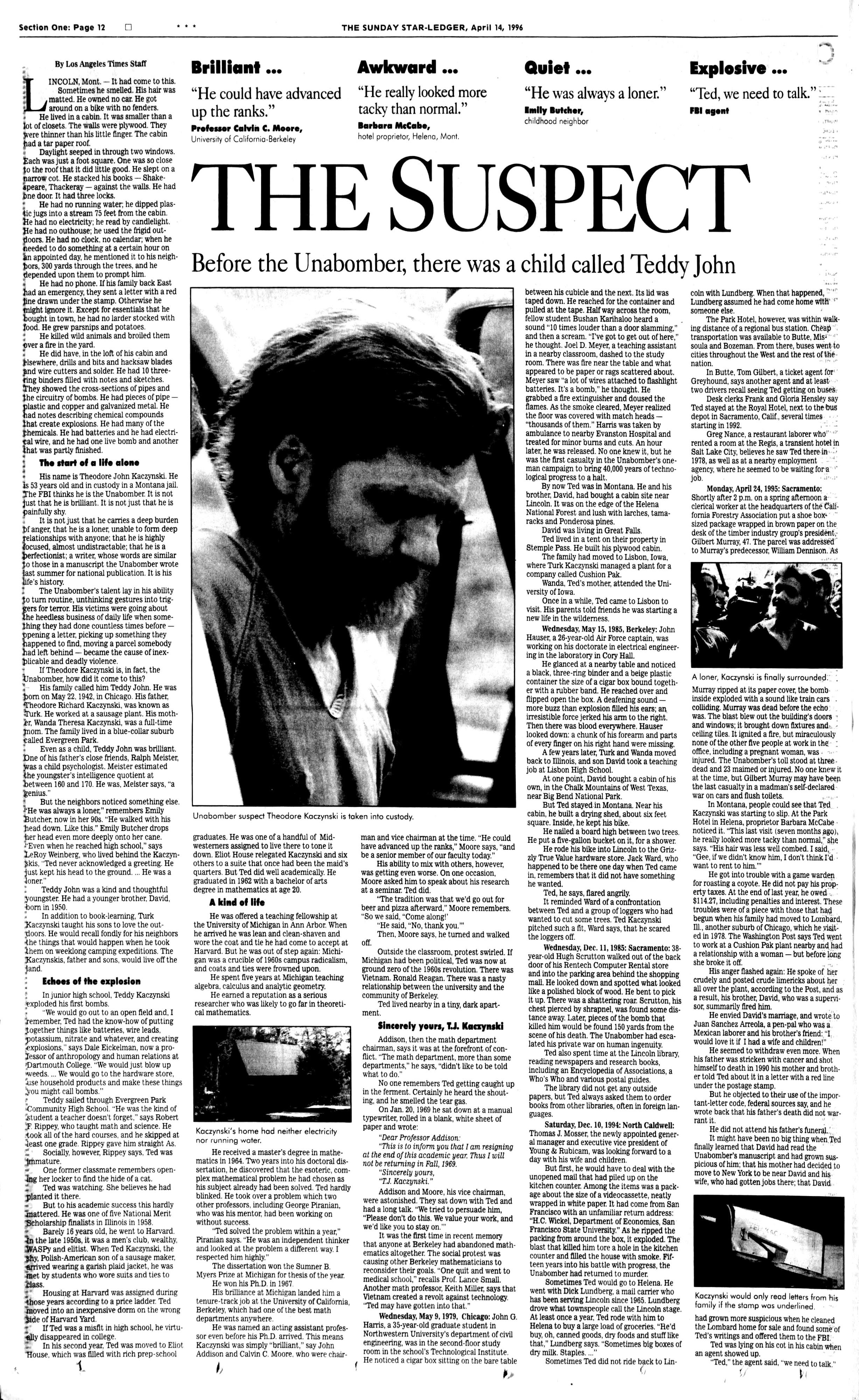
Los Angeles Times Staff
Before The Unabomber, There Was A Child Called Teddy John
LINCOLN, Mont. — It had come to this. Sometimes he smelled. His hair was matted. He owned no car. He got around on a bike with no fenders.
He lived in a cabin. It was smaller than a lot of closets. The walls were plywood. They were thinner than his little finger. The cabin had a tar paper roof.
Daylight seeped in through two windows. Each was just a foot square. One was so close to the roof that it did little good. He slept on a narrow cot. He stacked his books — Shakespeare, Thackeray — against the walls. He had the door. It had three locks.
He had no running water; he dipped plastic jugs into a stream 75 feet from the cabin. He had no electricity; he read by candlelight. He had no outhouse; he used the frigid outdoors. He had no clock, no calendar; when he needed to do something at a certain hour on an appointed day, he mentioned it to his neighbors, 300 yards through the trees, and he depended upon them to prompt him.
He had no phone. If his family back East had an emergency, they sent a letter with a red line drawn under the stamp. Otherwise he might ignore it. Except for essentials that he nought in town, he had no larder stocked with food. He grew parsnips and potatoes.
He killed wild animals and broiled them ever a fire in the yard.
He did have, in the loft of his cabin and Elsewhere, drills and bits and hacksaw blades and wire cutters and solder. He had 10 three-ring binders filled with notes and sketches. They showed the cross-sections of pipes and the circuitry of bombs. He had pieces of pipe — plastic and copper and galvanized metal. He had notes describing chemical compounds that create explosions. He had many of the Chemicals. He had batteries and he had electrical wire, and he had one live bomb and another that was partly finished.
The start off a life alone
His name is Theodore John Kaczynski. He is 53 years old and in custody in a Montana jail. The FBI thinks he is the Unabomber. It is not just that he is brilliant. It is not just that he is painfully shy.
It is not just that he carries a deep burden bf anger, that he is a loner, unable to form deep relationships with anyone; that he is highly focused, almost undistractable; that he is a perfectionist; a writer, whose words are similar Jo those in a manuscript the Unabomber wrote last summer for national publication. It is his life’s history.
The Unabomber’s talent lay in his ability Jo turn routine, unthinking gestures into triggers for terror. His victims were going about the heedless business of daily life when something they had done countless times before — opening a letter, picking up something they happened to find, moving a parcel somebody had left behind — became the cause of inexplicable and deadly violence.
If Theodore Kaczynski is, in fact, the Unabomber, how did it come to this?
His family called him Teddy John. He was porn on May 22.1942, in Chicago. His father, Theodore Richard Kaczynski, was known as Turk. He worked at a sausage plant. His mother, Wanda Theresa Kaczynski, was a full-time mom. The family lived in a blue-collar suburb tailed Evergreen Park.
Even as a child, Teddy John was brilliant. One of his father’s close friends. Ralph Meister, was a child psychologist. Meister estimated the youngster’s intelligence quotient at between 160 and 170. He was. Meister says, “a genius.”
But the neighbors noticed something else. ^He was always a loner,” remembers Emily butcher, now in her 90s. “He walked with his Pead down. Like this.” Emily Butcher drops her head even more deeply onto her cane.
Even when he reached high school,” says LeRoy Weinberg, who lived behind the Kaczynskis, “Ted never acknowledged a greeting. He just kept his head to the ground.... He was a loner.”
Teddy John was a kind and thoughtful youngster. He had a younger brother, David, born in 1950.
In addition to book-learning, Turk Kaczynski taught his sons to love the outdoors. He would recall fondly for his neighbors the things that would happen when he took them on weeklong camping expeditions. The Kaczynskis, father and sons, would live off the land.
Echoes off the explosion
In junior high school, Teddy Kaczynski exploded his first bombs.
“We would go out to an open field and, I remember, Ted had the know-how of putting together things like batteries, wire leads, potassium, nitrate and whatever, and creating explosions,” says Dale Eickelman, now a professor of anthropology and human relations at Dartmouth College. “We would just blow up -weeds.... We would go to the hardware store, use household products and make these things you might call bombs.”
Teddy sailed through Evergreen Park Community High School. “He was the kind of student a teacher doesn’t forget.” says Robert J Rippey, who taught math and science. He took all of the hard courses, and he skipped at least one grade. Rippey gave him straight As. * Socially, however, Rippey says. Ted was Immature.
One former classmate remembers opening her locker to find the hide of a cat.
Ted was watching. She believes he had planted it there.
But to his academic success this hardly mattered. He was one of five National Merit Scholarship finalists in Illinois in 1958.
Barely 16 years old, he went to Harvard. In the late 1950s, it was a men’s club, wealthy. WASPy and elitist. When Ted Kaczynski, the $hy. Polish-American son of a sausage maker, arrived wearing a garish plaid jacket, he was met by students who wore suits and ties to class.
Housing at Harvard was assigned during those years according to a price ladder. Ted moved into an inexpensive dorm on the wrong Side of Harvard Yard.
If Ted was a misfit in high school, he virtually disappeared in college.
In his second year, Ted was moved to Eliot ■House, which was filled with rich prep-school graduates. He was one of a handful of Midwesterners assigned to live there to tone it down. Eliot House relegated Kaczynski and six others to a suite that once had been the maid’s quarters. But Ted did well academically. He graduated in 1962 with a bachelor of arts degree in mathematics at age 20.
A kind of life
He was offered a teaching fellowship at the University of Michigan in Ann Arbor. When he arrived he was lean and clean-shaven and wore the coat and tie he had come to accept at Harvard. But he was out of step again: Michigan was a crucible of 1960s campus radicalism, and coats and ties were frowned upon.
He spent five years at Michigan teaching algebra, calculus and analytic geometry.
He earned a reputation as a serious researcher who was likely to go far in theoretical mathematics.
He received a master’s degree in mathematics in 1964. Two years into his doctoral dissertation, he discovered that the esoteric, complex mathematical problem he had chosen as his subject already had been solved. Ted hardly blinked. He took over a problem which two other professors, including George Piranian, who was his mentor, had been working on without success.
“Ted solved the problem within a year,” Piranian says. “He was an independent thinker and looked at the problem a different way. I respected him highly.”
The dissertation won the Sumner B. Myers Prize at Michigan for thesis of the year.
He won his Ph.D. in 1967.
His brilliance at Michigan landed him a tenure-track job at the University of California, Berkeley, which had one of the best math departments anywhere.
He was named an acting assistant professor even before his Ph.D. arrived. This means Kaczynski was simply “brilliant,” say John Addison and Calvin C. Moore, who were chairman and vice chairman at the time. “He could have advanced up the ranks,” Moore says, “and be a senior member of our faculty today.”
His ability to mix with others, however, was getting even worse. On one occasion, Moore asked him to speak about his research at a seminar. Ted did.
“The tradition was that we’d go out for beer and pizza afterward.” Moore remembers. “So we said, “Come along!”
“He said, “No, thank you.’”
Then, Moore says, he turned and walked off.
Outside the classroom, protest swirled. If Michigan had been political, Ted was now at ground zero of the 1960s revolution. There was Vietnam. Ronald Reagan. There was a nasty relationship between the university and the community of Berkeley.
Ted lived nearby in a tiny, dark apartment.
Sincerely yours, TJ. Kaczynski
Addison, then the math department chairman, says it was at the forefront of conflict. “The math department, more than some departments,” he says, “didn’t like to be told what to do.”
No one remembers Ted getting caught up in the ferment. Certainly he heard the shouting, and he smelled the tear gas.
On Jan. 20. 1969 he sat down at a manual typewriter, rolled in a blank, white sheet of paper and wrote:
“Dear Professor Addison:
“This is to inform you that I am resigning at the end of this academic year. Thus I will not be returning in Fall, 1969.
“Sincerely yours,
“T.J. Kaczynski.”
Addison and Moore, his vice chairman, were astonished. They sat down with Ted and had a long talk. “We tried to persuade him, ‘Please don’t do this. We value your work, and we’d like you to stay on.’”
It was the first time in recent memory that anyone at Berkeley had abandoned mathematics altogether. The social protest was causing other Berkeley mathematicians to reconsider their goals. “One quit and went to medical school,” recalls Prof. Lance Small. Another math professor, Keith Miller, says that Vietnam created a revolt against technology. “Ted may have gotten into that.”
Wednesday, May 9, 1979, Chicago: John G. Harris, a 35-year-old graduate student in Northwestern University’s department of civil engineering, was in the second-floor study room in the school’s Technological Institute. He noticed a cigar box sitting on the bare table between his cubicle and the next. Its lid was taped down. He reached for the container and pulled at the tape. Half way across the room, fellow student Bushan Karihaloo heard a sound “10 times louder than a door slamming.” and then a scream. I’ve got to get out of here,” he thought. Joel D. Meyer, a teaching assistant in a nearby classroom, dashed to the study room. There was fire near the table and what appeared to be paper or rags scattered about. Meyer saw “a lot of wires attached to flashlight batteries. It’s a bomb,” he thought. He grabbed a fire extinguisher and doused the flames. As the smoke cleared, Meyer realized the floor was covered with match heads — “thousands of them.” Harris was taken by ambulance to nearby Evanston Hospital and treated for minor burns and cuts. An hour later, he was released. No one knew it, but he was the first casualty in the Unabomber’s one-man campaign to bring 40,000 years of technological progress to a halt.
By now Ted was in Montana. He and his brother, David, had bought a cabin site near Lincoln. It was on the edge of the Helena National Forest and lush with larches, tamaracks and Ponderosa pines.
David was living in Great Falls.
Ted lived in a tent on their property in Stemple Pass. He built his plywood cabin.
The family had moved to Lisbon, Iowa, where Turk Kaczynski managed a plant for a company called Cushion Pak.
Wanda, Ted’s mother, attended the University of Iowa.
Once in a while, Ted came to Lisbon to visit. His parents told friends he was starting a new life in the wilderness.
Wednesday, May 15, 1985, Berkeley: John Hauser, a 26-year-old Air Force captain, was working on his doctorate in electrical engineering in the laboratory in Cory Hall.
He glanced at a nearby table and noticed a black, three-ring binder and a beige plastic container the size of a cigar box bound together with a rubber band. He reached over and flipped open the box. A deafening sound — more buzz than explosion filled his ears; an irresistible force jerked his arm to the right. Then there was blood everywhere. Hauser looked down: a chunk of his forearm and parts of every finger on his right hand were missing.
A few years later, Turk and Wanda moved back to Illinois, and son David took a teaching job at Lisbon High School.
At one point, David bought a cabin of his own, in the Chalk Mountains of West Texas, near Big Bend National Park.
But Ted stayed in Montana. Near his cabin, he built a drying shed, about six feet square. Inside, he kept his bike.
He nailed a board high between two trees. He put a five-gallon bucket on it, for a shower.
He rode his bike into Lincoln to the Grizzly True Value hardware store. Jack Ward, who happened to be there one day when Ted came in, remembers that it did not have something he wanted.
Ted, he says, flared angrily.
It reminded Ward of a confrontation between Ted and a group of loggers who had wanted to cut some trees. Ted Kaczynski pitched such a fit, Ward says, that he scared the loggers off.
Wednesday, Dec. 11,1985: Sacramento: 38-year-old Hugh Scrutton walked out of the back door of his Rentech Computer Rental store and into the parking area behind the shopping mall. He looked down and spotted what looked like a polished block of wood. He bent to pick it up. There was a shattering roar. Scrutton, his chest pierced by shrapnel, was found some distance away. Later, pieces of the bomb that killed him would be found 150 yards from the scene of his death. The Unabomber had escalated his private war on human ingenuity.
Ted also spent time at the Lincoln library, reading newspapers and research books, including an Encyclopedia of Associations, a Who’s Who and various postal guides.
The library did not get any outside papers, but Ted always asked them to order books from other libraries, often in foreign languages.
Saturday, Dec. 10, 1994: North Caldwell: Thomas J. Mosser, the newly appointed general manager and executive vice president of Young & Rubicam, was looking forward to a day with his wife and children.
But first, he would have to deal with the unopened mail that had piled up on the kitchen counter. Among the items was a package about the size of a videocassette, neatly wrapped in white paper. It had come from San Francisco with an unfamiliar return address: “H.C. Wickel, Department of Economics, San Francisco State University.” As he ripped the packing from around the box, it exploded. The blast that killed him tore a hole in the kitchen counter and filled the house with smoke. Fifteen years into his battle with progress, the Unabomber had returned to murder.
Sometimes Ted would go to Helena. He went with Dick Lundberg, a mail carrier who has been serving Lincoln since 1965. Lundberg drove what townspeople call the Lincoln stage. At least once a year, Ted rode with him to Helena to buy a large load of groceries. “He’d buy, oh, canned goods, dry foods and stuff like that,” Lundberg says. “Sometimes big boxes of dry milk. Staples....”
Sometimes Ted did not ride back to Lincoln with Lundberg. When that happened, Lundberg assumed he had come home with’ someone else.
The Park Hotel, however, was within walking distance of a regional bus station. Cheap transportation was available to Butte, Missoula and Bozeman. From there, buses went to cities throughout the West and the rest of the nation.
In Butte, Tom Gilbert, a ticket agent for1 Greyhound, says another agent and at least two drivers recall seeing Ted getting on buses.
Desk clerks Frank and Gloria Hensley say Ted stayed at the Royal Hotel, next to the bus depot in Sacramento, Calif., several times starting in 1992.
Greg Nance, a restaurant laborer who rented a room at the Regis, a transient hotel in Salt Lake City, believes he saw Ted there in 1978, as well as at a nearby employment agency, where he seemed to be waiting for a job.
Monday, April 24,1995: Sacramento: Shortly after 2 p.m. on a spring afternoon a clerical worker at the headquarters of the California Forestry Association put a shoe box* sized package wrapped in brown paper on the desk of the timber industry group’s president; Gilbert Murray, 47. The parcel was addressed to Murray’s predecessor, William Dennison. As Murray ripped at its paper cover, the bomb inside exploded with a sound like train cars colliding. Murray was dead before the echo was. The blast blew out the building’s doors • and windows; it brought down fixtures and ceiling tiles. It ignited a fire, but miraculously none of the other five people at work in the . office, including a pregnant woman, was injured. The Unabomber’s toll stood at three • dead and 23 maimed or injured. No one knew it at the time, but Gilbert Murray may have beep the last casualty in a madman’s self-declared war on cars and flush toilets.
In Montana, people could see that Ted Kaczynski was starting to slip. At the Park Hotel in Helena, proprietor Barbara McCabe noticed it. “This last visit (seven months agoh he really looked more tacky than normal,” she says. “His hair was less well combed. I said, “Gee, if we didn’t know him, I don’t think I’d want to rent to him.”’
He got into trouble with a game warden for roasting a coyote. He did not pay his property taxes. At the end of last year, he owed $114.27, including penalties and interest. These troubles were of a piece with those that had begun when his family had moved to Lombard. Ill., another suburb of Chicago, which he visited in 1978. The Washington Post says Ted went to work at a Cushion Pak plant nearby and had a relationship with a woman — but before long she broke it off.
His anger flashed again: He spoke of her crudely and posted crude limericks about her all over the plant, according to the Post, and as a result, his brother, David, who was a supervisor, summarily fired him.
He envied David’s marriage, and wrote to Juan Sanchez Arreola, a pen-pal who was a Mexican laborer and his brother’s friend: “I would love it if I had a wife and children!”
He seemed to withdraw even more. When his father was stricken with cancer and shot himself to death in 1990 his mother and brother told Ted about it in a letter with a red line under the postage stamp.
But he objected to their use of the important-letter code, federal sources say, and he wrote back that his father’s death did not warrant it.
He did not attend his father’s funeral.
It might have been no big thing when Ted finally learned that David had read the Unabomber’s manuscript and had grown suspicious of him; that his mother had decided to move to New York to be near David and his wife, who had gotten jobs there; that David had grown more suspicious when he cleaned the Lombard home for sale and found some of Ted’s writings and offered them to the FBI.
Ted was lying on his cot in his cabin when an agent showed up.
“Ted,” the agent said, “we need to talk.”