Author affiliation: Aston University, Aston Institute for Forensic Linguistics, Birmingham, UK.
Author's contact: m.hunter5@aston.ac.uk
Madison Hunter
Ideologies of a serial bomber
A longitudinal linguistic appraisal analysis of the writings of the Unabomber
3.1. Paranoid Personality Disorder (PPD)
7. Observations and Interpretations
8. Observations and Interpretations
9. Appraisal as an investigative tool
Abstract
Forensic linguistic and psychological assessments of language evidence each offer useful information about authors, but conclusions reached by one are often considered beyond the scope of the other. This paper explores an interdisciplinary approach intended to help bridge the gap between the two which uses the Appraisal framework as the analytical method but examines the findings through the lens of cognitive psychological theory. The connection between the two disciplines is made through the shared concept of ‘schemas’ – beliefs that impact the interpretation of and response to incoming information. More specifically, this study uses the linguistic operationalization of schemas – i.e., something observable through language choices – alongside the cognitive psychological conceptualization – as underlying different psychological traits and symptoms and producing evaluative/perceptual biases. It is argued that the impact of schemas on one’s experience will be reflected in the language one uses to describe and evaluate aspects of that experience. The analysis is conducted on the writings of Ted Kaczynski – the Unabomber – which span almost 30 years and are separated into three time periods: (1) before likely onset of psychiatric symptoms; (2) after onset but before voluntary self-isolation; and (3) just before his first bombing to a few years before his arrest. This dataset affords a unique opportunity to examine not only the potential relationship between language and psychopathology, but also how it may change over time. Results suggest a connection between stance-taking patterns and schemas underlying different psychological traits/symptoms, with some changes over time being observed. While further research is needed, the findings provide evidence in support of an interdisciplinary approach like the one explored here.
Keywords: Appraisal analysis; forensic text analysis; stance; psychopathology.
1. Introduction[1]
In May of 1978, a package was left in a parking lot on the University of Illinois at Chicago campus with the return address of a Northwestern University professor. Upon it being returned to him, the professor claimed he had not sent the package and reported it to security. When it was later opened, it exploded, injuring the security guard’s hand (Fitzgerald, 2004). Over the next 17 years, 15 more bombs would be planted by the Unabomber—a moniker created from the associations of early victims, i.e., ‘universities and airlines’—causing a total of three deaths and 23 injuries and sowing widespread panic across the United States (Federal Bureau of Investigation, n.d.). For much of that 17-year period, there was a paucity of forensic evidence, which resulted in few leads and little substantive progress in the investigation. Beginning in 1993, however, the bomber began sending letters to various recipients expounding his ideologies and in 1995, he mailed a 35,000-word manifesto to the Washington Post and New York Times, demanding it be published (Fitzgerald, 2004). After publication, a man named David Kaczynski reported suspicions to the FBI that his brother might be the author, and he and his mother later provided investigators with letters the brother had sent them throughout the years to compare linguistically to the Unabomber writings. There were a striking number of similarities between the two sets of documents, which proved to be a crucial piece of evidence in securing the search warrant that, when executed, ended the 17-year manhunt with the arrest of the Unabomber, Ted Kaczynski.
During the nearly two-decade investigation, numerous versions of a behavioral profile had been generated and just before Kaczynski’s arrest, the FBI also enlisted the services of a forensic linguist to generate a linguistic profile (Shuy, 2014). A behavioral profile – sometimes referred to as a psychological or criminal profile – typically compares aspects of a crime to past crimes of a similar nature to determine potential behavioral or psychological traits of the author (Douglas, Ressler, Burgess, & Hartman, 2004). Linguistic profiles, conversely, involve analyzing and describing how features of a suspect’s language use compare to features identified in previous sociolinguistic research to be “characteristic of specific societal groups” (Shuy, 2014, pp. 76-77).
The behavioral profiles generated about the Unabomber varied, sometimes drastically, but ultimately theorized that the perpetrator was middle-aged and from the Chicago area (which were accurate), was high school educated, potentially with some university experience (which was inaccurate) and was a “loner with low self-esteem” who had a “strong sense of superiority” (Shuy, 2014, p. 81). The linguistic profile had similarly hypothesized the Unabomber was older and from Chicago but predicted a much higher education level and speculated about aspects of religious background and other geographical background information (all of which turned out to be accurate).
In this case, none of the profiles that were generated ultimately contributed to the identification of Kaczynski – his brother’s tip and the subsequent comparative analysis of the Unabomber manifesto/letters and Kaczynski’s known writings provided the necessary evidence in the end (Fitzgerald, 2004). Despite this, the case does demonstrate how combining two distinct approaches can form a more complete picture of the perpetrator as each one may yield information that the other does not. More to the point, it arguably represents an excellent case in which to explore the potential benefits of an interdisciplinary approach which merges aspects of both methodologies and bridges the gap between them.
One such possible approach is proposed in this paper; the analytical method is based in linguistic theory and the identified language patterns are examined through the lens of a psychological theory to interpret how they may relate to the author’s underlying psychopathology (i.e., their collective set of psychological traits). The reason Kaczynski’s case represents a particularly useful testing ground is that there is information available on at least parts of the profiles generated in the investigation (Shuy, 2014), a report from a psychiatric competency assessment performed during his trial (Johnson, 1998), and a timeline of major events in his life (including changes in his mental health). This means:
1. the findings of the analysis conducted here can be examined in reference to the past profiles to see what value may have been added;
2. the relationship between the language patterns and specific psychological traits can be explored; and
3. the language patterns can be examined at different time points to determine whether changes in the patterns may correspond to changes in Kaczynski’s mental health or major life events (e.g., his first bombing).
The next section contains an overview of the theoretical framework (both linguistic and psychological) used in this study and explains how the relationship between language and psychopathology is conceptualized and operationalized. After that, a brief introduction to Kaczynski’s background and the findings of the psychiatric competency assessment (Johnson, 1998) is provided before introducing the data and methods. In the final sections of this paper, the key findings are outlined and their implications are discussed (primarily in terms of the potential utility of the proposed approach in forensic contexts).
2. Theoretical Framework
The base assertion underlying this research is that an individual’s psychopathology impacts their lived experience – i.e., how they interpret information and interact with the world (Beck, 2015; Bortolan, 2019) – and language is a means through which that experience can be shared with others. More specifically, it is argued that the language used to describe and evaluate (i.e., express feelings/attitudes – or stances – about; Biber, Johansson, Leech, Conrad, & Finegan, 1999) one’s experiences represents one possible way of examining, albeit indirectly, the underlying psychological processes that impact them. This notion is not completely unfounded, though the nature of the relationship between language and psychopathology is inherently complex and has been a topic of debate in the literature. At one extreme is the argument that certain linguistic features—such as lexical categories or syntactic complexity—are indicative of aspects of mental health like symptom/trait severity, functional impairments, or personality traits (e.g., Buck & Penn, 2015; Gawda, 2013; Pennbaker & King, 1999). At the other extreme is the argument for a less direct relationship; language facilitates social interaction and linguistic choices therefore more likely reflect the social goals of the language user in a given context than any underlying cognitive processes (Edwards & Potter, 1992, 1993).
The viewpoint taken here combines aspects of the aforementioned perspectives – that is, language used when recounting one’s experiences will be sensitive to, and therefore impacted by, several factors which influence those experiences, including the social/contextual (e.g., audience or genre) and the psychological (e.g., psychological traits). To explore this empirically, though, requires an interdisciplinary theoretical framework as neither psychology nor linguistics offers one that comprises all the necessary components. For this research, that framework was created using features of phenomenological psychopathology, cognitive psychology, and systemic functional linguistics (SFL).
Phenomenological psychopathology emphasizes the value of analyzing first-person accounts of lived experiences, arguing that they allow one to observe “the various ways in which everyday experience can be disrupted” or altered by psychopathology (Bortolan, 2019, p. 1054). This helped to create the data selection criteria to ensure the language that was analyzed was appropriate for the intended task. Cognitive psychology then provides a way to specifically characterize the impact of psychopathology by describing the underlying schemas (beliefs and assumptions) responsible for disrupting and altering experience (e.g., Beck & Haigh, 2014). Different schemas are thought to underlie different mental health disorders, traits, and symptoms (e.g., Beck, 2015), but they are themselves considered abstract and therefore not directly observable. They instead can be observed through, for instance, self-report measures or assessment scales and sometimes through language output – though the focus here tends to be on thematic content rather than patterns of linguistic resources and choices (Beck, Freeman, & Davis, 2015).
This represents the first piece of the puzzle, broadly connecting psychological characteristics to language output. However, the psychological approach to the analysis of the language is insufficient for our purposes here in that it does not offer the level of detail about the language patterns that we want. For that, we turn to the linguistic perspective of schemas – which serves as the bridge between the psychological and linguistic theories used here – and SFL, which supplies the analytical method. In linguistics, schemas have broadly the same definition – i.e., they are beliefs/assumptions that influence how one interprets and responds to incoming information (e.g., Shuy, 2015) – and are considered observable through analyzing patterns of linguistic choices. This represents the other piece of the puzzle but is in its own way lacking in that linguistic schemas arenot tied to any psychological characteristics. Therefore, to fully explore the relationship between language and psychopathology, we need a combination of the two perspectives; namely, the conceptualization from psychology (which links the schemas with psychological traits) and the operationalization from linguistics (which links schemas with language output).
What SFL offers is a way of approaching the analysis that focuses on the linguistic resources that may be used to describe and evaluate one’s experiences, which as argued above, would represent one possible observable manifestation of schemas. To be more specific, this research makes use of the Appraisal framework (J. R. Martin & White, 2005), which is comprised of three interacting systems encapsulating the various resources that are chosen from when expressing stances. The first system – attitude – captures the resources for expressing the feelings and judgments at the core of the stances. The second system – engagement – captures resources used to position one’s views with respect to possible alternatives and convey commitment to one’s own positions. The third system – graduation – acts as an umbrella over the other two, capturing the resources for scaling instances of each (i.e., increasing/decreasing the intensity of the feeling or the level of commitment to the position).
In using the Appraisal framework, it is possible to gain an immensely detailed account of the patterns of linguistic resources that an individual uses to discuss and evaluate themselves, others, and their world/experiences. These patterns can then be examined through the lens of the cognitive psychological literature to determine whether there are any clear connections to the schemas associated with different psychological traits and symptoms. A more comprehensive overview of the framework is provided below in section 4 after the discussion of Kaczynski’s psychological background and the cognitive psychological literature relating to it.
3. Psychological Background
Kaczynski was born in Chicago in 1942. He started university at the age of 16, obtaining his graduate and doctoral degrees in mathematics by the age of 25, and subsequently getting hired by the University of California-Berkeley before abruptly resigning two years later in 1969 (“Unabomber (Ted Kaczynski)”, 2018). In 1971, he moved to an isolated cabin in the Montana woods, from which he constructed the bombs he used in his 16 attacks spanning from 1978 until his arrest in 1995. After his arrest, Kaczynski’s defense team hired a psychiatrist to conduct an evaluation of his competency to stand trial. The psychiatrist concluded that Kaczynski was indeed competent, but noted in the report that he exhibited signs of the (now bygone) paranoid type of schizophrenia and paranoid personality disorder (PPD; Johnson, 1998). Johnson opined that the PPD was likely present before the onset of the schizophrenia symptoms, which she estimated to have been around 1966, when Kaczynski was 24 years old and completing his graduate studies.
Johnson noted that while the severity of Kaczynski’s symptoms fluctuated over time, he did not appear to ever experience full remission and that exacerbations of symptom severity had been preceded by “depressed mood, insomnia, increased distractibility, and intensification of sexual identity problems” (Johnson, 1998, p. 45). She also reported various symptoms with which Kaczynski presented, including impaired social and occupational functioning—which was evidenced by his lack of close friendships and romantic relationships as well as abrupt resignation from his faculty position in 1969 and later decision to isolate himself in his cabin. The predominant symptom, though, was the presence of delusions centered around two main themes: (1) believing he was being controlled by technology and (2) that experiencing psychological verbal abuse by his parents led to his interpersonal dysfunction.
For context, a brief introduction to the relevant literature relating to the diagnoses Kaczynski received is warranted. The fifth edition of the Diagnostic and Statistical Manual (DSM-5; American Psychiatric Association, [APA], 2013) is used here. It provides an idea of what symptoms/traits may be present with the two diagnoses Kaczynski received and contains the most up-to-date information about them as of this writing. (An earlier edition was used when Kaczynski was evaluated, and this was consulted to ensure that the criteria were not significantly different from that in the DSM-5.) Based on this and Johnson’s (1998) report, the relevant schemas from cognitive psychological research can be explored in more depth. The two diagnoses are discussed in the following subsections, starting with the diagnostic criteria before outlining core schemas and processing biases associated with the diagnoses and their component symptoms/traits.
3.1. Paranoid Personality Disorder (PPD)
Personality traits are “enduring patterns of perceiving, relating to, and thinking about the environment and oneself that are exhibited in a wide range of social and personal contexts” (APA, 2013, p. 647). Each trait is accompanied by schemas that impact interpretation of and response to various situations (Beck, 2015). ‘Pathological’ traits (which comprise personality disorders, or PDs), are maladaptive and inflexible – in contrast to ‘normal’ traits which are adaptive and flexible – in that their role in the interpretation and response will remain the same even in situations for which they are inappropriate (Beck, 2015, p. 24). For example, heightened ‘competitiveness’ might be adaptive for an athlete trying to win a game, but might be considered maladaptive if it causes someone to alienate their friends by trying to best them in every activity.
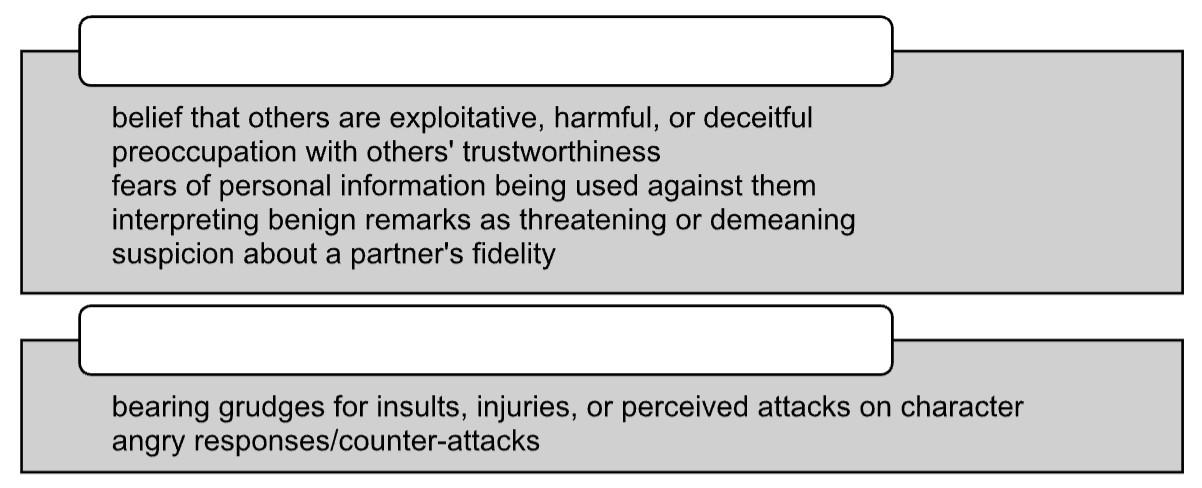
Paranoid personality disorder (PPD) is marked by by a “pervasive distrust and suspiciousness of others such that their motives are interpreted as malevolent” (APA, 2013, p. 649). In the DSM-5, the seven categorical (or behavioral) diagnostic criteria can all be subsumed under the pathological personality traits of suspiciousness and hostility (something suggested in past research; e.g., Beck, 2015; Millon, Millon, Meagher, Grossman, & Ramnath, 2012). For the purposes of this study, it is more useful to focus on these pathological personality traits as they relate more clearly and directly to the processes that might be impacted by the underlying schemas than the behavioral criteria do. How the behavioral criteria relate to the two pathological traits is shown in Figure 1.
On two scales or belief questionnaires used to assess the presence of schemas associated with personality traits and disorders, subscales were proposed and validated for PPD which center around the heightened suspiciousness and mistrust of others and their intentions (Arntz, Dreessen, Schouten, & Weertman, 2004; Beck et al., 2001; Bhar, Beck, & Butler, 2012; Fournier, DeRubeis, & Beck, 2012). For instance, holding the belief that others aim to take advantage of them; that they must always be on guard; or that when others are friendly, they are trying to manipulate them (Bhar et al., 2012; Fournier, 2015). Individuals with PPD may view themselves as righteous and clever, but at the same time vulnerable to mistreatment (Beck, 2015). Others, conversely, are viewed as mischievous, deceptive, manipulative, and exploitative (Beck, 2015; Renton & Mankiewicz, 2015), resulting in hypervigilance, often seeing threats in even the most benign actions (Renton & Mankiewicz, 2015, p. 248). As a result, PPD is often accompanied by anger or constant anxiety (Beck, 2015). These beliefs are also often held with a high degree of conviction, though not necessarily to the extent of a full-blown delusion (Renton & Mankiewicz, 2015) – a fixed belief considered incontrovertibly true regardless of contrary evidence (APA,2013).
Studies examining the impact of PPD specifically on cognitive processes are limited, though the effects of paranoia and persecutory delusions (like Kaczynski’s) – i.e., beliefs that others are intent on causing one harm (APA,2013) – have been investigated. It has been shown that similar reasoning biases are present in PPD as in persecutory delusions (Thompson-Pope & Turkat, 1988), which are discussed in the next subsection.
3.2. Schizophrenia
Schizophrenia is believed to exist on a spectrum with other psychotic disorders. For diagnosis in the DSM-5 (APA,2013), abnormalities in at least two of five domains associated with psychotic disorders must be present – one must be delusions, hallucinations, or disorganized thought/speech – alongside impairment in social, occupational, and/or personal functioning (p. 99). The diagnosis of the paranoid type of schizophrenia from the earlier editions of the DSM – which was removed from the DSM-5 – had similar criteria, but it specifically required the presence of one or more delusions or hallucinations (APA, 2000). As stated above, Kaczynski showed evidence of at least two delusions as well as impairment in social and occupational functioning (Johnson, 1998), though here we are focused on the delusions and their associated schemas.
Delusions take time to fully solidify and even after they have, they can still be elaborated upon and refined and an individual’s investment in them can vary over time (Fineberg et al., 2015; Freedman, 2010). The impact on the interpretation of incoming information from the schemas underlying delusions helps to reinforce the beliefs and ultimately solidify and maintain the delusions (Beck & Rector, 2005; V. Bell, Halligan, & Ellis, 2006; Garety, Kuipers, Fowler, Freeman, & Bebbington, 2001). The content of these schemas is then argued to be evident in the themes of an individual’s delusions (Beck & Rector, 2005). Persecutory delusions – like those noted for Kaczynski (Johnson, 1998) – are most common (APA,2013) and involve the individual believing that others intend to harm or harass them. The paranoid ideation central to this type of delusion is also present in PPD – though usually at a slightly lower intensity (Renton & Mankiewicz, 2015).
Paranoid ideation and persecutory delusions have been found to be associated with externalizing and reasoning biases (e.g., Kinderman & Bentall, 1997; Langdon, Corner, McLaren, Ward, & Coltheart, 2006; Langdon, Ward, & Coltheart, 2010; J. A. Martin & Penn, 2002; Murphy, Bentall, Freeman, O’Rourke, & Hutton, 2018). The former result in an increased tendency to blame external circumstances or other people for negative events (e.g., Bentall, Corcoran, Howard, Blackwood, & Kinderman, 2001; Langdon et al., 2006, 2010; J. A. Martin & Penn, 2002), which is thought to contribute to the creation and maintenance of the paranoid world view (Bentall et al., 2001). The latter include a greater tendency to ‘jump to conclusions’ after minimal information (e.g., Garety et al., 2005; Langdon et al., 2010) and deficits in theory of mind (ToM), which is the ability to infer others’ intentions (e.g., Langdon et al., 2006, 2010). Bentall et al. (2001) posited that the ToM deficit might result in a greater chance of attributing negative characteristics to others for negative events over circumstances because of a diminished capacity for considering alternative explanations.
The aim of the next few sections is to present the data and findings of the current study, and then discuss how those findings might align with the information presented in this section. No specific hypotheses are posited as this study is exploratory and schemas could theoretically manifest through myriad combinations of resources – e.g., others are out to get me could present through describing others’ actions (they chased me) or one’s own emotional states (I felt uneasy walking home). Thus, the patterns of linguistic resources identified in the analysis are presented first and then explored to see how they relate to the possible schemas and associated information processing biases discussed above.
4. Appraisal Analysis
As mentioned above, the Appraisal framework consists of three interacting systems, each encompassing the linguistic resources for a different aspect of a stance (J. R. Martin & White, 2005). The first system, attitude, encompasses the resources for expressing personal emotions and societally-shaped assessments of people and ‘things’. Attitudinal resources point to the kinds of feelings the author has about themselves, other people, and aspects of their experience, which constitute a core aspect of cognitive schemas (e.g., Beck, 2015; Beck & Haigh, 2014). Thus, not only do they help identify the schematic content, but they also help distinguish between schemas which may take similar linguistic form but differ in the core sentiment and direction of the belief (Beck et al., 2015). The second system, engagement, comprises the resources for encoding commitment to or certainty about a proposition and positioning of the author with respect to other persons and viewpoints, allowing observation of how authors frame their evaluations and engage with their audiences (J. R. Martin & White, 2005). Engagement resources helps identify, for instance, the views the authors hold most strongly, the views they expect others hold, and the knowledge they expect others to share with them, which may help identify which schemas are most active. Finally, the system of graduation covers the resources for adjusting the degree of commitment/certainty of positions expressed via engagement, the intensity of attitudes. For the purposes of this paper, the focus is placed on attitude and engagement with reference to the scaling within each system when relevant in the discussion of each (as opposed to a separate section on graduation).
Within attitude, there are three main types: (1) affect for personal emotions, (2) judgment for institutionalized assessments of behaviours and traits of oneself or others, and (3) appreciation for institutionalized assessments of objects and phenomena (J. R. Martin & White, 2005). Affect has four subcategories: un/happiness for emotions relating to “affairs of the heart (J. R. Martin & White, 2005, p. 49) like love/hate or happy/sad; dis/satisfaction for emotions about activities we participate in or watch like impressed/angry; in/security for emotions about our environment or confidence in our knowledge like comfortable/uneasy or convinced/unsure; and dis/inclination for emotions about irrealis things (i.e., things that have not happened yet). Judgment has five subcategories: normality for assessments of how normal/abnormal someone is; capacity for assessments of physical/mental capabilities (and assessments of removing or providing capacity like kill/assist); tenacity for assessments of determination, dependability, and willpower; veracity for assessments of honesty; and propriety for assessment of ethics/morals. Finally appreciation has three main subcategories: reaction for assessments of the feelings evoked by things (similar to affect, but with the focus placed on the object like a captivating story); composition for assessments of how well put together something is; and valuation for assessments of the social value of the stance object. In line with Hurt (2020), valuation has been expanded here to include the categories of judgment as the same values can be assigned to things as well as people; for instance, one may evaluate a person as truthful (+veracity), but they may also place the focus on a proposition instead, saying X is untrue in which case it is -veracity via valuation. All tokens of attitude are also coded for four other features: polarity (positive versus negative), explicitness (explicit/denotation versus implicit/connotation), appraiser (from where the feeling originated), and appraised (at whom/what the feeling is directed).
Within engagement, there are two main types of utterances: heteroglossic, in which alternatives are referenced by either opening the dialogic space to those alternatives (expanding) or closing it off from them (contracting); and monoglossic in which no alternatives are referenced (J. R. Martin & White, 2005). In expanding utterances, an author may either entertain their proposition as one of many (e.g., I might/may/could probably do X) or attribute the proposition to someone else (e.g., A claims/says/believes X). In contracting utterances, an author may proclaim a proposition is the most warrantable by pronouncing it (e.g., The truth is X), concurring with it (e.g., We all know X), or justifying it (e.g., X is true because); they may also achieve a similar effect by disclaiming alternatives through either denying the proposition (e.g., X is not true) or presenting a counter to it (e.g., But X is the case).
5. Data and Methods
For this study, Kaczynski’s evaluative language patterns are analyzed over time. The writings were pulled from a copy of larger collection of writings compiled by his defense team during his trial to aid the psychiatrist who evaluated his competency. The whole collection spans almost four decades and consists of around 3,600 pages of documents with those authored by Kaczynski himself – mostly journal entries and letters written to family, friends, and various strangers – accounting for an overwhelming majority. The collection used here comprises transcribed copies of the original documents – all of which can be be accessed in person at the University of Michigan library and some of which (though none of the ones used in this research) have recently become available online[2]. Full ethical approval was obtained to use these documents for this research from the author’s university.
5.1. Dataset
The dataset used in this study reflects three main stages of Kaczynski’s mental health history based on a timeline proposed in Johnson’s (1998) report and a general understanding of the progression of both schizophrenia (e.g., APA, 2013; Freedman, 2010) and PPD. Broad periods were chosen over more specific ones because he never really sought treatment and thus had few or no prior records to use, making a more detailed breakdown impractical (Johnson, 1998). The first time period consists of the years before the likely onset of the symptoms of schizophrenia (i.e., pre-1966) but after evidence of PPD likely appeared. Thus, during this first stage, there may be evidence of paranoid ideation, but at a lower intensity than might be expected after the onset of delusional thinking (e.g., Beck & Rector, 2005; Renton & Mankiewicz, 2015). The second time period consists of the years just after the schizophrenia symptoms began, but before Kaczynski completely isolated himself (i.e., between 1966 and 1969), which marked an exacerbation of symptoms and the social and occupational impairment (Johnson, 1998). During this stage, it is likely that the delusions would have been in the process of formation and their content would have been evident, though with potentially lower apparent investment than one might expect later on in their development (Federal Bureau of Investigation, n.d.; Fineberg et al., 2015). The third time period consists of the few years just before his first bombing until his arrest (i.e., 1975 to 1996), during which time the delusions would have likely become fully-formed (Johnson, 1998).
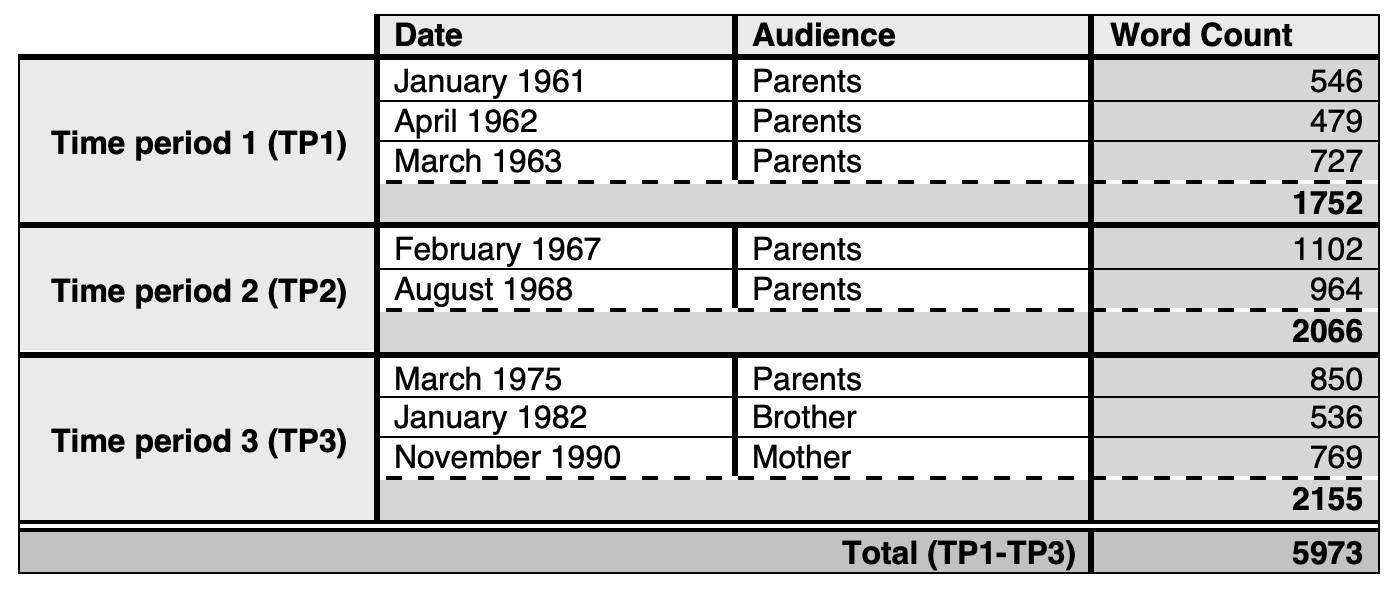
The primary selection criterion for texts in this dataset was that they needed to be first-person accounts (i.e., any texts discussing personal beliefs or experiences and not those that detailed logistical information or the like as those are unlikely to carry much evaluative language). This provides the best opportunity to observe how Kaczynski described and evaluated his experiences and the people/things involved in them – that is, the events most likely to have been impacted by information processing biases associated with cognitive schemas (e.g., Beck & Haigh, 2014). Beyond that, an attempt was made to control for three main register features – i.e., topic, audience, and mode of communication – as each of these can impact language choices (A. Bell, 1984; Biber et al., 1999; Halliday & Matthiessen, 2014). Ultimately, topic was too difficult to control for as there were considerable changes in Kaczynski’s circumstances between time periods, but audience and mode were both possible to control. Only letters to family were available across all three time periods, so these were focused on during selection. Finally, word count for each time period was also controlled, to an extent, to try to ensure the time periods were as balanced as possible. The aim was to collect two to three texts per time period, totalling between 1500 and 2000 words. A breakdown of the dataset – including the specific family member(s) acting as the audience, the date of the letter, and the word count – can be found in Table 1.
5.2. Analysis
Each of the texts was coded with the features of all three systems of the Appraisal framework in the annotation software UAM CorpusTool (O’Donnell, 2019). Once this was done, the raw frequencies of all features were exported so they could be analyzed quantitatively. Based in part on the work of Hurt (2020), chi-square tests were used to determine the key variables – those which were used significantly more in one text or time period over another (Baker, 2006) with the conventional significance threshold of p<0.05. This helped narrow the focus for the subsequent qualitative analysis, which was necessary for determining how the various stance-taking resources were actually used in context and in turn, gain a better understanding of the patterns of these resources in the different texts and time periods. These patterns are then discussed in reference to their possible relationship to different schemas associated with Kaczynski’s psychological traits/symptoms.
The primary focus of the quantitative analysis is on between-time period comparisons (i.e., comparing each time period to the other two), but within-time period analyses (i.e., comparing each text to all other texts) were also conducted to aid in the qualitative analysis. The within-time period analyses helped identify and account for fluctuations in evaluative resource patterns in the shorter intervals between individual texts that may reflect subtle changes in symptom severity that might not have been known given Kaczynski did not receive treatment before his arrest (Johnson, 1998). Since chisquare tests become too complex and difficult to interpret with multiple factors and levels (Grant et al., 2017), only two time periods or texts were compared at a time. For the between-time period analyses, this resulted in three comparisons (TP1 x TP2; TP1 x TP3; TP2 x TP3). There were 28 within-time period comparisons, so these are not discussed individually, but the distributions across the eight individual texts are examined alongside the broader time period distributions when relevant. The findings of the analysis alongside a discussion of how they may relate to different underlying schemas are presented in the next section.
As the three time periods were slightly different in size, frequencies for attitude and engagement were normalized to make them more comparable; these normalized frequencies were used to conduct the analyses. For attitude, tokens tend to be single words, so the frequencies were normalized per 1000 words as this represents the highest (neat) common denominator. In line with Hurt (2020), engagement frequencies were normalized per 100 instances rather than words as they tend to be clause/sentence length.
6. Results
For the sake of brevity, the results are presented first followed by a subsection relating to observations made about the patterns and of what they might be evidence. The discussion of how these results address the question of Appraisal’s utility as an investigative tool is the main focus of section 7.
Before outlining the key findings, a few prefatory comments are warranted. The analysis did not reveal many significant quantitative differences (i.e., key variables), which suggests changes in Kaczynski’s mental state between and within time periods did not have a significant impact on the distribution of evaluative resources he used over time. However, there were trends in the distributions that, while nonsignificant, are worth discussing alongside a few notable patterns that emerged in the qualitative analysis of how resources were employed. Thus, while the statistical results are reported and discussed in this section, the primary focus is on these trends and patterns.
6.1. Attitude
As outlined above, attitude resources help capture the different types of feelings and judgments authors express in their stances (J. R. Martin & White, 2005). Table 2 shows the features for which there was a significant difference (at least p<0.05) between at least two of the time periods. The greyed cells indicate which time period had the higher proportion than the time period(s) indicated by the superscript.
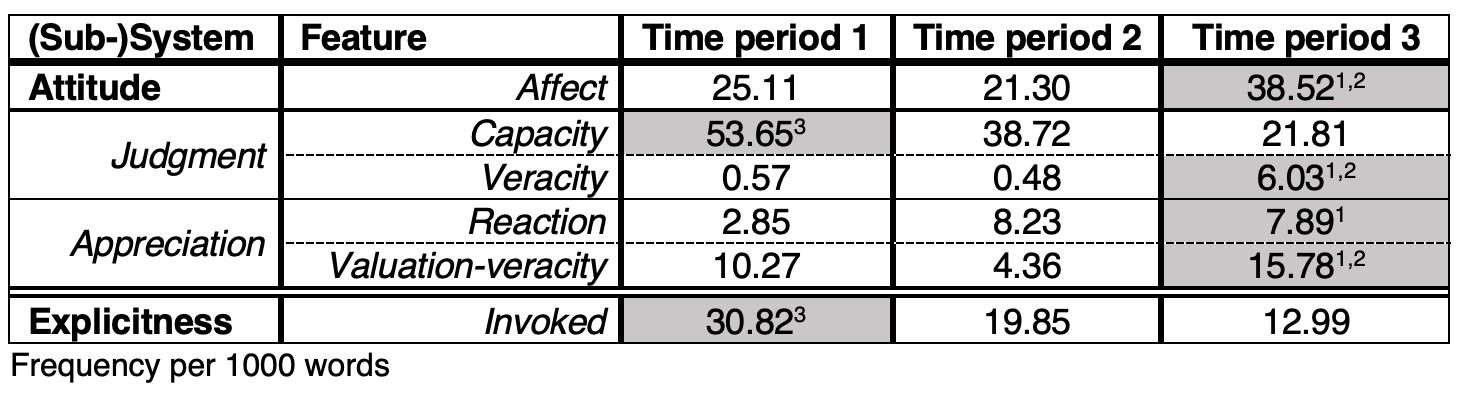
As the table shows, there are only six features within attitude for which there was a significant difference found between time periods. Interestingly, there is a significantly higher proportion of invoked meanings in TP1 over TP3, which suggests less reliance in later years on implication and more reliance on direct and explicit evaluations. As explicitness is coded on every attitude token, the use of implicit versus explicit meanings is discussed throughout this section when it becomes relevant.
With affect, roughly 25% of tokens in each time period were attributed to someone else. Within these examples, there appears to be a distinction between tokens denoting an ‘internal state’ versus those denoting an external and observable “surge of emotion” (J. R. Martin & White, 2005, p. 47). Consider the examples in Table 3.
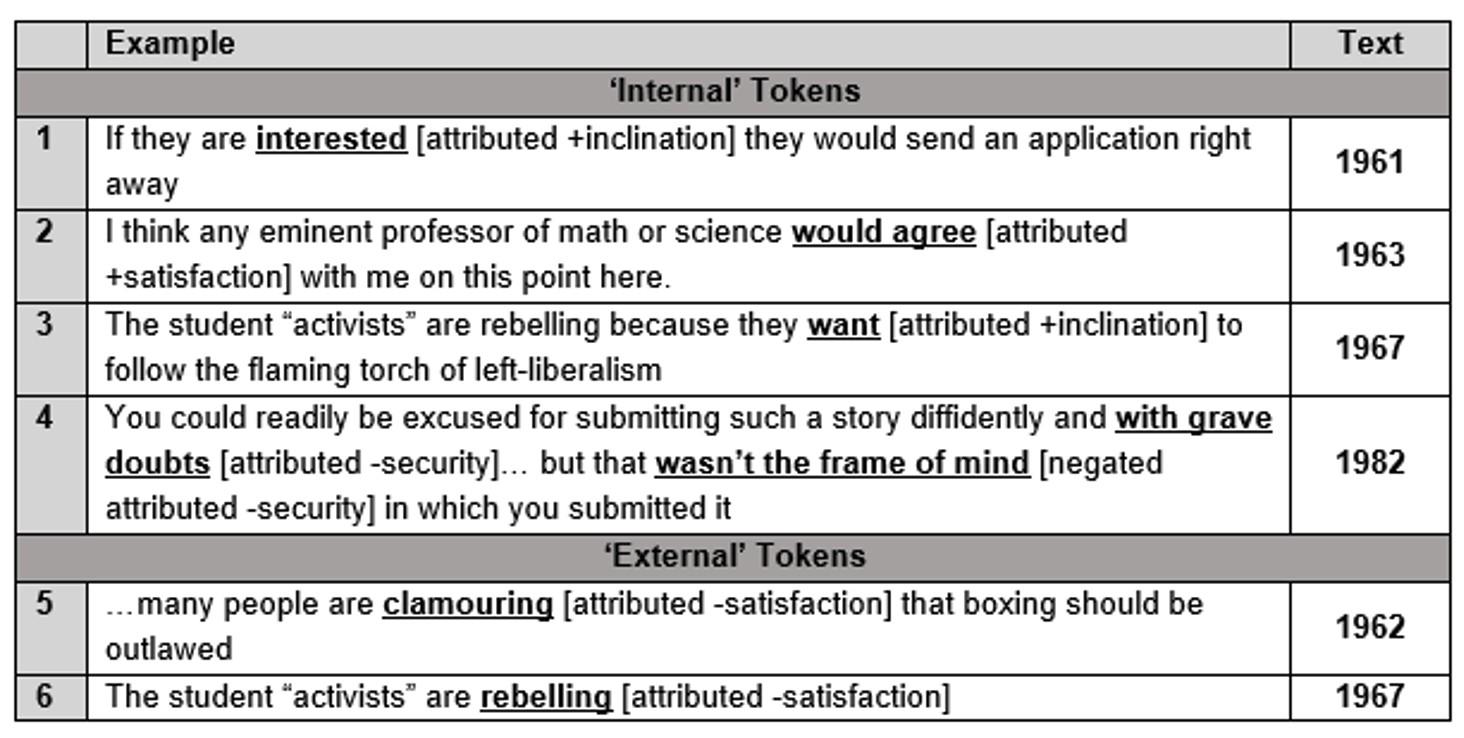
The ‘internal’ tokens represent Kaczynski’s inferences about the emotional states of others—something that cannot truly be known to him as an outsider. The ‘external’ tokens, on the other hand, represent his own personal observations and descriptions of others’ behaviors (lines 5 and 6). Internal tokens outnumbered external ones overall, but in the earlier texts, mitigating language was used more often around the internal tokens than in the later texts. For instance, in lines 1 and 2, TK introduces the attributed tokens with if and I think as if acknowledging them as mere possibilities. Conversely, in lines 3 and 4, the tokens are presented as the only warrantable possibilities through declaring the reason for the rebellion in 3 and rejecting the possibility of an insecure or uncertain frame of mind in 4. Therefore, not only was he inferring the internal states of others, but over time, he appeared to become more confident in those inferences.
Across the three time periods, tokens of attributed affect were also consistently paired with other value-laden items that implied Kaczynski’s own stances about the person(s) to whom the emotions were attributed. Examples are shown in Table 4.
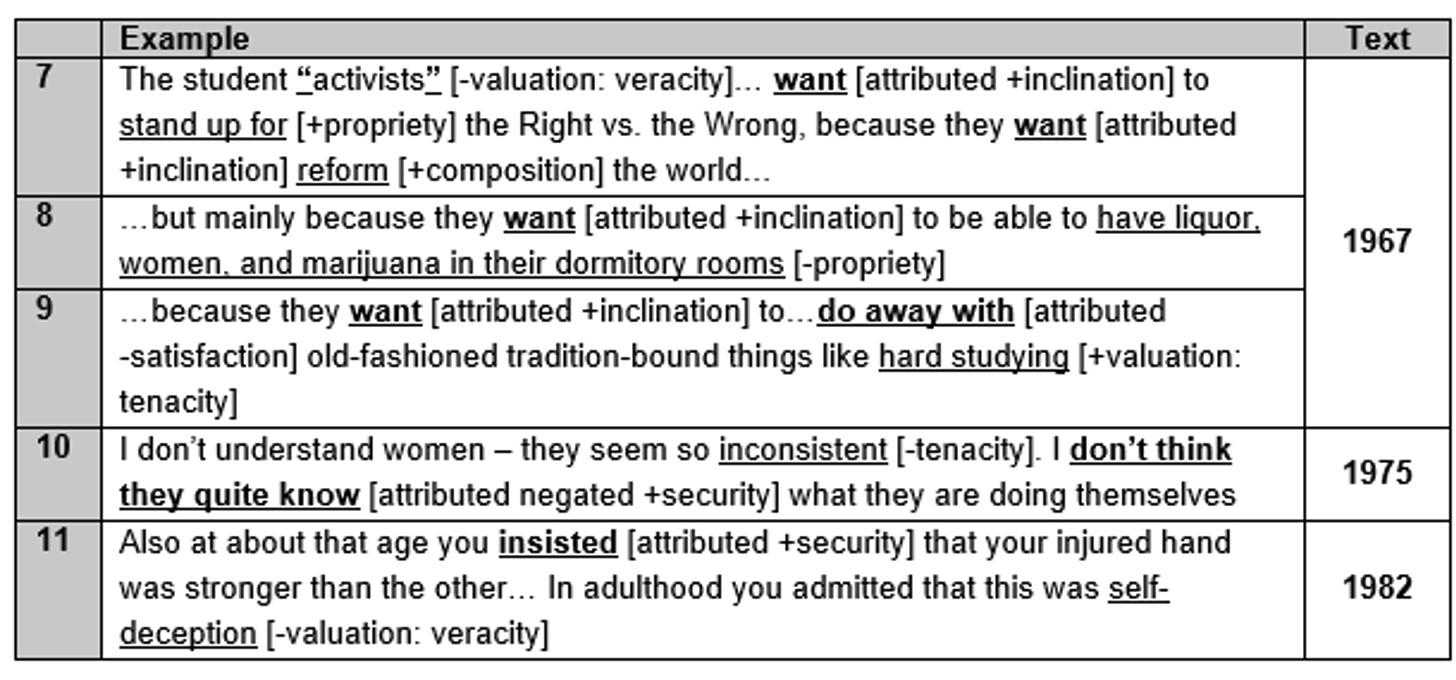
In lines 7-9 (all from the same text), Kaczynski talks about the wants of student “activists”. The scare quotes around activist convey disagreement with the accuracy of that descriptor for the individuals. The positive judgments that follow in line 7 are canceled out by the series of negative ones immediately after, like the assessment of impropriety in line 8 or of laziness implied in line 9 through saying the activists want to do away with things that require effort like hard studying. A similar pattern is observed with tokens of in/security, mostly within the 1975 and 1982 texts. For example, in line 11, when TK states that his brother’s insistence about his injured hand is one admitted instance of self-deception [-valuation: veracity], or in line 10 where he calls women inconsistent, adding I don’t think they quite know what they are doing themselves after one gave him her number but then later ignored his calls.
Capacity represented the highest proportion of judgment in all three time periods, encoding assessments of physical and mental abilities. These were either evaluations made directly about a single person/group, like lines 14 and 15 in Table 5 or through the use of comparative adjectives, like in lines 12, 13, and 16 (which imply a positive evaluation of one person and a negative evaluation of the other).
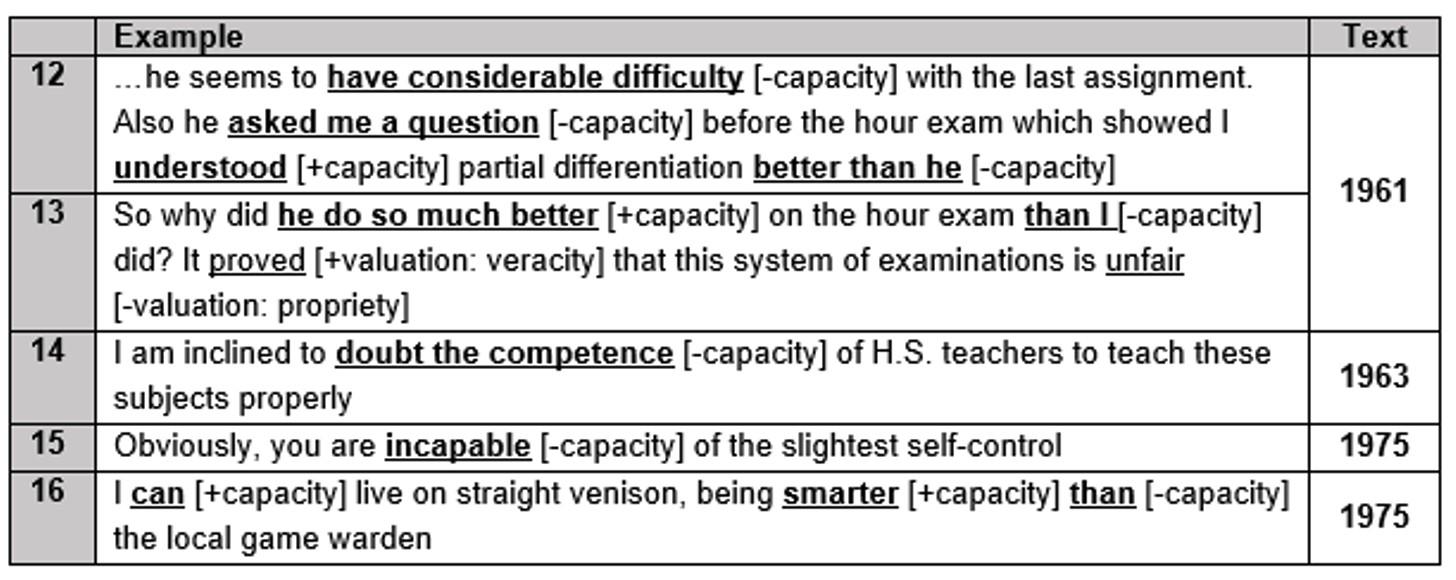
In instances of self-directed -capacity, there was usually additional context that implied the failure was not in Kaczynski’s control. For instance, in line 12, he negatively evaluates a classmate’s capabilities, but in line 13, Kaczynski admits that classmate tested better than him, which he claims is because the system is unfair, not a failure on his part.
Resources of capacity also worked in conjunction with resources of tenacity to convey an overall negative view of others, but usually indirectly through use of positive items against a broader negative backdrop. For example, when he expressed his belief that a Communist society was made up of people who are completely dedicated [+tenacity] to the whole. ‘Dedication’ is still a positive token but within the broader context, the dedication is described as being at the cost of individuality, saying they have no desires [negated +inclination] of their own. Kaczynski achieved a similar result in other ways, such as by placing it after countering language – e.g., instead of [counter] facing the problem [+tenacity] – or within a hypothetical, like saying his brother could readily be excused for submitting such a story diffidently [-tenacity]. In some cases, he also combined tenacity with other types of negative judgment, intensifying the negative evaluation, such as when he said to his parents their insane [-normality], mindless [-capacity] persistence [+tenacity] in sending magazines he did not want was irritating [-satisfaction].
The resources of veracity within both judgment and evaluation were used at a much higher rate in the later texts than any of the earlier ones. Those relating to Kaczynski himself helped depict him as the protagonist of the narrative who was just trying to be honest (even when what followed was generally negative evaluations of others). This included him saying he was just pointing out [+valuation: veracity] things that bothered him or that he was warning [+veracity] his brother, David, that his goals would not be easy to achieve. Even some of the instances of the self-directed -veracity achieved the same effect, such as saying how he was tired of having to conceal [-veracity] his opinions (i.e., he had been dishonest, but for the sake of David’s feelings). Outward-directed evaluations of veracity via both judgment and valuation, on the other hand, were primarily used to indicate the perceived truth value of a proposition or to assess another person as deceitful. Within judgment, these assessments were mostly directed at Kaczynski’s brother, calling him a habitual rationalizer and talking about his habitual self-deception (tokens that were repeated throughout the texts in which they occurred). Within valuation, an interesting pattern arose in how truth values were indicated for propositions originating from Kaczynski versus those originating from others. Those relating to Kaczynski’s beliefs were most commonly positive tokens and implied he was being direct and honest (e.g., pointing out various things or preceding a statement with frankly). For those originating from others, tokens marked them as deceitful to some extent, such as talking about David’s rationalizations or saying that David had made concessions and admitted to various things, implying that statements containing different (and presumably false) assertions had been made previously. Overall, the use of veracity further suggests a stance of mistrust and suspiciousness of others and what they say.
7. Observations and Interpretations
There are two main observations of note here. The first is that many of the patterns above offer insight into how Kaczynski assigns praise and blame for events. Overall, more negative events are mentioned than positive ones and the blame for such negative events is often placed on external sources. Through the use of attributed affect and forms of judgment and valuation, portrayed others as responsible for the negative events that happened to them or as having caused some negative event that affected others, including those that affected him. For instance, he attributed his poor exam performance to an unfair [-valuation: propriety] evaluation system. Interestingly, in one instance of a positive event, Kaczynski portrayed himself positively for initiating a conversation with a woman who gave him her number without hesitation [negated -security]. However, as shown in line 10, when the woman did not return his phone calls, he called women inconsistent, claiming they do not quite know [negated +security] what they are doing themselves instead of acknowledging any alternative possibility that would have reflected negatively on him. If Kaczynski did portray himself negatively, he often used resources that would lessen the blame. For instance, in the text mentioned above where TK describes his brother’s self-deception and rationalizing, Kaczynski first explains that he had been dishonest to spare David’s feelings. However, he then continues to juxtapose David’s ‘dishonesty’ (self-deception and rationalizing) with his own honesty (e.g., for pointing out the self-deception and rationalizing ), which effectively absolves him of wrongdoing for expressing such negative views of his brother in the letter.
The second observation relates to Kaczynski’s shift in his views of society and his role within it. To be sure, Kaczynski’s views of others and societal rules/norms were not positive during any of the three time periods, but he expresses different amounts of tolerance for certain rules between the earlier and later texts. In the first two time periods, there is disapproval of certain practices and institutions (e.g., blaming the system of examinations for his bad grade [1961] or expressing negative views of student activists [1967]), but he was still engaging with them. In the third time period, there is a noticeable shift to him explicitly negatively evaluating societal practices and institutions and also expressing a refusal, or at least a strong reluctance, to adhere to or engage with them. For example, he described the idea of finding a partner as succumbing [-capacity/-tenacity] to hedonism [-tenacity] and a defeat [-valuation: capacity] for him (1975) or when he claimed that he no longer wished to conceal [-veracity] his opinions or put up with his brother’s irritating [-reaction] traits to spare his feelings.
This avoidance of assigning responsibility for negative events to himself and instead assigning it to others and situational factors aligns with the externalizing biases associated with both PPD (mostly the paranoid ideation aspect; Langdon et al., 2010; Murphy et al., 2018) and persecutory delusions (e.g., Beck & Rector, 2005; Kinderman & Bentall, 1997; J. A. Martin & Penn, 2002). The pattern regarding society also aligns with the nature of schemas associated with PPD and persecutory delusions (e.g., Beck, 2015; Beck & Rector, 2005; Kinderman & Bentall, 1997). There is also evidence of PPD core beliefs around oneself being righteous and clever and others being exploitative and deceptive (Beck, 2015; Renton & Mankiewicz, 2015). For instance, he views himself as being capable (e.g., line 16) – or at least not being at fault for failures (e.g., his poor exam performance) – and as having been altruistic in the past by not sharing his negative views of his brother. However, he describes others as having ulterior motives for positive behaviors (e.g., student activists in lines 7-9) or being consistently deceptive, like his brother.
7.1 Engagement
The system of engagement comprises the resources for communicating commitment to or certainty about a proposition and for the author to align or disalign (i.e., agree or disagree) with their own propositions or with other persons or viewpoints (J. R. Martin & White, 2005). There were no key variables identified between time periods within this system, but there are a few interesting qualitative patterns that are worth discussing.
The first thing to note is that Kaczynski’s letters tended to have an overall argumentative tone; he would essentially play out an entire argument on a topic within the letter, though not necessarily with the recipient. Rather, alternatives would be acknowledged in some way (usually using expansion and proclaim resources), then his own interpretations and evaluations of situations and people would be presented or reinforced through counters and denials – which comprised at least 40% of the contractions in each text. Interestingly, it was with the disclaim resources that Kaczynski’s own views were most often implied; that is, instead of proclaiming his views as most warrantable, he implied this through either denying the validity of alternatives or by presenting a ‘more suitable’ position than the acknowledged alternative. In doing so, his views are ultimately portrayed as less flawed than others or as being a more accurate depiction of events. To illustrate, consider the following examples in Table 6.
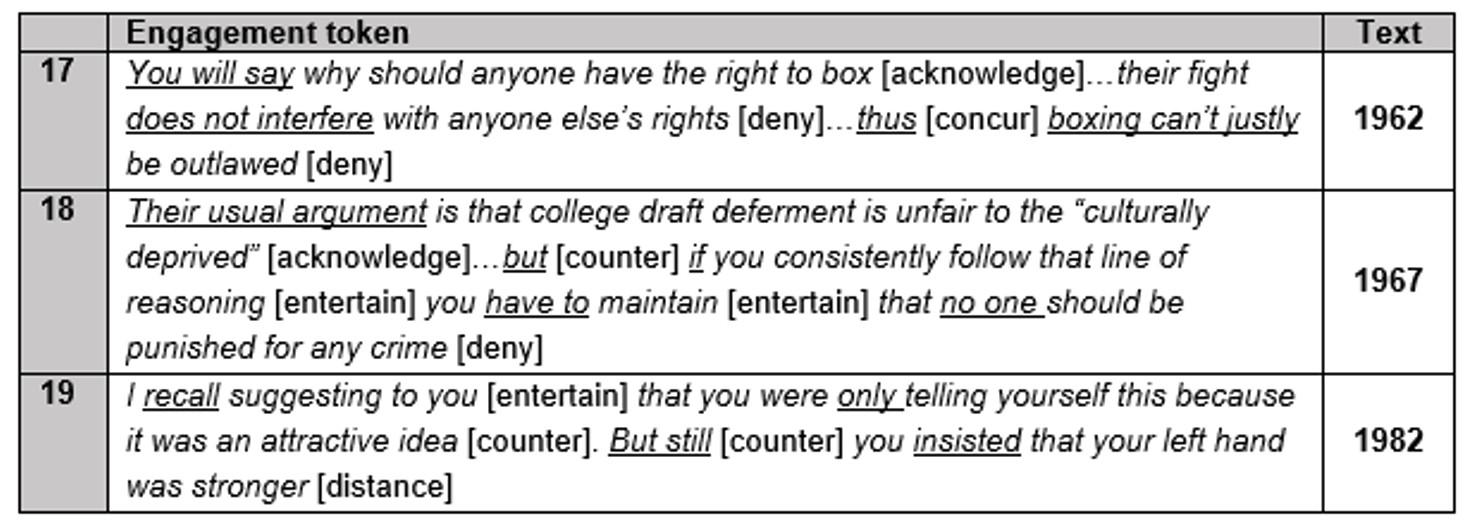
In all three examples, there is some kind of acknowledgement of a position before a counter or a denial of that position. In lines 17-18, the first position originates from some vague other person or group, and the counter or denial serve to point out flaws Kaczynski’s sees in those positions. The example in line 19 shows how these resources bolstered his own positions by demonstrating how David had continued with his ‘self-deception’ despite Kaczynski’s efforts to prevent it. This pattern of usage not only depicts Kaczynski as more knowledgeable than others, but also paints them in a negative light—as people who fight to take ‘rights’ away and as impractical people with flawed arguments.
Instances of entertain were realized through a variety of formulations, though mostly with questions, hypotheticals/conditionals, hedged evaluations, and subjective statements. These functioned to convey a lower level of commitment to the position and/or reduce the intensity of the evaluation contained within them. Consider the examples in Table 7.
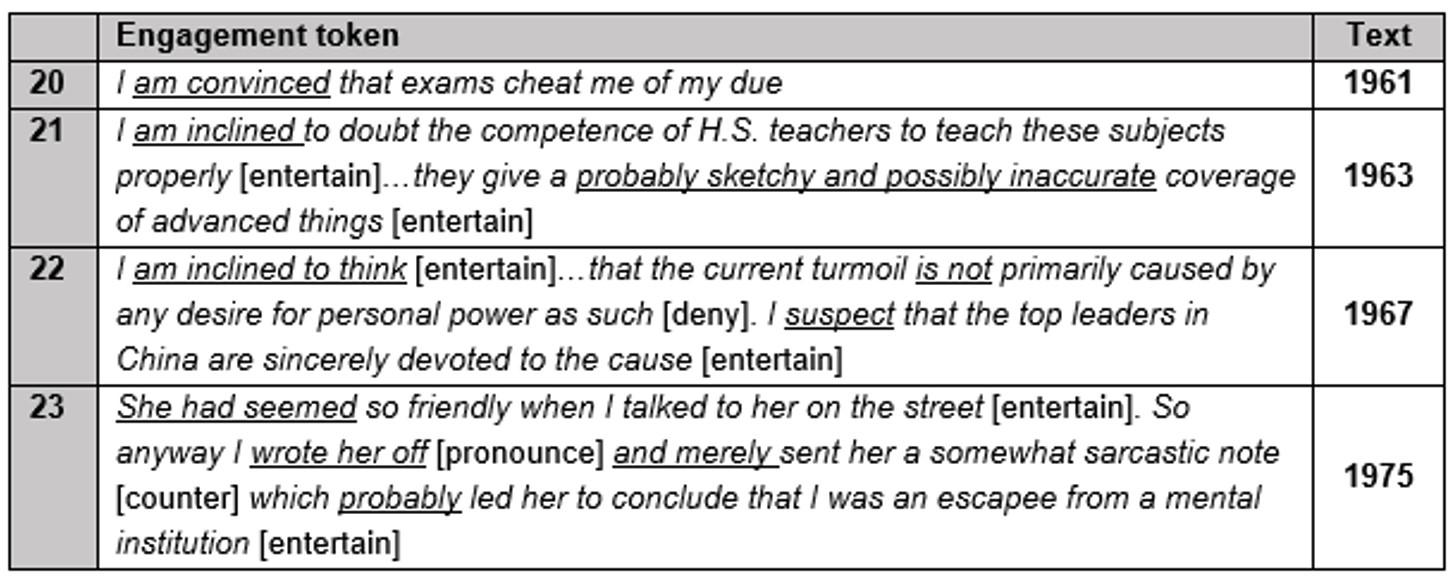
Line 20 in Table 6 appears to have a high level of commitment but being convinced of something does not necessarily make it so and this highly subjective framing still leaves open other possibilities. In lines 21-23, the mitigating language of the entertainments weakens the negative evaluations presented within and alongside them. For instance, in line 21, the am inclined to think weakens the intensity of the assessment of the competence of the teachers. In line 23, the probably at the beginning of the last clause mitigates the intensity of the evaluation Kaczynski was assuming the woman had made of him, leaving open that other views might have been possible. Interestingly, as mentioned above, mitigating language became less common in instances of attributed affect, going from entertaining the possibility of people having these feelings like if they are interested [entertain] or even if he should decide [entertain] to higher commitment statements that imply Kaczynski has knowledge of others’ feelings like that wasn’t the frame of mind in which you submitted [deny].
Primarily in the texts where Kaczynski talked about his opinions of others and their actions, attributions were common. Within attributions, there are two possible options: acknowledgements which simply report the views of others such as X said or Y believes ; and distancing statements which imply the author’s view toward the attributed proposition such as X claimed or X’s B.S. Acknowledge tokens usually outnumbered distance tokens slightly. Kaczynski used both to introduce others’ viewpoints; the acknowledgements were often followed by evaluations of the person he cited, while the distancing attributions contained an evaluation of the person within them, which was then typically followed by yet another evaluation of them. Consider the examples in Table 8.
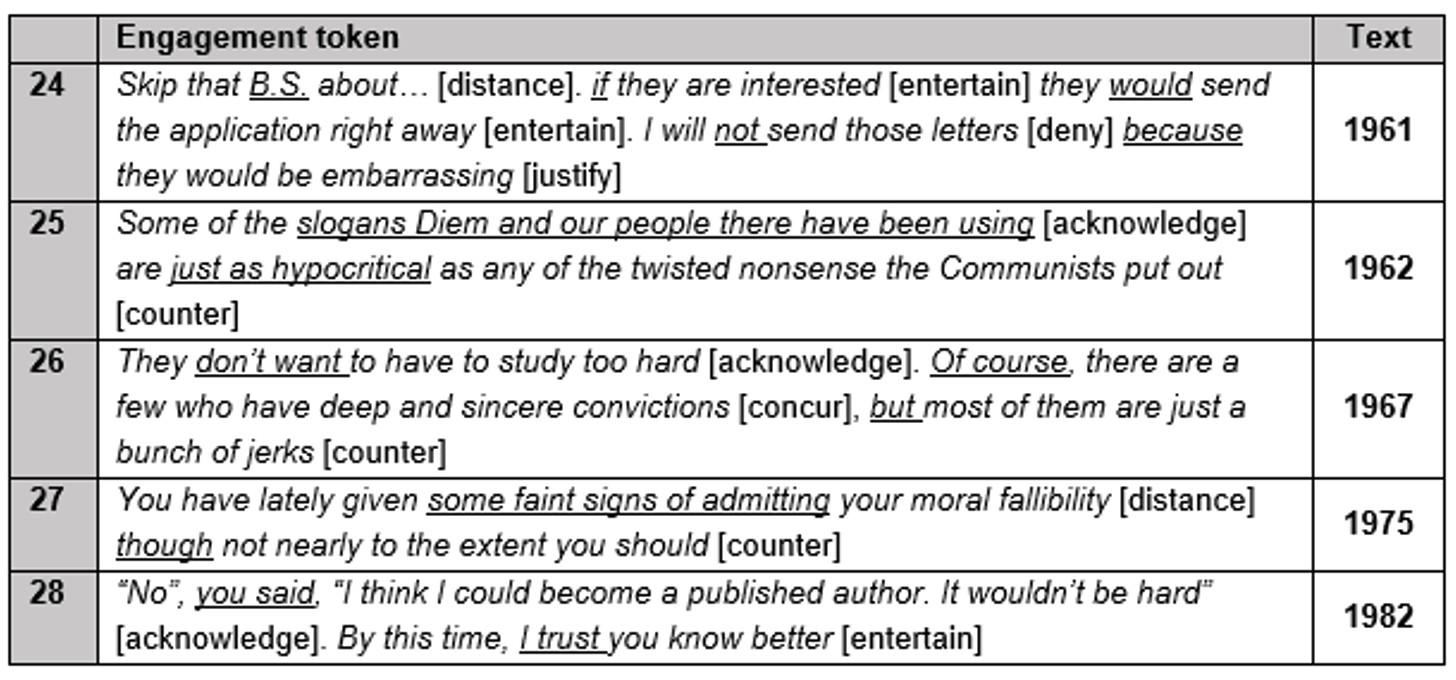
As the examples in Table 8 show, attributed utterances were often accompanied by (or contained) evaluations of the persons to whom they were attributed and more often than not, these evaluations were negative. In line 24, the distance token contains a negative evaluation of the content his parents had produced, which is reinforced through the justification shortly thereafter. Similarly in line 27, saying that his parents showed faint signs of admitting suggests that the moral fallibility was something Kaczynski was already aware of, but they had not necessarily acknowledged as yet. In the lines 25, 26, and 28, the acknowledgements present the information in a more unbiased manner but are immediately followed by negative evaluations contained in counter propositions. This further reinforces the overarching stance that Kaczynski is more knowledgeable and that others hold impractical, unrealistic, and/or flawed beliefs.
8. Observations and Interpretations
The main observation of note from engagement patterns pertains to the argumentative tone that Kaczynski took in his letter, something which became more intense over time e.g., consider the difference between how the views are expressed in lines 1 and 2 versus lines 3 and 4 in the attitude section. This suggested a belief that Kaczynski was more knowledgeable than others and that his opinions were more well-reasoned and practical and less flawed than theirs (which was also apparent through the range of negative evaluations he made of those others, as shown in 6.1). These patterns align with the externalizing biases and schemas associated with PPD and delusions (the predominant symptom of schizophrenia that Kaczynski experienced; Johnson, 1998). In particular, Kaczynski’s portrayal of himself as always right (and also in the right) aligns with the core beliefs in PPD that one is righteous and clever (Renton & Mankiewicz, 2015). The increased commitment to his views over time and portrayal of his views as most warrantable aligns with delusions (Fineberg et al., 2015; Hinzen, Rosselló, & McKenna, 2016) and the way they develop over time (Fineberg et al., 2015; Freedman, 2010). More specifically, the amount of hedging observed in the earlier texts might reflect the start of changes to Kaczynski’s perception and interpretation of stimuli associated with the ‘pre-delusional’ stage, when there is a vague sense that something is different without certainty about what it is (Henriksen & Parnas, 2019). The last time period occurred well after the onset of the delusions, though, at a point when they would have more likely solidified, which would have been accompanied by more certainty and stability in his beliefs (Fineberg et al., 2015).
9. Appraisal as an investigative tool
As stated in the introduction, one of the goals of this study was to explore how the approach presented here could contribute to an investigation. The comparison that follows is, of course, being done in hindsight and is based on the analysis of a small corpus. It is therefore intended primarily to offer support for why this study provides a good initial ‘proof of concept’ of this approach as a potential investigative tool. What is explored here is where the findings might have been useful in supplementing the psychological and linguistic profiles generated in the original investigation and how extrapolations could be made from the findings based on the literature.
There were several psychological profiles throughout the nearly two-decade investigation, and the linguistic profile was only requested shortly before Kaczynski was found (Shuy, 2014). The linguistic profile contended the Unabomber was well-educated, around fifty-years-old, had likely grown up Catholic, might have at one time been in academia (likely in the hard sciences), and had lived in Northern California though likely grew up in or around Chicago—all of which turned out to be accurate. An early version of the psychological profile speculated that the Unabomber was young, uneducated, with low self-worth, and a desire to harm animals. In later versions, the age was increased slightly, they vacillated between hypothesizing that he had low and high self-esteem, and speculated that he was likely intelligent and might have had some education, though not a lot. One thing that remained consistent was the belief that the increasing lethality of his bombs indicated escalating anger and frustration directed at his victims and that only his arrest or death would stop the bombings (Fitzgerald, 2004).
With this information in mind, what might the approach proposed in this research have been able to offer? It is worth noting that the texts analyzed in this study did not include the letters or manifesto used in the original profile development, but they contained similar ideologies to the manifesto and Unabomber letters (this in fact being the reason that Kaczynski’s brother suspected him; Shuy, 2014, p. 82). Given that his evaluative patterns were demonstrated above to be fairly consistent over time, it is possible that the most salient patterns, at the very least, would have been present in the Unabom texts, as well.
The analysis identified patterns which aligned with aspects of paranoid ideation and delusional beliefs, such as Kaczynski exhibiting a strong mistrust and suspiciousness of others and institutions, consistently externalizing blame for negative events, and adopting an overall argumentative and slightly condescending tone (e.g., Beck & Rector, 2005; Langdon et al., 2010; Renton & Mankiewicz, 2015). Using the literature on such traits, it might then be possible to extrapolate other information, as well. For instance, the psychological profile stated that Kaczynski was likely a loner with a heightened sense of superiority (Shuy, 2014), both of which are evident in the evaluative patterns. However, a desire for social isolation could be indicative of, for example, paranoid, schizotypal (Renton & Mankiewicz, 2015), or antisocial personality traits (Mitchell, Tafrate, & Freeman, 2015), and a heightened sense of superiority might be evidence of narcissistic (Behary & Davis, 2015), antisocial (Mitchell et al., 2015), or paranoid personality traits (Renton & Mankiewicz, 2015). Thus, it is important to consider all of the patterns that occur together to narrow down the most likely active schemas. In Kaczynski’s case, the desire for social isolation appeared connected to the mistrust and suspiciousness of others and their motives, as evident in his externalization of blame and consistent negative evaluations of others shown in 6.1. This is more in line with paranoid PD (Beck, 2015) and delusional thinking (Beck & Rector, 2005) than with the strong discomfort with or disdain for social relationships seen in schizotypal PD (Renton & Mankiewicz, 2015) or the avoidance of intimacy seen in antisocial PD (Mitchell et al., 2015). Kaczynski’s overall tone in his letters could be argued to suggest a heightened sense of superiority. He often portrayed his views as more warrantable than others’ views and he depicted himself as righteous or not at fault while others were assigned blame and character flaws. However, the juxtaposition of himself as righteous and others as flawed is more in line with core beliefs of PPD (Renton & Mankiewicz, 2015) than with, for instance, grandiosity beliefs associated with narcissistic PD (Behary & Davis, 2015). The level of commitment evident in his statements in the later texts is also in line with delusional thinking patterns in that delusions necessarily manifest in contractive utterances that leave no real space for alternatives (Hinzen et al., 2016). If such space was left, it would suggest the beliefs were not held to be incontrovertibly true by the individual, which is a necessary aspect for their diagnosis (APA, 2013).
10. Limitations and Conclusions
The above is intended to demonstrate what one might be able to extrapolate about an author based on the patterns identified in their texts. This is, however, only based on the analysis of a corpus of writings from one author and therefore is not intended to be generalized to other individuals, as yet. To demonstrate the utility of the approach for a wider range of data, a larger analysis would be required which compares multiple individuals with a variety of diagnoses. It would also need to be demonstrated that the approach can be used on a variety of linguistic data types as it is not possible to control for variables in non-experimental situations to the extent they were controlled for here. Interrater reliability studies would be a potentially beneficial next step to address this latter point and increase the replicability of the coding approach.
Finally, since Appraisal is a manual method, it necessarily limits the size of the dataset that can be analyzed. Further, a method like Appraisal is not as suitable for capturing non-functional stance features. Thus, conducting the analysis using other methods, such as a form-to-function approach (e.g., Biber et al., 1999), in addition to Appraisal (similar to Gales, 2010) would be a potentially fruitful expansion of this research. Expanding to other stance features would also potentially help find more relationships between stance and certain symptoms/traits which may have schemas that are much more varied in their content across individuals, like delusions (Beck & Rector, 2005).
Despite the limitations, this study provides some evidence in support of a link between stance and psychopathology and demonstrates the potential utility of an assessment approach that combines linguistic and psychological theories, showing that this approach warrants further research. With a better understanding of the relationship between psychopathology and stance would come expansions of and improvements to the approach to increase its consistency and reliability as an investigative tool.
References
American Psychiatric Association. (2000). Diagnostic and statistical manual of mental disorders (DSM-IV-TR ed.). American Psychiatric Publishing.
American Psychiatric Association. (2013). Diagnostic and statistical manual of mental disorders (5th edition ed.). American Psychiatric Publishing.
Arntz, A., Dreessen, L., Schouten, E., & Weertman, A. (2004). Beliefs in personality disorders: a test with the Personality Disorder Belief Questionnaire. Behaviour Research and Therapy, 42(10), 1215–1225. Retrieved 2025-07-02, from https://linkinghub.elsevier.com/retrieve/pii/S000579670300233X doi: 10.1016/j .brat.2003.08.004
Baker, P. (2006). Using corpora in discourse analysis. Continuum.
Beck, A. T. (2015). Theory of personality disorders. In A. T. Beck, D. D. Davis, & A. Freeman (Eds.), Cognitive therapy of personality disorders (3rd edition ed., pp. 19–62). Guilford Press.
Beck, A. T., Butler, A. C., Brown, G. K., Dahlsgaard, K. K., Newman, C. F., & Beck, J. S. (2001). Dysfunctional beliefs discriminate personality disorders. Behaviour Research and Therapy, 39(10), 1213–1225. Retrieved 2025-07-02, from https://linkinghub.elsevier.com/retrieve/pii/S0005796700000991 doi: 10.1016/ S0005-7967(00)00099-1
Beck, A. T., Freeman, A., & Davis, D. D. (2015). General principles and specialized techniques in cognitive therapy of personality disorders. In A. T. Beck, D. D. Davis, & A. Freeman (Eds.), Cognitive therapy of personality disorders (pp. 97–124). Guilford Press.
Beck, A. T., & Haigh, E. A. (2014). Advances in Cognitive Theory and Therapy: The Generic Cognitive Model. Annual Review of Clinical Psychology, 10(1), 1–24. Retrieved 2025-07-02, from https://www.annualreviews.org/doi/10.1146/annurev-clinpsy-032813-153734 doi: 10.1146/annurev-clinpsy-032813-153734
Beck, A. T., & Rector, N. A. (2005). Cognitive Approaches to Schizophrenia: Theory and Therapy. Annual Review of Clinical Psychology, 1(1), 577–606. Retrieved 202507-02, from https://www.annualreviews.org/doi/10.1146/annurev.clinpsy.1.102803.144205 doi: 10.1146/annurev.clinpsy.1.102803.144205
Behary, W. T., & Davis, D. D. (2015). Narcissistic personality disorder. In A. T. Beck, D. D. Davis, & A. Freeman (Eds.), Cognitive therapy of personality disorders (3rd edition ed., pp. 299–324).
Bell, A. (1984). Language style as audience design. Language in Society, 13(2), 145–204.
Bell, V., Halligan, P. W., & Ellis, H. D. (2006). Explaining delusions: a cognitive perspective. Trends in Cognitive Sciences, 10(5), 219–226. Retrieved 202507-02, from https://linkinghub.elsevier.com/retrieve/pii/S1364661306000763 doi: 10.1016/j.tics.2006.03.004
Bentall, R. P., Corcoran, R., Howard, R., Blackwood, N., & Kinderman, P. (2001). Persecutory delusions: A review and theoretical integration. Clinical Psychology Review, 21(8), 1143–1192. Retrieved 2025-07-02, from https://linkinghub.elsevier.com/retrieve/pii/S0272735801001064 doi: 10.1016/S0272-7358(01)00106-4
Bhar, S. S., Beck, A. T., & Butler, A. C. (2012). Beliefs and personality disorders: an overview of the personality beliefs questionnaire. Journal of Clinical Psychology, 68(1), 88–100. Retrieved 2025-07-02, from https://onlinelibrary.wiley.com/doi/10.1002/jclp.20856 doi: 10.1002/jclp.20856
Biber, D., Johansson, S., Leech, G., Conrad, S., & Finegan, E. (1999). Longman grammar of spoken and written English. Pearson Education Limited.
Bortolan, A. (2019). Phenomenological psychopathology and autobiography. In G. Stanghellini, M. R. Broome, A. V. Fernandez, P. Fusar-Poli, A. Raballo, & R. Rosfort (Eds.), The Oxford handbook of phenomenological psychopathology (pp. 1053– 1064). Oxford University Press.
Buck, B., & Penn, D. L. (2015). Lexical Characteristics of Emotional Narratives in Schizophrenia: Relationships With Symptoms, Functioning, and Social Cognition. Journal of Nervous & Mental Disease, 203(9), 702–708. Retrieved 202507-02, from https://journals.lww.com/00005053-201509000-00007 doi: 10.1097/ NMD.0000000000000354
Douglas, J. E., Ressler, R. K., Burgess, A. W., & Hartman, C. R. (2004). Criminal profiling from crime scene analysis. In H. Campbell & D. DeNevi (Eds.), Profilers: Leading investigators take you inside the criminal mind (pp. 13–33). Prometheus Books.
Edwards, D., & Potter, J. (1992). Discursive psychology. Sage Publications.
Edwards, D., & Potter, J. (1993). Language and causation: A discursive action model of description and attribution. Psychological Review, 100(1), 23–41. Retrieved 2025-07-02, from https://doi.apa.org/doi/10.1037/0033-295X.100.1.23 doi: 10.1037/ 0033-295X.100.1.23
Federal Bureau of Investigation. (n.d.). The Unabomber. Retrieved December. Retrieved from https://www.fbi.gov/history/famous-cases/unabomber
Fineberg, S. K., Deutsch-Link, S., Ichinose, M., McGuinness, T., Bessette, A. J., Chung, C. K., & Corlett, P. R. (2015, January). Word use in first-person accounts of schizophrenia. British Journal of Psychiatry, 206(1), 32–38. Retrieved 2025-0702, from https://www.cambridge.org/core/product/identifier/S0007125000237367/type/journal_article doi: 10.1192/bjp.bp.113.140046
Fitzgerald, J. R. (2004). Using a forensic linguistic approach to track the Unabomber. In J. H. Campbell & D. DeNevi (Eds.), Profilers: Leading investigators take you inside the criminal mind (pp. 193–221). Prometheus Books.
Fournier, J. C. (2015). Assessment of personality pathology. In A. T. Beck, D. D. Davis, & A. Freedman (Eds.), Cognitive therapy of personality disorders (pp. 63–85). Guilford Press.
Fournier, J. C., DeRubeis, R. J., & Beck, A. T. (2012, April). Dysfunctional cognitions in personality pathology: the structure and validity of the Personality Belief Questionnaire. Psychological Medicine, 42(4), 795–805. Retrieved 2025-0702, from https://www.cambridge.org/core/product/identifier/S0033291711001711/type/journal_article doi: 10.1017/S0033291711001711
Freedman, R. (2010). The madness within us. Oxford University Press.
Gales, T. (2010). Ideologies of violence: A corpus and discourse analytic approach to stance in threatening communications (Doctoral dissertation). University of California Davis, ProQuest Dissertations Publishing.
Garety, P. A., Freeman, D., Jolley, S., Dunn, G., Bebbington, P. E., Fowler, D. G., ... Dudley, R. (2005). Reasoning, Emotions, and Delusional Conviction in Psychosis. Journal of Abnormal Psychology, 114(3), 373–384. Retrieved 2025-07-02, from https://doi.apa.org/doi/10.1037/0021-843X.114.3.373 doi: 10.1037/0021-843X.114.3.373
Garety, P. A., Kuipers, E., Fowler, D., Freeman, D., & Bebbington, P. E. (2001). A cognitive model of the positive symptoms of psychosis. Psychological Medicine, 31(2), 189–195. Retrieved 2025-07-02, from https://www.cambridge.org/core/product/identifier/S0033291701003312/type/journal_article doi: 10.1017/ S0033291701003312
Gawda, B. (2013). The Emotional Lexicon of Individuals Diagnosed with Antisocial Personality Disorder. Journal of Psycholinguistic Research, 42(6), 571–580. Retrieved 2025-07-02, from http://link.springer.com/10.1007/s10936-012-9237-z doi: 10.1007/s10936-012-9237-z
Halliday, M. A. K., & Matthiessen, C. M. I. M. (2014). Halliday’s introduction to functional grammar (4th edition ed.). Routledge.
Henriksen, M. G., & Parnas, J. (2019). Delusional mood. In G. Stanghellini, M. R. Broome, A. V. Fernandez, P. Fusar-Poli, A. Raballo, & R. Rosfort (Eds.), The Oxford handbook of phenomenological psychopathology (pp. 743–752). Oxford University Press.
Hinzen, W., Rosselló, J., & McKenna, P. (2016). Can delusions be understood linguistically? Cognitive Neuropsychiatry, 21(4), 281–299. Retrieved 2025-07-02, from https://www.tandfonline.com/doi/full/10.1080/13546805.2016.1190703 doi: 10.1080/13546805.2016.1190703
History.com Editors. (2018). Unabomber (Ted Kaczynski). Retrieved from https://www.history.com/topics/crime/unabomber-ted-kaczynski
Hunter, M. (2022). Violent ideologies: An investigation of the relationship between linguistic evaluative patterns and psychopathology in three types of violent offender (Doctoral thesis). Aston University.
Hurt, M. (2020). Pledging to harm: A linguistic analysis of violent intent in threatening language (Unpublished doctoral dissertation). Aston University.
Johnson, S. C. (1998). Psychiatric competency report of Dr. Sally C. Johnson (Psychiatric report No. Case No. S-96-259 GEB). Retrieved from http://www.karenfranklin.com/files/Kazynski-Johnson_Report-09.11.98.pdf
Kinderman, P., & Bentall, R. P. (1997). Causal attributions in paranoia and depression: Internal, personal, and situational attributions for negative events. Journal of Abnormal Psychology, 106(2), 341–345. Retrieved 2025-07-02, from https://doi.apa.org/doi/10.1037/0021-843X.106.2.341 doi: 10.1037/0021-843X.106.2.341
Langdon, R., Corner, T., McLaren, J., Ward, P. B., & Coltheart, M. (2006). Externalizing and personalizing biases in persecutory delusions: The relationship with poor insight and theory-of-mind. Behaviour Research and Therapy, 44(5), 699–713. Retrieved 2025-07-02, from https://linkinghub.elsevier.com/retrieve/pii/S0005796705001178 doi: 10.1016/j.brat.2005.03.012
Langdon, R., Ward, P. B., & Coltheart, M. (2010). Reasoning Anomalies Associated With Delusions in Schizophrenia. Schizophrenia Bulletin, 36(2), 321–330. Retrieved 2025-07-02, from https://academic.oup.com/schizophreniabulletin/article-lookup/doi/10.1093/schbul/sbn069 doi: 10.1093/schbul/sbn069
Martin, J. A., & Penn, D. L. (2002). Attributional Style in Schizophrenia: An Investigation in Outpatients With and Without Persecutory Delusions. Schizophrenia Bulletin, 28(1), 131–141. Retrieved 2025-07-02, from https://academic.oup.com/schizophreniabulletin/article-lookup/doi/10.1093/oxfordjournals.schbul.a006916 doi: 10.1093/oxfordjournals.schbul.a006916
Martin, J. R., & White, P. R. R. (2005). The language of evaluation: Appraisal in English. Palgrave MacMillan.
Millon, T., Millon, C., Meagher, S., Grossman, S., & Ramnath, R. (2012). Personality disorders in modern life (2nd edition ed.). John Wiley & Sons.
Mitchell, D., Tafrate, R. C., & Freeman, A. (2015). Antisocial personality disorder. In A. T. Beck, D. D. Davis, & A. Freeman (Eds.), Cognitive therapy of personality disorders (pp. 346–365). Guilford Press.
Murphy, P., Bentall, R. P., Freeman, D., O’Rourke, S., & Hutton, P. (2018). The paranoia as defence model of persecutory delusions: a systematic review and metaanalysis. The Lancet Psychiatry, 5(11), 913–929. Retrieved 2025-07-02, from https://linkinghub.elsevier.com/retrieve/pii/S2215036618303390 doi: 10.1016/S2215-0366(18)30339-0
O’Donnell, M. (2019). UAM Corpus Tool. WagSoft Systems.
Pennbaker, J. W., & King, L. A. (1999). Linguistic styles: Language use as an individual difference. Journal of Personality and Social Psychology, 77(6), 1296–1312.
Renton, J. C., & Mankiewicz, P. D. (2015). Paranoid, schizotypal, and schizoid personality disorders. In A. T. Beck, D. D. Davis, & A. Freeman (Eds.), Cognitive therapy of personality disorders (3rd edition ed., pp. 244–275). Guilford Press.
Shuy, R. W. (2014). The Language of Murder Cases: Intentionality, Predisposition, and Voluntariness. Oxford University Press. Retrieved 2025-07-02, from http://www.oxfordscholarship.com/view/10.1093/acprof:oso/9780199354832.001.0001/ doi: 10.1093/acprof:oso/9780199354832.001.0001
Thompson-Pope, S. K., & Turkat, I. D. (1988). Reactions to ambiguous stimuli among paranoid personalities. Journal of Psychopathology and Behavioral Assessment, 10, 21–32.
[1] This paper has been adapted from a chapter of my doctoral thesis (Hunter, 2022).
[2] https://harbor.klnpa.org/california/islandora/object/cali%3A885