
Maria Darwisha & Lucas Gottzén
The contemplative man
‘positive’ affect and masculinity in ecofascist visual communication
Abstract
Masculinity in far-right visual media is often portrayed through intimidating images of dominant, militant men. However, this study of affect in Nordic ecofascist visual communication shows that men are also depicted in meditative stillness surrounded by spectacular nature. Such ‘positive’ representations contrast with the typical far-right depictions of militant masculinity. This paper examines how positive affective communication shapes far-right masculinity, focusing on the trope we call ‘the contemplative man’. Inspired by affect theory and social semiotics, we analyse images from ecofascist Telegram channels that show men alone and together in nature participating in meditative and nature-connected practices. We demonstrate how the ‘contemplative man’ trope broadens the range of available far-right masculine identities and connects men with nature through nativism. We argue that nature in ecofascist discourse allows for ‘quieter’ expressions of masculinity, providing a space for men to experience intimacy, spirituality and pleasure, alongside the traditional militant persona. Such forms of masculinity visualize the ‘blood and soil’ complex through natural imagery depicting outdoor activities such as cooking, hiking, and resting in peaceful solitude. This discourse fosters a special bond between white, Nordic men and the land, offering them a place in the social hierarchy and a role within ecology on both sensory and ideological levels.
Keywords
Affect, ecofascism, far right, masculinity, social media
Introduction
Fear, aggression, anger, and hatred have been recurrently identified as central to far-right masculinity (e.g. Ekman, 2018; Kimmel, 2013). While not dismissing the role of such ‘negative’ emotions, this article instead focuses on how far-right extremism articulates feelings and sensibilities that are culturally coded as positive and constructive, like joy, peace, and intimacy. These, we argue, play a significant role in far-right masculinity and are evident in representations of nature and the environment on far-right social media, such as in digital ‘ecofascist’ propaganda.
Ecofascism is here investigated as an extreme form of far-right ecologism (Forchtner, 2019; Lubarda, 2020) that promotes fascism’s ‘ecological’ aspects, usually advocating for xenophobic and racist measures to protect nature. We refer to ecofascism as a spectre of ideas, mostly presented in far-right social media realms, which may inspire reactionary politics and violence (see Campion, 2021; Hughes et al., 2022; Lubarda, 2020). Ecofascism builds on male and white supremacist ideological and historical precedents. For instance, ecofascism’s framing of nature often echoes romanticism’s idealization of the rural past, while its rhetoric on purity connects with eugenicist and nationalist themes (see Biehl & Staudenmaier, 2011). Whereas ecofascism has gained much public and scholarly attention lately, few have explored its constructions of gender (but see Darwish, 2021, 2024; Hughes et al., 2022; Tebaldi, 2023) and even fewer have examined its affective representations of masculinity. While nature has often been historically and symbolically linked to femininity (e.g. Gaard, 1993), our analysis shifts focus to explore how natural imagery is mobilized to construct masculinities in far-right imaginaries, challenging essentialist gendered readings of nature. Understanding how ecofascism affectively constructs gender, particularly masculinity, is essential to reveal its role in perpetuating oppression, attracting followers and justifying violence.
To examine this gender-nature-affect nexus, we analyse visual communication in Nordic ecofascist Telegram channels. In these channels, white men tend to be depicted alone or together, in close contact with nature, either in stillness or engaging in seemingly peaceful activities. We call this recurrent trope ‘the contemplative man’ and show that it contributes to broadening the range of available masculine far-right subject positions, connecting men with nature and constructing a homeland through exclusive claims to land. Following Varco (2023), we acknowledge the need to study how landscapes of hope, possibility and utopia are increasingly at risk of being claimed by the violent ideologies of the far right. Furthermore, we focus on the contemplative man as a ‘positive’ affective trope to extend and complement literature that has mostly focused on militant tropes and its ‘negative’ affects.
In the following, we first provide a brief review of research on the role of affect and gender in far-right visual communication, particularly about nature. After some methodological considerations, we present our results in two sections reflecting the main recurring facets of the contemplative man: ‘Solitary reverence’ and ‘Homosocial hiking’. By way of conclusion, we summarize our findings and discuss their implications.
Affective far-right masculinities, nature and visual communication
Militant masculinity, often characterized by ‘toughness, violence, aggression, courage, control, and domination’ (Eichler, 2014, p. 82) has long been central to the far right and has been observed in Nazi Germany (e.g. Theweleit, 1987), fascist Italy (e.g. Spackman, 2008), as well as in more contemporary activism (Miller-Idriss, 2020; Roose et al., 2022). The emergence of social media has provided far-right actors with new ways to visually express militancy (Nikunen et al., 2021). Visual communication on social media platforms spreads propaganda but also creates connectivity and a sense of in-group community through reactions, likes, hashtags and reposts across digital networks (Papacharissi, 2014). Far-right activists frequently pair offline activities, such as demonstrations, training and fighting, with an online presence by posting videos from political events, sharing memes, photos, and quotes across various social media platforms. For instance, the Soldiers of Odin, a vigilante group active in the Nordic countries in the late 2010s, promoted a militarized masculinity through training, uniforms, and a strong sense of loyalty and trust among members (Aharoni & Féron, 2020; Ekman, 2018). On social media, the group posted photos and videos of physically imposing male activists dressed in black, trying to establish dominance on the streets (Ekman, 2018; Nikunen et al., 2021). These images portrayed collective masculine strength and discipline, embodying the ideals of sacrifice for one’s country and camaraderie among men in war (see also Christou, 2023).
The far right internationally often invokes a ‘golden age’ of heroic and militant men (Goodrick-Clarke, 2002), and in the Nordic countries such masculinity is often articulated through Viking imagery. The Viking trope links contemporary Nordic men to a mythic past, reinforcing what it means to be a ‘real man’ within the national community (Kølvraa, 2019; Lööw, 2016) while underscoring a defensive territorial ideology claiming that Western culture is under attack and must be protected by strong, white men (Aharoni & Féron, 2020). The use of militant and Viking masculinity suggests that the far-right attempts to mobilize politically through fear, anger, aggression, and hatred (Kimmel, 2013; Shoshan, 2016). While far-right extremist communication is primarily associated with what Ngai (2005) refers to as ‘ugly feelings’, we suggest that sentiments that are more on the positive side of the feeling spectrum, what might be termed ‘positive affect’ (Ngai, 2005, p. 32), coexist with and contribute to the gendered visual communication of the far right. This subject is under-researched, but Ekman’s (2014) study of YouTube videos produced by various Swedish far-right extremist groups suggests that masculinity is expressed not only through militant sensibilities but also through creativity, playfulness, camaraderie, and friendship. Similarly, Pearson’s (2023) ethnography of the English Defence League (EDL) illustrates a hybridization of far-right masculinity. While the EDL advocates an aggressive, confrontational approach to activism and a masculinist protection of white women from Muslims, Pearson also found numerous examples of men expressing care and vulnerability. Research on gender in ecofascist (visual) communication shows that representations of a ‘tough’ masculinity often coexist with depictions of compassion and care (Darwish, 2021, 2024). Hughes et al. (2022), for instance, show that masculinity in ecofascist propaganda centres around the protector role, often depicting men in rural settings with families. Similarly, in a study of ecofascist social media, Darwish (2024) found that ecofascist channels often publish images of cute objects like animals or cartoons. When displayed alongside militant masculinity, cuteness helps to soften fascism while keeping it potent. While care for the local environment is common in ecofascism, non-whites, immigrants, modernity, and industrialization are seen as immanent threats to the environment, the nation and the race (Darwish, 2021). This is often articulated through the notion of the ‘natural order’ where people are claimed to have a natural relation to specific territories (Campion, 2021; Lundström & Poletti Lundström, 2023) and where nature becomes a blueprint for a social order characterized by racial hierarchies (Forchtner & Kølvraa, 2017). Such far-right representations of nature often differentiate between ‘us’ and ‘them’ through affective messages about the homeland and the belief that it is being exploited by cosmopolitans and immigrants (Forchtner, 2023). This stance may lead to environmental concerns, but unlike the environmental movement, which addresses global challenges, the far right’s environmental commitment is primarily local (Benoist, 2023). Such localist environmentalism often appears in tandem with outdoor activities, which together aim to make exclusivist and nativist claims to land (e.g. Campion & Phillips, 2023; Westberg & Årman, 2019).
In the far right’s visual communication about nature, an affective connection is recurrently established not only between people and the territory but also between people and nature itself. This is achieved, for instance, by emphasizing ‘the beautiful, which facilitates a restful and contemplative mind […] and the sublime, that is, the vast and magnificent capable of moving the mind’ (Forchtner, 2023, p. 7). As depictions of nature by the far-right not only communicate authoritative ideals but also foster a sense of intimacy between humans, other species and nature, their visual communication does not appear overtly ideological but rather works affectively where nature becomes ‘a “milieu” in which the human can be affectively immersed, emotionally overwhelmed, and spiritually embraced’ (Forchtner & Kølvraa, 2017, p. 272). This is often associated with fantasies of ‘returning’ to nature, fostering a deep, personal relationship where nature becomes a place for spirituality and contemplation beyond urbanity and modernity (Forchtner & Kølvraa, 2017).
While we emphasize the role of positive affect in ecofascist social media, it should be noted that an overly dualistic approach may obfuscate ambiguities in far-right politics (Leser & Spissinger, 2020) as affect is never exclusively positive or negative but rather moves and transforms depending on what it encounters. With affect existing as complex mixtures rather than clear-cut categories, it is not always possible to discriminate ‘positive’ from ‘negative’ (Ngai, 2005). Hate speech towards an outgroup, for instance, may simultaneously signal love towards the ingroup and vice versa (Ahmed, 2001). Rather than insisting on a dualistic understanding of affect, we use positive affect as an analytical tool to explore the visual communication of the far right beyond the ‘negative’. We explore this ‘positive’ affective dimension of far-right extremism by analysing representations of men in nature as depicted in digital ecofascist communication.
Method
The data in this article are part of a larger digital ethnographic study of ecofascist channels on Telegram (cf. Darwish, 2024). The overarching dataset consists of about 290 image posts collected from October 2020 to August 2024, mainly from open Telegram channels with ‘ecofascism’ in their titles or related to ecofascist symbolism. The selection criteria were that the images were posted or reposted in ‘ecofascist’ channels and depicted nature-related imagery or animals. Over the past decade, Telegram has become popular for far-right communication (Urman & Katz, 2022). Ecofascist channels act as ‘content-banks’ for niche content shared within the broader far-right Telegram network (Hughes et al., 2022, p. 7). The channel content generally includes text and visual artefacts, such as memes, photographs, and animations, featuring landscapes, utopian scenes, and historical references to militancy, European and Nordic tradition, Nazism, and esotericism. The visual media analysed here is selected from three ecofascist channels tied to the Nordic countries, especially Sweden. The first channel, which is currently banned from Telegram, mostly posted memes depicting spectacular scenery, aesthetic nature shots, rural life, animals and produce with superimposed text. Captions were short and catchy with anti-modernist messages and calls to reconnect with nature, beauty and traditional lifestyle. The second channel shares diverse, sometimes educational posts with text and images about ‘traditional’ Nordic and Scandinavian culture and neopagan practices. In both channels, humans are often depicted from the back, either wandering or in recreation, dressed in traditional or outdoor clothing. The third channel mostly posts aesthetic nature videos and photos from (seemingly only) men’s outdoor activities in Sweden. The men often wear military garb, have their faces blurred or donning ‘skull masks’, referencing accelerationism – a political tactic aimed to accentuate societal conflicts to thus speed up societal collapse (Loadenthal, 2022). We chose the three channels because they represent different themes of digital Nordic ecofascism, including dreamy utopia-like imaginaries, paganism, outdoor activities, and accelerationism. As the content varies from amateur photographs to stock photo-like or AI-generated memes, the channels also represent the diversity of visual Nordic ecofascist communication. These channels are part of a network where images and ideas are shared across national boundaries, blurring distinct cultural origins. However, while the three investigated channels provide valuable insights into ecofascist representations, their characteristics might shape the content in specific ways. For instance, the channels are (ostensibly) Swedish-produced, and the representations they feature seem to be influenced by Nordic cultural and environmental imagery, which are central to both Swedish and Nordic branding. This includes associations with forests, ore, and pristine nature, as seen in outdoorsy advertisements,[1] and the broader Nordic aesthetic tied to hiking in natural landscapes.
The analysis is inspired by social semiotics, the study of how signs or semiotic resources are used to create and interpret meanings within social contexts, influenced by cultural, social and ideological factors (Machin & van Leeuwen, 2016). Conversely, we approach affect as feelings and moods invited by semiotic resources in images and texts (Milani & Richardson, 2021; Westberg, 2021). We followed a three-step analysis of the semiotic resources in the visual media to critically assess how the texts were assembled (Machin & van Leeuwen, 2016). First, we described the semiotic resources, and second, we interpreted them based on cultural provenance. In the following, we focus on step three, where we examined the wider social significance of the semiotic resources and how they interact in ecofascist discourse.
The contemplative man is one out of several representations of men in these channels. We find militant men posing with weapons, and perhaps with cute objects like animals (see Darwish, 2024). We find family men, depicted among white children and a mother, as well as men in fitness activities like lifting weights (cf. Miller-Idriss, 2020). Our focus on ‘positive’ affect was inspired by a previous quantitative study of ecofascist Telegram (Kaati et al., 2020), which placed a majority of the visual data within the category of ‘Utopia’, illustrating how uplifting imaginaries occupy a significant part of ecofascist communication. In our data set, we found images of idyllic nature and peaceful rural life with slogans about solitude and respite, and called this theme ‘contemplation’. The ‘contemplative man’ emerged as a discursive trope from our gender analysis of the data gathered within this theme, which included numerous (N = 45) depictions of men enjoying nature. We further identified two recurrent subtypes of this trope which inform the structure of the results section. What we term ‘solitary reverence’ represents men alone in nature, while ‘homosocial hiking’ depicts men spending time together in outdoor activities.
In far-right propaganda nature often signifies a site of sentimental intensity that offers the audience gendered subject positions with the help of affective interpellation (Darwish, 2021; Forchtner & Kølvraa, 2017; Westberg, 2021). While we primarily focus on how sentiments and feelings are represented on social media, we also consider affect as sensory relations between humans, animals, technology, and nature (Deleuze, 1988). In this view, affect is not just a personal experience but a shared structure that shapes and adapts across social media platforms (Papacharissi, 2014). Content like memes and videos is crafted to be widely shared and interpreted, using affect as a tool to mobilize action through fear, hatred, and resentment. Such ‘negative’ affective flows are often channelled through normative masculinity (Kimmel, 2013; Reeser & Gottzén, 2018). However, we argue that the far right also mobilizes through positive affect, particularly in depictions of masculinity and nature on far-right social media.
Solitary reverence
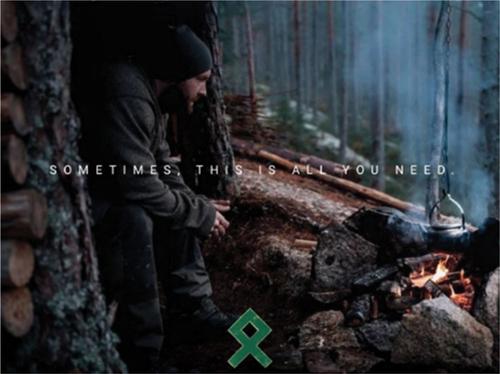
Ecofascism is often characterized by an anti-modernist stance and an idealization of nature, based on an ideology emphasizing connection between people and the soil (Biehl & Staudenmaier, 2011; Campion, 2021; Lubarda, 2020). This representation of nature is echoed in our material, but the posts in the analysed channels also recurrently and visually place white men at the centre stage of nature. The men are often depicted alone, sitting or standing in seemingly silent presence and in what appears to be contemplation. For instance, Figure 1 depicts a man sitting in a forest before a glowing bonfire, dressed in outdoor clothing. White text crosses the frame: ‘Sometimes, this is all you need’. While this meme appears to use a stock photo, Figure 2 is a post featuring two amateur photographs. The first photo depicts a young man in the woods, dressed in green hiking gear, his face hidden, kneeling in front of a fireplace with a coffee pot. The second is a close-up of the fire and the pot. In many ways, these posts resonate with culturally dominant perceptions of hiking and outdoor recreation as endeavours requiring masculine traits (Mendoza, 2020). But they also produce warm atmospheres through sensorial relations between man, the heat of the fire, rising smoke, the stillness of the forest, and its fragrances. Even the caption ‘Sometimes, this is all you need’ (Figure 1) is rather generic by referring to the simple joy of solitude, peace and tranquillity in the forest and the need to seek respite from everyday life. However, there are indications of a far-right message. The meme features a large Othala rune, used by German Nazis during WWII and later by white supremacists (Dahl, 2006, p. 196), whereas the second post contains a Tyr-rune, which is the logo of the Nordic Resistance Movement (Nordic Resistance Movement, 2024), albeit here stylized as a tree. The caption in Figure 2 further reinforces the ecofascist ideology: ‘Don’t be a slave to technology, go outside and come back home to nature. Native Scandinavian man from Sweden brews coffee in the woods’. Both captions suggest a critique of modern society, and imply that nature, particularly the forest, are places that enable solitude, peace, silence and a simpler, more ‘natural’ and authentic life.
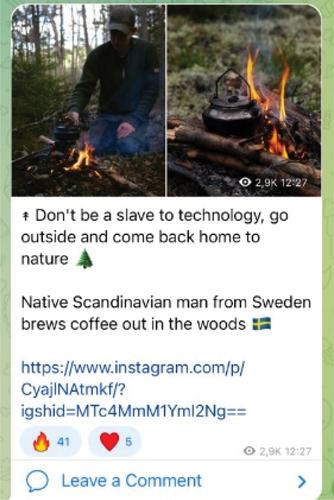
The authenticity and simplicity of being outdoors is also enacted through making coffee over a fireplace rather than in its usual kitchen setting. In far-right discourse, the kitchen and cooking are often associated with femininity and women (Miller-Idriss, 2020; but see; Forchtner & Tominc, 2017), and we have not identified any men engaged in kitchen activities in the analysed channels. But the gendered meaning of cooking shifts depending on the setting. Preparing food on fireplaces in the forest suggests rugged individualism and thus masculine capability, as one must have certain skills and equipment to cook alone outdoors (Leer, 2016).
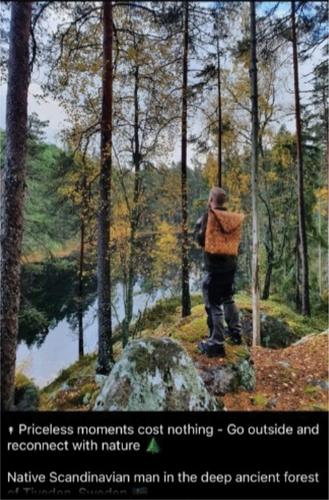
Such self-sufficient abilities also reflect a nativist claim. The message in Figure 2 encourages the audience to come back ‘home to nature’, implying that ‘nature’ is particularly the home of Nordic men – suggested by providing a subject position of ‘Native Scandinavian man […] out in the woods’. This is further illustrated in Figure 3, where a blonde man is overlooking a lake among autumn-coloured trees, wearing hiking clothes and a birch bark backpack. The captions start with a double Tyr-rune icon followed by: ‘Priceless moments cost nothing – Go outside and reconnect with nature’, a pine icon (common digital signifier used to denote ecofascist sympathies), and then ‘Native Scandinavian man in the deep ancient forest of Sweden’. The connection between light-skinned people and the subject position ‘native Scandinavian’ is recurrent in representations of both men and women in this channel. The alleged embodied history enables the ‘native Scandinavian man’ to carve out his homely space in a Swedish forest, a place supposedly unavailable to those not considered ‘native’, which is the essence of the concept of ‘Heimat’ (English: ‘homeland’). In traditional Nazi ideology, the ‘Volk’ – a specific ethnic group – is seen as rooted in and has the right to their homeland due to century-long ancestral lineage and use of the land (Dahl, 2006). The simple set-up of the fireplace, directly on the ground, with the rising smoke accentuates the warm and relatively cozy atmosphere in both posts. Thus, the forest obtains its value not as any forest, but as a designated homeland, here constructed affectively through a sensorial relation between humans and various artefacts in the woods. However, the making of this home also excludes others, as the process of creating a home involves differentiating between people. As Ahmed (2006) has pointed out, ‘siding’ involves an identification where individuals position themselves with or against each other, which affects other bodies and their capacities and feeling states. This siding is central to those who may feel at home; it is a ‘homing device’ (Ahmed, 2006, p. 9) that makes nature a welcoming space for white ‘native’ Scandinavians while leaving no room for non-whites. While not explicitly articulated in Figure 3, in Figure 1 the notion of the conditioned home is explicitly linked to fascism through the Othala rune, which in fascist discourse is commonly used to refer to the mystical relation between ‘blood’; the people, and ‘soil’; the land (Dahl, 2006). For instance, Nazi Germany adopted the Othala rune among other similar symbols as part of their attempt to reconstruct a mythic ‘Aryan’ past (Dahl, 2006).

In Figure 3, the man seems to be in awe of nature and experiencing the sublime in reverent silence. Such representations may suggest an intimate connection with nature, where man is as a small part of something larger (Forchtner & Kølvraa, 2017), but it can also refer to taking in the magnitude of one’s own land, similar to a regent overseeing his kingdom. This is further emphasized in Figure 4, which depicts a man standing in a crop field, facing snowclad mountains, his back against the camera. The top frame reads, ‘The human spirit needs places where nature has not been rearranged by the hand of man’, while the bottom says, ‘Come back home to nature and beauty’. A golden Celtic cross, a common white power symbol used by Stormfront (Williams, 2020), is displayed above the lower text. Such a reading of man as dominating nature corresponds with Western conceptions of masculinity, which is characterized by efforts to control nature (Garlick, 2018). This, as well as the other posts in our material, draw heavily on the idea of the solitary man in nature, another common theme in Western cultural imaginaries (Allister, 2004). Nature has historically served as a setting for masculine self-assertion, where retreating into nature is a way to discover an authentic self, away from the bustle of women, modern life and urban decay (Allister, 2004). The posts are thus remarkable as they seemingly lack or conceal aggressive signifiers common in depictions of fascist masculinity (Kølvraa, 2019; Nikunen et al., 2021) but rather depicting white men in awe of the sublime qualities of nature and existence.
Homosocial hiking
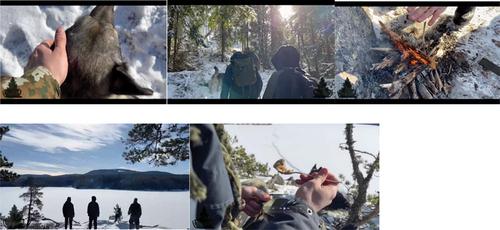
While many posts feature memes and photos of men alone in nature, another common theme is depictions of men spending time together outdoors. One interesting example is a video clip of three men hiking in a snowy forest with an Elkhound (Figure 5). Their faces are never displayed, and they mostly walk away from the camera along a forest path. The video clip is accompanied by momentous, fantasy-inspired piano music and includes various shots of nature, like rays of sun through pine trees, the men and the dog overlooking a lake and the wintry landscape, a hand petting the dog, a hand close to a fire, as if seeking heat, and a man in combat gear eating from a ‘guksi’ (Swedish: ‘kåsa’), a drinking cup commonly used for food and drink during outdoor recreation in Scandinavia.
The short clip has a beauty to it, particularly compared with videos from other Nordic far-right extremist groups like Active Clubs that tend to be more militaristic and violent, and the activities depicted are rather mixed martial arts and street fights with ‘fast’ cuts and more up-beat electronic or rock music (Vingren, 2024). In contrast, this video produces an atmosphere characterized by serenity as the men spend time together in the winter woods and delight in the sublime scenery of nature together. Similar to the posts depicting solitary men discussed above, the video largely concerns man’s relation to nature and non-humans on a sensorial level: watching and being in awe of the vast winter landscape, feeling the heat from the fire, eating, moving together, the camera capturing the sun through the pines and the snowflakes falling. The affective relation between men and nature in the video suggests that these men not merely act on nature, or use it as backdrop, but in fact strive to come close to nature.
While there is a sense of tranquillity to this video, it also thematizes male homosociality in and through nature. They are not simply hiking; they are companions on a quest for a higher purpose. While not primarily articulating ‘prepping’ and survivalism, the video hints to militarism and revolutionary action through combat clothes and their ‘Bug Out Bags’ (BOBs), that is, survival backpacks for rapid departures, usually containing essentials for several days outdoors. On their channel, the group posted a BOB checklist, which suggests a focus on survival skills linked to extremist ideas of accelerationism (Loadenthal, 2022). In addition, other posts from the same hike state they had time to ‘try out some new gear’ in extreme conditions.
Consistent with other far-right portrayals of outdoor activities (e.g. Campion & Phillips, 2023; Westberg & Årman, 2019), the clip only features men. Nature has historically been used as a discursive space that offers boys and men space for regeneration and re-virilization (Williams, 2007). Moreover, there is a historical lineage of ecofascist ideas, evident for instance within the Nazi party, that ties into the cultivation of masculinity in nature among young men, often in communal settings like the German ideal of the Männerbund (Staudenmaier, 2001). In the German paramilitary militias that emerged after WWI, close bonds between men were idealized, elevating these homosocial relationships with nationalist virtues, while promoting antidemocratic attitudes and misogyny. The militia members rejected all things feminine, believing that women undermined their fighting abilities through what they claimed was women’s spiritual and intellectual inferiority (Theweleit, 1987). The video could thus be argued to enact camaraderie as the men are becoming brothers in arms, learning to survive in the wilderness together. Similarly, in the mythopoetic men’s movement, nature represents a space where men confront challenges that test their physical and psychological limits to ‘harden’ masculinity (see Ferber, 2000). The wilderness is consequently presented as a catalyst for male bonding, suggesting that men might need ‘masculine’ environments and challenges to bond without being perceived as weak or overly feminine. This idea is connected to criticisms of modernity, which the far-right often claim have led to a decline from a glorious past marked by heroic male virility to a feminized world characterized by overconsumption and continuous chatter (Wilhelmsen, 2021). Spending time with likeminded men in the wilderness could therefore be seen as a way of restoring manhood by fostering men’s physical strength and character building. It should be noted that such camaraderie is largely an ideal, not always realized in practice, as loyalty has been found to be rather superficial in far-right movements (Fangen, 2003).
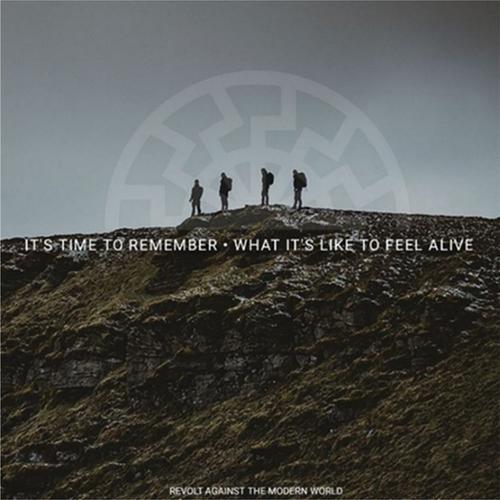
A similar nature aesthetic is produced in a meme (Figure 6) depicting four people walking in a line across a mossy hilltop. Beyond the pale horizon hovers the fascist symbol the Black sun. Aligned with the horizon is the text: ‘It’s time to remember what it’s like to feel alive’, and the bottom text reads ‘Revolt against the modern world’. Considering the picture, the phrase ‘remember what it’s like to feel alive’ could be interpreted as an encouragement to hike, but this phrasing also alludes to an inherent quality that resides inside humans, something that can be recalled by ‘remembering’. As to ‘feel alive’ can be taken as tantamount to vitality, the meme could be understood as a call for revitalization of (presumably white) men (cf. Tebaldi, 2023) through hiking and experiencing hardships together in the wilderness. The call to vitality echoes familiar conceptions of masculinity in Nordic fascist discourse, where man must be energized and healthy in response to a pacifying and feminizing modernity (Westberg & Årman, 2019). Hence, cultivating vitality is a way to ensure proper masculinity, and the call to spending time in nature is thus a call for remasculinisation: Masculine vitality can be attained by engaging with other men outdoors, rather than being a ‘keyboard warrior’ stuck in front of the computer.
The other caption is an explicit call to ‘revolt’, an insurgency against modernity. The modern world is taken to be what is excluded from the image. Hiking thus represents everything that modernity is not: vitality, camaraderie and peace. ‘Revolt against the modern world’ is also the title of the Italian philosopher Julius Evola’s (1995) canonical book, which is popular within the occult and esoteric strains of fascism. Evola criticized Western civilization for its intellectualism and materialism, contrasting it with the perennial, metaphysical ‘Tradition’, which refers to a form of spiritual wisdom that is eternal, inherent in being itself and could only be reached through stillness (Furlong, 2011). The Black sun, here hovering behind a hilltop, is frequently used in ecofascist propaganda (Kaati et al., 2020) and associated with the occult strands of Nazism where it is taken to represent ‘the mystical source of energy capable of regenerating the Aryan race’ (Goodrick-Clarke, 2002, pp. 3–4). The enigmatic Black sun conveys Nazism with less stigmatization than the swastika does, addressing an initiated audience and sidestepping its preceding negative reputation (Goodrick-Clarke, 2002). In ecofascist discourse, the Black sun amplifies the regenerative potential of what is considered natural and traditional. It signifies something holistic, pre-civilizational and foundational, which is in stark contrast to the alleged materialism of modernity (Dahl, 2006). Furthermore, in esoteric fascism, symbols such as runes or the Black Sun are referred to as ‘primordial phenomena’ that give people direct access to the origin and the whole (Dahl, 2006, p. 207). Hence, the Black sun works on an affective level in this meme, reflecting the revitalizing potential of hiking, and thus of being in contact with ‘the natural’. The sun, as the source of life, energizes the hikers, ever reflecting the eternal, metaphysical layers of reality.
The contemplative man and militant man complement rather than oppose each other as dualities. This is similar to Miller-Idriss’ (2017) articulation of tropes of masculinities that lets the far right mobilize young men around ‘virtues and values that are framed as what good nationalists believe and do’ (Miller-Idriss, 2017, p. 163). The ‘rebel/rule breaker’ is associated with values such as revolt, hatred, anger, and violence, whereas the ‘soldier/sailor/warrior’ emphasizes values such as loyalty, trust, comradeship, and heroism (Miller-Idriss, 2017). While the militant man is associated with values such as domination and violence, the contemplative man is rather connected to peace and reverence. As is the case with Miller-Idriss’ tropes, there are shared qualities across both articulations. Imageries of hiking can be understood as an expression of loyalty and community, which is central to military masculinity. Military culture continues to influence far-right and Islamist movements alike, where military attire and ideals of brotherhood and ‘männerbund’ are prominent (Ekman, 2018; Qvotrup Jensen et al., 2022). Militant masculinity signifies not only violence and aggression but also trust and comradeship. Thus, the discursive tropes represent different facets of far-right masculinity.
Conclusion
This article has explored how visual communication about nature contributes to shaping far-right masculinity, focusing on the role of feelings and sentiments commonly understood as positive. In our analysis of Nordic ecofascist Telegram channels, we have identified the trope of ‘the contemplative man’ as central to the production of ‘positive’ affect. Our analysis suggests that nature in ecofascist discourse allows for ‘quieter’ far-right masculinity by offering men a space for intimacy, contemplation and spirituality. Nature is an ideal setting for positive affective communication as it invites a wider array of masculine subject positions than aggression and violence commonly articulated through Viking or militant masculinity.
Further, nature facilitates an affective connection between white Nordic men and the land, infusing the ideological relationship between ‘blood’ and ‘soil’ with sensorial elements. Whether in solitude or together with other men, the contemplative man is always placed in an imagined homeland through nativist claim to land and nature. This finding echoes previous research on far-right ecologism (Campion & Phillips, 2023; Westberg & Årman, 2019), but rather than evoking militant masculinity, the men are here portrayed as coming close to nature and being in awe of its beauty and serenity, enabling simplicity and a self-sufficient lifestyle. The contemplative man is materially and discursively constructed through affective relations between bodies and various objects in nature, as well as through signifiers like esoteric symbols, often creating a cosy, intimate atmosphere. In this ecofascist visual communication, white men are thus offered not only a privileged place in the social order but also a home in the ecological order. Our data suggests how a mystical Nordic past is used to evoke a peaceful, calm and contemplative masculinity that is deeply connected to nature. This construction seems significant in the channels, perhaps because such a ‘rooted’, ‘natural’ and ‘primordial’ Nordic masculinity not only serves to legitimize claim to a place but also to assert supremacy. Implied intimacy with what is considered natural consequently ‘naturalises’ ideology in ecofascist discourse, making it seem apolitical and harmless (Darwish, 2021; cf. Tebaldi, 2023). Hence, invoking ‘natural masculinity’ is a way to assert dominant masculine authority. Furthermore, the construction of contemplative masculinity is significant since it bolsters the far-right extremist claim that the Nordic or ‘Aryan’ man is naturally empathetic, caring, and engaged in a righteous struggle against modernity, the elite and non-whites (Darwish, 2021, 2024, cf.; Askanius, 2021). Read alongside such claims, contemplation is a means of caring for the land and maintaining the natural order through seemingly peaceful and reflective methods, rather than through militancy and aggression. As such, contemplation may be viewed as a spiritual aspect of fascism which contributes to legitimate violence.
Rather than equating outdoor activities like hiking with ecofascism, we understand these examples as part of a continued Nordic, and transnational, far-right discourse that offers certain masculine subject formations. To that end, we have been less interested in defining ‘ecofascism’ than in examining the ideological elements that comprise the discursive formation of contemporary digitally mediated ecofascism. Finally, we suggest that ecofascism, and far-right extremism in general, should be understood affectively. As we have aimed to show, nature is constructed as a sphere imbued with values that enable affective states for white men. Moreover, focusing on the ‘positive’ affective pulls of the far- and extreme right helps to inform how and why (young) men are attracted to and remain in these movements. Hence, our study supports previous scholarship on radicalization (cf. Kimmel, 2018; Pearson, 2023) arguing that young men do not only seek out fascism because of racist views or the possibility of violence but also for community and to experience loyalty, closeness, warmth and care. Hence, ecofascism as a far-right trend has the potential to attract men and contribute to a ‘quieter’ radicalization into far-right extremism through positive affective imaginaries.
Disclosure statement
No potential conflict of interest was reported by the author(s).
Notes on contributors
Maria Darwish
Maria Darwish is a PhD candidate in Gender Studies at Örebro University. In her PhD thesis, she investigates the relationship between ecofascism, gender, affect and nature.
Lucas Gottzén
Lucas Gottzén is a Professor at the Department of Child and Youth Studies, Stockholm University, Sweden. He takes feminist and critical perspectives on youth, gender, and sexuality. His current research primarily focuses on young men, sex and pleasure; and the political and misogynist extremism. He is the author and editor of several academic books and anthologies, including the lead editor of the Routledge International Handbook of Masculinity Studies (Routledge, 2020) and Men, Masculinities, and Intimate Partner Violence (Routledge, 2021).
References
-
Aharoni, S. B., & Féron, É. (2020). National populism and gendered vigilantism: The case of the Soldiers of Odin in Finland. Cooperation and Conflict, 55(1), 86–106. doi.org
-
Ahmed, S. (2001). The organisation of hate. Law and Critique, 12(3), 345–365. doi.org
-
Ahmed, S. (2006). Queer phenomenology: Orientations, objects, others. Duke University Press.
-
Allister, M. (2004). Eco-man: New perspectives on masculinity and nature. University of Virginia Press.
-
Askanius, T. (2021). I just want to be the friendly face of national socialism. Nordicom Review, 42(1), 17–35. doi.org
-
Benoist, L. (2023). Far-right localism as an environmental strategy in France. Nordia Geographical Publications, 53(1), 111–121. doi.org
-
Biehl, J., & Staudenmaier, P. (2011). Ecofascism revisited: Lessons from the German experience. New Compass Press.
-
Campion, K. (2021). Defining ecofascism: Historical foundations and contemporary interpretations in the extreme right. Terrorism and Political Violence, 35(4), 926–944. doi.org
-
Campion, K., & Phillips, J. (2023). The exclusivist claims of Pacific ecofascists: Visual environmental communication by far-right groups in Australia and New Zealand. In B. Forchtner (Ed.), Visualising far-right environments: Communication and the politics of nature (pp. 43–62). Manchester University Press.
-
Christou, M. (2023). Purity and control: Gender and visual environmental communication by the extreme right in Cyprus. In B. Forchtner (Ed.), Visualising far-right environments (pp. 104–124). Manchester University Press.
-
Dahl, G. (2006). Radikalare än Hitler. De esoteriska och gröna nazisterna: Inspirationskällor, pionjärer, förvaltare, ättlingar. Bokförlaget Atlantis AB.
-
Darwish, M. (2021). Nature, masculinities, care, and the far-right. In P. Pulé & M. Hultman (Eds.), Men, masculinities, and earth: Contending with the (m)anthropocene (pp. 183–203). Palgrave Macmillan.
-
Darwish, M. (2024). Fascism, nature and communication: A discursive-affective analysis of cuteness in ecofascist propaganda. Feminist Media Studies, 25(2), 443–463. doi.org
-
Deleuze, G. (1988). Spinoza: Practical philosophy. City Lights Publishers.
-
Eichler, M. (2014). Militarized masculinities in international relations. The Brown Journal of World Affairs, 21(1), 81–93.
-
Ekman, M. (2014). The dark side of online activism: Swedish right-wing extremist video activism on YouTube. MedieKultur: Journal of Media and Communication Research, 30(56), 79–99. doi.org
-
Ekman, M. (2018). Anti-refugee mobilization in social media: The case of Soldiers of Odin. Social Media + Society, 4(1). doi.org
-
Evola, J. (1995). Revolt against the modern world: Politics, religion, and social order in the Kali Yuga. Inner Traditions.
-
Fangen, K. (2003). ‘A death mask of masculinity’: The brotherhood of Norwegian right-wing skinheads’. In S. Ervø & T. Johansson (Eds.), Among men: Moulding masculinities (Vol. 1, pp. 184–211). Ashgate.
-
Ferber, A. L. (2000). Racial warriors and Weekend warriors: The construction of masculinity in mythopoetic and white supremacist discourse. Men and Masculinities, 3(1), 30–56. doi.org
-
Forchtner, B. (Ed.). (2019). The far right and the environment: Politics, discourse and communication. Routledge.
-
Forchtner, B. (Ed.). (2023). Visualising far-right environments: Communication and the politics of nature. Manchester University Press.
-
Forchtner, B., & Kølvraa, C. (2017). Extreme right images of radical authenticity: Multimodal aesthetics of history, nature, and gender roles in social media. European Journal of Cultural and Political Sociology, 4(3), 252–281. doi.org
-
Forchtner, B., & Tominc, A. (2017). Kalashnikov and Cooking-spoon: Neo-Nazism, Veganism and a Lifestyle Cooking Show on YouTube. Food, Culture, and Society, 20(3), 415–441. doi.org
-
Furlong, P. (2011). Social and political thought of Julius Evola. Routledge.
-
Gaard, G. C. (Ed.). (1993). Ecofeminism: Women, animals, nature. Temple University Press.
-
Garlick, S. (2018). The nature of masculinity: Critical theory, new materialisms, and technologies of embodiment. University of British Columbia Press.
-
Goodrick-Clarke, N. (2002). Black sun: Aryan cults, esoteric Nazism, and the politics of identity. New York University Press.
-
Hughes, B., Jones, D., & Amarasingam, A. (2022). Ecofascism: An examination of the far-right/ecology nexus in the online space. Terrorism and Political Violence, 34(5), 997–1023. doi.org
-
Kaati, L., Cohen, K., Pelzer, B., Fernquist, J., & Sarnecki, H. P. (2020). Ekofascism: En studie av propaganda i digitala miljöer (Analys av våldsbejakande extremism FOI Memo 7441). Totalförsvarets forskningsinstitut.
-
Kimmel, M. (2013). Angry white men: American masculinity at the end of an era. Nation Books.
-
Kimmel, M. (2018). Healing from hate: How young men get into — and out of — violent extremism. University of California Press.
-
Kølvraa, C. (2019). Embodying ‘the Nordic race’: Imaginaries of Viking heritage in the online communications of the Nordic Resistance Movement. Patterns of Prejudice, 53(3), 270–284. doi.org
-
Leer, J. (2016). Homosocial heterotopias and masculine escapism in tv-cooking shows. In J. Leer & K. K. Povlsen (Eds.), Food and media: Practices, distinctions and heterotopias (pp. 110–125). Routledge.
-
Leser, J., & Spissinger, F. (2020). The functionality of affects: Conceptualising far-right populist politics beyond negative emotions. Global Discourse, 10(2), 325–342. doi.org
-
Loadenthal, M. (2022). Feral fascists and deep green guerrillas: Infrastructural attack and accelerationist terror. Critical Studies on Terrorism, 15(1), 169–208. doi.org
-
Lööw, H. (2016). Nazismen i Sverige 2000–2014. Ordfront.
-
Lubarda, B. (2020). Beyond ecofascism? Far-right ecologism (FRE) as a framework for future inquiries. Environmental Values, 29(6), 713–732. doi.org
-
Lundström, M., & Poletti Lundström, T. (2023). Radical nationalism. Journal of Political Ideologies, 30(1), 84–97. doi.org
-
Machin, D., & van Leeuwen, T. (2016). Multimodality, politics and ideology. Journal of Language and Politics, 15(3), 243–258. doi.org
-
Mendoza, M. (2020). Alpine masculinity: A gendered figuration of capital in the Patagonian Andes. Bulletin of Latin American Research, 39(2), 208–222. doi.org
-
Milani, T. M., & Richardson, J. E. (2021). Discourse and affect. Social Semiotics, 31(5), 671–676. doi.org
-
Miller-Idriss, C. (2017). The extreme gone mainstream: Commercialization of far-right youth culture in Germany. Princeton University Press.
-
Miller-Idriss, C. (2020). Hate in the homeland: The new global far right. Princeton University Press.
-
Ngai, S. (2005). Ugly feelings. Harvard University Press.
-
Nikunen, K., Hokka, J., & Nelimarkka, M. (2021). Affective practice of soldiering: How sharing images is used to spread extremist and racist ethos on Soldiers of Odin Facebook site. Television & New Media, 22(2), 166–185. doi.org
-
Nordic Resistance Movement. (2024). Nordiska motståndsrörelsen. https://motståndsrörelsen.se
-
Papacharissi, Z. (2014). Affective publics: Sentiment, technology, and politics. Oxford University Press.
-
Pearson, E. (2023). Extreme Britain: Gender, masculinity and radicalisation. Hurst Publishers.
-
Qvotrup Jensen, S., Fuglsang Larsen, J., & Sandberg, S. (2022). Rap, Islam and jihadi cool: The attractions of the western jihadi subculture. Crime, Media, Culture: An International Journal, 18(3), 430–445. doi.org
-
Reeser, T. W., & Gottzén, L. (2018). Masculinity and affect: New possibilities, new agendas. NORMA: International Journal for Masculinity Studies, 13(3–4), 145–157. doi.org
-
Roose, J. M., Flood, M., Greig, A., Alfano, M., & Copland, S. (2022). Masculinity and violent extremism. Palgrave Macmillan.
-
Shoshan, N. (2016). The management of hate: Nation, affect, and the governance of right-wing extremism in Germany. Princeton University Press.
-
Spackman, B. (2008). Fascist virilities: Rhetoric, ideology, and social fantasy in Italy. University of Minnesota Press.
-
Staudenmaier, P. (2001). Fascist ecology: The ‘green wing’ of the Nazi party and its historical antecedents. Pomegranate: The International Journal of Pagan Studies, 15, 4–22. doi.org
-
Tebaldi, C. (2023). Granola Nazis and the great reset: Enregistering, circulating and regimenting nature on the far right. Language, Culture and Society, 5(1), 9–42. doi.org
-
Theweleit, K. (1987). Male fantasies, vol. 1: Women, floods, bodies, history. University of Minnesota Press.
-
Urman, A., & Katz, S. (2022). What they do in the shadows: Examining the far-right networks on telegram. Information Communication & Society, 25(7), 904–923. doi.org
-
Varco, M. (2023). Volk utopia: Racial futures and ecological politics on the German far-right. Geoforum, 153, 103823. doi.org
-
Vingren, M. (2024). Aktivklubb-miljön: Så blev hemliga kampsportsklubbar extremhögerns nya rekryteringsverktyg. Expo.
-
Westberg, G. (2021). Affective rebirth: Discursive gateways to contemporary national socialism. Discourse & Society, 32(2), 214–230. doi.org
-
Westberg, G., & Årman, H. (2019). Common sense as extremism: The multi-semiotics of contemporary national socialism. Critical Discourse Studies, 16(5), 549–568. doi.org
-
Wilhelmsen, F. (2021). ‘The wife would put on a nice suit, hat, and possibly gloves’: The misogynistic identity politics of Anders Behring Breivik. Fascism, 10(1), 108–133. doi.org
-
Williams, J. A. (2007). Turning to nature in Germany: Hiking, nudism, and conservation, 1900–1940. Stanford University Press.
-
Williams, M. M. (2020). ‘Celtic’ crosses and the myth of whiteness. In A. Albin, M. C. Erler, T. O’Donnell, N. L. Paul, & N. Rowe (Eds.), Whose middle ages? Teachable moments for an ill-used past (pp. 220–232). Fordham University Press.
[1] For example, the Swedish retail chain Naturkompaniet’s advertisements of outdoor clothing and equipment.