Michael Loadenthal
Feral fascists and deep green guerrillas
infrastructural attack and accelerationist terror
Theoretical framework and literature review
“Let’s bomb the power grid” (he goaded sarcastically)
Crossed ideological boundaries
Eco-extremism and esoteric Satanism
Decisive ecological warfare of the left
Prefigurative ecological structural conflict transformations
Abstract
The modern accelerationist far-right has a notable focus on attacking and disrupting sites of infrastructure – energy delivery, mass transportation, mass communication, etc. – as part of its wider strategy to provoke socio-political systemic breakdown, in the hopes of accelerating social change. While traditionally fascist and adjacent elements of the far-right focused on intimidating racial, ethnic, and religious minorities, some elements of this movement have shifted focus towards ecological issues, and in doing so, begun to focus their strikes on these accessible, physical embodiments of “the system.” Although diverging wildly in their revolutionary and prefigurative focus, some leftist movements share this counter-infrastructural focus, although pursue their targets with the utmost protection of human and animal life. For the ecofascist far-right, the networks’ porous malleability in modernity permits crosspollination with the left, as well as more fringe communities such as those based in Satanism, and the so-called “eco-extremist tendency.” This analysis focuses on the discourses formed by content made by accelerationist-ecofascists and leftist eco-saboteurs, using the Telegram messaging platform. Through a visual and text-based discursive analysis supported by corpus linguistics, these themes are laid bare and adopted as a basis for discussing a revolutionary response to counter-systemic violence situated in conflict transformation and ecological justice.
Keywords
Accelerationism; far-right; eco-terrorism; eco-extremism; ecofascism
Introduction
Throughout several decades, the world has witnessed the growth and diversification of cell-based, clandestine networks targeting accessible sites of physical infrastructure for disruption and damage. These acts of vandalism and sabotage, focused on “soft,” unguarded targets, are carried out with low levels of technical proficiency, readily adoptable by those who see hyper-industrialisation, mass communication, energy production, and other associated systems as emblematic of a dystopian future marked by the psycho-social anxieties of alienation and disenfranchisement. Accelerationists – those who seek to exacerbate and speed up the race to socio-political-ecological collapse – have targeted mass transportation networks, electrical systems, nuclear power plants, gas delivery systems, water distribution and filtration systems, and healthcare facilities in their plots, many of which were stopped prior to execution by law enforcement Table 1.
Whereas the far-right networks of the past few decades focused on spreading terror within ethnic, racial, and religious communities, in their current strategic formulation, there appears to be a focus towards the disruption of key systems of governance and resource distribution. While scholars of political violence have often marked terrorism by its communicative value (Thornton 1964, 73; Schmid and de Graaf 1982, 14; Hoskins and O’Loughlin 2007, 9), accelerationists focus more on exploiting and advancing existing cleavages and social tensions, catalysed by and contributing to breakdowns of infrastructure, socio-political-economic structures, ecosystems, and climates. This article explores the convergence of accelerationist fascism and counter-infrastructural eco-sabotage through the lens of movement ephemera, namely, digitally circulated visual and print media. This newly invigorated ecofascist renaissance is discussed alongside the ecological warfare advocated traditionally by the left.
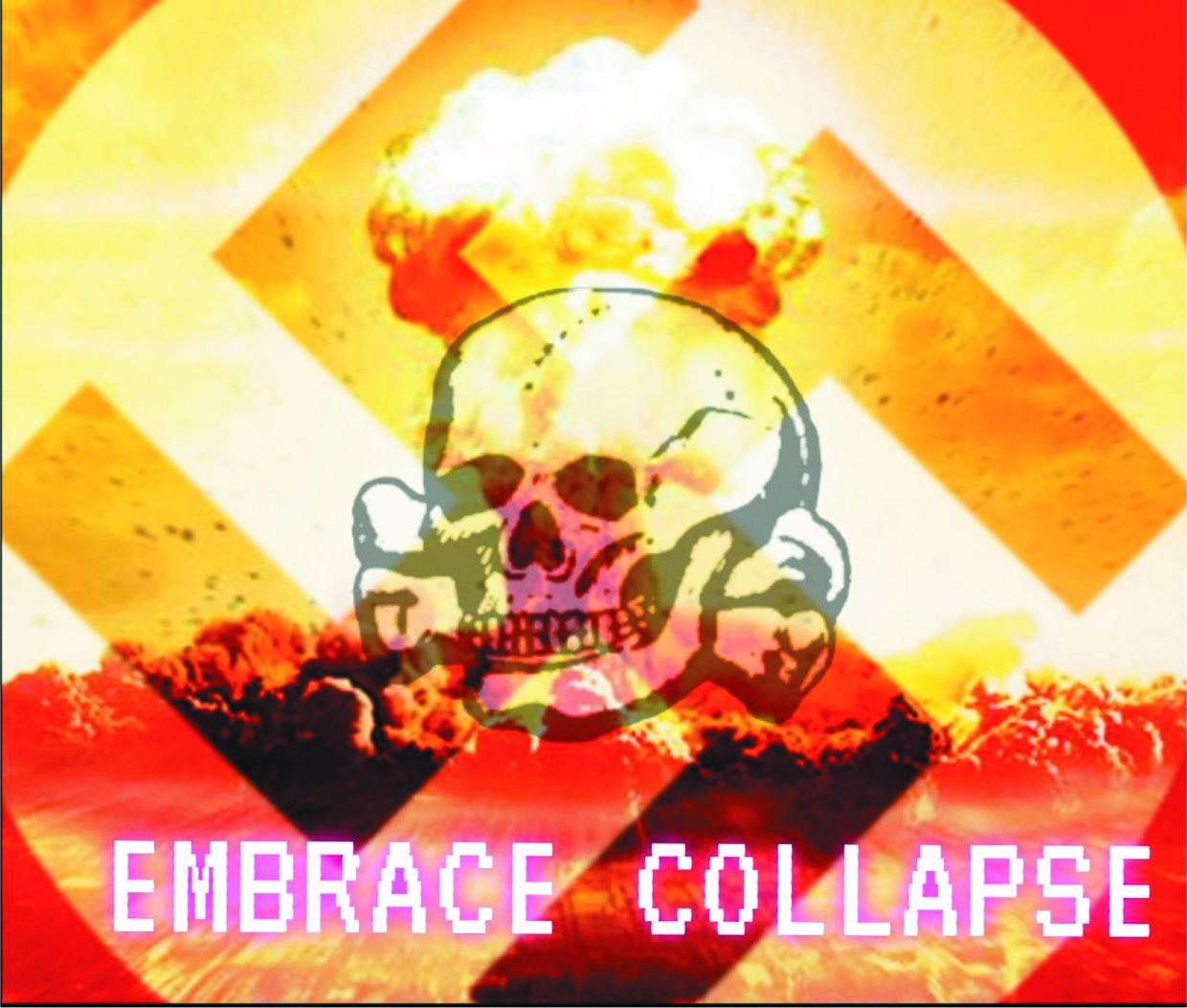
In the years to come, regional, national, and global crises will increase in frequency, scale, and intensity, and contribute to increased human conflict and civilisational precarity. Crises of climate change, resource scarcity, erratic weather, public health, migration, sub-national armed conflicts, and incidents of mass casualty violence serve as confirmatory indicators that radical action is needed for social peace. These crises – from species extinction to viral pandemics – point to shared forms of structural violence (Galtung 1969), triggering (re) actions from a variety of revolutionary ideologies, each offering their own interpretation, and understanding these catastrophes as opportunities for action. As crises and crisis-response become the normative mode of statecraft, groups act more frantically, with greater daring, resulting in reduced regard for the protection of life. This multi-modal, pro-collapse ideological position can be seen in the visual aesthetics of Image 1 below.
Theoretical framework and literature review
It is not a radical statement in the age of the Anthropocene to understand modernity as marked by eco-suicidality and social stratification. These structural conditions produce crime, including reactionary, revolutionary-minded crimes of political violence. As green criminologist Rob White (2008, 176) writes, “social tensions and ecological crisis are inevitably outcomes of the dominant mode of production globally.” The state-corporate nexus deploys violence against the natural world by design, and in turn, anti-capitalist, environmental, and other eco-movements have responded with sabotage, vandalism, and disruption. Within leftist movements – Animal Liberation Front (ALF), Earth Liberation Front (ELF), Earth First! (EF!), Deep Green Resistance (DGR) – such networks have produced tens of thousands of property crimes, and exceedingly rare instances of crimes against people (Loadenthal 2010, 2017a).
In this regard, green criminology provides theoretical foundations for understanding ecologically motivated political dissent, positing resistance as resulting from environmental harms (Potter 2012). Green criminology undergirds this analysis as it posits that harm, in the form of criminal damage and loss, can target non-sentient entities (e.g., body of water) and the lived environment at large. Crimes of terror signal grievances generated by the very socioecological and cultural contexts that produce them, heralding a desire for systemic and structural transformation where governance has failed, and suggesting pathways for addressing the underlying dynamics engendering violent eco-extremism. This view of crime informs the present analysis explicitly, and likely also implicitly influences those choosing to strike out to defend the Earth.
In reviewing the relevant literature in this subject area, a growing body of research has sought to understand how climate change and ecological crisis act as motivators for non-state actors’ deployment of defensive, revolution, and retaliatory violence (e.g., Kohler, Dos Santos, and Bursztyn 2019; Loadenthal and Rekow 2020; Spadaro 2020; Telford 2020). While scant research exists which examines the modern, internet-organised right’s fixation with infrastructure, intersecting, and proximate scholarship is ample, including recent works dealing with ecofascism (e.g., Blair Taylor 2019; Forchtner 2020; Wegener 2021) and eco-terrorism (e.g., Liddick 2006; Pellow 2014; Grubbs 2021). Additionally, research exploring fascism’s embracing of ecology is commonplace, especially that occurring during Hitler’s reign (e.g., Uekoetter 2006; Biehl and Staudenmaier 2011), as is a growing list of compelling research, which explores the online communities of the far-right (e.g., Daniels 2009; Fielitz and Thurston 2019), including their eco-centric wings (e.g., Hughes 2019; Shajkovci 2020).
Despite a lack of book-length treatments of accelerationists, researchers including Ben Makuch, often authoring with Mack Lamoureux (2018), A.C. Thompson (2018), Jade Parker (2020), and Jake Hanrahan (2018), have made consistent and meaningful strides towards unearthing this knowledge. A great deal of the emergent and ongoing scholarship focused on digital communities of the far-right has come from academic networks and think tanks such as the Global Network on Extremism and Technology, or the Centre for the Analysis of the Radical Right, rather than journals and books. This scholarship attempts to provide timely and meaningful analysis on a topic, which outpaces the speed of traditional academic publishing.
Methodology
In order to investigate the intersection of accelerationist-fascist ideology, the direct action left, and their fixation with infrastructure, image and textual corpora of inter-movement artefacts were analysed through the use of a visual discourse analysis through the lens of movement culture (Barnard 1998; Mitchell 2002). The universe of images and texts was restricted to those circulated on the Telegram messaging platform, an increasingly popular means of networking amongst the far-right due to its scarce content moderation (Owen 2019; Glaser 2019). Telegram represents the site of image circulation as this “transportation technology” helps to prefigure not only the compositional quality of the image, but the stage established for its consumption by the viewer (Rose 2016, chap. 2.4).

To locate images, I began by exploring obviously named Telegram channels, such as those whose titles included phrases such as “ecofascist/eco-fascist,” or combinations of tell-tale words such as “green,” “resistance,” and “acceleration.” I also selected channels with ecofascist images set as their avatar, and those which included tree emojis in their name, a common practice within far-right-eco channels. A sample search return from Telegram is included as Image 2.
From this initial channel pool, snowball sampling and select search queries were used to locate new channels. After locating more than 300 far-right channels and identifying those with likely relevant content, I completed daily reviews of several dozen channels to determine what was typical and common, and then extracted the images which spoke to themes of ecological collapse, the precarity of techno-industrial systems, and those which advocated targeted strikes on infrastructure, technological systems, and the like.
Posts often originate in other channels and are forwarded, demonstrating the fluid crosspollination of ideas. These forwards often led to new channels and new discussions to follow, which were included in the search for artefacts. This process resulted in the identification of hundreds of suitable images and texts. In collecting, categorising, and interpreting these images and texts, I sought to isolate discursive trends and extrapolate meaning. This approach presumes that the visual cultures produced and recirculated amongst these networks are reflective of the individuals, ideologies, and realities which produce them (Barnard 2001). While collecting the images, I constructed detailed records of the images’ history through reverse image searches,[1] and noted any identifiable information on the author and image. Typically, I was able to determine the poster’s screen name, the date/time the post was made, the original source when the contribution was a forward, and comments made by administrators or other users. For the channel itself, I was able to determine its name, URL, number of subscribers, date of creation, and a field in which moderators are encouraged to describe the channel. The review and collection of images occurred January–June 2020, which included the early months of the COVID-19 global health pandemic.
This approach follows the scavenger methodology articled by gender theorist, Jack Halbestram (1998, 13), and practiced by queer linguist, William L. Leap (2020, 41, 48–49). In adopting this scavenger approach, I located memes, non-meme visuals (e.g., flyers and posters), as well as manifestos, claims of responsibility, essays, and book-length texts. Mitchell (1994) suggests that a visual culture comprised of “image/text” can showcase the interrelated nature of these mediums, and that their interaction has analytical merit. In the contemporary far-right, the creation of internet memes, and the gamification of violent imagery abounds (Mattheis 2021). Through a critical visual reading of these images I focused on the technological, compositional, and socio-political aspects and values embedded (Rose 2016, 25–26).
For the textual analysis, the goal was to create analytically comparable sets which could be used to show the deployment of language as discursive markers. While texts of equivalent lengths and format would have been ideal, I was forced to manually assemble the corpora due to the varied nature of the authors. For example, in order to capture the “eco-extremist” tendency, 118 communiques were collected and used to build nine distinct collections.[2] In other collections, including the Right-Wing Shooter, Ted Kaczynski, Accelerationist, and Deep Green Resistance corpora, manifestos and books were the basis. The Appendix provides additional detail as to the individual texts which comprised these corpora.
After the text collections were assembled, the data was manually cleaned for processing, and loaded into a computer-assisted corpus linguistics program which allows for sequencing, frequency analysis, and concordancing. Finally, a close reading of key texts – The Turner Diaries, Siege, Harassment Architecture – was conducted to look for similar narrative and strategic trends. These texts were selected as they represent key chronological markers in the development of American white supremacist and accelerationist terror, and are understood as canonical, “required” reading for movement members. My goal in doing this was to allow the objects to offer a narrative of not only critique – what is wrong with the socio-political order – but also a revolutionary redemption wherein one advances their own prefigurative reality, in this case, a white nationalist, ecologically-balanced, authoritarian-fascist vision.
“Let’s bomb the power grid” (he goaded sarcastically)
Throughout both the images and texts circulated amongst the far-right digital communities under examination, calls and instructions to accelerate collapse through anti-systemic violence, sabotage, and vandalism are common. The desire to strike at key infrastructure can be seen in the neo-Nazi accelerationist network Atomwaffen Division’s (AWD) plans to explode power lines and bomb a nuclear power plant (Sullivan 2017). This strategic approach is advocated for in the famed The Turner Diaries, a mainstay on the road to white power radicalisation, and a noted inspiration for right-wing actors including the short-lived group the Order, and Timothy McVeigh (Alter 2021). The strategic posturing advocated by ecofascists focuses on infrastructural disruption and dates back at least to the book’s 1978 publication. The right notes that attacks on key sites, such as that that generate and store energy, are likely to yield the greatest results, and while they may not make revolutionary change in the immediate, “will gradually have a cumulative effect on the whole public” (Macdonald 2019, 102). As Turner, the book’s protagonist, reflects on his network’s attacks against “the system” he notes:
We stopped wasting our resources in small-scale terror attacks and shifted to large-scale attacks on carefully selected economic targets: power stations, fuel depots, transportation facilities, food sources, key industrial plants. We do not expect to bring down the already creaky American economic structure immediately, but we do expect to cause a number of localized and temporary breakdowns, which will gradually have a cumulative effect on the whole public. (Macdonald 2019, 102)
Such advocacy is shockingly common within online discussions amongst accelerationists. One Telegram exchange showcases the desire to attack electrical infrastructure, when a moderator posts: “At this point the waiting and capitulation is getting to the point of lazyness, if you arent doing your part what the fuck are you doing”[3] (Eco-Fascist Central 2020a). This charge is responded to by another poster (Eco-Fascist Central 2020c):
CUT
LINES
USED
FOR
TRANSMISSION
OF
ELECTRICITY
Minutes later, a second author writes, “Hey kid, you know only about ~17% of arson cases are solved?,” (Eco-Fascist Central 2020d) answered by the original poster (Eco-Fascist Central 2020b):
BURN
TRANSFORMERS
USED
FOR
TRANSMISSION
OF
ELECTRICITY
Finally, the rhetoric escalates before concluding – ”Imagine if someone opened fire on a nitrogen based fertilizer plant with incendiary rounds” (Eco-Fascist Central 2020e).
Such comments demonstrate a common delivery style within the “Terrorgram” community, inciting attacks through faux warnings (Loadenthal 2021). In the context of COVID-19 restrictions, a user declares, “In quarantined areas, Electricity is the highest priority ... if someone were to target a station ... I am certain there would be riots” (National Accelerationist Revival 2020). The “imaginative exercise” of considering such attacks is repeated across channels:
I hear some people are buying Dexpan in cash, finding cracks in infrastructure, and over time filling those cracks. I hear it’s readily available at large hardware stores. I also hear that Dexpan and other demolition grouts can have “blowouts”. I hear that this condition is easy to create by mixing large amounts of it and cramming it into large cracks. ABSOLUTELY DO NOT DO THIS. IT WILL EXPLODE. (Hans’s Right Wing Terror Center 2020)
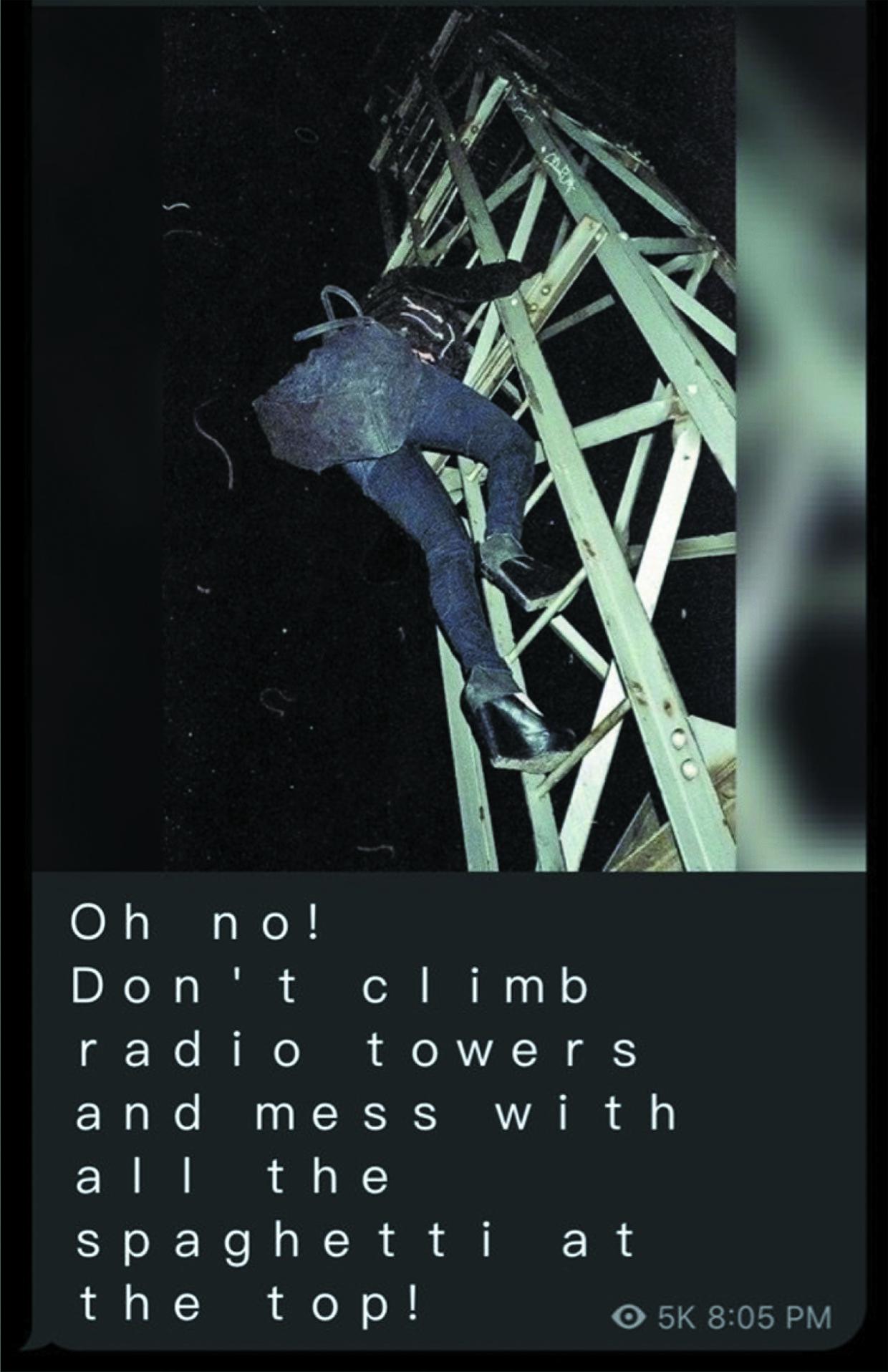
Here, the instruction and encouragement of attacks, cloaked in faux-warnings, offers ideas and inspiration to potential saboteurs. Likewise, an author shares a chart of household chemicals which when combined, produce toxic and corrosive acids and gasses with the caption, “definitely do not mix these together” (The occultic catholic wignat 2020). Comments on real-world sabotage provide more scenarios, made hyper-poignant in the wake of the pandemic. A typical example of this can be seen in Image 3, which shows faux warnings against vandalizing ambulances used in emergency, mid-pandemic healthcare.

This tongue-in-cheek tone is recurrent within accelerationist propaganda. In his book Harassment Architecture, a frequent “required reading” for accelerationists, author Mike Ma (2019, 28), the nom de plume for Mike Mahoney, employs this same approach:
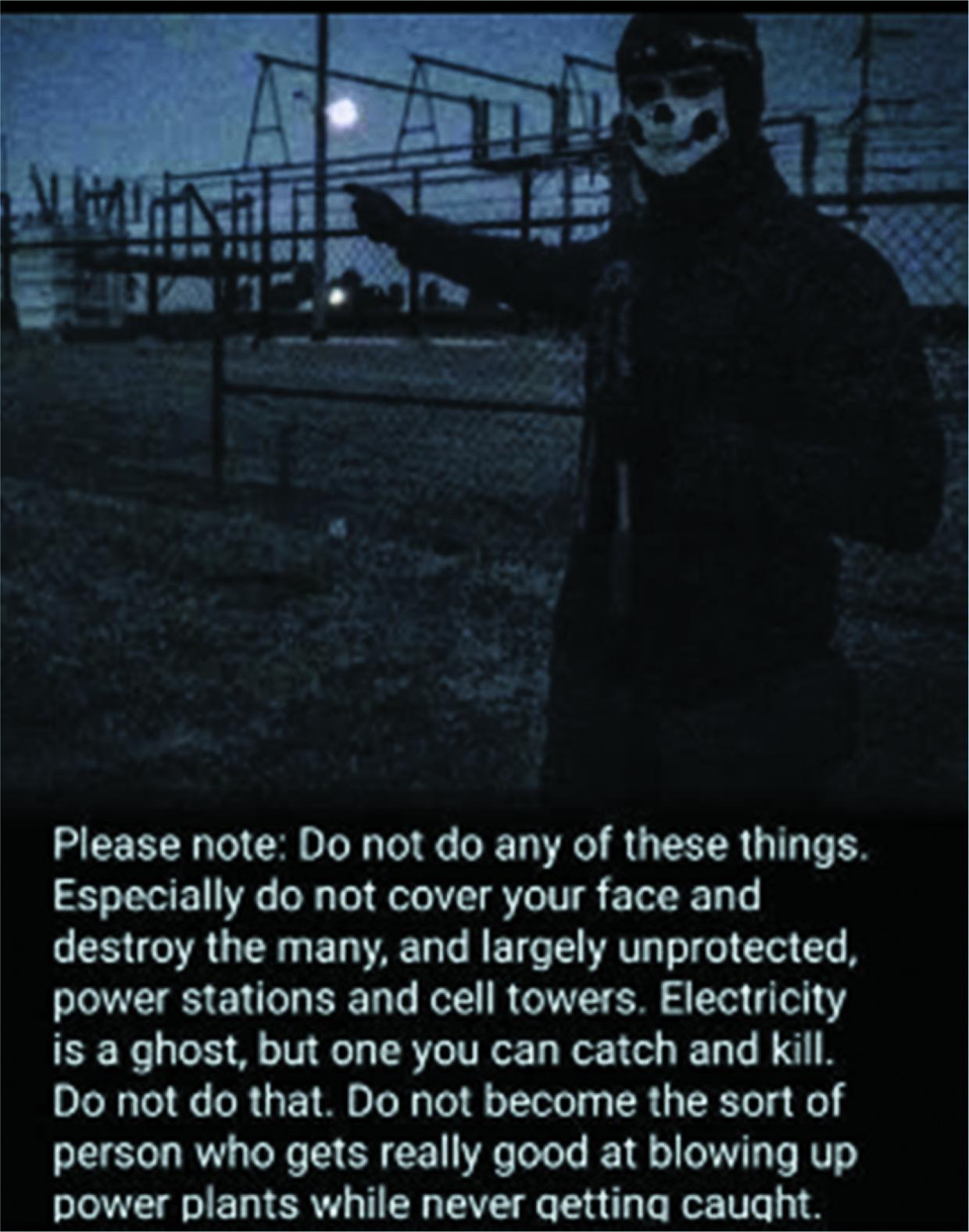
why not funnel your nihilism into something absurd and productive. You don’t care about this place? Wonderful. Take a rifle and empty one entire drum magazine into the windows of AAA. Empty the magazine and don’t look back unless everything in that hornet’s nest is contaminated with lead ... Let me cover you in plastic explosives and take you on a field trip to the largest power station in America. (Please note: Do not do any of these things. Especially do not cover your face and destroy the many and largely unprotected power stations and cell towers ... Do not become the sort of person who gets really good at blowing power stations up while never getting caught.)
In this passage, Ma clearly advocates for not only unbridled mass shootings, but suicide bombings targeting power stations, using the parenthetical aside to imply the faux warning method. Ma has both alt-right connections via Milo Yiannopoulos, and ecofascist interest in his creation of the Pine Tree Party, an accelerationist ecofascist formation with presence on Instagram, Telegram, Twitter, iFunny and elsewhere (Shajkovci 2020). Throughout Architecture, Ma (2019, 93–95) continues his rhetorical approach, using the “I hear some people” refrain showcased in the Dexpan posting:
I hear some people are[4] buying extension ladders, going up on various store roofs, and pulling the disconnects on their heating and cooling devices ... buying tennis rackets and hitting medium-sized pebbles into wealthy and ethnic neighborhoods ... buying machetes in bulk and leaving them next to the homeless while they sleep ... learning how to build handheld EMPs ... buying burner phones and calling ambulances to places, over and over ... throwing screws in news station parking lots ... getting jobs and immediately quitting ... feeding journalists completely false stories and making them look bad ... putting caution tape across busy streets and highways ... running through car dealerships and smashing the windshield out of everyone on the lot ... hiding bluetooth speakers in places and broadcasting racial slurs at full volume ... making homemade explosives and knocking down cell towers ... making homemade explosives and disintegrating local power substations ... stealing construction machines and driving them into lakes.
While the sarcastic, tongue-in-cheek warnings clearly identify and advocate pathways towards social tension and disorder, it is also clear accelerationists are parroting the call. Not only are calls to “Read Harassment Architecture” frequently circulated online (alongside calls to “Read Siege”), the explicit recombination of accelerationist neo-Nazi activism and Ma’s text are frequently repackaged in memes.
Whether telling people not to fill cement cracks with explosives, fire incendiaries into electrical infrastructure, or knock over cellular towers, the cumulative effect is a collective anti-social brainstorm – an ever-growing list of ways to foster and extend chaotic disorder, not unlike the fictional proto-fascist patriarchal army “Project Mayhem” that attacked modern civilisation through vandalism, sabotage, and homemade explosives, remaking the image of manliness from passive consumer into violent survivalist (Kennett 2005). Prior white power movement texts like The Turner Diaries, operationalised by Oklahoma City bomber McVeigh, similarly provide open-source strategic blueprints for a prolonged, multi-year campaign. These materials “gamify” attacks, borrowing and weaponising cyberbullying and harassment tactics from the gaming community for far-right real-world violence (Evans 2019).
In March 2020, the FBI disrupted a plot to bomb a hospital with a vehicle-borne improvised explosive device amid the Coronavirus pandemic, determining the suspect “was a potentially violent extremist, motivated by religious, racial, and anti-government beliefs” (Associated Press 2020). Indeed, he posted on various Telegram channels, (N. R. Martin 2020) suggesting the attack was part of the wider accelerationist copycat echo chamber (Miller and Staff 2019). Another man with similar neo-Nazi interests was arrested after allegedly planning an attack on an electrical substation (Chung 2020), while others, like the former Canadian Armed Forces reservist connected to the neo-Nazi accelerationist group The Base, sought to derail trains, poison water supplies, and open fire on a gun rights rally with the intention of starting a civil war. Such plots mirror real world propaganda efforts, such as Images 4 and 5 which resemble attacks on electrical infrastructure. Power substations and transformers, water filtration plants, nuclear reactors, propane storage facilities, suspension pylons, and other critical infrastructure have all been previous targets for white revolutionaries (Campbell 2020). Throughout a litany of examples, the desire to precipitate social collapse through structural breakdown, social disorder, antagonism, and social war creates conditions for a shared, if contradictory, approach to insurrectionary action against modern society.
Though it would require a separate study to quantify the rate at which infrastructure is targeted for sabotage and disruption, an approximation can be calculated using the Global Terrorism Database (2019a). Restricted to only North America, and including only incidents coded “facility/infrastructure” (versus assault, bombing, hijacking ...) using explosives, incendiaries, and sabotage, we observe 218 incidents since 1970, with
noticeable spikes in 1995, and smaller surges 1984 and 1993. Many of these attacks targeted reproductive healthcare centres, thus excluding these anti-abortion incidents, only 30 incidents remain, many carried out by typical eco-leftists (e.g., ELF/ALF), with a target focus on energy facilities, such as power lines, transformers, substations (National Consortium for the Study of Terrorism and Responses to Terrorism 2019b, 36). Most of these incidents are coded as incendiary or sabotage attacks, with one incident involving explosives. 90% resulted in no injuries or deaths.
When expanded globally, the number dramatically increases to 1,342 incidents, most targeting transportation (671) and telecommunication (384) systems. While the dataset is unable to quickly summarise the ideology of perpetrators, it demonstrates the routine nature through which physical infrastructure is targeted for attack. Adopting the green criminological perspective (and that of the perpetrator), these actions are understood to
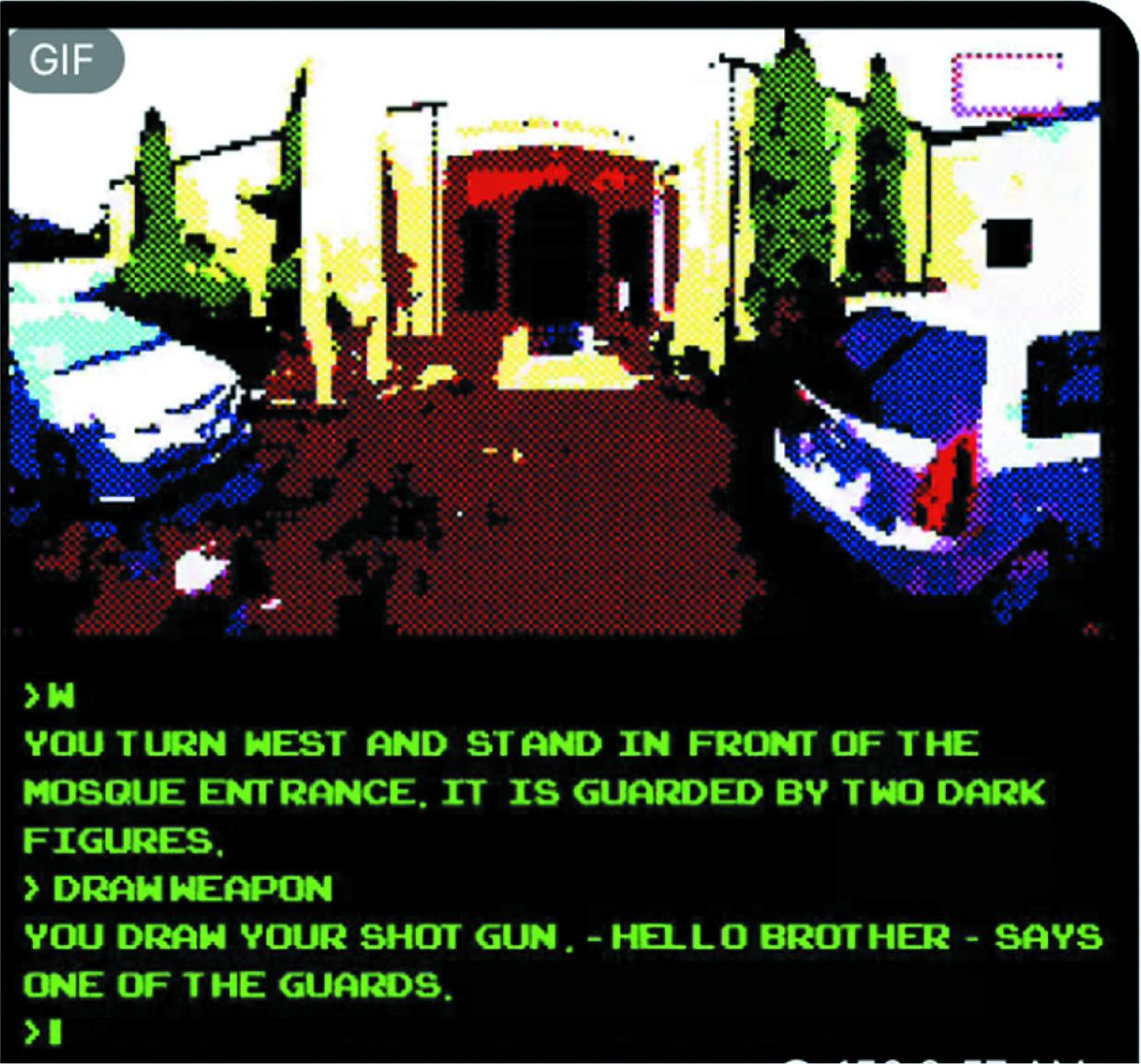
be justified and defensive, akin to an individual killing their abuser (i.e., justifiable homicide). Many advocating for and engaging with such crimes do indeed note their defensive nature, and often speak of being motivated to act through a protectionist logic embedded in notions of theft, trauma, and loss (Loadenthal 2020). This defensive posture is a far-flung reality from the competitive, high score-seeking, gamification observed in the far-right, and exemplified in Images 6 and 7 above.

Crossed ideological boundaries
Amongst the community in question, those on the far-right who embrace collapse and seek to bring it into reality though attacking civilisation’s visible infrastructure, an obvious sage of violence is Theodore Kaczynski, commonly known as the Unabomber, whose 17-year US bombing campaign targeted individuals involved in the “techno industrial system.” In Kaczynski’s (2010, 38–120) view:
There is no way of reforming or modifying the system so as to prevent it from depriving people of dignity and autonomy. If the system breaks down the consequences will still be very painful. But the bigger the system grows the more disastrous the results of its breakdown will be, so if it is to break down it had best break down sooner rather than later.
Kaczynski’s words appear often through the far-right, and his writing was even plagiarised by the 2011 Norway shooter in his lengthy manifesto. Compare this to oft-quoted American neo-Nazi, James Mason (2003, 498), whose newsletters for the National Socialist Liberation Front, compiled as Siege, are “required reading” for many accelerationist groups:
To destroy the System is primary. To destroy the System without destroying ourselves is desirable. But with the System destroyed a new Age of Man can begin. Until the System is destroyed, by whatever means necessary, none of these fine plans will ever amount to anything more than a dream.
While the above theorists are explicitly anti-leftist, Aric McBay (2019, 50), anti-fascist and co-founder of the radical environmental group DGR, writes similarly: “industrial civilization cannot last forever; the question is whether anything will be left once it is gone. The sooner collapse happens the better for the planet and those who live after.” While McBay, Mason, and Kaczynski make strange bedfellows, they do share some points of unity, including a desire to resist civilisation by attacking infrastructure and implements of domestication, blending elements of anti-technology ludditeism, eco/animal defence, ecofascism, and biocentrist deep ecology.
The convergence of fascism (i.e., Mason), anti-technology (i.e., Kaczynski), and anti-infrastructural biocentrism (i.e., McBay) represents the greening of the modern far-right, though it should not be misinterpreted as fascism’s first foray. Ecofascists are nothing new. Hitler’s National Socialists’ blood and soil, Savitri Devi’s pagan Aryanism, and Pentti Linkola’s birth politics all repeat classical ecofascist arguments with modern variations. One such ideological collision can be seen in William Stoetzer, an AWD member who had previously been involved with a yearlong California tree sit and was “working with” the ELF and EF! (Thayer 2019). In studying the modern fascist movement, EF! is of particular relevance, as at its origins, the movement “advocated controversial opinions tied to white supremacist, anti-immigration and depopulation claims ... [before] adopting more left-leaning social justice values” (Ross 2017, 124). Another overlap between these insurgent worldviews is showcased by the Green Brigade (GB) (2019), an international ecofascist organisation promoting themselves on Telegram as:
An organization consisting of openly accelerationist, Eco-Extremist members focused on tearing down the system that exploits our land, animals, and people. These individuals prioritize and practice an autonomous environmentalist lifestyle, with a fascist emphasis and with a hatred for modern civilization.
The Base, a US network of accelerationist, survivalist-preppers also shares this duality. Base members claimed responsibility for the arson of a Swedish mink farm (Kamel, Lamoureux, and Makuch 2020) and other far-rightists have claimed temporary, opportunistic partnerships with EF! and the ELF, noting that when it was beneficial to work with “single issue” groups, they did just that (Ross 2017, 198).
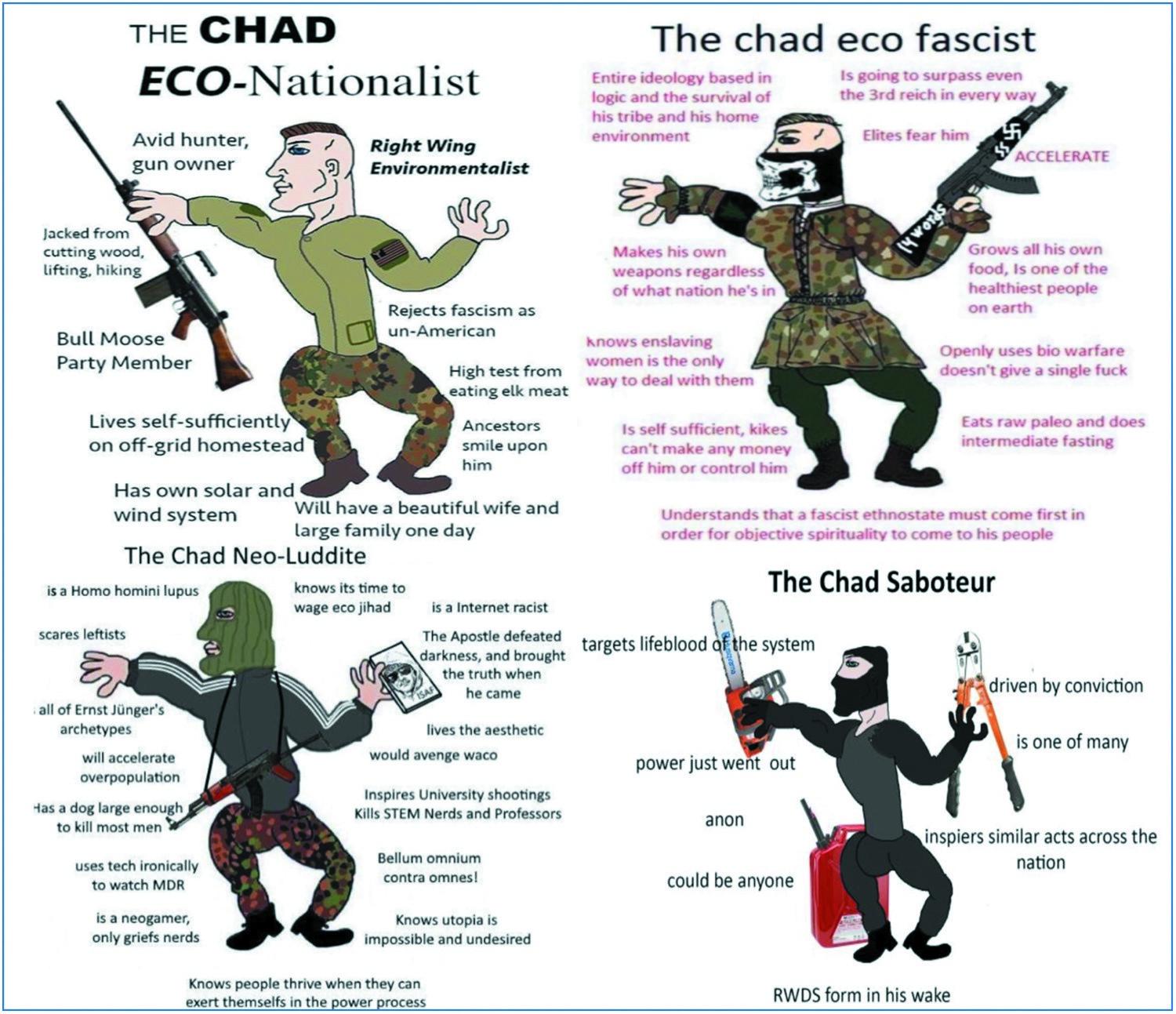
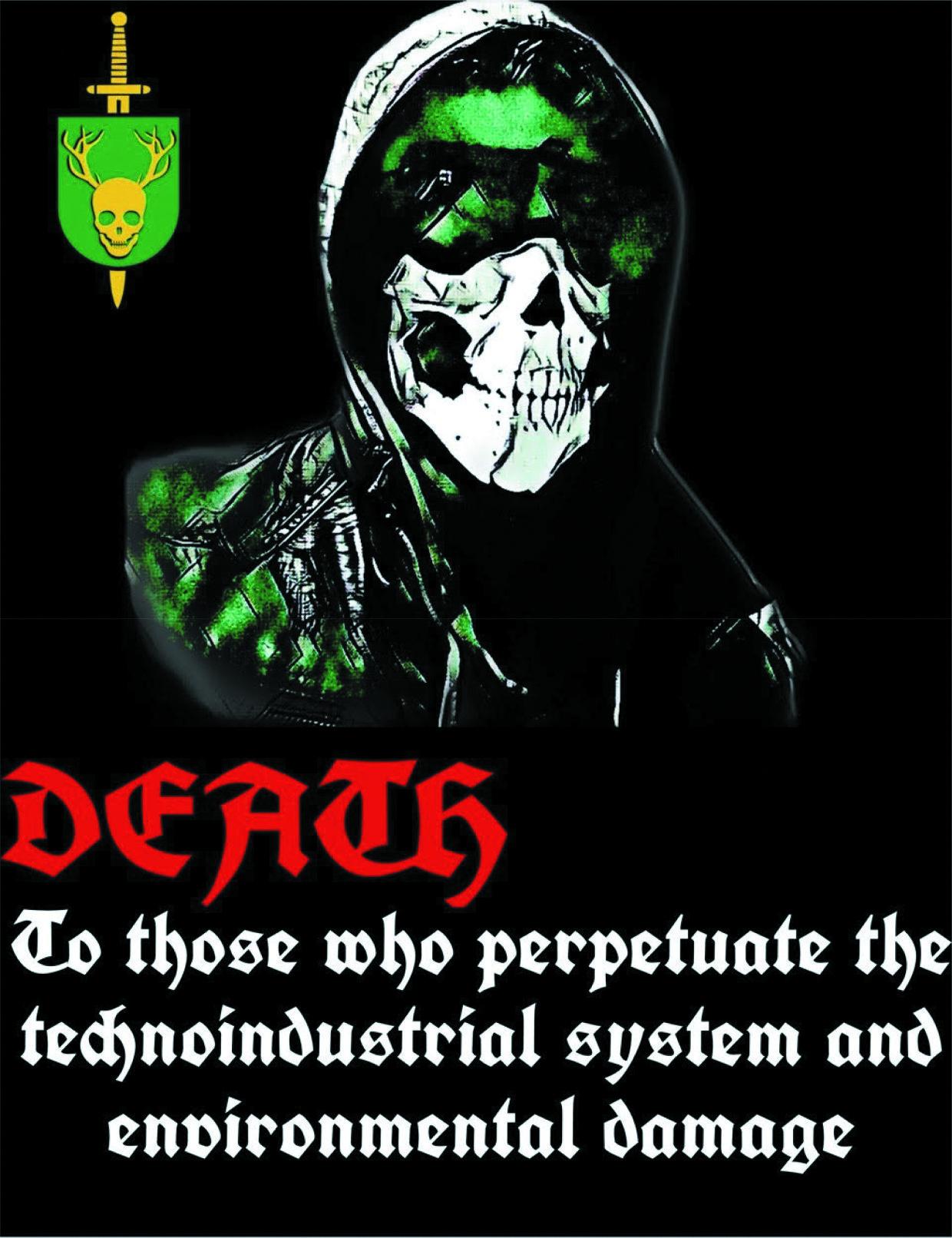
GB, the now defunct network linked to the Base was active on Telegram, describing itself as “openly accelerationist, Eco-Extremist ... focused on tearing down the system that exploits our land, animals, and people” (Amend 2020). This specification of identity is common in the wider far-right, as new, emergent categories of self and other emerge regularly, as shown in Image 8 displaying four articulation software the so-called Chad (i. e., the eco-nationalist, the eco-fascist, the Neo-luddite and the saboteur). GB claimed to be connected to AWD, and the Misanthropic Division, a National Socialist Ukrainian unit of the Azov Battalion. GB circulated propaganda, shown below as Images 9 and 10, featuring a face overlaid with a Totenkopf and masked by a Norse, Algiz rune, commonly used by post-war Nazis when the swastika was banned. The figure holds Kaczynski’s manifesto, Industrial Society and Its Future. In other materials, GB borrowed the logo of EF!.
There are several other networks which are explicitly ecofascist, including the defunct Greenline Front (Forchtner 2020), the Pine Tree Gang (Hanrahan 2018), National Action’s Scottish Dawn (Ferret Journalists 2017), the digital universe of Pine Tree Twitter/Telegram
(Hughes 2019), the Ecogram Telegram network (Amend 2020), and individuals borrowing from ecofascist ideas and rhetoric, including mass murders in El Paso, Texas, and Christchurch, New Zealand.
While the Texas shooter named his manifesto after Al Gore’s environmental documentary An Inconvenient Truth, the Christchurch shooter’s manifesto (Tarrant 2019, 22), included a self-interview.
Why focus on immigration and birth rates when climate change is such a huge issue?
Because they are the same issue, the environment is being destroyed by over population, we Europeans are one of the groups that are not over populating the world. The invaders are the ones over populating the world. Kill the invaders, kill the overpopulation and by doing so save the environment.
The shooter claimed the label, writing, “[I] consider myself an Eco-fascist by nature,” and calling himself an “ethno-nationalist eco-fascist,” seeking “Ethnic autonomy for all peoples with a focus on the preservation of nature, and the natural order” (Tarrant 2019, 15, 18). While not all of these groups and individuals have led spectacular strikes targeting infrastructure, they have contributed to the wider universe of ecofascist-accelerationist intermingling. Seemingly, the far-right’s focus on environmental issues, and the formation of explicitly eco-driven fascist networks is on the rise, and likely to increase as climate change manifests and exacerbates migration.

Telegram is inundated with channels which combine National Socialist, ecofascist, deep ecology, eco-extremist, and accelerationist materials. Many promote and recirculate actions from left-aligned environmental direct action networks (e.g., EF!, ELF), republishing ideological essays by mainly anarchist, anti-civilisation theorists. The appearance of similarity between rightist and leftist motives and means are superficial at best, and while they may share some aesthetics and rhetoric, their operations are enthusiastically dissimilar. The commingled analysis is not meant to develop a false equivalency, as these movements operate with little similarity, despite their shared affinity for targeting
infrastructure. In discussing these tendencies together, the intent is to point to the ideological crossroads in their genealogies, despite little overlap in their actions and revolutionary visions.
As I have demonstrated (2010, 2017a), leftist eco-saboteurs targeting infrastructure, epitomised by the ELF/ALF, consistently avoid human and non-human animal casualties, and prefigure a liberatory politic situated in an ethic of care, equality, empowerment, justice, and non-violence. Rightist plots, however, have routinely aimed to injure, maim, and kill, with actors frequently achieving these lethal objectives (Jones et al. 2020, 3–6), often in higher frequency than Salafi-Jihadists, the nation’s counter-terrorism focus post-9/11 (R. Martin 2015). There are certainly moments when leftist eco-action blurs with that of rightists, and when this boundary crossing occurs, the crosspollinations can appear unintentional or explicitly strategic. A GB post shows the classic Kaczynski FBI sketch, modified to include a “Siege culture,” accelerationist, skull mask, demonstrating the Siege-ification of the deep green, or the Kaczynski-ization of the neo-Nazi. A visualization of this symbolic intersection can be seen in Image 11 below.
Stoetzer and GB represent marked intermingling of ideology; a legible transition for the former and a comingling for the latter.
In other cases, individuals can be observed traversing this ideological compass in more public journeys, such as the albeit brief narrative arch of ALF arsonist, Walter Bond. Bond’s (2019) forays into authoritarian, Salafi, and ecofascist thinking can be seen in a series of essays, beginning after his arrest, and continuing throughout his incarceration. While Bond’s texts (e.g., 2011) began from a hardline,[5] vegan-straightedge, anarchist politic, while incarcerated, he found resonance with rhetoric more closely described as fascistic (Grubbs 2021, 173–74), and borrowed from Salafi-Jihadism. Notions that humans are an over-populating plague to the earth and its animal nations can be found in numerous ecofascist authors such as Finnish ecologist, Pentti Linkola, and American ecologist,

Garrett Hardin; Bond reframed and repeated such claims within his vegan hardline politic.
This not-too-subtle entry into fascist thought is best captured when Bond and animal liberationist Camille Marino created Vegan Final Solution, which, aside from its Nazi-inspired name, is deeply authoritarian in its advocacy of murdering perceived enemies and claiming the naturalness of hierarchy. Social movement scholar, Jennifer Grubbs (2021, 174), notes that Bond “promotes third-positionist fascism,” which he makes clear in the preamble to the Vegan Final Solution (Bond and Marino 2020) manifesto:
WE BELIEVE that human civilization, industry, technology, and technique are the bane of the earth and all life upon her ... WE ADVOCATE hatred and intolerance towards all people, regardless of race, creed, or culture that don’t put animals lives above their own ... WE BELIEVE that nothing that has ever been done in defense of the earth and animals is too extreme, nor could it be ... WE BELIEVE that both left-wing and right-wing politics are hostile to the earth and animals as they both seek to grow industry, and ultimately, the power of the human race ... WE ADVOCATE nihilism and a breakdown of the social order.
The manifesto (2020) advocates, “an aggressive stance against reproduction, an advocacy of abortion and euthanasia”, reminiscent of numerous population control predecessors. This pro-attack, anti-humanistic, dogmatic absolutism recalls the politics of eco-extremists such as ITS far more than the animal liberationist politics of the ALF in which it began. Bond’s shift towards ecofascist tropes – a misanthropic fascination with the predominance of the earth over people – led many anarchists and anti-authoritarian eco/animal liberation activists to abandon and condemn Bond (e.g., Unoffensiveadmin 2020; 325 and anarchistsworldwide 2020; Activist Journeys 2020), despite the wider militant, anarchist-led, animal liberation movement originally providing a platform to announce the new initiative (e.g., North American Animal Liberation Front Press Office 2020).
Eco-extremism and esoteric Satanism
Distinct from both ecofascism and accelerationist eco-sabotage is a modern articulation self-labelled eco-extremism by adherents. While “eco-terrorism” is a pejorative label often assigned to environmental direct action (i.e., embracing sabotage and vandalism as means) movements by law enforcement, those who have chosen to target human life to provide an ecological redress have carried out attacks around the world. Individualidades Tendiendo a lo Salvaje (Individualists Tending Towards the Wild) (ITS) exemplify this tendency. ITS emerged in 2011 by sending a parcel bomb to a Mexican university, injuring one employee. This was followed by many additional explosions and shifts in the moniker’s usage. ITS (2011b) would go on to claim responsibility for several dozen bombings and other acts of violence, including several murders, and reportedly expanding ITS into Brazil, Chile, Argentina, and Scotland, and expressing support for allied networks in Switzerland, Russia, Spain, and the US. While a lengthy treatment of ITS’s ideology is outside the scope of this study, I have traced the network’s history through its communiques in a prior work (2017b, esp. 84–90). Images produced by the ITS network have been recirculated several times on numerous ecofascism Telegram channels, showing at least a portion of the eco-right’s willingness to engage with the eco-extremist tendency.
ITS (2011a) actively embraces the title of “wild terrorists” in its claims for bomb attacks targeting scientists, technologists, mining, and tech executives. In their tenth communique (2016), the authors write:
We reject equality, human progress, tolerance, science, collectivism, Christianity, pacifism, modernity, and all of the other shit that reeks of civilized domestication ... this civilization wants to eliminate our most wild instincts to impose on us its values that run roughshod over the individual ... it wants us to consider this murder “evil,” even though it is a result of a war without morality. May Eco-extremism and terrorist nihilism increase.
A post in a Telegram channel is overlaid with the text “SUPPORT TO ECO-EXTREMISM” atop a dark forest landscape, and followed with, “Hail to all Eco-Extremists around the world far and wide ... Hail to the ALF ... ELF ... Earth First! ... ITS ... Green Brigade” (Esoteric Ecology 2020). The inclusion of eco-extremism by far-right, ecofascist Telegram channels can be seen in their promotion of ITS as shown in Image 12. This may indicate that such ideological markers are less important to modern actors, especially when an eco-extremist text, explicitly titled “Against the World-Builders” situates themselves thusly: “ITS aren’t a bunch of ex-anarchists tending towards fascism, but rather ex-radicals tending toward anti-social criminality” (Los hijos del Mencho 2018). Despite its genealogical roots within the insurrectionary anarchist milieu, ITS was soon abandoned and rhetorically attacked by anarchists for exhibiting crypto-fascist tendencies (e.g., Último Reducto 2015; Individualist Network and Indonesian Anarchist Black Cross 2018).
Further testing the ideological boundaries of these groupings, the eco-extremist tendency also has touched upon the intersection of neo-Nazi occultist-Satanism (sometimes called esoteric Hitlerism) and the anti-civilisation discourse. While this green Satanism is not as common, its imagery is exemplary of what FBI Director Wray (2021) has called “blended ideologies,” wherein political violence and terrorism comingle “less and less coherent [and] linear” ideologies. Beyond the amalgamated imagery and co-distribution of content online, there is a well-established history of fascist and far-right involvement in the black metal music (i.e., National Socialist Black Metal) scene (Goodrick-Clarke 2002, 203–12), and involved noted leftist eco-militants, such as ELF member Nathan Block (Ross 2017, 314–15).
Groups such as Order of Nine Angles (O9A) exemplify this Satanist-rightist-eco tendency. While O9A is primarily a Satanist group dating back to the 1960s, its overlaps with the far-right appear to be more recent, likely taking shape in the 1980s. The O9A was alleged to have been involved in a plot developed by Army private, Ethan Melzer, to attack US soldiers in coordination with RapeWaffen Division, a Telegram-based network with obvious AWD affinity. This FBI-disrupted plot showcases the intentional intermixing of Satanist and neo-Nazi networks, which can be observed through the inclusion of O9A imagery within eco-extremist and eco-fascist channels, as shown in Images 13 and 14. Melzer’s plot, while not targeting typical physical infrastructure such as energy production, can still be understood in a similar vein, as military readiness and defensive posture constitute core functionalities of modern states. The individuals and networks seeking to disrupt, incapacitate, and destroy such structures and systems engage in a manner of clandestine guerrillaism which within the eco realm, has historically existed only on the left.



Decisive ecological warfare of the left
The attempt to accelerate collapse through insurrection and terror is not limited to the far-right, and includes milieus of radical environmentalists, green anarchists, deep ecologists, biocentrists, primitivists, and other allies, such as the network DGR, whose name is appropriated by a “nationalist environmentalism” Telegram channel (Deep Green Resistance (DGR) 2020). While DGR, ITS, and contemporary ecofascists may be diverse in key aspects of their ideological posture, in each case, their strategy of aiding collapse is anti-majoritarian and seeks to increase tension, strain, and fatigue on the system, speeding up collapse rather than engaging in politics. Many groups such as the armed wing of the white nationalist Northwestern Front, Pine Tree Gang, adopt the ideas and strategy of anti-technologist Kaczynski to actively accelerate collapse.
The explicit embracing of Kaczynskism by fascists appears to be increasingly common, and can be shown in their canonising of him as a “saint,” an honorary designation assigned by the far-right to mass shooters (Am and Weimann 2020).
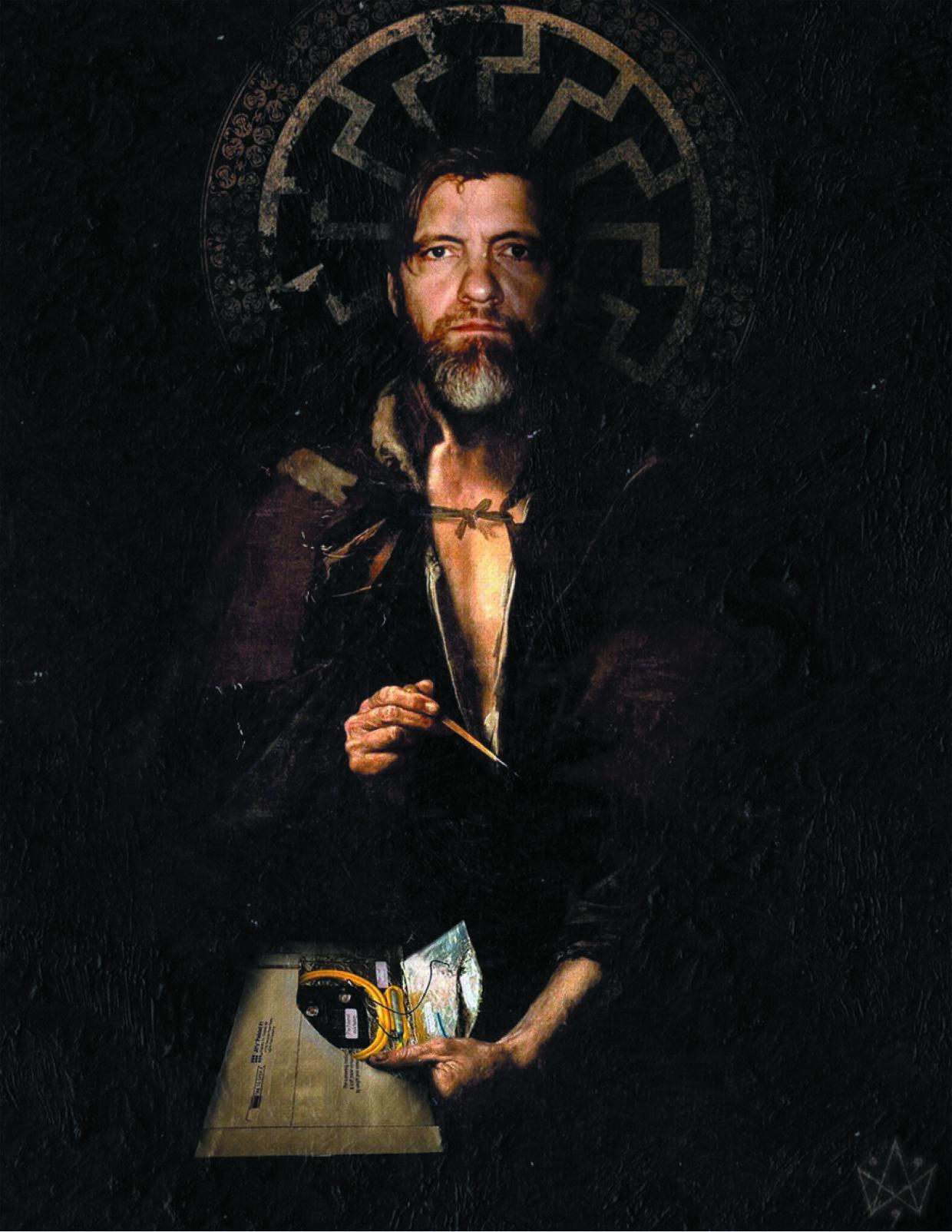
Kaczynski advocates for vanguardist warfare on behalf of the earth through the targeting of specific areas of industry. From the federal “supermax,” limited communication prison, Kaczynski states (Grogan 2020, pt. 24:54): “what has to be done is not try to persuade the majority of people that we’re right, so much as to try to increase tensions in society to the point where things start to break down, when people get uncomfortable enough so that they’re going to rebel. Now the question is how do you increase those tensions?” While anarchists criticise Kaczynski for his authoritarianism, in the years following his imprisonment, non-violent clandestine networks of eco-saboteurs emerged globally, and gained notoriety. Within Kaczynski’s newfound audience with accelerationists, he has reached the level of sainthood–shown in Image 15–an honorific title applied to mass shooters and other far-right individuals responsible for high body counts.
The architects behind leftist eco-guerrilla network DGR (Jensen, McBay, and Keith 2011, 432–33) make explicit their aims of accelerating collapse in a bifurcated strategy, noting:
What if there was a serious aboveground resistance movement combined with a small group of underground networks working in tandem? ... abovegrounders would work to build sustainable and just communities wherever they were, and would use both direct and indirect action to try to curb the worst excesses of those in power, to reduce the burning of fossil fuels, to struggle for social and ecological justice. Meanwhile, the undergrounders would engage in limited attacks on infrastructure ... The overall thrust of this plan would be to use selective attacks to accelerate collapse.
The authors (Jensen, McBay, and Keith 2011, 433), who in the past have employed nativist and transphobic arguments earning them the ire of the left, write that attacks organised via decentralised networks of autonomous cells would “not be symbolic ... [but] serious attacks designed to be effective but timed and targeted to minimize the ‘collateral damage’ on humans.” They note strikes would target fossil fuel and electrical power consumption and involve reducing the availability of these resources to force a focus and investment in just, sustainable, and autonomous human communities and the recovery of subsistence bases.
In an “underground action calendar” on the group’s affiliated website, actions like pipeline attacks, cyberattacks on fossil fuel systems, and incendiary devices against freight rail networks are highlighted to “publicize and normalize the use of militant and underground tactics in the fight for justice and sustainability” (Deep Green Resistance News Service 2018). These infrastructural attacks by underground networks are thought to accelerate in frequency once evidence of collapse surfaces. Attacks on infrastructure should not be seen as sporadic or stochastic, but integrated into an emergent, increasingly-self-evident, cross-cultural eco-leftist-accelerationist strategy. This notion, that the rate of attacks in increasing and the periods of inter-conflict calm are reducing, has not escaped the attention of rightists seeking to gamify violence into a competition, as shown in Image 16, featuring mass shooter Dylan Roof.

Infrastructural supply chains
Despite the radical environmental movement’s focus on disrupting infrastructure, their aim diverges from the Siege-inspired far-right who fetishise the igniting of power stations for the sake of an emerging ethno-state. In the ELF’s (1997) first communique, anonymous authors identified their role as the “burning rage of a dying planet ... to speed up the collapse of industry, to scare the rich, and to undermine the foundations of the state,” by disrupting operations of targeted entities, cutting into profits of lucrative extractive industries, costing companies to securitise. Like DGR’s “underground action calendar,” ELF, and hundreds of lesser known unnamed actions are reported in carefully curated archives maintained by supporters.
Unlike rightist attacks designed to increase systemic breakdown or intimidate religious, ethnic, and racial minorities, leftist attacks intend to target retail businesses (Loadenthal 2017a) by materially damaging the infrastructure of eco-exploitation and the mechanisms through which speciesism and ecocide are violently enacted. Animal liberationist, Peter Young (2019, 195–97), speaks to this strategy, encouraging saboteurs to abandon retail sites and instead to disrupt the support systems:
I want to propose a new model for the ALF ... avoid small-scale sabotage. Go only for high impact actions ... actions should always go after weak links and vulnerable industries. Not nearly soft targets ... target the infrastructure of industries, not the retail end ... For every 100 McDonald’s there’s probably one meat distributor. For every 10 meat distributors, there’s probably one slaughterhouse ... move up the chain and go to the source ... go after an industry’s infrastructure.
Young shifts the ALF away from symbolic “soft targets” towards a focused disruption of industry infrastructure. While farms, ranches, breeders, and storefronts may not appear as infrastructure when compared to electrical or cellular sites, concerted attacks on the animal agriculture supply chain enact a strategy for economic sabotage to catalyse industrial collapse. The strategy was made explicit in a multi-decade series of publications that mapped the fur industry’s supply chains, bottlenecks, and points of vulnerability through the distribution of detailed target lists and tactical guidance (e.g., Anonymous 2013).
Though radically divergent in their vision, rhetoric, and approach, networks like ELF and AWD share key goal-centric aspects. Neither desire to be a mass movement of followers, but rather a minoritarian movement engaged in attack by clandestine cells. Disparate attacks are linked to one another by movement spokespeople, inter and intra-movement publications, and collectively form a shared trajectory. Both networks want adherents to act, organise, and attack like them, without collectively organising with one another into a known, named force. These networks do not desire majority participation, as Kaczynski said, but rather affect the majority of the population, disrupting key systems and structures to undermine a common enemy. The affinity between radical environmentalists, eco-extremists, and Kaczynski is well documented (e.g., Jacobi 2016), as are connections between neo-Nazism and violent jihadism (Makuch and Lamoureux 2019), including oft-quoted correspondence from Osama Bin Laden (Landay 2016). Kaczynski spoke of the affinity of eco-luddite-Salafism, noting a rejection of modernity (Grogan 2020), and questioning the extent to which “it might be useful ...to carry on discussions with the Muslim militants and see whether there is sufficient common ground there for any sort of alliance” (Schager 2020).
The insurrectionary, rightist accelerationism detailed above offers a corresponding ideology, driven by an economic mode that exacerbates global antagonisms to threaten peace and security (Schirch 2018, 116–19). Anticipating socioecological collapse within the next decade, one accelerationist Telegram user comments:
This will come to pass in the 2020ʹs, and the deaths will be mainly focused in the 3rd world, as our resources will be put on hold, and the handouts they use to supplement and over breed will dry up. Medicine, food, all will go away, and the 3rd world will empty for us to expand into. (Prof. Kai Murros 2019)
These expectations of race war stem from perceived infrastructural breakdown and in preparation for the war, which follows.
Inter-movement texts
Concurrent to the examination of visual communications, a textual analysis was conducted to provide a comparison between rights and leftist eco-guerrillas. These corpora, while initially understood to represent well-siloed ideologies, appear even more related through this analysis. While at times those interested in “bringing it all crashing down” may seem nondogmatic, ideologically incoherent, and actively invested in erasing the nuances between worldviews, these differences not only exist, but offer a source of identity. In borrowing from distinct ideological markers, five corpora were developed to capture key texts, authored by or circulated amongst a given milieu. These corpora were analysed for commonly recurring words to provide a survey of the discursive intersections between movements.[6]
The results of this analysis are shown in the Table 1 which provides comparison between the most frequently-appearing word in a given corpus.
Table 1. Comparing corpora.
| Accelerationist | Right-Wing Shooters | Ted Kaczynski | Deep Green Resistance | Individualists Tending Towards the Wild | |
| Total word count | 620,251 | 813,362 | 206,589 | 759,275 | 92,836 |
| Most commonly occurring word{1} (rank) 1 | People (57th) | European (35th) | System (26th) | People (28th) | Wild (28th) |
| 2 | Time(64th) | Muslim (39th) | People(30th) | Resistance (53rd) | Attack (36rd) |
| 3 | System (72nd) | Muslims (45th) | Society (36th) | Other (55th) | Against (47th) |
| 4 | Other (76th) | Europe (46th) | Other (47th) | Power (65th) | Human (48th) |
| 5 | White (80th) | People (50th) | Movement (52nd) | World (72nd) | Mexico (49th) |
While the analysis is restricted to frequency, even at this cursory level, we can identify important trends and clear intersections. The Accelerationist and Right-Wing Shooter collections show a focused discussion on in-group/out-group distinctions, with accelerationists focusing on “system,” “other,” and “white,” and Right-Wing Shooters focused on “Muslim(s)” and “Europe.”[7] When compared to the more ecologically minded collections (i.e., DGR, ITS and Kaczynski), the out-group expands beyond race/ethnicity to the social order – “people,” “society,” “power,” “world,” and “human.” This may show a transition from critiques about demographics and identity towards criticism of the systems (i.e., political and economic) generating such dynamics (Ehsan and Stott 2020). This is seen in accelerationist discourse – “white” versus “system” – in Kaczynski – “people” versus “system” – in DGR – “people/resistance” versus “power” – and in ITS – “wild” versus “human.”
While these findings represent a superficial, bird’s eye engagement with the movement texts, these frames are useful when contextualising their more specific manifestations. With meaningful differences between rightist-leftist frameworks, discussions of anarchist-situated ELF, nihilist-situated ITS, and ecofascist-survivalists are awkward. These themes of nihilism and a propensity for anti-human violence, as seen in Image 17 circulated by ecofascists, are strong markers which serve to distinguish much of the right from much of the left.
Though I have sought to distinguish these tendencies, others may not, and indeed such nuance may be consciously or unconsciously eliminated to conflate otherwise contradictory ideological dispositions. The tendency to synthesise worldviews to justify attacks on infrastructure is apparent; moreover, the corpora demonstrate the expanded political terrain and degree to which themes like deep ecology, decentralism, anti-modernism, anarchism, Indigenism, veganism, and the valorisation of place, identity, traditional lifeways, state critiques, and transcendence of right/left dichotomies become open to co-option by groups organising around otherwise contradictory principles (Blair Taylor 2019).

Prefigurative ecological structural conflict transformations
Ideologically motivated violence emerges from an environment pushed out of its carrying capacity. Within deteriorating ecological contexts, the saboteurs’ actions are a symptom of disorder – attacking the modern social structure designed to maintain stability. In this way can we understand Ma’s (2019, 87) defence of accelerationism as an attempt to provide a kind of “social medicine,” writing: “When I say ‘to accelerate’ or ‘to push forward’ or ‘to lean into’, I don’t mean towards a better world – not immediately at least. We are leaning into the collapse. We are pushing for the ignition of cleansing fire. I am acceleration and I am the reaction.” Insurrectionary, far-right accelerationism represents the desire for transformation, and with it, the conditions needed to survive the unsustainable nature of extractive capitalism. Political extremism is an attempt at ecological criticism, with green criminology offering a valuable opportunity to theorise eco-resilience.
In the applied, micro instances, rightists circulate tips for aiding ecological resilience, including tactics common amongst leftist eco-activists such as the use of “seed bombs” promoted by GB (Lamoureux 2020). This image, circulated through ecofascist and prepper Telegram, shows instructions for building seed bombs surrounded by images representing the O9A (lower right), Siege (lower left), the cross of Lorraine[8] (upper left), and the spear of Phineas, adopted by neo-Nazi militants the Phineas Priesthood.
The interventions offered by both the right and left, from sabotage to human-directed violence, represent responses to structural violence and situated in an ecologically redemptive logic. While Peace Studies advocates that structural violence is best mitigated by fostering justice, equality, and peace (i.e., positive peace), rather than trying to reduce or avoid violence, inequality, and exclusion (i.e., negative peace), this is absent in the rightist discourse, though can peak through in unexpected ways, such as accelerationist-Satanists encouraging (what the left calls) ‘guerilla gardening’ through the use of seed bombs, as seen in image 18 above. For those who would seek to decrease conflict and increase social and political cohesion, attention must be paid to the causes and roots of these conflicts. As environmental philosopher, Bron Taylor (1998), writes.

Only by addressing environmental degradation at its varied roots will we reduce environmental decline. Only thus will we halt the threat it poses to human livelihoods, the insult it represents to the deeply held moral duties that many individuals feel toward non-human nature; only then will we eliminate environmental-related violence.
The same can be applied to the networks of accelerationist violence and counter-infrastructural insurgent activism. Without addressing perceived marginalisation and dystopian realities, a continuation of violence and sabotage, catalysed by fears of destructive ecological breakdown, is expected.
Recalling the focus of this inquiry – the deconstruction of the visual-textual discourse – narrative-driven strategies can serve as interventions within the language of securitisation, and help construct holistic, prefigurative, and revolutionary solutions to seemingly intractable problems beyond the realm of security (Wibben 2011, 66). As conflict theorist, Solon Simmons (2020, 215), writes, “conditions of radical disagreement demand the application of radical curiosity.” The more solutions focus on creating positive peace, the less likely they are considered a viable strategy for securitisation, or included in the universe of policy and practice.
This perceived powerlessness is multiplied when modernity’s increasingly grandiose promises appear under-fulfilled (i.e. relative deprivation). Paradoxically, improved conditions may not translate to perceived gains; thus, a strategic approach must involve both improving material conditions and narrative shifts to communicate these gains. Pathways for structural change and systemic transformation demonstrably more effective than violence are necessary. Especially important is creating a space that invites reflection of collective desires, and the fostering of time, space, and compassion for those who turn to extremism. Such spaces aim to reconfigure economic relationships and reduce criminality by alleviating scarcity and developing and restoring decentralised, ecologically sensitive supports. Research suggests visibility-preserving vegetation as a negative predictor for violence and crime due to psychological stabilisation, strengthened territoriality, lowered incivilities and levels of aggression, improvement of regional image, and increased informal surveillance with greater use, offering a basic axiom: “the more vegetation, the less crime” (Kuo and Sullivan 2001).
Though this passage may resemble more of a leftist prefigurative utopia, contemporary fascist, ecofascist, and far-rightist mimic similar discourses, speaking of farming as a survival mechanism, with accelerationist networks promoting survivalism while advocating for collapse. Ecofascist theorists have similarly advocated systemic, prefigurative change. For example, Linkola (2009) spoke of reducing private car transportation and repurposing the road system. For theorists like Linkola, social critique is bound up within a destructive prefiguration where the old is dismantled to make room for the new – roads taken apart and turned into orchards – straddling the nihilism of ITS, accelerationists, a wider transnational fascist milieu, and the utopian prefiguration more commonly seen in anti-authoritarian leftist movements. The right has made nods to such a prefigurative approach, though in often odd-appearing ways, such as Image 19 which adopts a homophobic voice and accelerationist visual to encourage individuals to grow their own food.

Today, the twin threats of climate change and political violence pose tremendous crises, yet few identify the commonality driving both. In linking crime to political and socioecological economic structures, we can better see anti-systemic violence as a signifier of collapse, the unjust relationships driving it, and the desire for alternative organisation. The “solution” to the problem of eco-driven violence rests in environmental justice and the promotion of a healthy world. Criminal acts, nested in extremist beliefs, emerge from these wider socioecological dynamics. Interventions can evade hastening the breakdown of social order while avoiding exacerbating the conditions precipitating attack. The structural relationships generating conditions of deprivation that delegitimize economic-governing bodies must be understood as themselves constituting a threat to national security – accelerationist violence is a nihilist symptom attacking alienating social conditions perceived to be unjust. By linking peacebuilding strategies to ecological restoration, community self-determination, and rooted in environmental resilience, an effective political therapy of sorts emerges to offer outlets to reduce conflict, eco-sabotage, and challenge the narrative which embraces total collapse.
Conclusion
Through the use of the multi-modal – textual corpus linguistics and visual discourse analysis – the normative realities of the rightist-leftist-anti-infrastructural militants can be understood. While the visual analysis helps to enumerate a universe of narrative elements – the need to defend nature, dystopia of the techno-industrial, ease and joy in attacking infrastructure – the textual analysis offers confirmation while deepening validation of the actors’ foci. On the right, these linguistic markers bemoan progressive change, praise resistance, and remind the reader of the immediate need to act.
These textural markers, viewed within the light shed by the visual universe, paint a telling picture of a rightist fixation with not only the interconnected systems that sustain the socio-political and economic orders, but also the goals of spreading anxiety, fear, and conflict amongst communities. It is here, within the diverse attentions of the movements, that one can discern where leftist and rightist strategies can only be discussed as false equivalencies. Leftists desire to harm capital accumulation in the hopes of changing the social, through the political, via the economic, while the right seeks to exacerbate social precarity, marginalisation, and fear through violence and the hope of forcing people to choose sides and fight in a more polarised, more identity-affixed, more antagonistic world.
Amongst the ecofascist-accelerationist discourse online abounds a radical ecology renaissance likely to intensify as the effects of climate change become more visible. The coming ecological crisis of the age of the Anthropocene plays into the accelerationist “embrace the collapse” logic, and while both rightist and leftist networks may appear to embrace such breakdown, they do so with deeply polarised revolutionary visions – one based in justice and emancipation, and the other in the preservation and advancement of an ethnically, racially, and religiously-select few.
One of the means through which this strategy is communicated is through the use of flippant, sarcastic, glib, faux warnings to potential actors, while simultaneously pointing out the wide availability and low protection afforded to sites of infrastructure. The notion that “targets are all around us” and are “easy to strike” resounds throughout (eco)accelerationist Telegram. Posts encourage putting forth ideas into the consciousness (i.e., “I hear people are ... ”) and circulating a newly-gamified atmosphere where internet personalities compete for mass carnage and praise those able to achieve saintly high scores. Individuals inspired to act out disparate strikes emanate from a dangerous mixing of apprehensive anxiety (including climate anxiety) and nihilistic misanthropy made worse by the swollen alienation, economic insecurity, and divisiveness emblematic of the post-racial, post-Truth, pandemic era.
These newly emergent eco-accelerationists represent an interesting intermixing of ideas drawn from the left – from animal liberation, biocentrist, deep ecologist, green anarchist, eco-defence, Leninist ... – as well as from less-easily-classified tendencies such as the eco-extremism of ITS or Kaczynski, both of whom bear leftist, anti-statist roots. These tendencies, infused with ecofascist notions, capitalise on a protective masculinity which seeks to shield the vulnerable and feminised natural world from external dangers. Leftist networks such as DGR advocate strategies and tactics shared with those such as the rightist GB, while mass shooters continue to develop and repeat ecofascist tropes. Sometimes this left-right spectrum is further muddied when those who began on the left (e.g., Bond, Stoetzer) slip into alter-ideological positions. Eco-extremism represents such a position, as despite its anti-human, pro-violence centrality, it emanates from the anti-state, anti-capitalist, anti-authoritarian left. Eco-extremism has found resonance with a new generation of adherents, namely those on the accelerationist right. Further, crosspollination with Satanist/esoteric Hitlerist, and even Salafi-Jihadist networks has occurred and contributed to the formation of so-called “blended ideologies” (Wray 2021).
The decisive warfare advocated for within leftist networks such as DGR share the anti-majoritarian, vanguardist, disruptive approach of the right, and explicitly promote the acceleration towards systemic collapse as a laudable goal. Other parts of the militant, direct action left, such as the ALF and ELF, restrict their focus to economic sabotage and reducing profitability. While leftists continue to focus on small scale, soft targets such as retail suppliers and restaurants, the right maintains its focus on power stations, water treatment centres, mass transportation, and larger, hardened targets. Some of this shared strategy and targeting logic can be seen in a comparative textual analysis.
Using this approach, leftist and rightist textual artefacts show some similarities, far more than their visual counterparts. The words which make up a movement’s texts are telling insofar as they display not only their strategies and rhetoric, but also the focus of their violence and the allegiance of their protectionism. These distinctions serve to further exacerbate in-group/out-group distinctions, despite any similarity in word choice. Taking these histories into account, if one seeks to reduce the scope, scale, or impact of anti-infrastructural attacks and their disruptive effects, the focus must be on addressing the existential, underlying conflict(s) which generate it, namely, climate change and the climate-linked anxieties it produces. Unless this central, century-defining conflict is able to be transformed, those who respond to crisis with violence are likely to continue and increase, especially as the effects of climate change reach more doorsteps and result in ever greater human migration and resource-based conflict.
Acknowledgments
Early elements of this paper were developed in collaboration with Matthew Thierry, though the final text was single authored. The textual analysis was made possible with the assistance of Megan Roques who helped assemble the corpora.
References
1. 325 and anarchistsworldwide. 2020. “U$A: Goodbye Walter Bond … ” Anarchists World Wide (blog). 27 July 2020. https://anarchistsworldwide.noblogs.org/post/2020/07/27/ua-goodbye-walter-bond/.
-
Activist Journeys. 2020. “The Bizarre Case of Vegan Neo-Nazis & Deprogramming Vegans Who Glorify Violence.” Anarchist Federation (blog). 25 November 2020. https://www.anarchistfederation.net/the-bizarre-case-of-vegan-neo-nazis-deprogramming-vegans-who-glorify-violence/.
-
Alter, A. 2021. “How ‘The Turner Diaries’ Incites White Supremacists.” The New York Times, 12 January 2021, Online edition, sec. Books. https://www.nytimes.com/2021/01/12/books/turner-diaries-white-supremacists.html.
-
Am, A. B., and G. Weimann. 2020. “Fabricated Martyrs: The Warrior-Saint Icons of Far-Right Terrorism.” Perspectives on Terrorism 14 (5): 130–147.
-
Amend, A. 2020. “Blood and Vanishing Topsoil.” Political Research Associates. 9 July 2020. https://politicalresearch.org/2020/07/09/blood-and-vanishing-topsoil.
-
Anonymous. 2013. “Final Nail #4.” Online. https://finalnail.files.wordpress.com/2013/05/final-nail-4.pdf.
-
Associated Press. 2020. “FBI Agents Kill Man Allegedly Plotting Bomb Attack on Hospital amid Coronavirus Pandemic.” The Guardian, 26 March 2020, Online edition, sec. US news. https://www.theguardian.com/us-news/2020/mar/26/hospital-bomb-attack-man-killed-fbi-agents-missouri.
-
Attiva Estrema, M. 2019. “Kh-a-oss Vii.” Misantropia Attiva Estrema. https://abissonichilista.altervista.org/wp-content/uploads/2019/02/KH-A-OSS-VII.pdf.
-
Barnard, M. 1998. Art, Design and Visual Culture: An Introduction. New York, NY: Palgrave Macmillan.
-
Barnard, M. 2001. Approaches to Understanding Visual Culture. New York, NY: Palgrave.
-
Biehl, J., and P. Staudenmaier. 2011. Ecofascism Revisited: Lessons from the German Experience. 2nd ed. Porsgrunn, Norway: New Compass Press.
-
Bond, W. 2011. “A Letter of Solidarity with the Informal Anarchist Federation by Walter Bond, A.L.F Prisoner of War (USA).” 3 November 2011. http://325.nostate.net/?p=3419.
-
Bond, W. 2019. “The End of Anarchy.” Support Walter Bond (blog). 11 September 2019. http://supportwalter.org/SW/index.php/2019/09/11/the-end-of-anarchy/.
-
Bond, W., and C. Marino. 2020. “Preamble.” Vegan Final Solution (blog). 29 July 2020. https://web.archive.org/web/20200729083857/https://veganfinalsolution.com/about/.
-
The Bowlcast. 2019. “The Distance in Time between Happenings Is Shrinking.” Death Kvlt Archive. https://t.me/DeathCultPostingArchive.
-
Brenton Tarrant’s lads. 2019. “Will You Make It onto the Leaderboard.” Brenton Tarrant’s Lads. https://t.me/Tarrants_Lads.
-
Brigade, T. G. 2019. “The Green Brigade Is an Organization of Openly Accelerationist … ” The Green Brigade. https://t.me/Thegreenbrigade.
-
Campbell, K. 2020. “The Far-Right Domestic Extremist Threat to the Power Grid – Homeland Security Today.” Government Technology & Services Coalition’s Homeland Security Today (blog). 24 March 2020. https://www.hstoday.us/subject-matter-areas/infrastructure-security/the-far-right-domestic-extremist-threat-to-the-power-grid/.
-
Chung, L. 2020. “Man Arrested after Allegedly Planning Terror Attack on Electrical Substation.” The Sydney Morning Herald, 16 March 2020, Online edition, sec. Crime. https://www.smh.com.au/national/nsw/man-arrested-after-allegedly-planning-terror-attack-on-electrical-substation-20200316-p54aih.html.
-
Daniels, J. 2009. Cyber Racism: White Supremacy Online and the New Attack on Civil Rights. Lanham, MD: Rowman & Littlefield Publishers.
-
Deep Green Resistance (DGR). 2020. “Deep Green Resistance (DGR).” https://T.Me/DeepEcology.
-
Deep Green Resistance News Service. 2018. “Underground Action Calendar.” Deep Green Resistance News Service. 24 September 2018. https://dgrnewsservice.org/underground-action-calendar/.
-
Earth Liberation Front. 1997. “Beltane, 1997.”
-
Eco-Fascist Central. 2020a. “At This Point the Waiting and Capitulation Is Getting to the Point of Lazyness.” Eco-Fascist Central. https://t.me/EcoFascistCentral.
-
Eco-Fascist Central. 2020b. “Burn Transformers Used for Transmission of Electricity.” Eco-Fascist Central. https://t.me/EcoFascistCentral.
-
Eco-Fascist Central. 2020c. “Cut Lines Used for Transmission of Electricity.” Eco-Fascist Central. https://t.me/EcoFascistCentral.
-
Eco-Fascist Central. 2020d. “Hey Kid, You Known Only about ~17% of Arson Cases are Solved?” Eco-Fascist Central. https://t.me/EcoFascistCentral.
-
Eco-Fascist Central. 2020e. “Imagine if Someone Opened Fire on a Nitrogen Based Fertilizer Plant with Incendiary Rounds.” Eco-Fascist Central. https://t.me/EcoFascistCentral.
-
Ehsan, R., and P. Stott. 2020. “Far-Right Terrorist Manifestos: A Critical Analysis.” London, UK: Centre on Radicalisation & Terrorism. https://henryjacksonsociety.org/wp-content/uploads/2020/02/HJS-Terrorist-Manifesto-Report-WEB.pdf.
-
Esoteric Ecology. 2020. “Hail to All Eco-Extremists around the World Far and Wide.” Esoteric Ecology. https://t.me/bloodandsoil88.
-
Esoteric Ecology. 2020a. “The Chad Eco Fascist.” Esoteric Ecology. https://t.me/bloodandsoil88.
-
Esoteric Ecology. 2020b. “Human Extinction Now.” Esoteric Ecology. https://t.me/bloodandsoil88.
-
Esoteric Ecology. 2020c. “The Chad Neo-Luddite.” Esoteric Ecology. https://t.me/bloodandsoil88.
-
Esoteric Ecology. 2020d. “The Chad Saboteur.” Esoteric Ecology. https://t.me/bloodandsoil88.
-
Esoteric Ecology. n.d. “Untitled (2 Images from ITS).” Esoteric Ecology. https://t.me/bloodandsoil88
-
Evans, R. 2019. “The El Paso Shooting and the Gamification of Terror.” Bellingcat. https://www.bellingcat.com/news/americas/2019/08/04/the-el-paso-shooting-and-the-gamification-of-terror/.
-
Ferret Journalists. 2017. “Revealed: Neo-Nazi Terrorists are behind Scotland’s Newest Far Right Group.” 12 June 2017. https://theferret.scot/revealed-neo-nazi-terrorists-are-behind-scotlands-newest-far-right-group/.
-
Fielitz, M., and N. Thurston, eds. 2019. Post-Digital Cultures of the Far Right: Online Actions and Offline Consequences in Europe and the US. Wetzlar, Germany: Transcript-Verlag.
-
Forchtner, B. 2020. “Eco-Fascism ‘Proper’: The Curious Case of Greenline Front – Centre for Analysis of the Radical Right.” Centre for the Analysis of the Radical Right (blog). 25 June 2020. https://www.radicalrightanalysis.com/2020/06/25/eco-fascism-proper-the-curious-case-of-greenline-front/.
-
Galtung, J. 1969. “Violence, Peace, and Peace Research.” Journal of Peace Research 6 (3): 167–191. doi:https://doi.org/10.1177/002234336900600301.
-
Glaser, A. 2019. “Telegram Was Built for Democracy Activists. White Nationalists Love It.” Slate Magazine. 8 August 2019. https://slate.com/technology/2019/08/telegram-white-nationalists-el-paso-shooting-facebook.html.
-
Goodrick-Clarke, N. 2002. Black Sun: Aryan Cults, Esoteric Nazism and the Politics of Identity. New York, NY: New York University Press.
-
The Green Brigade. 2019. “If a Tree Falls We Hear It.” The Green Brigade. https://t.me/Thegreenbrigade.
-
The Green Brigade. 2020. “If We Had Never Done Anything Violent and Had Submitted the Present Writings to a Publisher.” The Green Brigade. https://t.me/Thegreenbrigade.
-
Grogan, M. 2020. Unabomber In His Own Words. Streaming video hosted by Netflix. Toronto, ON: Reelz Yap Films. https://www.netflix.com/watch/81013988.
-
Grubbs, J. D. 2021. Ecoliberation: Reimagining Resistance and the Green Scare. Outspoken. Montréal, QC: McGill-Queen’s University Press.
-
Halberstam, J. 1998. Female Masculinity. Durham, NC: Duke University Press Books.
-
Hanrahan, J. 2018. “Inside the Unabomber’s Odd and Furious Online Revival.” Wired UK, 8 January 2018. https://www.wired.co.uk/article/unabomber-netflix-tv-series-ted-kaczynski.
-
Hans’s Right Wing Terror Center. 2020. “I Hear Some People Are Buying Dexpan.” Hans’s Right Wing Terror Center. https://t.me/HansTerrorwave.
-
Hoskins, A., and B. O’Loughlin. 2007. Television and Terror: Conflicting Times and the Crisis of News Discourse. New York, NY: Palgrave Macmillan.
-
Hughes, B. 2019. “‘Pine Tree’ Twitter and the Shifting Ideological Foundations of Eco-Extremism.” Interventionen 14 (December): 18–25.
-
Individualist Network and Indonesian Anarchist Black Cross. 2018. “Seek and Destroy Eco-Extremism Everywhere: A Joint Statement of Individualist Network and Indonesian Anarchist Black Cross (Indonesia) – AGITASI.” Agitasi (blog). 24 November 2018. https://agitasi.noblogs.org/seek-and-destroy-eco-extremism-everywhere-a-joint-statement-of-individualist-network-and-indonesian-anarchist-black-cross-indonesia/.
-
Individualists Tending Toward the Wild – Mexico City. 2016. “(Mexico) Tenth Communique of the Individualists Tending Towards the Wild.” MALDICIÓN ECO-EXTREMISTA/Bayaq. http://maldicionecoextremista.altervista.org/wp-content/uploads/2018/12/bayaq-1.pdf.
-
ITS. 2011a. “Individualists Tending toward the Wild Claim Responsibility for Package Bomb that Wounded Two Professors.” War on Society. http://waronsociety.noblogs.org/?p=1523.
-
ITS. 2011b. “Fourth Communique from Individualists Tending toward the Wild.” War on Society. http://waronsociety.noblogs.org/?p=2913.
-
Jacobi, J., edited by. 2016. “Apostles and Heretics.” In Atassa: Readings in Eco-Extremism. Vol. 1 vols, 15–33. Berkeley, CA: Little Black Cart.
-
Jensen, D., A. McBay, and L. Keith. 2011. Deep Green Resistance: Strategy to Save the Planet. New York, NY: Seven Stories Press.
-
Jones, S. G., C. Doxsee, N. Harrington, G. Hwang, and J. Suber. 2020. “The War Comes Home: The Evolution of Domestic Terrorism in the United States.” CSIS Briefs. Washington, DC: Center for Strategic & International Studies. https://csis-website-prod.s3.amazonaws.com/s3fs-public/publication/201021_Jones_War_Comes_Home_v2.pdf.
-
Kaczynski, T. J. 2010. “Industrial Society and Its Future.” In Technological Slavery: The Collected Writings of Theodore J. Kaczynski, A.k.a. “The Unabomber,”, 38–120. Port Townsend, WA: Feral House.
-
Kamel, Z., M. Lamoureux, and B. Makuch. 2020. “‘Eco-fascist’ Arm of Neo-Nazi Terror Group, the Base, Linked to Swedish Arson.” Vice (blog). 29 January 2020. https://www.vice.com/en_us/article/qjdvzx/eco-fascist-arm-of-neo-nazi-terror-group-the-base-linked-to-swedish-arson.
-
Kennett, P. 2005. “Fight Club and the Dangers of Oedipal Obsession.” Stirrings Still: The International Journal of Existential Literature 2 (2): 48–64.
-
Kohler, C., C. D. Dos Santos, and M. Bursztyn. 2019. “Understanding Environmental Terrorism in Times of Climate Change: Implications for Asylum Seekers in Germany.” Research in Globalization 1 (December): 100006. doi:https://doi.org/10.1016/j.resglo.2019.100006.
-
Kuo, F. E., and W. C. Sullivan. 2001. “Environment and Crime in the Inner City: Does Vegetation Reduce Crime?” Environment and Behavior 33 (3): 343–367.
-
Lamoureux, M. 2020. “Neo-Nazis are Using Climate Change to Recruit Young People.” Vice. 25 September 2020. https://www.vice.com/en/article/wxqmey/neo-nazis-eco-fascism-climate-change-recruit-young-people.
-
Landay, J. 2016. “Bin Laden Called for Americans to Rise up over Climate Change.” Reuters, 3 March 2016, Online edition, sec. Environment. https://www.reuters.com/article/us-usa-binladen-climatechange-idUSKCN0W35MS.
-
Leap, W. L. 2020. “Studying a Not-so-Secret ‘Secret Code.’.” In Language Before Stonewall: Language, Sexuality, History. Palgrave Studies in Language, Gender and Sexuality, edited by W. L. Leap, 1–79. London, UK: Palgrave Macmillan/Springer International Publishing.
-
Liddick, D. R. 2006. Eco-Terrorism: Radical Environmental and Animal Liberation Movements. Annotated ed. Santa Barbara, CA: Praeger.
-
Linkola, P. 2009. Can Life Prevail? Online: Wewelsburg Archives.
-
Loadenthal, M. 2010. “Nor Hostages, Assassinations, or Hijackings, but Sabotage, Vandalism & Fire: ‘Eco-terrorism’ as Political Violence Challenging the State and Capital.” MLitt Dissertation, St Andrews, Scotland, UK: Centre for the Study of Terrorism and Political Violence, University of St Andrews.
-
Loadenthal, M. 2017a. “‘Eco-terrorism’: An Incident-Driven History of Attack (1973–2010).” Journal for the Study of Radicalism 11 (2): 1–33. doi:https://doi.org/10.14321/jstudradi.11.2.0001.
-
Loadenthal, M. 2017b. “The Politics of Attack: Communiqués and Insurrectionary Violence.” In Contemporary Anarchist Studies. Manchester, UK: Manchester University Press.
-
Loadenthal, M. 2020. “Environmental Loss and Eco-Sabotage: A (Not So) Radical Response.” In From Environmental Loss to Resistance: Infrastructure and the Struggle for Justice in North America, edited by M. Loadenthal and L. Rekow, 35–58. Amherst: University of Massachusetts Press.
-
Loadenthal, M. 2021. “Infrastructure, Sabotage, and Accelerationism.” Insights. Global Internet Forum to Counter Terrorism. London, UK: Global Network on Extremism and Technology.
-
Loadenthal, M., S. Hausserman, and M. Thierry. 2021. “Accelerating Hate: Atomwaffen Division, Contemporary Digital Fascism, and Insurrectionary Accelerationism.” In Cyber Hate: Examining the Functions and Impact of White Supremacy in Cyberspace, edited by R. M. Valeri and K. Borgeson. Lanham, MD: Lexington Books/Rowman & Littlefield.
-
Loadenthal, M., and L. Rekow, eds. 2020. From Environmental Loss to Resistance: Infrastructure and the Struggle for Justice in North America. Amherst, MA: University of Massachusetts Press.
-
Los hijos del Mencho. 2018. “Against the World-Builders: Eco-Extremists Respond to Critics.” The Anarchist Library. https://theanarchistlibrary.org/library/los-hijos-del-mencho-against-the-world-builders-eco-extremists-respond-to-critics.
-
Ma, M. 2019. Harassment Architecture. Independently published.
-
Macdonald, A. 2019. The Turner Diaries. 2nd ed. Cosmotheist Books.
-
Makuch, B., and M. Lamoureux. 2018. “Neo-Nazis Are Organizing Secretive Paramilitary Training Across America.” Vice (blog). 20 November 2018. https://www.vice.com/en_us/article/a3mexp/neo-nazis-are-organizing-secretive-paramilitary-training-across-america.
-
Makuch, B., and M. Lamoureux. 2019. “Neo-Nazis Are Glorifying Osama Bin Laden.” Motherboard: Tech by Vice (blog). 17 September 2019. https://www.vice.com/en_us/article/bjwv4a/neo-nazis-are-glorifying-osama-bin-laden.
-
Martin, R. 2015. “Right-Wing Extremists More Dangerous Than Islamic Terrorists In U.S.” Streaming audio. All Things Considered. New York, NY: National Public Radio. https://www.npr.org/2015/06/24/417192057/right-wing-extremists-more-dangerous-than-islamic-terrorists-in-u-s.
-
Martin, N. R. 2020. “Heartland Terror.” The Informant. 25 March 2020. https://www.informant.news/p/heartland-terror.
-
Mason, J. 2003. Siege. 2nd ed. Online: Ironmarch.
-
Mattheis, A. 2021. “Beyond the ‘LULZ:’ Memifying Murder as ‘Meaningful’ Gamification in Far-Right Content.” GNET (blog). 18 January 2021. https://gnet-research.org/2021/01/18/beyond-the-lulz-memifying-murder-as-meaningful-gamification-in-far-right-content/.
-
Mayhem, M. 2020a. “You Turn West and Stand Guard in Front of the Mosque Entrance.” MISANTHROPIK MAYHEM. https://t.me/misanthropikmayhem.
-
Mayhem, M. 2020b. “Untitled (2:14:02 AM).” MISANTHROPIK MAYHEM. https://t.me/misanthropikmayhem.
-
McBay, A. 2019. Full Spectrum Resistance, Volume One: Building Movements and Fighting to Win. New York, NY: Seven Stories Press.
-
Miller, C., and H. Staff. 2019. “El Paso Massacre Galvanizes Accelerationists.” Hatewatch. Montgomery, AL: Southern Poverty Law Center. https://www.splcenter.org/hatewatch/2019/08/05/el-paso-massacre-galvanizes-accelerationists.
-
Mitchell, W. J. T. 1994. Picture Theory. Chicago, IL: University of Chicago Press. https://www.press.uchicago.edu/ucp/books/book/chicago/P/bo3683962.html.
-
Mitchell, W. J. T. 2002. “Showing Seeing: A Critique of Visual Culture.” Journal of Visual Culture 1 (2): 165–181. doi:https://doi.org/10.1177/147041290200100202.
-
National Accelerationist Revival. 2020. “In Quarantined Areas, Electricity Is the Highest Priority.” National Accelerationist Revival. https://t.me/NationalRevivalist.
-
National Consortium for the Study of Terrorism and Responses to Terrorism. 2019a. “The Global Terrorism Database.” University of Maryland.
-
National Consortium for the Study of Terrorism and Responses to Terrorism. 2019b. “Codebook: Inclusion Criteria and Variables.” National Consortium for the Study of Terrorism and Responses to Terrorism. https://www.start.umd.edu/gtd/downloads/Codebook.pdf.
-
noname.topkek. 2019. “Please Note: Do Not Do Any of These Things.” Terrorwave Revived. https://t.me/TERRORWAVEREVIVED.
-
North American Animal Liberation Front Press Office. 2020. “Vegan Final Solution.Com.” North American Animal Liberation Front Press Office (blog). 28 July 2020. https://animalliberationpressoffice.org/NAALPO/2020/07/28/vegan-final-solution-com/.
-
The occultic catholic wignat. 2020. “Do Not Mix These Cleaning Products.” The Occultic Catholic Wignat. https://t.me/catholicwignat.
-
Owen, T. 2019. “How Telegram Became White Nationalists’ Go-To Messaging Platform.” Vice (blog). 7 October 2019. https://www.vice.com/en_us/article/59nk3a/how-telegram-became-white-nationalists-go-to-messaging-platform.
-
Parker, J. 2020. “Accelerationism in America: Threat Perceptions.” Global Network on Extremism & Technology (blog). 4 February 2020. https://gnet-research.org/2020/02/04/accelerationism-in-america-threat-perceptions/.
-
Pellow, D. N. 2014. Total Liberation: The Power and Promise of Animal Rights and the Radical Earth Movement. Minneapolis, MN: University Of Minnesota Press.
-
Potter, G. 2012. “Pushing the Boundaries of (A) Green Criminology.” The Green Criminology Monthly 3 (November).
-
Prof. Kai Murros. 2019. “This Will Come to Pass in the 2020s.” https://T.Me/Kai_Murros.
-
r/virginvschad. 2017. “Virgin Climate Activist Vs the Chad Eco-Nationalist (OC).” Reddit. https://www.reddit.com/r/virginvschad/comments/fr4usy/virgin_climate_activist_vs_the_chad/.
-
Rose, G. 2016. Visual Methodologies: An Introduction to Researching with Visual Materials. 4th ed. Thousand Oaks, CA: SAGE Publications .
-
Ross, A. R. 2017. Against the Fascist Creep. Oakland, CA: AK Press.
-
Rowley, R. 2018. Documenting Hate: New American Nazis. Streaming video. Documenting Hate. Boston, MA: FRONTLINE and ProPublica. https://www.pbs.org/wgbh/frontline/film/documenting-hate-new-american-nazis/.
-
Schager, N. 2020. “The Unabomber’s Diabolical Plan to Team up with Muslim Terrorists.” The Daily Beast, 22 February 2020, Online edition, sec. entertainment. https://www.thedailybeast.com/netflixs-unabomber-in-his-own-words-reveals-ted-kaczynskis-plan-to-team-up-with-muslim-terrorists.
-
Schirch, L. 2018. “Climate Change and Violent Extremism.” In The Ecology of Violent Extremism: Perspectives on Peacebuilding and Human Security, edited by L. Schirch. New York, NY: Rowman & Littlefield Publishers.
-
Schmid, A. P., and J. de Graaf. 1982. Violence as Communication: Insurgent Terrorism and the Western News Media. London, UK: SAGE Publications .
-
Shajkovci, A. 2020. “Eco-Fascist ‘Pine Tree Party’ Growing as a Violent Extremism Threat.” Homeland Security Today (blog). 27 September 2020. https://www.hstoday.us/uncategorized/eco-fascist-pine-tree-party-growing-as-a-violent-extremism-threat/.
-
Simmons, S. J. 2020. Root Narrative Theory and Conflict Resolution: Power, Justice and Values. New York, NY: Routledge.
-
Sminem’s Siege Shack. 2019. “Making Seed Bombs for the Race.” Sminem’s Siege Shack. https://t.me/SlovakSiege2.
-
Spadaro, P. 2020. “Climate Change, Environmental Terrorism, Eco-Terrorism and Emerging Threats.” Journal of Strategic Security 13 (4): 58–80. doi:https://doi.org/10.5038/1944-0472.13.4.1863.
-
Sternenkrone. 2020. “Saint Kaczynski the Brilliant.” Sternenkrone. https://t.me/Sternenkrone.
-
Sullivan, D. 2017. “National Guard ‘Neo-nazi’ Aimed to Hit Miami Nuclear Plant, Roommate Says.” Tampa Bay Times, 13 June 2017, Online edition, sec. News. https://tampabay.com/news/courts/criminal/judge-sets-release-conditions-for-neo-nazi-in-tampa-palms-explosives-case/2327088/.
-
Survive Now! 2020a. “Grow Potatoes Faggot.” Survive Now! https://t.me/SurviveNow.
-
Survive Now! 2020b. “Embrace Collapse.” Survive Now! https://t.me/SurviveNow.
-
Tarrant, B. H. 2019. “The Great Replacement.” Self-published (Distributed by Twitter/8chan).
-
Taylor, B. 1998. “Religion, Violence and Radical Environmentalism: From Earth First! to the Unabomber to the Earth Liberation Front.” Terrorism and Political Violence 10 (4): 1–42. doi:https://doi.org/10.1080/09546559808427480.
-
Taylor, B. 2019. “Alt-Right Ecology: Ecofascism and Far-Right Environmentalism in the United States.” Chapter 16. In The Far Right and the Environment: Politics, Discourse and Communication, edited by B. Forchtner. London, UK: Routledge. https://www.academia.edu/41703345/Alt-right_ecology_Ecofascism_and_far-right_environmentalism_in_the_United_States.
-
Telford, A. 2020. “A Climate Terrorism Assemblage? Exploring the Politics of Climate Change-Terrorism-Radicalisation Relations.” Political Geography 79 (May): 102150. doi:https://doi.org/10.1016/j.polgeo.2020.102150.
-
Terrorwave Revived. 2020. “Oh No!” Terrorwave Revived. https://t.me/TERRORWAVEREFINED.
-
Thayer, N. 2019. “Secret Identities of U.S. Nazi Terror Group Revealed.” Nate Thayer — Journalist (blog). 5 December 2019. https://www.nate-thayer.com/secret-identities-of-u-s-nazi-terror-group-revealed/.
-
Third Position Army. 2020. “Definitely Don’t Do This.” Third Position Army. https://t.me/TheThirdPosition.
-
Thornton, T. P. 1964. “Terrorism as a Weapon on Political Agitation.” In Internal War: Problems and Approaches, edited by H. Eckstein, 71–99. New York, NY: Free Press.
-
Uekoetter, F. 2006. The Green and the Brown: A History of Conservation in Nazi Germany. New York, NY: Cambridge University Press.
-
Último Reducto. 2015. “Some Comments in Reference to the Communiques from Individualists Tending toward the Wild.” War on Society. http://waronsociety.noblogs.org/?p=9238.
-
Unoffensiveadmin. 2020. “WALTER BOND AND HIS ECO-FASCIST TRAJECTORY. – Unoffensive Animal.” Unoffensive Animal (blog). 28 July 2020. https://unoffensiveanimal.is/2020/07/28/walter-bond-and-his-eco-fascist-trajectory/.
-
Wegener, F. 2021. “Eco-Fascism: More than Tree-Loving Terrorists.” Global Network on Extremism & Technology (blog). 6 January 2021. https://gnet-research.org/2021/01/06/eco-fascism-more-than-tree-loving-terrorists/.
-
White, R. 2008. Crimes Against Nature. Cullompton, UK: Routledge.
-
Wibben, A. T. R. 2011. Feminist Security Studies: A Narrative Approach. New York, NY: Routledge.
-
Wray, C. 2021. “Feinstein Questions FBI Director Wray on Hate Crimes, Domestic Terrorism.” United States Senator for California Dianne Feinstein. 2 March 2021. https://www.feinstein.senate.gov/public/index.cfm/2021/3/feinstein-questions-fbi-director-wray-on-hate-crimes-domestic-terrorism.
-
Young, P. 2019. Liberate: Stories & Lessons on Animal Liberation above the Law. La Jolla, CA: Warcry Communications.
Appendix: Five corpora
Right-Wing Shooter: Six texts from far-right shooters.
-
“2083: A European Declaration of Independence,” (Anders Breivik, Oslo, Norway)
-
“Last Rhodesian manifesto,” (Dylann Roof, Charleston, SC)
-
“The Great Replacement,” (Brenton Tarrant, Christchurch, NZ)
-
“An Open Letter,” (John Earnest, Poway, CA)
-
“The Inconvenient Truth,” (Patrick Crusius, El Paso, TX)
-
“A short pre-action report,” (Stephan Balliet, Halle, Germany)
Individualists Tending Towards the Wild (ITS): 118 communiques, 04/27/11-04/01/20, located:
-
The Anarchist Library (https://theanarchistlibrary.org/library/individualists-tending-towards-the-wild-communiques)
-
Maldición Eco-extremista (http://maldicionecoextremista.altervista.org/)
Ted Kaczynski: Complete published works, collected in:
-
Technological Slavery (2010)
-
Anti-Tech Revolution: Why and How (2016)
Accelerationist: Six books advocating white power accelerationist violence:
-
Andrew Macdonald/William Pierce’s The Turner Diaries (1978), and Hunter (1989)
-
James Mason’s Siege (2003)
-
Wewelsburg Archives’s Path of God: Handbook for the 21st century fascist (2017)
-
Alexander Slavros’s Zero Tolerance (2017)
-
Mike Ma’s Harassment Architecture (2019)
-
Collection published as Siege Culture (2019)
-
Corpus developed for a prior study (Loadenthal, Hausserman, and Thierry 2021) consisting of the online writings, poster text, and audio/video transcripts of AWD (2015–2019).
Deep Green Resistance: Five book collection capturing writings of DGR leadership:
-
Endgame, Vol. 1 (Jensen, 2006a),
-
Endgame, Vol. 2 (Jensen, 2006b),
-
Deep Green Resistance (McBay, Keith and Jensen, 2011),
-
Full Spectrum Resistance, Vol. 1 (McBay 2019),
-
Full Spectrum Resistance, Vol. 2 (McBay 2019)
Notes on the contributor
Michael Loadenthal, Ph.D. is a postdoctoral research fellow at the University of Cincinnati’s Center for Cyber Strategy and Policy, and also serves as the Executive Director of the Peace and Justice Studies Association at Georgetown University, and the founder and Executive Director of the Prosecution Project.
[1] When investigating an image, searches were conducted with numerous engines including those developed by Microsoft, Google, Yandex, and TinEye.
[2] This consisted of sperate collections: Brazil, Chile, Argentina, Mexico, Spain, US, Greece, and a collection where the country of origin was unknown. A ninth corpus combining the previous eight was used in the final analysis, though additional word frequency and concordances were calculated with country-specific collections, though not included in the final analysis due to the relatively small sample size within each single country file.
[3] Throughout all quoted text, formatting irregularities, underlining, bolding, spacing, line breaks, and spelling have been preserved from the original.
[4] For the sake of brevity subsequent uses of this 5-word phrase are abridged.
[5] Hardline politics borrow from deep ecology, biocentrist, vegan, Straight Edge, punk, and other movements and represents the pinnacle of performative moral purity and the avoidance of vice (e.g., alcohol, tobacco, and other drugs, abortion, casual sex, eating meat/dairy). It can be found most frequently in the 1990s hardcore punk scene, and bands such as Vegan Reich, Green Rage, Raid, Recoil, Pure Blood, and Uprising.
[6] An expanded explanation of these corpora is included as an Appendix.
[7] This finding is likely the result of Anders Breivik’s manifesto being over 1,500 pages in length and focusing on anti-Muslim Europeanism. These ~778,000 words make up nearly 96% of the Right-Wing Shooter corpus.
[8] Sometimes called the Patriarchal cross, this symbol is included in the flags of several rightist parties including the Slovak People’s party and has been adopted by pseudo-Satanist personalities such as musician Marilyn Manson.
{1} Excluding prepositions, pronouns, determiners and conjunctions.
The (#) reports the word’s frequency rank within that individual corpus