Michelle Carter
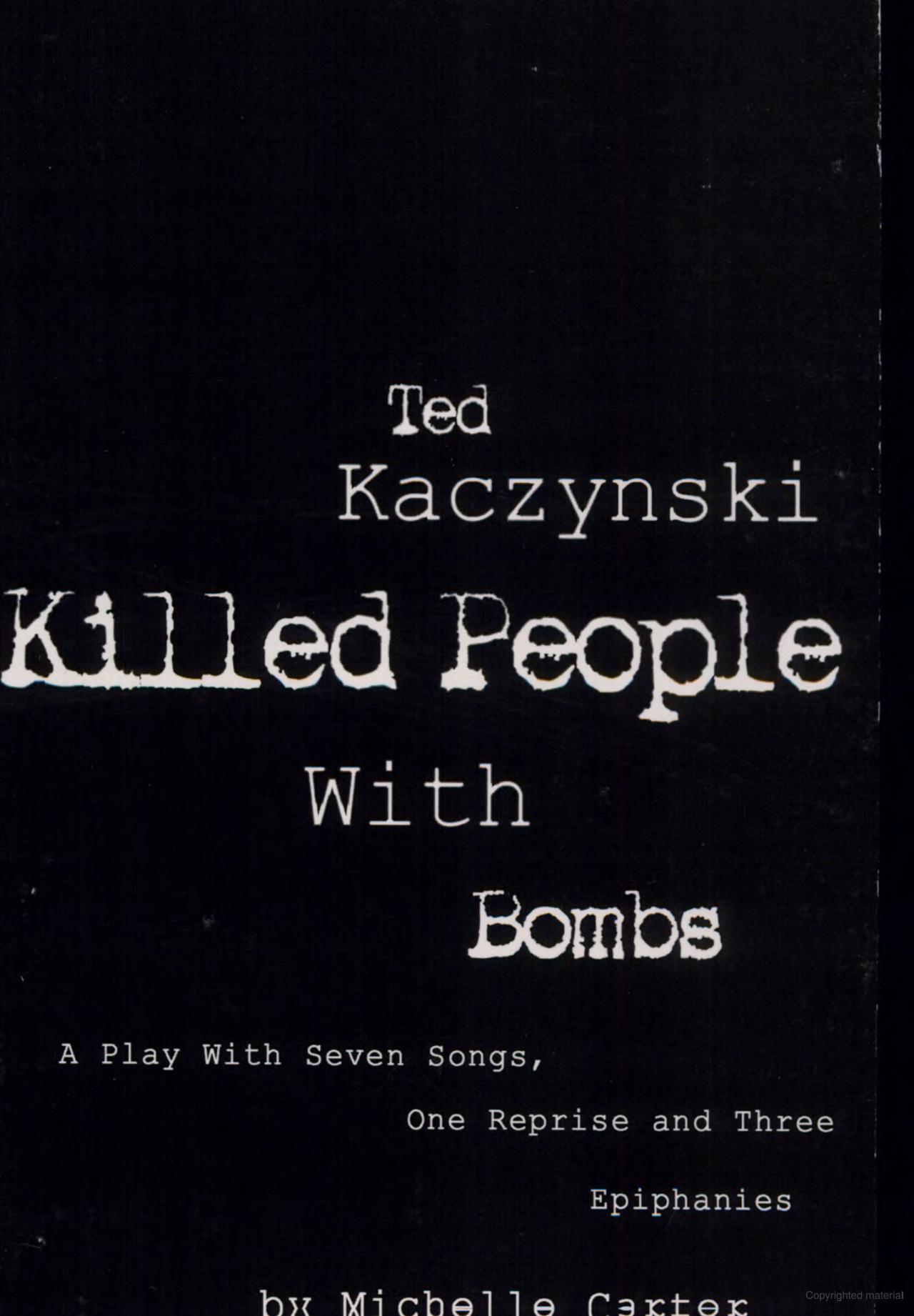
Ted Kaczynski Killed People With Bombs
A Play With Seven Songs, One Reprise and Three Epiphanies
Important Billing and Credit Requirements
Magic Theatre performance (2002)
Summer Play Festival performance (July 2005)
Donmar Warehouse performance (Sept 2005)
Cast: 3m., 3w. In awarding the 2003 PEN USA Literary Award for drama, the judges wrote: “Carter has constructed a kaleidoscopic postmodern exploration of the real-life events and influences that unleashed the Unabomber. Her comprehensive research and keen eye for insightful details result in vivid, gripping portraits of the alienated terrorist and those who knew him ... Carter lulls us into thinking that the disturbed mind of a homegrown terrorist is explainable, perhaps even forgivable—before lowering the emotional boom as the focus shifts from the eccentricities of the bomber to the horror inflicted on his victims ... Carter’s cautionary drama uncovers deeper truths to endure long past the limited shelf life of a media event.” staging. Approximate running time: 90 minutes.
About the Playwright
Michelle Carter is a lapsed fiction writer currently writing plays. She was one of 16 playwrights chosen from among 1200 applicants for Arielle Tepper’s 2005 Summer Play Festival in New York and one of two selected from that group for a residency at the Donmar Warehouse in London. Her first play, Hillary and Soon-Yi Shop for Ties, received the PEN USA Award for Drama in 2000; her second play, Ted Kaczynski Killed People With Bombs, received the PEN USA Award for Drama in 2003. Both plays premiered at San Francisco’s Magic Theatre. Another play, Let the Pony Sing, was commissioned by the Mark Taper Forum and presented in the Taper’s New Work Festival in March 2005 and nominated by the Taper for the Kesselring Prize. Snickerdoodles in Hell was produced at the Abingdon Theatre in New York in 2005. In addition to the PEN Award, Hillary and Soon-Yi Shop for Ties also won a Garland Award for playwriting, an American Theatre Critics Association Award nomination, and a Bay Area Critics Circle nomination for the score, which she co-composed with jazz artist Randy Craig. “Prometheus” appears in Plays for Actresses II (Eric Lane and Nina Shengold, editors, Vintage 2002). She has published novels with William Morrow and Penguin books as well as more than 30 short stories in magazines and anthologies. She is a professor in the Creative Writing program at San Francisco State University.
Ted Kaczynski Killed People
With Bombs
A Play With Seven Songs, One Reprise
and Three Epiphanies
By
MICHELLE CARTER
Dramatic Publishing
Woodstock, Illinois • England • Australia • New Zealand
*** NOTICE ***
The amateur and stock acting rights to this work are controlled exclusively by THE DRAMATIC PUBLISHING COMPANY without whose permission in writing no performance of it may be given. Royalty must be paid every time a play is performed whether or not it is presented for profit and whether or not admission is charged. A play is performed any time it is acted before an audience. Current royalty rates, applications and restrictions may be found at our Web site: www.dramaticpublishing.com, or we may be contacted by mail at: DRAMATIC PUBLISHING COMPANY, P.O. Box 129, Woodstock IL 60098.
COPYRIGHT LAW GIVES THE AUTHOR OR THE AUTHOR’S AGENT THE EXCLUSIVE RIGHT TO MAKE COPIES. This law provides authors with a fair return for their creative efforts. Authors earn their living from the royalties they receive from book sales and from the performance of their work. Conscientious observance of copyright law is not only ethical, it encourages authors to continue their creative work. This work is fully protected by copyright. No alterations, deletions or substitutions may be made in the work without the prior written consent of the publisher. No part of this work may be reproduced or transmitted in any form or by any means, electronic or mechanical, including photocopy, recording, videotape, film, or any information storage and retrieval system, without permission in writing from the publisher. It may not be performed either by professionals or amateurs without payment of royalty. All rights, including, but not limited to, the professional, motion picture, radio, television, videotape, foreign language, tabloid, recitation, lecturing, publication and reading, are reserved.
For performance of any songs, music and recordings mentioned in this play which are in copyright, the permission of the copyright owners must be obtained or other songs and recordings in the public domain substituted.
©MMVI by
MICHELLE CARTER
Printed in the United States of America
All Rights Reserved
(TED KACZYNSKI KILLED PEOPLE WITH BOMBS
A Play with Seven Songs, One Reprise
and Three Epiphanies)
For inquiries concerning all other rights, contact:
Bret Adams, Ltd., 448 W. 44th St., New York NY 10036
Telephone: (212) 765–5630
Important Billing and Credit Requirements
All producers of the play must give credit to the author of the play in all programs distributed in connection with performances of the play and in all instances in which the title of the play appears for purposes of advertising, publicizing or otherwise exploiting the play and/or a production. The name of the author must also appear on a separate line, on which no other name appears, immediately following the title, and must appear in size of type not less than fifty percent the size of the title type. Biographical information on the author, if included in the playbook, may be used in all programs. In all programs this notice must appear:
Produced by special arrangement with
THE DRAMATIC PUBLISHING COMPANY of Woodstock, Illinois
Ted Kaczynski Killed People With Bombs was commissioned by the Magic Theatre and Z-Space and premiered at the Magic Theatre—in a very different form—in 2002 (Larry Eilenberg, artistic director).
CAST
| K | Merle Kessler |
| Wild Nature | Celia Schuman |
| Mrs. K and others | Anne Darragh |
| David K and others | Mark Rafael Truitt |
| David Gelemter and others | David Cramer |
| Sixth Actor | Robert Parsons |
PRODUCTION STAFF
| Casting Director | Jessica Heidt |
| Sound Designer | Maribeth Back |
| Lighting Designer | Jim Cave |
| Costume Designer | Kira Kristensen |
MUSIC
| Composer | Michelle Carter |
The play was also produced at the Summer Play Festival in New York in July 2005 (Arielle Tepper, festival producer; Rachel Neuburger, artistic director; Kara Medoff and Marisa Sechrest, producers).
CAST
| Ted | Andrew Dolan |
| Wild Nature | Jessica Boevers |
| Mrs. Kaczynski | Kathleen Doyle |
| David Kaczynski et al | Ian Kahn |
| David Gelemter et al | Vin Knight |
| Linda Kaczynski et al | Barbara Pitts |
PRODUCTION STAFF
| Director | Jeremy Dobrish |
| Assistant Director | Jillian Apfelbaum |
| Stage Manager | Sid King |
| Set Designer | Steven Capone |
| Lighting Designer | Michael Gottlieb |
| Sound Designer | Jill BC Du Boff |
| Costume Designer | Heather Dunbar |
| Casting Director | Mark Simon |
MUSIC
| Composers | Gabriel Kahane, Michael Friedman |
| Musician and Foley Artist | Gabriel Kahane |
The play was also presented in the context of a residency at the Donmar Warehouse in London in September 2005 through the generous support of Jill Shaw Ruddock (Michael Grandage, artistic director).
CAST
| Ted | John Light |
| Wild Nature | Catherine Tate |
| Mrs. Kaczynski | Sian Thomas |
| David Kaczynski et al | Geoffrey Streatfield |
| David Gelemter et al. | Stanley Townsend |
| Linda Kaczynski et al | Claudie Blakley |
PRODUCTION STAFF
| Director | Angus Jackson |
| Residency Coordinator | Sarah Nicholson |
| Stage Manager | Sarah Waling |
| Assistant Director | Chris Rolls |
| Casting Director | AnneMcNulty |
MUSIC
| Composer | George Hinchliffe |
| Ukulele | George Hinchliffe |
Ted Kaczynski Killed People With Bombs
For 3 men, 3 women
Cast
TED (m), 35–50
DAVID KACZYNSKI (m): 7 years younger than Ted
(also plays Jeff, Turk, Sixties Guy and Math Department Chair)
DAVID GELERNTER (m): 40–55
(also plays Clark, Childhood Friend, Researcher 1, Singer, Freud, Unabomber 1, Kid, Cowboy 2 and Enraged Spouse)
WILD NATURE (w): Age is less important than a sexy, charismatic presence.
MRS. KACZYNSKI (w): 55–70
LINDA KACZYNSKI (w): 30–40
(also plays Jimmy, Elderly Neighbor, Researcher 2, Student, Ellen, Katie Couric, Unabomber 2, Interviewer, Comedian, Mom, Cowboy 1 and Unfaithful Spouse)
Music
Creative teams are welcome and encouraged to compose their own music for the songs. Information regarding music composed by Gabriel Kahane and Michael Friedman for the Summer Play Festival production can be obtained from the playwright’s agent, Bruce Ostler of the Bret Adams Agency in New York.
A musician and foley artist remains onstage throughout the play.
Running Time
Approximately 90 minutes with no intermission.
Scene i
(The iconic image of the Unabomber appears. Sound: A typewriter typing, cued by an onstage musician and foley artist who cues sound throughout the play.
Text appears: The positive ideal is Nature. Wild Nature: those aspects of the functioning of the Earth and its living things that are free of human interference and control.
WILD NATURE sound rises—jungle noise, animal calls, etc. Text continues:
Wild Nature includes human nature, those aspects of the functioning of the human individual that are not subject to regulation by organized society but are products of chance. Or free will. Or God. Or whatever.
WILD NATURE appears.)
WILD NATURE. I’d just kill to get published. (Beat.) A little in-joke. It’ll make sense later.
(Text appears: She’s Wild Nature.)
(WILD NATURE pauses, taking in the WILD NATURE sounds. To the musician:)
WILD NATURE (cont’d). The National Geographic soundtrack? A little trite, perchance? (The musician cuts the sound.) Thank you. (Out to audience.) You have no idea what I go through. (WILD NATURE cues the musician.) (She sings:)
Of my image, I am well aware—
My reputation’s quite beyond repair:
Wild Nature, dame of famine, flood, and frigid winters,
Piss her off and with a cough
She’ll blow your house to splinters.
Global warming, locusts swarming, rivers foul and silty—
Just say the word “environment” and everyone feels guilty.
It’s so Third World,
Old shoe, Passe!...
But nature’s at your service in the U.S.A.!
(Costume evolves. Music up-tempo...)
WILD NATURE (cont’d).
I’m your cruise control,
Your GPS,
Your blues patrol,
To shield you from dejectedness.
The times are terrifying
Your nerves are worn and frayed;
Who says it’s edifying
To be worried and afraid?
Cruise control
The times are complicated
Blues control
Angst is just so dated
Once upon a simpler time,
Wild Nature reigned:
Tooth or claw, freeze or thaw,
She could not be contained.
Oceans swelled expertly,
Just because they could;
Oil welled inertly,
Doing no one any good.
Nature made a monkey out of man in days of old—
But the times have tamed and trained her:
Now she does just what she’s told.
Neanderthal,
Or Naked Chef?
Virgin sprawl,
Or a fuel gauge all the way to F?
Feeling fragile? timid? spooked?
Alarmed? In need of mending?
Overawed?—well that’s why god
Begat the happy ending
Yang is cruel,
Yin a mite depressing—
As a rule,
Spin is quite a blessing
This story’s dark
This story’s true
Let’s find a way to tell it so its spell won’t torment you
(End of song.)
WILD NATURE (cont’d). This is the story of a man who did horrible things and had many quaint, obsolete ideas.
(FOUR SCHOOLCHILDREN enter with school desks.)
WILD NATURE (cont’d). Let us begin where all improving tales begin: the children.
(A recess bell rings.)
Scene ii
(WILD NATURE is a SCHOOLTEACHER. JEFF, CLARK and JIMMY take their places for the math bee. After each correct answer is given, the winner will remain standing and the loser will sit.)
SCHOOLTEACHER. Settle, boys. Take your seats. Time for this morning’s math bee. (They take their seats for the math bee.) Ready? (JEFF nods.) Jeff. (JEFF stands.) Jimmy. (JIMMY stands.) Twelve times four.
JEFF. Forty-eight. (JIMMY sits.)
SCHOOLTEACHER. Clark. (CLARK stands.) Nine times eight.
JEFF. Seventy-two. (CLARK sits.)
SCHOOLTEACHER. Jimmy. (JIMMY stands.) Fifty-six divided by seven.
CLARK (feeding JIMMY the answer). Eight.
JIMMY. Eight! I knew that!
SCHOOLTEACHER. Jeff. (JEFF stands. JIMMY sits.)
Thirty-two plus twelve.
JEFF (instantly). Forty-four. (JIMMY sits.)
SCHOOLTEACHER. Clark. (CLARK stands.) Fifty-nine plus twenty-one.
CLARK. Eighty. (JEFF sits.)
SCHOOLTEACHER. Jimmy. (JIMMY stands.) Seventy-nine minus twelve.
CLARK. Sixty-seven. (JIMMY sits.)
SCHOOLTEACHER. Ted. (Beat.) Ted? (Beat.) Ted!
(TED appears.)
TED. There once was a woman named Ellen
Whose private parts kept on a-swellin’
Men far and wide
Had explored her inside
Till it could not be mapped by Magellan
(Brightly.) I wrote that! (He steps out of the shack and paces the room.)
SCHOOLTEACHER. Let f denote a continuous function defined on the open unit disk in the complex plane.
TED. Then the boundary function for f is obtained by taking the limits off at arc p. (CLARK sits, confused.)
SCHOOLTEACHER. Jeff. (JEFF stands, also baffled.)
TED. The curvilinear convergence of/is the largest set on which a boundary function can be defined.
SCHOOLTEACHER. Clark. (JEFF sits and CLARK stands.)
TED. The set of all points inside the bounded function include set H, axis X, point p, and arc v:
SCHOOLTEACHER. Jimmy. (CLARK sits and JIMMY stands.)
TED. —indignity, loneliness, powerlessness, and rage. Thus:
SCHOOLTEACHER. Children! (All stand.)
TED. The industrial revolution and its consequences have been a disaster for the human race. (An explosion. The students dive under their chairs. Silence. Gently.) It’s okay. Come on out now. (Warily, they take their seats.)
SCHOOLTEACHER. Date. (The students continue going through the motions of the math bee.)
TED. May 26, 1978.
SCHOOLTEACHER. Description.
TED. Smokeless powder pipe bomb, brown paper, ten one-dollar Eugene O’Neill stamps.
SCHOOLTEACHER. Target.
TED. Lazy fat ignoramuses rejecting my paper.
SCHOOLTEACHER. Victim.
TED. Terry Marker, security guard. (Indicating the shack upstage.) Get to work!
(The musician plays an amiable, engaging, toe-tapping number. Two students rush to the playhouse shack. As TED continues, they pull bombs from the shack and set
them one by one about the stage. The pace of the following accelerates as it moves, becomes frenetic.)
SCHOOLTEACHER. Date.
TED. May 9, 1979.
SCHOOLTEACHER. Description.
TED. Booby-trap bomb, Phillies-brand cigar box.
SCHOOLTEACHER. Target.
TED. Lazy fat ignoramuses rejecting my paper.
SCHOOLTEACHER. Victim.
TED. John Harris. Student. Civil engineering.
SCHOOLTEACHER. Date.
TED. November 15, 1979.
SCHOOLTEACHER. Description.
TED. Smokeless powder mail bomb, “America’s Light Fueled By Truth and Reason” one-dollar stamps.
SCHOOLTEACHER. Target.
TED. Fuel-guzzling smoke-spewing noise-belching skyraping—
SCHOOLTEACHER. Victims.
TED. Fourteen passengers. Smoke inhalation. Small potatoes.
SCHOOLTEACHER. Date.
TED. June 10, 1980.
SCHOOLTEACHER. Description.
TED. Booby-trapped book: Ice Brothers by Sloan Wilson.
SCHOOLTEACHER. Target.
TED. Fuel-guzzling smoke-spewing noise-belching skyraping—
SCHOOLTEACHER. Victim.
TED. United Airlines president Percy Wood. Wood. Get it?
SCHOOLTEACHER. Date.
TED. October 8, 1981.
SCHOOLTEACHER. Description.
TED. Smokeless powder pipe in gasoline can.
SCHOOLTEACHER. Target.
TED. Bloodless arrogant ivory-tower— SCHOOLTEACHER. Victim.
TED. Janitor. Unhurt. No one even injured.
SCHOOLTEACHER. Date.
TED. May 5, 1982.
SCHOOLTEACHER. Description.
TED. Pipe bomb, three forwarding addresses.
SCHOOLTEACHER. Target.
TED. Bloodless arrogant ivory-tower— SCHOOLTEACHER. Victim.
TED. Secretary. Lacerations from shrapnel. Can’t seem to make a lethal bomb.
SCHOOLTEACHER. Date.
TED. July 2, 1982.
SCHOOLTEACHER. Description.
TED. Note enclosed: “Mackenzie—it works! I told you it would.” Get it?
SCHOOLTEACHER. Target.
TED. Arrogant, smug, self-important— SCHOOLTEACHER. Victim.
TED. Mangled hands, face, and so on. Gasoline failed to ignite and kill.
SCHOOLTEACHER. Date.
TED. Next.
SCHOOLTEACHER. Date.
TED. Next.
SCHOOLTEACHER. Date.
TED. Next.
SCHOOLTEACHER. Date.
TED. Next! December 11, 1985.
SCHOOLTEACHER. Description.
TED. Eight long years of painstaking work.
SCHOOLTEACHER. Target.
TED. Lethal at last!
SCHOOLTEACHER. Victim.
TED. Hugh Scrutton. Computer store owner. Quick, clean, painless, and humane.
SCHOOLTEACHER (aside). I’d just kill to get published. Get it?
TED. February 20, 1987.
SCHOOLTEACHER. The victim’s mother watching from the window.
TED. June 22, 1993.
SCHOOLTEACHER. Professor at a medical school.
TED. June 24, 1993.
SCHOOLTEACHER. A musician who loved Palestrina’s Missa Brevis.
TED. December 10, 1994.
SCHOOLTEACHER. The children asleep in the next room.
TED. April 24, 1995. The peak, the summit.
SCHOOLTEACHER. The beginning of the end.
TED. We have a long article that must be published in the New York Times, Time, or Newsweek.
SCHOOLTEACHER. Penthouse says they’ll publish you!
TED (firmly). The New York Times, Time, or Newsweek. SCHOOLTEACHER. The demand was met.
TED. The Industrial Society and its Future is published by the New York Times and the Washington Post. My manifesto.
SCHOOLTEACHER. It was a trick. The FBI wanted to see if someone would recognize your writing. Someone did. (Music off.) That’s it. It’s over. So. Why?
SCHOOLCHILDREN. Yeah...why?
(Word appears: Why?)
TED. Why, children? (TED begins to exit, whistling a melodic line we ’re to hear him whistle throughout the play. He turns back to them.) The clothes on my back, a bedroll, and a sky full of stars.
(He disappears into the shack. WILD NATURE cues the musician, sings:)
WILD NATURE.
There are worms that never have to eat—
They grow as long as thirty-seven feet.
There’s a fish that changes sex at will:
We can’t explain that nifty skill
A freak of nature’s never what he seems—
He’ll spook the cats and clutter up your dreams.
So as you’re tickled, teased, and entertained,
Relax!, each foul and fearsome act will henceforth be (a grand arpeggio...)
...explained!
(Music shifts. The musician gives the schoolchildren instruments.)
WILD NATURE (cont’d).
Was it Mama’s nagging when he didn’t clean his room?
Was it Papa’s bragging from the day he left the womb?
Was it leftist teachers and their liberal arcana?
Or the quadrupedded creatures that he tortured in Montana?
Could’ve been that sophomore girl for whom he skinned a cat
Or the comely truck-stop waitress who politely told him “Scat”
Or the sounds of sex through dorm room walls that made him call police
Or that plans of mutilation gave him sexual release
ALL.
Mystifying crimes
Complicated times
WILD NATURE.
Was it nerds with laptops and their droll enthusiasms?
Or scientists in labcoats doing tricks with genoplasms?
Or jumbo jets and aeroplanes creating noise pollution?
Or was it that he hoped to instigate a revolution?
ALL.
Mystifying crimes
Complicated times
WILD NATURE.
Questions bring us cheer
When explanation’s near
(Music off. WILD NATURE and children bow.f
WILD NATURE (cont’d). Explanation Number One. Childhood.
(Word appears: Childhood. The walls of TED’s playhouse shack fall, exposing him. ACTORS playing CHILDHOOD FRIEND, ELDERLY NEIGHBOR, TURK and MRS. KACZYNSKI pull their costumes on in view of the audience. The world of TED’s childhood is assembled around him.)
Scene iii
(CHILDHOOD FRIEND enters. ELDERLY NEIGHBOR enters reading her Bible.)
CHILDHOOD FRIEND. Chicago, Illinois: the neighborhood we called The Back of the Yards. Come spring, us Polack kids played stickball in the hair field, where butchers stretched out hog’s hair and cattle hides to dry.
ELDERLY NEIGHBOR. Stench is the only word. Back of the Yards, for a mile or so you could always smell it, the rendering, the killing. Ted Junior had ten years of that stench in his nose. I always thought there was something to that.
(Lights up on TURK, twisting sausages into links.)
CHILDHOOD FRIEND. Turk—Ted’s dad—he wasn’t meant to be a sausage maker. He developed one of the first synthetic casings out of formaldehyde. He also invented a foam cutter out of hot wire because the kind they had was leaving the foam sticky.
ELDERLY NEIGHBOR. If he’d taken out a patent or two, he’d’ve left the world a rich man.
TURK. Dear Editor. Isn’t it puzzling that the world “liberal” is used to evoke something bad? Here are some things the liberals have given us: Social Security, federal deposit insurance, unemployment insurance, the right to join or not to join a union, the G.I. Bill, Medicare, and student loans. Ha!
(MRS. KACZYNSKI sits TED at a typewriter.)
ELDERLY NEIGHBOR. Turk and Wanda Kaczynski took magazines nobody else had even heard of. They were always holding some kind of meetings—you’d see people walking home with books under their arms. In their old age, they’d travel to youth hostels to take classes and call it a vacation. You ask me, that’s a kind of disease.
MRS. KACZYNSKI. Dear Editor. (TED begins typing.) The most frequent criticism one hears of the British national health plan is that elective surgery is not readily available. To millions of uninsured—
TURK. —or underinsured...
MRS. KACZYNSKI, —or underinsured people in the U.S., not only is elective surgery unavailable, even primary care is out of reach.
ELDERLY NEIGHBOR. She always let Ted type the letters to the editor. She wanted him to practice not looking at the keys.
CHILDHOOD FRIEND. My father and Mr. Kaczynski loved to sit around for hours and bait each other. One of their favorite bull session topics was survival in the wilderness, with this science fiction twist. (TED stops typing.)
TURK. What if you woke up tomorrow to discover there’s been a nuclear holocaust? As far as you know, everyone and everything is gone and only you remain. There’s no electricity or generators or machinery of any kind. What kind of world will you create? How will you survive in it?
CHILDHOOD FRIEND. You could just look at Ted and see the wheels turning.
TURK (in the midst of a heated argument). Technology’s gonna reinvent civilization? You got a point there, pal. Every night I turn on the news, I see technology reinventing Vietnam. I see rice fields reinvented into wastelands, I see children reinvented into corpses. Technology’s all yours. Enjoy. Live it up till it kills you.
ELDERLY NEIGHBOR. Turk took his own life in 1990, his body riddled with inoperable cancer.
TURK. Me, I’m packing it up to live with the Amish. (TURK exits.)
(MRS. KACZYNSKI presents TED with a calculus book and pencil. He absorbs himself in calculation as she looks on proudly.)
ELDERLY NEIGHBOR. One more thing. Wanda Kaczynski was a moral and compassionate person—volunteered at the grade school, helped the old widows in the neighborhood so they wouldn’t have to go to nursing homes. But she believed that the Bible and the Christian story were a myth. That’s something I can’t overlook in a person.
TED (slams the textbook shut). 1 hate this stupid problem. MRS. KACZYNSKI. Don’t be a baby.
TED. It’s stupid and I hate it.
MRS. KACZYNSKI. Your math skills are high school level. Sophomore level.
TED. It’s a trick. A mean trick to make a person look stupid and you gave me this book and I hate you.
MRS. KACZYNSKI (pause). You live in the greatest country in the world, for all its faults, and you are special, the best. If you work hard, you will rise to the top and everything in life will come to you. It’s the way society works. That is no trick: it’s a promise. (MRS. KACZYNSKI pulls the paper from the typewriter, begins making a paper airplane with a few quick folds.)
ELDERLY NEIGHBOR. The Kaczynskis got their values from worshipping knowledge. There’s consequences to that.
(TED takes the paper airplane, finishes it.)
MRS. KACZYNSKI. Nothing you can’t be. My special boy.
(TED holds the airplane aloft. ELDERLY NEIGHBOR and CHILDHOOD FRIEND exit. WILD NATURE enters in a lab coat.)
WILD NATURE. Explanation Number Two. Harvard.
(Word appears: Harvard.)
Scene iv
(MRS. KACZYNSKI dresses TED for Harvard.)
WILD NATURE. Dr. Henry A. Murray. (She dons a wig. As DR. MURRAY:) The atomic bomb is the logical and predictable result of the course we have been madly pursuing for a hundred years. The kind of behavior that is required by this threat involves transformations of personality such as have never occurred in human history. In service of this research, we will engage 200 Harvard students, randomly selected, in a three-year study. It’s the intention of this research to, to, to promote the survival of Modern Man, by means...in regard...in the interest... (Pulling it out of her arse.) World Peace!
(MRS. KACZYNSKI kisses TED goodbye and exits. RESEARCHER 2 enters with a clipboard.)
RESEARCHER 2. Excuse me. (TED turns to the researcher fearfully.) Would you be willing to serve as a subject in a three-year experiment, requiring about two hours of your time per week, at the current college rate per hour.
TED. Rate...of pay?
(RESEARCHER 2 exits and RESEARCHER 1 joins TED. TED is miserably shy and uncomfortable.)
WILD NATURE AS DR. HENRY A. MURRAY. Year one. Each subject will write a lengthy account of his personal history—birth, childhood, adolescence, personal goals, religious beliefs, and sexual experiences.
TED. None.
RESEARCHER 1....Petting?
TED. None.
RESEARCHER 1....Fondling?
TED. None.
RESEARCHER 1....Kissing?
TED. Reference to question 12 will reveal that an applicable response has already been documented.
RESEARCHER 1 (pause). There’s something I need you to understand. There are no right or wrong or good or bad or shameful answers possible. In this room you will always be safe.
TED (gathering his things and standing to go). I don’t know if I have the time to commit to this experiment.
RESEARCHER 1. Sure, sure—an outstanding student such as yourself. I’d hate to have to break it to Dr. Murray.
TED. Break what?
RESEARCHER 1. The news. That you’re unavailable.
TED. Would Dr. Murray care?
RESEARCHER 1. Mr. Kaczynski. This is very important work we’re beginning, and we require young men of the very highest caliber.
TED (flattered). I see. (He sits.) Ted.
RESEARCHER 1. I’m sorry?
TED. Please call me Ted.
RESEARCHER 1 (smiles, returns to the clipboard).
...Masturba—
TED (cutting him off). Yes.
RESEARCHER 1 (pause. He rises). Outstanding work, Ted. (The RESEARCHER extends his hand to TED. TED looks at the RESEARCHER’s hand. Beat.)
(RESEARCHER 2 enters.)
WILD NATURE AS DR. HENRY A. MURRAY. Year two. Personality assessment by objective measure.
RESEARCHER 2. Rorschach Test.
RESEARCHER 1. Maudalay Personality Inventory.
RESEARCHER 2. Minnesota Multiphasic Personality Inventory.
RESEARCHER 1. Time-Metaphor Test.
WILD NATURE AS DR. HENRY A. MURRAY. The results will be plotted to develop a psychological portrait of each personality in all its dimensions.
RESEARCHER 2. Philosophical Outlook Test.
RESEARCHER 1. Odor Association Test.
RESEARCHER 2. Food-Preference Inventory.
RESEARCHER 1. Inventory of Self-Description.
RESEARCHER 2. The Wyatt Fingerpainting Test.
RESEARCHER 1. The Rosenzweig Picture Frustration Test.
WILD NATURE AS DR. HENRY A. MURRAY. And a projective test of my own design:
RESEARCHER 1 & 2. The Thematic Apperception Test.
(RESEARCHER 2 takes RESEARCHER Is place. He holds up a picture card: the T.A.T. drawing of a violin and a boy.)
RESEARCHER 2. Study the picture and tell me three things. What’s happening in this picture? What happened before this moment? What will happen next?
TED. I’m sorry?
RESEARCHER 2. What’s happening in this picture? What happened before this moment? What will happen next?
TED (studying the image). There’s no way of knowing what will happen next.
RESEARCHER 2. What’s happening in the picture now?
TED. A violin rests on a table. A boy is looking at the violin.
RESEARCHER 2. Does he want to pick it up?
TED. The picture gives no indication.
RESEARCHER 2. It’s your story to tell, Ted. Make it yours.
TED. Invent a story that isn’t here?
RESEARCHER 2. Based on what’s here, and your own associations.
TED. I’ll try.
RESEARCHER 2. Great. What does the boy want?
TED. He wants to play the violin.
RESEARCHER 2. Will he play?
TED. No.
RESEARCHER 2. Has he taken lessons?
TED. He’s taken years and years and years of lessons.
RESEARCHER 2. Then why doesn’t he play?
TED. Everyone expects him to be the best.
RESEARCHER 2. And he’s not.
TED. He is. He is the best.
RESEARCHER 2. Doesn’t that give him pleasure?
TED. Only when he’s alone.
RESEARCHER 2. Isn’t he alone now?
TED. He knows.
RESEARCHER 2. He knows what?
TED. That we’re here. You and I. Watching.
(Pause. RESEARCHER 2 rises.)
RESEARCHER 2. Outstanding work; Ted. (RESEARCHER
2 extends his hand. TED looks at the hand; awkwardly takes it; they shake.)
WILD NATURE AS DR. HENRY A. MURRAY. Year three. Procedures to monitor subject’s responses in the context of highly stressful interaction.
(RESEARCHER 1 enters with a mammoth stack of notebooks.)
TED. I hope I’ve submitted everything you requested.
RESEARCHER 1. Terrific work, Ted, just terrific. Everyone on the team has reviewed your materials and we’re eager to get to work.
TED. Work? (Sound: ambient, menacing. Harsh spot on TED. RESEARCHER 1 places a headband of wires and electrodes on TED’s head.) What’s happening?
RESEARCHER 1 (mimicking him). What’s happening?
(RESEARCHERS laugh. RESEARCHER 2 opens the top folder on the stack. He shakes his head.)
TED. Is something wrong?
RESEARCHER 2. “Individual...ization”?
TED. Yes?
RESEARCHER 1. As opposed to, “individuation.”
TED. I hadn’t thought...
RESEARCHER 2. Really?
TED. What I mean is—
RESEARCHER 1. You “hadn’t thought” whether it was “individualization” or “individuation” you were championing?
TED. The lapse is quite embarrassing. What I meant to say was—
(RESEARCHERS begin tossing TED’s notebooks one by one to the ground at his feet.)
RESEARCHER 2. Nietzsche! Here we go. No undergraduate credo would be complete without the Apollonian/Dionysian opposition.
TED. I hadn’t intended to be unoriginal.
RESEARCHER 1. Do undergraduates intend to be unoriginal? (They have a chuckle.)
TED. As I tried to say in the Philosophy of Life questionnaire, I find the notion of “will to power” very compelling. In fact—
RESEARCHER 2. “Matricentric emasculation.” Now that’s original...
RESEARCHER 1. A concept based upon, shall we assume, your mother?
TED. If we could return to the question.
(He goes to the floor, gathering notebooks.)
RESEARCHER 1. Is, let’s just say, “the mother” in this paradigm the Apollo to “the son” ’s Dionysus, or the Dionysus to “the son” ’s Apollo?
TED. I hadn’t seen the Nietzschian paradigm and this... other paradigm to be symbiotic, or even compatible—
RESEARCHER 2. A year of rumination and study, only to posit incompatible paradigms?
TED. I hadn’t expected—
RESEARCHER 1. Is that of interest, Ted? What one expects?
TED. As it was explained. You made me feel’—
RESEARCHER 2. “Feel”?
TED. You led me to believe—
RESEARCHER 1. Believe what, Ted? That you shit fruit salad? (Pause.) That you’re special?
(Silence. TED’s anger builds.)
TED. So that’s it. That’s the trick.
RESEARCHER 2. “Trick”?
TED (intermittently hyperventilating). The violin, the boy: the best. The way society works. Outstanding, Ted. The handshake. The handshake. (Anger erupting.) A lousy trick. (He kicks the notebooks, scattering them. Pause.)
(Lights restore, sound off. DR. MURRAY and the RESEARCHERS applaud, pat TED on the back warmly, remove the headgear, gather the notebooks.)
WILD NATURE AS DR. HENRY A. MURRAY. Outstanding work, Ted.
TED. I would like to leave.
RESEARCHER 1. Shhh. We’ll be finished shortly.
TED. We’re not finished?
WILD NATURE AS DR. HENRY A. MURRAY. This is the most important part of the session. We watch.
(A recording of TED’s outburst begins to play: “The way society works... The handshake... A lousy trick”—in looped repetition. All gather, facing out. They watch.
MRS. KACZYNSKI appears.)
MRS. KACZYNSKI. You are the best: if you work hard, everything in life will come to you. It’s the way society works. My special boy.
(WILD NATURE pulls off her gray wig.)
WILD NATURE. Explanation Number Three. Berkeley.
(Word appears’ Berkeley.)
Scene v
(Music up. Lights up on SIXTIES GUY, passing out leaflets in Sproul Plaza in 1969. He steps out of the scene to address us in the present.)
SIXTIES GUY. What a time it was. You felt like the world was being born and you were in the delivery room with scrubs on. Kaczynski started teaching at Berkeley in ’67, the year of the first Human Be-in, and quit in ’69, a month after police fired on protesters at People’s Park. It was us-versus-them: you were on our side, or you were one of the pigs. Berkeley must have radicalized Kaczynski, stirred passions within him that mathematics couldn’t possibly contain. I’d give anything to have known him then. He must have been on fire.
(Lights up on a frightened, timid TED with a stack of papers in his arms, summoning the courage to cross Sproul Plaza. SIXTIES GUY steps back into 1967. He offers TED a leaflet—TED is startled and his papers fall from his arms. SIXTIES GUY tries to help collect the papers but TED’s hostility dissuades him. SIXTIES GUY exits. A SINGER enters playing guitar. TED stops collecting papers to regard him with horror...)
SINGER....This land is your land / This land is my land / From California / to the New York island / From the redwood forests / to the gulf stream waters / This land was made for you and me / I roamed and rambled (Etc.)
(Overlapping: TED mutters, trying to drown out the song...)
TED. Six strings length of string .628 meter, mass of string .208 gram under a tension of 226 Newtons. C natural at 3600 hertz G major 3375 hertz D minor 3000 hertz frequency... (The SINGER notices TED and stops singing. TED continues.) ...Combinatorial structure of symmetry patches employs paradigmatic repetition of a suitable symmetry regarding time, transposition, augmentation, inversion— (TED stops. Pause.)
SINGER. Request?
TED. Request?
SINGER. Anything you’d like to hear me play?
TED (gathers his papers and stands). Leftists hate anything that is strong, good, and successful. They hate America, they hate Western civilization, they hate white males, they hate rationality. They say they hate the West because it is warlike, imperialistic, and sexist, but when these same faults appear in socialist countries or primitive cultures, the leftist finds excuses for them. I feel nothing but contempt for everyone in this square.
SINGER. Wow. Contempt. (Pause. Suddenly searching his pockets...) W’here did 1 put that tab of groovy lemon...
(A female STUDENT rushes in.)
STUDENT. Professor Kaczynski? Could I talk to you for a minute?
SINGER. Request?
STUDENT. No thanks, I’ve got a midterm.
SINGER. Right on. (SINGER exits. The STUDENT goes to TED.)
STUDENT. I’m really sorry about missing the midterm yesterday. Tm not going to lie and say I was sick because I wasn’t, just like I wasn’t sick when the last two problem sets were due.
TED. Who are you?
STUDENT. Susan Kline. We talked last week in your office.
TED. What class are you in?
STUDENT. Theory of Sets. We talked about a quiz I didn’t exactly pass. I’ve always been a good student, and proud of it. But this is just...just a really hard time for me.
TED. The TAs will be holding a makeup exam next week.
STUDENT. I know. Tm going to do everything I can to make it. I’m going home to Thousand Oaks every weekend to help out my mom, sometimes I’m driving back in the middle of the night.
TED. The makeup exam is on your syllabus.
STUDENT. I have it written down. I guess all I’m saying is... (Beat.) I didn’t want you to think... (Pause.) It’s the strangest thing. I’m talking and you’re watching but there’s nothing behind your eyes.
(Pause. TED and the STUDENT leave the plaza in different directions. TED rushes to his apartment, shuts, locks and bolts the door. Safe. He opens the window. The sound of a People’s Park demonstration floods in. He slams the window shut. He opens a cupboard. The STUDENT’S head pops out of the cupboard:)
STUDENT (cont’d). I’m a good student, I swear, it all started last fall, my father’s prostate— (He slams the cupboard shut. Silence.)
(He opens another cupboard: the head of the MATH DEPARTMENT CHAIR pops out.)
MATH DEPARTMENT CHAIR. The tenure committee respects your research, Ted. But boundary functions are a backwater, that whole field is drying up— (He slams the
cupboard shut. Pause. The MATH DEPARTMENT CHAIR pops out of somewhere else.) About those teaching evaluations—
(TED slams shut whatever the CHAIR popped out of. Silence. He takes off his tie and jacket. Puts on a hooded sweatshirt. Gets a hammer and nails. He nails the window shut. Nails each of the cupboards shut. In the process, he’s transforming his Berkeley apartment into the Montana shack. WILD NATURE appears.)
WILD NATURE. Explanation Number Four. Shhhhhh... (Stage whispered to audience:) Mental Illness.
(Word appears: Mental Illness. SIGMUND PREUD enters.)
Scene vi
(SIGMUND FREUD sings while TED hammers:)
FREUD.
The basic drives of the paranoid patient
Are products of unconscious homosexuality
The drive is repressed through the following strategies: One:
Denial
Two:
Projection and
Three:
Reaction Formation
“I
love
him”
denied becomes
“I
hate
him”
Which further projects and protracts and reacts into “He hates
me.” ...Everybody!
(FREUD leads the audience in a sing-along of the last verse, through several repetitions.)
Denial of the homosexual urge begets
Grandiose delusions:
“I don’t love him...”
Becomes: “I love no one...”
Hence: “There is no worthy recipient of love...
Except
My-
Self.”
(FREUD takes his bows, exits. TED shuts and locks the door of the cabin.)
WILD NATURE. Wait. Not yet. It’s not time. (TED peeks out of the cabin.) One more chance at a normal life? (Pause. TED steps out of the cabin. WILD NATURE continued.) Explanation Number Five. Ellen.
(Word appears: Ellen. WILD NATURE hands TED a lunch pail.)
Scene vii
(Words appear: FC Foam Cutters. TED sits in the factory lunchroom, pulling baggies of vegetables from his lunch pail. ELLEN enters. Watches him.)
ELLEN. You’re making a salad.
TED (flustered). I wasn’t expecting you.
ELLEN. It’s the lunchroom. At lunchtime.
TED. I’m delighted. Please join me in a watercress salad.
ELLEN. Thanks, I already—
TED. The carrots are disappointing, though the radishes have some bite.
ELLEN. Thanks, but—
TED. It is next to impossible to find a carrot with any discernible sweetness. One has to grow them onesself—
ELLEN (firmly). I don’t want any salad.
TED. Why not?
ELLEN. I already ate a tuna sandwich.
TED. Oh. Fair enough. (Awkward pause.)
ELLEN. You should go ahead and keep eating though.
(TED takes a bite, very self-conscious now.) I got your note.
TED. Thank you.
ELLEN. For what?
TED. For...your courtesy in responding.
ELLEN. You’re welcome. I mean. I enjoyed picking apples with you on Saturday.
TED (thrilled). You did?
ELLEN. It was nice.
TED (unbearably pleased). I knew it was nice! I knew there was something nice between us!
ELLEN. Wait—
TED. This Saturday, presuming you’re free, I’ve been planning a root vegetable picnic.
ELLEN. That sounds fun, but—
TED. Picnic at sunset, then a rigorous hike. Evening is the best time for a hike—the cooling earth beneath your feet, the night air on your skin. Just the clothes on your back, a bedroll, and a sky full of—
ELLEN. Ted! (Silence.) There’s something I thought I should say. What I thought I should say is, I hope I haven’t given you the wrong idea.
TED. I don’t have wrong ideas. (She laughs. He laughs.) ELLEN. You know the kind of ideas I mean.
TED. Perhaps you could be more specific.
ELLEN. Ted. You’re a really nice guy, really smart and sweet. And I really like working with you. But the truth is, I don’t think we have all that much in common. (Long pause.)
TED. So you mean to say... (Pause.) The truth of the matter is... (Pause. He’s just crushed.) Oh Ellen. You collected apples in your sunhat and you looked so happy. (Pause. Suddenly TED starts packing up his food.)
ELLEN. You didn’t eat much of your salad.
TED. I have business to attend to.
ELLEN. I hope I didn’t—
TED. Not to worry.
ELLEN. Really?
TED. I have things in my mind.
ELLEN. On your mind.
TED. My mind is an exceedingly recondite place.
ELLEN. Oh. Well. (Beat.) I guess I’ll see you on the floor.
(ELLEN exits. TED watches her go. Lights shift: true crime/noir music up.)
TED. You’re at that lowlife bar with your slutty friends eating pretzels and drinking rum and Tab. I wait in the dark backseat of your unlocked 4-cylinder Ford Ranchero with optional headrests and C6 transmission. At two a.m. you climb in smelling of cigarettes and I let you reach the street before I take control. In high school I would hate someone but revenge was but a dream— years of anti-crime propaganda had filled me with irrational fear. But when I feel cold steel—stainless steel plus aluminum alloy—slash the sinew of this sallow little slut, when the map of her face is redrawn by my incisions I am no longer powerless. No longer humiliated. At last, to have revenge. At last! (Lights shift, music off.) Or maybe I’ll just post my limerick.
(The next day. DAVID KACZYNSKI sits at his desk. A nameplate reads: DAVID KACZYNSKI. TED enters. DAVID holds up a sheet of paper.)
DAVID KACZYNSKI. What’s this?
(TED whistles a melodic line.)
TED. Your turn.
DAVID KACZYNSKI. Not now. What’s this?
TED. And good morning to you, little brother.
DAVID KACZYNSKI. Don’t call me that here.
TED (beat: that stung). Fancy.
DAVID KACZYNSKI. What?
TED. The nameplate. Very managerial.
DAVID KACZYNSKI. You’ve seen it every one of the twenty-three days you’ve been working here. (Holding up the paper.) Your supervisor—
TED. Broken?
DAVID KACZYNSKI. What?
TED. My birthday gift. You’ve changed your watch.
DAVID KACZYNSKI. I— Broken. Yes. (Re the paper in his hand.) What’s this?
TED. I tucked some radishes into your lunch pail, though I know you’ll only ruin them with salt.
DAVID KACZYNSKI. Are you going to make me say it again?
TED. I find rhetorical questions wearing. (Rhetorically.) Don’t you?
DAVID KACZYNSKI (reads from the paper).
There once was a woman named Ellen
Whose private parts kept on a-swellin’
Men far and wide
Had explored her inside
Till it could not be mapped by Magellan.
TED. Just last night I was looking through the boxes in Mom’s attic for that book of dirty limericks we used to pore over—remember? The one we swiped from that yard sale?
DAVID KACZYNSKI. You can’t post something like this in a public workspace.
TED. I think I remember one of your favorites...
There once was a butcher named Sims
Who married a woman of whims
She said “No!” once too often
So he bought her a coffin
And made farewell love to her limbs.
(Beat.) Did I get it right?
DAVID KACZYNSKI (crumples the paper). This can’t happen anymore. If it were to continue—
TED. You might be forced to crumple again?
DAVID KACZYNSKI. You know what Td be forced to do.
TED (pause). I didn’t find the limerick book. I found something even better. Open your lunch pail.
DAVID KACZYNSKI. I’ll open it at lunchtime.
TED. While I’m here. Go ahead.
(DAVID opens his lunch pail. He pulls out a small homemade book. He’s delighted.)
DAVID KACZYNSKI. Blood on the Iceberg’. The book about the Titanic you made me.
TED. One of my more memorable gifts—more so apparently than the watch.
DAVID KACZYNSKI. Chapter One: The Ill-Fated Captain.
TED (from memory). Edward John Smith was bom to a potter’s wife in 1850. He won many medals in the Boer War—B-O-R-E, misspelled!
DAVID KACZYNSKI. On the morning of April 10, 1912, he dressed in his usual bowler hat and long overcoat—
TED & DAVID KACZYNSKI (together). —unaware of the bloody fate that would soon befall him. (Pause. DA VID returns the book to the lunch pail)
DAVID KACZYNSKI. Thank you.
TED (reaches into the lunch pail and pulls out the bag of radishes). Remember? Our little ritual? (He takes a radish out of the bag and hands it to DA VID.)
DAVID KACZYNSKI. To swallow a secret.
TED. The recitation of the secret-keeper’s vow was to be followed by the swallowing of a radish whole.
DAVID KACZYNSKI. Which hurt like hell.
TED. It’s supposed to hurt, little brother.
(Pause. DAVID puts the radishes back in the lunchbox, closes the lid firmly, latches it shut.)
DAVID KACZYNSKI (holding up the crumpled paper). I don’t want to see anything like this, ever again.
TED. So that’s it then.
DAVID KACZYNSKI. What?
TED. That “brotherly love” I’ve heard so much about.
DAVID KACZYNSKI. Please.
TED (mimicking him). Please.
DAVID KACZYNSKI. Stop this.
TED. Stop this.
DAVID KACZYNSKI. You’re my brother and I love you.
TED. You ‘re my brother and I—
DAVID KACZYNSKI. Don’t do this to me.
(Pause. TED takes the crumpled paper from him.)
TED. Wherever one is taken down, ten will appear.
DAVID KACZYNSKI. If that were to happen, then as you superior I—
TED. Superior. That’s a dandy trick.
DAVID KACZYNSKI. There is no trick. You can post obscene material denigrating one of your co-workers, or you can keep your job.
TED. Speaking as my superior.
DAVID KACZYNSKI. My position—
TED. A title, bestowed upon you by our own munificent father.
DAVID KACZYNSKI. This isn’t about family.
TED. What’s the famous line?—“Happy families are all alike, and unhappy families promote the superior.”
DAVID KACZYNSKI. Quotation under stress—that’s your trick.
TED. Tolstoy is hardly a trick.
DAVID KACZYNSKI. Deflection is a trick.
TED (rage erupting). Love is the trick. (Pause: he begins hyperventilating a series of strange repetitive exhalations. Desperately:) This is a matter of life and death. 1 have got to know that every last tie joining me to this stinking family has been cut forever and that I will never, never have to communicate with any of you again. I can’t tell you how desperate I am. It is killing me.
(DA VID exits. Lights up on the shack.)
WILD NATURE. All right then. It’s time. (TED takes his place at the typewriter. WILD NATURE continues.) Explanation Number Six. The Manifesto.
(Words appear: The Manifesto.)
Scene viii
(TED sits at the typewriter, poised to type. Nothing comes. He consults the top page on a stack. Reads:)
TED. Leftists protest by lying down in front of vehicles. Self-hatred, thus, is a leftist trait... (Straining for another thought.) Another leftist trait... Leftists believe leftists want leftists fear... (A new thought. Typing:) Feelings of inferiority are characteristics of the modern leftist. By “feelings of inferiority,” we mean... (Beat.) ...we mean... (Bitterly.) low self-esteem, depressive tendencies, defeatism, self-hatred, and powerlessness, Mother... (He finds the letter. Gets a pen and changes a few words. He reads:) Dear Mother. You may not know that emotional trauma in childhood has been shown to retard growth: it is no accident that I am a full three inches shorter than my brother. You forced me to behave in ways most unnatural to an adolescent boy. Even on the most temperate of spring days, I was expected to sit in a chair and study. (Pause. A shift from rage to sorrow.) If a tree falls in the forest and no one hears. No one hears. (A microphone lowers into the shack. TED watches it.) I will make them hear.
KATIE COURIC (O.SJ. “Education has one goal—
TED (pause). “—to create technicians.”
KATIE COURIC (O.S./ The Technological Society, Chapter 4, page 348.
TED. Groundbreaking work. (Beat.) Who have I summoned today?
(KATIE COURIC appears. Short skirt, big smiles.)
KATIE COURIC. “The system needs technicians, so heavy pressure is put on children to excel in these fields.”
TED (spotting the words on his manuscript page). Precisely!
KATIE COURIC. Jacques Ellul. 1954.
TED. By the time I first read The Technological Society, Td already had all of the same ideas myself.
KATIE COURIC. Many must have.
TED. A. few. Where have I seen you before?
KATIE COURIC. This morning? The hardware store?
TED. The loathsome wall of televisions!
KATIE COURIC. Good morning, Ted. I’m Katie Couric.
(She extends her hand. TED looks at it.)
TED. We’ll have none of that here.
KATIE COURIC (hurt). Fine. (She signals the microphone and it begins to rise. She turns to go.)
TED. Wait! (KATIE turns back. The microphone stops.) Do you know this one? (TED rifles through his manuscript. Reads:) “If power is in the hands of a few, then control over nature through technology will increase power inequalities.”
KATIE COURIC. It’s on the tip of my tongue...
TED. Hint?
KATIE COURIC. Just give me a sec.
TED (teasing her with clues). Aristocrat...
KATIE COURIC. Wait...
TED. Chastity obsession...
KATIE COURIC. I’d have come up with it by now if you’d stop—
TED. Born August 28, 1828, died Novemberf 19-
KATIE COURIC. Tolstoy!
TED. Done.
KATIE COURIC. Try me again. No hints this time.
TED (pulls a page at random from his manuscript). “Science and technology have served oppressors and hindered the expansion of peace and freedom.”
KATIE COURIC. “Science, Liberty, and Peace.” Aldous Huxley.
TED. Too easy. (He finds another page.) All right. One: Identify the writer—the writer before me. Two: Complete the sentence with the writer’s figurative turn of phrase. (Reading from his manuscript:) “Our civilization is greatly given to persuading itself that it can find some means which nature will tolerate...”
KATIE COURIC. Albert Jay Nock.
TED. Just so. “Whereby...
KATIE COURIC, —whereby...
TED. we may eat...
KATIE COURIC. ...our...cake\
TED & KATIE COURIC. —and have it too!”
KATIE COURIC. Plagiarism is such an (beat) intemperate word.
TED. Visionary thinkers are bound to share ideas, a common rhetoric.
KATIE COURIC. When something is self-evident across time and space.
TED. Five billion people on the planet!
KATIE COURIC. How could there possibly be such a thing as a “new idea”?
TED (beat). I like you. You’re a good listener.
KATIE COURIC. It’s something I pride myself on.
TED. I despise everything about you and everything you stand for. And yet—
KATIE COURIC. It’s important to be listened to. (KATIE runs her fingers across the typewriter.) If a tree falls in the forest and no one hears...
TED. It still falls. But its fall is of no consequence. (Pause.
Slowly, tenderly, TED reaches toward the microphone.)
KATIE COURIC. Time for me to talk to someone famous and important. (She signals the microphone and it starts to rise. She begins to exit.)
TED. Don’t go.
KATIE COURIC. B’bye! (KATIE keeps going.)
TED. Wait!
KATIE COURJC (to the audience as she exits). B’bye! B’bye! B’bye!...
TED (pulls the paper from the typewriter. Reads). In order to get our message to the public, we have had to kill people.
(KATIE stops. Turns back to TED, sits with a smile. She signals the microphone and it falls into his hands.)
WILD NATURE. Explanation Number Seven. Wild Nature...
(Words appear: Wild Nature.)
(WILD NATURE sound rises, as in the opening scene: jungle noise, animal calls, etc.)
WILD NATURE (cont’d). ...in the passe sense of the term.
Scene ix
(TED lies on a psychiatrist’s couch, grasping for words.)
TED. What I mean to say is...I made this appointment because...
WILD NATURE. June 23rd, 1966: the day he would come to see as the turning point of his life. It would be thirty years before the story would come tumbling out of him. Thirty years of silence, then he finally gets arrested and it all comes pouring out. Why’d you kill people, Ted? When’d you decide to become a murderer?
(Sound up. Two company members enter in hood and sunglasses, as in the famous sketch.)
UNABOMBER 1. It was during my fourth year as a student at Michigan that I decided to get a sex change operation. I was sexually excited nearly all the time and only by fantasizing myself a woman was I able to find relief. It seemed a straightforward matter.
TED. Indeed.
UNABOMBER 2. I went to the school psychiatrist to make the arrangements but I told him a lie.
TED (blurting the lie). I came because I’m afraid of being drafted.
UNABOMBER 2. I endured his patronizing advice and left the office, consumed with disgust at my uncontrolled desires. I hated the psychiatrist for what I had very nearly revealed to him. Hated him violently.
TED. Savagely, wildly.
UNABOMBER I. The humiliation was so unbearable that I couldn’t imagine how I’d go on living. And then, from the heart of this misery came the turning point of my life.
UNABOMBER 2. Like a phoenix I rose from the ashes of my despair into a glorious new hope.
TED. A phoenix!
UNABOMBER 1. I could kill the psychiatrist.
UNABOMBER 2. No: not just the psychiatrist— UNABOMBER 1. Anyone I hated!
TED. Of course!
UNABOMBER 1. I would contrive for myself a life in which I could kill, escape capture, and kill again.
UNABOMBER 2. I’d take a teaching job for a year, two if I could bear it, just long enough to support my mission.
UNABOMBER 1. I’d live in the wilderness, UNABOMBER 2. Live off the land, UNABOMBER 1. And kill from a distance undetected! TED. This revelation changed the course of my life in the time it took to walk one block.
(UNABOMBERS 1 and 2 produce a hooded sweatshirt and sunglasses. As they dress TED, words appear—the Explanations: CHILDHOOD. HARVARD. BERKELEY. ELLEN. THE MANIFESTO. MENTAL ILLNESS. WILD NATURE. Other explanations appear: OVERPROTECTIVE MOTHER. PSYCHOSEXUAL CONFUSION. FATHER’S SUICIDE. ATHEISTIC DESPAIR...
They finish dressing TED as the Unabomber. The transformation is complete.)
WILD NATURE. There it is. Done. No turning back now.
(WILD NATURE cues the musician. As she sings, a spell of sexy wildness overtakes her...)
WILD NATURE (cont’d).
Once the ball hits the window and it doesn’t break a pane
Once you’ve checked into the Hilton with the stranger from the plane
Once you’ve kicked the dog and it didn’t run away
Slipped out the door while the children play
Once you’ve placed the call, licked the stamp,
Blown out the candle in the virgin’s lamp
Once you smell the sulphur, hear the fire catch,
You’ll never be the kid you were before you struck the match
Once the lie that you told gets you everything you wish
Once you’ve cleared your place just to drop the dish
Once you’ve said your worst, didn’t turn to stone
Once the ground is cracked by the seed you’ve sown
Once you’ve sipped the gin, touched the breast,
Spit out the wafer that the priest had blessed
Once you’ve cried for the belt, for the rope, for the strap
You’ll never be the kind you were before you took the slap
(WILD NATURE and TED are close and there’s heat between them. They slowly lean together to kiss. WILD
NATURE sound builds, grows louder... WILD NATURE pulls away from TED, upset and disoriented. WILD NATURE sound off.)
WILD NATURE (cont’d). What was that? Where was I? (Attempting one of her announcements.) Explanation Number...Ten? Sixteen? How many have we done? How many are there? Tve lost my way... (The Explanations flicker, sputter out. WILD NA TURE stumbles off in a daze.)
Scene x
(This scene is different in tone from the previous scenes. It washes onstage out of nowhere, big emotions welling beneath the taut surface. DAVID and MRS. KACZYNSKI face forward, dessert plates in their laps. Its 1996: they ’re decades older than we’ve seen them and will remain so for the rest of the play. They face forward, a mother and son in a state of shock.)
DAVID KACZYNSKI. Great cake, Mom.
MRS. KACZYNSKI. I forgot the nutmeg.
DAVID KACZYNSKI. I didn’t notice.
MRS. KACZYNSKI. It’s better without the nutmeg.
DAVID KACZYNSKI. Your applesauce cake has always been the best.
MRS. KACZYNSKI. All your life you do something a certain way. Then one day by accident you do it some other way and find out it could have been better all along.
DAVID KACZYNSKI. A pinch of nutmeg one way or the other—
MRS. KACZYNSKI. Nutmeg clutters it. Always has and I didn’t know. Now I know. (Long pause.) What time is it now?
DAVID KACZYNSKI. Ten to one.
MRS. KACZYNSKI. What time are they expecting us?
DAVID KACZYNSKI. Three thirty.
MRS. KACZYNSKI. How will we go?
DAVID KACZYNSKI. I thought we’d take Scott to Main all the way to 6, then north on 6 to 40. They gave me directions for the rest.
MRS. KACZYNSKI. Will you remember?
DAVID KACZYNSKI. What?
MRS. KACZYNSKI. Will you remember the rest.
DAVID KACZYNSKI. I wrote it down. (Pause.) Out in L.A., Mom? They don’t say, for example, we’ll go north on 6. They’d say, we’ll go north on the 6. The 40. The 80. This woman called the shelter the other night from L.A., looking for her daughter. She said her next door neighbor saw her on the 405 and I said—
MRS. KACZYNSKI. Please honey, don’t be talking to me about the. (Long pause. Quick/overlapping:)
DAVID KACZYNSKI. They promised, Mom.
MRS. KACZYNSKI. You think you live your life a certain way.
DAVID KACZYNSKI. I made it very clear.
MRS. KACZYNSKI. This is something else entirely.
DAVID KACZYNSKI. He looked me in the eye.
MRS. KACZYNSKI. You believe in certain things.
DAVID KACZYNSKI. Everything doesn’t disappear.
MRS. KACZYNSKI. A mother of two boys seven years apart. (Pause.)
DAVID KACZYNSKI. Jim looked me in the eye. He said: “Your identities will remain unknown.” With that commitment from the FBI, why should anyone ever know we put them on to him? They care, Mom—Jim said there were things in the manifesto that made a lot of sense to him. It’s his feeling that Ted’ll be much happier in jail than trying to care for himself in below-zero winters, and he’s certain the death penalty will never be pursued.
MRS. KACZYNSKI. What did you just say?
DAVID KACZYNSKI. Which part?
MRS. KACZYNSKI. The last.
DAVID KACZYNSKI. About the death penalty? (MRS. KACZYNSKI’s hand goes to her mouth.) I said—listen, Mom—I said, Jim is certain the prosecutors won’t seek the death penalty. Very certain.
MRS. KACZYNSKI (long pause). Remember the smell? DAVID KACZYNSKI. What smell?
MRS. KACZYNSKI. Of course you don’t -you were two years old when we left the stockyards. The smell was something you never got used to. The bank had a horseback window and the men who handled stock in the yards rode up on their horses to cash their checks. I don’t know why I’m remembering this now.
DAVID KACZYNSKI. It’s not so surprising, Mom. In vulnerable times, when we feel as if we’re drowning in unknowns, we often seek refuge in the comfort of—
MRS. KACZYNSKI. Shut up, honey. What time is it now? DAVID KACZYNSKI. Seven to one.
MRS. KACZYNSKI. Why won’t the time just come and go. (Pause.) One: he doesn’t have two nickels to rub together and everybody knows it. He doesn’t have the money to buy himself a steak dinner let alone build expensive bombs and mail them all over hell and gone. Two: He absolutely hates to travel. To listen to them, he’s been jetting around like, like—what’s his name, with the lips...
DAVID KACZYNSKI. Mick Jagger?
MRS. KACZYNSKI. Three: he just would never hurt anybody. That’s something you know about a person.
DAVID KACZYNSKI (gently). You don’t have to come along, Mom. Maybe it’s best if you don’t. You and Linda organized his papers so nice and they’re all packed in the trunk and ready to be—
MRS. KACZYNSKI. Do we have to give them the letters? (DA VID doesn’t answer.) People let off steam. Mothers are the natural target. He was not eating well. He was overtired. (Beat.) This isn’t me. You find you’re not yourself anymore. You find you might be anything.
DAVID KACZYNSKI. We’re not “anything.”
MRS. KACZYNSKI. No?
DAVID KACZYNSKI. No.
MRS. KACZYNSKI. What are we then. (Pause. She stands.) I’ll do the dishes later.
DAVID KACZYNSKI. No, I’ll—
MRS. KACZYNSKI. It’s time we go. Leave them be.
DAVID KACZYNSKI (stands beside her). Ted is never going to know. No one will. They’ll just ask a few questions and then we’ll come home.
(They hold hands, summon their courage. As they take a step forward, lighting and sound evoke sudden chaos: invasive media: intrusive, frightening, violating exposure. MRS. KACZYNSKI falls into a chair. DAVID sits zazen and meditates.)
Scene xi
(MRS. KACZYNSKI at her interview with the FBI.)
MRS. KACZYNSKI. I left that paper with the young woman out front—the Federal Bureau of Investigation Confidentiality Agreement. I expect it will be given the most careful possible attention. (Pause.) I read a story in The Nation about Alejandrina Torres—she’s the mother of one of the kingpins of that FALN organization. Every night after the group left one of their safe houses, Alejandrina Torres would run a propane torch over the surface of anything her son might have touched. To bum off fingerprints. I found that interesting to puzzle over. (Pause.) I think it’s important you know that he has a powerful aversion to travel. Powerful. That’s one. Two: he... There was a second thing. Three: he is simply not a violent person. Angry and violent are not the same things. You could do me the courtesy of writing that down. (Pause.) David and Ted built his cabin together. Brothers, together: we were proud of that. David has a wonderful story about the day they raised the roof—ask David about the arrowhead they found. Ask him about the whistling game Ted taught him. How Ted cared for the rabbits, how he taught David about the stars. (Beat:
she’s reaching...) Ted could fold a sheet of typing paper into an airplane and sail it all the way to Mill Street. The trick is in the launch—a forceful launch, straight up. I taught him that. (Pause.) It’s not what you people ask, it’s what you don’t ask that troubles me. You need somebody to tell you what the important questions are.
(MRS. KACZYNSKI exits. Lights up on DAVID KACZYNSKI sitting zazen. A meditation bell rings. He begins reciting a sutra:)
DAVID KACZYNSKI. Polish the mirror to scatter the dust of illusion. The mind of the present is ungraspable, the pure experience of pain is joy. In emptiness there is no form, no feeling, no perception, no consciousness. No eyes, no ears, no nose, no tongue, no mind, no body, no blood, no brother. (Beat.) No brother. (Beat.) No brother who taught me how to rhyme with a whistle. No brother who taught me how a supernova dies. No arrowhead we found leveling ground for the cabin, the clothes on our backs, a bedroll, and a sky full of stars. Four varieties of wild beets, fennel to keep the deer away. Who knew about fennel and deer? He knew. He knew. No brother who taught me to hammer a nail. No brother who taught me to swallow a secret. No brother I mailed a thousand dollars last November, no Thomas Mosser dead on December tenth. No brother I mailed two thousand dollars in February, no Gilbert Murray dead on April 24th. (The meditation bell rings.) The mind of the past is ungraspable. This is truth that cannot be doubted. (He begins to recite a mantra and continues as LINDA speaks:)
Gah-teh gah-teh pah-ra-gah-teh pah-ra-sum-gah-teh boo-di so-ha gah-teh...
(Lights up on David’s wife LINDA being interviewed for a magazine story.)
LINDA. I knew Ted only through his letters and the stories my husband David and his mother used to tell. But I was the one who read the manifesto in The New York Times and convinced David to turn over Ted’s letters to the FBI. The FBI agreed to nine conditions—like that they’d never seek the death penalty, and that no one would ever know it was us who had turned Ted in. Then one night we’re watching CBS News and there’s Dan Rather, announcing that David had “fingered his brother.” It was too juicy a story for the FBI not to leak—you know, Cain and Abel, the blood between the brothers. Your magazine has made plenty of hay out of that angle. (Beat.) It took me a month or two to convince David that Ted might be the Unabomber. I was in Paris—I must say, I really liked Paris. We had two weeks of just wonderful romance and art museums, and in the evening we discussed his brother being the Unabomber. I took myself out of the media view, but as time went on I began to have regrets of a feminist nature. I teach feminism at Union College. (Beat.) How many feminists does it take to screw in a light bulb THAT’S NOT FUNNY! (She has a laugh. Beat.) Anyway. I was the catalyst for contacting the authorities, but it was David everyone wanted to meet. Oh and there’s these certain journalists, certain young, female journalists, gazing at him with puppy-dog eyes—“You work at a shelter for runaway teens! ’’ And my students are coming to me saying, ”Oh your husband’s so wonderful, you’re so lucky to be married to such an ethical man.” I mean— (A finger down her throat: gag me.) You don’t need to write that last part down. (Beat.) I said, please don’t write that down. (Beat.) You did. I saw. Before you turned the page.
(WILD NATURE bursts onstage, her vigor renewed.)
WILD NATURE. Did you miss me? I just needed some downtime to do a little research, take the pulse of a nation. I mean, explanations are so twentieth century. What’s uptrendy with the cognoscenti? Integrity. Substance. Rectitude. (She shoves LINDA unceremoniously offstage. Training her focus on DAVID:) Him. (She sings a slow intro:)
You can see the character on that face
Pluck, nobility, valor, grace
The weathered brow, a touch of gray
Such torment do those eyes betray
And yet he’s solid as a tree
Fearless as a man could be
Chin, nose, mouth, the stuff of lore
He’s everything you’re hungry for!
(Music shifts up-tempo. WILD NATURE sings with zeal, propping DAVID KACZYNSKI into hero poses:)
Strike up the band
Give us a hand
We got a hero!
Slaughter a calf
On our behalf
We got a hero!
Cain by Abel has been smote
Truth has conquered dare
He read the words a madman wrote
And saw his brother there
Manly and bold
The tale must be told
We got a hero!
We bursting with pride
Nowhere to hide
We got a hero!
Thank the lord he’s one of us
We’ll ride him to the top
It’s bigger than the sum of us
And way too good to stop...
(It would be nice if WILD NATURE were to end up on DAVID’s shoulders at the close of the song.
Music shifts to a military snare beat. WILD NATURE speaks over the music:)
WILD NATURE (cont’d). Duty stronger than blood, stronger than a brother’s love. An arrest has been made, a nation rejoices. A brother sleeps the sleep of a patriot... (Music off.) And prosecutors are seeking the death penalty!
(Silence. DAVID KACZYNSKI exits miserably with WILD NATURE grinning on his shoulders.)
Scene xii
(TED sorts through mail in his prison cell. He wears reading glasses.)
TED (reading a letter aloud). ABC News, Good Morning America, Dear Mr. Kaczynski. I was born not far from where you now live and have a cabin in the woods with no electricity or running water... I’ve been a journalist most of my life, but am also a wildlife filmmaker... I hope we can start a dialogue that will lead to a television interview, et cetera et cetera... Sincerely, Don Dahler. (TED adjusts his posture. Tries to adopt a camera-friendly expression. He whips off his glasses.) You see, Don, I believe... (Unhappy with that. He puts his glasses back on.) I believe... (He whips the glasses off again.) I believe in nothing. I don’t find the wilderness particularly healthy physically. And thus... And yet... It seems to me... (He loses confidence. Puts his glasses back on. Moves on to the next letter.) Dear Mr. Kaczynski. I’ve been told that I’m the only journalist ever to have been inside a solitary cell at Supermax. I’ve canoed several summers on the Boundary Water Wilderness Area from my uncle’s one-room log cabin. I also enjoy photography... Kit, The Denver Post. (TED tries to smile photogenically.) Kit! (Forgot to take his glasses off—whips them off.) Kit, I hate people. People are responsible for the technological society and its associated... (Beat.) problems... (Beat.) damages... (Beat.) ravages... (Beat.) phenomena. I don’t pretend to any kind of philosophical or moral justification for my actions. My motivation is simply personal revenge. (He’s somewhat pleased with that. Moves on to the next letter.) Dear Mr. Kaczynski. I am writing an article about the influence of violence in the media on human behavior. My first film, The Siege, stars Bruce Willis, Denn-zull (mispronounced) Washington... There is violence depicted in my work—terrorists setting off bombs in New York. If someone sees that movie and plants a bomb, am I in some way responsible? (Beat.) In your dreams, you fucking loser. (He’s pleased with himself now. Gaining confidence.) Dear Mr. Kaczynsky... (With a few deft folds he folds the letter into a paper airplane—as he folds:) K-a-c-z-y-n-s-k-f! MISSPELLED! (He flies the airplane offstage. Next letter.) Barbara Walters will provide a fair forum for you to express your views... (He responds.) My motive for doing what I did is simply personal revenge, (checking the name) Barbara. (Another letter.) Roseanne is a non-conformist and rarely does what society expects from her. (He responds.) Roseanne, I hope someday to kill a Communist. (Another letter.) I look forward to hopefully hearing from you. Katie... Couric? Katie... (Delighted:) Katie! (He stashes the letter in the pocket over his heart. Next letter.) CBS, Producer, “60 Minutes II”... To people committed to returning the Earth to Wild Nature, you are a hero and a pioneer... I want to produce a story that will show the American people that you are rational, clear-headed, and sane... (The smile.) Regrets, Shawn? Well, possibly three. One: I never built a crossbow. Two: I never made a pair of deerhide moccasins. Three: I never experienced the love of a woman. (Pause.)
(DAVID KACZYNSKI appears and hands TED a letter. TED opens it. He starts to hyperventilate.)
DAVID KACZYNSKI. Dear Ted. It was has been more than ten years since you told us in no uncertain terms that we were not to correspond with you. When Dad died, I drew a red line under the stamp, just like you told me, to signal that the letter was urgent. I don’t know whether you were enticed to open that letter, since you never saw fit to respond. (Pause.) Dad was...suffering. As angry as I was at you for abandoning us, I’m glad you weren’t there to witness it. He was a man in pain, and I respected his decision to take his own life. I can only imagine that you are a man in pain. But I don’t honestly think that I could bear to lose you. (Pause.) Your attorneys have explained your strenuous objections to mounting an insanity defense. There is no shame to admitting that one is ill. An insanity defense gives us the best, probably only, chance for saving your life. (Beat.) I am begging you. Please. For us.
TED. “Us.” (Testing different interpretations, as in the top of the scene:) “Us”... “Us”... “Us!”... Us...
(The sound of a cell door slamming. Lights out on TED and DAVID.)
Scene xiii
(WILD NATURE enters, excited.)
WILD NATURE. We’ve got a mother. A son. Brothers divided. But this is the best.
(She dashes offstage and returns wheeling DAVID GELERNTER in a wheelchair. He’s lost an eye and a hand—he s bandaged, weak, just horribly injured.)
WILD NATURE (cont’d) A victim! (She sits, leans forward, studying him. Pause.)
GELERNTER. Get the fuck out of my morphine hallucination.
WILD NATURE. My bad! So sorry. (Stage whispered to audience on her way out:) He’s fabulous! (She starts to exit.)
GELERNTER. Jew.
WILD NATURE. Excuse me?
GELERNTER. A ranked list of words I would choose to identify myself. One: Jew. Two: father. Three: husband. Four: writer. Five: musician. Six: artist. Seven: a man who earns his living in a field in which he has but a passing interest. The list is long. One word that does not and will never appear on that list: victim.
WILD NATURE. Oh. (Beat.) Survivor then!
GELERNTER. The word “survivor,” like the word “victim,” bonds me to a man who is beneath my contempt. A man unworthy of breath. A malignant cancer of a creature whom a merciful God would condemn to the remotest crags of hell. (Pause.)
WILD NATURE. Okie dokes! (WILD NATURE moves downstage. Privately, to audience:) We’ve got a little anger issue. Not to worry. We’ll turn him around. (WILD NATURE cues the musician, who begins a kick-up-your-heels mid-tempo country song. WILD NATURE spins GELERNTER around in his wheelchair as she sings to him:)
Bid that wrath a fond adieu
Psychopaths are people too—
Ted likes math, and so do you!
Time to kiss and make up!
What’s a not-quite-lethal bombin’
When you’ve got so much in common?
Howdy, hail, and start salaamin’!
Time to kiss and make up!
(Bridge:)
The Dalai Lama said somewhere
Forgiveness makes you high—
Or maybe it was Rumi
Or that Deeprak Chopra guy...
Absolution, nothin’ finer
Mercy, not a thing diviner
Plus, nobody likes a whiner
Time to kiss and make up!
(Bridge:)
We know it is a sin to kill
Except on God’s command
We know revenge is criminal
Except on foreign land
Time for movin’ on, you bet
Click those slippers and forget
We’ll have our happy ending yet!
Time to kiss and make up!
(WILD NATURE wheels GELERNTER into a spotlight.)
Scene xiv
(Lights up on DAVID KACZYNSKI. WILD NATURE gives him a remote control and exits. DAVID presses the remote and an INTERVIEWER appears: its a TV interview with GELERNTER. He watches.)
INTERVIEWER. Welcome back to our visit with Dr. David Gelernter, Unabomber victim.
GELERNTER. That is hardly the word by which I wish to be—-
INTERVIEWER. Tell us: how would you describe the package you received?
GELERNTER. It was a book package. I received it in the mail.
INTERVIEWER. In the safety of your own home!
GELERNTER. Office.
INTERVIEWER. In the safety of your own office! Did each victim receive the same package?
GELERNTER. Individual.
INTERVIEWER. Sorry?
GELERNTER. Each individual received a different package. Hugh Scrutton picked up a shopping bag in a parking lot. His chest was blown open, his heart exposed, still beating. There were three-ring binders, canisters, sacks of wood, packages delivered to offices and yes, to homes. Tom Mosser opened an envelope in his kitchen while his children played in the next room. His wife discovered him on the floor, his stomach slashed open, his face blackened and punctured by nails. She reached out to touch him but there was nothing to touch, his fingers were dangling just by—
(DAVID can’t take anymore: he pushes the remote and changes the channel. The actor playing the INTERVIEWER is suddenly a COMEDIAN.)
COMEDIAN. Duck walks into a bar. Says to the bartender, You got any pickles? Bartender says, Sorry, no pickles, duck leaves. Next day, duck walks into the same bar, says to the bartender, You got any pickles? Bartender says, Sorry, no pickles, duck leaves. Next day, duck walks into the same bar, bartender says, If you say pickle one more time I’m gonna have my brother send you a bomb in the mail!
(DAVID changes the channel: it’s a commercial for prepackaged school lunches. GELERNTER jumps out of his chair and joins the ANNOUNCER for the rest of the commercials.)
KID. Mom! I’m late for school, where’s my lunch?
MOM. I’m sorry, honey. I don’t have time to make your lunch.
ANNOUNCER (V.O.). You have a staff meeting at nine, a presentation at ten, a report due at eleven, and hip-hop aerobics at twelve-fifteen. Who has time for a book package in a padded envelope?
MOM (holding up the product). No! It’s LunchKits from Healthy Helpings, shrink-wrapped for freshness!
KID. I pulled the tab, and smoke started escaping.
MOM. Talk about convenient! the package seems to bulge and expand in my hands.
KID. The impact knocked me back a good fifteen feet.
MOM. LunchKit, you’ve made a believer of me.
KID. Gimme my LunchKit, my arm is on fire!
(They laugh. Distraught, DAVID changes the channel.
Old West music, TWO COWBOYS on horses.)
COWBOY 1. Nearly sundown.
COWBOY 2. Yup.
COWBOY 1. Dusk.
COWBOY 2. Yup.
COWBOY 1. Next thing you know...mornin’.
COWBOY 2. Yup.
COWBOY 1. Shrapnel chargin’ toward your brain at twenty thousand feet per second.
COWBOY 2. That’ll happen.
(DAVID changes the channel. Romantic music. UNFAITHFUL SPOUSE talks to her lover on the phone.)
UNFAITHFUL SPOUSE. All your life, you wait and wait. You nearly stop believing in love. Not you. You never stopped believing I would find you.
(ENRAGED SPOUSE bursts in.)
ENRAGED SPOUSE. Whore! May razor blades and sharpened nails rip open the artery that gives you a pulse!
(ENRAGED SPOUSE slaps UNFAITHFUL SPOUSE. DAVID changes the channel: the COWBOYS.)
COWBOY 1. Nails...
COWBOY 2. Batteries...
COWBOY 1. Razor blades...
COWBOY 2. Yup.
(DAVID changes the channel: the COMEDIAN.)
COMEDIAN. A duck walks into a bar and says. Will the FAA let me fly my plane without fingers?
(DAVID changes the channel: snow. GELERNTER falls back into his wheelchair and he and the INTERVIEWER close in on DAVID.)
GELERNTER. An evil man has attempted to destroy what is priceless out of the lowest possible motives.
INTERVIEWER. To get attention.
GELERNTER. To be famous.
INTERVIEWER. To be a star.
DAVID KACZYNSKI. No. (He turns the TV off. GELERNTER and the INTERVIEWER exit.) He did evil things. But he believed he was protecting the Earth. He targeted people he believed were doing it harm.
(DAVID opens a folder with an FBI seal on the cover. TED appears in his shack, wearing plastic gloves, holding a stamped unaddressed package in brown paper.)
TED. Target target target target target, need a target... (He holds a tape measure to the package and measures it.) Twelve by ten by three-point-five. Twelve ten three-point-five. Twelfth letter of the alphabet L, tenth letter J, third letter C. L J C, L J C... (He goes to a thick academic directory, flips through it, searching...) L L L L L L L L I_________ Lawrence. Peter A., mechanical engineering...Lawson. Phillip H., petroleum engineering... Leary. Lebowitz. Libberton, Lum, Lum, Lum... No L.J.C. today. (He studies the package.) Brown wrapper. Brown. Rap. rap. Rap Brown, campus radical, born Baton Rouge, Louisiana, 1945. Brown, brown, wood, brown. Woodbrown. Brownwood.... (He searches the directory...) ...Brownwood, Brownwood, Brownwood. Nary a Brownwood in sight. (Back to the package. He studies it.) Smokeless powder pipe bomb, brown paper, ten one-dollar Eugene O’Neill stamps. Eugene O’Neill, American playwright and anarchist born 1888 died 1953, The Hairy Ape, Desire Under the Elms, The Iceman Cometh. Iceman Cometh. Iceman. Ice. Man. Ice. Titanic “Blood on the Ice.” Fleet commanded by (DAVID join: in...)
DAVID KACZYNSKI & TED. Captain Edward Join Smith, bowler hat and overcoat, decorated in th’ B-O-R-E War.
TED (searching the directory). Smith Smith Smith Smit Smith Smith Smith... (Triumphant.) HA! It can’t be. Ec ward John Smith. Rensselaer Polytechnic Institute, Associate Professor. (He’s delighted.) The perfect target. Sheer perfection. (Gloves still on, he takes a pen from a plastic container. Addresses the package:) Edward... John...Smith... (Pause.) “Blood on the Iceberg.” If only little brother were here to share this moment.
(Sound: an explosion. Sirens rise, emergency lights flash and strobe. TED basks in the light and sound. DAVID looks up from the FBI report, shattered.)
Scene xv
(DAVID GELERNTER in his wheelchair, practicing left-handed writing.)
GELERNTER. This. is. my. left. hand, write, ing. This. is. my. left. hand, smear, ing. ink. as. it. writes. (He crumples the paper. The phone rings. He pops a pill into his mouth. Resumes writing.)
GELERNTER’S VOICE ON ANSWERING MACHINE. This is my personal line. If you are a representative of any media organ, please call my other line. Have a good day.
(Beep. DAVID KACZYNSKI appears.)
DAVID KACZYNSKI. Oh. Hello? Was that the beep?... (GELERNTER stops writing, exasperated.) It didn’t sound like the beep. Or I didn’t hear it. Or maybe I got cut off. (Beat.) I think I got cut off. (Beat.) No. I think that was the beep. I’m sure it was the beep. Okay.
(Pause.) This is David Kaczynski. (GELERNTER freezes.) Ted Kaczynski’s brother. (Pause.) This is... awkward. Tm calling because— Well maybe it’d be best if you’d consider calling me back at 516-293-4526. (GELERNTER scribbles the number on his pad.) Collect of course. Because it’s, it’s just so absurd to say what I called to say on an answering machine. And it’s intensely awkward. And intensely important. Because this—this tragedy has separated us, but joined us too in some strange way, and—-
(GELERN’TER shuts off the phone: dial tone. Lights out on DAVID KACZYNSKI. GELERNTER closes his eyes.)
GELERNTER. I need a pill that conjures a jukebox with buttons you can press with missing fingers. A jukebox of the Missa Brevis. The last piece of music I played with two hands. (The musician plays a spare Missa Brevis. With joy and relief.) The Missa Brevis. The shadows of minor triads cast on major keys.
(He closes his eyes. MRS. KACZYNSKI appears, watching him. WILD NATURE hands MRS. KACZYNSKI an applesauce cake, nudges her toward GELERNTER and exits. MRS. KACZYNSKI goes to GELERNTER, holds the cake under his nose.)
MRS. KACZYNSKI. Smell.
GELERNTER (opens his eyes). There’s no smell in a vision. MRS. KACZYNSKI (sniffing the cake). What a shame.
GELERNTER. You’re my angel and you brought me an applesauce cake.
MRS. KACZYNSKI. I’m the bomber’s mother and I brought you an applesauce cake.
GELERNTER. Then you’re a demon.
MRS. KACZYNSKI. Could be. I can’t decide.
GELERNTER. How’d you get in the house?
MRS. KACZYNSKI. Grief. It takes you places you’d never have gone—that’s not all bad. I was hoping you’d accept my applesauce cake.
GELERNTER. You can’t eat applesauce cake in a vision.
MRS. KACZYNSKI. It’s a symbol, really.
GELERNTER. A symbol of what?
MRS. KACZYNSKI....Nutrition?
GELERNTER. Flour, water, transformation.
MRS. KACZYNSKI. That’s good!
GELERNTER. Abundance.
MRS. KACZYNSKI. Sure.
GELERNTER. Healing.
MRS. KACZYNSKI. Absolutely.
GELERNTER. All things bright and beautiful. (Not without bitterness.) Forgiveness. (Silence. MRS. KACZYNSKI turns over the plate and dumps the cake on the floor. They look at it sadly.) Did that have to be done?
MRS. KACZYNSKI. You’re asking the wrong person. I don’t know why anybody does anything. (Beat.) So how’ve you been?
GELERNTER. You know what I miss? Signing credit card slips. My first date with Jane we went out for a nice dinner, and when the bill came she insisted on paying her share. Of course, no self-respecting Ivy-League-educated young woman would submit to the indignity of being treated to a meal. So after Jane and I were married, from time to time we’d go to New York for a lavish dinner. And when the credit card slip came. I took immense delight in signing it. I signed it on behalf of my grandmothers. and my mother, and my wife, in defiance of a world that has grossly undercelebrated them.
MRS. KACZYNSKI. I’m so sorry, honey. (Pause as GELERNTER considers MRS. KACZYNSKI.)
GELERNTER. You’re a good person. I can see that. Kind, intelligent, a worthy heart. More than that, you are something that pleases God above all else: you, Mrs. Kaczynski, are a good mother.
MRS. KACZYNSKI (moved). Thank you. GELERNTER. I believe that he should die. MRS. KACZYNSKI. Who?
GELERNTER. Your son. I believe he should be put to death.
MRS. KACZYNSKI (long pause as she absorbs this, finds a way to endure it). If you plotted the history of the Earth like a calendar, the first eight months would be without life. Around month nine, primitive life forms start to stir. Mammals pop up a couple of weeks before Christmas, and the whole history of humanity would play out during the last five seconds of the last day of the year. All the mothers and all the sons. (She kneels and sets the cake back onto the plate, starts collecting the crumbs.)
GELERNTER. Allow me. (He pulls off his the surgical sleeve covering his arm: there’s a Dustbuster where his hand should be)
MRS. KACZYNSKI. Thank you.
(MRS. KACZYNSKI exits. WILD NATURE appears, exasperated.)
WILD NATURE. You call that a happy ending? What’s wrong with you people? (She cues the musician. She sings another verse of the forgiveness song to GELERNTER:)
Four-one-one, and start your dialin’
Let’s commence the reconcilin’
When it’s done, we’ll all be smilin’...
GELERNTER. Get out.
(WILD NATURE exits. GELERNTER gets the phone and dials. An answering machine picks up. There’s DAVID KACZYNSKI’s outgoing message, then a beep.)
GELERNTER (cont’d). This is David Gelernter. (Beat.) Tm calling to say that I won’t be returning your call. I wish I could say that I will, but I won’t. I can’t. There it is. But Tm calling. I called. (He hangs up.)
(Lights up on TED as a young man with a walking stick and a bedroll strapped to his back. He unrolls the bedroll, lies down on it. GELERNTER picks up the phone. Dials. DAVID’s outgoing message, the beep.)
GELERNTER (cont’d). For the crime of murdering Abel, Cain was not put to death, by man nor by God. He was condemned instead to wander the Earth forever. (Beat. It is not easy to say:) I don’t know what to do with that. (GELERNTER exits, TED remains.)
Scene xvi
(Audio rises: a LITTLE BOY and his mother in the midst of a mundane mother-son argument, the lines tumbling quickly. MRS. KACZYNSKI enters with the audio. MRS. KACZYNSKI listens, TED listens from his campsite.)
LITTLE BOY (V.O.). I was just about to do it.
MRS. KACZYNSKI (V.O.). What did I say?
LITTLE BOY (V.O.). When?
MRS. KACZYNSKI (V.O.). You know perfectly well—
LITTLE BOY (V.O.). I don’t—
MRS. KACZYNSKI (V.O.). I said, you don’t have to help with the dishes as long as you go right upstairs and put away your laundry.
LITTLE BOY (V.O.). I have a test tomorrow.
MRS. KACZYNSKI (V.O.). We made a deal.
LITTLE BOY (V.O.). I need to study, I’ll do it later.
MRS. KACZYNSKI (V.O.). What happened to “I was just about to do it?”
TED (O.S.). Fine.
(TED leaves his campsite and joins MRS. KACZYNSKI in a huff. He’s ten years old, a textbook under his arm.)
TED (cont’d). I was just about to clean up when you came in.
MRS. KACZYNSKI. Leave it.
TED. It’s not bedtime yet, and you said —
MRS. KACZYNSKI. It doesn’t matter.
TED. I have a test in second period—
MRS. KACZYNSKI (more sharply than she’d intended). Stop it. (Beat.) I don’t care about your test. (Beat.)
TED. What?
MRS. KACZYNSKI. You want some cake?
TED. We already had dessert.
MRS. KACZYNSKI. Good thing. I dropped my cake and I don’t have a knife.
TED (a little too defensively). I don’t have any knives. (MRS. KACZYNSKI laughs.) I don’t!
MRS. KACZYNSKI (shuts his textbook). You’ve studied enough for tonight.
TED. Tell me what I did.
MRS. KACZYNSKI. Why do you say that9
TED. There’s something you’re not. saying.
MRS. KACZYNSKI. That doesn’t mean I’m mad at you.
TED. Why did you come in my room then?
MRS. KACZYNSKI. Was that what you thought every time I came to your room?
TED. When?
MRS. KACZYNSKI. I mean, is it. Now.
TED. I’ve got a test tomorrow. (He does his best to look absorbed in the textbook.)
MRS. KACZYNSKI. What are you reading about?
TED. Germination.
MRS. KACZYNSKI. Seeds.
TED. Yes.
MRS. KACZYNSKI. What about seeds.
TED. This part is about strawberries. The red part of a strawberry isn’t really the fruit, it’s actually part of the stem. We think of fruit as juicy sweet things but that’s not necessarily the case. The white puffs on a dandelion is fruit, in the technical sense. (Pause.)
MRS. KACZYNSKI. You like your life so far.
TED. You weren’t listening.
MRS. KACZYNSKI. What could have been heard. Or could have been seen. Or a person has a nature and that is that.
TED. No one talks like that.
MRS. KACZYNSKI. We probably should’ve.
TED. When?
MRS. KACZYNSKI. Now. When are you the happiest? TED. Why are you so strange tonight?
MRS. KACZYNSKI (burst of anger). I am worse than strange, Teddy, worse than you can imagine. (Beat. She explodes.) What did you want from me, you little shit? Why didn’t you tell me what you were becoming? (Silence. TED starts hyperventilating, as in previous scenes.) Relax, now, honey. Relax. (He keeps hyperventilating.) Remember how we breathe? (He keeps hyperventilating.) Along with me -ready?: 1,2, 1,2, 1, 2... (He keeps hyperventilating.) Tell me about strawberries, honey. I would have loved to know about strawberries. But I wouldn’t have spoken to you that way, would I. I would have asked you about the test, about what you needed to get the highest score in the class because I believed, I truly believed, that if you were the smartest and worked the hardest then everything in life would come to you. (Pause. He continues hyperventilating.) Stop it. (He continues hyperventilating.) Stop it. (He continues hyperventilating. Fiercely.) STOP. (She tackles him, her arms tight around him. He tries to fight her off for a time. Stops. Relaxes into her. She rocks him gently.) What if I said, Fm proud of you. Just those words. Would anything inside you change and be different? (Pause.)
TED. Are you saying it?
MRS. KACZYNSKI (beat). Yes.
TED. Say it then.
MRS. KACZYNSKI. I just did.
TED. Say just those words and nothing else.
(Pause. She doesn’t know if she can, knowing all she knows now.)
MRS. KACZYNSKI. Did I ever sing to you9
TED. Why would you do that?
MRS. KACZYNSKI. It’s something mothers do.
TED. What do they sing?
MRS. KACZYNSKI. How would I know? (The lullaby comes to her and she sings:)
Rock-a-bye baby, in the treetop
When the wind blows, the cradle will rock
When the bough breaks—
TED. You tricked me. You said you’d say you were proud of me but you sang me a baby song instead. (TED pulls away from her.) Every day you tell me that as long as I study I’ll be the best. And I go to school where being the best means the teachers don’t call on me because I always know the answers and the kids play stupid games and call me names if I don’t play with them and worse names if I do. And I hate them. (TED stands, turns to her: a grown man now.) I hate them. All I know about being the best is what it’s like to hate and be hated in return. And it’s all because of you.
MRS. KACZYNSKI. Fine.
TED. You tricked me.
MRS. KACZYNSKI. That’s fine.
TED. You hate me so much you’re not even denying it.
MRS. KACZYNSKI. I love you so much I won’t deny anything.
TED. Say it.
MRS. KACZYNSKI. I love you.
TED. Not that.
MRS. KACZYNSKI. I was proud of you.
TED. You know what I want you to say.
MRS. KACZYNSKI. You’ve been waiting all your life.
TED. Say it.
MRS. KACZYNSKI. I tricked you. And it releases us from nothing. (MRS. KACZYNSKI gets the textbook: she opens it and rips out a page. TED is a boy again, diving to the floor to protect his textbook.)
TED. Tomoirow’s my test!
MRS. KACZYNSKI. No. Tomorrow is another day to live through, my darling. (MRS. KACZYNSKI starts making a paper airplane with a few quick folds of the page. She hands the plane to TED, who deftly finishes it. He holds it aloft, facing out.) A forceful launch, straight up. (He stands for the launch.) Remember?
(TED pulls back to launch the plane. Freezes there. MRS. KACZYNSKI exits. Lights up on DAVID KACZYNSKI standing over his answering machine. The last line of GELERNTER s message plays in a loop:)
GELERNTER’S VOICE ON ANSWERING MACHINE. I don’t know what to do with that...I don’t know what to do with that...I don’t know what to do with that...I don’t know what to do with that... (As many repetitions as are effective... )
(TED slowly walks the airplane back to his campsite, whistling a simple nursery-rhyme-like melody over GELERNTER s line. He sits on his bedroll. Leans back, watching the stars.)
TED. Your turn.
DAVID KACZYNSKI. What?
TED. Your turn. (He whistles the melody he’d made up to match GELERNTER’s line. Silence.)
DAVID KACZYNSKI. I can’t.
TED. Pouting doesn’t suit you. I’ll be home again after exams. Give me a good rhyme now. (He whistles the line again. Pause.)
DAVID KACZYNSKI (unwillinglv singing to TED’s tune). Star light star bright first star tonight.
TED. A cliche and unworthy of you. Try again. (TED whistles the line again. Silence.) Need I remind you of the rules? (Impatiently:) Once the tune is established, the first respondent sings the line in precise meter and cadence of the established tune, building to a rhyme which the second respondent—
DAVID KACZYNSKI. Do you think he really believed it was unsinkable?
TED. Who?
DAVID KACZYNSKI. Captain Edward John Smith. It was his last voyage.
TED. Obviously.
DAVID KACZYNSKI. No. I mean—he was about to retire. He wanted to return to land again.
TED. Everyone thought the Titanic unsinkable. Watertight compartments, electromagnetically controlled hatches et cetera. My little brother is no fun whatever and I must whistle to the stars alone.
(TED starts whistling the melody again. DAVID pulls Blood on the Iceberg from his pocket.)
DAVID KACZYNSKI (reading as TED whistles). Some say Captain Smith stood calmly on the bridge of the ship as it was overtaken by the icy waters of the North Atlantic. Others say he died swimming toward a lifeboat with a baby in his arms. Others say his last words were “Be British, boys, be British!” Others say he cried out, “Every man for himself.”
TED. Do you know what stars are born of? Clouds of interstellar dust.
DAVID KACZYNSKI. He hadn’t been home for his wife’s birthday in a decade.
TED. The death of a star depends on its mass: the bigger the star, the more spectacular the collapse.
DAVID KACZYNSKI. He missed his life. He wanted it back.
TED. Who?
DAVID KACZYNSKI. The captain.
TED. What’s a captain compared to a dying supernova tearing itself apart in space?
DAVID KACZYNSKI. If I had loved you more. If I had loved you less. If I had never been born and all their love had gone to you.
TED. A dying supernova puts out more energy than an entire galaxy.
DAVID KACZYNSKI. Ten years since they’d shared a birthday.
TED. Who?
DAVID KACZYNSKI. The captain. The wife.
TED. The universe is indifferent to the captain, the wife.
DAVID KACZYNSKI. And to me. And to you. And there’s nothing you can tell me. And if you could there’d be no comfort in it.
TED (stands). The iron in your blood and the calcium in your bones are the gifts of a dying supernova. Remember where you come from, little brother. (TED exits.)
(DAVID goes to TED’s campsite, whistling TED’s tune. He sits on the bedroll. Sings to TED’s tune, a capella, whistling between lines when effective:)
DAVID KACZYNSKI.
At first you wait
For it to lift
Every day you say:
How can I make it go away?
But you can’t
And then one day
You come out and say:
It doesn’t go away
It doesn’t lift
Things will not be right again
(Pause. A surprise:)
And you’re sleeping through the night again
(DAVID rolls up TED’s bedroll. He takes up TED’s walking stick and straps the bedroll to his back. WILD NATURE enters.)
WILD NATURE. We’ve finally found our happy ending. Whew! Are you as relieved as I am? (She cues the musician, sings.)
There are worms that never have to eat
They grow as long as thirty-seven feet
There’s a fish that changes sex at will
We can’t explain that nifty skill
But we can say what nature will allow
I for one feel so much better now
(She speaks over the music:)
WILD NATURE (cont’d). In these complicated times, it’s important that we shield our vulnerable sensibilities from alarm. If these events have provoked the slightest sorrow or confusion in your breast, think of the explanations we have offered you. Remember the comfort to be found in calling evil by name, and placing blame where it is sorely due.
(Word appears: Closure.)
(WILD NATURE cues the musician: big sound. The musician produces a sampler, drum machine, and/or keyboard, pulling out all the stops till the music is grand enough for WILD NATURE’S needs. She sings:)
WILD NATURE (cont’d).
Trust the questions you have answers to
Read the books that tell you what is true
Wrong is wrong and right is really right!
Dark is dark and light is really bright!
Stay away from people who are bad
Sing a song that’s happy when you’re sad
Think up thoughts you like and tell your friends!
(Big Broadway lights and effects...) Love the children!
They’re your future!
They’re my future!
They’re our future!—
(DAVID KACZYNSKI steps into WILD NATURE’S path, TED’s bedroll on his back. His face—the pain, the confusion—stops her.
WILD NATURE moves to a different part of the stage. When she’s about to resume singing, MRS. KACZYNSKI appears, watching her in puzzlement. The music stops.
She moves to a different part of the stage. DAVID GELERNTER wheels into her path. She turns and LINDA KACZYNSKI appears, facing her. She doesn’t know where to turn.
A paper airplane lands at WILD NATURE’S feet. TED appears and she goes to him. He takes down her hair. She takes off a layer of her costume, revealing the wild WILD NATURE beneath. WILD NATURE sound rises:
sounds of the jungle, animal calls. WILD NATURE takes TED s hand and they exit.
DAVID KACZYNSKI, MRS. KACZYNSKI, LINDA KACZYNSKI and DAVID GELERNTER are left onstage, each one alone. MRS. KACZYNSKI picks up the paper airplane.)
END OF PLAY