
Here is a link to where you can buy volume 1 in paperback: <press.uchicago.edu/ucp/books/book/chicago/H/bo3642812.html>
And here is a link to where you can read volume 1 with bracketed notes and endnotes included: <www.thetedkarchive.com/library/mircea-eliade-a-history-of-religious-ideas-volume-1>
Mircea Eliade
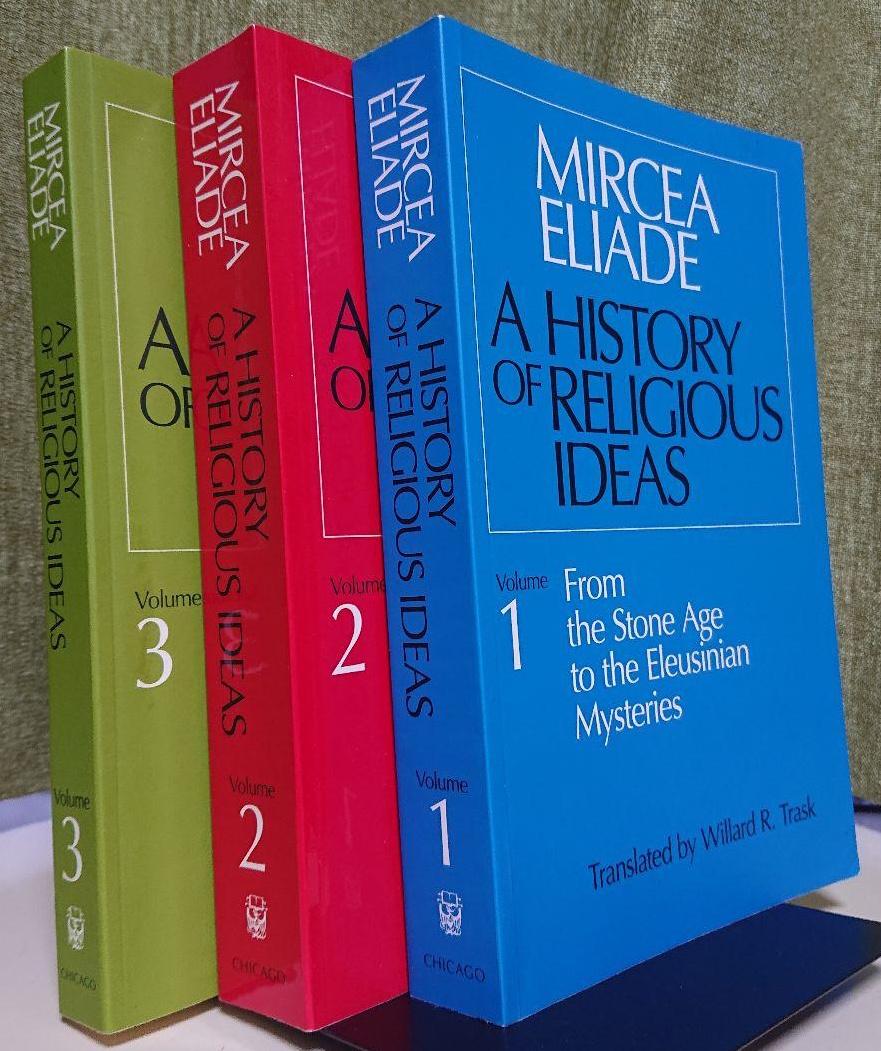
A History of Religious Ideas: Complete Volume
Chapter 1. In the Beginning…: Magico-Religious Behavior of the Paleanthropians
1. Orientatio. Tools to make tools. The “domestication” of fire
2. The “opaqueness” of prehistoric documents
3. Symbolic meanings of burials
4. The controversy concerning deposits of bones
5. Rock paintings: Images or symbols?
7. Rites, thought, and imagination among the Paleolithic hunters
Chapter 2. The Longest Revolution: The Discovery of Agriculture-Mesolithic and Neolithic
9. Work, technology, and imaginary worlds
10. The heritage of the Paleolithic hunters
11. The domestication of food plants: Origin myths
12. Woman and vegetation. Sacred space and periodical renewal of the world
13. Neolithic religions of the Near East
14. The spiritual edifice of the Neolithic
15. Religious context of metallurgy: Mythology of the Iron Age
Chapter 3. The Mesopotamian Religions
18. The first myth of the flood
19. Descent to the underworld: Inanna and Dumuzi
20. The Sumero-Akkadian synthesis
22. Sacrality of the Mesopotamian sovereign
23. Gilgamesh in quest of immortality
Chapter 4. Religious Ideas and Political Crises in Ancient Egypt
25. The unforgettable miracle: The “First Time”
26. Theogonies and cosmogonies
27. The responsibilities of an incarnate god
28. The pharaoh’s ascent to heaven
30. Syncope: Anarchy, despair, and “democratization” of the afterlife
31. Theology and politics of “solarization”
32. Akh-en-Aton, or the unsuccessful reform
33. Final synthesis: The association Re-Osiris
Chapter 5. Megaliths, Temples, Ceremonial Centers: Occident, Mediterranean, Indus Valley
35. Ceremonial centers and megalithic constructions
36. The “enigma of the megaliths”
37. Ethnography and prehistory
39. Protohistorical religious concepts and their parallels in Hinduism
40. Crete: Sacred caves, labyrinths, goddesses
41. Characteristic features of Minoan religion
42. Continuity of the pre-Hellenic religious structures
Chapter 6. The Religions of The Hittites and The Canaanites
43. Anatolian symbiosis and Hittite syncretism
47. Conflicts between divine generations
48. A Canaanite pantheon: Ugarit
49. Baal captures the sovereignty and triumphs over the Dragon
51. Baal confronts Mot: Death and return to life
52. Canaanite religious vision
Chapter 7. “When Israel Was a Child…”
53. The first two chapters of Genesis
54. Paradise lost. Cain and Abel
55. Before and after the flood
56. The religion of the patriarchs
57. Abraham, “Father of the Faith”
58. Moses and the departure from Egypt
60. Religion under the judges: The first phase of syncretism
Chapter 8. The Religion of the Indo-Europeans: The Vedic Gods
61. Protohistory of the Indo-Europeans
62. The first pantheon and the common religious vocabulary
63. The Indo-European tripartite ideology
65. Varuṇa, primordial divinity: Devas and Asuras
66. Varuṇa, universal king and magician: ṛta and māyā
67. Serpents and gods. Mitra, Aryaman, Aditi
68. Indra, champion and demiurge
69. Agni, chaplain of the gods: Sacrificial fire, light, and intelligence
70. The god Soma and the drink of “nondeath”
71. Two Great Gods in the Vedic period: Rudra-Śiva and Viṣṇu
72. Morphology of the Vedic rituals
73. The supreme sacrifices: aśvamedha and puruṣamedha
74. Initiatory structure of rituals: Initiation, royal consecration
75. Cosmogonies and metaphysics
Chapter 10. Zeus and the Greek Religion
83. Theogony and struggles between divine generations
84. Triumph and sovereignty of Zeus
85. The myth of the first races: Prometheus, Pandora
86. The consequences of the primordial sacrifice
87. Man and destiny: The meaning of the “joy of life”
Chapter 11. The Olympians and the Heroes
88. The fallen great god and the smith-magician: Poseidon and Hephaestus
89. Apollo: Contradictions reconciled
91. From “vision” to knowledge
92. Hermes, “the companion of man”
93. The goddesses. I: Hera, Artemis
94. The goddesses. II: Athena, Aphrodite
Chapter 12. The Eleusinian Mysteries
96. The myth: Persephone in Hades
97. The initiations: Public ceremonies and secret rituals
98. Can the Mysteries be known?
Chapter 13. Zarathustra and the Iranian Religion
101. The life of Zarathustra: History and myth
Chapter 14. The Religion of Israel in the Period of the Kings and the Prophets
113. Kingship and the monarchy: The apogee of syncretism
117. Amos the shepherd. Hosea the ill-loved
118. Isaiah: “A remnant of Israel” will return
119. The promise made to Jeremiah
120. The fall of Jerusalem. The mission of Ezekiel
121. Religious valorization of the “terror of history”
Chapter 15. Dionysus, or Bliss Recovered
122. Epiphanies and occultations of a “twice-born” god
123. The archaism of some public festivals
124. Euripides and Dionysiac orgiasm
125. When the Greeks rediscover the presence of the God
Chapter 16. The Religions of Ancient China
126. Religious beliefs in the Neolithic period
127. Religion in the Bronze Age: The God of Heaven and the ancestors
128. The exemplary dynasty: The Chou
129. The origin and organizing of the world
130. Polarities, alternation, and reintegration
131. Confucius: The power of the rites
Chapter 17. Brahmanism and Hinduism: The First Philosophies and Techniques of Salvation
136. Methods of attaining the supreme “awakening”
137. History of ideas and chronology of texts
139. The spirit according to Sāṃkhya-Yoga
140. The meaning of Creation: Helping in the deliverance of spirit
141. The meaning of deliverance
142. Yoga: Concentration on a single object
144. The role of the God in Yoga
145. Samādhi and the “miraculous powers”
Chapter 18. The Buddha and His Contemporaries
149. The “Awakening.” The preaching of the Law
150. Devadatta’s schism. Last conversion. The Buddha enters parinirvāṇa
151. The religious milieu: The wandering ascetics
152. Mahāvīra and the “Saviors of the World”
153. Jain doctrines and practices
154. The Ājīvikas and the omnipotence of “destiny”
155. The man struck by a poisoned arrow …
156. The four Noble Truths and the Middle Path. Why?
157. The impermanence of things and the doctrine of anattā
158. The way that leads to nirvāṇa
159. Techniques of meditation and their illumination by “wisdom”
160. The paradox of the Unconditioned
Chapter 20. Roman Religion: From Its Origins to the Prosecution of the Bacchanals
161. Romulus and the sacrificial victim
162. The “historicization” of Indo-European myths
163. Specific characteristics of Roman religiosity
164. The private cult: Penates, Lares, Manes
165. Priesthoods, augurs, and religious brotherhoods
166. Jupiter, Mars, Quirinus, and the Capitoline triad
167. The Etruscans: Enigmas and hypotheses
168. Crises and catastrophes: From the Gallic suzerainty to the Second Punic War
Chapter 21. Celts, Germans, Thracians, and Getae
169. Persistence of prehistoric elements
170. The Indo-European heritage
171. Is it possible to reconstruct the Celtic pantheon?
172. The Druids and their esoteric teaching
173. Yggdrasill and the cosmogony of the ancient Germans
174. The Aesir and the Vanir. Óðinn and his “shamanic” powers
176. The Aesir: Týr, Thór, Baldr
177. The Vanir gods. Loki. The end of the world
178. The Thracians, “great anonyms” of history
179. Zalmoxis and “immortalization”
Chapter 22. Orpheus, Pythagoras, and the New Eschatology
180. Myths of Orpheus, lyre-player and “founder of initiations”
181. Orphic theogony and anthropogony: Transmigration and immortality of the soul
183. Plato, Pythagoras, and Orphism
184. Alexander the Great and Hellenistic culture
Chapter 23. The History of Buddhism from Mahākāśyapa to Nāgārjuna. Jainism after Mahāvīra
185. Buddhism until the first schism
186. The time between Alexander the Great and Aśoka
187. Doctrinal tensions and new syntheses
188. The “Way of the boddhisattvas”
189. Nāgārjuna and the doctrine of universal emptiness
190. Jainism after Mahāvīra: Erudition, cosmology, soteriology
Chapter 24. The Hindu Synthesis: The _Mahābhārata_ and the _Bhagavad_ _Gītā_
192. Eschatological war and the end of the world
194. “Renouncing the fruits of one’s acts”
195. “Separation” and “totalization”
Chapter 25. The Ordeals of Judaism: From Apocalypse to Exaltation of the Torah
196. The beginnings of eschatology
197. Haggai and Zechariah, eschatological prophets
198. Expectation of the messianic king
200. The personification of divine Wisdom
201. From despair to a new theodicy: The Qoheleth and Ecclesiasticus
202. The first apocalyses: Daniel and 1 Enoch
203. The only hope: The end of the world
204. Reaction of the Pharisees: Glorification of the Torah
Chapter 26. Syncretism and Creativity in the Hellenistic Period: The Promise of Salvation
208. Isis and the Egyptian Mysteries
209. The revelation of Hermes Trismegistus
210. Initiatory aspects of Hermetism
Chapter 27. New Iranian Syntheses
212. Religious orientations under the Arsacids
213. Zurvan and the origin of evil
214. The eschatological function of time
215. The two Creations: mēnōk and gētik
216. From Gayōmart to Saoshyant
218. “If Christianity had been halted …”
Chapter 28. The Birth of Christianity
219. An “obscure Jew”: Jesus of Nazareth
220. The Good News: The Kingdom of God is at hand
222. The Apostle to the Gentiles
224. Destruction of the Temple. Delay in the occurrence of the parousia
Chapter 29. Paganism, Christianity, and Gnosis in the Imperial Period
226. The tribulations of a religio illicita
229. From Simon Magus to Valentinus
230. Gnostic myths, images, and metaphors
233. The great myth: The fall and redemption of the divine soul
234. Absolute dualism as mysterium tremendum
Chapter 30. The Twilight of the Gods
236. The Cross and the Tree of Life
237. Toward “cosmic Christianity”
238. The flowering of theology
239. Between Sol Invictus and “In hoc signo vinces”
240. The bus that stops at Eleusis
Chapter 31. The Religions of Ancient Eurasia: Turko-Mongols, Finno-Ugrians, Balto-Slavs
241. Hunters, nomads, warriors
242. Tängri, the “Celestial God”
243. The structure of the world
244. The vicissitudes of creation
245. The shaman and shamanic initiation
246. Shamanic myths and rituals
247. The meaning and importance of shamanism
248. The religions of the northern Asians and the Finno-Ugrians
249. The religion of the Balts
251. Rites, myths, and beliefs of the Old Slavs
Chapter 32. The Christian Churches up to the Iconoclastic Crisis
253. Augustine: From Tagaste to Hippo
254. The great predecessor of Augustine: Origen
255. The polemical positions of Augustine: His doctrine of Grace and Predestination
256. The cult of the saints: Martyria, relics, and pilgrimages
257. The Eastern Church and the flowering of Byzantine theology
258. The veneration of icons and iconoclasm
Chapter 33. Muhammad and the Unfolding of Islam
259. Allah, deus otiosus of the Arabs
260. Muhammad, the “Apostle of God”
261. The ecstatic voyage to Heaven and the Holy Book
265. The irruption of Islam into the Mediterranean and the Near East
Chapter 34. Western Catholicism from Charlemagne to Joachim of Fiore
266. Christianity during the High Middle Ages
267. The assimilation and reinterpretation of pre-Christian traditions: Sacred kingship and chivalry
268. The Crusades: Eschatology and politics
269. The religious significance of Romanesque art and courtly romance
270. Esotericism and literary creations: Troubadours, Fedeli d’Amore, and the Grail cycle
Chapter 35. Muslim Theologies and Mystical Traditions
272. The fundamentals of the mainstream theology
273. Shî’ism and the esoteric hermeneutic
274. Ismailism and the exaltation of the Imâm; the Great Resurrection; the Mahdî
275. Sufism, esoterism, and mystical experiences
276. Several Sufi masters, from Dhû’1-Nûn to Tirmidhî
277. al-Hallâj, mystic and martyr
278. Al-Ghazzâlî and the reconciliation between Kalâm and Sufism
279. The first metaphysicians. Avicenna. Philosophy in Muslim Spain
Chapter 36. Judaism from the Bar Kokhba Revolt to Hasidism
284. The compilation of the Mishnah
285. The Talmud. The anti-rabbinic Reaction: The Karaites
286. Jewish theologians and philosophers of the Middle Ages
Chapter 37. Religious Movements in Europe: From the Late Middle Ages to the Eve of the Reformation
293. The dualist heresy in the Byzantine Empire: The Bogomils
294. The Bogomils in the West: The Cathars
296. Saint Bonaventure and mystical theology
297. Saint Thomas Aquinas and scholasticism
298. Meister Eckhart: From God to the Deity
299. Popular piety and the risks of devotion
300. Disasters and hopes: From the flagellants to the devotio moderna
301. Nicholas of Cusa and the twilight of the Middle Ages
302. Byzantium and Rome. The filioque problem
303. The Hesychast monks. Saint Gregory Palamas
Chapter 38. Religion, Magic, and Hermetic Traditions before and after the Reformation
304. The survival of pre-Christian religious traditions
305. Symbols and rituals of a cathartic dance
306. “Witch hunts” and the vicissitudes of popular religion
307. Martin Luther and the Reformation in Germany
308. Luther’s theology. The polemic with Erasmus
309. Zwingli, Calvin, and the Catholic Reformation
310. Humanism, Neoplatonism, and Hermeticism during the Renaissance
311. New valorizations of alchemy: From Paracelsus to Newton
313. Traditional conceptions: Cosmos, men, gods
314. The Bon: Confrontations and syncretism
315. Formation and development of Lamaism
316. Lamaist doctrines and practices
Synopsis
This extraordinary work delves into the subject of religion in the prehistoric and ancient worlds—humankind’s earliest quests for meaning. From Neanderthal burials to the mythology of the Iron Age, to the religions of Mesopotamia, Egypt, Greece, Israel, India, and beyond, it offers both an appreciation of the wide-ranging diversity of religious expression—and a consideration of the fundamental unity of religious phenomena.
“Everyone who cares about the human adventure will find new information and new angles of vision.”—Martin E. Marty, The New York Times Book Review.
“Will arouse the interest of all historians of western religion, since it includes chapters on the religions of Canaan and Israel. However, the book must be read cover to cover if one wants to grasp the significance of its gigantic historical scope.”—Church History.
Dedication
For Christinel
Preface
For the historian of religions, every manifestation of the sacred is important: every rite, every myth, every belief or divine figure reflects the experience of the sacred and hence implies the notions of being, of meaning, and of truth. As I observed on another occasion, “it is difficult to imagine how the human mind could function without the conviction that there is something irreducibly real in the world; and it is impossible to imagine how consciousness could appear without conferring a meaning on man’s impulses and experiences. Consciousness of a real and meaningful world is intimately connected with the discovery of the sacred. Through experience of the sacred, the human mind has perceived the difference between what reveals itself as being real, powerful, rich, and meaningful and what lacks these qualities, that is, the chaotic and dangerous flux of things, their fortuitous and senseless appearances and disappearances” (preface to The Quest: History and Meaning in Religion [1969]). In short, the “sacred” is an element in the structure of consciousness and not a stage in the history of consciousness. On the most archaic levels of culture, living, considered as being human, is in itself a religious act, for food-getting, sexual life, and work have a sacramental value. In other words, to be—or, rather, to become—a man signifies being “religious” (ibid.).
I have discussed the dialectic of the sacred and its morphology in earlier publications, from my Patterns in Comparative Religion (1958) to my little book devoted to Australian religions (Australian Religions: An Introduction [1973]). The present work was conceived and executed from a different point of view. On the one hand, I have analyzed the manifestations of the sacred in chronological order (but it is important not to confuse the “age” of a religious conception with the date of the earliest document that attests to it!); on the other hand—and insofar as the documentation makes it possible—I have emphasized the crises in depth and, above all, the creative moments of the different traditions. In short, I have attempted to elucidate the major contributions to the history of religious ideas and beliefs.
Every manifestation of the sacred is important to the historian of religions; but it is no less obvious that the structure of the god Anu, for example, or the theogony and cosmogony handed down in the Enuma elish, or the saga of Gilgamesh, reveal the religious creativity and originality of the Mesopotamians more effectively than, let us say, the apotropaic rites against Lamashtu or the mythology of the god Nusku. Sometimes the importance of a religious creation is revealed by its later valorizations. Very little is known about the Eleusinian Mysteries and the earliest manifestations of Orphism; yet the fascination that they have exercised over the best minds of Europe for more than twenty centuries constitutes a religious fact that is highly significant and whose consequences have not yet been properly understood. Certainly, the Eleusinian initiation and the secret Orphic rites, extolled by certain late authors, reflect mythologizing Gnosticism and Greco-Oriental syncretism. But it is precisely this conception of the Mysteries and of Orphism that influenced medieval Hermeticism, the Italian Renaissance, the “occultist” traditions of the eighteenth century, and Romanticism; and the Mysteries and the Orpheus that inspired modern European poetry, from Rilke to T. S. Eliot and Pierre Emmanuel, are still the Mysteries and the Orpheus of the scholars and mystics and theologians of Alexandria.
The validity of the criterion chosen to define the great contributions to the history of religious ideas is, of course, open to discussion. Yet the development of many religions confirms it; for it is because of crises in depth and the creations that result from them that religious traditions are able to renew themselves. It is enough to cite the case of India, where the tension and despair brought on by the religious devalorization of the Brahmanic sacrifice produced a series of outstanding creations (the Upanishads, the codification of Yogic techniques, the message of Gautama Buddha, mystical devotion, etc.), each one of them constituting a different and daring resolution of the same crisis (see chapters 9, 17, 18, and 19).
For years I have had in mind a short, concise work, which could be read in a few days. For continuous reading reveals above all the fundamental unity of religious phenomena and at the same time the inexhaustible newness of their expressions. The reader of such a book would be given access to the Vedic hymns, the Brāhmaṇas, and the Upanishads a few hours after he had reviewed the ideas and beliefs of the Paleolithics, of Mesopotamia, and of Egypt; he would discover Sankara, Tantrism and Milarepa, Islam, Gioacchino da Fiore or Paracelsus, the day after he had meditated on Zarathustra, Gautama Buddha, and Taoism, on the Hellenistic Mysteries, the rise of Christianity, Gnosticism, alchemy, or the mythology of the Grail; he would encounter the German illuminists and Romantics, Hegel, Max Müller, Freud, Jung, and Bonhoeffer, soon after discovering Quetzalcoatl and Viracocha, the twelve Alvârs and Gregory Palamas, the earliest Cabalists, Avicenna or Eisai.
Alas, that short, concise book has not yet been written. For the moment, I have resigned myself to presenting a work in three volumes, in the hope of eventually reducing it to one volume of some 400 pages. I have chosen this compromise formula for two reasons in particular: on the one hand, I considered it advisable to quote a certain number of texts that are both important and insufficiently known; on the other hand, I wanted to provide the student with comparatively full critical bibliographies. So I have reduced footnotes to the text to the absolute minimum and have brought together, in a separate section, the bibliographies and the discussion of certain matters either not referred to at all or treated too summarily in the text. Hence the work can be read continuously, without the interruptions necessitated by discussions of sources and summaries of the present position of studies on particular points. Books presenting a general view of a subject and intended for an audience of other than specialists usually provide a list of titles at the end of each chapter. The structure of this History of Religious Ideas demanded a more complex critical apparatus. So I have divided the chapters into numbered sections, each with its own title. The student can thus easily consult the bibliographies and the summaries of the present position of studies in the second part of the book as he pursues his reading of the text. For each section I have tried to provide the essential recent critical bibliography, not omitting works whose methodological orientation I do not share. With very few exceptions, I have not mentioned contributions published in the Scandinavian, Slavic, or Balkan languages. To facilitate reading, I have simplified the transliteration of Oriental terms and proper names.
Except for a few chapters, this book reproduces the substance of the courses in the History of Religions that I have given at the University of Bucharest from 1933 to 1938, at the Ecole des Hautes Études in 1946 and 1948, and, since 1956, at the University of Chicago. I belong to the category of historians of religions who, whatever their “specialty” may be, make every effort to keep up with the progress achieved in neighboring domains and do not hesitate to keep their students informed concerning the various problems raised by their discipline. I hold, in short, that any historical study implies a certain familiarity with universal history; hence the strictest specialization does not absolve the scholar from situạting his researches in the perspective of universal history. I also share the conviction of those who think that the study of Dante or Shakespeare, and even of Dostoevski or Proust, is illuminated by a knowledge of Kalidasa, the Noh plays, or the Pilgrim Monkey. This is not a matter of a vain and, in the end, sterile pseudo-encyclopedism. It is simply a matter of not losing sight of the profound and indivisible unity of the history of the human mind.
Consciousness of this unity of the spiritual history of humanity is a recent discovery, which has not yet been sufficiently assimilated. Its importance for the future of our discipline will become manifest in the last chapter of the third volume. It is also in this final chapter, in the course of a discussion of the crises brought on by the masters of reductionism—from Marx and Nietzsche to Freud—and of the contributions made by anthropology, the history of religions, phenomenology, and the new hermeneutics, that the reader will be able to judge the sole, but important, religious creation of the modern Western world. I refer to the ultimate stage of desacralization. The process is of considerable interest to the historian of religions, for it illustrates the complete camouflage of the “sacred”—more precisely, its identification with the “profane.”
In the course of fifty years of work, I have learned a great deal from my masters, my colleagues, and my students. To all of them, whether dead or living, I continue to feel the most sincere gratitude. Like everything else that I have written since 1950, this book could not have been brought to completion without the presence, the affection, and the devotion of my wife. It is with joy and gratitude that I inscribe her name on the first page of what will probably be my last contribution to a discipline that is dear to us.
M. E.
University of Chicago
September 1975
Chapter 1. In the Beginning…: Magico-Religious Behavior of the Paleanthropians
1. Orientatio. Tools to make tools. The “domestication” of fire
Despite its importance for an understanding of the religious phenomenon, we shall not here discuss the problem of “hominization.” It is sufficient to recall that the vertical posture already marks a transcending of the condition typical of the primates. Uprightness cannot be maintained except in a state of wakefulness. It is because of man’s vertical posture that space is organized in a structure inaccessible to the prehominians: in four horizontal directions radiating from an “up”-“down” central axis. In other words, space can be organized around the human body as extending forward, backward, to right, to left, upward, and downward. It is from this original and originating experience—feeling oneself “thrown” into the middle of an apparently limitless, unknown, and threatening extension—that the different methods of orientatio are developed; for it is impossible to survive for any length of time in the vertigo brought on by disorientation. This experience of space oriented around a “center” explains the importance of the paradigmatic divisions and distributions of territories, agglomerations, and habitations and their cosmological symbolism.
An equally decisive difference from the mode of existence of the primates is clearly shown by the use of tools. The Paleanthropians not only use tools, they are also able to manufacture them. It is true that certain monkeys use objects as if they were tools, and are even known to make them in certain cases. But the Paleanthropians also produce tools to make tools. In addition, their use of tools is much more complex; they keep them accessible, ready for use in the future. In short, their use of tools is not confined to a particular situation or a specific moment, as is the case with monkeys. It is also important to note that tools do not serve as extensions of the human body, for the earliest-known worked stones were shaped to perform a function not prefigured in the body’s structure, namely, the function of cutting. The very slow progress made in technology does not imply a similar development of intelligence. We know that the extraordinary upsurge in technology during the past two centuries has not found expression in a comparable development of Western man’s intelligence. Besides, as has been said, “every innovation brought with it the danger of collective death”. Their technical immobility insured the survival of the Paleanthropians.
The domestication of fire—that is, the possibility of producing, preserving, and transporting it—marks, we might say, the definitive separation of the Paleanthropians from their zoological predecessors. The most ancient “document” for the use of fire dates from Choukoutien, but its domestication probably took place much earlier and in several places.
These few well-known facts needed to be repeated so that the reader of the following analyses will bear in mind that prehistoric man already behaved in the manner of a being endowed with intelligence and imagination. As for the activity of the unconscious—dreams, fantasies, visions, fabulization, and so on—it is presumed not to have differed in intensity and scope from what is found among our contemporaries. But the terms “intensity” and “scope” must be understood in their strongest and most dramatic sense. For man is the final product of a decision made “at the beginnings of Time”: the decision to kill in order to live. In short, the hominians succeeded in outstripping their ancestors by becoming flesh-eaters. For some two million years, the Paleanthropians lived by hunting; fruits, roots, mollusks, and so on, gathered by the women and children, did not suffice to insure the survival of the species. Hunting determined the division of labor in accordance with sex, thus reinforcing “hominization”; for among the carnivora, and in the entire animal world, no such difference exists.
But the ceaseless pursuit and killing of game ended by creating a unique system of relationships between the hunter and the slain animals. We shall return to this problem. For the moment, we merely state that the “mystical solidarity” between the hunter and his victims is revealed by the mere act of killing: the shed blood is similar in every respect to human blood. In the last analysis, this “mystical solidarity” with the game reveals the kinship between human societies and the animal world. To kill the hunted beast or, later, the domestic animal is equivalent to a “sacrifice” in which the victims are interchangeable. We must add that all these concepts came into existence during the last phases of the process of hominization. They are still active—altered, revalorized, camouflaged—millennia after the disappearance of the Paleolithic civilizations.
2. The “opaqueness” of prehistoric documents
If the Paleanthropians are regarded as complete men, it follows that they also possessed a certain number of beliefs and practiced certain rites. For, as we stated before, the experience of the sacred constitutes an element in the structure of consciousness. In other words, if the question of the religiosity or nonreligiosity of prehistoric men is raised, it falls to the defenders of nonreligiosity to adduce proofs in support of their hypothesis. Probably the theory of the nonreligiosity of the Paleanthropians was conceived and generally accepted during the heyday of evolutionism, when similarities to the primates had just been discovered. But a misconception is involved here, for what matters is not the anatomico-osteological structure of the Paleanthropians but their works; and these demonstrate the activity of an intelligence that cannot be defined otherwise than as “human.”
But if today there is agreement on the fact that the Paleanthropians had a religion, in practice it is difficult, if not impossible, to determine what its content was. The investigators, however, have not cried defeat; for there remain a certain number of testimonial “documents” for the life of the Paleanthropians, and it is hoped that their religious meaning will one day be deciphered. In other words, it is hoped that these “documents” can constitute a “language,” just as, thanks to the genius of Freud, the creations of the unconscious, which until his time were regarded as absurd or meaningless—dreams, waking dreams, phantasms, and so on—have revealed the existence of a language that is extremely precious for a knowledge of man.
These documents are, in fact, comparatively numerous, but they are “opaque” and not very various: human bones, especially skulls, stone tools, pigments, various objects found in burials. It is only from the late Paleolithic that we have rock paintings and engravings, painted pebbles, and bone and stone statuettes. In certain cases and within the limits that we shall examine, there is at least the certainty of a religious intention, but the majority of the documents from before the Aurignacian —that is, tools—reveal nothing beyond their utilitarian value.
Yet it is inconceivable that tools were not charged with a certain sacrality and did not inspire numerous mythological episodes. The first technological discoveries—the transformation of stone into instruments for attack and defense, the mastery over fire—not only insured the survival and development of the human species; they also produced a universe of mythico-religious values and inspired and fed the creative imagination. It is enough to examine the role of tools in the religious life and mythology of the primitives who still remain at the hunting and fishing stage. The magico-religious value of a weapon—be it made of wood or stone or metal—still survives among the rural populations of Europe, and not only in their folklore. We shall not here consider the kratophanies and hierophanies of stone, of rocks, of pebbles; the reader will find examples of these in a chapter of our Patterns in Comparative Religion.
It is, above all, mastery over distance, gained by the projectile weapon, which gave rise to countless beliefs, myths, and legends. We need only think of the mythologies built up around lances that pierce the vault of the sky and thus make an ascent to heaven possible, of arrows that fly through clouds, transfix demons, or form a chain reaching to heaven, and so on. It is necessary to cite at least some of the beliefs and mythologies that surround tools and implements—and especially weapons—in order better to estimate all that the worked stones of the Paleanthropians can no longer communicate to us. The semantic opaqueness of these prehistoric documents is not peculiar to them. Every document, even of our own time, is spiritually opaque as long as it has not been successfully deciphered by being integrated into a system of meanings. A tool, be it prehistoric or contemporary, can reveal only its technological intention; all that its producer or its owners thought, felt, dreamed, hoped in relation to it escapes us. But we must at least try to imagine the nonmaterial values of prehistoric tools. Otherwise, this semantic opaqueness may well force us to entertain a completely erroneous conception of the history of culture. We are in danger, for example, of confusing the appearance of a belief with the date at which it is clearly documented for the first time. When, in the age of metals, certain traditions refer to craft secrets in respect to mining, metallurgy, and the making of weapons, it would be rash to believe that we are in the presence of an unprecedented invention, for these traditions continue, at least in part, an inheritance from the Stone Age.
For some two million years, the Paleanthropians lived chiefly by hunting, fishing, and gathering. But the first archeological indications in respect to the religious universe of the Paleolithic hunter go back only to Franco-Cantabrian rock art. What is more, if we examine the religious beliefs and behavior of contemporary hunting peoples, we realize the almost complete impossibility of proving the existence or the absence of similar beliefs among the Paleanthropians. Primitive hunters regard animals as similar to men but endowed with supernatural powers; they believe that a man can change into an animal and vice versa; that the souls of the dead can enter animals; finally, that mysterious relations exist between a certain person and a certain animal. As for the supernatural beings documented in the religions of hunting peoples, we find that they are of various kinds: theriomorphic companions or guardian spirits—divinities of the type Supreme Being-Lord of Wild Beasts—which protect both the game and the hunters; spirits of the bush; and spirits of the different species of animals.
In addition, certain patterns of religious behavior are peculiar to hunting civilizations. For example, killing the animal constitutes a ritual, which implies the belief that the Lord of Wild Beasts takes care that the hunter kills only what he needs as food and that food is not wasted. Then, too, the bones, especially the skull, have a marked ritual value; this is why the skull and the long bones are exposed on branches or on high places. Finally, among certain peoples the soul of the slain animal is sent to its spiritual home; the custom of offering the Supreme Beings a piece of each slain animal or the skull and the long bones also exists; and among certain Sudanese peoples the young man, after bringing down his first game animal, smears the walls of a cave with its blood.
How many of these beliefs and ceremonies can be identified in the archeological documents in our possession? At most, the offerings of skulls and long bones. The richness and complexity of the religious ideology of hunting peoples must never be underestimated—and likewise the almost complete impossibility of proving or denying its existence among the Paleanthropians. As has often been said: beliefs and ideas cannot be fossilized. Hence certain scholars have preferred to say nothing about the ideas and beliefs of the Paleanthropians, instead of reconstructing them by the help of comparisons with the hunting civilizations. This radical methodological position is not without its dangers. To leave an immense part of the history of the human mind a blank runs the risk of encouraging the idea that during all those millennia the activity of the mind was confined to the preservation and transmission of technology. Such an opinion is not only erroneous, it is fatal to a knowledge of man. Homo faber was at the same time Homo ludens, sapiens, and religiosus. Since we cannot reconstruct his religious beliefs and practices, we must at least point out certain analogies that can illuminate them, if only indirectly.
3. Symbolic meanings of burials
The earliest and most numerous “documents” are, obviously, bones. From the Mousterian, we can speak with certainty of burials. But skulls and lower mandibles have been found at much earlier sites, for example at Choukoutien, and their presence has raised problems. Since there is no question of burials here, the preservation of these skulls could be explained as due to religious reasons. The Abbé Breuil and Wilhelm Schmidt have referred to the custom, documented among the Australians and other primitive peoples, of preserving the skulls of dead relatives and carrying them along when the tribe travels. Though credible, the hypothesis has not been accepted by most scholars. The same facts have also been interpreted as proof of cannibalism, whether ritual or profane. It is in this way that A. C. Blane has explained the mutilation of a Neanderthal skull found in a cave at Monte Circeo: the man would have been killed by a blow that broke his right eye-socket and the hole would later have been enlarged so that the brain could be extracted through it and eaten ritually. But this explanation has not been unanimously accepted either.
Belief in a survival after death seems to be demonstrated, from the earliest times, by the use of red ocher as a ritual substitute for blood, hence as a symbol of life. The custom of dusting corpses with ocher is universally disseminated in both time and space, from Choukoutien to the western shores of Europe, in Africa as far as the Cape of Good Hope, in Australia, in Tasmania, in America as far as Tierra del Fuego. As to the religious meaning of burials, it has been the subject of vigorous controversy. There can be no doubt that the burial of the dead should have a justification—but which one? To begin with, it must not be forgotten that “pure and simple abandonment of the corpse in some thicket, dismemberment, leaving it to be devoured by birds, instant flight from the habitation, leaving the corpse inside it, did not signify the absence of ideas of survival.” A fortiori, belief in survival is confirmed by burials; otherwise there would be no understanding the effort expended in interring the body. This survival could be purely spiritual, that is, conceived as a postexistence of the soul, a belief corroborated by the appearance of the dead in dreams. But certain burials can equally well be interpreted as a precaution against the possible return of the deceased; in these cases the corpses were bent and perhaps tied. On the other hand, nothing makes it impossible that the bent position of the dead body, far from expressing fear of “living corpses”, on the contrary signifies the hope of a rebirth; for we know of a number of cases of intentional burial in the fetal position.
Among the best examples of burials with a magico-religious signification we will mention the one at Teshik Tash, in Uzbekistan; the one at La Chapelle-aux-Saints, in Corrèze; and the one at Farrassie, in Dordogne. The cemetery in a cave on Mount Carmel, with ten burials, should be added. The authenticity and the meaning of food offerings or objects placed in graves are still the subject of discussion; the most familiar example is that of the woman’s skull at Mas-d’Azil, fitted with artificial eyes and placed on the lower jaw and antler of a reindeer.
During the Upper Paleolithic, the practice of inhumation appears to have become general. Corpses sprinkled with red ocher are buried in graves in which a certain number of objects intended for personal adornment have been found. It is probable that the animal skulls and bones discovered near graves are the remains of ritual feasts, if not of offerings. Leroi-Gourhan holds that “funerary chattels,” that is, the personal objects of the deceased, are “very questionable”. The problem is important, for the presence of such objects implies not only belief in a personal survival but also the certainty that the deceased will continue his particular activity in the other world. Similar ideas are abundantly documented, and on various levels of culture. In any case, Leroi-Gourhan recognizes the authenticity of an Aurignacian grave in Liguria, where the skeleton is accompanied by four of those mysterious objects called bâtons de commandement. Hence at least certain graves undoubtedly indicate belief in a postmortem continuation of a particular activity.
To sum up, we may conclude that the burials confirm the belief in survival and furnish some additional details: burials oriented toward the East, showing an intention to connect the fate of the soul with the course of the sun, hence the hope of a rebirth, that is, of a postexistence in another world; belief in the continuation of a specific activity; certain funeral rites, indicated by offerings of objects of personal adornment and by the remains of meals.
But an examination of burial as practiced by an archaic people of our own time is enough to demonstrate the richness and depth of the religious symbolism implied in a ceremony that appears to be so simple. Reichel-Dolmatoff has given a detailed description of a contemporary burial of a girl among the Kogi Indians, a tribe speaking the Chibcha language and inhabiting the Sierra Nevada de Santa Maria in Colombia. After choosing the site for the grave, the shaman performs a series of ritual gestures and declares: “Here is the village of Death; here is the ceremonial house of Death; here is the womb. I will open the house. The house is shut, and I will open it.” After this he announces, “The house is open,” shows the men the place where they are to dig the grave, and withdraws. The dead girl is wrapped in white cloth, and her father sews the shroud. During all this time her mother and grandmother chant a slow, almost wordless song. Small green stones, shells of shellfish, and the shell of a gastropod are placed in the bottom of the grave. Then the shaman tries to lift the body, giving the impression that it is too heavy; he does not succeed until the ninth attempt. The body is laid with its head toward the East, and “the house is closed,” that is, the excavation is filled up. Other ritual movements around the grave follow, and finally all withdraw. The ceremony has continued for two hours.
As Reichel-Dolmatoff observes, a future archeologist, excavating the grave, will find only a skeleton with its head toward the East and some stones and shells. The rites, and especially the implied religious ideology, are no longer recoverable on the basis of these remains. In addition, the symbolism will remain inaccessible even to a contemporary observer who does not know the religion of the Kogi. For, as Reichel-Dolmatoff writes, what is involved is verbalization of the cemetery as “village of Death” and “ceremonial house of Death,” and verbalization of the grave as “house” and “womb”, followed by verbalization of the offerings as “food for Death,” and by the ritual of the “opening” and “closing” of the “house-womb.” A final purification by a ritual circumvallation completes the ceremony.
On the other hand, the Kogi identify the world—womb of the Universal Mother—with each village, each cult house, each habitation, and each grave. When the shaman lifts the corpse nine times, he indicates the return of the body to the fetal state by going through the nine months of gestation in reverse order. And since the grave is assimilated to the world, the funerary offerings acquire a cosmic meaning. In addition, the offerings, “food for Death,” also have a sexual meaning and consequently constitute a “semen” that fertilizes the Mother. The shellfish shells carry a quite complex symbolism, which is not only sexual: they represent the living members of the family. On the other hand, the gastropod shell symbolizes the dead girl’s “husband,” for if it is not present in the grave, the girl, as soon as she reaches the other world, “will demand a husband,” and this will cause the death of a young man of the tribe.
Here we end our analysis of the religious symbolism contained in a Kogi burial. But it is important to emphasize that, approached solely on the archeological level, this symbolism is as inaccessible to us as that of a Paleolithic interment. It is the particular modality of archeological documents that limits and impoverishes the “messages” that they can transmit. This fact must always be kept in mind when we are confronted by the poverty and opaqueness of our sources.
4. The controversy concerning deposits of bones
Deposits of bones of cave bears, discovered in the Alps and the surrounding regions, constitute the most numerous, but also the most hotly debated, “documents” concerning the religious ideas of the last interglacial period. In the Drachenloch cave Emil Bächler found deposits of bones, principally of skulls and long bones; they were grouped together and placed along the cave wall, or in natural niches in the rock, or in a sort of stone coffer. From 1923 to 1925, Bächler explored another cave, the Wildenmannlisloch; here he found several bear skulls without mandibles, with long bones placed among them. Similar discoveries were made by other prehistorians in various caves in the Alps; the most important were in the Drachenhoetli, in Styria, and in the Petershoehle, in Franconia, where K. Hoermann discovered bear skulls in niches 1.20 meters above the cave floor. Similarly, in 1950, K. Ehrenberg found in the Salzofenhoehle three bear skulls in natural niches in the cave wall and associated with long bones oriented from East to West.
Since these deposits appeared to be intentional, scholars set themselves to decipher their meaning. A. Gahs compared them to the offering of first fruits made by certain Arctic peoples to a supreme being. This consisted in exposing the skull and long bones of the slain animal on platforms; the divinity was offered the animal’s brain and marrow, that is, the parts most relished by the hunter. This interpretation was accepted by Wilhelm Schmidt and W. Koppers, among others; for these ethnologists, here was proof that the cave-bear hunters of the last interglacial period believed in a Supreme Being or a Lord of Wild Beasts. Other authors compared the deposits of skulls with the bear cult as it is—or was, until the nineteenth century—practiced in the Northern Hemisphere. This cult involves preserving the skull and long bones of the slain bear so that the Lord of Wild Beasts can resuscitate it the following year. Karl Meuli saw in it only a particular form of the “interment of animals,” which he regarded as the earliest of hunting rites. For the Swiss scholar, the rite showed a direct relation between hunter and game; the former interred the remains of the latter in order to permit its reincarnation. No divine being was implied.
All these interpretations were questioned by a scholar from Basel, F. E. Koby, according to whom many “deposits” of skulls result from chance and from the bears themselves moving and scratching among the bones. Leroi-Gourhan has declared that he is in complete agreement with this radical critique: the skulls contained in stone “coffers,” grouped along the walls, or suspended in niches and surrounded by long bones are explained by geological facts and by the behavior of the bears themselves. This critique of the intentionality of the deposits appears to be convincing, all the more so since the earliest excavations of the caves left much to be desired; nevertheless, it is surprising that the same type of deposit should be found in a number of caves, especially in niches more than a meter above the cave floor. In addition, Leroi-Gourhan recognizes that “rehandling by man is probable in some instances”.
In any case, the interpretation of deposits as offerings to supreme beings has been discarded, even by the supporters of Wilhelm Schmidt and W. Koppers. In a recent study of sacrifices among the Paleanthropians, Johannes Maringer came to the following conclusions: on the level of the Lower Paleolithic, sacrifices are not documented; the documents from the Middle Paleolithic can be interpreted in various ways, but their religious character is not evident; it is not until the Upper Paleolithic that it is possible to speak, “with more or less certainty,” of sacrifices.
As might be expected, the investigator is confronted either by the absence of irrefutable documents or by the semantic opaqueness of those documents whose authenticity appears to be certain. The spiritual activity of the Paleanthropians—like that, be it added, of the “primitives” of our day—left fragile traces. To give only one example, the arguments adduced by Koby and Leroi-Gourhan can equally well be used to invalidate their own conclusions: the geological facts and the behavior of cave bears suffice to explain the absence of ritual deposits. As to the semantic opacity of the bone deposits whose authenticity is certain, parallels are found among contemporary Arctic hunters. In itself, the deposit is simply the expression of a magico-religious intentionality; the particular meanings of the act become accessible to us only through the information communicated by members of the respective societies. We then learn whether the skulls and long bones represent offerings to a Supreme Being or a Lord of Wild Beasts, or whether, on the contrary, they are preserved in the hope that they will be covered with flesh again. Even this last belief can be interpreted in various ways: the animal is reborn by virtue either of the Lord of Wild Beasts or of the soul that resides in its bones or, finally, by virtue of the fact that the hunter has provided it with a burial.
We must always take into consideration the multiplicity of possible interpretations of a document whose magico-religious intentionality is probable. On the other hand, we must not forget that, whatever the difference between the Arctic hunters and the Paleolithics may be, they all share the same economy and very probably the same religious ideology, both of which are specific characteristics of hunting civilizations. Hence, comparison of prehistoric documents with ethnological facts is justified.
It has been proposed to interpret from this point of view the discovery in Silesia of the fossil skull of a young brown bear belonging to a level of the early Aurignacian; while the incisors and canines had been sawed or filed, the molars were still in excellent condition. W. Koppers has referred this find to the bear festival among the Giliaks of the island of Sakhalin and the Ainus of the island of Yezo; here, before it is slaughtered, the canines and incisors of the young bear are cut with a sort of saw, so that it can no longer wound the participants in the ceremony. And since, during the same ceremony, the children shoot showers of arrows into the bound animal, the same interpretation has been proposed for certain parietal engravings in the Trois Frères cave, which show bears struck by arrows and stones and apparently vomiting a stream of blood. But such scenes can be interpreted in various ways.
The importance of an archaic religious idea is likewise confirmed by its ability to survive into later periods. Thus the belief that an animal can be reborn from its bones is found in a considerable number of cultures. That is why it is forbidden to break the bones of animals whose flesh has been eaten. This is an idea which is proper to the civilizations of hunters and herders but which has survived in more complex religions and mythologies. A well-known example is that of Thor’s goats, which had their throats cut and were eaten in the evening but which the god resuscitated from their bones the next day. Equally well known is a vision seen by Ezekiel: the prophet was transported into a “valley full of bones” and, obeying the Lord’s command, he spoke to them: “Dry bones, hear the word of Yahweh. The Lord Yahweh says this to these bones: I am now going to make the breath enter you, and you will live…. There was a noise, a sound of clattering; and the bones joined together. I looked, and saw that they were covered with sinews; flesh was growing on them.”
5. Rock paintings: Images or symbols?
The most important and most numerous figurative documents have been provided by the exploration of decorated caves. These treasures of Paleolithic art are disseminated over a comparatively restricted territory, between the Urals and the Atlantic. Objects of mobiliary art have been found in much of western and central Europe and in Russia as far as the Don. But parietal art is confined to Spain, France, and southern Italy. What strikes us first of all, as Leroi-Gourhan remarks, is the “extraordinary unity of the artistic content: the apparent import of the images seems not to have varied from 30,000 B.C. to 9000 B.C. and remains the same in Asturias and on the Don.” According to Leroi-Gourhan, we here have a dissemination by contact of a single ideological system—notably, the system that marks the “religion of the caves.”
Since the paintings are found at a considerable distance from the entrance, investigators agree in regarding the caves as a sort of sanctuary. Besides, many of these caves were uninhabitable, and difficulties of access reinforced their numinous character. To reach the decorated walls it is necessary to proceed for hundreds of meters, as in the case of the Niaux and Trois Frères caves. The Cabarets cave is a real labyrinth, a journey through which takes several hours. At Lascaux, access to the lower gallery, which contains one of the masterpieces of Paleolithic art, is obtained by descending a rope ladder through a shaft 6.30 meters deep. The intentionality of these painted or engraved works seems to be beyond doubt. To interpret them, the majority of investigators appealed to ethnological parallels. Certain comparisons were not convincing, especially when an insistent attempt was made to “complete” the Paleolithic document in order to increase its likeness to some ethnological analogue. But such risky explanations impugn only their authors, not the method which they claimed to use.
The bears, lions, and other wild animals riddled with arrows, or the clay figures found in the Montespan cave and representing a bear and several lions pierced by deep round holes, have been interpreted as proofs of “hunting magic.” The hypothesis is plausible, but some of these works could as well be interpreted as the reactualization of a primordial hunt. It is also probable that rites were performed in the deepest parts of the “sanctuaries,” perhaps before a hunting expedition or on the occasion of what could be termed the “initiation” of adolescents. A scene in the Trois Frères cave has been explained as representing a dancer masked as a bison and playing an instrument that might be a flute. The interpretation seems convincing, since we know, in Paleolithic art, some fifty-five representations of men dressed in skins, often in a dancing posture. In addition, this is a characteristic ritual behavior of contemporary hunting peoples.
The Abbé Breuil has given celebrity to the “Great Magician” of the Trois Frères cave, an engraving 75 centimeters high cut into the wall. Breuil’s drawing of it shows a figure with the head of a stag bearing large antlers, but with the face of an owl, the ears of a wolf, and the beard of a chamois. Its arms end in bear paws, and it has a long horse’s tail. Only the lower limbs, the sex, and the dancing posture indicate that the figure is that of a human being. But recent photographs taken in the cave do not show all the elements carefully described by Breuil. It is possible that certain details have been damaged since the discovery of the engraving, but it is not impossible that the Abbé Breuil made his sketch incorrectly. As it appears in recent photographs, the “Great Magician” is less impressive. However, the figure can be interpreted as a Lord of Wild Beasts or as a sorcerer personifying him. In addition, a slate slab recently discovered at Lourdes shows a man wrapped in a deerskin, with a horse’s tail and with his head surmounted by antlers.
No less celebrated, and no less the subject of controversy, is the famous composition recently discovered at Lascaux, in a lower gallery to which access is extremely difficult. It shows a wounded bison thrusting its horns toward a man who is apparently dead and who lies on the ground; his weapon, a sort of pike with a hook, is pressed against the animal’s belly; near the man is a bird on a perch. The scene has generally been interpreted as representing a hunting accident. In 1950 Horst Kirchner proposed seeing in it a shamanic séance; in this case, the man would not be dead but in a trance before the sacrificed bison, while his soul would be traveling in the beyond. The perched bird, a motif typical of Siberian shamanism, would be his guardian spirit. According to Kirchner, the séance was undertaken to enable the shaman to travel, in ecstasy, into the presence of the gods to ask for their blessing, that is, for success in the hunt. The same author considers that the mysterious bâtons de commandement are drumsticks. If this interpretation is accepted, it would mean that the Paleolithic sorcerers used drums comparable to those of the Siberian shamans.
Kirchner’s explanation has been disputed, and we do not consider ourselves competent to pronounce on it. However, the existence of a certain type of shamanism during the Paleolithic period seems to be certain. On the one hand, shamanism still dominates the religious ideology of hunters and pastoralists in our day. On the other hand, the ecstatic experience as such, as an original phenomenon, is a constitutive element of the human condition; it is impossible to imagine a period in which man did not have dreams and waking reveries and did not enter into “trance”—a loss of consciousness that was interpreted as the soul’s traveling into the beyond. What was modified and changed with the different forms of culture and religion was the interpretation and evaluation of the ecstatic experience. Since the spiritual universe of the Paleolithics was dominated by the mystical relations between man and animal, it is not difficult to divine the functions of a specialist in ecstasy.
The so-called X-ray drawings, that is, drawings showing the skeleton and internal organs of the animal, have also been referred to shamanism. These drawings, documented in France during the Magdalenian and in Norway between 6000 and 2000 B.C., are also found in eastern Siberia, among the Eskimos, in America, but also in India, Malaysia, New Guinea, and northwestern Australia. It is an art specifically characteristic of hunting cultures, but the religious ideology with which it is saturated is shamanic. For it is only the shaman who, by virtue of his supernatural vision, is able to “see his own skeleton.” In other words, he is able to penetrate even into the source of animal life, the bony element. That we here have an experience fundamental for a certain type of mystic is proved, among other things, by the fact that it is still cultivated in Tibetan Buddhism.
6. The presence of woman
The discovery of feminine representations in the last Ice Age has raised problems that are still being discussed. Their distribution is quite extensive, from southwestern France to Lake Baikal in Siberia, and from northern Italy to the Rhine. The statuettes, which range from 5 to 25 centimeters in height, are carved in stone, bone, and ivory. They have been called, quite unjustifiably, “Venuses,” the most celebrated being the Venuses of Lespuges, Willendorf, and Laussel. However, especially because of the scrupulousness of the excavations, the most instructive examples are the ones discovered at Gagarino and Mezine in the Ukraine. They come from levels of habitation and hence seem to be related to domestic religion. Gagarino has yielded, close to the walls of the habitation, six figurines carved from bones of the mammoth. They are carved summarily, with an abdomen of exaggerated size and a head without features. The examples discovered at Mezine are strongly stylized; some of them can be interpreted as female forms reduced to geometric elements; others very probably represent birds. The figurines are decorated with various geometric designs, among others the swastika. To explain their possible religious function, Hančar has cited the fact that certain hunting tribes of northern Asia make small anthropomorphic sculptures called dzuli. In the tribes in which the dzuli are female, these “idols” represent the mythical ancestress from whom all members of the tribe are presumed to descend; they protect the tribal families and habitations, and upon the return from great hunts they are given offerings of wheat flour and fat.
Still more significant is Gerasimov’s discovery, at Mal’ta, in Siberia, of a “village” whose rectangular houses were divided into two halves, the right half reserved for men, and the left half belonging to the women; the female statuettes come only from this section. Their homologues in the male quarters represent birds, but some of them have been interpreted as phalluses.
It is impossible to determine the religious function of these figurines. Presumably they in some sort represent feminine sacrality and hence the magico-religious powers of the goddesses. The “mystery” constituted by woman’s particular mode of existence has played an important part in numerous religions, both primitive and historical. We owe it to Leroi-Gourhan to have illuminated the central function of the polarity masculine/feminine in the ensemble of Paleolithic art, i.e., rock paintings and reliefs, stone statuettes or slabs. He has further been able to show the unity of this symbolic language, from the Franco-Cantabrian region to Siberia. By making use of topographical and statistical analysis, Leroi-Gourhan has concluded that the figures and the signs are interchangeable; for example, the image of a bison has the same value as “wounds” or other geometrical signs. He then observed that there is a pairing of male-female values, for example, bison and horse. Deciphered in the light of this symbolism, the cave proves to be a world both organized and laden with meanings.
For Leroi-Gourhan, there is no doubt that the cave is a sanctuary and that the stone slabs and the figurines constitute portable sanctuaries possessing the same symbolic structure as the decorated caves. However, the same author admits that the synthesis he believes he has reconstructed does not teach us the language of Paleolithic religion. His method forbids him to recognize the “events” suggested in certain rock paintings. In the celebrated “scene” at Lascaux, interpreted by other investigators as a hunting accident or a shamanic séance, Leroi-Gourhan sees only a bird belonging to a certain “topographical group” and “symbolically equivalent to the man or the rhinoceros which are in fact its neighbors on the wall”. Except for the pairing of symbols of different sexual values, all that Leroi-Gourhan can put forward is that “the representations cover an extremely complex and rich system, a system far richer and more complex than had been previously imagined”.
Leroi-Gourhan’s theory has been criticized from various points of view. He has been especially reproached with a certain inconsistency in his “readings” of figures and signs and with the fact that he did not connect the rites performed in the caves with his newly established symbolic system. However this may be, Leroi-Gourhan’s contribution is important: he has demonstrated the stylistic and ideological unity of Paleolithic art and has illuminated the complementarity of the religious values camouflaged under the signs “male” and “female.” An analogous symbolism characterized the village of Mal’ta, with its two completely separate halves destined for the two sexes. Systems implying the complementarity of the two sexual and cosmological principles still abound in primitive societies, and we shall also find them in the archaic religions. It is probable that this principle of complementarity was called upon both to organize the world and to explain the mystery of its periodical creation and regeneration.
7. Rites, thought, and imagination among the Paleolithic hunters
The recent discoveries of paleontology have it in common that they continually push the beginnings of man and of culture backward in time. Man proves to be more ancient and his psychomental activity more complex than they were thought to be a few decades ago. Alexander Marshak has recently been able to demonstrate the existence, in the Upper Paleolithic, of a symbolic system of temporal notations, based on observation of the moon’s phases. These notations, which the author terms “time-factored,” that is, accumulated continuously over a long period, permit the supposition that certain seasonal or periodic ceremonies were fixed long in advance, as is the case in our day among Siberians and North American Indians. This system of notations remained in force for more than 25,000 years, from the early Aurignacian to the late Magdalenian. According to Marshak, writing, arithmetic, and the calendar properly speaking, which make their appearance in the first civilizations, are probably connected with the symbolism with which the system of notations used during the Paleolithic is impregnated.
Whatever may be thought of Marshak’s general theory concerning the development of civilization, the fact remains that the lunar cycle was analyzed, memorized, and used for practical purposes some 15,000 years before the discovery of agriculture. This makes more comprehensible the considerable role of the moon in archaic mythologies, and especially the fact that lunar symbolism was integrated into a single system comprising such different realities as woman, the waters, vegetation, the serpent, fertility, death, “rebirth,” etc.
From analyzing the meanders engraved on objects or painted on the walls of caves, Marshak concludes that these designs constitute a system because they present a succession and express an intentionality. This structure is already documented in the designs engraved on a bone excavated at Pech de l’Azé and belonging to the Acheulian level, that is, at least 100,000 years before the meanders of the Upper Paleolithic. What is more, the meanders are represented around and upon designs of animals, indicating a certain ritual. It is difficult to determine their meaning, but from a certain moment on, the meanders are presented in “running angles” and are accompanied by fish. In this case, the aquatic symbolism is obvious. But, according to the author, we are not presented with a simple image of water; the countless traces left by fingers and various tools denote an “individual act of participation” in which aquatic symbolism or mythology played a part.
Such analyses confirm the ritual function of Paleolithic signs and figures. It now seems evident that these images and symbols refer to certain “stories,” that is, to events related to the seasons, the habits of game, sexuality, death, the mysterious powers of certain supernatural beings and certain persons. We may regard the Paleolithic representations as a code that signifies the symbolic value of the images and at the same time their function in the ceremonies connected with various “stories.” But the “systems” in which the different symbols take their place permit us at least to divine their importance in the magico-religious practices of the Paleolithics—and the more so because a number of these “systems” are shared by the hunting societies.
As we observed above, it is permissible to reconstruct certain aspects of the religions of prehistory by considering the rites and beliefs typical of primitive hunters. It is not simply a matter of ethnographic parallels, a method which has been used, more or less successfully, by all investigators except Leroi-Gourhan and Laming-Emperair. But, taking into consideration all the differences that separate a prehistoric from a primitive culture, it is still possible to circumscribe certain fundamental configurations. For a number of archaic civilizations based on hunting, fishing, and gathering have survived until recent times on the margin of the ecumene or in the great tropical forests. Despite influences from the neighboring agricultural civilizations, the original structures were still intact at the end of the nineteenth century. These civilizations, arrested at a stage similar to the Upper Paleolithic, thus constitute a sort of living fossils.
Of course, there is no attempt to transpose the religious practices and mythologies of the “primitives” to the men of the Old Stone Age. However, as we have already observed, ecstasy of the shamanic type appears to be documented in the Paleolithic. This implies, on the one hand, belief in a “soul,” able to leave the body and travel freely through the world, and, on the other hand, the conviction that, during such a journey, the soul can meet certain superhuman beings and ask them for help or a blessing. The shamanic ecstasy also implies the possibility of possessing, that is, entering, the bodies of human beings, and also of being possessed by the soul of a dead person or by a spirit or a god.
To recall another example, the separation of the sexes permits us to suppose the existence of secret rites in which only men may take part and that are performed before hunting expeditions. Similar rites are the prerogative of groups of adults similar to the “men’s societies”; the “secrets” are revealed to adolescents by means of initiation rites. Some authors consider that they have found proof of such an initiation in the Montespan cave, but this interpretation has been contested. However, the archaism of initiation rites is beyond doubt. The analogies between a number of ceremonies documented at the farthest regions of the ecumene bear witness to a common tradition already developed during the Paleolithic.
As for the “circular dance” at Montespan, Curt Sachs has no doubt that this ritual choreography was well known to the Paleolithics. But the circular dance is extremely widespread. It is practiced everywhere by hunters, whether to pacify the soul of the slain animal or to insure the multiplication of game. In either case, the continuity with the religious ideology of the Paleolithic hunters is obvious. In addition, the mystical solidarity between the group of hunters and the game supports the presumption of various trade secrets known only to men; now, such “secrets” are imparted to adolescents by means of initiations.
The circular dance admirably illustrates the persistence of prehistoric rites and beliefs in the contemporary archaic cultures. We shall come upon other examples. For the moment, we will repeat that what made it possible to “decipher” certain rock paintings of the Hoggar and the Tassili was an initiatory myth of the Peul shepherds, a myth communicated by an educated Malian to the Africanist Germaine Dieterlen, who published it. For his part, H. von Sicard, in a monograph on Luwe and his onomastic analogues, came to the conclusion that this African god represents the earliest religious belief of the Euro-African hunters, at a period which the Swedish scholar dates before 8000 B.C.
In short, it seems plausible to state that a certain number of myths were familiar to the Paleolithic populations, first of all the cosmogonic myths and the myths of origin. To give only one example, a cosmogonic myth brings on the stage the primordial Waters and the Creator, the latter either as anthropomorphic or in the form of an aquatic animal, descending to the bottom of the ocean to bring back the material necessary for the creation of the world. The immense dissemination of this cosmogony and its archaic structure point to a tradition inherited from earliest prehistory. Similarly, myths, legends, and rites related to ascent to the sky and “magical flight” are universally documented, on all the continents, from Australia and South America to the Arctic. Now these myths are bound up with certain oneiric and ecstatic experiences specifically characteristic of shamanism, and their archaism is indubitable.
Equally widespread are the myths and symbols of the rainbow and its terrestrial counterpart the bridge, the preeminent means of connection with the otherworld. It is also permissible to suppose the existence of a cosmological “system” built up on the basis of the fundamental experience of a Center of the World, around which space is organized. As early as 1914, W. Gaerte had collected a large number of prehistoric signs and images that could be interpreted as cosmic mountains, navels of the earth, and paradigmatic rivers dividing the “world” in four directions.
As for myths of the origin of animals and the religious relations among the hunter, the game, and the Lord of Wild Beasts, it is probable that they are very often mentioned, in cryptographic codes, in the iconographic repertory of the Paleolithics. It is equally difficult for us to imagine a society of hunters without myths of the origin of fire, and the more so since the majority of these myths give a leading role to sexual activity. Finally, we must always take into consideration the primary experience of the sacrality of the sky and of celestial and atmospheric phenomena. This is one of the few experiences that spontaneously reveal transcendence and majesty. In addition, the ecstatic ascents of shamans, the symbolism of flight, the imaginary experience of altitude as a deliverance from weight, contribute to consecrating the celestial space as supremely the source and dwelling place of superhuman beings: gods, spirits, civilizing heroes. But equally important and significant are the “revelations” of night and darkness, of the killing of game and the death of a member of the family, of cosmic catastrophes, of the occasional crises of enthusiasm, madness, or homicidal ferocity among members of the tribe.
A decisive part is played by the magico-religious valorizations of language. Certain gestures could already indicate the epiphany of a sacred power or of a cosmic “mystery.” It is probable that the gestures of the anthropomorphic figures of prehistoric art were laden not only with meaning but also with power. The religious meaning of “gestures-epiphanies” were still known to certain primitive societies toward the end of the nineteenth century. A fortiori, phonetic inventiveness must have constituted an inexhaustible source of magico-religious powers. Even before articulate language, the human voice was able not only to transmit information, orders, or desires but also to bring into being a whole imaginary universe by its sonorous explosions, its phonic innovations. It is enough to think of the fictional creations, not only paramythological and parapoetic but also iconographic, brought into existence by the preliminary exercises of shamans preparing for their ecstatic journeys or by the repetition of mantras during certain yogic meditations, which involve both the rhythm of respiration and at the same time the visualization of the “mystical syllables.”
In proportion as it was perfected, language increased its magico-religious abilities. The uttered word loosed a force difficult, if not impossible, to annul. Similar beliefs still survive in a number of primitive and folk cultures. They are also found in the ritual function of the magical formulas of panegyric, satire, execration, and anathema in the most complex societies. The exalting experience of the word as magico-religious force has sometimes led to the certainty that language is able to insure the results obtained by ritual action.
To conclude, it is also necessary to take into consideration the difference between the various types of personality. One hunter was distinguished by his prowess or his craftiness, another by the intensity of his ecstatic trances. These characterological differences imply a certain variety in the valorization and interpretation of religious experiences. In the last analysis, despite the few fundamental ideas common to it, the religious heritage of the Paleolithic already displayed a complex configuration.
Chapter 2. The Longest Revolution: The Discovery of Agriculture-Mesolithic and Neolithic
8. A lost paradise
The end of the Ice Age, about 8000 B.C., radically changed the climate and landscape, and hence the flora and fauna, of Europe north of the Alps. The retreat of the glaciers brought on a migration of the fauna toward the northern regions. Gradually, forest replaced the arctic steppes. The hunters followed the game, especially the herds of reindeer, but the diminishing stock of game animals obliged them to settle on the banks of lakes and at the seashore and to live by fishing. The new cultures that developed during the following millennia have been termed Mesolithic. In western Europe they are distinctly poorer than the grandiose creations of the Upper Paleolithic. By contrast, in Southwest Asia, and especially in Palestine, the Mesolithic constitutes an axial period: it is the time of the domestication of the first animals and the beginnings of agriculture.
Little is known concerning the religious practices of the hunters who had followed the reindeer herds into northern Europe. In the deposit of silt in a pool at Stellmoor, near Hamburg, A. Rust found the remains of twelve entire reindeer, submerged with stones in their thoracic cages or abdomens. Rust and other authors have interpreted this as a first-fruits offering presented to a divinity, probably the Lord of Wild Beasts. But H. Pohlhausen has cited the fact that the Eskimos preserve supplies of meat in the icy water of lakes and rivers. However, as Pohlhausen himself admits, this empirical explanation does not exclude the religious intention of certain deposits. For sacrifice by immersion is amply documented, and at different periods, from northern Europe to India.
The lake of Stellmoor was probably considered a sacred place by the Mesolithic hunters. Rust collected various objects from the deposit: wooden arrows, bone tools, axes made from reindeer antlers. In all likelihood they represent offerings, as is the case with objects from the Bronze Age and the Iron Age found in certain ponds and lakes in western Europe. To be sure, more than five millennia separate the two groups of objects, but the continuity of this type of religious practice is beyond doubt. Discoveries at the Saint-Sauveur spring have included flints from the Neolithic period, objects from the time of the Gauls and the Gallo-Romans, and from the Middle Ages to our own day. It must also be taken into consideration that, in this last instance, the practice remained in force despite the cultural influence of imperial Rome and, above all, in spite of repeated prohibitions by the Church. In addition to its intrinsic interest, this example has a paradigmatic value: it admirably illustrates the continuity of “sacred places” and of certain religious practices.
Still in the Mesolithic stratum at Stellmoor, Rust discovered a pinewood post with a reindeer skull set at its summit. According to Maringer, this cult post probably indicates ritual meals: the flesh of reindeer was eaten and their heads were offered to a divine being. Not far from Ahrensburg-Hopfenbach, in a Mesolithic station dated at 10,000 B.C., Rust brought up from the bottom of a pond the trunk of a willow 3.50 meters in length, crudely sculptured; it is possible to make out a head, a long neck, and deeply incised lines that, according to the maker of the discovery, represent arms. This “idol” had been set up in the pond, but neither bones nor any other objects were found around it. In all probability it represents the image of a supernatural being, though it is impossible to determine the structure of the latter.
In comparison with the poverty of these few documents of the reindeer-hunters, the rock art of eastern Spain offers the historian of religions a large quantity of data. The naturalistic rock painting of the Upper Paleolithic was transformed, in the “Spanish Levant,” into a rigid and formalistic geometrical art. The rock walls of the Sierra Morena are covered with anthropomorphic and theriomorphic figures, reduced to a few lines, and with various signs. Hugo Obermeier has shown that these anthropomorphic figures bear a resemblance to the painted pebbles of the Azilian. Since that civilization derives from Spain, the anthropomorphic representations inscribed on the rock walls and on pebbles must have similar meanings. They have been explained as phallic symbols, as elements of a system of writing, or as magical signs. The comparison with the Australian tjurungas seems more convincing. These ritual objects, most often of stone and decorated with various geometrical designs, are known to represent the mystical body of the ancestors. The tjurungas are hidden in caves or buried in certain sacred places and are communicated to the young men only at the end of their initiation. Among the Aranda, the father addresses his son as follows: “Here is your own body, from which you came forth by a new birth,” or “This is your own body. It is the ancestor whom you were when, during your former existence, you traveled. Then you went down into the sacred cave to rest.”
Even if the painted pebbles from Mas d’Azil had, as is probable, a function similar to that of the tjurungas, it is impossible to know if their makers held ideas similar to those of the Australians. Yet there can be no doubt of the religious significance of the Azilian pebbles.
In the Birsek cave, in Switzerland, 133 painted pebbles were found, almost all of them broken. It seems plausible that they were broken by enemies or by later occupants of the cave. In either case, what was sought was annihilation of the magico-religious force present in these objects. In all probability the caves and other sites decorated with rock paintings in the Spanish Levant constituted holy places. As for the suns and other geometrical signs that accompany the anthropomorphic representations, their meaning remains mysterious.
We have no means of determining the origin and development of the belief in ancestors during prehistory. To judge by the ethnographic parallels, this religious complex is able to coexist with belief in supernatural beings or Lords of Wild Beasts. There seems to be no reason why the idea of mythical ancestors should not form part of the religious system of the Paleolithics: it is bound up with the mythology of origins—origin of the world, of game, of man, of death—that is typical of hunting civilizations. In addition, it is a religious idea that is universally disseminated and mythologically fertile, for it has survived in all religions, even the most complex. It can happen that an archaic religious idea will develop in an unexpected way in certain periods and following upon particular circumstances. If it is true that the idea of the mythical ancestor and the cult of ancestors dominate the European Mesolithic, it is probable, as Maringer believes, that the importance of this religious complex is explained by the memory of the Ice Age, when the distant ancestors lived in a sort of hunters’ paradise. And in fact the Australians consider that their mythical ancestors lived during a golden age, in an earthly paradise in which game abounded and the notions of good and evil were practically unknown. It is this paradisal world that the Australians attempt to reactualize during certain festivals, when laws and prohibitions are suspended.
9. Work, technology, and imaginary worlds
As we said: in the Near East, and especially in Palestine, the Mesolithic represents a creative period, though at the same time it retains the character of transition between two types of civilizations, the one based on hunting and gathering, the other on cultivation of cereals. In Palestine the hunters of the Upper Paleolithic seem to have lived in caves for long periods. But it was especially the bearers of the Natufian culture who chose a definitely sedentary existence. They inhabited caves as well as open-air sites. The Natufians had discovered the importance of wild cereals as foodstuffs, and they harvested them with stone sickles and ground the seeds in a mortar with the help of a pestle. It was a great step forward toward agriculture. The domestication of animals also began during the Mesolithic: the sheep at Zawi Chemi-Shanidar, about 8000 B.C.; the goat at Jericho, in Israel, about 7000 B.C.; and the pig about 6500 B.C.; and the dog at Stan Carr, in England, about 7500 B.C. The immediate results of the domestication of Graminaceae appear in the expansion of the population and the development of commerce, phenomena already characteristic of the Natufians.
Unlike the geometrical schematism typical of the designs and paintings of the European Mesolithic, the art of the Natufians is naturalistic; excavations have yielded small sculptures of animals and human figurines, sometimes in erotic postures. The sexual symbolism of pestles sculptured in the shape of a phallus is so obvious that their magico-religious meaning cannot be doubted.
The two types of Natufian burial— inhumation of the entire body in a bent position and burial of skulls—were known in the Paleolithic and will continue into the Neolithic. In regard to the skeletons excavated at Einan, it has been supposed that a human victim was sacrificed in connection with the burial, but the meaning of the ritual remains unknown. As for the deposits of skulls, the Natufian documents have been compared with the deposits discovered at Offnet, in Bavaria, and in the Höhlenstein cave in Württemberg; all these skulls belonged to individuals who had been massacred, perhaps by headhunters or cannibals.
In both cases we may presume a magico-religious act, since the head was considered to be the seat of the “soul.” As the result of dreams and ecstatic and paraecstatic experiences, there had long been a recognition of the existence of an element independent of the body, which modern languages designate by the terms “soul,” “spirit,” “breath,” “life,” “double,” etc. This spiritual element was present in the entire body; it constituted in some sort its “double.” But localizing the “soul” or “spirit” in the brain had marked consequences; on the one hand, it was believed that the victim’s spiritual element could be assimilated by eating his brain; on the other hand, the brain, the source of power, became the object of a cult.
In addition to agriculture, other inventions took place during the Mesolithic, the most important being the bow and the manufacture of cords, nets, hooks, and boats able to make fairly long voyages. Like the other earlier inventions, and like those that will be achieved during the Neolithic, all these discoveries gave rise to mythologies and paramythological fictions and sometimes became the basis for various ritual behaviors. The empirical value of these inventions is evident. What is less so is the importance of the imaginative activity inspired by familiarity with the different modalities of matter. In working with a piece of flint or a primitive needle, in joining together animal hides or wooden planks, in preparing a fishhook or an arrowhead, in shaping a clay statuette, the imagination discovers unsuspected analogies among the different levels of the real; tools and objects are laden with countless symbolisms, the world of work—the microuniverse that absorbs the artisan’s attention for long hours—becomes a mysterious and sacred center, rich in meanings.
The imaginary world created and continually enriched by intimacy with matter can be only inadequately grasped in the figurative or geometric creations of the various prehistoric cultures, but it is still accessible to us in the experiences of our own imagination. It is above all this continuity on the plane of imaginative activity that permits us to comprehend the existence of men living in those distant periods. But, unlike the man of modern societies, the imaginative activity of prehistoric man also possessed a mythological dimension. A considerable number of supernatural figures and mythological episodes, which we shall encounter again in later religious traditions, very probably represent discoveries of the Stone Age.
10. The heritage of the Paleolithic hunters
The various kinds of progress effected during the Mesolithic put an end to the cultural unity of the Paleolithic populations and launch the variety and divergences that will thereafter become the chief characteristic of civilizations. The remnants of the Paleolithic hunting societies begin to make their way into the marginal regions or those to which access is difficult: the desert, the great forests, the mountains. But this increasing remoteness and isolation of the Paleolithic societies does not imply the disappearance of the behavior and spirituality typical of the hunter. Hunting as means of subsistence continues in the societies of agriculturalists. Probably a certain number of hunters who refused to take an active part in the economy of the cultivators were employed as guardians of the villages—first against the wild beasts that harassed the sedentary populations and damaged the cultivated fields, later against bands of marauders. Probably, too, the first military organizations took shape from these groups of hunters acting as guardians. As we shall soon see, warriors, conquerors, and military aristocracies carry on the symbolism and ideology of the paradigmatic hunter.
On the other hand, blood sacrifices, which were practiced by both cultivators and pastoralists, in the last analysis repeat the killing of game by the hunter. A type of behavior that, for one or two million years, had been inseparable from the human mode is not easily abolished.
Several millennia after the triumph of the agricultural economy, the Weltanschauung of the primitive hunter will again have repercussions on history. For the invasions and conquests of the Indo-Europeans and the Turko-Mongols will be undertaken under the sign of the supreme hunter, the carnivore. The members of the Indo-European military confraternities and the nomadic horsemen of Central Asia behaved toward the sedentary populations that they attacked like carnivores hunting, strangling, and devouring the herbivores of the steppe or the farmers’ cattle. Numerous Indo-European and Turko-Mongol tribes had eponyms of beasts of prey and regarded themselves as descended from a theriomorphic mythical ancestor. The military initiations of the Indo-Europeans involved a ritual transformation into a wolf: the paradigmatic warrior appropriated the behavior of a carnivore.
On the other hand, the pursuit and killing of a wild animal becomes the mythical model for the conquest of a territory and the founding of a state. Among the Assyrians, the Iranians, and the Turko-Mongols the techniques of hunting and war are so much alike as to be hardly separable. Everywhere in the Eurasian world, from the appearance of the Assyrians to the beginnings of the modern period, hunting constitutes at once the typical school and training ground, and the favorite sport, of sovereigns and military aristocracies. In addition, the fabled prestige of the hunter’s existence, in comparison with that of the sedentary cultivators, is still maintained among numerous primitive peoples. The hundreds of thousands of years spent in a sort of mystical symbiosis with the animal world have left indelible traces. What is more, orgiastic ecstasy is able to reactualize the religious behavior of the earliest Paleohominians, when the game was eaten raw; this happened in Greece, among the worshipers of Dionysus, or, still at the beginning of the twentieth century, among the Aissawa of Morocco.
11. The domestication of food plants: Origin myths
Since 1960 it has been known that villages preceded the discovery of agriculture. What Gordon Childe called the “Neolithic Revolution” took place gradually between 9000 and 7000 B.C. It is also known that, contrary to what was thought until quite recently, the cultivation of Graminaceae and the domestication of animals preceded the making of pottery. Agriculture properly speaking—that is, the cultivation of cereals—developed in Southwest Asia and Central America. “Vegeculture,” which depends upon the vegetative reproduction of tubers, roots, or rhizomes, seems to have originated in the humid tropical plains of America and Southeast Asia.
The antiquity of vegeculture and its relations with “cerealiculture” have not yet been adequately worked out. Some ethnologists are inclined to consider vegeculture earlier than the cultivation of grains; others, on the contrary, hold that it represents an impoverished imitation of agriculture. One of the few clear indications was furnished by excavations made in South America. In the plains of Rancho Peludo, in Venezuela, and Momil, in Colombia, vestiges of a cultivation of cassava were found below the level of the cultivation of maize, which signifies the priority of vegeculture. A new proof of the antiquity of vegeculture was recently brought to light in Thailand, where excavation in a cave yielded cultivated peas, beans, and roots of tropical plants; radiocarbon analysis indicates dates of about 9000 B.C.
It is unnecessary to emphasize the importance of the discovery of agriculture for the history of civilization. By becoming the producer of his food, man was obliged to alter his ancestral behavior. Above all, he had to perfect his technique for calculating time, the first discovery of which had already been made in the Paleolithic. It was no longer enough for him to ascertain certain future dates correctly by means of a rudimentary lunar calendar. From now on, the cultivator had to make his plans several months before they were to be implemented, had to perform, in an exact order, a series of complex activities in view of a distant and, especially in the beginning, always uncertain result: the harvest. In addition, the cultivation of plants imposed a differently oriented division of labor from that which had earlier been in force, for thenceforth the chief responsibility for assuring the means of subsistence fell upon women.
The consequences of the discovery of agriculture were no less important for the religious history of mankind. The domestication of plants gave rise to an existential situation that had previously been inaccessible; hence it inspired creations of values and reversals of them that radically altered the spiritual universe of pre-Neolithic man. We shall soon analyze this religious revolution whose beginnings followed on the triumph of the cultivation of cereals. For the moment, we will cite some of the myths that explain the origin of the two types of agriculture. In learning how the cultivators explained the appearance of food plants, we at the same time learn the religious justification for various aspects of their behavior.
The majority of origin myths have been collected among primitive populations practicing either vegeculture or cereal culture. A rather widely disseminated theme explains that edible tubers and fruit trees were born from an immolated divinity. The most famous example comes from Ceram, one of the islands off New Guinea: from the dismembered and buried body of a semidivine maiden, Hainuwele, spring plants until then unknown, especially tubers. This primordial murder radically changed the human condition, for it introduced sexuality and death and first established the religious and social institutions that are still in force. Hainuwele’s violent death is not only a “creative” death, it permits the goddess to be continually present in the life of human beings and even in their death. Obtaining nourishment from plants that have sprung from her own body is, in reality, to obtain it from the actual substance of the goddess.
We shall not expand upon the importance of this origin myth for the religious life and culture of the paleocultivators. It is enough to say that all responsible activities properly speaking constitute a recalling, a “remembrance,” of the primordial murder. It is significant that the cultivator associates with a murder the essentially peaceful labor that insures his existence, whereas in societies of hunters the responsibility for slaughter is attributed to another, to a “stranger.” It is easy to understand the hunter: he fears the vengeance of the slain animal or he justifies himself before the Lord of Wild Beasts. As for the paleocultivators, the myth of the primordial murder certainly justifies such sanguinary rites as human sacrifice and cannibalism, but it is difficult to determine its initial religious context.
A similar mythical theme explains the origin of food plants—both tubers and cereals—as arising from the excreta or the sweat of a divinity or mythical ancestor. When the beneficiaries discover the repulsive source of their foodstuffs, they kill the author; but, following his advice, they dismember his body and bury the pieces. Food plants and other elements of culture spring from his corpse.
The meaning of these myths is obvious: food plants are sacred, since they are derived from the body of a divinity. By feeding himself, man, in the last analysis, eats a divine being. The food plant is not “given” in the world, as the animal is. It is the result of a primitive dramatic event; in this case it is the product of a murder. We shall later see the consequences of these alimentary theologies.
The German ethnologist A. E. Jensen held that the myth of Hainuwele is peculiar to the paleocultivators of tubers. As for the myths concerning the origin of cereal culture, they feature a primordial theft: cereals exist, but in the sky, jealously guarded by the gods; a civilizing hero ascends into the sky, makes off with a few seeds, and bestows them on mankind. Jensen called these two types of mythologies “Hainuwele” and “Prometheus” and connected them respectively with the civilization of the paleocultivators and that of the agriculturalists properly speaking. The distinction is certainly real. However, in respect to the two types of origin myths, it is less rigid than Jensen thought, for a number of myths explain the appearance of cereals from an immolated primitive being. We should add that in the religions of agriculturalists the origin of cereals is also divine; the bestowal of cereals on human beings is sometimes connected with a hierogamy between the god of the sky and Mother Earth or with a mythical drama involving sexual union, death, and resurrection.
12. Woman and vegetation. Sacred space and periodical renewal of the world
The first, and perhaps the most important, consequence of the discovery of agriculture precipitates a crisis in the values of the Paleolithic hunters: religious relations with the animal world are supplanted by what may be called the mystical solidarity between man and vegetation. If the bone and the blood until then represented the essence and the sacrality of life, from then on it is the sperm and the blood that incarnate them. In addition, woman and feminine sacrality are raised to the first rank. Since women played a decisive part in the domestication of plants, they become the owners of the cultivated fields, which raises their social position and creates characteristic institutions, such as, for example, matrilocation, the husband being obliged to live in his wife’s house.
The fertility of the earth is bound up with feminine fecundity; hence women become responsible for the abundance of harvests, for they know the “mystery” of creation. It is a religious mystery, for it governs the origin of life, the food supply, and death. The soil is assimilated to woman. Later, after the discovery of the plow, agricultural work is assimilated to the sexual act. But for millennia Mother Earth gave birth by herself, through parthenogenesis. The memory of this “mystery” still survived in the Olympian mythology and can be read in numerous myths and popular beliefs concerning the birth of men from the Earth, giving birth on the ground, depositing the newborn infant on the ground, etc. Born of the Earth, man, when he dies, returns to his mother. “Crawl toward the earth, thy mother,” the Vedic poet exclaims.
To be sure, feminine and maternal sacrality was not unknown in the Paleolithic, but the discovery of agriculture markedly increases its power. The sacrality of sexual life, and first of all of feminine sexuality, becomes inseparable from the miraculous enigma of creation. Parthenogenesis, the hieros gamos, and the ritual orgy express, on different planes, the religious character of sexuality. A complex symbolism, anthropocosmic in structure, associates woman and sexuality with the lunar rhythms, with the earth, and with what must be called the “mystery” of vegetation. It is a mystery that demands the “death” of the seed in order to insure it a new birth, a birth all the more marvelous because accompanied by an astonishing multiplication. The assimilation of human existence to vegetable life finds expression in images and metaphors drawn from the drama of vegetation. This imagery nourished poetry and philosophical reflection for millennia, and it still remains “true” for contemporary man.
All these religious values that followed upon the invention of agriculture were progressively articulated in the course of time. We have, however, cited them now to bring out the specific character of the Mesolithic and Neolithic creations. We shall constantly encounter religious ideas, mythologies, and ritual scenarios that are bound up with the “mystery” of vegetable life. For religious creativity was stimulated, not by the empirical phenomenon of agriculture, but by the mystery of birth, death, and rebirth identified in the rhythm of vegetation. In order to be understood, accepted, and mastered, the crises that threaten the harvest will be translated into mythological dramas. These mythologies and the ritual scenarios that depend on them will dominate the religions of the Near East for millennia. The mythical theme of gods who die and return to life is among the most important. In certain cases, these archaic scenarios will give birth to new religious creations.
The agrarian cultures develop what may be called a cosmic religion, since religious activity is concentrated around the central mystery: the periodical renewal of the world. Like human existence, the cosmic rhythms are expressed in terms drawn from vegetable life. The mystery of cosmic sacrality is symbolized in the World Tree. The universe is conceived as an organism that must be renewed periodically—in other words, each year. “Absolute reality,” rejuvenation, immortality, are accessible to certain privileged persons through the power residing in a certain fruit or in a spring near a tree. The Cosmic Tree is held to be at the center of the world, and it unites the three cosmic regions, for it sends its roots down into the underworld, and its top touches the sky.
Since the world must be renewed periodically, the cosmogony will be ritually reiterated at each New Year. This mythicoritual scenario is documented in the Near East and among the Indo-Iranians. But it is also found in the societies of the primitive cultivators, who in some sense prolong the religious conceptions of the Neolithic. The fundamental idea—renewal of the world by repetition of the cosmogony—is certainly earlier, preagricultural. It is found, with the inevitable variations, among the Australians and a number of North American tribes. Among both the paleocultivators and the agriculturalists the mythicoritual scenario of the New Year includes the return of the dead, and similar ceremonies survive in classical Greece, among the ancient Germans, in Japan, etc.
The experience of cosmic time, especially in the framework of agricultural labors, ends by imposing the idea of circular time and the cosmic cycle. Since the world and human existence are valorized in terms of vegetable life, the cosmic cycle is conceived as the indefinite repetition of the same rhythm: birth, death, rebirth. In post-Vedic India this conception will be elaborated in two intertwined doctrines: that of cycles, repeated to infinity, and that of the transmigration of souls. In addition, the archaic ideas articulated around the periodic renewal of the world will be taken up again, reinterpreted, and made part of several religious systems of the Near East. The cosmologies, eschatologies, and messianisms that will dominate the East and the Mediterranean world for two millennia have their deepest roots in the conceptions of the Neolithics.
The religious valorizations of space—primarily of the habitation and the village—were equally important. A sedentary existence organizes the “world” differently from a nomadic life. For the agriculturalist, the “true world” is the space in which he lives: house, village, cultivated fields. The “center of the world” is the place consecrated by rituals and prayers, for it is there that communication with the superhuman beings is effected. We do not know what religious meanings the Neolithics of the Near East attributed to their houses and villages; we know only that, from a certain moment, they built altars and sanctuaries. But in China it is possible to reconstruct the symbolism of the Neolithic house, since there is continuity or analogy with certain types of habitations found in North Asia and Tibet. In the Neolithic culture of Yang-chao there were small circular constructions with pillars supporting the roof and spaced around a central hole that served as hearth. Possibly the roof was pierced by a smoke hole above the hearth. This house would have had, in lasting materials, the same structure as the Mongol yurt of our day. Now the cosmological symbolism that pervades the yurt and the tents of the North Asian populations is well known; the sky is conceived as an immense tent held up by a central pillar: the tent pole, or the aperture above for the escape of smoke, are assimilated to the World Pillar or to the “Hole in the Sky,” the North Star. This opening is also called the “Sky Window.” The Tibetans call the opening in the roof of their houses “Fortune of the Sky” or “Gate of the Sky.”
The cosmological symbolism of the habitation is documented in numerous primitive societies. In ways more or less manifest, the habitation is considered an imago mundi. Since examples of this are found at all levels of culture, there seems to be no reason why the Neolithics of the Near East should have been an exception, the more so since it is in this region that the cosmological symbolism of architecture will attain its richest development. The division of the habitation between the two sexes probably had a cosmological meaning. The divisions exhibited by the villages of cultivators correspond in general to a dichotomy that is at once classificatory and ritual but also to two ritually antagonistic groups. Now, as we shall see on many occasions, ritual combats between two opposing groups play an important part, especially in the New Year scenarios. Whether it is the repetition of a mythical combat, as in Mesopotamia or simply the confrontation between two cosmogonic principles, the deep meaning is always the same: confrontation, jousts, combats awaken, stimulate, or increase the creative forces of life. This biocosmological conception, probably elaborated by the Neolithic agriculturalists, will undergo many reinterpretations, and even deformations, in the course of time. It is recognizable only with difficulty, for example in certain types of religious dualism.
We do not claim to have enumerated all the religious creations inspired by the discovery of agriculture. We have considered it enough to show the common source, in the Neolithic, of certain ideas that will sometimes reach their full flowering only millennia later. We will add that the dissemination of the religiosity whose structure is agrarian resulted, despite countless variations and innovations, in the constitution of a certain fundamental unity that, even in our day, still underlies certain common traits in peasant societies as far apart as those of the Mediterranean, India, and China.
13. Neolithic religions of the Near East
It could be said that, from the Neolithic to the Iron Age, the history of religious ideas and beliefs is one with the history of civilization. Each technological discovery, each economic and social innovation, is, it would seem, “doubled” by a religious meaning and value. When, in the following pages, we shall mention certain innovations of the Neolithic, their religious echo must be taken into consideration too. However, in order not to break the unity of our exposition, we shall not always emphasize these echoes.
Thus, for example, all the aspects of the culture of Jericho would deserve a religious commentary. It is perhaps the most ancient city on earth, though it is ignorant of ceramics. However, the fortifications, the massive tower, the large public edifices—at least one of which seems to have been built for ritual ceremonies—denote a social integration and an economic organization that are the prelude to the future city-states of Mesopotamia. The Garstangs and Kathleen Kenyon have brought to light several buildings of unusual structure, which they have called “temples” and a “family chapel.” Among the clearly religious documents, two feminine statuettes and a few others representing animals indicate a fertility cult. Some authors have attributed especial significance to the remains of three plaster images discovered by the Garstangs in the 1930s: they are thought to represent a bearded male, a woman, and a child. The eyes are marked by shells. The Garstangs thought it possible to identify in these remains the earliest-known divine triad, probably bound up with a mythology similar to those that will later dominate the Near East. But this interpretation is still disputed.
The dead were buried under the floors of the houses. Some skulls exhumed by Kathleen Kenyon show a strange preparation: the lower parts are molded in plaster, and the eyes are represented by shells, to the point that they have been compared to actual portraits. All this undoubtedly indicates a cult of skulls. But it almost seems that an attempt was made to preserve the memory of the living individual.
The cult of skulls is also found at Tell Ramad, where excavations have brought to light craniums with the forehead painted red and the face filled out with modeled clay. Still from Syria, more precisely from levels dated to the fifth millennium, come some anthropomorphic figurines in clay. The one found at Byblos is bisexual. Other feminine statuettes, found in Palestine and dated about 4500 B.C., show the Mother Goddess in a terrifying and demonic aspect.
The fertility cult and the cult of the dead seem, then, to be bound together. Indeed, the cultures of Hacilar and of Çatal Hüyük in Anatolia, which preceded—and probably influenced—the preceramic culture of Jericho, indicate the existence of similar beliefs. The cult of skulls is well documented at Hacilar. At Çatal Hüyük the skeletons were buried under the floors of houses, accompanied by funeral gifts: jewels, semiprecious stones, weapons, textiles, wooden vessels, etc. In the forty sanctuaries excavated up to 1965, numerous stone and clay statuettes were found. The principal divinity is the goddess, presented under three aspects: young woman, mother giving birth to a child, and old crone. The masculine divinity appears in the form of a boy or youth—the goddess’s child or lover—and of a bearded adult, occasionally mounted on his sacred animal, the bull. The variety of paintings on the walls is astonishing; no two sanctuaries are alike. Reliefs of the goddess, sometimes 2 meters high, modeled in plaster, wood, or clay, and heads of bulls were fastened to the walls. Sexual imagery is absent, but a woman’s bust and a bull’s horn—symbols of life—are sometimes combined. A sanctuary contained four men’s skulls deposited under the bulls’ heads fastened to the walls. One wall is decorated with paintings depicting vultures with anthropomorphic legs attacking a decapitated man. This must certainly represent an important mythicoritual complex, the meaning of which unfortunately escapes us.
At Hacilar, at a level dated 5700 B.C., the goddess is shown seated on a leopard, or standing and holding a leopard cub, but also alone, standing, seated, kneeling, resting, or accompanied by a child. Sometimes she is naked or has a tiny cache-sexe. Here, too, she is represented sometimes as young, sometimes as older. On a more recent level the figurines of the goddess, accompanied by a child or an animal, disappear, as do the masculine statues. However, the last phases of the Hacilar culture are characterized by admirable ceramics, richly ornamented with geometrical designs.
The Tell Halaf culture, as it is called, appears at the time when the Anatolian cultures disappear. It knows copper and seems to be the creation of a population coming down from the North, perhaps as refugees from Hacilar and Çatal Hüyük. The Tell Halaf religious complex is not very different from the cultures we have so far considered. The dead were buried with gifts, among them clay figurines. The wild bull was venerated as an epiphany of male fertility. Images of bulls, bucrania, ram’s heads, and the double ax certainly had a cult role, related to the storm god, so important in all the religions of the ancient Near East. However, no masculine figurines have been found, whereas images of the goddess are abundant; often in a crouching position, accompanied by doves and with exaggerated breasts, it is difficult not to recognize in them the paradigmatic image of the Mother Goddess.
The Halafian culture was destroyed or disappeared about 4400–4300 B.C., while the culture of Obeid, which originated in southern Iraq, was being disseminated throughout Mesopotamia. It is already documented at Warka about 4325 B.C. No other prehistoric culture exercised a comparable influence. Progress in metalworking is considerable. Wealth accumulates through the progress of agriculture and through commerce. An almost life-size head of a man and animal heads in marble certainly have a religious meaning. Some seals of the Gawra type represent various cult scenes. The human figures are strongly schematized. In fact, a non-figurative tendency characterizes the entire Obeid culture. The sanctuaries depicted on amulets are not copies of particular edifices but represent a sort of paradigmatic image of the temple.
Some human statuettes in chalk probably represent priests. For in fact the most significant novelty of the Obeid period is precisely the appearance of monumental temples. One of the most remarkable is the White Temple, 22.3 × 17.5 meters, raised on a platform 70 meters long, 66 meters wide, and 13 meters high. This platform incorporates the remains of ancient sanctuaries and constitutes a ziggurat, a sacred “mountain,” whose symbolism we shall investigate later.
14. The spiritual edifice of the Neolithic
For our purpose it would be useless to follow the dissemination of agriculture and, later, of metallurgy through the Aegean and the eastern Mediterranean—to Greece and the Balkans—and thence through the Danubian regions and the rest of Europe; it would be equally unnecessary to follow its spread into India, China, and Southeast Asia. We will merely mention that, in the beginning, agriculture made its way only slowly into some regions of Europe. On the one hand, the postglacial climate permitted the Mesolithic societies of central and western Europe to subsist on the products of hunting and fishing. On the other hand, the cultivation of cereals had to be adapted to a temperate and forest-covered zone. The earliest agricultural communities develop along watercourses and on the edges of the great forests. Nevertheless, the propagation of Neolithic agriculture, begun in the Near East about 8000 B.C., proves to be an inescapable process. Despite the resistance of certain populations, especially after the crystallization of pastoralism, the dissemination of the cultivation of food plants was approaching Australia and Patagonia when the effects of European colonization and the Industrial Revolution were beginning to be felt.
The propagation of cereal culture carries with it rites, myths, and religious ideas peculiar to that mode of life. But this is by no means a mechanical process. Even reduced, as we are, to archeological documents—in other words, ignorant of their religious meanings and, above all, of the concomitant myths and rituals—we still observe differences, sometimes of great importance, between the Neolithic cultures of Europe and their Eastern sources. It is certain, for example, that the cult of the bull, documented by numerous images in the Danubian regions, comes from the Near East. Yet there is no proof of the sacrifice of bulls, such as was practiced in Crete or in the Neolithic cultures of the Indus. So, too, idols of the gods, or the iconographic ensemble of Mother Goddess and Child, idols so common in the East, are comparatively scarce in the Danubian regions. What is more, such statuettes have never been found in burials.
Some recent discoveries have brilliantly confirmed the originality of the archaic cultures of southeastern Europe, that is, of the complex that Marija Gimbutas calls “Old European civilization.” For in fact a civilization that includes the cultivation of wheat and barley and the domestication of sheep, cattle, and the pig is manifested simultaneously, about 7000 B.C. or earlier, on the coasts of Greece and Italy, in Crete, in southern Anatolia, in Syria and Palestine, and in the Fertile Crescent. Now on the basis of radiocarbon dates it is impossible to say that this cultural complex made its appearance in Greece later than in the Fertile Crescent, Syria, Cilicia, or Palestine. We still do not know what the “initial impulse” for this culture was. But there is no archeological proof indicating an influx of immigrants arriving in Greece from Asia Minor and possessing cultivated plants and domesticated animals.
Whatever its origin may have been, the “Old European civilization” developed in an original way, one that distinguishes it both from the cultures of the Near East and from those of central and northern Europe. Between 6500 and 5300 B.C. there was a powerful upsurge of culture in the Balkan Peninsula and in central Anatolia. A large number of objects indicate ritual activities. Toward the middle of the sixth millennium there is a multiplication of villages defended by ditches or walls and able to contain up to a thousand inhabitants. A large number of altars and sanctuaries, as well as various cult objects, bear witness to a well-organized religion. In the Aeneolithic station of Căscioarele, 60 kilometers south of Bucharest, excavation has revealed a temple whose walls were painted with magnificent spirals in red and green on a yellowish-white ground. No statuettes were found, but a column 2 meters high and also a smaller one indicate a cult of the sacred pillar, symbol of the axis mundi. Above this temple another, of later date, was found, which yielded a terra-cotta model of a sanctuary. The model represents a decidedly impressive architectonic complex: four temples set on a high pedestal.
Several models of temples have been found in the Balkan Peninsula. Added to countless other documents, they indicate the richness and complexity of a religion whose content still remains inaccessible.
It is unnecessary to enumerate all the Neolithic documents that can support a religious interpretation. We will sometimes refer to them when we discuss the religious prehistory of certain nuclear zones. At this point we will say that, reduced solely to the archeological documents, and without the light thrown by the texts or traditions of certain agricultural societies, the Neolithic religions run the risk of appearing simplistic and monotonous. But the archeological documents present us with a fragmentary, and indeed mutilated, vision of religious life and thought. We have just seen what the religious documents of the earliest Neolithic cultures reveal: cults of the dead and of fertility, indicated by statuettes of goddesses and of the storm god; beliefs and rituals connected with the “mystery” of vegetation; the assimilation woman/cultivated soil/plant, implying the homology birth/rebirth; very probably the hope of a postexistence; a cosmology including the symbolism of a “center of the world” and inhabited space as an imago mundi. It is enough to consider a contemporary society of primitive cultivators to realize the complexity and richness of a religion articulated around ideas of chthonian fertility and the cycle life-death-postexistence.
In addition, as soon as the earliest texts come to supplement the archeological documents of the Near East, we see how greatly they reveal a universe of meanings that are not only complex and profound but that have long been meditated on and reinterpreted and, indeed, are sometimes on the way to becoming obscure and almost unintelligible. In some cases the earliest texts available to us represent an approximate recollection of immemorial religious creations that have become outdated or half-forgotten. We must not lose sight of the fact that the grandiose Neolithic spirituality is not “transparent” through the documentation at our disposal. The semantic possibilities of archeological documents are limited, and the earliest texts express a vision of the world that is strongly influenced by the religious ideas bound up with metallurgy, urban civilization, royalty, and an organized priesthood.
But if the spiritual edifice of the Neolithic is no longer accessible to us in its entirety, scattered fragments have been preserved in the traditions of peasant societies. The continuity of “sacred places” and of certain agricultural and funerary rituals is no longer in need of proof. In twentieth-century Egypt, the ritual sheaf is still tied exactly as we see it on the ancient monuments—where, be it added, a custom inherited from prehistory is reproduced. In Arabia Petraea, the last sheaf is buried under the name of “the Old Man,” which is the same name that it bore in the Egypt of the pharaohs. The grain gruel that is offered at funerals and festivals of the dead in Romania and the Balkans is called coliva. The name and the offering are documented in ancient Greece, but the custom is certainly more archaic. Leopold Schmidt has shown that certain mythicoritual scenarios, still in use among the peasants of central and southeastern Europe at the beginning of the twentieth century, preserve mythological fragments and rituals that had disappeared, in ancient Greece, before Homer. There is no use extending the list. We would only emphasize that such rites maintained themselves for a period of 4,000 to 5,000 years, of which the last 1,000 to 1,500 were under the vigilant scrutiny of two monotheisms famous for their vigor, Christianity and Islam.
15. Religious context of metallurgy: Mythology of the Iron Age
The “mythology of polished stone” was succeeded by a “mythology of metals”; the richest and most characteristic was developed around iron. It is known that the archaic preliterate peoples, as well as the prehistoric populations, worked meteoric iron long before they learned to use the ferrous ores occurring on the earth’s surface. They treated certain ores like stones, that is, they regarded them as raw material for the manufacture of lithic tools. When Cortez asked the Aztec chieftains where they got their knives, they pointed to the sky. And in fact excavations have revealed no trace of terrestrial iron in the prehistoric deposits of the New World. The paleo-Oriental peoples presumably held similar ideas. The Sumerian word AN.BAR, the earliest vocable designating iron, is written with the signs “sky” and “fire.” It is generally translated as “celestial metal” or “star-metal.” For a long period the Egyptians knew only meteoric iron. The same is true of the Hittites: a text of the fourteenth century states that the Hittite kings used “the black iron of the sky.”
Iron, therefore, was scarce, and its use was principally ritual. It required the discovery of the smelting of ores to inaugurate a new stage in the history of mankind. Unlike copper and bronze, the metallurgy of iron very soon became industrial. Once the secret of smelting magnetite or hematite was discovered, there was no more difficulty in obtaining large quantities of iron, for the deposits were very rich and easy to work. But the treatment of terrestrial ore was not like that of meteoric iron, and it also differed from the smelting of copper and bronze. It was only after the discovery of furnaces, and especially after the perfecting of the technique of “hardening” metal brought to the white-hot point, that iron achieved its predominant position. It was the metallurgy of terrestrial iron that made this metal fit for everyday use.
This fact had important religious consequences. Beside the celestial sacredness of the sky, immanent in meteorites, there is now the telluric sacredness of the earth, in which mines and ores share. Metals “grow” in the bosom of the earth. Caves and mines are assimilated to the womb of Mother Earth. The ores extracted from mines are in some sort “embryos.” They grow slowly, as if they obey a different temporal rhythm from the life of vegetable and animal organisms; nevertheless, they grow, they “ripen” in the telluric darkness. Hence their extraction from the bosom of Mother Earth is an operation performed prematurely. If they had been given the time to develop, ores would have become ripe, “perfect” metals.
All over the world miners practice rites involving a state of purity, fasting, meditation, prayers, and cult acts. The rites are governed by the nature of the intended operation, for the performer of them is to introduce himself into a sacred zone, supposedly inviolable; he enters into contact with a sacrality that does not participate in the familiar religious universe, for it is a deeper and also more dangerous sacrality. He has the feeling that he risks entering a domain that does not rightfully belong to man: the underground world with its mysteries of the slow mineralogical gestation that takes place in the womb of Mother Earth. All the mythologies of mines and mountains, the countless fairies, genii, elves, phantoms, and spirits, are the multiple epiphanies of the sacred presence that the individual confronts when he penetrates into the geological levels of Life.
Laden with this dark sacrality, the ores are taken to the furnaces. Then begins the most difficult and the riskiest operation. The artisan takes the place of Mother Earth in order to hasten and perfect the “growth” of the ores. The furnaces are in some sort a new, artificial womb, in which the ore completes its gestation. Hence the countless precautions, taboos, and rituals that accompany smelting.
The metallurgist, like the blacksmith and, before him, the potter, is a “master of fire.” It is by means of fire that he brings about the passage of the material from one state to another. As for the metallurgist, he accelerates the “growth” of ores, he makes them “ripe” in a miraculously short time. Smelting proves to be the means of “acting faster” but also of acting to make a different thing from what already existed in nature. This is why, in archaic societies, smelters and smiths are held to be masters of fire, along with shamans, medicine men, and magicians. But the ambivalent character of metal—laden with powers at once sacred and demonic—is transferred to metallurgists and smiths: they are highly esteemed but are also feared, segregated, or even scorned.
In many mythologies the divine smiths forge the weapons of the gods, thus insuring them victory over dragons or other monstrous beings. In the Canaanite myth, Koshar-wa-Hasis forges for Baal the two clubs with which he will kill Yam, lord of the seas and underground waters. In the Egyptian version of the myth, Ptah forges the weapons that enable Horus to conquer Seth. Similarly, the divine smith Tvaṣṭṛ makes Indra’s weapons for his battle with Vṛtra; Hephaestus forges the thunderbolt that will enable Zeus to triumph over Typhon. But the cooperation between the divine smith and the gods is not confined to his help in the final combat for sovereignty over the world. The smith is also the architect and artisan of the gods, supervises the construction of Baal’s palace, and equips the sanctuaries of the other divinities. In addition, this god-smith has connections with music and song, just as in a number of societies the smiths and braziers are also musicians, poets, healers, and magicians. It seems, then, that on different levels of culture there is an intimate connection between the art of the smith, occult techniques, and the arts of song, of the dance, and of poetry.
All these ideas and beliefs articulated around the trades of miners, metallurgists, and smiths have markedly enriched the mythology of Homo faber inherited from the Stone Age. But the wish to collaborate in the perfecting of matter had important consequences. In assuming the responsibility for changing nature, man took the place of time; what would have required eons to ripen in the subterranean depths, the artisan believes he can obtain in a few weeks; for the furnace replaces the telluric womb.
Millennia later, the alchemist will not think differently. A character in Ben Jonson’s play The Alchemist declares: “lead and other metals … would be gold if they had had time” to become so. And another alchemist adds: “And that our art doth further.” The struggle for mastery over time—which will enjoy its greatest success with synthetic products obtained by organic chemistry, a decisive stage in the synthetic preparation of life itself —the struggle to take the place of time that characterizes the man of the modern technological societies, had already begun in the Iron Age. We shall later estimate its religious meanings.
Chapter 3. The Mesopotamian Religions
16. “History begins at Sumer”
This is the well-known title of a book by S. N. Kramer. In it, the eminent American Orientalist showed that our earliest information concerning a number of religious institutions, techniques, and conceptions is preserved in Sumerian texts. That is, they represent the earliest written documents, whose originals go back to the third millennium. But these documents certainly reflect more archaic religious beliefs.
The origin and early history of Sumerian civilizations are still imperfectly known. It is supposed that a population speaking Sumerian, a language that is not Semitic and cannot be explained by any other known linguistic family, came down from the northern regions and settled in Lower Mesopotamia. Very probably the Sumerians conquered the autochthonous inhabitants, whose ethnic component is still unknown. Not long afterward, groups of nomads coming from the Syrian desert and speaking a Semitic language, Akkadian, began entering the territories north of Sumer, at the same time infiltrating the Sumerian cities in successive waves. Toward the middle of the third millennium, under a leader who became legendary, Sargon, the Akkadians imposed their supremacy on the Sumerian cities. Yet, even before the conquest, a Sumero-Akkadian symbiosis developed, which was greatly increased by the unification of the two countries. Thirty or forty years ago scholars referred to a single culture, the Babylonian, the result of the fusion of these two ethnic stocks. It is now generally agreed that the Sumerian and Akkadian contributions should be studied separately, for, despite the fact that the invaders had assimilated the culture of the defeated people, the creative genius of the two was different.
It is especially in the religious domain that these differences are perceptible. From the most remote antiquity, the characteristic emblem of divine beings was a horned tiara. At Sumer, then, as everywhere in the Near East, the religious symbolism of the bull, documented from the Neolithic, had been handed down uninterruptedly. In other words, the divine modality was defined by the power and the “transcendence” of space, i.e., the stormy sky in which thunder sounds. The “transcendent,” celestial structure of divine beings is confirmed by the determinative sign that precedes their ideograms and that originally represented a star. According to the vocabularies, the proper meaning of this determinative is “sky.” Hence every divinity was imagined as a celestial being; this is why the gods and goddesses radiated a very bright light.
The earliest Sumerian texts reflect the work of classification and systematization accomplished by the priests. First of all is the triad of the great gods, followed by the triad of the planetary gods. We have also been left lengthy lists of divinities of all kinds, concerning whom we very often know nothing but their names. At the dawn of its history, the Sumerian religion already proves to be ancient. To be sure, the texts so far discovered are fragmentary and peculiarly difficult to interpret. However, even on the basis of this sparse information, we can understand that certain religious traditions were in the course of losing their original meanings. The process is perceptible even in the triad of the great gods, made up of An, En-lil, and En-ki. As his name shows, the first is a uranian god. He must have been the supreme sovereign god, the most important in the pantheon; but An already presents the syndrome of a deus otiosus. More active and more “actual” are En-lil, god of the atmosphere, and En-ki, “Lord of the Earth,” god of the “foundations,” who has wrongly been taken by modern scholars to be the god of the primordial waters because, in the Sumerian view, the earth was supposed to rest on the ocean.
So far, no cosmogonic text properly speaking has been discovered, but some allusions permit us to reconstruct the decisive moments of creation, as the Sumerians conceived it. The goddess Nammu is presented as “the mother who gave birth to the Sky and the Earth” and the “ancestress who brought forth all the gods.” The theme of the primordial waters, imagined as a totality at once cosmic and divine, is quite frequent in archaic cosmogonies. In this case too, the watery mass is identified with the original Mother, who, by parthenogenesis, gave birth to the first couple, the Sky and the Earth, incarnating the male and female principles. This first couple was united, to the point of merging, in the hieros gamos. From their union was born En-lil, the god of the atmosphere. Another fragment informs us that the latter separated his parents: the god An carried the sky upward, and En-lil took his mother, the Earth, with him. The cosmogonic theme of the separation of sky and earth is also widely disseminated. It is found, indeed, at different levels of culture. But probably the version recorded in the Near East and the Mediterranean derive, in the last analysis, from the Sumerian tradition.
Certain texts describe the perfection and bliss of the “beginnings”: “the ancient days when each thing was created perfect,” etc. However, the true Paradise seems to be Dilmun, a country in which neither illness nor death exists. There “no lion kills, no wolf carries off a lamb…. No man with eye disease repeats: ‘My eyes are sick.’… No night watchman walks about his post.” Yet, all in all, this perfection was a stagnation. For the god En-ki, the Lord of Dilmun, lay asleep beside his wife, who was still a virgin, as the earth itself was virgin. When he woke, En-ki united with the goddess Nin-gur-sag, then with the daughter whom the latter bore, and finally with the daughter’s daughter—for this is a theogony that must be completed in this paradisal land. But an apparently insignificant incident occasions the first divine drama. The god eats certain plants that had just been created; but he was supposed to “determine their destiny,” that is, to settle their mode of being and their function. Outraged by this senseless act, Nin-gur-sag declares that she will no longer look on En-ki with the “look of life,” and thus he will die. And in fact unknown ills afflict the god, and his increasing weakness presages his speedy death. Finally, it is his wife who cures him.
As it has been possible to reconstruct it, this myth shows instances of rehandling, the purpose of which cannot be determined. The paradisal theme, completed by a theogony, ends in a drama that reveals the crime and punishment of a creator god, followed by an increasing weakness that portends his death. Certainly, a fatal fault is involved, for En-ki did not behave in accordance with the principle that he incarnated. This fault came near to compromising the structure of his own creation. Other texts have preserved the lamentations of the gods when they fall victims to fate. And we shall later see the risks run by Inanna in going beyond the frontiers of her sovereignty. What is surprising in the drama of En-ki is not the mortal nature of the gods but the mythological context in which it is proclaimed.
17. Man before his gods
There are at least four Sumerian narratives that explain the origin of man. They are so different that we must assume a plurality of traditions. One myth relates that the first human beings sprouted from the ground like the plants. According to another version, man was fashioned from clay by certain divine artisans; then the goddess Nammu modeled a heart for him, and En-ki gave him life. Other texts name the goddess Aruru as the creator of human beings. Finally, according to the fourth version, man was formed from the blood of two Lăgma gods immolated for the purpose. This last theme will be revived and reinterpreted in the famous Babylonian cosmogonic poem, Enuma elish.
All these motifs, with numerous variants, are documented more or less throughout the world. According to two of the Sumerian versions, the primitive man shared in a way in the divine substance: in En-ki’s vital breath or in the blood of the Lăgma gods. This means that there was no impassable distance between the divine mode of being and the human condition. It is true that man was created in order to serve the gods, who, first of all, needed to be fed and clothed. The cult was conceived of as service to the gods. However, if men are the gods’ servants, they are not their slaves. The sacrifice consisted primarily in offerings and homage. As for the great collective festivals of the city—celebrated at the New Year or at the building of a temple—they have a cosmological structure.
Raymond Jestin emphasizes the fact that the notion of sin, the expiatory element, and the idea of the scapegoat are not documented in the texts. This implies that men are not only servants of the gods but are also their imitators and hence their collaborators. Since the gods are responsible for the cosmic order, men must obey their commands, for these are based on the norms—the “decrees,” me—which insure the functioning both of the world and of human society. These decrees establish, that is, determine, the destiny of every being, of every form of life, of every divine or human enterprise. The determination of the decrees is accomplished by the act of nam-tar, which constitutes, and proclaims, the decision taken. At each New Year the gods fix the destiny of the following twelve months. This, to be sure, is an old idea, found elsewhere in the Near East; but the first strictly articulated expression of it is Sumerian and shows the deep work of investigation and systematization performed by the theologians.
The cosmic order is continually troubled, first of all by the Great Serpent, which threatens to reduce the world to chaos, and then by men’s crimes, faults, and errors, which must be expiated and purged by the help of various rites. But the world is periodically regenerated, i.e., recreated, by the festival of the New Year. “The Sumerian name of this festival, à-ki-til, means ‘power making the world live again’; the whole cycle of the law of eternal return is evoked.” More or less similar mythico-ritual scenarios of the New Year are documented in countless cultures. We shall have occasion to gauge their importance when we analyze the Babylonian festival akitu. The scenario involves the hieros gamos between two patron divinities of the city, represented by their statues or by the sovereign and a hierodule. This hieros gamos actualized the communion between the gods and men—a momentary communion, to be sure, but with considerable consequences. For the divine energy flowed directly upon the city, sanctified it, and insured its prosperity and happiness for the beginning year.
Still more important than the New Year festival was the one associated with the building of a temple. It was no less a reiteration of the cosmogony, for the temple—the “palace” of the god—represented the most perfect imago mundi. The idea is archaic and widely disseminated. According to the Sumerian tradition, after the creation of man, one of the gods founded the five cities; he built them “in pure places, called their names, apportioned them as cult centers.” Since that time the gods have contented themselves with imparting the plans of cities and sanctuaries directly to the sovereigns. In a dream King Gudea sees both the goddess Nidaba showing him a placard on which the beneficent stars are named and a god revealing the plan of the temple to him. The models of the temple and the city are, we might say, “transcendental,” for they preexist in the sky. The Babylonian cities had their archetypes in the constellations: Sippar in Cancer, Niniveh in the Great Bear, Assur in Arcturus, etc. This concept is general in the ancient East.
The institution of kingship was similarly “lowered from the sky,” together with its emblems, the tiara and the throne. After the flood, it was brought down to earth for the second time. The belief in the preexistence of words and institutions will have considerable importance for archaic ontology and will find its most famous expression in the Platonic doctrine of Ideas. It is attested for the first time in Sumerian documents, but its roots presumably reach down into prehistory. Indeed, the theory of celestial models continues and develops the universally disseminated archaic conception that man’s acts are only the repetition of acts revealed by divine beings.
18. The first myth of the flood
Royalty had to be brought down from the sky again after the flood, for the diluvial catastrophe was equivalent to the end of the world. In fact, only a single human being, named Zisudra in the Sumerian version and Utnapishtim in the Akkadian, was saved. But, unlike Noah, he was not allowed to live on in the new earth that emerged from the waters. More or less divinized, but in any case enjoying immortality, the survivor is transported to the land of Dilmun or to the “mouth of the rivers”. From the few fragments of the Sumerian version that have come down to us we learn that, despite the reluctance or the opposition of some members of the pantheon, the great gods decide to destroy humanity by the flood. Someone mentions the merits of King Zisudra, “humble, obedient, pious.” Informed by his protector, Zisudra learns of the decision reached by An and En-lil. The text is here interrupted by a long lacuna. Probably Zisudra received exact instructions for building the ark. After seven days and seven nights the sun comes out again, and Zisudra prostrates himself before the sun god, Utu. In the last fragment that has been preserved, An and En-lil confer on him “the life of a god” and the “eternal breath” of the gods and send him to live in the fabulous land of Dilmun.
The same theme of the Deluge is found in the Epic of Gilgamesh. This famous work, which has been fairly well preserved, casts still greater light on the similarities to the biblical narrative. In all probability, we may assume the existence of a common, and quite archaic, source. As has been well known since the compilations made by R. Andree, H. Usener, and J. G. Frazer, the deluge myth is almost universally disseminated; it is documented in all the continents and on various cultural levels. A certain number of variants seem to be the result of dissemination, first from Mesopotamia and then from India. It is equally possible that one or several diluvial catastrophes gave rise to fabulous narratives. But it would be risky to explain so widespread a myth by phenomena of which no geological traces have been found. The majority of the flood myths seem in some sense to form part of the cosmic rhythm: the old world, peopled by a fallen humanity, is submerged under the waters, and some time later a new world emerges from the aquatic “chaos.”
In a large number of variants, the flood is the result of the sins of human beings: sometimes it results simply from the wish of a divine being to put an end to mankind. It is difficult to determine the cause of the flood in the Mesopotamian tradition. Some allusions suggest that the gods reached the decision because of “sinners.” According to another, En-lil’s anger was aroused by the intolerable “uproar” made by human beings. However, if we examine the myths that, in other cultures, announce the coming flood, we find that the chief causes lie at once in the sins of men and the decrepitude of the world. By the mere fact that it exists—that is, that it lives and produces—the cosmos gradually deteriorates and ends by falling into decay. This is the reason why it has to be recreated. In other words, the flood realizes, on the macrocosmic scale, what is symbolically effected during the New Year festival: the “end of the world” and the end of a sinful humanity in order to make a new creation possible.
19. Descent to the underworld: Inanna and Dumuzi
The triad of Sumerian planetary gods was made up of Nanna-Suen, Utu, and Inanna, goddess of the planet Venus and of love. The gods of the Moon and the Sun will have their apogee during the Babylonian period. As for Inanna, homologized with the Akkadian Ishtar and later with Ashtarte, she will enjoy an “actuality” in both cult and mythology never approached by any other goddess of the Near East. At her apogee, Inanna-Ishtar was the goddess at once of love and of war, that is, she governed life and death; to indicate the fullness of her powers, she was called hermaphroditic. Her personality was already fully outlined in the Sumerian period, and her central myth constitutes one of the most significant creations of the ancient world. The myth begins with a love story: Inanna, the tutelary goddess of Erech, marries the shepherd Dumuzi, who thus becomes sovereign of the city. Inanna proclaims her passion and her happiness aloud: “I, in joy I walk! … My Lord is seemly for the sacred lap.” Yet she has a presentiment of the tragic fate that awaits her husband: “My beloved, my man of the heart … thee, I have brought about an evil for you … you have touched your mouth to mine, you have pressed my lips to your head, that is why you have been decreed an evil fate”.
This “evil fate” was decided on the day when the ambitious Inanna determined to go down into the underworld to supplant her “elder sister,” Ereshkigal. Sovereign of the Great Above, Inanna aspires also to reign over the World Below. She manages to enter Ereshkigal’s palace, but, as she successively passes through the Seven Gates, the gatekeepers strip her of her clothes and ornaments. Inanna arrives stark naked—that is, stripped of all “power”—in her sister’s presence. Ereshkigal fixes the “look of death” on her, and “her body became inert.” After three days, her devoted friend Ninshubur, obeying the instructions that Inanna had given her before setting out, informs the gods En-lil and Nanna-Sin. But they decline to intervene, because Inanna, they say, by entering a domain—the Land of the Dead—which is governed by inviolable decrees, “sought to meddle with forbidden things.” However, En-lil finds a solution: he creates two messengers and sends them to the underworld carrying “the food of life” and “the water of life.” By a trick, they succeed in reviving “the corpse, which was hanging from a nail.” Inanna was preparing to ascend, when the Seven Judges of the Underworld held her back, saying: “Who, having descended into the underworld, has ever ascended from the underworld again unharmed? If Inanna wishes to ascend out of the underworld, let her furnish a replacement!”
Inanna returns to earth escorted by a troop of demons, the gallas; they are to bring her back if she does not furnish them with another divine being. The demons first try to seize Ninshubur, but Inanna stops them. Next they all go to the cities of Umma and Bad-Tibira; terrified, their tutelary divinities crawl in the dust at Inanna’s feet, and the goddess pities them and decides to search elsewhere. Finally they arrive at Erech. In surprise and indignation, Inanna discovers that, instead of lamenting, Dumuzi was sitting on his throne, richly clad—satisfied, it almost seemed, to be sole sovereign of the city. “She fixed an eye on him: the eye of death! She spoke a word against him: the word of despair! She cried out against him: the cry of damnation! ‘This one, carry him away.’”
Dumuzi implores his brother-in-law, the sun god Utu, to change him into a snake, and flees to the house of his sister, Geshtinanna, then to his sheepfold. There the demons seize him, torture him, and lead him to the underworld. A lacuna in the text prevents us from reading the epilogue. “In all probability, it is Ereshkigal who, softened by Dumuzi’s tears, lightens his sad fate by deciding that he should spend only half the year in the netherworld and that his sister, Geshtinanna, should replace him during the other half”.
The same myth, but with some significant differences, is narrated in the Akkadian version of the Descent of Ishtar to the Underworld. Before the publication and translation of the Sumerian texts, it was possible to believe that the goddess journeyed to the “Land without return” after the “death” of Tammuz and precisely in order to bring him back. Certain elements that are absent in the Sumerian version seemed to support this interpretation—in the first place, the disastrous consequences of Ishtar’s captivity, which are emphasized in the Akkadian version: human and animal reproduction ended entirely after the goddess’s disappearance. This calamity was understandable as following upon the interruption of the hieros gamos between the goddess of love and fertility and Tammuz, her beloved husband. The catastrophe was of cosmic proportions, and, in the Akkadian version, it is the great gods who, terrified by the imminent disappearance of life, had to intervene to free Ishtar.
What is surprising in the Sumerian version is the “psychological,” that is, human, justification for the condemnation of Dumuzi: everything seems to be explained by Inanna’s anger at finding her husband proudly seated on his throne. This romantic explanation appears to overlie a more archaic idea: “death”—ritual and therefore reversible—inevitably follows every act of creation or procreation. The kings of Sumer, like the Akkadian kings later, incarnate Dumuzi in the hieros gamos with Inanna. This, to a greater or lesser degree, implies acceptance of the ritual “death” of the king. In this case, we must suppose, behind the story transmitted by the Sumerian text, a “mystery” established by Inanna to insure the cycle of universal fertility. It is possible to perceive an allusion to this “mystery” in Gilgamesh’s scornful answer when Ishtar invites him to become her husband: he reminds her that it is she who decreed the yearly lamentations for Tammuz. But these lamentations were ritual: the young god’s descent to the underworld was bewailed on the eighteenth of the month of Tammuz, though everyone knew that he would rise again six months later.
The cult of Tammuz is disseminated more or less everywhere in the Middle East. In the sixth century, Ezekiel cried out against the women who wept for him even at the gates of the Temple. Tammuz ends by taking on the dramatic and elegiac figure of the young gods who die and are resurrected annually. But his Sumerian prototype probably had a more complex structure: the kings who incarnated him, and who therefore shared his fate, annually celebrated the recreation of the world. But in order to be recreated anew, the world had to be annihilated; the precosmogonic chaos also implied the ritual death of the king, his descent to the underworld. In short, the two cosmic modalities—life/death, chaos/cosmos, sterility/fertility—constituted the two moments of a single process. This “mystery,” perceived after the discovery of agriculture, becomes the principle of a unified explanation of the world, of life, and of human existence; it transcends the vegetable drama, since it also governs the cosmic rhythms, human destiny, and relations with the gods. The myth relates the defeat of the goddess of love and fertility in her attempt to conquer the kingdom of Ereshkigal, that is, to abolish death. In consequence, men, as well as certain gods, have to accept the alternation life/death. Dumuzi-Tammuz disappears, to reappear six months later. This alternation—periodical presence and absence of the god—was able to institute “mysteries” concerning the salvation of men, their destiny after death. The role of Dumuzi-Tammuz, ritually incarnated by the Sumero-Akkadian kings, was considerable, for it effected a connection between the divine and human modalities. Eventually, every human being could hope to enjoy this privilege, previously reserved for kings.
20. The Sumero-Akkadian synthesis
The majority of the Sumerian city-temples were united by Lugalzaggisi, the sovereign of Umma, about 2375 B.C. This is the first manifestation of the imperial idea of which we have any knowledge. A generation later the attempt was repeated, with greater success, by Sargon, king of Akkad. But Sumerian civilization preserved all its structures. The change concerned only the kings of the city-temples: they acknowledged themselves to be tributaries to the Akkadian conqueror. Sargon’s empire collapsed after a century, as the result of attacks by the Gutians, barbarians who led a nomadic existence in the region of the Upper Tigris. Thereafter, the history of Mesopotamia seems to repeat itself: the political unity of Sumer and Akkad is destroyed by barbarians from without; in their turn, these are overthrown by internal revolts.
Thus, the domination of the Gutians lasted only a century, and was replaced, for another century, by the kings of the third dynasty of Ur. It is during this period that Sumerian civilization attained its culminating point. But it was also the last manifestation of Sumerian political power. Harassed by the Elamites on the east and, on the west, by the Amorites, who came from the Syro-Arabian desert, the empire fell. For more than two centuries Mesopotamia remained divided into several states. It was not until about 1700 B.C. that Hammurabi, the Amorite sovereign of Babylon, succeeded in imposing unity. He fixed the center of the empire farther north, in the city of which he was the sovereign. The dynasty founded by Hammurabi, which appeared to be all-powerful, reigned for less than a century. Other barbarians, the Kassites, come down from the north and begin to harass the Amorites. Finally, about 1525 B.C., they triumph. They will remain the masters of Mesopotamia for four centuries.
The transformation of the city-temples to city-states and then to the empire represents a phenomenon of considerable importance in the history of the Near East. For our purpose, it is important to cite the fact that the Sumerian language, though it ceased to be spoken about 2000 B.C., retained its function as the liturgical language and, indeed, as the language of knowledge for fifteen more centuries. Other liturgical languages will have a similar destiny: Sanskrit, Hebrew, Latin, Old Slavic. Sumerian religious conservatism is carried on in the Akkadian structures. The supreme triad remained the same: An, En-lil, Ea. The astral triad partly takes over the Semitic names of the respective divinities: the Moon, Sin; the Sun, Shamash; the planet Venus, Ishtar. The underworld continued to be governed by Ereshkigal and her husband, Nergal. The few changes, imposed by the needs of the empire—for example, the transfer of religious primacy to Babylon and the replacement of En-lil by Marduk—“took centuries to come about.” As for the temple, “nothing essential changed in its general plan … from the Sumerian phase on, except perhaps the size and number of buildings.”
Nevertheless, the contributions of the Semitic religious genius are added to the earlier structures. A first example is that of the two “national” gods—Marduk of Babylon and, later, the Assyrian Assur—who are raised to the rank of universal divinities. Equally significant is the importance assumed in the cult by personal prayers and penitential psalms. One of the most beautiful Babylonian prayers is addressed to all the gods, even to those whom the speaker of the prayer admits that he does not know: “O Lord, … great are my sins. O god whom I do not know, great are my sins…. O goddess whom I do not know, great are my sins…. Man knows nothing; whether he is committing sin or doing good, he does not even know…. O my Lord, do not cast thy servant down. My transgressions are seven times seven; remove my transgressions.” In the penitential psalms the speaker acknowledges his guilt and confesses his sins aloud. The confession is accompanied by precise liturgical gestures: kneeling, prostration, and “flattening the nose.”
The great gods—An, En-lil, and Ea—gradually lose their supremacy in the cult. The worshipers address themselves rather to Marduk or to the astral divinities, Ishtar and especially Shamash. In the course of time the latter will become the unrivaled universal divinity. A hymn proclaims that the sun god is revered everywhere, even among foreigners; Shamash defends justice, he punishes the wrongdoer and rewards the just. The numinous character of the gods increases: they inspire a holy fear, especially by their terrifying brightness. Light is considered to be the particular attribute of divinity, and, insofar as the king shares in the divine condition, he himself emanates rays of light.
Another creation of Akkadian religious thought is divination. We also note a multiplication of magical practices and the development of the occult disciplines, which will later become popular throughout the Asiatic and Mediterranean world.
In short, the Semitic contribution is characterized by the importance accorded to the personal element in religious experience and by the exaltation of certain divinities to a supreme rank. Yet this new and grandiose Mesopotamian synthesis presents a tragic view of human existence.
21. Creation of the world
The cosmogonic poem known as the Enuma elish constitutes, with the Epic of Gilgamesh, the most important creation of the Akkadian religion. Nothing comparable in greatness, in dramatic tension, in its effort to connect the theogony, the cosmogony, and the creation of man, is to be found in Sumerian literature. The Enuma elish narrates the origin of the world in order to exalt Marduk. Despite their being reinterpreted, the themes are ancient: first of all, the primordial image of an undifferentiated aquatic totality, in which the first couple, Apsu and Tiamat, can be discerned. Like so many other original divinities, Tiamat is conceived of as at once woman and bisexual. From the mixture of fresh and salt waters other divine couples are born. Almost nothing is known about the second couple, Lakhmu and Lakhamu. As for the third couple, Anshar and Kishar, their names in Sumerian mean “totality of the upper elements” and “totality of the lower elements.”
Time passes. From the hieros gamos of these two complementary “totalities” is born the god of the sky, Anu, who in his turn engenders Nudimmud. By their play and their cries these young gods trouble Apsu’s repose. He complains to Tiamat: “Unbearable to me is their behavior. By day, I cannot rest; by night, I cannot sleep. I want to annihilate them, in order to put an end to their doings. And let silence reign for us, at last we can sleep!”. We can read in these lines the nostalgia of matter for the primordial immobility, the resistance to all movement—the preliminary condition for the cosmogony. Tiamat “began to cry out against her husband. She gave a cry of pain …: ‘What! We shall ourselves destroy what we have created! Painful, to be sure, is their behavior, but let us be patient and mild’”. But Apsu would not be persuaded.
When the young gods learned of their ancestor’s decision, “they were left speechless”. But the “all-knowing Ea” set to work. With his magical incantations, he makes Apsu sink into a deep sleep, he takes away “his brightness and clothes himself in it,” and, after binding him, kills him. Ea thus became the god of the Waters, which he thenceforth named apsu. It is in the depths of the apsu, “in the chamber of destinies, the sanctuary of archetypes”, that his wife, Damkina, gave birth to Marduk. The text exalts the gigantic majesty, the wisdom, and the omnipotence of this last-born of the gods. It is then that Anu resumes the attack on his ancestors. He caused the four winds to rise and “created the waves to trouble Tiamat”. The gods, deprived of rest, turn to their mother: “When they killed Apsu, thy spouse, far from walking at his side, thou didst remain apart without a word”.
This time, Tiamat decided to react. She formed monsters, snakes, the “great lion,” “raging demons,” and yet others, “pitiless bearers of arms, unafraid of battle”. And “among the gods, her firstborn, … she exalted Kingu”. Tiamat fastened to Kingu’s chest the tablet of Destinies and bestowed the supreme power on him. Faced with these preparations, the young gods lose courage. Neither Anu nor Ea dares to confront Kingu. It is only Marduk who accepts the battle, but on condition that he should first be proclaimed supreme god, which the gods hasten to grant. The battle between the two troops is decided by a single combat between Tiamat and Marduk. “When Tiamat opened her maw to swallow him”, Marduk hurled the raging winds, which “dilated her body. She was left with her belly swollen and her mouth gaping. He then loosed an arrow, which perforated her belly, tore her entrails, and pierced her heart. Having thus overcome her, he took her life, threw the corpse on the ground, and stood on it”. Tiamat’s partisans tried to escape, but Marduk “bound them and broke their weapons”; he then chained Kingu, snatched the tablet of Destinies from him, and fastened it to his own chest. Finally, he returned to Tiamat, split her skull, and cut the corpse in two, “like a dried fish”; one half became the vault of the sky, the other half the earth. Marduk set up in the sky a replica of the palace of the apsu and fixed the courses of the stars. The fifth tablet reports the organization of the planetary universe, the determination of time, and the configuration of the earth from Tiamat’s organs.
Finally, Marduk decides to create man, so that “on him shall rest the service of the gods, for their relief”. The conquered and chained gods were still awaiting their punishment. Ea suggests that only one of them shall be sacrificed. Asked who “fomented war, incited Tiamat to revolt, and began the battle”, all give but one name: Kingu. His veins are cut, and from his blood Ea creates mankind. The poem then relates the building of a sanctuary in honor of Marduk.
While using traditional mythological themes, the Enuma elish presents a rather somber cosmogony and a pessimistic anthropology. To exalt the young champion, Marduk, the gods of the primordial epoch, and most of all Tiamat, are charged with demonic values. Tiamat is no longer merely the primitive chaotic totality that precedes any cosmogony; she ends by proving to be the producer of countless monsters. Her “creativity” is thus wholly negative. As it is described in the Enuma elish, the creative process is very soon endangered by Apsu’s wish to annihilate the young gods, that is, in the last analysis, to stop the creation of the universe in the bud. The killing of Apsu opens the series of “creative murders,” for Ea not only takes his place but also begins a first organization in the aquatic mass. The cosmogony is the result of a conflict between two groups of gods, but Tiamat’s troop also includes her monstrous and demonic creatures. In other words, “primordiality” as such is presented as the source of “negative creations.” It is from Tiamat’s remains that Marduk forms the sky and the earth. This theme, which is also documented in other traditions, can be variously interpreted. The universe, made from the body of an original divinity, shares in its substance. But, after the “demonization” of Tiamat, can one still speak of a substance that is divine?
Hence the cosmos has a double nature; it consists of an ambivalent, if not frankly demonic, matter and a divine form, for it is the work of Marduk. The celestial vault is formed from one half of Tiamat’s body, but the stars and constellations become “dwellings” or images of the gods. The earth itself comprises the other half of Tiamat and her various organs, but it is sanctified by the cities and temples. In the last analysis, the world proves to be the result of a mingling of chaotic and demonic primordiality on the one hand with divine creativity, presence, and wisdom on the other. This is perhaps the most complex cosmogonic formula arrived at by Mesopotamian speculation, for it combines in a daring synthesis all the structures of a divine society, some of which had become incomprehensible or unusable.
As for the creation of man, it continues the Sumerian tradition, particularly the version that explains his origin from the two sacrificed Lăgma gods. But it adds this aggravating element: Kingu, despite his having been one of the first gods, became the archdemon, the leader of the troop of monsters and demons created by Tiamat. Hence man is made from a demonic substance: the blood of Kingu. The difference from the Sumerian versions is significant. We can speak of a tragic pessimism, for man seems to be already condemned by his own origin. His only hope lies in the fact that it is Ea who fashioned him; hence he possesses a form created by a great god. From this point of view, there is a symmetry between the creation of man and the origin of the world. In both cases, the raw material is constituted by the substance of a fallen primordial divinity, demonized and put to death by the victorious young gods.
22. Sacrality of the Mesopotamian sovereign
At Babylon the Enuma elish was recited in the temple on the fourth day of the New Year festival. This festival, named zagmuk in Sumerian and akitu in Akkadian, took place during the first twelve days of the month of Nisan. It comprised several sequences, of which we will mention the most important: a day of expiation for the king, corresponding to Marduk’s “captivity”; the freeing of Marduk; ritual combats and a triumphal procession, led by the king, to the Bit Akitu, where a banquet was held; the hieros gamos of the king with a hierodule personifying the goddess; and the determination of destinies by the gods.
The first sequence of this mythico-ritual scenario—the king’s humiliation and Marduk’s captivity—indicates the regression of the world to the precosmogonic chaos. In the sanctuary of Marduk the high priest stripped the king of his emblems and struck him in the face. Then, on his knees, the king uttered a declaration of innocence: “I have not sinned, O lord of the lands, I have not been negligent regarding thy divinity.” The high priest, speaking in Marduk’s name, replied: “Do not fear…. Marduk will hear thy prayer. He will increase thy dominion.”
During this time the people sought for Marduk, supposed to be “shut up in the mountain”. As we saw in the case of Inanna-Ishtar, this “death” was not final; yet she had to be redeemed from the lower world. Similarly, Marduk was made to descend “far from the sun and light.” Finally, he was delivered, and the gods assembled to determine the destinies. The king led the procession to the Bit Akitu, a building situated outside of the city. The procession represented the army of the gods advancing against Tiamat. According to an inscription of Sennacherib, we may suppose that the primordial battle was mimed, the king personifying Assur. The hieros gamos took place after the return from the banquet at the Bit Akitu. The last act consisted in the determination of the destinies for each month of the year. By “determining” it, the year was ritually created, that is, the good fortune, fertility, and richness of the new world that had just been born were insured.
The akitu represents the Mesopotamian version of a quite widespread mythico-ritual scenario, specifically of the New Year festival considered as a repetition of the cosmogony. Since the periodic regeneration of the cosmos constitutes the great hope of traditional societies, we shall often refer to New Year festivals. We will mention at this point that various episodes of the akitu are found in Egypt, among the Hittites, at Ugarit, in Iran, and among the Mandaeans. Thus, for example, “chaos,” ritually actualized during the last days of the year, was signified by orgiastic excesses of the Saturnalia type, by the reversal of all social order, by the extinguishing of fires, and by the return of the dead. Combats between two groups of actors are documented in Egypt, among the Hittites, and at Ugarit. The custom of “fixing the fates” of the twelve months during the twelve intercalary days still persists in the Near East and in eastern Europe.
The role of the king in the akitu is inadequately known. His “humiliation” corresponds to the regression of the world to chaos and to Marduk’s captivity in the mountain. The king personifies the god in the battle against Tiamat and in the hieros gamos with a hierodule. But identification with the god is not always indicated; as we have seen, during his “humiliation” the king addresses Marduk. Nevertheless, the sacrality of the Mesopotamian sovereign is amply documented. We have mentioned the sacred marriage of the Sumerian king, representing Dumuzi, to the goddess Inanna; this hieros gamos took place during the New Year festival. For the Sumerians, royalty was held to have descended from the sky; its origin was divine, and this conception remained in force until the disappearance of the Assyro-Babylonian civilization.
The sovereign’s sacrality was proclaimed in many ways. He was called “king of the land” or “of the four regions of the universe,” titles originally appertaining to the gods alone. Just as in the case of the gods, a supernatural light shone from his head. Even before his birth, the gods had predestined him to sovereignty. Though the king recognized his earthly begetting, he was considered a “son of god”. This twofold descent made him supremely the intermediary between gods and men. The sovereign represented the people before the gods, and it was he who expiated the sins of his subjects. Sometimes he had to suffer death for his people’s crimes; this is why the Assyrians had a “substitute for the king.” The texts proclaim that the king had lived in fellowship with the gods in the fabulous garden that contains the Tree of Life and the Water of Life. The king is the “envoy” of the gods, the “shepherd of the people,” named by god to establish justice and peace on earth. “When Anu and En-lil called Lipit-Ishtar to the government of the land in order to establish justice in the land …, then I, Lipit-Ishtar, the humble shepherd of Nippur …, established justice in Sumer and Akkad, in accordance with the word of En-lil.”
It could be said that the king shared in the divine modality, but without becoming a god. He represented the god, and this, on the archaic levels of culture, also implied that he was in a way he whom he personified. In any case, as mediator between the world of men and the world of the gods, the Mesopotamian king effected, in his own person, a ritual union between the two modalities of existence, the divine and the human. It was by virtue of this twofold nature that the king was considered, at least metaphorically, to be the creator of life and fertility. But he was not a god, a new member of the pantheon. Prayers were not addressed to him; on the contrary, the gods were implored to protect him. For the sovereigns, despite their intimacy with the divine world, despite the hieros gamos with certain goddesses, did not reach the point of transmuting the human condition. In the last analysis, they remained mortals. It was never forgotten that even the fabled king of Uruk, Gilgamesh, failed in his attempt to gain immortality.
23. Gilgamesh in quest of immortality
The Epic of Gilgamesh is certainly the best known and most popular of Babylonian creations. Its hero, Gilgamesh, king of Uruk, was already famous in the archaic period, and the Sumerian version of several episodes from his legendary life has been found. Despite these antecedents, however, the Epic of Gilgamesh is a product of the Semitic genius. It is in the Akkadian version in which it was composed on the basis of various isolated episodes that we may read one of the most moving tales of the quest for immortality or, more precisely, of the final failure of an undertaking that seemed to have every possibility of succeeding. This saga, which begins with the erotic excesses of a hero who is at the same time a tyrant, reveals, in the last analysis, the inability of purely “heroic” virtues radically to transcend the human condition.
And yet Gilgamesh was two-thirds a divine being, son of the goddess Ninsun and a mortal. At the outset the text praises his omniscience and the grandiose works of construction that he had undertaken. But immediately afterward we are presented with a tyrant who violates women and girls and wears men out in forced labor. The inhabitants pray to the gods, and the gods decide to create a being of gigantic size who can confront Gilgamesh. This half-savage creature, who receives the name of Enkidu, lives in peace with the wild beasts; they all drink together at the same springs. Gilgamesh obtains knowledge of his existence first in a dream and then from a hunter who had come upon him. He sends a courtesan to bewitch him by her charms and lead him to Uruk. As the gods had foreseen, the two champions compete as soon as they meet each other. Gilgamesh emerges victorious, but he conceives an affection for Enkidu and makes him his companion. In the last analysis, the gods’ plan was not foiled; henceforth Gilgamesh will expend his strength on heroic adventures.
Accompanied by Enkidu, he sets out for the distant and fabulous forest of cedars, which is guarded by a monstrous and all-powerful being, Huwawa. After cutting down his sacred cedar, the two heroes kill him. On his way back to Uruk, Ishtar sees Gilgamesh. The goddess invites him to marry her, but he returns an insolent refusal. Humiliated, Ishtar begs her father, Anu, to create the Bull of Heaven to destroy Gilgamesh and his city. Anu at first refuses, but he gives in when Ishtar threatens to bring the dead back from the underworld. The Bull of Heaven charges at Uruk, and its bellowings make the king’s men drop dead by hundreds. However, Enkidu succeeds in catching it by the tail, and Gilgamesh thrusts his sword into its neck. Furious, Ishtar mounts the city walls and curses the king. Intoxicated by their victory, Enkidu tears a thigh from the Bull of Heaven and throws it at the goddess’s feet, at the same time assailing her with insults. This is the culminating moment in the career of the two heroes, but it is also the prologue to a tragedy. That same night Enkidu dreams that he has been condemned by the gods. The next day he falls ill, and, twelve days later, he dies.
An unexpected change makes Gilgamesh unrecognizable. For seven days and seven nights he mourns for his friend and refuses to let him be buried. He hopes that his laments will finally bring him back to life. It is not until the body shows the first signs of decomposition that Gilgamesh yields, and Enkidu is given a magnificent funeral. The king leaves the city and wanders through the desert, complaining: “Shall not I, too, die like Enkidu?”. He is terrified by the thought of death. Heroic exploits do not console him. Henceforth his only purpose is to escape from the human condition, to gain immortality. He knows that the famous Utnapishtim, survivor of the flood, is still alive, and he decides to search for him.
His journey is full of ordeals of the initiatory type. He comes to the mountains of Mashu and finds the gate through which the Sun passes daily. The gate is guarded by a scorpion-man and his wife, “whose glance is death”. The invincible hero is paralyzed by fear and prostrates himself humbly. But the scorpion-man and his wife recognize the divine part of Gilgamesh and allow him to enter the tunnel. After walking for twelve hours in darkness, Gilgamesh comes to a marvelous garden on the other side of the mountains. Some distance away, by the seaside, he meets the nymph Siduri and asks her where he can find Utnapishtim. Siduri tries to make him change his mind: “When the gods made men, they saw death for men; they kept life for themselves. Thou, Gilgamesh, fill thy belly and make merry by day and night. On each day make a feast, and dance and play, day and night.”
But Gilgamesh holds to his decision, and then Siduri sends him to Urshanabi, Utnapishtim’s boatman, who happened to be nearby. They cross the Waters of Death and reach the shore on which Utnapishtim lived. Gilgamesh asks him how he had gained immortality. He thus learns the story of the flood and the gods’ decision to make Utnapishtim and his wife their “kin,” establishing them “at the mouths of the rivers.” “But,” Utnapishtim asks Gilgamesh, “as for thee, which of the gods will unite thee to their assembly, that thou mayest obtain the life that thou seekest?”. However, what he goes on to say is unexpected: “Up, try not to sleep for six days and seven nights!”. What we have here is, undoubtedly, the most difficult of initiatory ordeals: conquering sleep, remaining “awake,” is equivalent to a transmutation of the human condition. Are we to take it that Utnapishtim, knowing that the gods will not grant Gilgamesh immortality, suggests that he conquer it by means of an initiation? The hero has already successfully gone through several ordeals: the journey through the tunnel, the “temptation” by Siduri, crossing the Waters of Death. These were in some sense ordeals of the heroic type. This time, however, the ordeal is “spiritual,” for only an unusual power of concentration can enable a human being to remain awake for six days and seven nights. But Gilgamesh at once falls asleep, and Utnapishtim exclaims sarcastically: “Look at the strong man who desires immortality: sleep has come over him like a violent wind!”. He sleeps without a break for six days and seven nights; and, when Utnapishtim wakes him, Gilgamesh reproaches him for waking him when he had only just fallen asleep. However, he has to accept the evidence, and he falls to lamenting again: “What shall I do, Utnapishtim, where shall I go? a demon has taken possession of my body; in the room in which I sleep, death lives, and wherever I go, death is there!”.
Gilgamesh now makes ready to leave, but at the last moment Utnapishtim, at his wife’s suggestion, reveals a “secret of the gods” to him: the place where he can find the plant that brings back youth. Gilgamesh goes down to the bottom of the sea, gathers it, and starts back rejoicing. After traveling for a few days, he sees a spring of fresh water and hurries to bathe. Attracted by the odor of the plant, a snake comes out of the spring, carries off the plant, and sheds its skin. Sobbing, Gilgamesh complains to Urshanabi of his bad fortune. This episode may be read as a failure in another initiatory ordeal: the hero failed to profit from an unexpected gift; in short, he was lacking in wisdom. The text ends abruptly: arrived at Uruk, Gilgamesh invites Urshanabi to go up on the city walls and admire its foundations.
The Epic of Gilgamesh has been seen as a dramatized illustration of the human condition, defined by the inevitability of death. Yet this first masterpiece of universal literature can also be understood as illustrating the belief that certain beings are capable, even without help from the gods, of obtaining immortality, on the condition that they successfully pass through a series of initiatory ordeals. Seen from this point of view, the story of Gilgamesh would prove to be the dramatized account of a failed initiation.
24. Destiny and the gods
Unfortunately, we do not know the ritual context of Mesopotamian initiation, always supposing that such a thing existed. The initiatory meaning of the quest for immortality can be deciphered in the particular structure of the ordeals undergone by Gilgamesh. The Arthurian romances present a similar situation; they, too, are filled with initiatory symbols and motifs, but it is impossible to decide whether these belong to a ritual scenario, represent recollections of Celtic mythology or Hermetic gnosticism, or are merely products of the imagination. In the case of the Arthurian romances, we at least know the initiatory traditions that preceded their composition, whereas we know nothing of the protohistory of the initiatory scenario possibly implied in Gilgamesh’s adventures.
It has been emphasized, and rightly, that Akkadian religious thought puts the accent on man. In the last analysis, the story of Gilgamesh becomes paradigmatic: it proclaims the precariousness of the human condition, the impossibility—even for a hero—of gaining immortality. Man was created mortal, and he was created solely to serve the gods. This pessimistic anthropology was already formulated in the Enuma elish. It is also found in other important religious texts. The “Dialogue between Master and Servant” seems to be the product of nihilism exacerbated by a neurosis: the master does not even know what he wants. He is obsessed by the vanity of all human effort: “Climb the mounds of ancient ruins and walk about: look at these skulls of late and early men; who among them is an evildoer, who a public benefactor?”
Another celebrated text, the “Dialogue about Human Misery,” which has been called the “Babylonian Ecclesiastes,” is even more despairing. “Does the fierce lion, who eats the best of meat, Present his dough-and-incense offering to appease his goddess’ displeasure? … [As for me,] have I withheld the meal-oblation? [No], I have prayed to the gods, I have presented the prescribed sacrifices to the goddess”. From his childhood, this just man has striven to understand the god’s thought, he has sought the goddess humbly and piously. Yet “the god brought me scarcity instead of wealth”. On the contrary, it is the scoundrel, the godless, who has acquired wealth. People “extol the word of a prominent man, expert in murder, But they abase the humble, who has committed no violence.” The evildoer is justified, the righteous man is driven away. It is the bandit who receives gold, while the weak are left to hunger. The wicked man is strengthened, the feeble are cast down.
This despair arises, not from a meditation on the vanity of human existence, but from the experience of general injustice: the wicked triumph, prayers are not answered; the gods seem indifferent to human affairs. From the second millennium, similar spiritual crises will make themselves felt elsewhere, with various consequences; for the responses to this type of nihilistic experience were made in accordance with the religious genius characteristic of each culture. But in the Mesopotamian wisdom literature the gods do not always prove to be indifferent. One text presents the physical and mental sufferings of an innocent man who has been compared to Job. He is the very pattern of the just man suffering, for no divinity seems to help him. Countless sicknesses have reduced him to being “soaked in his own excrement,” and he is already bewailed as dead by his relatives when a series of dreams reveals to him that Marduk will save him. As in an ecstatic trance, he sees the god destroying the demons of sickness and then extracting his pains from his body as one uproots a plant. Finally, his health restored, the just man gives thanks to Marduk by ritually passing through the twelve gates of his temple at Babylon.
In the last analysis, by putting the accent on man, Akkadian religious thought brings out the limits of human possibilities. The distance between men and the gods proves to be impossible to cross. Yet man is not isolated in his own solitude. First of all, he shares in a spiritual element that can be regarded as divine: it is his “spirit,” ilu. Secondly, through rites and prayers he hopes to obtain the blessing of the gods. Above all, he knows that he forms part of a universe that is unified by homologies: he lives in a city that constitutes an imago mundi and whose temples and ziggurats represent “centers of the world” and, in consequence, insure communication with heaven and the gods. Babylon was a Bab-il-ani, a “Gate of the Gods,” for it is there that the gods came down to earth. A number of cities and sanctuaries were named “Link between Heaven and Earth.” In other words, man does not live in a closed world, separated from the gods, completely isolated from the cosmic rhythms. In addition, a complex system of correspondences between heaven and earth made it possible for terrestrial realities to be understood and at the same time to be “influenced” by their respective celestial prototypes. An example: Since each planet had its corresponding metal and color, everything colored was under the influence of a planet. But each planet belonged to a god, who, by that fact, was represented by the respective metal. In consequence, one who ritually manipulated a certain metallic object or a semiprecious stone of a particular color felt that he was under the protection of a god.
Finally, numerous techniques of divination, most of them developed during the Akkadian period, made it possible to know the future. So it was believed that certain misadventures could be avoided. The variety of techniques and the large number of written documents that have come down to us prove the high esteem in which the mantic art was held on all levels of society. The most elaborate method was extispicy, that is, examining the entrails of a victim; the least costly, lecanomancy, consisted in pouring a little oil on water, or vice versa, and interpreting the signs that could be read in the shapes produced by the two liquids. Astrology, developed later than the other techniques, was principally practiced by the royal entourage. As for the interpretation of dreams, it was complemented, from the beginning of the second millennium, by methods of offsetting unfavorable omens.
All the techniques of divination pursued the discovery of “signs,” whose hidden meanings were interpreted in accordance with certain traditional rules. The world, then, revealed itself to be structured and governed by laws. If the signs were deciphered, the future could be known; in other words, time was “mastered,” for events that were to occur only after a certain interval of time were foreseen. The attention paid to signs led to discoveries of genuine scientific value. Some of these discoveries were later taken over and perfected by the Greeks. But Babylonian science remained a “traditional” science, in the sense that scientific knowledge preserved a totalitarian structure, that is, a structure that involved cosmological, ethical, and existential presuppositions.
Toward 1500 B.C. the creative period of Mesopotamian thought seems definitely to have ended. During the ten following centuries, intellectual activity appears to spend itself in erudition and compilation. But the influence of Mesopotamian culture, documented from the most ancient times, continues and increases. Ideas, beliefs, and techniques of Mesopotamian origin circulate from the western Mediterranean to the Hindu Kush. It is significant that the Babylonian discoveries that were destined to become popular imply, whether more or less directly, correspondences between heaven and earth, or macrocosm-microcosm.
Chapter 4. Religious Ideas and Political Crises in Ancient Egypt
25. The unforgettable miracle: The “First Time”
The birth of Egyptian civilization has never failed to inspire wonder and admiration in one historian after another. During the two millennia that preceded the formation of the United Kingdom, the Neolithic cultures continued to develop, but without any profound changes. However, from the fourth millennium, contacts with the civilization of Sumeria bring about nothing short of a mutation. Egypt borrows the cylinder seal, the art of construction in brick, the technique of boat-building, a number of artistic motifs, and, above all, writing, which appears suddenly, with no antecedents, at the beginning of the First Dynasty.
But Egyptian civilization very quickly elaborated a characteristic style, manifest in all its creations. To be sure, the geography of the country itself imposed a development different from that of the Sumero-Akkadian cultures. For, unlike Mesopotamia, vulnerable to invasions from every direction, Egypt—more precisely, the Nile Valley—was not only isolated but also defended by the desert, the Red Sea, and the Mediterranean. Until the invasion by the Hyksos, Egypt experienced no danger coming from without. On the other hand, the navigability of the Nile enabled the sovereign to govern the country by an increasingly centralized administration. In addition, Egypt had no great cities of the Mesopotamian type. It could be said that the country was constituted by a rural mass ruled by representatives of an incarnate god, the pharaoh.
But it is religion, and especially the dogma of the pharaoh’s divinity, which, from the beginning, contributed to shaping the structure of Egyptian civilization. According to tradition, the unification of the country and the founding of the state were the work of the first sovereign, known by the name of Menes. A native of the South, Menes built the new capital for this united Egypt at Memphis, near the present city of Cairo. It was there that, for the first time, he celebrated the ceremony of coronation. Later, and for more than three thousand years, the pharaohs were crowned at Memphis; in all probability, the culminating ceremony represented the one inaugurated by Menes. It was not a commemoration of Menes’ exploits but the renewal of the creative source present in the original event.
The founding of the united state was the equivalent of a cosmogony. The pharaoh, incarnate god, established a new world, a civilization infinitely more complex, and far higher, than that of the Neolithic villages. It was supremely important to insure the permanence of this work, accomplished in accordance with a divine model—in other words, to avoid crises that could shake the foundations of the new world. The divinity of the pharaoh constituted the most potent guarantee. Since he was immortal, his death meant no more than his translation to heaven. The continuity from one incarnate god to another incarnate god, and hence the continuity of the cosmic order, was insured.
It is remarkable that the most important sociopolitical and cultural creations took place during the earliest dynasties. It is these creations that established the models for the following fifteen centuries. After the Fifth Dynasty almost nothing of importance was added to the cultural patrimony. This “immobilism,” which is characteristic of Egyptian civilization but which is also found in the myths and nostalgias of other traditional societies, is religious in origin. The stability of hieratic forms, the repetition of gestures and exploits performed at the dawn of time, are the logical consequence of a theology that considered the cosmic order to be supremely the divine work and saw in all change the danger of a regression to chaos and hence the triumph of demonic forces.
The tendency that European scholars have termed “immobilism” made the utmost effort to maintain the original creation intact, for it was perfect from every point of view—cosmological, religious, social, ethical. The successive phases of the cosmogony are vividly recalled in the various mythological traditions. Indeed, the myths refer exclusively to the events that took place in the fabled time of the beginnings. This period, called Tep zepi, the “First Time,” lasted from the appearance of the creating god above the primordial waters down to the enthronement of Horus. All existing things, from natural phenomena to religious and cultural realities, owe their validity and their justification to the fact that they were created during the initial period. Clearly, the First Time constitutes the Golden Age of absolute perfection, “before anger, or noise, or conflict, or disorder made their appearance.” Neither death nor disease were known during this marvelous period, called “the time of Re”. At a certain moment, as a result of the intrusion of evil, disorder appeared, putting an end to the Golden Age. But the fabled period of the First Time was not relegated to the relics of a past that had finitely run its course. Since it constitutes the sum of the models that are to be imitated, this period is continually reactualized. In short, it could be said that the rites, pursuing the defeat of the demonic forces, have as their purpose restoring the initial perfection.
26. Theogonies and cosmogonies
As in all the traditional religions, the cosmogony and the origin myths constituted the essence of the science of sacred things. Naturally, there were several cosmogonic myths, featuring different gods and localizing the beginning of Creation in a multitude of religious centers. Their themes belong among the most archaic: the emergence of a mound, a lotus, or an egg above the primordial waters. As for the creator-gods, each important city gave the leading role to its own. Dynastic changes were often followed by a change of capital. Such events obliged the theologians of the new capital to combine several cosmogonic traditions, identifying their chief local god with the demiurge. When creator-gods were involved, assimilation was made easy by their structural similarity. But the theologians also elaborated daring syntheses by assimilating heterogeneous religious systems and associating definitely antagonistic divine figures.
Like so many other traditions, the Egyptian cosmogony begins with the emergence of a mound in the primordial waters. The appearance of this “First Place” above the aquatic immensity signifies the emergence of the earth, but also the beginning of light, life, and consciousness. At Heliopolis, the place named the “Hill of Sand,” which formed part of the temple of the sun, was identified with the primordial hill. Hermopolis was famous for its lake, from which the cosmogonic lotus emerged. But other localities took advantage of the same privilege. Indeed, each city, each sanctuary, was considered to be a “center of the world,” the place where the Creation had begun. The initial mound sometimes became the cosmic mountain up which the pharaoh climbed to meet the sun god.
Other versions tell of the primordial egg, which contained the “Bird of Light”, or of the original lotus that bore the Child Sun, or, finally, of the primitive serpent, first and last image of the god Atum. The stages of creation—cosmogony, theogony, creation of living beings, etc.—are variously presented. According to the solar theology of Heliopolis, a city situated at the apex of the Delta, the god Re-Atum-Khepri created a first divine couple, Shu and Tefnut, who became parents of the god Geb and of the goddess Nut. The demiurge performed the act of creation by masturbating himself or by spitting. The expressions are naively coarse, but their meaning is clear: the divinities are born from the very substance of the supreme god. Just as in the Sumerian tradition, Sky and Earth were united in an uninterrupted hieros gamos until the moment when they were separated by Shu, the god of the atmosphere. From their union were born Osiris and Isis, Seth and Nephthys, protagonists of a touching drama that will engage our attention further on.
At Hermopolis, in Middle Egypt, the theologians elaborated a complex doctrine around the Ogdoad, the group of eight gods, later joined by Ptah. In the primordial lake of Hermopolis there emerged a lotus, from which came the “sacrosanct child, the perfect heir engendered by the Ogdoad, divine seed of the very first Anterior Gods,” “he who knotted the seeds of gods and men.”
But it is in Memphis, capital of the pharaohs of the First Dynasty, that the most systematic theology was articulated, around the god Ptah. The principal text of what has been called the “Memphite theology” was engraved on stone in the time of the Pharaoh Shakaba, but the original was composed some two thousand years earlier. It is surprising that the earliest Egyptian cosmogony yet known is also the most philosophical. For Ptah creates by his mind and his word. “He who manifested himself as the heart, he who manifested himself as the tongue, under the appearance of Atum, he is Ptah the most ancient.” Ptah is proclaimed the greatest god, Atum being considered only the author of the first divine couple. It is Ptah “who made the gods exist.” Afterward, the gods assumed their visible bodies, entering into “every kind of plant, every kind of stone, every kind of clay, into everything that sprouts on its surface and by which they can manifest themselves.”
In short, the theogony and the cosmogony are effected by the creative power of the thought and word of a single god. We here certainly have the highest expression of Egyptian metaphysical speculation. As John Wilson observes, it is at the beginning of Egyptian history that we find a doctrine that can be compared with the Christian theology of the Logos.
In comparison with the theogony and the cosmogony, the myths concerning the origin of man prove to be rather summary. Men are born from the tears of the solar god, Re. In a text composed later, during a period of crisis, it is written: “Men, the cattle of God, have been well provided for. He made the sky and the earth for their benefit…. He made the air to vivify their nostrils, for they are his images, issued from his flesh. He shines in the sky, he makes plants and animals for them, birds and fish to feed them.”
However, when Re discovers that men have plotted against him, he decides to destroy them. It is Hathor who undertakes to carry out the slaughter. But when she threatens to destroy the human race completely, Re has recourse to a subterfuge and manages to get her drunk. The revolt of men and its consequences took place during the mythical age. Obviously, “men” were the earliest inhabitants of Egypt, since Egypt was the first country formed, hence the center of the world. The Egyptians were its only rightful inhabitants; this explains the prohibition against foreigners entering sanctuaries, which were microcosmic images of the country. Certain late texts reflect the tendency toward universalism. The gods protect not only the Egyptians but also the Palestinians, the Nubians, and the Libyans. However, the mythical history of the first men does not play an important role. During the prodigious period of the First Time, the two decisive moments were the cosmogony and the advent of the pharaoh.
27. The responsibilities of an incarnate god
As Henri Frankfort observes, the cosmogony is the most important of events because it represents the only real change: the emergence of the world. Thenceforth only the changes involved in the rhythms of cosmic life have any meaning. But, in this case, we are dealing with successive moments expressed in different cycles and insuring their periodicity: the motions of the heavenly bodies, the circle of the seasons, the phases of the moon, the rhythm of vegetation, the flux and reflux of the Nile, etc. Now it is precisely this periodicity of the cosmic rhythms that constitutes the perfection established in the age of the “First Time.” Disorder implies a useless, and therefore harmful, change in the paradigmatic cycle of perfectly ordered changes.
Since the social order represents an aspect of the cosmic order, royalty is held to have existed from the beginning of the world. The Creator was the first king; he transmits this function to his son and successor, the first pharaoh. This delegation consecrated royalty as a divine institution. And indeed the pharaoh’s gestures and deeds are described in the same terms as those used to describe the acts of the god Re or of the solar epiphanies. To give only two examples: Re’s creation is sometimes summarized in a precise formula: “He put order in the place of Chaos.” And it is these same terms that are used of Tut-ankh-Amon when he restored order after the “heresy” of Akh-en-Aton, or of Pepi II: “He put maat in the place of falsehood.” Similarly, the verb khay, “to shine,” is used indifferently to depict the emergence of the sun at the moment of creation or at each dawn and the appearance of the pharaoh at the coronation ceremony, at festivals, or at the privy council.
The pharaoh is the incarnation of maat, a term translated by “truth” but whose general meaning is “good order” and hence “right,” “justice.” Maat belongs to the original creation; hence it reflects the perfection of the Golden Age. Since it constitutes the very foundation of the cosmos and life, maat can be known by each individual separately. In texts of different origins and periods, there are such declarations as these: “Incite your heart to know maat”; “I make thee to know the thing of maat in thy heart; mayest thou do what is right for thee!” Or: “I was a man who loved maat and hated sin. For I knew that is an abomination to God.” And in fact it is God who bestows the necessary knowledge. A prince is defined as “one who knows truth and whom God teaches.” The author of a prayer to Re cries: “Mayest Thou give me maat in my heart!”
As incarnating maat, the pharaoh constitutes the paradigmatic example for all his subjects. As the vizier Rekh-mi-Re expresses it: “He is a god who makes us live by his acts.” The work of the pharaoh insures the stability of the cosmos and the state and hence the continuity of life. And indeed the cosmogony is repeated every morning, when the solar god “repels” the serpent Apophis, though without being able to destroy him; for chaos represents virtuality; hence it is indestructible. The pharaoh’s political activity repeats Re’s exploit: he too “repels” Apophis, in other words he sees to it that the world does not return to chaos. When enemies appear at the frontiers, they will be assimilated to Apophis, and the pharaoh’s victory will reproduce Re’s triumph. Certainly, the pharaoh was the only protagonist of particular, non-repeatable historical events: military campaigns in various countries, victories over various peoples, etc. Yet when Ramses III builds his tomb, he repeats the names of the conquered cities inscribed on the funerary temple of Ramses II. Even in the period of the Old Kingdom, the Libyans who “appear as the victims of Pepi II’s conquests bear the same personal names as those who appear in the temple reliefs of Sahure, two centuries earlier.”
It is impossible to recognize the individual features of the pharaohs as they are depicted on the monuments and in the texts. In many characteristic details—for example, the initiative and courage of Thut-mose III during the battle of Megiddo—A. de Buck has recognized the conventional elements of the portrait of an ideal sovereign. The same tendency toward impersonality is observable in the representation of the gods. Except for Osiris and Isis, all the gods, despite their distinct forms and functions, are evoked in the hymns and prayers in almost the same terms.
In principle, the cult was to be celebrated by the pharaoh, but he delegated his functions to the priests of the different temples. Directly or indirectly, the purpose of the rituals was the defense, hence the stability, of the “original creation.” At each New Year the cosmogony was reiterated, and even more paradigmatically than Re’s daily victory, for a vaster temporal cycle was involved. The enthronement of the pharaoh reproduced the episodes of the gesta of Menes: the unification of the two lands. In short, the founding of the state was ritually repeated. The coronation ceremony was reenacted on the occasion of the sed festival, performed thirty years after the enthronement and intended to renew the sovereign’s divine energy. As for the periodical festivals of certain gods, we have only scanty information. The priests, walking in procession, carried on their shoulders the statue of the god or the sacred boat; the procession included songs, music, and dances and took place amid the plaudits of the worshiping crowd.
The great festival of Min, one of the most popular in all Egypt, is better known to us by virtue of the fact that it was later associated with the royal cult. Originally it was the harvest festival; the king, the queen, and a white bull took part in the procession. The king cut a sheaf of grain and offered it to the bull; the remainder of the rites is obscure. The ceremonies of the foundation and inauguration of temples were presided over by the pharaoh. Unfortunately, we know only certain symbolic gestures: in the trench opened on the site of a future temple the king placed the “foundation deposits”; at the inauguration, he consecrated the building by raising his right arm, etc.
The daily divine cult was addressed to the statue of the god kept in the naos. Once the ritual purification was accomplished, the officiant approached the naos, broke the clay seal, and opened the door. He prostrated himself before the statue, declaring that he had entered heaven to contemplate the god. The statue was then purified with natron to “open the mouth” of the god. Finally, the officiant shut the door again, sealed the bolt, and withdrew, walking backward.
Our information concerning the funerary cult is very much fuller. Death and the beyond preoccupied the Egyptians more than they did the other Near Eastern peoples. For the pharaoh, death constituted the point of departure for his celestial journey and his “immortalization.” In addition, death directly involved one of the most popular Egyptian gods: Osiris.
28. The pharaoh’s ascent to heaven
So far as they can be reconstructed, the earliest Egyptian beliefs concerning existence after death resembled the two traditions that are amply documented throughout the world: the dwelling place of the dead was either underground or else in the sky—more precisely, among the stars. After death, souls made their way to the stars and shared in their eternity. The sky was imagined as a Mother Goddess, and death was equivalent to a new birth, in other words to a rebirth in the sidereal world. The maternity of the sky implied the idea that the dead person had to be engendered a second time; after his celestial rebirth he was fed on the milk of the Mother Goddess.
The subterranean localization of the otherworld was a predominant belief in the Neolithic cultures. Already as early as the predynastic period, certain religious traditions bound up with agriculture found expression in the mythico-ritual Osirian complex. Now, Osiris, the only Egyptian god who suffered a violent death, also figured in the royal cult. We shall later examine the consequences of this encounter between a god who dies and the solar theology that defined and validated the immortalization of the pharaoh.
The Pyramid Texts express almost exclusively conceptions concerning the postmortem destiny of the king. Despite the efforts of the theologians, the doctrine was not perfectly systematized. We find a certain opposition between parallel and sometimes antagonistic conceptions. The majority of the formulas forcefully repeat that the pharaoh, son of Atum, engendered by the Great God before the creation of the world, cannot die; but other texts assure the king that his body will not suffer decomposition. Here, certainly, there are two different religious ideologies that are not yet adequately integrated. However, the majority of the formulas refer to the pharaoh’s celestial journey. He flies away in the form of a bird—a falcon, heron, wild goose, a scarabaeus, or a grasshopper, etc. The winds, the clouds, the gods are bound to help him. Sometimes the king ascends to the sky by a ladder. During his ascent the king is already a god, totally different in essence from the race of human beings.
Nevertheless, before arriving at the celestial abode in the East, named the Field of Offerings, the pharaoh had to undergo certain ordeals. The entrance was defended by a lake “with winding shores”, and the ferryman had the power of a judge. To be admitted into the boat, the pharaoh must have accomplished all the ritual purifications and, above all, must answer an interrogation of the initiatory type, that is to say, must answer by stereotyped formulas that served as passwords. Sometimes the king has recourse to pleading, or to magic, or even to threats. He implores the gods, or begs the two sycamore trees between which the sun rises every day, to let him pass on into the “Field of Reeds.”
Arrived in heaven, the pharaoh is received in triumph by the Sun God, and messengers are sent to the four quarters of the world to announce his victory over death. In heaven, the king continues his earthly existence: seated on the throne, he receives the homage of his subjects and still judges and gives orders. For though he alone enjoys solar immortality, the pharaoh is surrounded by a number of his subjects, principally the members of his family and high officials. These are identified with the stars and are called “the glorified.” According to Vandier: “The stellar passages of the Pyramid Texts are suffused with a poetry of exceptional quality: in them we find the simple and spontaneous imagination of a primitive people that moves easily in the realm of mystery.”
As we observed, the soteriological doctrine of the Pyramid Texts is not always consistent. By identifying him with Re, the solar theology stressed the privileged role of the pharaoh: he did not fall under the jurisdiction of Osiris, the ruler of the dead. “Thou openest thy place in Heaven among the stars of Heaven, for thou art a star…. Thou lookest over Osiris, thou commandest the dead, thou keepest thyself apart from them, thou art not of them”. “Re-Atum does not deliver thee to Osiris, who judges not thy heart and has not power over thy heart…. Osiris, thou shalt not lay hold on him, thy son shall not lay hold on him”. Other texts are even aggressive; they affirm that Osiris is a dead god, for he was murdered and thrown into the water. Certain passages, however, allude to the pharaoh’s identification with Osiris. We find such formulas as this: “Even as Osiris lives, this king Unis lives; even as Osiris does not die, so this king Unis does not die”.
29. Osiris, the murdered god
To grasp the meaning of such formulas, we must briefly present the myths and the religious function of Osiris. To begin, we mention that the most complete version of the Osiris myth is the one transmitted by Plutarch in his treatise De Iside et Osiride. For as we observed in regard to the cosmogony, the Egyptian texts refer only to isolated episodes. Despite certain inconsistencies and contradictions, which can be explained by the tensions and syncretisms that preceded the final victory of Osiris, his central myth can easily be reconstructed. According to all the traditions, he was a legendary king, famous for the energy and justice with which he governed Egypt. Seth, his brother, set a snare for him and succeeded in murdering him. His wife, Isis, a “great magician,” manages to become pregnant by the dead Osiris. After burying his body, she takes refuge in the Delta; there, hidden in the papyrus thickets, she gives birth to a son, Horus. Grown up, Horus first makes the gods of the Ennead recognize his rights, then he attacks his uncle.
At first, Seth is able to tear out one of his eyes, but the combat continues, and Horus finally triumphs. He recovers his eye and offers it to Osiris. The gods condemn Seth to carry his victim. But, like Apophis, Seth cannot be finally destroyed, for he too incarnates an irreducible force. After his victory, Horus goes down to the land of the dead and announces the good news: recognized as his father’s legitimate successor, he is crowned king. It is thus that he “awakens” Osiris; according to the texts, “he sets his soul in motion.”
It is especially this last act of the drama that throws light on the mode of being characteristic of Osiris. Horus finds him in a state of unconscious torpor and is able to reanimate him. “Osiris! look! Osiris! listen! Arise! Live again!”. Osiris is never represented as in motion; he is always shown as powerless and passive. After his coronation—that is, after he has put an end to the period of crisis —Horus reanimates him: “Osiris! thou wert gone, but thou hast returned; thou didst sleep, but thou hast been awakened; thou didst die, but thou livest again!”. However, Osiris is resuscitated as “spiritual person” and vital energy. It is he who will henceforth insure vegetable fertility and all the powers of reproduction. He is described as being the entire Earth or is compared to the Ocean that encircles the world. Already by about 2750 Osiris symbolizes the sources of fecundity and growth. In other words, Osiris, the murdered king, insures the prosperity of the kingdom ruled by his son, Horus.
We can perceive the general outline of the relations among Re, the pharaoh, and the pair Osiris-Horus. The sun and the royal tombs constituted the two principal sources of sacrality. According to the solar theology, the pharaoh was the son of Re; but since he succeeded to the deceased sovereign, the reigning pharaoh was also Horus. The tension between these two orientations of the Egyptian religious spirit, “solarization” and “Osirianization,” appears in the function of royalty. As we have seen, Egyptian civilization is the result of the union of Upper and Lower Egypt in a single kingdom. In the beginning Re was regarded as sovereign of the Golden Age; but from the time of the Middle Kingdom, this role was transferred to Osiris. In the royal ideology, the Osirian formula ended by imposing itself, for the filiation Osiris-Horus guaranteed the continuity of the dynasty and, in addition, insured the prosperity of the country. As source of universal fertility, Osiris made the reign of his son and successor flourish.
A text from the Middle Kingdom admirably expresses the exaltation of Osiris as source and foundation of all creation: “Whether I live or die, I am Osiris; I enter in and reappear through you, I decay in you, I grow in you…. The gods are living in me, for I live and grow in the corn that sustains the Honoured Ones. I cover the earth; whether I live or die I am Barley. I am not destroyed. I have entered the Order…. I become Master of Order, I emerge in the Order.”
We here have a daring valorization of death, henceforth accepted as a sort of exalting transmutation of incarnate existence. Death accomplishes passage from the sphere of the meaningless to the sphere of the meaningful. The tomb is the place where man’s transfiguration is accomplished, for the dead person becomes an Akh, a “transfigured spirit.” What is important for our purpose is the fact that Osiris increasingly becomes the paradigmatic model, not only for the sovereigns but for every individual. To be sure, his cult was already popular under the Old Kingdom; this explains his presence in the Pyramid Texts despite the resistance of the Heliopolitan theologians. But a first serious crisis, which we shall soon recount, had suddenly put an end to the classic period of Egyptian civilization. Once order was reestablished, Osiris is found to be at the center of ethical preoccupations and religious hopes. It is the beginning of a process that has been described as the “democratization” of Osiris.
And indeed, besides the pharaohs, many others profess their ritual participation in the drama and apotheosis of Osiris. The texts formerly inscribed on the walls of the hidden chambers in the pyramids erected for the pharaohs are now reproduced inside the coffins of the nobility and even of totally unprivileged people. Osiris becomes the model for all those who hope to conquer death. A Coffin Text proclaims: “Thou art now the son of a king, a prince, as long as thy heart shall be with thee.” Following Osiris’ example, and with his help, the dead are able to transform themselves into “souls,” that is, into perfectly integrated and hence indestructible spiritual beings. Murdered and dismembered, Osiris was “reconstituted” by Isis and reanimated by Horus. In this way he inaugurated a new mode of existence: from a powerless shade, he became a “person” who “knows,” a duly initiated spiritual being. It is probable that the Hellenistic mysteries of Isis and Osiris developed similar ideas. Osiris takes over from Re the function of judge of the dead; he becomes the Master of Justice, installed in a palace or on the Primordial Mound, that is, at the “center of the world.” Meanwhile, as we shall see, the tension Re-Osiris will find a solution during the Middle Kingdom and the Empire.
30. Syncope: Anarchy, despair, and “democratization” of the afterlife
Pepi II was the last pharaoh of the Sixth Dynasty. Soon after his death, about 2200 B.C., Egypt was seriously shaken by civil war, and the state collapsed. The weakness of the central power had encouraged the ambition of dynasts. For some time, anarchy ravaged the country. At a certain moment Egypt was divided into two kingdoms, that of the North, with its capital at Heracleopolis, and that of the South, whose capital was Thebes. The civil war ended with the victory of the Thebans, and the last kings of the Eleventh Dynasty were able to reunite the country. The period of anarchy, known to historians as the First Intermediate Period, ended in 2050 B.C. with the accession of the Twelfth Dynasty. The restoration of the central power marked the beginning of a veritable renaissance.
It was during the Intermediate Period that the “democratization” of life after death took place: the nobles copied on their coffins the Pyramid Texts that had been composed exclusively for the pharaohs. This is also the only period in Egyptian history when the pharaoh was accused of weakness and even of immorality. By the aid of several extremely interesting literary compositions we can follow the profound transformations that took place during the crisis. The most important texts are known by the titles The Instruction for King Meri-ka-Re; The Admonitions of Ipu-wer; A Song of the Harper; and The Dispute of a Man Weary of Life with His Soul. Their authors describe the disasters brought on by the collapse of traditional authority, and especially the injustices and crimes that encourage skepticism and despair, even suicide. But these documents at the same time indicate a change of an inward kind. At least certain dignitaries question themselves as to their responsibility in the catastrophe and do not hesitate to pronounce themselves guilty.
A certain Ipu-wer comes before the pharaoh to report the extent of the disaster to him. “Behold now, it has come to a point where the land is despoiled of the kingship by a few irresponsible men! … Behold now, it has come to a point where men rebel against the royal uraeus, … which makes the Two Lands peaceful…. The royal residence may be razed within an hour!” Provinces and temples no longer pay taxes because of the civil war. The tombs of the pyramids have been savagely pillaged. “The king has been taken away by poor men. Behold, he who was buried as a falcon on a bier; what the pyramid hid has become empty.” Yet, as he went on speaking, the “prophet” Ipu-wer became bolder and ended by blaming the pharaoh for the general anarchy. For the king should be the shepherd of his people, yet his reign enthroned death. “Authority and justice are with thee, it is confusion which thou wouldst set throughout the land, together with the voice of contention. Behold, one thrusts against another. Men conform to that which thou hast commanded. This really means that thou hast acted to bring such into being, and thou hast spoken lies.”
One of the kings of the same period composed a treatise for his son Meri-ka-Re. He humbly admits his sins: “Egypt fights even in the necropolis … I did the same!” The misfortunes of the country “happened through what I had done, and I knew of it only after I had done it!” He recommends to his son “to do justice whilst thou endurest upon earth.” “Do not trust in length of years, for the judges regard a lifetime as an hour.” Only a man’s acts remain with him. Hence, “do not evil.” Instead of erecting a monument of stone, “make thy memorial to last through the love of thee.” “Love all men!” For the gods esteem justice more than offerings. “Quiet the weeper; do not oppress the widow; supplant no man in the property of his father…. Be on thy guard against punishing unjustly. Do not slaughter!”
One kind of vandalism had particularly horrified the Egyptians: men destroyed the ancestral tombs, threw out the bodies, and carried off the stones for their own tombs. As Ipu-wer said: “Many dead are buried in the river. The stream is a tomb.” And the king advised his son Meri-ka-Re: “Harm not the tomb of another…. Build not thy tomb from ruins!” The Song of the Harper describes the pillage and destruction of tombs, but for entirely different reasons. “The gods who lived formerly rest in their pyramids, the beatified dead also, buried in their pyramids—their places are not. See what has been made of them! … Their walls are broken apart, and their places are not—as though they had never been!” For the author of the poem, however, these iniquities only confirm once more the impenetrable mystery of death. “There is none who comes back from there, that he may tell their state, that he may tell their needs, that he may still our hearts until we too travel to the place where they have gone.” And so the Harper concludes: “Make holiday, and weary not therein!”
The downfall of all the traditional institutions finds expression at once in agnosticism and pessimism and in an exaltation of joy that cannot hide a profound despair. The syncope of the divine royalty inevitably brings on the religious devalorization of death. If the pharaoh no longer behaves like an incarnate god, everything becomes doubtful again, first of all the meaning of life and hence the reality of a postexistence beyond the grave. The Song of the Harper is reminiscent of other crises of despair—in Israel, in Greece, in ancient India—crises brought on by the collapse of traditional values.
The most moving text is certainly the Dispute of a Man Weary of Life. It is a dialogue between a man overwhelmed by despair and his soul. The man tries to convince his soul of the expedience of suicide. “To whom can I speak today? One’s fellows are evil; the friends of today do not love…. Hearts are rapacious: every man seizes his fellow’s goods…. There are no righteous; the land is left to those who do wrong…. The sin which treads the earth, it has no end.” Called to mind amid these evils, death seems to him more than desirable: it fills him with forgotten or seldom-known blessings. “Death is in my sight today the recovery of a sick man … like the odor of myrrh … like the odor of lotus blossoms … like the scent after rain … like the longing of a man to see his house again after he has spent many years held in captivity.” His soul reminds him that suicide will forbid him burial and funeral services; it then tries to persuade him to forget his troubles by seeking for sensual pleasures. Finally the soul assures him that it will remain with him even if he decides to kill himself.
The literary compositions of the Intermediate Period continued to be read and copied long after the restoration of political unity under the pharaohs of the Middle Kingdom. These texts represented not only incomparable testimonies to the great crisis; they also illustrated a tendency of the Egyptian religious spirit that did not cease to increase from that time on. It is a current of thought that it is difficult to describe briefly, but whose chief characteristic is the importance accorded to the human person as a virtual replica of the paradigmatic model, the person of the pharaoh.
31. Theology and politics of “solarization”
The Middle Kingdom was ruled by a series of excellent sovereigns, almost all of them belonging to the Twelfth Dynasty. Under their reign Egypt experienced a period of economic expansion and great international prestige. The names chosen by the pharaohs at their coronation express their will to conduct themselves justly toward men and gods. It is during the Twelfth Dynasty that Amon, one of the eight gods worshiped at Hermopolis, rose to the supreme rank under the title Amon-Re. The “hidden” god was identified with the sun, the supremely “manifested” god. It was due to “solarization” that Amon became the universal god of the Empire, which succeeded to the defunct Old and Middle kingdoms.
Paradoxically, this empire was the consequence, delayed but inevitable, of a second crisis that arose after the extinction of the Twelfth Dynasty. A large number of sovereigns followed one another in rapid succession until the invasion by the Hyksos in 1674 B.C. The causes of the disintegration of the state, which began as early as two generations before the Hyksos attacked, are not known, but in any case the Egyptians could not long have resisted the assault of these redoubtable warriors, who used the horse, the chariot, armor, and the composite bow. The history of the Hyksos is inadequately known; however, their thrust toward Egypt was certainly the result of the migrations that had shaken the Near East during the seventeenth century.
After their victory, the conquerors settled in the Delta. From their capital, Avaris, and through the agency of vassals, they governed the greater part of Lower Egypt; but they made the mistake of tolerating, in exchange for a tribute, the succession of the pharaohs in Upper Egypt. The Hyksos imported certain Syrian gods, most importantly Baal and Teshub, whom they identified with Seth. The advancement of the murderer of Osiris to the supreme rank certainly constituted a cruel humiliation. It must, however, be borne in mind that the cult of Seth was already practiced in the Delta in the days of the Fourth Dynasty.
For the Egyptians, the Hyksos invasion represented a catastrophe difficult to comprehend. Confidence in their privileged position, predetermined by the gods, was severely shaken. In addition, while the Delta was colonized by Asiatics, the conquerors, withdrawn into their fortified fields, scornfully ignored Egyptian civilization. But the Egyptians understood the lesson. They learned more and more to handle the arms of their conquerors. A century after the collapse, Thebes, where a pharaoh of the Seventeenth Dynasty was ruling, began the war of liberation. The final victory coincides with the accession of the Eighteenth Dynasty and the founding of the Empire.
The liberation found expression in the rise of nationalism and xenophobia. It took at least a century to quench the thirst for revenge against the Hyksos. At first the sovereigns launched punitive raids. But in 1470 B.C. Thut-mose III opened the series of military campaigns in Asia by an expedition against the former fortified places of the Hyksos. The feeling of insecurity produced by the foreign occupation was long in disappearing. It was in order to make Egypt invulnerable to external aggression that Thut-mose III proceeded to a series of conquests that ended in the Empire. Very probably, the frustrations undergone during the first twenty-two years of his reign increased his military ambitions. For during all that time the actual sovereign was his aunt and mother-in-law, Hatshepsut. This singularly gifted queen preferred cultural and commercial expansion to wars of conquest. But two weeks after her fall from power, Thut-mose was on his way to Palestine and Syria—to reduce the “rebels.” Not long afterward he triumphed at Megiddo. Fortunately for the future of the Empire, Thut-mose proved to be generous to the vanquished.
It was the end of Egyptian isolationism, but it also marked the decline of the traditional Egyptian culture. Despite the comparatively short life of the Empire, its repercussions were irreversible. As the result of its international policy, Egypt increasingly opened itself to a cosmopolitan culture. A century after the victory at Megiddo the massive presence of “Asiatics” is documented everywhere, even in the administration and the royal residences. A number of foreign divinities were not only tolerated but were assimilated to national divinities. What is more, the Egyptian gods began to be worshiped in foreign lands, and Amon-Re became a universal god.
The solarization of Amon had facilitated both religious syncretism and the restoration of the solar god to the first rank. For the sun was the only universally accessible god. The most beautiful hymns to Amon-Re, exalting him as the universal creator and cosmocrator, were composed at the beginning of the imperial period. Then too, the worship of the solar god as the supreme god prepared a certain religious unity: the supremacy of one and the same divine principle imposed itself progressively, from the Nile Valley to Syria and Anatolia. In Egypt this solar theology, with its universalist tendency, was fatefully involved in the existence of political tensions. During the Eighteenth Dynasty the temples of Amon-Re were considerably enlarged, and their revenues were increased tenfold. As the result of the Hyksos occupation, and above all of the liberation of Egypt by a Theban pharaoh, the gods were led to govern the business of the state more directly. This meant that the gods—and first of all Amon-Re—communicated their advice through the priests. The high priest of Amon acquired considerable authority; his place was directly below the pharaoh. Egypt was in the course of becoming a theocracy; yet this did not diminish the struggle for power between the high priest and the pharaohs. It was this excessive politicization of the priestly hierarchy that stiffened the tension between different theological orientations into sometimes irreducible antagonisms.
32. Akh-en-Aton, or the unsuccessful reform
What has been called the “Amarna Revolution”, that is, the advancement of Aton, the solar disk, as sole supreme divinity, is partly explained by the determination of the Pharaoh Amen-hotep IV to free himself from the domination of the high priest. In fact, soon after his enthronement the young sovereign deprived the high priest of Amon of the administration of the god’s properties, thus taking away the source of his power. Next, the pharaoh changed his name to Akh-en-Aton, abandoned the old capital, Thebes, the “city of Amon,” and built another, 500 kilometers farther north, which he called Akhet-Aton and where he built palaces and temples of Aton. Unlike Amon’s sanctuaries, Aton’s were not roofed; the Sun could be worshiped in all his glory. This was not Akh-en-Aton’s only innovation. In the figurative arts he encouraged the style later called Amarnan “naturalism,” and, for the first time, the popular language was introduced into royal inscriptions and official decrees; in addition, the pharaoh renounced the strict conventionality imposed by etiquette and allowed spontaneity to govern relations with the members of his family and his intimates.
All these innovations were justified by the religious value that Akh-en-Aton accorded to “truth”, hence to all that was “natural,” in conformity with the rhythms of life. For this sickly and almost deformed pharaoh, who was to die very young, had discovered the religious significance of the “joy of life,” the bliss of enjoying Aton’s inexhaustible creation, first of all, divine light. To impose his “reform,” Akh-en-Aton ousted Amon and all the other gods in favor of Aton, the Supreme God, identified with the solar disk, universal source of life: he was represented with his rays ending in hands, bringing his worshipers the symbol of life. The essence of Akh-en-Aton’s theology is found in two hymns addressed to Aton, the only ones that have been preserved. Beyond any doubt they represent one of the noblest Egyptian religious expressions. The Sun “is the beginning of life,” his rays “embrace all lands.” “Though thou art very far away, thy rays are on the earth; even though thou art on the faces of men, thy traces are invisible.” Aton is “the creator of the seed in woman,” and it is he who gives life to the embryo and guards the birth and growth of the child—even as he also gives breath to the chick in the egg and later protects it. “How diverse are thy works! They are hidden before men, O! only God, beyond whom there is no another.” It is Aton who created all the lands, and men and women, and put each created thing in its proper place, supplying its needs. “The world subsists by thee!” “Each has his food.”
This hymn has rightly been compared to Psalm 104. There has even been discussion of the “monotheistic” character of Akh-en-Aton’s reform. The originality and importance of this “first individual in history,” as Breasted called him, are still disputed, but there can be no doubt of his religious fervor. The prayer found in his coffin contained these lines: “I go to breathe the sweet breath of thy mouth. Every day, I shall behold thy beauty…. Give me thy hands, laden with thy spirit, so that I may receive thee and live by it. Call my name for all eternity: it will never fail to answer thy summons!” After thirty-three centuries, this prayer still keeps its power to move.
During Akh-en-Aton’s reign, and precisely because of his political and military passivity, Egypt had lost her Asiatic empire. His successor, Tut-ankh-Amon, resumed relations with the high priest of Amon and returned to Thebes. The traces of the “Atonist reform” were largely obliterated. Soon afterward the last pharaoh of the long and glorious Eighteenth Dynasty died.
According to the view generally accepted among scholars, the extinction of the Eighteenth Dynasty also marks the end of the creativity of the Egyptian genius. As for religious creations, we may wonder if their unpretentiousness until the foundation of the Mysteries of Isis and Osiris is not explained by the greatness and effectiveness of the syntheses worked out during the New Empire. For, from a certain point of view, these syntheses represent the high point of Egyptian religious thought: they constitute a perfectly articulated system that encourages only stylistic innovations.
The better to grasp the importance of these theological syntheses, let us return for a moment to “Atonist monotheism.” To begin, it must be made clear that the expression used by Akh-en-Aton in his hymn—the “only God, beyond whom there is no another”—had already been applied, a thousand years before the Amarna reform, to Amon, to Re, to Atum, and to other gods. In other words, as John Wilson observes, there were at least two gods, for Akh-en-Aton was himself worshiped as a divinity. The prayers of the faithful were addressed not to Aton but directly to Akh-en-Aton. In his admirable hymn, the pharaoh declares that Aton is his personal god: “Thou art in my heart, and no one else knows thee except thy son whom thou hast initiated into thy plans and thy power!” This explains the almost instantaneous disappearance of “Atonism” after Akh-en-Aton’s death. In the last analysis, it was a devotion confined to the royal family and the courtiers.
We must add that Aton was known and worshiped long before the Amarna reform. In The Book of What Is in the Beyond, Re is called “Lord of the Disk.” In other texts of the Eighteenth Dynasty, Amon is overlooked, while Re is described as the god whose “face is covered” and who “hides in the other world.” In other words, Re’s mysterious character and invisibility are declared to be complementary aspects of Aton, the god fully manifested in the solar disk.
33. Final synthesis: The association Re-Osiris
The theologians of the New Empire stress the complementarity of opposed, or even antagonistic, gods. In the Litany of Re, the solar god is called “The One-joined-together”; he is represented in the form of an Osiris mummy, wearing the crown of Upper Egypt. In other words, Osiris is imbued with the soul of Re. The identification of the two gods takes place in the person of the dead pharaoh: after the process of Osirification, the king revives as the young Re. For the sun’s course represents the paradigmatic model of man’s destiny: passage from one mode of being to another, from life to death and, after that, to a new birth. Re’s descent into the underworld signifies at once his death and his resurrection. A certain text speaks of “Re who goes to rest in Osiris, and Osiris who goes to rest in Re.” Numerous mythological allusions emphasize the twofold aspect of Re: solar and Osirian. By descending into the otherworld, the king becomes the equivalent of the binomial Osiris-Re.
According to one of the texts cited above, Re “hides himself in the other world.” Several invocations in the Litany emphasize the watery nature of Re and identify the solar god with the primordial ocean. But the union of contraries is principally expressed by the occult solidarity between Re and Osiris or between Horus and Seth. To use a brilliant formula of Rundle Clark, Re as transcendent and Osiris as emergent are the complementary forms of deity. In the last analysis, both represent the same “mystery,” and especially the multiplicity of forms emanated by the one God. According to the theogony and cosmogony accomplished by Atum, the divinity is at the same time one and multiple; the creation consists in the multiplication of his names and forms.
The association and coalescence of the gods were operations familiar to Egyptian religious thought from the most remote antiquity. What makes the originality of the theology of the Empire is, on the one hand, the postulate of the twofold process of the Osirification of Re and the solarization of Osiris and, on the other hand, the conviction that this twofold process reveals the secret meaning of human existence: the complementarity between life and death. From a certain point of view, this theological synthesis confirms the victory of Osiris at the same time that it gives him a new meaning. The triumph of the murdered god was already complete at the beginning of the Middle Kingdom. From the Eighteenth Dynasty, Osiris becomes the judge of the dead. The two acts of the after-death drama—the “trial” and the “weighing of the heart”—take place in the presence of Osiris. Separate in the Coffin Texts, the “trial” and the “weighing of the soul” tend to become amalgamated in the Book of the Dead. These funerary texts, published during the Empire but containing earlier material, will enjoy an unequaled popularity until the end of Egyptian civilization. The Book of the Dead is the supreme guide of the soul in the beyond. The prayers and magical formulas that it contains are intended to facilitate the soul’s journey and, above all, to insure its success in the ordeals of the “trial” and the “weighing of the heart.”
Among the archaic elements in the Book of the Dead, mention must be made of the danger of a “second death” and the importance of preserving one’s memory and remembering one’s name —beliefs that are amply documented among the “primitives” but also in Greece and in ancient India. The work, however, reflects the theological syntheses of the Empire. A hymn to Re describes the sun’s daily journey; when he enters the world underground, he spreads joy. The dead “rejoice when thou shinest there for the great god Osiris, the master of eternity.” No less significant is the dead person’s desire to identify himself with a divinity: Re, Horus, Osiris, Anubis, Ptah, etc. This does not exclude the use of magical formulas. And indeed, to know the name of a god is equivalent to obtaining a certain power over him. The magical value of names, and of words in general, was certainly known from prehistory. For the Egyptians, magic was a weapon created by the gods for the defense of men. In the period of the Empire, magic is personified by a god who accompanies Re in his boat as an attribute of the solar god. In the last analysis, Re’s nightly journey through the subterranean world, a dangerous descent, strewn with obstacles, constitutes the paradigmatic model of the journey of each dead person to the place of judgment.
One of the most important chapters in the Book of the Dead, chapter 125, is devoted to the judgment of the soul in the great hall called “Of the Two Maats” The deceased’s heart is suspended on one pan of the scales; on the other is a feather or an eye, symbols of maat. During the operation, the deceased recites a prayer, imploring his heart not to bear witness against him. Then he must utter a declaration of innocence, erroneously termed the “negative confession”:
I have not committed evil against men….
I have not blasphemed a god.
I have not done violence to a poor man….
I have not killed….
I have not caused anyone suffering.
I have not cut down on the food in the temples,…
I am pure. I am pure. I am pure. I am pure.
The deceased addresses the forty-two gods who make up the tribunal: “Hail to you, ye gods who are here! I know you, I know your names. I shall not fall under your blows. You will not report that I am wicked to the god whose suite you form…. You will say that maat is my due, in the presence of the Universal Master; for I have practiced maat in Egypt.” He utters his own eulogy: “I have satisfied God by that which he loves. I have given bread to him who was hungry, water to him who was thirsty, clothing to him who was naked, a boat to him who had none…. Save me then, protect me then! Make no report against me in the presence of the great god!” Finally he turns to Osiris: “O god who art high on thy support … mayest thou protect me from these messengers who sow evil and raise up troubles … for I have practiced maat for the sake of the Master of maat. I am pure.” The deceased must also undergo an interrogation of the initiatory type. He must prove that he knows the secret names of the different parts of the door and the threshold, or the gatekeeper of the hall, and of the gods.
It is by meditating on the mystery of death that the Egyptian genius realized the last religious synthesis, the only one that maintained its supremacy until the end of Egyptian civilization. It is, of course, a creation susceptible of many interpretations and applications. The deep meaning of the binomial Re-Osiris or of the continuity life-death-transfiguration was not necessarily accessible to those believers who were convinced of the infallibility of magical formulas; nevertheless, these reflected the same eschatological gnosis. By developing the old conception of death as spiritual transmutation, the theologians of the Empire identified the models of this “mystery” at once in Re’s daily exploits and in the primordial drama of Osiris. In this way they articulated in a single system what seemed the supreme example of the eternal and invulnerable, what was only a tragic episode but, in the last analysis, a fortuitous one, and what would seem by definition to be ephemeral and meaningless. In the articulation of this soteriology, the role of Osiris was essential. By virtue of him, every mortal could henceforth hope for a “royal destiny” in the other world. In the last analysis, the pharaoh constituted the universal model.
The tension among “privilege,” “initiatory wisdom,” and “good works” is resolved in a way that can sometimes be deceptive. For if “justice” was always assured, “initiatory wisdom” could be reduced to the possession of magical formulas. Everything depended on the point of view assumed in respect to the eschatological summa, awkwardly connected in the Book of the Dead and other similar works. These texts were open to various “readings,” performed on different levels. The magical reading was, of course, the easiest: it implied only faith in the omnipotence of the word. In proportion as, by virtue of the new eschatology, the “royal destiny” becomes universally accessible, the prestige of magic will not fail to increase. The twilight of Egyptian civilization will be dominated by magical beliefs and practices. But it is only right to remember that, in the “Memphite Theology”, Ptah had created the gods and the world by the power of the Word.
Chapter 5. Megaliths, Temples, Ceremonial Centers: Occident, Mediterranean, Indus Valley
34. Stone and banana
The megalithic constructions of western and northern Europe have fascinated investigators for over a century. Indeed, it is impossible to look at a good photograph of the alignments at Carnac or the gigantic trilithons of Stonehenge without wondering what their purpose and meaning could have been. The technological ability of these farmers of the Age of Polished Stone arouses astonishment. How did thay manage to set 300-ton blocks in an upright position and lift 100-ton slabs? Then, too, such monuments are not isolated. They form part of a whole megalithic complex, which extends from the Mediterranean coast of Spain, covers Portugal, half of France, the western seaboard of England, and continues into Ireland, Denmark, and the southern coast of Sweden. To be sure, there are significant morphological variations. But two generations of prehistorians have made every effort to demonstrate the continuity of all the European megalithic cultures—a continuity that could be explained only by dissemination of the megalithic complex from a center situated at Los Millares, in the province of Almeria.
The megalithic complex comprises three categories of structures: the menhir is a large stone, sometimes of considerable height, set vertically into the ground; the cromlech, which designates a group of menhirs, set in a circle or half-circle; sometimes the menhirs are aligned in several parallel rows, as at Carnac in Brittany; the dolmen is made up of an immense capstone supported by several upright stones arranged to form a sort of enclosure or chamber. Originally the dolmen was covered by a mound.
Strictly speaking, dolmens are burial places. Later and in certain regions—western Europe, Sweden—the dolmen was transformed into a covered passage by the addition of a sort of vestibule in the form of a long corridor covered with capstones. Some dolmens are gigantic; the one at Soto, for example, is 21 meters long and has as pediment a granite block 3.40 meters high, 3.10 meters wide, and 0.72 meters thick and weighing 21 tons. At Los Millares a necropolis of about a hundred covered passages has been excavated. Most of the graves are under enormous mounds. Certain burials contain as many as a hundred dead, representing several generations of the same gens. Sometimes the burial chambers have a central pillar, and remains of painting can still be discerned on the walls. Dolmens are found along the Atlantic, especially in Brittany, and as far as the Netherlands. In Ireland the funerary chambers, which are comparatively high, have walls decorated with sculptures.
All this undoubtedly testifies to a very important cult of the dead. Whereas the houses of the Neolithic peasants who raised these monuments were modest and ephemeral, the dwellings for the dead were built of stone. It is obvious that there was an intention to construct imposing and solid works, capable of resisting time. The complexity of lithic symbolism and the religious valences of stones and rocks are well known. The rock, the slab, the granite block reveal duration without end, permanence, incorruptibility—in the last analysis a modality of existing independently of temporal becoming.
When we contemplate the grandiose megalithic monuments of the earliest agriculturalists of western Europe, we cannot but call to mind a certain Indonesian myth. In the beginning, when the sky was very near to the earth, God hung his gifts on a cord in order to bestow them on the primordial couple. One day he sent them a stone, but the ancestors, surprised and indignant, refused it. Some days later God let the cord down again, this time with a banana, which was immediately accepted. Then the ancestors heard the creator’s voice: “Since you have chosen the banana, your life shall be like the life of that fruit. If you had chosen the stone, your life would have been like the existence of stone, unchangeable and immortal.”
As we have seen, the discovery of agriculture radically changed the conception of human existence: it proved to be as frail and ephemeral as the life of plants. Yet, on the other hand, man shared in the cyclical destiny of vegetation: birth, life, death, rebirth. The megalithic monuments could be interpreted as a response to our Indonesian myth: since man’s life is like the life of cereals, strength and perenniality become accessible through death. The dead return to the bosom of Mother Earth, with the hope of sharing the destiny of sown seed; but they are also mystically associated with the stone blocks of the burial chambers and consequently become as strong and indestructible as rocks.
For the megalithic cult of the dead appears to include not only a certainty of the soul’s survival but, above all, confidence in the power of the ancestors and the hope that they will protect and help the living. Such a confidence differs radically from the concepts documented among other peoples of antiquity, for whom the dead were pitiable shades, unhappy and powerless. What is more: whereas for the megalith-builders, from Ireland to Malta and the Aegean islands, ritual communion with the ancestors constituted the keystone of their religious activity, in the protohistorical cultures of central Europe, as n the ancient Near East, separation between the dead and the living was strictly prescribed.
In addition to various ceremonies, the megalithic cult of the dead involved offerings, sacrifices performed in the vicinity of the monuments, and ritual meals on the burial places. A certain number of menhirs were erected independently of burials. In all probability, these stones constituted a sort of “substitute body,” in which the souls of the dead were incorporated. In the last analysis, a stone “substitute” was a body built for eternity. Menhirs are sometimes found decorated with human figures; in other words, they are the “dwelling,” the “body” of the dead. Similarly, the stylized figures depicted on the walls of dolmens, together with the small idols excavated from the megalithic burial places of Spain, probably represented the ancestors. In certain cases a parallel belief can be discerned: the ancestor’s soul is able to leave the tomb from time to time. The perforated stones that close certain megalithic tombs, and which, furthermore, are called “soul holes,” allowed communication with the living.
The sexual meaning of menhirs must also be taken into consideration, for it is universally documented, and on various levels of culture. Jeremiah refers to those “who say to a piece of wood, ‘You are my father,’ to a stone, ‘You have begotten me.’” Belief in the fertilizing virtues of menhirs was still common among European peasants at the beginning of this century. In France, in order to have children, young women performed the glissade and the friction.
This generative function must not be explained by the phallic symbolism of the menhir, though such a symbolism is documented in certain cultures. The original, and fundamental, idea was the “transmutation” of the ancestors into stone, either by the device of a menhir as “substitute body” or by incorporating an essential element of the dead person—skeleton, ashes, “soul”—into the actual structure of the monument. In either case the dead person “animated” the stone; he inhabited a new body that, being mineral, was imperishable. Hence the menhir or the megalithic tomb constituted an inexhaustible reservoir of vitality and power. By virtue of their projection into the structures of the funerary stones, the dead became masters of fertility and prosperity. In the language of the Indonesian myth, they had succeeded in taking possession of both the stone and the banana.
35. Ceremonial centers and megalithic constructions
Certain megalithic complexes, such as the one at Carnac or the one at Ashdown, in Berkshire, undoubtedly constituted important ceremonial centers. The festivals included sacrifices and, it may be presumed, dances and processions. Indeed, thousands of men could move in procession along the great avenue at Carnac. Probably most of the festivals were connected with the cult of the dead. Like other similar English monuments, the Stonehenge cromlech was situated in the middle of a field of funeral barrows. This famous ceremonial center constituted, at least in its primitive form, a sanctuary built to insure relations with the ancestors. In terms of structure, Stonehenge can be compared with certain megalithic complexes developed, in other cultures, from a sacred area: temples or cities. We have the same valorization of the sacred space as “center of the world,” the privileged place that affords communication with heaven and the underworld, that is, with the gods, the chthonian goddesses, and the spirits of the dead.
In certain parts of France, in the Iberian Peninsula, and elsewhere, traces have been found of a cult of the Goddess, the guardian divinity of the dead. Yet nowhere else did megalithic architecture, the cult of the dead, and worship of a Great Goddess find such spectacular expression as on Malta. Excavations have brought to light very few houses; but up to now seventeen temples have been discovered, and their number is thought to be still greater, which justifies the opinion of certain scholars that during the Neolithic period Malta was an isola sacra. The vast elliptical terraces that stretched before the sanctuaries or between them certainly served for processional and ritual choreography. The temple walls are decorated with admirable spirals in low relief, and a number of stone sculptures representing women lying on one side have been excavated. But the most sensational discovery is the enormous statue of a woman—certainly a goddess—in a seated position.
The excavations have revealed an elaborate cult, with animal sacrifices, food offerings and libations, and rites of incubation and divination, indicating the existence of an important and well-organized sacerdotal body. The cult of the dead probably played the central role. In the remarkable necropolis at Hal Saflieni, now called the Hypogeum and comprising several chambers cut into the rock, the bones of some 7,000 persons have been exhumed. It is the Hypogeum that has yielded the statues of recumbent women, suggesting an incubation rite. Just as in other megalithic monuments, the inner rooms have their walls sculptured and painted. These large chambers served for certain religious ceremonies reserved for priests and initiates, for they were isolated by carved screens.
Whereas the Hypogeum was at once necropolis and chapel, no burials have been found in the temples. The curvilinear structure of the Maltese sanctuaries seems to be unique; the archeologists describe it as “kidney-shaped,” but according to Zuntz their structure more nearly suggests that of the womb. Since the temples were covered by a roof and the rooms were without windows and rather dark, entering a sanctuary was equivalent to entering the “bowels of the earth,” i.e., the womb of the chthonian Goddess. But the rock-cut tombs are also womb-shaped. One would say that the dead person is placed in the bosom of the earth for a new life. “The temples reproduce the same model on a large scale. The living who enter them enter the body of the goddess.” Indeed, Zuntz concludes, these monuments constitute the stage for “a mystery-cult in the exact sense of the word.”
We will add that the surfaces of the dolmens and menhirs of Iberia and western Europe also display other magico-religious signs and symbols—for example, the image of a sun with rays, the sign of the ax, the snake, symbol of life, associated with figures of the ancestors, the stag, etc. To be sure, these figures have been discovered in different regions and belong to cultures of different ages, but they have in common the fact that they are bound up with the same megalithic complex. This may be explained either by the variety of religious ideas held by the different “megalithic” peoples or by the fact that the cult of ancestors, despite its importance, was associated with different religious complexes.
36. The “enigma of the megaliths”
A decade ago archeologists explained the megalithic cultures by influences from colonizers arrived from the eastern Mediterranean, where, in fact, collective burials are already documented in the third millennium. In the course of its dissemination into the West, the construction of dolmens was transformed into cyclopean architecture. According to Glyn Daniel, this transformation took place on Malta, in the Iberian Peninsula, and in southern France. The same writer compares the dissemination of megalithic architecture with the Greek and Phoenician colonization in the Mediterranean or the expansion of Islam into Spain. “It was a powerful, compelling, Aegean-inspired religion that made them build their tombs with such labor and preserve … the image of their tutelary and funerary goddess. The goddess figure, the axe, the horns, and other symbols take us back from the Paris Basin, from Gavrinnis, from Anghelu Raju to Crete, the Aegean, even Troy. It cannot be disputed that a powerful religion of east Mediterranean origin informed and inspired the builders of the megalithic tombs as they spread through western Europe.” But religion was not the primary cause of their migrations; religion was only “the solace of their exile in the far west and the north of Europe.” The emigrants were seeking new countries to live in and ores for their trade.
In his last book, Gordon Childe discussed a “megalithic religion,” disseminated by Mediterranean prospectors and colonizers. Once accepted, the idea of building megalithic tombs was adapted by the various societies, without, however, affecting their specific structures. Each tomb probably belonged to a nobleman or to the head of a family; the labor was supplied by his companions. “A megalithic tomb should be compared to a church rather than a castle, and its occupants to Celtic saints rather than to Norman barons.” The “missionaries” of the megalithic faith, a religion above all of the Mother Goddess, attracted a large number of agriculturalists to their communities. And in fact the dolmens and cromlechs are located in the regions most suitable for Neolithic agriculture.
Similar explanations of the megalithic complex have been proposed by other eminent prehistorians. However, these explanations were invalidated by the discovery of dating by the radioactivity of carbon and by dendrochronology. It has been possible to show that the megalithic sepulchers of Brittany were built before 4000 B.C. and that in England and Denmark stone tombs were being built before 3000 B.C. As for the gigantic complex of Stonehenge, it was thought to be contemporary with the Wessex culture, which was linked with the Mycenaean civilization. But analyses based on the recent methods prove that Stonehenge was finished before Mycenae; its last rebuilding dates from 2100–1900 B.C. So too on Malta, the period represented by the Tarxien temples and the necropolis of Hal Saflieni had ended before 2000 B.C.; hence certain of its characteristic features cannot be explained by an influence from the Minoan Bronze Age. So the conclusion is inescapable that the European megalithic complex precedes the Aegean contribution. We are dealing with a series of original autochthonous creations.
However, the chronological “upset” and the demonstration of the originality of the western populations have not advanced the interpretation of the megalithic monuments. There has been much discussion concerning Stonehenge, but, despite some noteworthy contributions, the religious function and the symbolism of the monument are still disputed. Furthermore, in reaction against certain risky hypotheses, investigators no longer dare to attack the problem as a whole. But this timidity is regrettable, for “megalithism” is an exemplary, and probably unique, subject of study. Indeed, comparative research should be able to show to what extent the analysis of the numerous megalithic cultures that were still flourishing in the nineteenth century can contribute to an understanding of the religious concepts held by the originators of the prehistoric monuments.
37. Ethnography and prehistory
It is well known that, outside of the Mediterranean and western and northern Europe, megaliths of prehistoric and protohistoric origin are spread over a vast area: Algeria, Palestine, Abyssinia, the Deccan, Assam, Ceylon, Tibet, and Korea. As for the megalithic cultures that were still alive at the beginning of the twentieth century, the most notable are documented in Indonesia and Melanesia. Robert Heine-Geldern, who devoted part of his life to studying this problem, held that the two groups of megalithic cultures—those of prehistory and those of cultures at the ethnographic stage—are historically connected, for in his view the megalithic complex was disseminated from a single center, very probably the eastern Mediterranean.
We shall later return to Heine-Geldern’s hypothesis. For the moment, we may appropriately summarize his conclusions regarding the beliefs typical of the living megalithic societies. Megaliths have a relation to certain ideas concerning existence after death. The majority of them are built in the course of ceremonies intended to defend the soul during its journey into the beyond; but they also insure an eternal postexistence, both to those who raise them during their own lifetime and to those for whom they are built after death. In addition, megaliths constitute the unrivaled connection between the living and the dead; they are believed to perpetuate the magical virtues of those who constructed them or for whom they were constructed, thus insuring the fertility of men, cattle, and harvests. In all the megalithic cultures that still flourish, the cult of ancestors plays an important part.
The monuments serve as the seat of the souls of the dead when they come back to visit the village, but they are also used by the living. The place where the megaliths stand is at once the outstanding cult site and the center of social activity. In the megalithic-type cult of the dead, genealogies play an important part. According to Heine-Geldern, it is probable that the genealogies of the ancestors—that is, of the founders of villages and of certain families—were ritually recited. It is important to emphasize this fact: man hopes that his name will be remembered through the agency of stone; in other words, connection with the ancestors is insured by memory of their names and exploits, a memory “fixed” in the megaliths.
As we have just observed, Heine-Geldern claims for the megalithic civilizations a continuity extending from the fifth millennium down to the contemporary “primitive” societies. However, he rejects G. Elliot Smith’s and J. W. Perry’s pan-Egyptian hypothesis. In addition, he denies the existence of a “megalithic religion,” for the simple reason that certain “megalithic” beliefs and concepts are documented in connection with many religious forms, both elementary and higher. The Austrian scholar compares the megalithic complex with certain “mystical” movements—for example, Tantrism, which can be indifferently either Hindu or Buddhist. He also denies the existence of a “megalithic cultural circle,” made up, according to certain authors, of particular myths and characteristic social or economic institutions; and in fact megalithic ideas and practices are documented among populations that possess a great variety of social forms, economic structures, and cultural institutions.
The analysis of the megalithic complex accomplished by Heine-Geldern still has value. But his hypotheses concerning the unity of ancient and contemporary megalithic cultures are today disputed, or simply ignored, by many investigators. The problem of the “continuity” of the megalithic complex is substantial and must remain open. For, as a certain author put it recently, it represents “the greatest enigma of prehistory.” In any case—and whatever hypothesis is adopted, whether continuity or convergence—it is impossible to speak of one megalithic culture. For our purpose, it should be noted that, in the megalithic religions, the sacrality of stone is chiefly valorized in relation to postexistence. The attempt is made to “found” a particular mode of existence after death by means of the ontophany peculiar to stones. In the megalithic cultures of western Europe, the fascination exercised by stone in masses is obvious; but it is a fascination aroused by the desire to transform collective burials into spectacular and indestructible monuments. By virtue of the megalithic constructions the dead enjoy an exceptional power; however, since communication with the ancestors is ritually assured, this power can be shared by the living. To be sure, other forms of the cult of ancestors exist. What characterizes the megalithic religions is the fact that the ideas of perenniality and of continuity between life and death are apprehended through the exaltation of the ancestors as identified, or associated, with the stones. We will add, however, that these religious ideas were not fully realized and perfectly expressed except in a few privileged creations.
38. The first cities of India
Recent researches into the prehistory of Indian civilization have opened perspectives that were unforeseeable a few decades ago. They also raised problems that have not yet received satisfactory solutions. The excavation of the two cities, Harappa and Mohenjo-daro, brought to light a quite advanced urban civilization, at once mercantile and theocratic. The chronology is still in dispute, but it appears certain that the Indus civilization was fully developed about 2500 B.C. What most struck the directors of the earliest excavations was the uniformity and stagnation of the Harappan civilization. No change, no innovation, could be discerned in the thousand years of its history. The two towns were probably the capitals of the “empire.” This uniformity and continuity can be explained only by supposing a regime based on some kind of religious authority.
Today this culture is known to have extended far beyond the Indus Valley, and it everywhere presented the same uniformity. Gordon Childe considered Harappan technology to be equal to those of Egypt and Mesopotamia. However, the majority of its products lack imagination, “suggesting that the people of Harappa had their eyes on things not of this world.”
As for the origin of this earliest urban civilization to develop in India, scholars are agreed in looking for it in Baluchistan. According to Fairservis, the ancestors of the Harappans were descended from the pre-Āryan agriculturalists of Iran. Certain phases of the pre-Harappan culture are beginning to be better known as a result of the excavations made in southern Baluchistan. It is noteworthy that the earliest important agglomerations were built near structures that had a ceremonial function. In the important archeological complex excavated in the region of the Porali River and known as the “Edith Shahr Complex,” a mound 7 to 12 meters high has been brought to light, together with a number of structures surrounded by walls. At its summit the mound rose in the form of a ziggurat; several stairways led to the platform. The structures in stone seem to have been seldom and sporadically inhabited, which indicates that the function of the entire edifice was ceremonial. The second phase of the same complex is characterized by the presence of great stone circles, by more than a hundred buildings, 3 to 8 meters wide, and by “avenues” of white stones. These structures, too, appear to have served only religious objectives.
Fairservis compares these sacred sites, and in general the structures excavated in the Quetta Valley, with Mohenjo-daro and Harappa, cities that he considers were originally built for cult ceremonies. This hypothesis is still disputed, though there is no doubt concerning the religious function of the “citadel,” a platform comprising characteristic structures, which are the same in the two cities. For our purpose the controversy is of little interest. For, on the one hand, the cult origin of the pre-Harappan agglomerations is certain, and, on the other hand, scholars today agree in seeing ceremonial complexes in the most ancient urban centers. Paul Wheatley has brilliantly demonstrated the religious intention and function of the earliest cities in China, Mesopotamia, Egypt, Central America, and elsewhere. The most ancient cities were built around sanctuaries, that is, close to a sacred space, a “center of the world,” where communication between earth, heaven, and the subterranean regions was deemed possible. If it could be shown that the two capital cities of the Indus are clearly different from their pre-Harappan prototypes, Harappa and Mohenjo-daro would have to be considered the first examples of the secularization of an urban structure, which is an essentially modern phenomenon.
What needs to be emphasized for the moment is the morphological diversity of the sacred space and the cult center. In the megalithic cultures of the Mediterranean and western Europe, the ceremonial center, bound up with the cult of the dead, was consecrated by menhirs and dolmens, seldom by sanctuaries, and the agglomerations did not exceed the dimensions of villages. As we have seen, the real megalithic “cities” in the West were built for the dead: they were necropolises.
39. Protohistorical religious concepts and their parallels in Hinduism
The Harappan religion—that is, the religion of the first urban civilization of India—is also important for another reason: its relationship with Hinduism. Despite the skepticism of some authors, the religious life of Mohenjo-daro and Harappa is accessible to us, at least in its general outlines. Thus, for example, a great number of figurines and certain designs inscribed on seals indicate cults of a Mother Goddess. In addition, as Sir John Marshall had already recognized, an ithyphallic figure seated in a “yogic” position and surrounded by wild animals represents a Great God, probably a prototype of Śiva. Fairservis has called attention to the large number of scenes of worship or sacrifice depicted on the seals. The most famous one shows a figure seated on a platform between two kneeling suppliants, each accompanied by a cobra. Other seals feature a personage immobilizing two tigers, in the manner of Gilgamesh, or a horned god with the legs and tail of a bull, suggesting the Mesopotamian Enkidu; there are also various tree spirits, to which sacrifices are being brought, processions of people carrying “standards,” etc. In the scenes painted on certain urns excavated at Harappa, Vats believed that he could identify the souls of the dead preparing to cross a stream.
Since Sir John Marshall, scholars have emphasized the “Hinduistic” character of the Harappan religion. Aside from the examples already cited—the Great Goddess, a proto-Śiva in “yogic” position, the ritual value of trees and snakes and the lingam—we may mention the “Grand Bath” at Mohenjo-daro, which resembles the bathing pools of modern Hindu temples, the pipal tree, the use of the turban, nasal ornaments, the ivory comb, etc. The historical process that insured the transmission of a part of the Harappan heritage and its absorption into Hinduism is inadequately known. Scholars are still discussing the causes for the decadence and ultimate ruin of the two capital cities. The catastrophic floods of the Indus have been suggested, as have the consequences of desiccation, seismic movements, and the attacks of the Āryan invaders. It would seem probable that the decline had multiple causes. In any case, about 1750 B.C. the Indus civilization was on its deathbed, and the Indo-Āryans only gave it its mortal blow. But it must be made clear, on the one hand, that the invasion by the Āryan tribes took place progressively, during several centuries, and, on the other hand, that in the South, in the region formerly known as Saurashtra, a culture derived from the nuclear Harappan complex continued its development after the Āryan thrust.
Twenty years ago we wrote concerning the destruction of the Indus culture:
The collapse of an urban civilization is not equivalent to the simple extinction of its culture, but merely to that culture’s regression to rural, larval, “popular” forms. But before very long the Āryanization of the Punjab launched the great movement of synthesis that was one day to become Hinduism. The considerable number of “Harappan” elements found in Hinduism can be explained only by a contact, begun quite early, between the Indo-European conquerors and the representatives of the Indus culture. These representatives were not necessarily the authors of the Indus culture or their direct descendants; they might be tributaries, by dissemination, of certain Harappan cultural forms, which they had preserved in eccentric regions, spared by the first waves of Āryanization. This would explain the following apparently strange fact: the cult of the Great Goddess and of Śiva, phallism and tree worship, asceticism and Yoga, etc., appear for the first time in India as the religious expression of a high urban civilization, that of the Indus—whereas, in medieval and modern India, these religious elements are characteristic of “popular” cultures. To be sure, from the Harappan period on, there was certainly a synthesis between the spirituality of the Australoid aborigines and that of the “masters,” the authors of the urban civilization. But we must presume that it was not only this synthesis that was preserved, but also the specific and almost exclusive contribution of the “masters”. Otherwise it would be impossible to explain the considerable importance assumed by the Brāhmans after the Vedic period. Very probably all these Harappan religious conceptions were preserved, with inevitable regressions, among the “popular” strata, in the margin of the society and civilization of the new Āryan-speaking masters. Very probably it is from there that they welled up, in successive waves, during the later synthesis that ended in the formation of Hinduism.
Since that was published, other proofs of continuity have been adduced. What is more, similar processes are documented elsewhere, notably in Crete, in continental Greece, and in the Aegean region as a whole, where the Hellenic culture and religion are the result of a symbiosis between the Mediterranean substratum and the Indo-European conquerors from the north. Here, just as in India, the religious ideas and beliefs of the autochthonous inhabitants are accessible chiefly through the archeological data, whereas the earliest texts—Homer and Hesiod first of all—largely reflect the traditions of the Āryan-speaking invaders. It must be made clear, however, that Homer and Hesiod already represent the first phases of the Hellenic synthesis.
40. Crete: Sacred caves, labyrinths, goddesses
On Crete the Neolithic culture, documented from the fifth millennium, came to an end when, about the third millennium, the island was colonized by immigrants arriving from the south and the east. The newcomers were masters of the metallurgical techniques of copper and bronze. Sir Arthur Evans called their culture “Minoan,” after the legendary King Minos, and divided it into three periods: Early Minoan; Middle Minoan; and Late Minoan. During the Middle Minoan the Cretans used a hieroglyphic script, followed, about 1700 B.C., by a linear script; neither has yet been deciphered. It is during this period that the first Greeks, the Minyans, entered continental Greece. They represent the advance guard of the Indo-European groups that, in successive waves, will come to settle in Hellas, in the islands, and on the littoral of Asia Minor. The first phase of Late Minoan constitutes the apogee of the Minoan civilization. This is the period during which, in the Peloponnesus, the Āryan-speaking invaders build Mycenae and maintain relations with Crete. Not long afterward the Mycenaeans settle at Cnossus and introduce the type of script known as Linear B. The last phase of Late Minoan, called the Mycenaean Period, ends with the invasion by the Dorians and the final destruction of the Cretan civilization.
Until Ventris deciphered Linear B in 1952, the only documents for Minoan culture and religion came from archeological excavations. They are still the most important. The first indications of acts having a religious intention were discovered in caves. In Crete, as everywhere else in the Mediterranean, caves long served as dwelling places, but also, especially since the Neolithic, as cemeteries. However, a considerable number of caves were consecrated to various autochthonous divinities. Certain rites, myths, and legends associated with these power-haunted caves were later incorporated into the religious traditions of the Greeks. Thus, one of the most celebrated, the cave at Amnisos, near Cnossus, was consecrated to Eileithyia, a pre-Hellenic goddess of childbirth. Another, on Mount Dicte, was famous for having sheltered the infant Zeus; it was there that the future master of Olympus came into the world, and the nursling’s cries were smothered under the clashing of the Curetes’ shields. The armed dance of the Curetes probably constituted an initiation ceremony, performed by the young men’s brotherhoods. For certain caves were used by the brotherhoods for their secret rites—for example, the cave on Mount Ida, which was the scene of the assemblies of the Dactyls, the mythological personification of a brotherhood of master metallurgists.
As is well known, caves played a religious role from the Paleolithic. The labyrinth takes over and enlarges this role; entering a cave or a labyrinth was equivalent to a descent into Hades, in other words, to a ritual death of the initiatory type. The mythology of the famous labyrinth of Minos is obscure and fragmentary, but its most dramatic episodes are connected with an initiation. The original meaning of this mythico-ritual scenario was probably forgotten long before the first written documents that attest to it. The saga of Theseus, and especially his entrance into the labyrinth and his victorious fight with the Minotaur, will engage our attention later. But it is appropriate at this point to mention the ritual function of the labyrinth as initiatory ordeal.
The excavations at Cnossus have revealed no trace of Daedalus’ fabulous handiwork. Nevertheless, the labyrinth appears on Cretan coins of the classic period, and labyrinths are mentioned in connection with other cities. As for its etymology, the word had been explained as meaning “house of the double ax”, in other words, designating the royal palace of Cnossus. But the Achaean word for “ax” was pelekys. More probably the term derives from the Asiatic labra/laura, “stone,” “cave.” Hence “labyrinth” designated an underground quarry, hewn out by human hands. And in fact the cave of Ampelusia, near Gortyna, is still called a “labyrinth” in our day. For the moment, we will point out the archaism of the ritual role of caves. We shall return to the persistence of this role, for it admirably illustrates the continuity of certain religious ideas and initiatory scenarios, from prehistory down into modern times.
Feminine figurines increase in number during the Neolithic; they are characterized by their bell-shaped skirt, which leaves the breasts bare, and their arms, raised in a gesture of worship. Whether they represent ex votos or “idols,” these figurines indicate the religious preeminence of woman and, above all, the primacy of the Goddess. Later documents confirm and define this primacy. If we judge by the representations of processions, palace festivals, and scenes of sacrifice, women played a large part in all these activities. The goddesses are represented veiled or partly naked, pressing their breasts or raising their arms in token of benediction. Other images represent them as Mistress of Wild Beasts. A seal from Cnossus shows the Lady of the Mountains pointing her scepter down toward a male worshiper, who covers his eyes. On the intaglios, the goddess is seen preceded by a lion, or grasping a doe or a ram, or standing between two animals, etc. As we shall see, the Mistress of Wild Beasts survives in Greek mythology and religion.
The cult was celebrated on the summits of mountains as well as in palace chapels or private houses. And everywhere the goddesses are found at the center of religious activity. The beginning of the Middle Minoan furnishes our earliest evidence for sanctuaries on high places. At first these are only modest enclosures; later they are small edifices. In the sanctuaries at Petsofa, as on Mount Juktas, the thick layer of ashes has yielded a number of human and animal figures in terra cotta. Nilsson holds that a goddess of nature was worshiped there, with casting of votive figurines into fires that were periodically ignited. More complex, and still enigmatic, are the so-called agrarian or vegetation cults. Of rural origin, they were incorporated, at least symbolically, into the palace services. But they were chiefly celebrated in the sacred enclosures. To judge from intaglios and the paintings and reliefs on vases, these cults comprised dances, processions of sacred objects, and lustrations.
Trees played a central role. The iconographic documents show various personages in the act of touching leaves, worshiping the goddess of vegetation, or performing ritual dances. Certain scenes stress the extravagant, not to say ecstatic, nature of the rite: a naked woman passionately clasps the trunk of a tree; an officiant pulls the tree away with averted face, while his companion appears to be weeping on a tomb. Such scenes have been rightly viewed as depicting not only the yearly drama of vegetation but also the religious experience inspired by discovering the mystical solidarity between man and plant.
41. Characteristic features of Minoan religion
According to Picard, “as yet, we have no proof of the existence of an adult male god.” The goddess is sometimes escorted by an armed acolyte, but his role is obscure. Nevertheless, certain vegetation gods were undoubtedly known, for the Greek myths refer to hierogamies that took place in Crete, hierogamies characteristic of the agrarian religions. Persson has attempted, on the basis of iconographic representations, to reconstruct the ritual scenario of the periodical death and resurrection of vegetation. The Swedish scholar believed that he could place the different scenes of the cult in the seasons of the agrarian cycle: spring; summer; winter. Some of these interpretations are persuasive, but the reconstruction of the whole scenario is disputed.
What seems to be certain is that the majority of the iconographic documents had a religious meaning and that the cult was centered on the “mysteries” of life, death, and rebirth; hence it included initiation rites, funerary laments, orgiastic and ecstatic ceremonies. As Francis Vian rightly emphasizes:
It would be a mistake to conclude, from the smallness of the places devoted to it, that religion played little part in the princely dwellings. The fact is that it is the palace in its entirety that is sacred, for it is the residence of the divine patroness and of the priest-king who serves as intercessor between her and men. The dance floors surrounded by tiers of steps, the inner courts in which altars stand, the storerooms themselves, are religious installations. The throne was an object of veneration, as is proved by the symbolic griffons that flank it at Cnossus and Pylos; possibly it was even reserved for the epiphany of the goddess rather than for the sovereign.
It is important to emphasize the function of the palace as ceremonial center. The sacred bullfights, in which the bull was not killed, were performed in the spaces surrounded by tiers of steps, the so-called theatrical areas of the palaces. Paintings at Cnossus show us acrobats of both sexes vaulting over bulls. Despite Nilsson’s skepticism, the religious meaning of “acrobats” is indubitable: passing across the running bull constitutes a perfect initiatory ordeal. Very probably the legend of Theseus’ companions, seven youths and seven maidens “offered” to the Minotaur, reflects the memory of such an initiatory ordeal. Unfortunately, we know nothing of the mythology of the divine bull and his role in the cult. Probably the specifically Cretan cult object known as “horns of consecration” represents the stylization of the frontal aspect of a bull. Its omnipresence confirms the importance of its religious function: the horns served to consecrate objects placed between them.
The religious meaning and the symbolism of a certain number of cult objects are still in dispute. The double ax was certainly used in sacrifices. It is found in an area of considerable extent outside of Crete. In Asia Minor, as symbol of the thunderbolt, it is the emblem of the storm god. But as early as the Paleolithic, it is also found beside a naked goddess in Iraq, at Tell Arpachiyah. In Crete, too, the double ax is seen in the hands of women—priestesses or goddesses—or on their heads. Taking into consideration its double cutting edge, Evans explained it as an emblem symbolizing the union of the complementary masculine and feminine principles.
Columns and pillars probably shared in the cosmological symbolism of the axis mundi, already documented from prehistory on. The colonnettes surmounted by birds can be variously interpreted, since the bird can represent the soul as well as the epiphany of a goddess. In any case, columns and pillars replace the goddess, “for they are sometimes seen, like her, flanked by lions or griffons heraldically attached.”
The cult of the dead played a considerable part. Corpses were introduced from above into the deep chambers of the ossuaries. As elsewhere in Asia Minor and the Mediterranean, underground libations were bestowed on the dead. The living could go down into certain chambers, furnished with benches for the cult. Probably the funeral service was performed under the auspices of the Goddess. In fact, the rock-cut tomb of a priest-king of Cnossus comprised a pillared crypt, whose blue-painted ceiling represented the celestial vault; above, a chapel resembling the palace sanctuaries of the Mother Goddess had been built.
The most precious, but also the most enigmatic, document concerning Cretan religion is constituted by the two decorated panels of a sarcophagus excavated at Hagia Triada. To be sure, this document reflects the religious ideas of its period, when the Mycenaeans were already established in Crete. Nevertheless, insofar as the scenes depicted on the panels are susceptible of a coherent interpretation, they evoke Minoan and Oriental beliefs and customs. One of the panels depicts the sacrifice of a bull: three priestesses advance toward it in procession; on the other side of the victim, whose throat has been cut, a blood sacrifice before a sacred tree is shown. On the second panel we see the completion of the funeral libation: a priestess pours the red liquid into a large urn. The last scene is the most mysterious: in front of his tomb, the dead man, in a long robe, lends his presence to the funerary offering; three male sacrificers bring him a small boat and two calves.
A number of scholars, judging from his appearance, hold that the dead man is deified. The hypothesis is plausible. The representation would then be of a privileged person, such as the priest-king of Cnossus or one of the Greek heroes. However, it seems more likely that the scenes suggest, not the dead man’s divinization, but the accomplishment of his initiation, a ceremony of the mystery-religion type, able to insure him a happy postexistence. And in fact Diodorus had already noted the similarity between the Cretan religion and the mystery religions. Now this type of religion will later be suppressed in so-called Dorian Greece and will live on only within certain closed societies, the thiasoi.
The tradition transmitted by Diodorus is of the highest interest, for it indicates the limits of the process of assimilation of Oriental and Mediterranean religious ideas by the Āryan-speaking conquerors.
42. Continuity of the pre-Hellenic religious structures
The deciphering of Linear B has proved that, about 1400 B.C., Greek was spoken and written at Cnossus. It follows, therefore, that the Mycenaean invaders played a decisive part not only in the destruction of the Minoan civilization but also in its final period; in other words, during its last phase Cretan civilization also included continental Greece. If we consider the fact that, before the invasion by the Mycenaeans, influences from Egypt and Asia Minor had resulted in an Asianic-Mediterranean synthesis, we can gauge the antiquity and complexity of the Greek cultural phenomenon. Hellenism sends its roots into Egypt and Asia; but it is the contribution of the Mycenaean conquerors that will produce the “Greek miracle.”
The tablets unearthed at Cnossus, Pylos, and Mycenae mention the Homeric gods under their classical names: Zeus, Hera, Athena, Poseidon, and Dionysus. Unfortunately, the information they afford regarding mythology and cult is rather meager; mention is made of Zeus Dictaeus and of Daedalus, of “slaves of the god,” of the “slave of Athena,” of names of priestesses, etc. Decidedly more significant is the fame of Crete in the mythology and religion of classical Greece. It is in Crete that Zeus was held to have had his birth and death; Dionysus, Apollo, Heracles performed their childhood exploits in Crete; it is there that Demeter loved Iasion and that Minos received the laws and, with Rhadamanthys, became judge in Hades. And it was still from Crete that, at the height of the classical period, accredited purifiers were summoned. The island was endowed with the fabulous virtues of the period of the primordium: for classical Greece, Minoan Crete shared in the prodigies of “origins” and of “autochthony.”
There can be no doubt that the religious traditions of the Greeks were modified by symbiosis with the autochthonous inhabitants, in Crete as well as elsewhere in the Aegean zone. Nilsson had pointed out that, of the four religious centers of classical Greece—Delphi, Delos, Eleusis, and Olympia—the first three were inherited from the Mycenaeans. The persistence of certain Minoan religious structures has been aptly brought out. It has been possible to show the prolongation of the Minoan-Mycenaean chapel in the Greek sanctuary and the continuity between the Cretan cult of the hearth and that of the Mycenaean palaces. The image of the psychē-butterfly was familiar to the Minoans. The origins of the cult of Demeter are documented in Crete, and the oldest sanctuary at Eleusis dates from Mycenaean times. “Certain architectural and other dispositions of the mystery temples of classical times appear to derive, more or less, from installations recorded in pre-Hellenic Crete.”
As in pre-Āryan India, it is above all the cults of the Goddesses, and the rites and beliefs related to fertility, death, and the soul’s survival, which persisted. In certain cases the continuity is found from prehistory down to modern times. To cite only one example, the cave of Skoteino, “one of the most grandiose and picturesque in all Crete,” is 60 meters deep and has four levels; at the end of the second level are two “cult idols, set up above, and in front of, a stone altar”—a woman and “a beardless bust with a sardonic smile.” In front of these two statues “the fragments of vessels reach a height of several meters; others litter the floor of the third underground level. … Chronologically, they follow one another without a break from the beginning of the second millennium B.C. to the end of the Roman period.” The sanctity of the cave has persisted down to our day. Very near by is a small white chapel dedicated to the Parasceve. On July 26 there is an assemblage at the entrance to the cave. It consists of “the entire population of the valley of the Aposelemi and of the Chersonese region; there is dancing in two areas under the vault and heavy drinking, and love songs are sung as ritually as mass was heard in the near-by chapel.”
Continuity is also demonstrated in respect to other specific expressions of archaic Cretan religiosity. Sir Arthur Evans emphasized the solidarity between the tree cult and the veneration of sacred stones. A similar solidarity is found in the cult of Athena Parthenos at Athens: a pillar associated with the sacred tree and with the owl, the goddess’s emblematic bird. Evans also showed the survival of the pillar cult down to modern times; for example, the sacred pillar at Tekekioi, near Skoplje, a replica of the Minoan column, venerated by both Christians and Muslims. The belief that sacred springs are associated with goddesses is found again in classical Greece, where springs were worshiped as Nereids; it persists in our day: fairies are still called Neraides.
There is no need to multiply examples. It should be remembered that a similar process of continuity of archaic religious structures is characteristic of all folk cultures, from western Europe and the Mediterranean to the plain of the Ganges and China. For our purpose, it is important to emphasize the fact that this religious complex, linking goddesses of fertility and death with rites and beliefs concerning initiation and the survival of the soul, was not incorporated into the Homeric religion. Despite symbiosis with the countless pre-Hellenic traditions, the Āryan-speaking conquerors succeeded in imposing their pantheon and in maintaining their specific religious style.
Chapter 6. The Religions of The Hittites and The Canaanites
43. Anatolian symbiosis and Hittite syncretism
The surprising religious continuity that existed in Anatolia, from the seventh millennium to the introduction of Christianity, has been remarked upon. “Indeed, there is no solution of continuity between the shapeless statuettes of a masculine divinity standing on a bull, like the ones found at Çatal Hüyük on level VI, the representations of the storm god from the Hittite period, and the statues of Jupiter Dolichenus, worshiped by the soldiers of the Roman legions; nor between the goddess with leopards from Çatal Hüyük, the Hittite goddess Hebat, and the Cybele of the classical period.”
At least in part, this continuity is the consequence of an astonishing vocation for religious syncretism. The Indo-European ethnic group that modern historiography designates by the name Hittites dominated Anatolia during the second millennium. By subjugating the Hattians—the earliest Anatolian population whose language is known—the Āryan-speaking invaders began a process of cultural symbiosis that continued long after the collapse of their political creations. Soon after entering Anatolia, the Hittites underwent Babylonian influences. Later, and especially during the Empire, they assimilated the essentials of the culture of the Hurrians, a non-Indo-European population inhabiting the northern regions of Mesopotamia and Syria. Hence, in the Hittite pantheon, divinities of Sumero-Akkadian stock stood side by side with Anatolian and Hurrian divinities. The greater part of the Hittite myths and rituals so far known have parallels, and even models, in the Hattian or Hurrian religious traditions. The Indo-European heritage proves to be the least significant. Nevertheless, despite the heterogeneity of their sources, the creations of the Hittite genius—first of all, its religious art—do not lack originality.
The divinities were distinguished by the terrifying and luminous force that emanated from them. The pantheon was very large, but of certain gods nothing is known except their names. Each important town was the principal residence of a deity, who was, however, surrounded by other divine personages. As everywhere in the ancient Near East, the divinities “lived in” the temples; the priests and their acolytes had the duty of bathing, dressing, and feeding them and entertaining them with dances and music. From time to time the gods left their temples and went traveling; sometimes these absences could be used to explain failures in the answering of requests.
The pantheon was conceived as a large family, having as its head the first couple, the patrons of the Hittite country: the storm god and a Great Goddess. The storm god was known principally by his Hurrian name, Teshub, the name that we shall adopt. His wife was named, in the Hurrian language, Hebat. Their sacred animals—the bull and, for Hebat, the lion —confirm the continuity from prehistory. The most famous Great Goddess was known by the name “sun” goddess of Arinna. In fact, she was an epiphany of the same Mother Goddess, since she is praised as “queen of the land, queen of Earth and Heaven, protectress of the kings and queens of the Hatti land,” etc. Probably the “solarization” represents an act of homage, performed when the goddess of Arinna became the patroness of the Hittite kingdom.
The Babylonian ideogram “Ishtar” was used to designate the numerous local goddesses, whose Anatolian names are unknown. The Hurrian name was Shanshka. But it must be borne in mind that the Babylonian Ishtar, goddess of love and war, was known in Anatolia; hence in certain cases we have an Anatolian-Babylonian syncretism. The sun god, son of Teshub, was considered, like Shamash, the defender of right and justice. No less popular was Telepinus, also a son of Teshub, whose myth we shall soon consider.
As for religious life, the sources inform us only about the official cult. The prayers whose texts have been preserved belong to the royal milieu. In other words, we know nothing of the beliefs and rituals of the people. However, there can be no doubt of the roles attributed to the goddesses of fecundity and the god of storms. The seasonal festivals, especially the New Year festival, were celebrated by the king, representative of the Āryan-speaking conquerors; but similar ceremonies had been performed in the country from Neolithic times.
Black magic was forbidden by the law code; those guilty of it were executed. This indirectly confirms the extraordinary repute that certain archaic practices enjoyed in popular circles. On the other hand, the considerable number of texts so far discovered proves that white magic was openly and frequently practiced; it chiefly involved rituals of purification and the banishment of evil.
The prestige and the religious role of the king are considerable. Sovereignty is a gift of the gods. “To me, the King, have the gods—Sun God and Storm God—entrusted the land and my house…. have taken care of the kings. They have renewed his strength and set no limit to his years.” The king is “loved” by a great god. His prosperity is identified with that of the whole people. The sovereign is the vicar of the gods on earth, but he also represents the people before the pantheon.
No text describing the ceremonial of the king’s consecration has been found, but it is known that the sovereign was anointed with oil, clothed in a special dress, and crowned; finally, he received a royal name. The sovereign was also a high priest, and, alone or with the queen, he celebrated the most important festivals of the year. After their death the kings were deified. In speaking of the death of a king, the phrase “he has become a god” was used. His statue was placed in the temple, and the reigning sovereigns brought him offerings. According to certain texts, the king, during his lifetime, was considered to be the incarnation of his deified ancestors.
44. The “god who disappears”
The originality of “Hittite” religious thought is seen especially in the reinterpretation of some important myths. One of the most notable themes is that of the “god who disappears.” In the best-known version, the protagonist is Telepinus. Other texts give the role to his father, the storm god, to the sun god, or to certain goddesses. The background, like the name Telepinus, is Hattian. The Hittite versions were composed in connection with various rituals; in other words, the recitation of the myth played a fundamental part in the cult.
Since the beginning of the narrative is lost, we do not know why Telepinus decides to “disappear.” Perhaps it is because men have angered him. But the consequences of his disappearance immediately make themselves felt. Fires go out on hearths, gods and men feel “stifled”; the ewe neglects her lamb, the cow her calf; “grain and spelt thrive no longer”; animals and men do not copulate; the pastures dry up, the springs fail. Then the sun god sends messengers—first the eagle, then the storm god himself—to look for Telepinus, but without success. Finally, the Mother Goddess sends the bee; it finds the god asleep in a grove, and, by stinging him, wakes him. Furious, Telepinus brings down such calamities on the land that the gods take fright and, to calm him, have recourse to magic. By magical ceremonies and formulas, Telepinus is purged of his anger and of “evil.” Pacified, he finally returns to his place among the gods—and life resumes its rhythms.
Telepinus is a god who, angered, hides—that is to say, disappears from the world around him. He does not belong to the category of vegetation gods, who die and return to life periodically. Nevertheless, his disappearance has the same disastrous consequences on all levels of cosmic life. Furthermore, “disappearance” and “epiphany” signify both descent to the underworld and return to earth. But what distinguishes Telepinus from the vegetation gods is the fact that his discovery and reanimation by the bee make the situation worse; it is purgation rituals that succeed in pacifying him.
The specific characteristic of Telepinus is his demonic rage, which threatened to ruin the entire country. What we have here is the capricious and irrational fury of a fertility god against his own creation, life in all its forms. Similar conceptions of divine ambivalence are found elsewhere; they will be elaborated especially in Hinduism. The fact that the role of Telepinus was also given to the gods of the storm and the sun and to certain goddesses—that is, in general, to divinities governing various sectors of cosmic life—proves that the myth refers to a more complex drama than that of vegetation; in fact, it illustrates the incomprehensible mystery of the destruction of the Creation by its own creators.
45. Conquering the Dragon
On the occasion of the New Year festival, purulli, the myth of the battle between the storm god and the dragon was ritually recited. In a first encounter, the storm god is vanquished and begs for the help of the other divinities. The goddess Inaras makes ready a banquet and invites the Dragon. Before this, she had asked the help of a mortal, Hupasiyas. He accepted, on condition that she would sleep with him; the goddess consented. The Dragon eats and drinks so voraciously that he cannot descend to his lair again, and Hupasiyas binds him with a rope. Enter the storm god, who kills the Dragon without a fight. This version of the myth ends with an incident well known in fairy tales: Hupasiyas comes to live in Inaras’ house but does not heed the goddess’s warning not to look out the window during her absence. He sees his wife and children and begs Inaras to let him go home. The rest of the text is lost, but Hupasiyas is presumably killed.
The second version gives this detail: the Dragon conquers the storm god and takes his heart and eyes. Then the storm god marries the daughter of a poor man and has a son by her. When he grows up, the son decides to marry the Dragon’s daughter. Instructed by his father, the young man has no sooner entered his wife’s house than he asks for the storm god’s heart and eyes; he obtains them and gives them to his father. In possession of his “forces,” the storm god again meets the Dragon, “near the sea,” and succeeds in vanquishing him. But, by marrying his daughter, the son has obliged himself to be loyal to the Dragon, and he asks his father not to spare him. “So the storm god killed the Dragon and his own son too.”
The fight between a god and a dragon is a well-known mythico-ritual theme. A first defeat of the god and his mutilation have their parallels in the fight between Zeus and the giant Typhon. The latter succeeded in cutting the tendons out of Zeus’s hands and feet, took him on his shoulders, and carried him to a cave in Cilicia. Typhon hid the tendons in the pelt of a bear, but Hermes and Aegipan finally managed to steal them. Zeus recovered his power and overthrew the giant. The motif of the theft of a vital organ is well known. But in the Hittite version the Dragon is no longer the terrifying monster that appears in a number of cosmogonic myths or myths of combats for the sovereignty of the world. Illuyankas already represents certain characteristics of the dragons of folktales, for he lacks intelligence and is a glutton.
The storm god, vanquished a first time, ends by triumphing not by virtue of his own heroism but with the help of a human being. It is true that, in both versions, this human personage has previously been equipped with a force of divine origin: he is the lover of the goddess Inaras or the son of the storm god. In both cases, though for different reasons, the helper is done away with by the very author of his quasi-divinization. After sleeping with Inaras, Hupasiyas no longer has the right to rejoin his family—that is, human society—for, having shared in the divine condition, he could transmit it to other human beings.
Despite this partial folklorization, the myth of Illuyankas played a central role: it was ritually recited in the setting of the New Year festival. Certain texts show the existence of a ritual combat between two opposing groups, comparable to the Babylonian akitu ceremony. The cosmogonic meaning of the myth, evident in the struggle between Marduk and Tiamat, is replaced by the competition for the sovereignty of the world. The god’s victory insures the stability and prosperity of the country. We may presume that, before its folklorization, the myth presented the reign of the Dragon as a “chaotic” period, endangering the very sources of life and darkness, but also drought, the suspension of norms, and death).
46. Kumarbi and sovereignty
Exceptional interest attaches to what has been called the Hurrito-Hittite “theogony,” that is, the sequence of mythical events whose protagonist is Kumarbi, the father of the gods. The initial episode, “Kingship in Heaven,” explains the succession of the first gods. In the beginning, Alalu was king, and Anu, the most important of the gods, bowed before him and served him. But after nine years Anu attacked and vanquished him. Then Alalu took refuge in the subterranean world, and Kumarbi became the new sovereign’s servant. Nine years passed, and Kumarbi in his turn attacked Anu. The latter fled, flying into the sky, but Kumarbi pursued him, caught him by the feet, and threw him to the ground, after biting his “loins.” Since he was laughing and rejoicing over his exploit, Anu told him that he had been impregnated. Kumarbi spat out what was still in his mouth, but a part of Anu’s virility entered his body, and he became big with three gods. The rest of the text is badly mutilated, but it is presumed that Anu’s “children,” with Teshub, the storm god leading them, make war on Kumarbi and dethrone him.
The following episode, the “Song of Ullikummi,” relates the effort made by Kumarbi to recover the royalty that Teshub had taken from him. In order to create a rival able to conquer Teshub, he impregnated a rock with his semen. The product of this union was Ullikummi, an anthropomorphic being made of stone. Placed on the shoulder of the giant Ubelluri, who, with half his body emerging from the sea, supports heaven and earth, Ullikummi grew so fast that he reached the sky. Teshub went to the seaside and attacked the diorite giant but was vanquished. The text presents considerable lacunae, but the sequence of events can be reconstructed. Ullikummi threatens to destroy all mankind, and the gods, in alarm, assemble and decide to appeal to Ea. The latter at once goes to Ellil and then to Ubelluri and asks them if they have learned that a stone giant has resolved to overthrow Teshub. Ellil’s answer is lost. As for Ubelluri, he reports a detail of great importance. “When they built heaven and earth upon me, I did not know anything. When they came and separated the heaven from the earth with a cleaver, I did not know that either. Now my right shoulder is a little sore. But I do not know who that god is.” Ea then asks the “olden gods” to “open the ancient storehouses of the fathers and forefathers” and to bring the old knife with which they had separated heaven from earth. Ullikummi’s feet are sawed, thus crippling him, but the diorite man still boasts that the celestial kingship was assigned to him by his father, Kumarbi. Finally, he is overthrown by Teshub.
This myth is remarkable in several respects. First, it contains certain archaic elements: Kumarbi’s self-fecundation by swallowing the sexual organ of the god whom he has dethroned; the sexual union of a divine being with a mass of rock, resulting in the birth of an anthropomorphic mineral monster; the relations between this diorite giant and the Hurrian Atlas, Ubelluri. The first episode can be interpreted as an allusion to the bisexuality of Kumarbi, a characteristic of primordial divinities. In this case, Teshub, who irrevocably obtains the sovereignty, is the son of a celestial god by an androgynous divinity. As for the fecundation of a rock by a superhuman being, a similar myth is found in Phrygia: Papas fertilizes a stone named Agdos, and it engenders a hermaphroditic monster, Agditis; but the gods castrate Agditis, thus transforming him into the goddess Cybele.
Much more widespread are the myths that recount the birth of men from stones; these are found in Asia Minor, in the Far East, and in Polynesia. Probably what is involved is the mythical theme of the autochthony of the first men; they are engendered by a chthonian Great Goddess. Certain gods are also imagined as emerging from a rock, like the sun, whose light shines out every morning above the mountains. But this mythical theme cannot be reduced to a solar epiphany. It could be said that the petra genetrix reinforces the sacrality of Mother Earth with the prodigious virtues with which stones were held to be imbued. As we have seen, the sacredness of massive rock was nowhere more exalted than in the megalithic religions. It is not by chance that Ullikummi is set on the shoulder of the giant who holds up the heavens; the “diorite man” is himself also preparing to become a columna universalis. However, this motif, specifically characteristic of the megalithic religions, is integrated into a larger context: the struggle for succession to the divine sovereignty.
47. Conflicts between divine generations
From the first translation of the Hurrian/Hittite text, analogies were noted between it and the Phoenician theogony, as presented by Philo of Byblos, and, on the other hand, between it and the tradition transmitted by Hesiod. According to Philo, the first sovereign god was Elioun, corresponding in the Hurrian/Hittite mythology to Alalu. From his union with Bruth there came into the world Uranus and Ge. In their turn, these two engendered four sons, the first of whom, El, corresponds to Kumarbi. As the result of a quarrel with his wife, Uranus tries to destroy his progeny, but El forges a saw for himself, drives out his father, and becomes the sovereign. Finally, Baal obtains the sovereignty; exceptionally, he obtains it without a combat.
Until the discovery of Ugaritic literature there was doubt concerning the genuineness of this tradition transmitted by Philo. But the succession of divine generations is documented in Canaanite mythology. The fact that Hesiod mentions only three generations—represented by Uranus, Kronos, and Zeus—reconfirms the genuineness of the Philo version, for the latter mentions, before Uranus, the reign of Elioun. It is probable that the Phoenician version of the myth of divine sovereignty derives from, or was strongly influenced by, the Hurrian myth. We may presume that Hesiod made use of the same tradition, known in Greece either through the Phoenicians or directly from the Hittites.
It is important to emphasize at once the “specialized” and at the same time syncretistic character of this myth, and not only in its Hurrian/Hittite version. The Enuma elish likewise presents a series of divine generations, the battle of the young gods against the old gods, and the victory of Marduk, who thus assumes the sovereignty. But in the Mesopotamian myth the victorious combat ends with a cosmogony, more precisely with the creation of the universe as men will know it. This myth takes its place in the series of cosmogonies that involve a combat between a god and the Dragon, followed by the dismemberment of the conquered foe. In Hesiod’s Theogony the cosmogonic act—i.e., the separation of Heaven from Earth by the castration of Uranus—takes place at the beginning of the drama and in fact precipitates the struggle for sovereignty. The same situation obtains in the Hurrian/Hittite myth: the cosmogony—that is, the separation of Heaven and Earth—took place long before, during the period of the “olden gods.”
To sum up, all the myths that recount the conflicts between successive generations of gods for the conquest of universal sovereignty justify, on the one hand, the exalted position of the last conquering god and, on the other hand, explain the present structure of the world and the actual condition of humanity.
48. A Canaanite pantheon: Ugarit
Shortly before 3000 B.C. a new civilization, that of the Early Bronze Age, appears in Palestine: it marks the first establishment of the Semites. Following the usage of the Bible, we may call them “Canaanites,” but the name is merely conventional. The invaders become sedentary, practice agriculture, and develop an urban civilization. During the next several centuries, other immigrants filter into the region, and exchanges with the neighboring countries, especially with Egypt, increase. About 2200 B.C. the Early Bronze civilization is ruined by the irruption of a new Semitic population, the Amorites, seminomadic warriors, occasional agriculturalists, but principally herders. The end of this civilization, however, constitutes the beginning of a new era. The invasion of Syria and Palestine by the Amorites is only an episode in a much larger movement, documented, at about the same period, in Mesopotamia and Egypt. There is a constant series of attacks by impetuous and “savage” nomads, hurrying on, wave after wave, from the Syrian desert, at once fascinated and exasperated by the opulence of the cities and the cultivated fields. But, in the course of conquering them, they adopt the life style of the aborigines and become civilized. After a certain length of time their descendants will be obliged to defend themselves against the armed incursions of other barbarians leading a nomadic life on the outskirts of the cultivated areas. The process will be repeated during the last centuries of the second millennium, when the Israelites will begin to enter Canaan.
The tension and the symbiosis between the cults of agrarian fertility that flourished on the Syro-Palestinian coast and the religious ideology of the nomadic pastoralists, which was dominated by celestial and astral divinities, will reach a new intensity with the settling of the Hebrews in Canaan. It could be said that this tension, which often finally led to symbiosis, will be raised to the rank of a paradigmatic model, for it is here, in Palestine, that a new type of religious experience came into conflict with the old and venerable traditions of cosmic religiosity.
Until 1929 the available data concerning the Syro-Canaanite religion came from the Old Testament, Phoenician inscriptions, and certain Greek authors—especially Philo of Byblos but also Lucian of Samosata and Nonnus of Panopolis. However, the Old Testament reflects the polemic against paganism, and the other sources are either late or too fragmentary. Since 1929 a large number of mythological texts have been brought to light by the excavations at Ras Shamra, the ancient Ugarit, a port city on the northern coast of Syria. They are texts composed in the fourteenth to twelfth centuries but containing mythico-religious conceptions that are earlier. The documents so far deciphered and translated still do not suffice to give us a comprehensive view of Ugaritic religion and mythology. Unfortunately lacunae interrupt the narratives; the beginnings and ends of columns having been broken, there is not even general agreement concerning the order of the mythological episodes. Despite this fragmentary condition, the Ugaritic literature is of inestimable value. But the fact must be borne in mind that the religion of Ugarit was never that of all Canaan.
The interest of the Ugaritic documents lies above all in the fact that they illustrate the phases of the passage from one religious ideology to another. El is the head of the pantheon. His name means “god” in Semitic, but among the West Semites he is a personal god. He is called “Powerful,” “Bull,” “Father of Gods and Men,” “King,” “Father of the Years.” He is “holy,” “merciful,” “very wise.” On a stela of the fourteenth century he is represented enthroned, majestic, bearded, clad in a long robe, and wearing a tiara crowned by horns. Up to the present, no cosmogonic text has been found. However, the creation of the stars by hierogamy can be interpreted as reflecting Canaanite cosmogonic conceptions. And indeed text number 52 describes El impregnating his two wives, Asherah and Anath, with the Morning Star and the Evening Star. Asherah, herself “engendered by El,” is named “Mother of the Gods”; she bore seventy divine sons. Except for Baal, all the gods descend from the first couple, El-Asherah.
Yet, despite the epithets that present him as a powerful god, true “Lord of the Earth,” despite the fact that in the sacrificial lists his name is always mentioned first, El appears in the myths as physically weak, indecisive, senile, resigned. Certain gods treat him with scorn. Finally, his two wives, Asherah and Anath, are taken from him by Baal. We must conclude that the laudatory epithets reflect an earlier situation, when El was in fact the head of the pantheon. The replacement of an old creator and cosmocrator god by a more dynamic young god, “specialized” in cosmic fertility, is a rather frequent phenomenon. Often the creator becomes a deus otiosus and withdraws farther and farther from his creation. Sometimes his replacement is the result of a conflict between divine generations or between their representatives. Insofar as it is possible to reconstruct the essential themes of Ugaritic mythology, we may say that the texts show us the advancement of Baal to the supreme rank. But it is an advancement obtained by force and cleverness, and it does not lack a certain ambiguity.
Baal is the only god who, while reckoned among the sons of El, is called “Son of Dagan.” This god, whose name signifies “grain,” was venerated in the third millennium in the Upper and Middle Euphrates regions. However, Dagan plays no part in the mythological texts from Ugarit, where Baal is the chief protagonist. The common noun baal became his personal name. He also has a proper name, Haddu, that is, Hadad. He is called “Rider of the Clouds,” “Prince, Master of the Earth.” One of his epithets is Aliyan, the “Powerful,” the “Sovereign.” He is the source and principle of fertility but is also a warrior, as his sister and wife Anath is at once the goddess of love and war. Beside them, the most important mythological personages are Yam, “Prince Sea, River Regent,” and Mot, “Death,” who challenge the young god for the supreme power. In fact, a great part of Ugaritic mythology is devoted to the conflict between El and Baal and to Baal’s combats with Yam and Mot to impose and maintain his sovereignty.
49. Baal captures the sovereignty and triumphs over the Dragon
According to a badly mutilated text, Baal and his confederates attack El by surprise in his palace on Mount Sapan and succeed in tying him up and wounding him. Apparently “something” falls to the ground, which can be interpreted as the castration of the father of the gods. The hypothesis is plausible, not only because, in similar conflicts for the sovereignty, Uranus and the Hurrian/Hittite god Anu are castrated, but also because, despite the hostility he shows to Baal, El will never attempt to recover his supreme position, not even when he learns that Baal has been killed by Mot. For in the ancient East, such a mutilation excludes the victim of it from sovereignty. Besides, except for text number 56, in which El proves his virility by engendering the planetary gods, the Ugaritic documents seem to make him impotent. This explains his submissive and hesitant attitude and also the fact that Baal carries off his wife.
By usurping his throne on Mount Sapan, Baal forces El to take refuge at the end of the world, “at the source of the Rivers, in the hollow of the Abysses,” which will henceforth be his dwelling place. El laments and implores the help of his family. Yam is the first to hear him, and offers him a strong drink. El blesses him, gives him a new name, and proclaims him his successor. He further promises to build a palace for him; but he also urges him to drive Baal from the throne.
The text that describes the combat between Yam and Baal is interrupted by lacunae. Though Yam now appears to be the sovereign, El is seen, with the majority of the gods, on a mountain that is obviously no longer Mount Sapan. Since Baal has insulted Yam, by declaring that he has presumptuously raised himself to his position and that he will be destroyed, Yam sends messengers and demands that Baal surrender. The gods are frightened, and Baal reprimands them: “Raise your heads, gods, from your knees, and I myself will frighten Yam’s messengers!” But El receives the messengers and declares that Baal is their slave and will pay a tribute to Yam. And since it appears that Baal will prove to be threatening, El adds that the messengers can easily subdue him. However, helped by Anath, Baal prepares to confront Yam. The divine blacksmith, Koshar-wa-Hasis, brings him two magical cudgels, which have the ability to hurl themselves like arrows from the hands of the user. The first cudgel strikes Yam on the shoulder, but he does not fall. The second strikes his forehead, and “Prince Sea” crashes to the ground. Baal finishes him off, and the goddess Athtart asks him to dismember and scatter his corpse.
Yam is portrayed as at once god and demon. He is the son “loved by El,” and, as a god, he receives sacrifices like the other members of the pantheon. On the other hand, he is an aquatic monster, a seven-headed dragon, “Prince Sea,” principle and epiphany of the subterranean waters. The mythological meaning of the combat is manifold. On the one hand, on the plane of seasonal and agricultural imagery, Baal’s victory signifies the triumph of rain over the sea and the subterranean waters; the rhythm of rain, representing the cosmic norm, replaces the chaotic and sterile immensity of the sea and catastrophic floods. Baal’s victory marks the triumph of confidence in order and in the stability of the seasons. On the other hand, the battle with the aquatic Dragon illustrates the emergence of a young god as champion, and hence as new sovereign, of the pantheon. Finally, we can read in this episode the vengeance of the firstborn against the usurper who has castrated and dethroned his father.
Such combats are paradigmatic, that is, can be repeated indefinitely. It is for this reason that Yam, though “killed” by Baal, will reappear in the texts. Nor is he alone in enjoying a “circular existence.” As we shall see, Baal and Mot have a similar mode of being.
50. The palace of Baal
In order to celebrate the victory over the Dragon, Anath gives a banquet in Baal’s honor. Soon after, the goddess shuts the doors of the palace and, succumbing to homicidal fury, falls to killing the guards, the soldiers, the old; in the blood that rises to her knees she girdles herself with the heads and hands of her victims. The episode is significant. Parallels to it have been found in Egypt and especially in the mythology and iconography of the Indian goddess Durgā. Carnage and cannibalism are characteristic features of archaic fertility goddesses. From this point of view, the myth of Anath can be classed among the elements common to the ancient agricultural civilization that extended from the eastern Mediterranean to the plain of the Ganges. In another episode, Anath threatens her own father, El: she will cover his hair and his beard with blood. When she found Baal’s lifeless body, Anath began to lament, “eating his flesh without a knife and drinking his blood without a cup.” It is because of her brutal and sanguinary behavior that Anath, like other goddesses of love and war, was given male attributes and hence was regarded as bisexual.
After another lacuna the text shows Baal sending messengers bearing gifts to Anath. He informs her that war is hateful to him; so let her lay down her arms and make offerings for peace and the fecundity of the fields. He tells her that he is about to create thunder and lightning so that gods and men may know that rain is coming. Anath assures him that she will follow his advice.
However, although he is sovereign, Baal has neither a palace nor a chapel, whereas the other gods have them. In other words, Baal does not own a temple sufficiently grandiose to proclaim his sovereignty. A series of episodes relates the building of the palace. Contradictions are not lacking. Indeed, though he has dethroned El, Baal needs his authorization; he sends Asherah to plead his cause, and the mother of the gods lauds the fact that henceforth Baal “will give abundance of rain” and will “send forth his voice in the clouds.” El consents, and Baal instructs Koshar-wa-Hasis to build him the palace. At first Baal refuses to have his dwelling fitted with windows, for fear that Yam may enter it. But he finally agrees.
The building of a temple-palace after the god’s victory over the Dragon proclaims his advancement to the supreme rank. The gods build the temple-palace in honor of Marduk after the defeat of Tiamat and the creation of the world. But the cosmogonic symbolism is also present in the myth of Baal. The temple-palace being an imago mundi, its building corresponds in a certain way to a cosmogony. In fact, by triumphing over the aquatic “chaos,” by regulating the rhythm of the rains, Baal “forms” the world as it is today.
51. Baal confronts Mot: Death and return to life
When the palace is finished, Baal prepares to confront Mot, “Death.” The latter is a highly interesting god. He is, of course, a son of El and reigns over the subterranean world; but he represents the only known Near Eastern example of a personification of Death. Baal sends him messengers to inform him that henceforth Baal alone is king of gods and men, “so that the gods may grow fat, and human beings, the multitudes on earth, may be filled with food”. Baal orders his messengers to travel to the two mountains that mark the limits of the world, to lift them up, and to descend under the earth. They will find Mot seated on his throne in the mud, in a region covered with ordure. But they must not approach him too closely, otherwise Mot will swallow them down his enormous throat. Nor must they forget, Baal adds, that Mot is responsible for the deaths caused by torrid heat.
Mot sends back the messengers, bidding Baal come to him. For, he explains, Baal killed Yam; it is now his turn to descend to the underworld. This is enough to confound Baal. “Hail, Mot, son of El,” he tells his messengers to say, “I am thy slave, thine forever.” Exultant, Mot declares that, once he is in the underworld, Baal will lose his strength and be destroyed. He orders him to bring his sons and his suite of winds, clouds, and rain with him—and Baal consents. But before going down into the underworld, he couples with a heifer and conceives a son. Baal clothes the child in his own garment and entrusts him to El. It would seem that, at the moment of extreme danger, Baal recovers his first form, that of the cosmic bull; at the same time, he makes sure that he will have a successor in case he does not return to earth.
We do not know how Baal dies, whether he was vanquished in combat or simply succumbed to the terrifying presence of Mot. The interest of the Ugaritic myth lies in the fact that Baal, young god of the storm and fecundity and recently head of the pantheon, goes down to the underworld and perishes like Tammuz and the other vegetation gods. No other “Baal-Hadad” undergoes a like fate, neither the Adad revered in Mesopotamia nor the Hurrian Teshub. We divine in this descensus ad inferos the will to bestow manifold and complementary qualities on Baal; he is the champion, who triumphs over the aquatic “chaos” and hence is a cosmocratic, even cosmogonic, god; he is god of the storm and agrarian fertility; but he is also the sovereign god, determined to extend his sovereignty over the entire world.
In any case, after this last undertaking the relations between El and Baal change. In addition, the structure and rhythms of the universe receive their present form. When the text resumes after another lacuna, two messengers are reporting to El that they have found Baal’s corpse. El sits down on the ground, tears his garments, beats his breast, and gashes his face; in short, he proclaims the ritual mourning that was practiced at Ugarit. “Baal is dead!” he cries. “What will become of the multitudes of men?” Suddenly, El seems to be freed from his resentment and his desire for revenge. He behaves like a true cosmocrator god; he realizes that universal life is endangered by Baal’s death. El asks his wife to name one of his sons king in Baal’s stead. Asherah chooses Athar, “the Terrible,” but when he seats himself on the throne he discovers that he is not big enough to occupy it and admits that he cannot be king.
In the meanwhile, Anath goes to search for the corpse. When she finds it, she lifts it on her shoulder and sets out northward. Having buried it, she sacrifices a large number of cattle for the funerary banquet. After a certain time Anath meets with Mot. She seizes him, and “with a blade she cuts him; with the winnowing basket she winnows him; with fire she roasts him; with the mill she crushes him; in the fields she sows him, and the birds eat him.” Anath performs a sort of ritual murder, treating Mot like an ear of grain. In general, this kind of death is specifically characteristic of vegetation gods and spirits. We may wonder if it is not precisely because of this type of agrarian death that Mot will later return to life.
However this may be, the killing of Mot is not without connections with the destiny of Baal. El dreams that Baal is alive and that “fat rained down from heaven, and honey ran in the wadies”. He bursts out laughing and declares that he will sit down and rest, for “the victorious Baal is alive, the Prince of the Earth exists”. But, just as Yam returns to life, Mot reappears after seven years and complains of the treatment he has received from Anath. He also complains of Baal’s having robbed him of the sovereignty, and the two adversaries begin the combat again. They confront each other, striking with their heads and feet like wild oxen, bite each other like snakes, until they both crash to the ground, Baal on top of Mot. But Shapash, the goddess of the sun, gives Mot a warning from El that it is useless to continue the battle, and Mot surrenders, recognizing Baal’s sovereignty. After some other episodes that are only partially comprehensible, Anath is informed that Baal will be king forever, inaugurating an era of peace, when “the ox shall have the voice of the gazelle and the falcon the voice of the sparrow.”
52. Canaanite religious vision
Certain authors claim to have seen in this myth a reflection of the annual death and reappearance of vegetation. But in Syria and Palestine summer does not bring the “death” of vegetable life: on the contrary, it is the season of fruits. It is not torrid heat that frightens the farmer but a prolonged drought. So it seems plausible that Mot’s victory refers to the cycle of seven dry years, of which there are echoes in the Old Testament.
But the interest of the myth goes beyond its possible connections with the rhythm of vegetation. In fact, these touching and sometimes spectacular events reveal to us a specific mode of divine existence, particularly a mode of being that includes defeat and “death,” “disappearance” by burial or by dismemberment, followed by more or less periodical “reappearances.” This type of existence, at once intermittent and circular, recalls the modality of the gods who govern the cycle of vegetation. However, this is a new religious creation, which aims at integrating certain negative aspects of life into a unified system of antagonistic rhythms.
In the last analysis, Baal’s combats, with his defeats and his victories, insure him the sovereignty of heaven and earth; but Yam continues to reign over the sea and Mot remains lord over the subterranean world of the dead. The myths bring out the primacy of Baal and hence the perenniality of life and the norms that rule the cosmos and human society. By this very fact the negative aspects represented by Yam and Mot find their justification. The fact that Mot is a son of El, and, above all, that Baal is unable to destroy him, proclaims the normality of death. In the last analysis, death proves to be the condition sine qua non of life.
It is probable that the myth that relates the combat between Baal and Yam was recited during the New Year festival and the myth of the Baal-Mot conflict at the harvest season; but no text so far known mentions these facts. So, too, we may suppose that the king—of whom we know that he played an important part in the cult—represented Baal in these mythico-ritual scenarios; but this is still the subject of controversy. The sacrifices were regarded as food offered to the gods. The sacrificial system appears to resemble that of the Old Testament: it included the holocaust, the sacrifice or offering of “peace” and “communion,” and the expiatory sacrifice.
The priests had the same name as in Hebrew. With the priests, there is also mention of priestesses and qadešim, “consecrated” persons. Finally, there is mention of the oracular priests or prophets. The temples were furnished with altars and decorated with images of the gods and divine symbols. Aside from the blood sacrifices, the cult included dances and many orgiastic acts and gestures, which later aroused the wrath of the prophets. But it must be remembered that the documentary lacunae allow us only an approximate supposition as to Canaanite religious life. We do not have a single prayer. We know that life is a divine gift, but we do not know the myth of the creation of man.
Such a religious vision was not exclusively Canaanite. But its importance and significance were increased by the fact that the Israelites, when they entered Canaan, were confronted with this type of cosmic sacrality, which inspired a complex cult activity and which, despite its orgiastic excesses, was not without a certain grandeur. Since belief in the sacredness of life was also shared by the Israelites, a problem immediately arose: how would it be possible to preserve such a belief without accepting other elements of the Canaanite religious ideology, of which it was an integral part? This ideology implied, as we have just seen, a particular theology centered on the intermittent and circular modality of the chief god, Baal, symbol of the totality of life. Now Yahweh did not share in this mode of being. In addition, though his cult involved a certain number of sacrifices, Yahweh did not allow himself to be constrained by cult acts: he demanded the inner transformation of his worshipers through obedience and trust.
As we shall see, many Canaanite religious elements were assimilated by the Israelites.
But these borrowings were themselves an aspect of the conflict: Baal was combated with his own arms. If we consider that all the foreign groups, even such non-Semites as the Hurrians and later the Philistines, completely forgot their own religion very soon after they arrived in Canaan, we must consider it humanly extraordinary that this struggle between Yahweh and Baal continued for so long and that, despite certain compromises and many lapses into infidelity, it concluded with the victory of Yahwism.
Chapter 7. “When Israel Was a Child…”
53. The first two chapters of Genesis
The religion of Israel is supremely the religion of the Book. This scriptural corpus is made up of texts of different ages and orientations, representing, to be sure, oral traditions of considerable antiquity but reinterpreted, corrected, and redacted in the course of several centuries and in different milieus. Modern authors begin the history of the religion of Israel with Abraham. And in fact, according to the tradition, it is he who was chosen by God to become the ancestor of the people of Israel and to take possession of Canaan. But the first eleven chapters of Genesis recount the fabulous events that preceded Abraham’s election, from the creation to the flood and the Tower of Babel. The redaction of these chapters is well known to be more recent than that of many other texts of the Pentateuch. Then, too, certain authors, and by no means the least respected, have maintained that cosmogony and origin myths played a secondary part in the religious consciousness of Israel. In short, the Hebrews were more interested in “sacred history,” that is, in their relations with God, than in the history of origins narrating the fabulous and mythical events of the primordium.
This may be true from a certain period on and, above all, for a certain religious elite. But there are no reasons for concluding that the ancestors of the Israelites were indifferent to the questions in which all archaic societies were intensely interested, notably the cosmogony, the creation of man, the origin of death, and certain other grandiose episodes. Even in our day, after 2,500 years of “reforms,” the events reported in the first chapters of Genesis continue to feed the imagination and the religious thought of the heirs of Abraham. Hence, following the premodern tradition, we begin our exposition with the first chapters of Genesis. The late date of their redaction does not constitute a difficulty, for their content is archaic; in fact, it reflects conceptions much older than the saga of Abraham.
Genesis opens with a famous passage: “In the beginning God created the heavens and the earth. Now the earth was a formless void, there was darkness over the deep, and God’s spirit hovered over the water”. The image of the primordial ocean, over which there hovers a creator god, is extremely archaic. However, the theme of the god flying over the watery abyss is not documented in the Mesopotamian cosmogony, though the myth narrated in the Enuma elish was probably familiar to the author of the biblical text.. The creation properly speaking, that is, the organization of “chaos”, is effected by the power of the word of God. He said: “Let there be light,” and there was light. The successive stages of the creation are all accomplished by the divine word. The aquatic chaos is not personified and hence is not “conquered” in a cosmogonic combat.
This biblical account presents a specific structure: creation by the Word; of a world that is “good”; and of life that is “good” and that God blesses; finally, the cosmogonic work is crowned by the creation of man. On the sixth and last day, God says: “Let us make man in our own image, in the likeness of ourselves, and let them be masters of the fish of the sea, the birds of heaven, the cattle,” etc.. There is no spectacular exploit, no “pessimistic” element in the cosmogony or the anthropogony. The world is “good” and man is an imago dei; he lives, like his creator and model, in paradise. However, as Genesis is not slow to emphasize, life is painful, even though it was blessed by God, and men no longer inhabit paradise. But all that is the result of a series of errors and sins on the part of the ancestors. It is they who changed the human condition. God has no responsibility in this deterioration of his masterpiece. As he is for post-Upaniṣadic Indian thought, man—more precisely, the human species—is the result of his own acts.
The other, Yahwistic, account is older and differs markedly from the sacerdotal text we have just summarized. There is no longer any question of the creation of heaven and earth but rather of a desert that God made fertile by a flood that rose from the ground. Yahweh modeled man from loam and animated him by breathing “into his nostrils a breath of life.” Then Yahweh “planted a garden in Eden,” made every kind of “good tree” grow, and set man in the garden to “cultivate and take care of it”. Then Yahweh fashioned the animals and birds, still from the soil, and brought them to Adam, and Adam gave them names. Finally, after putting him to sleep, God took one of Adam’s ribs and formed a woman, who received the name of Eve.
The exegetes have observed that the Yahwistic account, which is simpler, does not oppose the aquatic “chaos” to the world of “forms” but rather the desert and dryness to life and vegetation. So it seems plausible that this origin myth came into existence in a desert region. As for the creation of the first man from loam, the theme was known, as we have seen, at Sumer. Similar myths are documented more or less throughout the world, from ancient Egypt and Greece to the “primitive” peoples. The basic idea seems to be the same: man was formed from a primal substance and was animated by the creator’s breath. In a number of cases his form is that of his originator. In other words, as we have already observed in regard to a Sumerian myth, by his “form” and his “life” man in some way shares in the condition of the creator. It is only his body that belongs to “matter.”
The creation of woman from a rib taken from Adam can be interpreted as indicating the androgyny of the primordial man. Similar conceptions are documented in other traditions, including those transmitted by certain midrashim. The myth of the androgyne illustrates a comparatively widespread belief: human perfection, identified in the mythical ancestor, comprises a unity that is at the same time a totality. We shall gauge the importance of androgyny when we come to discuss certain Gnostic and Hermetic speculations. We should note that human androgyny has as its model divine bisexuality, a conception shared by a number of cultures.
54. Paradise lost. Cain and Abel
The Garden of Eden, with its river that divided into four branches, and its trees that Adam was to guard and cultivate, is reminiscent of Mesopotamian imagery. Probably, in this case too, the biblical narrative makes use of a particular Babylonian tradition. But the myth of an original paradise, inhabited by the primordial man, and the myth of a paradisal place whose access is difficult for human beings, were known beyond the Euphrates and the Mediterranean. Like all “paradises,” Eden is situated at the “center of the world,” where the four-branched river emerges. In the middle of the garden stood the Tree of Life and the Tree of the Knowledge of Good and Evil. Yahweh gave man this commandment: “You may eat indeed of all the trees in the garden. Nevertheless the tree of the knowledge of good and evil, you are not to eat, for on the day you eat of it you shall most surely die”. An idea that is unknown elsewhere emerges from this prohibition: the existential value of knowledge. In other words, knowing can radically alter the structure of human existence.
However, the serpent succeeds in tempting Eve. “No! You will not die,” it says to her. “God knows in fact that on the day you eat it your eyes will be opened, and you will be like gods, knowing good and evil”. This rather mysterious episode has given rise to countless interpretations. The background suggests a well-known mythological emblem: the naked goddess, the miraculous tree, and its guardian, the serpent. But instead of a hero who triumphs and wins a share in the symbol of life, the biblical narrative gives us Adam, ingenuous victim of the serpent’s perfidy. In short, we are dealing with a failed “immortalization,” like that of Gilgamesh. For, once omniscient, equal to the “gods,” Adam could discover the Tree of Life and become immortal. The text is clear and categorical: “Yahweh God said, See, the man has become like one of us, with his knowledge of good and evil. He must not be allowed to stretch his hand out next and pick from the tree of life also and eat some and live forever”. And God banished the couple from paradise and condemned them to work for a living.
If we return to the scenario mentioned a moment ago, of the naked goddess and the miraculous tree, guarded by a dragon, we can see that the serpent of Genesis succeeded, all things considered, in its role as guardian of a symbol of life or of youth. But this archaic myth was radically altered by the author of the biblical accounts. Adam’s “initiatory failure” was reinterpreted as a well-justified punishment: his disobedience betrayed his Luciferian pride, the desire to be like God. It was the greatest sin that the creature could commit against his creator. It was the “original sin,” a notion pregnant with consequences for the Hebrew and Christian theologies. Such a vision of the “fall” could command recognition only in a religion centered on the omnipotence and jealousy of God. As it has been handed down to us, the biblical narrative indicates the increasing authority of Yahwistic monotheism.
According to the redactors of chapters 4–7 of Genesis, this first sin not only brought about the loss of paradise and the transformation of the human condition; it became in some sense the source of all the evils that burdened humanity. Eve gave birth to Cain, who “tilled the soil,” and Abel, a “shepherd.” When the brothers made their thank offering—Cain of the products of the soil, and Abel of the firstborn of his flock—Yahweh accepted the latter’s offering, but not Cain’s. Angry, Cain “set on his brother Abel and killed him”. “Now,” spake Yahweh, “be accursed and driven from the ground … When you till the ground, it shall no longer yield you any of its produce. You shall be a fugitive and a wanderer over the earth”.
It is possible to find in this episode an opposition between cultivators and herders and, implicitly, an apologia for the latter. Yet, if the name Abel means “shepherd,” Cain means “smith.” Their conflict reflects the ambivalent position of the smith in certain societies of pastoralists, where he is either scorned or respected but is always feared. As we saw, the smith is regarded as the “master of fire” and possesses redoubtable magical powers. In any case, the tradition preserved in the biblical narrative reflects the idealization of the “simple and pure” existence of the nomadic herders and the resistance against the sedentary life of agriculturalists and dwellers in towns. Cain became “builder of a town”, and one of his descendants is Tubal-cain, “the ancestor of all metalworkers in bronze or iron”. So the first murder is performed by him who in some sort incarnates the symbol of technology and urban civilization. Implicitly, all techniques are suspected of magic.
55. Before and after the flood
It would serve no purpose to enumerate the descendants of Cain and of Seth, Adam’s third son. In conformity with the tradition documented in Mesopotamia, according to which the earliest ancestors attain a fabulous age, Adam engendered Seth at the age of 130 and died 800 years later. All the descendants of Seth and Cain enjoyed lives 800 to 900 years in length. A curious episode marks this prediluvial period: the union of certain celestial beings, “sons of God,” with the daughters of men, who gave them children, “the heroes of days gone by, the famous men”. These “sons of God” are probably “fallen angels.” Their story will be told in full in a late book, which does not necessarily imply that the myth was previously unknown. And in fact similar beliefs are found in ancient Greece and in India: it is the period of the heroes, semidivine figures whose activity took place just before the beginning of the present age, that is, at the time when the institutions peculiar to each culture were being established. To return to the biblical narrative, it was after these unions between the fallen angels and the daughters of mortals that God resolved to limit man’s lifetime to 120 years. Whatever the origin of these mythical themes may be, it is significant that the redactors maintained them in the final text of Genesis, and this despite certain anthropomorphic characteristics with which they burden Yahweh.
The greatest event of this period was the flood. “Yahweh saw that the wickedness of man was great on the earth, and that the thoughts of his heart fashioned nothing but wickedness all day long”. God repented of having created man and decided to destroy him. Only Noah, his wife, and his sons, with their wives, were saved. For “Noah was a good man … and he walked with God”. Following Yahweh’s detailed instructions, Noah built the ark and filled it with representatives of all the animal species. “In the six hundredth year of Noah’s life, in the second month, and on the seventeenth day of that month, that very day all the springs of the great deep broke through, and the sluices of heaven opened. It rained on the earth forty days and forty nights”. When the waters withdrew, the ark stopped on Mount Ararat. Noah went out of the ark and offered a sacrifice. “Yahweh smelt the appeasing fragrance” and, pacified, promised himself that he would not “curse the earth again because of man”. And he made a covenant with Noah and his descendants, and the sign of the covenant was the rainbow.
The biblical account has a certain number of elements in common with the account of the flood in the Epic of Gilgamesh. It is possible that the redactor knew the Mesopotamian version or, what seems still more probable, used an archaic source, preserved from time immemorial in the Near East. Flood myths, as we observed before, are extremely widespread, and they all share in essentially the same symbolism: the need to radically destroy a degenerate world and humanity so that they can be recreated, that is, restored to their initial integrity. But this cyclical cosmology proves to be already modified in the Sumerian and Akkadian versions. The redactor of the biblical narrative returns to and carries on the reinterpretation of the catastrophe of the flood: he raises it to the rank of an episode in sacred history. Yahweh punishes man’s depravity and does not regret the victims of the cataclysm. The importance that he accords to moral purity and to obedience anticipates the Law that will be revealed to Moses. Like so many other fabulous events, the flood was later continually reinterpreted and revalorized from different points of view.
The sons of Noah became the ancestors of a new humanity. In that period everyone spoke the same language. But one day men decided to build “a tower with its top reaching heaven”. This was the last Luciferian exploit. Yahweh “came down to see the town and the tower” and realized that, henceforth, “there will be nothing too hard for them to do”. Then he confused their language, and men no longer understood one another. After that, Yahweh scattered them “over the whole face of the earth, and they stopped building the town”, which later was known by the name of Babel.
In this case, too, we are dealing with an old mythical theme reinterpreted from the viewpoint of Yahwism. We have, first of all, the archaic tradition according to which certain privileged beings mounted to the sky by the help of a tree, a lance, a rope, or a chain of arrows. But ascent to the sky in concreto was interrupted at the end of the primordial mythical period. Other myths report the failure of later attempts to climb to heaven by means of various scaffoldings. It is impossible to know if the redactor of the biblical narrative knew of these immemorial beliefs. In any case, he was familiar with the Babylonian ziggurats, which had a similar symbolism. Indeed, the ziggurat was considered to have its base at the navel of the earth and its summit in the sky. By climbing the ziggurat, the king or the priest arrived ritually in heaven. Now, for the redactor of the biblical narrative, this belief, which he took literally, was at once simplistic and sacrilegious, so it was radically reinterpreted; more precisely, it was desacralized and demythicized.
It is important to emphasize the following fact: despite a long and complex labor of selection, elimination, and devalorization of the archaic materials, whether inherited or borrowed, the last redactors of Genesis preserved a whole mythology of the traditional type. It begins with the cosmogony and the creation of man, paints the “paradisal” existence of the ancestors, relates the drama of the “fall,” with its fatal consequences, describes the progressive degeneration of the first humanity, which justifies the flood, and concludes with a last fabulous episode: the loss of linguistic unity and the dispersal of the second, postdiluvial humanity, the consequence of a new Luciferian project. As in the archaic and traditional cultures, this mythology, all things considered, constitutes a “sacred history”: it explains the origin of the world and at the same time the actual human condition. To be sure, for the Hebrews this “sacred history” became paradigmatic after Abraham and, above all, with Moses; but this does not invalidate the mythological structure and function of the first eleven chapters of Genesis.
A number of authors have dwelt on the fact that the religion of Israel did not invent even one myth. Yet if the term “invent” is understood to mean a spiritual creation, the work of selection and criticism of the immemorial mythological traditions is equivalent to the emergence of a new myth, in other words, of a new religious vision of the world which can become paradigmatic. Now the religious genius of Israel transformed the relations of God with the chosen people into a sacred history of a type previously unknown. After a certain moment, this “sacred history,” seemingly exclusively national, proves to be a paradigmatic model for all humanity.
56. The religion of the patriarchs
The twelfth chapter of Genesis introduces us into a new religious world. Yahweh says to Abraham: “Leave your country, your family, and your father’s house for a land I will show you. I will make you a great nation; I will bless you and make your name so famous that it will be used as a blessing. I will bless those who bless you: I will curse those who slight you. All the tribes of the earth shall bless themselves in you”.
In its present form this text was certainly redacted centuries after the event that it relates. But the religious conception implicit in the “election” of Abraham continues beliefs and customs well known in the Near East of the second millennium. What distinguishes the biblical narrative is God’s personal message and its consequences. Without being first invoked, God reveals himself to a human being and, after laying a series of injunctions on him, makes him a series of prodigious promises. According to the tradition, Abraham obeys him, as he will obey him later, when God will demand that he sacrifice Isaac. We are here in the presence of a new type of religious experience—“Abrahamic faith,” as it was understood after Moses—which, in the course of time, will become the religious experience peculiar to Judaism and to Christianity.
So Abraham left Ur of the Chaldaeans and arrived at Haran, in the northwest part of Mesopotamia. Later he traveled south and settled for a time at Shechem; after that he led his caravans between Palestine and Egypt. The history of Abraham and the adventures of his son Isaac, of his grandson Jacob, and of Joseph, constitute the period known as the Age of the Patriarchs. For a long time, criticism held the patriarchs to be legendary figures. But for the past half-century, especially in the light of archeological discoveries, some authors have been inclined to accept, at least in part, the historicity of the patriarchal traditions. To be sure, this does not mean that chapters 11–50 of Genesis represent “historical documents.”
For our purpose it is of little significance to know if the ancestors of the Hebrews, the Ápiru, were donkey-breeders and merchant caravaners or if they were herders of lesser cattle on the way to becoming sedentary. It is enough to remember that there are a certain number of analogies between the customs of the patriarchs and the social and juridical institutions of the Near East. It is also admitted that many mythological traditions were known to, and adapted by, the patriarchs during their stay in Mesopotamia. As for the religion of the patriarchs, it is characterized by the cult of the “god of the father.” He is invoked, or manifests himself, as “the god of my/thy/his father”. Other formulas include a proper name, sometimes preceded by the word “father”: “the god of Abraham”, “the god of thy father Abraham”, “the god of Isaac”, “the god of my/his father Isaac”, or “god of Abraham, of Isaac, and of Jacob”. These formulas have parallels in the ancient East.
The “god of the father” is primitively the god of the immediate ancestor, whom his sons recognize. By revealing himself to the ancestor, he certified a sort of kinship. He is a god of nomads, not tied to a sanctuary but to a group of men, whom he accompanies and protects. He “binds himself to those who believe in him by promises.” Other names, perhaps even more ancient, are paḥad yiṣḥâk, which has been translated “fear of Isaac” but which rather means “kinsman of Isaac,” and abhir yaaqobh, which means “fortress of Jacob”.
On entering Canaan the patriarchs were confronted by the cult of the god El, and the “god of the father” ended by being identified with him. This assimilation allows us to suppose that there was a certain structural resemblance between the two types of divinity. In any case, once he was identified with El, the “god of the father” obtained the cosmic dimension that he could not have as the divinity of families and clans. This is the first historically documented example of a synthesis that enriches the patriarchal heritage. It will not be the only one.
A number of passages describe, though rather summarily, the religious practices of the patriarchs. Some of these passages, however, reflect a later situation. Hence it is advisable to compare the biblical data with the practices typical of archaic pastoral cultures and, first of all, those of the pre-Islamic Arabs. According to Genesis, the patriarchs offered sacrifices, built altars, and set up stones, which they anointed with oil. But it is probable that only the blood sacrifice of the pastoral type, without priests and, according to some, without altars, was practiced: “Each sacrificer immolated his own victim, chosen from the flock; it was not burned, it was eaten in common by the sacrificer and his family.”
It is difficult to determine the original meaning of standing stones, for their religious context differs. A stone can bear witness to a compact, serve as a tomb, or indicate a theophany, as in the episode of Jacob. Jacob fell asleep with his head on a stone and saw a ladder whose top reached heaven, and “Yahweh was there, standing over him,” and promised him that country. When he woke, Jacob set up the stone on which he had slept, and he called the place bêth-el, the “house of God”. Standing stones played a role in the Canaanite cult; this is why they were later condemned by Yahwism. But the custom existed among the pre-Islamic Arabs, so it is probable that it was also practiced by the ancestors of the Israelites.
57. Abraham, “Father of the Faith”
However, the two rituals that played a considerable part in the religious history of Israel are the sacrifice marking the covenant and the sacrifice of Isaac. The first was directly prescribed to Abraham by God. It included dividing a heifer, a goat, and a ram in two, a rite that has analogies elsewhere. But the decisive element is a nocturnal theophany: “When the sun had set … there appeared a smoking furnace and a firebrand that went between the halves ”. “That day made a covenant with Abraham”. This covenant is not a contract. God laid no obligation on Abraham: it is only he who engages himself. The ritual, of which no other example is found in the Old Testament, was practiced until the time of Jeremiah. A number of authors deny that it was known in the days of the patriarchs. To be sure, the sacrifice is presented in a Yahwistic context, but its theological interpretation could not destroy its primitive character.
In Genesis only one sacrifice is described in detail: the sacrifice of Isaac. God had demanded of Abraham that he sacrifice his son to him as a burnt offering, and Abraham was preparing to sacrifice Isaac when a ram was substituted for him. This episode has given rise to countless controversies. For one thing, it has been observed that the term “burnt offering” is repeated six times. Now this type of sacrifice appears to have been borrowed from the Canaanites after the definitive settlement of the tribes. The term “idealization of the past” has also been used. However, it must not be forgotten that Genesis contains a number of sordid stories, “which shows that the writers were more concerned with the faithful transmission of tradition than with idealization.”
Whatever its origin may be, the episode illustrates, more forcefully than any other in the Old Testament, the deep meaning of “Abrahamic” faith. Abraham did not prepare to sacrifice his son in pursuit of a definite purpose, as Mesha, king of the Moabites, did when he sacrificed his eldest in order to wrest victory from Israel, or as Jephthah did, who vowed to Yahweh that he would sacrifice the first person he met after the victory as a burnt offering to him, never imagining that it would be his own daughter, his only child. This is not a sacrifice of the firstborn, a ritual that, in any case, was not known until later and that never became common among the Israelites. Abraham felt that he was bound to his God by “faith.” He did not “understand” the meaning of the act that God had demanded of him, whereas those who offered their firstborn to a divinity were perfectly well aware of the meaning and the magico-religious power of the ritual. On the other hand, Abraham never doubted the sanctity, perfection, and omnipotence of his God. Consequently, if the prescribed act had every appearance of being an infanticide, it was because of the powerlessness of human understanding. God alone knew the meaning and the value of a gesture that, for all others, was indistinguishable from a crime.
Here we are confronted by a special case of the dialectic of the sacred: not only is the “profane” transmuted into the “sacred,” at the same time retaining its original structure, but its “sacralization” is not even comprehensible by the mind: infanticide is not transformed into a ritual intended to produce a particular effect. Abraham did not perform a ritual; on the other hand, his “faith” assured him that he was not committing a crime. One would say that Abraham did not doubt the “sacrality” of his gesture, but it was “irrecognizable” and hence unknowable.
Meditation on this impossibility of recognizing the sacred will have marked consequences. As we shall see, Abrahamic faith will enable the Jewish people, after the destruction of the Temple and the disappearance of the state, to bear all the ordeals of their tragic history. And it is equally by meditating on the example of Abraham that, even at such a late date as the nineteenth and twentieth centuries, certain Christian thinkers have grasped the paradoxical and, in the last analysis, “irrecognizable” nature of their faith. Kierkegaard renounced his fiancée in the hope that, in some way impossible to imagine, she would be restored to him. And when Leon Chestov affirmed that true faith implies only one certainty—that “for God all is possible”—he was only restating, in simpler terms, the experience of Abraham.
58. Moses and the departure from Egypt
The beginnings of the religion of Israel are related in Genesis, chapters 46–50, in Exodus, and in the Book of Numbers. Their content is a series of events, most of which were directly caused by God. We list the most important: the settling of Jacob and his sons in Egypt; the persecution launched some centuries later by a pharaoh who ordered the extermination of the firstborn of the Israelites; the vicissitudes of Moses after killing an Egyptian soldier who was beating a Hebrew, especially his flight into the desert of Midian, the appearance of the “burning bush”, the mission laid upon him by God, to bring his people out of Egypt, and the revelation of the divine name; the ten plagues sent by God to force the pharaoh to consent; the departure of the Israelites and their crossing the Sea of Reeds, whose waters overwhelmed the Egyptian chariots and soldiers that were pursuing them; the theophany on Mount Sinai and Yahweh’s covenant with his people, followed by instructions concerning the content of the revelation and the cult; finally, the forty years of journeying in the desert, the death of Moses, and the conquest of Canaan under the leadership of Joshua.
For more than a century criticism has made every effort to separate the “probable,” and hence “historical,” elements of these biblical narratives from the mass of “mythological” and “folkloric” excrescences and sedimentations. Use has also been made of the philological and archeological documents relating to the political, cultural, and religious history of the Egyptians, the Canaanites, and other peoples of the Near East. With the help of such documents, there was hope of illuminating and clarifying, perhaps even of reconstructing, the history of the different groups of Hebrews, from Jacob’s settling in Egypt down to the events that are echoed in the traditions of the Exodus and the entry into Canaan, events that a number of authors place in the twelfth century. The extrabiblical documents have certainly contributed to fitting the Exodus and the conquest of Canaan at least partially into a historical context. Quite definite dates have, for example, been proposed for the departure from Egypt, on the basis of data concerning the military and political situation of certain pharaohs of the Nineteenth Dynasty; the stages of the conquest of Canaan have been identified by taking into consideration the results of excavations, first of all the dates of the successive destructions of certain Canaanite cities. But a number of these chronological correlations and concordances are still in dispute.
It is not for us to take a position in a controversy in which few specialists are in agreement. It is enough to cite the fact that it has not been possible, as it had been hoped, to recover the historicity of certain events of the utmost importance for the religion of Israel. This, of course, in no way proves their nonhistoricity. But the historical events and personages have been so much modeled on paradigmatic categories that in most cases it is no longer possible to detect their original “reality.” There are no reasons for doubting the reality of the personage known by the name of Moses, but his biography and the specific traits of his personality escape us. By the mere fact that he has become a charismatic and fabulous figure, his life, beginning with his miraculous preservation in a papyrus basket left among the reeds of the Nile, follows the model of many other heroes.
The name of Moses, like that of other members of his family, is Egyptian. It contains the element mśy, “born, son,” comparable to Ahmosis or Rameses. The name of one of Levi’s sons, Merari, is the Egyptian Mrry, “Well-loved”; Pinhas, Aaron’s grandson, is P-nḥsy, “the Negro.” It is not impossible that the young Moses knew the “reform” of Akh-en-Aton, who had replaced the cult of Amon by the solar “monotheism” of Aton. Some scholars have noted the analogy between the two religions: Aton, too, is proclaimed “the only god”; like Yahweh, he is the god “who creates everything that exists”; finally, the importance that Akh-en-Aton’s “reform” accords to “instruction” is comparable to the role of the Torah in Yahwism. On the other hand, the Ramesside society, in which Moses was brought up two generations after Akh-en-Aton’s “reform” had been suppressed, could not attract him. Its cosmopolitanism, religious syncretism, certain orgiastic practices, the “cult” of animals, were so many abominations for anyone brought up in the “religion of the Fathers.”
As for the departure from Egypt, it seems certainly to reflect a historical event. However, it does not involve the exodus of the whole people, but only of a group, and precisely of the group led by Moses. Other groups had already begun their more or less peaceful entrance into Canaan. Later, the Exodus was claimed by all the Israelite tribes as an episode of their sacred history. What is important for our purpose is that the departure from Egypt was put into relation with the celebration of the Passover. In other words, an archaic sacrifice peculiar to nomad herders and practiced for millennia by the ancestors of the Israelites was revalorized and incorporated into the sacred history of Yahwism. A ritual belonging to cosmic religiosity was interpreted as the commemoration of a historical event. The transformation of religious structures of the cosmic type into events of sacred history is characteristic of Yahwistic monotheism and will be taken up again and continued by Christianity.
59. “I Am Who I Am”
While he is keeping sheep for his father-in-law Jethro, the priest of Midian, Moses crosses the desert and comes to the “mountain of God,” Horeb. There he sees a “flame of fire coming from the middle of a bush” and hears himself called by name. A few moments later the voice of God comes to him, saying, “I am the God of your father, the God of Abraham, the God of Isaac, and the God of Jacob”. Nevertheless, Moses senses that he is in the presence of an unknown aspect of the divinity, or even of a new god. He accepts the order to go to the children of Israel and say to them, “The God of your fathers has sent me to you”; but, if they ask what God’s name is, “what am I to tell them?”. “And God said to Moses, I Am Who I am.” And he teaches him to address the children of Israel in these terms: “I Am has sent me to you”.
This name has given rise to an immense amount of discussion. God’s answer is mysterious enough: he refers to his mode of being but does not reveal his person. All that can be said is that the divine name suggests, to use a modern expression, the totality of being and of the existent. Yet Yahweh declares that he is the god of Abraham and the other patriarchs, and this identity is still accepted today by all those who lay claim to the Abrahamic inheritance. And in fact it is possible to discover a certain continuity between the god of the father and the god who reveals himself to Moses. As has been said, “to begin with, there is the fact that Yahwism is born in a milieu of herders and develops in the desert. The return to pure Yahwism will be presented as a return to the desert situation: it will be the ‘nomadic ideal’ of the prophets.” Exactly like the god of the father, Yahweh is not attached to a particular place; in addition, he has a special relation to Moses as leader of a group.
But the differences are significant. While the god of the father was anonymous, Yahweh is a proper name that indicates his mystery and his transcendence. The relations between the divinity and his worshipers have changed: instead of the former “god of the father,” we now hear of the “people of Yahweh.” The idea of divine election, present in the promises made to Abraham, becomes more definite: Yahweh calls the descendants of the patriarchs “my people”; they are—to use R. de Vaux’s expression—his “personal property.” As the assimilation of the god of the father with El proceeded, Yahweh was also identified with him. He took El’s cosmic structure as well as his title of king. “From the religion of El, Yahwism also took the idea of the divine court formed by the benê ‘lohîm” On the other hand, Yahweh’s warlike character carries on the role of the god of the father, supremely the protector of his worshipers.
The essence of the revelation is concentrated in the Decalogue. In its present form the text cannot date from the time of Moses, but the most important commandments certainly reflect the spirit of primitive Yahwism. The first article of the Decalogue, “You shall have no gods except me,” shows that what is involved is not monotheism in the strict sense. The existence of other gods is not denied. In the song of victory chanted after the passage of the Sea of Reeds, Moses exclaims: “Who among the gods is your like, Yahweh?”. But absolute fidelity is demanded, for Yahweh is a “jealous God”. The struggle against the false gods begins immediately after the escape from the desert, at Baal-peor. It is there that the daughters of the Moabites invite the Israelites to the sacrifices to their gods. “And the people ate and bowed down before their gods”, thus arousing Yahweh’s wrath. For Israel, this struggle, begun at Baal-peor, still continues.
The meaning of the Second Commandment, “You shall not make yourself a carved image …” is difficult to perceive. It is not a prohibition against the cult of idols. Images, familiar to the pagan cults, were well known to be only receptacles of the divinity. Probably the underlying idea of this commandment implied a prohibition against representing Yahweh by a cult object. Just as he had no name, Yahweh should have no image. God permitted himself to be seen, by certain privileged persons, face to face; for the rest of mankind he was manifest only through his acts. Unlike the other Near Eastern divinities, who manifested themselves indifferently in human, animal, or cosmic form, Yahweh is conceived as exclusively anthropomorphic. But he also has recourse to cosmic epiphanies, for the whole world is his creation.
Yahweh’s anthropomorphism has a twofold aspect. On the one hand, Yahweh displays qualities and faults that are specifically human: compassion and hate, joy and grief, forgiveness and vengeance. On the other hand, unlike the majority of divinities, Yahweh does not reflect the human situation; he does not have a family, but only a celestial court: Yahweh is alone. Are we to see another anthropomorphic characteristic in the fact that he demands absolute obedience from his worshipers, like an Oriental despot? This seems rather to be an inhuman desire for absolute perfection and purity. The intolerance and fanaticism that are characteristic of the prophets and missionaries of the three monotheisms have their model and their justification in Yahweh’s example.
So, too, Yahweh’s violence exceeds the bounds of anthropomorphism. His “wrath” sometimes proves to be so irrational that it has been possible to refer to his “demonism.” To be sure, some of these negative characteristics will become indurated later, after the occupation of Canaan. But the “negative characteristics” belong to Yahweh’s original structure. What is in fact involved is a new, and the most impressive, expression of the deity as absolutely different from his creation, the “utterly other”. The coexistence of these contradictory attributes, the irrationality of some of his acts, distinguish Yahweh from an ideal of perfection on the human scale. From this point of view, Yahweh resembles certain divinities of Hinduism, Śiva, for example, or Kālī-Durgā. But there is a difference, and a substantial one: these Indian divinities take their place beyond morality, and since their mode of being constitutes a paradigmatic model, their worshipers do not hesitate to imitate them. Yahweh, on the contrary, accords the greatest importance to ethical principles and practical morality: at least five commandments of the Decalogue refer to them.
According to the biblical narrative, it was three months after the departure from Egypt, and in the Sinai Desert, that the theophany took place. “The mountain of Sinai was entirely wrapped in smoke, because Yahweh had descended on it in the form of fire. Like smoke from a furnace the smoke went up, and the whole mountain shook violently. Louder and louder grew the sound of the trumpet, Moses spoke, and God answered him in peals of thunder”. Then Yahweh appeared to the Israelites, who had remained at the foot of the mountain, and made a covenant with them, dictating the Laws of the Covenant, which begins with the Decalogue and includes a number of prescriptions for the cult. Later, Moses had another conversation with God and received the “two tablets of the Testimony, tablets of stone inscribed by the finger of God”. Mendenhall has observed that the stylistic form of the Laws of the Covenant is reminiscent of the treaties of the Hittite sovereigns of the second millennium with their vassals in Asia Minor. But the similarities between the two formulas, though real, do not appear to be decisive.
Nothing definite is known concerning the cult practiced by the Israelites during the forty years they spent in the desert. Exodus 26 and 38:8–38 give a detailed description of the desert sanctuary; it consists of the Tent of Meeting, which shelters the ark of the Testimony or ark of the Covenant, a wooden coffer containing—according to a late tradition—the tables of the Laws. Very probably this tradition reflects a real situation. Cult tents or palanquins, in which stone idols were carried, are documented among the Arabs before Islam. The texts do not mention the ark and the tent together, but it is probable that, as among the Arabs, the tent covered the ark. As the god of the father had done earlier, Yahweh led his people. The ark symbolized that invisible presence, but it is impossible to know what it contained.
According to tradition, Moses died in the Plain of Moab, opposite Jericho. Yahweh showed him the land of Canaan: “I have let you see it with your own eyes, but you shall not cross into it”. This death, too, corresponds to the legendary and paradigmatic personage of Moses. All that can be said concerning the person known by that name is that he was distinguished by his repeated and dramatic encounters with Yahweh. The revelation of which Moses was the intermediary made him at once an ecstatic and oracular prophet and a “magician”—the model of the Levite priests and the supremely charismatic leader who succeeded in transforming a group of clans into the nucleus of a nation, the people of Israel.
60. Religion under the judges: The first phase of syncretism
The period between 1200 B.C., when the group that had been led by Moses entered Canaan under the leadership of Joshua, and 1020 B.C., when Saul was proclaimed king, is, by common consent, known as the Age of the Judges. The judges were military leaders, councillors, and magistrates. It is during this period that other tribes accept Yahwism, especially after certain brilliant victories. For Yahweh directly intervenes in battle. He assures Joshua: “Do not be afraid of these men; I have delivered them into your power”. And in fact Yahweh caused “huge hailstones” to fall from heaven, killing the enemy by thousands. After the victory over Jabin, king of Canaan, Deborah and Barak hymn the divine fury: “Yahweh, when you set out from Seir … earth shook the heavens quaked, the clouds dissolved into water”. In short, Yahweh proves to be stronger than the gods of the Canaanites. War waged in his name is a holy war: the men are consecrated and must preserve ritual purity. As for booty, it is “forbidden,” that is, it is entirely destroyed, offered as a holocaust to Yahweh.
But in adapting itself to a new style of existence, Yahwism evolves and changes. We first notice a reaction against the values most esteemed by every society of herders. The law of hospitality, the sacrosanct law among nomads, is traitorously broken by Jael: she invites the Canaanite chief, Sisera, who was fleeing after the defeat, into her tent and kills him in his sleep. The portable sanctuary of Moses’ day falls into disuse. The cult is now practiced in sanctuaries and sacred sites.
But, as was to be expected, it is above all the confrontation with the Canaanite religion that will have marked consequences. Indeed, this confrontation continues until the seventh century B.C. In consequence of the association Yahweh-El, the pre-Yahwistic sanctuaries belonging to the cult of El, together with a number of Canaanite sanctuaries, are consecrated to Yahweh. More surprising is the confusion that existed, during the Age of the Judges, between Yahweh and Baal. Names with baal as an element are found even in families known for their Yahwistic faith. The famous Gideon is also named Jerubbaal, “Baal fights”. This presupposes that the word baal, “Lord,” was understood as an epithet of Yahweh or that Baal was venerated side by side with Yahweh. In the beginning Baal must have been accepted as “god of the land,” the supreme specialist in fecundity. It is only later that his cult was execrated and became the paradigmatic proof of apostasy.
A large part of the Canaanite sacrificial system was adopted. The simplest form of sacrifice consisted in the offering, on a consecrated site, of different gifts or in libations of oil or water. The offerings were regarded as food for the divinity. It is at this time that the Israelites begin to practice the burnt offering, which they interpret as an oblation offered to Yahweh. In addition, they take over a number of Canaanite practices, related to agriculture, and even certain orgiastic rituals. The process of assimilation is intensified later, under the monarchy, when there is mention of sacred prostitution of both sexes.
Sanctuaries are built after Canaanite models. They include an altar, massebahs, asherahs, and vessels for libations. Among the ritual objects, we mention the most important: teraphim and ephods. The personnel of the cult is organized around the sanctuaries of which it is the guardian. Of chief importance are the priests and Levites: they offer sacrifices and seek to determine Yahweh’s will by lots and the ephod. Next to the priests and Levites we find diviners or seers, but we have little information about their functions. The seers were not attached to sanctuaries, as the prophets were. The most famous example is Balaam: he sees Yahweh in a dream or waking; he has to see the Israelites in order to be able to curse them. This type of ecstatic is documented in other nomadic societies.
Far more important was the function of the “prophet”; we shall return to him later. For the moment, we add that Israelite ecstatic prophecy has its deep roots in the Canaanite religion. And in fact the cult of Baal included nâbîim. But this is a type of ecstatic experience that is comparatively common in the ancient Near East, with the exception of Egypt. The Sumerians knew the “man who enters heaven,” a designation that indicates an ecstatic journey comparable to that of the shamans. At Mari, texts of the eighteenth century speak of the āpilum or of the muhhûm and muhhûtum, men or women who receive the oracles of the gods in dreams or visions. These āpilum and muhhûm correspond to the nâbîim. Like the prophets of Israel, they use oracular phrases that tend to be short and send their messages to kings, even when they contain bad news or criticize certain acts of the sovereign.
Even in the first centuries of the conquest and colonization, we note a Canaanite influence that is profound and takes many forms. Indeed, the ritual system, the sacred sites and sanctuaries are taken over from the Canaanites; the priestly class is organized after Canaanite models; finally, even the prophets, who will soon react against the supremacy of the priests and against syncretism with the fertility cults, are also the product of a Canaanite influence. Yet the prophets lay claim to the purest Yahwism. From a certain point of view, they are right; but the Yahwism that they proclaim has already assimilated the most creative elements of Canaanite religion and culture, so savagely execrated by the prophets.
Chapter 8. The Religion of the Indo-Europeans: The Vedic Gods
61. Protohistory of the Indo-Europeans
The irruption of the Indo-Europeans into history is marked by terrible destruction. Between 2300 and 1900 B.C. in Greece and Asia Minor many cities are sacked and burned; for example, Troy, Beycesultan, Tarsus, and some three hundred cities and villages in Anatolia. The documents mention ethnic groups named Hittites, Luwians, and Mitanni. But Āryan-speaking elements are also attested in other bodies of invaders. The dispersal of the Indo-European peoples had begun some centuries earlier, and it continued for two millennia. By about 1200 B.C. the Āryans had made their way into the Indo-Gangetic plain, the Iranians were firmly established in Persia, and Greece and the islands were Indo-Europeanized. Some centuries later, the Indo-Europeanization of India, the Italian Peninsula, the Balkan Peninsula, the Carpatho-Danubian regions, and central, northern, and western Europe—from the Vistula to the Baltic Sea and the Atlantic—was either completed or well advanced. This characteristic process—migration, conquest of new territories, submission of the inhabitants, followed by their assimilation—did not end until the nineteenth century of our era. Such an example of linguistic and cultural expansion is otherwise unknown.
For more than a century, scholars have made every effort to identify the original homeland of the Indo-Europeans, to decipher their protohistory, and to clarify the phases of their migrations. Their land of origin has been sought in northern and central Europe, in the Russian steppes, in central Asia, in Anatolia, etc. It is generally agreed today to localize the home of the Indo-Europeans in the regions north of the Black Sea, between the Carpathians and the Caucasus. Between the fifth and third millennia these regions saw the development of the so-called Tumuli Culture. About 4000–3500 B.C. it expanded westward, as far as Tisza. During the following millennium the representatives of the Kurgan Culture made their way into central Europe, the Balkan Peninsula, Transcaucasia, Anatolia, and northern Iran; in the third millennium they reached northern Europe, the Aegean zone, and the eastern Mediterranean. According to Marija Gimbutas, the peoples who developed and disseminated the Kurgan Culture can only have been the Proto-Indo-Europeans and, in the last phases of their dispersal, the Indo-Europeans.
However this may be, it is certain that the origins of the Indo-European culture are rooted in the Neolithic, perhaps even in the Mesolithic. On the other hand, it is equally certain that during its formative period this culture was influenced by the more developed civilizations of the Near East. The use of the chariot and of metal was transmitted by an Anatolian culture. In the fourth millennium there appear, borrowed from the peoples of the Balkano-Mediterranean zone, clay, marble, or alabaster statues representing a seated goddess.
The common vocabulary shows that the Indo-Europeans practiced agriculture, raised cattle, and knew the horse, either as wild or domesticated. Though they were never able to renounce agricultural products, the Indo-European peoples preferred to develop a pastoral economy. Pastoral nomadism, the patriarchal structure of the family, a proclivity for raids, and a military organization designed for conquest are characteristic features of the Indo-European societies. A more or less radical social differentiation is indicated by the contrast between the tumuli and the far poorer burials. Very probably the tumuli were reserved for the corpses of chiefs.
For our purpose it is important to determine to what an extent this mode of existence—pastoral nomadism, vigorously reorganized for war and conquest—encouraged and facilitated the emergence of specific religious values. Obviously, the creations of agricultural societies do not completely correspond to the religious aspirations of a pastoral society. On the other hand, no pastoral society can exist in complete independence from the economy and religion of the cultivators. What is more, in their migrations and conquests the Indo-Europeans continually brought into subjection and assimilated sedentary agricultural populations. In other words, quite early in their history the Indo-Europeans must have known the spiritual tensions produced by the symbiosis of heterogeneous—and even antithetical—religious orientations.
62. The first pantheon and the common religious vocabulary
It is possible to reconstitute certain structures of the common Indo-European religion. To begin with, there are the brief but valuable indications furnished by the religious vocabulary. The earliest studies already recognized the Indo-European root deiwos, “sky,” in the terms designating the “god” and in the names of the principal gods: Dyaus, Zeus, Jupiter. The idea of god proves to be bound up with celestial sacrality, that is, with light and “transcendence” and, by extension, with the idea of sovereignty and with creativity in its immediate meaning: cosmogony and paternity. The sky is supremely the father: cf. Indian Dyauspitar, Greek Zeus Pater, Illyrian Daipatūres, Latin Jupiter, Scythian Zeus-Papaios, Thraco-Phrygian Zeus-Pappos.
Since celestial and atmospheric hierophanies play a cardinal role, it is not surprising that a certain number of gods are designated by the name of thunder: German Donar, Thôrr; Celtic Taranis; Baltic Perkûnas; Proto-Slavic Perun; etc. It is probable that in the Indo-European period the sky god was already yielding place to the storm gods—a phenomenon comparatively frequent in the history of religions. Similarly, fire, kindled by lightning, is regarded as of celestial origin. The cult of fire is a characteristic element of the Indo-European religions; the name of the important Vedic god Agni occurs in Latin ignis, Lithuanian ugnis, Old Slavic ogni. It may also be supposed that the solar god held a preponderant place even from protohistory. But the solar gods had a checkered history among the different Indo-European peoples, especially after their contact with the Near Eastern religions. As for the earth, it was regarded as a vital energy opposed to the sky; but the religious idea of Mother Earth is more recent among the Indo-Europeans and occurs in a limited area. We find another cosmic element, the wind, deified in Lithuanian Wejopatis, “Master of the Wind,” and in Iranian Vayu and Indian Vāyu. But in the case of these last two we have more than cosmic epiphanies, for they show, especially Iranian Vayu, the characteristic features of sovereign gods.
The Indo-Europeans had elaborated a specific mythology and theology. They practiced sacrifices and knew the magico-religious value of the word and of chanting. They possessed concepts and rituals that enabled them to consecrate space and to “cosmicize” the territories in which they settled, and this also enabled them periodically to renew the world. The gods were regarded as being present at the festivals, side by side with men, and offerings to them were burned. The Indo-Europeans built no sanctuaries; very probably the cult was celebrated in a consecrated enclosure, under the open sky. Another characteristic feature is oral transmission of the tradition and, after their encounter with the Near Eastern civilizations, the prohibition against using writing.
But, as could be expected in view of the many centuries that separate the earliest Indo-European migrations from the latest, the common heritage is not always recognizable in the vocabulary or the theologies and mythologies of the historical period. On the one hand, the different cultural contacts that occurred during the migrations must be taken into consideration; on the other hand, it must not be forgotten that no religious tradition continues to exist indefinitely without changes produced either by new spiritual creations or by borrowings, symbiosis, or elimination.
The vocabulary reflects this process of differentiation and innovation, which probably began even in protohistory. The most significant example is the absence in common Indo-European of a specific term designating the “sacred.” On the other hand, in Iranian, Latin, and Greek two terms are available: Avestan spenta/yaoždāta; Latin sacer/sanctus; Greek hieros/hagios. “Study of each of these attested pairs … leads to supposing, in prehistory, a biaspectual notion: positive, ‘what is charged with divine presence,’ and negative, ‘what it is forbidden to men to touch.’” Similarly, according to Benveniste, there was no common term to designate “sacrifice.” But this absence “has as its counterpart, in the various languages and often within each of them, a great diversity of designations corresponding to the various forms of the sacrificial act: libation solemn verbal engagement, ritual feast, fumigation, rite of light.” As for “prayer,” the terminology was built up from two different roots. In short, from their common protohistory the different Indo-European peoples showed a marked tendency continually to reinterpret their religious traditions. This process was intensified in the course of the migrations.
63. The Indo-European tripartite ideology
The fragments of the various Indo-European mythologies constitute an important source. To be sure, these fragments are of different ages and have come down to us in heterogeneous documents of unequal value: hymns, ritual texts, epic poetry, theological commentaries, popular legends, historiographies, and late traditions recorded by Christian authors after the conversion of the peoples of central and northern Europe. Nevertheless, all these documents are valuable, for they preserve or reflect a number of original religious conceptions. The exaggerations and errors of “comparative mythology,” as it was understood by Max Müller and his followers, must not be allowed to deny us the use of these materials. It is enough not to mistake their documentary value. A myth documented in the Rig Veda cannot be later than the second millennium B.C., whereas the traditions preserved by Livy, by the Irish epic, or by Snorri Sturluson are, from the chronological point of view, considerably more recent. But if such traditions agree in every point with the Vedic myth, it is difficult to doubt their common Indo-European character, especially if the coincidence is not isolated but falls into place in a system.
This is what Georges Dumézil has demonstrated in a series of works that have radically renewed the comparative study of Indo-European mythologies and religions. There is no need to summarize them here. Suffice it to say that the French scholar’s researches have disclosed the fundamental structure of Indo-European society and ideology. To the division of society into three classes—priests, warriors, stock-breeders and farmers—corresponded a trifunctional religious ideology: the function of magical and juridical sovereignty, the function of the gods of martial force, and, finally, the function of the divinities of fecundity and economic prosperity. It is among the Indo-Iranians that we best perceive this tripartite division of the gods and society. And indeed, in ancient India, to the social classes of the brāhmanas, kṣatriya, and vaiśya, there correspond the gods Varuṇa and Mitra, Indra, and the twin Nāsatyas. The same gods appear, named in the same order, in the treaty concluded, about 1380, between a Hittite king and the chief of the para-Indians in Asia Minor: Mitra-aruṇa, Indara, the two Nāsatyas. Similarly, the Avesta distinguishes priests, warriors, stock-breeders and farmers —with the difference that, in Iran, this social division did not harden into a caste system. According to Herodotus, the Iranian Scythians also knew the division into three classes, and the tradition persisted into the nineteenth century among the Ossets of the Caucasus, direct descendants of the Scythians.
The Celts distributed society into druids, military aristocracy, and bó airig, free men owning cows. According to Dumézil, a similar social division can be discerned in the mythical, but strongly historicized, traditions of the founding of Rome: King Romulus, protected by Jupiter; the Etruscan Lucumon, technician of war; Tatius and the Sabines, who bring women and wealth. The Capitoline triad—Jupiter, Mars, Quirinus—in a way constitutes the divine, celestial model of Roman society. Finally, a similar triad dominates Scandinavian religion and mythology: Odin, the sovereign god, Thor, the champion, and Frey, patron of fecundity.
The division of the first function into two complementary parts or tendencies—magical sovereignty and juridical sovereignty—is clearly illustrated by the pair Varuṇa and Mitra. For the ancient Indians, Mitra is the sovereign god “in his reasoning, clear, ordered, calm, benevolent, sacerdotal aspect, and Varuṇa the sovereign in his attacking, somber, inspired, violent, terrible, warlike aspect.” Now the same diptych is found again, especially at Rome, with the same oppositions and the same alternations; on the one hand, there is the opposition between the Luperci—young men running naked through the city, striking women with a goatskin thong to make them fertile—and the priests proper, the Flamens; in another area, there are the different behaviors of the two first kings of Rome: Romulus, who founds the two cults of the terrible Jupiter, and Numa, who founds a sanctuary of Fides Publica and professes a particular devotion to that goddess, who guarantees good faith and registers vows. In principle, the opposition Romulus-Numa coincides with the opposition Luperci-Flamens; it also corresponds exactly with the polarity Varuṇa-Mitra.
In his analysis of the two aspects of divine sovereignty among the Indians and the Romans, Dumézil has aptly emphasized the differences. In Vedic India as in Rome, the same Indo-European structure is recognizable, but the two “ideological fields” are not homogeneous. “The Romans think historically, whereas the Indians think in fable. The Romans think nationally, and the Indians cosmically.” Over against the empirical, relativistic, political, juridical thought of the Romans stands the philosophical, absolute, dogmatic, moral, and mystical thought of the Indians. Similar differences are discernible in the “ideological fields” of other Indo-European peoples. As we have already observed, the documents at our disposal constitute specific expressions of the different Āryan-speaking peoples in the course of history. In short, it is only the general structure of the Indo-European ideology that we can grasp, not the thought and religious practices of the original community. But this structure informs us concerning the type of religious experience and speculation peculiar to the Indo-Europeans. It allows us, furthermore, to appreciate the particular creativity of each of the Āryan-speaking peoples.
As was to be foreseen, the greatest morphological diversity is documented on the plane of the third function, for religious expressions related to abundance, peace, or fecundity are necessarily connected with the geography, economy, and historical situation of each group. As for the second function, physical force, and especially the use of force in combat, Dumézil has brought out a certain number of correspondences between India, Rome, and the Germanic world. Thus the supreme initiatory ordeal very probably consisted in the young warrior’s fighting against three adversaries or against a three-headed monster. And in fact such a scenario can be deciphered in the story of the victorious fight of the Irish hero Cuchulainn against three brothers, in the fight of Horatius against the three Curiatii, as well as in the myths of Indra and the Iranian hero Thraētaona, each of whom kills a monster with three heads. Victory produces in Cuchulainn and Horatius a “fury” that is dangerous to society and must be ritually exorcised. In addition, the mythical theme of the “three sins” of Indra finds homologues, in Scandinavia, in the tale of the hero Starcatherus, and, in Greece, in the mythology of Heracles. Very probably these mythico-ritual themes did not exhaust the mythology and techniques of the warrior in the common Indo-European period. But it is important to note that they were preserved at the two extremes of the dispersal, India and Ireland.
So far as we can judge, the tripartite ideology constituted a consistent but flexible system, variously completed by a multitude of divine forms and religious ideas and practices. We shall have occasion to gauge their number and importance in studying the different Indo-European religions separately. There are reasons for believing that the tripartite ideology, though elaborated during the common period, had driven out or radically reinterpreted equally venerable conceptions, for example, that of the sky god as creator, sovereign, and father. The eviction of Dyauspitar for the benefit of Varuṇa, traces of which are found in the Rig Veda, seems to reflect, or to carry on, a process begun much earlier.
64. The Āryans in India
In their common period the Indo-Iranian tribes called themselves by a significant name, “noble ”. The Āryans had begun their advance into northwestern India at the beginning of the second millennium; four or five centuries later they occupied the region of the “Seven Rivers,” sapta sindhavah, that is, the basin of the Upper Indus, the Punjab. As we remarked, it is possible that the invaders attacked and ruined certain Harappan cities. The Vedic texts recount the battles against the dāsa or dasyu, in whom we may recognize the continuers or survivors of the Indus civilization. They are described as having black skins, being “noseless,” speaking a barbarian language, and professing the cult of the phallus. They are rich in herds and live in fortified settlements. It is these “forts” that Indra—surnamed purandara, “destroyer of fortifications”—attacked and ruined by the hundreds. The battles occurred before the composition of the hymns, for the memory of them is strongly mythologized. The Rig Veda also mentions another hostile population, the Pani, who steal cows and reject the Vedic cult. It is probable that Hariyūpīyā, on the banks of the river Ravi, is identical with Harappa. In addition, the Vedic texts refer to the ruins inhabited by “witches”; this shows that the Āryans associated the ruined cities with the former inhabitants of the region.
Nevertheless, symbiosis with the aborigines begins comparatively soon. If in the late books of the Rig Veda the word dāsa means “slave,” indicating the fate of the conquered Dāsa, other members of the subjected population seem to be duly integrated into the Āryan society; for example, the chief Dāsa, praised because he protects the Brahmans. Marriage with the autochthons leaves traces in the language. Vedic Sanskrit possesses a series of phonemes, especially the cerebral consonants, which are found in no other Indo-European idiom, not even in Iranian. Very probably these consonants reflect the pronunciation of the aborigines trying to learn the language of their masters. Similarly, the Vedic vocabulary preserves a large number of non-Āryan words. What is more, certain myths are of autochthonous origin. This process of racial, cultural, and religious symbiosis, documented from the earliest period, will increase as the Āryans advance toward the plain of the Ganges.
The Vedic Indians practiced agriculture, but their economy was chiefly pastoral. Cattle performed the function of money. Milk and its products were eaten, but also the flesh of bovines. The horse was highly esteemed, but it was reserved exclusively for war, for raids, and for the royal ritual. The Āryans had no cities and knew nothing of writing. Despite the simplicity of their material culture, carpenters and bronzesmiths enjoyed great prestige. Iron began to be used only about 1050 B.C.
The tribes were governed by military chiefs, rājās. The power of these kinglets was balanced by popular councils. Toward the end of the Vedic period the organization of society into four classes had been completed. The term varna, designating the social classes, means “color,” an indication of the ethnic multiplicity that was at the base of Indian society.
The hymns reveal only certain aspects of life during the Vedic period. Their representation is on the summary side: the Āryans love music and dancing: they play the flute, the lute, and the harp. They are fond of intoxicating drinks, soma and surā, the latter having no religious meaning. The game of dice was popular; an entire hymn of the Rig Veda is devoted to it. A number of hymns refer to conflicts between different Āryan tribes. The most famous, the tribe of the Bharatas, had triumphed, under its king, Sudas, over a confederation of ten princes. But the historical data supplied by the Rig Veda are scanty enough. Certain names of Vedic tribes—for example, that of the Bharatas—reappear in later literature. The Mahābhārata, composed at least five or six centuries after the Vedic period, recounts the great war between the Kurus and their cousins, the Pāndavas. According to the tradition preserved by the Purāṇas, this war took place about 1400 B.C. in the Madhyadeśa, in the center of the peninsula, which indicates that the Āryans had advanced beyond the Ganges. At the time when the great theological treatise Śatapatha Brāhmaṇa was composed, between 1000 and 800 B.C., the provinces of Kośala and Videha were Āryanized. For its part, the Rāmāyāna shows that Āryan influence extended into the south.
Just as the adversaries of the Āryans were mythologized, metamorphosed into demons and sorcerers, the battles fought during the conquest of the territory were transfigured or, more precisely, assimilated to Indra’s combats against Vṛtra and other demonic beings. We shall later discuss the cosmological implications of such paradigmatic combats. For the moment, we will point out that the occupation of a new territory became legitimate by the building of an altar dedicated to Agni. “One says that one is settled when one has built a gārhapatya, and all those who build the fire altar are established”. But the building of an altar dedicated to Agni is simply a ritual imitation of the creation. In other words, the occupied territory is first of all transformed from chaos to cosmos; by the effect of the rite, it receives a form and becomes real.
As we shall see in a moment, the Vedic pantheon is dominated by the gods. The few goddesses whose names we know play a more or less shadowy role: the enigmatic Aditi, the mother of the gods; Uśas, the goddess of dawn; Rātri, Night, to whom a beautiful hymn is devoted. All the more significant, then, is the dominant position of the Great Goddess in Hinduism; to be sure, she illustrates the triumph of extra-Brahmanic religiosity, but she also illustrates the creative power of the Indian spirit. Obviously, we must take it into account that the Vedic texts represent the religious system of a priestly elite which served a military aristocracy; the rest of the society—that is, the majority, the vaiśyas and the sudras—probably held ideas and beliefs similar to those that we find, two thousand years later, in Hinduism. The hymns do not reflect the whole of the Vedic religion; they were composed for an audience primarily occupied with earthly goods: health, long life, many sons, abundant cattle, wealth. So it is plausible to think that certain religious conceptions that will become popular later were already formulated in the Vedic period.
The creative power of the Indian spirit that we have just suggested appears especially in the process of symbiosis, assimilation, and revalorization that leads to the Āryanization of India and, later, to its Hinduization. For this process, which occupied several millennia, takes place in dialogue with the religious system elaborated by the Brahmans on the basis of the Vedic “revelation”. In the last analysis, the religious and cultural unity of India was the result of a long series of syntheses, effected under the sign of the poet-philosophers and ritualists of the Vedic period.
65. Varuṇa, primordial divinity: Devas and Asuras
The hymns do not present the oldest form of the Vedic religion. Dyaus, the Indo-European sky god, has already disappeared from the cult. His name now designates the “sky” or the “day.” The vocable indicating the personification of uranian sacrality ends by designating a natural phenomenon. This is a comparatively frequent process in the history of celestial gods: they fade before other divinities and become dii otiosi. It is only insofar as he is venerated as sovereign god that a celestial god succeeds in preserving his original prestige. Yet the Vedic poets still remember the “Sky that Knows All”, and they invoke the “Sky Father,” Dyauspitar; above all, Dyaus is present in the primordial pair, Dyāvāprithivī, “Sky and Earth”.
The place of Dyaus is very soon taken by Varuṇa, supremely the sovereign god. The stages that led to his advancement to the rank of universal king, samraj are little known. Varuna is designated especially by the title asura, a title also possessed by other gods, for example Agni. Now the Asuras constituted the most ancient divine family. The Vedic texts refer to the conflict that opposed the gods to the Asuras. This conflict will be related and commented upon at length during the post-Vedic period, in the Brāhmaṇas, treatises devoted to the mystery of sacrifice. Indeed, the victory of the gods was decided when Agni, at Indra’s invitation, abandoned the Asuras, who did not possess sacrifice; soon afterward the Devas took the sacrificial Word from the Asuras. It was then that Indra invited Varuṇa into his kingdom. The victory of the Devas over the Asuras was assimilated to Indra’s triumph over the Dasyus, who were also hurled down into deepest darkness.
This mythical conflict reflects the battle of the young gods, directed by Indra, against a group of primordial divinities. The fact that the Asuras are reputed to be unrivaled magicians and were assimilated to the sudras does not necessarily mean that they represent the gods of the pre-Āryan autochthonous populations. In the Vedas the title asura is used as an epithet for any god, even for Dyaus and Indra. In other words, the term asura refers to the specific sacred powers belonging to a primordial situation, especially that which existed before the organization of the world. The young gods, the Devas, did not fail to take over these sacred powers; this is why they enjoy the epithet asura.
It is important to emphasize that the “time of the Asuras” precedes the present epoch, ruled by the Devas. In India as in a number of archaic and traditional religions, the passage from a primordial epoch to the present epoch is explained in cosmogonic terms: passage from a state of chaos to an organized world, a cosmos. We shall find this cosmogonic background again in Indra’s mythical combat against the primordial dragon, Vṛtra. Now Varuṇa, as a primordial divinity, the outstanding asura, was identified with Vrtra. This identification made possible a whole series of esoteric speculations on the mystery of the divine biunity.
66. Varuṇa, universal king and magician: ṛta and māyā
The Vedic texts present Varuṇa as sovereign god: he reigns over the world, the gods, and men. He “stretched out the Earth as a butcher stretches a hide, so that it should be the carpet of the Sun.” He put “milk in cows, intelligence in hearts, fire in the waters, in the sky the sun, soma on the mountain”. Cosmocrator, he possesses certain attributes of the celestial gods: he is viśvadarśata, “visible everywhere”, omniscient, and infallible. He is “thousand-eyed”, the mythical formula for the stars. Since he “sees” everything, and no sin, however hidden, escapes him, men feel “like slaves” in his presence. “Terrible sovereign,” “master of bonds,” he has the magical power of binding his victims at a distance, but also of setting them free. Numerous hymns and rituals have as their object protecting or liberating man from the “bonds of Varuṇa.” He is represented with a rope in his hand, and, in the ceremonies, whatever he binds or ties, beginning with knots, is called “Varunian.”
Despite these spectacular accomplishments, Varuṇa is already in decline in the Vedic period. He is far from enjoying the popularity of Indra, for example. But he is intimately connected with two religious notions that will have an exceptional future: ṛta and māyā. The word ṛta, past participle of the verb “to fit,” designates the order of the world—an order that is at once cosmic, liturgical, and moral. There is no hymn addressed to ṛta, but the term is frequently used. The creation is proclaimed to have been effected in conformity with ṛta, it is repeatedly said that the gods act according to ṛta, that ṛta rules both the cosmic rhythms and moral conduct. The same principle also governs the cult. “The seat of ṛta” is in the highest sky or in the fire altar.
Now Varuṇa was brought up in the “house” of ṛta, and he is declared to love ṛta and bear witness to ṛta. He is called the “King of ṛta,” and this universal norm, identified with truth, is said to be “founded” in him. He who breaks the law is responsible before Varuṇa, and it is always Varuṇa, and only Varuṇa, who reestablishes the order damaged by sin, error, or ignorance. The sinner hopes for absolution through sacrifices. All this brings out his structure as cosmocrator-god. In the course of time Varuṇa will become a deus otiosus, surviving principally in the erudition of the ritualists and in religious folklore. Yet his relations to the idea of universal order suffice to insure him an important place in the history of Indian spirituality.
At first sight it seems paradoxical that the guardian of ṛta should at the same time be intimately connected with māyā. Yet the association is comprehensible if we take into account the fact that Varuṇa’s cosmic creativity also has a “magical” aspect. It has been agreed to derive the term māyā from the root māy, “to change.” In the Rig Veda, māyā designates “destructive change or change that negates good mechanisms, demonic and deceitful change, and also alteration of alteration.” In other words, there are good and evil māyās. In the first case, we have “ruses” and “magics,” chiefly transformation magics of the demonic type, like those of the serpent Vrtra, who is the māyin, that is, the magician, the “trickster” without a rival. Such a māyā impairs the cosmic order; for example, it halts the course of the sun or holds the waters captive, etc. As for the good māyās, they are of two kinds: the māyās of combat, the “counter-māyās” used by Indra when he challenges demonic beings, and the māyā that creates forms and beings—the privilege of the sovereign gods, first of all of Varuṇa. This cosmological māyā can be regarded as equivalent to ṛta. And in fact numerous passages present the alternation of day and night, the course of the sun, the falling of rain, and other phenomena implying ṛta, as resulting from the creative māyā.
So it is in the Rig Veda, some 1500 years before classic Vedānta, that we perceive the first meaning of māyā: “intentional change,” that is, alteration—creation or destruction—and “alteration of alteration.” It is to be noted now that the origin of the philosophical concept of māyā—cosmic illusion, unreality, nonbeing—is found at once in the idea of “change,” of alteration of the cosmic norm, hence of magical or demonic transformation, and in the idea of the creative power of Varuṇa, who, by virtue of his māyā, reestablishes the order of the universe. From this we understand why māyā came to mean cosmic illusion; it is because, from the beginning, the notion involved is ambiguous, not to say ambivalent, for it implies not only demonic alteration of the cosmic order but also divine creativity. Later the cosmos itself will become, for Vedānta, an illusory “transformation,” in other words, a system of changes devoid of reality.
To return to Varuṇa, it is to be noted that his mode of being—terrible sovereign, magician, and master of bonds—admits of a surprising closeness to the dragon Vṛtra. Whatever may be thought of the etymological kinship of their names, it is proper to point out that both of them are related to the primordial waters, and first of all to the “waters withheld”. Night, the waters, transcendence and nonaction have a solidarity, at once mythical and metaphysical, not only with bonds of every kind, but also with the dragon Vṛtra, who, as we shall see, “withheld,” “stopped,” or “chained” the waters.
What is more, Varuṇa is assimilated to the serpent Ahi and to Vṛtra. In the Atharva Veda he is termed a “viper.” But it is especially in the Mahābhārata that Varuṇa is identified with serpents. There he is called “Lord of the Sea” and “King of nāgas,” and the ocean is the “dwelling place of the nāgas.”
67. Serpents and gods. Mitra, Aryaman, Aditi
This ambiguity and ambivalence of Varuṇa is important in several respects. But it is especially the paradigmatic character of the union of opposites that must claim our attention. For it constitutes one of the characteristics of Indian religious thought long before it becomes the object of systematic philosophy. Ambivalence and the union of contraries are not peculiar to Varuṇa alone. The Rig Veda already termed Agni a “furious serpent.” The Aitareya Brāhmaṇa states that the serpent Ahi Budhnya is invisibly what Agni is visibly. In other words, the serpent is a virtuality of fire, whereas darkness is nonmanifested light. In the Vājasaneyi Samhitā, Ahi Budhnya and the Sun are identified. When the Sun rises at dawn, he “frees himself from Night … just as Ahi frees himself from his skin”. Similarly, the god Soma, “just like Ahi, crawls out of his old skin”. The Śatapatha Brāhmaṇa identifies him with Vṛtra. The Adityas are said to have been originally serpents. Having cast off their old skins—which means that they acquired immortality —they became gods, Devas. Finally, the Śatapatha Brāhmaṇa declares that “the knowledge of the Serpents is the Veda.” In other words, the divine doctrine is paradoxically identified with a “knowledge” that, at least in the beginning, had a “demonic” character.
To be sure, the assimilation of the gods to the serpents in some sort prolongs the idea, documented in the Bṛhadāranyaka Upaniṣad, that the Devas and the Asuras are the children of Prajāpati and that the Asuras are the elder. The common descent of antagonistic figures constitutes one of the favorite themes to illustrate the primordial unity-totality. We shall find a spectacular example of this when we study the theological interpretations of the famous mythical combat between Indra and Vṛtra.
As for Mitra, his role is secondary when he is isolated from Varuṇa. In the Veda, only one hymn is devoted to him. But he shares with Varuṇa the attributes of sovereignty, incarnating its pacific, benevolent, juridical, and sacerdotal aspects. As his name indicates, he is “Contract” personified, just like the Avestan Mithra. He facilitates agreements between men and makes them honor their engagements. The sun is his eye; all-seeing, nothing escapes him. His importance in religious activity and thought is especially manifested when he is invoked together with Varuṇa, of whom he is at once the antithesis and the complement. The binomial Mitra-Varuṇa, which even in the earliest period played a considerable role as supreme expression of divine sovereignty, was later used as a paradigmatic formula for all kinds of antagonistic pairs and complementary oppositions.
With Mitra are associated Aryaman and Bhaga. The former protects the society of the Āryans; he especially governs the obligations that establish hospitality and is concerned with marriages. Bhaga, whose name means “share,” insures the distribution of wealth. Together with Mitra and Varuṇa, Aryaman and Bhaga make up the group of the Adityas, or sons of the goddess Aditi, the “Nonbound,” that is, the Free. Since the time of Max Müller the structure of this goddess has been widely discussed. The texts identify her with the earth or even with the universe; she represents extension, breadth, freedom. Very probably, Aditi was a Great Mother who, without being completely forgotten, had transmitted her qualities and her functions to her sons, the Adityas.
68. Indra, champion and demiurge
In the Rig Veda, Indra is the most popular god. Some 250 hymns are addressed to him, in comparison with 10 addressed to Varuṇa, and 35 to Mitra, Varuṇa, and the Adityas together. He is the hero without rival, paradigmatic model of warriors, redoubtable foe of the Dāsyus or Dāsas. His acolytes, the Maruts, reflect, on the mythological plane, the Indo-Iranian societies of young warriors. But Indra is also demiurge and fecundator, personification of the exuberance of life, of cosmic and biological energy. Tireless consumer of soma, archetype of generative forces, he looses hurricanes, pours down rain, and commands all forms of wetness.
The central myth of Indra, which is, furthermore, the most important myth in the Rig Veda, narrates his victorious battle against Vṛtra, the gigantic dragon who held back the waters in the “hollow of the mountains.” Strengthened by soma, Indra lays the serpent low with his vajra, the weapon forged by Tvaṣṭṛ, splits open his head, and frees the waters, which pour into the sea “like bellowing cows”.
The battle of a god against an ophidian or marine monster is well known to constitute a widespread mythological theme. We need only remember the struggle between Re and Apophis, between the Sumerian god Ninurta and Asag, Marduk and Tiamat, the Hittite storm god and the serpent Illuyankas, Zeus and Typhon, the Iranian hero Thraētaona and the three-headed dragon Azhi-dahâka. In certain cases the god’s victory constitutes the preliminary condition for the cosmogony. In other cases the stake is the inauguration of a new era or the establishment of a new sovereignty. In short, it is by the slaying of an ophidian monster—symbol of the virtual, of “chaos,” but also of the “autochthonous”—that a new cosmic or institutional “situation” comes into existence. A characteristic feature, and one common to all these myths, is the fright, or a first defeat, of the champion. According to the Śatapatha Brāhmaṇa, Indra, on first seeing Vṛtra, runs away as far as possible, and the Mārkaṇḍeya Purāṇa describes him as “sick with fear” and hoping for peace.
It would serve no purpose to dwell on the naturalistic interpretations of this myth; the victory over Vṛtra has been seen either as rain brought on by a thunderstorm or as the freeing of the mountain waters or as the triumphs of the sun over the cold that had “imprisoned” the waters by freezing them. Certainly, naturalistic elements are present, since the myth is multivalent; Indra’s victory is equivalent, among other things, to the triumph of life over the sterility and death resulting from the immobilization of the waters by Vrtra. But the structure of the myth is cosmogonic. In Rig Veda 1. 33. 4 it is said that, by his victory, the god created the sun, the sky, and dawn. According to another hymn, Indra, as soon as he was born, separated the Sky from the Earth, fixed the celestial vault, and, hurling the vajra, tore apart Vṛtra, who was holding the waters captive in the darkness. Now, Sky and Earth are the parents of the gods; Indra is the youngest and also the last god to be born, because he put an end to the hierogamy of Sky and Earth: “By his strength, he spread out these two worlds, Sky and Earth, and caused the sun to shine”. After this demiurgic feat, Indra appointed Varuṇa cosmocrator and guardian of ṛta.
As we shall see, there are other types of Indian cosmogonies that explain the creation of the world from a materia prima. This is not the case with the myth we have just summarized, for here a certain type of “world” already existed. For Sky and Earth were formed and had engendered the gods. Indra only separated the cosmic parents, and, by hurling the vajra at Vṛtra, he put an end to the immobility, or even the “virtuality,” symbolized by the dragon’s mode of being. According to certain traditions, the “fashioner” of the gods, Tvaṣṭṛ, whose role is not clear in the Rig Veda, had built himself a house and created Vṛtra as a sort of roof, but also as walls, for his habitation. Inside this dwelling, encircled by Vṛtra, Sky, Earth, and the Waters existed. Indra bursts asunder this primordial monad by breaking the “resistance” and inertia of Vṛtra. In other words, the world and life could not come to birth except by the slaying of an amorphous Being. In countless variants, this myth is quite widespread, and in India itself we shall find it again in the dismemberment of Puruṣa by the gods and in the self-sacrifice of Prajāpati. However, Indra does not perform a sacrifice but, as a warrior, kills the paradigmatic adversary, the primordial dragon, incarnation of resistance and inertia.
The myth is multivalent; side by side with its cosmogonic meaning there are naturalistic and historical valences. Indra’s combat served as model for the battles that the Āryans had to sustain against the Dāsyus: “He who triumphs in a battle, he truly kills Vṛtra”. It is probable that in the early period the fight between Indra and Vṛtra constituted the mythico-ritual scenario of the New Year festival, which insured the regeneration of the world. If that god is at once tireless champion, demiurge, and epiphany of orgiastic forces and universal fertility, it is because violence makes life spring up, increases it and regenerates it; but Indian speculation will very soon use this myth as an illustration of the divine biunity and, consequently, as an example of a hermeneutics seeking to unveil the ultimate reality.
69. Agni, chaplain of the gods: Sacrificial fire, light, and intelligence
The cult role of the domestic fire was already important in the Indo-European period. It certainly goes back to a prehistoric custom, which is also amply documented in a number of primitive societies. In the Veda, the god Agni supremely represents the sacrality of fire, but he does not submit to be limited by these cosmic and ritual hierophanies. He is the son of Dyaus, just as his Iranian homologue, Atar, is the son of Ahura Mazdā. He “is born” in the sky, from which he descends in the form of lightning, but he is also in water, in wood, in plants. He is further identified with the sun.
Agni is described at once by his fiery epiphanies and by divine attributes that are peculiar to him. There is mention of his “flaming hair,” his “golden jaw,” the noise and terror that he produces. He is the “messenger” between sky and earth, and it is through him that offerings reach the gods. But Agni is above all the archetype of the priest; he is called the sacrificer or the “chaplain”. This is why the hymns devoted to him are put at the beginning of the Rig Veda. The first hymn opens with this strophe: “I sing Agni, the chaplain, the god of sacrifice, the priest, the oblator who showers us with gifts”. He is eternally young, for he is reborn with every new fire. As “master of the house”, Agni dispels darkness, drives away demons, and defends against sickness and sorcery. This is why men’s relations with Agni are more intimate than with the other gods. It is he who “justly dispenses desirable goods”. He is invoked confidently: “Lead us, Agni, to riches by the right road … spare us the fault that leads astray … spare us sicknesses. Protect us always, Agni, with thy tireless guards…. Do not abandon us to the wicked man, the destroyer, the liar, or to misfortune”.
Although omnipresent in religious life—for the sacrificial fire plays a large part—Agni has no considerable mythology. Among the few myths that directly concern him, the most famous is that of Mātariśvan, who had brought fire from the sky. On the cosmological plane, his role is apparently confused but important. On the one hand, he is called the “embryo of the Waters”, and he is invoked as springing from the womb of the Waters, the Mothers. On the other hand, he is held to have penetrated the primordial waters and to have fecundated them. This certainly involves an archaic cosmological conception: creation by the union of an igneous element with the aquatic principle. Certain attributes of Agni will be found again in the cosmogonic speculations elaborated around Hiraṇygarbha and Prajāpati.
The hymns emphasize Agni’s spiritual faculties: he is a rṣi, endowed with great intelligence and clairvoyance. To estimate such speculations at their true value, we must take into account the innumerable images and symbols revealed by the “creative imagination” and meditations on the subject of fire, flames, heat. All this, in any case, constituted an inheritance that came down from prehistory. The Indian genius only elaborated, articulated, and systematized these immemorial discoveries. In later philosophical speculations we shall again find some of these primordial images connected with fire, for example in the concept of divine creative play explained on the basis of the “play” of flames. As for the assimilation fire—intelligence, it is universally disseminated.
It is here that we best gauge the importance of Agni in Indian religion and spirituality: he gave rise to countless cosmobiological meditations and speculations, he facilitated syntheses seeking the reduction of multiple and different planes to a single fundamental principle. To be sure, Agni has not been the only Indian god to feed such reveries and reflections, but his place is in the first rank. As early as the Vedic period, he was already identified with tejas, “fiery energy, splendor, efficacy, majesty, supernatural power.” In the hymns he is implored to bestow this power. But the series of identifications, assimilations, and solidarizations—a process characteristic of Indian thought—is much greater. Agni, or one of his homologues, the Sun, is involved in the philosophoumena that seek to identify light with the ātman and the semen virile. By virtue of the rites and asceticisms that pursue the increase of “inner heat,” Agni is equally bound up, though sometimes indirectly, with the religious valorization of “ascetic heat” and some of the practices of Yoga.
70. The god Soma and the drink of “nondeath”
With the 120 hymns devoted to him, Soma appears as third in the Vedic pantheon. The entire ninth book of the Rig Veda is dedicated to Soma pavamāna—soma “in the process of clarification.” Even more than in the case of Agni, it is not easy to separate the ritual reality—the plant and the drink—from the god who bears the same name. The myths are negligible. The most important of them relates the celestial origin of soma. An eagle, “flying up to the sky,” hurled itself “with the swiftness of thought and forced the bronze fortress”. The bird seized the plant and brought it back to earth. But soma is held to grow in the mountains; only a seeming contradiction is involved, however, for mountaintops belong to the transcendental world; they are already assimilated to the sky. Besides, other texts state that soma springs up “at the navel of the earth, on the mountains”, that is, at the “center of the world,” where passage between earth and sky becomes possible.
Soma has no attributes except the usual ones that are conferred on gods: he is clairvoyant, intelligent, wise, victorious, generous, etc. He is proclaimed the friend and protector of the other gods; first and foremost, he is the friend of Indra. He is also called King Soma, doubtless because of his ritual importance. His identification with the moon, which is unknown in the Avesta, is clearly documented only in the post-Vedic period.
A number of details connected with the squeezing of the plant are described in terms that are at once cosmic and biological; the dull sound produced by the lower millstone is assimilated to thunder, the wool of the filter represents the clouds, the juice is the rain that makes vegetation come up, etc. The squeezing is also identified with sexual union. But all these symbols of biocosmic fertility finally depend on the “mystical” value of Soma.
The texts emphasize the ceremonies that precede and accompany the purchase of the plant and, above all, the preparation of the drink. From the time of the Rig Veda the soma sacrifice was the most popular, “the soul and center of sacrifice”. Whatever plant was used by the Indo-Aryans in the early centuries, it is certain that it was later replaced by other botanical species. Soma/haoma is the Indo-Iranian formula for the drink of “nondeath”; presumably it replaced the Indo-European drink madhu, “hydromel.”
All the virtues of soma are bound up with the ecstatic experience brought on by its ingestion. “We have drunk soma,” says a famous hymn, “we have become immortal; arrived at light, we have found the Gods. What can the impiety or the malice of mortals do to us now, O immortal?”. Soma is implored to lengthen “our time to live”; for it is “the guardian of our body,” and “weaknesses, sicknesses, have taken flight”. Soma stimulates thought, revives the warrior’s courage, increases sexual vigor, cures diseases. Drunk in common by priests and gods, it brings Earth close to the Sky, reinforces and lengthens life, insures fecundity. And in fact the ecstatic experience reveals at once the fullness of life, the sense of a limitless freedom, the possession of almost unsuspected physical and spiritual powers. From this comes the feeling of community with the gods, even of belonging to the divine world, the certainty of “nondeath,” that is, in the first place, of a plenitude of life that is indefinitely prolonged. Who is speaking in the famous hymn 10. 119, the god or the ecstatic who had just imbibed the sacred drink? “The five tribes did not seem to me worth even a look—have I not drunk soma?” The personage enumerates his exploits: “I have dominated the sky with my stature, dominated the vast earth…. I shall strike this earth great blows…. I traced one of my wings in the sky, I traced the other here below…. I am great, great, I have propelled myself even up to the clouds—have I not drunk soma?”.
We will not stop to consider the surrogates and substitutes for the original plant in the cult. It is the role that these somic experiences play in Indian thought that is important. Very probably such experiences were confined to priests and a certain number of sacrificers. But they had considerable repercussions by virtue of the hymns that praised them and especially by virtue of the interpretations the hymns called forth. The revelation of a full and beatific existence, in communion with the gods, continued to haunt Indian spirituality long after the disappearance of the original drink. Hence the attempt was made to attain such an existence by the help of other means: asceticism or orgiastic excesses, meditation, the techniques of Yoga, mystical devotion. As we shall see, archaic India knew several types of ecstatics. In addition, the quest for absolute freedom gave rise to a whole series of methods and philosophoumena that, in the last analysis, opened out into new perspectives and vistas, unsuspected in the Vedic period. In all these later developments, the god Soma played a not very prominent role; it is the cosmological and sacrificial principle that he signified which ended by preempting the attention of theologians and metaphysicians.
71. Two Great Gods in the Vedic period: Rudra-Śiva and Viṣṇu
The Vedic texts also mention a certain number of other divinities. Most of them will gradually lose their importance and end by being forgotten, while others will finally attain an unequaled position. Among the former we may mention the goddess of dawn, Uṣas, daughter of the Sky; Vāyu, god of the wind and of its homologues, “breath” and the “cosmic soul”; Parjanya, god of storms and of the rainy season; Sūrya and Saviṭr, solar divinities; Pūṣan, ancient pastoral god but on the way to disappearing, guardian of roads and guide of the dead, who has been compared to Hermes; the twin Aśvins, sons of Dyaus, heroes of many myths and legends that have given them a preponderant place in later literature; the Maruts, sons of Rudra, a troop of young men, whom Stig Wikander has interpreted as the mythical model for a “men’s society” of the Indo-European type.
The second category is represented by Rudra-Śiva and Viṣṇu. They occupy a small place in the Vedic texts, but in the classic period they will become Great Gods. In the Rig Veda, Viṣṇu appears as a divinity kindly disposed toward men, friend and ally of Indra, whom he helps in his battle against Vṛtra, afterward stretching out the space between sky and earth. He crossed space in three strides, reaching, with the third, the abode of the gods. This myth inspires and justifies a rite in the Brāhmaṇas: Viṣṇu is identified with sacrifice; and the sacrificer, by ritually imitating his three strides, is assimilated to the god and attains the sky. Viṣṇu appears to symbolize at once limitless spatial extent, the beneficient and omnipotent energy that exalts life, and the cosmic axis that steadies the world. The Rig Veda states specifically that he supports the upper part of the universe. The Brāhmaṇas emphasize his relations with Prajāpati, which are documented from the Vedic period. But it is not until later, in the Upanishads of the second category, that Viṣṇu is exalted as a supreme god of monotheistic structure. We shall later dwell on this process, which is, furthermore, characteristic of Indian religious creativity.
Morphologically, Rudra represents a divinity of the opposite type. He has no friends among the gods, and he does not love men, whom he terrorizes by his demonic fury and decimates by sicknesses and disasters. Rudra wears his hair braided, and his color is dark brown; his belly is black and his back red. He is armed with bow and arrows, dressed in animal skins, and haunts the mountains, his favorite resort. He is associated with numerous demonic beings.
Post-Vedic literature accentuates the god’s maleficent nature. Rudra lives in forests and jungles, is called “Lord of Wild Beasts”, and protects those who shun the Āryan society. While the gods live in the East, Rudra lives in the North. He is excluded from the soma sacrifice and receives only offerings of food thrown on the ground or the remains of oblations or spoiled sacrificial offerings. Epithets multiply: he is called Śiva, “the gracious,” Hara, “the destroyer,” Shaṃkara, “the salutary,” and Mahādeva, “the great god.”
According to the Vedic texts and the Brāhmaṇas, Rudra-Śiva appears to be an epiphany of the demonic powers inhabiting wild, unpeopled places; he symbolizes all that is chaotic, dangerous, unforeseeable; he inspires fear, but his mysterious magic can also be directed toward beneficial ends. There has been much discussion concerning the origin and original structure of Rudra-Śiva, considered by some to be the god of death but also of fertility, laden with non-Āryan elements, divinity of that mysterious class of ascetics, the vrātyas. The stages of the transformation of the Vedic Rudra-Śiva into the Supreme God that he first proves to be in the Śvetāśvatara-Upaniṣad escape us. It seems certain that in the course of time Rudra-Śiva assimilated—like most of the other gods—a number of elements of “popular” religiosity, whether Āryan or non-Āryan. On the other hand, it would be risky to believe that the Vedic texts have brought us the “original structure” of Rudra-Śiva. We must always remember that the Vedic hymns and the Brahmanic treatises were composed for an elite, the aristocracy and the priests, and that a considerable part of the religious life of the Āryan society was strictly ignored. However, the advancement of Śiva to the rank of supreme god of Hinduism cannot be explained by his “origin,” even if it was non-Āryan or popular. In him we have a creation whose originality we shall gauge when we analyze the Indian religious dialectic, as it appears in the continual reinterpretation and revalorization of myths, rites, and divine forms.
Chapter 9. India before Gautama Buddha: From the Cosmic Sacrifice to the Supreme Identity Ātman-Brahman
72. Morphology of the Vedic rituals
The Vedic cult had no sanctuary; the rites were performed either in the sacrificer’s house or on a nearby piece of grassy ground, on which the three fires were placed. The nonflesh offerings were milk, butter, cereals, and cakes. Also sacrificed were the goat, the cow, the bull, the ram, and the horse. But from the period of the Rig Veda the soma sacrifice was considered the most important one.
The rites fall into two classes: domestic and solemn. The former, performed by the master of the house, are justified by tradition. In contrast, the solemn rites are usually performed by officiants. Their authority is based on direct revelation of eternal truth. Among the private rituals, aside from keeping up the domestic fire and the agricultural festivals, the most important are the sacraments or consecrations in connection with the conception and birth of children; the introduction of the boy to his Brahmanic preceptor; marriage; and funerals. These are all comparatively simple ceremonies, involving nonflesh oblations and offerings and, for the sacraments, ritual gestures accompanied by formulas murmured by the master of the house.
Of all the sacraments, the upanayana is certainly the most important. This rite constitutes the homologue of the puberty initiations typical of archaic societies. Atharva Veda 11. 5. 3, where the upanayana is first documented, states that the preceptor transforms the boy into an embryo and keeps him for three nights in his belly. The Śatapatha Brāhmaṇa supplies the following details: the preceptor conceives at the moment when he puts his hand on the child’s shoulder, and, on the third day, the child is reborn in the state of brahmanhood. The Atharva Veda calls him who has gone through the upanayana “twice-born”, and this is the first appearance of the term, which is to enjoy an exceptional destiny.
The second birth is evidently of a spiritual order, and the later texts emphasize this essential point. According to the Laws of Manu, he who communicates the word of the Veda—that is, the brahman—to the novice must be regarded as mother and father; indeed, as between a boy’s biological father and his Brahmanic preceptor, it is the latter who is the true father; the true birth—in other words, birth to immortality—is given by the sāvitrī formula. During his whole period of study with his preceptor, the pupil is obliged to follow certain rules: to beg food for his master and himself, observe chastity, etc.
The solemn rites make up liturgical systems that are of great, yet monotonous, complexity. The detailed description of a single system would take several hundred pages. It would be useless to attempt to summarize all the śrauta sacrifices. The simplest, the agnihotra, takes place at dawn and twilight and consists in an offering of milk to Agni. There are also rites connected with the cosmic rhythms: the sacrifices called “of rain and of the new moon,” seasonal ceremonies, and first-fruits rites. But the essential sacrifices, specifically characteristic of the Vedic cult, are those of soma. The agnistoma is performed once a year, in spring, and consists, aside from the preliminary operations, in three days of “homage”. Among the preliminary operations, the most important is the dīkṣā, which sanctifies the sacrificer by causing him to be reborn. The significance of this initiatory ritual will become clear further on. The soma is squeezed in the morning, at noon, and in the evening. At the midday squeezing there is a distribution of honorariums: 7, 21, 60, or 1,000 cows, or, on occasion, the whole of the sacrificer’s possessions. All the gods are invited, and they take part in the festival, first separately, then together.
Other soma sacrifices are also known. Some are completed in a single day; others last for at least twelve days or, often, a year, and theoretically they can last for twelve years. In addition, there are ritual systems that were associated with the soma services, for example the mahāvrata, which includes music, dances, dramatic gestures, dialogues, and obscene scenes. The vajapeya lasts from seventeen days to a year and constitutes an entire mythico-ritual scenario: a race between horses harnessed to seventeen chariots, the “ascent to the sun,” performed by the sacrificer and his wife, who ceremonially climb the sacred post, etc. The royal consecration was also incorporated into the somic sacrificial system. In this case, too, we find lively episodes, but in essence the ritual is directed to the mystical rebirth of the sovereign. Another ceremonial system was associated, though optionally, with the soma sacrifice: this is the agnicayana, the “piling up of fire.” The texts state that “in former days” five victims were immolated, one of them a man. Their heads were then walled up in the first course of bricks. The preliminaries lasted for a year. The altar, built with 10,800 bricks piled up in five courses, sometimes took the form of a bird, symbol of the sacrificer’s mystical ascent to heaven. The agnicayana gave rise to cosmogonic speculations that were decisive for Indian thought. The immolation of a man repeated the self-sacrifice of Prajāpati, and the building of the altar symbolized the creation of the universe.
73. The supreme sacrifices: aśvamedha and puruṣamedha
The most important and most celebrated Vedic ritual was the “horse sacrifice,” the aśvamedha. It could be performed only by a victorious king, who thus gained the dignity of “Universal Sovereign.” But the results of the sacrifice radiated over the entire kingdom; in fact, the aśvamedha was held to cleanse pollutions and insure fecundity and prosperity throughout the country. The preliminary ceremonies were spaced out over a year, during which the stallion was left at liberty with a hundred other horses. Four hundred young men were on guard to keep it from approaching the mares. The ritual proper lasted for three days. On the second day, after some specific ceremonies, numerous domestic animals were immolated. Finally, the stallion, which thenceforth incarnated the god Prajāpati ready to sacrifice himself, was suffocated. The four queens, each accompanied by a hundred female attendants, walked around the body, and the principal wife lay down beside it; covered with a cloak, she simulated sexual union. During this time the priests and the women exchanged obscene pleasantries. As soon as the queen rose, the horse and the other victims were cut up. The third day included other rituals, and finally the honorariums were distributed to the priests; they also received the four queens or their attendants.
The horse sacrifice is certainly of Indo-European origin. Traces of it are found among the Germans, the Iranians, the Greeks, the Romans, the Armenians, the Massagetae, the Dalmatians. But it is only in India that this mythico-ritual scenario has obtained so considerable a place in religious life and theological speculation. Probably the aśvamedha was, in the beginning, a spring festival, more precisely a rite celebrated at the time of the New Year. Its structure includes cosmogonic elements. On the one hand, the horse is identified with the cosmos and its sacrifice symbolizes the act of creation. On the other hand, the Rigvedic and Brahmanic texts emphasize the relations between the horse and the primordial waters. Now in India the waters represent the cosmogonic substance par excellence. But this complex rite also constitutes a “mystery” of the esoteric type. “Indeed, the aśvamedha is all, and he who, being a Brahman, knows nothing of the aśvamedha, knows nothing at all, he is not a Brahman, he deserves to be plundered”. The sacrifice is intended to regenerate the entire cosmos and, at the same time, to reestablish all the social classes and all the vocations in their paradigmatic excellence. The horse, representative of the royal power, and further identified with Yama, Aditya, and Soma, is in a way a substitute for the king. Such processes of assimilation and substitution must be taken into account when we analyze a parallel scenario, the puruṣamedha; and in fact the “sacrifice of a man” closely follows the aśvamedha. In addition to the animal victims, a Brahman or a kṣatrya, bought for the price of 1,000 cows and 100 horses, was sacrificed. He, too, was left free for a year, and, as soon as he was killed, the queen lay down beside his corpse. The puruṣamedha was believed to obtain all that could be achieved by the aśvamedha.
It has been asked if such a sacrifice was ever practiced. The puruṣamedha is described in several śrautasūtras, but only the Sānkhāyana and the Vaitāna prescribe the killing of the victim. In the other liturgical treatises, the man is released at the last moment, and an animal is immolated in his stead. It is significant that during the puruṣamedha there is a recitation of the famous cosmogonic hymn Puruṣasūkta. The identification of the victim with Puruṣa-Prajāpati leads to the identification of the sacrificer with Prajāpati. It has been shown that the mythico-ritual scenario of the puruṣamedha has an astonishing parallel in Germanic tradition: wounded by a lance and hung on the World Tree for nine nights, Odin sacrifices “himself to himself” in order to obtain wisdom and to master magic. According to Adam of Bremen, who wrote in the eleventh century, this sacrifice was reactualized every nine years at Uppsala by hanging nine men and other animal victims. This Indo-European parallel gives plausibility to the hypothesis that the puruṣamedha was literally carried out. But in India, where the practice and theory of sacrifice have been continually reinterpreted, the immolation of human victims ended by illustrating a metaphysics of the soteriological type.
74. Initiatory structure of rituals: Initiation, royal consecration
For a better understanding of this process, it is important to clarify the initiatory presuppositions of the śrauta rituals. An initiation implies the “death” and “rebirth” of the novice, that is, his birth to a higher mode of being. Ritual “death” is obtained by immolation or by a regressus ad uterum, both symbolic. The equivalence of these two methods implies the assimilation of “sacrificial death” to a “procreation.” As the Śatapatha Brāhmaṇa proclaims, “Man is born thrice: the first time of his parents, the second time when he sacrifices, … the third time when he dies and is put on the fire, and thereupon he comes into existence once again.” In reality, what is involved is a great number of “deaths,” for every “twice-born” performs a certain number of śrauta sacrifices in his lifetime.
Initiation, dīkṣā, constitutes the indispensable preliminary to every somic sacrifice, but it is also practiced on other occasions. We repeat that the sacrificer who is receiving dīkṣā is already twice-born by virtue of his upanayana, when he underwent the initiatory regressus ad uterum. Now the same return to the embryonic condition takes place during the dīkṣā. In fact, “the priests transform into an embryo him to whom they give the dīkṣā. They sprinkle him with water; water is the male seed…. They make him enter a special shed: the special shed is the womb of him who performs the dīkṣā. They cover him with a garment: the garment is the amnion…. He has his fists closed; and indeed the embryo has its fists closed as long as it is in the womb”. The parallel texts emphasize the embryological and obstetric character of the rite: “The dīkṣita is semen”; “The dīkṣita is an embryo, his garment is the chorion”. The reason for this regressus ad uterum is continually recalled: “Man is in truth not born. It is through the sacrifice that he comes to birth”.
This new, mystical birth, which is repeated at each sacrifice, makes possible the assimilation of the sacrificer to the gods. “The sacrificer is destined really to be born in the celestial world”. “He who is initiated approaches the gods and becomes one of them”. The same treatise affirms that the sacrificer in the process of being born anew must stand facing the four directions of space, i.e., he must master the universe. But the dīkṣā is also identified with death. “When he initiates himself, he dies for the second time”. According to other sources, the “dīkṣita is the oblation”, for “the victim is really the sacrificer himself”. In short, “the initiate is the oblation offered to the gods”. The example was given by the gods: “O Agni, sacrifice thine own body!”; “Sacrifice thyself, increasing thy body!”. For it is “by sacrifice that the gods offered the Sacrifice”.
A ritual death, then, is the preliminary condition for attaining to the presence of the gods and, at the same time, for obtaining a full life in this world. In the Vedic period, “divinization,” which was obtained, though in any case only momentarily, through sacrifice, implied no devalorization of life and human existence. On the contrary, it was by such ritual ascents to heaven, and into the presence of the gods, that the sacrificer, together with both the whole society and nature, was blessed and regenerated. We have seen what results were obtained as the effect of an aśvamedha sacrifice. Probably cosmic regeneration and reinforcement of the royal power were also the purpose of the human sacrifices practiced in pagan Uppsala. But all this was obtained by rites that, intending a repetition of the creation, included at once the “death,” the “embryonic gestation,” and the “rebirth” of the sacrificer.
The consecration of the Indian king—the rājasūya—comprised a similar scenario. The central ceremonies took place around the New Year. The anointing was preceded by a year of dīkṣā and was usually followed by another year of closing ceremonies. The rājasūya is in all likelihood a shortened version of a series of annual ceremonies intended to restore the universe. The king had a central role because, like the śrauta sacrificer, he in some sense incorporated the cosmos. The different phases of the rite successively brought about the future sovereign’s regression to the embryonic state, his gestation for a year, and his mystical rebirth as cosmocrator, identified both with Prajāpati and with the cosmos. The “embryonic period” of the future sovereign corresponded to the process of maturation of the universe and, very probably, was originally related to the maturing of crops. The second phase of the ritual completed the formation of the sovereign’s new body: a symbolic body, which was obtained either as the result of the king’s mystical marriage with the Brahman caste or with the people or as the result of the union of the male waters with the female waters or of the union of gold—signifying fire—with water.
The third phase was made up of a series of rites by virtue of which the king gained sovereignty over the three worlds; in other words, he incarnated the cosmos and, at the same time, established himself as cosmocrator. When the sovereign raises his arm, the gesture has a cosmogonic meaning: it symbolizes the erection of the axis mundi. When the king is anointed, he stands on the throne with his arms raised: he incarnates the cosmic axis fixed in the navel of the earth—that is, the throne, the “center of the world”—and touches heaven. The aspersion is connected with the primordial waters that descend from heaven along the axis mundi—represented by the king—to fertilize the earth. Then the king takes a step toward each of the four cardinal points and symbolically ascends to the zenith. In consequence of these rites the king acquires sovereignty over the four directions of space and over the seasons; in other words, he masters the whole of the spatiotemporal universe.
The intimate connection between ritual death and ritual rebirth on the one hand, and between cosmogony and regeneration of the world on the other, has been noted. All these ideas are bound up with cosmogonic myths that we shall discuss in a moment. They will be elaborated and articulated by the authors of the Brāhmaṇas from their particular point of view, especially their inordinate exaltation of sacrifice.
75. Cosmogonies and metaphysics
Directly or by way of allusion, the Vedic hymns present serveral cosmogonies. These myths are more or less widespread and documented on various levels of culture. It would be useless to seek the origin of each of these cosmogonies. Even those that we may assume to have been brought by the Āryans have parallels in earlier or more primitive cultures. The cosmologies, like so many other religious ideas and beliefs, represent a heritage transmitted from prehistory everywhere in the ancient world. What is of importance for our purpose is the Indian interpretations and revalorizations of certain cosmogonic myths. It should be remembered that the antiquity of a cosmogony must not be judged from the earliest documents that present it. One of the most archaic and most widespread myths, the “cosmic dive,” becomes popular in India comparatively late, especially in the Epic and the Purāṇas.
Essentially, four types of cosmogonies seem to have fascinated the Vedic poets and theologians. They may be designated as follows: creation by fecundation of the original waters; creation by the dismembering of a primordial giant, Puruṣa; creation out of a unity-totality, at once being and nonbeing; creation by the separation of heaven and earth.
In the celebrated hymn of the Rig Veda 10. 121, the god imagined as Hiraṇyagarbha hovers over the Waters; by entering them, he fecundates the Waters, which give birth to the god of fire, Agni. The Atharva Veda identifies the Golden Embryo with the Cosmic Pillar, skambha. Rig Veda 10. 82. 5 relates the first germ that the Waters received to the Universal Artisan, Viśvakarman, but the image of the embryo is not congruous with this divine personage, the supreme jack-of-all-trades. In these examples we have to do with variants of an original myth, which presented the Golden Embryo as the seed of the creator god flying above the primitive Waters.
The second cosmogonic theme, radically reinterpreted from a ritualistic point of view, is found in an equally famous hymn, the Puruṣasūkta. The primordial giant Puruṣa is represented at once as cosmic totality and as an androgynous being. And indeed Puruṣa engenders the creative female energy, Virāj, and then is borne by her. Creation proper is the result of a cosmic sacrifice. The gods sacrifice the “Man”: from his dismembered body proceed the animals, the liturgical elements, the social classes, the earth, the sky, the gods: “His mouth became the Brahman, the Warrior was the product of his arms, his thighs were the Artisan, from his feet was born the Servant”. The sky came from his head, the earth from his feet, the moon from his consciousness, the sun from his gaze, Indra and Agni from his mouth, the wind from his breath, etc..
The paradigmatic function of this sacrifice is emphasized in the last strophe: “The gods sacrificed the sacrifice by the sacrifice”; in other words, Puruṣa was at once sacrificial victim and divinity of the sacrifice. The hymn clearly states that Puruṣa precedes and surpasses the creation, though the cosmos, life, and men proceed from his own body. In other words, Purusa is at once transcendent and immanent, a paradoxical mode of being but one that is typical of the Indian cosmogonic gods. The myth, parallels to which are found in China, among the ancient Germans, and in Mesopotamia, illustrates a cosmogony of an archaic type: creation by the sacrifice of an anthropomorphic divine being. The Puruṣasūkta has given rise to countless speculations. But just as, in archaic societies, the myth serves as the paradigmatic model for all kinds of creation, so this hymn is recited in one of the rites that follow the birth of a son, in the ceremonies for the foundation of a temple, and in the purificatory rites of renewal.
In the most famous hymn of the Rig Veda the cosmogony is presented as a metaphysics. The poet asks himself how Being could have come out of nonBeing, since, in the beginning, neither “nonBeing existed, nor Being”. “In that time there existed neither death nor nondeath”. There was only the undifferentiated principle called “One”. “The One breathed from its own impulse, without there being any breath.” Aside from that, “nothing else existed”. “In the beginning, darkness was hidden by darkness,” but heat gave birth to the “One,” “potential” —i.e., “embryo”—“covered with emptiness”. From this germ develops Desire, and it is this same Desire that “was the first seed of Consciousness,” an astonishing assertion, which anticipates one of the chief theses of Indian philosophical thought. The poets, by their reflection, “were able to discover the place of Being in nonBeing”. The “first seed” then divided itself into “high” and “low,” into a male principle and a female principle. But the enigma of the “secondary creation,” that is, of the phenomenal creation, remains. The gods are born afterward, hence they are not the authors of the creation of the world. The poet concludes with a question mark: “He who oversees this in the highest firmament alone knows it —unless he does not know it?”
The hymn represents the highest point attained by Vedic speculation. The axiom of an unknowable supreme being—the “One,” the “That”—transcending both the gods and creation, will be developed in the Upanishads and in certain philosophical systems. Like the Puruṣa of Rig Veda 10. 90, the One precedes the universe and creates the world by emanation from its own being, without thereby losing its transcendence. This idea should be kept firmly in mind, since it is fundamental for later Indian speculation: both consciousness and the universe are the product of procreative desire. One of the germs of the Sāṃkhya-Yoga philosophy and of Buddhism is to be seen here.
As for the fourth cosmogonic theme, this myth is related to the Puruṣasūkta; in both there is the violent division of a totality for the purpose of creating the world. The theme is archaic and capable of surprising reinterpretations and applications. As we have seen, Indra’s demiurgic act of striking down and dismembering the primordial dragon serves as the model for acts as different as building a house or an oratorical competition.
Finally, we will cite creation by a divine being, the Universal Artisan, Viśvakarman, who fashions the world like a sculptor, a smith, or a carpenter. But this mythical motif, famous in other religions, is connected by the Vedic poets with the theme, made famous by the Puruṣasūkta, of the creation-sacrifice.
The multiplicity of cosmogonies is paralleled by the manifold traditions concerning the theogony and the origin of man. According to the Rig Veda, the gods were engendered by the primordial couple Heaven and Earth, or they emerged from the original mass of the waters or from nonBeing. In any case, they came into existence after the creation of the world. A late hymn relates that the gods were born of the goddess Aditi, the Waters, and the Earth. But they were not all immortal. The Rig Veda adds that they received this gift from Savitri or from Agni or from drinking soma. Indra obtained immortality by asceticism, tapas, and the Atharva Veda declares that all the other gods gained it in the same way. According to the Brāhmaṇas, it was by performing certain sacrifices that the gods became immortal.
Men, too, descend from the primordial couple Heaven-Earth. Their mythical ancestor is Manu, son of the god Vivasvat, the first sacrificer and the first man. Another version makes man’s mythical parents the children of Vivasvat, Yama and his sister Yami. Finally, as we have just seen, the Puruṣasūkta explains the origin of men as being from the organs of the sacrificial primordial giant. In the beginning, men, too, could become immortal through sacrifice; but the gods decided that this immortality should be purely spiritual, that is, accessible to human beings only after death. There are other mythological explanations for the origin of death. In the Mahābhārata, death is introduced by Brahmā in order to relieve the earth, burdened by a human mass that threatened to make it fall into the ocean.
Some of these myths concerning the birth of the gods and men, the loss or conquest of immortality, are found among other Indo-European peoples. In any case, similar myths are documented in many traditional cultures. However, it is only in India that these myths have given rise to sacrificial techniques, contemplative methods, and speculations so decisive for the awakening of a new religious consciousness.
76. The doctrine of sacrifice in the Brāhmaṇas
The Puruṣasūkta is the point of departure and the doctrinal justification for the theory of sacrifice elaborated in the Brāhmaṇas. Just as Puruṣa gave himself to the gods and let himself be immolated so that the universe could be created, Prajāpati will suffer lethal “exhaustion” after his cosmogonic labor. As the Brāhmaṇas present him, Prajāpati appears to be a creation of learned speculation, but his structure is archaic. This Lord of Creatures is close to the cosmic Great Gods. He in a way resembles both the “One” of Rig Veda 10. 129 and Viśvakarman, but, especially, he continues Puruṣa. Besides, the identity Puruṣa-Prājapati is documented by the texts: “Puruṣa is Prajāpati; Puruṣa is the Year”. In the beginning, Prajāpati was the nonmanifested Unity-Totality, a purely spiritual presence. But desire incited him to multiply and reproduce himself. He “heated” himself to an extreme degree by asceticism and created by emanation; we may understand this to mean by sweating, as in certain primitive cosmogonies, or by seminal emission. He first created the brahman, that is, the Threefold Knowledge; then he created the Waters from the Word. Desiring to reproduce himself by the Waters, he penetrated them; an egg developed, whose shell became the earth. Then the gods were created to people the heavens and the Asuras to people the earth, etc..
Prajāpati thought: “Truly, I have created a pendant to myself, that is, the Year.” This is why it is said: “Prajāpati is the Year”. By giving his own self to the gods, he created another pendant to himself, that is, sacrifice, and that is why people say: “Sacrifice is Prajāpati.” It is further stated that the joints of Prajāpati’s cosmic body are the five seasons of the year and the five courses of the fire altar.
This triple identification of Prajāpati with the universe, with cyclic time, and with the fire altar constitutes the great novelty of the Brahmanic theory of sacrifice. It marks the decline of the conception that was the informing spirit of the Vedic ritual and prepares the discoveries achieved by the authors of the Upanishads. The fundamental idea is that, in creating by “heating” and by repeated “emissions,” Prajāpati consumes himself and ends by becoming exhausted. The two key terms—tapas and visṛj —can have indirect or implied sexual connotations, for asceticism and sexuality are intimately connected in Indian religious thought. The myth and its images translate the cosmogony into biological terms; their own mode of being brings it about that the world and life exhaust themselves by their very duration. Prajāpati’s exhaustion is expressed in striking images: “After Prajāpati had emitted the living beings, his joints were disjointed. Now Prajāpati is certainly the Year, and his joints are the two joinings of day and night, the full moon and the new moon, and the beginnings of the seasons. He was unable to rise with his joints loosened; and the gods cured him by the agnihotra, strengthening his joints”. In other terms, the reconstitution and rearticulation of Prajāpati’s cosmic body are effected by sacrifice, that is, by building a sacrificial altar in order to celebrate the agnicayana. The same work adds that “This Prajāpati, the Year, is made up of 720 days and nights; that is why the altar comprises 360 enclosing stones and 360 bricks.” “This Prajāpati who became disjointed is the same fire altar built formerly.” The priests restore Prajāpati, “reassemble” him, by laying the courses of bricks that make up the altar. In short, every sacrifice repeats the primordial act of creation and guarantees the continuity of the world for the following year.
This is the original sense of sacrifice in the Brāhmaṇas: to recreate the cosmos that has been “disjointed,” “exhausted” by cyclic time. Through sacrifice—that is, by the continued activity of the priests—the world is kept alive, well integrated, and fertile. It is a new application of the archaic idea that demands the annual repetition of the cosmogony. It is also the justification for the pride of the Brahmans, convinced of the decisive importance of rites. For “the sun would not rise if the priest, at dawn, did not offer the oblation of fire”. In the Brāhmaṇas the Vedic gods are ignored or are subordinated to the magical and creative powers of sacrifice. It is proclaimed that, in the beginning, the gods were mortal; they became divine and immortal through sacrifice. From then on, everything is concentrated in the mysterious power of rite: the origin and essence of the gods, sacred power, knowledge, well-being in this world, and “nondeath” in the other. But sacrifice must be performed correctly and with faith; the least doubt of its efficacy can have disastrous consequences. In order to illustrate this ritual doctrine, which is at once a cosmogony, a theogony, and a soteriology, the authors of the Brāhmaṇas multiply myths or fragments of myths, reinterpreting them in accordance with the new point of view or inventing new ones on the basis of some fanciful etymology, a learned allusion, or an enigma.
77. Eschatology: Identification with Prajāpati through sacrifice
Yet a new idea very soon appears: sacrifice not only restores Prajāpati and insures the perpetuation of the world but is capable of creating a spiritual and indestructible being, the “person,” the ātman. Sacrifice has not only a cosmogonic intent and an eschatological function but makes it possible to obtain a new mode of being. In building the fire altar the sacrificer identifies himself with Prajāpati; more precisely, Prajāpati and the sacrificer are identified in the ritual act itself: the altar is Prajāpati, and, at the same time, the sacrificer becomes the altar. By the magical power of the rite, the sacrificer builds a new body for himself, ascends to heaven, where he is born a second time, and obtains “immortality”. This means that after death he will return to life, to “nondeath,” a modality of existence that goes beyond time. What is of the first importance—and this is the purpose of the rite—is to be “complete”, “integral,” and to preserve this condition after death.
By “reassembling” Prajāpati, the sacrificer performs the same operation of integration and unification on his own person; in other words, he becomes “complete.” Just as, through the sacrifice, the god recovers his person, the sacrificer builds his own self, his ātman, for himself. The “fabrication” of the ātman resembles in some sense the reunification of Prajāpati, scattered and exhausted by his cosmogonic labor. The totality of ritual acts, when it is achieved and well integrated, constitutes the “person,” the ātman. This means that, through ritual activity, the psychophysiological functions of the sacrificer are brought together and unified; their sum constitutes the ātman; it is by virtue of his ātman that the sacrificer becomes “immortal.” The gods, too, attained to immortality by sacrifice, obtaining brahman. Consequently, brahman and ātman are implicitly identified, even as early as the period of the Brāhmaṇas. This is confirmed by another series of identifications: both Prajāpati and the fire altar are assimilated to the Rig Veda, and the syllables of the Rig are identified with the bricks of the altar. But since brahman is, itself, also assimilated to the 432,000 syllables of the Rig, it follows that it is also identified with Prajāpati and, in the last analysis, with the sacrificer, that is, with his ātman.
If Prajāpati and ātman are identical, it is because they are the result of one and the same activity, though the materials are different: the bricks of the altar for Prajāpati-Brahman, the organic and psychomental functions for the ātman. But it is important to emphasize that it is a cosmogonie myth that, in the last analysis, constitutes the paradigmatic model for the “construction” of the ātman. The various Yogic techniques apply the same principle: “concentration” and “unification” of the bodily positions, of the breaths, of psychomental activity.
The discovery of the identity of the self and brahman will be tirelessly exploited and variously valorized in the Upanishads. For the moment we will add that, in the Brāhmaṇas, brahman designates the process of the cosmic sacrifice and, by extension, the mysterious power that maintains the universe. But already in the Vedas brahman was thought to be, and was expressly called, the imperishable, the immutable, the foundation, the principle of all existence. It is significant that in several hymns of the Atharva Veda brahman is identified with the skambha; in other words, brahman sustains the world, for it is at once cosmic axis and ontological foundation. “In the skambha is all that is possessed by the spirit, all that breathes”. “He who knows the brahman in man knows the supreme being, and he who knows the supreme being knows the skambha”. We perceive the effort to isolate the ultimate reality: brahman is recognized as the “pillar of the universe,” the support, the base; and the term pratiṣṭhā, which expresses all these notions, is already frequently used in the Vedic texts. The Brahman is identified with brahman because he knows the structure and origin of the universe, because he knows the Word that expresses all that; for Vāc, the Logos, can transform any person into a Brahman. “The birth of the Brahman is an eternal incarnation of the dharma”.
A particular category of works, the Araṇyakas, allows us to follow the transition of the sacrificial system of the Brāhmaṇas to the primacy of metaphysical knowledge proclaimed by the Upanishads. The Araṇyakas were taught in secret, far from villages, in the forest. Their doctrines emphasize the self, subject of the sacrifice, instead of the concrete reality of the rites. According to the Araṇyakas, the gods are hidden in man; in other words, the correlation macrocosm-microcosm, the basis of Vedic speculation, now reveals the homology between the cosmic divinities and those present in the human body. Consequently, the “interiorization of sacrifice” makes it possible to direct the offerings at once to the “interior” and the “exterior” gods. The ultimate aim is union between the different theocosmic planes and the organs and psychophysiological functions of man. After a number of homologizations and identifications, the conclusion is reached that “consciousness of self is one and the same thing as the Sun”. This daring equation will be elaborated and articulated by the authors of the Upanishads.
78. Tapas: Technique and dialectic of austerities
We have several times referred to asceticism, tapas, for it is impossible to discuss the most important Indian gods, myths, and rites without mentioning this ritual “heating,” this “warmth” or “ardor” obtained through austerities. The term tapas, from the root tap, “to heat,” “to be boiling,” is clearly documented in the Rig Veda. The concept belongs to an Indo-European tradition, for, in a parallel context, “extreme heat” or “rage” plays a part in rituals of the heroic type. We add that “heating” by various psychophysiological techniques, and even by a highly spiced diet, is documented among the medicine men and magicians of primitive cultures. Obtaining magico-religious “power” is accompanied by a strong inner heat; this power itself is expressed by terms that mean “heat,” “burning,” “very hot,” etc.
We have cited these facts in order to bring out the archaism and the considerable dissemination of austerities of the tapas type. This in no way implies a non-Āryan origin of Indian asceticism. The Indo-Europeans, and especially the Vedic Indians, had inherited prehistoric techniques, which they had valorized in different ways. But it must be made clear at this point that ritual “heating” nowhere else obtained the scope that tapas was to acquire in India, from the most ancient times down to our own day.
Ascetic “heating” has its model, or its homologue, in the images, symbols, and myths connected with the heat that “cooks” crops and broods eggs to insure their hatching, with sexual excitement, especially the ardor of orgasm, and with fire lighted by rubbing two sticks together. Tapas is “creative” on several planes: cosmogonic, religious, metaphysical. Prajāpati, as we saw, creates the world by “heating” himself through tapas, and the exhaustion that follows is assimilable to sexual fatigue. On the plane of ritual, tapas makes “rebirth” possible—that is, passage from this world into the world of the gods, from the sphere of the “profane” to that of the “sacred.” In addition, asceticism helps the contemplative to “brood” the mysteries of esoteric knowledge and gives him a revelation of profound truths.
Asceticism radically modifies the mode of being of the practitioner, for it bestows on him a superhuman “power” that can become terrible and in certain cases “demonic.” The preliminaries for the most important sacrifices, the initiation ceremony, the brahmacārin’s apprenticeship all involved tapas. Essentially, tapas is produced by fasting, by keeping watch before a fire, by standing in the sun, or, more rarely, by absorbing intoxicating substances. But “heating” is also obtained by holding the breath, which opens the way for a daring homologization of the Vedic ritual with the practices of Yoga. This homologization was made possible principally by the speculations on sacrifice in the Brāhmaṇas.
Sacrifice was early assimilated to tapas. It is proclaimed that the gods obtained immortality not only through sacrifice but also through asceticism. If in the Vedic cult the gods are offered soma, melted butter, and the sacred fire, in ascetic practice they are offered an “inner sacrifice,” in which the physiological functions take the place of libations and ritual objects. Respiration is often identified with an “uninterrupted libation.” There is mention of the prāṇāgnihotra, that is, of “the oblation to fire accomplished by respiration”. The conception of this inner sacrifice is an innovation fraught with consequences; it will permit even the most eccentric ascetics and mystics to remain in the fold of Brahmanism and, later, of Hinduism. But then, too, the same inner sacrifice will be practiced by the Brahmans who are “dwellers in the forest,” that is, by those who live as ascetics without thereby losing their social identity of “householders.”
In short, tapas is integrated into a series of homologizations effected on different planes. On the one hand—and in conformity with the distinctive tendency of the Indian spirit—the cosmic structures and phenomena are assimilated to the organs and functions of the human body and, in addition, to the elements of sacrifice. On the other hand, asceticism—which implied a whole system of micro-macrocosmic correspondences —is homologized to the sacrifice. Certain forms of asceticism, for example holding the breath, are even considered superior to sacrifice; their results are declared to be more precious than the “fruits” of sacrifice. But all these homologizations and assimilations are valid, that is, become real and religiously efficacious, only if the dialectic that has revealed them is understood.
In the last analysis, we have to do with a number of systems that are, on the one hand, homologized and, on the other hand, classified in a variable hierarchical series. Sacrifice is assimilated to asceticism, but, after a certain moment, what counts most is understanding the principle that justifies such assimilations. Very soon, with the Upanishads, comprehension, knowledge, will be raised to a preeminent rank, and the sacrificial system, with the mythological theology that it implied, will lose its primacy in religion. But this system too, based on the superiority of “comprehension,” will fail to maintain its supremacy, at least for certain segments of society. The yogins, for example, will accord decisive importance to asceticism and experimentation with mystical states; certain ecstatics or partisans of devotion of the theistic type will reject, wholly or in part, not only Brahmanic ritualism and the metaphysical speculation of the Upanishads but also asceticism and the technique of Yoga.
This dialectic, with its capability of discovering countless homologies, assimilations, and correspondences on the different planes of human experience, was at work from the Vedic period, if not from Indo-European protohistory, and it will be called upon to play a considerable role in later periods. As we shall see, the dialectic of homologization reveals its creative possibilities especially at moments of religious and metaphysical crisis, that is, when a traditional system ends by losing its validity, and its world of values collapses.
79. Ascetics and ecstatics: Muni, vrātya
If ritual austerities form an integral part of the Vedic cult, we must not lose sight of the presence of other kinds of ascetics and ecstatics, scarcely mentioned in the ancient texts. Some of these ascetics and ecstatics lived on the margin of the Āryan society without therefore being considered “heretics”; but there were others who can be regarded as “foreigners,” though it is practically impossible to decide if they belonged to the aboriginal strata or simply reflect the religious conceptions of certain Āryan tribes that evolved on the margin of the Vedic tradition.
Thus a hymn of the Rig Veda tells of an ascetic with long hair, clad in “brown filth,” “girdled with wind”, and into whom “the gods enter.” He exclaims: “In the intoxication of ecstasy, we are mounted on the winds. You, mortals, can perceive only our body”. The muni flies through the air: he is the horse of the wind element and the friend of Vāyu. He dwells by the two oceans, that of the rising and that of the setting sun. “He follows the tracks of the Apsarases, the Gandharvas, and wild beasts, and understands their thoughts”. He “drinks with Rudra from the cup of poison”. This is a typical example of ecstasy: the muni’s spirit forsakes his body, he divines the thought of semidivine beings and wild animals, he inhabits the “two oceans.” The allusions to the horse of the wind and to the gods whom he incorporates indicate a shamanizing technique.
The Vedas also describe other supranormal experiences in connection with mythical personages, who probably represent the divinized models of certain ascetics and magicians. For the “man-god” remains a dominant motif in the spiritual history of India. Ekavrātya is probably the archetype of that mysterious group, the vrātyas, in whom various scholars have sought to see Śivaite ascetics, “mystics,” forerunners of the yogins, or representatives of a non-Āryan population. A whole book of the Atharva Veda is devoted to them, but the text is obscure. It shows, nevertheless, that the vrātyas practice asceticism, are acquainted with a discipline of the breaths, homologize their body to the macrocosm. Yet this confraternity was important, for a special sacrifice, the vrātyastoma, had been established to reincorporate its members into Brahmanic society. During the vrātyastoma, other personages were present, the chief of these being a māgadha, who filled the role of chanter, and a prostitute. On the occasion of a solstitial rite she copulated ritually with the māgadha or with a brahmacārin.
The Brahmacārin, too, is conceived as a personage on the cosmic scale. Initiated, clad in black antelope skins, with a long beard, he journeys from the eastern ocean to the northern ocean and “creates the worlds”; he is extolled as “an embryo in the bosom of immortality”; dressed in red, he practices tapas. But, as often happens in India, his earthly “representative,” the brahmacārin, had ritual intercourse with the prostitute.
Sexual union played a part in certain Vedic rituals. It is important to distinguish between conjugal union regarded as a hierogamy and sexual union of the orgiastic type, whose purpose is either universal fecundity or the creation of a “magical defense.” In both cases, however, it is a matter of rites, one could say of “sacraments,” performed in view of a resacralization of the human person or of life. Later, Tantrism will elaborate a whole technique aiming at a sacramental transmutation of sexuality.
As for the different classes of ascetics, magicians, and ecstatics who lived on the margin of the Āryan society, but the majority of whom ended by being integrated into Hinduism, we have but little information. The richest sources are late; this, however, does not lessen their interest, for they certainly reflect an earlier situation. Thus, the Vaikhānasasmārtasūtra gives a long list of ascetics and hermits; some of them are distinguished by their hair and their garments, either torn or made from tree bark; others live naked, feed on urine and cow dung, inhabit graveyards, etc.; still others practice Yoga or a form of proto-Tantrism.
To summarize: from the earliest times there are documents for different forms of asceticism, ecstatic experiences, and magico-religious techniques. It is possible to recognize austerities of the “classic” type and certain shamanizing motifs side by side with ecstatic experiences typical of numerous other cultures and with some rudimentary Yogic practices. The heterogeneity and complexity of the behavior patterns, the techniques, and the soteriologies defended by those who had forsaken the world will continue to increase in later periods. Briefly, we can say that the ecstatic methods depend upon and continue the exalting experience of absorbing soma or other intoxicating substances and at the same time anticipate certain forms of mystical devotion, whereas the ascetic austerities and disciplines prepare the elaboration of the techniques of Yoga.
It must be added that, from the period of the Upanishads, there is an increase in the custom of forsaking social life and settling in the “forest” in order to be able to devote oneself entirely to meditation. This habit long since became paradigmatic, and it is still practiced in modern India. But retreat to the “forest” on the part of people who were neither ecstatics nor ascetics nor yogins by vocation was probably a rather surprising novelty in the beginning. At bottom, abandoning social life revealed a profound crisis in the traditional religion. Very probably this crisis had come on as the result of Brahmanic speculations on the subject of sacrifice.
80. The Upanishads and the quest of the rṣis: How can deliverance from the “fruits” of one’s own acts be obtained?
In the Brāhmaṇas the Vedic gods were radically devalorized, to the advantage of Prajāpati. The authors of the Upanishads continue and complete this process. But they go further: they do not hesitate to devalorize the all-powerful sacrifice itself. Certain Upanishadic texts affirm that, without a meditation on the ātman, sacrifice is not complete. The Chāndogya Upaniṣad affirms that even as the “world gained by acts ” perishes, so will the world obtained by sacrifice. According to the Maitri Upaniṣad, those who deceive themselves concerning the importance of sacrifice are to be pitied; for, after having enjoyed, in the heavens, the high place gained by their good works, they will return to earth or descend to a lower world. Neither the gods nor the rites are of any more account for a true ṛṣi. His ideal is admirably expressed in the prayer transmitted by the earliest of the Upanishads, the Bṛhadāraṇyaka: “From nonbeing lead me to being, from darkness lead me to light, from death lead me to immortality!”
The spiritual crisis that finds vent in the Upanishads seems to have been brought on by meditation on the “powers” of sacrifice. We have seen that, just as Prajāpati was reconstituted and recovered his “person” by the virtue of sacrifice, so the sacrificer, by means of ritual acts, “unified” his psychophysiological functions and built up his “self”. In the Brāhmaṇas the term karman denotes ritual activity and its beneficial consequences. But reflection on the ritual process of “cause and effect” inevitably led to the discovery that every act, by the mere fact that it obtained a result, became an integral part of an endless series of causes and effects. Once the law of universal causality was recognized in karman, the certainty founded on the salutary effects of sacrifice was destroyed. For the postexistence of the soul in heaven was the outcome of the sacrificer’s ritual activity; but where was it that the products of all his other acts, performed during his whole lifetime, were “realized”? So the blissful postexistence that was the reward for a correct ritual activity must have an end. But then what happened to the disincarnated soul? In no case could it disappear definitively. There remained of it a countless number of acts performed during life, and these constituted so many causes that must have effects—that must, in other words, be “realized” in a new existence, whether here on earth or in another world. The conclusion was inescapable: after experiencing a blissful or an unhappy postexistence in an extraterrestrial world, the soul was bound to be reincarnated. This is the law of transmigration, saṃsāra, which, once discovered, dominated Indian religious and philosophical thought, both “orthodox” and heterodox.
The term saṃsāra appears only in the Upanishads. As for the doctrine, its “origin” is not known. The attempt has been made—but without success—to explain the belief in the transmigration of souls by the influence of non-Āryan elements. However that may be, this discovery imposed a pessimistic view of existence. The ideal of the Vedic man—to live for a century, etc.—proves to be outworn. In itself, life does not necessarily represent “evil,” on condition that it is used as a means of deliverance from the bonds of karman. The only goal worthy of a wise man is obtaining deliverance, mokṣa—another term that, with its equivalents, takes its place among the key words of Indian thought.
Since every act, religious or profane, strengthens and perpetuates transmigration, deliverance can be gained neither by sacrifice nor by close relations with the gods nor even by asceticism or charity. In their hermitages the ṛṣis sought other means of freeing themselves. An important discovery was made by meditating on the soteriological value of knowledge, already praised in the Vedas and the Brāhmaṇas. Obviously, the authors of the Brāhmaṇas were referring to knowledge of the homologies implicit in the ritual operation. It was ignorance of the sacrificial mysteries that, according to the Brāhmaṇas, condemned men to a “second death.” But the ṛṣis went further: they dissociated esoteric knowledge from its ritual and theological context; gnosis is now held to be capable of grasping absolute truth, by revealing the deep structures of the real. Such a “science” ends by literally destroying “ignorance”, which seems to be the lot of human beings. Certainly, this is an ignorance of a metaphysical kind, for it refers to the ultimate reality and not to the empirical realities of everyday experience.
It is in this sense of “metaphysical ignorance” that the term avidya took its place in the Indian philosophical vocabulary. Avidya concealed the ultimate reality; “wisdom” revealed truth, hence the real. From a certain point of view this “nescience” was “creative”: it created the structures and the dynamism of human existence. Perforce of avidya, on the other hand, men lived an irresponsible existence, not knowing the consequences of their acts. After impassioned searchings and long hesitations, sometimes dispelled by sudden illuminations, the ṛṣis identified in avidya the “first cause” of karman and hence the origin and dynamism of transmigration. The circle was now complete: ignorance created or reinforced the law of cause and effect that, in its turn, inflicted the unbroken series of reincarnations. Fortunately, liberation from this infernal circle was possible, above all by virtue of gnosis. As we shall see, other groups or schools also proclaimed the liberating virtues of Yoga techniques or mystical devotion. Indian thought early set itself to homologizing the different “ways” leading to deliverance. The effort culminated some centuries later in the famous synthesis proclaimed in the Bhagavad-Gītā. But it is important to point out now that the discovery of the fatal sequence avidya-karman-saṃsāra, and of its remedy, deliverance by means of gnosis, of metaphysical knowledge —a discovery made, though imperfectly systematized, in the time of the Upanishads—constitutes the essence of later Indian philosophy. The most important developments concern the means of deliverance and, paradoxically, the person who is held to enjoy this deliverance.
81. The identity ātman-Brahman and the experience of “inner light”
We have purposely simplified, in order to grasp the aim and the originality of the ṛṣis at once. In the earliest Upanishads, several approaches are distinguished. Yet we must not overemphasize these differences, for the system of assimilations and homologies that is predominant in the Brāhmaṇas remains valid in the Upanishads too. The central problem is present, explicitly or implicitly, in every text. It is a matter of grasping and comprehending the first Being, the One/All, which alone is capable of explaining the world, life, and the destiny of man. From the time of the Rig Veda it had been identified in the tad ekam—“the One” —of the celebrated hymn 10. 129. The Brāhmaṇas call it Prajāpati or Brahman, but in these scholastic treatises the first Being was related to cosmic sacrifice and ritual sacrality. The ṛṣis bent their every effort to apprehending it by means of a meditation guided by gnosis.
The first Being is, obviously, unthinkable, limitless, eternal; it is at once the One and the All, “creator” and “lord” of the world. Some even identified it with the universe; others sought it in the “person” present in the sun, the moon, the word, etc., still others in the “limitless” that sustains the world, life, and consciousness. Among the names of the first Being, the one that took precedence from the beginning was Brahman. In a famous passage of the Chāndogya Upaniṣad, Brahman is described as being “the whole world” and yet spiritual in nature; “life is his body, his form is light, his soul is space,” and he encloses in himself all acts, desires, odors, tastes, etc. But he is at the same time “my ātman in the heart, smaller than a grain of barley, than a mustard seed,” and yet “greater than the earth, greater than the atmosphere, greater than these worlds.” “Containing all acts, all desires …, containing this whole world …, this is my ātman in the heart; this is Brahman. When I depart this life, I shall enter into him.” Yājñavalkya, too, speaks of him “who dwells in the earth, yet the earth knows him not, whose body is the earth and controls the earth from within,” and identifies him with the “ātman, the inner controller, the immortal”.
Like the Puruṣa of Rig Veda 10. 90, Brahman reveals himself to be at once immanent and transcendent, distinct from the cosmos and yet omnipresent in the cosmic realities. In addition, as ātman, he inhabits the heart of man, which implies identity between the true “self” and the universal Being. And indeed, at death the ātman of “him who knows” is united with the Brahman; the souls of the others, the unilluminated, will obey the law of transmigration. There are several theories concerning postexistence without return to earth. According to some, those who have understood the esoteric symbolism of the “five fires” travel through the different cosmic regions until they reach the “world of lightning.” It is there that they meet with a “spiritual person,”, who conducts them to the worlds of Brahman, where they will live for a long time and not return again. Modified, this theory will be taken up again by various devotional schools. According to other interpretations, however, union after death between the ātman and the universal Being constitutes a kind of “impersonal immortality”; the Self is merged into its original source, Brahman.
It is important to point out that meditations on the identity ātman-Brahman constitute a spiritual exercise, not a chain of reasoning. Grasping one’s own Self is accompanied by an experience of “inner light”, and light is supremely the image of both the ātman and the Brahman. We here have, of course, an ancient tradition, since from Vedic times the sun or light are regarded as epiphanies of Being, of Spirit, of immortality and procreation. According to the Rig Veda 1. 115. 1, the sun is the life or the ātman—the Self—of all things. Those who have drunk soma become immortal, attain to light, and find the gods. Now, the Chāndogya Upaniṣad 3. 13. 7 says: “The light that shines beyond this Heaven, beyond all, in the highest worlds beyond which there are none higher, is truly the same light that shines within man.” The Bṛhadāraṇyaka Upaniṣad also identifies the ātman with the person that is in the heart of man, in the form of a “light in the heart.” “That serene being, rising from its body and attaining the highest light, appears in its proper form. That being is the ātman. That is the immortal, the fearless. That is Brahman”.
82. The two modalities of the Brahman and the mystery of the ātman “captive” in matter
The identity ātman-Brahman, perceived experientially in the “inner light,” helps the ṛṣi to decipher the mystery of creation and at the same time of his own mode of being. Because he knows that man is a captive of karman and yet possesses an immortal Self, he perceives in Brahman a comparable situation. In other words, he recognizes in Brahman two seemingly incompatible modes of being: “absolute” and “relative,” “spiritual” and “material,” “personal” and “impersonal,” etc. In the Bṛhadāraṇyaka Upaniṣad, Brahman is apprehended in two forms: corporeal and immortal. The Upanishads of the middle period give a more systematic development to this tendency—already documented in the Rig Veda—to reduce the cosmic totality and consciousness to a single principle. The Kāṭha Upaniṣad presents a cosmological ontology of considerable originality: the universal Spirit is at the summit; below it is the “nonmanifested”, which seems to share in both the spiritual and the material; still lower is the Great Self, the Spirit manifested in matter, followed, on progressively descending planes, by other forms of consciousness—by the sense organs, etc. According to the Śvetāśvatara Upaniṣad 5. 1, hidden in the imperishable and infinite Brahman are knowledge and ignorance, assimilated to mortality.
This new system of homologies implies a reinterpretation of the old analogy between macrocosm and microcosm. This time it is the ṛṣi’s part to understand his existential situation by meditating on the paradoxical structure of the Brahman. Reflection proceeds on two parallel planes. On the one hand, the discovery is made that not only sensations and perceptions but also psychomental activity form part of the category of natural phenomena. On the other hand, there is an increasing emphasis on the tendency to see in spirit and nature two modalities of the primordial Being, the All/One. Consequently, the cosmos and life represent the joint activity of these two modalities of the primordial Being.
Essentially, deliverance consists in comprehending this “mystery”: once the paradoxical manifestation of the All/One is disclosed, it becomes possible to free oneself from the wheels of the cosmic process. From different points of view, this cosmic process can be regarded as divine “play”, an “illusion”, due to non-knowing, or a “trial” forcing man to seek absolute freedom. What is of the first importance is that the paradoxical coexistence of two contradictory modalities in the primordial Being makes it possible to give a meaning to human existence and, in addition, makes deliverance possible. Indeed, by understanding the analogy between Brahman and his manifestation, the material creation, and the ātman caught in the net of transmigration, one discovers the fortuitous and impermanent character of the terrible sequence avidya-karman-saṃsāra.
Certainly, the Upanishads of the middle period exploit these new discoveries differently. The two modalities of the Brahman are sometimes interpreted as representing a personal god, superior to matter; it is in this sense that we may understand the Kāṭha Upaniṣad 1. 3. 11, which sets the personal principle above its “impersonal” modalities. The Śvetāśvatara is even more significant, since it associates speculation on the absolute Being with devotion to a personal god, Rudra-Śiva. The “Threefold Brahman”, God immanent in all nature and in all the forms of life, is identified with Rudra, creator but also destroyer of the worlds. As for nature, it is the māyā of the Lord, the creative “magic” that chains all individual beings. Consequently, the cosmic creation can be understood either as a divine emanation or as “play”, in which, blinded by ignorance, human beings let themselves be caught. Deliverance is obtained by Sāṃkhya and Yoga, that is, by philosophical comprehension and the psychophysiological techniques of meditation.
It is important to emphasize the advancement of Yoga practices to the rank of a way of deliverance, side by side with gnosis, the preponderant method in the early Upanishads. The Kāṭha Upaniṣad also presents Yoga practice side by side with meditation of the gnostic type. Certain Yogic techniques are set forth in greater detail in the Śvetāśvatara, the Māṇḍūkya, and expecially the Maitri Upanishads.
Thus we see how the researches and discoveries recorded in the earliest Upanishads developed. On the one hand, there was an effort to separate the spiritual principle from organic and psychomental life, dynamisms that were progressively devalorized by being included in the drives of nature. It is only the Self purified from psychomental experiences that was identified with Brahman and hence could be considered immortal. On the other hand, there was an effort to decipher and analyze the relations between the total Being and nature. Ascetic techniques and methods of meditation, both aiming at the dissociation of the Self from psychomental experience, will be elaborated and articulated in the earliest Yoga treatises. Rigorous analysis of the mode of being of the Self and of the structures and dynamisms of nature constitute the objective of the Sāṃkhya philosophy.
Chapter 10. Zeus and the Greek Religion
83. Theogony and struggles between divine generations
The very name of Zeus proclaims his nature: he is, preeminently, an Indo-European celestial god. Theocritus could still write that Zeus sometimes shines and sometimes comes down in rain. According to Homer, the portion received by Zeus “is the broad heaven amid the air and the clouds”. A number of his titles emphasize his structure as a god of the atmosphere: Ombrios and Hyetios, Ourios, Astrapios, Brontōn, etc. But Zeus is far more than a personification of the sky as a cosmic phenomenon. His uranian character is confirmed by his sovereignty and by his countless hierogamies with various chthonian goddesses.
However, except for his name and his sovereignty, Zeus does not resemble the ancient Indo-European sky gods, such, for example, as the Vedic Dyaus. Not only is he not the creator of the universe, he does not even belong to the group of Greek primordial divinities.
Indeed, according to Hesiod, in the beginning there existed only Chaos, whence arose “broad-flanked” Gaea, and Eros. Then Gaea “bore a being equal to herself, able to cover her entirely, starry Uranus ”. Hesiod describes Uranus, “all avid for love and bringing with him night, approaching and enveloping the Earth”. From this cosmic hierogamy there came into the world a second divine generation, that of the Uranides: the six Titans and the six Titanides, the three one-eyed Cyclopes, and the three Hundred-armed Giants.
This inordinate and sometimes monstrous fecundity is typical of primordial periods. But Uranus hated his children “from the first day,” and he hid them in Gaea’s body. Furious, the goddess produced a great sickle and addressed her children: “Sons sprung from me and a raging father, … we will punish the criminal outrage of a father, your father though he be, since he was the first to think of shameful things.” But, terrorized, “not one of them spoke a word” except Kronos, who undertook the task. And when Uranus approached, “drunken to penetrate the body of Earth”, Kronos castrated him with his sickle. From the blood that flowed upon Gaea there came into the world the three Erinyes, goddesses of vengeance, the giants, and the nymphs of ash trees. From the sexual organs of Uranus, thrown into the sea, Aphrodite was born.
This episode represents an especially violent version of the archaic myth of the separation of heaven and earth. As we have already observed, it is a widely disseminated myth, documented on various levels of culture. The castration of Uranus puts an end to an uninterrupted procreation, which was also, in the last analysis, useless, for the father “hid” the newborn infants in the earth. The mutilation of a cosmocrator god by his son, who thus becomes his successor, is the dominant theme of the Human, Hittite, and Canaanite cosmogonies. In all likelihood, Hesiod knew these Oriental traditions, for his Theogony is centered around the conflict between the divine generations and the struggle for universal sovereignty. And in fact, after reducing his father to impotence, Kronos took his place. He married his sister Rhea and had five children: Hestia, Demeter, Hera, Hades, Poseidon. But since he had learned from Gaea and Uranus that he was destined to “succumb one day under the blows of his own son”, Kronos swallowed his children as soon as they came into the world. Frustrated, Rhea then followed Gaea’s advice: on the day when she was to give birth to Zeus, she went to Crete and hid the infant in an inaccessible cave. Then she wrapped a great stone in swaddling clothes and gave it to Kronos, who swallowed it.
When he grew up, Zeus forced Kronos to disgorge his brothers and sisters. He then freed his father’s brothers, whom Uranus had chained. In token of gratitude, they offered him thunder and lightning. Furnished with such weapons, Zeus can thenceforth command “both mortals and immortals”. But Kronos and the Titans must first be conquered. The war had continued indecisively for ten years when Zeus and the young gods, advised by Gaea, went to fetch the three Hundred-armed Giants, imprisoned by Uranus in the subterranean depths. Soon afterward the Titans were utterly defeated and imprisoned underground in Tartarus, under the guard of the Hundred-armed Giants.
The description of the Titanomachy gives the impression of a regression to the precosmogonic stage. The triumph of Zeus over the Titans—incarnation of inordinate strength and violence—is consequently equivalent to a new organization of the universe. In a certain sense, Zeus creates the world anew. However, this creation was dangerously threatened on two or more occasions. In a passage that was long considered to be an interpolation, but whose genuineness has been demonstrated by the most recent editor of the Theogony, a monstrous being, Typhon, son of Gaea and Tartarus, rises against Zeus. “From his shoulders came a hundred snake heads, frightful dragons, thrusting out blackish tongues; and from his eyes … flared a light like fire,” etc.. Zeus struck him with his thunderbolts and cast him down into Tartarus. Finally, according to the Gigantomachy, an episode unknown to Homer and Hesiod and mentioned for the first time by Pindar, the giants born of Gaea fecundated by the blood of Uranus rose against Zeus and his brothers. Apollodorus adds that it was to avenge the Titans that Gaea bore the giants and that it was after the overthrow of the giants that she procreated Typhon.
Gaea’s machinations against the supremacy of Zeus are an expression of the obstructive efforts of a primordial divinity in regard to the work of cosmogony or the installation of a new order. And yet it is due to Gaea and Uranus that Zeus is able to keep his sovereignty, thus putting a final end to the violent succession of divine dynasties.
84. Triumph and sovereignty of Zeus
And in fact, after overwhelming Typhon, Zeus parcels out dominion over the three cosmic zones by drawing lots. The ocean falls to Poseidon, the subterranean world to Hades, and the sky to Zeus, while the earth and Olympus belong to them in common. Zeus then undertakes a series of marriages. His first wife was Metis. However, when she was pregnant with Athena, Zeus swallowed her; for he had listened to the advice of Gaea and Uranus when they had predicted to him the eventual birth of a “violent-hearted son, who should be king of men and gods”. So it is due to the warning from the primordial couple that the sovereignty of Zeus was definitely insured. In addition, he incorporated Prudence into himself forever. As for Athena, a blow from an ax brought her forth from her father’s forehead.
Zeus then marries the Titaness Themis, Eurynome, Mnemosyne, and finally Hera. But before marrying Hera, he had loved Demeter, who bore Persephone, and Leto, mother of the divine twins Apollo and Artemis. He also had numerous liaisons with other goddesses, most of them chthonian in structure. These unions reflect the hierogamies of the storm god with the divinities of the earth. The meaning of these many marriages and erotic adventures is at once religious and political. By thus appropriating the pre-Hellenic local goddesses, venerated from time immemorial, Zeus replaces them and, in so doing, begins the process of symbiosis and unification that will give Greek religion its most specific characteristic.
The triumph of Zeus and the Olympians did not find expression in the disappearance of the archaic divinities and cults, some of them pre-Hellenic in origin. On the contrary, a part of the immemorial heritage ended by being incorporated into the Olympian religious system. We have just noted the role of the primordial couple in the destiny of Zeus. We shall cite other examples. For the moment, we will refer to the episode of Zeus’s birth and infancy in Crete. We here undoubtedly have an Aegean mythico-ritual scenario, centered on the divine Infant, son and lover of a Great Goddess. According to the Greek tradition, the infant’s cries were concealed by the noise made by the Curetes’ clashing their shields together. The Palaikastro hymn praises the leaps of Zeus, “the greatest of the Curetes.” What is more, the cult of Zeus Idaeus, celebrated in a cave on Mount Ida, had the structure of an initiation into the Mysteries. Now Zeus was in no way a god of the Mysteries. And it is also in Crete that the tomb of Zeus was later shown; so the great Olympian god was assimilated to one of the gods of the Mysteries, who die and return to life.
Aegean influences persist even in the classical period; they are to be found, for example, in the statues that show Zeus as young and beardless. But these are survivals that were tolerated, if not encouraged, by the immense and inexhaustible process of syncretism. For already in Homer Zeus recovers the splendors and powers of a true Indo-European sovereign god. He is more than a god of the “vast sky,” he is “the father of gods and men”. And in a fragment of his Heliades, Aeschylus proclaims: “Zeus is the ether, Zeus is the earth, Zeus is the sky. Yes, Zeus is all that is above all.” Master of atmospheric phenomena, he governs the fertility of the soil, and he is invoked as Zeus Chthonios when agricultural work is begun. By the name of Ctesius he is protector of the house and symbol of plenty. He also watches over the duties and rights of the family, insures respect for the laws, and, as Polieus, defends the city. At an earlier period he was the god of purification, Zeus Katharsios, and also god of prophecy, especially at Dodona, in Epirus, where divination was performed by “the divine foliage of the great oak of Zeus”.
Thus, despite the fact that he is the creator of neither the world nor life nor man, Zeus proves to be the uncontested chief of the gods and absolute master of the universe. The multitude of sanctuaries dedicated to Zeus prove his Panhellenic character. Consciousness of his omnipotence is admirably illustrated in the famous scene in the Iliad in which Zeus makes this challenge to the Olympians: “Then [you] will see how far I am strongest of all the immortals. Come, you gods, make this endeavor, that you all may learn this. Let down out of the sky a cord of gold; lay hold of it all you who are gods and all who are goddesses, yet not even so can you drag down Zeus from the sky to the ground, not Zeus the high lord of counsel, though you try until you grow weary. Yet whenever I might strongly be minded to pull you, I could drag you up, earth and all and sea and all with you, then fetch the golden rope about the horn of Olympos and make it fast, so that all once more should dangle in mid air. So much stronger am I than the gods, and stronger than mortals”.
The mythical theme of the golden cord has given rise to countless interpretations, from Plato, through Pseudo-Dionysius, down to the eighteenth century. But what concerns our purpose is that, according to an Orphic poem, the Rhapsodic Theogony, Zeus asks the primordial goddess Nyx how to establish his “proud empire over the immortals” and, especially, how to organize the cosmos so that “the whole shall be one and the parts distinct.” Night teaches him the fundamentals of cosmology and then tells him of the golden cord that he must fasten to the ether. To be sure, this is a late text, but the tradition that it reports is old. Iliad 14. 258 ff. presents Night as a comparatively powerful goddess: Zeus himself avoids angering her. It is significant that the most celebrated proclamation of the omnipotence of Zeus should have connections with the interview that the supreme master asked a primordial goddess to grant him. Night’s cosmological directives in a sense repeat the revelation of Gaea and Uranus that puts an end to the struggles for sovereignty.
As we have already observed, certain primordial divinities have survived the triumph of the Olympians. First of them all was Night, whose power and prestige we have just recalled. Then came Pontus; Styx, who took part in the battle against the Titans; Hecate, honored by Zeus and the other Olympians; Oceanus, the firstborn of the children of Gaea and Uranus. Each of them still played a part—modest, obscure, marginal—in the economy of the universe. When Zeus felt that his authority was definitely assured, he freed Kronos, his father, from his underground prison and made him the king of a fabulous land—the Isles of the Blessed in the farthest West.
85. The myth of the first races: Prometheus, Pandora
We shall never know the “history” of Kronos. He is certainly an archaic god, almost without a cult. His only important myth makes up an episode in the theomachy. However, Kronos is mentioned in connection with the first human race, the “race of gold.” This indication is important: it shows us the beginnings and the first phase of the relations between men and the gods. According to Hesiod, “Gods and mortals have the same origin”. For men are born from the earth, just as the earliest gods were born by Gaea. In short, the world and the gods came into being by an initial scission, followed by a process of procreation. And just as there were several divine generations, so there were five races of men: the races of gold, silver, and bronze, the race of heroes, and the race of iron.
Now the first race lived under the reign of Kronos, that is, before Zeus. This humanity of the age of gold, exclusively masculine, dwelt with the gods, “their powerful brothers.” Men “lived like gods, their hearts free from cares, safe from pains and miseries”. They did not work, for the soil offered them everything that they needed. Their life was spent in dancing, festivals, and all kinds of delights. They knew neither illness nor old age, and when they died it was as if they were overcome by sleep. But this paradisal period—parallels to which are found in many traditions—was ended by the fall of Kronos.
Hesiod then relates that the men of the race of gold “were covered by the earth,” and the gods produced a less noble race, the men of the age of silver. Because of their sins, and also because they would not sacrifice to the gods, Zeus decided to destroy them. He then made the third race, that of bronze: a violent and warlike people who ended by killing one another, down to the last man. Zeus created a new generation, that of the heroes; they became famous through the grandiose battles before Thebes and Troy. Many of them suffered death, but the others were placed by Zeus at the ends of the earth, in the Isles of the Blessed, and Kronos reigned over them. Hesiod says nothing of the fifth race, that of iron. But he laments that it was given him to be born into that period.
The traditions reported by Hesiod raise many problems, but not all of them are directly concerned with our purpose. The myth of the “perfection of the beginnings” and of primordial bliss, both lost as the result of an accident or a “sin,” is comparatively widespread. The variant Hesiod presents states that the decadence takes place progressively, in four stages, which is reminiscent of the Indian doctrine of the four yugas. But though their colors are given—white, red, yellow, and black—the yugas are not associated with metals. On the other hand, metals as specific signs of historical epochs are found in the dream of Nebuchadnezzar and in some late Iranian texts. But in the first case the reference is to dynasties, and in the second the succession of empires is projected into the future.
Hesiod had to insert the age of the heroes between the races of bronze and iron because the mythicized memory of the fabulous heroic period was too strong for him to ignore it. The age of the heroes interrupts—and quite inexplicably—the process of progressive degradation begun by the appearance of the silver race. However, the privileged destiny of the heroes poorly conceals an eschatology: they do not die, but enjoy a blissful existence in the Isles of the Blessed, the Elysium where Kronos now rules. In other words, the heroes to a certain extent recover the existence of the men of the golden age under the reign of Kronos. This eschatology will be greatly elaborated later, especially under the influence of Orphism. Elysium will no longer be the exclusive privilege of heroes but will become accessible to the souls of the pious and to the “initiated.” This is a process of considerable frequency in the history of religions.
It must be added that the myth of successive ages does not represent the unanimous opinion concerning the origin of mankind. Indeed, the problem of the anthropogony seems not to have occupied the Greeks. They were more interested in the origin of some particular ethnic group, of a city, of a dynasty. Many families considered themselves descended from a hero who, in turn, had sprung from the union of a divinity with a mortal. One people, the Myrmidons, were descended from ants, another from ash trees. After the flood, Deucalion repeopled the earth with “his mother’s bones,” that is, with stones. Finally, according to a late tradition, it was Prometheus who fashioned men from clay.
For reasons that we do not know, gods and men decided to part amicably at Mekone. Men offered the first sacrifice in order definitively to settle their relations with the gods. It is on this occasion that Prometheus first plays a role. He sacrificed an ox and divided it into two portions. But, wanting to protect men and, at the same time, to dupe Zeus, Prometheus covered the bones with a layer of fat and covered the flesh and entrails with the paunch. Attracted by the fat, Zeus chose the poorer portion for the gods, leaving the flesh and entrails for men. This, adds Hesiod, is why since then men burn the bones as an offering to the immortal gods.
This cunning division of the sacrifice had great consequences for humanity. On the one hand, it raised the carnivorous diet, as a paradigmatic religious act, to the position of highest homage offered to the gods; but, in the last analysis, this implied abandoning the vegetarian regime followed during the age of gold. On the other hand, Prometheus’ trick angered Zeus against humankind, and he deprived them of the use of fire. But the wily Prometheus brought fire down from heaven, hiding it in a hollow fennel-stalk. Furious, Zeus decided to punish men and their protector together. Prometheus was chained, and an eagle daily ate his “immortal liver,” which was renewed again overnight. One day he will be set free by Heracles, son of Zeus, to the increase of the hero’s glory.
As for human beings, Zeus sent them woman, that “beautiful evil”, in the form of Pandora. “Snare from which there is no escaping, destined for mankind,” Hesiod denounces her; “for it is from her that there came the race, the accursed tribe of woman, that terrible plague set among mortal men”.
86. The consequences of the primordial sacrifice
All in all, far from being a benefactor of humanity, Prometheus is responsible for its present fallen state. At Mekone he instigated the separation between men and gods. Then, by stealing fire, he exasperated Zeus and thus caused the invention of Pandora, that is, the appearance of woman and, in consequence, the propagation of all kinds of cares, tribulations, and misfortunes. For Hesiod, the myth of Prometheus explains the sudden coming of evil into the world; in the last analysis, “evil” represents the vengeance of Zeus.
But this pessimistic view of human history, doomed by the double-dealing of a Titan, did not definitively impose itself. For Aeschylus, who substitutes the theme of progress for the myth of the primordial golden age, Prometheus is the greatest civilizing hero. The first men, Prometheus affirms, lived “underground, deep in caverns closed to the sun”; they did not even know the succession of the seasons or the domestication of animals or agriculture; it was he, Prometheus, who taught them all arts and all sciences. It is he who gave them fire and freed them from the fear of death. Jealous because he was not the author of this humanity, Zeus wanted to destroy it and create another. Prometheus alone dared to oppose this plan of the master of the world. To explain the anger of Zeus and Prometheus’ intransigence, Aeschylus took from Pindar a dramatic detail: Prometheus possesses a terrible weapon, in the form of the secret told him by his mother, Themis. This secret concerned the ineluctable fall of Zeus in a more or less distant future. The Titan emphatically declared that Zeus has but one way to avoid this catastrophe: to free him from his chains. Since the two other parts of the Prometheus trilogy have not been preserved, we do not know how the antagonism between the two divine figures was ended by their reconciliation. But in fifth-century Athens, Prometheus already had his annual festival; he was, in addition, associated with Hephaestus and Athena. In any case, perhaps under the influence of certain spiritual movements that were eagerly followed both by the intellectual elite and by the man in the street, there had for some time been a marked emphasis on the wisdom and benignity of Zeus. Not only had the supreme master repented, by setting Kronos up as king in Elysium; he had also forgiven the Titans. Pindar proclaims that “Zeus, the Immortal, had freed the Titans” and, in the Prometheus Unbound, the chorus is made up of the Titans freed from their chains.
The division of the first sacrificial victim at Mekone shows its effects, on the one hand, in the break between gods and men and, on the other, in the condemnation of Prometheus. Yet Zeus’s indignation seems excessive; for as Karl Meuli has shown, this ritual division corresponds to the sacrifices offered to the celestial gods by the primitive hunters of Siberia and the herders of Central Asia—in fact, the latter present the uranian supreme beings with the animal’s bones and head. In other words, what, at an archaic stage of culture, was considered the most fitting homage to a celestial god had become, in the act of Prometheus, a crime of lèse-majesté against Zeus, the supreme god. We do not know at what moment this warping of the original ritual meaning occurred. It seems, however, that Zeus’s rage was provoked, not by the division in itself, but by the fact that it was arranged by Prometheus, in other words by a Titan, a member of the divine “old generation,” who, to make matters worse, had sided with men against the Olympians. The example set by Prometheus could have unfortunate consequences; encouraged by this first success, men might go even further than the Titan had done. But Zeus would not tolerate a powerful and proud humanity. Men must never forget that their existential status was precarious and ephemeral. Hence they must keep their distance.
Indeed, later on, Deucalion, son of Prometheus, and the only survivor of the flood brought on by Zeus, offers him a sacrifice like the one at Mekone, and it is accepted. “Zeus receives Deucalion’s demand favorably, but the myth indicates that he consents precisely insofar as distance is maintained.” From then on the most common sacrifice, the thysia, repeats this mythical model: part of the victim, the fat, is burned on the altar, and the other part is eaten by the sacrificers and their companions. But the gods are also present: they feed on the sacrifices or on the smoke that rises from the burning fat.
The break brought on at Mekone is in some sense mended, and precisely by Deucalion. The son of Prometheus reestablishes the gods in the conditions that were agreeable to Zeus. It is significant that, after Aeschylus, Prometheus plays a comparatively small and unobtrusive part. Possibly the very success of the Prometheus trilogy contributed to this situation. For if Aeschylus had praised the unique greatness of this civilizing hero, protector of men, he had also illustrated the benignity of Zeus and the spiritual value of the final reconciliation, raised to the rank of paradigmatic model for human wisdom. Prometheus will not recover his sublime stature as eternal victim of tyranny until the age of European Romanticism.
In India, speculations on sacrifice find expression in a particular cosmogony and open the way to the metaphysics and techniques of Yoga. Among the Hebrews, blood sacrifices will be continually reinterpreted and revalorized, even after the criticisms of the prophets. As for Christianity, it was founded on the voluntary immolation of Christ. Orphism and Pythagoreanism, by emphasizing the virtues of a vegetarian diet, implicitly recognized the “sin” committed by men in accepting the division made at Mekone. However, the punishment of Prometheus played only a secondary role in reflections on the “justice” of Zeus. Now the problem of divine “justice,” with its corollary, human “destiny,” exercised Greek thought from Homer on.
87. Man and destiny: The meaning of the “joy of life”
Judged from the Judeo-Christian point of view, Greek religion seems to take form under the sign of pessimism: human existence is by definition ephemeral and burdened with cares. Homer compares man to the “leaves that the wind scatters on the ground”. The comparison is taken up again by the poet Mimnermus of Colophon in his long enumeration of evils: poverty, disease, mourning, old age, etc. “He is not a man to whom Zeus does not send a thousand ills.” For his contemporary, Simonides, men are “creatures of a day,” living like cattle, “not knowing by what road god will lead each of us to our destiny.” A mother prayed to Apollo to reward her piety by bestowing on her two children the greatest gift in his power; the god consented, and the children immediately died without pain. Theognis, Pindar, Sophocles proclaim that the best fate for human beings would be not to be born or, once born, to die as soon as possible.
Yet death resolves nothing, since it does not bring total and final extinction. For Homer’s contemporaries death was a diminished and humiliating postexistence in the underground darkness of Hades, peopled by pallid shadows, without strength and without memory. Besides, good done on earth was not rewarded, and evil was not punished. Of all the dead, only Ixion, Tantalus, and Sisyphus were condemned to eternal torment, for they had offended Zeus in person. And if Menelaus did not go down to Hades but was transported to Elysium, it was because, by marrying Helen, he had become Zeus’s son-in-law. According to the tradition transmitted by Hesiod, other heroes enjoy the same destiny. But they were privileged beings.
This pessimistic conception imposed itself when the Greeks became aware of the precariousness of the human condition. On the one hand, man is not, stricto sensu, the “creature” of a divinity; hence he does not dare to hope that his prayers can establish a certain intimacy with the gods. On the other hand, he knows that his life is already decided by destiny, moira or aisa, the “lot” or “portion” granted to him—in short, the time allowed him until his death. Consequently, death was decided at the moment of birth; the duration of life was symbolized by the thread spun by the divinity. However, certain expressions such as “moira of the gods” or “aisa of Zeus” give us to understand that it is Zeus himself who determines fates. In principle, he can alter destiny, as he was preparing to do on behalf of his son Sarpedon at the moment when the latter’s life had just reached its term. But Hera points out to him that such an act will result in annulling the laws of the universe—that is, of justice —and Zeus admits that she is right.
This example shows that Zeus himself recognizes the supremacy of justice; besides, dikē is only the concrete manifestation, in human society, of the universal order, in other words, of the divine Law. Hesiod declares that Zeus bestowed justice on men so that they would not behave like wild beasts. The first duty of man is to be just and to show honor to the gods, especially by offering them sacrifices. Certainly, the term dikē evolved in the course of the centuries that separate Homer from Euripides. The latter does not hesitate to write: “If the gods do anything that is ugly, they are not the gods!”. Before Euripides, Aeschylus had declared that Zeus does not punish the innocent. But already in the Iliad Zeus can be recognized as the protector of dikē, since it is he who guarantees oaths and protects strangers, guests, and suppliants.
In short, the gods do not strike men without reason, as long as mortals do not go beyond the limits prescribed by their own mode of existence. But it is difficult not to go beyond the imposed limits, for man’s ideal is “excellence”. Now, excessive excellence runs the risk of arousing inordinate pride and insolence. This happened, for example, to Ajax, when he boasted that he had escaped death despite the gods and so was destroyed by Poseidon. Hybris brings on a temporary madness, which blinds the victim and leads him to disaster. This is as much as to say that hybris and its result, atē, are the means that in certain cases bring about the realization of moira, the portion of life allotted at birth to such mortals, whether they are overambitious or are simply misled by the ideal of excellence.
In the last analysis, man has nothing to work with except his own limitations, those which are assigned to him by his human condition and, particularly, by his moira. Wisdom begins with consciousness of the finiteness and precariousness of every human life. So the thing to do is to take advantage of everything that can be offered by the present: youth, health, physical pleasures, or occasions for displaying the virtues. This is Homer’s lesson: to live wholly, but nobly, in the present. Certainly, this “ideal” born of despair will undergo changes: we shall examine the most important of them further on. But consciousness of the predestined limits and the fragility of existence was never obliterated. Far from inhibiting the creative forces of the Greek religious genius, this tragic vision led to a paradoxical revalorization of the human condition. Since the gods had forced him not to go beyond his limits, man ended by realizing the perfection and, consequently, the sacrality of the human condition. In other words, he rediscovered and brought to the full the religious sense of the “joy of life,” the sacramental value of erotic experience and of the beauty of the human body, the religious function of every organized collective occasion for rejoicing—processions, games, dances, singing, sports competitions, spectacles, banquets, etc. The religious sense of the perfection of the human body—physical beauty, harmonious movements, calm, serenity—inspired the artistic canon. The anthropomorphism of the Greek gods, as it is perceptible in the myths and, later, will be savagely criticized by the philosophers, finds its religious meaning again in the divine statuary. Paradoxically, a religion that proclaims the irreducible distance between the divine world and the world of mortals makes the perfection of the human body the most adequate representation of the gods.
But it is above all the religious valorization of the present that requires emphasizing. The simple fact of existing, of living in time, can comprise a religious dimension. This dimension is not always obvious, since sacrality is in a sense camouflaged in the immediate, in the “natural” and the everyday. The joy of life discovered by the Greeks is not a profane type of enjoyment: it reveals the bliss of existing, of sharing—even fugitively—in the spontaneity of life and the majesty of the world. Like so many others before and after them, the Greeks learned that the surest way to escape from time is to exploit the wealth, at first sight impossible to suspect, of the lived instant.
The sacralization of human finitude and of the banality of an ordinary existence is a comparatively frequent phenomenon in the history of religions. But it is especially in China and Japan of the first millennium of our era that the sacralization of “limits” and “circumstances”—of whatever nature—achieved excellence and profoundly influenced the respective cultures. Just as in ancient Greece, this transmutation of the “natural datum” also found expression in the emergence of a particular esthetic.
Chapter 11. The Olympians and the Heroes
88. The fallen great god and the smith-magician: Poseidon and Hephaestus
Poseidon is an ancient great god who for many reasons lost his original universal sovereignty. Traces of his former majesty are found everywhere, beginning with his name, which Wilamowitz correctly explained as meaning “husband of Earth”. In the Iliad Zeus is his elder, but Hesiod certainly reflects an earlier tradition by presenting Zeus as the younger. In any case, only Poseidon dares to protest against Zeus’s abuse of power, reminding him that his proper domain is limited to heaven. We can detect in this detail the memory of a former sovereign god’s resistance to the rise of a younger and more fortunate deity. By receiving, at the division of the universe, sovereignty over the seas, Poseidon became a true Homeric god; in view of the importance of the sea for the Hellenes, he was certain never to lose his religious actuality. However, his original structure was radically altered, and the northern mythico-religious heritage that he had brought to Greece was almost entirely dispersed or reinterpreted.
Indeed, the Indo-European people who worshiped Poseidon did not know the sea until they arrived in southern Greece. A number of Poseidon’s characteristics have nothing to do with the sea. As Poseidon Hippios he is the god of horses, and in several places, especially Arcadia, he was worshiped in the form of a horse. It is in Arcadia that Poseidon met with Demeter wandering in search of Persephone. To escape him, the goddess changed herself into a mare, but Poseidon, in the form of a stallion, succeeded in possessing her. From their union were born a daughter and the steed Arion. In the large number of his amorous adventures Poseidon is close to Zeus; at the same time, they bring out his original structure as “husband of Earth” and as “earth-shaker.” According to Hesiod, he married Medusa, she too an ancient earth goddess. Another tradition recounts that Antaeus issued from his union with Ge.
His relations with the horse indicate that animal’s importance for the Indo-European invaders. Poseidon is presented as the creator, the father, or the bestower of horses. Now the horse is connected with the infernal world, and this again brings out the god’s character as “master of the Earth.” His primordial power is also indicated by the gigantic or monstrous forms of his children: Orion, Polyphemus, Triton, Antaeus, the Harpies, etc. As Posis Das, the male spirit of the fertility inhabiting the earth, as Wilamowitz conceived him, the god whom the Indo-Europeans brought with them could be compared to the sovereign and fecundating gods, “masters of the Earth,” of the Mediterranean and Oriental religions. By becoming exclusively a marine god, Poseidon could retain only such of his original attributes as depended on the sea: capricious power and mastery over the fates of navigators.
Hephaestus enjoys a unique situation in Greek religion and mythology. His birth was peculiar: according to Hesiod, Hera engendered him “without a love union, in anger and spite against her husband.” In addition, Hephaestus differs from all the other Olympians by his ugliness and infirmity. He is lame in both feet, crooked or bandylegged, and needs a support to walk. This infirmity was the result of his fall onto the island of Lemnos; Zeus had thrown him down from the top of Olympus because he had sided with his mother, Hera. According to another version, it was Hera who threw him into the sea at the moment of his birth, ashamed of his deformity. Two Nereids, Thetis and Eurynome, received him in a deep cave in the middle of the ocean. It is there that, for nine years, Hephaestus served his apprenticeship as smith and artisan.
The analogies with the themes of the “persecuted child” and the “maleficent infant” have been pointed out; in both cases the child emerges from the ordeal victorious. This undoubtedly represents an initiatory ordeal, comparable to Dionysus’ or Theseus’ leaps into the waves. But it is initiation of the magical and shamanic type that explains Hephaestus’ mutilation. Marie Delcourt has compared Hephaestus’ cut tendons or backward-turned feet to the initiatory tortures of the future shaman. Like other magician-gods, Hephaestus paid for his knowledge of the smith’s and the artisan’s trades by his physical mutilation.
His works are at once masterpieces of art and magical wonders. Along with brooches, bracelets, rosettes, he makes the famous shield of Achilles, the gold and silver dogs that flank the door of Alcinous’ palace, the shining houses of the gods, and automata, the most famous of which are the golden tripods that move by themselves and the two “handmaidens of gold” that resemble young girls and support him when he walks. At Zeus’s bidding he fashions Pandora from clay and animates her. But Hephaestus is, above all, a master “binder.” With his works—thrones, chains, nets—he binds gods and goddesses, as well as the Titan Prometheus. He gives Hera a golden throne, whose invisible bonds hold the goddess captive once she is seated in it. Since no god could free her from it, Dionysus was sent; he succeeded in intoxicating Hephaestus and brought him back to Olympus, where he finally set his mother free. His most celebrated exploit is also the most comic: Hephaestus imprisons Ares and his mistress, Aphrodite, in an invisible net and invites the Olympians to look at their guilty union. The gods burst out laughing, but they are at the same time intimidated by this piece of handiwork, whose author proves, rather than a great artisan, to be a dangerous magician.
As a god-magician, Hephaestus is at once binder and looser and hence god-midwife. Nowhere else is the equivalence of magic and technological perfection better brought out than in the mythology of Hephaestus. Certain sovereign gods are masters of bonds. But the power to bind and loose is shared by other divine or demonic figures. Knots, nets, laces, cords, strings are among the vivid images that express the magico-religious power necessary to command, govern, punish, paralyze, strike dead; in short, “subtle” expressions, paradoxically delicate, of a terrible, inordinate, supernatural power. The mythology of Hephaestus associates the source of such a magical power with the trade secrets of metallurgists, smiths, and artisans—in short, to technological and craftsmanly perfection. But all techniques have their origin and their point of support in the mastery of fire, the apanage of shamans and magicians before it becomes the secret of potters, metallurgists, and smiths.
The “origins” of Hephaestus are unknown. Attempts to explain him by the pre-Hellenic heritage or by Indo-European traditions have failed. His archaic structure is obvious. More than a god of fire, he must have been a patron god of the various kinds of work that imply mastery of fire, in other words, a particular, and rather rare, form of magic.
89. Apollo: Contradictions reconciled
It may seem paradoxical that the name of the god considered to be the most perfect incarnation of the Hellenic genius does not have a Greek etymology. No less paradoxical is the fact that his most famous mythical exploits do not bear witness to the virtues that have come to be called “Apollonian”: serenity, respect for law and order, divine harmony. The god often lets himself be carried away by vengeance, jealousy, and even spite. But these weaknesses will soon lose their anthropomorphic character and will end by revealing one of the many dimensions of divinity as it was understood by the Greeks.
He who, after Zeus, most radically illustrates the distance that separates man from the gods suffered the fate of the lowest of mortals: he was even refused the right to be born. Pregnant by Zeus, the Titaness Leto sought in vain for a place to bear her child. No country dared to receive her for fear of Hera, who, in addition, had incited Python, the dragon of Delphi, to pursue her. Finally, the island of Delos accepted the Titaness, and she gave birth to twins, Artemis and Apollo. One of the infant’s first acts was to punish Python. According to another, and earlier, version, Apollo traveled to Delphi, his future home. The road being blocked by a female dragon, Python, Apollo killed it with his arrows. This is an exploit that can be justified, as it is possible to justify the execution of the giant Tityos, who had tried to violate his mother. But Apollo, again with his arrows, slaughtered the seven sons of Niobe because the proud mother had humiliated Leto by boasting of her numerous progeny. He killed his sweetheart Coronis, who had deceived him with a mortal. He also killed, but by mistake, his favorite, the beautiful youth Hyacinthus.
This aggressive mythology, which for many centuries inspired literature and the plastic arts, has its parallel in the history of Apollo’s penetration into Greece. Briefly, it is the history of his replacing, more or less brutally, many pre-Hellenic local divinities, a process that is characteristic of Greek religion as a whole. In Boeotia the god was associated with Ptoös, as Apollo Ptoös, but in about the fourth century Ptoös became his son or his grandson. At Thebes he took the place of Ismenius. But the most famous example is his installation at Delphi, after he had killed the former master of the holy site, the Python. This mythical exploit was of considerable importance, and not only for Apollo. The victory of a god-champion over the Dragon, symbol at once of “autochthony” and of the primordial sovereignty of the telluric powers, is one of the most widespread myths. What is peculiar to Apollo is, on the one hand, that he had to expiate this murder, thus becoming the unrivaled god of purifications, and, on the other hand, his installation at Delphi. Now it is as the Pythian Apollo that he obtained his position of Panhellenic eminence. The process was already accomplished in the eighth century.
As for his “origin,” it has been sought in the northern regions of Eurasia or in Asia Minor. The first hypothesis depends chiefly on his relations with the Hyperboreans, whom the Greeks considered to be the inhabitants of a country “beyond Boreas,” that is, beyond the North Wind. According to the Delphic myth, Zeus had decided that Apollo should reside at Delphi and bring laws to the Hellenes. But the young god flew away, on a chariot drawn by swans, to the country of the Hyperboreans, where he spent a whole year. However, since the Delphians never ceased to invoke him with songs and dances, the god returned. After that, he spent the three months of winter among the Hyperboreans and returned at the beginning of summer. During his absence, Dionysus reigned at Delphi as master of the oracle.
According to Pindar, “no one could discover, either by land or by sea, the wonderful road that leads to the games of the Hyperboreans”. In other words, the country and its inhabitants belong to mythical geography. It is a holy race, free from sickness and old age. It is Pindar again who declares that the Hyperboreans can live for a thousand years; they know neither work nor warfare and spend their time dancing and playing the lyre and the flute. Bacchylides recounts that, to reward “their piety,” Apollo carried Cressus and his daughters to the land of the Hyperboreans. So we have to do with a paradisal place, comparable to the Isles of the Blessed, to which the souls of heroes go.
Herodotus reports the information given by the Delians concerning the offerings that Apollo received from the Hyperboreans: certain objects wrapped in wheat straw were handed over to the people of the neighboring country, who in their turn conveyed them to the country nearest by, and so on as far as Delos. It would be useless to look for a possible historical recollection in this tradition, which, among other things, placed the olive, especially the tree of the Mediterranean, in the country of the Hyperboreans.
Yet the northern regions—from Thrace to the country of the Scythians and the Issedones—had an important place in the fabulous traditions linked with Apollo. Some of his legendary disciples were “Hyperboreans,” and Orpheus was always connected with Thrace. But this is a North which, though being gradually discovered and explored, retained a mythological aura. It is especially this imaginary North that inspired and fed mythological creativity.
In favor of Apollo’s Asiatic origin, the fact is cited that his greatest places of worship were in Asia: Patara in Lycia, Didymas in Caria, Claros in Ionia, etc. Like so many other Olympian gods, he seems a newcomer in his holy places in continental Greece. In addition, in a Hittite inscription found near an Anatolian village, it has been possible to decipher the name Apulunas, “god of gates,” which, as Nilsson reminds us, Apollo was in classical Greece.
But the “genesis” of a god is interesting only insofar as it helps us to grasp the religious genius of his worshipers. Like the Greek people itself, its gods are the result of a grandiose synthesis. It is by virtue of this long process of confrontation, symbiosis, coalescence, and synthesis that the Greek divine forms were able to reveal all their virtualities.
90. Oracles and purification
Scarcely born, Apollo cries out: “Give me my lyre and my curved bow; I will declare to men the inflexible will of Zeus”. In the Eumenides of Aeschylus, he tells the Furies that he has “never delivered an oracle on man, woman, or city that was not an order from Zeus”. This veneration for the father of the Olympians explains Apollo’s connections with the ideas of order and law. In the classical period he represents especially the legal aspects of religion. Plato calls him the “national exegete”. He imparts his counsel by the oracles at Delphi and, at Athens and Sparta, by his exēgētai, who transmit and explain the measures decided on by the god concerning the temple liturgies and, above all, the purifications made necessary by homicides. For if Apollo became the god who keeps away evil and the unrivaled purifier, it is because he himself had to be purified after murdering the Python. Every crime of homicide produced a maleficent pollution, a power almost physical in nature, the miasma, a fearful scourge that threatened entire communities. Apollo contributed considerably to making the archaic customs concerning homicides more humane. It is he who succeeded in getting Orestes acquitted of the crime of matricide.
Delphi had a prehistory as an oracular site long before Apollo. Whatever its etymology may have been, the Greeks connected the name with delphys, “womb.” The mysterious cavity was a mouth, a stomion, a term that also designates the vagina. The omphalos of Delphi was also documented from the pre-Hellenic period. Symbol of the navel, it was laden with genital meaning, but it was above all a “center of the world.” According to the legend, two eagles loosed by Zeus at the opposite ends of the world met on the omphalos. This venerable oracular site, where from ancient times the sacrality and the powers of Mother Earth were manifested, received a new religious orientation under the reign of Apollo.
Oracles were obtained by the Pythia and by the prophet who took part in the consultation. In the beginning, consultations took place once a year, then once a month, and, finally, several times a month, except during the winter, when Apollo was away. The operation included the preliminary sacrifice of a goat. Usually the consultants put their questions in an alternative form: that is, was it better to do one thing or another. The Pythia gave the answer by drawing lots in the form of white or black beans.
In the most serious cases the Pythia, inspired by Apollo, prophesied in the crypt of the temple. The term “Pythic delirium” has been used, but nothing indicates either hysterical trances or “possessions” of the Dionysiac type. Plato compared the delirium of the Pythia to poetic inspiration bestowed by the Muses and to the amorous transports of Aphrodite. According to Plutarch: “The god contents himself with putting in the Pythia visions and the light that illuminates the future; it is in this that enthusiasm consists.” On the figured monuments the Pythia is calm, serene, concentrated—like the god who inspires her.
By what means she attained this second state remains a mystery. The Pythia, chosen among the peasant women of Delphi, prophesied on set dates. The laurel leaves that she chewed, fumigations with laurel, the water from the spring Cassotis that she drank have no intoxicating properties and do not explain the trance. According to tradition, her oracular tripod was placed over a cleft in the ground from which vapors with supernatural virtues rose. Excavations, however, have brought to light neither a fissure in the ground nor the cavern into which the Pythia descended. The conclusion has been reached, a little too quickly, that the whole apparatus—chasma with vapors, descent of the Pythia into the corridor —is a comparatively recent mythical image. Yet the adyton existed, and, as Marie Delcourt shows, the antiquity and telluric structure of Delphi implied a ritual “descent” into the underground regions. Since no natural cause that could bring on the trance has been found, autosuggestion by the Pythia or suggestions at a distance by the prophet have been supposed. But the fact is that we know nothing about it.
91. From “vision” to knowledge
The Apollonian “ecstasy,” though sometimes brought on by inspiration by the god, did not, however, imply the communion effected by Dionysian enthousiasmos. The ecstatics inspired or possessed by Apollo were known especially for their cathartic and oracular powers. The shamanic character of certain semimythical personages, reputed to be, above all, worshipers of Apollo, has been observed. The Hyperborean Abaris, priest of Apollo, was endowed with oracular and magical powers. Herodotus writes that he “carried his famous arrow over the whole earth, fasting,” but from the time of Heraclides it was held that Abaris flew on an arrow. Now the arrow, which plays a certain role in the mythology and religion of the Scythians, is present in Siberian shamanic ceremonies; it is also preeminently the weapon of Apollo. Similar legends—involving ecstatic trances that can be confused with death, bilocation, metamorphoses, descents to the underworld, etc.—circulated in connection with other fabulous personages: Aristeas of Proconnesus, Hermotimus of Clazomenae, Epimenides of Crete, Pythagoras. As for Orpheus, the famous “prophet” of Apollo, his mythology abounded in shamanic exploits.
As the Greeks knew him from the time of Homer, Apollo was, to be sure, much more than a patron god of ecstatics. Yet it is possible to discern a significant continuity between the two vocations—the shamanic and the Apollonian. Shamans are held to discover what is hidden and to know the future; visions, preeminently gifts of Apollo, bestow the same high powers on the god’s worshipers. Just as in certain Siberian shamanic traditions, the visions given by Apollo stimulate the intelligence and incline to meditation; in the last analysis they lead to “wisdom.” Walter Otto observed that obtaining any of the forms of occult knowledge “is always associated with a spiritual exaltation,” and this is true especially for shamanic ecstasy. This explains the capital importance of music and poetry in the two traditions. Shamans prepare for their trance by singing and drumming; the earliest Central Asian and Polynesian epic poetry had as its model the adventures of shamans on their ecstatic journeys. Apollo’s principal attribute is the lyre; when he plays, he charms the gods, wild beasts, and even stones.
The bow, Apollo’s second attribute, also forms part of the shamanic paraphernalia, but its ritual use goes beyond the sphere of shamanism; the symbolism of the bow is universally disseminated. Apollo is “he who darts from afar”; yet the same epithet is applied to Rāma, the Buddha, and other heroes and fabulous personages. But the Greek genius brilliantly revalorized this archaic theme, just as it transfigured both the techniques of shamanism and its world of symbols. Thanks to Apollo, the symbolism of the bow and of archery reveals other spiritual situations: mastery over distance, the calm and serenity implied by every effort of intellectual concentration. In short, Apollo represents a new theophany, the expression of a religious knowledge of the world and human existence that is specifically Greek and unrepeatable.
Heraclitus declared that “harmony is the result of a tension between contraries, like that of the bow and the lyre”. In Apollo the contraries are assumed and integrated into a new configuration, broader and more complex. His reconciliation with Dionysus forms part of the same process of integration that made him the patron of purifications as the consequence of his murder of Python. Apollo reveals to humankind the way that leads from divinatory “vision” to thought. The demonic element, implicit in all knowledge of the occult, is exorcised. The supreme Apollonian lesson is expressed in the famous Delphic formula “Know thyself!” Intelligence, knowledge, wisdom are regarded as divine models, bestowed by the gods, first of all by Apollo. Apollonian serenity becomes, for the Greek, the emblem of spiritual perfection and hence of the spirit. But it is significant that the discovery of the spirit completes a long series of conflicts followed by reconciliations and the mastery of the ecstatic and oracular techniques.
92. Hermes, “the companion of man”
Son of Zeus and the nymph Maia, Hermes is the least Olympian of the gods. He still retains certain attributes characteristic of the pre-Homeric divinities: he is still represented in ithyphallic form; he possesses a “magical rod,” the caduceus, and the hat that confers invisibility; to immunize Odysseus against Circe’s spells, he gives him the magical herb moly. What is more, Hermes loves to mingle with men. As Zeus puts it, “his dearest occupation is to be the companion of man”. But in his relations with human beings he behaves at once as a god, a “trickster,” and a master artisan. He is the unrivaled giver of good things: every lucky chance is said to be a gift of Hermes. On the other hand, he is the incarnation of everything implied by ruse and double-dealing. He is scarcely born before he steals the cattle of his brother, Apollo; that is why he became the companion and protector of thieves. Euripides calls him “Lord of those who go about their business by night”.
But if he patronizes thefts and nocturnal amorous adventures, he is nonetheless the protector of flocks and herds and of travelers belated on the roads. “There is not another god who shows such solicitude for herds and their growth,” writes Pausanias. He is the god of roads, and it is from one of the heaps of stones found on the edges of traveled ways, that he received his name; every passerby threw a stone on the pile. In the beginning Hermes was probably a god who protected the nomadic herders, perhaps even a Master of Animals. But the Greeks interpreted the archaic attributes and powers of Hermes in a deeper sense. He rules the roads because he walks quickly, and he does not go astray at night because he knows the way. This is why he is at once guide and protector of herds and patron of thieves. It is also the reason for his becoming the messenger of the gods.
It is probably the same attributes that made Hermes a psychopompos: he guides the dead in the beyond because he knows the way and can orient himself in the dark. But he is not a god of the dead, though the dying say that they are seized by Hermes. He does not hesitate to move about freely through the three cosmic levels, and he comes to no harm from it. If he accompanies souls to Hades, it is he, too, who brings them back to earth, as he did Persephone, Eurydice, or, in the Persians of Aeschylus, the soul of the Great King. Hermes’ relations with the souls of the dead are also explained by his “spiritual” faculties. For his astuteness and his practical intelligence, his inventiveness, his ability to make himself invisible and to travel everywhere in the twinkling of an eye already announce the marvelous accomplishments bestowed by wisdom, especially mastery of the occult branches of knowledge, which later, during the Hellenistic period, will become the particular characteristics of Hermes. He who finds his way in the dark, guides the souls of the dead, and moves about with the speed of lightning, both visibly and invisibly, reflects, in the last analysis, a modality of spirit: not only intelligence and guile but also gnosis and magic.
After brilliantly analyzing Hermes’ marvelous powers, W. Otto recognizes that “his world is not a heroic world” and concludes that “if his world is not noble …, it is far from being vulgar and repugnant.” This is true but inadequate. For what characterizes the figure of Hermes, already in the classical period, are his relations with the world of men, a world that is by definition open, constantly in process of being formed, that is, of being improved and exceeded. His first attributes—artfulness and inventiveness, mastery over darkness, interest in the activity of men, soul-guiding—will be continually reinterpreted and will end by making Hermes an ever more complex figure, at once civilizing hero, patron of knowledge, and paradigmatic image of the occult gnoses.
Hermes is one of the few Olympian gods who will not lose his religious quality after the crisis of the “classical” religion and will not disappear with the triumph of Christianity. Assimilated to Thoth and Mercurius, he will enjoy a new popularity during the Hellenistic period and, as Hermes Trismegistus, will survive, through alchemy and hermeticism, into the seventeenth century. The Greek philosophers will already see in Hermes the logios, the personification of thought. He will be regarded as possessing all forms of knowledge, especially the secret gnosis; this will make him “the chief of all magicians,” victorious over the powers of darkness, for “he knows all things and can do all things.” The episode in the Odyssey involving the marvelous herb moly will be continually allegorized, both by the Greeks and by Christian authors. In this plant, which saves Odysseus from the fate of his companions, changed into swine by Circe, there will be seen spirit in opposition to instinct, or the education that purifies the soul. And Hermes, identified by the philosophers with the Logos, will be compared to Christ by the Church Fathers, in anticipation of the countless homologies and identifications made by the alchemists of the Renaissance.
93. The goddesses. I: Hera, Artemis
The privileged position accorded to Hera owes much to Homer, who emphasized the fact that she was consort to Zeus. Originally, Hera was the goddess of Argos; it is from there that her cult spread through the whole of Greece. Wilamowitz explains her name as the femine form of hērōs and as having the meaning despoina, “Our Lady.” It is difficult to decide whether the Achaeans brought the goddess with them or only her name. They were very probably impressed by the power and majesty of the Lady of Argos and so raised her to the rank of wife to their chief god, and perhaps it is for this reason that Hera became the symbol and patroness of the institution of marriage. Zeus’s countless infidelities aroused her jealousy and brought on quarrels that are related at length by the poets and mythographers. Zeus behaved toward Hera as no Achaean chief would ever have dared to behave to his wife: he beat her and once even hung her up with a great weight tied to her feet, a torture later practiced on slaves.
According to Hesiod, Hera gave Zeus three children, Hebe, Ares, and Eileithyia, and engendered Hephaestus all by herself. Parthenogenesis, the power of self-fecundation, emphasizes the fact that even the most Olympian of the goddesses still retained her specifically Mediterranean and Asian character. It is difficult to determine the original meaning of the tradition according to which Hera renewed her virginity every year by bathing in the spring Canthus. Is it a symbol bound up with the patriarchal conception of marriage? However this may be, the Greeks radically transformed the goddess of Argos. Yet it is still possible to make out some of her original characteristics. Like the majority of Aegean and Asian goddesses, Hera was a divinity not merely of marriage but of universal fecundity. Though the hypothesis of a Hera–Mother Goddess has been rejected by some scholars, it is difficult otherwise to explain the fact that there was mention of a hieros gamos with Zeus at a number of places. This is the typical image of the union between a fecundating storm god and Mother Earth. In addition, Hera was worshiped at Argos as the “goddess of the yoke” and “rich in oxen.” Finally, she was considered to be the mother of terrifying monsters, such as the Hydra of Lerna. Now, giving birth to monsters is characteristic of telluric goddesses. Indeed, we have seen that, according to Hesiod, the mother of Typhon was Ge. But all these chthonian attributes and powers were gradually forgotten, and, from the time of Homer, Hera revealed herself as what she remained to the end: preeminently the goddess of marriage.
The name of Artemis, documented in the form Artimis in an inscription found in Lydia, indicates her Oriental origin. The goddess’s archaic character is obvious: she is above all, and uniquely, the Mistress of Wild Beasts; that is, she is at once an impassioned devotee of the hunt and the protector of wild animals. Homer also calls her Agrotera, “She of the Wild Beasts,” and Aeschylus “the Lady of Wild Mountains.” She especially loves to hunt at night. The lion and the bear are her favorite and heraldic animals; this recalls the Asian prototypes. Homer tells how Artemis taught Scamandrius the art of hunting every kind of game. But she becomes indignant when two eagles tear up and devour a hare still carrying her young.
Artemis is preeminently the virgin goddess. Originally this could be understood as meaning that she was free from the yoke of matrimony. But the Greeks saw in her perpetual virginity indifference to love. The Homeric Hymn to Aphrodite recognizes the latter goddess’s powerlessness. In Euripides’ tragedy Hippolytus Artemis herself openly declares her hatred for Aphrodite.
Yet she presents several elements of a mother goddess. In Arcadia, in her oldest cult site, she was associated with Demeter and Persephone. Herodotus states that Aeschylus regarded Artemis as the daughter of Demeter, that is, identified her with Persephone. Some Greek authors declare that in Crete she was called Britomartis, which indicates her connections with the Minoan goddess. It is probable that among her names in other languages mention must be made of Cybele in Thrace and Ma in Cappadocia. It is not known when and in what region she began to be known as Artemis. At Ephesus the maternal function was represented plastically—so grotesquely that we hesitate to recognize a Greek divinity in it. Artemis was venerated by women as Locheia, goddess of childbirth. She was also kourotrophos, “nurse” and teacher of boys. In some of her rituals, documented in the historical period, it is possible to decipher the heritage of the female initiation ceremonies of the Aegean societies of the second millennium. The dance in honor of Artemis of the Alpheus, like the dances in honor of the goddess throughout the Peloponnesus, were orgiastic in character. A proverb said: “Where has not Artemis danced?” In other words: where are there not dances for Artemis?
Under her many and sometimes contradictory aspects we divine the plurality of the archaic divine forms revalorized and integrated into a vast structure by the Greek religious genius. The ancient Lady of Mountains and Mistress of Wild Beasts of Mediterranean prehistory very soon assimilated the attributes and the revered powers of the mother goddesses, but without thereby losing her more archaic and more specific characteristics: patroness at once of hunters, wild animals, and girls. From the time of Homer her profile begins to define itself: Artemis governs the sacrality of wild life, which knows fertility and maternity but not love and marriage. She has always retained a paradoxical character, illustrated, above all, by the coexistence of contradictory themes. The creative imagination of the Greek poets, mythographers, and theologians divined that such a coexistence of contraries can suggest one of the mysteries of divinity.
94. The goddesses. II: Athena, Aphrodite
Athena is certainly the most important Greek goddess after Hera. It has not been possible to explain her name by Greek. As for her origin, Nilsson’s hypothesis, accepted by the majority of scholars, appears to be reasonably convincing: Athena was a Lady of the Palace, protectress of the fortified palaces of the Mycenaean princes; though a domestic goddess, connected with the occupations of men and women, her presence in the citadel during a period of wars and pillage gave her the attributes and powers of a martial goddess. She springs from the head of Zeus clad in her armor, brandishing her lance, and giving her war cry. Many of her titles proclaim this martial character: Promachos, Stheneia, Areia, etc.
However, as so many episodes of the Iliad show, Athena is the implacable enemy of Ares, whom she crushes in the famous battle of the gods in book 21. On the contrary, she admires Heracles, the true model of the hero. She helps him in his superhuman ordeals and finally guides him to heaven. Athena likewise admired Tydeus and even wanted to make him immortal; but when she saw the hero, gravely wounded, split the skull of his enemy and swallow his brains, the goddess departed in disgust. It is she again who, by her presence, restrains Achilles, ready, with his hand on his sword, to reply with it to Agamemnon’s insults.
Even in an epic composed for an audience that admired feats of arms, Athena reveals herself as other than a martial goddess. It is because war is preeminently a male activity that she takes part in it. For, as she says herself: “In all things my heart leans toward the male, except for marriage”. The Homeric Hymn to Aphrodite recognizes that the goddess of love has no power over Athena. Homer and Hesiod call her Pallas, “the Maiden,” and at Athens she is “the Virgin”. But she is a different type of virgin goddess from Artemis: she does not avoid men, does not keep them at a distance. Athena becomes the friend and protector of Odysseus, whom she admires for his strong personality and his wisdom: he is the man “of many counsels”, who alone can be compared with Zeus. In the Theogony Hesiod considers her “equal to her father in strength and prudent wisdom.” Athena is the only Olympian who has no mother. The Homeric Hymn to Athena briefly recalls that Zeus bore her from his own head, but it is Hesiod who recounts the whole myth: Zeus swallowed Metis, the goddess of intelligence, when she was already pregnant, and Athena came into the world by emerging through her father’s skull. This episode has been considered a late addition; the original myth would simply have described the appearance of Athena on the summit of Mount Olympus. But Otto rightly emphasizes the archaic and “savage” nature of the swallowing theme.
Whatever her origin may be, the myth of Athena’s miraculous birth illustrates and confirms her very intimate relations with Zeus. “I am entirely on the father’s side,” she admits in the Eumenides. In the Odyssey, she confides to Odysseus: “Among all the gods, I boast of my intelligence and my skill.” And indeed mētis, practical intelligence, is her most characteristic attribute. Athena is not only the patroness of the typically feminine arts of spinning and weaving. She is above all a “polytechnician,” the inspirer and teacher of all kinds of specialized workers. It is from her that the smith learns to make the plowshare, and the potters invoke her: “Come to us, Athena, hold thy hand above our kiln!” It is she, the tamer of horses, who invents the bit and teaches, the use of chariots. When it comes to navigation, a domain properly ruled by Poseidon, Athena reveals the complexity, and at the same time the unity, of her mētis. First she intervenes in the many technical operations involved in building a ship. But she also helps the pilot “rightly to steer” his vessel.
It is unusual to find an example of what we might call the sacrality of technical invention and the mythology of intelligence. Other divinities illustrate the countless forms of the sacrality of life, fertility, death, social institutions, etc. Athena reveals the sacred character or divine origin of certain crafts and vocations that involve not only intelligence, technical skill, practical invention but also self-mastery, serenity under trials, confidence in the consistency, and hence the intelligibility, of the world. It is not hard to understand how the patroness of mētis will, in the period of the philosophers, become the symbol of divine knowledge and human wisdom.
Aphrodite represents a no less remarkable creation of the Greek genius, even though it is on an entirely different level. The goddess is certainly of Oriental origin, as the tradition persistently indicates. In the Iliad, Aphrodite protects the Trojans. In addition, she shows analogies with divinities of the type of Ishtar. However, it is at Cyprus, millennial center of Aegeo-Asian syncretism, that her characteristic figure begins to define itself. The process of Hellenization is quite advanced in the Iliad, where Homer announces that she is the daughter of Zeus and Dione and the wife of Hephaestus. But Hesiod preserved a more archaic version of her birth: the goddess issued from the foamy semen that came from Uranus’ sexual organs when they were thrown into the sea. Now, as we have seen, the theme of the castration of a great god is of Oriental origin.
In her cult, certain Asiatic elements can be distinguished, side by side with Mediterranean elements. On the other hand, the Homeric Hymn to Aphrodite presents her as a true Mistress of Wild Beasts: “after her came gray wolves, fawning on her, and grim-eyed lions, and bears, and fleet leopards, ravenous for deer.” But a new feature, peculiar to Aphrodite, is added: the goddess “put desire in their breasts, so that they all mated, two together, about the shadowy coombes”. Aphrodite “puts desire” into animals as well as into men and gods. She leads astray “even the reason of Zeus”; it is she who “easily makes him mate with mortal women, unknown to Hera”. Thus the Homeric Hymn to Aphrodite identifies in the sexual urge the element of unity common to the three modes of existence: animal, human, and divine. On the other hand, by emphasizing the irreducible and irrational character of concupiscence, the Hymn justifies the amorous adventures of Zeus. In short, there is here a religious justification of sexuality; for, incited by Aphrodite, even sexual excesses and outrages must be recognized as of divine origin.
Since she reigns on the three cosmic levels, Aphrodite is at once celestial, maritime, and terrestrial. But Aphrodite will never become the preeminent goddess of fertility. It is physical love, fleshly union, that she inspires, praises, and defends. In this sense it may be said that, thanks to Aphrodite, the Greeks rediscovered the sacred nature of the original sexual urge. The vast spiritual resources of love will be ruled by other divine figures, first of all by Eros. Now it is precisely this irrational and irreducible sexuality that will be exploited by writers and plastic artists, and to such an extent that, in the Hellenistic period, the “Charms of Aphrodite” will become literary clichés. We are almost tempted to see, in this artistic flowering under the sign of Aphrodite, the radical desacralization of physical love. But in fact it is a camouflage, inimitable and rich in meanings, such as is found in so many other creations of the Greek genius. Under the appearance of a frivolous divinity is hidden one of the most profound sources of religious experience: the revelation of sexuality as transcendence and mystery. We shall meet with other forms of this type of camouflage when we analyze the process of desacralization of the modern world.
95. The heroes
Pindar distinguished three categories of beings: gods, heroes, and men. For the historian of religions, the category of heroes raises certain important problems: what is the origin and ontological structure of the Greek heroes, and to what extent are they comparable to other types of beings intermediate between gods and men? In accordance with the belief of the ancients, Rohde held that the heroes “are closely related, on the one hand, to the chthonian gods, and, on the other, to dead men. In fact, they are nothing but the spirits of dead men, who live inside the earth, who live there eternally like the gods, and who came close to the latter in their power.” Like the gods, the heroes were honored by sacrifices, but the names and the procedures of these two categories of rites were different. On the other hand, in his work Götternamen, published three years after Rohde’s Psyche, Usener maintained the divine origin of the heroes: like the demons, the heroes proceed from “momentary” or “particular” divinities, that is, from divine beings specialized in specific functions.
In 1921 Farnell proposed a compromise theory, which still has a certain reputation. According to this author, the heroes do not all have the same origin; he distinguishes seven categories of them: heroes of divine or ritual origin, personages who really lived, heroes invented by poets or scholars, etc. Finally, in a rich and penetrating book, Gli eroi greci, Brelich describes the “morphological structure” of the heroes as follows: they are personages whose death has something striking about it and who are closely connected with combats, athletic contests, prophecy and medicine, puberty initiations, and the Mysteries; they found cities, and their cult has a civic character; they are ancestors of consanguineous groups and are the “prototypical representatives” of certain fundamental human activities. The heroes are further characterized by singular, even monstrous, features and by an eccentric behavior that betrays their superhuman nature.
In a summary formulation, it could be said that the Greek heroes share in an existential modality that is sui generis and act in a primordial period—precisely, the period that follows the cosmogony and the triumph of Zeus. Their activity takes place after the appearance of men but in a period of “beginnings,” when structures were not always fixed and norms not yet duly established. Their own mode of being is an expression of the incomplete and contradictory character of the time of “origins.”
The birth and childhood of the heroes are different from the ordinary. They descend from the gods but are sometimes held to have a twofold paternity, or their birth is irregular. They are abandoned soon after birth and are nursed by animals, spend their youth traveling in distant countries, make themselves conspicuous by countless adventures, and contract divine marriages.
The heroes are characterized by a specific form of creativity, comparable to that of the civilizing heroes of the archaic societies. Just like the Australian mythical ancestors, they alter the landscape, are believed to be autochthons and the ancestors of races, peoples, or families. They invent—that is, “found,” “reveal”—many human institutions: the laws of the city and the rules of urban life, monogamy, metallurgy, song, writing, tactics, etc., and are the first to practice certain crafts. They are preeminently founders of cities, and the historical personages who found colonies become heroes after death. In addition, the heroes establish athletic games, and one of the characteristic forms of their cult is the athletic contest. According to one tradition, the four great Panhellenic games were consecrated to the heroes before they belonged to Zeus. This explains the heroization of victorious and famous athletes.
Certain heroes are associated with initiation rites for adolescents, and the heroic cult is often performed by youths. Several episodes in the saga of Theseus are, in fact, initiatory ordeals; for example, his ritual dive into the sea and precisely into the submarine palace of the Nereids, fairies who are preeminently kourotrophoi; such, too, is Theseus’ penetration of the labyrinth and his combat with the monster —a paradigmatic theme of heroic initiations; such, finally, was his abduction of Ariadne, in which Theseus completes his initiation by a hierogamy. According to Jeanmaire, the ceremonies that made up the Theseia came out of archaic rituals that at an earlier period had marked the return of the adolescents to the city after their initiatory stay in the bush. Similarly, certain moments in the legend of Achilles can be interpreted as initiatory ordeals: he was brought up by the Centaurs, that is, he was initiated in the bush by Masters who were masked or who showed themselves in animal forms; he underwent passing through fire and water, classic initiatory ordeals; and he even lived for a time among girls, dressed as a girl, in accordance with a custom typical of certain archaic puberty initiations.
The heroes are also associated with the Mysteries: Triptolemus has a sanctuary, and Eumolpus his tomb, at Eleusis. In addition, the cult of heroes is bound up with oracles, especially with rites of incubation to effect a cure; hence certain heroes have relations with medicine.
A characteristic feature of heroes is the manner of their death. Exceptionally, certain heroes are transported to the Isles of the Blessed, to the mythical island of Leuce, to Olympus, or disappear underground. But the immense majority suffer a violent death in war, in single combat, or by treachery. Often their death is singularly dramatic: Orpheus and Pentheus are torn to pieces, Actaeon is killed by dogs, Glaucus, Diomedes, Hippolytus by horses; or they are devoured, or struck dead by Zeus, or bitten by a snake.
Yet it is their death that confirms and proclaims their superhuman condition. If they are not immortal like the gods, the heroes differ from men by the fact that they continue to act after their death. The remains of heroes are laden with redoubtable magico-religious powers. Their tombs, their relics, even their cenotaphs operated on the living for long centuries. In a sense it could be said that heroes approach the divine condition by virtue of their death: they enjoy an unlimited postexistence, which is neither larval nor purely spiritual but consists in a survival sui generis, since it depends on the remains, the traces, or the symbols of their bodies.
Indeed, contrary to the general custom, the remains of heroes were buried inside the city; they were even admitted into the sanctuaries. Their tombs and cenotaphs formed the center of the heroic cult, involving sacrifices accompanied by ritual laments, mourning rites, tragic choruses.
All these facts bring out the religious value of the heroic death and the remains of the hero. By dying, the hero becomes a tutelary genius who protects the city from invasions, epidemics, and all kinds of calamities. At Marathon, Theseus was seen fighting at the head of the Athenians. But the hero also enjoys an immortality of a spiritual order, the immortality conferred by glory, the perpetuity of his name. He thus becomes a paradigmatic model for all those who strive to exceed the ephemeral condition of the mortal, to save their names from final oblivion, to survive in the memory of men. The heroization of real persons—the kings of Sparta, the fallen at Marathon or Plataea, the Tyrannicides—is explained by their unusual exploits, which separate them from the rest of mortals and project them into the category of heroes.
Classical Greece, and especially the Hellenistic period, left us a “sublime” vision of the heroes. In reality their nature is exceptional and ambivalent, even aberrant. The heroes prove to be at once good and bad and accumulate contradictory attributes. They are invulnerable and yet end by being slain; they are distinguished by their strength and beauty but also by monstrous characteristics; or they are theriomorphic or able to change themselves into animals. They are androgynous, or change their sex, or dress like women. In addition, the heroes are characterized by numerous anomalies; they are apt to be lame, one-eyed, or blind. Heroes often fall victim to insanity. As for their sexual behavior, it is excessive or aberrant: Heracles impregnates the fifty daughters of Thespius in one night; Theseus is famous for his numerous rapes; Achilles ravishes Stratonice. The heroes commit incest with their daughters or their mothers and indulge in massacres from envy or anger or often for no reason at all: they even slaughter their fathers and mothers or their relatives.
All these ambivalent and monstrous characteristics, these aberrant forms of behavior, suggest the fluidity of the time of “origins,” when the “world of men” was not yet created. In this primordial period, irregularities and abuses of all kinds directly or indirectly spur on the work of creation. However, it is after the heroes’ creations—institutions, laws, techniques, arts—are effected that there arises the “world of men,” where infractions and excesses will be forbidden. After the age of the heroes, in the new “world of men,” the creative age, the illud tempus of the myths, is definitely ended.
The excesses of the heroes have no limits. They dare to violate even goddesses and do not stop short of sacrilege. These offenses and sacrileges denote an inordinate hybris, a specific characteristic of the heroic nature. The heroes confront the gods as if they were their equals, but their hybris is always, and cruelly, punished by the Olympians. Only Heracles manifests his hybris with impunity. But Heracles is the perfect hero, the “hero-god,” as Pindar calls him. Indeed, he is the only hero whose tomb and relics are unknown; he conquers immortality by his suicide-apotheosis on the pyre, he is adopted by Hera and becomes a god, sitting among the other divinities on Olympus. It could be said that Heracles obtained his divine condition in consequence of a series of initiatory ordeals from which he emerged victorious, unlike Gilgamesh and certain Greek heroes, who, despite their limitless hybris, failed in their efforts at immortalization.
Figures comparable to the Greek heroes are also found in other religions. But it is only in Greece that the religious structure of the hero received so perfect an expression; it is only in Greece that the heroes enjoyed a considerable religious prestige, nourished imagination and reflection, and inspired literary and artistic creativity.
Chapter 12. The Eleusinian Mysteries
96. The myth: Persephone in Hades
“Happy is he among men upon earth who has seen these mysteries!” exclaims the author of the Homeric Hymn to Demeter. “But he who is uninitiate and who has no part in them, never has lot of like good things once he is dead, down in the darkness and gloom”.
The Hymn to Demeter relates both the central myth of the two goddesses and the founding of the Eleusinian Mysteries. While she was gathering flowers on the plain of Nysa, Kore, Demeter’s daughter, was carried off by Pluto, god of the underworld. Nine days Demeter searched for her, and during all that time she did not touch ambrosia. Finally, Helios told her the truth: it was Zeus who had decided to marry Kore to his brother Pluto. Overcome with grief, and infuriated with the king of the gods, Demeter did not go back to Olympus. In the guise of an old woman she traveled to Eleusis and sat down by the Well of the Maidens. Questioned by the king’s daughters, she said that her name was Doso and that she had just escaped from pirates, who had carried her off from Crete by force. She accepted their invitation to bring up the infant son of the queen, Metaneira, and demanded kykeōn, a mixture made from meal, water, and pennyroyal.
Demeter did not nurse Demophoön but rubbed him with ambrosia and at night hid him “like a brand” in the fire. The child became more and more like a god, for in fact Demeter wanted to make him immortal and eternally young. But one night Metaneira found her son in the fire and began to lament. “Witless are you mortals, and dull to foresee your lot, whether of good or of evil!” Demeter exclaims. Henceforth, Demophoön can no longer escape death. Then the goddess reveals herself in all her splendor, a brilliant light shining from her body. She demands that “a great temple and an altar below it” be built for her, where she will teach her rites to human beings. Then she leaves the palace.
As soon as the sanctuary was built, Demeter retired inside it, wasting away with yearning for her daughter. It was then that she brought on a terrible drought, which ravaged the earth. Zeus vainly sent messengers begging her to return among the gods. Demeter answered that she would not set foot on Olympus, and would not let vegetation grow, until she had seen her daughter again. Zeus had to ask Pluto to bring Persephone back, and the lord of Hades submitted. However, he succeeded in putting a pomegranate seed into her mouth and making her swallow it: this ensured Persephone’s annual return to her husband for four months. After recovering her daughter, Demeter consented to rejoin the gods, and the earth was miraculously covered with verdure. But before she returned to Olympus, the goddess revealed her rites and taught all her mysteries to Triptolemus, Diocles, Eumolpus, and Celeus—“awful mysteries which no one may in any way transgress or pry into or utter, for deep awe of the gods checks the voice”.
The Hymn to Demeter reports two types of initiations; more precisely, the text explains the foundation of the Eleusinian Mysteries both by the reunion of the two goddesses and as a result of the failure of the attempt to immortalize Demophoön. The history of Demophoön can be compared with the ancient myths relating the tragic error that, at a certain moment of primordial history, annulled the possibility of man’s immortalization. But in this case there is neither error nor “sin” on the part of a mythical ancestor, who thereby loses his original immortal condition for himself and his descendants. Demophoön was not a primordial personage; he was the last-born son of a king. And Demeter’s decision to immortalize him can be interpreted as her desire to adopt a child and, at the same time, as her revenge against Zeus and the Olympians. Demeter was in the process of transforming a man into a god. Goddesses had this power of granting immortality to human beings, and fire, the “cooking” of the neophyte, was reckoned among the most effective means. Surprised by Metaneira, Demeter did not hide her disappointment at the stupidity of men. But the hymn makes no reference to the possible later generalizing of this technique of immortalization, that is, the establishment of an initiation capable of transforming men into gods by means of fire.
It was after the failure of her attempt to immortalize Demophoön that Demeter revealed her identity and demanded that a sanctuary be built for her. And it was not until after she had found her daughter again that she taught her secret rites. Initiation of the “mystery” type differs radically from the initiation interrupted by Metaneira. The initiate into the Eleusinian Mysteries did not obtain immortality. At a certain moment a great fire lit up the sanctuary of Eleusis. But though some examples of cremation are known, it is not probable that fire played a direct part in the initiations.
The little that we know about the secret ceremonies indicates that the central mystery involved the presence of the two goddesses. Through the initiation, the human condition was modified, but in a different way from the unsuccessful transmutation of Demophoön. The few ancient texts that refer directly to the Mysteries emphasize the postmortem bliss of the initiated. The expression “Happy is he among men …” of the Hymn to Demeter returns like a leitmotiv. “Happy he who has seen this before descending underground!” exclaims Pindar. “He knows the end of life! He also knows its beginning!”. “Thrice happy those among mortals who, having seen those Mysteries, will go down to Hades; only they can have true life there; for the rest, all there is evil”. In other words, as the result of the things seen at Eleusis, the soul of the initiate will enjoy a blissful existence after death; it will not become the mournful fallen shade, without memory and strength, so feared by the Homeric heroes.
The only reference to agriculture in the Hymn to Demeter is the statement that Triptolemus was the first initiate into the Mysteries. Now according to the tradition, Demeter sent Triptolemus to teach agriculture to the Greeks. Some authors have explained the terrible drought as a consequence of the descent to Hades of Persephone, goddess of vegetation. But the hymn states that the drought was brought on by Demeter much later, precisely when she retired into the sanctuary which had been built for her at Eleusis. We may suppose, with Walter Otto, that the original myth told of the disappearance of vegetation but not of wheat; for before Persephone was carried off, wheat was not known. Numerous texts and figurative monuments bear witness to the fact that wheat was procured by Demeter after the drama of Persephone. So we can here decipher the archaic myth that explains the creation of cereals by the “death” of a divinity. But, sharing the condition of the Olympian immortals, Persephone could no longer “die,” like the divinities of the dema or Hainuwele type or the gods of vegetation. The old mythico-ritual scenario, continued and developed by the Eleusinian Mysteries, proclaimed the mystical solidarity between the hieros gamos, violent death, agriculture, and the hope of a happy existence beyond the grave.
In the last analysis, the rape—that is, the symbolic death—of Persephone had great consequences for humanity. As the result of it, an Olympian and benevolent goddess temporarily inhabited the kingdom of the dead. She had annulled the unbridgeable distance between Hades and Olympus. Mediatrix between the two divine worlds, she could thereafter intervene in the destiny of mortals. Using a favorite expression of Christian theology, we could say: felix culpa! Just so, the failed immortalization of Demophoön brought on the shining epiphany of Demeter and the foundation of the Mysteries.
97. The initiations: Public ceremonies and secret rituals
According to tradition, the first inhabitants of Eleusis were Thracians. The most recent archeological excavations have made it possible to reconstruct a great part of the history of the sanctuary. Eleusis appears to have been colonized about 1580–1500, but the first sanctuary was built in the fifteenth century; and it is in the fifteenth century, too, that the Mysteries were inaugurated.
The Mysteries were celebrated at Eleusis for nearly two thousand years; probably certain ceremonies were altered in the course of time. The constructions and reconstructions made from the time of Pisistratus indicate the vigor and growing prestige of the cult. The nearness and protection of Athens certainly contributed to placing Eleusis at the very center of Panhellenic religious life. The literary and figurative documentation refers more particularly to the first stages of the initiation, which did not demand secrecy. Thus artists could represent Eleusinian scenes on vases and bas-reliefs, and Aristophanes allowed himself to allude to some aspects of the initiation. This comprised several degrees. There were the Lesser Mysteries, the rites of the Greater Mysteries, and the final experience, the epopteia. The true secrets of the teletai and the epopteia have never been divulged.
The Lesser Mysteries were usually celebrated once a year, in spring, during the month of Anthesterion. The ceremonies took place at Agrae, a suburb of Athens, and included a series of rites performed under the direction of a mystagogue. Probably certain episodes of the myth of the two goddesses were reactualized by the aspirants to initiation. The Great Mysteries were also celebrated once a year, in the month of Boedromion. The ceremonies continued for eight days, and “all those who had pure hands” and spoke Greek, including women and slaves, had the right to take part, provided they had gone through the preliminary rites at Agrae in the spring.
On the first day, the festival took place in the precinct of the Eleusinium of Athens, to which, the evening before, the sacred objects had been solemnly brought from Eleusis. On the second day, the procession went to the sea. Each aspirant, accompanied by his teacher, carried with him a young pig, which he washed in the sea and sacrificed on his return to Athens. On the next day, in the presence of the people of Athens and other cities, the king-archon and his wife performed the great sacrifice. The fifth day marked the culminating point of the public ceremonies. An enormous procession set out from Athens at dawn. The neophytes, their teachers, and many Athenians accompanied the priestesses who carried back the hiera. Toward the end of the afternoon the procession crossed a bridge over the Cephissus, where masked men hurled insults at the most important citizens. At nightfall, with lighted torches, the pilgrims entered the outer court of the sanctuary. Part of the night was devoted to dances and songs in honor of the goddesses. On the following day the aspirants fasted and offered sacrifices, but as for the secret rites we are reduced to hypotheses. The ceremonies that took place in front of and inside the telesterion were probably connected with the myth of the two goddesses. We know that the mystai, torch in hand, imitated the wanderings of Demeter in search of Kore by torchlight.
We shall presently discuss the efforts made to penetrate the secret of the teletai. We will add that certain ceremonies included the legomena, brief liturgical formulas and invocations whose content we do not know but which were of considerable importance; this is why initiation was forbidden to those who did not speak Greek. We know almost nothing about the rites performed during the second day spent at Eleusis. Probably that night brought the culminating act of the initiation, the supreme vision, the epopteia, accessible only to those who had been initiates for a year. The next day was devoted especially to rites and libations for the dead, and on the day after that—the ninth and last day—the mystai returned to Athens.
98. Can the Mysteries be known?
In their efforts to pierce the secrecy of the teletai and the epopteia, scholars have made use not only of the references found in the authors of antiquity but also of some information transmitted by Christian apologists. The data supplied by the latter must be examined with caution; however, they cannot be ignored. Since Foucart, much has often been made of a passage of Themistius, cited by Plutarch and preserved by Stobaeus, in which the experiences of the soul immediately after death are compared to the ordeals of the initiate in the Greater Mysteries: at first, he wanders in darkness and undergoes all sorts of terrors; then, suddenly, he is struck by a marvelous light and discovers pure regions and meadows, hears voices, and sees dances. The mystes, a crown on his head, joins the “pure and holy men”; he beholds the uninitiated, huddled together in mud and fog, sunk in their wretchedness through fear of death and mistrust of bliss in the beyond. Foucart considered that the rituals similarly involved a peregrination in darkness, various terrifying apparitions, and the sudden entrance of the mystes into a lighted meadow. But the testimony of Themistius is late and reflects Orphic conceptions. Excavations of the sanctuary of Demeter and of the telesterion have shown that there were no underground chambers in which the mystai could ritually descend to Hades.
There have also been attempts to reconstruct the initiation ritual on the basis of the secret formula, the synthēma or password of the mystai, transmitted by Clement of Alexandria: “I fasted, I drank the kykeōn; I took from the chest [kistē]; after manipulating, I placed in the basket, then, removing from the basket, I replaced in the chest.” Some authors hold that only the first two propositions belong to the Eleusinian formula. And indeed, they refer to well-known episodes: Demeter’s fast and her drinking the kykeōn. The rest of the synthēma is enigmatic. Several scholars have believed that they have identified as the contents of the chest and basket a replica of the womb, or a phallus, or a snake, or cakes in the shape of genital organs. No hypothesis is convincing. It is possible that the receptacles contained objects that were relics from archaic times, bound up with a sexual symbolism characteristic of agricultural societies. But at Eleusis Demeter revealed a different religious dimension from those manifested in her public cult. Moreover, it is difficult to admit that such a ritual was also performed by the children who were being initiated. Then too, if the ritual to which the synthēma refers is interpreted by the symbolism of a mystical birth or rebirth, the initiation ought to have been completed at that moment. In that case, it is hard to understand the meaning, and the necessity, of the final experience, the epopteia. In any event, the testimonies concerning the hiera hidden in the receptacles indicate their solemn presentation, not their manipulation. So it is probable, as G. H. Pringsheim, Nilsson, and Mylonas maintain, that the synthēma refers to ceremonies documented very much later, during the Hellenistic period, in honor of Demeter.
It has been supposed that the mystai partook of a sacramental meal, which is plausible. In that case, the meal took place at the beginning, after the drinking of the kykeōn, that is, before the teletē proper. Another ritual has been deduced from an indication by Proclus: the mystai looked skyward and cried “Rain!”, they looked toward the earth and exclaimed “Conceive!” Hippolytus states that these two words constituted the great secret of the Mysteries. We certainly have here a ritual formula connected with the hieros gamos typical of the vegetation cults; but if it was uttered at Eleusis, it was not secret, for the same words appear in the inscription for a well near the Dipylon gate of Athens.
A quite surprising piece of information has been transmitted to us by Bishop Asterius. He lived about 440, when Christianity had become the official religion of the empire, which is to say that the author no longer feared denials on the part of pagan writers. Asterius speaks of an underground passage, wrapped in darkness, where the solemn meeting between the hierophant and the priestess took place, of torches extinguished, and of the “vast crowd who believe that their salvation depends on what those two do in the darkness.” But no underground chamber has been found in the telesterion, though the excavations have everywhere reached the rock. It is more likely that Asterius was referring to the Mysteries performed in the Hellenistic period in the Eleusinium at Alexandria. In any case, if the hieros gamos really existed, it is difficult to understand why Clement—after speaking of Eleusis—called Christ “the true hierophant.”
In the third century Hippolytus added two other pieces of information to the dossier. He states that the epoptai were shown, “in solemn silence,” an ear of wheat. Hippolytus adds that “during the night, in the midst of a brilliant fire celebrating the great and inexpressible Mysteries, the hierophant cries out: ‘Holy Brimo has borne a sacred child, Brimos!’ that is: the Powerful One [feminine] has given birth to the Powerful One [masculine].” The solemn presentation of an ear of wheat seems doubtful, since the mystai were supposed to bring ears of wheat with them and especially since ears of wheat are engraved on numerous monuments at Eleusis itself. Certainly, Demeter was the goddess of wheat, and Triptolemus was present in the mythico-ritual scenario of Eleusis. But it is difficult to believe that the revelation of a fresh ear constituted one of the great secrets of the epopteia, unless we accept the interpretation of Walter Otto, who speaks of a “miracle” peculiar to the Eleusinian Mysteries: “The ear of wheat growing and maturing with a supernatural suddenness is just as much a part of the mysteries of Demeter as the vine growing in a few hours is part of the revels of Dionysus”. Yet Hippolytus states that the cut ear was regarded by the Phrygians as a mystery that was later borrowed by the Athenians. So it is possible that the Christian author transposed to Eleusis what he knew about the Mysteries of Attis.
As for the vocables “Brimo” and “Brimos,” they are probably of Thracian origin. Brimo especially designates the queen of the dead; hence her name can be applied to Kore and Hecate as well as to Demeter. According to Kerényi, the hierophant proclaimed that the goddess of death had borne a son in the fire. In any case, it is known that the final vision, the epopteia, took place in a dazzling light. Several ancient authors speak of the fire that burned in the small building, the Anactoron, the flames and smoke from which, escaping through an opening in the roof, were visible from a distance. In a papyrus from the time of Hadrian, Heracles addresses an initiate: “I was initiated long ago [or: elsewhere] … [I have beheld] the fire … [and] I have seen Kore”. According to Apollodorus of Athens, when the hierophant invoked Kore he struck a bronze gong, and the context implies that the kingdom of the dead burst open.
99. “Secrets” and “Mysteries”
It may be accepted that the epiphany of Persephone and her reunion with her mother constituted the central episode of the epopteia and that the decisive religious experience was inspired precisely by the presence of the goddesses. We do not know how this reunion was realized or what took place afterward. Nor do we know why such a vision was believed to make a radical change in the postmortem situation of the initiates. But there can be no doubt that the epoptes perceived a divine secret, which made him “familiar” to the goddesses; he was in some way “adopted” by the Eleusinian divinities. The initiation revealed both closeness to the divine world and continuity between life and death. These are certainly ideas shared by all archaic religions of the agricultural type but suppressed by the Olympian religion. The “revelation” of the mysterious continuity between life and death reconciled the epoptes to the ineluctability of his own death.
The initiates into the Eleusinian Mysteries do not form a “church” or a secret association comparable to the Mysteries of the Hellenistic period. When they returned home, the mystai and the epoptai continued to take part in the public cults. In fact, it is not until after death that the initiates come together again, separated from the crowd of the uninitiated. From this point of view, the Eleusinian Mysteries, after Pisistratus, can be regarded as a religious system that complemented the Olympian religion and the public cults without, however, opposing the traditional religious institutions of the city. The chief contribution of Eleusis was soteriological in nature, and that is why the Mysteries were accepted and very soon patronized by Athens.
Demeter was the most popular among the goddesses worshiped in all the regions of Greece and the Greek colonies. She was also the oldest; morphologically, she continued the Great Goddesses of the Neolithic. Antiquity also knew other Mysteries of Demeter, the most famous being those of Andania and Lycosura. We will add that Samothrace was famed for the Mysteries of the Cabiri and that, from the fifth century, Athens saw the celebration of the Mysteries of the Thraco-Phrygian god Sabazius, the first of the Oriental cults to make its way into the West. In other words, the Eleusinian Mysteries, despite their incomparable prestige, were not a unique creation of the Greek religious genius; they found their place in a larger system, concerning which we are, unfortunately, poorly informed. For these Mysteries, like those of the Hellenistic period too, presupposed initiations that had to remain secret.
The religious and, in general, the cultural value of “secrecy” has as yet been inadequately studied. All the great discoveries and inventions—agriculture, metallurgy, various techniques, arts, etc.—implied, in the beginning, secrecy, for it was only those “initiated” into the secrets of the craft who were believed able to guarantee the success of the operation. With time, initiation into the arcana of certain archaic techniques became accessible to the whole community. However, the various techniques did not entirely lose their sacred character. The example of agriculture is especially instructive; some millennia after its dissemination in Europe, agriculture still preserved a ritual structure, but the “craft secrets,” that is, the ceremonies intended to insure an abundant harvest, were now universally accessible by means of an elementary “initiation.”
It may be admitted that the Eleusinian Mysteries were bound up with an agricultural mystique, and it is probable that the sacrality of sexual activity, vegetable fertility, and food at least partly shaped the initiatory scenario. In this case we must suppose the implicit presence of half-forgotten sacraments, which had lost their original meaning. If the Eleusinian initiation made possible such primordial experiences, which revealed the mystery and the sacrality of food, sex, procreation, ritual death, Eleusis rightly deserved its fame as a holy place and a source of miracles. However, it is difficult to believe that the supreme initiation was confined to an anamnesis of archaic sacraments. Eleusis had certainly discovered a new religious dimension. The Mysteries were famous above all for certain “revelations” concerning the two goddesses.
Now such revelations demanded secrecy as a condition sine qua non. The procedure was the same in the various initiations documented in archaic societies. What is unique about the Eleusinian secrecy is the fact that it became a paradigmatic model for Mystery cults. The religious value of secrecy will be extolled in the Hellenistic period. The mythologization of initiatory secrets and their hermeneutics will later encourage countless speculations, which will end by shaping the style of a whole period. “Secrecy even increases the value of what is learned,” writes Plutarch. Medicine and philosophy are both held to possess initiatory secrets, which different authors compare to aspects of Eleusis. In the days of the Neo-Pythagoreans and Neo-Platonists, one of the clichés most employed was precisely the enigmatic style of the great philosophers, the idea that the masters revealed their true doctrine only to initiates.
This current of ideas finds its best support in the secrecy of Eleusis. The majority of modern critics allow little importance to the allegorical or hermeneutic interpretations proposed by many authors of late antiquity. Yet despite their anachronism, such interpretations are not without philosophical and religious interest; in fact, they continue the efforts of earlier authors to interpret the Eleusinian Mysteries without, at the same time, betraying their secret.
In the last analysis, besides the central role that the Eleusinian Mysteries played in the history of Greek religiosity, they indirectly made a significant contribution to the history of European culture, and notably to interpretations of initiatory secrecy. Its unique prestige ended by making Eleusis a symbol of pagan religiosity. The burning of the sanctuary and the suppression of the Mysteries mark the official end of paganism. This, of course, does not imply the disappearance of paganism but merely its occultation. As for the “secret” of Eleusis, it continues to haunt the imagination of seekers.
Chapter 13. Zarathustra and the Iranian Religion
100. The enigmas
The study of Iranian religion is full of surprises, even of disappointments. We approach the subject with the most lively interest, for we have learned beforehand of the Iranian contribution to the religious formation of the West. If the conception of linear time, replacing the notion of cyclical time, was already familiar to the Hebrews, a number of other religious ideas were discovered, revalorized, or systematized in Iran. To mention only the most important: the articulation of several dualistic systems; the myth of the savior; the elaboration of an optimistic eschatology, proclaiming the final triumph of Good and universal salvation; the doctrine of the resurrection of bodies; very probably, certain Gnostic myths; finally, the mythology of the Magus, reelaborated during the Renaissance, both by the Italian Neo-Platonists and by Paracelsus or John Dee.
However, as soon as the nonspecialist reader approaches the sources, he is disappointed and thwarted. Three-fourths of the old Avesta is lost. Among the texts that have been preserved, only the gāthās, presumably composed by Zarathustra, have the power to fascinate the nonspecialist. But an understanding of these enigmatic poems has not yet been attained with certainty. The rest of the present Avesta, and especially the Pahlavi books redacted between the fourth and ninth centuries, are characterized by their dryness, their disheartening monotony, and their platitude. Readers of the Vedas and the Upanishads, even readers of the Brāhmaṇas, cannot fail to be disappointed.
Yet the ideas that can occasionally be deciphered in the gāthās, or that are found, elaborated and systematized, in the later scriptures, are absorbing. But they are buried in a hodgepodge of ritual texts and commentaries. Except for the gāthās—the reading of which, despite their obscurities, is always rewarding—one is seldom seized by the power of the language, the originality of the images, the revelation of a profound and unexpected meaning.
As for the personal contribution of Zarathustra to the invention or revalorization of these religious conceptions, the opinions of Iranianists differ and tend to be mutually exclusive. Essentially, it is a matter of two historiographic points of view. According to the one, Zarathustra is a historical personage, a reformer of the traditional ethnic religion, that is, the religion that was shared by the Indo-Iranians in the second millennium B.C. According to the other, the religion of Zarathustra represents only one aspect of the Iranian religion, i.e., Mazdaism, whose center is the worship of Ahura Mazdā, and the authors who take this methodological position not only hold that there was no “reform” by the “prophet” Zarathustra; they deny even his historicity.
As we shall see in a moment, the problem of the historicity of Zarathustra ought not to constitute a difficulty. It was normal for the historical personage Zarathustra to be transformed into a paradigmatic model for the believers who made up the “Mazdean religion.” After a few generations the collective memory can no longer preserve the authentic biography of an eminent personage; he ends by becoming an archetype, that is, he expresses only the virtues of his vocation, illustrated by paradigmatic events typical of the model he incarnates. This is true not only of Gautama Buddha or Jesus Christ but also of far less influential personages, such as Marko Kraljevic or Dieudonné de Gozon. But there are times when the gāthās, regarded by most scholars as the work of Zarathustra, contain some autobiographical details that confirm their author’s historicity. They are, furthermore, the only such details; they survived the process of mythicization, active throughout the Mazdean tradition, because they were an integral part of the hymns composed by Zarathustra.
It is proper to use these few biographical details for a preliminary sketch of Zarathustra’s life and religious activity. We will later give the corrections and supplements that seem to be required by the results of recent research.
It has been proposed that Zarathustra’s activity should be placed between 1000 and 600 B.C. If the Mazdean tradition, which speaks of “258 years before Alexander,” is accepted, Zarathustra’s life can be placed between 628 and 551 B.C. The earlier dates have been proposed in view of the archaic character of the language of the gāthās, especially of its analogies with the Vedas. Linguistic analysis allows the conclusion that the prophet lived in the eastern part of Iran, probably in Chorasmia or Bactria.
According to tradition, he was a zaotar, that is, a sacrificing priest and chanter, and his gāthās take their place in an old Indo-European tradition of sacred poetry. He belonged to the clan named Spitāma, breeders of horses; his father’s name was Pouruśaspa. Zarathustra was married, and the names of his two children are known, the younger being his daughter Pouručistā. He was poor. When, in a famous gāthā, he begs for the help and protection of Ahura Mazdā, he exclaims: “I know, O Wise One, why I am powerless: it is for my few flocks and because I have few men”.
The community to which he addressed his message was made up of sedentary herders with chiefs, called kavi, and priests called karapan, “murmurer,” and usig, “sacrificer.” It is these priests, guardians of the traditional Āryan religion, whom Zarathustra did not hesitate to attack in the name of Ahura Mazdā. The reaction soon made itself felt, and the prophet had to flee. “To what land shall I flee?” he exclaims. “Where flee, where go? I am separated from my tribe and my family; neither the village nor the wicked chiefs of the land are favorable to me”. He took refuge with Vishtaspa, chief of the Fryāna tribe, whom he succeeded in converting, and who became his friend and protector. Yet the resistance did not weaken, and in the gāthās Zarathustra publicly denounces some of his personal enemies: Bandva, who “is always the chief obstacle”, and “the little prince Vaēpya,” who “at the Bridge of Winter offended Zarathustra Spitāma by refusing him a halting place, him and his draught animals shivering with cold when they came to his house”.
It is possible to decipher in the gāthās a few indications of Zarathustra’s missionary activity. The prophet is surrounded by a group of friends and disciples, variously called the “poor”, the “friends”, the “knowing”, the “confederates”. He urges his companions to “take arms to drive away” the enemies, the “wicked one”. This Zarathustrian cohort is opposed by the “men’s societies,” with their device aêśma, “fury.” It has been possible to show the equivalence of these Iranian secret societies with the groups of young Indian warriors, the Maruts, whose leader, Indra, is called adhrigu, that is “not-dhrigu”. Zarathustra violently attacks those who sacrifice bovines; such blood rituals were characteristic of the cult of the men’s societies.
101. The life of Zarathustra: History and myth
These indications, few and allusive as they are, fall far short of constituting the elements of a biography. Marjan Molé has attempted to show that even these scattered references to apparently real persons and events do not necessarily reflect historical realities; Vishtaspa, for example, represents the model of the initiate. Yet the historicity of Zarathustra appears not only from the allusions to concrete persons and events, but also from the authentic and passionate nature of the gāthās. We are struck, furthermore, by the urgency and existential tension with which Zarathustra questions his Lord: he asks him to teach him the secrets of the cosmogony, to reveal his future to him, but also the fate of certain persecutors and of all the wicked. Each strophe of the celebrated Yasna 44 is introduced by the same formula: “This is what I ask you, Lord—answer me well!” Zarathustra wants to know “who assigned their road to the sun and the stars”, “who fixed the earth below, and the sky of clouds, so that it does not fall”; and his questions concerning the Creation follow one another in an ever faster rhythm. But he wants to know, too, how his soul, “arrived at the Good, will be ravished?”, and “how shall we get rid of evil”, “how shall I deliver evil into the hands of justice?”. He demands that “visible marks” shall be given him and, above all, that he shall be united with Ahura Mazdā and that his “word shall be efficacious”. But he adds: “Shall I obtain in payment, through Justice, ten mares, with a stallion, and a camel that have been promised me, O Wise One?”. He does not forget to question the Lord about an immediate punishment of “him who does not give his wage to him who has deserved it,” for he already knows the punishment “that awaits him in the end”.
The punishment of the wicked, the rewarding of the virtuous, obsess Zarathustra. In another hymn he asks, “What penalty is provided for him who procures empire for the wicked evildoer?”. Elsewhere he exclaims: “When shall I learn if you have power, O Wise One with Justice, over each of those who threaten me with destruction?”. He is impatient at seeing the members of the men’s societies continuing to sacrifice bovines and consume haoma with impunity: “When wilt thou strike this filthy liquid?”. He hopes that he can renew “this life” and asks Ahura Mazdā if the just will conquer the wicked now. Sometimes we feel that he is hesitant, troubled, humble, wanting to know the Lord’s will more concretely: “What dost thou command? What wouldst thou have as praise, as worship?”.
It would be difficult to justify the presence, in the most venerable part of the Avesta, of so many concrete details if they did not represent recollections of a historical personage. It is true that mythological elements abound in the later legendary biographies of the Prophet, but, as we have just recalled, this is a well-known process: the transformation of an important historical personage into a paradigmatic model. One hymn extols the birth of the Prophet in messianic terms: “At his birth and during his growth water and plants rejoiced, at his birth and during his growth water and plants grew”. And it announces: “Henceforth the good Mazdean religion will spread over the seven continents”.
The late texts dwell at length on Zarathustra’s celestial preexistence. He was born at the “midpoint of history” and at the “center of the world.” When his mother received the xvarenah of Zarathustra, she was enveloped in a great light. “For three nights the sides of the house appeared as if made of fire.” As for the substance of his body, created in heaven, it fell with the rain and brought forth the plants eaten by the two heifers belonging to the Prophet’s parents; the substance passed into their milk, which, mixed with haoma, was drunk by his parents: they united for the first time, and Zarathustra was conceived. Before his birth Ahriman and the dēvs tried in vain to cause his death. Three days before he came into the world, the village shone so brightly that the Spitāmides, thinking it was on fire, abandoned it. On their return, they found a child radiating light. According to tradition, Zarathustra came into the world laughing. He was scarcely born before he was attacked by the dēvs, but he routed them by uttering the sacred formula of Mazdaism. He emerged victorious from the four ordeals, whose initiatory character is obvious.
It would serve no purpose to continue. Zarathustra’s ordeals, victories, and miracles follow the paradigmatic scenario of the savior in the process of being divinized. To be stressed is the insistent repetition of the two motifs characteristic of Mazdaism: supernatural light and combats against demons. The experience of mystical light and ecstatic “vision” are also documented in ancient India, where they will have a great future. As for the combats with demons, that is to say, against the forces of evil, it constitutes, as we shall see, the essential duty of every Mazdean.
102. Shamanic ecstasy?
To return to Zarathustra’s original message, a question at once arises: is it to be sought only in the gāthās, or is it permissible to use the later Avestan scriptures? There is no way to prove that the gāthās have brought us Zarathustra’s whole doctrine. In addition, a number of later texts, even quite late ones, refer directly, though developing them, to concepts expressed in the gāthās. And it is well known that the elaboration of a religious idea first documented in late texts does not necessarily imply that the concept is a new one.
What is essential is to elucidate the type of religious experience characteristic of Zarathustra. Nyberg believed that he could compare it to the typical ecstasy of the Central Asian shamans. His hypothesis was rejected by the majority of scholars, but Widengren has recently presented it in more moderate and more convincing terms. He cites the traditions according to which Vishtaspa used hemp to obtain ecstasy: while his body lay asleep, his soul traveled to paradise. In addition, in the Avestan tradition, Zarathustra himself was believed to “give himself over to ecstasy.” It is in trance that he would have had his visions and heard the word of Ahura Mazdā. On the other hand, it is probable that song played an important part in the cult, if we take the name of paradise, garô demânâ, to mean “house of song.” It is known that some shamans reach ecstasy by singing for a long time, yet not every cult system employing song is to be considered shamanic. It is also possible to see parashamanistic elements in the scenario elaborated around the Činvat Bridge and also the shamanic structure of Artay Virāf’s journey to heaven and hell. However, the few allusions to a specifically shamanic initiation—involving dismemberment of the body and renewing the viscera—are found only in late texts that may reflect foreign influences.
It may be admitted that Zarathustra was familiar with the Indo-Iranian shamanic techniques, and there seems to be no reason to suspect the tradition that explains Vishtaspa’s ecstasy by hemp. But the ecstasies and visions documented in the gāthās and elsewhere in the Avesta do not show a shamanic structure. Zarathustra’s visionary emotionality brings him close to other religious types. In addition, the Prophet’s relations with his Lord, and the message that he never ceases to proclaim, have nothing of the “shamanic” style. In whatever religious milieu Zarathustra grew up, whatever the role of ecstasy in his conversion and that of his first disciples may have been, shamanic ecstasy does not play a central part in Mazdaism. As we shall very soon see, the Mazdean “mystical experience” is the result of a ritual practice illuminated by eschatological hope.
103. The revelation of Ahura Mazdā: Man is free to choose good or evil
Zarathustra receives the revelation of the new religion directly from Ahura Mazdā. By accepting it, he imitates the primordial act of the Lord—the choice of Good, and he asks nothing else of his disciples. The essence of the Zoroastrian reform consists in an imitatio dei. Man is called to follow the example of Ahura Mazdā, but he is free in his choice. He does not feel that he is the slave or the servant of God.
In the gāthās Ahura Mazdā holds the first place. He is good and holy. He created the world by thought, which is equivalent to a creatio ex nihilo. Zarathustra declares that he “recognized” Ahura Mazdā “by thought,” “as the first and the last”, that is, as the beginning and the end. The Lord is accompanied by an escort of divine beings: Asha, Vohu Manah, Ārmaiti, Xshathra, Haurvatāt and Ameretāt. Zarathustra invokes and praises these Entities together with Ahura Mazdā, as in this gāthā: “Wise Lord most powerful, Devotion, Justice making the living prosper, Good Thought, Kingdom, hear me: Have pity on me when retribution comes to each”.
Ahura Mazdā is the father of several Entities and of one of the twin Spirits, Spenta Mainyu. But this implies that he also engendered the other twin, Angra Mainyu. In the beginning, it is stated in a famous gāthā, these two spirits chose, one of them good and life, the other evil and death. Spenta Mainyu declares, at the “beginning of existence,” to the Destroying Spirit: “Neither our thoughts nor our doctrines, nor our mental powers; neither our choices, nor our words, nor our acts; neither our consciences, nor our souls are in agreement”. This shows that the two spirits—the one holy, the other wicked—differ rather by choice than by nature.
Zarathustra’s theology is not dualistic in the strict sense of the term, since Ahura Mazdā is not confronted by an anti-god; in the beginning, the opposition breaks out between the two Spirits. On the other hand, the unity between Ahura Mazdā and the Holy Spirit is several times implied. In short, Good and Evil, the holy one and the destroying demon, proceed from Ahura Mazdā; but since Angra Mainyu freely chose his mode of being and his maleficent vocation, the Wise Lord cannot be considered responsible for the appearance of Evil. On the other hand, Ahura Mazdā, in his omniscience, knew from the beginning what choice the Destroying Spirit would make and nevertheless did not prevent it; this may mean either that God transcends all kinds of contradictions or that the existence of evil constitutes the preliminary condition for human freedom.
Where we are to look for the prehistory of such a theology is clear; it is in the different mythicoritual systems of bipartitions and polarities, alternations and dualities, antithetical dyads and coincidentia oppositorum—systems that accounted at once for the cosmic rhythms and the negative aspects of reality and, first and foremost, for the existence of evil. But Zarathustra confers a new religious and moral meaning on this immemorial problem. It is in the few verses of the gāthās that there lie the seeds of the countless later elaborations that have given Iranian spirituality its specific characteristics.
The primordial separation between good and evil is the consequence of a choice, inaugurated by Ahura Mazdā and repeated by the Twin Spirits, who respectively chose Asha and Drug. Since the daēvas, the gods of the traditional Iranian religion, chose Deceit, Zarathustra demands that his disciples no longer worship them and, first of all, give up sacrificing bovines to them. Respect for the bovine plays a considerable part in the Mazdean religion. A reflection of the conflict between sedentary cultivators and nomads has been seen in this fact. But the antinomy proclaimed by Zarathustra goes beyond, at the same time that it includes, the social plane. It is a part of the Āryan national religious tradition that is rejected. Zarathustra places among the sinners Yima, son of Vivahvant, “who to flatter our people caused them to eat pieces of beef”. In addition, as we have just seen, the Prophet asked Ahura Mazdā when he would destroy those who practiced the haoma sacrifice.
However, recent research has shown that the haoma ritual, together with the cult of Mithra, was not entirely condemned by Mazdaism, not even in the gāthās. In addition, animal sacrifices were practiced without interruption, at least for the benefit of laymen. It seems, therefore, that Zarathustra primarily opposed the excesses of the orgiastic rites, which involved countless blood sacrifices and the immoderate absorption of haoma. As for the epithet “herdsman” applied to Zarathustra, it does not refer, as has been maintained, to the duty of every Mazdean to protect and take good care of cattle. The metaphorical expressions “shepherds” and “flocks,” documented throughout the ancient Near East and in ancient India, refer to chieftains and their subjects. The “cattle” of which Zarathustra is the “herdsman” means those men who practice the Good Religion.
These corrections and revisions make possible a better understanding of the contribution made by Mazdaism to the religious history of Iran. Indeed, it is known that, despite his “reform,” Zarathustra accepted many traditional religious beliefs and ideas, at the same time giving them new values. Thus, he takes up again the Indo-Iranian tradition of the journey of the dead but stresses the importance of the judgment: each will be judged by the choice that he has made on earth. The just will be admitted into paradise, into the “House of Song”; as for the sinners, they will remain “forever the guests of the House of Evil”. The road to the beyond passes over the Činvat Bridge, and it is there that the sorting of the just from the wicked takes place. Zarathustra himself announces the fateful crossing, when he will lead those who have worshiped Ahura Mazdā: “With them all I shall cross the Bridge of the Sorter!”.
104. “Transfiguration” of the world
The Prophet does not doubt that the daēvas will be annihilated and that the just will triumph over the wicked. But when will it take place, this victory of Good that will radically renew the world? He implores Ahura Mazdā: “Teach me that which thou knowest, Lord: Even before the coming of the punishments that thou hast conceived, O Wise One, will the just conquer the wicked? For it is in that, as we know, that the reform of existence consists”. It is the transfiguration of existence that Zarathustra awaits: “Give me this sign: the total transformation of this existence. So that, worshiping you and praising you, I attain to the greatest joy”. “Make known the pattern that will cure existence!” he cries. He insists: “What retribution thou dost destine for the two sides, O Wise One, by thy bright fire and by molten metal, give a sign of it to souls, to bring harm to the wicked, advantage to the just”.
It is probable that Zarathustra had hoped for the imminent “transfiguration” of the world. “May we be those who will renew this existence!” he exclaims. Several times he calls himself saošyant, the “savior”, a notion that will later give rise to a fabulous mythology. The eschatological ordeal by fire and molten metal that he announces had as its objective both the punishment of the wicked and the regeneration of existence. As has happened more than once in history, the expectation of judgment and renewal of the world is progressively projected into an eschatological future that can be variously calculated. But it is important to emphasize the new interpretation given by Zarathustra to the idea of renewal. As we have seen and shall see again, various mythicoritual scenarios for the renovation of the world were known in the Near East, both by the Indo-Iranians and by other peoples. The ritual, which reiterated the cosmogony, was celebrated on the occasion of the New Year. But Zarathustra impugns this archaic scenario, whose purpose was the annual regeneration of the world, and announces a radical and definitive “transfiguration,” effected once and for all. Furthermore, the renovation will no longer be obtained by performing a cosmogonic ritual but by the will of Ahura Mazdā. This renovation includes the judgment of each being and implies the punishment of the wicked and the rewarding of the just. If the gāthās are the work of Zarathustra—and this is the nearly unanimous opinion of scholars—it is allowable to conclude that the Prophet did his utmost to abolish the archaic ideology of the cosmic cycle periodically regenerated, and proclaimed the imminent and irrevocable eschaton, decided and brought about by Ahura Mazdā.
In short, the point of departure for Zarathustra’s preaching is the revelation of the omnipotence, holiness, and goodness of Ahura Mazdā. The Prophet receives the revelation directly from the Lord, but it does not found a monotheism. What Zarathustra proclaims, and gives as a model to his disciples, is the choice of God and the other divine Entities. By choosing Ahura Mazdā, the Mazdean chooses good over evil, the true religion over that of the daēvas. Hence every Mazdean must fight against evil. No toleration is allowed in respect to the demonic forces incarnated in the daēvas. This tension will very soon harden into dualism. The world will be divided into the good and the evil and will end by resembling a projection, on all cosmic and anthropological levels, of the opposition between the virtues and their contraries. Another opposition is barely indicated but will have a great future in Iranian speculation: that between the spiritual and the material, between thought and the “bony world”.
The spiritual, and in a sense “philosophical,” nature of the religion of Zarathustra is striking. The transmutation of the most important Āryan divinities into Amesha Spentas, who make up Ahura Mazdā’s escort, and the fact that each of these Entities comprises an abstract value at the same time that it governs a cosmic element, denote at once creative imagination and a capacity for rigorous reflection. By associating the Amesha Spentas with him, Zarathustra succeeds in defining the way in which Ahura Mazdā intervenes in the world and also makes it clear how the Lord, through his “archangels,” can help and support his worshipers. The fact that the Prophet calls his God “wise,” that he magnifies the importance of “truth,” that he continually extols “good thought,” only accentuates the newness of his message: he emphasizes the function and religious value of wisdom, that is, of science, of accurate and useful knowledge. To be sure, it is not a matter of abstract science in the modern sense of the term but of a creative thought that discovers and at the same time creates the structures of the world and the universe of values that is their correlative. From this point of view, Zarathustra’s speculative effort may be compared with the meditations and discoveries of the sages depicted in the Upanishads, who radically transformed the Vedic conception of the world and human existence.
But the comparison with the ṛṣis of the Upanishads becomes still more convincing when we observe the initiatory and eschatological character of Mazdean “wisdom.” Certainly, being a private religion, Mazdaism allowed the development of an esoteric dimension, which, though not forbidden, was nevertheless not accessible to all believers. Yasna 48. 3 mentions “secret doctrines.” The initiatory and eschatological character is evident in the cult that Zarathustra proposes in place of the traditional sanguinary and frantic rites. The cult is so spiritual that even the term “sacrifice” is equivalent, in the gāthās, to the term “thought.” When Ahura Mazdā approached him “as Good Thought” and asked him, “To whom would you address your worship?” Zarathustra replied, “To thy fire!”; and he added, “By making it the offering of veneration, I desire to think as much as I can of Justice!”. Sacrifice is the occasion, or more precisely the “support,” of a theological meditation. And whatever interpretations were given later by the priests, it is significant that the fire altar became, and remained, the religious center of Mazdaism. As for the eschatological fire as Zarathustra conceived it, despite its retributive function, it purifies and spiritualizes the world.
But the function of the cult is still greater. According to a recent interpretation, by means of the rite the officiant acquires the condition of maga; that is, he enjoys an ecstatic experience that brings illumination. During this illumination the priest-sacrificer succeeds in separating his spiritual essence from his corporal nature; in other words, he recovers the condition of purity and innocence that preceded the “mixing” of the two essences. Now, this mixing took place as the result of Ahriman’s attack. Hence the sacrificer contributes to the restoration of the primordial situation, to the transfiguration of the world, the work of redemption inaugurated by the paradigmatic priest Zarathustra. It could even be said that the sacrificer already shares in the transfigured world.
The state of maga is obtained primarily by the haoma sacrifice, the sacrifice of the “drink of immortality,” which the priest imbibes during the ceremony. Now haoma is rich in xvarenah, the sacred fluid, at once igneous, luminous, vivifying, and spermatic. Ahura Mazdā is preeminently the possessor of xvarenah, but this divine “flame” also springs from the forehead of Mithra and, like a solar light, emanates from the heads of sovereigns. However, every human being possesses his xvarenah, and on the day of transfiguration, i.e., of the final Renovation, “the great light seeming to come from the body will burn continually on this earth.” By ritually absorbing haoma the sacrificer surpasses his human condition, comes close to Ahura Mazdā, and anticipates in concreto the universal Renovation.
It is difficult to determine if this eschatological conception of the cult was already completely formulated in Zarathustra’s time. But it was certainly implicit in the function of sacrifice among the Indo-Iranians. From their particular point of view, the authors of the Brāhmaṇas shared a similar conception: the world was periodically restored, i.e., “re-created,” by the unlimited power of sacrifice. But the eschatological function of the cult in Mazdaism unites, so to speak, the supreme exaltation of sacrifice, realized by the Brāhmaṇas, with the initiatory gnosis and visionary “illumination” of the Upanishads. In Iran, as in Brahmanic India, sacrificial technique and eschatological gnosis were cultivated by a religious élite and constituted an esoteric tradition. Insofar as the few episodes concerning the use of hemp by Zarathustra’s disciples corresponded to a real situation, they can be compared to the situation in ancient India, for there, too, we find a number of ecstatics using certain stupefacients, side by side with ascetics, visionaries, yogins, and contemplatives. But the trances and ecstasies brought on by stupefacients played a small part in the Indian religions. Similarly, the earliest Zoroastrianism, so imperfectly reflected by the gāthās, seems to give first place to “wisdom,” to inner “illumination” in the presence of the sacrificial fire.
According to tradition, Zarathustra was killed at the age of seventy-seven by the Turanian Brātvarxsh in a fire temple. A late source adds that the murderers were disguised as wolves. The legend admirably expresses the meaning of Zarathustra’s destiny, for the “wolves” were the members of the Āryan men’s societies, so courageously stigmatized by the Prophet.
But the process of mythicization continued for at least fifteen centuries. We mentioned above some examples of the apotheosis of Zarathustra in the Mazdean tradition. In the Hellenistic world Zoroaster is exalted as the paradigmatic Magus, and it is always as “Magus” that he is evoked by the philosophers of the Italian Renaissance. Finally, reflections of his most beautiful myth are found in Goethe’s Faust.
105. The religion of the Achaemenids
The opposition between Ahura Mazdā and the daēvas was already taking shape in the Indo-Iranian period, since Vedic India opposed the devas to the asuras. But there is a difference; in India the religious values of the two groups evolved in a direction contrary to that in Iran: the devas became the “true gods,” triumphing over the class of more archaic divinities, the asuras, who in the Vedic texts are regarded as “demonic” figures. A similar process, though inversely oriented, took place in Iran; there the ancient gods, the daēvas, were demonized. We can define the direction in which this transmutation took place: it was above all the gods of the warrior’s function—Indra, Saurva, Vāyu—who became daēvas. None of the asura gods was demonized. What corresponded in Iran to the great proto-Indian asura, Varuṇa, became Ahura Mazdā.
Zarathustra probably played a part in this process. But the advancement of Ahura Mazdā to an exalted position is not Zarathustra’s doing. Considered Supreme God, or simply a Great God among other great gods, Ahura Mazdā was venerated in the Iranian countries before Zarathustra. He is found under that name in inscriptions of the Achaemenid kings.
For years an intense controversy has divided scholars on the subject of the Zoroastrianism of Darius and his successors. Against the Zoroastrianism of the Great Kings, the following arguments, among others, are brought forward: Zarathustra is not named in any inscription; terms and names as important as spenta, Angra Mainyu, and the Amesha Spentas are absent; then too, the religion of the Persians at the time of the Achaemenids, as described by Herodotus, has nothing Zoroastrian about it. In favor of the Zoroastrianism of the Achaemenids, the name of the great god Ahuramazdā, glorified in the inscriptions, is cited, together with the fact that when, under Artaxerxes I, the new calendar was introduced, featuring the names of the Zoroastrian Entities, the reform aroused no opposition.
However this may be, if the Achaemenids were not Zoroastrians, their theology was on the same plane as that of the gāthās: it abounds in abstract expressions, comparable to those of the gāthās, and it is “laden with moral considerations.” In addition, as Marjan Molé points out, we must not expect of a king the actions and formulas of priests; he does not perform a liturgy but accomplishes concrete acts; now this accomplishment is fraša, a term that expresses “what is good, what constitutes man’s happiness, what allows the king to exercise his faculties.” In the first inscription that Darius causes to be engraved at Naqš-i-Rustam, near Persepolis, Ahuramazdā is extolled as “a great god, who created this earth, who created yonder sky, who created man, who created happiness for man, who made Darius king, one king of many, one lord of many.” The inscription dwells on the creativity of Ahuramazdā and—it might almost be said in consequence—on the religious responsibility of the sovereign. It is to maintain the creation of Ahuramazdā and to insure “happiness for man” that Darius was made king.
This privileged religious situation is justified by the myth of the founding of the Achaemenid dynasty. According to Herodotus 1. 107–17, after two dreams, which the Magi interpreted as bad omens for his throne, Astyages, king of the Medes, married his daughter to a Persian named Cambyses, and when she bore a son, Cyrus, Astyages ordered that he be killed. But the child was saved and brought up by the wife of a herdsman, Mithradates. Cyrus grew up to adolescence among the young herdsmen, but his princely bearing betrayed him and his identity was discovered. Finally, after many adventures, he triumphed over the Medes, dethroned his grandfather, and founded the Achaemenid empire.
The mythical theme of the exposed and persecuted hero is found among many peoples. For our purpose, the following motifs are important: the ordeals undergone by Cyrus, beginning with his exposure, are equivalent to an initiation of the military type; symbolically, the future king is—or becomes—the son of the god Mithra; after his victory over the king of the Medes, Cyrus founds an empire and a new dynasty; this is as much as to say that he created a new world and inaugurated a new era—in other words, he accomplished a microcosmogony; since the cosmogony was ritually repeated on the occasion of the New Year, it is legitimate to suppose that the mythicoritual scenario of the foundation of the dynasty was made part of the Nawrōz ceremonies.
106. The Iranian king and the New Year festival
Darius conceived and built Persepolis as a sacred capital, reserved for the celebration of the New Year festival, the Nawrōz. In fact, Persepolis was not a political capital, had no strategic importance, and, unlike Pasargadae, Ecbatana, Susa, and Babylon, is not mentioned in any Western or Eastern source. The Nawrōz, like every ritual scenario of the New Year, renewed the world by symbolic repetition of the cosmogony. The conception was familiar to the Indo-Iranians; however, it is probable that, under the Achaemenids, the scenario had also undergone Mesopotamian influences. In any case, the New Year festival took place under the aegis of Ahuramazdā, hieratically represented on several gates at Persepolis.
In a wide geographical zone, and from a certain historical moment, the cosmogony involved the victorious combat of a god or a mythical hero with a marine monster or a dragon. It has been possible to show that a similar scenario existed among the Vedic Indians and in ancient Iran, though in this last case the sources are late and present the myth in strongly historicized form. And in fact the fight of the hero Thraētona against the dragon Aži Dahāka, to which the Avesta refers, is recounted by Firdausi as the struggle of King Farîdûn against a foreign usurper, the dragon Aždâhâk, who had captured and married the two sisters of the legitimate sovereign, Jamšed. Farîdûn—like Thraētona—emerges victorious, kills the dragon, and delivers the two captive princesses. Now late traditions add that it was on New Year’s Day that the king conquered Aždâhâk. The Iranian heroes and kings are credited with having killed dragons, a motif that is, in any case, very widespread and to which we shall return. We add that, in Iran as elsewhere, the process of historicization of mythical themes and personages is counterbalanced by a contrary process: the real adversaries of the nation or the empire are imagined as monsters, and especially as dragons.
What it is important to bear in mind for the moment is the fact that the Iranian king was responsible for the preservation and regeneration of the world, in other words, that on the plane proper to him he fought against the forces of evil and death and contributed to the triumph of life, fecundity, and Good. Zarathustra looked for universal regeneration by means of the Good Religion. In the last analysis, every Zoroastrian priest believed that by his sacrifices he anticipated the eschatological transfiguration. What the kings accomplished, in the beginning and annually, the priest hoped to realize annually—and the Saoshyant will effect it definitively at the time of the final Renovation. We do not know if, in the period of the Achaemenids, there was a conflict or a secret tension between the two religious ideologies, royal and sacerdotal. King Vishtaspa’s friendship for the Prophet could constitute a paradigmatic model. But the confrontation will become explicit later, under the Sassanids. The phenomenon is also known elsewhere: Prince Siddharta became the Buddha, and his soteriology replaced that of the Brahmans.
107. The problem of the Magi. The Scythians
As it spread westward, Zoroastrianism encountered other types of religion and underwent their influences. Similarly, the Mazdaism of the Achaemenids did not remain unchanged. Xerxes, son of Darius, forbade the cult of the daēvas throughout his kingdom—which brings him still closer to the religion of Zarathustra. But later, and precisely from the time of the inscriptions of Artaxerxes II, Mithra and Anāhitā appear beside Ahuramazdā. Now, as we shall see, a similar syncretism manifests itself in the late Avesta, where the same gods’ names are cited beside Ahura Mazdā and the Amesha Spentas.
No less the subject of controversy is the problem of the Magi and their relations with Zoroastrianism. They have been regarded, for example, as an aboriginal tribe of sorcerers and necromancers, responsible for the degradation of Zoroastrianism or, on the contrary, as the true disciples of Zarathustra and his missionaries in western Iran. During the period of the Median Empire they seem to have been a hereditary caste of Median priests, comparable to the Levites and the Brahmans. Under the Achaemenids they are the preeminent representatives of the sacerdotal class. According to the information transmitted by Herodotus, they interpreted dreams, prophesied in connection with sacrifices of white horses, and during the sacrifices chanted a “genealogy of the gods”, which indicates that they were the guardians of a tradition of religious poetry. In any case, the Magi had adopted a number of Zoroastrian rites and customs and ended by being regarded as disciples of Zarathustra; indeed, certain Greek writers considered him a Magus.
It is still Herodotus to whom we owe the most valuable pieces of information concerning the Iranians of the north, especially the Scythians. Among their deities we find the sky god, Mithra, “Ares,” god of war, the Earth Goddess, and Aphrodite Urania. Herodotus also reports a national legend concerning the origin of the Scythian tribes and the royal power. The myth is explained by the tripartite ideology of the Indo-Europeans, and it survives in the popular epic of the Ossets of the Caucasus, descendants of the Scythians and the Alans.
The Greek historian declares that the Scythians had no temples, altars, or statues. However, they annually sacrificed horses and sheep, as well as 1 percent of their prisoners of war, to “Ares”; the god was represented by an iron sword raised on an artificial mound. Sacrifices of human beings and of horses accompanied the burial of kings. Finally, it is important to note the shamanic character of one rite: the Scythians threw hemp seeds on red-hot stones and, adds Herodotus, who had not understood that a religious act was involved, the smoke made them “so happy that they howled in joy”. In all probability, we here have an ecstatic experience, parallels to which can be found in the Zoroastrian tradition.
108. New aspects of Mazdaism: The cult of Haoma
The Yasna with Seven Chapters, written in prose and making up gāthās 35–42, reflects the beginning of a comparatively complex process of adaptation and integration. To begin with, certain significant innovations are observable in vocabulary; the Amesha Spentas are mentioned for the first time as a group, and we find the term yazata, which will become important in later Mazdaism. We distinguish a certain tendency toward resacralization of the cosmic realities. Fire is identified with the Holy Spirit, Spenta Maiyu; together with the sun, fire is associated with Ahura Mazdā. The sun is the visible form of the Lord, “the highest of the highest”. Asha, Truth, is likewise associated with light. Then too, the preeminence of Asha in the Yasna with Seven Chapters has been noted: Asha is invoked with Ahura Mazdā, and the union of the Lord with Truth “forever” is proclaimed. Asha now signifies more than Truth, Justice, Order; it is a personification whose structure is both cosmic and spiritual; it is called “the most propitious, beneficient, immortal, made of light”. Vohu Manah, which inspired Zarathustra in the gāthās, is reduced to a subordinate position.
Still more surprisingly, there is mention of the “good wives” of Ahurā, who are the Waters: “We venerate the Ahurānīs, the Waters”. And Haoma acquires an important place in the cult: “We worship the glorious Haoma of gold, we worship the shining Haoma that makes life prosper, we venerate the Haoma from which death flees”. A number of authors have interpreted this exaltation of Haoma as a proof of syncretism, after the death of Zarathustra, between the Prophet’s message and the traditional religion. However, if it is true that Zarathustra in fact accepted the cult of Haoma, though at the same time stigmatizing its excesses, there is no question of syncretism but rather of a solemn elevation of the values of the old Indo-Iranian cosmic religion.
Zarathustra’s gāthās and the Gāthā with Seven Chapters form part of the sacramental liturgy, the yasna, a great deal of which consists of monotonous invocations of the divine beings. The Yašts, on the other hand, are hymns addressed, separately, to various divinities. These are a number of gods whom Zarathustra had ignored—for example, Mithra—but also divine personages or personifications of religious realities, such as Haoma. The Hóm-yašt justifies the cult of haoma by a daring origin myth: while Zarathustra was blessing the fire and reciting the gāthās, haoma approached him and invited him to gather and squeeze it. Questioning it, the Prophet learned that Vivahvant was the first to squeeze haoma and had obtained as reward the birth of a son, King Yima, “the most religious of human beings”.
We shall return to the meaning and prehistory of this mythicoritual scenario: offspring obtained after, and by the power of, a sacrifice. It is to be noted that Yima and the haoma rite are extolled in Mazdaism jointly with blood sacrifices. Such an elevation of the Indo-Iranian heritage obviously occasioned strong resistance; indeed, blood sacrifices were later definitively suppressed, and haoma disappeared as an intoxicating drink, being replaced by a mixture of plant juices, water, and milk.
109. Exaltation of the god Mithra
Still more surprising, and more important for the history of Mazdaism, is the Mihr Yašt, the long hymn in honor of Mithra. “When I created Mithra of the broad pastures,” Ahura Mazdā declares, “I made him as worthy of veneration and reverence as myself”. In other words, all the greatness, power, and creativity of Mithra are the work of the Wise Lord. In this prologue we recognize the effort of Mazdean theology to reconfirm the omnipotence of one supreme god. In fact, the Mihr Yašt relates and justifies the elevation of Mithra to the eminence that was his before Zarathustra’s reform. When, at the end of the hymn, the two gods are united, the author uses the formula Mithra-Ahurā, a replica of the well-known Vedic binomial Mitra-Varuṇa.
However, the god exalted in the Mihr Yašt was not reintegrated into Mazdaism without some changes. We can decipher in the hymn itself the different moments of a discrete theogony: a series of acts and gestures by Ahura Mazdā is directed precisely to the glorification and advancement of Mithra. The first thing to be emphasized is his multivalence. He is, to be sure, the god of contracts, and by promising to worship him the believer undertakes no longer to break contracts. But he is also the god of war and shows himself to be violent and cruel. He is also a solar god, associated with Light. He has a thousand ears and ten thousand eyes, that is, he is all-seeing and omniscient, like any sovereign god; but he is also the universal provider, who insures the fertility of fields and flocks. The phenomenon is current in the history of religions: a divinity is given a multiplicity of powers and attributes that are sometimes contradictory in order to obtain a “totality” necessary to his elevation, whether momentary or permanent, to the rank of the great gods.
Ahura Mazdā and the Amesha Spentas built a house for him above Mount Harā, that is, in the spiritual world that lies beyond the celestial vault. Nevertheless, Mithra complains to the Lord that, though he is the protector of all creatures, he is not worshiped with prayers, as the other gods are. Presumably he receives the cult that he demands, for later in the hymn we see Mithra on a chariot drawn by white horses or, accompanied by Sraosha and Rashnu, traveling through the earth by night and exterminating the daēvas or pursuing those who do not respect contracts. Still more significant are the stages of Mithra’s elevation to the rank of supreme god. First Ahura Mazdā consecrates Haoma as priest of Mithra, and Haoma worships him, that is, offers him sacrifices. Then Ahura Mazdā prescribes the proper rite for the cult of Mithra and performs it himself in paradise, in the House of Song. After this apotheosis, Mithra returns to earth to fight the daēvas, while Ahura Mazdā remains in the House of Song. The reunion of Ahura Mazdā and Mithra seals the fate of the daēvas. Mithra is worshiped as the light that lights the whole world. And the hymn ends with these words: “by the plant barsom we worship Mithra and Ahura, the glorious Lords of Truth, free forever from corruption: we worship the stars, the moon, and the sun. We worship Mithra, the Lord of all lands”.
Mithra was advanced in Mazdaism especially as the god-champion in the struggle against the daēvas and the impious. The fact that Ahura Mazdā abandons this function entirely to him indicates a certain tendency to otiositas in the latter; but because the fight against the forces of evil is the principal obligation of Mazdaism, the hymn can be interpreted as a “conversion” of Mithra, hence as a victory of the Lord.
110. Ahura Mazdā and the eschatological sacrifice
The process of syncretism between the old ethnic religion and the message of Zarathustra can be deciphered in other hymns. Thus, for example, in Yašt 8, dedicated to the yazata Tištrya, Tištrya laments that he has not succeeded in vanquishing the demon Apaoša—who held back the Waters and threatened to ruin all Creation—because men ignored him in their rites. Then Ahura Mazdā venerates Tištrya, offering him a sacrifice; in consequence, Tištrya emerges victorious from his fight with the daēva and insures the fertility of the earth. Ahura Mazdā likewise sacrifices to Anāhitā and asks her “to grant him this favor: ‘May I induce the pious Zarathustra to think, speak, and act according to the Good Religion?’”. In addition, the Wise Lord sacrifices to Vayu and begs him “to grant him this favor,” that he may kill the creatures of Angra Mainyu. No less unexpected is Ahura Mazdā’s declaration that, without the help he received from the Fravashis—which are the preexisting souls of men—humanity and the animals would have disappeared and the material world have fallen under the empire of Falsehood.
Zaehner understands these texts as a contradiction to the doctrine of Zarathustra, that is, the self-humiliation of Ahura Mazdā, who not only venerates subordinate beings but asks for their help. And indeed the decisive importance attributed to the help of the Fravashis is reminiscent of a certain type of deus otiosus, when the Creator appears to suffer from a “mental fatigue” that obliges him to appeal to certain animals and even to his adversary. But the fact that Ahura Mazdā venerates one or another god by consecrating sacrifices to him does not necessarily imply that he places himself in a subordinate situation. The Yašts emphasize the creative power of the rites and the liturgy and present Ahura Mazdā in his sacerdotal function. By offering him a sacrifice, Ahura Mazdā increases by tenfold the magico-religious power of the recipient of it. What is apparent from the hymns is especially the exceptional importance of sacrifice—a conception that is certainly Indo-Iranian but that is developed particularly in the Brāhmaṇas and will become increasingly central in Mazdaism.
As among the other Indo-Europeans, the ritual fire plays the capital role. Yasna “is essentially a sacrifice of haoma performed before the fire”. The maintenance, purification, and foundation of the sacred fires took on, in Mazdaism, proportions unknown elsewhere. For every Mazdean king, the supreme religious act consisted in founding a fire, that is, building a temple, endowing it with revenues, and appointing priests to it. Though Zarathustra condemned certain blood sacrifices, it is not certain that he rejected them all. In any case, animal sacrifices are known in the Avesta. In addition, they are abundantly documented under the Achaemenids in the Parthian period, and under the Sassanids.
We have seen in what sense Zarathustra—who himself designates himself Saoshyant and exclaims: “May we be those who will renew this existence” —revalorized the old mythicoritual scenario that insured the renewal of the world by ritual repetition of the cosmogony. In Zoroastrianism the eschatological intention of the sacrifice is continually reinforced, though its cosmic value is not thereby obliterated. We can discern a process analogous to the “historicization” of the cosmic rhythms and phenomena in Yahwism. The combat against monsters and other traditional heroic themes are interpreted as moments in the Mazdean eschatological drama, that is, the struggle against the daēvas, the waiting and preparation for universal Renewal. Since the world was symbolically re-created and time itself was renewed by the New Year rite, the eschatological Renovation was finally given a place in the same scenario. The sacrifice performed by the Zoroastrian priest anticipates the final sacrifice by which Saoshyant will effect the Renovation. Consequently the officiant identifies himself with Saoshyant and, implicitly, with Zarathustra.
Later the two intentions of the sacrifice—eschatological and cosmogonic—are again brought together. The traditions preserved in the Pahlavi texts emphasize a series of sacrifices by which Ahura Mazdā created the cosmos, the primordial man, and Zarathustra. The eschatological Renovation will take place during the New Year festival, and then the dead will return to life, be judged, and, finally, “immortalized.” It should be noted that the universal renewal, just like the original creation, will be the result of a sacrifice. The Pahlavi texts describe in great detail the final sacrifice, to be performed by Saoshyant and his assistants, in which Ohrmazd and the Amesha Spentas will take part, and after which men will return to life and become immortal and the whole universe will be radically regenerated.
We see in what sense Zoroastrianism made use of the archaic values of sacrifice. Zarathustra had proclaimed a “holy war” against the forces of evil, and each of the faithful, by choosing the Good Religion, was summoned to combat the daēvas, to “purge” the world of demons; in other words, he took part in the universal work of cleansing performed by Ahura Mazdā and his archangels. The redeeming function of the Good Religion was progressively strengthened by glorification of the creative power of rite. Since the ultimate goal was universal regeneration, the fundamental, cosmogonic value of sacrifice was valorized; indeed, the eschatological Renovation not only “saves” humanity but creates it anew, by effecting the resurrection of the body. This implies a new Creation, indestructible, incorruptible. As Yašt 19.90 announces: “The material world will no longer die away…. Falsehood will perish.”
111. The soul’s journey after death
Funerary rites, mythologies of death, conceptions concerning the postexistence of the soul change slowly, in spite of reforms and conversions. This is as much as to say that much of the data supplied by the Avestan and Pahlavi texts are also valid for the pre-Zarathustran period. The rite documented in western Iran, specifically the burning of the body and burying the ashes in an urn, spread to other regions with Zoroastrianism. Still more archaic was a custom typical of the steppes of Central Asia: exposing the body in a place designated for the purpose, where it was eaten by vultures and dogs. The Iranians of the East performed ritual lamentations and inflicted blows on themselves, even going as far as suicide. But Zoroastrianism drastically forbids “tears and lamentations,” declaring them to be the invention of Angra Mainyu.
As for the soul’s experiences after death, we find certain familiar motifs—crossing a bridge, ascent to heaven, judgment—but also the theme of meeting with one’s own Self. A poem that formed part of the Hādōxt Nask relates that the soul of the just man remains close to his body for three days. Toward the end of the third night a perfumed wind rises from the South, and the dāenā of the deceased appears “in the form of a beautiful young girl, shining, white-armed, vigorous, of beautiful appearance, straight-bodied, tall, with upward-pointing breasts … fifteen years old”. Revealing her identity, the dāenā adds: “Lovable as I was, thou didst make me more lovable by thy good thoughts, thy good words, thy good deeds, thy good religion; beautiful, thou madest me still more beautiful; desirable, still more desirable”. Then, in four strides, the soul traverses the three celestial spheres, and reaches “the Lights without beginning” that is, paradise. One of the dead asks how he passed “from corporeal existence to spiritual existence, from existence full of dangers to existence without danger”, but Ahura Mazdā intervenes: “Do not question him, for you remind him of the horrible, dangerous road, linked to separation, by which he passed, and which consists in a separation from the body and consciousness” —a reference to the dramatic ordeals of the journey. Ahura Mazdā orders that he be offered “spring butter,” which is, for the just man, his “nourishment after death”. On the contrary, the soul of the wicked man meets in the North Wind a frightful termagant and arrives at the zone of Darkness-without-a-Beginning, where Angra Mainyu demands that he be given poison.
Let us single out the characteristic features: the soul meets its dāenā, that is, its own Self, which preexists it but which is at the same time the result of its religious activity on earth; the dāenā presents itself under an archetypized female form, at the same time preserving a concrete appearance; we certainly have here an Indo-Iranian conception, since it is found in the Kauṣītaki-Upaniṣad 1. 3–6: the soul of him who sets out on the “road of the gods” is welcomed, among other divinities, by Mānāsi and Cākshushī; it then crosses a lake and a stream, enters a city, and arrives before Brahman, who asks it: “Who art thou?”
There is no reference to the Činvat Bridge in the Hādōxt Nask. However, Zarathustra speaks of it at length. It represents an Indo-Iranian conception, known to other Indo-European peoples and documented elsewhere in the history of religions. The classic description tells how the dāenā arrives with its dogs and guides the soul of the just man on the Činvat Bridge, over the Hara Berezaiti, the cosmic mountain. Received by Vohu Manah, the souls pass before Ahura Mazdā and the Amesha Spentas. The separation of the good from the wicked takes place either before the bridge or at its entrance. As for the judgment of the soul, of which the Pahlavi texts speak and where the judge is Mithra, assisted by Sraosha and Rashnu, it is unknown in the gāthās. In any case, it is superfluous in the scenario: crossing the bridge, comparable to an initiatory ordeal, in itself constitutes the judgment; for according to a widespread conception, the bridge widens under the feet of the just and becomes like a razor’s edge when the impious approach it.
112. The resurrection of the body
Still more superficially Zoroastrianized are the eschatological myths and beliefs crystallized around Yima. Whereas in India Yama chiefly inspired the mythology of the First of the Dead, in Iran Yima became the First King and the model for the perfect sovereign. For the purpose of this chapter it will suffice to recall that the Iranian tradition associates the original paradise with the reign of Yima: for a thousand years death and suffering did not exist, and men remained ever young. But when Yima began to tell lies, his xvarenah forsook him, and finally he, too, lost immortality.
Another eschatological myth, originally independent, was integrated by Zoroastrian theology into the mythology of Yima. Ahura Mazdā warns Yima that a winter three years long will destroy all life on earth; he then asks Yima to build an enclosure in which he will save the best of men and the germs of all the animal species. The vara was imagined as an underground dwelling, for neither sun, moon, nor stars shine there. This is an archaic eschatology, perhaps Indo-European, but which in no way corresponds with the Zoroastrian vision. Yet it is understandable why Yima was introduced into this mythological scenario of the end of the world: he was the king of the fabled Golden Age, and in the vara were preserved, or, more precisely, “saved,” the germs of a future humanity, ready to experience, after the eschatological catastrophe, the paradisal existence of the “beginnings.”
Another eschatological idea is added, that of the resurrection of the body. The belief appears to be comparatively old, but it is expressly proclaimed in Yašt 19. 11 and 89, which speaks of the “resurrection of the dead,” in connection with the arrival of the “Living One,” that is, of the Saoshyant announced by Zarathustra. So the Resurrection forms part of the final Renovation, which also implies the universal judgment. Several ideas, some of them comparatively old, now find expression in a grandiose eschatological vision: the radically and completely renewed world in fact represents a new Creation that will no longer be vitiated by the attacks of the demons; the resurrection of the dead—actually the re-creation of bodies—is equivalent to a cosmogony by virtue of the microcosmos-macrocosmos parallel, an archaic conception common to several Indo-European peoples, but which had a considerable development in India and Iran.
As we saw, the final Renovation, already prefigured in the liturgy performed by Zarathustra, is anticipated in the rituals of the New Year. The tradition ends by placing close to the New Year the three decisive events of the cosmic and human drama: the Creation, the revelation of the “Religion,” and the eschatological Renovation. But since the year is, figuratively, the totality of cosmic time, the last ten days of each year in a way anticipate the eschatological drama. It is the fabulous interval during which souls return to earth: one Yašt invokes the Fravashis, who move about freely during the last ten days of the year. This belief is universally disseminated, but the Zoroastrians, like other theologians before and after them, place it in a much larger system: according to the Pahlavi tradition, Ohrmazd completed the creation of man during these last ten days of the year; consequently, the Fravashis arrive on earth at the moment of the creation of man and return at the end of time, that is, at the resurrection of bodies.
The late texts develop the parallelism between the New Year festival and the eschatological Renovation, when the resurrection will occur. On the occasion of each New Year, gifts of new clothing are received, and, at the end of time, Ohrmazd will give glorious garments to the resuscitated. As we saw, it is after the sacrifice accomplished by Saoshyant, whether or not assisted by Ahura Mazdā, that the universal Renovation and the resurrection of bodies will occur. This eschatological sacrifice in a way repeats the cosmogonic sacrifice; this is why it is similarly “creative.” The resurrection, with its corollary, the indestructibility of bodies, represents a daring development of Zarathustra’s eschatological thought; indeed, it represents a new conception of immortality.
Chapter 14. The Religion of Israel in the Period of the Kings and the Prophets
113. Kingship and the monarchy: The apogee of syncretism
“When Samuel grew old, he appointed his two sons as judges over Israel.” But his sons did not follow his example, and then the leaders came to him and said: “Give us a king to rule over us, like the other nations”. Kingship, then, was a foreign institution. Some opponents of the idea did not spare their criticism, for in their eyes Yahweh was sole king of Israel. However, from the beginning the monarchy was regarded as pleasing to Yahweh. After being anointed by Samuel, Saul received the “spirit of Yahweh”. For the king was the “anointed” of God; he was adopted by Yahweh, became in a sense his son: “I will be a father to him and he a son to me”. But the king is not engendered by Yahweh; he is only recognized, “legitimated,” by a special declaration. Yahweh grants him universal domination, and the king sits on his throne beside God. The king is Yahweh’s representative; hence he belongs to the divine sphere. But the unique position of Yahweh makes the “divinization” of the king impossible; the latter is preeminently the “servant” of Yahweh.
The coronation ceremony includes, together with other rites, anointing, proclamation of kingship, and enthronement. As representative of Yahweh, the king of Israel, exactly like the sovereigns of the ancient East, must maintain cosmic order, impose justice, defend the weak, insure the fertility of the land: “He will come down like rain on the aftercrop…. Grain everywhere in the country, even on the mountaintops”. We recognize the traditional images of a paradisal reign, images that the Messianic prophets will brilliantly refurbish. The monarchy was interpreted as a new covenant between Yahweh and the dynasty of David, a continuation of the covenant of Sinai. It is in this valorization of a foreign institution as a new act of sacred history that we can appreciate the originality of the Israelite ideology of kingship.
Solomon builds the Temple at Jerusalem, close to the royal palace; he thus associates the cult of the sanctuary with the hereditary monarchy. The Temple becomes Yahweh’s residence among the Israelites. The Ark of the Covenant, which until then accompanied the Israelite armies, is set up in the darkness of the Holy of Holies. But from this sanctuary the holiness of Yahweh radiates on the city and out over the whole earth. Mount Zion, on which the Temple was built, is a “center of the world.” The Temple of Jerusalem becomes the national sanctuary, and the royal cult is identified with the state religion. The office consists of propitiatory and expiatory rituals for the whole community, but it also includes public prayers for the king, for his glory, and for the exercise of his justice, which insures “the peace of the people” and universal prosperity. In the last analysis, the liturgical practice renews the structures of the world.
Just as the Temple was built after a foreign model, the cult borrowed Canaanite forms. Syncretism attained proportions thitherto unknown, for the monarchy encouraged the fusion of the religious ideas and practices shared by the two strata of the population, the Israelites and the Canaanites. In addition, Solomon accepted the cults of his foreign wives and allowed the building of sanctuaries in honor of their gods. The kings regarded themselves as heads of the state religion, but we are poorly informed concerning their priestly function. When the Ark was transported to Jerusalem, David acted like a priest: he danced before the Ark, offered “holocausts before Yahweh … and blessed the people in the name of Yahweh Sabaoth”. So, too, Solomon blessed the assemblage at the consecration of the Temple. And Psalm 110:4 proclaims the king “a priest of the order of Melchizedek for ever.” But on other occasions the kings were criticized because they had performed rites reserved for the priests. Very probably the king played a part in the expiatory ceremonies at the New Year. On the other hand, certain Psalms seem to refer to a ritual of the symbolic death and resurrection of the king. So we may suppose a relation between the New Year festival—including a symbolic reactualization of the Creation—and the ritual of the king’s “death and resurrection.”
At Solomon’s death the kingdom split into two: that of the North, or Israel, and the kingdom of the South, or Judah. Since the Ark had remained at Jerusalem and the northern tribes no longer had access to the common sanctuary, Jeroboam, the first king of Israel, established two sanctuaries, at Bethel and at Dan, where Yahweh was worshiped in the form of two golden calves. It is possible that these tauromorphic statues served as the seat of the invisible God. However, there is here a Canaanite influence that violated the prohibition against images, and this innovation, bordering on apostasy, aggravated the misunderstanding between the two kingdoms.
114. Yahweh and the creature
A whole group of Psalms, the “Psalms of Enthronement,” exalt Yahweh as king. He is “a greater King than all other gods”; “Yahweh is king, the nations tremble…. You are a king who loves justice, insisting on honesty, justice, virtue”. But the idea of divine kingship does not depend on the institution of the monarchy. The conception is archaic: God is master of the world because it is he who created it. Yahweh conquered the primordial monster, symbol of chaos. As cosmocrator, God resides in heaven and manifests his presence or his will in meteorological phenomena—lightning, thunder, rain. We have already mentioned his contradictory attributes, a well-known formula for “totality.” Yahweh dispenses good and evil, he gives death and life, he humbles and exalts. His wrath is terrible, but he is also merciful. Yahweh is, above all, holy, which means that he is both inaccessible and dangerous and also brings salvation.
Creator and king of the world, Yahweh is also the judge of his creation. “At the moment I decide, I will dispense strict justice”. He judges justly. His “justice,” at once moral, cosmic, and social, constitutes the fundamental norm of the universe. Yahweh is the “Living God,” in other words, he differs both from idols, which “do not speak” and “must be carried, for they do not walk”, and from men, who are “like the grass that springs up”. Man, too, is a living being, for God breathed “breath” or “spirit” into him; but his existence is short. In addition, whereas God is spirit, man is flesh. This opposition does not imply a religious disapproval of the body; it emphasizes the precariousness and ephemerality of human existence in contrast to the omnipotence and eternity of God. The incommensurable distance between these two modes of being is explained by the fact that man is a creature of God. Yet he differs from the other creations, for he was formed in God’s image, and he reigns over nature.
Man’s mortality is the consequence of original sin, particularly of Adam’s desire to make himself like God. The biblical texts dwell on the futility of the human condition. Man was made from dust and will return to dust. A long life is his greatest good. As in so many other traditional cultures, death is degrading: it reduces man to a larval postexistence in the grave or in sheol, a dark and terrifying region in the depths of the earth. Since death is essentially the negation of his work, Yahweh does not reign over sheol. Hence, the deceased is deprived of relations with God, which, for the believer, is the most terrible of trials. Yet Yahweh is stronger than death: if he wanted to, he could raise man from the grave. Certain Psalms refer to this prodigy: “You have brought my soul up from Sheol, of all those who go down to the Pit you have revived me”; “No, I shall not die, I shall live …; though Yahweh has punished me often, he has not abandoned me to Death”. These are the only references to the resurrection of the dead before the Babylonian Captivity, when part of the population will be exposed to the influence of the Iranian eschatology.
“Slave” or “servant” of Yahweh, man must live in the fear of his God. Obedience is the perfect religious act. On the contrary, sin is disobedience, breaking the Commandments. However, consciousness of precariousness does not exclude confidence in Yahweh or the joy engendered by the divine blessing. But the relations between God and man do not go beyond this stage; the unio mystica of the soul with its creator is unthinkable for the theology of the Old Testament. By recognizing him as the creator and absolute sovereign, man arrives at knowing at least certain predicates of God. Since the Law proclaims in detail the divine will, the essential thing is to obey the Commandments, that is, to behave in accordance with right or justice. Man’s religious ideal is to be “just,” to know and respect the Law, the divine order. As the Prophet Micah reminds his hearers: “What is good has been explained to you, man; this is what Yahweh asks of you: only this, to act justly, to love tenderly, to walk humbly with your God.” Sin brings loss of the blessing. But since sin is part of the human condition, and because Yahweh, despite his strictness, is merciful, punishment is never final.
115. Job, the just man tried
One exegete has held that “the meeting of power and goodness summarizes the way in which the Old Testament conceives God.” It may be doubted if all readers of the Book of Job subscribe to this opinion. The story is tragically simple: its subject is the affliction of a just man, of whom Yahweh was very proud. “Did you notice my servant Job?” God asks Satan, the celestial “accuser.” “There is no one like him on earth: a sound and honest man who fears God and shuns evil”. But Satan replies that Job’s devotion is explained by his prosperity, that is, by the divine blessing. And Yahweh then allows the “accuser” to put his most faithful servant to the test. Job loses his children and his wealth, and, prostrated by “malignant ulcers from the sole of his foot to the top of his head,” he sits down among the ashes. He laments, cursing the day he was born, but he does not revolt against God. Three friends come to him and in long speeches try to convince him that the simple fact that he suffers—hence, is being punished—proves his guilt. So he must recognize and confess his “sins.” But Job rejects the explanation of his misfortune by the doctrine of retribution. He knows that man “cannot be in the right against God”, that Yahweh “destroys innocent and guilty alike”; yet, addressing God, he dares to say: “You know very well that I am innocent and that no one can rescue me from your hand”. He does not understand why God pursues his own creature so relentlessly, for Job has no doubt of the paltriness of every human existence: “Will you intimidate a wind-blown leaf, will you chase the dried-up chaff?”. But he is unable to identify the nature of his crime: “How many faults and crimes have I committed? What law have I transgressed, or in what have I offended?”.
One of his friends blames him for using such language, for the creature is guilty by definition: “How can any man be clean? Born of woman, can he ever be good? In his own Holy Ones God puts no trust, and the heavens themselves are not, in his eyes, clean”. But Job repeats that, in his case, there has been a personal decision on the part of Yahweh, whose purpose escapes him. When another friend speaks to him of the punishment of sinners, Job reminds him that the wicked, who do not serve God, “live on” and prosper. If he knew how to reach him, he would argue the case before Yahweh, tell him of evil deeds left unpunished; but the Lord is far away, absent, invisible. It is precisely because he does not abandon his faith and his confidence in God that Job declares: “I will maintain my innocence to my dying day. I take my stand on my integrity, I will not stir: my conscience gives me no cause to blush for my life”. Yet Job cries out to a God who does not answer: “I stand before you, but you take no notice. You have grown cruel in your dealings with me”.
A fourth friend, Elihu, “still young,” breaks in violently. He is indignant that Job could have said: “I am clean, and sinless, I am pure, free of all fault”. For, Elihu declares, “God never does wrong, does not deflect the course of right”; he does not spurn the blameless man. After Elihu’s long speech, Yahweh’s answer is disappointing in its impersonality. God speaks “from the heart of the tempest”, in a veritable theophany, but he ignores Job’s questions. Yahweh contents himself with reminding Job of his omnipotence, his cosmic work, the complexity of the universe, the infinite variety of the manifestations of life. After calling to witness the great cosmic structures and the laws that govern the heavens and the earth, God speaks to him of the lions and wild goats and other creatures whose life and proliferation he insures, after having fashioned them, each with its particular form and characteristic behavior. And he concludes by apostrophizing him: “Has God’s critic thought up an answer?”. Job vainly tries to take refuge in silence: “My words have been frivolous: what can I reply? I had better lay my finger on my lips”.
In a second speech, Yahweh describes to him at length the beast Behemoth and the monster Leviathan. In answer Job shows that he has understood the secret meaning of Yahweh’s lesson: the very existence of the universe is a miracle, the Creator’s mode of being defies comprehension, the purpose of his acts remains impenetrable. “I know that you are all powerful…. I am the man who obscured your designs with my empty-headed words. I have been holding forth on matters I cannot understand, on marvels beyond me and my knowledge…. I knew you only by hearsay, but now, having seen you with my own eyes, I retract all I have said, and in dust and ashes I repent”. In the last analysis Job recognized that he was guilty toward God. Yahweh immediately restored him to his former situation and, indeed, doubled all his possessions, and Job lived on until he was a hundred and forty years old.
After three millennia this febrile, enigmatic, and disquieting book continues to fascinate. The fact that God allowed himself to be tempted by Satan still troubles many naïvely religious souls. However, Job understood the lesson well: if everything depends upon God, and if God is impenetrable, it is impossible to judge his acts, hence impossible to judge his attitude toward Satan. Yahweh’s secret lesson goes beyond “the case of Job.” It is addressed to all those who are unable to understand the presence—and the triumph—of evil in the world. In short, for the believer, the Book of Job is an explanation of evil and injustice, of imperfection and terror. Since everything is willed and governed by God, whatever befalls the believer is charged with religious meaning. But it would be vain—and at the same time impious—to believe that, without God’s help, man is capable of grasping the “mystery of iniquity.”
116. The time of the prophets
“A man who is now called a ‘prophet’ was formerly called a ‘seer’”. And in fact the institution of the “seer” of the nomadic period was modified, after the conquest, under the influence of the nebîîm, whom the Israelites had found in Palestine. About 1000 B.C., Yahwistic “seers” and the nebîîm still coexisted. Gradually the two institutions fused, and the result was classic Old Testament prophecy. Like the nebîîm, the prophets were associated with sanctuaries and the cult and had ecstatic experiences.
Elijah and Elisha illustrate the period of transition, but their religious vocations and activities already announce classic prophecy. Elijah makes his appearance in the Northern Kingdom, under kings Ahab and Ahazias. He revolts against Ahab’s policy. Ahab wanted to integrate the Israelites and the Canaanites by giving them equal rights and encouraging religious syncretism with the cult of Baal or Malkart, a cult protected by Queen Jezebel, a native of Tyre. Elijah proclaims Yahweh sole sovereign in Israel. It is Yahweh, not Baal, who dispenses rain and insures the fertility of the country. In the famous episode on Mount Carmel, when he competes with the prophets of Baal to end a three-year drought, Elijah shows that the Canaanite god is powerless to light the sacrificial altar and hence to bring rain. In addition, Elijah fulminates against King Ahab, who killed one of his subjects in order to get possession of his vineyard, and he predicts that he will die by violence. Elijah’s posthumous fame brings him close to Moses. Legend has Yahweh snatch him up to heaven in a chariot of fire. The biography of Elisha, disciple and successor of Elijah, is full of marvelous episodes. Unlike Elijah, Elisha assembled a group of prophets around him. But like Elijah, he took an active part in political life, communicated oracles to the king, and even went with him to war.
Aside from wandering diviners and visionaries, two categories of prophets are distinguished. The first group comprises the cult prophets. They live near the temples, take part in the rites with the priests, and are court prophets, connected with the royal sanctuaries. Very often they predict a desired victory to the king. This category of professional prophets, whose numbers are large, also includes those who are considered false prophets in the Old Testament.
More important in the religious history of Israel is the second group, made up of the great prophets of Scripture, from Amos to the “Second Isaiah.” These do not proclaim their message as members of a profession but as having a special vocation. They do not represent certain clans or certain sanctuaries or the king but declare themselves to be messengers of God. Their vocation is decided by a direct call from Yahweh. As Jeremiah tells it: “the word of Yahweh was addressed to me, saying, ‘Before I formed you in the womb I knew you; before you came to birth I consecrated you; I have appointed you as a prophet to the nations’”. Isaiah, for his part, one day saw in the Temple “the Lord Yahweh seated on a high throne,” surrounded by seraphim, and he heard his voice, saying: “Whom shall I send? Who will be our messenger?” Isaiah answered: “Here I am, send me.” And God dictated to him what he was to say to the people. The summons is obeyed, despite the opposition of audiences, but sometimes the preaching is interrupted by force or by the prophet himself, when he feels that he has failed in his mission.
All the great prophets are sincerely and passionately convinced of the genuineness of their vocation and the urgency of their message. They do not doubt that they are proclaiming the very word of God, for they have felt Yahweh’s hand, or his spirit, upon them. Their divine possession is sometimes manifested by ecstasy, though exaltation or an ecstatic trance do not seem to be indispensable. Certain prophets were even accused of “madness”, but we cannot speak of a true psychopathological disease. Rather, there are emotional shocks, brought on by the terrifying presence of God and the gravity of the mission the prophet has just assumed. The phenomenon is well known, from the “initiatory maladies” of shamans to the “madnesses” of the great mystics of all religions. In addition, like the “specialists in the sacred” of archaic and traditional societies, the prophets are endowed with faculties of divination and display marvelous powers that are magical in nature: they restore the dead to life, feed multitudes with very small quantities of foodstuffs, make certain persons fall ill, etc. A number of the acts performed by the prophets have a symbolic value: Elijah throws his cloak over Elisha; obeying Yahweh’s order, Jeremiah breaks an earthenware jug to illustrate the coming ruin of Israel; he wears a yoke to persuade the people to submit to the king of Babylon.
But whatever the source of their inspiration was, it was always the word of Yahweh that the prophets received. These direct, personal revelations were obviously interpreted in the light of their profound faith and transmitted in accordance with certain traditional models. The preexilic prophets have it in common that they announce above all God’s judgment against Israel: Yahweh will send ruthless conquerors to destroy it; the Lord will use the great military empires as instruments of punishment against his own people, which had betrayed him. Is it possible also to decipher a promise of hope in this terrible judgment? Old Testament prophecy has been thought to represent a variant of the alternation, well known in the Near East, between times of misfortune and times of good fortune, but this schema does not seem to apply to all the cases alleged. As we shall see, the only hope lies in the “remnant” of the chosen people that will survive the catastrophe. It is with this remnant that Yahweh will make a new covenant.
117. Amos the shepherd. Hosea the ill-loved
Amos was active as a preacher under the reign of Jeroboam II. He was not a professional nâbî: “I was a shepherd, and looked after sycamores: but it was Yahweh who took me from herding the flock, and Yahweh who said, ‘Go, prophesy to my people Israel’”. He announces that God will judge the neighboring peoples—Damascus, Gaza, and Philistia, Tyre and Phoenicia—who have sinned against morality. This implies that all nations are under the jurisdiction of Yahweh. However, Amos fulminates especially against Israel, the Kingdom of the North, against its social injustices and its religious infidelity. The rich “have sold the virtuous man for silver … and trample on the heads of ordinary people”. But their wealth will be destroyed. Vainly do these surfeited sinners multiply sacrifices. Amos hears and repeats Yahweh’s words: “I hate and despise your feasts. I take no pleasure in your solemn festivals. When you offer me holocausts, I reject your oblations”. It is integrity and justice that God expects of his worshipers.
Then, too, the cult had been corrupted by the introduction of Canaanite orgiastic elements. A mere outward show of veneration for the holy places is useless: “Go to Bethel, and sin, to Gilgal, and sin your hardest!”. Only a return to the faith can save: “Seek good and not evil so that you may live, and that Yahweh, God of Sabaoth, may really be with you. It may be that Yahweh will take pity on the remnant of Joseph”.
Like Amos, Hosea, his younger contemporary, preaches in the Kingdom of the North. His vocation and the meaning of his prophetic message seem to be linked with the vicissitudes of his marriage. But the interpretation of some allusions in the text of his discourses is very much in dispute. According to his first account, Yahweh ordered him to marry a “woman given to prostitution,” who bore children to whom he gave symbolic names—“Unloved” and “No-People-of-Mine”—in order publicly to proclaim that Yahweh no longer loved Israel and that Israel was no longer his people. According to the second account, Yahweh told him to contract another marriage, this time with a “woman loved by her husband but an adulteress in spite of it, just as Yahweh gives his love to the children of Israel though they turn to other gods.” Probably the first wife was a woman who had taken part in Canaanite fertility rites. As for the second, chosen despite her unsavory past, she would indicate the benevolent attitude of Yahweh, ready to forgive Israel.
In any case, Hosea’s proclamation is dominated by God’s bitterness over his betrayal by his people. Israel was the spouse of Yahweh, but she was unfaithful to him; she has become “prostituted,” in other words, has abandoned herself to the Canaanite fertility gods. Israel does not know that fertility is a gift from Yahweh. “She said: ‘I am going to court my lovers who give me my bread and water, my wool, my flax, my oil and my drink.’ She would not acknowledge, not she, that I was the one who was giving her the corn, the wine, the oil, and who freely gave her that silver and gold of which they have made Baals”. We find again, now exacerbated, the irreducible conflict between Baal and Yahweh, between a religion that is cosmic in structure and fidelity to one God, creator of the world and master of history.
Tirelessly, Hosea attacks the syncretism Baal-Yahweh. “They renounce their God to play the whore. They offer sacrifice on the mountain tops, burn their offerings on the hills, under oak and pine and terebinth”. Israel has forgotten its history: “When Israel was a child I loved him, and I called my son out of Egypt. But the more I called to them, the further they went from me”. The anger provoked by this incorrigible ingratitude bursts out. The punishment will be terrible: “Very well, I will be a lion to them, a leopard lurking by the way; like a bear robbed of her cubs I will pounce on them, and tear the flesh round their hearts; the dogs shall eat their flesh, and wild beasts tear them to pieces”.
The purely external cult is useless, “since what I want is love, not sacrifice; knowledge of God, not holocausts”. The high places, where the syncretistic ceremonies are celebrated, will be destroyed. The only salvation is a sincere return to Yahweh. “Israel, come back to Yahweh your God; your iniquity was the cause of your downfall. Say to him, ‘Take all iniquity away so that we may have happiness again’”. Hosea is conscious of the fact that their fall does not allow sinners to “return to their God”. However, Yahweh’s love is stronger than his anger. “I will not give rein to my fierce anger … for I am God, not man: I am the Holy One in your midst and have no wish to destroy”. He wants to lead Israel “into the wilderness and speak to her heart…. There she will respond to me as she did when she was young, as she did when she came out of the land of Egypt. When that day comes …, she will call me ‘My husband’ … I will betroth you to myself for ever, betroth you with integrity and justice, with tenderness and love”. It will be a return to the beginnings of the mystical marriage of Yahweh and Israel. This conjugal love already announces belief in redemption: the grace of God does not wait for man’s conversion but precedes it. We add that this conjugal symbolism will be used by all the great prophets after Hosea.
118. Isaiah: “A remnant of Israel” will return
Despite the similarity of their vocations, each of the great prophets of Scripture is distinguished by his style of existence, by the way in which he assumes his destiny. Isaiah saw and heard God in the Temple of Jerusalem in 746 or 740. His wife was also a prophetess, and, like the professional nâbîim, he had disciples. He gave his last discourse in 701.
At first, Isaiah chiefly criticizes the moral and social situation of the kingdoms of Judah and Israel. He does not hesitate to attack even the king and the high officials. He announces that the judgment of God will spare no one. Like his predecessors, he declares that the cult does not suffice: “What are your endless sacrifices to me? says Yahweh. I am sick of holocausts of rams and the fat of calves. The blood of bulls and of goats revolts me”. Prayer is vain, for “your hands are covered with blood”. The only true devotion consists in practicing justice and doing good: “Learn to do good, search for justice, be just to the orphan, plead for the widow”.
The Assyrian attack on Syria and Palestine introduces a new element into Isaiah’s preaching. The prophet sees in these grave military and political events the intervention of Yahweh in history: Assyria is only his instrument. For Isaiah, it is a case of divine vengeance; Yahweh is punishing the religious infidelity that has flowed like a torrent from social injustice and the collapse of moral values. This is why he opposes the king’s foreign policy. Coalitions and political maneuvers are chimerical. There is but one hope: faith and confidence in Yahweh. “If you do not stand by me, you will not stand at all”. It is faith in Yahweh, and not Egypt, that can help. To encourage the king, Isaiah announces a “sign from the Lord”: “The maiden is with child and soon will give birth to a son whom she will call Immanuel”. Before the child “knows how to refuse evil and choose good,” Yahweh will perform many prodigies. This oracle has inspired countless interpretations. Christian theological speculation has seen in the child’s name, Immanuel, the announcement of the birth of Christ. In any case, the messianic meaning is obvious: Yahweh will raise up in the line of David a just king who will be victorious and whose descendants will reign forever.
When the king of Assur invades Palestine, Isaiah declares that he is no longer Yahweh’s instrument but simply a tyrant with an insatiable lust for power. Consequently, he too will be destroyed. The prophet returns tirelessly to the power and sovereignty of God, and he announces the “day of Yahweh,” when the Lord will judge the world. This is why he condemns not only the arrogance of the king of Assur but also the social and political sins of Judah—oppression of the poor, luxury, and debauchery, injustice, the stealing of fields —sins which he regards as so many acts of rebellion against Yahweh. He also condemns bad rulers and the priests and cult prophets who mock him.
Isaiah believes in the invulnerability of Zion: the holy mountain has been and will be protected by Yahweh against the assaults of all enemies. He also keeps the hope of “a remnant of Israel” that “will return to the mighty God”. But the essence of his message was not obeyed, and the prophet does not hide his disillusion. His last discourse predicts the ruin of “the pleasant fields, the fruitful vine”; on “all the happy houses, on the gay city,” thorns and briars will grow, “for the palace has been abandoned and the noisy city deserted”.
119. The promise made to Jeremiah
Descended from a priestly family, Jeremiah assumed his vocation in 626 and pursued it, with interruptions, for four decades. In a famous passage he relates the circumstances of his election. Hesitating before the task laid upon him, he pleaded his youth: “I do not know how to speak: I am a child”. But the Lord touched his mouth and strengthened him. Jeremiah’s first discourses are dominated by a particularly dramatic theme: the imminent catastrophe caused by “a people coming from the land of the North”: “They are armed with bow and spear, they are cruel and pitiless”. It would be useless to seek for the historical model for these savage horsemen. The “people coming from the land of the North” takes its place among the mythological images of total destruction. For the invasion will bring the final ruin of the country: “I looked to the earth, to see a formless waste; to the heavens, and their light had gone”. Reduction to chaos will be the divine punishment for religious infidelity; yet it prepares a new creation, the New Covenant that Jeremiah will later proclaim. For Yahweh is merciful, and the prophet transmits his summons: “Come back, disloyal sons, I want to heal your disloyalty”.
On the death of King Josiah in 609, his son Jehoiakim succeeded him on the throne. He proved to be an odious despot, and Jeremiah did not hesitate to attack him. Standing at the gate of the Temple, he fulminates against all those—priests, prophets, people—who let themselves be deceived by the illusory security of their religious activity. “Put no trust in delusive words like these: This is the sanctuary of Yahweh”. It is in vain that those who have stolen, killed, committed adultery, perjured themselves, burned incense to Baal run to the Temple, saying: “Now we are safe!”, since they are ready to “go on committing these abominations.” For Yahweh is not blind. The Lord reminds them of the fate of the sanctuary of Shiloh, destroyed by the Philistines: there “at first I gave my name a home; see what I have done to it because of the wickedness of my people Israel!”. Jeremiah was arrested, and, but for the protection of certain high officials, he would probably have been condemned to death. For a long time the prophet could not speak in public.
The last stage of Jeremiah’s preaching began in 595, when Nebuchadnezzar conquered Jerusalem and deported part of the Judean elite. While the new king, Zedekiah, was preparing a revolt with the help of Egypt, Jeremiah attempted to calm the people. Arrested and imprisoned as a traitor, he was later freed by the Babylonians. Soon afterward he left for Egypt with a group of fellow countrymen who were expatriating themselves. He addressed his last discourse to “all the Jews living in the land of Egypt”. Through his prophet, the Lord rehearsed all the recent catastrophes: “You have seen all the misery I have brought down on Jerusalem and the towns of Judah; today they lie in ruins and uninhabited”. Vainly did God send his “servants the prophets”; the people persevered in their wickedness. To conclude, Yahweh announces yet another destruction: the “remnant of Judah,” who had settled in Egypt, will likewise be annihilated.
One of the characteristics of Jeremiah’s message is the large number of confessions and references to his personal feelings. He dares to say to God: “Do you mean to be for me a deceptive stream with inconstant waters?”. Like Job, he asks: “Why is it that the wicked live so prosperously? Why do scoundrels enjoy peace?”. He wants to understand the ways of the Lord. Yet despite the catastrophes that he predicts, and which in fact occur, Jeremiah does not lose confidence in redemption, even in a new Creation. Like a potter, Yahweh can destroy his work, but he is able to make a new one and a better. And indeed, through his prophet, God announces a New Covenant: “See, the days are coming when I will make a new covenant with the House of Israel …. Deep within them I will plant my Law, writing it on their hearts. Then I will be their God and they shall be my people”.
Amos expected the redemption from a new act of love on the part of God which would make it possible for Israel to return “to the days of its youth.” Jeremiah dares to hope for a radical regeneration of man. For, “Well you know, Yahweh, the course of man is not in his control”. That is why the Lord promises the coming regeneration of his people. “I will give them a different heart and a different behavior so that they will always fear me, for the good of themselves, and their children after them. I will make an everlasting covenant with them; I will not cease in my efforts for their good”. This is equivalent to a new creation of man, an idea which will have considerable consequences.
120. The fall of Jerusalem. The mission of Ezekiel
“The kings of the earth never believed, nor did all the inhabitants of the world, that oppressor and enemy would ever penetrate the gates of Jerusalem”. So exclaims the anonymous author of Lamentations, who witnessed the fall of Jerusalem in 587. “Look, Yahweh, and consider: whom have you ever treated like this? Why, women have eaten their little ones, the children they have nursed in their arms! Why, priest and prophet have been slaughtered in the sanctuary of Yahweh!”. The catastrophe had decisive consequences for the history of Israel and for the development of Yahwism. The fall of the political and religious capital meant the disappearance of the state and the end of the Davidic monarchy. The Temple was burned and ruined, which entailed the cessation of sacrifices. A large part of the population was deported. But Babylon was an impure country, where the cult could not be practiced. The place of the Temple was taken by the religious school, which, in the course of time, will become the synagogue; here the community gathered periodically for prayers, hymns, and homilies. But the destruction of the Temple was a constant reminder of the disappearance of the nation. That is why prayer for the restoration of national independence was inseparable from prayer for the rebuilding of the Temple.
Many were those who, at Jerusalem or in exile, doubted the power of Yahweh and adopted the gods of the conquerors. Some even doubted Yahweh’s existence. But for others the catastrophe was the supreme proof of the Lord’s wrath, tirelessly foretold by the prophets. There was an indignant reaction against “optimistic prophets.” On the other hand, the great Scriptural prophets gained the esteem and admiration of which they had been deprived in their lifetimes. However, the elite that had been deported to Babylon will look elsewhere in the religious tradition for the support capable of safeguarding Israel.
It was in Babylon, where he arrived with a first group of deportees in 597, that the last great prophet, Ezekiel, carried out his ministry until 571. He was a priest, which explains the importance he attached to ritual purity. For Ezekiel, sins—and first of all idolatry—had made Israel unclean. Yahweh would bring about the redemption of his people by cleansing them with “clean water”. In the beginning Ezekiel considered his task an ungrateful but indispensable work of demystification: it was necessary to destroy the hopes that the first Judean deportees held for the invulnerability of Jerusalem and, later, to comfort them after the destruction of the holy city. In this first period of his preaching, Ezekiel announced the coming end of Jerusalem, the ineluctable consequence of Israel’s infidelity. An allegorical story compares Israel and Samaria to two sisters who, though they were loved by Yahweh, “became prostitutes in Egypt when they were but girls” and continued their infidelities with the Assyrians and the Babylonians.
Ezekiel constantly returns to the theme of the unfaithful woman whom Yahweh nevertheless was slow to abandon out of respect for his name. Israel’s privileged situation is in no way due to merit; it is Yahweh’s choice that has singled Israel out among other peoples. But more significant than the interpretation of the historical catastrophe as a crisis in the conjugal union of God and Israel is the idea of Yahweh’s omnipresence. The presence of God is not confined to a certain privileged space. Hence it matters little if the believer worships Yahweh in his native country or in a strange land. What matters is his inner life and his conduct to his fellow men. More than any other prophet, Ezekiel addresses the individual.
The fall of Jerusalem sees the beginning of a new period in Ezekiel’s preaching, characterized by hope for the redemption of Israel. For God, nothing is impossible. In ecstasy, Ezekiel sees a “valley full of bones”; touched by the spirit, the skeletons “returned to life and stood up on their feet.” So will the Lord do with the House of Israel. In other words, though Israel was dead, it could be resuscitated by a divine prodigy. In another oracle Yahweh promises the return of the deportees, the reconstruction and proliferation of the people. But above all he announces the redemption of Israel: “I shall pour clean water over you and you will be cleansed…. I shall give you a new heart, and put a new spirit in you…. I shall make you keep my laws and sincerely respect my observances. You will live in the land which I gave your ancestors. You shall be my people and I will be your God”. As Jeremiah, too, held, there will be a New Covenant, and in fact a new creation. But since the dispersal of Israel raised a question of the Lord’s omnipotence and honor, Ezekiel explains this new creation by Yahweh’s desire to sanctify his “holy name, which the House of Israel has profaned among the nations”. David, prince and shepherd, exemplary “servant” of God, will reign over the new Israel. And in the last chapters, Ezekiel gives a detailed description of the future Temple and of the cult as it is to be celebrated in the new Israel.
121. Religious valorization of the “terror of history”
The prophets do not disappear in the last years of the Exile and the postexilic period. But their message develops what could be called the “theology of salvation” outlined by Jeremiah. So it is legitimate at this point to estimate the role of prophecy in the religious history of Israel.
What strikes us first about the prophets is their criticism of the cult and the ferocity with which they attack syncretism, that is, Canaanite influences, what they call “prostitution.” But this “prostitution,” against which they never cease to fulminate, represents one of the most widespread forms of cosmic religiosity. Specifically characteristic of agriculturalists, cosmic religiosity continued the most elementary dialectic of the sacred, especially the belief that the divine is incarnated, or manifests itself, in cosmic objects and rhythms. Now such a belief was denounced by the adherents of Yahweh as the worst possible idolatry, and this ever since the Israelites’ entrance into Palestine. But never was cosmic religiosity so savagely attacked. The prophets finally succeeded in emptying nature of any divine presence. Whole sectors of the natural world—the “high places,” stones, springs, trees, certain crops, certain flowers—will be denounced as unclean because they were polluted by the cult of the Canaanite divinities of fertility. The preeminently clean and holy region is the desert alone, for it is there that Israel remained faithful to its God. The sacred dimension of vegetation and, in general, of the exuberant epiphanies of nature will be rediscovered only late, in medieval Judaism.
The cult, and first of all blood sacrifices, was also criticized; not only was it corrupted by Canaanite elements, but priests and people alike considered ritual activity to be the perfect form of worship. But, the prophets proclaimed, it is in vain to seek Yahweh in sanctuaries; God scorns sacrifices, festivals, and ceremonies; he demands uprightness and justice. The preexilic prophets never defined what the cult activity of the believer should be. The problem did not even arise so long as the people did not return to Yahweh. The prophets did not pursue the reform of the cult but the transformation of men. It is not until after the fall of Jerusalem that Ezekiel proposes a revised divine office.
Desacralization of nature, devalorization of cult activity, in short, the violent and total rejection of cosmic religiosity, and, above all, the decisive importance attributed to spiritual regeneration of the individual by a definitive return to Yahweh were the response of the prophets to the historical crises that threatened the very existence of the two Jewish kingdoms. The danger was great and immediate. The “joy in life” that is bound up with every cosmic religion was not only an apostasy, it was illusory, bound to disappear in the imminent national catastrophe. The traditional forms of cosmic religion, i.e., the mystery of fertility, the dialectic solidarity between life and death, henceforth offered only a false security. Indeed, cosmic religion encouraged the illusion that life does not cease to go on and hence that the nation and the state can survive, despite the gravity of historical crises. In other words, not only the people and the high officials but also the priests and the optimistic prophets tended to assimilate adversities on the historical plane with natural catastrophes. Now such catastrophes are never total or final. But the preexilic prophets announced not only the ruin of the country and the disappearance of the state; they also proclaimed the danger of total annihilation of the nation.
The prophets reacted against the official political optimism and attacked the Davidic monarchy for having encouraged syncretism instead of setting up Yahwism as the state religion. The “future” that they announced was in fact imminent. The prophets never ceased to predict it, in order to change the present by bringing about an inner transformation of the faithful. Their passionate interest in contemporary politics was religious in nature. In fact, the march of events was capable of forcing the sincere conversion of the nation and hence its “salvation,” the only possibility for the survival of Israel in history. Fulfillment of the predictions uttered by the prophets confirmed their message and, particularly, the conception that historical events were the work of Yahweh. In other words, historical events acquired a religious meaning, were transformed into “negative theophanies,” into the “wrath” of Yahweh. In this way they unveiled an inner consistency by proving to be the concrete expression of a single divine will.
Thus, for the first time, the prophets valorized history. Historical events will thenceforth have a value in themselves, since they are determined by the will of God. Historical facts thus become “situations” of man face to face with God and, as such, acquire a religious value that nothing thitherto could bestow on them. Hence it is true to say that the Hebrews were the first to discover the meaning of history as an epiphany of God, and this conception, as was to be expected, was taken up again and amplified by Christianity. But we must add that the discovery of history as theophany was not immediately and wholly accepted by the Jewish people; the ancient conceptions will survive for a very long time.
Chapter 15. Dionysus, or Bliss Recovered
122. Epiphanies and occultations of a “twice-born” god
After more than a century of research, Dionysus still remains an enigma. By his origin, by his particular mode of being, by the type of religious experience that he inaugurates, he stands apart from the other great Greek gods. According to the myth, he is the son of Zeus and a princess, Semele, daughter of Cadmus, king of Thebes. Jealous, Hera sets a trap for her—and Semele demands of Zeus that he let her see him in his true form of a celestial god. The presumptuous princess is struck by Zeus’s thunderbolt and gives birth prematurely. But Zeus sews the infant into his thigh, and, after some months, Dionysus comes into the world. So he is, indeed, the “twice-born.” Numerous origin myths make the founders of royal families spring from the union of gods with mortal women. But Dionysus is born for the second time from Zeus. It is for this reason that, among the offspring of such unions, he alone is a god.
Kretschmer attempted to explain the name Semele by the Thraco-Phrygian word designating the earth goddess, and this etymology has been accepted by such eminent scholars as Nilsson and Wilamowitz. Correct or not, the etymology does not help toward understanding the myth. In the first place, it is hard to conceive a hieros gamos between the celestial god and Mother Earth that ends in the destruction of the latter by fire. On the other hand, and this is essential, the earliest mythological traditions emphasize this fact: a mortal woman, Semele, gave birth to a god. It was this paradoxical duality of Dionysus that interested the Greeks, for it alone could explain the paradox of his particular mode of being.
Born of a mortal woman, Dionysus did not by right belong to the pantheon of the Olympians; yet he succeeded in getting himself accepted and, in the end, also introduced his mother, Semele. As many references show, Homer knew him, but neither he nor his audience was interested in the “foreign” god, so different from the Olympians. Yet it is to Homer that we owe the earliest testimony concerning Dionysus. The Iliad refers to a celebrated episode: the Thracian hero Lycurgus pursues the nursing mothers of Dionysus, “and, all together, they threw the instruments of their cult to the ground,” while the god, “filled with terror, leaped into the waves of the sea, and Thetis received him in her bosom trembling: for terrible dread had seized him when the warriors shouted.” But Lycurgus “drew down on himself the wrath of the gods,” and Zeus blinded him, and he did not live long, for he “was hated of all the immortal gods.”
In this episode, which includes a pursuit by a “man-wolf” and a dive into the sea, we can decipher the memory of an ancient initiatory scenario. However, at the time when Homer evokes it, the meaning and intention of the myth are different. It shows us one of the specific characteristics of Dionysus’ destiny: his “persecution” by antagonistic personages. But the myth further testifies to the fact that Dionysus is recognized to be a member of the divine family, for not only Zeus, his father, but all the other gods feel offended by Lycurgus’ action.
This “persecution” dramatically expresses the resistance against the god’s mode of being and his religious message. Perseus advanced with his army against Dionysus and the “sea-women” who accompanied him; according to one tradition, he threw the god into the bottom of the Lernaean lake. We shall encounter the theme of persecution again when we analyze the Bacchae of Euripides. There have been attempts to interpret such episodes as mythicized recollections of the opposition encountered by the Dionysiac cult. The underlying theory presupposes that Dionysus arrived in Greece comparatively late—that he is, by implication, a “foreign” god. After Erwin Rohde, the majority of scholars regarded Dionysus as a Thracian god, introduced into Greece either directly from Thrace or from Phrygia. But Walter Otto emphasized the archaic and Panhellenic character of Dionysus, and the fact that his name—di-wo-nu-so-jo—is found in a Mycenaean inscription seems to confirm his hypothesis. It is nevertheless true that Herodotus considered that Dionysus was “introduced late”; and in Euripides’ Bacchae Pentheus speaks of “this late-come god, whoever he may be.”
Whatever the history of the penetration of the Dionysiac cult into Greece may have been, the myths and mythological fragments that refer to the opposition it encountered have a more profound meaning: they inform us concerning both the Dionysiac religious experience and the particular structure of the god. Dionysus was bound to incite resistance and persecution, for the religious experience that he inspired threatened an entire life-style and a universe of values. There was certainly a threat to the supremacy of the Olympian religion and its institutions. But the opposition was also the expression of a more intimate drama, and one that is abundantly documented in the history of religions: resistance to every absolute religious experience, because such experience can be realized only by denying everything else.
Walter Otto has well perceived the solidarity between the theme of the “persecution” of Dionysus and the typology of his many and various epiphanies. Dionysus is a god who shows himself suddenly and then disappears mysteriously. At the Agriona festivals of Chaeronea, the women sought him in vain and came back with the news that the god had gone to the home of the Muses, who had hidden him. He disappears by diving to the bottom of Lerna or into the sea, and he reappears—as in the Anthesteria festival—in a ship on the waves. Allusions to his “awakening” in his cradle point to the same mythical theme. These periodical epiphanies and occultations place Dionysus among the gods of vegetation. And in fact he shows a certain solidarity with the life of plants: ivy and the pine became almost his attributes, and his most popular festivals coincide with the agricultural calendar. But Dionysus is related to the totality of life, as is shown by his relations with water and germination, blood or sperm, and by the excess of vitality manifested in his animal epiphanies. His unexpected manifestations and disappearances in a way reflect the appearance and occultation of life—that is, the alternation of life and death and, in the last analysis, their unity. But this is no “objective” observation of that cosmic phenomenon, whose banality could inspire no religious idea and produce no myth. By his epiphanies and his occultations, Dionysus reveals the mystery, and the sacrality, of the conjunction of life and death. This revelation is religious in nature, since it is effected by the actual presence of the god. For these appearances and disappearances are not always connected with the seasons. Dionysus shows himself in winter, and he disappears at the same spring festival at which he has his most triumphant epiphany.
Disappearance, occultation are mythological expressions of the descent to Hades, hence of death. And indeed, the tomb of Dionysus was shown at Delphi; he was also said to have died at Argos. Then too, when, in the Argive ritual, Dionysus is called up from the depths of the sea, it is from the land of the dead that he rises. According to an Orphic hymn, when Dionysus is absent, he is considered to be with Persephone. Finally, the myth of Zagreus-Dionysus, which we shall discuss further on, relates the violent death of the god, killed, dismembered, and devoured by the Titans.
These various but complementary aspects of Dionysus are still perceptible in his public rituals, despite their inevitable “purifications” and reinterpretations.
123. The archaism of some public festivals
From the time of Pisistratus, four festivals in honor of Dionysus were celebrated at Athens. The Rural Dionysia, which took place in December, were village festivals. A large phallus was carried in procession, a numerous crowd accompanying it with songs. Essentially an archaic ceremony, and widely disseminated throughout the world, the phallophoria certainly preceded the cult of Dionysus. Other ritual diversions included competitions and contests and, above all, parades of maskers or persons disguised as animals. Here too the rites preceded Dionysus, but it is understandable how the god of wine came to lead the procession of maskers.
We are much less well informed concerning the Lenaea, celebrated in midwinter. A quotation from Heraclitus states that the word Lenai and the verb “to perform the Lenai” were used as equivalents to “Bacchants” and “to play the Bacchant.” The god was invoked with the assistance of the daidouchos. According to a gloss on a verse of Aristophanes, the Eleusinian priest, “torch in hand, utters: ‘Call the god!’ and the hearers cry: ‘Son of Semele, Iacchus, giver of riches!’”
The Anthesteria were celebrated in approximately February/March, and the Greater Dionysia, instituted later, in March/April. Thucydides regarded the Anthesteria as the earliest festival of Dionysus. It was also the most important. The first day was called Pithoegia, the opening of the earthenware jars in which the wine had been kept since the autumn harvest. The casks were conveyed to the sanctuary of Dionysus in the Marsh to make libations to the god, and then the new wine was tasted. The second day saw a contest of drinkers: they were supplied with a jug full of wine and at a given signal swallowed the contents as fast as possible. Like certain competitions at the Rural Dionysia, this competition also fits into the well-known scenario of competitions and jousts of every kind that promote the renovation of life. But euphoria and intoxication in a way anticipate life in a beyond that does not resemble the gloomy Homeric otherworld.
The day of the Choës was also the occasion for a procession representing the god’s entrance into the city. Since he was believed to arrive from the sea, the procession included a boat borne on four chariot wheels and carrying Dionysus holding a vine and, with him, two satyrs playing flutes. The procession, made up of numerous participants, probably disguised, and a sacrificial bull, preceded by a flute-player and garland-bearers, made its way to the Lenaeum, an ancient sanctuary open only on that day. There various ceremonies took place, in which the basilinna, “the queen,” that is, the wife of the king-archon, and four ladies-in-waiting took part. From this moment, the basilinna, heiress of the city’s ancient queens, was regarded as the spouse of Dionysus. She rode beside him in the cart, and a new procession, of the nuptial type, made its way to the Boucoleum, the old royal residence. Aristotle states that it is in the boucoleum that the hierogamy between the god and the queen was consummated. The choice of the Boucoleum indicates that the taurine epiphany of Dionysus was still familiar.
Attempts have been made to interpret this union in a symbolic sense, and the god has been supposed to have been impersonated by the archon. But Walter Otto rightly emphasizes the importance of Aristotle’s testimony. The basilinna receives the god in the house of her husband, heir to the kings—and Dionysus reveals himself as a king. Probably this union symbolizes the marriage of the god to the entire city, with the auspicious consequences that can be imagined. But it is an act characteristic of Dionysus, a divinity whose epiphanies are brutal and who demands that his supremacy be publicly proclaimed. We know of no other Greek cult in which a god is believed to unite himself with the queen.
But the three days of the Anthesteria, especially the second day, that of Dionysus’ triumph, are days of ill omen, for the souls of the dead return and, with them, the kēres, bearers of maleficent influences from the infernal world. In addition, the last day of the Anthesteria was dedicated to them. Prayers were offered for the dead, a panspermia, a gruel made from various grains, was prepared and had to be consumed before dark. And at nightfall there was a general cry: “To the gate, kēres! The Anthesteria are over!” This ritual scenario is well known and is documented almost everywhere in agricultural civilizations. The dead and the powers of the otherworld govern fertility and riches and are their bestowers. “It is from the dead,” the author of a Hippocratic treatise writes, “that food, growth, and seeds come to us.” In all the ceremonies consecrated to him, Dionysus reveals himself as at once the god of fertility and of death. Heraclitus already said that “Hades and Dionysus [are] one and the same.”
We referred above to Dionysus’ connections with water, humidity, vegetable sap. The “miracles” that accompany or foretell his epiphanies must also be mentioned: water springing from rock, rivers filled with milk and honey. At Teos a spring of wine gushes out on the day of his festival. At Elis, three empty bowls, left overnight in a sealed room, are found to be full of wine the next morning. Similar “miracles” are documented elsewhere. The most famous was the “vines of a day,” which flowered and produced grapes in a few hours; this occurred in various places, for a number of authors mention it.
124. Euripides and Dionysiac orgiasm
Such “miracles” are distinctive of the frantic and ecstatic cult of Dionysus, which reflects the most original and in all probability the most archaic element of the god. In Euripides’ Bacchae we have inestimable testimony to what the encounter between the Greek genius and Dionysiac orgiasm may have been. Dionysus himself is the protagonist of the Bacchae, which is something unprecedented in ancient Greek drama. Outraged that his cult is still unrecognized in Greece, Dionysus arrives from Asia with a troop of maenads and stops at Thebes, his mother’s birthplace. The three daughters of King Cadmus deny that their sister Semele had been loved by Zeus and had given birth to a god. Dionysus smites them with “madness,” and his aunts, together with the other Theban women, rush away to the mountains, where they celebrate orgiastic rites. Pentheus, who had succeeded to the throne of his grandfather Cadmus, had forbidden the cult, and, despite the advice he had received, he persisted in his intransigence. Disguised as an officiant of his own cult, Dionysus is captured and imprisoned by Pentheus. But he escapes miraculously and even succeeds in persuading Pentheus to go and spy on the women during their orgiastic ceremonies. Discovered by the maenads, Pentheus is torn to pieces; his own mother, Agave, brings back his head in triumph, believing it to be the head of a lion.
Whatever Euripides’ intention may have been when, at the end of his life, he wrote the Bacchae, this masterpiece of Greek tragedy is also the most important document concerning the Dionysiac cult. The theme “resistance, persecution, and triumph” here finds its most brilliant illustration. Pentheus opposes Dionysus because he is a “foreigner, a preacher, a sorcerer … with beautiful perfumed blond curls, rosy cheeks, and in his eyes the grace of Aphrodite. Under the pretext of teaching the sweet and charming practices of the evoe, he corrupts girls”. Women are inspired to forsake their houses and run about the mountains by night, dancing to the music of tabors and flutes. And Pentheus principally fears the power of wine, for “with women, as soon as the juice of the grape figures in the feast, everything is unwholesome in these devotions”.
However, it is not wine that brings on the ecstasy of the bacchantes. One of Pentheus’ servants, who had come upon them on Cithaeron at dawn, describes them as dressed in fawnskins, crowned with ivy, girdled with snakes, carrying in their arms and giving suck to fawns or wild wolf-cubs. Specifically Dionysiac miracles abound: the bacchantes strike the rocks with their thyrsi, and water or wine flows out; they scratch the ground, and milk bubbles up from it; and the ivy-wreathed thyrsi drip honey. “Certainly,” the servant goes on, “if you had been there, you would have been converted to this god whom you scorn, and addressed your prayers to him after such a sight”.
Discovered by Agave, the servant and his companions come near to being torn to pieces. The bacchantes then fling themselves on the animals grazing in the field and, “with no sword in hand,” tear them to shreds. “Under the effect of a thousand girls’ hands,” threatening bulls are torn to pieces in the twinkling of an eye. The maenads then sweep down on the plains. “They caught up infants from their houses. Whatever they put on their shoulders stays there unbound, without falling into the mud, even bronze, even iron. On their hair fire darts, but without burning. Furious at being pillaged by the bacchae, the people rush to arms. And this is the miracle that was to be seen, lord: the javelins thrown at them drew no blood, and they, darting their thyrsi, wound the folk”.
It would serve no purpose to emphasize the difference between these frantic and savage nocturnal rites and the public Dionysiac festivals that we discussed above. Euripides presents us with a secret cult, specifically characteristic of the Mysteries. “These mysteries, according to thee, what are they?” Pentheus asks. And Dionysus replies: “Their secrecy forbids communicating them to those who are not bacchants.” “What use are they to those who celebrate them?” “It is not permitted thee to learn that, but they are things worthy to be known”.
The mystery consisted in the participation of the bacchantes in the total epiphany of Dionysus. The rites are celebrated at night, far from cities, in the mountains and forests. Through the sacrifice of the victim by tearing it to pieces and the consumption of the raw flesh, communion with the god is realized. For the animals that are torn apart and devoured are epiphanies, or incarnations, of Dionysus. All the other experiences—exceptional physical strength, invulnerability to fire and weapons, the prodigies, “familiarity” with snakes and the young of wild beasts—are made possible by enthusiasm, by identification with the god. The Dionysiac ecstasy means, above all, surpassing the human condition, the discovery of total deliverance, obtaining a freedom and spontaneity inaccessible to human beings. That among these freedoms there also figured deliverance from prohibitions, rules, and conventions of an ethical and social order appears to be certain—which explains, in part, the mass adherence of women. But the Dionysiac experience touched the deepest levels. The bacchantes who devoured raw flesh reintegrated a behavior that had been suppressed for tens of thousands of years; such frenzies revealed a communion with vital and cosmic forces that could be interpreted only as a divine possession. That the possession was confused with “madness,” mania, was to be expected. Dionysus himself had experienced “madness,” and the bacchante only shared in the ordeals and passion of the god; in the last analysis, it was one of the surest methods of communicating with him.
The Greeks knew other cases of mania brought on by gods. In Euripides’ tragedy Heracles, the hero’s madness is the work of Hera; in Sophocles’ Ajax, it is Athena who produces the insanity. Corybantism, which the ancients compared with Dionysiac orgiasm, was a mania brought on by possession by the Corybantes, and the treatment of it ended in nothing short of an initiation. But what distinguishes Dionysus and his cult is not these psychopathic crises but the fact that they were valorized as religious experience, whether as a punishment or as a favor from the god. In the last analysis, the interest of comparisons with apparently similar rites or collective movements—for example, certain convulsive dances of the Middle Ages or the ritual omophagy of the Aissawa, a mystical brotherhood of North Africa—lies precisely in the fact that they reveal the originality of the Dionysian religion.
It is very seldom that there suddenly appears in the historic period a god so laden with an archaic heritage: rites involving theriomorphic masks, phallophoria, sparagmos, omophagy, anthropophagy, mania, enthousiasmos. Most remarkable of all is the fact that, while still preserving this heritage, a residue from prehistory, the cult of Dionysus, once it was integrated into the spiritual universe of the Greeks, never ceased to create new religious values. Indeed, the frenzy brought on by divine possession—“madness”—interested many authors and often provoked irony and derision. Herodotus relates the adventure of a Scythian king, Skyles, who at Olbia, on the Borysthenes, had himself “initiated into the rites of Dionysus Baccheus.” During the ceremony, possessed by the god, he played “the bacchant and the madman.” In all probability this refers to a procession in which the initiates, “under the empire of the god,” let themselves be carried away by a frenzy which the onlookers, as well as those who were possessed, considered to be “madness”.
Herodotus was satisfied to recount a story that had been told to him at Olbia. Demosthenes, in a famous passage, while attempting to ridicule his adversary, Aeschines, in fact reveals to us certain rites celebrated by thiasoi at Athens in the fourth century in honor of Sabazius, a Thracian god homologous with Dionysus. Demosthenes refers to rites followed by readings from “books”; he speaks of “nebrizing”, of “craterizing”, of “purification”, consisting principally of rubbing the initiate with clay and flour. Finally, the acolyte raised the initiate, prostrated or lying on the ground, and the initiate repeated the formula: “I have escaped from evil and found better.” And the whole assemblage burst out in loud cries. The next morning saw the procession of the initiates, crowned with fennel and branches of white poplar. Aeschines marched at the head of it, brandishing snakes and shouting: “Evoe, mysteries of Sabazius!” and dancing to cries of “Hyes, Attes, Attes, Hyes.” Demosthenes also mentions a basket in the shape of a fan, the liknon, the “mystical winnowing fan,” the original cradle of the infant Dionysus.
At the center of the Dionysiac ritual, we always find, in one form or another, an ecstatic experience of a more or less violent frenzy: mania. This “madness” was in a way the proof that the initiate was entheos, “filled with the god.” The experience was certainly unforgettable, for there was a sharing in the creative spontaneity and intoxicating freedom, in the superhuman force and invulnerability of Dionysus. Communion with the god shattered the human condition for a time, but it did not succeed in transmuting it. There is no reference to immortality in the Bacchae or in so late a work as the Dionysiaca of Nonnus. This suffices to distinguish Dionysus from Zalmoxis, with whom he has been compared, and sometimes confused, since Rohde; for that god of the Getae “immortalized” the initiates into his mysteries. But the Greeks did not yet dare to bridge the infinite distance that, in their eyes, separated divinity from the human condition.
125. When the Greeks rediscover the presence of the God
The initiatory and secret character of the private thiasoi seems to be certain, even though at least a part of the ceremonies were public. It is hard to determine when, and under what circumstances, the secret and initiatory Dionysiac rites assumed the particular function of the Mystery religions. Highly esteemed scholars deny the existence of a Dionysiac Mystery on the ground of the complete lack of definite references to any eschatological hope. But, especially in the ancient period, we are very poorly informed concerning secret rites, to say nothing of their esoteric meaning.
In addition, the morphology of the eschatological hope must not be limited to the expressions made familiar by Orphism or the Mysteries of the Hellenistic period. The occultation and epiphany of Dionysus, his descents to Hades, and, above all, the cult of the Infant Dionysus, with rites celebrating his “awakening”—even leaving aside the mythico-ritual theme of Dionysus-Zagreus, which we shall emphasize in a moment—indicate the will, and the hope, for a spiritual renewal. Everywhere in the world the divine infant is charged with an initiatory symbolism revealing the mystery of a “rebirth” of a mystical nature. It must be recalled that the cult of Sabazius, identified with Dionysus, already presented the structure of a mystery. To be sure, the Bacchae does not mention immortality; however, communion, even provisional, with the god was not without consequences for the postmortem condition of the bacchos. The presence of Dionysus in the Eleusinian Mysteries permits us to suspect the eschatological meaning of at least certain orgiastic experiences.
But it is especially from the time of Dionysus-Zagreus that the Mystery character of the cult becomes definite. The myth of the dismemberment of the infant Dionysus-Zagreus is known to us chiefly through Christian authors. As was to be expected, they present it euhemerized, incomplete, and with malevolence. But precisely because they were free from the prohibition against speaking openly of sacred and secret things, the Christian writers have transmitted a number of precious details. Hera sends the Titans, who first attract the infant Dionysus-Zagreus with certain playthings and then slaughter him and cut him to pieces. They boil the pieces in a kettle and, according to some authorities, eat them. A goddess—Athena, Rhea, or Demeter—receives, or saves, the heart and puts it in a coffer. Informed of the crime, Zeus destroys the Titans with his thunderbolt. The Christian authors do not mention the resurrection of Dionysus, but this episode was known to the ancients. The Epicurean Philodemus, a contemporary of Cicero, speaks of the three births of Dionysus, “the first from his mother, the second from the thigh, and the third when, after his dismemberment by the Titans, Rhea gathered together his limbs and he came to life again.” Firmicus Maternus ends by adding that in Crete the murder was commemorated by yearly rites, which repeated what “the child had done and suffered at the moment of his death”: “in the depths of the forests, by the strange cries they utter, they feign the madness of a raging soul,” giving it out that the crime was committed through madness, and “they tear a living bull with their teeth.”
The mythico-ritual theme of the passion and resurrection of the infant Dionysus-Zagreus has given rise to endless controversies, especially because of its “Orphic” interpretations. For our purpose, it will suffice to point out that the information transmitted by the Christian authors is corroborated by earlier documents. The name of Zagreus is mentioned for the first time in an epic poem of the Theban cycle, Alcmaeonis: it means “great hunter,” which corresponds with the savage, orgiastic character of Dionysus. As for the crime of the Titans, Pausanias has provided us with a piece of information that, despite the skepticism of Wilamowitz and other scholars, remains precious. He reports that Onomacritus, who lived in Athens in the sixth century B.C., in the period of the Pisistratids, wrote a poem on this subject: “Having taken the name of the Titans from Homer, he founded orgia of Dionysus, making the Titans the authors of the god’s sufferings.” According to this myth, the Titans, when they approached the divine infant, were powdered with plaster, so as not to be recognized. Now in the mysteries of Sabazius, celebrated at Athens, one of the initiation rites consisted in dusting the candidates with a powder or with plaster. The two facts have been connected since antiquity. But what we have here is a form of archaic initiation ritual, well known in primitive societies: the novices rub their faces with powder or ashes in order to resemble ghosts; in other words, they undergo a ritual death. As for “mystical playthings,” they have long been known; a papyrus of the third century B.C., found at Faiyum and unfortunately mutilated, mentions the top, the bull-roarer, knucklebones, and the mirror.
The most dramatic episode of the myth—especially the fact that, after dismembering the infant, the Titans threw his limbs into a caldron, where they boiled them and then roasted them—was known, with all its details, in the fourth century B.C.; what is more, all these details were rehearsed in connection with “the celebration of the mysteries.” Jeanmaire has cogently pointed out that boiling in a caldron or passing through fire are initiation rites that confer immortality or rejuvenation. Add that the two rites—dismemberment and boiling or passing through fire—are characteristic of shamanic initiations.
So we can recognize in the “crime of the Titans” an ancient initiatory scenario whose original meaning had been forgotten. For the Titans behave like Masters of Initiation, that is to say, they “kill” the novice in order to cause him to be “reborn” to a higher mode of existence. But in a religion that proclaimed the absolute supremacy of Zeus, the Titans could play only a demonic role, and they were incinerated by Zeus’s thunderbolt. According to some variants, men were created from their ashes, and this myth played a considerable role in Orphism.
The initiatory character of the Dionysiac rites can also be perceived at Delphi, when the women celebrated the god’s rebirth; for the Delphic winnowing fan “contained a dismembered Dionysus ready to be reborn, a Zagreus,” as Plutarch testifies, and this Dionysus, “who was reborn as Zagreus, was at the same time the Theban Dionysus, son of Zeus and Semele.”
Diodorus Siculus seems to refer to the Dionysiac mysteries when he writes that “Orpheus transmitted in the ceremonies of the mysteries the tearing-to-pieces of Dionysus”. And in another passage Diodorus presents Orpheus as a reformer of the Dionysiac mysteries: “This is why the initiations due to Dionysus are called Orphic”. The tradition transmitted by Diodorus is valuable insofar as it confirms the existence of Dionysiac mysteries. But it is probable that, as early as the fifth century B.C., these mysteries had already borrowed certain “Orphic” elements. And in fact Orpheus was then proclaimed “prophet of Dionysus” and “founder of all initiations”.
More than the other Greek gods, Dionysus astonishes by the multiplicity and novelty of his epiphanies, by the variety of his transformations. He is always in motion; he makes his way everywhere, into all countries, among all peoples, into every religious milieu, ready to associate himself with various divinities. He is certainly the only Greek god who, revealing himself under different aspects, dazzles and attracts both peasants and the intellectual elite, politicians and contemplatives, orgiastics and ascetics. Intoxication, eroticism, universal fertility, but also the unforgettable experiences inspired by the periodic arrival of the dead, or by mania, by immersion in animal unconsciousness, or by the ecstasy of enthousiasmos—all these terrors and revelations spring from a single source: the presence of the god. His mode of being expresses the paradoxical unity of life and death. This is why Dionysus constitutes a type of divinity radically different from the Olympians. Was he nearer to human beings than the other gods? In any case, one could approach him, could even incorporate him; and the ecstasy of mania proved that the human condition could be surpassed.
These rituals were capable of unexpected developments. The dithyramb, tragedy, the satyr play are, more or less directly, Dionysiac creations. It is absorbing to follow the transformation of a collective rite, the dithyrambos, involving ecstatic frenzy, into a spectacle and finally into a literary form. If, on the one hand, certain public liturgies became spectacles and made Dionysus the god of the theater, other rituals, secret and initiatory, developed into Mysteries. At least indirectly, Orphism is indebted to the Dionysiac traditions. More than any other Olympian, this young god will not cease to gratify his worshipers with new epiphanies, unexpected messages, and eschatological hopes.
Chapter 16. The Religions of Ancient China
126. Religious beliefs in the Neolithic period
For the historian of culture as well as for the historian of religions, China represents an unusually advantageous field of research. The earliest Chinese archeological documents, for example, go back to the sixth and fifth millenniums, and in at least some cases it is possible to follow the continuity of the different prehistoric cultures and even to define their contribution to the forming of classical Chinese civilization. For, just as the Chinese people arises from many and various ethnic combinations, its culture constitutes a complex and original synthesis in which the contributions of several sources can nevertheless be discovered.
The earliest Neolithic culture is that of Yang Shao, so termed from the name of the village in which vessels of painted clay were discovered in 1921. A second Neolithic culture, characterized by a black pottery, was discovered near Lung Shan in 1928. But it was not until after 1950 that, as a result of the numerous excavations made during the preceding thirty years, it became possible to classify all the phases and the general outlines of the Chinese Neolithic cultures. By the help of radiocarbon dating, the chronology was substantially modified. At Pan Po the earliest site belonging to the Yang Shao culture was brought to light; radiocarbon dating indicates ca. 4115 or ca. 4365. In the fifth millennium the site was occupied for 600 years. But Pan Po does not represent the earliest stage of the Yang Shao culture. According to Ping-ti Ho, the author of the latest synthetic study of Chinese prehistory, the agriculture practiced in the sixth millennium was a local discovery, as were the domestication of certain animals, ceramics, and the metallurgy of bronze. Yet, only recently, the development of the Chinese Neolithic cultures and Bronze Age was explained by a dissemination of agriculture and metallurgy from several centers in the ancient Near East. It is not our part to take sides in this controversy. It seems indubitable that certain techniques were invented or radically modified in China. It is no less probable that protohistorical China received numerous cultural elements of Western origin, disseminated across Siberia and the Central Asian steppes.
The archeological documents can give us information about certain religious beliefs, but it would be wrong to conclude that those beliefs represent all the religious beliefs of the prehistorical populations. Their mythology and theology, the structure and morphology of their rituals, can scarcely be made out solely on the basis of the archeological finds. Thus, for example, the religious documents revealed by the discovery of the Neolithic Yang Shao culture refer almost entirely to ideas and beliefs connected with sacred space, fertility, and death. In the villages the communal building is placed at the center of the site, surrounded by small houses half underground. Not only the orientation of the village but the structure of the house, with its central mud pit and its smokehole, indicates a cosmology shared by many Neolithic and traditional societies. Belief in the survival of the soul is illustrated by the utensils and foodstuffs placed in the graves. Children were buried, close to the houses, in large urns having an opening at the top to permit the soul to go out and return. In other words, the funerary urn was the dead person’s “house,” an idea that found ample expression in the cult of ancestors in the Bronze Age.
Certain clay vessels, painted red and decorated with the so-called death pattern, are especially interesting. Three iconographic motifs—triangle, chessboard, and cowrie—are found only on funerary vessels. But these motifs are bound up with a rather complex symbolism that associates the ideas of sexual union, birth, regeneration, and rebirth. It may be supposed that this decoration indicates the hope of survival and of a rebirth in the other world.
A design figuring two fishes and two anthropomorphic figures probably represents a supernatural being or a “specialist in the sacred,” a sorcerer or priest. But its interpretation is still doubtful. The fishes certainly have a symbolism that is at once sexual and connected with the calendar. The distribution of the four figures may suggest a cosmological image.
According to Ping-ti Ho, the societies of the Yang Shao period obeyed the laws of matrilineal descent. In contrast, the following period, that of Lung Shan, indicates passage to a patrilineal society, characterized by the predominance of the ancestor cult. Following other scholars, Ho interprets certain stone objects and their reproductions on painted vases as phallic symbols. Like Karlgren, who saw the derivation of the pictogram tsu, designating the ancestor, from the drawing of a phallus, Ho sees in the multiplication of phallic emblems the importance attained by the ancestor cult. The “death pattern,” as we have seen, certainly involves a sexual symbolism. But Carl Hentze explains the various “phallic” objects and designs as representing a “house of the soul”; certain ceramics from Yang Shao represent models of little huts—which are at the same time funerary urns—comparable to the similar documents from European prehistory and to the Mongol hut. These “little houses of the soul,” abundantly attested to in the prehistory of China, are the forerunners of the “ancestor tablets” of historical times.
In short, the Yang Shao and Lung Shan cultures reveal the beliefs that are typical of other Neolithic civilizations: solidarity among life, fertility, death, and the afterlife and hence the conception of the cosmic cycle, illustrated by the calendar and actualized in the rites; the importance of the ancestors, a source of magico-religious power; and the “mystery” of the conjunction of contraries, a belief that in a way anticipated the idea of the unity/totality of cosmic life, which will be the dominating idea in later periods. It is important to add that a great part of the Neolithic heritage was until recent times preserved, with the inevitable changes, in the religious traditions and practices of the Chinese villages.
127. Religion in the Bronze Age: The God of Heaven and the ancestors
We are decidedly better informed about Chinese history from the time of the Shang dynasty. The Shang period corresponds in general to the protohistory and the beginning of the ancient history of China. It is characterized by the metallurgy of bronze, the appearance of urban centers and capital cities, the presence of a military aristocracy, the institution of royalty, and the beginnings of writing. As for the religious life of the period, the documentation is comparatively full. First of all we have a rich iconography, best exemplified by the magnificent bronze ritual vessels. In addition, the royal tombs provide information concerning certain religious practices. But it is especially the countless oracular inscriptions, incised on animal bones or tortoise shells, that are a precious source. Finally, some later works, which Karlgren calls “free Chou texts,” contain much ancient material. We should add, however, that these sources give us information concerning the beliefs and rituals of the royal clan; as in the Neolithic period, the mythology and theology remain for the most part unknown.
The interpretation of these iconographic documents is not always certain. Scholars agree in recognizing a certain analogy with the motifs documented on the painted pottery of Yang Shao and, in addition, with the religious symbolism of the following periods. Hentze interprets the conjunction of polar symbols as illustrating religious ideas related to the renewal of Time and to spiritual regeneration. No less important is the symbolism of the cicada and of the t’ao-t’ieh mask, which suggests the cycle of births and rebirths, of light and life emerging from darkness and death. No less remarkable is the union of antagonistic images, in other words the dialectic of contraries and the coincidentia oppositorum, a central theme for the Taoist philosophers and mystics. The bronze vessels represent urn-houses. Their form is derived either from ceramics or from prototypes in wood. The admirable animal art revealed by the bronze vessels probably originated in wood engravings.
The oracular inscriptions inform us of a religious conception that was absent in the Neolithic documents, namely, the preeminence of a supreme celestial god, Ti or Shang Ti. Ti commands the cosmic rhythms and natural phenomena; he grants the king victory and insures the abundance of crops or, on the contrary, brings on disasters and sends sicknesses and death. He is offered two kinds of sacrifices: in the sanctuary of the ancestors and in the open fields. But, as is the case with other archaic celestial gods, his cult shows a certain diminution of religious primacy. Ti is found to be distant and less active than the ancestors of the royal lineage, and he is offered fewer sacrifices. But he alone is invoked in matters of fecundity and of war, the sovereign’s two chief preoccupations.
In any case, Ti’s position remains supreme. All the other gods, as well as the royal ancestors, are subordinate to him. Only the king’s ancestors are able to intercede with Ti; on the other hand, only the king can communicate with his ancestors, for the king is the “one man.” The sovereign strengthens his authority with the help of his ancestors; belief in their magico-religious power legitimized the domination of the Shang dynasty. In their turn the ancestors depend on the offerings of cereals, blood, and flesh that are brought to them. It is futile to suppose, as certain scholars do, that, since the ancestor cult was so important for the reigning aristocracy, it was gradually adopted by the other social strata. The cult was already thoroughly implanted, and very popular, in the Neolithic period. As we have just seen, it formed an essential part of the religious system of the earliest cultivators. It is the preeminence of the king, whose first ancestor was supposed to descend from Ti, that gave this immemorial cult a political function.
The king offers two series of sacrifices: to the ancestors and to Ti and the other gods. Sometimes the ritual service is extended over 300 or 600 days. The word “sacrifice” designates the “year,” since the annual cycle is conceived as a complete service. This confirms the importance of the calendar, which guarantees the normal return of the seasons. In the great royal tombs near Anyang, exploration has revealed, in addition to animal skeletons, numerous human victims, presumably immolated in order to accompany the sovereign into the other world. The choice of victims emphasizes the considerable importance of the hunt for the military aristocracy and royal clan. A number of questions preserved by the oracular inscriptions are concerned with the advisability and the chances for success of the king’s expeditions.
The tombs had the same cosmological symbolism and performed the same function as the urn-houses: they were the houses of the dead. A similar belief could explain human sacrifice offered at the time when buildings were newly begun, especially temples and palaces. The victims’ souls insured the durability of the construction; it could be said that the building that was raised served as a “new body” for the victim’s soul. But human sacrifice was also practiced for other purposes, about which our information is scanty; it can be supposed that the end sought was the renewal of time or the regeneration of the dynasty.
Despite the gaps, we can make out the principal lines of religion in the Shang period. The importance of the celestial god and the ancestor cult is beyond doubt. The complexity of the sacrificial system and of techniques of divination presupposes the existence of a class of “specialists in the sacred”—diviners, priests, or shamans. Finally, the iconography shows us the articulations of a symbolism, at once cosmological and soteriological, that is still inadequately understood but that seems to anticipate the chief religious conceptions of classical China.
128. The exemplary dynasty: The Chou
In ca. 1028 the last Shang king was conquered by the duke of Chou. In a famous proclamation, the latter justified his revolt against the king by the order he had received from the Celestial Lord to put an end to a corrupted and odious domination. This is the first statement of the famous doctrine of the “Heavenly Mandate.” The victorious duke became king of the Chou; he inaugurated the longest dynasty in the history of China. For our purpose it would be useless to summarize its moments of greatness, its crises, and its decadence. We need only point to the fact that, despite wars and general insecurity, it is from the eighth to the third centuries before Christ that traditional Chinese civilization flowered and philosophic thought attained its highest point.
At the beginning of the dynasty the celestial god T’ien, or Shang Ti, shows the characteristics of an anthropomorphic and personal god. He resides in the Great Bear at the center of the heavens. The texts bring out his celestial structure: he sees, observes, and hears everything; he is clairvoyant and omniscient; his decree is infallible. T’ien and Shang Ti are invoked in agreements and contracts. Later the omniscience and all-seeingness of Heaven are celebrated by Confucius and by many other philosophers, moralists, and theologians of all schools. But for these the God of Heaven increasingly loses his religious nature; he becomes the principle of cosmic order, the warrant for moral law. This process of abstraction and rationalization of a supreme god is frequent in the history of religions.
But Heaven remains the protector of the dynasty. The king is the “son of T’ien” and the “regent of Shang Ti.” This is why, in principle, only the king is fit to offer him sacrifices. He is responsible for the normal progression of the cosmic rhythms; in case of disaster—drought, prodigies, calamities, floods—the king subjects himself to expiatory rites. Since every celestial god rules the seasons, T’ien also has a role in agrarian cults. Thus, the king must represent him during the essential moments of the agrarian cycle.
In general, the ancestor cult carries on the structures established during the Shang period. The urn-house is replaced by a tablet, which the son deposited in the temple of the ancestors. Ceremonies of considerable complexity took place four times a year; cooked foods, cereals, and various drinks were offered, and the ancestor’s soul was invoked. The soul was personified by a member of the family, usually one of the dead man’s grandsons, who shared out the offerings. Similar ceremonies are not uncommon in Asia and elsewhere; a ritual that involved a person representing the dead man was very probably practiced in the Shang period, if not as early as prehistory.
The chthonic divinities and their cults have a long history, concerning which we are scantily informed. It is known that, before being represented as a mother, the earth was experienced as an asexual being or bisexual cosmic power. According to Marcel Granet, the image of Mother Earth first appears “under the neutral aspect of the Sacred Place.” A little later “the domestic Earth was conceived under the features of a maternal and nourishing principle.” In ancient times the dead were buried in the domestic enclosure, where the seed was kept. For a long time, the guardian of seeds continued to be a woman. “In Chou times, the seeds destined to sow the royal field were not kept in the Son of Heaven’s room but in the apartments of the queen”. It is only later, with the appearance of the agnate family and seigneurial power, that the sun became a god. In the Chou period there were many gods of the soil, organized hierarchically: gods of the familial soil, god of the village, gods of the royal soil and the seigneurial soil. The altar was in the open air, but it comprised a stone tablet and a tree—relics of the original cult consecrated to Earth as cosmic power. The peasant cults, structured around the seasonal crises, probably represent the earliest forms of this cosmic religion. For, as we shall see, the earth was not conceived only as source of agrarian fertility. As complementary power to the sky, it revealed itself to be an integral part of the cosmic totality.
It is important to add that the religious structures that we have just sketched do not exhaust the rich documentation on the Chou period. We shall complete our exposition by representing some cosmogonic myths and the fundamental metaphysical ideas. For the moment we will point out that scholars have recently agreed to emphasize the cultural and religious complexity of archaic China. As is the case with so many other nations, the Chinese ethnic stock was not homogeneous. In addition, in the beginning neither its language nor its culture nor its religion represented unitary systems. Wolfram Eberhard has brought out the contribution of peripheral ethnic elements—Thai, Tungus, Turco-Mongol, Tibetan, etc.—to the Chinese synthesis. For the historian of religions, these contributions are precious: they help us to understand, among other things, the impact of northern shamanism on Chinese religiosity and the “origin” of certain Taoist practices.
The Chinese historiographers were conscious of the distance that separated their classical civilization from the beliefs and practices of the “barbarians.” But among these “barbarians” we frequently find ethnic stocks that were partly or wholly assimilated and whose culture ended by becoming an integral part of Chinese civilization. We will give only one example: that of the Ch’u. Their kingdom was already established about 1100. Yet the Ch’u, who had assimilated the Chang culture, were of Mongol origin, and their religion was characterized by shamanism and techniques of ecstasy. The unification of China under the Han, though it brought the destruction of Ch’u culture, facilitated the dissemination of their religious beliefs and practices throughout China. It is probable that a number of their cosmological myths and religious practices were adopted by Chinese culture; as for their ecstatic techniques, they reappear in certain Taoist circles.
129. The origin and organizing of the world
No Chinese cosmogonic myth in the strict sense has come down to us, but it is possible to discern creator gods, euhemerized and secularized, in the Chinese historiographic tradition and in a number of legends. Thus it is narrated that P’an-ku, a primordial anthropomorphic being, was born “in the time when Heaven and Earth were a chaos resembling an egg.” When P’an-ku died, his head became “a sacred peak, his eyes became the sun and moon, his fat the rivers and seas, the hair of his head and his body became trees and other plants.” We can here see the essential features of a myth that explains Creation by the sacrifice of a primordial being: Tiamat, Puruṣa, Ymir. A reference in the Shu Ching proves that the ancient Chinese also knew another cosmogonic theme, documented among numerous peoples and at different levels of culture: “The August Lord ordered Tch’ong-li to break communication between Earth and Heaven, so that the descents [of the gods] should cease.” This particular interpretation—that the gods and spirits descended to earth to oppress mankind—is secondary, for the other Chinese variants of this myth praise the paradisal nature of the primordial age, when the extreme closeness of Earth to Heaven allowed the gods to descend and mingle with men, and men to ascend to the sky by climbing a mountain, a tree, or a ladder or even by letting themselves be carried by birds. After a certain mythical event, Heaven was violently separated from Earth, the tree or the vine was cut, or the mountain that touched Heaven was flattened. However, certain privileged beings—shamans, mystics, heroes, sovereigns—can ascend to heaven in ecstasy, thus reestablishing the communication broken off in illo tempore. Throughout Chinese history we find what could be called the nostalgia for paradise, that is, the desire to reenact, through ecstasy, a “primordial situation”: the situation represented by the original unity/totality, or the time when human beings could meet the gods directly.
Finally, a third myth tells of a brother-sister pair, Fu-hi and Nü-kua, two beings with the bodies of dragons, often represented in iconography with their tails intertwined. On the occasion of a flood, “Nü-kua repaired the blue Heaven with stones of five colors, cut off the paws of a great tortoise to raise four pillars at the four poles, killed the black dragon to save the world, piled up ashes of reeds to halt the overflowing waters.” Another text recounts that, after the creation of Heaven and Earth, Nü-kua formed men from yellow earth and from mud.
The cosmogonic theme can also be discerned in the historicized tradition of Yü the Great. Under the Emperor Yao, “the world was not yet in order, the vast waters flowed in a disorderly way, they flooded the world.” Unlike his father, who, to conquer the waters, had built dikes, Yü “dug into the ground and made [the waters] flow toward the seas; he hunted snakes and dragons and drove them into the swamps.” All these motifs—the earth covered with water, the multiplication of snakes and dragons—have a cosmogonic structure. Yü plays the parts of demiurge and civilizing hero. For Chinese scholars, the organizing of the world and the founding of human institutions are equivalent to the cosmogony. The world is “created” when, by banishing the forces of evil to the four quarters, the sovereign sets himself up in a Center and completes the organization of society.
But the problem of the origin and formation of the world interested Lao Tzŭ and the Taoists, which implies the antiquity of cosmogonic speculations. Indeed, Lao Tzŭ and his disciples draw on the archaic mythological traditions, and the fact that the key terms of the Taoist vocabulary are shared by the other schools proves the antiquity and pan-Chinese character of Taoism. As we shall see, the origin of the world according to Lao Tzŭ repeats, in metaphysical language, the ancient cosmogonic theme of chaos as a totality resembling an egg.
As for the structure and rhythms of the universe, there is perfect unity and continuity among the various fundamental conceptions from the time of the Shang to the revolution of 1911. The traditional image of the universe is that of the Center traversed by a vertical axis connecting zenith and nadir and framed by the four quarters. Heaven is round and the Earth is square. The sphere of Heaven encloses the Earth. When the earth is represented as the square body of a chariot, a central pillar supports the dais, which is round like Heaven. Each of the five cosmological numbers—four quarters and one Center—has a color, a taste, a sound, and a particular symbol. China is situated at the center of the world, the capital is in the middle of the kingdom, and the royal palace is at the center of the capital.
The representation of the capital and, in general, of any city as “center of the world” is in no way different from the traditional conceptions documented in the ancient Near East, in ancient India, in Iran, etc. Just as in the other urban civilizations, so too in China cities spread out from a ceremonial center. In other words, the city is especially a “center of the world” because it is there that communication with both Heaven and the underground regions is possible. The perfect capital ought to be placed at the center of the universe, which is the site of a miraculous tree called “Upright Wood”; it unites the lower regions with the highest heaven, and “at noon anything close to it that stands perfectly upright cannot cast a shadow.”
According to Chinese tradition, every capital must possess a Ming t’ang, a ritual palace that is at once imago mundi and calendar. The Ming t’ang is built on a square base and is covered by a round thatched roof. During the course of a year the sovereign moves from one part of the palace to another; by placing himself at the quarter demanded by the calendar, he successively inaugurates the seasons and the months. The colors of his garments, the foods he eats, the gestures he makes, are in perfect correspondence with the various moments of the annual cycle. At the end of the third month of summer, the sovereign takes a position at the center of the Ming t’ang, as if he were the pivot of the year. Like the other symbols of the “center of the world”, the sovereign in a certain sense incarnates the axis mundi and forms the connection between Earth and Heaven. The spatiotemporal symbolism of the “centers of the world” is widespread; it is documented in many archaic cultures as well as in every urban civilization. We should add that, just like the royal palace, the humblest primitive dwellings of China have the same cosmic symbolism: they constitute, that is, an imago mundi.
130. Polarities, alternation, and reintegration
As stated above, the five cosmological numbers—i.e., the four horizons and the Center—constitute the exemplary model of a classification and at the same time of a homologation that is universal. Everything that exists belongs to a well-defined class or group and hence shares in the attributes and virtues typical of the realities subsumed under that class. So we find ourselves dealing with a daring elaboration of the system of correspondences between macrocosm and microcosm, that is, of the general theory of analogies that has played a considerable part in all traditional religions. The originality of Chinese thought lies in the fact that it integrated this macrocosm-microcosm schema into a still larger system of classification, that of the cycle of antagonistic but complementary principles known by the names of Yang and Yin. Paradigmatic systems, developed on the basis of different types of bipartition and polarity, of duality and alternation, of antithetical dyads and coincidentia oppositorum, are found throughout the world and at every level of culture. The importance of the Yang-Yin pair of contraries is due to the fact that it not only served as the universal model of classification but, in addition, was developed into a cosmology that, on the one hand, systematized and validated numerous corporal techniques and spiritual disciplines and, on the other hand, inspired increasingly strict and systematic philosophical speculation.
As we have seen, the symbolism of polarity and alternation is abundantly illustrated in the iconography of the Shang-period bronzes. The polar symbols are so placed as to bring out their conjunction; for example, the owl, or some other figure symbolizing darkness, is given “solar eyes,” whereas emblems of light are marked by a “nocturnal” sign. According to Carl Hentze, the Yang-Yin symbolism is documented by the earliest ritual objects, which date from long before the earliest written texts. Marcel Granet calls attention to the fact that in the Shih Ching the word yin suggests the idea of cold and cloudy weather and is applied to what is within, whereas the term yang suggests the idea of sunny weather and heat. In other words, yang and yin indicate concrete and antithetical ideas of time. A manual of divination speaks of a “time of light” and a “time of darkness,” anticipating Chuang Tzŭ’s expressions: “a [time of] plenitude, a [time of] decrepitude … a [time of] improvement, a [time of] abatement, a [time of] life, a [time of] death”. Hence the world represents “a cyclical totality [tao pien t’ung] constituted by the conjunction of two alternating and complementary manifestations”. The idea of alternation appears to have won out over the idea of opposition. This is shown by the structure of the calendar. According to the philosophers, during the winter, “at the bottom of the underground springs beneath the frozen earth, the yang, circumvented by the yin, undergoes a kind of annual ordeal, from which it emerges revivified. At the beginning of spring, it emerges from its prison, striking the ground with its heel: it is then that the ice melts of itself and the streams awaken”. Hence the universe reveals itself to be constituted by a series of antithetical forms that alternate cyclically.
There is perfect symmetry between the cosmic rhythms, governed by the interaction of the yang and the yin, and the complementary alternation of the activities of the two sexes. And since a feminine nature has been attributed to everything that is yin and a masculine nature to everything that is yang, the theme of the hierogamy reveals a cosmic as well as a religious dimension. Indeed, the ritual opposition between the two sexes expresses both the complementary antagonism of the two life formulas and the alternation of the two cosmic principles, the yang and the yin. In the collective spring and autumn festivals, which are the keystone of the archaic peasant cults, the two antagonistic choruses, lined up face to face, challenge each other in verse. “The yang calls, the yin replies”; “the boys call, the girls reply.” These two formulas are interchangeable; they indicate the rhythm that is at once cosmic and social. The antagonistic choruses confront each other like darkness and light. The field in which the encounter occurs represents the whole of space, just as the participants symbolize the whole of the human group and of natural things. And a collective hierogamy crowned the festivities, a ritual that is exemplified elsewhere in the world. Polarity, accepted as governing life during the rest of the year, is abolished, or transcended, in the union of contraries.
“A yin, a yang —that is the Tao,” says a brief treatise. The unceasing transformation of the universe by the alternation of the yang and the yin manifests, so to speak, the exterior aspect of the Tao. But as soon as we attempt to grasp the ontological structure of the Tao, we encounter innumerable difficulties. Let us recall that the strict meaning of the word is “road, way,” but also “to speak,” whence the sense “doctrine.” Tao “first of all suggests the image of a way to be followed” and “the idea of controlling conduct, of moral rule”; but it also means “the art of putting Heaven and Earth, the sacred powers and men, in communication,” the magico-religious power of the diviner, the sorcerer, and the king. For common philosophical and religious thought, the Tao is the principle of order, immanent in all the realms of the real; there is also mention of the Heavenly Tao and the Earthly Tao and of the Tao of Man.
Some of these meanings derive from the archaic notion of the original unity/totality, in other words, from a cosmogonic conception. Lao Tzŭ’s speculations concerning the origin of the world are bound up with a cosmogonic myth that tells of Creation from a totality comparable to an egg. In chapter 42 of the Tao Tê Ching we read: “The Tao gave birth to One. One gave birth to Two. Two gave birth to Three. Three gave birth to the ten thousand beings. The ten thousand beings carry the Yin on their back and encircle the Yang.” We see in what way Lao Tzŭ made use of a traditional cosmogonic myth, at the same time giving it a new metaphysical dimension. The “One” is equivalent to the “whole”; it refers to the primordial totality, a theme familiar to many mythologies. The commentary explains that the union of Heaven and Earth gave birth to everything that exists, in accordance with an equally well-known mythological scenario. But for Lao Tzŭ, “One,” the primitive unity/totality, already represents a stage of Creation, for it was engendered by a mysterious and incomprehensible principle, the Tao.
In another cosmogonic fragment, the Tao is denominated “an undifferentiated and perfect being, born before Heaven and Earth…. We can consider it the Mother of this world, but I do not know its name; I will call it Tao; and, if it must be named, its name will be: the Immense.” The “undifferentiated and perfect” being is interpreted by a commentator of the second century B.C. thus: “the mysterious unity [Hung-t’ung] of Heaven and Earth chaotically [hun-tun] constitutes [the condition] of the uncarved block.” Hence the Tao is a primordial totality, living and creative but formless and nameless. “That which is nameless is the origin of Heaven and Earth. That which has a name is the Mother of the ten thousand beings,” says another cosmogonic fragment. However, the “Mother,” which in this passage represents the beginning of the cosmogony, elsewhere designates the Tao itself. “The divinity of the Valley does not die: it is the Obscure Female. The gate of the Obscure Female—that is the origin of Heaven and Earth.”
The ineffableness of the Tao is also expressed by other epithets, which continue, though at the same time color, the original cosmogonic image, which is Chaos. We list the most important of them: Emptiness, nothingness, the Great, the One. We shall return to some of these terms when we analyze Lao Tzŭ’s doctrine, but it is important to mention at this point that the Taoist philosophers, as well as the hermits and adepts in search of long life and immortality, sought to reestablish this paradisal condition, especially the original perfection and spontaneity. It is possible to discern in this nostalgia for the primordial situation a new expression of the ancient agrarian scenario that ritually summoned up “totalization” by the collective union of youths and girls, representatives of the Yang and the Yin. The essential element, common to all the Taoist schools, was exaltation of the primitive human condition that existed before the triumph of civilization. But it was precisely this “return to nature” that was objected to by all those who wanted to inaugurate a just and duly policed society, governed by the norms, and inspired by the examples, of the fabulous kings and civilizing heroes.
131. Confucius: The power of the rites
It could be said that in ancient China all the trends of religious thought shared a certain number of fundamental ideas. We will mention first of all the notion of the tao as principle and source of the real, the idea of alternations governed by the yin-yang rhythm, and the theory of the analogy between macrocosm and microcosm. This theory was applied on all the planes of human existence and organization: the anatomy, physiology, and psychology of the individual; social institutions; and the dwellings and consecrated spaces. But while some thinkers held that an existence conducted under the sign of the tao and in perfect harmony with the cosmic rhythms was possible only in the beginning, others considered this type of existence especially realizable in a just and civilized society.
The most famous, and the most influential, of those who took the latter position was certainly Confucius. Living in a period of anarchy and injustice, saddened by the general suffering and misery, Confucius understood that the only solution was a radical reform of the government, carried out by enlightened leaders and applied by responsible civil servants. Since he did not himself succeed in obtaining an important post in the administration, he devoted his life to teaching and was indeed the first to follow the profession of private pedagogue. Despite his success among his numerous disciples, Confucius was convinced, shortly before his death, that his mission had been a total failure. But his disciples managed, from generation to generation, to pass on the essence of his teaching, and 250 years after his death the sovereign of the Han dynasty decided to entrust the administration of the empire to the Confucianists. From then on the Master’s doctrines guided the civil service and the making of governmental policy for more than two thousand years.
Properly speaking, Confucius is not a religious leader. His ideas, and especially those of the Neo-Confucianists, are usually studied in histories of philosophy. But, directly or indirectly, Confucius profoundly influenced Chinese religion. In fact, the actual source of his moral and political reform is religious. Then, too, he rejects none of the important traditional ideas, such as the tao, the celestial god, the ancestor cult. Furthermore, he extols, and revalorizes, the religious function of the rites and of customary behavior.
For Confucius, tao was established by a decree of Heaven; “If the tao is practiced, that is because of the decree of Heaven”. To behave according to the tao is to conform to the will of Heaven. Confucius recognizes the preeminence of Heaven. For him, this is no deus otiosus; T’ien is concerned for every individual separately and helps him to become better. “It is Heaven that produced virtue in me,” he declares. “At the age of fifty years I understood the will of Heaven”. In fact, the Master believed that Heaven had given him a mission to perform. Like many others among his contemporaries, he held that the way of Heaven is illustrated by the example of the civilizing heroes Yao and Shun and by the kings of the Chou, Wen, and Wu dynasties.
Confucius declared that a man must perform the sacrifices and the other traditional rituals because they form part of the life of a “superior man”, of a “gentleman.” Heaven likes to receive sacrifices; but it also likes moral behavior and, above all, good government. Metaphysical and theological speculations concerning Heaven and life after death are useless. The “superior man” must first of all be concerned with concrete human existence, as it is lived here and now. As for spirits, Confucius does not deny their existence, but he questions their importance. Though respecting them, he advises, “Keep them at a distance. That is wisdom”. As for devoting oneself to their service, “If you cannot serve men, how could you serve the spirits?”.
The moral and political reform planned by Confucius constitutes a “total education,” that is, a method able to transform the ordinary individual into a “superior man”. Anyone at all can become a “true man” on condition that he learn ceremonial behavior in conformity with the tao—in other words, correct practice of the rites and customs. However, this practice is not easy to master. It is neither a matter of wholly external ritualism nor one of an emotional exaltation deliberately induced during the accomplishment of a rite. Every piece of correct ceremonial behavior releases a formidable magico-religious power. Confucius calls up the image of the famous philosopher-king Shun: “He simply stood there, gravely and reverently, with his face turned toward the South [the ritual posture of sovereigns]—and that was all”. For the cosmos and society are governed by the same magico-religious powers that are active in man. “With a correct behavior, it is not necessary to give orders”. “To govern by virtue [tê] is as if one were the Pole Star: one remains in place while all the other stars circle around in homage”.
A gesture made in accordance with the rule constitutes a new epiphany of the cosmic harmony. Obviously, he who is capable of such conduct is no longer the ordinary individual that he was before he was taught; his mode of existence is radically transformed; he is a “perfect man.” A discipline whose object is the “transmutation” of gestures and behavior into rituals, at the same time preserving their spontaneity, undoubtedly has a religious intention and structure. From this point of view, Confucius’ method can be compared with the doctrines and techniques by which Lao Tzŭ and the Taoists held that they could recover the original spontaneity. Confucius’ originality consists in his having pursued the “transmutation” of the gestures and conduct indispensable to a complex and highly hierarchized society into spontaneous rituals.
For Confucius, nobility and distinction are not innate; they are obtained through education. One becomes a gentleman through discipline and through certain natural aptitudes. Goodness, wisdom, and courage are the virtues peculiar to the nobility. Supreme satisfaction lies in developing one’s own virtues: “He who is really good is never unhappy”. However, the gentleman’s proper career is to govern. For Confucius, as for Plato, the art of governing is the only means of insuring the peace and happiness of the great majority. But, as we have just seen, the art of governing, like any other skill or behavior or significant act, is the result of a teaching and learning process that is essentially religious. Confucius revered the civilizing heroes and the great kings of the Chou dynasty; they were his exemplary models. “I have transmitted what I have been taught, without adding anything of my own. I have been true to the men of old, and I have loved them!”. Some scholars have seen in these declarations a nostalgia for a period irrevocably ended. Yet in revalorizing the ritual function of public behavior, Confucius inaugurated a new way; he showed the need to recover, and the possibility of recovering, the religious dimension of secular work and social activity.
132. Lao Tzŭ and Taoism
In his Shih Chi, written about 100 B.C., the great historian Ssŭ-ma Ch’ien narrates that when Confucius went to consult Lao Tan concerning the rites, Lao Tan replied, among other things: “Get rid of your arrogant attitude and all these desires, this self-satisfaction and this overflowing zeal: all this is of no profit for your person. That is all I can tell you.” Confucius withdrew in dismay. He confessed to his disciples that he knew all animals—birds, fish, quadrupeds—and that he understood their way of behavior, “but the dragon I cannot know; he rises into heaven on the clouds and the wind. Today I saw Lao Tzŭ, and he is like the dragon!”
This meeting is certainly apocryphal, as, indeed, are all the traditions recorded by Ssŭ-ma Ch’ien. But it explains, simply and humorously, the incompatibility between these two great religious personages. For, the historian adds, “Lao Tzŭ cultivated the Tao and Tê: according to his doctrine, one must seek to live hidden and anonymously.” But to live shunning public life and scorning honors was precisely the opposite of the ideal of the “superior man” advocated by Confucius. Lao Tzŭ’s “hidden and anonymous” existence explains the lack of any authentic information concerning his biography. According to tradition he was for a time archivist at the Chou court, but, discouraged by the decadence of the royal house, he gave up his position and set off for the West. When he traveled through the Hsien-ku Pass, the border guard asked him to write down his doctrine. Whereupon he composed “a work in two parts, in which he set forth his ideas concerning the Tao and Tê and which contained more than 5,000 words; then he went on, and no one knows what became of him.” After relating all that he had learned, Ssŭ-ma Ch’ien concludes: “No one on earth can say whether this is true or not: Lao Tzŭ was a hidden sage.”
The book containing “more than 5,000 words” is the famous Tao Tê Ching, the most profound and most enigmatic text in all Chinese literature. As to its author and the date when it was composed, opinions are not only various but contradictory. It is, however, now agreed that the text as it exists today cannot have been written by a contemporary of Confucius; it probably dates from the third century. It contains dicta that belong to various proto-Taoist schools and a certain number of aphorisms in verse that go back to the sixth century. Yet despite its unsystematic character, the Tao Tê Ching expresses a thought that is consistent and original. As Kaltenmark observes, “Hence we must admit the existence of a philosopher who, if not directly its author, must at least be the master whose influence was determinative at its origin. There is no harm in continuing to call him Lao Tzŭ.”
Paradoxically, the Tao Tê Ching contains a great deal of advice directed to sovereigns and political and military leaders. Like Confucius, Lao Tzŭ affirms that the affairs of the state can be successfully managed only if the prince follows the way of the Tao, in other words, if he practices the method of wu-wei, “without doing” or “nonaction.” For “the Tao forever remains without action, and there is nothing that it does not do”. This is why the Taoist never intervenes in the course of events. “If noblemen and kings were able, imitating the Tao, to hold to this attitude of nonintervention, the ten thousand beings would at once follow their example of themselves”. Like the true Taoist, “the best [of princes] is the one whose existence is not known”. Since “the heavenly Tao triumphs without striving”, the most effective ways of obtaining power are wu-wei and nonviolence. “The supple and the weak overcome the unyielding and the strong”.
In short, just like Confucius, who proposes his ideal of the “perfect man” both to sovereigns and to any man wishing to learn, Lao Tzŭ invites political and military leaders to behave in the manner of Taoists, in other words, to accept the same exemplary model: that of the Tao. But this is the only similarity between the two masters. Lao Tzŭ criticizes and rejects the Confucian system, that is, the importance of the rites, respect for social values, and rationalism. “Let us renounce Benevolence, let us discard Justice; the people will recover the true virtues of the family”. For the Confucianists, benevolence and justice are the greatest virtues. Lao Tzŭ, however, regards them as attitudes that are artificial and hence useless and dangerous. “When one abandons the Tao, one has recourse to Benevolence; when one abandons Benevolence, one has recourse to Justice; when one abandons Justice, one has recourse to the Rites. The Rites are only a thin layer of loyalty and faith and the beginning of anarchy”. Lao Tzŭ similarly condemns social values, because they are illusory and in the last analysis harmful. As for discursive knowledge, it destroys the unity of being and encourages confusion by bestowing an absolute value on relative notions. “That is why the holy man confines himself to inactivity and carries on wordless teaching”.
In the last analysis, the Taoist is guided by only one exemplary model: the Tao. Yet the Tao designates the ultimate, mysterious, and inapprehensible reality, fons et origo of all creation, foundation of all existence. When we analyzed its cosmogonic function, we pointed out the ineffable character of the Tao. The first line of the Tao Tê Ching affirms: “A tao of which it is possible to speak [tao] is not the permanent Tao [ch’ang tao]”. This is as much as to say that the Tao of which Lao Tzŭ is speaking, the model of the Taoist, is not the Ch’ang Tao. The latter, constituted by the totality of the Real, transcends the modalities of beings and therefore is inaccessible to knowing. Neither Lao Tzŭ nor Chuang Tzŭ tries to prove its existence—an attitude well known to be shared by many mystics. In all probability, the “Obscure deeper than obscurity itself” refers to the typically Taoist experience of ecstasy, to which we shall return.
So Lao Tzŭ speaks of a “second,” contingent Tao; but this cannot be apprehended either. “I gaze and I see nothing…. I listen and I hear nothing…. I find only an undifferentiated Unity…. Indiscernible, it cannot be named”. But certain images and metaphors reveal some significant structures. As we have already pointed out, the “second” Tao is called the “Mother of the World”. It is symbolized by the “divinity of the Valley,” the “Obscure Female” that does not die. The image of the valley suggests the idea of emptiness and at the same time the idea of a receptacle of waters, hence of fecundity. Emptiness, the void, is associated, on the one hand, with the notion of fertility and maternity and, on the other hand, with the absence of sensible qualities. The image of the thirty spokes converging toward the emptiness of the hub inspires an especially rich symbolism, evident in “the virtue of the leader who attracts to himself all beings, of the sovereign Unity that gives order to multiplicity around it,” but also evident in the Taoist who, “when he is empty, that is, purified of passions and desires, is completely inhabited by the Tao”.
By conforming to the model of the “second” Tao, the adept reanimates and strengthens his feminine potentialities, first of all “weakness,” humility, nonresistance. “Know masculinity, but prefer femininity: you will be the ravine of the world. Be the ravine of the world and the Supreme Tê will not fail you, and you can return to the state of infancy”. From a certain point of view, the Taoist attempts to obtain the modality of the androgyne, the archaic ideal of human perfection. But the integration of the two sexes makes it easier to return to the state of infancy, that is, “to the beginning” of individual existence; such a return makes possible the periodic regeneration of life. We now better understand the Taoist’s desire to recover the primordial situation, the situation that existed “in the beginning.” For him, fullness of life, spontaneity, and bliss are bestowed only at the beginning of a “creation” or of a new epiphany of life.
The model for the integration of contraries is always the Tao; in its unity/totality the Yang and Yin coexist. But as we have seen, beginning in the protohistorical period the collective hierogamy of youths and girls, representing the Yang and the Yin, periodically reactualized the cosmic and social unity/totality. In this case too, Taoism is inspired by archaic religious patterns of behavior. It is important to add that the Taoists’ attitude toward women contrasted sharply with the ideology that was predominant in feudal China.
The pan-Chinese idea of the cosmic circuit plays an important part in the Tao Tê Ching. The Tao “circulates everywhere in the universe, never being stopped”. The life and death of beings are also explained by the alternation of the Yang and the Yin: the former stimulates the vital energies, but the Yin brings rest. However, the holy man hopes to withdraw from the universal rhythm of life and death; by realizing emptiness in his own being, he places himself outside the circuit. As Lao Tzŭ expresses it, “there is no place in him [in the holy man] for death”. “He who is supplied with a plenitude of Tê is comparable to a newborn infant”. The Taoists are acquainted with several techniques for prolonging life indefinitely and even for obtaining a “physical immortality.” The quest for long life forms part of the quest for the Tao. But Lao Tzŭ does not appear to have believed in physical immortality or in the survival of the human personality. The Tao Tê Ching is not explicit on this point.
To put the problem in its proper context, it must be remembered that the Taoist technique of ecstasy is shamanic in origin and structure. We know that during a trance the shaman’s soul leaves his body and journeys in the cosmic regions. According to an anecdote narrated by Chuang Tzŭ, Confucius one day found Lao Tzŭ “completely inert and no longer having the appearance of a living being.” After waiting for some time, he spoke to him: “Have my eyes deceived me, or was it real? Just now, Master, your body looked like a piece of dry wood, you seemed to have left the world and men and to have taken refuge in an inaccessible solitude.” “Yes,” Lao Tzŭ answered, “I went to frolic at the Origin of all things”. As Kaltenmark observes, the expression “journey to the Origin of all things” sums up the essence of the Taoist mystical experience. This ecstatic journey constitutes a return “to the beginning” of all things; by freeing itself from time and space, the spirit recovers the eternal present that transcends both life and death. What we have here is a revalorization and a deepening of shamanic ecstasy. During his trance the shaman, too, frees himself from time and space: he flies away to the “center of the world”; he reconstitutes the paradisal period before the “fall,” when men could ascend to heaven and converse with the gods. But Lao Tzŭ’s journey to the origin of things constitutes a mystical experience of a different kind; for he transcends the limitations that characterize the human condition and hence radically alters its ontological order.
Very little is known about the life of Chuang Tzŭ, the second great master of Taoism. He probably lived in the fifth century B.C.; if this is so, some of his aphorisms are earlier than the text of the Tao Tê Ching as we have it. Like Lao Tzŭ, Chuang Tzŭ rejects both current opinions and discursive knowledge. The only perfect knowledge is ecstatic, since it does not involve the duality of the real. This is why Chuang Tzŭ identifies life and death: they are the two modalities, or the two aspects, of ultimate reality. This theme of the unity life/death is constantly treated by Taoist authors. A well-known anecdote illustrates Chuang Tzŭ’s conception of the relativity of states of consciousness: “Long ago I, Chuang Chou, dreamed that I was a butterfly, a butterfly on the wing, and I was happy; I did not know that was Chou. Suddenly I waked, and I was myself, the real Chou. And I do not know if I was Chou dreaming that he was a butterfly, or a butterfly dreaming that it was Chou.” In other words, within the circling course of the Tao, states of consciousness are interchangeable.
The holy man, who has emptied his spirit of all conditionings and has emerged in the unity/totality of the Tao, lives in an unbroken ecstasy. As in the case of certain yogins, this paradoxical mode of existing in the world is sometimes expressed in extravagant terms of divine omnipotence. “The perfect man is pure spirit. He does not feel the heat of burning brush or the chill of flooding waters; the thunder that splits mountains, the storm that stirs up the ocean, cannot frighten him. For such a one, the clouds are his carriage horses, the sun and the moon are his riding horses. He wanders beyond the Four Seas; the alternations of life and death do not concern him, and still less notions of good and evil.” According to some Taoist authors, these ecstatic peregrinations are really inner journeys. As is the case with other peoples dominated by shamanism—for example, the Turco-Mongols—the ordeals and adventures of the shaman during his ecstatic journeyings inspired poets and were glorified in epic poetry.
133. Techniques of long life
Chinese terminology usually distinguishes philosophical Taoism from religious Taoism or “Taoist religion”. Some authors regard this distinction as justified and necessary; for them, the Taoism of Lao Tzŭ and Chuang Tzŭ is a “pure philosophy,” in basic contrast to the search for physical immortality, the central goal of the “Taoist religion.” Another group of scholars maintains the fundamental unity of all the historical forms of Taoism. And in fact the “metaphysicians,” the “mystics,” and the adepts in quest of physical immortality all shared the same paradoxical conception of the Tao and sought to reach the same result: to unite in their person the two epiphanies of ultimate reality. But the distinction between “philosophical Taoism” and the “Taoist religion” is useful and may be preserved.
The ultimate goal of the adepts was to obtain physical immortality. The ideogram for the Immortal, depicting a man and a mountain, suggests a hermit; but its earliest forms represented a dancing man waving his sleeves like a bird beating its wings. The adept in the process of obtaining immortality was covered with feathers, and wings sprouted from his shoulders. “To ascend to heaven in broad daylight” was the consecrated formula for the Master’s final apotheosis. A second category comprised the adepts who lived for centuries in a sort of earthly paradise: the Wonderful Islands or the Sacred Mountain, K’unlün. They returned to earth from time to time to transmit the formulas for physical immortality to certain neophytes worthy to receive it. Finally, the third category included those who did not attain to the earthly paradises until after death. But this death was only apparent: in the coffin they left a staff, a sword, or a pair of sandals, to which they had given the appearance of their body. This was called the “freeing of the corpse.” The Immortals were sometimes represented with a disproportionately large skull, a sign that their mind had stored up a great deal of yang energy.
Several techniques for long life are available to the adept. Their basic principle consists in “nourishing the vital force”. Since there is perfect correspondence between the macrocosm and the human body, the vital forces enter and leave by the nine bodily orifices; so these must be vigilantly watched. Taoists divide the body into three sections, called “Fields of Cinnabar”; the upper “field” is in the brain, the second is near the heart, the third is below the navel. Dietary practices have a definite goal: nourishing the organs with foods and medicinal herbs that contain the “energies” that are proper to them. It must be remembered that the inner regions of the body are inhabited not only by gods and guardian spirits but also by maleficent beings: the “Three Worms,” which inhabit the three “Fields of Cinnabar,” devour the adept’s vitality. To get rid of them, he must give up ordinary foods and feed on medicinal plants and mineral substances able to kill the three demons.
By freeing himself from the three inner demons, the adept begins to feed on dew or the cosmic “breaths”; he inhales not only the atmospheric air but also the solar, lunar, and stellar emanations. According to certain recipes, documented in the third century after Christ, the emanation of the sun must be absorbed at noon, that of the moon at midnight. But above all it is necessary to hold the breath; by an inner vision and by concentrating his thought, the adept is able to visualize his breath and conduct it through the three Fields of Cinnabar. If he holds his breath for the time required, for one thousand respirations, he obtains immortality.
A special procedure is called “embryonic breathing”; this is an inner, closed-circuit “breathing” similar to that of the fetus in its mother’s womb. “By returning to the base, going back to the origin, one drives away old age, one returns to the fetal state.” “Embryonic respiration” is not, like the yogic prāṇāyāma, a preliminary exercise for meditation. Nevertheless, the practice makes a certain experience possible. According to the T’ai-ping ching, it is possible, by an inner vision, to discern the gods that reside in the five organs. They are, furthermore, the same as those that inhabit the macrocosm. By meditating, the adept can enter into communication with them and make them visit and strengthen his body.
Another method for obtaining longevity involves a sexual technique that is at once a ritual and a way of meditation. The practices “of the bedchamber [fang shung],” as they are called, go back to a very early time; their purpose is to increase vitality and to insure long life and the procreation of male offspring. But the Taoist technique, the “way of the Yin” of the Immortal Yang-cheng, consists in “making the semen return to repair the brain.” And in fact this is the same typically Taoist ideal of ataraxia: avoid dispersal of the vital energy. The adept must perform the sexual act without emission of semen. Retaining it makes it possible for the semen, mingled with the “breath,” to circulate within the body or, more precisely, to ascend from the lower Field of Cinnabar to the one situated in the head, where it will revitalize the brain. Normally, both partners gain by the act. A text of the fifth century A.D. states that through “perfect meditation … men and women can practice the method of Eternal Life.” Through meditation the two partners must “lose consciousness of their body and consciousness of the external world”; then, after uttering prayers, the man must concentrate on the loins and the woman on the heart. “This is the method for not dying.”
The Immortal Jung Ch’eng Kung’s knowledge of the method of “repairing and conducting” was perfect. “He drew the essence from the mysterious Female”; his principle was that the vital spirits that reside in the Valley do not die, for by them life is maintained and the breath is nourished. His hair, which was white, became black again; his teeth, which had fallen out, grew once more. His practices were exactly the same as those of Lao Tzŭ. He is also said to have been “Lao Tzŭ’s master.” Some adepts used a method that has been termed “vampirism” and that was condemned as not orthodox. It consisted in absorbing the vital energy of the women one approached: “this energy, coming from the very springs of life, procured a considerable degree of longevity.”
One of the chief goals of the Taoist sexual technique is to mingle the semen with the breath in the lower Field of Cinnabar and there, below the navel, to form the “mysterious embryo” of the new immortal body. Nourished exclusively on the “breath,” this embryo develops into a “pure body” that, upon the adept’s seeming death, detaches itself from his corpse and joins the other Immortals. In order to “repair the brain,” the adept had to absorb a great amount of Yin; this is why he often changed partners. This practice later gave rise to the collective “union of breaths,” a ceremony that was frequently criticized, especially by the Buddhists. But this kind of “orgy” was strictly ritual; in fact, it goes back to the agrarian ceremonies of protohistory.
A certain Indian influence, especially that of “left-hand” Tantrism, which had elaborated a yogic method of obtaining the simultaneous arrest of respiration and of seminal emission, is perceptible in Taoist sexual practices. Just as in Tantrism, the Taoist sexual terminology refers equally to mental operations and to mystical experiences.
134. The Taoists and alchemy
Certain rites and mythologies of metallurgists, smelters, and blacksmiths were revived and reinterpreted by the alchemists. Archaic conceptions concerning the birth of minerals in the “womb” of the earth, the natural transformation of metals into gold, the mystical value of gold, and the ritual complex “blacksmiths–initiatory brotherhoods–trade secrets” recur in the teachings of the alchemists.
The specialists are not in agreement concerning the origins of Chinese alchemy; the dates of the earliest texts mentioning alchemical operations are still in dispute. In China as elsewhere, alchemy is defined by a twofold belief: in the transmutation of metals into gold and in the “soteriological” value of operations performed to obtain this result. Precise references to these two beliefs are documented in China from the fourth century before Christ. It is generally agreed to regard Tsu Yen, a contemporary of Mencius, as the “founder” of alchemy. In the second century before Christ the relation between preparing alchemical gold and obtaining longevity-immortality is clearly recognized by Lü An and other authors.
Chinese alchemy, as an autonomous discipline, is a compound of the traditional cosmological beliefs; the myths concerning the elixir of immortality and the Holy Immortals; and the techniques whose goal was not only the prolongation of life but bliss and spiritual spontaneity. These three elements—principles, myths, and techniques—were part of the cultural inheritance from protohistory, and it would be a mistake to believe that the date of the earliest documents that attest to them also tells us their age. The solidarity between “preparing gold,” obtaining the “drug of immortality,” and “evoking” the Immortals is obvious: Luan Tai appears before the Emperor Wu and assures him that he can perform these three miracles, but he is able to “materialize” only the Immortals. The magician Li Shao-chün instructs the Emperor Wu of the Han dynasty: “Sacrifice at the furnace and you can make beings appear; when you have made beings appear, powdered cinnabar can be transformed into yellow gold; when yellow gold has been produced, you can make utensils from it for drinking and eating, and then you will have increased longevity. When your longevity is increased, you can see the blessed in the island of P’ong-lai, which is in the middle of the seas. When you have seen them and have made the feng and shan sacrifices, you will not die.” So the quest for the elixir was connected with the quest for distant and mysterious islands in which the “Immortals” dwelt; for to encounter the Immortals is to transcend the human condition and share in a timeless and beatific existence.
The search for gold also implied a spiritual quest. Gold possessed an imperial character: it was found at the “center of the earth” and was mystically related to chüe, yellow mercury, and the future life. It is thus presented in a text of ca. 122, Huai-nan Tzŭ, where we also find documentation for the belief in a hastened metamorphosis of metals. So the alchemist only accelerates the growth of metals. Like his equivalent in the West, the Chinese alchemist contributes to the work of nature by accelerating the rhythm of time. Gold and jade, by the fact that they share in the Yang principle, preserve bodies from corruption. For the same reason, alchemical vessels of gold prolong life to infinity. According to a tradition handed down in the Lieh Hsien Ch’uan, the alchemist We Po-yang succeeded in preparing “pills of immortality”; when, together with one of his disciples and his dog, he swallowed some of these pills, the three left earth in the flesh and went to join the other Immortals.
The traditional homologation between the microcosm and the macrocosm connected the five cosmological elements with the organs of the human body: the heart with the essence of fire, the liver with the essence of wood, the lungs with the essence of air, the kidneys with the essence of water, the stomach with the essence of earth. The microcosm of the human body is in turn interpreted in alchemical terms: “the fire of the heart is red like cinnabar; the water of the kidneys is black like lead,” etc. Consequently, man possesses, in his own body, all the elements that make up the cosmos and all the vital forces that insure its periodic renewal. It is simply a matter of strengthening certain essences. Hence the importance of cinnabar, due less to its red color than to the fact that, exposed to fire, cinnabar produces mercury. Hence it contains, in hidden form, the mystery of regeneration through death. It follows that cinnabar can insure the perpetual regeneration of the human body and, in the last analysis, can procure immortality. The great alchemist Ko Hung writes that ten pills of a mixture of cinnabar and honey, taken in the course of a year, make white hair become black and lost teeth grow again; if one goes on for longer than a year, one obtains immortality.
But cinnabar can also be created inside the human body, first of all by distillation of the sperm in the Fields of Cinnabar. Another name for these Fields of Cinnabar, a secret region of the brain containing the “chamber like a cave,” is K’un-lün. But K’un-lün is the fabulous Mountain in the Western Sea, abode of Immortals. “To enter it through mystical meditation, one enters a ‘chaotic’ state resembling the primordial, paradisal, ‘unconscious’ state of the uncreated world.”
Let us note these two elements: the homologation of the mythical mountain K’un-lün with the secret regions of the brain and the abdomen; the role attributed to the “chaotic” state, which, once it is realized through meditation, permits entry into the Fields of Cinnabar and thus makes possible the alchemical preparation of the embryo of immortality. The Mountain in the Western Sea, abode of the Immortals, is a traditional and very ancient image of the “world in little”—of a miniature universe. The K’un-lün mountain has two stories: an upright cone surmounted by an inverted cone. In other words, it has the shape of a gourd, just like the alchemist’s furnace and the secret region of the brain. As for the “chaotic” state realized by meditation and indispensable for the alchemical operation, it is comparable to the materia prima, the massa confusa, of Western alchemy. The materia prima is not to be understood simply as a primordial structure of substance, for it is also an inner experience of the alchemist. The reduction of matter to its first condition of absolute undifferentiation corresponds, on the plane of inner experience, to regression to the prenatal, embryonic state. But, as we have seen, the theme of rejuvenation and longevity by a regressus ad uterum is one of the prime goals of Taoism. The most commonly used method is “embryonic respiration”, but the alchemist also obtains this return to the embryonic stage by the fusion of ingredients in his furnace.
After a certain period, external alchemy is considered to be “exoteric” and is opposed to internal alchemy of the yogic type, which alone is termed “esoteric.” The nei-tan becomes esoteric because the elixir is prepared in the alchemist’s own body by methods of “subtle physiology” and without the help of mineral or vegetable substances. The “pure” metals are identified with the various parts of the body, and the alchemical processes, instead of being performed in the laboratory, take place in the adept’s body and consciousness. The body becomes the crucible in which the “pure” mercury and the “pure” lead circulate and fuse, together with the semen virile and the breath.
By combining, the forces of Yang and Yin engender the “mysterious embryo”, the immortal being that will finally escape from the body through the occiput and ascend to Heaven. The nei-tan can be regarded as a technique similar to “embryonic respiration,” with the difference that the processes are described in the terminology of esoteric alchemy. Respiration is homologized to the sexual act and the alchemical work, and woman is assimilated to the crucible.
A number of ideas and practices that we have presented in the last two sections are documented in texts from the Ch’in and Han periods —which does not necessarily imply that they were unknown earlier. We have considered it useful to discuss them at this point, since the techniques for long life and, to some extent, alchemy are an integral part of ancient Taoism. But it must be added that, in the Han period, Lao Tzŭ was already deified and that Taoism, organized as an independent religious institution, had assumed a messianic mission and had inspired revolutionary movements. These more or less unexpected developments will engage our attention later. For the moment, it is enough to recall that, in a text as early as ca. 165, Lao Tzŭ was considered to be an emanation of the primordial chaos and was assimilated to P’an-ku, the cosmic anthropomorph.
As for the “Taoist religion”, it was founded, toward the end of the second century A.D., by Chang Tao-ling. After obtaining the elixir of immortality, Chang ascended to Heaven and received the title Heavenly Master. In the province of Szechuan he inaugurated a “taocracy,” in which the temporal and spiritual powers converged. The success of the sect owed much to its leader’s talent as a healer. As we shall have occasion to see in volume 3, what is involved is, rather, a psychosomatic thaumaturgy, reinforced by meals taken in common, during which those present shared in the virtues of the Tao. The monthly orgiastic ceremony, the “union of breaths,” pursued the same end. But a similar hope of regeneration by the Tao is characteristic of another Taoist movement, the sect of “The Great Peace”. As early as the first century A.D., the founder of the movement presented a work of eschatological intent to the emperor. The book, dictated by spirits, revealed the means of regenerating the Han dynasty. This inspired reformer was put to death, but his messianism lived on in his disciples. In 184 the leader of the sect, Chang Chüeh, proclaimed the imminence of the renovatio and announced that the “Blue Heaven” was to be replaced by the “Yellow Heaven”. The revolt that he precipitated very nearly overthrew the dynasty. The revolt itself was finally suppressed by the imperial troops, but the messianic fever continued throughout the Middle Ages. The last leader of the “Yellow Turbans” was executed in 1112.
Chapter 17. Brahmanism and Hinduism: The First Philosophies and Techniques of Salvation
135. “All is suffering …”
The expansion of Brahmanism and, some centuries later, of Hinduism followed closely on the Āryanization of the subcontinent. It is probable that the Brahmans had already arrived in Ceylon by the sixth century B.C. Between the second century B.C. and the sixth century of our era, Hinduism made its way into Indochina, Sumatra, Java, and Bali. To be sure, in the course of entering Southeast Asia, Hinduism was obliged to incorporate a number of local elements. But symbiosis, assimilation, and syncretism played a similar part in the conversion of central and southern India. By their pilgrimages and their journeys into distant regions the Brahmans had greatly contributed to the cultural and religious unification of the subcontinent. At the beginning of the Christian era these “missionaries” had succeeded in imposing on the local Āryan and non-Āryan populations the social structure, the cult system, and the Weltanschauung characteristic of the Vedas and the Brāhmanas, but they demonstrated both tolerance and opportunism by assimilating a large number of popular, marginal, and autochthonous elements. By virtue of homologations accomplished on several levels the non-Brahmanic religious complexes were reduced, so to speak, to a common denominator and were finally absorbed by orthodoxy. Assimilation of autochthonous and “popular” divinities by Hinduism remains a phenomenon still active today.
The transition from Brahmanism to Hinduism is imperceptible. As we have pointed out, certain specifically “Hinduistic” elements were already present within Vedic society. But since they were not of interest to the authors of the hymns and the Brāhmaṇas, these more or less “popular” elements were not recorded in the texts. On the other hand, the process already documented in the Vedic period, especially the devaluation of certain great gods and their replacement by other figures, continued down to the Middle Ages. Indra still retains his popularity in the Epic, but he is no longer the erstwhile champion and proud leader of the gods: dharma is stronger than he, and the late texts even term him a coward. In contrast, Viṣṇu and Śiva obtain an exceptional position, and the female divinities begin their spectacular careers.
The Āryanization and Hinduization of the subcontinent were accomplished during the profound crises to which the ascetics and contemplatives of the Upanishads and, above all, the preaching of Gautama Buddha bear witness. In fact, for the religious elites, the horizon had changed radically after the Upanishads. “All is suffering, all is transitory,” the Buddha had proclaimed. This is a leitmotiv of all post-Upanishadic religious thought. Doctrines and speculations, together with methods of meditation and soteriological techniques, have their justification in this universal suffering, for they are without value save insofar as they deliver man from “suffering.” Human experience, no matter what its nature, engenders suffering. As a late writer puts it: “The body is pain, because it is the place of pain; the senses, the objects [of the senses], the perceptions are suffering, because they lead to suffering; pleasure itself is suffering, because it is followed by suffering.” And Īśvarakṛṣṇa, the author of the earliest Sāṃkhya treatise, affirms that the foundation of that philosophy is man’s desire to escape from the torture of the three sufferings: from celestial misery, from terrestrial misery, and from inner or organic misery.
However, the discovery of this universal suffering does not result in pessimism. No Indian philosophy, no Indian religious message, ends in despair. The revelation of suffering as the law of existence can, on the contrary, be considered the sine qua non of liberation; intrinsically, therefore, this universal suffering has a positive and stimulating value. It constantly reminds the sage and the ascetic that only one means of attaining to freedom and bliss is left to him: withdrawing from the world, detaching himself from possessions and ambitions, isolating himself completely. Besides, man is not alone in suffering; suffering is a cosmic necessity. The mere fact of existing in time, of having duration, involves suffering. Unlike the gods and animals, man is able to overcome his condition. The certainty that a way of obtaining deliverance exists—a certainty common to all Indian philosophies and mysticisms—cannot lead to either despair or pessimism. To be sure, suffering is universal; but for him who knows how to go about delivering himself from it, it is not final.
136. Methods of attaining the supreme “awakening”
Liberation from suffering is the goal of all Indian philosophies and techniques of meditation. No knowledge has any value if it does not pursue the salvation of man. “Except for that [i.e., except for the Eternal that resides in the Self], nothing is worth knowing”. “Salvation” involves transcending the human condition. Indian literature employs images of binding, fettering, or captivity, of forgetting, intoxication, sleep, or unknowing to signify the human condition; to express abolition of the human condition—freedom, deliverance —it employs images of deliverance from bonds and of tearing the veil, or of awakening, remembering, and so forth.
The Chāndogya Upaniṣad tells of a blindfolded man taken far from his city and abandoned in a solitary place. The man begins crying out: “I have been led here blindfolded; I have been abandoned here blindfolded!” Someone then removes his blindfold and points out the direction of his city to him. Asking his way from village to village, the man succeeds in returning to his house. Even so, the text adds, he who has a competent spiritual Master is able to free himself from the blindfolds of ignorance and finally attains perfection.
Fifteen centuries later, Śankara commented brilliantly on this passage from the Chāndogya. To be sure, the famous Vedāntist metaphysician explains the fable in terms of his own system, absolute monism, but his exegesis only elaborates and clarifies the original meaning. Such is the case, Śaṅkara writes, with the man whom thieves have carried far away from Being and caught in the trap of this body. The thieves are false ideas. His eyes are covered with the blindfold of illusion, and he is fettered by the desire that he feels for his wife, his son, his friend, his herds, etc. “I am the son of so-and-so, I am happy or unhappy, I am intelligent or stupid, I am pious, etc. How ought I to live? Or is there a way to escape? Where is my salvation?” So he reasons, caught in a monstrous net, until the moment he encounters one who is conscious of the true Being, who is delivered from slavery, is happy, and, in addition, is full of sympathy for others. From him he learns the way of knowledge and the vanity of the world. Thus the man, who was the prisoner of his own illusions, is freed from his dependence on worldly things. Recognizing now his true being, he understands that he is not the strayed vagabond he believed himself to be. On the contrary, he understands what Being is: it is that which he too is. Thus his eyes are freed from the blindfold of illusion created by ignorance, and he is like the man in the fable, who returns to his house full of joy and serenity.
The Maitri Upaniṣad compares him who is still immersed in the human condition to one “bound by the chains produced by the fruits of good and evil,” shut up in a prison or “intoxicated with alcohol”, or plunged in darkness, or the victim of an illusory sleight-of-hand or of a dream that produces phantasmagorias—and it is for this reason that he no longer remembers the “highest state.” Suffering, which defines the human condition, is the result of unknowing. As the fable commented on by Śaṅkara shows, man suffers from the consequences of this unknowing until the day he discovers that he was only seemingly mired in the world. So, too, for Sāṃkhya and Yoga, the Self has nothing to do with the world.
It could be said that, after the Upanishads, Indian religious thought identifies deliverance with an “awakening” or with gaining consciousness of a situation that existed from the beginning but that one was unable to realize. Unknowing—which is, in fact, an ignorance of oneself—can be compared to a “forgetting” of the true Self. Gnosis, by abolishing ignorance or tearing the veil of māyā, makes deliverance possible; true “knowledge” is equivalent to an “awakening.” The Buddha is supremely the Awakened One.
137. History of ideas and chronology of texts
Except for the early Upanishads, all the other Indian religious and philosophical texts were composed after the Buddha’s preaching. At times the influence of certain characteristically Buddhist ideas is discernible. A number of works composed in the first centuries of the Christian era are concerned, among other things, with criticizing Buddhism. However, the importance of chronology must not be exaggerated. In general, every Indian philosophical treatise includes concepts earlier than the date of its composition and often very old. When a new interpretation appears in a philosophical text, this does not mean that it was not conceived earlier. It is sometimes possible to determine, though at best only approximately, the date of composition of certain texts, but it is almost impossible to establish the chronology of philosophical ideas. In short, the fact that the religious and philosophical writings belonging to the Brahmanic tradition were composed some centuries after Gautama Buddha does not mean that they reflect conceptions articulated in the Buddhist period.
During his apprenticeship, Gautama had encountered certain representatives of the various philosophical “schools,” in which it is possible to recognize the embryonic forms of Vedānta and of Sāṃkhya and Yoga. For our purpose nothing would be gained by retracing the stages that separate these first outlines—documented in the Upanishads and the Buddhist and Jaina writings—from their systematic expressions in the classic period. It will suffice to indicate the most important transformations, to point out the modifications that radically changed the initial orientation. But it must not be forgotten that, after the period of the Upanishads, all methods and soteriologies share a common categorical framework. The sequence avidyā-karman-saṃsāra, the equation existence = suffering, the interpretation of ignorance as sleep, dream, intoxication, captivity—this constellation of concepts, symbols, and images was unanimously accepted. The Śatapatha Brāhmaṇa had proclaimed: “Man is born into a world put together by himself”. It could be said that the three darśanas characteristic of Brahmanism—Vedānta, Sāṃkhya, and Yoga—together with Buddhism, merely endeavor to explain this axiom and elucidate its consequences.
138. Presystematic Vedānta
The term vedānta designated the Upanishads, which were in fact placed at the end of the Vedic texts. In the beginning the Vedānta signified the sum of the doctrines presented in the Upanishads. It was only progressively, and comparatively late, that the term became the specific appellation of a philosophical “system” opposed to the other darśanas, especially to the classic Sāṃkhya and Yoga. Our analysis of the Upanishadic doctrines has already set forth the governing ideas of presystematic Vedānta. As for the Vedāntist “philosophical system” properly speaking, its earliest history is unknown. The oldest work that has been preserved, the Brahma Sūtra, attributed to the ṛṣi Bādarāyaṇa, was probably composed at the beginning of our era. But it was certainly not the first, for Bādarāyaṇa cites the names and ideas of numerous authors who preceded him. For example, discussing the relations between the individual ātmans and brahman, Bādarāyaṇa refers to three different theories, and he gives the names of their most famous representatives. According to the first theory, ātman and brahman are identical; according to the second, until deliverance, ātman and brahman are completely different and separate; according to the third Vedāntist master, the ātmans are of divine essence but are not identical with the brahman.
In discussing the theories previously advanced, Bādarāyaṇa very probably intended to set forth a doctrine proclaiming brahman as the material and efficient cause of all that exists and, at the same time, as the basis of the individual ātmans—a doctrine that, nevertheless, admitted that the delivered ones continue to exist externally as autonomous spiritual beings. Unfortunately, comprehending the 555 aphorisms that make up the Brahma Sūtra is very difficult without commentaries. Remarkably concise and enigmatic, these sūtras served only as a mnemonic device; their meaning had to be elucidated by a master. But the earliest commentaries were forgotten, and finally disappeared, as a result of the inspired interpretation provided by Śaṅkara, about A.D. 800. We know only the names of some authors and a few quotations from them.
However, in the Śvetāśvatara and Maitri Upanishads, in the Bhagavad Gītā and the Mokṣadharma, we find an adequate number of indications concerning the general outlines of Vedāntist thought before Śaṅkara. The doctrine of māyā acquires primary importance. It is above all the relations among brahman, the creation, and māyā that give rise to reflection. The old conception of the cosmic creation as a manifestation of the magical power of the brahman yields to the role conferred on māyā in the experience of each individual, especially that of his blindness. In the last analysis, māyā is assimilated to unknowing and compared to dreaming. The multiform “realities” of the external world are as illusory as the contents of dreams. The tendency to totalize the real in God, that is, in the One/All, leads to more and more daring formulas. If Being is the eternal unity/totality, not only the cosmos, i.e., the multiplicity of objects, is illusory, but the plurality of spirits is equally so. Two generations before Śaṅkara, the Vedāntist master Gauḍapāda maintains that belief in the plurality of individual ātmans is engendered by māyā. In fact, only one Being—brahman—exists, and when the sage, by a meditation of yogic type, experientially grasps his own ātman, he awakens in the light and the bliss of an eternal present.
As we have seen, the identity brahman-ātman constitutes the most important discovery of the Upanishads. But after the criticisms advanced by the Buddhist doctors, the Vedāntist masters were obliged to provide a systematic and rigorous foundation for their ontology, which was at once a theology, a cosmology, and, finally, a soteriology. In this effort to rethink the Upanishadic inheritance and to formulate it in accordance with the needs of his time, Śaṅkara remains unequaled. However, despite his magnificent accomplishment and the great influence of his thought in the history of Indian spirituality, Śaṅkara did not exhaust the mystical and philosophical possibilities of Vedānta. For several centuries after him, numerous masters will elaborate parallel systems. Besides, Vedānta differs from the other darśanas by the fact that it did not end its creativity in the period of the Sūtras and their first commentaries. Thus, while it may be said that the essential aspects of the Sāṃkhya and Yoga “philosophical systems” were set forth between the fourth and eighth centuries, Vedanta experiences its true flowering from Śaṅkara on.
139. The spirit according to Sāṃkhya-Yoga
Long before the systematic articulation of the Sāṃkhya “philosophy,” its characteristic terminology is documented in the Kaṭha Upaniṣad, that is, in the fourth century B.C. The Śvetāśvatara Upaniṣad, which is probably later, contains numerous references to Sāṃkhya-Yoga principles and employs the technical vocabulary peculiar to those two darśanas. But little is known about the history of Sāṃkhya doctrines until the appearance of the first systematic treatise, whose author is Īśvarakṛṣṇa. In any case, the problem belongs, rather, to the history of Indian philosophy. For our purpose it is enough to say that presystematic Sāṃkhya—as it can be reconstructed, for example, from certain passages in the Mokṣadharma—is proclaimed as the saving gnosis par excellence, side by side with the eminently practical discipline of Yoga. In short, Sāṃkhya continues the Upanishads in insisting on the decisive role of knowledge in obtaining deliverance. The originality of the earliest Sāṃkhya masters consists in their conviction that true “science” presupposes a strict analysis of the structures and dynamisms of nature, of life, and of psychomental activity, completed by a sustained effort to grasp the unique modality of spirit.
Even in the classic period—that is, at the time when Īśvarakṛṣṇa’s Sāṃkhya Kārikā and Patañjali’s Yoga Sūtra were composed—the theoretical outlines of the two darśanas were quite similar. Two essential differences are apparent: while classic Sāṃkhya is atheistic, Yoga is theistic, since it postulates the existence of a Lord; whereas, according to Sāṃkhya, the only way to obtain deliverance is that of metaphysical knowledge, Yoga assigns considerable importance to techniques of meditation. The other differences are negligible. Hence the Sāṃkhya doctrines that we shall briefly present can be considered equally valid for the theoretical aspects of Patañjali’s Yoga Sūtra.
For Sāṃkhya and Yoga, the world is real. Nevertheless, if the world exists and endures, it owes its existence and endurance to the “ignorance” of the spirit. The countless forms of the cosmos, together with their process of manifestation and development, exist only insofar as the spirit, the Self, is ignorant of itself and, because of this “nescience,” suffers and is enslaved. At the precise moment that the Self finds deliverance, the Creation as a whole will be reabsorbed into the primordial substance.
Just like the ātman of the Upanishads, the puruṣa is inexpressible. Its “attributes” are negative. The Self “is that which sees [sākṣin, literally, ‘witness’]; it is isolated, indifferent, a mere inactive spectator”. “Autonomy” and “impassibility” are traditional epithets of spirit, constantly repeated in the texts. Being irreducible, devoid of qualities, puruṣa has no “intelligence,” for it is without desires. Desires are not eternal, hence they do not belong to spirit. Spirit is eternally free, “states of consciousness,” the flux of psychomental life, being foreign to it.
Now this conception of puruṣa at once raises difficulties. For if spirit is eternally pure, impassive, autonomous, and irreducible, how can it consent to let itself be involved in psychomental experience? And how is such a relation possible? We may profitably postpone an examination of the solution that Sāṃkhya and Yoga propose for this problem until we have become better acquainted with the possible relationships between the Self and nature. For the moment we shall state that neither the origin nor the cause of this paradoxical situation—i.e., of this strange relation that connects the puruṣa with prakṛti—has been the object of formal debate in Sāṃkhya-Yoga. The cause and the origin of this association between spirit and experience are the two aspects of a problem that the Sāṃkhya-Yoga masters regard as insoluble because it exceeds the present capacity of human comprehension. Man, that is, knows and understands by means of the “intellect,” buddhi. But this intellect itself is only a product—extremely refined, to be sure—of the primordial substance. Being a product of nature, a “phenomenon,” buddhi can enter into relations of knowledge only with other phenomena; in no case can it know the Self, for it cannot have any kind of relation with a transcendental reality. The cause, as well as the origin, of the paradoxical association between the Self and life could therefore be understood only by an instrument of knowledge that did not in any way involve matter. Now such knowledge is impossible in the present human condition.
Sāṃkhya-Yoga knows that the cause of suffering is “nescience,” in other words, the confusion of spirit with psychomental activity. But the precise moment when this metaphysical ignorance made its appearance cannot be established, just as it is impossible to fix the date of creation. To attempt to find a solution for this problem is vain. It is, in fact, a wrongly stated problem; and, according to an old Brahmanic custom —more than once observed by the Buddha himself—to a wrongly posed problem one replies by silence.
140. The meaning of Creation: Helping in the deliverance of spirit
Substance is as real and as eternal as spirit; but, unlike puruṣa, it is dynamic and creative. Though perfectly homogeneous, this primordial substance possesses, so to speak, three “modes of being,” which allow it to manifest itself in three different ways and which are called guṇas: sattva; rajas; tamas. So the guṇas have a twofold nature: objective on the one hand, since they constitute the phenomena of the external world, and, on the other hand, subjective, since they support, nourish, and condition psychomental life.
As soon as it departs from its original state of perfect equilibrium and assumes specific characteristics conditioned by its “teleological instinct”, prakṛti passes from the state of mahat to that of ahaṃkāra, which means: uniform apperceptive mass, still without “personal” experience but with the obscure consciousness of being an ego. Starting from this apperceptive mass, the process of “development” bifurcates in two opposite directions, one of which leads to the world of objective phenomena, the other to that of subjective phenomena.
In consequence, the universe—objective or subjective—is only the transformation of an original stage of nature, ahaṃkára, when, for the first time, a presentiment of ego arose in the energetic mass. By a twofold process of development, the ahaṃkāra created a twofold universe: inner and outer, these two worlds having elective correspondences between them. Thus man’s body, as well as his physiological functions, his senses, his “states of consciousness,” and even his “intelligence,” are all of them creations of one and the same substance: the one that produced the physical world and its structures.
We should note the capital importance that Sāṃkhya-Yoga, like nearly all Indian systems, accords to the principle of individuation through “consciousness of self.” The genesis of the world is a quasi-”psychic” act. Objective and psychophysiological phenomena have a common matrix, the only difference that separates them being the formula of the guṇas, sattva predominating in psychomental phenomena, rajas in psychophysiological phenomena, while the phenomena of the material world are constituted by the increasingly dense and inert products of tamas. With this physiological foundation, we understand why Sāṃkhya-Yoga regards all psychic experience as a simple “material” process. Morality is affected; goodness, for example, is not a quality of spirit but a “purification” of the “subtle matter” represented by consciousness. The guṇas impregnate the whole universe and establish an organic sympathy between man and the cosmos. In fact, the difference between the cosmos and man is a difference only of degree, not of essence.
By virtue of its progressive “development”, matter has produced infinite forms, increasingly complex, increasingly varied. Sāṃkhya believes that such an immense creation, such a complicated edifice of forms and organisms, demands a justification and a meaning outside of itself. A primordial, formless, and eternally unmoving prakṛti can have a meaning. But the world as we see it presents, on the contrary, a considerable number of different forms and structures. The morphological complexity of the cosmos is raised by Sāṃkhya to the rank of a metaphysical argument. For common sense tells us that every compound exists in view of another. Thus, for example, a bed is a whole composed of various parts, but this provisional articulation among the parts is effected in view of man.
Sāṃkhya-Yoga thus brings out the teleological nature of Creation; for if the Creation did not have the mission of serving spirit, it would be absurd, without meaning. Everything in nature is “composite”; so everything must have a “superintendent,” someone who can make use of these compounds. This superintendent cannot be either mental activity or states of consciousness. This is the first proof of the existence of spirit: “knowledge of the existence of spirit by combination for the profit of another.” Although the Self is veiled by the illusions and confusions of cosmic Creation, prakṛti is dynamized by the “teleological instinct” that is wholly intent on the deliverance of puruṣa. For, “from Brahman to the last blade of grass, the Creation is for the benefit of spirit until spirit has attained supreme knowledge”.
141. The meaning of deliverance
If the Sāṃkhya-Yoga philosophy does not explain either the cause or the origin of the strange association established between spirit and the “states of consciousness,” it nevertheless attempts to explain the nature of their association. It is not a matter of real relations in the strict sense of the word, such as exist, for example, between external objects and perceptions. But—and for Sāṃkhya-Yoga, it is the key to this paradoxical situation—the most subtle, most transparent part of mental life, that is, intelligence in its mode of pure luminosity, has a specific quality: that of reflecting spirit. However, the Self is not corrupted by this reflection and does not lose its ontological modalities. Just as a flower is reflected in a crystal, the intelligence reflects puruṣa. But only an ignorant person can attribute to the crystal the qualities of the flower. When the object moves, its image moves in the crystal, though the latter remains motionless.
From all eternity, spirit has found itself drawn into this illusory relation with psychomental experience, that is, with life and matter. This is owing to ignorance, and, as long as avidyā persists, existence is there, because of karman, and, with existence, suffering. Ignorance consists in confusion between the motionless and eternal puruṣa and the flux of psychomental life. To say: “I suffer,” “I want,” “I hate,” “I know,” and to think that this “I” refers to spirit, is to live in illusion and perpetuate it. This means that every act whose point of departure lies in illusion is either the consummation of a power created by a preceding act or the projection of another force that in its turn demands its actualization, its consummation in this present existence or in an existence to come.
This is, in fact, the law of existence. Like every law, it is transsubjective, but its validity and its universality are at the origin of the suffering by which existence is troubled. For Sāṃkhya, as for the Upanishads, there is only one way to gain salvation: adequate knowledge of spirit. And the first stage in acquiring this saving knowledge consists in one thing: to deny that spirit has attributes. This is equivalent to denying suffering as something that concerns us, to regarding it as an objective fact, outside of spirit, that is, devoid of value, of meaning. Pain exists only to the extent that experience is referred to the human personality regarded as identical with the Self. But since this relation is illusory, it can easily be abolished. When spirit is known and assumed, values are annulled; pain is then no longer either pain or nonpain but a mere fact. From the moment we understand that the Self is free, eternal, and inactive, everything that happens to us—pain, feelings, volition, thoughts, etc.—no longer belongs to us.
Knowledge is a simple “awakening” that unveils the essence of the Self. This knowledge is not obtained by experience but by a kind of revelation: it instantaneously reveals the ultimate reality. How, then, is it possible that deliverance is realized by the collaboration of prakṛti? Sāṃkhya replies with the teleological argument: matter instinctively acts in view of the enfranchisement of the puruṣa. The intelligence being the most subtle manifestation of prakṛti, facilitates the process of deliverance by serving as the preliminary stage of revelation. As soon as this self-revelation is realized, the intelligence, as well as all the other psychomental elements that are wrongly attributed to puruṣa, withdraw, detach themselves from spirit, and are reabsorbed into substance, like a “dancer who departs after satisfying her master’s desire.” “Nothing is more sensitive than prakṛti; as soon as it has said to itself ‘I am recognized,’ it no longer shows itself before the eyes of the Spirit”. This is the state of the man who is “liberated in this life”: the sage lives on, because his karmic residue remains to be consumed. But when, at the moment of death, it abandons the body, the spirit is completely “liberated”.
Sāṃkhya-Yoga has, then, understood that spirit can neither be born nor be destroyed; that it is neither enslaved nor inactive; that it neither thirsts for freedom nor is “liberated”. “Its mode is such that these two possibilities are excluded”. The Self is pure, eternal, and free; it cannot be enslaved because it cannot have relations with anything except itself. But man believes that the puruṣa is enslaved and thinks that it can be liberated. These are illusions of our psychomental life. If liberation seems to us a drama, it is because we adopt a human point of view. In reality, spirit is only a “spectator,” just as “liberation” is only a becoming-conscious of spirit’s eternal freedom. Suffering simply ceases as soon as we understand that it is outside of spirit, that it concerns only the human “personality”.
Sāṃkhya-Yoga reduces the infinite variety of phenomena to a single principle, matter, and sees the physical universe, life, and consciousness as all deriving from a single source. This doctrine, however, postulates the plurality of spirits, though by their nature these are essentially identical. Thus Sāṃkhya-Yoga unites what might appear to be so different—the physical, the vital, and the mental—and isolates what, especially in India, seems unique and universal: spirit. Each puruṣa, indeed, is completely isolated; for the Self can have no contact either with the world or with other spirits. The cosmos is peopled by these eternal, free, motionless puruṣas—monads between which no communication is possible.
In short, we are offered a tragic and paradoxical conception of spirit—and one that has been vigorously attacked both by Buddhist doctors and by Vedāntist masters.
142. Yoga: Concentration on a single object
The earliest precise references to Yoga techniques appear in the Brāhmaṇas and especially in the Upanishads. But even as early as the Vedas there is mention of certain ascetics and ecstatics who command a number of parayogic practices and enjoy “miraculous powers”. Since the term yoga came quite early to designate any ascetic technique and any method of meditation, we find yogic practices widespread in India, both in Brahmanic circles and among the Buddhists and the Jains. But alongside this presystematic and pan-Indian Yoga, a yogadarśana, “classic” Yoga, as it was later formulated by Patañjali in his Yoga Sūtra, gradually takes form. This author himself admits that, in general, he is only collecting and publishing the doctrinal and technical traditions of Yoga. As for Patañjali, nothing is known of him. We do not even know whether he lived in the second century B.C. or in the third, or even the fifth, century of our era. Among the technical formulas preserved by tradition, he retained those that an experience of centuries had sufficiently tested. As for the theoretical framework and the metaphysical foundation that Patañjali provides for these practices, his personal contribution is of the smallest. He simply rehandles the Sāṃkhya doctrine in its broad outlines, adapting it to a rather superficial theism.
Classic Yoga begins where Sāṃkhya ends. For Patañjali does not believe that metaphysical knowledge alone can lead man to liberation. Knowledge only prepares the ground for the conquest of freedom; freedom is obtained by means of an ascetic technique and a method of meditation. Patañjali defines Yoga as “the suppression of the states of consciousness”. These “states of consciousness” are infinite in number, but they all fall into three categories, corresponding, respectively, to three possibilities of experience: errors and illusions; the totality of normal psychological experiences; and the parapsychological experiences triggered by yogic technique and, of course, accessible only to the initiated. The goal of Patañjali’s Yoga is to abolish the first two categories of experience and to replace them by an enstatic, suprasensory, and extrarational “experience.”
In contrast to Sāṃkhya, Yoga sets itself the task of destroying, one by one, the different groups, species, and varieties of “states of consciousness”. Now this destruction cannot be achieved unless one begins by knowing “experimentally,” as it were, the structure, origin, and intensity of what is to be destroyed. “Experimental knowledge” here means: method, technique, practice. One can gain nothing without acting and without practicing asceticism: this is a leitmotiv of yogic literature. Books 2 and 3 of the Yoga Sūtra are more especially devoted to this yogic activity. The cittavṛttis cannot be controlled and, finally, abolished if they are not first known “experimentally.” It is only through experiences that one obtains freedom.
The cause of the vṛttis that make up the psychomental stream is, of course, ignorance. But, for Yoga, abolition of metaphysical ignorance does not suffice to destroy the states of consciousness. For even when the present “eddies” are destroyed, others would immediately come to replace them, welling up from the immense reserves of “latencies” buried in the subconscious. The concept of vāsanā is of prime importance in Yoga psychology. The obstacles that these subliminal forces raise on the road that leads to liberation are of two kinds: on the one hand, the vāsanās constantly feed the psychomental stream, the endless series of cittavṛttis; on the other hand, by virtue of their specific modality, the vāsanās are hard to control and master. Thus the yogin—even if he has the advantage of long-continued practice—is in danger of being defeated by the invasion of a powerful stream of psychomental “eddies” precipitated by the vāsanās. For destruction of the cittavṛttis to succeed, it is necessary that the subconsciousness-consciousness circuit be broken.
The point of departure of Yoga meditation is concentration on a single object. This object can equally well be a physical object, a thought, or God. The ekāgratā exercise seeks to control the two generators of mental fluidity: sensory activity and the activity of the subconscious. It goes without saying that concentration on a single object cannot be accomplished except by the use of numerous exercises and techniques, in which physiology plays a capital role. Ekāgratā cannot be obtained, for example, if the body is in a tiring or merely uncomfortable position or if the respiration is disorganized, that is, nonrhythmical. This is why Yoga technique includes several categories of psychophysiological practices and spiritual exercises, called aṅgas. These “members” of Yoga can be regarded both as forming a group of techniques and as being stages of the ascetic and spiritual itinerary whose final goal is liberation. The Yoga Sūtra presents a list that has become classic: the restraints; the disciplines; the bodily postures; control of respiration; emancipation from the activity of the senses, from the ascendancy of external objects; concentration; yogic meditation; enstasis.
143. Techniques of Yoga
The first two groups of practices, yama and niyama, constitute the inevitable preliminaries to any kind of asceticism. There are five “restraints”, namely, ahiṃsā, satya, asteya, brahmacarya, and aparigraha. These restraints do not bring about a yogic state but a “purified” state, superior to that of the uninitiated. In conjunction with them, the yogin must practice the niyamas, that is, a series of bodily and psychic disciplines. “Cleanliness, serenity, asceticism, study of Yoga metaphysics, and an effort to make God the motive of all his actions constitute the disciplines,” writes Patañjali.
It is only with the practice of āsana that yogic technique properly speaking begins. Āsana designates the well-known yogic posture that Y.S. 2. 46 defines as “stable and agreeable.” We here have one of the characteristic practices of Indian asceticism, documented in the Upanishads and even in Vedic literature. What matters is to keep the body in the same position without effort, for only then does āsana facilitate concentration. “Posture becomes perfect when the effort to realize it disappears,” writes Vyāsa. “He who practices āsana must employ an effort that consists in suppressing the natural bodily efforts”.
Āsana is the first step taken toward abolition of the modalities peculiar to human existence. On the bodily plane, āsana is an ekāgratā, a concentration on a single point: the body is “concentrated” in a single position. Just as ekāgratā puts an end to the fluctuations and dispersion of the “states of consciousness,” so āsana puts an end to the mobility and availability of the body by reducing the multitude of possible positions to a single motionless, hieratic posture. Furthermore, a tendency toward “unification” and “totalization” is typical of all yogic practices. Their goal is the transcendence of the human condition, resulting from the refusal to obey one’s natural inclinations.
If āsana illustrates refusal to move, prāṇāyāma, the discipline of the breath, is the refusal to breathe like the run of mankind, that is, arhythmically. The uninitiated man’s respiration varies in accordance either with circumstances or with his psychomental tension. This irregularity produces a dangerous psychic fluidity and, hence, instability and dispersal of attention. One can become attentive by making an effort. But, for Yoga, effort is an “exteriorization.” So, by means of prāṇāyāma, the attempt is made to suppress respiratory effort: achieving rhythmical respiration must become automatic, so that the yogin can forget it.
A late commentator, Bhoja, observes that “there is always a connection between respiration and the mental states”. This observation is important. The relation that unites the rhythm of respiration with the states of consciousness was no doubt experienced experimentally by yogins from the very earliest times. In all probability, this relation served them as an instrument for “unifying” consciousness. By making his respiration rhythmical and progressively slower, the yogin is able to “penetrate”—that is, to experience in his own person and with complete lucidity—certain states of consciousness that in the waking state are inaccessible, and particularly the states of consciousness that are characteristic of sleep. The respiratory rhythm of a man asleep is slower than that of a man awake. In achieving, by virtue of prāṇāyāma, this rhythm of sleep, the yogin—though without sacrificing his lucidity—can penetrate the states of consciousness typical of sleep.
Indian psychology knows four modalities of consciousness: diurnal consciousness, the consciousness of sleep with dreams, the consciousness of dreamless sleep, and “cataleptic consciousness”. Each of these modalities of consciousness is related to a specific respiratory rhythm. By means of prāṇāyāma, that is, by increasingly prolonging exhalation and inhalation—the goal of this practice being to leave as long an interval as possible between these two moments of respiration—the yogin can pass without discontinuity from the consciousness of the waking state to the three other modalities.
Āsana, prāṇāyāma, and ekāgratā have succeeded in suspending the human condition, if only during the time that the exercise continues. Motionless, making his respiration rhythmical, fixing his gaze and his attention on a single point, the yogin is “concentrated,” “unified.” He can test the quality of his concentration by pratyāhāra, a term usually translated by “withdrawal of the senses” or “abstraction” but which we prefer to translate by “ability to free sense activity from the domination of external objects.” Instead of turning toward objects, the senses “abide within themselves”. Pratyāhāra can be regarded as the ultimate stage of psychophysiological asceticism. Henceforth the yogin will no longer be “distracted” or “troubled” by the activity of the senses, by memory, etc.
Autonomy in respect to the stimuli of the external world and to the dynamism of the subconscious allows the yogin to practice concentration and meditation. Dhāraṇā is in fact a “fixing of the thought on a single point,” having as its purpose comprehension. As for yogic meditation, dhyāṇa, Patañjali defines it as “a current of unified thought”. Vyāsa adds the following gloss: “Continuum of mental effort to assimilate the object of meditation, free from any other effort to assimilate other objects.”
There is no need to point out that this yogic meditation differs completely from secular meditation. Dhyāna makes it possible to “penetrate” objects, to “assimilate” them magically. The act of “penetration” into the essence of objects is especially difficult to explain; it is to be conceived neither as a species of poetic imagination nor as an intuition of the Bergsonian type. What distinguishes yogic meditation is its coherence, the state of lucidity that accompanies and continues to orient it. Indeed, the “mental continuum” never escapes the yogin’s will.
144. The role of the God in Yoga
Unlike Sāmkhya, Yoga affirms the existence of a God, Īśvara. This God is, of course, not a creator. But, for certain men, Īśvara can hasten the process of deliverance. The Lord whom Patañjali mentions is rather a God of yogins. Only a man who has already chosen Yoga can be helped by him. He can, for example, bring it about that the yogin who takes him as the object of his concentration obtains samādhi. According to Patañjali, this divine aid is not the result of a “desire” or a “feeling”—for the Lord can have neither desire nor emotion—but of a “metaphysical sympathy” between Īśvara and puruṣa, a sympathy explained by the correspondence between their structures. Īśvara is a puruṣa that has been free from eternity, that has never been touched by the “pains” and “impurities” of existence. Vyāsa, commenting on this text, explains that the difference between the “enfranchised” spirit and Īśvara is as follows: the first has formerly been in some relation with psychomental existence, whereas Īśvara has always been free. God cannot be attracted by rites or devotion or by faith in his “grace,” but his “essence” instinctively collaborates with the Self that seeks to enfranchise itself by Yoga.
It would seem that this metaphysical sympathy that he shows in respect to certain yogins has exhausted Īśvara’s capacity to interest himself in the fate of human beings. We get the impressions that Īśvara has entered the Yoga darśana from the outside, as it were. For the part that he plays in deliverance is unimportant, since prakṛti itself undertakes to deliver the numerous “Selves” that are caught in the illusory snares of existence. However, Patañjali felt a need to introduce God into the dialectic of deliverance because Īśvara corresponded to an experiential reality. As we have just said, some yogins obtained samādhi by “devotion to Īśvara”. Undertaking to collect and classify all the yogic techniques validated by the “classic tradition,” Patañjali could not neglect a whole series of experiences that only concentration on Īśvara had made possible.
In other words, side by side with the tradition of a “magical” Yoga, that is, one that called only upon the ascetic’s will and forces, there was another, a “mystical” tradition, in which the final stages of Yoga practices were at least made easier by virtue of a devotion—even though extremely rarefied and intellectual—toward a god. In any case, at least as he appears in Patañjali and in the latter’s earliest commentator, Vyāsa, Īśvara lacks the grandeur of the omnipotent creator god and the emotion proper to the dynamic and serious god of the various mysticisms. Īśvara, in short, is only the archetype of the yogin—a macroyogin, very probably the patron of certain yogic sects. Indeed, Patañjali states that Īśvara was the guru of the sages of immemorial times; for, he adds, Īśvara is not bound by time. It is only the late commentators, Vācaspatimiśra and Vijñānabhikṣu who attribute any great importance to Īśvara, and they lived at a time when the whole of India was permeated by devotional and mystical currents.
145. Samādhi and the “miraculous powers”
The passage from “concentration” to “meditation” does not require the application of any new technique. Similarly, once the yogin has succeeded in concentrating and meditating, there is no need for any supplementary yogic exercise in order to realize samādhi. Samādhi, yogic “enstasis,” is the final result and the crown of all the ascetic’s spiritual efforts and exercises. The term is first employed in a gnoseological sense: samādhi is that contemplative state in which the thought immediately grasps the form of the object, without the help of categories and the imagination; a state in which the object reveals itself “in itself”, in its essentiality, and as if it were “empty of itself”. There is a real coincidence between knowledge of the object and the object of knowledge, for the object, no longer presenting itself to consciousness in the relations that delimit and define it as a phenomenon, is “as if empty of itself.”
However, rather than “knowledge,” samādhi is a “state,” an enstatic modality peculiar to Yoga. This “state” makes possible the self-revelation of the Self by virtue of an act that does not constitute an “experience.” But it is not any samādhi that reveals the Self and consequently accomplishes final deliverance. When samādhi is obtained by fixing the thought on a point in space or on an idea, the enstasis is termed “with support” or “differentiated”. When, on the contrary, samādhi is obtained apart from any “relation,” that is, when it is simply a complete comprehension of Being, there is “undifferentiated” enstasis. The first state is a means of deliverance insofar as it makes comprehension of the truth possible and puts an end to suffering. But the second mode of enstasis destroys the “impressions of all the antecedent mental functions” and even succeeds in arresting the karmic forces already set in motion by the yogin’s past activity. This enstasis is in fact “ravishment,” since it is experienced without being provoked.
Obviously, “differentiated enstasis” comprises several stages, for it is perfectible. In these phases “with support,” samādhi proves to be a state obtained by virtue of a certain knowledge. It is necessary always to remember this passage from “knowledge” to “state,” for this is the characteristic feature of all Indian meditation. In samādhi there is the “rupture of plane” that India seeks to realize—the paradoxical passage from knowing to Being.
It is when he has reached this stage that the yogin acquires the “miraculous powers” to which book 3 of the Yoga Sūtra is devoted, beginning with sūtra 16. By concentrating, by meditating, and by realizing samādhi in respect to a certain object or a whole class of objects, the yogin acquires certain occult powers concerning the objects experienced. Thus, for example, by concentrating on the subconscious residues, he knows his former lives. By the help of other concentrations, he obtains the extraordinary powers. Everything that is meditated is—by the magical virtue of meditation—assimilated, possessed. In the Indian conception, renunciation has a positive value. The force that the ascetic obtains by renouncing some pleasure by far exceeds the pleasure he has renounced. By virtue of renunciation, of asceticism, men, demons, or gods can grow powerful to the point of becoming a threat to the entire universe.
To avoid such an increase of sacred force, the gods “tempt” the ascetic. Patañjali himself refers to celestial temptations, and Vyāsa gives the following explanations: when the yogin attains the final differentiated enstasis, the gods visit him and say: “Come and rejoice here, in Heaven. These pleasures are desirable, this young maiden is adorable, this elixir abolishes old age, death,” and so on. They continue tempting him with celestial women, with supernatural sight and hearing, with the promise of transforming his body into a “body of diamond”—in short, they offer him a share in the divine condition. But the divine condition is still far from absolute freedom. The yogin owes it to himself to reject these “magical mirages,” which are “desirable only for the ignorant,” and to persevere in his task: obtaining final deliverance.
For as soon as the yogin succumbs to making use of the magical powers he has acquired, his possibility of acquiring new forces disappears. According to the whole tradition of classic Yoga, the yogin makes use of the countless siddhis in order to recover the supreme freedom, the asamprajñāta-samādhi, but never to obtain mastery over the elements; indeed, as Patañjali tells us, these powers are “perfections” in the waking state, but they are obstacles in the state of samādhi.
146. Final deliverance
Vyāsa summarizes the passage from samprajñāta to asamprajñāta-samādhi as follows: by the illumination obtained spontaneously when the yogin arrives at the last stage of samprajñāta-samādhi, he realizes “absolute isolation”, that is, liberation of the puruṣa from the empire of prakṛti. It would be a mistake to consider this mode of being of the spirit as a simple trance, in which consciousness is emptied of all content. The “state” and the “knowledge” that this term simultaneously expresses refer to the total absence of objects in the consciousness and in no sense to a consciousness absolutely emptied. For, on the contrary, the consciousness is then saturated by a direct and total intuition of Being. As a late author, Mādhava, writes, “nirodha [final arrest of all psychomental experience] must not be imagined as a nonexistence but rather as the support of a particular condition of the spirit.” It is the enstasis of total emptiness, an unconditioned state that is no longer “experience” but “revelation.” The intellect, having accomplished its mission, withdraws, detaching itself from the puruṣa, and reintegrates itself into prakṛti. The yogin attains to deliverance: he is a jīvan-mukta, one “delivered in life.” He no longer lives under the empire of time but in an eternal present, in the nunc stans by which Boethius defined eternity.
Obviously, his situation is paradoxical; for he is in life, yet delivered; he has a body, yet he knows himself, and by that fact he is the puruṣa; he lives in duration and at the same time shares in immortality. Samādhi is, by its very nature, a paradoxical state, for it empties being and thought and at the same time fills them to repletion. Yogic enstasis takes its place on a line well known in the history of religions and mysticisms: that of the coincidence of contraries. By samādhi, the yogin transcends contraries and unites emptiness and fullness, life and death, being and nonbeing. Enstasis is equivalent to a reintegration of the different modalities of the real in a single modality: the primordial nonduality, the undifferentiated plenitude that existed before the bipartition of the real into object-subject.
It would be a gross error to regard this supreme reintegration as a simple regression into the primordial indistinction. Deliverance is not assimilable to the “deep sleep” of prenatal existence. The importance that all authors attribute to the yogic states of superconsciousness shows us that the final reintegration is accomplished in that direction and not in a more or less deep “trance.” In other words, the recovery through samādhi of the initial nonduality brings this new element into relationship with the situation that existed before the bipartition of the real into object-subject: the knowledge of unity and bliss. There is “return to the origin,” but with the difference that he who is “delivered in life” recovers the original situation enriched by the dimensions of freedom and transconsciousness. He reintegrates the primordial plenitude after having established this new and paradoxical mode of being: consciousness of freedom, which exists nowhere in the cosmos, whether on the planes of life or on the planes of “mythological divinity”, for it exists only in the absolute Being.
It is tempting to see in this ideal—the conscious conquest of freedom—the justification proposed by Indian thought for the fact, which at first sight seems absurd and cruelly useless, that the world exists, that man exists, and that his existence in the world is an unbroken series of illusions and suffering. For, by liberating himself, man establishes the spiritual dimension of freedom and “introduces” it into the cosmos and life, that is, into modes of existence that are blind and wretchedly conditioned.
However, this absolute freedom was conquered at the price of a complete negation of life and of the human personality. So radical a negation demanded the Buddha in order to attain nirvāṇa. But these extreme and exclusive solutions could not exhaust the resources of the Indian religious genius. As we shall see, the Bhagavad Gītā offers another method of obtaining deliverance, one that does not require renunciation of the world as its price.
Chapter 18. The Buddha and His Contemporaries
147. Prince Siddhārtha
Buddhism is the only religion whose founder declares himself to be neither the prophet of a god nor his emissary and who, in addition, rejects the idea of a God–Supreme Being. But he proclaims himself “awakened” and hence guide and spiritual master. The goal of his preaching is the deliverance of mankind. It is precisely this rank of “savior” that makes his soteriological message a religion and soon transforms the historical personage, Siddhārtha, into a divine being. I say “historical,” for despite the theological speculations and the fabulous inventions of the Buddhist doctors, despite certain European interpretations that have seen in Buddha a mythical figure or a solar symbol, there is no reason to deny his historicity.
The majority of scholars agree in admitting that the future Buddha was probably born in April or May, 558 B.C., at Kapilavastu. The son of a minor king, Śuddhodana, and his first wife, Māyā, he married at the age of sixteen, left the palace at the age of twenty-nine, had the “supreme and complete Awakening” in April or May, ca. 523, and, after preaching during the rest of his life, died in November, ca. 478, at the age of eighty. But these few dates and some other events that we shall relate further on do not exhaust the Buddha’s biography as it was understood by his disciples. For, once his true identity—that of the Awakened One—was publicly proclaimed and accepted by his disciples, his life was transfigured and received the mythological dimensions typical of the great saviors. This process of “mythologization” increased with time, but it was already at work during the Master’s lifetime. Now it is important to keep in mind this fabulous biography, for it was what was creative, not only in Buddhist theology and mythology, but also in devotional literature and the plastic arts.
Thus, it is said that the future Buddha, the boddhisattva, himself chose his parents when he was a god in the tuṣita-heaven. His conception was said to be immaculate, the boddhisattva entering his mother’s right side in the form of an elephant or of an infant six months old. His gestation is likewise immaculate, for the boddhisattva is enclosed in a stone shrine of precious stones and not in the womb. His birth takes place in a garden; the mother clasps a tree, and the infant emerges from her right side.
As soon as he is born, the boddhisattva takes seven steps, facing the North, and utters the lion’s “roar,” exclaiming, “I am the highest in the world, I am the best in the world, I am the eldest in the world; this is my last birth; there will not be another life for me henceforth.” The myth of the nativity, then, proclaims that, from his birth, the future Buddha transcends the cosmos and abolishes space and time. Numerous miracles announce the event. When he is presented in a Brahmanic temple, the images of the gods, “having risen from their places, fall at the boddhisattva’s feet” and “sing a hymn [in his honor].” The child receives from his father the name Siddhārtha. Examining his body, the diviners recognize the thirty-two fundamental and the eighty secondary signs of the “great man” and declare that he will become a universal sovereign or a Buddha. An old ṛṣi, Asita, flies through the air from the Himalayas to Kapilavastu, demands to see the newborn infant, takes him in his arms, and, understanding that he will become Buddha, weeps, knowing that he, Asita, will not live to follow him.
Seven days after his birth, Māyā dies, to be reborn as a god in the tuṣita-heaven. For seven years the child is brought up by his aunt. After that, he receives the education of every Indian prince, and he distinguishes himself both in the branches of knowledge and in physical exercises. At the age of sixteen he marries two princesses from neighboring countries, Gopā and Yaśodharā. After thirteen years the latter gives him a son, Rāhula. These details, which are embarrassing to the ascetic Buddhist tradition, are probably authentic. In any case, Siddhārtha fled from the palace soon after Rāhula’s birth, in conformity with the Indian custom that does not allow renouncing the world until after the birth of a son or grandson.
A whole scenario has been elaborated around this Great Departure. According to the earliest texts, the Buddha told his disciples that it was by meditating on old age, sickness, and death that he lost the zest for life and decided to save humanity from those three evils. Legend presents the occurrence more dramatically. Warned by the diviners’ predictions, Śuddhodana managed to isolate the young prince in his palace and his pleasure gardens. But the gods foiled the father’s plan, for on three successive trips to the pleasure gardens, Siddhārtha encountered first a decrepit old man leaning on a stick, then, the next day, a sick man, “wasted, livid, burning with fever,” and, finally, the third time, a dead man being carried to the cemetery. His coachman tells him that no one can escape from sickness, old age, and death. Finally, on his last trip, the prince sees a mendicant monk, calm and serene, and this vision consoles him, showing him that religion is able to cure the miseries of the human condition.
148. The Great Departure
In order to strengthen his decision to renounce the world, the gods wakened Siddhārtha in the middle of the night so that he could behold the naked and graceless bodies of his sleeping concubines. Then he summoned his groom, Chandaka, mounted his horse, and, the gods having put the whole city to sleep, the prince left it by the gate to the Southeast. Having ridden a dozen leagues from Kapilavastu, he stopped, cut off his hair with his sword, changed clothes with a hunter, and sent Chandaka back to the palace with his horse. When he stopped, he also dismissed the troop of gods who had escorted him until then. Henceforth the gods will play no part in the Buddha’s fabulous biography. He will gain his end by his own means, without any supernatural help.
Having become a wandering ascetic under the name of Gautama, he traveled to Vaiśālī, where a Brahmanic master, Ārāḍa Kālāma, taught a kind of preclassic Sāṃkhya. He very quickly mastered this doctrine, but, considering it inadequate, he left Ārāḍa and went to Rājagṛha, the capital of Magadha. King Bimbisāra, attracted by the young ascetic, offered him half his kingdom, but Gautama rejected this temptation and became the disciple of another master, Udraka. With equal ease, he mastered the yogic techniques taught by Udraka but, dissatisfied, left him and, followed by five disciples, traveled toward Gayā. His philosophical and yogic apprenticeship had gone on for a year.
He settled down in a peaceful place near Gayā, where, for six years, he indulged in the most severe mortifications. He reached the point of subsisting on one millet seed a day but later decided on fasting completely; motionless, reduced almost to the state of a skeleton, he finally came to resemble a heap of dust. After these terrible penances he received the title of Śākyamuni. When he reached the utmost limit of mortification and only the thousandth part of his vital power was left to him, he understood the uselessness of asceticism as a means of deliverance and decided to break his fast. Given the great prestige enjoyed by tapasvins everywhere in India, the experience was not useless. Henceforth the future Buddha could proclaim that he had mastered the ascetic practices, just as he had already mastered philosophy and Yoga and just as, before he forsook the world, he had experienced all the pleasures of princely life. Nothing of what makes up the infinite variety of human experiences was thus unknown to him—from the delights and disappointments of culture, of love, and of power to the poverty of a wandering holy man and the contemplations and trances of the yogin, by way of the solitude and mortifications of the ascetic.
When Gautama accepted a pious woman’s offering of boiled rice, his five ascetic disciples, horrified, left him and set off for Benares. Miraculously restored by this food, Śākyamuni traveled to a forest, chose a pipal tree, and sat down at the foot of it, determined not to rise until he had obtained “awakening.” But before sinking into meditation, Śākyamuni underwent the assault of Māra, Death. For that great god had divined that the imminent discovery of salvation, by halting the eternal cycle of births, deaths, and rebirths, would put an end to his rule. The attack was launched by a terrifying army of demons, ghosts, and monsters, but Śākyamuni’s earlier merits and his “friendly disposition” raised a zone of protection around him, and he remained steadfast.
Māra then claimed the place under the tree, by virtue of the merits he had gained, long before, as the result of a voluntary sacrifice. Śākyamuni had also accumulated merits in the course of his former lives; but, since he had no witness, he invoked “the impartial mother of all beings,” and, with the gesture that has become classic in Buddhist iconography, he touched the earth with his right hand. The Earth showed herself from the waist up and vouched for Śākyamuni’s statements. However, Māra, Death, is also Kāma, Eros—in the last analysis the Spirit of Life—and it is life itself that is equally threatened by the salvation that the boddhisattva is preparing to bestow on the world. Then countless women surrounded the ascetic, vainly seeking to tempt him by their nakedness and their many charms. Conquered, Māra withdrew before nightfall.
149. The “Awakening.” The preaching of the Law
This mythology of Māra’s attack and temptation proclaims Śākyamuni’s absolute moral purity. He can now concentrate all his spiritual forces on the central problem: deliverance from suffering. During the first watch, he passes through the four stages of meditation, which enable him to embrace, by virtue of his “divine eye”, the totality of worlds and their eternal becoming, that is, the terrifying cycle of births, deaths, and rein-carnations governed by karma. In the second watch, he recapitulates his constant former lives and in a few moments contemplates the infinite lives of others. The third watch constitutes the boddhi, the Awakening, for he grasps the law that makes possible this hellish cycle of births and rebirths, the law of the “twelve mutually dependent productions,” as it is called, and, at the same time, he discovers the conditions necessary to halt these “productions.” From thenceforth he possesses the four “Noble Truths”: he has become buddha, “the Awakened One,” precisely at sunrise.
The Buddha remains for seven weeks in the “eyrie of Awakening.” Among the fabulous events preserved by tradition, we mention the last temptation by Māra: let the Blessed One enter immediately into parinirvāṇa, without proclaiming the doctrine of salvation he had just discovered. But the Buddha replies that he will not enter until he has founded an informed and well-organized community. However, the Buddha soon afterward asks himself if it is worthwhile teaching so difficult a doctrine. The intervention of Brahmā, and especially the certainty that a certain number of human beings are capable of being saved, decide him. He goes to Benares, where, with his “divine eye,” he sees the five disciples who had forsaken him. He finds them in a hermitage, on the site of the present Sarnāth, and announces to them that he has become Buddha. He expounds the four Noble Truths: on pain, the origin of pain, stopping pain, and the road that leads to the ending of pain.
This first exposition constitutes “setting in motion the wheel of the Law.” The five are converted and become “saints”. The conversion of the son of a banker in Benares, followed by that of the other members of the family, soon occurs. Very soon the community consists of sixty monks, and the Buddha sends them to preach individually through the country. For his part, he goes to Uruvilvā, where, by a series of prodigies, he succeeds in converting the three Kaśyapa brothers, Brahmans who especially venerate the god Agni. The Buddha then addresses Kaśyapa’s one thousand disciples; he proves to them that the whole universe is aflame with the fires of passion. They accept the doctrine, and all become arhats.
From then on, conversions multiply. At Rājagṛha, Bimbisāra, the young king of Magadha, gives the Buddha and the community a hermitage. Still at Rājagṛha, the Buddha converts two eminent holy monks, Śāriputra and Maudgalāyana, and an ascetic, Mahākāśyapa, all three of them destined to play a considerable part in the history of Buddhism. Some time later the Blessed One yields to his father’s pleas and, with a great troop of monks, goes to Kapilavastu. The visit is the occasion for many dramatic episodes and fabulous prodigies. The Buddha succeeds in converting his father and many of his relatives. Among them are his cousins: Ānanda, thenceforth his principal lay disciple, and Devadatta, who will soon become his rival.
The Buddha does not linger at Kapilavastu. He returns to Rājagṛha, visits Śrāvastī and Vaiśālī, and more or less spectacular conversions continue. When he learns that his father is seriously ill, he again visits him and leads him to holiness. The widowed queen asks her adopted son to admit her into the community. Although he refuses, the queen, with a retinue of princesses, all wanting to become nuns, follows him on foot as far as Vaiśālī. Ānanda pleads her cause, and finally the Buddha accepts her, after giving the nuns rules more stringent than those imposed on the monks. But it is a decision made unwillingly, and he announces that, because of the admission of women, the Law, which should have lasted a thousand years, will last only five hundred.
After some of his disciples perform miracles, the Buddha objects to the display of the “marvelous powers”. However, he is himself led to perform some of the greatest miracles in the course of his combat with the “six masters,” his rivals: now he causes a mango tree to grow, now he walks from the East to the West on a rainbow, or infinitely multiplies his own image in the air, or spends three months in the Heaven of Indra in order to preach to his mother. But since the accounts of these fabulous events do not go back to the primitive tradition, it is probable that the prohibition against the “miraculous powers” and the importance attributed to “wisdom” as a means of conversion form part of his original teaching.
As was to be expected, the rival masters, jealous of the Blessed One’s success, attempt, but vainly, to discredit him by odious calumnies. Of more consequence are the petty quarrels among the monks, like the one that, nine years after the Awakening, broke out at Kauśāmbī in regard to a detail of the monastic rule. The Master tried to reconcile the opponents, but he was asked not to bother himself about such matters, and he left Kauśāmbī. However, the lay disciples indignantly refused alms to the monks who had brought about the Blessed One’s departure, and the recalcitrants were obliged to give in.
150. Devadatta’s schism. Last conversion. The Buddha enters parinirvāṇa
The sources give us only very vague information concerning the middle period of the Buddha’s career. During the rainy season he continued his preaching in the vihāras near to the cities. The rest of the year, accompanied by his closest disciples, he traveled about the country, preaching the Good Law. In ca. 509, his son Rāhula received final ordination. The biographies tell of certain spectacular conversions, such as that of a riddling Yakṣa, or of a famous brigand, or of a noble Bengalese merchant; these show that the Master’s fame had spread far beyond the districts in which he preached.
When the Buddha was seventy-two years of age, his jealous cousin, Devadatta, demanded that he turn over the direction of the community to him. Met with refusal, Devadatta attempted to have him killed, first by hired assassins, then by having him crushed by a falling rock or a dangerous elephant. Devadatta had instituted a schism with a group of monks by preaching a more radical asceticism; but Śāriputra and Maudgalāyana were able to call back those who had gone astray, and, according to several sources, Devadatta was precipitated alive into Hell. The Blessed One’s last years were darkened by disastrous events, among them the ruin of his clan, the Śākyas, and the death of Śāriputra and Maudgalāyana.
During the rainy season of ca. 478, the Buddha, accompanied by Ánanda, settled in the “Village of Bamboos,” where he fell seriously ill of dysentery. He survived the crisis, and Ānanda rejoiced because “the Blessed One would not perish before leaving his instructions concerning the community.” But the Buddha replied that he had taught the Law completely, without keeping any truth secret, as certain masters did; he had become a “weak old man,” life had reached its end, and henceforth the disciples must turn for help to the Law.
However, some sources add a significant episode: having returned to Vaiśālī, the Buddha rested in the sacred wood of Cipala, and he thrice praised to Ānanda the charm of the place and the diversified beauty “of the continent of India,” adding that, if asked to do so, the Buddha “can still subsist for a cosmic period or the rest of a cosmic period.” But Ānanda thrice remained silent, and the Master asked him to go away. Then Māra approached and reminded him of his promise to enter parinirvāṇa when the saṃgha was firmly established. “Fear not, O Evil One,” the Buddha replied. “You have not long to wait.” Thereupon he renounced the portion of life that remained to him, and the earth shook. Ānanda asked his Master the reason for this strange phenomenon and, being told what it was, begged him to live on until the end of the cosmic period. But the Buddha could not go back on the promise he had just given to Māra. “It is your fault, Ānanda…. If you had asked it of the Predestined One, O Ānanda, he would have refused at the first and the second asking, but the third asking he would have granted. So it is indeed your fault, O Ānanda.”
He then asked his disciple to gather together the monks who were at Vaiśālī, and the two of them went to Pāpā. There the blacksmith Cunda invited them to a dinner consisting of a “treat of pig”—a dish of pork or of a certain mushroom that pigs delight in. This dish brought on a bloody diarrhea, apparently a recurrence of the illness from which he had scarcely recovered. Nevertheless, he set off for Kuśinagara, capital of the Mallas. Exhausted after a difficult journey, the Buddha lay down on his right side between two trees in a wood, facing West, his head to the North, his left leg lying on his right. Ānanda burst into tears, but the dying Blessed One consoled him: “Enough, Ānanda; cease to sorrow and to moan…. How can you suppose that what is born does not die? It is absolutely impossible.” Then, in the presence of them all, he praised Ānanda’s devotion and assured him that he would attain sainthood.
Warned by Ānanda, the Mallas crowded around the Blessed One. After converting a monk, Subhadra, the Buddha summoned his disciples and asked them if they still had doubts concerning the Law and the Discipline. All remained silent. Then the Buddha uttered his last words: “It is to you that I address myself, O mendicant monks: perishability is the law of things; do not slacken your efforts!” Finally, at the third and last watch of the night, he passed through the four stages of meditation and died. It was the night of the full moon of Kārtikka, November, 478 B.C..
As if to counterbalance so human a death, the Buddha’s funeral gave rise to many legends. For seven days of music and dancing the Mallas honored the dead Blessed One, his body wrapped in many cloths and placed in a trough filled with oil, for he is accorded the funeral of a king who is a cakravartin. Before its cremation on a pyre of scented wood, the body had been carried in procession through Kuśinagara. But the pyre was not lighted before the arrival of the disciple Mahākāśyapa, who followed the same road as his master but eight days after him. Since Mahākāśyapa became the first head of the community, he had to be present, at least at the Blessed One’s cremation. Indeed, according to the legend, the Buddha’s feet protruded from the coffin so that the great disciple could venerate them by touching them with his forehead. The pyre then caught fire spontaneously. Since the Blessed One had died in their country, the Mallas carried away his bones. However, the neighboring people demanded their share, in order to build stūpas. The Mallas refused at first, but, threatened by a coalition, they ended by allowing the bones to be divided into eight lots. Above the relics, the urn, and the dead coals from the pyre, stūpas were erected.
151. The religious milieu: The wandering ascetics
Toward the beginning of the sixth century, Gangetic India experienced a period of luxuriant religious and philosophical activity; it has rightly been compared with the spiritual flowering that occurred in Greece at the same period. Side by side with the monks and mystics who followed the Brahmanic tradition there were countless groups of śramaṇas: wandering ascetics, among whom there were yogins, magicians, and dialecticians and even materialists and nihilists, precursors of the Cārvākas and the Lokāyatas. Certain types of wandering ascetics went back to Vedic and post-Vedic times. Of most of them we know little except their names. Their doctrines are mentioned, fragmentarily, in Buddhist and Jain texts; attacked by both the Jainists and the Buddhists, they are often deliberately distorted and ridiculed.
Probably, however, all these śramaṇas had forsaken the world, disgusted at once by the vanity of human life and by the doctrine implied in Brahmanic ritual. It was the mechanism of transmigrations and their mysterious impelling force, the act, that the śramaṇas attempted to understand and master. They made use of many and various methods, from extreme asceticism, parayogic ecstasy, and empirical analysis of matter to the most abstract metaphysics, orgiastic practices, extravagant nihilism, and vulgar materialism. The means chosen depended in part on the value attributed to the actor condemned to transmigrate by virtue of karman. Was this value a psychic, perishable organism or an indestructible and immortal Self? Essentially, this was the same problem raised by the earliest Upanishads and one that would always remain at the center of Indian thought.
The Buddhist and Jain texts sometimes speak only of the doctrines of certain religious sectarians, without mentioning their names. Thus, for example, the Brahmajala Sutta provides a long catalogue of doctrines: “Some speculate on the past cycles of duration, affirming the eternity of the self and the world, acquiring by a psychic discipline marvelous powers, such as remembering their former lives. Some affirm now an eternity, now a non-eternity, opposing, for example, eternal brahman to its impermanent creations. Some admit the infinity, others the finiteness, of the world…. Some agnostics avoid all questions. Some suppose the self and the world produced without cause. Another group speculates on the cycles to come, envisaging the becoming of the self after the dissolution of the body. This self can be conscious or even have form, or it can be without either form or absence of form, hence foreign to the realm of form, finite or infinite, suffering unhappy feelings. Or it is unconscious, or neither conscious nor unconscious, and everything is denied of it, etc.”. This catalogue is the more valuable because certain of the doctrines attacked will be taken up again and developed by various Buddhist schools.
In addition to these anonymous doctrines, the sources have preserved the names of some sects. We shall consider the most important among them further on: the Ājīvikas, whose chief master was Makkhali Gośāla, and the Nigranthas, that is, the Jains, disciples of Mahāvīra. As for Gautama’s masters, Ārāḍa Kālāma and Udraka, though the Buddha exceeded them in intelligence and in power of concentration, their influence on his method of meditation was considerable.
The Sāmaññaphala Sutta also mentions the Buddha’s six rival masters. Of each of them we are told that he is the “head of a community,” a famous “founder of a sect, respected as a saint, venerated by a crowd of people, advanced in age.” Purāṇa Kassapa seems to have preached that the act has no value; Ajita Keśakāmbala professed a materialism close to that of the Cārvākas; Pakudha Kaccāyana taught the eternity of the seven “bodies”; and Sañjaya probably taught skepticism, for he avoided any discussion. The two others are Makkhali Gośāla and Nigaṇṭha Nātaputta, that is, Mahāvīra; the latter is scarcely mentioned in the Buddhist sources, though he was the most important religious personality among the Buddha’s contemporaries.
Several Suttas relate encounters with the paribbājakas, but the texts emphasize the Blessed One’s answers rather than the doctrines and manners of his interlocutors. He reproaches them, for example, with being infatuated with their own asceticism, with scorning others, with believing that they have attained their goal and congratulating themselves on it, with having an exaggerated opinion of their accomplishments, etc. He declares that what characterizes the true samana or Brahman is not his external appearance, his penitence, or his physical mortification but his inner discipline, charity, mastery of self, freedom from superstitions, and his control over his intellectual processes.
152. Mahāvīra and the “Saviors of the World”
Though Mahāvīra was his contemporary, though they traveled through the same regions and frequented the same circles, the Buddha never met him. We do not know why he decided to avoid his most powerful and most original rival—the only one who succeeded in organizing a religious community that still survives in our day. Certain analogies between the careers and spiritual orientations of the two masters are observable. Both belonged to the aristocratic military caste and exhibited the same anti-Brahmanic tendency, which was already visible in the earliest Upanishads; and both were essentially “heretics,” for they denied the existence of a supreme god and the revealed character of the Vedas and denounced the uselessness and cruelty of sacrifices. On the other hand, they were of entirely different temperaments, and their doctrines are irreconcilable.
Unlike Buddhism, Jainism did not begin with Mahāvīra’s preaching, for he was only the last in a fabulous series of Tīrthaṃkaras. The first, Ṛṣabha, or Ādīśvara, “the primordial master,” was said to have lived for millions of years, first as a prince, then as an ascetic, before attaining nirvāṇa on Mount Kailāsa. The legendary biographies of the twenty-one other Tīrthaṃkaras follow more or less the same pattern, which, in any case, is only the life of Mahāvīra transfigured into a paradigm: they are all of princely origin, renounce the world, and found a religious community. It is agreed to attribute a certain historicity to the twenty-third Tīrthaṃkara, Pārśva. Son of a king of Benares, he was said to have forsaken the world at the age of thirty, to have attained omniscience, and, after founding eight communities, to have died on a mountain at the age of one hundred, 250 years before Mahāvīra. Pārśva still enjoys an exceptional position in the cult and the mythology of the Jains in our day.
Mahāvīra was the son of Siddhārtha, the head of a noble clan, and of Tirśālā, who was related to the reigning families of Magadha. But the legend sets his birth in the traditional framework of the nativity of “saviors of the world”: he who was to be the twenty-fourth and last Tīrthaṃkara decides to descend to earth to restore the doctrine and moral perfection of the communities founded by Pārśva. He became incarnate in the womb of Devānanda, wife of a Brahman, but the gods transported the embryo into a princess of Magadha. A series of prophetic dreams announced to the two mothers the birth of a savior-cakravartin. And, just as for the Buddha and for Zarathustra, a great light illuminated the night of his birth.
The infant received the name Vardhamāna and, like the Buddha, experienced the life of a prince, married a noble maiden, and had a child by her. But on the death of his parents, when he was thirty years old, and having obtained permission from his elder brother, Vardhamāna gave away all his possessions, forsook the world, and assumed the dress of a wandering ascetic. After thirteen months he renounced wearing clothes, and this is the first innovation that separates him from the tradition handed down by Pārśva. Naked, “clad in space,” for thirteen years he devoted himself to the most rigorous asceticism and to meditation. Finally, after prolonged mortifications and two and a half days of recollection, on one night in summer, under a śāla tree on the bank of a river, he obtained “omniscience.” He thus became a jina, and his disciples would later take the name of Jains; but he is principally known as Mahāvīra, the “Great Hero.” For thirty years he continued his wandering life, preaching his doctrine in the countries of Magadha, Aṅga, and Videha in the plain of the Ganges. During the monsoon, like all other holy men, Mahāvīra stopped near a city. He died at the age of seventy-two at Pāvā. The date of his “entrance into nirvāṇa” is still disputed; it was in 468 B.C. according to some, in 477 according to Jacobi and Schubrig. In any case the event took place a few years before the Buddha’s nirvāṇa.
153. Jain doctrines and practices
Almost nothing is known concerning Mahāvīra’s personality. The mythology that celebrates his birth, like the mythology built up around the Buddha, is the traditional mythology of India. The Jain canon was edited in the fourth and third centuries B.C., but some passages are much earlier and perhaps still preserve the words used by the master. What appears to be characteristic of Mahāvīra’s teaching is an interest in the structures of nature and also a passion for classification and numbers. It has been possible to say that his system is governed by number, and in fact it speaks of three kinds of consciousness and five kinds of right knowledge, of seven principles or categories, of five kinds of bodies, of six shades or colors that mark the soul’s merit and demerit, of eight kinds of “karmic matter,” of fourteen stages of spiritual qualifications, etc. On the other hand, Mahāvīra differs from both Pārśva and the Buddha by his strict asceticism, which imposed permanent nudity and numerous prohibitions on his disciples.
Mahāvīra denies the existence of God but not that of the gods; the latter enjoy a certain degree of beatitude, but they are not immortal. The cosmos and life have no beginning and will have no end. The cosmic cycles repeat themselves ad infinitum. The number of souls is also infinite. Everything is governed by karman except the delivered soul. A characteristic feature of Jainism, and one that emphasizes its archaic structure, is panpsychism: everything that exists in the world has a soul, not only the animals but also plants, stones, drops of water, etc. And, since respect for life is the first and most important Jain commandment, this belief in panpsychism gives rise to countless difficulties. This is why the monk, as he walks, must sweep the ground before him and why he is forbidden to go out after sunset: lest he be in danger of killing some minute animal.
It seems paradoxical that a doctrine that postulates panpsychism and proclaims absolute respect for life radically disparages human life and regards suicide by starvation as the most sublime death. Respect for life—that is, for everything that exists in the three realms of the world—is not able to resanctify human life or even give it religious significance. Sharing the pessimism and the refusal of life that had become manifest in the Upanishads, Jainism conceives only a spiritual and transcosmic bliss: the soul delivered from “karmic matter” flies “like an arrow” to the summit of the universe; there, in a kind of empyrean, it meets and communicates with other delivered souls, constituting a community that is purely spiritual or even divine. Such pessimism and acosmic “spiritualism” recall certain Gnostic schools and, with important differences, classic Sāṃkhya and Yoga.
Karman plays a decisive part, for it creates the karmic matter, a kind of psychocorporal organism that attaches itself to the soul and forces it to transmigrate. Deliverance is accomplished by cessation of any contact with matter, that is, by rejecting the karman that has already been absorbed and by halting all new karmic influence. As was to be expected, deliverance is obtained by a series of meditations and concentrations that are yogic in type and that crown a life of asceticism and recollection. Naturally, only monks and nuns can aspire to deliverance, but the monastic life is open to any child eight years of age on condition that he is in good health. After some years of study, the novice is initiated by a master and takes the five vows: to spare all life, to tell the truth, to possess nothing, to acquire nothing, and to remain chaste. He is then given a begging bowl, a short broom to clean the road ahead of him, and a small piece of muslin, with which he covers his mouth when he speaks. The wandering life of the monks and nuns, except for the four monsoon months, exactly imitates that of Mahāvīra.
According to tradition, at the time of Mahāvīra’s death there were, in addition to a huge lay community, 14,000 monks and 36,000 nuns. These figures are probably exaggerated; but what is more surprising is the great majority of women among the adepts and in the lay collectivity, especially since, according to certain Jain masters, nuns could not attain deliverance because they were forbidden to practice monastic nudity. However, the large number of women, whether nuns or lay sisters, is documented by the earliest tradition. It is believed that Mahāvīra addressed principally his social equals, members of the noble and military aristocracy. It may be presumed that women who belonged to these circles found in Mahāvīra’s teaching—a teaching whose roots lay deep in the most archaic Indian spirituality—a religious way that was refused them by Brahmanic orthodoxy.
154. The Ājīvikas and the omnipotence of “destiny”
The Buddha regarded Maskarin Gośāla as his most dangerous rival. Disciple and companion of Mahāvīra for several years, Gośāla practiced asceticism, obtained magical powers, and became the leader of the Ājīvikas. According to the few biographical references preserved by the Buddhist and Jain scriptures, Gośāla was a powerful magician. He killed one of his disciples with his “magical fire”; however, it was after a magical tournament with Mahāvīra and as the result of the latter’s curse that he died.
The etymology of the word ājīvika remains obscure. Attacked by the Buddhists and the Jains, the doctrines and practices of the Ājīvikas are difficult to reconstruct. Except for a few quotations preserved in the books of their adversaries, nothing of their canon has survived. Yet we know that the movement is one of considerable antiquity, preceding Buddhism and Jainism by several generations.
What distinguished Gośāla from all his contemporaries was his rigorous fatalism. “Human effort is ineffective”: such was the essence of his message. And the keystone of his system lay in a single word: niyati, “fatality,” “destiny.” According to a Buddhist text, Gośāla believed that “there is no cause, there is no motive, for the corruption of beings; beings are corrupted without cause or motive. There is no cause for the purity of beings; beings are purified without cause or motive. There is no act performed by oneself; there is no act performed by another. There is no human act, there is no force …, no energy …, no human vigor …, no human courage. All beings, all individuals, all creatures, all living things, are without will, without force, without energy; they evolve by the effort of destiny, of contingencies, by their own state”. In other words, Gośāla rejects the pan-Indian doctrine of karman. According to him, every being was obliged to pass through its cycle of 8,400,000 eons, and, at the end, deliverance was produced spontaneously, without effort. The Buddha considered this implacable determinism criminal, and that is why he attacked Makkhali Gośāla more than any other of his contemporaries; he considered his doctrine of “fatality” as the most dangerous doctrine of all.
Makkhali Gośāla holds an original position in the horizon of Indian thought; his deterministic conception prompted him to study natural phenomena and the laws of life. The Ājīvikas went about completely naked, following this custom earlier than the appearance of Mahāvīra and Makkhali Gośāla. Like all wandering ascetics, they begged for their food and followed very strict dietary rules; many of them put an end to their lives by letting themselves die of hunger. Initiation into the order was archaic in character: the neophyte had to burn his hands by grasping a hot object; he was buried up to the neck, and his hairs were plucked out one by one. But nothing has come down to us concerning the Ājīvikas’ spiritual techniques. It must be supposed that they possessed their own ascetic traditions and methods of meditation; we deduce this from certain allusions to a kind of nirvāṇa comparable to the supreme heaven of the other mystical schools.
Chapter 19. The Message of the Buddha: From the Terror of the Eternal Return to the Bliss of the Inexpressible
155. The man struck by a poisoned arrow …
The Buddha never consented to give his teaching the structure of a system. Not only did he refuse to discuss philosophical problems, he did not even issue pronouncements on several essential points of his doctrine—for example, on the state of the holy man in nirvāṇa. This silence early made possible differing opinions and finally gave rise to various schools and sects. The oral transmission of the Buddha’s teaching and the composition of the canon raise numerous problems, and it would be useless to suppose that they will one day be satisfactorily solved. But if it seems impossible wholly to reconstruct the Buddha’s “authentic message,” it would be excessive to suppose that the earliest documents already present a radically modified version of his doctrine of salvation.
From the beginning, the Buddhist community was organized by monastic rules that assured its unity. As for doctrine, the monks shared certain fundamental ideas concerning transmigration and the retribution for actions, the techniques of meditation that would lead to nirvāṇa, and the “condition of the Buddha”. In addition to the community, there existed, even in the Blessed One’s time, a mass of sympathizing laymen who, though accepting the teaching, did not renounce the world. By their faith in the Buddha, by their generosity to the community, the laymen gained “merits” that insured them a postexistence in one of the various “paradises,” followed by a better reincarnation. This type of devotion is characteristic of “popular Buddhism,” and it has great importance in the religious history of Asia because of the mythologies, rituals, and literary and artistic works to which it has given rise.
Essentially it may be said that the Buddha opposed both the cosmological and philosophical speculations of the Brahmans and the śramaṇas and the different methods and techniques of a preclassic Sāṃkhya and Yoga. As for cosmology and anthropogony, which he refused to discuss, it is obvious that, for the Buddha, the world was created by neither a god nor a demiurge nor an evil spirit, but that it continues to exist, that is, it is continually created by the acts, good or evil, of men. Indeed, when ignorance and sin increase, not only is human life shortened but the universe itself wastes away.
As for Sāṃkhya and Yoga, the Buddha borrows and develops the analysis of the Sāṃkhya masters and the contemplative techniques of the yogins while rejecting their theoretical presuppositions, first of all the idea of the Self. His refusal to let himself be drawn into speculations of any kind is categorical. It is admirably illustrated in the famous dialogue with Māluṇkyaputta. This monk complained that the Blessed One gave no answers to such questions as: Is the universe eternal or noneternal? Finite or infinite? Is the soul the same thing as the body, or is it different? Does the Tathāgata exist after death, or does he not exist after death? And so forth. Māluṇkyaputta asks the Master to state his thought clearly and, if necessary, to admit that he does not know the answer. The Buddha then tells him the story of the man struck by a poisoned arrow. His friends and relatives fetch a surgeon, but the man exclaims: “I will not let this arrow be drawn out until I know who struck me; also, whether he is a kṣatriya or a Brahman …, to what family he belongs; whether he is tall, short, or of medium height; from what village or city he comes. I will not let this arrow be drawn out before I know what kind of bow was drawn against me, … what string was used on the bow, … what feather was used on the arrow …, how the point of the arrow was made.” The man died without knowing these things, the Blessed One continued, just like one who would refuse to follow the way of holiness before solving one or another philosophical problem. Why did the Buddha refuse to discuss these things? “Because it is not useful, because it is not connected with the holy and spiritual life and does not contribute to disgust with the world, to detachment, to cessation of desire, to tranquillity, to profound penetration, to illumination, to Nirvāṇa!” And the Buddha reminded Māluṇkyaputta that he had taught only one thing, namely: the four Noble Truths.
156. The four Noble Truths and the Middle Path. Why?
These four Noble Truths contain the heart of his teaching. He preached them in his first sermon at Benares, soon after the Awakening, to his five former companions. The first Noble Truth concerns suffering or pain. For the Buddha, as for the majority of Indian thinkers and holy men after the period of the Upanishads, all is suffering. Indeed, “Birth is suffering, decline is suffering, sickness is suffering, death is suffering. To be joined with what one does not love means to suffer. To be separated from what one loves…, not to have what one desires, means to suffer. In short, any contact with [one of the] five skandhas implies suffering”. We would point out that the term dukkha, usually translated by “pain” or “suffering,” has a much broader meaning. Various forms of happiness, even certain spiritual states obtained by meditation, are described as being dukkha. After praising the spiritual bliss of such yogic states, the Buddha adds that they are “impermanent, dukkha, and subject to change”. They are dukkha precisely because they are impermanent. As we shall see, the Buddha reduces the “self” to a combination of five aggregates of the physical and psychic forces. And he states that dukkha is, in the last analysis, the five aggregates.
The second Noble Truth identifies the origin of suffering in desire, appetite, or the “thirst” that determines reincarnations. This “thirst” continually searches for new enjoyments, of which there are three distinct kinds: desire for sensual pleasures, desire to perpetuate oneself, and desire for extinction. It is noteworthy that the desire for self-annihilation is condemned along with the other manifestations of “thirst.” Being itself an “appetite,” the desire for extinction, which can lead to suicide, does not constitute a solution, for it does not halt the eternal circuit of transmigrations.
The third Noble Truth proclaims that deliverance from pain consists in abolishing the appetites. It is equivalent to nirvāṇa. Indeed, one of the names of nirvāṇa is “Extinction of Thirst”. Finally, the fourth Noble Truth reveals the ways that lead to the cessation of suffering.
In formulating the four truths, the Buddha applies a method of Indian medicine that first defines a disease, then discovers its cause, and finally presents the methods able to end it. The therapy elaborated by the Buddha constitutes, in fact, the fourth Truth, for it prescribes the means for curing the evils of existence. This method is known by the name of the “Middle Way.” And in fact it avoids the two extremes: the pursuit of happiness by the pleasures of the senses, and the opposite way, the search for spiritual bliss by excessive asceticism. The Middle Way is also called the Eightfold Path, because it consists in: right opinion, right thought, right speech, right activity, right means of existence, right effort, right attention, right concentration.
The Buddha returns tirelessly to the eight rules of the Way, explaining them in different manners, for he addressed different audiences. These eight rules were sometimes classified according to their purposes. Thus, for example, one text of the Majjhima Nikāya defines the Buddhist teaching as: ethical conduct, mental discipline, wisdom. Ethical behavior, based on universal love and compassion for all beings, consists, in fact, in the practice of the three rules of the Eightfold Path, namely, just or right speech and thought and right activity. Numerous texts explain what is meant by these formulas. Mental discipline consists in the practice of the last three rules of the Eightfold Path: right effort, attention, and concentration. These consist in ascetic exercises of the Yoga type, on which we shall dwell later, for they are the essence of the Buddhist message. As for wisdom, it is the result of the first two rules: right view or opinion, right thought.
157. The impermanence of things and the doctrine of anattā
By meditating on the first two Noble Truths—on pain and the origin of pain—the monk discovers the impermanence, hence the nonsubstantiality, of his own being. He finds that he is not astray among things but shares their modalities of existence; for the cosmic totality and psychomental activity constitute one and the same universe. By employing a pitiless analysis, the Buddha showed that all that exists in the world can be classed in five categories—”assemblages” or “aggregates”; these are the sum total of “appearances,” of the sensible; the sensations; the perceptions and the notions that result from them; psychic constructions, including both conscious and unconscious psychic activity; thoughts, that is, the various kinds of knowledge produced by the sensory faculties and especially by the spirit that has its seat in the heart and organizes the sensory experiences. Only nirvāṇa is not conditioned, not “constructed,” and, consequently, cannot be classed among the aggregates.
These aggregates or assemblages summarily describe the world of things and the human condition. Another celebrated formula even more dynamically recapitulates and illustrates the concatenation of causes and effects that govern the cycle of lives and rebirths. This formula, known as “conditioned coproduction”, comprises twelve factors, the first of which is ignorance. It is ignorance that produces the volitions; these, in their turn, produce the “psychic constructions”, which condition the psychic and mental phenomena, and so on and on—up to desire, more especially sexual desire, which engenders a new existence and finally ends in old age and death. Essentially, ignorance, desire, and existence are interdependent, and together they suffice to explain the unbroken chain of births, deaths, and transmigrations.
This method of analysis and classification was not discovered by the Buddha. The analyses of preclassic Yoga and Sāṃkhya, like the earlier speculations of the Brāhmaṇas and the Upanishads, had already dissociated and classified the cosmic totality and psychomental activity into a certain number of elements or categories. Moreover, from the post-Vedic period on, desire and ignorance were denounced as the first causes of suffering and transmigration. But the Upanishads, like Sāṃkhya and Yoga, also recognize the existence of an autonomous spiritual principle, the ātman or the puruṣa. Now the Buddha appears to have denied, or at least refrained from discussing, the existence of such a principle.
Indeed, a number of texts regarded as reflecting the Master’s original teaching deny the reality of the human person, of the vital principle, and of the ātman. In one of his discourses the Master brands as “completely senseless” the doctrine that affirms: “This universe is this ātman; after death, I shall be that, which is permanent, which remains, which endures, which does not change, and I shall exist as such for all eternity.” The ascetic intent and function of this negation of his are comprehensible: by meditating on the unreality of the person, one destroys ignorance in its very roots.
On the other hand, the negation of a Self, subject to transmigrations but able to free itself and attain nirvāṇa, raised problems. This is why the Buddha on several occasions refused to answer questions concerning the existence or nonexistence of the ātman. Thus he remained silent when a wandering monk, Vacchagotta, questioned him concerning these problems. But he later explained to Ānanda the meaning of his silence: if he had answered that a Self exists, he would have lied; moreover, Vacchagotta would have put the Blessed One among the adherents of the “eternalist theory”. If he had answered that there is no Self, Vacchagotta would have taken him to be a partisan of the “annihilistic theory,” and, even more important, the Buddha would only have increased his confusion; “for he would have thought: formerly I did have an ātman, but now I no longer have one”. Commenting on this famous episode, Vasubandhu concluded: “To believe in the existence of the ‘Self’ is to fall into the heresy of permanence; to deny the ‘Self’ is to fall into the heresy of annihilation at death.”
By denying the reality of the Self, one arrives at this paradox: a doctrine that exalts the importance of the act and of its “fruit,” the retribution for the act, denies the agent, the “eater of the fruit.” In other words, as a late authority, Buddhaghoṣa, put it: “Only suffering exists, but no sufferer is to be found. Acts are, but there is no actor”. However, certain texts are less categorical: “He who eats the fruit of the act in a certain existence is not he who performed the act in an earlier existence; but he is not another.”
Such hesitations and ambiguities reflect the embarrassment occasioned by the Buddha’s refusal to settle certain much-debated questions. If the Master denied the existence of an irreducible and indestructible Self, it was because he knew that the belief in ātman leads to interminable metaphysical controversies and encourages intellectual pride; in the last analysis, it prevents obtaining Enlightenment. As he never ceased to repeat, he preached the cessation of suffering and the means of accomplishing it. The countless controversies concerning the Self and the nature of nirvāṇa found their solutions in the experience of Enlightenment: they were insoluble by thought or on the plane of verbalization.
However, the Buddha seems to have accepted a certain unity and continuity of the “person”. In a sermon on the burden and the burden-bearer, he states: “The burden is the five skandhas: matter, sensations, ideas, volitions, knowledge; the burden-bearer is the pudgala, for example that venerable monk, of such and such a family, such and such name, etc.”. But he refused to take sides in the controversy between the “partisans of the person” and the “partisans of the aggregates”; he maintained a “middle” position. However, belief in the continuity of the person continues, and not only in popular circles. The Jātakas narrate the Buddha’s former existences and those of his family and his companions, and the identity of their personalities is always recognized. And how are we to understand the words uttered by Siddhārtha at the very moment he was born—”This is my last birth” —if we deny the continuity of the “true person”?
158. The way that leads to nirvāṇa
The last two Truths are to be meditated on together. First, one affirms that the halting of pain is obtained by total cessation of thirst, that is, “the act of turning away from it, renouncing it, rejecting it, freeing oneself from it, not attaching oneself to it”. One then affirms that the ways that lead to the stopping of pain are those set forth in the Eightfold Path. The last two Truths explicitly state: that nirvāṇa exists but that it can be obtained only by special techniques of concentration and meditation. By implication, this also means that all discussion concerning the nature of nirvāṇa and the existential modality of the one who has achieved it has no meaning for him who has not reached even the threshold of that inexpressible state.
The Buddha does not put forth a definition of nirvāṇa, but he constantly returns to some of its attributes. He affirms that the arhats “have attained unshakable happiness”; that nirvāṇa “is bliss”; that he, the Blessed One, has “attained the Immortal” and that the monks can attain it too: “You will make yourselves present even in this life; you will live possessing this Immortal”. The arhat, “even in this life, cut off, nirvanaized, feeling happiness in himself, spends his time with Brahman.”
So the Buddha teaches that nirvāṇa is “visible here below,” “manifest,” “actual,” or “of this world.” But he emphasizes the fact that only he among the yogins “sees” and possesses nirvāṇa. “Vision,” called in the canon “the eye of the saints”, allows “contact” with the unconditioned, the “nonconstructed”—with nirvāṇa. Now this transcendental “vision” is obtained by certain contemplative techniques that were practiced even from Vedic times and parallels to which are found in ancient Iran.
In short, whatever the “nature” of nirvāṇa may be, it is certain that no one can approach it except by following the method taught by the Buddha. The yogic structure of this method is obvious, for it comprises a series of meditations and concentrations known for many centuries. But it is a Yoga developed and reinterpreted by the religious genius of the Blessed One. The monk first practices continuous reflection on his physiological life in order to become conscious of all the acts that, until then, he has performed automatically and unconsciously. For example, “inhaling slowly, he thoroughly understands this slow inhalation; exhaling quickly, he understands, etc. And he practices being conscious of all his exhalations …, of all his inhalations; and he practices slowing down his exhalations … and his inhalations”. Similarly, the monk seeks to “understand perfectly” what he does when he walks, raises his arm, eats, speaks, or is silent. This uninterrupted lucidity confirms to him the friability of the phenomenal world and the unreality of the “soul.” Above all, it contributes to “transmuting” profane experience.
The monk can now attempt with a certain confidence the techniques properly speaking. The Buddhist tradition classifies them in three categories: the “meditations”, the “attainments”, and the concentrations. We shall first describe them briefly and then try to interpret their results. In the first meditation, the monk, detaching himself from desire, experiences “joy and felicity,” accompanied by an intellectual activity. In the second jhāna, he obtains the calming of this intellectual activity; in consequence, he experiences inner serenity, unification of thought, and the “joy and felicity” arising from this concentration. At the third jhāna, he detaches himself from joy and remains indifferent but fully conscious, and he experiences bliss in his body. Finally, on entering the fourth stage, and renouncing both joy and pain, he obtains a state of absolute purity and indifference and awakened thought.
The four samāpattis pursue the process of “purifying” thought. Emptied of its various contents, the thought is concentrated successively on the infinity of space, on the infinity of consciousness, on “nothingness,” and, at the fourth samāpatti, it attains a state that “is neither consciousness nor unconsciousness.” But the bhikkhu must go even further in this labor of spiritual purgation by realizing the halting of all perception and of every idea. Physiologically, the monk appears to be in a cataleptic state, and he is said “to touch nirvāṇa with his body.” Indeed a late author declares that “the bhikkhu who has acquired it has nothing more to do.” As for the “concentrations”, they are yogic exercises of lesser duration than the jhānas and the samāpattis, and they serve especially a psychomental training. The thought is fixed on certain objects or notions in order to obtain unification of consciousness and suppression of the rational activities. There are various kinds of samādhi, each directed toward a particular goal.
By practicing and mastering these yogic exercises, together with still others, which we cannot pause to describe, the bhikkhu advances on the “path of deliverance.” Four stages are distinguished: “Having Entered the Current” is the stage attained by the monk who, freed from his errors and doubts, will be reborn on earth only seven more times; the “Single Return” is the stage of him who, having reduced passion, hate, and stupidity, will have only one more rebirth; the stage “Without Return” is when the monk, having definitely and completely freed himself from errors, doubts, and desires, will be reborn in a divine body and will then obtain deliverance; and the final stage is that of the “Deserving One”, who, purged of all impurities and passions, endowed with supernatural knowledge and miraculous powers, will attain nirvāṇa at the end of his life.
159. Techniques of meditation and their illumination by “wisdom”
It would be credulous to think that one could “understand” these yogic exercises, even by multiplying quotations from the original texts and commenting on them at length. Only practice, under the direction of a master, can reveal their structure and their function. This was true in the period of the Upanishads, and it is still true in our day.
However, we will mention some essential points. First of all, these yogic exercises are guided by “wisdom”, i.e., by a perfect comprehension of the psychic and parapsychic states experienced by the bhikkhu. The effort to “attain consciousness” of the most familiar physiological activities is continued in exercises that reveal to the yogin “states” inaccessible to a profane consciousness.
Second, rendered “intelligible,” the yogic experiences end by transmuting normal consciousness. On the one hand, the monk is delivered from the errors that are bound up with the very structure of an unilluminated consciousness; on the other hand, by virtue of his supranormal experiences, he attains a plane of comprehension beyond any notional system, and such a comprehension cannot be verbalized.
Third, by progressing in his practice, the monk finds new confirmations of the doctrine, especially the evidence for an “Absolute,” a “nonconstructed,” that transcends all the modalities accessible to an unilluminated consciousness, the evident reality of an “Immortal”, of which nothing can be said except that it exists. A late authority very aptly summarizes the experimental origin of belief in the reality of nirvāṇa:
It is vain to maintain that nirvāṇa does not exist for the reason that it is not an object of knowledge. Obviously, nirvāṇa is not known directly, in the way color, sensation, etc., are known; and it is not known indirectly by its activity, in the way the sense organs are known. Yet its nature and its activity … are the object of knowledge…. The yogin, entered into contemplation, becomes conscious of nirvāṇa, of its nature, of its activity. When he comes out of contemplation, he exclaims: “Oh nirvāṇa, destruction, calm, excellent, escape!” The blind, because they do not see blue and yellow, have no right to say that the seeing do not see colors and that colors do not exist.
Probably the Buddha’s most inspired contribution was the articulation of a method of meditation in which he succeeded in integrating ascetic practices and yogic techniques with specific procedures for understanding. This is also confirmed by the fact that the Buddha accorded equal value to asceticism-meditation of the Yoga type and to understanding of the doctrine. But, as was to be expected, the two ways—which, furthermore, correspond to two divergent tendencies of mind—have only seldom been mastered by one and the same person. The canonical texts very early attempted to reconcile them. “The monks who devote themselves to yogic meditation blame the monks who cling to the doctrine, and vice versa. On the contrary, they ought to think well of each other. Few indeed are they who spend their time touching with their bodies the immortal element. Few too are those who see the profound reality by penetrating it by prajñā.”
All truths revealed by the Buddha were to be “realized” in the yogic way, that is, to be meditated on and “experienced.” This is why Ānanda, the Master’s favorite disciple, though unequaled in knowledge of the doctrine, was excluded from the council: for he was not an arhat, that is, had not had a perfect “yogic experience.” A famous text of the Saṃyutta sets Musīla and Nārada, each of them representing a certain degree of Buddhist perfection, face to face. Each had the same knowledge, but Nārada did not consider himself an arhat, since he had not experientially realized “contact with nirvāṇa.“ This dichotomy continued, only becoming more pronounced, through the whole history of Buddhism. Some authorities even affirmed that “wisdom” is able by itself to insure the acquisition of nirvāṇa, without any need to cultivate yogic experiences. There is perceptible in this apology for the “dry saint”—for the adept delivered by prajñā alone—an antimystical tendency, that is, a resistance, on the part of the “metaphysicians,” to yogic excess.
We add that the road to nirvāṇa—just like the road to samādhi in classic Yoga—leads to possession of “miraculous powers”. This confronted the Buddha with a new problem. For, on the one hand, the “powers” are inevitably acquired in the course of practice and, for that very reason, constitute precise indications of the monk’s spiritual progress: they are a proof that he is in the process of “deconditioning” himself, that he has suspended the laws of nature in whose pitiless mechanism he was being crushed. But, on the other hand, the “powers” are doubly dangerous, because they tempt the bhikkhu with a vain “magic mastery over the world” and, in addition, they may cause dangerous confusion among the uninitiated.
The “miraculous powers” form part of the five classes of “Super Knowledges”, namely: siddhi, the divine eye, divine hearing, knowledge of another’s thought, and recollection of previous existences. None of these five abhijñās differs from the “powers” that can be obtained by non-Buddhist yogins. In the Dīgha Nikāya the Buddha states that the bhikkhu in meditation can multiply himself, become invisible, pass through solid ground, walk on water, fly through the air, or hear celestial sounds, know the thoughts of others, and remember his former lives. But he does not forget to add that possession of these powers brings with it the danger that they will deflect the monk from his true goal, which is nirvāṇa. In addition, the display of such powers in no way advanced the propagation of salvation; other yogins and ecstatics could perform the same miracles; even worse, the uninitiated might think that no more than magic was involved. This is why the Buddha strictly forbade displaying the “miraculous powers” before lay people.
160. The paradox of the Unconditioned
If we bear in mind the transmutation of profane consciousness obtained by the bhikkhu and the extravagant yogic and parapsychological experiments that he performs, we understand the perplexity, the hesitations, and even the contradictions of the canonical texts in the matter of the “nature” of nirvāṇa and the “situation” of one who has been delivered. There has been any amount of discussion to determine whether the mode of being of the “nirvāṇaized one” is equivalent to total extinction or to an inexpressible and blissful postexistence. The Buddha compared obtaining nirvāṇa with the extinction of a flame. But it has been observed that, for Indian thought, the extinction of fire does not mean its annihilation but merely its regression to the mode of potentiality. On the other hand, if nirvāṇa is supremely unconditioned, if it is the Absolute, it transcends not only the cosmic structures but also the categories of knowledge. In this case, it can be affirmed that the “nirvāṇaized” adept no longer exists; but it can also be affirmed that he “exists” in nirvāṇa, in the unconditioned, hence in a mode of being that it is impossible to imagine.
The Buddha was right in leaving this problem open. For only those who have entered on the Path and have realized at least certain yogic experiences and have suitably illuminated them with prajñā realize that, with the transmutation of consciousness, verbal constructions and the structures of thought are abolished. One then comes out upon a paradoxical and seemingly contradictory plane on which being coincides with nonbeing; consequently, one can affirm, at one and the same time, that the “Self” exists and that it does not exist; that deliverance is extinction and is at the same time bliss. In a certain sense, and despite the differences between Sāṃkhya-Yoga and Buddhism, one can compare the “nirvāṇaized” adept to the jīvan-mukta, the “one delivered in life”.
It is important to emphasize, however, that the equivalence between nirvāṇa and absolute transcendence of the cosmos, that is, its annihilation, is also illustrated by numerous images and symbols. We have already referred to the cosmological and temporal symbolism of the “Buddha’s Seven Steps”. The parable of the “broken egg,” used by the Buddha to proclaim that he had broken the wheel of existence —in other words, that he had transcended both the cosmos and cyclical time—must be added. No less spectacular are the images of the “destruction of the house” by the Buddha and of the “broken roof” by the arhats, images that express the annihilation of any conditioned world. When we remember the importance of the homology “cosmos–house–human body” for Indian thought, we can estimate the revolutionary novelty of the objective proposed by the Buddha. To the archaic ideal of “fixing one’s abode in a stable dwelling place”, the Buddha opposes the ideal of the spiritual elite with which he was contemporary: annihilation of the world and transcendence of every “conditioned” situation.
However, the Buddha did not claim that he preached an original doctrine. He repeated on many occasions that he was following “the ancient way,” the timeless doctrine shared by the “saints” and the “perfectly awakened” ones of past times. It was another way of emphasizing the “eternal” truth and the universality of his message.
Chapter 20. Roman Religion: From Its Origins to the Prosecution of the Bacchanals
161. Romulus and the sacrificial victim
According to the ancient historians, the founding of Rome took place about 754 B.C., and archeological discoveries confirm the validity of this tradition: the site of the Urbs began to be inhabited from the middle of the eighth century. The myth of the founding of Rome and the legends of the earliest kings are especially important for an understanding of Roman religion, but this mythological summa also reflects certain ethnographic and social realities. The fabulous events that preceded the birth of Rome emphasize an assemblage of fugitives of different origins and the fusion of two entirely distinct ethnic groups; for the Latin stock, from which the Roman people came, resulted from the mixture of the autochthonous Neolithic populations with the Indo-European invaders who came down from the transalpine regions. This first synthesis constitutes the exemplary model for the Roman nation and culture, for the processes of assimilation and ethnic, cultural, and religious integration continued until the end of the Empire.
According to the tradition reported by the historians, Numitor, king of Alba, was deposed by his brother Amulius. In order to consolidate his rule, Amulius slaughtered Numitor’s sons and forced their sister, Rhea Sylvia, to become a Vestal. But Sylvia was pregnant by Mars and gave birth to two boys, Romulus and Remus. Exposed on the bank of the Tiber, the twins, miraculously suckled by a she-wolf, were soon rescued by a shepherd and brought up by his wife. Having grown to manhood, Romulus and Remus obtained the recognition of their grandfather and, after doing away with the usurper, reestablished Numitor on the throne. However, they left Alba and decided to found a city on the site where they had spent their childhood. To consult the gods, Romulus chose the Palatine, while Remus took his station on the Aventine hill. It was Remus who saw the first augural sign: a flight of six vultures. But Romulus saw twelve, and to him fell the honor of founding the city. With a plow, he drew a furrow around the Palatine: the turned-up earth represented the walls, the furrow symbolized the moat, and the plow was raised to indicate the future sites of the gates. To ridicule his brother’s extravagant terminology, Remus jumped over the “wall” and the “moat” at one bound. Then Romulus leaped on him and killed him, crying: “So perish whoever henceforth crosses my walls!”
The mythological character of this tradition is manifest. It recalls the theme of exposure of the newborn infant in the legends of Sargon, Moses, Cyrus, and other famous personages. The she-wolf, sent by Mars to feed the twins, foreshadows the warlike vocation of the Romans. Being exposed, then fed by the female of a wild beast, constitutes the first initiatory ordeal to be accomplished by the future hero. It is followed by the youth’s apprenticeship among poor and humble people ignorant of his identity. The theme of the “enemy brothers” and that of doing away with the uncle are widespread. As for the ritual of founding a city by means of a furrow, parallels to it have been found in numerous cultures. As in so many other traditions, the founding of a city in fact represents a repetition of the cosmogony. The sacrifice of Remus reflects the primordial cosmogonic sacrifice of the type exemplied by Puruṣa, Ymir, P’an-ku. Immolated on the site of Rome, Remus insures the fortunate future of the city, that is, the birth of the Roman people and the accession of Romulus to the kingship.
It is difficult to determine the chronology and, especially, the modifications of this mythological tradition that were made before it was recorded by the earliest historians. Its archaism is undeniable, and certain analogies with Indo-European cosmogonies have been pointed out. More instructive for our purpose are the repercussions of this legend in the consciousness of the Romans. As Grimal remarks:
Of this blood sacrifice, the first that was offered to the divinity of Rome, the people will always preserve a terrified memory. More than seven hundred years after the Founding, Horace will still consider it a kind of original fault whose consequences would ineluctably bring about the downfall of the city by driving her sons to slaughter each other. At every critical juncture in its history, Rome will question herself in anguish, believing that she felt the burden of a curse upon her. No more than at her birth was she at peace with men, nor was she at peace with the gods. This religious anxiety will burden her destiny.
162. The “historicization” of Indo-European myths
Tradition tells of the peopling of the city at first by shepherds of the region and then by outlaws and vagabonds from Latium. In order to obtain women, Romulus made use of a stratagem: during a festival that had attracted families from the neighboring cities, his companions seized the young Sabine women and dragged them into their houses. The war that then broke out between the Sabines and the Romans continued without any military decision until the women intervened between their relatives and their ravishers. The reconciliation led a number of Sabines to settle in the city. After organizing its political structure by creating the senate and the assembly of the people, Romulus disappeared during a violent thunderstorm, and the people proclaimed him a god.
Despite his crime of fratricide, the figure of Romulus became and remained exemplary in the consciousness of the Romans: he was at once founder and legislator, warrior and priest. Tradition agrees as to his successors. The first, the Sabine Numa, devoted himself to organizing the religious institutions of Rome; he especially distinguished himself by his veneration for Fides Publica, Good Faith, a goddess who governs relations among both individuals and nations. Among the kings who succeeded him, the most famous was the sixth, Servius Tullius; his name is connected with the reorganization of Roman society, with administrative reforms, and with the enlargement of the city.
There has been prolonged discussion concerning the truthfulness of this tradition, which reports so many fabulous events, from the founding of Rome to the overthrow of the last king, the Etruscan Tarquinius Superbus, and the inauguration of the Republic. In all probability, recollections of a certain number of historical personages and events, already modified by the working of the collective memory, were interpreted and organized in conformity with a particular historiographic conception. Georges Dumézil has shown that the Romans “historicized” the great themes of Indo-European mythology to such an extent that it is possible to say that the earliest Roman mythology—the mythology that existed before Etruscan and Greek influences—is to be found, disguised, in the first two books of Livy.
Thus, in regard to the war between the Romans and the Sabines, Dumézil notes the astonishing symmetry between it and a central episode of Scandinavian mythology, that is, the conflict between two groups of gods, the Aesir and the Vanir. The former are grouped around Óðinn and Thór. Óðinn, their chief, is the god-king-magician; Thór, the god with the hammer, is the great celestial champion. In contrast, the Vanir are the gods of fecundity and wealth. Attacked by the Aesir, the Vanir resist; but, as Snorri Sturluson puts it, “now one side, now the other, gained the victory.” Wearied by this costly alternation of semisuccesses, the Aesir and the Vanir make peace; the chief Vanir divinities settle among the Aesir, thus completing, by the fecundity and wealth that they represent, the class of gods grouped around Óðinn. In this way the fusion of the two divine peoples is accomplished, and there will never be another conflict between the Aesir and the Vanir.
Georges Dumézil emphasizes the analogies with the war between the Romans and the Sabines: on the one side, Romulus, son of Mars and protégé of Jupiter, and his companions, redoubtable warriors but poor and without women; on the other side, Tatius and the Sabines, characterized by wealth and fecundity. In fact, the two groups are complementary. The war ends, not as the result of a victory, but through the initiative of the wives. Reconciled, the Sabines decide to fuse with Romulus’ companions, thus bringing them wealth. The two kings, having become colleagues, found cults: Romulus to Jupiter alone, Tatius to the gods connected with fertility and the soil, among whom is Quirinus. “Never again, either under this double reign or later, will we hear talk of dissension between the Sabine element and the Latin, Alban, Romulean element of Rome. The society is complete.”
To be sure, it is possible, as a number of scholars think, that this war, followed by a reconciliation, reflects a certain historical reality—the fusion between the “autochthons” and the Indo-European conquerors. But it is significant that the “historical events” were rethought and organized in accordance with a mythological schema proper to the Indo-European societies. The surprising symmetry between a Scandinavian mythological episode and a Roman historical legend reveals its deep meaning when we examine the whole of the Indo-European heritage at Rome. First of all, it must be remembered that the earliest Roman triad—Jupiter, Mars, Quirinus—expresses the tripartite ideology documented among other Indo-European peoples, that is, the function of magical and juridical sovereignty, the function of the gods of warlike force, and, finally, that of the divinities of fecundity and economic prosperity. This functional triad constitutes the ideal model for the tripartite division of the Indo-European societies into three classes: priests, warriors, and stock-breeders/agriculturalists. At Rome the social tripartition was disrupted quite early, but it is possible to make out the memory of it in the legendary tradition of the three tribes.
However, the essence of the Indo-European heritage was preserved in a strongly historicized form. The two complementary tendencies of the first function—magical sovereignty and juridical sovereignty, illustrated by the pair Varuṇa-Mitra—recur in the two founders of Rome, Romulus and Tatius. The former, a violent demigod, is the protégé of Jupiter Feretrius; the latter, level-headed and wise, establisher of the sacra and the leges, is the devotee of Fides Publica. They are followed by the exclusively warmongering King Tullus Hostilius and by Ancus Marcius, under whose reign the city becomes open to wealth and long-distance commerce. In short, the divine representatives of the three functions have been metamorphosed into “historical personages” and, precisely, into the series of the earliest Roman kings. The original hierarchic formula—divine tripartition—was expressed in temporal terms, as a chronological succession.
Georges Dumézil has brought to light other examples of the historicization of Indo-European myths at Rome. We mention the victory of the third Horatius over the three Curiatii, which transposes Indra’s and Trita’s victory over the Three-Headed One. Or the legend of the two maimed figures, Cocles and Scaevola and its parallel in the pair of the one-eyed god and the one-armed god of the Scandinavians, that is, Óðinn and Thór.
The results of these comparative researches are of great consequence. They show first of all that the origins of Roman religion must not be sought in “primitive” beliefs, for the Indo-European religious ideology was still active at the time the Roman people was formed. To recognize that this heritage comprised not only a specific mythology and ritual technique but also a consistent and clearly formulated theology, we need only read Dumézil’s analyses of the terms maiestas, gravitas, mos, augur, augustus, etc.
The historicization of Indo-European mythological themes and mythico-ritual scenarios is also important for another reason. This process reveals one of the characteristic features of the Roman religious genius: its ametaphysical tendency and its “realistic” vocation. Indeed, we are struck by the passionate religious interest of the Romans in the immediate realities of cosmic life and of history, by the considerable importance they attributed to unusual phenomena, and, above all, by their solemn confidence in the power of rites.
In short, the survival of the Indo-European mythological heritage, camouflaged in the earliest history of the city, in itself constitutes a religious creation able to reveal to us the specific structure of Roman religiosity.
163. Specific characteristics of Roman religiosity
Their ametaphysical disposition and extremely keen interest in immediate realities, cosmic as well as historical, are early revealed in the Romans’ attitude toward anomalies, accidents, and innovations. For the Romans, as for rural societies in general, the ideal norm was manifested in the regularity of the annual cycle, in the orderly succession of the seasons. Every radical innovation constituted an attack on the norm; in the last analysis, it involved the danger of a return to chaos. In the same way, every anomaly—prodigies, unusual phenomena —denoted a crisis in the relations between gods and men. Prodigies proclaimed the gods’ discontent or even anger. Aberrant phenomena were equivalent to enigmatic manifestations of the gods; from a certain point of view, they constituted “negative theophanies.”
Yahweh, too, announced his plans by means of cosmic phenomena and historical events: the prophets continually commented on them, emphasizing the terrible threats that they proclaimed. For the Romans, the precise meaning of a prodigy was not obvious; it had to be deciphered by professionals of the cult. This explains the considerable importance of divinatory techniques and the respect, mingled with fear, enjoyed by the Etruscan haruspices and, later, by the Sibylline Books and other oracular collections. Divination consisted in interpretation of presages either seen or heard. Only the magistrates and military leaders were authorized to explain them. But the Romans reserved the right to refuse presages, and a certain consul, who was also an augur, had himself carried about in a closed litter so that he could ignore any signs that might thwart his plans. Once the meaning of the prodigy was deciphered, lustrations and other rites of purification were performed, for these “negative theophanies” proclaimed the presence of a defilement, which must be sedulously removed.
At first sight this exaggerated fear of prodigies and defilement might be interpreted as terror fathered by superstition. It is, however, a special type of religious experience. For it is through such unusual manifestations that the dialogue between gods and men is carried on. This attitude toward the sacred is the direct consequence of the religious valorization of natural realities, human activities, and historical events—in short, of the concrete, the particular, the immediate. The proliferation of rites is another aspect of this behavior. Since the divine will manifests itself hic et nunc, in an endless series of unusual signs and incidents, it is important to know which ritual will be the most efficacious. The need to recognize, even in their details, the specific manifestations of all the divine entities fostered a rather complex process of personification. The many epiphanies of a deity, as well as its different functions, tended to be distinguished as autonomous “persons.”
In certain cases these personifications do not reach the point of shaping a true divine figure. They are invoked one after the other, but always as a group. Thus, for example, agricultural activity is carried on under the sign of a number of entities, each of whom governs a particular moment—from turning over fallow land and plowing to harvesting, carting, and storing. Similarly, as Saint Augustine humorously notes, Vaticanus and Fabulinus were invoked to help the newborn infant cry and speak, Educa and Polina to make it eat and drink, Abeona to teach it to walk, and so on and so on. But these supernatural entities are invoked only in connection with agricultural tasks and in the private cult. They have no real personality, and their “power” does not extend beyond the limited area in which they act. Morphologically, such entities do not share in the condition of the gods.
The rather impoverished mythological imagination of the Romans and their indifference to metaphysics are made up for, as we have just seen, by their passionate interest in the concrete, the particular, the immediate. The Roman religious genius is distinguished by pragmatism, the search for effectiveness, and, above all, by the “sacralization” of organic collectivities: family, gens, fatherland. The famous Roman discipline, their honoring of obligations, their devotion to the state, and the religious prestige they attributed to law are expressed by depreciation of the human person: the individual mattered only insofar as he belonged to his group. It was not until later, under the influence of Greek philosophy and the Oriental cults of salvation, that the Romans discovered the religious importance of the person; but this discovery, which will have marked consequences, more especially affected the urban populations.
The social character of Roman religiosity, and first of all the importance attributed to relations with others, are clearly expressed by the term pietas. Despite its relations with the verb piare, pietas means not only scrupulous observance of the rites but also respect for the natural relationships among human beings. For a son, pietas consists in obeying his father; disobedience is equivalent to a monstrous act, contrary to natural order, and the guilty son must expiate the defilement by his own death. Together with pietas toward the gods, there is pietas toward the members of the groups to which one belongs, toward the city, and, finally, toward all human beings. The “law of peoples” prescribed duties even toward foreigners. This conception reached its full development when, “under the influence of Hellenic philosophy, the concept of humanitas became clear—the idea that the mere fact of belonging to the human race constituted a true kinship, similar to that which linked the members of one gens or one city, and created duties of solidarity, of friendship, or at least of respect.” The “humanitarian” ideologies of the eighteenth and nineteenth centuries only return to and elaborate, though at the same time they desacralize, the old conception of Roman pietas.
164. The private cult: Penates, Lares, Manes
Until the end of paganism the private cult—under the direction of the pater familias—maintained its autonomy and importance side by side with the public cult carried on by professionals, who were dependents of the state. Unlike the public cult, which was continually modified, the domestic cult, performed around the hearth, seems not to have changed perceptibly during the twelve centuries of Roman history. It is without any doubt an archaic cult system, for it is documented among other Indo-European peoples. Just as was the case in Āryan India, the domestic fire constituted the center of the cult; it was offered daily sacrifices of food, flowers three times a month, etc. The cult was addressed to the Penates and the Lares, mythico-ritual personifications of the ancestors, and to the genius, a kind of “double” that protected the individual. The crises brought on by birth, marriage, and death called for specific rites of passage, governed by certain spirits and minor divinities. We mentioned above the entities invoked in the case of the newborn infant. The religious ceremony of marriage was performed under the auspices of the chthonic and domestic divinities and of Juno as protectress of the conjugal oath, and it included sacrifices and circumambulations of the hearth.
Funeral rites, performed on the ninth day after entombment or burial, were continued in the regular cult of deceased relatives or Manes. Two festivals were consecrated to them: the Parentalia, in February, and the Lemuria, in May. During the first, the magistrates no longer wore their emblems, the temples were closed, the fires on the altars were extinguished, and no marriages were contracted. The dead returned to earth and ate the food on their tombs. But it was, above all, pietas that pacified the ancestors. Since in the ancient Roman calendar February was the last month of the year, it shared in the fluid, “chaotic” condition that characterizes the intervals between two temporal cycles. The norms being in abeyance, the dead could return to earth. It was also February that saw the performance of the ritual of Lupercalia, the collective purifications that prepared the universal renewal symbolized by the “New Year”.
During the three days of Lemuria the dead returned again and visited their descendants’ houses. In order to pacify them and keep them from taking some of the living away with them, the head of the family filled his mouth with black beans and, spitting them out, uttered the following formula nine times: “By these beans I redeem myself—myself and those who are mine.” Finally, making a noise with some bronze object to frighten the shades, he repeated nine times: “Manes of my fathers, leave this place!”. Ritually seeing off the dead after their periodical visits to earth is a ceremony widely spread through the world.
Another rite connected with the Manes deserves mention: the devotio. Livy describes it in detail in his account of a battle against the Samnites. Seeing his legions on the verge of yielding, the consul Decius “devotes” his life for victory. Guided by a pontiff, he recites a ritual formula, invoking a great number of gods, beginning with Janus, Jupiter, Mars, and Quirinus and ending with the Manes and the goddess Tellus. Together with his own life, Decius offers to the Manes and to Earth the enemy armies. The ritual of devotio illustrates an archaic conception of human sacrifice as “creative murder.” In short, there is a ritual transfer of the sacrificed life for the benefit of the operation that has just been undertaken—in Decius’ case, military victory. Almost the entire pantheon is invoked, but it is the offering to the Manes—that is, Decius’ self-sacrifice and the mass immolation of the Samnites—that saves the Roman army.
We do not know how the ancient inhabitants of Latium pictured the realm of the dead; the representations that have come down to us reflect the influence of Greek and Etruscan ideas. In all probability the archaic funerary mythology of the Latins continued the traditions of the Neolithic cultures of Europe. In any case, the conceptions of the other world held by the rural, Italic stocks were only superficially modified by later Greek, Etruscan, and Hellenistic influences. On the other hand, the Hades evoked by Vergil in book 6 of the Aeneid, the funerary symbolism of the sarcophaguses of the imperial period, and Oriental and Neo-Pythagorean conceptions of celestial immortality will become extremely popular, from the first century B.C. on, in Rome and the other cities of the Empire.
165. Priesthoods, augurs, and religious brotherhoods
The public cult, controlled by the state, was performed by a certain number of officiants and religious brotherhoods. In the period of the monarchy the king held the highest rank in the priestly hierarchy: he was rex sacrorum. Unfortunately, we know little of the services as they were celebrated. We do know, however, that in the Regia, the “king’s house,” three categories of rites were performed, dedicated respectively to Jupiter, to Mars, and to a goddess of agricultural abundance, Ops Consina. Thus, as Dumézil rightly points out, the king’s house was the meeting place, and the king the synthesizing agent, of the three fundamental functions that, as we shall see in a moment, the flamines maiores administered separately. It is legitimate to suppose that, even in the pre-Roman period, the rex was surrounded by a body of priests, just as the Vedic rājan had his chaplain and the Irish ri his Druids. But Roman religion is characterized by a tendency to division and specialization. Unlike Vedic India and the Celts, where the priesthoods were interchangeable and consequently able to celebrate any ceremony, in Rome every priest, every college or sodality, had a specific competence.
After the rex there followed, in the priestly hierarchy, the fifteen flamines, first of all the major flamens, those of Jupiter,, of Mars, and of Quirinus. Their name is connected with Sanskrit brahman, but the flamens did not form a caste. They did not even make up a college, for each flamen was autonomous and attached to the divinity from whom he took his name. The institution is certainly archaic; the flamens were distinguished by their ritual costume and by a large number of prohibitions. Because of the antiquarian passion of Aulus Gellius, we are best informed concerning the status of the flamen Dialis: he could not leave Rome and could not wear anything knotted; he must not appear under the sky naked or see the army or ride horseback; he had to shun contact with defilements and with the dead or anything that suggested death, etc..
For the flamens of Mars and Quirinus, the obligations and the prohibitions were less severe. We have no direct information concerning the cult services rendered by the flamen Martialis, but he probably took part in the horse sacrifice offered to Mars on October 15. As for the flamen Quirinalis, he officiated in three ceremonies: the first two were certainly connected with grain.
We know little of the origin of the pontifical college. From a statement of Cicero’s, it can safely be deduced that the college contained, in addition to the pontifices, the rex sacrorum and the major flamens. Contrary to the opinion of Kurt Latte, Dumézil has shown the antiquity of this institution. Beside the flamen Dialis, the pontifex represented a complementary function in the sacred entourage of the rex. The flamens did their duties “outside of history” in a way; they regularly performed the prescribed ceremonies but had no power to interpret or resolve new situations. Despite his intimacy with the celestial gods, the flamen Dialis did not express the will of heaven; this was the responsibility of the augurs. On the other hand, the pontifical college—more precisely, the pontifex maximus, of whom the others were only the extension—enjoyed both freedom and initiative. He was present at the meetings at which religious acts were decided upon, and he saw to the performance of cults that had no titular officials; he was also in control of the festivals. Under the Republic, it is the pontifex maximus who “creates the major flamens and the Vestals, over whom he has disciplinary powers; and, in respect to the Vestals, he is their counselor, sometimes their representative.” Hence it is very probable that the institutions of the major flamens and of the pontifex are not the creation of royal Rome; as Dumézil remarks, “the strict status of the former and the freedom of the latter are not to be explained by successive creations, by evolutions, but correspond to different, pre-Roman functions that can still be read in their names; … in short, it was natural that the greater part of the religious heritage of the royal function should pass to the pontifex.”
The six Vestals were attached to the pontifical college. Chosen by the pontifex maximus from among virgins between the ages of six and ten years, the Vestals were consecrated for a period of thirty years. They safeguarded the Roman people by keeping alight the fire of the city, which they must never allow to go out. Their religious power depended on their virginity; if a Vestal failed in chastity, she was shut up alive in an underground tomb, and her sexual partner was executed. As Dumézil observes, this is a decidedly original type of priesthood, one “for which ethnography has not discovered many parallels”.
The augural college was as ancient and as independent as the pontifical college. But the secret of its discipline has been well kept. We know only that the augur was not expected to decipher the future. His role was limited to discovering if one or another project was fas. He asked the gods: “Si fas est …, send me such and such a sign!” However, as early as the end of the royal period the Romans began to consult other specialists, both native and foreign. With the passing of time, certain divinatory techniques of Greek or Etruscan origin were introduced into Rome. The method of haruspices was entirely borrowed from the Etruscans.
Side by side with these colleges, the public cult comprised a number of closed groups, or “sodalities”, each specializing in a particular religious technique. The twenty Fetiales sacralized declarations of war and peace treaties. The Salii, “dancers” of Mars and Quirinus, each group having twelve members, performed in March and October, when there was passage from peace to war and from war to peace. The Fratres Arvales protected cultivated fields. The brotherhood of the Luperci celebrated the Lupercalia on February 15, a rite that had its place among the ceremonies belonging to the period of crisis brought on by the end of the year. After the sacrifice of a he-goat at the cave of the Lupanar, the Luperci, naked except for a goatskin apron, began their purifying run around the Palatine. As they ran, they struck passers-by with thongs cut from the skin of a he-goat. The women bore the strokes to obtain fertility. The rites were at once purifying and fertilizing, like many ceremonies celebrated in connection with the New Year. We certainly have here an archaic ritual complex, which also includes vestiges of an initiation of the Männerbund type; but the meaning of the scenario appears to have been forgotten before the Republic.
In the public as well as the private cult, sacrifice consisted in the offering of some foodstuff: firstfruits of cereal, grapes, sweet wine, and especially animal victims—bovines, ovines, porcines, and, at the Ides of October, the horse. Except for the October horse, the sacrifices of animal victims followed the same scenario: preliminary libations were performed on the portable hearth, representing the sacrificer’s own foculus and placed in front of the temple, beside the altar. The sacrificer then symbolically immolated the victim by passing the sacrificial knife over its body from head to tail. Originally he himself slaughtered the animal, but in the classic ritual certain priests took over the task. The portion reserved for the gods—liver, lungs, heart, and some other pieces—was burned on the altar. The flesh was eaten by the sacrificer and his companions in the private cult, by the priests in the sacrifices celebrated for the state.
166. Jupiter, Mars, Quirinus, and the Capitoline triad
Unlike the Greeks, who had early organized a well-defined pantheon, the Romans at the beginning of the historical period had only a single hierarchic group of divinities, namely, the archaic triad Jupiter, Mars, Quirinus, completed by Janus and Vesta. As patron god of “beginnings,” Janus headed the list, and Vesta, protectress of the city, closed it. However, the literary sources mention a large number of divinities, either aboriginal or borrowed from the Greeks or the Etruscans. But neither the classification nor the hierarchy of these gods and goddesses was settled. Certain ancient authors distinguished the di indigetes and the divi novensiles, the former national, the latter divinities who were accepted later. Of greater value is the sequence displayed in the formula of devotio handed down by Livy: the four great gods were followed by Bellona and the Lares, then by the divi novensiles and di indigetes, and finally by the Manes and Tellus.
In any case there can be no doubt concerning the archaic character of the triad Jupiter, Mars, Quirinus. The statutes and functions of the three major flamens sufficiently indicate the structure of the gods for whose cults they were responsible. Jupiter is above all the sovereign god, the celestial thunderer, source of the sacred and regent of Justice, guarantor of universal fecundity and cosmocrat, though he does not govern war. That is the domain of Mars, who, for all the Italics, represents the war god. Sometimes Mars is also associated with peaceful rites, but this represents a phenomenon that is well known in the history of religions: the totalitarian, “imperialistic” tendency of certain gods to go beyond the proper sphere of their activity. This appears especially in the case of Quirinus. However, as we have seen, the flamen Quirinalis takes part only in three ceremonies connected with cereals. Moreover, etymologically Quirinus is closely related to the assembly of the Roman people; in short, he represents the “third function” in the Indo-European tripartite division. But at Rome, as elsewhere, the third function underwent a decided fragmentation, explicable by its plurivalence and its dynamism.
As for Janus and Vesta, their being added to the archaic triad probably continues an Indo-European tradition. According to Varro, the prima belong to Janus, the summa to Jupiter. Jupiter, then, is the rex, for the prima are outclassed by the summa, the former having their advantage only in the order of time, the latter in the order of dignitas. Spatially, Janus is on thresholds of houses and at gates. In the temporal cycle, it is he who governs the “beginnings of the year.” Similarly, in historical times Janus is placed at the beginning: he was the first king of Latium and the sovereign of a golden age when men and gods lived together. He is imagined as bifrons because “every passage supposes two places, two states, the one that is left and the one that is entered”. His archaism is beyond doubt, for the Indo-Iranians and the Scandinavians also know “first gods.”
The name of Vesta derives from an Indo-European root meaning “to burn”; the perpetual fire of the ignis Vestae constitutes the hearth of Rome. The fact that only the sanctuary of the Vesta is round is explained, as Dumézil has shown, by the Indian doctrine of the symbolism of Earth and Heaven. Temples must be inaugurated and oriented in accordance with the four celestial directions; but the house of Vesta must not be inaugurated, since all the power of the goddess is from the earth; her sanctuary is an aedes sacra, not a templum. Vesta was not represented by images; fire was enough to represent her. This is yet another proof of archaism and conservatism, for the absence of images was originally characteristic of all the Roman divinities.
Under the Etruscan domination, the old triad of Jupiter, Mars, and Quirinus loses its actuality; it is replaced by the triad Jupiter, Juno, Minerva, instituted in the days of the Tarquins. The Etrusco-Latin influence, also bringing with it some Greek elements, is evident. The divinities now have statues. Jupiter Optimus Maximus, as he will henceforth be called, is presented to the Romans under the Etruscanized image of the Greek Zeus. His cult undergoes changes. Moreover, the triumph granted by the Senate to a victorious general takes place under the sign of Jupiter. During the ceremony, the triumphing general becomes Jupiter’s double: he makes his way in a chariot and is crowned with laurel, wearing the trappings of the god. Despite the presence of Juno and Minerva in his temple, the one master is Jupiter; it is to him that the vow and the dedication are addressed.
“Juno,” Dumézil observes, “is the most important of the Roman goddesses but also the most disconcerting”. Her name, Jūnō, derives from a root that expresses “the vital force.” Her functions are many; she rules over various festivals connected with the fertility of women but also with the beginnings of the months, the “rebirth” of the moon, etc. However, on the Capitoline she was Regina, a title that reflected a tradition strong enough to be accepted under the Republic. In short, Juno was associated with the three functions of the Indo-European ideology: sacred royalty, military force, and fertility. Dumézil compares this multi-valence with a conception common to Vedic India and Iran, namely, the goddess who assumes all three functions and reconciles them, thus constituting the model of woman in society.
As for Minerva, she was the patroness of arts and artisans. The name is probably Italic; however, the Romans received it through the Etruscans. But in Etruria Menrva already represented an adaptation of Pallas Athena.
In the last analysis, the Capitoline triad does not continue any Roman tradition. Only Jupiter represented the Indo-European heritage. The association of Juno and Minerva was the work of the Etruscans. For them, too, the divine triad played a part in the hierarchy of the pantheon. We know, for example, that it presided over the foundation of temples. But that is almost all that we know.
167. The Etruscans: Enigmas and hypotheses
Rome was early confronted by the Etruscan world. Yet it is hard to define the reciprocal influences of their cultures. The archeological documentation testifies to a highly developed civilization, but we do not know the Etruscan language. Then, too, no historian of antiquity presented the religion, culture, and history of the Etruscans as had been done for the Thracians, the Celts, or the Germans. Furthermore, the essential data concerning certain aspects of Etruscan religion are not supplied by Latin authors before the first century B.C., when the original heritage had undergone Hellenistic influences. Finally, even the origin of the Etruscan people is disputed, which lessens the value of comparative deductions.
According to the tradition transmitted by Herodotus, the Etruscans descended from the Lydians. And in fact their Asian origin appears to be confirmed by some inscriptions discovered at Lemnos. But the cultural forms developed in Etruria do not reflect Asian realities. What is certain is the symbiosis early realized between the conquerors from overseas and the original populations settled between the Po and the Tiber, that is, in the region that, in the sixth century, constituted Etruria. The civilization of the Etruscans was certainly superior: they possessed a considerable fleet, practiced commerce, used iron, and built fortified cities. Their principal political organization was the federation of cities; the metropolis had twelve of these. But the population of these cities was Etruscan only in part; the remainder was made up of Umbrians, Veneti, Ligurians, and other Italic peoples.
Greek influences were soon felt, in both art and religion. The Etruscan god Fufluns was represented as Dionysus, beside Semla and Areatha. We find Artumes and Aplu. On the other hand, a number of authentic Etruscan divinities bear Latin or Faliscan names: Uni, Nethuns, Maris, Satres. The name of the mythological hero Mastarna derives from the Latin magister. The assimilation of Roman to Greek divinities had the Etruscan precedent as its model: Juno, Minerva, and Neptune became Hera, Athena, and Poseidon, in imitation of the Etruscan Uni, Menrva, and Nethuns. In short, Etruscan culture, and especially Etruscan religion, are characterized by an early assimilation of Italic and Greek elements. To be sure, the synthesis is an original one, for the Etruscan people developed borrowed ideas in accordance with its own genius. But we do not know Etruscan mythology and theology. We do not dare consider even Hercle to be an exception; for, despite Jean Bayet’s efforts, we know only that he was extremely popular in Etruria and that he had an original mythology, different from the Greek tradition and even including some elements of Oriental origin. As for Etruscan theology, it would be vain to believe that it could be reconstructed on the basis of some late statements concerning the Etruscan “books.” As we shall see, these statements deal almost exclusively with various divinatory techniques.
In default of texts, scholars have concentrated on detailed study of the archeological material. The archaic structure of the cult of the dead and of the chthonic goddesses is reminiscent of the tombs and statues of Malta, Sicily, and the Aegean. The necropolises—veritable cities of the dead—rose beside the cities of the living. The tombs were richly furnished, especially with weapons for men and jewels for women. Human sacrifice was practiced; the custom later gave rise to the gladiatorial combats. The funerary inscriptions give only the dead person’s maternal ancestry. Whereas men’s tombs were decorated with a phallus, women’s tombs displayed cippi in the shape of houses. Woman incarnated the house itself, hence the family. Bachofen spoke of “matriarchy”; what appears to be certain is the eminent position of women in Etruscan society. Women took part in banquets side by side with men. Greek writers had observed with surprise that Etruscan wives enjoyed a freedom granted in Greece only to hetairai. In fact they showed themselves before men without veils, and funerary frescoes represent them in their transparent dresses, encouraging combats between naked athletes by their cries and gestures.
At the end of the Republic the Romans knew that the Etruscan religion possessed “books” that had been communicated by supernatural personages—by Tages or the nymph Vegoie. According to the legend, the former one day emerged from a furrow; he had the appearance of a child but the wisdom of an old man. The crowd that quickly gathered around Tages carefully wrote down his teaching, and this was the origin of the haruspicinae disciplina. The mythical motif of the revelation of a “sacred book” by a supernatural being is documented from Egypt and Mesopotamia down to medieval India and Tibet. This scenario became especially popular during the Hellenistic period. The epiphany of Tages as puer aeternus suggests Hermeticism, which does not necessarily imply an alchemical “reading” of the Etruscan tradition. For our purpose what is important is the fact that, at the beginning of the first century B.C., the Etruscans were believed to have preserved certain supernatural revelations in their libri. Essentially these texts can be classified as libri fulgurales, libri rituales, and libri haruspicini.
The doctrine of thunderbolts, as we know it by the explanations of Seneca and Pliny, comprised a repertory that gave the meaning of thunder for each day of the year. In other words, the sky, divided into sixteen sections, constituted a virtual language, actualized by meteorological phenomena. The meaning of a thunderbolt was revealed by the portion of the sky from which it came and the portion in which it ended. The eleven different types of thunderbolt were manipulated by different gods. Hence the message was of divine origin and was transmitted in a “secret language,” accessible only to specialized priests, the haruspices. The analogies with Chaldean doctrine have been aptly brought out. But in the form in which it has been transmitted to us, the theory of thunderbolts shows certain influences exercised by Hellenistic science, from the Meteorologica of the pseudo-Aristotle to the conceptions of the “Chaldean magi.” However, in the last analysis these influences modified principally the language, by adapting it to the style of the contemporary Zeitgeist. The fundamental idea, and especially the homology macrocosm/microcosm, is archaic.
So, too, haruspicy—that is, the interpretation of signs inscribed on the entrails of victims—presupposed correspondence among the three planes of reference: divine, cosmic, human. The peculiarities of different areas of the organ indicated the gods’ decision and, in consequence, predicted the imminent unfolding of historical events. The bronze model of a sheep’s liver, discovered at Piacenza in 1877, contains a certain number of lines drawn by a graver and the names of some forty divinities. The model represents both the structure of the world and the distribution of the pantheon.
The doctrine of the homology macrocosm/microcosm also informs what we may call the Etruscan conception of history. According to the libri fatales, a human life extends over twelve hebdomads; after the twelfth, men “go out of their minds” and the gods no longer send them any sign. Similarly, peoples and states, Etruria as well as Rome, have a term fixed by the same norms that govern the cosmos. Some scholars have referred to the pessimism of the Etruscans, especially in connection with their belief in strong cosmic and existential determinism. But what we have here is an archaic conception, held by many traditional societies: man is in solidarity with the major rhythms of the Creation, because all the modes of existence—cosmic, historical, human—iterate, on their specific plane of reference, the exemplary model revealed by the cyclical trajectory of life.
It is difficult to reconstruct the Etruscan beliefs concerning death and existence beyond the grave. From the fourth century the tomb paintings depict underworlds that are “different from the Greek ones but inspired by them: the dead man travels on horseback or in a chariot; he is received into the other world by a group of men who are perhaps his ancestors; a feast awaits him, presided over by Hades and Persephone, who here are called Eita and Phersipnai.” On the other hand, the paintings represent a whole demonology that is not Greek in origin. The protagonist, Charun, despite his Greek name, is an original creation of Etruscan mythology. “His hooked nose suggests a bird of prey and his ears a horse; his grinding teeth, on the monuments where the cruel grin on his lips reveals them, suggest the image of a carnivore ready to devour its victims.” After killing him, Charun accompanies his victim on his journey to Hades. But his part ends at the entrance to the other world, where, to judge from the scenes painted on tomb walls, the dead man enjoys a postexistence that is rich in pleasures.
The fragments of the libri acherontici are too few to permit any comparison with the Egyptian Book of the Dead. According to the Christian writer Arnobius: “In its libri acherontici, Etruria promises that by offering the blood of certain animals to certain divinities, souls may become divine and will escape the condition of mortality”. Servius adds an important detail: after certain sacrifices, souls are transformed into gods who are termed animales to recall their origin. We should then have here a deification obtained as the result of blood rituals, which may be interpreted either as an indication of archaism or as a sacrificesacrament comparable to initiation into the Mysteries of Mithra. In any case, the “deification of souls” adds a new dimension to Etruscan eschatology.
In the last analysis, the essence of Etruscan religious thought escapes us. The prestige that the Etruscans’ methods of divination, of orientatio, and of the building of cities and sacred edifices enjoyed from the beginnings of Rome indicates the cosmological structure of their theology and seems to explain their efforts to solve the enigma of historical time. In all probability these conceptions contributed to the maturing of Roman religion.
168. Crises and catastrophes: From the Gallic suzerainty to the Second Punic War
In ca. 496, soon after the expulsion of the last Etruscan king and the inauguration of the Republic, a temple was erected at the foot of the Aventine to a new triad: Ceres, Liber, and Libera. Probably politics played a part in the founding of this new cult, devoted to three divinities who were patrons of fertility. The sanctuary, a place long consecrated to agrarian cults, belonged to representatives of the plebs. Etymologically, Ceres means “Growth” personified. The existence of a flamen Cerealis and the special character of the rituals celebrated on the occasion of the Cerealia confirm the goddess’s archaism. As for Liber, his name appears to be derived from the Indo-European root leudh, whose meaning is “he of germination, he who assures birth and the harvest.” According to Saint Augustine, the pair Liber-Libera were favorable to procreation and to universal fecundity by “liberating” the semen in the course of sexual union. In some parts of Italy their festival, the Liberalia, included licentious elements: procession of a phallus, which the chastest matrons had to crown publicly, obscene words, etc.. But the triad Ceres, Liber, Libera was very soon assimilated to the trio Demeter, Dionysus, Persephone. Become famous under the name Bacchus, Liber will have exceptional good fortune as the result of the spread of the Dionysiac cult.
Rome was already familiar with the Greek gods in the sixth century, during the rule of the Etruscan kings. But from the beginnings of the Republic we witness the rapid assimilation of Greek divinities: the Dioscuri in 499, Mercury in 495, Apollo in 431. Venus, originally a common noun meaning a magical charm, was identified with the Greek Aphrodite; but the goddess’s structure changed later, under the influence of the Trojan legend. A similar process characterizes the assimilation of Latin and Italiot divinities. Diana was received from the Albans and was finally homologized to Artemis. In ca. 396 Juno Regina, the patron goddess of Veii, was ceremonially invited to establish herself in Rome. Livy, in a famous passage, describes the rite of the evocatio: the dictator Camillus addressed the goddess of the beseiged: “I beseech thee, Queen Juno, that dwellest now in Veii, to come with us, when we have gotten the victory, to our city—soon to be thine, too—that a temple meet for thy majesty may there receive thee.” The people of Veii did not know “that they were already given up by their own soothsayers and by foreign oracles; that some of the gods had already been invited to share in their despoiling, while others, having been entreated to quit their city, were beginning to look to new homes in the temples of their enemies; or that this was the last day they were themselves to live.”
The invasion by the Celts during the first quarter of the fourth century had interrupted contacts with Hellenism. The devastation of Rome was so thorough that some Romans had thought of abandoning the ruins forever and establishing themselves at Veii. Like Egypt after the Hyksos incursion, the burning of the city shook the Romans’ confidence in their historical destiny. It was not until after the victory of Sentinum that Rome and Italy freed themselves from Gallic suzerainty. Communications with the Greek world were reestablished, and the Romans resumed their policy of conquest. Toward the end of the third century Rome was the greatest power in Italy. Thenceforth, political vicissitudes will have repercussions, sometimes serious, on the traditional religious institutions. For a people who were inclined to read in historical events so many divine epiphanies, their military victories or disasters were charged with religious meanings.
When, soon afterward, the Second Punic War threatened the very existence of the Roman state, religion underwent a transformation in depth. Rome appealed to all the gods, whatever their origin. The haruspices and the Sibylline Books revealed that the causes of military disasters lay in ritual faults of various kinds. Obeying the indications of the Sibylline Books, the Senate promulgated saving measures: sacrifices, lustrations, ceremonies, and unusual processions, even human sacrifices. The disaster at Cannae, made all the more threatening by many prodigies and by incest committed by two Vestals, decided the Senate to send Fabius Pictor to consult the oracle at Delphi. At Rome the Sibylline Books prescribed human sacrifices: two Greeks and two Gauls were buried alive. We probably have here a rite that is archaic in structure: “creative murder.”
Finally, in ca. 205–204, on the eve of the victories over Hannibal and following a suggestion in the Sibylline Books, Rome introduced the first Asiatic divinity, Cybele, the Great Mother of Pessinonte. The famous black stone symbolizing the goddess was brought to Pergamum by a Roman fleet. Solemnly received at Ostia, Cybele was installed in her temple on the Palatine. However, the orgiastic nature of the cult and, above all, the presence of eunuch priests were too strongly in contrast with Roman austerity. The Senate lost no time before carefully regulating the manifestations of the cult. Sacrifices were strictly confined to the interior of the temple, except for an annual procession that conducted the sacred stone to its bath. Roman citizens were forbidden to sacrifice to Cybele according to the Anatolian rite. The personnel was limited to a priest, a priestess, and their assistants, but neither Romans nor their slaves had the right to perform these functions. As for the official Roman cult, it was controlled by an urban praetor.
However, in ca. 204 the Senate permitted the organization of sodalities, consisting exclusively of members of the aristocracy, whose principal function was limited to banquets in honor of Cybele. In short, the introduction of the first Asiatic divinity was the work of the aristocracy. The patricians considered that Rome was called to play an important part in the Orient. But Cybele’s presence had no consequences. The invasion by Oriental cults will take place more than a century later. Certainly, after the dreadful sufferings and the terror of the Second Punic War, Rome was doubly attracted by the Asiatic divinities. But here, once again, we find the characteristically Roman ambiguity: at once the need to control foreign cults and fear of losing their benefits. However, the consequences of these two wars, and of the overwhelming final victory, could not be avoided. On the one hand, a considerable number both of refugees from all the regions of Italy and of foreign slaves gathered in Rome. On the other hand, certain sections of the population increasingly broke away from the traditional religion. In Rome, as throughout the Mediterranean world from the fourth century on, the need for a personal religious experience became more and more intense. Such a religious experience was accessible especially in the conventicles and closed societies of the Mystery-religion type—in other words, in the secret associations that escaped state control. This is why the Senate had forbidden Roman citizens, and even their slaves, to take part in the Anatolian cult of Cybele.
In ca. 186 the authorities discovered, with surprise and indignation, the existence in Rome itself of bacchanalia, that is, of nocturnal “orgiastic mysteries.” The cult of Dionysus had become widely disseminated in the Mediterranean world, especially in the Hellenistic period. Following the Roman conquest of Magna Graecia, esoteric associations of mystai spread through the peninsula, especially in Campania. Indeed, it was a Campanian priestess-seeress who had introduced into Rome a secret cult, modified according to her own directions and including certain rites comparable to those of the Mysteries. In consequence of a denunciation that was immediately made public by the consul, an investigation revealed the size of the cult and its orgiastic character. Its adherents, who numbered more than 7,000, were accused of many abominations: not only did they swear to reveal nothing, but they practiced pederasty and organized murders in order to obtain fortunes. The rites were performed in the greatest secrecy. According to Livy, men, their bodies tossing as if they were demented, uttered prophecies; women “in the dress of bacchantes, with disheveled hair,” ran to the Tiber, “carrying blazing torches,” which they thrust into the water and withdrew still on fire, for “they contained live sulphur mixed with calcium.”
Some of the accusations resemble the clichés used later in all trials for heresy and witchcraft. The promptness and intensity of the investigation and the severity of the suppression show the political nature of the prosecution. The authorities denounced the danger of secret associations, hence the danger of a plot able to attempt a coup d’état. No doubt the Bacchic cult was not entirely abolished, but Roman citizens were forbidden to practice it. In addition, all Bacchic ceremonies, which were strictly limited to five participants, had to be authorized by a decision of the Senate. The cult buildings and objects were destroyed, except for those that had “something sacred.”
All these panicky measures show how greatly the Senate suspected religious associations that were not under its control. The senatus consultum against the bacchanals was never to lose its validity; three centuries later, it served as a model for the persecutions of Christians.
Chapter 21. Celts, Germans, Thracians, and Getae
169. Persistence of prehistoric elements
The impact of the Celts on the ancient history of Europe was felt for less than two centuries: from the conquest of northern Italy in the fifth century to the pillage of the sanctuary of Apollo at Delphi, ca. 279. Soon afterward, the doom of the historical destiny of the Celts was sealed: caught between the expansion of the Germanic tribes and the pressure from Rome, their power steadily declined. But the Celts were inheritors of a protohistory that was remarkably rich and creative. As we shall very soon see, information contributed by archeology is of great importance for an understanding of Celtic religion.
The proto-Celts were, in all probability, the authors of the so-called Urnfield culture, which was developed in central Europe between ca. 1300 and ca. 700. They lived in villages, practiced agriculture, used bronze, and burned their dead. Their first migrations took them to France, Spain, and Great Britain. Between ca. 700 and ca. 600 the use of iron spread in central Europe; this was the so-called Hallstatt culture, characterized by a marked social stratification and by different funerary rites. Probably these innovations were the result of Iranian cultural influences carried by the Cimmerians. It was then that the Celtic military aristocracy originated. Corpses were no longer burned but, accompanied by their weapons and other precious objects, were laid in a four-wheeled chariot, which was then buried in a funerary chamber covered by a mound. About 500, during the second Iron Age, known by the name of La Tène, the artistic creativity of the Celtic genius reached its height. The jewelry and countless metal objects brought to light by excavations have been termed a “glory of barbarian art, a great, if limited, contribution by the Celts to European culture.”
In view of the scarcity of written sources for Celtic religion, the archeological documents are of inestimable value. As the result of excavations, we know that the Celts attributed great importance to sacred space, that is, to places that had been consecrated, in accordance with definite rules, around an altar on which sacrifices were performed. Again as the result of excavations, we know that different kinds of offerings were placed in ritual pits from two to three meters deep. Just like the Greek bothros or the Roman mundus, these ritual pits insured communication with the divinities of the world underground. Such pits are documented from the second millennium; they were sometimes filled with objects of gold and silver, heaped up in richly decorated ceremonial caldrons.
No less important is the confirmation furnished by archeology concerning the dissemination and continuity of the cult of skulls. From the limestone cylinders decorated with stylized heads found in Yorkshire, dating back to the eighteenth century B.C. and continuing on into the Middle Ages, skulls and representations of “severed heads” are documented in all the areas inhabited by the Celtic tribes. Excavations have brought to light skulls placed in niches or inserted into the walls of sanctuaries, heads sculptured in stone, and countless wooden images immersed in springs. Indeed, the religious importance of skulls was noted by the classic authors, and, despite ecclesiastical interdicts, the glorification of the severed head plays an important part in medieval legends and in British and Irish folklore. It is indubitably a cult whose roots go deep into prehistory and that still survived down to the nineteenth century in several Asiatic cultures. The original magicoreligious value of the severed head was later reinforced by beliefs that localized in the skull the original source of semen virile and the seat of the “mind.” Among the Celts the skull was outstandingly the receptacle of a sacred force, of divine origin, which protected its owner from all kinds of dangers and at the same time insured him health, wealth, and victory.
In short, the archeological discoveries bring out, on the one hand, the archaism of Celtic culture and, on the other hand, the continuity, from protohistory to the Middle Ages, of certain central religious ideas. A number of these ideas and customs belonged to the old religious stock of the Neolithic, but they were early assimilated by the Celts and partially integrated into the theological system they had inherited from their Indo-European ancestors. The astonishing cultural continuity demonstrated by archeology allows the historian of Celtic religion to make use of late sources, first of all the Irish texts composed between the sixth and eighth centuries, but also the epic legends and the folklore that still survived in Ireland down to the end of the nineteenth century.
170. The Indo-European heritage
The archaism of Celtic culture is corroborated by other sources. We find in Ireland a number of ideas and customs that are documented in ancient India, and Irish prosody is similar to that of Sanskrit and Hittite; as Stuart Piggott expresses it, this represents “fragments of a common heritage from the second millennium.” Just like the Brahmans, the Druids attributed great importance to memory. The ancient Irish laws were composed in verse in order to facilitate memorizing them. The parallelism between the Irish and the Hindu judicial treatises is shown not only in their form and technique but also, at times, in their diction. Other examples of Indo-Celtic parallelism are: fasting as a means of strengthening a judicial petition; the magicoreligious value of truth; insertion of passages in verse into epic narrative prose, especially in dialogues; the importance of bards, and their relations with sovereigns.
Because writing was ritually prohibited by the continental Celts we have not even one text on their religion composed by a native. Our only sources are the few descriptions by Greco-Latin authors and a large number of figured monuments, most of them from the Gallo-Roman period. In contrast, the insular Celts, concentrated in Scotland, Wales, and especially Ireland, produced an abundant epic literature. Despite the fact that it was composed after the conversion to Christianity, this literature in large part continues the pre-Christian mythological tradition, and this is also true of the rich Irish folklore.
The information given by the classic authors is frequently confirmed by Irish documents. In his De Bello Gallico, Caesar states that the Gauls have two privileged classes—the Druids and the knights—and a third, oppressed, class, the “people.” This is the same social tripartition, reflecting the well-known Indo-European ideology, that is found in Ireland soon after its conversion to Christianity: under the authority of the rig, society is divided into the class of Druids, the military aristocracy, and the stock-breeders “the bó airig, the free men, who are defined as owners of cows.”
We shall have occasion further on to point out other survivals of the Indo-European religious system among the Celts. But at this point it is important to state that “the survivals common to the Indo-Iranian and Italo-Celtic societies” are explained by “the existence of powerful colleges of priests, who were the repositories of sacred traditions that they maintained with formalistic strictness.” As for the tripartite Indo-European theology, it can still be recognized in the list of their gods handed down to us by Caesar, and, radically historicized, it survives in Irish tradition. Georges Dumézil and Jan de Vries have shown that the chiefs of the legendary people the Tuatha Dé Danann actually represent the gods of the first two functions, while the third is embodied in the people of the Fomȯrṡ, considered to be the previous inhabitants of the island.
Caesar presents the Celtic pantheon in an interpretatio romana. “Among the gods,” the consul wrote, “they most worship Mercury. There are numerous images of him; they declare him the inventor of all arts, the guide for every road and journey, and they deem him to have the greatest influence for all money-making and traffic. After him they set Apollo, Mars, Jupiter, and Minerva. Of these deities they have almost the same idea as all other nations: Apollo drives away diseases, Minerva supplies the first principles of arts and crafts, Jupiter holds the empire of heaven, Mars controls the wars”.
The authenticity, and hence the value, of this interpretatio romana of the Gallic pantheon have been much discussed. Caesar had considerable knowledge of the customs and beliefs of the Celts. He had already been proconsul of Cisalpine Gaul before he began his campaign in Transalpine Gaul. But since we know nothing of continental Celtic mythology, we know very little about the gods mentioned by Caesar. It is surprising that he does not put “Jupiter” at the head of the list. Presumably the great celestial god had lost his primacy among the inhabitants of cities that, for at least four centuries, had been exposed to Mediterranean influences. The phenomenon is common in the history of religions, as well in the ancient Near East and among the Vedic Indians as among the ancient Germans. But the “gigantic Jupiter” type of column, found in great numbers especially between the Rhine, the Moselle, and the Saône and also erected by certain Germanic tribes, carries on an archaic symbolism, namely, that of the celestial supreme being. The first point to be noted is that these columns did not celebrate military triumphs, like those of Trajan and Marcus Aurelius. They were not set up in forums or streets but far from cities. What is more, this Celtic Jupiter was often represented with a wheel, and the wheel plays an important part among the Celts. The wheel with four spokes represents the year, that is, the cycle of the four seasons. Indeed, the terms designating the “wheel” and the “year” are identical in the Celtic languages. As Werner Müller well saw, this Celtic Jupiter is consequently the celestial cosmocrator god, lord of the year, and the column symbolizes the axis mundi. On the other hand, the Irish texts mention Dagda, “the good god,” and there is agreement in identifying him with the Gallic god whom Caesar designated by the divine name “Jupiter.”
Archeology has confirmed Caesar’s statement concerning the popularity of “Mercury”: witness more than two hundred statues and bas-reliefs and nearly five hundred inscriptions. We do not know his Gallic name, but presumably it was the same as that of the god Lug, who plays an important part among the insular Celts. Several cities bear the name Lug, and his festival was celebrated in Ireland, a proof that the god was known in all the Celtic countries. The Irish texts present Lug as the leader of an army, using magic on the battlefield, but also as a master poet and the mythical ancestor of an important tribe. These characteristics make him comparable to Wodan-Óðinn, whom Tacitus also assimilated to Mercury. We may conclude from this that Lug represented sovereignty in its magical and military aspect: he is violent and to be feared, but he protects warriors as well as bards and magicians. Just like Óðinn-Wodan, he is characterized by his magico-spiritual capacities, which explains why he was homologized with Mercury-Hermes.
“To Mars,” writes Caesar, “when they have determined on a decisive battle,” the Gauls “dedicate whatever spoils they may take. After a victory they sacrifice such living things as they have taken, and all the other effects they gather into one place.” We do not know the Celtic name of the Gallic war god. The numerous votive inscriptions to Mars often include surnames: Albioriz, “King of the World,” Rigisamos, “Most Royal,” Caturix, “King of Combat,” Camulus, “Powerful,” Segomo, “Victorious,” etc. Certain surnames are incomprehensible, but even when they can be translated they do not increase our knowledge. The same may be said of more than a hundred inscriptions dedicated to Hercules; like those dedicated to Mars, they indicate no more than the existence of a war god.
If we take into account other pieces of information, the structure of this god appears to be comparatively complex. According to the Greek historian Lucian of Samosata, the Celtic name of Hercules was Ogmios. Lucian had seen an image of the god: it represented a bald old man with wrinkled skin, dragging along a great number of men and women fastened to his tongue by small gold and amber chains. Though the fastening was weak, they did not want to escape but followed him “gay and joyous, praising him.” A native of the country explained the image to him: they, the Celts, do not represent the art of words by Hermes, like the Greeks, but by Hercules, “because Hercules is much stronger”. This text has inspired contradictory interpretations. The chained men have been compared to the Maruts who accompany Indra and to the troop of Einherjar who escort Óðinn-Wodan. On the other hand, Ogmios has been compared to Varuṇa, the “master binder”. Probably the Celtic “Mars” had assimilated certain attributes proper to the sovereign god-magician, at the same time strengthening his function as psychopomp. To Ogmios there corresponds, in Irish epic literature, the god Ogma, the exemplary champion. But he is also credited with having invented “Oghamic” writing—which is as much as to say that he combines martial force with “science” of the Óðinnic type.
Caesar presents “Apollo” as a physician-god. We do not know his Gallic name, but his epithets, found in inscriptions, generally confirm his healing character. Now the Irish texts mention Diancecht, who cures and resuscitates the Tuatha Dé Danann; he is also invoked in an ancient formula of exorcism. His name is cited side by side with Grobniu, the blacksmith-god. So he may be regarded as representing the gods whom Dumézil considers to be characteristic of the “third function.” As for “Minerva,” whose Gallic name is also unknown but whom Caesar defines as the goddess of artisans and the trades, she has been compared with the goddess Brigantia, daughter of Dagda and patroness of poets, blacksmiths, and physicians.
171. Is it possible to reconstruct the Celtic pantheon?
The pantheon disguised by Caesar’s interpretatio romana camouflages a religious reality that comparison with the traditions of the insular Celts makes accessible to us only in part. As for the divine names supplied by the monuments and inscriptions of the Gallo-Roman period, they are, for the most part, merely descriptive or topographical epithets of the member gods of the pantheon; some scholars have wrongly regarded them as designating autonomous divinities.
The only information that we have concerning the Gallic names of the gods has been handed down to us by the poet Lucan. He mentions “those who propitiate with horrid victims ruthless Teutates and Esus, whose savage shrine makes men shudder, and Taranis, whose altar is no more benign than that of Scythian Diana”. The authenticity of these names is confirmed by the Gallo-Roman inscriptions that mention Esus, Taranucus, and Mars Toutatis. The author of a medieval commentary tried to explain them, but his glosses are contradictory. However, his commentary furnishes precise information about the kind of sacrifice offered to each of these gods: for Teutates, a man is suffocated by being plunged into a vat; for Esus, the victim is hung on a tree and bled to death; for Taranis—”the lord of combats and the greatest of the gods of heaven”—men are burned in a wooden manikin.
One of the images on the Gundestrup caldron represents a clothed personage throwing the human victim, head first, into a receptacle. Several warriors on foot are approaching the receptacle; above them, horsemen are moving away from it. Jan de Vries thinks that an initiatory rite may be represented here but that there is no connection with Teutates. Since the eighteenth century, the name Teutates has been translated as “Father of the Tribe.” The god certainly played an important part in the tribe’s life: he was the patron of war, but his function was more complex.
As for Taranis, the meaning of his name is clear: its root is taran, “thunder.’ In his secondary form, Taranos, he is close to the god of the Germans, Donar. Like Donar, he was assimilated to Jupiter. So it is likely that the “giant Jupiter” columns were consecrated to Taranis, the “Thunderer,” the ancient Celtic sky god. The divine name Esus is found in proper names, but its etymology has not been determined. On the bas-reliefs of two altars, Esus is depicted striking a tree: are we to think of a sacrifice by hanging? Jan de Vries holds that Esus was a Gallic god comparable to the Scandinavian Óðinn. The fact is that we know nothing definite.
Sculpture, iconography, and inscriptions have revealed the names and images of other Gallo-Roman divinities. In certain cases we are able to make out their structure and define their religious function with the help of the mythology camouflaged in the traditions of the insular Celts. But precisely because of the conservative tendency that is characteristic of the Celtic religious genius, the results of the analysis are often indecisive. We cite as a well-known example the bas-relief bearing the name Cernunnos and representing an old man, perhaps bald-headed, with a stag’s ears and antlers. It has been natural to compare a scene from the Gundestrup caldron: a person wearing stag’s antlers on his head and seated in what has been mistakenly described as the “position of the Buddha” holds a necklace in one hand and in the other a ram-headed snake; he is surrounded by wild animals, among them a very fine stag. Similar images have been found in Great Britain. We know that the iconography and religious symbolism of the stag are archaic. An engraved scene from Val Cammonica that goes back to the fourth century B.C. represents a god with stag’s antlers and a horned snake. But, as we saw, the “Great Magician” or “Lord of Wild Beasts” of the Trois Frères cave also wore a stag’s head with many-branched antlers. So Cernunnos could be interpreted as a god of the type of the “Master of Wild Beasts.”
However, the religious symbolism of the stag is extremely complex. On the one hand, in an area that, in the protohistorical period, extended from China to western Europe, the stag, because of the periodical renewal of its antlers, is one of the symbols of continual creation and of renovatio. On the other hand, the stag was held to be a mythical ancestor of the Celts and the Germans; in addition, it was one of the best-known symbols of fecundity, but it was also a funerary animal and guide of the dead; finally, it was the game animal preferred above all others by kings and heroes, and its death at the end of the hunt was symbolically one with the tragic death of heroes. Hence it is probable that Cernunnos combined other functions with those of Master of Wild Beasts. We need think only of the long, hard struggle waged by the Church against ritual dressing-up as a stag to understand the religious importance of the stag among the popular strata.
The example of Cernunnos illustrates the difficulty of correctly interpreting a multivalent religious complex in the absence of its particular mythico-ritual context. The attempt to analyze the archeological documents concerning female divinities encounters a like difficulty; all that we can say is that the considerable number of statues and ex-votos confirms their importance. The plastic representations of Matres and matronae emphasize their being in part goddesses of fertility and maternity. As Camille Jullian writes, they “were perhaps at once anonymous and myrionymous divinities, who were not named and who had a hundred epithets.” But the texts of the insular Celts supply significant details. The mother of the gods was a goddess: Danu in Ireland, Dôn in Wales. What is more: he who would become king of Ireland could do so only by marrying the tutelary goddess who bore the same name; in other words, he attained to sovereignty by a hieros gamos with the Earth Goddess. This mythico-ritual scenario is one of the commonest and most persistent themes in Irish vernacular literature.
In all probability we have here a variant of the ancient Near Eastern mythico-ritual scenario involving the sacred marriage between the God of Heaven and the Earth Mother, the two being personified by the reigning sovereign and a hierodule. This hieros gamos insured the fertility of the country and the good fortune of the reign for a certain period. The survival of the archaic heritage in Ireland is illustrated by the rite of royal consecration, documented in the twelfth century: before the eyes of his subjects, the king copulates with a white mare, which is then killed and cooked; the meat is shared between the king and his men. In other words, sovereignty is attained by the hieros gamos between the king and a hippomorphic Earth Mother. Now a Gallic goddess, Epona, is represented on the monuments as sitting on a horse or standing in front of a horse or between two or more horses. Epona has been interpreted as a Mother Goddess and psychopomp; her Irish counterpart, Rhiannun was also hippomorphic.
Like the iconography of Great Britain during the Roman period, the vernacular literature preferred to present the mother goddesses grouped in triads. The most famous are the three Machas, personifying the tutelary goddess of the capital of Ulster. Accession to the throne is possible only by sleeping with one of the Machas. Sometimes the goddess appears as a hideous old woman and demands to share a young hero’s bed, but, as soon as he lies down beside her, the old woman turns out to be a singularly beautiful girl; by marrying her, the hero obtains the sovereignty. The mythico-ritual theme of the old woman transformed by a kiss, which is found in the Breton Grail romances, was already known in India during the period of the Brāhmaṇas.
In the epic, Queen Medb has many lovers—which is as much as to say that she had belonged to all the kings of Ireland. But it must be added that in the Celtic societies woman enjoyed considerable religious and social prestige. The ritual of the couvade, documented in Europe only among the Celts and the Basques, emphasizes the magicoreligious importance of woman. Together with other archaic customs, the couvade indicates the survival of pre-Indo-European elements that presumably belonged to the autochthonous Neolithic populations.
As for the goddesses, their multiple functions as divinities governing fecundity, war, destiny, and fortune are also documented among the goddesses of the Germans, which indicates, at least in part, an Indo-European heritage. To this religious complex, which goes back to European prehistory and to the protohistory of the Celts, there were progressively added Mediterranean, Roman, and Christian influences. To estimate the Celtic religious genius, it is necessary to take into account both the persistence with which certain archaic elements—most importantly, the customs and beliefs connected with the “mysteries” of femininity, destiny, death, and the otherworld—were preserved and their continual revalorization from antiquity down to the premodern period.
172. The Druids and their esoteric teaching
The pages that Julius Caesar devoted to the Druids represent one of the most important sources for Celtic religion. Though he does not cite him, the consul uses the information supplied by Posidonius, but he also had other sources. The Druids, Caesar writes, “are concerned with divine worship, the due performance of sacrifices, public and private, and the interpretation of ritual questions: a great number of young men gather about them for the sake of instruction and hold them in great honor.” It is the Druids who “decide in almost all disputes, public and private”; those who do not accept their decision are forbidden to attend the sacrifices, which is equivalent to a kind of civil death. A single chief exercises supreme authority. “At his death, either any other that is preeminent in position succeeds, or, if there be several of equal standing, they strive for the primacy by the vote of the Druids, or sometimes even with armed force. These Druids, at a certain time of the year, meet within the borders of the Carnutes, whose territory is reckoned as the center of all Gaul.”
The Druids are dispensed from military service and from the obligation to pay taxes. Attracted by such great advantages, many come to study under them. “Report says that in the schools of the Druids they learn by heart a great number of verses, and therefore some persons remain twenty years under training. And they do not think it proper to commit these utterances to writing, although in almost all other matters, and in their public and private accounts, they make use of Greek letters.” Caesar states that the Druids established this usage “because they do not wish the rule to become common property” and also because, by relying on writing, the apprentice Druids would be in danger of neglecting memory. Their conviction is “that souls do not die but, after death, pass from one body to another; and this belief, as the fear of death is thereby cast aside, they hold to be the greatest incentive to valor. Besides this, they have many discussions about the stars and their movement, the size of the universe and that of the earth, the order of nature, the strength and the powers of the immortal gods; and they hand down their lore to the young men.”
Like the Brahmans, the Druids are priests; but they are also teachers, men of learning, and philosophers. Their annual reunion in a “consecrated spot … reckoned as the center of all Gaul” is extremely significant. We certainly have here a ceremonial center regarded as “center of the world.” This symbolism, documented more or less throughout the world, is bound up with the religious concept of sacred space and the techniques for consecrating places; as we have seen, the construction of a sacred space was practiced by the Celts from protohistory. It is obvious that the annual gatherings of the Druids presuppose the unity of their religious ideas, despite the inevitable variety in the names of gods and in the beliefs peculiar to various tribes. In all probability the public sacrifices performed by the Druids in the territory of Gaul had as their model the liturgy of the great sacrifice celebrated at the locus consecratus, at the “center” of the country of the Carnutes.
The Celts also practiced human sacrifice and, according to the information from Posidonius used by Diodorus Siculus and by Strabo, they practiced it in different ways: the victim was struck with a sword, or pierced by arrows, or impaled. Caesar reports that “those who are smitten with the more grievous maladies and who are engaged in the perils of battle either sacrifice human victims or vow so to do, employing the Druids as ministers for such sacrifices.” Certain scholars have interpreted these facts as proof of the “barbarity” of the Celts or of the “primitive” nature, at once savage and childish, of Druidic theology. But in all traditional societies human sacrifice was fraught with a cosmological and eschatological symbolism that was singularly powerful and complex, which explains its persistence among the ancient Germans, the Geto-Dacians, the Celts, and the Romans. This bloodstained ritual in no way indicates an intellectual inferiority or a spiritual poverty in the peoples who practice it. To give only one example: the Ngadju Dayaks of Borneo, who have elaborated one of the most consistent and elevated theologies known to the history of religions, were headhunters and practiced human sacrifice.
All the sources emphasize the great importance of the Druids in the education of the youth. In all probability only the disciples who were preparing to join the Druidic order, and so had to study theology and the sciences thoroughly, were taught by their masters for the twenty years Caesar mentions. The rejection of writing and the importance attributed to memory and the oral transmission of lore continue the Indo-European tradition. What was taught was secret because it was esoteric, that is, inaccessible to the uninitiated—a conception that recalls the esotericism of the Upanishads and the Tantras.
As for the belief in metempsychosis, the explanation advanced by Caesar—that it was a doctrine that, “as the fear of death is thereby cast aside,” is especially “calculated to stimulate courage”—is simply the rationalistic interpretation of a belief in the survival of the soul. According to the Celts, Lucan writes, “the same breath still governs the limbs in a different scene.” Pomponius Mela and Timagenes add that, in the teaching of the Druids, “souls are immortal, and after a prescribed number of years they commence upon a new life, the soul entering into another body.” The belief in metempsychosis is also documented in Irish literature. In the absence of any direct testimony it is difficult to determine whether the postexistence of the soul implied for the Druids “immortality” and at the same time psychosomatosis or whether it consisted merely in an indeterminate “survival” of the soul.
Since some ancient authors brought up the Orphico-Pythagorean doctrine of metempsychosis in connection with the Celts, a number of modern scholars have concluded that the Greco-Latin writers interpreted the Celtic beliefs in the language of Pythagoras—in other words, that they “invented” a belief unknown to the Celts themselves. But in the fifth century B.C. Herodotus explained in the same way—i.e., by the influence of Pythagoras—the belief of the Getae in the “immortality” of the soul, a belief that, furthermore, the Greek historian did not deny. In fact, the ancient authors brought up Pythagoras precisely because the conceptions of the Getae and the Celts were reminiscent of the Orphico-Pythagorean doctrine.
Doubt has also been cast on Caesar’s statements concerning the scientific interests of the Druids: “they have many discussions [concerning] the stars and their movement, the size of the universe and of the earth,” etc. However, the fragment of a calendar found at Coligny shows a considerably advanced astronomical knowledge. Indeed, it was possible to construct a cycle of 19 solar years, equivalent to 235 lunar months, which enabled the two calendrical systems to be reconciled. Numerous authors have looked with the same suspicion on Strabo’s information concerning the astronomical knowledge of the Geto-Dacians, but, as we shall see further on, excavations have brought to light the remains of two “calendaristic temples” at Sarmizegetuza and at Costesti, which were the ceremonial centers of the Geto-Dacians.
The suppression of the Druids under the emperors Augustus, Tiberius, and Claudius aimed at annihilating Gallic nationalism. Yet in the third century, when Roman pressure lessened considerably, there was a surprising renaissance of Celtic religion, and the Druids regained their authority. But it was in Ireland that the Druids, as well as the principal religious structures, survived until the Middle Ages. What is more, the creativity of the Celtic religious genius will experience a new apogee in the literature created, beginning in the twelfth century, around the heroes engaged in the quest for the Grail.
173. Yggdrasill and the cosmogony of the ancient Germans
Though having at their disposition far fuller information than the Celticists command, the historians of Germanic religion emphasize the difficulties of their undertaking. Their sources are of different kinds and of unequal value: archeological finds, writings from the Roman period, descriptions by Christian missionaries, and, above all, the poems composed by the Icelandic skalds, supplemented by a valuable manual compiled by Snorri Sturluson in the thirteenth century. Add to this that it is only in Iceland, converted to Christianity comparatively late, that a sufficiently consistent oral tradition was preserved to enable us to reconstruct, at least in their chief outlines, both mythology and cult. This is as much as to say that, without supplementary proofs, our information about the beliefs of the Norwegian immigrants into Iceland cannot be regarded as valid for the generality of the German tribes.
However, despite serious gaps and despite the heterogeneousness of beliefs, resulting from the various influences undergone by the various tribes during their dispersal through half of Europe, we cannot doubt a certain fundamental unity of the religion of the Germans. To begin with, a number of elements characteristic of the Indo-European heritage are still recognizable in the traditions of several tribes. In addition, the names of the days indicate that all the Germanic peoples venerated the same great gods. When, in the fourth century, the Germans adopted the seven-day week, they replaced the names of the Roman divinities by those of their own gods. Thus, for example, dies Mercuri was replaced by “day of Óðinn-Wodan”: Old High German Wuotanestac, English Wednesday, Dutch Woensdag, Old Norse Óðinnsdagr. This proves that Mercury was identified with a god known, throughout the Germanic world, by one and the same name: Óðinn-Wodan.
It has been observed that the last phase of Germanic religion was dominated by intense interest in the myth of the end of the world. This interest is, in any case, a general phenomenon, documented from the second century B.C. in the Near East, Iran, Palestine, and the Mediterranean and, a century later, in the Roman Empire. But what characterizes Germanic religion is the fact that the end of the world is already announced in the cosmogony.
The fullest account of the Creation is handed down by Snorri; his chief source is an admirable poem, Völuspá, composed toward the end of the pagan period. According to these “Prophecies”, in the beginning there was “neither earth nor the vault of heaven” but a “giant abyss,” Ginnungagap. The image, familiar to Oriental cosmogonies, is also found in other texts. Snorri adds that in the North lay a cold and foggy region, Niflheimr, identified with the world of the dead and from which flowed a spring that gave birth to eleven rivers; in the South there was a burning country, Múspell, guarded by the giant Surtr. As the result of the meeting of ice and fire, an anthropomorphic being, Ymir, was born in the intermediate region. While he slept, there were born of the sweat under his arms a man and a woman, and one of his feet engendered, with the other, a son. From the melting ice there came into being a cow, Auðmbla: it was she who fed Ymir on her milk. By licking the salted ice, Auðmbla gave it the form of a man, Búri. Búri married the daughter of a giant and had three children by her: Óðinn, Vili, and Vé. These three brothers decided to kill Ymir; his outpouring blood swallowed all the giants except one, who mysteriously saved himself with his wife. Then the brothers took Ymir to the middle of the great abyss and, dismembering him, produced the world from his body: from his flesh they formed the earth, from his bones the rocks, from his blood the sea, from his hair the clouds, from his skull the sky.
The cosmogony based on killing and dismembering an anthropomorphic Being is reminiscent of the myths of Tiamat, Purusa, and P’an-ku. The creation of the world is, then, the result of a blood sacrifice, and this archaic and widely disseminated religious idea justifies human sacrifice for the Germans just as it does for other peoples. In short, such a sacrifice—a repetition of the primordial divine act—insures the renewal of the world, the regeneration of life, the cohesion of society. Ymir was bisexual: he engendered a human couple by himself. Bisexuality is, of course, the most effective expression of totality. Among the ancient Germans the idea of the primordial totality is strengthened by other mythological traditions, according to which Ymir, ancestor of the gods, also engendered the demonic giants.
Pursuing their cosmogonic labor, the three brothers created the stars and the heavenly bodies from sparks thrown out by Múspell, and they also regulated their motions, thus fixing the quotidian cycle and the succession of the seasons. The earth, circular in shape, was surrounded on the outside by the great Ocean; on its shores the gods established the dwelling place of the giants. Within, they built Miðgarð, the world of men, defended by a fence made from Ymir’s eyelashes. With the help of Hoenir, the taciturn god, and of Lóður, a figure of which we know almost nothing, Óðinn created the first human pair from two trees, Askr and Embla, found on the beach. He animated them; then Hoenir gave them intelligence, and Lóður gave them the senses and shape of men. Another myth tells of two human beings emerging from the cosmic tree, Yggdrasill, and peopling the world. During the great winter of the Ragnarök, they will find refuge in Yggdrasill’s trunk and will be fed by the dew from its branches. According to Snorri, this couple, sheltered in the cosmic tree, will survive the destruction of the world and will set out to repeople the new world that will emerge afterwards.
The tree Yggdrasill, situated at the Center, symbolizes, and at the same time constitutes, the universe. Its top touches the sky and its branches spread over the world. Of its three roots, one plunges into the land of the dead, the second into the realm of the giants, and the third into the world of men. From the time of its emergence, Yggdrasill was threatened with ruin: an eagle set out to eat its foliage, its trunk began to rot, and the snake Níðhögg began gnawing at its roots. On some not distant day, Yggdrasill will fall, and that will be the end of the world.
Obviously, we have here the well-known image of the Universal Tree, situated at the “center of the world” and connecting the three planes: Heaven, Earth, and Hades. We have more than once pointed out the archaism and the considerable dissemination of this cosmological symbol. Certain Oriental and North Asian concepts have probably influenced the image and myth of Yggdrasill. But it is important to emphasize the specifically Germanic features: the Tree—that is, the cosmos—announces by its very appearance the coming decadence and the final ruin, for destiny, Urðar, is hidden in the subterranean well into which Yggdrasill’s roots plunge; in other words, it is hidden at the very center of the universe. According to the Völuspá, the goddess of destiny determines the fate of every living creature, not only men but also giants and gods. It could be said that Yggdrasill incarnates the exemplary and universal destiny of existence itself: every mode of existence—the world, the gods, life, men—is perishable and yet capable of rising again at the beginning of a new cosmic cycle.
174. The Aesir and the Vanir. Óðinn and his “shamanic” powers
After establishing the ancestral pair in Miðgarð, the gods built their own dwelling place, Asgarð, still at the center of the world, but elevated. The pantheon is divided into two divine groups: the Aesir and the Vanir. The most remarkable among the Aesir are Týr, Óðinn, and Thór; the first two correspond to the binomial of the sovereign gods, while Thór, the god with the hammer, the most inveterate enemy of the giants, is reminiscent of Indra’s martial character. On the other side, the most important among the Vanir—Njörð, Freyr, and Freyja—are characterized by their wealth and by their relations with fecundity, pleasure, and peace. When we analyzed the mythical structure of the war between the Romans and the Sabines, we alluded to the conflict that opposed the Aesir to the Vanir. This long, hard-fought, and indecisive war ends in a definitive reconciliation. The principal Vanir divinities settle down among the Aesir and, by the fecundity and wealth that they represent, complement the Aesirs’ powers of juridical sovereignty, magic, and martial force.
A number of authors have made every effort to interpret this fabulous episode as the memory of a historical conflict between different religious beliefs: the autochthonous agriculturalists and their conquerors. But Georges Dumézil has shown that what we have here is an Indo-European mythological theme, greatly historicized in Snorri’s narrative. To be sure, the invasions of the territories inhabited by the Neolithic agricultural populations, the conquest of the autochthons by militarily superior invaders, followed by a symbiosis between these two different types of societies, or even two different ethnic groups, are facts documented by archeology; indeed, they constitute a characteristic phenomenon of European protohistory, continued, in certain regions, down to the Middle Ages. But the mythological theme of the war between the Aesir and the Vanir precedes the process of Germanization, for it is an integral part of the Indo-European tradition. In all probability, the myth served as the model and the justification for a number of local wars, ended by reconciliation of the adversaries and their integration into a common society.
We will add, however, that if the principal Aesir—Týr, Óðinn, and Thór—preserve certain features characteristic of the gods of the first two functions, sovereignty and war, their figures underwent decided modifications; for they were shaped, on the one hand, in conformity with the Germanic religious genius and, on the other hand, under the impact of Mediterranean and North Asian influences. Óðinn-Wodan is the most important of the gods, their father and sovereign. His analogies with Varuṇa have been emphasized: both are the model of the sovereign and are masters of magic; they “bind” and paralyze their adversaries; they delight in human sacrifices. But, as we shall soon see, the differences between them are no less noteworthy.
In a passage of the poem Hávamál Óðinn tells how he obtained the runes, symbol of wisdom and magical power. Hanging for nine nights from the tree Yggdrasill, “wounded by the spear and sacrificed to Óðinn, myself to myself, without food or drink, lo! the runes revealed themselves at my call.” He thus obtained occult knowledge and the art of poetry. We certainly have here an initiatory rite that is parashamanic in structure. Óðinn remains hanging from the cosmic tree; Yggdrasill means “the horse of Ygg,” one of Óðinn’s names. The gallows is called the hanged man’s “horse,” and we know that victims sacrificed to Óðinn were hung on trees. By wounding himself with his spear, by abstaining from water and food, the god undergoes ritual death and acquires secret wisdom of the initiatory type. Óðinn’s shamanic aspect is confirmed by his horse with eight legs, Sleipnir, and by the two ravens that tell him everything that goes on in the world. Like the shamans, Óðinn can change his shape and send out his spirit in the form of an animal; he searches among the dead for secret knowledge and obtains it; he declares in Hávamál that he knows a charm that can make a hanged man come down from the gallows and talk with him; he is skilled in the art of sieðr, an occult technique of shamanistic type.
Other myths show the stratagems to which Óðinn has recourse, and the price he is willing to pay, in order to obtain wisdom, omniscience, and poetic inspiration. A giant, Mímir, was famous for his occult knowledge. The gods cut his head off and sent it to Óðinn. Óðinn preserved it by means of plants, and from then on he consulted the giant’s head whenever he wanted to learn certain secrets. According to Snorri, Mímir was the guardian of the spring of wisdom, situated at the foot of Yggdrasill. Óðinn did not obtain the right to drink from it until he had sacrificed an eye by hiding it in the spring.
An important myth relates the origin of the “drink of poetry and wisdom”: when peace was concluded between the Vanir and the Aesir, all the gods spat into a caldron; from this ceremonial spitting there emerged a being of extraordinary wisdom, named Kvasir. Two dwarfs killed him, mixed his blood with honey, and thus made mead. He who drinks it becomes a poet or a sage. The drink is hidden in the other world, in a place difficult to get to, but Óðinn manages to obtain it, and from then on it is accessible to all the gods. The skalds call poetic inspiration “Ygg’s cup,” “Ygg’s mead,” but also “mead of the dwarfs,” “Kvasir’s blood,” etc. To conclude: after his initiation, the sacrifice of his eye, and the theft of mead, Óðinn became the undisputed master of wisdom and of all the occult sciences. He is at once the god of poets and sages, of ecstatics and warriors.
175. War, ecstasy, and death
Unlike Varuṇa, Óðinn-Wodan is a god of war; for, as Dumézil writes, “in the ideology and practice of the Germans, war invaded everything, colored everything”. But in the traditional societies, and especially among the ancient Germans, war constitutes a ritual that is justified by a theology. First of all there is the assimilation of military combat to sacrifice: both the victor and the victim bring the god a blood offering. In consequence, heroic death becomes a preferred religious experience. In addition, the ecstatic nature of the warrior’s death brings him close to the inspired poet as well as to the shaman, the prophet, and the seer. It is by virtue of this glorification of war and ecstasy and death that Óðinn-Wodan acquires his particular character.
The name Wodan derives from the term wut, literally, “fury.” The reference is to an experience typical of young warriors: by an excess of aggressive and terrifying fury, their humanity was transmuted—they became like raging carnivores. According to the Ynglinga Saga, Óðinn’s companions “went without body armor, savage as dogs or wolves, chewed their shields, and were as strong as bears and bulls. They slaughtered men, and neither fire nor steel could do anything against them. This was called the fury of the berserkir”. They were also known as úlfhéðnar, “man with the skin of a wolf.”
One became berserkr as the result of an initiatory combat. Thus among the Chatti, Tacitus writes, the postulant cut neither his hair nor his beard before he had killed an enemy. Among the Taifali the young man had to kill a boar or a bear, and among the Heruli he had to fight without weapons. Through these ordeals the postulant acquired the mode of being of a wild beast; he became a redoubtable warrior to the extent that he behaved like a carnivore. Beliefs in lycanthropy, obtained by dressing ritually in a wolfskin, become extremely popular in the Middles Ages, and in the North they persist down to the nineteenth century.
God of war, Óðinn-Wodan is also god of the dead. By magical means he protects the great heroes, but he ends by betraying and killing his protégés. The explanation for this strange and contradictory behavior seems to be the need to gather around him the most redoubtable fighters in view of the eschatological battle of the Ragnarök. And in fact notable warriors, fallen in battle, were led by the Valkyries to the heavenly palace, Valhalla. Welcomed by Óðinn, they spend their days fighting, preparing themselves for the final battle.
Protector of the Männerbunde, which, like all societies of ecstatic and martial structure, terrorized the villages, Óðinn-Wodan could not be the favorite god of the rural population. His cult, which involved human sacrifices by hanging, was chiefly celebrated by the families of kings and military leaders and among their immediate followers. Yet a number of toponyms containing the word Óðinn have been found, and in some of these his name is combined with the vocables for “field” and “meadow.” This does not prove the “agrarian” structure of Óðinn but rather his “imperialistic” character, his tendency to take over the functions and attributes of other divinities.
The leading part played by Óðinn-Wodan in the religious life of the Germans is explained by his many and various powers of magical sovereignty. Óðinn is the chief author of the creation of the world, of gods, and of men. Similarly, he is called upon to play the chief part in the final battle of the Ragnarök. His quality of sovereign god and, at the same time, of god of war and death makes comprehensible both the sacred character of royalty and the religious valorization of death on the battlefield—conceptions characteristic of the culture of the Germanic High Middle Ages.
176. The Aesir: Týr, Thór, Baldr
The first of the Aesir, Týr, is far paler. Originally he was a supreme god, for one of the names of the gods, tîwar, is the plural of Týr. Since the interpretatio romana identified him with Mars, he is usually classed among the war gods, and in fact he presents a well-developed military aspect. But his original vocation of “jurist god” is still visible. He has organic relations with the thing—the assembly of the people before which legal cases were tried. It is true that the assemblies in peacetime resembled those in time of war, since the people gathered together in arms and approved decisions by brandishing sword or axe in the air or by striking their shields with their swords.
The most important mythical episode, which characterizes Týr’s vocation, took place at the beginning of time. The gods knew that the wolf Fenrir, which a giantess had conceived by Loki, was to devour them. By convincing it that they were only playing a game, they managed to tie it to a magical thong, so fine that it was invisible. Suspicious, the young wolf had consented to play the game on condition that one of the gods would put a hand down its throat, as a pledge that no harm would be done it. Only Týr dared to make the gesture, and, as soon as the wolf felt that it could not get loose, it bit off his hand. Georges Dumézil rightly observes that such a gesture, necessary as it was to save the pantheon, constitutes a violation of an oath and hence indicates the degradation of the god who is at once sovereign and jurist.
Thór was one of the most popular gods. His name means “thunder,” his weapon is the hammer Mjöllnir, mythical image of the thunderbolt, analogous to Indra’s vajra. His red beard and his fabulous appetite make him resemble the Vedic champion. Thór is the defender of the Aesir and of their divine dwelling place. Numerous stories show him confronting the giants and annihilating them with his hammer. His chief adversary is the cosmic snake, Jörnungan, who encircles the world and who will threaten the gods at the Ragnarök; several texts and some drawings show him pulling this dragon out of the sea.
Images of Thór, always with his hammer, were found in many temples. The witnesses mention these images more than they do those of the other gods. As master of storms, Thór was popular among farmers, though he was not an agrarian god. But he insured harvests and protected villages from demons. In his function of war god he was supplanted by Óðinn. The erotic tendency that is characteristic of Indra can perhaps be detected in the ritual role of the hammer on the occasion of marriages. The “folklorization” of certain mythological tales featuring Thór, Mjöllnir, and the giants has been observed; for example, Thór disguises himself as a bride in order to deceive the giant who had stolen his hammer. The meaning of the underlying rituals having been forgotten, these mythological tales survived by virtue of their narrative qualities. Similar processes explain the “origin” of numerous literary themes.
By his purity and nobility, by his tragic fate, Baldr is the most interesting of the gods. Son of Óðinn and the goddess Frigg, he is, Snorri writes, “the best of them, and everyone sings his praises. He is so fair of face and bright that a splendour radiates from him…. He is the wisest of the gods, and the sweetest-spoken, and the most merciful”. Little is known about his cult, but he is known to have been universally loved. Yet it is by his death that Baldr revealed his importance in the drama of the world. His myth is, in any case, the most touching in all Germanic mythology.
According to Snorri’s version, Baldr had ominous dreams, and the gods decided to make him invulnerable. His mother gathered the oaths of all the things in the world that they would not harm him. Then the Aesir assembled at the place of the thing, around Baldr, and amused themselves by striking him with swords and throwing all sorts of things at him. “When Loki saw that, it displeased him.” Disguised as a woman, he went to see Frigg and asked her if all beings had sworn to spare Baldr. Frigg replied: “There is a young shoot of wood that is called Mistilteinn, ‘shoot of mistletoe’; it seemed to me too young for me to ask for an oath from it.” Loki pulled it up and went to the thing. Höð, Baldr’s brother, being blind, had remained at the rear, but Loki gave him the branch and said: “Do like the others, attack him, I will show you the direction where he is.” Guided by Loki, Höð threw the shoot of mistletoe at his brother. “The stroke pierced Baldr, who fell dead to the ground. It was the greatest misfortune that has ever been among gods and among men.” Nevertheless, because they were in a sacred place, no one could punish Loki.
“This drama, as is apparent from the structure of the Völuspá, is the keystone of the history of the world. Through it, the mediocrity of the present age became irremediable. To be sure, Baldr’s goodness and clemency had been ineffectual until then, since, by a kind of evil fate, ‘none of his judgments held, became a reality’; at least he existed, and that existence was protest and consolation.”
Because he had not fallen on a battlefield, Baldr did not go to Valhalla but to the domain of Hel. To the messenger sent by Óðinn, demanding Baldr’s release, Hel replied that she would release him on condition that “all things in the world” bewailed him. Informed by the gods, men and animals, stones and trees, all did so. Only one witch refused to weep for Baldr, and “it is suppposed that it was Loki.” Finally Thór catches Loki, and the gods chain him to a stone. Above him they hang a venomous snake, which lets poison fall on his face. His wife, Snorri writes, is with him and holds a basin under the poisoned liquid. When the basin is full, she goes to empty it, but in the meanwhile he receives the venom on his face; he writhes, and then the earth trembles. However, Loki will succeed in freeing himself at the time of the Ragnarök, on the eve of the end of the world.
177. The Vanir gods. Loki. The end of the world
The Vanir are all more or less directly connected with fertility, peace, and wealth. Njörðr, the eldest of them, married his sister and had by her the twins Freyr and Freyja. Since the ancient Germans abhorred incest, this mythological tradition can be interpreted either as reflecting the customs of the aboriginal, pre-Indo-European populations or as emphasizing the orgiastic nature characteristic of divinities of fecundity, especially agrarian fecundity. Tacitus speaks of the goddess Nerthus, “that is, the Earth Mother”; this is the same name as Njörðr. The goddess traveled about among the tribes in a chariot drawn by a cow; her cult was celebrated in a sacred wood on an island in the “Ocean”—and, the Roman historian adds, “it is the only time when peace and tranquillity are known and enjoyed.” The goddess’s chariot and statue were then bathed, and the slaves who performed the rite were drowned in the same lake. Tacitus’ account was probably influenced by what he knew about the ritual of Cybele at Rome; however, a study preserved in the saga of King Olaf confirms the existence of this type of cult.
In the last phase of Scandinavian paganism Njörðr was supplanted by Freyr. The latter’s image in the temple at Uppsala was phallic; his cult involved many orgiastic acts and human sacrifice. But his mythology is not interesting. As for Freyja, like Frigg —which may be no more than a surname—she was above all the goddess of love and procreation. According to Snorri, she was the only divinity whom the people still venerated when he composed his work, and the great number of toponyms containing the name of Freyja confirms this opinion. Snorri adds that Freyja was originally a priestess of the Vanir who first taught the Aesir the divinitory technique of the seiðr. She had the power to communicate with the other world, and she could assume the form of a bird.
Loki is an enigmatic and ambiguous god. The etymology of his name is uncertain; he had no cult, and no temples were consecrated to him. Although himself one of the Aesir, he tries to harm the gods, and at the end of the world he will fight against them; it is he who will kill Heimdallr. His behavior is disconcerting: on the one hand he is a companion of the gods, and he likes to fight their enemies, the giants; he makes the dwarfs forge certain magical objects that are true attributes of the gods. On the other hand, he is malicious, amoral, criminal: he is the author of Baldr’s murder and boasts of it. His demonic nature is confirmed by his offspring: the wolf Fenrir and the Great Snake are his sons; Hel is his daughter—she to whose gloomy land the dead go who have not earned the right to reside in Valhalla.
There is a multitude of myths about Loki, but they often resemble popular and farcical tales. He boasts of his conquests: he has given Týr’s wife a son, he has taken Thór’s place beside his wife, etc. He plays a role in almost all the farcical episodes and tales that bring the gods and giants on the stage. A famous and terrible poem, Lokasenna, tells how Loki, entering the chamber in which the gods were feasting, insulted them in the most insolent way. It is only Thór’s appearing that silences his vituperations.
For more than a century scholars have successively explained Loki as a god of fire, as a god of thunder or of death, as a reflection of the Christian devil, or as a civilizing hero comparable to Prometheus. In 1933, Jan de Vries compared him to the “trickster,” an ambivalent personage who occurs only in North American mythologies. Georges Dumézil proposed a more plausible interpretation, because it accounts at the same time for Loki, Höð, Baldr, and the end of the world. Loki’s role as an impostor, his malevolence, and his presence among the enemies of the gods during the eschatological battle make him homologous with the sinister personage in the Mahābhārata, Duryodhana, the supreme incarnation of the demon of our age. According to Dumézil, the extent and regularity of the harmony between the Mahābhārata and the Edda show the existence of a vast eschatological myth recounting the relations between Good and Evil and the destruction of the world, a myth already in existence before the dispersal of the Indo-European peoples.
As we observed, in the last period of paganism the Germans were extremely concerned with eschatology. The end of the world was made an integral part of their cosmogony, and, as in India, Iran, and Israel, the scenario and the principal actors in the apocalypse were known. The most complete and dramatic description is supplied by the poem Völuspá and by Snorri’s paraphrase. The well-known clichés of all apocalyptic literature make their appearance: morality declines and disappears, men kill one another, the earth trembles, the sun grows dark, the stars fall; freed from their chains, the monsters descend on the earth; the Great Snake emerges from the Ocean, bringing on catastrophic inundations. But more specific details are also found: a winter three years long will occur; a horde of giants will arrive in a boat built from the fingernails of the dead; other giants, commanded by Surtr, will advance by land and climb up the rainbow to attack and destroy Asgarð, the home of the gods. Finally, the army of the gods and heroes meets the army of the monsters and giants on a vast plain for the decisive battle. Each of the gods assails an adversary. Thór confronts the Cosmic Snake and kills him but immediately falls, poisoned by its venom. Óðinn is devoured by Fenrir; his young son Vidar kills the Wolf but dies soon afterward. Heimdallr attacks Loki, and they destroy each other. In fact, all the gods and all their opponents fall in this eschatological battle, with the exception of Surtr; surviving, he lights the cosmic conflagration—and all trace of life disappears; finally, the whole earth is swallowed by the Ocean, and the sky crumbles.
Yet it is not the end. A new earth emerges, green, beautiful, fertile as never before, purified of all suffering. The sons of the dead gods will return to Asgarð; Baldr and Höð will emerge from Hel, reconciled. A new sun, more brilliant than the former one, will take its course through the sky. And the human pair sheltered by Yggdrasill will become the founders of a new humanity. Some authors have believed that they could identify various Oriental influences in the myth of the Ragnarök. But, as Dumézil has shown, what we have here is the Scandinavian version of the Indo-European eschatological myth; the possible later influences have only added a more highly colored imagery and touching details.
Judged by the fragments of it that have been preserved, the religion of the Germans was one of the most complex and original in Europe. What first strikes us is its ability to enrich and renew the Indo-European heritage by assimilating a number of allogeneous religious techniques, of Mediterranean, Oriental, or North Asian origin. A similar process has been observed in the Hindu synthesis and in the formation of Roman religion. But among the Germans religious creativity was not paralyzed by the conversion to Christianity. One of the most beautiful epic poems, Beowulf, composed in England in the eighth century, presents the heroic mythology more completely and more profoundly than similar continental compositions, thanks precisely to the influence of Christian ideas. One of the most impressive descriptions of the Ragnarök is carved on a stone cross at Gosforth; the other side of the monument represents the Crucifixion. In fact, certain Germanic religious creations flowered during the High Middle Ages as the result of symbiosis with, or opposition to, Christianity. The religious prestige of medieval royalty derives in the last analysis from the old Germanic conception that the king is the representative of the divine Ancestor: the sovereign’s “power” depends on a supraterrestrial sacred force that is at once the foundation and the warrant for universal order. As for the heroic mythology, it is continued, in enriched and revalorized form, in the institution of chivalry and in the legends of Saint George, Sir Galahad, and Parsifal.
178. The Thracians, “great anonyms” of history
The earliest Thracian culture appears as a synthesis between an important substratum of the Bronze Age and the contribution of seminomadic peoples arriving from the Ukraine. The ethnogenesis of the Thracians took place in a region of considerable extent, between the Dniester, the Northern Carpathians, and the Balkans. Toward the end of the eighth century B.C. the incursions of the Cimmerians introduced certain Caucasian elements into art and armament. Writing in the fifth century, Herodotus stated that the Thracians were the most numerous people after the Indians. But their role in political history was slight. The kingdom of the Odryses, strong enough to attack Macedonia in ca. 429, lost its autonomy less than a century later to Philip II. Alexander the Great continued his father’s expansionist policy: about 335 he crossed the Danube to conquer and subdue the Geto-Dacians. The failure of his campaign allowed these Thracian tribes to remain independent and to improve their national organization. While the southern Thracians were definitively integrated into the orbit of Hellenism, Dacia did not become a Roman province until the year 107 of our era.
An equally unfortunate destiny seems to have pursued the religious creations of the Thracians and the Geto-Dacians. The Greeks had early recognized the originality and force of Thracian religiosity. Various traditions localized in Thrace the origin of the Dionysiac movement and a large part of the mythology of Orpheus. And in the Charmides, Socrates speaks admiringly of the physicians of the “Thracian king Zalmoxis,” whose doctrine and practice were superior to those of the Greek physicians. But except for some valuable details communicated by Herodotus in connection with the mythico-ritual scenario of Zalmoxis, sources for information concerning Thracian and Thraco-Getan religion are few and vague. It is true that, especially in the period of the Roman Empire, religious monuments abound; however, in the absence of written testimony their interpretation is uncertain and provisional. Just as among the Celts, the Thracian and Geto-Dacian priests and monks were suspicious of writing. The little that we know about their mythology, theology, and rites has been transmitted to us by Greek and Latin authors, through their interpretatio graeca and latina. If Herodotus had not recorded certain conversations with Hellespontine Greeks, we should have known nothing of the mythico-ritual scenario of Zalmoxis or even the name of Gebeleïzis. To be sure, as among the Slavs and the Balts, to say nothing of the ancient Germans and the descendants of the Celts, the religious heritage of the Thracians was preserved, with inevitable changes, in the popular customs and folklore of the Balkan peoples and the Romanians. But analysis of European folklore traditions from the point of view of the general history of religions is still in its beginnings.
According to Herodotus, the Thracians worshipped “Ares, Dionysus, and Artemis”; however, their kings venerated “Hermes,” from whom they believed themselves descended. On the basis of this brief account, made still more enigmatic by the interpretatio graeca, the attempt has been made to reconstruct the original pantheon of the Thracians. From Homer to Vergil, tradition put the native country of Ares, the god of war, in Thrace. Then, too, the Thracians were renowned for their military virtues and their indifference in the face of death; hence it could be accepted that a god of the “Ares” type was the head of their pantheon. However, as we saw, the ancient celestial god of the Germans, Tiwaz, was assimilated by the Romans to Mars. So it is possible that the Thracian “Ares” was originally a celestial god who had become a god of storms and of war. In this case, “Artemis” was a chthonian divinity, analogous to the Thracian goddesses Bendis and Cotyto; Herodotus had chosen to call her “Artemis” because of the wildness of the Thracian forests and mountains.
If this “reading” is accepted, we may also suppose the existence, among the earliest Thracians, of the exemplary myth of the hierogamy between the storm god and the Earth Mother; “Dionysus” would be the fruit of that union. The Greeks knew the Thracian names of Dionysus; those most commonly used were Sabos and Sabazius. The cult of the Thracian “Dionysus” is reminiscent of the rites presented by Euripides in the Bacchae. The ceremonies took place at night, in the mountains, by torchlight; a wild music inspired believers to joyous outcries and to dances in furious circles. “It was especially women who indulged in these disorderly and exhausting dances; their costume was strange; they wore ‘bessares,’ long, floating garments made, it seems, from foxskins; above those, deerskins, and probably horns on their heads.” In their hands they held snakes consecrated to Sabazius, daggers, or thyrsi. Attaining paroxysm, “sacred madness,” they seized animals chosen to be sacrificed and tore them to pieces, eating the raw flesh. This ritual omophagy produced identification with the god; the participants now called themselves Sabos or Sabazius.
Undoubtedly there is here, as among Greek bacchantes, a temporary “divinization.” But the ecstatic experience could inspire specific religious vocations, first of all oracular gifts. Unlike Greek Dionysianism, prophecy in Thrace was connected with the cult of “Dionysus.” A certain tribe, that of the Bessi, managed the oracle of “Dionysus”; the temple was on a high mountain, and the prophetess predicted the future in “ecstasy,” like the Pythia at Delphi.
Ecstatic experiences strengthened the conviction that the soul is not only autonomous but that it is capable of an unio mystica with the divinity. The separation of soul from body, determined by ecstasy, revealed on the one hand the fundamental duality of man and, on the other, the possibility of a purely spiritual postexistence, the consequence of “divinization.” The vague and uncertain archaic beliefs in some form of survival of the soul were progressively modified, ending, in the last analysis, in the idea of metempsychosis or in various conceptions of spiritual immortality. It is probable that the ecstatic experiences that opened the way for such conceptions were not always of the “Dionysiac” type. Ecstasy could also be brought on by certain herbs or by asceticism and by prayer.
It is in such circles that the religious practices and concepts known by the name of Orphism developed in Greece. Among certain Thracian tribes, the belief in immortality and the certainty of bliss for the disincarnate soul end in an almost morbid exaltation of death and a depreciation of existence. The Trausi wailed at the birth of a child, but they buried their dead joyfully. A number of ancient authors explained the exceptional courage of the Thracians in battle by their eschatological convictions. Martianus Capella even credited them with an actual “appetite for death”, for “they thought it beautiful to die.” This religious valorization of death is recognizable in certain creations of the folklore of Romania and of other peoples of southeastern Europe.
As for the “Hermes” who, according to Herodotus, was worshiped exclusively by the “kings,” that is, by the military aristocracy, it is hard to identify him. Herodotus makes no reference to the solar god, though such a god is well documented in other sources. So we could see a solar divinity in the Thracian “Hermes.” Some centuries later the so-called “Hero on Horseback” monuments become frequent in the Balkans; now the Hero on Horseback is identified with Apollo. However, this is a late conception, which throws no light on the “royal” theology mentioned by Herodotus.
179. Zalmoxis and “immortalization”
The same historian declares that the Getae are “the bravest and most law-abiding of the Thracians”. They “claim to be immortal,” Herodotus goes on, and in this sense: “They believe that they do not die but that he who perishes goes to the god [daimon] Zalmoxis or Gebeleïzis, as some of them call him”. This is the first—and the last—time that the name Gebeleïzis appears in the literature. Tomaschek had already recognized in this divine name a parallel to the Thracian god Zbelsurdos, Zbeltiurdos. Like Zbelsurdos, Gebeleïzis would be a storm god or, rather, an ancient celestial god, if we follow Walde-Pokorny and Dečev, who derive his name from the Indo-European root guer, “to shine.” After narrating the sacrifice of a messenger to Zalmoxis, a ritual that we shall consider further on, Herodotus adds: “When there is thunder and lightning, these same Thracians shoot arrows skyward as a threat to the god, believing in no other god but their own”.
Despite Herodotus’ testimony, it is difficult to regard Zalmoxis and Gebeleïzis as one and the same god. Their structures are different, their cults are not at all alike. As we shall see further on, Zalmoxis has none of the characteristics of a storm god. As for the shooting of arrows, we may wonder if Herodotus had rightly grasped the meaning of the ritual. In all probability, it was not the god who was threatened but the demonic powers manifested in the clouds. In other words, it was a positive cult act: it imitated, and indirectly helped, the god of lightning by shooting arrows at the demons of darkness. However this may be, we must resign ourselves: we cannot reconstruct the function and “history” of Gebeleïzis on the basis of a single document. The fact that Gebeleïzis is not mentioned again after Herodotus does not necessarily imply his disappearance from the cult. We can imagine either his coalescence with another divinity or his survival under a different name.
The most valuable information furnished by Herodotus has to do with the myth and the cult of Zalmoxis. According to what he had learned from the Greeks of the Hellespont and the Black Sea region, Zalmoxis was a former slave of Pythagoras: “freed and gaining great wealth, he returned to his own country. Now the Thracians were a meanly-living and simple-witted folk”; so Zalmoxis undertook to civilize them. He “made himself a hall, where he entertained and feasted the chief among his countrymen and taught them that neither he nor his guests nor any of their descendants should ever die, but that they should go to a place where they would live forever and have all good things.” Meanwhile, “he was making himself an underground chamber,” into which he “descended [and] lived for three years, the Thracians wishing him back and mourning him for dead; then in the fourth year he appeared to the Thracians, and thus they came to believe what Zalmoxis had told them…. For myself,” Herodotus adds, “I neither disbelieve nor fully believe the tale about Zalmoxis and his chamber; but I think that he lived many years before Pythagoras; and whether there was a man called Zalmoxis, or this be a name among the Getae for a god of their country, I have done with him”.
As was natural, this text made a great impression in the ancient world, from Herodotus’ contemporaries to the Neo-Pythagoreans and Neo-Platonists. The story he tells is consistent: the Hellespontine Greeks, or Herodotus himself, had integrated what they had learned about Zalmoxis, his doctrine, and his cult into a spiritual horizon that is Pythagorean in structure. Now this is as much as to say that the cult of the Geto-Dacian god comprised belief in the immortality of the soul and certain rites that were initiatory in type. Through the rationalism and euhemerism of Herodotus, or of his informants, we divine that the cult had the character of a “mystery.” The Getae, Herodotus writes, “pretend to be immortal”, for “they believe that they do not die, but that he who perishes goes to … Zalmoxis”. However, the verb athanatizein does not mean “pretend to be immortal” but “make oneself immortal.” This “immortalization” was obtained by means of an initiation, which brings the cult inaugurated by Zalmoxis close to the Greek and Hellenistic Mysteries. We know nothing of the ceremonies properly speaking, but the information transmitted by Herodotus indicates a mythico-ritual scenario of “death” and “return to earth”.
The Greek historian also tells of the ritual peculiar to Zalmoxis: the sending, every four years, of a messenger “charged to tell [the god] of their needs.” A number of men held three javelins, and the man chosen by lot was tossed into the air; when he fell, he was run through by the javelin points. The sacrifice made possible the communication of a message, in other words, reactualized the direct relations between the Getae and their god as they existed in the beginning, when Zalmoxis was among them. The sacrifice and sending of the messenger were in some sense a symbolic repetition of the founding of the cult; there was a reactualization of Zalmoxis’ epiphany after his three years of occultation, with all that his epiphany implied, especially an assurance of the immortality and bliss of the soul.
Certain ancient authors, as well as a number of modern scholars, have connected Zalmoxis with Dionysus and Orpheus, on the one hand, and, on the other, with mythical or strongly mythologized personages whose characteristic feature was either a shamanic technique or the gift of prophecy or descents to Hell. But what Herodotus tells us about Zalmoxis does not fit into the system of shamanic or shamanizing mythologies, beliefs, and techniques. On the contrary, as we have just seen, the most characteristic elements of his cult—andreia, occultation in the “underground chamber” followed by epiphany after four years, “immortalization” of the soul, and teachings concerning a happy existence in another world—make it comparable to the Mysteries.
At the beginning of the Christian era Strabo provides a new version of the myth of Zalmoxis, chiefly drawing on the documentation collected by Posidonius. According to this, Zalmoxis was Pythagoras’ slave; however, it was not the doctrine of immortality that he learned from his master but “certain things about the heavenly bodies,” that is, the art of predicting future events in accordance with celestial signs. To this Strabo adds a journey to Egypt, supremely the land of magic. It is by virtue of his astronomical knowledge and his magical and prophetic powers that Zalmoxis persuaded the king to associate him with the government. High priest and prophet of “the most honored god in their country,” Zalmoxis retired to a cave at the summit of the sacred mountain Kogaionon, where he received no one but the king and his own servants, and later he “was called a god.” Strabo adds that “when Boerebista ruled over the Getae, this office was held by Decaeneus,” and that “in one way or another the Pythagorean command to abstain from eating living beings still existed as it had been taught by Zalmoxis.”
In the new stage of Geto-Dacian religion concerning which we are informed by Posidonius and Strabo, the character of Zalmoxis proves to be decidedly modified. First of all, there is the identification of the god Zalmoxis with his high priest, who ends by being deified under the same name. What is more, there is no reference to a cult with a structure resembling that of the Mysteries, such as Herodotus presented. In short, the cult of Zalmoxis is dominated by a high priest who lives alone at the top of a mountain, though being at the same time the king’s associate and chief councilor; and this cult is “Pythagorean” because it excludes flesh food. We do not know to what extent the initiatory and eschatological structure of the “Mystery” of Zalmoxis survived in Strabo’s time. But the ancient authors speak of certain hermits and holy men, and it is possible that these “specialists in the sacred” carried on the “Mystery” tradition of the cult of Zalmoxis.
Chapter 22. Orpheus, Pythagoras, and the New Eschatology
180. Myths of Orpheus, lyre-player and “founder of initiations”
It seems impossible to write about Orpheus and Orphism without irritating one or the other of two groups of scholars: on the one hand, the skeptics and “rationalists,” who minimize the importance of Orphism in the history of Greek spirituality; on the other, the admirers and “enthusiasts,” who regard it as a movement of considerable significance.
Analysis of the sources enables us to distinguish two groups of religious realities: the myths and fabulous traditions concerning Orpheus and the ideas, beliefs, and customs regarded as “Orphic.” The lyre-player is first mentioned in the sixth century by the poet Ibycus of Rhegium, who speaks of “Orpheus of famous name.” For Pindar, he is “the player on the phorminx, father of melodious songs”. Aeschylus describes him as he who “haled all things by the rapture of his voice”. In a vase painting he is depicted on board a boat, lyre in hand, and he is expressly named on a sixth-century metope of the Treasury of the Sicyonians at Delphi. Beginning in the fifth century the iconography of Orpheus becomes continually richer: vase paintings show him playing the lyre and surrounded by birds or wild animals or else by Thracian disciples. He is torn to pieces by maenads, or he is in Hades with other divinities. From the the fifth century, too, are the first references to his descent to the underworld to bring back his wife, Eurydice. He fails in this because he looks back too soon or because the infernal powers oppose his undertaking. Legend makes him live in Thrace “a generation before Homer,” but on fifth-century ceramics he is always represented in Greek costume, charming wild beasts or barbarians by his music. It is in Thrace that he dies. According to Aeschylus’ lost play the Bassarides, Orpheus every morning ascended Mount Pangaeus to worship the sun, identified with Apollo; angered, Dionysus sent the maenads against him; the lyre-player was torn to pieces, and the parts of his body were scattered. His head, thrown into the Hebron, floated to Lesbos, singing. Piously recovered, it served as an oracle.
We shall have occasion to mention other references to Orpheus in the literature of the sixth and fifth centuries. For the moment we will observe that Orpheus’ powers and the most important episodes in his biography are strangely reminiscent of shamanic practices. Like the shamans, he is both healer and musician; he charms and masters wild animals; he goes down to the underworld to bring back the dead; his head is preserved and serves as an oracle, just as the skulls of Yukagir shamans did even as late as the nineteenth century. All these elements are archaic and contrast with the Greek spirituality of the sixth and fifth centuries; but we know nothing of their protohistory in ancient Greece, that is, their possible mythico-religious function before they were incorporated into the Orphic legend. In addition, Orpheus had connections with a series of fabulous personages—such as Abaris, Aristeas, etc.—who were also characterized by shamanic or parashamanic ecstatic experiences.
All this would be enough to put the legendary singer “before Homer,” as was reported by tradition and repeated by Orphic propaganda. It does not matter much if this archaizing mythology was perhaps the product of a claim inspired by certain deeply felt experiences. What is important is the fact that there was a deliberate choice of the most archaic elements accessible to the Greeks of the sixth century. Thus the emphasis placed on his living in Thrace, on his preaching and his tragic death there, corroborated the “primordial” structure of his personage. It is equally significant that, among the few descents to the underworld that are documented in Greek tradition, the one accomplished by Orpheus became the most popular. Katabasis is bound up with initiation rites. Now our singer was famous as “founder of initiations” and Mysteries. According to Euripides, he showed “the torch-march of those veiled mysteries”. The author of Against Aristogeiton stated that Orpheus “has shown us the most sacred initiations,” referring, in all probability, to the Eleusinian Mysteries.
Finally, his relations with Dionysus and Apollo confirm his fame as “founder of Mysteries,” for these are the only Greek gods whose cult involved initiations and “ecstasy”. From antiquity on, these relations have inspired controversy. When Dionysus brings his mother Semele up from Hades, Diodorus observes the analogy with Orpheus’ descent in quest of Eurydice. Orpheus’ being torn to pieces by the maenads can also be interpreted as a Dionysiac ritual, the sparagmos of the god in the form of an animal. But Orpheus was known primarily as the disciple of Apollo. According to one legend, he was even the son of the god and the nymph Calliope. He owes his violent death to his devotion to Apollo. Orpheus’ musical instrument was the Apollonian lyre. Finally, as “founder of initiations,” Orpheus attributed great importance to purifications, and katharsis was a specifically Apollonian technique.
A number of characteristic features must be borne in mind. Although his name and certain references to his myth are documented only from the sixth century on, Orpheus is a religious personage of the archaic type. It is easy to imagine him as having lived “before Homer,” whether this expression is understood chronologically or geographically. His “origin” and prehistory escape us, but Orpheus certainly belongs neither to the Homeric tradition nor to the Mediterranean heritage. His relations with the Thracians are enigmatic, for, on the one hand, among the barbarians he behaves like a Greek, and, on the other hand, he enjoys pre-Hellenic magico-religious powers. Morphologically, he is close to Zalmoxis, who was also a founder of Mysteries and a civilizing hero of the Getae, those Thracians who “claimed to be immortal.” Orpheus is presented as the outstanding founder of initiations. If he is proclaimed “ancestor of Homer,” it is the better to emphasize the importance of his religious message, which is in radical contrast to the Olympian religion. We do not know the fundamentals of the initiation that was supposed to have been “founded” by Orpheus. We know only its preliminaries: vegetarianism, asceticism, purification, religious instruction. We also know its theological presuppositions: the transmigration, and therefore the immortality, of the soul.
As we have seen, the postmortem destiny of the soul constituted the goal of the Eleusinian initiations, but the cults of Dionysus and Apollo also involved the destiny of the soul. So it seems plausible that the sixth and fifth centuries saw in the mythical figure of Orpheus a founder of Mysteries who, though inspired by traditional initiations, proposed a more appropriate initiatory discipline, since it took into account the transmigration and immortality of the soul.
From the beginning, the figure of Orpheus arises under the joint signs of Apollo and Dionysus. “Orphism” will develop in the same direction. This is not the only example. Melampus, the seer of Pylos, though the “favorite of Apollo,” was at the same time he “who introduced the name of Dionysus into Greece, together with the sacrifice in his honor and the phallic procession”. Furthermore, as we have seen, Apollo had a certain relation with Hades. On the other hand, he had ended by making peace with Dionysus, who had finally been admitted among the Olympians. This coming-together of the two antagonistic gods is not without significance. Is it possible that the Greek spirit thereby attempted to express its hope of finding, by the expedient of this coexistence of the two gods, a solution to the religious crisis brought on by the ruin of the Homeric religious values?
181. Orphic theogony and anthropogony: Transmigration and immortality of the soul
In the sixth century B.C. religious and philosophical thought was dominated by the problem of the One and the Many. The religious minds of the age asked: “What is the relation of each individual man to the divine, to which we feel we are akin, and how can we best realize … the potential unity which underlies the two?” A certain union of the divine and the human took place during the Dionysiac orgia, but it was temporary and was obtained by a lowering of consciousness. The “Orphics,” while accepting the Bacchic lesson—that is, man’s participation in the divine—drew the logical conclusion from it: the immortality, and therefore the divinity, of the soul. So doing, they replaced orgia by katharsis, the technique of purification taught by Apollo.
The lyre-player became the symbol and the patron of a whole movement, at once “initiatory” and “popular,” known by the name of Orphism. What suffices to distinguish this religious movement is, first of all, the importance given to written texts, to “books.” Plato refers to many books attributed to Orpheus and Musaeus and dealing with purifications and life after death. He also cites some hexameters of theogonic content as being “by Orpheus.” Euripides likewise speaks of Orphic “writings,” and Aristotle, who did not believe in the historicity of Orpheus, was familiar with the theories of the soul contained in “the so-called Orphic verses.” It seems plausible that Plato knew some of these texts.
A second characteristic is the considerable variety of so-called “Orphics.” Side by side with authors of theogonies and with ascetics and visionaries there were what later on, in the classic period, Theophrastus called “Orpheotelestes”, not to mention the vulgar purifying thaumaturges and diviners whom Plato describes in a famous passage. The phenomenon is common enough in the history of religions: every ascetic, gnostic, and soteriological movement gives rise to countless pseudo-morphoses and initiations that are sometimes puerile. We need only remember the false ascetics who have swarmed in India from the time of the Upanishads and the grotesque imitators of the yogins and Tantrics. Parodies abound, especially when there is emphasis on the revealed and initiatory character of a soteriological gnosis. Let us think, for example, of the countless “initiations” and “secret societies” that sprang up in western Europe after the appearance of Freemasonry or in connection with the Rosicrucian “mystery.” So it would be simpleminded to be so impressed by the Orpheotelestes and the thaumaturges that we are led to doubt the reality of the Orphic ideas and rituals. On the one hand, similar ecstatics, diviners, and healers are documented from the most ancient times; they are one of the characteristic features of “popular religions.” On the other hand, the fact that, from the sixth century on, a number of these thaumaturges, diviners, and purifiers invoked the name of Orpheus proves that there were in existence certain soteriological techniques and gnoses that appeared to be superior, more effective, and more highly reputed and that attempts were made to imitate them or at least to benefit by the prestige connected with the fabulous personage’s name.
Some references in Plato enable us to glimpse the context of the Orphic conception of immortality. As punishment for a primordial crime, the soul is shut up in the body as in a tomb. Hence, incarnate existence is more like a death, and the death of the body is therefore the beginning of true life. However, this “true life” is not obtained automatically; the soul is judged according to its faults or its merits, and after a certain time it is incarnated again. As in India after the Upanishads, there is here a belief in the indestructibility of the soul, condemned to transmigrate until its final deliverance. Even in his day, for Empedocles, who lived the “Orphic life,” the soul was a prisoner in the body, exiled far from the Blessed, clothed in “a fresh garment of flesh”. For Empedocles, too, immortality implied metempsychosis; it was, moreover, the justification for his vegetarianism.
But vegetarian practices had a more complex and deeper religious justification. By refusing flesh food, the Orphics abstained from blood sacrifices, which were obligatory in the official cult. Such a refusal, to be sure, expressed the decision to detach oneself from the city and, in the last analysis, to “renounce the world”; but above all it proclaimed rejection, in toto, of the Greek religious system, a system established by the first sacrifice, originated by Prometheus. By reserving the eating of the flesh for human beings, and intending the offering of bones for the gods, Prometheus aroused the anger of Zeus; he also set in motion the process that put an end to the “paradisal” period, when men lived in communion with the gods. The return to vegetarian practices indicated at one and the same time the decision to expiate the ancestral fault and the hope of recovering, at least in part, the original state of bliss.
What was called the “Orphic life” involved purification, asceticism, and a number of particular rules; but salvation was obtained primarily by an “initiation,” that is, by cosmological and theosophical revelations. By collating the few testimonies and references of the ancient authors, as well as those furnished by documents, we are able to reconstruct at least the outlines of what, for want of a better term, may be called the “Orphic doctrine.” We discern a theogony carried on in a cosmogony, and we find also a rather strange anthropology. It is essentially the anthropogonic myth that is the foundation of the Orphic eschatology, which contrasts with both that of Homer and that of Eleusis.
The theogony of the so-called “Rhapsodies” retains only a few details of the genealogy transmitted by Hesiod. Time produces in the Aither the primordial egg, from which emerges the first of the gods, Eros, also called Phanes. It is Eros, the principle of generation, who creates the other gods and the world. But Zeus swallows Phanes and the whole creation and produces a new world. The mythical theme of the absorption of a divinity by Zeus was well known. Hesiod relates that the Olympian had swallowed his wife Metis before the miraculous birth of Athena. But in the Orphic theogony the meaning is more subtle; we see in it the effort to make a cosmocrator god into the creator of the world that he rules. In addition, the episode reflects philosophical speculation concerning the production of a multiple universe from an original unity. Despite rehandlings, the myth still has an archaic structure. Its analogies with the Egyptian and Phoenician cosmogonies have been rightly emphasized.
Other traditions postulate as first principle Nyx, who engendered Uranus and Gaea; or Oceanus, from whom emerged Time, who then produced Aither and Chaos; or the One, who gave birth to Conflict, by whose efforts the Earth was separated from the Waters and the Sky. Recently, the Derveni Papyrus has revealed a new Orphic theogony, centered around Zeus. A verse attributed to Orpheus proclaims that “Zeus is the beginning, he is the middle, and he brings all things to fulfillment”. Orpheus called Moira the “thought” of Zeus. “When men say, … ‘Moira has spun,’ they mean to say that the thought of Zeus has determined what is and what is yet to be and also what is yet to come”. Oceanus is only a hypostasis of Zeus, just as Ge, the Mother, Rhea, and Hera are only different names of the same goddess. The cosmogony has a structure that is at once sexual and monistic: Zeus made love “in the air” and so created the world. But the text does not mention his partner. The author proclaims the unity of existence by affirming that the logos of the world is similar to the logos of Zeus. It follows that the name designating the “world” is “Zeus”. The text preserved in the Derveni Papyrus is important in several respects; on the one hand, it confirms the existence, at an early period, of actual Orphic conventicles; on the other hand, it illustrates the monistic, or even “monotheistic,” tendency of at least this Orphic theogony.
As for the myth of the origin of man from the ashes of the Titans, it is clearly documented only in some late authors. But as we attempted to show in connection with the mythico-ritual theme of Dionysus-Zagreus, references are found in earlier sources. Despite the skepticism of certain scholars, it is permissible to see references to man’s Titanic nature in Pindar’s expression “the penalty of their pristine woe” and in a passage in Plato’s Laws concerning those who show “the ‘Titanic nature’ of which old legends speak.” According to information supplied by Olympiodorus, we may suppose that Xenocrates, Plato’s disciple, associated the idea of body as “prison” with Dionysus and the Titans.
Whatever interpretation is put on these few obscure references, it is certain that, in antiquity, the myth of the Titans was regarded as “Orphic.” According to this myth, man shared both in the Titanic nature and in divinity, since the ashes of the Titans also contained the body of the infant Dionysus. However, by purifications and initiation rites and by leading the “Orphic life,” one was able to eliminate the Titanic element and so become a bakkhos; in other words, one separated out and assumed the divine, Dionysiac, condition.
There is no need to emphasize the novelty and originality of this conception. Let us remember the Mesopotamian precedent: man’s creation by Marduk from earth and from the blood of the archdemon Kingu. But the Orphic anthropogony, somber and tragic as it seems to be, paradoxically contains an element of hope that is absent not only from the Mesopotamian Weltanschauung but also from the Homeric conception. For, despite his Titanic origin, man shares, through the mode of being that is his, in divinity. He is even able to free himself from the “demonic” element manifest in all profane existence. We can make out, on the one hand, a dualism very close to the Platonic dualism and, on the other hand, a series of myths, beliefs, behaviors, and initiations that insure the separation of the “Orphic” from his fellow men and, in the last analysis, the separation of the soul from the cosmos. All this is reminiscent of a number of Indian soteriologies and techniques, and it anticipates various Gnostic systems.
182. The new eschatology
As for the “Orphic” eschatology, its general outline can be reconstructed on the basis of certain references made by Plato, Empedocles, and Pindar. According to the Phaedo and the Gorgias, the road “is neither straightforward nor single …; there are many forkings and crossroads.” The Republic adds that the just are allowed to take the right-hand road, while the wicked are sent to the left. Similar indications are found in the verses inscribed on gold plates found in both southern Italian and Cretan tombs and going back at least to the fifth century: “Hail to thee who dost travel by the right-hand road toward the sacred fields and grove of Persephone.” The text contains precise indications: “To the left of the abode of Hades, thou wilt find a spring beside which rises a white cypress; do not go too near to this spring. But thou wilt find another: from the lake of Memory cool waters spring and guardians are on duty there. Say to them: ‘I am the child of Earth and starry Heaven; that you know; but I am parched with thirst, and I am dying. Give me quickly of the cool water that flows from the lake of Memory.’ And the guardians will of themselves give you to drink from the sacred spring, and after that you will reign with the other heroes.”
In the myth of Er, Plato tells that all souls destined for reincarnation must drink of the spring of Lethe in order to forget their experiences in the other world. But the souls of “Orphics” were believed not to be reincarnated; this is why they were to avoid the water of Lethe. “I have leaped up from the cycle of heavy punishments and sufferings, and I have sped with prompt feet to the desired crown. I have taken refuge under the breast of the Lady, queen of Hell.” And the goddess replies: “O fortunate, O happy one! Thou hast become a god, having been a man”.
The “cycle of heavy punishments” involves a certain number of reincarnations. After death the soul is judged, is then sent temporarily to a place of punishment or of bliss, and returns to earth after a thousand years. An ordinary mortal has to go through the cycle ten times before he escapes. The “Orphics” described at length the torments of the guilty, “the infinite ills in store for the damned.” Kern even goes so far as to say that Orphism was the first creator of Hell. In fact, Orpheus’ katabasis in search of Eurydice justified all kinds of descriptions of the infernal world. Again we come upon the shamanic element, a dominating feature of the myth of Orpheus; it is well known that, throughout central and northern Asia, it is the shamans who, telling in infinite detail of their ecstatic descents to the underworld, have elaborated and popularized a vast and spectacular infernal geography.
The landscape and the itinerary sketched in the gold plates—the spring and the cypress, the right-hand road—as well as the “thirst of the deceased” have parallels in many funerary mythologies and geographies. Certain Oriental influences must not be excluded. But more probably the entire complex represents an immemorial common heritage, the result of millennial speculations on ecstasies, visions, and raptures, oneiric adventures and imaginary journeys—a heritage, to be sure, that was differently valorized by various traditions. The tree beside a spring or a fountain is an exemplary image of “Paradise”; in Mesopotamia what corresponds to it is the garden with a sacred tree and a spring, guarded by the Gardener King, representative of the god. The religious importance of the plates, then, consists in the fact that they present a different conception of the soul’s postexistence from the one documented in the Homeric tradition. It is possible that what we have here are archaic Mediterranean and Oriental beliefs and mythologies that, long preserved in “popular” or marginal milieux, had for some time enjoyed a certain repute among the “Orphics,” the Pythagoreans, and all those who were haunted by the eschatological enigma.
More significant, however, is the new interpretation of the “thirst of the soul.” Funerary libations to slake the thirst of the dead are documented in numerous cultures. The belief that the “Water of Life” insured the hero’s resurrection is also widespread in myths and folklore. For the Greeks, death is assimilated to forgetting; the dead are those who have lost the memory of the past. Only a few privileged persons, such as Tiresias or Amphiaraus, keep their memories after death. In order to make his son Aethalides immortal, Hermes gives him “an unfailing memory.” But the mythology of memory and forgetting changes when a doctrine of transmigration is introduced. Lethe’s function is reversed: its waters no longer welcome the newly departed soul in order to make it forget earthly existence; on the contrary, Lethe blots out memory of the celestial world in the soul that returns to earth to be reincarnated. Thus “forgetting” no longer symbolizes death but returning to life. The soul that has been so rash as to drink at the fountain of Lethe becomes reincarnated and is again hurled into the cycle of becoming. Pythagoras, Empedocles, and still others who believed in the doctrine of metempsychosis claimed to remember their former lives; in other words, they had succeeded in preserving memory in the beyond.
The fragments inscribed on the gold plates seem to form part of a canonical text, a sort of guide to the beyond, comparable to the Egyptian or Tibetan “books of the dead.” Some scholars have denied their “Orphic” character, holding that they are Pythagorean in origin. It has even been maintained that the majority of the supposedly “Orphic” ideas and rituals really represent Pythagorean creations or rehandlings. The problem is too complex to be settled in a few pages. Yet we will say that the possible contribution of Pythagoras and the Pythagoreans, even if of considerable magnitude, does not change our understanding of the “Orphic” phenomenon. To be sure, analogies between the legends of Orpheus and Pythagoras are obvious, just as the parallel between their respective reputations is undeniable. Just like the fabulous “founder of initiations,” Pythagoras, a historical personage and yet an outstanding example of the “divine man,” is characterized by a grandiose synthesis of archaic elements and daring revalorizations of ascetic and contemplative techniques. Indeed, the legends of Pythagoras refer to his relations with gods and spirits, to his mastery over animals, to his presence in several places at the same time. Burkert explains Pythagoras’ famous “golden thigh” by comparing it to a shamanic initiation. Finally, Pythagoras’ katabasis is another shamanic element. Hieronymus of Rhodes relates that Pythagoras descended into Hades and there saw the souls of Homer and Hesiod atoning for all the evil they had spoken of the gods. Such shamanic characteristics, moreover, are not found solely in the legends of Orpheus and Pythagoras, for the Hyperborean Abaris, priest of Apollo, flew on an arrow; Aristeas of Proconnesus was famous for his ecstasy that could be confused with death, for his bilocation, and for his metamorphosis into a crow; and Hermotimus of Clazomenae, whom some ancient authors held to be a former incarnation of Pythagoras, was able to leave his body for long periods.
In addition to the similarities in the legendary biographies of their “founders,” there are these analogies between the doctrines and practices of the “Orphics” and the Pythagoreans: a belief in immortality and metempsychosis and in the soul’s punishment in Hades and final return to heaven; vegetarianism; the importance attributed to purifications; and asceticism. But these similarities and analogies do not prove the nonexistence of “Orphism” as an autonomous movement. It is possible that a certain number of “Orphic” writings are the work of Pythagoreans, but it would be simpleminded to imagine that the “Orphic” eschatological myths, beliefs, and rituals were invented by Pythagoras or his disciples. The two religious movements developed in parallel, as expressions of the same Zeitgeist. Yet there is a marked difference between them: under the direction of its founder, the Pythagorean “sect” not only became organized as a closed society, esoteric in type, but the Pythagoreans cultivated a system of “complete education.” What is more, they did not disdain active politics; during a certain period Pythagoreans even held power in several cities in southern Italy.
Pythagoras’ great merit is to have laid the foundations for a “total science,” holistic in structure, in which scientific knowledge was integrated into a complex of ethical, metaphysical, and religious principles accompanied by various “corporal techniques.” In short, knowledge had a function that was at once gnoseological, existential, and soteriological. It is the “total science” of the traditional type, which can be recognized in Plato’s thought as well as in the humanists of the Italian Renaissance, in Paracelsus, and in the alchemists of the sixteenth century—a “total science” such as was realized, above all, by Indian and Chinese medicine and alchemy.
Some authors tend to consider the Orphic movement a sort of “church,” or a sect comparable to that of the Pythagoreans. Yet it is not at all probable that Orphism set itself up as a “church” or as a secret organization, similar to the Mystery religions. What characterizes it—a movement at once “popular” and attractive to elites, involving “initiations” and possessing “books”—brings it closer to Indian Tantrism and to Neo-Taoism. These religious movements do not constitute “churches” either, but they include “schools,” representing parallel traditions, made illustrious by a series of sometimes legendary masters, and possessing a very large literature.
On the other hand, we may recognize in the “Orphics” the successors to the initiatory groups that in the archaic period performed various functions under the names of Cabiri, Telchines, Curetes, and Dactyls—groups whose members jealously guarded certain “trade secrets”. It was simply that, with the “Orphics,” these trade secrets connected with various techniques for obtaining mastery over matter had given place to secrets connected with the soul’s destiny after death.
Although the prestige of Orphism declined after the Persian Wars, its central ideas, especially through Plato’s interpretation, continued to influence Greek thought. The trend also survived on the “popular” level. Later on, in the Hellenistic period, we can identify the influence of certain Orphic conceptions in the Mystery religions; still later, in the first centuries of the Christian era, Orphism will arouse a new interest, due especially to the Neo-Platonists and Neo-Pythagoreans. It is precisely this ability to develop and renew itself, to take part creatively in a number of religious syncretisms, that reveals the scope of the “Orphic” experience.
As for the figure of Orpheus, it continued to be reinterpreted, independently from “Orphism,” by Jewish and Christian theologians, by the Hermeticists and philosophers of the Renaissance, by poets from Poliziano to Pope and from Novalis to Rilke and Pierre Emmanuel. Orpheus is one of the very few Greek mythical figures that Europe, whether Christian, rationalistic, romantic, or modern, has not been willing to forget.
183. Plato, Pythagoras, and Orphism
According to A. N. Whitehead’s celebrated formulation, the history of Western philosophy is only a series of glosses on the philosophy of Plato. Plato’s importance in the history of religious ideas is also considerable: late antiquity, Christian theology, especially from the fourth century on, Ismaelitic gnosis, the Italian Renaissance, all were profoundly, if differently, marked by the Platonic religious vision. The fact is all the more significant because Plato’s first and most tenacious vocation was not religious but political. In fact, Plato aspired to build the ideal city, organized in accordance with the laws of justice and harmony, a city in which each inhabitant was to perform a definite and specific function. For some time Athens and the other Greek cities had been undermined by a series of political, religious, and moral crises that threatened the very foundations of the social edifice. Socrates had identified the prime source of the disintegration in the relativism of the Sophists and the spread of skepticism. By denying the existence of an absolute and immutable principle, the Sophists implicitly denied the possibility of objective knowledge. In order to show the faultiness of their reasoning, Socrates had concentrated on maieutics, a method of arriving at self-knowledge and the discipline of the soul’s faculties. Investigation of the natural world did not interest him. But Plato attempted to complete his master’s teaching; and, to provide a scientific basis for the validity of knowledge, he studied mathematics. He was fascinated by the Pythagorean conception of universal unity, of the immutable order of the cosmos, and of the harmony that governs both the course of the planets and the musical scale. In elaborating the theory of Ideas—extraterrestrial and immutable archetypes of terrestrial realities—Plato replied to the Sophists and the skeptics: objective knowledge is, then, possible, since it is based on preexisting and eternal models.
For our purpose it does not matter that Plato sometimes speaks of the world of Ideas as the model of our world—in which material objects “imitate” the Ideas to the extent of their ability—and sometimes affirms that the world of sensible realities “participates” in the world of the Ideas. Still, once this universe of eternal models was duly postulated, it was necessary to explain when, and how, men are able to know the Ideas. It is to solve this problem that Plato took over certain “Orphic” and Pythagorean doctrines concerning the soul’s destiny. To be sure, Socrates had already insisted on the inestimable value of the soul, for it alone was the source of knowledge. Taking his stand against the traditional opinion, sanctioned by Homer, that the soul was “like smoke,” Socrates had emphasized the need to “take care of one’s soul.” Plato went much further: for him, the soul—and not life!—was the most precious thing, for it belonged to the ideal and eternal world. So he borrowed from the “Orphico”–Pythagorean tradition, at the same time adapting it to his own system, the doctrine of the transmigration of the soul and of “recollecting”.
For Plato, in the last analysis, knowing amounts to recollecting. Between two terrestrial existences the soul contemplates the Ideas: it enjoys pure and perfect knowledge. But in the course of being reincarnated, the soul drinks from the spring of Lethe and forgets the knowledge it had acquired by direct contemplation of the Ideas. However, this knowledge is latent in incarnate man, and, by virtue of the work of philosophy, it can be recalled. Physical objects help the soul to withdraw into itself, and, by a kind of “backward return,” to find again and recover the original knowledge that it possessed in its extraterrestrial condition. Death is therefore the return to a primordial and perfect state, periodically lost during the soul’s reincarnation.
Philosophy is a “preparation for death” in the sense that it teaches the soul, once delivered from the body, how to maintain itself in the world of the Ideas continually and therefore to avoid a new reincarnation. In short, not only valid knowledge but the only policy that could save the Greek cities from impending ruin was based on a philosophy that postulated an ideal and eternal universe and the transmigration of the soul.
Eschatological speculations were highly fashionable. To be sure, the doctrines of the soul’s immortality and of transmigration and metempsychosis were not novelties. In the sixth century Pherecydes of Syros had been the first the maintain that the soul is immortal and that it returns to earth in successive reincarnations. It is difficult to identify the possible source of this belief. In Pherecydes’ day it was clearly formulated only in India. The Egyptians considered the soul to be immortal and capable of assuming different animal forms, but we find no trace of a general theory of transmigration. The Getae also believed in the possibility of “making oneself immortal,” but they knew nothing of metempsychosis and transmigration.
In any case, Pherecydes’ eschatology had no echo in the Greek world. It is “Orphism,” and especially Pythagoras, his disciples, and his contemporary, Empedocles, who popularized, and at the same time systematized, the doctrine of transmigration and metempsychosis. But the cosmological speculations of Leucippus and Democritus, recent astronomical discoveries, and, above all, Pythagoras’ teaching had radically changed the conception of the survival of the soul and hence of the structures of the beyond. Since it was now known that the Earth was a sphere, neither Homer’s underground Hades nor the Isles of the Blessed, supposed to lie in the farthest West, could any longer be localized in a terrestrial mythogeography. A Pythagorean maxim proclaimed that the Isles of the Blessed were “the Sun and the Moon.” Gradually a new eschatology and a different funerary geography became dominant: the beyond is now localized in the region of the stars; the soul is declared to be of celestial origin, and it will end by returning to the heavens.
To this eschatology Plato brought a decisive contribution. He elaborated a new and more consistent “mythology of the soul,” drawing from the “Orphico”–Pythagorean tradition and using certain Oriental sources but integrating all these elements into a personal vision. He does not draw at all on the “classical” mythology, based on Homer and Hesiod. A long process of erosion had ended by emptying the Homeric myths and gods of their original meaning. In any case, the “mythology of the soul” could have found no support in the Homeric tradition. On the other hand, in his youthful dialogues Plato himself had opposed mythos to logos; at best, myth is a mixture of fiction and truth. However, in his early masterpiece, the Symposium, Plato does not hesitate to discourse at length on two mythological motifs, the cosmogonic Eros and, above all, the primitive man, imagined as a bisexual being, spherical in form. But these are myths that are archaic in structure. The androgyny of the First Man is documented in several ancient traditions. The message of the myth of the androgyne is obvious: human perfection is conceived of as an unbroken unity. However, Plato adds new meaning to it: the spherical form and the movements of the anthromorph resemble the heavenly bodies, from which this primordial being was descended.
What most needed to be explained was man’s celestial origin, since it was the basis for Plato’s “mythology of the soul.” In the Gorgias we come for the first time upon an eschatological myth: the body is the tomb of the soul. Socrates defends this eschatology, citing Euripides and the “Orphico”–Pythagorean tradition. Transmigration is here only implied, but this theme, which is of capital importance for the Platonic eschatology, is, as we have just seen, analyzed in the Meno. In the Phaedo it is further stated that the soul returns to earth after a long time. The Republic uses the old symbolism of macrocosm/microcosm but develops it in a specifically Platonic way by showing the homology among the soul, the state, and the cosmos. But it is above all the myth of the Cave that bears witness to Plato’s powerful mythological creativity.
The eschatological vision attains its high point in the Phaedrus; there, for the first time, the soul’s destiny is declared to be bound up with the motions of the heavens. The first principle of the cosmos is found to be identical with the first principle of the soul. It is significant that the same dialogue employs two exotic symbolisms: that of the soul as a charioteer driving his chariot, and that of the “wings of the soul.” The first is found in the Katha Upaniṣad, but with the difference that, in Plato, the soul’s difficulty in controlling the two horses is due to the antagonism between them. As for the “wings of the soul,” they “begin to grow” when man “beholds the beauty of this world [and] is reminded of true Beauty”. The growth of wings as the result of an initiation is documented in China, among the Taoists, and in the secret traditions of the Australian medicine men. The image is bound up with the conception of the soul as a volatile spiritual substance, comparable to the bird or the butterfly. “Flight” symbolizes intelligence, comprehension of secret things or metaphysical truths. There is nothing surprising in the use of this immemorial symbolism. Plato “rediscovers” and develops what may be called the archaic ontology: the theory of Ideas carries on the doctrine of exemplary models that is characteristic of traditional spirituality.
The cosmogonic myth of the Timaeus elaborates certain suggestions contained in the Protagoras and the Symposium, but it is a new creation. And it is significant that it is a Pythagorean, Timaeus, who, in this supreme cosmogonic vision of Plato’s, affirms that the Demiurge created just as many souls as there are stars. Plato’s disciples later arrive at the doctrine of “astral immortality.” Now it is by virtue of this grandiose Platonic synthesis that the “Orphic” and Pythagorean elements it had incorporated will achieve their widest dissemination. This doctrine, in which a Babylonian contribution is also discernible, will become dominant from the Hellenistic period on.
The political reform of which Plato dreamed never became more than a project. A generation after his death the Greek city-states were collapsing before Philip of Macedon’s dizzying advance. It is one of the rare moments in universal history when the end of a world is almost indistinguishable from the beginning of a new type of civilization: the civilization that is to flower in the Hellenistic period. It is significant that Orpheus, Pythagoras, and Plato are among the sources of inspiration for the new religiosity.
184. Alexander the Great and Hellenistic culture
When, on June 13th of a year that was probably 323, Philip’s son, Alexander, died at Babylon at less than thirty-three years of age, his kingdom extended from Egypt to the Punjab. In the course of the twelve years and eight months of his reign he had put down rebellions in Greece, had subdued Asia Minor and Phoenicia, had conquered the empire of the Achaemenides, and had defeated Porus. And yet, despite his genius and his half-divine aura—for he was held to be the son of Zeus-Ammon—Alexander learned at the Beas the limits of his power. His army had mutinied, refusing to cross the river and continue the advance into India, and the “master of the world” was forced to yield. It was his greatest defeat and the ruin of his fabulous project: the conquest of Asia even as far as the “outer Ocean.” However, when Alexander gave the order to retreat, the immediate future of India, as well as the future of the historical world in general, was already outlined: Asia was now open to Mediterranean influences; from then on, communications between East and West would never be completely severed.
Since the biography by J. G. Droysen, and especially since the book by W. W. Tarn, a number of historians have applied different, not to say contradictory, points of view to interpreting the goal that Alexander pursued in his conquest of Asia. It would be foolish to attempt, in a few pages, an analysis of a controversy that has gone on for a century and a half. But from whatever point of view Alexander’s campaigns are judged, there is agreement that their consequences were profound and irrevocable. After Alexander the historical profile of the world was radically changed. The earlier political and religious structures—the city-states and their cult institutions, the polis as “center of the world” and reservoir of exemplary models, the anthropology elaborated on the basis of a certainty that there was an irreducible difference between Greeks and “barbarians”—all these structures collapse. In their place the notion of the oikoumenē and “cosmopolitan” and “universalistic” trends become increasingly dominant. Despite resistances, the discovery of the fundamental unity of the human race was inevitable.
Aristotle, Alexander’s tutor, maintained that slaves are slaves simply by their nature and that the “barbarians” are slaves naturaliter. But at Susa Alexander married two Achaemenid princesses and, using the Persian rite, united ninety of his close companions to the daughters of noble Iranian families. At the same time, the marriages of ten thousand Macedonian soldiers were performed, again according to the Persian rite. Afterwards Persians were given leading positions in the army and were even integrated into the phalanx. The Macedonians were far from sharing in their sovereign’s political concept. Since they were victorious and conquerors, they saw in the “barbarians” only subjected peoples. When the Macedonians mutinied at Opis—because, as one of them put it, “You have made Persians your relatives”—Alexander exclaimed: “But I have made you all my relatives!” The sedition ended in a banquet of reconciliation to which, according to tradition, 3,000 persons were invited. At the end of it Alexander uttered a prayer for peace and wished that all the peoples on earth could live together in harmony and in unity of heart and mind. “He had previously said that all men were sons of one Father, and that his prayer was the expression of his recorded belief that he had a mission from God to be the Reconciler of the World.”
Alexander never proclaimed himself the son of Zeus; however, he accepted the title from others. To insure fusion between the Greeks and the Persians, he introduced the Iranian ceremonial of “obeisance” to the king. For the Iranians, proskynēsis varied in accordance with the social rank of the person performing it. A bas-relief from Persepolis represents Darius I seated on his throne and a noble Persian kissing his hand to him. But Herodotus states that subjects of lower rank prostrated themselves before the sovereign. However, surprised by his companions’ resistance, Alexander renounced proskynēsis at the same time that he renounced the idea of becoming the god of his empire. Probably this latter idea had been inspired in him by the example of the pharaohs, but account must also be taken of certain tendencies that were beginning to develop in Greece. To give only one example: Aristotle wrote—certainly with Alexander in mind—that, when the supreme sovereign would come, he would be a god among men. In any case, Alexander’s successors in Asia and Egypt will not hesitate to accept deification.
After twenty years of wars among the Diadochi, what was left of the empire was divided among the three Macedonian dynasties: Asia fell to the Seleucids, Egypt to the Lagids, and Macedonia to the Antigonids. But from ca. 212 on, Rome began to interfere in the affairs of the Hellenistic kingdoms and ended by absorbing the entire Mediterranean world. When Octavius conquered Egypt, the new oikoumenē extended from Egypt and Macedonia to Anatolia and Mesopotamia. But the establishment of the Imperium Romanum also marked the end of Hellenistic civilization.
The unification of the historical world begun by Alexander was accomplished initially by the massive emigration of Hellenes into the eastern regions and by the spread of the Greek language and of Hellenistic culture. Common Greek was spoken and written from India and Iran to Syria, Palestine, Italy, and Egypt. In the cities, whether ancient or recently founded, the Greeks built temples and theaters and established their gymnasia. Schooling of the Greek type was increasingly adopted by the rich and privileged of all the Asiatic countries. From one end to the other of the Hellenistic world, the value and importance of education and “wisdom” were glorified. Education—almost always based on a philosophy—enjoyed an almost religious prestige. Never before in history had education been so sought after, both as a means of social advancement and as an instrument of spiritual perfection.
The fashionable philosophies—first of all Stoicism, founded by a Cyprian Semite, Zeno of Citium, but also the doctrines of Epicurus and the Cynics—became dominant in all the cities of the oikoumenē. What has been called the “Hellenistic Enlightenment” encouraged individualism and at the same time cosmopolitanism. The decadence of the polis had freed the individual from his immemorial civic and religious ties; on the other hand, this freedom showed him his solitude and alienation in a cosmos that was terrifying by its mystery and vastness. The Stoics did their utmost to support the individual by showing him the homology between the city and the universe. Diogenes, Alexander’s contemporary, had already proclaimed that he was a cosmopolitēs, a “citizen of the world”. But it was the Stoics who popularized the idea that all men are cosmopolitai—citizens of the same city, i.e., the cosmos—whatever their social origin or geographical situation. “Zeno’s earliest work, his Republic, exhibited a resplendent hope which has never quite left man since; he dreamt of a world which should no longer be separate states, but one great City under one divine law, where all were citizens and members of one another, bound together, not by human laws, but by their own willing consent or by Love.”
Epicurus, too, fostered “cosmopolitanism,” but his principal object was the well-being of the individual. He admitted the existence of the gods. However, the gods had nothing to do with either the cosmos or with mankind. The world was a machine, which had come into being in a purely mechanical way, without author or purpose. It followed that man was free to choose the mode of existence that best suited him. Epicurus’ philosophy undertook to show that the serenity and happiness obtained by ataraxia were the characteristics of the best possible existence.
The founder of Stoicism articulated his system in opposition to the doctrine of Epicurus. According to Zeno and his disciples, the world developed from the primordial epiphany of God, the fiery seed that gave birth to “seminal reason”, that is, to universal law. Similarly, the human intelligence emerges from a divine spark. In this monistic pantheism, which postulates a single logos, the cosmos is “a living being full of wisdom”. Now the wise man discovers in the utmost depths of his soul that he possesses the same logos as that which animates and governs the cosmos. So the cosmos is intelligible and welcoming, since it is suffused by reason. By practicing wisdom, man realizes identity with the divine and freely assumes the destiny that is proper to him.
It is true that the world and human existence unfold in accordance with a strictly predetermined plan; but, by the mere fact that he cultivates virtue and does his duty—that, in short, he accomplishes the divine will—the wise man proves that he is free and transcends determinism. Freedom is equivalent to discovering the soul’s self-sufficiency. In relation to the world and to other men, the soul is invulnerable; one can harm only oneself. This glorification of the soul at the same time proclaims the fundamental equality of men. But, to obtain freedom, one must free oneself of the emotions and renounce everything—”body, property, reputation, books, office”; for otherwise man is “a slave to each thing he desires,” he is “under the control of others”. The equation possessions and desires = slavery is reminiscent of Indian doctrines, especially Yoga and Buddhism. Similarly, Epictetus’ exclamation addressed to God, “I am of one mind with Thee; I am Thine”, suggests countless Indian parallels. The analogies between the Indian metaphysical systems and soteriologies and those of the Mediterranean world will multiply during the first centuries before and after Christ. We shall return to the significance of this spiritual phenomenon.
Like the new philosophies, the innovations typical of the Hellenistic religions were directed to the individual’s salvation. The closed organizations, involving eschatological initiation and revelation, multiply. The initiatory tradition of the Eleusinian Mysteries will be taken over and amplified by the various mysteriosophic religions centered around divinities held to have experienced and conquered death. Such divinities were closer to man; they took an interest in his spiritual progress and insured his salvation. Side by side with the gods and goddesses of the Hellenistic Mysteries—Dionysus, Isis, Osiris, Cybele, Attis, Mithra—other divinities became popular, and for the same reason: Helios, Heracles, Asclepius protect and help the individual. Even deified kings seem to be more efficacious than the traditional gods: the king receives the title “savior”; he incarnates the “living law”.
The Greco-Oriental syncretism that characterizes the new Mystery religions at the same time illustrates the powerful spiritual reaction to the Orient that Alexander had conquered. The Orient is glorified as the fatherland of the earliest and most respected “sages,” the land where the masters of wisdom have best preserved and guarded esoteric doctrines and methods of salvation. The legend of Alexander’s discussion with the Indian Brahmans and ascetics, a legend that will become strangely popular in the Christian period, reflects the prevailing, almost religious, admiration for Indian “wisdom.” It is from the Orient that certain apocalypses will be disseminated, together with new magical and angelological formulas and a number of “revelations” obtained as the result of ecstatic journeys to heaven and the other world.
Further on we shall analyze the importance of the religious creations of the Hellenistic period. For the moment we will add that, from the point of view of the history of religions, the unification of the historical world begun by Alexander and completed by the Roman Empire is comparable to the unity of the Neolithic world brought about by the dissemination of agriculture. On the level of rural societies, the tradition inherited from the Neolithic constituted a unity that was maintained for millennia, despite influences from urban centers. Compared to this fundamental unity, clearly visible among the agricultural populations of Europe and Asia, the urban societies of the first millennium B.C. presented a considerable religious diversity. But during the Hellenistic period the religiosity of the oikoumenē will end by adopting a common language.
Chapter 23. The History of Buddhism from Mahākāśyapa to Nāgārjuna. Jainism after Mahāvīra
185. Buddhism until the first schism
The Buddha could have no successor. He had revealed the Law and established the community; it now became necessary to codify the Law, that is, to collect the Blessed One’s sermons and settle the canon. The great disciples, Śāriputra and Maudgalāyana, had died. As for Ānanda, who was the Master’s faithful servant for twenty-five years, he was not an arhat: he had not had time to learn the techniques of meditation. The first steps toward holding a council of 500 arhats were taken by Mahākāśyapa; he too had been highly esteemed by the Buddha, but he was rigid and intolerant in character, unlike the amiable Ānanda.
According to unanimous tradition, the council took place in a huge cave near Rājagṛha, during the rainy season that followed the Master’s death, and it went on for seven months. Most of the sources report a serious tension between Mahākāśyapa and Ānanda. Not being an arhat, the latter found that he was refused the right to take part in the council. Ānanda retired into solitude and very soon achieved sanctity. He was then admitted or, according to other versions, miraculously made his way into the cave, thus displaying his yogic powers. In any case, his presence was indispensable, for Ānanda alone had heard and memorized all the Master’s discourses. In answer to Mahākāśyapa’s questions, Ānanda recited them. His answers made up the body of the Sūtras. The texts that composed the “basket” of the Discipline, vinaya, were communicated by another disciple, Upāli.
Soon afterward Mahākāśyapa was said to have accused Ānanda of having been guilty of a number of faults while he served the Blessed One. The most serious ones were having supported the admission of nuns and having failed to ask the Blessed One to prolong his life until the end of the present cosmic cycle. Ānanda had to confess his faults in public, but he finally triumphed and became the leading figure in the saṃgha. He was said to have lived the rest of his life following his Master’s example, that is, traveling and preaching the Way.
Little is known of the history of Buddhism after the council at Rājagṛha. The various lists of patriarchs who were supposed to have guided the saṃgha during the following century provide no valid information. What appears to be certain is the expansion of Buddhism westward and its entrance into the Deccan. It is also probable that doctrinal differences and divergent interpretations of the Discipline increased. A hundred or a hundred and ten years after the parinirvāṇa, a comparatively serious crisis made a new council necessary. Yaśas, a disciple of Ānanda’s, was indignant at the behavior of the monks of Vaiśālī, especially at their accepting gold and silver. He managed to bring about a meeting of 700 arhats at Vaiśālī itself. The council condemned the questionable practices, and the guilty were constrained to accept the decision.
The disagreements, however, not only continued but grew worse, and it seems certain that different sects already existed toward the middle of the fourth century B.C. A few years after the council at Vaiśālī a monk named Mahādeva proclaimed at Pāṭaliputra five unorthodox theses concerning the condition of being of an arhat. He maintained that an arhat can be seduced in a dream; can still be in some degree ignorant; can have doubts; can progress in the Way by the help of another; and can achieve concentration by uttering certain words. Such a diminishing of the arhat expressed a reaction against the exaggerated self-esteem of those who considered themselves to be “delivered in life.” The communities very quickly divided into partisans and adversaries of Mahādeva. The council, meeting at Pataliputra, could not prevent the saṃgha‘s dividing between the partisans of the “five points”—who, claiming to be the more numerous, took the name of Mahāsāṃghika—and their opponents, who, maintaining that they represented the opinion of the elders, called themselves Sthaviras.
186. The time between Alexander the Great and Aśoka
The first schism was decisive and exemplary, for other differences followed it. The unity of the saṃgha was irremediably broken, though without halting the spread of Buddhism. During the quarter of a century after the schism, two events of unparalleled importance for the future of India took place. The first was the invasion by Alexander the Great, which had decisive consequences for India, which was thenceforth open to Hellenistic influences. However, indifferent as it was to history and completely without historiographic consciousness, India preserved no memory of Alexander or of his prodigious enterprise. It is only by way of the fabulous legends that circulated later that Indian folklore became conscious of the most extraordinary adventure in the ancient history. But the results of this first real encounter with the West were very soon felt in Indian culture and policy. The Greco-Buddhist sculptures of Gandhara are only one example, but an important one, for they initiated the anthropomorphic representation of the Buddha.
The second notable event was the founding of the Maurya dynasty by Chandragupta, a prince who, in his youth, had known Alexander. After reconquering several regions in the Northwest, he overcame the Nandas and became king of Magadha. Chandragupta laid the foundations for the first Indian “empire,” which his grandson, Aśoka, was destined to enlarge and consolidate.
At the beginning of the third century, Vātsīputra, a Brahman converted by the Sthaviras, defended the doctrine of the continuity of the person through its transmigrations. He was able to found a sect, and it became powerful. Soon afterward, during the reign of Aśoka, the Sthaviras underwent a new division because of the theory supported by some that “everything exists” —things past, present, and future. Aśoka summoned a council, but without result. The innovators were given the name Sarvāstivādins. Since the sovereign was opposed to them, they took refuge in Kashmir, thus introducing Buddhism into that Himalayan region.
The great event in the history of Buddhism was the conversion of Aśoka. According to his own confession, Aśoka was deeply troubled after his victory over the Kaliṅgas, which cost the enemy 100,000 dead and 150,000 prisoners. But thirteen years earlier Aśoka had been guilty of an even more odious crime. When the death of his father, King Bindusara, appeared imminent, Aśoka had his brother murdered and seized power. However, this pitiless conqueror and fratricide was to become “the most virtuous of Indian sovereigns and one of the greatest figures in history”. Three years after his victory over the Kaliṅgas he was converted to Buddhism. He publicly announced his conversion and for years went on pilgrimages to the holy places. But despite his deep devotion to the Buddha, Aśoka exhibited great tolerance; he was generous toward the other religions of the empire, and the dharma that he professed is at once Buddhist and Brahmanic. The Twelfth Edict, chiseled in stone, states: “King Priyadarśī honors men of all faiths, members of religious orders and laymen alike, with gifts and various marks of esteem. Yet he does not value either gifts or honors as much as growth in the qualities essential to religion in men of all faiths”. In the last analysis, we here have the old idea of a cosmic order whose exemplary representative is the cosmocratic sovereign.
Nevertheless, this last of the great Mauryas, who reigned over almost all of India, was also an ardent propagator of the Law, for he considered it the most suited to human nature. He propagated Buddhism everywhere, sending missionaries as far as Bactria, Sogdiana, and Ceylon. According to tradition, Ceylon was converted by his son or by his younger brother. This event had marked consequences, for that island has remained Buddhist down to our day. The impetus that Aśoka gave to missionary work continued during the following centuries, despite persecution by the Mauryas’ successors and invasions by Scythian peoples. From Kashmir, Buddhism spread into eastern Iran and, by way of Central Asia, reached even China and Japan. From Bengal and Ceylon it made its way, in the first centuries of our era, into Indochina and the Indian Archipelago.
Aśoka proclaimed: “All men are my children. Just as I seek the welfare and happiness of my own children in this world and the next, I seek the same things for all men”. His dream of an empire—that is, of the world—unified by religion perished with him. After his death the Maurya empire rapidly declined. But Aśoka’s messianic faith and his energy in propagating the Law made it possible for Buddhism to be transformed into a universal religion, the only universal religion of salvation that Asia has accepted.
187. Doctrinal tensions and new syntheses
By his messianic policy Aśoka had insured the universal triumph of Buddhism. But the swift flowering and the creativity of Buddhist thought have their sources elsewhere. To begin with, the tension between the “speculatives” and the “yogins,” encouraged, in both alike, a notable effort of exegesis and doctrinal investigation. Next, the theoretical discrepancies, not to say contradictions, present in the canonical texts, obliged the disciples constantly to go back to the source, that is, to the fundamental principles of the Master’s teaching. This hermeneutic effort resulted in a marked enrichment of thought. The schisms and the sects in fact provide proof that the Master’s teaching could neither be exhausted by an orthodoxy nor be rigidly straitjacketed into scholasticism.
Finally it must be remembered that, like every other Indian religious movement, Buddhism was syncretistic in the sense that it continually assimilated and integrated non-Buddhist values. The example had been set by the Buddha himself, who had accepted a large part of the Indian heritage—not only the doctrine of karman and saṃsāra, yogic techniques and analyses of the Brāhmaṇa and Sāṃkhya type, but also the pan-Indian mythological images, symbols, and themes—on condition that he might reinterpret it from his own point of view. Thus it is probable that the traditional cosmology, with its innumerable heavens and hells and their inhabitants, was already accepted in the Buddha’s day. The cult of relics became obligatory immediately after the parinirvāṇa; it certainly had antecedents in the veneration paid to certain famous yogins. The stūpas are the center for a cosmological symbolism that is not lacking in originality but that, in its chief outlines, existed before Buddhism. That so many architectural and artistic monuments have disappeared, added to the fact that a great part of the early Buddhist literature has been lost, makes chronologies only approximate, but it is beyond doubt that a number of symbolisms, ideas, and rituals precede, sometimes by several centuries, the earliest documents that testify to them.
Thus to the philosophical creativity illustrated by the new “schools” there corresponds a slower, but equally creative, process of syncretism and integration, which is realized especially among the mass of laymen. The stūpa, which was presumed to contain relics of the Buddha or of the saints, or sacred objects, probably derives from the tumulus in which the ashes were buried after cremation. The dome, surrounded by a circular corridor that served for circumambulation, rose from the center of a terrace. The caitya was a pillared sanctuary, comprising a vestibule, a deambulatory, and a small walled-up chamber containing texts written on various materials. With time, the caitya comes to resemble the temple and finally disappears as a separate unit. The cult consisted in prostrations and ritual greetings, circumambulation and offerings of flowers, perfumes, parasols, etc. The paradox—worshiping a Being that no longer had any relation with this world—is only a seeming one. For approaching the traces of the Buddha’s “physical body,” reactualized in the stūpa, or his “architectonic body,” symbolized in the structure of the temple, is equivalent to assimilating the doctrine, that is, to absorbing his “theoretical body,” the dharma. The cult later rendered to the Buddha’s statues and the pilgrimages to various places sanctified by his presence are justified by the same dialectic; that is, the various objects or activities belonging to saṃsāra are able to facilitate the disciple’s salvation by virtue of the grand and irreversible soteriological action of the Awakened One.
For centuries, and probably immediately after his death, the Blessed One was represented—and venerated—in aniconic form: his footprint, the Tree, the Wheel. These symbols made the Law present by suggesting, respectively, the Buddha’s missionary activity, the Tree of his Awakening, and “setting the wheel of the Law in motion.” When, at the beginning of the Christian era, the first statues of the Buddha were made, the human figure did not hide the fundamental symbolism. As Paul Mus has shown, the image of the Buddha inherits the religious values of the Vedic altar. On the other hand, the nimbus that shines around the heads of the Buddhas derives from a prototype of the Achaemenid period, especially the shining halo of Ahura Mazdā.. In the Buddhist iconography the symbolism preponderantly emphasizes the identity of the Buddha’s nature with light, and, as we have seen, from the Ṛg Veda on, light was regarded as the most adequate image and expression for “spirit.”
The life of the monks underwent some changes with the building of monasteries. The only change that concerns us is the multiplication of doctrinal writings and works of erudition. Despite the immense number of lost books, Buddhist literature in Pali and Sanskrit is impressive by its bulk. The texts that make up the “Supreme Doctrine”—the third “basket,” the Abhidharma Piṭaka—were produced between 300 B.C. and A.D. 100. It is a literature that contrasts in style with the Sūtras, consisting, as it does, of works that are rationalistic, didactic, dry, impersonal. The Buddha’s message is reinterpreted and presented in the form of a philosophical system, and the authors make every effort to explain the abundant contradictions in the Sūtras.
Obviously, each sect has an abhidharmakośa of its own, and the differences between these versions of the Supreme Doctrine gave rise to fresh controversies. The innovations are sometimes important. We will give but one example: originally, nirvāṇa was the only thing “uncompounded”, but now, with few exceptions, the schools confer the rank of “Uncompounded” on space, the Four Truths, the Way, pratītya samutpāda, or even certain yogic “contemplations.” As for the arhat: according to certain schools he can fall, whereas for others even his body is supremely pure; some state that it is possible to become an arhat even in the embryonic state or in dream, but such doctrines are severely criticized by other masters.
Still more important by its consequences was the reinterpretation of Buddhology. For the Sthaviravādins, Śākyamuni was a man who made himself the Buddha and therefore became “god.” But for other doctors the historicity of Buddha-Śākyamuni was humiliating. On the one hand, how can a great god become god? On the other hand, it was necessary to accept a savior who was held to be lost in his nirvāṇa. One school, the Lokottara, proclaimed that Śākyamuni, having become a Buddha several cosmic periods earlier, had not left the heaven that he inhabited; he whom men saw born at Kapilavastu, preach, and die was only a phantom created by the real Śākyamuni. This docetistic Buddhology will be taken up again and enlarged by the Mahāyāna.
The Ceylonese Theravādins were not free from schismatic dissidences. But it was especially on the continent that the fragmentation and multiplication of schools continued with ever increasing intensity. Like their opponents, the Sthaviras, the Mahāsāṃghikas also underwent divisions, first into three groups, then into a number of sects whose names it would serve no purpose to record. But what is important is the fact that the Mahāsāṃghikas inspired, or made possible, a radical renewal of Buddhism, known by the name of the Mahāyāna, literally the “Great Vehicle.”
188. The “Way of the boddhisattvas”
The earliest manifestations of the Mahāyāna are documented toward the end of the first century B.C.; they are the Prajñāpāramitā Sūtras, works of various lengths, rather hard to understand, and introducing a new style into Buddhist thought and literature. The terms Mahāyāna and Hinayāna are apparently late. The disciples of the new way called it the “Way of the boddhisattvas.” They are distinguished by their greater tolerance in respect to discipline and by their Buddhology, which is more mystical in structure. Scholars agree in recognizing the influence of lay devotion. The ideal is no longer the solitary arhat in quest of his nirvāṇa but the boddhisattva, a lay personage, model of benevolence and compassion, who indefinitely defers his own deliverance in order to help in the salvation of others. This religious hero, who resembles Rāma and Kṛṣṇa, does not demand of his disciples the austere way of the monk but personal devotion of the bhakti type. It must be added, however, that the old Buddhism was not without this type of devotion. According to the Majjhima Nikāya, the Buddha himself had declared that whoever expressed “a simple feeling of faith or affection [in regard to him] will go to paradise.” But now it is enough to make the resolve to become a Buddha “for the good of others,” for the Mahāyāna radically changed the conception of the adept: he no longer aspires to nirvāṇa but to the condition of a Buddha.
All the Buddhist schools recognized the importance of the boddhisattvas. But the Mahāyānists proclaimed the boddhisattvas’ superiority to the arhat; for the latter is not wholly delivered from the “self”; that is why he seeks nirvāṇa for himself alone. According to those who criticize them, the arhats developed wisdom but not enough compassion. In contrast, as the texts of the Prajñāpāramitā repeat, the boddhisattvas “do not wish to attain their own private nirvāṇa. On the contrary, they have surveyed the highly painful world of being, and yet, desirous of winning supreme enlightenment, they do not tremble at birth-and-death. They have set out for the benefit of the world, for the ease of the world, out of pity for the world. They have resolved: “We will become a shelter for the world, a refuge for the world, the world’s place of rest, the final relief of the world, islands of the world, lights of the world, the guides of the world’s means of salvation.”
This doctrine of salvation is all the more courageous because the Mahāyāna elaborated a new and even more radical philosophy, that of “universal emptiness”. Indeed, it is said that two things are necessary for the boddhisattva and his practice of wisdom: “Never to abandon all beings, and to see into the truth that all things are empty.” It seems paradoxical that at the very moment of triumph of compassion for all beings—not only human beings but phantoms, animals, plants—the entire world is “emptied” of reality. The old Buddhism had insisted on the unreality even of the soul. The Mahāyāna, while glorifying the boddhisattva’s career, proclaims the unreality, the nonexistence in itself, of “things,” of the dharmas. Yet this paradox is really not one. The doctrine of universal emptiness, by emptying the universe of reality, makes detachment from the world easier and leads to doing away with the self—the primary goal of the Buddha Śākyamuni and of the old Buddhism.
We shall come upon this problem again when we present the śūnyatā philosophy. For the moment let us examine the specifically Mahāyānic religious creations. For what is characteristic of the Great Vehicle is, on the one hand, the limitless increase of lay devotion and of the soteriological mythologies that it implies and, on the other hand, the prodigious metaphysics, at once visionary and extremely strict, of its masters. These two tendencies are by no means in conflict; on the contrary, they complete and influence each other.
There are many boddhisattvas, for there have always been saviors who, becoming a Buddha, have taken the vow to put off Awakening for the salvation of all beings. The most important among them are Maitreya, Avalokiteśvara, and Mañjuśrī. The boddhisattva Maitreya is the next Buddha, the successor to Śākyamuni. Avalokiteśvara is the most famous. He is certainly a more recent creation, typical of the devotion that begins to be felt in the first centuries of our era. Avalokiteśvara appears as a synthesis of the three great gods of Hinduism. He is Lord of the Universe; the sun and moon come from his eyes, the earth comes from his feet, the wind comes from his mouth; he “holds the world in his hand,” and “each pore of his skin contains a system of the world”—formulas that are found again in references to Viṣṇu and Śiva. Avalokiteśvara protects against all kinds of danger and denies no requests, not even the prayer to grant sterile women children. Mañjuśrī, closely connected with the Buddha Akṣobhya, personifies wisdom and protects learning. He will enjoy an exalted position in Chinese Buddhism.
The boddhisattva Avalokiteśvara is mystically connected with the Buddha Amitābha, but the latter did not become popular in India until very late—in the seventh century; before that, his reputation depended on his relations with Avalokiteśvara. In contrast, after the eighth century Amitābha will enjoy an extraordinary reputation in Tibet, China, and Japan. It is fitting to present him at this point in the context of Mahāyānist devotion, since his mythology and cult represent a surprising innovation. When he was a simple monk, Amitābha vowed to become a Buddha and to acquire a “miraculous land,” whose inhabitants, by virtue of his merits, would enjoy unequaled happiness until they entered nirvāṇa. This land, Sukhāvatī, is situated at an incomprehensible distance in the West; it is bathed in light and resembles a paradise in its jewels and flowers and birds. Its inhabitants are, in fact, immortal; they also feast on Amitābha’s word-of-mouth teaching.
Such paradises were already known in India. The distinctive feature of Sukhāvatī consists in the extreme ease with which believers enter it. In fact, it is enough to have heard the name of Amitābha and to have thought of him; at the moment of death the god will descend and will himself lead his disciple into the paradise of Sukhāvatī. It is the absolute triumph of devotion. However, its doctrinal justification can be found in the earliest Buddhism. In the Chinese version of the Milinda-pañha, it is said that “men who in one existence have done evil for up to a hundred years, if they think of the Buddha at the moment of death, will all, after their death, obtain being born in the height of heaven.” To be sure, the paradise of Sukhāvatī is not nirvāṇa; but those who reach it by virtue of a single thought or a single word are destined to obtain final deliverance in the future without any effort. If we remember the extreme strictness of the Way as preached by the Buddha and the old Buddhism, we can gauge the boldness of this new theology. But obviously it is a mystical and devotional theology, which does not hesitate to apply, in everyday practice, the metaphysical discoveries of the great masters of Mahāyāna.
Since there is an infinite number of Buddhas, there is an infinite number of “Buddha lands” or “Buddha fields”. Sukhāvatī is only one among these countless Buddha lands. They are transcendent universes, created by the merits or the thoughts of the saviors. The Avataṃsaka declares that they are “as innumerable as particles of dust,” coming out of a “thought cherished in the mind of the boddhisattva of mercy.” All these Buddha lands “rise from one’s own mind and have infinite form.” The imaginary nature of these universes is constantly emphasized by the texts. The “Buddha fields” are mental constructions, raised in the thoughts of men in order to achieve their conversion. This time, too, the Indian genius has not hesitated to valorize the creative imagination by using it as a means to salvation.
189. Nāgārjuna and the doctrine of universal emptiness
These mythological theologies are accompanied by certain new theories, which also arose from the same preoccupation with the need to annihilate egocentric impulses. The first is the doctrine of the transfer of merit. It seems to contradict the law of karman, yet it continues the old Buddhism’s conviction that the example of a bhikkhu striving to become an arhat helps and inspires lay people. But as it is interpreted by the Mahāyāna, the doctrine of the transfer of merit is a creation typical of the time. Adepts are invited to transfer or dedicate their merits to the illumination of all beings. As Śāntideva writes in a work that became famous, Bodhicaryāvatāra:
By the merit emanating from all my good deeds, I wish to soothe the suffering of all creatures, to be the physician, the healer, the nurse of the sick as long as there is sickness…. My life with all my rebirths, all my possessions, all the merit that I have acquired or will acquire—all of that I abandon without hope of gain for myself, so that the salvation of all beings shall be forwarded.
Another new idea reveals that the “Buddha nature” is present in every human being and even in each grain of sand. This is as much as to say that it is our own “Buddha-ness” that forces us to become Buddha. It is an idea bound up with the Upanishadic discovery and the Hindu axiom that a man cannot worship divinity except by himself becoming a divinity. The theory will have important developments in the Mahāyāna, especially in the famous doctrine of the “embryo of Tathāgata”. It is also bound up with another original interpretation of the nature of Buddhas: the doctrine of the Buddha’s three bodies. The first body, that of the Law, is transcendent, absolute, infinite, eternal; indeed, it is the spiritual body of the dharma; that is, it is at once the Law preached by Buddha and absolute reality, pure being. The second body, the saṃbhogakāya, or “body of enjoyment,” is the glorious epiphany of the Buddha, accessible only to boddhisattvas. Finally, the “body of magical creation” is the phantom that men confront on earth and that resembles them, for it is material and ephemeral; but it plays a decisive part, for it is only through this phantom body that human beings are capable of receiving the Law and attaining salvation.
As we have observed, the goal of these doctrinal elaborations and mythological constructions that are characteristic of the Mahāyāna is to make salvation easier for laymen. By accepting and integrating a certain number of Hindu elements, whether “popular” or learned, the Mahāyāna renewed and enriched the Buddhist heritage, though without thereby betraying it. Indeed, the doctrine of universal emptiness, elaborated by the genius of Nāgārjuna, was also known by the name “[the doctrine] of the middle,” corresponding to the “middle way” preached by Śākyamuni. Certainly, as if to balance the tendency toward “easiness,” evident in Mahāyānist devotion, the doctrine of emptiness stands out by its philosophical depth and difficulty.
Nāgārjuna’s Indian adversaries, and some Western scholars, have declared that the śūnyatāvāda is a nihilistic philosophy, since it appears to deny the fundamental doctrines of Buddhism. In reality, it is an ontology, paralleled by a soteriology, that seeks to free itself from the illusory structures that are dependent on language; so the śūnyatāvāda employs a paradoxical dialectic that ends in the coincidentia oppositorum, which in a way suggests Nicholas of Cusa, an aspect of Hegel, and Wittgenstein. Nāgārjuna criticizes and rejects any philosophical system by demonstrating the impossibility of expressing ultimate truth by language. First of all, he points out that there are two kinds of “truths”: truths that are conventional or “hidden in the world”, which have their practical use, and ultimate truth, which alone can lead to deliverance. The Abhidharma, which claims to convey “high learning,” really works with conventional knowledge. What is worse, the Abhidharma obscures the way to deliverance with its countless definitions and categories of existences, which are basically only products of the imagination. Nāgārjuna sets out to liberate, and rightly direct, the mental energies trapped in the net of discourse.
From a demonstration of the emptiness, that is, the nonreality, of everything that seems to exist or can be felt, thought, or imagined, several consequences follow. The first is that all the famous formulas of the old Buddhism, as well as their systematic redefinitions by Abhidharma authors, prove to be false. Thus, for example, the three stages of the production of things—”origin,” “duration,” “cessation”—do not exist; and equally nonexistent are the skandhas, the irreducible elements, and desire, the subject of desire, and the situation of the person who desires. They do not exist because they possess no nature of their own. Karman itself is a mental construction, for there is neither “act” nor “actor,” properly speaking. Nāgārjuna likewise denies the difference between the “world of composites” and the “unconditioned”. “From the point of view of ultimate truth, the notion of impermanence cannot be considered more true than the notion of permanence”. As for the famous law of “conditioned coproduction”, it is useful only from the practical point of view. In reality, “conditioned coproduction—we call it śūnya, ‘empty’ ”. So too, the Four Holy Truths proclaimed by the Buddha have no nature of their own: they are merely conventional truths, which can serve only on the plane of language.
The second consequence is even more radical: Nāgārjuna denies the distinction between “him who is bound” and “the delivered one” and, consequently, the distinction between saṃsāra and nirvāṇa. “There is nothing that differentiates saṃsāra from nirvāṇa”. This does not mean that the world and deliverance are “the same thing”; it means only that they are undifferentiated. Nirvāṇa is a “fabrication of the mind.” In other words, from the point of view of ultimate truth, the Tathāgata himself does not enjoy an autonomous and valid ontological condition.
Finally, the third consequence of universal emptiness is the basis for one of the most original ontological creations known to the history of thought. Everything is “empty,” without any “nature of its own”; yet it must not be inferred from this that there is an “absolute essence” to which śūnyatā refers. When it is said that “emptiness,” śūnyatā, is inexpressible, inconceivable, and indescribable, there is no implication that there is in existence a “transcendent reality” characterized by these attributes. Ultimate truth does not unveil an “absolute” of the Vedānta type; it is the mode of existence discovered by the adept when he obtains complete indifference toward “things” and their cessation. The “realization,” by thought, of universal emptiness is, in fact, equivalent to deliverance. But he who attains nirvāṇa cannot “know” it, for emptiness transcends both being and nonbeing. Wisdom reveals ultimate truth by making use of the “truth hidden in the world”: the latter is not rejected but is transformed into “truth that does not itself exist.”
Nāgārjuna refuses to consider the śūnyatāvāda a “philosophy”; it is a practice, at once dialectical and contemplative, which, by ridding the adept of every theoretical construction not only of the world but of salvation, enables him to obtain imperturbable serenity and freedom. Nāgārjuna utterly rejects the idea that his arguments, or any other philosophical affirmation, are valid because of a foundation that exists outside of or beyond language. One cannot say of śūnyatā that it exists or that it does not exist or that it exists and at the same time does not exist, etc. To the critics who observe, “If all is empty, then Nāgārjuna’s negation is likewise an empty proposition,” he replies that his adversaries’ affirmations as well as his negations have no autonomous existence: they exist only on the plane of conventional truth.
Buddhism, as well as Indian philosophical thought in general, was changed profoundly after Nāgārjuna, though the change was not immediately evident. Nāgārjuna carried to the extreme limit the innate tendency of the Indian spirit toward the coincidentia oppositorum. Nevertheless, he succeeded in showing that the career of the boddhisattva retains all its greatness despite the fact that “all is empty.” And the ideal of the boddhisattva continued to inspire charity and altruism, although, as the Avataṃsaka expresses it, “though dwelling in nirvāṇa, he manifests the saṃsāra. He knows that there are no beings, but he tries to convert them. He is definitively pacified, but he appears to experience passions. He inhabits the Body of the Law, but he manifests himself everywhere, in countless bodies of living beings. He is always deep in profound ecstasies, but he enjoys the objects of desire.”
190. Jainism after Mahāvīra: Erudition, cosmology, soteriology
Mahāvīra’s immediate successor was the sthavira Sudharman, who is held to have transmitted his master’s sayings to his disciple Jambū. So they are the last of the “omniscient ones”, for only they knew the whole of the sacred texts. We know the names of the sthaviras who succeeded Jambū. The most important of them is a third-century figure, Bhadrabāhu, a contemporary of King Chandragupta. It was he who established the Jaina canon and even composed several works himself. But he also witnessed, and was probably one of the causes for, the crisis that led to the division of the Jaina church.
According to tradition, Bhadrabāhu, foreseeing a twelve-year-famine, emigrated into the Deccan with part of the community. He charged his disciple Sthūlabhadra to look after those who did not emigrate. Some years later a council was summoned at Pāṭaliputra for the purpose of collecting all the sacred texts, which until then had been transmitted by word of mouth. Bhadrabāhu was on his way to Nepal. Emissaries were sent to him so that he could recite to them certain old texts that he alone knew. But the emissaries listened carelessly and managed to remember only fragments of these treatises that preserved the original doctrine. Only Sthūlabhadra memorized ten works out of a total of fourteen. This episode, which is probably legendary, will later justify the differences between the two canons.
When the emigrants, maintaining their practice of nudity, returned to Magadha, they were shocked by the laxity of the monks who had remained there. The tension continued for several generations, aggravated by controversies over certain details of ritual and by doctrinal differences. Finally, in 77 B.C., a split became inevitable, and the community divided into Śvetāmbaras, the “white-clad,” and Digambaras, those “clad in space.” The latter denied deliverance to those who did not observe total nakedness. In addition, they rejected certain elements in Mahāvīra’s biography, and, because they held that the ancient texts were lost, the “space-clad” monks questioned the authenticity of the canon established by the Śvetāmbaras. A second council was held at Valabhī, in the second half of the fifth century; it was organized by the Śvetāmbaras to establish the definitive version of the sacred texts.
We will not discuss the different categories of works that make up the immense body of Jaina canonical literature. As for the postcanonical texts, they are many. Unlike Buddhism, Jainism preserved its original structures. In its extensive philosophical and ritual literature we find few new and creative ideas. The most famous treatises, such as the Pravacanasāra by Kuṇḍakunda and Tattvārtha by Umāsvāti, are essentially nothing but scholastic systematizations of the conceptions that Mahāvīra or his immediate successors had already formulated.
The doctrine is also a soteriology. It is concentrated in the “Three Jewels” of Jainism: Right Seeing, Right Knowledge, Right Conduct. This last is realized only by monastic discipline. Four kinds of “Right Seeing” are distinguished, the first of which is merely visual, whereas the last constitutes an unlimited transcendental perception. We shall not analyze the five kinds of “Right Knowledge.” We will merely mention two theses that are typical of Jaina logic: the “doctrine of points of view” and the “doctrine of can be”. The first maintains that, in regard to anything at all, various complementary affirmations may be made. True from a certain point of view, an assertion is no longer true if it is looked at from a different viewpoint, but it remains compatible with the total tenor of the statements. The doctrine of “can be” implies the relativity or the ambiguity of the real. It is also called the “rule with seven divisions,” because it comprises seven forms of affirmations: something can be such; something can be not such; something can be such or can be not such; etc. The doctrine was condemned by the other Indian philosophical schools. Nevertheless, these two logical methods constitute one of the most original creations of Jaina thought.
Analyses of matter, of the soul, of time and space, of “karmic matter,” etc., were elaborated and systematized, with a multiplication of classifications and enumerations. A characteristic feature, perhaps borrowed by Mahāvīra from Makkhali Gośāla, is the belief that acts mark the soul like a dye and that these colors also impregnate bodies. Thus the soul’s merit or demerit is expressed by the six colors of bodies; black, blue-black, and gray are characteristic of the inhabitants of the infernal regions, while yellow, pink, and white designate beings who live on earth—pure and intense white belonging only to those who rise toward the summit of the universe. This is certainly an archaic conception, bound up with certain yogic practices. In fact, in the classification of beings in accordance with their spiritual qualifications, the eighth stage, when the “first contemplative withdrawal of the soul into its pure essence” is accomplished, is also called the “first white contemplation.” The equivalence color/spiritual stage is also found in other Indian traditions and elsewhere as well.
Like nature in the Sāṃkhya-Yoga conception, matter is spontaneously and unconsciously organized in order to serve the soul. Although eternal and without beginning, the universe exists in order that souls may deliver themselves from its structures. But, as we shall see in a moment, deliverance does not imply total and definitive escape from the cosmos. The originality of the Jaina cosmology lies precisely in its archaism. It has preserved and revalorized traditional Indian conceptions overlooked by Hindu and Buddhist cosmologies. The cosmos is represented in the form of a man standing with his arms bent and his fists on his hips. This macranthrope is made up of a lower world, a median world, and an upper world. A vertical tube traverses the three cosmic regions after the fashion of the axis mundi. The lower world comprises seven superimposed “earths”, each having a different color, from the most opaque black to the light produced by the brightness of sixteen kinds of precious stones. The upper zones of the first “earth” are inhabited by eighteen categories of divinities. The six other “earths” constitute true hells, of which there are 8,400,000, peopled by different classes of the damned, who are colored gray, blue-black, and black. Their deformed bodies, the torments inflicted on them in fiery or icy hells, are reminiscent of the traditional clichés. Those guilty of unforgivable crimes are shut up for all eternity in the most terrifying infernal abyss, nigroda, which lies at the feet of the macranthrope.
This image of an anthropomorphic universe, whose various zones—identified with the organs of the cosmic man—are inhabited by beings of different colors, is archaic. Nowhere else in India has it been better preserved and more aptly harmonized with the experiences of “mystical light” than in Jainism. The middle world corresponds in general to the world described by the Hindu and Buddhist cosmologies. The upper world, situated above Mount Meru, is divided into five superimposed zones, corresponding to the macranthrope’s ribs, neck, chin, five facial openings, and topknot. Each zone in turn comprises several “paradises” inhabited by various types of divinities. As for the fifth zone, the summit of the universe and topknot of the macranthrope, it is reserved for liberated souls. This is as much as to say that he who is delivered does not transcend the cosmos but only its many ascending levels. The liberated soul enjoys inexpressible and eternal bliss in the siddha-kṣetra, the “field of the perfect,” in company with his peers but within the macranthropic universe.
As early as in Bhadrabāhu’s time Jainism made its way into Bengal and Orissa. Later the Digambaras established themselves in the Deccan, and the Śvetāmbaras moved westward, settling especially in the Gujarat. The traditions of the two churches delighted in counting among their converts or sympathizers a large number of kings and princes. Like all the other Indian religions, Jainism underwent persecution by the Muslims. It also became the target of the Hindu counteroffensive, and, from the twelfth century on, its decline was irreversible. Unlike Buddhism, Jainism never became a popular and dominant religion in India, and it did not spread beyond the frontiers of the subcontinent. But whereas Buddhism has completely disappeared from its country of origin, the Jaina community still has 1,500,000 members today, and, because of their social position and cultural distinction, its influence is considerable.
Chapter 24. The Hindu Synthesis: The _Mahābhārata_ and the _Bhagavad_ _Gītā_
191. The eighteen-day battle
With its 90,000 verses, the Mahābhārata is the longest epic in world literature. As it has come down to us, the text includes visions and numerous interpolations, the latter chiefly in the “encyclopedic” sections. However, it would be illusory to believe that we could reconstruct the “original form” of the poem. As to its date, “the idea makes no sense for the epic”. It is assumed that the epic poem was already finished between the seventh and sixth centuries before our era and acquired its present form between the fourth century B.C. and the fourth century A.D..
Its principal theme is the conflict between the two lines of Bhāratas: the descendants of the Kurus and the descendants of the Pāṇḍus. Duryodhana, the eldest of the Kauravas, son of the blind king Dhṛtarāṣṭra, is devoured by a demonic hate for his cousins; as a matter of fact, he is the incarnation of the demon Kali, that is, the demon of the most evil age of the world. The five Pāṇḍavas—Yudhiṣṭira, Arjuna, Bhīma, Nakula, and Sahadeva—are the sons of Pāṇḍu, younger brother of Dhṛtarāṣṭra. Actually, they are the sons of the gods Dharma, Vāyu, Indra, and the two Aśvins, and we shall later perceive the meaning of this divine parentage. On Pāṇḍu’s death, Dhṛtarāṣṭra becomes king for the period before Yudhiṣṭhira grows old enough to take power. But Duryodhana does not resign himself. Among the traps that he set for his cousins, the most dangerous was the burning of a lacquer house in which he had persuaded them to live. The Pāṇḍavas escape by an underground passage and, with their mother, take refuge in the forest, incognito. A number of adventures follow. Disguised as a Brahman, Arjuna succeeds in obtaining the hand of Princess Draupadī, incarnation of the goddess Śrī, and takes her to the Pāṇḍavas’ hermitage in the forest. Not seeing Draupadī, and believing that Arjuna is bringing only the food he had obtained as alms, his mother exclaims: “Enjoy this together.” Thus the young woman becomes the common wife of the five brothers.
Learning that the Pandavas did not die in the fire, the blind king Dhṛtarāṣṭra decides to let them have half of the kingdom. They build a capital, Indraprastha, where their cousin Kṛṣṇa, head of the Yādava clan, joins them. Duryodhana challenges Yudhiṣṭhira to a game of dice. One of the dice being false, Yudhiṣṭhira successively loses his possessions, his kingdom, his brothers, and their wife. The king annuls the game and restores their possessions to the Pāṇḍavas. But soon afterward he permits a second game of dice; it is agreed that the losers shall live for twelve years in the forest and a thirteenth year incognito. Yudhiṣṭhira plays, loses again, and goes into exile with his brothers and Draupadī. The third book, Vana-parvan, which, with its 17,500 couplets, is the longest, is also the richest in literary episodes: the hermits tell the Pāṇḍavas the dramatic stories of Nala and Damayantī, Sāvitrī, Rāma, and Sītā. The following book describes the adventures of the thirteenth year, which the exiles succeed in spending without being recognized. In the fifth book, war seems inevitable. The Pāṇḍavas send Kṛṣṇa as ambassador; they demand the restoration of their kingdom, or at least of five villages, but Duryodhana refuses. Immense armies gather on either side, and war breaks out.
The sixth book contains the most famous episode in the epic—the Bhagavad Gītā, which we shall discuss further on. In the following books the various moments of the battle, which rages for eighteen days, are laboriously narrated. The ground is covered with the dead and wounded. The leaders of the Kurus fall one after the other, Duryodhana the last. Only three Kauravas escape, among them Aśvatthāman, into whom the god Śiva had just entered. With a horde of demons produced by Śiva, Aśvatthāman makes his way into the sleeping Pāṇḍavas’ camp by night and butchers them, except the five brothers, who were away. Saddened by so much killing, Yudhiṣṭhira wants to renounce the throne and live as a hermit; but his brothers, helped by Kṛṣṇa and several sages, are able to make him abandon his decision, and he regally performs the horse sacrifice. After collaborating with his nephew for fifteen years, Dhrtarasta retires to the forest with a few companions. Not long afterward, they are killed in a conflagration started by their own sacred fires. Thirty-six years after the great battle, Kṛṣṇa and his people perish in a strange way: they kill one another with reeds magically transformed into maces. The capital crumbles and disappears into the ocean. Feeling that he is growing old, Yudhiṣṭhira leaves power to his grandnephew Parikṣit, and, with his brothers, Draupadā, and a dog, sets out for the Himalayas. One after the other, his companions fall on the journey. Only Yudhiṣṭhira and the dog hold out to the end. The epic concludes with a short description of Yudhiṣṭhira descending to the underworld and then ascending to heaven.
192. Eschatological war and the end of the world
This monstrous war was decided on by Brahmā, in order to relieve the earth of a population that did not cease to multiply. Brahmā asked a certain number of gods and demons to become incarnate in order to provoke a terrifying war of extermination. The Mahābhārata describes the end of a world, followed by the emergence of a new world under the reign of Yudhiṣṭhira or Parikṣit. The poem shows an eschatological structure: a gigantic battle between the forces of “good” and “evil”; destruction on a cosmic scale by fire and water; resurgence of a new and pure world, symbolized by the miraculous resurrection of Parikṣit. In a certain sense we may speak of a grandiose revalorization of the old mythico-ritual scenario of the New Year. However, this time it is not a matter of the end of a year but of the conclusion of a cosmic age.
The cyclical theory becomes popular from the time of the Purāṇas. This does not mean that the eschatological myth is necessarily a creation of Hinduism. The conception of it is archaic and enjoys a considerable dissemination. What is more, similar myths are documented in Iran and Scandanavia. According to Zoroastrian tradition, at the end of history Ohrmazd will seize Ahriman, the six Ameśa Spentas will each lay hold of an archdemon, and these incarnations of evil will be definitively cast into darkness. As we have seen, a similar eschatology is found among the ancient Germans: in the course of the final battle, each god will take on a demonic being or a monster, with the difference that the gods and their adversaries will kill one another down to the last of them and the earth will burn and finally be plunged into the sea; however, the earth will rise again from the aquatic mass, and a new humanity will enjoy a happy existence under the reign of the young god Baldr.
Stig Wikander and Georges Dumézil have brilliantly analyzed the structural analogies among these three eschatological wars. It may thus be concluded that the myth of the end of the world was known by the Indo-Europeans. The divergences are certainly marked, but they can be explained by the different orientations characteristic of the three Indo-European religions. It is true that the eschatological myth is not documented in the Vedic period, but this does not prove that it did not exist. As Dumézil expresses it, the Mahābhārata is the “epic transposition of an eschatological crisis,” of what Hindu mythology calls the end of a yuga. Now the Mahābhārata contains certain Vedic, or even pre-Vedic, elements. So it is permissible to put the myth of the end of an age among these archaic Āryan traditions, and the more so because it was known by the Iranians.
But we must immediately add that the poem represents a grandiose synthesis, decidedly richer than the Indo-European eschatological tradition that it continues. In describing the annihilation of the limitless human masses and the telluric catastrophes that follow, the Mahābhārata borrows the flamboyant language of the Purāṇas. More important are the theological developments and innovations. The “messianic” idea of the avatāra is set forth forcefully and rigorously. In the famous theophany of the Bhagavad Gītā Kṛṣṇa reveals himself to Arjuna as an incarnation of Viṣṇu. As has been observed, this theophany also constitutes a pralaya, which in some way anticipates the “end of the world” described in the last books of the epic. Now the revelation of Viṣṇu as lord of the pralaya is pregnant with theological and metaphysical consequences. Indeed, behind the dramatic events that make up the plot of the Mahābhārata, it is possible to decipher the opposition and complementarity of Viṣṇu and Śiva. The latter’s “destructive” function is counterbalanced by the “creative” role of Viṣṇu. When one of these gods—or one of their representatives—is present in an action, the other is absent. But Viṣṇu is also the author of “destructions” and “resurrections.” In addition, the epic and the Purāṇas emphasize this god’s negative aspect.
This is as much as to say that Viṣṇu, as supreme being, is the ultimate reality; hence he governs both the creation and the destruction of worlds. He is beyond good and evil, like all the gods. For “virtue and sin exist, O King, only among men”. Among yogins and contemplatives the idea had been familiar from the time of the Upanishads, but the Mahābhārata—particularly, the Bhagavad Gītā—makes it accessible, and therefore popular, on all levels of Indian society. While glorifying Viṣṇu as the Supreme Being, the poem emphasizes the complementarity of Śiva and Viṣṇu. From this point of view, the Mahābhārata can be considered the cornerstone of Hinduism. Indeed, these two gods, together with the Great Goddess, have dominated Hinduism from the first centuries of our era to the present.
The complementarity Śiva-Viṣṇu in a way corresponds to the complementarity of antagonistic functions that is characteristic of the great gods. Understanding this structure of divinity is equivalent to a revelation and also constitutes the model to follow in obtaining deliverance. Indeed, the Mahābhārata describes and glorifies, on the one hand, the struggle between good and evil, dharma and adharma, a struggle that acquires the weight of a universal norm, for it governs cosmic life, society, and personal existence; on the other hand, however, the poem is a reminder that the ultimate reality—the brahman-ātman of the Upanishads—is beyond the pair dharmal/adharma and every other pair of contraries. In other words, deliverance involves comprehension of the relations between the two “modes” of the real: immediate—that is, historically conditioned—reality and ultimate reality. Upanishadic monism had denied the validity of immediate reality. The Mahābhārata, especially in its didactic sections, proposes a broader doctrine: on the one hand, Upanishadic monism, colored by theistic experiences, is reaffirmed; on the other hand, there is acceptance of any soteriological solution that is not explicitly contrary to the scriptural tradition.
193. Kṛṣṇa’s revelation
At first sight it may appear paradoxical that the literary work that depicts a frightful war of extermination and the end of a yuga is at the same time the exemplary model for every spiritual synthesis accomplished by Hinduism. The tendency to reconcile contraries is characteristic of Indian thought from the period of the Brāhmaṇas, but it is in the Mahābhārata that we see the importance of its results. Essentially, we can say that the poem teaches the equivalence of Vedānta, Sāṃkhya, and Yoga; establishes the equality of the three “ways”, represented by ritual activity, metaphysical knowledge, and Yoga practice; makes every effort to justify a certain mode of existing in time, in other words, assumes and valorizes the historicity of the human condition; and proclaims the superiority of a fourth soteriological “way”: devotion to Viṣṇu.
The poem presents Sāṃkhya and Yoga in their presystematic stages. The former means “true knowledge” or “knowledge of the Self”; in this respect, Sāṃkhya carries on Upanishadic speculation. Yoga designates any activity that leads the Self to brahman at the same time that it confers countless “powers.” Most often, this activity is equivalent to asceticism. The term yoga sometimes means “method,” sometimes “force” or “meditation.” The two darśanas are regarded as equivalent. According to the Bhagavad Gītā, “only narrow minds oppose Sāṃkhya and Yoga, but not the wise. He who is truly master of the one is assured of the fruit of both…. Sāṃkhya and Yoga are but one”.
It is also in the Bhagavad Gītā that the homology of the three soteriological “ways” is strictly demonstrated. This celebrated episode begins with Arjuna’s “existential crisis” and ends with an exemplary revelation concerning the human condition and the “ways” of deliverance. Seeing him depressed by the war, in which he will have to kill friends and his own cousins, Kṛṣṇa reveals to Arjuna the means of doing his duty as a kṣatriya without letting himself be bound by karma. Generally speaking, Kṛṣṇa’s revelations concern the structure of the universe, the modalities of Being, and the ways to obtain final deliverance. But Kṛṣṇa takes care to add that the “ancient Yoga”, which is the “supreme secret,” is not an innovation; he had already taught it to Vivasvant, who revealed it to Manu, and Manu transmitted it to Ikṣvāku. “It is by this tradition that the ṛṣi-kings knew it; but, with time, this Yoga disappeared here below”. Every time that order is shaken, Kṛṣṇa manifests himself, that is, he reveals, in a manner suited to the given “historical moment,” this timeless wisdom. In other words, if the Bhagavad Gītā appears historically as a new spiritual synthesis, it seems “new” only to the eyes of beings who, like ourselves, are conditioned by time and history.
It could be said that the essence of the doctrine revealed by Kṛṣṇa lies in this brief admonition: Believe me and imitate me! For all that he reveals concerning his own being and concerning his “behavior” in the cosmos and in history is to serve as exemplary model for Arjuna: Arjuna finds the meaning of his historical life and, in conjunction with it, obtains deliverance by understanding what Kṛṣṇa is and what he does. Moreover, Kṛṣṇa himself insists on the exemplary and soteriological value of the divine model: “whatever the Chief does, other men imitate: the rule he follows, the world obeys”. And he adds, referring to himself: “In the three worlds, there is nothing that I am obliged to do … yet I remain in action”. Kṛṣṇa hastens to reveal the deep meaning of this activity: “If I were not always tirelessly in action, everywhere, men would follow my example. The worlds would cease to exist if I did not perform my work; I should be the cause of universal confusion and the end of creatures”.
Consequently, Arjuna must imitate Kṛṣṇa’s behavior: that is, in the first place, to continue acting, so that his passivity shall not contribute to “universal confusion.” But in order for him to act “as Kṛṣṇa does,” he must understand both the essence of divinity and its modes of manifestation. This is why Kṛṣṇa reveals himself: by knowing God, man at the same time knows the model to imitate. Now Kṛṣṇa begins by revealing that Being and nonbeing reside in him and that the whole of creation—from the gods to minerals—descends from him. He continually creates the world by means of his prakṛti, but this ceaseless activity does not bind him: he is only the spectator of his own creation. Now it is precisely this valorization of activity that is the chief lesson revealed by Kṛṣṇa: in imitation of God, who creates and sustains the world without participating in it, man will learn to do likewise. “It is not enough to abstain from action in order to free oneself from the act; inaction alone does not lead to perfection,” for “everyone is condemned to action”. Even if he abstains from acting in the strict sense of the word, a whole unconscious activity, caused by the guṇas, continues to chain him and integrate him into the karmic circuit.
Condemned to action—for “action is superior to inaction” —man must perform the prescribed acts—in other words, the “duties,” the acts that fall to him because of his particular situation. “It is better to perform, even if imperfectly, one’s own duty than to perform, even perfectly, the duty of a different condition ”. These specific activities are conditioned by the guṇas. Kṛṣṇa repeats on several occasions that the guṇas proceed from him but do not bind him: “not that I am in them; it is they that are in me”. The lesson to be drawn from this is the following: while accepting the “historical situation” created by the guṇas and acting in accordance with the necessities of that “situation,” man must refuse to valorize his acts and, in consequence, to attribute an absolute value to his own condition.
194. “Renouncing the fruits of one’s acts”
In this sense it can be said that the Bhagavad Gītā attempts to “save” all human acts, to “justify” every profane action; for, by the mere fact that he no longer enjoys their “fruits,” man transforms his acts into sacrifices, that is, into transpersonal dynamisms that contribute to the maintenance of the cosmic order. Now, as Kṛṣṇa declares, only acts whose object is sacrifice do not bind. Prajāpati created sacrifice so that the cosmos could manifest itself and human beings could live and propagate. But Kṛṣṇa reveals that man, too, can collaborate in the perfection of the divine work, not only by sacrifices properly speaking but by all his acts, whatever their nature. When the various ascetics and yogins “sacrifice” their psychophysiological activities, they detach themselves from these activities, they give them a transpersonal value, and, in so doing, they “all have the true idea of sacrifice and, by sacrifice, wipe out their impurities”.
This transmutation of profane activities into rituals is made possible by Yoga. Kṛṣṇa reveals to Arjuna that the “man of action” can save himself and yet continue to act. The only thing that he must do is this: he must detach himself from his acts and from their results, in other words, “renounce the fruits of his acts”; he must act impersonally, without passion, without desire, as if he were acting by proxy, in another’s stead. If he strictly obeys this rule, his actions will not sow the seeds of new karmic potentialities or any longer enslave him to the karmic circuit. “Indifferent to the fruit of action, always satisfied, free from all ties, no matter how active he may be, in reality he does not act”.
The great originality of the Bhagavad Gītā is its having insisted on this “Yoga of action,” which one realizes by “renouncing the fruits of one’s acts.” This is also the principal reason for its unprecedented success in India. For henceforth every man is allowed to hope for deliverance, by virtue of phalatṛṣṇavairāgya, even when, for reasons of very different kinds, he is obliged to continue to take part in social life, to have a family, to be concerned, to hold a position, even to do “immoral” things. To act placidly, without being moved by “desire for the fruit,” is to obtain a self-mastery and a serenity that, undoubtedly, Yoga alone is able to confer. As Kṛṣṇa teaches: “While acting without restriction, one remains faithful to Yoga.” This interpretation of the Yoga technique is characteristic of the grandiose synthetic effort of the Bhagavad Gītā, which sought to reconcile all vocations: whether ascetic, mystic, or devoted to activity in the world.
In addition to the Yoga that is accessible to everyone and consists in renouncing the “fruits of one’s acts,” the Bhagavad Gītā briefly expounds a yogic technique properly speaking, which is restricted to contemplatives. Kṛṣṇa decrees that “Yoga is superior to asceticism, even superior to knowledge, superior to sacrifice”. But yogic meditation does not attain its ultimate end unless the disciple concentrates on God: “With soul serene and fearless …, mind firm and ceaselessly thinking of Me, he must practice Yoga taking Me as his supreme end”. “He who sees Me everywhere and sees all things in Me, him I never abandon, and he never abandons Me. He who, having established himself in unity, worships Me, who dwell in all beings, that yogin dwells in Me, whatever be his way of life”.
This is at once the triumph of Yoga practices and the raising of mystical devotion to the rank of supreme “way.” In addition, the Bhagavad Gītā marks the appearance of the concept of grace, foretelling the luxuriant development that it will attain in medieval Vaiṣṇava literature. But the decisive part that the Bhagavad Gītā played in the expansion of theism does not exhaust its importance. That incomparable work, keystone of Indian spirituality, can be valorized in many and various contexts. By the fact that it puts the emphasis on the historicity of man, the solution that the Gītā offers is certainly the most comprehensive one and, it is important to add, the one best suited to modern India, already integrated into the “circuit of history.” For, translated into terms familiar to Westerners, the problem faced in the Gītā is as follows: how is it possible to resolve the paradoxical situation created by the twofold fact that man, on the one hand, finds himself existing in time, condemned to history, and, on the other hand, knows that he will be “damned” if he allows himself to be exhausted by temporality and by his own historicity and that, consequently, he must at all costs find in the world a way that leads into a transhistorical and atemporal plane?
We have seen the solution offered by Kṛṣṇa: doing one’s duty in the world but doing so without letting oneself be prompted by desire for the fruits of one’s actions. Since the whole universe is the creation, or even the epiphany, of Kṛṣṇa, to live in the world, to participate in its structures, does not constitute an “evil act.” The “evil act” is to believe that the world and time and history possess an independent reality of their own, that is, to believe that nothing else exists outside of the world and temporality. The idea is certainly pan-Indian, but it is in the Bhagavad Gītā that it received its most consistent expression.
195. “Separation” and “totalization”
To realize the importance of the part played by the Bhagavad Gītā in the religious history of India, we must remember the solutions offered by Sāṃkhya, by Yoga, and by Buddhism. According to these schools, deliverance demanded, as a sine qua non, detachment from the world or even the negation of human life as a mode of existing in history. The discovery of “universal suffering” and the infinite cycle of reincarnations had oriented the search for salvation in a particular direction: deliverance must involve refusal to yield to the impulses of life and to the social norms. Withdrawal into solitude and ascetic practices constituted the indispensable preliminaries. On the other hand, salvation by gnosis was compared to an “awakening,” a “freeing from bonds,” the “removal of a blindfold that covered the eyes,” etc.. In short, salvation presupposed a break, a dislocation from the world, which was a place of suffering, a prison crowded with slaves.
The religious devalorization of the world was made easier by the disappearance of the creator god. For Sāṃkhya-Yoga, the universe came into being by virtue of the “teleological instinct” of the primordial substance. For the Buddha, the problem does not even arise; in any case, Buddha denies the existence of God. The religious devalorization of the world is accompanied by a glorification of the spirit or the Self. For Buddha himself, though he rejects the ātman as autonomous and irreducible monad, deliverance is obtained by virtue of an effort that is “spiritual” in nature.
The progressive hardening of the dualism spirit/matter is reminiscent of the development of religious dualism, ending in the Iranian formula of two contrary principles, representing good and evil. As we have observed more than once, for a long time the opposition good/evil was but one of many examples of dyads and polarities—cosmic, social, and religious—that insured the rhythmical alternation of life and the world. In short, what was isolated in the two antagonistic principles, good and evil, was in the beginning only one among the many formulas by means of which the antithetical but complementary aspects of reality were expressed: day/night, male/female, life/death, fecundity/sterility, health/sickness, etc. In other words, good and evil formed part of the same cosmic rhythm that Chinese thought formulated in the alternation of the two principles yang and yin.
The devalorization of the cosmos and life, adumbrated in the Upanishads, finds its most rigorous expressions in the “dualistic” ontologies and the methods of separation elaborated by Sāṃkhya-Yoga and Buddhism. The hardening process characteristic of these stages of Indian religious thought can be compared with the hardening of Iranian dualism from Zarathustra to Manichaeanism. Zarathustra likewise considered the world a mixture of the spiritual and material. The believer, by correctly performing the sacrifice, separated his celestial essence from its material manifestation. For Zarathustra and for Mazdaism, however, the universe was the work of Ahura Mazdā; the world was corrupted only later, by Ahriman. But Manichaeanism and a number of Gnostic sects on the contrary attributed the Creation to the demonic powers. The world, life, and man himself are the product of a series of sinister or criminal dramatic activities. In the last analysis, this vain and monstrous creation is doomed to annihilation. Deliverance is the result of a long and difficult effort to separate spirit from matter, light from the darkening that holds it captive.
To be sure, the various Indian methods and techniques of seeking deliverance of the spirit by a series of more and more radical “separations” continued to have proselytes long after the appearance of the Bhagavad Gītā. For refusal of life—and especially of existence conditioned by sociopolitical structures and by history—had, after the Upanishads, become a highly regarded soteriological solution. Nevertheless, the Gītā had succeeded in integrating into a daring synthesis all the Indian religious orientations, hence also the ascetic practices involving abandoning the community and social obligations. But above all the Gītā had effected the resacralization of the cosmos, of universal life, and even of man’s historical existence. As we have just seen, Viṣṇu-Kṛṣṇa is not only the creator and lord of the world, he resanctifies the whole of nature by his presence.
On the other hand, it is still Viṣṇu who periodically destroys the universe at the end of each cosmic cycle. In other words, all is created and governed by God. In consequence, the “negative aspects” of cosmic life, of individual existence, and of history receive a religious meaning. Man is no longer the hostage of a cosmos-prison that created itself, since the world is the work of a personal and omnipotent God. What is more: he is a God who did not abandon the world after its creation but continues to be present in it and active on all planes, from the material structures of the cosmos to the consciousness of man. Cosmic calamities and historical catastrophes, even the periodical destruction of the universe, are governed by Viṣṇu-Kṛṣṇa; hence they are theophanies. This brings the God of the Bhagavad Gītā close to Yahweh, creator of the world and lord of history, as the prophets understood him. In any case, it is not without interest to point out that, just as the revelation advocated by the Gītā took place during a horrible war of extermination, the prophets preached under the “terror of history,” under the threat of the imminent disappearance of the Jewish people.
The tendency to totalization of the real that is characteristic of Indian thought finds in the Bhagavad Gītā one of its most convincing expressions. Accomplished under the sign of a personal God, this totalization confers a religious value even on undeniable manifestations of “evil” and “misfortune,” such as war, treachery, and murder. But it is above all the resacralization of life and of human existence that had important consequences in the religious history of India. In the first centuries of our era, Tantrism will similarly attempt to transmute the organic functions into sacraments. However, this type of sacralization of the body and life will be obtained by an extremely complex and difficult yogic technique; in fact, Tantric initiation will be restricted to an elite. But the message of the Bhagavad Gītā was addressed to all categories of men and encouraged all religious vocations. This was the privilege of devotion paid to a God who was at once personal and impersonal, creative and destructive, incarnate and transcendent.
Chapter 25. The Ordeals of Judaism: From Apocalypse to Exaltation of the Torah
196. The beginnings of eschatology
Chapters 40 to 55 of the Book of Isaiah make up a separate work, known as Deutero-Isaiah. The text was composed during the last years of the Babylonian Exile by an unknown author, who was probably executed after a trial. Its message is in strong contrast to the other prophecies, first of all by its optimism but also by a daring interpretation of contemporary history: the Great King, Cyrus, Yahweh’s instrument, is preparing the destruction of Babylon; those who believe in the superiority of the Babylonian gods will be quickly confounded, for those gods are idols, inert and powerless; Yahweh alone is God: “I am the first and the last; there is no other God besides me”; “I am God unrivaled/ God who has no like”.
We have here the most radical affirmation of a systematic monotheism, since even the existence of other gods is denied. “Did you not split Rahab in two, and pierce the Dragon through? Did you not dry up the sea, the waters of the great Abyss, to make the seabed a road for the redeemed to cross?”. The creation as well as history, and consequently both the Exile and the Liberation, are Yahweh’s work. The liberation of the deportees is interpreted as a new Exodus. But this time it is a triumphant return: “I am making a road in the wilderness, paths in the wild”. “Mountains and hills will break into joyful cries before you…. Cypress will grow instead of thorns, myrtle instead of briars”. The new Exodus will not be made in haste: “You are not to hurry away, you are not to leave like fugitives. No, Yahweh will go in front of you, and the God of Israel will be your rearguard”. Other nations will be included in the redemption that is to come. “Turn to me and be saved, all the ends of the earth, for I am God unrivaled”. However, Israel will always enjoy its privileged situation, that of dominant nation.
The fall of Jerusalem, the disappearance of the kingdom of Judah, and the Exile were in fact the divine judgments announced by the great prophets. Now that the punishment was completed, Yahweh would renew the Covenant, which this time would be eternal and the redemption irrevocable. For “with everlasting love I have taken pity on you, says Yahweh, your redeemer”. Liberated by Yahweh, the deportees will return to Zion “shouting for joy, everlasting joy in their faces; joy and gladness go with them, sorrow and lament are ended”.
The enthusiasm, the exaltation, the beatific visions inspired by the certainty of imminent salvation are unparalleled in the earlier literature. Hosea, Jeremiah, and Ezekiel proclaimed their faith in the redemption of Israel. But the author of Deutero-Isaiah is the first prophet who works out an eschatology. In fact, he announces the dawn of a new age. Between the two periods—the one that had just ended and the new one that was to begin at any moment—there is a fundamental difference. The other prophets did not preach the end of a tragic era and the coming of another that would be perfect and happy; they preached the end of Israel’s immoral behavior, its regeneration by a sincere return to God. In contrast, Second Isaiah presents the inauguration of the new age as a dramatic history comprising a series of prodigious acts determined by God: the ruin of Babylon by Yahweh, by his instrument Cyrus or by Israel; the redemption of Israel, that is, the liberation of the exiles, the crossing of the wilderness, the arrival in Jerusalem, and the gathering-together of all who were scattered through the world; Yahweh’s return to Zion; the transformation of the land by rebuilding, by the increase of the community, and even by changes little short of reconstituting an Eden; the conversion of the nations to Yahweh and the repudiation of their gods. This eschatological scenario will be returned to and developed by the later prophets. But none of them will be able to equal the visionary power and spiritual depth of Second Isaiah.
Four poems, called “Songs of the Servant”, are an original and dramatic expression of the sufferings of the Jewish people. Their interpretation has given rise to countless controversies. Very probably the “Servant of Yahweh” personifies the elite of the Jewish exiles. His torments are regarded as an expiation for the sins of the whole people. The Servant of Yahweh had accepted every tribulation: “I offered my back to those who struck me…. I did not cover my face against insults and spittle”. The ordeal of the deportation is a sacrifice by virtue of which Israel’s sins were wiped out. “Ours were the sufferings he bore, ours the sorrows he carried…. He was pierced through for our faults, crushed for our sins. On him lies a punishment that brings us peace, and through his wounds we are healed”.
Christian exegesis saw in the Servant of Yahweh an anticipation of the Messiah. A number of passages encouraged this interpretation. For “Yahweh burdened him with the sins of all of us…. Like a lamb that is led to the slaughterhouse … for our faults [he was] struck down in death”. Voluntary victim, the Servant was “taken for a sinner, while he was bearing the faults of many and praying all the time for sinners”. But “his soul’s anguish over, he shall see the light and be content …, [and] he shall divide the spoil with the mighty”. Even more: Yahweh will make his Servant “the light of the nations so that my salvation may reach to the ends of the earth”.
These texts take their place among the high points of Hebrew religious thought. The proclamation of universal salvation through the ordeals of the Servant of Yahweh announces Christianity.
197. Haggai and Zechariah, eschatological prophets
As soon as they returned, the deportees were faced, among other urgent problems, with rebuilding the Temple. The new sanctuary no longer belonged to the dynasty but to the people, who had undertaken to defray the expenses. The cornerstone was laid in ca. 537; however, work was stopped soon afterward. It was not until ca. 520, following a political change, that construction was resumed. The crisis that was shaking the Persian Empire brought a new wave of eschatological exaltation. Zerubbabel, who had just been appointed high commissioner, and the High Priest Joshua, supported by the prophets Haggai and Zechariah, concentrated their efforts on rebuilding the sanctuary. In ca. 515 the Temple was consecrated, but Zerubbabel, considered untrustworthy by the Persian regime, had already left.
For the enthusiasts, intoxicated by the recent prophecies, this was the beginning of a new series of disappointments. Since the divine judgment was now accomplished, when, they asked, would the eschatological age announced by Second Isaiah appear? For Haggai, the new age had begun at the moment when Zerubbabel laid the cornerstone. And he announced that the day that the work was ended would see an earthquake, the fall of the “kings of the nations,” the annihilation of their armies, and the installation of Zerubbabel as messianic king. However, when the Temple was finally consecrated, why, it was asked, did the eschaton still not arrive? One of the most plausible answers explained the delay by the corruption of the community. But, as happened many times in history, the postponement of the universal transfiguration predicted by Second Isaiah altered the concept of salvation, and the eschatological hope was gradually extinguished.
We shall evaluate, further on, the consequences of this state of confusion for the later history of Israel. However, the importance of eschatological prophecy must not be underestimated. Haggai and Zechariah insist on the radical difference between the two ages, the old and the new. For Zechariah, the former was characterized by Yahweh’s will to destroy, the latter by his desire to save. First there will be the destruction of the peoples responsible for Israel’s tragedy, followed by a very great “prosperity” dispensed by Yahweh. God will banish the sinners from Judah, drive iniquities from the land, and gather the exiles together. Finally the reign of the Messiah will be inaugurated in Jerusalem, and the nations will come “to seek Yahweh Sabaoth in Jerusalem and to entreat the favor of Yahweh”.
Similar prophecies occur in the text known as the “Apocalypse of Israel”. The same themes will be treated again in the fourth century by Deutero-Zechariah and by the prophet Joel. The eschatological scenario contains all or some of the following motifs: annihilation of the nations, deliverance of Israel, gathering of the exiles in Jerusalem, paradisal transfiguration of the country, establishing divine sovereignty or a messianic reign, final conversion of the nations. In these images of an Eden we can see the eschatological modification of the pre-Exilic “optimistic prophets.”
From Deutero-lsaiah onward, the dawn of the eschaton was held to be imminent. Sometimes the prophet makes bold to remind Yahweh that he is late in restoring Jerusalem. However, he knows that the fault lies with the sinners, for “your iniquities have made a gulf between you and your God”. For Second Isaiah, as for the post-Exilic prophets, the inauguration of the new age will be preceded by great historical upheavals.
The extension of the eschatological redemption to other peoples is fraught with consequences for the later development of the religion of Israel. In Deutero-Isaiah, Yahweh, addressing all the nations, speaks of his “salvation,” which will “come like the light.” “That day, man will look to his creator and his eyes will turn to the Holy One of Israel”. Universal redemption is still more clearly proclaimed by Zephaniah: “Yes, I will then give the peoples lips that are clean, so that they may invoke the name of Yahweh and serve him under the same yoke.” However, salvation is most often promised to all, but it will be accessible only at Jerusalem, the religious and national center of Israel.
Side by side with such prophecies, which concern only the historical world, there are other predictions more archaic in type that concern the cosmos in its totality. Haggai announces that Yahweh will “shake the heavens and the earth, the sea and the dry land.” The Last Judgment will be accompanied by cosmic catastrophes that will destroy the world. But Yahweh will create “new heavens and a new earth, and the past will not be remembered”. The new creation will be indestructible, and Yahweh will be an “everlasting light”. Even Jerusalem will be renewed and will be called “by a new name, one which the mouth of Yahweh will confer”. As in so many other eschatological scenarios, the renewal of Creation will include certain “paradisal” elements: countless riches, unequaled fertility, disappearance of sicknesses, long life, eternal peace between men and animals, elimination of impurities, etc. But the pivot of the universe, restored to its first perfection, will be Jerusalem, true “center of the world.”
198. Expectation of the messianic king
According to the eschatological prophecies, the renewed world will be ruled over by Yahweh or by a king whom God will designate and who will govern in his name. This king, usually called the “Anointed”, was supposed to descend from David. Isaiah speaks of a “child,” a “son … for the throne of David”, of a “shoot … from the stock of Jesse”, who will reign with justice in a paradisal world in which “the wolf lives with the lamb, the panther lies down with the kid, calf and lion cub feed together with a little boy to lead them”. Zechariah divides the messianic dignity between the temporal authority and the spiritual power, Zerubbabel and the High Priest Joshua. In another prediction he describes the messianic king entering Jerusalem, “victorious, … triumphant, humble and riding on a donkey”.
It is important to make it clear that the formula the “Anointed of Yahweh” was originally applied to the reigning king. Hence the eschatological personage was compared to a king. Later the term “anointed” was applied to priests, prophets, and patriarchs. To be “anointed” by Yahweh indicated a more intimate relation with God. But in the Old Testament the eschatological Messiah is not a supernatural being, descended from heaven to save the world. The redemption is exclusively the work of Yahweh. The Messiah is a mortal, an offspring of the line of David, who will sit on the throne of David and reign with justice. Some historians have concluded that the messianic expectation arose in circles animated by eschatological enthusiasm yet at the same time faithful to the Davidic monarchy. But these groups represented no more than a minority, and that is why the messianic expectation had no significant influence. Yet the problem is more complex. The originality of Hebrew religious thought is beyond doubt, but the royal ideology that it had elaborated included analogies with the “redeeming” role of the king in the great Oriental monarchies.
The eschatological prophecies have been contrasted with the message of the great pre-Exilic prophets. For these later prophets did not hope for a radical transformation of man and a new quality of existence but rather for a new age and therefore the creation of a new world; man would be transformed indirectly, and in a way automatically, by this miracle, performed by Yahweh. As a result, the eschatological prophecies contained a misunderstanding of the message of the great prophets and an optimistic illusion concerning God’s will to save Israel. Yet it must be observed that the hope of a cosmic renovation, involving man’s restoration to his original integrity, is a central conception of archaic religiosity, especially that of the paleo-cultivators. Every eschatology returns to, continues, and revalorizes the idea that the Creation, supremely the divine work, is alone capable of renewing and sanctifying human existence. To be sure, the eschatological expectation after the Exile came out of a different religious experience from that of the great prophets, but it was not less significant. In the last analysis, it was a matter of renouncing any hope of a spiritual perfection that could be realized by personal efforts, and of strengthening faith in the omnipotence of God and in his promises of salvation.
It is true that the delay in the arrival of the eschaton ended by reinforcing the authority of the opposing legalistic and ritualistic orientations. But the eschatological hopes never finally disappeared.
199. The progress of legalism
During the two centuries of peace under Persian suzerainty, the legalistic reform, begun before the Exile and continued during the Captivity, was definitively consolidated. At Babylon, circumcision was revalorized as the supreme symbol of membership in the people of Yahweh. Respect for the Sabbath became proof of fidelity to the Covenant. The code of ritual prescriptions contained in Leviticus was given its definitive form during the Exile. Called the “Law of Holiness” and attributed to Moses, it regulated sacrifices of animals, sexual relations and prohibitions, the calendar of festivals, and the details of the cult, with insistence on ritual purity and impurity. Like the Brāhmaṇas, the “Law of Holiness” ritualizes the functions of life and social behavior. Its purpose is to preserve the purity of Israel in order to prepare it for a new conquest of the land promised by Yahweh. The survival of the people will be possible only if its ethnic and spiritual identity is safeguarded in the midst of a foreign and impure world.
The reconstruction of the national life is no longer expected, as it was by the great prophets, to result from an inner conversion, brought about by the spirit, but from the effective organization of the community under the absolute authority of the Law. In the cult, the glorification of God is subordinated to the “holiness” of Israel, that is, to its ritual purity, which is constantly threatened by sins. The public expiation of sins acquires a considerable importance, confirmed by the institution of the Great Pardon. “The expiatory apparatus is so well set up that it scarcely leaves room to hope for a new and better order. There is not a trace of eschatology or of messianism in the sacerdotal narratives. For them, Israel possesses all the institutions necessary for its salvation, for its perpetuation through the centuries.” The priesthood was the only authority able to supervise the application of the Law. The hierocracy, which dominated religious life during the Persian period, had already built up its structures during the Exile.
About 430, Nehemiah, a Jew living at the court of Artaxerxes I, became governor of Judaea and obtained authorization to rebuild the walls of Jerusalem. He also undertook religious reforms. Not much is known of the history of another religious leader, Esdras, who continued Nehemiah’s mission. He too attributed prime importance to the ritual purity of Israel and prescribed the dissolution of mixed marriages. This was certainly no racial measure. The danger was religious, for intermarriages threatened the integrity of Yahwism. Nevertheless, Esdras’ reform led to an ethnic segregation, and he consolidated the legalism that thenceforth dominated the religion of Israel. According to tradition, Esdras summoned an assembly “of men, women, and all who had reached the age of reason,” to which he read “the book of the Law of Moses.” It is impossible to determine if the Pentateuch is meant or only a portion of that work. But, from the time of this solemn reading, the religion of Israel “officially” possesses sacred scriptures.
The Law was very soon confused with the books of the Pentateuch. Oral transmission is replaced by the study and explication of written texts. Esdras was considered to be the first “scribe” or “doctor of the Law.” The scribe became a veritable model of religious behavior. But little by little a new idea develops—that of the oral Torah. It was held that, in addition to the written Law, Moses received supplementary instructions from God, which were transmitted orally from then on. This corpus of exegesis made up the Mishnah. Fundamentally, it was a way of legitimating what can already be called “esotericism,” that is, an initiatory transmission of secret doctrines. With time, the work of the “doctors” was invested with an authority approaching that of the Torah.
For our purpose, it would be useless to refer to all the works that were elaborated, rehandled, or edited during the centuries that followed Esdras’ reform. It was this period that saw the composition of the Book of Chronicles, a certain number of the Psalms and the prophetic writings, and the rehandling of many earlier texts. It was also this period that saw an increase in the tension between two opposed religious tendencies, to which we may give the approximate designations “universalist” and “nationalist.” The universalists continued the eschatological prophets’ hope of some day seeing the “nations” worship Yahweh, recognized as the one God. The nationalists, on the other hand, proclaimed the exclusive character of the Revelation and concentrated their efforts on the defense of Israel’s ethnic integrity. In fact the conflict was more complex and more subtle.
200. The personification of divine Wisdom
The most important event, and one that will have considerable consequences for the history of Judaism, was its confrontation with Hellenism. As early as the Late Bronze Age the Greeks had continuing relations with Palestine. During the first millennium their influx steadily increased, and it continued even under the Persian domination. But it was especially after Alexander’s victories that the influence of Hellenistic culture attained formidable proportions. The Greek language, culture, and institutions, spread everywhere, not only in the Diaspora but also in Palestine, which after Alexander’s death was governed by the Ptolemies, the sovereigns of Egypt.
Just as for the Romans, history, especially after the prophets, was fraught with religious meanings. In other words, historical events, by transforming and modeling Israel’s political destiny, were equally able to represent important moments in the history of salvation. For the Hebrews, national policy was not separate from religious activity, for ritual purity—and hence the preservation of Israel—was bound up with political autonomy. The growing influence of Hellenism made itself felt in Palestine in various political, religious, and cultural orientations. The aristocracy and certain sections of the bourgeoisie strove to introduce the ideas and institutions promoted by the Hellenistic Aufklärung. This “liberal” and cosmopolitan policy, which threatened the national identity itself, was rejected by other social categories, first of all by the conservative religious circles and by the rural population. The tension between these two opposing tendencies will lead to the revolt of the Maccabees.
The differing ideological and religious orientations that split the Jewish people, from the time of Alexander’s conquest until the transformation of Palestine into a Roman province, left their mark on a number of works composed in Jerusalem or in the Diaspora. But it is important to point out that the force of the Zeitgeist was such that traces of Hellenistic conceptions are found even in texts composed to criticize and reject them.
The personification of Wisdom belongs among the most original religious creations of this period. The first nine chapters of Proverbs glorify the divine origin of Wisdom and enumerate her qualities. “Yahweh created me when his purpose first unfolded, before the oldest of his works. From everlasting I was firmly set, from the beginning, before earth came into being. The deep was not, when I was born”. Wisdom is “the inventor of lucidity of thought”; by her, “monarchs rule …, rulers govern, and the great impose justice on the world”. Certain authors have seen the influence of Greek philosophy in this conception, but Sophia as a divine and personified entity appears comparatively late; she is found especially in the Hermetic writings, in Plutarch, and among the Neo-Platonists. Other scholars have adduced Semitic parallels earlier than Greek influences, especially the Elephantine “Wisdom of Ahikar.” The antecedents of hokmā have even been sought in the cult of the Mother Goddesses; but Wisdom is not God’s companion; engendered by the Lord, she emerged from his mouth.
Bousset and Gressmann have rightly emphasized the importance in Jewish religious thought of “intermediate beings” between man and God, especially in the Hellenistic period. Certain schools of wisdom promoted hokmā to the rank of supreme authority, as mediatrix of the Revelation. But as we shall see in a moment, the various and contradictory interpretations and revalorizations of Wisdom reflect a crisis in depth that could radically have changed the profile of Judaism.
201. From despair to a new theodicy: The Qoheleth and Ecclesiasticus
Ecclesiastes is generally regarded, with the Book of Job, as a moving testimony to the shock brought on by the collapse of the doctrine of retribution. Against the theology of the Wisdom literature, the author of the Qoheleth dwells on the inexplicability of God’s acts. Not only does the same destiny await the fool and the wise man, man and beast, but “crime is where the law should be, the criminal where the good should be”. The author judges from his own experience: he has seen “the virtuous man perishing for all his virtue, for all his godlessness the godless living on”. Calm, almost detached, like a philosopher, he keeps returning to this theme: “the good, I mean, receive the treatment the wicked deserve”. In the last analysis, it is no longer possible to speak of God’s “justice”. What is more, it is no longer possible to understand the significance of the Creation or the meaning of life: “no one can discover what the work is that goes on under the sun or explain why man should toil to seek yet never discover”. For no one can “comprehend the work of God from beginning to end”. God no longer lavishes either his anger or his mercy. Feelings of guilt and hopes of forgiveness are equally vain. God has withdrawn from men; he no longer cares what befalls them.
The celebrated refrain “Vanity and chasing of the wind” has its justification in the discovery of the precariousness and iniquity of human existence. The author congratulates “rather than the living … the dead” and especially him “who is yet unborn”. Even wisdom is vanity. However, Ecclesiastes does not revolt against God. On the contrary, since men’s fate is “in the hands of God”, a man must take advantage of “the few days God has given him to live, since this is the lot assigned to him”. The only “right happiness” for man is hedonistic. “Go, eat your bread with joy and drink your wine with a glad heart…. Spend your life with the woman you love …, for this is the lot assigned to you…. Whatever work you propose to do, do it while you can, for there is neither achievement, nor planning, nor knowledge, nor wisdom in Sheol, where you are going”.
This pessimistic rationalism has been compared with certain Greek philosophical schools. From the time of Voltaire a number of historians and interpreters have suggested the influence of Stoicism, of Epicurus, or of the Cyrenaic hedonists. Influences from Hellenistic culture on post-Exilic Judaism were powerful and long-lasting. Nevertheless, they are not found in the Qoheleth. The Greek philosophers and writers had drastically criticized the traditional mythologies and theologies, but the author of the Qoheleth, far from denying the existence of God, proclaims his reality and omnipotence and never ceases to repeat that we must profit by his gifts. What is more, the Qoheleth rejects neither the cult practices nor piety. So there is no question of atheism; what is being expressed is, rather, a tension between despair and resignation, brought on by the discovery of God’s indifference. This invitation to enjoy life has been rightly compared with the Egyptian Song of the Harper and with Siduri’s advice to Gilgamesh.
Less moving than the Qoheleth, the work by Ben Sirach, known as Ecclesiasticus, nevertheless better reveals the crisis under which Israel is laboring. Probably composed between ca. 190 and ca. 185 by a scribe, teacher of a school of wisdom, the book is addressed to the young Hebrews who were fascinated by the Hellenistic Aufklärung. Ben Sirach is a patriot who is convinced of the decisive importance of the purity of the Law. He attacks the rich, since they are the most active supporters of cosmopolitanism and universalism. From the beginning of his book Ben Sirach protests against the secular ideology of Hellenism: “All wisdom is from the Lord,” he exclaims. This allows him to identify Wisdom with the Torah. The eulogy of Wisdom, the great hymn of chapter 24, is the high point of his book. Wisdom proclaims both her exalted position and her descent to Jerusalem.
Against the opinion defended by the “cosmopolites,” representatives of the “Enlightenment,” Sirach describes the teacher of wisdom, the ideal scribe, as a scholar wrapped up in study of the Scriptures: he “devotes his soul to reflecting on the Law of the Most High. He researches into the wisdom of all the Ancients, he occupies his time with the prophecies. He researches into the hidden sense of proverbs, he ponders the obscurities of parables,” etc.. For “wisdom consists entirely in fearing the Lord, and wisdom is entirely constituted by the fulfilling of the Law”. In the Wisdom literature, especially in the Proverbs and in certain Psalms, the true “just man” was the sage who recognized the divine origin of the cosmic order and moral life. Hence wisdom was accessible to men independently of their religion. But Sirach rejects this “universalist” interpretation; he identifies wisdom with piety and the cult. The Torah is “no other than … the Law that Moses enjoined on us”. In other words, wisdom is the exclusive gift made by God to Israel. For God set a governor over each nation, “but Israel is the Lord’s own portion”.
In theology Ben Sirach returns to the traditional positions. He criticizes the opinion that God is indifferent to the lot of human beings; in other words, he repudiates both the Qoheleth and the Greek philosophy that was fashionable in the cosmopolitan circles of Jerusalem. Above all, he attempts to justify the doctrine of retribution: he glorifies the perfection of the divine work; he repeats that the pious have a different fate from the wicked, for “good things were created from the beginning for good men, as evils were for sinners”. After long “pondering,” he concludes: “the Lord alone will be found righteous”.
This bold restoration of the traditional theodicy is accompanied by a bitter critique of the “enemies of Wisdom,” identified with the Hellenophile apostates and “libertines.” Sirach prays for Israel’s deliverance from “foreign nations”: “Rouse your fury, pour out your rage, destroy the opponent, annihilate the enemy…. Let … destruction overtake those who use your people badly”.
Yet, in the famous chapter 24, Wisdom declares: “Alone I encircled the vault of the sky, and I walked on the bottom of the deeps. Over the waves of the sea and over the whole earth, and over every people and nation I have held sway”. In other words, Wisdom is presented as a “power that fills the whole world, nature and humanity.” But Ben Sirach was obliged to limit and, in the last analysis, to forget the universalistic dimension of Wisdom. At grips with Hellenism and its Sophia, “a Wisdom could impose itself in Judaism only by allying itself with the factor that played the decisive part in the struggle: the Law…. The importance of hokmā for the formation of the Jewish religion in this struggle against Hellenism and its Sophia must not be underestimated.”
202. The first apocalyses: Daniel and 1 Enoch
The confrontation with Hellenism reached its highest point under the reign of Antiochus IV Epiphanes. The opposition between the two parties—the Tobiads and the Oniads —had for some time been threatening to degenerate into violence. The philhellenes demanded a radical reform, designed to transform biblical Judaism into a “modern” religion, comparable to the other contemporary syncretistic creations. In ca. 167, taking advantage of a failed attempt at a revolt by the Oniads, their adversaries advised Antiochus to abrogate the Torah by a royal decree. The Temple was transformed into a syncretistic sanctuary of Olympian Zeus, identified with the Phoenician Baal. On pain of death, the decree forbade observance of the Sabbath and feast days, the practice of circumcision, and the possession of biblical books. Everywhere in Palestine altars were raised to the gods of the Gentiles, and the populace was obliged to bring sacrifices to be offered to them.
Ever since the conquest of Canaan, and especially under the monarchy, the Israelites had experienced the temptation and the danger of religious syncretism. But Antiochus Epiphanes’ aggression was far more serious. It is true that he did not intend to substitute Olympian Zeus for Yahweh; his intention was to give a name to a god who, for the pagans, was essentially nameless. Besides, a number of Greek and Roman authors had compared Yahweh with Zeus. Such a comparison, sacrilegious for the traditionalists, could be accepted by a great many of the philhellenic intelligentsia, fascinated by the grandiose religious and philosophical vision of Stoicism. But a philosophical interpretation of this kind was beyond the ken of the majority of Israelites; they saw in Zeus only one of the many gods honored by the Gentiles. In addition, as the historian Flavius Josephus later recognized, Antiochus was guilty of numerous instances of sacrilege and of brigandage, intolerance, and, above all, persecution of the Jews.
A priest named Mattathias, of the family of the Hasmoneans, gave the signal for armed revolt. From the outset he was supported by a group of zealots, the “pious”. After Mattathias’ death, one of his sons, Judas Maccabaeus, took over the direction of the war. In ca. 164 he occupied the Temple and restored the cult. This religious victory was regarded as sufficient by the hassidim. But the Maccabees continued the struggle for political freedom as well, which they succeeded in obtaining in ca. 128. After a lapse of several centuries, there were, once again, Jewish kings, now elected from the family of the Hasmoneans. Their reign was disastrous, and in ca. 63 the people accepted Roman suzerainty with relief.
The century that elapsed between Antiochus Epiphanes’ aggression and Pompey’s reduction of Palestine to a Roman province was decisive for both the history and the religion of the Jewish people. On the one hand, the attempt at enforced paganization produced a trauma that the Jews of Palestine would never be able to forget: they could no longer believe in the innocence of the pagans, and thenceforth an abyss separated them from Hellenistic culture. On the other hand, the military victory of the Maccabees had as its consequence a surprising increase in the political influence of the Jewish kingdom. What is more, the charismatic figure of Judas Maccabaeus later encouraged other armed insurrections, this time against the Romans. But the revolt in 66–70 ended in the destruction of the second Temple and of Jerusalem itself by Titus’s legions. And the insurrection led by Bar Cochba in 132–35 was savagely put down by Hadrian.
For the purpose of the present work, it is especially the religious creations of this period that will engage our attention. As was to be expected, contemporary historical events are transfigured, freighted with messages in cipher, integrated into a particular vision of universal history. It is in the circles of the “pious” that the earliest apocalyptic writings appear—the Book of Daniel and the oldest section of the Book of Enoch. The “pious” made up a strictly closed community; they insisted on absolute respect for the Law and the need for repentance. The considerable importance accorded to repentance was the immediate consequence of an apocalyptic conception of history. And in fact the terror of history had attained proportions previously unknown. Therefore, Daniel and 1 Enoch predicted, the world is nearing its end; the pious must prepare themselves for God’s imminent judgment.
In its present form the Book of Daniel was completed about 164. The author describes recent or contemporary events in the form of prophecies uttered several centuries earlier. This procedure is characteristic of apocalyptic literature: it strengthens faith in the prophecies and hence helps believers to bear the ordeals of the present. Thus the Book of Daniel recounts a dream of Nebuchadnezzer. The king had seen a statue: its head was of gold, its chest and arms were of silver, its belly and thighs of bronze, its legs of iron and earthenware. Suddenly a stone broke away and struck the statue: “and then iron and earthenware, bronze, silver, gold, all broke into small pieces as fine as chaff on the threshing floor in summer. The wind blew them away, leaving not a trace behind”. Daniel interprets the dream: the golden head is Nebuchadnezzer; after him another, lesser kingdom will arise, and then a third kingdom, this one of bronze, will rule the whole world. The fourth kingdom, “hard as iron,” will crush the others, but will end by being destroyed. Then “the God of heaven will set up a kingdom which will never be destroyed, and this kingdom will not pass into the hands of another race”. The successive kingdoms of the Assyrians, of the Medes and the Persians, and finally that of Alexander indicate an accelerating process of decadence. But it is especially during the fourth kingdom that the existence of the people of Israel is seriously threatened. However, Daniel gives his assurance, the end of this decayed world is drawing near, and after it God will build the eternal kingdom. Daniel further relates one of his own dreams, in which he saw four huge beasts coming out of the sea. The beasts represent the four kingdoms that are destined to perish; after that, rule over all the empires will be given “to the people of the saints of the Most High”.
In short, by reminding them of the grandiose events of the past, especially the sequence of catastrophes that had destroyed the military empires, the author of Daniel had a definite end in view: to encourage and strengthen his coreligionists. But at the same time, the dramatic succession of the four kingdoms expresses a unitary conception of universal history. It is true that the mythological imagery shows an Oriental origin. The theme of the four successive kingdoms, symbolized by the four metals, is found in Hesiod and in Iran. As for the four beasts, they have numerous precedents: Babylonian, Iranian, Phoenician. Similarly, the “great eon” of I Enoch is comparable to the doctrine of the “Great Year.” However, Daniel and the Jewish apocalypses present an element that is unknown in the other traditions: the events that make up universal history no longer reflect the eternal rhythm of the cosmic cycle and no longer depend on the stars; they develop in accordance with God’s plan. In this preestablished plan, Israel plays the central part. History is hastening to its end; in other words, Israel’s definitive triumph is imminent. This triumph will not be simply political; in fact, the accomplishment of history is equivalent to the salvation of Israel, a salvation determined by God from all eternity and inscribed in the plan of History, despite the sins of his people.
203. The only hope: The end of the world
As in the other traditions, in the Jewish apocalypse the end of the world is announced by a number of cataclysms and strange cosmic phenomena: the sun will shine by night and the moon by day, blood will flow in the fountains, the stars will leave their orbits, the trees will drip blood, fire will spring from the bowels of the earth, stones will cry out, etc.. The year will be shortened, men will kill one another, there will be drought and famine, etc. And, just as in the Iranian tradition, the end of the world will see the universal judgment and hence also the resurrection of the dead.
The Book of Isaiah had already referred to the resurrection, but it is difficult to date this passage. The earliest incontrovertible reference occurs in Daniel 12:13: “you will rise for your share at the end of time.” There is here very probably an Iranian influence; but we must also bear in mind the paleo-Oriental conceptions of the vegetation gods. The doctrine of resurrection will be assiduously proclaimed in the apocalyptic literature and by the Pharisees. At the time of Jesus’ preaching, it was universally accepted, except by the Sadducees.
As for the Last Judgment, Daniel describes it as taking place before “one of great age,” his “robe white as snow,” seated on a throne of flames: “a court was held and the books were opened.” In his ecstatic dream Enoch had also seen the Lord seated on his throne and the “sealed books,” and he witnessed the judgment of the fallen angels and of the apostates, condemned to be cast into a burning gulf. The image of the “Most High” seated on “the throne of judgment” reappears in 4 Esdras, where sinners are destined to the “furnace of Gehenna” and the virtuous are rewarded in the “Paradise of delight”. After the Judgment, evil will be abolished forever, corruption will be vanquished, and truth will reign everywhere. The conception of the eschatological judgment by fire is very probably of Iranian origin.
In the same vision of the “one of great age” and the Judgment, Daniel witnesses the descent from heaven of “one like a son of man,” who was led into the presence of the “one of great age” and “on him was conferred sovereignty, glory, and kingship”. In the “Son of Man” Daniel symbolizes the people of Israel at the supreme moment of eschatological triumph. The expression will enjoy a great success during the first century before our era; in addition, it is the title that Jesus will bestow on himself. What we have here is a comparatively familiar figure in the Hellenistic world, that of the Anthropos or Primordial Man. The myth is Indo-Iranian in origin, but the immediate precedents for the “Son of Man” are to be sought in Irano-”Chaldean” religious syncretism. The idea of the First Man invested with an eschatological mission is not biblical. It is only in late Judaism that the notion appears of an Adam who existed before the Creation.
Thus the unitarian concept of universal history allowed the eschatological meaning of the contemporary period to be deciphered. Contrary to the old cosmologies, which explained the progressive and ineluctable decline of the world by a cyclical theory, the hassidim proclaimed Yahweh sole Lord of History. In the Book of Daniel and 1 Enoch, God remains the central figure: Evil is not clearly personified in an Adversary of Yahweh. Evil is engendered by man’s disobedience and by the revolt of the fallen angels.
But the background changes markedly in the apocalyptic literature. The world and history are now regarded as dominated by the forces of evil, that is, by the demonic powers commanded by Satan. The first mentions of Satan present him as belonging to Yahweh’s celestial court. He was the “Enemy” because he was the celestial personage hostile to man. Now, however, Satan incarnates the principle of Evil: he becomes the Adversary of God. In addition, a new idea takes form: that of the two ages: “this reign” and “the other reign.” In fact it is written: “the Most High has made not one Age but two”. In this age the “kingdom of Satan” is destined to triumph. Saint Paul calls Satan “the god of this world”. His power will attain its culminating point at the approach of the messianic era, when there will be a multiplication of the catastrophes and aberrant phenomena briefly mentioned above. But in the eschatological battle, Yahweh will conquer Satan, annihilate or overcome all the demons, extirpate evil, and then build his Kingdom, dispensing eternal life, joy, and peace. Certain texts speak of a return to Paradise and hence of the abolition of death. Yet, despite its perfection and perenniality, this newly created world remains a physical one.
The figure of Satan probably developed under the influence of Iranian dualism. In any case, it presents a mitigated dualism, for Satan does not coexist from the beginning with God, and he is not eternal. On the other hand, account must be taken of an earlier tradition, which conceived Yahweh as absolute totality of the real, that is, as a coincidentia oppositorum in which all contraries coexisted—including “evil”. We must remember the celebrated example of Samuel: “Now the spirit of Yahweh had left Saul and an evil spirit from Yahweh filled him with terror”. As in other religions, dualism assumes clear form after a spiritual crisis that raises doubts concerning both the language and the postulates of the traditional theology and that ends, among other things, in a personification of the negative aspects of life, reality, and divinity. What until then was conceived as a moment in the universal process is thenceforth isolated, personified, and invested with a specific and exclusive function, especially that of Evil. Probably Satan is at once the result of a “splitting” of the archaic image of Yahweh and of the influence of Iranian dualistic doctrines. In any case, the figure of Satan, as incarnation of Evil, will play a considerable part in the formation and history of Christianity before becoming the famous personage, with his countless metamorphoses, of eighteenth-and nineteenth-century European literature.
In regard to the eschaton and the new Creation, the apocalyptic literature does not present a unified conception. Its authors agree in terming the calamities and torments of the present time “childbirth” or “messianic” pains, for they precede and announce the coming of the Messiah. Just as in Isaiah and the post-Exilic prophets, the Messiah is always regarded as a human being: he is the King of God’s people. To mention only one example, the Psalms of Solomon contain a prayer to hasten the coming of the Messiah, son of David, in order that he may crush “unrighteous rulers and purge Jerusalem” of the presence of the pagans. He is a “righteous king … and there shall be no unrighteousness in his days; for all shall be holy and their king [will be] the anointed of the Lord”.
For some, the Messiah’s Kingdom still belongs to the present eon; in a sense it constitutes an intermediate reign, the millennium. This messianic kingdom is destined to endure for 400, 500, or 1,000 years. It will be followed by the universal judgment and the destruction of the world. The Messiah himself will die, and all will return to the primordial “silence,” that is, to Chaos. “After seven days the age which is not yet awake shall be roused”; in other words, there will be the new Creation, resurrection, and eternal bliss.
Several texts rank the Messiah among eternal beings, together with Enoch, Elijah, and other personages who were taken up to Heaven by God. According to certain rabbinic sources, immediately after his birth the Messiah was hidden in Paradise or, with Elijah, in Heaven. The Testament of the XII Patriarchs and the texts from Qumran mention two messiahs, a priest and a king, the priestly Messiah having the primacy. The Testament of Levi states that under his priesthood “all sin will disappear … and he himself will open the gates of Paradise … and to the Saints he will give to eat of the Tree of Life”. In short, the priestly Messiah will annul the consequences of original sin.
We may add that the preaching of Jesus and the swift rise of Christianity are bound up with the same spiritual ferment that is characteristic of Jewish messianic hopes and eschatological speculations between the revolt of the Maccabees and the destruction of the second Temple.
204. Reaction of the Pharisees: Glorification of the Torah
In Judaism, as in other traditions, apocalyptic visions strengthened defenses against the terror of history. The instructed could decipher a comforting presage in contemporary catastrophes. The worse the situation of the Jewish people became, the more the certainty increased that the present eon was nearing its end. In short, the worsening of the terror announced the imminence of salvation. In future, the religious valorization of the sufferings brought on by historical events will be reiterated time and again, and not only by the Jews and the Christians.
There is here neither a running-away from the pressure of history nor an optimism fed on fantasies. Apocalyptic literature constituted a sacred science, divine in origin and essence. As the author of Daniel writes, it is God who confers “wisdom on the wise,” it is “his to uncover depths and mysteries, to know what lies in darkness.” Enoch, that fabulous personage, exemplary image of the sage and prophet of the primordial period, now becomes highly popular: he had predicted the imminent Judgment of the prediluvian generation and the fallen angels. Now he proclaims a new revelation and demands repentance, for the second Judgment is coming. Like Daniel, Enoch receives sacred knowledge in his dreams and visions. Angels introduce him to celestial mysteries, and he undertakes ecstatic journeys to Heaven, where God allows him to see the tablets on which universal history is written from beginning to end.
At the dawn of time, God had revealed secret knowledge to certain personages famed for their piety and their visionary powers. This teaching was esoteric, “sealed”—in other words, inaccessible to the profane. It was then transmitted to a few exceptional beings. But since the primordial period corresponds to the end of time, sacred knowledge is now revealed again, and always to a small group of initiates. In 1 Enoch 1:6 the Son of Man is described as the initiate par excellence, “master of all secrets.” When he is seated on his throne “his mouth shall pour forth all the secrets of wisdom”. His most characteristic qualities are wisdom and intelligence. We will add that the theme of a saving “hidden knowledge” is very popular during the Hellenistic period, and it constitutes the justification for all the Gnostic schools.
The authors of the Apocalypse fully developed this conception of a wisdom hidden in Heaven and inaccessible to human beings, and ecstatic visions and experiences also played a leading role in the apocalyptic literature; for visions and ecstasies confirmed the authenticity of the true “prophet and sage,” and, what is more, ecstatic experiences progressively enriched the sum of revealed knowledge. The Book of Daniel disclosed only universal history, whereas the texts that claimed to belong to the “tradition of Enoch” embraced the whole world, visible and invisible: terrestrial and celestial geography, astronomy and astrology, meteorology and medicine. For the “tradition of Enoch,” the cosmological mysteries at once revealed and glorified the work of God. As Hengel observes, the masters of wisdom were engaged even more vigorously than Ben Sirach in the controversy with Hellenism. For basically, by virtue of “apocalyptic revelations,” they possessed a knowledge superior to that of the Greeks. Indeed, their knowledge embraced the cosmos, history, and the celestial world and, in addition, the destiny of man at the moment of the eschaton—a knowledge inaccessible to reason. This conception of a total, esoteric, and saving knowledge, which could be apprehended in ecstatic visions or transmitted by an initiation, is also documented in other religious traditions and will be shared by ancient Christianity.
No other current of Jewish thought borrowed Hellenistic-Oriental ideas as freely as did the apocalyptic. Nevertheless, its foundation still rests on the Old Testament conception of the history of salvation. We have to do with an extremely important spiritual phenomenon: the religious creativity inspired by syncretism. Indeed, the hassidim, authors of the earliest apocalyptic literature, received and assimilated ideas derived from several syncretistic systems; but these ideas enriched Judaism and sustained the hope of the Jewish people during an extremely difficult period. A similar process can be seen in other religious currents. Under the leadership of the “Teacher of Righteousness,” the Hassidic group known as the Essenes separated from the rest of the community and resolved to live a monastic life in the desert; now the closest analogy to the cenobitic organization of the Essenes is the closed conventicle of the Greek type. Even the Pharisees, the second group derived from the hassidim, incorporated a number of Hellenistic ideas into their doctrine of the Law.
In the last analysis, Antiochus Epiphanes’ sacrilegious aggression and the victorious revolt of the Maccabees determined the orientation and future structures of Judaism. The “zeal against the Torah” that animated Antiochus’ partisans encouraged “zeal for the Torah” and ended by consolidating the ontology of the Law. The Torah was raised to the rank of an absolute and eternal reality, exemplary model of the Creation. According to Rabbi Simon ben Laqisch, the existence of the world depends on the fact that Israel accepts the Torah; without that, the world will return to Chaos. Each of the 248 commandments and 365 prohibitions that make up the Torah receives a cosmic meaning. Man, created with 248 members and 365 veins, reflects in his very structure at once the work of God and his revelation. As absolute reality, the Torah is the source of life. As Hillel writes, “Where there is much Torah, there is much life”.
But the glorification of the Torah radically altered the destiny of Judaism. From the time of the prophets, Hebraic religiosity was stimulated by the tension between universalist and particularist tendencies. The cause of this vigorous and creative opposition was essentially the paradoxical character of Revelation. In fact, a revelation from God in history, that is, limited to the Jewish people, was proclaimed universally valid while at the same time being considered as exclusively for the Israelites. In the second half of the second century B.C., by virtue of the surprising development of the Diaspora and also, in part, because of missionary propaganda, Judaism was becoming a universal religion. But the reaction against Antiochus’ sacrilege ended in what has been called “fixation on the Torah.” Now, such a “fixation” hampered the rise of a universal religion. To be sure, the Law played the decisive role in the defense of the national identity, but the consciousness of a universal mission could not develop freely beside a powerful and nationalistic current. This, by the way, explains the decision of the primitive Christian church, animated by the Jewish prophetic spirit, to send missionaries to the Samaritans, who were so greatly detested by the Israelites, and, a little later, to the non-Jews of Antioch. “Christology took the place of Torah ontology as an expression of the free and sovereign revelation of God in history, which no longer recognized national or historically conditioned limitations.” The immutability of the Torah and the triumph of legalism together put an end to eschatological hopes. “Even apocalyptic literature gradually died out and was replaced by Jewish mysticism.”
It must be added, however, that, from the point of view of Judaism, abandonment of the universal mission was the price that had to be paid for safeguarding the Israelitish community. In the last analysis, what was essential was the historical continuity of the Jewish people. It was not a matter solely of “nationalism” but, above all, of a theology built up around the idea of the “chosen people.” Israel was chosen by Yahweh; it was his people. Hence the Jewish people constituted a historical reality sanctified by the will of God. National alienation was equivalent to an apostasy, that is, to profanation of an ethnic structure consecrated by its very origin. Hence the first duty of the Jewish people was to maintain its identity intact, even to the end of history: in other words, always to remain at the disposal of God.
Chapter 26. Syncretism and Creativity in the Hellenistic Period: The Promise of Salvation
205. The Mystery religions
As we observed earlier, the promise of salvation constitutes the novelty and principal characteristic of the Hellenistic religions. Uppermost, of course, was individual salvation. The divinities who were believed to have undergone death and resurrection were closer to individual men than were the tutelary gods of the polis. Their cult included a more or less elaborate initiation, after which the neophyte was granted admission to the conventicle. Membership in a Mystery society did not preclude initiation into other secret brotherhoods. Like all of the spiritual currents of the time, the hope of salvation developed under the sign of syncretism.
Indeed, syncretism is the dominant characteristic of the period. An immemorial and abundantly documented phenomenon, syncretism had played an important part in the formation of the Hittite, Greek, and Roman religions, in the religion of Israel, in Mahāyāna Buddhism, and in Taoism, but what marks the syncretism of the Hellenistic and Roman period is its scale and its surprising creativity. Far from manifesting attrition and sterility, syncretism seems to be the condition for every religious creation. We have seen its importance in post-Exilic Judaism. We shall later discover a similar process in certain creations of Iranian religiosity. Primitive Christianity also develops in a syncretistic environment. It is true that, in the period we are considering, only one god, Serapis, is the result of a deliberate fusion of two divine figures. But the Greco-Oriental Mysteries, the eschatological and apocalyptic speculations, and the cult of sovereigns—to cite only a few examples—illustrate the importance and strength of syncretistic thought.
It could be said that the promise of salvation attempts to exorcise the redoubtable power of the goddess Tyche. Capricious and unpredictable, Tyche indifferently brings good or evil; she manifests herself as anangkē or heimarmenē and shows her power especially in the lives of the greatest, such as Alexander. Destiny ends by being associated with astral fatalism. The existence of individuals as well as the duration of cities and states is determined by the stars. This doctrine and, with it, astrology—the technique that applies its principles—develop under the impulse given by the Babylonians’ observations of the revolutions of the heavenly bodies. To be sure, the theory of micro-macrocosmic correspondences had long been known in Mesopotamia and elsewhere in the Asian world. However, this time man not only feels that he shares in the cosmic rhythms but discovers that his life is determined by the motions of the stars.
This pessimistic conception is not discredited until the conviction arises that certain divine beings are independent of Destiny, that they are even superior to it. Bel is proclaimed Master of Chance, Fortunae rector. In the Mysteries of Isis, the goddess assures the initiate that she can prolong life beyond the term fixed by fate. In the Praises of Isis and Osiris the goddess proclaims: “I have conquered Destiny, and Destiny obeys me.” What is more, Tyche becomes an attribute of Isis. A number of mysteriosophic and Hermetic texts state that initiates are no longer determined by fate.
Unlike initiation into the Eleusinian Mysteries, which took place only in the telestērion and only at a particular date, initiations into the other religions of salvation could take place anywhere and at any time. All these initiatory cults boasted of an immemorial antiquity even if their establishment, in certain cases, did not date back even a century. This is certainly a cliché of the Zeitgeist of the Hellenistic and Roman periods; but, as we shall see, the religions of salvation reactualize certain archaic religious elements. With the exception of Dionysianism, all of the Mysteries are of Oriental origin: Phrygian, Egyptian, Phoenician, Iranian. But in the Hellenistic period, and especially under the Empire, these Oriental cults no longer had an ethnic character; their structures and soteriologies proclaimed a universalist aim. We know the principal features of their public cults; as for their secret rituals—that is, initiation properly speaking—we are reduced to a few brief and enigmatic indications.
We know that the postulant took an oath of secrecy concerning all that he would see and hear in the course of the ceremonies. He then learned the sacred history, which related the myth of the cult’s origin. Probably the myth was already known to the neophyte, but he was now given a new, esoteric, interpretation of it—which was equivalent to revealing the true meaning of the divine drama. The initiation was preceded by a period of fasting and mortification, at the end of which the novice was purified by lustrations. In the Mysteries of Mithra and Attis, bulls and rams were sacrificed over a pit covered by a grill; the blood dripped onto the mystes, who was placed underneath. In some way that has not been elucidated, the neophyte took part ritually in a scenario centered around the death and resurrection of the divinity. In short, the initiation realized a kind of imitatio dei. Most of the fragmentary indications at our disposal refer to the symbolic death and resurrection of the mystes. During his initiation into the Mysteries of Isis, Lucius, the hero of Apuleius’ romance, the Metamorphoses, undergoes a “voluntary death” and “approaches the kingdom of death” in order to obtain his “spiritual birthday”. In the Mysteries of Cybele, the neophyte is regarded as moriturus, “in the process of dying.” This mystical death was followed by a new, spiritual, birth. In the Phrygian rite, Sallust writes, the new initiates “were fed on milk as if they were reborn”. And in the text known as the Liturgy of Mithra, but which is filled with Hermetic gnosis, we read: “Today, having been born again by Thee out of so many myriads …” or “Born again for rebirth of that life-giving birth…. ”
In the course of the ceremonies the neophyte contemplated or handled certain sacred objects. At the same time, he was told the interpretation of their symbolism; this probably amounted to an esoteric exegesis that defined and justified their value as means of salvation. At a certain time in his initiation the mystes partook of a ritual banquet. At the period with which we are concerned, this immemorial practice had chiefly an eschatological meaning. In the Mysteries of Mithra the bread and wine gave the initiates strength and wisdom in this life and a glorious immortality in the afterlife. By virtue of his initiation, the neophyte became the equal of the gods. Apotheosis, deification, “de-mortalization” are conceptions that are familiar to all of the Mysteries.
206. The mystical Dionysus
In the Hellenistic and Roman period the most popular Greek god was Dionysus. His public cult was “purified” and spiritualized by the elimination of ecstasy. What is more, the mythology of Dionysus was the most lively, vivid, mythology. The plastic arts, especially the decoration of sarcophaguses, were freely inspired by the famous mythological episodes of the god’s career, first of all his childhood, then his rescue of Ariadne, followed by the hieros gamos. The mythology, the sites of the cult, the monuments, all pointed to Dionysus’ twofold nature, born of divine Zeus and a mortal woman, persecuted yet victorious, murdered yet resuscitated. At Delphi his tomb was shown, but his resurrection was depicted on many monuments elsewhere. He had succeeded in raising his mother to the rank of an Olympian; above all, he had brought Ariadne back from Hades and married her. In the Hellenistic period the figure of Ariadne symbolized the human soul. In other words, Dionysus not only delivered the soul from death; he also united himself with it in a mystical marriage.
Dionysus’ popularity was also spread by the societies of technitai, or Dionysiac artists, associations documented in Athens as early as ca. 300. These are parareligious brotherhoods, but without any Mystery characteristics. As for the Dionysiac Mysteries stricto sensu, we have already presented their essential character. We repeat that in the Bacchae Dionysus proclaims the Mystery structure of his cult and explains the necessity for initiatory secrecy: “Their secrecy forbids communicating them to those who are not bacchants.” “What use are they to those who celebrate them?” Pentheus asks. “It is not permitted thee to learn that, but they are things worthy to be known”. In the last analysis, initiatory secrecy was well maintained. The texts referring to the liturgical service have almost all disappeared, except for some late Orphic hymns. The archeological documents from the Hellenistic and Roman periods are numerous enough, but the interpretation of their symbolism, even when it is accepted by the majority of scholars, is not enough to elucidate the initiation.
There can be no doubt of the closed, hence ritual, structure of the Dionysiac thiasoi. An inscription from Cumae proves that the brotherhoods had their own cemeteries, to which only initiates into the Mysteries of Bacchus were admitted. It has been possible to show that the Dionysiac caverns were cult sites. The earliest iconographic testimonies, going back to the sixth century, show Dionysus lying in a cave or a maenad dancing before a huge mask of the god set inside a cavern. Now the texts refer to sacred dances and ritual banquets in front of Dionysiac caves; on the other hand, they also state that the ceremonies take place at night to insure their secrecy. As for the initiatory rituals, we are reduced to hypotheses. In his essay on the figured scenes, Friedrich Matz concludes that the central act of the initiation consisted in the unveiling of a phallus hidden in a winnowing fan. It is probable that this scene, which is abundantly illustrated, had a ritual importance, but Boyancé has cogently shown that the texts mention the liknon in connection with all kinds of initiations, not only with that of Dionysus.
On the other hand, in a stucco relief preserved at the Museum of Ostia, in which Dionysus and three other personages are designated by name, the cist bears the word Mysteria. Now the cist contained the crepundia or signa, that is, the “mystical playthings” that are already documented in the third century B.C. in the Gorub papyrus. It is with these playthings that the Titans succeeded in attracting the infant Dionysus-Zagreus, whom they later slaughtered and cut to pieces. This myth has been transmitted to us primarily by a few Christian authors, but it was also known to two who had been initiated into the Mysteries—Plutarch and Apuleius—and also to the Orphic brotherhood of Hellenistic Egypt. To judge from the monuments, the showing of the phallus seems to have formed part “of the somewhat terrifying rites that precede access to the god’s presence.” Boyancé holds that “what could engender faith in the mystes—certainty of a divine support able to insure him a privileged lot in the beyond—cannot have been the sight of such an object”. The central act of the initiation was the divine presence made perceptible by music and dance, an experience that engendered “belief in an intimate bond established with the god.”
These observations are indubitably well justified, but they do not advance our knowledge of the initiatory ritual. In any case, it is necessary to state that the showing of the phallus constituted a religious act, for the generative organ was that of Dionysus himself, at once god and mortal who had conquered death. We need only remember the sacrality of Śiva’s liṅgam to understand that, in certain cultural and religious contexts, the generative organ of a god not only symbolizes the mystery of his creativity but also conveys his presence. In the modern Western world such a religious experience is, of course, inaccessible. For, unlike the Mysteries, Christianity ignored the sacramental value of sexuality. The same could be said of the Dionysiac ritual meals, when the initiates, crowned with flowers, surrendered to a joyous intoxication, regarded as a divine possession. It is difficult for us to grasp the sacrality of such rejoicings. Yet they anticipated the otherworld bliss promised to initiates into the Mystery of Dionysus.
Late texts reflecting the Orphic eschatology emphasize the role of Dionysus as king of the new age. Though a child, he was made by Zeus to reign over all the gods in the universe. The epiphany of the divine infant announces the new youth of the universe, the cosmic palingenesis. The hopes attached to the triumph of Dionysus, hence to a periodical regeneration of the world, imply belief in an imminent return of the Golden Age. This explains the popularity of the title “New Dionysus,” which was bestowed on several personages around the beginning of our era.
207. Attis and Cybele
Even better than other contemporary religious forms, the cult of Cybele and the Mysteries of Attis illustrate the structural diversity that characterizes the syncretistic creations of the period. The Phrygian goddess, who was introduced into Rome in ca. 205–204 to save the Republic when it was being seriously threatened by the Carthaginian armies, had a multimillennial history. The black stone in which Cybele was ritually present testifies to the archaism of her cult: rock is one of the oldest symbols of the Earth Mother. And it is again a rock—in other words, the Great Mother Cybele—that is at the origin of Attis and his cult. According to the myth reported by Pausanias, a hermaphroditic monster, Agdistis, was born of a stone fecundated by Zeus. The gods decided to castrate it and turn it into the goddess Cybele. According to another variant, the hermaphrodite’s blood engendered an almond tree. Eating an almond, Nana, daughter of the River Sangarius, becomes pregnant and gives birth to a child, Attis. Grown up, Attis is celebrating his marriage to the king’s daughter when Agdistis, who loves him, enters the hall in which the festivities are taking place. All those present are stricken with madness, the king cuts off his genital organs, and Attis flees, mutilates himself under a pine tree, and dies. In despair, Agdistis tries to resuscitate him, but Zeus forbids it; all that he will grant is for Attis’ body to remain incorruptible, his only sign of life being the growth of his hair and the motion of his little finger. Since Agdistis is only an epiphany of the androgynous Great Mother, Attis is at once the son, the lover, and the victim of Cybele. The goddess regrets her jealousy, repents, and bewails her sweetheart.
This archaic mythology and the bloodstained rites that we shall describe in a moment constitute the source of a religion of salvation that became extremely popular throughout the Roman Empire during the first centuries of the Christian era. It is certain that its mythico-ritual scenario illustrated the “mystery” of vegetation: the blood and the sexual organs offered to Cybele insured the Earth Mother’s fertility. With the passing of time, however, this immemorial cult became invested with new religious meanings; its bloodstained rites became so many means of redemption. Probably the soteriological function of the cult had been known for some time. At Pessinus there was a closed brotherhood of the Mystery-religion type. Long before it was introduced into Rome, the cult of Attis and Cybele had spread into Greece, where it probably underwent some changes. In Greece as at Rome, the repulsion aroused by the bloodstained rites of castration and by the eunuch priests had kept Attis in a subordinate position. For a long time the god enjoyed no public cult in Rome, though a number of terra-cotta statuettes that go back to the second century B.C. testify to his presence. It was only under Claudius and his successors that Attis and the rites he had established were raised to the first rank—an event whose importance we must point out.
The festivals were celebrated at the spring equinox, from March 15 to March 28. On the first day the brotherhood of reed-bearers brought cut reeds to the temple. After seven days the brotherhood of tree-bearers brought a cut pine tree from the forest. Its trunk was wrapped in narrow bands, like a corpse, and an image of Attis was fastened to the middle of it. The tree represented the dead god. On March 24, “the day of blood”, the priests and the neophytes indulged in a savage dance to the sound of flutes, cymbals, and tambourines, whipped themselves until the blood flowed, and gashed their arms with knives; at the height of their frenzy some neophytes cut off their virile organs and offered them to the goddess in oblation.
The funereal lamentations of the night of March 24–25 were suddenly succeeded by an explosion of joy when, in the morning, the god’s resurrection was announced. It was the day of “joy,” the Hilaria. After a day of “rest”, March 27 saw the great procession to the river, where the statue of Cybele was bathed. According to some authors, individual initiations were performed on March 28; the neophyte was sanctified by the blood of a sacrificed bull or ram. Presumably this sacrifice took the place of the mystes’ self-mutilation, for he offered the victim’s genital organs to the goddess. He was admitted to the “nuptial chamber” as mystical husband of Cybele, just like the Gallos, who entered this sacrosanct place to offer the Mother the fruits of his mutilation.
As for the initiation proper, the only document we have is the formula quoted by Clement of Alexandria, which served initiates as a password: “From the tambourine I have eaten; from the cymbal I have drunk; I have become the kernos; the room I have entered”. The analogy with the Eleusinian synthēma is obvious; it can be explained either by a borrowing from one side or the other or by derivation from a common formula used in several Mysteries during the Hellenistic period. The formula refers to certain initiation rites. The tambourine and cymbal are Cybele’s favorite instruments. Since Attis was called “the ear harvested green”, it is likely that the ritual meal consisted essentially of bread and wine; indeed, Firmicus Maternus interprets it as the demonic and baneful equivalent of the Christian communion. As for the kernos, it is probable that in the initiatory cult of Attis this terra-cotta vessel was not used to hold an oblation of food but to carry the sexual organs of the bull or the ram to the Mother “under the canopy.”
As we shall see, the Mysteries of Attis and Cybele, at least after a certain date, promised the “immortalization” of initiates. For the moment, we must look more closely into the meaning of the principal rites—that is, the alimentary prohibitions and the self-castration of the Galloi. Despite their “spiritualization,” the Hellenistic Mystery religions had preserved a number of archaic elements. This, of course, is characteristic of religious movements that require individual initiation. Omophagia, supremely the Dionysiac rite, was able to reactualize a religious experience typical of primitive hunters. As for the initiation into the Eleusinian Mysteries, it made possible an anamnesis, a remembrance, of archaic sacraments, first of all, the sacramental value of wheat and bread. In general it may be said that ceremonies that are initiatory in structure rediscover certain archaic modes of behavior and revalorize a number of ritual objects that have fallen into disuse. Examples are the flint knives employed for initiatory circumcisions, the role of the bullroarer in Orphic mythology and initiation, and the religious function of secrecy.
The Hellenistic Mysteries drew on archaic ritual modes of behavior—savage music, frenetic dances, tattooing, the use of hallucinogenic plants—in order to force the divinity to approach or even to obtain an unio mystica. In the Mysteries of Attis the fast imposed on the neophytes consisted chiefly in abstaining from bread, for the god was “the ear harvested green.” The first initiatory meal amounted to no more than the experience of the sacramental value of bread and wine, an experience seldom accessible to urban populations. As for the self-mutilation of the Galloi and of certain disciples during their ecstatic trances, it insured their absolute chastity, in other words, their total gift of themselves to the divinity. It is difficult to analyze such an experience; in addition to the more or less unconscious impulses that governed the neophyte, we must take into account the nostalgia for a ritual androgyny, or the desire to increase one’s reserve of “sacred powers” by a unique or spectacular infirmity, or even the will to feel expelled from the traditional structures of society by a total imitatio dei. In the last analysis, the cult of Attis and Cybele made it possible to rediscover the religious values of sexuality, of physical suffering, and of blood. The disciples’ trances freed them from the authority of norms and conventions; in a certain sense, it was the discovery of freedom.
The tendency to recover immemorial experiences was counter-balanced by the effort to “sublimate” the divine pair Attis-Cybele and to reinterpret their cults. This time, too, we are dealing with a phenomenon typical of the religious syncretisms of the time: the will to restore the virtues of the most distant past and, at the same time, to glorify the most recent creations. Allegorical interpretation, laboriously practiced by the theologians and philosophers of the first centuries A.D., identified Attis with the very principles of both creation and the dialectical process life-death-rebirth. Paradoxically, Attis ended by being assimilated to the sun and became the center of the solar theology that was so popular toward the end of paganism. The original meaning of the initiation—mystical assimilation to the god—was enriched with new values. A Roman inscription of 376 proclaims that he who accomplishes the taurobolium and the criobolium is “reborn for eternity.” There is probably Christian influence here. But the promise of “resurrection” or “rebirth” was implicit in the mythico-ritual scenario of the Hilaria. It is likely that, faced by the success of the Christian mission, the theologians of the Mysteries strongly emphasized the idea of immortality as a consequence of the redemption accomplished by Attis. However this may be, it is certain that the Roman emperors, especially the last Antonines, vigorously fostered the Phrygian cult in the hope of halting the rise of Christianity.
208. Isis and the Egyptian Mysteries
The Egyptian Mysteries differ from similar religious associations by the fact that we know their “origin” and the stages of their spread through Asia and Europe. At the beginning of the third century B.C. Ptolemy Soter decided to strengthen his rule by the help of a divinity accepted as supreme by both Egyptians and Greeks. So he raised Serapis to the rank of a great national god. According to the tradition transmitted by Plutarch, Ptolemy had seen the god’s statue in a dream. In ca. 286 the statue was brought from Sinope and set up in the temple that had been newly built in Alexandria. The etymology of Serapis and his country of origin are still in dispute. His name is usually derived from Oserapis, that is, “Osiris-Apis.” As for his cult, Ptolemy Soter ordered two learned theologians to establish its structure: the Egyptian priest Manetho and the Greek Timotheus. The former, author of several works, among them a history of Egypt, was well versed in Greek culture; the latter, a member of the famous family of the Eumolpids of Eleusis, had been initiated into several Mysteries.
The success of the new cult was insured by the great prestige enjoyed by Isis and Osiris. As we saw, the theologians of the New Empire had elaborated a grandiose religious synthesis by associating Osiris and Re; regarded as complementary, these two great gods ended by being identified. Osiris’ popularity did not cease to grow, for he was the only Egyptian god who, murdered, triumphed over death and was “reanimated” by the efforts of Isis and Horus. At Abydos and elsewhere, ritual scenarios representing various episodes of his legend were performed before the temples. Herodotus had been present at similar ceremonies at Saïs; he assimilated them to the Greek Mysteries, and that is why he abstained from describing them. It is beyond doubt that certain secret Osirian rituals, performed inside the temples, had reference to the future life. But it would be risky to interpret these secret rites as actual initiation ceremonies performed for the benefit of a living individual to obtain his “salvation.” On the other hand, it is difficult to imagine that such a knowing theologian as Manetho did not incorporate earlier religious traditions into the Mysteries of Isis. It has been possible to show, for example, that the aretalogies of Isis do not represent a recent innovation; on the contrary, they repeat archaic ritual formulas associated with the royal ideology. In addition, as we shall soon see, the Mysteries of Isis continue certain ceremonies practiced in ancient Egypt.
For our purpose it would be otiose to summarize the chronology and the incidents of the cult’s dissemination beyond the frontiers of Egypt. Spreading first into Asia Minor and Greece, it entered Italy in the second century B.C. and Rome at the beginning of the first century. The Egyptian cult became so popular that the Romans more than once fiercely opposed the Senate’s decision to demolish its temples. Like the other Mysteries of the Hellenistic and Imperial periods, the Mysteries of Isis and of Serapis comprised public festivals, a daily cult, and secret rites that constituted the initiation proper. We know the principal features of the first two ceremonial systems. As for the initiation, Apuleius’ testimony in book 11 of his Metamorphoses is regarded—and rightly—as the most valuable document of all ancient writings on the Mysteries.
The two great public festivals reactualized certain episodes of the myth of Osiris and Isis. The first, the Navigium, or “Vessel of Isis,” opened the spring navigation season. The second, the Inventio of Osiris, took place from October 29 to November 1. The three days of fasting, lamentation, and pantomimes depicting the search for the murdered and dismembered Osiris and the funeral rites performed by Isis were followed by the joy and jubilation of the disciples when it was announced to them that the god’s body had been found, reconstructed, and reanimated. The daily services were celebrated at dawn and in the afternoon. The gates of the sanctuary were opened very early in the morning, and the spectators could contemplate the statues of the divinities and be present at the cult performed by the priests. According to Apuleius, on the day set in advance by the goddess the pontiff sprinkles the neophyte with water and imparts to him “certain secret things unlawful to be uttered.” Then, before all those present, he urges him to abstain for ten days from flesh food and from wine. On the evening of the initiation the company of disciples offers the initiate various presents; after this, wearing a linen tunic, he is led by the priest into the inmost chapel of the sanctuary.
Thou wouldst peradventure demand, thou studious reader, what was said and done there: verily I would tell thee if it were lawful for me to tell; thou wouldst know if it were convenient for thee to hear…. Howbeit I will not long torment thy mind, which peradventure is somewhat religious and given to some devotion; listen therefore and believe it to be true. Thou shalt understand that I approached near unto hell, even to the gates of Proserpine, and after that I was ravished throughout all the elements, I returned to my proper place: about midnight I saw the sun brightly shine, I saw likewise the gods celestial and the gods infernal, before whom I presented myself and worshipped them. [Met. 11. 23; trans. Aldington, rev. Gaselee]
We undoubtedly have here an experience of death and resurrection, but its specific content is not known. The neophyte descends to Hades and returns by way of the four cosmic elements: he sees the sun shining in the darkness of night, an image that could refer to Osiris-Re’s nightly journey through the underground world; he then approaches other gods, contemplates them, and worships them close by. Attempts have been made to discover in this enigmatic account references to the neophyte’s passing through various halls ornamented with statues of the gods and representing the underworld, then suddenly coming out into a brightly lit chamber. Other scholars have referred to para-psychological experiences or hypnotism. As a matter of fact, all that can safely be said is that the mystes ends by feeling that he is identified with Osiris-Re or with Horus. For in the morning, clad in twelve ritual garments symbolizing the twelve signs of the zodiac, the mystes mounts a platform in the very center of the temple, with a crown of palm leaves on his head. Thus, “adorned like unto the sun, and made in fashion of an image,” he appeared before the eyes of the disciples in front of the statue of Isis. For the hero of the Metamorphoses, this day was the anniversary of his rebirth in the bosom of the Mysteries. On the third day, the initiation was completed by a ritual banquet. However, after a year, and still at the goddess’s command, the neophyte is introduced to the “ceremonies of the great god: which were done in the night”, a rite presumably connected with the Inventio of Osiris. Finally, another vision of the goddess advises a third initiation; but Apuleius reveals nothing concerning these final initiatory ordeals.
As we saw, in ancient Egypt the individual hoped for a posthumous identification with Osiris. But by virtue of his initiation the neophyte obtained, here and now on earth, this mystical identification with the god; in other words, it was the living individual who was “divinized,” not the soul in its postmortem condition. Just as Osiris was “reanimated” by Isis, the neophyte’s “divinization” was essentially the work of the goddess. We do not know the “existential situation” of the mystes; it is certain, however, that no initiate doubted his privileged lot, in the presence of the gods, after death. If, so far as the initiation proper is concerned, we are reduced to conjectures, what Apuleius tells us allows us to perceive the syncretistic structures of the new cult. The Egyptian elements play an important part: the mythico-ritual scenario of Isis and Osiris inspires the two public festivals and probably, at least in part, the initiation rites; the elevation of Isis to the rank of universal goddess and of Osiris to the rank of supreme god continues the tendency, already documented in the archaic period, to raise various divinities to the highest plane. On the other hand, the mystes’ descent to the underworld and his ascent through the cosmic elements bear witness to a specifically Hellenistic conception.
The great popularity of the Egyptian Mysteries during the first centuries of the Christian era, together with the fact that certain features of the iconography and mythology of the Virgin Mary were borrowed from Isis, shows that we have here a genuine religious creation and not an artificial or obsolescent revival. The gods of the Mysteries must be regarded as new epiphanies of Isis and Osiris. What is more, it is these Hellenistic interpretations that will be developed by the neo-Orphic and neo-Platonist theologians. Assimilated to Dionysus, Osiris admirably illustrated the neo-Orphic theology: the cosmology conceived as a self-sacrifice of the divinity, as the dispersal of the One in the Many, followed by “resurrection,” that is, by the gathering of Multiplicity into the primordial Unity.
The mutual identification of all the gods ends in a “monotheism” of the syncretistic type dear to the theosophers of late antiquity. It is significant that such a “monotheistic” universalism glorifies especially the typically suffering gods, such as Dionysus and Orpheus. As for Isis and Osiris, it is the last interpretations and revalorizations of them by the theologians of the Mysteries and the neo-Platonist philosophers that, for centuries, will be regarded as illustrating the true, and the deepest, Egyptian religious genius.
209. The revelation of Hermes Trismegistus
The name of Hermetism is applied to the whole body of beliefs, ideas, and practices transmitted in the Hermetic literature. This is a collection of texts of unequal value, composed between the third century B.C. and the third century A.D. Two categories are distinguished: writings pertaining to popular Hermetism and learned Hermetic literature, first of all the seventeen treatises, in Greek, of the Corpus Hermeticum. Despite their differences in structure, content, and style, the two groups of texts have a certain unity of intention, reminiscent of the relations between philosophical and popular Taoism and of the continuity between the “classic” and “baroque” expressions of Yoga. Chronologically, the texts of popular Hermetism are the earlier, some of them going back to the third century B.C.; the philosophical Hermetism developed especially in the second century of the Christian era.
As might be expected, this literature more or less reflects Judeo-Egyptian syncretism, and the influence of Platonism is also apparent; but, from the second century A.D., Gnostic dualism becomes predominant. “By its actors, its setting, its myths, Hermetic literature seeks to be Egyptian. This claim, at least for some early texts, is based on a certain knowledge of Ptolemaic or Roman Egypt, a knowledge whose reality must not be underestimated.” The personages, the settings, certain motifs of pharaonic theology, familiarity with ancient Egyptian traditions, are all indications that must be taken into account. The identification of Thoth with Hermes was already known to Herodotus. For the writers of the Hellenistic period, Thoth was the patron of all the sciences, the inventor of hieroglyphs, and a redoubtable magician. He was held to have created the world by his word; now, as we know, the Stoics had identified Hermes with the logos.
The writings of popular Hermetism played an important part during the Roman Imperial period. This was first of all because of their “operative” character: in an age terrorized by the omnipotence of Destiny, these texts revealed the “secrets of nature”, by virtue of which the magus became possessed of their secret forces. Even astral fatalism could be turned to advantage. In one of the astrological writings, the Liber Hermeticus, there was not a single reference to the problem of death and the future life; what mattered was how to live happily on earth. Yet knowledge of nature, and hence mastery over it, was made possible by the divinity. “Since it is a matter of discovering a whole network of sympathies and antipathies that nature maintains secretly, how can this secret be penetrated unless a god reveals it?” In consequence, Hermetic science is at once a mystery and the initiatory transmission of that mystery; knowledge of nature is obtained by prayer and the cult or, on a lower plane, by magical control.
In the amorphous corpus of magical recipes and treatises on natural magic and the occult sciences, we sometimes find conceptions characteristic of the learned literature. In the Korē Kosmou the creation of souls is described as an alchemical operation. The prayer with which the Asclepius ends is found, in Greek, in a magical recipe. The importance of this “popular” Hermetic literature must not be underestimated. It inspired and provided material for Pliny’s Natural History and a famous medieval work, the Physiologus; its cosmology and its governing ideas were markedly successful from the late Middle Ages until about the end of the eighteenth century; they are to be found not only among the Italian Platonists and Paracelsus but also among scholars as different as John Dee, Ashmole, Fludd, and Newton.
Like the category of popular texts, the writings that make up the learned Hermetic literature are held to have been revealed by Hermes Trismegistus. These treatises differ in their literary forms and especially in their doctrine. As early as 1914 Bousset had observed that the Corpus Hermeticum presents two irreconcilable theologies: one optimistic, the other pessimistic, characterized by a strong dualism. For the first, the cosmos is beautiful and good, since it is imbued with God. By contemplating the beauty of the cosmos, one arrives at the divinity. God, who is at once One and All, is the creator and is called “Father.” Man occupies the third place in the triad, after God and the cosmos. His mission is “to admire and worship celestial things, to take care of and govern terrestrial things”. In the last analysis, man is the necessary complement of the Creation; he is “the mortal living being, ornament of the immortal living Being”.
In the pessimistic doctrine, the world is, on the contrary, fundamentally bad: “It is not the work of God, in any case of the First God, for this First God resides infinitely above all matter, he is hidden in the mystery of his being; hence one cannot attain to God except by fleeing the world, one must behave here below like a stranger.” Let us consider, for example, the genesis of the world and the pathetic drama of man according to the first treatise in the Corpus, the Poimandres: the androgynous superior Intellect first produces a demiurge, who forms the world, then the Anthropos, the celestial man; the latter descends to the lower sphere, where, “deceived by love,” he unites with Nature and engenders terrestrial man. Thenceforth the divine Anthropos ceases to exist as a separate person, for he animates man: his life is transformed into the human soul, and his light into nous. This is why, alone among terrestrial beings, man is at once mortal and immortal. However, by the help of knowledge, man can “become god.” This dualism, which devalorizes the world and the body, emphasizes the identity between the divine and the spiritual element in man; just like the divinity, the human spirit is characterized by life and light. Since the world is “the totality of Evil”, it is necessary to become a “stranger” to the world in order to accomplish the “birth of the divinity”; indeed, the regenerated man has an immortal body, he is “son of God, All in All”.
This theology, which is bound up with a particular cosmology and soteriology, has an essentially “Gnostic” structure. But it would be risky to attribute to Gnosticism properly speaking the Hermetic treatises that express dualism and pessimism. Certain mythological and philosophical elements of the “gnostic” type are part of the Zeitgeist of the period—for example, contempt for the world, the saving value of a primordial science revealed by a God or a superhuman Being and communicated under the sign of secrecy. We add that the decisive importance attributed to knowledge, transmitted in an initiatory manner to a few disciples, is reminiscent of the Indian tradition, just as the “immortal body” of regenerated man shows analogies with Hatha Yoga, Taoism, and Indian and Chinese alchemy.
210. Initiatory aspects of Hermetism
Some scholars have regarded Hermetism as a religious brotherhood in the strict sense, with its dogmas, rites, and liturgy, of which the Corpus Hermeticum would have been the Sacred Book. Following Bousset, E. Kroll, and Cumont, Father Festugière rejects this hypothesis. First of all, the presence of two opposed and irreconcilable doctrines is incompatible with the idea of a brotherhood made up of “a group of men who have deliberately chosen a system of thought and life”; second, the Hermetic literature shows no trace of “ceremonies peculiar to the disciples of Hermes. There is nothing that resembles the sacraments of the Gnostic sects, neither baptism nor communion nor confession of sins nor laying-on of hands to consecrate ministers of the cult. There is no clergy, no appearance of a hierarchic organization or degrees of initiation. Only two classes of individuals are distinguished: those who hear the word and those who refuse it. Now this distinction had become banal; it had entered the literature at least as early as Parmenides.”
Nevertheless, if the hypothesis of a secret, hierarchically organized brotherhood is not persuasive, the great treatises of learned Hermetism presuppose the existence of closed groups practicing an initiation comparable to that of the alchemists and the Tantrics. To use an expression in the Asclepius, what is involved is a religio mentis: God “receives pure spiritual sacrifices”. Nevertheless, we detect a specific religious atmosphere and certain ritual patterns of behavior: the disciples gather together in a sanctuary; they obey the rule of silence and keep the revelations secret; the catechesis takes place with ceremonial seriousness; the relations between the teacher and his disciples have religious overtones. The myth of baptism in a kratēr indicates familiarity with the rituals of the Mysteries. We may also assume knowledge of certain practices leading to ecstasy; Hermes tells his disciple Tat of an ecstatic experience after which he entered an “immortal body,” and Tat was able to imitate him.
It could be said that what we have here is a new model for communicating esoteric wisdom. Unlike the closed associations involving a hierarchical organization, initiation rites, and progressive revelation of a secret doctrine, Hermetism, like alchemy, implies only a certain number of revealed texts, transmitted and interpreted by a “master” to a few carefully prepared disciples. We must not lose sight of the fact that the revelation contained in the great treatises of the Corpus Hermeticum constitutes a supreme Gnosis, that is, the esoteric knowledge that insures salvation; the mere fact of having understood and assimilated it is equivalent to an “initiation.” This new type of individual and wholly spiritual “initiation,” made possible by attentively reading and meditating on an esoteric text, developed during the Imperial period and especially after the triumph of Christianity. It follows, on the one hand, from the considerable prestige enjoyed by “Sacred Books,” reputedly of divine origin, and, on the other hand, after the fifth century of our era, from the disappearance of the Mysteries and the eclipse of other secret organizations. From the point of view of this new model of initiation, transmission of esoteric doctrines does not imply an “initiatory chain”; for the sacred text can be forgotten for centuries, but if it is rediscovered by a competent reader its message becomes intelligible and contemporary.
The transmission of Hermetism constitutes a fascinating chapter in the history of esotericism. It took place through the Syriac and Arabic literatures and especially through the efforts of the Sabaeans of Harran, in Mesopotamia, who survived in Islam until the eleventh century. Recent research has revealed certain Hermetic elements in Wolfram von Eschenbach’s Parzival and in several thirteenth-century Spanish texts. However, the real renaissance of Hermetism in Western Europe began with the Latin translation of the Corpus Hermeticum undertaken by Marsilius Ficinus at the request of Cosmo de’ Medici and finished in 1463. But, as we shall see, the rediscovery of the Corpus Hermeticum in fact constitutes a new, creative, and daring interpretation of Hermetism.
211. Hellenistic alchemy
Historians of the sciences distinguish three periods in the formation of Greco-Egyptian alchemy: the period of technical recipes for the operations of alloying, coloring, and imitating gold; the philosophical period, probably inaugurated by Bolos of Mendes, which is manifested in the Physika kai Mystika, an apocryphal treatise attributed to Democritus; finally, the period of alchemical literature properly speaking, that of Zosimus and his commentators. Although the problem of the historical origin of Alexandrian alchemy has not yet been solved, the sudden appearance of alchemical texts around the Christian era could be explained as the result of a meeting between the esoteric current represented by the Mysteries, neo-Pythagoreanism and neo-Orphism, astrology, the “wisdom of the East” in its various revelations, Gnosticism, etc., and the “popular” traditions, which were the guardians of trade secrets and magical and technical systems of great antiquity. A similar phenomenon is found in China with Taoism and neo-Taoism and in India with Tantrism and Hatha Yoga. In the Mediterranean world these “popular” traditions had continued into the Hellenistic period a spiritual behavior that is archaic in structure. As we saw, the growing interest in the traditional techniques and sciences having to do with substances, precious stones, and plants is characteristic of this whole period of antiquity.
To what historical causes are we to attribute the birth of alchemical practices? Doubtless we shall never know. But it is not likely that alchemy became an autonomous discipline on the basis of recipes for counterfeiting or imitating gold. The Hellenistic East had inherited all of its metallurgical techniques from Mesopotamia and Egypt, and we know that from the fourteenth century before our era the Mesopotamians had perfected the assaying of gold. Attempting to connect a discipline that has haunted the Western world for two thousand years with efforts to counterfeit gold is to forget the extraordinary knowledge of metals and alloying that the ancients possessed; it is also to underestimate their intellectual and spiritual capabilities. Transmutation, the chief end of Hellenistic alchemy, was not an absurdity in the contemporary condition of science, for the unity of matter had been a dogma of Greek philosophy for some time. But it is hard to believe that alchemy came out of experiments undertaken to validate that dogma and provide experimental proof of the unity of matter. It does not look as if a spiritual technique and a soteriology could have had their source in a philosophical theory.
On the other hand, when the Greek intelligence applied itself to science, it demonstrated an extraordinary sense of observation and reasoning. Now what strikes us in reading the texts of the Greek alchemists is precisely their lack of the scientific spirit. As Sherwood Taylor observes:
No one who had used sulphur, for example, could fail to remark the curious phenomena which attend its fusion and the subsequent heating of the liquid. Now while sulphur is mentioned hundreds of times, there is no allusion to any of its characteristic properties except its action on metals. This is in such strong contrast to the spirit of the Greek science of classical times that we must conclude that the alchemists were not interested in natural phenomena other than those which might help them to attain their object. Nevertheless, we should err were we to regard them as mere gold-seekers, for the semi-religious and mystical tone, especially of the later works, consorts ill with the spirit of the seeker of riches…. At no time does the alchemist employ a scientific procedure.
The texts of the ancient alchemists show “that these men were not really interested in making gold and were not in fact talking about gold at all. The practical chemist examining these works feels like a builder who should try to get practical information from a work on Freemasonry”.
So if alchemy could arise neither from the wish to counterfeit gold nor from a Greek technique, we are forced to look elsewhere for the “origins” of this unique discipline. Far rather than the philosophical theory of the unity of matter, it is probably the old conception of the Earth Mother bearing minerals as embryos in her womb that crystallized belief in an artificial transmutation, that is, a transmutation performed in a laboratory. It is contact with the symbolisms, mythologies, and techniques of miners, smelters, and smiths that in all probability gave rise to the earliest alchemical operations. But it is above all the experimental discovery of living substance, as it was felt to be by artisans, that must have played the decisive part. Indeed, it is the conception of a complex and dramatic life of matter that constitutes the originality of alchemy in contrast to classical Greek science. We have good reason to suppose that the experience of the dramatic life of matter was made possible by knowledge of the Greco-Oriental Mysteries.
The scenario of the “sufferings,” “death,” and “resurrection” of matter is documented in Greco-Egyptian alchemical literature from its beginning. Transmutation, the opus magnum whose result is the Philosopher’s Stone, is obtained by making matter pass through four phases, denominated, in accordance with the colors the ingredients assume, melansis, leukansis, xanthosis, and iosis. “Black” symbolizes “death.” But it must be emphasized that the four phases of the opus are already documented in the Physika kai Mystika of the pseudo-Democritus, hence in the earliest properly alchemical text. With countless variants, the four phases of the work are maintained through the entire history of Arabic and Western alchemy.
Even more to the point: it is the mystical drama of the god—his passion, his death, his resurrection—that is projected on matter in order to transmute it. In short, the alchemist treats matter as the divinity was treated in the Mysteries: the mineral substances “suffer,” “die,” and “are reborn” to another mode of being, that is, are transmuted. In his Treatise on the Art Zosimus reports a vision that he had in a dream: a personage named Ion reveals to him that he was wounded by a sword, cut to pieces, beheaded, flayed, and burned by fire, and that he suffered all this “in order to be able to change his body into spirit.” When he woke, Zosimus asked himself if all that he had seen in his dream did not refer to the alchemical process of the combination of water, if Ion was not the figure, the exemplary image, of Water. As Jung has shown, the Water is the aqua permanens of the alchemists, and its “tortures” by fire correspond to the operation of separatio.
It should be noted not only that Zosimus’ description is reminiscent of the dismemberment of Dionysus and the other “dying gods” of the Mysteries but that it exhibits striking analogies with the initiatory visions of shamans and, in general, with the fundamental schema of all archaic initiations. In shamanic initiations the ordeals, though undergone “at a remove,” are sometimes extremely cruel: the future shaman is present in dream at his own dismemberment, beheading, and death. If we bear in mind the universality of this initiatory schema and, on the other hand, the solidarity among metalworkers, smiths, and shamans, and if we consider that the ancient Mediterranean brotherhoods of metallurgists and smiths very probably had their own Mysteries, we are led to place Zosimus’ vision in a spiritual universe typical of the traditional societies. With this, we become aware of the great innovation of the alchemists: they projected on matter the initiatory function of suffering. By virtue of alchemical operations, homologized with the “tortures,” “death,” and “resurrection” of the mystes, substance is transmuted, that is, obtains a transcendental mode of being: it becomes “Gold.” Gold, we know, is the symbol of immortality. So alchemical transmutation is equivalent to perfecting matter and, for the alchemist, to the accomplishment of his “initiation.”
In the traditional cultures, minerals and metals were regarded as living organisms, having their gestation, growth, and birth, even their marriages. The Greco-Oriental alchemists took over and revalorized all of these archaic beliefs. The alchemical combination of sulphur and mercury is almost always expressed in terms of “marriage.” But this marriage is also a mystical union between two cosmological principles. Therein lies the novelty of the alchemical point of view: the life of matter is no longer expressed in terms of “vital” hierophanies, as it was from the point of view of archaic man; instead it acquires a “spiritual” dimension. In other words, by assuming the initiatory meaning of the spirit’s drama and suffering, matter also assumes the destiny of spirit. The “initiatory ordeals” that, on the plane of spirit, result in freedom, illumination, and immortality, lead, on the plane of matter, to transmutation, to the Philosopher’s Stone. This daring revalorization of an immemorial mythico-ritual scenario could be compared to the “transmutation” of the old agrarian cults into Mystery religions. We shall later evaluate the consequences of this effort to “spiritualize” matter, to “transmute” it.
Chapter 27. New Iranian Syntheses
212. Religious orientations under the Arsacids
After the fall of the Achaemenid Empire Iranian religion was drawn into the vast and complex syncretistic movement that is characteristic of the Hellenistic period. The reconquest of the independence of a part of Iran by the Parthian chief Arsaces, who, by proclaiming himself king, founded the new national dynasty of the Arsacids, did not halt this process. To be sure, the Parthians brought with them a whole religious and cultural tradition originated by the horsemen of the steppes, and it is very probable that certain elements of the royal ideology that began to define themselves after the Arsacids took power represent the heritage of these unconquerable tribes, who for centuries had led a nomadic life on the margin of the great empires. But the attraction of Hellenism proved irresistible, and, at least until the first century A.D., the Arsacids encouraged Hellenization. We must, however, remember that the model they sought to imitate, Alexandrian Hellenism, had itself absorbed a number of Semitic and Asian elements.
The contemporary documents are numerous and of many kinds: writings by Greek and Latin authors, monuments, inscriptions, coins. But the information they supply concerning Iranian religious beliefs and ideas is rather disappointing. The religious creativity under the Arsacids can be better perceived by the help of later documents. Recent researchers have shown that late texts express beliefs and ideas articulated or valorized during the Parthian period. Moreover, this was the way of the age: after numberless cultural confrontations and exchanges, new religious forms arose out of earlier conceptions.
Essentially, the sources show us that Mithra was worshiped throughout the Empire and that he had a special relation to the kings; that the Magi made up the caste of sacrificing priests, especially performing the sacrifices involving the shedding of blood; Strabo writes that the Magi worshiped Anāhitā, but there are indications that they also took part in the cult of Mithra; that the cult of fire was extremely popular; and that in the second and first centuries B.C. an apocalypse written in Greek was in circulation under the title Oracles of Hystaspes; it was directed against Rome but formed part of the Iranian eschatological literature.
However, the great religious creations of the Parthian period are of a different order. It was in the first century B.C. that the Mysteries of Mithra began to spread through the Mediterranean world; it is legitimate to conjecture that the same period begins to define the idea of the messianic king, still in connection with a mythicoritual scenario elaborated around Mithra; despite controversies, it seems probable, as Widengren has shown, that the myth of the savior, as it is presented in the Gnostic “Hymn of the Pearl,” took shape in the period of the Arsacids. Finally, it was also this period that saw the development of the Zurvanite theology, with its elaboration of ideas concerning time, eternity, the precedence of the “spiritual” over the physical creation, and absolute dualism—conceptions that were to be systematized and sometimes laboriously organized some centuries later, under the Sassanids.
It is important not to lose sight of the fundamental solidarity among all these religious forms. The variety of their expressions is explained by the differences in the ends sought. It would be useless, for example, to look for elements of the royal ideology in the concurrent manifestations of the popular religion or in theological speculations. A characteristic common to all these creations is the fact that, while they continue conceptions that are earlier, sometimes even archaic, they remain “open” in the sense that they go on developing during the following centuries. The Oracles of Hystaspes take up classical eschatological motifs, probably of Indo-Iranian origin, that will be elaborated in the Pahlavi apocalypse of the Sassanid period, first of all in the Bahman Yašt. On the other hand, the Oracles justify their prophecies on the basis of an eschatological chronology of 7,000 years, each millennium being dominated by a planet, which shows Babylonian influence. But the interpretation of this chronological schema is Iranian: during the first six millennia, God and the Spirit of Evil fight for supremacy; Evil appears to be victorious; God sends the solar god Mithra, who dominates the seventh millennium; at the end of this last period, the power of the planets ends and a universal conflagration renews the world. Now these mytho-chronologies with eschatological aims will have a great popularity in the Western world at the beginning of the Christian era.
The eschatological hope can also be deciphered in the traditions regarding the birth of a king-savior, assimilated to Mithra. The traditional conception of the divine king and cosmocrator, mediator between men and gods, is enriched by new soteriological meanings—a process easy to understand in a period dominated by expectation of the savior. The fabulous biography of Mithradates Eupator admirably illustrates this eschatological hope: his birth is announced by a comet; lightning strikes the newborn infant but leaves only a scar; the future king’s education amounts to a long series of initiatory ordeals; when he is crowned, Mithradates is held to be an incarnation of Mithra. A similar messianic scenario animates the Christian legend of the Nativity.
213. Zurvan and the origin of evil
The problems raised by Zurvan and Zurvanism are still far from being solved. The god is certainly archaic. Ghirshman claims to have identified Zurvan in a bronze from Luristan representing the winged and androgynous god giving birth to twins; three processions, symbolizing the three ages of man, bring him the barsom in homage. If this interpretation is correct, it follows that the myth of Zurvan as father of Ohrmazd and Ahriman was already known at a time long before that of the earliest written testimonies. According to the information supplied by Eudemus of Rhodes, “the Magi … call the one and intelligible All sometimes ‘Space,’ sometimes ‘Time’; therefrom are said to be born Ohrmazd and Ahriman, that is, Light and Darkness.” This information is important: it assures us that, toward the end of the Achaemenid period, speculations on time-space as the common source of the two principles, Good and Evil, incarnated in Ohrmazd and Ahriman, were familiar to the Iranians.
The Avestan term for “time” is thwâša, literally “the in-haste one” or “he who hurries,” and Widengren thinks that from the beginning it designated the celestial vault, an epithet proper to a celestial god who determines destinies. So it is probable that Zurvan was originally a celestial god, source of time and distributor of good and evil fortune—in the last analysis, master of destiny. In any case, Zurvan’s structure is archaic: he is reminiscent of certain primitive divinities in whom cosmic polarities and all kinds of antagonisms coexist.
In the late Avesta Zurvan is seldom mentioned, but he is always related to time or destiny. One text states that before reaching the Činvat Bridge, “created by Mazdā,” the souls of the just and the impious advance along “the road created by Zurvan.” The eschatological function of time/destiny—in other words, of the temporal duration granted to each individual—is clearly emphasized. In another passage Zurvan is presented as infinite time; elsewhere a distinction is made between Zurvan akarana, “infinite time,” and Zurvan darego xvadhāta, “long autonomous time”.
All this presupposes a theory of temporal duration pouring from the breast of eternity. In the Pahlavi works, “long autonomous time” emerges from “infinite time” and, after lasting 12,000 years, returns to it. The theory of cycles made up of a certain number of millennia is ancient, but it was differently expressed in India, Iran, and Mesopotamia. Although it became popular toward the end of antiquity and was used in countless apocalypses and prophecies, the theory of millennia was particularly developed in Iran, especially in Zurvanite circles. In fact, speculations on time and destiny are frequent in Zurvanite writings: they are used to explain both the origin of evil and its present predominance in the world and to propose a stricter solution to the problem of dualism.
In his treatise on Isis and Osiris, Plutarch, using fourth-century B.C. sources, reports the doctrine of the “Magus Zoroaster”: “Oromazdes, born of the purest light,” and “Aremanos, born of darkness”; each wields power for 3,000 years, then they fight each other for another 3,000 years. The belief that the world will last for 9,000 years, divided into three equal periods, occurs in a late treatise that is full of Zurvanite elements, the Menōk i Khrat. Since Zoroastrianism excludes the idea of a period ruled by Ahriman, it is probable that the sources used by Plutarch refer to Zurvanistic conceptions. In addition, Plutarch writes that Mithra, who is placed between Ohrmazd and Ahriman, had taught the Persians to offer these gods characteristic sacrifices, an offering of the chthonicinfernal type being intended for the “Evil Demon”—which is not a Zoroastrian conception either.
Plutarch does not mention Zurvan, but the myth of the Twins and the explanation of their alternating sovereignty are presented in several late sources as being specifically Zurvanistic. According to an Armenian Church Father, Eznik of Kolb, when nothing existed, Zurvan had for a thousand years offered a sacrifice in order to have a son. And because he had doubted the efficacy of his sacrifice, he conceived two sons: Ohrmazd “by virtue of the offered sacrifice” and Ahriman “by virtue of the above-mentioned doubt.” Zurvan decided that the first to be born should be king. Ohrmazd knew his father’s thought and revealed it to Ahriman. The latter tore open the womb and emerged. But when he told Zurvan that he was his son, Zurvan replied: “My son is perfumed and luminous, and thou, thou art dark and stinking.” Then Ohrmazd was born, “luminous and sweet-smelling,” and Zurvan wanted to consecrate him king. But Ahriman reminded him of his vow to make his firstborn son king. In order not to break his oath, Zurvan granted him the kingship for 9,000 years, after which Ohrmazd should reign. Then, Eznik goes on, Ohrmazd and Ahriman “fell to making creatures. And all that Ohrmazd created was good and straight, and what Ahriman made was evil and crooked.” It should be noted that both gods are creators, although Ahriman’s creation is entirely evil. Now this negative contribution to the cosmogonic work is an essential element in many popular cosmogonic myths and legends, disseminated from eastern Europe to Siberia, in which God’s Adversary plays a part.
As the important Pahlavi treatise the Greater Bundahišn expresses it, “By the performance of sacrifice, all creation was created.” Both this conception and the myth of Zurvan are certainly Indo-Iranian, for they are also found in India. To obtain a son, Prajāpati offered the dākṣāyaṇa sacrifice, and he, too, as he sacrificed, felt a doubt. Now Prajāpati is the Great God who produces the universe from his own body, and he also represents the year, the temporal cycle. Doubt, with its disastrous consequences, constitutes a ritual error. Hence, evil is the result of a technical accident, of an inadvertence on the part of the divine sacrificer. The Evil One does not possess an ontological condition of his own: he is dependent on his involuntary author, who, furthermore, hastens to limit, in advance, the terms of his existence.
The mythological theme of the fateful consequences of doubt has numerous parallels in the myths—documented more or less all over the world—that explain the origin of death or of evil by lack of vigilance or foresight on the part of the Creator. The difference from the earlier conception, also held by Zarathustra, is plain: Ahura Mazdā engenders the two spirits, but the Evil Spirit freely chooses his mode of being. Thus the Wise Lord is not directly responsible for the appearance of evil. Similarly, in many archaic religions the supreme being comprises a coincidentia oppositorum, since he constitutes the totality of the real. But in the Zurvanite myth, as in other myths of the same tenor, evil is produced, although involuntarily, by the Great God himself. In any case, at least in the tradition transmitted by Eznik, Zurvan plays no part in the cosmic creation; he himself recognizes that he is a deus otiosus, since he offers his twin sons the symbols of sovereignty.
214. The eschatological function of time
Insofar as it is possible for us to orient ourselves among the successive strata of the Pahlavi texts and their rehandlings, Zurvanism appears to be a syncretistic theology, elaborated by the Median Magi, rather than an independent religion. In fact, no sacrifices are offered to Zurvan. What is more, this primordial god is always mentioned in association with Ohrmazd and Ahriman. But it must also be made clear that the doctrine of millennia always, in one way or another, involved Zurvan—whether as cosmic god of time or simply as symbol or personification of time. The 9,000 or 12,000 years that make up the history of the world are interpreted in relation to the actual person of Zurvan. According to certain Syriac sources, Zurvan is surrounded by three gods—in reality, his hypostases, Ašōqar, Frašōqar, Zārōqar. These names are explained by the Avestan epithets aršōkara, frašokara, and maršokara. Obviously, the reference is to time as lived, as it can be perceived in the three stages of human existence: youth, maturity, and old age. On the cosmic plane, each of these three temporal moments can be connected with a period of 3,000 years. This “formula of the three times” can be found in the Upanishads and in Homer. On the other hand, a similar formula is used in the Pahlavi texts; for example, Ohrmazd “is, was, and will be,” and it is said that the “time of Ohrmazd,” zamân i Ohrmazd, “was, is, and will always be.” But Zurvan is also he “who was and will be all things.”
In short, temporal images and symbolisms are documented in both Zorastrian and Zurvanite contexts. The same situation obtains in regard to the 12,000-year cycle. It plays a part in Zurvanite speculations. Zurvan is presented as a god with four faces, and different cosmological tetrads serve to circumscribe him, as befits an ancient celestial god of time and destiny. If we recognize Zurvan in “unlimited time,” zaman i akanārak, it appears that he transcends Ohrmazd and Ahriman, since it is proclaimed that “Time is stronger than the two creations.”
We can follow the polemics between Mazdean orthodoxy, which had progressively hardened its dualism, and the Zurvanite theology. The idea that Ohrmazd and Ahriman are brothers engendered by Zurvan is naturally condemned in a passage in the Dēnkart. This is why the problem of the origin of the two adversaries is not raised in the orthodox Pahlavi books. Ohrmazd and Ahriman exist from eternity, but the Adversary will cease to be at a certain moment in the future. We understand, then, why time and the doctrine of millennia are of prime importance for the Mazdeans too.
According to Mazdean theology, time is not only indispensable for the Creation; it also makes possible the destruction of Ahriman and the banishing of evil. In fact, Ohrmazd created the world in order to conquer and annihilate evil. The cosmology already presupposes an eschatology and a soteriology. This is why cosmic time is no longer circular but linear: it has a beginning and will have an end. Temporal duration is the indirect consequence of Ahriman’s attack. By creating linear and limited time as the interval in which the battle against evil will take place, Ohrmazd gave it both a meaning and a dramatic structure. This is as much as to say that he created limited time as sacred history. It is, in fact, the great originality of Mazdean thought that it interpreted the cosmogony, the anthropogony, and Zarathustra’s preaching as moments constituting one and the same sacred history.
215. The two Creations: mēnōk and gētik
According to the first chapter of the Bundahišn, Ohrmazd and Ahriman exist from eternity; but whereas Ohrmazd, infinite in time, is delimited by Ahriman in space, Ahriman is limited in both space and time, for at a certain moment he will cease to exist. In other words, in Mazdaism God is originally finite, since he is circumscribed by his opposite, Ahriman. This situation would have continued for eternity if Ahriman had not attacked. Ohrmazd counterattacks by creating the world, which enables him also to become infinite in space. Thus Ahriman contributes to the perfection of Ohrmazd. In other words, unconsciously and involuntarily, Evil advances the triumph of Good—a conception that is rather often encountered in history and that aroused Goethe’s impassioned interest.
In his omniscience, Ohrmazd foresees the attack and produces an “ideal” or “spiritual” Creation. The term employed, mēnōk, is hard to translate, for it refers both to a perfect and to an embryonic world. According to the Dātastān i Dēnīk, what is mēnōk is perfect, and the Dēnkart states that the world was immortal in the beginning. On the other hand, the Bundahišn describes the Creation in the mēnōk state, during the 3,000 years that it lasted, as being “without thought, without motion, impalpable.” But it is, above all, the celestial and spiritual character of the mēnōk state that is emphasized. “I have come from the celestial world,” says a fourth-century text; “it is not in the terrestrial world that I began to be. I was originally manifested in the spiritual state; my original state is not the terrestrial state.” It must be made clear, however, that there is no question here of an abstract existence, of a world of Platonic Ideas: the mēnōk state can be defined as a mode of being that is at once spiritual and concrete.
Four stages are distinguished in the cosmic drama and the history of the world. During the earliest period, the attack by Ahriman and darkness against Ohrmazd’s world of light takes place. Before transposing the Creation from the spiritual state to the material state, Ohrmazd asks the Fravashis if they will accept a corporeal existence, on earth, in order to combat the forces of evil, and the Fravashis consent. This testifies to the attachment for incarnate life, for work, and, in the last analysis, for matter—an attachment that is a specific characteristic of Zarathustra’s message. The difference between this and Gnostic and Manichaean pessimism is manifest. Indeed, before Ahriman’s aggression, the material Creation was in itself good and perfect. It is only Ahriman’s attack that corrupts it, by introducing evil. The result is the state of “mixture”, which is thereafter that of the entire Creation, a state that will not disappear until after the final purification. Ahriman and his demonic troops spoil the material world by entering it and soiling it with their harmful creations, and especially by taking up residence in the bodies of men. Indeed, certain texts suggest that Ahriman does not reply to Ohrmazd’s material Creation with a negative gētik Creation: to ruin the world, he has only to enter it and dwell in it. “Consequently, when he shall no longer have his dwelling in the bodies of men, Ahriman will be eliminated from the entire world.”
Ahriman’s aggression is described in moving terms: he tears the periphery of Heaven, enters the material world, pollutes the waters, poisons vegetation, and thus causes the death of the primordial Bull. He attacks Gayōmart, the First Man, and the Prostitute befouls him and, through him, all men. After that, Ahriman throws himself on the sacred fire and soils it, making it smoke. But at the height of his power Ahriman is still captive in the material world, for, by closing itself, Heaven shuts him up in the material Creation, as in a trap.
216. From Gayōmart to Saoshyant
Gayōmart is the son of Ohrmazd and Spandarmat, the Earth; like other mythical macranthropoi, he is round in shape and “shines like the sun”. When he dies, the metals proceed from his body; his semen is purified by the light of the sun, and a third of it falls to the ground and produces the rhubarb, from which the first human pair, Mašye and Mašyāne, will be born. In other words, the primordial couple is born from the mythical Ancestor and the Earth Mother, and their first form is vegetable—a mythologem rather widely disseminated in the world. Ohrmazd orders them to do good, not to worship the demons, and to abstain from food. Though Mašye and Mašyāne proclaim Ohrmazd the Creator, they yield to Ahriman’s temptations and exclaim that he is the author of the earth, water, and plants. Because of this “lie,” the pair is damned, and their souls will remain in Hell until the resurrection.
For thirty days they live without food, but then they suck the milk of a she-goat and pretend to dislike it; this was a second lie, which strengthened the demons. This mythical episode can be interpreted in two ways: as illustrating the sin of lying or the sin of having eaten, that is, of establishing the human condition. After thirty more days Mašye and Mašyāne slaughter a head of cattle and roast it. They offer part of it to the fire and another part to the gods, throwing it into the air; but a vulture carries off this part. This may mean that God has not accepted the offering, but it may also mean that man is not meant to be carnivorous. For fifty years Mašye and Mašyāne feel no sexual desire. But they copulate, and a pair of twins is born, “so delicious” that the mother eats one of them, and the father eats the other. Then Ohrmazd takes away the flavor of children so that their parents will thenceforth let them live. After that, Mašye and Mašyāne have other pairs of twins, who become the ancestors of all the human races.
The myth of Gayōmart is highly significant for an understanding of the Zoroastrian theologians’ reinterpretation of the traditional mythology. Like Ymir or Puruṣa, Gayōmart is a primordial and androgynous macranthropos, but his slaying is differently valorized. It is no longer the whole of the world that is created from his body but only the metals—in other words, the planets—and, from his semen, the rhubarb that engenders the first human pair. Just as, in late Jewish speculation, Adam is endowed both with cosmological attributes and with eminent spiritual virtues, Gayōmart is raised to an exceptional position. In Mazdean sacred history he ranks close to Zarathustra and Saoshyant. In fact, in the material Creation, Gayōmart is the first to receive the revelation of the Good Religion. And, since he survived Ahriman’s aggression by thirty years, he was able to transmit the revelations to Mašye and Mašyāne, who then communicated it to their descendants. Mazdean theology proclaims Gayōmart to be the Just and Perfect Man, equal to Zarathustra and Saoshyant.
The work of late theologians, the glorification of Gayōmart ends by redeeming the human condition. Man, in fact, was created good and endowed with a soul and an immortal body, just like Gayōmart. Death was introduced into the material world by Ahriman, in consequence of the Ancestor’s sin. But, as Zaehner observes, for Zoroastrianism the original sin is less an act of disobedience than an error of judgment: the Ancestors were mistaken in considering Ahriman the Creator. Nevertheless, Ahriman did not succeed in killing Gayōmart’s soul or, in consequence, the souls of men. Now man’s soul is Ohrmazd’s most powerful ally; for in the material world only man possesses free will. But the soul can act only through the body that it inhabits; the body is the instrument or “garment” of the soul. What is more, the body is not made of darkness but of the same substance as the soul; in the beginning the body was shining and sweet-smelling, but concupiscence made it stinking. However, after the eschatological Judgment, the soul will recover a resuscitated and glorious body.
In short, by virtue of his freedom to choose between good and evil, man not only insures his salvation, but he can collaborate in Ohrmazd’s work of redemption. As we saw, every sacrificer contributes to the “transfiguration” of the world by reestablishing in his own person the condition of purity that preceded the “mixture” produced by Ahriman’s attack. For, in the eyes of Mazdaism, the material Creation—that is, matter and life—is good in itself and worthy to be purified and restored. Indeed, the doctrine of the resurrection of bodies proclaims the inestimable value of the Creation. This is the most rigorous and the most daring religious valorization of matter that we know of before the Western chemist-philosophers of the seventeenth century.
During the 3,000 years that separate the murder of Gayōmart and the emergence of the primordial couple from the coming of Zarathustra, there was a series of legendary reigns, the most famous of which are those of Yim, Aždahāk, and Frēton. Zarathustra appears at the center of history, at an equal distance from Gayōmart and from the future savior, Saoshyant. As we saw the final Renovation will take place after a sacrifice performed by Saoshyant. The Pahlavi books give more detailed descriptions of the episodes of this eschatological scenario. First, during the final three millennia, men will gradually abstain from meat, milk, and plants, until their only food is water. According to the Bundahišn, this is precisely what happens in the case of the aged, who are nearing their end.
The eschatology, in fact, repeats, in order to annul them, the deeds and gestures of the Ancestors. That is why the demoness Āz, having no more power over men, will be forced to devour demons. Ahriman’s murder of the primordial Bull will have its counterpart in the eschatological sacrifice of the ox Hathayōs, performed by Saoshyant and Ohrmazd. The drink prepared from its fat or its marrow, mixed with white haoma, will make resuscitated men immortal. As First Man, Gayōmart will be the first to be resuscitated. The battles that took place in the beginning will be repeated: the dragon Aždahāk will reappear, and it is required that Frēton, who had conquered it in illo tempore, will be resuscitated. In the final battle the two armies will face each other, each combatant having his precisely determined adversary. Ahriman and Āz will be the last to fall, under the blows of Ohrmazd and Srōz.
According to some sources, Ahriman is reduced to impotence forever; according to others, he is thrust back into the hole through which he had entered the world, and there he is annihilated. A gigantic conflagration makes the metals of the mountains flow, and in this stream of fire—burning for the wicked, like warm milk for the just—the resuscitated bodies are purified for three days. The heat finally makes the mountains vanish, the valleys are filled, and the openings that communicate with Hell are blocked. After the Renovation, men, freed from the danger of sinning, will live eternally, enjoying bliss that is at once carnal and spiritual.
217. The Mysteries of Mithra
According to Plutarch, the Cilician pirates “secretly celebrated the Mysteries” of Mithra; conquered and captured by Pompey, they disseminated this cult in the West. This is the first explicit reference to the Mysteries of Mithra. We do not know by what process the Iranian god glorified by the Mihryašt was transformed into the Mithra of the Mysteries. Probably his cult developed in the circle of the Magi established in Mesopotamia and Asia Minor. Supremely a tutelary or champion god, Mithra had become the protector of the Parthian sovereigns. The funerary monument of Antiochus I of Commagene shows the god clasping the king’s hand. But it seems that the royal cult of Mithra did not include any secret ritual; from the end of the Achaemenid period the great ceremonies known as the Mithrakana were celebrated publicly.
The mythology and theology of the Mithraic Mysteries are accessible to us chiefly through figured monuments. Literary documents are few and for the most part refer to the cult and the hierarchy of the initiatory grades. One myth told of the birth of Mithra from a rock, just like the anthropomorphic being Ullikummi, the Phrygian Agdistis, and a celebrated hero of Ossetic mythology. This is why the cave played a primary part in the Mysteries of Mithra. On the other hand, according to a tradition transmitted by al-Bîrûni, on the eve of his enthronement the Parthian king retired to a cave, where his subjects approached and venerated him like a newborn infant—more precisely, like an infant of supernatural origin. Armenian traditions tell of a cave in which Meher shut himself up and from which he emerged once a year. In fact the new king was Mithra, reincarnated, born again. This Iranian theme is found again in the Christian legends of the Nativity in the light-filled cave at Bethlehem. In short, Mithra’s miraculous birth was an integral part of a great Irano-syncretistic myth of the cosmocrator-redeemer.
The essential mythological episode involves the theft of the bull by Mithra and its sacrifice, undertaken by order of the Sun. The immolation of the bull is depicted on almost all the Mithraic bas-reliefs and paintings. Mithra performs his mission unwillingly; turning his head away, he grasps the bull’s nostrils with one hand and plunges the knife into its side with the other. “From the body of the dying victim were born all herbs and health-giving plants…. From its spinal marrow sprouted bread-bestowing wheat, from its blood the vine, which produces the sacred drink of the mysteries.” In the Zoroastrian context, Mithra’s sacrifice of the bull appears enigmatic. As we saw, the murder of the primordial Bull is the work of Ahriman. A late text, however, reports beneficent effects from this immolation: from the primordial Bull’s semen, purified by the light of the moon, the animal species are born and the plants grow from its body. From the morphological point of view, this “creative murder” is explained better as part of an agrarian religion than of an initiatory cult. On the other hand, as we have just seen, at the end of time the ox Hathayōs will be sacrificed by Saoshyant and Ohrmazd, and the drink produced from its fat or its marrow will make men immortal. So Mithra’s exploit could be compared with this eschatological sacrifice; in that case, it could be said that initiation into the Mysteries anticipated the final Renovation, in other words, the salvation of the mystes.
The immolation of the bull takes place in the cave in the presence of the Sun and the Moon. The cosmic structure of the sacrifice is indicated by the twelve signs of the zodiac, or the seven planets, and the symbols of the winds and the four seasons. Two personages, Cautes and Cautopates, dressed as Mithra and each holding a lighted torch, watch the god’s exploit attentively; they represent two other epiphanies of Mithra as solar god.
The relations between Sol and Mithra raise a problem that has not yet been solved; on the one hand, though he is inferior to Mithra, Sol orders him to sacrifice the bull; on the other hand, the inscriptions term Mithra “Sol invictus.” Certain scenes present Sol kneeling before Mithra; others show the gods clasping hands. However this may be, Mithra and Sol seal their friendship by a banquet in which they share the flesh of the bull. The feast takes place in the cosmic cave. The two gods are served by persons wearing animal masks. This banquet constitutes the model for ritual meals, at which the mystai, wearing masks that indicate their initiatory grades, serve the chief of the conventicle. It is assumed that Sol’s ascension to Heaven, a scene depicted in several bas-reliefs, takes place soon afterward. In his turn, Mithra mounts to the sky; some images show him running behind the Sun’s chariot.
Mithra is the only god who does not suffer the same tragic destiny as the gods of the other Mysteries, so we may conclude that the scenario of Mithraic initiation did not include ordeals suggesting death and resurrection. Before their initiation the postulants undertook on oath to keep the secret of the Mysteries. A passage in Saint Jerome and a number of inscriptions have supplied us with the nomenclature of the seven grades of initiation: Crow, Bride, Soldier, Lion, Persian, Courier of the Sun, and Father. Admission to the first grades was granted even to children from the age of seven; presumably they received a certain religious education and learned chants and hymns. The community of the mystai was divided into two groups: the “servitors” and the “participants,” the latter group being made up of initiates of the grade of leo or higher.
We know nothing of the initiations into the different grades. In their polemic against the Mithraic “sacraments”, the Christian apologists refer to a “baptism,” which presumably introduced the neophyte into his new life. Probably this rite was reserved for a neophyte preparing for the grade miles. We know that he was offered a crown, but the mystes had to refuse it, saying that Mithra “was his only crown.” He was then marked on the forehead with a redhot iron or purified with a burning torch. In the initiation into the grade of leo, honey was poured on the candidate’s hands and his tongue was smeared with it. Now honey was the food of the blessed and of newborn infants.
According to a Christian author of the fourth century, the candidates’ eyes were blindfolded, and a frantic troop then surrounded them, some imitating the cawing of crows and the beating of their wings, others roaring like lions. Some candidates, their hands tied with the intestines of chickens, had to jump over a ditch filled with water. Then someone appeared with a sword, cut the intestines, and announced himself as the liberator. Initiation scenes depicted in paintings in the mithraeum at Capua probably represent some of these initiatory ordeals. Cumont describes one of the best-preserved of these scenes as follows: “The naked mystes is seated, with his eyes blindfolded and his hands perhaps bound behind his back. The mystagogue approaches him from behind, as if to push him forward. Facing him, a priest in Oriental dress, with a high Phrygian cap on his head, comes forward, holding out a sword. In other scenes the naked mystes kneels or even lies on the floor.” We also know that the mystes had to be present at a simulated murder, and he was shown a sword stained with the victim’s blood. Very probably, certain initiatory rituals involved fighting a bugbear. Indeed, the historian Lampridius writes that the Emperor Commodus desecrated the Mysteries of Mithra by an actual homicide. Presumably in acting as “Father” in initiating a postulant into the grade of miles, Commodus in fact killed him when he was supposed only to simulate killing him.
Each of the seven grades was protected by a planet: corax by Mercury, nymphus by Venus, miles by Mars, leo by Jupiter, Perses by the Moon, heliodromus by the Sun, and pater by Saturn. These astral relations are clearly illustrated in the mithraea at Santa Prisca and Ostia. On the other hand, Origen speaks of a ladder with seven rungs made of different metals and associated with different divinities. Very probably such a ladder played a ritual part—a part of which we know nothing—while at the same time serving as a symbol for the Mithraic conventicle.
218. “If Christianity had been halted …”
When the Mysteries of Mithra are discussed, it appears inevitable to quote Ernest Renan’s famous sentence: “If Christianity had been halted in its growth by some mortal illness, the world would have been Mithraist”. Presumably Renan was impressed by the prestige and popularity that the Mysteries of Mithra enjoyed in the third and fourth centuries; he was certainly struck by their dissemination through all the provinces of the Roman Empire. In fact this new Mystery religion inspired respect by its power and originality. The secret cult of Mithra had succeeded in combining the Iranian heritage with Greco-Roman syncretism. In its pantheon the principal gods of the classical world rubbed shoulders with Zurvan and other Oriental divinities. In addition, the Mysteries of Mithra had assimilated and integrated the spiritual currents characteristic of the Imperial period: astrology, eschatological speculations, solar religion. Despite its Iranian heritage, its liturgical language was Latin. Unlike other Oriental religions of salvation, which were governed by an exotic body of priests, the chiefs of the Mysteries, the patres, were recruited among the Italic populations and those of the Roman provinces. In addition, Mithraism differed from the other Mysteries by the absence of orgiastic or monstrous rites. A religion especially of soldiers, the cult impressed the profane by the discipline, temperance, and morality of its members—virtues that were reminiscent of the old Roman tradition.
As for the dissemination of Mithraism, it was immense: from Scotland to Mesopotamia, from North Africa and Spain to Central Europe and the Balkans. Most of its sanctuaries have been discovered in the old Roman provinces of Dacia, Pannonia, and Germania. However, it must be taken into account that a conventicle accepted, at most, one hundred members. Consequently, even in Rome, where at a certain moment there were a hundred sanctuaries, the number of adepts did not number above 10,000. Mithraism was almost exclusively a secret cult reserved for soldiers; its dissemination followed the movements of the legions. The little that we do know of its initiatory rituals resembles the initiations into the Indo-European “men’s societies” more than the initiations into the Egyptian or Phrygian Mysteries. For, as we have observed, Mithra was the only god of Mysteries who had not suffered death. And, alone among the other secret cults, Mithraism did not admit women. Now at a time when the participation of women in cults of salvation had reached a degree never before known, such a prohibition made the conversion of the world to Mithraism difficult if not decidedly unlikely.
Yet the Christian apologists feared the possible “competition” of Mithraism, for they saw in the Mysteries a diabolical imitation of the Eucharist. Justin accused the “evil demons” of having prescribed the sacramental use of bread and water; Tertullian spoke of the “oblation of bread.” In fact, the ritual meal of initiates commemorated the banquet of Mithra and Sol after the sacrifice of the bull. It is difficult to determine if, for Mithraic initiates, such feasts constituted a sacramental meal or if they were more like other ritual banquets that were common during the Imperial period. However this may be, there can be no denying the religious significance of the Mithraic banquets, since they followed a divine model. The mere fact that the Christian apologists vigorously denounced them as diabolical imitations of the Eucharist testifies to their sacred character. As for initiatory baptism, it was also practiced by other cults. But for the Christian theologians of the second and third centuries, the similarity with Mithraism here is even more disquieting, for the sign marked on the forehead with a hot iron reminded them of the signatio, the rite that completed the sacrament of baptism; in addition, from the second century on, the two religions celebrated the nativity of their God on the same day and shared similar beliefs concerning the end of the world, the Last Judgment, and the resurrection of bodies.
But these beliefs and mythicoritual scenarios belonged to the Zeitgeist of the Hellenistic and Roman period. In all probability the theologians of the various syncretistic religions of salvation did not hesitate to borrow certain ideas and formulas whose value and success they had recognized. In the last analysis, what was important was the personal experience and theological interpretation of the mythicoritual scenario revealed by conversion and the initiatory ordeals.
Several emperors supported Mithraism, especially for political reasons. At Carnutum in 307 or 308 Diocletian and other Augusti consecrated an altar to Mithra, “the benefactor of the Empire.” But Constantine’s victory at the Milvian Bridge in 312 sealed the fate of Mithraism. The cult would recover its prestige under the very short reign of Julian; that philosopher-emperor declared himself a Mithraist. His death in 363 was followed by a period of tolerance, but Gratian’s edict in 382 ended official support of Mithraism. Like all the religions of salvation and all the esoteric conventicles, the secret cult of Mithra, forbidden and persecuted, disappears as a historical reality. But other creations of the Iranian religious genius continue to make their way into a world that is in the process of being Christianized. Beginning in the third century, the success of Manichaeanism shakes the foundations of the Church, and the influence of Manichaean dualism continues all through the Middle Ages. On the other hand, a number of Iranian religious ideas—notably, some motifs of the Nativity, angelology, the theme of the magus, the theology of Light, and certain elements of Gnostic mythology—will end by being assimilated by Christianity and Islam; in some instances their traces can still be recognized in the period extending from the High Middle Ages to the Renaissance and the Age of Enlightenment.
Chapter 28. The Birth of Christianity
219. An “obscure Jew”: Jesus of Nazareth
In the year 32 or 33 of our era a young Pharisee named Saul, who had distinguished himself by the zeal with which he persecuted Christians, was traveling from Jerusalem to Damascus. “Suddenly, … there came a light from heaven all around him. He fell to the ground, and then he heard a voice saying ‘Saul, Saul, why are you persecuting me?’ ‘Who are you, Lord?’ he asked, and the voice answered, ‘I am Jesus, and you are persecuting me. Get up now and go into the city, and you will be told what you have to do.’ The men traveling with Saul stood there speechless, for though they heard the voice they could see no one. Saul got up from the ground, but even with his eyes wide open he could see nothing at all, and they had to lead him into Damascus by the hand. For three days he was without his sight, and took neither food nor drink.” Finally a disciple, Ananias, taught by Jesus in a vision, laid his hands on Saul, and Saul recovered his sight. “So he was baptized there and then, and after taking some food he regained his strength.”
This happened two or three years after the Crucifixion. As we shall see, faith in the resurrected Christ constitutes the fundamental element of Christianity, especially of the Christianity of Saint Paul. This fact is of great importance, for his Epistles constitute the earliest documents that narrate the history of the Christian community. Now all the Epistles are infused with an unequaled fervor: certainty of the Resurrection, hence of salvation through Christ. “At last,” wrote the great Hellenist Wilamowitz-Moellendorff, “at last the Greek language expresses an intense and burning spiritual experience.”
It is important to emphasize another fact: the short time—a few years—that separates Paul’s ecstatic experience from the event that revealed the vocation of Jesus. In the fifteenth year of the principate of Tiberius, an ascetic, John the Baptist, began traveling about the Jordan district “proclaiming a baptism of repentance for the forgiveness of sins”. The historian Flavius Josephus describes him as an “honest man” who exhorted the Jews to practice virtue, justice, and piety. In fact, he was a true prophet, illuminated, irascible, and vehement, in open rebellion against the Jewish political and religious hierarchies. Leader of a millenarianistic sect, John the Baptist announced the imminence of the Kingdom, but without claiming the title of its Messiah. His summons had considerable success. Among the thousands of persons who flocked from all over Palestine to receive baptism was Jesus, a native of Nazareth in Galilee. According to Christian tradition, John the Baptist recognized the Messiah in him.
It is not known why Jesus chose to be baptized. But it is certain that his baptism revealed the messianic dignity to him. In the Gospels the mystery of the revelation is translated by the image of the Spirit of God descending in the form of a dove and a voice coming from heaven and saying: “This is my Son, the Beloved”. Immediately after his baptism Jesus withdrew into the wilderness. The Gospels state that “the Spirit drove him out into the wilderness” in order for him to be tempted there by Satan. The mythological character of these temptations is obvious, but their symbolism reveals the specific structure of the Christian eschatology. Morphologically, they are a series of initiatory ordeals, similar to those of Gautama Buddha. Jesus fasts for forty days and forty nights, and Satan “tempts” him: he first orders him to perform miracles, and he then offers him absolute power: “all the kingdoms of the world and their splendor.” In other words, Satan offers him power to destroy the Roman Empire on condition that Jesus will fall at his feet.
For some time, Jesus practiced baptism, like John the Baptist and probably more successfully. But learning that the prophet had been arrested by Herod, Jesus left Judaea for his native land. Flavius Josephus explains Herod’s act as due to fear: Herod was afraid of the Baptist’s influence over the masses and dreaded a rebellion. However this may have been, John’s imprisonment triggered Jesus’ preaching. As soon as he arrived in Galilee, Jesus proclaimed the Good News, that is, the Gospel. “The time has come, … and the Kingdom of God is close at hand. Repent, and believe the Good News.” The message expresses the eschatological hope that with few exceptions had dominated Jewish religiosity for more than a century. Following the prophets, following John the Baptist, Jesus predicted the imminent transfiguration of the world: this is the essence of his preaching.
Surrounded by his first disciples, Jesus preached and taught in the synagogues and in the open air, especially addressing the humble and the disinherited. He used the traditional didactic means, referring to sacred history and the most popular biblical personages, drawing from the immemorial reservoir of images and symbols, making use especially of the figurative language of parables. Like so many other “divine men” of the Hellenistic world, Jesus was a physician and thaumaturge, curing all kinds of sicknesses and relieving the possessed. It was after certain prodigies that he became suspected of sorcery, a crime punishable by death. “It is through Beelzebub, the Prince of devils, that he casts out devils,” said some. “Others asked him, as a test, for a sign from heaven.” His reputation as an exorcist and thaumaturge was not forgotten by the Jews: a tradition of the first or second century mentions Yeshu, who “practiced sorcery and led Israel astray.”
Jesus’ preaching soon began to disquiet the two politically and religiously influential groups, the Pharisees and Sadducees. The former were irritated by the liberties the Nazarene took in regard to the Torah. As for the Sadducees, they sought to avoid the disturbances that were likely to break out after any messianic propaganda. In fact, the Kingdom of God that Jesus preached suggested to some the religious fanaticism and political intransigence of the Zealots. The latter refused to recognize the authority of the Romans because, for them, “God is the only ruler and lord”. At least one of the twelve Apostles, Simon, called the Zealot, was a former adherent of that sect. And Luke reports that, after the Crucifixion, a disciple said: “Our own hope had been that he would be the one to set Israel free”.
In addition, one of the most spectacular and mysterious episodes recounted by the Gospels brings out the misunderstanding concerning the Kingdom proclaimed by Jesus. After preaching for part of a day, Jesus learned that the five thousand people who had followed him to the shores of the Sea of Galilee were without food. He made them sit down and miraculously multiplied a few loaves and fishes, whereupon they all ate together. We here have an archaic ritual act by means of which the mystical solidarity of a group is affirmed or restored. In this case, the common meal might signify a symbolic anticipation of the eschaton, for Luke states that Jesus had just been speaking to them of the Kingdom of God. But, excited by this new wonder, the crowd did not understand its deep meaning and saw in Jesus the feverishly awaited “prophet-king,” him who was to deliver Israel. “Jesus … could see that they were about to come and take him by force and make him king”. At that, he sent away the crowd, took refuge in a boat with the disciples, and crossed the Sea of Galilee.
The misunderstanding could be interpreted as an abortive revolt. In any case, Jesus was abandoned by the crowd. According to John, only the Twelve remained faithful to him. It was with them that, in the spring of 30, Jesus decided to celebrate the Feast of Passover at Jerusalem. The purpose of this expedition has long been—and still is—discussed. In all likelihood, Jesus wanted to proclaim his message in the religious center of Israel in order to force a definite answer one way or the other. When he came near Jerusalem, people “imagined that the kingdom of God was going to show itself then and there”. Jesus entered the city like a messianic king, drove the buyers and sellers from the Temple, and preached to the people. The next day he entered the Temple again and told the parable of the murderous vine-dressers who, after killing the servants sent by their master, seized and killed his son. “What will the owner of the vineyard do?” Jesus concluded. “He will come and make an end of the tenants and give the vineyard to others”.
For the priests and the scribes the meaning of the parable was transparent: the prophets had been persecuted, and the last emissary, John the Baptist, had just been killed. According to Jesus, Israel still represented God’s vineyard, but its religious hierarchy was condemned; the new Israel would have other leaders. What is more, Jesus gave his hearers to understand that he himself was the heir to the vineyard, the “beloved son” of the master—a messianic proclamation that could provoke bloody reprisals on the part of the incumbent. Now as the High Priest Caiaphas will say, “it is better for one man to die for the people, than for the whole nation to be destroyed”. It was necessary to intervene quickly, yet without alerting Jesus’ partisans. The arrest must be made secretly, by night. On the eve of Passover Jesus celebrated his last meal with his disciples. This final agape will become the central rite of Christianity: the Eucharist, whose meaning will engage our attention further on.
“After psalms had been sung, they left for the Mount of Olives”. Of this touching night, tradition has preserved the memory of two incidents that still haunt Christian consciences. Jesus announces to Peter that “before the cock crows” he will deny him three times. Now, Jesus saw in Peter his most constant disciple, him who was to sustain the community of the faithful. To be sure, the denial was only a confirmation of human weakness. However, such an act does not annul Peter’s dignity and charismatic virtues. The meaning of this painful incident is obvious: in the economy of salvation, human virtues matter no more than human sins; what counts is to repent and not to lose hope. A great part of the history of Christianity would be hard to justify without the precedent of Peter; his denial and his repentance have become in a way the exemplary model for every Christian life.
No less exemplary is the next scene, which occurs in a place “called Gethsemane.” Jesus took Peter and two other disciples with him and said: “My soul is sorrowful to the point of death. Wait here and keep awake with me”. And going a little distance away, “he fell on his face and prayed. ‘My Father,’ he said, ‘if it is possible, let this cup pass me by. Nevertheless, let it be as you, not I, would have it’ ”. But when he came back, he found his disciples sleeping. He said to Peter: “So you had not the strength to keep awake with me one hour”. “You should be awake and praying,” he urged them again. It was in vain: when he returned, he “found them sleeping, their eyes were so heavy”. Now, since Gilgamesh’s adventure it has been well known that conquering sleep, remaining “awake,” constitutes the most difficult initiatory ordeal, for it seeks a transformation of the profane condition, a conquest of “immortality.” At Gethsemane the “initiatory vigil”—though limited to a few hours—proved to be beyond human strength. This defeat, too, will become an exemplary model for the majority of Christians.
Soon afterward, Jesus was arrested by the High Priest’s guards, probably reinforced by Roman soldiers. It is hard to determine the succession of events. The Gospels report two separate judgments. The Sanhedrin found Jesus guilty of blasphemy. For, asked by the High Priest, “Are you the Christ, … the Son of the Blessed One?” he answered, “I am”. Blasphemy was punishable by stoning, but it is not certain that at this period the Sanhedrin had the right to inflict capital punishment. In any case, Jesus was next judged by Pontius Pilate, the prefect of Judaea. Accused of sedition, he was condemned to death by crucifixion, a typically Roman torture. Subjected to derision, Jesus was crucified between two “thieves.” Josephus often used this term—lēistai—to signify revolutionists. “The context of Jesus’ execution was thus clearly the suppression of Jewish revolt against the rule of Romans and their collaborators in Judaea. Any proclamation of the coming reign of God immediately suggested to the Jerusalem authorities that the restoration of a Jewish kingdom was involved.”
The arrest, trial, and sacrifice of Jesus scattered the faithful. Soon after the arrest, Peter, Jesus’ favorite disciple, denied him three times. It is certain that Jesus’ preaching, and perhaps even his name, would have sunk into oblivion but for a strange episode that is incomprehensible except to believers: the resurrection of the victim. The tradition transmitted by Paul and the Gospels attributes decisive importance to the empty tomb and the numerous appearances of the resurrected Jesus. Whatever the nature of these experiences may be, they constitute the source and foundation of Christianity. Faith in the resurrected Jesus Christ transformed the handful of demoralized fugitives into a group of resolute men, certain that they were invincible. It could almost be said that the Apostles themselves also experienced the initiatory ordeal of despair and spiritual death before they were reborn to a new life and became the first missionaries of the Gospel.
220. The Good News: The Kingdom of God is at hand
Rudolf Bultmann spoke of the “intolerable platitudinousness” of the biographies of Jesus. And in fact the testimonies are few and uncertain. The earliest—Paul’s Epistles—almost entirely neglect the historical life of Jesus. The Synoptic Gospels, composed between 70 and 90, collect the traditions transmitted orally by the earliest Christian communities. But these traditions concern Jesus as well as the resurrected Christ. This does not necessarily lessen their documentary value, for the essential element of Christianity—as is also the case with any religion laying claim to a founder—is precisely memory. It is the memory of Jesus that constitutes the model for every Christian. But the tradition handed down by the earliest witnesses was “exemplary,” not simply “historical”; it preserved the significant structures of events and the preaching, not any precise recollection of Jesus’ activity. The phenomenon is well known, and not only in the history of religions.
On the other hand, it must be borne in mind that the earliest Christians, Jews of Jerusalem, constituted an apocalyptic sect within Palestinian Judaism. They were in daily expectation of the Second Coming of Christ, the parousia; it was the end of history that preoccupied them, not the historiography of the eschatological expectation. In addition, as was to be expected, around the figure of the resurrected Master there had early crystallized a whole mythology reminiscent of that of the savior gods and the divinely inspired man. This mythology, which we shall outline further on, is especially important: it helps us to understand not only the specifically religious dimension of Christianity but its later history as well. The myths that projected Jesus of Nazareth into a universe of archetypes and transcendent figures are as “true” as his acts and words; indeed, these myths confirm the strength and creativity of his original message. Besides, it is due to this universal mythology and symbolism that the religious language of Christianity became ecumenical and accessible beyond its original homeland.
It is generally agreed that the Synoptic Gospels have brought us the essence of the message, first of all the proclamation of the Kingdom of God. As we mentioned, Jesus began his ministry in Galilee by preaching the “Good News from God: ‘The time has come, … and the Kingdom of God is close at hand’ ”. The eschaton is imminent: “There are some standing here who will not taste death before they see the Kingdom of God come with power”. “But as for that day or hour, nobody knows it, neither the angels of heaven, nor the Son; no one but the Father”.
However, other expressions used by Jesus imply that the Kingdom is already present. After an exorcism he said: “But if it is through the finger of God that I cast out devils, then know that the Kingdom of God has overtaken you”. On another occasion Jesus affirmed that since the time of John the Baptist “the Kingdom of Heaven has been subjected to violence, and the violent are taking it by storm”. The meaning seems to be: the Kingdom is impeded by the violent, but it is already present. Unlike the apocalyptic syndrome abundantly set forth in the literature of the period, the Kingdom arrives without cataclysms, even without external signs. “The coming of the Kingdom of God does not admit of observation and there will be no one to say ‘Look here! Look there!’ For you must know, the Kingdom of God is among you”. In the parables, the Kingdom is compared to the gradual maturing of the seed that is sprouting and growing, to the mustard seed, to the yeast that makes the dough rise.
It is possible that these two differing proclamations of the Kingdom—in a very near future, in the present—correspond to successive phases of Jesus’ ministry. It is also conceivable that they express two translations of the same message: the imminence of the Kingdom, announced by the prophets and the apocalypses—in other words, “the end of the historical world”—and anticipation of the Kingdom, accomplished by those who, by virtue of the mediation of Jesus, already live in the atemporal present of faith.
It is especially this second possible translation of the message that emphasizes the messianic dignity of Jesus. It is beyond doubt that his disciples had recognized him as the Messiah, as is proved by the appellation “Christ”. Jesus never used this term in regard to himself; however, he accepted it when it was spoken by others. Probably Jesus avoided the appellation Messiah in order to emphasize the difference between the Good News that he preached and the nationalistic forms of Jewish messianism. The Kingdom of God was not the theocracy that the Zealots wanted to establish by force of arms. Jesus principally defined himself by the expression “Son of Man.” This term, which in the beginning was only a synonym for “man”, ended by designating—implicitly in Jesus’ preaching and explicitly in Christian theology—Son of God.
But insofar as it is possible to reconstruct the “personage” of Jesus, at least in its general outlines, it is to the figure of the Suffering Servant that he can be compared.
Nothing warrants our rejecting, as not authentic, the verses in which he speaks of the ordeals that await him. It is his entire ministry that becomes inexplicable if we refuse to admit that he faced and accepted the possibility of sufferings, of humiliations, and doubtless of death itself. By going up to Jerusalem, he certainly—though perhaps without entirely dismissing the possibility of a victorious intervention on the part of God—assumed the risks of his course of conduct.
“Do not imagine,” Jesus declares, “that I have come to abolish the Law of the Prophets. I have come not to abolish but to complete them”. Just like the prophets, he glorifies purity of heart at the expense of ritual formalism; he returns tirelessly to the love of God and one’s neighbor. In the Sermon on the Mount Jesus describes the blessings that await the merciful and the pure in heart, the gentle and the peacemakers, the afflicted and those who are persecuted in the cause of right. It is the most popular Gospel text beyond the Christian world. Yet for Jesus Israel always remains the people chosen by God. It was to the lost sheep of the House of Israel that he was sent, and only exceptionally does he turn to the pagans: he teaches his disciples to shun them. But he seems to have accepted, “all the nations” at the establishment of the Kingdom. Like the prophets and John the Baptist, Jesus sought the radical transformation of the Jewish people, in other words, the emergence of a New Israel, a new people of God. The Lord’s Prayer admirably summarizes the “method” for achieving this end. An expression of Hebrew piety, the prayer does not use the first person in the singular but only in the plural: our Father, give us this day our daily bread, forgive us our trespasses, deliver us from evil. The content derives from the kaddish prayer of the ancient synagogue; it reflects the nostalgia to recover a primitive religious experience: the epiphany of Yahweh as Father. But the text put forth by Jesus is more concise and more moving. However, every prayer must be imbued with true faith, that is, the faith shown by Abraham. “Because everything is possible for God”. Similarly, “everything is possible for anyone who has faith”. Due to the mysterious virtue of Abrahamic faith, the mode of being of fallen man is radically changed. “Everything that you ask and pray for, believe that you have it already, and it will be yours”. In other words, the New Israel emerges mysteriously by the power of Abrahamic faith. This, furthermore, explains the success of the Christian mission of preaching faith in the resurrected Jesus Christ.
When he celebrated the Last Supper with his disciples, Jesus “took some bread, and when he had said the blessing he broke it and gave it to them. ‘Take it,’ he said, ‘this is my body.’ Then he took a cup, and when he had returned thanks he gave it to them, and all drank from it, and he said to them, ‘This is my blood, the blood of the covenant, which is to be poured out for many.’ ” A modern exegete does not hesitate to write: “No other words of his are more firmly attested.” Only Luke reports Jesus’ command: “Take this and share it among you”. Though Paul confirms the authenticity of this tradition, there is no way of proving that these words were uttered by Jesus. The rite continues the Jewish domestic liturgy, especially the blessing of the bread and wine. Jesus often practiced it; when publicans and sinners were present, the meal presumably proclaimed the Kingdom.
For the earliest Christians, the “breaking of bread” constituted the most important cult act. On the one hand, it was the reactualization of the presence of Christ and hence of the Kingdom that he had established; on the other hand, the rite anticipated the messianic banquet at the end of time. But Jesus’ words contain a deeper meaning: the need for his voluntary sacrifice in order to insure the “new covenant,” foundation of the New Israel. This implies the conviction that a new religious life arises only through a sacrificial death; the conception is well known to be archaic and universally disseminated. It is difficult to determine if this ritual communion with his body and his blood was regarded by Jesus as a mystical identification with his person. This is what Paul states, and, despite the originality of his thought and his theological language, it is possible that he is continuing a genuine Jerusalemite tradition. In any case, the meal taken in common by the first Christians imitated Jesus’ last act; it was at once a memorial of the Last Supper and the ritual repetition of the voluntary sacrifice of the Redeemer.
Morphologically, the Eucharist is reminiscent of the cult agapes practiced in Mediterranean antiquity, especially in the Mystery religions. Their goal was the consecration, and hence the salvation, of the participants through communion with a divinity who was mysteriosophic in structure. The convergence with the Christian rite is significant: it illustrates the hope—common enough in that period—of a mystical identification with the divinity. Some authors have tried to explain the Eucharist by influences from the Oriental religions of salvation, but the hypothesis is groundless. Insofar as it sought an imitatio Christi, the primitive agape virtually constituted a sacrament. It must be said even now that in the course of the centuries this central rite—together with baptism, the most important in the Christian cult—inspired many and various theologies; in our own day, the interpretation of the Eucharist still separates Roman Catholicism from the reformed churches.
221. The birth of the Church
On the day of Pentecost in the year 30, Jesus’ disciples were all together “when suddenly they all heard what sounded like a powerful wind from heaven, the noise of which filled the entire house in which they were sitting; and something appeared to them which seemed like tongues of fire; these separated and came to rest on the head of each of them. They were all filled with the Holy Spirit, and began to speak foreign languages”. Fiery epiphanies of the Holy Spirit are a rather well-known theme in the history of religions: they are found in Mesopotamia, in Iran, in India. But the context of the Pentecost has a more definite aim: the violent wind, the tongues of fire, and the glossolalia are reminiscent of certain traditions concerning the theophany on Sinai. In other words, the descent of the Holy Spirit is interpreted as a new revelation from God, similar to the revelation on Sinai. The day of Pentecost sees the birth of the Christian Church. It was not until after they had received the Holy Spirit that the Apostles began preaching the Gospel and producing many “miracles and signs”.
On that day Peter addressed to the crowd the first summons to conversion. He and his companions bore witness to the Resurrection of Jesus Christ; it was God who resurrected him. The miracle had already been predicted by David; hence the Resurrection is the eschatological event foretold by the prophets. Peter adjured the Jews to repent, adding that “every one of you must be baptized in the name of Jesus Christ for the forgiveness of your sins, and you will receive the gift of the Holy Spirit”. This first harangue, which became the exemplary model for the kerygma, was followed by numerous conversions. On another occasion, Peter exhorted the Jews to recognize that they had been wrong, though out of ignorance, when they condemned Jesus, and to repent and accept baptism.
The Acts of the Apostles afford us a glimpse of the life of the first Christian community in Jerusalem. Apparently its members still followed the traditional religious discipline. But they often met for instruction, breaking bread, the agapes, and to pray and praise God. However, the Book of Acts tells us nothing of the instruction given to members of the community. As for economic organization, it states that “the faithful all … owned everything in common; they sold their goods and possessions and shared out the proceeds among themselves according to what each one needed”. They awaited the Second Coming of Christ.
Despite their strict obedience to the Mosaic usages, the Christians of Jerusalem aroused the hostility of the High Priests and the Sadducees. Peter and John were arrested when they preached in the Temple, were summoned before the Sanhedrin, but were later released. On another occasion all the Apostles were arrested, then released by the Sanhedrin. Later, presumably in the year 43, one of the Apostles was beheaded at the order of Herod Agrippa I, who wanted to obtain the support of the family of Annas. The attitude of the Pharisees was less decided. Gamaliel—Saul’s teacher—defended the Apostles before the Sanhedrin. But the Pharisees, favorable to the converts of Jerusalemite stock were hostile to the proselytes recruited among the Jews of the Diaspora; they reproached them for their detachment from the Temple and the Law. This was the reason for the stoning, in 36–37, of Stephen, the first martyr to the Christian faith. “Saul entirely approved of the killing”. On that same day the “Hellenists” were expelled from Jerusalem into the country district of Judaea and Samaria. Thenceforth the Hebrews and their leader James, “brother of the Lord,” will hold sway over the Church of Jerusalem.
It is possible already to detect a certain tension between the “Hebrews” and the “Hellenists.” The former are more conservative and legalistic, despite their expectation of the parousia. They faithfully follow the Jewish code of ritual prescriptions and are the typical representatives of the movement designated by the term “Judaeo-Christianity.” It was their strict obedience to the Law that Paul refused to accept. And in fact it is difficult to understand a rabbinical legalism practiced precisely by those who proclaimed the Resurrection of Christ and bore witness to it. The “Hellenists” were a small group of Jews established in Jerusalem and converted to Christianity. They had no great esteem for the cult celebrated in the Temple. In his speech Stephen exclaimed: “The Most High does not live in a house that human hands have built”. The dispersal of the “Hellenists” hastened missionary work among the Jews of the Diaspora and, exceptionally, at Antioch, among the pagans. It was in the Diaspora that Christology developed. The title “Son of Man”—which, in Greek, has no further meaning—is replaced by “Son of God” or “Lord”; the term Messiah is translated into Greek, Christos, and ends by becoming a proper name: Jesus Christ.
Very soon the mission was directed to the pagans. At Antioch, in Syria, the first important community of converts of pagan stock was organized; it is there that the term “Christians” was first used. It was from Antioch that the Christian mission spread out into the Hellenistic world. The confrontation of a Jewish messianic movement with Greek thought and religiosity will have decisive consequences for the development of Christianity. It is Saint Paul’s inestimable contribution that he rightly grasped the elements of the problem and had the courage to fight untiringly for the only solution that he considered just and consistent.
Born probably at the beginning of the first century at Tarsus in Cilicia, he came to study in Jerusalem with Gamaliel, “a doctor of the law and respected by the whole people”. He describes himself as a “Hebrew born of Hebrew parents. As for the Law, I was a Pharisee; as for working for religion, I was a persecutor of the Church”. When on his anti-Christian mission, he saw Christ appear to him on the road to Damascus. He is the only one of those who did not know Jesus to have been given the title of Apostle. In fact, he was converted by the resurrected Christ: he had received or learned the Gospel that he preached not from a human being but “only through a revelation of Jesus Christ”. Become the “Apostle to the Gentiles,” Paul undertook long missionary journeys through Asia Minor, Cyprus, Greece, and Macedonia. He preached in many cities, founded churches, spent a long time in Corinth and in Rome. Denounced by the Jews and arrested in Jerusalem, after two years in prison he was referred to the emperor’s tribunal. At Rome he lived for two years in freedom but watched by guards. Acts breaks off at this point, and we do not know the full story of the Apostle’s end. He died a martyr in Rome, between 62 and 64.
Despite the fifteen chapters that Acts devotes to him, despite the fourteen Epistles that are attributed to him, our knowledge of the life, apostolate, and thought of Saint Paul remains fragmentary. His profound and personal interpretation of the Gospel was expounded orally—and probably differently to believers and unbelievers. The Epistles do not constitute consecutive chapters of a systematic treatise. They continue, clarify, and define certain questions of doctrine or practice—questions that are carefully discussed in his teachings but that were not correctly understood by the community or questions whose typically Pauline solutions were criticized or sometimes even rejected by other missionaries. Despite this, it must immediately be added that the Epistles represent the earliest and most important document of the primitive Church, for they reflect not only the most serious crises of nascent Christianity but also the creative daring of the first Christian theologian.
222. The Apostle to the Gentiles
Saint Paul’s theology and kerygma derive from his ecstatic experience on the road to Damascus. On the one hand, he recognized in the resurrected Christ the Messiah, the Son sent by God to deliver men from sin and death. On the other hand, his conversion established a relationship of mystical participation with Christ. Paul interprets his experience as analogous to the Crucifixion: he now possesses “the mind of Christ” or “the Spirit of God”. He does not hesitate to proclaim: “It is Christ speaking in me”. He refers to being mystically caught up “into the third heaven” and to “revelations” that he had received from the Lord. These “signs and wonders” were granted him by the Spirit of God “to win the allegiance of the pagans”. Despite this privileged experience, Paul does not demand an exceptional status, different from that of others. Every believer accomplishes mystical union with Christ through the sacrament of baptism. For “when we were baptized in Christ Jesus we were baptized in his death … we went into the tomb with him and indeed joined him in death, so that as Christ was raised from the dead by the Father’s glory, we too might live a new life”. Through baptism, the Christian “is in Christ”; he has become a member of a mystical body. Baptized in one Spirit, to “make one body,” “Jews as well as Greeks, slaves as well as citizens, … one Spirit was given us all to drink”.
Death and resurrection by immersion in water constitute a well-known mythico-ritual scenario that is bound up with a universally documented aquatic symbolism. But Saint Paul connects the sacrament of baptism with a recent historical event: the death and resurrection of Jesus Christ. In addition, baptism not only insures the new life of the believer but accomplishes his transformation into a member of the mystical body of Christ. Such a conception was unthinkable for traditional Judaism. On the other hand, it differs from the other contemporary baptismal practices, for example that of the Essenes, in which the numerous lustrations had an essentially purifying value. The sacrament of the Eucharist is equally foreign to Judaism. Just like baptism, the Eucharist integrates the believer into the mystical body of Christ, the Church. By communicating with the consecrated bread and wine, he assimilates the body and blood of the Lord. For Saint Paul, salvation is equivalent to mystical identification with Christ. Those who have faith have Jesus Christ within them. Redemption is brought about by a gratuitous gift of God, namely, the death and resurrection of Jesus Christ.
The prime importance that Saint Paul attributes to grace presumably derives from his own experience: despite all that he had thought and done—even to approving the stoning of Stephen—God granted him salvation. Hence it is useless, for a Jew, to obey the ritual and moral prescriptions of the Torah: by himself, man cannot obtain salvation. Properly speaking, it is in consequence of the establishment of the Law that man became conscious of sin; before knowing the Law, he was not aware if he was or was not a sinner. To be under the Law is equivalent to being “slaves to the elemental principles of this world”. This is as much as to say that “those who rely on the keeping of the Law are under a curse”. As for the pagans, though they can know God through the works of his creation, “the more they called themselves philosophers, the more stupid they grew”; they sank into idolatry, the source of degrading passions and perversion. In short, for the Jews as for the pagans, redemption is accomplished only by faith and the sacraments. Salvation is “the free gift given of God, eternal life in Christ Jesus our Lord”.
Such a theology inevitably opposed Saint Paul to the Judaeo-Christians of Jerusalem. The latter demanded the preliminary circumcision of converted pagans and forbade their presence at meals taken in common and at the celebration of the Eucharist. After a conflict, of which Paul and Acts give contradictory accounts, the two parties, meeting in Jerusalem, reached a compromise solution. The converted pagans were bound to abstain only “from food sacrificed to idols, from blood, from the meat of strangled animals, and from fornication”. This decision was probably arrived at in Paul’s absence. The Apostle to the Gentiles would certainly not have accepted it, for it preserved a part of Jewish observance. In any case, the meeting in Jerusalem confirmed the unexpected success of the Christian mission among pagans—a success that contrasted with the partial failure experienced in Palestine.
But Saint Paul was also called on to face certain crises that threatened his own churches, the communities that he had founded. At Corinth the faithful coveted the spiritual gifts or “charisma” received from the Holy Spirit. As a matter of fact, we have here a religious practice of considerable popularity in the Hellenistic world: the quest for enthousiasmos. “Charisma” included the gift of healing, the ability to perform miracles, prophecy, glossolalia, the gift of interpreting languages, etc.. Intoxicated by their ecstasies and their powers, some of the faithful believed they had obtained possession of the Spirit and hence of freedom; they held that henceforth everything was allowable to them, even prostitution. Paul reminds them that their bodies are “members making up the body of Christ”. He further elaborates the hierarchy of charismata: the most important is that of the Apostle, next that of the prophet, followed, in the third place, by the spiritual gift of the didaskalos or teacher. In short, Saint Paul does not reject aspiration to the higher gifts, but he adds: “I am going to show you a way that is better than any of them.” Then follows the hymn to charity, one of the summits of Pauline thought: “If I have all the eloquence of men or of angels, but speak without love, I am simply a gong booming or a cymbal clashing. If I have the gift of prophecy, understanding all the mysteries that are, and knowing everything, and if I have faith in all its fullness, to move mountains, but without love, then I am nothing at all,” and so forth.
In all probability, Saint Paul accepted the quest for charisma, for he had understood the need to translate the message of the Gospel into a religious language familiar to Hellenistic circles. Better than anyone else, he knew the difficulty of preaching “a crucified Christ; to the Jews an obstacle that they cannot get over, to the pagans madness”. The resurrection of bodies, a belief held by the majority of Jews, seemed senseless to the Greeks, who were exclusively interested in the immortality of the soul. No less difficult to understand was the hope of an eschatological renewal of the world; the Greeks, on the contrary, sought more certain means of freeing themselves from matter. The Apostle tried to adapt himself; the more deeply he penetrated into Hellenistic circles, the less he spoke of the eschatological expectation. We also note innovations of considerable significance. Not only did he often use the Hellenistic religious vocabulary, but he adopted certain conceptions that were foreign to Judaism and to primitive Christianity. Thus, for example, Saint Paul took over the dualistic idea, fundamental to Gnosticism, of a “psychic man” inferior and opposed to the “spiritual man.” The Christian seeks to cast off the carnal man in order to become purely spiritual. Another dualistic characteristic opposes God to the world, dominated by its “masters”, in other words, by the “elemental principles”. However, Paul’s theology remains fundamentally biblical. He rejects the distinction, insisted on by the Gnostics, between the supreme God and redeemer and the evil Demiurge, responsible for the Creation. The cosmos is dominated by evil after the fall of man; but redemption is equivalent to a second creation, and the world will recover its original perfection.
Paul’s Christology develops around the Resurrection; that event reveals the nature of Christ: he is the Son of God, the Redeemer. The christological drama is reminiscent of a soteriological scenario well known at the time but whose earliest expressions are far older: the savior comes down from heaven to earth for the good of men and then returns to heaven after accomplishing his mission.
In his earliest letter, the First Epistle of Paul to the church in Thessalonica, written in 51 from Corinth, Paul makes known a “word of the Lord” concerning the parousia: “At the trumpet of God, the voice of the archangel will call out the command and the Lord himself will come down from heaven: those who have died in Christ will be the first to rise, and then those of us who are still alive will be taken up in the clouds, together with them, to meet the Lord in the air. So we shall stay with the Lord for ever”. Six years later, in 57, he reminds the Romans that “our salvation is even nearer than it was when we were converted. The night is almost over, it will be daylight soon”. However, expectation of the parousia must not trouble the life of the Christian communities. He insists on the need to work in order to deserve the food that one eats, and he demands respect for the laws in force, submission to the authorities, and payment of taxes, direct or indirect. The consequences of this ambivalent valorization of the present were soon to make themselves felt. Despite the countless solutions proposed from the end of the first century, the problem of the historical present still haunts contemporary Christian thought.
Saint Paul’s considerable authority in the ancient Church is largely the result of a catastrophe that shook Judaism and paralyzed the development of the Judaeo-Christian tendency. During his lifetime the Apostle’s importance was not very great. But soon after his death the war of the Jews against Rome broke out, in 66; it ended, in 70, with the ruin of Jerusalem and the destruction of the Temple.
223. The Essenes at Qumran
During the war, at the beginning of the summer of 68, a contingent of Vespasian’s army attacked and destroyed the “monastery” of Qumran, situated in the open desert on the shore of the Dead Sea. In all likelihood the defenders were massacred; but on the eve of the disaster they had had time to hide a considerable number of manuscripts in large clay vessels. Their discovery, between 1947 and 1952, renewed our knowledge of the Jewish apocalyptic movements and the origins of Christianity. In fact, scholars have seen in the Dead Sea monastic community the mysterious sect of the Essenes, known until then only through the scanty information supplied by Josephus, Philo, and Pliny the Younger. Among the manuscripts so far deciphered and published, there are, in addition to commentaries on certain books of the Old Testament, some original treatises. We mention the most important among them: the “Scroll of the War of the Sons of Light against the Sons of Darkness,” the “Treatise of Discipline,” the “Thanksgiving Psalms,” and the “Commentary on Habakkuk.”
With the help of these new documents it is possible to reconstruct the general outline of the sect’s history. Its ancestors were the hassidim, whose religious fervor and whose role in the War of the Maccabees will be remembered. The founder of the Qumran community, known to his disciples as the “Teacher of Righteousness,” was a Zadokite priest, hence a member of the legitimate and ultraorthodox priestly class. When Simon was proclaimed “prince and high priest for ever,” and the office of high priest was irrevocably transferred from the Zadokites to the Hasmoneans, the Teacher of Righteousness left Jerusalem with a group of disciples and took refuge in the desert of Judah. In all probability the “Evil Priest” execrated in the Qumran texts was Simon; he had persecuted the Teacher of Righteousness in his exile and was even contemplating attacking Qumran when he was assassinated by the governor of Jericho. It is not known under what circumstances the Teacher of Righteousness died. His disciples and followers venerated him as God’s messenger. Just as Moses had made the old Covenant possible, the Teacher of Righteousness had renewed it; by founding the eschatological community at Qumran, he had anticipated the messianic era.
From the publication of the first texts, the specialists observed significant similarities between the Essenian religious practices and those of Christianity. Through these new documents we are now better informed concerning the historical and spiritual milieu of a Jewish apocalyptic sect. The Essenian parallels illuminate certain aspects of Jesus’ preaching and numerous expressions often used by the authors of the New Testament. But there are also differences, and they are not less important. The Qumran community was strictly monastic; the earliest Christians lived in the world, they made up a missionary community. Both sects were apocalyptic and messianic: like the Christians, the Essenes regarded themselves as the people of the New Covenant. But they awaited an eschatological prophet and two messiahs: the Priest Messiah, who would sanctify them, and the Royal Messiah, who would lead Israel in the war against the Gentiles, a war that God himself would bring to a triumphant end. Indeed, the “Scroll of the War of the Sons of Light against the Sons of Darkness” constitutes the plan of battle for this eschatological conflagration. A mobilization lasting six years would be followed by twenty-nine years of war. The army of the Sons of Light would be made up of 28,000 infantry and 6,000 cavalry, reinforced by a large number of angels. The Christians, too, hoped for the Second Coming of Christ in glory, as judge and Redeemer of the world; but, following Jesus’ teaching, they did not accept the ideology of the holy war.
For the Essenes as for the Christians, the Messiah would appear at the end of time and would receive an eternal kingdom; in both messianic doctrines the priestly, royal, and prophetic elements coexisted. However, in the Qumran literature the idea of a preexistent Messiah is not documented; what is more, the Messiah has not yet become the celestial Redeemer, and the two messianic figures are not unified, as in the Christology of the primitive Church. As eschatological personage, the Teacher of Righteousness would inaugurate the new age. His disciples accorded him the rank of Messiah: that of the Master who reveals the real, esoteric meaning of the Scriptures and who also possesses prophetic powers. Some texts imply that the Master will be resurrected at the end of time. But as one expert, Professor Cross, concludes, “if the Essenes expected the return of their Master as a Priestly Messiah, they expressed their hope in an extremely indirect manner”; this is in contrast to the insistence with which the New Testament develops this idea.
The organization and the ritual systems of the two apocalyptic sects present astonishing similarities, but certain differences are observable, and they are not less important. The Essenes made up a community that was at once priestly and lay. Its religious activity was directed by hereditary priests; the laymen were responsible for the community’s material resources. The directing group was termed the rabbîm, a term found also in the New Testament. Twelve laymen and three priests formed the inner circle. The highest office was that of “inspector”; this supreme leader was bound to behave as a “shepherd”. His function is reminiscent of that of the “shepherd” or episkopos among the Christians.
At Qumran, initiatory baptism, which integrated the neophyte into the community, was followed by annual ritual lustrations. And, like the “breaking of bread” for the Christians, their common meal was understood by the Essenes as an anticipation of the messianic banquet. The members of the community abstained from marriage, for they considered themselves all to be soldiers in the holy war. This was not a true, disciplinary, asceticism but a provisional one, imposed by the imminence of the eschaton. Another point of resemblance must be emphasized: the similar hermeneutic method employed by the Essenian exegetes and the authors of the New Testament—a method without analogies either in rabbinic Judaism or in Philo. By applying a special procedure, the Essenes read in the prophecies of the Old Testament precise references to contemporary history and hence predictions concerning certain imminent events. Those who had access to “knowledge”—that is, those initiated into the apocalyptic gnosis revealed by the Teacher of Righteousness—knew that the supreme war was on the point of breaking out. Moreover, as we have seen, the whole of Jewish apocalyptic literature glorified esoteric knowledge. Similarly, especially from the second generation, the Christians accorded a special value to gnosis: they were impatient to decipher the precursory signs of the parousia. For the Essenes, religious knowledge was essentially a revealed knowledge, eschatological in nature. A parallel conception has been shown to exist in Paul’s Epistles and in the Gospels of Matthew and John. Higher teaching, and even the community sacraments, were regarded as esoteric. For the Kingdom of God is not accessible to the “flesh” but only to the “spirit.” In short, among the Jews as among the Christians, secret gnosis and esotericism form part of the apocalyptic “method.” After the destruction of Qumran and the dispersal of the Essenes, some of those who escaped probably joined the Christian communities of Palestine. In any case, the apocalyptic and esoteric traditions were maintained in the Christianity of the first two centuries, and they encouraged certain Gnostic tendencies.
The analogies between the Essenian theological language and that of the Gospel of John are equally remarkable. The Qumran texts contain a number of specifically Johannine expressions, for example “light of the world”, “sons of light”, “the man who lives by the truth comes out into the light”, “the spirit of truth from the spirit of falsehood”. According to the doctrine of the Essenes, the world is the field of battle between two spirits whom God created from the beginning: the Spirit of Truth and the Spirit of Wickedness or Perversity; the latter is none other than Belial, the Prince of Darkness, Satan. The war between these two spirits and their spiritual armies also takes place between men and in the heart of each “Son of Light”. The Essenian eschatological scenario has been compared to certain Johannine texts. The “Treatise of Discipline” states that, though they are guided by the Prince of Light, the Children of Justice sometimes fall into error, driven by the Angel of Darkness. Similarly, the First Epistle of John speaks of “children of God” and “children of the devil” and exhorts believers not to let the devil lead them astray. But while the Essenes await the eschatological war, in the Johannine literature, despite the fact that the combat still continues, the crisis has passed, for Jesus Christ has already triumphed over evil.
Another difference must be pointed out: in the Johannine literature, the Spirit is usually understood as the Spirit of God or of Christ; in the “Treatise of Discipline,” the Prince of Light or the Spirit of Truth proves to be the helper of the Son of Light. However, the figure of the Paraclete, described by John, seems to derive from a theology similar to that of Qumran. Christ promised to send him to bear witness and to intercede for the faithful, but the Paraclete will not speak in his own name. Such a function, which was not expected of the Holy Spirit, has always aroused the curiosity of exegetes. The Qumran texts allow us to understand the origin of the Paraclete; morphologically, he is one with a personage of Yahweh’s celestial court, especially the divine angel or messenger. But Iranian influences, first of all religious dualism and angelology, have transformed the two angels of Yahweh’s court into the incarnation of two opposed principles: good/evil, truth/falsehood, light/darkness. The Essenes, as well as the author of the Johannine corpus, shared in this Palestinian syncretistic theology and eschatology, which were strongly influenced by Iranian dualism.
Despite the numerous resemblances that we have just mentioned, Essenism and primitive Christianity present different structures and pursue different ends. The Essenian eschatology derives from the priestly tradition; the Christian eschatology has its deep roots in the prophetic tradition of the Old Testament. The Essenes maintained and strengthened priestly separatism; the Christians, on the contrary, sought to reach all social strata. The Essenes excluded from the messianic banquet those who were physically or spiritually impure or deformed; for the Christians, one of the signs of the Kingdom was precisely the curing of the infirm and the resurrection of the dead. Finally, the Resurrection of Jesus and the gift of the Holy Spirit, the spiritual freedom that succeeded to the discipline of the Law, constitute the central “event” that discriminates between these two messianic communities.
224. Destruction of the Temple. Delay in the occurrence of the parousia
Refusing to take part in the messianic war against the Romans, a group of Judaeo-Christians was evacuated, in 66, to Pella, in Transjordan; others sought refuge in the cities of Syria and Asia Minor and in Alexandria. The significance of the refusal did not escape the insurgents: the Christians were separating themselves from the national destiny of Israel. The event marks the breaking-away of the Church from Judaism. However, Judaism will survive, by virtue of a similar action. The most important religious leader of the century, Rabbi Johanan ben Zakkai, who had strongly opposed the armed insurrection, was evacuated in a coffin during the siege of the city. Soon afterward he obtained leave from Titus to establish an elementary school at Jabneh, a village not far from Jaffa. It would be the founding of this school by Rabbi Johanan that would save the spiritual values of the Jewish people, conquered on the national plane and threatened with disappearance.
The ruin of the holy city and the destruction of the Temple brutally changed the religious orientation of the Jews as well as that of the Christians. For the former, the destruction of the Temple raised a problem still more serious than the one their ancestors had faced six centuries earlier. For then the prophets, in predicting the catastrophe, had at the same time revealed the reason for it: Yahweh was preparing to punish his people for their countless infidelities. This time, on the contrary, the apocalypses had proclaimed as certain the final victory of God in the eschatological battle against the forces of evil. The answer to this unexpected and incomprehensible catastrophe was given at Jabneh: Judaism will continue, but “reformed,” that is, rid of vain apocalyptic hopes and messianisms and exclusively following the teaching of the Pharisees. The consequences of this decision were, first, the strengthening of the Law and the synagogue and then the valorization of the Mishnayoth and, finally, of the Talmud. But the second destruction of the Temple profoundly marked the development of Judaism: deprived of the sanctuary—the only sacred space where the cult could be performed—the faithful were reduced to prayers and religious instruction.
During the war, the Christians, too, experienced a resurgence of apocalyptic enthusiasm: the hope that God would soon intervene, and precisely by hastening the Second Coming of Christ. The Gospel of Mark reflects and continues this apocalyptic hope. But the delay in the parousia prompted embarrassing questions. Essentially, the answers given may be classified in three categories: the imminence of the parousia is reaffirmed even more strongly; the parousia is deferred to a more distant future, and a theological justification is offered for this long interval: it is the period set aside for the missionary activity of the Church; the parousia has already taken place, for the Crucifixion and Resurrection of Jesus are in fact the true “final event”, and the “new life” is already accessible to Christians.
It was this third explanation that ended by being accepted. In point of fact, it continued the paradoxes faced by the earliest believers: for Jesus the Messiah was not different from other human beings; though the Son of God, he was humiliated and died on the Cross. But the Resurrection confirmed his divinity. Yet this irrefragable proof was not generally accepted. Henceforth, the parousia was awaited in order to force the conversion of unbelievers. The author of the Gospel of John and his circle of followers give a daring reply to the delay in the parousia. The Kingdom of God has already been inaugurated; it is not automatically universally obvious, just as the Messiah, incarnated in the historic personage of Jesus, was not obvious to the majority of Jews—and the divinity of Christ still is not so for unbelievers. In short, there is here the same dialectical process that is well known in the whole history of religions: the epiphany of the sacred in a profane object is at the same time a camouflage; for the sacred is not obvious to all those who approach the object in which it has manifested itself. This time the sacred—the Kingdom of God—manifested itself in a human community that was historically circumscribed: the Church.
This revalorization of the parousia opens numerous possibilities for religious experience and theological speculation. Instead of the familiar scenario—the parousia as concrete and unmistakable manifestation of the triumph of God, confirmed by the annihilation of evil and the end of history—there emerges the conviction that the spiritual life can progress and be perfected in this world and that history can be transfigured; in other words, that historical existence is capable of reaching the perfection and bliss of the Kingdom of God. To be sure, the Kingdom will be “obvious” first of all to believers, but every Christian community can become the exemplary model of a sanctified life and hence an incitement to conversion. This new interpretation of the dialectic of the sacred, inaugurated by the identification of the Kingdom with the Church, continues in our day; paradoxically, it is manifested especially in the multitude of “desacralizations” —”desacralizations” that are in the course of being brought about in the contemporary Christian world.
Chapter 29. Paganism, Christianity, and Gnosis in the Imperial Period
225. Jam redit et Virgo …
If the cult of the Great Mother Cybele was patronized by the Roman aristocracy, the success of other Oriental religions, introduced later, was insured by the urban proletariat and by the large number of foreigners settled in Rome. During the last two centuries of the Republic the traditional religion—that is, the public cults—had gradually lost its prestige. Certain priestly functions and a number of sodalities had fallen into desuetude. As everywhere else in the Hellenistic period, religiosity displayed itself under the sign of the goddess Fortuna and in astral fatalism. Magic and astrology attracted not only the masses but also certain philosophers. During the civil wars a large number of apocalypses of Oriental origin were in circulation; those known by the name of the Sibylline Oracles announced the imminent collapse of Roman power. What is more, the old obsession with the end of Rome seemed, this time, to be confirmed by the bloodstained events of contemporary history. Horace did not hide his fear of the approaching fate of the city.
When Caesar crossed the Rubicon, the Neo-Pythagorean Nigidius Figulus announced the beginning of a cosmico-historical drama that would put an end to Rome and even to the human race. But the reign of Augustus, coming after the long and disastrous civil wars, seemed to inaugurate a pax aeterna. The fears inspired by the two myths—the “age” of Rome and the Great Year—now proved to be groundless. For, on the one hand, Augustus had just founded Rome anew, hence there was nothing to fear as to its duration; on the other hand, the passage from the Iron Age to the Age of Gold had taken place without a cosmic catastrophe. Indeed, Vergil replaced the last saeculum, that of the Sun—which was to bring on the universal combustion—by the century of Apollo; he thus avoided the ekpyrōsis and considered that the civil wars themselves actually indicated the passage from the Iron Age to the Age of Gold. Later, when Augustus’ reign seemed really to have inaugurated the Golden Age, Vergil tried to reassure the Romans as to the duration of the city. In the Aeneid Jupiter, speaking to Venus, assures her that he will impose no kind of spatial or temporal limitation on the Romans: “I have given them endless rule”. After the publication of the Aeneid, Rome was named urbs aeterna, Augustus being proclaimed the city’s second founder. His birthday, September 23, was regarded “as the point of departure of the Universe, whose existence Augustus had saved as he had changed its face.” Then the hope spread that Rome could be periodically regenerated ad infinitum. It was thus that, freed from the myths of the twelve eagles and the ekpyrōsis, Rome could spread, as Vergil announced, even to the regions “that lie beyond the roads of the Sun and the year”.
We have to do with a supreme effort to free history from astral destiny and from the law of cosmic cycles and, by the myth of the eternal renewal of Rome, to recover the archaic myth of the annual regeneration of the cosmos by means of its periodic recreation. It is likewise an attempt to valorize history on the cosmic plane, that is, to regard historical events and catastrophes as true cosmic combustions or dissolutions, which must periodically put an end to the universe to allow its regeneration. The wars, the destructions, the sufferings brought on by history are no longer the precursory signs of the passage from one cosmic age to another: they are themselves that passage. Thus, at each period of peace, history is renewed, and, in consequence, a new world begins; in the last analysis, the sovereign repeats the creation of the cosmos.
In his Fourth Eclogue Vergil announces that the Age of Gold is about to begin again under the consulate of Asinius Pollio. “It is the birth of a new cycle of ages [magnus ab integro saeclorum nascitur ordo]. Now the Virgin returns [jam redit et Virgo], returns now the reign of Saturn.” A “golden race” springs up throughout the world, and Apollo is its sovereign. Now Vergil associates all these signs pointing to the return of the Age of Gold with the birth of a child whose identity is unknown but whom numerous scholars suppose to be the son of Pollio. The meaning of this inspired and enigmatic poem has long been discussed and is still under discussion. For our purpose, it is enough to emphasize Vergil’s visionary power: like a true vates, he grasped the simultaneously cosmic and religious context of the end of the civil wars, and he divined the eschatological function of the peace inaugurated by the victory of Octavius Augustus.
And in fact the reign of Augustus marks a creative rebirth of the traditional Roman religion. According to Suetonius, Augustus behaved like a true Roman of the olden times, taking into account dreams and other warnings, observing the manifestations of the gods, practicing pietas in regard to divinities and men. “It is this religio, and not the Stoic theology, that always dictated the emperor’s decisive acts…. Through pietas and religio, the religious attitude and the ideals of the Roman past were consciously recovered and renewed.” Augustus decreed the restoration of ruined sanctuaries and built many new temples. He reestablished sacerdotal positions that had long been vacant, and he revived sodalities as venerable as that of the Titii, the Luperci, and the Arval Brothers. His contemporaries did not doubt the authenticity of the change. “The advent of the new age was celebrated in the songs of poets as well as in public manifestations”. And works of art of Augustus’ century brilliantly show the renewal of religious experience and thought.
History set itself to give the lie to the Age of Gold as soon as Augustus died, and the Romans returned to living in expectation of imminent disaster. But the century of Augustus remained the exemplary model for the civilization of the Christian West. What is more, Vergil, and Cicero in part, inspired the theology of literature and, in general, the theology of culture that was typical of the Middle Ages and that continued into the Renaissance.
226. The tribulations of a religio illicita
After his death Julius Caesar was proclaimed a god among the gods, and in ca. 29 a temple was consecrated to him in the Forum. The Romans consented to the postmortem apotheosis of their great leaders but refused them deification in their lifetimes. Augustus accepted divine honors nowhere but in the provinces; at Rome he was only “son of god,” Divi filius. However, the imperial genius was venerated at official and private banquets.
The deification of the “good” emperors and, in consequence, the organization of the imperial cult became general after Augustus. But Tiberius was not deified, because Caligula failed to present the request for it to the Senate. As for Caligula, he had seen to it that he was deified before his death; however, his memory was officially condemned by the senators. Claudius, Vespasian, and Titus were apotheosized, but not Galba, Otho, and Vitellius, who did not deserve it; nor was Domitian, enemy of the Senate. Once the apparatus of succession was firmly established, all the great emperors of the second century were deified; this did not happen in the third century, when the emperors succeeded one another too rapidly.
From the second century on, refusal to celebrate the imperial cult was the chief basis for the persecutions of Christians. At first, except for the slaughter ordered by Nero, anti-Christian measures were chiefly encouraged by the hostility of Roman public opinion. During the first two centuries, Christianity was considered a religio illicita, and Christians were persecuted because they practiced a clandestine religion, one that had no official authorization. In 202 Septimus Severus published the first anti-Christian decree, forbidding proselytizing. Soon afterward, Maximus attacked the ecclesiastical hierarchy, but unsuccessfully. Until the reign of Decius, the Church developed in peace. But in 250 Decius published an edict requiring all citizens to offer sacrifices to the gods of the Empire. The persecution, though short, was extremely severe, which explains the large number of abjurations. However, chiefly by virtue of its confessors and martyrs, the Church emerged from the ordeal victorious. The repression decided on by Valerian in 257–58 was followed by a long period of peace. Christianity was able to infiltrate everywhere in the Empire and on every social level.
The last persecution—Diocletian’s —was the longest and the most sanguinary. Despite the dramatic situation of the Empire, public opinion this time showed itself less hostile to the Christians. Now Diocletian had made up his mind to destroy this exotic and antinational religion precisely in order to strengthen the idea of Empire; he wanted to reanimate the old Roman religious traditions and, above all, to glorify the quasi-divine image of the emperor. But the heritage of Augustus’ reform had been gradually eroded. Cults native to Egypt and Asia Minor enjoyed an astonishing popularity; they also benefited from imperial protection. Commodus had been initiated into the Mysteries of Isis and those of Mithra, and Caracalla had encouraged the cult of the Syrian solar god, Sol Invictus. Some years later, the Emperor Heliogabalus, himself a Syrian and a priest of the god of Emesa, introduced this cult into Rome. Heliogabalus was assassinated in 222, and the Syrian god was then banished from the city. However, as we shall see, Aurelian successfully reintroduced the cult of Sol Invictus. Aurelian understood that it was useless simply to glorify the great religious past of Rome; it was necessary also to integrate into the venerable Roman tradition a monotheistic solar theology, the only religion that was in the process of becoming universal.
Even before the great persecutions, toward the end of the second century, several Christian theologians and controversialists tried to justify and defend their religion before the authorities and the pagan intelligentsia. But their attempt was doomed to fail. Naive or unskillful, certain apologists virulently attacked paganism and Hellenistic culture. The most important of them, Justin, attempted to show that Christianity did not scorn pagan culture; he praised Greek philosophy but pointed out that it was inspired by the biblical revelation. Repeating the arguments of Alexandrian Judaism, Justin affirmed that Plato and the other Greek philosophers knew the doctrine that had been professed, long before their time, by the “prophet” Moses. In any case, the failure of the apologists was foreseeable. For the authorities, Christianity was not only clearly guilty of atheism and lèse-majesté, it was suspected of all kinds of crimes, from orgies and incest to infanticide and cannibalism. For the pagan elite, the essence of Christian theology—the incarnation of the Savior, his sufferings and resurrection—was simply unintelligible. In any case, the fanatical intransigence of this new religion of salvation made any hope of peaceful coexistence with the polytheistic religions illusory.
For the Christian mission, the persecutions constituted the greatest peril; but they were not the only danger threatening the Church. The Mysteries of Isis and of Mithra and the cult of Sol Invictus and solar monotheism represented a competition greatly to be feared, and the more so since they had the benefit of official protection. In addition, a far more subtle danger threatened the Church from within: the various heresies, and first of all Gnosticism. The heresies and gnoses make their appearance from the very beginning of Christianity. In the absence of a canon, the only way to verify the authenticity of beliefs and ritual practices was the apostolic tradition. By about the year 150 all the Apostles and those who had known them personally had died, but transmission of their testimony was insured by a number of texts they had composed or inspired and by oral tradition.
However, the two currents of apostolic tradition—written and oral—were both subject to more or less dubious innovations. Besides the four Gospels and the Acts of the Apostles, which were accepted by all of the Christian communities, other texts were in circulation under the names of Apostles: the Gospel of Thomas, the Gospel of Truth, the Gospel of the Pseudo-Matthew, the Acts of Peter, of John, etc. The majority of these works, termed “apocrypha”, involved the revelation of an esoteric doctrine, communicated to the Apostles by the resurrected Christ and concerning the secret meaning of the events of his life. It was to this secret teaching, preserved and transmitted by oral tradition, that the Gnostics appealed as their authority.
227. Christian gnosis
The problem of esotericism, and consequently of initiation, was to inspire countless controversies, especially and first of all during the crisis brought on by Gnosticism. In the face of the extravagant pretensions of certain Gnostic authors, the Fathers of the Church, later followed by the majority of ancient and modern historians, denied the existence of an esoteric teaching practiced by Jesus and continued by his disciples. But this opinion is contradicted by the facts. Esotericism—in other words, the initiatory transmission of doctrines and practices restricted to a limited number of adepts—is documented in all the great religions in both the Hellenistic period and near the beginning of the Christian era. In varying degrees we find the initiatory scenario in normative Judaism and in the Judaic sects, among the Essenes, and among the Samaritans and the Pharisees.
The practice of a certain esoteric teaching is likewise mentioned in the Gospel of Mark. From the beginnings of the Church, three degrees—which presuppose initiatory apprenticeship—are distinguished within the community. They are: the “Beginners,” the “Progressing,” and the “Perfect.” According to Origen, “Jesus explained all things to his own disciples privately, and for this reason the writers of the Gospels concealed the clear exposition of the parables”. Clement of Alexandria is still more explicit. He mentions his teachers, who preserved “the true tradition of the blessed teachings, come directly from the holy Apostles Peter, James, John, and Paul, transmitted from father to son [and which] came down to us, thanks be to God”. This refers to teachings restricted to a certain number of believers and which, transmitted orally, must remain secret; these teachings constitute the gnostic tradition. In another work Clement states: “James the Righteous, John, and Peter were entrusted by the Lord, after his resurrection, with the higher knowledge. They imparted it to the other apostles, the other apostles to the seventy, one of whom was Barnabas.”
It is impossible to determine the criteria that guided the selection of disciples worthy of being initiated into the gnosis, and especially the circumstances and the stages of their initiation. A certain instruction, “esoteric” in type, was gradually given to all believers; it dealt with the symbolism of baptism, the Eucharist, and the Cross, with the archangels, and with the interpretation of the apocalypse. As for the secrets revealed to the “perfect” and those in the course of becoming such, they probably referred to the mysteries of the descent and ascension of Christ through the seven heavens inhabited by the angels and to individual eschatology, that is, to the mystical itinerary of the soul after death. Now this mystical itinerary is connected by Pseudo-Dionysius to the oral tradition of the Apostles. “Thus we are brought to see the existence of a succession of gnostic masters or spiritual masters, separate from the succession of bishops, who transmit the faith of the Apostles … but who continue the charismatic tradition of apostolic times and of the Apostles.”
However, the esoteric traditions of the Apostles carry on a Jewish esotericism concerning the mysteries of the ascent of the soul and the secrets of the celestial world. But these doctrines are also found among the Mandaeans. What is more, they are similar to certain Egyptian and Iranian eschatological conceptions. Side by side with other ideas and beliefs that differ from those held in common by Judaism and Christianity, they are found in a number of Gnostic, pagan, and heterodox Christian authors. We understand why, from a certain moment, gnosis and esotericism became suspect in the eyes of the ecclesiastical hierarchy. By citing the authority of an oral and secret apostolic tradition, certain Gnostics could introduce into Christianity doctrines and practices radically opposed to the ethos of the Gospel. It was not esotericism and gnosis as such that were found to be dangerous but the heresies that infiltrated themselves under the cloak of initiatory secrecy.
To be sure, as long as the “Book” and the dogmas were not fixed, it could seem an abuse to apply the term “heretical” to certain daring interpretations of Christ’s teaching. But in a number of cases the heresy—that is, the false interpretation of the Gospel message—was obvious: for example, when the validity of the Old Testament was rejected and God the Father was regarded as a malevolent and stupid demiurge; similarly, when the world was condemned and life was denigrated as accidental or demonic creations, or when the incarnation, death, and resurrection of the Son were denied. It is true that Saint Paul himself regarded this world as dominated by Satan, and the Jewish and Christian apocalypses predicted the imminent destruction of the earth. But neither Saint Paul nor the authors of the apocalypses denied the divine origin of the Creation.
228. Approaches of Gnosticism
It is difficult to determine the origin of the spiritual current known by the name of “Gnosticism,” but it must be distinguished from the numerous earlier or contemporary gnoses that formed an integral part of various religions of the time —gnoses that, as we have just seen, included an esoteric teaching. It must be added that almost all the mythological and eschatological themes employed by the Gnostic authors are earlier than Gnosticism stricto sensu. Some of them are documented in ancient Iran and in India of the Upanishadic period, in Orphism and Platonism; others are characteristic of Hellenistic syncretism, biblical and intertestamentary Judaism, or the earliest expressions of Christianity. However, what defines Gnosticism stricto sensu is not the more or less organic integration of a certain number of disparate elements but the daring, and strangely pessimistic, reinterpretation of certain myths, ideas, and theologoumena that were in wide circulation at the time.
A formula of Valentinian gnosis, transmitted by Clement of Alexandria, declares that one obtains deliverance by learning “what we were and what we have become; where we were and where we have been cast; toward what end we hasten and whence we are redeemed; what is birth and what is regeneration”. Unlike the Upanishads, Sāṃkhya-Yoga, and Buddhism—which deliberately avoid discussing the original cause of the fall of humanity—the redeeming knowledge taught by the Gnostics consists above all in the revelation of a “secret history” of the origin and creation of the world, the origin of evil, the drama of the divine redeemer come down to earth to save men, and the final victory of the transcendent God—a victory that will find expression in the conclusion of history and the annihilation of the cosmos. This is a total myth: it reports all the decisive elements, from the origin of the world to the present and, by demonstrating their interdependence, insures the credibility of the eschaton. This total myth is known to us in numerous versions. We shall mention some of them further on, especially emphasizing the most grandiose among them, the version elaborated by Mani.
To return to the Valentinian formula, the Gnostic learns that his true being is divine by origin and by nature, though at present it is captive in a body; he also learns that he lived in a transcendent region but that he was later cast into this world below, that he is rapidly advancing toward salvation, and that he will end by being freed from his fleshly prison; in short, he discovers that, whereas his birth was equivalent to a fall into matter, his rebirth will be purely spiritual. The following fundamental ideas are to be noted: the dualism of spirit/matter, divine/antidivine; the myth of the fall of the soul, that is, incarnation in a body; and the certainty of deliverance obtained by virtue of gnosis.
At first sight, we would seem to be dealing with an exaggerated, anticosmic, and pessimistic development of Orphico-Platonic dualism. In reality the phenomenon is more complex. The drama of humanity—in particular, its fall and redemption—reflects the divine drama. God sends a primordial being, or his own son, into the world in order to save men. This transcendent being undergoes all the humiliating consequences of incarnation but is able to reveal the true, redeeming gnosis to a few chosen spirits before finally returning to heaven. Some variants give a more dramatic amplification to the descent of the son or the transcendent being: he is captured by demonic powers and, brutalized by immersion in matter, forgets his own identity; God then sends a messenger who, by “awakening” him, helps him recover consciousness of himself.
Despite certain Iranian parallels, the immediate model of the savior-messenger sent by God is obviously Jesus Christ. The texts discovered in 1945 at Nag Hammadi in Upper Egypt demonstrate the Judaeo-Christian origin of some important Gnostic schools. Yet their theologies and ethics are radically different from those professed by Judaism and Christianity. First of all, for the Gnostics, the true God is not the creator God, that is, Yahweh. The Creation is the work of lower or even diabolical powers, or, alternatively, the cosmos is the more or less demonic counterfeit of a superior world—conceptions inconceivable both for the Jews and the Christians. To be sure, in late paganism the cosmogony had lost all positive religious meaning. But the Gnostics go still further. Not only is the creation of the world no longer a proof of God’s omnipotence; it is explained by an accident that occurred in the higher regions or as the result of the primordial aggression of Darkness against Light. As for incarnate existence, far from being a part of a “sacred history,” as the Jews and the Christians thought, it confirms and illustrates the fall of the soul. For the Gnostic, the only object worth pursuing was the deliverance of that divine particle and its reascent to the celestial spheres.
As we saw, the “fall” of man, that is, the incarnation of the soul, was already a prime object of speculation for the Orphic and Pythagorean theologians; it was explained either as the punishment for a sin committed in heaven or as the result of a disastrous choice made by the soul itself. During the earliest centuries of the Christian era, these two myths were amplified and modified by numerous Gnostic and other authors.
Since the world is the result of an accident or a catastrophe, since it is dominated by ignorance and ruled by the powers of evil, the Gnostic finds himself completely alienated from his own culture and rejects all of its norms and institutions. The inner freedom obtained by gnosis enables him to comport himself freely and to act as he pleases. The Gnostic forms part of an elite, the result of a selection decided by the Spirit. He belongs to the class of Pneumatics or “Spirituals”—the “Perfect,” the “Sons of the King”—who alone will be saved. Just like the ṛṣis, the sannyasis, and the yogins, the Gnostic feels that he is freed from the laws that govern society: he is beyond good and evil. And, to pursue the comparison with Indian phenomena: to the sexual techniques and orgiastic rituals of the Tantric schools of “the left hand” there correspond the orgies of the libertine Gnostic sects.
229. From Simon Magus to Valentinus
The Christian apologists denounce in Simon Magus the first heretic and the ancestor of all heresies. According to some historians, Simon is not a Gnostic stricto sensu, but his disciples became such after the catastrophe of the year 70. The Apostle Peter ran afoul of the Simonian movement in Samaria, where Simon proclaimed himself “the divine Power that is called great.” And in fact he was worshiped as the “first God,” and his companion, Helen, discovered by Simon in a brothel at Tyre, was regarded as the last and most fallen incarnation of the Thought of God; redeemed by Simon, Helen-Ennoia became the means of universal redemption. Simon Magus is of interest to the historian of religions especially for the glorification of Helen and the mythology that she inspired. The union of the “magician” with the prostitute insured universal salvation because their union is, in reality, the reunion of God and divine Wisdom.
The memory of this eccentric couple in all probability gave rise to the legend of Faust, the archetype of the magician. In fact, Simon was known in Rome as Faustus, and his companion had, in a previous existence, been Helen of Troy. But in the first centuries of the Christian era, emphasis was laid on the supreme confrontation between the Apostle Peter and the magician. According to the legend, Simon, in the presence of a large number of spectators in Rome, announced his ascent to heaven, but a prayer uttered by the Apostle made him fall lamentably.
The example of Marcion is instructive for several reasons. He was born ca. 85 in Pontus; son of the bishop of Sinope, he largely adhered to orthodox practices. But he developed the Pauline anti-Judaism to excess. Marcion rejected the Old Testament and established his own canon, which was reduced to Luke’s Gospel and Paul’s ten Epistles. He added a manual, the Antitheses, in which he set forth the principles of his theology. At Rome about 144 Marcion tried in vain to obtain the support of the presbyters. Excommunicated, he elaborated his doctrine more and more radically and actually founded a church. An excellent organizer, he succeeded in converting a large number of Christian communities in the Mediterranean Basin. This new theology had considerable success and hence was tirelessly attacked by orthodox writers. But from the beginning of the third century Marcionism was in decline, and it disappeared in the West in less than a century.
Marcion accepted the essentials of Gnostic dualism, but without embracing its apocalyptic implications. His dualistic system opposes the Law and justice, instituted by the creator god of the Old Testament, to the love and the Gospel revealed by the good God. The latter sends his son, Jesus Christ, to deliver men from slavery to the Law. Jesus assumes a body capable of feeling and suffering, though it is not material. In his preaching, Jesus glorifies the good God but is careful to state that he does not mean the god of the Old Testament. Indeed, it is from Jesus’ preaching that Yahweh learns of the existence of a transcendent God. He avenges himself by delivering Jesus to his persecutors. But the death on the Cross brings salvation, for by his sacrifice Jesus redeems humanity from the creator god. However, the world continues to be under the domination of Yahweh, and believers will be persecuted until the end of time. It is only then that the good God will make himself known: he will receive the faithful into his Kingdom, while the rest of mankind, together with matter and the creator, will be definitively annihilated.
Another Samaritan, Menander, introduced Gnosticism into Antioch. He presented himself as the redeemer come down from heaven to save men, and claimed that those whom he baptized would become superior to the angels. His heir, Satornil, opposed the hidden God to the God of the Jews, mere leader of the creator angels. He condemned marriage, which he declared to be the work of Satan. His theology was dominated by dualism. According to Irenaeus, Satornil was the first to speak of the two categories of men, those who have and those who do not have the celestial light.
Cerinthus, a Judaeo-Christian contemporary of John, teaches that the world was created by a demiurge who did not know the true God; this is the first expression of Gnosticism stricto sensu. According to Cerinthus, Jesus is the son of Joseph and Mary; at his baptism Christ descended upon him in the form of a dove and revealed the Unknown Father to him and then, before the Passion, reascended to God the Father.
Judaeo-Christian Gnosticism, disseminated in Asia and Syria, also made its way into Egypt. Cerinthus settled in Alexandria, where, about 120, Carpocrates proclaimed a similar doctrine: Jesus is the son of Joseph, but a “power” sanctified him. He who receives this power becomes the equal of Jesus and is able to perform the same miracles. A characteristic feature of Carpocrates’ gnosis is his radical amoralism, “which seems to arise from the Gnostic revolt not only against the Jewish God but against the Law.” Basilides, another Alexandrian, contemporary with Carpocrates, gave the first synthesis of the doctrines taught by the disciples of Simon Magus. He elaborated a vast and complex cosmogony of the Gnostic type, spectacularly multiplying the heavens and the angels that rule them: he reckoned their number at 365! Basilides entirely rejected the Jewish Law and regarded Yahweh as only one of the angels who created the world, though he attempts to dominate and subject them all.
The most important Gnostic teacher is indubitably Valentinus, who ranks among the greatest theologians and mystics of his time. Born in Egypt and educated in Alexandria, he taught at Rome between 135 and 160. But since he did not succeed in obtaining the position of bishop, he broke with the Church and left the city. In elaborating his grandiose system, Valentinus set out to explain the existence of evil and the fall of the soul not from a dualistic point of view—i.e., by the intervention of an anti-God—but by a drama that took place within the divinity. No summary does justice to the magnificence and boldness of the Valentinian synthesis, yet a summary has the advantage of omitting the countless genealogies, “emanations,” and “projections” summoned up with touching monotony to explain the origin and relate the drama of all cosmic, vital, psychic, and spiritual realities.
According to Valentinus, the Father, absolute and transcendent First Principle, is invisible and incomprehensible. He unites with his companion, Thought, and engenders the fifteen pairs of eons that, together, constitute the Pleroma. The last of the eons, Sophia, blinded by desire to know the Father, brings on a crisis, as the result of which evil and the passions make their appearance. Precipitated from the Pleroma, Sophia and the aberrant creations that she had occasioned produce an inferior wisdom. Above, a new couple is created, Christ and his feminine partner, the Holy Spirit. Finally, restored to its original perfection, the Pleroma engenders the Savior, also named Jesus. Descending to the lower regions, the Savior forms “invisible matter” with the hylic elements proceeding from the lower Wisdom, and with the psychic elements he makes the Demiurge, i.e., the God of Genesis. The latter knows nothing of the existence of a higher world and considers himself the only God. He creates the material world and, animating them with his breath, forms two categories of men, the Hylics and the Psychics. But the spiritual elements, proceeding from the higher Sophia, introduce themselves into the Demiurge’s breath, unknown to him, and give birth to the class of Pneumatics. In order to save these spiritual particles, captive in matter, Christ descends to earth and, without incarnating himself in the strict sense of the word, reveals the liberating knowledge. Thus, awakened by gnosis, the Pneumatics, and they alone, ascend to the Father.
As Hans Jonas observes, in Valentinus’ system matter has a spiritual origin and is explained by divine history. Indeed matter is a state or an “affection” of the absolute Being—more precisely, the “solidified external expression” of that state. Ignorance is the first cause of the existence of the world—an idea that is reminiscent of Indian conceptions. And, just as in India, ignorance and knowledge characterize two types of ontologies. Knowledge constitutes the original condition of the Absolute; ignorance is the consequence of some disorder produced within this same Absolute. But the salvation procured by knowledge is equivalent to a cosmic event. The redemption of the last Pneumatic will be accompanied by the annihilation of the world.
230. Gnostic myths, images, and metaphors
Amnesia, sleep, drunkenness, torpor, captivity, fall, and homesickness are among the specifically Gnostic images and symbols, though they are not the creation of the teachers of Gnosis. In turning toward matter and wanting to know the pleasures of the body, the soul forgets its own identity. “It forgets its original dwelling place, its true center, its eternal being.” The most dramatic and moving presentation of the Gnostic myth of amnesia and anamnesia is found in the “Hymn of the Pearl,” preserved in the apocryphal Acts of Thomas. A prince arrives in Egypt from the East to seek
the one pearl
Which is in the midst of the sea
Hard by the loud-breathing serpent.
In Egypt he is captured by men of the country. They give him some of their food to eat, and the prince forgets his identity:
I forgot that I was a son of kings,
And I served their king;
And I forgot the pearl for which my parents had sent me.
And by reason of the burden of their foods
I lay in a deep sleep.
But the prince’s parents learned what had happened to him, and they wrote him a letter:
“Up and arise from thy sleep
And listen to the words of our letter!
Call to mind that thou art a son of kings!
See the slavery—whom thou servest.
Remember the pearl for which thou
Didst speed to Egypt!”
The letter flew in the likeness of an eagle, alighted beside him, and became speech.
At its voice and the sound of its rustling
I started and arose from my sleep,
I took it up and kissed it,
I loosed its seal [?], [and] read….
I remembered that I was a son of kings….
I remembered the pearl for which I had been sent to Egypt,
And I began to charm …
The … loud-breathing serpent.
I hushed him to sleep …,
For my Father’s name I named over him …;
And I snatched away the pearl,
And turned to go back to my Father’s house.
This is the myth of the “saved Savior,” Salvator salvatus, in its best version. It must be added that parallels for each mythical motif are found in the various Gnostic texts. The meaning of the images is easy to apprehend. The sea and Egypt are common symbols for the material world, in which man’s soul and the savior sent to deliver it are both taken captive. Descending from the celestial regions, the hero lays off his “bright robe” and puts on the “filthy garb” in order not to differ from the inhabitants of the country; it is the “fleshly envelope,” the body in which he is incarnated. At a certain moment during his ascension he is met by his glorious garment of light, “like unto himself,” and he understands that this “double” is his true Self. His meeting with his transcendent “double” is reminiscent of the Iranian conception of the celestial image of the soul, the dāenā, which meets the deceased on the third day after his death. As Jonas observed, the discovery of this transcendent principle within one’s Self constitutes the central element of the Gnostic religion.
The theme of the amnesia brought on by immersion in “life” and of the anamnesia obtained by the gestures, songs, or words of a messenger is also found in the religious folklore of medieval India. One of the most popular legends tells of the anamnesia of Matsyendranāth. This master yogin fell in love with a queen and went to live in her palace, completely forgetting his identity, or, according to another version, he became a prisoner of the women “in the land of Kadalī.” Learning of Matsyendranāth’s captivity, his disciple Goraknāth comes before him in the form of a dancing girl and falls to dancing, at the same time singing enigmatic songs. Little by little Matsyendranāth remembers his true identity: he understands that the “fleshly way” leads to death, that his “forgetting” was, fundamentally, a forgetting of his true and immortal nature, and that the “charms of Kadalī” represent the mirages of profane life. Goraknāth explains to him that it was the goddess Durgā who had brought on the “forgetting” that had almost cost him immortality. This spell, Goraknāth adds, symbolizes the eternal curse of ignorance laid by nature on the human being.
The “origins” of this folklore theme go back to the period of the Upanishads. We earlier summarized the fable in the Chāndogya Upaniṣad about the man captured by robbers and carried far from his village with his eyes blindfolded, and Śankara’s commentary on it: the robbers and the blindfold are the teacher who reveals true knowledge; the house to which the man succeeds in returning symbolizes his ātman, his Self, identical with the absolute being, brahman. Sāṃkhya-Yoga presents a similar position: the Self is, above all, a “stranger”; it has nothing to do with the world. Just as for the Gnostics, the Self “is isolated, indifferent, inactive, a mere spectator” in the drama of life and history.
Influences, in one direction or the other, are not excluded, but it is more probable that this is a case of parallel spiritual currents, developing out of crises brought on several centuries earlier in India, in Greece and the eastern Mediterranean, in Iran, and in the Hellenistic world. A number of images and metaphors used by the Gnostic authors have a venerable history—even a prehistory—and an immense dissemination. One of the favorite images is that of sleep assimilated to ignorance and death. The Gnostics maintain that men not only sleep but love to sleep. “Why will you always love sleep and stumble with those that stumble?” asks the Ginzā. “Let him who hears wake from heavy sleep,” it is written in the Apocalypse of John. As we shall see, the same motif is found in Manichaeanism. But such formulas are no monopoly of the Gnostic authors. Paul’s Epistle to the Ephesians contains this anonymous quotation: “Wake up from your sleep, rise from the dead, and Christ will shine on you.” Sleep being the twin brother of Thanatos, in Greece as in India and in Gnosticism, the act of “awakening” had a soteriological meaning.
This is an archaic and universally disseminated symbolism. Victory over sleep and prolonged wakefulness are a rather typical initiatory ordeal. Among certain Australian tribes the novices who are being initiated must not sleep for three days; alternatively, they are forbidden to go to bed before dawn. We have seen the initiatory ordeal in which the famous hero Gilgamesh fails miserably: he cannot stay awake, and he loses his chance to obtain immortality. In a North American myth of the Orpheus-and-Eurydice type, a man succeeds in descending to the underworld, where he finds his wife, who had just died. The lord of the underworld promises him that he can take his wife back to earth if he can stay awake all night. But twice, and even after sleeping during the day in order not to be tired, the man fails to stay awake until dawn. It is clear, then, that “not to sleep” is not only to overcome physical fatigue; it is, above all, to demonstrate the possession of spiritual strength. To remain “awake,” to be fully conscious, means: to be present to the world of the spirit. Jesus constantly told his disciples to “stay awake”. And the night of Gethsemane is made especially tragic by the disciples’ inability to “keep awake” with Jesus.
In Gnostic literature, ignorance and sleep are also expressed in terms of “intoxication.” The apocryphal Gospel of Truth compares him “who is to have knowledge” with “one who, having become drunk, has turned away from his drunkenness, [and] having returned to himself, has set right what are [sic] his own.” “Awakening” implies anamnesia, the rediscovery of the soul’s true identity, that is to say, recognition of its celestial origin. “Awake, soul of splendor, from the slumber of drunkenness into which thou hast fallen,” says a Manichaean text. “Follow me to the place of the exalted earth where thou didst dwell at the beginning.” In the Mandaean tradition the celestial messenger addresses Adam, after waking him from his deep sleep: “Slumber not nor sleep, and forget not that with which the Lord hath charged thee.”
In the last analysis, the majority of these images—ignorance, amnesia, captivity, sleep, intoxication—become, in Gnostic preaching, metaphors to indicate spiritual death. Gnosis bestows true life, that is, redemption and immortality.
231. The martyred Paraclete
Mani was born on April 14 of the year 216, at Seleucia-Ctesiphon in Babylonia. According to tradition, for three days his father, Patek, heard a voice bidding him not to eat flesh, not to drink wine, and to remain apart from women. Troubled, Patek joined a Gnostic baptismal sect, the Elchasaites. The child came into the world sickly. When he reached the age of four, his father took him to live with him in order that he should be brought up in the Elchasaite community. For more than twenty years Mani grew up and was educated in a milieu of great Judaeo-Christian fervor. Hence the importance of the Christian elements in the Manichaean synthesis must not be underestimated. Yet Mani’s religious vocation manifested itself in opposition to the theology, the eschatology, and the rituals of Christianity. Two revelations, received, respectively, at the ages of twelve and twenty-four years, by disclosing his own mission to him obliged him to break with the Elchasaite sect. Mani himself has informed us of the content of these revelations. An angel brought him messages from the “King of the Paradise of Lights”. In the first message he was ordered to abandon his father’s community. Twelve years later, in 240, the second message urged him to act: “The time is now come for thee to manifest thyself publicly and to proclaim thy doctrine aloud.”
We know almost nothing of the spiritual travail that transformed the young weakling into the tireless apostle of a new religion of salvation. Nor do we know the reasons that decided him to undertake his first apostolic journey to India, which lasted from 240/41 to the beginning of 242 or 243. In any case, contact with certain representatives of Indian spirituality had consequences both for Mani and for India. Summoned back to Persia by the new king, Shapur I, Mani journeyed to Balapat, the capital of the Sassanids. Shapur was deeply impressed by the prophet and gave him, as well as his missionaries, permission to preach throughout the empire. This amounted to official recognition of the new religion, and the date has been piously preserved: March 21, 242.
We are poorly informed concerning Mani’s biography during the reign of Shapur I. This is as much as to say that we know almost nothing of the prophet’s life except its beginning and its end. What seems certain is that he remained on good terms with the king and that he undertook long journeys as a preacher through the whole Iranian empire, as far as its eastern boundary. He also sent numerous missions to the interior of the empire and abroad.
In April, 272, Shapur died, and his son Hormizd succeeded him. Mani hastened to meet him. From the new sovereign he obtained the renewal of the letters of protection, together with permission to go to Babylonia. But scarcely a year later Hormizd died and the throne passed to his brother, Bahram I. Summoned to appear before the king, Mani arrived at Gundev Shapur after a journey that can be considered his “supreme pastoral tour,” the “apostle’s farewell visit to the scenes of his youth and the churches that he had founded.”
And in fact, as soon as he arrived, he was accused by the leader of the Magians, the inflexible mobēd, Kartēr: Mani’s preaching, this prime mover in Mazdaean intolerance maintained, led the king’s subjects away from the official religion. Mani’s interview with the king was stormy. When Mani proclaimed the divine character of his mission, Bahram burst out: “Why was this revelation made to thee, and not to Us, who are the masters of the land?” Mani could answer only “Such is the will of God.” Condemned, he was chained and put in prison. The chains made it impossible for him to move, and their weight caused atrocious suffering. This passion—which the Manichaeans have designated by the Christian term “crucifixion”—continued for twenty-six days. Nevertheless, the prophet was able to receive visits from his coreligionists, and tradition, though embroidering on them, has preserved several edifying episodes. Mani died on February 26, 277, aged sixty years. His body was cut to pieces. The head was exposed at the gate of the city; the rest was thrown to the dogs.
Immediately after the prophet’s death, Bahram ordered a merciless repression of the movement. The Manichaean church seemed on the point of disappearing forever. Yet it continued to progress for centuries, propagating itself in the West as far as the Iberian Peninsula and in the East as far as China.
232. The Manichaean gnosis
Manichaeanism is above all a gnosis and, as such, forms part of the great Gnostic current that we have just presented. But unlike the other founders of sects, Mani sought to create a universal religion, accessible to all and not limited to an esoteric teaching restricted to initiates. He recognized the value of certain earlier religions but considered them incomplete. On the other hand, he proclaimed that he had integrated into his church the essentials of all scriptures and all wisdoms: “As a river joins another river to form a strong current, so the old books are added together in my Scriptures; and they have formed a great Wisdom, such as has not existed in previous generations”. And in fact Mani attributes an eminent role to Jesus and makes his own the idea of the Paraclete; he borrows from India the theory of transmigration; above all, he goes back to the central Iranian ideas, first and foremost the dualism Light/Darkness and the eschatological myth. Syncretism was a syndrome characteristic of the period. In Mani’s case, it was also a tactical necessity. He wanted to extend his church to the two ends of the Persian Empire, so he was obliged to use the religious languages that were familiar to both the eastern and the western regions. Nevertheless, despite seemingly heterogeneous elements, Manichaeanism possesses the inner unity of a powerful and original creation.
A universal religion, like Buddhism and Christianity, Manichaeanism was obliged, like them, to be a missionary religion. According to Mani, the preacher must “wander perpetually through the world, preaching the doctrine and guiding men in the truth.” Finally, and here, too, in harmony with the Zeitgeist, Manichaeanism is a “religion of the book.” In order to avoid the controversies and heresies that had shaken Zoroastrianism, Buddhism, and Christianity, Mani himself composed the seven treatises that make up the canon. Except for the first, the Shābuhragān, which he composed in Middle Persian, the others are written in Syriac and or in Eastern Aramaic. Of this large production, very little has been preserved, and that only in translations; but the number and variety of the languages in which these fragments have come down to us proclaim the unprecedented success of Manichaean preaching.
As in all gnoses, and as is also the case for Sāṃkhya-Yoga and Buddhism, the journey to deliverance begins with a rigorous analysis of the human condition. By the mere fact that he lives on this earth, that is, that he is endowed with an incarnate existence, man suffers, which is as much as to say that he is the prey of evil. Deliverance cannot be obtained except through gnosis, the only true science, the knowledge that saves. In conformity with the Gnostic doctrine, a cosmos dominated by evil cannot be the work of God, the good and transcendent, but of his adversary. So the existence of the world presupposes an earlier, precosmic, state, just as the miserable, fallen condition of man supposes a blissful primordial situation. The essence of the Manichaean doctrine can be summarized in two formulas: the two principles and the three moments. Now these two formulas also constitute the foundation of post-Gathic Iranian religiosity. So it could be said that Manichaeanism is the Iranian expression, during the syncretistic period, of Gnosticism. On the one hand, Mani reinterpreted certain traditional Iranian conceptions; on the other hand, he integrated into his system a number of elements of diverse origin.
For believers, Manichaeanism furnished not only a soteriological ethics and method but also, and above all, a total, absolute science. Salvation is the inevitable effect of gnosis. “Knowing” is equivalent to an anamnesia: the adept recognizes that he is a particle of light, hence of divine nature, for there is consubstantiality between God and souls. Ignorance is the result of the mingling of spirit and body, of spirit and matter. But for Mani, as for all Gnostic teachers, the redeeming gnosis also included knowledge of the secret history of the cosmos. The adept obtained salvation because he knew the origin of the universe, the cause of the creation of man, the methods employed by the Prince of Darkness and the countermethods elaborated by the Father of Light. The “scientific explanation” of certain cosmic phenomena, first of all the phases of the moon, impressed contemporaries. And in fact, in the great cosmogonic and eschatological myth elaborated by Mani, nature and life play an important part: the drama of the soul is reflected in the morphology and the destiny of universal life.
233. The great myth: The fall and redemption of the divine soul
In the beginning, in the “anterior time,” the two “natures” or “substances,” light and obscurity, good and evil, God and matter, coexisted, separated by a frontier. In the North reigned the Father of Greatness; in the South, the Prince of Darkness. But the “disorderly motion” of matter drove the Prince of Darkness toward the upper frontier of his kingdom. Seeing the splendor of light, he is fired by the desire to conquer it. It is then that the Father decides that he will himself repulse the adversary. He “evokes,” i.e., projects from himself, the Mother of Life, who, in her turn, projects a new hypostasis, the Primordial Man. With his five sons, who are, in fact, his “soul,” and “armor” made from five lights, the Primordial Man descends to the frontier. He challenges the darkness, but he is conquered, and his sons are devoured by the demons. This defeat marks the beginning of the cosmic “mixture,” but at the same time it insures the final triumph of God. For obscurity now possesses a portion of light—that is, part of the divine soul—and the Father, preparing its deliverance, at the same time arranges for his definitive victory against darkness.
In a second Creation, the Father “evokes” the Living Spirit, which, descending toward obscurity, grasps the hand of the Primordial Man and raises him to his celestial homeland, the Paradise of Lights. Overwhelming the demonic Archontes, the Living Spirit fashions the heavens from their skins, the mountains from their bones, the earth from their flesh and their excrements. In addition, he achieves a first deliverance of light by creating the sun, the moon, and the stars from portions of it that had not suffered too much from contact with obscurity.
Finally, the Father proceeds to a last evocation and projects by emanation the Third Messenger. The latter organizes the cosmos into a kind of machine to collect—and, in the last analysis, to deliver—the still-captive particles of light. During the first two weeks of the month, the particles rise to the moon, which becomes a full moon; during the second two weeks, light is transferred from the moon to the sun and, finally, to its celestial homeland. But there were still the particles that had been swallowed by the demons. Then the messenger displays himself to the male demons in the form of a dazzling naked virgin, while the female demons see him as a handsome naked young man. Fired by desire, the male demons, or Archontes, give forth their semen and, with it, the light that they had swallowed. Fallen to the ground, their semen gives birth to all the vegetable species. As for the female devils who were already pregnant, at the sight of the handsome young man they give birth to abortions, which, cast onto the ground, eat the buds of trees, thus assimilating the light that they contained.
Alarmed by the Third Messenger’s tactics, matter, personified in Concupiscence, decides to create a stronger prison around the still-captive particles of light. Two demons, one male, the other female, devour all the abortions in order to absorb the totality of light, and they then couple. Thus Adam and Eve were engendered. As Henri-Charles Puech writes,
so our species is born of a succession of repulsive acts of cannibalism and sexuality. It keeps the stigmata of this diabolic origin: the body, which is the animal form of the Archontes; libido, desire, which drives man to couple and reproduce himself in his turn, that is, in accordance with the plan of Matter, indefinitely to maintain in its captivity the luminous soul that generation transmits, “transvasates,” from body to body. [Le Manichéisme, p. 81]
But since the greatest quantity of light is now collected in Adam, it is he, with his progeny, that becomes the principal object of redemption. The eschatological scenario is repeated: just as the Primordial Man was saved by the Living Spirit, Adam, degraded, unknowing, is awakened by the savior, the “Son of God,” identified with Ohrmizd or with “Jesus, the Light.” It is the incarnation of the saving intelligence that comes to save in Adam its own soul, astray and chained in Darkness. As in the other Gnostic systems, deliverance involves three stages: awakening, revelation of the saving knowledge, and anamnēsis. “Adam examined himself and knew who he was”; “The soul of the blessed one, become intelligent again, revived.”
This soteriological scenario became the model for all redemption through gnosis, present and future. Until the end of the world, a portion of the light, that is, of the divine soul, will attempt to “awaken” and, in the last analysis, to deliver the other part of it that is still immured in the world, in the bodies of men and animals and in all the vegetable species. It is especially the trees, which contain a large quantity of the divine soul, that serve as gallows for the suffering Christ, Jesus Patibilis. As the Manichaean Faustus expressed it, “Jesus, who, as hanging from every tree, is the life and salvation of men.” The continuation of the world carries on the crucifixion and agony of the historical Jesus. It is true that the particles of light, that is to say, the souls of the blessed dead, are continually conveyed to the heavenly paradise by the “vessels” of the moon and the sun. On the other hand, however, the final redemption is delayed by all those who do not follow the road pointed out by Mani, that is, who do not avoid procreation. For, since light is concentrated in the sperm, each infant that comes into the world only prolongs the captivity of a divine particle.
In describing the Third Time, the eschatological finale, Mani sometimes borrows from the apocalyptic imagery familiar throughout western Asia and in the Hellenistic world. The drama opens with a series of terrible ordeals, which precede the triumph of the Church of Justice and the Last Judgment, when souls will be judged before the tribunal of Christ. After a short reign, Christ, the Elect, and all the personifications of Good will ascend to heaven. The world, enveloped and purified in a conflagration that will continue for 1,468 years, will be annihilated. The last particles of light will be brought together in a “statue,” which will ascend to heaven. Matter, with all its personifications, its demons, and its victims, the damned, will be imprisoned in a kind of “globe” and cast into the bottom of a huge pit, sealed by a rock. This time, the separation of the two substances will be definitive, for Obscurity can never again invade the kingdom of Light.
234. Absolute dualism as mysterium tremendum
This grandiose mythology clearly contains the essential themes of Iranian spirituality and Hellenistic gnosis. Laboriously, with a plethora of details, Mani “explains” the causes of humanity’s decline, retracing the various episodes of the fall and captivity of the divine soul in matter. Compared, for example, to the succinctness or even the silence of the Indian gnoses, the Manichaean theology, cosmogony, and anthropogony seem to answer any and every question concerning “origins.” It is understandable why the Manichaeans regarded their doctrine as more true, that is, more “scientific,” than the other religions: it is because it explained the totality of the real by a chain of causes and their effects. In truth, there is a certain likeness between Manichaeanism and scientific materialism, both ancient and modern: for the one as for the other, the world, life, and man are the result of a chance happening. Even the conflict between the two Principles had broken out because of an accident: the Prince of Darkness happened to be close to the Light because of what Alexander of Lycopolis called the “disorderly motion” of Matter. And, as we have just seen, all the “creations,” from the forming of the world to the appearance of man, are only defensive acts on the part of one or the other of the protagonists.
Seldom does an acosmic philosophy or gnosis attain the tragic pessimism that informs the Mani system. The world was created from a demonic substance, the bodies of the Archontes. And man is the work of the demonic powers in their most repulsive incarnation. It is improbable that a more tragic and more humiliating anthropogonic myth exists.
Human existence, like universal life, is only the stigma of a divine defeat. Indeed, if the Primordial Man had conquered from the beginning, neither the cosmos nor life nor man would have existed. The cosmogony is a despairing gesture on the part of God to save something of himself, just as the creation of man is a despairing gesture on the part of Matter to keep the particles of light captive. Despite his ignoble origin, man becomes the center of the drama and its stake, for he bears within him a particle of the divine soul. However, a misunderstanding is involved, for God is not interested in man as such but in the soul, which is of divine origin and precedes the appearance of the human species. In short, what is involved is always the effort of God to save himself; in this case, too, we may speak of a “saved Savior.” It is, furthermore, the only moment in which the divinity is active, for in general the initiative and the action fall to the Prince of Darkness. This is what makes Manichaean literature so moving, especially the hymns that describe the fall and tribulations of the soul. Certain Manichaean psalms are of great beauty, and the image of Jesus Patibilis ranks among the most touching creations of human piety.
Since the body is demonic by nature, Mani prescribes, at least for the “Elect,” the strictest asceticism, at the same time forbidding suicide. Once its premises—the two Principles and the primordial aggression of Evil—are accepted, the whole system seems to be solidly constructed. One cannot, one must not, religiously valorize what belongs to the adversary of God: nature, life, human existence. The “true religion” consists in escaping from the prison built by the demonic forces and in contributing to the definitive annihilation of the world, of life, and of man. The “illumination” obtained through gnosis suffices for salvation because it inspires a particular behavior that separates the believer from the world. Rites are useless, except for a few symbolic gestures, together with prayers and songs. The principal festival, the Bema, though it commemorates Mani’s passion, glorifies the apostle’s “chair”, that is, the teaching of the redeeming gnosis.
Indeed, preaching, “teaching,” constitutes the true religious activity of the Manichaeans. In the third, but especially in the fourth, century, missions multiply all through Europe and in North Africa and Asia Minor. The fifth century marks a certain retrogression, and in the sixth century Manichaeanism seems on the point of disappearing in Europe, though it survives in certain centers. In addition, in the Sassanid Empire it inspires the movement of Mazdak in the fifth century, and it is probable that the Paulicians in Armenia in the seventh century and Bogomilism in Bulgaria in the tenth century revived certain Manichaean themes. On the other hand, beginning with the end of the seventh century a new and powerful thrust carries the preaching into Central Asia and China, where Manichaeanism survives into the fourteenth century. It must be added that, directly or indirectly, Manichaean cosmological ideas had a certain influence in India and Tibet. What is more, a certain “Manichaean tendency” is still an integral part of European spirituality.
All these successes with its preaching must not make us lose sight of the fact that Manichaeanism was regarded by the Christians as the heresy par excellence and that it was also violently criticized, not only by the Magi, the Jews, and the Muslims, but also by such Gnostics as the Mandaeans and by the philosophers—for example, Plotinus.
Chapter 30. The Twilight of the Gods
235. Heresies and orthodoxy
The first systematic theology is the consequence of the dangerous crises that shook the Church during the second century. It was in the course of criticizing the “heresies” of the Gnostic sects—first of all, anticosmic dualism and rejection of the incarnation, death, and resurrection of Jesus Christ—that the Fathers gradually elaborated orthodox doctrine. Essentially, orthodoxy consisted in fidelity to the theology of the Old Testament. The Gnostics were regarded as the worst of heretics precisely because they repudiated, either wholly or in part, the principles of Hebrew thought. And in fact there was complete incompatibility between the ideas of Gnosticism—preexistence of the soul in the bosom of the original One, the accidental nature of the Creation, the soul’s fall into matter, etc.—and the theology, cosmogony, and anthropology of the Bible. It was impossible to call oneself a Christian and not accept the doctrines of the Old Testament concerning the origin of the world and the nature of man: God had begun his cosmogonic work by creating matter, and he completed it by creating man, corporeal, sexual, and free, in the image and likeness of his Creator. In other words, man was created with the powerful potencies of a god. “History” is the temporal span during which man learns to practice his freedom and to sanctify himself—in short, to serve the apprenticeship of his calling as god. For the end of Creation is a sanctified humanity. This explains the importance of temporality and history and the decisive role of human freedom; for a man cannot be made a god despite himself.
These conceptions were taken over by Christianity. Saint Paul glorifies the new birth assured by Christ: “For anyone who is in Christ there is a new creation”. Neither circumcision nor uncircumcision matters; “what matters is … to become an altogether new creature”, “one single new man in himself”. As Claude Tresmontant writes,
from this point of view, it is not a matter of returning to our previous, primitive condition, as in the Gnostic myth, but, on the contrary, of aiming, without a backward glance, at that which is ahead, at the creation that is coming and becoming. Christianity is not a doctrine of return, like Gnosticism or Neo-Platonism, but a doctrine of creation.
Paradoxically, despite the delay of the parousia and the increase in persecutions, Christianity appears as an optimistic religion. The theology elaborated against the Gnostics glorifies the Creation, blesses life, accepts history—even when history becomes nothing but terror. Just like Rabbi Johanan ben Zakkai, who, in his school at Jabneh, insured the continuity of Judaism, the Church looked at the future with hope and confidence. To be sure, as we shall soon see, certain attitudes expressive of a refusal of life are accepted, and sometimes glorified, in the various churches. However, in a period dominated by despair and characterized by philosophies almost as anticosmic and pessimistic as those of the Gnostics, the theology and practice of the Church are distinguished by their balance.
For the Fathers, orthodoxy was bound up with the apostolic succession: the Apostles had received the teaching directly from Christ and had transmitted it to the bishops and their successors. As for the cause of heresies, Irenaeus and Hippolytus found it in the corruption of the Scriptures by Greek philosophy.
This thesis was criticized by Walter Bauer in 1934. This German scholar observes first of all that the opposition orthodoxy/heresy became explicit rather late, at the beginning of the second century. Primitive Christianity was comparatively complex, taking many and various expressions into account. In fact, the earliest Christian forms were closer to those that were later considered heretical. Bauer comes to the conclusion that three great Christian centers—Edessa, Alexandria, and Asia Minor—were heretical during the first two centuries; orthodoxy was not introduced until later. From the beginning, the only orthodox center was Rome. Hence the victory of orthodoxy in antiquity is equivalent to the victory of Roman Christianity. “Thus, in a primitive Christianity, with many and shifting forms, with many and often opposing currents, Rome succeeded in fixing a particular form that takes the name of orthodoxy because it succeeded in imposing itself and over against which the other tendencies were then termed heretical.”
However, as André Benoit observes, Bauer’s explanation remains purely historical; it does not take into consideration the doctrinal content belonging to orthodoxy and to heresy. We are indebted to H. E. Turner for having undertaken a theological analysis of these two opposing positions. According to Turner, as Benoit remarks, heresy
is distinguished from orthodoxy, on the one hand, by rejecting doctrines explicitly defined by the Church and, on the other hand, by corrupting the specific content of the Christian faith; in short, it represents a deviation from the traditional faith. [Benoit, p. 303]
Orthodoxy appears as a consistent and well-coordinated system of thought, whereas heresy, by increasingly departing from the primitive doctrinal bases and introducing factors of dilution, mutilation, distortion, and archaism, appears as a congeries of fragmentary and incomplete systems that are finally inconsistent. [Ibid., p. 306]
From the point of view of the history of Christian thought,
the victory of orthodoxy is the victory of consistency over inconsistency, of a certain logic over fantasizing elucubrations, of a theology scientifically elaborated as opposed to unorganized doctrines…. Orthodoxy appears as bound up with a juridical institution, with a society that has its history and its policy. But it also appears as bound up with a system of thought, a doctrine. It is at once a juridical institution and a theology. [Ibid., p. 307]
In short, orthodoxy is defined by fidelity to the Old Testament and to an apostolic tradition attested by documents; resistance to the excesses of the mythologizing imagination; a high regard for systematic thought; importance accorded to social and political institutions—in short, to juridical thought, a category specifically characteristic of the Roman genius. Each of these elements gave rise to significant theological creations and contributed, to a greater or lesser extent, to the triumph of the Church. Yet, at a certain moment in the history of Christianity, each of these elements precipitated crises, often extremely serious, and contributed to the improvement of the primitive tradition.
236. The Cross and the Tree of Life
Because of the anti-Gnostic polemic, the esoteric teaching and the tradition of Christian gnosis were almost stifled in the Church. This is perhaps the highest price that Christianity had to pay to safeguard the unity of the Church. Henceforth Christian gnosis and esoteric teaching will survive, in diminished and camouflaged form, on the margin of the official institutions. Certain esoteric traditions will enjoy great currency in popular circles, but in connection with myths and legends derived from heretical Gnostic systems, especially Manichaeanism.
For the purpose of this chapter, it would be useless to dwell on certain difficulties of the primitive Church, for example, the controversies concerning the paschal question or questions of discipline.
More serious and of greater significance for the general history of religions are the controversies and crises brought on by dogmatic formulations of Christology, a problem that will engage our attention further on. For the moment, it may be said that it is possible to distinguish two parallel and complementary tendencies at work in the process of integrating the pre-Christian religious heritage, in the repeated and varied efforts to give a universal dimension to the message of Christ. The first tendency appears in the assimilation and revalorization of symbolisms and mythological scenarios of biblical origin, whether Oriental or pagan. The second tendency, chiefly illustrated by theological speculations from the third century on, attempts to universalize Christianity by the help of Greek philosophy, especially Neo-Platonic metaphysics.
Saint Paul had already invested the sacrament of baptism with a symbolism that is archaic in structure: ritual death and resurrection, new birth in Christ. The earliest theologians elaborated the scenario: baptism is a descent into the abyss of the Waters for a duel with the marine monster; the model is Christ’s going down into the Jordan. According to Justin, Christ, the new Noah, risen victorious from the Waters, has become the head of a new race. Baptismal nudity, too, has a meaning that is at once ritual and metaphysical: it is abandoning the old garment of corruption and sin with which Adam was clothed after the Fall. Now all these themes are found elsewhere: the “Waters of Death” are a leitmotiv of paleo-Oriental, Asiatic, and Oceanic mythologies. Ritual nudity is equivalent to integrity and plenitude: “Paradise” implies the absence of “clothing,” that is, the absence of “wear and tear”. Encountering the monsters of the abyss is an initiatory ordeal of heroes. To be sure, for the Christian, baptism is a sacrament because it was instituted by Christ. But, despite that, it repeats the initiatory ritual of the ordeal, of symbolic death and resurrection.
Still according to Saint Paul, by baptism one obtains the reconciliation of contraries: “there are no more distinctions between … slave and freeman, male and female”. In other words, the baptized person recovers the primordial condition of the androgyne. The idea is clearly expressed in the Gospel of Thomas: “And when you shall make one thing of male and female, so that the male is not male and woman is not woman … then you shall enter the Kingdom.” There is no need to insist on the archaism and the universal dissemination of the symbol of the androgyne as the exemplary expression of human perfection. It is probably because of the marked importance accorded to androgyny by the Gnostics that this symbolism was less and less used after Saint Paul. But it never entirely disappeared from the history of Christianity.
Even more daring is the assimilation, by Christian imagery, liturgy, and theology, of the symbolism of the World Tree. In this case too we have to do with an archaic and universally disseminated symbol. The Cross, made from the wood of the Tree of Good and Evil, is identified with, or replaces, the Cosmic Tree; it is described as a tree that “rises from earth to heaven,” an immortal plant “that stands at the center of heaven and earth, firm support of the universe,” “the Tree of Life planted on Calvary.” Numerous patristic and liturgical texts compare the Cross to a ladder, a pillar, or a mountain, characteristic expressions for the “center of the world.” This shows that the image of the Center imposed itself naturally on the Christian imagination. To be sure, the image of the Cross as Tree of Good and Evil and Cosmic Tree has its origin in biblical traditions. But it is by the Cross that communication with heaven is conducted and that, at the same time, the entire universe is “saved.” Now the notion of salvation merely takes up and completes the notions of perpetual renewal and cosmic regeneration, of universal fecundity and sacrality, of absolute reality, and, in the last analysis, of immortality—all notions that coexist in the symbolism of the World Tree.
More and more archaic themes became integrated into the scenario of the Crucifixion. Since Jesus Christ was crucified at the Center of the World, where Adam had been created and buried, Christs’ blood, flowing onto “Adam’s head,” baptized him and atoned for his sins. And since the Savior’s blood had atoned for the original sin, the Cross becomes the source of the sacraments and of medicinal herbs. These mythological themes, elaborated by Christian authors, especially from the third century onward, have a long and complex prehistory: from the blood and the body of a sacrificed god or primordial being, wondrous plants grow. But it is important to emphasize at this point that these archaic scenarios and images, rehandled by Christian authors, enjoyed an unparalleled success in the religious folklore of Europe. Countless popular legends and songs tell of flowers and medicinal herbs that grow under the Cross or on Jesus’ tomb. In Romanian popular poetry, for example, the Savior’s blood produces wheat, holy oil, and the grapevine:
And my flesh fell.
Where it fell
Good wheat came.
He drove in nails.
My blood spurted out,
And where it dripped
Good wine flowed.
From his sides flowed
Blood and water.
From the blood and the water—the vine.
From the vine—fruit.
From the fruit—wine:
The Savior’s blood for Christians.
237. Toward “cosmic Christianity”
It is in one of the last chapters of the third volume that we shall study the significance of Christian folklore and its interest for the general history of religions. But it is necessary to point out now the role of what we have called the “universalization” of the Christian message through the instrumentality of mythological imagery and through a continual process of assimilation of the pre-Christian religious heritage. It should first be borne in mind that the majority of the symbols invoked continue and develop certain symbols documented in normative Judaism or in the intertestamentary apocryphas. Sometimes they are archaic symbols, already present in the Neolithic period and clearly valorized in the Near East from Sumerian culture on.
In other cases we have to do with religious practices of pagan origin, borrowed by the Jews during the Greco-Roman period. Finally, a large number of the mythological images, figures, and themes that are employed by Christian authors, and that will become the favorite subjects of European popular books and religious folklore, derive from the Jewish apocrypha. In short, the Christian mythological imagination borrows and develops motifs and scenarios that belong to cosmic religiosity but that have already undergone a reinterpretation in the biblical context. In adding their own valorization, Christian theology and mythological imagination have only continued a process that had begun with the conquest of Canaan.
In the language of theology, it could be said that, integrated into a Christian scenario, a number of archaic traditions gain their “redemption.” What in fact we have here is a phenomenon of homologation of different and multiform religious universes. A similar process is found in the transformation of certain gods or mythological heroes into Christian saints. We shall analyze the significance of the cult of saints and their relics further on. But one of the consequences of this cult must be borne in mind even now: the “Christianization” of pagan religious traditions—hence their survival in the framework of Christian experience and imagination—contributes to the cultural unification of the ecumene. To give only one example, the countless dragon-slaying heroes and gods, from Greece to Ireland and from Portugal to the Urals, all become the same saint: Saint George. It is the specific vocation of all religious universalism to go beyond provincialism. Now as early as the third century, and everywhere in the Roman Empire, we see various tendencies toward autarchy and autonomy that threaten the unity of the Roman world. After the collapse of urban civilization, the process of homologation and unification of the pre-Christian religious traditions is destined to play a considerable part.
The phenomenon is important because it is characteristic of religious creativity of the folklore type, which has not engaged the attention of historians of religions. It is a creativity parallel to that of the theologians, the mystics, and the artists. We may speak of a “cosmic Christianity” since, on the one hand, the Christological mystery is projected upon the whole of nature and, on the other hand, the historical elements of Christianity are neglected; on the contrary, there is emphasis on the liturgical dimension of existence in the world. The conception of a cosmos redeemed by the death and resurrection of the Savior and sanctified by the footsteps of God, of Jesus, of the Virgin, and of the Saints permitted the recovery, if only sporadically and symbolically, of a world teeming with the virtues and beauties that wars and their terrors had stripped from the world of history.
It must be added, however, that Christian folklore is also inspired by more or less heretical sources and that it sometimes ignores myths, dogmas, and scenarios that are of prime importance for theology. For example, it is significant that the biblical cosmogony vanished from European folklore. The only “popular” cosmogony known in southeastern Europe is dualistic in structure: it involves both God and the Devil. In the European traditions in which this cosmogony is not documented, there is no cosmogonic myth.
We shall return in volume 3 of this work to the problem of the survival, in European folklore, of figures and scenarios familiar to the Jewish, Christian, and heretical apocalypses and apocryphas. The persistence of this class of archaic traditions until the twentieth century emphasizes their importance in the religious universe of the rural populations. It is highly significant, for example, that a mythological motif that is abundantly invoked in Mandaeanism and Manichaeanism but whose origin is probably Sumerian still plays an essential part in the mythology of death and the funeral rituals of the Romanians and other peoples of eastern Europe. Mandaean and Manichaean writings speak of “customs houses” at each of the seven heavens and of the “customs officers” who examine the soul’s “merchandise” in the course of its heavenly journey. Now in the religious folklore and funerary customs of the Romanians there is mention of a “road of death” through the seven “customs houses of the atmosphere”.
We will list some Iranian symbols and scenarios that were assimilated by both Christian theology and Christian mythology. The Iranian idea of the resurrection of bodies was received with the Judaic inheritance. “The comparison of the body of resurrection to a heavenly garment is indubitably reminiscent of investitures that abound in Mazdaean theology. And the fact that the bodies of the just will shine is best explained by the Persian religion of light.” The imagery of the Nativity—the star or the pillar of light that shines above the cave—was borrowed from the Iranian scenario of the birth of the cosmocrator-redeemer. The Protogospel of James tells of a blinding light that filled the cave in Bethlehem; when it began to depart, the Infant Jesus appeared. This is as much as to say that the light was consubstantial with Jesus or was one of his epiphanies.
But it is the anonymous author of the Opus imperfectum in Matthaeum who introduces new elements into the legend. According to him, the twelve magikings lived near the “Mount of Victories.” They knew the secret revelation of Seth concerning the coming of the Messiah, and, every year, they climbed a mountain where there was a cave with springs and trees. There they prayed to God for three days, awaiting the appearance of the Star. It finally appeared in the form of a little child, and the child told them to go to Judaea. Guided by the Star, the magikings traveled for two years. Returned home, they told of the prodigy they had witnessed, and, when the Apostle Thomas arrived in their country, they asked to be baptized.
With some very suggestive developments, this legend is found again in a Syrian work, the Chronicle of Zuqnîn. There we learn that twelve “wisemen-kings” come from the land of “Shyr”. The “Mount of Victories” corresponds to the Iranian cosmic mountain, Hara Barzaiti, that is, to the axis mundi that connects heaven with earth. Hence it is at the “center of the world” that Seth hides the book containing the prophecy concerning the coming of the Messiah, and it is there that the Star announces the birth of the cosmocrator-redeemer. Now according to Iranian tradition, the xvarenah that shines above the sacred mountain is the sign announcing the Saoshyant, the redeemer miraculously born from the semen of Zarathustra.
238. The flowering of theology
As we have already said, Christian theology, articulated during the Gnostic crisis of the second century, is essentially characterized by its fidelity to the Old Testament. Irenaeus, one of the earliest and most important Christian theologians, interprets the Redemption—that is, the Incarnation of Jesus Christ—as the continuation and completion of the work begun with the creation of Adam but obstructed by the Fall. Christ recapitulates the existential trajectory of Adam in order to deliver humanity from the consequences of sin. However, while Adam is the prototype of fallen humanity, doomed to death, Christ is the creator and exemplary model of a new humanity, blessed by the promise of immortality. Irenaeus seeks—and finds—antithetical parallels between Adam and Christ: the first was created from virgin soil, Christ is born of a virgin; Adam disobeys by eating the fruit of the forbidden tree, Christ obeys by allowing himself to be sacrificed on the tree of the Cross, etc.
The doctrine of recapitulation can be interpreted as a twofold effort to assimilate, on the one hand, the biblical revelation in its totality and, on the other hand, to justify the Incarnation as the completion of the same revelation. The first structures of the sacred calendar, i.e., of liturgical time, continue Jewish institutions; but there is always the christological novum. Justin calls Sunday “the first day,” connecting it at once with the Resurrection and with the creation of the world.
This effort to emphasize the universality of the Christian message by associating it with the sacred history of Israel—the one truly universal history—is made in parallel with the effort to assimilate Greek philosophy. The theology of the Logos—more precisely, the mystery of its Incarnation—gives speculation admittance to perspectives that were inaccessible within the horizon of the Old Testament. But this daring innovation was not without its dangers. Docetism, one of the earliest heresies, which was Gnostic in origin and structure, dramatically illustrates the resistance against the idea of the Incarnation. For the Docetists, the Redeemer could not accept the humiliation of becoming incarnate and suffering on the Cross; according to them, Christ seemed to be a man because he had put on an appearance of the human form. In other words, the passion and death were suffered by someone else.
Yet the Fathers were right in fiercely defending the dogma of the Incarnation. From the point of view of the history of religions, the Incarnation represents the last and most perfect hierophany: God completely incarnated himself in a human being both concrete and historical without thereby confining himself to his body. It could even be said that the kenosis of Jesus Christ not only constitutes the crowning of all the hierophanies accomplished from the beginning of time but also justifies them, that is, proves their validity. To accept the possibility of the Absolute becoming incarnate in a historical person is at the same time to recognize the validity of the universal dialectic of the sacred; in other words, it is to recognize that the countless pre-Christian generations were not victims of an illusion when they proclaimed the presence of the sacred, i.e., of the divine, in the objects and rhythms of the cosmos.
The problems raised by the dogma of the Incarnation of the Logos recur, in aggravated form, in the theology of the Trinity. To be sure, the theological speculations had their source in the Christian experience. From the beginnings of the Church, Christians knew God in three figures: the Father—creator and judge—who had revealed himself in the Old Testament; the Lord Jesus Christ, the Risen One; and the Holy Spirit, who had the power to renew life and bring about the Kingdom. But at the beginning of the fourth century, Arius, an Alexandrian priest, proposed a more consistent and more philosophical interpretation of the Trinity. Arius does not reject the Trinity, but he denies the consubstantiality of the three divine persons. For him, God is alone and uncreated; the Son and the Holy Spirit were created later by the Father, and so are inferior to him. Arius revived, on the one hand, the doctrine of the Christ-Angel, i.e., Christ identified with the archangel Saint Michael, and, on the other hand, certain of Origen’s theses that presented the Son as a secondary divinity. Arius’ interpretation had some success, even among the bishops, but at the Council of Nicaea in 325 the creed rejecting Arianism was adopted. However, Arius’ theology still had comparatively powerful defenders, and the controversy continued for more than half a century. It was Athanasius who elaborated the doctrine of the consubstantiality of the Father and the Son, a doctrine summarized by Saint Augustine: una substantia—tres personae. All this was no mere controversy among theologians; the dogma of the Trinity was of the utmost concern to the people in general. For if Jesus Christ was only a secondary divinity, how was it possible to believe that he had power to save the world?
The theology of the Trinity never ceased to raise problems; from the Renaissance on, rationalistic philosophers declared themselves first of all by their antitrinitarianism. However, the theology of the Trinity must be credited with having encouraged daring speculations, by forcing Christians to escape from the bounds of daily experience and ordinary logic.
The increasing sanctification and, in the last analysis, the deification of Mary are chiefly the work of popular piety. Toward the end of the first century, the date of the Gospel of John, the Church had already recognized the religious significance of Mary. On the Cross, Jesus said to his mother: “ ‘Woman, this is your son…. ’ Then to the disciple he said, ‘This is your mother’ ”. The importance of Mary derives from her motherhood: she is Deipara, “she who gives birth to the God.” The term is first documented at the beginning of the third century; but when the Monophysites used it in a heretical sense, Deipara was replaced by a clearer term, Theotokos, “Mother of God.” But it was always a virgin mother, and the dogma of the perpetual virginity of Mary was proclaimed at the Council of Ephesus.
In this case, too, we can see the process of assimilating and revalorizing an archaic religious idea that is universally disseminated. In fact the theology of Mary, the Virgin Mother, takes over and perfects the immemorial Asiatic and Mediterranean conceptions of parthenogenesis, the faculty of self-fecundation, which was claimed by the Great Goddesses. Marian theology represents the transfiguration of the earliest and most significant homage paid, from the time of prehistory, to the religious mystery of womanhood. In Western Christianity the Virgin Mary will be identified with the figure of divine Wisdom. The Eastern Church, on the contrary, will develop, side by side with the theology of the Theotokos, the doctrine of celestial Wisdom, Sophia, into which the feminine figure of the Holy Spirit flowers. Many centuries later, sophianology will play for the intellectual elites of Eastern Christianity a part similar to Neo-Thomism in the renewal of Christian philosophy in the West.
239. Between Sol Invictus and “In hoc signo vinces”
As we saw, the Emperor Aurelian had rightly grasped the importance of a solar theology, monotheistic in structure, for insuring the unity of the Empire. Thus he reintroduced the god of Emesa into Rome, but in doing so he took care to make radical changes in the god’s structure and cult. The Syrian elements were deliberately eliminated, and service of the god was confined to Roman senators. The anniversary of the Deus Sol Invictus was set at December 25th, the “birthday” of all Oriental solar divinities.
The universalistic nature of the solar cult and theology was recognized, or foreseen, by the Greek and Roman disciples of Apollo-Helios, as well as by the worshipers of Mithra and the Syrian Baals. What is more, the philosophers and theosophers were, many of them, believers in a monotheism solar in structure. Indeed, the tendencies toward monotheism and universalism that are characteristic of the end of the third century become dominant in the fourth. Numerous religious syncretisms—the Mysteries, the rise of the Christian theology of the Logos, the solar symbolism applied at once to the emperor and to the imperium—illustrate the fascination exercised by the notion of the One and by the mythology of Unity.
Before his conversion, Constantine was a disciple of the solar cult and saw in Sol Invictus the foundation of his Empire. The sun is plentifully represented on figured monuments, on coins, and in inscriptions. But unlike Aurelian, for whom Sol Invictus was the Supreme God, Constantine considered the sun the most perfect symbol of God. The subordination of the Sun to the Supreme God was in all probability the first consequence of his conversion to Christianity; but the idea had already been expressed by the Neo-Platonist Porphyry.
The various testimonies do not agree as to the sign that Constantine saw before the decisive battle-at the Milvian Bridge, in which his adversary, Maxentius, was killed. According to Lactantius, Constantine “was directed in a dream to cause the heavenly sign to be delineated on the shields of his soldiers, and so to proceed to battle. He did as he had been commanded, and he marked on their shields … the cipher of Christ”. But in his Vita Constantini Eusebius, bishop of Caesarea, tells a different story. According to him, Constantine said that
about mid-day, when the sun was beginning to decline, he saw with his own eyes the trophy of a cross of light in the heavens, above the sun, and bearing the inscription Conquer by this. At this sight he himself was struck with amazement, and his whole army also…. He doubted within himself what the import of this apparition could be; … and in his sleep the Christ of God appeared to him with the same sign which he had seen in the heavens, and commanded him to procure a standard made in the likeness of that sign, and to use it as a safeguard in all engagements with his enemies.
The genuineness of these accounts is still in dispute, and there is dispute, too, whether the sign that Constantine saw was Christian or pagan. However this may be, Constantine’s conversion insured the official Christianization of the Empire. The first Christian symbols begin to appear on coins as early as 315, and the last pagan images disappear in 323. The Church receives a privileged judicial status, that is, the state recognizes the validity of the decisions of the episcopal court, even in civil affairs. Christians attain the highest offices, and restrictive measures against pagans increase in number. Under Theodosius the Great Christianity becomes the state religion, and paganism is definitely forbidden; the persecuted become the persecutors.
Indeed, Christianity had proved its strength and vitality before the conversion of Constantine. About 300, at Antioch and Alexandria, the Christian community was the largest and best-organized religious group. Indeed, the antagonism between Church and Empire gradually lost its intransigence. The last apologists, Lactantius and Eusebius of Caesarea, proclaimed that Christianity was the only hope of saving the Empire.
The causes of the final triumph of Christian preaching are many and various. First of all were the unshakable faith and moral strength of Christians, their courage in the face of torture and death—a courage admired even by their greatest enemies, Lucian of Samosata, Marcus Aurelius, Galienus, Celsus. Furthermore, the solidarity of the Christians was unequaled; the community took care of widows, orphans, and the aged and ransomed those captured by pirates. During epidemics and sieges, only Christians tended the wounded and buried the dead. For all the rootless multitudes of the Empire, for the many who suffered from loneliness, for the victims of cultural and social alienation, the Church was the only hope of obtaining an identity, of finding, or recovering, a meaning for life. Since there were no barriers, either social, racial, or intellectual, anyone could become a member of this optimistic and paradoxical society in which a powerful citizen, the emperor’s chamberlain, bowed before a bishop who had been his slave. In all probability, neither before nor afterward has any historical society experienced the equivalent of this equality, of the charity and brotherly love that were the life of the Christian communities of the first four centuries.
The most unexpected innovation, and one that had marked consequences for the religious, cultural, and social history of Europe, was monasticism, characterized by separation from the world and an extremely severe asceticism. This phenomenon appeared in the third century, and not only in Egypt, as was believed until recently, but also, independently, in Palestine, Syria, and Mesopotamia. Saint Anthony founded Egyptian monasticism, but it was Pacomius who, in 320, organized monastic life in the desert of the Thebaïd. As Peter Brown observes, the monks had voluntarily chosen the “anti-culture”—the desert and the caves. Their considerable prestige is the consequence, on the one hand, of their victory over the demons and, on the other hand, of their mastery of wild beasts. A new idea appears: these monks, true “saints,” are strong enough to command devils and to affect God’s will by their prayers. And in fact only the monks had the courage to resist some of the emperor’s decisions. Perched on his pillar, Saint Simeon Stylites examined lawsuits, prophesied, performed cures, and reprimanded and advised high officials.
Toward the end of the fourth century a wave of violence committed by monks swept from Mesopotamia to North Africa: in 388 they burned a synagogue at Callinicum, near the Euphrates, and terrorized Syrian villages in which there were pagan temples; in 391 the Patriarch of Alexandria, Theophilus, summoned them to “purify” the city by destroying the Serapeum, the great temple of Serapis. During the same period they forced their way into the houses of pagans to look for idols. And in 415 a group of fanatical monks committed one of the most odious crimes known to history: they lynched Hypatia, the noble Alexandrian philosopher, whom her pupil, Bishop Synesius, termed “mother, sister, teacher, and benefactress”.
In the East the bishops protected the monks in order to reinforce their own position; together, bishops and monks put themselves at the head of the people and dictated popular opinion. As Peter Brown observes, “these eccentrics transform Christianity into a religion of the masses.” This makes the accomplishment of their successors, the monks of the High Middle Ages, especially in the West, appear all the more surprising.
240. The bus that stops at Eleusis
No historical event more effectively expresses the “official” end of paganism than the burning of the sanctuary of Eleusis in 396 by Alaric, king of the Goths. On the other hand, however, no other example better illustrates the mysterious process of occultation and continuity undergone by pagan religiosity. In the fifth century the historian Eunapius, himself an initiate into the Eleusinian Mysteries, relates the prophecy of the last legitimate hierophant. In Eunapius’ presence, the hierophant predicts that his successor will be illegitimate and sacrilegious; he will not even be an Athenian citizen; still worse, he will be someone who, “consecrated to other gods,” will be bound by his oath “to preside only at their ceremonies.” Because of this profanation, the sanctuary will be destroyed, and the cult of the Two Goddesses will disappear forever.
And in fact, Eunapius goes on, a highly placed initiate into the Mysteries of Mithra became hierophant. He was the last hierophant of Eleusis, for, soon afterward, Alaric’s Goths made their way through the pass of Thermopylae, followed by “men in black,” Christian monks—and the oldest and most important religious center in Europe was finally ruined.
However, if the initiation ritual disappeared from Eleusis, Demeter did not abandon the site of her most dramatic theophany. It is true that, in the rest of Greece, Saint Demetrius had taken her place, thus becoming the patron of agriculture. But Eleusis knew, and still knows, a Saint Demetra, a saint who is unknown elsewhere and who has never been canonized. Until the beginning of the nineteenth century a statue of the goddess was ritually covered with flowers by the peasants of the village, for she insured the fertility of their fields. Then, in 1820, despite the armed resistance of the inhabitants, the statue was taken away by E. D. Clarke, who presented it to Cambridge University. Again at Eleusis, in 1860 a priest told the French archeologist F. Lenormant the story of Saint Demetra: she was an old woman from Athens; a “Turk” carried away her daughter, but a brave pallikar succeeded in setting her free. And in 1928, Mylonas heard the same story from an Eleusinian woman ninety years old.
The most touching episode of the Christian mythology of Demeter took place at the beginning of February 1940, and it was recounted and commented on at length in the Athenian press. At one of the bus stops between Athens and Corinth there came on board an old woman, “thin and dried up but with very big and keen eyes.” Since she had no money to pay her fare, the driver made her leave the bus at the next stop—which was, precisely, Eleusis. But the driver could not get the motor started again; finally the passengers decided to chip in and pay the old woman’s fare. She got back on board, and this time the bus set off. Then the old woman said to them: “You ought to have done it sooner, but you are egotists; and, since I am among you, I will tell you something else: you will be punished for the way you live, you will be deprived even of plants and water!” “She had not finished threatening them,” the author of the article published in Hestia goes on, “before she vanished…. No one had seen her get out. Then the passengers looked at one another, and they examined the ticket stubs again to make sure that a ticket had indeed been issued.”
To conclude, we will quote Charles Picard’s well-taken observation: “I believe that even Hellenists in general will find it hard, in face of this story, not to summon up certain recollections of the famous Homeric Hymn, in which Kore’s mother, disguised as an old woman in the house of the Eleusinian king Celeus, also prophesied and—in a fit of anger, reproaching men with their impiety—announced terrible catastrophes for the whole region.”
Chapter 31. The Religions of Ancient Eurasia: Turko-Mongols, Finno-Ugrians, Balto-Slavs
241. Hunters, nomads, warriors
The terrible invasions of the Turko-Mongols—from the Huns in the fourth century to the time of Tamburlaine in the fourteenth—were inspired by the mythic model of the primitive hunter of Eurasia: the carnivore pursuing his game on the steppes. In the suddenness and rapidity of their movements, their massacres of entire populations, and their annihilation of the external signs of sedentary cultures, the horsemen of the Huns, Avars, Turks, and Mongols were like packs of wolves hunting the cervidae on the steppes or attacking the herds of nomad shepherds. Certainly, the strategic importance and political consequences of this behavior were well known by their military chiefs. But the mystical prestige of the exemplary hunter, the carnivore, played a considerable role. A number of Altaic tribes claimed a supernatural wolf as their ancestor.
The flashing apparition of the “Empires of the Steppes” and their more or less ephemeral character still fascinate historians. In effect, the Huns in 374 crushed the Ostrogoths on the Dniester, provoking the precipitous migration of a series of other Germanic tribes, and then, leaving the Hungarian plains, ravaged several provinces of the Roman Empire. Attila succeeded in overwhelming a large part of central Europe, but shortly after his death, the Huns, divided and bewildered, disappeared from history. Similarly, the enormous Mongol Empire created by Genghis Khan in twenty years and expanded by his successors declined after the failure to conquer Japan. The Turk Tamburlaine, who considered himself Genghis Khan’s successor, was the last great conqueror inspired by the model of the carnivores.
We must insist that these various “barbarians” surging from the Central Asian steppes were not unaware of certain cultural and religious creations of civilized peoples. Moreover, as we will see in a moment, their ancestors, prehistoric horsemen and nomadic shepherds, had likewise benefited from the discoveries made in the diverse regions of southern Asia.
The populations speaking Altaic languages occupied a vast territory: Siberia, the Volga region, central Asia, north and northwest China, Mongolia, and Turkey. Three principal branches are distinguished: common Turkish; Mongol; and Manchu-Tungus. The primitive habitat of these Altaic peoples had in all likelihood been the steppes around the Altai and Ch’ing-hai mountains, between Tibet and China, extending to the north, as far as the Siberian taiga. These diverse Altaic groups, as well as the Finno-Ugrian populations, practiced hunting and fishing in the northern regions, nomadic shepherding in central Asia, and, in a very modest way, farming in the southern zone.
From prehistory, northern Eurasia had been influenced by cultures, skills, and religious ideas coming from the south. The breeding of reindeer in the Siberian regions had been inspired by the domestication of the horse, most probably effected on the steppes. The centers of prehistoric commerce and metallurgy had played an important role in the elaboration of Siberian cultures. Furthermore, central and northern Asia had gradually received religious ideas of Mesopotamian, Iranian, Chinese, Indian, Tibetan, Christian, and Manichaean origin, to which it is necessary to add the influences of Islam and, more recently, of Russian Orthodox Christianity.
One must add, however, that these influences were not always successful in modifying the original religious structures. Certain beliefs and customs specific to the Paleolithic hunters still survive in northern Eurasia. In a number of cases, one recognizes these archaic myths and religious conceptions in Lamaist, Muslim, and Christian disguises. As a result, despite the diverse syncretisms, one can distinguish certain characteristic conceptions: the belief in a celestial god, sovereign of mankind; a specific type of cosmogony; mystical solidarity with animals; shamanism. Nevertheless, the great interest in the religions of central and northern Asia resides chiefly in the syncretistic structure of their creations.
242. Tängri, the “Celestial God”
Of all the gods of the Altaic peoples, the most important and best known is indeed Tängri. The vocable tängri, meaning “god” and “sky,” belongs to the vocabulary of the Turks and the Mongols. Existing “from the prehistory of Asia, it has had a singular fortune. Its field of influence in time, in space, and across civilizations is immense; one knows of it over two millennia; it is or has been employed across all of Asia, from the borders of China to the south of Russia, from Kamchatka to the Sea of Marmara; it has served the Altaic ‘peasants’ by designating their gods and being their supreme God, and has been conserved in all the great universal religions which the Turks and the Mongols have embraced in the course of their history ”
The word tängari is used to express the divine. As applied to the great celestial god, it is attested among the Hsiung-nu in the second century B.C. The texts present him as “grand”, “white and heavenly”, “eternal”, and endowed with “strength”. In one of the Paleo-Turkic inscriptions of Orkhon, it is written: “When the blue sky on high, and the somber earth below were made, between the two were made the sons of men.” One can interpret the separation of the Sky and the Earth as a cosmogonic act. But as to a cosmogony proper, having Tängri as its author, there are only allusions. The Tatars of the Altai and the Yakuts, however, refer to their God as a “creator.” And, according to the Buryats, the gods created man and the latter lived happily up to the moment when the evil spirits spread sickness and death upon the earth.
In such manner the cosmic order, and thus the organization of the world and society, and the destiny of mankind, depend upon Tängri. Accordingly, every sovereign must receive his investiture from heaven. One reads in the inscription of Orkhon: “Tängri who had elevated my father to Kaghan … Tängri who gave the empire, this Tängri has established me as Kaghan.” In effect, the Kaghan is the “Son of Heaven” according to the Chinese model. The sovereign is the envoy or representative of the Celestial God. The cult of Tängri is maintained in all its strength and integrity by the sovereign. “When anarchy reigns, when the tribes are scattered, when there is no longer an Empire, Tängri, formerly so significant, tends to become a deus otiosus, to leave his place to secondary celestial divinities or to break apart into pieces …. When there is no longer a sovereign, the celestial God is slowly forgotten, the popular cult is strengthened and tends to become primary.” The transformation of a celestial god and sovereign into a deus otiosus is a universally attested phenomenon. In the case of Tängri, his multiplication or his substitution by other divinities appears to have followed the breakup of the empire. But a similar process is verified in innumerable historical contexts
Tängri did not have temples, and it is unlikely that he was represented in the form of a statue. In his celebrated discussion with the Imam of Boukhara, Genghis Khan said to him: “The entire universe is the house of God, to what advantage is it to designate a particular place in order to go there?” As everywhere else, the celestial god of the Altais is omniscient. In taking an oath, the Mongols would say, “May Heaven know it!” The military chiefs climbed mountain tops to pray to God, or, before their campaigns, they lived apart in their tents, while the troops invoked Heaven. Tängri manifested his discontent by cosmic signs: comets, famines, and floods. One would address him in prayers and one would sacrifice horses, cattle, and sheep to him. Sacrifice to celestial gods is universally attested, especially in cases of calamity or natural catastrophe. But, in central and northern Asia, as elsewhere, the multiplication of Tängri is followed by their assimilation to other gods. Thus in Altaic, Bai Ülgän is replaced by Tengere Kaira Kan, and it is to the latter that one performs the horse sacrifice. Remoteness and passivity characterize other celestial gods. Thus Buga of the Tungus receives no cult; he is omniscient, but does not interfere in human affairs or punish evildoers. Urün Ai Toyon of the Yakuts inhabits the seventh heaven, governs all, but does only good.
243. The structure of the world
The cosmology and cosmogony of the Altaic peoples are of great interest. For one thing, they conserve archaic elements found in a number of traditional cultures. In addition, the forms by which they have been transmitted indicate a long syncretistic process of assimilation and reinterpretation of certain ideas received from other peoples. What is more: the cosmology does not always seem to account for the most widespread Asian cosmogonic myth. To be sure, we must take into account the heterogeneity of the evidence at our disposal: the cosmogonic myth has circulated above all in popular cultural contexts—an important point whose significance will soon be underscored.
In Asia, as in many other parts of the world, the structure of the universe is understood on the whole as having three tiers—Heaven, Earth, Hell—interconnected by a central axis. This axis passes through an “opening,” a “hole,” by which the gods descend to the Earth and the dead into the subterranean regions. It is through this opening that the soul of the shaman is able to fly away or descend during his celestial or infernal journeys. The three worlds—which are inhabited by gods, men, and the Sovereign of Hell with the dead—are thus imagined as three superimposed planes.
A number of Altaic peoples have imagined that heaven is like a tent; the Milky Way is the “seam”; the stars, the “holes” for the light. From time to time, the gods open the tent to look out on the earth, thus causing meteors. Heaven is also conceived as a cover or lid which happens not to have been perfectly fitted to the edges of the earth; thus the great winds penetrate through the openings. And it is through this reduced space that heroes and other privileged beings are able to slip through and reach Heaven. In the middle of Heaven shines the polestar, which supports the celestial tent like a post. It is called “the Golden Pillar”, “the Iron Pillar”, “the Solar Pillar”.
As one would expect, this cosmology has found a model in the microcosm of the human world. The world axis is represented in a concrete fashion, whether by the pillars which support human habitations, or in the form of single, isolated posts, called “Pillars of the World.” When the form of the habitation is modified, the pillar’s mythico-religious function devolves upon the high opening for the removal of the smoke. This aperture corresponds to the similar orifice of the “House of Heaven,” assimilated to the “hole” which the polestar makes in the canopy of heaven. This symbolism is extremely widespread. The underlying idea is the belief in the possibility of direct communication with Heaven. On the macrocosmic level, this communication is represented by an axis. On the microcosmic plane, it is signified by the central pillar of the dwelling-place or the highest opening of the tent. One may thus say that every human habitation is projected as a “Center of the World,” that every altar, tent, or home makes possible a rupture of levels and consequently communication with the gods, and even the ascent to Heaven.
As we have remarked several times before, the most widespread mythical images of the “Center of the World” are the Cosmic Mountain and the World Tree. These images are encountered also among the Altaic populations and throughout Asia. The Tatars of the Altai imagined Bai Ülgän in the middle of Heaven, seated on the Golden Mountain. The Abakan Tatars called it “Iron Mountain.” The fact that the Mongols, Buryats, and Kalmyks knew it under the name of Sumbur, Sumur, or Sumer, which clearly betrays an Indian influence, does not necessarily imply that they were ever ignorant of this archaic and universal symbol. As for the World Tree, it is attested to everywhere in Asia and plays an important role in shamanism. Cosmologically, the World Tree rises from the center of the earth, from the point of the earth’s “navel,” and its highest branches touch the palace of Bai Ülgän. The Tree unites the three cosmic regions, for its roots are sunk into the inmost depths of the earth. According to the Mongols and Buryats, the gods feed off the fruits of the Tree. Other Altaic peoples believe that the souls of infants, before birth, repose like little birds on the branches of the Cosmic Tree, and that it is there that the shamans go to look for them. The shaman is supposed to fashion his drum from the wood of the World Tree. Replicas of this tree are found before and inside his yurt, and he also draws it on his drum. What is more, as we will see, when the Altaic shaman climbs the ritual birch, he effectively climbs the Cosmic Tree.
244. The vicissitudes of creation
The cosmogonic myth best known among the peoples of central and northern Asia is almost universally dispersed, although in quite different forms. Its archaism, its considerable diffusion—outside of central and northern Asia, it is attested in Aryan and pre-Aryan India, in Southeast Asia, and in North America—and the multiple modifications that it has undergone in the course of the centuries are features of this myth that present the historian of religions with one of his most stimulating problems. In order to place the specific characters of these central Asian versions in relief, let us first present what appear to be the myth’s earliest forms. The landscape is always the same: the Great Waters before the Creation. The scenario permits these variations: God, in the form of an animal, himself plunges to the bottom of the abyss to bring up a little mud in order to fashion the Earth; he dispatches an amphibious animal; or he gets a creature to dive, whose existence he was unaware of till that time and who, in what follows, turns out to be his adversary. The first version is found in Hinduism. The second is extremely widespread. Let us note that in this version the animal divers and the Creator are in no way opposed to each other. It is only in Asia and eastern Europe that the cosmogonic dive takes on “dualistic” overtones.
Among the different Turkish peoples one sometimes comes across the fusion of these last two versions. A Buryat myth presents Sombol-Burkan resting upon the primordial Ocean. Seeing an aquatic bird, he asks it to dive into the depths. With the mud carried back by the bird, he creates the Earth. According to other variations, Burkan then fashions man, always with the mud. In a myth of the Lebed Tatars, a white swan dives on the command of God and brings back to him a bit of earth in its beak. God forms the Earth, flat and smooth. It is only afterwards that the Devil arrives, to make the marsh. According to the Tatars of the Altai, in the beginning, when only the Waters existed, God and “man” swam together in the form of black geese. God sent “man” to find the mud. But the latter kept a bit in his mouth, and when the Earth began to grow larger, the mud began to inflate. He was obliged to spit it out, in this manner giving birth to the marsh. God said to him: “You have sinned, and your subjects will be evil. My subjects will be pious; they will see the Sun, the light, and I will be called Kurbystan. You, you will be Erlik.” The syncretism with Iranian ideas is evident. But the scenario of the cosmic dive is almost entirely preserved. The identity between “man” and the Sovereign of Hell, Erlik Khan, is explained by the fact that the First Man, the mythic Ancestor, was also the first to die.
Among the Mongols, the variants are even more complex. Očirvani and Tšagan-Śukurty descend from Heaven onto the primordial sea. Ocirvani asks his companion to dive and bring him some mud. After having spread out this mud on a tortoise, they both fall asleep. Then comes the Devil, Šulmus, who endeavors to drown them, but as much as he rolls them over, the Earth expands. According to a second variant, Očurman, who lives in Heaven, wishes to create the Earth and seeks a companion. He finds one in Tšangan-Śukurty, and sends him to find the clay in his name. But Tšangan-Śukurty becomes boastful: “Without me, you would not have been able to obtain the clay!” he cries. Then the clay slips out from between his fingers. Diving again, he takes the mud this second time in the name Očurman. After the Creation Šulmus comes by and demands a part of the Earth, exactly as much of it as he can touch with the tip of his staff. Šulmus hits the sun with his staff, and the serpents appear. The myth unifies or juxtaposes two different dualistic motifs: the identification of the adversaryrival with the protagonist of the dive; and the Evil One who arrives from some unknown place when the Earth has already been created, and demands a part of it or seeks to destroy it.
The cosmogonic dive is also found among the Finno-Ugrians, the western Slavs, and in eastern Europe. We will soon return to the “dualistic hardening” of the myth, and examine the hypotheses advanced as to its origin. For the moment, let us insist that it is from the third variant—in which the Creator gets an anthropomorphic auxiliary to undertake the dive—that the dramatic and, ultimately, the “dualistic” possibilities of the myth are developed. The vicissitudes of the dive and the cosmogonic work which follows it are invoked henceforth to explain the imperfections of Creation: advent of Death, the appearances of mountains and marshes, as well as the “birth” of the Devil and the existence of Evil. As it is no longer the Creator himself who plunges in order to procure the substance of the Earth, but one of his auxiliaries or servitors who carries out the task, it becomes possible to introduce into the myth, thanks precisely to this episode, an element of insubordination, of antagonism or opposition. The “dualistic” interpretation of the Creation has been made possible by the progressive transformation of the theriomorphic auxiliary of God into his “servitor,” his “companion,” and finally his Adversary. We will have further occasion to appreciate the importance of this dualistic interpretation in “popular” theodicies.
The myths about the creation of man also set in relief the baneful role of the Adversary. As in many mythologies, God forms man from clay and breathes a soul into him. But in central and northern Asia, the scenario includes a dramatic episode: after having fashioned the bodies of the first men, God leaves a dog to protect them and climbs to Heaven in order to seek souls for them. During his absence Erlik comes along and, promising the dog a fleece if it allows him to approach, stains the bodies with his saliva. The Buryats believe that without the stain of Cholm, humans would never have known of sickness and death. According to another group of Altaic variants, it was Erlik, profiting from the absence of God and enticing the dog, who animated the bodies himself. In this latter case, it is a question of a desperate effort not only to absolve God of the existence of illnesses and human mortality, but also of the wickedness of the human soul.
245. The shaman and shamanic initiation
A celestial sovereign god who becomes a deus otiosus or is indefinitely multiplied; a creator god, but one whose works are bungled by the shrewd intervention of a satanic adversary; the precariousness of the human soul; illness and death provoked by demons and evil spirits; a tripartite universe—Heaven, Earth, and Hell—which implies a mythic geography that can be quite complex —it suffices to have recalled these essential elements in order to appreciate the considerable role of the shaman in the religions of central and northern Asia. In effect, the shaman is at one and the same time theologian and demonologist, specialist in ecstasy and medicineman, auxiliary of the hunt, protector of the community and the animal herds, psychopomp and, in certain societies, poet and man of erudition.
The term “shamanism” is used to designate an archaic and universally dispersed religious phenomenon. But shamanism, in the strict sense of the term, prevails especially in central and northern Asia and in the Arctic regions. It is repeatedly in Asia that shamanism has endured influences of the greatest number, without losing its proper structure.
The multiple powers of the shaman are the result of his initiatory experiences. It is thanks to the ordeals of his initiation that the future shaman measures the precariousness of the human soul and learns the means to defend it. Likewise, he knows by experience the sufferings provoked by different maladies and is able to identify their causes. He undergoes a ritual death, descends to Hell, and, sometimes, ascends to Heaven. In short, all the powers of the shaman depend on his experiences and his knowledge of the “spiritual” order. He succeeds in familiarizing himself with all the “spirits”: the souls of the living and the dead, the gods and the demons, the innumerable figures—invisible to the rest of mankind—who inhabit the three cosmic regions.
One becomes a shaman by one of three means: by a spontaneous vocation; by the hereditary transmission of the shamanic profession; or by a personal decision or, more rarely, by the desire of the clan. But whatever has been the method of selection, a shaman is recognized as such only after he has received a double instruction: of an ecstatic order, and of a traditional order. This double instruction, which is presided over by the spirits and the old master shamans, constitutes the initiation. This might be done publicly, but the absence of such a ceremony does not imply by any means the absence of an initiation. The latter may very well be effected in a dream or in an ecstatic experience of the neophyte.
The syndrome of the mystical vocation is recognized easily. The future shaman singles himself out by strange behavior. He becomes a dreamer, seeks solitude, loves to saunter in the woods or in deserted places, has visions, sings during his sleep. Sometimes this period of incubation is characterized by rather grave symptoms. Among the Yakuts, the young man may become mad and fall unconscious easily, take shelter in the forest, feed on the bark of trees, throw himself into the water and fire, and hurt himself with knives. Even when it is a matter of hereditary shamanism, the election of the future shaman is preceded by a change of behavior. The souls of the ancestor-shamans choose a young man of the family; he becomes absentminded and dreamy, is seized by a need for solitude, has prophetic visions, undergoes fits which leave him unconscious. During that time, according to the Buryats, the soul is carried away by the spirit. Received in the palace of the gods, it is instructed by the ancestor-shamans in the secrets of the profession, the forms and names of the gods, the names and cult of the spirits, and so on. It is only after this first initiation that the soul reintegrates with the body.
Quite often the mystical vocation implies a profound crisis, which plays the role of an initiation. Now every initiation, of whatever order, includes a period of segregation and a certain number of tests and tortures. The illness unleashed upon the future shaman by the anguished feeling that he has been “chosen” takes on, by its very nature, the value of an “initiatory illness.” The precariousness and solitude that are part of every illness become aggravated, in this precise case, by the symbolism of mystical death. For in taking upon oneself this supernatural “election,” one feels that one has been abandoned by the divine or demonic powers and left to an imminent death. The “madness” of future shamans, their “psychic chaos,” signifies that the profane man is about to “dissolve” himself and that a new personality is at the point of being born.
In many cases, the syndrome of “sickness” follows very closely the classic ritual of initiation. The sufferings of the “elect” bear a point by point resemblance with initiatory tortures. Just as, in rites of puberty, the novice is killed by demon-“masters of initiation,” so the future shaman sees himself cut up and morselled out by the “demons of the illness.” In his sickness, he experiences his ritual death in the form of a descent into Hell. He witnesses, in his dream, his own dismemberment. He sees the demons cut off his head and scratch out his eyes. According to the Yakuts, the spirits carry the future shaman to Hell and imprison him there for three years in a house. It is there that he undergoes his initiation: the spirits cut off his head, which they put aside, and they cut him into little pieces, which they then distribute to the spirits of diverse illnesses. It is only by experiencing this condition that the future shaman will obtain the power of healing. His bones are then covered over again with new flesh, and in certain cases he is also supplied with new blood. Other shamans tell that during their initiatory illness, the ancestral shamans pierce them with arrows, cut their flesh, and pull out their bones in order to clean them; or else they open up their stomach, eat their flesh and drink their blood; or cook their body and forge on their head with the use of an anvil. During this time, they lie unconscious, nearly inanimate, for three to nine days in the yurt or a solitary place. Some seem even to have stopped breathing and have nearly been buried. Finally, they are resuscitated, but with an entirely renewed body, and with the gift of the shaman.
Generally, when the neophyte lies unconscious in the yurt, the family appeals to a shaman, and it is the latter, much later, who will have the role of instructor. In other cases, after his “initiatory dismemberment,” the novice goes out in search of a master, in order to learn the secrets of the profession. The instruction is of an esoteric nature, and it is sometimes received in a state of ecstasy. In other words, the master shaman instructs his disciple in the same manner that the demons and the spirits would. Among the Yakuts, the master takes the soul of the novice with him on a long ecstatic journey. He begins by climbing a mountain. From the top, the master shaman shows the novice the fork in the path from which other trails lead towards the crests. That is where the various maladies that torment men reside. The master then leads his disciple into a dwelling. There, they put on shamanic costumes and shamanize together. The master reveals to him how to recognize and to heal the ills which attack the diverse parts of the body. Finally, he leads his disciples to the higher world, to the residence of the celestial spirits. The new shaman has at his command henceforth a “consecrated body” and he is able to practice his craft.
One also finds public initiatory ceremonies, especially among the Buryats, the Goldi, the Altais, the Tungus, and the Manchus. Among the most interesting are those of the Buryats. The principal rite calls for an ascent. In the yurt one fixes a solid birch, the roots set in the hearth and the top emerging from the smoke-hole. This birch is named “the guardian of the door,” for it opens for the shaman his passage to Heaven. The apprentice climbs up to the top of the birch and, going out by the smoke-hole, cries out with strength to invoke the aid of the gods. Then, all those in attendance are directed in procession toward a site set off from the village, where a great number of birches have been planted the previous evening for the ceremony. Near one birch, a goat is sacrificed and the apprentice, naked from the waist up, is anointed with blood on the head, eyes, and ears, while other shamans play the drum. The master-shaman then climbs up a birch and makes nine incisions at the top. The apprentice, followed by the other shamans, climbs up in turn. As they mount, they all fall—or feign to fall—into ecstasy. According to one informed source, the candidate must climb nine birches which, like the nine notches, symbolize the nine heavens.
What must be kept in mind about this initiatory rite is that the apprentice shaman is supposed to go to Heaven in order to be consecrated. As we will see, ascent by means of a tree or post also constitutes the essential rite in the seances of Altaic shamans. The birch or the post is comparable to the Tree or the Pillar which stands at the Center of the World and connects the three cosmic zones. In sum, the shamanic tree has all the prestige of the Cosmic Tree.
246. Shamanic myths and rituals
The myths of the origin of shamans set two highly significant themes in relief: the “First Shaman” was created by God; but on account of his maliciousness, the gods severely limited his powers. According to the Buryats, the Tengris decided to give a shaman to mankind so that he could struggle against sickness and death, which had been introduced by evil spirits. They dispatched the Eagle. The latter saw a woman asleep and had intercourse with her. The woman gave birth to a son who became the “First Shaman.” The Yakuts share the same belief. But the Eagle also bears the name of Supreme Being, Ai or Ai Toyon. The children of Ai are represented as bird-spirits posed on the branches of the World Tree; at the top is found the Eagle with two heads, which probably personifies Ai Toyon himself. The ancestors of the shamans—whose souls play a role in the election and initiation of the apprentice—descended from this First Shaman created by the Supreme Being in the form of the Eagle.
Some, however, consider the role of the ancestors in current shamanism as a degeneration. According to the Buryat tradition, in former times the shamans held their powers directly from the celestial spirits; it is only in our day that they receive it from their ancestors. This opinion reflects a belief found throughout Asia and the Arctic regions that shamanism has declined. Formerly, the “first shamans” really flew in the clouds on their “horses”; they were able to take any form whatsoever and perform miracles that their living descendants find unrepeatable. The Buryats explain this decline by the pride and wickedness of the First Shaman: when he entered into competition with God, the latter drastically reduced his power. In this etiological myth one can decipher the indirect influence of dualistic beliefs.
The shaman plays a major role in the religious life of the community, but he does not account for all of it. He is not the sacrificer. And in the Altai he intervenes in birth and marriage ceremonies only if something untoward happens, as, for example, in the case of sterility or a difficult childbirth. On the contrary, the shaman is known to be irreplaceable in every ceremony that touches on the experience of the human soul as such: illnesses and death. Elsewhere in Asia, one calls upon the shaman when game gets scarce, or for his mastery of ecstatic techniques.
Radlov has given a by now classic description of the Altaic horse sacrifice. This sacrifice is celebrated from time to time by every family, and the ceremony lasts two or three consecutive evenings. In a meadow the kam installs a new yurt, inside of which he places a birch stripped of its branches and marked with nine notches. After a number of preliminary rites, he blesses the horse, and, with the aid of several assistants, he kills it by breaking the spinal column in a manner which allows no blood to flow. Then, having made offerings to the ancestors and to the protective spirits, the flesh is prepared and ritually eaten.
The second part of the ritual, the most important, is left until the following evening. Donning his shamanic costume, the kam invokes a multitude of spirits. This is a long and complex ceremony which he accomplishes by an “ascent.” While striking his drum and crying out, the shaman makes movements to indicate that he elevates himself to Heaven. In “ecstasy”, he climbs onto the first notches of the birch, penetrating successively into the different heavens, up to the ninth, or, if he is truly powerful, up to the twelfth and still higher. When he reaches the top, which affords him his power, the shaman stops and invokes Bai Ülgän.
You, Ülgän, you have created all humans …
You, Ülgän, you have endowed us, all of us, with herds!
Don’t let us fall into trouble!
Make it so that we can resist the Evil One.
Do not show Körmös [the evil spirit] to us.
Do not abandon us into his hands …
Do not condemn my sins!
The shaman learns from Bai Ülgän whether the sacrifice has been agreeable and receives predictions about the weather and the new harvest. This episode marks the culminating point of the “ecstasy”: the shaman collapses exhausted. After some time, he rubs his eyes, and appears to waken himself from a profound sleep and hail those who are present as after a long absence.
The shaman’s celestial ascent has its counterpart in his descent into Hell. This ceremony is much more difficult. The descent may be vertical, or horizontal and then doubly vertical. In the first class, the shaman seems to descend one after another the seven steps or subterranean regions called pudak, “obstacles.” He is then accompanied by his ancestors and his auxiliary spirits. Once each “obstacle” is cleared, he describes a new subterranean epiphany. At the second “obstacle,” he seems to allude to metallic noises; at the fifth, he listens to the waves and the whistling of the wind; finally, at the seventh he perceives the palace of Erlik Khan, built in stone and black clay, and defended on every side. The shaman pronounces a long prayer before Erlik. Then he returns to the yurt and tells his assistants the results of his journey.
The second type of descent—horizontal and then vertical—is much more complicated and more dramatic. The shaman rides through the deserts and the steppes, scales the Iron Mountain, and after a new excursion arrives before the “smoke hole of the earth,” the entrance to the other world. In descending, he encounters a sea, passes over a bridge the width of a hair, passes before the place in which sinners are tortured, and, riding on again, arrives before the residence of Erlik Khan. There he succeeds in entering despite the dogs who guard it and the doorkeeper. The meeting with the King of the Dead—laboriously mimed—includes numerous episodes that are at once both terrifying and grotesque. The shaman offers Erlik different gifts and finally alcohol. The god finally gets drunk and becomes benevolent, blesses him, grants the multiplication of livestock, and so on. The shaman returns joyously to the earth, sitting astride not a horse but a goose. He rubs his eyes as if he has just awakened. He is asked: “Did you have a good ride? Did you succeed?” And he responds, “I had an admirable voyage. I have been very well received!”
As we shall soon see, these ecstatic descents into Hell have had a considerable importance in the religion and culture of the Altaic peoples. The shamans undertake them to obtain the blessing of the Sovereign of the Dead on the livestock and the harvests, but especially in order to conduct the deceased there, or to find and deliver the soul of the sick person when it is imprisoned by the demons. The scenario is always the same, but the dramatic episodes vary from one population to another. The shaman mimes the difficulties of the descent, alone or accompanied by his auxiliaries. On arrival, the souls of the dead refuse to enter their new abode, and he must offer them the water-of-life. The seance becomes animated and sometimes grotesque. In other cases, after many an adventure, the shaman arrives in the land of the dead and finds, among the crowd of the spirits, the close relatives of the soul which he brings to entrust to them. Once he returns, he brings each of his assistants greetings from their own dead relatives and even distributes small gifts on their behalf.
But the principal function of the shaman is healing. In general, illnesses are attributed to the straying or “seizure of the soul.” The shaman seeks it out, captures it, and sees to its reintegration with the sick person’s body. Sometimes the illness has a double cause: the soul’s flight is aggravated by the evil spirits’ “possession” of it, and the shamanic cure includes the quest of the soul as well as the expulsion of the demons. Many times, the search for the soul consists in itself of an entire spectacle. The shaman first undertakes a horizontally defined ecstatic journey—in order to assure that the soul has not “strayed” somewhere in neighboring or distant regions—and then he descends to Hell, identifies the bad spirit who holds the soul prisoner, and succeeds in wresting it from him.
247. The meaning and importance of shamanism
The shamans play an essential role in the defense of the psychic integrity of the community. They are the antidemonic champions par excellence; they combat not only demons and illnesses but black magic. The warrior elements which have great importance in certain types of Asiatic shamanism are explained by the requirements of combat against the demons, the true enemies of mankind. In a general sense, it can be said that the shaman defends life, health, fecundity, and the world of “light” against death, illnesses, sterility, misfortune, and the world of “darkness.” It is difficult for us to imagine what such a champion could represent for an archaic society. But first of all, there is the certitude that humans are not alone in a strange world, surrounded by demons and “forces of evil.” Aside from the gods and supernatural beings to whom one addresses prayers and offers sacrifices, there exist “specialists of the sacred,” men capable of “seeing” the spirits, of climbing to Heaven and meeting the gods, of descending to Hell and combatting demons, illnesses, and death. The essential role of the shaman for the defense of the psychic integrity of the community is maintained chiefly by this trait: men are assured that one of their own kind is capable of aiding them in the critical circumstances provoked by the inhabitants of the invisible world. It is comforting and soothing to know that one member of the community is capable of seeing that which is hidden and invisible to others, and of reporting direct and precise information about the supernatural world.
It is thanks to his capacity to travel into supernatural worlds and see superhuman beings and spirits of the dead that the shaman is able to contribute in such a decisive manner to the knowledge of death. It is likely that many features of the “funereal geography,” as well as certain themes of the mythology of death, are the result of the ecstatic experiences of the shamans. The lands which the shaman sees and the personages whom he meets in the course of his ecstatic journeys into the beyond are meticulously described by the shaman himself, during or after the trance. The unknown and terrifying world of death takes form: it organizes itself in conformity with specific types; it takes final shape as a structure; and, with time, it becomes familiar and acceptable. For their part, the residents of the world of the dead become visible; they assume countenances, take on personalities, even biographies. Little by little, the world of the dead becomes recognizable and death itself takes on value, above all as a rite of passage toward a spiritual mode of being. In the final account, the tales of the shamans’ ecstatic journeys contribute to “spiritualizing” the world of the dead, all the while enriching it with images and prestigious figures.
The shaman’s adventures into the other world, the tests which he undergoes in his ecstatic descents to Hell and in his celestial ascents, recall the adventures of personages in popular tales and of the heroes of epic literature. It is very probable that a great number of the “subjects,” motifs, personages, images, and clichés of epic literature are, in the last analysis, of ecstatic origin, in the sense that they have been borrowed from the accounts told by shamans of their journeys and adventures in superhuman worlds. It is thus, for example, that one hears of the adventures of the Buryat hero Mu-monto, who descends to Hell in place of his father, and, returning to earth, describes the tortures of the sinners. The Tatars have a considerable literature on this subject. Among the Tatars of the Sayan steppe, a courageous girl, Kubaiko, descends into Hell in order to bring back the head of her brother, which had been cut off by a monster. After several adventures, and after having assisted in different tortures which punish diverse sins, Kubaiko finds herself before the King of Hell himself. He then allows her to bring back her brother’s head if she emerges victorious in a certain test. Other heroes of Tatar epic literature have to pass similar initiatory tests, all of them implying a descent into Hell.
It is equally likely that the shaman’s pre-ecstatic euphoria is one of the sources of lyric poetry. When he prepares for his trance, the shaman beats a drum, calls upon his auxiliary spirits, speaks in a “secret language” or the “language of animals,” and imitates the cry of animals and above all the song of birds. He thus brings himself into a “second state” which sets in motion linguistic creativity and the rhythms of lyric poetry. One must also recall the dramatic character of the shamanic seance, which constitutes a spectacle without equal in the world of everyday experience. The exhibition of magical feats unveils another world, the fabulous world of gods and magicians, the world where everything seems possible, where the dead return to life and the living die in order to be resuscitated, where one is able to disappear and reappear instantaneously, where the “laws of nature” are abolished and where a certain superhuman “freedom” is illustrated and rendered present in a stunning manner. One understands the resonance of such a spectacle in a “primitive” community. The shamanic “miracles” not only confirm and fortify the structures of the traditional religion but also stimulate and nourish the imagination, abolish the barriers between dreams and immediate reality, and open the windows toward the world inhabited by the gods, the dead, and the spirits.
248. The religions of the northern Asians and the Finno-Ugrians
The arrangement of this work—which proposes chiefly to analyze religious creations—permits only a summary presentation of the religions common to the peoples who belong to the Paleo-Siberian, Uralian, and Finno-Ugrian linguistic groups. Not that these religions lack interest, but a number of their characteristic elements resemble those of the Altaic peoples.
Thus, for example, one can mention Es of the Yenisei, a name which signifies both “heaven” and “celestial god”. According to Anutchin, Es is “invisible” in the sense that no one has ever seen him; whoever sees him becomes blind. Es is the creator and master of the Universe, and he has also created man. He is good and omnipotent, but he has no interest in human affairs; “he leaves that to the spirits of the second rank, to the heroes and the great shamans.” He has no cult. He is offered no sacrifices, and is addressed no prayers. Nevertheless, he protects the world and helps mankind. Kudjū of the Yukagirs is a beneficent god, but he plays no role in the religious life. The Koryaks called their supreme god “The One of the Height,” “The Master of the Height,” “The Overseer,” and “He who exists,” but he is rather inactive.
More important, and better known, seems to be Num of the Samoyeds. According to the oldest information, Num inhabits the sky, rules the winds and rains, sees and knows all that happens on the earth, rewards the good and punishes the wicked. Other observers emphasize his goodness and power, but add that after creating the world, life, and man, Num delegated his powers to other divine beings who are inferior to him. More recently, Lehtisalo has brought out some supplementary information: Num lives in the seventh Heaven, the Sun is his eye, he is not represented in images, and he is offered sacrifices of reindeer. During the evangelization of the Samoyeds, the missionaries destroyed thousands of anthropomorphic “idols,” some with three or seven faces. Since most accounts agree that Num had no images, it has been justly concluded that these idols represented ancestors and different spirits. It is probable, however, that the polycephalic trait—which implies the faculty of seeing and knowing all—was finally conferred on the Sun, Num’s principal manifestation.
The most popular cosmogonic myth is, as everywhere in central and northern Asia, the “dive” by an ornithomorphic being, the auxiliary or adversary of God. One after another Num dispatches the swans, the geese, the “polar diver,” and the ljuru bird to bring him back the earth. It is only this last one who succeeds in returning with a bit of mud in his beak. When Num had created the Earth, “from somewhere” an “old man” came and asked him for permission to rest. Num allowed him to do so, but in the morning he surprised the old man on the shore of the island and found him trying to destroy it. Summoned to leave, the old man asked for—and obtained—as much land as he could cover with the end of his staff. He disappeared into that hole, after having declared that henceforth he would live there, and carry men off. Dismayed, Num recognized his error: he had thought that the old man would want to install himself on the Earth, not under it. In this myth, Num is no longer omniscient. He is ignorant of the existence and intentions of the “old man”. Certain variants, attested among the Cheremis and the Voguls, underline the “dualistic” character of the Creation. But the “dualism” is still more strongly marked in Finnish, Estonian, and Mordvinian legends: it is the Devil himself who makes the dive, at God’s command. But he hides a bit of mud in his mouth, and thus gives birth to the mountains and the marshes.
As for the shamanism of these peoples, it presents in broad lines the same structure of Asiatic shamanism that we have just outlined. Let us note, however, that it is in Finland that the literary creations of shamanistic inspiration reach their culmination. In the Kalevala, the national epic compiled by Elias Lönnrot, the principal personage is Väinämöinen, the “eternal Sage.” Of supernatural origin, Väinämöinen is an ecstatic-visionary endowed with innumerable magical powers. Moreover, he is a poet, singer, and harpist. His adventures, as well as those of his companions—the blacksmith Ilmarinen and the warrior Lemminkainen—often recall the exploits of the Asiatic shamans and sorcerer-heroes.
In the hunting and fishing societies, the protective spirits of different animal species and the Masters of Animals play a considerable role. The animals resemble men. Each animal possesses a soul, and certain peoples think that one cannot kill an animal before capturing its soul. The Ainus and the Gilyaks dispatch the soul of the bear, once it is beaten to death, to its “original homeland.” The Master of Animals protects both the game and the hunters. The hunt in itself constitutes a ritual of considerable complexity, since the game is supposed to have supernatural power. The interest of these beliefs and rituals resides in their extreme archaism. They inform us about the mystical solidarity between man and the animal world, a magico-religious conception already found among the Paleolithic hunters.
It is significant that the beliefs in protective spirits of animal species and in the Masters of Animals, beliefs which have all but disappeared in agricultural societies, still survive in Scandinavia. What is more, a number of supernatural figures and mythological themes that bring into relief the magico-religious powers of animals reappear in the beliefs of pastoralists and above all in the folklore of farmers, as much in the rest of Europe as in western Asia. This fact has considerable consequences. It confirms the survival of archaic conceptions in certain rural European societies at least up to the beginning of the twentieth century.
249. The religion of the Balts
Of the three Baltic peoples—the Lithuanians, the Letts, and the Old Prussians —the last were decimated in a long war of conversion and conquest by the Teutonic knights, and ended up being absorbed into the mass of German settlers. The Letts and the Lithuanians were equally subjugated by the Germans and, at least nominally, converted to Christianity in the fourteenth century. But they succeeded in maintaining their religious traditions. It is only in the sixteenth century that Lutheran missionaries embarked upon an incessant campaign against paganism. Nonetheless, the ethnography and folklore of the Baltic peoples have partially conserved the archaic heritage. As a result, they constitute an unequalled source for knowledge of the traditional religion. Particularly important are the dainas; the rituals related to agriculture, marriage, and death; and the popular stories. The geography of the Balts favored their conservatism. Yet this in no way excludes the influences of their neighbors—Germans, Estonians, Slavs—and, in the last four centuries, of Christianity.
Although there exist certain differences between the pantheons, religious conceptions, and practices of the three Baltic peoples, we will present them together in order to facilitate our exposition. First of all, it is important to stress the fact that the Balts have conserved the name of the old Indo-European celestial god, deiuos; Lettish, dievs; Lithuanian, dievas; Old Prussian, deivas. After the conversion to Christianity, the same theonym was used to designate the God of the Bible. In Lettish religious folklore, Dievs, the father of the divine family, lives on his farm on a mountain in Heaven. He visits the earth, however, and participates in the work of the farmers and in the seasonal festivals which are consecrated to him. Dievs has instituted order in the world and it is he who determines the destiny of men and watches over their moral life. However, Dievs is neither the supreme god nor the most important divinity.
The god of thunder, Perkūnas or Pērkuons, also lives in the sky, but descends often onto the earth in order to combat the Devil and the other demons. Redoubtable warrior and blacksmith of the gods, he controls the rain and thus the fertility of the fields. In the life of the peasants, Perkūnas/Pērkuons plays the most important role, and it is he who is offered sacrifices on the occasion of droughts and epidemics. According to a sixteenth-century account, he is worshipped during a thunderstorm by offering him a piece of meat and addressing him with this prayer: “O God, Perkūnas, do not strike me, I beseech you, o god! I give you this meat.” One recognizes here an archaic ritual, practiced during the thunderstorm by primitive peoples in honor of celestial deities.
A considerable place in the Baltic pantheon seems to have been occupied by the goddess of the sun, Saule. She is imagined as both a mother and a young girl. Saule likewise possesses a farm on the celestial mountain, near that of Dievs. Sometimes these two divinities fight one another, and the battle lasts for three days. Saule blesses the soil, aids those who suffer, and punishes sinners. Her most important festival is celebrated on the summer solstice. In Lettish religious folklore, Saule is the wife of Mēness, the god of the moon, who seems to have the role of a warrior god. All these celestial divinities are associated with horses. They travel over the mountains of Heaven and descend to the earth on chariots.
The majority of the chthonian divinities are goddesses. The Earth Mother is called Zemen māte by the Letts and Zemyna by the Lithuanians. The latter also recognize the “Master of the Earth,” Zemēpatis. But the number of “Mothers” is considerable: for example, the Mother of the Forest multiplies herself by emanation into a Mother of Gardens, a Mother of Fields, of Berries, of Flowers, of Mushrooms, and so on. One encounters a similar process among the aquatic divinities, among personifications of meteorological phenomena, and with reference to human activities. As has already been said by Usener, the proliferation of such mythological entities recalls a phenomenon characteristic of Roman religion. Among the Letts, the most important goddess was Laima. She is a divinity of destiny par excellence; she determines the lot of men from their birth. But Laima also rules over marriage, the bounty of the harvests, and the well-being of the animals. Despite the syncretism with the Virgin Mary, Laima represents an archaic religious figure, belonging probably to the highest stage of Lettish paganism.
Before the conversion to Christianity, the public cult was practiced primarily in the forests. Certain trees, certain springs, and certain spots were considered sacred, inhabited by the gods. As a result, it was forbidden to approach them. The community performed sacrifices in the open air, in groves, and in other holy places. The wooden house likewise constituted a sacred space, as did the house’s “sacred corner.” As to temples proper, our information is rather minimal. Excavations have brought to light traces of sanctuaries, built of wood, in a circular form of about five meters in diameter. The statue of the god was installed in the center.
As regards the existence of a sacerdotal class, we are faced with similar uncertainties. The sources present us with “sorcerers,” that is, diviners and ecstatics. Their prestige was considerable. The treaty, imposed in 1249 by the Knights of the Teutonic Order of Old Prussians—this being the first written document of Baltic religion—required the vanquished to give up burning or interring the dead with horses or servants, weapons, vestments, or other precious objects; to renounce sacrificing to the idol Curche after the harvest, as well as to other gods; and to stop consulting the visionary bards who eulogized the dead at funerary banquets, and claimed to see them flying away on horseback into the air toward the other world.
One can recognize in these “visionary bards” a class of ecstatics and magicians similar to the shamans of Asia. Very probably, at the end of the “funerary banquets,” they led the souls of the dead to the other world. Among the Balts, as everywhere else, the ecclesiastical authorities regarded ecstatic techniques and magical practices as inspired by the Devil. But ecstasy and ecstatic theriomorphy as usual constitute a religious operation: the shaman takes the form of an animal to combat the evil spirits. An analogous belief is attested among the Lithuanians of the seventeenth century. Accused of lycanthropy, an old man admitted that he was a werewolf and that on the nights of Saint Lucy, Pentecost, and Saint John he and his companions, transformed into wolves, walked to the “end of the sea” and gave battle to the Devil and the sorcerers. The werewolves, explained the old man, changed themselves into wolves and descended to Hell in order to reclaim the goods stolen by the sorcerers—livestock, wheat, and other fruits of the earth. At the hour of death, the soul of a werewolf ascends to Heaven, while a sorcerer’s is taken by the Devil. The werewolves are the “dogs of God.” Were it not for their active intervention, the devil would have devastated the earth.
The similarity between the funeral rites and those of marriage constitutes further proof of Baltic archaism. Such a solidarity between the rituals of marriage and death was similarly maintained, at the beginning of this century, in Romania and in the Balkan peninsula. Archaic as well is the belief that Dievs, Saule, and Laima sometimes dress themselves as peasants and join the latter in their fields, a belief found in southeastern European folklore.
In conclusion, the characteristic traits of the Baltic religion are: the notion of several divine families; the dominant role of the divinities of the sun and the thunderstorm; the importance of the goddesses of childbirth and fate and of telluric divinities and their hypostases; and the conception of a ritual combat, effected in trance, between the “good magicians,” devoted to God, and the sorcerers, servants of the Devil. Despite Christian syncretism, these religious forms are archaic. They were derived from either the Indo-European heritage or from the Eurasiatic substratum. Baltic religion—as also that of the Slavs and the Finno-Ugrians—is of great interest precisely because its archaism can be illumined with the aide of ethnography and folklore. In effect, as Marija Gimbutas has said, the pre-Christian root of Baltic folklore “is so ancient that it undoubtedly derives from prehistoric times, at least from the iron age, or even, in certain elements, from several millennia before that.”
250. Slavic paganism
The Slavs and the Baits are the last Aryophonic peoples to penetrate into Europe. Dominated successively by the Scyths, the Sarmatians, and the Goths, the Slavs were forced to live for over a thousand years in the limited territory between the Dniester and the Vistula. But beginning in the fifth century, the devastation of Europe by the Huns, Bulgars, and Avars permitted the overflow of Slavic tribes and their progressive installation in central and eastern Europe. Their name—Sclavini—is attested for the first time in the sixth century. Excavations have revealed a number of details about the material civilization, as well as about certain customs and religious beliefs of the Slavs living in Russia and the Baltic region. But the only written sources on the religion of the ancient Slavs are later than Christianity. Even where they are available, the ethnic paganism which they present has reached a decadent state. Nevertheless, as we will see a little later, an attentive analysis of their rites and popular beliefs allows us to grasp certain specific traits of the original Slavic religiosity.
One piece of precious information is furnished to us by Helmond in his Chronica Slavorum, written between 1167 and 1172. After having cited the names and functions of several gods, whom we will soon present, Helmond affirms that the Slavs do not dispute the existence “of one god in the heavens,” but consider that this god “concerned himself only with celestial affairs,” having abandoned the government of the world to inferior divinities whom he has procreated himself. Helmond called this God prepotens and deus deorum, but he is not a God of men: he reigns over the other gods, and has no longer any rapport with the Earth. It is thus a matter of a celestial God becoming a deus otiosus, a process which we have just observed among the Altaic and Finno-Ugrian peoples, as well as among the Indo-Europeans.
As for the other gods, a most complete list is found in the Chronicle of Kiev, called the Chronicle of Nestor, redacted in the twelfth century. The chronicler makes a quick reference to the paganism of the Russian tribes at the time of Great Prince Vladimir. He cites seven gods—Perun, Volos, Khors, Dazhbog, Stribog, Simarglŭ, and Mokosh—and affirms that “people offered sacrifices to them …, they brought them their sons and daughters, and sacrificed them to these demons.”
Thanks to supplementary information, one can reconstitute, at least in part, the structure and function of some of these gods. Perun was known by all the Slavic tribes. One finds his traces in popular traditions and in toponymic features. His name is Indo-European and indicates a god of thunder, analogous to the Vedic Parjanya and the Baltic Perkūnas. In all likelihood, he resembled Perkūnas, who was conceived of as a great and vigorous man, red bearded, with an axe or a hammer in his hand that he threw at wicked spirits. One Germanic tribe identified Perun as Thor. A number of Slavic terms and expressions are etymologically related to his name, such as piorum, Polish for thunder and lightning. The oak was consecrated to him, as to the other thunder gods of pre-Christian Europe. According to the Byzantine historian Procopius, cocks were sacrificed to him and, on the occasion of the great festivals, bulls, bears, or goats. In Christian folklore, Perun has been replaced by St. Elijah, imagined as an old man with a white beard, traversing the Heavens in his fiery chariot.
Volos, or Veles, the god of horned livestock, finds parallels in Lithuanian and in Celtic. According to Roman Jakobson, he derives from the common Indo-European pantheon, and can be compared to Varuna. Khors is a theonym borrowed from the Iranian Khursid, the personification of the sun. Also of Iranian origin is Simarglŭ; Jakobson compares him to the Persian Sîmourg, the divine griffin. The Slavs have probably borrowed him from the Sarmatians, who knew him by the name Simarg.
Etymologically, Dazhbog signifies the “dispenser of riches”. This god has also been identified with the sun. As for Stribog, one knows practically nothing about him. An old Russian text, The Poem of Igor, affirms that the winds are his grandsons. Mokosh, the last divinity mentioned by the Chronicle of Nestor, was probably a fertility goddess. In the seventeenth century, the Russian priests asked the peasants: “Have you gone to Mokosh?” The Czechs invoked her during droughts. Certain medieval sources mention the god Rod and the rozhenitsa, fairies analogous to the Scandinavian Norns. In all likelihood, the rozhenitsa are the epiphanies or hypostases of the old chthonic Mother-Goddess Mati syra zemlja, whose cult survived into the nineteenth century.
One also knows of about fifteen names of the gods from the Baltic, a region where Slavic paganism continued up to the twelfth century. The most important was Svantevit, the patron god of the island of Rügen, who had his sanctuary at Arkona and whose statue there measured eight meters. The root svet originally denoted “strength,” “to be strong.” Svetovit was both a warrior god and a protector of fields. On the same island, Jarovit, Rujevit, and Porovit were also venerated. The names of the first two indicate a calendrical function: jaro signifies “springtime”; ruenū is the name of the autumnal month when the young animals mate; pora means “middle of summer.”
Polycephalism is found among certain Indo-European peoples, but it is also attested among the Finno-Ugrians, with whom the Proto-Slavs present a number of analogies. The significance of the polycephalus is evident: it expresses divine omniscience, an attribute specific to celestial gods, but also to solar divinities. One may presume that the supreme god of the western Slavs—in his different forms —was a solar divinity. Let us recall that among the eastern Slavs, Khors and Dazhbog were identified with the sun. Another god, Svarog, was the father of Dazhbog; he was considered by Thietmar von Merseburg as the supreme god. According to the tradition, fire—celestial as well as domestic—was the son of Svarog. In the tenth century, the Arab traveler Al-Masudi wrote that the Slavs adored the sun; they had a temple with an opening in the dome to see the sun’s rising. However, in the beliefs and customs of the Slavic people, the moon plays a more important role than the sun. One addresses prayers to the moon—called “father” and “grand-father”—to obtain abundance and health, and eclipses are occasions for lamentation.
251. Rites, myths, and beliefs of the Old Slavs
It would be vain to attempt a reconstruction of the history of Slavic religion. One can, however, distinguish its principal layers and specify their contributions to the fabric of Slavic spirituality. Beyond the Indo-European heritage and the Finno-Ugrian and Iranian influences, one can identify still more archaic strata. The adoption of the Iranian term bog has replaced the Indo-European theonym deivos, conserved by the Balts. Other borrowings of Iranian origin have been mentioned above. As to the similarities with the beliefs and customs of the Finno-Ugrians, they can be explained either by contacts during the protohistoric period, or by their derivation from a common tradition. For example, we have drawn attention to the analogies between the structure of the sanctuaries of the western Slavs and the Finno-Ugrians, and the resemblance between their polycephalic representations of divinities and spirits. A pan-Slavic custom, unknown among the Indo-Europeans, is the double-sepulcher. After three, five, or seven years, one disinters the bones, washes them, and wraps them in a napkin; the napkin is brought into the house and placed provisionally in the “sacred corner,” in the place where the icons are hung. The magico-religious value accorded to this napkin is due to its contact with the skull and bones of the dead. Originally, a portion of the exhumed bones was deposited in the “sacred corner.” This extremely archaic custom is also found among the Finns.
Another Slavic institution which is not known by the Indo-Europeans is the snochačestvo, that is, the right of the father-in-law to sleep with the fiancées of his pubescent sons and with his daughters-in-law when their husbands go away for a long time. Otto Schrader has compared the snochačestvo with the Indo-European practice of the adiutor matrimonii. But among the Indo-Europeans, the temporary transfer of the girl or wife was effected by the father or husband, who thus exercised his paternal or marital authority. The transfer was not accomplished without the husband’s knowledge, or against his wishes.
No less characteristic is the equality of rights in the ancient Slavic societies. The entire community was invested with full powers. Decisions thus had to be made unanimously. Originally, the word mir designated both the communal assembly and the unanimity of its decisions. This explains why mir came to signify both peace and the world. According to Gasparini, the term mir reflects a period when every member of the community—the women as well as the men—possessed the same rights.
As with other European ethnic groups, Slavic religious folklore, beliefs, and customs conserve a great part of the more or less Christianized pagan heritage. Particular interest is attached to the pan-Slavic concept of the Spirit of the Forest who assures the hunters the necessary quantity of game. The type of divinity is an archaic one: the Master of the Animals. The leshy becomes subsequently the protector of herds. Equally ancient is the belief that certain spirits of the forest penetrate into dwellings while they are being constructed. These spirits, good or bad, install themselves especially in the pillars of wood which sustain the houses.
The popular mythology illustrates still more clearly the survival of the old pre-Christian conceptions. We will cite only one example, but the most famous and most significant one: the myth of the cosmogonic dive that we have found diffused through all of central and northern Asia. In a more or less Christianized form it is found again in the legends of the Slavic peoples and southeastern Europeans. The myth follows the well-known schema: on the primordial sea, God recognizes Satan and orders him to dive to the bottom of the waters and bring back to him some mud in order to create the Earth. But the Devil keeps a little mud in his mouth or hand, and when the Earth begins to grow, these several particles become the mountains and the marshes. A characteristic of the Russian versions is the appearance of the Devil, and in certain cases of God, in the form of the aquatic bird. Now the ornithomorphy of the Devil is a trait of central Asiatic origin. In the “Legend of the Tiberiad Sea”, God, who flies through the air, perceives Satan in the form of an aquatic bird. Another version presents God and the Devil in the form of white and black diving ducks.
Compared with the central Asiatic variants of the same cosmogonic myth, the Slavic and southeastern European versions accentuate the God-Satan dualism. Certain scholars have interpreted this conception of a god who creates the world with the aid of the Devil as being an expression of Bogomil beliefs. But this hypothesis runs into difficulties. First of all, this myth is not found in any Bogomil text. What is more, it is not attested in the regions where Bogomilism was maintained for centuries. Beyond this variants have been collected in the Ukraine, in Russia, and in the Baltic regions, where Bogomil beliefs never penetrated. Finally, as we have seen, the densest concentration of versions of this myth is found among the peoples of central and northern Asia. An Iranian origin has been presumed, but the myth of the cosmic dive is not known in Iran. Besides, as we have already indicated, the myth has variants from North America, Aryan and pre-Aryan India, and southeast Asia.
In sum, it is a matter of an archaic myth, several times reinterpreted and revalorized. Its considerable circulation in Eurasia and in central and southeastern Europe proves that it met profound needs of the popular spirit. On the one hand, in accounting for the imperfection of the world and the existence of evil, the myth dissociates God from the gravest defects of the Creation. On the other hand, it reveals aspects of God which had already haunted the religious imagination of archaic man: his character as deus otiosus. One thus explains the contradictions and sufferings of human life, and the camaraderie, or even friendship, of God and the Devil.
We have insisted on this myth for several reasons. First of all—in its European versions—it constitutes a total myth: not only does it recount the creation of the world, but it explains also the origin of death and of evil. Moreover, if one takes into account all the variants, this myth illustrates a process of “dualistic” hardening which one can compare with other analogous religious creations. However, this time it is a matter of folkloric legends, whatever their origins may be. In other words, the study of this myth allows us to grasp certain conceptions of popular religiosity. For a long time after their conversion to Christianity, it was through the lens of this myth that the peoples of eastern Europe still justified the actual situation of the world and our human condition. The existence of the Devil has never been contested by Christianity. But the role of the Devil in the cosmogony was a “dualist” innovation, one which assured these legends their enormous success and prodigious circulation.
It is hard to be certain whether the ancient Slavs shared other dualistic notions of the Iranian or Gnostic type. For our purposes, we must content ourselves with having shown, on the one hand, the continuity of archaic mythico-religious structures in the beliefs of the peoples of Christian Europe, and, on the other hand, the importance, for the general history of religions, of the revalorizations, effected at the folkloric level, of an immemorial religious heritage.
Chapter 32. The Christian Churches up to the Iconoclastic Crisis
252. Roma non pereat…
“The end of Antiquity,” writes Hugh Trevor-Roper, “the final failure of the great Mediterranean civilization of Greece and Rome, is one of the chief problems of European history. Nobody can agree why it happened, or quite when. All that we can see is a slow, fatal, apparently irreversible process which seems to begin in the third century A.D. and is completed, at least as far as western Europe is concerned, in the fifth.”
Among the causes of the decline of the Empire and the ruin of the ancient world, it is Christianity that is most repeatedly mentioned; more exactly, its promotion as the official religion of the state. We will not digress here on this difficult and delicate problem. It is sufficient to remember that, if Christianity did not encourage either military vocation or martial virtues, the anti-imperial polemic of the first apologists had lost its raison d’etre after the conversion of Constantine. What is more: Constantine’s decision to adopt Christianity and to build a new capital on the Bosporus made possible the conservation of the classical Greco-Roman culture. But, as is evident, these beneficial consequences of the Christianization of the Empire eluded certain contemporaries: above all when Alaric, Chief of the Goths, captured and ravaged Rome in August of 410, massacring part of the population. From a military and political perspective, this event, despite its gravity, was not a catastrophe, since the capital was in Milan. But the news of it shattered the Empire from one end to the other. Reacting to it as a sign of things to come, the religious elite and the cultural and political centers of paganism interpreted this unprecedented disaster by abandoning the traditional Roman religion and adopting Christianity.
It is in response to this accusation that Augustine, Bishop of Hippo, wrote between 412 and 426 his most important work, De civitate Dei contra paganos. It was, above all, a critique of paganism, in other words a repudiation of Roman mythologies and religious institutions combined with a theology of history that has profoundly influenced Western Christian thought. In fact, Augustine did not concern himself with the universal history that was currently understood in his period. Among the empires of antiquity, he mentions only Assyria and Rome. Despite the variety of subject matter which he took up, and despite his considerable erudition, Augustine is obsessed solely with those two events which for a Christian like himself began and oriented history: the sin of Adam and the redemption of man by Christ. He rejects theories of the eternity of the world and the eternal return, but goes to no trouble to refute them. The world has been created by God and will have an end, since time is linear and finite. After the original fall, the only important new event has been the Incarnation. The truth, both historic and salvific, has been revealed in the Bible, for the destiny of the Jewish people shows that History has a meaning and pursues a precise objective: the salvation of mankind. In sum, History consists in the struggle between the spiritual descendants of Cain and Abel.
Augustine distinguished six epochs: from Adam to the Flood; from Noah to Abraham; from Abraham to David; from David to the Babylonian Captivity; from the Exile to Jesus. The sixth epoch continues until the second coming of Christ. All these historic periods participate in the civitas terenna, which is inaugurated by the crime of Cain, and opposed by the Civitas Dei. In full bloom under the sign of vanitas, the City of Man is temporal and mortal, and perpetuated by natural generation. Eternal, immortal, and illumined by Veritas, the City of God is the place where spiritual regeneration is effected. In the world of history, the just like Abel are pilgrims on the way to salvation. Ultimately, the mission—and the justification—of the Roman Empire is to maintain peace and justice so that the Gospel can be universally propagated. Augustine did not share the opinion of certain Christian authors who drew a connection between the prosperity of the Empire and the progress of the Church. He continually repeats that Christians must only await the final triumph of the City of God over the civilization of men. This triumph will not take place in historical time, as the chiliasts and millenarists thought. In other words, even if the entire world should convert to Christianity, the Earth and history would not be transfigured. It is significant that the last book of the City of God is dedicated to the resurrection of the body.
As for the devastation of the city by Alaric, Augustine recalls that Rome has known other disasters in the past; he insists that the Romans have likewise subjugated and exploited innumerable peoples. In any case, as Augustine proclaims in his famous sermon: Roma non pereat si Romani non pereant! In other words, it is the quality of men which assures the permanence of an institution, and not the inverse.
When Augustine finished the City of God in 425, five years before his death, Alaric’s “sacrilege” had been forgotten, but the Western Empire was approaching its end. It is above all for the Christians, who, during the following four centuries, had to take part in the disappearance of the Empire and the “barbarization” of western Europe, that Augustine’s work proved most salutary. The City of God had radically severed the historical solidarity between the Church and the moribund Roman Empire. Since the true vocation of the Christian is the pursuit of salvation, and the only certainty is the final and definitive triumph of the Civitas Dei, all historic disasters are, in the last analysis, devoid of spiritual significance.
During the summer of 429 and the spring of 430, the Vandals, crossing the Strait of Gibraltar, devastated Mauritania and Numidia. They still occupied Hippo on 28 August 430 when Augustine died there. One year later, the city was evacuated and partially burned. Roman Africa had ceased to exist.
253. Augustine: From Tagaste to Hippo
As with a number of founders of religion, saints, or mystics, Saint Augustine’s biography helps us to understand certain dimensions of his genius. Born to a pagan father and a Christian mother in 354, in the small village of Tagaste in Roman Africa, Augustine was first drawn to rhetoric. Subsequently, he embraced Manichaeanism, to which he remained faithful for nine years, and took a concubine who gave him his only son, Adeodatus. In 382, he moved to Rome in the hope of finding a professorial position. Two years later his protector Symmachus, leader of the pagan intellectual elite, sent him to Milan. Meanwhile, Augustine had abandoned the religion of Mani and dedicated himself with fervor to the study of Neoplatonism. In Milan he approached the bishop, Ambrose, who enjoyed a considerable prestige in the Church as well as in the Imperial Court. For some time, the organization of communities had adopted the structures which it would maintain until the twentieth century: the exclusion of women from the priesthood and spiritual activities; separation between the clergy and the laity; and the preeminence of bishops.
Soon Augustine’s mother, Monica, came to join him. It is probably she who persuaded him to separate from his concubine. The sermons and the example of Ambrose, as well as Augustine’s deep study of Neoplatonism, ended by convincing him that he must deliver himself from concupiscence. One day in the summer of 386, he heard in a neighboring garden the voice of a child saying: “Take and read!”. Augustine opened the New Testament and his eyes fell on a passage from the Epistle to the Romans: “not in reveling and drunkenness, not in debauchery and licentiousness, not in quarreling and jealousy. But put on the Lord Jesus Christ, and make no provision for the flesh, to gratify its desires.”
He was baptized by Ambrose on Easter of 387, and decided to return to Africa with his family. But Monica died in Ostia. In Tagaste, Augustine had formed with his friends a semimonastic community dedicated to meditation and study. However, when he visited the town of Hippo in 391, he was ordained a priest and designated coadjutor of the bishop, whom he succeeded in 396. Until his death, Augustine dedicated himself in his sermons, letters, and innumerable works to the defense of the unity of the Church and the strengthening of Christian doctrine. He is justly considered to be the greatest and most influential of all Western theologians. However, he did not enjoy the same prestige in the Eastern Church.
One can recognize in Augustine’s theology the deep marks of his temperament and his interior biography. Despite his rejection of Manichaeanism, he still retains, as we shall see, a materialist conception of the “evil nature” of man, the consequence of original sin that is transmitted by sexuality. As to Neoplatonism, its influence has been decisive. For Augustine, man is “a soul who is caught in a body. When he speaks as a Christian, Augustine takes care to recall that man is the unity of body and soul; philosophically, he falls within Plato’s definition.” But it is his sensual temperament and his persistent but largely unsuccessful struggle against concupiscence that have contributed to his inordinate exaltation of divine grace and the hardening of his ideas on predestination.
Finally, in renouncing the contemplative life and in accepting all the responsibilities of priest and bishop, Augustine lived his religious life in a community of the faithful. More than any other great theologian, Augustine identified the path toward salvation with the life of the Church. It is for this reason that he strove to the last of his days to maintain the unity of the Great Church. For Augustine, the most monstrous sin was schism. And he did not hesitate to affirm that he believed in the Gospels because the Church had enjoined him to believe.
254. The great predecessor of Augustine: Origen
When Augustine contemplated his works, Christian theology was in full flight. The second half of the fourth century comprises a sort of Golden Age of the Fathers of the Church. The great and the less great among the Fathers—Basil of Caesarea, Gregory Nazianzus, Gregory of Nyssa, John Chrysostom, Evagrius Ponticus, and still others—were students and accomplished their work, like Ambrose, during the peace of the Church. Theology was still dominated by the Greek Fathers. Against the Arian heresy, it is Athanasius who had formulated the doctrine of the consubstantiality of the Father and the Son, a formula which was accepted by the Ecumenical Council of Nicaea. However, Origen, the most ingenious and daring theologian, the only one who can be compared to Augustine, enjoyed none of the authority he merited, although his prestige and influence increased after his death.
Born in Alexandria of Christian parents, Origen was distinguished by intelligence, fervor, and extraordinary creativity. He devoted himself with competence, zeal, and erudition to the service of the Church. But convinced that biblical revelation and the Gospel had nothing to fear from Platonic philosophy, he studied with the famous Ammonius Saccas. Origen thought that the theologian must know and assume Greek culture in order to make himself understood by the pagan intellectual elite, and also by recently converted Christians who were imbued with classical culture.
His oeuvre is immense: philology, apologetics, exegesis, homiletics, theology, and metaphysics. But this considerable work has, in large part, been lost. Except for Contra Celsum and several great commentaries and homilies, we have only his Treatise on Prayer, the Exhortation of Martyrs, and the theological treatise, De principiis, which is beyond doubt his most important work. According to Eusebius, in order to deliver himself from concupiscence, Origen interpreted “in an extreme and over-literal sense” a passage from the Gospel of Matthew. All his life, he exalted the ordeals and the death of the martyrs. During the persecution of Decius in 250, he was imprisoned; and he died after being tortured in 254.
With Origen, Neoplatonism definitively inseminates Christian thought. Origen’s theological system is a construction of genius which has much influenced later generations. But as we shall see, certain speculations, the most audacious ones, were susceptible to malicious interpretations. According to Origen, God the Father, transcendent and incomprehensible, eternally engenders the Son, his Image, who is at once both incomprehensible and comprehensible. Through the Logos, God creates a multitude of pure spirits and favors them with life and knowledge. But with the exception of Jesus, all the pure spirits estrange themselves from God. Origen does not explain the precise cause of their estrangement. He speaks of negligence, boredom, and forgetfulness. In sum, the crisis is explained by the pure spirits’ innocence. In withdrawing from God, they became “souls” and the Father provides them with concrete bodies in accord with the gravity of their faults: with bodies of angels, of men, or of demons.
Then, thanks to their free choice, but also to divine providence, the fallen souls begin the pilgrimage which will end in their return to God. Indeed, Origen thinks that the soul has not lost the freedom to choose between good and evil as a result of original sin. By his omniscience, God knows in advance the acts of our liberty. In emphasizing the redemptive function of freedom, Origen rejects the fatalism of the Gnostics and certain pagan philosophers. To be sure, the body constitutes a prison, but it is at the same time the means by which God reveals himself and which allows for the elevation of the soul.
The universal drama might be defined as the passage from innocence to experience, through the tests of the soul during its pilgrimage towards God. Salvation amounts to a return to the original perfection, the apokatastasis. But this final perfection is superior to that original one since it is invulnerable, and therefore definitive. At this moment, souls will have “bodies of resurrection.” The spiritual itinerary of the Christian is described admirably by the metaphors of voyage, natural growth, and combat against evil. Finally, Origen estimated that the perfect Christian could know God and join himself with him through love.
Already criticized during his lifetime, Origen was attacked for some time after his death by certain theologians and, at the demand of the Emperor Justinian, he was definitively condemned at the Fifth Ecumenical Council in 553. It was especially his anthropology and his conception of the apokatastasis that troubled numerous theologians. He was accused of being more of a philosopher and gnostic than a Christian theologian. Apokatastasis implies a universal salvation, thus including the salvation of the Devil; moreover, it integrates the work of Christ into a cosmic type of process. But one must take into account the time in which Origen was writing, and above all the provisional character of his synthesis. He considered himself at the exclusive service of the Church; that he was so is proved by many clear and firm declarations, as well as by his martyrdom. Unfortunately, the loss of a number of Origen’s works makes it sometimes difficult to distinguish between his own ideas and those of the “Origenists.” Despite the suspicion voiced by an element of the ecclesiastical hierarchy, he did, however, exercise an influence on the Cappadocian Fathers. Thanks to Basil the Great, Gregory Nazianzus, and Gregory of Nyssa, the essentials of Origen’s theological thought have been preserved inside the Church. Through the Cappadocians, he also influenced Evagrius Ponticus, the Pseudo-Areopagite, and John Cassian, most especially in their ideas of mystical experience and Christian monasticism.
But the definitive condemnation of Origen deprived the Church of a unique possibility of reinforcing its universalism, notably in opening Christian theology to dialogue with other systems of religious thought. With all its audacious implications, the vision of apokatastasis ranks among the most magnificent of eschatological creations.
255. The polemical positions of Augustine: His doctrine of Grace and Predestination
A few years after having been consecrated as bishop in 397, Augustine drafts his Confessions. He is depressed by the vivid memories of his youth, “terrified by my sins and the dead weight of my misery”. He remarks that “the enemy held my will in his power and from it he had made a chain and shackled me”. The composition of this work has a therapeutic purpose: it is his effort at self-reconciliation. Simultaneously, it is also a spiritual autobiography and a long prayer through which Augustine tries to penetrate the mystery of the nature of God. “But, dust and ashes though I am, let me appeal to your pity, since it is to you in your mercy that I speak, not to a man, who would simply laugh at me”. He addresses God with words of prayer: “God of my heart.” “Oh, my late joy! Deus dulcedo mea.” “Ordain that which you wish.” “Give that which I love.” Augustine evokes his sins and his youthful dramas—the theft of the pears, the abandonment of a concubine, his despair after the death of a friend—not for their anecdotal interest, but in order to open his heart to God and to better realize the gravity of his actions. The emotional tone of the Confessions still strikes the reader just as it impressed Petrarch and other writers of later centuries. It is the only work of Augustine which can still be read with interest anywhere in the world, even today. As has often been repeated, the Confessions is the “first modern book.”
But for the Church of the fifth century, Augustine was much more than just the author of the Confessions. He was above all else the great theologian and prestigious critic of heresies and schisms. His first polemics were directed against the Manichaeans and the Donatists. In his youth, Manichaeanism appealed to Augustine because its dualism allowed him to explain the origin and the apparently unlimited power of Evil. After some time, he rejected Manichaeanism, but the problem of evil always troubled him. Beginning with Basil the Great, Christian theologians resolved this problem by denying the ontological reality of evil. Basil defined evil as “the absence of the good. Consequently, evil is not inherent in one substance proper to it, but appears through the mutilation of the soul”. Likewise, for Titus of Bosra and for John Chrysostom, evil was “the absence of good”.
Augustine returns to similar arguments in the five treatises he wrote against Manichaeanism between 388 and 399. All that God has created is real, participates in being, and is therefore good. Evil is not a substance, for it contains not the least trace of good. This is a desperate effort to save the unity, omnipotence, and goodness of God while dissociating him from the existence of evil in the world. We have remarked on a similar effort to dissociate God from the appearance of evil in east European and central Asiatic cosmogonic legends. The doctrine of the privatio boni has preoccupied Christian theologians down to our own day; but it was never understood nor taken up by the masses of the faithful. In Augustine, the anti-Manichaean polemic contributed to a hardening of his conception of the total fall of man; certain traces of pessimism and Manichaean materialism reappear in his theology of grace.
The schism of Donatus, a bishop in Numidia, began between 311 and 312 during the period of peace that followed the persecutions of Diocletian. The Donatists had excluded from their churches the members of the clergy who had deviated, in one manner or another, during the persecution. They thought that the mediation of grace by the sacraments was compromised if the one who administered them had sinned. Augustine, however, responded that the holiness of the Church depended not upon the perfection of the clergy and the faithful, but on the grace transmitted by the sacraments; so, too, the salvific virtue of the sacraments did not depend on the faith of those who received them. For a number of years, Augustine strove to avoid schism by reconciling the Donatists with the larger Church, but all to no avail.
The longest of Augustine’s polemics, with its considerable repercussions, was the one against Pelagius and his disciples. An elderly British monk, Pelagius arrived in Rome in 400. He was displeased with the conduct and morality of the Christians, and strove to reform them. His ascetic rigor and erudition secured him very quickly a considerable prestige. In 410, he took refuge with several disciples in North Africa, but did not meet with Augustine. He made his way to the eastern provinces, where he had the same success he had had in Rome, and where he died between 418 and 420.
Pelagius had an unlimited confidence in the possibilities of human intelligence and especially of man’s will. He taught that by practicing virtue and asceticism, every Christian is capable of attaining perfection, and thus sainthood. Man alone is responsible for his sins, since he is disposed of the capacity to do good and avoid evil; in other words, he enjoys liberty or “free will.” This is the reason why Pelagius did not accept the idea that original sin is automatically and universally shared by the descendants of Adam. “If sin is innate, it is not voluntary; if it is voluntary, then it is not innate.” The goal of infant baptism is not to wash away original sin but to sanctify the new life in Christ. For Pelagius, grace consists in God’s revelations through the Law, and especially, through Jesus Christ. The teaching of Christ constitutes a model that can be imitated by Christians. In sum, in Pelagian theology man appears in some way to be the author of his own salvation.
The history of Pelagianism was short but eventful. Pelagius was excommunicated and exonerated several times by different synods and councils. Pelagianism was not definitively condemned until 579 at the Synod of Orange, and then it was the refutations drawn up by Augustine between 413 and 430 that were finally decisive. Just as in his polemic against the Donatists, Augustine attacked first the rigorous asceticism and moral perfectionism proposed by Pelagius. His victory was above all the victory of the average lay community of the Church over an ideal of austerity and reform. The decisive importance which Augustine accorded to grace, and thus to God’s omnipotence, reclaimed the biblical tradition and was not hampered by popular piety. As to the doctrine of predestination, it was of greatest interest to the elites.
Origen had already held that divine providence is not the cause of man’s acts; human acts are undertaken in complete liberty, and man is responsible for them. The passage from the dogma of divine prescience, which does not prevent human freedom, to the theology of predestination, is achieved by the theologoumenon of original sin. Ambrose had remarked on the causal relationship between the virginal conception of Jesus Christ on the one hand and the idea that original sin is transmitted by sexual union on the other. For Cyprian, infant baptism was necessary precisely because it effaced original sin.
Augustine retrieves, prolongs, and deepens the reflections of his predecessors. He insists particularly on the fact that grace is God’s freedom to act without any external necessity. And since God is sovereign—all was created by him from nothing—grace is sovereign also. This understanding of divine sovereignty, omnipotence, and grace finds its most complete expression in the doctrine of predestination. Augustine defined predestination as “the organization by God of his future works, which can neither be deceived nor changed”. But Augustine adds that predestination has nothing to do with the fatalism of the pagans: God punishes to manifest his anger and demonstrate his power. Universal history constitutes the arena where his acts take place. Certain men receive eternal life, others eternal damnation—and among the latter are unbaptized dead infants. This double predestination—to heaven and hell—is incomprehensible, as Augustine recognizes. Since it is transmitted by sexual propagation, original sin is as universal and inevitable as life itself. In the final reckoning, the Church consists of a fixed number of saints predestined even before the creation of the world.
Carried away by the polemic, Augustine formulates certain theses which, although not integrally accepted by the Catholic Church, have provoked interminable controversies in Western theological circles. This rigid theology has been compared to pagan fatalism. Moreover, Augustinian predestination compromised Christian universalism, according to which God desired the salvation of all men. It was not the doctrine of grace which was objected to but the identification of grace with a particular theory of predestination; it was justly pointed out that the doctrine of God’s prescience avoided the objections raised by the Augustinian interpretation of predestination.
Let us also quote the conclusions of a great contemporary Catholic theologian: “Augustine had defended human liberty and responsibility against Manichaeanism. Where Augustine reproached the Manichaeans, it was for rejecting, for pushing aside the responsibility of evil onto a mythical ‘nature’ or ‘principle.’ In this much, Augustine made a positive and Christian contribution. But is the theory that Augustine proposed instead fully satisfactory? Is not the representation of original sin which Augustine transmits to posterity susceptible to the same critique? The evil that man does today … is it, in the Augustinian view, still indeed the actual man who is responsible? Isn’t it rather an evil and perverted ‘nature’ which has been ‘transmitted’ to him by the fault of the first couple? … Saint Augustine tells us that it is in the first man that humanity has taken on in the flesh the habitude of sin. Is this not a materialistic understanding of the heredity of sin, a physical and likewise deterministic conception? It is not biology which weighs upon man, and in the child who is born the sin is not found inscribed upon his tissues or his psyche. The child will go to receive the heredity of sin through the education he will receive …, the mental forms and moral schemes which he will adopt. The dreadful Augustinian theory of the damnation of unbaptized dead infants shows that the greatest geniuses and the greatest doctors in the Church are not without redoubtable ambivalence…. We have borne in the Church for sixteen centuries the fruits and weights of the greatness and weakness of Saint Augustine.”
256. The cult of the saints: Martyria, relics, and pilgrimages
For a long time, Augustine inveighed against the cult of martyrs. He did not much believe in the prodigies accomplished by the saints, and stigmatized the sale of relics. But the transfer of the relics of Saint Stephen to Hippo in 425 and the miraculous cures that they brought about made him change his opinion. In his sermons preached between 425 and 430, and in Book 22 of the City of God, Augustine explains and justifies the veneration of relics and carefully records their miracles.
The cult of martyrs was practiced, and accepted by the Church, from the end of the second century. But it is above all during the great persecutions and after the peace instituted by Constantine that the relics of the “witnesses” of Christ took on a disturbing importance. Certain bishops saw in this excessive veneration the danger of a recrudescence of paganism. In fact, there is a continuity between pagan funeral practices and the Christian cult of the dead; for example, in the banquets celebrated near the tomb on the day of interment, and every year thereafter on the anniversary date. The “Christianization” of this archaic rite did not take long to find its expression: for the Christians, the banquet near the tomb anticipated the eschatological feast in Heaven. The cult of martyrs prolonged this tradition, with the difference that it is no longer a familial ceremony, but involved the entire community and took place in the presence of the bishop. Moreover, the cult of martyrs presented a new element, one unknown in non-Christian societies. The martyrs had transcended the human condition; sacrificed for Christ, they were both near to God in heaven and here on earth. Their relics incorporated the sacred. Not only were the martyrs able to intercede with God—for they were his “friends”—but their relics were capable of producing miracles and assuring spectacular healings. The tombs and relics of the martyrs constituted a privileged and paradoxical place where Heaven communicated with Earth.
The comparison with the cult of heroes is not self-evident. Among the pagans, the two cults—of gods and heroes—were clearly distinct. By his death, the hero was definitively separated from the gods, whereas the martyr’s body brought those who worshipped it—who offered it a cult—nearer to God. This religious exaltation of the flesh was in certain ways related to the doctrine of the Incarnation. Since God had incarnated himself in Jesus Christ, each martyr, tortured and put to death for the Lord, was sanctified in his own flesh. The sanctity of the relics represented a rudimentary parallel to the mystery of the Eucharist. Just as the bread and wine were transubstantiated into the body and blood of Christ, the body of the martyr was sanctified by his exemplary death, a true imitatio Christi. Such a homologization was reinforced by the unlimited parcelling out of the martyr’s body and by the fact that one could multiply the relics indefinitely: garments, objects, oil, or dust reputed to have been in contact with the saint’s tomb or body.
This cult attained a considerable popularity by the sixth century. In the eastern Empire, this excessive devotion sometimes became embarrassing for the ecclesiastical authorities. In the fourth and fifth centuries, there existed in Syria two types of churches: basilicas and martyria, the “churches of the martyrs.” The latter, distinguished by their dome, had a central altar dedicated to the saint whose relics it contained. For a long time, and despite the resistance of the clergy, these special ceremonies, notably the offerings, prayers, and hymns sung in honor of the martyr, were celebrated around this central altar. The cult also included long nocturnal vigils which carried on until dawn: a ceremony that was certainly moving, since the faithful were all in expectation of miracles. Agapes and banquets took place around the altar. The ecclesiastical authorities strove tirelessly to subordinate the veneration of saints and the cult of relics to the service of Christ. Finally, in the fifth and sixth centuries, numerous basilicas procured relics; in certain cases, a special chapel, a martyrium, was built in the interior in honor of the relics. At the same time, this aided in the gradual transformation of the martyria into regular churches.
In the same epoch—from the end of the fourth to the sixth century—the exaltation of relics spread everywhere in the western Empire. But the cult was generally controlled, indeed encouraged, by the bishops, the true impresarios of this popular fervor. The tombs of the martyrs, always at their most imposing in the cemetery areas at the edges of the cities, became the center of the religious life of the region. The cemeteries enjoyed an unequalled prestige. Paulinus of Nola congratulated himself for having built around the tomb of Saint Felix a complex of buildings of such size that strangers would regard it as forming another city. The power of the bishops resided in these new “cities outside of cities.” As Saint Jerome wrote, in venerating the saints, “the city changed its address.”
As in the East, a number of ceremonies took place near the tombs, which became the objects par excellence of processions and pilgrimages. Processions and pilgrimages represent a singular innovation in the religious history of the Mediterranean. Indeed, Christianity made a place in its public ceremonies for women and the poor. The ritual corteges and processions provided illustrations of sexual and social desegregation; they reunited men and women, aristocrats and slaves, rich and poor, natives and strangers. When they were officially introduced in a city, the relics received the same honors that were otherwise reserved for the visits of emperors.
Every discovery of relics stirred up great religious fervor; each was considered an announcement of a divine pardon. Such an event could play a decisive role in ecclesiastical controversies, as was the case of Ambrose’s discovery of the relics of the martyred saints Gervase and Protaise. The Empress Justine reclaimed the new basilica for the use of the Arians; but Ambrose carried the day by placing the relics under the altar.
The cult of the saints flourished particularly in ascetic milieus. For Paulinus of Nola, Saint Felix was patronus et amicus; the day of his death had become for Paulinus the day of his second birth. Next to the tomb one would read the Passio of the martyr. By this reactualization of his exemplary life and death, time was abolished, the saint was present anew—and the crowd awaited new miracles: healings, exorcisms of demons, protection against enemies. But the ideal of every Christian was inhumation ad sanctos. One sought to place one’s grave as near as possible to the tomb of the saint in the hope that the latter would defend the deceased before God on the Day of Judgment. Beneath the martyria, or in their immediate vicinity, a considerable number of tombs have been unearthed crowded against each other.
The unlimited parcelling out of the relics and their translatio from one end of the Empire to the other had contributed to the diffusion of Christianity and the unity of the collective Christian experience. To be sure, abuses, frauds, and ecclesiastical and political rivalries increased with time. In Gaul and in Germany, where relics were very rare, they were brought from elsewhere, and especially from Rome. During the reign of the first Carolingians, a great number of Roman saints and martyrs were transported into the West. Around the end of the ninth century, it was presumed that all the churches possessed relics.
Despite the “popular” character which came to dominate it with the passage of time, the cult of relics was not without a certain grandeur. Taken to its conclusion, it illustrates the transfiguration of matter, anticipating in a certain sense the audacious theories of Teilhard de Chardin. Furthermore, in the fervor of the believers, the cult of relics not only reconciled Heaven and Earth, but also men and God. For it was always God who regulated the “discovery” of relics and permitted the miracles. Besides, the contradictions implicit in the cult familiarized the believers with the paradoxes of religious thought. Indeed, one can consider the veneration of relics as an “easy parallel” of the dogmas of the Incarnation, the Trinity, and the theology of the sacraments.
257. The Eastern Church and the flowering of Byzantine theology
In the course of the fourth century, certain differences between the churches of the West and of the East began to become clear. For example, the Byzantine Church established the institution of patriarchs, a hierarchy superior to the bishops and metropolitans. At the Council of Constantinople, the Eastern Church proclaimed itself composed of four regional jurisdictions, each having a patriarchal see. It occurred sometimes that the tension between Constantinople—or indirectly, the Emperor—and Rome became critical. Possessing the relics of Saint Andrew, “the first called”, Constantinople claimed at least an equality with Rome. In the following centuries, christological or ecclesial quarrels repeatedly brought the two churches into opposition. We will consider only those which provoked the schism.
At the first ecumenical councils, only certain representatives of the “Pope” participated. That title was adopted by Siricius, who thus proclaimed himself the “father” and not the “brother” of the other bishops. But Rome had pressed for the new condemnation of Arius and the condemnation of Nestorius. At the fourth council against monophysitism, Pope Leo I presented a formula for the new symbol of the faith which was approved by the Eastern Fathers, since it accorded with the thought of Saint Cyril: “one and the same Christ, Son, Lord, Only-begotten, to be acknowledged in two natures, inconfusedly, unchangeably, indivisibly, inseparably; the distinction of natures being by no means taken away by the union, but rather the property of each nature being preserved, and concurring in one Person and one Subsistence, not parted or divided into two persons, but one and the same Son, and only begotten, God the Word, the Lord Jesus Christ”.
The formula completed the classical christology, but certain difficulties raised by the Monophysites were left unanswered. The symbol of Chalcedon provoked reaction before the end of the fifth century, and above all in the sixth. It had not been accepted in toto by one part of Eastern Christianity, and left the separation of the Monophysite churches inevitable. The quarrels over Monophysitism, or over certain speculations suspected of Monophysitism, continued, sterile and tedious, through the centuries.
Let us mention several developments which contributed to give the Church of the East its own structure. First of all, the unequalled vitality of the Byzantine liturgy, its hieratic pomp, its ritual and at the same time artistic splendor. The liturgy unfolded as a “mystery” reserved for the initiated. The Pseudo-Areopagite warned those who had experienced the divine mystagogy, “Take care not to disclose in sacrilegious fashion the holy mysteries among all mysteries. Be prudent and honor the divine secret”. The curtains of the iconostasis were pulled closed at certain moments; in the following centuries, the iconostasis would be completely isolated from the nave.
“The four parts of the interior of the church symbolize the four cardinal directions. The interior of the church is the universe. The altar is paradise, which is located to the east. The Imperial Door of the sanctuary, as it was properly called, was also called the ‘Gate of Paradise.’ During Easter week, this door remains open throughout the entire service; the meaning of this custom is explained clearly in the Paschal Canon: Christ is risen from the tomb and has opened to us the gates of Paradise. By contrast, the west is the region of the shadows of affliction, of death, of the eternal residence of the dead, who await the resurrection of the body and the last judgment. The middle of the edifice is the earth. According to the understanding of Cosmas Indicopleustes, the earth is rectangular and limited by four walls, which are surmounted by one cupola. The four parts of the interior of the church symbolize the four cardinal directions.” As the image of the cosmos, the Byzantine Church both incarnates and sanctifies the world.
Religious poetry and choral music found a unique splendor with the poet and composer Romanos Melodus. Finally, it is important to emphasize the role of the deacon, who serves as an intermediary between the celebrants and the faithful. It is the deacon who directs the prayers and signals to those in attendance the decisive moments of the liturgy.
But the most significant creations of Eastern Christianity appeared above all in theology, and primarily in mystical theology. It is true that the structure of Byzantine religious thought in some way veils its “originality.” For every doctor strove to save, protect, and defend the doctrine transmitted by the Fathers. Theology was immutable. Novelties belonged to heresies; the words “innovation” and “blasphemy” were nearly synonyms. This apparent monotony could be considered—as it has been for centuries—as a sign of sclerosis and sterility.
But the central doctrine of Eastern theology, notably the idea of the deification of man, is of great originality, even though it depends on Saint Paul, the Gospel of John, and other biblical texts. The equivalence between salvation and deification derived from the mystery of the Incarnation. According to Maximus the Confessor, God created man endowed with a mode of divine and immaterial propagation; sexuality, like death, is the consequence of the original sin. The Incarnation of the Logos had made theosis possible, but it is always the grace of God which effectuates it. It is this which explains the importance of the interior prayer, the contemplation, and the monastic life in the Eastern Church. Deification is preceded or accompanied by an experience of mystical light. Already among the Desert Fathers, ecstasy manifested itself through phenomena of light. The monks “shone with the light of Grace.” While the recluse was deep in prayer, his cell was entirely illuminated. One thousand years later, the same tradition is found again among the Hesychastic monks of Mount Athos. The polemic aroused by their assertion that they enjoyed the vision of the uncreated Light provided the occasion for the great thinker Gregory Palamas to elaborate a mystical theology around the Taboric light.
In the Eastern church, one finds two complementary tendencies, apparently opposed, which become accentuated with time: on the one hand, the role and ecclesial value of the community of the faithful; on the other, the prestigious authority of the ascetic monks and contemplatives. While in the West the hierarchy will show a certain reserve with regard to the contemplatives and the mystics, in the East these latter will enjoy a great respect in the eyes of the faithful and the ecclesiastical authorities.
The only significant Eastern influence on Western theology has been that of Dionysius the [Pseudo-]Areopagite. His true identity and biography are unknown. He was probably a fifth-century Syrian monk, but as he was believed to have been a contemporary of Saint Paul, he enjoyed an almost apostolic authority. The theology of the Areopagite is inspired by Neoplatonism and by Gregory of Nyssa. For Dionysius, the supreme principle—although ineffable, absolute, beyond the personal and the impersonal—is nonetheless in rapport with the visible world through a hierarchy of beings. The Trinity is above all the symbol of the ultimate unity between the One and the many. Dionysius thus avoids both Monophysitism and the formulae of Chalcedon. He examines the manifestations of divinity in the Divine Numbers, and their expressions through the angelic orders in the Celestial Hierarchy. But it is chiefly a small treatise named Mystical Theology that is the basis of his extraordinary prestige. For the first time in the history of Christian mysticism, one finds such expressions as “divine ignorance” and “nescience” used with reference to the soul’s ascent towards God. The Pseudo-Areopagite evokes the “superessential luminosity of the divine Shadows,” the “Darknesses which are beyond the Light”; he rejects all divine attributes, “for it is no more true to affirm that God is Life and Goodness than to affirm that he is air or stone.” Dionysius thus provides the basis for a negative theology which recalls the famous Upanishadic formula, neti! neti!.
Gregory of Nyssa had presented certain of these ideas more profoundly and in a more systematic manner. But the prestige of Dionysius contributed enormously to make them popular among the monks. Soon translated into Latin, the works of the Pseudo-Dionysius were retranslated in the ninth century by the Irish monk Scotus Erigenus; it is through this version that Dionysius was known in the West. His ideas were taken up again and elaborated by Maximus the Confessor, “the most universal spirit of the seventh century and perhaps the last original thinker among the theologians of the Byzantine Church.” In the form of scholia, Maximus the Confessor wrote a commentary on the mystical treatises of Dionysius, which was also translated by Erigenus. In fact, this corpus—the original and the explications of Maximus the Confessor—comprised the text of the Pseudo-Areopagite which influenced the thought of numerous Western mystics and theologians, from Bernard of Clairvaux and Thomas Aquinas to Nicholas of Cusa.
258. The veneration of icons and iconoclasm
The grave crisis provoked by iconoclasm had multiple causes: political, social, and theological. Following the ban proclaimed in the Decalogue, Christians of the first two centuries did not fashion images. But in the Eastern Empire, the ban was ignored from the third century on when a religious iconography made its appearance in cemeteries and in rooms where the faithful gathered together. This innovation followed upon the blossoming of the cult of the relics. In the fourth and fifth centuries, the number of images multipled and their veneration became more pronounced. It is in the course of these two centuries that the criticism and the defense of the icon both gained their precise contours. The principal argument of the iconophiles was the pedagogical function—especially for the illiterate—and the sanctifying virtues of the images. It is only toward the end of the sixth and during the seventh centuries that the images became objects of cultic devotion, in the Churches as well as in private homes. One prayed, one prostrated oneself before the icons; one embraced them, and took them on procession during certain ceremonies. During this period, there is an increase in the number of miraculous images—sources of supernatural power—which protect cities, palaces, and armies.
As Ernst Kitzinger has remarked, this belief in the supernatural power of images, presupposing a certain continuity between the image and the personage it represents, is the most important trait of the cult of the icons in the sixth and seventh centuries. The icon is “an extension, an organ of the divinity itself.”
The cult of images was officially banned by the Emperor Constantine V in 726, and declared anathema by the iconoclastic Synod of Constantinople in 754—the principal theological argument being the implicit idolatry in the glorification of the icons. The second iconoclastic synod, that of 815, rejected the cult of the images in the name of christology. For it is impossible to paint the figure of Christ without implying that one is representing the divine nature, or without separating the two inseparable natures in order to paint solely the human nature By contrast, the Eucharist represents the true “image” of Christ, since it is imbued with the Holy Spirit; thus the Eucharist, in contrast to the icon, possesses both a divine and a material dimension.
As to the iconophile theology, the most systematic treatment was elaborated by John of Damascus and Theodore the Studite. In relying upon the Pseudo-Areopagite, the two authors underlined the continuity between the spiritual and the material. “How do you, as someone who is visible, worship the things that are invisible?” writes John of Damascus. The excessive “spiritualism” of the iconoclasts places them in the same category as the ancient gnostics who claimed that the body of Christ was not physical, but heavenly. As a result of the Incarnation, the likeness of God has been rendered visible, thus annulling the Old Testament ban on imaging the divine. Accordingly, those who deny that Christ can be represented by an icon deny implicitly the reality of the Incarnation. However, our two authors specify that the image is not identical in essence and in substance with its model. The image constitutes a resemblance which, while reflecting the model, maintains a distinction from it. Consequently, the iconoclasts are guilty of blasphemy when they consider the Eucharist as an image; for being identical essentially and substantially with Christ, the Eucharist is Christ, and not his image.
As regards the icons of the saints, John of Damascus writes: “As long as they lived, the saints were filled with the Holy Spirit, and after their death, the grace of the Holy Spirit is never far from their souls, their tombs, or their holy images.” To be sure, the icons ought not to be adored in the same manner in which one would adore God. But they belonged to the same category of objects sanctified by the presence of Jesus Christ—as, for example, Nazareth, Golgotha, or the wood of the Cross. These places and objects have become the “recipients of divine energy” because it is through them that God effects our salvation. In our day, the icons take the place of the miracles and other acts of Jesus Christ which his disciples had had the privilege of seeing and admiring.
In sum, just as the relics made possible a communication between Heaven and Earth, the icons reactualized the prodigious illud tempus, when Christ, the Virgin, and the Holy Apostles lived among men. If not equal in power to the relics, the icons were at least more easily accessible to the faithful: one found them in the most modest churches and chapels and in private homes. Moreover, their contemplation allowed access to a universe of symbols. As a result, the images were able to complete and deepen the religious instruction of the illiterate.
Beyond the political and social factors, the iconoclastic fervor was fed by faults on both sides. On the one hand, the iconoclasts were ignorant of or repulsed by the symbolic function of sacred images; on the other, a number of iconophiles utilized the cult of the icons for their own profit or to assure the prestige, preponderance, and riches of their favorite ecclesiastical institutions.
Chapter 33. Muhammad and the Unfolding of Islam
259. Allah, deus otiosus of the Arabs
Muhammad is the only one of all the founders of universal religions for whom we have a detailed biography. This is not to say that one also knows his interior biography. But the historical information at our disposal is doubly precious: first, on his life and on the religious experiences which prepared and decided his own prophetic vocation; and second, on the Arabic civilization of his time and on the sociological structures of Mecca. The documentation explains neither the personality of Muhammad nor the success of his preaching, but it does enable us to better appreciate the creativity of the Prophet. It is important to have such rich historic documentation for at least one of the founders of the universal religions. We can better understand the power of the religious genius. We can see how a religious genius can use historic circumstances to make his message triumph, in short, to radically change the course of history.
Born in Mecca between 567 and 572, Muhammad belonged to a powerful tribe, the Quraysh. Orphaned at the age of six, he was brought up at first by his grandfather and later by his maternal uncle, Abû Tâlib. At the age of twenty-five, he entered the service of a rather well-off widow, Khadîja, and made several caravan voyages into Syria. A little later, around 595, he married his patron, despite their difference in age. The marriage was a happy one; Muhammad, who was to marry nine women after the death of Khadîja, did not take another spouse during her lifetime. They had seven children: three sons who died at a young age, and four daughters. Khadîja had a considerable place in the Prophet’s life; it is she who encouraged him in his religious vocation during his trials.
Little is known of Muhammad’s life before the first revelations, around 610. According to the tradition, these were preceded by long periods of “spiritual retreats” in caverns and other solitary places, a practice unknown to Arabic polytheism. Most probably, Muhammad was inspired by the night vigils, prayers, and meditations of certain Christian monks whom he had known or heard speak during his journeys. One of Khadîja’s cousins was a Christian. Moreover, certain echoes of Christian teaching, both orthodox and sectarian, as well as the ideas and practices of the Jews, were known in Arab cities. However, there were only a few Christians in Mecca, and the majority of them were in a humble state and poorly educated. The Jews were found in large numbers in Yathrib, and we shall see at which point the Prophet counted on their support.
However, at the time of Muhammad the religion of central Arabia seems not to have been modified by Judaeo-Christian influences. Despite its decadence, it retained the structures of Semitic polytheism. Mecca was the religious center. This name is mentioned in the Ptolemaic Corpus as Makoraba, a word derived from the Sabaean Makuraba, “sanctuary.” In other words, from its beginning Mecca was a ceremonial center around which a city progressively arose. In the middle of the consecrated territory, Hima, was found the sanctuary of the Ka’ba, an edifice open to the sky which encased within its corners the famous Black Stone, considered to be of celestial origin. In pre-Islamic times, just as it does today, the circumambulation of the Stone comprised an important ritual of the annual pilgrimage to Arafat, which is located several kilometers from Mecca. The Lord of the Ka’ba was supposed to be Allah. But Allah had already become a deus otiosus; his cult had been reduced to certain offerings of firstfruits, which were brought to him conjointly with various local divinities. More important were the three goddesses of central Arabia: Manat, Allat, and Al’Uzza. Regarded as the “daughters of Allah,” they enjoyed so much popularity that, at the beginning of his preaching, Muhammad himself made the error of praising their function as intermediaries before Allah.
In short, the pre-Islamic religion resembled the popular religion of Palestine in the sixth century B.C., as that is reflected, for example, in the documents of the Judaeo-Aramaic colony of Elephantine on the Upper Nile: alongside of Jahweh-Jahu, one venerated Bethel and Harambethel, the goddess Arat, and a god of vegetation. In Mecca, the service in the sanctuary was confined to the members of influential families; the responsibilities, well rewarded, were transmitted from father to son. No sacerdotal body, properly speaking, seems to have existed. Although the term Kôhên, which among the Hebrews designates a “priest,” may be cognate with the Arab word Kâhin, the latter indicated a “seer” or “diviner” who, possessed by a jinn, was capable of predicting the future and retrieving certain lost objects or wandering camels. The only monotheists among the contemporaries of Muhammad were several poets and visionaries known by the name of hanîf. Some were influenced by Christianity, but the eschatology characteristic of Christianity was foreign to them, as it seems to have been strange to the Arabs in general.
The prophetic mission of Muhammad was launched after several ecstatic experiences, which in some sense constitute the prelude to the revelation. In sura 53:1–8, he recalls the first among them: “This is naught but a revelation revealed, taught him by one terrible in power, very strong; he stood poised, being on the higher horizon, then drew near and suspended hung, two bows’-lengths away or nearer, then revealed to his servant that he revealed”. Muhammad had seen him the second time near a jujube-tree: “Indeed, he saw one of the greatest signs of his Lord”. In sura 81:22–23, Muhammad returned to this vision: “Your comrade is not possessed; he truly saw him on the clear horizon!”
It transpired that the visions had been accompanied by auditory revelations, the only ones that the Quran considered to be of divine origin. The first mystical experiences which determined his prophetic career are reported in a tradition transmitted by Ibn Ishâk. When Muhammad was asleep in the cave where he was making his annual retreat, the angel Gabriel came to him, holding a book in his hand, and ordered him: “‘Read!’ As Muhammad refused to read, the Angel pressed ‘…the book on his mouth and nostrils’ so hard that he was almost suffocated. Finally for the fourth time the Angel repeated, ‘Read!’ Muhammad asked, ‘What should I read?’ Then the Angel answered: ‘Recite: In the Name of thy Lord who created, created Man from a blood-clot. Recite: And thy Lord is the Most-Generous, who taught by the Pen, taught man that he knew not’”. Muhammad recited and the Angel ended by withdrawing from him. “I awoke,” said Muhammad, “from my sleep, and it was as if they had written a message on my heart.” Muhammad left the cave and had scarcely arrived on the mountain when he heard a celestial voice say to him: “‘O Muhammad, thou art Allah’s Apostle, and I am Gabriel!’ I looked up and saw Gabriel in the form of a man with crossed legs at the horizon of heaven. I remained standing and observed him, and moved neither backwards nor forwards. And when I turned my gaze from him, I continued to see him on the horizon, no matter where I turned.”
The authenticity of these experiences seems assured. Muhammad’s initial resistance recalls the hesitation of shamans and numerous mystics and prophets before assuming their vocation. It is likely that the Quran did not mention the oneiric vision in the cavern in order to avoid the accusation that the Prophet had been possessed by a jinn. But other allusions of the Quran confirm the veracity of the inspiration. The command to “recite” was often accompanied by violent trembling, attacks of fevers, or chills.
260. Muhammad, the “Apostle of God”
For nearly three years, Muhammad communicated the first divine messages only to Khadîja and to several intimate friends. Some time later, the revelations of the Angel were interrupted and Muhammad passed through a time of anguish and discouragement. But a new divine message restored his confidence: “Thy Lord has neither forsaken thee nor hates thee, and the Last shall be better for thee than the First. Thy Lord shall give thee, and thou shalt be satisfied”.
It is as a result of one vision in 612, which commanded him to make his revelations public, that Muhammad began his apostolate. From the beginning, he insists on the power and mercy of God, who has made men “from a blood-clot”; who has taught him the Quran and who has “taught him the Explanation”; who created heaven, the hills, earth, and the camels. He evokes the goodness of the Lord, recalling of his own life: “Did he not find thee an orphan and shelter thee?” etc.. He contrasts the ephemeral character of all existence to the perenniality of the Creator: “All that dwells upon the earth is perishing, yet still abides the Face of thy Lord, majestic, splendid”. However, it is surprising that in these first proclamations, Muhammad mentions the unity of God only once; this is probably a later interpolation.
Another theme of his preaching is the imminence of the Judgment and the resurrection of the dead: “For when the Trumpet is sounded that day will be a harsh day, for the unbelievers not easy”. There are other such references and allusions in the oldest suras, but the most complete is found at the beginning of a later one: “When heaven is rent asunder …, when earth is stretched out and casts forth what is in it [= her burden; cf. 99:2], and voids itself …, O Man! Thou art laboring unto thy Lord laboriously, and thou shalt encounter Him. Then as for him who is given his book in his right hand, he shall surely receive an easy reckoning…. But as for him who is given his book behind his back, he shall call for destruction and he shall roast at a Blaze”. In a number of suras dictated later, Muhammad expands the apocalyptic descriptions: the mountains will be displaced and, mixed all together, will become ashes and dust; the heavenly vault will burst, and the moon and the stars will be extinguished and sink. The Prophet speaks also of a cosmic conflagration, and of jets of fire and heated brass that will be cast upon men.
At the second sound of the trumpet, the dead will resuscitate and go forth from their tombs. The resurrection will occur in the blink of an eye. From behind the broken sky, the throne of God will appear, supported by eight angels and surrounded by celestial troops. Men will be reassembled before the throne, the good to the right, the miscreants to the left. Then Judgment will begin on the basis of the notes written in the Book of Acts. The prophets of the past will be called together to testify that they had proclaimed monotheism and that they had warned their contemporaries. The miscreants will be condemned to the tortures of Hell. However, Muhammad gives more attention to the blessings which attend the faithful in Paradise. They are above all of a material sort: the clear rivers, the trees whose branches are bent with fruits, meats of all sorts, the young men “beautiful as pearls” who serve a delicious drink, the houris, chaste virgins especially created by Allah. Muhammad does not speak of the “souls” or of the “spirits” which suffer in Hell or exult in Paradise. The resurrection of the body is in fact a new Creation. Since the interval between death and the Judgment constitutes an unconscious state, the resurrected person will have the impression that the Judgment has occurred immediately after his death.
In proclaiming, “There is no god but Allah!,” Muhammad did not envisage the foundation of a new religion. He wished simply “to awaken” his fellow citizens, to persuade them to venerate Allah alone: they already recognized him as the creator of Heaven and Earth and the bestower of fertility; they evoked him on the occasion of the great crises and great dangers; and they swore “by God the most earnest oaths”. Allah was, besides, the Lord of the Ka’ba. In one of the oldest suras, Muhammad asks the members of his own tribe, the Quraysh, to “serve the Lord of this House who has fed them against hunger and hath made them safe from fear”.
However, opposition was not slow to appear. The causes and pretexts are multiple. Ibn Ishâk affirms that when the Prophet, on the order of Allah, proclaimed the true religion, his fellow citizens did not oppose it for such time as he did not speak evil of their gods. The tradition tells that after verse 20 of sura 53, which concerns the three goddesses Allat, Al’Uzza, and Manat, there first followed three verses: “They are sublime goddesses and their intercession is certainly desirable.” But later Muhammad took the stance that these words were inspired in him by Satan. He thus replaced them as follows: “They are naught but names yourselves have named, and your fathers…. And yet guidance has come to them from their Lord.”
This incident is instructive for two reasons. First of all, it shows the sincerity of the Prophet: he recognized that, in reciting the words dictated by divine inspiration, he had been deceived by Satan. In the second place, he justifies the annulment of the two verses by the omnipotence and absolute freedom of God. In effect, the Quran is the only Holy Book which knows the freedom to annul certain passages of Revelation.
For the rich oligarchy of the Quraysh to renounce “paganism” was equivalent to the loss of their privileges. Moreover, to recognize Muhammad as the true Apostle of God also implied the recognition of his political supremacy. Graver still, the revelation proclaimed by the Prophet condemned their polytheistic ancestors to perpetual Hell, an unacceptable idea for a traditional society. For a large portion of the population, the principal objection was the “existential banality” of Muhammad: “They say: What ails this Messenger that he eats food, and goes in the markets? Why has an angel not been sent down to him, to be a warner with him?”. His revelations were mocked and considered either to have been his own inventions or to have been inspired by jinns. Above all, the announcement of the end of the world and the resurrection of the body provoked irony and sarcasm. Besides, time passed and the eschatological catastrophe delayed its coming.
Muhammad was also reproached for the absence of miracles: “They say: We will not believe thee till thou makest a spring to gush forth from the earth for us, Or till thou possessest a garden of palms and vines, and thou makest rivers to gush forth abundantly; … or thou bringest God and the angels as a surety; … or till thou goest up into heaven; and we will not believe thy going up till thou bringest down on us a book that we may read!”.
261. The ecstatic voyage to Heaven and the Holy Book
In sum, Muhammad was asked to demonstrate the authenticity of his vocation by rising to Heaven and bringing back a Holy Book. In other words, he had to conform to the model illustrated by Moses, Daniel, Enoch, Mani, and the other messengers who, in rising to Heaven, had met with God and received from his right hand the Book containing the Divine Revelation. This scenario was as familiar to normative Judaism and the Jewish apocalyptic as it was to the Samaritans, Gnostics, and Mandaeans. Its origin goes back to the fabulous Mesopotamian King Emmenduraki, and draws upon a traditional royal ideology.
The retorts and the justifications of the Prophet developed and multiplied themselves in proportion to the accusations of the unbelievers. As with other prophets and apostles before him, including certain of his rivals, Muhammad considered and proclaimed himself the Apostle of God: he brought his fellow citizens a divine revelation. The Quran is “the Revelation … in a clear Arabic tongue”; it was thus perfectly intelligible to the inhabitants of Mecca; if they persisted in their disbelief, it was through their blindness before the divine signs, through pride and heedlessness. Besides, Muhammad knew very well that similar trials had been undergone by the prophets sent by God before him: Abraham, Moses, Noah, David, John the Baptist, and Jesus.
The celestial ascension is also an answer to the unbelievers: “Glory be to Him, who carried His servants by night from the Holy Mosque to the Further Mosque the precincts of which We have blessed, that We have blessed, that We might show Him some of Our signs! He is the All-hearing, the All-Seeing”. The tradition places this nocturnal voyage in 617 or 619; mounted on the winged mare, al-Boraq, Muhammad visits the terrestrial Jerusalem and ascends to the Heavens. The narration of this ecstatic voyage is amply documented in the later sources. The scenario is not always the same. According to certain versions, the Prophet, on his winged horse, contemplates Hell and Paradise, and approaches the throne of Allah. The voyage had lasted only an instant: the jar that Muhammad had turned upside down in leaving still had not spilled all its contents when he returned to his room. Another tradition supplies a stairway which Muhammad climbs, led on by the angel Gabriel, to the gates of Heaven. He arrives before Allah and learns from his mouth that he has been chosen before all the other prophets and that he, Muhammad, is his “friend.” God confides to him the Quran and certain esoteric knowledge, which Muhammad must not communicate to the faithful.
This ecstatic voyage will play a central role in later Muslim mysticism and theology. It illustrates a specific trait of the genius of Muhammad and of Islam, which it is well to note now: that is, the will to assimilate and integrate traditional mythico-ritual practices, ideas, and scenarios into a new religious synthesis. We have just seen how the Islamic tradition has revalued the archaic theme of the Holy Book, received by an apostle at the time of his celestial voyage. We will later see the results of Islam’s confrontations with Judaism and with other religious traditions, and even with a “pagan” and immemorial tradition such as that of the ka’ba.
262. The Emigration to Medina
The position of Muhammad and his followers was constantly aggravated. The dignitaries of Mecca decided to exclude them from the rights belonging to their respective tribes. Now an Arab’s sole protection was his membership in a tribe. Muhammad was nevertheless defended by his uncle, Abû Tâlib, even though the latter would not embrace Islam. But after Abû Tâlib’s death, his son, Abû Lahab, succeeded in dispossessing the Prophet of his rights. The problem posed by this persistently violent opposition on the part of the Quraysh was resolved on the theological level: it is Allah himself who had willed it. Their blind attachment to polytheism was decided, for all eternity, by Allah. The break with the unbelievers was thus inevitable: “I serve not what you serve and you are not serving what I serve”.
Around 615, in order to shelter them from the persecutions, but also because he feared a certain schism, Muhammad encouraged a group of seventy or eighty Muslims to emigrate into a Christian country, Abyssinia. The Prophet, who considered himself from the beginning to be uniquely sent to convert the Quraysh, now approached the nomads and the dwellers of two oasis cities, Tâ’if and Yathrib. He was unsuccessful among the nomads and Bedouins of Tâ’if, but the contacts with Yathrib were encouraging. Muhammad chose to exile himself to Yathrib, where the traditional religion was not debased by economic and political interests, and where many Jews—that is, monotheists—were found. Moreover, this oasis city had exhausted itself in a long internecine war. Certain tribes considered that a Prophet, whose authority was based not on blood, but on religion, could disregard tribal relations and fill the role of arbiter. In addition, one of the two principal tribes had in great part already embraced Islam, convinced that God had sent Muhammad with a message addressed to all the Arabs.
In 622, on the occasion of the pilgrimage to Mecca, a delegation of seventy-five men and two women from Yathrib met with the Prophet in secret and took upon themselves by a solemn oath the responsibility of fighting for him. The faithful then began to leave Mecca in small groups for Yathrib. The trip through the desert lasted nine days. Muhammad was one of the last to leave, accompanied by his father-in-law Abû Bakr. On the twenty-fourth of September, they arrived at Qoba, a hamlet in the environs of Medina. The Hijra, or “Emigration”, had just been successfully completed. A short time later, the Prophet entered Medina and allowed his camel to choose the site of his future dwelling. The house, which was also to serve as the place of assembly for the faithful to meet for their common prayers, was only ready a year later, since quarters had to be built for Muhammad’s wives.
Muhammad’s religious and political activity at Medina differentiates itself clearly from that of the Meccan period. The change is evident in the suras dictated after the Hijra: they deal above all with the organization of the community of the faithful and its socioreligious institutions. The theological structure of Islam had been given shape at the moment that the Prophet left Mecca. But it is at Medina that he specified the rules of the cult. From the beginning, Muhammad displayed an exceptional political intelligence. He brought about the fusion of the Muslims who had come from Mecca with the converts of Medina by proclaiming himself their sole leader. Tribal loyalties were thus abolished. Henceforth, there existed only a community of Muslims organized as a theocratic society. In the Constitution, probably established in 623, Muhammad decreed that the Emigrés and the Auxiliaries formed a single people distinct from all the others; he specified, however, the rights and privileges of the other clans and also of the three Jewish tribes. No doubt certain of the inhabitants of Medina were dissatisfied with Muhammad’s initiatives. But his political prestige increased in proportion to his military victories. Yet it was above all the new revelations communicated by the Angel which assured the success of his decisions.
Muhammad’s greatest disappointment at Medina was the reaction of the three Jewish tribes. Before the Emigration, the Prophet had chosen Jerusalem as the point of orientation for prayers, in agreement with the Jewish practice; and, once he was established at Medina, he borrowed from other Israelite rituals. The suras dictated in the first years of the Hijra bear witness to his efforts to convert the Jews: “People of the Book, now there has come to you Our Messenger, making clear to you many things you have been concealing of the Book, and effacing many things”. Muhammad would have permitted the Jews to retain their traditional rituals, if they had recognized him as the Prophet. But the attitude of the Jews was consistently hostile. They pointed to the errors in the Quran, proving that Muhammad did not know the Hebrew Scriptures.
The break took place on 11 February 624, when the Prophet received a new revelation enjoining the Muslims to reorient their prayers, directing them no longer toward Jerusalem but toward Mecca. With his ingenious intuition, Muhammad proclaimed that the Ka’ba had been built by Abraham and his son Ishmael. It was only due to the sins of the ancestors that the sanctuary now found itself under the control of idolaters. Henceforth, “the Arab world has its Temple, one more ancient than that of Jerusalem. The world has its monotheism, Hanifism. … By this shift, Islam, momentarily diverted from its origins, returns to them forever.” The religious and political consequences of this decision are considerable: for one thing, the future of Arab unity will be assured; in addition, later reflections on the Ka’ba will add to a theology of the Temple under the sign of the oldest, and thus the “truest,” monotheism. For the moment, Muhammad detached himself not only from Judaism but from Christianity; these two “religions of the Book” had not known how to conserve their original purity. That is why God had sent his final messenger, and why Islam was destined to succeed Christianity as the latter had succeeded Judaism.
263. From exile to triumph
In order to subsist, Muhammad and the Emigrés had to undertake raids against Meccan caravans. Their first victory took place at Badr in March 627; they lost fourteen men, the idolaters lost seventy, and forty others were taken prisoner. The booty, so important, as well as the prisoners, were distributed by Muhammad in equal parts to all the combatants. One month later, the Prophet forced one of the three Jewish tribes to depart from Medina, leaving behind their houses and goods. The following year, the Muslims were vanquished at Uhud by a Meccan army estimated at 3,000 men; Muhammad himself was wounded. But the decisive event in this religious guerilla war is represented by the so-called battle of the “Ditch,” named because on the counsel of a Persian, trenches were dug in front of the entranceways to the oasis city. According to the tradition, 4,000 Meccans laid siege in vain to Medina for two weeks; a tornado dispersed them in disarray. During the siege, Muhammad noticed the suspect behavior of certain pseudo-converts and of the Qurayza, the last of the Jewish tribes remaining in Medina. After the victory, he accused the Jews of treason and ordered their massacre.
In April 628, a new revelation gave Muhammad the guarantee that the faithful could undertake the pilgrimage to the Ka’ba. Although some were hesitant, the caravan of believers approached the holy city. They did not succeed in entering Mecca, but the Prophet transformed this partial defeat into a victory: he demanded, as the direct representative of God, that the believers swear their absolute fidelity. He needed such an oath, because a short time later he concluded a truce with the Meccans which might have appeared humiliating, but which permitted him to make the pilgrimage the following year. Moreover, the Quraysh assured the Muslims a peace of ten years.
In 629, accompanied by 2,000 faithful, the Prophet in effect entered the city which had been temporarily abandoned by the polytheists, and celebrated the ritual of the pilgrimage. The triumph of Islam appeared imminent; moreover, numerous Bedouin tribes, and even representatives of the Quraysh oligarchy, began to convert. The same year, Muhammad sent an expedition to Mu’ta, on the frontier of the Byzantine Empire. Though the expedition was checked, it did not diminish his prestige. Mu’ta indicated the principal direction toward which Islam should be preached; Muhammad’s successors understood well.
In January 630, with 10,000 men and under the pretext that the Meccans had supported a hostile tribe, the Prophet suspended the truce and occupied the city without striking a blow. The idols in the Ka’ba were destroyed, the sanctuary purified, and all the privileges of the polytheists were abolished. Once he was master of the holy city, Muhammad demonstrated great tolerance; with the exception of six of his most implacable enemies, who were executed, he forbade his followers to exact vengeance against the inhabitants. Guided by his admirable political instinct, Muhammad did not set up the capital of his theocracy at Mecca; after the pilgrimage, he returned to Medina.
The following year, in 631, the Prophet did not undertake the pilgrimage himself, but sent Abû Bakr to represent him. It was on this occasion that Muhammad, spurred on by a new revelation, proclaimed a total war against polytheism: “God is quit, and His Messenger, of the idolaters…. Then, when the sacred months are drawn away, slay the idolaters wherever you find them …. But if they repent, and perform the prayer, and pay the alms, then let them go their way; God is All-forgiving, All-compassionate. And if any of the idolaters seeks of thee protection, grant him protection till he hears the words of God; then do thou convey him to his place of security—that, because they are people who do know not”.
As if impelled by a presentiment, Muhammad returned to Mecca in February/March 632; this was his last pilgrimage. On this occasion, he meticulously prescribed the details of the ritual of the Hajj, which are still followed to this day. And the Angel dictated to him these words of Allah: “Today I have perfected your religion for you, and I completed My blessing upon you, and I have approved Islam for your religion”. According to the tradition, at the end of his “Pilgrimage of Farewell,” Muhammad cried out: “Lord! Have I fulfilled my mission well?” And the crowd replied: “Yes, you have fulfilled it well!”
On his return to Medina, in the last days of May 632, Muhammad fell ill. On 8 June, he died in the arms of his favorite wife, Aïsha. There was great distress. Certain individuals refused to accept the Prophet’s death; they believed that Muhammad had risen to heaven like Jesus. His body was not interred in a cemetery but in a room of Aïsha’s apartment, where a funeral monument was erected that is still today almost as sacred for the Muslims as the Ka’ba. Abû Bakr, who was elected caliph, which is to say “successor” to the Prophet, addressed the faithful: “If one venerates Muhammad, Muhammad is dead; but if one venerates God, Muhammad is living and does not die!”
264. The message of the Quran
The history of religions and universal history know of no enterprise comparable to that of Muhammad. The conquest of Mecca and the foundation of a theocratic state proved that his political genius was not inferior to his religious genius. It is true that circumstances—most notably, the contradictions of the Meccan oligarchy—were favorable to the Prophet. But these explain neither the theology, the preaching, nor the success of Muhammad, any more than the perenniality of his creation: Islam and the Muslim theocracy.
Undoubtedly the Prophet knew, either directly or indirectly, certain religious ideas and practices of the Jews and Christians. Concerning Christianity, his information was rather approximative. He spoke of Jesus and Mary, but indicated that they are not of divine nature, since they have been created. On several occasions, he alluded to the infancy of Jesus, his miracles and his Apostles. Against the opinion of the Jews, and in agreement with the Gnostics and Docetists, Muhammad denied Jesus’s crucifixion and death. However, he ignored Jesus’s role as Redeemer, the message of the New Testament, the sacraments, and the Christian Mystery. The Prophet evoked the Christian triad as God-Jesus-Mary; his informants probably knew the Monophysite Church of Abyssinia, where the Virgin was venerated in an excessive manner. On the other hand, one also recognizes certain Nestorian influences; for example, his belief that death renders the soul completely unconscious, and that the martyrs of the faith are immediately transported to Paradise. Similarly, the idea of a series of successive descents of the Revelation was shared by many of the Gnostic Judaeo-Christian sects.
But no external influence can serve to explain Muhammad’s vocation or the structure of his preaching. In proclaiming the imminence of the Judgment and in recalling that before the throne of God man would be alone, Muhammad had shown the religious inanity of the conflicts and complexities of tribal relations. He reintegrated his individual followers into a new community of a religious nature, the ummah. He thus created the Arab nation, while at the same time allowing for an expansion of Islam that could widen the community of believers beyond ethnic and racial frontiers. The energy that had been expended in interminable intertribal wars was channeled into exterior wars against the pagans, wars undertaken in the name of Allah and for the total triumph of monotheism. However, in his campaigns against nomad tribes, and above all against the Meccans, Muhammad won more by skillful negotiations than by arms, setting up an exemplary model for his successors, the caliphs.
Finally, in revealing the Quran, he promoted his fellow citizens to the same rank as the two other “peoples of the Book” and ennobled Arabic as a liturgical and theological language with a view to its becoming the language of an ecumenical culture.
From the viewpoint of religious morphology, Muhammad’s message, such as it is formulated in the Quran, represents the purest expression of absolute monotheism. Allah is God, the only God; he is perfectly free, omniscient, and all-powerful; he is the Creator of the earth and the heavens, of all that exists, and “increasing creation as He wills”. It is thanks to this continual creation that nights follow days, that water descends from heaven, and that the ship “sails on the sea”. In other words, Allah rules not only the cosmic rhythms but also the works of men. All his acts are free, and ultimately arbitrary, since they depend solely on his decision. Allah is free to contradict himself; let us recall the annulment of certain suras.
Man is weak, not because of an original sin but because he is only a creature; yet he finds himself in a resacralized world as a result of the revelations communicated by God to his final Prophet. Every act—physiological, physical, social, historic—by the simple fact that it takes place thanks to God, finds itself under his jurisdiction. Nothing in the world is free or independent of God. But Allah is compassionate, and his Prophet has revealed a religion much simpler than the two preceeding monotheisms. Islam does not constitute a church and there is no priesthood. The cult can be practiced anywhere; a sanctuary is not necessary for religious worship. Religious life is ruled by institutions which are at the same time juridical norms, notably the five “Pillars of Faith.” The most important “pillar” is the shalât, the canonical cult or prayer comprising the five daily prostrations; the second is the zakât or obligatory almsgiving; the third, sawn, designates fasting from dawn to dusk during the entire month of Râmâdan; the fourth is the pilgrimage; and the fifth comprises the “profession of faith”, that is, the repetition of the formula: “There is no God but Allah, and Muhammad is His Prophet!”
Given man’s fallibility, the Quran does not encourage either asceticism or monasticism. “O Children of Adam! Take your adornment at every place of worship; and eat and drink, but be you not prodigal!”. The Quran addresses itself neither to saints nor the perfected, but to all men. Muhammad limits the number of legitimate wives to four, without specifying the number of concubines and slaves. As to social differences, they are accepted, but all the faithful are equal in the ummah. Slavery is not abolished; however, the condition of slaves was better than in the Roman Empire.
In his “politics,” Muhammad’s mission reminds one of certain figures and concepts in the various books of the Old Testament. His “politics” is inspired, directly or indirectly, by Allah. Universal history is the uninterrupted manifestation of God; even the infidels’ victories fulfill God’s will. Total and permanent war is thus indispensable in order to convert the entire world to monotheism. Whatever the case, war is preferable to apostasy and to anarchy.
The pilgrimage and rituals accomplished at the Ka’ba—considered as the “House of Allah”—appear to contradict the absolute monotheism preached by Muhammad. But as we indicated earlier, the Prophet wished to integrate Islam into the Abrahamic tradition. Alongside other symbols and scenarios presented in the Quran—the Holy Book, Muhammad’s celestial ascension, the role of the archangel Gabriel, etc.—the pilgrimage will be continually reinterpreted and revalorized by later theology and mysticism. One must also consider the oral tradition transmitted in the hadîth which will likewise be legitimated by numerous interpretations and speculations. Allah will always keep his position as God, unique and absolute, and Muhammad will be the Prophet par excellence. But like Judaism and Christianity, Islam will come to accept a certain number of intermediaries and intercessors.
265. The irruption of Islam into the Mediterranean and the Near East
As with the Jews and the Romans, Islam—especially in its initial phase—saw in historic events the episodes of a sacred history. It is the spectacular military victories won by the first caliphs that assured first of all the survival, and then the triumph, of Islam. In fact, the death of the Prophet unleashed a crisis which could have been fatal to the new religion. According to a tradition which has come to be accepted by the majority of Muslims, when Muhammad died, he had not designated a successor. Abû Bakr, the father of his favorite wife Aïsha, was elected caliph before the Prophet’s interment. However, Muhammad’s predilection for ’Alî, the husband of his daughter Fâtima and the father of his only still-living grandsons, Hasan and Husayn, was well known; most likely, Muhammad would have chosen ’Alî as his successor. But to save the unity of the ummah, ’Alî and his partisans accepted the election of Abû Bakr; as the latter was elderly, ’Alî did not doubt that he would succeed him quickly. For the moment, the essential need was to avert a crisis fatal to Islam. The Bedouin tribes were already beginning to detach themselves. It was the expeditions immediately undertaken by Abû Bakr that succeeded in subduing them. Immediately afterward, the caliph then organized raids against Syria, a rich province under Byzantine suzerainty.
Abû Bakr died two years later in 634, but he had already named one of his generals, ’Umar, as his successor. During the caliphate of this great strategist, the Muslim victories unfolded at a staggering pace. Vanquished in the battle of Yarmuk, the Byzantines abandoned Syria in 636. Antioch fell in 637, and in the same year the Sassanid Empire collapsed. The conquest of Egypt took place in 642 and that of Carthage in 694. Before the end of the seventh century, Islam had come to dominate North Africa, Syria and Palestine, Asia Minor, Mesopotamia, and Iraq. Only Byzantium still resisted, but its territory was considerably reduced.
Nevertheless, despite these unprecedented successes, the unity of the ummah was gravely compromised. Fatally wounded by a Persian slave, ‘Umar had the time to designate six companions of the Prophet to elect his successor. Overlooking ’Alî and his partisans, the six chose the Prophet’s other son-in-law, ’Uthman. Belonging to the aristocratic clan of the Ummayah, former adversaries of Muhammad, ’Uthman distributed the key posts of the Empire to the notables from Mecca. After ’Uthman was assassinated by Bedouins of the garrisons of Egypt and Iraq, ’Alî was proclaimed caliph by the Medinans. For the Shî’ites, who recognize no “successor” outside the family of the Prophet and his descendants, ’Alî was the first true caliph.
However, Aïsha and a number of Meccan chiefs accused ’Alî of complicity in the assassination of ’Uthman. The two parties confronted one another in the “Battle of the Camel,” its name deriving from the tradition that it was fought around Aïsha’s camel. ’Alî established his capital in a garrison town of Iraq, but his caliphate was contested in battle by the governor of Syria, Mu’âwiya, cousin of ’Uthman and controversially the father-in-law of the Prophet. Having seen that the fight was lost, Mu’âwiya’s soldiers hoisted the Quran on the point of their lances. ’Alî accepted the arbitration of the Book, but, poorly defended by his delegate, he had to surrender his claims. As a result of this gesture of weakness, he was abandoned by certain militants known ever since as the Khârijites, the “Secessionists.” ’Alî was assassinated in 661, and his partisans, few in number, proclaimed his eldest son Hasan as caliph. Already elected caliph in Jerusalem by the Syrians, Mu’âwiya succeeded in persuading Hasan to abdicate in his favor.
Mu’âwiya was a capable military chief and a crafty politician; he reorganized the Empire and founded the first dynasty of the caliphs, the Umayyads. But the last opportunity to reunify the ummah was lost when Husayn, the second son of ’Alî, was massacred in 680 at Karbala in Iraq with nearly all the members of his family. This martyrdom was never forgiven by the Shî’ites, and for centuries it incited revolts that were fiercely put down by the reigning caliphs. It was not until the tenth century that Shî’ite communities obtained permission to celebrate public ceremonies commemorating the tragic death of Imâm Husayn during the first ten days of the month of Muharram.
Thus thirty years after the death of the Prophet, the ummah found itself divided—and so it has remained to this day—into three parties: the majority of the believers, the Sunnis, that is, the partisans of the Sunnah, under the guidance of the reigning caliph; the Shî’ites, faithful to the lineage of the first “true” caliph, ’Ali; and the Khârijites, who considered that only the community has the right to elect its leader, and also the duty to depose him if he is guilty of grave sins. As we will see, each of these parties will make its contributions, however great or small, to the development of Muslim religious institutions, theology, and mysticism.
As to the history of the Empire founded by the first caliphs, it is sufficient to recall the most important events. The military expansion continued until 715, when the Turks forced an Arab army to abandon the region of the Oxus. In 717, the second naval expedition against Byzantium failed with heavy losses. In 733, Charles Martel, King of France, crushed the Arabs near Tours and constrained them to withdraw to the other side of the Pyrenees. This marks the end of the military supremacy of the Arab Empire. The future irruptions and conquests of Islam will be the work of Muslims from other ethnic backgrounds.
Islam itself also began to modify certain of its original structures. For some time already, the objective of holy war as defined by Muhammad—the conversion of the infidels—had been less and less honored. Arab armies preferred to subjugate polytheists without converting them, in order to subject them to heavy tribute. Moreover, the converts did not enjoy the same rights as the Muslims. From 715 on, the tension between Arabs and new converts was continually aggravated. The latter were ready to support every rebellion which promised them equality with the Arabs. After several years of disorder and armed conflicts, the Umayyad dynasty was overthrown in 750, and replaced by another important Meccan family, the Abbāsids. The new caliph emerged victorious thanks above all to the aid of the Shî’ites. But the situation of the partisans of’ Alî did not change, and the second Abbāsid caliph, al-Mansur, stifled in blood a Shî’ite revolt. On the other hand, the difference between Arabs and new converts was definitively effaced under the Abbāsids.
The first four caliphs had kept the seat of the caliphate at Medina. But Mu’âwiya established the capital of the Empire at Damascus. From this point on, Hellenistic, Persian, and Christian influences increased progressively through the entire Umayyad dynasty. These manifested themselves chiefly in religious and secular architecture. The first great mosques of Syria borrowed the cupola of the Christian churches. The palaces, villas, gardens, mural decorations, and mosaics imitated the models of the Hellenistic Near East.
The Abbāsids prolonged and developed this process of assimilation of the Oriental and Mediterranean cultural heritage. Islam created and organized an urban civilization based on bureaucracy and commerce. The caliphs renounced their religious function; they lived isolated in their palaces, confiding to the ulamâ—theologians and specialists in canon law—the care of handling the daily problems of the faithful. The construction in 762 of a new capital, Baghdad, marked the end of a preponderantly Arab Islam. The city, in the form of a circle divided by a cross, was an imago mundi, center of the Empire: the four gates represented the four directions of space. The most auspicious planet, Jupiter, presided at the “birth” of Baghdad, as the work had begun on a day fixed by a Persian astrologer. Al-Mansur and his successors were installed with all the pomp of the Sassanid emperors. The Abbāsids depended above all on the bureaucracy, the majority of which was of Persian origin, and on the royal army recruited from the Iranian military aristocracy. Converted en masse to Islam, the Iranians returned to Sassanid models for their politics, administration, and etiquette. Sassanid and Byzantine styles dominated architecture.
This is also the age of translations, by the intermediary of Syriac, of the works of the Greek philosophers, doctors, and alchemists. Under the reign of Harun-al-Rashid and his successors, the Mediterranean civilization of late antiquity knew its first renaissance, one of Arab expression; it completes, sometimes by opposing itself to it, the process of assimilation of Iranian values encouraged by the Abbāsids. We will see later the consequences of these discoveries and confrontations for the development of Muslim spirituality.
Chapter 34. Western Catholicism from Charlemagne to Joachim of Fiore
266. Christianity during the High Middle Ages
In 474, Romulus Augustulus, the last Roman emperor of the West, was deposed by Odoacer, a barbarian chief. For a long time, historians have considered 474 as the conventional date for the end of antiquity and the beginning of the Middle Ages. But the appearance in 1937 of Henri Pirenne’s posthumous work, Mohammad and Charlemagne, put the problem in an entirely different perspective. The Belgian historian called attention to several significant facts. For one thing, the Empire’s social structures persisted for two more centuries. In addition, the barbarian kings of the sixth and seventh centuries employed Roman methods, and were attached to imperial titles. What is more: commercial communications continued with Byzantium and Asia. According to Pirenne, the rupture between the East and the West occurred in the eighth century, and the cause was the irruption of Islam. Isolated from the centers of Mediterranean culture and ruined by uninterrupted invasions and internal wars, the West sank into “barbary.” The new society which rose from these ruins would be founded on rural autonomy: its expression would be feudalism. It is this new world, the Middle Ages, which Charlemagne succeeded in organizing.
Pirenne’s hypothesis has given rise to a long controversy, and today his view is only partially accepted. But it had the merit of obliging scholars to reexamine the complex historical process which led to the crystallization of the western Middle Ages. Pirenne did not take into account the profound changes brought about in the West by Christianity. For as W. C. Bark has shown, the history of Western Europe is the joint result of two factors: first, Christianity; and second, the shocks and countershocks of events: the gradual debacle of the economy and of the local Roman government; the disorder created by the repeated invasions; and the progressive self-sufficiency of an agrarian type of society. In fact, had the West not been divided, poor, and badly governed, the influence of the Church would not have become so important.
From its beginnings, medieval society was a community of pioneers. Its model was in some sense constituted by the Benedictine monasteries. Saint Benedict, the father of Western monasticism, had organized a series of small communities which were completely autonomous from an economic point of view. The destruction of one or several of the monasteries did not result in the ruin of the entire institution. The invasions of the barbarian nomads, and the later incursions of the Vikings, had annihilated the towns and, along with them, the last centers of culture. The remnants of the classical cultural heritage survived in the monasteries. But few of the monks had the leisure to dedicate themselves to study. Their principal duty was to preach Christianity and assist the poor. But beyond this, they were also builders, doctors, metalworkers, and, above all, farmers. These monks considerably improved the tools and methods for cultivating the earth.
This chain of monasteries, enjoying such perfect economic autarchy, has been compared to the feudal system of property, that is, to the lands assigned by the lord to his vassals either in recompense for their military services, or as a gift anticipating them. These two “seeds,” capable of surviving historical catastrophes, served to provide the foundations for a new society and culture. Charles Martel secularized numerous properties belonging to the church in order to distribute them to his subjects. This was the only way to establish a powerful and devoted army; at the time, no sovereign had the means to equip his army on his own.
As we shall presently see in our discussion of chivalry, the feudal system and its ideology are of Germanic origin. It is thanks to this institution that the West was able to surmount the consequences of the innumerable crises and catastrophes which developed after the fifth century. Charlemagne’s coronation as “Holy Roman Emperor” by the pope in Rome in 800 could not have been imagined fifty years earlier. Given the grave tension between the emperors and the popes, and the jealousy of certain kings and princes over the following centuries, the role and importance of the Roman Empire remained precarious and generally limited. It is not for us to summarize the political and military history of the High Middle Ages. But it is important to note that from now on all the institutions—feudalism, chivalry, and Empire—emerged as new religious creations unknown, or in any case less elaborated, in the Byzantine world.
We must, due to the economy of this work, pass over the liturgical and sacramental innovations and the religious elements of what has been called the “Carolingian Renaissance” of the ninth century. It is important, however, to remark that for five centuries the Western Church alternately experiences periods of reform and decadence, triumph and humiliation, creativity and sclerosis, openness and intolerance. To cite only one example: after the “Carolingian Renaissance,” in the tenth century and the first half of the eleventh century, the Church is once again in regression. But with the “Gregorian Reform” begun by Gregory VII, elected pope in 1073, it enters into an age of glory and power. It is not easy to present in a few lines the profound reasons for this alternation. Let it suffice to remark that the periods of ascendance, as well as those of decline, are related for one thing to the fidelity to the apostolic tradition, and for another to various eschatological hopes and nostalgias for a more authentic and profound Christian experience.
From its beginnings, Christianity has developed under the sign of the apocalyptic. Saint Augustine excepted, the theologians and visionaries discoursed on the theme of the “End of the World” and calculated the date of its arrival. Myths of the Anti-Christ and the “Emperor of the Last Days” fascinated both the clergy and the mass of the faithful. On the eve of the first millennium, the old scenario of the “End of the World” took on dramatic actuality. To the typical eschatological terrors were added all sorts of disasters: epidemics, famines, sinister omens. The Devil’s presence was felt to be everywhere. Christians accounted for these scourges by their sins. The only defense was penitence and recourse to the saints and their relics. The penances are the same as those which the dying imposed upon themselves. Moreover, the abbots and bishops set themselves, in the words of the monk Raoul Glaber, to reunite the people around the relics “for the reestablishment of peace and for the institution of the holy faith.” Knights pronounced the oath of peace with their hands on the relics: “In no way will I invade a Church…. In no way will I attack cleric or monk…. In no way will I take ox, cow, pig, lamb…. I will seize neither peasant nor peasant woman,” etc. The “Truce of God” banned battles during the most sacred periods of the liturgical calendar.
The collective pilgrimages—to Jerusalem, Rome, and St. James of Compostella—took on prodigious appeal. Raoul Glaber interprets the “holy voyage” to Jerusalem as a preparation for death and the promise of salvation; pilgrims in great numbers announced the coming of the Anti-Christ and “the approach of the end of the world.”
But once past the year 1033, the millennium of Christ’s passion, Christians felt that the penances and purifications had fulfilled their goal. Raoul Glaber evokes the signs and the divine benediction: “Heaven began to laugh, to become clear and enliven itself with favorable winds…. All the surface of the earth covered itself with lovely greenness and an abundance of fruits which entirely eliminated scarcity…. Innumerable sick people regained their health in these reunions to which so many saints were led…. The assistants held their hands up to God crying out in a single voice: ‘Peace! Peace! Peace!’” Concurrently, certain efforts were made toward the regeneration of the Church, especially at the Benedictine monastery at Cluny. Everywhere in the West, sanctuaries were rebuilt, basilicas renovated, and relics discovered. Missions multiplied to the north and the east. But still more significant were the changes which took place in Church practice, due in part to the pressures of popular piety. The eucharistic celebration won an exceptional importance. Monks were induced to become priests themselves in order to participate “in the preparation of the body and the blood of Christ,” to increase “in the visible word the portion of the sacred.” Veneration of the Cross increased, since it was the sign par excellence of Christ’s humanity. This exaltation of “God incarnate” would soon be complemented by the devotion to the Virgin.
The religious complex that crystallized around the terrors and hopes of the millennium anticipates in some fashion the crises and creations which characterize the following five centuries.
267. The assimilation and reinterpretation of pre-Christian traditions: Sacred kingship and chivalry
For the majority of Germanic tribes, royalty had a sacred origin and character: the founders of royal dynasties descended from the gods, and above all from Wodan. The “luck” of the king was the proof par excellence of his sacred nature. The sovereign himself celebrated the sacrifices for the harvests and military successes; he was a charismatic intermediary between the people and the divinity. Abandoned by his “luck,” or in other words by the gods, the king could be deposed or even put to death, as happened in Sweden with Domaldr following a series of disastrous harvests. Even after the conversion to Christianity, the genealogies of sovereigns retained a decisive importance.
As was so often paralleled elsewhere, the ecclesiastical hierarchy strove to integrate these beliefs into Christianity’s sacred history. Thus certain royal genealogies proclaimed Wodan to be Noah’s son, born in the ark, or a descendant of a cousin of the Virgin. Kings fallen on the battlefield—even peasant kings—were assimilated to martyred saints. Christian rulers conserved, at least partially, the magico-religious prestige of their ancestors; they affected the seeds of future harvests, as well as the sick and children. Kings were interred in churches in order to discourage the veneration of royal mounds.
The most original revalorization of the pagan heritage was the promotion of the king as Christus Domini, “the Lord’s Anointed.” The king thereby becomes inviolable; every conspiracy against his person is considered a sacrilege. Henceforth, the sovereign’s religious prestige no longer derives from his divine origin but from his consecration, which proclaims him the Lord’s Anointed. “A Christian King is Christ’s delegate in the midst of his people,” affirms an eleventh-century author. “By the wisdom of the king, the people become happy [gesaelig], rich and victorious.” Such an exaltation of the Lord’s Anointed reminds one of the old pagan tradition. However, the king is only the consecrated protector of the people and the Church; his function as mediator between man and the divine is henceforth exercised by the ecclesiastical hierarchy.
An analogous process of influence and symbiosis is seen in the development of chivalry. Tacitus provides a brief description of the military initiation of the ancient Germans: in the middle of the assembly of armed warriors, one of the chiefs, or the father, delivers the shield and javelin to the young man. Since adolescence, he has prepared himself with the companions of a chief, but it is as a result of this ceremony that the young man is recognized as a warrior and a member of the tribe. On the battlefield, adds Tacitus, it is shameful for the chief to be surpassed in bravery—and for his companions to be less brave than he. Anyone who outlives the princeps by withdrawing from the battlefield is disgraced for life. The defense of the chief is the sacred duty of all his companions. “The chief fights for victory; his companions for the chief.” In return, the chief assures their sustenance, and provides them with military equipment and a portion of the booty.
After the conversion of the Germanic tribes to Christianity, this institution was preserved. It is found at the base of feudalism and chivalry. In 791, Charlemagne’s eldest son Louis, though not yet thirteen, received the warrior’s sword from his father. Forty-seven years later, Louis gratified his fifteen-year-old son with “manly arms, the sword.” This is the origin of dubbing, the initiatory ritual specific to chivalry.
It is not easy to specify the origin of this institution, which played such a major role in the military, social, religious, and cultural history of the West. In any case, chivalry could not assume its “classical” form before the ninth-century introduction into France of large and powerful horses capable of carrying armored horsemen. Although from the beginning the knight’s essential virtue has been complete loyalty to his lord, every knight was supposed to defend the poor and the Church. The dubbing ceremony included the benediction of the weapons. But as we shall see, it is above all from the twelfth century on that the Church’s influence became important.
Following a period of apprenticeship and diverse trials, a candidate for knighthood proceeded to the public ceremony of dubbing. The lord ritually presented the squire with his arms: sword, lance, spurs, hauberk, and shield. The latter stood before his sponsor with his hands held together, sometimes kneeling with his head bent down. At the conclusion, the lord struck him a forceful blow on the neck with his fist or palm. The origin and significance of this rite is still controversial.
Chivalry attains its most complete expression in the eleventh and the first half of the twelfth centuries. By the thirteenth century, its decline begins; and after the fifteenth century, chivalry is no more than ceremonial and a mark of the nobility. Paradoxically, it is during its period of decline and decadence that chivalry becomes the object of numerous cultural creations, whose origin and religious significance can be readily deciphered.
The institution briefly described by Tacitus had, to be sure, a religious dimension: the promotion of the young man announced the completion of his military initiation; absolute loyalty to the chief constituted, in fact, a religious mode of being. Conversion to Christianity gave rise to many reinterpretations and revalorizations of such ancestral traditions. But it never succeeded in effacing the pagan heritage. For three centuries, the Church contented itself with a rather modest role in the consecration of knights. But from the twelfth century on, the ceremony, at least in appearance, unfolds under ecclesiastical control. After his confession, the squire would spend the night in prayer inside the church. In the morning, he would take communion and, while receiving his arms, swear an oath of respect for the code of chivalry, and also say a prayer.
After the First Crusade, two military orders were established in the Holy Land to defend pilgrims and to care for the sick: the Templars and the Hospitalers. Henceforth, certain monks added a chivalric type of military instruction to their religious education. Antecedents of these religious military orders can be found in the “holy war” of Islam, in the initiation into the Mithraic mysteries, and in the language and metaphors of the Christian ascetics who considered themselves soldiers of a militia sacra. But one must also take into account the religious significance of war among the ancient Germans.
268. The Crusades: Eschatology and politics
Enlightenment historians and philosophers from Gibbon and William Robertson to Hume and Voltaire have characterized the Crusades as a painful deflagration of fanaticism and folly. Although such a judgment is now usually toned down, it is still shared by a number of contemporary authors. Nevertheless, the Crusades constitute a central fact in medieval history. “Before their inception, the centre of our civilization was placed in Byzantium and in the lands of the Arab Caliphate. Before they faded out, the hegemony in civilization had passed to western Europe. Out of this transference modern history was born.” But this hegemony exacted a very high price, which was paid above all by Byzantium and by the peoples of eastern Europe.
It is, however, the religious significance of the Crusades that must now detain us. Their eschatological origin and structure have been duly clarified by Paul Alphandery and Alphonse Dupront. “At the center of a crusade consciousness, among both the clergy and the nonclergy, was the duty to liberate Jerusalem…. What expresses itself most powerfully in the crusade is the double plenitude of a fulfillment of time and a fulfillment of human space. In this sense, as regards space, the sign of the fulfillment of time is the reunion of nations around the holy city and mother of the world, Jerusalem.”
The eschatological character accentuates itself in proportion to the partial defeats and debacles experienced by the Crusades of the barons and the emperor. The first and most spectacular Crusade, called for by the Byzantine Emperor Alexis and Pope Urban I, was preached in 1095 by Peter the Hermit. After many adventures, the Crusaders crossed Asia Minor and, despite jealousies and intrigues among their leaders, conquered Antioch, Tripoli, Edessa, and finally Jerusalem. However, one generation later, these conquests were lost, and Saint Bernard preached the Second Crusade at Vezelay in 1145. A great army led by the kings of France and Germany came to Constantinople; but only a short time later, it was annihilated in Iconium and Damascus.
The Third Crusade, called for by the Emperor Frederick Barbarossa in Mayence in 1188, was both imperial and messianic in nature. The kings of France and England, Philip Augustus and Richard the Lion-Hearted, responded to the appeal, but without “the enthusiasm and eagerness of the Barbarossa.” The Crusaders took Acre and arrived before Jerusalem, which was defended by Saladin, the legendary sultan of Egypt and Syria. This time again, the Crusade ended in disaster. The emperor lost his life in an Armenian river; and Philip Augustus returned to France in order to undermine his ally, the king of England. Left alone before the walls of Jerusalem, Richard the Lion-Hearted obtained permission from Saladin for his troops to make their devotions at the Holy Sepulcher.
Certain contemporaries explained the princes’ incapacity to liberate Jerusalem by the unworthiness of the great and the rich. Incapable of penitence, the princes and the rich were no more able to obtain the Kingdom of God than to conquer the Holy Land. The latter belonged to the poor, the elect of the Crusade. “The failure of the Imperial attempts, despite the assurances of the messianic legend, attested well that the work of liberation could not belong to the powerful of the earth.” When Innocent III proclaimed the Fourth Crusade, he wrote personally to Foulques de Neuilly, the apostle of the poor, “one of the most remarkable figures in the history of the Crusades,” as Paul Alphandéry has written. Foulques vehemently criticized the rich and the princes, and preached penitence and moral reform as the essential condition of the Crusade. But he died in 1202, while the Crusaders were already engaged in the adventure that made of the Fourth Crusade one of the most painful episodes of European history. In effect, spurred on by material ambitions and divided by intrigues, the Crusaders occupied Constantinople, massacring part of the population and pillaging the treasures of the city, instead of directing themselves toward the Holy Land. King Baudoin of Flanders was named Latin Emperor of Byzantium, and Thomas Morosini Patriarch of Constantinople.
It is useless to tarry over the partial victories and numerous disasters of the final crusades. It must suffice to recall that notwithstanding the excommunication of the pope, Barbarossa’s grandson, the Emperor Frederick II, arrived in the Holy Land in 1225 and obtained from the sultan the possession of Jerusalem, where he was crowned and proceeded to live for fifteen years. But in 1244, Jerusalem fell into the hands of the Mameluks, and was never again reconquered. Several sporadic expeditions were undertaken before the end of the century, but without any success.
To be sure, the Crusades opened western Europe to the Orient and permitted contact with Islam. But the cultural exchanges could have taken place without these bloody expeditions. The Crusades reinforced the papacy’s prestige and contributed to the development of western European monarchies. But they weakened Byzantium by allowing the Turks to advance deeply into the Balkan peninsula, and exacerbated relations with the Eastern Church. Moreover, the wild conduct of the Crusaders turned the Muslims against all Christians, and a number of churches which had survived six centuries of Muslim domination were at last destroyed.
Despite the politicization of the Crusades, this collective movement retained throughout an eschatological structure. Among the many proofs of this, one was the Children’s Crusade, which surged forth abruptly in northern France and Germany in 1212. The spontaneity of these movements seems beyond question: “no one is inciting them, neither from abroad nor from the country,” affirms a contemporary witness. Children, “characterized both—these are the extraordinary traits—by their extreme youth and by their poverty, above all the little shepherds,” began to march and were joined by the poor. There were perhaps 30,000 who advanced in procession, singing. When asked where they were going, they responded: “to God!” According to one contemporary chronicler, “their intention was to cross the sea, and there where the powerful kings had failed, they would retake the sepulcher of Christ.” The clergy was opposed to this levy of children. The French Crusade ended catastrophically: arriving in Marseilles, they embarked on seven large ships, two of which ran aground following a storm off Sardinia, and all the passengers drowned. As to the other five ships, two traitorous ship-owners led them toward Alexandria, where they sold the children to Saracen chiefs and slave merchants.
The “German” Crusade presents the same picture. A contemporary chronicle recounts how in 1212 “there appeared a child named Nicholas, who gathered around him a multitude of children and women. He affirmed that, at the command of an angel, he must accompany them to Jerusalem and liberate the Lord’s Cross, and that the sea, as it had formerly done for the people of Israel, would let them pass without wetting their feet.” Moreover, they bore no arms. Leaving from the region of Cologne, they went down the Rhine, crossed the Alps, and reached northern Italy. Some arrived at Genoa and Pisa, but were driven away. Those who succeeded in reaching Rome were forced to recognize that they were without authoritative support. When the pope disapproved of their project, the young Crusaders were forced to retrace their journey. As the commentator describes it in the Annales Carbacenses, “they returned barefoot and famished, one by one and in silence.” No one helped them. Another witness wrote: “A great many of them fell dead of hunger in the villages, at public places, and no one buried them.”
Alphandéry and Dupront have justly recognized in these movements the election of the child in popular piety. It is simultaneously the myth of the Innocents, the exaltation of the child by Jesus, and the popular reaction against the Barons’ Crusade, the same reaction which expressed itself in the legends that crystallized around the “Tafurs” of the first Crusades. “The reconquest of the Holy Land could no longer be expected without a miracle—and henceforth the miracle could only happen in favor of the most pure, the children and the poor.”
The failure of the Crusades did not eliminate the eschatological expectations. In his De Monarchia Hispanica, Tommaso Campanella entreated the King of Spain to finance a new crusade against the Turkish Empire and to found, after his victory, the Universal Monarchy. Thirty-eight years later, in his Ecloga intended for Louis XIII and Anne of Austria in celebration of the birth of the future Louis XIV, Campanella prophesied both the recuperatio Terrae Sanctae and the renovatio saeculi. The young king would conquer the entire earth in a thousand days, crushing the monsters and liberating Greece. Muhammad would be repulsed from Europe; Egypt and Ethiopia would again become Christian; the Tartars, Persians, Chinese, and the entire East would be converted. The world’s diverse peoples would form a single Christianity, and this regenerated universe would have a single center: Jerusalem. “The Church,” wrote Campanella, “began at Jerusalem, and it is to Jerusalem that it will return after having covered the world.” In his treatise La prima e la seconda risurrezione, Campanella no longer considered, as Saint Bernard had done, that the conquest of Jerusalem was a step toward the celestial Jerusalem, but rather that it would be the beginning of the messianic kingdom on earth.
269. The religious significance of Romanesque art and courtly romance
The period of the Crusades is also an age of the most grandiose spiritual creations. It is the age of the apogee of Romanesque art and the flight of gothic art, of the flowering of erotic and religious poetry, of the romances of the Arthurian cycle and of Tristan and Iseult; it is the age of the triumph of Scholasticism and mysticism, of the foundation of the most glorious universities, of monastic orders and of itinerant preaching. But it is also the age of an exceptional proliferation of ascetic and eschatological movements, for the most part on the margins of orthodoxy, or frankly heterodox.
We cannot pause to examine all of these creations with the care they deserve. Let us recall for now that the greatest theologians and mystics, as well as the most influential philosophers, accomplished their work in this period, one that was filled with crises and transformations that would radically modify the spiritual profile of the West. Let us also recall the founding of the Carthusian Order in 1084 and the Cistercian Order at Citeaux near Dijon in 1098, followed by the canons established in 1120 at Prémontré. Along with the Orders founded by Saint Dominic and Saint Francis of Assisi, these monastic organizations would play a decisive role in the religious and intellectual life of the following four centuries.
Let us attempt to retrace briefly certain structures of the symbolic universe familiar to Medieval society after the crisis of the millennium. We may note first that from the beginning of the eleventh century, a new societal schema begins to impose itself. While addressing his king in about 1027, Bishop Adalbert of Laon reminded him that “the society of the faithful forms only one body, but the State comprises three…. The House of God, which is believed to be one, is divided into three: one group prays, another fights, and the other labors. These three parts which coexist do not allow themselves to be separated…. Accordingly, this triple assemblage is no less than one, and so it is that the law has been able to triumph and that the world enjoys peace.”
This schema recalls the tripartition of Indo-European societies so brilliantly studied by Georges Dumézil. What interests us here is the religious, and more specifically Christian, symbolism that informs this social classification. Profane realities participate within the sacred. This conception characterizes all of the traditional cultures. To recall a familiar example, it informs religious architecture from its beginnings, and is found in the structure of the Christian basilicas. Romanesque art partakes of this symbolism and develops it further. The cathedral is an imago mundi. The cosmological symbolism both organizes and sacralizes the world. “The universe is envisaged in a sacral perspective, whether it is a question of the stone or the flower, the beast or the man.”
In effect, one finds all the modes of existing in the cosmos and all the aspects of life and human labor, as well as the personages and events of sacred history, the angels, monsters, and demons. Cathedral ornamentation constitutes an inexhaustible repertory of cosmic symbols along with biblical and fable themes and didactic themes. Two opposing universes can be distinguished: on one side hideous beings, deformed, monstrous, and demonic; on the other, Christ the King in Glory, the Church, and the Virgin, who wins, in the twelfth century, a considerable place in popular piety. This opposition is real, and its objective is obvious. But the genius of Romanesque art rightly consists in its fiery imagination and in its will to reunite in one ensemble all the modalities of existing in the sacred, profane, and imaginary worlds.
What is of interest for our purposes is not only the importance of this iconography in the religious instruction of the people, but its role in awakening and giving flight to the imagination, and thereby to symbolic thought. The contemplation of such a fabulous iconography familiarizes the Christian with a number of religious and parareligious symbolic universes. The faithful enter progressively into a world of values and meanings which, for some, becomes more “real” and precious than the world of everyday experience.
The value of these ceremonial images, gestures, and activities, of the epic tales, the lyric poetry and music, is to introduce the subject into an alternate parallel world which allows for psychic experiences and spiritual illuminations that are otherwise inaccessible. In traditional societies, such a value is enhanced by the religious, or parareligious, dimension of literary and artistic creations. It is not necessary for us to discuss the creations of the troubadours and their doctrine of courtly love. Let us note, however, that the radical innovations which they include, and above all the exaltation of the Lady and of extramarital love, are of interest not only for the history of culture. One must not forget the inferior position of women in the medieval aristocracy, the financial or political interests which determined marriages, or the brutal and indifferent conduct of husbands. The “true love” discovered and exalted in the twelfth century implied a superior and complex culture, indeed a mystique and asceticism which one could learn only in the service of refined and cultivated women.
One encounters examples of such erudition, above all at Poitiers in the chateau of the famous Aliénor of Aquitaine, granddaughter of the first known troubadour William of Poitiers, and queen successively of France and England. Hundreds of princes, barons, and knights as well as duchesses and countesses were “educated” in this privileged cultural milieu, which was presided over by Eleanor’s daughter Marie de Champagne. There was even a Court of Love, a unique tribunal of which we know the code and several of its judgments. Women felt that they could instruct men by “exercising their power in novel and delicate ways. Men were to be captivated, guided, educated. Eleanor points the way to Beatrice.”
The theme of the poems was always that of love, but expressed in a conventional form, at once exultant and enigmatic. The Lady was married, conscious of her worth, and preoccupied with her reputation. This is the reason that the secret played a decisive role. The lover was separated from his Lady by a number of social and emotional taboos. While praising the qualities of his Lady, the poet sought to evoke his own solitude and sufferings, but also his hopes: to see her, even from afar, to touch her garments, to obtain a kiss, etc.
This long stage of amorous initiation is at once an ascesis, a pedagogy, and an ensemble of spiritual experiences. The discovery of the Lady as model and the exaltation of her physical beauty and spiritual virtues, threw the lover into a parallel world of images and metaphors in which the profane condition was progressively transformed. Such a transformation occurred even if, in certain cases, the poet received the total gift from his Lady. For this possession was the crowning event of an elaborate ceremonial, ruled jointly by ascesis, moral elevation, and passion.
The ritual character of this erotic scenario is incontestable. One can compare it to Tantric sexual techniques, which would also be carried out not only to the letter, but in the context of a subtle physiology, or on a purely spiritual plane; or it can be compared to the devotion of certain Vishnuite schools in which the mystical experience is illustrated by the love of a married woman, Rādhā, for the young god Krishna. This latter example is particularly significant. First of all, it confirms the authenticity and mystical value of “passionate love.” But it helps us further to distinguish the unio mystica of the Christian tradition from that specific to the Hindu tradition, which, precisely to underline the absoluteness of the mystical experience and its total separateness from society and its moral values, uses images not of the venerable institution of marriage but those of its opposite, adultery.
270. Esotericism and literary creations: Troubadours, Fedeli d’Amore, and the Grail cycle
In courtly love, one exalts, for the first time since the Gnostics of the second and third century, the spiritual dignity and religious values of Woman. According to numerous scholars, the troubadours of Provence were inspired by the model of the Arabic poetry of Spain, which glorified the Lady and the spiritual love that she awakened. But it is equally necessary to take into account the Celtic, Gnostic, and Oriental elements that were rediscovered or reactualized in the twelfth century. Moreover, devotion to the Virgin—which dominates this same epoch—also indirectly sanctifies the woman. A century later, Dante would go even further: Beatrice—whom he had known as an adolescent and rediscovered as the wife of a Florentine lord—is divinized. She is proclaimed superior to the angels and saints, immunized against sin, and nearly comparable to the Virgin. She becomes a new mediatrix between humanity and God. When Beatrice is ready to show herself in the terrestrial Paradise, someone cries: “Veni, sponsa, de Libano”, the famous passage from the Song of Songs which the Church had adopted, but which one intoned only for the Virgin or the Church herself. One knows of no more striking example of the divinization of a woman. Evidently, Beatrice represented theology, and thus the mystery of salvation. Dante had written the Divine Comedy in order to save mankind, bringing about this transformation not by the aid of theories but by terrifying and fascinating the reader with visions of Heaven and Hell. Although he was not alone, Dante illustrated in an exemplary manner the traditional conception according to which art, and especially poetry, is a privileged means not only for communicating a metaphysic or theology, but for awakening and saving mankind.
The soteriological function of love and Woman is also clearly proclaimed by another movement which appeared to be essentially “literary,” but which included an occult gnosticism, and probably an initiatory organization. This was the Fedeli d’Amore, whose representatives are attested from the twelfth century on in Provence and Italy as well as in France and Belgium. The Fedeli d’Amore comprised a secret and spiritual militia whose goal was the cult of the “Unique Lady” and initiation into the mystery of “love.” Its members employed a “secret language”, so that their doctrine would be inaccessible to “la gente grossa,” as the common man was termed by Francesco da Barberino, one of the most illustrious of the Fedeli. Another fedele d’amore, Jacques de Baisieux, composed a poem, C’est des fiez d’Amours, in which he enjoined: “let one not reveal the counsels of Love, but conceal them very carefully.” That initiation by Love was of a spiritual order is affirmed by this author in his interpretation of the significance of the word “Love”:
A signifies in its part
Without and mor signifies mort [death];
Let us now assemble it, we would have ourselves without death.
“Woman” symbolizes the transcendent intellect, Wisdom. Love for a woman awakens the adept from the lethargy into which the Christian world has fallen due to the spiritual unworthiness of the pope. One meets in the texts of the Fedeli d’Amore allusion to a “widow who is not a widow”: this is the Madonna Intelligenza, who has remained a “widow” because her husband, the pope, has died to the spiritual life by giving himself exclusively to temporal affairs.
This is not a matter of a heretical movement properly speaking, but of a group which no longer recognized the popes as having the prestige of Christianity’s spiritual leadership. Nothing is known of their initiatory rites, but they must have existed, since the Fedeli d’Amore formed a militia and held secret reunions.
Moreover, from the twelfth century on, the secrets and arts of dissimulation imposed themselves in diverse milieus. “The lovers as well as the religious sects had their secret language, and the members of small esoteric circles were only recognized by the signs and symbols, colors and passwords.” The “secret languages” as well as the proliferation of legendary and enigmatic personages and prodigious adventures constituted in themselves a complex of parareligious phenomena. Such is what one finds, for example, in the romances of the Round Table, elaborated in the twelfth century around the figure of King Arthur. The new generations which were educated, directly or indirectly, by Eleanor of Aquitaine and Marie de Champagne, no longer appreciated the old chansons de geste. Charlemagne’s place was now occupied by the fabulous King Arthur. The Matière de Bretagne put at the poet’s disposal a considerable series of personages and legends of pre-dominantly Celtic origin but open to the assimilation of heterogeneous elements: Christian, Gnostic, and Islamic.
It is Chrètien de Troyes, a poetic protégé of Marie de Champagne, who launches the general infatuation with the Arthurian cycle. Of most of his life we know nothing, but we do know that he began to write around 1170, and that he composed five long romances in verse, of which the most celebrated are Lancelot, Erec, and Percival. From the perspective of our research, we can say that the romances of the Round Table establish a new mythology, in the sense that they reveal, to their audience, a “sacred history” and the exemplary models which should guide the conduct of knights and lovers. Let us add that the mythology of knighthood has had a cultural influence that is more important than its history, properly speaking.
Let us first note the number and importance of archaic elements, and more precisely of initiatory motifs. It is always a matter of a long and eventful “quest” for marvelous objects which implies, among other things, the hero’s penetration into another world. In the rules that determine admission into the group of knights, one can decipher certain tests of entry into secret confraternities of the Männerbund type. Percival must pass the night in a chapel where a dead knight lies; while the thunder roars, he sees a black hand which extinguishes the only lit candle. This is typical of the initiatory nocturnal watch. The tests which the hero confronts are innumerable: he must cross a bridge, which plunges into the water, or is made of a sharp sword, or is guarded by lions and monsters; castle gates are guarded by automatons, fairies, or demons. All such scenarios recall the passage to the beyond, the perilous descents into Hell; and when such voyages are undertaken by living beings, they always form part of an initiation. In assuming the risks of such a descent into Hell, the hero pursues the conquest of immortality or a similar extraordinary end. The innumerable ordeals undertaken by the characters of the Arthurian cycle range in the same category: at the end of their “quests,” the heroes cure the mysterious malady of the king and, in doing so, regenerate the “wasteland”; or they even attain sovereignty for themselves.
Certain Christian elements reappear in these contexts, but not always in an orthodox context. One finds above all the mythology of chivalric honor and, sometimes pushed to the extreme, the exaltation of Woman. This entire literature, filled as it is with initiatory motifs and scenarios, is precious for our study, were it only in consideration of its public success. The fact that these romantic stories, filled with initiatory clichés, were heard with delight seems proof to us that such adventures met a profound need of medieval people.
But one must equally consider the intention of the authors to transmit, through the medium of their works, a certain esoteric tradition, or a message aiming at the “reawakening” of the reader according to the model established later by Dante. Such is the case with the symbolism and scenario of the Grail, a theme unknown to the first romances of the Arthurian cycle, which were of Breton origin. It is not until about 1180 that the Grail makes its appearance in the work of Chrétien de Troyes. As J. Vendryès has written, “there exists in no Celtic literature, however rich it may be, any account which could have served as the model for compositions as varied as those our medieval literature has drawn from this subject”.
However, it is not Chrétien de Troyes who presents the most complete story and coherent mythology of the Grail, but a German knight named Wolfram von Eschenbach. In his Parzival, written between 1200 and 1210, Wolfram admits that he has followed the accounts of a certain Kiot, the Provençal. The structure of the work is composite: books 2–12 and a segment of book 13 are based on Chrétien, but in book 14, Wolfram disagrees with his illustrious predecessor, probably because he was disappointed in Chrétien’s manner of treating the Grail. What is surprising in Wolfram’s romance is the number and importance of its Oriental elements. Parzival’s father Camuret had served in the army of the caliph of Baghdad. His uncle, the hermit Trevrizent, had made youthful travels to Asia and Africa. Parzival’s nephew will become Prester John, the famous and mysterious Priest-King who ruled in “India.” The first person to have written the story of the Grail and to have communicated it to Kiot was the “pagan” sage Flégétanis.
Today it is accepted that Wolfram von Eschenbach had access to precise and sufficiently extended information on Oriental realities, from Syria and Persia to India and China. He had probably collected it from the crusaders and from Italian merchants returning from the Orient. For our purposes, still more precious are the myths, beliefs, and rites which Wolfram presents or even just evokes in relation to the Grail. In contrast with Chrétien de Troyes, Wolfram exalted the dignity and role of Amfortas, the Fisher-King. The latter is the chief of an order of knights called Templeisen who, like the Templars, have taken the vow of chastity. They are chosen by God and undertake dangerous missions. Twenty-five noble Ladies serve the Grail.
Recently, two American scholars have sought to derive the term graal from the Greek word krater. This etymology has the merit of explaining the Grail’s redemptive function. In effect, according to the fourth treatise of the Corpus Hermeticum, “God has filled with intellect a great crater which he has sent upon the earth, and has appointed a herald with the order to proclaim to the works of man these words: Dive, you who can, into this crater which is before you, you who believe that you will reascend towards Him who has sent the crater onto the earth, you who know why you have come to be.—Thus all those who pay attention to the proclamation and who have been baptized by this baptism of the intellect, they have partaken of knowledge, and they have become perfect men because they have received the intellect.” A Hermetic influence on Parzival seems plausible, for Hermeticism begins to become known in twelfth-century Europe following the massive translations of Arabic works. As to the initiatory function of the gnosis revealed in the Hermetic texts, we have examined it elsewhere in the present work, and will have further occasion to return to it.
From another perspective, in a work published in 1939, the Parsi scholar Sir Jahangir C. Coyajee has also remarked upon the analogy between the Grail and the royal Iranian Glory, xvarenah, and the similarities between the legends of Arthur and those of the fabulous King Kay Khosraw. Henry Corbin has also examined the two ensembles, the Iranian and the Western, most pertinently comparing their scenarios, chivalric institutions, and initiatory wisdoms while avoiding the hypothesis of historical contacts proposed by Coyajee. Among the numerous resemblances, let us single out the structure of the two Spiritual Chivalries and the occultation of Kay Khosraw and King Arthur. Let us add that in the cycle of compositions posterior to Wolfram von Eschenbach, the Grail is won in India by Lohengrin, Parzival’s son, accompanied by all the knights.
Whatever the general interpretation one makes of the works of Wolfram and his successors, it is evident that the symbolism of the Grail and the scenarios which it inspires represent a new spiritual synthesis that draws upon the contributions of diverse traditions. Behind this passionate interest in the Orient, one detects the profound disillusionment aroused by the Crusades, the aspiration for a religious tolerance that would have encouraged a rapprochement with Islam, and the nostalgia for a “spiritual chivalry” that would follow the model of the true Templars. It is certainly a matter of a synthesis, as is proved by the integration of Christian symbols with the presence of elements of Hermetic origin. Even irrespective of the validity of the etymology proposed by H. and R. Kahane, the rediscovery of Hermeticism through Arab translations seems beyond doubt. Alexandrian Hermeticism allowed for the hope of an initiation by the medium of gnosis, of the immemorial and universal wisdom.
As is the case for all of Arthurian literature, it is impossible to know whether the initiatory trials undergone by the knights correspond to rituals properly speaking. Likewise, it would be vain to believe that one could use documents to confirm or deny the transfer of the Grail to “India” or elsewhere in the Orient. Just like the Island of Avalon to which Arthur has retired, or the miraculous Shambala of Tibetan tradition, the Orient where the Grail was transferred belongs to the domain of mythical geography. What matters here is the symbolism of the occultation of the Grail; it expresses a certain historical moment at which a secret tradition becomes henceforth inaccessible.
The spiritual message of the scenario elaborated around the Grail continues to excite the imagination and the reflection of our contemporaries. In sum, the mythology of the Grail is a part of the religious history of the West, even if, as sometimes happens, it confounds itself with the history of utopia.
271. Joachim of Fiore: A new theology of history
Born in Calabria around 1135, Joachim of Fiore dedicated his life to God after a voyage to the Holy Land. He entered the Benedictine monastery of Corazzo, where he became abbot. For a long time, he struggled to incorporate his house into the Cistercian Order; but in 1188, when this was accepted, Joachim and his group had already separated themselves from Corazzo. In 1192, he founded a new mission at San Giovanni di Fiore.
Joachim had dealings with people at the highest levels: he had conversations with three popes, and he met Richard the Lion-Hearted. At the time of his death on 30 March 1202, the Abbot of Fiore was one of the best known and most respected figures in the Christian world. But he also had powerful adversaries who, as we shall see, succeeded in deprecating him. His work, abundant but difficult, includes a series of exegetical treatises whose object is a new interpretation of the Scriptures. But because of the legend which arose around Joachim’s prophecies, numerous apocryphal texts began to circulate under his name.
Joachim, however, renounced the title of prophet. He recognized himself only as having the gift of deciphering the signs placed by God in history and preserved in the Scriptures. Indeed, he himself disclosed the source of his knowledge of sacred history: certain moments of illumination which were bestowed by God. According to Joachim, two numbers—2 and 3—dominate and characterize the ages of universal history: the two Testaments, the two peoples chosen by God, and the three persons of the Trinity. The first age, that of the Old Testament, was dominated by God the Father and its religion was characterized by the fear which was inspired by the absolute authority of the Law. The second age, presided over by the Son, is the age of the New Testament and of the Church sanctified by grace; the keynote of its religion is faith. This age will last for forty-two generations of about thirty years each. According to Joachim’s calculations, the second age would complete itself in 1260, at the dawn of the Third Age—this last dominated by the Holy Spirit—during which the religious life would know the fulness of love, joy, and spiritual freedom. But before the setting in of the third status, the Anti-Christ would rule for three and a half years, and the faithful would confront their final, and most terrible, trials. A very holy pope and the viri spirituales—the latter composed of two groups among the religious: the preachers and the contemplatives—would resist the attack. The first age was dominated by married men, the second by the clergy, and the third would be guided by the spiritual monks. In the first age, work was primary; in the second age, science and discipline; the third status would accord the highest rewards to contemplation.
To be sure, this threefold schema of universal history and its relation to the Trinity are more complex than this, for Joachim reckoned equally with binary series. But the originality of his interpretation is incontestable. First of all, contrary to the view of Saint Augustine, the abbot estimates that after a number of tribulations, history could know an age of beatitude and spiritual freedom. Consequently, Christian perfection is before us in the historical future. In effect, it is a matter of history and not of eschatology, one proof of which is the fact that the Third Age would also know degeneration and would come about through distress and ruin. For incorruptible perfection would be revealed only after the Last Judgment.
As one would expect, it is above all the concrete and historic character of the Third Age that aroused the strongest responses. These included not only the enthusiasm of the religious, and popular fervor, but ecclesiastical opposition. Joachim participated in the great movement of Church reform that had been underway since the eleventh century. He expected a true reform—a reformatio mundi conceived as a new irruption of divinity into history—and not a return to the past. He did not reject traditional institutions, such as the papacy, sacraments, or clergy, but he accorded them a more modest role than they had had. The papacy’s function and power were to be altered fundamentally. The sacraments no longer seemed indispensable for the Church’s future, which would be dominated by the Holy Spirit. As to the priests, they would not disappear, but the direction of the Church would belong to the monks, the viri spirituales: a purely spiritual direction, and not a domination by the external institutions of the Church.
The abbot determined that it was during the Third Age that Christ’s work would be completed by the guidance of the Holy Spirit. But such a conception raised the question of Christ’s central role in the history of salvation. In any case, the importance which Joachim accorded to the domination in the future Church of the spiritual over institutions clearly opposed forces which had emerged triumphant in the thirteenth-century Church. From this perspective, Joachim’s conception constituted a radical critique of the Church of his own century. The Abbot of Floris had announced the future foundation of two new orders, and the one created by Francis of Assisi probably reflects Joachimite ideas. In effect, the Franciscans believed that Saint Francis, through his exemplary existence of poverty, humility, and love for all living creatures, had realized in his own life a new “advent” of Christ. A great scandal erupted in Paris in 1254 when the Franciscan Gerardo di Borgo San Donnino published three texts of the Calabrian abbot under the title Introduction to the Eternal Gospel, adding an introduction and commentaries. He proclaimed that the Catholic Church’s authority was nearing its end, and that soon the new spiritual Church, that of the Holy Spirit, would appear. The theologians at the University of Paris took advantage of this unexpected opportunity by denouncing the heresy and danger of the mendicant orders. Moreover, for some time already, Joachim had lost his welcome among the popes. In 1215, his Trinitarian doctrine was duly condemned. Following the “scandal” caused by the Eternal Gospel, Pope Alexander IV condemned the abbot’s main ideas in 1263.
But Joachim was not to be without prestigious admirers, such as Dante, who placed him in Paradise. Manuscripts of his works multiplied and had a small circulation throughout western Europe. Directly or indirectly, Joachimism influenced the Fraticelli, the Beghards and the Beguines, and one rediscovers the Joachimite schema in the works of Arnold of Villanova and his disciples. Later, toward the end of the sixteenth century and the beginning of the seventeenth, the first generations of Jesuits discovered the importance of the Joachimite conception of the third status. They felt, in effect, the drama of their own times, the approach of the decisive combat against Evil. One also detects certain unexpected prolongations of the Calabrian prophet’s ideas in Ferdinand Lessing: in his Education of the Human Race, the latter philosopher develops the thesis of a continual and progressive revelation completing itself in a third age. The impact of Lessing’s ideas was considerable. Through the Saint-Simonians, he probably influenced August Comte in his doctrine of the three stages. Fichte, Hegel, and Schelling have been marked, even if it is for different reasons, by the Joachimite idea of an imminent third age in which history will renew and complete itself.
Chapter 35. Muslim Theologies and Mystical Traditions
272. The fundamentals of the mainstream theology
As we have seen, the unity of the Muslim community was destroyed following the rupture between the Sunnis and Shî’ites. Moreover, “from very early, it [Islam] diversified itself into an astonishing plurality of sects or schools, which often fought among themselves and sometimes even condemned each other, each of them presenting itself as the upholder par excellence of the revealed truth; many have disappeared in the course of history, and new disappearances always remain possible, but many have also survived down to our own day with a remarkable vitality, thoroughly determined to perpetuate themselves and to continue to enrich with new contributions the sum of the beliefs and ideas bequeathed by their ancestors.”
Sunnism has represented, as it still continues to do, the Islamic mainstream. It is characterized first of all by the importance accorded to a literalist interpretation of the Quran and the tradition, and by the primary role of the Law, the sharî’ at. But the domain of the sharî’ at is larger than what one finds in western juridical systems. On the one hand, it regulates not only the faithful individual’s relations with the community and the state, but also with God and with his own conscience. On the other hand, the sharî’ at represents the expression of the divine will as it has been revealed by Muhammad. In effect, for Sunnism theology and the Law are inseparable. Its sources are as follows: the interpretation of the Quran; the sunna or tradition, based on the activities and words of the Prophet; the ijmâ, or consensus of the testimonies of the Companions of Muhammad and their heirs; and ijtihâd, or personal reflection on issues where the Book and the sunna are silent. But certain authors include analogical reasoning among the sources of the Law, and consider ijtihâd as the method by which such reasoning is effected.
For our purposes, it would be useless to study the four schools of jurisprudence recognized as canonical by the Sunni community. All of the schools have used the rational method known as kalâm, an Arabic term meaning “speech” or “discourse,” but which ends up by defining theology. The oldest theologians are the Mo’tazilites, a group of thinkers who organized themselves at Basra in the first half of the second century following the Hijra. Their doctrine was rapidly imposed, and for some time became the official theology of Sunni Islam. Of the five fundamental theses of the Mo’tazilites, the most important are the first two. First is the Tawhîd, the divine Unity: “God is unique, nothing compares to him; he is neither body, nor individual, nor substance, nor accident. He is beyond time. He cannot reside either in a place or a being; he is not the object of any creaturely attributes or qualifications. He is neither conditioned nor determined, neither engendering nor engendered…. He has created the world without a pre-existent model and without assistance.” As a corollary, the Mo’tazilites deny the divine attributes and maintain that the Quran has been created. The second main thesis of the Mo’tazilites is that of divine justice, implying the free will which makes man responsible for his acts.
The last three theses refer above all to the problems of individual morality and of the community’s political organization.
At a certain moment, after the accession of the Caliph al Ma’mûn—who fully embraced Mo’tazilism and proclaimed it the doctrine of the state—the Sunni community underwent a particularly grave crisis. Unity was preserved by al-Ash’arî. Although he had followed Mo’tazilite theology up to the age of forty, al-Ash’arî publicly abandoned it in the Great Mosque of Basra and dedicated the rest of his life to reconciling the different tendencies which competed with each other at the interior of Sunnism. Against the literalists, al-Ash’arî admitted the value of rational demonstration, but he criticized the absolute supremacy of reason such as it was professed by the Mo’tazilites. According to the Quran, faith in the ghayb is indispensable to the religious life. Now, the ghayb exceeds rational demonstration. Always countering the Mo’tazilites, al-Ash’arî admits that God possesses the attributes and names mentioned in the Quran, but without “asking himself how”; he leaves “faith and reason face to face, without mediation.” Similarly, the Quran is uncreated, since the divine word is eternal and not like “human enunciation [which is] manifested in time.”
Although it did not lack for criticism, especially as formulated by the Mo’tazilites and the literalists, the Ash’arite School has for centuries dominated almost all of Sunni Islam. Among its most important contributions, the profound analysis of the relations between faith and reason merits special attention. There is but one spiritual reality, and it is grasped by both faith and reason. “It is nonetheless a question in each case of a mode of perception whose conditions are so different that one can neither confuse them, nor substitute the one for the other, nor dispense with the one in order to keep only the other.” And yet, concludes Corbin, “in confronting the Mo’tazilites and the literalists at the same time, Ash’arism remains in fact on their own ground.” And on that ground, it would be difficult to develop a spiritual exegesis of the Revelation by passing from the exoteric meaning to the esoteric.
273. Shî’ism and the esoteric hermeneutic
Like Judaism and Christianity, Islam is a “religion of the Book.” God has revealed himself in the Quran through his messenger the Angel, who dictated to the Prophet the divine word. From a legal and social perspective, the five “Pillars of Faith” constitute what is essential for the religious life. But the Muslim ideal is to comprehend the “true” sense of the Quran, that is, what is true on the ontological plane. The prophets, and above all the final one, Muhammad, have enunciated the Divine Law, the shorî’ at, in their inspired texts. But the texts are susceptible to diverse interpretations, beginning with the most obvious, the literal. According to Muhammad’s son-in-law, ’Alî, the first Imâm, “there is no Quranic verse which does not have four senses: the exoteric; the esoteric; the limit; and the divine project. The exoteric is for oral recitation; the esoteric is for inner comprehension; the limit refers to proclamations regulating the licit and illicit; and the divine project is that which God offers in each verse for man’s realization.” This conception, although specific to Shî’ism, is shared by numerous Muslim mystics and theologians. As the great Iranian philosopher, Nasîr-e Khosraw wrote: “the positive religion is the exoteric aspect of the Idea, and the Idea is the esoteric aspect of the positive religion…. The positive religion is the symbol; the Idea is the symbolized.”
The Idea, haqîqat, requires Master Initiators to make it accessible to the faithful. For the Shî’ites, these master initiators, the spiritual guides par excellence, are the Imâms. In fact, one of the most ancient spiritual exegeses of the Quran is found in the esoteric teaching given by the Imâms to their disciples. This teaching has been faithfully transmitted and constitutes an imposing corpus. The exegesis practiced by the Imâms and the Shî’ite authors is founded on the complementarity of two key terms: tanzîl and ta’wîl. The first designates the positive religion, the letter of Revelation that has descended from the higher world thanks to the Angel’s dictation. By contrast, ta’wîl involves a return to the origin, that is, to the true and original sense of the sacred text. According to an Ismaili text, “It is to make something arrive at its origin. The one who practices ta’wîl is thus someone who redirects what has been enunciated from its exterior appearance, and makes it return to its truth, its haqîqat.”
In opposition to the orthodox view, the Shî’ites believe that after Muhammad there began a new cycle, that of the walâyat. God’s “friendship” reveals to the prophets and the Imâms the secret meanings of the Book and of the tradition, and thereby makes it continually possible to initiate the faithful into the divine mysteries. “In this aspect, Shî’ism is the Gnosis of Islam. The cycle of the walâyat is thus the cycle of the Imâm succeeding the Prophet, that is, of the bâtin succeeding the zâhir, of the haqîqat succeeding the sharî’at”. In fact, the first Imâms wished to maintain an equilibrium between positive religion and the “Idea” without dissociating the bâtin from the zâhir. But circumstances prevented them from maintaining this equilibrium, and with it, the unity of Shî’ism.
Let us briefly recall the highly dramatic history of this movement. Beyond the political persecutions of the Umayyad caliphs and the opposition of the Doctors of the Law, Shî’ism also suffered greatly from its own internal dissensions, giving birth to numerous sects and schisms. Since the religious leader was the Imâm, that is, a direct descendant of ’Alî, a crisis broke out on the death of the sixth Imâm, Ja’far al-Sâdik. His son Isma’îl, already invested by his father, died prematurely. A segment of the faithful rallied to the latter’s son, Muhammad ibn Isma’îl, whom they regarded as the seventh Imâm; these were the Ismailis, or the “Sevener” Shî’ites. Others of the faithful recognized Isma’îl’s brother Mûsâ Kâzem as the seventh Imâm. This latter figure had also been invested by Ja’far. Mûsâ Kâzem’s line continued down to a twelfth Imâm, Muhammad al-Mahdîq, who disappeared mysteriously in 260/874 at the age of five on the same day that his young father, the next-to-last Imâm, died. These are the “Twelver” Shî’ites or Imâdmîya, who are also the most numerous. As for the numbers seven and twelve, they have been much commented upon by the theosophers of these two Shî’ite divisions.
From a legal perspective, the most important differences from Sunni orthodoxy are the following: temporary marriage, and the right to conceal one’s religious opinions, a vestige of the period of persecutions. The innovations of the two branches of Shî’ism are most evident on the theological plane. We have seen the importance of esotericism and gnosis. According to certain Sunni theologians and western authors, it is due precisely to the secret teaching of the Imâms that various foreign conceptions have penetrated into Shî’ite Islam. One cites, for example, the idea of the divine emanation in successive stages and the insertion of the Imâms in this process. The same is said of the doctrine of metempsychosis, of certain cosmological and anthropological theories, and so on. Let us remember, however, that similar phenomena are found in Sufism, in the Kabbala, and in the history of Christianity. What one must account for in each case is not the fact in itself, and in particular the borrowing of foreign spiritual ideas and methods, but their reinterpretation and articulation within the systems that have assimilated them.
Moreover, the position which the Shî’ites accorded to the Imâm provoked criticism by the orthodox majority, especially when some Shî’ites compared their Master to the Prophet. We have already cited several examples of the inevitable mythologization of Muhammad’s biography. It would be easy to multiply them. For example, a light radiated from his father’s head; Muhammad was the Perfect Man, having become the intermediary between God and mankind. One hadîth recalls that God had told him: “If you had not existed, I would not have created the spheres!” Let us add that for a number of mystical confraternities, the adept’s final goal was union with the Prophet.
But for the Sunnis, the Imâm could not be placed beside Muhammad. They themselves recognized the excellence and nobility of ’Alî, but they rejected the idea that there existed no legitimate successors beyond ’Alî and his family. Above all, the Sunnis denied the belief that the Imâm is inspired by God, indeed that he is a manifestation of God. In effect, the Shî’ites recognized in ’Alî and his descendants a particle of the divine Light—or according to some, a divine substance—but without thereby implying the idea of Incarnation. More correctly, one could say that the Imâm is a divine epiphany, a theophany. As a consequence, for the Twelver Shî’ites as well as for the Ismailis, the Imâm becomes the intermediary between God and the faithful. He does not substitute himself for the Prophet, but completes his work and partakes of his prestige—an audacious and original conception, for it leaves open the future of the religious experience. Thanks to the walâyat, “the friendship of God,” the Imâm can discover, and reveal to the faithful, still unsuspected dimensions of the spiritual Islam.
274. Ismailism and the exaltation of the Imâm; the Great Resurrection; the Mahdî
Thanks to the work of W. Ivanow, we are beginning to understand something of the Ismailis. Few texts remain from their first era. After the death of the Imâm Isma’îl, the tradition continued through three hidden Imâms. In 487/1094, the Ismaili community divided itself into two branches: the “orientals”, whose center was the “command post” of Alamût, and the “occidentals,” those living in Egypt and Yemen. The scope of this present work does not allow for analysis, or even a summary, of the complex ensemble of Ismaili cosmology, anthropology, and eschatology. Let us only specify that according to Ismaili authors, the Imâm’s body is not a body of flesh; like that of Zarathustra, it is the result of a heavenly dewdrop absorbed by his parents. Ismaili gnosis understands the Imâm’s “divinity” to refer to his “spiritual birth,” which transforms him into the support of the “Temple of Light,” a purely spiritual Temple. “His Imâmate, his ‘divinity,’ is the corpus mysticum composed of all the forms of the light of his adepts”.
Still more audacious is the doctrine of the reformed Ismailism of Alamût. On 17 Ramazan 559, the Imâm proclaimed to his followers the Great Resurrection. What the proclamation implied was nothing less than the advent of a pure spiritual Islam, freed of any legalistic spirit, of all servitude to the Law, a personal religion since it brought one to discover and make alive the spiritual sense of the prophetic Revelations”. The capture and destruction of the Alamût fortress by the Mongols did not end the movement; this spiritual Islam perpetuated itself, camouflaged, in the confraternities of the Sufis.
According to reformed Ismailism, the person of the Imâm has precedence over that of the Prophet. “What Twelver Shî’ism thinks of as being at the end of an eschatological perspective, the Ismailism of Alamût accomplished ‘in the present’ by an anticipation of the eschatology which is an insurrection of the Spirit against all servitudes”. With the Imâm being regarded as the Perfect Man, or the “Face of God,” knowledge of the Imâm “is the sole knowledge of God which is possible for man.” According to Corbin, it is the Eternal Imâm who speaks in the following sentences: “The prophets pass and change. We ourselves are Eternal Men.” “The Men of God are not God Himself; however, they are not separable from God”. Consequently, “only the eternal Imâm as a theophany makes possible an ontology: being the revealed, he is being as such. He is the absolute Person, the eternal divine Face, the supreme divine Attribute who is the supreme name of God. In his earthly form, he is the epiphany of the Supreme Word, the true Gate of All Times, manifestation of the Eternal Man manifesting the Face of God”.
Equally significant is the belief that for man, self-knowledge presupposes knowledge of the Imâm. An Ismaili text affirms: “He who dies without having known his Imâm dies the death of the unconscious.” Corbin justly sees in the lines which follow a statement of what is perhaps the supreme message of Ismaili philosophy: “The Imâm has said: ‘I am with my friends wherever they seek me, on the mountain, in the plain and in the desert. He to whom I have revealed my Essence, that is, the mystical knowledge of myself, that one no longer has need of a physical proximity. And that is the Great Resurrection”.
The invisible Imâm has played a decisive role in the mystical experience of the Ismailis and other branches of Shî’ism. Let us add that analogous conceptions concerning the sanctity, indeed the “divinity,” of spiritual masters are also met in other religious traditions.
It is proper to point out that the fabulous image of the hidden Imâm has been associated many times with the eschatological myth of the Mahdî, literally “the Guide”. The term is not found in the Quran, and numerous Sunni authors have applied it to historical personages. For some, the Mahdî was Jesus, but the majority of theologians make him descend from the family of the Prophet. For the Sunnis, although he unleashes the universal renovatio, the Mahdî is not the infallible Guide that the Shî’ites proclaim him to be; for the latter had identified the Mahdî with the twelfth Imâm.
The occultation and reappearance of the Mahdî at the end of time have played a considerable role in popular piety and in millenarist crises. For one particular sect, the Mahdî will be Muhammad ibn al-Hanafîya, the son of ’Alî with a wife other than Fatima. Although ever alive, he lies in his tomb on Mount Radwa, where the faithful await his return. As in all of these traditions, the approach of the end of time is characterized by a radical degeneracy of men and by specific signs: the Ka’ba will disappear; copies of the Quran will become blank pages; those who speak the name of Allah will be killed, etc. The Epiphany of the Mahdî will inaugurate for the Muslims an age of justice and prosperity unequalled on earth. The Mahdî’s reign will last five, seven, or nine years. Evidently, the expectation of his appearance reached its paroxysm during ages of disaster. Numerous political leaders have attempted to gain power by proclaiming themselves to be the Mahdî.
275. Sufism, esoterism, and mystical experiences
Sufism represents the most well known of the mystical dimensions of Islam, and one of the most important traditions of Islamic esoterism. The etymology of the Arabic term sufi seems to derive from suf, “wool,” an allusion to the woolen mantle worn by the Sufis. The term was widely used by the end of the third century. According to the tradition, the spiritual ancestors of Sufism were found among Muhammad’s Companions: for example, Salmân al-Fârîsi, the Persian barber who lived in the Prophet’s house and who became the model for spiritual adoption and mystical initiation, and Uways al Qaranî, whose devotion Muhammad exalted. Less is known of the origins of ascetic tendencies, but they probably developed under the Umayyad dynasty. In effect, a great number of the faithful were disappointed by the religious indifference of the caliphs, who were solely preoccupied with the continued expansion of the Empire.
The first mystic-ascetic is Hasan al-Basrî, famous for his piety and profound melancholy, for he thought constantly of the Day of Judgment. Another contemplative, Ibrahim ibn Adham, is reputed to have defined the three phases of asceticism: renouncing the world; renouncing the happiness of knowing that one has abandoned the world; and realizing completely the world’s lack of importance so that one no longer even regards it. Râbî’a, a slave set free by his master, introduced into Sufism the gratuitous and total love of God. Lovers of God should think neither of Paradise nor of Hell. Râbî’a is the first among the Sufis to speak of God’s jealousy. “O, my Hope and my Repose and my Delight, the heart can love no other besides You!’’ The nocturnal prayer becomes for Râbi’â a long and amorous conversation with God. However, as recent research has shown, Ja’far al-Sâdik, the sixth Imâm and one of the great masters of early Sufism, had already defined the mystical experience in terms of divine love. Here one sees evidence of the solidarity between Shî’ism and the first phase of Sufism.
In effect, the esoteric dimension of Islam that is specific to Shî’ism was at first identified in the sunna with Sufism. According to Ibn Khaldûn, “the Sufis were saturated in the theories of Shî’ism.” Likewise, the Shî’ites considered their doctrines as the source and inspiration of Sufism.
In any case, mystical experiences and theosophical gnoses were not easily received into orthodox Islam. The Muslim did not dare to conceive of an intimate rapport, born of spiritual love, with Allah. It sufficed for him to abandon himself to God, to obey the Law, and to complete the teachings of the Quran with the tradition. Strengthened by their theological erudition and their mastery of jurisprudence, the ulamâ considered themselves the sole religious leaders of the community. The Sufis, however, were staunchly antirationalist; for them, true religious knowledge was obtained by a personal experience ending in a momentary union with God. In the eyes of the ulamâ, the consequences of the mystical experience, and the interpretations given it by the Sufis, threatened the very foundation of orthodox theology.
Moreover, the “path” of Sufism necessarily implied “disciples,” with their initiation and their long instruction by a master. This exceptional relationship between the master and his disciples resulted very quickly in the veneration of the sheikh and the cult of saints. As al-Hujwîri has written, “Know that the principle and foundation of Sufism, and the Knowledge of God, rest upon the Saints.”
These innovations disturbed the ulamâ, and this was not only because they saw their authority menaced or ignored. For these orthodox theologians, the Sufis raised suspicions of heresy. In effect, as we shall see, one can detect in Sufism the influences of Neoplatonism, Gnosticism, and Manichaeanism. To the orthodox, such influences were sacrilegious and harmful. Suspected of heresy, certain Sufis—such as the Egyptians Dhû’1-Nûn and al-Nûri —were placed on trial before the caliph, and the great masters al-Hallâj and Sohrawardî wound up being executed for heresy. All this obliged the Sufis to limit the communication of their experiences and conceptions to reliable disciples and to confine it to a restricted group of initiates.
The movement did, however, continue to progress, for it satisfied “the religious instincts of the people, instincts which were to some extent chilled and starved by the abstract and impersonal teachings of the orthodox and found relief in the more directly personal and emotional religious approach of the Sufis.” In effect, beyond the initiatory instruction reserved for the disciples, the Sufi masters encouraged public “spiritual concerts.” The religious chants, the instrumental music, the sacred dance, the untiring repetition of God’s name, touched the people as well as the spiritual elites. We will insist further on the symbolism and function of sacred music and dance. The dhikr resembles an Eastern Christian prayer, the monologistos, which is limited to the continual repetition of the name of God or Jesus. As we shall see, the technique of the dhikr presents by the twelfth century an extremely complex morphology implying a “mystical physiology” and a method of yogic type. The possibility of certain Indian influences is not to be dismissed.
In the course of time, and with certain exceptions, the oppression exercised by the ulamâ would disappear completely. Even the most intransigent among the persecutors ultimately recognized the exceptional contribution of the Sufis to the expansion and spiritual renewal of Islam.
276. Several Sufi masters, from Dhû’1-Nûn to Tirmidhî
The Egyptian Dhû’1-Nûn practiced the art of dissimulating his mystical experiences. “O God! In public I tell you ‘My Lord,’ but whenever I am alone I call you ‘O, My Love!’” According to tradition, Dhû’1-Nûn was the first to formulate the distinction between ma’rîfa, intuitive knowledge of God, and ’ilm, discursive knowledge. “The gnostic becomes more humble every hour, for every hour he is drawing nearer to God…. They are not themselves, but in so far as they exist at all, they exist in God. Their movements are caused by God and their words are the words of God, which are uttered by their tongues.” It is important to mention Dhû’l-Nûn’s literary talent. His long hymns celebrating the Lord’s glory inaugurated the mystical valorization of poetry.
One of the most controversial mystics of Islam, the Persian Abû Yazîd Bistâmî, did not write any books. But his disciples have transmitted the essentials of his teachings in the form of sayings and maxims. By means of a particularly severe ascesis and a concentrated meditation on God’s essence, Bistâmî obtained the “annihilation” of the self, which he was the first to formulate; similarly, he was the first to describe his mystical experiences in terms of the mî’râj. He had realized “solitariness” and, at least momentarily—he believed—he had experienced the absolute unity between the beloved, the lover, and love. In ecstasy, Bistâmî had pronounced “theopathic expressions,” while speaking as if he were God. “How is it you have arrived there? I cast off myself as a serpent casts off his skin; then I considered my essence: and I was myself Him!” Or again, “God considered every consciousness in the Universe, and He saw that they were all empty of Him, except for my own, where He saw Himself in plenitude.”
Following other Orientalists, Zaehner has interpreted Bistâmî’s mystical experience as the result of Indian influence, and more precisely that of Shankara’s Vedānta. Considering the importance accorded to ascesis and meditation techniques, one would think rather of yoga. Be that as it may, certain Sufi masters doubted that Bistâmî had realized union with God. According to Junayd, he “made no progress, he did not attain the final and full state.” Al-Hallâj believed that he “arrived at the very threshold of divine speech,” and thought that “it was indeed from God that these words came to him”; but the route was blocked to him by the obstacle of his “self.” “Poor Abû Yazîd,” said Hallâj, “who did not know how to recognize where and how one should bring about the union of the soul and God.”
Abû’l Qâsim al-Junayd was the veritable master of the Sufis in Baghdad. He left numerous theological and mystical treatises, precious above all for their analysis of the spiritual experiences leading to the soul’s absorption into God. In his teachings, Junayd emphasized the importance of sobriety, which he opposed to the spiritual intoxication practiced by Bistâmî. After the ecstatic experience which annihilates the individual, it is important to gain a “second sobriety” in which the individual returns to consciousness of himself and an awareness that his attributes are restored to him, transformed and spiritualized by God’s presence. The final goal of the mystic is not “annihilation” but a new life in God.
Persuaded that the mystical experience could not be formulated in rationalist terminology, Junayd forbade his disciples to speak of it before the uninitiated. His treatises and letters are composed in a sort of “secret language,” inaccessible to the reader unfamiliar with his teaching.
Another Iranian master, Husayn Tirmidhî, was sur-named al-Hakîm, “the philosopher,” since he was the first among the Sufis to draw upon Hellenistic philosophy. A prolific author, Tirmidhî is known above all for his Seal of Holiness, in which he develops the terminology which Sufism continues to use henceforth. The leader of the Sufi hierarchy is the qutb or ghauth. The degrees of holiness which he describes do not make up a “hierarchy of love”; they refer to the saint’s gnosis and illuminations. With Tirmidhî, the insistence on gnosis becomes more explicit, thus preparing the way for later theosophic speculations.
Tirmidhî insisted persistently upon the notion of walâyat. He distinguished its two degrees: a general walâyat accorded to all the faithful, and a particular walâyat reserved for the spiritual elite, the “intimates of God who converse and communicate with Him, since they are with Him in a state of effective and transcendent union.” Now, as Corbin remarks, “the idea of the double walâyat is first postulated and established by Shî’ite doctrine.” In analyzing the relationship between walâyat and prophecy, Tirmidhî concludes that the former is supreme, since it is permanent and not tied to a historical moment like prophecy. In effect, the cycle of prophecy completes itself with Muhammad, while the cycle of the walâyat extends to the end of time.
277. al-Hallâj, mystic and martyr
Born in 244/857 in the southwest of Iran, al-Hallâj received the teaching of two spiritual masters before he encountered the famous sheikh al-Junayd in Baghdad, and became the latter’s disciple in 264/877. Hallâj undertook the pilgrimage to Mecca, where he practiced fasting and silence, and experienced his first mystic ecstasies. “My spirit blends itself with His Spirit as musk with amber, as wine with pure water.” On his return from the hajj, Hallâj was dismissed by Junayd, broke relations with the majority of the Sufis of Baghdad, and left the city for four years. Later, when he began his first public preaching, he irritated not only the traditionalists but also the Sufis, who accused him of disclosing “secrets” to the uninitiated. He was also reproached for “performing miracles”, in contrast with other sheikhs, who showed their powers only to the initiated. al-Hallâj then rejected the Sufi habit in order to mingle freely with the people.
Accompanied by four hundred disciples, Hallâj completed his second pilgrimage in 291/905. He then set off for a long voyage to India, Turkestan, and up to the frontiers of China. After his third pilgrimage to Mecca, where he stayed for two years, Hallâj finally took up residence in Baghdad and devoted himself to public preaching. He proclaimed that the ultimate human goal is mystical union with God, effected by love. In this union the acts of the faithful are sanctified and divinized. In ecstasy, he pronounced the famous words—“I am the Truth [=God]”—which led to his condemnation. This time, Hallâj had united against him the doctors of the Law, the politicians, and the Sufis. What is surprising is Hallâj’s desire to die anathematized. “Wishing to provoke the faithful to make an end of this scandal of a man who dared to speak of himself as united with the Deity, as they were killing him he cried out in the Mosque of al-Man-sûr: ‘God, you have made lawful my blood. Kill me…. There is no more urgent duty on earth for the Muslims than my execution.’”
This strange behavior of al-Hallâj recalls the malâmtîya, a group of contemplatives who for the love of God sought out the blame of their coreligionists. They did not wear the Sufi habit, and they learned to hide their mystical experiences; what is more, they provoked the faithful by their eccentric and apparently impious behavior. The phenomenon was known elsewhere among certain Eastern Christian monks from the sixth century on, and there are parallels in southern India.
Arrested in 301/915, and remaining in prison for nearly nine years, Hallâj was executed in 309/922. Witnesses reported hearing these final words of supplication: “It is enough for the ecstatic when his Unique within him is alone there to witness Itself”.
His written work has been conserved only in part: some fragments of a commentary on the Quran, several letters, a certain number of maxims and poems, and a small book, Kitâb at-tawasin, in which Hallâj discusses divine unity and prophecy. The poems are saturated with an intense nostalgia for ultimate union with God. One meets several times with expressions borrowed from alchemy as well as references to the secret meaning of the Arabic alphabet.
An examination of these texts, all inventoried, edited, and exhaustively analyzed by Louis Massignon, brings out the integrity of al-Hallâj’s faith and his veneration of the Prophet. The “way” of Hallâj did not envisage the destruction of the human person, but sought out suffering in order to understand the “impassioned love” which reveals the essence of God and the mystery of Creation. The statement “I am the Truth” does not imply pantheism, for Hallâj always emphasized God’s transcendence. It is only in rare ecstatic experiences that a creature’s spirit can be united with God.
The conception of the “transforming union” announced by al-Hallâj is summarized precisely enough by a hostile theologian, despite the latter’s tendentious presentation. According to this author, “[Hallâj maintained that] the one who dresses his body in obedience to the rites, fills his heart with pious works, endures privations of pleasures and possesses his own soul in forbidding himself desires—[such a one] raises himself up to the station of ‘those who are reconciled’; … then he does not cease to descend the degrees of distance until his nature is purified of what is carnal. And then … this Spirit of God descends upon him through which Jesus, the son of Mary, is born. Then he becomes ‘one whom every thing obeys’, and wishes nothing more than to put into execution the Commandment of God; from then on every act of his is an act of God, and each of his commandments is a Commandment of God.”
After his martyrdom, Hallâj’s sanctity did not cease to grow; indeed, it spread throughout the Muslim world. Just as important has been his posthumous influence on the Sufis and on a strain of mystical theology.
278. Al-Ghazzâlî and the reconciliation between Kalâm and Sufism
Among other consequences, the martyrdom of al-Hallâj obliged the Sufis to demonstrate, in their public appearances, that they were not contradicting orthodox teachings. Some camouflaged their mystical experiences and theological ideas in eccentric behavior. This is the case, for example, with Shiblî, the friend who questioned Hallâj as he was hanging from the gallows on the meaning of the unio mystica, and who survived him by twenty-three years. In order to make himself look ridiculous, Shiblî compared himself to a toad. By his paradoxes and poetic effusions, he carefully managed a “privilege of immunity”. He said: “He who loves God for His acts of Grace is a polytheist.” Once Shiblî asked his disciples to abandon him, for no matter where they were, he would be with them and would protect them.
Another mystic, Niffarî of Iraq, also used paradox but avoided the preciosity of Shiblî. He was probably the first to proclaim that prayer is a divine gift. “To me belongs the giving: if I had not answered thy prayer I should not have made thee seeking it.”
In the century following al-Hallâj’s martyrdom, certain authors wrote about the doctrines and practices of Sufism. Let us note especially the theory, which becomes classical, of “steps” or “stations”, and the “states” of the “path”. Three principal steps are distinguished: that of the novice; that of the individual who is progressing; and that of the perfected. On the advice of his sheikh, the novice must practice several ascetic exercises beginning with repentance and ending with the serene acceptance of all that happens to him. The ascesis and instruction constitute an inner combat carefully supervised by the master. Whereas the maqâmât, the “stations,” are the result of personal effort, the “states” are a free gift of God.
It is important to recall that in the third/ninth century, Muslim mysticism knew three theories of divine union. “Union is conceived: as a conjunction which excludes the idea of an identity of the soul and God; as an identification, which itself covers two different meanings: the one a synonym of the preceding, the other evoking a union of natures; or as inhabitation: the Spirit of God resides, without confusion of natures, in the purified soul of the mystic. The doctors of official Islam allowed for union only in the sense of ittisâl, but rejected with vehemence every idea of hulûl.”
It is the famous theologian al-Ghazzâlî who is justly credited with making Sufism acceptable to orthodoxy. Born in 451/1059 in eastern Persia, Abû Hamîd al-Ghazzâlî studied Kalâm and became a professor in Baghdad. He then mastered the systems of Fârâbî and Avicenna that were inspired by Greek philosophy in order to be able to criticize and reject them in his Refutation of Philosophies. Following a personal religious crisis, al-Ghazzâlî abandoned teaching in 1075 and traveled to Syria, and then visited Jerusalem and a part of Egypt. He studied Judaism and Christianity, and some have recognized in his religious thought certain Christian influences. For two years in Syria, he followed the way of the Sufis. After a ten-year absence, al-Ghazzâlî returned to Baghdad and resumed his teaching for a short time. But he finished by retiring with his disciples to his native village where he founded a seminary and a “convent” of Sufis. His numerous works made him a celebrity for a long time, but he continued to write. Unanimously venerated, he died in 505/1111.
One knows nothing of al-Ghazzâlî’s spiritual guide or the type of initiation that he received. But it was no doubt after a mystical experience that he discovered the inadequacy of the official theology. As he wrote with humor: “Those who are so learned about rare forms of divorce can tell you nothing about the simpler things of the spiritual life, such as the meaning of sincerity towards God or trust in Him.” After his mystical conversion and initiation into Sufism, al-Ghazzâlî felt that the teaching of the Sufis should not remain secret and reserved for a spiritual elite, but should become accessible to all the faithful.
The authenticity and vigor of his mystical experience are confirmed by his most important work, The Revivification of the Religious Sciences. The work is a summa in forty chapters, in which al-Ghazzâlî successively studies ritual questions, customs, the message of the Prophet, “the things which lead to destruction,” and those which lead to salvation. It is in this final section that certain aspects of the mystical life are discussed. However, al-Ghazzâlî makes every effort to keep things in a proper perspective, completing the Law and the Tradition with the teaching of Sufism, but without giving primacy to mystical experience. Thanks to this position, The Revivification of the Religious Sciences was adopted by orthodox theologians and obtained an unequalled authority.
An encyclopedic and prolific author, al-Ghazzâlî was also a great polemicist; he attacked Ismailism and all Gnostic tendencies relentlessly. Nevertheless, in certain of his writings the mystical speculations centering on Light betray a Gnostic structure.
According to a number of scholars, al-Ghazzâlî failed in his plan to “revivify” the religious thought of Islam. “As brilliant as he was, his contribution hardly succeeded in preventing the anchylosis which occurred two or three centuries later in Muslim religious thought.”
279. The first metaphysicians. Avicenna. Philosophy in Muslim Spain
It is the translations of Greek works of philosophy and science that have stimulated and sustained philosophic reflection in Islam. Toward the middle of the third/ninth century, writings depending directly on Plato and Aristotle began to impose themselves alongside the theological disputes. The first philosopher whose works have partially survived is Abû Yûsof al-Kindî. He studied not only Greek philosophy, but also the natural sciences and mathematics. Al-Kindî strove to prove the possibility and validity of a purely human knowledge. To be sure, he admitted the knowledge of the supernatural order bestowed by God to His prophets; but at least in principle, human thought was capable of discovering the revealed truths by its own proper means.
Reflection on these two types of knowledge—human and revealed —presents al-Kindî with a series of problems which will secure an essential place in Muslim philosophy. Let us concentrate on the most important: the possibility of a metaphysical exegesis of the Quran and the tradition; the identification of God with Being in itself and the First Cause; Creation understood as a Cause of a different type from natural causes as well as from the emanations of the Neoplatonists; and finally, the immortality of the individual soul.
Certain of these problems are discussed and resolved in an audacious manner by al-Fârâbî, a profound philosopher doubling as a mystic. He was the first to attempt a rapprochement between philosophic meditation and Islam. He too had studied the natural sciences, as well as logic and political theology. He developed the plan of the “Perfect City,” inspired by Plato, and described the exemplary “Prince,” assembling all the human and philosophic virtues like a “Plato reclothed in the prophetic mantle of Muhammad.” It could be said that this political theology allowed al-Fârâbî to show his successors how they should treat the relationship between philosophy and religion. His metaphysic is founded on the difference between the essence and the existence of created beings; existence is a predicate, an accident of the essence. Corbin justly points out that this thesis marks a watershed in the history of metaphysics. Equally original is his theory of Intelligence and the procession of Intelligences. But al-Fârâbî is passionately concerned with mysticism, and in his writings he uses the terminology of Sufism.
As he himself recognized, it is thanks to the writings of al-Fârâbî that the young Avicenna succeeded in understanding Aristotle’s Metaphysics. Born near Bukhara in 370/980, Ibn Sînâ became famous in the West under the name Avicenna, when certain of his works were translated into Latin in the twelfth century. His preciosity and universal culture have hardly been equalled. His great Canon dominated European medicine for centuries, and is still influential in the East. An indefatigable worker, Ibn Sînâ composed, among other things, the following: commentaries on Aristotle; a summa treating of metaphysics, logic, and physics; two works in which he presented his philosophy; an enormous encyclopedia of twenty volumes which, with the exception of several fragments, disappeared when Isfahan was conquered by Muhammad of Ghazna; and so on. His father and brother were Ismailis. Ibn Sînâ, according to Corbin, probably was a follower of Twelver Shî’ism. He died at age fifty-seven near Hamada, where he had accompanied his prince.
Avicenna acknowledged and prolonged the metaphysic of essence elaborated by al-Fârâbî. Existence is the result of the Creation, that is, “of the divine thought thinking of itself, and this consciousness that the divine Being has eternally of itself is none other than the First Emanation, the First nous or First Intelligence”. The plurality of being unfolds, by a series of successive emanations, from this First Intelligence. From the Second Intelligence derives the motive Soul of the first Heaven; from the Third, the ethereal body of this Heaven; and thus it continues. What results is the Ten “cherubinic” Intelligences and the celestial Souls, “who have no sense faculties, but possess Imagination in its pure state”.
The Tenth Intelligence, designated the Agent or Active Intelligence, plays an important role in Avicenna’s cosmology, for it is through it that the earthly world and the multitude of human souls derive. The soul, since it is an indivisible substance, immaterial and incorruptible, survives the death of the body. Avicenna was proud to have demonstrated with philosophical arguments that individual souls were immortal, even though they were created. For him, religion’s principal function was to assure the happiness of every human being. But the true philosopher is also a mystic, for he dedicates himself to the love of God and seeks the inner truths of religion. Avicenna mentions several times his work on “eastern philosophy,” of which only brief references remain, nearly all concerning life after death. His visionary experiences constitute the material of three Mystical Accounts; it is a matter of an ecstatic journey to a mystical East accomplished under the direction of the Illuminating Angel, a theme which would be repeated by Sohrawardî.
The plan of this work forces us to pass rapidly over the first theosophists and mystics of Andalusia. Let us mention Ibn Massara, who in his travels to the East had several contacts with esoteric circles, leading him eventually to withdraw himself with several disciples into a hermitage near Cordoba. It is Ibn Massara who organized the first mystical confraternity in Muslim Spain. One has been able to reconstruct the basic outlines of his doctrine—at once both Gnostic and Neoplatonic—thanks to the long citations made by Ibn Arabî.
Also born in Cordoba was Ibn Hazm, jurist, thinker, poet, and author of a critical history of religions and philosophical systems. His celebrated book of poems, The Dove’s Neck-Ring, is inspired by the Platonic myth of the Symposium. The analogy between his theory of love and “The Gay Science” of the first trou-badour, William IX of Aquitaine, is obvious. Much more important is the treatise on religions and philosophies. Ibn Hazm describes the diverse types of skeptics and believers, insisting on the peoples who possess a revealed Book, and above all those who have best conserved the idea of Divine Unity and the original text of the Revelation.
Particularly important for the influence he exerted upon Averroës and Albeit the Great is Ibn Bajja, the thinker who lived in the fifth/twelfth century. He commented upon many of Aristotle’s treatises, but his principal metaphysical works remain unfinished. Let us note, however, that “the words which Ibn Bajja favored, those such as solitary and stranger, are none other than the typical words of mystical gnosis in Islam.” As for Ibn Tofayl of Cordoba, he mastered the same encyclopedic erudition which the age required; but he owes his renown to a philosophical romance entitled Hayy Ibn Yaqzân, which was translated into Hebrew in the twelfth century, but remained unknown among the Latin Scholastics. A contemporary of Sohrawardî, Ibn Tofayl returns to “oriental philosophy” and the initiatory accounts of Avicenna. The action of his romance unfolds successively on two islands. The first is inhabited by a society practicing a completely exterior religion, ruled by a rigid Law. A contemplative, Absâl, decides to emigrate to the next island. He meets the sole inhabitant, Hayy Ibn Yaqzân; this philosopher had learned all alone the laws of life and the mysteries of the spirit. Wishing to communicate the divine truth to men, Hayy and Absal return to the first island. But they quickly understand that human society is incurable and return to their hermitage. “Does the return to their island signify that the conflict between philosophy and religion in Islam is desperate and without resolution?”
280. The last and greatest thinkers of Andalusia: Averroës and Ibn Arabî
Considered the greatest Muslim philosopher, Ibn Roshid enjoyed an exceptional renown in the West. In fact, his total work is considerable. Averroës wrote pertinent commentaries on the majority of Aristotle’s treatises, wishing to restore the authentic thought of the master. It is not a question of presenting here the broad lines of Averroës’ system. It suffices to recall that he knew the Law well; he thus upheld that the faithful are bound to practice the fundamental principles of religion such as they are found in the Quran, the Hadîth, and the ijmâ. But those endowed with the greatest intellectual capacity had the obligation to pursue a higher science, that is, to study philosophy. Theologians did not have the right to intervene in this activity, nor to judge its conclusions. Theology was necessary as an intermediary discipline, but it must always be under the control of philosophy. However, neither philosophers nor theologians should unveil to the people their interpretations of the ambiguous verses of the Quran.
Steadfast in this doctrine, Averroës criticized with severity and humor al-Ghazzâlî’s Refutation of Philosophies. In his famous Refutation of the Refutation, Averroës demonstrates that al-Ghazzâlî had not understood the philosophical systems and that his arguments betrayed his incompetence. He also shows the contradictions between this work and the others written by the famous polygraph.
Averroës also criticized al-Fârâbi and Avicenna, accusing them of having abandoned the tradition of the ancient philosophers to please the theologians. Desirous of restoring a purely Aristotelian cosmology, Averroës rejected the Avicennian angelology, that of the Animae coe-lestes, and thereby the world of images perceived by the creative Imagination. The forms are not created by the Agent Intelligence, as Avicenna affirmed. Matter in itself possesses in potentiality the totality of forms. But since matter is the principle of individuation, the individual identifies himself with the corruptible; consequently, immortality can only be impersonal. This last thesis provoked reactions not only among Muslim theologians and theosophers, but among Christian thinkers as well.
Averroës had wished to know a very young Sufi, Ibn Arabî, and according to the latter’s remembrance, he had paled at divining the inadequacy of his own system. Ibn al-Arabî is one of the most profound geniuses of Sufism and one of the most singular figures of universal mysticism. Born in 560/1165 at Murcia, he studied all the sciences and traveled continuously, from Morocco to Iraq, in search of sheikhs and companions. In good time, he had several supernatural experiences and certain revelations. His first teachers were two women, Shams, who was at the time ninety-five, and Fatima of Cordoba. Later, finding himself in Mecca, he met the very beautiful daughter of a sheikh and composed poems collected under the title The Interpretation of Desires. Inspired by an ardent mystical love, the poems were considered too straightforwardly erotic, although they rather recall the relationship between Dante and Beatrice.
Meditating before the Ka’ba, Ibn Arabî experienced a number of ecstatic visions, and had the confirmation that he was the “Seal of Muhammadan Sainthood.” One of his most important writings, a mystical work of twenty volumes, is entitled The Meccan Revelations. In 1205 at Mossul, Ibn Arabî was initiated for the third time. But shortly afterward in Cairo, in 1206, he had some difficulties with the religious authorities and hastily retreated to Mecca. After other travels, which hardly diminished his prodigious creativity, Ibn Arabî died in Damascus in 638/1240 at the age of eighty-five.
Despite his exceptional position in the history of Muslim mysticism and metaphysics, the thought of Ibn Arabî is still poorly known. It is true that he always wrote very quickly, as one possessed by a supernatural inspiration. One of his masterpieces, The Bezels of Wisdom, recently translated into English, abounds in dazzling observations but is totally lacking in plan and rigor. Nevertheless, this rapid synthesis will allow us to grasp the originality of his thought and the greatness of his mystical theology.
Ibn Arabî recognized that: “Knowledge of mystical states can be obtained solely by experience; human reason cannot define it, nor arrive at it by deduction.” Thus he explains the need for esotericism: “This type of spiritual knowledge must be hidden from the majority of men because of its sublimity. For its depths are difficult to attain and its dangers are great.”
The fundamental concept of Ibn Arabî’s metaphysic and mysticism is the Unity of Being, or more precisely the unity at once of both Being and Perceiving. In other words, the total undifferentiated Reality constitutes the Divinity’s primordial mode of being. Animated by Love and desiring to know itself, this divine Reality divides itself into subject and object. When he speaks of Reality in the context of the Unity of Being, Ibn Arabî uses the term al-Haqq. When he speaks of Reality divided into two poles—a spiritual or intellectual pole and a cosmic or existential pole—he designates the first as Allah or the Creator, and the second pole as Creation or Cosmos.
In order to explicate the process of Creation, Ibn Arabî shows a preference for utilizing the themes of the Creative Imagination and Love. Thanks to the Creative Imagination, the latent forms which exist in the Real are projected onto the illusory screen of otherness, in a fashion that enables God to perceive himself as an object. Consequently, the Creative Imagination constitutes the point of union between the Real as subject and the Real as object of Consciousness, between the Creator and the creature. Called into existence by the Creative Imagination, objects are recognized by the divine Subject.
The second theme used to illustrate the process of Creation is that of Love, that is to say, God’s yearning to be known by his creatures. Ibn Arabî first describes the labor pains undergone by the procreative Reality. But it is always Love which reunites creatures. Thus the division of the Real into a divine subject and a created object leads to reintegration in the primordial Unity, this time enriched by the experience of the consciousness of Self.
Insofar as he is a creature, each human in his latent essence can be nothing else than God; inasmuch as he is the object of God’s consciousness, man contributes to that which God knows as Himself, and thereby participates in the divine liberty. The Perfect Human constitutes the “Isthmus” between the two poles of Reality. He is at once both male, that is, representative of Heaven and the Word of God, and female, that is, representative of the Earth of the Cosmos. In reuniting Heaven and Earth in himself, the Perfect Human at the same time Sohrawardî and the mysticism of Light obtains the Unity of Being. The saint partakes with God of the power to create; he is thus able objectively to realize his own interior images. But no saint succeeds in maintaining these images as objectively real for more than a limited period of time. Let us add that Islam, for Ibn Arabî, is essentially the experience and the truth known by the saint, whose most important functions are those of prophet and apostle.
Like Origen, Joachim of Floris, or Meister Eckhart, Ibn Arabî, although he had faithful and competent disciples and was admired by the Sufis, did not succeed in enriching and renewing the official theology. Yet in contrast to these three Christian masters, the genius of Ibn Arabî reinforced the Muslim esoteric tradition.
281. Sohrawardî and the mysticism of Light
Shihâboddin Yahyâ Sohrawardî was born in 549/1155 at Sohraward, a town in northwest Iran. He studied in Azerbaijan and Isfahan, stayed several years in Anatolia, and then went to Syria. It is there that he was condemned in a trial brought against him by the Doctors of the Law, and there that he died in 587/1191 at the age of thirty-six. Given the name Sheikh maqtûl by historians, he is known to his disciples as Sheikh shahîd, “the martyr.”
The title of his principal work, Oriental Theosophy, defines Sohrawardî’s ambitious enterprise, and in particular his intention to reactualize ancient Iranian wisdom and Hermetic gnosis. Avicenna had spoken of a “wisdom” or “oriental philosophy”, and Sohrawardî was familiar with his famous precursor’s ideas. But according to Sohrawardî, Avicenna could not realize this “oriental philosophy” since he was ignorant of its principle, the “oriental source” itself. On this matter, Sohrawardî writes: “Among the Ancient Persians, there was a community of men who were guided by God, and who thus walked on the right path, eminent theosophersages, without resemblance to the Magi [Majûs]. It is their precious theosophy of Light, the very same which is attested in the mystical experience of Plato and his predecessors, which I have revived in my book entitled Oriental Theosophy, and I have had no precursor on the path of such a project.”
The vast oeuvre of Sohrawardî arises from a personal experience, a “conversion which came upon him in his youth.” In an ecstatic vision, he discovered a multitude of the “beings of light whom Hermes and Plato contemplated, and the heavenly radiation, sources of the Light of Glory and the Kingdom of Light which Zarathustra proclaimed, toward which a spiritual rapture lifted the most faithful king, the blessed Kay Khosraw.” The idea of Ishrâq refers to wisdom, the theosophy whose source is the Light, and thereby to a doctrine founded upon the appearance of intelligible Lights. But it also refers to the theosophy of the Orientals, the Sages of Ancient Persia. This “auroral splendor” is the “Light of Glory,” the Xvarenah of the Avesta. Sohrawardî describes it as the eternal emanation of the Light of Lights, from which proceeds the first Archangel, referred to by the Zoroastrian name Bahman. This relation between the Light of Lights and the First Emanation is found at every degree of the procession of Being, thus ordering each category of creation by pairings. “Engendering each other through their emanations and their reflections, the hypostases of Light attained to the innumerable. Beyond the heaven of the Fixed [Stars] of the Peripatetic or Ptolemaic astronomy are presented innumerable marvelous universes”.
This world of the Lights is too complex to be presented here. Let us only mention that all the modalities of spiritual existence and all the cosmic realities are created and directed by different species of archangels emanated from the Light of Lights. Sohrawardî’s cosmology is simultaneously an angelology. His physics recalls both the Mazdaean conception of the two categories of reality, and the dualism of the Manichaeans. Of the four universes of Sohrawardî’s cosmology, let us concentrate on the importance of the Malakût and of the mundus imaginalis, “the intermediary world between this intelligible world of beings of pure Light and the sensible world; the organ which perceives it as the Active Imagination.” As Corbin says of this intermediary world: “Sohrawardî is indeed the first, it seems, to have justified the ontology of this interworld, a theme that will be taken up and amplified by all the Gnostics and mystics of Islam.”
The accounts of spiritual initiation drafted by Sohrawardî can be deciphered from the perspective of this intermediary world. It is a matter of spiritual events taking place in the Malakut, but unveiling the profound significance of parallel exterior events. The Account of the Western Exile constitutes an initiation that escorts the disciple to the East; in other words, this brief and at many points enigmatic narrative helps the “exile” to return to himself. For Sohrawardî and the “eastern theosophers”, philosophical reflection goes hand in hand with spiritual realization; they reunite the method of the philosophers, searching for pure knowledge, with the method of the Sufis who pursue an interior purification.
The spiritual experiences of the disciple in the intermediary world constitute, as we have seen, a series of initiatory trials called forth by the Creative Imagination. Although situated on another plane, one can compare the function of these initiatory accounts to that of the romances of the Grail. Let us also recall the magico-religious value of all narratives, or “exemplary histories”, of the traditional type. It may be added here that among Romanian peasants, the ritual narration of stories defends the house against the Devil and evil spirits. Still more, the narration leads to the presence of God.
These various comparative indications allow us to better understand both Sohrawardî’s originality and the ancient tradition which it prolongs. The creative imagination, which makes possible the discovery of the interworld, is one with the ecstatic visions of the shamans and the inspiration of the ancient poets. One knows that the epic and a certain type of fairy tale both derive from ecstatic journeys and adventures, both heavenly ones and especially infernal ones. All of this helps us to understand on the one hand the role of narrative literature in “spiritual education,” and on the other, the consequences for the twentieth-century Western world of the discovery of the unconscious and the dialectic of the imagination.
For Sohrawardî, the sage who excels both in philosophy and mystical contemplation is the true spiritual leader, the pole, “without whose presence the world could not continue to exist, even should he only be there incognito, completely unknown to men”. Now as Corbin remarks, one recognizes here a major Shî’ite theme, for the “pole of poles” is the Imâm. His incognito existence implies the Shî’ite conceptions of the occultation of the Imâm and the cycle of the walâyat, the “esoteric prophecy” succeeding the “Seal of the Prophets.” There is thus an accord between the Ishrâqîyûn theosophers and the Shî’ite theosophers. Furthermore, as Corbin writes, “the doctors of the Law at Aleppo were not deceived. During Sohraward’s trial, the incriminating thesis which caused his condemnation was his profession that God can at all times, and even now, create a prophet. Even if it was not a matter of a legislator-prophet but of ‘esoteric prophecy,’ the thesis betrayed at least a crypto-Shî’ism. Thus by his life’s work and by his martyr’s death for prophetic philosophy, Sohrawardî lived to the very end the tragedy of the ‘western exile’”. But Sohrawardî’s spiritual posterity—the Ishrâqîyûn—still survives, at least in Iran, in our own day.
282. Jalâl al-Dîn Rûmî: Sacred music, poetry, and dance
Muhammad Jalâl al-Dîn, known most widely as Rûmî, was born 30 September 1207 in Balkh, a village of Khorasan. Fearing the Mongol invasion, his father, a theologian and Sufi master, left the city in 1219 and made a pilgrimage to Mecca. The family finally settled in Konya. After his father’s death, the then twenty-four-year-old Jalâl al-Dîn studied at Aleppo and Damascus. Seven years later, he returned to Konya and from 1240 to 1249 he taught jurisprudence and canonical law. But on 29 November 1249, a sixty-year-old wandering dervish, Shams of Tabrîz, arrived in the city. There are several accounts of their meeting, each of which tells a more or less dramatic version of Rûmî’s conversion: the famous jurist and theologian becomes one of the greatest mystics and perhaps the most ingenious religious poet of Islam.
Persecuted by Rûmî’s disciples, who were jealous of his ascendancy over their master, Shams left for Damascus. He consented to return but on 3 December 1247, he disappeared, mysteriously assassinated. For a long time Rûmî remained inconsolable. He composed a collection of mystical odes which bear the name of his master, “admirable songs of ‘love and grief,’ an immense work entirely dedicated to this love, earthly in appearance, but which is in reality a hypostasis of divine love.” Moreover, Rûmî began a spiritual concert in honor of Shams. According to his son, Sultân Walad, “he never ceased for an instant from listening to music and dancing; he rested neither day nor night. He had been a scholar: he became a poet. He had been an ascetic: he became inebriated with love, and not of the wine of the grape; the illuminated soul drinks only the wine of the Light.”
Toward the end of his life, Rûmî chose Husâm al-Dîn Chalabî to direct his disciples. It is in great part due to Chalabî that the master wrote his principal work, the Mathnawî. Until his death in 1273, Rûmî dictated its distichs to him, sometimes while walking in the streets, or even when he was in his bath. The result is a vast mystical epic of about forty-five thousand verses incorporating texts of the Quran and prophetic traditions as well as apologies, anecdotes, and themes and legends of Oriental and Mediterranean folklore.
Rûmî founded a brotherhood, the Târiqa mâwlawîya, as he was called Mawlânâ, “Our Master”, by his disciples and companions. From very early, the brotherhood was known in the West by the name “whirling dervishes,” since during the ceremony of samâ the dancers turned themselves rapidly round and round, and also around the room. “In the musical cadences, said Rûmî, is a hidden secret; if I were to reveal it, it would overturn the world.” In effect, the music awakens the spirit by making it recall its true home and by reminding it of its final end. “We have all descended from the body of Adam, writes Rûmî, and we have listened to these melodies in Paradise. We recall a little of them to ourselves, even though the water and the clay have covered us with doubt.”
Like sacred music and poetry, the ecstatic dance was practiced from the beginnings of Sufism. According to certain Sufis, their ecstatic dance reproduced that of the angels. In the târiqa instituted by Rûmî, the dance has both a cosmic and theological character. The dervishes are dressed in white, covered by a black mantle, and coiffed in a high felt hat. The sheikh represents the intermediary between Heaven and Earth. The musicians play the reed flute and strike the drums and cymbals. The room where the dervishes turn symbolizes the universe, “the planets turning around the sun and around themselves. The drums evoke the trumpets of the Last Judgment. The circle of dancers is divided into two semi-circles of which the one represents the arc of descent, or the involution of souls into matter, and the other the arc of the ascent of souls to God.” Whenever the rhythm becomes very rapid, the sheikh enters into the dance and turns about in the center of the circle, for he represents the sun. “This is the supreme moment of realized union.” Let us add that the dances of the dervishes only rarely lead to psychopathic trances, and this occurs only in certain marginal areas.
Rûmî has an immense role in the renewal of Islam. His works have been read, translated, and commented upon from one end of the Muslim world to the other. This exceptional popularity proves once again the importance of artistic creativity, and especially that of poetry, in the deepening of religious life. As with other great mystics, but with a passionate ardor and poetic power that are unequalled, Rûmî never ceased to exalt divine love. “Without Love the world would be inanimate”. His mystic poetry abounds in symbols borrowed from the worlds of music and dance. Despite certain Neoplatonic influences, his theology is quite complex, at once personal, traditional, and audacious. Rûmî insists upon the necessity of attaining nonbeing in order to be able to become and to be; moreover, he makes numerous allusions to al-Hallâj.
Human existence develops according to the will and plan of the Creator. Man has been charged by God to become the intermediary between Himself and the world. It is not in vain that man has “traveled from the seed up to reason”. “From the moment when you came into the world of existence, a ladder was placed before you in order to allow you to escape.” Man was at first mineral, then plant, then animal. “Then you were made man, endowed with knowledge, reason, and faith.” Finally, man will become an angel and his residence will be in heaven. But even this is not the final stage. “Surpass the angelic condition, penetrate into this ocean so that your drop of water can become one sea.” In a famous passage of the Mathnawî, Rûmî explains the original theomorphic nature of man created in God’s image: “My image dwells in the King’s heart: the King’s heart would be ill without my image…. The light of the intelligences comes from my thought; Heaven has been created on account of my original nature…. I possess the spiritual Kingdom…. I am not the congener of the King…. But I receive His Light from Him in His Theophany”.
283. The triumph of Sufism and the reaction of the theologians. Alchemy
Once the theologian al Ghazzâlî’s work had brought it respectability and acceptance among the Doctors of the Law, Sufism experienced great popularity. This was at first the case in the regions of the Near East and northern Africa, but soon it was so everywhere that Islam had penetrated: India, Central Asia, Indonesia, and East Africa. With time, the limited groups of disciples living around their sheikhs became veritable orders with numerous branches and hundreds of members. The Sufis were the best missionaries of Islam. Gibb suggests that the eclipse of Shî’ism was the result of the popularity and missionary spirit of the Sufis. Such success explains their prestige and their protection by the civil authorities.
The tolerance of the ulamâ encouraged the adaptation of foreign conceptions and the utilization of exotic methods. Certain Sufi mystical techniques had been deepened and modified through contact with foreign environments. It suffices to compare the dhikr practiced by the first Sufis with the one elaborated under Indian influence from the twelfth century on. According to one author, “One begins the recitation from the left side which is like a niche enclosing the lamp of the heart, the hearth of spiritual clarity. One follows it by going from the base of the chest to the right side, and by ascending to the latter’s top. One continues by returning to the initial position.” According to another author, the dhakîr must “squat on the earth, legs crossed, arms thrown around the legs, head lowered between the two knees, and eyes closed. One raises the head, saying Iâ ilâh for the time which passes between the arrival of the head at the height of the heart and its position on the right shoulder…. Whenever the mouth reaches the level of the heart, one articulates with rigor the invocation illâ, … and one says Allah in a more energetic manner while facing the heart.” One easily recognizes the analogies with yogico-tantric techniques, above all in the exercises which stimulate auditory phenomena and luminous concomitants, which are much too complex to be presented here.
Yet at least among the true dhakirs, such influences do not deform the Muslim character of the dhikr. It is rather the contrary that transpires. A number of religious beliefs and ascetic methods have been enriched by borrowings or exterior influences. One could even say that, just as has occurred in the history of Christianity, such influences have contributed to a “universalizing” of Islam by giving it an ecumenical dimension.
Be that as it may, it is certain that Sufism has strongly contributed to the renewal of the Muslim religious experience. Sufism’s cultural contribution was also considerable. In all the Muslim countries, one recognizes the Sufi influence in music, dance, and especially in poetry.
But this victorious movement, which retains its popularity up to our own day, has also had ambiguous consequences in the history of Islam. The antirationalism of certain Sufis sometimes becomes aggressive, and their invectives against philosophy regale the populace. Moreover, the excessive emotionalism, the trances, and the ecstasies during public seances amplified themselves. The majority of the Sufi masters were opposed to such immoderate exaltations, but they could not always control them. Indeed, the members of certain orders, like those of the wandering dervishes or fakirs, proclaimed their power to perform miracles and lived outside of the Law.
Although obliged to tolerate Sufism, the ulamâ continued to watch out for foreign elements, especially Iranian and Gnostic ones which, through the teachings of certain Sufi masters, threatened what the Doctors of the Law regarded as the unity of Islam. The response of the ulamâ was the multiplication of the madrasas, the colleges for theological education with their official status and salaried professors. By the eighth/fourteenth century, the hundreds of madrasas had concentrated the control of higher education in the hands of the theologians.
It is regrettable that classical Sufism was not better known in the West during the Middle Ages. The indirect information transmitted eventually through the erotico-mystical poetry of Andalusia did not constitute a true encounter between the two great mystical traditions. As is well known, the essential influence of Islam has been the transmission, in Arabic translation, of the philosophical and scientific works of antiquity, especially those of Aristotle.
Let us add, however, that if Sufi mysticism was ignored, Hermeticism and alchemy have penetrated the West thanks to Arabic writings, a certain number of which are original works. According to Stapleton, the alchemy of Alexandrian Egypt developed first at Harran, in Mesopotamia. This hypothesis is controversial, but it has the merit of explaining the origin of Arabic alchemy. In any case, one of the first and most famous alchemists to use the Arabic language is Jabîr ibn Hayyân, the celebrated Geber of the Latins. Holmyard estimates that he lived in the second/eighth century, and that he was a student of Ja’far, the sixth Imâm. According to Paul Kraus, who dedicated a monumental monograph to this figure, it is a matter of several authors, living in the period between the third/ninth to fourth/tenth centuries. Corbin has justly brought to light the Shî’ite and esoteric environment in which “Jabir’s” alchemy was developed. In effect, his Science of Balance allows one to discover “in each body the rapport which exists between the manifest and the hidden.” It seems, however, that the four treatises of Geber known in Latin translations are not the work of Jabîr.
The first translations from Arabic into Latin were completed around 1150 in Spain by Gerard of Cremona. A century later, alchemy was quite well known, since it was included in Vincent de Beauvais’s Encyclopedia. One of the most famous treatises, Tabula Smaragdina, was excerpted from a work known under the title of the Book of the Secret of Creation. Equally celebrated are Turba Philosophorum, translated from the Arabic, and Picatrix, written in Arabic in the twelfth century. It is unnecessary to insist that all these books, despite the substances, instruments, and operations of the laboratory which they describe, are imbued with esotericism and gnosis. Several mystics and Sufi masters, among them al-Hallâj and especially Avicenna and Ibn Arabî, have presented alchemy as a veritable spiritual technique. One is still insufficiently informed on the development of alchemy in Muslim lands after the fourteenth century. In the West, Hermeticism and alchemy will know their age of glory a little before the Italian Renaissance, and their mystical prestige will fascinate even Newton.
Chapter 36. Judaism from the Bar Kokhba Revolt to Hasidism
284. The compilation of the Mishnah
In discussing the first war of the Jews against the Romans and the destruction of the Temple by Titus in 70, we have recalled an episode which had considerable consequences for Judaism: the famous Rabbi Yohanan ben Zakkai was evacuated in a coffin during the siege of Jerusalem, and, a little later, obtained permission from Vespasian to establish a school in the village of Jabneh. Rabbi Yohanan was convinced that although they were crushed militarily, the people of Israel would not disappear so long as the Torah was studied. Consequently, R. Yohanan organized a Sanhedrin of seventy-one members under the leadership of a “patriarch”. The Sanhedrin was to be both the uncontested religious authority and the Court of Justice. For the next three centuries, the office of “patriarch” was transmitted from father to son with only one exception.
Within only sixty years, however, the second war with the Romans, unleashed by Bar Kokhba in 132 and ending in the catastrophe of 135, placed the religious identity and indeed the very survival of the Jewish people in jeopardy. The Emperor Hadrian abolished the Sanhedrin and banned under penalty of death the study of the Torah and the practice of cultic acts. Several Jewish masters, among them the famous Rabbi Akiba, died under torture. But Hadrian’s successor, Antoninus Pius, reestablished the Sanhedrin’s authority; in fact, he increased it. Henceforth, the Sanhedrin’s decisions were recognized throughout the Diaspora. It is during this period—which begins with the disciples of Rabbi Yohanan ben Zakkai and ends around the year 200—that the fundamental structures of normative Judaism are elaborated. The principal innovation was the replacement of the pilgrimage and sacrifices that had been accomplished at the Temple by the study of the Law, prayer, and piety. These latter were religious acts which could take place in synagogues anywhere in the world. Continuity with the past was assured by the study of the Bible and the prescriptions concerning ritual purity.
To specify, explicate, and unify the innumerable oral traditions that related to cultural practices and to the interpretations of scripture and juridical questions, Rabbi Judah “The Prince” strove to collect them and organize them into a single corpus of legal norms. This vast compilation, known as the Mishnah contains the materials elaborated between the first century B.C.E. and the second century C.E. The work includes six “divisions”: agriculture, festivals, family life, civil law, sacrificial and dietary prescriptions, and ritual purity.
One finds certain allusions to the mysticism of the Merkabah. But there are, on the contrary, no echoes of the messianic hopes or apocalyptic speculations that were so popular in the period. One has the impression that the Mishnah ignores contemporary history, or turns its back on it.. The Mishnah evokes an exemplary ahistoric situation, in which the diverse acts of the sanctification of life and man are accomplished according to duly legislated models. Agricultural work is consecrated by the presence of God and by the labor of man. “The land of Israel is sanctified through its relationship to God. The produce of the Lord is sanctified by man, acting under God’s commandment, through verbal designation and separation of the various offerings.”
Similarly, in the division of feasts, the cycles of sacred time are organized, classified, and named, and intimately connected to the structures of sacred space. And the same objective is found in all the other divisions. It specifies down to the smallest detail not only the ritual means of sanctifying the cosmic and social, the familial and individual enterprise, but also the means to avoid impurity and to make it inoperative by specific purifications.
One is tempted to suggest affinities between this religious conception and the beliefs and practices of rural Christianity, which we have called “cosmic Christianity”. There is, however, the difference that in the Mishnah, the work of sanctification is accomplished exclusively thanks to God and to the acts of man carrying out God’s commandments. But it is significant that in the Mishnah God—who is till then the God of History par excellence—seems indifferent to the immediate history of his people: for the moment, messianic salvation is replaced by the sanctification of life under the direction of the Law.
In fact, the Mishnah prolongs and completes the sacerdotal code formulated in Leviticus. This amounts to saying that the laity comport themselves in the manner of the priests and Levites; they respect the prescriptions against impurity and maintain themselves in their homes as the officiants did in the Temple. Such ritual purity, respected beyond the Temple walls, separates the faithful from the rest of the population and assures their holiness. If the Jewish people wishes to survive, it must live as a holy people, in a holy land, by imitating the holiness of God.
The Mishnah pursued the unification and reinforcement of Rabbinic Judaism. In the last analysis, its objective was to assure the survival of Judaism, and in the process, the integrity of the Jewish people wherever they found themselves dispersed. As Jacob Neusner formulates it, to the question, “What can a man do?” the Mishnah responds as follows: “Man, like God, makes the world work. If man wills it, nothing is impossible…. So does the Mishnah assess the condition of Israel, defeated and helpless, yet in its Land: without power, yet holy; lacking all focus, in no particular place, certainly without Jerusalem, yet set apart from the nations.”
285. The Talmud. The anti-rabbinic Reaction: The Karaites
The publication of the Mishnah opens the period known as that of the amoraim. The ensemble composed of the Mishnah and its commentaries, the Gemara, forms the Talmud. The first redaction, edited in Palestine and known as the Jerusalem Talmud, is more concise and shorter than the Babylonian Talmud; this latter consists of 8,744 pages. The codes of conduct, classified in the Mishnah, have been complemented in the Talmud by the aggadah, a collection of ethical and religious teachings, certain metaphysical and mystical speculations, and even folkloric materials.
The Babylonian Talmud played a decisive function in the history of the Jewish people: it showed how the Jews should adapt themselves to the different sociopolitical environments of the Diaspora. Already in the third century, a Babylonian master had formulated this fundamental principle: the legislation of the regular government constitutes the only legitimate law, and must be respected by the Jews. Thus the legitimacy of local governmental authorities receives a ratification of a religious order. In matters which concern civil law, the members of the community are obliged to present their litigations before the Jewish courts.
Taken as a whole, and given its contents and objectives, the Talmud does not seem to give importance to philosophic speculation. However, certain researchers have brought to light the Talmud’s theology, at once subtle and simple, as well as certain esoteric doctrines and even practices of an initiatory order which are preserved in this corpus.
For our purposes, it suffices to pass rapidly in review those events which contributed to establishing the structures of medieval Judaism. The patriarch, recognized officially as the homologue of a Roman prefect, sent messengers to the Jewish communities to collect taxes and to inform them of the calendar of festivals. In 359, the Patriarch Hillel II decided to fix the calendar in writing in order to assure the simultaneity of festivals in Palestine and throughout the Diaspora. This measure was to prove its importance when the patriarchate of Palestine was abolished by the Romans in 429. Thanks to the religious tolerance of the Sassanids, Babylon became during the Sassanid period the most important center of the Diaspora. This privileged situation was maintained even after the Muslim conquest. All the Jewish communities of the eastern Diaspora recognized the supremacy of the gaon, the spiritual master, arbiter, and political leader who represented the people before God and before the secular authorities. The period of the gaonim, begun around 640, came to an end in 1038 when the center of Jewish spirituality was displaced to Spain. But by this date the Babylonian Talmud was recognized universally as the authorized teaching of Rabbinism, which is to say the Judaism that had become normative.
Rabbinic Judaism was promoted by means of schools, the synagogues, and the courts. The synagogue cult, which replaced the sacrifices in the Temple, included morning and afternoon prayers, the profession of faith, and eighteen “benedictions,” short prayers expressing the hopes of the community and its individuals. Three times a week—Monday, Thursday, and Saturday—Scripture was read in the synagogue. Public lectures on the Pentateuch and the Prophets took place on Saturdays and Holy Days, followed by the rabbi’s homily.
In the ninth century, one gaon published the first collection of prayers in order to fix the order of the liturgy. Since the eighth century, a new synagogal poetry had developed in Palestine, which was quickly accepted. As a result, up to the sixteenth century, various liturgical poems were composed and integrated into the synagogue service.
There were, however, certain times when the severe and radical traditionalism imposed by the gaonim provoked anti-Rabbinic reactions. Some of these, inspired by old sectarian doctrines of Palestine or by Islam, were promptly rebuked. But in the ninth century, a dissident movement arose, directed by Anan ben David, which quickly took on menacing proportions. Known as the Karaites, they rejected the oral law, which they considered as a simple product of men. The Karaites proposed an attentive and critical examination of the Bible in order to recover the authentic doctrine and legislation; moreover, they demanded the return of the Jews to Palestine in order to hasten the coming of the Messiah. Indeed, under the direction of Daniel al-Qumi-qi, a group of Karaites established themselves in Palestine and succeeded in spreading their ideas throughout northwest Africa and Spain. The reaction of the gaonim was quick enough: a certain number of codes and manuals confirming and reinforcing Rabbinism were written to counteract this heresy. The proselytization of the Karaites lost its impetus, but the sect survived in certain marginal areas. However, as we shall soon see, the discovery of Greek philosophy through Arabic translations, although it stimulated the Jewish philosophic genius, also encouraged certain extravagant, and indeed scandalous, doctrines. It suffices for us to recall that Hiwî al-Balkî, a skeptical author of the ninth century, attacked the morality of the Bible and published an expurgated edition for its use in his schools.
286. Jewish theologians and philosophers of the Middle Ages
Philo of Alexandria endeavored to reconcile the biblical revelation with Greek philosophy, but he was ignored by Jewish thinkers and had influence only on the theology of the Christian Fathers. It was not until the ninth and tenth centuries that, thanks to Arabic translations, the Jews discovered Greek thought and concurrently the Muslim method of justifying faith by reason. The first important Jewish philosopher was the gaon Saadia ben Joseph. Born and educated in Egypt, he established himself in Baghdad, where he directed one of the celebrated Talmudic academies of Babylonia. Although he did not elaborate a system and did not create a school, Saadia established the model for the Jewish philosopher. In his apologetic work, The Book of Beliefs and Opinions, written in Arabic, he showed the relationship between revealed truth and reason. Both emanate from God, but the Torah is a special gift to the Jewish people. Deprived of an independent state, its unity and integrity are maintained solely by this people’s obedience to the Law.
At the beginning of the eleventh century, the center of Jewish culture was displaced to Muslim Spain. Solomon ibn Gabirol lived in Malaga between 1021 and 1058. He became celebrated above all for his poems, the most famous of which have been integrated into the liturgy of Yom Kippur. In his unfinished work, The Source of Life, he borrowed the Plotinian cosmogony of emanations. But in place of the Supreme Thought, ibn Gabirol introduced the notion of the divine will; in other words, it remains Yahweh who creates the world. Ibn Gabirol explains matter as one of the first emanations; however, this matter was of a spiritual order, its corporeality being only one of its properties. Neglected by the Jews, the Makor Hayyim was translated under the title Fons Vitae, and was highly appreciated by Christian theologians.
We know next to nothing of Bahya ibn Paqûda, who probably lived in eleventh-century Spain. In his Introduction to the Duties of the Heart, an Arabic treatise on spiritual morality, ibn Paqûda insists above all on interior devotion. At the same time, his work is a spiritual autobiography. “From the preamble, this Jewish doctor indicates how he is alone, and how he suffers in his solitude. He writes his book in reaction to his milieu, too legalistic for his taste, in order to give witness that a Jew has at least struggled to live, as the authentic Jewish tradition wishes of him, according to the heart as well as according to the body…. It is above all during the night that Bahya feels his soul open. Then, in those hours propitious for the love to which partners devote themselves in their embrace, Bahya becomes the Lover of God: on his knees, bowed down, he passes hours of ecstasy in silent prayer, thus attaining the heights towards which the ascetic exercises of the day, the humility, the examination of conscience, and the scrupulous piety all lead.”
Like ibn Gabirol, Judah Halevi is both a poet and a theologian. In his Defense of the Despised Religion, he presents dialogues between a Muslim doctor, a Christian, a Jewish scholar, and the King of the Khazars: at the end of these discussions, the latter is converted to Judaism. Like al Ghazzâlî, Judah Halevi employs a philosophical method to contest the validity of philosophy. Religious certainty is not procured by the medium of reason, but by biblical revelation, such as it is bestowed upon the Jewish people. The election of Israel is confirmed by the prophetic spirit; no pagan philosopher has become a prophet. The rise of prophetism is closely linked to obedience to the commandments of the Law and the sacramental value of the Holy Land, the true “Heart of the Nations.” Asceticism plays no role in the mystical experience of Judah Halevi.
287. Maimonides between Aristotle and the Torah
Rabbi, doctor, and philosopher, Moses ben Maimon, or Maimonides, represents the apogee of Jewish medieval thought. He enjoyed and still enjoys an exceptional prestige; but his multifaceted genius and the apparent absence of unity in his work have prompted interminable controversies. Maimonides is the author of several important exegetical works and a famous philosophical treatise, The Guide for the Perplexed, written in Arabic in 1195. Still in our own day, certain historians and Jewish philosophers regard Maimonidean thought as marked by an insurmountable dichotomy: on the one hand, the principles which inspire his exegetical and legalistic works; on the other hand, the metaphysic articulated in The Guide for the Perplexed, whose source is found in Aristotle.
It must be insisted from the beginning that Maimonides had the highest esteem for “the prince of philosophers”, and that he did not rule out the possibility of a synthesis between traditional Judaism and Aristotelian thought. But instead of seeking a deft accord between the Bible and Aristotelian philosophy, Maimonides begins by separating them, “thus safeguarding the biblical experience, without always, as al-Ghazzâlî and Judah Halevi had done, isolating it from philosophical experience and radically opposing the one to the other. The Bible and philosophy are connected in Maimonides; they derive from the same roots, and strive towards the same goal. But in this common march, philosophy plays the role of the path, whereas the Bible directs the man who advances upon it.”
To be sure, philosophy comprises for Maimonides a discipline that is rash, and even dangerous when it is poorly understood. It is only after having attained moral perfection that one can dedicate himself to the perfection of his intelligence. The deepening study of metaphysics is not obligatory for all members of the community; but for all, the observance of the Law should be accompanied by philosophic reflection. Intellectual instruction constitutes a virtue that is superior to the moral virtues. Having concentrated into thirteen principles the essential propositions of metaphysics, Maimonides maintained that this minimum theoretic should be meditated upon and assimilated by each of the faithful. For he does not hesitate to affirm that knowledge of a philosophical order is a necessary condition for assuring survival after death.
Like Philo and Saadia before him, Maimonides applied himself to translating into philosophical language the historic events and terminology of the Bible. After criticizing and rejecting a hermeneutic of the kalam type, he introduces and uses the approach of Aristotle. To be sure, no argument could reconcile the eternity of the world as affirmed by Aristotle and the creation ex nihilo proclaimed in the Bible. But for Maimonides, these two theses share a commonality, in that neither provides irrefutable proofs. According to the Jewish doctor, Genesis does not affirm “creation ex nihilo as a reality: it suggests it, but an allegorical exegesis could interpret the biblical text in the sense of the Greek thesis. The criterion by virtue of which the debate can be resolved is thus not an exterior one: it is the sovereignty of God, His transcendence in relation to nature.”
Despite his genius, Maimonides did not succeed in demonstrating the identity of Aristotle’s Prime Mover with the free, omnipotent creator God of the Bible. Yet he affirms that truth ought to be, and can be, discovered only by the intelligence; in other words, by the philosophy of Aristotle. With the exception of Moses, Maimonides rejects the validity of prophetic revelations; he considers them as the work of the imagination. The Torah received by Moses is a monument that is unique and valid for all times. For the great majority of the faithful, it is sufficient to study the Torah and to respect its injunctions.
Maimonides’ ethic is a synthesis of the biblical heritage and the Aristotelian model; in effect, he exalts intellectual effort and philosophic knowledge. His messianism is purely terrestrial: “a human city constructed on the acquisition of knowledge provoking a spontaneous exercise of virtue.” In place of a bodily resurrection, Maimonides believed in an immortality obtained through metaphysical knowledge. However, certain exegetes have drawn attention to what has been called Maimonides’ “negative theology.” “Between God and man, there is nothingness and the abyss…. How does one cross this chasm? First of all, by accepting nothingness. The negativity of the approach to the divine, the ungraspableness of God in the philosophic perspective, are only images for man’s abandonment to nothingness: it is by progressing through this nothingness that man approaches God…. In some of the most remarkable chapters of the Guide, Maimonides shows how every prayer should be one of silence, and how every observance should tend towards something more elevated, which is Love. Through Love, the abyss between God and man can be positively crossed: without losing anything of its austerity, the meeting between God and man is established.”
It is important to observe from now on that despite the more or less superficial influence of Greek, Hellenistic, Muslim, or Christian philosophers, Jewish philosophical thought lacks neither power nor originality. Less than a matter of influences, it is rather one of a continual dialogue between Jewish thinkers and representatives of the diverse philosophic systems of pagan antiquity, and of Christianity and Islam. This dialogue is to be interpreted as one in which all of the speakers are reciprocally enriched. One finds an analogous situation in the history of Jewish mysticism. In effect, the Jewish religious genius is characterized at once by its fidelity to the biblical tradition and by its capacity to submit to numerous exterior “influences” without allowing itself to be dominated by them.
288. The first expressions of Jewish mysticism
The morphology of the Jewish mystical experience is rich and complex. In anticipating the analyses which will follow, it is fitting to single out several specific traits. With the exception of the Messianic Movement launched by Sabbatai Zwi, no other school, despite the occasional and sometimes quite serious tensions with the rabbinical tradition, separates itself from normative Judaism. As for the esotericism which characterized Jewish mysticism from the beginning, it drew for a long time on the Jewish religious heritage. Similarly, the Gnostic elements, to at least some degree detectable everywhere, derive in the last analysis from the older Jewish Gnosticism. Let us add that the supreme mystical experience, the union with God, seems rather exceptional. In general, the mystical goal is the vision of God, the contemplation of his majesty and comprehension of the mysteries of Creation.
The first phase of Jewish mysticism is characterized by the importance accorded to the ecstatic ascension up to the Divine Throne, the Merkabah. Attested by the first century B.C.E., this esoteric tradition continues up to the tenth century of our era. The site of the manifestation of divine glory, the World of the Throne, corresponds for the Jewish mystic to the pleroma of the Gnostic Christians and the Hermeticists. The brief and frequently obscure texts are called the “Books of the Hekhaloth”. They describe the rooms and the palace which the visionary passes through in his journey, before he arrives in the seventh and last hekhal where the Throne of Glory is found. The ecstatic journey, known in the beginning as the “ascension to the Merkabah,” was around 500 designated, for unknown reasons, as “the descent toward the Merkabah.” Paradoxically, the descriptions of the “descent” use metaphors of ascent.
From the beginning, it seems that there were well-organized secret groups which disclosed their esoteric doctrines and their unique methods to the initiated. Beyond moral qualities, the novices had to possess certain physiognomic and chiromantic criteria. The ecstatic journey was prepared for by twelve to forty days of ascetic exercises: fasting, ritual chants, repetition of names, special position.
The soul’s ascension through the heavens, and the perils that it confronts, comprised a theme that was common to the Gnosticism and Hermeticism of the second and third centuries. As Gershom Scholem has written, the mysticism of the Merkabah comprises one of the Jewish branches of Gnosis. However, the place of the Archons, who according to the Gnostics defended the seven planetary heavens, is taken in this Jewish Gnosticism by the “doormen” posted to the right and the left of the entry into the heavenly room. In both cases, the soul needs a password: a magic seal, containing a secret name, which wards off the demons and the hostile angels. As long as the journey continues, the dangers become more and more formidable. The final test seems highly enigmatic. In a fragment conserved in the Talmud, Rabbi Akiba, addressing himself to three rabbis whose intention was to enter “Paradise,” says to them: “When you come to the place of the shining marble plates, then do not say: water, water! For it is written: He that telleth lies shall not tarry in my sight.”
During the journey, the soul receives revelations concerning the secrets of Creation, the hierarchy of angels, and the practices of theurgy. At the highest heaven, upright before the Throne, the soul “contemplates the mystical figure of the divinity in the symbol of the ‘figure having the appearance of a man,’ whom the Prophet Ezekiel had received permission to see on the Throne of the Merkabah. There the ‘measure of the body,’ in Hebrew Shi’ur Qoma, had been revealed to him; that is, the anthropomorphic representation of the divinity appearing as the First Man, but also as the lover of the Song of Songs. At the same time, [the soul] receives the revelation of the mystical names of its members.”
One is thus concerned with the projection of the invisible God of Judaism in a mystical figure, one in which is revealed the “Great Glory” of the Jewish Apocalyptic and Apocrypha. But this imaged representation of the Creator unfolds from “an absolutely monotheistic conception; it is entirely lacking the antinomic and heretical character that it takes on when the Creator God has been opposed to the true God.”
Alongside the writings concerning the Merkabah, one also finds a text of only a few pages, the Sefer Yetsirah, which spreads its fame in the Middle Ages and becomes celebrated throughout the Diaspora. Its origin and date of composition are unknown. It contains a laconic exposition of the cosmogony and cosmology. The author endeavors “to align his ideas, which were certainly influenced by Greek sources, with the Talmudic disciplines concerned with the doctrine of the Creation and the Merkabah, and it is in the course of this enterprise that we meet in him, for the first time, with speculatively inclined reinterpretations of conceptions that touch upon the Merkabah.”
The first section presents the “thirty-two marvelous ways of Wisdom by which God has created the world [cf. §200]: the twenty-two letters of the sacred alphabet and the ten primordial numbers. The first Sephira is the pneuma of the living God. From the ruah comes forth Primordial Air, from which are born Water and Fire, the third and fourth of the Sephiroth. From Primordial Air, God created the twenty-two letters; from the Water he created the cosmic Chaos; and from Fire, the Throne of glory and the hierarchies of angels. The last six Sephiroth represent the six directions of space.”
Speculation on the subject of the Sephiroth, tinted with mystical numbers, probably has a Neopythagorean origin. But the idea of “letters as the means by which Heaven and Earth have been created” can find its explanation in Judaism. “From this cosmogony and cosmology founded on the mysticism of language, which still so clearly betrays its rapport with astrological ideas, there are direct paths which by all evidence lead to the magical conception of the creative and miraculous force of letters and words.” The Sefer Yetsirah was also used for thaumaturgical purposes. It became the vade mecum of the Kabbalists and was commented upon by the greatest Jewish thinkers of the Middle Ages, from Saadia to Sabbatai Donnolo.
Jewish medieval pietism is the work of the three “Pious Men of Germany”: Samuel, his son Yehudah the Hasid, and Eleazar of Worms. The movement appeared in Germany at the beginning of the twelfth century and underwent its creative period between 1150 and 1250. Although it plants its roots in the mysticism of the Merkabah and the Sefer Yetsirah, Rhenish pietism is a new and original creation. One notes the return of a certain popular mythology, but the Hasids reject the apocalyptic speculations and calculations concerning the coming of the Messiah. Likewise, they are interested in neither rabbinic erudition nor systematic learning. They meditate above all on the mystery of divine unity and strive to practice a new understanding of piety. In contrast to the Spanish Kabbalists, the Hasidic masters address themselves to the people. The chief work of this movement—the Sefer Hasidim—makes primary use of anecdotes, paradoxes, and edifying tales. Religious life centers upon asceticism, prayer, and love of God. For in its sublimest manifestation, the fear of God becomes identical with love and devotion for him.
The Hasids endeavor to obtain a perfect serenity of the spirit: they accept imperturbably the injuries and threats of other members of the community. They do not court power; however, they make use of mysterious magical capacities. Their penances betray certain Christian influences, except where sexuality is concerned. For as is well known, Judaism never accepted that type of asceticism. On the other hand, a strong pantheistic tendency has been noted: “God is even closer to the universe and to man than the soul is to the body.”
The German Hasids did not elaborate a systematic theosophy. One can, however, distinguish three central ideas, each derived from different sources: the “divine Glory”; the idea of a “Holy” Cherub holding himself before the throne; and the mysteries of the divine holiness and majesty, and the secrets of human nature and of man’s itinerary toward God.
289. The medieval Kabbalah
An exceptional creation of Jewish esoteric mysticism was the Kabbalah, a term which approximately signifies “tradition”. As we shall see, while remaining faithful to Judaism, this new religious creation reactualized, at different points, either a Gnostic heritage, sometimes tainted with heresy, or the structures of a cosmic religiosity. Difficult tensions were thus provoked between the initiates of a particular Kabbalah and the rabbinic authorities. But let us insist at the outset that despite such tensions, the Kabbalah contributed, whether directly or indirectly, to the strengthening of the spiritual resistance of the Jewish communities of the Diaspora. Moreover, although it was insufficiently known and indifferently understood by certain Christian authors during and after the Renaissance, the Kabbalah played a role in the process of the “de-provincialization” of Western Christianity. In other words, it has a significant place in the history of European ideas between the fourteenth and nineteenth centuries.
The oldest exposition of the Kabbalah properly speaking is found in a book called the Bahir. The text, transmitted in an imperfect and fragmentary state and composed of several strata, is obscure and awkward. The Bahir was compiled in Provence in the twelfth century from older materials, among which one, the Raza Rabba, was regarded by certain Eastern authors as an important piece of esoteric writing. The Eastern—or more precisely Gnostic—origin of the doctrines developed in the Bahir is beyond doubt. One sees the speculations of the old Gnostic authors reemerge in diverse Jewish sources: masculine and feminine Eons, the pleroma and the Tree of Souls, the Shekhinah depicted in terms analogous to those used for the double Sophia of the Gnostics.
The question of a possible relation “between the crystallization of the Kabbalah, under the form of the redaction of the Bahir, and the Cathari movement remains, however, uncertain. This relation lacks precise demonstration, but one can no longer exclude the possibility. In the history of thought, the book of the Bahir represents the perhaps conscious recurrence, but in any case one perfectly corroborated by the facts, of an archaic symbolism that is without counterpart in medieval Judaism. With the publication of the Bahir, a Jewish form of mythical thought becomes concurrent with, and inevitably controversial to, the rabbinic and philosophical formations of Judaism.”
It is principally on the foundation of the Bahir that the Kabbalists of Provence develop their theories. They complete the old Gnostic tradition of Eastern origin with the elements of another spiritual universe, notably that of medieval Neoplatonism. “In the form in which the Kabbalah appears in broad daylight, it includes these two traditions, the accent being placed now on the one, now on the other. It is in this figure, or double figure, that it will be transplanted into Spain.”
Despite the Kabbalah’s prestige for mystical technique, ecstasy does not play an important role in it. Indeed, in the enormous Kabbalistic literature, there are but few references to personal ecstatic experiences, and only rare ones to the unio mystica. Union with God is referred to by the term devekuth, “adhesion,” “to be united with God,” a state of grace which exceeds ecstasy. It is this which explains why the author who placed the greatest value on ecstasy was the least popular. Such was the plight of Abraham Abulafia, born in Saragossa in 1240. He traveled at length in the Near East, Greece, and Italy, and produced numerous works which won scant promotion among the rabbis, precisely because of their too personal nature.
Abulafia developed a meditative technique around the names of God by applying a science based on combinations of the letters of the Hebrew alphabet. To explain the spiritual undertaking which led to the liberation of the soul from the chains of matter, he used the image of a knot which must be undone but not cut. Abulafia also appealed to certain practices of a yogic type: rhythmic breathing, special postures, different forms of recitation. By the association and permutation of letters, the adept succeeds in obtaining the mystical contemplation and the prophetic vision. But his ecstasy is not one of trance; it is described by Abulafia as an anticipated redemption. In effect, during his ecstasy the adept is filled with a supernatural light. “What Abulafia called ecstasy is the prophetic vision in the sense in which Maimonides and the Jewish thinkers of the Middle Ages understood it; the ephemeral union of the human intellect with God, and the influx into the personal soul of the agent intellect of the philosophers.”
It is very likely that Abulafia’s prestige and posthumous influence were radically limited by the appearance in Spain, a little after 1275, of the Sefer Ha-Zohar, “The Book of Splendor.” This gigantic book had an unequalled success in the history of the Kabbalah. The only text which was considered as a canonical book, it was placed for several centuries next to the Bible and the Talmud. Written in a pseudepigraphic form, the Zohar presents the theological and didactic discussions of the famous Rabbi Simeon bar Yochai with his friends and disciples. For a long time, scholars have considered the “Book of Splendors” as a compilation of texts of diverse origins, some even containing ideas going back to those of Rabbi Simeon himself. But Gershom Scholem has shown that the author of this “mystical novel” is the Spanish Kabbalist, Moses de Leon.
According to Scholem, the Zohar represents Jewish theosophy, that is, a mystical doctrine whose principal goal is the knowledge and description of the mysterious works of the divinity. The hidden God is devoid of qualities and attributes; the Zohar and the Kabbalists call him En-Sof, the Infinite. But since the hidden God is active throughout the universe, he manifests certain attributes which, in turn, represent certain aspects of divine nature. According to the Kabbalists, there are ten fundamental attributes of God, which are at the same time the ten levels through which the divine life flows. The names of these ten Sephiroth reflect the different modes of divine manifestation. All together, the Sephiroth compose the “unified universe” of the life of God and are imagined in the form of a tree or of a man. Beside this organic symbolism, the Zohar uses the symbolism of the word, the names that God has given to himself.
The Creation takes place within God; it is the movement of the hidden En-Sof, which passes from repose to the cosmogony and to self-revelation. This act transforms the En-Sof, the ineffable plenitude, into mystical “nothingness”; and from this emanate the ten Sephiroth. In the Zohar, the transformation of Nothing into Being is expressed by the symbol of the primordial point. One passage affirms that the creation occurs on two planes, “a superior plane and an inferior plane”; this refers to the world of the Sephiroth and the visible world. God’s self-revelation and his unfolding in the life of the Sephiroth constitute a theogony. “Theogony and Cosmogony represent not two different acts of creation, but two aspects of the same.” “Originally, everything was conceived as one great whole, and the life of the Creator pulsated without hindrance or disguise in that of his creatures…. Only the Fall has caused God to become ‘transcendent.’”
One of the most significant innovations of the Kabbalists is the idea of the union of God with the Shekhinah; this hieros gamos completes the true unity of God. According to the Zohar, in the beginning this union was permanent and uninterrupted. But the sin of Adam provoked the interruption of the hieros gamos and, by way of consequence, the “exile of the Shekhinah.” Only after the restoration of the original harmony in the Act of Redemption will “God be one and His name one.”
As we have already remarked, the Kabbalah reintroduces into Judaism several ideas and myths that relate to a cosmic type of religiosity. To the sanctification of life by the medium of the work and rites prescribed by the Talmud, the Kabbalists add the mythological valorization of Nature and Man, the importance of mystical experience, and even certain themes of Gnostic origin. One can discern in this phenomenon of “opening,” and this effort at revalorization, the nostalgia for a religious universe where the Hebrew Scriptures and the Talmud coexist with a cosmic religiosity, and with Gnosticism and mysticism. An analogous phenomenon appears in the “universalist” ideal of certain Hermeticist philosophers of the Italian Renaissance.
290. Isaac Luria and the new Kabbalah
One of the consequences of the expulsion of the Jews from Spain in 1492 was the transformation of the Kabbalah: from an esoteric doctrine, it turned into a popular one. Until the catastrophe of 1492, the Kabbalists concentrated their interest more on Creation than on Redemption: whoever knew the history of the world and of man could eventually return to the original perfection. But after the expulsion, the pathos of messianism invaded the new Kabbalah; the “beginning” and the “end” were bound together. The catastrophe took on a redemptive value: it signified the birth pangs of the messianic era. Henceforward, life was to be understood as an existence in Exile, and the sufferings of the Exile were to be explained by certain audacious theories about God and man.
For the new Kabbalah, death, repentance, and rebirth are the three great events which can elevate man toward the beatific vision of God. Humanity is menaced not only by its own corruption, but also by the world’s corruption. The latter was provoked by the first fissure in the creation, when the “subject” separated itself from the “object.” In insisting on death and rebirth, the Kabbalists’ propaganda, through which the new messianism endeavored to open a path, gained widespread popularity.
Some forty years after the expulsion from Spain, Safed, a Galilean city, became the home of the new Kabbalah. But even before this date, Safed was known as a growing spiritual center. Among the most famous masters, one must mention Joseph Karo, author of Rabbinic Orthodoxy’s most important treatise, the Shulkhan Arukh, and also of a curious and passionate Journal in which he noted his ecstatic powers. Karo’s example is particularly instructive: he shows the possibility of integrating rabbinic erudition with mystical experience of a kabbalistic type. In effect, Karo found in the Kabbalah both the theoretic foundations and the practical method for obtaining ecstasy, and thus the presence of the maggid.
As for the new Kabbalah which triumphed in Safed, its most celebrated masters were Moses ben Jacob Cordovero and Isaac Luria. The first, a vigorous and systematic thinker, worked out a personal interpretation of the Kabbalah, and more particularly of the Zohar. His total work is considerable, whereas Luria, who died at the age of thirty-eight in 1572, left no writings. One knows his system through the notes and books of his disciples, above all an enormous treatise by Hayyim Vital. According to all the remembrances of him, Isaac Luria was a visionary who enjoyed a very rich and singularly varied ecstatic experience. His theology is founded upon the doctrine of the Tsimtsum. This term originally signified “concentration” or “contraction,” but the Kabbalists used it in the sense of “retreat” or “withdrawal.” According to Luria, the existence of the universe has been made possible by a process of divine “contraction.” For could there be a world if God is everywhere? “How can God create the world ex nihilo if there is no nothing? … Thus, God was compelled to make room for the world by, as it were, abandoning a region within Himself, a kind of mystical primordial space from which He withdrew in order to return to it in the act of creation and revelation.” Consequently, the first act of the Infinite Being was not a movement from outside but an act of retreat from inside himself. As Gershom Scholem has remarked, Tsimtsum is the deepest symbol of Exile; it could be considered as the Exile of God within himself. It is only in a second movement that God sends out a ray of light and begins his creative revelation.
Before the “contraction,” there existed in God not only the attributes of love and mercy, but also the divine severity which the Kabbalists call Din, “Judgment.” However, Din becomes manifest and identifiable as a result of the Tsimtsum, for the latter signifies not only an act of negation and limitation, but also a “judgment.” Two tendencies are distinguished in the process of creation: ebb and flow. As with the human organism, the creation constitutes a gigantic system of divine inhalation and exhalation. In following the tradition of the Zohar, Luria considers the cosmogonic act as taking place within God; in effect, a vestige of the divine light remains in the primordial space created by the Tsimtsum.
This doctrine is completed by two equally profound and audacious conceptions: the “Breaking of the Vases” and the Tikkun, a term signifying reparation for a mistake, or “restitution.” The lights which emanated progressively from the eyes of the En-Sof were received and conserved in “vases” that correspond to the Sephirot. But with the last six Sephirot, the divine Light bursts forth all at once and the “vases” break into pieces. Thus Luria explains, on the one hand, the blend of the lights of the Sephirot with the “shells”, that is, the forces of evil which lie in the “depth of the great abyss”; and on the other hand, the necessity of purifying the elements of the Sephirot by eliminating the “shells” in order to accord a separate entity to Evil.
As for the Tikkun, the “restitution” of the ideal order, the reintegration of the primordial All, it is the secret goal of human existence, or in other words, the Redemption. As Scholem writes: “these sections of the Lurianic Kabbalah undoubtedly represent the greatest victory which anthropomorphic thought has ever won in the history of Jewish mysticism”. In effect, man is conceived as a microcosm and the living God as a macrocosm. One could say that Luria arrived at a myth of God giving birth to Himself. Still more, man plays a certain role in the process of the final restoration; it is he who achieves the enthronement of God in his heavenly Kingdom. The Tikkun, presented symbolically as the emergence of God’s personality, corresponds to the process of history. The appearance of the Messiah is the consummation of the Tikkun. The mystical element and the messianic element are fused together.
Luria and the Kabbalists of Safed—especially Hayyim Vital—see a direct relation between the accomplishment of man’s mission and the doctrine of the metempsychosis, or Gilgul. This connection underscores the importance accorded to man’s role in the universe. Every soul retains its individuality until the moment of spiritual restoration. The souls which have obeyed the Commandments await, each in its blessed place, their integration into Adam, when the universal restoration will occur. In sum, the true history of the world is that of the migrations and interrelations of souls. Metempsychosis constitutes a moment in the process of the restoration, Tikkun. The duration of this process can be shortened by certain religious acts. It is important to note that after 1550, the conception of Gilgul became an integrated part of Jewish popular beliefs and religious folklore.
“The Lurianic Kabbalah was the last religious movement in Judaism the influence of which became preponderant among all sections of the Jewish people and in every country of the Diaspora, without exception. It was the last movement in the history of Rabbinic Judaism which gave expression to a world of religious reality common to the whole people. To the philosopher of Jewish history it may seem surprising that the doctrine which achieved this result was deeply related to Gnosticism, but such are the dialectics of history.”
It is fitting to add that the considerable success of the new Kabbalah illustrates once again a specific trait of the Jewish religious genius: the capacity to renew itself by integrating elements of exotic origin without thereby losing the fundamental structures of rabbinic Judaism. What is more, in the new Kabbalah a number of basically esoteric conceptions were made accessible to the uninitiated and sometimes became popular.
291. The Apostate Redeemer
Although it quickly miscarried, a grandiose messianic movement arose in September 1665 at Smyrna: before a frenzied crowd, Sabbatai Zwi proclaimed himself the Messiah of Israel. For some time already, rumors had circulated about him and his divine mission, but it is due to his “disciple,” Nathan of Gaza, that Sabbatai was recognized as the Messiah. Actually, Sabbatai suffered periodically from spells of excessive sadness followed by great joy. When he learned that a visionary, Nathan of Gaza, “revealed to everyone the mysteries of his soul,” Sabbatai went to him in the hope of being cured. Nathan, who seems to have had a gift of “seeing,” succeeded in convincing him that he was truly the Messiah. And it was this exceptionally gifted “disciple” who organized the theology of the movement and assured its propagation. As for Sabbatai, he wrote nothing, and no original message or memorable saying is attributed to him.
Throughout the Jewish world, the news of the Messiah’s coming aroused an unequalled enthusiasm. Six months after his proclamation, Sabbatai made his way to Constantinople, perhaps to convert the Muslims. But he was arrested and imprisoned by Mustafa Pasha. In order to avoid martyrdom, Sabbatai Zwi renounced Judaism and embraced Islam. But neither the apostasy of the Messiah nor his death eleven years later stopped the religious movement that he had set in motion.
Sabbatianism represents the first serious deviation in Judaism since the Middle Ages, and the first of those mystical ideas that led directly to the disintegration of orthodoxy. In the final analysis, this heresy encouraged a sort of religious anarchy. In the beginning, the propaganda for the Apostate Messiah openly continued. It is only much later, when there emerged an expectation of the “triumphal return of Sabbatai Zwi from the spheres of impurity,” that the propaganda became secret.
The glorification of the Apostate Redeemer, an abominable sacrilege for Jewish thought, was interpreted and exalted as the most profound and the most paradoxical of the mysteries. Already in 1667, Nathan of Gaza affirmed that it was precisely the “strange actions of Sabbatai [that] constituted proof of the authenticity of his messianic mission.” For, “if he were not the Redeemer, these deviations would not occur to him.” The true acts of Redemption are those which cause the greatest scandal. According to the Sabbatian theologian Cardozo, only the soul of the Messiah is strong enough to sustain such a sacrifice, that is, to descend to the depths of the abyss. In order to complete his mission, the Messiah must condemn himself by his own actions. This is the reason why the traditional values of the Torah are henceforth abolished.
Two tendencies are distinguished among the adepts of Sabbatianism: one of the moderates, the other of the radicals. The moderate group did not doubt the authenticity of the Messiah, since God could not so brutally deceive His people; but the mysterious paradox realized by the Apostate Messiah did not constitute a model to follow. The radicals thought otherwise: just as the Messiah did, so ought the faithful to descend into Hell, for Evil must be combatted by evil. In this way the soteriological value, or function, of Evil is thus proclaimed. According to some of the radical Sabbatians, every visibly impure and wicked act achieves contact with the spirit of holiness. According to others, now that the sin of Adam is abolished, one who does evil is virtuous in the eyes of God. Like the seeds buried in the earth, the Torah must rot in order to bear fruit, most notably in the messianic glory. All is permitted, hence also sexual immorality. The most sinister Sabbatian, Jakob Frank, held what Scholem has termed a “mystique of nihilism.” Some of his disciples expressed their nihilism in diverse political activities of a revolutionary nature.
In the history of the Kabbalah, as Scholem observes, the emergence of new ideas and interpretations is accompanied by the certainty that History is nearing its end and that the most profound mysteries of Divinity, obscured in the period of the Exile, will reveal their true significance on the eve of the New Age.
292. Hasidism
It may appear paradoxical that the final mystical movement, Hasidism, should surge forth in Podolia and Volhynia, regions where the Apostate Messiah had exercised a profound influence. It is very likely that the founder of this movement, Rabbi Israel Baal Shem Tov was familiar with the moderate form of Sabbatianism. But he neutralized the messianic elements of Sabbatianism, just as he renounced the exclusivism of the secret initiatory confraternity which characterized the traditional Kabbalah. The “Besht” sought to make the spiritual discoveries of the Kabbalists accessible to the common people. Such a popularization of the Kabbalah—already initiated by Isaac Luria—guaranteed a social function for mysticism.
The enterprise’s success was prodigious and persistent. The first fifty years following the death of the Baal Shem Tov—1760 to 1810—constituted the heroic and creative period of Hasidism. A considerable number of mystics and saints contributed to the regeneration of religious values that had petrified in legalistic Judaism. In effect, a new type of spiritual leader made his appearance: in place of the erudite Talmudist or the initiate of the classical Kabbalah, there was now the “pneumatic,” the illuminate, the prophet. The zaddik, or spiritual master, becomes the exemplary model par excellence. The exegesis of the Torah and the esotericism of the Kabbalah lose their primacy. It is the virtues and comportment of the zaddik that inspire his disciples and his faithful followers, a development which explains the social importance of the movement. The existence of the saint constitutes, for the entire community, the concrete proof that it is possible to realize the highest religious ideal of Israel. It is the personality of the master, and not his doctrine, which matters. A famous zaddik says: “I did not go to the ‘Maggid’ of Meseritz to learn Torah from him but to watch him tie his boot-laces.”
Despite certain innovations in matters of ritual, this revival movement has always kept itself within the framework of traditional Judaism. But the public prayer of the Hasids was charged with emotional elements: chants, dances, enthusiasm, explosions of joy. Adding to the sometimes eccentric behavior of certain masters, this unaccustomed emotiveness irritated the adversaries of Hasidism. But suddenly after 1810, the excesses of emotionalism lose their prestige and popularity, and the Hasids begin to recognize the importance of the rabbinic tradition.
As Scholem has shown, Hasidism, even in its late and exaggerated form of “Zaddikism,” provided no new mystical idea. Its most significant contribution to the history of Judaism consists in the means, at once simple and audacious, by which the Hasidic saints and masters succeed in popularizing—and making accessible—the experience of an inner renewal. The Hasidic tales, made famous by Martin Buber’s translation, represent the most important creation of the movement. The retelling of the deeds done and the words spoken by the saints acquire a ritual value. Narration recovers its primordial function, notably that of reactualizing mythical time and making present supernatural and fabulous personages. The biographies of the saints and the zaddikim also abound in marvelous episodes, where certain magical practices are reflected. At the end of the history of Jewish mysticism, these two tendencies—mysticism and magic—draw together and coexist as in the beginning.
Let us add that analogous phenomena are also met elsewhere; for example, in Hinduism or in Islam, where the recitation of the legends of the famous ascetics and yogins, or of the episodes from the different epics, plays a capital role in the popular religion. Here also one recognizes the religious function of oral literature, and primarily of narration, that is to say, the telling of fabulous and exemplary “histories.” Equally striking is the analogy between the zaddik and the guru, the spiritual master of Hinduism. In its extreme form, Zaddikism knew certain aberrant cases, as when the zaddik fell victim to his own power. The same phenomenon is attested in India, from Vedic times up to the modern era. Let us finally recall that the coexistence of two tendencies, mysticism and magic, equally characterizes the religious history of India.
Chapter 37. Religious Movements in Europe: From the Late Middle Ages to the Eve of the Reformation
293. The dualist heresy in the Byzantine Empire: The Bogomils
From the tenth century on, lay and religious observers in Byzantium remarked upon the rise in Bulgaria of the sectarian movement of the Bogomils. The founder was Bogomil, a village priest, of whom we know nothing but his name. Around 930, he seems to have begun to preach poverty, humility, penitence, and prayer; for according to Bogomil, this world is evil; it has been created by Satan, the “wicked God” of the Old Testament. The sacraments, icons, and ceremonies of the Orthodox Church are vain, being the work of the Devil. The Cross should be detested, for it is on the Cross that Christ was tortured and put to death. The only valid prayer was the Our Father, which was to be said four times a day and four times at night.
The Bogomils neither ate meat nor drank wine, and advised against marriage. Their community had no hierarchy. Men and women confessed their sins and gave absolution to each other. They criticized the rich, condemned the nobility, and encouraged the common people to disobey their masters by practicing passive resistance. The success of the movement is explained by a popular devotion that was disillusioned with the pomp of the Church and the unworthiness of the priests; but it was also affected by the hatred of the Bulgarian peasants, poor and reduced to servitude, for the landowners and especially for the Byzantine agents.
After the conquest of Bulgaria by Basil II, a number of Bulgarian nobles settled in Constantinople. Adopted by certain families of the local nobility and even by some Byzantine monks, Bogomilism shaped its theology. But it is probably as the result of theological disputes that the schism of the sect occurred. Those who maintained the autonomy of Satan, affirming that he is an eternal and omnipotent god, gathered in the Church of Dragovitsa. The old Bogomils, who regarded Satan as the fallen brother of God, kept the old name of “Bulgars.” Although the “Dragovitsians” proclaimed an absolute dualism and the “Bulgars” a moderate one, the two churches mutually tolerated each other. For Bogomilism at this period experienced a new vigor. Communities were organized in Byzantium, Asia Minor, and Dalmatia, and the number of the faithful increased. Two categories were now distinguished: the priests and the believers. Prayer and fasting were strengthened; ceremonies multiplied and grew longer. “By the end of the twelfth century, the peasant movement of the tenth century had become a sect with monastic rites and a speculative teaching in which the estrangement between dualism and Christianity was more and more evident.”
When the repression of this movement began to organize itself, already at the beginning of the twelfth century, the Bogomils retreated to the north of the Balkans, and their missionaries made their way to Dalmatia, Italy, and France. At certain moments, however, Bogomilism succeeded in imposing itself at the official levels. This was the case, for example, in the first half of the thirteenth century in Bulgaria; and in Bosnia, it became the state religion under the Ban Kulin. But the sect lost its influence in the fourteenth century, and after the Ottoman conquest of Bulgaria and Bosnia, most of the Bogomils converted to Islam.
We will soon follow the fortunes of Bogomilism in the West. Let us add that in southeastern Europe, certain Bogomil conceptions have been transmitted by Apocrypha and still survive in folklore. In the Middle Ages, a number of apocryphal books circulated in eastern Europe under the name of Jeremias, a Bogomil priest. However, none of these texts is Jeremias’ work. For example, The Wood of the Cross, whose subject was celebrated all over medieval Europe, derives from the Gospel of Nicodemus, a work of Gnostic origin. The theme of another apocryphal text, How Christ Became a Priest, was known for a long time by the Greeks. But the Bogomils added dualistic elements to these old legends. The Slavonic version of The Wood of the Cross begins with this phrase: “When God created the world, only He and Satanael were in existence.” Now, as we have seen, this cosmogonic motif is widely diffused, but the southeastern European and Slavic variants emphasize the role of the Devil. In following the model of certain Gnostic sects, the Bogomils probably reinforced the dualism by enhancing the Devil’s prestige.
Similarly, in the apocryphal Adam and Eve, the Bogomils introduced the episode of a “contract” signed by Adam and Satan according to which, since the Earth is the latter’s creation, Adam and his descendants belong to him until the coming of Christ. This theme is found in Balkan folklore.
The method of reinterpreting such Apocrypha is illustrated by the Interrogatio Iohannis, the only authentic Bogomil text, which was translated into Latin by the Inquisitors of southern France. It concerns a dialogue between John the Evangelist and Christ bearing on the creation of the world, the fall of Satan, the ascension of Enoch, and the Wood of the Cross. One finds passages borrowed from other Apocrypha, and the translation of a Slavic work of the twelfth century, The Questions of John the Evangelist. “But its theology is strictly Bogomil. Satan was next after God before he fell …. But here again we cannot tell if this is an original Bogomil work or a translation from the Greek. Probably, to judge from its doctrine, it represents a compilation made by some Bogomil author or some Messalian author out of the apocryphal material at hand.”
What engaged our interest is that these Apocrypha, and above all their oral variants, have for a number of centuries played a role in popular religiosity. As we shall see, this was not the only source of European religious folklore. But the persistence of heretical dualistic themes in the imaginary universe of the common people is not without significance. To give only one example: in southeast Europe, the myth of the creation of the world with the aid of the Devil has one consequence: the physical and mental fatigue of God. In certain variants, God falls deeply asleep; in others, he does not know how to resolve a post-cosmogonic problem: the Earth does not happen to enter under the vault of Heaven, and it is the hedgehog who advises him to press the Earth a little, thus giving birth to the mountains and the valleys.
The prestige of the Devil, the passivity of God and his incomprehensible forfeiture—these can be considered as a popular expression of the deus otiosus of “primitive” religions, where after having created the world and men, God takes no further interest in the outcome of Creation and withdraws to Heaven, abandoning the completion of his work to a Supernatural Being or a demiurge.
294. The Bogomils in the West: The Cathars
The first decades of the twelfth century give notice of the presence of Bogomil missionaries in Italy, France, and western Germany. In Orléans they succeeded in converting nobles and even priests, among whom were a counselor to King Robert and the queen’s confessor. One recognizes the essential thrust of the heresy: God did not create the visible world; matter is impure; marriage, baptism, the Eucharist, and confession are useless; the Holy Spirit, descending upon the believer by the imposition of hands, purifies and sanctifies him; and so on. The king discovered the heretics, judged them, condemned them, and, on 28 December 1022, had them burned. These were the first heretics in the West to die on the pyre. But the movement continued to spread. The Cathar Church, already established in Italy, sent missionaries into Provence, Languedoc, the Rhenish regions, and as far as the Pyrenees. Above all it was the weavers who propagated the new doctrine. The communities of Provence were grouped into four bishoprics. A council seems to have taken place in 1167 near Toulouse. It was on this occasion that the Bogomil Bishop of Constantinople succeeded in converting groups from Lombardy and southern France to the radical form of dualism.
But in penetrating into the West, Bogomilism adopted certain elements of the local protesting tradition, making the lack of doctrinal unity all the more embarrassing. The Cathars believed in neither Hell nor Purgatory; Satan’s domain was the world; moreover, he had created it in order to imprison spirit in matter. Satan was identified as Yahweh, the God of the Old Testament. The true God, good and luminous, is to be found far from this world. It is He who sent Christ to teach the means of deliverance. Being a Pure Spirit, the body of Christ was only an illusion. The hatred of life recalls certain Gnostic sects and Manichaeanism. One could say that the Cathars’ ideal was the disappearance of humanity, by suicide and by the refusal to have children; for the Cathars preferred debauchery to marriage.
The ceremony of entrance into the sect, convenza, was celebrated only after a long apprenticeship as an adept. The second rite of initiation, the consolamentum, by which one obtained the rank of “Perfect,” was generally carried out just before death or, if the adept so desired, sooner; but in this latter case, the tests were quite severe. The consolamentum took place in the house of one of the faithful under the direction of the eldest of the Perfects. The first part, the servitium, consisted in a general confession, made by the assembly; during this time, the Presider held open before himself a copy of the Gospels. Then the catechumen ritually received the Pater Noster and, prostrating himself before the Presider, asked him to bless him and pray to God for him, a sinner. The Presider answered: “May God wish to bless you, to make you a good Christian, and to grant you a good end!” At a certain moment in the ceremony, the Presider asked the catechumen to renounce the Church of Rome and the cross drawn on his forehead by a Roman priest at the time of his baptism. Should one fall again into sin after having received the consolamentum, the ritual was annulled. That is why certain Perfects practiced the endura, deliberately allowing themselves to die of starvation. Every ceremony ended with the ritual sign of “peace,” a kiss exchanged by all those present. The Perfects—men and women—enjoyed a prestige superior to that of the Catholic priests. They led a more ascetic life than the rest of the faithful, and practiced three long annual fasts. Little is known about the organization of the Cathar Church, but each bishop was assisted by a filius major and filius minor and when the bishop died, the filius major succeeded him automatically. The similarities with the Roman liturgy are not a parody; they are explained by the liturgical tradition of the ancient Christian Church, from its origins to the fifth century.
In order to understand the success of the Cathars’ propaganda and, in general, of the paramillenaristic movements which soon enough became heretical, one must be aware of the crisis of the Roman Church, and especially of the degradation of the ecclesiastical hierarchy. In opening the Fourth Lateran Council, Innocent III referred to bishops preoccupied exclusively with their “carnal pleasures,” without spiritual instruction and deprived of pastoral zeal, “incapable of proclaiming the Word of God and of directing the people.” Moreover, the immorality and venality of the clergy increasingly alienated the faithful. A number of priests were married or lived in public concubinage. Some kept taverns in order to be able to provide for their wives and children. Since they had to repay their patrons, the priests taxed all supplementary religious services: marriages, baptisms, Masses for the sick and the dead, etc. The refusal to translate the Bible made all religious instruction impossible; Christianity was accessible only through the priests and monks.
In the first decades of the twelfth century, Saint Dominic endeavored to combat the heresy, but without success. At his request, Innocent III established the Order of Preachers. But like the legates sent previously by the pope, the Dominicans did not succeed in checking the spread of the Cathar movement. In 1204, the final public dispute between Cathar and Catholic theologians took place at Carcassonne. In January 1205, Peter of Castlemare, whom Innocent III had charged with exterminating the heresy in the south of France, wished to relinquish his commission and retire to a monastery. But the pope responded: “action ranks higher than contemplation.”
Finally, in November 1207, Innocent III proclaimed the Crusade against the Albingensians, appealing above all to the great leaders of the northern nobility: the Duke of Burgundy and the counts of Bac, Nevers, Champagne, and Blois. He seduced them with the promise that the properties of the Albingensian nobles would become theirs after the victory. On his side, the king of France was enticed by the possibility of extending his domain toward the south. The first war lasted from 1208–9 to 1229, but it had to be resumed and prolonged for many years. It was not until around 1330 that the Cathar Church of France ceased to exist.
The sinister “Crusade against the Albigensians” is significant for several reasons. By an irony of history, it was the only Crusade that was victorious. Its political, cultural, and religious consequences have been considerable. Among its works one may count the unification and expansion of the kingdom of France and also the ruin of the meridional civilization. As regards consequences of a religious order, the most grave was the increased and always more menacing power of the Inquisition. Established during the war, in Toulouse, the Inquisition obliged all women over the age of twelve and all men over the age of fourteen to adjure the heresy. In 1229, the Synod of Toulouse forbade the possession of the Bible in Latin or the vernacular language; the only tolerated texts were the Breviary, the Psalter, and the Book of Hours of the Virgin, all in Latin. The smaller numbers of Albigensians who took refuge in Italy ended by being discovered by the Inquisition’s agents. For with time, the Inquisition succeeded in establishing itself in nearly all the countries of western and central Europe. Let us add, however, that the war against the heretics prompted the Church to undertake reforms and encouraged the missionary orders of the Dominicans and the Franciscans.
The manner in which the Albigensians were annihilated constitutes one of the blackest pages in the history of the Roman Church. But the Catholic reaction was justified. The movement’s hatred of life and the body, for example, the ban on marriage, the denial of the Resurrection, etc., and its dualism separated Catharism from both the Old Testament tradition and from Christianity. In fact, the Albigensians professed a religion sui generis, one displaying an eastern structure and origin.
The unequalled success of the Cathars’ missionaries represents the first massive penetration of eastern religious ideas, as much into the rural environments as among the artisans, clergy, and nobility. One must wait until the twentieth century to witness a similar phenomenon, notably the enthusiastic welcome, all over western Europe, of a millenarism of eastern origin, Marxism-Leninism.
295. Saint Francis of Assisi
The twelfth and thirteenth centuries experienced an exceptional religious valorization of poverty. Heretical movements like the Humiliati, the Waldensians, and the Cathars, and also the Beguines, saw in poverty the primary and most efficacious means of realizing the ideal proclaimed by Jesus and the Apostles. It is in order to canonize these movements that the popes, in the beginning of the thirteenth century, recognized the two orders of mendicant monks, the Dominicans and the Franciscans. But, as we shall see, among the Franciscans the mystique of poverty provoked crises which threatened the existence of their order. For it was their own founder who had exalted absolute poverty, which became for him the Madonna Povertà.
Born in 1182, the son of a rich merchant of Assisi, Francis made his first pilgrimage to Rome in 1205 and for one day took the place of a beggar in front of St. Peter’s Basilica. On another occasion, he embraced a leper. Back at Assisi, he lived for two years as a hermit near a church. Francis understood his true vocation in 1209 when he heard the famous passage from the Gospel of Matthew: “Heal the sick, raise the dead, cleanse lepers…. Take no gold, nor silver.” Henceforth, he followed to the letter the words spoken by Jesus to the Apostles. Several disciples joined him, and Francis wrote a Rule that was sufficiently short and concise. In 1210, he went again to Rome to ask for Innocent III’s authorization. The pope agreed on the condition that Francis become the director of a minor order. The monks dispersed and preached throughout Italy, reuniting once a year at Pentecost. In Florence in 1207, Francis came to know Cardinal Ugolino; a great admirer of his apostolate, the cardinal became his friend and the protector of the order. The following year, the Poverello met Dominic, who proposed to him that the two orders be united; but Francis refused.
At the reunion of 1219, Ugolino, following the suggestion of some of the more cultured monks, asked for a modification of the Rule. But the request was unsuccessful. During this time, Franciscan missionaries began to enter foreign lands. Accompanied by eleven friars, Francis embarked for the Holy Land and, determined to preach before the Sultan, he crossed into the Muslim camp where he was well received. Some time later, informed that the two vicars whom he had designated had changed the Rule and had obtained privileges from the pope, Francis returned to Italy. He learned that certain Friars Minor had been accused of heresy in France, Germany, and Hungary; it is this which persuaded him to accept the official patronage of the pope. Henceforth, the free community of monks became a regular order under the jurisdiction of canon law. A new Rule was authorized by Honorius III in 1223, and Francis relinquished the direction of the order. The following year, he retired to Verona. It is in the hermitage there that he received the stigmata. Very ill, almost blind, he succeeded, however, in writing the Canticles to the Sun, the Admonitions for his Friars, and his Testament.
It is in this latter moving text that Francis endeavored for the last time to defend the true vocation of his Order. He evoked his love for manual labor and ordered his Friars to work, and when they received no payment to have recourse “to the Lord’s table, by asking for alms from door to door.” He enjoined the Friars not to accept “under any pretext either churches or dwellings or anything that one builds for them, if it does not conform to the Holy Poverty that we have promised in the Rule; that they sojourn always as guests, strangers, and pilgrims. I formally forbid all the Friars by obedience, wherever they may be, to dare to ask for some letter in the Court of Rome, by themselves or by an intermediary, for a church or for some other place, under the pretext of preaching, or on account of some corporeal persecution.”
Francis died in 1226, and less than two years later was canonized by his friend Cardinal Ugolino, who had become Pope Gregory IX. It was certainly the best way to attach the Franciscan Order to the Church. But the difficulties were not eliminated. The first biographies presented Saint Francis as being sent by God to inaugurate the reforms of the Church. Certain Friars Minor recognized in their patron the representative of the Third Age proclaimed by Joachim of Floris. The popular histories collected and diffused by the Franciscans in the thirteenth century, and published in the fourteenth under the title The Little Flowers of St. Francis, compared Francis and his disciples to Jesus and his Apostles. Though Gregory IX sincerely admired Francis, he did not accept the Testament and ratified the Rule in 1223. The opposition came chiefly from the “observants,” and much later from the Spirituals, who insisted on the necessity of absolute poverty. In a series of bulls, Gregory IX and his successors strove to prove that it was not a question of “possession” but of the “usage” of residences and other goods. John of Parma, the General of the Order from 1247 to 1257, tried to save the heritage of Saint Francis while avoiding an open conflict with the pope, but the intransigence of the Spirituals made his efforts vain. Happily, John of Parma was replaced by Bonaventure, who is justly considered as the second founder of the order. But the polemic concerning absolute poverty continued during Bonaventure’s life and on past his death. The controversy was finally put to resi after 1320.
To be sure, the victory of the Church reduced the original fervor of the order and discouraged the hope for a reform by a return to the austerity of the Apostles. But it is thanks to these compromises that the Franciscan Order was able to survive. It is true that the only exemplary model was constituted by the everyday life of Jesus, the Apostles, and Saint Francis; that is to say, by poverty, charity, and manual labor. But for the monks, obedience to the supreme magistrate of the order—the Minister General—remained the primary, and the most difficult, obligation.
296. Saint Bonaventure and mystical theology
Born in 1217 near Orvieto, Bonaventure studied theology in Paris, where he began teaching in 1253. At one of the most critical moments in the Franciscan Order, in 1257, he was elected its Minister General. Bonaventure endeavored to reconcile the two extreme positions by recognizing the necessity of study and meditation alongside of poverty and manual labor. He also wrote a more moderate biography of Saint Francis; three years later, it was proclaimed officially as the only authorized biography.
While he was teaching in Paris, Bonaventure wrote a Commentary on the Sentences, the Breviloquium, and the Disputed Questions. But it was after a brief retreat to Verna in 1259 that he wrote his masterpiece, The Soul’s Journey into God. One year before his death in 1274, Bonaventure was made Cardinal-Bishop of Albano. Canonized by Sixtus IV in 1482, he was named Doctor Seraphicus of the Church by Sixtus V in 1588.
There is growing recognition that Bonaventure’s theological synthesis is the most complete of the Middle Ages. Bonaventure endeavored to utilize Plato and Aristotle, Augustine and the Greek Fathers, the Pseudo-Dionysius and Francis of Assisi. While Thomas Aquinas built his system on Aristotle, Bonaventure conserved the Augustinian tradition of medieval Neoplatonism. But the profound significance of his theology was eclipsed during the Middle Ages following the success of the Aristotelian-Thomistic synthesis.
A contemporary scholar, Ewert H. Cousins, identifies the idea of the coincidentia oppositorum as the keystone of Bonaventure’s thought. The conception in question is evidently one that is attested in a more or less explicit form through the whole history of religions. It is clear in biblical monotheism: God is infinite and personal, transcendent and active in history, eternal and present in time, etc. These oppositions are still more striking in the person of Christ. But Bonaventure elaborated and organized the system of the coincidentia oppositorum by taking as his model the Trinity, where the Third Person represents the mediating and willing principle.
Bonaventure’s masterpiece is undoubtedly the Itinerarium Mentis in Deum. Here again, the author employs a universally diffused symbol, and one that is recognized from the beginning of Christian mystical theology, the image of the ladder. “In relation to our position in creation, the universe itself is a ladder by which we can ascend into God. Some created things are vestiges, others images; some are material, others spiritual; some are temporal, others everlasting; some are outside us, others within us. In order to contemplate the First Principle, who is more spiritual, eternal and above us, we must pass through his vestiges, which are material, temporal and outside us. This means to be led in the path of God. We must also enter into our soul, which is God’s image, everlasting, spiritual and within us. This means to enter in the truth of God. We must go beyond to what is eternal, most spiritual and above us.” One thus finds God as a Unity and as the Holy Trinity.
The first four chapters of the Soul’s Journey present meditations on the reflection of God in the material world and in the soul, and on the approach to God. The following two chapters are dedicated to the contemplation of God as Being and as the Good. Finally, in the seventh and last chapter, the soul is seized by mystical ecstasy, and with the crucified Christ, passes from death to life. Let us underscore the audacious revalorization of ecstasy. In contrast to the mystical experience of Bernard of Clairvaux, which was dominated by the symbol of conjugal love, for Bonaventure the unio mystica is a death with Christ and, together with Him, the reunion with God the Father.
Moreover, as a good Franciscan, Bonaventure encourages a precise and rigorous knowledge of Nature. God’s wisdom is revealed in the cosmic realities; the more one studies something, the more one penetrates into its individuality, and better comprehends it as the exemplary being situated in the spirit of God. Certain authors have seen in the Franciscan interest in nature one of the sources of the rise of the empirical sciences; for example, the discoveries of Roger Bacon and of the disciples of Ockham. One can compare this solidarity, as defended by Bonaventure, between mystical experience and the study of Nature, with the decisive role of Taoism in the progress of the empirical sciences in China.
297. Saint Thomas Aquinas and scholasticism
In a general sense, “scholasticism” designates the diverse theological systems aiming at the accord between revelation and reason, faith and intellectual comprehension. Anselm of Canterbury had taken up the formula of Saint Augustine: “I believe in order to understand.” In other words, reason begins its task where the articles of faith end. But it is Peter Lombard who elaborates in his text, The Four Books of Sentences, the specific structure of scholastic theology. In the form of questions, analyses, and responses, the scholastic theologian must present and discuss the following problems: God, the Creation, the Incarnation, the Redemption, and the Sacraments.
In the twelfth century, the works of Aristotle and the great Arabic and Jewish philosophers became partially accessible in Latin translations. These discoveries put the relations between faith and reason into a new perspective. According to Aristotle, the domain of reason is completely independent. Albertus Magnus, or Albert of Bollstadt, 1206/7–1280, one of the most universal spirits of the Middle Ages, enthusiastically accepted the reconquest, for reason, “of the rights which reason itself had let fall into desuetude.” By contrast, such a doctrine could only arouse the indignation of traditionalist theologians: they accused the scholastics of having sacrificed religion to philosophy, and Christ to Aristotle.
The thought of Albertus Magnus was deepened and systematized by his disciple, Thomas Aquinas. Thomas is at once both philosopher and theologian; but for him, the central problem is the same: Being, or in other words, God. Thomas radically distinguished Nature from Grace, the domain of reason from that of faith; however, this distinction implies their accord. The existence of God becomes evident as soon as man takes the trouble to reflect on the world as he knows it. For example: in one manner or another, this world is in movement; every movement must have a cause, but this cause results from another. The series, however, cannot be infinite, and one must thus admit the intervention of a Prime Mover, who is none other than God. This argument is the first of a group of five which are designated by Thomas as the “five ways.” The reasoning is always the same: taking the world of evident reality as the point of departure, one comes to God.
Being infinite and simple, the God thus discovered by reason is beyond human language. God is the pure act of being; thus he is infinite, immutable, and eternal. In demonstrating his existence by the principle of causality, one arrives at the same time at the conclusion that God is the creator of the world. He has created all freely, without any necessity. But for Thomas, human reason cannot demonstrate whether the world has always existed or, on the contrary, the Creation took place in time. Faith, founded on the revelations of God, asks us to believe that the world began in time. It is a question of revealed truth, like the other articles of faith, and thus an object of theological investigation and no longer of philosophy.
All knowledge implies the central concept of being, in other words the possession or presence of the reality that one wishes to know. Man has been created so that he may enjoy the full knowledge of God, but after original sin, he can no longer attain it without the aid of grace. Faith allows the believers, aided by grace, to accept the knowledge of God such as He has revealed it in the course of sacred history.
“Despite the resistances which it encountered, Saint Thomas’s doctrine soon won numerous disciples, not only within the Dominican Order, but in still other contexts, both scholastic and religious…. The Thomist reform affected the entire field of philosophy and theology; there is thus not a single question relating to these domains in which history cannot note its influence and follow its traces, but it seems to have had particular effect on the fundamental problems of ontology, whose solution determined that of all the others.” For Gilson, the great merit of Saint Thomas is to have avoided not only “rationalism,” but a “theologism” which admitted the self-sufficiency of faith. And the decline of scholasticism, according to the same author, began with the condemnations of certain of Aristotle’s theses by the Bishop of Paris, Stephen Tempier, in 1270 and 1277. From then on, the structural links between theology and philosophy were seriously compromised. The critiques of Duns Scotus and William of Ockham contributed to the ruin of the Thomist synthesis. In the last analysis, the constantly increasing distance between theology and philosophy anticipated the separation, evident in modern societies, between the sacred and the profane.
Let us add that Gilson’s interpretation is no longer accepted in its entirety. Thomas Aquinas was not the only medieval scholastic of genius. In the thirteenth and fourteenth centuries, other thinkers—Scotus or Ockham—enjoyed an equal if not greater prestige. But the importance of Thomism results from its having been proclaimed, in the nineteenth century, as the official theology of the Roman Church. What is more, the renaissance of Neo-Thomism in the first quarter of the twentieth century constitutes a significant moment in the history of Western culture.
Duns Scotus, known as the doctor subtilis, criticized Thomas’s system by attacking it at its base: that is, by denying the importance accorded to reason. For Duns Scotus, with the exception of the identity of God as the first cause, which one discovers by logical reasoning, all religious knowledge is given by faith.
Ockham, the doctor plusquam subtilis, went much further in his critique of rationalist theologies. Since man can know only the particular facts he observes, the laws of logic, and divine revelation, every metaphysic is impossible. Ockham categorically denies the existence of “universals”: it is a matter of mental construction without autonomous reality. Since God cannot be known intuitively and since reason is incapable of proving his existence, man must be content with that which faith and revelation teach him.
The originality and profundity of Ockham’s religious thought can be grasped above all in his conception of God. Since God is absolutely free and omnipotent, he can do all; he can even contradict himself; for example, he can save a criminal and condemn a saint. One must not restrain the freedom of God according to the limits of reason, imagination, or human language. An article of faith teaches us that God has assumed human nature; but he would have been able to manifest himself in the form of an ass, a stone, or a piece of wood.
These paradoxical illustrations of divine liberty did not stimulate the theological imagination of later centuries. However, from the eighteenth century on, that is, after the discovery of “primitives,” Ockham’s theology would have allowed a more adequate understanding of what some called the “idolatry of the savages.” For the sacred manifests itself in any form whatsoever, and even in the most aberrant. In the perspective opened by Ockham, theological thought would have been able to justify the hierophanies attested everywhere in archaic and traditional religions; indeed, one now knows that it is not the natural objects that are adored, but the supernatural forces that these objects “incarnate.”
298. Meister Eckhart: From God to the Deity
Born in 1260, Eckhart studied among the Dominicans of Cologne and at Paris. He exercised the functions of professor, preacher, and administrator in Paris, Strasbourg, and Cologne. In these latter two cities, he preached and led the religious as well as the Beguines. Among his numerous works, the most important are the Commentary on the Sentences of Peter Lombard, and the Opus tripartitum, an extensive theological summa, unfortunately for the most part lost. By contrast, a number of his writings in German have been saved, including the Spiritual Instructions, several treatises, and many sermons. But the authenticity of certain sermons is not assured.
Meister Eckhart is an original, profound, and difficult author. He is justly considered the most important theologian of Western mysticism. And, although he prolongs the tradition, he inaugurates a new epoch in the history of Christian mysticism. Let us recall that from the fourth to the twelfth century, contemplative practice implied the abandonment of the world, or in other words, a monastic life. It was in the desert or in the solitude of the cloister that the monk hoped to approach God and enjoy the divine presence. This intimacy with God amounted to a return to Paradise; the contemplative in some manner rediscovered the condition of Adam before the Fall.
In what can be considered as the first example of Christian mystical experience, Saint Paul alludes to his ecstatic ascension to the third heaven: “I know a man in Christ who fourteen years ago was caught up to the third heaven—whether in the body or out of the body I do not know, God knows. And I know that this man was caught up into Paradise—whether in the body or out of the body I do not know, God knows—and he heard things that cannot be told, which man may not utter”. The nostalgia for Paradise thus made itself felt from the beginnings of Christianity. During prayer, one turned towards the East, the direction of the earthly Paradise. Paradisical symbolism found expression in the churches and the gardens of monasteries. The early monastic Fathers were obeyed by wild animals; thus the primary syndrome of the paradisical life—the dominion over the animals—could be recaptured.
In the mystical theology of Evagrius Ponticus, the perfect Christian was the monk; he constituted the model of the man who had rediscovered his origins. The final goal of the solitary contemplative was union with God. However, as Saint Bernard, among others, put it: “God and man are separated from one another. Each retains his own will and his own substance. Such a union is for them a communion of wills and an accord in love.”
This almost conjugal valorization of the unio mystica is abundantly paralleled in the history of mysticism, and not only in Christian mysticism. Let us insist immediately that it was completely foreign to Meister Eckhart. The fact is all the more significant in that the Dominican, in his sermons, addresses himself not only to the monks and the religious, but also to the mass of the faithful. In the thirteenth century, spiritual perfection was no longer sought exclusively in monasteries. One hears of the “democratization” and “secularization” of the mystical experience, phenomena which characterize the age from 1200 to 1600. Meister Eckhart is the theologian par excellence of this new stage in the history of Christian mysticism; he proclaims and theologically justifies the possibility of reintegrating the ontological identity with God, while remaining in the world. For him also, the mystical experience implies a “return to the origin,” but an origin which precedes Adam and the creation of the world.
Meister Eckhart elaborated this audacious theology with the help of a distinction that he introduced in the very being of the divinity. By the word “God”, he designates God the creator, while he uses the term “deity” to indicate the divine essence. The Gottheit is the Grund, the principle and matrix of “God.” To be sure, it is not a question of anteriority or of an ontological modification which would have taken place in time, following after the creation. But because of the ambiguity and limits of human language, such a distinction could give rise to unfortunate misunderstandings. In one of his sermons, Eckhart affirms: “God and the deity are as different from one another as heaven and earth…. God effects, deity does not effect, it has nothing to effect…. God and the deity differ by action and inaction.” Dionysius the Areopagite had defined God as “a pure nothingness.” Eckhart prolongs and amplifies this negative theology: “God is without name, for no one can comprehend anything of him…. Thus if I say: God is good, this is not true. I am good, but God is not good…. If I say further: God is wise, this is not true; I am wiser than he. If I say again: God is a being, this is not true; he is a being above being and a superessential negation.”
Moreover, Eckhart insists on the fact that man is of “the race and kinship of God,” and he urges the faithful to attain the divine principle, beyond the Trinitarian God. For, by its own nature, the Grund of the soul partakes of nothing other than divine Being, directly and without mediation. It is in His totality that God penetrates the human soul. Eckhart saw in the mystical experience not the unio mystica exalted by Saint Bernard and other illustrious authors, but the return to the unmanifested deity, Gottheit; through that the believer discovers his ontological identity with the divine Grund. “When I first was, I had no God and was merely myself…. I was pure being [ein ledic sin] and knew myself by divine truth…. I am my own first cause, both of my eternal being and of my temporal being. I was born to and for eternity and because of my eternal birth, I shall never die. By virtue of this eternal birth I have been eternally. I am now, and shall be forevermore…. I was the cause of myself and of everything else.”
For Eckhart, this primordial state before the creation will be equally that of the end; the mystical experience anticipates the reintegration of the soul into the undifferentiated deity. It is, however, not a question of pantheism nor of a Vedantic type of monism. Eckhart compares the union with God to a drop of water which, when dropping into the ocean, identifies itself with the latter; but the ocean by no means identifies with the drop of water. “So the soul becomes divine, but not God the soul.” However, in mystical union, “the soul is in God as God is in Himself.”
While taking into consideration the difference between the soul and God, Eckhart had the great merit of showing that this difference is not definitive. For him, man’s predestined vocation is to be in God, and not to live in the world as just a creature of God. For this real man—that is, his soul—is eternal; man’s salvation begins with his retreat from Time. Eckhart repeatedly praises “detachment”, a religious practice necessary for reintegration with God. Salvation is an ontological operation made possible by true knowledge. Man is saved in the measure that he discovers his own proper being; but he cannot attain his being before knowing God, the source of all being. The fundamental religious experience which assures salvation consists in the birth of the Logos in the believer’s soul. Since the Father engenders the Son in eternity, and since the Father’s Grund is the same as that of the soul, God engenders the Son in the soul’s Grund. Moreover, “He engenders me, his son [who is] the very Son.” “He engenders me not only myself, his Son, but engenders me like himself [that is, the Father] and Himself like me.”
Nothing irritated Eckhart’s adversaries more than his thesis on the birth of the Son in the believer’s soul, a doctrine implying the identity of the “good and just” Christian with Christ. It is true that the analogies deduced by the Dominican were not always fortunate. At the end of sermon number 6, Eckhart speaks of man completely transformed in Christ just as the sacramental bread becomes the body of the Lord. “I am so completely changed in Him that He produces His being in me, the same being and not a similar one.” But in his Defense, Eckhart specifies that he speaks “inasmuch as”, that is, in a formal and abstract sense.
The decisive importance accorded by Eckhart to detachment from all that is not God —in short, his distrust with regard to temporal works—diminishes in certain eyes the actuality and efficacy of his mystical theology. He has been accused, wrongly, of a lack of interest in the sacramental life of the Church and in the events of the history of salvation. It is true that the Dominican did not insist on God’s role in history or on Christ’s Incarnation in Time. But he praised the one who interrupted his contemplation to give a little soup to a sick person, and he repeated that one could encounter God in the street as well as in church. Moreover, Eckhart held that the final object of contemplation, that is, the return to the undifferentiated deity, cannot satisfy the faithful in their search for emotional religious experience. For him, the true beatitude was not in the raptus, but in the intellectual union with God that is gained by contemplation.
In 1321, Meister Eckhart was accused of heresy, and during his final years he was obliged to defend his theses. In 1329, Pope John XXII condemned twenty-eight articles by declaring seventeen of them to be heretical and the rest to be “scandalous, very rash, and suspect of heresy.” It is likely that it was the ambiguity of his language and the jealousy of certain theologians that contributed to his condemnation. Be that as it may, its consequences were considerable. Despite the efforts of his disciples Henry Suso and Johann Tauler, and the fidelity of numerous Dominicans, the works of Meister Eckhart were over the centuries set aside. The theology and metaphysics of the Christian West did not benefit from his intuitions and ingenious interpretations. His influence was limited to Germanic lands. The cautious circulation of his writings encouraged the production of apocryphal texts. Nevertheless, the audacious thought of Meister Eckhart continued to inspire certain creative spirits; among the greatest, Nicholas of Cusa.
299. Popular piety and the risks of devotion
From the end of the twelfth century, spiritual perfection was no longer sought only in monasteries. A growing number of the laity had chosen to imitate the life of the Apostles and the saints while remaining in the world. Thus, the Waldensians of Lyon, disciples of a rich merchant named Peter Waldo who in 1173 distributed his goods to the poor and preached voluntary poverty; or the Humiliati in northern Italy. Most remained still faithful to the Church; but some, exalting their direct experience of God, dispensed themselves of the cult and even of the sacraments.
In the northern region—Flanders, the Netherlands, Germany—small communities of lay women known as the Beguines were organized. They divided their life between work, prayer, and preaching. Less numerous but equally dedicated to the ideal of Christian perfection and poverty were the Beghards, communities of men.
This movement of popular piety, inspired by nostalgia for a vita apostolica, recalls the religious ideal of the Waldensians. It betrays at the same time a contempt for the world and a discontent vis-à-vis the clergy. It is probable that some Beguines would have preferred to live in monasteries, or at least to benefit from the spiritual direction of the Dominicans. Such was the case of Mechthilde of Magdeburg, the first mystic to write in German. She called Saint Dominic “my beloved Father.” In her book, Flowing Light of the Godhead, Mechthilde used the mystico-erotic language of the union between husband and wife. “You are in me, and I in you!” Union with God delivers man from sin, she wrote. For spirits who are forewarned and honest, this affirmation does not in itself comprise an heretical opinion. Moreover, certain popes and a number of theologians testified in favor of the orthodoxy and merits of the Beguines. But especially from the fourteenth century on, other popes and theologians charged the Beguines and the Beghards with heresy and, drawing on the traditional clichés, accused them of orgies carried out under the inspiration of the Devil. The true cause of the persecution was the jealousy of the clergy and the monks. They saw only hypocrisy in the vita apostolica of the Beguines and the Beghards and accused them of insubordinate zeal.
Let us add, however, that piety led many times to heterodoxy and even, in the eyes of ecclesiastical authorities, to heresy. Besides, in the thirteenth and fourteenth centuries, the boundaries between orthodoxy and heterodoxy were rather in flux. Moreover, certain lay groups demanded a religious purity beyond human possibilities. The church, unable to tolerate the peril of such an idealism, reacted vehemently. It thus lost the opportunity to satisfy the need for a more authentic and profound Christian spirituality.
In 1310, Marguerite Poret was burned in Paris, the first person identified as belonging to the movement of the brothers and sisters of the Free Spirit. The partisans of the Free Spirit had broken every tie with the Church. They practiced a radical mysticism, seeking union with the divine. According to their accusers, the brothers and sisters of the Free Spirit believed that in his earthly existence man could attain such a degree of perfection that he could no longer sin. These heretics dispensed with the intermediary of the Church, for “where the Spirit of the Lord is, there is freedom”. Nevertheless, there is no proof that they encouraged antinomianism; on the contrary, it was by austerity and ascesis that they prepared for the unio mystica. Finally, they no longer felt themselves separated from God and Christ. Some of them affirmed: “I am Christ, and I am still more!”
Although she herself had been burned as a heretic, Marguerite Poret’s work, The Mirror of Simple Souls, was widely copied and translated into several languages. It is true that it was unknown that she was the author, but this proves that the heresy was not evident. The Mirror includes a dialogue between Love and Reason concerning the direction of one soul. The author describes seven “states of Grace,” which lead to union with God. In the fifth and sixth “states,” the soul is “annihilated” or “delivered,” and becomes akin to the angels. But the seventh state, the unio, does not complete itself until after death, in Paradise.
Other works by authors belonging to the Free Spirit movement circulated under the name of Meister Eckhart. The most famous are the Sermons numbers 17, 18, and 37. The treatise Schwester Katrei tells of the relationship of a Beguine with her confessor, Meister Eckhart. At the end, Sister Catherine gives him this confession: “Lord, rejoice with me: I have become God!” Her confessor orders her to live for three days of solitude in the Church. As in The Mirror, the soul’s union with God has no anarchic consequences. The great innovation introduced by the Free Spirit movement is the certitude that the unio mystica can be obtained here, on earth.
300. Disasters and hopes: From the flagellants to the devotio moderna
Along with the great crisis that shook the Western Church, the fourteenth century is characterized by a series of calamities and cosmic scourges: comets, solar eclipses, floods, and, above all, from 1347 on, the terrible epidemic of the plague, “the Black Death.” The processions of flagellants multiplied themselves in order to move God to pity. It is a matter of a popular movement which follows the characteristic trajectory: from piety to heterodoxy. In effect, proud of their self-torture, and despite their theological ignorance, the flagellants believed their activities could substitute for the charismatic and thaumaturgical powers of the Church. That is the reason why from 1349 they were banned by Clement VI.
In order to expiate their sins and above all the sins of the world, itinerant lay groups traversed the countryside under the direction of a “master.” On arrival in a city, the procession—sometimes as large as several thousand people—made its way to the cathedral, chanting hymns and forming several circles. While sighing and crying, the penitents called upon God, Christ, and the Virgin, and began to flagellate themselves with such violence that their bodies became a swollen mass of bruised flesh.
Moreover, the entire age seemed obsessed with death and with the sufferings that awaited the deceased in the afterworld. Death impressed the imagination more powerfully than the hope in the resurrection. Artworks presented with morbid precision the different phases of bodily decomposition. “The cadaver is now everywhere, even on the tombstone.” The danse macabre, in which a dancer represents Death himself, drawing along men and women of all ages and classes became a favorite subject in paintings and literature.
This is also the age of bloody offerings, of manuals on the ars moriendi, of the development of the theme of the Pietà, and of the importance accorded to Purgatory. Although the pontifical definition of Purgatory dates from 1259, its popularity developed later, thanks chiefly to the prestige of Masses for the dead.
These times of crisis and despair accentuated and widened the desire for a more authentic religious life. The search for mystical experience sometimes became obsessive. In Bavaria, in Alsace, in Switzerland, fervent groups gathered to designate themselves “friends of God.” Their influence made itself felt in diverse lay environments but also in certain monasteries. Meister Eckhart’s two disciples, Tauler and Suso, strove to transmit his doctrine, but in a simplified form so as to make it accessible and shelter it from suspicions.
We know little enough of the life of Johann Tauler. He was born around 1300, and died in 1361. The texts attributed to him are not his Tauler insisted on the birth of God in the soul of the believer: he must annihilate “every wish, every desire, every personal act; only a simple and pure attention to God must be allowed to subsist.” The spirit is led into “the secret darkness of God without mode, and finally into a unity that is simple and without mode, where it loses all distinction, where it is without object or feelings”. But Tauler hardly encouraged the search for the blessings bestowed in the mystical experience.
We have more complete information on the life and work of Henry Suso. At a very young age, he entered the Dominican Monastery of Constance, and at about eighteen, he experienced his first ecstasy. In contrast to Meister Eckhart, Suso spoke of his ecstatic experience. He thus outlined the stages of the mystical way: “He who has renounced himself must be detached from created forms, formed with Christ, and transformed in the divinity.”
Perhaps as a result of his Book of the Truth, in which he defended Meister Eckhart’s teachings, Suso had to abandon his lecturing position. He traveled to Switzerland, Alsace, and elsewhere, and met Tauler as well as a number of the “friends of God.” As his preaching had made him popular, in monastic as well as in lay circles, Suso incited jealousies and was even malignly slandered. But after his death, his books were widely read.
Although he had severely criticized the Beguines and the adepts of the Free Spirit, the great Flemish mystic Jan van Ruysbroeck did not escape the suspicion of the Magisterium. The majority of his eleven authenticated writings concern spiritual guidance. Ruysbroeck insisted on the error of the “heretics” and the “false mysticisms” which confused spiritual vacuity with the union with God: one cannot know true contemplation without Christian practice and obedience to the Church; the unio mystica is not effected “naturally,” but is a gift of divine grace.
Ruysbroeck was not unaware of the risk of being misjudged; that is why he did not encourage the circulation of certain works written exclusively for readers who were sufficiently advanced in contemplative practice. Nevertheless, he was misunderstood, and was attacked by Jean Gerson, Rector of the University of Paris. Even his very sincere admirer, Gerhard Groote, recognized that Ruysbroeck’s thought could give rise to confusions. In effect, while emphasizing the need for practice, Ruysbroeck affirmed that contemplative experience was accomplished on a higher plane. He made it clear that during this privileged experience “one cannot totally become God and lose our modality as a created being”. Nevertheless, this experience realizes “a unification in the essential unity of God,” the soul of the contemplative “being embraced by the Holy Trinity”. But Ruysbroeck recalls that God has created man in His image, “like a living mirror in which He imprints the image of His nature.” He adds that in order to understand this deep and mysterious truth, man “must die unto himself and live in God”.
In the final analysis, the risk of ecclesiastical censure concerned the contemplatives instructed in theology no less than the enthusiasts of all types in their search for mystical experiences. Some spirituals well understood the uselessness of such a risk. Gerhard Groote, founder of a new ascetic movement, the Brethren of the Common Life, had no interest in speculations and mystical experiences. The members of communities practicing what was called the devotio moderna, a simple, generous, and tolerant Christianity, did not estrange themselves from orthodoxy. The believer was invited to meditate on the mystery of the Incarnation, as reactualized in the Eucharist, instead of abandoning himself to mystical speculations. At the end of the fourteenth and during the fifteenth century, the movement of the Brethren of the Common Life attracted a large number of the laity. It is above all the general and deep need for a devotion accessible to everyone which explains the spectacular success of The Imitation of Christ written by Thomas à Kempis.
The significance and importance of this pietistic movement is still debated. Certain authors consider it as one of the sources of the reforms, whether they were Humanist, Catholic, or Protestant. While recognizing that, in a certain sense, the devotio moderna anticipated and accompanied the Reform movements of the sixteenth century, Steven Ozment justly remarks that “its main achievement lay in the revival of traditional monasticism on the eve of the Reformation. It demonstrated that the desire to lead a simple communal life of self-denial in imitation of Christ and the Apostles was as much alive at the end of the Middle Ages as it had been in the primitive church.”
301. Nicholas of Cusa and the twilight of the Middle Ages
Nicholas Krebs, born in Cusa in 1401, began his studies in a boarding school directed by the Brethren of the Common Life. Certain authors recognize the traces of this initial experience in the spiritual development of the future cardinal. Nicholas of Cusa very soon discovered the works of Meister Eckhart and of the Pseudo-Areopagite; it is these two mystical theologians who oriented and nourished his thought. But his universal culture, the profound originality of his metaphysic, and his exceptional ecclesiastical career make Nicholas of Cusa one of the most complex and attractive figures in the history of Christianity.
It would be vain to attempt to present a condensed version of his system. For our purposes, it is most important to bring to mind the universalist perspective of his religious metaphysic, such as it appeared in his first book, De Concordantia Catholica, in the De Docta lgnorantia, and in De pace fidei. Nicholas of Cusa was the first to recognize the concordantia as a universal theme, present as much in the life of the Church, and the development of the history and the structure of the world, as in the nature of God. For him, the concordantia could fulfill itself not only between the pope and the Council, the Churches of East and West, but also between Christianity and the historical religions. He arrives at this audacious conclusion with the help of the negative theology of the Pseudo-Areopagite. And it is in continually utilizing the via negativa that he constructs his masterpiece on the “learned ignorance.”
Nicholas of Cusa had the intuition of the docta ignorantia while crossing the Mediterranean, heading toward Constantinople. Since it is a difficult work to summarize, let us point out only some of the central themes. Cusa recalls that knowledge is incapable of grasping the truth. All science being conjectural, man cannot know God. Truth, the absolute maximum, is beyond reason because reason is incapable of resolving contradictions. One must thus transcend discursive reason and imagination, and grasp the maximum by intuition. In effect, the intellect can elevate itself beyond differences and diversities by a simple intuition. But since the intellect cannot express itself in rational language, Cusa resorts to symbols, and first of all to geometric figures. In God, the infinitely great coincides with the infinitely small, and virtuality coincides with the act. God is neither one nor triune, but the unity which coincides with the trinity. In his infinite simplicity, God envelops all things, but at the same time he is in all things; in other words, the complicatio coincides with the explicatio. In understanding the principle of the coincidentia oppositorum, our “ignorance” becomes “learned.” But the coincidentia oppositorum must not be interpreted as a synthesis obtained through reason, for it cannot be realized on the plane of finitude but only in a conjectural fashion, on the plane of the infinite.
Nicholas of Cusa had no doubt that the via negativa, which made possible the coincidence of opposites, opened a whole other horizon for Christian theology and philosophy, and further held the promise of encouraging a coherent and fruitful dialogue with other religions. Unfortunately for Western Christianity, his intuitions and discoveries were not followed up. Cusa wrote De pace fidei in 1453 while the Turks came to conquer Constantinople and the Byzantine Empire ceased to exist. In fact, the fall of the “second Rome” provides a pathetic illustration of Europe’s inability to conserve, or to reintegrate a unity on a religious and political plane. Notwithstanding this catastrophe, of which he was sadly aware, Cusa returned in De pace fidei to his arguments in favor of the fundamental unity of religions. He is not embarrassed by the problem of “particularities”: polytheism, Judaism, Christianity, Islam. In following the via negativa, Cusa shed light not only on the discontinuities but also the continuities between the rituals of the polytheists and the true cult. For the polytheists “adored the divinity in all the gods.” As for the difference between the pure monotheism of the Jews and the Muslims and the trinitarian monotheism of the Christians, Nicholas of Cusa recalled that “inasmuch as He is the creator, God is triune and one, but as infinity, he is neither triune nor one, nor anything else that one can say. For the names attributed to God are derived from creatures; in Himself, God is ineffable and above all that one can name or say.” What is more, non-Christians who believe in the immortality of the soul presuppose, without knowing it, the Christ who was put to death and resurrected.
This resplendent and audacious book was nearly completely forgotten. As Pelikan recalls, De pace fidei was discovered by Lessing at the end of the eighteenth century. It is significant that Nicholas of Cusa’s universalist vision inspired Nathan the Wise. It is no less significant that De pace fidei would again be ignored by the diverse ecumenists of recent years.
Nicholas of Cusa was the last important theologian-philosopher of the one and undivided Roman Church. Fifty years after his death, in 1517, Martin Luther published his famous Ninety-five Theses; several years later, the unity of Western Christianity was irremediably lost. And yet, from the Waldensians and the Franciscans of the twelfth century to John Hus and the adepts of the devotio moderna in the fifteenth, there were numerous efforts designed to “reform” certain practices and institutions, without the result of separation from the Church.
With several rare exceptions, these efforts did not lead to significant changes. The Dominican preacher Girolamo Savonarola represents the last attempt at “reform” undertaken within the Roman Church; accused of heresy, Savonarola was hanged and his body burned at the stake. Henceforth, the reforms would be effected against the Catholic Church, or apart from it.
To be sure, all of these spiritual movements, sometimes on the border of orthodoxy, as well as the reactions which they provoked, were influenced, more or less directly, by transformations of the economic, political, and social order. But the hostile reactions of the Church, and above all the excesses of the Inquisition, had contributed to the impoverishment, indeed the sclerosis, of the Christian experience. As for the transformations of the political order, so important for the history of Europe, it is sufficient to recall the victories of the monarchies and the impetus of the new spiritual force which they supported: nationalism. It is more interesting for our purpose to observe that at the eve of the Reformation, the secular reality—the State no less than Nature—becomes independent of the domain of faith.
Perhaps contemporaries did not yet take it into account, but the theology and politics of Ockham found validation in the very course of history.
302. Byzantium and Rome. The filioque problem
The differences between the Eastern and Western church, evident already in the fourth century, continued to define themselves in the following centuries. The causes for them multiplied: different cultural traditions; mutual ignorance not only of each other’s language but also of the respective theological literatures; divergences of a cultural or ecclesial order. Pope Nicholas protests against the hasty elevation of Photius to the rank of Patriarch, “forgetting” the case of Ambrose, who was directly consecrated as Bishop of Milan. Certain initiatives of Rome offended the Byzantines, as when, for example, in the sixth century the pope proclaimed the supremacy of the Church over the temporal power; or in 800, the papal confirmation of the coronation of Charlemagne as Roman Emperor, a title that had always belonged to the Byzantine Emperor.
Certain cultic developments and ecclesial institutions give Eastern Christianity its own physiognomy. We have seen the importance of the veneration of icons in the Byzantine Empire and of the “cosmic Christianity” such as it was lived by the rural populations of southeastern Europe. The certitude that the whole of nature has been redeemed and sanctified by the Cross and the Resurrection justifies trust in life and encourages a certain religious optimism. Let us also recall the considerable importance accorded by the Eastern Church to the Sacrament of Chrismation, “the Seal of the Gift of the Holy Spirit.” This rite immediately follows baptism, and transforms every layman into the bearer of the Spirit. This explains both the religious responsibility of all the members of the community, and the autonomy of such communities ruled by the bishop and grouped in metropolises. Let us add another characteristic trait: the certitude that the true Christian can attain divinization while here on earth.
The rupture was provoked by the addition of the filioque to the Nicene-Constantinopolitan Creed. The passage now reads: “The Spirit proceeds from the Father and the Son.” The first known example of the filioque dates from the Second Council of Toledo, convoked in 589 to confirm the conversion of King Reccared from Arianism to Catholicism. Closely analyzed, the two forms express two specific conceptions of the divinity. In Western trinitarianism, it is the Holy Spirit that guarantees the divine unity. By contrast, the Eastern Church emphasizes the fact that God the Father is the source, the principle, and the cause of the Trinity.
According to certain authors, it was the Germanic emperors who imposed the new formula of the Credo. “It is the constitution of the Carolingian Empire which generalized the filioque in Western usage and specified a properly filioquist theology. It was a matter of legitimating against Byzantium, until then the keeper of the Christian Empire, itself unique by definition, the foundation of a new State of universal pretensions.” But it is only in 1014—at the demand of the Emperor Henry II—that the Credo with the filioque was chanted in Rome.
Relations between the two churches were not, however, definitively broken. In 1053, Pope Leo IX sent an embassy to Constantinople led by his principal legate, Cardinal Humbert, in order to renew canonical relations and prepare an alliance against the Normans, who were advancing to occupy southern Italy. But the Byzantine Patriarch Michael Cerularius displayed sufficient wariness, refusing every concession. On 15 July 1054, the legates deposited on the altar of Hagia Sophia a sentence of excommunication against Cerularius, accusing him of ten heresies, including removal of the filioque from the Credo and approval of clerical marriages.
Following this rupture, the animosity of Occidentals against the Greeks increased. But the irreparable break finally occurred in 1204, when the armies of the Fourth Crusade attacked and pillaged Constantinople, breaking icons and throwing relics into filth. According to the Byzantine chronicler Nicétas Choniatès, a prostitute sang obscene songs on the patriarchal throne. The chronicler recalled that the Muslims “did not violate our women …, nor reduce the inhabitants to misery, nor strip them in order to march them naked through the streets, nor make them die by starvation or fire…. That, however, is how these Christian people who believe in the name of the Lord and shared our religion have treated us.” As we have noted earlier, Baudouin of Flanders was proclaimed Latin Emperor of Byzantium and the Venetian Thomas Morosini Patriarch of Constantinople.
The Greeks have never forgotten this tragic episode. Nevertheless, because of the Turkish menace, the Orthodox Church resumed ecclesiastical negotiations with Rome after 1261. It insistently demanded the convocation of an Ecumenical Council in order to settle the filioque controversy and arrange for union. For their part, the Byzantine emperors, who depended on military aid from the West, were impatient to see union with Rome realized. The negotiations dragged on for more than a century. Finally, at the Council of Florence, the representatives of Orthodoxy pressed by the Emperor accepted Rome’s conditions, but the union was immediately invalidated by the people and the clergy. Moreover, fourteen years later, in 1453, Constantinople was occupied by the Turks and the Byzantine Empire ceased to exist. Its spiritual structures survived, however, in eastern Europe and Russia for at least three more centuries. It was “Byzantium after Byzantium,” according to the expression of the Romanian historian, N. Iorga. This eastern heritage allowed for the vigor of a “popular” Christianity which has not only resisted the interminable terror of history, but has created an entire universe of artistic and religious values whose roots descend to the Neolithic.
303. The Hesychast monks. Saint Gregory Palamas
We have already alluded to deification and to the great doctors, Gregory of Nyssa and Maximus the Confessor, who systematized this doctrine of the union with God. In his Life of Moses, Gregory of Nyssa speaks of the “luminous darkness” where Moses “declares that he sees God”. For Maximus the Confessor, it is this vision of God in the darkness that effects theosis; in other words, the believer participates in God. Deification is thus a free gift, “an act of the all-powerful God freely emerging from his transcendence while remaining essentially unknowable.” Similarly, Simeon the New Theologian, the only mystic of the Eastern Church to speak of his own experiences, describes the mystery of divinization in these terms: “You have granted to me, Lord, that this corruptible temple—my human flesh—unites itself with your holy flesh, that my blood melts itself into yours; and even now I am your transparent and translucent limb.”
As we have already observed, theosis constitutes the central doctrine of Orthodox theology. Let us add that it is intimately connected with the spiritual disciplines of the Hesychasts, cenobites living in the monasteries of Mount Sinai. The preferred practice of these monks was the “prayer of the heart” or “Jesus prayer.” This brief text, had to be repeated endlessly, meditated upon, and “interiorized.” From the sixth century on, Hesychasm spreads from Mount Sinai into the Byzantine world. John Climacus, the most significant of the Sinai theologians, had already insisted upon the importance of hesychia. But it is with Nicephorus the Solitary that this mystical current is implanted on Mount Athos and in other monasteries. Nicephorus recalls that the goal of the spiritual life is to make one aware of “the treasure hidden in the heart”; in other words of reuniting the spirit with the heart, the “site of God.” One achieved this reunion by making the spirit “descend” into the heart through the vehicle of the breath.
Nicephorus is “the first witness dated with certainty of the Jesus prayer combined with a respiratory technique.” In his treatise, On the Care of the Heart, Nicephorus exposes this method in detail. “As I have said to you, seat yourself, collect your spirit, introduce it—I say your spirit—into the nostrils; this is the path the breath takes in order to go the heart. Push it, force it to descend into your heart at the same time as the inhaled air. When it is there, you will see the joy which will follow…. As the man who returns home after an absence no longer holds back his joy at being able to rejoin his wife and children, so the spirit, when it unites itself to the soul, overflows with joy and ineffable delight…. Know then that while your spirit finds itself there, you must neither fall silent nor remain idle. But have no other activities nor meditations than the cry: ‘Lord Jesus Christ, son of God, have mercy on me!’ No respite at any price.”
Still more important for the rise of Hesychasm on Mount Athos was Gregory of Sinai. He insisted on the central role of the “Memory of God” in order to make one aware of the grace bestowed by baptism, but then hidden on account of sin. Gregory prefers hermetic solitude to communal monasticism, for liturgical prayer seemed to him too exterior to release the “memory of God.” But he drew the attention of the monks to the dangers of visions incited by the imagination.
It is in great part due to the controversies raised by the Hesychasts that Byzantine theology ceased to be a “theology of repetition,” as it had been since the ninth century. Around 1330, a Greek from Calabria named Barlaam came to Constantinople, won the confidence of the Emperor, and dedicated himself to the union of the churches. After having met certain Hesychast monks, Barlaam strongly criticized their method and accused them of heresy, more precisely of Messalianism. For the Hesychasts claimed to see God himself. Now the direct vision of God with corporeal eyes is held to be impossible. Among the defenders of the Hesychasts, Gregory Palamas is by far the most distinguished. Born in 1296, Palamas was ordained as a priest and spent twenty years in the monastery on Mount Athos before being consecrated Archbishop of Thessalonika. In responding to Barlaam in his Triads for the Defense of the Hesychast Saints, Palamas went far to renovate Orthodox theology. His principal contribution consists in the distinction which he introduced between the divine essence and the “energies” through which God communicates and reveals himself. “The divine and unknowable essence, if it does not possess an energy distinct from itself, will be totally nonexistent and will have been only a spiritual conception.” The essence is the “cause” of the energies; “each of them truly signifies a distinct divine property, but they do not constitute different realities because all are the acts of a unique living God.”
As regards the divine light seen by the Hesychasts, Palamas refers to the light of the Transfiguration. On Mount Tabor, there had been no change in Jesus, but a transformation in the Apostles: the latter, by divine grace, had recovered the ability to see Jesus such as he was, in the blinding light. Adam had this ability before the fall, and it will be restored to man in the eschatological future. In addition, by way of developing the tradition of the Egyptian monks, Palamas affirms that the vision of the uncreated Light is accompanied by the objective luminescence of the saint. “He who participates in the divine energy … becomes, in some ways, light himself; he is united with the Light, and with the Light he sees in full consciousness all that remains hidden from those who have not had this grace.”
In effect, following upon the Incarnation, our bodies become “temples of the Holy Spirit who is in us”; by the Sacrament of the Eucharist, Christ is discovered within us. “We carry the light of the Father in the person of Jesus Christ”. This divine presence at the interior of our body “transforms the body and makes it spiritual … in such a way, that the entire man becomes Spirit.” But this “spiritualization” of the body by no means implies a detachment from matter. On the contrary, the contemplative, “without separating himself or being separated from the matter which accompanies him, from the beginning,” leads to God, “through himself, the entire whole of creation,” The great theologian revolts against Platonism which in the XlVth century fascinated the Byzantine intelligentsia and certain members of the Church. In returning to the biblical tradition, Palamas insisted upon the importance of the sacraments through which the material is “transubstantiated” without being annihilated.
The triumph of Hesychasm and of the Palamite theology provoked a renewal of the sacramental life, and provoked the regeneration of certain ecclesiastical institutions. Hesychasm spread very quickly into eastern Europe, into the Romanian principalities and penetrated Russia as far as Novgorod. The “renaissance” of Hellenism, with the exaltation of Platonic philosophy, did not, however, have a continuation. In other words, Byzantium and the Orthodox countries did not experience Humanism. Certain authors estimate that it is thanks to Palamas’s twin victory—against the Ockhamism of Barlaam and against Greek philosophy—that Orthodoxy gave place to no movement of Reform.
Let us add that one of the most audacious theologians after Palamas was a layman, Nicolas Cabasilas, a high functionary in the Byzantine administration. Not only did Cabasilas brilliantly inaugurate a tradition which has been perpetuated among all the Orthodox peoples, but he considered the layman as superior to the monk. The latter’s model is the angelic life, while that of the layman is the complete man. Moreover, it is for the laymen that Nicholas Cabasilas wrote so that they might become aware of the profound dimension of their Christian experience, and above all of the mystery of the sacraments.
Chapter 38. Religion, Magic, and Hermetic Traditions before and after the Reformation
304. The survival of pre-Christian religious traditions
As we have remarked at several points, the Christianization of the peoples of Europe did not succeed in effacing their different ethnic traditions. The conversion to Christianity has given place to symbioses and religious syncretisms which, many times over, provide brilliant illustration of the creativity specific to “popular,” agrarian, or pastoral cultures. We have already recalled several examples of “cosmic Christianity”. Elsewhere, we have shown the continuity—from the Neolithic up to the nineteenth century—of certain cults, myths, and symbols relating to stones, water, and vegetation. Let us add that, following their conversion, even where it was superficial, the numerous ethnic religious traditions, as well as the local mythologies, were homologized: that is, they were integrated into the same “sacred history” and expressed in the same language, as that of the Christian faith and Christian mythology. Thus, for example, the memory of storm gods has survived in the legends of Saint Elijah; a great number of heroic dragon slayers have been assimilated by Saint George; certain myths and cults relating to goddesses have been integrated into the religious folklore of the Virgin Mary. In sum, the innumerable forms and variants of the pagan heritage have been articulated in the same outwardly Christianized mythico-ritual corpus.
It would be vain to mention all the categories of “pagan survivals.” It suffices to cite some particularly suggestive cases: for example, the kallikantzari, monsters who haunt Greek villages during the Twelve Days and who prolong the mythico-ritual scenario of the centaurs of classical antiquity; or the archaic ritual of the firewalk that is integrated into the anastenaria ceremony of Thrace; or, finally, once again in Thrace, the Carnival feasts, whose structure recalls that of the “Dionysus of the fields” and the Anthesteria celebrated in Athens from the first millennium before the Christian era. Let us also note, further, that a certain number of themes and narrative motifs attested in the Homeric poems are still current in Balkan and Romanian folklore. What is more, in analyzing the agrarian ceremonies of central and eastern Europe, Leopold Schmidt was able to show that they are of the same stock as a mythico-ritual scenario that disappeared in Greece before the time of Homer.
For our purposes, it is worth presenting several examples of pagan-Christian syncretism, illustrating both the resilience of the traditional heritage and the process of Christianization. We have chosen, to begin with, the complex ritual of the Twelve Days, for it submerges its roots in prehistory. Since there is no question of presenting it in its entirety, we will concentrate on the ritual songs of Christmas. They are attested in all of eastern Europe, as far as Poland. Their Romanian and Slavic name, colinde, derives from calendae Januarii. Over the centuries, the ecclesiastical authorities strove to extirpate them, but without success. In all, a certain number of colinde have been “Christianized,” in the sense that they have borrowed mythological personages and themes from popular Christianity.
The ritual customarily unfolds from Christmas Eve to the morning of the following day. The group of from six to thirty young men designates a leader familiar with the traditional customs, and for forty or eighteen days they gather together four or five times a week in a house in order to receive the necessary instruction. On the evening of 24 December, dressed in new costumes and decorated with flowers and bells, the colindători first sing in the house of their host, and then visit all the homes of the village. In the streets they shout and play the trumpet and tambourine so that the uproar removes evil spirits and announces their approach to the householders. They sing the first colinda under the window, and after receiving permission they enter the house and continue their repertory, dance with the girls, and recite the traditional blessings. The colindători bring health and riches, represented by a small green branch of a fir tree set in a vase full of apples and peas. Except in poor families, they receive gifts: crowns, cakes, fruit, meat, drink, etc. After having passed through the village, the group organizes a feast in which the youth of the village participate.
The ritual of the colinde is quite rich and complex. The benediction and the ceremonial banquet constitute the most archaic elements: they coincide with the festivities of the New Year. The leader, followed by the other colindători, gives speeches in which he exalts the nobility, generosity, and wealth of the master of the house. Sometimes the colindători represent a group of saints. Among the Bulgarians, certain colinde have as their theme God’s visit accompanied by the infant Jesus, or by a group of saints. Elsewhere, the colindători are those who are “invited”, sent by God to bring good fortune and health. In a Ukranian variant, God comes himself to awaken the master of the house and tell him of the colindători’s approach. Among the Romanians of Transylvania, God descends from heaven on a wax ladder in a splendid vestment decorated with stars, on which the colindători are also painted.
A certain number of colinde reflect the “cosmic Christianity” specific to the peoples of southeastern Europe. One finds in them reflections on the creation of the world, but without relation to the biblical cosmogony. God or Jesus has created the world in three days; but seeing that the earth is too large to be covered by Heaven, Jesus throws three rings which transform themselves into angels, and produce from themselves the mountains. According to other colinde, after having fashioned the earth, God put it on four silver pillars to sustain it. A large number of songs present God as a flute-playing shepherd, with a large flock of sheep guided by Saint Peter.
But more numerous and more archaic are the colinde which open onto another imaginary universe. The setting for the action is the entire world: between the zenith and the deep valleys, or between the mountains and the Black Sea. Very far away, in the middle of the sea, is an island with a giant tree around which dance a group of young girls. The personages of these archaic colinde are portrayed in a fabulous manner: they are beautiful and invincible; they carry the sun and the moon on their garments. Very high in the sky, near the sun, a young hunter mounts a horse. The home of the householder and his family are mythologized: the master and his relatives are projected into a paradisical countryside, and resemble kings. The heroes of the most beautiful colinde are the hunters and shepherds, a point which confirms their archaism. At the emperor’s request, the young hero fights with a lion, subdues and enchains it. Fifty cavaliers attempt to cross the Sea, but only one succeeds in reaching the island, where he marries the most beautiful of the girls. The other heroes pursue wild animals endowed with magical powers and triumph over them.
The scenarios of many colinde resemble certain initiatory rituals. Similarly, traces of initiation rites for girls have been recognized in some of them. In the colinde sung by the girls and young women, as well as in other oral productions, one evokes the tribulations of a virgin lost or isolated in deserted places, her sufferings provoked by her sexual metamorphosis and the dangers of an imminent death. But in contrast to the male initiations, no precise ritual has been conserved. The feminine initiatory tests survive only in the imaginary universe of the colinde and other ceremonial songs. Nevertheless, these oral productions contribute, indirectly, to our knowledge of archaic feminine spirituality.
305. Symbols and rituals of a cathartic dance
The initiatory instruction of the colindători is completed by the initiation into the closed group of cathartic dancers called căluşari. This time, the young men do not learn traditions and songs associated with the scenario of Christmas, but a series of specific dances and a particular mythology. The name of the dance, căluş, derives from the Romanian word cal. The group is composed of seven, nine, or eleven young men, selected and instructed by an older leader. They are armed with maces and sabers, and provided besides with a wooden horse’s head and a “flag” with medicinal plants fixed to the end of the pole. As we shall see, one of the căluşari, called “the Mute” or “the Masked One,” plays a different role from the rest of the group.
The instruction unfolds over a period of two or three weeks in the woods or in other isolated places. Once they are accepted by the leader, the căluşari gather together, on the eve of Pentecost, in a secret place. Hands on the “flag,” they swear to respect the rules and customs of the group, to treat each other as brothers, to maintain chastity for the nine days to come, to divulge nothing of what they will see or hear, and to obey their leader. When they take their oath, the căluşari ask for the protection of the Queen of Fairies, Herodias, raising their maces in the air and then striking them against one another. They keep a strict silence for fear that the fairies might make them ill. After the oath and until the group’s dispersal, the căluşari remain constantly together.
Several elements recall the initiation into a men’s society: the isolation in the forest, the vow of secrecy, the role of the “flag,” the mace and the sword, the symbolism of the horse’s head. The central and specific attribute of the căluşari is their adroitness as acrobat-choreographers, in particular their aptitude at giving the impression that they raise themselves into the air. By all the evidence, it is their leaps, jumps, gambols, and capers that evoke the horse’s gallop and, at the same time, the flight and dance of the fairies. Furthermore, those whom the fairies are supposed to make ill set themselves to leaping about and crying, “like the căluşari, appearing not to touch the earth.” The relations between the căluşari and the zîne are bizarrely ambivalent: the dancers ask for and count on the protection of Herodias, all the while running the risk of becoming the victim of her cortege of followers, the band of fairies. They imitate the flight of the zîne, but at the same time they exalt their solidarity with the horse, the masculine and “heroic” symbol par excellence. These ambivalent relations also manifest themselves in their activities and deportment. For nearly a fortnight, accompanied by two or three violinists, the căluşari go into the villages and nearby hamlets dancing, playing, and trying to heal the victims of the fairies. One believes that during this period, which is the third week after Easter on Pentecost Sunday, the zîne fly, sing, and dance, especially in the night. One can hear their bells, tambourines, and other musical instruments because the fairies have at their service a number of violinists, bagpipers, and even a standard-bearer. The best protection against fairies is afforded by the magico-medicinal plants garlic and mugwort, the very plants that the căluşari place in a pouch at the top of their flagstaff. And they chew as much garlic as possible.
The cure consists in a series of dances, completed by several ritual acts. In certain regions, the patient is carried outside the village, near to the woods, and placed in the middle of the circle of căluşari. During the dance, the leader touches one of the dancers with the “flag,” and the one so touched falls to the ground. The faint, whether it is real or feigned, lasts for three to five minutes. At the moment the dancer falls, the patient is supposed to get up and flee; in any case, two căluşari take him by the arms and depart as quickly as possible. The therapeutic intention of the faint is evident: the illness abandons the patient and penetrates into a căluşar, who “dies” instead, but then returns to life, for he is “initiated.”
A series of burlesque scenes are played out in the interval between the dances and the end of the ceremony. The most important role devolves upon the “Mute.” For example, the căluşari lift him in the air and let him fall down brusquely. Considered to be dead, the “Mute” is lamented by the entire group, and preparations are made to bury him, but not before skinning him, etc. The most comic and elaborate episodes are enacted on the last day, when the group returns to the village. Four calusari personify certain familiar personages in a grotesque manner: the Priest, the Turk, the Doctor, and the Woman. Each tries to make love with the Woman, and the pantomime is frequently licentious. The “Mute,” provided with a wooden phallus, provokes general hilarity with his grotesque and eccentric gestures. Finally, one of the “actors” is killed and revived, and the “Woman” becomes pregnant.
Whatever its origin, the căluş, in its forms reported in recent centuries, is known only in Romania, and can be considered a creation of popular Romanian culture. What characterizes it is at once its archaism and its open structure. The eventual influences of a feudal society have superimposed themselves on a quite archaic rural culture of which one finds proof in the ritual role of the mace, the pole modeled from a fir tree, to say nothing of the choreography itself. Although the taking of the oath is done in the name of God, the ceremony has nothing Christian about it. The ecclesiastical authorities reacted to it with violence, and with some success, since several archaic traits that were attested in the seventeenth century have disappeared. Still at the end of the nineteenth century, in certain regions communion was prohibited to the căluşari for a period of three years. But the Church finally decided to tolerate them.
Thus, despite six centuries of Christianity and other cultural influences, one can still decipher the traces of initiatory scenarios in the rural societies of southeastern Europe. These scenarios were articulated within the mythico-ritual systems of the New Year and the cycle of Spring. In certain cases, for example among the căluşari, the archaic heritage is evident, especially in the dances and in the melodic structures associated with them. By way of contrast, in the mythico-ritual scenario of the colinde, it is the texts which have best conserved the initiatory elements. One might say that as a result of the different religious and cultural influences, a number of rituals connected with traditional initiations have disappeared, while the choreographic and mythological structures have survived.
In any case, the religious function of the dances and the texts is clear. It thus follows that a correct analysis of the imaginary universe of the colinde is capable of revealing a type of religious experience and mythological creativity characteristic of the peasants of central and eastern Europe. Unfortunately, there does not yet exist a hermeneutic adequate to such rural traditions; in other words, one has yet to work out an analysis of mythico-religious oral texts comparable to the interpretation of written works. Such a hermeneutic would place in relief not only the profound sense of adherence to the traditional heritage, but the creative reinterpretations of the Christian message as well. In a “total” history of Christianity, the creations specific to rural populations deserve their own equal treatment. Beside the different theologies constructed on the basis of the Old Testament and Greek philosophy, it is important to consider the outlines of what may be called “popular theology”: one will find, reinterpreted and Christianized, numerous archaic traditions, from the Neolithic to eastern and Hellenistic religions.
306. “Witch hunts” and the vicissitudes of popular religion
The famous and sinister “witch hunts” undertaken in the sixteenth and seventeenth centuries, as much by the Reformed churches as by the Inquisition, pursued the destruction of a satanic and criminal cult which, according to the theologians, threatened the very foundations of the Christian faith. Recent research has made clear the absurdity of the principal accusations: intimate relations with the Devil, orgies, infanticide, cannibalism, the practice of maleficia. Under torture, a considerable number of wizards and witches admitted to such abominable and criminal acts, and were condemned to the stake. This seems to justify the opinion of contemporary authors who have come to regard this mythico-ritual scenario of witchcraft as no more than an invention of the theologians and inquisitors.
This opinion, however, must be qualified. In effect, if the victims were not guilty of the crimes and heresies they were accused of, some of them confessed to having practiced magico-religious ceremonies of a “pagan” origin and structure—ceremonies long forbidden by the Church even if they were sometimes superficially Christianized. This mythico-ritual heritage was an ingredient of European popular religion. The examples which we will now discuss will permit us to understand the process through which certain adepts of this popular religion came to confess—and even to believe—that they practiced the cult of the Devil.
In the last analysis, the witch hunts pursued the liquidation of the last survivals of “paganism”: that is, essentially, fertility cults and initiation scenarios. What resulted was the impoverishment of popular religiosity and, in certain regions, the decadence of the rural societies.
According to the trials of the Inquisition in Milan in 1384 and 1390, two women had acknowledged belonging to a society led by Diana Herodias. Its members included not only the living but the dead. The animals which they ate in the course of their ceremonial meals were resuscitated by the goddess. Diana taught the faithful the use of medicinal herbs to cure diverse maladies, to discover the authors of thefts, and to identify sorcerers. It is evident that Diana’s faithful had nothing in common with the makers of satanic maleficia. Most likely, their rites and visions were prolongations of an archaic fertility cult. But as we shall see, the investigations of the Inquisition radically modified the situation. In the sixteenth and seventeenth centuries in Lorraine, the “magicians” called before the authorities acknowledged immediately that they were “healer-diviners,” but not sorcerers; only after being tortured did they finally admit that they were the “slaves of Satan.”
The case of the benandanti provides a moving illustration of the effects of the Inquisition in pressuring the transformation of a secret fertility cult into becoming a practice of black magic. On 31 March 1575, the Vicar General and the Inquisitor of Aquileia and Concordia learned of the presence in certain villages of magicians who, under the name benandanti, called themselves “good” witches because they did combat with sorcerers. The investigation concerning the first group of benandanti brought to light the following facts: their reunions occurred in secret, during the night, four times a year; they reached the site of their reunions on the back of a hare, cat, or other animal; these reunions presented nothing of the well known “satanic” characteristics proper to assemblies of sorcerers; they included neither abjuration nor vituperation of the sacraments or the Cross, nor any cult of the Devil. The basis of the rite remains rather obscure. Provided with branches of fennel, the benandanti confronted the sorcerers who were themselves armed with varieties of rushes used for brooms. They pretended to combat the evils of the sorcerers and cure their victims. Should the benandanti emerge victorious from these combats during the Four Seasons, the harvests would be adundant that year; if not, it would be a time for scarcity and famine.
Later investigations revealed details on the recruitment of the benandanti and the structure of their nocturnal assemblies. They affirmed that a “heavenly angel” had asked them to join the association, and that they were initiated into the group’s secrets between the ages of twenty and twenty-eight. Organized along military lines under the command of a captain, the association reunited when the captain convoked them to the sound of the tambourine. Its members were bound by the oath of secrecy. Their assemblies sometimes brought together up to five thousand benandanti, some from the same region but most of them not knowing each other. They had a flag of gilded white ermine, while the yellow flag of the sorcerers sported four devils. All the benandanti had one trait in common: they were born “with the shirt.” In other words, they were born clothed, with the membrane that was called a caul.
When the Inquisition, faithful to its stereotyped notion of the witches’ sabbath, asked them if their “angel” had promised them delicate foods, women, and other salacious pleasures, they proudly denied these insinuations. Only sorcerers, they said, danced and amused themselves in their assemblies. The most enigmatic point concerning the benandanti remains their “voyage” toward the place of their reunions. They maintained that they brought themselves there in spirito, while they were sleeping. Before their “voyage,” they fell into a state of deep exhaustion, an almost cataleptic lethargy, in the course of which their souls were able to leave their bodies. They used no unguents to prepare for their “voyage” which, though accomplished in spirito, was real in their own eyes.
In 1581, two benandanti were condemned to six months in prison for heresy, and required to abjure their errors. Other trials took place in the course of the following sixty years, and we will examine their consequences. For the moment, however, let us attempt to reconstitute, on the basis of the documents from the period, the structure of this popular secret cult. The central rite was, obviously, a ceremonial combat between sorcerers to assure the abundance of the harvests, the vineyards, and “all the fruits of the earth.” The fact that the combat took place on the four nights critical to the agricultural calender leaves no doubt as to its object. It is probable that the confrontation between the benandanti and the stregoni prolonged the scenario of an archaic rite involving tests and competitions between two rival groups, and designed to stimulate the creative forces of nature and to regenerate human society. Although the benandanti had maintained that they were fighting for the Cross and “for faith in Christ,” their ceremonial combats were only superficially Christianized. Moreover, the stregoni were not accused of the usual crimes against the teachings of the Church; they were imputed to be responsible only for the destruction of harvests and the bewitchment of children. It is only in 1634 that one meets for the first time an accusation charging the stregoni with guilt for celebrating the traditional diabolic sabbath. Nevertheless, the accusations of sorcery attested in northern Italy speak of no adoration of the Devil, but of a cult offered to Diana.
As a result of these numerous trials, however, the benandanti began to conform to the demonological model that the Inquisition had so persistently attributed to them. At a given moment, it was no longer a question of what had traditionally constituted the cardinal point: the fertility rite. After 1600, the benandanti acknowledged only that they sought cures for victims of sorcerers. This avowal was not without danger, for the Inquisition considered the capacity for warding off evil as a clear proof of sorcery. With time, the benandanti, having become more aware of their importance, multiplied the denunciations upon encountering people whom they themselves named as sorcerers. But despite this increased antagonism, they felt themselves unconsciously drawn toward the streghe and the stregoni. In 1618, a benandante acknowledged having been to a nocturnal sabbath presided over by the Devil; but he kept adding that this had been to obtain from him the power to heal.
Finally, in 1634, after fifty years of inquisitional trials, the benandanti admitted that they and the sorcerers made common cause. One of the accused made the following confession: having had his body anointed with a special unguent, he had gone to a sabbath where he had seen many sorcerers celebrate rites, dance, and engage in unrestrained sexual acts. He declared throughout, however, that the benandanti took no part in the orgy. Several years later, a benandante admitted having signed a pact with the Devil, abjuring Christ and the Christian faith, and having killed three children. Later trials then brought to light the inevitable elements of the already classic imagery of the witches’ sabbath, the benandanti confessing that they frequented their dances, gave homage to the Devil, and kissed his rear end. One of the most dramatic confessions took place in 1644. The accused made a meticulously detailed description of the Devil, told how he had given him his soul, and admitted having killed four children by bringing them bad fortune. But when he found himself alone in his cell with the episcopal vicar, the prisoner declared that his confession was false and that he was neither a benandante nor a stregone. The judges agreed that the prisoner “confesses whatever one suggests to him.” The verdict is unknown to us, for the concerned party hanged himself in his cell. This was the last great trial brought against the benandanti.
Let us look now more closely at the military character of the group, so important before the trials of the Inquisition. It is not a matter of an isolated example. We have cited above the case of an old Lithuanian from the seventeenth century who, with his companions, all transformed themselves into wolves, descended into Hell, and gave battle to sorcerers and the Devil, in order to reclaim the goods that had been stolen. Carlo Ginzburg has justly compared the benandanti and the Lithuanian werewolves with shamans, who descend, in ecstasy, into the subterranian world to assure the protection of their community. One must also not forget the belief—general in northern Europe—that demonic forces are engaged in combat by dead warriors and the gods.
Romanian popular traditions allow us to better understand the origin and function of this mythico-ritual scenario. Let us recall that the Romanian Church, like the other Orthodox churches, had no institution like that of the Inquisition. Thus, although heresies were not unknown to them, the persecution of sorcerers was neither massive nor systematic. I will limit my analysis to two terms that are decisive for our problem: striga, the Latin word for “sorcerer,” and “Diana,” the Roman goddess who had become the patroness of sorcerers in western Europe. In Romanian, striga has become strigoï, “sorcerers,” whether they be living or dead. The strigoï are born with the caul; when they reach maturity, they dress themselves in it and become invisible. They are said to be endowed with supernatural powers; for example, they can enter into houses with bolted doors, or play with impunity with wolves and bears. They give themselves over to all the misdeeds proper to sorcerers: they provoke epidemics among men and cattle, “subjugate” and disfigure people, bring on droughts by “subjugating” the rain, draw away the milk from cattle, and above all bring on bad fortune. They can transform themselves into monkeys, cats, wolves, horses, pigs, toads, and other animals. They are supposed to go abroad on certain nights, in particular on those of Saint George and Saint Andrew. Having returned home, they execute three pirouettes and recover their human form. Leaving their bodies, their souls bestride horses, brooms, or the thunder. The strigoï assemble together far from villages, in a given field or “at the end of the world, where not a blade of grass sprouts.” Once assembled there, they assume their human form and begin to engage in combat among themselves with blows from cudgels, axes, scythes, and other instruments. The battle continues through the entire night, finishing with tears and a general reconciliation. They return exhausted, pale, not knowing what has happened to them, and then fall into a deep sleep.
Unfortunately, one knows nothing as to the meaning and goal of these nocturnal battles. One thinks of the benandanti, and also of the Wilde Heer, the procession of the dead so common in central and eastern Europe. But the benandanti contested very specifically with the striga, while the Romanian strigoï fought among themselves and always ended their battles in tears and in a general reconciliation. As to the analogy with the Wilde Heer, it lacks the latter’s most characteristic trait: the horrible noise that terrorized the villagers. In any case, the example of the Romanian sorcerers illustrates the authenticity of a pre-Christian schema founded on oneiric voyages and an ecstatic ritual combat, a schema attested in many of the regions of Europe.
The history of Diana, goddess of ancient Dacia, is equally significant. It is highly probable that the name Diana had replaced the local name of an autochthonous Geto-Thracian goddess. But the archaism of the beliefs and rites relating to the Romanian Diana is beyond doubt. In effect, one can always suspect that among the peoples having Romance languages—Italian, French, Spanish, Portuguese—the medieval references touching on the cult and mythology of “Diana” reflect, on the whole, the opinions of lettered monks who were versed in Latin texts. One would not, however, be able to advance a hypothesis of this order when it comes to the history of Diana among the Romanians. The goddess’s name has become zîna in Romanian, signifying “fairy.” Moreover, there is another word that derives from the same root: zînatec, signifying “he who is heedless, flighty or crazy,” that is to say, “taken” or possessed by Diana or the fairies. Now, we have just observed the rapports, sometimes rather ambivalent, between the zîne and the căluşari. The zîne can be cruel, and it is imprudent to pronounce their name. One refers to them as “the Saints,” “the Munificents,” “the Rosalies,” or simply as “they” in the feminine. The fairies, who are immortal, have the air of beautiful girls, playful and fascinating. Dressed in white, their breasts bare, they are invisible by day. Provided with wings, they move about in the air, especially at night. They love to sing and dance, and wherever they dance the grasses of the fields look as if they were scorched by fire. They bring sickness upon those who see them dance, or who infringe upon certain interdictions, and these maladies can be cured only by the căluşari.
Thanks to their archaism, the Romanian documents are a major resource for our knowledge of European witchcraft. In the first place, there can no longer be any doubt as to the continuity of certain archaic rites and beliefs dealing above all with fertility and health. Secondly, these mythico-ritual scenarios implied a struggle between two groups of opposed although complementary forces, groups ritually personified by young men and women. Thirdly, the ceremonial struggle was sometimes followed by a reconciliation between the antithetical groups. Fourthly, this ritual bipartition of the collectivity implies a certain ambivalence, for, while expressing the process of life and cosmic fertility, one of the two rival groups always personifies its negative aspects. What is more, the personification of the negative principle can, according to the moment and the historical circumstances, be interpreted as a manifestation of evil. Such seems to be what has happened in the case of the Rumanian strigoï and, to a lesser degree, among the zîne, the fairies who correspond to the “cortege of Diana.” Under the constraints of the Inquisition, a similar interpretation took place concerning the benandanti. This process, thanks to the secular identification of the pre-Christian mythico-ritual survivals with satanic undertakings, and finally with heresy, has been much more complex in western Europe.
307. Martin Luther and the Reformation in Germany
In the religious and cultural history of western Europe, one of the most creative centuries was the one which preceded the intensification of the witch hunts. Its creativity resulted not only from the reforms brought about, despite numerous obstacles, by Martin Luther and John Calvin, but also because the period—which lasted approximately from Marsilio Ficino to Giordano Bruno —is characterized by a series of discoveries which, without exception, took on a religious significance. There will be occasion to discuss the values and religious functions of the Neoplatonism that was reactualized by the Italian humanists, and also those of the new alchemy, the alchemical medicine of Paracelsus, and the heliocentrism of Copernicus and of Giordano Bruno. But even a technological discovery such as printing has had important religious consequences: indeed, it played an essential role in the propagation and triumph of the Reformation. Lutheranism has been “from its beginning the child of book printing”: with the help of this vehicle, Luther was able to transmit his message with force and precision from one end of Europe to the other.
One is equally aware of the controversies of a theological order that were inspired by the discovery of America. But Christopher Columbus was already impressed by the eschatological character of his voyage. In “marvellous circumstances”, “God had shown his hand.” Columbus considered his voyage as “an evident miracle.” For it was not just a matter of the discovery of the “Indies,” but of a transfigured world. “It is I whom God had chosen for his messenger, showing me on which side were to be found the new heaven and new earth of which the Lord had spoken through the mouth of Saint John in his Apocalypse, and of which Isaiah had made previous mention.” According to Columbus’s calculations, the end of the world was due to occur in 155 years. But in the intervening years, thanks to the gold brought back from the “Indies,” Jerusalem would be reconquered and the “Holy House” could be made “into the Holy Church.”
Like all his contemporaries, Martin Luther shared a number of ideas and beliefs common to the age. For example, he had no doubt of the terrible power of the Devil or of the necessity of burning witches, and he accepted the religious function of alchemy. Like a great number of theologians, of the religious, and of the laity who practiced a spiritual discipline, Martin Luther found his “mystic” consolation in the Theologia deutsch, a text which he ranked immediately after the Bible and Saint Augustine. He had read and meditated upon many books, and came quite soon under the influence of William of Ockham. But his religious genius cannot be explained by the spirit of his century. On the contrary, it is the personal experiences of Martin Luther which have in great part contributed to the radical modification of the period’s spiritual orientation. Much as in the case of Muhammad, his biography helps us to understand the sources of his religious creativity.
Born 10 November 1483 at Eisleben, Martin Luther enrolled in 1501 at the University of Erfurt and earned his licentiate in 1505. Some months later, during a terrible storm, he just missed being struck by lightning and made the vow to become a monk. In that same year, he entered the Augustinian monastery at Erfurt. Despite his father’s opposition, Martin did not renounce his decision. Ordained a priest in April 1507, he taught moral philosophy at the universities of Wittenberg and Erfurt. In November 1510, on the occasion of a trip to Rome, he was dismayed at the decadence of the Church. Two years later, after his doctorate in theology, he obtained the chair in holy scripture at Wittenberg and opened his course with a commentary on Genesis.
But his religious restlessness increased apace with his reflections on the wrath and justice of God the Father, the Yahweh of the Old Testament. It was only in 1513 or 1514 that he discovered the true sense of the expression “the justice of God”: it is the act by which God makes a just man; in other words, the act by which the believer receives, thanks to his faith, the justice obtained by the sacrifice of Christ. This interpretation of Saint Paul—“the just live by faith” —constitutes the foundation of the theology of Martin Luther. “I felt that I was born anew,” he said much later, “and that I had entered into Paradise by its open gates.” In meditating on the Epistle to the Romans—according to him, “the most important document of the New Testament”—Luther understood the impossibility of obtaining justification by his own works. On the contrary, man is justified and saved solely by faith in Christ. Like faith, salvation is accorded gratuitously by God. Luther elaborated this discovery in his course of 1515, developing what he called a “theology of the Cross.”
His activity as a reformer began 31 October 1517; on that day, Martin Luther affixed his ninety-five theses against Indulgences on the door of the church of the castle of Wittenberg, attacking the doctrinal and cultural deviations of the Church. In April 1518, he wrote respectfully to Pope Leo X. But he was summoned to Rome to exculpate himself. Luther asked Frederick the Wise, the Elector of Saxony, to allow him to be judged in Germany. The confrontation took place at Augsburg in October 1518 before Cardinal Cajetan. But the Augustinian monk refused to retract. For him, as for a great number of other prelates and theologians, the matter of Indulgences had no dogmatic justification. In the following months, the conflict grew dangerously. At Leipzig in 1519, Luther contested the principle of papal primacy, declaring that the pope must also, like others, submit to the authority of the Bible. The response, in the form of the bull Exsurge Domini, came on 15 June 1520: Luther was ordered to retract in six months, under penalty of excommunication. The accused publically threw a copy of this bull into the fire, and published, one after another, four books which rank among the most brilliant and most important of his total work. In the manifesto To the Christian Nobility of the German Nation, he rejected the supremacy of the pope over the councils, the distinction between clergy and laity, and the clergy’s monopoly in the study of Scripture; to this end he recalled that all Christians, thanks to their baptism, are priests. Two months later, addressing himself to theologians, he published his On the Babylonian Captivity of the Church, attacking the clergy and the abuse of the sacraments. Luther accepted only three sacraments: baptism, the Eucharist, and confession. And later he also renounced confession. Thanks to the protection of the Elector of Saxony, he remained hidden in the Wartburg castle, and did not return to Wittenberg until the following year.
The definitive break with Rome was thus consummated, a break which could have been avoided if the Emperor Charles V had insisted before the Curia that it effect on all fronts the reforms demanded. Actually, as Steven Ozment has put it, the laity, as well as a number of the monks, “shared a common experience of unresolved religious oppression.” The pamphlet presented in March 1521—Grievances of the Holy Roman Empire and Especially the Entire German Nation—expressed the resentments of the aristocratic class and the bourgeoisie, and repeated Luther’s criticisms of the pope, the German high prelates, the Church, and the clergy in general.
After his return to Wittenberg, the reformer had to preach against a certain “prophetic” movement and several innovations which had been effected during his absence. In the following years, he had to face other difficulties. After the peasant revolts which broke out in southern Germany in 1524, in less than a month, Luther published his Against the Criminal Hordes and Pillaging of the Peasants, a pamphlet—diffused throughout the entire land—which was, and still is, much criticized. It was during these peasant revolts that Luther married a former nun, Katherine van Bora, who bore him six children. It is also during this same period that he had his polemic with Erasmus. The organization of the Reformation proceeded with the help of Melanchthon and other collaborators. Luther insisted on the importance of hymns chanted in the course of the service, and wrote a number of them himself. As a result of his interpretation of the Mass, in which he recognized the real presence of Christ, a dispute broke out with the Swiss reformer Zwingli, the latter accepting only a symbolic presence.
Luther’s last years were very difficult, above all because of political events. He had to accept the protection of the temporal power, for he preferred force to anarchy and chaos. He did not cease to attack the advocates of a radical Reform. In the final analysis, he elaborated in an ever more dogmatic manner the theology and cult of his evangelical movement, which had become the Lutheran Church. He died on 18 February 1546.
308. Luther’s theology. The polemic with Erasmus
In a letter of June 1522, Martin Luther wrote: “I do not admit that my doctrine can be judged by anyone, even by the angels. One who does not receive my doctrine cannot come to salvation.” Jacques Maritain cites this text as a proof of pride and egocentrism. It is, however, a matter of a reaction specific to one who did not dare to doubt his own divine election or prophetic mission. Having received the revelation that it is the absolute freedom of God the Father which judges, condemns, and saves according to his own decision, Luther could no longer tolerate any other interpretation. His violent intolerance reflects the zeal of Yahweh and the latter’s jealousy with regard to humankind. The revelation which so gratified Luther—that of justification, and thus of salvation, by faith alone, sola fide—is definitive and unalterable; even the angels cannot judge it.
This revelation, which had changed his life, was to be continually explicated and defended in Luther’s theology. And indeed, he was a brilliant and erudite theologian. Shortly before his theses against Indulgences, he attacked the theology of the end of the Middle Ages in his Disputation against Scholastic Theology. According to the teaching of the medieval Church, illustrated above all by Thomas Aquinas, the faithful who do good deeds in a state of grace collaborate in their own salvation. Furthermore, the numerous disciples of Ockham considered that reason and conscience, being gifts of God, were not annulled by original sin; therefore, whoever practiced good according to their natural moral tendency received grace as recompense. For the Ockhamites, such a belief in no way implied Pelagianism, for, in the final reckoning, it is always God who wills man’s salvation.
In his Disputation against Scholastic Theology, Luther vigorously attacked this doctrine. By its own nature, man’s will is not free to do good. After the fall, one can no longer speak of “free will,” for that which henceforth dominates man is his absolute egocentrism and the furious pursuit of his own satisfactions. It is not always a question of immoral tendencies or actions; sometimes man seeks what is good and noble, practices religion, and tries to draw close to God. Yet even these actions are culpable, for their source is the same egolatry that Luther regarded as the fundamental model for all human activity.
Luther equally condemned the Ethics of Aristotle, according to which the moral virtues are secured by education. In the final analysis, he saw in scholastic theology a new Pelagianism. For him, the good—whether it be accomplished in, or outside of, the state of grace—has never contributed to the salvation of the soul. From the autumn of 1517 on, Luther continually returned to the explanation of the sola fide. His insistence was not so much on the dogmatic content of faith; it was his experience of faith in itself that mattered, a fiducia naïve and total, like that of children.
As to the famous harmony between reason and faith, Luther considered it impossible, and included among the pagans those who affirmed it. Reason had nothing in common with the domain of faith. As he wrote later, the articles of faith are “not against dialectical truth [Aristotelian logic], but rather outside, under, above, below, around, and beyond it.”
Luther returned again to the fundamental theme of his theology—justification by faith—in responding to the criticisms formulated by Erasmus in his De Libero Arbitrio. The confrontation between these two great minds is at once significant, dispiriting, and exemplary. Erasmus had for a long time attacked the abuses and corruption of the Church, insisting on the urgent need for reforms. What is more, he had reacted with sympathy to Luther’s initial efforts. But as a good Christian and sincere humanist, Erasmus refused to contribute to the breakup of the Christian community; he loathed war, verbal violence, and religious intolerance. He called for a radical reform of western Christianity and pronounced himself not only against Indulgences, the unworthiness of priests, the immorality of bishops and cardinals, and the imposture of monks, but also against the scholastic method and the obscurantism of the theologians. Erasmus believed in the need for a more rational education, and repeatedly recalled the great profit which Christianity could draw from the assimilation of classical culture. His ideal was peace such as Christ had preached it: that alone could assure collaboration between the nations of Europe.
On 31 August 1523, Erasmus wrote to Ulrich Zwingli: “I believe I have taught nearly all that Luther taught, but not so harshly, and I have abstained from certain paradoxes and enigmas.” Although he did not accept certain of Luther’s ideas, he had written letters in his favor, all the while knowing that these letters would be published. When Luther’s Theses were declared heretical, Erasmus retorted that an error is not necessarily a heresy, and asked Catholic theologians to respond to Luther’s interpretations rather than condemn them. Because he proclaimed the necessity of dialogue, Erasmus was accused—first by Luther, then by Rome—of “neutralism,” indeed of a lack of courage. It is an accusation which was possibly true on the eve of a new and terrible religious war, when the sincerity of adherence to an article of faith was often enough publicly tested by martyrdom. But Erasmus’s ideal—reciprocal tolerance and dialogue aimed at mutual understanding and the rediscovery of a common charismatic source—regained an almost touching actuality in the ecumenical movement of the last quarter of the twentieth century.
After many equivocations, Erasmus gave way to the pressures of Rome and agreed to criticize Luther. Moreover, he felt himself to be more and more removed from the new theology of Wittenberg. Still, he does not appear to have been in any great hurry. Completed in 1523, De Libero Arbitrio was not sent to the printer until August 1524. The criticism is rather moderate. Erasmus concentrates on Luther’s affirmation that free will is in fact a fiction. In effect, while defending his Theses against the bull Exsurge Domini, Luther had written: “For I was wrong in saying that free choice before grace is a reality only in name. I should have said simply: ‘free choice is in reality a fiction, or a name without reality.’ For no one has it in his own power to think a good or bad thought, but everything happens by absolute necessity.”
Erasmus defined his position clearly: “By free choice in this place we mean a power of the human will by which a man can apply himself to the things which lead to eternal salvation, or turn away from them.” For Erasmus, freedom of choice between good and evil was the condition sine qua non of human responsibility. “If the will had not been free, sin could not have been imputed, for sin would cease to be sin if it were not voluntary.” What is more, if man were not free to choose, God would be responsible for evil actions as well as good. At several points, Erasmus insists on the decisive importance of divine grace. Man does not collaborate in his salvation, but as a little child learns to walk with the help of his father, so a person of faith learns to choose the good and avoid evil.
Luther responded in his De Servo Arbitrio, a work for which he maintained great affection all his life. He recognized at the outset “the disgust, anger, and contempt” which Erasmus’s work had inspired in him. The response, four times the length of De Libero Arbitrio, is written with verve and vehemence, and theologically it goes beyond Erasmus’s horizon. Luther reproached him for his preoccupations with universal peace. “You wish, like a peacemaker, to bring our battle to an end.” But for Luther the matter was one of “a serious, vital, eternal truth, so fundamental that it must be maintained and defended at the price even of life itself, even if the entire world was not only thrown into tumult and combat, but was torn to pieces and reduced to nothing.” He then returned, with great haste but also with humor and sarcasm, to the defense of his theology.
Erasmus replied to him in a large work, Hyperaspites, in which he did not conceal his irritation and resentment. But the reformer no longer took the trouble to refute him. He was not mistaken: the tumult increased around him; in fact, the wars of religion had begun.
309. Zwingli, Calvin, and the Catholic Reformation
On 11 October 1531, the Swiss reformer Ulrich Zwingli fell, beside numerous companions, in the Battle of Kappel. For several years, he had implanted the Reformation at Zurich and in other cities. Thanks to Zwingli, Zurich enjoyed a prestige equal to that of Wittenberg. But threatened with complete isolation, the Catholic cantons undertook a campaign against the Zurich forces. The former, with their greater numbers and military superiority, were assured of victory. Zwingli’s death arrested the expansion of the Reformation in Switzerland and fixed, until the beginning of the nineteenth century, the country’s confessional boundaries. However, thanks to his successor, Henry Bullinger, Zwingli’s work was continued and consolidated.
Zwingli is the author of several treatises, having written on Providence, Baptism, the Eucharist, and various other topics. It is above all the interpretation of the Eucharist which shows the Swiss reformer’s originality. It is also because of this interpretation that it was impossible to realize a union with the movement led by Luther. Zwingli insisted on the spiritual presence of Christ in the heart of the believer receiving the sacrament. Without faith, the Eucharist has no value. The formula “This is my body …” must be understood symbolically, as a commemoration of the sacrifice of Christ, which fortifies faith in redemption.
Luther was justly envious of the political liberties of the Swiss. But in Switzerland also, the religious Reformation had to take the political authority into account. Zwingli considered himself, with reason, to be more “radical” than Luther. But in Zurich no less than at Wittenberg, religious liberty encouraged extremist radical tendencies. For Zwingli, the hardest and most moving confrontation took place with Conrad Grebel, the founder of the Anabaptist movement. Grebel denied the validity of the baptism of children. According to him, this sacrament could be administered only to adults, and more precisely to those who had freely chosen to imitate the life of Christ. Zwingli attacked this doctrine in four treatises, but without great success. The first “rebaptism” was performed on 21 January 1528. In March, the civil authorities banned this heresy, and four Anabaptists were executed. Arrested in 1526, Grebel died the following year.
Despite persecutions, Anabaptism spread, for the most part in Switzerland and southern Germany after 1530. With time, this “radical Reformation” divided up into several groups, among which were the “Spiritualists” such as Paracelsus, Sebastian Franck, and Valentine Weigel.
Like Luther and Zwingli, John Calvin had to defend his theology against the Anabaptists. Born in 1509 at Noyon, he studied in Paris at the Collège Montaigu and published his first book in 1532. Upon coming to know of the writings of Luther, his passion for humanism gave way to theology. Calvin was probably converted in 1533, and in 1536 he took refuge in Geneva. Named pastor, he applied himself fervently to the organization of the Reformation. However, after two years he was expelled by the city council. Calvin then established himself at Strasbourg, where the great humanist and theologian Martin Bucer had invited him. It is at Strasbourg that Calvin experienced the best period of his life. He learned much, thanks to Bucer’s friendship, and published in 1539 a revised edition of The Institutes of the Christian Religion and, in 1540, a commentary on the Epistle to the Romans. Also in 1540, he married Idelette de Bure, the widow of an Anabaptist convert. The situation at Geneva became aggravated, however, and the cantonal council pleaded with him to come back. After ten months of hesitation, Calvin agreed to return in September 1541, and remained at Geneva until his death in May 1564.
Despite certain opposition, Calvin succeeded at Geneva in imposing his conception of the Reformation: the Bible is the sole authority in deciding all problems of faith and of the organization of the Church. Although he was constantly engaged in political, ecclesiastical, and theological controversies, Calvin’s literary productivity was prodigious. In addition to a considerable correspondence, he wrote commentaries on the Old and New Testaments, a great number of treatises and pamphlets concerned with different aspects of the Reformation, sermons on the Epistles of Saint Paul, and more. His masterpiece, however, remains the Institutes of the Christian Religion, a work remarkable no less for its theology than for its literary perfection. The definitive edition of the Latin text appeared in 1559.
Calvin’s theology does not constitute a system. It is rather a summa, with commentary, on biblical thought. Calvin explores and reflects upon the two Testaments, read and understood at many points in the light of Saint Augustine. One also recognizes the influence of Luther, although it is not cited. Calvin discusses, in a quite personal manner, the essential problems of his theology: knowledge of God as Creator and Lord, the Decalogue and the Faith, justification by faith and the merits of works, predestination and the providence of God, the two valid sacraments, but also prayer, the ecclesiastical powers, the civil government. For Calvin, man never ceases to be a sinner; his “good works” become acceptable only through divine grace. The distance between the transcendent God and the human creature can be abolished by the revelation conserved in the Scriptures. Man, however, cannot know God in Himself, but only as the Lord showing himself to humans. The two sacraments constitute the means by which Christ communicates himself to the believer.
One may agree with the view of Calvin as the least original among the great theologians of the Reformation. For already, since the dogmatic stiffening of the later Luther, theological creativity loses its primacy in the reformed Churches. What matters is the organization of individual liberty and the reform of social institutions, beginning with public education. Luther had revealed—and had illustrated this principle in his own life—the importance of the creative capacity of the individual. More than the “human dignity” exalted by the humanists, it is the individual liberty to reject every authority outside of God that has made possible—by a slow process of desacralization—the “modern world” such as it emerges in the period of the Enlightenment, and defines itself with the French Revolution and the triumph of science and technology.
As for Calvin, he not only contributed, more than Luther, to the social and political progress of his Church, but he demonstrated by his example the function and theological importance of political activity. In fact, he anticipated the series of political theologies in vogue in the second half of the twentieth century: theology of work, theology of liberation, theology of anticolonialism, etc. In this perspective the religious history of western Europe after the sixteenth century allows itself to become more integrated with the political, social, economic, and cultural history of the continent.
The last of the important Reforms, that effected by the Council of Trent, is quite ambiguous. Begun too late, and obsessed by the expansion of the evangelical movements, the Reform of Trent develops under the pressure of contemporary history and pursues above all the consolidation of the political power of the Holy See. However, numerous theologians and high-ranking members of the hierarchy had long demanded true reforms, and above all the limitation of the powers of the pope and the restoration of the authority of the bishops. Several years before the opening of the Council of Trent, and at the insistence of the Emperor Charles V, discussions took place at Regensburg in April 1541 between Protestant and Catholic theologians. In several weeks, the two parties reached an accord on certain essential problems.
Unfortunately, the Council rendered this rapprochement useless. The pope and his Jesuit advisors were preoccupied with reforms designed to prevent the appearance of a new Luther, Zwingli, or Calvin in the Catholic lands. The Council’s constitution was such that only the propositions of the pope were acceptable. As was to be expected, the reactionary tendency was triumphant. However, the Council did reestablish the authority of the bishops, reacted vigorously against the immorality and concubinage of the priests, and took important decisions in matters concerning the theological instruction of the clergy. More than this, the Council encouraged corrections of a cultural order, designed to satisfy the needs of the laity for a more authentic religious life.
What one now calls Post-Tridentine Catholicism is in part the result of such cleansing measures, but also of the work of several great mystics and apostles. The traditions of medieval mysticism and of the devotio moderna experienced a new flight with Theresa of Avila and Saint John of the Cross. The experience of the unio mystica expressed by Saint Theresa in terms of a marriage between the soul and Jesus gained an exceptional prestige, despite the suspicions of the Inquisition. But it is above all Ignatius of Loyola, the founder of the Society of Jesus, who contributed to the success—moral, religious, and political—of the Counter-Reformation. Although he had had mystical experiences, of which he has spoken, it was, according to a famous expression, an apostolate of “contemplation in action” that Ignatius of Loyola chose. It is above all for his works—orphanages, homes for former prostitutes, secondary schools and colleges, missions on three continents, etc.—that he has been admired.
The essentials of Ignatius of Loyola’s doctrine can be summarized as follows: absolute obedience to God, and thus to His terrestrial representative, the Sovereign Pontiff, and to the General of the Society; the certitude that prayers, meditations, and the faculty of discernment which results from them can modify the human condition; the confidence that God encourages every effort to convert people, and thus also every effort to improve oneself; the assurance that good works—above all actions undertaken to help those who are in need—are favored by God.
Compared to the theologies of Luther and Calvin, that of Ignatius of Loyola is rather optimistic. This is possibly to be explained by Ignatius’s mystical experiences, which oriented his method of contemplation and also the function and value which he attributed to action. The blind obedience to God’s representative on earth betrays its mystical origin; one can compare it to the veneration of the Imâm in Shî’ism and of the spiritual master in Hinduism; there too, such veneration is justified by a mystical theology.
The religious genius of Ignatius of Loyola expresses itself above all, however, in his Spiritual Exercises, a short treatise which he began to write after his first mystical vision at Mannèse, near Montserrat. It is a practical manual, providing day by day indications of the prayers and meditations useful for one who undertakes a four-week retreat. The work continues and prolongs an old Christian contemplative tradition. Even the celebrated exercise of the first week, involving the attempt of the imagination to compose in a concrete and living manner a landscape or an historical episode, has twelfth-century precedents. But Ignatius develops the method of this visualization with a rigor that recalls certain Indian meditative techniques. The retreatant learns to sacralize the space in which he finds himself by projecting it, through the force of the imagination, into a space where a sacred history unfolds itself. He must see the old Jerusalem of Jesus, he must follow with his own eyes Joseph and the Virgin on the way towards Bethlehem. And so on. Even when he eats, he can see himself eating with the Apostles.
What must be emphasized here is the precision and severity of the Spiritual Exercises; every devotional impulse is carefully controlled. The retreatant’s progressive purification prepares him for no unio mystica. The objective of the retreat is to form spiritual athletes—and to send them out into the world.
310. Humanism, Neoplatonism, and Hermeticism during the Renaissance
Having assembled manuscripts of Plato and Plotinus over a number of years, Cosimo de’ Medici entrusted their translation to the great Florentine humanist Marsilio Ficino. But around 1460, Cosimo obtained a manuscript of the Corpus hermeticum and asked Ficino to make him an immediate translation of it. At this period, Ficino had not yet begun his translation of Plato. But he nonetheless put the Dialogues aside and devoted himself with great urgency to the translation of the Hermetic treatises. In 1463, a year before Cosimo’s death, these translations were completed. The Corpus hermeticum was thus the first Greek text to have been translated and published by Marsilio Ficino. This demonstrates the prestige attached to the figure of Hermes Trismegistus, considered to be the author of the Hermetic treatises.
Ficino’s Latin translations—above all the Corpus hermeticum, Plato, and Plotinus—played an important role in the religious history of the Renaissance: they enabled Neoplatonism to triumph at Florence, and aroused a passionate interest in Hermeticism all over Europe. The first Italian humanists—from Petrarch to Lorenzo Valla —had already inaugurated a new religious orientation by rejecting scholastic theology and returning to the Church Fathers. The humanists considered that as lay Christians and good classicists, they could study and understand better than the clergy the connections between Christianity on the one hand, and the pre-Christian conceptions concerning human nature and the divine on the other. As Charles Trinkaus has remarked, this new valorization of Homo triumphans is not necessarily of pagan origin; it is rather inspired by the patristic tradition.
With the Neoplatonism inspired by Ficino, Pico della Mirandola, and Egidio di Viterbo, the exaltation of the human condition gained a new dimension. But it did so without renouncing the Christian context. In creating the world, God granted man mastery of the Earth, and it was “through man’s actions as a god on earth that the creative work of history and civilization was to be accomplished.” But the apotheosis of man, a tendency characteristic of the humanists, drew its inspiration more and more from a para-Christian Neoplatonism and from Hermeticism.
Ficino and Pico della Mirandola evidently had no doubt as to the orthodoxy of their faith. Already in the second century, the apologist Lactantius considered Hermes Trismegistus as a sage inspired by God, and he interpreted certain Hermetic prophesies as having been accomplished through the birth of Jesus Christ. This harmony between Hermeticism and Hermetic magic on the one hand, and Christianity on the other, was reaffirmed by Ficino. Pico considered that Magia and Cabala confirmed the divinity of Christ. The universal belief in a venerable prisca theologia and in the famous “ancient theologians”—Zoroaster, Moses, Hermes Trismegistus, David, Orpheus, Pythagoras, Plato—knew now an exceptional vogue.
One can decipher in this phenomenon the profound dissatisfaction left by scholasticism and the medieval conceptions of man and the universe. It was a reaction against what one could call a “provincial” Christianity, that is, one that was purely western, as well as an aspiration to a universal, transhistorical, and “primordial” religion. Pico learned Hebrew to initiate himself into the Kabbala, a revelation which, according to him, preceded and explained the Old Testament. Pope Alexander VI commissioned at the Vatican a fresco swarming with Hermetic images and symbols. Ancient Egypt, the mythic Persia of Zoroaster, and the “secret doctrine” of Orpheus revealed “mysteries” that passed beyond the confines of Judeo-Christianity and the classical world recently rediscovered by the humanists. It was, in fact, a matter of certainty that one could rediscover the primordial revelations of Egypt and Asia, and demonstrate their common ground and their single source.
For nearly two centuries, Hermeticism obsessed innumerable theologians and philosophers, believers no less than nonbelievers. If Giordano Bruno greeted the discoveries of Copernicus with so much enthusiasm, it is because he thought that heliocentrism had a profound religious and magical significance. While he was in England, Bruno prophesied the imminent return of the magical religion of the ancient Egyptians such as it was described in the Asclepius. Giordano Bruno felt himself superior to Copernicus, for while the latter understood his theory only as a mathematician, Bruno could interpret the Copernican theory himself as the hieroglyph of divine mysteries.
But Giordano Bruno pursued a different end: he had identified Hermes with Egyptian religion, which was considered to be the most ancient, and consequently he founded his religious universalism on the role of Egyptian magic. However, a number of sixteenth-century authors hesitated at resorting to Hermetic magic, which was now declared a heresy. Such is the case of Lefèvre d’Étaples, who introduced Hermeticism into France: he separated the bulk of the Corpus Hermeticum from the treatise Asclepius. The Neoplatonist Symphorien Champier even tried to demonstrate that the author of the magical passages of the Asclepius was not Hermes but Apuleius. In sixteenth-century France, as well as elsewhere in Europe, the exemplary value of Hermeticism derived, first and above all, from its religious universalism, a source for the restoration of peace and concord. Philippe de Mornay, a Protestant author, sought in Hermeticism a means to escape the terrors of the wars of religion. In his De la vérité de la religion chrétienne, Mornay recalled that according to Hermes, “God is one … so that to Him alone belongs the name of Father and of Good…. Alone and himself All; without Name, and higher than any name.”
As J. Dagens has written, “this influence of Hermeticism touched the Protestants and the Catholics alike, favoring among both of them the most irenic tendencies.” The venerable religion revealed by Hermes and shared in the beginning by all humanity could, it was felt, reestablish universal peace and accord between the diverse confessions. At the center of this revelation one finds the “divinity” of man. Man is the microcosm in whom all creation is synthesized. “The microcosm is the final goal of the macrocosm, while the macrocosm is the abode of the microcosm…. Macrocosm and microcosm are connected in such a manner that the one is always present in the other.”
The macrocosm-microcosm correspondence was known in China, ancient India, and in Greece. But it is above all in Paracelsus and his disciples that it regained a new vigor. It is man who makes possible the communication between the celestial region and the sublunary world. In the sixteenth century, the interest in the magia naturalis represents a new attempt to work out a rapprochement between Nature and religion. In fact, the study of Nature constituted a quest for a better understanding of God. We will see the grandiose development of this conception.
311. New valorizations of alchemy: From Paracelsus to Newton
As we have already recalled, the first Latin translations of alchemical works that had been conserved, or written, in Arabic date from the twelfth century. Among the most famous, the Tabula Smaragdina, attributed to Hermes, enjoys a considerable prestige. It is in this book that one finds the famous formula that illustrates the solidarity between Hermeticism and alchemy: “All that is above is like all that is below, all that is below is like all that is above, in order that the miracle of Unity be accomplished.”
The western alchemists followed the scenario, known already in the Hellenistic period, of the four phases of the process of transmutation: that is, of the procurement of the Philosopher’s Stone. The first phase —the regression to the fluid state of matter—corresponds to the death of the alchemist. According to Paracelsus, “he who would enter the Kingdom of God must first enter with his body into his mother and there die.” The “mother” is the prima materia, the massa confusa, the abyssus. Certain texts emphasize the synchronism between the opus alchymicum and the intimate experience of the adept. “Things are rendered perfect by their similars and that is why the operator must take part in the operation.” “Transform yourself from dead stones into living philosopher’s stones,” writes Dorn. According to Gichtel, “we not only receive a new soul with this regeneration but also a new Body. The Body is extracted from the divine word or from the heavenly Sophia.” That it is not solely a question of laboratory operations is proven by the insistence on the virtues and qualities of the alchemist: the latter must be healthy, humble, patient, chaste; he must be of free spirit and in harmony with his work; he must both work and meditate.
For our purposes, it will be unnecessary to summarize the other phases of the opus. Let us note, however, the paradoxical character of the materia prima and of the Philosopher’s Stone. According to the alchemists, they both are to be found everywhere, and under all forms; and they are designated by hundreds of terms. To cite only a text of 1526, the Stone “is familiar to all men, both young and old; it is found in the country, in the village, and in the town, in all things created by God; yet it is despised by all. Rich and poor handle it every day. It is thrown into the street by servant maids. Children play with it. Yet no one prizes it, though, next to the human soul, it is the most beautiful and most precious thing upon earth”. It is truly a question of a “secret language” that is at once both the expression of experiences otherwise intransmissible by the medium of ordinary language, and the cryptic communication of the hidden meaning of symbols.
The Stone makes possible the identification of opposites. It purifies and “perfects” the metals. It is the Arabic alchemists who imparted therapeutic virtues to the Stone, and it is through the intermediary of Arabic alchemy that the concept of the Elixir vitae arrived in the West. Roger Bacon speaks of a “medicine which makes the impurities and all the corruptions of the most base metal disappear,” and which can prolong human life for several centuries. According to Arnold of Villanova, the Stone cures all ills and makes the old young.
As regards the process for the transmutation of metals into gold, attested already in Chinese alchemy, it accelerates the temporal rhythm and thus contributes to the work of nature. As is written in the Summa Perfectionis, an alchemical work of the sixteenth century, “what Nature cannot perfect in a vast space of time we can achieve in a short space of time by our art.” The same idea is expounded by Ben Jonson in his play The Alchemist. The alchemist affirms that “lead and other metals … would be gold if they had time”; and another character adds: “And that our art doth further.” In other words, the alchemist substitutes himself for Time.
The principles of traditional alchemy—that is, the growth of minerals, the transmutation of metals, the Elixir, and the obligation to secrecy—were not contested in the period of the Renaissance and the Reformation. However, the horizon of medieval alchemy was modified under the impact of Neoplatonism and Hermeticism. The certitude that alchemy can second the work of Nature received a christological significance. The alchemists now affirmed that just as Christ had redeemed humanity by his death and resurrection, so the opus alchymicum could assure the redemption of Nature. Heinrich Khunrath, a celebrated Hermeticist of the sixteenth century, identified the Philosopher’s Stone with Jesus Christ, the “Son of the Macrocosm”; he thought besides that the discovery of the Stone would unveil the true nature of the macrocosm, in the same way that Christ had brought spiritual plenitude to man—that is, to the microcosm. The conviction that the opus alchymicwn could save both man and Nature prolonged the nostalgia for a radical renovatio, a nostalgia which had haunted western Christianity since Joachim of Floris.
John Dee, the famous alchemist, mathematician, and encyclopedist, who had assured the Emperor Rudolf II that he possessed the secret of transmutation, estimated that a worldwide spiritual reform could be effected thanks to the forces unleashed by “occult operations,” beginning with alchemical ones. Similarly, the English alchemist Elias Ashmole saw in alchemy, astrology, and the magia naturalis the “Redeemer” of all the sciences. In effect, for the partisans of Paracelsus and Van Helmont, Nature could be understood only by the study of “chemical philosophy” or the “true Medicine.” It was chemistry and not astronomy which provided the key to the decipherment of the secrets of Heaven and Earth. Since creation was explained as a chemical process, celestial and terrestrial phenomena could be interpreted in chemical terms. In taking into account the macrocosm-microcosm connections, the “philosopher-chemist” could apprehend the secrets of the Earth as well as those of the celestial bodies. Thus Robert Fludd could present a chemical description of the circulation of the blood modelled on the circular movement of the sun.
Like a number of their contemporaries, the Hermeticists and philosopher-chemists expected—and some of them prepared for it feverishly—a general and radical reform of all religious, social, and cultural institutions. The first and most indispensable stage of this universal renovatio was the reform of learning. A new model of education was insisted upon in a small anonymous book, Fama Fraternitatis, published in 1614. The author revealed the existence of a secret society, that of the Rose Cross. Its founder, the legendary Christian Rosenkreuz, had mastered the “true secrets of medicine,” and consequently all the other sciences as well. He had subsequently written a certain number of books, but these works were accessible only and exclusively to members of the Rosicrucian order. The author of the Fama Fraternitatis addressed himself to all the learned men of Europe, asking them to join the fraternity in order to accomplish the reform of knowledge. In other words, they were called upon to accelerate the renovatio of the Western world. This appeal provoked incomparable repercussions. In less than ten years, the program proposed by the mysterious society of Rosicrucians was discussed in several hundred books and brochures.
In 1619 Johann Valentin Andreae, whom some historians consider to be the author of the Fama Fraternitatis, published Christianopolis. The work probably influenced the New Atlantis of Bacon. Andreae suggested the constitution of a new community of the learned in order to elaborate a new method of education founded on the “chemical philosophy.” In the utopian Christianopolis, the center of studies was the laboratory: there “heaven and earth are married” and “the divine mysteries are discovered of which the surface of the land is the imprint.” Among the numerous admirers of the reform of knowledge demanded by the Fama Fraternitatis was Robert Fludd, a member of the Royal College of Physicians. Fludd was likewise a fervent adept of mystical alchemy. He maintained that it is impossible to master natural philosophy without a profound study of the occult sciences. For Fludd, the “true medicine” was the very foundation of natural philosophy. Knowledge of the microcosm—that is, of the human body—reveals to us the structure of the universe and leads us ultimately before the Creator. Moreover, the more one understands the universe, the more one advances in the knowledge of himself.
Until recently, few were aware of Isaac Newton’s role in this general movement, whose goal was the renovatio of European religion and culture by means of an audacious synthesis of the occult traditions and the natural sciences. It is true that Newton never published the results of his alchemical experiments, although he declared that some of them were crowned with success. His innumerable alchemical manuscripts, ignored until 1940, have recently been meticulously analyzed by Betty Jo Teeter Dobbs in her book The Foundations of Newton’s Alchemy. Dobbs affirms that Newton experimented in his laboratory with the operations described in the immense alchemical literature, probing the latter “as it has never been probed before or since”. With the aid of alchemy, Newton hoped to discover the structure of the microuniverse in order to homologize it with his cosmological system. The discovery of gravity, the force which keeps the planets in their orbits, did not completely satisfy him. But although he pursued the experiments indefatigably from 1669 to 1696, he did not succeed in identifying the forces which govern the corpuscles. Nevertheless, when he began to study the dynamics of orbital movement in 1679–80, he applied his “chemical” conceptions of attraction to the universe.
As McGuire and Rattansi have shown, Newton was convinced that in the beginning, “God had imparted the secrets of natural philosophy and of true religion to a select few. The knowledge was subsequently lost but partially recovered later, at which time it was incorporated in fables and mythic formulations where it would remain hidden from the vulgar. In modern days it could be more fully recovered from experience.” For this reason, Newton examined the most esoteric sections of the alchemical literature, hoping that they would contain the true secrets. It is significant that the founder of modern mechanics did not reject the tradition of a primordial and secret revelation, just as he did not reject the principle of transmutation. As he wrote in his Optics, “the change of Bodies into Light and of Light into Bodies is entirely in conformity with the Laws of Nature, for Nature seems ravished by Transmutation.” According to Dobbs, “Newton’s alchemical thoughts were so securely established that he never came to deny their general validity, and in a sense the whole of his career after 1675 may be seen as one long attempt to integrate alchemy and the mechanical philosophy”.
After the publication of the Principia, opponents declared that Newton’s “forces” were in reality “occult qualities.” As Dobbs recognizes, in a certain sense these critics were right: “Newton’s forces were very much like the hidden sympathies and antipathies found in much of the occult literature of the Renaissance period. But Newton had given forces an ontological status equivalent to that of matter and motion. By so doing, and by quantifying the forces, he enabled the mechanical philosophies to rise above the level of imaginary impact mechanisms”. In analyzing the Newtonian conception of force, Richard Westfall arrives at the conclusion that modern science is the result of the wedding of the Hermetic tradition with the mechanical philosophy.
In its spectacular flight, “modern science” has ignored, or rejected, the heritage of Hermeticism. Or to put it differently, the triumph of Newtonian mechanics has ended up by annihilating its own scientific ideal. In effect, Newton and his contemporaries expected a different type of scientific revolution. In prolonging and developing the hopes and objectives of the neo-alchemist of the Renaissance, minds as different as those of Paracelsus, John Dee, Comenius, J. V. Andreae, Fludd, and Newton saw in alchemy the model for a no less ambitious enterprise: the perfection of man by a new method of knowledge. In their perspective, such a method had to integrate into a nonconfessional Christianity the Hermetic tradition and the natural sciences of medicine, astronomy, and mechanics. In fact, this synthesis constituted a new Christian creation, comparable to the brilliant results obtained by the earlier integrations of Platonism, Aristotelianism, and Neoplatonism. This type of “knowledge,” dreamed of and partially elaborated in the eighteenth century, represents the last enterprise of Christian Europe that was undertaken with the aim of obtaining a “total knowledge.”
Chapter 39. Tibetan Religions
312. The “religion of men”
Tibetan religion, just like Hinduism and ancient and medieval Christianity, presents at its apogee a remarkable synthesis, the result of a long process of assimilation and syncretism. For several decades now, Western scholars, taking their lead from Tibetan authors, have interpreted the religious history of Tibet as a conflict between the autochthonous Bon religion and Indian Buddhism, the latter finally triumphing in the form of Lamaism. But recent studies, and above all the analysis of the documents found in the Tun Huang cave, have revealed a more complex situation. For one thing, we must now take into account the importance and the coherence of an autochthonous religion which preceded the Bon and the first propagation of Buddhism. This traditional religion is passed over in silence by the Bon authors no less than by the Buddhists.
Furthermore, we are beginning to get a better understanding of the exotic and syncretistic character of the Bon, and most notably of its Indian and Iranian sources. To be sure, the documents at our disposal are late and reflect the consequences of polemics and reciprocal borrowings between the Bon tradition and Buddhism. However, under the Bon and Lamaist veneer, one can decipher specific traits of the traditional religion. Tibetan historians distinguish the “religion of the gods” from the “religion of men”; the first refers sometimes to the Bon, sometimes to Buddhism; the second designates the traditional religion.
One important source for information on the “religion of men”—called Gcug —is found in the “stories,” that is, in the cosmogonic and genealogical myths. These “stories” were ritually narrated on such occasions as marriages, New Year festivals, and various competitions in honor of the gods of the soil. As in many archaic religions, the recitation of myths of origins—of the society itself, of a ritual or institution—reactualized continuity with the mythic time of “beginnings” and thereby assured the success of the various undertakings. The correct narration of the myths of origins was “a religious act, necessary for upholding the order of the world and society.”
As one also finds elsewhere, the origin myths begin with the account of the cosmogony. The world was created by the celestial Phyva gods, imagined as being heavenly mountains. Certain of these mountain-gods descended to earth, bringing with them the animals, plants, and probably the first humans. This paradisal epoch, when men lived beside the gods, lasted a thousand years. A demon, enclosed under the ninth subterranean level, succeeded in escaping and spread evil on earth. The gods retired to the sky, and the world continued to degenerate for hundreds of millions of years. However, several men still practiced the Gcug, while awaiting the “age of impieties,” following which a new world would appear, the gods would return to earth, and the dead would resuscitate.
This is clearly a version of the well-known myth of the “perfection of beginnings” followed by a progressive and universal degeneration. But one can equally suppose Indian influences and Iranian ones.
The world has a tripartite structure: the Phyva gods reside above, the aquatic and subterranean divinities below, and humans in the middle. The first king was a god who had descended to the earth and united himself with a mountain divinity; he thus instituted the model for the seven mythic sovereigns who followed him. The myths of the origin of the inhabited site—minor variants of the cosmogonic myth—speak sometimes of a conquered demon or dismembered animal, sometimes of a hierogamy between a god and a goddess. “Each community inhabiting a given site thus finds its identity in its own ancestor and holy place.”
In the traditional religion, the role of the king was fundamental. The sovereign’s divine nature manifested itself in his “splendor” and in his magical powers. The first kings remained on earth only by day; at night they returned to heaven. They did not die in the ordinary sense, but at a certain moment made their definitive re-ascent to heaven on their magic rope, mu. According to a bonpo chronicle, these first kings “had on the crown of their head a mu rope of light, a distant rope, pale yellow in colour. At the moment of their death they dissolved starting from their feet, and melted into the mu rope at the top of their head. The mu rope of light, in its turn, melted into the sky.” This is why there existed no royal tombs prior to the last sovereign of divine origin, Digun; proud and given to anger, the latter, during a duel, inadvertently severed his mu rope. Since then the bodies of kings have been buried; their tombs have been discovered and some of the funerary practices connected with them are known. However, certain privileged beings—above all saints and magicians—still succeed in ascending to heaven by means of the mu rope.
313. Traditional conceptions: Cosmos, men, gods
The myth of the mu rope severed by Digun replicates, in another context, the story of the separation of men from the Phyva gods after the eruption of evil in the world. But its importance for the history of Tibetan religious thought is much greater than that. For one thing, the mu rope filled a cosmological function: it joined Earth and Heaven like an axis mundi. In addition, it played a central role in the cosmos–habitation–human-body system of homologies. Finally, after a certain moment that is difficult to pin down, one rediscovers the mu rope in the subtle physiology and in the rituals which assure liberation and the celestial ascent of the souls of the dead.
To be sure, Indian and Bon influences are evident. But the original character of the mythico-ritual complex and its symbolism are not subject to doubt. The cosmos–habitation–human-body homology is an archaic conception, abundantly widespread in Asia. Buddhism knew this homology, although it denied it salvific value.
The mountains are assimilated to the ladder or the mu rope of the first ancestor who descended to earth. The royal tombs are called “mountains.” Moreover, the sacred mountains—veritable “gods of the land” or “masters of the place”—are considered as “Pillars of the Sky” or “Pegs of the Earth,” and “the same function can be taken on by pillars erected near tombs or temples.” Heaven and the subterranean world include stages to which access is made possible by a “Gate of Heaven” and a “Gate of the Earth.” In the house, one communicates between stages by a ladder fashioned from a tree trunk. To the “Gate of Heaven” corresponds the roof hole, where light enters and smoke departs; to the “Gate of the Earth” corresponds the hearth.
Just as the sacred mountain—the “god of the land”—is identified with the mu ladder that connects Heaven to Earth, so in the human body one of the protector gods, and precisely the one called “god of the land,” is found on the top of the head, where the mu rope is attached. The mu ladder is also called the “ladder of the wind.” Now, the “horse of the wind” is a term used to represent a man’s vitality. The “wind” is the vital principle analogous to the Indian prāṇa. “It is both the air we breathe, and a subtle fluid within the body.” The “extension toward the top” is brought about by the mu rope. It is very likely that these conceptions were elaborated by Lamaist syncretism. In any case, the operation utilized by the lamas for the final deliverance of the soul recalls the manner by which the mythical kings dissolved themselves into the mu rope. In other words, the saint is susceptible at the moment of his death to a repetition, in spirit, of the ascent which the mythical kings accomplished in concreto before the misadventure of Digun.
We shall return to the role which light plays in Tibetan religions. Let us add for the moment that alongside the cosmos–habitation–human-body homology, which we have just observed, the traditional religion also implies a certain symmetry between man and gods. Sometimes “souls” are indistinguishable from “gods”; since these two terms are pronounced alike, Tibetans often confuse them. One knows several exterior “souls” and “lives,” which reside in trees, rocks, or objects inhabited by the gods. Furthermore, as we have seen, the “gods of the land” and the warrior gods live as much in natural sites as in the human body.
To put it in different terms, insofar as he is a spiritual being, man partakes of a divine condition, and most notably of the function and destiny of the gods of the cosmic structure. It is this which explains the importance of the innumerable ritual competitions, from the horse races, athletic games, and diverse combats to the competitions in beauty, archery, and cattle-milking and the oratorical jousts. It is on the occasion of the New Year that these competitions take place. The essential theme of the New Year scenario is constituted by the struggle between the gods of heaven and the demons, represented by the mountains. As in other analogous scenarios, the victory of the gods assures the victory of the new life of the freshly beginning year. “The gods are present at the spectacle and laugh in common with men. The enigma contests and the recitation of stories, like that of the epic, have an effect on the harvest and the herds. Gods and men were reunited on the occasion of the great festivals, the social oppositions were affirmed but at the same time appeased. And the group, reuniting itself to its past and to its habitat, felt itself reinvigorated.”
The Iranian influences in the Tibetan New Year festival are evident, but the mythico-ritual scenario is archaic: one encounters it in numerous traditional religions. In a word, it is a conception, widely attested globally, according to which the cosmos and life, and also the function of the gods and the human condition, are governed by the same cyclic rhythm, a rhythm that is constituted of mutually self-implying alternating and complementary polarities which periodically resolve themselves into a union-totality of the coincidentia oppositorum type. One could compare the Tibetan conception to the opposition of the yang and the yin and their rhythmic reintegration in the tao. In any case, the traditional religion which the first Buddhists encountered in Tibet was not “an amalgam of anarchical and dispersed magico-religious notions …, but a religion whose practices and rites were rooted in a structural system, founded on basic concepts radically opposed to those which sustained Buddhism.”
314. The Bon: Confrontations and syncretism
One may well ask oneself “for what reasons [Tibetan] historians were led to obliterate the ancient religion, whose name itself [Gcug] had disappeared, and to substitute for it a religion, the Bon, whose formation as a constituted religion must go back to the eleventh century. On the bon-po’s part, the matter is understandable: they were no doubt ready to support a version which augmented their prestige by assigning themselves the highest antiquity.” As for the Buddhist historians, the bloody sacrifices and the eschatological conceptions of the autochthonous religions were deemed repugnant; as a result, they assimilated them to Bon beliefs and magical practices.
It is difficult to describe the Bon without having first presented the propagation of Buddhism to Tibet. These two religions clashed with each other from the beginning, all the while influencing each other reciprocally. They each had their turns being protected and then persecuted by the kings. Finally, from the eleventh century on, the “modified Bon” borrowed the doctrine, vocabulary, and institutions of Lamaism. However, it is certain that bon-po ritualists, diviners, and “sorcerers” operated in Tibet before the penetration of Buddhist missionaries. Moreover, to present the Bon at this point of our exposition allows us to appreciate the multiplicity and importance of the foreign elements which contributed to the Tibetan religious syncretism. At least certain bon-po categories bear witness to an exotic origin. According to the tradition, the “foreign Bon” had been introduced from Zhang-shung or from Tazig. One can thus, on the one hand, account for the Iranian elements discernible in certain Bon conceptions and, on the other, advance the probability of Indian influences before the penetration of Buddhism.
The oldest documents speak of different classes of bon-po: ritualists, sacrificers, diviners, exorcists, magicians, etc. This is not to imply, before the eleventh century, a unitary and well-articulated organization of all these “specialists of the sacred.” Among their ritual implements, let us note the scaffolds designed to capture demons and, above all, the shamanic type of tambourine, which enabled the magicians to ascend to the sky. The woolen turban, the specific insignia of the bon-po, served, according to the tradition, to conceal the ass’s ears of the legendary founder of the Bon, Shenrab ni bo. Alongside other specialists in the sacred, the bon-po protected the sovereigns and the chiefs of the clans. They played an important role at funerals, guided the souls of the dead to the other world, and were reputed to be capable of calling up the dead and exorcising them.
Other documents, from a later period, present different cosmogonies and theologies as well: indeed, metaphysical speculations that were more or less systematized. Indian, and particularly Buddhist, influences are manifest. This does not imply that there was no prior “theory”; it is very likely that “speculative” bon-po practitioners had long coexisted with the ritualists and “sorcerers.”
The later bon-po authors recounted their “sacred history” as follows: the founder of Bon was Shenrab ni bo. His birth and geography find their model in those of Sakyamuni and Padmasambhava. Shenrab decided to take birth in a Western country. A ray of white light in the form of an arrow penetrated the skullcap of his father, while a ray of red light entered the head of his mother. In another, more ancient, version, it is Shenrab himself who descends from the celestial palace in the form of five colors. Transformed into a bird, he perches on the head of his future mother, and two rays—one white, the other blue—issue from his genitals, entering the woman’s body through the skull. Once he comes to earth, Shenrab affronts the prince of demons, pursues him, and masters the demons he encounters by his magic powers. To guarantee their submission, the latter offer him objects and formulas containing the essence of their powers. Thus the demons are the guardians of the Bon doctrine and its techniques. All of which amounts to saying that Shenrab reveals to the bon-po the prayers which they must address to the gods and the magical means of exorcising the demons. After having established the Bon in Tibet and China, Shenrab retires from the world, practices ascetism and, like the Buddha, attains Nirvana. But he leaves a son who, for three years, propagates the ensemble of the doctrine.
One must consider the legendary personage who is concealed under the name of Shenrab as the creator of the doctrinal Bon system. To him is attributed the gathering and organizing of a considerable and contradictory mass of customs, rituals, mythological traditions, incantations, and magical formulas—“not so much the literary texts, for these, before his time, existed only in small numbers.” The Bon canon began to take shape in the eleventh century by a grouping of texts supposed to have been hidden during the persecutions by the Buddhist kings, and “rediscovered” later. Its definitive form dates from the fifteenth century, at which point the texts attributed to Shenrab had been brought together in the seventy-five volumes of the Kanjur, and their commentaries in the one hundred and thirty-one volumes of the Tanjur. The classification and the titles of these works are clearly borrowed from the Lamaist canon. The doctrine closely followed that of Buddhism: “law of impermanence, of the bondage of acts which give rise to the cycle of samsāra For the Bon also, the goal to attain is the Awakening, the state of the Buddha, or rather its Mahāyāna form, the state of Emptiness.” As among the Buddhist monks of the “old” school—that is, the disciples of Padmasambhava, the Bon doctrine is articulated in nine “vehicles”. The last three vehicles are identical in the two religions. The first six present many common elements, but among the bon-po they also include a number of beliefs and original practices specific to the Bon.
Several cosmogonies are attested in the Bon scriptures. Among the most important, let us cite the creation from a primordial egg, or from the members of an anthropomorphic Giant of the Purusha type, or, finally, as the indirect work of a deus otiosus from whom two radically opposed principles emerge. The Indian influence is evident in the first two of these cosmogonies. According to the third, at the beginning there existed only a pure potentiality, between Being and Nonbeing, which nevertheless gives itself the name “Created, Master of Being.” From the “Master” two lights emanate, one white and the other black, which engender two “men,” also white and black. The latter, the “Black Hell,” likened to a lance, is the incarnation of Nonbeing, the principle of negation, author of all evils and calamities. The white man, who proclaims himself “the Master who loves Existence,” is the incarnation of Being and the principle of all that is good and creative in the world. Thanks to him, the gods are venerated by men and combat the demons and representatives of evil. Such conceptions recall Zurvanite theology, and were probably transmitted by the Manichaeans of Central Asia.
Let us underline once again the syncretistic character of the Bon, as much in its traditional as in its “modified” forms. As we shall soon see, Lamaism takes up and undergoes the same development. In the historic period, syncretism seems to characterize the religious creativity of the Tibetan genius.
315. Formation and development of Lamaism
According to tradition, Buddhism would have been established in Tibet by King Srong-bstan sgam-po, who came to be regarded later as an emanation of the Buddha Avalokiteshvara. But it is difficult to be precise on the contribution which this sovereign made to the propagation of the Law. One knows that he followed, at least in part, the ancient religious practices. On the other hand, it seems clear that the Buddhist message was known in certain regions of Tibet before the seventh century.
In its capacity as a state religion, Buddhism is attested for the first time in official documents under King Khri-ston lde-bcan. The sovereign, proclaimed as the emanation of Mañjuśrī, invited the great Indian masters Śāntarakshita, Kamalashīla, and Padmasambhava to Tibet. Two tendencies competed for the king’s protection: the “Indian school,” teaching a gradual way of deliverance, and the “Chinese school,” which proposed techniques whose aim was instantaneous illumination. After having presided over the presentation and defense of their respective methods, the king chose the Indian thesis. This famous controversy took place in the Bsam-yas monastery, founded by Khri-ston at the beginning of his reign. It was the first of a long series of monastic establishments which were constructed over ensuing centuries. It is Khri-ston who is repeatedly said to have conferred properties on the monasteries, thus inaugurating the developments which led to the Lamaist theocracy.
His successes reinforced Buddhism’s status as an official religion. In the ninth century, the monks enjoyed a privileged situation in the political hierarchy, and always received the most important properties. King Ral-pa-čan, by his excess of zeal in favor of the monks, provoked the opposition of the nobles. He was assassinated, and his brother, who succeeded him, unleashed a violent persecution of the Buddhists: according to the later chronicles, this successor vigorously championed the Bon. But he was also assassinated, and after his death the country, fragmented into continually vying principalities, foundered into anarchy. For more than a century, Buddhism was prohibited. The temples were profaned, the monks were threatened with death, forced to marry or to embrace the Bon. The ecclesiastical institutions collapsed, the libraries were destroyed. However, a certain number of solitary monks survived, especially in the marginal provinces. This period of persecution and anarchy favored the diffusion of magic and Tantric practices of an orgiastic type.
At about 970, Ye-çes’od, a Buddhist king of western Tibet, sent Rin c’en bzan po to Kashmir to search for Indian masters. With him began the second diffusion of Buddhism. Rin c’en organized a school and proceeded to undertake the translation of canonical texts and the revision of earlier translations. In 1042, a great Tantric master named Atīśa arrived in western Tibet. He initiated Rin c’en, already of advanced age, and his disciples. Among the latter, it was Brom-ston who became the most authoritative representative of the tradition taught by Atīśa. What transpired was a veritable reform aiming at the restoration of the original structures of Buddhism: strict moral conduct for the monks, celibacy, asceticism, traditional methods of meditation, and so on. The role of the guru, gained a considerable importance. This reform of Atīśa and his successors provided the basis for what later became the school of the “virtuous,” the Gelugpa. But a certain number of the religious, drawing upon teachings introduced by Padmasambhava, did not accept this reform. In time, they came to define themselves as the “Ancients,” or Nyingmapa.
Between the eleventh and fourteenth centuries a series of great spiritual masters intervened, creators of new “schools” and founders of monasteries that were to become highly celebrated. Tibetan monks traveled to India, Kashmir, and Nepal in search of renowned gurus, in the hope of being initiated into the mysteries of deliverance. This is the epoch of the famous yogins, mystics, and magicians Nāropa, Marpa, and Milarepa. They inspired and organized different “schools,” of which some, in time, divided up into several branches. It is useless to enumerate them. Let it suffice to cite the name of Tsong-kha-pa, vigorous reformer in the line of Atīśa and founder of a school that would secure a most flourishing future, whose adepts received the name of the “New” or “Virtuous”. The third successor of Tsong-kha-pa took the title of Dalai Lama. Under the fifth Dalai Lama, the Gelugpa achieved a definitive triumph. Since then, and down to today, the Dalai Lama is recognized as the sole religious and political leader of the country. The resources of the monasteries and the great number of monks, both lettered scholars and spiritual guides, have guaranteed the force and stability of the Lamaist theocracy.
As to the “Ancients,” the Nyingmapas, beyond the uninterrupted oral transmission of the doctrine, they also recognized revelations obtained by the ecstatic inspiration of eminent religious personages, or conserved in books reputed to have been “hidden” during the persecutions and later “discovered.” As among the bon-po, the great epoch of “discoveries” of texts extends, among the “Ancients,” from the eleventh to the fourteenth century. One extremely gifted and enterprising monk, Klon-’chen, organized the ensemble of Nyingmapa traditions into a well-articulated theoretical system. Paradoxically, the veritable renaissance of the “Ancients” begins in the seventeenth century. However, despite differences of a philosophic order and, above all, the variety of rituals, no true rupture took place between the “Ancients” and the “New” school of the Gelugpa. In the nineteenth century a movement of an eclectic type took shape, pursuing the integration of all the traditional Buddist schools.
316. Lamaist doctrines and practices
The Tibetans did not consider themselves innovators with regard to matters of doctrine. But one must recognize that “while Buddhism disappeared in India in the beginning of the thirteenth century, it continued to expand in Tibet as a vital tradition.” The first Buddhist missionaries had arrived after the triumph in India of the Great Vehicle. The døminant schools were the Mādhyamika, the “Middle Way” founded by Nāgārjuna, the Yogācāra or Vijñānavāda established by Asanga, and finally the Tantra or Vajrayāna. During the following five centuries, all of these schools sent their representatives to Tibet, and contributed to the formation of Lamaism.
In simplest terms, one can say that the “reformed” Gelugpas followed the teaching of Nāgārjuna in utilizing logic and dialectic as the means of realizing Emptiness and thus obtaining salvation, whereas the “Ancients” gave priority to the tradition founded by Asanga, which accorded a decisive importance to yogic techniques of meditation. Let us insist, however, that this distinction does not imply any scorn of dialectic by the “Ancients” or absence of yoga in the teachings of the “Reformed.” As to Tantric rituals, although practiced above all by the Nyingmapas, they were not neglected by the Gelugpas.
In short, the religious had a choice between an immediate way and a progressive way. But both presupposed that the Absolute could be grasped only by abolishing “dualities”: subject –object, phenomenal world–ultimate reality, samsāra–nirvāna. According to Nāgārjuna, there are two kinds of truth: relative, conventional truth, and absolute truth. According to the first of these perspectives, the phenomenal world, although ontologically unreal, exists in an entirely convincing manner in the experience of the ordinary man. From the perspective of absolute truth, the mind discovers the unreality of all that seems to exist, but this revelation is verbally inexpressible. Such a distinction between the two truths—conventional and absolute—serves to preserve the value of moral conduct and the religious activity of the faithful laity.
The two kinds of truth correspond to different categories of human beings. To be sure, everyone possesses the buddha-nature in a virtual state, but the realization of buddhahood depends on the karmic equation of each individual, the result of innumerable previous existences. The faithful lay folk, condemned to the conventional truth, strive to accumulate merits by gifts to monks and to the poor, by numerous rituals and pilgrimages, by recitation of the formula om mani padme hum. For them, “it is the act of faith which chiefly counts in recitation; and this latter makes possible a species of meditation and an obliteration of the ego.” As for the religious, their situation differs according to the degree of their spiritual perfection. A certain number of monks still partake of the conventional-truth perspective. Others, by choosing the rapid method of illumination, exert themselves to realize the identification of the relative and the absolute, of samsāra and nirvāna, that is, to grasp in an experimental manner the ultimate reality, the Void. Some of these proclaim by their eccentric, and indeed aberrant, behavior that they have transcended the fallacious dualities of the conventional truth.
As in India, it is above all the various Tantric schools which apply, and transmit in the strictest secrecy, the techniques of meditation and the rituals aiming at the realization of the coincidentia oppositorum at all levels of existence. But all the Tibetan schools accept the fundamental concepts of Mahāyāna Buddhism, and in particular the idea that the High Science, the feminine and passive principle, is intimately connected with the Practice or Means, the masculine and active principle. It is thanks to the “practice” that “wisdom” can manifest itself. Their union, obtained by the monk in the course of specific rituals and meditations, confers the Great Joy.
A characteristic trait of Lamaism is the capital importance of the guru. To be sure, in brahmanical and Hindu India, as well as in primitive Buddhism, the master was considered to be the spiritual father of the disciple. But Tibetan Buddhism elevates the guru to a nearly divine position: it is he who confers initiation upon the disciple, explains to him the esoteric meaning of the texts, and communicates to him a secret and all-powerful mantra. The master seeks first for the “dominant passion” of the novice, in order to discover who his tutelary divinity is, and thereby the kind of tantra appropriate to him.
As for the disciple, his faith in the guru must be absolute. “To venerate a single hair of one’s teacher is a greater merit than to venerate all the Buddhas of the three times.” During meditation, the disciple identifies himself with his master, who is himself identified with the supreme divinity. The master submits his pupil to numerous tests in order to discover the quality and limits of his faith. Marpa pushes his disciple Milarepa to despair by humiliating, insulting, and beating him; but he does not succeed in shaking his faith. Irascible, unjust, and brutal, Marpa is so deeply moved by his disciple’s faith that he frequently weeps in hiding.
The religious activity of the monks consists essentially of a series of spiritual exercises of a yogico-tantric type, of which the most important is meditation. The religious practitioners can utilize certain exterior objects as meditative supports: images of divinities, maṇḍalas, etc. But the divinities, as in India, must be interiorized, that is to say “created” and projected as onto a screen by the monk. One first grasps hold of “emptiness,” from which, through a mystic syllable, the divinity emerges. The monk then identifies himself with this divinity. “He then has a luminous, empty, divine body; he is indissolubly merged with the deity, through whom he partakes of Emptiness.” It is at this moment that the divinity is really present. “As proof of this it is related, for instance, that after a particular meditative evocation, the deities represented on the painting came out, walked around in a circle, and went back in: it was then noticeable that their clothes and appurtenances were out of order on the picture. The master Bodhisattva’s contemplation at Samyê was so intense that it rendered the divinities ‘objectively’ present before everyone’s eyes: the statues came out of the temple, walked around it, and returned to their places.”
Certain meditations required the mastery of the techniques of Haṭha Yoga; for example, the production of the heat which permits ascetics to pass winter nights drying out great numbers of wet sheets on their bodies while sitting naked in the falling snow. Other meditations of the monks pursue the attainment of yogic powers of a fakiristic type; for example, the transfer of his “spirit” into a dead body, otherwise called the animation of the corpse. The most terrifying meditation, known as gčod, consists in offering one’s own flesh to be devoured by demons. “The power of meditation gives rise to a goddess with saber aloft; she leaps at the head of the one who presents the sacrifice, she decapitates and dismembers him; then the demons and the wild beasts rush forward onto the quivering debris, devouring his flesh and drinking his blood. The words pronounced allude to certain jātakas, which tell how the Buddha, in the course of former incarnations, offered his own flesh to famished animals and anthropophagous demons.”
This meditation recalls the initiatic dismemberment of the future shaman by demons and the souls of ancestors. Nor is it the only example of the integration, within Lamaism, of shamanistic beliefs and techniques. Certain lama-sorcerers combat with each other by magical means, much as the Siberian shamans do. The lamas are masters of the atmosphere exactly like the shamans; they fly in the air, etc. However, despite their shamanistic structure, the terrifying meditations of the Tibetan monks draw on spiritual meanings and values of an entirely different order. The “contemplation of one’s own skeleton,” a specifically shamanic exercise, aims in Lamaism at the ecstatic experience of the unreality of the world and the self. To cite only one example, the monk must see himself as “a radiant white skeleton of enormous size, whence issueth flames so great that they fill the Void of the Universe.”
317. The ontology and mystical physiology of Light
This capacity to assimilate and revalorize diverse traditions, be they indigenous and archaic, or foreign and recent, characterizes the genius of Tibetan religion. One will be able to appreciate the results of such syncretism by examining certain conceptions and rituals connected with the phenomenon of Light. We have already remarked on the role of Light in discussing the myth of the mu cord and certain autochthonous cosmogonies of the Bon. Giuseppe Tucci considers the importance accorded to Light, as the fundamental characteristic of the Tibetan religious experience. For all the Lamaist schools, the Spirit is light, and this identity constitutes the base of the Tibetan soteriology.
Let us recall, however, that in India, light was considered as the epiphany of the Spirit and of the creative energy at all levels. Indeed, such conceptions can be traced back to the Rig Veda. The homology—divinity, spirit, light, semen virile—is clearly articulated in the Brāhmaṇas and in the Upaniṣads. When gods manifest themselves, and when a savior is born or enlightened, the event is attended by a profusion of supernatural light. For Mahāyāna Buddhism, the Spirit is “naturally luminous.” On the other hand, we know the role which Light plays in Iranian theologies. We can thus presume that the identity between Spirit and Light, so important in Lamaism, would be derived from ideas that have entered Tibet from India and, indirectly, from Iran. We must, however, examine a pre-Buddhist myth about the origin of man from Light to see how this process of reinterpretation and revalorization has been accomplished within the very interior of Lamaism itself.
According to an ancient tradition, the White Light gave birth to an egg, from which emerged the primordial Man. A second version relates that the primordial Being took birth from the void and that he shone with light. Finally, another tradition explains how the passage from the Man-of-Light to actual human beings took place. In the beginning, men were asexual and without sexual desire; they had the light within themselves, and were radiant. The sun and moon did not exist. Then the sexual instinct awakened, the sexual organs appeared—and then sun and moon came forth in heaven. In the beginning, humans multiplied in the following fashion: the light which emanated from the body of the male penetrated, illuminated, and fecundated the womb of the female. The sexual instinct satisfied itself solely by light. But humans degenerated and began to touch each other with their hands, and finally they discovered sexual intercourse.
According to these principles, Light and Sexuality are two antagonistic principles: when one of them dominates, the other cannot manifest itself, and the same inversely. This amounts to saying that Light is contained in the semen virile. As we have just recalled, the consubstantiality of the spirit, of light, and of the semen virile is clearly an Indo-Iranian conception. But the importance of Light in Tibetan mythology and theology suggests an autochthonous origin of this anthropogonic theme—one, however, that does not exclude a later reinterpretation, probably under Manichaean influences.
According to Manichaeanism, the primordial Man, formed of five Lights, was conquered and devoured by the Demons of Darkness. Since then, it is in men, demonic creations, that the five Lights become captive, and particularly in the sperm. One meets the quintuple light again in an Indo-Tibetan interpretation of maithuna, the ritual union which imitates the divine “play,” for it must not be consummated with a seminal emission. Commenting on the Guhyasamāja Tantra, Candrakīrti and Ts’on Kapa insist on this detail: during maithuna, one consummates a union of a mystical order, as a result of which the couple obtains the nirvanic consciousness. For man, this nirvanic consciousness, called bodhicitta, the “Thought of Awakening,” manifests itself by—and is in a certain sense identical with—a drop, which descends from the top of the head and fills the sexual organs with a jet of fivefold light. Candrakīrti prescribes: “During union, one must meditate on the vajra and the padma as being filled, at their interior, with quintuple light.” The Manichaean influence seems evident in this five-light imagery. One also notes another analogy between the Tantric injunction to retain the sperm and the Manichaean safeguard against making the woman pregnant.
At the moment of death, the “soul” of the saint or yogin takes flight through the sinciput, like an arrow of light, and disappears through the “Smoke-hole of Heaven.” For the common man, the lama opens an orifice at the top of the head of the dying person in order to facilitate the release of the “soul.” In the final phase of agony and for several days after the death, a lama reads on the departed’s behalf the Bardo Thödol. The lama warns him that he will be abruptly awakened by a dazzling light: it is the encounter with his own self, which is at the same time the ultimate reality. The text enjoins the departed: “Be not daunted thereby, nor terrified, nor awed. That is the radiance of thine own true nature. Recognize it.” Likewise, continues the text, the sounds of thunder and other terrifying phenomena “are … unable to harm thee: thou art incapable of dying. It is quite sufficient for thee to know that these apparitions are thine own thought-forms. Recognize this to be the Bardo.” But, conditioned by his karmic situation, the departed does not know how to put the lama’s councils into practice. He perceives a succession of pure Lights—representing deliverance, the identification with the Buddha—but he allows himself to be drawn by impure Lights, symbolizing one after another form of post-existence or, in other words, return to the earth.
Every man has his chance to attain liberation at the moment of his death: it suffices for him to recognize himself in the clear Light which he experiences at that very moment. The reading in a high voice of the Book of the Dead constitutes an ultimate appeal; but it is always the departed who decides his own fate. It is he who must have the will to choose the clear Light and the strength to resist the temptations of this afterlife existence. In other words, death offers a new possibility of being initiated, but this initiation, like every other, is a series of tests which the neophyte must confront and conquer. The experience of the postmortem Light constitutes the last, and perhaps the most difficult, initiatic trial.
318. Current interest in Tibetan religious creations
The Bardo Thödol is certainly the best-known Tibetan religious text in the Western world. Translated and published in English in 1928, it has become, especially since 1960, a sort of bedside reading for numerous young people. Such a phenomenon is significant for the history of contemporary Western spirituality. It is a profound and difficult text, unequalled in any other religious literature. The interest which it arouses, not only among the psychologists, historians, and artists, but above all among the young, is symptomatic: it indicates both the almost total desacralization of death in contemporary Western societies, and the restless inquiry and exasperated desire which seek to revalorize—religiously or philosophically—the act which terminates human existence.
Of more modest but equally significant proportions is the growing popularity of Shambala, the mysterious land where, according to the tradition, the texts of the Kālacakra have been conserved. There exist several guides to Shambala, drafted by lamas, but they are a mythical geography. In fact, the obstacles which the guides describe recall the itineraries toward fabulous lands which are spoken of in so many mythologies and folklores. What is more, certain Tibetan authors affirm that one can reach Shambala as the result of a voyage made in dreams or in ecstasies. Here again, the fascination with this old myth of a land that is paradisical yet real discloses a characteristic nostalgia of desacralized Western societies. Let one recall the spectacular triumph of the mediocre novel Lost Horizon, and above all the film which it inspired.
After the Bardo Thödol, the only Tibetan work which has attained a certain success in the West has been the Life of Milarepa, composed at the end of the twelfth century and translated into French by J. Bacot and into English by Evans-Wentz. Unfortunately, the poetic work of Milarepa is hardly known. The first complete translation was published in 1962. Both the life and poems of Milarepa are of exceptional interest. This magician, mystic, and poet admirably reveals the Tibetan religious genius. Milarepa begins by mastering magic in order to take revenge on his uncle; after his long and difficult apprenticeship under Marpa, he retires to a cave, attains sainthood, and experiences the beatitudes of one “delivered while alive.” In his poems—which became celebrated when they were translated by poets—he renovated the Indian Tantric chanting technique and adapted it to indigenous chants. “He certainly did so from personal preference, but also with the idea of popularizing Buddhist thought and making it more familiar by putting it into folksongs.”
Finally, it is likely that the Gesar Epic will soon be discovered, not only by comparativists but also by the cultivated public. Although the definitive redaction seems to have been achieved toward the end of the fourteenth century, the oldest epic cycle is attested three centuries earlier. The central theme builds upon the transformation of the hero. Through numerous tests, the ugly and wicked boy becomes an invincible warrior and finally the glorious sovereign Gesar, conqueror of demons and of the kings of the four directions of the world.
If we have recalled the echoes which these several Tibetan religious creations have made in the West, it is because a great number of monks and erudite Tibetans find themselves, after the Chinese occupation, widely dispersed throughout the world. This diaspora may, with time, be able to radically modify, or even efface, the Tibetan religious tradition. But the oral teaching of the lamas may, on the other hand, have an effect in the West comparable to that of the exodus of the scholars of Byzantium charged with the saving of precious manuscripts after the fall of Constantinople.
The Tibetan religious synthesis presents a certain analogy with medieval Hinduism and with Christianity. In the three cases, it is a question of an encounter between a traditional religion, a religion of salvation, and an esoteric tradition. The correspondence is still more striking between the medieval West, dominated by the Roman church, and the Lamaist theocracy.