Monty Gould
Wait, There’s Terrorism in The Lorax?
Examining Portrayals of Eco-tage and Eco-terrorism in Influential Fiction Film, 1972–2023
Historic context of radical environmentalism
Defining ‘eco-terrorism’ and ‘eco-tage’
Fiction, framing, and the politics of legitimacy
Cinema’s framing of terrorism and direct action
Corpus identification and selection criteria
Instrument development [framework, qualitative codebook, and rubrics)
Blockbuster — The Environmental Hero
Blockbuster — The Environmental Villain
Ethical Dilemma — Being Convinced by Eco-tage and Eco-terrorism
Ethical Dilemma — Being Dissuaded from Eco-tage and Eco-terrorism
Abstract: As environmental crises intensify, environmentally-motivated sabotage and violence (‘eco-tage’ and ‘eco-terrorism’) are likely to play a more prominent role in terrorism discourse. Building on research linking fictional depictions of political violence to public attitudes toward real-world instances, this article examines portrayals of eco-tage and eco-terrorism in influential fiction films from the past five decades. Contrary to claims that the media is too fragmented to shape opinion, it identifies consistent narrative patterns in these films with the potential to influence views on activism, legitimacy, and state repression. Analysing 32 commercially and culturally significant films released between 1972 and 2023 and applying Murray Smith’s Structures of Sympathy framework, the study identifies a strong negative correlation between the severity of violent acts and their moral justification, with more extreme violence typically portrayed as illegitimate. Commercially successful films tend to depict more severe violence, with binary depictions of heroes and villains most common, rather than morally complex portrayals. This narrative polarisation moderately correlates with box office performance and year of release, illustrating a broader trend towards reductive storytelling. This is the first study to systematically assess cinematic portrayals of environmental violence over time, offering a high-level typology to connect narrative trends with cultural and commercial dynamics. Identified groupings generate hypotheses for future research on the extent to which portrayals of environmental violence influence public perceptions, as well as how narrative framing in entertainment media shapes political attitudes and policy responses more widely.
Keywords: environmental activism, eco-terrorism, eco-tage, political violence, cinematic representation, environmental politics, media and politics
Introduction
Public concern about climate change and environmental degradation continues to grow. Ipsos found that 77 percent of Britons were concerned about climate change in 2023, up from 60 percent in 2013, while 65 percent believed the country was already experiencing its effects, up from 41 percent in 2010.[1] Only 26 percent thought the UK government was handling the issue well. Similar trends in rising concern, recognition of impact, and dissatisfaction with government are evident across other developed nations.[2]
Anthony Giddens notes ‘a left/right tinge to current climate change debates.’[3] Politicisation of concern, recognition, and action is evidenced in polling worldwide, most noticeably in the US, UK, EU, Australia, and Canada.[4] Political divisions are also present, though less pronounced, in attitudes towards pollution, biodiversity loss, and air and water quality. Polling shows that while concern over these issues is more evenly distributed across the political spectrum, there is nonetheless a partisan split when discussing the action or inaction of the government.[5]
Martha Kirby found an interlinked network of political attention, public salience, media attention, and protest, each boosting or detracting from one another.[6] Kirby’s modelling showed that environmental protests are triggered by prior media, public, and political focus, and in turn, protests increase media coverage and public salience. A Royal Society review found that more UK citizens support climate protests (47 percent) than oppose them (29 percent), though only 7 percent have participated in such action.[7]
For those who protest, Giddens argues environmental action offers the left a ‘chance to recover the radicalism that disappeared with the dissolution of revolutionary socialism.’[8] Paola Andrea Spadaro and Raphael Da Silva expand on this, suggesting that accelerating environmental degradation, frustration with state inaction, and perceived threats to civil liberties can create conditions in which security risks emerge through environmentally-motivated crime and terrorism.[9]
Historic context of radical environmentalism
Amid growing disillusionment with mainstream protest groups, and following the first Earth Day in 1970, more organisations turned to sabotage to contest ecological destruction. After Greenpeace’s founding in 1971 helped popularise direct action, later groups, such as the Animal Liberation Front (ALF), the Sea Shepherds, and Earth First!, adopted more militant strategies. These movements continued to expand through the 1980s and 1990s, inspiring new radical networks, including the Earth Liberation Front (ELF), which became one of the most visible and controversial branches of the movement.[10] These groups primarily engaged in vandalism, sabotage, arson, property destruction, and bombing, causing hundreds of millions of dollars in damage.[11]
Michael Loadenthal notes:
Throughout more than 27,100 recorded attack incidents over a 38-year period, 98 percent of attacks target property (i.e., not human beings), and 99.7 percent cause no injury. These nonlethal attacks on property are designed to cause financial strain to targets through a campaign of economic sabotage and are not carried out to spread “anxiety” or “terror” among a population.[12]
Yet by 2004, the FBI had labelled these groups the leading domestic terrorism threat in the United States.[13] Even when accounting for more violent international splinter factions, such as the Individualists Tending to Savagery (ITS), and the actions of individuals like Ted Kaczynski, the overall threat to human life remains far lower than that posed by other forms of domestic extremism.[14] Despite this, John Lewis, Deputy Assistant Director of the FBI, would claim in 2005:
If you go backwards in time to the 1960s, you could look at the KKK, for instance, and see what kind of ruckus they were causing in this country...The abortion movement, over the last several years, even though they have had killings...cannot compare to the frequency, to the geographic dispersement of the campaign that eco-terrorists and animal rights extremists are creating.[15]
Indeed, radical environmentalism is still regarded as an emerging threat, owing to groups’ decentralised structures and their capacity to coordinate actions across multiple countries.[16] This perception of environmental activists as a security risk, framed as direct challengers to state authority and economic interests, can itself fuel harm against those defending the environment.[17] Global Witness recorded 196 murders of land and environmental defenders in 2023 alone and notes that over 2,100 defenders have been killed since 2012,36 percent of whom were Indigenous. Many others have faced intimidation, criminalisation, or disappearance.[18]
Defining ‘eco-terrorism’ and ‘eco-tage’
Eco-terrorism is defined by Scott Eagan as:
...the use or threatened use of violence of a criminal nature against innocent victims or property by an environmentally oriented subnational group for environmental- political reasons, aimed at an audience beyond the target, and often of a symbolic nature.[19]
The term ‘eco-terrorism’ was coined in 1983 by libertarian activist Ron Arnold, and first entered US legislative discourse in 1988, when Senator James McClure invoked it during congressional testimony on the Anti-Drug Abuse Act.[20] By 2002, the FBI had adopted the term, and it was frequently used in government hearings and the media alike to describe both real and anticipated acts of environmental violence.[21] Testimonies consistently claimed that, despite these groups having committed no killings, they would inevitably escalate to widespread fatal attacks—a prediction Loadenthal later confirmed never occurred.[22]
Loadenthal suggests this separates it from the traditional public understanding of terrorism, believing the popularisation of the term ‘eco-terrorist’ to be an intentional framing by those in power, using language to ‘inform the wider society as to how they are meant to interpret social movements.’[23] This is echoed by Will Potter, who argues that post-9/11 security concerns broadened domestic terrorism labels to include non-violent environmental and animal rights activists, influenced by industrial interests and resulting in increased surveillance and repression of legitimate social movements.[24]
Steve Vanderheiden argues property-focused acts of sabotage for environmental reasons are ‘an intermediate case between terrorism (which is always wrong) and non-violent civil disobedience (which is sometimes justified).’[25] As such, to differentiate these acts from the broader label of terrorism, alternative terms—such as eco-tage, monkeywrenching (from Edward Abbey’s The Monkey Wrench Gang), or simply vandalism and sabotage—emphasise this distinction.[26]
This study will use the two most popular terms as follows:
-
Eco-terrorism will refer to any act, or threat of an act, of violence intended to further environmental causes by raising awareness and fear, that targets individuals or property uninvolved in environmental destruction.
-
Eco-tage will refer to any act, or threat of an act, of violence intended to sabotage or avert environmental destruction by targeting individuals or property involved in environmental destruction.
Noting ambiguities, this paper will often referto them collectively as ‘eco-tage and eco-terrorism’, and while other collective terms like ‘environmental violence’ or ‘radical environmentalism’ will be used throughout, specific acts, motivations, and circumstances will be described wherever possible.
Theoretical Framework
Fiction, framing, and the politics of legitimacy
As acts of protest impact policy via media and public perception, Vanderheiden notes that those engaging in eco-tage and eco-terrorism may only draw support for their cause if the wider society “endorses the group’s goals and is not repulsed by its tactics.”[27] When individuals lack direct personal experience with issues—including political violence, terrorism, crime, or protest—they often utilise media representations to make sense of those phenomena. In doing so, the media fills the gaps of personal experience, influencing how people perceive threats, assign blame, and evaluate responses.[28] Cultivation theory suggests heavy and prolonged consumption of dramatised or fictionalised media content leads audiences to absorb its implicit assumptions as accurate reflections of reality, with framing power compounded by the media’s agenda-setting function.[29]
By repeatedly portraying certain issues—accurately or not—news and entertainment media signal to audiences that these topics are important, even when corresponding real-world incidents are relatively rare.[30] In doing so, the media help shape what is socially visible, publicly debatable, and politically urgent.
News media responses to environmental protest are sharply divided along ideological lines. Conservative outlets tend to portray climate activism more negatively and less accurately than non-conservative outlets, particularly when it involves civil disobedience or targets private individuals.[31] Legal actions are generally reported more favourably than illegal ones across the political spectrum and receive more coverage overall.
This bias, whether through tone or selective amplification, contributes to normative judgements about what constitutes appropriate activism. Jillian Neufeldt finds media framing around environmental policy polarises public opinion, with negative coverage generating a disproportionate share of vocal opposition.[32] Similarly, narrative framings of young protestors in climate discourse, from heroic to alarmist, have also been shown to likely shape social responses and perceived legitimacy.[33]
The political consequences of portrayals extend beyond opinion formation, influencing how movements strategise for coverage, as seen when Extinction Rebellion shifted away from disruptive tactics in 2023, pursuing more favourable media narratives.[34] Insights from adjacent fields, such as coverage of Black civil rights and far-right mobilisation, reinforce that delegitimising frames, especially those centred on disruption or extremism, can suppress support, while legitimising frames facilitate identification and solidarity.[35] Taken together, this evidence suggests that the media’s construction of radical environmentalism not only reflects political currents but also mediates the space available for dissent.
Lance Bennett and Shanto Iyengar argue that entertainment media, unlike news media, typically convey fragmented and inconsistent messages on political issues, thereby limiting persuasive potential, since persuasion depends on repetition of coherent, credible messages across multiple contexts.[36] However, this has been contested by scholars who highlight the narrow definition of political information sources, neglect of emotional appeal, enjoyment, and narrative engagement, and a lack of systematic analysis of entertainment media content.[37]
Fictional narratives, from action thrillers to romantic comedies, are theoretically powerful tools for framing political legitimacy, as they can communicate ideas more emotively.[38] Entertainment audiences, who often hold weaker prior political views than regular consumers of news, are more susceptible to persuasive cues embedded in narrative structure, especially when emotional involvement is high.[39] Kristina Riegert argues, therefore, that political fiction can often act as a substitute for formal political discourse among disengaged publics, while Liesbet van Zoonen and Dominic Wring contend that such narratives may influence political understanding, judgment, and engagement, particularly when referencing real-world issues.[40]
Regarding climate change specifically, Sarah Dillon and Claire Craig argue that stories carry epistemicvalueand,when carefully interpreted, generate narrative evidence capable ofinforming public reasoning.[41] Adeline Johns-Putra charts the rise of climate change as a dominant theme across literary forms, claiming that cli-fi, ecopoetry, and climate theatre have reshaped public engagement and academic ecocriticism, with similar studies conducted across comic books and TV.[42] Past studies have identified dominant themes in climate fiction film, particularly the focus on disaster, technological hubris, and superficiality of climate science, while calling for more diverse analyses beyond overstudied individual portrayals.[43] Both positive and negative portrayals of climate futures have been shown to influence behavioural intentions, shaped by both emotional responses and pre-existing beliefs, strengthening personal norms and evoking guilt.[44]
Likewise, exposure to fictional crime dramas has been shown to increase support for punitive measures such as the death penalty, while portrayals of political conflict and protest can shift attitudes towards emerging policy debates.[45] Most notably for this study, empirical work has found that dystopian fiction and action narratives can increase audiences’ willingness to justify radical or violent forms of political action.[46]
Scholars have increasingly called for more focus on fictional and filmic portrayals of climate issues, and a systematic audit of influential fiction films depicting environmentally-motivated violence offers a novel foundation for understanding how such narratives may shape political opinion.[47] By analysing portrayals of eco-tage and eco-terrorism—including their motives, justifications, and consequences—this study seeks to identify narrative patterns that could influence audience perceptions of real-world environmental violence.
Although this study does not claim direct media effects, the patterns it identifies provide a foundation for future research into how fictional portrayals of environmental violence may influence political perceptions. If, as Bennettand Iyengar argue, representations are fragmented, persuasive impact may be limited.[48] However, if certain framings are frequent across popular media, fiction could significantly shape public attitudes toward activism and state repression.
Cinema’s framing of terrorism and direct action
Filmmakers have long drawn on political narratives, such as Cold War fears of communist sleeper cells, portrayals of Arab Muslim terrorists after the 1983 Beirut bombings, or depictions of Northern Irish militants during The Troubles.[49] Paul Rich suggests that films were ‘decisive in shaping popular perceptions of terrorism’ as well as the resulting policies and actions taken in the face of this threat.[50] As Thomas Riegler remarks, “mass culture representation of terrorism is problematic due to the highly suggestive effect of imaginary combined with ideological subtext”, and can often promote straightforward, militaristic solutions, while discouraging nuanced and empathetic approaches.[51]
Immediately after 9/11, depictions of terrorism in mainstream films slowed as “various scenarios considered fantastic and purely entertaining had been so ‘brutally realized’.”[52] Simultaneously, Loadenthal remarks that “a new class of ‘terrorism experts’ emerged” promoting “overblown, inaccurate, and fear mongering depictions of bomb-throwing masked vigilantes occupies much of the discussion of’eco-terrorism’.”[53] Potter argues that these ‘eco- terrorism smear campaigns’ further conflated environmental activism with terrorism, perhaps leading to a broader hesitancy to develop or finance projects engaging with this theme.[54]
However, films depicting terrorism did make a resurgence, though Rich notes they became more simplified: “‘terrorists’—no matter who they are—appear to act almost without motive as the ultimate evil ‘other’ of the Western imagination.”[55] Popular films’ often simplified protagonist/ antagonist dichotomy pushed the ‘Counterterrorism Hero’ and is argued to have helped shape Western public acceptance of the war on terror.[56] In particular, US-produced entertainment— such as 24 (2001), Homeland (2011), Zero Dark Thirty (2012), and Quantico (2015)[57] are noted as having potentially helped sway public support for enhanced interrogation/torture practices.[58]
Meanwhile, the narrative demand for villains with recognisable motivations makes the extreme environmental activist a convenient fit.[59] Robert Fletcher observes that eco-activists became routinely perceived as “dangerous criminals with potential for rapidly escalating violence”, a view partly reinforced by cinematic fantasies of such escalation.[60]
Existing studies on terrorism in film explore profit motives, government influence, and reflection/critique of dominant narratives.[61] Research highlights terrorist subgenres, such as hostage-taking, suicide bombings, and radicalisation, and contrasts simplified Hollywood blockbusters with more nuanced ‘Third Cinema’ depictions.[62] Though many high-grossing films simplify the terrorist figure, some popular titles portray them as political revolutionaries, engaged in legitimate guerrilla warfare, a framing that could easily be applied to portrayals of eco-tage and eco-terrorism.[63]
Existing research
No comprehensive studies assess the full body of eco-tage and eco-terrorism fiction film; existing research focuses on a limited number of titles, analysing individual portrayals.
In Ecology and Popular Film, a chapter on eco-terrorism focuses mainly on Pale Rider (1985)[64] and similar Westerns, where the authors discuss how environmental violence is framed as justified vigilante action against corporate polluters, with the lone hero defending a traditional and sustainable way of life.[65]
Conversely, Todd Borlik analyses Pom Poko (1994),[66] highlighting its ambiguous stance on violence.[67] The protagonist tanuki, magical Japanese raccoon dogs, engage in sabotage and even killings, with the film ultimately questioning the resistance’s effectiveness, ending with the creatures’ reluctant assimilation into human society. Borlik sees a reflection of the tension between traditional ecological values and modernity, advocating cultural resilience over continued conflict.
Graid Uhlin’s article Monkeywrenched Images: Ecocinema and Sabotage analyses The East (2013) and Night Moves (2013)[68] within a critique of eco-tage and eco-terrorism in film.[69] He argues such portrayals subvert commercial exploitation of environmental beauty by creating an intentionally ‘ugly’ aesthetic. Uhlin notes both films highlight the dramatic and visual impact of eco-tage while focusing on the personal costs for activists and the ethical dilemmas of violence. Uhlin remarks that The East critiques radical tactics as theatrical and vengeance-driven, while Night Moves presents environmental violence as a privileged, masculinist act with unintended consequences, including paranoia and moral collapse.
Articlesoneco-tageandeco-terrorisminsuperherofilmsnotethepopularityofenvironmentalism as an understandable motive for antagonists.[70] “ [Environmentalists] are perfect villains for our times’, writes Sonny Bunch, ‘well-intended enough to often seem somewhat reasonable, but meddlesome busybodies whose hopes and dreams are to radically reduce standards of living.”[71] To be identified to the audience as supervillains threatening the hero(es)’s superior moral worldview, environmentalists routinely employ disproportionate action. Michael Svoboda notes to Cara Buckley, “[studios] create mass murderers who are the only ones fighting climate change.”[72]
Together, these studies illustrate the diversity of cinematic portrayals of environmentally motivated violence, from righteous lone heroes to destructive extremists. Yet their narrow scope, limited to one or two cases, underscores the need for a more systematic approach. Analysing a broader corpus would help identify recurring narratives, tropes, and moral framings, offering a clearer basis for assessing whether such portrayals potentially shape discourse on legitimacy, violence, and dissent, or remain too fragmented to exert consistent political influence.
Methodology
This study examines portrayals of eco-tage and eco-terrorism in influential fiction films released between 1972–2023. The research maps box office performance (adjusted for inflation) and release year against the severity of acts portrayed, the extent to which these acts are justified within each narrative, and the feasibility of portrayals, identifying patterns within the corpus which could potentially shape public perception. It is the first analysis performed across the full body of relevant works, rather than isolated case studies.
Research design and rationale
This study focuses on portrayals of eco-tage and eco-terrorism not only for their contemporary relevance but because they occupy a space of moral ambiguity, contested violence, and political legitimacy. By examining a domain where activism, criminality, and terrorism blur, the analysis speaks to broader questions of how fiction frames political conflict. In doing so, the study contributes to growing research on popular media as a site of political meaning-making and provides a foundation for assessing fiction’s role in shaping public imaginaries more broadly.
Fiction films were chosen for study as they can evoke strong emotional responses and shape beliefs while disguising persuasive intent, reaching wider audiences, and remaining unbound by the factual constraints of documentary.[73] Their creative freedom enables persuasive storytelling through blends of typical and atypical elements, often yielding simplified or spectacular narratives that distort audiences’ sense of real-world issues.[74] The period 1972–2023 was selected as it marks a growing cinematic and societal engagement with environmental themes.[75]
Corpus identification and selection criteria
In selecting films, ‘eco-tage’ and ‘eco-terrorism’ follow the definitions outlined earlier in this article; films feature violence motivated, wholly or partly, by environmental aims, whether to prevent harm, effect change, raise awareness, or instil fear. This encompasses violence against property or people, regardless of direct connection to environmental harm. Acts may be shown, planned, or discussed, but must be central to the plot. Films are included even when acts or perpetrators bear limited or no resemblance to real-world feasibility for audiences, for example, when narratives are situated in the past, future, or an alternate reality present, or when acts involve the use of magic or science fiction. Films are also included even when environmentalism is secondary to other motives such as self-defence, indigenous rights, or revenge. However, this definition excludes non-violent methods of defending the environment, such as litigation, corporate espionage, whistleblowing, peaceful protest, or civil disobedience, as depicted in films such as Erin Brockovich (2000), Happy Feet (2006), and Dark Waters (2019).[76]
This definition excludes actions focused solely on animal welfare. While animal rights and environmental activism often overlap, particularly in habitat protection, violence only in defence of animals, such as lab rescues, industry sabotage, or anti-poaching efforts, is excluded unless explicitly tied to wider environmental goals. Films like The Plague Dogs (1982), Gorillas in the Mist (1988), Chicken Run (2000), 28 Days Later (2002), Fantastic Mr. Fox (2009), and Okja (2017)[77] are thus exempt. However, films of this description warrant further study, particularly noting that the Animal Liberation Front (ALF), an organisation featured in Okja and closely mimicked in 28 Days Later, was the first organisation named in James Jarboe’s seminal 2002 address on the threat of eco-terrorism.[78]
Lastly, films are excluded where ecological collapse triggers societal issues, which then drive the plot. For example, Soylent Green (1973), Elysium (2013), and Mad Max: Fury Road (2015)[79] depict dystopian futures predicated on environmental crises. However, the motivation for violence in these films is linked to the resulting social structure and cruelty against people, not the planet.
An extended list of 112 potential films was compiled from multiple sources to ensure a diverse and representative selection:
-
Film databases — IMDb, AllMovie, and Wikipedia were used to identify environmental fiction films, with synopses assessed for relevance.[80]
-
Academic literature — Films cited in studies on environmental themes in cinema.[81]
-
Media reviews — Films noted for environmental themes in critical reviews.
-
Social cataloguing — Letterboxd lists featuring films linked to environmentalism.[82]
From this list, 15 documentaries were excluded, leaving 97 fiction films whose synopses and coverage were assessed against the criteria for eco-tage and eco-terrorism. After removing 48 films that did not meet these criteria, 49 remained.
Films were then prioritised for viewing based on influence criteria, influential’ films were evidenced by:
-
Significant commercial success — Using box office performance (adjusted for inflation).
-
Critical acclaim — Prestigious awards and positive reviews.
-
Cultural impact — Featuring in public discourse, referenced in other media and popular culture.
-
Audience reach — Broad viewership, including international releases and streaming platform availability.
Nine films were excluded for insufficient influence—such as low-budget or short films lacking major release, awards, viewership, or broader commentary—leaving 40 films for initial viewing. Of these, 32 met the defined criteria for eco-tage and eco-terrorism during initial watch and were rewatched for detailed analysis. These films, listed in Appendix E, include titles from the Marvel, DC, and James Bond franchises, as well as animated films by Disney, Pixar, Illumination, and Studio Ghibli.[83]
Instrument development [framework, qualitative codebook, and rubrics)
This study draws on Murray Smith’s Structures of Sympathy to examine how eco-tage and eco- terrorism, and their perpetrators, are portrayed in influential fiction films.[84] Smith’s framework breaks down audience identification into three components: recognition, alignment, and allegiance.
Recognition is the basic construction of characters and the audience’s ability to perceive them as distinct individuals or groups. In this context, it involves clarifying who commits the violence, what the acts entail, and how each relates to real-world forms of environmental violence that audiences might encounter or plausibly imagine.
Alignment concerns the audience’s access to a character’s actions and inner life, through spatiotemporal attachment (how much screen time they have) and subjective access (insight into their thoughts and feelings). Techniques such as voice-over or single shots can foster alignment, helping audiences understand the motivations and emotional stakes underlying acts.
Allegiance relates to the audience’s moral evaluation of a character, shaped by the ethical framing of their goals, actions, and circumstances. Allegiance does not require approval of their methods, but rather a broader sympathy with their cause or well-being. Films can encourage allegiance by highlighting injustices that characters are resisting and the ethical dilemmas they face.
This framework for coding visual and textual data from films was operationalised through a qualitative codebook, Appendix A, which includes definitions, application conditions, units of analysis, and illustrative examples across the following categories:
-
Recognition: Act — How acts of eco-tage or eco-terrorism are shown or referenced, including whether acts are feasible in real life
-
Recognition: Perpetrator — How the perpetrator(s) are shown or referenced
-
Alignment: Screen Time — Proportion of time the perpetrator(s) appear onscreen
-
Alignment: Subjective Access — Insight into perpetrator(s)’ inner thoughts or feelings
-
Allegiance: Motivation — Reasons behind act(s) of eco-tage or eco-terrorism
-
Allegiance: Methods — Specific act(s) of eco-tage or eco-terrorism performed
-
Allegiance: Outcomes — Consequences of the act(s), including immediate, long-term, societal, and personal effects
-
Allegiance: Morality — How the perpetrator(s)’ moral values are depicted
-
Allegiance: Rationality — Whether perpetrator(s) are portrayed as rational actors
-
Allegiance: Sympathy — Whether perpetrator(s} are depicted sympathetically
-
Allegiance: Complexity — Whether perpetrator(s) are shown as multidimensional figures with nuanced motivations
Once coding was complete, data were assessed using three rubrics to assign values for the justification, severity, and feasibility of portrayals: Appendices B, C, and D, respectively.[85]
The Justification Rubric, Appendix B, assigns each film a ‘Justification Rating’ on a 0–10 scale, utilising Murray Smith’s Structures ofSympathy.[86] The rubric operationalises portrayal by closely assessing validation, sympathy, and consequences in relation to the most extreme planned or enacted violence depicted. Score categories are as follows:
-
0–0.4 (Fully Condemned, Unjustified, and Negative)
-
0.5–2.4 (Mostly Unjustified with Minimal Sympathy)
-
2.5–4.4 (Partially Justified but Heavily Condemned)
-
4.5–5.4 (Mixed Portrayal; Balanced Justification and Critique)
-
5.5–7.4 (Largely Justified with Significant Sympathy)
-
7.5–9.4 (Fully Justified and Sympathetically Portrayed)
-
9.5–10 (Exceptionally Justified and Heroically Portrayed)
The Severity Rubric, Appendix C, assigns a parallel 0–11 scale adapted from the UK Office for National Statistics’ Crime Severity Score to quantify the severity of both planned and enacted violence depicted in each film.[87] The rubric provides descriptions and illustrative examples of specific acts. Score categories are as follows:
-
0–0.9 (No Acts)
-
1–1.9 (Minor Property Damage)
-
2–2.9 (Moderate Property Damage)
-
3–3.9 (Major Property/Infrastructure Damage)
-
4–4.9 (Threat of Violence/Physical Confrontation)
-
5–5.9 (Assault or Attempted Killing)
-
5–5.9 (Killing of a Sentient Non-Human)
-
6–6.9 (Killing 1–10 People)
-
7–7.9 (Killing 10–99 People)
-
8–8.9 (Killing 100–9,999 People)
-
9–9.9 (Killing 10,000–999,999,999)
-
10–10.9 (Large-Scale Destruction of Humanity)
The Feasibility Rubric, Appendix D, uses the ‘Recognition: Act’ coding data to assess the plausibility of portrayals in each film, supported by contextual information from Michael Loadenthal’s “Eco-Terrorism”: An Incident-Driven History of Attack (1973–2010) and the National Consortium for the Study of Terrorism and Response to Terrorism (START)‘s Global Terrorism Database (GTD).[88]
The rubric provides descriptive criteria and illustrative examples for each category:
-
High Feasibility (Portrayals depict acts that could plausibly be carried out by humans using currently or historically available means and technology)
-
Mixed Feasibility (Portrayals combine realistic and speculative elements, making them partially plausible to audiences)
-
Low Feasibility (Portrayals are impossible in real life, relying on fantastical, science-fictional, or otherwise implausible elements)
Appendix E provides the complete film-level dataset in spreadsheet format, covering all 32 titles with coded scores on justification (referred to as ‘Justification Rating), severity (‘Severity Rating’), feasibility (‘Feasibility Rating’), and other associated variables, including year of release, inflation-adjusted box office returns (2023 USD), and plan enactment or failure. It also includes advanced statistics for each measure and the resulting correlation matrix.
Collectively, these appendices ensure transparency of coding decisions, support reproducibility, and enable independent reanalysis.
Implementation
The qualitative codebook and rubrics were applied by a single coder to ensure consistent, contextualised interpretation.[89] Consistent with critical qualitative methods, this approach prioritises interpretive depth and coherence, making it particularly suited to capturing the nuances of the study, such as those concerning moral ambiguity, character alignment, and audience allegiance.[90] As such, multiple coders and inter-coder reliability were less suitable for this study, as analysis prioritised interpretation over more rigid investigations, such as the counting or categorisation of acts and perpetrators.[91]
Results and Discussion
Table 1 and Figure 1 show that few influential fiction films depicted eco-tage or eco-terrorism in the 1970s and 1980s. The 1990s saw an increase, likely reflecting a broader rise in terrorism- themed films and awareness of radical environmentalism. These earlier films addressed tangible environmental destruction, such as deforestation and pollution, and ranged widely in box office returns. A noticeable decline followed in the early 2000s, possibly reflecting post-9/11 sensitivities around depictions of terrorism in entertainment media, as previously discussed, bifurcating the films.
From 2008 onward, depictions re-emerged, though with a distinct divide in box office performance; no films earned between $5 million and $300 million (adjusted for inflation), perhaps symptomatic of the wider decline of mid-budget cinema. More recent films tended to address broader, more abstract concerns like climate change, overpopulation, and human dominance over nature, echoing the shift in global environmental discourse from local harm to planetary-scale threats.
Of the 32 films surveyed, the majority (n=17) were Low Feasibility, predominantly due to the use of science fiction and fantasy elements within both narrative and violence depicted. In fact, as of September 2024, the three highest-grossing films of all time, Avatar (2009), Avengers: Endgame (2019), and Avatar: The Way of Water (2022),[92] all feature eco-tage or eco-terrorism deemed as Low Feasibility.[93] Among pre-9/11 releases, no clear relationship emerges between box office performance and the feasibility of portrayal. In contrast, post-9/11 releases show a pronounced trend: high-grossing films predominantly feature Low Feasibility portrayals, while High Feasibility portrayals tend to correspond with lower box office returns.
Table 1: Influential fiction films depicting eco-tage and eco-terrorism.
| Category | Number of films |
| List of films for study | 112 |
| Films excluded as documentary | 15 |
| Films excluded due to not meeting the study’s definition of‘eco-tage’ and ‘eco-terrorism’ (synopsis and discourse analysis) | 48 |
| Films excluded due to not meeting the study’s definition of‘influential’ | 9 |
| Films excluded due to not meeting the study’s definition of’eco-tage’ and ‘eco-terrorism’ (initial viewing analysis) | 8 |
| Films coded (all inclusion criteria met) | 32 |
| Decade of release | |
| 1970s | 2 |
| 1980s | 2 |
| 1990s | 11 |
| 2000s | 4 |
| 2010s | 10 |
| 2020s (up to 2023) | 3 |
| International Box Office (Adjusted for Inflation) (2023 $) | |
| <1 million | 2 |
| 1 million-10 million | 6 |
| 10 million-100 million | 5 |
| 100 million-1 billion | 14 |
| >1 billion | 5 |
| Feasibility Rating* | |
| High Feasibility | 10 |
| Mixed Feasibility | 5 |
| Low Feasibility | 17 |
| * See Appendix D[94] |
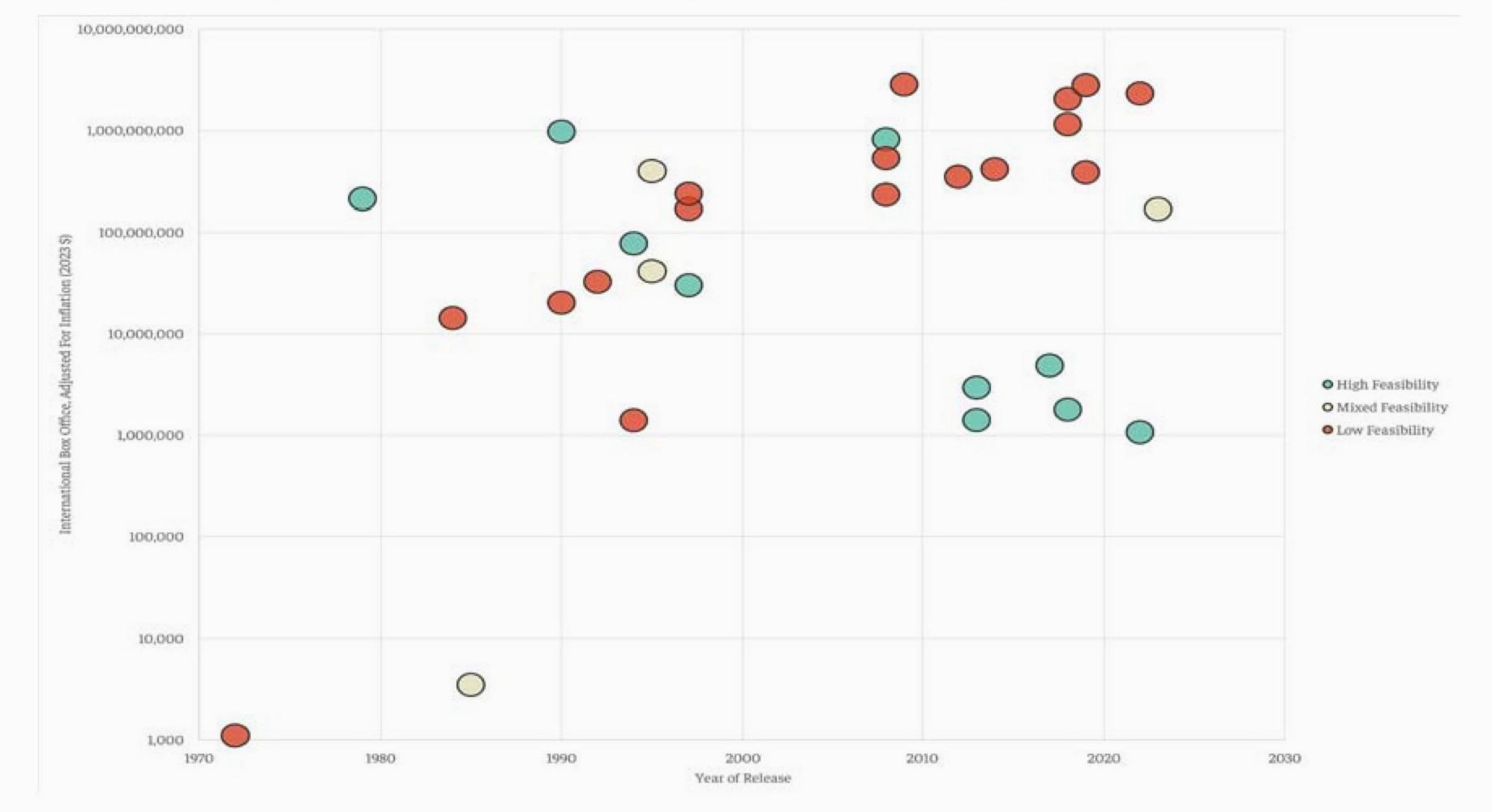
Table 2 shows that High Feasibility portrayals tended to feature higher moral justification, lower extremity of justification, and lower severity of planned or enacted violence than Mixed and Low Feasibility portrayals, as well as markedly lower box office returns. These patterns suggest that higher-grossing films prioritise spectacle and scale over realistic depictions of environmental violence. This, in turn, implies reduced audience exposure to more nuanced narratives that engage with or resemble real-world acts of eco-tage and eco-terrorism.
Table 2: Average metrics of ‘High Feasibility’ ‘Mixed Feasibility’, and ‘Low Feasibility’ films
| Mean Value of Metric | High |
Feasibility | Mixed Feasibility | Low Feasibility |
| International Box Office (2023 $) | 210,000,000 | 300,000,000 | 991,000,000 | |
| Justification Rating | 7.0 | 5.0 | 5.1 | |
| Extremity of Justification | 0.7 | 0.8 | 1.0 | |
| Highest Severity Rating of Enacted act | 5.0 | 6.9 | 7.1 | |
| Highest Severity Rating of Planned act, which is more severe than any Enacted act | 7.5 | 9.1 | 10.0 | |
| Highest Severity Rating of Planned act or Enacted act | 6.0 | 7.5 | 7.7 | Table 3 shows the variation in the severity of violence depicted, both enacted and planned. Acts included sabotage, property destruction, threats, kidnapping, assault, killing, mass killing, and attempts to eradicate humanity. Some perpetrators target infrastructure or polluters specifically to prevent harm, while others act out of revenge, with violence serving no direct environmental purpose. |
Table 3: ‘Severity Rating’ of the most severe act(s) of eco-tage and eco-terrorism depicted in each film.
| Severity Rating* | Number of films — Highest rating of Enacted act (average=6.4) | Number of films — Highest rating of Planned act, where more severe than any Enacted act (average=9.4) | Number of films — Highest rating of Planned act or Enacted act (average=7.1) |
| 0–0.9 (No Acts) | 1 | 0 | 0 |
| 1–1.9 (Minor Property Damage) | 0 | 0 | 0 |
| 2–2.9 (Moderate Property Damage) | 0 | 0 | 0 |
| 3–3.9 (Major Property/ Infrastructure Damage) | 3 | 0 | 3 |
| 4–4.9 (Threat of Violence/Physical Confrontation) | 2 | 0 | 2 |
| 5–5.9 (Assault or Attempted Killing) | 3 | 0 | 1 |
5–5.9 (Killing of a Sentient Non-Human) | 2 | 0 | 2 |
| 6–6.9 (Killing 1–10 People) | 8 | 0 | 7 |
| 7–7.9 (Killing 10–99 People) | 3 | 1 | 4 |
| 8–8.9 (Killing 100–9,999 People) | 4 | 2 | 5 |
| 9–9.9 (Killing 10,GOO- 999,999,999) | 6 | 3 | 4 |
| 10–10.9 (Large-Scale Destruction of Humanity) | 0 | 4 | 4 |
| * See Appendix C[95] |
In 10 of the 32 films analysed, planned acts, more severe than any enacted, are either thwarted or abandoned; three would have resulted in large-scale deaths, and seven in total or near-total human extinction. In all but one of these cases, less severe acts are still carried out.
Table 4 shows that the majority of films portrayed eco-tage and eco-terrorism as largely, fully, or exceptionally justified (20 of the 32 films), though the nature of these depictions varied considerably. Validation and sympathy were often conveyed through insight into characters’ thoughts, via monologues, dialogue, flashbacks, voiceover, and cinematography, revealing motivations such as revenge, duty, or radical beliefs. Justification was shaped by whether plans succeeded, were thwarted, or were abandoned, as well as by the personal and societal consequences that followed.
Table 4: ‘Justification Rating’ of acts of eco-tage and eco-terrorism in influentia! fiction films.
| Justification Rating* (average=5.7, standard deviation=2.9) | Number of films |
| 0–0.4 (Fully Condemned, Unjustified, and Negative) | 0 |
| 0.5–2.4 (Mostly Unjustified with Minimal Sympathy) | 7 |
| 2.5–4.4 (Partially Justified but Heavily Condemned) | 4 |
| 4.5–5.4 (Mixed Portrayal; Balanced Justification and Critique) | 1 |
| 5.5–7.4 (Largely Justified with Significant Sympathy) | 11 |
| 7.5–9.4 (Fully Justified and Sympathetically Portrayed) | 8 |
| 9.5–10 (Exceptionally Justified and Heroically Portrayed) | 1 |
| *See Appendix B[96] |
Films that justify environmental violence typically present it as a secondary motive, alongside more immediate concerns like self-defence, war, protection of others, or land rights. In contrast, films with no or limited justification often portrayed environmentalism as the sole motivator, with acts endangering human safety. Most protagonists outside of the scales’ extremes were shown to wrestle with this moral tension between environmental goals and potential harm to others.
Table 5 and Figure 2 show a strong negative correlation between ‘Justification Rating’ and ‘Greater of Planned or Enacted Severity Rating’ (-0.74), meaning films with more extreme acts of environmental violence, planned or enacted, were less likely to justify them. The most extreme acts were strongly correlated with plan failure (0.70), and failed plans correlated with less justification for violence (-0.70). This suggests two common tropes: villains planning extreme, unjustified violence that fails, and heroes committing moderate acts of eco-tage or eco-terrorism, which are justified and succeed.
Table 5: Correlation matrix between quantified variables of each film.
| Justification Rating | Extremity of Justification* | Enacted Act Severity Rating | Greater of Planned or Enacted Severity Rating | Plan Fails? | Year of Release | International Box Office (Adjusted for Inflation) (2023 $) | |
| Justification Rating | 1.00 | ||||||
| Extremity of Justification* | -0.35 | 1.00 |
| Enacted Act |
Severity Rating | -0.51 | 0.47 | 1.00 | | | | |
| Greater of Planned or Enacted Severity Rating | -0.74 | 0.42 | 0.74 | 1.00 |
| Plan Fails? | -0.70 | 0.35 | 0.24 | 0.70 | 1.00 | ||
| Year of Release | -0.14 | 0.51 | 0.11 | 0.26 | 0.29 | 1.00 |
| International Box Office (Adjusted for Inflation) (2023 $) | -0.14 | 0.43 | 0.47 | 0.47 | 0.07 | 0.38 | 1.00 |
| * Extremity of justification is the absolute value of the z-score of the Justification Rating, measuring the distance a film’s justification Rating is away from the mean, in standard deviations. Extreme values of Justification Rating (close to 0 or 10) create the highest Extremity of Justification. |
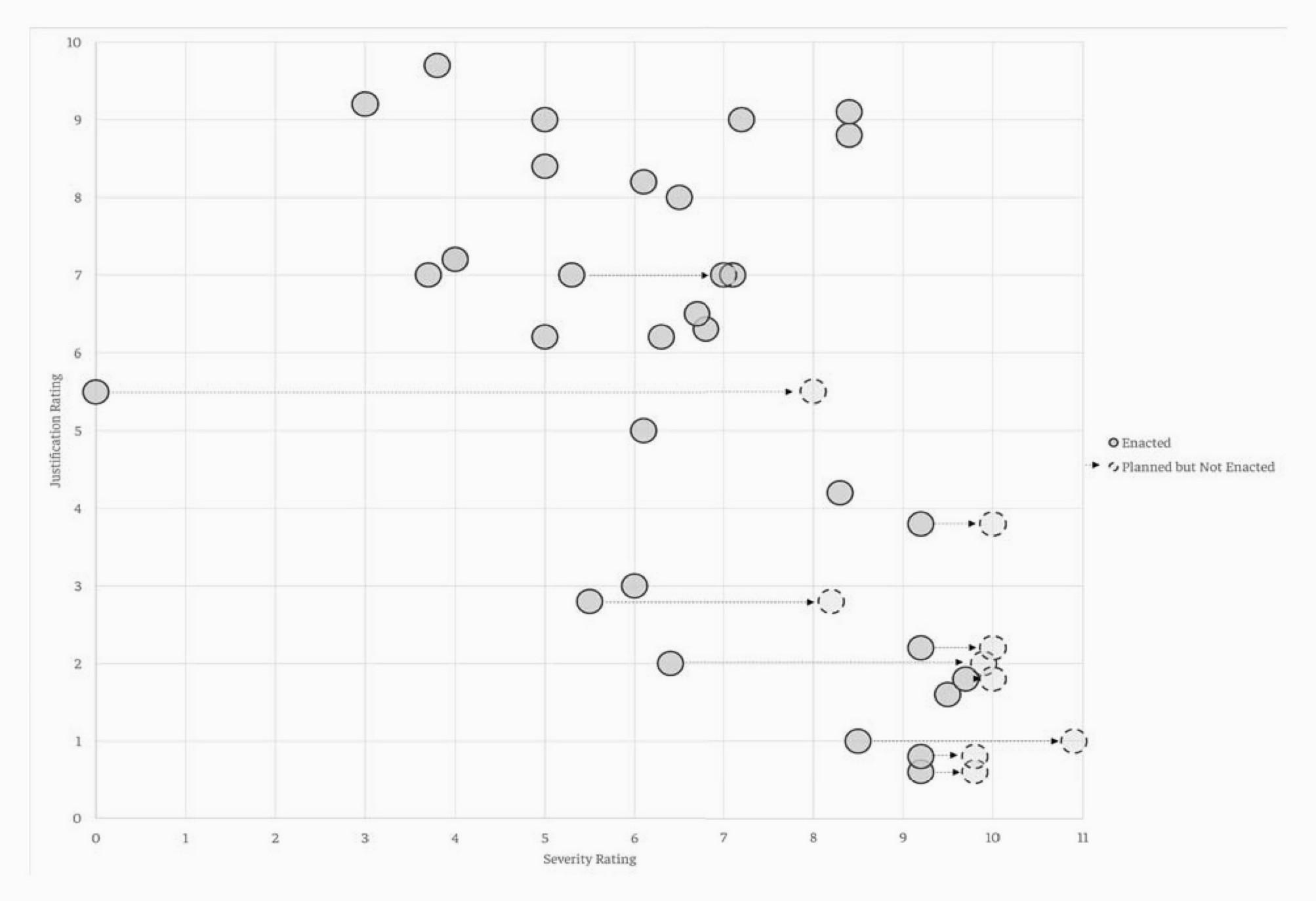
Additionally, Table 5 shows a moderate positive correlation between ‘International Box Office (Adjusted for Inflation) (2023 $)’ and ‘Greater of Planned or Enacted Severity Rating’ (0.47), but no meaningful relationship between box office performance and justification (-0.14). This suggests higher-grossing films are more likely to depict severe violence but no clear trend toward heroism or villainy, highlighting the spectacle-driven nature of such films.
Table 5 and Figure 3 show a moderate positive correlation between ‘International Box Office (Adjusted for Inflation) (2023 $)’ and ‘Extremity of Justification’ (0.43), indicating that higher- grossing films tend to portray environmental violence as either very justified or unjustified. In contrast, lower-grossing films typically feature more mixed justifications. Additionally, there is a moderate positive correlation between ‘Year of Release’ and ‘Extremity of Justification’ (0.51), suggesting depictions have become more polarised over time, with violence increasingly portrayed as either heroic or villainous.
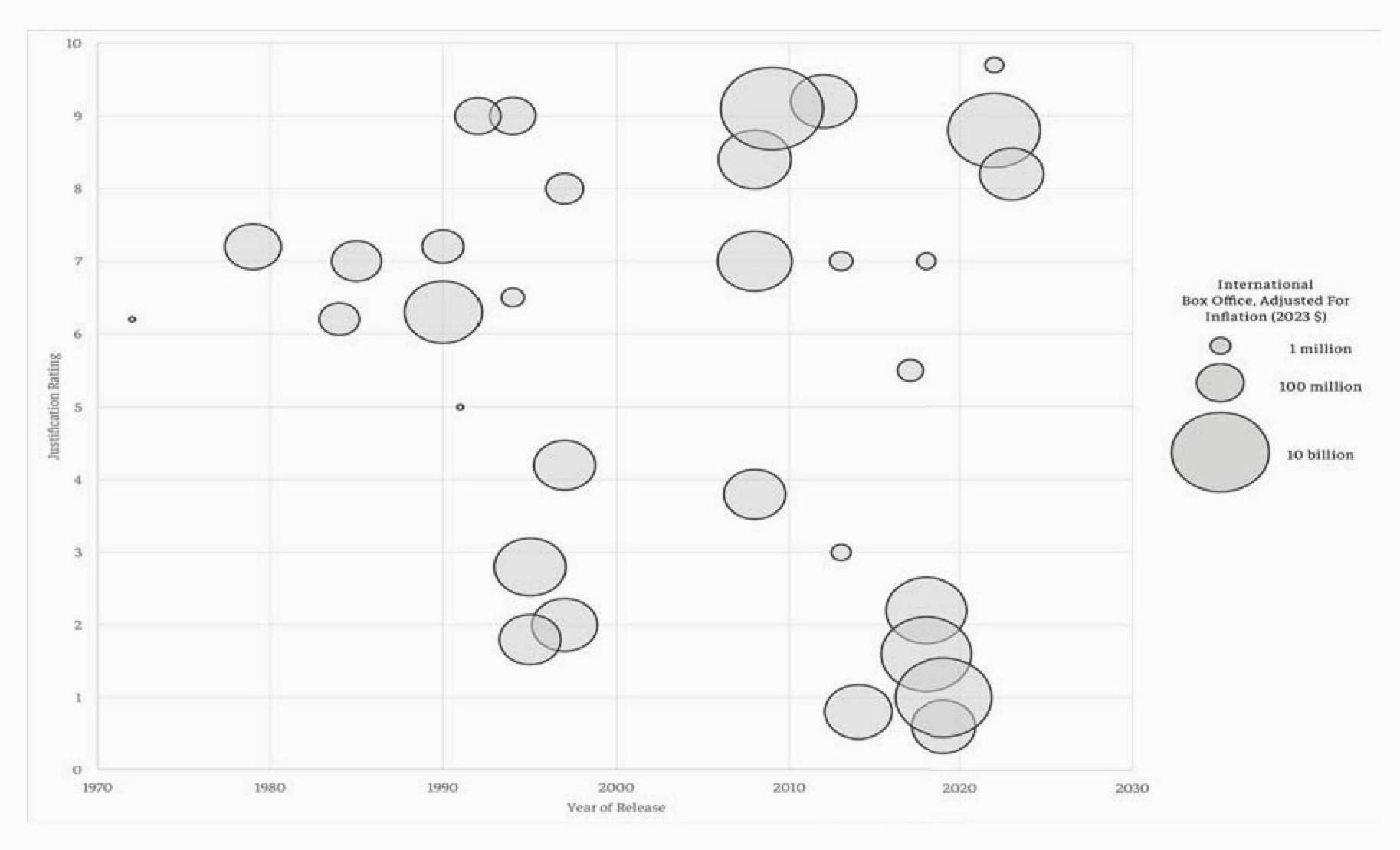
Figure 4, supported by Table 5, shows a clear gap in portrayals over recent decades: nuanced and feasible depictions have become rarer and are mostly confined to lower-grossing films, limiting their potential influence on public perceptions, while high-grossing, low-feasibility portrayals now dominate.
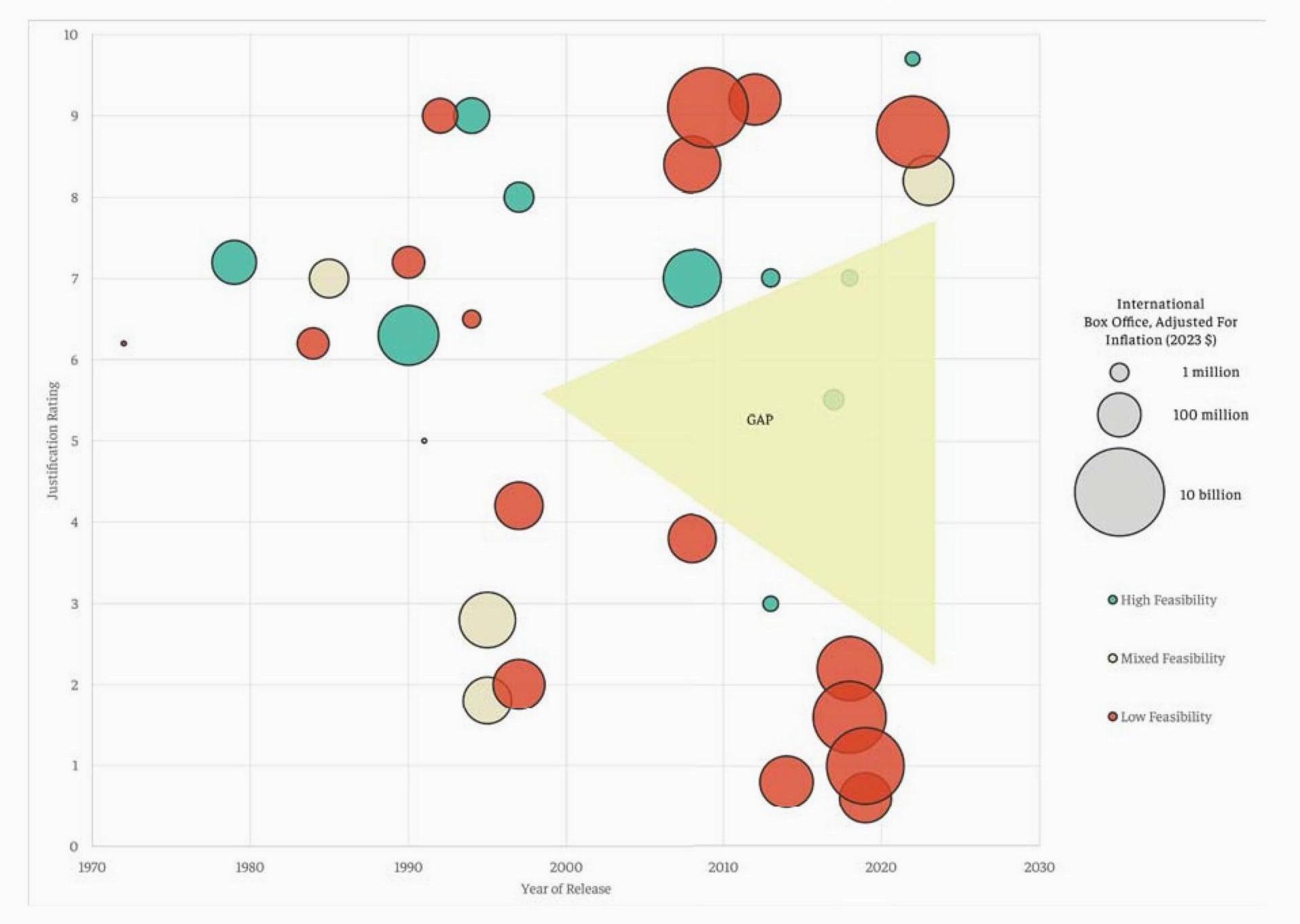
Categorisation
Based on qualitative analysis of each film in the corpus, six, sometimes overlapping, categories of portrayal were identified, as shown in Table 6 and Figure 5.
Table 6: Film categorisation.
| Category | Films | |
| Blockbuster – The Environmental Hero | The China Syndrome (1979), Pale Rider (1985), Dances with Wolves (1990), On Deadly Ground (1994), Fire Down Below (1997), Quantum of Solace (2008), Avatar ^2009), Avatar: Way of Water (2022), Meg 2: The Trench (2023)[97] | |
| Blockbuster – The Environmental Villain | 12 Monkeys (1995), Batman & Robin (1997), The Day the Earth Stood Still (2008), Kingsman: The Secret Service (2014), Aquaman (2018), Avengers: Infinity War (2018), Avengers: Endgame (2019), Godzilla: King of the Monsters (2019)[98] | |
| Children’s Films — US | Jetsons: The Movie (1990), FernGully: The Last Rainforest (1992), Pocahontas (1995), WALL-E (2008), The Lorax (2012)[99] | |
| Children’s Films — Japan | Nausicad of the Valley of the Wind (1984), Pom Poko (1994), and Princess Mononoke (1997)[100] | |
| Ethical Dilemma — Being Convinced by Eco-tage and Eco-terrorism | Dances with Wolves (1990), Clearcut (1991), Avatar (2009), The East (2013), First Reformed (2017), How to Blow Up a Pipeline (2022)[101] | |
| Ethical Dilemma — Being Dissuaded from Eco-tage and Eco-terrorism | Silent Running (1972), The Day the Earth Stood Still (2008), Night Moves (2013), First Reformed (2017), Woman at War (2018)[102] |
|
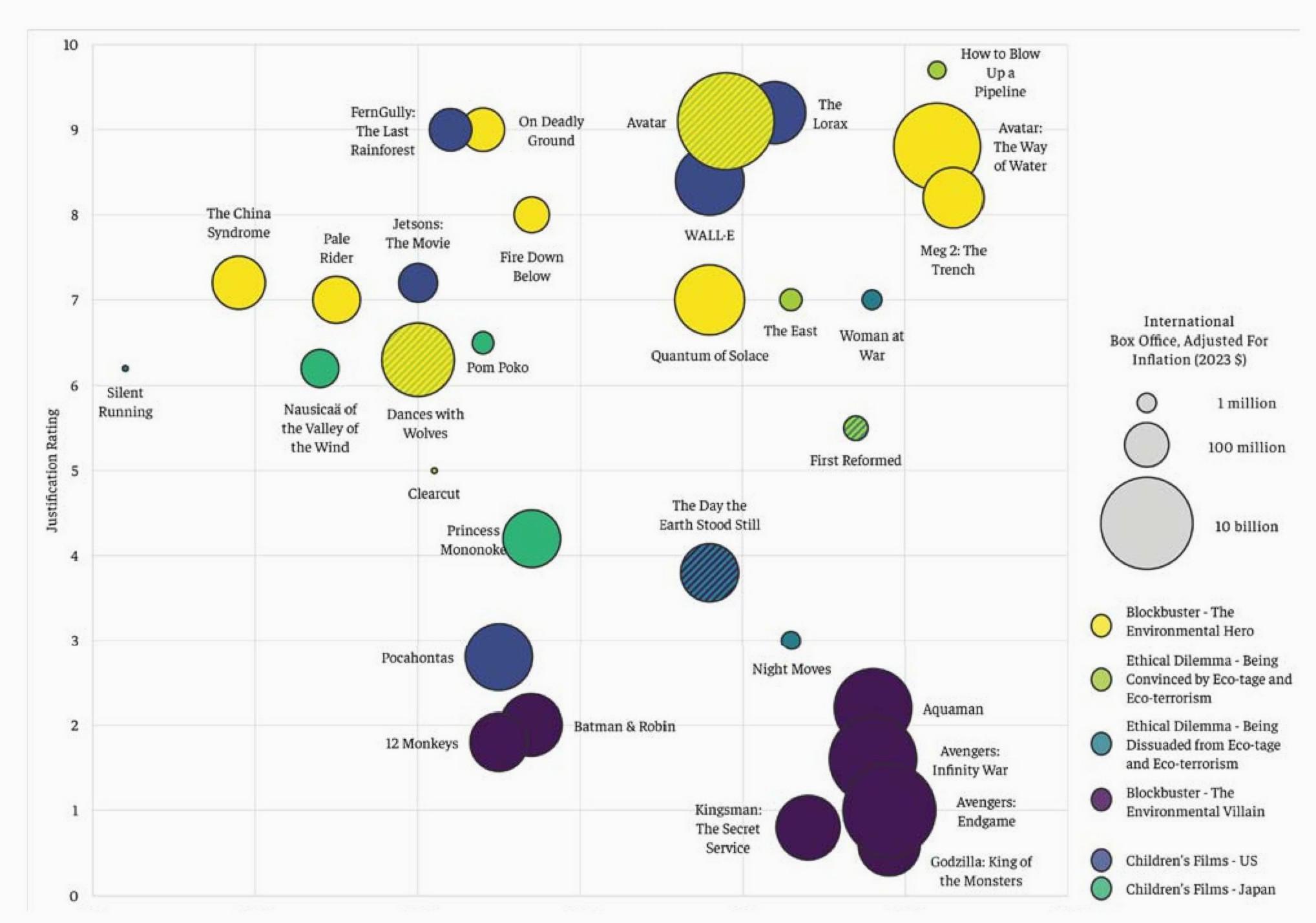
The variance in portrayals of eco-tage and eco-terrorism across fiction film may initially appear to support Bennett and Iyengar’s claim that media in this corpus is fragmented and therefore limits potential persuasive power.[103] However, over 98 percent of total box office revenue comes from Hollywood blockbusters and US children’s films, which overwhelmingly present polarised framings, either strongly justified or vilified. These dominate public exposure, overshadowing the more nuanced depictions found in lower-grossing ethical dilemma narratives. This pattern suggests portrayals are less fragmented than they appear, reflecting two dominant sets of consistent moral framings, with the greatest potential influence on public discourse around legitimacy, dissent, and threat concerning environmental violence. The implications for audience perceptions of eco-tage and eco-terrorism, shaped by both dominant and marginal narratives, require further empirical investigation.
The categorisation that follows offers high-level descriptions of these narrative clusters, alongside hypotheses regarding their likely audience effects, and is intended to serve as a foundation for further study.
Blockbuster — The Environmental Hero
Films in this category are high-grossing, often simplified titles, in which protagonists commit violent acts, justified at least in part by environmental motivations. While environmental degradation drives the plot, the hero’s actions and motivations are primarily framed around survival, justice, or protecting loved ones.
Protagonists dominate screen time, supported by accomplices or sympathetic communities, creating emotional alignment through dialogue and shared purpose. This can include colleagues (e.g., The China Syndrome, Quantum of Solace, Avatar, Meg 2: The Trench) or local communities and/or love interests (Pale Rider, Dances with Wolves, On Deadly Ground, Fire Down Below, Avatar).
The protagonist in Avatar, a bereaved, disabled ex-Marine, becomes sympathetic through vulnerability, humour, and curiosity. Initially dismissive of an alien race’s bond with nature, his transformation is narrated via a video diary, offering insight as he integrates into their community and forms a romantic bond with their princess. The tribe’s suffering at the hands of human colonisers, who seek a valuable mineral and threaten their sacred environment, aligns audience sympathy with their resistance, culminating in sabotage and large-scale violence that expels the invaders and halts ecological destruction.
The Environmental Hero is typically opposed by a villain motivated by greed, exploitation, and conquest at the expense of ecosystems and vulnerable communities. On Deadly Ground pits the hero against a corrupt oil executive polluting Alaska and disregarding Indigenous peoples; Fire Down Below features a coal magnate colluding with law enforcement to dump toxic waste in Appalachia; Quantum of Solace’s villain dams Bolivia’s water supply and installs a dictator to secure monopoly rights. In Meg 2: The Trench, a billionaire and her mercenary oversee illegal deep-sea mining until, at the climax, one is devoured by sea-lizards and the other is kicked into the mouth of a prehistoric shark. “See you later, chum!” the hero quips.
The villain is typically the first to use violence, prompting the protagonist’s retaliation, framing violence as self-defence or retribution; environmentalism alone rarely secures audience sympathy. In Pale Rider, mining tycoon LaHood sends men to intimidate locals, leading the protagonist, Preacher, to a violent response. Only later does Preacher discover the environmental damage: “He’s been using big hydraulic monitors. They blow a place to hell,” a miner explains. The hero’s violence is portrayed as morally justified, responding to immediate threats rather than acting purely on principle. This necessity is reinforced when legal avenues are shown to be ineffective or corrupt. “Isn’t there any law around, someone you can take your case to?” asks Preacher. “Even if there was, LaHood would own them...not much a lawman could do,” comes the reply. This breakdown of justice legitimises environmental vigilantism.
Protagonist-led violence typically includes the assault or killing of main villains and their often- nameless subordinates, as well as property destruction aimed at halting environmental harm, like the demolition of an oil refinery in On Deadly Ground or a hydraulic mining monitor in Pale Rider. These acts are depicted triumphantly, with little attention to collateral damage. In The China Syndrome, whistleblower Jack Godell uses a gun to take control of a nuclear reactor, threatening workers to prevent a meltdown. His actions are not questioned; instead, his death cements him as a martyr: “He was a hero,” a colleague tells a reporter. In Dances with Wolves, ex-soldier John Dunbar joins the Sioux resistance, confronting both cultural oppression and environmental destruction. His climactic violence against US troops is framed as noble: “I did not mind killing those men. I was glad to do it,” Dunbar declares.
However, victories are often symbolic. Years after their expulsion depicted in Avatar, humans return to the planet Pandora in the sequel, Avatar: The Way of Water; Earth’s deepening ecological collapse has made Pandora a target not only for resource extraction, but for full-scale colonisation. In Dances with Wolves, a short text at the end of the film decrees, ‘Thirteen years later, their homes destroyed, their buffalo gone, the last band of free Sioux submitted to white authority.’ On Deadly Ground concludes with a call-to-action monologue that remains relevant decades later, condemning corporate and government collusion in environmental destruction and calling for collective action to hold polluters accountable.
By centring protagonists who take illegal action against powerful interests, these films may contribute to a broader narrative that frames militant environmentalism as moral self-defence. However, this risks oversimplifying complex politics, sidelining non-violent activism, and obscuring the potential harms of violence, including inadvertent casualties and increased state repression.
Blockbuster — The Environmental Villain
Films in this category frame eco-tage and eco-terrorism as not only morally wrong, but apocalyptic. Antagonists in these low- and mixed-feasibility films seek to save the environment through mass violence on a planetary or universal scale, however, their plans are usually thwarted, their damage reversed, and/or they are killed or imprisoned by the protagonist.
Villains are often scientists (12 Monkeys, Batman & Robin, Kingsman: The Secret Service), aliens (The Day the Earth Stood Still, Avengers: Infinity War, Avengers: Endgame), or military figures (Aquaman, Godzilla: King of the Monsters), portrayed as intelligent but emotionally detached. In 12 Monkeys, a virologist plans to release a virus to curb overpopulation and its environmental toll. Similarly, in Avengers: Infinity War, the alien warlord Thanos seeks to erase half of all life to prevent resource depletion: “This universe is finite. Its resources, finite...It needs correction.” Their logic is presented as cold and inhuman, with their villainy conveyed most thoroughly through their willingness to harm innocents, particularly protagonists, shifting audience focus from the logic of their goals to the threat they pose.
Villains often use monologues to justify their belief that human destruction is necessary to save the planet. In Kingsman: The Secret Service, a tech billionaire turns to violence after failing to address climate change through traditional means. Speaking to the US President, he says, “Research, lobbying, years of study, billions of dollars, and you know why I quit? Because the last time 1 checked, the planet was still fucked,” before unveiling his plan to trigger mass population reduction via a lethal phone signal. While his intelligence and rationale might invite sympathy, the film undermines him with a speech impediment, a fear of blood, and an over-the- top American persona, contrasted with the gentlemanly British spy protagonists. His credibility further unravels after he kills a sympathetic character and reveals his intention to save only the global elite, making his ideology easier to dismiss.
While protagonists reject the villain’s violent methods, they do not dismiss environmentalism itself. Instead, engagement with their motivation is minimal, often reduced to calls for peaceful action. In Aquaman, the villain Orm confronts the titular hero with the damage caused by humans: “...for a century, they have polluted our waters and poisoned our children...you’ve come all this way to take sides against your own people?” Aquaman’s only response is, “There are no sides in a war like this,” adding, “we got some idiots running the show, but we’ve got some good things too, alright?” offering no compelling alternative to violent resistance. In Batman & Robin, Poison Ivy seeks to eradicate humanity so plants can reclaim the Earth. The hero, Batman, in his alter ego as Bruce Wayne, can only suggest instead that she joins him at a corporate fundraiser for a local botanic garden.
By using low- and mixed-feasibility portrayals that caricature ecological defenders, these narratives create strawman depictions of real activists’ aims and tactics, heightening public scepticism or anxiety about eco-tage and eco-terrorism. This framing risks delegitimising genuine movements, bolstering support for increased surveillance and policing, and reinforcing cultural norms that prioritise institutional, elite-led solutions over grassroots dissent.
Children’s Films — US
These films tend to portray eco-tage and eco-terrorism positively, framing nature as something to protect from human greed and exploitation. However, the use of low- and mixed-feasibility portrayals, featuring fantasy, animation, and metaphor, softens environmental destruction and resulting acts of resistance, making them more palatable for young audiences and their guardians. Violence is only justified when all other actions have been exhausted, and the resulting acts of resistance are generally mild, often limited to non-lethal fighting or property destruction. The closest these films come to depicting killing for environmental causes is the ‘death’ of sentient but non-human characters in FernGuliy: The Last Rainforest and WALL-E.
In FernGuliy: The Last Rainforest, the protagonists sabotage the Leveler, a logging machine that destroys the rainforest under the control of the malevolent entity Hexxus. The fairy protagonist uses magic to stop the machine and imprison Hexxus in a tree, symbolising a victory for nature over industrial greed. Similarly, Jetsons: The Movie shows the sabotage of harmful industrial equipment to protect a cute alien race and their homes. Other than shoving the factory boss to one side and a played-for-laughs kidnapping by the extraterrestrials, no serious harm is depicted against human characters, ensuring the message remains accessible to children without the harsher realities of real-world violence.
Fantasy softening of violence is also evident in WALL-E, where Earth’s population has been evacuated into space following a pollution-induced ecocide. Violence unfolds as robots and a space-cruise-ship captain protect the last surviving plant and sabotage the ship’s AI in order to return humanity to Earth. In a realistic setting, armed robbery, a police shootout, and double homicide would be too violent for a children’s film. However, using robots as stand-ins for human victims makes the violence acceptable, despite their demonstrated sentience.
Pocahontas is the only US children’s film studied that questions the acceptability of violence for environmental causes. The Powhatan tribe plans to attack English settlers for killing tribe members and destroying land, but Pocahontas and Englishman John Smith intervene. The planned violence, involving human targets, is more intense than in other films in the category; the climax underscores the cost of potential war, through foreboding music and dark visuals, before shifting to reconciliation. After Pocahontas’ pleas, the conflict is averted, and the chief concludes, “We’ve all come here with anger in our hearts, but she comes with courage and understanding.”
Just as the colonisers in Pocahontas come to recognise the value of nature and the communities protecting it, so too do the miners in Jetsons: The Movie and the lumberjack in FernGuliy: The Last Rainforest. Similarly, citizens in WALL-E and The Lorax are moved to support the protagonists. In The Lorax, the hero destroys a city wall to expose environmental devastation outside, prompting a crowd to banish the polluting business mogul, Aloysius O’Hare, and plant the first tree in a generation. The final scene shows the land recovering and animals returning, thanks to the protagonist’s necessary violence.
Aimed at young audiences, these films may shape early views of environmental activism and political legitimacy. By portraying violence as non-lethal and fantastical, leaning into low- and mixed-feasibility portrayals, they create a vision of protest that is both morally justified and emotionally accessible. This legitimises resistance against destructive state and corporate actors, but also obscures the harsh realities of such action. At the same time, these films draw clear moral lines, framing violence as a last resort and harm to humans as unacceptable, offering a political imaginary where resistance protects the vulnerable.
Children’s Films — Japan
(English-dubbed versions of these Japanese films were analysed, as they are the most widely distributed to English-speaking audiences and ensure consistency across categories; all quotations are from these dubs.)
Japanese children’s films offer a more mixed portrayal of environmental conflict compared to their US counterparts, exploring the tension between human needs and environmental preservation, promoting balance and coexistence. Employing low-feasibility portrayals, these films rely heavily on fantasy elements in their depictions of environmental conflict.
Nausicad of the Valley of the Wind depicts a post-apocalyptic world where toxic forests threaten human survival but also work to purify the planet. The protagonist Nausicaà seeks harmony, using violence only to coerce humans obstructing this equilibrium. Unlike typical hero-versus- villain stories, the film emphasises the need for balance, captured in Nausicaà’s warning: “too much fire gives birth to nothing.”
Pom Poko tells the story of tanuki, shape-shifting raccoon dogs who use magical abilities to sabotage urban development encroaching on their forest home. In their most extreme act, tanuki destroy construction machinery, killing several workers, with the threat, “If you don’t want to be so accident-prone, keep off our forests and we’ll leave you alone.” Although their violence delays the project, the forest is ultimately destroyed. Many die during their fight, while survivors face bleak futures, either being killed by urban life or reluctantly assimilating into human society. The film presents a nuanced critique of eco-tage and eco-terrorism as desperate but ultimately futile acts against unstoppable human expansion.
Princess Mononoke also presents a complex view of radical environmentalism. The story follows Ashitaka, who navigates a conflict between industrial humans, led by Lady Eboshi, and the gods and spirits of the forest, whose defence is led by San. San’s violence is driven by the desire to protect the forest, but it is also fuelled by her hatred of humans. By contrast, Eboshi’s industrial expansion damages the environment in order to sustain her workers, yet she demonstrates compassion toward the marginalised, even as her success depends on nature’s destruction. The film extends empathy to both sides without privileging either, framing anger itself as the true adversary that all characters must ultimately confront. Ashitaka, pointing to his scar, warns, “This is what hatred looks like...It’s eating me alive, and very soon now it will kill me!” The film ultimately suggests that violence is only justified when used to restore balance, not to deepen conflict.
Unlike many others in the corpus, these films present eco-tage and eco-terrorism as morally complex, prompting young audiences to consider the ethics of environmental violence. Rather than portraying environmentalism as a simple battle of good versus evil, they emphasise tradeoffs and the mixed consequences of radical action, using low-feasibility portrayals to nurture early political awareness and empathy for those driven to desperate acts of environmental violence.
Ethical Dilemma — Being Convinced by Eco-tage and Eco-terrorism
In films within this category, the protagonist typically begins from a mainstream standpoint, often regarding radical environmentalism as misguided or ineffective. For example, Sara, the protagonist of The East, questions, “Why is it that self-righteousness always goes hand-in-hand with resistance movements?” Alternatively, the protagonist may favour lawful, non-violent environmentalism, as seen with Reverend Toller in First Reformed, who, reflecting on the suicide of an eco-terrorist parishioner, says, “Michael was troubled but his cause was just. There’s no reason to bring disrepute to that cause.”
As these narratives progress, a more radical secondary character typically highlights the inadequacy of peaceful methods, and the protagonist becomes disillusioned by the slow pace of change and the persistence of environmental destruction despite legal efforts. In Clearcut, Maguire, a white lawyer, is transformed under the influence of Arthur, a First Nations man. After Maguire’s courtroom efforts to protect indigenous land fail, Arthur insists violence is necessary: “Be polite and see where it gets you with scum.” He coerces Maguire to take part in the kidnapping and torture of a logging CEO and the killing of two police officers. Maguire ultimately tries to kill Arthur, coming to see violence as a necessity in the fight for survival, for both himself and the environment. In Dances with Wolves, Avatar, and The East, the protagonist’s conversion via a secondary character is supported by budding romance, a trope also seen in the US children’s films FernGully: The Last Rainforest and Pocahontas.
In The East, the protagonist’s radicalisation stops short of full conversion to the cause; Sara rejects the execution of a final act that would endanger lives, instead exposing environmental crimes through peaceful whistleblowing. In How to Blow Up a Pipeline, however, the film pushes further: counterarguments for peaceful action are dismissed (“It makes white people feel better. It makes you feel better. And it does nothing!”), terrorism is portrayed as effective (“If the law will not punish you, we will”), and violence is framed as resistance (“This was justified, this was an act of self-defence”).
By portraying eco-tage and eco-terrorism as ethically complex or even necessary responses to state and corporate inaction, these narratives potentially challenge dominant legal and moral frameworks that deem such violence illegitimate. Across all levels of feasibility in portrayal, they blur the line between protest and terrorism, inviting empathy for those breaking the law to defend the planet. In doing so, they may shape public perceptions of environmental activism, particularly as climate protests grow more confrontational and face increased state repression.
Ethical Dilemma — Being Dissuaded from Eco-tage and Eco-terrorism
Films in this category depict protagonists who support environmental violence yet struggle with their conscience and the consequences of their actions. Love and compassion often guide them toward peaceful alternatives, ultimately leading them to reject radical environmentalism. In The Day the Earth Stood Still, Klaatu, a hyper-rational alien, abandons his plan to destroy humanity to save Earth after forming a bond with a boy and his mother, realising humanity can adapt: “At the precipice, we change.” In Woman at War, the protagonist’s eco-tage campaign to protect Iceland’s environment ends when she learns she’s been approved to adopt a Ukrainian orphan, prompting her to abandon her criminal activism. Having at first been swayed towards radical environmentalism, First Reformed later uses love and human connection to steer its protagonist away from violence. Reverend Toller, despairing over environmental destruction and influenced by radical parishioner Michael, prepares to use a suicide vest. However, in a moment of moral clarity, he abandons the plan, embracing and kissing Michael’s widow, Mary, as the camera spins around them before cutting to black.
Conversely, Night Moves and Silent Running show violence early in the film, leaving protagonists and audiences to confront the fallout. In Night Moves, a group of activists blows up a dam, inadvertently killing a bystander. One member later overhears peers dismissing the act as mere “theatre,” favouring slower, more principled methods. The film examines the moral and psychological costs of radicalism, culminating in one environmentalist killing another, a stark illustration of how violence can fracture movements, while the cold cinematography and score accentuate the bleakness of their choices. In Silent Running, set in a future where Earth’s remaining forests are housed on cargo spaceships, astronaut Freeman kills crewmates ordered to destroy them. Portrayed as unstable through close, shaky shots, in contrast to his indifferent crew’s calm, wide framing, Freeman later expresses remorse: “They weren’t exactly my friends...I don’t think that I’ll ever be able to excuse what it is that I did, but I had to do it.” Though he preserves the forests, his suicide at the film’s climax underscores the tragic toll of his actions.
By emphasising the psychological toll of violence and privileging love, care, and redemption across all levels of feasibility, these films may reinforce dominant norms of legitimate protest while delegitimising radical action. Activists are often depicted as tragic, unstable, or misguided, implying that even just causes must align with liberal ideals of civility and conscience. Such narratives can subtly uphold the state’s monopoly on force, casting unauthorised disruption as dangerous, isolating, or futile, even in contexts of systemic collapse.
Conclusion and Future Work
David Pellow suggests that the rise of radical environmentalism during the 1970s, 1980s, and 1990s may reflect not only a general increase in environmental consciousness, but also a growing cultural awareness of intersectionality.[104] As environmental concerns became entwined with broader narratives of social justice and systemic oppression, perhaps both filmmakers and activists alike began to frame ecological action within stories that resonated with multiple, overlapping struggles. It can be theorised that the range of portrayals during this period— varying in severity, justification, and feasibility—both reflected and contributed to a cultural landscape in which acts of environmental violence were increasingly visible and, potentially, more widely understood or engaged with.
However, the notable gap in films addressing this topic between 1998 and 2007 coincides with one of the most active periods of eco-tage and eco-terrorism. This divergence may reflect the post-9/11 legal and cultural suppression of radical environmentalism, which likely made the production and funding of terrorism-related film projects less appealing in the immediate aftermath of the attacks, and contributed to a decline in real-world acts of environmental violence over the following decade and beyond.[105]
Since 2008, when films depicting environmental violence began to once again be released, portrayals have now become increasingly bifurcated: high-grossing films tend to frame environmental violence through extreme binaries, such as apocalyptic threat or heroic salvation, while lower-grossing titles instead explore morally complex and feasible acts that more closely resemble real-world eco-tage and eco-terrorism.
Incident-based research shows that the vast majority of environmental violence occurs at the lower end of the severity spectrum, primarily vandalism, sabotage, or arson.[106] Yet, the predominance of low-feasibility, spectacular portrayals in widely viewed films risks potentially skewing public and political perceptions away from this reality, portraying eco-activists as extreme threats to human life.[107] It remains to be seen whether the current bifurcation in film portrayals will persist alongside the historically low real-world incidence of eco- terrorism and eco-tage. This pattern may reflect an entrenched cultural suppression of radical environmentalism, even amid a renewed and growing public concern for environmental and climate issues.
Rik Scarce notes “social movements crave inspiration to keep them alive and vibrant.”[108] While this study does not assess direct audience effects, the consistent narrative patterns identified offer a basis for theorising how such portrayals may shape broader political imaginaries. As political scientists increasingly see cultural artefacts as sites of ideological contestation, entertainment media deserve greater attention for their role in potentially shaping public attitudes towards dissent, violence, and state authority, especially regarding social movements and acts labelled ‘terrorism’. Analysing how stories frame threats, tactics, and political actions can reveal how popular culture may influence political possibilities.
The categorisation of eco-tage and eco-terrorism portrayals detailed herein intends to provide a foundation for future research into fiction films’ political significance, generating hypotheses about the influence of individual films, narrative clusters, or the entire corpus on discourse and policy around radical environmentalism. It is my hope that future studies will deepen this connection, empirically explore its effects, and consider how fiction might be used or challenged to shape more informed narratives of environmental dissent in the future.
As The Lorax (2012) concludes: “UNLESS someone like you cares a whole awful lot, nothing is going to get better. It’s not.”[109]
Acknowledgements: I would like to thank Dr Liam Creighton for his guidance on this study, as well as DrKantaDihaland Dr Felicity Mellor for their crucial initial supervision and workshopping of this project. I would also like to thank all reviewers for their insightful feedback, which has significantly strengthened the quality of this work. Lastly, I would like to extend my thanks to Dr Casey Delehanty and Dr Erin M. Kearns, whose work Wait, There’s Torture in Zootopia?: Examining the Prevalence of Torture in Popular Movies served as the inspiration for my title.
Monty Gould is a sustainability consultant, academic, and screenwriter whose work examines the role of environmental storytelling in shaping political discourse and institutional change. He holds an MSc in Science Communication from Imperial College London and a BA in Economics and Management from the University of Oxford.
[1] Ipsos, One in Four Britons Think Climate Change Is out of Control / Ipsos, Ipsos Political Monitor (Ipsos, 2023], https://www.ipsos.com/en-uk/one-four-britons-think-climate-change-out-control.
[2] Aniket Narawad, ‘Global Surveys Show People’s Growing Concern about Climate Change’, Clean Energy Wire, 9 November 2023, https://www.cleanenergywire.org/factsheets/global-surveys- show-peoples-growing-concern-about-climate-change.
[3] Anthony Giddens, The Politics of Climate Change (Polity, 2009), 50.
[4] Stephen D. Fisher et al., ‘The Politicisation of Climate Change Attitudes in Europe’, Electoral Studies 79 (October 2022): 102499, https://doi.Org/10.1016/j.electstud.2022.102499; Ipsos, One in Four Britons Think Climate Change Is out of Control I Ipsos; Jacob Poushter et al., Climate Change Remains Top Global Threat Across 19-Country Survey (Pew Research Center, 2022), https://www.pewresearch. org/global/2022/08/31/climate-change-remains-top-global-threat-across-19-country-survey/.
[5] YouGov, ‘YouGov / Greenpeace Survey Results’, YouGov, February 2024, https://d3nkl3psvxxpe9. cloudfront.net/documents/Greenpeace_Oceans_UK_Feb2024_W.pdf; YouGov, ‘YouGov / Royal Society Survey Results’, YouGov, 28 February 2024, https://d3nkl3psvxxpe9.cloudfront.net/documents/RoyalSociety_Environment_240228_w.pdf; YouGov, ‘YouGov / The Times Survey Results’, YouGov, 5 January 2024, https://d3nkl3psvxxpe9.cloudfront.net/documents/TheTimes_AdHoc_240105_W.pdf.
[6] Martha Kirby, ‘Modelling the Fall and Rise in the Importance of the Environment to the British Public: 2006–2019’, The British Journal of Politics and International Relations 25, no. 2 (2023): 199- 218, https://doi.org/10.1177/13691481221080651
[7] Starling Research, Literature Review on Contemporary Public Views of Climate Change and Biodiversity Loss in the UK (The Royal Society; Natural History Museum; Natural Environmental Research Council; British Science Association, 2023), https://royalsociety.org/news-resources/publications/2023/contemporary-public-views-of-climate-change-and-biodiversity-loss-in-the-uk/.
[8] Giddens, The Politics of Climate Change, 50.
[9] Paola Spadaro, ‘Climate Change, Environmental Terrorism, Eco-Terrorism and Emerging Threats’, Journal of Strategic Security 13, no. 4 (2020), https://doi.org/10.5038/1944-0472.13–4.1863; Joao Raphael Da Silva, ‘The Eco-Terrorist Wave’, Behavioral Sciences of Terrorism and Political Aggression 12, no. 3 (2020): 203–16, https://doi.org/10.1080/19434472.2019.1680725.
[10] Horacio R. Trujillo, ‘The Radical Environmentalist Movement’, in Aptitude for Destruction, Volume 2, 1st edn, by Brian A. Jackson et al., Case Studies of Organizational Learning in Five Terrorist Groups (RAND Corporation, 2005), https://www.jstor.org/stable/10.7249/mg332nij.13.
[11] The Threat of Eco-Terrorism: Hearing before the House Resources Committee, Subcommittee on Forests and Forest Health (2002), https://www.fbi.gov/news/testimony/the-threat-of-eco- terrorism; Animal Rights Extremism and Ecoterrorism: Hearing before the United States Senate Judiciary Committee (2004), https://www.fbi.gov/news/testimony/animal-rights-extremism-and- ecoterrorism; S.Hrg. 109–947 — ECO-TERRORISM SPECIFICALLY EXAMINING THE EARTH LIBERATION FRONT AND THE ANIMAL LIBERATION FRONT: Hearing before the COMMITTEE ON ENVIRONMENT AND PUBLIC WORKS UNITED STATES SENATE (2005), https://www.congress.gov/event/109th- congress/senate-event/LC12065/text.
[12] Michael Loadenthal, ‘“Eco-Terrorism”: An Incident-Driven History of Attack (1973–2010)’, Journal for the Study of Radicalism 11, no. 2 (2017): 4–5, https://doi.Org/10.14321/jstudradi.ll.2.0001.
[13] Animal Rights Extremism and Ecoterrorism.
[14] Loadenthal, “‘Eco-Terrorism’”; National Consortium for the Study of Terrorism and Response to Terrorism (START), University of Maryland, ‘Global Terrorism Database (GTD)’, n.d., accessed 7 November 2025, https://www.start.umd.edu/data-tools/GTD.
[15] S.Hrg. 109–947 — ECO-TERRORISM SPECIFICALLY EXAMINING THE EARTH LIBERATION FRONT AND THE ANIMAL LIBERATION FRONT.
[16] Spadaro, ‘Climate Change, Environmental Terrorism, Eco-Terrorism and Emerging Threats’.
[17] Robert Fletcher, ‘License to Kill: Contesting the Legitimacy of Green Violence’, Conservation and Society 16, no. 2 (2018): 147–56.
[18] ‘The Violent Erasure of Land and Environmental Defenders | Global Witness’, accessed 7 November 2025, https ://globalwitness.org/en/campaigns/land-and-environmental-defenders/missingvoices/.
[19] Sean P. Eagan, ‘From Spikes to Bombs: The Rise of Eco-terrorism’, Studies in Conflict & Terrorism 19, no. 1 [1996]: 2, https://doi.org/10.1080/10576109608435993.
[20] David Thomas Sumner and Lisa M. Weidman, ‘Eco-Terrorism or Eco-Tage: An Argument for the Proper Frame’, Interdisciplinary Studies in Literature and Environment 20, no. 4 [2013]: 855–76, https://doi.org/10.1093/isle/ist086.
[21] Sumner and Weidman, ‘Eco-Terrorism or Eco-Tage’.
[22] Loadenthal, “‘Eco-Terrorism’”; The Threat of Eco-Terrorisnr, S.Hrg. 109–947 — ECO-TERRORISM SPECIFICALLY EXAMINING THE EARTH LIBERATION FRONT AND THE ANIMAL LIBERATION FRONT, Animal Rights Extremism and Ecoterrorism.
[23] Michael Loadenthal, ‘Deconstructing “Eco-Terrorism”: Rhetoric, Framing and Statecraft as Seen through the Insight Approach’, Critical Studies on Terrorism 6, no. 1 [2013]: 26–27, https://doi.org/10.1080/17539153.2013.765702.
[24] Will Potter, Green Is the New Red: An Insider’s Account of a Social Movement Under Siege [City Lights Publishers, 2011].
[25] Steve Vanderheiden, ‘Eco-Terrorism or Justified Resistance? Radical Environmentalism and the “War on Terror”’, Politics & Society 33, no. 3 [2005]: 427, https://doi.org/10.1177/0032329205278462.
[26] Edward Abbey, The Monkey Wrench Gang, 1st ed [Lippincott, 1975].
[27] Vanderheiden, ‘Eco-Terrorism or Justified Resistance?’, 436; Kirby, ‘Modelling the Fall and Rise in the Importance of the Environment to the British Public’.
[28] Anthony Gierzynski, Political Effects of Entertainment Media: How Fictional Worlds Affect Real World Political Perspectives, 1st edn [The Rowman & Littlefield Publishing Group, 2018], https://doi.org/10.5040/9781978735705.
[29] George Gerbner, ‘Cultivation Analysis: An Overview’, Mass Communication and Society 1, nos 3–4 [1998]: 175–94, https://doi.org/10.1080/15205436.1998.9677855.
[30] Robert Reiner, ‘Media Made Criminality: The Representation ofCrime in the Mass Media’, in The Oxford Handbook of Criminology, ed. Mike Maguire et al. [Oxford University Press, 2007]
[31] Eric G. Scheuch et al.,‘The Power of Protest in the Media: Examining Portrayals of Climate Activism in UK News’, Humanities and Social Sciences Communications 11, no. 1 [2024]: 270, https://doi.org/10.1057/s41599-024-02688-0.
[32] Jillian Neufeldt, How Media Framing Shapes Opinion of Environmental Policy: The Case ofULEZ, Diamond Open Access Journals at Cambridge, December 2024, https://doi.org/10.60866/CAM.124.
[33] Charlotte A. Jones et al., ‘Innocent Heroes or Self-absorbed Alarmists? A Thematic Review of the Variety and Effects of Storylines about Young People in Climate Change Discourses’, WIREs Climate Change 14, no. 6 [2023]: e853, https://doi.org/10.1002/wcc.853.
[34] Scheuch et al., ‘The Power of Protest in the Media’.
[35] Danielle K. Brown and Rachel R. Mourao, ‘Protest Coverage Matters: How Media Framing and Visual Communication Affects Support for Black Civil Rights Protests’, Mass Communication and Society 24, no. 4 [2021]: 576–96, https://doi.org/10.1080/15205436.2021.1884724; Fred Paxton, ‘Right up Their Street? News Media Framing of the Protest Activities of Far-Right Movement Parties’, Acta Politica 60, no. 1 [2025]: 76–97, https://doi.org/10.1057/s41269-024-00334-w.
[36] W. Lance Bennett and Shanto Iyengar, A New Era of Minimal Effects? The Changing Foundations of Political Communication’, Journal of Communication 58, no. 4 [2008]: 707–31, https://doi.org/10.1111/j.1460–2466.2008.00410.x; W. Lance Bennett and Shanto Iyengar, ‘The Shifting Foundations of Political Communication: Responding to a Defense of the Media Effects Paradigm’, Journal of Communication 60, no. 1 [2010]: 35–39, doi.0rg- 2466.2009.01471.x.
[37] R. Lance Holbert et al., ‘22. The Political Relevance of Entertainment Media’, in Handbook of Communication Science: 18. Political Communication, ed. Carsten Reinemann and Carsten Reinemann, Handbooks of Communication Science [DE GRUYTER, 2014], https://doi.org/10.1515/9783110238174.427; R. Lance Holbert et al., A New Era of Minimal Effects? A Response to Bennett and Iyengar’, Journal of Communication 60, no. 1 (2010): 15–34, doi.org; Casey Delehanty and Erin M. Kearns, ‘Wait, There’s Torture in Zootopia? Examining the Prevalence of Torture in Popular Movies’, Perspectives on Politics 18, no. 3 [2020]: 835–50, https://doi.org/10.1017/S1537592719005012.
[38] Holbert et al., ‘22. The Political Relevance of Entertainment Media’.
[39] Diana C. Mutz and Lilach Nir, ‘Not Necessarily the News: Does Fictional Television Influence Real- World Policy Preferences?’, Mass Communication and Society 13, no. 2 [2010]: 196–217, https://doi.org/10.1080/15205430902813856.
[40] Kristina Riegert, ed., Politicotainment: Television’s Take on the Real, Popular Culture Everyday Life, v. 13 [Peter Lang, 2007]; Liesbet van Zoonen and Dominic Wring, ‘Trends in Political Television Fiction in the UK: Themes, Characters and Narratives, 1965–2009’, Media, Culture & Society 34, no. 3 [2012]: 263–79, https://doi.org/10.1177/0163443711433663.
[41] Sarah Dillon and Claire Craig, ‘Storylistening: How Narrative Evidence Can Improve Public Reasoning about Climate Change’, WIREs Climate Change 14, no. 2 [2023]: e812, https://doi.org/10.1002/wcc.812.
[42] Adeline Johns-Putra, ‘Climate Change in Literature and Literary Studies: From Cli-fi, Climate Change Theater and Ecopoetry to Ecocriticism and Climate Change Criticism’, WIREs Climate Change 7, no. 2 [2016]: 266–82, https://doi.org/10.1002/wcc.385; Noelia Ibarra-Rius and Alvaro M. Pons, ‘Representation of Climate Change and Global Warming in Comics: From Apocalyptic Fiction to Educational Tool’, European Journal of Cultural Studies, 26 July 2024,13675494241264449, https:// doi.org/10.1177/13675494241264449; Katherine Carter, ‘From The Fresh Prince to The Politician: Climate Change Frames in American Scripted Television Comedy 1990–2020’, Environmental Education Research 29, no. 4 [2023]: 592–606, https://doi.org/10.1080/13504622.2022.2071417.
[43] Michael Svoboda, ‘Cli-Fi on the Screen(s): Patterns in the Representations of Climate Change in Fictional Films’, WIREs Climate Change 7, no. 1 [2016]: 43–64, https://doi.org/10.1002/wcc.381; Matthew Schneider-Mayerson et al., ‘The Presence and Portrayal of Climate Change and Other Environmental Problems in Popular Films: A Quantitative Content Analysis’, Environmental Communication 0, no. 0 [2025): 1–21, https://doi.org/10.1080/17524032.2025.2467427.
[44] Cassandra L. C. Troy et al., ‘Can You Picture It? Effects of Positive and Negative Depictions of Climate Futures on Climate Action Intentions’, Journal of Environmental Psychology 96 [June 2024]: 102312, https://doi.Org/10.1016/j.jenvp.2024.102312; Helena Bilandzic and Freya Sukalla, ‘The Role of Fictional Film Exposure and Narrative Engagement for Personal Norms, Guilt and Intentions to Protect The Climate’, Environmental Communication 13, no. 8 [2019]: 1069–86, https://doi.org/10-1080/17524032.2019.1575259.
[45] Michael D. Slater et al., ‘Television Dramas and Support for Controversial Public Policies: Effects and Mechanisms’, Journal of Communication 56, no. 2 [2006]: 235–52, https://doi.org/10.llll/j-1460- 2466.2006.00017.x; Charli Carpenter, ‘Rethinking the Political / — Science — / Fiction Nexus: Global Policy Making and the Campaign to Stop Killer Robots’, Perspectives on Politics 14, no. 1 [2016]: 53–69, https://doi.org/10.1017/S1537592715003229; Kenneth Mulligan and Philip Habel, ‘The Implications of Fictional Media for Political Beliefs’, American Politics Research 41, no. 1 [2013]: 122- 46, https://doi.org/10.1177/1532673X12453758.
[46] Jones et al., ‘Innocent Heroes or Self-absorbed Alarmists?’
[47] Ashley Bieniek-Tobasco et al., ‘Communicating Climate Change through Documentary Film: Imagery, Emotion, and Efficacy’, Climatic Change 154, nos 1–2 [2019]: 1–18, https://doi.org/10.1007/sl0584-019-02408-7; Rachel Wetts et al., ‘Climate Media amidst Technopolitical Change: Challenges, Transformations, and New Directions for Research’, Climatic Change 178, no. 6 [2025]: 115, https://doi.org/10.1007/sl0584-025-03936-l.
[48] Bennett and Iyengar, A New Era of Minimal Effects?’; Bennett and Iyengar, ‘The Shifting Foundations of Political Communication’.
[49] Robert Getti, Terrorism in American Cinema: An Analytical Filmography, 1960–2008 [McFarland, Incorporated, Publishers, 2009]; Helena Vanhala, The Depiction of Terrorists in Blockbuster Hollywood Films, 1980–2001: An Analytical Study [McFarland & Company, Inc, 2011].
[50] Paul B. Rich, ‘Understanding Terror, Terrorism, and Their Representations in Media and Culture’, Studies in Conflict & Terrorism 36, no. 3 [2013]: 262, [[https://doi.org/10.1080/1057.610X.2013.755915; Michael C. Frank, The Cultural Imaginary of Terrorism in Public Discourse, Literature, and Film: Narrating Terror, Routledge Interdisciplinary Perspectives on Literature 76 [Routledge, 2017],
[51] Thomas Riegler, ‘Through the Lenses of Hollywood: Depictions of Terrorism in American Movies’, Perspectives on Terrorism 4, no. 2 [2010]: 52.
[52] Riegler, ‘Through the Lenses of Hollywood’, 40.
[53] Michael Loadenthal, ‘Eco-Terrorism? Countering Dominant Narratives of Securitisation: A Critical, Quantitative History of the Earth Liberation Front [1996–2009]’, Perspectives on Terrorism 8, no. 3 [2014]: 16.
[54] Potter, Green Is the New Red, 136.
[55] Rich, ‘Understanding Terror, Terrorism, and Their Representations in Media and Culture’, 263.
[56] Vanhala, The Depiction of Terrorists in Blockbuster Hollywood Films, 1980–2001, 281; Getti, Terrorism in American Cinema.
[57] 24, written by Joel Surnow and Robert Cochran, aired 2001, on Fox; Homeland, produced by Howard Gordon and Alex Gansa, aired 2011, on Showtime; Quantico, produced by Joshua Safran, aired 2015, on ABC; Zero Dark Thirty, directed by Kathryn Bigelow [Annapurna Pictures, 2012],
[58] Delehanty and Kearns, ‘Wait, There’s Torture in Zoologia?; Michael Flynn and Fabiola Fernandez Salek, eds, Screening Torture: Media Representations of State Terror and Political Domination [Columbia University Press, 2012]; Keren Tenenboim-Weinblatt, “‘Where Is Jack Bauer When You Need Him?” The Uses of Television Drama in Mediated Political Discourse’, Political Communication 26, no. 4 [2009]: 367–87, https://doi.org/10.1080/10584600903296960.
[59] Riegler, ‘Through the Lenses of Hollywood’; Robert McKee, Story: Substance, Structure, Style and the Principles of Screenwriting, lsted [ReganBooks, 1997],
[60] Fletcher, ‘License to Kill’, 153.
[61] Seth Cantey, ‘Filmic Representations of Radicalization and Terrorism: The Silver Screen as a Catalyst for Social Science’, Media, War& Conflict 12, no. 3 [2019]: 317–30, https://doi.org/10.1177/1750635218779953; Tony Shaw, Cinematic Terror: A Global History of Terrorism on Film [Bloomsbury Academic, 2015]; Jack Valenti, ‘Hollywood and the War Against Terror’, New Perspectives Quarterly 19, no. 2 [2002]: 69–72, https://doi.org/10.llll/0893-7850.00499; Riegler, ‘Through the Lenses of Hollywood’.
[62] Elaine Martin, ‘Terrorism in Film Media: An International View of Theatrical Films’, Journal of War & Culture Studies 4, no. 2 [2011]: 207–22, https://doi.Org/10.1386/jwcs.4.2.207_l; Stephen Prince, Firestorm: American Film in the Age of Terrorism [Columbia University Press, 2009]; Samuel W. Bettwy, ‘Evolving Transnational Cinematic Perspectives of Terrorism’, Perspectives on Terrorism 9, no. 2 [2015]: 42–60.
[63] Getti, Terrorism in American Cinema; Rich, ‘Understanding Terror, Terrorism, and Their Representations in Media and Culture’.
[64] Pale Rider, directed by Clint Eastwood (The Malpaso Company, 1985].
[65] Robin L. Murray and Joseph K. Heumann, Ecology and Popular Film: Cinema on the Edge, Horizons of Cinema (SUNY, State Univ, of New York Press, 2009].
[66] Pom Poko, directed by Isao Takahata (Studio Ghibli, 1994].
[67] Todd Andrew Borlik, ‘Carnivalesque Ecoterrorism in Pom Poko’, Resilience: A Journal of the Environmental Humanities 2, no. 3 [2015]: 127–33.
[68] The East, directed by Zal Batmanglij (Scott Free Productions, 2013]; Night Moves, directed by Kelly Reichardt (Maybach Film Productions; Film Science; Tipping Point Productions; RT Features, 2013].
[69] Graig Uhlin, ‘Monkeywrenched Images: Ecocinema and Sabotage’, New Review of Film and Television Studies 18, no. 3 [2020]: 301–24, https://doi.org/10.1080/17400309.2020.1790480.
[70] Cara Buckley, ‘Why Is Hollywood So Scared of Climate Change?’, Movies, The New York Times, 14 August 2019, https://www.nytimes.com/2019/08/14/movies/hollywood-climate-change.html; Sonny Bunch, ‘Opinion | Environmentalists Make Good Movie Villains Because They Want to Make Your Real Life Worse’, The Washington Post, 3 January 2019, https://www.washingtonpost.com/opinions/2019/01/03/environmentalists-make-good-movie-villains-because-they-want-make- your-real-life-worse/; Alison Willmore, ‘Climate Change Fiction Is Rethinking The Ecoterrorist’, BuzzFeed News, 28 April 2019, https://www.buzzfeednews.com/article/alisonwillmore/climate- change-fiction-is-rethinking-the-ecoterrorist.
[71] Bunch, ‘Opinion | Environmentalists Make Good Movie Villains Because They Want to Make Your Real Life Worse’.
[72] Buckley, ‘Why Is Hollywood So Scared of Climate Change?’
[73] Anthony Dudo et al., ‘Entertainment Film and TV Portrayals of Climate Change and Their Societal Impacts’, in Oxford Research Encyclopedia of Climate Science (2017), https://doi.org/10.1093/acrefore/9780190228620.013.374; Emily Moyer-Gusé and Robin L. Nabi, ‘Explaining the Effects of Narrative in an Entertainment Television Program: Overcoming Resistance to Persuasion’, Human Communication Research36,no. 1 (2010): 26–52,https://doi.Org/10.llll/j.1468–2958.2009.01367.x; Bilandzic and Sukalla, ‘The Role of Fictional Film Exposure and Narrative Engagement for Personal Norms, Guilt and Intentions to Protect The Climate’; ‘Streaming Economics: United States TV & Streaming Landscape: Key Audience Trends and Consumer Insights for Major Platforms | Parrot Analytics’, accessed 11 November 2025, https://www.parrotanalytics.eom/insights/us/.i
[74] Michael A. Shapiro and T. Makana Chock, ‘Psychological Processes in Perceiving Reality’, Media Psychology 5, no. 2 (2003): 163–98, https://doi.org/10.1207/S1532785XMEP0502_3.
[75] ‘Cinema and the Environment in Europe: 20th-21st Centuries | EHNE’, accessed 11 November 2025, https://ehne.fr/en/encyclopedia/themes/ecology-and-environment/ideas-actors-and-political-practices/cinema-and-environment-in-europe-20<sup>th</sup>-21<sup>st</sup>-centuries.
[76] Erin Brockovich, directed by Steven Soderbergh (Universal Pictures; Columbia Pictures; Jersey Films, 2000); Happy Feet, directed by George Miller (Village Roadshow Pictures; Animal Logic; Kennedy Miller Productions; Kingdom Feature Productions, 2006); Dark Waters, directed by Todd Haynes (Participant; Killer Content; Willi Hill, 2019).
[77] The Plague Dogs, directed by Martin Rosen (United Artists; Nepenthe Productions; Goldcrest Films, 1982); Gorillas in the Mist, directed by Michael Apted (The Guber-Peters Company, 1988); Chicken Run, directed by Peter Lord and Nick Park (Aardman Animations; DreamWorks Animation, 2000); 28 Days Later, directed by Danny Boyle (DNA Films; UK Film Council., 2002); Fantastic Mr. Fox, directed by Wes Anderson (Indian Paintbrush; Regency Enterprises; American Empirical Pictures, 2009); Okja, directed by Joon Ho Bong (Plan B Entertainment; Lewis Pictures; Kate Street Picture Company, 2017).
[78] The Threat of Eco-Terrorism.
[79] Soylent Green, directed by Richard Fleischer (Walter Seltzer; Russell Thacher, 1973); The Day After Tomorrow, directed by Roland Emmerich (Centropolis Entertainment; The Mark Gordon Company; Lions Gate Films, 2004); Elysium, directed by Neill Blomkamp (riStar Pictures; Media Rights Capital; QED International; Alphacore; Kinberg Genre, 2013); Mad Max: Fury Road, directed by George Miller (Village Roadshow Pictures; RatPac-Dune Entertainment; Kennedy Miller Mitchell, 2015).
[80] IMDb, ‘IMDb: Ratings, Reviews, and Where to Watch the Best Movies & TV Shows’, IMDb, accessed 1 August 2025, https://www.imdb.com/; AllMovie, ‘AllMovie | Movies and Films Database | Movie Search, Ratings, Photos, Recommendations, and Reviews’, AllMovie, accessed 1 August 2025, https:// www.allmovie.com/; Wikipedia, ‘Wikipedia, the Free Encyclopedia’, Wikipedia, accessed 1 August 2025, https://www.wikipedia.org/.
[81] Borlik, ‘Carnivalesque Ecoterrorism in Pom Poko’; Murray and Heumann, Ecology and Popular Film; Uhlin, ‘Monkeywrenched Images’.
[82] Letterboxd, ‘Letterboxd • Your Life in Film’, Letterboxd, accessed 1 August 2025, https://letterboxd.com/
[83] Monty Gould, ‘Supplemental Material for ‘Wait, There’s Terrorism in The Lorax? — Examining Portrayals of Eco-Tage and Eco-Terrorism in Influential Fiction Film, 1972–2023”’, OSF, 11 November 2025, https://doi.org/10.17605/OSF.IO/AN7CE.
[84] Murray Smith, Altered States: Character and Emotional Response in the Cinema’, Cinema Journal 33, no. 4 (1994): 34–56, https://doi.org/10.2307/1225898.
[85] Monty Gould, ‘Supplemental Material for “Wait, There’s Terrorism in The Lorax? — Examining Portrayals of Eco-Tage and Eco-Terrorism in Influential Fiction Film, 1972–2023”’.
[86] Smith, Altered States’.
[87] Office for National Statistics, ‘Research Outputs: Developing a Crime Severity Score for England and Wales Using Data on Crimes Recorded by the Police — Office for National Statistics’, 30 November 2016, https://bit.ly/3MF9BgC.
[88] Loadenthal, “‘Eco-Terrorism’”; National Consortium for the Study of Terrorism and Response to Terrorism [START], University of Maryland, ‘Global Terrorism Database [GTD]’.
[89] Gould, ‘Supplemental Material for “Wait, There’s Terrorism in The Lorax? — Examining Portrayals of Eco-Tage and Eco-Terrorism in Influential Fiction Film, 1972–2023”’.
[90] Virginia Braun and Victoria Clarke, Successful Qualitative Research: A Practical Guide for Beginners (SAGE, 2013); Wendy Hollway and Tony Jefferson, Doing Qualitative Research Differently: A Psychosocial Approach, Second edition [SAGE, 2013).
[91] Lucy Yardley, Demonstrating Validity in Qualitative Psychology, ed. Jonathan A. Smith, with Lucy Yardley and Jonathan A. Smith (SAGE Publications, 2007), 235–51, https://eprints.soton.ac.uk/54781/.
[92] Avatar, directed by James Cameron [20th Century Fox; Lightstorm Entertainment; Dune Entertainment; Ingenious Film Partners, 2009); Avengers: Endgame, directed by Anthony Russo and Joseph Russo (Marvel Studios, 2019); Avatar: The Way of Water, directed by James Cameron (TSG Entertainment; Lightstorm Entertainment, 2022).
[93] Box Office Mojo, ‘Top Lifetime Grosses’, Box Office Mojo, accessed 4 August 2025, https://www.boxofficemojo.com/chart/top_lifetime_gross/?area=XWW.
[94] Monty Gould, ‘Supplemental Material for “Wait, There’s Terrorism in The Lorax? — Examining Portrayals of Eco-Tage and Eco-Terrorism in Influential Fiction Film, 1972–2023”’.
[95] Monty Gould, ‘Supplemental Material for “Wait, There’s Terrorism in The Lorax? — Examining Portrayals of Eco-Tage and Eco-Terrorism in Influential Fiction Film, 1972–2023”’.
[96] Monty Gould, ‘Supplemental Material for “Wait, There’s Terrorism in The Lorax? — Examining Portrayals of Eco-Tage and Eco-Terrorism in Influential Fiction Film, 1972–2023”’.
[97] The China Syndrome, directed by James Bridges (IPC Films; Major Studio Partners, 1979); Pale Rider; Dances with Wolves, directed by Kevin Costner (Tig Productions; Majestic Films International, 1990); On Deadly Ground, directed by Steven Seagal (Seagal/Nasso Productions., 1994); Fire Down Below, directed by Félix Alcala (Seagal/Nasso Productions, 1997); Quantum of Solace, directed by Marc Forster (Metro-Goldwyn-Mayer; Columbia Pictures; Eon Productions, 2008); Avatar; Avatar: The Way of Water; Meg 2: The Trench, directed by Ben Wheatley (CMC Pictures; DF Pictures; China Film Co., Ltd.; Alibaba Pictures; di Bonaventura Pictures; Apelles Entertainment, 2023).
[98] 12 Monkeys, directed by Terry Gilliam (Atlas Entertainment; Classico Entertainment, 1995); Batman & Robin, directed by Joel Schumacher (Warner Bros. Pictures., 1997); The Day the Earth Stood Still, directed by Scott Derrickson (20th Century Fox; 3 Arts Entertainment; Dune Entertainment, 2008); Kingsman: The Secret Service, directed by Matthew Vaughn (Marv Films; Cloudy Productions; TSG Entertainment, 2014); Aquaman, directed by James Wan (Warner Bros. Pictures; DC Entertainment; DC Films; RatPac Entertainment; The Safran Company; Cruel and Unusual Films; Mad Ghost Productions, 2018); Avengers: Endgame; Avengers: Infinity War, directed by Anthony Russo and Joseph Russo (Marvel Studios, 2018); Godzilla: King of the Monsters, directed by Michael Dougherty (Legendary Pictures, 2019).
[99] Jetsons: The Movie, directed by Joseph Barbera and William Hanna [Hanna-Barbera, 1990); FernGully: The Last Rainforest, directed by Bill Kroyer [FAI Films; Kroyer Films; Youngheart Productions, 1992); Pocahontas, directed by Mark Gabriel and Eric Goldberg (Walt Disney Feature Animation, 1995); WALL-E, directed by Andrew Stanton (Pixar Animation Studios, 2008); The Lorax, directed by Chris Renaud (Universal Pictures; Illumination Entertainment, 2012).
[100] Nausicad of the Valley of the Wind, directed by Hayao Miyazaki (Topcraft, 1984); Pom Poko; Princess Mononoke, directed by Hayao Miyazaki (Studio Ghibli, 1997).
[101] Dances with Wolves; Clearcut, directed by Ryszard Bugajski (Cinexus Capital Corporation, 1991); Avatar; The East; First Reformed, directed by Paul Schrader (Killer Films; Omeira Studio Partners; Fibonacci Films; Arclight Films International; Big Indie Pictures, 2017); How to Blow Up a Pipeline, directed by Daniel Goldhaber (Chrono; Lyrical Media; Spacemaker Productions, 2022).
[102] Silent Running, directed by Douglas Trumbull (Trumbull/Gruskoff Productions, 1972); The Day the Earth Stood Still; Night Moves; First Reformed; Woman at War, directed by Benedikt Erlingsson (Slot Machine; Gulldrengurinn; Solar Media Entertainment; Koggull Filmworks; Vintage Picture, 2018).
[103] Bennett and Iyengar, A New Era of Minimal Effects?’; Bennett and Iyengar, ‘The Shifting Foundations of Political Communication’.
[104] David Naguib Pellow, ‘Eco-Defence, Radical Environmentalism and Environmental Justice’, in Routledge Handbook of Radical Politics (Routledge, 2019], 108.
[105] Potter, Green Is the New Red; Getti, Terrorism in American Cinema; Loadenthal, ‘Deconstructing ‘‘Eco- Terrorism”’.
[106] Loadenthal, ‘“Eco-Terrorism”’.
[107] Troy et al., ‘Can You Picture It?’; Bilandzic and Sukalla, ‘The Role of Fictional Film Exposure and Narrative Engagement for Personal Norms, Guilt and Intentions to Protect The Climate’.depicting dire future consequences if action is not taken. While the fear elicited by such messages may motivate audiences, there is growing evidence that hope is also an important driver of engagement in climate action. We conducted a pre-registered experiment with U.S. adults to examine how depictions of positive and negative climate futures (separately and in combination
[108] Eco-Warriors (n.d.), accessed 10 November 2025, https://www.thetedkarchive.com/library/rik-scarce-eco-warriors.
[109] The Lorax.