
Nathanael Bassett
Dead Zones
A Phenomenology of Disconnection
1.1. Topic and Research Problem
1.2. Significance and Goals of Study
1.2.4. Delimitations and Assumptions
2. Literature Review and Theoretical Framework
2.2. Intellectual History of Non-Use
2.2.1. Critical Perspectives on Non-use
2.2.3. Social Construction of Non-Use
2.3. A Phenomenological Approach
2.3.1. Redefining Disconnection
2.3.2. Justification of Approach
2.4. Theoretical and Conceptual Framework
2.5.1. The Technological Sublime
2.5.2. The Technological Uncanny
2.5.3. The Technological Uncanny in Media and Technology Studies
2.5.4. Sensibility as a Phenomenological Framework
2.5.5. A Brief Look at the Grid and Sensibility
2.5.6. The Insensibility of Off-The-Grid
3.1.2. Preparation, or Formulating the Question
3.2.1. A Dead Zone: Kibbitznest
3.2.2. A Dead Zone: Green Bank
3.3.2. Number of Participants.
3.3.3. Interview Instrumentation and Protocol.
3.3.8. Alternative Sources of Data: Literature, Biography and Art
3.4. Conceptual Framework: Hermenutic Phenomenology
4.1.1. Personal Connections and Tele-Absence
4.1.2. Personal Space and Proximity Tropism
4.1.3. Attentiveness and Attention Thrifting
4.1.4. Anxiety and Techno-Frenzy
4.2.1. Negative Liberty and Untethering
4.2.2. Positive Liberty and the Digi-Austere
5. Phenomenological and Historical Analysis
5.1. The Oppression of Involuntary Seperation
5.2. The Hostility of Voluntary Separation
5.3. Summary: Separation and Insensbility
6.1. The Meaning of Disconnection
6.2. Experiencing Disconnection
Dead Zones: A Phenomenology of Disconnection
BY
NATHANAEL EDWARD BASSETT
B.A. Missouri State University, 2011
M.A. The New School, 2014
THESIS
Submitted as partial fulfillment of the requirements for the degree of Doctor in Philosophy in Communication in the Graduate College of the
University of Illinois at Chicago, 2020
Chicago, Illinois
Defense Committee:
Andrew Rojecki, Chair and Advisor
Steve Jones
Adrienne Massanari
Richard Warner, Chicago-Kent College of Law
Liam Cole Young, Carleton University
Acknowledgements
One thing I’ve learned over the past few years is that doing a PhD is an exercise in stamina, more than intelligence or anything else. It involves a good deal of energy and can be incredibly draining, emotionally, mentally, and spiritually. Because of this I want to acknowledge everyone who was able to support my mind and heart during this process. It would not have been possible unless these people continued to encourage me.
My advisor, Andrew Rojecki, was instrumental by consistently working as a close reader, pushing back on the work when needed and helping me find and explore new directions in the research. He was patient with me through my inclinations to make the dissertation process more than it should be. I cannot imagine what this process would have been like without his calm and easy temperament, his insight into the work and research when I didn’t know where it was going, and his amazing ability to help me articulate what I was trying to say in more clear and succinct terms. His mentorship meant a great deal to me and I would not be the same without it. I also am grateful for the coursework I took with Dr. Rojecki, which continues to resonate in my thinking and led to some of the best seminar discussions I’ve had.
The rest of my committee and the faculty at UIC were formative in my training and I owe a great deal to the wonderful classroom discussions they facilitated, as well as the time they spent with me in their offices, and the conversations we had which were always helpful and positive. Steve Jones made himself an invaluable resource for me through the independent studies we had on philosophy of technology, which became a major part of my academic research agenda and my outlook in general. I thank Adrienne Massanari, for turning me to a Science and Technology Studies perspective early on through her wonderful mentorship and focus on literature that highlighted how STS can impact communication studies. Both Dr. Jones and Dr. Massanari made for a wonderful committee along with the outside members who helped steer me from projects that were too ambitious and untenable to the work that I have completed here. Our department head, Zizi Papacharissi, was also a source of encouragement and help, and I looked forward to any opportunity to interact with her. I also appreciated Zach McDowell, who shares my passion for theory, philosophy and media archaeology, and I enjoyed working with him on projects outside the dissertation. In the coursework I had for my PhD, I have to also acknowledge Sharon Meraz and Elaine Yuan, who ran fantastic seminars that I very much enjoyed. And of course, nothing at UIC would be possible without the staff, two of whom I saw retire during my time there. I will always appreciate Christina Zimmerman and Mamie Grey for their work and spirits.
Outside of UIC, I want to also thank the rest of my committee, Richard Warner at ChicagoKent College of Law, and Liam Cole Young of Carleton University. Their thoughts and contributions as readers have been helpful and I only wish we could have worked more closely on other projects. Dissertations are myopic processes, but I appreciated their help nonetheless.
My classmates and colleagues were very important to me. I started my PhD with one of the smallest cohorts, and I’d like to thank both the preceding and the following groups of students for being collegiate and welcoming. We are all in this together, and I can say I never experienced anything other than the most supportive of environments. My hope is for every student to have a similar experience of mutual respect and aid. I am grateful for the interactions and times I’ve had with Evie Psarras, Thomas Kannampallil, Ryan Schnurr, Ta’les Love and Nichole NeSmith, many of whom who I saw go their ways and finish their work to pursue other things. I’m also thankful for Tim Appignani, Stacy Blasiola, Renee Powers, Jes Larsen, Priya Shah and Michael Schandorf, and all of the other students at UIC from before and after my time. We are a part of the memory of the department while we are there, and then we go our ways. It is a bittersweet thing to belong to something so fleeting. Finally I want to thank Jason Archer, who is both another mentor and a friend. We share the experience of raising kids while doing graduate school, a unique kind of double duty that gave us a lot to bond over.
Doing this dissertation was part of an intensive dive into the world of disconnection, non-use and media refusal, and there are many, many people and thinkers who I could acknowledge here, but I will restrain myself. I am grateful for those who participated in my round-table at NCA in 2018 on non-use, including Cameron Wade Piercy, Song Shi, and Hsin-yi Sandy Tsai, and the panelists at “Beyond Non-Use” I organized for 2019’s 4S conference, including Meg Leta Jones, Sebastian Dahm, Helen Hambly, Joseph DeLeon, Lindsay Ems, and Elizabeth Resor. Other academics and scholars who impacted me include Sally Wyatt, Laura Portwood-Stacer, Lindsay Ems, and Louise Woodstock. I’ve been fortunate enough to follow and interact with many others on Twitter, too many to name, and apologies to all the others I’ve forgotten as well.
I’m thankful for the NSF-IGERT opportunities that arose at UIC and helped provide me with the means to continue this research and helped spur some of my thinking towards privacy and security as an integral part of how we experience infrastructures of media and technology. My interactions with IGERT faculty and colleagues were instrumental in helping to think about privacy and security in ways I hadn’t before, so I am grateful for their efforts and what they tried to facilitate during my time.
If a dissertation had a soundtrack this one would be The Lost Songs of St Kilda by James MacMillan and Trevor Morrison. The story behind it and its sounds spur what I think about as I think about disconnection, and there is always so much more to write – it is only finding the place for it that is hard.
On that note, there is much I could say about class, privilege, financial precarity and the state of the university. These are important issues that effect who writes what and the sorts of students who complete one of these dissertations. I will limit myself to thanking my wife and parents for their emotional and financial support. Despite the various opportunities I have found at UIC and elsewhere adjuncting during my time of writing this, it would not be possible to be a father of two children, a husband and a graduate student without a woman like Ravyn Bassett in my life who literally made it all possible. I also thank my parents for their constant encouragement and support. My entire family means so much to me. I write this dissertation as part of a tradition of knowledge seeking and gathering so that my girls, Genevieve and Gabrielle, can see how we can learn to understand their world through experience and study.
Lastly my dog, Mr. Darcy, has been with me through thick and thin, during my entire time in graduate school. He never talks back, and he has always been a shoulder to lean on. As a companion and a friend, he is a better being than I, and I thank him for his support and the infrequent but generous displays of affection he gives. Our time here is short, we should be good to each other, as he has been to me.
<right> NEB </right>
List of Tables
I. A TYPOLOGY OF PHENOMENOLOGICAL DISCONNECTION
List of Figures
FIGURE 1. THE NRQZ AND GBO IN RELATION TO THE US EASTERN SEABOARD
FIGURE 2. ZONE 1 AND 2 WITHIN THE NRQZ
FIGURE 3. CODING WITH EMERGING THEMES
Summary
A study of the experience of disconnection was carried out using phenomenological methodology, interviews and historical analysis. Interviews were conducted with 17 participants who were willing to discuss their experiences of disconnection from mobile media. In keeping with a first round phenomenological study, information on demographics was not collected.
Stemming from research on non-use and non-participation with socio-technical systems, themes were identified that demonstrate key aspects of the experience of disconnection and the implication of such phenomena in a technified, increasingly connected society. A theory of disconnection was then outlined discussing those implications and how this research might impact future research on non-use in communications and media studies.
A key finding involves the roles of sensibilities in how we judge what is proper and appropriate participation with and use of technologies. The disconnected non-participant or non-user is insensible to society, which heavily inclines us towards use and participation in infrastructural sociotechnical systems.
1. Introduction
1.1. Topic and Research Problem
Our connection to and disconnection from society and its technological infrastructures structure our experience of the world. As media usage becomes more ubiquitous and mundane, those media begin to make up part of the essential infrastructure which we take for granted, like roads, running water, or electricity. Connection becomes defined by the technological systems we participate in. We think of a “dead zone” as places where connectivity falls short – places where the power has gone out, where there is no cellular or Wi-Fi signal, and spaces that are otherwise “off-the-grid.”
But the dead zone is not just technological – it is phenomenological. It’s experienced in out of the way places, isolated and cut off spaces and experiences where disconnection is the norm. In 2020, it manifests in times of social distancing, hearkening back to historical quarantines. It’s found in the solitude of the religious ascetic, the isolation of a prisoner, the experiences of the desolate. The dead zone is wherever we are because it speaks to the fundamental loneliness of the human condition. It exists in spite of the persistent connectivity we experience through technological mediation.
As an example of that persistent connectivity, mobile coverage is something that we expect at all times – to be in contact with others, “online” or reachable via our phone (which we always carry on us). Wireless connectivity has become a primary way for people to stay in contact with one another. Mobile media is a major communication backbone in the developed and developing world. In 2018, 95% of Americans owned a cell phone, and 73% of those owned a smartphone.[1] Across the world, a median of 43% of all the population owned a smartphone in 2015, with large gains in developing economies during recent years. Research by Pew also demonstrates a strong relationship between per capita income and internet access.[2] One of the hallmarks of economic development is greater social connectivity via technology.
The experience of being in a dead zone is to be untethered from the kind of participation which we think of as essential. When this disconnection is technological, it stands at odds to prescriptive modes of being in the developed world of technological privilege. From a phenomenological point of view, technology is entangled in various types of social relations so that it becomes part of our lifeworld – the “already there” world of “immediate experience.”[3] To disconnect or exist in the “dead zone” renders one “insensible” to others. It is a gap in the grid in which other ways of being persist. This dissertation studies “insensibility” of disconnectivity.
1.2. Significance and Goals of Study
1.2.1. Sensibilities
The bias of media studies toward use and participation[4] means studies typically emphasize and promote connectivity. Studying disconnection reveals techno-normativities – what I call “sensibilities” people have about use of technology and media. Participation is essential for being a sensible member of society. Baumer et al. note, “studies of non-use help to challenge normative assumptions about the primacy of use and the ‘user’.”[5] This is not to fetishize or exoticize non-use, but instead to create a critical perspective about the social role of technology, connectivity, and use, which comes into conflict with individual agency and choice of whether or not to engage with these platforms and socio-technical systems. For researchers, non-use presents itself as an insensible fascination. By taking the phenomenological approach, I attempt to avoid the mistake of looking at disconnection through the lens of the sensible, and instead approach the essence of disconnection at odds with the structures of our technified experience.
As connectivity extends to urban and rural places, it is increasingly rare to find spaces and ways one can be “offline.” In the developed world, we are nearly always online, never logged off. Ways of being AFK (away from keyboard) or offline are disappearing, yet as I noted above, dead zones persist. Normative values about use and participation emerge as connectivity is naturalized to our experience. Phenomenological research is seldom considered in studies of non-use. Through phenomenological research methods I demonstrate the personal significance of (dis)connectivity – what once was as simple as leaving the phone “off the hook.” The first goal of this study is to understand the experience and value of practices of disconnection via phenomenological methods.
1.2.2. Addressing the Gap
Across the US, Wi-Fi and connectivity are seen as essential amenities. As nine in ten American adults use the internet, home broadband and connectivity in public spaces become expected.[6] People traverse public spaces expecting to be able to remain connected to others by means of their mobile devices. We come to expect certain technologies to be available when we call on them. As such, I would argue that connectivity has become a fundamental part of our natural experience in a technified society. Often one must deliberately leave their devices behind to experience disconnectedness. The exceptions that exist are spaces we call “dead zones” where disconnection is part of being in the space. But “dead zones” and disconnection also manifest in the way that we find individuals alienated from society. I have looked to examples in literature and art for this record of lived experience.
Understanding the experience of disconnection is central to understanding what it is to “be” a non-user, to be excluded, expelled, or a resister or a rejector[7] and helps us understand the way in which technologies (and particularly categories of connection/disconnection) structure our experience of the world. While foundational work on a phenomenology of technics (or “use”) exists from Don Idhe[8] and has been carried into the work of post-phenomenologists,[9] there are no explicitly phenomenological studies of non-use and disconnection from society as mediated by technology. The second goal of this research is to address that gap, which is discussed further in Chapter 2.
1.2.3. A Call for Criticality
<right> I equate non-use to disconnection in the sense that the connected experience of the user is the default position in a technified society. We are compelled and obliged to participate with technologies and media which we perceive as potentially harmful to our sense of privacy, security, identity, and so on. As media becomes infrastructural and more sensible, there is only one sensible position for people to take, to be users. Theories of refusal, such Simpson’s notion of refusal contrasted with consent,[10] can be considered in relation to socio-technical infrastructures. Refusal rejects the contractual thinking of colonialist forces. The developed world’s grids, infrastructures and networks are a kind of techno-colonialism encroaching on the user/non-user. Agency is diminished as the choice to be a non-user is made “insensible.” Here I deploy the concept similarly to Simpson: </right>
What happens when we refuse what all (presumably) “sensible” people perceive as good things? What does this refusal do to politics, to sense, to reason? When we add Indigenous peoples to this question, the assumptions and the histories that structure what is perceived to be “good” (and utilitarian goods themselves) shift and stand in stark relief. The positions assumed by people who refuse “gifts” may seem reasoned, sensible, and in fact deeply correct. Indeed, from this perspective, we see that a good is not a good for everyone.[11]
This resistive style of thinking is very similar to those in post-development studies, who question the ruling paradigms of “progress and development – both clinging to the sub-paradigms of continuity and linearity.”[12] Technology adoption as a signifier of moral progress is key to modernization. It shapes a reality where certain sensibilities dominate. As Escobar writes, development started as a discourse. It “created a space through which only certain things could be said and even imagined”[13] and this discourse, development theory, emerged from ”the process of capital formation,” “the need to foster modern cultural values,” and the creation of agencies to meet those objectives. Modernization and technification call on the undeveloped world as though it were asleep, with the premise of awakening it. This is fundamentally an ethnocentric project, as Escobar notes:
Indigenous populations had to be ‘modernized’, where modernization meant the adoption of the ‘right’ values – namely, those held by the white minority or a mestizo majority and, in general, those embodied in the ideal of the cultivated European; programmes for industrialization and agricultural development, however, have not only made women invisible in their role as producers but have also tended to perpetuate their subordination. Forms of power in terms of class, gender, race and nationality thus found their way into development theory and practice. The former do not determine the later in a direct causal relation: rather they are the development discourse’s formative elements.[14]
This is not to argue all technology adoption is passive acquiescence to a colonialist project, but to illustrate that the materiality of the developed world impresses itself on the non-user as a way of making them complicit in its economic order. This process is still evident today, and we can trace histories of development theory to American imperialism between mid-20th centry. Adas is an authority on this subject, and writes “Modernization theorists would elevate generalized claims regarding America’s superior technical prowess and material elements into central elements in the nation’s cold war crusade, particularly in the contested zone that made up the “Third World.”[15] Likewise, Scranton notes that in the history of the United States, “progress became product, the United States its exemplar, and technological prowess its foundation.” The determinism associated with moral progress “came closer to being an article of faith in the United States between 1940 and 1960.”[16] But what does this mean for today?
In the developed world, high barriers and obstacles exist for non-use. We are compelled to participate in grids, infrastructures and networks powered by fossil fuels and slavery,[17] despite any objections we might have to those systems. Alternative ways of being are not recognized as sensible in our technified society. As technified empires (like those described by theorists like Innis[18], Hughes[19] and Mumford[20]) expand, they enforce this sensibility on others. One of the first steps to validating disconnecting as a legitimate course of action is to study the experience of disconnection as a way of being in the world. The third goal this study is to introduce criticality into discussions of non-use and challange our presumptions about what it is to be a “user” versus a refuser.
1.2.4. Delimitations and Assumptions
In studying the experience of disconnection, I focused on interviews with people who experienced disconnection from wireless connectivity. Wireless connectivity was compelling because it is so ubiquitous, in contrast to social media platforms and technologies which are still becoming, in Peter’s term, “ontological”[21]. This meant that many people fit the inclusion criteria, though I was especially interested in people who had limited their use of cell phones or were especially attentive to the social effects of their phone, by virtue of their choice to use a “dumb phone” or occasionally voluntarily and deliberately disconnect. I also looked at historical, literary, artistic and philosophical sources which described the experience of disconnection vis-à-vis loneliness, isolation, solitude, and social distancing.
Some of the data for this study include interviews and observations taken during 2019, including patrons and staff of Kibbitznest Books Brews and Blarney in Chicago IL, staff of the Green Bank Observatory, and residents of Pocahontas County, WV. I interviewed using a protocol (Appendix A) and visited these sites using an observation guide (Appendix B). I did not consider the issues of representation since this was a phenomenological study focused on how people experience the phenomena of disconnection. More to this point can be found in the chapter on methodology.
My assumptions included that participants answered interview questions honestly, that their answers were accurate representations of their experience, and that they could truthfully remember the events and experiences they were recalling.
1.3. Summary
To summarize, this dissertation has three goals. First, to understand the experience and value of practices of disconnection. Second, to address the gap in research and provide an explicitly phenomenological study of non-use and disconnection. Third, to introduce criticality into discussions of non-use and challenge our presumptions about what it is to be a “user” versus a refuser.
My guiding questions for this study are first, what are people’s experiences of being “disconnected” from others? Second, how do people understand “the grid” (defined as the infrastructures that make up our society) as part of their lived experience? These are intended to challenge some of our presumptions about what it is to be an active participant (or a “user”) in a technological society.[22]
2. Literature Review and Theoretical Framework
In discussing disconnection, two sets of ideas can be considered. The more obvious of these comes from the literature on non-use of technology. The second involves a phenomenological approach. The goal of this chapter is to elucidate the existing research and concepts related to disconnection and non-use, and second, to argue that disconnection can be understood phenomenologically. We can understand the lived experience of people encountering disconnection through a phenomenological lens. This theoretical perspective plus the phenomenological method allows us make observations about what it means to be a non-user.
Our technified culture has a certain sensibility about it which depends on connectivity. While recent literature on non-use focuses on disconnection from social media, there is a larger argument to be made about disconnection. Non-use involves not just the non-participation from social networking sites like Facebook. As those platforms grow, they become infrastructural, necessary and integral to the functioning of our society. Other technologies grow and become adopted in the same way, to the point where we come to expect participation from one another. Non-use, or nonparticipation, is an insensible option. Disconnection isolates.
2.1. Literature on Non-Use
Acts of non-use are significant phenomena, and despite the relatively small amount of work on the subject, scholars continue to argue for the merits of this research[23], especially as anti-technology sentiments become more popular and visible.[24] Even while non-use research is widening its theoretical perspectives, it has to grapple with the legacy of its Luddite extremes, and with few exceptions[25] it is principally focused on new media. At this moment there are few models for understanding the experience of disconnection or non-use in general, beyond demographics and typologies of individual non-users.[26] Studies of non-use have been framed in political terms[27] as well as authenticity[28] with typologies that consider voluntary/involuntary non-use and access or lack thereof.[29] Non-use is related to questions of disparity and agency.[30] Studies of non-users focus on individual accounts, examining attitudes,[31] motivations,[32] and demographics[33] associated with non-use, but are less focused on “lived experience.”
The recent monographs of four scholars characterize the study of disconnection. These are Ben Light’s Disconnecting with Social Networking Sites;[34] Trine Syvertsen’s Digital Detox: The Politics of Disconnecting[35] and his earlier Media Resistance: Protest, Dislike, Abstention;[36] Tero Karppi’s Disconnect: Facebook’s Affective Bonds;[37] and Bonnie Brenner’s Opting Out of Digital Media.[38] These five books synthesize and illustrate approaches to disconnection by media studies and communication scholars. I will address each in turn before looking at the intellectual history of non-use.
Light’s work uses interviews with social media users and non-users to situate his research within user studies. He notes different user groups and demographic differences in how people engage in a range of disconnective practices, “potential modes of human and non-human disengagement with the connective attempts made possible with [social networking sites].”[39] Light characterizes disconnection in the following way:
Disconnection is, of course, not a new phenomenon that has arisen as mechanism for navigating SNSs. Disconnection it also not something that is specific to SNSs either. The word “disconnection” is a verb, and implies the removal or breaking of connection. It is also a state something can exist in. For my purposes, the practices of disconnection are something that therefore relate to the maintenance of that state and the creation of that state. Although disconnection implies the breaking of a connection, and consequently that a connection has already being made, disconnection as a state can also exist in its own right, in relationship to connection as a possibility. A theory of disconnective practice therefore helps us to understand how states of disconnection come into being with SNSs and how they are maintained.[40]
While Light is concerned with the state of disconnection as it relates to social networking sites (SNS) in the rest of his work, there is a glimmer of possibility for phenomenology in the acknowledgement that disconnection is a state “something can exist in.” Light’s study takes a particular focus though on disconnection as it narrowly applies to the relationships and practices people undertake with SNSs.
Syvertsen’s monograph on Media Resistance serves to historicize accounts of voluntary disconnection, where people have resisted early media ranging from popular fiction, cinema and radio to contemporary accounts of resistance to social media. It contains many worthwhile insights on disconnection as a historical phenomena, one that extends back to relationships with other forms of technology during their diffusion and popularization. Two key points are made early in the literature review. The first acknowledges that ”despite the interest in media skepticism and dislike, few address media resistance as a more general phenomenon transcending types of media, historical periods and national borders.” Secondly, while studies of voluntary abstention emerge with the increasing ubiquity of new media, “media resistance has a long and complex history that deserves more intellectual scrutiny.”[41]
Syvertsen makes a compelling argument against framing resistance to technology as strictly hysteria or moral panics, instead identifying emotions that go far beyond fear and anxiety to ”bewilderment, ambiguity, apprehension, cynicism, sadness and resignation.”[42] The book uses historical analysis to examine the causes or motivations behind media resistance, which range from morality to a number of values:
just as important are concerns for culture, enlightenment, democracy, community and health. Concern for these values has led to reactions not just against content, but also against media technology and the media’s functions in society. In this, as in other fields, those who resist new technologies are often conceptualized as Luddites; which has become shorthand for being anti-modernity and prone to simplistic technological determinism.[43]
These concerns are spelled out in an analysis of resistance to early modern media, then television, and lastly SNSs. Syvertsen also draws from examples in dystopian fiction and popular media to discuss our imaginaries of “bad media” and how it impacts our understanding of media resistance. His second monograph, Digital Detox, discusses both “the pressures to be online, as well as the measures to control and resist such pressures”[44] through a multitude of sources, using the term ”blurred boundaries” to discuss people’s experiences by studying “blogs, comments, op-eds, media interviews, social media posts, and more.”[45] Syvertsen uses a qualitative methodology without strict limits on how sources are selected, deployed or analyzed. His approach allows him to make claims about detoxing as “a practice and talking point in the 2010s” with special considerations for means of disconnecting. In the study, disconnection and detox are not isolated acts, but are part of a “repertoire available to those who want to reduce their digital involvement.”[46]
Karppi takes the approach of examining disconnection from a media materialist and platform studies perspective rather than just the non-use of people. Very heavy in theory while being grounded in specific case studies of Facebook’s affordances and features, Karppi emphasizes how platforms structure user experience in ways intended to retain usership up to the point of death, and even beyond. The issue of agency emerges as “complicated, nuanced, and related to myriad connections between social, technological, political, and economic factors.” [47]
Disconnections for Karppi involve “trespass into the culture of connectivity” and the doing of “violence to the dominant image of thought,”[48] a move that resonates with what I see as technonormativities or “sensibilities” about use and participation. Karppi pictures disconnection as a spectrum of activities with use and non-use posited at opposite ends. When disconnection is the solution to a problem of connection, it offers itself as a way out of the domination of social media’s influence on our lives.
In contrast to smaller studies, Brennen’s work uses in-depth interviews and provides a comprehensive look at agency and identity when it comes to the (non)use of digital media. It provides the most comprehensive account of intentions behind the chose to refuse or opt-out, with the ultimate argument that the reasoning behind non-use varies from politics, cultural identity, privacy concerns and “digital temperance.”[49] A singular rationale does not exist behind one’s choices to disconnect. In interviews with 105 participants, Brennen’s uses a framework of cultural materialism and disavows the legacy of technological determinism which we will find in the intellectual history of non-use and refusal studies.
In order to make generalized claims about human experience and to historicize the phenomena of disconnection, which is not wedded to social media platforms or new media and technologies, this research goes beyond the works listed above. New technologies are always becoming old. Or, as Natale argues, “there are no old media,” just media which are constantly changing, “renegotiating their meanings and use.”[50] While Brennen discusses the preference for alternative technologies and Syversten directly invokes resistance to historic forms of media while they were novel, the phenomena of disconnection is something that resonates throughout communication, but has not yet been adequately studied or understood. Alternative sorts of data on solitude and isolation have not been brought to bear on the subject of disconnection, so that themes of alienation are not often considered when it comes to the non-use of socio-technical infrastructures.
In this dissertation, I distinguish non-use and disconnection: non-use relates to behaviors and presumes the necessity of participating with a technological system, but as both Light and Syvertsen suggest, disconnection is a broader cultural phenomena, which I argue is illustrated by acts of non-use. Disconnection is a state of being, a kind of phenomena we experience. The goal of this dissertation is to provide a phenomenological framework for thinking past individual acts of non-use, which we will examine in later chapters.
Before exploring the intellectual history behind non-use and disconnection, we can thank Hesselberth for her argument that there is no disconnection without connection, no “off-the-grid” without a grid.[51] Any study of non-use begins with the expectation that use is the norm, though media historians like Marvin[52] point out that new is a relative term. Non-use is significant only when it confronts ideas of what is acceptable or natural for society. For instance, the significance of living in a van comes from the fact that it is not a house, and a house is the norm for developed society. Thus, society regards disconnection and non-use as deviant, because connectivity or use is the norm. Hesselberth describes the paradox of those studies as playing “a crucial part in renegotiating the ‘social contract’ we live by, in part by imagining forms of life beyond its limit.”[53] One final important issue to note is the question of agency and privilege. Hesselberth points out “digital exclusion does not always, and not necessarily, imply social exclusion (a heritage, I believe, of the digital exclusion research), but in fact must be considered as an indicator of class, educational, and/or gender privilege: (as if) only the rich can disconnect and only intellectuals and leftist want to.”[54] Bucher makes this case even more strongly: “discourses of disconnectivity are often very far removed from the lives of those for whom opting out, detox and abstaining from media may not be as easily available as they are for the privileged and resourceful few.”[55]
In the following literature review on the history of ideas behind non-use, we have to undo two sets of presumptions. First, we have to reconsider refusal as an emancipatory strategy for all regardless of class, gender, nationality or ethnicity and so on. Secondly, we have to question how we think about the digital divide as a problematic issue of systemic inequality, the only solution to which is the connection of every human being on the planet onto the same platforms.
2.2. Intellectual History of Non-Use
Scholarship on non-use has its intellectual roots in three primary veins of thought. The first of these is a critical view focused on power, which can be characterized as a technological determinist argument. Non-use is an active performance of resistance against techno-normativity and hegemonic systems of technocratic authority. This lends itself to the second, which I call “the spectre of Ludd.” The third approach is rooted in the social construction of technology. This final perspective examines non-use as a set of behaviors based on the perceived affordances of technology and an individual disposition or lifestyle politics in response to technology.
Bucher also makes the distinction between the first and third perspective, noting that one “is reflected in work on digital divides and social inequalities, often framing non-use as a matter of lack” and the other view frames “disconnection as an active choice of resistance and empowerment.”[56] My review adds the second perspective, which I feel has an important influence especially in popular literature on disconnection as active non-participation and voluntary non-use.
After going over these conceptions, I introduce a phenomenological perspective. This will help us consider how people have a lived experience of the world that depends on what technologies they do or do not participate with. From these differences, the notion of sensibility emerges. I define sensibility as the understanding we have about what forms of technological participation are appropriate in society. Sensibility defines how we conceive of what uses are necessary and prudent, and non-use renders others insensible.
2.2.1. Critical Perspectives on Non-use
The first way of thinking about non-use originates with Ellul,[57] who describes technique as a means for orienting society towards maximum efficiency. This extends beyond machines to all the technified processes of human life (and Ellul argues there are few processes that are not technified). La technique as Ellul describes it is an orientation towards the world that comes at the expense of other ways of being-in-the-world or types of living that don’t favor efficiency and the proceduralization of living towards what he sees as the height of rationalist thinking. Technology is the embodiment or natural by-product of this approach to living.
This negative sentiment towards technology is also expressed by Heidegger, who argues that the essence of technology is “enframing,” the reduction of nature to “standing-reserve,” the property of a resource ultimately for exploitation.[58] Bestand, the German expression Heidegger uses, means how nature becomes nothing but stock or assets to draw from, for purposes very much like those Ellul sees in our treatment of life. Technology, or this material incarnation of rationality, diminishes from some intrinsic or alternative worth of nature when we don’t treat it as a means to an end. There is the exaltation of some folk or naturalistic understanding of the world, where nature is to be treated as an end-in-itself, something we are ethical obliged to acknowledge but that technology does away with. The critical perspective on technologies’ diminishment of nature feeds into the technological determinist mindset, as we will see.
Winner’s Autonomous Technology emphasizes the non-neutral nature of technology, the complexity of technological systems which gives rise to the “technological imperative” (or that things beget things), and argues that technologies can create a “reverse adaptation.” In the technological system, ends are separated from their means and can “reprogram themselves and their environment to suit the special conditions of their operation.”[59] This leads to a conflict between changing values and the inertia or impetus of technological systems. Things and technology get away from us. Winner’s work is a response to Ellul and argues intentions behind a technology are largely irrelevant once technological imperatives set in. Where do we go from there?
Marcuse[60] describes the potential for a “great refusal” of existing technical societies, capitalism and socialism. By his account these both fail their publics. Marcuse argued in the critical theory tradition against failed socialist revolutions as a solution to failed capitalism. A related approach to conflicts with technical society comes from the idea of “appropriate technology” as discussed by Pacey.[61] If we must contend with machines, perhaps we can make them serve people rather than powerful or concentrated interests.[62] According to this type of refusal thinking, technology should not merely facilitate capitalist exploitation. While Marcuse also espouses a deterministic point of view, he sees alternatives in the way technology and technique could be reshaped to better society to the aims of invested people.
Woodstock’s (2014) interviews with “resisters” see themselves in those terms,[63] as do the subjects of Foot’s study,[64] who “pushback” against a sense of lost personal control in their private lives. They dread or almost fear what technology has done to their lives. Performative nonparticipation is the only recourse for people who see media like Facebook having a dominant cultural role.[65] Non-use literature often then casts itself in the spirit of Ned Ludd and Queen Mab,[66] individuals and groups of people resisting the oppressive overreach of an alienating, inhuman system.
Studies of non-use focus on how people perceive technologies as both imposing themselves and impinging on a sense of personal freedom. Bauer provides an early practical example of research on technology resistance, discussing forms and qualities of resistance to nuclear, information and bio-technologies as well as their effects in a critical view that confronts technocratic bias.[67] In a historical mode of research, Adas frames non-use and resistance as a postcolonialist project.[68] From this perspective, resistance to technology is resistance to a type of colonizing normativity or a cultural hegemony. The niche interest in research on non-use of technology is understandable from this point of view. Phenomenologically, our technocratic biases and our predisposition to a technologized outlook renders any other perspective insensible.
To summarize, a critical perspective of non-use looks at use and technology adoption as something about which we should be wary or suspicious, and calls into question presumptions about use and participation as good or positive. These ideas call for voluntary non-use, deliberate disconnection, and a bit of machine-breaking (as we see in the next section).
2.2.2. The Spectre of Ludd
In considering a critical perspective on non-use that focuses on power we enter into the logic of the neo-Luddites – technology is intrinsically connected to the aims of those with capital and power (be that economic power or knowledge, they are still the elite classes). Refusal is to turn away from not merely a technology, but the political and social aims embedded in the technology, which goes against the interests of those who are resisting. A romanticized conception of the Luddite movement is responsible for much of the popular literature in this vein.
Luddism of the 19th century was a reaction to the economic practices of mill owners in increasing automation and de-skilling workers, a form of collective bargaining through riot which was perverted for the sake of technophobes experiencing moral panic. However, the original Luddites were not anti-technology or even anti-modernist as they are often depicted:
…the historical Luddites were themselves technologists — that is, they were skilled machinists and masters of certain specialized technes (including the use of huge, heavy hand shears, complicated looms, or large, table-sized cropping or weaving machines), by which they made their living. That living and their right to their technology was what they fought to protect, not some Romantic idyll in an imagined pretechnological nature.[69]
Jones explores this myth, with a particular focus on the 1990’s “neo-Luddites” and antitechnology actions as terrorism. These include the works of anarcho-primitivists like John Zerzan and Theodore Kaczynski, the domestic terrorist commonly called the “Unabomber.” Anarchoprimivitism is an anarchist critique of civilization which advocates for deindustrialization, rewilding, and the abandonment of large scale technological practices. Jones critiques some elements of anti-technology activism as “eco-terrorism” – something that environmental and antitechnology activists claim is a direct reversal of the situation. They see industrial and technological processes as an act of terrorism on the earth, compared with their assault on machinery. Similarly, new technologies like television were seen as a moral affront to a desirable society and sense of self.[70] In its less extreme forms, the mythical Luddite tradition of technology refusal can be linked to various naturalistic impulses to reject technical and industrial conventions.[71]
The legacy of the Luddite myth grounds the origins of popular resistance to technology and oppressive technological systems firmly in the 19th century. The industrial revolution was bound up with Marx’s alienation, colonialism, environmental exploitation, class conflict, Taylorism and the application of scientific rationality to human behavior, making it fertile ground for resentment about the perceived intrusiveness of technology. Technology’s alienating qualities divorce people from a perceived authentic[72] sense of self. All of this currently helps to shape contemporary popular writing on non-use as a political exercise.[73] I write more about examples of Luddism and these issues in Chapter 5.
2.2.3. Social Construction of Non-Use
The social construction of technology (SCOT) argues that human agency is what ultimately shapes technology. Technology has little to no inertia of its own, but is instead the product of various social forces and human endeavors. A good deal of studies on non-use deals with those left behind by the “digital divide”[74] as an issue of inequality,[75] lack of skills[76] or a demographic problem.[77] The primary assumption of digital divide research is that everyone wants to (or should want to) participate with technology. The default assumption is that “use is good/desirable.”[78] Technology non-adopters are usually seen either as victims or as deviants.[79] This is directly opposed to the critical perspective – for instance, Bauer characterizes SCOT’s perspective on non-use as framing resistance as “a structural or a personal deficit. Resistance is irrational, morally bad, or at best understandable but futile.”[80]
From a SCOT perspective, two primary models exist for thinking about how technology is adopted and naturalized, diffusion theory[81] (that technology will eventually proliferate if successful) and domestication studies (the look at technologies becoming naturalized to our experience through their use and presence in the home).[82] But studying non-use (disconnection) problematizes imperatives that seem to buried in adoption research – the assumption “that technological adoption and proliferation is not only desirable but unavoidable.”[83] As technologies are widely adopted in developed societies, they become a political force in the world.[84] Once they help form political and material infrastructure, they transform our lived experiences, erasing histories of resistance, creating historical “silences” from non-users and resisters, those who both never adapt and choose to depart.[85]
Although social construction of technology (SCOT) informs us about the development of a technology, it tells us less about the adaptation of society to the spirit of a thing, its immaterial, cultural and social properties, or what Katz and Aakhus describe as the appartgeist.[86] We must contend with it, whether or not we participate with it. In the case of phones, “users, non-users and anti-users of technology, as well as those who use it in different ways, assign different meanings to it. Consequently, it poses the question of what kinds of meanings are assigned to them, and by whom.”[87]
Persistent non-users do not experience the “rhetorical closure” that Bijker, Hughes and Pinch describe.[88] They must continue to contend with technology at odds with their values and concerns, as Syvertsen’s research on historical modes of media resistance shows.[89] Unless we study anxieties and resistance to new technologies, we further forms of hegemonic thinking around how certain forms of use and participation are expected of those who were sensible members of society. Grounding findings in empirical evidence (in the lived experience of participants and representations of disconnection in art and literature) will help to explain (non)adoption and the reconciliation (or lack thereof) with technologies and infrastructure.
In contrast to critical perspectives, the literature on digital divides then focus on the involuntary non-use and disconnection as being undesirably cut off from others. But so far, all three perspectives discussed do not account for the lived experience of disconnection as a social and cultural phenomena that emerges through individual acts of non-use or non-participation in socio-technical systems. In the next section, I will outline a phenomenological framework for thinking about disconnection as a state of being, and from what it is that we are disconnected from in these acts of non-use.
2.3. A Phenomenological Approach
On snowy winter days when I was a boy there was the chance the power would go out. Snowfall would weigh heavily on tree branches, which would down power lines through the forest in my hometown in Connecticut. I would relish those days, as they were especially quiet. These were good days for reading, either in the dim light that filtered in through our windows or by candles and lamps. My family would bring out a kerosene heater, and its odor provided a distinct aroma to the radiant heat.
The absence of electricity did not render our home unhomely, though now most feel disconnection from the grid as a kind of “uncanny” experience. In adopting a phenomenological approach to the study of disconnection, I have tried to consider the ways (dis)connection manifests itself in my experience and others. The very words “dead zone” carry an unearthly connotation. Although it is more common to say a call was “dropped” when we lose our connection to the person at the other end, another way of describing it was “the line went dead.” It is like when something “goes dark,” when communications cease or become private. To be connected is to deal with “live wires.” We also speak of “dead ends” and the terminus, where a road or railway line terminates. The terminal is where service both ends and begins. Terminus is Latin for boundary or limit. The dead zone is where we reach the limit of coverage, the boundary for service. But why do we describe those places as though they involve a fatality?
We speak of technology as though it has some inherent potency (in Latin again, potens, “I am able”). We want to imagine it as though it had a life force of its own. In our technified culture, the absence of technology seems to be a kind of deadness. Without the animating force of grids, wireless coverage and connectivity, any natural vitality the world may have had is reduced to a kind of barrenness because we have been cut off from the technological lifeworld we are familiar with. We take technology usage for granted in a way that its absence renders our experiences unfamiliar. It is as though we are traveling along a highway when suddenly the road disappears from under us, and we reach the terminus. The world continues on, but it is not the world we know. Without GPS directions, without highway markings, how are we to find our way? The “dead zone” is a space where the world continues in spite of a lack of infrastructure. When we are acclimated to the world being made up of roads, private property, cell signal and traffic signs, the wilderness can be very strange. Disconnection is the severance between ourselves and the world as we know it. Whether or not it comes by choice, disconnection brings us into an unfamiliar being-in-the-world. A phenomenological perspective highlights this experience and its strangeness.
2.3.1. Redefining Disconnection
Disconnection is the void or divorce between a state of being in the world as we experience it vs others. Society and the nature of the disconnect is defined as the severing of subjects from others. Just how disconnection is framed depends on our privilege and capital. For those with the means and who find themselves against technology, the disconnect is seen as as something that separates us from nature, which we must reconnect to via “digital detox” retreats[90], or as something that separates us from each other. Turkle’s work focuses on a reminiscence for a more sincere and engaged experience of the world where people connected more interpersonally and less through mediated means.[91] Carr likewise argues that the shallow engagement with each other promoted by the internet changes how we think and relate to one another.[92] These sorts of arguments, with special consideration for how our privacy, attention and individual agency are effected by use and participation, are also promoted by popular critics like Lanier,[93] Rushkoff,[94] and Morozov.[95] Disconnection is not just an action or a choice that non-users make in resisting technology, but a condition or state of being for subjects in their relations to others within the technological lifeworld.
The state of disconnection also has material effects on systemic inequalities and the role of power in our society. Consider the critical analyses of scholars who point to the way that this technological infrastructure reinforces and facilitates historical modes of racial injustice.[96] Disconnection is no emancipatory politics of direct action – rather, it ensures that the disaffected will be further marginalized by their lack of representation and participation with the process of building technological infrastructure, because they have been rendered “insensible” (as I further outline below). Again, disconnection is more complicated then just “unplugging” from some infrastructural hegemony – when the medium is infrastructural, there is no opting out. As Bucher argues,
“What a user sees is never just a reflection of their past choices and clicks but the image of multiple moments and residues of data involving others. We might be able to control the use of a particular platform or app for a certain amount of time, but not the traces left by our non-use, relapse or resistance.”[97]
Here we begin to go beyond non-use of specific forms of media, as has characterized the literature on non-use, and think about media more infrastructural – as a form of technology which helps to create and maintain both the material and the social world. These technologies engender ways of being in the world and redefine how we consider ourselves social beings.[98] This “being without” of infrastructural technologies, if possible, is the main question missing in previous studies.
In a broad ethnographic study, Mainwaring, Chang and Anderson[99] considered people “living in some way beyond the traditional bounds of one or more infrastructures,” including simplicity advocates, homeschoolers, “security seekers,” gated community residents, and “disconnecters.”
The notion of living off the grid – independently, freely, without being tied to, trusting of, or complicit in the benefits, costs, and responsibilities of mainstream, “modern” life – has a certain subversive appeal. Indeed, that is part of the point, the intentionality behind this lifestyle: to critique the mainstream culture and demonstrate alternatives. There is a surely fascinating and complex reality behind this stereotype, well worthy of research.
While the authors are concerned with the implications for ubiquitous computing, approaching these concepts as a cultural phenomena has us asking similar questions and making similar considerations:
Typically, when people think of infrastructure they think of the physical installations like public water systems, electrical grids, security systems, or transportation systems. These systems have very tangible points of contact. When a system isn’t operating smoothly, like the power going out in the Northeastern U.S. during our study, or a pot-hole in a road, or a security gate that is broken, the results are physically felt. There are other kinds of infrastructural systems that are less tangible but equally important… One feature of infrastructures is that they envelop people, hence their typical “invisibility.” They also tend to envelop each other, becoming entire lifestyle packages [20]. One moves to Phoenix to “upgrade” one’s life, buy a larger house, obtain some status, find a good school system for one’s kids – and finds oneself living in a gated community, policed by a homeowner’s association, unable to let one’s kids play in the front yard. One might like to pick and choose which infrastructures to engage with or not, and to what degree, and there is some leeway to do exactly that, but it is heavily constrained. Breaking free of these existing constraints and established ways of living and creating a lifestyle usually takes effort at a larger scale than individual action and choice.[100]
Similar research exists in Vannini and Taggart ethnographic study of off-grid domestic living.[101] However, they resist the abstract notion of the grid in Mainwaring, Chang and Anderson’s terms. Instead, they focus on people living outside the natural gas and electrical grids in rural Canada, and their domestic habits being disconnected from others. The importance of grids and the materiality of practices involved in providing for all ones needs without a grid is a major theme throughout their work. What is important here is the fact that grids and infrastructure exist in both dimensions – the socio-cultural grids which are more invisible as well as the material technical infrastructure of lines and waves:
Off-grid, in actuality, is a technical expression with a precise meaning. Engineers and architects–to whom the expression can be attributed–call “off-grid” those dwellings that are disconnected from the electricity and natural gas infrastructure servicing a particular region. In this sense we cannot even say that someone is more off-grid than someone else. By this definition, a home (not a person) is either off-grid or on the grid, period… Myriad lines exit and enter our homes. Wires connect to electricity posts that power our outlets. Cables hook us up to telephone and internet networks. Other lines reel the world closer to us and our homes closer tot he world: paved driveways link us with roads and highways, pipelines tap into common water reserves and flow into municipal sewers, satellite beams reach into the atmosphere to download television signals into our living room, and rural gas conduits allow us to stay warm and cook our food. Together these lines constitute extensive and powerful webs of material cultural significance in which our lives are suspended.[102]
Here I want to emphasize both the material and social aspects of grids and their dead zones. There are phenomenological implications to a life lived off-grid, as Vannini and Taggart reveal through their ethnographic methods. I call for us to look at grids the way they describe as assemblages, human and non-human, “socio-technical networks affording us with economies…” which function as “human history’s largest ever networks of flows.”[103]
The phenomena of disconnection offers us an insight into what “it” is that people feel when they describe being “off-the-grid” or resisting these flows of materiality, media and technology. The perception of an infrastructure or technology as enveloping participants could explain some of the dread and anxiety present behind the motivations of non-users. But the phenomenological implications of non-use have not been adequately studied in existing literature. We do not know yet what “it” is that people are feeling, what they are experiencing when they choose to seek alternatives to media which have become naturalized, infrastructural to our experience.[104] A greater awareness of the conditions of being people feel when they discuss connectedness and disconnectedness will give us a richer understanding of a fundamental conflict in our society. This is whether or or not we have a choice to participate in technologies and remain sensible to others. I will expand more on the concept of sensibility as I justify this approach.
When we consider disconnection phenomenologically, participation brings up two issues. One, it brings up the issue of culpability, or collective responsibility for the ills and woes of the technological lifeworld. This is one of the motivations of extreme refuseniks, those who advocate “off-the-grid” as the only way of being-in-the-world that saves the world from ecological catastrophe. How much responsibility do we shoulder by participating in techno-normative culture? Before we can even consider this, we must again ask whether or not we have a choice to participate in society – as the types of technologies we are discussing become socially infrastructural, non-participation renders the disconnected insensible.
The second consideration we have to make about participation in technological society is acquiescing or resigning to all the negative social ills that some perceive come with it. This is where the concern of the tech critics mentioned above come into play. Some refuseniks see their choice to disconnect as one to live more “authentically.“[105] But those experiences have not yet been explored in the literature, leaving us with a less than clear understanding about the experience of being disconnected. My study aims to satisfy this gap by specifically focusing on the lived experience of disconnection.
2.3.2. Justification of Approach
In the developed world, connectivity is a fact of life. We are entwined with media systems and “in contact” to the point where we do not consider its absence as anything but a detriment to our way of life. Connection is infrastructural in the sense that Peters describes as integral to our civilization.[106] Citing Mumford, Peters mentions container technology as “the ground that brings out the figure but disappears in doing so.”[107] Connectivity is contingent with containment, gathering together and bringing us into a common means of being in the world.
Connection is epistemological in the sense that Winner writes about technology,[108] so that breaking things is necessary to see how they affect our understanding of the world. For this dissertation, my emphasis is how connectivity is phenomenological, as a naturalized part of our lived experience.
Connectivity is becoming part of what Husserl’s phenomenology describes as a “natural attitude”[109] or a taken-for-granted way of viewing the world. Technology is and always has been fundamental to the human experience[110] but innovation appears as an all-or-nothing transformation of the lifeworld, where adoption is inevitable and media become infrastructural, mundane and ubiquitous, to the point where we do not recognize and are unaware of them.[111] This helps to explain the pro-use, pro-novelty bias of media and communication studies.[112] But breaks are messy, and consist of various contentious forces as techno-normativities emerge.
Connectivity as an experience is discerned most strongly via its absence: the loss of power, the dropping of a call, the failure to get signal. The phantom buzz we experiences when we imagine our phone to have vibrated is an eerie reminder of how connected we are to our devices, even when we are not carrying them. Connectivity as a material force of electromagnetic signals blankets the developed world except in pockets of what are called “dead zones”, places where we cannot engage and access technology as expected. As the grid of infrastructure continues to improve and expand, dead zones become increasingly rare and disconnection becomes something that one must seek out.
Related literature on non-use frames willful disconnection as act of refusal or resistance to techno-normative standards for participation in “connected” society. Studies of non-users motivations, practices and attitudes contain valuable insights on the phenomena of disconnection, but there is not yet a phenomenology of (dis)connectivity, which asks how (non)users make sense of their experience. Disconnection is not merely an act, but a means of being. It is phenomenologically significant when we consider ourselves as subjects in-contact with one another, in a hermeneutic Heideggerian oriented approach to phenomenology.[113] This connection is broken and lost, leading to the isolation of the subject. What is it to be in a connected world, and not be connected? In disconnectedness, we find ourselves in a state of being outside the techno-normative outlook, outside the norm.
The deliberate exclusion suggests there is something to the natural attitude of connectivity that many of us do not recognize until we are disconnected. How is the experience of (dis)connectivity manifested in people’s encounters with and retreats from technology?
2.4. Theoretical and Conceptual Framework
In order to understand the experience of disconnection, I use a framework derived from hermeneutical phenomenological methods.[114] What does this mean? It is necessary to here to retrace our steps back to classical phenomenology, and to explain phenomenology as both philosophy and a “methodological conception” as per Heidegger and his interpreters. This is a return to “the things themselves,” experiences which are seemingly self-evident but can be investigated through close study.[115] What should be interrogated is the presupposition of “appearances” and we must distinguish this “showing-itself” with what is “never-manifest.” Zahavi describes this as a search for the invisible, looking for things that are manifest in a different way than the visible. This is part of a distinction between “surface phenomenology” and “depth phenomenology.”[116]
In other words, what phenomenology does according to Heidegger’s approach is to cyclically interrogate the world as it presents itself to us as something that we are always with – our sense of being is always one of being-in-the-world, which is not as obvious as it may seem. Heidegger’s hermeneutic approach departs from Husserlian phenomenology because it differs in how it sees the essence of experiences and phenomena. Whereas Husserl saw the essences of phenomena as apart from ourselves, a hermeneutic approach sees them as something we are always involved with. For Heidegger, capital b Being is something that we are entwined with – “we are outselves the entities to be analyzed.”[117] Whereas Husserl’s approach calls for a “bracketing” of experience to try and approach the “never-manifest,“ Heidegger’s hermeneutic is a call for constant reinterpretation of how we make sense of phenomena in the world. The “never-manifest” as something apart from us could not be apprehended, but rather these phenomena are always part of our Being.[118] Daisen, “being there,” conceptualizes how we experience the world always from a situated point of togetherness, never apart.
Applied to research in a phenomenological dissertation, it is important then to note this togetherness, as well as foresight or fore-conceptions. This is the preconceived knowledge that we bring to our interpretations of phenomena. The hermeneutic cycle involves the continued revision of these conceptions.[119] As a method, the cycle guides the researcher forward in writing as method (more on this in Chapter 3). As a philosophy, Heideggarian phenomenology grounds the researcher in this sense of Daisen, and being-in-the-world togetherness. This is elaborated further by Nancy:
Heidegger clearly states that being-with (Mitsein, Miteinandersein, and Mitdasein) is essential to the constitution of Dasein itself. Given this, it needs to be made absolutely clear that Dasein, far from being either “man” or “subject,” is not even an isolated and unique “one,” but is instead always the one, each one, with one another [l’un-avec-lautre]. If this determination is essential, then it needs to attain to the co-originary dimension and expose it without reservation. But as it has often been said, despite this affirmative assertion of cooriginariry, he gives up on the step to the consideration of Dasein itself.[120]
Bulcher deploys Nancy’s thought to argue for radical relationality and how this would relate to disconnection studies.
The opportunity for disconnection scholars, then, is to disconnect from the seductive idea of individual and voluntary non-use, and to start instead from the question of what it means to be many… Rather than positing individual practices to be futile, Nancy’s notion of being singular plural locates the ethico-political response firmly in the with. How to rethink disconnection when all data touch and are touched upon? What to respond given that one is always already in an ethical relationship through the extant exposure to others? How to be comfortably and responsibly positioned when there is nothing to disconnect from?[121]
This theoretical move, of discussing disconnection as always contingent on the being-with of others, is in line with the direction taken up by this dissertation. It is necessary to consider Hesselberth’s paradox of connectivity again,[122] that there is no disconnection without connection, and no position without dis-position, as Nancy argues:
A single being is a contradiction in terms. Such a being, which would be its own foundation, origin, and intimacy, would be incapable of Being, in every sense that this expression can have here. “Being” is neither a state nor a quality, but rather the action according to which what Kant calls “the [mere] positing ofa thing” takes place (“is”). The very simplicity of “position” implies no more, although no less, than its being discrete, in the mathematical sense, or its distinction from, in the sense of with, other (at least possible) positions, or its distinction among, in the sense of between, other positions. In other words, every position is also dis-position, and, considering the appearing that takes the place of and takes place in the position, all appearance is co-appearance [com-parution]. This is why the meaning of Being is given as existence, being-in-oneself-outside-oneself, which we make explicit, we “humans,” but which we make explicit, as I have said, for the totality of beings.[123]
This paradox of Being (what Nancy calls the “paradoxical simultaneity of togetherness and disseminated singularity”[124] situates both the way the researcher understands the world and the way that we can understand disconnection, as modes of being where we are dependent on coconstruction of the phenomena we experience. While Heidegger discusses the Logos of phenomenology as unitary, through the perspective of the individual apprehending the world, Nancy speaks to its pluralistic nature, asking if there has ever been a logos that wasn’t “social.” He goes on to argue that despite how we conceptualize logos, “whether a word or number, a gathering or welcoming in which Being is manifest, reason that is rendered or constructed— [logos] always implies sharing, and it always implies itself as sharing.”[125] The radical relationality of logos then also speaks to our understanding of entities in the world, not as subject/object in cartesian frameworks but entwined actors.
This type of thinking is reflected in the archaeology of “entanglements” between people and things in Hodder’s work, who emphasizes the importance of Heidegger and Merleau-Ponty. In practical terms, he describes how we “become surrounded by things that all function in relation to each other and in relation to our project. All the tools, nails, wood and so on that are involved in the project of making a wooden floor constitute an ‘equipmental totality’.”[126] This is also the approach that Peters takes in his exploration of elemental media, where he argues “we need to think beyond the culture-nature, subject-object, and humanist-scientist divides.”[127]
Hermeneutic phenomenology takes an ecological approach which emphasizes the radical relationality between various entities in the world. When we ask “how to define nature, humans, and media,” we are asking the same question. “We know and use nature only through the artifacts we make—both out of nature and out of our own bodies—and these artifacts can enter into nature’s own history.”[128] The emphasis here is between ourselves and the lifeworld as being mutually dependent and co-constructive of our sense of reality. This perspective lends itself to media theory especially well. As Peters argues, our conceptions about media as an environment can be reversed, as “environments are also media. Water, fire, sky, earth, and ether are elements— homey, sublime, dangerous, and wonderful—that sustain existence… the taken-for-granted environment for a vast majority of the human population consists of artificial life-forms loosely coupled to natural ones.”[129] He goes on to make the point that “media are civilizational ordering devices” and that our society, or civilization, “consists of a varying array of regimes for controlling psychic, social, and biological resources”[130] This resonates with the phenomenological perspective I am employing for thinking about the entwinement of the subject as Daisen as always being-together with others. The question then emerges, in the case of disconnection what is it to be without? What are we experiencing in the without and how does our subjectivity change?
At the outset of the last section on phenomenological approaches, I mentioned the “uncanniness” of the dead zone. It is not necessary for us to dive into psychoanalysis in order to situate the usage of “uncanny” in the realm of media and technology studies, and luckily, the heavy lifting of bringing the concept into cultural theory and phenomenology has been done by others, as I will illustrate.
2.5. The Strangeness of Being
The presence of some technologies make the world strange to us, while their absence also renders the “natural” world strange. Why is this? I employ the concept of uncanniness, which has been employed in psychoanalysis but has a distinctive phenomenological element thanks the work of Heidegger,[131] Masschelein[132] and Trigg.[133]
Heidegger himself employs the concept of unheimlich in a distinctive way in Being and Time, where he writes
Again everyday discourse and the everyday interpretation of Dasein furnish our most unbiased evidence that anxiety as a basic state-of-mind is disclosive in the manner we have shown. As we have said earlier, a state-of-mind makes manifest ‘how one is’. In anxiety one feels ‘uncanny’. Here the peculiar indefiniteness of that which Dasein finds itself alongside in anxiety, comes proximally to expression: the “nothing and nowhere”. But here “uncanniness” also means “not-being-at-home” [das Nicht-zuhause-sein]. In our first indication of the phenomenal character of Dasein’s basic state and in our clarification of the existential meaning of “Being-in” as distinguished from the categorial signification of ‘insideness’, Being-in was defined as “residing alongside…”, “Being-familiar with…” This character of Being-in was then brought to view more concretely through the everyday publicness of the “they”, which brings tranquillized self-assurance –‘ Being-at-home’, with all its obviousness-into the average everydayness of Dasein. On the other hand, as Dasein falls, anxiety brings it back from its absorption in the ‘world’. Everyday familiarity collapses. Dasein has been individualized, but individualized as Being-in-the-world. Being-in enters into the existential ‘mode’ of the “not-at-home”. Nothing else is meant by our talk about ‘uncanniness’.[134]
A footnote emphasizes that while unheimlich was translated as “uncanny” it literally means “unhomelike.” Withy picks up on this thread to note that in this context, uncanniness is an experience we have in the mood of angst, which is a “special mode of access to the ontological.”[135] Angst is akin to illness and pain – we do not acknowledge our daily health until we are without it. Angst then opens up aspects of human life not normally seen because of this breakdown. But we do not just feel the uncanny. According to Heidegger, in our Being we are uncanny. But Withy points out the difficulties of understanding what is meant by this. Much of the confusion emerges in the way that our conception of the uncanny diverges due to the literature inspired by Freud, and she offers a geneology of the term that departs from my own yet is well worth exploring.
What is important to take away is that ”Being-in-the-world is Angst” because of the uncertainty of our throwness into the world. “Angst is anxious.”[136] Our Being-with relates rests on a fundamental uncertainty about “the nothing” and our special condition of Being as related to the nothing. It relates to our “thrownness” into the world. Heidegger writes how in our “beingtowards-death,” we assimilate the past into our Being (Dasein), but the present is a state of geworfen as we find ourselves thrust into the present. The anxious state of angst emphsizes the strangeness of these arrangements through the concept of the uncanny.
Uncanniness features strongly in Trigg’s work as a concept for phenomenologists to engage with, but here it refers to the strangeness of spaces and places as they conflict with our memories.[137] According to Masschelein’s review of Trigg’s work,
Trigg’s main contribution to the debate on the uncanny… is his focus on “spatial memory.” When we remember a place, Trigg insists, there is not an objective preservation of our sense impression of it stored in our mind. Rather, memory works together with the imagination and transforms the place. The clash between an actual place and the memory of that place results in a layering of different images of space that never entirely overlap. The result, Trigg argues, is a sense of fundamental strangeness, or an experience of the uncanny, which occurs constantly in our daily lives.[138]
Trigg’s points about the haunting of spaces and the spectre of the past are best made in his conclusion, where he notes how the “everyday uncanny becomes defined as reality emancipated of its’naturalism’ and unreality divested of its ‘supernaturalism’” when there is an interplay of what lurks “below the threshold of perception.”[139]
As the uncanny in Heidegger’s writing emerges alongside thoughts about “crafting” of intelligibile beings through technē[140], the technological uncanny becomes a concept to consider in contrast to the technological sublime.
2.5.1. The Technological Sublime
Just like Hesselberth’s paradox of disconnectivity, where we cannot understand disconnection without connectivity, I argue we cannot understand the (technological) uncanny without the (technological) sublime. The Janus-faced experience of technology has its sublime nature articulated by scholars like David Nye, John F Kasson and Leo Marx. The technological sublime is a liminal experience that inspires a kind of awe and unity. It is a kind of connection with greatness that evokes a sense of individual purpose, a holistic fellowship of community. Stemming from a natural experience of wonder, the sublime is what Nye argues Americans experienced when observing the construction of great dams and bridges.[141] Kasson[142] and Marx[143] also articulate a technological sublime perceived by Americans as the development of new technologies that unify society. The sublime functions as a social rite that enhances social cohesion, brings people together through experiences that alter conceptions of what is possible.
While the original concept of the sublime originates in Kant’s aesthetics of the natural world, Nye writes that the technological sublime rejects natural limits. Natural sublimes, like the Grand Canyon, embody eternity as they inspire an awe of nature. Technological sublimes, on the other hand, are directed towards the future and the destruction of boundaries like time and space. They involves a temporary effect where wonder is created through a rift between those with the knowledge of a machine and those without, emerging from “the superior imagination of an engineer or a technician, who creates an object that overwhelms the imagination of ordinary men.” As we become acclimatized and desensitized to this effect, new technological sublimes must be constructed to keep us in awe. As a concept, the technological sublime presents the idea of “reason in constant evolution.”[144] Our sense of the world and the sensibilities that exist in how technology operates to provide order and cohesion to the world are continuously changing and becoming, and we are drawn together by the effect of new technologies that seem to redefine what it is to be a member of society.
Nye’s argument that the technological sublime must be continuously reinvented fits in with ideas from the domestication of technology. We grow accustomed and expectant of our new sense of the world. Losing ones’ glasses is not a reversion to some primitive state but a literal handicapping in a world that expects us to be able to see a certain way. The loss of power during a heatwave can lead to death, as the elderly and small children are unprepared to cope without their air-conditioning.[145] For technified being, there is no return to a pre-technological state. As the technological sublime creates new expectations of the world, our acclimation to a contemporary technological experience means that these handicappings render non-users insensible. The people who do not carry identification papers are invisible to government authorities,[146] just as those who are not on social media may or are otherwise “offline” appear invisible when they don’t show up in an employers google searches. Participation is a drawing together towards something more meaningful, something greater.
Each sublime also carries with it elements of terror. In this it is similar to Otto’s concept of the mysterium tremendum et fascinans, the numinous experience of a holy other, something that is mysterious, tremendous and appealing in some respect.[147] Like a “fear of the Lord” in the Old Testament,[148] to fear a thing is also to respect it for its power. Philosophy of technology notes the strange otherness of the megamachine.[149] Examples include Winner’s comparison of a nuclear reactor with a whale[150] and Heidegger’s thoughts on a hydroelectric dam.[151] To summarize, the technological sublime is both an event and an experience of wonder and perceived advancement, as the technological lifeworld[152] turns and brings with it a new set of expectations and sensibilities for being in society.
2.5.2. The Technological Uncanny
The technological uncanny stands at odds with the sublime. The origins for the relationship between the uncanny and technology come from the “uncanny valley” of Mori.[153] As life-like robots are designed, they sometimes fall into an area related to the degree to which we are able to identify with the nonhuman. A robot which is clearly unfamiliar, like the trash-can shaped R2-D2 from Star Wars, is clearly nonhuman. By contrast, artificial humanoids like the replicants of Blade Runner are nearly indistinguishable. But somewhere far beyond R2-D2’s design and just short of the replicant is a form which is clearly not quite human, something that evokes a sense of discomfort and strangeness in us that is difficult to parse. It even can lead to a sense of terror and dread. This dread extends beyond just humanoid robots, to forms of technology that do not live up to the promise of the sublime. Here I argue for considering the term “technological uncanny” beyond its application to “uncanny valley” and to the ways in which technology makes itself strange to us. To understand the persistence of this concept in depth, we have to look at the origins of the idea of the uncanny and its proper place for thinking about the relationship with the nonhuman.
Genealogies of the uncanny typically identify Jentsch’s 1906 and Freud’s 1919 analysis[154] of E. T. A. Hoffman’s story “The Sandman”[155] as some of the earliest works on the notion of “the uncanny.” It involves the Sandman, who throws sand in the eyes of children to help them fall asleep, then takes the children’s eyes and feeds them to his progeny. The story is told by a character who later falls in love with a sophisticated automaton. When he discovers this, he questions whether or not he is real. The doubt spreads to others in Hoffman’s short story: “The story of the automaton had struck deep root into their souls and, in fact, a pernicious mistrust of human figures in general had begun to creep in.”[156] Jentsch and Freud disagree on what aspect of the story truly represents the “uncanny,” with Jentsch focusing on the uncertainty of whether or not people artificial, while Frued focuses on the uncanniness of the Sandman itself.
Eco’s notes the uncanny involves a situational form of ugliness “in which we are frightened or horrified by something that isn’t going the way it should.”[157] Olympia, the automaton from The Sandman, evokes intellectual uncertainty as a near perfect replica human. Eco cites Kafka’s Metamorphosis, first published in 1915. Gregor Samsa’s transformation into a giant bug is not uncanny in and of itself, “but the fact that his family take the event as embarrassing yet entirely natural, and they have no inkling of the altercation of the order of things…”[158] Metamorphosis speaks to how we accept the terrible as natural, and how willing we are to embrace apparent strangeness.
The notion of an uncanny emerged in 20th century thought as something related to but distinct from the strange, the weird, or the eerie. Masschelein argued for the “uncanny” as a form of “unconcept,” marked by what the unconscious does not know.[159] Trigg argues that the uncanny “resists unequivocal definition, leading not only to experiential anxiety, but to conceptual doubt, too.” As it is rooted in dyads, “familiar/unfamiliar, near/far, homely/unhomely—the uncanny circumvents laws of logic, yet at the same time frees itself from the need to be resolved of its paradoxical status.”[160] It is the familiar yet strange, the uncomfortably close and uneasy relationship with the nonhuman other, an idea that makes itself available to so many areas of analysis. It has a strange appeal and an attractive side.
Masschelein even notes that scholars sometimes view the uncanny as a “negative sublime.”[161] This frames the technological uncanny in a dialectical tension with the technological sublime. This dialectical tension important for understanding technology as phenomenologically significant to the experience of the world and not just conflicting with existing moral values.
Moral panics[162] may be an alternative way of thinking through resistance to technology. Generally speaking, moral panics work to “build a valuational consensus (even among some of those it condemns) in times of disruptive change and threat, when the disturbing anomie of society can be represented as demanding an unimpeachable moral order.”[163] Moral panics have the character of mass events, and (like the natural sublime) they speak to an eternal sense of order and purpose. And moral panics concerning new technology are hardly a new phenomena. Furedi notes the way the emergence of new media in the 1950’s and 60’s related to a narrative of crisis about the declining of reading in the public.[164] This echoes Benedictine abbot Johannes Trithemius’s critiques of the printing press found in De laude scriptorum manualium (written in 1492). He feared the changes it would bring to the production of texts, which had been the domain of scribes.[165] Contrary to this position, I agree with Syvertsen’s work that moral panics are inadequate for understanding disconnection.[166] However, I argue uncanniness is a superior conceptual framework. The strangeness of new technology never leaves us so long as its absence creates a sense of the uncanny.
Just as Bayley writes that academic historical narratives on ugliness (an avoided subject) cannot be written,[167] the same may be true for the uncanny. How can we write a history of the uncanny when domestication erases the past and normalizes technology? We get used to technologies and their novelty can fade. But even as some acclimate, there is a disconnect – people who experience the uncanniness of technology and being in society.
2.5.3. The Technological Uncanny in Media and Technology Studies
How does the uncanny enter into media and technology studies? Masschelein provides us with one obvious point of connection via hauntology.[168] The connection of Heidegger, Derrida and Freud point to bodies of research on spectrality, ghosts, telepathy, and other related social and material phenomena.[169] Additionally, we can think about the strangeness of the nonhuman.[170] The “cosmic horror” of an unknowable and mysterious other is something found in Harman’s assertions on the retreat of objects into unknowability.[171] Cosmic horror and the uncanny are related in the total otherness of what terrifies us. While the sublime and mysterium tremendum contain a promise of connection and unity with a greater mind then our own, the uncanny is the indifferent and alien, a substrata of materiality beyond our comprehension. What purposes does technology have? The techno-logics of artifacts have this same cold nonhuman quality.
Acknowledgement of the technological uncanny are read more as fear or outright technophobia. Media theory’s fascination with cyborgs and the framing of technology as “extensions of man” makes critiques of technology sound absurd. Neo-Luddism has intellectual tendrils wrapped up in anarcho-primitivism. The more extreme of these writers take the worst anxieties over technology along with the strongest assumptions of technological determinism to make a case for the necessity of destroying modern civilization. In these activist rhetorics, critics transform themselves into cranks, as Kirkpatrick Sale did when he smashed a computer in front of an audience during a talk in 1995.[172]
As we tout the importance of “code literacy,” any form of refusal or rejection seems to be a type of willful ignorance, a technological illiteracy that educators find difficult to engage with. The most clear example is the work of Theodore Kaczynski, also known as the “Unabomber.” His motivation to mail bombs to academics and engineers stemmed from a paranoia over what he perceived as the slavery of industrial society.
These examples illustrate a problem when we discuss the role of technology in society. New mediations are always emerging as the technological lifeworld changes. The technological imperative is how Winner conceptualizes the dependence of things on other things, for instance, transportation on sophisticated tooling for manufacturing parts to create cars.[173] The economic imperative stems from planned obsolescence and the need to replace and sustain growing mountains of e-waste.[174] Technics are normalized as we move towards the sublime. And yet, technologies are never totally familiar to us. Any time the power goes out, or our email is slow to respond, or we lose our phones, we are reminded of our dependence. The dependence on the nonhuman, the material apart from us induces a sense of anxiety which we can never fully overcome. It is a fear of the otherness of technology, the sense that we can never truly connect with it.
2.5.4. Sensibility as a Phenomenological Framework
Following Hesselberth’s paradox of disconnection and Nancy’s paradox of Being, any phenomenology of off-the-grid has something to say about the grid. What are our foreconceptions about disconnection? First, it is nearly unthinkable to live without electricity or running water in the developed world, except maybe as a lifestyle choice for extreme survivalists, or perhaps as an indigenous way of life. The taken-for-granted-ness of certain infrastructural technology has become so naturalized to our experience that we do not question it as anything but as issues related to quality-of-life and poverty. Connectivity is approaching a threshold where wireless access has become a utility, and is becoming part of an expected standard for living. Depending on what media is becoming infrastructural, we are always nearing the end of eras where specific experiences of disconnectivity can be gathered and studied.
Infrastructural technologies can also be thought of as “technologies of the self.”[175] To carry a phone or flip a light switch is to call on the whole being of the technology, not merely the materiality of a cellphone, but the archives behind them, the system of registries and authentication that verify the phone and its user. When we individually fail to adopt a system, it is largely unaffected. Not flipping the light switch does not stop the transmission lines from humming, generators from turning, or fossil fuels from burning. Our relationship to those technologies is complicated by the fact that they persist and define the world, even in the absence of our individual use. When we fail to adopt technologies, we are somehow at fault. Participation is essential to being a “civilized” moral, successful subject.
So it seems that not being connected to “the grid” somehow makes us deficient. But when we adopt these technologies, when we acquiesce to their implicit constraints and obligations, they transform our way of being. They transform us into states of “happiness, purity, wisdom, perfection,” making us and others see ourselves as improved for society in every way. While Foucault’s focus is on the immaterial techniques of “knowing oneself,” I want to focus on materiality’s role in this process, the role of objects and things, specifically as infrastructure. Infrastructure is not only a technology of power, “which determine the conduct of individuals and submit them to certain ends or domination.”[176] When it becomes part of the accepted, expected, naturalized lifeworld,[177] infrastructure becomes part of our “natural attitude,”[178] defining what it is to be intelligible in the social world and how we perceive ourselves as meeting the expectations of our society. It includes not just traditional notions of infrastructure like transmission lines, but all that is expected for us to participate with and use in our society.
The consequence of adoption and participation with technologies is a change in sensibilities. I use the term in a similar way to Heidegger’s “ready-to-hand” to describe a way of being-in-the-world, where what strikes us as natural is contingent on our use and familiarity with technologies that facilitate society, infrastructural and sensible. For example, some regard indigenous opposition to technological infrastructure as an opposition to globalization, and the anxiety over a changing way of life people perceive when new technologies become necessary for living.[179] As Bauer notes, “It is not simply a matter of specific workplace interests being threatened by new technologies, but a much wider process concerning the ways in which technologies accord or clash with social organizations, cultural values, and so on.”[180] The insensibility of those who are disconnected speaks to the importance of those technologies in developed society and how we otherwise take them for granted, uncritically accepting the changes they implement in the world. By insensibility, I emphasize that they cannot be read by the state[181] – being off-the-grid makes them invisible, outside our being-in-the-world of connectivity. To summarize, sensibility is the condition of meeting expectations for participation in technological lifeworld, whereas insensibility is the increasing distance one places between themselves and others as they fail to participate with infrastructural technologies. Sensibility is the crux of our framework here, as it functions to help us understand why it is that non-use is such an untenable position. Non-users are insensible to society because they are not Being well behaved by our “civilized” standards. Materiality and the conditions for being they create help to produce sensibilities.
Katz and Aakhus describe the conflict between people and materiality as Apparatgeist, “the spirit of the machine that influences both the designs of the technology as well as the initial and subsequent significance accorded them by users, non-users and anti-user.”[182]
The term Apparatgeist ties together both the individual and the collective aspects of societal behavior. That is, the cultural situation and the limitations of extant technology determine individual behavior, which also takes place within a group or collective. Yet, it is not a term that requires technological determinism. In fact, we argue that technology does not determine what an individual can do; rather, it serves as a constraint upon possibilities. Much as a cafeteria menu will not offer infinite meal choices, but rather presents a finite selection of meal courses, so too historically bound technology offers us a flexible menu of extensive, but not infinite, choices. The Apparatgeist refers to the common set of strategies or principles of reasoning about technology evident in the identifiable, consistent and generalized patterns of technological advancement throughout history.[183]
Both the materiality of the thing and its social significance must be contended with when a technology becomes mundane, ubiquitous, and infrastructural. Again, infrastructural technologies are those which are integral to techno-social processes. The reconciliation between technology and the public can evoke painful anxieties, as the adoption of these new infrastructural technologies fundamentally change what we consider natural and normative for our culture. They bring about a change to the lifeworld, a change in how we live. Without an understanding of that anxiety and the fear of disconnection, we run the risk of accept socio-technical systems uncritically and being dismissive of non-use as a legitimate phenomena to study.
Uncanniness is more than a fluke in the process of diffusion and domestication. It is a legitimate experience that informs us about how people perceive and adapt to changes in the world around them. For most of us, those changes seem inevitable. Whether we choose to participate, media and technology make their impact in our worlds. I may choose to not use an automobile, but I cannot cross the road without looking both ways. Likewise, there is no “opting out” of some forms of media.[184] Even if I am not on Facebook, the platform will track my activity through the use of like buttons and social media code on non-related websites. The apparatgeist of media and technology must be contended with, as it becomes infrastructural and unavoidable, like the road. And while popular and commercial culture celebrates early adopters, the hesitation and fears of others are lost to history, and often seen as traditionalist, superstitious, or even foolish.
2.5.5. A Brief Look at the Grid and Sensibility
Off-the-grid has a curious connotation to it because it calls up references to other forms of material relationality that have made up the entanglements of our society. The grid, the network, and infrastructure are all related concepts. To use Peter’s definition, a grid is an “array of infrastructures.” Modernity is the proliferation of those systems[185] and media are the ordering devices of civilization.[186] When we talk about getting “off-the-grid” we mean one of two things – escaping the confines of those infrastructures or resisting modernity. Both of these are monumental undertakings because it means getting outside of something that encompasses most of our experience. It requires special knowledge, the willingness to sacrifice the security that the grid provides, and most importantly, the sensibility it produces.
As discussed previously, sensibility is a concept that I use to understand the phenomenological implications of use and non-use, of participation and non-participation in a society. Sensibility is the understanding we have about values in society. Sensibilities call into question propriety. As such, they strongly delineate deviant behaviors from acceptable behaviors. In a technical society, there are certain expectations for people to participate in a way that is sensible. We do not walk in the street – we are strongly socialized to treat roads as the domain of the automobile. We see and are seen within the confines of those arrangements, so that a driver senses other cars on the road, but the sight of someone hiking on the highway is outlandish. Likewise, someone without social media cannot be sensed through the typical expectations of a society where social media penetration is very high. Someone without a cellphone, who can only be reached via landline, may be invisible when we expect others to have one.
The grid as an array of infrastructures is not just material (power lines, cellphone towers, data servers and so on). It can be understood as the social product of the material infrastructure. Scholars such as Lisa Parks[187], Nichole Starosielski[188], Tim Markham and Scott Rodgers[189] have taken up phenomenological and in some cases media archaeological approaches to understanding how these networks have social implications. This grid compels us to participate, to act sensibly as described above. It is the “civilizing” force that enacts techno-normative standards for human behavior – norms that entice connection, opting in, and participation. The grid values convenience and efficiency over other ways of being, and is expansive.
By expansive, I mean that new media lead the way through the adoption and diffusion of technologies. Everett Rodgers’ theory of the diffusion of innovations is well known for how it labels users of new technology and media as “early adopters” and those last to adopt as “laggards.”[190] Successful innovations are gradually adopted by everyone. This is also the point that Peters makes when he notes “old media rarely die; they just recede into the background.” In his words “they become more ontological.”[191] We can think of this as media retreating from our immediate view to become something more foundational to our experience – invisible and essential to what we think of as a “civilized” life.
Take for instance a pair of glasses. If you wear contacts or eyeglasses, are you looking at the lenses, or through them? People with different levels of physical ability mediate their experience of the world through assistive devices. One walks with a cane, hears through an earpiece, and so on. But glasses are so ubiquitous that we do not imagine people with poor vision as being disabled. We not only look through the glasses we wear, but we look through and beyond them so that they are invisible to our experience. Corrective lenses are foundational to our technological sensibility, so that they are foundational to our experience of the world, in a way that is not true for other disabilities. It is not that we have all adopted eyeglasses, as Rodgers’s model suggests, but we have acclimated to the sensibility of eyewear so that its ubiquity renders them transparent. They are utterly trivial, in the same way we see running water or electricity as trivial – until one loses their glasses, a water main breaks, or the power goes out. Disconnection creates insensible persons, those who cannot see or be seen as a proper participant in our WEIRD society.
Ideally we could imagine the difference between grids of other cultures and the Grid, but our WEIRD technological society has conflated the two. The notion of “appropriate technology”[192] and non-western alternatives merely strike us as insensible. Standards, uniformity and efficiency are the dominant values of this society, what some scholars note as globalization, modernity[193] and scientific rationalism.[194] There are few alternatives to our thinking in how we look at the world as being either “developed” or “under-developed” – by which mean mean technified[195] and industrialized.[196] Sensibility is then highly tied to an ideology of technology, a common-sense belief that use, or participation with technical systems, is inherently good, desirable, and to think otherwise is insensibile. Sensibility and the grid are not just a new way to describe “culture.” Instead, sensibility emphasizes the technological colonialism that entices us to participate in specific material and social practices with sophisticated media.
2.5.6. The Insensibility of Off-The-Grid
There are no places in our world that are disconnected from other places. All that varies are the tethers, and the nature of what we mean by disconnection. But going “off-the-grid” is often a challenge against our notions of what it is to be a sensible human being. I define the grid as the material and social infrastructure that permits various forms of connectivity or “tethering.” To become truly disconnected is to risk insensibility, isolation, and eradication. In the developed world, we are tethered to one another through various media and technology that are infrastructural. These form the material basis of what we know as civilization. Beyond Peters’s “array of infrastructures”[197] is something else, experiences of disconnectivity in the dead zones beyond the reach of infrastructure.
The most extreme example of these stakes lie in the Andaman Sea, about 600 miles southwest of Bangkok. On November 14th, 2018, a U.S. citizen named John Allen Chau departed a fishing boat in a kayak to go to North Sentinel, the home of one of the last uncontacted indigenous peoples on the planet. He believed the Sentinelese needed a missionary to preach Christianity to them. His body was seen by fishermen three days later, lying on the beach, shot with bows and arrows.[198] The Sentinelese have a long history of resisting outside contact, and hostile interactions are routine with outsiders. They remain much as we might imagine them having existed for thousands of years. When we think of the Sentinelese, there are few imaginable human experiences more outside our WEIRD society – which all too often inform and define our perspective.
Any discussion of the dead zones outside connectivity has to acknowledge what makes them “dead.” Deadness is the absence of some persistent status of being “live.” A dead zone is not “online,” and it lacks the service coverage that makes it connected. Although the infrastructure itself is not living, we see its absence as creating something dead – a dead space, dead air, dead spots in the otherwise complete network of coverage. We describe places where connectivity is poor as not-alive, even though the things which define them as dead are not human. Likewise, “offthe-grid” presumes a grid, non-use presumes use, and disconnectivity presumes connectivity. The discourse on disconnection is shaped by conditions of possibility set by WEIRD societies and their culture.[199]
The absence of infrastructure in the dead zones where the grid has not yet flourished or is restricted renders them a perilous, wild space. Chau’s missionary goals may easily be tied to critiques of colonialism. Religious and cultural forces have been forcibly impressed on indigenous people. But we are less attentive to the sort of techno-normativity that is related with these “off-thegrid” spaces. There is an expectation of living that WEIRD societies impress on us – the need to participate, the importance of connection. Certain technologies have a perceived civilizing effect related to a notion of moral progress.
Through the lens of our techno-normative values, the cultural significance of a dead zone is a mistake, an error to be corrected, a gap in service or infrastructure that must be addressed. Some look to these gaps as opportunities, who see gaps in our knowledge like chasms to be bridged, as wilderness to be tamed and subdued. The allure of the unspoiled as rare and vulnerable is that it could be immediately spoiled by some opportunistic force, whether this is an entrepreneurial scientist or a scientific entrepreneur. The dead zone has to be brought to life Illumination, electricity, and the power of technology brings it to life. Far away places can be brought into contact with the rest of the world, gaps in coverage and service can be closed, and we can all be online. This is the promise of the grid. It has a logical order that we can see eventually mapped out on the rest of the world, so that there is no place left which is not online, disconnected, or left out. We could imagine the inevitable social media accounts for Sentinelese successfully contacted by WEIRD countries.
Like the Sentinelese, some resist the spread of the grid, stay off of it, or at least take an occasional reprieve. Despite the grid’s tenacity and tendency to spread, there are dead zones that persist, or are enforced for various reasons. This suggests that there is some significance to dead zones that makes them more than just an obstacle to be overcome. For the majority of research on those without connectivity, the discussion is framed as that of a “digital divide” between the “haves” and the “have-nots.” From the WEIRD perspective, we believe the have-nots are clearly at a disadvantage, and that we should consider issues of access, literacy, and building the social and material infrastructure to ensure the (eventual) connectivity of rural and developing areas across the planet. But legitimate ways of being in the world exist in the dead zone, and valid experiences persist and flourish without the type of connectivity characteristic of modernity. Dead zones stand in stark opposition to the grid, like a nail house that obstinately remains in the middle of a new commercial development project.
As Jamie Cross puts it, “life lived off the electricity grid is always life lived in relationship to other grids — physical, literal, virtual and metaphorical. Thinking through off-the-grid infrastructures [and sensibilities] allows us to engage with different orientation to these grids, with global politics of connection and disconnection, with struggles for recognition, rights and entitlements.”[200] And while it may be impossible to study the Sentinelese (both because of the mortal risk as well as the ethnographic and logistical problems), we can look for other dead zones, spaces where grids are avoided or impeded by other aims or rules. The goal of this work is to understand the significance of what it is to be disconnected from some of the types of connectivity that we come to expect and depend on. Disconnection is a phenomenon worthy of study, not because it is the absence of other things, but because it entails alternative ways of being which we can easily forget when in constant connectivity.
2.6. Summary
To summarize, considering disconnection and dead zones has us considering two distinct bodies of literature. The obvious choice is to look at scholarship on non-use and various examples of studies looking at the non-participation with media and technology. For the most part, these are broken down into works that think about the voluntary and involuntary non-users, whose disengagement is seen as either lifestyle politics akin to neo-Luddism or a barrier to entry and full participation in society. Non-use is also approached through two broad theoretical lenses, and a ghost of ideas (the spectre of Ludd). First there is a critical determinist perspective that is concerned with power, which asks questions such as how technology determines our situation and how we can resist it. This is contrary to a constructivist viewpoint that sees technology as lacking agency, but facilitating social achievement – thus, non-use is a barrier to success created by the digital divide.
The third body of literature is a bit more difficult to parse. In taking a phenomenological approach to the study of disconnection, I want to focus on the experiential aspects of non-use, how use is naturalized to our expectations of the world, and how disconnection separates us from those infrastructures and makes them strange. My argument is that taking a phenomenological approach to non-use can help explain the experience of non-use or disconnection beyond the lenses provided by the existing body of literature on non-use.
3. Methods
How can we understand the experience of disconnection? This is a phenomenological problem that calls for methods I explain in this chapter. My guiding questions ask what are people’s experiences of being “disconnected” from others? Second, how do people understand “the grid” (defined as the infrastructures that make up our society) as part of their lived experience? To answer this I have devised an approach that combines interviews with phenomenological observation and analysis to identify themes related to the experience of (dis)connectivity.
This chapter proceeds by discussing my research design. I describe the interview process, from preparation, data collection, organization, analysis and synthesis of the data. I then provide a methodological justification for that approach by describing hermeneutic phenomenology and the steps involved in that process. Lastly I discuss the limitations and the potential impact of this work.
3.1. Research Design
3.1.1. Interviewing as Method
To do phenomenological analysis, I collected data from interview participants recruited around two field sites related to the theme of disconnection. This process was largely structured by the demands made by IRB. While phenomenological methodology involves long form semi-structured interviewing and multiple followups, IRB limited followups and I arranged for shorter 15–30 minute interviews. This was a major limitation to my phenomenological approach, which meant I would have to turn to alternative sources of data to provide a deeper analysis of disconnection in other contexts, drawing from literature, biography and art.
Once field sites for observation and interviews were identified, I made preliminary contact with representatives from each location who could provide permission on behalf of the field site for research to continue. Flyers were created and distributed to each site by means of the point of contact, and volunteers were recruited from contact with those flyers as well as social media messages shared with the audiences of those sites. A semi-structured interview protocol was developed for IRB (see Appendix A), which provided a basic framework for each interview, which was accordingly deviated from to recenter the conversation on the phenomena. Interview consent involved ensuring that least harm and most benefit was provided to participants through their involvement in the study. Interviews were intended to be carried out wherever was most convenient for the participant in a way that also maximized their privacy. The analysis involved the hermeneutic cycle of close reading, writing, and rewriting, to arrive at themes which explained the experience of disconnection.
In considering how to conduct interviews and analyze data, I pulled from literature on qualitative interviewing methods.[201] The rest of this section describes those methods in detail.
3.1.2. Preparation, or Formulating the Question
According to Moustakas, the very first challenge is finding topics and questions that have “social meaning and personal significance.”[202] Questions should “reveal more fully the essences and meanings of human experience,” look for the qualitative aspects of the experience in question, engage the “total self of the research participant,” and sustain one’s involvement. The issue of non-use was something that I could definitely explore with this in mind. These questions also are not predictive in that they don’t try to seek causal relationships. Lastly these questions are “illuminated through careful, comprehensive descriptions, vivid and accurate renderings of the experience, rather than measurements, ratings, or scores.”[203]
In coming up with a research agenda at UIC, I also had to consider the social significance to the department. My interest in non-use and disconnection first came when Marianne Franklin delivered a colloquium to the Department of Communication on the topic of “the right to refuse.”[204] One part of her talk considered how to account for the agency of people who don’t want to be connected to the Internet, even as organizations such as the United Nations work to bridge the digital divide. In the field of media and communications, the non-user has often been overlooked by researchers. Literature focuses on the issue of connectivity and sees disconnectivity as little more than a problem. As I explored the literature discussed in Chapter 2, my interest in the ways that technology structures human experience grew and I had questions about the kinds of experiences that emerge around different types of technology use. I felt that the existing literature on non-use lacked this phenomenological perspective, which was why I feel that this fundamental question of “the experience of disconnection” was well worth pursuing.
3.2 Locating Field Sites.
One way into the question is to locate or situate the experience. People experience disconnection in dead zones. For the sake of clarity from here on “dead zones” will refer to as spaces with no wireless (WiFi or cellular) signal. Where are they? Without something to measure signal strength, we cannot map them. They exist as holes in the infrastructure, patched and emerging fluidly as coverage flows from antennas. But there are spaces set aside as intentional dead zones, where coverage is restricted. To understand the experience of the dead zone, we must go to these spaces.
One such example of an intentional dead zone in Kibbitznest, located in Chicago. Kibbitznest is a “book bar” which makes the point to not offer Wi-Fi service to their customers. Cellphone use is also discouraged through the use of signs and the establishments mission statements. Customers enter the space knowing it is intentionally “low-tech” (though it does have televisions and the point-of-sale systems are all digital). Management promotes the space as fostering face to face communication. This makes it an ideal location to talk with others about the experience of disconnectivity.
There are also extremely remote areas which do not yet have coverage (and these are disappearing with the growth of the grid). The only space where coverage is restricted and heavily regulated is the National Radio Quiet Zone. Within the quiet zone, an interesting contradiction exists for the scientists, engineers and residents of Green Bank. They sacrifice their wireless connectivity because of the mission of the Green Bank Radio Telescope, which is to find and connect with distant signals in the universe. The single terrestrial radio station that serves the area works to connect the community and is specially modulated not to interfere with the telescope. Landlines exist, but other wireless mobilities we would take for granted and depend on in a developed space are banned for the sake of the telescope.
The vitality of the National Radio Quiet Zone is tied to the vitality of the telescope. As the NSF began to divest funding in 2016 and the GBT has taken on private funding, there is a question whether the enforcement of the quiet zone will end in the near future. The disconnectedness of Green Bank is up in the air – as it is for the intentional low tech spaces, which may be driven out by market forces. One way to describe a problem for this study is the fragility of these phenomena. To understand those experiences before the grid absorbs those spaces and makes connectivity means the work must be done sooner, rather than later.
3.2.1. A Dead Zone: Kibbitznest
Kibbitznest is primarily a commercial establishment, though it is associated with a non-profit whose mission is to foster interpersonal relationships and face to face communication. It does this primarily through hosting events in the Kibbitznest space, which operates as a bookstore and bar in the Lincoln Park neighborhood of Chicago, near Clyborn and Webster Avenues. I spent several evenings there talking with staff, patrons and the owners, and observing the space as people came and went.
Upon entering Kibbitznest, there are several signs that indicate this is a space for talking with people and not on phones. A sign near the register proclaims “WiFi Free,” which the staff admitted leads to some confusion among patrons. People ask for the WiFi password only to be informed about the mission of the space, which is to provide a place people can get away from wifi and constant connectivity. While some proceed to set up their own mobile hotspots and work (mostly in the early afternoon rather than the evening), others play into the theme, inviting their friends to come and play board games, mess around with typewriters, browse books and attend the events hosted by the space.
It should be noted then that Kibbitznest is not a “no-tech”or even a “low-tech” space. The pointof-sale system is modern. A large television near the bar broadcasts sports. The sound system is powered by a vinyl player upstairs from the bar. The manual typewriters scattered on tables throughout the bar are fine examples of midcentury engineering. The owners admit to as much, and say they aren’t “dogmatic” about how people use the space. Kibbitznest can hardly be off-the grid when it lies comfortably in a trendy neighborhood in the third largest city in the US. Does it then really count as a dead zone?
Their branding and advertising as a “A BOOKBAR where Old-Fashioned Human Communication is KING!” and “proudly WiFi free” means this is the closest to a dead zone one will get in a city the size of Chicago. Of course, we could talk about economically disadvantaged households and spaces where those words ring hollow. The choice to disconnect here is one born from privilege, from the assumption that people are already connected somehow and are going there to get away from it. It follows the discourse of “digital detox” and “digital sabbaths” discussed by Brennen,[205] moves made in a spirit of contemporary and selective technology refusal which focuses on individualism, generalized fears, and complicity with technological hegemony.[206]
There is also the fact that cellular signals are still available. Kibbitznest’s website asks patrons to take lots of pictures to share with social media, and then to put phones away and seek a kind of balance in their lives. In reality, I observed patrons on their phones, browsing social media and texting others, freely and without any apprehension. Mobile connectivity and wireless data is like a resource waiting idle by to be used. Perhaps this is why discussions of cellphone use are often associated with terms like addiction – our connectivity is the plate of cookies for which we cannot stop reaching. Even in a space facilitating face to face interaction, where we are encouraged to disconnect from our mobile media, people are still compelled to take a break from their face to face interactions – to check their messages, or to use the “old media” and browse, with the potential of losing oneself in a book.
If we also take the expansive view of media (as any technology that mediates human interactions), the boardgames and the typewriters also function in a kitschy way to lubricate the interactions between people in the space, aided by the imbibing of drinks with clever names available from the bar. Small group interactions were facilitated by sets of Trivial Pursuit and Rum Diaries (a cocktail containing grapefruit and pomegranate juice, named for a Hunter S. Thompson book). People poked at the typewriters, supplied with paper by the staff. A lonely piano waited for a brave soul to play something. All around the bar were media. The only dead signal was the lack of WiFi, invisible to the eye. If it made a noise it would be drowned out by the clamor of the evening crowd.
In its goals as a commercial space, Kibbitznest is very successful. The owners noted how millennials loved the idea of the space, and how popular they were on platforms like Yelp, which depend on patrons to do their advertising for them via reviews. Its mission goals as a space to foster interpersonal relationships and restore “balance” to people’s lives (between the types of connection mentioned above) were also successful – so long as people arrived there together. Kibbitznest (and bars in general) are not places one goes to meet strangers). They are places one goes to meet with acquaintances and friends. The notions of being “alone in a crowd” and disconnected were foremost on my mind, as I looked for opportunities to recruit interview participants and found few if any people who were not already engaged with others. Others were already connected with each other, and I was disconnected.
Kibbitznest was not a place for most to experience the kind of disconnection I was searching for, unless we are talking strictly about disconnection from WiFi. The existence of cellular signals, and the strong atmosphere of interpersonal bonds made it clear that certain types of connectivity were alive and healthy here. For a stronger experience of disconnectivity, I would have to try and get more “off the grid”, or at least outside Chicago.
3.2.2. A Dead Zone: Green Bank
I made plans to visit Green Bank early on in the dissertation process, as soon as it came to my attention. After I had booked my flight, and while I was doing interviews in Chicago, the New York Times published an article by Pagan Kennedy on the area, with the title “The Land Where the Internet Ends.” I had mixed feelings. What stood out to me from the article was a question poised by the author: “Activists have already created ‘dark sky reserves’ to protect wilderness from artificial light. In the future, might we also create ‘privacy reserves’ where we can go to escape the ubiquitous internet?” Kennedy notes that while there are preserves from artificial light, “we have no similar protections for disconnection, privacy and offline communities. And if no one advocates for these intangibles, the last quiet places will soon be gone.”[207]
Green Bank and the NRQZ have been the subject of several articles in the popular press, which paint the area as a sort of backwards, isolated, technologically shut out nether-region.[208] Interview participants from the area often alluded to these pieces wryly, looking to dispel or diminish the negative connotations they conveyed about the region. Often times, the popular press would focus on “electrosensitives” – people who had moved to Green Bank and the quiet zone because of perceived medical symptoms they feel result from wireless signals. Despite this interesting subset, my focus was more on how people understand the grid and experience disconnection, rather than how they might physically perceive connectivity in a negative way.[209]
The notion of a “privacy reserve” resonated, along with Kennedy’s romantic argument that a phone cannot simply be shut off in a “digital sabbath” to experience disconnection and non-use. As she wrote, “to experience the deepest solitude, you need to enter the land where the internet ends.” These places are disappearing. One interview participant noted that “when the structure hasn’t arrived yet… I feel like my thought is ‘come on, let’s get to it,” indicating the expected the infrastructure of connectivity to be built eventually. Places set aside deliberately for disconnection seem like a curiosity, or an aberration of what’s normal.[210] The same interviewee noted the low risks involved with going into those places in an urban area;
It’s not like they are going in the middle of the woods, to stay disconnected. They are working in a coffee / book shop. I understand why some people maybe would [disconnect]. I don’t think that would be something I would be attracted to doing. I know you can force conditions like, you can be disconnected with something – you can just turn off your phone. Wouldn’t that be the same as a coffee shop?
Sites like Kibbitznest are low-risk exemplars of disconnectivity, if I wanted to phenomenologically experience disconnection, I couldn’t just visit and talk with people at Kibbitznest or speak with people from Pocahontas County, WV over the phone. I would have to actually go there and experience it for myself.
Built up by the popular press, the expectations I had were shattered as residents, staffers at the GBO and others were quick to point out that there was technology here – invoking the telescope itself as a prime example. One resident explained that they had “adapted” to not having cell and wireless services. Everything was wired instead – wired internet, wired landlines, and cable service for the television in my residence hall room at the observatory. As I watched the local TV commercials, I saw countless examples of businesses promoting their mobile apps, with an actor waving around a cell phone. This was what was clashing, the expectations of people who were unfamiliar with the area (visitors such as myself) and the reality of the infrastructure here. I noted one visiting student checking their phone repeatedly, and asked them if it was impulsive, and they told me they were using it as a watch. But even though I had a watch, I noted my own hesitance to leave my useless cell phone off in my room. Various signs and bits of literature around the observatory asked me to turn it off anyway. Students of astronomy and astrophysics were regular visitors, and GBO had at times entertained retreats by corporations and businesses for the same reasons as other “digital detox” retreats.
Residents were asked by reporters working like helicopter ethnographers (scholars who drop in and fly out without respecting participants), “how can you live like this”? Participants noted those questions that implied their way of life was inferior or undesirable were borderline or overtly offensive. Although my intended question had a slightly different focus (“how do you live like this”), the nuance was not enough. People were on the defensive and didn’t want to be perceived as the backwards hicks they felt the press had painted them, which made it difficult to get quality, indepth answers. I was told people were tired of talking about the issue of disconnection in the NRQZ – the plethora of popular press articles had created fatigue and weariness about the topic. Instead I focused on a major irony of Green Bank – in an area lauded as a hub of disconnectivity, scientists were trying to make connections that were otherwise impossible. The more cell-reliant we are, the less self-reliant we can be, and the fewer opportunities exist to make different kinds of connections, whether they are with stars or strangers.
GBO and the NRQZ were established in the late 1950s to conduct radio astronomy in an ideal location. In contrast to optical astronomy, which focuses on the visible portion of the electromagnetic spectrum, radio astronomy involves the observation of distant electromagnetic signals given off by stellar phenomena. Radio astronomy is sensitive to interference from artificial signals emitted by wireless routers, microwave ovens, digital cameras, personal gaming systems, fitness trackers, and so on.
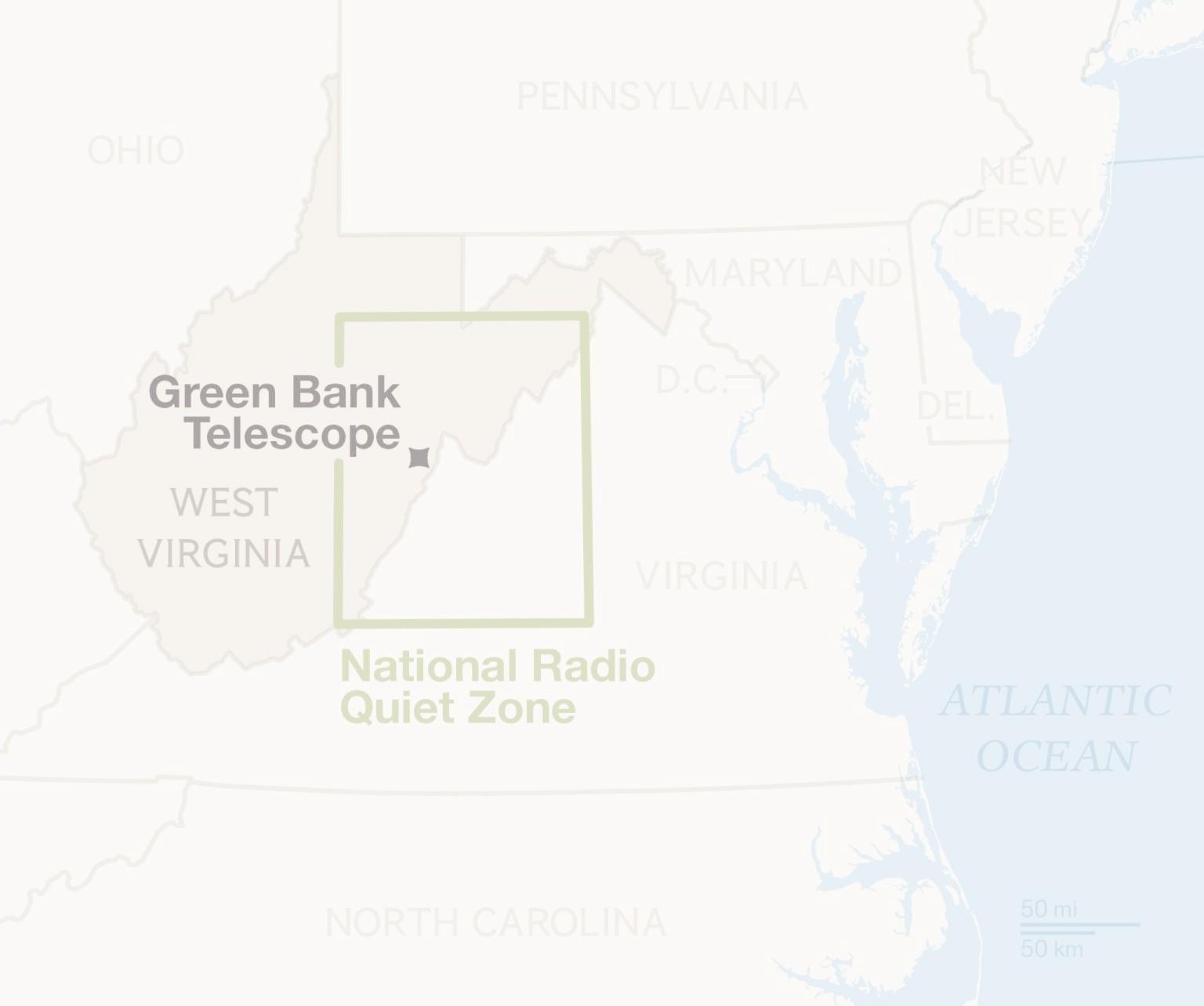
The management of interference comes from the various zones around the observatory. First there is the NRQZ (quiet zone), a large area encompassing parts of West Virginia, Virginia, and a small bit of Maryland. Within the NRQZ is an enforced area devoid of cell towers, where interference is more actively monitored in a 10 mile radius around the observatory. There are two zones at the Observatory site. Zone 2 includes the visitor center, housing and the Jansky lab, where scientists make and analyze observations from the telescopes. I made most of my own observations in Zone 2. Zone 1 is the “instrument zone,” described as “ground zero” for the instruments and telescopes (see Figure 3).
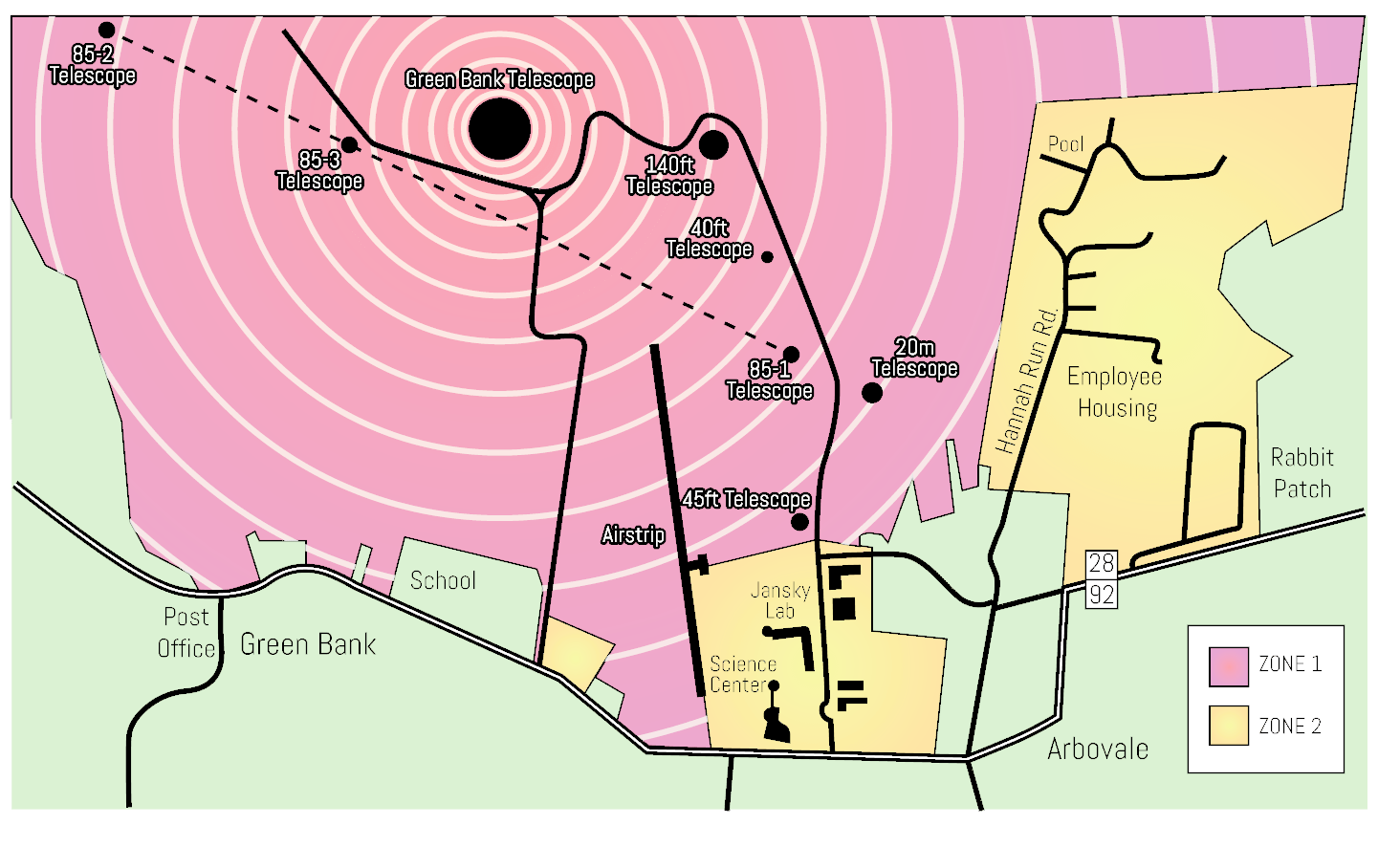
Inside Zone 1, only approved diesel vehicles are allowed to operate, as these use glow rather than spark plugs. Personal electronic equipment must be turned off. During a tour, the guide noted that certain electronics like Fitbits and personal trackers cannot be powered down and can emit interference, so a Faraday cage is supplied on the bus for visitors to stash their interfering objects as they get close to the telescopes.
The centerpiece of the observatory is the Robert C. Byrd Green Bank Telescope, “the world’s largest fully steerable radio telescope.”[211] It measures 100 by 110 meters in diameter and towers above the treeline. As I approached Green Bank, it loomed in the distance, the first evidence of the observatory itself.
The Tatel telescope, the oldest telescope on site and operational from 1959 until 2000, was used by Frank Drake to launch the Search for Extraterrestrial Intelligence (SETI) project in 1960. Other telescopes on site are noted by their size. The 40-foot telescope was built in 1962 and is used today by teachers and students to learn radio astronomy. GBO’s 140-Foot Telescope was built in 1965 and is the largest equatorially mounted telescope in the world. It was part of the international “Radioastron” astronomy project tracking a Russian orbiting satellite called Spektr-R. The project ended in June of 2019 when the the satellite’s signal was lost and communication could not be reestablished.
I note these details because the practice of radio astronomy involves a kind of communication, listening to faint interstellar signals. The irony of Green Bank is that this is not possible with interference – artificial signals emitted by the electronics noted above are billions of times more powerful than the signals created by stellar phenomena and emitted by satellites.
In Green Bank, there is a community, a type of social connectivity that exists despite the lack of mobile connectivity. People at GBO described the “concentric social circles” that exist around the region – coworkers, friends, neighbors, book clubs, churches and other groups. While those interviewed at the observatory said they had originally been somewhat insular, their community has integrated into the region. The GBO now hosts community events, like the Garth Newel Music Center Emerging Artist Fellows performance of chamber music. People I spoke with were either from the area and understood the unique restrictions, or were from elsewhere and adapted to the lack of cell service. Both groups pointed out that it is not dissimilar from other rural or even semi-rural areas with poor connectivity. The differences between the Quiet Zone and other areas are very similar to the differences between any rural and urban area, or any underdeveloped and developed region. As one person pointed out, national parks and wild regions seldom have good signal.
This nuance is rarely explored by the popular media. The reaction of GBO staff to popular press articles about Green Bank was frustration. The journalists who came here (or didn’t, in some cases) described the region in a way the residents felt was “reductive.” The lived experience of disconnectivity involves a lot of “work arounds” so that people can be connected to the infrastructures and communications platforms they like, just in ways that are restricted by the Quiet Zone. And as one participant described, it is “easier to not [connect], if you don’t want to.” People from elsewhere were described as “living in a bubble,” further pointing to the way that we adapt to our conditions and tend to think of other ways of living as foreign or strange.
Is the NRQZ and GBO really a dead zone? Is it a place to experience disconnection? Having been there, I think the answer very much depends on the intention of the person in that space. It is easy to be alone, to experience social disengagement and miss out on the notifications and calls that we might take for granted and expect in urban / developed regions. It is “easier to walk away from,” as one participant told me. One of the affordances of this space is the lack of cell connectivity, as well as lots of hiking opportunities (a newer resident said they felt “much closer to nature” since they had moved there). Other affordances involve things we take for granted in any “civilized” place, such as running water, electricity, phones, furniture – the sort of things that one might think of as missing if one relied solely on the popular press characterization of Green Bank.
But the affordances of the region do include downsides, and there are also other kinds of disconnectivity. A resident who had moved here from elsewhere described it as a “food desert,” although they said that other locals might not think of it that way. The local agriculture is largely focused around beef production and grain for that beef, so fresh produce is hard to come by without traveling a great distance. In Green Bank, one is disconnected from both the RFI “noise” that interferes with the operation of the telescope, but also from the conveniences that make cities and even small towns attractive. Green Bank is situated in a valley with many other unincorporated communities, serviced by two small markets attached to gas stations that sell largely processed, prepackaged and freezer foods. Cars are largely essential to living here.
The existence of the community, with its concentric social circles, would make me push back on any attempt to characterize this as a dead zone. Again, disconnectivity or non-use carries with it stereotypes and misconceptions about how people live. They would reject the “easy headline” way of painting the community as backwards or somehow “dead.” There is a healthy social and natural ecosystem here. The technological infrastructure is sophisticated, when we realize that includes the various telescopes and the engineering required to read signals from space. The grid is still here, it just has a different shape and form. Solitude and the anxiety of separation is still up to the individual experience, not something forced upon people by virtue of their being in that space. But the NRQZ functions as a place where privacy comes easier than other places.
3.3. Data Collection.
To collect data to answer my questions, I utilized interviewing and phenomenological observations. The process of data collection involves several issues, including what criteria are used to determine the inclusion of subjects, choosing the number of participants to be involved with the study, the instrumentation or protocol used for the study, and how to determine validity in the methods. I will explain each in turn.
3.3.1. Inclusion criteria.
As Moustakas notes, “there are no in-advance criteria for locating and selecting the research participants.” The only essential criteria are that ”the participant has experienced the phenomenon.” Interviewees must also satisfy the following requirements:
… [be] intensely interested in understanding its nature and meanings, is willing to participate in a lengthy interview and (perhaps a follow-up interview), grants the investigator the right to tape-record, possibly videotape the interview, and publish the data in a dissertation and other publications.[212]
While all this seems obvious, it was also important to consider the ways in which people experience disconnection. By drawing from two field sites with different sorts of social and infrastructural restrictions, I would be more likely to find participants who had experienced the phenomena, but the differences between the sites meant that they would have experienced it in different ways.
In the case of the Chicago fieldsite at Kibbitznest, participants were experiencing disconnection willfully because of a social restriction. They entered the space and chose their experience. They could (and did) still access a cellular signal and use the internet by creating their own hotspots. In Green Bank, people were experiencing disconnection unwillingly because of an infrastructural restriction. Though we could argue they entered that space willfully, there were no options to circumvent the arrangement that led to that experience of disconnection. But given the difficulty of finding willing participants to talk about a seemingly obscure phenomena (or one that I expected interviewees to not be as “intensely interested” in as I was), I was very inclusive in my criteria for finding participants.
3.3.2. Number of Participants.
When asking how many interview subjects needed, I referred to Kvale and Brinkmann’s argument that “the number of subjects necessary depends on the purpose of the study.”[213] Likewise, Vagle makes the point that the amount of time spent with participants weighs on the amount of participants needed all together, but there are no “magic numbers.” Instead, “the phenomena calls for how it is to be studied.”[214] I chose to go with no fewer than 7 and no more than 15 participants for the sake of this study. Given that this is a phenomenological study, an abundance of participants would not help with generalizability, and would instead clutter and hamper the process. Ultimately I was able to recruit 17 participants who on average spoke a bit longer than the estimated times I provided to IRB.
IRB noted the significant demands made of participants when they are asked to engage for long periods of time without compensation. This unfair expectation that exists and the unlikeliness of finding participants who would agree to the study if they knew my original expectations of their time led me to set a goal in my research application of 15–30 minutes per interview. In actuality, interviews ran from 20 minutes at least to nearly an hour. In further studies, I would expect to spend more time with each interviewee and do additional follow ups on themes I had identified through coding.
3.3.3. Interview Instrumentation and Protocol.
As the purpose is to discover how people make sense of disconnectivity, Kvale and Brinmann advocate for the phenomenological semi-structured life world interview, “neither an open-everyday conversation nor a closed questionnaire.”[215] An interview guide is used in place of a protocol that focuses on specific themes and utilizes specific questions, but does not appear to strictly direct the flow of the interview.[216] This kind of qualitative research interview involves deliberate naiveté, focus, and specificity on the descriptions of participants individual life worlds. Description then is very “thick.”
Rubin and Rubin make the point that collecting data via interviews is only possible through the trust and willingness of potential participants. Contact has to be initiated, trust has to be established, and willingness must be earned through the professional and courteous behavior of the researcher.[217] Effective interviews rely on the active listening and willingness of a researcher to be attentive to the participant and oriented to the phenomena. The collection of data is largely motivated by the nature of the questions at play, namely the nature of the phenomena under study. The unstructured interview is what Vagle suggests is most relevant for phenomenological researchers, but this is shaped by a clear sense of orientation towards the phenomenon, and the interviewer must be responsive to the participant with that in mind.[218]
This is why I designed my interview protocol with a good deal of open ended questions that invited prompts and responses (see Appendix A), while considering the disinterest of the participant. I didn’t want to badger or annoy my participants, instead I wanted to make the experience accessible to them by using questions that would open them up to the nature of what I was talking about. I tried to anticipate the concerns of the literature as I formulated those questions, including issues like adapting to the answers provided by the interviewee.
Vagle notes four strategies for the process of interviewing that adapt us to their answers. First, “our role is not to agree or disagree – it is to learn as much as possible from those who have experienced the phenomena.” Second, say “yes, and” because we are having a conversation with the phenomena, in that we will be contributing to the deepening and ongoing understanding of the experience in question. Third, we make statements, or nudges, that help the participant fully flesh out the experience they are describing. Lastly, we view mistakes as opportunities, in which we do not see moments where we might have gone deeper or redirected the participant as a problem, but as part of the process of creating knowledge together.[219] This is part of remaining open to the phenomena in question and not predetermining our outcomes.
3.3.4. Observation Protocol.
In order to accomplish observations, I devised a guide that was intended to focus on infrastructures both visible and invisible (Appendix B). The notion of coming up with such a guide struck me when reviewing van Manen’s call to “investigate experience as we live it” through the use of close observation.[220] Here though, I am not just observing human behaviors, but non-human elements of the environment that are integral to my question about the way the grid appears, and what level of disconnection is possible in a given space depending on the affordances of the infrastructure surrounding the human actors. This meant I would be pairing my interview data in a given space with an assessment of how much ability there was to disconnect in that space, allowing me to include these in the final writing as well as in interview prompts and discussion. My goal was to capture the essential qualities of what it was to experience disconnection given the affordances of the space.
3.3.5. Determining Validity.
The focus here is to understand personal meaning and sense-making in specific contexts of disconnection, for those who have had the experience in question. I am not asking how the concept itself is constructed (for which I might use a Foucaultian discourse analysis), but rather how it reveals itself to the person(s) experiencing it. This approach also differs from a transcendental or purely phenomenological study, which would ask about “the common structure” of disconnection as an experience.[221]
In preparing to conduct this study, I have gone over these methods as explained by van Manen but also in Vagle’s Crafting Phenomenological Research. Vagle makes the point that van Manen’s approach is “something that we actively do; is an interpretive act; and is something that is never final.”[222] In spite of the steps offered above, Vagle notes hermeneutic phenomenology is resistive towards “a priori steps and structure in the name of precision, exactness and rigor.”[223]
According to Kafle, there are two sets of criteria argued by phenomenological researchers. Some argue for four standards that apply to qualitative research in general, namely credibility, transferability, dependability and conformability. I chose van Manen’s approach, which offers four central aspects to determine rigor in this type specific type of research. For him, orientation, strength, richness and depth are the major quality concerns when it comes to producing effective hermeneutic phenomenological research.[224]
In determining validity for this approach, Laverty notes
There cannot be a finite set of procedures to structure the interpretive process, because interpretation arises from pre-understandings and a dialectical movement between the parts and the whole of the texts of those involved. What was called for is an obligation to understand the context under which the text or dialogue was being produced and to bring forth interpretations of meaning. These interpretations arose through a fusion of the text and its context, as well, as the participants, the researcher, and their contexts… Issues of rigor in interpretive inquiry are confusing to discuss, at times, as there is not an agreed upon language used to describe it or one universal set of criteria used to assess its presence. The rigor concepts presented above may be utilized by researchers in hermeneutic phenomenology or phenomenology or other avenues may be developed which more clearly articulate the quality of the study and ensure its credibility[225]
Rigor is not achieved through the application of phenomenological bracketing,[226] but is something that emerges as a type of internal validity within the work itself. Is the research consistent with the aims it sets out to achieve?
3.3.6. Organizing the Data
I made sense of the interview data using Moustakas:
Organization of data begins when the primary researcher places the transcribed interviews before him or her and studies the material through the methods and procedures of phenomenal analysis. The procedures include horizonalizing the data and regarding every horizon or statement relevant to the topic and question as having equal value. From the horizonalized statements, the meaning or meaning units are listed. These are clustered into common categories or themes, removing overlapping and repetitive statements. The clustered themes and meanings are used to develop the textural descriptions of the experience. From the textural descriptions, structural descriptions and an integration of textures and structures into the meanings and essences of the phenomenon are constructed.[227]
I also consulted Saldaña’s coding manual and its advice on coding using software.[228] For this study I used Trint’s[229] web based voice-recognition transcription software as a start for creating transcriptions and MAXQDA to organize transcriptions for coding. MAXQDA was especially convenient for creating and organizing codes which I used to identify phenomenological themes.
3.3.7. Analysis
Here I depart from Moustakas’s transcendental approach and introduce the hermeneutic cycle. According to Vagle, there are important essential steps in a phenomenological analysis of interview data.[230]
The first is to engage in a holistic reading of the entire text. This involves becoming “attuned to the whole material-gathering event (e.g. transcript, description, observation, fictional writing).” To me, this is a way of getting in the right mindset, or becoming prepared to think with a focus on the phenomena in question. Second, Vagle says researchers should engage in a first line-by-line reading, during which they take careful notes and mark excerpts with potential initial meanings. Assumptions are “bridled” and we attempt to understand how they might be influencing the analysis. Through those notes, follow up questions could be crafted where the researcher could ask participants to clarify themselves, and confirm intentional meanings about the phenomena. In a second line-by-line reading, the researcher should articulate the meanings, “based on the markings, margin notes and follow up questions with research participants.” This leads to a third line-by-line reading in which “you can articulate your analytic thoughts about each part.” Following this, subsequent readings can be made across the participants material with the goal of finding the themes that have been developed. In traditional phenomenological studies, follow up interviews would confirm these themes and expound even more on them, but as stated earlier, IRB limitations excluded the possibility of followup interviews, so I had to work with my initial interviews. Themes may then be written up and discussed in analysis, which follows in the next two chapters (4 and 5).
3.3.8. Alternative Sources of Data: Literature, Biography and Art
According to van Manen, “investigating experience as we live it” means we can draw from sources in the lifeworld so long as we are oriented to the phenomena in question. This means we can find materials for study beyond interview data (though this is the most popular). The hermeneutic process is interpretive, and van Manen speaks the tensions between the phenomenological approach and the quantitative language of “positivistic social science” methods:
…the notion of “data” is ambiguous within the human science perspective… it is quite misleading to talk of “data” in [the context of “gathering“ or ”collecting” lived-experience material of different forms], particularly since the concept of “data” has quantitative overtones associated with behaviroal and more positivistic social science approaches. And to speak of “gathering” and “collecting” human science data, as if one is speaking of “objective information,” may admittedly be an attempt to borrow the respect that the socalled “hard” sciences have enjoyed. And yet it is not entirely wrong to say that the methods of conversational interviewing, close observation, etc., involve the collecting or gathering of data. When someone has related a valuable experience to me I have indeed gained something, even though the “thing” gained is not a quantifiable entity.[231]
van Manen points out that “datum” originally means “given” or “granted.” And we can consider phenomenologically that our experiences are given to us (or thrust on us) as part of our being-inthe-world. As he points out, the recollections we have, reflections, descriptions, recordings and transcriptions are all of experiences. Furthermore they are all already transformations of those experiences. In accessing those experiences we must realize “the meanings we bring to the surface from the depths of life’s oceans have already lost the natural quiver of their undisturbed existence.”[232] And these sources can take many forms: in short,
The human scientist likes to make use of the works of poets, authors, artists, cinematographers–because it is in this material that the human being can be found as situated person, and it is in this work that the variety and possibility of human experience may be found in condensed and transcended form.[233]
Our sense of data is then created rather than objectively gathered or collected. How we choose to create that data is a major hermeneutic question of interpretation and purpose. So here I describe a major source of data I began creating once I attuned myself to the phenomena of disconnection. In 2015 I began to make notes on refusal and disconnection using Evernote, clipping articles from the web and using a system of codes to identify themes related to issues of refusal, disconnectivity, and shifts in our experience of the world as they relate to new technologies. I was attuned to the phenomena of disconnection and non-use following Franklin’s talk in January of 2015 mentioned earlier, and I began take copious notes on this theme. Over 5 years I collected and made 314 notes related to the theme of refusal and disconnection. In the past year, I identified literature and biographies dealing with the additional themes of solitude and isolation or loneliness, amounting to about 20 key works. I draw from these sources to make my ultimate arguments in the analysis chapters.
3.4. Conceptual Framework: Hermenutic Phenomenology
In order to understand the experiences disconnectivity, I am justifying my method (interviewing) via phenomenology. Here, some basic definitions are in order.
3.4.1. What?
What is phenomenology? Simply put, phenomenology is “an umbrella term encompassing both a philosophical movement and a range of research approaches.”[234] As a research methodology, it concerns itself withhow we as humans experience events, or phenomena. Differences on what phenomena are exactly and how we should understand them divide phenomenology as method into two main approaches: transcendental and hermeneutic. It is important to note that I have chosen to use hermeneutic phenomenology for this study. This approach emerges
…primarily because of the rejection of the idea of suspending personal opinions and the turn for the interpretive narration to the description. Based on the premises that reduction is impossible and acceptance of endless interpretations, this school of phenomenology puts an effort to get beneath the subjective experience and find the genuine objective nature of the things as realized by an individual. Hermeneutic phenomenology is focused on subjective experience of individuals and groups. It is an attempt to unveil the world as experienced by the subject through their life world stories.[235]
Kafle argues that hermeneutic phenomenology has avoided criticisms afforded to other qualitative methodologies due to its strong roots in an established philosophical tradition, as well its constant orientation towards the object of study and the reflexivity required of the researcher. As a more straightforward definition, hermeneutic phenomenology as methodology entails “an interdisciplinary approach that takes from across the disciplines and has a very convincing yet distinct set of principles that are essentially targeted to uncovering the better understanding of a phenomenon.”[236]
The best cited text for phenomenological research methods in the social sciences employs a transcendental approach.[237] Moustakas’s work comes highly recommended, often appearing in other meta-texts on the dissertation / research process,[238] but I felt that it was important to take the hermeneutic approach instead. While I have referred to Moustakas work in the previous section on method, let me reiterate I do not follow the transcendentalist argument of analysis as description. Rather, I agree with those who argue it is an interpretive process. As Finlay puts it, this perspective calls for interpretation as part of the ongoing process of analysis: “It constitutes an inevitable and basic structure of our ‘being-in-the-world’. We experience a thing as something that has already been interpreted.” The hermeneutic perspective also calls for a greater degree of acknowledgement of the researcher’s subjectivity. These and other debates make up the differences between phenomenological leanings, which are secondary to the main goals of this dissertation.[239] The important thing to note is the difference in attitude, along with the lack of “bracketing” and “epoché” that are found in Husserlian approaches to phenomenological methods. These differences arise in how we conduct hermeneutic phenomenology.
3.4.2. How?
How is hermeneutic phenomenology conducted? The approach is cyclical, a “dynamic interplay among six research activities”[240] which van Manen describes as follows:
(1) turning to a phenomenon which seriously interests us and commits us to the world; (2) investigating experience as we live it rather than as we conceptualize it; (3) reflecting on the essential themes which characterize the phenomenon; (4) describing the phenomenon through the art of writing and rewriting; (5) maintaining a strong and oriented pedagogical relation to the phenomenon; (6) balancing the research context by considering parts and whole.[241]
Van Manan throughly explains each step in Researching Lived Experience, but here I will try to explain the significance of each for this study.
In turning to a phenomena, we have to consider “what is the nature of this lived experience”[242]? Whereas the transcendentalist approach would have us try and abandon our presuppositions through bracketing and epoché, the hermeneutic approach is a reflexive one in which we make explicit our “understandings, beliefs, biases, assumptions, presupositions and theories.” Van Manan argues that “we try to come to terms with our assumptions… to hold them deliberately at bay.”[243] This is what I have tried to do previously in the literature review.
When we investigate experience as we live it rather than as we conceptualize it, we open ourselves to numerous sources of data. While we can start with personal experience, lived experience accounts serve as data, not phenomenological descriptions in and of themselves. They must be reflected upon and go through the cycle of activities, including the thematic analysis of step 3. But other sources of data can include etymological sources, idiomatic phrases, experiential descriptions in literature, other phenomenological literature, but especially interviewing – collecting accounts of the lived experience of others. Once we have this data we can move on to reflecting on essential themes.
There is an important point to be made regarding this reflection. Van Manan argues that unlike other approaches, phenomenological research makes a distinction between appearances and essences. “What is it that constitutes the nature of the lived experience?” is always the primary research question. It is a reflexive effort that is constantly at play during the process. It is why interviews are best done in a series, so that participants are able to do personal reflection as well.
As a minor digression, during my negotiations with IRB to get approval for this project I was unable to set enough flexibility for more than one followup interview per participant. I was required to submit an interview protocol with detailed questions about what I would specifically ask. This is somewhat antithetical to the spirit of phenomenological research, which makes me question its feasibility for junior scholars and others. When designing a study using this approach, participants are seen as helping to contribute, not on the level of participant action research, but certainly more than the status of research “subjects” we are always assigning to unfortunate volunteers. From a phenomenological point of view, interviews should be unstructured, with the researcher constantly orienting towards the phenomena through the participant’s sharing of their life-world.[244]
The hermeneutic process involves allowing themes to emerge, and through writing and rewriting we can get at an interpretation of the phenomena which is more than mere appearance. Writing is method, according to van Manan.[245] Data analysis consists of performing the hermeneutic cycle of interpretation, reflective writing, and reading.[246] The final two points on keeping “a strong and oriented pedagogical relation to the phenomenon“ and considering research context are how the results of a study emerge – the reduction of data and observations into thematic statements, and the further reduction of those into phenomenological themes, which can then be shared by the researcher in the final analysis.
3.5. Coding Process
An initial line-by-line reading revealed some universal themes, including new questions that came out of the initial semi-structured protocol. For instance, when I asked participants if it was important to stay connected, some responded whether I meant to other people or to the internet. As an infrastructural technology, phones were constantly receding into the background of our perceptions on how we stay connected to others. This is especially true as differences in use habits have changed, with people preferring alternatives to actual voice calls.[247] Multiple participants pointed out their phone was more of a “pocket computer” than a telephone, when asked how they used their devices. The plethora of communications options meant that there were many alternatives to the phone when it comes to staying in touch with others, and although the mobile phone is often carried on one’s person, it was not the sole means of staying in touch.
In order to more discretely identify themes I followed Saldaña’s coding manual with a focus on “theming the data”, which claims “themes serve phenomenology” and coincide with the aims of phenomenologists in uncovering lived experience via interview data.[248] I was also attentive to debates among phenomenologists as to how the coding process should go, whether or not coding was appropriate and if the use of computer-assisted qualitative data analysis software (CAQDAS) was appropriate. Ultimately I followed Sohn’s advice that “with a careful and dedicated attention to phenomenological considerations such as wonder and lived experience, phenomenologists can reconcile the use of QDAS to try and avoid its potential pitfalls.”[249]
I conducted 17 interviews (approximately 11 hours worth of recorded audio) and collected 16 transcripts. Initially I tried using a transcription service.[250] Trint uses web-based voice recognition software to transcribe audio files without a human interloper (with assurances to the privacy of the user’s data). However, due to the poor quality of automated transcription (owing in some cases to the poor quality recordings I had on hand), I was forced to review and revise most of the transcribed material, creating my own transcriptions in the process.
I used software by MAXQDA to identify about 50 codes across the 16 recorded interviews and coded about 400 items. The most common codes were related to notions of connectivity (connection vs disconnection), as well as physical spaces and movement (rural vs urban areas, and Kibbitznest and Green Bank, the field sites focused in the study, traveling and scheduling movement).
3.6. Limitations and Impact
A major limitation of this research was the lack of interview data. Future studies would involve longer and followup interviews, and would not be as wedded to the idea of wireless disconnectivity. As such, a wider pool of respondents could be drawn from. However, for this study, the purpose of these limitations was to satisfy IRB requirements and to keep the project manageable. The scope of the project has expanded since initial guidance by the dissertation committee. I also did not collect demographic data because this was a phenomenological study, though that would be a limitation in how we think of experiences of disconnection differing depending on ones social situatedness.
I see potential in studies of non-use for discussing what we take for granted as “users” of techno-social systems, and how those systems exclude non-users in various ways that render us invisible. This is a more broad, archaeological project in which I would ask how the notion of nonuse or disconnection is constructed in popular discourse and around these infrastructures. The scope of this study though is to understand the way that use (connectivity) and non-use (disconnection) affects the way one experiences the world, which was intended to illustrate a difference in the sort of world we experience. While traditional ethnography and discourse analysis may approach the same result, my goal here is not to understand how we collectively make sense of (dis)connection, but how it is experienced by individuals. My hope is that this study can be helpful in future efforts to understand non-use as more than a set of behaviors or choices about how we engage with the world, but rather instrumental in how we experience the world itself.
3.7. Summary
In this chapter I described how to approach the question of understanding people’s lived experience of disconnection, and how they understood the grid in regards to their experiences. To do this, I have devised a set of methods that include interviews, phenomenological observation, and hermeneutic reading of literature, biography and art. Using the hermeneutic approach to interpretive writing, rewriting and reading, I am able to also offer an analysis in part through the review of phenomenological literature on the notion of disconnection and “the technological uncanny” which I have already offered in the previous chapter.
4. Interview Analysis
Two general clusters of themes emerged in analyzing the data which corresponded with my two research questions. My first question regarding people’s experiences of being disconnected from wireless connectivity to others corresponded to a cluster of themes that emerged around the idea of relationships. Kibbitznest was at the center of this analysis, as a space for relationships to grow and develop. Although I begin this chapter with a discussion of that space and the themes associated with it, my interview data and the quotations provided include participants from Green Bank and outside of Kibbitznest.
Sampling for this study involved a standard approach of interpretive phenomenological analysis in which a small homogenous sample is desirable, because of both pragmatic and interpretive concerns.[251] Demographic data was not collected. If I had focused on people below the poverty line, it’s possible this would have revealed demographic links to non-use and disconnection (hence the interpretive concerns of having a homogenous sample). As Smith and Shinebourne note, future studies can include inclusion criteria that account for disparities and help to work beyond the boundaries established in the first study. We can then think through the ways in which identities, inequalities and disparities are tied to the ways and the likelihood that people will experience disconnection (or the phenomenological implications of non-participation with technology).
How do people then experience disconnection if they have a presumption of connectivity as a norm? It must be sought out, seized on when there is an opportunity, and either relished or tolerated depending on the disposition of the disconnected. There are major differences between whether a dead zone and disconnection is experienced voluntarily or involuntarily. Voluntary (temporary) disconnection is reactive to the grid, where someone wants to refrain, take a break or get away from constant connectivity. The first thing that people’s attention turns to is what they will be missing when they go “offline” or disconnect. Participants were focused on the way that disconnectivity from others would impact their relationships. In thinking about their own subjectivity when disconnected from mobile networks, people became acutely aware of their immediate surroundings, and questioned what experiences count as meaningful or real. Despite their anxieties about how not being available would impact relationships, they claimed that the experiences of face to face communication, made easier when disconnecting, were more “real” and sincere then the mediated forms of communication they had via mobile media.
For participants, disconnection was experienced as a return to the “real” but one that ran the risk of affecting how they related to others. Our relationships with each other have been altered by mobile media. We now have an expectation of constant availability to one another, and that others are always available to us. Without this connection, we would have to depend on the strangers around us – leading to a historically novel situation where we are more connected then ever, but without mobile media, we feel even more isolated than we were before we had them. An abundance of caution leads us to carry mobile media with us at all times – “just in case” or strictly for “emergencies.”
Because of this, strangers are even stranger then ever. The notion of asking for directions is decidedly uncomfortable when we have pocket GPSs to show us the way. The idea of asking for a lift has been coopted by apps like Lyft. And we are not supposed to ask others for help, in an actual emergency, we call 911. At the very least, we can insist that others call 911 for us. All of this reveals the importance of relationships both known and unknown when we ask about the experience of being disconnected from others.
As stated previously, coding took place using MAXQDA software, in which emerging themes were noted (see Appendix C for example). This process of close reading and coding led to the creation of a thematic cluster which mapped to the research questions, and resonated with the observation and analysis of field sites from the past chapter.
4.1. Relationships
4.1.1. Personal Connections and Tele-Absence
In most participants’ accounts, the theme of personal connections emerged as a way for participants to discuss the ways that they were connected, not to material infrastructures but to people and other humans in other spaces. When I asked “how important is it to be connected with others” participants were quick to point out their occasional disconnection didn’t prevent them from having regular contact with friends or loved ones. Nearly every participant had family and friends who they weren’t regularly physically present with. In some cases, the phone was the only way to retain a relationship.
Participant: Well I had you know I have at the time when I got the phone I have two daughters. I mean when. Kids, teenagers… you know, that’s how they communicate. It’s how they communicate. PI: The only way to stay in touch with somebody of that age. Participant: That’s the primary reason, to stay in touch with my daughters. It’s the primary way I stay in touch with them. Texting them.
Some used Facebook to stay in touch with family far away.
PI: …you’re also connected with family and others through [digital media]. So that’s clearly important to you as well right? Participant: Yes it is. Yes it is. My daughters, one is in Bermuda. The other one is in Seattle. So, pretty much through Facebook is how we mostly stay in touch.
Participants were quick to point out the importance of personal connections and the ways they didn’t depend on mobile connectivity to maintain them.
Participant: …it’s not like I’m living in a cave. I mean I get out I talk to people and all I see my friends I see my children I see my grandchildren but I don’t have this obsession – You know I noticed younger people even people my age who are always texting I can’t believe people are that busy. I don’t know maybe it’s just the bias I have but up at one time in my life I was extremely busy and wanted the busyness to stop. And that’s about it. Yes I really don’t use it much at all. That’s quite true. I do not [use the phone often]
In two cases, participants remarked on the loss of those connections:
Participant: I kind of grudgingly like people, I’ll strike up conversations with strangers just because it’s part of my makeup. I realize that it’s transitory. They don’t have to stay there, they don’t have to stay connected to me. PI: …You’ve managed to get away from those kind of social bonds that are more obligatory. Participant: Yeah I never thought I would. I always thought when I was younger I always thought I’d have this group that I’d be connected to, we’re talking 40 odd years ago 50 years ago. And I thought I’d have a large group of friends. We’d be together. That’s kind of all fallen by the wayside. Nothing to do with my personality [laughs].
One described the loss of personal connections as a great “irony.” For some older participants, staying connected to others was irrelevant as they had other ways of maintaining their relationships.
Participant: When I was younger… maybe relationships with friends or co-workers [were] more important. In fact it was more important when I was younger teens, twenties maybe [in my] thirties. It was a little bit more important. To have that social connectivity. Well we didn’t have smartphones back then so that’s kind of the irony. Now that I’m older though I don’t have those, kind of, or even feel the need, to be honest, for those close [relationships]… When I feel like being social, I can be social with other people. But now that I’m older, and then this smartphone and technology is ubiquitous, and you can contact connect with anyone anytime anywhere. Now [relationships are] not important. So. I guess that’s the irony. It’s not really that important. It’s really not that important to me.
People felt strongly about being available to others so long as they knew who was trying to reach them. Many were keen to keep their notifications off, and ignored calls from unknown numbers, but would take calls from people they knew.
Participant: When I write my work, for instance, [the phone is] on silent, it’s aside. I’m not gonna bother using it, and I just know working myself, that whoever’s calling can call later and unless I know there’s something, there’s some emergency going on, or something that I know that somebody is going to try to to contact me – like for work or when we have friends.... I make a conscious decision that if somebody calls they leave a message, or whenever I’m with friends, like, like right now, or we have friends over, I put my phone aside and I don’t pick up, unless, you know, if my mom, and I think something might have happened…
The reoccurring in vivo code of “emergency” pointed to how people wanted to be there “just in case,” even if they used a phone as a “last resort” for staying in touch with others, also pointing to the theme of “anxiety” explored below.
Participant: …my wife and I would go over to [neighboring city] to do some shopping and we were in an auto accident. We had no way of contacting anyone. So I got… a simple cell phone to have some sort of emergency communications. When we were out on the road and that turned into a smart phone a few years afterwards because I also had a Palm Pilot and it was just about shot. So I just figured if I could just combine them together into a smartphone phone and did that.
This theme of accidents and emergencies drove people to carry their phone with them at almost all times. Participants would discuss how they would take a phone with them every time they left the house, just in case.
Participant: Well I if I’m out alone, I have it with me for basically you know emergency purposes. You know what I mean. That’s it. Basically if I get in an accident or if I trip on the sidewalk walking to the gym and I hurt myself I can call someone.
Participants often carried the phone because the potential for a personal connection in extreme circumstances is desirable.
Participant: …we have our phones with us just in case there’s an emergency and somebody needs to get hold of us but it’s not something that either one of us is very eager to stay tuned into as much during we as we do during the week.
Participants discussed how their cellphone was their primary contact number, and the potential of a personal connection in times of need was a sub-theme when thinking about what was needed in an emergency (to let others know we need help).
Participant: I usually want to keep [a phone] with me if if nothing else for safety. You know if if I break my legs somewhere… and there’s nobody around. You know I need to be able to call somebody, right, just for emergencies in public mostly. I still use it as a primary number. I don’t have a landline at the house. But yeah I do I do tend to keep take it with me whenever I go out.
Whereas we might imagine that a stranger could provide help if need be, because of the abundance of personal connections we manage through our cell phones, the participants suggest we no longer rely on strangers for help. They may be less certain of the kindness of strangers, and do not want to be in a situation where they might be at the mercy of others. I call this experience or feeling of loss in connections “tele-absence,” in contrast to the telepresence that we are familiar with when our relationships are sustained through telecommunications technology.
4.1.2. Personal Space and Proximity Tropism
In thinking about personal connections, an additional theme that emerged was many participants’ proclaimed preference for face to face communication. Many expressed a preference for communication in personal space, particularly with friends and family, and noted that mediated communication was not the same and could lead to feelings of disconnection.
Participant: Even though I use my computer, I might have a smartphone and I have whatsapp, twitter and instagram, I have skype, Google Hangouts, all of that, sometimes I do feel disconnected, just because I know my family and some of my friends... so even though I can contact them through those social media, and… talk to them whenever you like, I do feel disconnected… I feel like I have the knowledge of what it was to live there. And what is was like personal connection. I mean I was able to meet them I wanted and now because... Yeah I can text them, [but] I don’t feel the connection in the same way…
There is a paradox here where the participant feels more disconnected then ever before, despite the multitude of connections to family and friends we have thanks to mobile media. Mobile media didn’t provide the immediacy the participant wanted, despite their heavy use of video conferencing apps to stay in touch with family.
Another noted how this was related to issues of control, or the freedom from obstacles over our control of the situation, a theme that reemerges in the next chapter:
Participant: I would prefer all connections to be face to face but that’s just the way life goes. It’s hard to do so… I can answer their calls and respond… But yeah I can never truly control the relationship just virtually.
This was also noted by a participant who was very hostile towards any notion of mediated communication, and saw phones and the internet as detrimental towards communication.
PI: …Society expects us to be connected to each other. Participant: Really. PI: It seems that way at least to me. Participant: I mean it might be but – My life, I don’t expect that. I see it as simply something that is a convenience to some extent. But in the end I see it as an avoidance of real of communication. I don’t think the Internet really is about communication in any way, shape. I think what we’re doing right here is communication. I think the Internet is destroying communication. And has exactly the opposite... It’s a non communicative medium. PI: …so instead of facilitating communication it’s really stopping people. Participant: Destroying communicating... Except for “how do I get there.” So, traffic.
The same participant noted the importance of non-verbal communication and argued it was important for people to be in the same physical space together:
Participant: 50 percent of communication is facial expression, is emotion, nonverbal... Yeah. If I said “How do what,” “what’s the formula, for E=MC^2,” OK. That’s one thing. That’s fine, but it’s another thing if I want to really know somebody... I have to look at them when I’m talking to them, I have to experience them… the reason we’re communicating without the technology is that you’ve given me that option. I want to talk to you, so you’re going to get a very different conversation communication by sitting here with me, than if you ask me a question and a text message or an e-mail, and answer you have because I think it’s important you see me…
The embodied presence of the other is seen as more authentic than mediated forms of expression. The notion of authenticity was important in communication. Communication partners should be perceived as being truly invested in each other, honestly and earnestly engaged with others in an immediate space. Mediated communication was seen as less authentic, less “real” than this experience of face to face communication. The participant was highly suspicious of whether or not mediated communication counted as “real” communication:
Participant: This is simply a marketing ploy. It’s a way to market products that are entusting people with the idea that there is communication going on. I define communication in a very different way. Communication is usually best implemented when people are looking at each other because there is also a responsibility you have when you’re communicating. To see how the person you’re communicating with is reacting. And giving that person an opportunity to respond.. not to just [tapping on imaginary phone].
This indicated that the experience of mediated communication was not the same as face to face communications and there was a strong preference for the latter. Participants noted that experience of mediated communication seemed to diminish their ability to have quality face to face communications.
Participant: I’m kind of the opinion that I don’t like necessarily like seeing people constantly with their heads in their phones. I think we’re losing our capacity to carry on conversations face to face.
Another participant noted the productive quality of a good, face to face conversation:
Participant: You know you can also work [ideas] out with other people, but a conversation – requires interaction, not typing. A couple of sentences on an email, when, you know, you can see people’s responses to what you’re saying. You know like you’re saying “mmhm”. But if you don’t say that. I’ll go, “mhm Maybe I should say it in another way”. So the communications feel more accurate when your face to face, and there’s far more things come out of a conversation, that, it’s an emergent, rather than X as this and Y says that. PI: It’s more generative. Participant: Yes that’s what I mean by emergent. Exactly. And you see you wouldn’t have known that if we didn’t speak it.
The same participant noted how such devices weighed on people’s ability to manage their interactions:
Participants: …when you have a smartphone… you’re always not with the people you’re with physically yet there are always these potential others. And so you see a smartphone you say “ooh I wonder if he is going to send me a message. Ooh I forgot to send the message that I think I’ll say this.” So you’re always outside of being fully involved with the others that you’re with.
The theme of the importance of personal space, and how phones seemed to intrude on quality interactions that should happen in those spaces was common to participants’ experiences. To the participants, face to face communication feels more “real” or somehow more genuine. This experience can be characterized as “proximity tropism,” something felt by most of the participants involved.
To generalize, proximity tropism is felt by those who are longing for these sorts of situations where one speaks and meets with another face to face, or when they enjoy that encounter and feel satisfied in contrast to a mediated conversation. Proximity tropism is a feeling or an experience where talk, specifically talking in small, intimate conversations, is idealized and pined for in contrast to the undesirable mediated conversation with all its perceived shortcomings.
4.1.3. Attentiveness and Attention Thrifting
Attention was a final major theme in thinking about how people managed their relationships. How participants directed their attention, felt as though they were spending their attention, or had their attention impacted and managed by mobile devices was a great concern. As one participant noted, “…if I’m not connected in that way it’s because what’s in front of me is more important…” This notion of being able to direct one’s attention to what was important and what deserved the participant’s focus was something that participants struggled with, and reflected on when asked about their cell phone usage.
Participant: I [disconnect] occasionally at home. I go to leave my phone in the kitchen if I’m in the living room. Purposely. So I don’t look at it and I know it’s not present… near me. And that’s a good feeling. It’s really really good feeling well. PI: In what way, like what do you mean, how is it a good feeling? Participant: I feel like my attention is not [on] my eyes. My attention is [on] other areas… that deserve my attention, that I should be spending more time on.
Participants saw unwanted redirections of their attention as a distraction, something over which they worked to gain more control.
Participant: I don’t like being distracted or bothered. Like, all my notifications are turned off on my phone. The audio notifications are turned off, except for I think text, that’s the only one that I wouldn’t rely on, for appointments for example, but other than that they’re not even on, like, I won’t even hear them if I get a notification of any kind... I just feel like it’s a… creating more stress or… taking time away from what I’ve been, doing something else, and the phone, you know, notifying you that notifications going off, it’s adding stress. Adding more work, or more, you know, stuff for, and it’s an interruption to what I’m doing. You know a lot of times, that’s how I feel.
They also were concerned with how they perceived the attention of others directed by mobile devices.
Participant: And when you go – you’ve probably had this experience – when you go to a musuem… my wife and I like to go to museums… and when you go to a museum these days, and people walk around with phones in their hands, they’re, sometimes taking pictures with their phones or they’re, in some museums they don’t discourage you from talking, I find it – we were in New York two weekends ago at the Whitney Museum and there were people talking on their phones while looking at art, so… I find that quite distracting.
In one of the richest interviews coded, a participant from the Green Bank area was cognizant of the benefits of living in a region where demands on attention could be less than they would be elsewhere.
Participant: I don’t feel like I’m disconnected from other people so much as more aware of myself and my surroundings I guess. It gives you – that sense of perspective you, again, I guess it’s a lack of things demanding my attention. And I enjoy not having those demands or those perceived demands. It’s even, again, the conversation and when people say connectivity they often assume we’re talking about cellphones and mobile devices, but certainly if I’m sitting at my desk, I’ve got notifications that pop up constantly, and oh there’s somebody on Discord,[252] and there’s three emails that fired up and here’s this thing, and — you know, even as hardcore as I try to be sometimes, to get rid of that, those are still there and I still even if I’m gonna ignore it, oh yeah Lori needs to talk to me about this new game and oh yeah my dad called, those little things are pulling from my attention, and you know when you step out of an environment where that is literally not possible, there is a sense of freedom there. And a lack of demand on your time and attention…
The segment was coded for several themes, but my focus on the issue of attentiveness arose because of how the participant continued to elaborate on the concept of “attention economy.” Participants saw the awareness of their immediate surroundings as lacking. This specific example points to the sense that digital media was detracting from an experience of the world that could be richer, more engaged or otherwise preferable to the distractions created by others not immediately present. Disconnection lead to an increased awareness of immediate surroundings, which most participants implied was preferable to having their attention scattered or drawn unwillingly elsewhere.
The above participant provided also a rich anecdote of their own awareness of the affordances of the situation of being in the National Radio Quiet Zone, and reflected on the differences of power we have in being able to turn things off.
Participant: …you’ll hear a phrase like “attention economy” and things of that nature. And I think that’s a good way to phrase it. There are so many demands for my attention and a lot of those are digital, where people are making software or devices that are trying to get me to pay attention to them. Often without me – often grabbing my attention – without me making an active choice. And that happens to me plenty, working in Green Bank and Pocahontas County, I know that is much more other places. I’ve definitely had friends that I haven’t seen in 3 years and we’re going out to the pub, and we’re gonna drink beer and catch up and twenty minutes in my friend is checking his messages on his phone and I’m like “dude I haven’t seen you in three years,” like, I guarantee you whatever’s on your phone is not as important as drinking beer with your buds. And I guess living here that is not as — that is easier to turn off, but those forces are still there. So I think – I don’t know if we’re just basking in a level of freedom from that we don’t fully appreciate – I think I’m probably a little more conscious of it than other people, maybe not, maybe that’s just arrogance on my part…
They also described attention as a resource, and the managerial perspective of asserting control over attention so that it can be spent and utilized as it suits the individual.
Participant: I think that how you partition your attention, how you spend that as a resource, something we as a society could do to spend more time on, and there does seem to be a resurgence, maybe it’s a fad, everyone’s talking about “oh we’re going to mindfulness retreat and go on silent meditation retreats,” and that’s becoming a thing, and I see that just because, just because of a couple of podcasts I tend to listen to and just because, as a martial arts student I’ve been doing a version of that for 30 years now, and so oh people have finally found out this thing works.
Other participants also discussed mindfulness retreats, digital detoxing and meditation as ways to manage or control ones attention, particularly with regards to the “distractions” of digital and mobile media. This was an important aspect of how one sees mobile media as interference in personal relationships when considering disconnection. Most participants shared their view that attention was a sort of battleground, something precious. The feeling or experience that their attention was a valuable resource they wanted to be in control of can be characterized as a kind of anxiousness over attention.
This is a troubling experience because it represents the effects of the “consciousness industry”[253] and the ecosystem of apps, platforms and programs designed to help manage and organize our attentional patterns.[254] People have internalized what Heidegger’s called the enframing of the world,[255] or the essence of technology, in a way that our attention spans have been technified. Because of this I call the experience “attention thrifting” – the active awareness and feeling of how we spend attention in a conscientious way.
4.1.4. Anxiety and Techno-Frenzy
Disconnection from others can induce a sense of anxiousness, including the fear of getting lost, not being able to connect with others, or being out of contact with important relationships and connections. While many of us experience anxiousness when we travel, I believe the type of anxiety I felt leading up to my trip to Green Bank was different. I was worried I would be out of touch with my family when they needed me, that I would be alone and cut off from the world. I was both intrigued and excited. I was already feeling the sense of isolation that others discussed when they talked about the negatives of disconnection.
Participants who talked about dead zones they experienced when traveling discussed the anxiety they felt when they weren’t able to connect to various mapping services.
Participant: yeah you do get lost. You know printing MapQuest can only get you so far that. I found I actually got out more at least in the early days when I treat it as an adventure.
Knowing I wouldn’t be able to rely on my smart phone’s GPS to navigate through the Quiet Zone, I labored over the decision of which map to buy, or whether to print out detailed directions around the area. As I perused the maps, I wondered what was out of date, what was useful. The convenience of digital media never made me question what I might need “just in case.” There was a loss of self-direction with the adoption of connected digital media. I was looking for a kind of preparedness that participants in Green Bank noted was necessary when traveling across distances where if ones car broke down the nearest phone could be a twenty mile walk or more. Ultimately I downloaded a map from Google Maps so that I could use it while offline. This was similar to what others went through:
Participant: We were driving, yeah. So then like it made me be more alert with my phone like oh we don’t have a signal and I remember thinking “Well, I hope we know where we are going because we don’t we cannot check the G.P.S.,” but I knew because we were moving, I had this sense that at some point it would come back because we were not stranded in a place if we had been stranded maybe I would have been more anxious like okay let’s look for other people but because we were driving through the mountains I knew at some point would come back... Yeah it was expected to come back... it made me more alert to see when [my signal] was coming back, but it wasn’t like “freak out.”
And in another case:
Participant: me and [my friend] were on vacation in California and we were driving to the hot springs and we were driving using Google Maps and the signal started to go. And we were genuinely starting to get scared that we would not be able to navigate to our destination. And and yeah I remember we we like frantically took a bunch of screenshots of around the destination so that we would make sure we’re able to find out. But it was definitely it was a stressful experience.
A participant who questioned the legitimacy of the entire study admitted to experiencing anxiety when they were without signal.
PI: How do you feel when you have no signal and you can’t get calls... Participant: I get nervous because I mean I run a business and because I have daughters they communicate this way.
Other participants talked about how they would mitigate anxiety by preparing for situations where they would be out of contact with others.
Participant: Obviously my family and friends were aware that I was going to be gone otherwise maybe I would have had some anxiety but other than that a more common occurrence for me is that I’ll go away for the weekend on a camping trip and I’ll just get back to everyone when I get back and I usually will let only my closest family and friends know that I’m leaving. I don’t necessarily alert the world.
There were other forms of anxiety discussed, such as the kind of anxiety one feels from being too connected, that leads people to disconnect in the first place:
Participant: I didn’t want I felt like I was just too exposed with the smartphone. Anyone could message me. I found myself on Facebook all the time checking Twitter and I’m like you know I can do this at home. I don’t have to do it while I’m out and about enjoying life.
Another participant offered a longer reflection on the anxiety others experience via over-use through their own experience of stock trading:
Participant: You know some people, they buy stocks, OK, which I’ve done since I was a young man, and you know some people buy stocks and they go on their phone and they’re checking the price of the stock every day. You know, when in fact, if that’s what you’re, doing checking the price every day, you may as well just go to Las Vegas and gamble, you know, learn the odds of statistics and just go and gamble. Because that’s not the idea about buying stocks, to be checking their price every day and worrying about this, and worrying about that. The idea should be to buy the stock, and hold it, and it will pay dividends and it will increase dividends. And people are checking every day. “What’s the price I’d better...” It just makes you laugh. You know I get a, I get a statement once a month. You know, for my retirement accounts and I go over it and that’s it. Other people tell me… not only do they get a paper statement but they’re able to go on their phone and go online and check it and they’re telling me they check it every other day. And I’m thinking what’s wrong with these people...
Here, the participant raises the issue of a subjective sense of time – the relaxed time of the participant, versus the frenzied time of the day trader. The compulsion to check those stocks, or to check messages relates to how (dis)connection can induce a different sense of time for the (non)user. Over-use leads to a frenzied sense of time.
This anxiety about over-use or being too connected ties in with the popular literature of Cal Newport[256] who was mentioned by one participant. This participant was also interested in movements like digital minimalism, unplugging, digital detox, and so on. The perceived value behind disconnecting and unplugging seemed to be taken for granted by some of those interviewed:
Participant: I think also just to say that people who are anxious about being disconnected they’re the ones who need to do it the most because I mean it is becoming a syndrome where people are addicted and it is that now and now it is a medical thing. It is within the news where it is now recognized as an addiction. People to their electronic devices and so on and those are the ones who I think need that time the most. And you know personally I do a lot of fitness training including yoga. And then there’s the meditation aspect of yoga and I think this. So those who are anxious about being disconnected like they’re the ones who need to do like meditation and yoga and disconnect the most.
Anxiety arose from either a dearth or an abundance of connections with others via mobile media. I argue that this is a unique form of anxiety that can be called “techno-frenzy.” To return to Heidegger’s briefly, he writes “the frenziedness of technology may entrench itself everywhere to such an extent that someday, throughout everything technological, the essence of technology may come to presence in the coming-to-pass of truth.”[257]
This same sense of anxiety or frenziedness is found in Thomas Gray’s “Elegy Written in a Country Churchyard”: “Far from the madding crowd’s ignoble strife / Their sober wishes never learned to stray; / Along the cool sequestered vale of life / They kept the noiseless tenor of their way.” The “ignoble strife” of the “maddening crowd” is precisely the same sort of technosocial frenzy the dead are free from in Gray’s elegy, but it is the sort of clamor we can not escape as participants in a technified society.
4.2. Freedom and Liberty
The grid, both as a concept and as material infrastructure, is difficult to escape. But for those who live in the NRQZ, the absence of cell service has a symbolic value of lack, want, or absence. The NRQZ serves as an infrastructural answer to the proliferation of electromagnetic signals which act as interference and “noise” in radio astronomy. However, interview data on these themes also comes from participants in both the NRQZ and from Chicago. Those in the zone are always aware of this lack of signal and the symbolic value of absence, which framed their answers to questions about coverage and participation or use of mobile media.
Initially, the desire “to be let alone” and other conceptions of privacy emerged as a cluster of themes in the interview process. Through recoding, Berlin’s concepts of negative and positive liberty became useful for understanding how people related to the grid. Negative liberty involves asking about the constraints placed upon ourselves which affect the degree of liberty we enjoy. Positive liberty involves the question of “What, or who, is the source of control or interference that can determine someone to do, or be, this rather than that?”[258] Kelty summarizes these views:
These two questions—about the zone of control and the source of control—have very different implications, often summed up in the difference between a “freedom from” and a “freedom to,” where the former usually signals a notion of freedom defined negatively (via the absence of something), while the latter signals a notion having positive content (and requiring support, legislation, or enforcement of some kind). Liberty as an absence of coercion is a definition in terms of a lack… In Berlin’s version of the distinction, certain things are clearly specified, such as the fact that it is other humans who coerce, that they do so deliberately, and that they interfere with the goals of those being coerced. By this definition any form of unintentional or serendipitous constraint is excluded.[259]
Kelty goes on to suggest the ways in which materiality is discussed within science and technology studies as impacting the degree of freedom we experience, an exploration of negative liberty found within the designs of computers and hardware that makes up our information society. Here I want to explore something similar, in the way that people’s attitudes toward the grid (as mobile and cellular infrastructure) range between both conceptions of liberty.
We depend on the grid to be connected to one another, to maintain the personal connections discussed above. But there are instances where we feel it can be overwhelming, oppressive, or detrimental to our own goals. Just as radio astronomers use the dead zone of the NRQZ to escape the noise of electromagnetic interference from mobile media, individuals look to disconnect when the “noise” of connectivity becomes an invasion of privacy, a threat to our control over our attention, or when we find ourselves at cross-purposes with the platform in question. Brennen describes motivations for opting out of social media in detail as various “cultures” of disconnection, including media resistance, intentional communities, simple living advocates, environmentalist motivations, and religious and cultural identities that motivate disconnection. Despite her respondent’s resistance to social media, Brennen found that smartphones remained the most popular technology. Of 105 semi-structured in-depth qualitative interviews, 41 said they would not give up their cellphones despite their ambivalence about some new media, and 27 interviewees considered Google Maps their favorite app.[260]
Here emerges a fundamental problem with research on non-use. If use, or participation with certain forms of technology, is sensible and natural to us, how do we imagine an alternative? An example I’ve referred to several times above is the road. There is no alternative to the use of a road. It is the space designated for travel. Even if we are non-users of automobiles, we must then contend with cars, the dominant mode of transportation. Our agency is limited by this social arrangement. There is no giving up on the grid without risking extreme insensibility. Non-use or non-participation then involves negotiating that risk while ensuring we remain sensible to others.In the case of the non-user of infrastructure for mobile media, looking to disconnect or find a dead zone, we have to remain sensible to others. In the NRQZ people achieve this by scheduling communication around times when they are connected to land lines or home wifi systems. But just as we are compelled to watch for cars in the road, we are compelled to participate and connect with others.
In the themes that emerged organically from interviews, I detected a tension over freedom to disconnect / freedom from connection. The positive liberty (“freedom to”) involved in disconnecting is something that can never truly be mastered without risking insensibility. Likewise, negative liberty (“freedom from”) involved in getting “off the grid” is nigh impossible, as the grid is everywhere and use/participation is absolutely sensible. People practicing disconnection strategies (turning a phone on silent or powering it off, deliberately entering a dead zone) were constantly exercising a form of responsible disconnection – letting others know when or where they could be reached, limiting their time spent disconnected, and otherwise adhering to the expectations of use/participation. Most of all, they were looking to strike a “balance.” We could characterize this balance as not just between the use and non-use of mobile media, but between the sensibility of participation and the insensibility of total disconnection.
To summarize, in the negative sense of “liberty” or “freedom”, people are looking to escape from technology and experience privacy, in the positive sense they are looking to gain mastery over their technology and control over their experiences. This is demonstrated in the cluster of themes outlined below. The field site of Green Bank maps to the second major research question and the issue of how (dis)connection has us concerned with issues of freedom. Connectivity is to be subject to the expectations of others. In looking to disconnect, we seek freedom from those expectations, or freedom to be our own agent. This involves negotiating how connected or exposed we are via the grid, whether by traveling to a deadzone and getting “off-the-grid” or by managing our various devices at home, as one participant noted.
Participant: I mean if I really don’t want anyone to contact me I can turn off my phone and and just the computers can be off and there and there’s no way anyway I cannot be pinged at that point. So do I have times where I prefer not to be contacted and I do exactly what I just said? Yes I do but I don’t necessarily have to go anywhere to get that kind of privacy.
4.2.1. Negative Liberty and Untethering
In coding for negative liberty, I was thinking about people’s capacity for agency and ability to be independent from the demands of others. This theme emerged when people were reflective about how others use mobile media. The perspectives offered illustrated how they saw not only the behavior of others using mobile media, but the demands that were made on others:
Participant: I think younger people have this expectation to be connected and even sometimes older people. I don’t want to talk about being expected but I think sometimes older people almost become Pavlovian in their responses to to like a text message. You know it’s different than a phone call when you actually talk to the person but sometimes like I’ll see my wife she’ll get a text message and it’s just a common everyday thing and she feels she has to immediately respond to things. And it just seems to make no sense to me because so many of these issues aren’t important. They’re everyday things that you could just take your time with…
The feeling of needing to respond immediately, to not keep others waiting and to be responsive and “on call” leads people to keep their phones on their person at all times, so as not to miss a call or a text. One participant reflected on what they felt was the infantile and soothing nature of this connection:
Participant: people sleep with their smartphones and it reminds me of the stuffed toys that little infants are given when the parents put them in their own room. You know, you still have Toby your bear, or whatever they say, gives them names… My daughter has a “lovey” she sleeps with… I know who she’d rather sleep with, Mommy or Daddy. But “ok, they won’t let me, so I’m not alone.”
There were strong feelings towards others who seemed attached to their phones. In the following example, the participant complained about others who used their phones to percieved excess.
Participant: [I think] it’s absorbing people…I see people on the street walking looking at their phone without looking in front of them where they are walking and I feels like this…. The technology or the phones are kind of like. Absorbing.. Like... it’s like that they attached to your phone and they cannot disconnect from the phone... for me the phone is a work tool and it is useful if you use it with measurement without being like an addiction.
A similar critique of how participants perceived others as attached to their mobile devices emerged in another interview, where the participant saw phones serving like an extra appendage:
Participant: I don’t carry it on me physically, like almost ever. I am – never physically have my phone on me, like on my person. It’s like like at home, it’s not with me at home, like people constantly carry their phone with them, like it’s, like an appendage. I don’t do that.
This way the phone becomes a part of the body was also observed by a participant from Green Bank that talked about bluetooth headsets in urban areas.
Participant: It seems like I’m working with people from four more metropolitan areas that have the wireless headset stuck in their ear and their phones on their belt and it’s constantly jingling in and I’ll be talking to a person and all of a sudden they turn their head and they start talking on the phone and it just amazes me that they feel the need to be connected constantly.
In some cases, these observations were generational – older participants talking about younger people. But in one interview, a participant talked about older generations who are also dependent on their phones:
Participant: Yeah [the phone is] small it’s exactly it’s it’s voluntary it’s not like a requirement. It’s not like you’re incarcerated. You get one of them, you know in house arrest. You know you can’t get rid of it, like you know put it down. Turn it off. [I] just doesn’t understand the obsession with electronics. You know again, I didn’t grow up on that. But even that’s not really true. There’s people who didn’t grow up with it probably older than me and they just always gotta have their phone with them. I think it’s, I don’t know what it is. Maybe it’s an attention thing. They feel like that they’re getting attention because of that, their form of communication, that device, instead of you know… Person to person. That’s their own way to keep in touch, communicate with people, through the phone. I mean, not necessarily criticizing that element of, it is a form of communication. You know, talk to people, a text or a social media. I think that’s fine, but I’m just – the fact that the 24 hour seven obsession of having that device on you or with you is where I see there’s a problem and like anything else. You know everything in moderation.
The dependency that others have on their phone and the need to keep them on one’s person at all time detracted from a sense of autonomy, which is what people who disconnected tried to achieve by leaving their device elsewhere, turning it off, or experiencing a dead zone. People felt as though they and others had less agency when they were attached to and dependent on mobile media.
To summarize, when we think about negative liberty in the terms of disconnection, we are thinking of freedom from others, from the demands of society and devices, so that there is an absence of external controls on ourselves. Participants who talked about disconnecting to get away from those controls were characterizing the pursuit of their own autonomy in terms of negative liberty. The experience of that disconnectivness is a unique state of being. As noted here, it can be a liberating sensation, where one becomes free from constraints of connectivity. I call this “untethering,” or specifically cell untethering, the feeling of emancipation when one disconnects from cellular service. We could think of other forms untethering when one disconnects from social media in order to feel liberated from its perceived demands on their lives.
4.2.2. Positive Liberty and the Digi-Austere
Positive liberty, or “freedom to” is related to notions of power, control, and self-mastery. As people experience their attention and cognitive power being pulled in various directions, they react by looking for solutions and ways to mitigate that loss of control. Because of the otherwise everpresent nature of mobile connectivity, the existence of a dead zone can aid in helping people be connected to the degree that they desire. For most of us, connectivity is a default state. But as one participant identifies, this is not the case in the NRQZ:
Participant: I like being able to communicate with people on my own terms. To be able to reach out to friends… when I want to, but also to be able to ignore people when I’m having dinner with my family, or I’m on vacation, or I wanna sleep in, or it’s 4 o’clock on a Friday and I don’t want to deal with your project… I value my connectivity, I also value the fact that I’m in control of it. And I think that I’m in control here [in Green Bank] in a way that is difficult for a lot of other people in other settings that don’t have that level of disconnect by default.
In the above example, the participant takes advantage of the situation so that their experience of connectivity is one that is limited to the terms set by the participant. The oddity of the NRQZ’s “disconnect by default” points to the fact dead zones are the exception. But an important point could be made that the dependence one feels on existing connections restrains us from making new ones. Positive liberty would be the capacity to make those new types of personal connections without being restricted by existing mobile connections.
As other participants explained, they were unable to abandon the use of their phone for stretches of time or to disconnect because of the expectation that they were either on call or needed to be reachable for professional reasons. Yet others also conscientiously made this decision to disconnect and exert control over their time and experiences.
Participant: I don’t feel like the phone is infringing on my time. I don’t allow it to. You know you can simply turn it over. It goes into – you know there’s there’s a mode on this one that I just purchased… you can turn it face down and it goes into Do not Disturb mode automatically. You can turn it off. I mean it’s very easy. Like “hello?” – there’s an on and off switch, it’s pretty easy to do. People have this – I’m sure you’ve heard of FOMO right... The fear of missing out… What are you missing out on life in your life? You’re responsible really for your own happiness and well-being and it’s not dependent on a cellphone.
While the quoted participant doesn’t feel as though their phone infringes on their time, it is because they “don’t allow it to” – exercising their own agency in this case. The choice to employ Do Not Disturb and to shut it off and the incredulous response to FOMO[261] illustrates how this participant exercises a strong will over their own mobile usage, while being critical of others who are more involved in mobile media. Here we see that control over attention is not the only motivator for disconnectivity, but also control over emotional well-being.
This is not the only kind of control that participants exerted over their experiences by trying to disconnect from mobile media. Control over time (closely related to the previous theme of attentiveness) was another form of authority they tried to exercise.
Participant: I have a rule around timings, I refuse to use technology after 9:00 p.m. every day. Also the first hour after I wake up is protected screen free time… Firstly, It’s easiest and it’s easiest for expectation setting for other people. Like now people just know and expect that I will not be available from 9 o’clock… also it’s more lightweight, for example in the morning that you are just like asleep, people weren’t expecting to be around an hour so you’re less likely to miss out on opportunities. But yeah I wonder whether like a text siesta could be something to consider because. A siesta in general is a really healthy habit.
The way we spend our time affects what we spend our attention on and how we feel. The participant went on to discuss siestas and the benefits of taking a break from daily routines and activities. The negotiation between other people’s expectations and their own goals is a bit more pronounced, but for the most part, the participant wanted to re-exert the same sort of control as others in determining who and what held power over their time.
Participant: When I’m home on the weekends I will check email maybe once or twice a day. Or you know just to make sure nothing is blown up. But other than that I do my best to try to be disconnected on the weekend. Just because I need a break.
Control over how we connect with others means also being able to exercise privacy so that we are not “bothered” by others, whether these are the “robo-calls” that participants frequently complained about, the unwanted calls and interruptions of others, or just the buzz of notifications. One participant described their creative means of responding to unwanted calls from telemarketers:
Participant: I get the robo calls. And I keep my little Sound Machine handy next to the phone so I can make fart noises. Gunshots. Gunshots, sirens, screams, in addition to my usual epithets. PI: They call you back anyway? Participant: A couple of them have tried. You know I get the one to ask you tell me that pretending to be the IRS and I owe a lot of money. The last one I remember... They’ve gone to recorded calls because they realized what they call my Cricket I guess… So… But I had a live one call me the other day and I go “where do you want the money going? Where I send money?” And they kind of laughed…
Getting away from these unwanted interruptions doesn’t necessarily involve traveling to a dead zone, but it involves creating one for yourself. This is something that some struggle with. Participants discussed the joy of not being bothered when on vacation and while traveling (if they were unreachable). In some cases, it is necessary to be in a space that fosters that kind of disconnectivity and allows people to experience a sense of self-control once more.
Participant: I try to be mindful in my life and I have been experimenting with different ways of self growth, and is very valuable in terms of focusing on myself for that period and not on others. And I noticed that my phone – really the availability it allows me, can stifle me a little bit, like even when I know I should be off of it. If I know that I’ve got siblings that are maybe doing something that I wanted to check in about, that I could hit them up so then I do. Being fully away from tech takes that out of my hands which I appreciate.
To summarize, positive liberty is perhaps a more familiar notion than negative liberty, as we see a good deal of media and technology promoted as ways to gain greater control over one’s life and experiences. The idea of positive liberty came into play as people were not just liberating themselves from the demands of their devices, but were using their devices in ways that allowed for greater mastery and control of the self. This experience of tension over the locus of control and attempt to gain mastery over one’s relationship to technology via selective disconnection is a unique feeling. The abstemious approach people use to self-discipline their use of media is a kind of digital monasticism or a “digi-austere” way of being, reflecting the range of practices and exercises people use to moderate their use of technology, service and media. This digi-austere experience is the crux of the disconnecting or “mindfulness” industry alluded to when I discussed attention thrifting.
4.3. Summary
Studying disconnection phenomenologically means understanding how people experience deliberate disconnection, and what aspects of those experiences are especially salient. The thematic cluster that emerged around disconnection in interviews was how people manage and understand relationships. Kibbitznest in Chicago is a space that functions for the fostering and nurturing of interpersonal relationships, despite its lack of true disconnectivity from mobile and digital media. In thinking about relationships, four major themes emerged from the participant’s interviews. The first, personal connections, reveals how people consider disconnectivity not in terms of what material infrastructure they are refusing to participate with, but what personal connections they are focusing on or facilitating otherwise. The second, personal space, involves how people prioritize face to face communication and interpersonal conversations over mediated experiences and how disconnectivity is a way to focus on those preferred methods of communication. Attentiveness involves how people control, direct, manage and spend their attention in various ways, and how disconnection is a way for participants to realize the importance of their attention as a resource. The fourth and last theme, anxiety, deals with participants fear of disconnection and separation from others.
The importance of relationships here points to the way that people build and maintain personal connections to one another that are carried through the world via a mediating object and network – namely mobile media. A media archaeological or historical analysis might focus on those artifacts and the way that “we have always been social” as Papacharissi notes,[262] across time and space. In a phenomenological study, the significant factor is how participants share an experience of disconnection where a major concern is the potential impact to their relationships, coupled with a presumption that disconnection is good and that those relationships should be managed face to face. Further questions might ask about this conflict between how relationships have to be maintained across time and space via the mediating object or networks, and the preference for face to face communication or immediacy in communication.
There is also the notion that we cannot rely on strangers for help. As a young teen, before I had a cellphone, I once got lost by myself in the woods near a family friend’s house. I emerged in a strange neighborhood with unfamiliar homes. I knocked on a door, and asked the stranger where I was and how I could get back. I wonder if my daughter were in the same position, would I prefer her to use a cellphone to contact us? Or to use a GPS to find her way back? The device is seemingly impartial and our networks of friends and family are secure in comparison to strangers, an unknown quantity that few of us want to approach. Mobile and technified connectivity reinforces existing relationships while also discouraging serendipitous new connections. Technified sensibilities of connection can be contrasted with the kind of sociality found within a dead zone.
We want to disconnect, to avoid techno-frenzy and associated sense of time that over-use can bring. But we have to contend with the tele-absence of others. Participants who were concerned about their mobile media use were worried about time slipping away from them. They were trying to either recapture a preciousness lost to mindlessly scrolling or invent a mystique for moments otherwise spent on their phones. Disconnection meant being able to direct attention purposefully, to reclaim control over time and our minds. This is where proximity tropism also came into play, with the kind of coming together that people appreciated in finding non-technified connections with one another.
Mobile media is difficult to escape. We depend on our relationships for personal security and safety. We want our relationships to be face to face, but we cannot always been in the same places at the same time. Kibbitznest embodies this notion of reconnecting face to face while disconnecting from mobile media. People can find each other in a dead zone. But we usually have to let the rest of the world know when we’ll be back.
My second research question on how we understand the grid as part of our lived experience was not specifically addressed in the semi-structured interviews, but the themes that emerged from analysis clustered around issues of liberty and freedom. The first of these themes related to issues of autonomy and agency or “negative liberty”, regarding how much freedom we have from technified connections. In this case, participants made observations about others that revealed how little freedom others exercise to disconnect from the demands of mobile media. The second theme related to “positive liberty” or control and power, and how exercise authority over how one spends their attention, time, and how we connect with others.
In order to picture disconnection in terms that resonate with Berlin’s work, we have to imagine connection as something that we are compelled to take part in. Participation is the norm, the sensible option, and to resist it is to exercise our own agency. Refusal of the gird does not come naturally to us – as one participant noted, connectivity is the “default” state for us. How much freedom do we have to disconnect? The answer has to do with RQ2 and the role that grids have in our lives.
These approaches to disconnection/connection are summed up in the answers given by participants. In the case of negative liberty, people saw dependency on mobile media as normal yet undesirable. This dependency was something they looked to liberate themselves from, an obstacle to a sense of personal freedom. Berlin writes that negative liberty entails
…absence of interference among the shifting, but always recognizable frontier. ‘The only freedom which deserves the name is that of pursuing our own good in our own way’, said the most celebrated of its champions. If this is so, is compulsion ever justified? Mill had no doubt that it was. Since justice demands that all individuals be entitled to a minimum of freedom, all other individuals were of necessity to be restrained, if need be by force, from depriving anyone of it.[263]
Negative liberty involves freedom from that which would “degrade or deny our nature,” and a “minimum area of personal freedom” must be preserved for this case. Compulsion is an obstacle or hinderance to the preservation of this space, so the compulsion to adopt, use, participate, and connect infringes on the personal freedom of the individual.
In the case of positive liberty, a range of mindfulness and disconnection practices had to be exercised in order to achieve the same sense of personal freedom. Positive liberty, in Berlin’s words, “derives from the wish on the part of the individual to be his own master. I wish my life and decisions to depend on myself, not on external forces of whatever kind.”[264] But the even more important distinction here is the way that positive and negative liberty rely on distinct conceptions of the individual – in the case of negative freedom, we are social beings, and our freedoms must be negotiated with others and the compulsion to participate in society. Both conceptions of liberty grapple with the notion of the individual as looking to accommodate or fulfill their “true” selves, a contentious and dangerous effort according to Berlin. For positive liberty, we may say coercion is acceptable if we are looking to aid the latent “rational” or true self, who, in a “benighted state they consciously resist…”
Once I take this view, I am in a position to ignore the actual wishes of men or societies, to bully, oppress, torture them in the name, and on behalf, of their ‘real’ selves, in the secure knowledge that whatever is the true goal of man (happiness, fulfilment of duty, wisdom, a just society, self-fulfilment) must be identical with his freedom – the free choice of his ‘true’, albeit submerged and inarticulate, self.…the ‘positive’ conception of freedom as selfmastery, with its suggestion of a man divided against himself, has, in fact, and as a matter of the history of doctrines and of practice, lent itself more easily to this splitting of personality into two: the transcendent, dominant controller, and the empirical bundle of desires and passions to be disciplined and brought to heel. [265]
How we understand the grid relates to how we understand ourselves. In the case of negative liberty, we understand ourselves as the sort of individuals who are social beings, made up of connections and relationships. The grid might then both be an obstacle or something that we try to escape, but it also can facilitate the connections we have with others who are not present. It is only really unacceptable when it interferes with our sense of autonomy – what Berlin describes as a “minimum area of personal freedom.” On the other hand, positive liberty focuses on the individual who wants to connect with the world as they see fit, and experience relationships in a more “real” or authentic way (commonly seen as face to face, interpersonal communication in participant responses). The grid has to be mastered on one’s own terms – resulting in the experiences of digi-austerity discussed above.
A dead zone exemplifies both forms of freedom in that it provides freedom from interference, and freedom to explore other connections. Dead zones in the grid reveal just what we think is possible beyond the influence of others. Disconnection provides both the opportunity to be free from the control of others, or freedom to have control over oneself.
5. Phenomenological and Historical Analysis
When we study human experience, we are creating data through the subjective process of interpretation and purpose. I described this in Chapter 3. Executing a phenomenological analysis means creating and drawing from this data, writing, reflection and constant reattenuation to the phenomena in question. While interviews are one means of exploring experiences, we can also see people’s records of experiences of disconnection in media. Selected literature, biography, and art can provide insights into the phenomena of disconnection, so long as we maintain the cyclical hermeneutic cycle of interpretation, reflective writing, and reading[266] described previously in my methods chapter. In order to resolve issues with the thinness of data produced by my interviews, I turned to my notes I had kept since starting this research agenda in 2015, literature I had been collecting, and various other media I had been gathering, ultimately to make and create data for this analysis.
Here, our definition of disconnection becomes less focused on the voluntary retreat to a dead zone, and more holistic. Whereas my research participants were included for their voluntary experiences in disconnecting, the notes and research I had done previously included all forms of disconnection, voluntary and non-voluntary. I had been thinking through issues of separation and division from technical logics, as part of a broader theoretical research agenda on how our consciousness is effected by participation and use of industrial and technological apparatuses. I had been motivated by a quote I read in a course nearly ten years ago while studying in my undergraduate program.
The mind industry’s main business and concern is not to sell its product; it is to “sell” the existing order, to perpetuate the prevailing pattern of man’s domination by man, no matter who runs the society and no matter by what means. Its main task is to expand and train our consciousness—in order to exploit it.[267]
A few years later, I found Enzensberger’s concept of the “consciousness industry” and the “industrialization of consciousness” in Steigler’s work on individuation,[268] and Hansen’s comments on Steigler and Simondon about technics as neither animate or inanimate but a “third ontic domain.”[269] I was motivated to understand how technics, the industrialization of consciousness, and the seemingly inhuman “techniques” described by Ellul shaped society and if we had any capacity for resistance. In thinking through these problems I became focused on differences in ways of being in the world, distinct experiences that broke with the norm of industrial society, via people who lived out-of-sync with technified culture.
The dead zone and disconnection then, becomes an amorphous space when we think about separation from society. Humans have always been technological; this problem is explored in a good deal of literature describing the technical essence of humans compared to animals.[270] But our understanding of technology has changed. A media theorist will quickly understand that anything non-human may be technological depending on its use. Many do not recognize broad definitions of technology. Humans as homo faber cater to certain fashions, technologies which are neither “good nor bad; nor [are they] neutral.”[271] The dead zone then becomes a place where humans are still identifiable as such, but they are out-of-sync with the rest of the world. The disconnected are divided from a techno-colonialist mindset of techno-normativity by their either their involuntary exclusion or their willful departure from modernity and society at large.
The motivations for this vary. This is the subject of other research discussed earlier that looks at non-use as a set of individual choices. What I am interested here is communicating the experience of that disconnect or separation via phenomenological and historical analysis. A variety of examples present themselves to us, particularly if we think through disconnection as separation.[272] These examples came out of the notes I took and articles I had saved on the subject from 2015–2019.
5.1. The Oppression of Involuntary Seperation
Disconnection experienced through involuntary separation from others can be oppressive. Think to the example of sensory deprivation. In the case of solitary confinement, the experience of disconnection becomes oppressive because of the context and situation. A subject does not enter into those arrangements willfully, rather they are thrust into them and the disconnection experienced has severe negative effects on the individual.
Take for example the case of Albert Woodfox, who spent 43 years in solitary confinement. Layers of psychological defense had to be erected, routines had to be created, and a special kind of mental conditioning had to be achieved to maintain a sense of stability through the years. A strong ideological and spiritual commitment to the political cause of the Black Panthers sustained him, along with his commradeship with the other two members of the “Angola Three.” But disconnection from society and rigid punishment had its effects: Herman Wallace, the first of the three to be released, died a few days after being released.
In September, 2013, Wallace gave a deposition in his civil suit from a bed in the prison’s infirmary. He hadn’t eaten for several days, and was being given heavy doses of the opiate fentanyl. The state’s lawyer requested that the deposition be adjourned, because Wallace was vomiting, but Wallace told him, “Come on. Come on with your questions.” He was capable of saying only a few words at a time. He said that being in solitary confinement for forty-one years had reduced him to a “state of being where I can barely collect my own thoughts.” He pursed his lips and appeared to be holding back tears. “It’s like a killing machine,” he said.[273]
The theme of disconnection as involuntary separation is found anywhere society has placed restrictions on individuals and groups of people, isolating them, exiling them, excluding them, physically, mentally or socially. The obvious example of treating this kind of disconnection philosophically or archaeologically comes from Foucault’s study of madness.[274] But people were disconnected from society not just for their irrationality – perfectly sensible people were deliberately excluded because of social status, undesirable qualities of their nature. Here we could look at disconnection as an effect of racism, sexism, and other oppressive institutions which marginalize and displace people from an ideal role in society. There is then a social aspect of isolation, which we can see in the way others are sequestered.
It is for the sense of the “public good” or public health that people are separated from others. In the case of illness, places like the sanatorium have been used to house the undesirable. They were collected in leper colonies for many centuries. In the 19th century early forced quarantine facilities were known as “pest houses” or “fever sheds.”[275] These were used to “treat” victims of contagious diseases by isolating those with smallpox, scarlet fever, tuberculosis, cholera, and other untreatable illnesses.
In these cases of forced separation, disconnection is necessary (for the perceived good of the many, the public health of society), but it carries with it a silencing, the same sort of stillness inflicted on those who are trapped, separated from others or from their communities. In this section I use the example of quarantine, being buried alive, and the “community of one” to think about how involuntary separation from others creates a disconnection that isolates. Here, isolation and the dead zone emerges not as a physical space, but as a psychosocial realm one finds themselves in as a result of their experiences.
5.1.1. Quarantine
In “A Journal of the Plague Year,” Daniel Daefoe describes the conditions of London in 1665. Those infected with the plague were quarantined in their own homes, which were sealed off and guarded by a watchman. The doors were marked with a red cross and the words “Lord, have mercy upon us.” Daefoe relates one such episode…
…a whole family was shut up and locked in because the maid-servant was taken sick. The master of the house had complained by his friends to the next alderman and to the Lord Mayor, and had consented to have the maid carried to the pest-house, but was refused; so the door was marked with a red cross, a padlock on the outside, as above, and a watchman set to keep the door, according to public order.
After the master of the house found there was no remedy, but that he, his wife, and his children were to be locked up with this poor distempered servant, he called to the watchman, and told him he must go then and fetch a nurse for them to attend this poor girl, for that it would be certain death to them all to oblige them to nurse her; and told him plainly that if he would not do this, the maid must perish either of the distemper or be starved for want of food, for he was resolved none of his family should go near her; and she lay in the garret four storey high, where she could not cry out, or call to anybody for help.[276]
Beyond the obvious horrible death faced by victims of the plague, extreme isolation was guaranteed. Even the suspicion of illness could lead them to be shut off, where they would be left for four weeks, during which time they would either succumb to their illness, starve to death, or (unlikely) survive and emerge to risk future infection. While images of the “plague doctor costume” are common to this day, I find account of the marked door even more striking. It was the “biohazard” of its day.
The marking over the door by devout English people also calls to mind the Old Testament’s account of how the Angel of Death came to visit the homes of Egypt when the Pharaoh would not let the Hebrew people go. Beyond the doorframes marked with the blood of the passover lamb, the faithful ate their passover meal and would be spared. For everyone else, the firstborn son would die that night.[277] In this myth, the death of the firstborn eliminates the patriarchal lineage of prominent Egyptian families. The death one’s lineage is the death of their personal world, just as our own death ends our subjective experience of the world as we know it.
There is something in the home that ensures a sense of privacy and security. To die alone, or in one’s home, is what we might wish for comfort, as in dying in our sleep. If we were facing the end of the world, we’d probably want to experience it in comfort. But to be marked by a barrier like the blood of the lamb or a red cross elicits a sense of terror that nowhere is safe. To wall oneself off can be to wait for death, in the way that a dog in chronic pain might find a place to die alone. It is the isolation, the same sort of torture we know comes from solitary confinement’s deteriorating effects on humans.[278]
We can be walled off from others by the very forces that promise to connect us. In the case of the family with the sick maid-servant, it was the very sociality that doomed them to sickness – the reliance on London and the management of households and other people that led to their sickness. Those forces can turn back to haunt us. Preemptive disconnection is a tactic of disengagement. Social distancing, quarantining, and the use of the “pest-house” all point to how disconnection in the case of illness creates a barrier between the individual and society as involuntary separation. The theme of being undesirable yet part of a public leads to all sorts of disconnections in our midst – not just with the ill, but for those who find no peace, no recompense, no restoration. We force outsiders into the “insensible” position of quarantine when they become a threat to the status quo. Disconnection then is linked with a lack of desire, or the desire to do away with those we would separate from ourselves. Quarantine always has the threat of death, and disconnection is a death to the (social) world by means of marginalizing and disempowering the others for the threat that they pose to the healthy societal body.
5.1.2. Trapped
An urban legend of isolation comes out of 1951, half a decade after the end of WWII in Europe. It seems to originate with a story from the United Press,[279] which was adapted into a French book by Jean-Paul Clêbert in 1955,[280] recounted in a 1958 West German film,[281] then adapted to film again in 1973.[282] The original account for this (debunked by German news as a “legend”[283]) is as follows:
A 32-year-old German soldier who said he had been buried alive for six years in a Nazi supply depot was given a good chance by hospital authorities today to regain his health and eyesight. The six-foot German, who was not identified by authorities at Gdynia’s Akademia hospital, said he and five companions were trapped in an underground German army food and supply warehouse by retreating Nazi troops who dynamited the entrance early in 1945. The soldier and one other survivor of the entombment stumbled bearded, blinded and blubbering from the bunker about a month ago when Polish workers cleared wreckage from the entrance to the depot at Babie Doly, near Gydnia. The second survivor dropped dead of shock on emerging into the daylight. The other said two of his companions committed suicide a few months after they were entombed by German troops who did not know the soldiers were in the depot. The trapped men were believed to have been looting. Two others of the trapped soldiers died of unknown causes, the survivor said. Air entered the tomb through an air vent undamaged by the explosion. Water trickled through cracks and the men had plenty of food. But they lived in darkness after their supply of candles was exhausted two years ago. The trapped men had no tools with which to dig their way out of the concrete bunker, the survivor said. He said they washed in Rhine wine and encased their dead in huge flour sacks. The bodies were almost perfectly mummified.[284]
Let us take this likely fictional account as a provocation. Sitting in the dark for two years with nothing to do but talk to one other person – how well do these two men know each other? They became each other’s world for an indeterminate amount of time. And then when they were freed, the survivor’s world died as his companion drops dead from shock. Would this be debilitating?
One aspect of Celbert’s book focuses on the issue of lighting in the blockhouse. A limited store of candles exist which run out during their entombment. In the darkness, the prisoner’s mind plays tricks on them, and they operate by feel, touch and senses otherwise taken for granted. Sudden blindness is to be divorced from what those who can see are familiar with. We become disconnected from a sense of what is normal reality.
This fictional scenario is terrifying, but the companionship of those in the blockhouse could at least have been some reprieve from the darkness and disconnection. Harrison Odjegba Okene was not so lucky. A cook on a boat with a crew of 12, his ship capsized in May 2013 and he was the only survivor. He was rescued from the boat three days after the accident.
The Jascon 4 was resting on the seabed upside down at a depth of about 100 feet (30 meters). [Okene] survived on only one bottle of Coke. Two flashlights that he had found gave up after less than one day. In the dark, he had almost given up hope after three days when he suddenly heard the sound of a boat, a hammering on the side of the vessel and then, after a while, saw lights and the rising waters around him bubbling.[285]
After being rescued by a very surprised diver who was there to retrieve the bodies, he then had to spend 60 hours in a decompression chamber. He experienced guilt and trauma, was suspected of using black magic, and constantly questioned himself why he was the only one who survived.
To be trapped under the surface (whether it is under the ground or the water) has this Orphic quality of being in the underworld, the chthonic space, which Greek cults meditated on when they placed ritual sacrifices into sunken chambers. Maria Puig de la Bellacasa points out the relationship between “soil” and “soul.”[286] I can’t help but think of this and Haraway’s chthulucene[287] as when thinking about being buried beneath the earth and water. It is certainly a form of disconnection from what we know, but also signifies a return, “from dust to dust” and reunion with mud and ash (like all prodigal children of earth and water). An ecological turn is a sort of orphic journey into spaces of mediation with the nonhuman, or with the most rudimentary parts of ourselves. It is separation with society and a kind of death to the world. The terror of being buried alive was such a concern that “security coffins” emerged in the 19th century for those with the means and the concern to outfit their last resting place with a means of notifying others, “I’m alive and I’m trapped.”[288]
What does this have to do with disconnection? We want to be reconnected with society, if at all possible. Previously, we saw how quarantine highlights the way that the connective forces of society work against the undesirable, and here, the theme of being trapped illustrates the shrinking of the world. Disconnection and being cut off from the rest of society leads to alternative realities, different experiences and new socialites. In the blockhouse, it is the fact that a few men become the only fellowship each will have for the remainder of their lives (until their unlikely rescue). They fall into familiar roles; policeman, rebel, skeptic, religious advisor. We see the attempt to reestablish some semblance of a society in the literature of shipwreck[289] – The Swiss Family Robinson, or Robinson Crusoe (only a literary relation), who each try to reestablish their colonial society on new lands. When we are isolated and trapped away from society, we try to re-establish some of the social structures that we are familiar with. We see techno-colonialism and normativities in full force, as these civilized people do their best to prevent “going native.” But this problem how the a sole individual upholds the sensibilities of their technified society is even more clear in the case of two of the most psychosocially isolated people of history: Ishi and Genie.
5.1.3. Ishi and Genie
Ishi was a Native American man of the Yahi, a tribe largely exterminated by settlers in the 19th century. His family was killed in the Three Knolls Massacre in California in 1865.[290] Ishi was not his true name and the traditions of his tribe prevented him speaking his own name or the names of the dead. Because no one else in his tribe had spoken his name, he would say he had none. Between the kidnapping of young Native Americans who were put into boarding schools and settler attacks which decimated the population, Ishi’s community dwindled to himself, his mother and sister, and his uncle. In 1908, surveyors ransacked their camp, with his sister and uncle fleeing to never return and his mother dying shortly afterwards. Ishi lived alone for three years before being captured near Oroville, California in 1911 at the age of 50.[291]
He lived about five more years as a sort of living fossil and curiosity for the United States and anthropologists. Thomas Talbot Waterman and Alfred L. Kroeber of the Museum of Anthropology at Berkely made him a research assistant. In 1999 Ishi was finally repatriated back to his people.
“Contrary to commonly-held belief, Ishi was not the last of his kind. In carrying out the repatriation process we learned that as a Yahi-Yana Indian his closest living descendants are the Yana people of northern California. We consulted with them and they have indicated that they are ready to accept Ishi’s remains.” — Robert Fri, director of the National Museum of Natural History.[292]
Beyond post-colonial critiques of how the Yahi were wiped out and Ishi’s status as a sort of stranger in a strange land (made strange by settlers, despite his continuous inhabiting of it in the traditional way), is his name. Ishi meant “strong and straight one” or just “man.” He was a youth when given this moniker, and never knew his “real” name.
Real names have power. As Cratylus and Hermongenes argue in Plato’s Cratylus, what makes a name a correct name? Socrates intervenes, arguing that “names cannot aspire to being perfect encapsulations of their objects’ essences, and some element of convention is must be conceded.”[293] But this is exactly the desire of magicians and what Umberto Eco calls “The Search for the Perfect Language” – a tongue from the lost people of Babel, a forma locutionis which perfectly synchronizes modes of being (modi esendi) with modes of signfying (modi significandi), or signifier and signed.[294]
This unknown quality comes from the gulf between the Yahi and the United States, the ways of being and living that divorce what anthropologists of the time called “civilized” and “primitive” cultures. Where else can we find this stark divide? The enigma of figures like Kaspar Hauser and “Genie,” so called “feral” children. In Hauser’s case, the mystery of his isolation and social retardation led to conspiracy theories that he was actually a missing prince.[295] Such romanticism is reminiscent of other “wild children” from myth and literature: Enkidu, the original Mesopotamian wild man; Romulus and Remus, who were sucked by wolves; Tarzan, “lord of the jungle,” all of whom are secretly noble inside. Enkidu straddles this status of feral and advisor to Gilgamesh when he enters civilization. Romulus and Remus establish Rome. Tarzan rejects the British establishment but remains a lord, at least to apes. The separated individual becomes lord and master of a domain.
Kaspar Hauser had claimed to grow up in isolation but true feral children are horrifying tragic cases. Genie achieved no glories like the romanticized lost royalty of the wild. Instead, brain scans revealed that the abusive conditions she was kept in severely altered the way she could learn to communicate. For much of her first 14 years her father had kept her socially isolated and refused to speak to her. Upon her rescue and the ensuing police investigation, he committed suicide and left a note saying “The world will never understand.” Just as Ishi temporarily lived with Thompson, Genie then lived with the scientist who studied her. She began to develop some of the skills we take for granted as being human. However, while Ishi only suffered the modern world for five short years and was arguably well treated, the funding that provided for adequate housing and care of Genie evaporated. She was moved between caretakers, homes for disabled adults, and back to her enabling mother, experiencing further abuse and a relapse.[296] Disconnection or separation from society is a sort of death to our world, but those apart from what we know have a world of their own. Think of the secret language of twins or children, cryptophasia and idioglossia. In Genie’s case, a disconnected private world may emerge from the infliction of pain by the outside. Ishi was a member of a native community. But that community was destroyed by hegemony and genocide.
A similar account is that of the Lykov family, Old Believers of Tsarist Russia who first fled the mandatory cutting of beards by Peter the Great and then the atheist government of the Bolshiveks. For 40 years they lived alone in Sibera before being “discovered” by geologists in 1978.[297] When rediscovered, they were still largely “sensible” to Soviet geologists in that they could be understood and talked with, though their way of life was incomprehensible to most others living in the developed world of the late 70s. Despite the opportunity to rejoin society, they refused the Soviet geologist’s help and remained in the wilderness.
We see parallels in the case of children in Puritan New England where children who had been abducted by Native Americans refused to return, and often escaped back to their tribes if “rescued.” As Ben Franklin wrote in 1753,
When white persons of either sex have been taken prisoners young by the Indians, and lived awhile among them, tho’ ransomed by their Friends, and treated with all imaginable tenderness to prevail with them to stay among the English, yet in a Short time they become disgusted with our manner of Life, and the care and pains that are necessary to support it, and take the first good Opportunity of escaping again into the Woods, from whence there is no reclaiming them.[298]
In 2014, two Amazonian women who were brought to a village with modern essentials – electricity, running water, and health care – later left to return to their traditional lives. As a campaigner for tribal peoples put it, “life is tough in the forest. But even so, Jakarewãja and Amakaria clearly prefer that life to the life in the community.”[299]
What is significant, whether this is the meaningfulness of a name or a way of life, is defined by community. The smaller this community is, the more insensible its significance appears to the mainstream and dominant social forces. The forces of reason and modernity can not comprehend what it is that would call for indigenous peoples and even the children of colonial New England to reject “civilization.” For Ishi, our hegemonic notion of civilization encompasses all the forces that worked to destroy his community and his traditional way of life. But for Genie and other feral children, sociality is something entirely foreign to their experience. It is not that they have some alternative which was destroyed by techno-normativity, its that they were deliberately excluded from the same forces of sensibility that work against alternative ways of being and knowing in the world. Disconnection as involuntary separation isolates in the most drastic way possible – either through the destruction of alternatives, as in the case of Ishi, or through the totalizing framing of the world through forces of sensibility and intelligibility. The same forces that create a cohesive society shut out the feral children who are not trained in its ways, encultured and educated to be productive members of the whole.
5.2. The Hostility of Voluntary Separation
Let’s return to the issue of the Luddites and the spectre of Ludd discussed in Chapter 2. There is a measure of hostility towards others in themes of voluntary disconnection. To understand this, we can look at the historical trend of Luddism, which often frames how we consider non-use and techlash. First we must situate Luddism.[300]
Luddism as a definitive type of thinking counters Jones’s point that “historical Luddism is fundamentally different from more recent neo-Luddism, and that the two cannot simply be collapsed into the false continuity of a single “antitechnology” philosophy.”[301] There is certainly a mythologizing of the original Luddites in service of the 1990 neo-Luddite agenda, as which is employed and deconstructed by authors like Sale, Noble, Fox, and Linebaugh.[302] In spite of that, there is a continuity of refusal practices which we can describe as “Luddite.” If we conceptualize the original Luddites as an example of a broader cultural phenomena, we can think about “Luddism” as a type of politics which emphasizes the friction between humans and things. Through all, the notion of “machine breaking” remains important, as humans actively seek to interrupt technosocial arrangements between people and things.
Defining Luddism and distinguishing historical and contemporary incarnations has us returning to its namesake. The 19th century English Luddites are no stranger to a scholar of resistance to technology – they are the archetypical model for how we characterize refusal and nonuse, both as a frame of reference for scholarship and a stereotype in the popular press. There are a number of reasons why we have trouble moving past “machine breaking” as a historically western European phenomena originating with the Industrial Revolution.
First of all is the attentiveness by historians to that place and context. The industrial revolution in England (and to a lesser extent France) is the subject of a good deal of scholarship,[303] as it is construed as essential to the rise of modernism, industrial and post-industrial society, and technified society. The work of mid 20th century historians is evident in the work of both philosophers of technology as well as more serious critics and less formal “cranks” who followed this scholarship to form their critiques of technology. Self-interested analyses led to Eurocentric perspectives on the history of technology,[304] a perspective that might be corrected if we view expand a critique of technology to include post-colonial and post-development perspectives.
The second reason for Luddism’s origin as an idea with the machine breakers of the 19th century are our definitions of technology and the ontic domains of “tool” versus “machine.” As with the historicization of machine breaking, this is not the place to go deep into those discussions. To briefly summarize, how we understand “technology” depends on the perspective we take. Historians and scholars who use cultural definitions see technological things as expressing the spirit of an age. Humanist perspectives that define those things as mere instruments or tools.[305] This is part of the issue with how differentiate between “machine” and “tool.” Marx’s definition tells us “the machine is a mechanism that, after being set in motion, performs with its tools the same operations as the worker formerly did with similar tools.”[306] Tools are associated with an instrumentalist view point, where there is no deeper social significance to the thing, yet machines have qualities that are explicitly social and cultural.
Luddism’s significance comes from a directed form of machine breaking that assumes a cultural perspective, where things stand for some social order or greater political and ideological significance. Material production helps to define the phenomenological sense of what kind of world we have made for ourselves.[307] The post-phenomenological approaches of Ihde and Verbeek[308] especially note this co-constructive relationship between people and things. Because of this, it is possible for us to imagine Luddism as transcending its original context without purely romanticizing it the way Jones describes. However we still are left with the common-sense notion that “technology” involves some sort of sophisticated devices that didn’t emerge until the industrial revolution. This humanist instrumentalist perspective is common, as it emerged with the rational modernist viewpoint of technology being the material practices of an industrial society.[309] But because of the explicitly social implications of the machine, we see even humanist instrumentalists acknowledging 19th century Luddism as a noteworthy phenomenon. Resistance to technological things, and the disconnection that ensues, transcends the context of the English Luddite through the examples described below.
In discussing historical Luddism as an example of hostility in disconnection and resistance to technology, I have chosen not to focus on the Luddite namesake, but instead three examples that illustrate qualities of Luddism as an idea beyond its original context. These include the fence breakers who helped to provide a context for 19th century English machine-breaking, the subaltern luddites of colonial resistance, and other examples. For a brief overview of the original English Luddites, one can refer to Jones’s work which contrasts them with perspectives of neo-Luddism. Most importantly perhaps, we should note that
the historical Luddites were themselves technologists — that is, they were skilled machinists and masters of certain specialized technes (including the use of huge, heavy hand shears, complicated looms, or large, table-sized cropping or weaving machines), by which they made their living. That living and their right to their technology was what they fought to protect, not some Romantic idyll in an imagined pretechnological nature.[310]
In setting the stage for thinking about Luddism as a specific sort of material politics of direct action, we must dispel the myth of Luddites and Luddism as backwards or ignorant. Such a position assumes the superiority of technology unequivocally and places faith in the inherent moral goodness of things regardless of what problematic social implications they might carry. Through several examples I will look at we will see how machine breaking as a direct action is not mindless smashing of things but deliberate strategy. Luddism then has three characteristics we will explore. First it is a directed focus on a specific thing or arrangement of things, which are expressly social, and perceived as negatively impacting livelihoods. Second, it is a response to perceived oppression of a technological hegemon. Last, it serves communitarian goals rather than individual gains. This is how we will define a traditional mode of Luddism.
How does this historical analysis relate to our phenomenological study? In discussing disconnection from voluntary refusal of technology, we have to deal with the hostility towards technology that stems from a critical perspective of power. This theme follows through both historical examples as well as literary and artistic ones. The voluntary disconnection we are talking about can also be described as enmity or active hostility, just as sin is separation from God in Christianity.
For to be carnally minded is death; but to be spiritually minded is life and peace. Because the carnal mind is enmity against God: for it is not subject to the law of God, neither indeed can be. So then they that are in the flesh cannot please God.[311]
There is a dualistic sort of approach here to non/use, non/participation and dis/connection. Light and darkness, acceptance or refusal, the historical examples I use to describe hostility illustrate the conflict between the forces of technonormative, colonialist and libertarian connectivity, versus the subaltern and collectivist disconnectors. But these issues are not so black and white – non/use, as the literature argues, happens along a spectrum of practices. Similarly, we must do away with the ideal of a sterotypical Luddism that is antagonistic towards all technology. Hostility is often selective, towards specific aspects of technified society or perceived effects. There is a focus which we can demonstrate through the proto-Luddites, the fence breakers that predated English machinebreakers of the 19th century.
5.2.1. Focus
The notion of Luddism originates with English machine breakers of the Industrial revolution.[312] The “collective bargaining by riot”[313] was also seen in the “Swing riots” of 1830[314] and the “Rebecca riots” of the early 1840s.[315] However, Luddism in England is specifically predated by the fence-breakers of the Enclosure movement, which dates back to the 11th century but was accelerated during the 14th and 15th centuries and the British agricultural revolution. During this time, small landownings were consolidated and privatized. What were commons became “enclosures” which allowed for private farms and ended a practice of communal grazing and growing. Fence-breakers were those who destroyed the partitions, maintaining traditional practices in spite of legislation and enforcement of the new enclosures.[316]
Fence-breaking was one tactic of resistance to enclosure. Others would make petitions and counter-petitions to enclosure committees and Parliament. However, reported grievances were few, since “they were expensive and needed a degree of familiarity with parliamentary procedures that most small commoners lacked.”[317] When legal recourse proved too frustrating, fence-breaking, sabotage, and riots were their recourse. If a tenant farmer’s practices were at odds with the goal of the enclosure, they could destructively use the land as a form of protest. Pastoralists would allow animals to trespass property intended for use as arable land, and farmers who grew crops would join in mass ploughings, making a landowner’s property unsuitable for grazing.[318]
There is a notable absence of records on illegal opposition. Scattered accounts of these practices are all that remains, rather than any report on collective or covert resistance. West Haddon commoners burned £1500 worth of posts and rails. 300 men and women from the Wilbarston commons tried to prevent fencing, Raunds commoners and villagers “pulled down fences, dismantled gates, and lit bonfires.”[319] Raids could continue for years, as in the case of Hardingstone. Fence-breaking, tree barking, the destruction of enclosing trees, stiles, and gates continued through the 1780s. It is reasonable to argue that these acts of stealing wood from fencing and gates coincide with the villager’s need for fuel after the loss of their commons, and this further illustrates the way the goals of enclosure were sometimes at odds with the lives of villagers. Resistance was not uniform, and in some areas social solidarity increased through new economic dependence on enclosure and those responsible. Some would still integrate to the new social arrangement, even if they had different or fewer options to make a living. Taylor also notes notes resistance to enclosure in 17th century, from small farms that could no longer be economically viable. But the new crops and methods were seen as “too valuable to ignore” which lead poor families to move away from villages and settle on other unused land.[320] These people would try to persist in the same lifestyle of previous generations, until enclosure caught up with them.
Here, an important question emerges. Is a fence a form of technology? If we take Winner’s definition of technologies as “ways of building order in our world,”[321] then fences and walls are certainly technological – they are artificial, they have specific affordances, and they constrict the horizon of possibilities for our experience of the world. Billington address this problem directly, arguing structures are static, while machines are dynamic, but both are technological. They involve the mastery of nature, or what we can understand as engineering distinct social possibilities.[322] If we expand our notion of Luddism beyond machine breaking then we can interrogate a range of practices that predate the Luddites proper. But again, tracing this genealogy is outside the scope of this paper. Instead, I want to highlight what Hesselberth notes, that there is no off the grid without the gird. There is no resistance to technology without technology.[323] Luddism then depends on a nonhuman other, distinctly social, which stands in place of humans. The fences of enclosure persisted in a way that had social implications. Breaking them was a form of resistance, not to technology for the sake of technology, but to specific technologies that constructed a specific social order. This is most clear in romanticized accounts of the Luddite’s namesake machine breakers, but through the example of enclosure’s fence-breakers, we begin to see how this can be generalized.
The first important characteristic of big L Luddism then is that the thing being resisted is expressly social and perceived as negatively impacting the livelihood of those effected. It is often a specific thing that is under violent scrutiny – fence-breakers, like those who broke threshing machines during the swing riots or spinning jennies and looms during Luddite actions, were not opposed to all technology, but rather specific things for specific reasons. Traditionally, the disconnect from others comes from this resistance for specific motivations and reasons.
5.2.2. Subalternity
It is a truism to argue to say that humans (homo faber) have always been technological, and changes in technology and society are perennial.[324] But we can also argue that resistance to these changes is also constant. For us to consider something an example of Luddism though, it must be a kind of disproportionate warfare – resistance to a technological hegemon, machine breaking that interrupts a process of perceived exploitation.
Take the destruction of Russian railways during the Boxer rebellion. The destruction of railways again returns us to the question of structures vs machines. A railroad track is just as static as a fence. In 1900, following the first Sino-Japanese War, the Russian Empire invaded Manchuria. The Chinese Eastern Railway (CER), constructed by Imperial Russia, was a target of the Yihequan and Boxer Rebellion forces. If we can conveniently construct the Russian forces as western (the way the Yihequan saw them), their static structures made it possible for machines (train engines) to operate, moving troops and people across vast distances. Throught the Boxer rebellion, engineers and railway stations were targeted by the Yihequan (Boxers), as well as telegraph lines and the railroad itself.[325]
While we might initially imagine Yihequan attacks on the railroad coming from its strategic significance, these attacks had a historical precedent in the destruction of the Woosung railway in 1877 during the Taiping Rebellion. Pong describes the opposition to a short, narrow gauge railroad in terms of what he calls “Confucian patriotism”:
first, a strong reaction against foreign encroachment on Chinese territorial and administrative integrity; second: a strong distaste for the corrupting elements, both at the official and the popular levels, brought about by the introduction and the presence of the railway; third, a genuine concern for the well-being of the poorer sections of the Chinese society; and lastly, a concern for the development and independence of Chinese economic interest.[326]
While the Woodsung railway was dismantled by officials who expressed this kind of patriotism, the Yihequan sabotage of the Russian’s CER over twenty years later could be seen in similar terms, as the Boxer ideology was anti-Western and anti-modernist.[327] But we can note a relationship between the Yihequan, fence breakers, and English luddites. These are peasant movements, action “from below,” espousing and performing a kind of direct action against material things. Take for example a verse from a Boxer propaganda poster:
Rip up the railroad tracks! / Pull down the telegraph lines! / Quickly! Hurry up! Smash them / The boats and the steamship combines.
The mighty nation of France / Quivers in abject fear. / While from England, America, Russia / And from Germany nought do we hear.[328]
The destruction of railways by Yihequan are different then acts of wartime sabotage, such as the use of railway ploughs, “rail-rooters” or “Schienenwolf” during the world wars in Italy[329] and by the Nazis in Eastern Europe.[330] In the 20th century European context, infrastructure is destroyed as part of a scorched-earth or total warfare praxis, intended to slow the enemy’s pursuit. Axis and Allied powers used technology towards their own ends. During the modernization (and westernization) of late 19th century China, railways came to represent the outside forces affecting change on a resistant society. Pong’s observation that “western historians have found it difficult to accept Chinese objections to railway development at their face-value”[331] speaks to the insensibility of objection to high technology. In the Chinese context, the railroad embodies a hegemonic, ideological force which threatens a way of living or being in the world.
This leads to our second observation about Luddism and disconnection as active hostility towards connectivity. Luddism is a response to perceived disproportionate opposition, either as “soft power” or as the material ideology of a technological hegemon. Luddism is only anti-modern in the sense that we perceive technology as “modernizing” after its adoption, once it becomes infrastructural, ubiquitous and common place. The insensibility of Luddism rests on cultural perceptions of technology and machines as embodying an intrinsic good.
As a final note on Chinese railroad saboteurs, the Boxer rebellion has been mythologized in much the same way as the Luddites were.[332] Interestingly, Wasserstrom compares the two movements, arguing that Luddism’s “rich afterlife” is due to the fact that “the foe of technological determinism is still more likely to be dismissed as a fanatic than the critic of imperialism.” Each however endure as “touchstones of a sort, historical events whose interpretation is always relevant for critics and defenders of cherished conceptions of “modernity.”[333]
5.2.3. Collectivity
What are other examples of traditional Luddism and what can we glean from them? Here I argue that Luddite groups historically represent a social or collective interest, and that the machine breaking is not in service of individual gains but communitarian goals. This is much in line with descriptions of the original Luddites, whose oath-based secrecy obscured the individual entirely in favor of communal action. These include both acts of “ecotage” and resistance based on interests of a small community.
A series of examples then could be categorized as historically Luddite. Argersinger & Argersinger describe the machine breaking of the rural Midwestern United States during the 1870s. Here again, technology threatened the economic livelihood of a lower class of people. Bringing in the machinery of the time, including reaping machines and self-rakers “reduced the necessity for skilled labor and consequently diminished the farmworker’s social status.” Because of changes in labor demands, “traditional relationships between farmers and farmworkers changed importantly, weakening the security, social status, and opportunities of the latter.”[334] It is important to note that farmworkers were not displaced entirely, however less non-harvest time work became necessary thanks to these machines. Out of work farmworkers became “tramps” and resentment set in. Farmers began to receive threats to do away with their machines or suffer consequences. And these consequences turned out to be real in some cases:
In Fayette County, for example, a wealthy farmer responded to a farmworker strike by announcing his intention to use his new self-binding reaper to “do the work that formerly took a dozen men to do.” That night the reaper was destroyed by fire, an action attributed to resident “desperadoes” in the neighborhood. In the Miami Valley, many farmers had their reapers and mowers burned at night, and one farmer, who had been repeatedly warned not to use his self-binder, even had his machine destroyed in the midst of harvest during the break for dinner. He ruefully confessed he had not expected anyone to strike “at midday.” In Union County three reapers were destroyed as a warning and notices were posted on other machines promising their destruction if the owners attempted to use them rather than hire men to cut their grain. In Fairfield, Muskingum Coshocton, Knox, and other counties too, numerous reapers, mowers, and threshers were destroyed, usually by fire.[335]
Harsh legislation emerged against tramps and the social underclass, and attacks continued until farmworkers eventually adapted or migrated elsewhere.
Nearly fifty years later, we see another example of machine breaking emerge during the California Water Wars of the early 20th century. Conflicts over the use of water throughout the Owens Valley of Eastern California led to violence between ranchers and the municipal Los Angeles water planners. Kahrl provides a review of the events that lead ranchers in the Owens Valley to sabotage the Los Angeles Aqueduct. On May 21, 1924, “a band of forty men planted three boxes of dynamite along the aqueduct and blew a hole in the city’s concrete ditch.”[336] Later that year, the ranchers took control of the Alabama Gates (controlling the flow of water into the aqueduct). “In open rebellion, they shut the gates and sent the water spilling back into the river bed. For four days the ranchers held the gates, supported by the cheers of hundreds of valley residents.”[337] The ranchers had been in conflict with the city’s water planers over the diversion of water from their crops. Kahrl notes that “the ranchers were not seeking to stop the project but only to assure that their access to the Owens River stream-flows would be protected. Unable to affect development of the aqueduct, however, the ranchers watched helplessly as Los Angeles gained virtually complete control over future settlement in the Owens Valley.”[338]
This contestation over the use of water and land is seen in dam breaking. Two more examples here are of note. About thirty years after the California Water Wars, the city of Liverpool in the UK was also looking for municipal water sources and proposed the “Tryweryn scheme” – a plan to dam the Tryweryn river in north Wales. This would create a 800 acre reservoir, which would also flood the village of Capel Celyn and displace 48 people. As Atkins notes, resistance to the scheme was about more than the homes of those people. This conflict came to symbolize Welsh nationalism, “simultaneously representing the commitment of a generation of nationalists to protect the Welsh culture and language and the complexity of the relationship between Wales and the United Kingdom.”[339] As part of the resistance to the project, direct action was undertook by a number of groups which attacked infrastructure and committed “acts of vandalism” against the construction site. An electricity transformer was destroyed at the construction site on 22 September 1962. That same year, a workshop was damaged when the site was attacked again. On Sunday 10th February 1963, the primary transformer was seriously damaged in an explosion, further delaying work on the dam. Attacks on infrastructure across Wales were related to this festering resentment, illustrating the complexity of Anglo-Welsh relations. In the 1960s, the Free Wales Army (FWA) committed “dozens of bomb and arson attacks occurred across Wales, with popular targets including water pipelines and dams. In 1966, Clywedog dam was bombed, and this period also saw attacks of Pembrey air force base in Carmarthenshire and offices in Cardiff.”[340] The legacy of Tryweryn and Capel Celyn would resonate in UK politics whenever the issue of appropriating land is discussed, particularly when the interests of a local community are “overruled by the interests of the Westminster government.”[341]
In each case, communal interests are served by these direct actions. Individual gains are not really at stake here, but the well-being of communities and their continued existence.
5.3. Summary: Separation and Insensbility
In this exploration of different phenomena and ideas related to disconnection, we are thinking about disconnection from society itself and the “dead zones” where the ill live out their days, where people find themselves trapped away from others, or where the extant peoples of a group persist. These themes of involuntary disconnection show how “deadness” emerges from separation with others, just as separation of blood flow results in dead tissue. I also discuss the hostility of voluntary separation, through an analysis of Luddism and examples that take us past the namesake of 19th century machine breaking. Important points to note include the way that insensibility emerges as society attempts to protect the status quo, how those who are separated from society try to enact techno-normativities on their own, and how the truly alone individual is insensible to others.
In the second section, we see how there is a class component to historical Luddism as a collective movement. As a revolution from below, the various machine breakers partook in direct action on behalf of poor or dispossessed peoples. Here we can ask if Luddism is restricted to “machine breaking.” Remember in the first two examples, what was broken was not a machine but structures which facilitated a technical social arrangement, between people, environment, labor and culture. What does disconnection mean for groups of people? It means the establishment of alternatives, social groups, collectives and communities that can resist technonormativity. But in the case of disconnection as a broader theme, involuntary disconnection leads to isolation, loneliness and a kind of awareness of being-toward-death that Heidegger writes about, looping us back to the theme of uncanniness.[342] Disconnection invites a kind of deadness, a collapse in connectivity that results in a necrotic being.
With the hostility of voluntary disconnection, I revealed three characteristics of stemming from a traditional form of Luddism. First, not all technology is being resisted, rather there is a focus to what is being rejected. It is often specific things, perceived expressly social and perceived as negatively impacting the livelihood of those effected. Second, Luddism is a response to perceived oppression of subordinate groups by a technological hegemon. If our final characteristic of historical Luddism is that machine breaking serves collective goals rather than individual gains, we see how easy it is to construct Luddite action as acts of terrorism. And this is how we understand voluntary disconnection as refusal: in terms of antagonism towards the prevailing order of society. Disconnectors are a threat to what is sensible, what is normal, what is proper as “we” (the hegemonic readers embraced by technonormativity) understand it. What is necrotic and sloughs off when society has exiled others becomes a kind of cancerous, invasive threat to the prevailing order. This is the insensibility of the voluntary separatist, the non-user or disconnector who retreats from sensibility. To fully appreciate these ideas, I will explore a theory of disconnection in the next chapter.
6. A Theory of Disconnection
A theory of disconnection explains the tension over agency when it comes to the non-use of media and technologies like mobile media – am I free to disconnect, or am I compelled to participate? There are costs and risks to disconnection, and people value the ability to disconnect as well as the experience of disconnecting, but want to minimize the any perceived impact to their social and emotional capital.
In this chapter, I draw from my analysis to discuss the significance of disconnection. Second, I explore how analysis of disconnection from relationships leads us to the philosophical theme of solitude. Third, the idea of positive and negative liberty are expanded on, to describe the conflicts between who has agency and control over our connections, touching on themes of privacy and security. While negative freedom involves reconciliation with forms of control over us, positive freedom involves the notion of self-determination. In summary, a theory of disconnection explains our desire to disconnect, and the frustration with our inability to fully depart from infrastructures of control.
The findings in Chapters 4 and 5 reveal that disconnection is a relative experience one has to other levels of connectivity and social engagement. One who has many friends and personal ties may not feel “disconnected” if they live in a so-called “dead zone” or if they have strict personal rules about how they engage and connect with others. Conversely, people who are isolated socially, with few significant relationships might be disconnected from society even if they are physically copresent with others. The experience of disconnection is about more than how many signal bars appear on our phone. It also reflects the degree of social estrangement we experience, and whether this satisfies our own wants and needs. Disconnection can be oppressive (society oppressing the disconnected, in the case of involuntary separation, or hostile (as the disconnected can be hostile towards society), in the case of voluntary separation.
6.1. The Meaning of Disconnection
Perhaps the most pressing question to some was the very relevance of the work itself – one participant was helpful in questioning the entire premise of the work, offering instead an alternative perspective.
[The question of how we stay connected to others is] irrelevant. To how — [the internet] interferes with our lives. It avoids boredom… people need to be bored. People need to find boredom in their life. And then find other things to do with their life to alleviate the boredom. The internet has destroyed that… if you look at some 90% of the creative people… got to where they are because they were bored at some point in their life. I think the connectivity issue now is removing people from any kind of passage of time knows that involves internal logistics. (Participant)
When I said there was an assumption or normativity associated with connectivity, that we are all expected to be reachable at all times, the participant turned my question back on me and asked, “Who feels like that?” It surprised me because this was one of the fundamental assumptions of my study. But I quickly realized when I considered some of my other participants that a sense of connectivity is dependent on several other things. First of all, there must be others who are reaching out to that person, and there must be a frequency to their requests for connection. If someone doesn’t feel or perceive these requests from others, or if they become acclimated to them, they may not sense that this kind of connection is important. Think to those who are isolated yet make the most of things, like the shipwrecked, or those who become acclimated to “disconnection” from society – the children of colonial New England who found new connections with Native American people and would escape back after being “rescued.”
An important finding then is the relative nature of disconnection. People don’t experience disconnection unless they perceive everyone else as being more connected than themselves. When they see themselves as less “connected,” people may either feel a sense of personal solitude if this is a positive experience, or isolation if it is a negative experience.
In many of the interviews, the role of the phone, the network or the infrastructure receded to the background, so that people just saw it as a means to maintaining personal connections. An important point (and a kind of “black-boxing”) emerged when they answered the question of being connected to others – staying connected to others on the go means using mobile media, often with the technology receding into the background. People did not see themselves as connected to a cellular carrier, like Verizon or AT&T. They saw themselves as connected to the people in their lives they needed to stay in touch with – personal connections and relationships. Even if people don’t like being able to take calls, the ability to immediately hear the voice of someone calling is something they cannot do without, just in case it is something important (a work call, an emergency from a loved one, etc.). Although this depends on a constant connectivity to a cellular carrier, people don’t see themselves as connected to these infrastructures or organizations. There is little awareness of leaving one’s phone on – we rarely shut them off (if ever), thanks to the rechargeable batteries. It is the potential of contact that we do away with when we disconnect – a kind of social capacitance. Extended disconnection may result in a panic that one left their phone off. It may have been because missed opportunity or that someone might have called. Did they leave a message?[343] Or did they send a text instead? Do we need to catch up now? The kind of proximate concentric circles of Green Bank work to keep social connections alive without them needing to be technified.
This is where the importance of disconnectivity arises – although people wanted to be technically connected (in the very least, in case of an emergency), unwarranted notifications and telephone calls were seen as a “bother,” something that puts a drain on the limited economy of attention. Disconnection was a means to an end. As one participant succinctly said, “I don’t like being distracted or bothered.” Connection must be on our own terms, as in the case of positive liberty. Disconnection happened thanks to the dead zone, but was also brought about by various features on the phone itself (silent mode, “do not disturb” functions, or by powering the phone off when it was not needed), or by the simple act of leaving it alone (which few seemed to have the will to do).
Despite a participant’s argument that these problems are “irrelevant,” the existence of those features and the collective experiences of other participants shows that phones can be a nuisance as much as a convenience. In outlining a theory of disconnection, we have to first point out that this is a significant experience, albiet one that is relative. Disconnection is only experienced when people perceive themselves as less connected than others. It is always contingent on the way one views themselves in relation to others. Think to Virllo’s adage that the invention of the ship is the invention of the shipwreck: “Every technology carries its own negativity, which is invented at the same time as technical progress.”[344] Mobile media offers us many ways to be connected with each other, but also ways in which we can be disconnected. Non-use is only possible when we see others as users. The state of being disconnected only emerges as new forms of connections emerge with developing technological infrastructures and mobile networks. As I noted in Chapter 2, dead zones only exist because of the way some places are “live” or online. Disconnection is only significant because of the normative state of being connected to others. To summarize, disconnection is relative. Technified connectivity redefines our relationships, distinguishing them from the kind of social, face to face connectivity found in dead zones. The deadness of disconnectivity discussed in Chapter 5 is dependent on our own perception of the situation.
6.2. Experiencing Disconnection
The overarching theme of “disconnection” itself is difficult to parse. I turned to various literature on human aloneness to understand how disconnection (in the sense of social estrangement) is experienced and understood. These works included Finkel’s account of Chistopher Knight, the “North Pond Hermit,” who lived in seclusion from others from 1986 until 2013[345]; Boyle’s autobiographical account of life without technology[346]; Busch’s essays on “invisibility”[347]; the work of Thich Nhat Hanh[348]; and memoirs by Axelrod[349] and Kull.[350] These and other works reflect a tradition of writing about aloneness and solitude that couches the concept in romantic seclusion. A literary tradition of American aloneness can be traced from Kerouac’s Dharma Bums to Thoreau’s Walden (the American godfather of aloneness).[351] Disconnection and non-use is certainly tied to this tradition, the inverse of connectivity and sociality, a study of silence. What is the relevance of these ideas to the study of communication and connection? As Sontag writes,
Silence is the furthest extension of that reluctance to communicate, that ambivalence about making contact with the audience which is a leading motif of modern art, with its tireless commitment to the “new” and/or the “esoteric,” Silence is the artist’s ultimate otherworldly gesture; by silence, he frees himself from servile bondage to the world, which appears as patron, client, audience, antagonist, arbiter, and distorter of his work. [352]
Disconnectivity, non-use, and separation from others is a rich area of study, one that extends beyond scholarship on non-use outlined in Chapter 2. I tried to explore some of it in my phenomenological and historical analysis.
What is it in the experience of disconnection that makes us reflect on how we connect to others? We are never content to just be or merely exist when we are disconnected. Instead, participants discussed how they were reflecting, ruminating, and considering their connections to others and the world around them. Participants were very conscious of their connections when disconnected. Disconnectivity became a means to consider those relationships and whether mobile and other forms of digital media were playing too great a role in their life.
In today’s trends towards deliberate disconnection and digital detox, people are trying to prioritize their relationships with other people, rather than things themselves. Although mobile devices can mediate the relationships between people, participants saw them as a type of connection all on their own, even if they weren’t paying attention to or claimed to not be concerned with their level of mobile connectivity (how many bars they had at a given time, if they were in a dead zone, and so on). These different types of connection are relevant to the experience of disconnectivity because people consider mobile devices as actants equal in stature to connected others. The role of the cellphone (and the mobile media platforms they carry) can come to obscure the humans at the other end of the line. Human and non-human connections then are relevant and important to how people perceive disconnection. There are types of connection we have, and therefore types of disconnection. Participants disconnected from mobile and digital media in the attempt to feel more connected with themselves, with the present, or with human relationships they had.
|
human connection – strong
|
human connection – weak
|
tech connection – strong
|
integration with society
|
alienation from people
|
tech connection — weak
|
alienation from tech systems
|
alienation from society
|
Table 1. A typology of phenomenological disconnection
A typology of phenomenological disconnection (see Table 1) notes the way that we experience differences in connection to others based on the depth of relationship we have with them (intimates, family, friends, and strangers), as well as the connection we feel to platforms that mediate our relationships. The “society” in question here is one that is efficiency driven and groupcentric (focused around human community). Those who are alienated are also connected to others who might resist. If the non-human connections begin to obscure or detract from what we perceive or experience as the more human connections we have (face to face and increasingly intimate), then the non-human seems to have increasing agency and stature.
People not experiencing disconnection would fall into the “strong” categories of tech and human connection. They experience integration with society. However, when one of these connections are weak, say in the case of a participant who said they had no friends or family to really connect with, we see alienation from society, despite their use of a cellphone and tablet and other technologies. As one example, “Hikikomori” is a Japanese term for individuals who experience high social withdrawal from face to face relationships while still being strong users of the internet, social media and video games.[353] Those who have strong human connection but a weak connection to technological systems would feel alienated from those platforms – say, a participant who participated in a digital detox and saw them as trying to control aspects of their life. This was also the case for participants who were trying to exact self-mastery or positive liberty, as discussed previously.
Participants who have both weak human connections and weak connections to technological systems would be the most insensible, and are the most alienated from society. These would be true “off-the-grid” non-participants, or the sort of non-users we envision when we characterize or stereotype non-use. Some of the examples discussed in Chapter 5 fall into this category, such as the Russian family who lived alone in the Siberian wilderness for years.
According to the typology above, we experience disconnection or alienation when we do not participate with social systems, whether these are socio-technical systems like various forms of media that make up our sensbile society, or human connections that were emphasized by participants who chose to disconnect. Only by participating with both humans and socio-technical systems do we experience full integration in society (and are perceived as “sensible”).
We can highlight and identify the unique experiences identified in this research. What is it to feel or experience disconnectivity? What does it meant to be alienated in this fashion? I discussed the way that disconnection from human others results in a kind of renewed focus on relationships, while being disconnected from non-human others invites reflection on one’s exercise of positive liberty (freedom to) or their experience of negative liberty (freedom from).
Our connection to technology (mobile device or platform) has to be reconciled so that we can feel satisfied with both our interpersonal relationships and the intrapersonal development that participants felt technology interfered with. My second major theoretical point is that disconnection is experienced as part of a broader move in relationships that involves reflection, relation, and reconciling connections.
6.3. Distinct Experiences
There are several distinct and unique experiences I’ve identified participants felt when they entered dead zones or tried to create them for ourselves. Here I will elaborate on how they relate to one another.
Four major themes emerged from the thematic cluster of “relationships” when I examined disconnectivity, which led to the idea these four distinct experiences – “Tele-absence,” “proximity tropism,” “attention thrifting,” “techno-frenzy.” When I looked at how people negotiated their sense of power and agency with the grid, two additional experiences emerged in light of an analysis of positive and negative liberty – “untethering” and “digi-austre.” Phenomenology allowed me to name these experiences once they were identified. The same method allows us to interrogate each and how they relate to the human experience through writing and rewriting, the hermeneutic cycle, as discussed in my methods section.
What is is then to experience “tele-absence”? It is the loss one feels when they are suddenly cut off from family and friends, the feeling of a void or being cast off from the connections that we take for granted. When we suddenly see our phone is on low battery and we can’t risk a call, or we realize we have forgotten our phone at home (which we rarely due, because of its essential nature). It is the sense of being lost or stuck without a means to connect or contact the others whose telepresence we take for granted. We have the idea of a potential for telepresence, that we are always “in touch” with potential others who are not with us, or at least that we can be.
Tele-absence is when that potential is ripped away and we find ourselves alone with the immediate others. Our situation then depends on our immediate company – and our environment. Are we in a place that we know? Are we around people we can trust? Or are we surrounded by strangers and people we are uncertain of? Tele-absence highlights our uncertainty, our fears of others and our situation of often depending on mobile connectivity.
“Proximity tropism” is the nostalgic wistfulness for those immediate experience, for safe spaces and relationships that are enriched and made deeper by being in communion with those around us. It presumes that our environment is safe, that we are not surrounded by uncertain strangers but by people we want to be close to. It is fundamentally conservative and pines for an “authentic” or more real mode of communication.
Proximity tropism plays into the aesthetics of solitude, promoting certain kinds of connectivity over others. Intimate settings, close face to face interpersonal interaction where we experience what Abhram calls the “spell of the sensuous”[354] – phenomenologically this highlights the physical senses that carry non-verbal communication. In an increasingly technified and mediated world, proximity tropism calls for people to engage with each other in less mediated or less technified ways.
These increasingly mediated ways of being in the world lead to all sorts of demands on our attention and the awareness of this is characterized by what I call “attention thrifting.” It is the root of the attention economy and the industrialization of our consciousness, the perception or experience of having our attention be tugged and pulled at from all sides by the interests of others who want to capitalize on our attention. In this sense, attention is a form of capital that interests play on. Whether this is the tele-present, nonhumans forces like reminders or notifications, or just any demand from our technified environment, attention thrifting is an experience and awareness of those forces.
When those interests become so demanding that they lead to a form of anxiety, it can be called “techno-frenzy.” The frenziedness of enframing and demands on our attention can be a cause for concern which leads people to question their relationality with nonhumans, how we value and allow those things to influence our lives. It is the cause for withdrawn and disconnection among those looking to experience a more controlled way of being in the world.
These experiences then lead to the “untethering” and “digi-austere” ways of reconciling our relationships with the telepresent. Tele-absence is not a concern as we look for practices and exercises which make us more independent and allow us to free ourselves from those forces. Cell untethering is the experience of negative liberty in relation to cell connectivity – leaving one’s phone off, turning off notifications, practices of being apart from others (telepresent others) that allow for freedom from those influences. The “digi-austere” experience characterizes moving away from and departing those influences to achieve the positive liberty, freedom to, self-mastery for the sake of a new way of being in the world which isn’t dependent on technified connectivity.
My third major theoretical point is then that phenomenology allows us to identify distinct experiences in the case of disconnection, and these experiences are unique to disconnectivity.
6.4. Solitude vs Loneliness
Voluntary and involuntary modes to disconnection impact whether our experience is negative. For the most part, I have focused on voluntary disconnection, such as those who enter a dead zone, choose to live there, or deliberatly make a space for the dead zone in their lives. But involuntary disconnection also has us reflecting on how much we rely on mobile media to find our way or stay connected with each other. As I tried to differentiate how disconnection was talked about as an experience, I noted the positive overtones associated with voluntary disconnection, or solitude, and the implications around the idea of “silence” (which we could think of as the radio silence of the National Radio Quiet Zone, or any kind of silence on the electromagnetic spectrum). We can also link the notions to the choice of field sites – those who voluntarily disconnect can do so at a place like Kibbitznest, where the disconnection is involuntary at sites like the NRQZ.
Solitude is a luxury, like Kagge’s notion of silence[355]: “Silence is the only need that those who are on the constant lookout for the latest luxury can never attain.” People have pursued it historically as a religious endeavor[356] or in contemporary times as a way to achieve the “balance” in their life discussed earlier.[357] But is solitude the only experience of disconnectivity that exists? Koch[358] goes into detail on the philosophy of solitude as he discusses the relational states of loneliness, isolation, privacy and alienation, which he describes as like but not the same as solitude.
One of my participants mentioned how others are “are really loathe to live on their own now whereas twenty years ago they had no problem…” I responded “So you see other people’s experience of things is being that kind of inability to experience solitude or experience…” and they interrupted, “Precisely precisely. I mean because solitude is gorgeous you know. Is there anything cuter than your mind.”
This was the positive aspect of being alone and disconnected that I began to pull from the interviews. A clear distinction exists between mere human aloneness and solitude. Koch outlines this further, but I noted how participants described the feeling. One described it this way:
I’m very kind of solitary and independent. If you can’t tell, I’m living life for me and not for other people. I know it’s selfish, but I can afford to be. So maybe that’s what it is. Plus I like to be.... I’m not the only one… those people who like to be alone basically. And I would say that’s a large part of it. You know, I’m I’m comfortable being alone and can cut off other people. I’m okay with that. I’m not saying I want to live in solitary confinement, but I don’t have to be engaged 24/7 with someone else. I like my long time, my downtime, my quiet time, and that doesn’t necessarily include [others]. I’m reading one two three books and actively reading right now. So to me that is my social media. (Participant)
Solitude in disconnection stems from a feeling of independence. Participants felt we shouldn’t rely on messages of affirmation from others via social media or cell phones to feel good about ourselves. A sense of aloneness comes from the dependency on others for one’s emotional needs.
You’re responsible really for your own happiness and well-being and it’s not dependent on a sometimes. I guess people do feel like it’s dependent on someone but again that’s just my I’m giving my perspective. (Participant)
Solitude then comes from a feeling of self-sufficiency. It is a kind of positive reflexivity where people learn to be deliberate. As Thoreau wrote, “I went into the woods because I wished to live deliberately…”[359]
Disconnection as involuntary seperation results in profound sense of aloneness. While some participants sought out disconnection by looking for dead zones or took pleasure in the opportunity to disconnect, others talked about the fear or anxiety of being disconnected when they weren’t expecting it, such as on a road trip, or being in a space where they compulsively were checking for messages while they had no signal. Someone who retreats to a private beach is looking to experience solitude, but someone who is shipwrecked on an island will experience loneliness. I distinguish solitude from aloneness[360] by whether or not participants were practicing disconnectivity deliberately, and if they saw their well-being as contingent on connection to others. In my fourth point then, voluntary disconnection is characterized as the pursuit of solitude, while involuntary disconnection results in aloneness.
6.5. Liberty
The participant who argued my work was “irrelevant” at the beginning of this chapter was concerned with the way that the internet and mobile connectivity alleviate or eliminate what they described as “boredom” – periods of inactivity in which we try to occupy ourselves. Popular literature on solitude such as the works of Anthony Storr[361] and Michael Harris[362] argue that solitude, silence, and boredom are important for people to experience, as a way to discover new ideas and make spiritual and intellectual achievements – a theme that is also promoted by scholars like Sherry Turkle.[363] The participant felt strongly that “people need to be bored” and that the internet and mobile connectivity were “anti-boredom” – that these things were not real communication, but were destroying communication. The conflict between ourselves and others needs to be in touch eventually led to the theme of negative liberty.
Disconnection is marked by a major theme of conflict over control. Do we have the power to disconnect when our social and material is already oriented towards connectivity? In dead zones, the default may be disconnection, but additional forms of infrastructure exist to supplement and ensure connectivity via other means. Are we expected to be on-call to our jobs? Professionals who are “on-call” do not enjoy this form of control, and most of us feel as though we need to be available “just in case.” Disconnection is always temporary in these cases – because the connectivity is the default for most of us our control over connectivity is a momentary retreat, a “break” in our experience of constant connectedness and potential interruption, where our control is wrested away by others, whether that is individuals looking to connect with us or our subservience to institutions like time itself.
Would our families panic if we didn’t pick up the phone? Looking back, I remember the days when a continuous busy tone was grounds for some to make an “emergency break through” – asking an operator to interrupt the busy line (typically a verbose conversation between family members who occupied the telephone for hours on end). The conflict over control is marked by the way we perceive mobile media as occupying our time and attention and affecting our emotional wellbeing.
One participant discussed being in an art museum and being bothered by others on their cellphones. We could assume that those people might just be ignored, but lived experience includes what we intend to make a part of our lives (the art) and everything we don’t (distractions like a cellphone ringing). Being in a space like a museum is part of an environment where our perceptions are trained – by the exhibits, by the decorum and by the general expectations of how one behaves. The perception that the cellphone is an “obnoxious” interlocutor is part of what the participant felt in trying to disconnect in that space and others. In their words, “you need to focus on what you’re doing and so the phone can be quite a distraction.” The notion of a phone as a distraction came up in other interviews, where a participant argued people on their phones are “in two social interactions at the same time.” Disconnection was important for the cultivation of intrapersonal communication, or personal experience limited to the self, including reflection, attentiveness to one’s own thoughts, meditation and achieving a sense of “balance” between oneself and the world. That sense of balance is strongly related to positive liberty. People were, in various ways, reclaiming the internal sense of privacy and control over their thoughts that scholars like Turkle[364] lament we have lost to some degree.
Intrapersonal and interpersonal time was a significant cause for people to shut their phones off whenever they felt the phone was an inconvenience and a distraction from what was going on in their head or in their immediate surroundings. This revealed dead zones of a different sort. These instances of involuntary disconnectivity included certain types of travel, such as when one flies on a plane (and doesn’t purchase a data package) or when one is traveling through the country and phones are roaming or have dropped calls, but also spaces like the gym, where there isn’t a convenient way to keep a cell phone on one’s person. We can imagine all sorts of experiences or spaces then where a phone’s presence and use is undesirable – during work times, while one is writing or engaged in some other deep thought, and while engaged in deeply relaxing activities, such as vacation. One participant traveled out of the country and left their cellphone, only providing the number of the hotel for family. They described the experience “great… nobody bothers you and your time is completely your own.” With the traditional landline, the hard stop of leaving the phone off the hook was a simple solution when people did not want to be bothered. With cell phones, our “off the hook” options are limited. When we reconnect we are expected to catch up with what we’ve missed.[365] Leaving our phones “off the hook” may no longer be an option, but the action also points to one of the major themes discussed above – positive liberty, or freedom to control our experiences.
Control is not just about experiences of power (or the exercise of power) but security. We are securing time for ourselves, making sure our attention is secure on the things that matter, and that our emotions aren’t subject to the (in)security of others. Disconnection is a form of control like the hard stop of taking the phone off the hook so that we aren’t bothered by others, whether it is because we appreciate being able to communicate on our own terms or if we just need a break. A theory of disconnection then acknowledges connectivity is a site of conflict over what controls exist to direct our attention, and where the ultimate agency lies – in the self or in a networked society.
6.6. Summary
To review, there are five major theoretical implications for thinking about disconnection as revealed by the themes in this study. First, disconnection is only experienced when people perceive themselves as less connected than others. Second, disconnection is experienced as part of a broader move in relationships that involves reflection, relation, and reconciling connections. Third, phenomenology allows us to identify distinct experiences in the case of disconnection, and these experiences are unique to disconnectivity. Fourth, voluntary disconnection is characterized as the pursuit of solitude, while involuntary disconnection results in aloneness. Fifth and finally, connectivity is a site of conflict over what controls exist to direct our attention, and where the ultimate agency lies – in the self or in a networked society.
7. Conclusion
What comes from a phenomenology of disconnection? I began this dissertation by discussing the importance of understanding the experience and value of disconnection. It is necessary to understand the grid as the social product of the material infrastructure. Despite what appeals it makes to efficiency and convenience, participation with the grid is a way of being-in-the-world that results in a kind of techno-normativity making disconnection and non-participation insensible. My guiding questions were what are people’s experiences of being disconnected from wireless connectivity to others? And second, how do people understand “the grid” (defined as the infrastructures that make up our society, specifically as cellular and Wi-Fi connectivity) as part of their lived experience?
In my literature review, I discussed the existing scholarship on non-use and outlined the need for phenomenological approaches. I defined sensibility and my approach as a departure from critical studies and SCOT perspectives. In my methods, I then outlined how I conducted this phenomenological study, by 17 semistructured interviews and phenomenological observations at two field sites related to disconnectivity. The first was Kibbitznest, a book bar in Chicago IL. Disconnection here was voluntary, and people were encouraged by the owners to focus on interpersonal face to face communication. The second was the Green Bank Observatory and the heart of the National Radio Quiet Zone (NRQZ) in Pocahontas County, WV, where disconnection was involuntary and regulated thanks to restrictions in place to protect radio astronomy.
My analysis outlined major themes clustered around the first question of disconnection and the second of the grid. I discussed the way interviewees spontaneously discussed issues of relationships, specifically personal connections, personal space, attentiveness and anxiety in relation to the first question, and then the themes of positive and negative liberty in relation to my research question about how we understand the grid. I also looked at phenomenological and historical themes of disconnection as involuntary and voluntary seperation from society, leading to several observations outlined in Chapter 5.
My interpretation of this data led to broader issues to do with non-use, non-participation and disconnectivity. I revealed five major theoretical points for thinking about disconnection.
-
Disconnection is only experienced when people perceive themselves as less connected than others.
-
Disconnection is experienced as part of a broader move in relationships that involves reflection, relation, and reconciling connections.
-
Phenomenology allows us to identify distinct experiences in the case of disconnection, and these experiences are unique to disconnectivity.
-
Voluntary disconnection is romanticized as the pursuit of solitude, while involuntary disconnection results in aloneness.
-
Connectivity is a site of conflict over what controls exist to direct our attention, and where the ultimate agency lies – in the self or in a networked society.
7.1. Discussion
Phenomenology as a research method means looking for the meaning and the essence of the experience in question. This is not something typically seen in research on non-use or disconnection, which often focuses on motivations or practices. Turkle’s research specifically provides a great deal of behavioral analysis and interviews from the perspective of a psychologist to see how technology (and specifically social media) affects our sense of connectedness, leading to her view that we are “alone together.”[366] Brennan’s analysis of people’s attempts to opt out of social media gives us a broad view of people’s motivations and reasoning for their attempts to disconnect.[367] Other studies of disconnection, media refusal and resistance to technology continue this approach to justify and explain the choice of individuals when it comes to abstention from media, and they typically focus around some new media of the time, most often social media.
In my approach, I chose not to look at the motivations of people to disconnect, but what the effects were on their lived experience. I decided to consider people who entered spaces of voluntary and involuntary disconnection, and to think about what that meant in the case of an older technology we take for granted, rather than a new technology which is not yet ubiquitous and mundane. By using this phenomenological approach, I was able to identify the way that technologies become “sensibile” and difficult to resist or depart from. The phenomenological approach allowed me to describe the experience people had of being disconnected, or having departed from a connectivity which we otherwise always find as part of our being in the world.
To the best of my knowledge this approach has never been taken when it comes to disconnectivity. The application of phenomenological methodology in media studies can be found in fairly recent work by Markham and Rodgers.[368] Otherwise it finds its home in other disciplines, notably the psychological work of phenomenologists like Moustakas, or education like the work of van Mannen and Vagle, as discussed in my methods section. But the philosophical roots of phenomenology and especially its use by philosophers of technology like Hiedegger, Idhe and Verbeek means that it lends itself well to the study of media. The mediation of our world through differing technologies effects our experience of the world in a way that phenomenology is uniquely situated to explain.
When I began to study the experience of disconnection I expected to find something very different than what arose in the interviews and observations. A good deal of what precipitated my study consisted of what we might call the aesthetics of disconnectivity, work that reflects the essence of aloneness and isolation. This is the subject for another study, since my research on mobile disconnectivity revealed that it is one of many infrastructures that bind us together. People who are disconnecting are prioritizing relationships through other modalities, not abandoning their relationships with others. In fact, disconnection has a good deal to do with how we relate to others. Retreat offers the opportunity for reflection, for strategizing how we approach and relate to others, and for placing some types of connection above others. In developing the thematic clusters, I was surprised at how outwardly focused participants were, how they maintained their sense of importance in relationships, rather than merely feeling isolated and alone.
Perhaps this isn’t surprising. Solitude and aloneness is relational. Disconnectivity is only possible because of the choices we have in connecting to each other. The willful choice to disconnect says something about how we manage our time, our attention and our connections to one another. It’s an interruption, and in the case of mobile connectivity, interruptions are still as important as constant connectivity. They emphasize the agency and freedom of the individual to decide when and how they will connect with others.
This phenomenological approach lets us consider the experience of non-use, resistance and refusal under the umbrella of experiences of “disconnectivity,” and the idea of “use” as participation or “connectivity.” The technological lifeworld engenders a variety of mediated experiences. The advantage of this is that we can describe the varieties of mediated experiences and compare how they differ depending on the medium or technology in question. This lets us see how certain forms of non-use or disconnection (non-participation with a platform that has a smaller user base, like Snapchat, for instance) differs from disconnection with a more “sensible” technology like cellular phones. We can describe these technologies or media in terms of what their non-use implies for our experience of the world, rather than just quantitative terms which seem very economic, such as penetration into new markets, or notions like diffusion of innovations, which presumes the objective superiority of the new experience that the technology brings.
All technologies bring with them different costs and affordances. The costs they carry both come in the form of costs we pay through participation (such as the surrender of privacy when we participate with a platform like Facebook), as well as the debts we incur to each other in our nonparticipation. Refusal to participate with a sensible technology carries a heavy cost in our technified society. Discourses on the digital divide presumes the superiority of media and technology in places where people are otherwise disconnected. But as I demonstrated in this dissertation, “off-the-grid” there are ways of being connected and alternatives to mobile connectivity. The phenomenological approach can illuminate these relationships that spring up in the shadow of other media. The connections we experience are not all dependent on having an open line, whether this is a hard line, a land line, or a cell phone line. Sometimes, it is the absence of these lines that allow for a unique and precious kind of connection that would otherwise not exist.
7.2. Implications
Studying disconnection phenomenologically was an unexplored area of research that yielded new findings related to non-use. It could be used in other cases of disconnectivity, to know what are people’s experiences as non-users of other kinds of media, like social media platforms, or nonusers of other “sensible” types of infrastructure. What is it to be a media refuser or resister? This question will still be with us as new forms of media and technology continue to emerge and proliferate. The question will persist with each new iteration of communications technology that becomes mundane, ubiquitous and sensible.
By studying the non-use of a medium that wasn’t social media, I demonstrated that we can think about this question (“what is it to be a media refuser or resister”) in a multitude of ways. We are not restricted to finding people who abstain from the use of social media, Facebook and other platforms. We could historically look at the quiet moral panic and non-use of television and questions of how television effects children, particularly in light of the high adoption rates of that technology.[369] Was the experience of households without television different? We could think about the non-use of cable television in lights of recent trends toward “cord-cutting” and the efforts of people as they try to lower monthly bills, but discover experiences of streaming content. Is the experience of having no advertisements different?
Intuitively, we might say yes to these examples. But my point is that the qualitative discussion and description of those differences is lost without a framework that lets us appreciate how different they are. In my own experience, I grew up in a religious household where television use was restricted. As TV was a primary medium for sharing and distributing cultural messages, I was unfamiliar with a good deal of the culture that others took for granted. Disconnection is like this – it can cut us off from society, but it can also foster and engender other kinds of relationships. Studying disconnection phenomenologically reveals what is important in the absence of something else.
The implications of an approach like this and this study in particular is to both demonstrate the “sensibility” of certain technologies, and to show how cellular connectivity in particular is so fundamental to our sense of telepresence that disconnection from it creates experiences of concern over relationships and the management of our freedom. Disconnection from cell connectivity in particular leads us to the theoretical implications discussed earlier, where people try to manage and control their relationships, expressing a preference for face to face communication, but concern over their inability to be reached when they disconnect, just in case of emergencies. It also leads to the management of how we experience or understand our sense of freedom from/to connectivity. Are we really free to disconnect? Not so long as we want to manage our relationships on the terms set by the rest of society.
Furthermore, this entire study underlines the presumption of “use” in order to make us sensible actors in a technonormative, industrialized and colonialist society. The moves of disconnection made voluntarily are always perceived as hostile towards the whole of society, rather than the elements of it that are resisted (in the examples given in Chapter 5). Studying disconnection reveals the presumptions our society has of us to be sensible actors, to participate, to connect with one another. Refusing the use of sensible media and technology which has become infrastructural is seen as hostile and antithetical to the values of the society itself.
This is the case I would make to critiques on this work – the “dead zone” is a means for thinking through how we think of sociotechnical systems as having some living capacity in our society, and while themes of isolation, loneliness and disconnection may be low hanging fruit in the history of art and literature (because they are part of our natural experience), they resonate in new ways as we constantly move towards more infrastructural media which emphasizes the connectivity humans have towards each other. Actors on the periphery of the grid and in the “dead zone” are marked by the quality of insensibility, which makes their choices and experiences largely incomprehensible to the colonialist mindset of the technology adopter. I would also point back to my earlier comments, that this phenomenological approach is “something that we actively do; is an interpretive act; and is something that is never final.”[370] So like so many other works, this project is not finished, just abandoned.
7.3. Recommendations for Future Research
A cross-cultural study would introduce new dimensions to see how disconnection is considered beyond the context of this original study. We could look at how disconnection is experienced in less individualistic cultures, from people with different backgrounds, in which case I would be more selective and deliberate about what participants are included in the study. The notions of positive and negative liberty are deeply rooted in a Western, rationalistic individual self, rather than a relational or communal self. Studying these differences would be very generative for thinking about the impact of deliberate disconnection not just on the individual but on society itself.
Thinking about the phenomenology of disconnection beyond cellular connectivity leads to asking how one experiences disconnection from a technological or technified society. Going back to the example of the automobile, how is the non-user of a car disconnected from an auto-centric society? We cannot refuse the road, instead we have to contend with it and reconcile our relationships with the technologies we don’t always take part with.
The major contribution of this dissertation to the literature is the emphasis on criticality and the phenomenological lens or theoretical foundation of sensibility as it relates to the use of technology. Remember that sensibility is the condition of meeting expectations for participation in technological lifeworld, and insensibility is the increasing distance one places between themselves and others as they fail to participate with infrastructural technologies.Oftentimes we are compelled to take part with the things that make us sensible in society – systems, technologies, media and infrastructures that help to enforce and create a normative sense of being in the world. Technified connectivity is then a form of accumulating social capital, and future studies could look at how different forms of social capital are in conflict, from the face to face social capital built in the experience of proximity tropism, to the increasingly conventional kind of mediated social capital constructed through participation in social and cellular networks.
Future research then has us looking at this issue of disconnection and non-use and asking how certain forms of communication endure or change thanks to technology. Who is left behind, and what sorts of alternatives remain unstudied as society shifts to standardized, technified infrastructures of being in the world together? Rectifying the pro-use bias in media and communication studies means we have to look beyond the digital divide as a problem to be corrected. We have to see a dead zone as more than just a place off the grid, but a space where alternatives to technonormative connectivity exists. The dead zone can be very much alive, and disconnectivity doesn’t mean isolation. We can make sense out of insensibility so long as we acknowledge the technonormativity of our industrial and technified perspectives.
8. Appendix A
Appendix A: Interview Protocol
Script prior to interview:
My name is Nathanael Bassett and I am a PhD candidate at the University of Illinois at Chicago. I am conducting research for my dissertation on connectivity and disconnection from mobile media. I would like to interview you for your insights on connection and disconnection, or the use and non-use of your mobile phone to stay connected or disconnected from others. This interview will take between 15 and 30 minutes and you are free to discontinue at any time. Are you 18 years of age or older? [if yes] Do I have your permission to conduct the interview? [if yes continue]
—
I’d like to thank you for being willing to participate in the interview aspect of my study. As I have mentioned to you before, my study seeks to understand how people individually experience connection and disconnection with others through the use of mobile media (cellphones and computers). By consenting to take part in this interview we acknowledge that all participation will remain anonymous. I agree to protect your privacy in the final study. No identifying characteristics (including names, age, occupation, ethnic background, gender, sexual orientation) will be revealed. Recollections and anecdotes will be protected as the research participant will be anonymized and no personal data will be attached to any record of the participant. A master key will be the only way of identifying participants with related interviews and transcripts, and will only be available to the PI (myself). According to the consent form you signed I have your permission (or not) to audio record our conversation. Are you still ok with me recording (or not) our conversation today? ___Yes ___No
If yes: Thank you! Please let me know if at any point you want me to shut off the recorder.
If no: I understand – I will only take notes of our conversation.
Do you have any questions before we start the interview? [Discuss questions]
If any questions (or other questions) arise at any point in this study, you can feel free to ask them at any time. I would be more than happy to answer your questions.
Semi Structured Interview Questions:
1) Do you own a cellphone?
If
“No”, Probe: Why not? How does that affect your daily life? PROCEED TO QUESTION 7
If
“Yes”, CONTINUE WITH QUESTIONS
2) How much do you depend on your mobile phone or mobile media to stay in touch with others?
Probe:
Do you feel it is important to always be in contact with others?
Probe:
Do you leave your phone on all the time or do you ever shut it off or put it on silent?
3) When did you first get a cell phone? Do you remember your life changing?
Probe:
Was it a smartphone? If not, when did you first get a smartphone?
4) Have you ever left home without a cellphone?
IF NO:
Why do you think that is?
Probe:
Would you ever consider abandoning the use of a cellphone?
5) Do you always answer your phone?
Probe:
how do you decide when you will and won’t use your phone?
Probe:
Do you leave your phone on at all times?
Probe:
How do you feel when you have no signal?
6) Can you recall a time where you have entered a space where there is no connectivity (Wi-Fi or cellular signal) or you couldn’t be contacted by others not with you?
Probe:
How do you feel when calls are dropped or you can’t get signal?
7) Do you ever deliberately enter spaces where there is no connectivity, with no way to check the internet or for others to reach you unless they are physically present?
Are there any circumstances where you feel that connection is not desirable?
8) How does it feel to be disconnected from others?
|
Probe:
|
|
Probe:
|
What are your thoughts and feelings on “dead zones”, places where a phone cannot get signal or there is no Wi-Fi?
9) Is being connected important to you?
Probe:
How does it feel to be disconnected from others?
Probe:
Are there times or places you’d like to disconnect and be unavailable?
Ending interview script:
Before we conclude this interview, is there anything else you would like to discuss on this topic?
[discuss]
Thank you very much for your time and participation in this study! Would you be willing to do a follow-up interview in approximately 2 weeks? A follow-up interview will consist of whether or you’ve had any additional reflections on the questions we asked, and your thoughts on connection and disconnection to others via mobile media.
[if yes] Thank you! I look forward to speaking with you in the future.
[if no] I understand; thank you for taking the time to talk with me today and I hope you enjoyed our conversation as well!
INTERVIEW PROTOCOL 2
Script prior to interview:
I’d like to thank you again for participating in the interview aspect of my study. As we have discussed, my study seeks to understand how people experience connection and disconnection with others through the use of mobile media (cellphones and computers). According to the consent form you signed I have your permission (or not) to audio record our conversation. Are you still ok with me recording (or not) our conversation today?
___Yes ___No
If yes: Thank you! Please let me know if at any point you want me to shut off the recorder.
If no: I understand – I will only take notes of our conversation.
Do you have any questions before we start the interview? [Discuss questions]
Semi Structured Interview Questions
1)Have you had any additional reflections on the questions we asked previously?
Probe: [refer back to original questions]
2) What are your thoughts on connection and disconnection to others via mobile media?
Probe(s): Do you find yourself being more aware if your phone is on or off? How important is it for you to stay in touch with others or to be always reachable? Do you ever feel as though you need a moment of time “offline”?
9. Appendix B
Phenomenological Observation Guide:
Using photographs, record the space.
In observing the space, and viewing photographs, ask the following questions:
-
How does this environment facilitate either connectivity and disconnectivity?
-
What technologies are present (not merely visible) in this space? Which function as infrastructures?
-
What are the affordances of those technologies? Are those affordances visible or invisible?
-
What is the significance of those affordances to the social space?
10. Appendix C
Below is an example of the coding process done in MAXQDA, with emerging themes marked on the left and the transcript to the right. Exploratory comments not shown here were made and saved in the software.
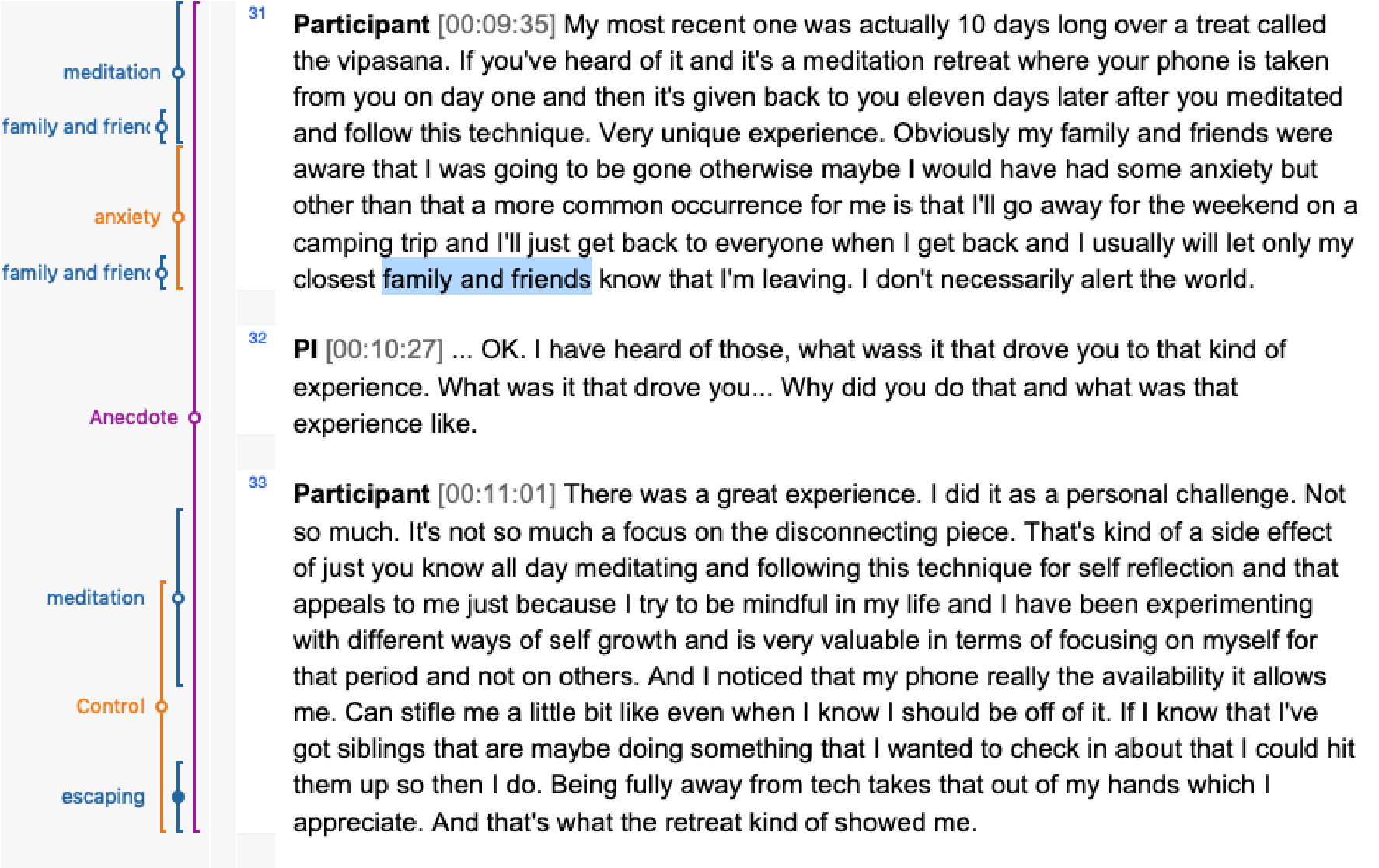
Cited Literature
1. “Mobile Fact Sheet”. Pew Research Center, Washington, D.C. (2018, February 18) www.pewinternet.org
2. Poushter, Jacob. “Smartphone ownership and internet usage continues to climb in emerging economies.” Pew Research Center 22 (2016): 1–44.
3. “Phenomenology.” The Sage Encyclopedia of Qualitative Research Methods. Edited by Lisa M Given, Thousand Oaks: SAGE, 2008. 617.
4. Jackson, S. (2014). Rethinking Repair. In Gillespie, T. E., Boczkowski, P. J. E., & Foot, K.
A. (Eds). Media Technologies: Essays on Communication, Materiality, and Society. Cambridge, MA: MIT Press.
5. Baumer, E. P. S., Ames, M. G., Brubaker, J. R., Burrell, J., & Dourish, P. (2014). Refusing, Limiting, Departing: Why We Should Study Technology Non-use (pp. 65–68). Presented
at the CHI ’14 Extended Abstracts on Human Factors in Computing Systems, New York, NY, USA: ACM. doi.org
6. Pew (2018, Feb. 5) Internet/Broadband Fact Sheet. www.pewinternet.org
7. Wyatt, Sally. “Bringing users and non-users into being across methods and disciplines.” In CHI 2014 Workshop Considering Why We Should Study Technology Non-use. 2014
8. Ihde, Don. Technology and the Lifeworld. Indiana University Press, 1990
9. Rosenberger, Robert, and Peter-Paul Verbeek. Postphenomenological investigations: essays on human-technology relations. Lexington Books, 2015.
10. Simpson, Audra. “Consent’s revenge.” Cultural Anthropology 31, no. 3 (2016): 326–333.
11. Simpson, A. (2014). Mohawk interruptus: Political life across the borders of settler states. Durham NC: Duke University Press.
12. Rahnema, M. (1997) “Toward Post-Development: Searching for Signposts, A New Language and New Paradigms.” In Rahnema, M & Bawtree, V. (Eds) The PostDevelopment Reader. London: Zed Books. 400.
13. Escobar, A. (1997) “The Making and Unmaking of the Third World Through Development.” In The Post-Development Reader. 85–86.
14. Adas, Michael. Dominance by design: Technological imperatives and America’s civilizing mission.
Harvard University Press, 2009. 243
15. Scranton, P. (1994) Determinism and Indeterminacy in the History of Technology. In Smith, M.R. & Marx, L. (Eds). Does Technology Drive History? Cambridge: MIT Press.
16. Cooper, Daniel. “You can’t buy an ethical smartphone today” Endgadget, February 6, 2018. Retrieved from www.engadget.com.
17. Innis, Harold Adams. The Bias of Communication. University of Toronto Press, 2008.
18. Hughes, Thomas P. Human-built world: How to think about technology and culture. University of Chicago Press, 2004.
19. Mumford, Lewis. The Pentagon of Power. Harcourt, 1974.
20. Peters, John Durham. “Infrastructuralism: Media as Traffic between Nature and Culture.” In Traffic: Media as Infrastructures and Cultural Practices (2015): 29–49.
21. Casemajor, N., Couture, S., Delfin, M., Goerzen, M., & Delfanti, A. (2015). “Nonparticipation in digital media: toward a framework of mediated political action.” Media, Culture & Society, 37(6), 1–17. doi.org
22. Baumer, Eric PS, Morgan G. Ames, Jenna Burrell, Jed R. Brubaker, and Paul Dourish. “Why study technology non-use?.” First Monday 20, no. 11 (2015).
23. Sally Wyatt, “Non-Users Also Matter: The Construction of Users and Non-Users of the Internet”. In Oudshoorn, Nelly EJ, and Trevor Pinch. How users matter: The co-construction of users and technologies. MIT press, 2003.
24. Wyatt, Sally, Graham Thomas, and Tiziana Terranova. “They came, they surfed, they went back to the beach: Conceptualizing.” Virtual Society (2002): 23–40.
25. Gomez, Ricardo, Kirsten A Foot, Meg Young, Rose Paquet-Kinsley, and Stacey Morrison. “Pulling the Plug Visually: Images of Resistance to ICTs and Connectivity.” First Monday 20, no. 11 (2015).
26. Syvertsen, T. (2017). Media Resistance. Palgrave Macmillan
27. Ems, Lindsay. “Exploring ethnographic techniques for ICT non-use research: An Amish case study.” First Monday 20, no. 11 (2015)
28. Wyatt, Sally. “Bringing users and non-users into being across methods and disciplines.” In CHI 2014 Workshop Considering Why We Should Study Technology Non-use. 2014
29. Verdegem, Pieter, and Lieven De Marez. “Rethinking Determinants of ICT Acceptance Towards an Integrated and Comprehensive Overview.” Technovation 31, no. 8 (August 1, 2011): 411–23. doi:10.1016/j.technovation.2011.02.004.
30. Portwood-Stacer, Laura. “Media refusal and conspicuous non-consumption: The performative and political dimensions of Facebook abstention.” New Media & Society 15, no. 7 (2013): 1041–1057.
31. Syvertsen, T., & Enli, G. (2019). Digital detox: Media resistance and the promise of authenticity. Convergence: the International Journal of Research Into New Media Technologies,
64(17), 135485651984732–15. doi.org
32. Woodstock, Louise. “Media resistance: Opportunities for practice theory and new media research.” International Journal of Communication 8 (2014): 19.
33. Baumer, Eric PS, Jenna Burrell, Morgan G. Ames, Jed R. Brubaker, and Paul Dourish.
“On the importance and implications of studying technology non-use.” interactions 22, no. 2 (2015): 52–56.
34. Hakkarainen, Päivi. “‘No good for shovelling snow and carrying firewood’: Social representations of computers and the internet by elderly Finnish non-users.” New Media & Society 14, no. 7 (2012): 1198–1215.
35. Reisdorf, Bianca, Ann-Sofie Axelsson, and Hanna Maurin. “Living offline-a qualitative study of internet non-use in Great Britain and Sweden.” Selected Papers of Association of Internet Researchers (2016).
36. Selwyn, Neil. “Digital Division or Digital Decision? a Study of Non-Users and Low-Users of Computers.” Poetics 34, no. 4 (August 2006): 273–92. doi:10.1016/j.poetic.2006.05.003.
37. Light, Ben. Disconnecting with social networking sites. Springer, 2014.
38. Syvertsen, Trine. Digital Detox: The Politics of Disconnecting. Emerald Publishing Limited, 2020.
39. Karppi, T. Disconnect: Facebook’s Affective Bonds. University of Minnesota Press, 2018.
40. Brennen, Bonnie. Opting Out of Digital Media. Routledge, 2019.
41. Natale, S. (2016). There Are No Old Media. Journal of Communication, 66(4), 585–603. doi.org
42. Hesselberth, Pepita. “Discourses on disconnectivity and the right to disconnect.” New Media & Society 20, no. 5 (2018): 1994–2010.
43. Marvin, Carolyn. When Old Technologies Were New, Oxford: Oxford University Press, 1988.
44. Bucher, T. (2020). Nothing to disconnect from? Being singular plural in an age of machine learning. Media, Culture \& Society, 19(4), 016344372091402–8. doi.org
45. Ellul, Jacques. The Technological Society, Vintage. 1964.
46. Heidegger, Martin. “The question concerning technology.” Technology and values: Essential readings 99 (1954): 113.
47. Winner, Langdon. Autonomous technology. MIT Press, 1978.
48. Marcuse, Herbert. One-Dimensional Man: Studies in the Ideology of Advanced Industrial Society. Routledge, 1964.
49. Pacey, Arnold. The Culture of Technology. MIT Press, 1983.
50. Foot, Kirsten. “The online emergence of pushback on social media in the United States: A historical discourse analysis.” International Journal of Communication 8 (2014): 30.
51. Linebaugh, Peter. Ned Ludd & Queen Mab: machine-breaking, romanticism, and the several commons of 1811–12. PM Press, 2012.
52. Bauer, Martin, ed. Resistance to new technology: nuclear power, information technology and biotechnology. Cambridge University Press, 1997.
53. Adas, Michael. Machines as the Measure of Men: Science, Technology, and Ideologies of Western Dominance. Cornell University Press, 2015.
54. Adas, Michael. Dominance by Design: Technological Imperatives and America’s Civilizing Mission. Harvard University Press, 2009.
55. Jones, Steven E. Against Technology, New York: Routledge, 2006
56. Fox, Nicols. Against the machine: The hidden Luddite tradition in literature, art, and individual lives. Island Press, 2013
57. Glendinning, Chellis. “Notes toward a neo-Luddite manifesto.” Utne Reader 38, no. 1 (1990): 50–3.
58. Perlman, Fredy. Against his-story, against Leviathan!. Detroit: Black & Red, 1983.
59. van Dijk, Jan A. G. M. The Deepening Divide, Thousand Oaks: Sage, 2005.
60. Selwyn, Neil. “Reconsidering Political and Popular Understandings of the Digital Divide.” New Media & Society 6, no. 3 (June 1, 2004): 341–62. doi:10.1177/1461444804042519.
61. Verdegem, Pieter, and Pascal Verhoest. “Profiling the Non-User Rethinking Policy Initiatives Stimulating ICT Acceptance.” Telecommunications Policy 33, no. 10 (October 15, 2009): 642–52. doi:10.1016/j.telpol.2009.08.009.
62. Morris, A, J Goodman, and H Brading. “Internet Use and Non-Use: Views of Older Users.” Universal Access in the Information Society 6, no. 1 (2007): 34–57.
63. Klein, Jeremy. “Technology Laggards: Deviants or Victims?.” In Critical Management Studies Conference, University of Cambridge,[online], pp. 4–6. 2005.
64. Atkin, David J., Daniel S. Hunt, and Carolyn A. Lin. “Diffusion theory in the new media environment: Toward an integrated technology adoption model.” Mass Communication and Society 18, no. 5 (2015): 623–650.
65. Rogers, Everett M. Diffusion of innovations. Simon and Schuster, 2010.
66. Haddon, Leslie. “The contribution of domestication research to in-home computing and media consumption.” The Information Society 22, no. 4 (2006): 195–203.
67. Silverstone, Roger, Hirsch, Eric (Eds.) (1992). Consuming Technologies : Media and information in domestic spaces. London/New York: Routledge
68. Winner, Langdon. “Do Artifacts Have Politics?.” Daedalus 109, no. 1 (1980): 121–36. doi:10.2307/20024652.
69. Trouillot, Michel-Rolph. Silencing the Past: Power and the Production of History. Beacon Press, 1995.
70. Katz, James E., James Everett Katz, and Mark Aakhus, eds. Perpetual contact: Mobile communication, private talk, public performance. Cambridge University Press, 2002.
71. Katz, James E., and Satomi Sugiyama. “Mobile phones as fashion statements: evidence from student surveys in the US and Japan.” New Media & Society 8, no. 2 (2006): 325.
72. Bijker, Wiebe E., Thomas Parke Hughes, and Trevor J. Pinch, eds. The Social Construction of Technological Systems: New Directions in the Sociology and History of Technology. MIT press, 1987.
73. digitaldetox.org.
74. Turkle, Sherry. Alone Together. Basic Books, 2011
75. Turkle, Sherry. Reclaiming Conversation. Penguin, 2016.
76. Carr, Nicholas. The Shallows: What the Internet is Doing to Our Brains. WW Norton & Company, 2011.
77. Lanier, Jaron. Ten arguments for deleting your social media accounts right now. Random House, 2018.
78. Rushkoff, Douglas. Present shock: When everything happens now. Current, 2014.
79. Morozov, Evgeny. The net delusion: The dark side of Internet freedom. PublicAffairs, 2012.
80. Benjamin, Ruha. Race after technology: Abolitionist Tools for the New Jim Code. John Wiley & Sons, 2019
81. Noble, Safiya Umoja. Algorithms of oppression: How search engines reinforce racism. NYU Press, 2018.
82. Schatzberg, E. (2018). Technology: Critical History of a Concept. Chicago: University of Chicago Press.
83. Mainwaring, Scott D., Michele F. Chang, and Ken Anderson. “Infrastructures and their discontents: Implications for ubicomp.” In International Conference on Ubiquitous Computing, pp. 418–432. Springer, Berlin, Heidelberg, 2004
84. Vannini, Phillip, and Jonathan Taggart. Off the Grid: Re-assembling Domestic Life. Routledge, 2014.
85. Peters, J. D. The Marvelous Clouds: Toward a Philosophy of Elemental Media. University of Chicago Press. 2015. 140.
86. Luft, Sebastian. “Husserl’s phenomenological discovery of the natural attitude.” Continental Philosophy Review 31, no. 2 (1998): 153–170.
87. Jackson, S. J. (2014). Rethinking Repair. In Media technologies: Essays on communication, materiality, and society, 221–39.
88. Vagle, M. D. Crafting phenomenological research. Routledge, 2016
89. “Hermeneutics” and “Phenomenology” in The Sage Encyclopedia of Qualitative Research Methods. Edited by Lisa M Given, Thousand Oaks: SAGE, 2008. 385–387; 614–619
90. Heidegger, Martin, John Macquarrie, and Edward Robinson. 1962. Being and Time. Malden, MA: Blackwell. 50.
91. Zahavi, Dan. Phenomenology: the basics. Routledge, 2018.
92. Askay, Richard, and Jensen Farquhar. Apprehending the inaccessible: Freudian psychoanalysis and existential phenomenology. Northwestern University Press, 2006.
93. Peoples, Katarzyna. How to Write a Phenomenological Dissertation: A Step-by-Step Guide. Vol.
56. SAGE Publications, Incorporated, 2020. 32–34.
94. Nancy, J.-L. (2000). Being Singular Plural. Stanford University Press.
95. Hodder, I. Entangled. Malden MA: Wiley Blackwell. 2010. 28.
96. Withy, K. (2015). Heidegger On Being Uncanny. Harvard University Press.
97. Masschelein, Anneleen. The Unconcept: The Freudian Uncanny in Late-Twentieth-Century Theory. SUNY Press, 2011.
98. Trigg, Dylan. The Memory of Place: A Phenomenology of the Uncanny. Ohio University Press, 2012. 27.
99. Masscherlein, A. “Flesh World: On the New Uncanny.” LA Review of Books. August 17, 2012. Retrieved from lareviewofbooks.org
100. Nye, David E. American Technological Sublime. MIT Press, 1996.
101. Kasson, John F. Civilizing the Machine: Technology and Republican Values in America, 17761900. Macmillan, 1999.
102. Marx, Leo. The Machine in the Garden: Technology and the Pastoral Ideal in America. Oxford University Press, USA, 2000.
103. Nye, David E. When the Lights Went Out: A History of Blackouts in America. MIT Press, 2010.
104. Bassett, N. (2017). “Papers, Please!”: A Media Archaeology of Identity Documents. Studia Universitatis Babes-Bolyai, Philosophia, 62(3).
105. Otto, Rudolf. The Idea of the Holy. Vol. 14. Oxford University Press, 1958.
106. Mumford, Lewis. Technics and Human Development: The Myth of the Machine, vol. I. Harvest Books, 1971.
107. Winner, Langdon. The Whale and the Reactor: A Search for Limits in an Age of High Technology. University of Chicago Press, 2010.
108. Heidegger, Martin. “The question concerning technology, and other essays.” Harper Perennial 1977.
109. Mori, Masahiro. “The uncanny valley.” Energy 7, no. 4 (1970): 33–35.
110. Jentsch, Ernst. “On the Psychology of the Uncanny (1906).” Angelaki: Journal of the Theoretical Humanities 2, no. 1 (1997): 7–16
111. Freud, S. The Uncanny. New York: Penguin. 2003 (originally published 1919).
112. Hoffman, E. T. A. The Sandman. In Tales of Hoffman. New York: Penguin Classics. 1982 (first published 1817). 85–126.
113. Eco, Umberto. On Ugliness. Translated by McEwen, A. New York: Rizzoli, 1997. 311.
114. Trigg, Dylan. The Memory of Place
115. Masschelein, The Unconcept. 66
116. Goode, Erich, and Nachman Ben-Yehuda. “Moral panics: Culture, politics, and social construction.” Annual review of sociology 20, no. 1 (1994): 149–171.
117. Rowe, David. “The concept of the moral panic: An historico-sociological positioning.” In Moral panics, the media and the law in early modern England, pp. 22–40. Palgrave Macmillan, London, 2009. 34.
118. Furedi, F.. Power of Reading: From Socrates to Twitter. Bloomsbury Publishing, 2015. 197.
119. Brann, Noel L. “A Monastic Dilemma Posed by the Invention of Printing: the Context of De laude scriptorum manualium by Abbot Johann Trithemius (1462–1516).” Visible Language 13, no. 2 (1979): 150–167.
120. Bayley, S. Ugly: The Aesthetics of Everything. New York: Overlook Press, 2012.
121. Fisher, Mark. “What is hauntology?.” FILM QUART 66, no. 1 (2012): 16–24.
122. Grusin, Richard, ed. The Nonhuman Turn. U of Minnesota Press, 2015.
123. Harman, Graham. Tool-being: Heidegger and the metaphysics of objects. Open Court, 2011.
124. Kelly, K. (1995, June 1). “Interview With The Luddite.” Wired. Retrieved November 26,
2016, from www.wired.com
125. Maxwell, Richard, and Toby Miller. Greening the Media. Oxford University Press, 2012
126. Gabrys, Jennifer. Digital Rubbish: A Natural History of Electronics. University of Michigan Press, 2011.
127. Foucault, Michel. Technologies of the Self. Edited by Luther H Martin, Hucl Gutman, and Patrick H Hutton, London: Tavistock, 1988.
128. Luft, Sebastian. “Husserl’s phenomenological discovery of the natural attitude.” Continental Philosophy Review 31, no. 2 (1998): 153–170.
129. Tauli-Corpuz, V. & Mander, J. Paradigm Wars: Indigenous Peoples’ Resistance to
Globalization. San Francisco: Sierra Club Books. 2006 and Ranemah and Bawtree’s PostDevelopment Reader.
130. Scott, J. C. Seeing Like a State. New Haven: Yale University Press. 1998.
131. Katz, James E., and Mark Aakhus, eds. Perpetual contact: Mobile communication, private talk, public performance. Cambridge University Press, 2002. 305.
132. Peters, John Durham. “Infrastructuralism: Media as Traffic between Nature and Culture.” Traffic: Media as Infrastructures and Cultural Practices (2015): 29–49.
133. Parks, Lisa, and Nicole Starosielski, eds. Signal traffic: Critical studies of media infrastructures. University of Illinois Press, 2015.
134. Starosielski, Nicole. The Undersea Network. Duke University Press, 2015.
135. Markham, Tim, and Scott Rodgers. Conditions of mediation: phenomenological perspectives on media. Peter Lang, 2017.
136. Illich, Ivan. Tools for Conviviality. Harper and Row, 1973
137. Pacey, Arnold. Meaning in Technology. MIT Press, 1999.
138. Giddens, Anthony. The Consequences of Modernity. John Wiley & Sons, 2013.
139. Midgley, Mary. Science as Salvation: A modern myth and its meaning. Taylor & Francis US, 1994.
140. Böhme, Gernot. Invasive technification: critical essays in the philosophy of technology. Bloomsbury Publishing, 2012.
141. Couldry, Nick, and Ulises A Mejias. “Data Colonialism: Rethinking Big Data’s Relation to the Contemporary Subject.” Television and New Media 33, no. 4 (September 2, 2018): 152747641879663–14. doi:10.1177/1527476418796632.
142. Gettleman, Jeffrey, Kumar, Hari, and Schultz, Kai. “Isolated Tribe Kills American With Bow and Arrow on Remote Indian Island”. New York Times. November 21, 2018. Accessed December 1, 2018, www.nytimes.com
143. Cross, Jamie. “Off the grid: Infrastructure and energy beyond the mains.” In Infrastructures and Social Complexity: A Companion. Edited by Penelope Harvey, Casper Bruun Jensen, Atsuro Morita, page 199. Routledge.
144. Herbert J. Rubin, Irene S. Rubin. Qualitative Interviewing: The Art of Hearing Data. Thousand Oakes: Sage. 2005; Steinar Kvale, Svend Brinkmann. InterViews: Learning the Craft of Qualitative Research Interviewing. Thousand Oakes, Sage. 2009.
145. Moustakas, Clark. Phenomenological Research Methods. Sage, 1994.
146. Franklin, Marianne. “Paradise Lost? Reconsidering Power, Resistance and the Internet after Snowden.” Colloquia given at University of Illinois at Chicago, January 21, 2015.
147. Bassett, N. Contemporary Luddism: Lifestyle Politic vs Collective Movement. Presented September 7th, 2019 at Society for the Social Study of Science in New Orleans, LA.
148. Kennedy, P. “The Land Where the Internet Ends.” New York Times. 2019, June 21. Retrieved from www.nytimes.com
149. Ingber, S. “Life in the Quiet Zone: West Virginia Town Avoids Electronics for Science” National Geographic. 2014, October 11. Retrieved from
150. Gaynor, M. J. “The Town Without Wifi”. The Washingtonian. 2015, January. Retrieved from www.washingtonian.com
151. Dickerman, K. “Inside the U.S.’s ‘National Radio Quiet Zone’ where there’s no WiFi or cellphone service” Washington Post, 2018, June 22. Retrieved from www.washingtonpost.com;
152. Hedendahl, Lena, Michael Carlberg, and Lennart Hardell. “Electromagnetic hypersensitivity–an increasing challenge to the medical profession.” Reviews on environmental health 30, no. 4 (2015): 209–215
153. Elmas, Onur. “Effects of electromagnetic field exposure on the heart: a systematic review.” Toxicology and industrial health 32, no. 1 (2016): 76–82.
154. MacDonald, Lucy, “Hobart Wants to Become a Smart City but Also Wants to Unplug”. Australian Broadcasting Corporation, September 10, 2019. Accessed September 22, 2019. www.abc.net.au
155. National Science Foundation. (2019, Sept 23) “NSF Awards Cooperative Agreement for Management and Operations of its Green Bank Observatory” www.nsf.gov
156. Van Manen, Max. Researching lived experience: Human science for an action sensitive pedagogy. Routledge, 2016. 68–70.
157. Smith, Jonathan A., Flowers, Paul, and Larkin, Michael. Interpretive Phenomenological Analysis: Theory, Method and Research. Thousand Oakes: Sage Publications, 2009 43–46.
158. Laverty, Susann M. “Hermeneutic phenomenology and phenomenology: A comparison of historical and methodological considerations.” International journal of qualitative methods 2, no. 3 (2003): 30–31.
159. Finlay, Linda. “Debating phenomenological research”. Phenomenology & Practice, 3, 1 (2009), 6–25..
160. Saldaña, Johnny. The coding manual for qualitative researchers. Sage, 2015.
161. van Manen, M. Literature, poetry, and art are sources of phenomenological insights. Phenomenology Online. 2011. www.phenomenologyonline.com
162. Kafle, Narayan Prasad. “Hermeneutic phenomenological research method simplified.” Bodhi: An interdisciplinary journal 5, no. 1 (2011): 181–200.
163. Pew Research Center, April 2015. “The Smartphone Difference” Available at:
164. Sohn, Brian Kelleher. “Phenomenology and qualitative data analysis software (QDAS): A careful reconciliation.” In Forum Qualitative Sozialforschung/Forum: Qualitative Social Research, vol. 18, no. 1, p. 18. DEU, 2017.
165. J. A. Smith, & P. Shinebourne. “Interpretative phenomenological analysis”. In APA
Handbook of Research Methods in Psychology, Vol. 2, Research Designs: Quantitative,
Qualitative, Neuropsychological, and Biological ed. H. Cooper, P. M. Camic, D. L. Long, A. T. Panter, D. Rindskopf, & K. J. Sher. (Washington, DC, US: American Psychological Association, 2012) pp. 73–82.
166. Enzensberger, Hans Magnus, and Michael Roloff. The consciousness industry: On literature, politics and the media. Seabury Press, 1974.
167. Nick Seaver, “Homo Attentus: Technological Backlash and the Attentional Subject” Presented at Society for the Social Study of Science, 2019
168. Rebecca Jablonsky, “Attention by Design: Meditation Apps and the Construction of
Mindbody Capacities.” Presented at Society for the Social Study of Science, 2019
169. Newport, Cal. Digital Minimalism: Choosing a Focused Life in a Noisy World. Penguin, 2019.
170. Berlin, Isaiah. “Two Concepts of Liberty” In Four essays on liberty. (Oxford: Oxford University Press,1969). 121–22.
171. Christopher M. Kelty. “The Fog of Freedom.” in eds. Gillespie, Boczkowski & Foot. Media Technologies: Essays on Communication, Materiality, and Society (Cambridge, MA: MIT Press 2014). 208.
172. Dempsey, Abigail E., Kelsey D. O’Brien, Mojisola F. Tiamiyu, and Jon D. Elhai. “Fear of missing out (FoMO) and rumination mediate relations between social anxiety and problematic Facebook use.” Addictive behaviors reports 9 (2019): 100150.
173. Papacharissi, Zizi. “We have always been social.” Social Media & Society (2015): 2056305115581185.
174. Enzensberger, H. M. “Industrialization of the Mind”, in Critical Essays. (R. Grimm & B.
Armstrong, Eds.). New York: Continuum. 1982
175. Stiegler, B., & Barison, D. Acting out. Stanford Univ Pr. 2009
176. Hansen, M. B. N. (2006). Media Theory. Theory, Culture and Society, 12(2–3), 297–306.
177. Agamben, Giorgio. The open. Stanford University Press: Stanford, 2004
178. Simondon, Gilbert. Two lessons on animal and man. U of Minnesota Press, 2015.
179. Noble, David F. The religion of technology: The divinity of man and the spirit of invention. Knopf, 2013.
180. Kranzberg, Melvin. “Technology and History:” Kranzberg’s Laws”.” Technology and culture 27, no. 3 (1986): 544–560.
181. Aviv, Rachel. “How Albert Woodfox Survived Solitary.” The New Yorker, January 16, 2017. www.newyorker.com
182. Foucault, Michel. Madness and civilization: A history of insanity in the age of reason. Vintage, 1988.
183. St. Louis Park Historical Society. “The Pest House.” slphistory.org 184. Defoe, Daniel. A Journal of the Plague Year. Dover Publications. 2001 [1722].
185. Bennion, Elizabeth. “Banning the bing: Why extreme solitary confinement is cruel and far too usual punishment.” Ind. LJ 90 (2015): 741.
186. “POLAND: In Babie Doly” Time Magazine, June 25, 1951, content.time.com
187. Jean-Paul Clébert, Le Blouckhaus (Paris: Editions Denoël, 1955).
188. Nasser Asphalt, directed by Frank Wisbar (1958; West Germany: Wenzel Lũdecke), Film. 189. The Blockhouse, directed by Clive Rees (1973; United Kingdom: Edgar Bronfman Jr. & Antony Rufus Isaacs), Film.
190. “Die Legende von Babie DoIy” Der Speigal, January 29, 1958.
191. “Five Companions Dead; German Soldier Buried Alive 6 Years, Lives” United Press. Warsaw, Poland. 1951.
192. Associated Press. “Nigerian cook who survived three days in shipwreck still has nightmares and vows to never return to sea “ New York Daily News. December 12, 2013. www.nydailynews.com
193. de la Bellacasa, Maria Puig. “Ecological thinking, material spirituality, and the poetics of infrastructure.” Boundary objects and beyond: Working with Leigh Star (2016): 47–68.
194. Haraway, Donna. “Anthropocene, capitalocene, plantationocene, chthulucene: Making kin.” Environmental humanities 6, no. 1 (2015): 159–165.
195. Bondeson, Jan. Buried alive: the terrifying history of our most primal fear. WW Norton & Company, 2002.
196. Thompson, Carl. Shipwreck in Art and Literature: Images and Interpretations From Antiquity to the Present Day. New York: Routledge, 2013.
197. Madley, Benjamin. An American Genocide: The United States and the California Indian Catastrophe, 1846–1873. Yale University Press, 2016.
198. Kroeber, Theodora. Ishi in two worlds: A biography of the last wild Indian in North America. Univ of California Press, 2004.
199. National Museum of Natural History. “The Repatriation of Ishi, the last Yahi Indian” Smithsonian Institute. naturalhistory2.si.edu
200. Sedley, David, “Plato’s Cratylus”, Stanford Encyclopedia of Philosophy (Fall 2018 Edition), Edward N. Zalta (ed.), plato.stanford.edu
201. Eco, Umberto. “The search for the perfect language, trans.” J. Fentress. Oxford: Blackwell (1995).
202. Kitchen, Martin. Kaspar Hauser: Europe’s Child. Springer, 2001.
203. Rymer, Russ. Genie: A scientific tragedy. Harper Perennial, 1993.
204. Peskov, Vasiliĭ. Lost in the Taiga: One Russian Family’s 50-Year Struggle for Survival and Religious Freedom in the Siberian Wilderness. Doubleday Books, 1994.
205. Mintz, Steven. Huck’s raft: A history of American childhood. Harvard University Press, 2004.
206. Philips, Dom. “Amazon tribeswomen escape back to forest after rejecting civilization” September 10, 2016. The Washington Post. www.washingtonpost.com
207. Sale, Kirkpatrick. Rebels against the future: the Luddites and their war on the Industrial
Revolution: lessons for the computer age. Basic Books, 1996
208. Noble, David F., and Stan Weir. Progress without people: In defense of Luddism. Charles H Kerr Pub Co, 1993.
209. Cueto, Marcos, Henrique Cukierman, Mariano Fressoli, Rafael Dias, Hernán Thomas, Tania Pérez Bustos, María Fernanda Olarte Sierra et al. Beyond imported magic: essays on science, technology, and society in Latin America. MIT Press, 2014.
210. Marx, K. Capital: A critique of political economy (B. Fowkes, Trans.). New York: Vintage Books [1876] 1977. 495.
211. Winner, Langdon. “Technologies as Forms of Life.” Edited by David Kaplan. Readings in the Philosophy of Technology, Rowman & Littlefield Publishers, 2009.
212. Verbeek, Peter-Paul. What Things Do: Philosophical Reflections on Technology, Agency and Design, University Park, PA: Pennsylvania State University Press, 2005.
213. Horn, Jeff. “Machine-Breaking and the ‘Threat from Below’in Great Britain and France during the Early Industrial Revolution.” In Crowd Actions in Britain and France from the Middle Ages to the Modern World, pp. 165–178. Palgrave Macmillan, London, 2015.
214. Hobsbawm, Eric J. “The machine breakers.” Past & Present 1 (1952): 57–70.
215. Hobsbawm, Eric, and George Rudé. Captain swing. Verso Trade, 2014.
216. Williams, David. The Rebecca Riots: a study in agrarian discontent. University of Wales Press, 1955.
217. Neeson, Jeanette M. Commoners: common right, enclosure and social change in England, 17001820. Cambridge University Press, 1996.
218. McDonagh, Briony. “Making and breaking property: Negotiating enclosure and common rights in sixteenth-century England.” In History Workshop Journal, vol. 76, no. 1, pp. 32–56.
Oxford University Press, 2013.
219. Taylor, Christopher. Fields in the English landscape. Sutton Publishing, [1975] 2000.125128.
220. Billington, David P. “Structures and machines: The two sides of technology.” Soundings (1974): 275–288.
221. Gasset, José Ortega Y. “Man the technician.” Technology and Values: Essential Readings (1954)
222. Preston, Diana. The Boxer Rebellion: The Dramatic story of China’s war on foreigners that shook the world in the summer of 1900. Bloomsbury Publishing USA, 2000.
223. Pong, David. “Confucian patriotism and the destruction of the Woosung railway, 1877.” Modern Asian Studies 7, no. 4 (1973): 675.
224. Liu, Kwang-Ching. “Imperialism and the Chinese Peasants: The Background of the Boxer Uprising.” (1989): 102–116.
225. Esherick, Joseph W. The origins of the Boxer Uprising. Univ of California Press, 1988. 300.
226. Atkinson, Rick. The Day Of Battle: The War in Sicily and Italy 1943–44. Hachette UK, 2013. 235.
227. Forczyk, Robert. The Dnepr 1943: Hitler’s eastern rampart crumbles. Bloomsbury Publishing, 2016. 5–6.
228. Cohen, Paul A. “The contested past: the Boxers as history and myth.” The journal of Asian studies 51, no. 1 (1992): 82–113.
229. Wasserstrom, Jeffrey. “” Civilization” and Its Discontents: The Boxers and Luddites as
Heroes and Villains.” Theory and Society (1987): 698
230. Argersinger, Peter H., and Jo Ann E. Argersinger. “The machine breakers: farmworkers and social change in the rural midwest of the 1870s.” Agricultural History (1984): 396
231. Kahrl, William L. “Part II: The Politics of California Water: Owens Valley and the Los Angeles Aqueduct, 1900–1927.” Hastings Environmental Law Journal 6, no. 2 (2000): 260.
232. Atkins, Ed. “Building a dam, constructing a nation: The ‘drowning’of Capel Celyn.” Journal of Historical Sociology 31, no. 4 (2018): 458.
233. Wayne, T. “At the Tone, Leave a What?” New York Times. 2014, June 13. Retrieved from www.nytimes.com
234. Virilio, Paul. Politics of the Very Worst: An Interview with Philippe Petit. Semiotext(E). 1999.
89.
235. Finkel, Michael. The Stranger in the Woods: The Extraordinary Story of the Last True Hermit. Vintage, 2018.
236. Boyle, Mark. The Way Home: Tales from a Life Without Technology. OneWorld, 2019.
237. Busch, Akiko, How To Disappear: Notes on Invisibility in a time of Transparency, Penguin Press, 2019
238. Hanh, Thich Nhat. Silence: The Power of Quiet in a World Full of Noise. Random House, 2015.
239. Axelrod, Howard. The Point of Vanishing: A Memior of Two Years in Solitude. Beacon Press, 2015.
240. Kull, Robert. Solitude; Seeking Wisdom in Extremes (A Year Alone in the Patagonia Wilderness). New World Library, 2008
241. Mijuskovic, Ben Lazare. Loneliness in Philosophy, Psychology, and Literature. iUniverse, 2012.
242. Sontag, S. (2014). The Aesthetics of Silence. Aspen.
243. Gent, Ed. “The plight of Japan’s modern hermits” BBC.com. January 29, 2019.
244. Abram, David. The spell of the sensuous: Perception and language in a more-than-human world. Vintage, 2012.
245. Kagge, Silence In the Age of Noise. Penguin UK, 2017. 66.
246. France, Peter. Hermits: The insights of solitude. Random House, 2014; Halpern, Sue. Migrations to Solitude.Vintage, 1993.
247. Koch, Philip. Solitude: A philosophical encounter. Open Court Publishing, 1994.
248. Thoreau, H. D. Walden. Yale University Press. 2006
249. Svendsen, Lars. A philosophy of loneliness. Reaktion Books, 2017;
250. Storr, Anthony. Solitude: A Return to the Self. Simon and Schuster, 2005.
251. Harris, Michael. Solitude: In Pursuit of a Singular Life in a Crowded World. Thomas Dunne Books, 2017.
252. Bilton, N. “Today’s Technologies Need an Off-The-Hook Feature”. New York Times. 2012, May 14. Retrieved from bits.blogs.nytimes.com
253. Markham, Tim, and Scott Rodgers. Conditions of mediation: phenomenological perspectives on media. Peter Lang, 2017.
254. Christopher J. Ferguson & Cathy Faye, “A History of Panic Over Entertainment Technology.” Behavioral Scientist, January 1, 2018.
11. Vita
| NAME: | Nathanael Bassett |
| EDUCATION: |
Ph.D, Communication. University of Illinois at Chicago, Chicago, IL. August 2020 M.A., Media Studies The New School, New York, NY. January 2014 B.A., Mass Media, Minor in Political Science, Cum Laude Missouri State University, Springfield, MO. May 2011 |
| TEACHING: |
University of Illinois at Chicago, Department of Communication, 2014–2020 DePaul University, College of Communication, 2018–2020 |
| HONORS: |
UIC NCA Outstanding Graduate Student Award (2017) NSF IGERT Fellowship in Electronic Security and Privacy (2016, 2017 & 2019) Graduate Student Council Travel Award — UIC (2016 & 2015) Graduate College Student Presenter Award — UIC (2016 & 2015) Distinguished Thesis Award — The New School (2014) The New School — School of Media Studies Travel Grant (2013) |
| PROFESSIONAL MEMBERSHIPS: |
Society for the Social Studies of Science (4S) Association of Internet Researchers (AOIR) National Communication Association (NCA) |
| PUBLICATIONS: | |
| Peer Reviewed |
Bassett, N & Jones, S. (2019). “Automobility, Autonomy and Communication.” International Journal of Communication. 13. 2684–2702 Bassett, N. (2018) “Dialogues: Dylan Trigg.” communication +1 7(1) Bassett, N. (2018) “Papers Please: A Media Archaeology of Identity Documents.” Studia UBB Philosophia 62 Bassett, N & Archer, J. (2017) “Enjoy Your Feeling: A Media Archaeology of Material Publics.” Communication and the Public. DOI 10.1177/2057047317722571 |
| Other Articles |
McDowell, Z. and Bassett, N. (2018) “Introduction: Currents in Communication and the Media Archaeological,” communication +1: 7(1) Bassett, N. (2015) “Misusing the Master’s Tools: Exploring the Capacity to Break from Prescriptive Use” The Torist (1) toristinkirir4xj.onion |
| Book Chapters |
Archer, J. & Bassett, N. (forthcoming) “Embodiment.” In. Filimowicz, M, & Tzankova, V. (Eds.) Reimagining Communication: Experience. New York: Peter Lang Bassett, N. (2019) “Conscientious Hacking and the Weak Collective” In Schrock, A. & Hunsinger, J. (Eds.) Making Our World: Hacker and Maker Movements in Context New York: Peter Lang Bassett, N. (2018) “Communication and Media Studies: La Forge’s VISOR and the Pictures in Our Heads ” In Rabitsch, S., Gabriel, M., Elmenreich, W., Brown, N.A,. (Eds.) Set Phasers to Teach! Springer Bassett, N. (2018). “Turning the Gaze On Ourselves: Slashers and Horror Philosophy.” in Booth, P. and Karkanias, A. (Ed.) A Celebration of Slashers Bassett, N. (2017). ““Homo Sapiens Only”: Star Trek and the Unhuman” and “Secret Languages and Sacred Tongues: A Rough History of an Idea and it’s Influence” in Booth, P. (Ed.) Time Lords & Tribbles, Winchesters & Muggles |
| Conference Papers |
Bassett, N. (2019) “Contemporary Luddism: Lifestyle Politic vs Collective Movement” Presented at the Society for the Social Study of Science (4S), New Orleans, LA. Bassett, N. (2018) “Playing Dead: Disconnection and the Technological Uncanny” Presented at National Communication Association (NCA), Salt Lake City, UT. Bassett, N (2018). Turning the Gaze On Ourselves: Slashers and Horror Philosophy. Presented at DePaul Pop Culture Conference, Chicago IL Bassett, N. (2017) “Confidante Games: Spanish Prisoners, Nigerian Princes, Counterfeits and Lockpicking” Presented at Society for the Social Study of Science (4S), Boston, MA. Bassett, N. (2017) “A Sound of Thunder” Presented at the American Studies Graduate Student Conference, West Lafayette, IN. Bassett, N. (2017) “Secret Languages and Sacred Tongues: A Rough History of an Idea” Presented at DePaul Pop Culture Conference, Chicago Il. Bassett, N. (2016) “Star Trek and the Unhuman” Presented at DePaul Pop Culture Conference, Chicago Il. Bassett, N. (2015) “Body and Control: Discourse and Dispositives of Use and Refusal in Science Fiction” Presented at Cultural Studies Association, Riverside, CA Bassett, N. (2013) “The Private and the Public: Identity and Politics in Virtual Space.” Presented at MiT8 Conference, Cambridge, MA. Bassett, N. and Kim, D. (2013) “Recursive Identities in Sociopolitical Movements: A Case Study of Hackathons” Presented at Critical Themes in Media Studies Conference, New York, New York. |
| Presentations, | Kuntsman, A., Bassett, N., Cooper, Z., Wanstreet, R., West, E. (2018). “Digital Materialities and their environmental damages.” Presented at the Association of Internet Researchers, Montreal, Canada |
| Workshops, | Bassett, N., Archer, J., Snyder, P. (2016). “Carnival of Privacy Delights” Presented at the Association of Internet Researchers, Berlin, Germany |
| Roundtables |
Bassett. N. (2016) “Chicago Dibs: Appropriate Technology and Sharing vs Solidarity Solutions” Presented at MidweSTS, Chicago, IL Co-Presenter: Metropolitan Museum of Art’s Paper Tiger Television: Designs For a Rrradical New Media event, February 24, 2012 |
[1] “Mobile Fact Sheet”. Pew Research Center, Washington, D.C. (2018, February 18) www.pewinternet.org
[2] Poushter, Jacob. “Smartphone ownership and internet usage continues to climb in emerging economies.” Pew Research Center 22 (2016): 1–44.
[3] “Phenomenology.” The Sage Encyclopedia of Qualitative Research Methods. Edited by Lisa M Given, Thousand Oaks: SAGE, 2008. 617.
[4] Jackson, S. (2014). Rethinking Repair. In Gillespie, T. E., Boczkowski, P. J. E., & Foot, K. A. (Eds). Media Technologies: Essays on Communication, Materiality, and Society. Cambridge, MA: MIT Press.
[5] Baumer, E. P. S., Ames, M. G., Brubaker, J. R., Burrell, J., & Dourish, P. (2014). Refusing, Limiting, Departing: Why We Should Study Technology Non-use (pp. 65–68). Presented at the CHI ’14 Extended Abstracts on Human Factors in Computing Systems, New York, NY, USA: ACM. doi.org
[6] Pew (2018, Feb. 5) Internet/ Broadband Fact Sheet. www.pewinternet.org
[7] Wyatt, Sally. “Bringing users and non-users into being across methods and disciplines.” In CHI 2014 Workshop Considering Why We Should Study Technology Non-use. 2014
[8] Ihde, Don. Technology and the Lifeworld. Indiana University Press, 1990
[9] See Rosenberger, Robert, and Peter-Paul Verbeek. Postphenomenological investigations: essays on humantechnology relations. Lexington Books, 2015.
[10] Simpson, Audra. “Consent’s revenge.” Cultural Anthropology 31, no. 3 (2016): 326–333.
[11] Simpson, A. (2014). Mohawk interruptus: Political life across the borders of settler states. Durham NC: Duke University Press.
[12] Rahnema, M. (1997) “Toward Post-Development: Searching for Signposts, A New Language and New Paradigms.” In Rahnema, M & Bawtree, V. (Eds) The Post-Development Reader. London: Zed Books. 400.
[13] Escobar, A. (1997) “The Making and Unmaking of the Third World Through Development.” In The PostDevelopment Reader. 85–86.
[14] Ibid, 89–90.
[15] Adas, Michael. Dominance by design: Technological imperatives and America’s civilizing mission. Harvard University Press, 2009. 243
[16] Scranton, P. (1994) Determinism and Indeterminacy in the History of Technology. In Smith, M.R. & Marx, L. (Eds). Does Technology Drive History? Cambridge: MIT Press.
[17] Many cellphones contain elements and materials obtained through mining practices that involve child slavery. See Cooper, Daniel. “You can’t buy an ethical smartphone today” Endgadget, February 6, 2018. Retrieved from www.engadget.com.
[18] Innis, Harold Adams. The Bias of Communication. University of Toronto Press, 2008.
[19] Hughes, Thomas P.. Human-built world: How to think about technology and culture. University of Chicago Press, 2004.
[20] Mumford, Lewis. The pentagon of power. Vol. 274. Harcourt, 1974.
[21] Peters, John Durham. “Infrastructuralism: Media as Traffic between Nature and Culture.” Traffic: Media as Infrastructures and Cultural Practices (2015): 29–49.
[22] For a strong framework of active participation / active non-participation / passive non-participation / and passive participation, see Casemajor, N., Couture, S., Delfin, M., Goerzen, M., & Delfanti, A. (2015). Nonparticipation in digital media: toward a framework of mediated political action. Media, Culture \& Society, 37(6), 1– 17. doi.org
[23] See the following: Baumer, Eric PS, Morgan G. Ames, Jenna Burrell, Jed R. Brubaker, and Paul Dourish. “Why study technology non-use?.” First Monday 20, no. 11 (2015).; Sally Wyatt, “Non-Users Also Matter: The Construction of Users and Non-Users of the Internet”. In Oudshoorn, Nelly EJ, and Trevor Pinch. How users matter: The co-construction of users and technologies. MIT press, 2003.; Wyatt, Sally, Graham Thomas, and Tiziana Terranova. “They came, they surfed, they went back to the beach: Conceptualizing.” Virtual Society (2002): 23–40.
[24] Gomez, Ricardo, Kirsten A Foot, Meg Young, Rose Paquet-Kinsley, and Stacey Morrison. “Pulling the Plug Visually: Images of Resistance to ICTs and Connectivity.” First Monday 20, no. 11 (2015).
[25] See Syvertsen, T. (2017). Media Resistance. Palgrave Macmillan; Ems, Lindsay. “Exploring ethnographic techniques for ICT non-use research: An Amish case study.” First Monday 20, no. 11 (2015)
[26] See Wyatt, Sally. “Bringing users and non-users into being across methods and disciplines.” In CHI 2014 Workshop Considering Why We Should Study Technology Non-use. 2014 ;Verdegem, Pieter, and Lieven De Marez. “Rethinking Determinants of ICT Acceptance Towards an Integrated and Comprehensive Overview.” Tec novation 31, no. 8 (August 1, 2011): 411–23. doi:10.1016/j.technovation.2011.02.004.
[27] Casemajor, Nathalie, Stéphane Couture, Mauricio Delfin, Matthew Goerzen, and Alessandro Delfanti. “Nonparticipation in digital media: toward a framework of mediated political action.” Media, Culture & Society 37, no. 6 (2015): 850–866.; Portwood-Stacer, Laura. “Media refusal and conspicuous non-consumption: The performative and political dimensions of Facebook abstention.” New Media & Society 15, no. 7 (2013): 1041–1057.
[28] Syvertsen, T., & Enli, G. (2019). Digital detox: Media resistance and the promise of authenticity. Convergence: the International Journal of Research Into New Media Technologies, 64(17), 135485651984732–15. doi.org; Woodstock, Louise. “Media resistance: Opportunities for practice theory and new media research.” International Journal of Communication 8 (2014): 19.
[29] Wyatt, “Non-Users Also Matter”
[30] Baumer, Eric PS, Jenna Burrell, Morgan G. Ames, Jed R. Brubaker, and Paul Dourish. “On the importance and implications of studying technology non-use.” interactions 22, no. 2 (2015): 52–56.
[31] Hakkarainen, Päivi. “‘No good for shovelling snow and carrying firewood’: Social representations of computers and the internet by elderly Finnish non-users.” New Media & Society 14, no. 7 (2012): 1198–1215.
[32] Reisdorf, Bianca, Ann-Sofie Axelsson, and Hanna Maurin. “Living offline-a qualitative study of internet nonuse in Great Britain and Sweden.” Selected Papers of Association of Internet Researchers (2016).
[33] Selwyn, Neil. “Digital Division or Digital Decision? a Study of Non-Users and Low-Users of Computers.” Poetics 34, no. 4 (August 2006): 273–92. doi:10.1016/j.poetic.2006.05.003.
[34] Light, Ben. Disconnecting with social networking sites. Springer, 2014.
[35] Syvertsen, Trine. Digital Detox: The Politics of Disconnecting. Emerald Publishing Limited, 2020.
[36] Syvertsen, T.. Media Resistance. Palgrave Macmillan. 2017
[37] Karppi, T. Disconnect: Facebook’s Affective Bonds. University of Minnesota Press, 2018.
[38] Brennen, Bonnie. Opting Out of Digital Media. Routledge, 2019.
[39] Light, Disconnecting. 4
[40] Ibid, 150.
[41] Syvertsen, Media Resistance. 3
[42] Ibid. 9
[43] Ibid. 5
[44] Syvertsen, T. Digital Detox. 2.
[45] Ibid, 11.
[46] Ibid, 95.
[47] Karppi, Disconnect. 104.
[48] Ibid, 3.
[49] Brennen, Opting Out. 2019.
[50] Natale, S. (2016). There Are No Old Media. Journal of Communication, 66(4), 585–603. doi.org
[51] Hesselberth, Pepita. “Discourses on disconnectivity and the right to disconnect.” New Media & Society 20, no. 5 (2018): 1994–2010.
[52] Marvin, Carolyn. When Old Technologies Were New, Oxford: Oxford University Press, 1988.
[53] Hesselberth, “Discourses on disconnectivity” p. 2007
[54] Ibid 1999.
[55] Bucher, T. (2020). Nothing to disconnect from? Being singular plural in an age of machine learning. Media, Culture \& Society, 19(4), 016344372091402–8. doi.org
[56] Bucher, Nothing to disconnect from? 2.
[57] Ellul. The Technological Society, Vintage, 1964.
[58] Heidegger. The Question Concerning Technology. Technology and values: Essential readings 99 (1954): 113.
[59] Winner,. Autonomous technology. MIT Press. 1978.
[60] Marcuse, Herbert. One-Dimensional Man: Studies in the Ideology of Advanced Industrial Society. Routledge, 1964.
[61] Pacey, Arnold. The Culture of Technology. MIT Press, 1983.
[62] Winner argues the appropriate technology movement was dead on arrival, playing out as a form of conspicuous consumption for people who could afford boutique, conscious-easing alternatives to mass consumer products.
[63] Woodstock, “Media resistance”
[64] Foot, Kirsten. “The online emergence of pushback on social media in the United States: A historical discourse analysis.” International Journal of Communication 8 (2014): 30.
[65] Portwood-Stacer, “Media refusal and conspicuous non-consumption”
[66] Linebaugh, Peter. Ned Ludd & Queen Mab: machine-breaking, romanticism, and the several commons of 1811–12. PM Press, 2012.
[67] Bauer, Martin, ed. Resistance to new technology: nuclear power, information technology and biotechnology. Cambridge University Press, 1997.
[68] Adas, Michael. Machines as the Measure of Men: Science, Technology, and Ideologies of Western Dominance. Cornell University Press, 2015.; Adas, Michael. Dominance by Design: Technological Imperatives and America’s Civilizing Mission. Harvard University Press, 2009.
[69] Jones, Steven E. Against Technology, New York: Routledge, 2006
[70] This is consistant with Syvertsen’s analysis in Media Resistance.
[71] See: Fox, Nicols. Against the machine: The hidden Luddite tradition in literature, art, and individual lives. Island Press, 2013; Glendinning, Chellis. “Notes toward a neo-Luddite manifesto.” Utne Reader 38, no. 1 (1990): 50–3.
[72] Again see Syvertsen & Enli. Digital detox: Media resistance and the promise of authenticity. 2019
[73] As a prime example see Perlman, Fredy. Against his-story, against Leviathan!. Detroit: Black & Red, 1983.
[74] van Dijk, Jan A. G. M. The Deepening Divide, Thousand Oaks: Sage, 2005.
[75] Selwyn, Neil. “Reconsidering Political and Popular Understandings of the Digital Divide.” New Media & Society 6, no. 3 (June 1, 2004): 341–62. doi:10.1177/1461444804042519.
[76] Verdegem, Pieter, and Pascal Verhoest. “Profiling the Non-User Rethinking Policy Initiatives Stimulating ICT Acceptance.” Telecommunications Policy 33, no. 10 (October 15, 2009): 642–52. doi:10.1016/j.telpol.2009.08.009.
[77] Morris, A, J Goodman, and H Brading. “Internet Use and Non-Use: Views of Older Users.” Universal Access in the Information Society 6, no. 1 (2007): 34–57.
[78] There are rare exceptions to this: see the chapters on resistance to rural technification by Kline and Rose & Blume’s study of vaccination as being necessary for good citizenship in How Users Matter: the Co-Construction of Users and Technology. Edited by Nelly Oudshoorn and Trevor Pinch, Cambridge: The MIT Press, 2003.
[79] Klein, Jeremy. “Technology Laggards: Deviants or Victims?.” In Critical Management Studies Conference, University of Cambridge,[online], pp. 4–6. 2005.
[80] Bauer, Resistance to New Technology, 2.
[81] See Atkin, David J., Daniel S. Hunt, and Carolyn A. Lin. “Diffusion theory in the new media environment: Toward an integrated technology adoption model.” Mass Communication and Society 18, no. 5 (2015): 623–650.; Rogers, Everett M. Diffusion of innovations. Simon and Schuster, 2010.
[82] Haddon, Leslie. “The contribution of domestication research to in-home computing and media consumption.” The information society 22, no. 4 (2006): 195–203.; Silverstone, Roger, Hirsch, Eric (Eds.) (1992). Consuming Technologies : Media and information in domestic spaces. London/New York: Routledge
[83] Baumer, Eric PS, Jenna Burrell, Morgan G. Ames, Jed R. Brubaker, and Paul Dourish. “On the importance and implications of studying technology non-use.”
[84] Winner, Langdon. “Do Artifacts Have Politics?.” Daedalus 109, no. 1 (1980): 121–36. doi:10.2307/20024652.
[85] On historical silences, see Trouillot, Michel-Rolph. Silencing the Past: Power and the Production of History. Beacon Press, 1995.
[86] Katz, James E., James Everett Katz, and Mark Aakhus, eds. Perpetual contact: Mobile communication, private talk, public performance. Cambridge University Press, 2002.
[87] Katz, James E., and Satomi Sugiyama. “Mobile phones as fashion statements: evidence from student surveys in the US and Japan.” New Media & Society 8, no. 2 (2006): 325.
[88] Bijker, Wiebe E., Thomas Parke Hughes, and Trevor J. Pinch, eds. The Social Construction of Technological Systems: New Directions in the Sociology and History of Technology. MIT press, 1987.
[89] Syvertsen, Media Resistance.
[90] See digitaldetox.org.
[91] See Turkle, Sherry. Alone Together. Basic Books, 2011; Turkle, Sherry. Reclaiming Conversation. Penguin, 2016.
[92] Carr, Nicholas. The Shallows: What the Internet is Doing to Our Brains. WW Norton & Company, 2011.
[93] Lanier, Jaron. Ten arguments for deleting your social media accounts right now. Random House, 2018.
[94] Rushkoff, Douglas. Present shock: When everything happens now. Current, 2014.
[95] Morozov, Evgeny. The net delusion: The dark side of Internet freedom. PublicAffairs, 2012.
[96] see Benjamin, Ruha. Race after technology: Abolitionist tools for the new jim code. John Wiley & Sons, 2019; Noble, Safiya Umoja. Algorithms of oppression: How search engines reinforce racism. nyu Press, 2018.
[97] Bucher, Nothing, 6.
[98] Rather than a deep exploration of the term “technology” I will instead refer the reader to recent work by Schatzberg:, Schatzberg, E. (2018). Technology: Critical History of a Concept. Chicago: University of Chicago Press.
[99] Mainwaring, Scott D., Michele F. Chang, and Ken Anderson. “Infrastructures and their discontents: Implications for ubicomp.” In International Conference on Ubiquitous Computing, pp. 418–432. Springer, Berlin, Heidelberg, 2004.
[100] Ibid. 426
[101] Vannini, Phillip, and Jonathan Taggart. Off the Grid: Re-assembling Domestic Life. Routledge, 2014.
[102] Ibid, 6, 8–9.
[103] Ibid, 9.
[104] Peters,. “Infrastructuralism”
[105] Syvertsen & Enli, Digital detox
[106] Peters. “Infrastructuralism”
[107] Peters, J. D. The Marvelous Clouds: Toward a Philosophy of Elemental Media. University of Chicago Press. 2015. 140.
[108] Winner, Autonomous Technology
[109] Luft, Sebastian. “Husserl’s phenomenological discovery of the natural attitude.” Continental Philosophy Review 31, no. 2 (1998): 153–170.
[110] Ihde. Technology and the Lifeworld
[111] Peters, “Infrastructuralism”
[112] Jackson, S. J. (2014). Rethinking Repair. In Media technologies: Essays on communication, materiality, and society, 221–39.
[113] Vagle, M. D. Crafting phenomenological research. Routledge, 2016
[114] See entries under Hermeneutics and Phenomenology in The Sage Encyclopedia of Qualitative Research Methods. Edited by Lisa M Given, Thousand Oaks: SAGE, 2008. 385–387; 614–619
[115] Heidegger, Martin, John Macquarrie, and Edward Robinson. 1962. Being and Time. Malden, MA: Blackwell. 50.
[116] Zahavi, Dan. Phenomenology: the basics. Routledge, 2018.
[117] Ibid 67.
[118] Additional informaion on this theme can be found in Askay, Richard, and Jensen Farquhar. Apprehending the inaccessible: Freudian psychoanalysis and existential phenomenology. Northwestern University Press, 2006.
[119] Peoples, Katarzyna. How to Write a Phenomenological Dissertation: A Step-by-Step Guide. Vol. 56. SAGE Publications, Incorporated, 2020. 32–34.
[120] Nancy, J.-L. (2000). Being Singular Plural. Stanford University Press.
[121] Bucher, Nothing to disconnect from? 6–7
[122] Hesselberth, Discourses on Disconnectivity
[123] Nancy, Being Singular Plural. 12.
[124] Ibid. 7.
[125] Ibid. 72.
[126] Hodder, I. Entangled. Malden MA: Wiley Blackwell. 2010. 28.
[127] Peters, J. D. The Marvelous Clouds: Toward a Philosophy of Elemental Media. University of Chicago Press. 2015. 8
[128] Ibid. 51.
[129] Ibid. 3.
[130] Ibid. 5.
[131] Withy, K. (2015). Heidegger on being uncanny. Harvard University Press.
[132] Masschelein, Anneleen. The Unconcept: The Freudian Uncanny in Late-Twentieth-Century Theory. SUNY Press, 2011.
[133] Trigg, Dylan. The Memory of Place: A Phenomenology of the Uncanny. Ohio University Press, 2012. 27.
[134] Heidegger, Being and Time, 188.
[135] Withy, Hiedegger, 3.
[136] Ibid. 80.
[137] Trigg, The Memory of Place.
[138] Masscherlein, A. Flesh World: On the New Uncanny. LA Review of Books. August 17, 2012. Retrieved from lareviewofbooks.org
[139] Trigg, Memory of Place. 324.
[140] Withy, Heidegger. 123.
[141] Nye, David E. American Technological Sublime. MIT Press, 1996.
[142] Kasson, John F. Civilizing the Machine: Technology and Republican Values in America, 1776–1900. Macmillan, 1999.
[143] Marx, Leo. The Machine in the Garden: Technology and the Pastoral Ideal in America. Oxford University Press, USA, 2000.
[144] Nye, American Technological Sublime, p. 60.
[145] Nye, David E. When the Lights Went Out: A History of Blackouts in America. MIT Press, 2010.
[146] Bassett, N. (2017). “Papers, Please!”: A Media Archaeology of Identity Documents. Studia Universitatis Babes-Bolyai, Philosophia, 62(3).
[147] Otto, Rudolf. The Idea of the Holy. Vol. 14. Oxford University Press, 1958.
[148] See the Book of Proverbs, 9:10.
[149] Mumford, Lewis. Technics and Human Development: The Myth of the Machine, vol. I. Harvest Books, 1971.
[150] Winner, Langdon. The Whale and the Reactor: A Search for Limits in an Age of High Technology. University of Chicago Press, 2010.
[151] Heidegger, Martin. “The question concerning technology, and other essays.” Harper Perennial 1977.
[152] Winner, Technology and the Lifeworld.
[153] Mori, Masahiro. “The uncanny valley.” Energy 7, no. 4 (1970): 33–35.
[154] Jentsch, Ernst. “On the Psychology of the Uncanny (1906).” Angelaki: Journal of the Theoretical Humanities 2, no. 1 (1997): 7–16; Freud, S. The Uncanny. New York: Penguin. 2003 (originally published 1919).
[155] Hoffman, E. T. A. The Sandman. In Tales of Hoffman. New York: Penguin Classics. 1982 (first published 1817). 85–126.
[156] Hoffman, The Sandman. 121
[157] Eco, Umberto. On Ugliness. Translated by McEwen, A. New York: Rizzoli, 1997. 311.
[158] Ibid. 323.
[159] Masschelein. The Unconcept
[160] Trigg, Dylan. The Memory of Place
[161] Masschelein, The Unconcept. 66
[162] Moral panics are periods of time where “substantial numbers of the members of societies are subject to intense feelings of concern about a given threat which a sober assessment of the evidence suggests is either nonexistent or consider-ably less than would be expected from the concrete harm posed by the threat.” See Goode, Erich, and Nachman Ben-Yehuda. “Moral panics: Culture, politics, and social construction.” Annual review of sociology 20, no. 1 (1994): 149–171.
[163] Rowe, David. “The concept of the moral panic: An historico-sociological positioning.” In Moral panics, the media and the law in early modern England, pp. 22–40. Palgrave Macmillan, London, 2009. 34.
[164] Furedi, F.. Power of Reading: From Socrates to Twitter. Bloomsbury Publishing, 2015. 197.
[165] Brann, Noel L. “A Monastic Dilemma Posed by the Invention of Printing: the Context of De laude scriptorum manualium by Abbot Johann Trithemius (1462–1516).” Visible Language 13, no. 2 (1979): 150–167.
[166] Syvertsen, Media Resistance.
[167] Bayley, S. Ugly: The Aesthetics of Everything. New York: Overlook Press, 2012.
[168] Hauntology involves the exploration of potential futures that remain with us or “the failure of the future.” See Fisher, Mark. “What is hauntology?.” FILM QUART 66, no. 1 (2012): 16–24.; Masschelein, The Unconcpt. 144–147
[169] See the work of Eugene Thacker, Mirana Warner, Carolyn Marvin, Jeffery Sconce, del Pilar Blanco and Peeren, and Angela Ndalianis.
[170] Grusin, Richard, ed. The Nonhuman Turn. U of Minnesota Press, 2015.
[171] Harman, Graham. Tool-being: Heidegger and the metaphysics of objects. Open Court, 2011.
[172] See Kelly, K. (1995, June 1). “Interview With The Luddite.” Wired. Retrieved November 26, 2016, from www.wired.com
[173] Winner, Langdon. Autonomous Technology.
[174] See Maxwell, Richard, and Toby Miller. Greening the Media. Oxford University Press, 2012.; Gabrys, Jennifer. Digital Rubbish: A Natural History of Electronics. University of Michigan Press, 2011.
[175] Foucault, Michel. Technologies of the Self. Edited by Luther H Martin, Hucl Gutman, and Patrick H Hutton, London: Tavistock, 1988.
[176] Ibid, 18.
[177] Peters, “Infrastructuralism”
[178] Luft, Sebastian. “Husserl’s phenomenological discovery of the natural attitude.” Continental Philosophy Review 31, no. 2 (1998): 153–170.
[179] See Tauli-Corpuz, V. & Mander, J. Paradigm Wars: Indigenous Peoples’ Resistance to Globalization. San Francisco: Sierra Club Books. 2006 and Ranemah and Bawtree’s Post-Development Reader.
[180] Bauer,. Resistance to new technology. 126.
[181] See Scott, J. C. Seeing Like a State. New Haven: Yale University Press. 1998.
[182] Katz, James E., and Mark Aakhus, eds. Perpetual contact: Mobile communication, private talk, public performance. Cambridge University Press, 2002. 305.
[183] Ibid, 307.
[184] Bucher makes this point most recently in Nothing to Disconnect From?
[185] Peters, John Durham. “Infrastructuralism: Media as Traffic between Nature and Culture.” Traffic: Media as Infrastructures and Cultural Practices (2015): 29–49.
[186] Peters,
[187] Parks, Lisa, and Nicole Starosielski, eds. Signal traffic: Critical studies of media infrastructures. University of Illinois Press, 2015.
[188] Starosielski, Nicole. The Undersea Network. Duke University Press, 2015.
[189] Markham, Tim, and Scott Rodgers. Conditions of mediation: phenomenological perspectives on media. Peter Lang, 2017.
[190] Rogers, Everett M. Diffusion of Innovations. Simon and Schuster, 2010.
[191] Peters, John Durham. “Infrastructuralism”. 39.
[192] For more on appropriate technology see Illich, Ivan. Tools for Conviviality. Harper and Row, 1973 and Pacey, Arnold. Meaning In Technology. MIT Press, 1999.
[193] Giddens, Anthony. The Consequences of Modernity. John Wiley & Sons, 2013.
[194] Midgley, Mary. Science as Salvation: A modern myth and its meaning. Taylor & Francis US, 1994.
[195] Böhme, Gernot. Invasive technification: critical essays in the philosophy of technology. Bloomsbury Publishing, 2012.
[196] A more through critique of the role of western technology in colonialism is made by the historian of technology, Michael Adas. Machines as the measure of men: Science, technology, and ideologies of Western dominance. (Cornell University Press, 1989), & Dominance by design: Technological imperatives and America’s civilizing mission. (Harvard University Press, 2009). Likewise, see the notion of “data colonialism” as described by Couldry, Nick, and Ulises A Mejias. “Data Colonialism: Rethinking Big Data’s Relation to the Contemporary Subject.” Television and New Media 33, no. 4 (September 2, 2018): 152747641879663–14. doi:10.1177/1527476418796632.
[197] Peters, “Infrastructuralism”
[198] Gettleman, Jeffrey, Kumar, Hari, and Schultz, Kai. “Isolated Tribe Kills American With Bow and Arrow on Remote Indian Island”. New York Times. November 21, 2018. Accessed December 1, 2018, www.nytimes.com
[199] Hesselberth, Pepita. “Discourses on Disconnectivity and the Right to Disconnect.” New Media & Society 20, no. 5 (June 27, 2017): 1994–2010. doi:10.1177/1461444817711449.
[200] Cross, Jamie. “Off the grid: Infrastructure and energy beyond the mains.” In Infrastructures and Social Complexity: A Companion. Edited by Penelope Harvey, Casper Bruun Jensen, Atsuro Morita, page 199. Routledge.
[201] See Herbert J. Rubin, Irene S. Rubin. Qualitative Interviewing: The Art of Hearing Data. Thousand Oakes: Sage. 2005; Steinar Kvale, Svend Brinkmann. InterViews: Learning the Craft of Qualitative Research Interviewing. Thousand Oakes, Sage. 2009.
[202] Moustakas, Clark. Phenomenological Research Methods. Sage, 1994.
[203] Ibid. 105.
[204] Franklin, Marianne. “Paradise Lost? Reconsidering Power, Resistance and the Internet after Snowden.” Colloquia given at University of Illinois at Chicago, January 21, 2015.
[205] Brennen, Opting Out of Digital Media.
[206] See Bassett, N. Contemporary Luddism: Lifestyle Politic vs Collective Movement. Presented September 7th, 2019 at Society for the Social Study of Science in New Orleans, LA.
[207] Kennedy, P. “The Land Where the Internet Ends.” New York Times. 2019, June 21. Retrieved from www.nytimes.com
[208] For example, see Ingber, S. “Life in the Quiet Zone: West Virginia Town Avoids Electronics for Science” National Geographic. 2014, October 11. Retrieved from news.nationalgeographic.com; Gaynor, M. J. “The Town Without Wifi”. The Washingtonian. 2015, January. Retrieved from www.washingtonian.com; Dickerman, K. “Inside the U.S.’s ‘National Radio Quiet Zone’ where there’s no WiFi or cellphone service” Washington Post, 2018, June 22. Retrieved from www.washingtonpost.com;
[209] The notion of cell-phone sensitivity or “Electromagnetic hypersensitivity” is a scientifically dubious phenomena with few comprehensive studies. See Hedendahl, Lena, Michael Carlberg, and Lennart Hardell. “Electromagnetic hypersensitivity–an increasing challenge to the medical profession.” Reviews on environmental health 30, no. 4 (2015): 209–215; Elmas, Onur. “Effects of electromagnetic field exposure on the heart: a systematic review.” Toxicology and industrial health 32, no. 1 (2016): 76–82.
[210] The city of Hobart in Tasmania is planning on setting aside areas where people can unplug. See MacDonald, Lucy, “Hobart Wants to Become a Smart City but Also Wants to Unplug”. Australian Broadcasting Corporation, September 10, 2019. Accessed September 22, 2019. www.abc.net.au
[211] National Science Foundation. (2019, Sept 23) “NSF Awards Cooperative Agreement for Management and Operations of its Green Bank Observatory” www.nsf.gov
[212] Moustakas, Phenomenological Research Methods, 107.
[213] Kvale and Briknmann, InterViews. 113–114.
[214] Vagle, Crafting Phenomenological Research. 82
[215] Kvale and Briknmann, InterViews. 27.
[216] While my IRB protocol would suggested a closed questionnaire, I strongly oppose this limitation on the execution of method.
[217] Rubin and Rubin, Qualitative Interviewing. 89–97.
[218] Vagle, Crafting Phenomenological Research
[219] Ibid, 91–93.
[220] Van Manen, Max. Researching lived experience: Human science for an action sensitive pedagogy. Routledge, 2016. 68–70.
[221] See Smith, Jonathan A., Flowers, Paul, and Larkin, Michael. Interpretive Phenomenological Analysis: Theory, Method and Research. Thousand Oakes: Sage Publications, 2009 43–46.
[222] Vagle, Crafting phenomenological research. 61.
[223] Ibid, 62.
[224] Kafle, Hermeneutic phenomenological research method simplified. 195; van Manen, Researching lived experience.
[225] Laverty, Susann M. “Hermeneutic phenomenology and phenomenology: A comparison of historical and methodological considerations.” International journal of qualitative methods 2, no. 3 (2003): 30–31.
[226] Finlay, Linda. “Debating phenomenological research”. Phenomenology & Practice, 3, 1 (2009), 6–25..
[227] Moustakas, Phenomenological Research Methods. 118–119.
[228] Saldaña, Johnny. The coding manual for qualitative researchers. Sage, 2015.
[229] Trint.com
[230] Vagle, Mark D. Crafting phenomenological research. 108–111.
[231] van Manen, Researching Lived Experience. 53
[232] Ibid. 54.
[233] van Manen, M. Literature, poetry, and art are sources of phenomenological insights. Phenomenology Online. 2011. www.phenomenologyonline.com
[234] Kafle, Narayan Prasad. “Hermeneutic phenomenological research method simplified.” Bodhi: An interdisciplinary journal 5, no. 1 (2011): 181–200.
[235] Kafle, Hermeneutic phenomenological research method simplified. 186
[236] Ibid, 197.
[237] Moustakas,. Phenomenological research methods.
[238] Two examples include Guy E White’s Dissertation Warrior and Cresswell’s Research Design.
[239] See Finlay, “Debating Phenomenological Research Methods.” 10–11.
[240] Van Manen, Max. Researching lived experience 30
[241] Ibid, 30–31.
[242] Ibid, 42.
[243] Ibid, 47.
[244] Vagle, Crafting Phenomenological Research. 86–88
[245] Ibid. 124.
[246] Kafle, Hermeneutic phenomenological research method simplified. 194–195
[247] See Pew Research Center, April 2015. “The Smartphone Difference” Available at: www.pewinternet.org
[248] Saldaña, Johnny. The coding manual.
[249] Sohn, Brian Kelleher. “Phenomenology and qualitative data analysis software (QDAS): A careful reconciliation.” In Forum Qualitative Sozialforschung/Forum: Qualitative Social Research, vol. 18, no. 1, p. 18. DEU, 2017.
[251] See J. A. Smith, & P. Shinebourne. “Interpretative phenomenological analysis”. In APA Handbook of Research Methods in Psychology, Vol. 2, Research Designs: Quantitative, Qualitative, Neuropsychological, and Biological ed. H. Cooper, P. M. Camic, D. L. Long, A. T. Panter, D. Rindskopf, & K. J. Sher. (Washington, DC, US: American Psychological Association, 2012) pp. 73–82.
[252] Discord is software that allows for communication via VOIP, text, image, video and audio over chat channels.
[253] Enzensberger, Hans Magnus, and Michael Roloff. The consciousness industry: On literature, politics and the media. Seabury Press, 1974.
[254] Nick Seaver, “Homo Attentus: Technological Backlash and the Attentional Subject” Presented at Society for the Social Study of Science, 2019; Rebecca Jablonsky, “Attention by Design: Meditation Apps and the Construction of Mindbody Capacities.” Presented at Society for the Social Study of Science, 2019
[255] Heidegger, The Question Concerning Technology
[256] Newport, Cal. Digital Minimalism: Choosing a Focused Life in a Noisy World. Penguin, 2019.
[257] Heidegger, M., 1977. The question concerning technology (pp. 3–35). New York: Harper & Row.
[258] Berlin, Isaiah. “Two Concepts of Liberty” In Four essays on liberty. (Oxford: Oxford University Press,1969). 121–22.
[259] Christopher M. Kelty. “The Fog of Freedom.” in eds. Gillespie, Boczkowski & Foot. Media Technologies: Essays on Communication, Materiality, and Society (Cambridge, MA: MIT Press 2014). 208.
[260] Brennan, Opting Out of Digital Media, 70.
[261] “Fear of Missing Out” is often discussed in conjuncture with social media use and the idea of addiction. See Dempsey, Abigail E., Kelsey D. O’Brien, Mojisola F. Tiamiyu, and Jon D. Elhai. “Fear of missing out (FoMO) and rumination mediate relations between social anxiety and problematic Facebook use.” Addictive behaviors reports 9 (2019): 100150.
[262] Papacharissi, Zizi. “We have always been social.” Social Media & Society (2015): 2056305115581185.
[263] Berlin, ”Two Concepts of Liberty,” 127.
[264] Ibid. 131.
[265] Ibid. 133.
[266] Kafle, Hermeneutic phenomenological research method simplified. 194–195
[267] Enzensberger, H. M. “Industrialization of the Mind”, in Critical Essays. (R. Grimm & B. Armstrong, Eds.). New York: Continuum. 1982
[268] Stiegler, B., & Barison, D. Acting out. Stanford Univ Pr. 2009
[269] Hansen, M. B. N. (2006). Media Theory. Theory, Culture and Society, 12(2–3), 297–306. doi.org
[270] Two examples include Agamben, Giorgio. The open. Stanford University Press: Stanford, 2004; and Simondon, Gilbert. Two lessons on animal and man. U of Minnesota Press, 2015. Also see the religious or divine nature of technology in Noble, David F. The religion of technology: The divinity of man and the spirit of invention. Knopf, 2013.
[271] Kranzberg, Melvin. “Technology and History:” Kranzberg’s Laws”.” Technology and culture 27, no. 3 (1986): 544–560.
[272] I published a previous version of portions of the following sections on Medium in 2017.
[273] Aviv, Rachel. “How Albert Woodfox Survived Solitary.” The New Yorker, January 16, 2017. www.newyorker.com
[274] Foucault, Michel. Madness and civilization: A history of insanity in the age of reason. Vintage, 1988.
[275] St. Louis Park Historical Society. “The Pest House.” slphistory.org
[276] Defoe, Daniel. A Journal of the Plague Year. Dover Publications. 2001 [1722]. 39.
[277] Ex 11–13 KJV
[278] Bennion, Elizabeth. “Banning the bing: Why extreme solitary confinement is cruel and far too usual punishment.” Ind. LJ 90 (2015): 741.
[279] “POLAND: In Babie Doly” Time Magazine, June 25, 1951, content.time.com
[280] Jean-Paul Clébert, Le Blouckhaus (Paris: Editions Denoël, 1955).
[281] Nasser Asphalt, directed by Frank Wisbar (1958; West Germany: Wenzel Lũdecke), Film.
[282] The Blockhouse, directed by Clive Rees (1973; United Kingdom: Edgar Bronfman Jr. & Antony Rufus Isaacs), Film.
[283] “Die Legende von Babie DoIy” Der Speigal, January 29, 1958. www.spiegel.de
[284] “Five Companions Dead; German Soldier Buried Alive 6 Years, Lives” United Press. Warsaw, Poland. 1951.
[285] Associated Press. “Nigerian cook who survived three days in shipwreck still has nightmares and vows to never return to sea “ New York Daily News. December 12, 2013. www.nydailynews.com
[286] de la Bellacasa, Maria Puig. “Ecological thinking, material spirituality, and the poetics of infrastructure.” Boundary objects and beyond: Working with Leigh Star (2016): 47–68.
[287] Haraway, Donna. “Anthropocene, capitalocene, plantationocene, chthulucene: Making kin.” Environmental humanities 6, no. 1 (2015): 159–165.
[288] Bondeson, Jan. Buried alive: the terrifying history of our most primal fear. WW Norton & Company, 2002.
[289] Thompson, Carl. Shipwreck in Art and Literature: Images and Interpretations From Antiquity to the Present Day. New York: Routledge, 2013.
[290] Madley, Benjamin. An American Genocide: The United States and the California Indian Catastrophe, 18461873. Yale University Press, 2016.
[291] Kroeber, Theodora. Ishi in two worlds: A biography of the last wild Indian in North America. Univ of California Press, 2004.
[292] National Museum of Natural History. “The Repatriation of Ishi, the last Yahi Indian” Smithsonian Institute. naturalhistory2.si.edu
[293] Sedley, David, “Plato’s Cratylus”, Stanford Encyclopedia of Philosophy (Fall 2018 Edition), Edward N. Zalta (ed.), plato.stanford.edu
[294] Eco, Umberto. “The search for the perfect language, trans.” J. Fentress. Oxford: Blackwell (1995).
[295] Kitchen, Martin. Kaspar Hauser: Europe’s Child. Springer, 2001.
[296] Rymer, Russ. Genie: A scientific tragedy. Harper Perennial, 1993.
[297] Peskov, Vasiliĭ. Lost in the Taiga: One Russian Family’s 50-Year Struggle for Survival and Religious Freedom in the Siberian Wilderness. Doubleday Books, 1994.
[298] Mintz, Steven. Huck’s raft: A history of American childhood. Harvard University Press, 2004.
[299] Philips, Dom. “Amazon tribeswomen escape back to forest after rejecting civilization” September 10, 2016. The Washington Post. www.washingtonpost.com
[300] Portions of the below work were presented as part of my paper on ”Contemporary Luddism: Lifestyle Politic vs Collective Movement” at Society for the Social Study of Science 2019 in New Orleans, LA.
[301] Jones, Against Technology. 51.
[302] Sale, Kirkpatrick. Rebels against the future: the Luddites and their war on the Industrial Revolution: lessons for the computer age. Basic Books, 1996; Noble, David F., and Stan Weir. Progress without people: In defense of luddism. Charles H Kerr Pub Co, 1993.; Fox, Nicols. Against the machine: The hidden Luddite tradition in literature, art, and individual lives. Island Press, 2013; Linebaugh, Peter. Ned Ludd & Queen Mab: machine-breaking, romanticism, and the several commons of 1811–12. PM Press, 2012.
[303] See the work of Arnold Toynbee, David Landes, EP Thompson, Eric Hobsbawm, T. S. Ashton, and Sidney Pollard.
[304] Cueto, Marcos, Henrique Cukierman, Mariano Fressoli, Rafael Dias, Hernán Thomas, Tania Pérez Bustos, María Fernanda Olarte Sierra et al. Beyond imported magic: essays on science, technology, and society in Latin America. MIT Press, 2014.
[305] Schatzberg, Eric. Technology: Critical History of a Concept, Chicago: University of Chicago Press, 2018.
[306] Marx, K. Capital: A critique of political economy (B. Fowkes, Trans.). New York: Vintage Books [1876] 1977. 495.
[307] Winner, Langdon. “Technologies as Forms of Life.” Edited by David Kaplan. Readings in the Philosophy of Technology, Rowman & Littlefield Publishers, 2009.
[308] Verbeek, Peter-Paul. What Things Do: Philosophical Reflections on Technology, Agency and Design, University Park, PA: Pennsylvania State University Press, 2005.
[309] Schatzberg, Technology
[310] Jones, Against Technology, 9.
[311] Rom. 8:6–8 KJV
[312] Horn, Jeff. “Machine-Breaking and the ‘Threat from Below’in Great Britain and France during the Early Industrial Revolution.” In Crowd Actions in Britain and France from the Middle Ages to the Modern World, pp. 165–178. Palgrave Macmillan, London, 2015.
[313] Hobsbawm, Eric J. “The machine breakers.” Past & Present 1 (1952): 57–70.
[314] Hobsbawm, Eric, and George Rudé. Captain swing. Verso Trade, 2014.
[315] Williams, David. The Rebecca Riots: a study in agrarian discontent. University of Wales Press, 1955.
[316] Neeson, Jeanette M. Commoners: common right, enclosure and social change in England, 1700–1820. Cambridge University Press, 1996.
[317] Ibid, 272.
[318] McDonagh, Briony. “Making and breaking property: Negotiating enclosure and common rights in sixteenthcentury England.” In History Workshop Journal, vol. 76, no. 1, pp. 32–56. Oxford University Press, 2013.
[319] Neeson, Commoners. 278.
[320] Taylor, Christopher. Fields in the English landscape. Sutton Publishing, [1975] 2000.125–128.
[321] Winner, Langdon. “Do artifacts have politics?.” Daedalus (1980): 121–136.
[322] Billington, David P. “Structures and machines: The two sides of technology.” Soundings (1974): 275–288.
[323] Hesselberth, “Discourses of Disconnectivity”
[324] Gasset, José Ortega Y. “Man the technician.” Technology and Values: Essential Readings (1954)
[325] Preston, Diana. The Boxer Rebellion: The Dramatic story of China’s war on foreigners that shook the world in the summer of 1900. Bloomsbury Publishing USA, 2000.
[326] Pong, David. “Confucian patriotism and the destruction of the Woosung railway, 1877.” Modern Asian Studies 7, no. 4 (1973): 675.
[327] Liu, Kwang-Ching. “Imperialism and the Chinese Peasants: The Background of the Boxer Uprising.” (1989): 102–116.
[328] Esherick, Joseph W. The origins of the Boxer Uprising. Univ of California Press, 1988. 300.
[329] Atkinson, Rick. The Day Of Battle: The War in Sicily and Italy 1943–44. Hachette UK, 2013. 235.
[330] Forczyk, Robert. The Dnepr 1943: Hitler’s eastern rampart crumbles. Bloomsbury Publishing, 2016. 5–6.
[331] Pong. “Confuscian patriotism”
[332] Cohen, Paul A. “The contested past: the Boxers as history and myth.” The journal of Asian studies 51, no. 1 (1992): 82–113.
[333] Wasserstrom, Jeffrey. “” Civilization” and Its Discontents: The Boxers and Luddites as Heroes and Villains.” Theory and Society (1987): 698
[334] Argersinger, Peter H., and Jo Ann E. Argersinger. “The machine breakers: farmworkers and social change in the rural midwest of the 1870s.” Agricultural History (1984): 396
[335] Ibid. 403.
[336] Kahrl, William L. “Part II: The Politics of California Water: Owens Valley and the Los Angeles Aqueduct, 1900–1927.” Hastings Environmental Law Journal 6, no. 2 (2000): 260.
[337] Ibid. 261.
[338] Ibid. 255.
[339] Atkins, Ed. “Building a dam, constructing a nation: The ‘drowning’of Capel Celyn.” Journal of Historical Sociology 31, no. 4 (2018): 458.
[340] Ibid. 463.
[341] Ibid. 464.
[342] Heidegger, Being and Time. 233–235.
[343] I could not find research on voicemail usage, but the New York Times reported in 2014 that its use had declined particularly among Millenial callers. Wayne, T. “At the Tone, Leave a What?” New York Times. 2014, June 13. Retrieved from www.nytimes.com
[344] Virilio, Paul. Politics of the Very Worst: An Interview with Philippe Petit. Semiotext(E). 1999. 89.
[345] Finkel, Michael. The Stranger in the Woods: The Extraordinary Story of the Last True Hermit. Vintage, 2018.
[346] Boyle, Mark. The Way Home: Tales from a Life Without Technology. OneWorld, 2019.
[347] Busch, Akiko, How To Disappear: Notes on Invisibility in a time of Transparency, Penguin Press, 2019
[348] Hanh, Thich Nhat. Silence: The Power of Quiet in a World Full of Noise. Random House, 2015.
[349] Axelrod, Howard. The Point of Vanishing: A Memior of Two Years in Solitude. Beacon Press, 2015.
[350] Kull, Robert. Solitude; Seeking Wisdom in Extremes (A Year Alone in the Patagonia Wilderness). New World Library, 2008
[351] For a partial geneology of loneliness, see Mijuskovic, Ben Lazare. Loneliness in Philosophy, Psychology, and Literature. iUniverse, 2012.
[352] Sontag, S. (2014). The Aesthetics of Silence. Aspen.
[353] Gent, Ed. “The plight of Japan’s modern hermits” BBC.com. January 29, 2019. www.bbc.com
[354] Abram, David. The spell of the sensuous: Perception and language in a more-than-human world. Vintage, 2012.
[355] Kagge, Silence In the Age of Noise. Penguin UK, 2017. 66.
[356] France, Peter. Hermits: The insights of solitude. Random House, 2014; Halpern, Sue. Migrations to Solitude.Vintage, 1993.
[357] Harris’s Solitude.
[358] Koch, Philip. Solitude: A philosophical encounter. Open Court Publishing, 1994.
[359] Thoreau, H. D. Walden. Yale University Press. 2006
[360] Aloneness as a concept has been more explored in the work of Mijuskovic and Svendsen. A more comprehensive analysis of the distinction between solitude and aloneness would reference these works: Svendsen, Lars. A philosophy of loneliness. Reaktion Books, 2017; Mijuskovic, Ben Lazare. Loneliness in philosophy, psychology, and literature. iUniverse, 2012. Harvard
[361] Storr, Anthony. Solitude: A Return to the Self. Simon and Schuster, 2005.
[362] Harris, Michael. Solitude: In Pursuit of a Singular Life in a Crowded World. Thomas Dunne Books, 2017.
[363] Turkle, Alone together.
[364] Turkle, Alone Together, pp. 294–295.
[365] Consider Nick Bilton’s point, that “you can turn off your smartphone when you want some alone time, but when it’s turned back on, like the grand finale of a fireworks show, the phone will boing, chime, trill, marimba and vibrate erratically with text messages, voice mail, app notifications, e-mails and a cannonade of messages from all the social networks you’re connected to.” Bilton, N. “Today’s Technologies Need an Off-The-Hook Feature”. New York Times. 2012, May 14. Retrieved from bits.blogs.nytimes.com
[366] Turkle, Alone Together.
[367] Brennen, Opting Out of Social Media.
[368] Markham, Tim, and Scott Rodgers. Conditions of mediation: phenomenological perspectives on media. Peter Lang, 2017.
[369] Christopher J. Ferguson & Cathy Faye, “A History of Panic Over Entertainment Technology.” Behavioral Scientist, January 1, 2018. behavioralscientist.org
[370] Vagle, Crafting phenomenological research. 61.