Nathanael Bassett
Disconnection
What is it to be disconnected, at a time when we praise connectivity? Is it a reactionary type of isolationism? Is it a regressive anti-social libertarianism? Negative reactions to technology, community and sociality are typically demonized in our technophilliac culture, but I want to explore a few aspects of “disconnectedness” as alternatives to how we think about people outside society.
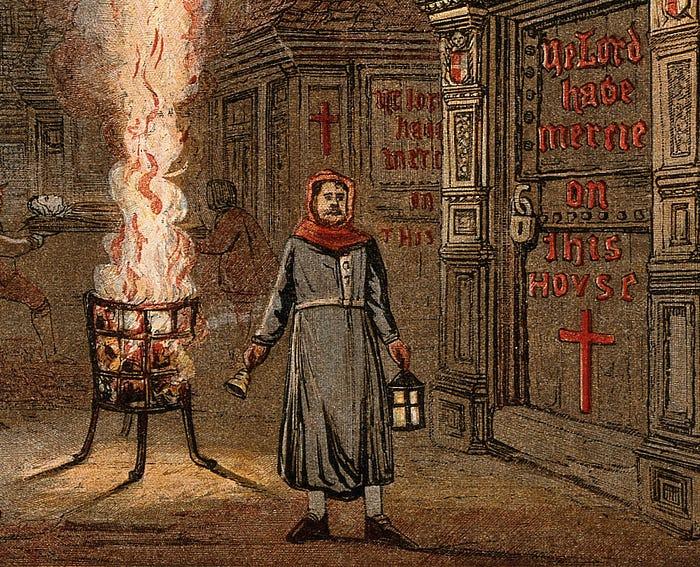
In “A Journal of the Plague Year,” Daniel Daefoe describes the conditions of London in 1665. Those infected with the plague were quarentined in their own homes, which were sealed off and guarded by a watchman. The doors were marked with a red cross and the words “Lord, have mercy upon us.” Daefoe relates one such episode…
…a whole family was shut up and locked in because the maid-servant was taken sick. The master of the house had complained by his friends to the next alderman and to the Lord Mayor, and had consented to have the maid carried to the pest-house, but was refused; so the door was marked with a red cross, a padlock on the outside, as above, and a watchman set to keep the door, according to public order.
After the master of the house found there was no remedy, but that he, his wife, and his children were to be locked up with this poor distempered servant, he called to the watchman, and told him he must go then and fetch a nurse for them to attend this poor girl, for that it would be certain death to them all to oblige them to nurse her; and told him plainly that if he would not do this, the maid must perish either of the distemper or be starved for want of food, for he was resolved none of his family should go near her; and she lay in the garret four storey high, where she could not cry out, or call to anybody for help.
What always fascinated me about this was the isolation these people must have experienced. Even the suspicion of plague could lead them to be shut off, where they would be left for four weeks, during which time they would either die from their sickness, starve to death, or (unlikely) survive and emerge to risk future infection.
Images of the “plague doctor costume” are common, but I find the marked door even more striking. It was the “biohazard” of its day, relating a kind of fear briefly in the public eye with Stephen King’s “The Stand,” a paranoia over biochemical warfare. Weaponized contagions are not common doomsday threats, but they have their place in subconscious horror about an impending end of the world. The marking over the door by devout English people also calls to mind the Old Testament’s account in Exodus 11–13, of how the Angel of Death came to visit the homes of Egypt when the Pharoh would not let the Hebrew people go. Beyond the doorframes marked with the blood of the passover lamb, the faithful ate their passover meal and would be spared. For everyone else, the firstborn son would die that night. In this myth, the death of the firstborn eliminates the patriarchical lineage of prominent Egyptian families. The death one’s lineage is the death of their personal world, just as our own death ends our subjective experience of the world as we know it.
Some say the world will end in fire,
Some say in ice.
From what I’ve tasted of desire
I hold with those who favor fire.
But if it had to perish twice,
I think I know enough of hate
To say that for destruction ice
Is also great
And would suffice.
— Robert Frost, Fire and Ice (1923)
There is something in the home that ensures a sense of privacy and security (David Vincent explores this and the significance of the home’s threshold in Privacy: A Short History). To die alone, or in one’s home, is what we might wish for comfort, as in dying in our sleep. If we were facing the end of the world, we’d probably want to experience it in comfort, much like the couple in Ray Bradburry’s classic The Last Night of the World. But to be marked by that barrier ellicits a sense of terror that nowhere is safe. To wall oneself off can be to wait for death, in the way that a dog in chronic pain might find a place to die alone. It is the isolation, the same sort of torture we know comes from solitary confinement’s shrinking of the brain.
We can be walled off from others by the very forces that promise to connect us. In the case of the family with the sick maid-servent, it was the very sociality that doomed them to sickness — the reliance on London and the management of households and other people that led to their sickness. Likewise, those forces can turn back to haunt us. Bioweapons, like nuclear bombs, are arguably the pinacle of what technocultures can achive when a great many well-intentioned people set out to subconsciously obliterate themselves. Preemtive disconnection is a tactic of disengagement, like rats fleeing the drowning ship. But those who flee spread the disease. Notably, the source of the bubonic plague (Yersinia pestis bacterium) is transmited by infected flea bites, carried by black rats.
Another story of involutnary isolation comes out of 1951, half a decade after the end of WWII in Europe. All I’ve been able to find about this is the original AP story, which was adapted into a French book by Jean-Paul Clêbert in 1955 (Le Blockhaus), then a film in 1973 staring Peter Sellers.
Five Companions Dead German Soldier Buried Alive 6 Years, Lives WARSAW — (U.P.)
— A 32-year-old German soldier who said he had been buried alive for six years in a Nazi supply depot was given a good chance by hospital authorities today to regain his health and eyesight. _ . The six-foot German, who was not identified by authorities at Gdynia’s Akademia hospital, said he and five companions were trapped in an underground German army food and supply warehouse by retreating Nazi troops who dynamited the entrance early in 1945.
The soldier and one other survivor of the entombment stumbled bearded, blinded and blubbering from the bunker about a month ago when Polish workers cleared wreckage from the entrance to the depot at Babie Doly, near Gydnia. The second survivor dropped dead of shock on emerging into the daylight. The other said two of his companions committed suicide a few months after they were entombed by German troops who did not know the soldiers were in the depot. The trapped men were believed to have been looting. Two others of the trapped soldiers died of unknown causes, the survivor said. Air entered the tomb through an air vent undamaged by the explosion. Water trickled through cracks and the men had plenty of food. But they lived in darkness after their supply of candles was exhausted two years ago. The trapped men had no tools with which to dig their way out of the concrete bunker, the survivor said. He said they washed in Rhine wine and encased their dead in huge flour sacks. The bodies were almost perfectly mummified.
I don’t know if this falls under “the problem of other minds,” but I have a very hard time believing we can ever truly know what someone else is thinking, no matter how honest they are or expressive they can be. Sitting in the dark for two years with nothing to do but talk to one other person — how well do these two men know each other? They became each others world for an indeterminate amount of time. And then when they were freed, the survivor’s world died as his companion drops dead from shock. Would this be debilitating?
The point about his eyesight is also interesting. I was always struck by the premise of Kipling’s “The Light that Failed” (but have never gotten around to reading the book). A painter who loses his eyesight. I know disability advocates are already rolling their eyes, but that’s a metaphor with legs. Able-bodied people depend on their eyesight for so much of how we understand the world, it seeps into our language (as in, “see what I mean?,” “Blindingly obvious” and so on.). This is why I really appreciate people who are working in sound studies and haptic media to try and look at a phenomenological experience via other senses.
Sudden blindness is to be divorced from what those who can see are familiar with, just as the “twinless twin” phenomena or the death of a loved one makes us feel as though part of ourselves is missing. We become disconnected from a sense of what is normal reality.
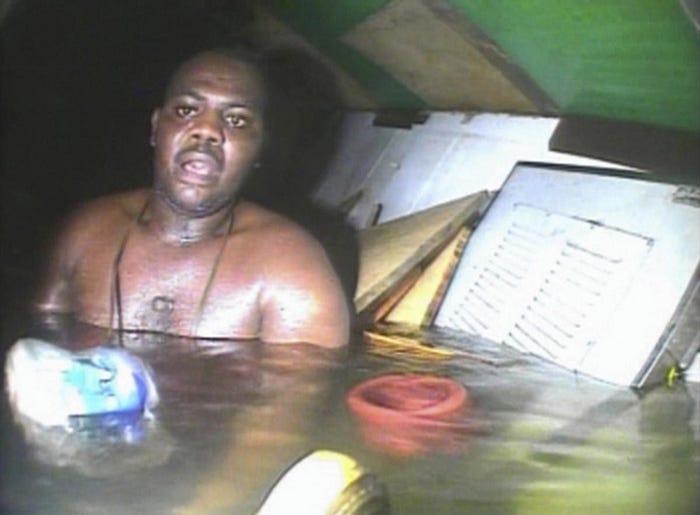
Harrison Odjegba Okene was a cook on a boat with a crew of 12. In May 2013, his ship capsized and he was the only survivor. He was rescued three days after the accident.
The Jascon 4 was resting on the seabed upside down at a depth of about 100 feet (30 meters). The chubby cook survived on only one bottle of Coke. Two flashlights that he had found gave up after less than one day. In the dark, he had almost given up hope after three days when he suddenly heard the sound of a boat, a hammering on the side of the vessel and then, after a while, saw lights and the rising waters around him bubbling.
After being rescued by a very surprised diver who was there to retrieve the bodies, he then had to spend 60 hours in a decompression chamber. He experienced guilt and trauma, was suspected of using black magic, and constantly questioned himself why he was the only one who survived.
Being trapped underground or underwater has this Orphic quality of being in the underworld, the chthonic space, which greek cults meditated on when they placed ritual sacrifices into sunken chambers. Maria Puig de la Bellacasa points out the relationship between “soil” and “soul” in a chapter on “Ecological Thinking, Material Spirituality and the Poetics of Infrastructure,” part of a tribute to the work of Susan Leigh Star. I can’t help but think of this and Haraway’s chtuluscene as when thinking about being burried beneath the earth and water. It is certainly a form of disconnection from what we know, but also signifies a return, “from dust to dust” and reunion with mud and ash (like all prodigal children of magma and water). An ecological turn is a sort of orphic journey into spaces of mediation with the nonhuman, or with the most rudimentary parts of ourselves. It is separation with society and a kind of death to the world, something that brings me to my third musing.
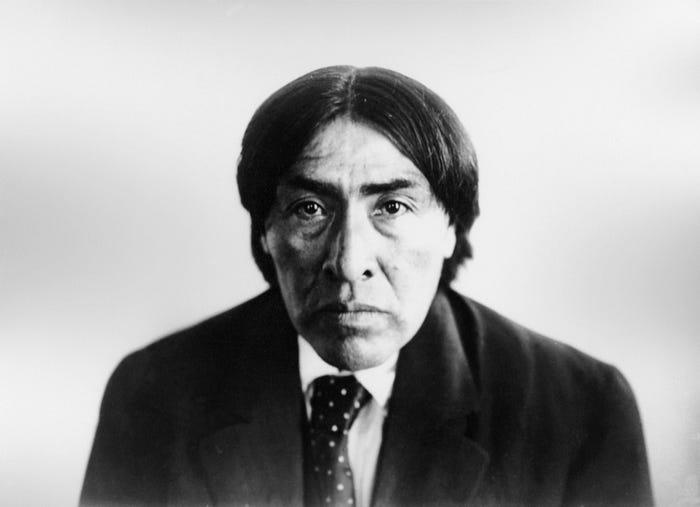
Ishi was a Native American man of the Yahi, a tribe exterminated by settlers in the 19th century. His family was killed in the Three Knolls Massacre in 1965. Ishi was not his “name” and the traditions of his tribe prevented him speaking his own name or the names of the dead. When asked about his name, he said “I have none, because there were no people to name me.” As more attacks wiped out others and boarding schools decimated the Native American population, Ishi’s community dwindled to himself, his mother and sister, and his uncle. In 1908 surveyors ransacked their camp, with his sister and uncle fleeing to never return and his mother dying shortly afterwards. He lived alone for three years before being captured near Oroville, California in 1911 at the age of 50.
He lived about five more years as a sort of living fossil and curiosity for the United States and anthropologists. Thomas Talbot Waterman and Alfred L. Kroeber of the Museum of Anthropology at Berkely made him a research assistant. In 1999 Ishi was finally repatriated back to his people.
“Contrary to commonly-held belief, Ishi was not the last of his kind. In carrying out the repatriation process we learned that as a Yahi-Yana Indian his closest living descendants are the Yana people of northern California. We consulted with them and they have indicated that they are ready to accept Ishi’s remains.” — Robert Fri, director of the National Museum of Natural History.
Beyond the obvious post-colonial critiques of how the Yahi were treated and Ishi’s status as a sort of stranger in a strange land (made strange despite his continous inhabiting of it in the traditional way), is his name. Ishi meant “strong and straight one” or just “man.” He was a youth when given this moniker, and never knew his “real” name.
Real names have power. As Cratylus and Hermongenes argue in Plato’s Cratylus, what makes a name a correct name? Socrates intervenes, arguing that “names cannot aspire to being perfect encapsulations of their objects’ essences, and some element of convention is must be conceded.” But this is exactly the desire of magicians and what Umberto Eco calls “The Search for the Perfect Language” — a tongue from the lost people of Babel, a forma locutionis which perfectly synchronizes modes of being (modi esendi) with modes of signfying (modi significandi), or signifier and signed. Ishi is like Star Trek: Deep Space Nine’s Odo, an alien assigned a placeholder in stead of a name, one that means “unknown sample.”
This unknown quality comes from the gulf between the Yahi and the United States, the ways of being and living that divorce what anthropologists of the time called “civilized” and “primitive” cultures. Where else can we find this stark divide? The enigma of figures like Kaspar Hauser and “Genie,” so called “feral” children. In Hauser’s case, the mystery of his isolation and social retardation led to conspiracy theories that he was actually a missing prince. Such romanticism is reminiscint of other “wild children” from myth and literature: Enkidu, the original Mesopotamian wild man; Romulus and Remus, who were sucked by wolves; Tarzan, “lord of the jungle,” all of whom are secretly noble inside. Enkidu straddles this status of feral and advisor to Gilgamesh when he enters civilization. Romulus and Remus establish Rome. Tarzan rejects the British establishment but remains a lord, at least to apes.
Genie, however, found no such glory. Instead, brain scans revealed that the abusive conditions she was kept in severely altered the way she could learn to communicate. For 12 of her first 13.5 years her father kept her socially isolated and refused to speak to her. Upon her rescue and the ensuing police investigation, he commited suicide and left a note saying “The world will never understand.” Just as Ishi temporarily lived with Thompson, Genie then lived with the scientist who studied her. She began to develop some of the skills we take for granted as being human. However, while Ishi only suffered the modern world for five short years and arguably well treated, the funding that provided for adequate housing and care of Genie evaporated and she was moved between caretakers, homes for disabled adults, and back to her enabling mother, experiencing further abuse and a relapse.
Seperation with society is a sort of death and rebirth to the world, in that those apart from what we know have a world of their own. Think of the secret language of twins or children, cryptophasia and idioglossia. While these disconnected private worlds may emerge from the infliction of pain by the outside, as in the case of Genie, it does not diminish their sociability. Ishi was a member of a community. But that community was destroyed by hegemony and genocide. A similar account is that of the Lykov family, Old Believers of Tsarist Russia who first fled the mandatory cutting of beards by Peter the Great and then the atheist government of the Bolshiveks. For 40 years they lived alone in Sibera before being “discovered” by geologists in 1978.
What is the ultimate point of these musings? I think each episode related here provides a different way for looking at disconnection. In the case of the plague, we see that society forms the bonds that exile us inside itself. We become like grains of sand inside a clam, and it makes us into pearls. But it’s important to note that the clam does not care if the pearl is beautiful. It is an irritant.
With regards to being trapped underground, we see how jarring it is to be suddenly removed from the surface, from the world outside. So much of our society regulates our senses and we have to relearn to experience phenomena — to listen closely in the dark, to hold out for hope, and to feel with our hands and hearts beyond distant thunder of bombs or waves above us.
The last point is that disconnection sometimes protects us from an enemy that lurks in the indifference of society. It nurtures us and provides us with a flicker of private being, an interiority that none can invade. To be alone is not so terrible, if we can carry our own worlds with us. They can be a comfort when the rest of society will not have us.