
Paul Goodman
The New Reformation
“The situation is very like 1510, when Luther went to Rome. There is everywhere protest, revaluation, attack on the Establishment.”
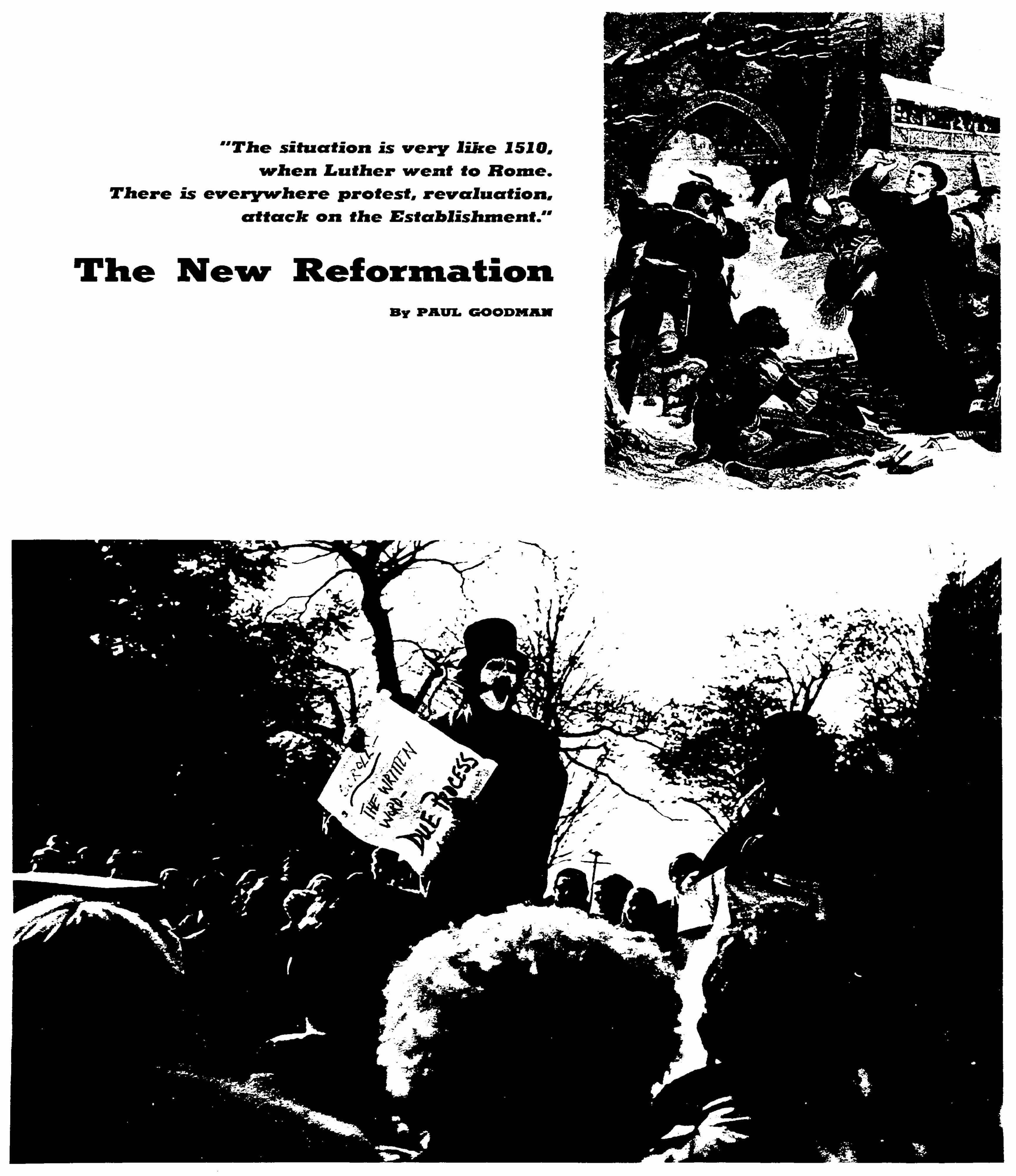
PARALLELS—Martin Luther burns a papal bull (top) and an S.D.S. member demonstrates. “Alienation,” says the author, “is a Lutheran concept: ‘God has turned His face away, things have no meaning.’” He adds: “Contemporary conditions have certainly deprived people, especially young people, of a meaningful world.”
FOR a long time modern societies have been operating as if religion were a minor and moribund part of the scheme of things. But this is unlikely. Men do not do without a system of “meanings” that everybody believes and puts his hope in even if, or especially if, he doesn’t know anything about it; what Freud called a “shared psychosis,” meaningful because shared, and with the power that resides in deep fantasy and longing. In advanced countries, indeed, it is science and technology themselves that have gradually, and finally triumphantly, become the system of mass faith, not disputed by various political ideologies and nationalisms that have also had religious uses.
Now this basic faith is threatened. Dissident young people are saying that science is antilife, it is a Calvinist obsession, it has been a weapon of white Europe to subjugate colored races, and scientific technology has manifestly become diabolical. Along with science, the young discredit the professions in general, and the whole notion of “disciplines” and academic learning. If these views take hold, it adds up to a crisis of belief, and the effects are incalculable. Every status and institution would be affected. Present political troubles could become endless religious wars. Here again, as in politics and morals, the worldwide youth disturbance may indicate a turning point in history and we must listen to it carefully.
In 1967 I gave a course on “Professionalism” at the New School for Social Research in New York, attended by about 25 graduate students from all departments. My bias was the traditional one: professionals are autonomous individuals beholden to the nature of things and the judgment of their peers, and bound by an explicit or implicit oath to benefit their clients and the community. To teach this, I invited seasoned professionals whom I esteemed-a physician, engineer, journalist, architect, etc. These explained to the students the obstacles that increasingly stood in the way of honest practice, and their own life experience in circumventing them.
To my surprise, the class unanimously rejected them. Heatedly and rudely they called my guests liars, finks, mystifiers, or deluded. They showed that every professional was co-opted and corrupted by the System, all decisions were made top-down by the power structure and bureaucracy, professional peer-groups were conspiracies to make more money. All this was importantly true and had, of course, been said by the visitors. Why had the students not heard? As we explored further, we came to the deeper truth, that they did not believe in the existence of real professions at all; professions were concepts of repressive society and “linear thinking.” I asked them to envisage any social order they pleased-Mao’s, Castro’s, some anarchist utopia-and wouldn’t there be engineers who knew about materials and stresses and strains? Wouldn’t people get sick and need to be treated? Wouldn’t there be problems of communication? No, they insisted; it was important only to be human, and all else would follow.
Suddenly I realized that they did not really believe that there was a nature of things. Somehow all functions could be reduced to interpersonal relations and power. There was no knowledge, but only the sociology of knowledge. They had so well learned that physical and sociological research is subsidized and conducted for the benefit of the ruling class that they did not believe there was such a thing as simple truth. To be required to learn something was a trap by which the young were put down and co-opted. Then I knew that I could not get through to them. I had imagined that the worldwide student protest had to do with changing political and moral institutions, to which I was sympathetic, but I now saw that we had to do with a religious crisis of the magnitude of the Reformation in the fifteen-hundreds, when not only all institutions but all learning had been corrupted by the Whore of Babylon.
The irony was that I myself had said 10 years ago, in “Growing Up Absurd,” that these young were growing up without a world for them, and therefore they were “alienated,” estranged from nature and other people. But I had then been thinking of juvenile delinquents and a few Beats; and a few years later I had been heartened by the Movement in Mississippi, the Free Speech protest in Berkeley, the Port Huron statement of S.D.S., the resistance to the Vietnam war, all of which made human sense and were not absurd at all. But the alienating circumstances had proved too strong after all; here were absurd graduate students, most of them political “activists.”
ALIENATION is a Lutheran concept: “God has turned His face away, things have no meaning, I am estranged in the world.” By the time of Hegel the term was applied to the general condition of rational man, with his “objective” sciences and institutions divorced from his “subjectivity,” which was therefore irrational and impulsive. In his revision of Hegel, Marx explained this as the effect of man’s losing his essential nature as a cooperative producer, because centuries of exploitation, culminating in capitalism, had fragmented the community and robbed the workman of the means of production. Comte and Durkheim pointed to the weakening of social solidarity and the contradiction between law and morality, so that people lost their bearings — this was anomie, an acute form of alienation that could lead to suicide or aimless riot. By the end of the 19th century, alienation came to be used as the term for insanity, derangement of perceived reality, and psychiatrists were called alienists.
Contemporary conditions of life have certainly deprived people, and especially young people, of a meaningful world in which they can act and find themselves. Many writers and the dissenting students themselves have spelled it out. For instance, in both schools and corporations, people cannot pursue their own interests or exercise initiative. Administrators are hypocrites who sell people out for the smooth operation of the system. The budget for war has grotesquely distorted reasonable social priorities. Worst of all, the authorities who make the decisions are incompetent to cope with modern times: we are in danger of extinction, the biosphere is being destroyed, two-thirds of mankind are starving. Let me here go on to some other factors that demand a religious response.
There is a lapse of faith in science. Science has not produced the general happiness that people expected, and now it has fallen under the sway of greed and power; whatever its beneficent past, people fear that its further progress will do more harm than good. And rationality itself is discredited. Probably it is more significant than we like to think that intelligent young people dabble in astrology, witchcraft, psychedelic dreams, and whatever else is despised by science; in some sense they are not kidding. They need to control their fate, but they hate scientific explanations.
Every one of these young grew up since Hiroshima. They do not talk about atom bombs-not nearly so much as we who campaigned against the shelters and fall-out-but the bombs explode in their dreams, as Otto Butz found in his study of collegians at San Francisco State, and now George Dennison, in “The Lives of Children,” shows that it was the same with small slum children whom he taught at the First Street School in New York. Again and again students have told me that they take it for granted they will not survive the next 10 years. This is not an attitude with which to prepare for a career or to bring up a family.
Whether or not the bombs go off, human beings are becoming useless. Old people are shunted out of sight at an increasingly earlier age, young people are kept on ice till an increasingly later age. Small farmers and other technologically unemployed are dispossessed or left to rot. Large numbers are put away as incompetent or deviant, Racial minorities that cannot shape up are treated as a nuisance. Together, these groups are a large majority of the population. Since labor will not be needed much longer, there is vague talk of a future society of “leisure,” but there is no thought of a kind of community in which all human beings would be necessary and valued.
The institutions, technology and communications have infected even the “biological core,” so that people’s sexual desires are no longer genuine. This was powerfully argued by Wilhelm Reich a generation ago and it is now repeated by Herbert Marcuse. When I spoke for it in the nineteen-forties, I was condemned by the radicals, for example, C. Wright Mills, as a “bedroom revisionist.”
A special aspect of biological corruption is the spreading ugliness, filth, and tension of the environment in which the young grow up. If Wordsworth was right-I think he was-that children must grow up in an environment of beauty and simple affections in order to become trusting, open, and magnanimous citizens, then the offspring of our ghettos, suburbs, and complicated homes have been disadvantaged, no matter how much money there is. This lack cannot be remedied by art in the curriculum, nor by vest-pocket playgrounds, nor by banning billboards from bigger highways. Cleaning the river might help, but that will be the day.
IF we start from the premise that the young are in a religious crisis, that they doubt there is really a nature of things, and they are sure there is not a world for themselves, many details of their present behavior become clearer. Alienation is a powerful motivation, of unrest, fantasy and reckless action. It leads, as we shall see, to religious innovation, new sacraments to give life meaning. But it is a poor basis for politics, including revolutionary politics.
It is said that the young dissidents never offer a constructive program. And apart from the special cases of Czechoslovakia and Poland, where they confront an unusually outdated system, this is largely true. In France, China, Germany, Egypt, England, the United States, etc., most of the issues of protest have been immediate gut issues, and the tactics have been mainly disruptive, without coherent proposals for a better society. But this makes for bad politics. Unless one has a program, there is no way to persuade the other citizens, who do not have one’s gut complaints, to come along. Instead one confronts them hostilely and they are turned off, even when they might be sympathetic. But the confrontation is inept too, for the alienated young cannot take other people seriously as having needs of their own; a spectacular instance was the inability of the French youth to communicate with the French working class, in May 1968. In Gandhian theory, the confronter aims at future community with the confronted; he will not let him continue a course that is bad for him, and so he appeals to his deeper reason. But instead of this Satyagraha, soul force, we have seen plenty of hate. The confronted are not taken as human beings, but as pigs, etc. But how can the young people think of a future community when they themselves have no present world, no profession or other job in it, and no trust in other human beings? Instead, some young radicals seem to entertain the disastrous illusion that other people can be compelled by fear. This can lead only to crushing reaction.
All the “political” activity makes sense, however, if it is understood that it is not aimed at social reconstruction at all, but is a way of desperately affirming that they are alive and want a place in the sun. “I am a revolutionary,” said Cohn-Bendit, leader of the French students in 1968, “because it is the best way of living.” And young Americans pathetically and truly say that there is no other way to be taken seriously. Then it is not necessary to have a program; the right method is to act, against any vulnerable point and wherever one can rally support. The purpose is not politics but to have a movement and form a community. This is exactly what Saul Alinsky prescribed to rally outcast blacks.
And such conflictful action has indeed caused social changes. In France it was conceded by the Gaullists that “nothing would ever be the same.” In the United States, the changes in social attitude during the last 10 years are unthinkable without the youth action, with regard to war, the military-industrial, corporate organization and administration, the police, the blacks. When the actors have been in touch with the underlying causes of things, issues have deepened and the Movement has grown. But for the alienated, again, action easily slips into activism, and conflict is often spite and stubbornness. There is excitement and notoriety, much human suffering, and the world no better off. (New Left Notes runs a column wryly called, “We Made the News Today, O Boy!”) Instead of deepening awareness and a sharpening political conflict, there occurs the polarization of mere exasperation. It often seems that the aim is just to have a shambles. Impatiently the ante of tactics is raised beyond what the “issue” warrants, and support melts away. Out on a limb, the leaders become desperate and fanatical, intolerant of criticism, dictatorial. The Movement falls to pieces.
Yet it is noteworthy that when older people like myself are critical of the wrongheaded activism, we nevertheless almost invariably concede that the young are morally justified. For what is the use of patience and reason when meantime millions are being killed and starved, and when bombs and nerve gas are being stockpiled? Against the entrenched power responsible for these things, it might be better to do something idiotic now than something perhaps more practical in the long run. I don’t know which is less demoralizing.
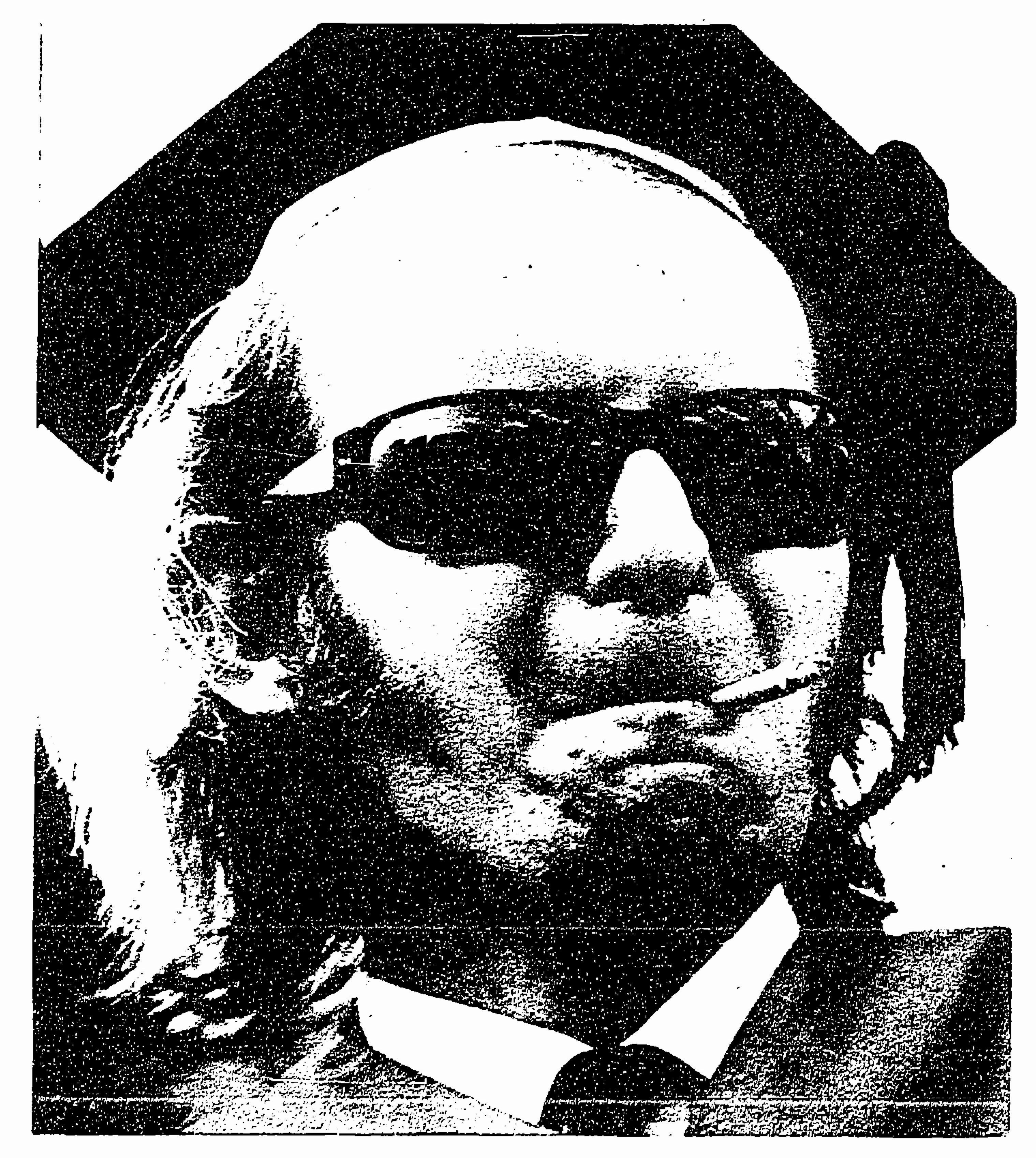
Maybe the truth is revealed in the following conversation I had with a young hippie at a college in Massachusetts. He was dressed like an (American) Indian-buckskin fringes and a headband, red paint on his face. All his life, he said, he had tried to escape the encompassing, evil of our society that was trying to destroy his soul. “But if you’re always escaping,” I said, “and never attentively study it, how can you make a wise judgment about society or act effectively to change it?” “You see, you don’t dig!” he cried. “It’s just ideas like ‘wise’ and ‘acting effectively’ that we can’t stand.” He was right. He was in the religious dilemma of Faith VS. Works. Where I sat, Works had some reality; but in the reign of the Devil, as he felt it, all Works are corrupted, they are part of the System; only Faith can avail. But he didn’t have Faith either.
INEVITABLY, the alienated seem to be inconsistent in how they take the present world. Hippies attack technology and are scornful of rationality, but they buy up electronic equipment and motorcycles, and with them the whole infrastructure. Activists say that civil liberties are bourgeois and they shout down their opponents; but they clamor in court for their civil liberties. Those who say that the university is an agent of the powers that be, do not mean thereby to reassert the ideal role of the university, but to use the university for their own propaganda. Yet if I point out these apparent inconsistencies, it does not arouse shame or guilt. How is this? It is simply that they do not really understand that technology, civil law, and the university are human institutions, for which they too are responsible; they take them as brute given, just what’s there, to be manipulated as convenient. But convenient for whom? The trouble with this attitude is that these institutions, works of spirit in history, are how Man has made himself and is. If they treat them as mere things, rather than being vigilant for them, they themselves become nothing. And nothing comes from nothing.
In general, their lack of a sense of history is bewildering. It is impossible to convey to them that the deeds were done by human beings, that John Hampden confronted the King and wouldn’t pay the war tax just like us, or that Beethoven too, just like a rock ‘n’ roll band, made up his music as he went along, from odds and ends, with energy, spontaneity and passion-how else do they think he made music? And they no longer remember their own history. A few years ago there was a commonly accepted story of mankind, beginning with the Beats, going on to the Chessman case, the HUAC bust, the Freedom Rides, and climaxing in the Berkeley Victory-“The first human event in 40,000 years,” Mike Rossman, one of the innumerable spokesmen, told me. But this year I find that nothing antedates Chicago ’68. Elder statesmen, like Sidney Lens and especially Staughton Lynd, have been trying with heroic effort to recall the American antecedents of present radical and libertarian slogans and tactics, but it doesn’t rub off. I am often hectored to my face with formulations that I myself put in their mouths, that have become part of the oral tradition two years old, author prehistoric. Most significant of all, it has been whispered to me — but I can’t check up, because I don’t speak the language — that among the junior high school students, aged 12 and 13, that’s really where it’s at! Quite different from what goes on in the colleges that I visit.
What I do notice, however, is that dozens of Underground newspapers have a noisy style. Though each one is doing his thing, there is not much idiosyncracy in the spontaneous variety. The political radicals are, as if mesmerized, repeating the power plays, factionalism, random abuse, and tactical lies that aborted the movement in the thirties. And I have learned, to my disgust, that a major reason why the young don’t trust people over 30 is that they don’t understand them and are too conceited to try. Having grown up in a world too meaningless to learn anything, they know very little and are quick to resent it.
THIS is an unpleasant picture. Even so, the alienated young have no vital alternative except to confront the Evil, and to try to make a new way of life out of their own innards and suffering. As they are doing. It is irrelevant to point out that the System is not the monolith that they think and that the majority of people are not corrupt, just browbeaten and confused. What is relevant is that they cannot see this, because they do not have an operable world for themselves. In such a case, the only advice I would dare to give them is that which Krishna gave Arjuna: to confront with nonattachment, to be brave and firm without hatred. (I don’t here want to discuss the question of “violence,” the hatred and disdain are far more important.) Also, when they are seeking a new way of life, for example when they are making a “journey inward,” as Ronald Laing calls it, I find that I urge them occasionally to write a letter home.
As a citizen and father I have a right to try to prevent a shambles and to diminish the number of wrecked lives. But it is improper for us elders to keep saying, as we do, that their activity is “counterproductive.” It’s our business to do something more productive.
Religiously, the young have been inventive, much more than the God-is-dead theologians. They have hit on new sacraments, physical actions to get them out of their estrangement and (momentarily) break through into meaning. The terribly loud music is used sacramentally. The claim for the hallucinogenic drugs is almost never the paradisal pleasure of opium culture nor the escape from distress of heroin, but tuning in to the cosmos and communing with one another. They seem to have had flashes of success in bringing ritual participation back into theater, which for a hundred years playwrights and directors have tried to do in vain. And whatever the political purposes and results of activism, there is no doubt that shared danger for the sake of righteousness is used sacramentally as baptism of fire. Fearful moments of provocation and the poignant release of the bust bring unconscious contents to the surface, create a bond of solidarity, are “commitment.”
But the most powerful magic, working in all these sacraments, is the close presence of other human beings, without competition or one-upping. The original sin is to be on an ego trip that isolates; and angry political factionalism has now also become a bad thing. What a drastic comment on the dehumanization and fragmentation of modern times that salvation can be attained simply by the “warmth of assembled animal bodies,” as Kafka called it, describing his mice. At the 1967 Easter Be-In in New York’s Central Park, when about 10,000 were crowded on the Sheep Meadow, a young man with a quite radiant face said to me, “Gee, human beings are legal!”-it was sufficient, to be saved, to be exempted from continual harassment by officious rules and Law and Order.
The extraordinary rock festivals at Bethel and on the Isle of Wight are evidently pilgrimages. Joan Baez, one of the hierophants, ecstatically described Bethel to me, and the gist of it was that people were nice to one another. A small group passing a joint of marijuana often behaves like a Quaker meeting waiting for the spirit, and the cigarette may be a placebo. Group therapy and sensitivity training, with Mecca at Esalen, have the same purpose. And I think this is the sense of the sexuality, which is certainly not hedonistic, nor mystical in the genre of D. H. Lawrence; nor does it have much to do with personal love, that is too threatening for these anxious youths. But it is human touch, without conquest or domination, and it obviates self-consciousness and embarrassed speech.
Around the rather pure faith there has inevitably collected a mess of eclectic liturgy and paraphernalia. Mandalas, beggars in saffron, (American) Indian beads, lectures in Zen. Obviously the exotic is desirable because it is not what they have grown up with. And it is true that fundamental facts of life are more acceptable if they come in fancy dress, e.g. it is good to breathe from the diaphragm and one can learn this by humming “OM,” as Allen Ginsberg did for seven hours at Grant Park in Chicago. But college chaplains are also pretty busy, and they are now more likely to see the adventurous and off-beat than, as used to be the case, the staid and square. Flowers and strobe lights are indigenous talismans.
IT is hard to describe this (or any) religiosity without lapsing into condescending humor. Yet it is genuine and it will, I am convinced, survive and develop I don’t know into what. In the end it is religion that constitutes the strength of this generation, and not, as I used to think, their morality, political will, and common sense. Except for a few, like the young people of the Resistance, I am not impressed by their moral courage or even honesty. For all their eccentricity they are singularly lacking in personality. They do not have enough world to have much character. And they are not especially attractive as animals. But they keep pouring out a kind of metaphysical vitality.
Let me try to account for it. On the one hand, these young have an unusual amount of available psychic energy. They were brought up on antibiotics that minimized depressing chronic childhood diseases, and with post-Freudian freedom to act out early drives. Up to age 6 or 7, television nourished them with masses of strange images and sometimes true information-McLuhan makes a lot of sense for the kindergarten years. Long schooling would tend to make them stupid, but it has been compensated by providing the vast isolated cities of youth that the high schools and colleges essentially are, where they can incubate their own thoughts. They are sexually precocious and not inhibited by taboos. They are superficially knowledgeable. On the other hand, all this psychic energy has had little practical use. The social environment is dehumanized. It discourages romantic love and lasting friendship. They are desperately bored because the world does not promise any fulfillment. Their knowledge gives no intellectual or poetic satisfaction. In this impasse, we can expect a ferment of new religion. As in Greek plays, impasse produces gods from the machine. For a long time we did not hear of the symptoms of adolescent religious conversion, once as common in the United States as in all other places and ages. Now it seems to be recurring as a mass phenomenon.
WITHOUT doubt the religious young are in touch with something historical, but I don’t think they understand what it is. Let me quote from an editorial in New Seminary News, the newsletter of dissident seminarians of the Pacific School of Religion in Berkeley: “What we confront (willingly or not we are thrust into it) is a time of disintegration of a dying civilization and the emergence of a new one.” This seems to envisage something like the instant decline of the Roman Empire and they, presumably, are like the Christians about to build, rapidly, another era. But there are no signs that this is the actual situation. It would mean, for instance, that our scientific technology, civil law, professions, universities, etc., are about to vanish from the earth and be replaced by something entirely different. This is a fantasy of alienated minds. Nobody behaves as if civilization would vanish, and nobody acts as if there were a new dispensation. Nobody is waiting patiently in the catacombs and the faithful have not withdrawn into the desert. Neither the Yippies nor the New Seminarians nor any other exalted group have produced anything that is the least bit miraculous. Our civilization may well destroy itself with its atom bombs or something else, but then we do not care what will emerge, if anything.
But the actual situation is very like 1510, when Luther went to Rome, the eve of the Reformation. There is everywhere protest, revaluation, attack on the Establishment. The protest is international. There is a generation gap. (Luther himself was all of 34 when he posted his 95 theses in 1517, but Melanchthon was 20, Bucer 26, Münzer 28, Jonas 24; the Movement consisted of undergraduates and junior faculty.) And the thrust of protest is not to give up science, technology, and civil institutions, but to purge them, humanize them, decentralize them, change the priorities, and stop the drain of wealth.
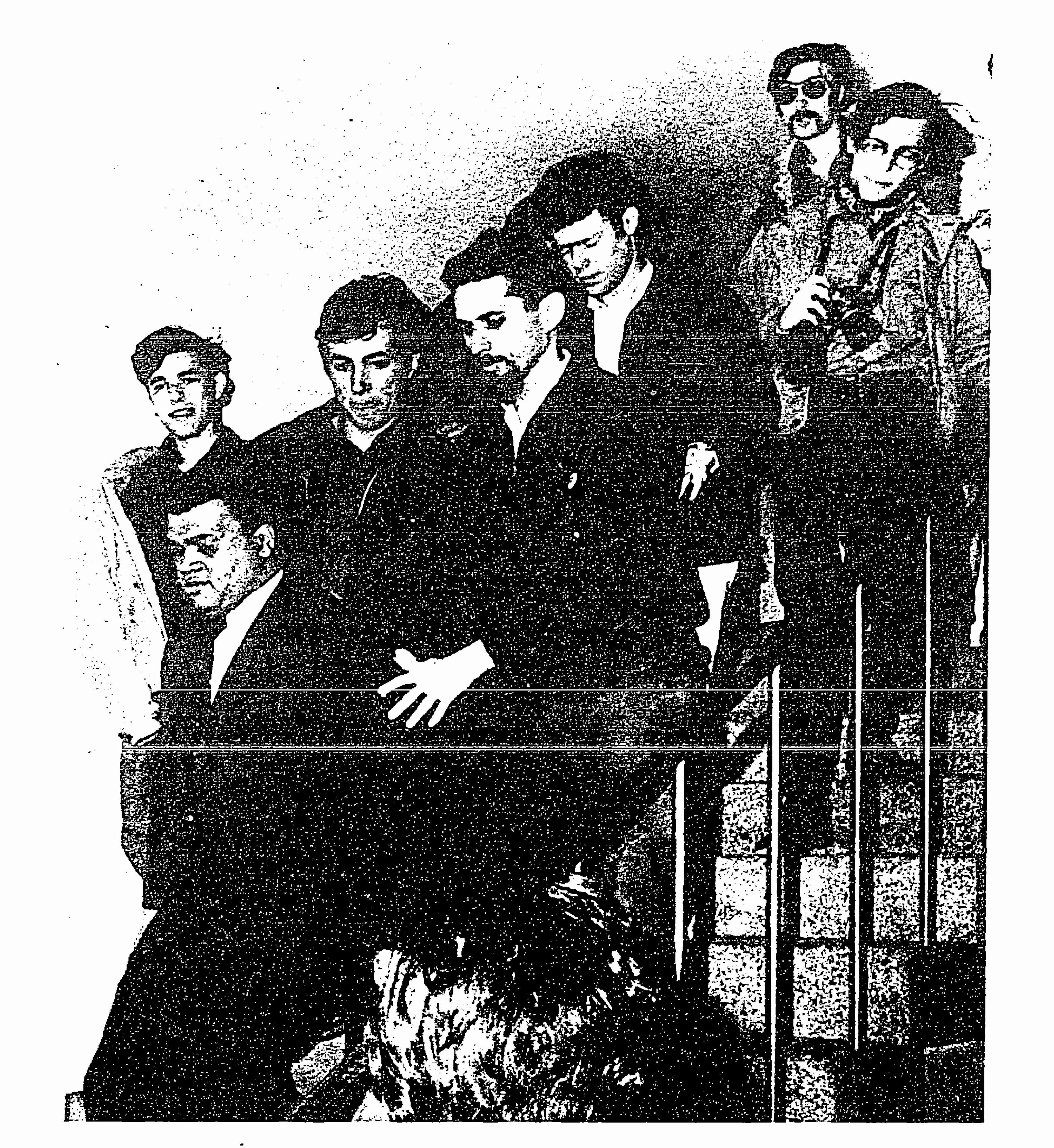
These were, of course, exactly the demands of the March 4 nationwide teach-in on science, initiated by the dissenting professors of the Massachusetts Institute of Technology. This and the waves of other teach-ins, ads and demonstrations have been the voices not of the alienated, of people who have no world, but of protestants, people deep in the world who will soon refuse to continue under the present auspices because they are not viable. It is populism permeated by moral and professional unease. What the young have done is to make it finally religious, to force the grown-ups to recognize that they too are threatened with meaninglessness.
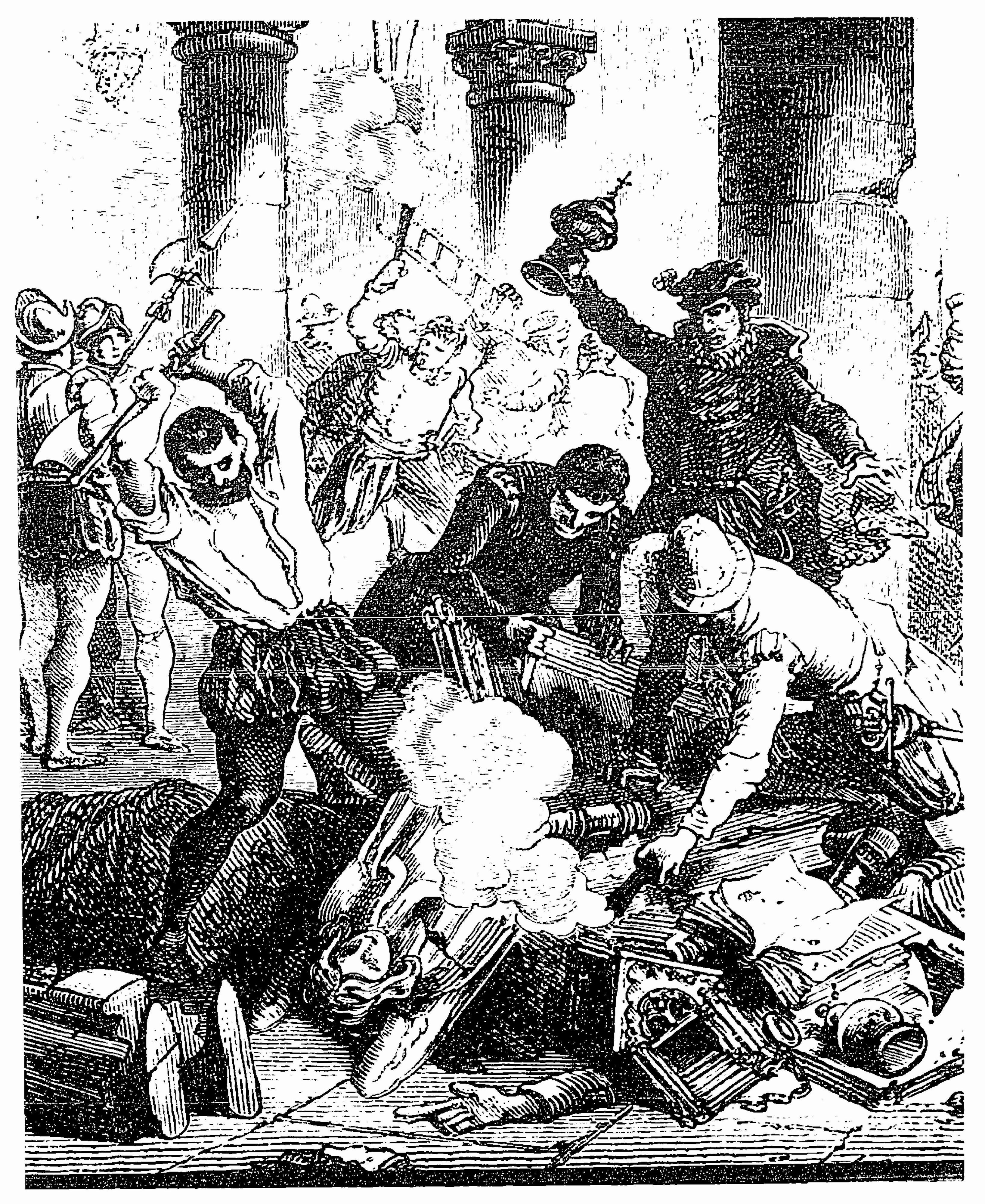
The analogy to the Reformation is even closer if we notice that the bloated universities, and the expanded school systems under them, constitute the biggest collection of monks since the time of Henry VIII. And most of this mandarinism is hocus pocus, a mass superstition. In my opinion, much of the student dissent in the colleges and especially the high schools has little to do with the excellent political and social demands that are made, but is boredom and resentment because of the phoniness of the whole academic enterprise.
Viewed as incidents of a Reformation, as attempts to purge themselves and recover a lost integrity, the various movements of the alienated young are easily recognizable as characteristic protestant sects, intensely self-conscious. The dissenting seminarians of the Pacific School of Religion do not intend to go off to primitive love feasts in a new heaven and new earth, but to form their own Free University; that is, they are Congregationalists. The shaggy hippies are not nature children as they claim, but self-conscious Adamites trying to naturalize Sausalito and the East Village. Heads are Pentecostals or Children of Light. Those who spindle IBM cards and throw the dean down the stairs are Iconoclasts. Those who want Student Power, a say in the rules and curriculum, mean to deny infant baptism; they want to make up their own minds, like Henry Dunster, the first president of Harvard. Radicals who live among the poor and try to organize them are certainly intent on social change, but they are also trying to find themselves again. The support of the black revolt by white middle-class students is desperately like Anabaptism, but God grant that we can do better than the Peasants’ War. These analogies are not fanciful; when authority is discredited, there is a pattern in the return of the repressed. A better scholar could make a longer list; but the reason I here spell it out is that, perhaps, some young person will suddenly remember that history was about something.
Naturally, traditional churches are themselves in transition. On college campuses and in bohemian neighborhoods, existentialist Protestants and Jews and updating Catholics have gone along with the political and social activism and, what is probably more important, they have changed their own moral, esthetic and personal tone. On many campuses, the chaplains provide the only official forum for discussions of sex, drugs and burning draft cards. Yet it seems to me that, in their zeal for relevance, they are badly failing in their chief duty to the religious young: to be professors of theology. They cannot really perform pastoral services, like giving consolation or advice, since the young believe they have the sacraments to do this for themselves. Chaplains say that the young are uninterested in dogma and untractable on this level, but I think this is simply a projection of their own distaste for the conventional theology that has gone dead for them. The young are hotly metaphysical-but alas, boringly so, because they don’t know much, have no language to express their intuitions, and repeat every old fallacy. If the chaplains would stop looking in the conventional places where God is dead, and would explore the actualities where perhaps He is alive, they might learn something and have something to teach.
PAUL GOODMAN is an educator, social critic and novelist. His works include “Growing Up Absurd”, “People or Personnel” and “Adam and His Works.”