Philip Ruff
Anarchy in the USSR
A New Beginning
Power to the People, not the Party
Anarchist Stirrings in the USSR
Anarchist Murdered — KGB Suspected
Notes on the Workers’ Uprisings of the Sixties
Anarcho-Syndicalist Union Formed
Building a True Workers’ Movement
The Moscow Union of Anarchists
On the Question of ‘Sovereignties’
The Kronstadt Commune 70th Anniversary International Syndicalist Conference
Anarcho-Syndicalism in the USSR Today
Interview with Vadim Damier of the Initiative of Revolutionary Anarchists (IREAN)
Seventy years after the death of Kropotkin, the massacre of the Kronstadt Commune and the rout of Makhno, the Party which outlawed anarchism in Russia has itself become a banned organisation. But anarchy in the USSR, has made a new beginning.
Might anarchism now fill the ideological vacuum, left by the collapse of Marxism?
Here, with commentaries from some of their West-European comrades, the new Russian anarchists speak for themselves about their ideas, and of how anarchy may bring a new order, based on freedom, to the chaos of the USSR.
ANARCHY IN THE USSR
A New Beginning
Edited by Philip Ruff
ASP
In memory of David Markham
(1913 — 1983)
a harbinger of Russian anarchism
who put resistance to oppression above the
idealisation of aims
First published 1991 by ASP, BCM Box 3714,
London WC1N 3XX
ISBN 1 872258 06 9
Printed in London by Aidgate Press
(071–247 3015)
© ASP 1991
Contents
Introduction by Philip Ruff
Power to the People, not the Party
First Congress of the KAS
(Moscow, 1 May, 1989)
What Motivates Us?
Andrei Isaev
Second Congress of the KAS
(Moscow, 24–25 March, 1990)
From the Editors of Obshchina
Anarchists on Russian TV
Will Firth
Anarchist Stirrings in the USSR
Will Firth
Anarchist Murdered — KGB Suspected
The Death of Piotr Siouda
Workers’ Uprisings of the Sixties
Vadim Belotserkovsky
Anarcho-Syndicalist Union Formed
Building a True Workers’ Movement
Maxim Zhuraliev
Communique of the SMOT
The Case of Victor Kassatkin
Freedom for Lithuania
An Open Letter from Moscow
The War Against Iraq
Moscow KAS
Declaration of Principles
Moscow Union of Anarchists
On the Question of ‘Sovereignties’
SMOT
The Kronstadt Commune 70th Anniversary International Syndicalist Conference (Moscow, 16–18 March, 1991)
Anarcho-Syndicalism in the USSR
K. ten Broke
Interview with Vadim Damier (IREAN)
Footnotes
Introduction
“We do not fear anarchy, but invoke it, convinced as we are that anarchy, meaning the full affirmation of unfettered popular life, must inaugurate liberty, equality, justice, the new order and the clash between Revolution and Reaction”.
(M. A. Bakunin)[1]
* * *
On 28 May, 1989, 20,000 people marched through Moscow, demonstrating against the Congress of People’s Deputies. The Guardian’s Jonathan Steele noticed among the banners, “a black flag with a red star carried by the recently formed Anarcho-Syndicalist Club. The slogan read: ‘No confidence in the Supreme Soviet — form a left-wing faction’”.
This was the first open display by anarchists in the Soviet capital since 13 February, 1921, when a crowd of the same size joined the funeral cortege of Peter Kropotkin. Then came Kronstadt, the rout of Makhno and the outlawing of open anarchist organisation[2]. Trotsky boasted: “At last the Soviet government, with an iron broom, has rid Russia of anarchism”.
Anarchism in the USSR was not so easily swept away. The full history of the anarchist underground during the Stalin years has not been told (there were ‘armed anarchist uprisings’ in Siberia, in the late 1920s, of which nothing is known). Yagoda’s OGPU was still busy, breaking-up illegal anarchist groups, well into the early 1930s. From then, until the late 1940s, the only news of anarchists in Russia which reached the west was of those in prisons or labour camps.
In October 1936, a delegation of the Spanish CNT went to Moscow, seeking Soviet aid against Franco. The delegation took with them a long list[3] of exiled or imprisoned anarchists and syndicalists, whose release and passage to Spain they requested of the Soviet government. Heading the list was Aaron Baron, one of the founders of the Nabat Confederation in Ukraine, who had been a prisoner since 1920. The CNT delegation went back to Spain alone.
Baron was unexpectedly set free in 1938 and allowed to settle in Kharkov. Less than a year later, he was re-arrested and disappeared[4] for ever.
A lot of old political prisoners (like the Left SR leader, Maria Spiridonova, held in the “isolator” at Orel[5]) were killed by the NKVD in 1941, during the evacuation of territory threatened by the Nazi invasion: to stop them falling into the hands of the Germans (who would have hanged them!).
By 1942, the Germans occupied Ukraine, Byelorussia and the Baltic states, and had reached Leningrad and the outskirts of Moscow. Among the partisan groups who resisted, were some who professed an allegiance to anarchism and the memory of Makhno.
Not every claim to that effect, however, can be swallowed without a good-sized pinch of salt. One post-war Russian emigre maintained, in July 1955, that an anarchist resistance organisation existed in Byelorussia, called the Black Cat. The organisation was said to have, “led the fight against the Nazis; and it continues that fight against the Bolsheviks. Many of its members profess to follow the example of Makhno”[6]. In reality, the Black Cat guerrilla band was a force of thirty Byelorussian Nazis, commanded by Michael Vitushka, who were trained at Otto Skorzeny’s SS commando school at Dahlwitz, near Berlin, and dropped behind Soviet lines[7] at the end of the war.
But anarchist partisans were active in Ukraine. In 1944–45, the nationalist Ukrainian Insurgent Army (UPA) noted in its war despatches, freguent encounters with “the Ukrainian anarchist partisans”. Assuming that these were the same people who later appeared as prisoners, in the camps at Karaganda and Vorkuta, they included some old members of Makhno’s army[8]; the younger ones having become anarchists under the spell of Makhno’s legend.
Another independent partisan unit, which harked back to Ukraine’s anarchist past, was the Nabat youth organisation, set up by V. I. Us. A school headmaster who had been badly wounded and captured by the Germans in 1941, Us escaped to his native village and recruited his former pupils as guerrillas. In November, 1943, Nabat launched an armed uprising, seized the village and created a bridgehead on the West bank of the Dnieper, which it held until reinforced by a Corps of the Second Ukrainian Front. Nabat was highly commended by the political division of the Fourth Guards Army. After Soviet forces regained control of Ukraine, Us was arrested and sentenced to twenty years, for “voluntarily surrendering and creating a nationalist organisation”. Though Us was set free four years later, he and Nabat were only rehabilitated after Stalin’s death[9].
Anarchists may also have been among the Soviet occupation troops in Europe at the end of the war. A secret organisation called Zavietti Kronstadta (the Kronstadt Accords), is alleged to have been active in the Red Army in East Germany and Austria. Wholly military in composition, it is said to have included “former Makhnovists or veterans of Kronstadt”[10]. In Bulgaria too, some soldiers expressed a belief in the ideas of Bakunin, but they were not active.
In 1950, an underground student group was formed in Moscow, avowedly Marxist but with the slogan ‘Soviets, not Party’. Its manifesto opposed all political parties, and advocated government by the trade unions, with worker and peasant Soviets coordinated by commissions of delegates. Predictably, its members were all arrested and shipped-off to the Gulag.
The penal colonies of North Russia, Siberia and Central Asia were home to anarchists of every ilk and nation in the years 1946–54: ‘religious anarchists’ (Tolstoyans and ‘Monashki’[11]), Ukrainian Makhnovists, anarcho-syndicalists, Poles, Russians, Latvians.
They participated in a wave of strikes and uprisings (sometimes armed), triggered off in the camps in 1953, by news of Stalin’s death and the execution of Beria. At Karaganda (Kazakhstan) an insurrection, organised by Ukrainians, involved Spanish CNT-FAI members, who had been in the USSR at the moment of Franco’s victory in 1939 and were interned. The most bitter revolts took place in the coal-mining camps at Norilsk and Vorkuta[12], in the summers of 1953/54, where the banner of the strikers was the black flag.
Khrushchev’s break with Stalinism, at the 20th Party Congress in 1956, made little difference to anarchists inside the Gulag. One former prisoner told the Italian anarchist magazine Rivista Anarchica, in 1973, that she encountered anarchists in all the camps through which she passed. In one, a group of anarchist prisoners included young students and elderly women who had been in detention since before the Stalin era.
Another camp inmate, from 1957 to 1965, met several anarchists, all young: “They had read books by Kropotkin and sometimes by Bakunin (whose works are very hard to find in libraries inside the USSR); they were even conversant with the ideas of Proudhon and with contemporary Western thought”[13].
Outside the camps, Khrushchev’s revisionism encouraged many Soviet students to review more socialist alternatives to Stalinism. In Leningrad and Moscow, informal discussion groups began to appear. Attracted by the example of Yugoslav—style self-management and the ideas of libertarian communism, they rejected the notion of the totalitarian state, and advocated greater autonomy for the individual in Soviet society. Only a minority inside these groups consciously embraced anarchism, but the seeds of an anarchist revival were being sown.
In 1967, an anarchist docker in Leningrad, who set up a study group among his workmates, was arrested for helping the dissident poet Yuri Galanskov[14].
In 1970, a BBC World Service programme about Soviet radio pirates made mention of one which described itself as ‘anarchist’.
At the time of the 25th CPSU Congress, in February, 1976, leaflets appeared all over Leningrad, declaring the Party compromised, its policies bankrupt, its methods Stalinist and its Congress a bluff. The leaflet’s anonymous authors called for political pluralism and humane socialism, ending: “Long live the new revolution! Long live Communism!”.
Two weeks later, the KGB arrested seventeen-year-old Andrei Reznikov, for having distributed the offending material. Reznikov was sentenced to two years in a strict regime camp, but because of his age served only two months, before being drafted into the Red Army for the remainder of his sentence.
Reznikov belonged to a Leningrad student circle, called the Left Opposition. In 1977, another of the group’s members, an anarchist called Alexis Khavine, was arrested for disseminating works by Kropotkin[15].
Over the summer of 1978, the Left Opposition published three issues of a magazine, Perspektivy. Its contents reflected the group’s make-up, a mixture of ‘Anarchism and New Leftism’: texts by Bakunin, Kropotkin, Trotsky, Marcuse and Cohn-Bendit, re-prints of samizdat manifestos, articles about the Kronstadt rebellion (for and against), and others in favour of illegalism, counterfeiting money, and armed struggle of the sort practised by the “West German anarchists, particularly the Baader—Meinhof group”.
Another prominent Left Opposition figure, Alexander Skobov, described himself as a pacifist and anarcho-socialist, who adhered to the economic theories of the young Marx. In June, 1978, Skobov opened his flat as a ‘commune’, to serve as a meeting place for local sympathisers, and Reznikov returned to Leningrad from the army.
The Left Opposition planned to host a conference of leftist groups from all over the USSR (Leningrad, Moscow, the Baltics, Ukraine, Byelorussia and the Caucasus), in September, 1978, but the conference was postponed. When the delegates did arrive in Leningrad, they were rounded-up by the police.
The end of the Left Opposition came swiftly. In August, police searched Skobov’s commune and began following his visitors. At the begining of October, Skobov was questioned by the KGB. Raids on the homes of people closely associated with the commune followed. On the 10 October, 1978, Skobov was arrested. Four days later, it was the turn of another Left Opposition member, Arkady Tsurkov.
On 5 December, over 200 students staged a demonstration in Leningrad’s Our Lady of Kazan Square, in protest at the arrests. Andrei Reznikov was assaulted in the street by “persons unknown”, and several times held for questioning.
In April, 1979, Tsurkov was sentenced to five years hard labour and two years internal exile. Skobov was sent to a psychiatric hospital for an indefinite term[16]. Alexis Khavine, who refused to testify against Skobov, was arrested in August of the same year, and sentenced to six years in a camp, for “trafficking in drugs”. Other members of the Left Opposition were forced to emigrate, to avoid a similar fate.
On 7 October, 1979, Vladimir Mikhailov, Alexei Stasevich and Alevtina Koncheva were arrested in Leningrad, for painting slogans and fly-posting leaflets, which demanded “democracy not demagogy” and “down with state capitalism’”. The leaflets advocated an “anti-authoritarian order” and opposed the ‘evils’ of the family, private property and the state. Found guilty of “hooliganism”, Mikhailov and Stasevich received three years in a strict regime camp; Koncheva got one year, three months. All three arrested persons belonged to the Movement of Revolutionary Communards, a group which emerged at the same time as the Left Opposition, but about which less is known.
They allegedly helped organise an antiwar demonstration on Nevsky Prospekt, in May, 1978, and the same year held a seminar at Leningrad University, attended by 300 students, at which several speakers talked about Bakunin and Trotsky.
The Revolutionary Communards affiliated to SMOT (the Free General Workers’ Union) in 1979, and apparently were still in existence in 1982, but nothing has been heard of the organisation since then.
The formation of SMOT, in 1978, was by far the most significant development in the libertarian revival of the late 1970s. Its importance lay in being the first active advocate of independent working class organisation to appear in the USSR, since the destruction of the anarcho-syndicalist organisations of the 1920s.
The new anarchist movement, in what was the USSR, is not the product of spontaneous combustion. An unbroken history of struggle and self-sacrifice links the anarchist activists of today with the movement of “war anarchism” which supposedly died in 1921. The Confederation of Anarcho-Syndicalists (KAS), formed in January, 1989, and the other anarchist organisations which have sprung into existence since then, are the direct inheritors of a revolutionary tradition which has survived seventy years of unbroken repression.
Ironically, the Party which outlawed anarchism, has itself now become a banned organisation. Anarchists may shed few tears at such a turn of events, but neither should they rejoice too loudly.
Today’s “democrats”, like Yeltsin and Shevardnadze, were yesterday’s loyal Communists; they may well prove to be tomorrow’s fascists. The rallying cries in the crumbling Soviet Union, are prerevolutionary ones: nationalism, religion, anti-semitism, hunger, notions of “democracy” and a “market economy”, which no one in Russia (unlike the Baltic states) has ever experienced.
Anarchists in Eastern Europe face new problems, as well as new opportunities. Anarchism could fill the ideological vacuum left by the collapse of Marxism. The guestion which only time will answer is, can a movement which renounces government, in favour of independent working class organisation and selfmanagement, attract popular support for a new experiment in libertarian communism? Or are the peoples of the east so fed-up with being guinea-pigs in sociological experiments, that they will just tell us to get stuffed, and put on another Rambo video?
What, objectively, is a revolutionary situation could very well lead to the wrong sort of revolution: fascism. The various extreme nationalisms are there already, ditto anti-Communism and a certain nostalgia for the strong state (“at least the shops were full when we had Joe Stalin...”). The USSR offers the conditions for Anarchy, but not necessarily the opportunity. What results from the inevitable disillusionment with “democracy” — when voting-in centre-right parties still fails to deliver the good life, and brings, instead, only wage cuts, unemployment, higher rents and cuts in social welfare services — is open to speculation.
This pamphlet does not presume to be more than a snapshot of the new ‘Russian’ anarchist movement. Its omissions and inaccuracies will be only too evident to some. If it does not supply all of the answers, it may, at least, succeed in uncovering a few of the questions.
Philip Ruff
Power to the People, not the Party
First Congress of the Confederation of Anarcho-Syndicalists (KAS)
Moscow, 1 May, 1989
“This is an historic moment. For the first time in sixty years we intend to create an anarcho-syndicalist organisation in the Soviet Union. And we are doing it in a country with a strong libertarian tradition, with names like Bakunin, Kropotkin and Tolstoy. The anarcho-syndicalist movement was strong from the beginning of the revolution, now it isn’t. But the movement was smashed by the repression and not its own weakness. Now we begin again”.
And so the Congress was opened. It took place in a small room, a couple of kilometers from where the usual 1st of May parade was taking place. Ironically the room belonged to one of the Communist Party’s organisations and on the walls the posters displayed the quotes of Gorbachev and Lenin. Andrei, a student of twenty-five, addressed the meeting and with Lenin staring down from the portrait behind him proposed a minute’s silence in memory of the thousands of comrades who have been repressed over those sixty years. Everybody stood up.
All knew that they were probably being watched by the KGB. In the eyes of the state the KAS does not officially exist, as it is not registered and has no official permission to operate. One member from Novocherkassk had been arrested the previous day[17], for pushing a police officer when they tried to stop a political meeting.
The delegates began by reporting and discussing their local situations and the active resistance around the USSR. Demonstrations, discussions both within and outside official organisations, aiding people who have lost their jobs, printing underground papers, petition campaigns demanding changes in the law, campaigns for a boycott of the March elections as undemocratic, support for those who wanted to run as candidates, work with ecology groups and much more.
Igor, from Dnepropetrovsk, told how he had tried to build a union in the early 1980s. They were able to organise eighty people within a few hours before the police took action. Igor was sent to a psychiatric hospital. Again, after his release he had tried, and again the group was repressed. The Communist Party said they were ‘too early’. He also told of a printing office who wanted to print his local group’s paper and as a result, that all the workers at the print shop were either fired or transferred.
Alexei told how he had been listening to the BBC’s Russian language service when they quoted from the anarchist paper Obshchina. He then realised he was not alone, ‘and now I am at this Congress’. He had also taken part in a strike over dangerous working conditions. He was fired and now alone.
A delegate from Kharkov related that the local Communist Party newspaper had written that anarcho-syndicalism was the most dangerous threat to the party, and noted with satisfaction what a good propaganda point it was.
Later several resolutions were adopted, including one condemning the use of tear gas against demonstrators in Tbilisi, Georgia. They also decided to send a telegram to Gorbachev, to protest at the arrest of the comrade from Novocherkassk. The Congress proposed that it and all the other ‘unofficial’ opposition groups adopt a common declaration against the use of violence as a method of political action. This would counter the propaganda in the mass media that portrays the opposition as terrorists and violence-prone.
The Congress agreed on a minimal programme and decided that their principle motto would be ‘all power to the people, not the party’, the slogan of the Kronstadt workers and sailors during the uprising of 1921. They outlined a model of a federalist society based on the collective ownership of the land and factories, on self-management and the maximum decentralisation of the economy.
Finally there was a debate on the confederation’s symbol. Up until the Congress they had used the black flag with a red star. The red star received a lot of criticism and after some discussion it was decided to adopt the red and black banner of the international anarcho-syndicalist movement.
Black Flag, No.197
What Motivates Us?
The words ‘anarchy’ and ‘anarcho-syndicalism’ are vaguely associated in the mass consciousness either with chaos and anarchic ‘banditry’, or with the ‘Workers Opposition’ which came out, at the Tenth Congress of the Russian Communist Party (Bolsheviks), against Lenin. Consequently we students and school-teachers took the risk of deliberately taking over the name.
What motivates us? Above all, the fact that sometimes we have to restore justice with regard to learning, recalling that Bakunin, Kropotkin, Makhno, the British sailors and the Catalan workers in general were not the fiends from hell that were portrayed for the many long years of Stalin-Brezhnev propaganda.
Our motto remains the words of Bakunin: ‘Freedom without socialism is privilege and injustice, socialism without freedom is slavery and brutality’.
Speaking as a component of the socialist and workers’ movement, anarcho-syndicalism was always the most consistent in upholding the ideas of self-rule, federalism and trade union democracy, independence of labour and creative collectives.
We are principled protagonists not simply of any government or type of state but of the very idea of the state. At the same time we are not Utopians and recognise the need for evolution, for transitional periods. That is why we are fighting for the transfer of real power to the central and local Soviets, the restoration of Soviet power and its original meaning, for the gradual transfer of the means of production into the hands of those who work with them, for the broad development of non-state and non-party forms of initiative on the part of the workers (the movement for preserving the cultural and natural environment, the unions of students and so on).
We are not against a multiplicity of parties, nor are we for such a thing. Because we consider that this is not a panacea for all ills. We do not need a multiplicity of parties — but non-party Soviets in which deputies will vote not on the basis of party decisions but in accordance with the wishes of the electors. We are trying to find out how we can achieve that in our programme of anarcho-syndicalist conferences.
The Confederation of Anarcho-Syndicalists has branches in thirty towns. Among their members are representatives from groups in Moscow, Leningrad, Kharkov, Irkutsk, Khabarovsk...
Andrei Isaev
Second Congress of the KAS
Moscow. 24–25 March, 1990
The agenda included the following items:
-
the KAS’s position concerning the use of violence;
-
the legal status of the organisation;
-
trade unions;
-
amendments to the statutes and to the programme.
Representatives from 19 regional KAS organisations participated in the Congress. (According to its own figures, the KAS has groups in 34 Soviet cities).
The question of allowing or not, combined membership in the KAS and in political parties caused stormy discussions. Although the majority were against it, the Congress decided to leave the final decision to each local KAS organisation.
Article 9 was removed from the organisation’s constitution (agreement): it concerned the special role of Obshchina as the Confederation’s press organ. New clauses were also added to the constitution, stipulating that membership in the KAS is incompatible with spreading propaganda to support anti-humanitarian views or to encourage the use of armed violence.
On the question of the organisation’s legal status, the majority voted in favour of an official registration, while the Zaporozhye and Kiev representatives, as well as those KAS members who were also members of the AKRS (from the Leningrad AKRS group), voted against, arguing that to register officially would amount to making an unjustified compromise with the State, and would underline still more the KAS’s opportunism. To protest against the decision of the KAS to register officially, V. Strelkovsky (from Dnepropetrovsk, also an AKRS member) left the organisation, declaring that from now on he would consider the KAS as part of the State structure and fight against it by all means, including acts of terrorism.
The Congress decided that because of the recent changes in Soviet political life, a series of clauses in the programme and statutes of the KAS would be amended during the Third Congress, which will be held in October, 1991.
Obshchina No.43
From the Editors of Obshchina
(Obshchina, No.4 3)
We shall continuously defend the interests of the workers against attempts to lay all the burden of economic reforms upon their shoulders and to force them to pay for other people’s bills of exchange. But we do not want to impose our views on you, even less to call upon you to sacrifice your lives for them on the barricades. We can see perfectly well that time has killed the old, stubborn, terrorist, war anarchism. Anarchism is dead...so long live anarchism, the great ideal of liberty, mutual respect and solidarity among people!
Anarchists on Russian TV
On 4 May, 1990, KAS members Vadim Damier[18], Alexander Shubin (Moscow) and Sergei Krivov (Samara) went on the popular Soviet youth TV programme Vzgliad (Points of View). They were able to refute the propagandistic distortions of the May Day events in the official media (how unlikely in the UK!).
On 7 May, a short programme was shown on Leningrad TV watched by 35 million people in the European part of Russia. Four well known anarchists appeared — Andrei Isaev from Moscow KAS; Dimitri Zhvania from the Revolutionary Union of Anarcho-Communi sts (AKRS — Leningrad); Peter Raush from the Association of Free Anarcho-Syndicalists (ASSA — Leningrad); and Aida Basevich, a member of the Russian Anarcho-Syndicalist Federation in 1922, who then spent many years in Lenin’s and Stalin’s prison camps but always remained true to the ideal of Anarchism.
On 3 April in Tomsk (Siberia), a new KAS paper Golos Truda (The Voice of Labour) came out. The anarcho-syndicalist publication Svobody Trud in Volgadonsk is published in wallposter form.
Will Firth
Anarchist Stirrings in the USSR
In the seething political scene in the Soviet Union numerous anarchist groups have sprung up. Many of them are united in the Confederation of Anarcho-Syndicalists (KAS). To get an overview of the situation I spoke with Vladimir Gubarev, an editor of the monthly magazine Obshchina (Commune) which has come out in Moscow since May 1987. He traced the path of the group around Obshchina from 1983, when many activists were involved in broad circles of the opposition and in the Federation of Socialist Clubs. In 1986 they entered a clearly anarchist phase, which culminated in the following year with the launching of Obshchina.
The new political climate under perestroika meant that publishing efforts and political activism in general attracted less repression. Obshchina played a catalytic role in bringing together anarcho-syndicalists, a process which led to the founding of KAS in May 1989. 1989 was a boom-year in anarchist activity. I was at a meeting in midNovember when representatives of Leningrad, Gorky and Kharkov KAS publications came together to meet with Moscow colleagues. It was established that the combined print-run of tneir publications in September 1989 was over 30,000. By comparison, the only anarcho-syndicalist publication in January 1989 was Obshchina, which then came out in 200 copies.
KAS currently unites over 300 activists in member groups in the European part of the USSR and several Siberian centres (Irkutsk, Khabarovsk, Vladivostok). Outside Russian and Ukrainian territory it is only sparsely represented. Gubarev finds this understandable, as the identity of smaller nationalities has been systematically denied under Soviet rule. Their struggle for national independence usually envisages the formation of a sovereign state. Although such new states could initially be less monolithic than the USSR, this all leads to major differences with an anarchist approach, which is opposed to State organisation as such.
The main thrust of KAS activity is informational and educational work. This is particularly true of the Moscow group of KAS, which to a large extent is a movement of anarchist teachers and students. They produce a bulletin called Kenguru, which specifically addresses educational issues. And an anarchist education platform received a high profile during a national students’ congress in November 1989. Seminars, public meetings and demonstrations are the Moscow group’s main activities. Recently it was decided, after considerable discussion, that KAS should form a union. At present there seems to be little clarity about what type of union it will be. It is a big jump from propaganda group to industrial organisation! The suggested name of the union is ‘Soprotivlenie’ (Resistance).
KAS has no member-groups directly involved in current mass working class militancy e.g. in the coalminers’ strikes of the Vorkuta and Donbas regions. But it has responded to requests from workers’ groups there for information on forming independent unions. “KAS is not dogmatic”, says Gubarev. “We’re with the people. We’re not trying to be a vanguard and convert people to our line at all costs”.
KAS has good relations with many individual members of ‘Sotsprof’, a reformist union group which has penetrated some official unions. But there are significant differences. While preaching the need for federalist organisation, Sotsprof has, in fact, evolved a very hierarchical structure. KAS also has contacts with SMOT, the Free General Workers’ Organisation. For many years SMOT worked underground, collecting and distributing news on labour developments in the USSR. But Gubarev and others told me that SMOT is small and has been “left behind the times”. There is little practical co-operation between KAS and SMOT.
On some points KAS overlaps politically with the Democratic Union, another of the active alternative groups at present. A major difference between the organisations is that whereas the DU believes in confronting the authorities, as a means of popular mobilisation (eg. provoking the police at demonstrations), KAS prefers to avoid confrontations unlikely to lead to clearly positive results. The question of using political violence has come onto the agenda of many radical groups, and discussions have weighed up whether such violence is realistic, productive or ethically acceptable. In November 1989, KAS adopted a pacifist stance, seeing “political terrorism” as leading to the strengthening of totalitarian structures and thus as counter-productive.
KAS has called for a boycott of the elections to the Soviet parliament. However, participation in municipal elections is considered appropriate because at the local level it is easier to exert influence. It is hoped that having sympathetic members in municipal councils will bring greater freedom to organise public events, to use communal premises without discrimination, and to have direct access to printing facilities (which presently are in State hands).
The platform of KAS is identifiably anarchist. For example, it envisages a federation of workplace organisations networking activities in the sphere of production. This would do away with the need for State administration and capitalist control of production. The transition from the present social and economic system to a system of decentralised self-management is a formidable task. All the more so given the conditions in the USSR! On this topic there are several points of the KAS programme which anarchists from Western countries may find surprising, e.g. a transition to certain market-economic principles, albeit within a framework of self-management.
Here is an excerpt from the policy documents accepted at KAS’ Founding Congress in May 1989:
“At the current stage of social development, financial and commodity relations are unavoidable. Attempts to suppress them will incapacitate the economy, lead to stagnation, forced and exploitative labour, and the total crushing of people’s individuality.
All current trends in the public sector sphere of production reveal the increasing inefficiency of State controlled economic relations. It follows that the bureaucratic system of industrial mismanagement must be dismantled. And government authorities in individual branches of production should be transformed into firms of paid management consultants or research and information services.
There must be a gradual transition to a system of free price formation, together with the introduction of a package of anti-monopolistic measures. Initially, price rises on essential products produced in the State sector can be permitted only if regional popular referendums so allow”.
KAS is a new political force and its members are largely in their twenties. Few women are involved, and feminist issues are not on the agenda. To a large extent this is due to the strongly patriarchal nature of Russian society. Also, the severe accommodation shortage throughout most of the USSR allows no freedom for alternative living arrangements. Lifestyle experimentation and free personal development are virtually impossible. There are almost no communes, group-houses and the like, which play such a vital part in radical life in many Western countries. In my opinion, this is another reason why anarchist activism takes on sterile, dry and “male” forms.
It is interesting to note an interest in Christianity among some anarchists. The Russian Orthodox Church is seen as a source of (ethnic Russian) identity after seven decades of authoritarian “moral vacuum”. The availability of the Bible and the spreading of church groups in the USSR# they feel, signals a kind spiritual pluralism...
KAS’ priorities are firmly “at home . International contacts are welcome, but they are not well developed at present. Strongest links exist with Swedish anarcho-syndicalists, and apparently there are contacts with French and Spanish anarchists and with the West German ‘Greens’. Membership in international organisations is not a question of current relevance. “It’s much too early”, Gubarev says, “to commit ourselves to any particular platform or forum for international activity”. The widening split between the Spanish CNT-AIT and Renovados, for example, is of little relevance. For the time being, it seems, KAS welcomes the exchange of ideas with all groups.
Due to difficult material conditions in the USSR, material help is particularly sought for. Money donations are very useful. Even a small amount of Western currency goes a long way in the USSR. Badges, posters, magazines and books, of course are always welcome. The interest in anarchist writings is directed towards a “rediscovering” of Russian anarchist traditions. Books on Russian anarchism or by Russian anarchists, especially in Russian, are very important in breaking down the lies and stereotypes about anarchism built up under Bolshevik rule.
Perhaps most necessary of all is printing equipment. Stencils for offset printers are in great demand, as are computer discs, a desk-top photocopier with reduction facility or a computer printer would multiply the output and efficiency of anarchist printing tremendously. The existing conditions are very primitive. Anarchists in Western countries, please note: it is both legal and duty-free to import computer hardware into the USSR “for personal use”! And even simple paper is in great demand here: clean, white A4 paper is exceedingly hard to get in the USSR.
Will Firth
Anarchist Murdered — KGB Suspected
The Russian dictatorship, faced with economic collapse, has relaxed, but it is not dead. As the old entrenched bureaucrats fight for positions on the new capitalist bandwagon, they are faced with a workers opposition not having to lurk in the shadows any longer conspiring to revolt but able to organise industrially. The political police and the Parry no longer swoop on all actual, presumed or potential opponents in mass: they still wipe out determined opponents.
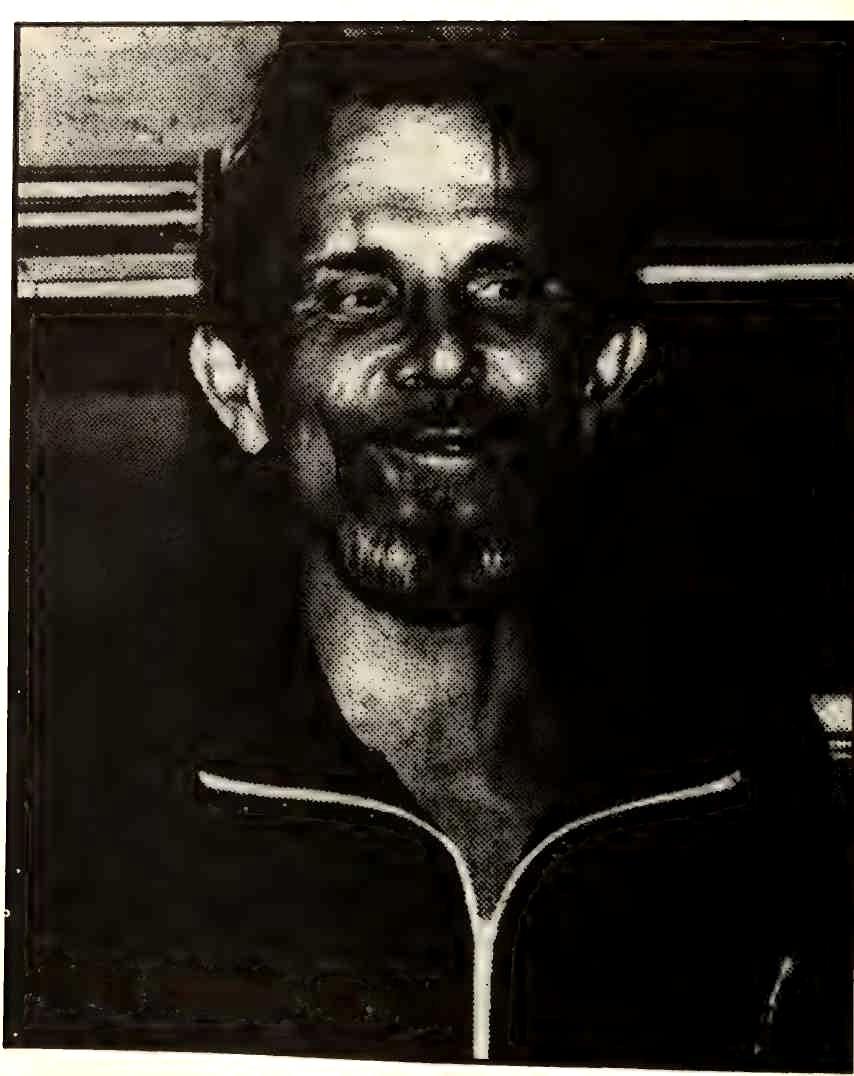
Piotr Petrovich SIOUDA, 53 year-old activist of the KAS, was killed in secret on 5 May, 1990. He had been investigating the repression carried out by the KGB in the town of Novocherkassk[19] for the KAS paper Volya, and making the details widely known through the communist press too. It is quite general now to publish details of repression and the previously unknown armed risings against it — provided this was in Stalin’s time. It is begining to be the case that State crime and workers’ uprisings in Lenin’s time can also be publicized. But Siouda went too far. He dealt with vicious repression and workers resistance in 1962. The state criminals of that period are not just historical justifications for Bolshevism; they are sill struggling for power.
During the sixties the insurrectionary wave continued. Piotr Siouda was one of the survivors of Novocherkassk when, in July, there were major strikes in the town. It was part of a strike wave that spread over a large part of Russia: due to starvation wages, lack of food, intolerably strict management. The workers were shot down in city after city throughout the USSR. In many towns they built barricades against the heavily armed soldiers. (The ethnic unrest and the fascist groups that sprang up in the seventies were a deliberately introduced counter-balance to workers struggles — an exactly parallel situation with the capitalist world).
One worker concerned, our comrade Piotr Siouda, detailed the activities, named the names of those responsible for the brutal attacks on the people, collected witnesses, made them known through the anarcho-syndicalist paper, then into the Soviet press such as Komsomolskaya Pravda and the Literaturnaya Gazeta (Literary Gazette). On 6 July last year he detailed a statement before the Supreme Soviet, which might have been obliged, in the present climate, to take it up.
On 5 May, this year, the anarcho-syndicalist Piotr Siouda was beaten to death, it is strongly felt among the friends of Piotr that his murder was a direct result of the information that he had uncovered and the political embarrassment that it would cause to those implicated. Behind the grand words of peristroika and glasnost the organs of state control still function to silence those who are fighting for a truly open and democratic society.
Black Flag No.199
The Death of Piotr Siouda
Piotr Siouda died in the municipal hospital of Novocherkassk, at about 8am on 5 May, 1990. He had disappeared from his home the night before, and was found not far from there at about 7am, bearing evidence of blows. He was still alive. This resembles the KGB’s classic and cowardly methods of not finishing off their victims.
Several days before his death, he had revealed to the local reporter for Komsomolskaya Pravda (the Young Communist paper) that he had come into possession of a secret KGB document which gave the order to fire upon the crowd of rioters in Novocherkassk in 1962. This constituted irrefutable proof of the KGB’s guilt. It has not been possible to find this document, which was in Siouda’s possession.
Piotr Siouda was born in Rostov-on-Don on 13 December, 1937. The same year, his father died in the town prison after being tortured. He had been a Bolshevik, who had joined the struggle in 1902, in Batum, alongside Stalin. Like many of Stalin’s friends, he was to be arrested on the tyrant’s orders.
Piotr Siouda was a specialist mechanic in the electromagnetic factory of Novocherkassk, and participated actively in the workers’ protest movement which sprang up there in June 1962. On 10 September, 1962, he was condemned to twelve years in a labour camp. He was freed after more than four years, following a revision of the proceedings, marking the coming to power of Brezhnev. Afterwards, he led the struggle for the truth to be told about the events of 1962, and for the rehabilitation of the victims and those imprisoned. He assembled information on the fate of the many wounded, some of whom were secretly murdered[20] after the events. He fought for those who had given the orders to fire to be tried for ‘crimes against humanity’.
Piotr Siouda was an active member of the Memorial organisation of Rostov-on-Don and the Association of Victims of Repression. He was a founding member of the KAS (Confederation of Anarcho-Syndicalists), created on 1 May, 1989.
Below is an extract from Volya (Freedom), a journal of the KAS, of 1 August, 1989:
“In June 1989, the official press has finally broken its silence over the tragedy of Novocherkassk in 1962, when the army fired upon strikers. So, Komsomolskaya Pravda and Literatumaya Gazeta (organ of the Writers’ Union) have published a detailed account . This thin stream of information wouldn’t have trickled out without the efforts of Piotr Siouda, one of the 1962 strikers, who has collected a number of testimonies and published the resulting information in Samizdat, long before the official publication. Piotr Siouda has repeatedly addressed the Central Committee of the CPSU, the Presidium of the Supreme Soviet, the Supreme Court of the Soviet Union, demanding that the whole truth about the events in Novocherkassk be told, and that the victims be rehabilitated.
In his declaration to the Supreme Soviet of 6 July, 1989, he wrote: ‘despite my efforts of 27 years to discover the truth clear up the tragedy of Novocherkassk vof 1–3 June, 1962) several facts and circumstances remain secret because of the attitude of organisations of the Party and the State. Neither the names nor the numbers of victims and of those condemned can be fully known. A sinister silence hangs over the fate of the wounded who were evacuated from the town’s hospitals and taken away to unknown destinations. The silence around their fate seems to cover up those who committed a crime not just against the inhabitants of Novocherkassk, but also against humanity...
There can be no expiry date for crimes against humanity, and given that it is equally true that the apparatus of the Party and the State are entirely responsible, a detailed investigation of the circumstances of the crime of Novocherkassk, as well as on the slowness of the bureaucracy (18 months to look at my complaints) is actually politically indispensable.
If the Central Committee of the CPSU, the Council of Ministers and the Supreme Soviet of the USSR wish to exonerate themselves of this accusation, they must make public the names of the victims, tell the truth about the fate of the wounded, make known the events, the circumstances and the names of the criminals. In the case of them refusing to do this, we will be obliged to appeal directly to the population of the Soviet Union, through the press and the independent social and political movements, to enlist the opinion of the whole world and make use of the International Court at The Hague’.
Piotr Siouda
Novocherkassk, 6 July, 1989.
This is not the first time that anarchists have been persecuted under perestroika. KAS member and editor of the journal Svetcha (Candle), published in Irkutsk (Siberia), Igor Podchivalov, was accused of hooliganism and imprisoned in March 1989. It is only thanks to the support of Sakharov and the inhabitants of the town that he was freed after paying a stiff fine.
As well as anarchists, other people have been killed or injured by beatings from the KGB under perestroika. The cases are numerous. We remember Sitnikov, a striking worker from Siberia, who was murdered. We remember Kuznetsov, the journalist who investigated the KGB and who was beaten up and imprisoned without trial. Today he is free, but only half fit, the beating he received having brought on a perforated lung.
The reactionaries of the Party and the KGB have raised their heads. People are dying for the truth, for their desire for freedom, while the West applaud the nonexistent reforms of Gorbachev. We denounce Gorbachev! Fight for freedom of expression in the Soviet Union! We denounce the abuses! Solidarity with the KAS and all the free voices which exist again in the USSR. Do not let Gorbachev snuff them out. Do not be duped. The forces of freedom in the Soviet Union need your support.
Vladimir
Paris, May 1990
Notes on the Workers’ Uprisings of the Sixties
Workers’ uprisings were numerous in the USSR at the beginning of the sixties. As well as Novocherkassk, the movements which the official press never mentioned happened in Alexandrovsky Murom, Nizhni-Tagil, Temirtau, Odessa, Dneprodzerzhinsk, Lubny, Kuybyshev, Kemerovo, Krivoy-Rog, Grozny, Donetsk, Yaroslavl and other towns.
In Temirtau (Kazakhstan), the revolt broke on 3 October, 1959, due to bad housing conditions and low wages, lower than those of Bulgarian, Polish and Romanian workers in the town. About fifty workers set fire to the canteen to protest about the food. Afterwards, they looted the market and threw stones at the militia. Fifteen hundred workers then erected barricades. The next day some soldiers arrived, but the workers were able to seize their arms and the government had to send reinforcements. In anticipation of the failure of negotiations, the order to fire was given. Over 100 workers were killed. The others, including onlookers, were sent away in lorries to an unknown destination.
In Alexandrovsk (Russia), during the summer of 1961, a worker was beaten to death by the militia. The factory workers struck and went to the Commissariat with banners demanding the prosecution of the murderers. After they had stormed the building and set it on fire, they went to the prison where the soldiers refused to fire on the crowd. Special troops were sent in and the massacre began. Huge numbers of arrests followed. The number of dead exceeded one hundred. Some of the arrested disappeared and their families were forbidden from burying their dead. The director of the factory who had supported the strike, the docter who had exhumed the corpse of the first worker killed and attested to the means of his death, the painter who made the banners, were secretly judged and shot.
Vadim Belotserkovsky
Obshchina No.40
Anarcho-Syndicalist Union Formed
Nearly seventy years after Lenin had thought he had consigned anarchism and anarcho-syndicalism to the wastepaper basket of history and the people who advocated it to his gulags and firing squads, it has re-emerged, stronger than ever to haunt his heirs. As Leninism and its legacy is rejected, so Anarchism is increasingly finding new ears willing to listen to its ideas. This May Day past saw the red and black flags of anarchy being paraded through the streets of Moscow bearing the slogans ‘Power to the people, not the parties’ and ‘Tell us, Communists when is your state going to whither away?’. And in May Day demonstrations from Leningrad to Kharkov, Kaluga to Angarsk in Siberia, the anarchists marched. The ideas of Anarchism are becoming ever more relevant to the people of the Soviet Union, rightly suspicious of the motives of the vultures of Western capital and only too aware of the failure of ‘Communism’.
An historic moment in the continuing development of the anarchist movement in the Soviet Union was the launch, on 3 June, 1990, of the anarcho-syndicalist Association of Managing Trade Unions (ASMTU) ‘Resistance’.
Its founding statement states, that ASMTU ‘Resistance’ is:
“Free — that is independent of State and Party organisations and administration. Any relations with these bodies are built on the basis of dialogue, not subordination. Delegates to ASMTU are independent of other organisations they maybe members of. They are obliged to fulfil their mandate given by members of ASMTU and may be recalled at any time. ASMTU does not support any political party and doesn’t participate in parliamentary elections.
Self-managing — based on the full autonomy of grass-roots union organisations. These form coordinating bodies made from their delegates and determine the powers of these organs by mutual agreement. Grass-roots union organisations have the right to set the policy of their delegates and recall them at any time.
Syndicalist — striving for the gradual elimination of administration through selfmanagement and independent federally orientated modes of organisation. Means of production should pass into the hands of those who work on them. ASMTU actively participates in workers’ political life and economic struggle”.
There are also plans to re-launch Golos Truda (The Voice of Labor)[21] as a weekly. Golos Truda was originally founded by Russian emigres in New York in 1906. In August 1917, it was re-established in Petrograd and became the foremost anarcho-syndicalist publication during the revolution, until its closure by the Bolsheviks.
In 1921, Lenin wrote: ‘All this syndicalist nonsense must go in the wastepaper basket. To proceed on those lines would mean thrusting the Party aside and making the dictatorship of the proletariat in Russia impossible’. And he was right. Anarchism will thrust the Party and all parties aside, for anarcho-syndicalism empowers people with the means to seize control of their own lives. It arms people with the methods to take what is rightfully theirs and the ideas to withstand dictatorship. As the fascist dictatorship of Franco and his concentration camps failed to destroy the CNT, so too has the Bolshevik ‘dictatorship of the proletariat’, with seventy years of terror, failed to destroy Anarchism within the Soviet Union.
At a commemoration in June of the victims of the army massacre in Novocherkassk (1962) and of the recently murdered comrade Piotr Siouda, a member of the Confederation of Anarcho-Syndicalists said: “It’s hard to imagine just how popular the anarchist spirit has become in the masses. We are strong and will become stronger. Anarchist ideas are alive and are going to make a big impact!”.
Black Flag No.200
Building a True Workers’ Movement
(The following article is taken from Zoravy Smysl, a publication of the KAS)
It can be said that there was no workers’ movement in the USSR before last summer — we had a Party of the proletariat and Trade Unions, but no workers’ movement. The summer of 1989 changed all that. The wave of miners’ strikes swept through the country. It was the first open demonstration of workers for many years and workers understood that they themselves are a moving force for perestroika. The Government commission, with the participation of the Prime Minister Nikolai Ryzhkov, succeeded in preventing the conflict from being prolonged and the miners’ demands were taken away for consideration.
Out of the Government’s deliberations came a document — the 608th resolution of the Supreme Soviet, dated 3 August, 1989. This resolution was passed guickly to stem the strikes and outlined measures to improve work conditions and the standard of living, it also aimed to strengthen the technology of the coal industry, to extend the economic independence of the pits and to work out new forms of management. In March 1990, 262 enterprises, including 116 pits, became economically independent. The State bank gave the miners 226 million roubles to construct houses and 211 million roubles for consumer goods. But the mining branches reduced managers and workers by 12,800 people (currently around 1,030 officials run the industry from a centralised Ministry of Coal).
The strikes of the summer of 1989 became a foundation for the creation of new organisational structures. It became clear that no Communist Party, no State and no official Trade Union can protect the workers’ interests. Frightened by the slipping away of their power and the comforts of officialdom, the trade union officials made a move and organised the special XV Congress of Trade Unions in the coal industry, in March 1990, in Moscow. What were the expectations of the miners at the Congress? Concrete actions for the protection of workers’ interests, said N. Rogov, member of the workers’ group in control of the 608th resolution’s fulfillment. After the detailed discussion in connection with the account of the coal industry Trade Union’s central committee, delegates accepted the central committee’s activity as satisfactory. The uselessness of the central coal industry’s trade unions, though, was obvious, so miners were, here and there, trying to win and take possession of the union’s local sections.
In April 1990, for example, the press reported from Karaganda, Kazakhstan, that the leaders of the regional strike movement gained election victories and occupied the key positions of the union’s section. The participation of miners’ leaders in election campaigns made many people perplexed. Why, so recently after the strike committee expressed openly their distrust of official trade unions, had they discredited themselves so fully? The strike committee’s head, P. Shlegel, explained the contradiction — to achieve much more we must win the trade unions and give them back their original fight, rather than being in opposition to them. The miners’ desire to organise an independent, inter-branch movement Workers’ Alliance — appeared.
So, since the Moscow forum didn’t vindicate the miners’ expectations, the First Congress of Miners took place in Donetsk, Ukraine, on 11–15 June, 1990. The atmosphere was hot. The essence of most speeches was expressed by Yuay Makarov, from the Donbass region strike committee and the congress delegate: ‘the Government doesn’t solve your problems!’ One of the central questions was about the quality of life and the transition to the market economy. Boris Mukazharov, from Karaganda, said, ‘I’m indignant that our country looks so rich, but each of us lives like a beggar’. A. Karmanov, from Cheliabinsk, said, ‘When our branch’s minister talks about a regulated market economy, so we think that the word ‘regulated’ means the desire to preserve Ministry influence’. The Miners demanded the Government’s resignation. Congress passed a resolution about the economy and the transition to a market economy, about the fulfillment of the 608th resolution and against the trade Unions and the Communist Party. The discussion about the Trade Unions was the main one — whether to create a new union or reconstruct the old. Most people supported the former. Y. Makarov stated, ‘We have heard of the social and economic protection, only an independent union can do this, not a dependent one subservient to the Minister’. v. Shvartskop, Cheliabinsk coalfield, said, ‘It is impossible for today’s Trade Union to exist any further, it doesn’t reflect the miners’ interests’. People said before the congress had ended that ‘the main task is fulfilled — we are united’. We must remember that solidarity is the principal thing.
Kommersantz magazine, 18–25 June, reported that, ‘the people of coal regions are discussing at the First Congress of Miners a resolution to begin a general strike from 11 July. In the opinion of the miners, the general strike is the only means to force the USSR leadership to form the ‘cabinet of peoples confidence’. Workers committees again reorganised into the strike committees. ‘Only owing to the pressure of the people who consider the situation intolerable, can real political and economic changes happen’, miners think.
Maxim Zhuravliev
Communique of the SMOT
Moscow & Paris, 1989
The SMOT (Free General Workers Union) was founded in 1978. The aim of the SMOT is the foundation of independent unions which are able to contribute to satisfying the essential needs of the people — social, political, religious and cultural needs — to be fulfilled outside the control of the Party or State apparatus in the Soviet Union.
Fighting against totalitarianism and the lack of respect for the law in the USSR, struggling on the ground of the Declaration of Human Rights of Helsinki in 1975, SMOT is directly opposing Nomenklatura, the new dominating caste.
The organ of co-ordination of SMOT is the Council (Soviet) of Representatives, consisting of the elected representatives of the groups. Besides the Council of Representatives a ‘working commission’ is in charge of the technical aspects of the work.
Since tne middle of 1987, SMOT has partly been able to leave clandestinity, thus having the possibility to spread its ideas wider — above all through the organisation of an information agency ‘IAS’ (Information Agency SMOT), then by establishing an independent library.
The members of SMOT recognise organisational principles, but in no case do they accept any hierarchies, ranks or ‘big-wigs’, any leaders within the union.
Each person is born free and equal in their rights in relation to the others, without distinction of the colour of the skin, the religious conviction or culture.
In consequence of the principles explained above, SMOT refuses to accept any aid from states or governments. The only thing SMOT counts on is the solidarity of the workers.
The Case of Victor Kassatkin
The difficulties of organising in the Soviet Union remain. However, the case of Victor Kassatkin illustrates how these can be overcome.
On 5 August, 1990, Kassatkin, a member of the SMOT, was dismissed from his job, deprived of his apartment and his ration card, for having organised an independent syndicate in the Tosno railway depot in Leningrad. As a mark of protest, Kassatkin started a hunger strike. The SMOT turned to the international labour movement and independent organisations to ask for support for the independent railway workers syndicate at the Tosno depot, and for its founder, Victor Kassatkin.
After an appeal for letters and telegrams of protest to the authorities, Kassatkin won all of his demands. He has regained his job, apartment and ration card, and called off his hunger strike.
The SMOT information agency in Paris said that pressure from the international anarchist movement certainly played a part in SMOT’s victory.
Daily repression continues of anarchists and syndicalists in the USSR. It frequently takes the form of activists being arrested, held for a few days, released, then re-arrested. This has happened to a leader of an independent union in Leningrad. Petrov, of the LOPAT (Leningrad Bus and Transport Union) was arrested on 26 September.
Black Flag, No.201
Freedom for Lithuania
Open Letter from Activists of the Leftist Movement ‘Self-Management By The People’ (Handed out in Moscow, 13 January, 1991)
We support the Lithuanian people’s determination in their struggle for independence. We hope the government of our country, the Soviet Union, will fail in its attempt to bring Lithuania back into the USSR.
No to the Empire! Yes to a voluntary union of free nations! Long live your freedom and our freedom!
Signed by supporters of the leftist movement ‘Self-management by the People’:
Rakitsky, member of the Initiatory Committee for a Party for Self-management by the People, co-chairman of the Union of Soviet Scientists;
Rakitskaya, member of the Committee for the Support of the Workers’ Movement and of Workers’ Self-management;
Isaev, member of the KAS, one of the directors of the Centre for Information and Consultation on Problems of the Workers’ Movement;
Shubin, member of the KAS, member of the Council of Representatives of the Workers’ Confederation, co-chairman of the Green Party’s organisation in Moscow;
Buketov, member of the KAS, deputy headmaster at the Workers’ University.
The War Against Iraq
Declaration of the Moscow KAS
(From Baumanets, the newspaper of the Moscow Technical College, issue No.3,
23 January, 1991)
Today, after the international order created by the superpowers of the West and East after World War II was shaken down during 1989 and 1990, the governments of leading western countries, supported by the Soviet Union, have joined in an effort to restore, through the use of force, a peaceful order based on the exploitation of the less developed countries’ economy and resources by the superpowers. They are trying to describe the situation in such a way that war appears to us as the only way out of the stalemate, and the armies of the superpowers as the only forces capable of ensuring order and peace. Sadam Hussein’s annexation of Kuwait is used as a pretext for openly and forcefully interfering with the Middle East’s internal affairs. And while the attention of the whole international community is focused on the Gulf crisis, Gorbachev’s authoritarian regime is carrying out an open military attack against the Baltic peoples. The western leaders have not yet deemed it necessary to hurry to take similar action against the Soviet Union. It all seems as if these governments had taken special counsel together against the peoples of the world, thus bringing us to the verge of a third world war.
We demand: the immediate and simultaneous withdrawal of Iraqi troops from Kuwait, of Soviet troops from the Baltic Republics, and of NATO troops from the Middle East.
If these demands are not fulfilled, we shall consider that all the civilised countries of the world should break all diplomatic ties with our country. We call upon Soviet and western workers to put pressure upon their governments, using political strikes and other similar means of action.
The recent events have made us understand fully the whole infamy of an international system based on superpowers and military blocks, and they have underlined the need for peoples of the world to fight continuously for a peaceful, non-violent overthrow of imperialist governments, for the replacement of permanent armies by the people in arms and by full, universal disarmament.
The Council of Moscow KAS
14 January, 1991
The Moscow Union of Anarchists
Declaration of Principles, February 1991
The AKRS (Revolutionary Union of AnarchoCommunists), the Union of Anarchists, the dissident anarchist fringe, and the Christian anarchists have now joined the Moscow Union of Anarchists. The Moscow Union of Anarchists itself has become a member of the Alliance of Anarchist Movements (ADA).
Free political and civil rights to all with no limits.
Self-management of society by the people, not by the Party, nor by civil servants. Election of all people’s representatives, with the right to dismiss them and to organise new elections at any time.
Replacement of the ‘barracks’ type of army and of the State-employed police forces by full access to arms for all the people, on a voluntary basis and with professional branches in the ‘scientific’ sectors of the army (chemical weapons, anti-missile technology...).
Freedom and self-determination for all peoples and nations.
The Moscow Union of Anarchists gathers, on a voluntary basis, all those who hold freedom dear and consider that the ideal type of society is anarchy. Anarchy is a society where the freedom of each individual is a condition which must be fulfilled by and for all. The Union of Anarchists believes that anarchy can only be achieved as a result of the free will of the people, over a long period of time. Consequently, anarchy should not be understood as a programme, not even as a minimal one, for the temptation is often too great, when there is a programme, to accelerate its implementation through the use of violence. That is why, in its political action, it refuses to participate in any kind of state organisation, and it remains in a non-parliamentary opposition. However, the Union of Anarchists believes that one goal of the struggle in the near future could be to set up a society based on people’s rights, i.e., a social agreement with common obligations for both the leaders and those led by them. In order to achieve such a social agreement, the Union of Anarchists considers it essential that the following pre-conditions be fulfilled:
Freedom of conscience (i.e., of speech, of the press, of belief, of organising rallies, setting up organisations, uniting, and striking).
Free movement of people within the country, as well as in and out of it (the enslaving system in which registration of the dwelling place, passports and identity cards are compulsory, is abolished).
Free movement of information: any person has the right to spread and receive any kind of information in any form.
Any individual has the right to acquire, hold and carry weapons to protect his/her freedom (except minors, drug addicts and mentally ill people).
Agreements come into force after they have been ratified, by the way of referendum, by the people living within the limits of a given territory. The current administrators are replaced by elected people (elected for a fixed term of office and with the possibility of organising new elections at any time). The current ministries are dismantled as instruments of the administration, and replaced by a collegium of experts who prepare strategic recommendations on ways of organising the production process. The courts of justice of the current system are replaced by courts of jurymen.
The current KGB and MVD (Ministry of the Interior) are dismantled and replaced by a decentralised system of public order maintenance. The people elect professional crime experts, who are helped by the armed population. The anarchist society refuses to act as a great international power; in the same way, the size of the army is substantially cut down until it reaches the proportions of a minimal defence force.
The means of production, currently state property, are transferred directly and without cost to the hands of the workers. Workers’ committees are entirely free in their economic activity. They are fully entitled to change the forms of property ownership, and even to sell that property to an individual. All forms of ownership have an equal legal status, both in industry and in agriculture. The land belongs to those who work on it. Kolkhozes (collective state farms) have the right to self-dissolve. All kolkhoz workers have the right to leave the kolkhoz; they may either recover their piece of land with their contribution to the collective property, or receive a compensation.
The single empire is dismantled; all peoples and all nations are guaranteed the right to self-determination.
On the Question of ‘Sovereignties’
‘The rich have their own whims’ (says the proverb): they are interested in the struggle for sovereignty, i.e. for defining which of this or that Council of Deputies will rule over which part of the country and to what extent. The SMOT is an organisation of workers and of low income people, to whom all the democrats, conservatives, liberals and nationalists of the Soviet administration are behaving, in fact, in exactly the same way: concealing consumer goods, increasing consumer prices, receiving ‘vizitkis’ (Translator’s note: invitations giving privileged access to food and other consumer goods), introducing ration tickets and other restrictions. When you are a worker, you have nothing to do in everyday life with Yeltsin, Landsbergis or Gorbachev, but rather with the cashier at work who pays you little, and with the cashier at the shop who takes a lot from you, and even peeps into your passport. We worry much more about changing those relationships, than about the relationships between Yeltsin and Gorbachev and Landsbergis. We believe the only way to bring life back to normal in this country is for the workers to organise themselves independently and to set up trade unions. We believe much more in establishing direct relations between collective, private and State owned companies, run autonomously, than in defining the ‘horizontal’ relations that may exist between a series of newly devised governments, plus their relations with the eternal central authority which, whatever the circumstances, they shall never be able to avoid. A society of self organised workers could easily do without this whole question of ‘sovereignties’.
The Moscow Council of Representatives of the SMOT, however, has no objection to local SMOT groups acting as they deem necessary.
SMOT Council of Representatives
Moscow, February 1991
The Kronstadt Commune 70th Anniversary International Syndicalist Conference
(Moscow, 16–18 March, 1991)
An international conference was held in Moscow on 16th-18th March, attended by, among others, the IWA Secretariat and organised by the KAS. It was dedicated to the 70th anniversary of the Kronstadt rebellion. The following resolution was passed at this conference:
“We, participants of the International Syndicalist Conference in Moscow (16–18 March, 1991) dedicated to the 70th anniversary of the Kronstadt rebellion, state that the corpse of Stalin’s system of state socialism against which Kronstadt’s sailors had fought, opens new perspectives for the independent workers’ movement in the USSR.
We warmly support the aspirations of the workers of the USSR to be independent of Party and State structures. We are certain that to simply substitute state exploitation for national and international capital will not give us freedom, social justice, private or collective security.
Today the Party and State bureaucracy, by using the slogans about ‘denationalisation’ of our economy, usurp our means of production, with foreign companies setting up dirty and resource rapacious factories within the USSR. The interests of our old bureaucracy and of our new capitalists coincide with each other.
Only the determined struggle of the USSR workers fighting for their interests, by forming strong militant unions and fighting for the reconstruction of our society on the principles of self government can be an alternative to this”.
Anarcho-Syndicalism in the USSR Today
Anarchists, in the opinion of Anatoly Lukyanov, President of the Supreme Soviet[22], are one of the few political forces to be taken seriously in the USSR. That was certainly not meant as a compliment for the various anarchist organisations, associations and dozens of smaller groups, but rather as a kind of warning and appeal to politicians and party bureaucrats, perhaps even as a lead-up to an anti-libertarian offensive. At demonstrations in Moscow and Leningrad the anarchists have always been present in such numbers that the Western media often have to report that “their presence could not be overlooked”. Although the anarchist movement in the USSR is not on a par numerically with the Democrats, Social Democrats, Liberals or other forces, it makes up for this with its active membership.
The brief history of modern anarchism in the USSR is connected with glasnost, perestroika and the rise of Gorbachev, like almost all political and social culture which has developed in the last few years outside the Party and bureaucratic control. Of course, this is meant as no justification for the West’s darling ‘Gorby’ and his lack of democratic spirit. Until the death of Chernyenko all opposition was brutally suppressed.
According to Mikhail Tsomva, International Secretary of the Confederation of Anarcho-Syndicalists (KAS), the roots of modern Soviet Anarchism are to be found in the Komsomol, the Party youth organisation which today has lost virtually all significance. In the early eighties socialist groups and discussion circles arose in almost all parts of the country. Many of them were Marxist orientated. In 1985–86 some young people at the Teachers’ College in Moscow began looking at the relations between Marx and Bakunin and soon developed an anarchist leaning. Andrei Isaev, Alexander Shubin and others then founded the club 0bshchina[23] in 1987. The club Obshchina went public with a discussion meeting on 9 May, 1987, and in September 1987 it published the first edition of the magazine Obshchina, the first anarchist publication in the USSR for almost seventy years[24].
Together with similar discussion circles and Marxist and Social Democrat groups, the anarchists and independent socialists launched the Alliance of Socialist Federalists (ASF) and the Federation of Socialist Social Clubs (FSOK). From the latter, the first specifically anarchist organisation was formed in January 1989 — the Confederation of Anarcho-Syndicalists (KAS), which today is the largest and most significant anarchist organisation in the country.
KAS saw itself as: ”an independent political organisation of the non-party type, standing for stateless socialism on the basis of collective/employee property in the workplaces, industrial and regional self-management, federalism and demilitarisation” (Programme of the First Congress of KAS). KAS united a broad spectrum of libertarian tendencies: anarcho-syndicalists, anarcho-communists, individualists, pacifists, socialist federalists, etc. KAS has both individual members and member groups. The organisational structure is basically a loose one, with no binding statutes and no formal membership. There are no fixed membership dues. In this way, KAS hopes to avoid ‘paper members’ and the development of authoritarian tendencies. But this loose structure has seen a range of problems which deserve looking at.
After the first congress, in May 1989, two congresses were held in 1990, where substantial disagreements emerged about the direction and future of KAS. The second congress of the two, in March 1990, led to the resignation of a sizeable minority, among which was the Leningrad ASSA and a number of anarcho-communists and anarcho-individualists. The bone of contention was the KAS majority’s position in favour of market economics; but also in issues of direct action, violence as a method of political struggle, co-operation with the Greens and the left of the Social Democratic Party were hotly debated. The standing of several Moscow KAS members in the Moscow city council elections was also contentious, although now there is unanimous rejection of such participation in the future. At the Kronstadt congress in March this year, previous members repeated their heavy criticism of KAS’ economic platform. KAS was accused of reformism and ‘libertarian liberalism’. KAS members themselves, however, put their internal differences down mainly to pragmatic issues like commitment and level of involvement. Although nobody has a monopoly on the truth, as they put it, many KAS members are said to have a rather vague understanding of anarchism. Good prospects are seen for spreading anarcho-syndicalist ideas and tendencies in the newly developing labour movement. Here there is no room for anarchist cliches. A congress is being held around the middle of the year to develop an updated KAS platform.
Today KAS encompasses 500 to 1,000 activists in around sixty cities of the USSR. Syndicalism is increasingly becoming the central ingredient, which comes as no surprise. Neither the ruling Communist Party (be it the conservative or the reformist wing) nor the pro-capitalist democratic parties can offer the population a tangible alternative, and at least a general way out of the catastrophe. The economic collapse which is now occurring looks to be setting the scene for a ‘valley of tears’ — one of the radical economic reform programmes which less and less people have any faith in. This can be seen from the strike waves which welled up last year and which are now rising higher and higher. One year ago, as a broad labour movement began to take shape, KAS adopted a double strategy. On the one hand, it took part in the activities of the Confederation of Labour, a broad umbrella organisation made up largely of free trade unions, strike committees, workers’ clubs and associations, which represented a very broad spectrum of forces all the way from bourgeois and Marxist forces to anarcho-syndicalists. At the same time, KAS in Moscow set up a union called ‘Resistance’ which was to stick to a clearly anarcho-syndicalist model. This has since floundered, which has led to KAS taking on a more active role in the Confederation of Labour. In summer 1990, the labour movement ‘Information and Consultation Centre’ (IKC) was set up, where information from the union and labour movement is sent and then disseminated in weekly bulletins and on radio by KAS-KOR, KAS’ news service. KAS-KOR has a genuinely functional national network of correspondents who report on all that happens and is newsworthy in the labour movement. In practice, KAS-KOR is the news service for the entire Confederation of Labour. In addition, the IKC offers a legal and social counselling service for workers and is setting up an archive on the labour movement. A Workers’ University is in the planning stages. Since prioritising its work in the Confederation of Labour, KAS’ influence has grown; and this is at least one reason why the Confederation of Labour has not degenerated into an extended arm of precapitalist parties or a mouthpiece of the Marxists.
Alongside its syndicalist work, KAS also devotes itself to cultural and economic topics. For example, a range of exhibitions is under preparation on ‘The Life and Work of Bakunin’, Russian Anarchism Past and Present’, ‘The Labour Movement and Syndicalism in Russia’, ‘Makhno: Myth and reality’, etc.
Most arguments, and certainly the most heated ones, are currently on economic policy, and this is likely to be the case for some time to come. That’s logical really, due to the catastrophic state of the economy. Any political organisation which goes public gets plugged for its position on the economy above all else. In this context political Utopians tend, even in the discussion stage, to recede into the background. Most organisations are united in their rejection of the Communist Party’s totalitarian dictatorship. Now the most important task is getting out of the economic calamity. While it’s true that more and more voices in the population are calling for a ‘strong man’, a saviour, that is not so much the expression of a desire for a new kind of dictatorship as it is of powerlessness in the face of economic chaos, the mafia, corruption and bureaucracy.
KAS’s economic platform does not go uncriticised from within, but seems to be in keeping with the opinion of the majority of members. KAS envisages a system of stateless market-socialism with mixed forms of property. It goes by the assumption that the market is the only possible form of economic circulation where the economy does not gain power over the people. Economic planning is seen as being directed against people and producing nothing but bureaucracy. At the same time, KAS strictly rejects both State and private property. Private property even contradicts market principles, says Alexander Shubin, because it carries in itself a strong tendency towards monopolisation which by its very nature destroys market-economic relations. Instead, KAS espouses collective and community property within a system of local self-management. The property of a business should belong solely to the workers of that business. In such a system the circulation of goods should be based on the competition principle, which is indispensable in any functioning economy. Autonomous, self-managed municipalities would run the system of welfare institutions (hospitals, homes, kindergartens, etc); they would also be responsible for the socially weaker members of society — the elderly, the sick and children.
A congress has been arranged to flesh out this economic platform in more detail.
K. ten Broke
Direkte Aktion Nr. 87
Hamburg, May-June 1991
Interview with Vadim Damier of the Initiative of Revolutionary Anarchists (IREAN)
London, July 1991.
Vadim Damier is an anarcho-syndicalist. He refers to himself as in the tradition of Kropotkin, Malatesta, Rocker and the IWA. He has recently left the KAS, because of disagreements over the KAS’s promotion of the free market and over its autocratic leadership. Vadim is a founder member of IREAN (Initiative of the Revolutionary Anarchists), a small anarcho-syndicalist group in Moscow. IREAN is an active group, but has few contacts with workplace organisations.
DA: Tell us a bit about yourself and your involvement in politics.
In 1987 I was involved in the first big opposition conference and ‘organisation’. This ‘organisation’ was really an informal network involving virtually all sorts of political groups except fascists. It also gave rise to all sorts of different groups including the Socialist Clubs. I was never a member of the Socialist Clubs, because they were too right wing.
In 1988 I was involved in the founding of the Moscow Ecological Federation and wider attempts to establish a green movement across the USSR. There were and are a number of problems with the green movement, being an ‘alliance’ of political views including confirmed reformist ideas. Indeed the green movement has now formally split.
Through the green movement I met Alexander Shubin. Although Shubin and myself have been involved in the same organisations and have been friends and comrades, our views have developed in diametrically opposed directions. We now have completely different views. Basically, I am for direct action and against the free market. Although I still consider myself part of the green movement, I have left the Moscow Ecological Federation, because of the hegemony of Shubin’s views within it.
In 1989, along with Shubin, I was involved in the founding of the KAS. Although I was never in complete agreement with the KAS, at the beginning I felt that the organisation was on the right track and that it was important to struggle from within. Now, however, the right wing leadership of the Moscow KAS has gained a stranglehold on the whole organisation and has moved too far in embracing the free market and other capitalist ideas. I finally left the KAS in the middle of last year when £ number of comrades were expelled from Moscow KAS. My disagreements are however primarily with the leadership of KAS and Moscow KAS. I continue to work with many individuals as well as KAS local and regional groups.
DA: What are you disagreements with the KAS?
Well, in the KAS official programme there’s very little to disagree with. It states that what the KAS wants is “Socialism without a State” as the basis for a future libertarian communist society. But there’s no open discussion about what these things mean. Shubin and others within the leadership have, behind closed doors, discussed what they mean and how to achieve it. Although they appear to have reached a common position, this is not written down and is not shared widely within the KAS.
The leadership’s position is that currently within the USSR there is not a developed enough technology to enable libertarian communism. Only the free market can enable the development and modernisation of technology. So, a free market along with a kind of limited capitalism should form part of a transitional programme towards a libertarian communist society. This transitional society would be based around self-managing worker controlled factories and enterprises with some (especially environmental) control from people in the locality. These enterprises would compete on a for-profit basis and money would remain. All relationships between enterprises would be through the free market. They recognise that this would lead to a widening of inequalities and that such inequalities must be compensated for (but without a state).
Essentially that’s how they see the future. I disagree.
Before I left the KAS, I argued with Shubin and others about these things. I put forward a counter proposal intended as an alternative to centralised planning and to the free market — an anarchist theory of planning from the bottom up. I envisage a federation of free communes — the selfmanagement of production, federated together with associations of consumers and with ecological and other functional groups. This federalism would be on the basis of solidarity and would decide on where, how, what and when things should be produced. Through such co-ordination a libertarian communist society could be achieved. Shubin, however, felt that this was much too structured, too dictatorial and too inflexible. In his opinion only the free market can allow the development of society.
The other problem with the KAS leadership is that they don’t do anything. They feel that the time for direct action is past and actively discourage any activity.
It was really disagreements about both these issues, coupled with the expulsions, that led myself and some others within the KAS to leave and to found IREAN. These disagreements also led to the split in the green movement.
DA: Tell us abut IREAN.
IREAN is a direct action organisation. At the moment it’s very small. The founding declaration was published in our paper, Black Star, on 5 march 1991. In my opinion, of all the Moscow groups only IREAN really understands what libertarian communism means.
IREAN currently organises in Moscow, although we are actively seeking links in other states. We are currently talking to some potential partner groups. There are a lot of groups who refer to themselves as anarcho-communist, although many of these groups have anarcho-Bolshevik tendencies. Most of these groups are made up of genuine revolutionaries, but their ideas are confused and not very well thought out. I am hopeful that these discussions will prove fruitful.
We work with quite a lot of groups. There are a lot of non-ideological anarchist groups and individuals who carry out some good activity (for example, demonstrations, blockades, anti-nuclear actions), but their ideas aren’t really sorted out. There’s also the Association of Anarchist Groups, which, again, is non-ideological and has no firm programme. It’s really more of a network. Indeed, it’s quite probable that there are anarcho-capitalists within it. In the green movement there are a lot of ecological anarchists carrying out direct action. We have grassroots contacts with several local and regional KAS groups. In Moscow there’s also the Anarchist Youth Front — again, non-ideological — which has focused on actions against conscription. They are trying to form a wider Federation of Anarchist Youth Groups.
Direct Action, No.74
August 1991
* * *
Other ASP Titles
REVOLUTIONARY UNIONISM IN LATIN AMERICA: THE FORA IN ARGENTINA
P Yerrill and L Rosser
price £1.50
METHODS OF ANARCHO-SYNDICALISM
Rudolf Rocker
price 50 pence
ANARCHISM: ARGUMENTS FOR AND AGAINST
Albert Meltzer
price 80 pence
THE TRAGEDY OF SPAIN
Rudolf Rocker
price £1.20
RED YEARS, BLACK YEARS: ANARCHIST RESISTANCE TO FASCISM IN ITALY 1920–1945
price £1.75
CUBA, THE ANARCHISTS AND LIBERTY
Frank Fernandez
price 75 pence
[1] Bakunin, Programme and Purpose of the Revolutionary Organisation of International Brothers (1868). Michael Bakunin — Selected Writings, edited by Arthur Lehning (Jonathan Cape, London, 1973), p.170.
[2] The last to go were the Anarchist Black Cross (dismantled in 1925), Golos Truda’s publishing house and bookshops (shut-down in 1929), and the Kropotkin Museum (closed in 1939).
[3] The CNT Catalonian Regional Committee first presented the list to the Soviet proconsul in Barcelona, Vladimir Antonov-Ovseyenko, who promised to do everything within his power to free those named and to obtain for them the right to leave the USSR for Spain with their families. In August 1937, Antonov-Ovseyenko was recalled to Moscow and appointed Commissar of Justice for the Russian Republic. A few weeks later, he was arrested on phoney charges of crimes against the state. Sentenced to ten years imprisonment, he was executed sometime in 1938.
[4] Aaron Baron was first exiled to Siberia by the Tsar’s regime. He escaped to the USA and edited the anarchist newspaper Alarm (in Chicago), until returning to Russia in June, 1917. One of the organisers of the Nabat (Alarm) Confederation of Anarchist Organisations in Ukraine, in 1918; he joined Makhno’s army in 1919, occupying prominent political and military positions. Arrested in November 1920, Baron spent two years in Orel prison and was then transferred to the notorious Solovetsky Islands, until 5 January, 1925. He was arrested in Moscow soon after his release and exiled to Altai, Siberia. His wife, Fanya Avrutska, was summarily executed (with the anarchist poet, Lev Cherny) by the Cheka in September, 1921.
[5] At the start of WW2, Orel isolation prison for political offenders held five thousand prisoners (Maria Spiridonova among them). When the Germans were about to take Orel, the prisoners were herded into the basement, which was then flooded. All five thousand died. See: Anton Antonov-Ovseyenko, The Time of Stalin — Portrait of a Tyranny (Harper & Row, New York, 1980), p.275.
[6] “A. Volni”, Views and Comments (New York, July 1955), reprinted by CIRA in Le Monde Libertaire, October, 1955.
[7] John Loftus, The Belarus Secret (Penguin Books, London 1983), pp.48–49, 105.
[8] Remnants of Makhno’s army continued guerrilla operations in the Poltava region, well into 1924 and possibly even later. Alexandre Skirda estimates that by 1926, ten percent of the 300,000 soldiers who passed through the ranks of the Makhnovshchina had survived. It seems quite plausible that of those 30,000 survivors, some would still be around in 1944. They would then, if their average age in 1921 was nineteen, have been aged forty-one.
[9] Roy Medvedev, Let History Judge — The Origins and Consequences of Stalinism (Spokesman Books, Nottingham, 1976), p.468.
[10] “A. Volni”, Op. Cit. Lacking corroboration, the accuracy of this claim can not be properly judged.
[11] A curious libertarian Christian sect, started by former Communists in Moscow and Leningrad at the end of the 1930s, the Monashki espoused a strict doctrine of civil disobedience to the state, and advocated a stateless, classless society, founded on the gospel of ‘from each according to their ability, to all according to their needs’, with the commune providing the basic unit of society. The movement seems to have been quite widespread among the peasants of Siberia and Central Asia. Inside the camps, its members distinguished themselves by their determined refusal (backed-up by countless hunger strikes) of any work by which the state might profit. There were some 8,000 Monashki in the camps of Vorkuta in 1953.
[12] Peter E. Newell, Vorkuta Twenty Years On. Anarchy Magazine, No.11 (second series), London, 1973.
[13] Les anarchistes en USSR — letter to CIRA, Front Libertaire, No.102, January, 1979.
[14] Y. T. Galanskov (1939–1972), editor of a samizdat journal, was put on trial with Ginsburg and others, for protesting at the treatment of Sinyavsky and Daniel. He died in prison.
[15] A mountain range, a town and a Moscow Metro station all bear Kropotkin’s name. Lenin praised Mutual Aid and The Great French Revolution and offered to have both published in large editions by a State publishing house (Kropotkin politely declined), but until recently Kropotkin’s political writings have all been banned and only re-issued in samizdat editions, like those produced by the Left Opposition. Kropotkin’s scientific and historical writings, on the other hand, have always been accorded fulsome official praise (a Soviet edition of The Great French Revolution was finally published in 1982). Since Glasnost, Kropotkin has enjoyed something of a comeback. His public rehabilitation was led by Vasily Golovanov, in an article in Sovetskaya Kultura (17 December, 1988). There are plans to mark the 150th anniversary of his birth, in 1992, with a commission to study his works, the reopening of the Kropotkin Museum, the erection of a statue, the reprinting of his works and even the minting of a Kropotkin rouble!
[16] Alexander Skobov joined SMOT, in 1980, while still in Leningrad’s psychiatric clinic No. 3. After his release, his name appeared on a list of SMOT’s Council members. He was arrested again, on 20 December, 1982, with Irina Lopotukhina-Tsurkova (also of the Left Opposition) and some other SMOT members.
[17] Almost exactly a year-to-the-day after this incident, the ‘member from Novocherkassk’, Piotr Siouda, was beaten to death. See pp.31–36.
[18] Vadim Damier subsequently left the KAS and helped form the Moscow IREAN. For an explanation of his reasons, see pp.66–69.
[19] For a detailed account of the 1962 rebellion and massacre at Novocherkassk (“a turning point in the modern history of Russia”), see: Alexander Solzhenitsyn, The Gulag Archipelago, Volume 3 (Collins/Fontana paperback, London, 1978), pp.507–514.
[20] Solzhenitsyn says that 70–80 people were killed in the shooting at Novocherkassk. The wounded all vanished without trace. Their families, and those of the dead, were deported to Siberia, along with many of the strikers: ”A whole town rebels — and every trace is licked clean and hidden”. Some of those arrested were dealt with at several trials in camera. There were also two ‘public’ trials, at one of which nine men were sentenced to be shot and two women to fifteen years imprisonment.
[21] A new Golos Truda was published by the KAS in Tomsk (Siberia) on 3 April, 1990.
[22] Lukyanov has since been charged with treason, stemming from his involvement in the failed coup of 19 August, 1991.
[23] The Obshchina (Commune) was a traditional a peasant community, with collective production and without private property, which existed in Russia until 1917.
[24] The last anarchist publication to legally appear in Soviet Russia was, Mikhailu Bakuninu, 1876–1926: ocherk istorii anarkhicheskogo dvizheniia v Rossii, (edited by A. A. Borovoi), a collection of articles and reminiscences by leading anarchists, to commemorate the 50th anniversary of Bakunin’s death, published by Golos Truda in Moscow, in 1926. Despite bearing the official imprimatur of the state censor, the whole edition was seized by the OGPU and destroyed. Golos Truda’s publishing house, and its bookshops in Leningrad and Moscow, were finally closed down in June 1929. The official reason was the publication, in Paris, of a book called Bolshevistkaia diktatura v svete anarkhizma (The Bolshevik Dictatorship and the Anarchist Viewpoint). In 1930, an underground anarchist press was uncovered by the OGPU in Cheliabinsk.