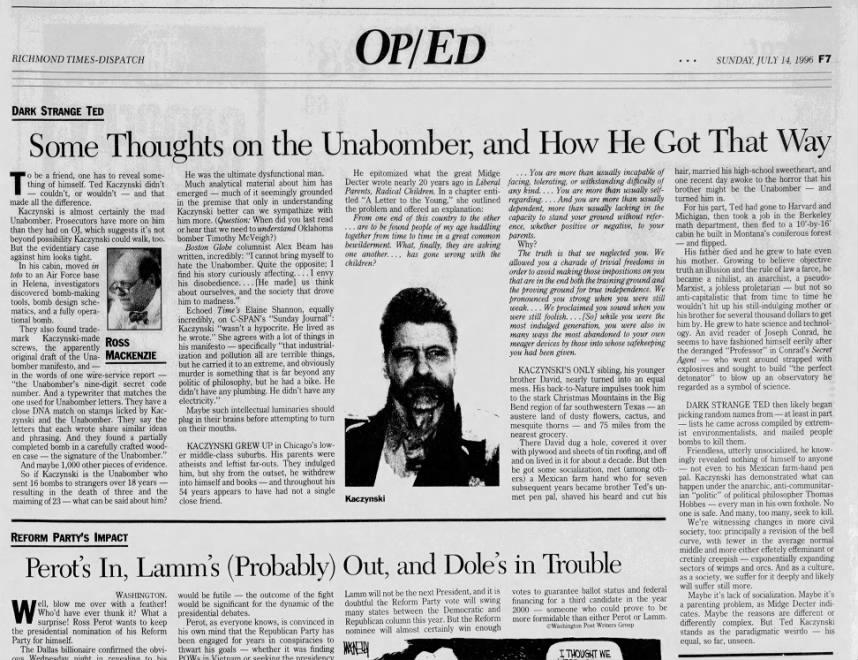
Ross Mackenzie
Some Thoughts on the Unabomber, and How He Got That Way
To be a friend, one has to reveal something of himself. Ted Kaczynski didn’t — couldn’t, or wouldn’t — and that made all the difference.
Kaczynski is almost certainly the mad Unabomber. Prosecutors have more on him than they had on OJ, which suggests it’s not beyond possibility Kaczynski could walk, too. But the evidentiary case against him looks tight.
In his cabin, moved in toto to an Air Force base in Helena, investigators discovered bomb-making tools, bomb design schematics. and a fully operational bomb.
They also found trademark Kaczynski-made screws, the apparently original draft of the Unabomber manifesto, and — in the words of one wire-service report — “the Unabomber’s nine-digit secret code number. And a typewriter that matches the one used for Unabomber letters. They have a close DNA match on stamps licked by Kaczynski and the Unabomber. They say the letters that each wrote share similar ideas and phrasing. And they found a partially completed bomb in a carefully crafted wooden case — the signature of the Unabomber.”
And maybe 1,000 other pieces of evidence.
So if Kaczynski is the Unabomber who sent 16 bombs to strangers over 18 years — resulting in the death of three and the maiming of 23 — what can be said about him?
He was the ultimate dysfunctional man.
Much analytical material about him has emerged — much of it seemingly grounded in the premise that only in understanding Kaczynski better can we sympathize with him more. (Question: When did you last read or hear that we need to understand Oklahoma bomber Timothy McVeigh?)
Boston Globe columnist Alex Beam has written, incredibly: “I cannot bring myself to hate the Unabomber. Quite the opposite: I find his story curiously affecting.... I envy his disobedience.... [He made] us think about ourselves, and the society that drove him to madness.”
Echoed Time’s Elaine Shannon, equally incredibly, on C-SPAN’s “Sunday Journal”: Kaczynski “wasn’t a hypocrite. He lived as he wrote.” She agrees with a lot of things in his manifesto — specifically “that industrialization and pollution all are terrible things, but he carried it to an extreme, and obviously murder is something that is far beyond any politic of philosophy, but he had a bike. He didn’t have any plumbing. He didn’t have any electricity.”
Maybe such intellectual luminaries should plug in their brains before attempting to turn on their mouths.
KACZYNSKI GREW UP in Chicago’s lower middle-class suburbs. His parents were atheists and leftist far-outs. They indulged him, but shy from the outset, he withdrew into himself and books — and throughout his 54 years appears to have had not a single close friend.
He epitomized what the great Midge Decter wrote nearly 20 years ago in Liberal Parents. Radical Children. In a chapter entitled “A Letter to the Young,” she outlined the problem and offered an explanation:
From one end of this country to the other ...are to be found people of my age huddling together from time to time in a great common bewilderment. What, finally, they are asking one another..., has gone wrong with the children?
... You are more than usually incapable of facing, tolerating, or withstanding difficulty of any kind.... You are more than usually selfregarding.... And you are more than usually dependent, more than usually lacking in the capacity to stand your ground without reference, whether positive or negative, to your parents.
Why?
The truth is that we neglected you. We allowed you a charade of trivial freedoms tn order to avoid making those impositions on you that are tn the end both the training ground and the proving ground for true independence. We pronounced you strong when you were still weak....We proclaimed you sound when you were still foolish....[So/ while you were the most indulged generation, you were also in many ways the most abandoned to your own meager devices by those into whose safekeeping you had been given.
KACZYNSKI’S ONLY sibling, his younger brother David, nearly turned into an equal mess. His back-to-Nature impulses took him to the stark Christmas Mountains in the Big Bend region of far southwestern Texas — an austere land of dusty flowers, cactus, and mesquite thorns — and 75 miles from the nearest grocery.
There David dug a hole, covered it over with plywood and sheets of tin roofing, and off and on lived in it for about a decade. But then he got some socialization, met (among others) a Mexican farm hand who for seven subsequent years became brother Ted’s unmet pen pal, shaved his beard and cut his hair, married his high-school sweetheart, and one recent day awoke to the horror that his brother might be the Unabomber — and turned him in.
For his part, Ted had gone to Harvard and Michigan, then took a job in the Berkeley math department, then fled to a 10’-by-16’ cabin he built in Montana’s coniferous forest — and flipped.
His father died and he grew to hate even his mother. Growing to believe objective truth an illusion and the rule of law a farce, he became a nihilist, an anarchist, a pseudoMarxist, a jobless proletarian — but not so anti-capitalistic that from time to time he wouldn’t hit up his still-indulging mother or his brother for several thousand dollars to get him by. He grew to hate science and technology. An avid reader of Joseph Conrad, he seems to have fashioned himself eerily after the deranged “Professor” in Conrad’s Secret Agent — who went around strapped with explosives and sought to build “the perfect detonator” to blow up an observatory he regarded as a symbol of science.
DARK STRANGE TED then likely began picking random names from — at least in part — lists he came across compiled by extremist environmentalists, and mailed people bombs to kill them.
Friendless, utterly unsocialized, he knowingly revealed nothing of himself to anyone — not even to his Mexican farm-hand pen pal. Kaczynski has demonstrated what can happen under the anarchic, anti-communitarian “politic” of political philosopher Thomas Hobbes — every man in his own foxhole. No one is safe. And many, too many, seek to kill.
We’re witnessing changes in more civil society, too: principally a revision of the bell curve, with tewer in the average normal middle and more either effetely effeminant or cretinly creepish — exponentially expanding sectors of wimps and orcs. And as a culture, as a society, we suffer for it deeply and likely will suffer still more.
Maybe it’s lack of socialization. Maybe it’s a parenting problem, as Midge Decter indicates. Maybe the reasons are different or differently complex. But Ted Kaczynski stands as the paradigmatic weirdo — his equal, so far, unseen.