Karmen MacKendrick
Technoflesh, or “Didn’t That Hurt?”
Karmen MacKendrick is an assistant professor of philosophy at Gettysburg College (Pennsylvania). Her work in philosophy and cultural studies focuses on the permutations of pleasure and desire —both somatic and linguistic. This allows her to claim all recreation as research.
Disapproving Interpretations
“Beauty hurts,” Andrea Dworkin writes in her article “Gynocide: Chinese Footbinding.” It isn’t just footbinding she has in mind: Dworkin associates cultural norms of beauty east and west with normative mutilations, passed from mother to daughter as the matrilineal heritage of patriarchal cultures throughout the world. She goes on to suggest that “The tolerance of pain and the romanticization of that tolerance begins [s/c] here ... and serves to prepare women for lives of childbearing, self-abnegation, and husband-pleasing. The adolescent experience ... casts the feminine psyche into a masochistic mold and forces the adolescent to conform to a self-image which bases itself on mutilation of the body, pain happily suffered, and restricted physical mobility” (Dworkin 1994: 219).
This article is about the practices collectively labeled “body modification”: piercing, tattooing, cutting, branding, corseting, transdermal implants, and so on. It would seem easy to see body modification as an intensification of cultural practices of beauty such as those Dworkin condemns—those in which she sees mutilation of the body, pain happily suffered, and restricted physical mobility. If plucking the eyebrows is misogyny, what of piercing them? Is it any better to have one’s nose pierced at nostril or septum than to have it fixed to WASPy daintiness? Is a labret worse than lipstick? Isn’t a corset just the maximum form of the girdle? And what on earth might a Dworkinite feminist make of tattoos, genital piercings, patterned scars made by cutting, even brands?
One tempting association along these lines would link body modification to cosmetic surgery, of which it might seem a minor (or at times not-so-minor) form. The objections to such procedures are fairly well known. Kathy Pauly Morgan writes of “the knives and needles of the cosmetic surgeons—the knives that promise to sculpt our bodies, to restore our youth, to create beauty out of what was ugly and ordinary ... Magic knives in a patriarchal ... Eurocentric ... white supremacist context” (Morgan: 244). Such surgery is famously racially-biased (aimed at creating a very Caucasian ideal) as well as potentially misogynistic. And it is, at least as it’s usually criticized, conformist in the extreme: Morgan suggests that by this means any number of aspects of women’s bodies “can all be evaluated, regulated, and disciplined in the light of hypothetical often-white male viewer and the male viewer present in the assessing gaze of other women” (Morgan: 247). Ordinary—that is, widely practiced and accepted—forms of cosmetic surgery perform a normalizing function, assume and support a normative and normalizing gaze.
On the other hand, those who undergo such procedures—most often women—insist that this surgery helps them to feel better about themselves. To experience oneself as younger, prettier, or sexier is not, they argue, to allow oneself to be oppressed; and it seems to me they have a point. But cosmetic surgery implies a standard of beauty; it implies that we know what is beautiful and that it is always the same, and that we, if we are rich enough and sufficiently dedicated, may be beautiful too. Given the people who get to define beauty, it’s easy to see how this plays into the hands of entrenched social (and economic) powers. No one undergoes surgery with the aim of appearing older, fatter, or larger of nose. Orlan’s startling example to the contrary, cosmetic surgery almost universally reinforces dominant stereotypes of beauty and desirability. Here it is not my intent to argue that such surgery is evil or even bad, and there is no doubt it has made some people happier—but it is hardly transgressive or resistant to dominant cultural forces, and the use that it makes of technology fits neatly into the aims of a disciplinary culture, which demands the utmost predictability of bodies. So both cosmetic practices such as hairstyling and the use of make-up and cosmetic surgery such as nose jobs and eyelid lifts can make us feel beautiful, but often by making us predictable.
But can we in fact read body modification and its increasing popularity in this way—as an intensification of sadistic patriarchal demands for conformity to discomfort in the name of beauty? Perhaps, we could argue, such an intensification would not be terribly surprising. On the theory that the liberating quality of feminism represents a threat to that famed evil, patriarchal hegemony, the anti-woman backlash might extend beyond neo-conservatism to the more radical-seeming margins, where women who might once have endured three-inch heels for their jobs now force their feet into six-inch spikes for clubs, and women who might once have tolerated the prettiness of a single pair of earrings can now be led around by the rings in their septums. Are these relatively extreme styles inherently misogynistic? Are they becoming more and more stylish in a backlash response to women, nature, and the constant identification of the two?
Somehow I doubt it, without denying the possibility of such a backlash to “liberated” women. I base this doubt on a variety of grounds. First and most obviously, the body modification subculture is intriguingly androgynous. Even corseting, which produces the classically “feminine” hourglass shape, is taken up by men as well. The ornamentation that piercing makes possible caught on early in gay male culture—no surprise, really, since gay men have always seemed more comfortable than straight with the idea that not only do men have bodies, but that these may, on occasion, be worth looking at. (For those who have done time in small towns, the days of suspicion regarding all men with earrings, and careful codes of earring placement to distinguish gay from straight, may still be within memory.)
More to the point, body modification in general serves a strong ornamental function, making the body the near-irresistible object of the gaze. This it does precisely by being so different from one body to the next, virtually demanding visual attention (though this is not invariably a primary motive, and many people keep their modifications hidden most of the time). But thus to seduce the gaze is no mere passive or even objectifying act: by modifying the body one can make a considerable difference in where others look and in what they’ll see when they do. That this playful seductiveness can cut across genders as easily as it does suggests something very different from an anti-feminist or anti-nature backlash: it suggests a multigendered delight in the body, which may be rendered as exaggeratedly feminine as a courtesan’s, as outlandishly butch as a sailor’s, or as semiotically bent as one pleases. Though I would emphatically not equate the two sets of phenomena, I think it is not irrelevant that transgenderism and body modification are simultaneously in full surge: each refuses the fatalistic view of anatomy in favor of a recognition of, and often a delight in, possibility.
Perhaps, though, taking seriously the long association of woman and flesh, we might give the backlash argument a less gendered twist. Here our disapproving interpretation would suggest that modification comes out of a self-destructive urge, a hatred of the flesh. I have heard this argued, in fact, by a doctor on a television call-in show, who was speaking to a caller whose sexual guilt caused him to put alcohol-soaked cotton swabs into his urethra after he masturbated.[1] This, said the good doctor, was a form of guilt and self-hatred too common in our culture, the same that we find in those poor sad people who get genital piercings. (And here these deluded souls thought they were having fun.) Pathologizing occurs in more serious media, as well: an interesting article in the British Journal of Psychiatry lists its “Method” as “A single case report,” yet goes on unabashedly to declare, “We wish to describe a case report which provides evidence for an association between obsessive- compulsive disorder and both tattooing and bizarre sexual practices” (Caplan, Komaromi and Rhodes 1996: 379). Sometimes pathology is simply, and interestingly, presumed, as in Ruth Rubenstein’s 1995 book Dress Codes, in which her discussion of tattooing is based on a sample of “2,282 residents in a residential school for the mentally retarded,” (Rubenstein 1995: 218), though she does go on to devote a sentence or two to sailors. A somewhat less biased 1991 article on career women with tattoos notes, “While most studies have targeted the psychophysiological aspects of the male criminal population ... Three studies have examined women with tattoos in prisons ... Subjects in all of these studies tended to have high scores on the psychopathic deviance scale as well as a high incidence of personality disorders and criminality” (Armstrong 1991: 216). One can only wonder how the non-tattooed prisoners scored; we are not told.
The desire to pathologize modification, a desire more readily indulged where the modifications are less mainstream, reflects the medical (within which I include the psychiatric) imperative to, again, normalize bodies— a normalizing imperative at least as strong as “beauty”’s, maybe stronger. In general body modification is in an interesting tension with medicine. Like medicine, it turns the use of technology to the body, and, as I shall note later, many modification techniques and instruments were originally medical. But medicine too functions to normalize, in harmony with the disciplinary apparatus that tells us that we are limited in the ways in which we may live our bodies, limited to the productive and efficient and predictable—medicine tells us we can know and, in accordance with well-established standards, fix the body; it tells us how to live our bodies properly.
The pathologizing reading of body modification, like the anti-feminist reading, we find to be contrary to practice. Not only do many practitioners tell of pleasurable sensations (from the completed works even among those who don’t enjoy the process of getting them), many also are, or become, quite exhibitionistic (much more so, in most cases, than they were prior to modification). Two phenomena are interesting in this respect. First, many people modify what they already like. Many women of my own acquaintance, for example, refuse nipple or navel piercings on the basis that their breasts or bellies are already too prominent, piercing instead parts of their bodies they already enjoy. And though there may be some correlation between an already-present exhibitionistic streak and the desire for eye-catching bodily alterations, there is quite frequently a pronounced increase in the pleasure of displaying not just ornaments or designs, but ornamented bodies. A great many practitioners of body modification seem to manifest a delight in physicality quite at odds with its pathological, guilt-ridden rejection.
Cultural-feminist outrage and the less gender-specific variant of pathologization are the first wrong interpretations that I shall propose here. I do this not (merely) to be perverse, but because there are important commonalities in the wrongness of the readings I’ll first give, and in finding what they have in common I shall also propose an understanding that strikes me as probably more accurate—and certainly more fun.
So we might see these practices as anti-feminist backlash or as anti- somatic pathology, but I would reject such readings. Or, in one more misunderstanding, we might see in them an unnatural technophilia—a love of technology at the expense of the body, once more equated with nature. Here, as in the case of Dworkin’s understanding of cosmetic practices, we could see a desire to play into hegemonic imperatives taken just a little too far. We are supposed to be good machines, after all. Michel Foucault has shown us how beautifully any number of social and cultural forces construct our bodies so that we may be as nearly analogous as possible to the machine: well-ordered, perfectly predictable, uniform from one to the next, comprehensible, efficient, productive, knowable and known. Perhaps, in love with the mechanistic, we add to perfectly fine flesh the technological apparatus of ink, steel, metal boning—in an android alienation, we make ourselves over into Giger paintings, noting with Donna Haraway that “Late twentieth-century machines have made thoroughly ambiguous the difference between natural and artificial... and many other distinctions that used to apply to organisms and machines. Our machines are disturbingly lively, and we ourselves frighteningly inert” (Haraway 1991: 152). Film-maker David Cronenberg sees “in the increasing popularity of mutilation, piercing, tattooing, scarification ... a growing refusal to be bound by the apparent lines of what the body is,” suggesting an erotic technofusion, with an emphasis on the techno (Sirius 1997: 185).
Or perhaps our technological fantasies are more current; maybe we’ve been seduced by the ethereality that lies even beyond the image of the cyborg. The edge of technology today is not merely non-somatic, but in many ways near to an ideal of immateriality, as in the ethereality of cyberspace.[2] Some have seen the salvation of democracy in this nonplace, to which “everyone” has access (though “everyone” turns out to be educationally, if not economically, privileged). Here we, few as we may be, are all the same; cyberia is a no-place of pure information in which we become pure asomatic information ourselves, image perhaps, more often text.
Much represented on the internet, especially now that the web gives us such rich graphic access, the human body is also readily and rampantly mis-represented. The citizen of this non-space can, like a character in a role-playing game, manifest any physicality whatsoever. (I myself have long been tempted to replace the photograph on my institutional homepage with an image of Denzel Washington, because I think that looking like Denzel Washington must be a fine thing.) Zachary Nataff suggests, “Science fiction is already social fact, in that through the interventions of technology we can play with multiple, virtual identities on the Internet. You can be any gender, race or alien species, and a different one at each encounter. Also through the intervention of technology, people can modify their bodies to be what they want” (Nataff 1996: 55). Notice how easily we slip from the internet to the flesh.[3] Is this the extreme of refusing the destiny of anatomy? Is it true, as Arthur Kroker rather dramatically suggests, that “We are the first citizens of a society that has been eaten by technology, a culture that has actually vanished into the dark vortex of the electronic frontier” (Kroker 1993: 15)?
In the fluidity that cyberspace lends us, as in the artifices of beauty, we can indeed find some commonality with the practices of bodily modification. In these practices the surface of the body is treated as changeable: it can be colored and recolored, scarred in various fashions, hung with integrated ornaments, shaped around a different form. Its malleability, so often unexploited that we are habitually unaware of it, becomes prominent. Are we just trying to catch up to our technological, asomatic representations?
Again, I think not, for reasons having to do with an obvious trait of cyber-bodies: as bodies, they don’t exist. This form of technology enables us to deny our somaticity better than religion ever did. Modification, however, aims at denial of the body no more than at normalization. From the fluidity of possibilities in cyber-representation as from the extensions of everyday beauty in cosmetic surgery or its lesser cousins of fashionable cosmesis, body modification gets a sense of possibility. But this is not the possibility of escaping the bodily prison, as information technology promises us. It is not the promise of being a perfectly-running machine, as medical technology promises us. Nor is it an attempt to normalize in accordance with the dictates of what our culture sees as nature, as “feminine” adornment and most cosmetic surgery do. Instead, body modification playfully reinforces our embodiments, and makes the most of the “constructedness” of our sense of the somatic. It plays on the permanence of the body as well as its fluidity, and in fact it is the relative permanence of many modifications (“relative” not only because of the impermanence of the flesh but because most modifications can be further modified, if not removed) that has caused much of the disapproval of them, as I shall have occasion to note again later.
A Bit of Theory
What all the negative interpretations are missing, I would argue, is a double sense of play: a playful Foucauldian pleasure in subversion; a playful Baudrillardian pleasure in seduction. (As both of these suggest, play need not be frivolous, and can indeed be as serious as that of children.) Far from giving in to the intensely normalizing demands of pre-feminist beauty or beauty’s medicalization, to internalized guilt and dislike of the body, or to the antisomatic imperatives of the machine (whether it would make us mechanical or disembody us altogether) the modified body seduces the means and meanings of normativity and disembodiment, of the body and of technology, stands them on their heads, writes them in its skin. And in this seduction the body resists normalization by turning normative means and meanings against themselves.
We can understand the subversion best if we understand the seduction first. Baudrillard writes of seduction that it is always, ultimately, a seduction of signs, “never belong[ing] to the order of nature, but to that of artifice—never to the order of energy, but to that of signs and rituals” (Baudrillard 1991: 2).[4]Seduction is possible with any meaning: “Every discourse,” he warns, “is threatened with this sudden reversibility” (Baudrillard 1991: 2; cf. 45, 74, 81). Seductive possibilities play on the reversibility of all discourses. But it is important to recognize that the forces that seduce are as much changed as those that are seduced— seduction is always itself reversible, or more precisely it always plays in multiple directions. As Jacques Derrida points out, it is impossible to seduce without being seduced (Derrida 1979: 48–9). The seduction of a sign takes up that sign, rather than rejecting it, but subverts its meaning. Thus, in the case of body modification, the body in its pleasure takes up the signs and practices of technology, and more narrowly of the technologies of medicine and cosmesis; but it does so precisely to subvert their normalizing power. At the same time, the body will be changed (not, importantly, rejected; yet not sustained as the same) by this taking- up. It is this playful reversibility that negates the disapproving interpretations, each of which goes only in one direction—toward the denial of the body.
Seduction is more devastating to meaning than mere nonsense is; subversion is more delightful than the attempt simply to refuse power. Foucault gives us a theory of political resistance that is gratifyingly embodied. Power, as he tells us, is always exercised on bodies—“It is always the body which is at issue” (Foucault 1979: 25)—and it is relations of power that construct our bodies and our knowing of them; we bear the inscriptions of our cultural forces on and within our skins. We embody our social power structures. Power is not, or not only, centralized and massive; it is multiple, dispersed, active at every microlevel. Ours is still a culture of disciplinary power, the passions of which are order and efficiency, normalization and predictability. This power is impossibly fragmented and dispersed, to control, by external or internalized means, all our modes of embodiment. Brian S. Turner makes this point in “Recent developments in the theory of the body”: “The modern state ... depends not only on these localized, dispersed and decentralized practices of regulation, but also on the fact that civilized man [and, we presume, woman] has learned a battery of internal techniques of self-mastery and restraint. These technologies of the self grow out of and presuppose a complex array of technologies of the body” (Turner 1991: 14).
As Foucault points out, however, this omnipresence of power has an unexpectedly delightful side-effect. Power, being always and only relations of power, is co-extensive with resistance, so subversion too is possible at every level, and everywhere.[5] Every change in the body reverberates, and the technologies of the body make themselves available, to the dismay of the properly disciplined, as toys.
Foucault, then, tells us that we can resist power by subverting it at any level, and that resistance intensifies with the exertion of power. Power carries the possibility of its own subversion. Baudrillard tells us of subversion by the twisting of meanings in the play of seductive forces. In modified bodies, as I shall argue, the forces of bodies, technologies, and technologies of the body are all set into a seductive play that gives in to none of their traditional effects (those of discipline and normativity, as Foucault tells us) and leaves none of their meanings unchanged.
The Seduction of Technology
According to the meanings that are still culturally normative, if the body is to become a machine, it is so that it might attain the machine’s perfection of efficient productivity and normalized predictability. The modified body takes machines from their meanings and makes them over into the playful new flesh. It takes from the disciplinary gaze its authoritarian focus on the regimented flesh of the ordered body, seduces the eye that means to oversee with its patterned configurations that differ from one body to the next, restores tactility to sight.[6] The body takes on the unnatural adaptability of the canvas, not to become a better subject nor a better machine, but to the ends of a poly-sensuous delight.
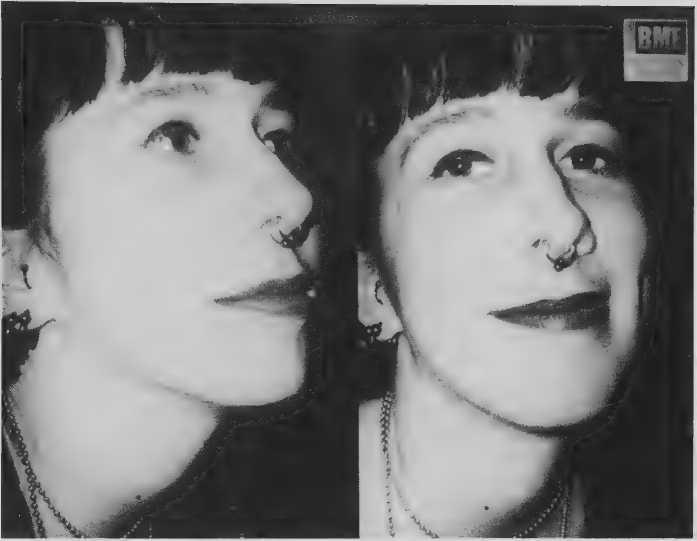
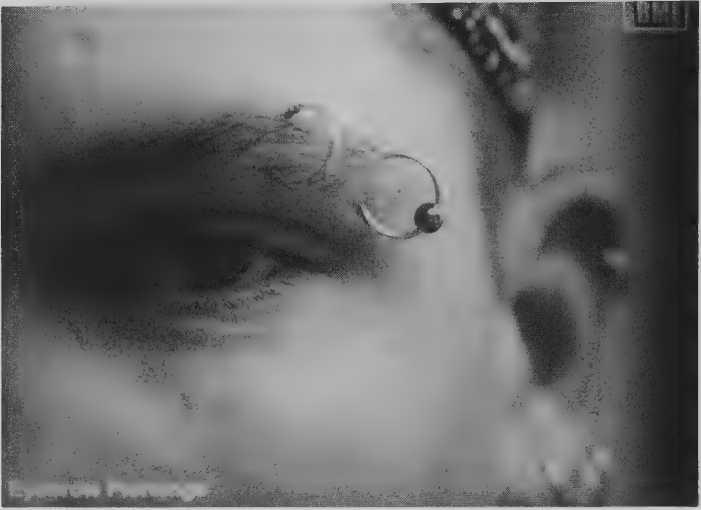
Figures 7a and 7b Collected facial piercings—eyebrow, nostril and lip.
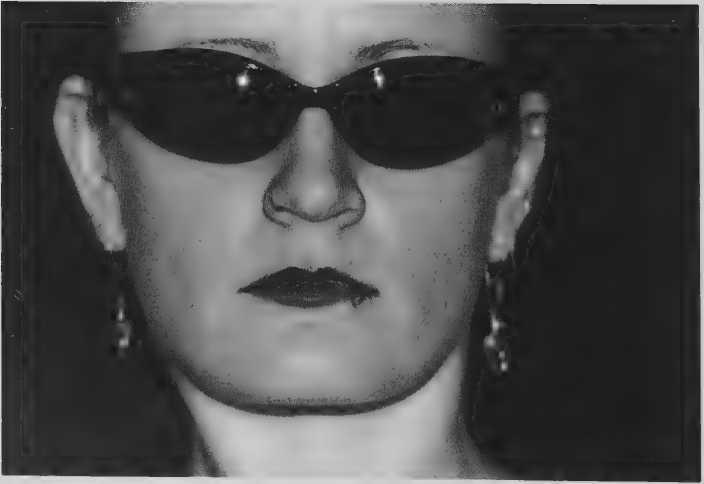
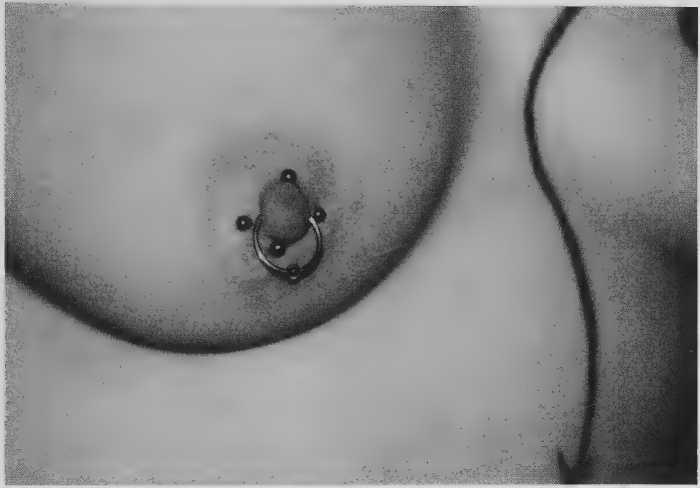
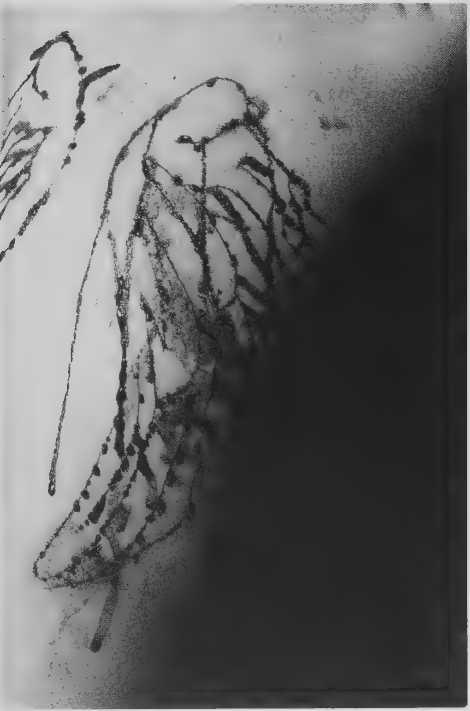
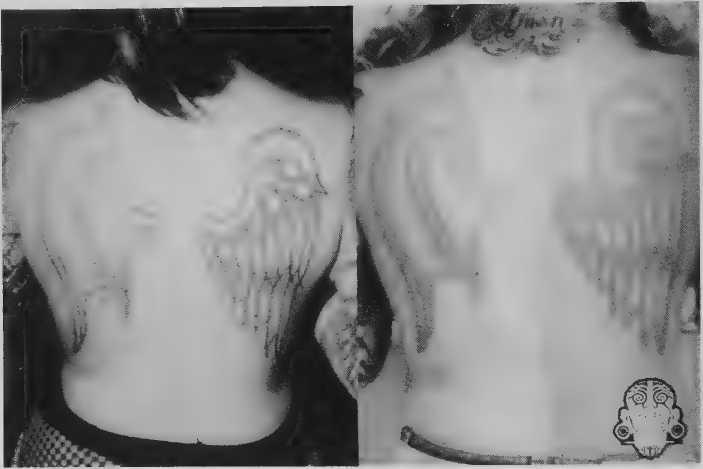
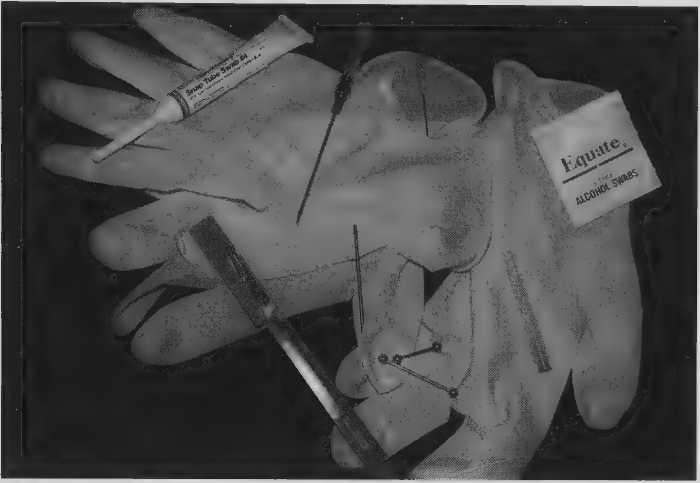
Technology never intended for pleasure, certainly such mischievous pleasure, is turned away from its aims. Medical technology has proven especially pervertible: the hollow, sharp-pointed design of the hypodermic makes the best piercing needle, one that slices out a core of flesh rather than pushing the skin aside. (In fact, Jim Ward, founder of the Gauntlet and an important figure in contemporary piercing, says that he began piercing with large-gauge hypodermic needles, later adapting the design to suit piercers’ needs better (http://www.gauntlet.com/pfiq/reflections/roots1.html).) The best steel body jewelry is implant quality, developed to be put into the body; that same steel is used for less conventional implants as well (such as beads or rings that are placed just below the skin to create a relief pattern). Titanium and niobium have found military rather than medical use; by virtue of their light weight, strength, and ability to hold a strong smooth finish they make ideal aircraft metals—and, for the same reasons (not to mention their wonderful range of color possibilities), great body jewelry. Latex surgical or exam gloves are standard across body-art practitioners, while autoclaves sterilize needles and scalpels. Those surgical scalpels make ideal tools for cuttings, while in the hands of body-artist Steve Haworth (of Phoenix, Arizona) the cauterizing scalpel is making its debut as a branding tool. The body may become itself technological, intermixed with metals and dies and surgically-styled scars, but it is the somatic which seduces; this is technology with none of the meanings of technology, visible, tangible, playful, and perverse.
Again, Baudrillard tells us that seduction is always double, that it subverts meanings and plays across surfaces. Certainly if we use technology to modify our bodies we have allowed these technological possibilities to seduce us—but we have seduced them, too: these things were not meant to be toys. Our bodies are not meant, we are told, to be toys either—and that, I suspect, is why some conservative professions regard modified bodies as “unprofessional,” hinting too strongly at our unproductive possibilities, hinting that we might start playing when we should be at work—or that even at work, unbeknownst to others, we could be playful.
It is revealing of the depth of our cultural normalization, our distrust of the unregulated somatic, that this playful approach to the body makes many people very uncomfortable. Well-known body-art practitioner Fakir Musafar advertises his journal Body Play to “those who view their bodies as living canvas to decorate, and living clay to sculpt...” (http://www.bodyplay.com). We are not supposed to take up such a playful, sensual, fully material attitude towards our bodies. We are supposed to value their “natural” beauty, which is supposed to mean that we would never desecrate them with “mutilation” nor alter them with ornamentation; or we are supposed to value their mechanical utility, meaning that we maximize their efficiency—and minimize their distractions where the distracting element does not just wash or strip off. Body modification takes us away from what we’re supposed to do and even what we’re supposed to be. Some modifications are visible unless we make an effort to hide them; others are almost always hidden. In the latter cases the surface of the body becomes itself a secret, a pleasure away from the omnipresent gaze, known only as one chooses. The delight of knowing how little others might approve is often its own pleasure.[7] Manifest or concealed, body modification gives a whole new sense to playing with yourself, and we all know what a bad thing that is.
The Seduction of “Beauty”
In body modification beauty, like technology, is seduced from its normative meanings. Kathy Pauly Morgan has argued for a feminist response to the increasing use of cosmetic surgery: reclaiming ugliness (Morgan 1994: 252). Body modification goes further and, I would argue, better, bypassing the need to reclaim the ugly by delightedly and with minimal normalization—to steal the slogan of Venus Modern Body Arts piercing studio in New York City—“redefining beauty.” To reappropriate ugliness is a great fuck-you; but it leaves too many old dichotomies untouched. The harder beauty, or aesthetic delight, is to normalize, the more fun we can have with appearance.
Technology, generally, is aimed toward efficiency. Fashion, generally, permits of change, and we are warned against making lasting changes on the basis of the fleeting attribute of fashionability. Make-up wipes off; haircuts and dye jobs and perms grow out; clothing and jewelry are meant to be removed. Modifying the body itself is different. Think about it! the warnings run; This is your body! What will happen when you get old? As the young adult book Everything You Need to Know About the Dangers of Tattooing and Body Piercing asks, “What if your future boyfriend, girlfriend, husband or wife doesn’t think your piercing is sexy?” (Reybold 1996: 22). Ted Polhemus makes the more theoretical observation, “Because of the fashion-conscious, pro-change nature of most of the West since the Renaissance ours is a world where to have permanent body decoration such as a tattoo or a collection of facial piercings is, ipso facto, to be different from the norm” (Polhemus 1988: 50). Fashion—in cosmesis and cosmetic surgery still more clearly than in clothing—has meant defying the temporality of the body, appearing indefinitely youthful and always up to date. When the body is itself modified, the ornamentation will change as the body does, most conspicuously though by no means solely in modifications to the skin such as tattooing or scarification. Thus modification mixes the implicit playfulness of ornamentation with the implicit seriousness of the lifelong—perhaps giving bodily playfulness and pleasure a value beyond that we are culturally inclined to accept.
It is in fact part of the pleasure and interest of modifications that, when you get old, the changes you’ve made get old with you. And while this intimation of carnality disturbs many, some practitioners are delighted by it, and by the implicit temporality of the body. Tattooist Vyvyn Lazonga argues that “Getting pierced or tattooed tends to develop a person’s awareness of memory’” (Lazonga, in Juno and Vale 1989:125) an observation echoed by the much-tattooed artist Lyle Tuttle (Tuttle, in Vale and Juno 1989: 116). An experiential description from the electronic journal Body Modification EZine includes the observation, “... my first little dinky and faded tiny straight-off-the-flash rose that I got when I was 18 is still on my shoulder blade. I may get it recolored some day, but I kinda like how it is now, for sentimental reasons or something” (http://www.BME.FreeQ.com/pierce/10-female/ap-hood.html). Kroker’s description makes vivid the difference between this and traditional cosmetic modification: “For many years, doctors have been injecting silicone into women’s faces ... This is the new digitized, transistorized face that rewires memory: no more wrinkles, no more tears, no more history” (Kroker 1993: 27). Modified bodies carry the inscriptions of their history rather than defying them.
Undoubtedly many people, especially those who are younger and are seeking more “mainstream” or “trendy” modifications, do not consider the long-term impact of their navel rings or the rosebuds tattooed on their ankles. (Eric Jones, a tattooist at New York’s East Side Ink, says that he quit body piercing in part out of despair at the number of teen girls who wanted to know how soon their navel rings could be removed.) Different modifications are more or less likely to endure or, upon removal attempts, to scar.[8] It may well be that some less serious practitioners overestimate the ease of removal or underestimate the chance of scarring. It is clear that relative permanence—the tendency to last as long as the body—is nonetheless considered seriously at some level; the most enduring modifications, such as scarification, are less popular than those more widely regarded as reversible (though it is undoubtedly relevant that scarification is perceived as more painful as well).
The two sets of objections most often encountered by those who love modified bodies are, as we might expect, medical and beauty-oriented. Many people assume that if one admires the beauty of bodies, it’s blasphemy to alter them, failing to understand that we often ornament what we really value; others, as I’ve noted, worry about making permanent what they see as trendy. Though reputable practitioners have excellent safety records, many texts warn of dire possibilities: “While there are no documented cases of someone contracting HIV as a result of getting a tattoo, the threat is still there,” the magazine Current Health warns (1996: 31). Everything You Need to Know about the Dangers of Tattooing and Body Piercing presents similar scenarios: “Both procedures puncture your skin, leaving your body vulnerable to infections and disease” (Reybold 1996: 9); “Tattooing opens your body to potential infection, disease, and scarring” (Reybold 1996: 18); while “Piercing ... is intensely painful.... A fresh piercing also requires a great deal of care to prevent infection” (Reybold 1996: 43). One does in fact have to take care of piercings, tattoos, brands, cuttings or other scarrings, implants, or corseted waists. But actual health risks are quite readily avoidable, so that the urging of Current Health to have ear piercing—nothing else is even worthy of discussion there—done by a health professional to ensure sterility is both unnecessary and intriguing, evincing a strong desire to bring body technologies back into the hands of the medical profession. As piercer and brander Keith Alexander of Modern American Body Arts points out, “most [doctors] will have a grasp on sterile procedure, but are clueless in the important areas of jewelry selection and placement” (Alexander 1997: 9). And the “timeconsuming” care processes that the warning texts emphasize generally take rather less time than brushing one’s teeth—certainly not a particularly strenuous addition to most schedules.
Resistance to modification, then, occurs on the grounds of productive efficiency (under the guise of professionalism), aesthetics (on the grounds of both attractiveness and fashionability), and health (where dire warnings seem intended less to professionalize modification than to stop it). It should be no surprise to find hostility to any seductive or ironic mode; the pleasure is that the hostility fails to slow down the subversion.
Why Now?
Though some practitioners like to link contemporary Western modifications to the rites of other, usually tribal, cultures, I would include myself among those who are dubious about such easy recontextualization, though I realize that some do intend in their practice to recognize and respect other cultures’ use of modification. Ted Polhemus points out, “... the end products of these [other cultural] alterations to the human form are seen not only as ‘attractive’ but also ‘natural’” (Polhemus 1988: 25). (We may feel the same about implant-heightened cheekbones and collagen-puffed lips.) I do not intend, by my contemporary and Western focus, to pretend that modification of the body is novel. Anyone who has studied the subject is familiar with tales of tattooed Egyptian mummies thousands of years old, of the amazingly cross-cultural range of modifying somatic practice. As Polhemus’s remark indicates, however, the meaning of such practices is hardly identical across cultures. People who modify their bodies may enjoy the sense of being linked to this long history or wide multiculturalism, and this is not irrelevant—but for tribal peoples we can be fairly certain that modification does not serve the function of connection to other cultures. We may deeply admire the beauty or power of images and practices from other cultures; appropriation may occur respectfully as well as colonially. But meaning is contextual, and we cannot be ahistorical in exploring the semiotics of the flesh.
Everything You Need to Know comments more contemptuously on this cultural difference: “In many cultures throughout the world, body piercings have a spiritual or cultural significance. In the West, however, such piercings are a fad driven by popular culture” (Reybold 1996: 20). (Apparently cultural significance only exists if the culture in question is unpopular.) But why now, and so much, for us? Why, when technology has made it easier than ever to evade our physicality, our abnormality; why now, when not only normal beauty but ethereal anonymity are available to so many of us?
I suspect that is why—that, and a growing awareness of the social construction of embodiment, which has led at least some of us to wonder about reconstructing ourselves in a quite explicit fashion. The ease with which technology controls and standardizes our bodies, or increasingly disembodies us, meets with our bodies’ seduction of both technology and normativity. Remember Foucault: resistance intensifies with the pressure exerted by power.
Again, we must note the seductive, subversive irony of the resistance that body modification manifests. One could, of course, respond to standardization and these technological escalations simply by direct refusal. Some would seek the body’s resistance to standardized beauty, pathological antisomaticity, or technological regimentation or disincarnation in “nature.” Nature, here, implies a body untouched by these cultural forces, pure and romantically wild. A retreat to “nature,” minimizing one’s contact with the technological and fashionable, is difficult and unlikely, but not quite impossible. So one could attempt a retreat to the natural purity of oneself, to a sense of a bodily integrity, an organic and unaltered beauty. But this retreat or disengagement may become a refusal of possibilities, which too easily slips into an ahistorical effort at denial.
And in the end this is probably impossible; we understand bodies as we do and live bodies as we are because we are bodies-in-society; we don’t somehow come to an individual awareness and then find ourselves in company. We’ve known better than that since Hegel, at least. The society in which we find ourselves embodied is caught up in both fashion and technology; refusing to respond to this is not among our options.
An attempted return to a romanticized nature is impossibly individualistic. The postmodern response on display in modified bodies is fully contextualized, ironically playful, and willfully constructed. Normalizing technologies are reappropriated now, when they’re so well developed and so potent, to serve the body’s own ends of delight. They have been seduced, their meanings twisted. We must be careful not to underestimate the sheer mischievous vitality of the flesh, and the astonishing reappropriative powers of pleasure.
And in fact the sheer number of playful possibilities is impressive. Body modification puts the entire surface of the body into play, multiplying our polysensory possible pleasures. Many of us like the look of piercings, but their effects are decidedly tactile as well—and, with weights on, kinesthetic. Tattoos are actually tactile as well—you can feel them if your touch is light enough—and can be placed to move with the body, visually amplifying the muscular kinesthesis. Cuts and brands slide between the tactile and the visual, less visible than tattoos but more tangible. Implants are more tangible still. The restraint of a corset or a pair of heels alters our most basic functions—standing, walking, breathing. Technology, whether assembly-line productive or virtually ethereal; ordinary cosmetic discomfort: these discourage the kinesthetic awareness that modified bodies make terribly hard to ignore.
Remember, though, that subversion or resistance is co-extensive with power, and seduction with normative meaning; their relations are complex intertwinings rather than one-sided triumphs. We must remember that intertwining of power and resistance, and the multiple reversibilities of seduction. It is not the body against technology, normalization, or disincarnality that wins out; it is pleasure, subverting our sense of the body as much as of anything else. Modification plays against the destiny of anatomy, which is real enough though in a very limited sense, by bringing to bear all manner of artifice, changing the body— really changing it, not just pasting over its surface. The body is changed, it doesn’t just triumph over or annihilate those forces that alter its “nature,” if there is such a thing.
In the end, I think that we face neither a romantic return to “primitivism” nor a rejection of contemporary culture; but neither is this set of styles an uncritical embrace of that culture. Rather, we find here an ironic distance from the “natural” body and normalizing technology, and at the same time an affirmative and seductive engagement. I have long suspected that the best modes of resistance and subversion are those of pure seductive delight, those that face power with an ironic twist, as this one does, wondering, in the dual presence of bodies and technologies, “Ooh—what can we do with this?” And even where modification goes more mainstream than some of us would like, its techniques will function as modes of resistance, because it is never quite normalizable, never quite the same; because the community most values its creative cases; because pleasure, as Foucault tells us, works against the moral and socio-economic norms of the well-behaved; and because the seduction of meaning is always its own delight.
References
Alexander, Keith. 1997. “Piercing 101 ... and beyond.” Prometheus 27. Armstrong, Myrna L. 1991. “Career-oriented women with tattoos.” Image: The Journal of Nursing Scholarship 23.
Baudrillard, Jean. 1991 [1979]. Seduction, trans. Brian Singer. New York: St. Martin’s Press.
Body Modification Ezine. http://BME.FreeQ.com.
Caplan, Richard, Judith Komaromi and Mike Rhodes. 1996. “Obsessive- Compulsive disorder, tattooing and bizarre sexual practices.” British Journal of Psychiatry 168.
Current Health. 1996. “Editorial: Getting the Facts about Body Piercing.” Feb. 1996.
Derrida, Jacques. 1979 [1978]. Spurs Nietzsche’s Styles, trans. Barbara Harlow. Chicago: University of Chicago Press.
Dworkin, Andrea. 1994. “Gynocide: Chinese footbinding.” In Lining with Contradictions: Controversies in Feminist Social Ethics, ed. Alison M. Jaggar. Boulder, CO: Westview Press.
Foucault, Michel. 1979 [1975]. Discipline and Punish: The Birth of the Prison, trans. Alan Sheridan. New York: Vintage Books.
Foucault, Michel. 1980. Power/Knowledge: Selected Interviews and Other Writings 1972–1977, ed. Colin Gordon, trans. Colin Gordon, Leo Marshall, John Mepham and Kate Soper. New York: Pantheon.
Freund, Jesse. 1997. “Super thinking: art in the postbiological era.” Wired 5.05.
Gauntlet/PFIQ Online, http://www.gauntlet.com/pfiq.
Haraway, Donna J. 1991. Simians, Cyborgs, and Women: The Reinvention of Nature. New York: Routledge.
Kroker, Arthur. 1993. Spasm: Virtual Reality, Android Music, Electric Flesh. New York: St Martin’s.
Morgan, Kathy Pauly. 1994. “Women and the knife: cosmetic surgery and the colonization of women’s bodies.” In Living with Contradictions: Controversies in Feminist Social Ethics, ed. Alison M. Jaggar. Boulder, CO: Westview Press.
Nataff, Zachary. 1996. Lesbians Talk Transgender. London: Scarlet Press.
Polhemus, Ted. 1988. Body Styles. Luton, UK: Lennard Publishing.
Reybold, Laura 1996. Everything You Need To Know about the Dangers of Tattooing and Body Piercing. New York: The Rosen Publishing Group.
Rubenstein, Ruth. 1995. Dress Codes. Boulder, CO: Westview Press.
Sirius, R. U. 1997. “David Cronenberg: sex machine.” Wired 5.05.
Turner, Bryan S. 1991. “Recent developments in the theory of the body.” In The Body: Social Process and Cultural Theory, ed. by Mike Featherstone, Mike Hepworth and Bryan S. Turner. London: Sage Publications.
Vale, V. and Andrea Juno (eds). 1989. Modern Primitives. San Francisco: V/Search Publications.
[1] I never did find out what the show was, because I was in the company of a channel-surfer.
[2] As just one example of this thought, a recent article in Wired magazine suggests that we are moving toward a “postbiological” transformed consciousness (Freund 1997: 88).
[3] An extreme case of such slippage via cyberspace misrepresentation led not long ago to a quite unintended, and ultimately annulled, same- sex marriage—one partner had represented herself as male but was anatomically female.
[4] Cf. p.53: “Seduction takes from discourse its sense and turns it from its truth.”
[5] This notion is so widespread in Foucault’s work as to be uncitable. But see especially the interview “Body/Power,” in Foucault 1980.
[6] Interestingly, observers often seem to be inclined to follow through with the fully tactile experience—many tattooed people report having strangers touch their tattoos, not always seeking permission first. I thank Christine Braunberger for drawing this to my attention in the discussion following her paper “The Tattoo’s Postmodern Performance of Art” at the Style Conference, Bowling Green State University, July 1997.
[7] Many report enjoying the knowledge that they are far less staid than they appear. In an interview, Monte Cazzazza describes the experience of Sleazy, a member of the band Coil (not, it must be admitted, overwhelmingly staid in outward appearance): “Sleazy told me that after he got his penis piercing he’d occasionally have these high- powered business meetings with record company executives. He thought it was funny that here he was sitting with them, and if only they had x-ray vision ... But he knew it was there, and it provided a constant source of irony and distancing” (Vale and Juno 1989:130).
[8] For example, tattooing is best regarded as permanent—removal by laser does scar most skin; but tattoos can be removed (with scarring), elaborated upon, recolored, or covered by new work. Piercing jewelry is generally removable, though scarring is unpredictable—interestingly, the very popular navel piercing is rather likely to scar. Large- gauge and stretched piercings, however, will scar or even remain stretched. Branding and cutting are not reversible, though one could no doubt alter them by layering new scars atop the old. Implants are removable; here too scarring varies. Finally, among the modifications I have mentioned, corsetry has lasting effects only after years of dedicated practice; I am not aware of data on the long-term reversibility of its effects.