
& Diagnostic and Statistical Manual of Mental Disorders IV. <https://doi.org/10.1176/appi.books.9780890420249.dsm-iv-tr>
Ted Kaczynski’s ‘Am I a Schizoid?’ Questionnaire
Appendix 1: Comparing Ted’s questionnaire to the DSM-4
Appendix 2: Personality Disorders
Specific Culture, Age, and Gender Features
General diagnostic criteria for a Personality Disorder
Dimensional Models for Personality Disorders
Cluster A Personality Disorders
301.0 Paranoid Personality Disorder
Associated Features and Disorders
Specific Culture, Age, and Gender Features
301.20 Schizoid Personality Disorder
Associated Features and Disorders
Specific Culture, Age, and Gender Features
301.22 Schizotypal Personality Disorder
Associated Features and Disorders
Specific Culture, Age, and Gender Features
Cluster B Personality Disorders
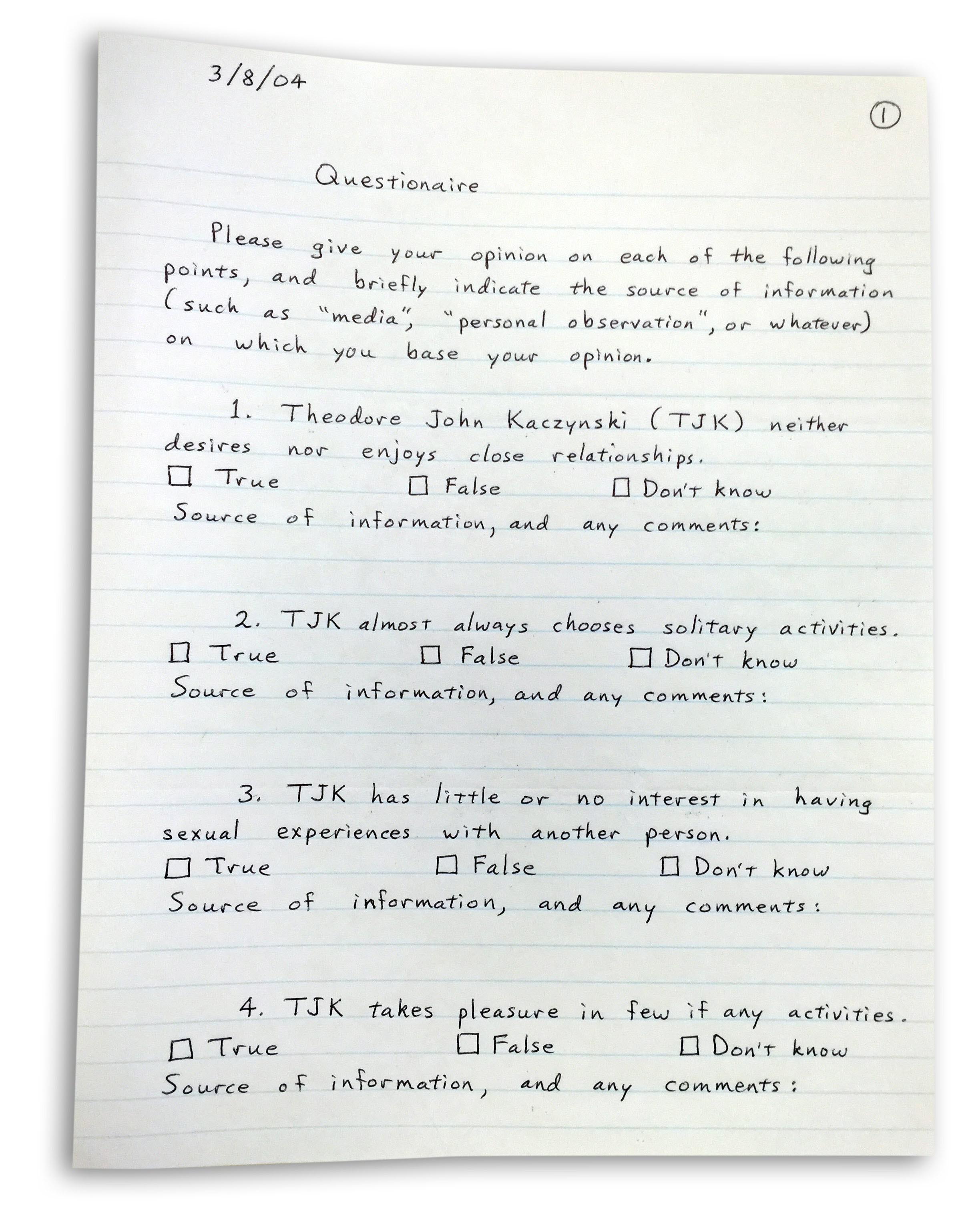
Questionnaire
Please give your opinion on each of the following points, and briefly indicate the source of information (such as “media”, “personal observation”, or whatever) on which you base your opinion.
1. Theodore John Kaczynski (TJK) neither desires nor enjoys close relationships.
☐ True ☐ False ☐ Don’t know
Source of information, and any comments:
2. TJK almost always chooses solitary activities.
☐ True ☐ False ☐ Don’t know
Source of information, and any comments:
3. TJK has little or no interest in having sexual experiences with another person.
☐ True ☐ False ☐ Don’t know
Source of information, and any comments:
4. TJK takes pleasure in few if any activities.
☐ True ☐ False ☐ Don’t know
Source of information, and any comments:
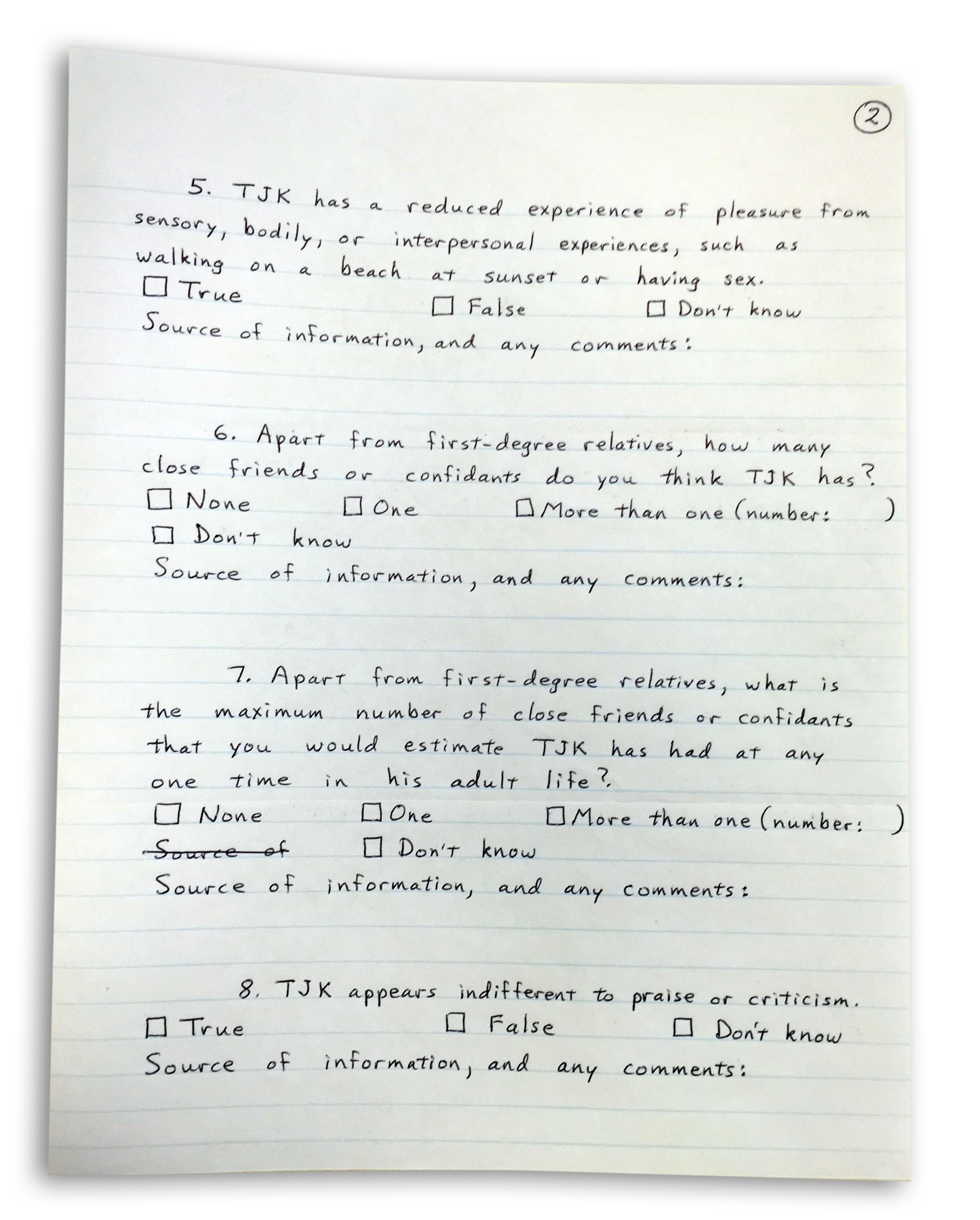
5. TJK has a reduced experience of pleasure from sensory, bodily, or interpersonal experiences, such as walking on a beach at sunset or having sex.
☐ True ☐ False ☐ Don’t know
Source of information, and any comments:
6. Apart from first-degree relatives, how many close friends or confidants do you think TJK has?
☐ None ☐ One ☐ More than one (number: ) ☐ Don’t know
Source of information, and any comments:
7. Apart from first-degree relatives, what is the maximum number of close friends or confidants that you would estimate TJK has had at any one time in his adult life?
☐ None ☐ One ☐ More than one (number: ) ☐ Don’t know
Source of information, and any comments:
8. TJK appears indifferent to praise or criticism.
☐ True ☐ False ☐ Don’t know
Source of information, and any comments:
Appendix 1: Comparing Ted’s questionnaire to the DSM-4
| Ted’s Questionnaire | Diagnostic criteria for 301.20 Schizoid Personality Disorder |
| 1. Theodore John Kaczynski (TJK) neither desires nor enjoys close relationships. | (1) neither desires nor enjoys close relationships, including being part of a family |
| 2. TJK almost always chooses solitary activities. | (2) almost always chooses solitary activities |
| 3. TJK has little or no interest in having sexual experiences with another person. | (3) has little, if any, interest in having sexual experiences with another person |
| 4. TJK takes pleasure in few if any activities. | (4) takes pleasure in few, if any, activities |
| 5. TJK has a reduced experience of pleasure from sensory, bodily, or interpersonal experiences, such as walking on a beach at sunset or having sex. | |
| 6. Apart from first-degree relatives, how many close friends or confidants do you think TJK has? | (5) lacks close friends or confidants other than first-degree relatives |
| 7. Apart from first-degree relatives, what is the maximum number of close friends or confidants that you would estimate TJK has had at any one time in his adult life? | |
| 8. TJK appears indifferent to praise or criticism. | (6) appears indifferent to the praise or criticism of others |
| (7) shows emotional coldness, detachment, or flattened affectivity |
Appendix 2: Personality Disorders
Note: This is an extract from the chapter of the DSM-4 which Ted very likely based his questionnaire on.
This section begins with a general definition of Personality Disorder that applies to each of the 10 specific Personality Disorders. A Personality Disorder is an enduring pattern of inner experience and behavior that deviates markedly from the expectations of the individual’s culture, is pervasive and inflexible, has an onset in adolescence or early adulthood, is stable over time, and leads to distress or impairment. The Personality Disorders included in this section are listed below.
Paranoid Personality Disorder is a pattern of distrust and suspiciousness such that others’ motives are interpreted as malevolent.
Schizoid Personality Disorder is a pattern of detachment from social relationships and a restricted range of emotional expression.
Schizotypal Personality Disorder is a pattern of acute discomfort in close relationships, cognitive or perceptual distortions, and eccentricities of behavior.
Antisocial Personality Disorder is a pattern of disregard for, and violation of, the rights of others.
Borderline Personality Disorder is a pattern of instability in interpersonal relationships, self-image, and affects, and marked impulsivity.
Histrionic Personality Disorder is a pattern of excessive emotionality and attention seeking.
Narcissistic Personality Disorder is a pattern of grandiosity, need for admiration, and lack of empathy.
Avoidant Personality Disorder is a pattern of social inhibition, feelings of inadequacy, and hypersensitivity to negative evaluation.
Dependent Personality Disorder is a pattern of submissive and clinging behavior related to an excessive need to be taken care of.
Obsessive-Compulsive Personality Disorder is a pattern of preoccupation with orderliness, perfectionism, and control.
Personality Disorder Not Otherwise Specified is a category’ provided for two situations: 1) the individual’s personality pattern meets the general criteria for a Personality Disorder and traits of several different Personality Disorders are present, but the criteria for any specific Personality Disorder are not met; or 2) the individual’s personality pattern meets the general criteria for a Personality Disorder, but the individual is considered to have a Personality Disorder that is not included in the Classification (e.g., passive-aggressive personality disorder).
The Personality Disorders are grouped into three clusters based on descriptive similarities. Cluster A includes the Paranoid, Schizoid, and Schizotypal Personality Disorders. Individuals with these disorders often appear odd or eccentric. Cluster B includes the Antisocial, Borderline, Histrionic, and Narcissistic Personality’ Disorders. Individuals with these disorders often appear dramatic, emotional, or erratic. Cluster C includes the Avoidant, Dependent, and Obsessive-Compulsive Personality Disorders. Individuals with these disorders often appear anxious or fearful. It should be noted that this clustering system, although useful in some research and educational situations, has serious limitations and has not been consistently validated. Moreover, individuals frequently present with co-occurring Personality Disorders from different clusters.
Diagnostic Features
Personality traits are enduring patterns of perceiving, relating to, and thinking about the environment and oneself that are exhibited in a wide range of social and personal contexts. Only when personality’ traits are inflexible and maladaptive and cause significant functional impairment or subjective distress do they constitute Personality Disorders. The essential feature of a Personality Disorder is an enduring pattern of inner experience and behavior that deviates markedly from the expectations of the individual’s culture and Ls manifested in at least two of the following areas: cognition, affectivity, interpersonal functioning, or impulse control (Criterion A). This enduring pattern is inflexible and pervasive across a broad range of personal and social situations (Criterion B) and leads to clinically significant distress or impairment in social, occupational, or other important areas of functioning (Criterion C). The pattern is stable and of long duration, and its onset can be traced back at least to adolescence or early adulthood (Criterion D). The pattern is not better accounted for as a manifestation or consequence of another mental disorder (Criterion E) and is not due to the direct physiological effects of a substance (e.g., a drug of abuse, a medication, exposure to a toxin) or a general medical condition (e.g., head trauma) (Criterion F). Specific diagnostic criteria are also provided for each of the Personality Disorders included in this section. The items in the criteria sets for each of the specific Personality Disorders are listed in order of decreasing diagnostic importance as measured by relevant data on diagnostic efficiency (when available).
The diagnosis of Personality Disorders requires an evaluation of the individual’s long-term patterns of functioning, and the particular personality features must be evident by early adulthood. The personality traits that define these disorders must also be distinguished from characteristics that emerge in response to specific situational stressors or more transient mental states (e.g.. Mood or Anxiety Disorders, Substance Intoxication). The clinician should assess the stability of personality traits over time and across different situations. Although a single interview with the person is sometimes sufficient for making the diagnosis, it is often necessary to conduct more than one interview and to space these over time. Assessment can also be complicated by the fact that the characteristics that define a Personality Disorder may not be considered problematic by the individual (i.e., the traits are often ego-syntonic). To help overcome this difficulty, supplementary information from other informants may be helpful.
Recording Procedures
Personality’ Disorders are coded on Axis II. When (as is often the case) an individual’s pattern of behavior meets criteria for more than one Personality Disorder, the clinician should list all relevant Personality Disorder diagnoses in order of importance. When an Axis I disorder is not the principal diagnosis or the reason for visit, the clinician is encouraged to indicate which Personality Disorder is the principal diagnosis or the reason for visit by noting “Principal Diagnosis” or “Reason for Visit” in parentheses. In most cases, the principal diagnosis or the reason for visit is also the main focus of attention or treatment. Personality Disorder Not Otherwise Specified is the appropriate diagnosis for a “mixed” presentation in which criteria are not met for any single Personality Disorder but features of several Personality Disorders are present and involve clinically significant impairment.
Specific maladaptive personality’ traits that do not meet the threshold for a Personality’ Disorder may also be listed on Axis II. In such instances, no specific code should be used; for example, the clinician might record “Axis II: V71.09 No diagnosis on Axis II, histrionic personality’ traits.” The use of particular defense mechanisms may also be indicated on Axis II. For example, a clinician might record “Axis II: 301.6 Dependent Personality Disorder; Frequent use of denial.” Glossary definitions for specific defense mechanisms and the Defensive Functioning Scale appear in Appendix B (p. 807).
When an individual has a chronic Axis I Psychotic Disorder (e.g., Schizophrenia) that was preceded by a preexisting Personality’ Disorder (e.g., Schizotypal, Schizoid, Paranoid), the Personality Disorder should be recorded on Axis II, followed by “Pre- morbid ” in parentheses. For example: Axis I: 295.30 Schizophrenia, Paranoid Ty’pe; Axis II: 301.20 Schizoid Personality Disorder (Premorbid).
Specific Culture, Age, and Gender Features
Judgments about personality’ functioning must take into account the individual’s ethnic, cultural, and social background. Personality Disorders should not be confused with problems associated with acculturation following immigration or with the expression of habits, customs, or religious and political values professed by the individual’s culture of origin. Especially when evaluating someone from a different background, it is useful for the clinician to obtain additional information from informants who are familiar with the person’s cultural background.
Personality’ Disorder categories may’ be applied to children or adolescents in those relatively’ unusual instances in which the individual’s particular maladaptive personality traits appear to be pervasive, persistent, and unlikely to be limited to a particular developmental stage or an episode of an Axis I disorder. It should be recognized that the traits of a Personality Disorder that appear in childhood will often not persist unchanged into adult life. To diagnose a Personality’ Disorder in an individual under age 18 years, the features must have been present for at least 1 year. The one exception to this is Antisocial Personality Disorder, which cannot be diagnosed in individuals under age 18 years (see p. 701). Although, by definition, a Personality Disorder requires an onset no later than early adulthood, individuals may not come to clinical attention until relatively late in life. A Personality Disorder may be exacerbated following the loss of significant supporting persons (e.g., a spouse) or previously stabilizing social situations (e.g., a job). However, the development of a change in personality’ in middle adulthood or later life warrants a thorough evaluation to determine the possible presence of a Personality Change Due to a General Medical Condition or an unrecognized Substance-Related Disorder.
Certain Personality Disorders (e.g.. Antisocial Personality Disorder) are diagnosed more frequently in men. Others (e.g., Borderline, Histrionic, and Dependent Personality Disorders) are diagnosed more frequently in women. Although these differences in prevalence probably reflect real gender differences in the presence of such patterns, clinicians must be cautious not to overdiagnose or underdiagnose certain Personality Disorders in females or in males because of social stereotypes about typical gender roles and behaviors.
Course
The features of a Personality Disorder usually become recognizable during adolescence or early adult life. By definition, a Personality Disorder is an enduring pattern of thinking, feeling, and behaving that is relatively stable over time. Some types of Personality Disorder (notably, Antisocial and Borderline Personality Disorders) tend to become less evident or to remit with age, whereas this appears to be less true for some other types (e.g., Obsessive-Compulsive and Schizotypal Personality Disorders).
Differential Diagnosis
Many of the specific criteria for the Personality Disorders describe features (e.g., suspiciousness, dependency, or insensitivity) that are also characteristic of episodes of Axis I mental disorders. A Personality’ Disorder should be diagnosed only when the defining characteristics appeared before early adulthcxid, are typical of the individual’s long-term functioning, and do not occur exclusively during an episode of an Axis I disorder. It may be particularly difficult (and not particularly useful) to distinguish Personality Disorders from those Axis I disorders (e.g., Dysthymic Disorder) that have an early onset and a chronic, relatively stable course. Some Personality Disorders may have a “spectrum” relationship to particular Axis I conditions (e.g., Schizotypal Personality Disorder with Schizophrenia; Avoidant Personality Disorder with Social Phobia) based on phenomenological or biological similarities or familial aggrega tion.
For the three Personality Disorders that may be related to the Psychotic Disorders (i.e., Paranoid, Schizoid, and Schizotypal), there is an exclusion criterion stating that the pattern of behavior must not have occurred exclusively during the course of Schizophrenia, a Mixxl Disorder With Psychotic Features, or another Psychotic Disorder. When an individual has a chronic Axis I Psychotic Disorder (e.g.. Schizophrenia) that was preceded by a preexisting Personality Disorder, the Personality Disorder should also be recorded, on Axis II, followed by “Premorbid” in parentheses.
The clinician must be cautious in diagnosing Personality Disorders during an episode of a Mood Disorder or an Anxiety Disorder because these conditions may have cross-sectional symptom features that mimic personality traits and mayr make it more difficult to evaluate retrospectively the individual’s long-term patterns of functioning. When personality changes emerge and persist after an individual has been exposed to extreme stress, a diagnosis of Posttraumatic Stress Disorder should be considered (see p. 463). When a person has a Substance-Related Disorder, it is important not to make a Personality Disorder diagnosis based solely on behaviors that are consequences of Substance Intoxication or Withdrawal or that are associated with activities in the service of sustaining a dependency’ (e.g., antisocial behavior). When enduring changes in personality arise as a result of the direct physiological effects of a general medical condition (e.g., brain tumor), a diagnosis of Personality Change Due to a General Medical Condition (p. 187) should be considered.
Personality’ Disorders must be distinguished from personality traits that do not reach the threshold for a Personality Disorder. Personality traits are diagnosed as a Personality Disorder only when they are inflexible, maladaptive, and persisting and cause significant functional impairment or subjective distress.
General diagnostic criteria for a Personality Disorder
A. An enduring pattern of inner experience and behavior that deviates markedly from the expectations of the individual’s culture. This pattern is manifested in two (or more) of the following areas:
(1) cognition (i.e., ways of perceiving and interpreting self, other people, and events)
(2) affectivity (i.e., the range, intensity, lability, and appropriateness of emotional response)
(3) interpersonal functioning
(4) impulse control
B. The enduring pattern is inflexible and pervasive across a broad range of personal and social situations.
C. The enduring pattern leads to clinically significant distress or impairment in social, occupational, or other important areas of functioning.
D. The pattern is stable and of long duration, and its onset can be traced back at least to adolescence or early adulthood.
E. The enduring pattern is not better accounted for as a manifestation or consequence of another mental disorder.
F. The enduring pattern is not due to the direct physiological effects of a substance (e.g., a drug of abuse, a medication) or a general medical condition (e.g., head trauma).
Dimensional Models for Personality Disorders
The diagnostic approach used in this manual represents the categorical perspective that Personality Disorders are qualitatively distinct clinical syndromes. An alternative to the categorical approach is the dimensional perspective that Personality Disorders represent maladaptive variants of personality traits that merge imperceptibly into normality and into one another. There have been many’ different attempts to identify the most fundamental dimensions that underlie the entire domain of normal and pathological personality functioning. One model consists of the following five dimensions: neuroticism, introversion versus extroversion, closedness versus openness to experience, antagonism versus agreeableness, and conscientiousness. Another ap-
proach is to describe more specific areas of personality dysfunction, including as many as 15–40 dimensions (e.g., affective reactivity, social apprehensiveness, cognitive distortion, impulsivity, insincerity, self-centeredness). Other dimensional models that have been proposed include positive affectivity, negative affectivity, and constraint; novelty seeking, reward dependence, harm avoidance, persistence, self- directedness, cooperativeness, and self-transcendence; power (dominance vs. submission) and affiliation (love vs. hate); and pleasure seeking versus pain avoidance, passive accommodation versus active modification, and self-propagation versus other nurturance. The DSM-IV Personality Disorder clusters (i.e., odd-eccentric, dramatic-emotional, and anxious-fearful) may also be viewed as dimensions representing spectra of personality dysfunction on a continuum with Axis 1 mental disorders. The alternative dimensional models share much in common and together appear to cover the important areas of personality dysfunction. Their integration, clinical utility, and relationship with the Personality Disorder diagnostic categories and various aspects of personality dysfunction are under active investigation.
Cluster A Personality Disorders
301.0 Paranoid Personality Disorder
Diagnostic Features
The essential feature of Paranoid Personality Disorder is a pattern of pervasive distrust and suspiciousness of others such that their motives are interpreted as malevolent. This pattern begins by early adulthood and is present in a variety of contexts.
Individuals with this disorder assume that other people will exploit, harm, or deceive them, even if no evidence exists to support this expectation (Criterion Al). They suspect on the basis of little or no evidence that others are plotting against them and may attack them suddenly, at any time and without reason. They often feel that they have been deeply and irreversibly injured by another person or persons even when there is no objective evidence for this. They are preoccupied with unjustified doubts about the loyalty or trustworthiness of their friends and associates, whose actions are minutely scrutinized for evidence of hostile intentions (Criterion A2). Any perceived deviation from trustworthiness or loyalty serves to support their underlying assumptions. They are so amazed when a friend or associate shows loyalty that they cannot trust or believe it. It they get into trouble, they expect that friends and associates will either attack or ignore them.
Individuals with this disorder are reluctant to confide in or become close to others because they fear that the information they share will be used against them (Criterion A3). They may refuse to answer personal questions, saying that the information is “nobody’s business.” They read hidden meanings that are demeaning and threatening into benign remarks or events (Criterion A4). For example, an individual with this disorder may misinterpret an honest mistake by a store clerk as a deliberate attempt to shortchange or may view a casual humorous remark by a co-worker as a serious
character attack. Compliments are often misinterpreted (e.g., a compliment on a new acquisition is misinterpreted as a criticism for selfishness; a compliment on an accomplishment is misinterpreted as an attempt to coerce more and better performance). They may view an offer of help as a criticism that they are not doing well enough on their own.
Individuals with this disorder persistently bear grudges and are unwilling to forgive the insults, injuries, or slights that they think they have received (Criterion A5). Minor slights arouse major hostility, and the hostile feelings persist for a long time. Because they are constantly vigilant to the harmful intentions of others, they very often feel that their character or reputation has been attacked or that they have been slighted in some other way. They are quick to counterattack and react with anger to perceived insults (Criterion A6). Individuals with this disorder may be pathologically jealous, often suspecting that their spouse or sexual partner is unfaithful without any adequate justification (Criterion A7). They may gather trivial and circumstantial “evidence” to support their jealous beliefs. They want to maintain complete control of intimate relationships to avoid being betrayed and may constantly question and challenge the whereabouts, actions, intentions, and fidelity’ of their spouse or partner.
Paranoid Personality Disorder should not be diagnosed if the pattern of behavior occurs exclusively during the course of Schizophrenia, a Mood Disorder With Psychotic Features, or another Psychotic Disorder or if it is due to the direct physiological effects of a neurological (e.g., temporal lobe epilepsy) or other general medical condition (Criterion B).
Associated Features and Disorders
Individuals with Paranoid Personality Disorder are generally difficult to get along with and often have problems with close relationships. Their excessive suspiciousness and hostility may be expressed in overt argumentativeness, in recurrent complaining, or by quiet, apparently hostile aloofness. Because they are hypervigilant for potential threats, they may act in a guarded, secretive, or devious manner and appear to be “cold” and lacking in tender feelings. Although they may appear to be objective, rational, and unemotional, they more often display a labile range of affect, with hostile, stubborn, and sarcastic expressions predominating. Their combative and suspicious nature may elicit a hostile response in others, which then serves to confirm their original expectations.
Because individuals with Paranoid Personality Disorder lack trust in others, they have an excessive need to be self-sufficient and a strong sense of autonomy. They also need to have a high degree of control over those around them. They are often rigid, critical of others, and unable to collaborate, although they have great difficulty accepting criticism themselves. They may blame others for their own shortcomings. Because of their quickness to counterattack in response to the threats they perceive around them, they may be litigious and frequently become involved in legal disputes. Individuals with this disorder seek to confirm their preconceived negative notions regarding people or situations they encounter, attributing malevolent motivations to others that are projections of their own fears. They may exhibit thinly hidden, unrealistic grandiose fantasies, are often attuned to issues of power and rank, and tend to develop negative stereotypes of others, particularly those from population groups
distinct from their own. Attracted by simplistic formulations of the world, they are often wary of ambiguous situations. They may be perceived as “fanatics” and form tightly knit “cults” or groups with others who share their paranoid belief systems.
Particularly in response to stress, individuals with this disorder may experience very brief psychotic episodes (lasting minutes to hours). In some instances. Paranoid Personality Disorder may appear as the premorbid antecedent of Delusional Disorder or Schizophrenia. Individuals with this disorder may develop Major Depressive Disorder and may be at increased risk for Agoraphobia and Obsessive-Compulsive Disorder. Alcohol and other Substance Abuse or Dependence frequently occur. The most common co-occurring Personality Disorders appear to be Schizotypal, Schizoid, Narcissistic, Avoidant, and Borderline.
Specific Culture, Age, and Gender Features
Some behaviors that are influenced by sociocultural contexts or specific life circumstances may be erroneously labeled paranoid and may even be reinforced by the process of clinical evaluation. Members of minority groups, immigrants, political and economic refugees, or individuals of different ethnic backgrounds may display guarded or defensive behaviors due to unfamiliarity (e.g., language barriers or lack of knowledge of rules and regulations) or in response to the perceived neglect or indifference of the majority society. These behaviors can, in turn, generate anger and frustration in those who deal with these individuals, thus setting up a vicious cycle of mutual mistrust, which should not be confused with Paranoid Personality Disorder. Some ethnic groups also display culturally related behaviors that can be misinterpreted as paranoid.
Paranoid Personality Disorder may be first apparent in childhood and adolescence with solitariness, poor peer relationships, social anxiety, underachievement in school, hypersensitivity, peculiar thoughts and language, and idiosyncratic fantasies. These children may appear to be “odd” or “eccentric” and attract teasing. In clinical samples, this disorder appears to be more commonly diagnosed in males.
Prevalence
The prevalence of Paranoid Personality’ Disorder has been reported to be 0.5%-2.5% in the general population, 10%-30% among those in inpatient psychiatric settings, and 2%-10% among those in outpatient mental health clinics.
Familial Pattern
There is some evidence for an increased prevalence of Paranoid Personality Disorder in relatives of probands with chronic Schizophrenia and for a more specific familial relationship with Delusional Disorder, Persecutory Type.
Differential Diagnosis
Paranoid Personality Disorder can be distinguished from Delusional Disorder, Persecutory Type, Schizophrenia, Paranoid Type, and Mood Disorder With Psychotic
Features because these disorders are all characterized by a period of persistent psychotic symptoms (e.g., delusions and hallucinations). To give an additional diagnosis of Paranoid Personality Disorder, the Personality Disorder must have been present before the onset of psychotic symptoms and must persist when the psychotic symptoms are in remission. When an individual has a chronic Axis I Psychotic Disorder (e.g.. Schizophrenia) that was preceded by Paranoid Personality Disorder, Paranoid Personality Disorder should be recorded on Axis II, followed by “Premorbid” in parentheses.
Paranoid Personality Disorder must be distinguished from Personality Change Due to a General Medical Condition, in which the traits emerge due to the direct effects of a general medical condition on the central nervous system. It must also be distinguished from symptoms that may develop in association with chronic substance use (e.g., Cocaine-Related Disorder Not Otherwise Specified). Finally, it must also be distinguished from paranoid traits associated with the development of physical handicaps (e.g., a hearing impairment).
Other Personality Disorders may be confused with Paranoid Personality Disorder because they have certain features in common. It is, therefore, important to distinguish among these disorders based on differences in their characteristic features. However, if an individual has personality features that meet criteria for one or more Personality Disorders in addition to Paranoid Personality Disorder, all can be diagnosed. Paranoid Personality Disorder and Schizotypal Personality Disorder share the traits of suspiciousness, interpersonal aloofness, and paranoid ideation, but Schizotypal Personality Disorder also includes symptoms such as magical thinking, unusual perceptual experiences, and odd thinking and speech. Individuals with behaviors that meet criteria for Schizoid Personality Disorder are often perceived as strange, eccentric, cold, and aloof, but they do not usually have prominent paranoid ideation. The tendency of individuals with Paranoid Personality Disorder to react to minor stimuli with anger is also seen in Borderline and Histrionic Personality Disorders. However, these disorders are not necessarily associated with pervasive suspiciousness. People with Avoidant Personality Disorder may also be reluctant to confide in others, but more because of a fear of being embarrassed or found inadequate than from fear of others’ malicious intent. Although antisocial behavior may be present in some individuals with Paranoid Personality Disorder, it is not usually motivated by a desire for personal gain or to exploit others as in Antisocial Personality Disorder, but rather is more often due to a desire for revenge. Individuals with Narcissistic Personality Disorder may occasionally display suspiciousness, social withdrawal, or alienation, but this derives primarily from fears of having their imperfections or flaws revealed.
Paranoid traits may be adaptive, particularly in threatening environments. Paranoid Personality Disorder should be diagnosed only when these traits are inflexible, maladaptive, and persisting and cause significant functional impairment or subjective distress.
Diagnostic criteria for 301.0 Paranoid Personality Disorder
A. A pervasive distrust and suspiciousness of others such that their motives are interpreted as malevolent, beginning by early adulthood and present in a variety of contexts, as indicated by four (or more) of the following:
(1 ) suspects, without sufficient basis, that others are exploiting, harming, or deceiving him or her
(2) is preoccupied with unjustified doubts about the loyalty or trustworthiness of friends or associates
(3) is reluctant to confide in others because of unwarranted fear that the information will be used maliciously against him or her
(4) reads hidden demeaning or threatening meanings into benign remarks or events
(5) persistently bears grudges, i.e., is unforgiving of insults, injuries, or slights
(6) perceives attacks on his or her character or reputation that are not apparent to others and is quick to react angrily or to counterattack
(7) has recurrent suspicions, without justification, regarding fidelity of spouse or sexual partner
B. Does not occur exclusively during the course of Schizophrenia, a Mood Disorder With Psychotic Features, or another Psychotic Disorder and is not due to the direct physiological effects of a general medical condition.
Note: If criteria are met prior to the onset of Schizophrenia, add “Premorbid,” e.g., “Paranoid Personality Disorder (Premorbid).”
301.20 Schizoid Personality Disorder
Diagnostic Features
The essential feature of Schizoid Personality Disorder is a pervasive pattern of detachment from social relationships and a restricted range of expression of emotions in interpersonal settings. This pattern begins by early adulthood and is present in a variety of contexts.
Individuals with Schizoid Personality Disorder appear to lack a desire for intimacy, seem indifferent to opportunities to develop close relationships, and do not seem to derive much satisfaction from being part of a family or other social group (Criterion Al). They prefer spending time by themselves, rather than being with other people They often appear to be socially isolated or “loners” and almost always choose solitary activities or hobbies that do not include interaction with others (Criterion A2). They prefer mechanical or abstract tasks, such as computer or mathematical games. They may have very little interest in having sexual experiences with another person (Criterion A3) and take pleasure in few, if any, activities (Criterion A4). There is usually a reduced experience of pleasure from sensory, bodily, or interpersonal experiences, such as walking on a beach at sunset or having sex. These individuals have no close friends or confidants, except possibly a first-degree relative (Criterion A5).
Individuals with Schizoid Personality Disorder often seem indifferent to the approval or criticism of others and do not appear to be bothered by what others may think of them (Criterion A6). They may be oblivious to the normal subtleties of social interaction and often do not respond appropriately to social cues so that they seem socially inept or superficial and self-absorbed. They usually display a “bland” exterior without visible emotional reactivity and rarely reciprocate gestures or facial expressions, such as smiles or nods (Criterion A7). They claim that they rarely experience strong emotions such as anger and joy. They often display a constricted affect and appear cold and aloof. However, in those very unusual circumstances in which these individuals become at least temporarily comfortable in revealing themselves, they may acknowledge having painful feelings, particularly related to social interactions.
Schizoid Personality Disorder should not be diagnosed if the pattern of behavior occurs exclusively during the course of Schizophrenia, a Mood Disorder With Psychotic Features, another Psychotic Disorder, or a Pervasive Developmental Disorder or if it is due to the direct physiological effects of a neurological (e.g., temporal lobe epilepsy) or other general medical condition (Criterion B).
Associated Features and Disorders
Individuals with Schizoid Personality Disorder may have particular difficulty expressing anger, even in response to direct provocation, which contributes to the impression that they lack emotion. Their lives sometimes seem directionless, and they may appear to “drift” in their goals. Such individuals often react passively to adverse circumstances and have difficulty responding appropriately to important life events. Because of their lack of social skills and lack of desire for sexual experiences, individuals with this disorder have few friendships, date infrequently, and often do not marry. Occupational functioning may be impaired, particularly if interpersonal involvement is required, but individuals with this disorder may do well when they work under conditions of social isolation. Particularly in response to stress, individuals with this disorder may experience very brief psychotic episodes (lasting minutes to hours). In some instances. Schizoid Personality Disorder may appear as the pre- morbid antecedent of Delusional Disorder or Schizophrenia. Individuals with this disorder may sometimes develop Major Depressive Disorder. Schizoid Personality Disorder most often co-occurs with Schizotypal, Paranoid, and Avoidant Personality Disorders.
Specific Culture, Age, and Gender Features
Individuals from a variety of cultural backgrounds sometimes exhibit defensive behaviors and interpersonal styles that may be erroneously labeled as schizoid. For example, those who have moved from rural to metropolitan environments may react with “emotional freezing” that may last for several months and be manifested by solitary activities, constricted affect, and other deficits in communication. Immigrants from other countries are sometimes mistakenly perceived as cold, hostile, or indifferent.
Schizoid Personality Disorder may be first apparent in childhood and adolescence with solitariness, poor peer relationships, and underachievement in school, which mark these children or adolescents as different and make them subject to teasing.
Schizoid Personality Disorder is diagnosed slightly more often in males and may cause more impairment in them.
Prevalence
Schizoid Personality Disorder is uncommon in clinical settings.
Familial Pattern
Schizoid Personality Disorder may have increased prevalence in the relatives of individuals with Schizophrenia or Schizotypal Personality Disorder.
Differential Diagnosis
Schizoid Personality Disorder can be distinguished from Delusional Disorder, Schizophrenia, and Mood Disorder With Psychotic Features because these disorders are all characterized by a period of persistent psychotic symptoms (e.g., delusions and hallucinations). To give an additional diagnosis of Schizoid Personality Disorder, the Personality’ Disorder must have been present before the onset of psychotic symptoms and must persist when the psychotic symptoms are in remission. When an individual has a chronic Axis ! Psychotic Disorder (e.g., Schizophrenia) that was preceded by Schizoid Personality Disorder, Schizoid Personality Disorder should be recorded on Axis 11 followed by “Premorbid” in parentheses.
There may be great difficulty differentiating individuals with Schizoid Personality Disorder from those with milder forms of Autistic Disorder and from those with Asperger’s Disorder. Milder forms of Autistic Disorder and Asperger’s Disorder are differentiated by more severely impaired social interaction and stereotvped behaviors and interests.
Schizoid Personality Disorder must be distinguished from Personality Change Due to a General Medical Condition, in which the traits emerge due to the direct effects of a general medical condition on the central nervous system. It must also be distinguished from symptoms that may develop in association with chronic substance use (e.g., Cocaine-Related Disorder Not Otherwise Specified).
Other Personality Disorders may be confused with Schizoid Personality Disorder because they have certain features in common. It is, therefore, important to distinguish among these disorders based on differences in their characteristic features. However, if an individual has personality’ features that meet criteria for one or more Personality Disorders in addition to Schizoid Personality Disorder, all can be diagnosed. Although characteristics of social isolation and restricted affectivity are common to Schizoid, Schizotypal, and Paranoid Personality Disorders, Schizoid Personality Disorder can be distinguished from Schizotypal Personality Disorder by the lack of cognitive and perceptual distortions and from Paranoid Personality Disorder by the lack of suspiciousness and paranoid ideation. The social isolation of Schizoid Personality Disorder can be distinguished from that of Avoidant Personality Disorder, which is due to fear of being embarrassed or found inadequate and excessive anticipation of rejection. In contrast, people with Schizoid Personality Disorder have a more pervasive detachment and limited desire for social intimacy. Individuals with Obsessive-Compulsive Personality Disorder may also show an apparent social detachment stemming from devotion to work and discomfort with emotions, but they do have an underlying capacity for intimacy.
Individuals who are “loners” may display personality traits that might be considered schizoid. Only when these traits are inflexible and maladaptive and cause significant functional impairment or subjective distress do they constitute Schizoid Personality Disorder.
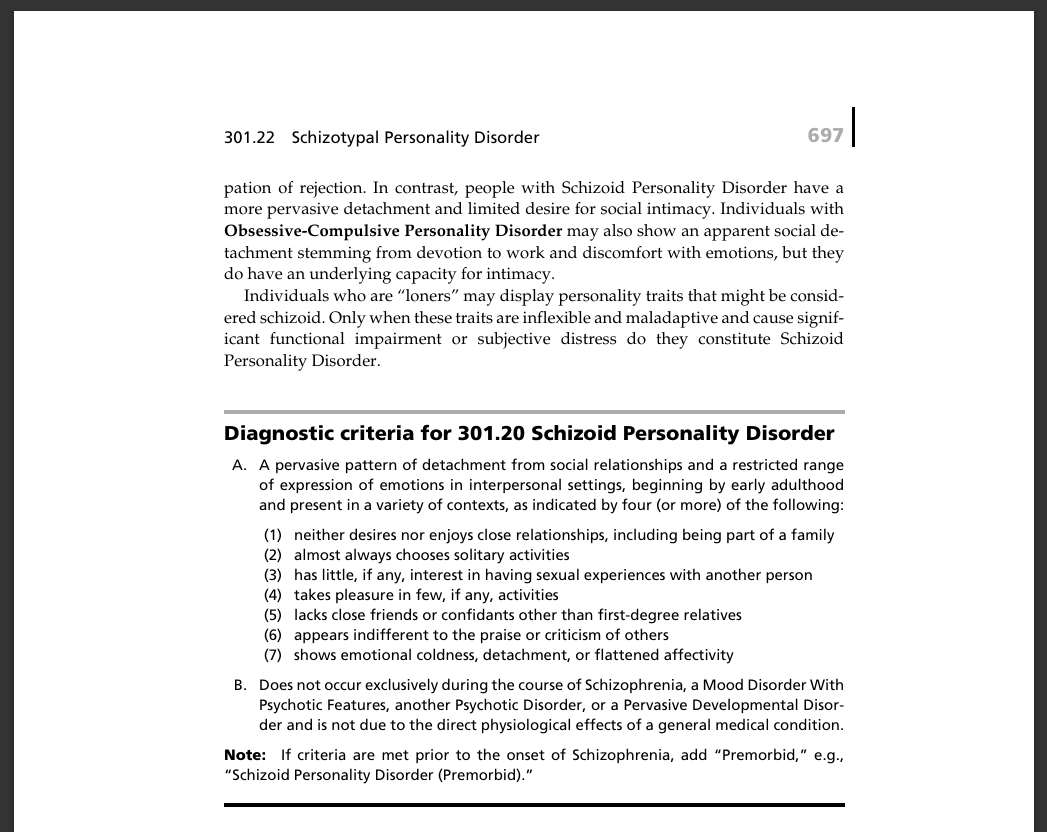
Diagnostic criteria for 301.20 Schizoid Personality Disorder
A. A pervasive pattern of detachment from social relationships and a restricted range of expression of emotions in interpersonal settings, beginning by early adulthood and present in a variety of contexts, as indicated by four (or more) of the following:
(1) neither desires nor enjoys close relationships, including being part of a family
(2) almost always chooses solitary activities
(3) has little, if any, interest in having sexual experiences with another person
(4) takes pleasure in few, if any, activities
(5) lacks close friends or confidants other than first-degree relatives
(6) appears indifferent to the praise or criticism of others
(7) shows emotional coldness, detachment, or flattened affectivity
B. Does not occur exclusively during the course of Schizophrenia, a Mood Disorder With Psychotic Features, another Psychotic Disorder, or a Pervasive Developmental Disorder and is not due to the direct physiological effects of a general medical condition.
Note: If criteria are met prior to the onset of Schizophrenia, add “Premorbid,” e.g., “Schizoid Personality Disorder (Premorbid).”
301.22 Schizotypal Personality Disorder
Diagnostic Features
The essential feature of Schizotypal Personality Disorder is a pervasive pattern of social and interpersonal deficits marked by acute discomfort with, and reduced capacity for, close relationships as well as by cognitive or perceptual distortions and eccentricities of behavior. This pattern begins by early adulthood and is present in a variety of contexts.
Individuals with Schizotypal Personality Disorder often have ideas of reference (i.e., incorrect interpretations of casual incidents and external events as having a particular and unusual meaning specifically for the person) (Criterion Al ). These should be distinguished from delusions of reference, in which the beliefs are held with delusional conviction. These individuals may be superstitious or preoccupied with paranormal phenomena that are outside the norms of their subculture (Criterion A2). They may feel that they have special powers to sense events before they happen or to read others’ thoughts. They may believe that they have magical control over others, which can be implemented directly (e.g., believing that their spouse’s taking the dog out for a walk is the direct result of thinking an hour earlier it should be done) or indirectly through compliance with magical rituals (e.g., walking past a specific object three times to avoid a certain harmful outcome). Perceptual alterations may be present (e.g., sensing that another person is present or hearing a voice murmuring his or her name) (Criterion A3). Their speech may include unusual or idiosyncratic phrasing and construction. It is often loose, digressive, or vague, but without actual derailment or incoherence (Criterion A4). Responses can be either overly concrete or overly abstract, and words or concepts are sometimes applied in unusual ways (e.g., the person may state that he or she was not “talkable” at work).
Individuals with this disorder are often suspicious and may have paranoid ideation (e.g., believing their colleagues at work are intent on undermining their reputation with the boss) (Criterion A5). They are usually not able to negotiate the full range of affects and interpersonal cuing required for successful relationships and thus often appear to interact with others in an inappropriate, stiff, or constricted fashion (Criterion A6). These individuals are often considered to be odd or eccentric because of unusual mannerisms, an often unkempt manner of dress that does not quite “fit together,” and inattention to the usual social conventions (e.g., the person may avoid eye contact, wear clothes that are ink stained and ill-fitting, and be unable to join in the give-and-take banter of co-workers) (Criterion A7).
Individuals with Schizotypal Personality Disorder experience interpersonal relatedness as problematic and are uncomfortable relating to other people. Although they may express unhappiness about their lack of relationships, their behavior suggests a decreased desire for intimate contacts. As a result, they usually have no or few close friends or confidants other than a first-degree relative (Criterion A8). They are anxious in social situations, particularly those involving unfamiliar people (Criterion A9). They will interact with other people when they have to, but prefer to keep to themselves because they feel that they are different and just do not “fit in.” Their social anxiety does not easily abate, even when they spend more time in the setting or become more familiar with the other people, because their anxiety tends to be associated with suspiciousness regarding others’ motivations. For example, when attending a dinner party, the individual with Schizotypal Personality Disorder will not become more relaxed as time goes on, but rather may become increasingly tense and suspicious.
Schizotypal Personality Disorder should not be diagnosed if the pattern of behavior occurs exclusively during the course of Schizophrenia, a Mood Disorder With Psychotic Features, another Psychotic Disorder, or a Pervasive Developmental Disorder (Criterion B).
Associated Features and Disorders
Individuals with Schizotypal Personality Disorder often seek treatment for the associated symptoms of anxiety, depression, or other dysphoric affects rather than for the personality disorder features per se. Particularly in response to stress, individuals with this disorder may experience transient psychotic episodes (lasting minutes to hours), although they usually are insufficient in duration to warrant an additional diagnosis such as Brief Psychotic Disorder or Schizophreniform Disorder. In some cases, clinically significant psychotic symptoms may develop that meet criteria for Brief Psychotic Disorder, Schizophreniform Disorder, Delusional Disorder, or Schizophrenia. Over half may have a history of at least one Major Depressive Episode. From 30% to 50% of individuals diagnosed with this disorder have a concurrent diagnosis of Major Depressive Disorder when admitted to a clinical setting. There is considerable co-occurrence with Schizoid, Paranoid, Avoidant, and Borderline Personality Disorders.
Specific Culture, Age, and Gender Features
Cognitive and perceptual distortions must be evaluated in the context of the individual’s cultural milieu. Pervasive culturally determined characteristics, particularly those regarding religious beliefs and rituals, can appear to be schizotypal to the uninformed outsider (e.g., voodoo, speaking in tongues, life beyond death, shamanism, mind reading, sixth sense, evil eye, and magical beliefs related to health and illness).
Schizotypal Personality Disorder may be first apparent in childhood and adolescence with solitariness, poor peer relationships, social anxiety, underachievement in school, hvpersensitivity, peculiar thoughts and language, and bizarre fantasies. These children may appear “odd” or “eccentric” and attract teasing. Schizotypal Personality Disorder may be slightly more common in males.
Prevalence
Schizotypal Personality’ Disorder has been reported to occur in approximately 3% of the general population.
Course
Schizotypal Personality Disorder has a relatively stable course, with only a small pro- portion of individuals going on to develop Schizophrenia or another Psychotic Disorder.
Familial Pattern
Schizotypal Personality Disorder appears to aggregate familially and is more prevalent among the first-degree biological relatives of individuals with Schizophrenia than among the general population. There may also be a modest increase in Schizophrenia and other Psychotic Disorders in the relatives of probands with Schizotypal Personality Disorder.
Differential Diagnosis
Schizotypal Personality’ Disorder can be distinguished from Delusional Disorder, Schizophrenia, and Mood Disorder With Psychotic Features because these disorders are all characterized by a period of persistent psychotic symptoms (e.g., delusions and hallucinations). To give an additional diagnosis of Schizotypal Personality Disorder, the Personality Disorder must have been present before the onset of psychotic symptoms and persist when the psychotic symptoms are in remission. When an individual has a chronic Axis I Psychotic Disorder (e.g., Schizophrenia) that was preceded by Schizotypal Personality Disorder, Schizotypal Personality Disorder should be recorded on Axis II followed by “Premorbid” in parentheses.
There may be great difficulty differentiating children with Schizotypal Personality Disorder from the heterogeneous group of solitary, odd children whose behavior is characterized by marked social isolation, eccentricity, or peculiarities of language and whose diagnoses would probably include milder forms of Autistic Disorder, Asperger’s Disorder, and Expressive and Mixed Receptive-Expressive Language Disorders. Communication Disorders may be differentiated by the primacy and severity of the disorder in language accompanied by compensatory efforts by the child to communicate by other means (e.g., gestures) and by the characteristic features of impaired language found in a specialized language assessment. Milder forms of Autistic Disorder and Asperger’s Disorder are differentiated by the even greater lack of social awareness and emotional reciprocity and stereotyped behaviors and interests.
Schizotypal Personality Disorder must be distinguished from Personality Change Due to a General Medical Condition, in which the traits emerge due to the direct effects of a general medical condition on the central nervous system. It must also be distinguished from symptoms that may develop in association with chronic substance use (e.g., Cocaine-Related Disorder Not Otherwise Specified).
Other Personality Disorders may be confused with Schizotypal Personality Disorder because they have certain features in common. It is, therefore, important to distinguish among these disorders based on differences in their characteristic features. However, if an individual has personality features that meet criteria for one or more Personality Disorders in addition to Schizotypal Personality Disorder, all can be diagnosed. Although Paranoid and Schizoid Personality Disorders may also be characterized by social detachment and restricted affect, Schizotypal Personality Disorder can be distinguished from these two diagnoses by the presence of cognitive or perceptual distortions and marked eccentricity or oddness. Close relationships are limited in both Schizotypal Personality Disorder and Avoidant Personality Disorder; however, in Avoidant Personality Disorder an active desire for relationships is constrained by a fear of rejection, whereas in Schizotypal Personality Disorder there is a lack of desire for relationships and persistent detachment. Individuals with Narcissistic Personality Disorder may also display suspiciousness, social withdrawal, or alienation, but in Narcissistic Personality Disorder these qualities derive primarily from fears of having imperfections or flaws revealed. Individuals with Borderline Personality Disorder may also have transient, psychotic-like symptoms, but these are usually more closely related to affective shifts in response to stress (e.g., intense anger, anxiety, or disappointment) and are usually more dissociative (e.g., derealization or depersonalization). In contrast, individuals with Schizotypal Personality Disorder are more likely to have enduring psychotic-like symptoms that may worsen under stress but are less likely to be invariably associated with pronounced affective symptoms. Although social isolation may occur in Borderline Personality Disorder, this is usually secondary to repeated interpersonal failures due to angry outbursts and frequent mood shifts, rather than a result of a persistent lack of social contacts and desire for intimacy. Furthermore, individuals with Schizotypal Personality Disorder do not usually demonstrate the impulsive or manipulative behaviors of the individual with Borderline Personality Disorder. However, there is a high rate of co- occurrence between the two disorders, so that making such distinctions is not always feasible. Schizotypal features during adolescence may be reflective of transient emotional turmoil, rather than an enduring personality disorder.
Diagnostic criteria for 301.22 Schizotypal Personality Disorder
A. A pervasive pattern of social and interpersonal deficits marked by acute discomfort with, and reduced capacity for, close relationships as well as by cognitive or perceptual distortions and eccentricities of behavior, beginning by early adulthood and present in a variety of contexts, as indicated by five (or more) of the following:
(1) ideas of reference (excluding delusions of reference)
(2) odd beliefs or magical thinking that influences behavior and is inconsistent with subcultural norms (e.g., superstitiousness, belief in clairvoyance, telepathy, or “sixth sense”; in children and adolescents, bizarre fantasies or preoccupations)
(3) unusual perceptual experiences, including bodily illusions
(4) odd thinking and speech (e.g., vague, circumstantial, metaphorical, overelaborate, or stereotyped)
(5) suspiciousness or paranoid ideation
(6) inappropriate or constricted affect
(7) behavior or appearance that is odd, eccentric, or peculiar
(8) lack of close friends or confidants other than first-degree relatives
(9) excessive social anxiety that does not diminish with familiarity and tends to be associated with paranoid fears rather than negative judgments about self
B. Does not occur exclusively during the course of Schizophrenia, a Mood Disorder With Psychotic Features, another Psychotic Disorder, or a Pervasive Developmental Disorder.
Note: If criteria are met prior to the onset of Schizophrenia, add “Premorbid,” e.g., “Schizotypal Personality Disorder (Premorbid).’
Cluster B Personality Disorders
301.7 Antisocial Personality Disorder
Diagnostic Features
The essential feature of Antisocial Personality Disorder is a pervasive pattern of disregard for, and violation of, the rights of others that begins in childhood or early adolescence and continues into adulthood. [...]