Ted Kaczynski’s Correspondence with Andrea Speijer-Beek
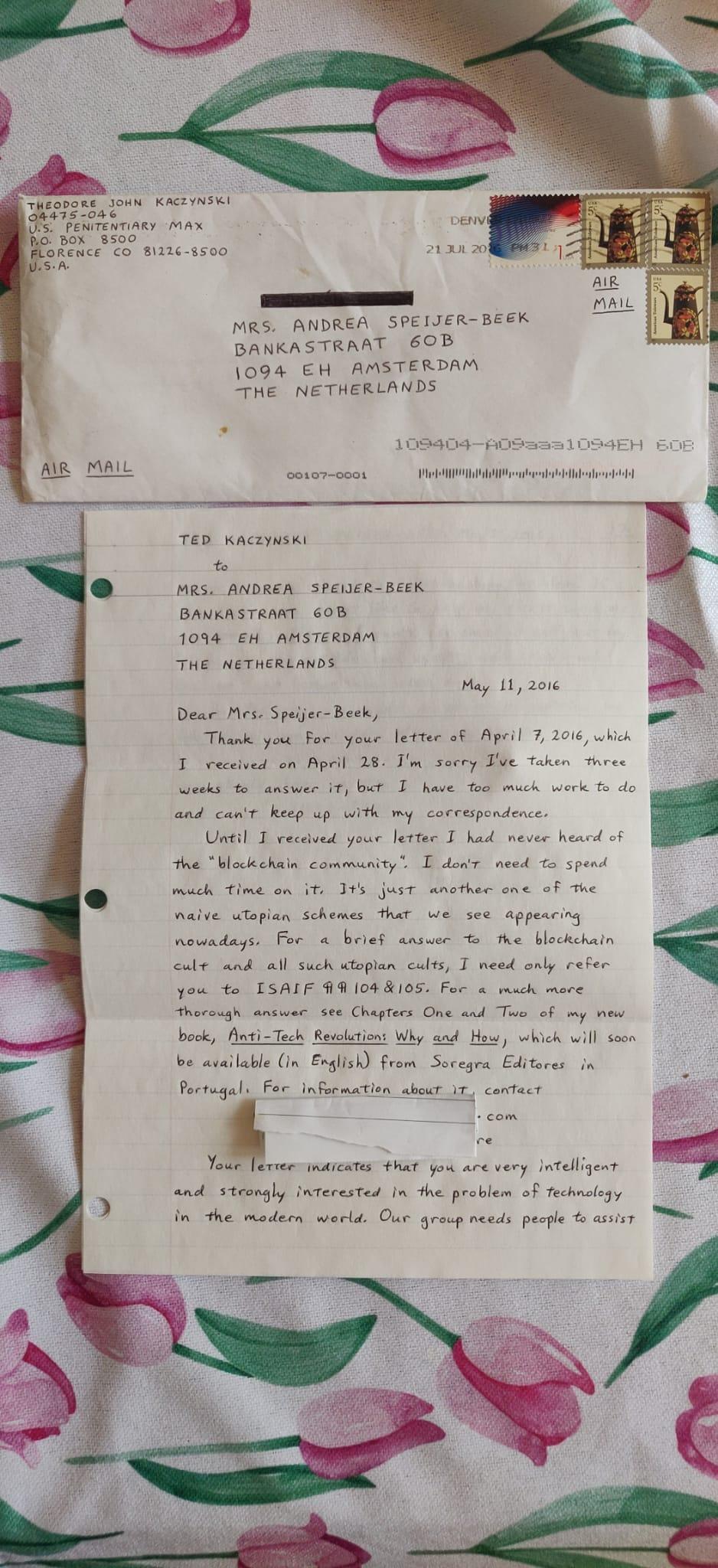
... Until I received your letter I had never heard of the “blockchain community”....
Explainer
From a few spies on BlueSky[1], I’ve heard that there’s been quite a bit of Googling on Andrea Speijer-Beek, and that some “wild” stuff has come up from that Google action. Well, that piqued my curiosity, and sure enough: I saw that a certain Marieke Kuypers has discovered that my name appears in the acknowledgments of “Ted Kazcynski (sic).”
(In the comments, by the way, there’s the following combination of words, which has surely never been written, spoken, or thought in the entire history of humanity: “Who is she and why do the Unabomber and Gouke Moes find her so interesting?”😆)
But to the point: what’s the deal? Here’s the deal.
When I still lived in Amsterdam and was interning at De Groene Amsterdammer and Motherboard Vice, anno 2016–2017, I had the technology portfolio.
Now, anyone who understands how a blockchain works knows who Ted Kaczynski is, because he wrote pretty much the most famous manifesto against the technological society of all time, Industrial Society and Its Future (ISAIF).
The rest of the people who don’t know that—and I suspect Marieke belongs to that latter category—know him as The Unabomber: a man who, after a brilliant career at Harvard, where he started studying mathematics at age 16 and was working as a young academic by 25, vanished from the face of the earth, only to resurface decades later as someone sending out explosive packages, for which he was eventually caught and sentenced to life in prison.
During his reign of terror, he managed to get ISAIF published in several national newspapers, under the promise that he would stop sending bombs if his manifesto was printed.
The manifesto starts with the resounding sentence: “The Industrial Revolution and its consequences have been a disaster for the human race.” Well, that grabs the reader right away, and the rest of the work doesn’t disappoint. (The co-optation of the environmental movement was already predicted in it in a phenomenal way—free link to the PDF below the post.)
Publishing that manifesto also immediately became his downfall, because his brother’s wife recognized the phrase “cool-headed logicians” and contacted the FBI. And so he ended up in a maximum security prison in Colorado, a sort of Hannibal Lecter cage where only the most dangerous criminals are housed.
But back to the discovery of my name in the acknowledgments of his latest book, Anti-Tech Revolution.
I read ISAIF as part of my philosophical research into technology and the long tradition of criticism of new technologies, in an edition called Technological Slavery, provided with a foreword by the philosopher Dr. David Skrbina.
He had published a long correspondence with Ted Kaczynski about his philosophy of technology as the foreword, and I was impressed. Kaczynski was fully willing to defend all his positions on substantive grounds and didn’t shy away from even Skrbina’s very sharp criticism.
After reading Technological Slavery, I wondered myself whether Kaczynski would change his mind about the inherent “reification” of humans by technological systems if he heard about the then fairly new blockchain technology, which enables decentralized use and seems to aim for precisely the opposite of the all-encompassing nightmare vision that Kaczynski sketches in his work.
I was also curious whether he had read Heidegger’s technology-critical passages, because I had the impression that Kaczynski had written a much more interesting and consistent elaboration than Heidegger in Being and Time.
In short: if David Skrbina could question him, why shouldn’t I? So I searched Reddit for his correspondence address and took up the pen.
Now, one must know that it’s a God-given right for inmates to correspond with the outside world, even the most high-profile prisoners. In the case of a conviction for terrorism, however—and quite rightly so—all correspondence is read and stored by the FBI. You naturally want to prevent jailbirds from communicating instructions to the outside world to wreak havoc there. Especially in the case of the late Ted Kaczynski, an extraordinarily mathematical genius, it’s possible that a triangle isn’t just a triangle. So I was fully aware that my letters would be read and stored.
Now, you can handle that in two ways.
1) You can use a pseudonym and send the mail from a PO box address
2) You can just use your full name and home address
I chose the latter, because like David Skrbina, I’m of the opinion that you can engage in substantive conversation with anyone without thereby breaking a moral law.
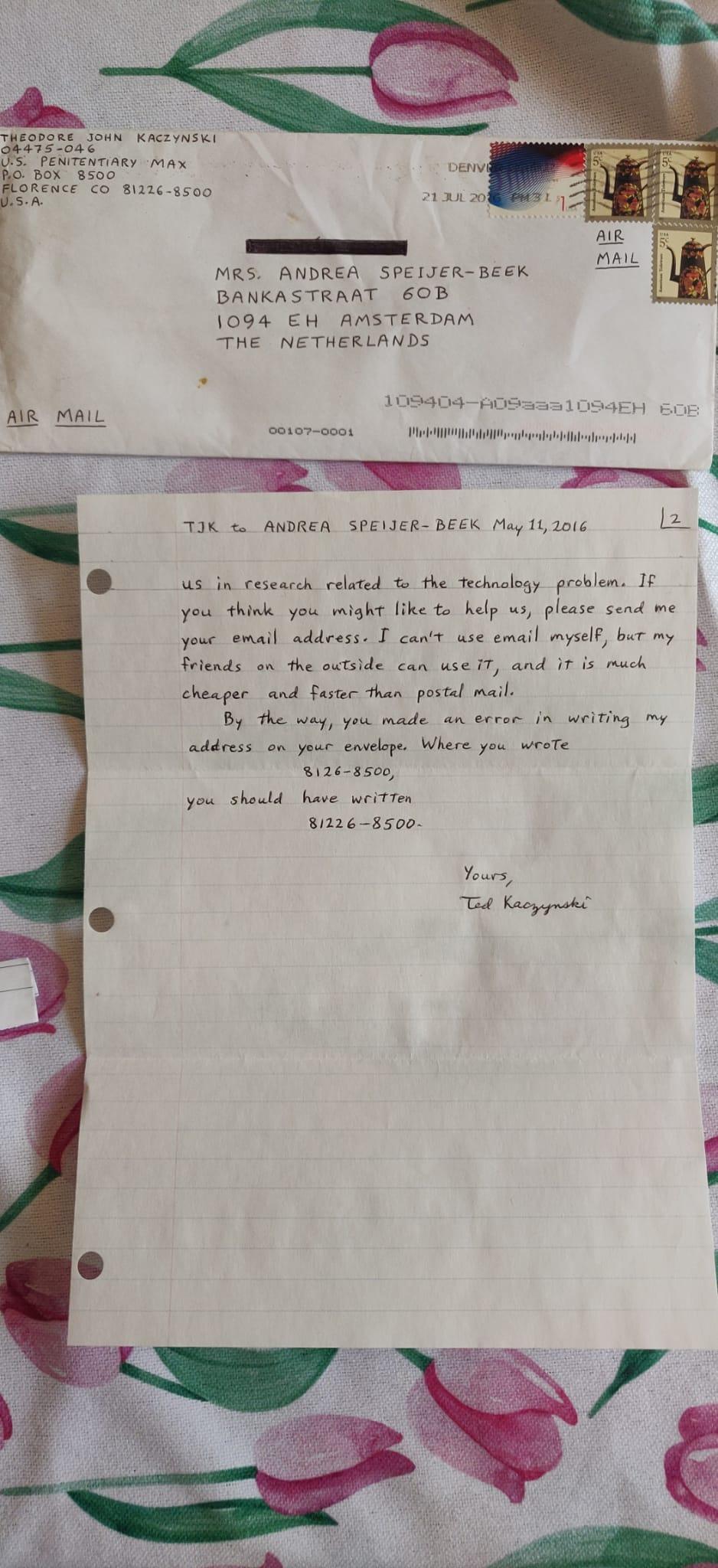
Ted Kaczynski wasn’t very impressed by the “blockchain community,” but he was by my letter, and he asked me if I wanted to become part of his little club of assistants in the outside world (see photos).
Now, that sounds exciting, but Ted was no man who needed spelling and grammar checks. What he did need was someone who, every few months, went to a library to verify whether a footnote he’d seen 30 years ago was indeed on page 261 and not on page 262.
When he had finished his book and asked if he could mention me in the acknowledgments, I gave permission for that, keeping in mind the same logic with which I started the correspondence: with an open visor and in the full conviction that increasing knowledge and debate is the basis of progress.
Thank you for coming to my Ted-talk, and read that book :)
[1] https://bsky.app/profile/marieke.bsky.social/post/3mkk6wbbnuc22