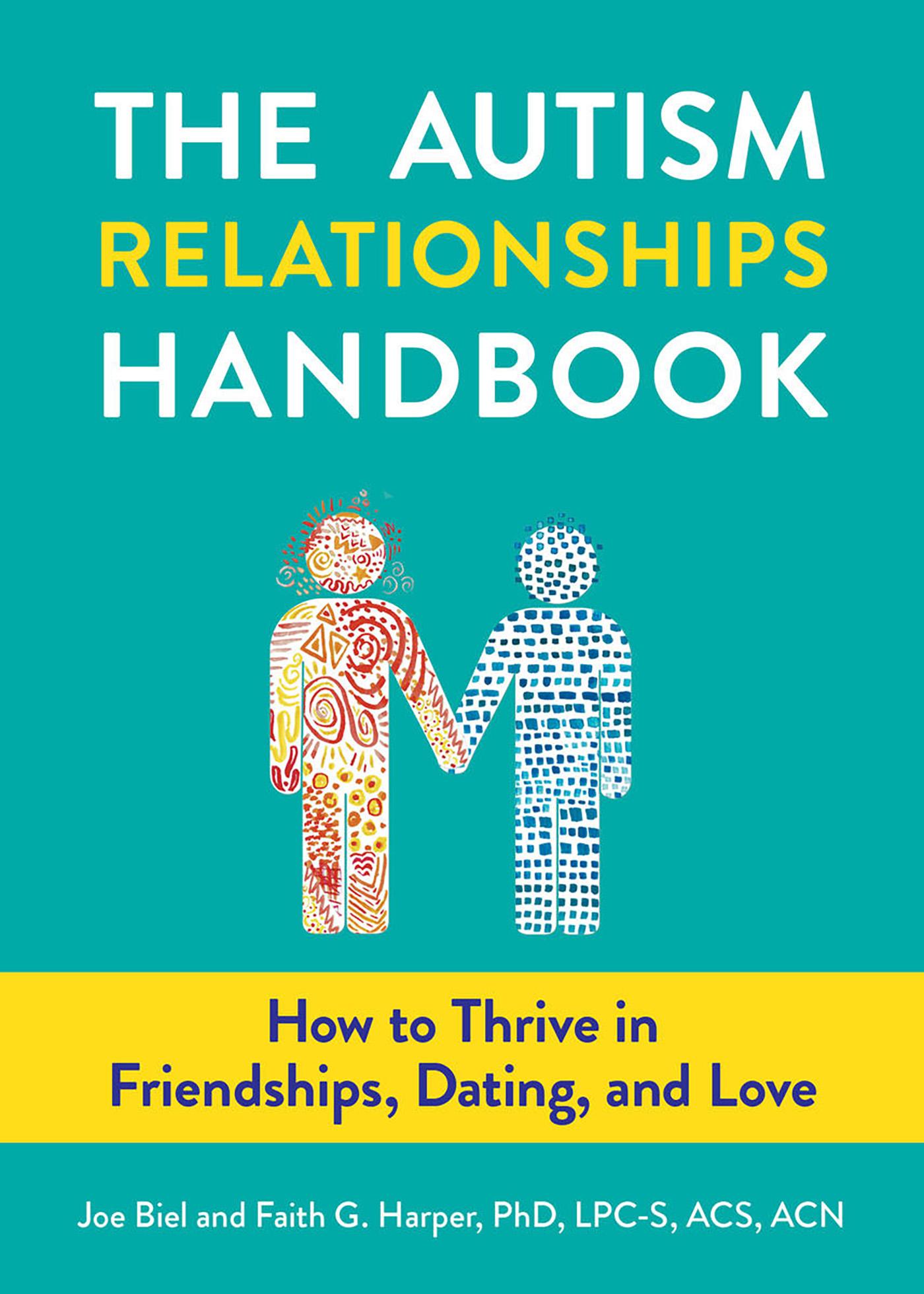
Joe Biel & Faith G. Harper
The Autism Relationships Handbook (Preview)
How to Thrive in Friendships, Dating, and Love
Romantic relationships begin by dating, which starts out as a loose agreement that two people are going to have some vaguely structured fun together. This is confusing because, at first and on the surface, it doesn’t seem that different from friendship. Still, it’s duplicitous to propose something as a friendship with the motives of transitioning that to romance. It’s okay to keep things vague at first. Sometimes your feelings about someone will change as you get to know them, but it’s absolutely vital to communicate your true intentions by the second or third occasion that you spend time alone together. Otherwise feelings get out of control and everyone becomes misled, scared, confused, hurt, or disappointed.
Fortunately for autistic people, dating is one area where everyone is lost, scared, excited, and confused. An allistic friend thought he was going on a date once to see a movie with a woman from school. At the end of the night she exclaimed “I’m so glad that I get to be friends with a gay guy.” He isn’t gay and this statement merely meant that he hadn’t been overt enough that he was asking her on a date. She had mistaken his lisp and gender expression as his sexuality and assumed this to mean that there was no way they were on a date. If allistic people can screw up dating this badly, at least autistic people have relatively equal footing. And with sufficient understanding and preparation, we can excel.
Getting Started
To get started on your path to dating, make a list of social activities that make you happy and that you enjoy. Just like with friendships, think of organizations and group activities where you can meet other people with interests and values similar to your own. These are successful brainstorms for meeting people as well as activities to do on your dates themselves. Clubs, classes, and volunteering within your interests is a great way to meet like-minded people. And you suddenly have something to talk about! As for what to do on a date, things like playing games, bike rides, playing with dogs, gardening, taking pictures, and watching movies are things that you can do with another person unobtrusively. Meaning, they are good ways to segue into a social life with someone without hours of forced, awkward conversation. Conversely, if your first date is going to dinner, you have to be social for an entire hour and that’s a ton of pressure and opportunity for problems. You’ll build up to that but start with an experience that you can simply enjoy. Together.
I joke that the best way to find a hot date is to stop looking for one. Suitors will flock to you everywhere that you go. This is because allistics interpret and process nonverbal communication and feelings differently than we do. They notice details—like confidence, when someone stares or ignores them, and how you interact with other people—that we don’t and vice versa. And—as I’ve come to understand it in my allistic studies—confidence, hyperfocus, and intention are highly valued commodities. These attributes tend to make them look past other aspects of ourselves. Like if we are peculiar, obsessive, or even a hot mess. While hyperfocus and intention are something we excel at naturally, confidence needs to be worked on a bit. How do you feel confident? Channel the confidence of the most mediocre neurotypicals. If people with nothing notable about them can be so confident, look at the best attributes that you’ve got and what people have complimented you about in the past.
When I was in my 20s I had a friend named Sam who went on dates about four nights per week with different women. He was not extremely good looking. When I asked him what his secret was, he said that he was turned down about 95% of the time but he appeared to be so successful because he asked out every woman that he found himself in conversation with that he was attracted to. He’s a bold individual and it’s not exactly a model to mimic, but the point is that others’ apparent success can be misleading.
So much of dating is building up your confidence based on small successes. When I was a kid our family of four was raised on $1,000 a month from government assistance. I wore homemade sweatpants with one pocket because there wasn’t enough material for two. I was frequently mocked and bullied for my clothes, which were as nerdy as my interests. Fortunately, as I discovered punk rock in my teens, being schlubby and having ugly clothes was par for the course and by dumb luck the world decided that punk was again popularized in 1994. I already related with punk’s energy, politics, and anger. By extension I became cool too. So to build confidence into adulthood I took that positive feedback and began to extend it gradually to create my own style. I became particular about colors and fashions and cuts of my clothes even if they still mostly came from thrift stores. This created a style. In 2014 I attended an industry trade show with over 30,000 people where a stranger came up to me and said “Wow! You’re the best dressed person here!” I beamed. I was wearing a loud tie with dollar signs on it, a pink shirt, wingtips with orange soles like what you’d see on a running shoe, and a dynamic set of matching colors. It was a bold outfit and a risk for sure, so the positive feedback meant everything to me. I had become comfortable dressing myself and used that confidence to project bold moves in other areas of my life. Build yourself up from your small successes and turn them into larger ones, taking increasing amounts of risk as you develop more skills and confidence
Most flirtation is not communicated with words. It’s expressed by the eyes, smile, or hands. Or just by being incredibly awkward and lingering around someone that you have a crush on. Pay attention to these things when people do it near you on a regular basis. Learn to look for those things. Have someone that you trust demonstrate what these signals look like. Make them yourself. Practice in advance. Similarly, practice your speech for asking someone on a date with a friend that you trust. Then practice having the kinds of conversations that will follow. Imagine yourself in the situation in advance, flirting with the specific person that you have a crush on.
It’s okay to ask someone on a date even if you aren’t sure that they are interested. Still, you shouldn’t ask out people who are at work or on a bus because they have less power at that moment. They can’t remove themselves from the situation if they feel uncomfortable. If you have never talked to the person that you are interested in dating, spend a few minutes making polite conversation first. Introduce yourself and compliment something interesting or attractive about their activities, apparent interests, or outfit, rather than something about their body. Asking questions about something they are wearing can be a good way to get them to open up and begin a little emotional investment. You can say “I love that band too! Did you see them on Friday?” or “Purple is great. Is it one of your favorite colors?” People want a relationship with someone who makes them feel happy, safe, and loved. If someone makes them feel that way, then they are often less concerned with that person’s appearance, finances, or unique traits. So start off slow by making casual conversation without expecting anything.
Since women are frequently sexually harassed by allistic men, if you are interested in a woman, you have to perform a little bit of extra care to show that you have genuine interest in this person, and not just for her appearance. Women frequently have their appearance commented on in public, just as autistic people are often harassed and bullied in public. So go slow, be genuine, maintain some eye contact, and express your feelings. It’s not fair that you have to go the extra mile because of how other people have treated her, but by doing so you put yourself in a higher tier by caring about her experience rather than just your own. Still, if she’s not interested, you should accept that and withdraw yourself from the situation or at least allow her to.
No matter your gender and the gender of who you are asking out, it’s okay to be disappointed if they say “no” but it’s not okay to be shitty to them about it. If someone says “no thank you” a good response is along the lines of “fair enough, I had to at least take a shot! So anyway, seen anything good on Netflix lately?” It demonstrates good humor and a willingness to have a platonic connection with them. If you are only interested in dating them and not in friendship, just cut the final conversation shift sentence. Don’t follow people around or persist if you are turned down. They might be dating someone else or not interested in dating anyone, or they might just not be interested in you that way.
Most people like to date people who match them socially and intellectually. It can be boring or alienating to attempt a conversation with someone that wants to drone on for hours about engines or bugs or a topic the other person has no knowledge about. Similarly, a person who comes from a certain amount of wealth is going to be most comfortable around someone else with a relatively similar amount of wealth, if only because they project the same coded cultural expression, like arranging forks on the table in a certain way. This has no bearing on things in the real world, but we are wired to be most comfortable around people who prioritize the same things we do.
While you can ask someone about their views or feelings about dating autistic people, the allistic disability frequently causes them to be dishonest so I wouldn’t advise asking unless you feel very confident in the relationship already. Don’t hold their lies against them (in this case). They may feel the need for safety based on prior experiences.
Do not attempt to date people considerably younger than you; especially if you are an adult and they are not. A good rule of thumb is to divide your age in half and add seven. That is the maximum acceptable age difference before it becomes too difficult to be equals and relate to each other. There are exceptions in emotional development but if there is a power differential between you and the other person, it is not something that you can turn into an equitable romantic relationship. For example, you should not date your family members, teachers, mentors, case workers, bosses, policemen, people significantly older than you, people in committed monogamous relationships with someone else, or anyone with a position of authority over you. In a relationship, both people should be relative equals and you don’t want one person to have power over the other. If you are having sex in the relationship and there is a power differential, there is often undue pressure to do what the powerful person wants. Sexual pleasure affects your brain in fundamental, deeply emotional ways that can forever associate what would otherwise be positive experiences with traumatic, negative ones. Having a power differential complicates relationships and sex significantly. For some it’s a turn on, which is fine (see the entire world of BDSM, which has even more rules!). But you need to be aware of it and everyone should be consenting when you participate in it.
(End of Preview)