The Sacramento Bee
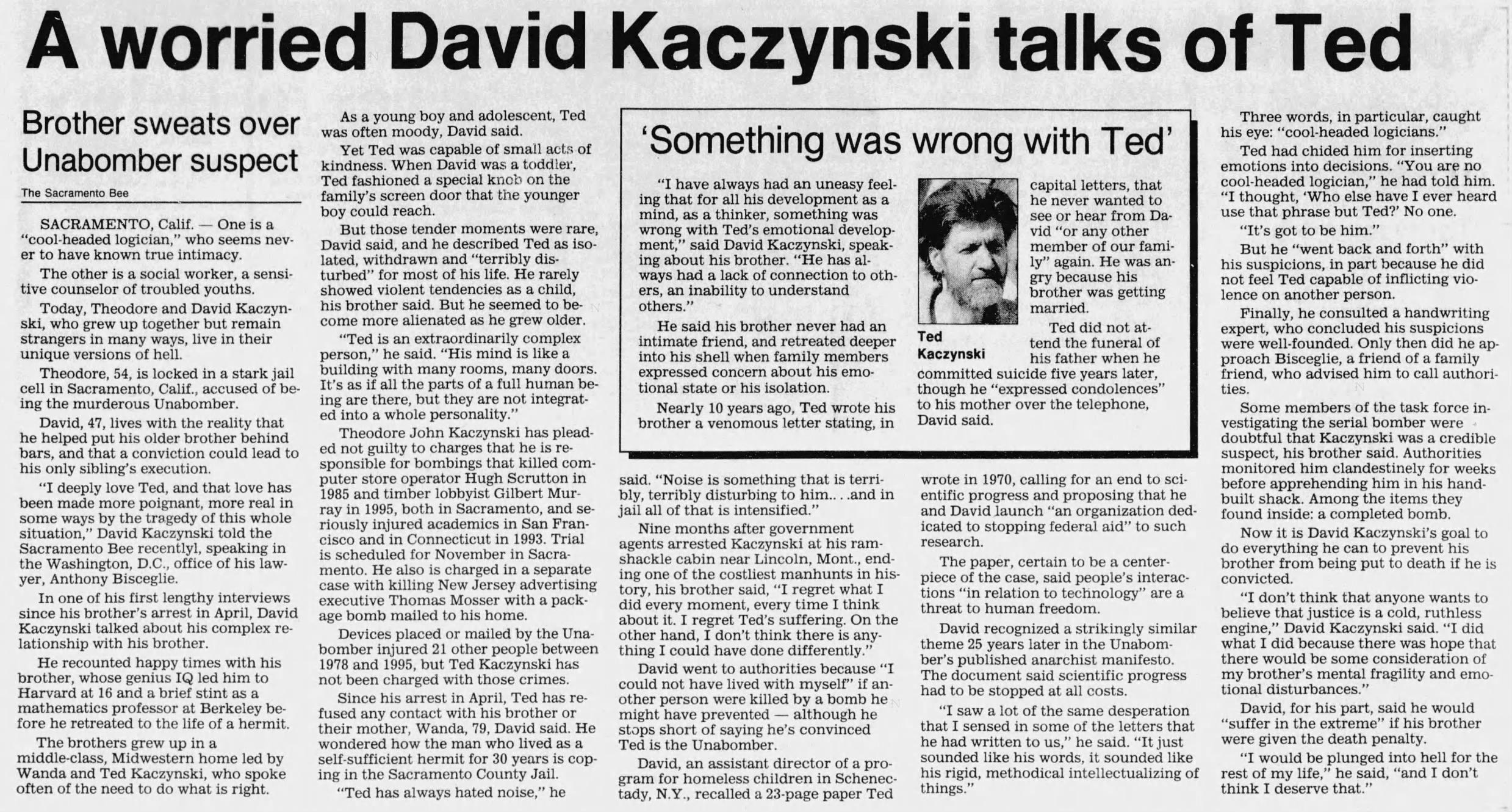
A Worried David Kaczynski Talks Of Ted
Brother sweats over Unabomber suspect
SACRAMENTO, Calif. — One is a “cool-headed logician,” who seems never to have known true intimacy.
The other is a social worker, a sensitive counselor of troubled youths.
Today, Theodore and David Kaczynski, who grew up together but remain strangers in many ways, live in their unique versions of hell.
Theodore, 54, is locked in a stark jail cell in Sacramento, Calif., accused of being the murderous Unabomber.
David, 47, lives with the reality that he helped put his older brother behind bars, and that a conviction could lead to his only sibling’s execution.
“I deeply love Ted, and that love has been made more poignant, more real in some ways by the tragedy of this whole situation,” David Kaczynski told the Sacramento Bee recently, speaking in the Washington, D.C., office of his lawyer, Anthony Bisceglie.
In one of his first lengthy interviews since his brother’s arrest in April, David Kaczynski talked about his complex relationship with his brother.
He recounted happy times with his brother, whose genius IQ led him to Harvard at 16 and a brief stint as a mathematics professor at Berkeley before he retreated to the life of a hermit.
The brothers grew up in a middle-class, Midwestern home led by Wanda and Ted Kaczynski, who spoke often of the need to do what is right.
As a young boy and adolescent, Ted was often moody, David said.
Yet Ted was capable of small acts of kindness. When David was a toddler, Ted fashioned a special knob on the family’s screen door that the younger boy could reach.
But those tender moments were rare, David said, and he described Ted as isolated, withdrawn and “terribly disturbed” for most of his life. He rarely showed violent tendencies as a child, his brother said. But he seemed to become more alienated as he grew older.
“Ted is an extraordinarily complex person,” he said. “His mind is like a building with many rooms, many doors. It’s as if all the parts of a full human being are there, but they are not integrated into a whole personality.”
Theodore John Kaczynski has pleaded not guilty to charges that he is responsible for bombings that killed computer store operator Hugh Scrutton in 1985 and timber lobbyist Gilbert Murray in 1995, both in Sacramento, and seriously injured academics in San Francisco and in Connecticut in 1993. Trial is scheduled for November in Sacramento. He also is charged in a separate case with killing New Jersey advertising executive Thomas Mosser with a package bomb mailed to his home.
Devices placed or mailed by the Unabomber injured 21 other people between 1978 and 1995, but Ted Kaczynski has not been charged with those crimes.
Since his arrest in April, Ted has refused any contact with his brother or their mother, Wanda, 79, David said. He wondered how the man who lived as a self-sufficient hermit for 30 years is coping in the Sacramento County Jail.
“Ted has always hated noise,” he said. “Noise is something that is terribly, terribly disturbing to him....and in jail all of that is intensified.”
Nine months after government agents arrested Kaczynski at his ramshackle cabin near Lincoln, Mont., ending one of the costliest manhunts in history, his brother said, “I regret what I did every moment, every time I think about it. I regret Ted’s suffering. On the other hand, I don’t think there is anything I could have done differently.”
David went to authorities because “I could not have lived with myself” if another person were killed by a bomb he might have prevented — although he stops short of saying he’s convinced Ted is the Unabomber.
David, an assistant director of a program for homeless children in Schenectady, N.Y., recalled a 23-page paper Ted wrote in 1970, calling for an end to scientific progress and proposing that he and David launch “an organization dedicated to stopping federal aid” to such research.
The paper, certain to be a centerpiece of the case, said people’s interactions “in relation to technology” are a threat to human freedom.
David recognized a strikingly similar theme 25 years later in the Unabomber’s published anarchist manifesto. The document said scientific progress had to be stopped at all costs.
“I saw a lot of the same desperation that I sensed in some of the letters that he had written to us,” he said. “It just sounded like his words, it sounded like his rigid, methodical intellectualizing of things.”
Three words, in particular, caught his eye: “cool-headed logicians.”
Ted had chided him for inserting emotions into decisions. “You are no cool-headed logician,” he had told him. “I thought, ‘Who else have I ever heard use that phrase but Ted?’ No one.
“It’s got to be him.”
But he “went back and forth” with his suspicions, in part because he did not feel Ted capable of inflicting violence on another person.
Finally, he consulted a handwriting expert, who concluded his suspicions were well-founded. Only then did he approach Bisceglie, a friend of a family friend, who advised him to call authorities.
Some members of the task force investigating the serial bomber were doubtful that Kaczynski was a credible suspect, his brother said. Authorities monitored him clandestinely for weeks before apprehending him in his hand-built shack. Among the items they found inside: a completed bomb.
Now it is David Kaczynski’s goal to do everything he can to prevent his brother from being put to death if he is convicted.
“I don’t think that anyone wants to believe that justice is a cold, ruthless engine,” David Kaczynski said. “I did what I did because there was hope that there would be some consideration of my brother’s mental fragility and emotional disturbances.”
David, for his part, said he would “suffer in the extreme” if his brother were given the death penalty.
“I would be plunged into hell for the rest of my life,” he said, “and I don’t think I deserve that.”
‘Something was wrong with Ted’
“I have always had an uneasy feeling that for all his development as a mind, as a thinker, something was wrong with Ted’s emotional development,” said David Kaczynski, speaking about his brother. “He has always had a lack of connection to others, an inability to understand others.”
He said his brother never had an intimate friend, and retreated deeper into his shell when family members expressed concern about his emotional state or his isolation.
Nearly 10 years ago, Ted wrote his brother a venomous letter stating, in capital letters, that he never wanted to see or hear from David “or any other member of our family” again. He was angry because his brother was getting married.
Ted did not attend the funeral of his father when he committed suicide five years later, though he “expressed condolences” to his mother over the telephone, David said.