
Theodore Sturgeon
And Now the News...
Volumen IX: The Complete Stories of Theodore Sturgeon

Copyright © 2003 the Theodore Sturgeon Literary Trust. Previously published materials copyright © 1955, 1956, 1957, 1999 by Theodore Sturgeon and the Theodore Sturgeon Literary Trust, except “The Waiting Thing Inside” and “The Deadly Innocent,” which are copyright © 1956 by Don Ward and Theodore Sturgeon and the Theodore Sturgeon Literary Trust. All rights reserved. No portion of this book, except for brief review, may be reproduced, stored in a retrieval system, or transmitted in any form or by any means—electronic, mechanical, photocopying, recording, or otherwise—without written permission of the publisher.
Published by
North Atlantic Books
P.O. Box 12327
Berkeley, California 94712
Cover photograph of an ophicleide by Grant D. Green
Cover design by Paula Morrison
And Now the News… is sponsored by the Society for the Study of Native Arts and Sciences, a nonprofit educational corporation whose goals are to develop an educational and cross-cultural perspective linking various scientific, social, and artistic fields; to nurture a holistic view of arts, sciences, humanities, and healing; and to publish and distribute literature on the relationship of mind, body, and nature.
North Atlantic Books’ publications are available through most bookstores. For further information, visit our website at _www.northatlanticbooks.com_ or call 800-733-3000.
The Library of Congress has cataloged the printed edition as follows:
Sturgeon, Theodore.
And now the news— / by Theodore Sturgeon ; edited by Paul Williams ; foreword by David G. Hartwell.
p. cm. — (The complete stories of Theodore Sturgeon ; v. 9)
eISBN: 978-1-58394-753-1
1. Science fiction, American. I. Williams, Paul, 1948– II. Title.
PS3569.T875 A6 1994 vol. 9
813′.54—dc21
2003013883
v3.1
Editor’s Note
THEODORE HAMILTON STURGEON was born February 26, 1918, and died May 8, 1985. This is the ninth of a series of volumes that will collect all of his short fiction of all types and all lengths shorter than a novel. The volumes and the stories within the volumes are organized chronologically by order of composition (insofar as it can be determined). This ninth volume contains stories written in 1955, 1956, and 1957. Five have never before appeared in a Sturgeon collection.
Preparation of each of these volumes would not be possible without the hard work and invaluable participation of Noël Sturgeon, Debbie Notkin, and our publishers, Lindy Hough and Richard Grossinger. I would also like to thank, for their significant assistance with this volume, David G. Hartwell, the Theodore Sturgeon Literary Trust, Kim Charnovsky, Robin Sturgeon, Marion Sturgeon, Jayne Williams, Ralph Vicinanza, Paula Morrison, Dixon Chandler, Cindy Lee Berryhill, T. V. Reed, and all of you who have expressed your interest and support.
Books by Theodore Sturgeon
Without Sorcery (1948)
The Dreaming Jewels [aka The Synthetic Man] (1950)
More Than Human (1953)
E Pluribus Unicorn (1953)
Caviar (1955)
A Way Home (1955)
The King and Four Queens (1956)
I, Libertine (1956)
A Touch of Strange (1958)
The Cosmic Rape [aka To Marry Medusa] (1958)
Aliens 4 (1959)
Venus Plus X (1960)
Beyond (1960)
Some of Your Blood (1961)
Voyage to the Bottom of the Sea (1961)
The Player on the Other Side (1963)
Sturgeon in Orbit (1964)
Starshine (1966)
The Rare Breed (1966)
Sturgeon Is Alive and Well … (1971)
The Worlds of Theodore Sturgeon (1972)
Sturgeon’s West (with Don Ward) (1973)
Case and the Dreamer (1974)
Visions and Venturers (1978)
Maturity (1979)
The Stars Are the Styx (1979)
The Golden Helix (1979)
Alien Cargo (1984)
Godbody (1986)
A Touch of Sturgeon (1987)
The [Widget], the [Wadget], and Boff (1989)
Argyll (1993)
Star Trek, The Joy Machine (with James Gunn) (1996)
The Complete Stories Series
1. The Ultimate Egoist (1994)
2. Microcosmic God (1995)
3. Killdozer! (1996)
4. Thunder and Roses (1997)
5. The Perfect Host (1998)
6. Baby Is Three (1999)
7. A Saucer of Loneliness (2000)
8. Bright Segment (2002)
9. And Now the News … (2003)
10. The Man Who Lost the Sea (2005)
11. The Nail and the Oracle (2007)
12. Slow Sculpture (2009)
13. Case and the Dreamer (2010)
Foreword
By David G. Hartwell
I became a dedicated reader and collector of science fiction and fantasy, and supernatural horror fiction, in the 1950s. At the end of the decade in 1959 I went to college and won a book collection prize there, with only a hundred hardcovers. Among the ornaments of that collection were the Sturgeon books, including first editions of Without Sorcery, his first book, and More Than Human, his most ambitious novel. Part of winning the prize involved explaining something of the significance of the books.
Four decades later, I do not recall what I wrote then, but I do know that I had been introduced to Sturgeon’s short fiction in the sixth grade and looked forward to everything by him from then on. And still vivid in my memory is the Saturday afternoon in late 1953 or early 1954 when I walked into a news store in Lock Haven, Pennsylvania, where I had bought a few SF magazines before, and was pointed to the paperback rack by the proprietor. There I found and bought my first two SF paperbacks, Sturgeon’s More than Human and Arthur C. Clarke’s Childhood’s End. That was the first year I bought and owned books, and these were treasures. I read them with intense concentration and delight. Nearly ten years later, after studying William Faulkner’s novels, I re-read More Than Human and liked it and admired it even more.
Somehow very early in my reading I came to think of Sturgeon as the best writer of science fiction, fantasy, and horror. I would read anything he published, follow him beyond my normal comfort zones because of the rewards of reading his stories, not something I would do for many writers (such was my loyalty to SF at the time). I also recall my delight when he became a book reviewer for Venture SF in the late 50s and published his famous column explaining Sturgeon’s Law for the general readership; it had first been revealed in a 1953 Philcon speech later reprinted in a fanzine. He was one of Ray Bradbury’s mentors (and Bradbury was at his peak then, publishing knockout stories and books). He was admired by Damon Knight, my favorite reviewer. Other writers and editors mentioned him in reverent tones in print. I thought he was a great writer. I still do.
As the years passed, I began to attend SF conventions, read fanzines, and hear gossip about Sturgeon, mainly about his writing blocks, his nudism, and his love life. He was famous for all three. I finally met him for the first time in 1972 at the Clarion writing workshop in East Lansing, Michigan, where he borrowed $200.00 through me to make a payment that was pressing. Fred Pohl laughed at me the next week and said I would never get it back, but it was repaid shortly thereafter. I was so pleased that I would gladly have given up the money to know Sturgeon. At Clarion I was privileged to listen to his Monday morning lecture to the writing students, which was full of sophisticated and useful advice and ideas, so full that I could tell that the students were not getting much from it. But I still remember a lot of it and use it in my own teaching. There exist tapes of Sturgeon teaching a writer’s workshop late in his life that may someday become commercially available. And I arranged to interview Sturgeon at the 1972 World SF Convention in Los Angeles a month or so later for Crawdaddy magazine, in which I then had a science fiction column. It’s a long interview filled with lots of Sturgeon’s personal ideas and perceptions of books, stories about his life and friends, interesting stuff that I recommend to all interested parties.
For instance:
I skipped two and a half years of my primary schooling. I left the fifth grade and took eight weeks in summer school and went to high school at not quite twelve years old.… And I was very underweight and undersized and a natural target for everyone around me. And I was pretty well brutalized by that whole thing. We didn’t have school buses in those days and we lived three miles away and we used to have these six miles to walk every day through all kinds of neighborhoods. I had to figure out different ways to go each day, because kids would lay for me on the way. I had curly golden hair and I was very thin and kind of whey-faced and pretty. And I was just an absolute target. When I was in high school I discovered apparatus gymnastics, and that became my total preoccupation. In a year and a half or so I gained four inches and sixty pounds, and I became captain and manager of my gym team, which is literally a transfiguration. I was totally born again. And the very kids that used to bully me used to follow me around and carry my books and it was a really incredible difference.
And:
Well, somebody brought me a volume 1, number 1 of Unknown, and said, boy, this is what you should be writing.… I was absolutely thrilled with the magazine. And somebody suggested that I go up and see Campbell [the editor]. Well, you know, I was overawed, and so I wrote a little story and took it up to him, and he pointed out to me how that wasn’t a story at all—it didn’t have the structure of a story—but he told me to come back and see him again, and so I wrote a story called “Ether Breather,” and that was my first sale to him.… I produced just enormously in those eighteen months, two years or so, I produced dozens of stories.
(The full interview was published in The New York Review of Science Fiction, #7 and #8, March and April 1989.)
I was also then a consulting editor for New American Library and as a result of the conversations surrounding that interview I bought a collection of three novellas from him (it was my idea, because I wanted to have his last great novella, When You Care, When You Love, reprinted in book form) that was published in paperback a year later. I knew him for the rest of his life, not as a close friend but as a fellow professional. Whenever we met he would launch into a sincere monologue on his current obsession for a few minutes, but would also frequently tell a joke or two. He had a reedy, nasal voice, but told jokes well.
Here’s an example of his humor:
A young couple are in love, in bed, engaged in passionate foreplay, really beginning to work up a sweat.
She says: “Oh, god, this is so wonderful. It’s like I am Queen Elizabeth and you are Sir Walter Raleigh,” and with that she reaches orgasm, moaning and gasping with delight.
The young man is still pumping away energetically.
Minutes pass.
Suddenly in a frenzy, he has his orgasm.
Exhausted, in a fond embrace, he says: “Gee, sorry. It took me a few minutes to think of someone.”
I also recall him telling me that it used to bother Harlan Ellison, when Sturgeon was living in his house in the late 1960s, that nudist Ted would answer the door without any clothes on. Ted liked to tell Ellison stories too.
He was known for singing and playing guitar at conventions in the 1950s. I only heard him do so once in the 1970s, when he was out of practice, but he was still good. I felt that way about his stories of the 1980s too, still good, but not at the top of his form—although I have not reread them in fifteen or more years now, and reserve the right to do so and perhaps change my mind.
For most of the 1970s and 1980s, Paul Williams, Chip Delany, and I became a Sturgeon admiration society. Each of us was always ready to write about Sturgeon, recommend Sturgeon, discuss Surgeon, bring his works to the attention of more readers. And he needed this, because for a really bright and talented man, he was just terrible at making money. I arranged to reprint some of his works in hardcover for the first time in the Gregg Press series in the late 1970s, and commissioned introductions from Chip and Paul. Paul helped put together new Sturgeon collections for Dell in the 1970s, and later Blue Jay in the 1980s. Chip Delany’s enormous prestige as a critic maintained and enhanced Sturgeon’s reputation in years when no fiction was published and powerful younger writers entered the limelight. You are fortunate to hold in your hands a collection of Sturgeon stories from the 1950s, his greatest decade as a writer. As far as I am concerned, his major works of that decade were investigations and dramatizations of human psychology, driven by a syzygy of idea and character. The two stories that mean the most to me in this volume are “And Now the News …” and “Affair with a Green Monkey.”
The first is not by any useful definition science fiction (but see Paul Williams’s story notes at the end of the book for Sturgeon’s opinion), though it did appear in The Magazine of Fantasy & Science Fiction. It is simply one of the finest American stories of the twentieth century. It was written by a science fiction writer, and is a penetrating prophecy of what was going to happen too often in the next four decades, so often we now have a colloquial phrase involving the postal service for a certain kind of insanity. I read it when the issue was published, it worried me, and I tried to reject it for several years. I think back to it frequently when the real world recapitulates it another time.
And (again see the story note) it was based on a core idea and detailed plot given to Sturgeon by Robert A. Heinlein, also at the peak of his reputation, who had been asked by Sturgeon to suggest ideas for stories. Heinlein also said, “I must say that I am flattered at the request. To have the incomparable and always scintillating Sturgeon ask for ideas is like having the Pacific Ocean ask one to pee in it.” (The entire letter was published in The New York Review of Science Fiction, #84, August 1995.) I get the idea from everyone I have spoken to over the years that nearly every SF writer in those days considered Sturgeon in some way the best. “Affair with a Green Monkey” is both horrifying and funny, sort of like the joke I repeated above. It is also a clever and economical psychological portrait. And it really is science fiction.
There are other fine stories here (particularly “The Other Celia” and “The Skills of Xanadu”), and some only with fine moments, but all are worth reading, if only because they are the work of the SF writer of the 1940s to the 1980s who was at the same time writing in genre and successfully and consciously aspiring to art in his writing. He is one of the primary models.
On later generations, after Bradbury (who was influenced by Sturgeon’s stories in Astounding and Unknown between 1939 and 1944, not the work of later decades), Sturgeon’s fiction of the 1950s is clearly influential at the start of the careers of Samuel R. Delany and Roger Zelazny in the 1960s. The intent was not only to entertain but also to create art in fantasy and SF: the use of telling and carefully observed detail to underpin characterization; a deep and complex understanding of, and portrayal of, human psychology; not only a fearless portrayal of sentiment, but—particularly in Delany—a fascination with love, sex, gender roles; and a constantly surprising but consistent evocation of cultures unlike our own—that then reflect back upon our own in pleasant or disturbing ways. This is the core of what I meant above when I referred to a syzygy, a complete blending, of idea and character as the driving force of his fiction.
If Sturgeon’s influence had only extended this far, it would have been crucial to the evolution of contemporary SF, horror, and fantasy. But it extends much farther. There are more volumes in this series to come, including more of his very best.
“Won’t You Walk …?”
JOE FRITCH WALKED under the moon, and behind the bridge of his nose something rose and stung him. When he was a little boy, which was better than thirty years ago, this exact sensation was the prelude to tears. There had been no tears for a long time, but the sting came to him, on its occasions, quite unchanged. There was another goad to plague him too, as demanding and insistent as the sting, but at the moment it was absent. They were mutually exclusive.
His mind was a jumble of half-curses, half-wishes, not weak or pale ones by any means, but just unfinished. He need not finish them, any of them; his curses and his wishes were his personal clichés, and required only a code, a syllable for each. “He who hesitates—” people say, and that’s enough. “Too many cooks—” they say wisely. “What’s sauce for the goose—.” Valid sagacities, every one, classic as the Parthenon and as widely known.
Such were the damnations and the prayers in the microcosm called Joe Fritch. “Oh, I wish—” he would say to himself, and “If only—” and “Some day, by God—”; and for each of these there was a wish, detailed and dramatic, so thought-out, touched-up, policed and maintained that it had everything but reality to make it real. And in the other area, the curses, the code words expressed wide meticulous matrices: “That Barnes—” dealt not only with his employer, a snide, selfish, sarcastic sadist with a presence like itching powder, but with every social circumstance which produced and permitted a way of life wherein a man like Joe Fritch could work for a man like Barnes. “Lutie—” was his wife’s name, but as a code word it was dowdy breakfasts and “I-can’t-afford” and the finger in her ear, the hand beginning to waggle rapidly when she was annoyed; “Lutie—” said as the overture to this massive curse was that which was wanted and lost (“Joe?” “What, li’l Lutie?” “Nothing, Joe. Just … Joe—”) and that which was unwanted and owned, like the mortgage which would be paid off in only eighteen more years, and the single setting of expensive flowery sterling which they would never, never be able to add to.
Something had happened after dinner—he could almost not remember it now; what bursts the balloon, the last puff of air, or the air it already contains? Is the final drop the only factor in the spillingover of a brimming glass? Something about Marie Next Door (Lutie always spoke of her that way, a name like William Jennings Bryan) and a new TV console, and something about Lutie’s chances, ten years ago, of marrying no end of TV consoles, with houses free-and-clear and a car and a coat, and all these chances forsworn for the likes of Joe Fritch. It had been an evening like other evenings, through 10:13 P.M. At 10:14 something silent and scalding had burst in the back of Joe’s throat; he had risen without haste and had left the house. Another man might have roared an epithet, hurled an ashtray. Some might have slammed the door, and some, more skilled in maliciousness, might have left it open so the angry wife, sooner or later, might get up and close it. Joe had simply shambled out, shrinking away from her in the mindless way an amoeba avoids a hot pin. There were things he might have said. There were things he could have said to Barnes, too, time and time again, and to the elevator starter who caught him by the elbow one morning and jammed him into a car, laughing at him through the gate before the doors slid shut. But he never said the things, not to anyone. Why not? Why not?
“They wouldn’t listen,” he said aloud, and again the sting came back of his nose.
He stopped, and heeled water out of his left eye with the base of his thumb. This, and the sound of his own voice, brought him his lost sense of presence. He looked around like a child awakening in a strange bed.
It was a curved and sloping street, quite unlike the angled regimentation of his neighborhood. There was a huge elm arched over the streetlamp a block away, and to Joe’s disoriented eye it looked like a photographic negative, a shadow-tree lit by darkness looming over a shadow of light. A tailored hedge grew on a neat stone wall beside him; across the street was a white picket fence enclosing a rolling acre and the dark mass of just the house he could never own, belonging, no doubt, to someone people listened to. Bitterly he looked at it and its two gates, its rolled white driveway, and, inevitably, the low, long coupé which stood in it. The shape of that car, the compact, obedient, directional eagerness of it, came to him like the welcome answer to some deep question within him, something he had thought too complex to have any solution. For a moment a pure, bright vision overwhelmed and exalted him; his heart, his very bones cried well, of course! and he crossed to the driveway, along its quiet grassy margin to the car.
He laid a hand on its cool ivory flank, and had his vision again. At the wheel of this fleet-footed dream car, he would meet the morning somewhere far from here. There would be a high hill, and a white road winding up it, and over the brow of that hill, there would be the sea. Below, a beach, and rocks; and there would be people. Up the hill he would hurtle, through and over a stone wall at the top, and in the moment he was airborne, he would blow the horn. Louder, bigger than the horn would be his one bright burst of laughter. He had never laughed like that, but he would, he could, for all of him would be in it, rejoicing that they listened to him, they’d all be listening, up and down the beach and craning over the cliff. After that he’d fall, but that didn’t matter. Nothing would matter, even the fact that his act was criminal and childish. All the “If only—” and “Some day, by God—” wishes, all the “That Barnes—” curses, for all their detail, lacked implementation. But this one, this one—
The window was open on the driver’s side. Joe looked around; the street was deserted and the house was dark. He bent and slid his hand along the line of the dimly glowing phosphorescence that was a dashboard. Something tinkled, dangled—the keys, the keys!
He opened the door, got in. He could feel the shift in balance as the splendid machine accepted him like a lover, and they were one together. He pulled the door all but closed, checked it, then pressed it the rest of the way. It closed with a quiet, solid click. Joe grasped the steering wheel in both hands, settled himself, and quelled just the great trumpeting of laughter he had envisioned. Later, later. He reached for the key, turned it.
There was a soft purring deep under the hood. The window at his left slid up, nudging his elbow out of the way, seating itself in the molding above. The purring stopped. Then silence.
Joe grunted in surprise and turned the key again. Nothing. He fumbled along the dashboard, over the cowling, under its edge. He moved his feet around. Accelerator, brake. No clutch. A headlight dimmer switch. With less and less caution he pushed, turned and pulled at the controls on the instrument panel. No lights came on. The radio did not work. Neither did the cigarette lighter, which startled him when it came out in his hand. There wasn’t a starter anywhere.
Joe Fritch, who couldn’t weep, very nearly did then. If a man had a car burglar-proofed with some sort of concealed switch, wasn’t that enough? Why did he have to amuse himself by leaving the keys in it? Even Barnes never thought of anything quite that sadistic.
For a split second he glanced forlornly at his glorious vision, then forever let it go. Once he sniffed; then he put his hand on the door control and half rose in his seat.
The handle spun easily, uselessly around. Joe stopped it, pulled it upward. It spun just as easily that way. He tried pulling it toward him, pushing it outward. Nothing.
He bit his lower lip and dove for the other door. It had exactly the same kind of handle, which behaved exactly the same way. Suddenly Joe was panting as if from running hard.
Now take it easy. Don’t try to do anything. Think. Think, Joe.
The windows!
On his door there were two buttons; on the other, one. He tried them all. “I can’t get out,” he whispered. “I can’t—” Suddenly he spun one of the door handles. He fluttered his hands helplessly and looked out into the welcome, open dark. “Can’t!” he cried.
“That’s right,” said a voice. “You sure can’t.” The sting at the base of Joe Fritch’s nose—that was one of the unexpressed, inexpressible pains which had plagued him ever since he was a boy. Now came the other.
It was a ball of ice, big as a fist, in his solar plexus; and around this ball stretched a membrane; and the ball was fury, and the membrane was fear. The more terrified he became, the tighter the membrane shrank and the more it hurt. If ever he were frightened beyond bearing, the membrane would break and let the fury out, and that must not, must not happen, for the fury was so cold and so uncaring of consequence. This was no churning confusion—there was nothing confused about it. There was only compression and stretching and a breaking point so near it could be felt in advance. There was nothing that could be done about it except to sit quite still and wait until it went away, which it did when whatever caused it went away.
This voice, though, here in the car with him, it didn’t go away. Conversationally, it said, “Were you thinking of breaking the glass?”
Joe just sat. The voice said, “Look in the glove compartment.” It waited five seconds, and said, “Go ahead. Look in the glove compartment.”
Trembling, Joe reached over and fumbled the catch of the glove compartment. He felt around inside. It seemed empty, and then something moved under his fingers. It was a rectangle of wood, about six inches by three, extremely light and soft. Balsa. “I used to use a real piece of glass as a sample,” said the voice, “but one of you fools got to bashing it around and broke two of his own fingers. Anyway, that piece of wood is exactly as thick as the windshield and windows.” It was nearly three quarters of an inch think. “Bulletproof is an understatement. Which reminds me,” said the voice, stifling a yawn, “if you have a gun, for Pete’s sake don’t use it. The slug’ll ricochet. Did you ever see the wound a ricocheted bullet makes?” The yawn again. “S’cuse me. You woke me up.”
Joe licked his lips, which made him shudder. The tongue and lip were so dry they scraped all but audibly. “Where are you?” he whispered.
“In the house. I always take that question as a compliment. You’re hearing me on the car radio. Clean, hm-m-m? Flat to twenty-seven thousand cycles. Designed it myself.”
Joe said, “Let me out.”
“I’ll let you out, but I won’t let you go. You people are my bread and butter.”
“Listen,” said Joe, “I’m not a thief, or a … or a … or anything. I mean, this was just a sort of wild idea. Just let me go, huh? I won’t ever … I mean, I promise.” He scraped at his lip with his tongue again and added, “Please, I mean, please.”
“Where were you going with my car, Mister I’m-not-a-thief?”
Joe was silent.
A sudden blaze of light made him wince. His eyes adjusted, and he found it was only the light over the porte-cochere which bridged the driveway where it passed the house. “Come on inside,” said the voice warmly.
Joe looked across the rolling lawn at the light. The car was parked in the drive near the street; the house was nearly two hundred feet away. Catch ten times as many with it parked way out here, he thought wildly. And, I thought Barnes was good at making people squirm. And, Two hundred feet, and him in the house. He can outthink me; could he outrun me? “What do you want me inside for?”
“Would it make any difference how I answered that question?”
Joe saw that it wouldn’t. The voice was calling the shots now, and Joe was hardly in the position to make any demands. Resignedly he asked, “You’re going to call the police?”
“Absolutely not.”
A wave of relief was overtaken and drowned in a flood of terror. No one knew where he was. No one had seen him get into the car. Being arrested would be unpleasant, but at least it would be a known kind of unpleasantness. But what lay in store for him in this mysterious expensive house?
“You better just call the police,” he said. “I mean, have me arrested. I’ll wait where I am.”
“No,” said the voice. It carried a new tone, and only by the change did Joe realize how—how kind it had been before. Joe believed that single syllable completely. Again he eyed the two hundred feet. He tensed himself, and said, “All right. I’ll come.”
“Good boy,” said the voice, kind again. “Sleep sweet.” Something went pfffft! on the dashboard and Joe’s head was enveloped in a fine, very cold mist. He fell forward and hit his mouth on the big V emblem in the hub of the steering wheel. A profound astonishment enveloped him because he felt the impact but no pain.
He blacked out.
There was a comfortable forever during which he lay in a dim place, talking lazily, on and on. Something questioned him from time to time, and perhaps he knew he was not questioning himself; he certainly didn’t care. He rested in an euphoric cloud, calmly relating things he thought he had forgotten, and while an objective corner of his mind continued to operate, to look around, to feel and judge and report, it was almost completely preoccupied with an astonished delight that he could talk about his job, his marriage, his sister Anna, even about Joey—whom he’d killed when he and Joey were ten years old—without either the self-pitying twinge of unshed tears nor the painful fear which contained his rage.
Someone moved into his range of vision, someone with a stranger’s face and a manner somehow familiar. He had something shiny in his hand. He advanced and bent over him, and Joe felt the nip of a needle in his upper arm. He lay quietly then, not talking because he had finished what he had to say, not moving because he was so comfortable, and began to feel warm from the inside out. That lasted for another immeasurable time. Then he detected movement again, and was drawn to it; the stranger crossed in front of him and sat down in an easy chair. Their faces were about at the same level, but Joe was not on an easy chair. Neither was it a couch. It was something in between. He glanced down and saw his knees, his feet. He was in one of those clumsy-looking superbly comfortable devices known as a contour chair. He half-sat, half-reclined in it, looked at the other man and felt just wonderful. He smiled sleepily, and the man smiled back.
The man looked too old to be thirty, though he might be. He looked too young for fifty, though that was possible, too. His hair was dark, his eyebrows flecked with gray—a combination Joe thought he had never seen before. His eyes were light—in this dim room it was hard to see their color. The nose was ridiculous: it belonged to a happy fat man, and not someone with a face as long and lean as this one. The mouth was large and flexible; it was exactly what is meant by the term “generous,” yet its lips were thin, the upper one almost non-existent. He seemed of average height, say five, ten or eleven, but he gave the impression of being somehow too wide and too flat. Joe looked at him and at his smile, and it flashed across his mind that the French call a smile sourire, which means literally “under a laugh”; and surely, in any absolute scale of merriment, this smile was just exactly that. “How are you feeling?”
“I feel fine,” said Joe. He really meant it.
“I’m Zeitgeist,” said the man.
Joe was unquestioningly aware that the man knew him, knew all about him, so he didn’t offer his name in return. He accepted the introduction and after a moment let his eyes stray from the friendly face to the wall behind him, to some sort of framed document, around to the side where a massive bookcase stood. He suddenly realized that he was in a strange room. He snapped his gaze back to the man. “Where am I?”
“In my house,” said Zeitgeist. He uncrossed his legs and leaned forward. “I’m the man whose car you were stealing. Remember?”
Joe did, with a rush. An echo of his painful panic struck him, made him leap to his feet, a reflex which utterly failed. Something caught him gently and firmly around the midriff and slammed him back into the contour chair. He looked down and saw a piece of webbing like that used in aircraft safety belts, but twice as wide. It was around his waist and had no buckle; or if it had, it was behind and under the back of the chair, well out of his reach.
“It’s O.K.,” Zeitgeist soothed him. “You didn’t actually steal it, and I understand perfectly why you tried. Let’s just forget that part of it.”
“Who are you? What are you trying to do? Let me out of this thing!” The memory of this man approaching him with a glittering hypodermic returned to him. “What did you do, drug me?”
Zeitgeist crossed his legs again and leaned back. “Yes, several times, and the nicest part of it is that you can’t stay that excited very long just now.” He smiled again, warm.
Joe heaved again against the webbing, lay back, opened his mouth to protest, closed it helplessly. Then he met the man’s eyes again, and he could feel the indignation and fright draining out of him. He suddenly felt foolish, and found a smile of his own, a timid, foolish one.
“First I anaesthetized you,” said Zeitgeist informatively, apparently pursuing exactly the line of thought brought out by Joe’s question, “because not for a second would I trust any of you to come across that lawn just because I asked you to. Then I filled you full of what we’d call truth serum if this was a TV play. And when you’d talked enough I gave you another shot to pull you out of it. Yes, I drugged you.”
“What for? What do you want from me, anyway?”
“You’ll find out when you get my bill.”
“Bill?”
“Sure. I have to make a living just like anybody else.”
“Bill for what?”
“I’m going to fix you up.”
“There’s nothing the matter with me!”
Zeitgeist twitched his mobile lips. “Nothing wrong with a man who wants to take an expensive automobile and kill himself with it?”
Joe dropped his eyes. A little less pugnaciously, he demanded, “What are you, a psychiatrist or something?”
“Or something,” laughed Zeitgeist. “Now listen to me,” he said easily. “There are classic explanations for people doing the things they do, and you have a textbook full. You were an undersized kid who lost his mother early. You were brutalized by a big sister who just wouldn’t be a mother to you. When you were ten you threw one of your tantrums and crowded another kid, and he slipped on the ice and was hit by a truck and killed. Your sister lambasted you for it until you ran away from home nine years later. You got married and didn’t know how to put your wife into the mother-image, so you treated her like your sister Anna instead; you obeyed, you didn’t answer back, you did as little as possible to make her happy because no matter how happy she got you were still subconsciously convinced it would do you no good. And by the way, the kid who was killed had the same name as you did.” He smiled his kindly smile, wagged his head and tsk-tsked. “You should see what the textbooks say about that kind of thing. Identification: you are the Joey who was killed when you got mad and hit him. Ergo, don’t ever let yourself get mad or you’ll be dead. Joe Fritch, you know what you are? You’re a mess.”
“What am I supposed to say?” asked Joe in a low voice. Had he run off at the mouth that much? He was utterly disarmed. In the face of such penetrating revelation, anger would be ridiculous.
“Don’t say anything. That is, don’t try to explain—I already understand. How’d you like to get rid of all that garbage? I can do that for you. Will you let me?”
“Why should you?”
“I’ve already told you. It’s my living.”
“You say you’re a psychiatrist?”
“I said nothing of the kind, and that’s beside the point. Well?”
“Well, O.K. I mean … O.K.”
Zeitgeist rose, smiling, and stepped behind Joe. There was a metallic click and the webbing loosened. Joe looked up at his host, thinking: Suppose I won’t? Suppose I just don’t? What could he do?
“There are lots of things I could do,” said Zeitgeist with gentle cheerfulness. “Full of tricks, I am.”
In spite of himself, Joe laughed. He got up. Zeitgeist steadied him, then released his elbow. Joe said, “Thanks … what are you, I mean, a mind reader?”
“I don’t have to be.”
Joe thought about it. “I guess you don’t,” he said.
“Come on.” Zeitgeist turned away to the door. Joe reflected that anyone who would turn his back on a prisoner like that was more than just confident—he must have a secret weapon. But at the moment confidence is enough. He followed Zeitgeist into the next room.
It, too, was a low room, but much wider than the other, and its dimness was of quite another kind. Pools of brilliance from floating fluorescents mounted over three different laboratory benches made them like three islands in a dark sea. At about eye-level—as he stood—in the shadows over one of the benches, the bright green worm of a cathode-ray oscilloscope writhed in its twelve-inch circular prison. Ranked along the walls were instrument racks and consoles; he was sure he could not have named one in ten of them in broad daylight. The room was almost silent, but it was a living silence of almost undetectable clickings and hummings and the charged, noiseless presence of power. It was a waiting, busy sort of room.
“Boo,” said Zeitgeist.
“I beg your … huh?”
Zeitgeist laughed. “You say it.” He pointed. “Boooo.”
Joe looked up at the oscilloscope. The worm had changed to a wiggling, scraggly child’s scrawl, which, when Zeitgeist’s long-drawn syllable was finished, changed into a green worm again. Zeitgeist touched a control knob on one of the benches and the worm became a straight line. “Go ahead.”
“Boo,” said Joe self-consciously. The line was a squiggle and then a line again. “Come on, a good loud long one,” said Zeitgeist. This time Joe produced the same sort of “grass” the other man had. Or at least, it looked the same. “Good,” said Zeitgeist. “What do you do for a living?”
“Advertising. You mean I didn’t tell you?”
“You were more interested in talking about your boss than your work. What kind of advertising?”
“Well, I mean, it isn’t advertising like in an agency. I mean, I work for the advertising section of the public relations division of a big corporation.”
“You write ads? Sell them? Art, production, research—what?”
“All that. I mean, a little of all those. We’re not very big. The company is, I mean, but not our office. We only advertise in trade magazines. The engineer’ll come to me with something he wants to promote and I check with the … I mean, that Barnes, and if he OKs it I write copy on it and check back with the engineer and write it again and check back with Barnes and write it again; and after that I do the layout, I mean I draft the layout just on a piece of typewriter paper, that’s all, I can’t draw or anything like that, I mean; and then I see it through Art and go back and check with Barnes, and then I order space for it in the magazine and—”
“You ever take a vocational analysis?”
“Yes, I mean, sure I did. I’m in the right sort of job, according to the test. I mean, it was the Kline-Western test.”
“Good test,” said Zeitgeist approvingly.
“You think I’m not in the right sort of job?” He paused, and then with sudden animation, “You think I should quit that lousy job, I mean, get into something else?”
“That’s your business. All right, that’s enough.”
The man could be as impersonal as a sixpenny nail when he wanted to be. He worked absorbedly at his controls for a while. There was a soft whine from one piece of apparatus, a clicking from another, and before Joe knew what was happening he heard someone saying, “All that. I mean, a little of all those. We’re not very big. The company is, I mean, but not our office. We only advertise—” on and on, in his exact words. His exact voice, too, he realized belatedly. He listened to it without enthusiasm. From time to time a light blazed, bright as a photoflash but scalding red. Patiently, brilliantly, the oscilloscope traced each syllable, each pulse within each syllable. “… and check with Barnes, and then I order sp—” The voice ceased abruptly as Zeitgeist threw a switch.
“I didn’t know you were recording,” said Joe, “or I would have … I mean, said something different maybe.”
“I know,” said Zeitgeist. “That red light bother you?”
“It was pretty bright,” said Joe, not wanting to complain.
“Look here.” He opened the top of the recorder. Joe saw reels and more heads that he had ever seen on a recorder before, and a number of other unfamiliar components. “I don’t know much about—”
“You don’t have to,” said Zeitgeist. “See there?” He pointed with one hand, and with the other reached for a button on the bench and pressed it. A little metal arm snapped up against the tape just where it passed over an idler. “That punched a little hole in the tape. Not enough to affect the recording.” Zeitgeist turned the reel slowly by hand, moving the tape along an inch or so. Joe saw, on the moving tape, a tiny bright spot of light. When the almost invisible hold moved into it, the red light flared. “I pushed that button every time you said ‘I mean.’ Let’s play it again.”
He played it again, and Joe listened—an act of courage, because with all his heart he wanted to cover his ears, shut his eyes against that red blaze. He was consumed with embarrassment. He had never heard anything that sounded so completely idiotic. When at last it was over, Zeitgeist grinned at him. “Learn something?”
“I did,” said Joe devoutly.
“O.K.,” said Zeitgeist, in a tone which disposed of the matter completely as far as he was concerned, at the same time acting as prelude to something new. The man’s expressiveness was extraordinary; with a single word he had Joe’s gratitude and his fullest attention. “Now listen to this.” He made some adjustments, threw a switch. Joe’s taped voice said, “… go back and check it with Ba-a-a-a-a-ah—” with the “ah” going on and on like an all-clear signal. “That bother you?” called Zeitgeist over the noise.
“It’s awful!” shouted Joe. This time he did cover his ears. It didn’t help. Zeitgeist switched off the noise and laughed at him. “That’s understandable. Your own voice, and it goes on and on like that. What’s bothering you is, it doesn’t breathe. I swear you could choke a man half to death, just by making him listen to that. Well, don’t let it worry you. That thing over there”—he pointed to a massive cabinet against the wall—“is my analyzer. It breaks up your voice into all the tones and overtones it contains, finds out the energy level of each, and shoots the information to that tone-generator yonder. The generator reproduces each component exactly as received, through seventy-two band-pass filters two hundred cycles apart. All of which means that when I tell it to, it picks out a single vowel sound—in this case your ‘a’ in ‘Barnes’—and hangs it up there on the ’scope like a photograph for as long as I want to look at it.”
“All that, to do what I do when I say ‘ah?’ ”
“All that,” beamed Zeitgeist. Joe could see he was unashamedly proud of his equipment. He leaned forward and flicked Joe across the Adam’s apple. “That’s a hell of a compact little machine, that pharynx of yours. Just look at that wave-form.”
Joe looked at the screen. “Some mess.”
“A little tomato sauce and you could serve it in an Italian restaurant,” said Zeitgeist. “Now let’s take it apart.”
From another bench he carried the cable of a large control box, and plugged it into the analyzer with a many-pronged jack. The box had on it nearly a hundred keys. He fingered a control at the end of each row and the oscilloscope subsided to its single straight line. “Each one of these keys controls one of those narrow two-hundred-cycle bands I was talking about,” he told Joe. “Your voice—everybody’s voice—has high and low overtones, some loud, some soft. Here’s one at the top, one in the middle, one at the bottom.” He pressed three widely separated keys. The speaker uttered a faint breathy note, than a flat tone, the same in pitch but totally different in quality; it was a little like hearing the same note played first on a piccolo and then on a viola. The third key produced only a murmuring hiss, hardly louder that the noise of the amplifier itself. With each note, the ’scope showed a single wavy line. With the high it was a steep but even squiggle. In the middle it was a series of shallow waves like a child’s drawing of an ocean. Down at the bottom it just shook itself and lay there.
“Just what I thought. I’m not saying you’re a soprano, Joe, but there’s five times more energy in your high register than there is at the bottom. Ever hear the way a kid’s voice climbs the scale when he’s upset—whining, crying, demanding? ’Spose I told you that all the protest against life that you’re afraid to express in anger, is showing up here?” He slid his fingers across the entire upper register, and the speaker blasted. “Listen to that, the poor little feller.”
In abysmal self-hatred, Joe felt the sting of tears. “Cut it out,” he blurted.
“Caht eet ow-oot,” mimicked Zeitgeist. Joe thought he’d kill him, then and there, but couldn’t because he found himself laughing. The imitation was very good. “You know, Joe, the one thing you kept droning on about in the other room was something about ‘they won’t listen to me. Nobody will listen.’ How many times, say, in the office, have you had a really solid idea and kept it to yourself because ‘nobody will listen?” How many times have you wanted to do something with your wife, go somewhere, ask her to get something from the cleaners—and then decided not to because she wouldn’t listen?” He glanced around at Joe, and charitably turned away from the contorted face. “Don’t answer that: you know, and it doesn’t matter to me.
“Now get this, Joe. There’s something in all animals just about as basic as hunger. It’s the urge to attack something that’s retreating, and its converse: to be wary of something that won’t retreat. Next time a dog comes running up to you, growling, with his ears laid back, turn and run and see if he doesn’t take a flank steak out of your southern hemisphere. After you get out of the hospital, go back and when he rushes you, laugh at him and keep going on about your business, and see him decide you’re not on his calorie chart for the day. Well, the same thing works with people. No one’s going to attack you unless he has you figured out—especially if he figures you’ll retreat. Walk around with a big neon sign on your head that says ‘HEY EVERYBODY I WILL RETREAT,’ and you’re just going to get clobbered wherever you go. You’ve got a sign like that and it lights up every time you open your mouth. Caht eet owoot.”
Joe’s lower lip protruded childishly. “I can’t help what kind of voice I’ve got.”
“Probably you can’t. I can, though.”
“But how—”
“Shut up.” Zeitgeist returned all the keys to a neutral position and listened a moment to the blaring audio. Then he switched it off and began flicking keys, some up, some down. “Mind you, this isn’t a matter of changing a tenor into a baritone. New York City once had a mayor with a voice like a Punch and Judy show, and he hadn’t an ounce of retreat in him. All I’m going to do is cure a symptom. Some people say that doesn’t work, but ask the gimpy guy who finds himself three inches taller and walking like other people, the first time he tries his built-up shoes. As the guy who wears a well-made toupee.” He stared for a while at the ’scope, and moved some more keys. “You want people to listen to you. All right, they will, whether they want to or not. Of course, what they listen to is something else again. It better be something that backs up this voice I’m giving you. That’s up to you.”
“I don’t under—”
“You’ll understand a lot quicker if we fix it so you listen and I talk. O.K.?” Zeitgeist demanded truculently, and sent over such an engaging grin that the words did not smart. “Now, like I said, I’m only curing a symptom. What you have to get through your thick head is that the disease doesn’t exist. All that stuff about your sister Anna, and Joey, that doesn’t exist because it happened and it’s finished and it’s years ago and it doesn’t matter any more. Lutie, Barnes … well, they bother you mostly because they won’t listen to you. They’ll listen to you now. So that botherment is over with, too; finished, done with, nonexistent. For all practical purposes yesterday is as far beyond recall as twenty years ago; just as finished, just as dead. So the little boy who got punished by his big sister until he thought he deserved being punished—he doesn’t exist. The man with the guilty feeling killing a kid called Joey, he doesn’t exist either any more, and by the way he wasn’t guilty in the first place. The copy man who lets a pipsqueak sadist prick him with petty sarcasms—he’s gone too, because now there’s a man who won’t swallow what he wants to say, what he knows is right. He’ll say it, just because people will listen. A beer stein is pretty useless to anyone until you put beer in it. The gadget I’m going to give you won’t do you a bit of good unless you put yourself, your real self into it.” He had finished with the keys while he spoke, had turned and was holding Joe absolutely paralyzed with his strange light eyes.
Inanely, Joe said, “G-gadget?”
“Listen.” Zeitgeist hit the master switch and Joe’s voice came from the speaker. “We only advertise in trade magazines. The engineer’ll come to me with something he wants to promote and—”
And the voice was his voice, but it was something else, too. Its pitch was the same, inflection, accent; but there was a forceful resonance in it somewhere, somehow. It was a compelling voice, a rich voice; above all it was assertive and sure. (And when the ‘I means’ came, and the scalding light flashed, it wasn’t laughable or embarrassing; it was simply unnecessary.)
“That isn’t me.”
“You’re quite right. It isn’t. But it’s the way the world will hear you. It’s behind the way the world will treat you. And the way the world treats a man is the way the man grows, if he wants to and he’s got any growing left in him. Whatever is in that voice you can be because I will help and the world will help. But you’ve got to help, too.”
“I’ll help,” Joe whispered.
“Sometimes I make speeches,” said Zeitgeist, and grinned shyly. The next second he was deeply immersed in work.
He drew out a piece of paper with mimeographed rulings on it, and here and there in the ruled squares he jotted down symbols, referring to the keyboard in front of him. He seemed then to be totaling columns; once he reset two or three keys, turned on the audio and listened intently, then erased figures and put down others. At last he nodded approvingly, rose, stretched till his spine cracked, picked up the paper and went over to the third bench.
From drawers and cubbyholes he withdrew components—springs, pads, plugs, rods. He moved with precision and swift familiarity. He rolled out what looked like a file drawer, but instead of papers it contained ranks and rows of black plastic elements, about the size and shape of miniature match boxes, each with two bright brass contacts at top and bottom.
“We’re living in a wonderful age, Joe,” said Zeitgeist as he worked. “Before long I’ll turn the old soldering iron out to stud and let it father waffles. Printed circuits, sub-mini tubes, transistors. These things here are electrets, which I won’t attempt to explain to you.” He bolted and clipped, bent and formed, and every once in a while, referring to his list, he selected another of the black boxes from the file and added it to his project. When there were four rows of components, each row about one and a half by six inches, he made some connections with test clips and thrust a jack into a receptacle in the bench. He glanced up at the ’scope, grunted, unclipped one of the black rectangles and substituted another from the files.
“These days, Joe, when they can pack a whole radar set—transmitter, receiver, timing and arming mechanisms and a power supply into the nose of a shell, a package no bigger than your fist—these days you can do anything with a machine. Anything, Joe. You just have to figure out how. Most of the parts exist, they make ’em in job lots. You just have to plug ’em together.” He plugged in the jack, as if to demonstrate, and glanced up at the ’scope. “Good. The rest won’t take long.” Working with tin-snips, then with a small sheet-metal brake, he said, “Some day you’re going to ask me what I’m doing, what all this is for, and I’ll just grin at you. I’m going to tell you now and if you don’t remember what I say, well, then forget it.
“They say our technology has surpassed, or bypassed, our souls, Joe. They say if we don’t turn from science to the spirit, we’re doomed. I agree that we’re uncomfortably close to damnation, but I don’t think we’ll appease any great powers by throwing our gears and gimmicks over the cliffs as a sacrifice, a propitiation. Science didn’t get us into this mess; we used science to get us in.
“So I’m just a guy who’s convinced we can use science to get us out. In other words, I’m not for hanging the gunsmith every time someone gets shot. Take off your shirt.”
“What?” said Joe, back from a thousand miles. “Oh.” Bemused, he took off his jacket and shirt and stood shyly clutching his thin ribs.
Zeitgeist picked up his project from the bench and put it over Joe’s head. A flat band of spring steel passed over each shoulder, snugly. The four long flat casings, each filled with components, rested against his collarbones, pressing upward in the small hollow just below the bones, and against his shoulder blades. Zeitgeist bent and manipulated the bands until they were tight but comfortable. Then he hooked the back pieces to the front pieces with soft strong elastic bands passed under Joe’s arms. “O.K.? O.K. Now—say something.”
“Say what?” said Joe stupidly, and immediately clapped his hand to his chest. “Uh!”
“What happened?”
“It … I mean, it buzzed.”
Zeitgeist laughed. “Let me tell you what you’ve got there. In front, two little speakers, an amplifier to drive them, and a contact microphone that picks up your chest tones. In back, on this side, a band-pass arrangement that suppresses all those dominating high-frequency whimperings of yours and feeds the rest, the stuff you’re weak in, up front to be amplified. And over here, in back—that’s where the power supply goes. Go over there where you were and record something. And remember what I told you—you have to help this thing. Talk a little slower and you won’t have to say ‘I mean’ while you think of what comes next. You know what comes next, anyway. You don’t have to be afraid to say it.”
Dazed, Joe stepped back to where he had been when the first recording was made, glanced for help up at the green line of the oscilloscope, closed his eyes and said, falteringly at first, then stronger and steadier, “ ‘Four score and seven years ago, our fathers brought forth upon this contin—’ ”
“Cut!” cried Zeitgeist. “Joe, see that tone-generator over there? It’s big as a spinet piano. I can do a lot but believe me, you haven’t got one of those strapped on you. Your amplifier can only blow up what it gets. You don’t have much, but for Pete’s sake give it what you have. Try talking with your lungs full instead of empty. Push your voice a little, don’t just let it fall out of you.”
“Nothing happens, though. I sound the same to myself. Is it working? Maybe it doesn’t work.”
“Like I told you before,” said Zeitgeist with exaggerated patience, “people who are talking aren’t listening. It’s working all right. Don’t go looking for failures, Joe. Plenty’ll come along that you didn’t ask for. Now go ahead and do as I said.”
Joe wet his lips, took a deep breath. Zeitgeist barked, “Now slowly!” and he began: “ ‘Four score and seven years—’ ” The sonorous words rolled out, his chest vibrated from the buzzing, synchronized to his syllables. And though he was almost totally immersed in his performance, a part of him leaped excitedly, realizing that never in his whole life before had he listened, really listened to that majestic language. When he was finished he opened his eyes and found Zeitgeist standing very near him, his eyes alight.
“Good,” the man breathed. “Ah, but … good.”
“Was it? Was it really?”
In answer, Zeitgeist went to the controls, rewound the tape, and hit the playback button.
And afterwards, he said gently to Joe, “You can cry—see?”
“Damn foolishness,” said Joe.
“No it isn’t,” Zeitgeist told him.
Outside, it was morning—what a morning, with all the gold and green, thrust and rustle of a new morning in a new summer. He hadn’t been out all night; he had died and was born again! He stood tall, walked tall, he carried his shining new voice sheathed like Excalibur, but for all its concealment, he was armed!
He had tried to thank Zeitgeist, and that strange man had shaken his head soberly and said, “Don’t, Joe. You’re going to pay me for it.”
“Well I will, of course I will! Anything you say … how much, anyhow?”
Zeitgeist had shaken his head slightly. “We’ll talk about it later. Go on—get in the car. I’ll drive you to work.” And, silently, he had.
Downtown, he reached across Joe and opened the door. For him, the door worked. “Come see me day after tomorrow. After dinner—nine.”
“O.K. Why? Got another … treatment?”
“Not for you,” said Zeitgeist, and his smile made it a fine compliment for both of them. “But no power plant lasts forever. Luck.” And before Joe could answer the door was closed and the big car had swung out into traffic. Joe watched it go, grinning and shaking his head.
The corner clock said five minutes to nine. Just time, if he hurried.
He didn’t hurry. He went to Harry’s and got shaved, while they pressed his suit and sponged his collar in the back room. He kept the bathrobe they gave him pulled snugly over his amplifier, and under a hot towel he reached almost the euphoric state he had been in last night. He thought of Barnes, and the anger stirred in him. With some new internal motion he peeled away its skin of fear and set it free. Nothing happened, except that it lived in him instead of just lying there. It didn’t make him tremble. It made him smile.
Clean, pressed, and smelling sweet, he walked into his building at eight minutes before ten. He went down to the express elevator and stepped into the one open door. Then he said, “Wait,” and stepped out again. The operator goggled at him.
Joe walked up to the starter, a bushy character in faded brown and raveled gold braid. “Hey … you.”
The starter pursed a pair of liver-colored lips and glowered at him. “Whaddayeh want?”
Joe filled his lungs and said evenly, “Day before yesterday you took hold of me and shoved me into an elevator like I was a burlap sack.”
The starter’s eyes flickered, “Not me.”
“You calling me a liar, too?”
Suddenly the man’s defenses caved. There was a swift pucker which came and went on his chin, and he said, “Look, I got a job to do, mister, rush hours, if I don’t get these cars out of here it’s my neck, I didn’t mean nothing by it, I——”
“Don’t tell me your troubles,” said Joe. He glared at the man for a second. “All right, do your job, but don’t do it on me like that again.”
He turned his back, knowing he was mimicking Zeitgeist with the gesture and enjoying the knowledge. He went back to the elevator and got in. Through the closing gate he saw the starter, right where he had left him, gaping. The kid running the elevator was gaping, too.
“Eleven,” said Joe.
“Yes, sir,” said the boy. He started the car. “You told him.”
“ ’Bout time,” said Joe modestly.
“Past time,” said the kid.
Joe got out on the eleventh floor, feeling wonderful. He walked down the hall, thumped a door open, and ambled in. Eleanor Bulmer, the receptionist, looked up. He saw her eyes flick to the clock and back to his face. “Well!”
“Morning,” he said expansively, from his inflated lungs. She blinked as if he had fired a cap pistol, then looked confusedly down at her typewriter.
He took a step toward his corner desk when there was a flurry, a botherment up from the left, then an apparition of thinning hair and exophthalmic blue eyes. Barnes, moving at a half-trot as usual, jacket off, suspenders, armbands pulling immaculate cuffs high and away from rust-fuzzed scrawny wrists. “Eleanor, get me Apex on the phone. Get me Apex on the—” And then he saw Joe. He stopped. He smiled. He had gleaming pale-yellow incisors like a rodent. He, too, flicked a glance at the clock.
Joe knew exactly what he was going to say, exactly how he was going to say it. He took a deep breath, and if old ghosts were about to rise in him, the friendly pressure of the amplifier just under his collarbones turned them to mist. Why, Miss Terr Fritch, Barnes would say with exaggerated and dramatic politeness, how ki-i-ind of you to drop in today. Then the smile would snap off and the long series of not-to-be-answered questions would begin. Didn’t he know this was a place of business? Was he aware of the customary starting time? Did it not seem that among fourteen punctual people, he alone—and so on. During it, seven typewriters would stop, a grinning stock boy would stick his head over a filing cabinet to listen, and Miss Bulmer, over whose nape the monologue would stream, would sit with her head bowed waiting for it to pass. Already the typewriter had stopped. And yes, sure enough: behind Barnes he could see the stock boy’s head.
“Why, Miss Terr Fritch!” said Barnes happily.
Joe immediately filled his lungs, turned his back on Barnes, and said into the stunned silence, “Better get him Apex on the phone, Eleanor. He has the whole place at a stand-still.” He then walked around Barnes as if the man were a pillar and went to his desk and sat down.
Barnes stood with his bony head lowered and his shoulders humped as if he had been bitten on the neck by a fire ant. Slowly he turned and glared up the office. There was an immediate explosion of typewriter noise, shuffling feet, shuffling papers. “I’ll take it in my office,” Barnes said to the girl.
He had to pass Joe to get there, and to Joe’s great delight he could see how reluctant Barnes was to do it. “I’ll see you later,” Barnes hissed as he went by, and Joe called cheerfully after him, “You just betcha.” Out in the office, somebody whistled appreciatively; somebody snickered. Joe knew Barnes had heard it. He smiled, and picked up the phone. “Outside, Eleanor. Personal.”
Eleanor Bulmer knew Barnes didn’t allow personal calls except in emergencies, and then preferred to give his permission first. Joe could hear her breathing, hesitating. Then, “Yes, Mr. Fritch.” And the dial tone crooned in his ear. Mr. Fritch, he thought. That’s the first time she ever called me Mr. Fritch. What do you know. Why … why, she never called me anything before! Just “Mr. Barnes wants to see you,” or “Cohen of Electrical Marketing on the line.”
Mr. Fritch dialed his home. “Hello—Lutie?”
“Joe! Where were you all night?” The voice was waspish, harrying; he could see her gathering her forces, he could see her mountain of complaints about to be shoveled into the telephone as if it were a hopper.
“I called to tell you I’m all right because I thought it was a good idea. Maybe it was a bad idea.”
“What?” There was a pause, and then in a quite different tone she said, “Joe? Is this … Joe, is that you?”
“Sure,” he said heartily. “I’m at work and I’m all right and I’ll be home for dinner. Hungry,” he added.
“You expect me to cook you a dinner after—” she began, but without quite her accustomed vigor.
“All right, then I won’t be home for dinner,” he said reasonably.
She didn’t say anything for a long time, but he knew she was still there. He sat and waited. At last she said faintly, “Will veal cutlets be all right?”
On the second night after this fledging, Mr. Joseph Fritch strode into the porte-cochere and bounded up the steps. He ground the bell-push with his thumb until it hurt, and then knocked. He stood very straight until the door opened.
“Joe, boy! Come on in.” Zeitgeist left the door and opened another. Joe had the choice of following or of standing where he was and shouting. He followed. He found himself in a room new to him, low-ceilinged like the others, but with books from floor to ceiling. In a massive fieldstone fireplace flames leaped cheerfully, yet the room was quite cool. Air-conditioned. Well, he guessed Zeitgeist just liked a fire. “Look,” he said abruptly.
“Sit down. Drink?”
“No. Listen, you’ve made a mistake.”
“I know, I know. The bill. Got it with you?”
“I have.”
Zeitgeist nodded approvingly. Joe caught himself wondering why. Zeitgeist glided across to him and pressed a tall glass into his hand. It was frosty, beaded, sparkling. “What’s in it?” he snapped.
Zeitgeist burst out laughing, and in Joe fury passed, shame passed, and he found himself laughing, too. He held out his glass and Zeitgeist clinked with him. “You’re a … a—luck.”
“Luck,” said Zeitgeist. They drank. It was whiskey, the old gentle muscular whiskey that lines the throat with velvet and instantly heats the ear lobes. “How did you make out?”
Joe drank again and smiled. “I walked into that office almost an hour late,” he began, and told what had happened. Then, “And all day it was like that. I didn’t know a job … people … I didn’t know things could be like that. Look, I told you I’d pay you. I said I’d pay you anything you—”
“Never mind that just now. What else happened? The suit and all?”
“That. Oh, I guess I was kind of—” Joe looked into the friendly amber in his glass, “well, intoxicated. Lunchtime I just walked into King’s and got the suit. Two suits. I haven’t had a new suit in four years, and then it didn’t come from King’s. I just signed for ’em,” he added, a reflective wonderment creeping into his voice. “They didn’t mind. Shirts,” he said, closing his eyes.
“It’ll pay off.”
“It did pay off,” said Joe, bouncing on his soft chair to sit upright on the edge, shoulders back, head up. His voice drummed and his eyes were bright. He set his glass down on the carpet and swatted his hands gleefully together. “There was this liaison meeting, they call it, this morning. I don’t know what got into me. Well, I do; but anyway, like every other copywriter I have a project tucked away; you know—I like it but maybe no one else will. I had it in my own roughs, up to yesterday. So I got this bee in my bonnet and went in to the Art Department and started in on them, and you know, they caught fire, they worked almost all night? And at the meeting this morning, the usual once-a-month kind of thing, the brass from the main office looking over us step-children and wondering why they don’t fold us up and go to an outside agency. It was so easy!” he chortled.
“I just sat there, shy like always, and there was old Barnes as usual trying to head off product advertising and go into institutionals, because he likes to write that stuff himself. Thinks it makes the brass think he loves the company. So soon as he said ‘institutionals’ I jumped up and agreed with him and said let me show you one of Mr. Barnes’ ideas. Yeah! I went and got it and you should see that presentation; you could eat it! So here’s two VPs and a board secretary with their eyes bugging out and old Barnes not daring to deny anything, and everybody in the place knew I was lying and thought what a nice fellow I was to do it that way. And there sat that brass, looking at my haircut and my tie and my suit and me, and buying it piece by piece, and Barnes, old Barnes sweating it out.”
“What did they offer you?”
“They haven’t exactly. I’m supposed to go see the chairman Monday.”
“What are you going to do?”
“Say no. Whatever it is, I’ll say no. I have lots of ideas piled up—nobody would listen before! Word’ll get around soon enough; I’ll get my big raise the only smart way a man can get a really big one—just before he goes to work for a new company. Meanwhile I’ll stay and work hard and be nice to Barnes, who’ll die a thousand deaths.”
Zeitgeist chuckled. “You’re a stinker. What happened when you went home?”
Joe sank back into his chair and turned toward the flames; whatever his thoughts were, they suffused him with firelight and old amber, strength through curing, through waiting. His voice was just that mellow as he murmured, “That wasn’t you at all. That was me.”
“Oh, sorry. I wasn’t prying.”
“Don’t get me wrong!” said Joe. “I want to tell you.” He laughed softly. “We had veal cutlets.”
A log fell and Joe watched the sparks shooting upward while Zeitgeist waited. Suddenly Joe looked across at him with a most peculiar expression on his face. “The one thing I never thought of till the time came. I couldn’t wear that thing all night, could I now? I don’t want her to know. I’ll be … you said I’d grow to … that if I put my back into it, maybe some day I wouldn’t need it.” He touched his collarbone.
“That’s right,” said Zeitgeist.
“So I couldn’t wear it. And then I couldn’t talk. Not a word.” Again, the soft laugh. “She wouldn’t sleep, not for the longest time. ‘Joe?’ she’d say, and I’d know she was going to ask where I’d been that night. I’d say, ‘Shh.’ and put my hand on her face. She’d hold on to it. Funny. Funny, how you know the difference,” he said in a near whisper, looking at the fire again. “She said, ‘Joe?’ just like before, and I knew she was going to say she was sorry for being … well, all the trouble we’ve had. But I said ‘Shh.’ ” He watched the fire silently, and Zeitgeist seemed to know that he was finished.
“I’m glad,” said Zeitgeist.
“Yeah.”
They shared some quiet. Then Zeitgeist said, waving his glass at the mantel, “Still think the bill’s out of line?”
Joe looked at it, at the man. “It’s not a question of how much it’s worth,” he said with some difficulty. “It’s how much I can pay. When I left here I wanted to pay you whatever you asked—five dollars or five hundred, I didn’t care what I had to sacrifice. But I never thought it would be five thousand!” He sat up. “I’ll level with you; I don’t have that kind of money. I never did have. Maybe I never will have.”
“What do you think I fixed you up for?” Zeitgeist’s voice cracked like a target-gun. “What do you think I’m in business for? I don’t gamble.”
Joe stood up slowly. “I guess I just don’t understand you,” he said coldly. “Well, at those prices I guess I can ask you to service this thing so I can get out of here.”
“Sure.” Zeitgeist rose and led the way out of the room and down the hall to the laboratory. His face was absolutely expressionless, but not fixed; only relaxed.
Joe shucked out of his jacket, unbuttoned his shirt and took it off. He unclipped the elastics and pulled the amplifier off over his head. Zeitgeist took it and tossed it on the bench. “All right,” he said, “get dressed.”
Joe went white. “What, you want to haggle? Three thousand then, when I get it,” he said shrilly.
Zeitgeist sighed. “Get dressed.”
Joe turned and snatched at his shirt. “Blackmail. Lousy blackmail.”
Zeitgeist said, “You know better than that.”
There is a quality of permanence about the phrase that precedes a silence. It bridges the gap between speech and speech, hanging in midair to be stared at. Joe pulled on his shirt, glaring defiantly at the other man. He buttoned it up, he tucked in the tails, he put on his tie and knotted it, and replaced his tie clasp. He picked up his coat. And all the while the words hung there.
He said, miserably, “I want to know better than that.”
Zeitgeist’s breath hissed out; Joe wondered how long he had been holding it. “Come here, Joe,” he said gently.
Joe went to the bench. Zeitgeist pulled the amplifier front and center. “Remember what I told you about this thing—a mike here to pick up chest tones, band-passes to cut down on what you have too much of, and the amplifier here to blow up those low resonances? And this?” he pointed.
“The power supply.”
“The power supply,” Zeitgeist nodded. “Well, look; there’s nothing wrong with the theory. Some day someone will design a rig this compact that will do the job, and it’ll work just as I said.” His pale gaze flicked across Joe’s perplexed face and he laughed. “You’re sort of impressed with all this, aren’t you?” He indicated the whole lab and its contents.
“Who wouldn’t be?”
“That’s the mythos of science, Joe. The layman is as willing to believe in the superpowers of science as he once did in witches. Now, I told you once that I believe in the ability of science to save our souls … our selves, if you like that any better. I believe that it’s legitimate to use any and all parts of science for this purpose. And I believe the mythos of science is as much one of its parts as Avogadro’s Law or the conservation of energy. Any layman who’s seen the size of a modern hearing-aid, who knows what it can do, will accept with ease the idea of a band-passing amplifier with five watts output powered by a couple of penlite cells. Well, we just can’t do it. We will, but we haven’t yet.”
“Then what’s this thing? What’s all this gobbledegook you’ve been feeding me? You give me something, you take it away. You make it work, you tell me it can’t work. I mean, what are you trying to pull?”
“You’re squeaking. And you’re saying ‘I mean,’ ” said Zeitgeist.
“Cut it out,” Joe said desperately.
The pale eyes twinkled at him, but Zeitgeist made a large effort and went back to his subject. “All this is, this thing you’ve been wearing, is the mike here, which triggers these two diaphragm vibrators here, powered by these little dry cells. No amplifier, no speaker, no nothing but this junk and the mythos.”
“But it worked; I heard it right here on your tape machine!”
“With the help of half a ton of components.”
“But at the office, the liaison meeting, I … I—Oh—”
“For the first time in your life you walked around with your chest out. You faced people with your shoulders back and you looked ’em smack in the eye. You dredged up what resonance you had in that flattened-out chest of yours and flung it in people’s faces. I didn’t lie to you when I said they had to listen to you. They had to as long as you believed they had to.”
“Did you have to drag out all this junk to make me believe that?”
“I most certainly did! Just picture it: you come to me here all covered with bruises and guilt, suicidal, cowed, and without any realizable ambition. I tell you all you need to do is stand up straight and spit in their eye. How much good would that have done you?”
Joe laughed shakily. “I feel like one of those characters in the old animated cartoons. They’d walk off the edge of a cliff and hang there in midair, and there they’d stay, grinning and twirling their canes, until they looked down. Then—boom!” He tried another laugh, and failed with it. “I just looked down,” he said hoarsely.
“You’ve got it a little backwards,” said Zeitgeist. “Remember how you looked forward to graduating—to the time when you could discard that monkey-puzzle and stand on your own feet? Well, son, you just made it. Come on; this calls for a drink!”
Joe jammed his arms into his jacket. “Thanks, but I just found out I can talk to my wife.”
They started up the hall. “What do you do this for, Zeitgeist?”
“It’s a living.”
“Is that streamlined mousetrap out there the only bait you use?”
Zeitgeist smiled and shook his head.
For the second time in fifteen minutes Joe said, “I guess I just don’t understand you,” but there was a world of difference. Suddenly he broke away from the old man and went into the room with the fireplace. He came back, jamming the envelope into his pocket. “I can handle this,” he said. He went out.
Zeitgeist leaned in the doorway, watching him go. He’d have offered him a ride, but he wanted to see him walk like that, with his head up.
New York Vignette
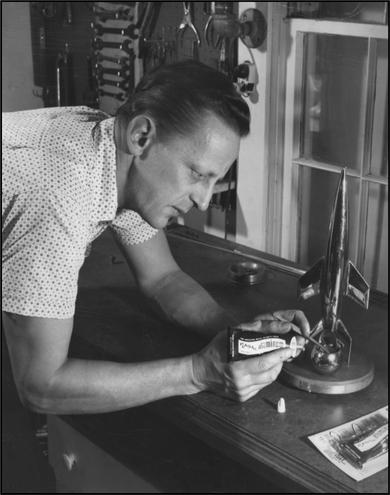
JOHN: We wanted to tell you a story this morning … a New York story but something special … something different and so we asked a special, different sort of writer to send us one. His name is Theodore Sturgeon … and he’s the winner of the International Fantasy Award for the best science fiction novel of 1954—a beautiful and enchanted novel called … “MORE THAN HUMAN.” In just a few days, you’ll be able to see Ted’s award, a gleaming chromium spaceship, in the window of Brentano’s Fifth Avenue shop. We’re really not altogether certain whether Ted’s written us a story or not … but I’ll read you his letter. It begins—Dear “PULSE”:
MUSIC: OPENING CURTAIN … NICE, NORMAL … BRIGHT. UNDER FOR:
JOHN: When I got your note, I was delighted at the idea of doing a story for you. I went straight to the typewriter, unwound the typewriter ribbon from the neck and ears of my baby daughter, Tandy, sat down on my son Robin’s plastic automobile, got up again, picked the pieces of plastic out of myself and the chair, dried Robin’s tears, handed Tandy to her mother for a bath, rewound the ribbon, put some paper in the machine, and nothing happened. You see, what you did is ask for a story at one of those times when a writer can’t write and nothing can make him write. I tried, honestly I did. I played all the tricks on myself I ever learned. I drank two cups of strong, black coffee, I did some knee-bends, I filed my nails, read the morning paper all the way through, ate a stale bagel and a handful of raisins, sniffed at a bottle of aromatic spirits of ammonia to clear my head, and lit my pipe. I don’t like a pipe but it makes me feel like an author. I even had a small quarrel with my wife, which sometimes works wonders. Still no story.
There was nothing for it but to go out and wander. They say New York has something for everyone—you just have to know where to look. I went looking first on Rockefeller Plaza, which never fails to do something to me. I hung over the rail and watched the skaters moving like moths and mayflies to music that came from nowhere, everywhere … anyone who can pass them by without a glance has lost his sense of wonder, and I’m sorry for him. I looked for sunlight high on the clean, clever buildings reaching into the morning and found it. I listened to the whisper of blades on ice, tires on asphalt, of a hundred thousand heels on paving all blended like a great breathing. But it was only magic, its own special kind of magic; it didn’t give me a story idea for you.
So I left and walked west past the place where Dave Garroway holds forth in the early, early hours, towards the Avenue of the Americas, where stores and theaters were beginning to wake, where men can make keys for you and you can buy crepes suzettes and cameras and luggage and lingerie; and I slowly became aware of a neat pair of shoulders and a smooth neat hat. I must have been following the man for minutes without quite realizing it. The coat was one of those banker’s specials—you know, flat and formal and with a smooth narrow collar that might be velvet and might be fur. And the hat was what some people call a bowler and some a derby. Hat and collar were not black, but of the darkest possible brown, and the whole aspect was—well, neat. He was strolling along, turning his head a little from time to time, and though I couldn’t see his face I somehow knew he was smiling at storefronts, automobiles, marquees, people—smiling at the whole, wide world. I wondered what he was smiling about. I wondered, too, what kind of a smile it might be. Was he smiling at? or smiling with?
The first corner we came to was the one where the Radio City Music Hall squats like a kneeling elephant with its big friendly mouth open, and in the entrance stood two girls. One of them reminded me of mint leaves and the other was as real and pretty as a field of daisies. I saw the man in the brown bowler hat walk up to them and he bowed from the waist, that stiff, slight, quaint little gesture that can only be done by a certain sort of person, because it makes the rest of us look silly. He raised the hard, neat hat a trifle and by the tilt of his head and the pleasure just beginning on the girls’ faces, I knew he was smiling a special smile. From his pocket he drew something and handed it to one of the girls, the field-of-daisies one, and without pausing, with never a break in his leisurely stride, he went on.
Then it was my turn to pass the girls. They stared after the man and their mouths were round as a thumbprint. Then one of them looked down in her hand and “Lark!” she said, “Oh, Lark, look: he gave us tickets for ‘JUPITER’S DARLING!’ How did he know I wanted to see it so much?” They stared after him spellbound as I passed, and happy as Christmas. I followed the man across the avenue, thinking, “Lark, Lark. Now what a nice name for a girl that is!” and watching him. A few doors up from the corner is a hardware store, and the hardware man had set a tall ladder against the building. He was up there looking at a place where his awning had slipped off its little hooks where I suppose the wind had bent them. And before I knew what was happening my man in the brown bowler had skipped up two rungs of the ladder. He stood there balanced easily, and with one hand he tipped his hat and with the other he took from his pocket a pair of pliers and handed them up to the hardware fellow. Then off he went again, up the avenue, and when I passed the ladder I could see from the hardware fellow’s face that he, too, had gotten a special smile from the man: a piece of it was on his lips. He took the pliers, scratched his head. I heard him laugh, and then he began to fix his awning as if the pliers were exactly the tool he needed, which I’m sure they were.
I hurried then, because I wanted to see the face of such a man as this, and I hadn’t, yet. I caught up with him at 50th Street. He had paused there, waiting for something. Maybe he was waiting to decide which way to go, and maybe he was waiting for me; I don’t know. As I drew abreast he turned to face me.
Now, I don’t want to disappoint you but I can’t tell you what his face was like. All I can say is that it was as neat as the rest of him, everything about it just where it should be. He smiled.
It was like looking into a bright light, but it didn’t dazzle. It was warm, like the windows of farmhouses late at night when there’s snow. It made me smile too, the biggest, widest smile that ever happened to me, so wide that I heard a little … (ONE CLEAR CHUCK, AS WHEN ONE CHUCKS TO A HORSE: BUT ONLY ONE) … somewhere in my back teeth. I must have been bemused for a second or two, because when I blinked the feeling away, the man was gone. Still smiling, I got into a cab that pulled up for the light just then; I suddenly wanted to be home, next to Robin and Tandy and my wife, while I felt just that way.
As the cab started to move, I turned and looked through the rear window and I saw the man briefly, just once more. One of those poor, cowed, unhappy men had sidled up to him, and in every line of his shabby figure I recognized him and all like him, and I could all but hear the cringing voice, “Dime fer a cuppa cawfee, mister?” And the last thing I saw was the reflection of that incredible smile on the man’s dirty face, as Mr. Brown Bowler Hat reached into his impossible pocket and handed the man a thick, steaming china mug of hot coffee and walked on.
I leaned back on the cushions and watched New York streaming past outside, and I thought: “Well, if this city has something for everyone, then I suppose it has in it a man who can reach into his pocket and grant anyone’s smaller, happy-making wishes.” And then I thought, “he has tickets and tools and cups of coffee and heaven knows what else for other people, but he apparently couldn’t give me the one thing I wanted at the time, which was a little story for ‘PULSE.’ ” So here I am home again, feeling sort of nice because my wife and kids appreciate the bit of smile I brought in, but otherwise disappointed because, whatever else happened, I don’t have a story for you. I guess the man in the brown bowler hat didn’t have one in his pocket at the time.
Yours very truly,
Theodore Sturgeon
P.S. On the other hand, maybe he did.
The Half-Way Tree Murder
THE MYRTLE BANK HOTEL in Jamaica has a marquee built out over the blood-warm water of Kingston Harbor. It overlooks the swimming pool with its lounging, laughing bathers. Drinks are served swiftly by white-gloved waiters. It is warm and shadowed, restful and luxurious.
Cotrell, the C.I.D. man, sat there with the most extraordinary woman he had ever seen.
This had never happened to him before. He was a good man—the Criminal Investigation Division’s best in the district—and he hung doggedly to a case until he had it cracked. But at the same time he had always been able to separate business from pleasure. For weeks now he had been under the spell of Brunhilde Moot, and yet, for all her effect on him, the Half-Way Tree affair kept circling back into his mind.
He watched her while she watched the sea, the haze across the Harbor that was the wicked sunken pirate city Port Royal, the distant mountains marching up and away to meet the heavy, brazen sky. Her eyes always returned to the fishing boats which worked close inshore, and she watched them … perhaps she watched the crews, the half-naked, sweating, muscular black and brown and bronze and tan bodies as they worked.
Cotrell felt a smoky surge of distress at the thought; he shook himself angrily. He had a great deal more to do than to help an exotic brown-eyed blonde enjoy the mysteries in which she cloaked herself. And he could ill afford to let the spell deepen.
He watched her while she watched the sea, or the mountains, or the boats—or was it the men and their nets, the men and their rippling backs?—and he thought, who is she? She had come off a cruise ship three months before, because she liked Jamaica. She would stay indefinitely, leave when it seemed a good idea—tomorrow, next week, or never.
She apparently had unlimited credit. Her clothes told nothing about her but that she had exquisite taste, and that she shopped wherever she found excellence. He knew she spoke Dutch and Spanish, and her English was accented by no accent at all. Her passport was Swiss, which might mean anything. When pressed for information about herself, she used an ancient, woman’s weapon—an abrupt, courteous, smiling silence which was like a slap in the face.
“You’re hypnotized,” he said abruptly.
She drew her attention in to herself, turned and looked at him and away. When she did that, he felt the heat, as from the opening and closing of an oven door.
“I am,” she admitted. “Jamaica is so—old. The old buildings, the old society, decayed and polished. I met a man at Constant Spring last evening who quite naturally clicked his heels when he bowed. And yet, just back a little from the coast, it’s savage. Wild growth and rot, breeding and steaming and killing itself, and breeding and growing again.”
“You like that.” It was not a question.
She knew, and did not answer. She looked at her drink, lifted it, tilted it so that the liquid beaded up on the edge. Not a drop spilled on her steady hand. “Any news on the Half-Way Tree affair?”
“How did you know I’d been thinking of it? No, nothing new. I was going to ask you—”
“Yes?” Her eyes were so wide apart that he sometimes thought they were set on the sides of her head rather than in front. That, and her sharply pointed teeth, and the breadth and strength of her, were what was so strongly animal, for all her impregnable dignity.
“Forgive me—one shouldn’t make analytical comments. You are not like other people, Brunhilde. You don’t think like other people. I—shall I be frank?”
“Of course.” Was she laughing?
“I can’t say I always like the way your mind works. It—”
“It’s too direct?” She did laugh, now, like wind through a cello. “I’ve heard it before. Too direct … there are things I want, and things I like, and I get them. There are things I have no use for, and I avoid them.” She looked again at the boats.
Cotrell hung manfully to what he wanted to say. “I need a new point of view on the Half-Way Tree murder. I would like you to help me.”
“Well,” she breathed. After a moment she said, “Jeff, I’m hardly flattered. I’ve heard a great deal about you. You took in at least four extremely important foreign agents during the war. It was you who broke up the Panamanian drug ring. You have a reputation for cracking cases without any but routine help. And now you ask me to look at a thing like this—a simple murder, a month old, of a crossroads Chinese shopkeeper who was killed by a black hill boy for a few shillings. It’s not worth bothering with, Jeff.”
“It’s murder.”
“Murder!” she said scornfully. “It was killing, and the jungle’s full of it. From what you’ve told me about the case, it’s quite simple. The boy Stanton—”
“Stanley.”
“Whatever—the boy had motive and opportunity and can’t account for his time. Try him and hang him then, mark up another successful case, and go on with your important work. There are a hundred thousand illiterate hill-runners here. One won’t be missed.”
“Stanley could have done it,” said Cotrell carefully, “but he wouldn’t.”
“That,” said Brunhilde Moot flatly, “doesn’t matter.” A large red ant chinned on the overhang of the tabletop. She bent to watch it. It gained the surface and began to amble between the moisture-rings left by their glasses.
She said, “The old Chinaman had a brother who will get all his property—isn’t that so? And he certainly knew where the money was hidden. Hang him, then, and have done with it.”
“He’s my friend,” said Cotrell with some difficulty.
Again he felt the heat and brilliance of her gaze. She bent again over the ant. She blew the ash from her cigarette and swept the glowing tip across the ant’s antennae. It curled up, straightened, blundered into a drop of moisture from one of the sweating glasses, and struggled there.
“I want you to meet him,” said Cotrell.
“I would like to,” she said. “I would like to see what a transplanted oriental, living at the edge of the jungle, has to recommend himself to a man of your stature.” There was considerable insult buried in the phrase. Brunhilde was richer, stronger, more beautiful, and certainly more intelligent that anyone’s average, and was deeply conscious of it. To her, the world was obviously composed of a handful of people and a great many members of the lower orders.
“Lunch there, perhaps?” Cotrell said. “I can offer you a pleasant drive, and certainly some native cooking.”
“You do intrigue me,” she smiled. “And I would so like to think, later, that I had helped you catch and hang your man.”
“Good,” said Cotrell. He looked at his watch and rose. “I’ll send Yem Foong a wire, and we’ll be on our way. I hope I’m not rushing you?”
“I can be ready in five minutes,” she said.
While he was taking care of the check, she stepped to the end of the marquee for another long look at the harbor. As Jeff Cotrell stepped up behind her a moment later, a thirty-foot dugout was moving almost directly under the end of the marquee. Brunhilde tensed as she watched it. In the bow was a giant who could have modeled for a Hercules. As he bent over the paddle, they could see three long scratches in his golden back.
“Damn,” said Brunhilde Moot. She straightened, turned, saw Cotrell. “I’ve broken my fingernail,” she said. “See you in five minutes. The lobby?”
He nodded and managed to smile. When she had reached the landward end of the marquee he returned to the table, picked up a glass, and with its base killed the red ant which still struggled there. He was a little surprised at himself when the glass broke in his hand. He went to compose and send his telegram.
In Cotrell’s low-slung Lanchester, Brunhilde closed her eyes when the car approached an intersection and turned, opening them again on the other side. “Drive left,” she read from a sign. “I’m still not quite used to it. Pulling over to the left to let a car overtake you,stopping in the middle of the street to wait for a right turn. I’m glad you’re driving.”
“You have driven here though, haven’t you?” asked Cotrell, his eyes on the road.
“Not enough to like it—oh! What a wonderful place! See—goats on the sidewalk! And that old woman with the donkey!”
“Yes, pretty much the same as it’s been for the last three centuries. That’s the charm of this place; but it has its drawbacks. Have you ever noticed the little Spanish-wall houses with thatched roofs and louvred windows?”
“Yes. They all seem to be the same size.”
“That’s right. About a hundred and fifty years ago the Home Government put a tax on every room of a house over two, and another on glass windows. The natives simply stopped building houses with more than two rooms, and put in those slatted windows. And although the law has been repealed for over half a century, the custom persists.
“And it’s the same way with their attitude toward banks. The Chinese shopkeepers particularly were suspicious of banks in the old days, and many of them still have their caches around, in, or under the shops where they make their money.”
“Yes, you told me about that right after I arrived.”
“So I did,” said Cotrell, deftly avoiding a barefoot girl who walked along the road weaving a basket, singing, and carrying a tremendous tray of fruit on her head. “Well, they’re learning, I think. Yem Ching, though—he was an educated man. Too intelligent, really, to have followed the old customs the way he did. Well, he’s dead. Perhaps a few of his colleagues will profit by the poor chap’s murder. Somebody should, besides the brute who did him in.”
“Oh—so you believe in basic justice?” smiled Brunhilde. “For every loss, a profit somewhere?”
“In a sense I do,” said Cotrell, glancing at her. “For every crime, a punishment, in any case.”
She laughed. “I love policemen!” She leaned back, taking in the whisking scenery—the bamboo, the rows of mangoes. “I’m hungry.”
“Yem Foong will take care of that, and well.”
“You seem to mean that. The only thing I’ve seen the natives eating is rice and beans and that horrible crawly-looking yampi.”
“You’re in for a surprise. Don’t underestimate the culture of these people. It’s a culture which isn’t measured by telephones and plumbing. Or savings banks, unfortunately.”
“You still intrigue me. What do you suppose they’ll have for lunch?”
“Couldn’t say. Whatever it is will be delicious and—exotic.”
“Wonderful, wonderful,” she said.
“Though I hope,” he said, “that it won’t be salt fish and ackey.”
“I beg your pardon?”
“Salt fish and ackey. Quite a delicacy.”
“And you don’t like it?”
“Oh, I do, but I don’t eat it.”
“What’s ‘ackey’?”
“I’ll show you. There’s lots of it growing along here—See? See there?”
He pointed to a line of trees growing across the deep ditch which imperils all Jamaican traffic. They were shade trees with dark glossy leaves, among which their brilliant orange-yellow fruit showed. Cotrell pulled up.
“I’ll show you one,” he said.
He vaulted over the low door and leaped the ditch, to come back in a moment with one of the bright fruit in his hand. He gave it to Brunhilde. It was about the size of a large orange, and had a hard black encrustation, like ebony, protruding from its side.
“What’s that?”
“The seed,” said Cotrell, smoothly shifting gears. “It grows half in and half out.”
“I’ve never seen anything like it. And is it good?”
“Delicious,” said Cotrell. “I avoid it because, when it’s out of season, and even in season when it isn’t prepared exactly right, it’s deadly poison. Really. We have deaths every year from it. I prefer to be on the safe side.”
Brunhilde brooded over the fruit for a moment, turning it over and over, and then suddenly tossed it out of the car. “If there is a difference between the way our minds work,” she said, “you can see it here. I’ve never tasted ackey. Just because of that, I want to. If I had tasted it, as you have, and knew it to be delicious, I’d want it again.
“I think that this is one of the biggest things in being alive. If my host is cultured, as you say, and if he trusts his cook, then I am quite willing to trust him. As to the risk—why, one is quite likely to die from a bad cold. One might as well get some pleasure from the process.”
Cotrell smiled, glancing briefly at his passenger. “I’ll take the cold, thank you. Ackey poisoning is a very unpleasant business. Terrible tummy-ache, y’know, vomiting and choking. Pretty quick, though, if you can’t get to a stomach pump.”
“Jeff,” she said softly, “I simply cannot be frightened. Not by anything.”
“I think I realized that some time ago,” said Jeff Cotrell. “You’re well-armed, Brunhilde. It would be difficult to imagine you in a situation where you couldn’t use your quick mind, or your strength, or—”
She smiled widely, so that he saw the pointed teeth, and arched her back. “—or any other of my attributes,” she finished for him. He flushed. “You’re so right,” she added. “Hence I have nothing to fear, ever.”
They took an unpaved side road just outside Half-Way Tree, and bumped along it for half a mile until they came to a crossroads. Under a giant tamarind tree was the shop. It boasted a sign: YEM FOONG. Ginger Beer—Yard goods. CATERER TO HIS HONOR THE GOVERNOR.
“The sign is new,” said Brunhilde.
“Very observant of you,” said Cotrell, turning into the shop’s yard. “Some of the people, you see, are very superstitious and wouldn’t go into a shop if it bore a dead man’s name. They’d be afraid he’d wait on them.”
“I shall be looking,” she said, “for the culture and intelligence you tell me I’ll find here.”
“I have said you’re observant,” he countered, opening the door for her. She laid a hand on his arm.
“Jeff …”
“Yes?”
“If I help you catch your man, will you do me a favor?”
“But of course. Anything I can.”
“You can. I want to go to the hanging.”
“You want—”
“Jeff, you promised.”
“Very well,” he said.
They walked up the short path and entered the shop, blinking the sunlight out of their eyes. It was cool and dim inside. There were no show-windows. The packed-earth walls were thick and the windows small. Along one wall ran a board counter, behind which were bolts of cotton, canned goods, bottles of rum, and fruit juices, racked on shelves.
There were a couple of battered tables and some chairs out on the packed-earth floor, and in the corner was a water-box filled with ice and small stone bottles of ginger-beer, cane-juice, ale, and bright-colored, sticky-sweet soft drinks.
“Mr. Cotrell, sir. Most welcome. This place is entirely yours.”
Yem Foong was tiny, wizened, completely bald. He wore a long black linen jacket which buttoned up to its stiff, round collar by a series of black silk frogs. His clothes were pressed and smooth, and so were his face and his voice.
“Foong! So glad to see you again, old fellow. This is Miss Moot, of whom I have spoken to you. She has, she tells me, a high regard for the Jamaican cuisine.”
Brunhilde inclined her head and extended her hand. But already Yem Foong had folded his own and was bowing deeply.
“A presence such as yours begins to compensate for the emptiness of this unfortunate house.”
“Yes, I had heard about your brother,” said Brunhilde huskily. “I can’t tell you all I feel.”
“You have told me,” said Yem, graciously. “Now, if you will step this way, what little I have been able to prepare for you is ready.”
They went through the rear door. A low table was set in the inner room, and Brunhilde stopped momentarily at sight of it. It was laid with exquisite Spode, and Jensen silver. A single spray of jasmine lay in a squat crystal bowl in the center of the table.
They seated themselves. Brunhilde looked from end to end of the table, admiringly, and at the tapestried wall facing her, and around and down to the far corner of the room, where there was a fresh-dug hole about a yard square in the earthen floor. On turning back, Brunhilde found herself in the direct gaze of both her companions.
“My poor brother met his ancestors there,” said Yem, sorrowfully, “as he was replacing the money, and the other things.”
“Other things?”
Yem shrugged. “Things of little value, except to us. Some carved jade, and a little golden casket containing a scrap of rice paper. It was supposed to be an original poem by Sun Yü,” he added regretfully. “The money was nothing. Money is only the substance of living—stuff of the bones and the belly. The craftsmanship of two thousand years ago is important only to that part of a man which is not an animal.”
“I understand,” said Brunhilde. “And of course it was a man who was all animal who stole the things. Have you found nothing that would indicate who the criminal was?”
Yem Foong shrugged tiredly. “How can one know for certain? The shop was not yet locked. It was just at dusk, which is a rapid thing in the tropics. I was in Kingston, buying yard goods, and the servants were in their quarters. And during that time when everything is shadowed, someone slipped in and did—what was done.
“It could have been from inside or outside; it could have been some wanderer on the road outside, a stranger; or it could have been a neighbor, or even someone here—who knows? The promise of riches draws many kinds of men.”
A servant entered, a dark brown youth with sharply slanted brows and woolly hair which grew into a widow’s peak. Brunhilde watched him upward through her lashes as he catfooted around the table, setting out the appetizer.
When the boy left, Cotrell said, “That is Stanley?” as if for Brunhilde’s benefit.
“Yes,” said Yem. “A strange boy, but a good one.”
“He looks like Mephisto himself,” murmured Brunhilde to the dish before her. It was one she had not seen before—half a starapple, an exotic fruit with a five-pointed star of red-purple in its center, and delectable flesh which shaded off through red and pink to snow-white on the outside.
“Mephisto. Interesting you should say that,” said Cotrell. “Eh, Foong?”
“Yes,” said the oriental. “Stanley’s father was an obeah man—a wizard, up in the mountains near Gimme-Me-Bit. Stanley is the only native I have ever known who watches a sunset for the beauty he finds there. He collects colored stones, too, and has done some remarkable things in landscapes made with moth’s wings.”
Stanley returned with the soup—black bean soup, piping hot, freshened with a touch of limejuice and containing chilled spears of avocado. Again Brunhilde’s thoughtful gaze was on the boy.
“You seem very quiet,” said Cotrell halfway through the course.
“What else?” smiled Brunhilde Moot. “The soup—it has quite left me speechless! Delicious, Mr. Yem.”
“I delight in your enjoyment,” said Yem.
“I wonder,” said Cotrell, “how you’ll enjoy this,” and, reaching under the table, he scooped up something and dropped it in front of her with a thump. It was an old, earth-stained, leather-bound satchel.
“Wh—” It was barely a sound at all which Brunhilde Moot uttered. “Why should I enjoy a thing like this?” she asked steadily.
“Your sense of the dramatic,” said Cotrell.
She looked at him with a new roundness to her eyes. There was obviously a kind of subtlety which she had considered quite beyond this sallow, patient, tropical man. She looked at the satchel.
“What is it?” she asked.
“It’s the bag that was buried in the corner there.”
“Where on earth did it come from?”
“Right across the road. It’d been thrown into the canefield,” said Cotrell. He busied himself with the straps. Almost defiantly, Brunhilde ate soup.
“Look,” said Cotrell, tilting the open top of the satchel toward her. It was full of colorful, oversized British banknotes.
“Is that—”
Yem Foong nodded. “It’s all there. All the money, that is. The other things, the little things—they’re not here at all.”
Stanley was in the room and had reached the table before they saw him. He gathered up Brunhilde’s soup-dish and then saw the satchel. He uttered a faint shriek, dropped the dish on the floor, and bolted.
“Stanley!” cried Foong.
Brunhilde leaned back and smiled at Cotrell. “That,” she said, “is a very guilty animal.”
“Stanley?” Yem Foong’s eyes widened. “Miss Moot—that is impossible!”
“It is? Mr. Yem, I have seen a good deal. I think I can spot a guilty reaction when I see one. Really, Jeff, are you just going to sit there and let that—that killer get away?”
“Stanley is Yem Foong’s servant,” said Cotrell coldly. “I’m sure he can handle the situation.”
“Thank you, Mr. Cotrell. I am embarrassed for my house and its servants.” He clapped his hands. An old woman poked her seamed mahogany face in at the door.
“Sephronia,” said Foong quietly, “send Stanley to me directly.”
The face disappeared, and almost immediately Stanley shuffled in. His feline gait was gone, and his eyes were filled with raw panic. The slanted eyebrows now looked ridiculous.
“Stanley,” said Foong, without anger, “why you behave so, mon?” In speaking to the boy, his voice took on the singsong cadences of the native dialect.
Stanley looked at the satchel. “It de money-bag, mahstah! It leave heah by de dead han’ o’ Mahstah Ching his own se’f!”
“What’s all that?” Brunhilde demanded.
Cotrell smiled. “He is afraid of the satchel because he thinks it was left here—or brought back—by Ching’s ghost.” He turned to the boy and said, “You fool youse’f, mon. It was my very han’ dat fin’ de bag dere an’—” he wiggled his fingers—“it not dead yet. No one harass de garlic you put ’pon de door an’ window-dem, as you can plainly see.”
The boy raised startled eyes to the tops of the doors and windows. There were sprigs of garlic over all of them. Relief flooded his strange face.
“Ah, bahss, I love you for dat! I do indeed, for it were a cru-ell an’ wicked start I had to see de money-bag itse’f, dere. I know full well no duppie can cross de garlic. I am a eejut, sah, a strikin’ eejut.”
“Go about you work, mon,” smiled Foong.
Stanley picked up the dishes and went out, praising every inhabitant of heaven under his breath.
“You speak that calypso like the natives,” chuckled Brunhilde.
Cotrell chuckled with her, but grimly. “I was born here, you know,” he said.
Eyes down, Brunhilde meticulously positioned and repositioned the silver before her. “You know, Jeff,” she said. “I think you’re letting that savage pull the wool over your eyes. Think a minute. Didn’t you say he magpies pretty things? Didn’t you tell me he was a little strange, with his collecting rocks and gaping at the sunset? And doesn’t a servant come and go as he chooses—isn’t he in a position to know where everyone in the house may be at a particular time—say, at dusk?
“Wouldn’t he know where anything of value might be hidden? You have no real clues here. Only by determining what kind of person might have committed the crime can you choose between suspects. I would say that the boy fills the bill. He had motive, opportunity, strength, and the peculiar tastes that would make him do such a thing.”
Cotrell and Yem exchanged a glance. Stanley re-entered with the next course.
“Ah!” said Cotrell. “Salt fish and ackey! You’ve got your wish, Brunhilde. Fall to. No thank you, Stanley. None for me. I’ll just have the coat-of-arms.” And he heaped his plate with the ubiquitous Jamaica Coat-of-Arms—rice and kidney beans.
“I’d love some,” said Brunhilde, passing Cotrell a queenly glance. “A little more. That’s fine, thank you.” She tasted it. “Why, it’s delicious.”
“It is good, isn’t it?” said Yem Foong. “Especially with the salt fish.”
Brunhilde took a little of each. “My! The fish is really briny.” She sipped her water, sipped again. “Jeff, you don’t know what you are missing.”
“I do,” said Cotrell. “But I’m quite happy with this, thank you.”
Brunhilde munched daintily and sipped. “May I have more water, please? Thank you. To get back to Stanley—what do you think? You did ask my help, you know.”
Yem Foong said, “Stanley was with me in Kingston that night. Of all the servants, he, least of all, could have done it.”
There was a tense silence. Brunhilde Moot ate more ackey. “Where’s the evidence to that?” she demanded.
“Yem Foong’s word,” said Cotrell. “It’s good.”
“Well, then, the whole thing’s perfectly simple.” She spoke as if to children. “Mr. Yem can testify that Stanley was here, you can bring up something of his background, and get a conviction.”
Cotrell slowly put his fork down. “You really do mean that, don’t you?”
“Of course.” She looked at him over her glass.
“Because this boy is a little unusual, and because he has no education, and because he’s black, you feel I should run him in, throw him to the Assizes, and have him hung whether he’s guilty or not?”
Brunhilde shrugged. “You told me yourself that the island is overpopulated.”
“That tears it,” gritted Cotrell. “That jolly well pays the bloody piper. Miss Moot, you’re a rotter. I had an idea before that you were a filthy swine, but I wouldn’t let myself believe it—not really, not even with proof after proof—What are you laughing at?”
Brunhilde Moot carefully nibbled, chewed, swallowed, and laughed again at the fuming C.I.D. man. “You,” she said imperturbably. “Ever since I first saw you at the Myrtle Bank two months ago, you have worn that restrained British mask of yours. I wondered then what would ever break it up and make it human, and now I’ve done it.”
Purpling, Jeff Cotrell half rose. Yem Foong checked him with a gesture. “No, Inspector. Now we need only wait.”
Cotrell looked at him, slumped back.
“Are you all right?” the old man asked Brunhilde solicitously.
“All right? But of course.”
“You were not eating,” said Yem Foong, “and I thought—”
With an obvious effort, she addressed herself to the salt fish and ackey again. A delicate line of droplets appeared on her upper lip. She dabbed at them with her napkin, paling. Suddenly she put down her fork, looked at her plate, and at the two intent men.
Jeff Cotrell nodded, his eyes tight on her face. “Just the right food for your kind,” he said, “out of season and all.”
“My kind—”
“Rats,” said Cotrell. “Mad dogs.”
“It—isn’t poison! Yem has—”
Yem Foong dropped his eyes to his plate. “I haven’t touched mine.”
Brunhilde Moot’s face turned a pasty gray. “I—feel—” Suddenly she was on her feet, her lips twitching. The transformation was more shocking, much more, than had been Cotrell’s outburst. She flung herself across the table, clawed hands outstretched, and closed them on Yem’s embroidered jacket.
“Eat it, damn you,” she screamed. “Eat it!”
Cotrell leaned across and very carefully brought the edge of his palm down on the side of her neck, hard. The expression on her face did not change, but her hands relaxed. She slid limply back, slowly began to sag on to the table. Cotrell rolled her unceremoniously to the floor. She moved, clawed at the dirt floor, and got to her knees, her head hanging.
“You feel sick,” gritted Cotrell. “Don’t let it worry you, old girl. It’ll get worse. The right way for you to go out, too. You’re not human. You’re not a member of anything human. The colossal gall of you, to go about like a—” his voice thickened—“like a woman, like a beautiful warm human woman.”
He pulled himself up with an effort. Yem looked at him with deep, understanding eyes. “You murdered Yem Ching because you were bored, because you wanted to watch me try to break the case, talk about it with me over a drink!”
There was a horrid, wrenching, human explosion. Cotrell turned his head away. “That’s only the first spasm,” he said coldly. “You’ll do that until you choke to death.”
The seizure subsided. She squatted back and turned miserable eyes up to Cotrell. “Doctor,” she murmured. “Stomach pump—”
“I wouldn’t get a doctor for you if there was a medical convention out there under the tamarind tree!” said Cotrell.
“Get … doctor,” she whimpered. “I—stomach—” and she moaned. It was a weak, piteous, broken sound. “I killed him,” she whispered. “Got—souvenirs.” Again there was the frightening, tearing spasm. “Doctor—”
“Souvenirs? The little casket and the jade?”
She nodded.
“Where are they?”
She shuddered violently, and turned up a glance of unqualified hatred. “Get doctor.”
“All right. You tell me where the souvenirs are, and I’ll see to it that you don’t die from ackeys.”
She made a listless gesture. Following it, Cotrell dumped the contents of her handbag onto the table. In the glittering clutter of gem-encrusted compact, cigarette case, and matching perfume atomizer, was a tiny carven jade figurine. Cotrell held it out to Yem, who took it and nodded.
“Where’s the box?”
“Stocking-casket. Hotel room.”
Cotrell took out his notebook, hurriedly scribbled in it. “Diary. Tells how,” she added. “Quickly—get me a doctor!”
Cotrell ripped out the leaf. “Have Stanley run this to the telegraph office. Quickly,” he said to Yem.
Yem took it wordlessly and went out.
“You—” said Cotrell to the huddled thing on the floor, and the syllable was all scorn, all revulsion. “You couldn’t be frightened—not when you could be a woman. But you can’t smile and raise your ruddy eyebrow when you’re behaving like a poisoned mongrel, eh? By heaven, I had to play you like a fish to get you out here and get that confession—and the ‘souvenirs.’ That’s all we needed. We have two witnesses who saw you near here that night, and half a hundred who saw you driving down the Spanish Town Road on the wrong side.
“We couldn’t pin you down to the shop, but now we have the jade and the casket. You didn’t think we’d suspect a woman of a bludgeoning, did you?” He broke off to let another horrible retching spell pass. When it was over, he said, “Oh, yes. That. The salt fish made you thirsty. Made you drink water. Water that was loaded with a nice tasteless essence of nux vomica. There’s nothing wrong with the ackey.”
Brunhilde Moot began to cry. Cotrell put the manacles on her. She did not resist. She cried as if she did not quite know how to do it. It was probably the first time in years that she had cried.
“Why?” she said. “Why this sneaky, rotten way to trap me?”
Jeff Cotrell turned his back. His voice came thickly, “It was the only way. If you could have stood up, faced it, fought it, then I—I -shouldn’t have been able—”
The sound behind him, suddenly, was not a sob, but the shadow of a laugh. “A conquest!” she said. “I suppose I shall get to the hanging after all; and there you’ll be too. A mad infatuation can very easily destroy a man—and his pride.”
Jeff Cotrell turned away, his face ashen. “Not this man,” he said. “No. No, I’m quite sure you’re wrong.”
The Skills of Xanadu
AND THE SUN WENT NOVA and humanity fragmented and fled; and such is the self-knowledge of humankind that it knew it must guard its past as it guarded its being, or it would cease to be human; and such was its pride in itself that it made of its traditions a ritual and a standard.
The great dream was that wherever humanity settled, fragment by fragment by fragment, however it lived, it would continue rather than begin again, so that all through the Universe and the years, humans would be humans, speaking as humans, thinking as humans, aspiring and progressing as humans; and whenever human met human, no matter how different, how distant, he would come in peace, meet his own kind, speak his own tongue.
Humans, however, being humans—
Bril emerged near the pink star, disliking its light, and found the fourth planet. It hung waiting for him like an exotic fruit. (And was it ripe, and could he ripen it? And what if it were poison?) He left his machine in orbit and descended in a bubble. A young savage watched him come and waited by a waterfall.
“Earth was my mother,” said Bril from the bubble. It was the formal greeting of all humankind, spoken in the Old Tongue.
“And my father,” said the savage, in an atrocious accent.
Watchfully, Bril emerged from the bubble, but stood very close by it. He completed his part of the ritual. “I respect the disparity of our wants, as individuals, and greet you.”
“I respect the identity of our needs, as humans, and greet you. I am Wonyne,” said the youth, “son of Tanyne, of the Senate, and Nina. This place is Xanadu, the fourth planet.”
“I am Bril of Kit Carson, second planet of the Sumner System, and a member of the Sole Authority,” said the newcomer, adding, “and I come in peace.”
He waited then, to see if the savage would discard any weapons he might have, according to historic protocol. Wonyne did not; he apparently had none. He wore only a cobwebby tunic and a broad belt made of flat, black, brilliantly polished stones and could hardly have concealed so much as a dart. Bril waited yet another moment, watching the untroubled face of the savage, to see if Wonyne suspected anything of the arsenal hidden in the sleek black uniform, the gleaming jackboots, the metal gauntlets.
Wonyne said only, “Then, in peace, welcome.” He smiled. “Come with me to Tanyne’s house and mine, and be refreshed.”
“You say Tanyne, your father, is a Senator? Is he active now? Could he help me to reach your center of government?”
The youth paused, his lips moving slightly, as if he were translating the dead language into another tongue. Then, “Yes. Oh, yes.”
Bril flicked his left gauntlet with his right fingertips and the bubble sprang away and up, where at length it would join the ship until it was needed. Wonyne was not amazed—probably, thought Bril, because it was beyond his understanding.
Bril followed the youth up a winding path past a wonderland of flowering plants, most of them purple, some white, a few scarlet, and all jeweled by the waterfall. The higher reaches of the path were flanked by thick soft grass, red as they approached, pale pink as they passed.
Bril’s narrow black eyes flicked everywhere, saw and recorded everything: the easy-breathing boy springing up the slope ahead, and the constant shifts of color in his gossamer garment as the wind touched it; the high trees, some of which might conceal a man or a weapon; the rock outcroppings and what oxides they told of; the birds he could see and the bird-songs he heard which might be something else.
He was a man who missed only the obvious, and there is so little that is obvious.
Yet he was not prepared for the house; he and the boy were halfway across the park-like land which surrounded it before he recognized it as such.
It seemed to have no margins. It was here high and there only a place between flower beds; yonder a room became a terrace, and elsewhere a lawn was a carpet because there was a roof over it. The house was divided into areas rather than rooms, by open grilles and by arrangements of color. Nowhere was there a wall. There was nothing to hide behind and nothing that could be locked. All the land, all the sky, looked into and through the house, and the house was one great window on the world.
Seeing it, Bril felt a slight shift in his opinion of the natives. His feeling was still one of contempt, but now he added suspicion. A cardinal dictum on humans as he knew them was: Every man has something to hide. Seeing a mode of living like this did not make him change his dictum: he simply increased he watchfulness, asking: How do they hide it?
“Tan! Tan!” the boy was shouting. “I’ve brought a friend!”
A man and a woman strolled toward them from a garden. The man was huge, but otherwise so like the youth Wonyne that there could be no question of their relationship. Both had long, narrow, clear gray eyes set very wide apart, and red—almost orange—hair. The noses were strong and delicate at the same time, their mouths thin-lipped but wide and good-natured.
But the woman—
It was a long time before Bril could let himself look, let himself believe that there was such a woman. After his first glance, he made of her only a presence and fed himself small nibbles of belief in his eyes, in the fact that there could be hair like that, face, voice, body. She was dressed, like her husband and the boy, in the smoky kaleidoscope which resolved itself, when the wind permitted, into a black-belted tunic.
“He is Bril of Kit Carson in the Sumner System,” babbled the boy, “and he’s a member of the Sole Authority and it’s the second planet and he knew the greeting and got it right. So did I,” he added, laughing. “This is Tanyne, of the Senate, and my mother Nina.”
“You are welcome, Bril of Kit Carson,” she said to him; and unbelieving in this way that had come upon him, he took away his gaze and inclined his head.
“You must come in,” said Tanyne cordially, and led the way through an arbor which was not the separate arch it appeared to be, but an entrance.
The room was wide, wider at one end than the other, though it was hard to determine by how much. The floor was uneven, graded upward toward one corner, where it was a mossy bank. Scattered here and there were what the eye said were white and striated gray boulders; the hand would say they were flesh. Except for a few shelf and table-like niches on these and in the bank, they were the only furniture.
Water ran frothing and gurgling through the room; apparently as an open brook; but Bril saw Nina’s bare foot tread on the invisible covering that followed it down to the pool at the other end. The pool was the one he had seen from outside, indeterminately in and out of the house. A large tree grew by the pool and leaned its heavy branches toward the bank; evidently its wide-flung limbs were webbed and tented between by the same invisible substance which covered the brook. These branches formed the only overhead cover; yet, to the ear, it felt like a ceiling.
The whole effect was, to Bril, intensely depressing, and he surprised himself with a flash of homesickness for the tall steel cities of his home planet.
Nina smiled and left them. Bril followed his host’s example and sank down on the ground, or floor, where it became a bank, or wall. Inwardly, Bril rebelled at the lack of decisiveness, of discipline, of clear-cut limitation inherent in such haphazard design as this. But he was well-trained and quite prepared, at first, to keep his feelings to himself among barbarians.
“Nina will join us in a moment,” said Tanyne.
Bril, who had been watching the woman’s swift movements across the courtyard through the transparent wall opposite, controlled a start. “I am unused to your ways, and wondered what she was doing,” he said.
“She is preparing a meal for you,” explained Tanyne.
“Herself?”
Tanyne and his son gazed wonderingly. “Does that seem unusual to you?”
“I understood the lady was wife to a Senator,” said Bril. It seemed adequate as an explanation, but only to him. He looked from the boy’s face to the man’s. “Perhaps I understand something different when I use the term ‘Senator.’ ”
“Perhaps you do. Would you tell us what a Senator is on the planet Kit Carson?”
“He is a member of the Senate, subservient to the Sole Authority, and in turn leader of a free Nation.”
“And his wife?”
“His wife shares his privileges. She might serve a member of the Sole Authority, but hardly anyone else—certainly not an unidentified stranger.”
“Interesting,” said Tanyne, while the boy murmured the astonishment he had not expressed at Bril’s bubble, or Bril himself. “Tell me, have you not identified yourself, then?”
“He did, by the waterfall,” the youth insisted.
“I gave you no proof,” said Bril stiffly. He watched father and son exchange a glance. “Credentials, written authority.” He touched the flat pouch hung on his power belt.
Wonyne asked ingenuously, “Do the credentials say you are not Bril of Kit Carson in the Sumner System?”
Bril frowned at him, and Tanyne said gently, “Wonyne, take care.” To Bril, he said, “Surely there are many differences between us, as there always are between different worlds. But I am certain of this one similarity: the young at times run straight where wisdom has built a winding path.”
Bril sat silently and thought this out. It was probably some sort of apology, he decided, and gave a single sharp nod. Youth, he thought, was an attenuated defect here. A boy Wonyne’s age would be a soldier on Carson, ready for a soldier’s work, and no one would be apologizing for him. Nor would he be making blunders. None!
He said, “These credentials are for your officials when I meet with them. By the way, when can that be?”
Tanyne shrugged his wide shoulders. “Whenever you like.”
“The sooner the better.”
“Very well.”
“Is it far?”
Tanyne seemed perplexed. “Is what far?”
“Your capital, or wherever it is your Senate meets.”
“Oh, I see. It doesn’t meet, in the sense you mean. It is always in session, though, as they used to say. We—”
He compressed his lips and made a liquid, bisyllabic sound. Then he laughed. “I do beg your pardon,” he said warmly. “The Old Tongue lacks certain words, certain concepts. What is your word for—er—the-presence-of-all-in-the-presence-of-one?”
“I think,” said Bril carefully, “that we had better go back to the subject at hand. Are you saying that your Senate does not meet in some official place, at some appointed time?”
“I—” Tan hesitated, then nodded. “Yes, that is true as far as it—”
“And there is no possibility of my addressing your Senate in person?”
“I didn’t say that.” Tan tried twice to express the thought, while Bril’s eyes slowly narrowed. Tan suddenly burst into laughter. “Using the Old Tongue to tell old tales and to speak with a friend are two different things,” he said ruefully. “I wish you would learn our speech. Would you, do you suppose? It is rational and well-based on what you know. Surely you have another language besides the Old Tongue on Kit Carson?”
“I honor the Old Tongue,” said Bril stiffly, dodging the question. Speaking very slowly, as if to a retarded child, he said, “I should like to know when I may be taken to those in authority here, in order to discuss certain planetary and interplanetary matters with them.”
“Discuss them with me.”
“You are a Senator,” Bril said, in a tone which meant very clearly: You are only a Senator.
“True,” said Tanyne.
With forceful patience, Bril asked, “And what is a Senator here?”
“A contact point between the people of his district and the people everywhere. One who knows the special problems of a small section of the planet and can relate them to planetary policy.”
“And whom does the Senate serve?”
“The people,” said Tanyne, as if he had been asked to repeat himself.
“Yes, yes, of course. And who, then, serves the Senate?”
“The Senators.”
Bril closed his eyes and barely controlled the salty syllable which welled up inside him. “Who,” he inquired steadily, “is your Government?”
The boy had been watching them eagerly, alternately, like a devotee at some favorite fast ball game. Now he asked, “What’s a Government?”
Nina’s interruption at that point was most welcome to Bril. She came across the terrace from the covered area where she had been doing mysterious things at a long work-surface in the garden. She carried an enormous tray—guided it, rather, as Bril saw when she came closer. She kept three fingers under the tray and one behind it, barely touching it with her palm. Either the transparent wall of the room disappeared as she approached, or she passed through a section where there was none.
“I do hope you find something to your taste among these,” she said cheerfully, as she brought the tray down to a hummock near Bril. “This is flesh of birds, this of small mammals, and, over here, fish. These cakes are made of four kinds of grain, and the white cakes here of just one, the one we call milk-wheat. Here is water, and these two are wines, and this one is a distilled spirit we call warm-ears.”
Bril, keeping his eyes on the food, and trying to keep his universe from filling up with the sweet fresh scent of her as she bent over him, so near, said, “This is welcome.”
She crossed to her husband and sank down at his feet, leaning back against his legs. He twisted her heavy hair gently in his fingers and she flashed a small smile up at him. Bril looked from the food, colorful as a corsage, here steaming, there gathering frost from the air, to the three smiling expectant faces, and did not know what to do.
“Yes, this is welcome,” he said again, and still they sat there, watching him. He picked up the white cake and rose, looked out and around, into the house, through it and beyond. Where could one go in such a place?
Steam from the tray touched his nostrils and saliva filled his mouth. He was hungry, but …
He sighed, sat down, gently replaced the cake. He tried to smile and could not.
“Does none of it please you?” asked Nina, concerned.
“I can’t eat here!” said Bril; then, sensing something in the natives that had not been there before, he added, “thank you.” Again he looked at their controlled faces. He said to Nina, “It is very well-prepared and good to look on.”
“Then eat,” she invited, smiling again.
This did something that their house, their garments, their appallingly easy ways—sprawling all over the place, letting their young speak up at will, the shameless admission that they had a patois of their own—that none of these things had been able to do. Without losing his implacable dignity by any slightest change of expression, he yet found himself blushing. Then he scowled and let the childish display turn to a flush of anger. He would be glad, he thought furiously, when he had the heart of this culture in the palm of his hand, to squeeze when he willed; then there would be an end to these hypocritical amenities and they would learn who could be humiliated.
But these three faces, the boy’s so open and unconscious of wrong, Tanyne’s so strong and anxious for him, Nina—that face, that face of Nina’s—they were all utterly guileless. He must not let them know of his embarrassment. If they had planned it, he must not give them the satisfaction. If they had not planned it, he must not let them suspect his vulnerability.
With an immense effort of will, he kept his voice low; still, it was harsh. “I think,” he said slowly, “that we on Kit Carson regard the matter of privacy perhaps a little more highly than you do.”
They exchanged an astonished look, and then comprehension dawned visibly on Tanyne’s ruddy face. “You don’t eat together!”
Bril did not shudder, but it was in his word: “No.”
“Oh,” said Nina, “I’m so sorry!”
Bril thought it wise not to discover exactly what she was sorry about.
He said, “No matter. Customs differ. I shall eat when I am alone.”
“Now that we understand,” said Tanyne, “go ahead. Eat.”
But they sat there!
“Oh,” said Nina, “I wish you spoke our other language; it would be so easy to explain!” She leaned forward to him, put out her arms, as if she could draw meaning itself from the air and cast it over him. “Please try to understand, Bril. You are very mistaken about one thing—we honor privacy above almost anything else.”
“We don’t mean the same thing when we say it,” said Bril.
“It means aloneness with oneself, doesn’t it? It means to do things, think or make or just be, without intrusion.”
“Unobserved,” said Bril.
“So?” replied Wonyne happily, throwing out both hands in a gesture that said quod erat demonstrandum. “Go on then—eat! We won’t look!” and helped the situation not at all.
“Wonyne’s right,” chuckled the father, “but as usual, a little too direct. He means we can’t look, Bril. If you want privacy, we can’t see you.”
Angry, reckless, Bril suddenly reached to the tray. He snatched up a goblet, the one she had indicated as water, thumbed a capsule out of his belt, popped it into his mouth, drank and swallowed. He banged the goblet back on the tray and shouted, “Now you’ve seen all you’re going to see.”
With an indescribable expression, Nina drifted upward to her feet, bent like a dancer and touched the tray. It lifted and she guided it away across the courtyard.
“All right,” said Wonyne. It was precisely as if someone had spoken and he had acknowledged. He lounged out, following his mother. What had been on her face? Something she could not contain; something rising to that smooth surface, about to reveal outlines, break through … anger? Bril hoped so. Insult? He could, he supposed, understand that. But—laughter? Don’t make it laughter, something within him pleaded.
“Bril,” said Tanyne.
For the second time, he was so lost in contemplation of the woman that Tanyne’s voice made him start.
“What is it?”
“If you will tell me what arrangements you would like for eating, I’ll see to it that you get them.”
“You wouldn’t know how,” said Bril bluntly. He threw his sharp, cold gaze across the room and back. “You people don’t build walls you can’t see through, doors you can close.”
“Why, no, we don’t.” As always, the giant left the insult and took only the words.
I bet you don’t, Bril said silently, not even for—and a horrible suspicion began to grow within him. “We of Kit Carson feel that all human history and development are away from the animal, toward something higher. We are, of course, chained to the animal state, but we do what we can to eliminate every animal act as a public spectacle.” Sternly, he waved a shining gauntlet at the great open house. “You have apparently not reached such a idealization. I have seen how you eat; doubtless you perform your other functions so openly.”
“Oh, yes,” said Tanyne. “But with this—” he pointed—“it’s hardly the same thing.”
“With what?”
Tanyne again indicated one of the boulderlike objects. He tore off a clump of moss—it was real moss—and tossed it to the soft surface of one of the boulders. He reached down and touched one of the gray streaks. The moss sank into the surface the way a pebble will in quicksand, but much faster.
“It will not accept living animal matter above a certain level of complexity,” he explained, “but it instantly absorbs every molecule of anything else, not only on the surface but for a distance above.”
“And that’s a—a—where you—”
Tan nodded and said that that was exactly what it was.
“But—anyone can see you!”
Tan shrugged and smiled. “How? That’s what I meant when I said it’s hardly the same thing. Of eating, we make a social occasion. But this—” he threw another clump of moss and watched it vanish—“just isn’t observed.” His sudden laugh rang out and again he said, “I wish you’d learn the language. Such a thing is so easy to express.”
But Bril was concentrating on something else. “I appreciate your hospitality,” he said, using the phrase stiltedly, “but I’d like to be moving on.” He eyed the boulder distastefully. “And very soon.”
“As you wish. You have a message for Xanadu. Deliver it, then.”
“To your Government.”
“To our Government. I told you before, Bril—when you’re ready, proceed.”
“I cannot believe that you alone represent this planet!”
“Neither can I,” said Tanyne pleasantly. “I don’t. Through me, you can speak to forty-one others, all Senators.”
“Is there no other way?”
Tanyne smiled. “Forty-one other ways. Speak to any of the others. It amounts to the same thing.”
“And no higher government body?”
Tanyne reached out a long arm and plucked a goblet from a niche in the moss bank. It was chased crystal with a luminous metallic rim.
“Finding the highest point of the government of Xanadu is like finding the highest point on this,” he said. He ran a finger around the inside of the rim and the goblet chimed beautifully.
“Pretty unstable,” growled Bril.
Tanyne made it sing again and replaced it; whether that was an answer or not, Bril could not know.
He snorted, “No wonder the boy didn’t know what Government was.”
“We don’t use the term,” said Tanyne. “We don’t need it. There are few things here that a citizen can’t handle for himself; I wish I could show you how few. If you’ll live with us a while, I will show you.”
He caught Bril’s eye squarely as it returned from another disgusted and apprehensive trip to the boulder, and laughed outright. But the kindness in his voice as he went on quenched Bril’s upsurge of indignant fury, and a little question curled up: Is he managing me? But there wasn’t time to look at it.
“Can your business wait until you know us, Bril? I tell you now, there is no centralized Government here, almost no government at all; we of the Senate are advisory. I tell you, too, that to speak to one Senator is to speak to all, and that you may do it now, this minute, or a year from now—whenever you like. I am telling you the truth and you may accept it or you may spend months, years, traveling this planet and checking up on me; you’ll always come out with the same answer.”
Noncommittally, Bril said, “How do I know that what I tell you is accurately relayed to the others?”
“It isn’t relayed,” said Tan frankly. “We all hear it simultaneously.”
“Some sort of radio?”
Tan hesitated, then nodded. “Some sort of radio.”
“I won’t learn your language,” Bril said abruptly. “I can’t live as you do. If you can accept those conditions, I will stay a short while.”
“Accept? We insist!” Tanyne bounded cheerfully to the niche where the goblet stood and held his palm up. A large, opaque sheet of a shining white material rolled down and stopped. “Draw with your finger,” he said.
“Draw? Draw what?”
“A place of your own. How you would like to live, eat, sleep, everything.”
“I don’t require very much. None of us on Kit Carson do.”
He pointed the finger of his gauntlet like a weapon, made a couple of dabs in the corner of the screen to test the line, and then dashed off a very credible parallelepiped. “Talking my height as one unit, I’d want this one-and-a-half long, one-and-a-quarter high. Slit vents at eye level, one at each end, two on each side, screened against insects—”
“We have no preying insects,” said Tanyne.
“Screened anyway, and with as near an unbreakable mesh as you have. Here a hook suitable for hanging a garment. Here a bed, flat, hard, with firm padding as thick as my hand, one-and-one-eighth units long, one-third wide. All sides under the bed enclosed and equipped as a locker, impregnable, and to which only I have the key or combination. Here a shelf one-third by one-quarter units, one-half unit off the floor, suitable for eating from a seated posture.
“One of—those, if it’s self-contained and reliable,” he said edgily, casting a thumb at the boulderlike convenience. “The whole structure to be separate from all others on high ground and overhung by nothing—no trees, no cliffs, with approaches clear and visible from all sides; as strong as speed permits; and equipped with a light I can turn off and a door that only I can unlock.”
“Very well,” said Tanyne easily. “Temperature?”
“The same as this spot now.”
“Anything else? Music? Pictures? We have some fine moving—”
Bril, from the top of his dignity, snorted his most eloquent snort. “Water, if you can manage it. As to those other things, this is a dwelling, not a pleasure palace.”
“I hope you will be comfortable in this—in it,” said Tanyne, with barely a trace of sarcasm.
“It is precisely what I am used to,” Bril answered loftily.
“Come, then.”
“What?”
The big man waved him on and passed through the arbor. Bril, blinking in the late pink sunlight, followed him.
On the gentle slope above the house, halfway between it and the mountaintop beyond, was a meadow of the red grass Bril had noticed on his way from the waterfall. In the center of this meadow was a crowd of people, bustling like moths around a light, their flimsy, colorful clothes flashing and gleaming in a thousand shades. And in the middle of the crowd lay a coffin-shaped object.
Bril could not believe his eyes, then stubbornly would not, and at last, as they came near, yielded and admitted to himself: this was the structure he had just sketched.
He walked more and more slowly as the wonder of it grew on him. He watched the people—children, even—swarming around and over the little building, sealing the edge between roof and wall with a humming device, laying screen on the slit-vents. A little girl, barely a toddler, came up to him fearlessly and in lisping Old Tongue asked for his hand, which she clapped to a tablet she carried.
“To make your keys,” explained Tanyne, watching the child scurry off to a man waiting at the door.
He took the tablet and disappeared inside, and they could see him kneel by the bed. A young boy overtook them and ran past, carrying a sheet of the same material the roof and walls were made of. It seemed light, but its slightly rough, pale-tan surface gave an impression of great toughness. As they drew up at the door, they saw the boy take the material and set it in position between the end of the bed and the doorway. He aligned it carefully, pressing it against the wall, and struck it once with the heel of his hand, and there was Bril’s required table, level, rigid, and that without braces or supports.
“You seemed to like the looks of some of this, anyway.” It was Nina, with her tray. She floated it to the new table, waved cheerfully and left.
“With you in a moment,” Tan called, adding three singing syllables in the Xanadu tongue which were, Bril concluded, an endearment of some kind; they certainly sounded like it. Tan turned back to him, smiling.
“Well, Bril, how is it?”
Bril could only ask, “Who gave the orders?”
“You did,” said Tan, and there didn’t seem to be any answer to that.
Already, through the open door, he could see the crowd drifting away, laughing and singing their sweet language to each other. He saw a young man scoop up scarlet flowers from the pink sward and hand them to a smiling girl, and unaccountably the scene annoyed him. He turned away abruptly and went about the walls, thumping them and peering through the vents. Tanyne knelt by the bed, his big shoulders bulging as he tugged at the locker. It might as well have been solid rock.
“Put your hand there,” he said, pointing, and Bril clapped his gauntlet to the plate he indicated.
Sliding panels parted. Bril got down and peered inside. It had its own light, and he could see the buff-colored wall of the structure at the back and the heavy, filleted partition which formed the bed uprights. He touched the panel again and the doors slid silently shut, so tight that he could barely see their meeting.
“The door’s the same,” said Tanyne. “No one but you can open it. Here’s water. You didn’t say where to put it. If this is inconvenient …”
When Bril put his hand near the spigot, water flowed into a catch basin beneath. “No, that is satisfactory. They work like specialists.”
“They are,” said Tanyne.
“Then they have built such a strange structure before?”
“Never.”
Bril looked at him sharply. This ingenuous barbarian surely could not be making a fool of him by design! No, this must be some slip of semantics, some shift in meaning over the years which separated each of them from the common ancestor. He would not forget it, but he set it aside for future thought.
“Tanyne,” he asked suddenly, “how many are you in Xanadu?”
“In the district, three hundred. On the planet, twelve, almost thirteen thousand.”
“We are one and a half billion,” said Bril. “And what is your largest city?”
“City,” said Tanyne, as if searching through the files of his memory. “Oh—city! We have none. There are forty-two districts like this one, some larger, some smaller.”
“Your entire planetary population could be housed in one building within one city on Kit Carson. And how many generations have your people been here?”
“Thirty-two, thirty-five, something like that.”
“We settled Kit Carson not quite six Earth centuries ago. In point of time, then, it would seem that yours is the older culture. Wouldn’t you be interested in how we have been able to accomplish so much more?”
“Fascinated,” said Tanyne.
“You have some clever little handicrafts here,” Bril mused, “and a quite admirable cooperative ability. You could make a formidable thing of this world, if you wanted to, and if you had the proper guidance.”
“Oh, could we really?” Tanyne seemed very pleased.
“I must think,” said Bril somberly. “You are not what I—what I had supposed. Perhaps I shall stay a little longer than I had planned. Perhaps while I am learning about your people, you in turn could be learning about mine.”
“Delighted,” said Tanyne. “Now is there anything else you need?”
“Nothing. You may leave me.”
His autocratic tone gained him only one of the big man’s pleasant, open-faced smiles. Tanyne waved his hand and left. Bril heard him calling his wife in ringing baritone notes, and her glad answer. He set his mailed hand against the door plate and it slid shut silently.
Now what, he asked himself, got me to do all that bragging? Then the astonishment at the people of Xanadu rose up and answered the question for him. What manner of people are specialists at something they have never done before?
He got out his stiff, polished, heavy uniform, his gauntlets, his boots. They were all wired together, power supply in the boots, controls and computers in the trousers and belt, sensory mechs in the tunic, projectors and field loci in the gloves.
He hung the clothes on the hook provided and set the alarm field for anything larger than a mouse any closer than thirty meters. He dialed a radiation dome to cover his structure and exclude all spy beams or radiation weapons. Then he swung his left gauntlet on its cable over to the table and went to work on one small corner.
In half an hour, he had found a combination of heat and pressure that would destroy the pale brown board, and he sat down on the edge of the bed, limp with amazement. You could build a spaceship with stuff like this.
Now he had to believe that they had it in stock sizes exactly to his specifications, which would mean warehouses and manufacturing facilities capable of making up those and innumerable other sizes; or he had to believe that they had machinery capable of making what his torches had just destroyed, in job lots, right now.
But they didn’t have any industrial plant to speak of, and if they had warehouses, they had them where the Kit Carson robot scouts had been unable to detect them in their orbiting for the last fifty years.
Slowly he lay down to think.
To acquire a planet, you locate the central government. If it is an autocracy, organized tightly up to the peak, so much the better; the peak is small and you kill it or control it and use the organization. If there is no government at all, you recruit the people or you exterminate them. If there is a plant, you run it with overseers and make the natives work it until you can train your own people to it and eliminate the natives. If there are skills, you learn them or you control those who have them. All in the book; a rule for every eventuality, every possibility.
But what if, as the robots reported, there was high technology and no plant? Planetwide cultural stability and almost no communications?
Well, nobody ever heard of such a thing, so when the robots report it, you send an investigator. All he has to find out is how they do it. All he has to do is to parcel up what is to be kept and what eliminated when the time comes for an expeditionary force.
There’s always one clean way out, thought Bril, putting his hands behind his head and looking up at the tough ceiling. Item, one Earth-normal planet, rich in natural resources, sparsely populated by innocents. You can always simply exterminate them.
But not before you find out how they communicate, how they cooperate, and how they specialize in skills they never tried before. How they manufacture superior materials out of thin air in no time.
He had a sudden heady vision of Kit Carson equipped as these people were, a billion and a half universal specialists with some heretofore unsuspected method of intercommunication, capable of building cities, fighting wars, with the measureless skill and split-second understanding and obedience with which this little house had been built.
No, these people must not be exterminated. They must be used. Kit Carson had to learn their tricks. If the tricks were—he hoped not!—inherent in Xanadu and beyond the Carson abilities, then what would be the next best thing?
Why, a cadre of the Xanadu, scattered through the cities and armies of Kit Carson, instantly trainable. Instruct one and you teach them all; each could teach a group of Kit Carson’s finest. Production, logistics, strategy, tactics—he saw it all in a flash.
Xanadu might be left almost exactly as is, except for its new export—aides de camp.
Dreams, these are only dreams, he told himself sternly. Wait until you know more. Watch them make impregnable hardboard and anti-grav tea trays …
The thought of the tea-tray made his stomach growl. He got up and went to it. The hot food steams, the cold was still frosty and firm. He picked, he tasted. Then he bit. Then he gobbled.
Nina, that Nina …
No, they can’t be exterminated, he thought drowsily, not when they can produce such a woman. In all of Kit Carson, there wasn’t a cook like that.
He lay down again and dreamed, and dreamed until he fell asleep.
They were completely frank. They showed him everything, and it apparently never occurred to them to ask him why he wanted to know. Asking was strange, because they seemed to lack that special pride of accomplishment one finds in the skilled potter, metalworker, electronician, an attitude of “Isn’t it remarkable that I can do it!” They gave information accurately but impersonally, as if anyone could do it.
And on Xanadu, anyone could.
At first, it seemed to Bril totally disorganized. These attractive people in their indecent garments came and went, mingling play and work and loafing, without apparent plan. But their play would take them through a flower-garden just where the weeds were, and they would take the weeds along. There seemed to be a group of girls playing jacks right outside the place they would suddenly be needed to sort some seeds.
Tanyne tried to explain it: “Say we have a shortage of something—oh, strontium, for example. The shortage itself creates a sort of vacuum. People without anything special to do feel it; they think about strontium. They come, they gather it.”
“But I have seen no mines,” Bril said puzzledly. “And what about shipping? Suppose the shortage is here and the mines in another district?”
“That never happens any more. Where there are deposits, of course, there are no shortages. Where there are none, we find other ways, either to use something else, or to produce it without mines.”
“Transmute it?”
“Too much trouble. No, we breed a fresh-water shellfish with a strontium carbonate shell instead of calcium carbonate. The children gather them for us when we need it.”
He saw their clothing industry—part shed, part cave, part forest glen. There was a pool there where the young people swam, and a field where they sunned themselves. Between times, they went into the shadows and worked by a huge vessel where chemicals occasionally boiled, turned bright green, and then precipitated. The black precipitate was raised from the bottom of the vessel on screens, dumped into forms and pressed.
Just how the presses—little more than lids for the forms—operated, the Old Tongue couldn’t tell him, but in four or five seconds the precipitate had turned into the black stones used in their belts, formed and polished, with a chemical formula in Old Tongue script cut into the back of the left buckle.
“One of our few superstitions,” said Tanyne. “It’s the formula for the belts—even a primitive chemistry could make them. We would like to see them copied, duplicated all over the Universe. They are what we are. Wear one, Bril. You would be one of us, then.”
Bril snorted in embarrassed contempt and went to watch two children deftly making up the belts, as easily, and with the same idle pleasure, as they might be making flower necklaces in a minute or two. As each was assembled, the child would strike it against his own belt. All the colors there are would appear each time this happened, in a brief, brilliant, cool flare. Then the belt, now with a short trim of vague tongued light, was tossed in a bin.
Probably the only time Bril permitted himself open astonishment on Xanadu was the first time he saw one of the natives put on this garment. It was a young man, come dripping from the pool. He snatched up a belt from the bank and clasped it around his waist, and immediately color and substance flowed up and down, a flickering, changing collar for him, a moving coruscant kilt.
“It’s alive, you see,” said Tanyne. “Rather, it is not non-living matter.”
He put his fingers under the hem of his own kilt and forced his fingers up and outward. They penetrated the fabric, which fluttered away—untorn.
“It is not,” he said gravely, “altogether material, if you will forgive an Old Tongue pun. The nearest Old Tongue term for it is ‘aura.’ Anyways, it lives, in its way. It maintains itself for—oh, a year or more. Then dip it in lactic acid and it is refreshed again. And just on of them could activate a million belts or a billion—how many sticks can a fire burn?”
“But why wear such a thing?”
Tanyne laughed. “Modesty.” He laughed again. “A scholar of the very old times, on Earth before the Nova, passed on to me the words of one Rudofsky: “Modesty is not so simple a virtue as honesty.” We wear these because they are warm when we need warmth, and because they conceal some defects some of the time—surely all one can ask of any human affectation.”
“They are certainly not modest,” said Bril stiffly.
“They express modesty just to the extent that they make us more pleasant to look at with than without them. What more public expression of humility could you want than that?”
Bril turned his back on Tanyne and the discussion. He understood Tanyne’s words and ways imperfectly to begin with, and this kind of talk left him bewildered, or unreached, or both.
He found out about the hardboard. Hanging from the limb of a tree was a large vat of milky fluid—the paper, Tan explained, of a wasp they had developed, dissolved in one of the nucleic acids which they synthesized from a native weed. Under the vat was a flat metal plate and a set of movable fences. These were arranged in the desired shape and thickness of the finished panel, and then a cock was opened and the fluid ran in and filled the enclosure. Thereupon two small children pushed a roller by hand across the top of the fences. The white lake of fluid turned pale brown and solidified, and that was the hardboard.
Tanyne tried his best to explain to Bril about that roller, but the Old Tongue joined forces with Bril’s technical ignorance and made the explanation incomprehensible. The coating of the roller was as simple in design, and as complex in theory, as a transistor, and Bril had to let it go at that, as he did with the selective analysis of the boulderlike “plumbing” and the anti-grav food trays (which, he discovered, had to be guided outbound, but which “homed” on the kitchen-area when empty).
He had less luck, as the days went by, in discovering the nature of the skills of Xanadu. He had been quite ready to discard his own dream as a fantasy, an impossibility—the strange idea that what any could do, all could do. Tanyne tried to explain; at least, he answered every one of Bril’s questions.
These wandering, indolent, joyful people could pick up anyone’s work at any stage and carry it to any degree. One would pick up a flute and play a few notes, and others would stroll over, some with instruments and some without, and soon another instrument and another would join in, until there were fifty or sixty and the music was like a passion or a storm, or after-love or sleep when you think back on it.
And sometimes the bystanders would step forward and take an instrument from the hands of someone who was tiring, and play one with all of the rest, pure and harmonious; and, no, Tan would aver, he didn’t think they’d ever played that particular piece of music before, those fifty or sixty people.
It always got down to feeling, in Tan’s explanations.
“It’s a feeling you get. The violin, now; I’ve heard one, we’ll say, but never held one. I watch someone play and I understand how the notes are made. Then I take it and do the same, and as I concentrate on making the note, and the note that follows, it comes to me not only how it should sound, but how it should feel—to the fingers, the bowing arm, the chin and collarbone. Out of those feelings comes the feeling of how it feels to be making such music.
“Of course, there are limitations,” he admitted, “and some might do better than others. If my fingertips are soft, I can’t play as long as another might. If a child’s hands are too small for the instrument, he’ll have to drop an octave or skip a note. But the feeling’s there, when we think in that certain way.
“It’s the same with anything else we do,” he summed up. “If I need something in my house, a machine, a device, I won’t use iron where copper is better; it wouldn’t feel right for me. I don’t mean feeling the metal with my hands; I mean thinking about the device and its parts and what it’s for. When I think of all the things I could make it of, there’s only one set of things that feels right to me.”
“So,” said Bril then. “And that, plus this—this competition between the districts, to find all elements and raw materials in the neighborhood instead of sending for them—that’s why you have no commerce. Yet you say you’re standardized—at any rate, you all have the same kinds of devices, ways of doing things.”
“We all have whatever we want and we make it ourselves, yes,” Tan agreed.
In the evenings, Bril would sit in Tanyne’s house and listen to the drift and swirl of conversation, or the floods of music, and wonder; and then he would guide his tray back to his cubicle and lock the door and eat, and brood. He felt at times that he was under an attack with weapons he did not understand, on a field which was strange to him.
He remembered something Tanyne had said once, casually, about men and their devices: “Ever since there were human beings, there has been conflict between Man and his machines. They will run him or he them; it’s hard to say which is the less disastrous way. But a culture which is composed primarily of men has to destroy one made mostly of machines, or be destroyed. It was always that way. We lost a culture once on Xanadu. Did you ever wonder, Bril, why there are so few of us here? And why almost all of us have red hair?”
Bril had, and had secretly blamed the small population on the shameless lack of privacy, without which no human race seems able to whip up enough interest in itself to breed readily.
“We were billions, once,” said Tan surprisingly. “We were wiped out. Know how many were left? Three!”
That was a black night for Bril, when he realized how pitiable were his efforts to learn their secret. For if a race were narrowed to a few, and a mutation took place, and it then increased again, the new strain could be present in all the new generations. He might as well, he thought, try to wrest from them the secret of having red hair. That was the night he concluded that these people would have to go; and it hurt him to think that, and he was angry at himself for thinking so. That, too, was the night of the ridiculous disaster.
He lay on his bed, grinding his teeth in helpless fury. It was past noon and he had been there since he awoke, trapped by his own stupidity, and ridiculous ridiculousness. His greatest single possession—his dignity—was stripped from him by his own carelessness, by a fiendish and unsportsmanlike gadget that—
His approach alarm hissed and he sprang to his feet in an agony of embarrassment, in spite of the strong opaque walls and the door which only he could open.
It was Tanyne; his friendly greeting bugled out and mingled with birdsong and the wind. “Bril! You there?”
Bril let him come a little closer and then barked through the vent, “I’m not coming out.” Tanyne stopped dead, and even Bril himself was surprised by the harsh, squeezed sound of his voice.
“But Nina asked for you. She’s going to weave today; she thought you’d like—”
“No,” snapped Bril. “Today I leave. Tonight, that is. I’ve summoned my bubble. It will be here in two hours. After that, when it’s dark, I’m going.”
“Bril, you can’t. Tomorrow I’ve set up a sintering for you; show you how we plate—”
“No!”
“Have we offended you, Bril? Have I?”
“No,” Bril’s voice was surly, but at least not a shout.
“What’s happened?”
Bril didn’t answer.
Tanyne came closer. Bril’s eyes disappeared from the slit. He was cowering against the wall, sweating.
Tanyne said, “Something’s happened, something’s wrong. I … feel it. You know how I feel things, my friend, my good friend Bril.”
The very thought made Bril stiffen in terror. Did Tanyne know? Could he?
He might, at that. Bril damned these people and all their devices, their planet and its sun and the fates which had brought him here.
“There is nothing in my world or in my experience you can’t tell me about. You know I’ll understand,” Tanyne pleaded. He came closer. “Are you ill? I have all the skills of the surgeons who have lived since the Three. Let me in.”
“No!” It was hardly a word; it was an explosion.
Tanyne fell back a step. “I beg your pardon, Bril. I won’t ask again. But—tell me. Please tell me. I must be able to help you!”
All right, thought Bril, half hysterically, I’ll tell you and you can laugh your fool red head off. It won’t matter once we seed your planet with Big Plague. “I can’t come out. I’ve ruined my clothes.”
“Bril! What can that matter? Here, throw them out; we can fix them, no matter what it is.”
“No!” He could just see what would happen with these universal talents getting hold of the most compact and deadly armory this side of the Sumner System.
“Then wear mine.” Tan put his hands to the belt of black stones.
“I wouldn’t be seen dead in a flimsy thing like that. Do you think I’m an exhibitionist?”
With more heat (it wasn’t much) than Bril had ever seen in him, Tanyne said, “You’ve been a lot more conspicuous in those winding sheets you’ve been wearing than you ever would in this.”
Bril had never thought of that. He looked longingly at the bright nothing which flowed up and down from the belt, and then at his own black harness, humped up against the wall under its hook. He hadn’t been able to bear the thought of putting them back on since the accident happened, and he had not been this long without clothes since he’d been too young to walk.
“What happened to your clothes, anyway?” Tan asked sympathetically.
Laugh, thought Bril, and I’ll kill you right now and you’ll never have a chance to see your race die. “I sat down on the—I’ve been using it as a chair; there’s only room for one seat in here. I must have kicked the switch. I didn’t even feel it until I got up. The whole back of my—” Angrily he blurted, “Why doesn’t that ever happen to you people?”
“Didn’t I tell you?” Tan said, passing the news item by as if it meant nothing. Well, to him it probably was nothing. “The unit only accepts non-living matter.”
“Leave that thing you call clothes in front of the door,” Bril grunted after a strained silence. “Perhaps I’ll try it.”
Tanyne tossed the belt up against the door and strode away, singing softly. His voice was so big that even his soft singing seemed to go on forever.
But eventually Bril had the field to himself, the birdsong and the wind. He went to the door and away, lifted his seatless breeches sadly and folded them out of sight under the other things on the hook. He looked at the door again and actually whimpered once, very quietly. At last he put the gauntlet against the doorplate, and the door, never designed to open a little way, obediently slid wide. He squeaked, reached out, caught up the belt, scampered back and slapped at the plate.
“No one saw,” he told himself urgently.
He pulled the belt around him. The buckle parts knew each other like a pair of hands.
The first thing he was aware of was the warmth. Nothing but the belt touched him anywhere and yet there was a warmth on him, soft, safe, like a bird’s breast on eggs. A split second later, he gasped.
How could a mind fill so and not feel pressure? How could so much understanding flood into a brain and not break it?
He understood about the roller which treated the hardboard; it was a certain way and no other, and he could feel the rightness of that sole conjecture.
He understood the ions of the mold-press that made the belts, and the life-analog he wore as a garment. He understood how his finger might write on a screen, and the vacuum of demand he might send out to have this house built so, and so, and exactly so; and how the natives would hurry to fill it.
He remembered without effort Tanyne’s description of the feel of playing an instrument, making, building, molding, holding, sharing, and how it must be to play in a milling crowd beside a task, moving randomly and only for pleasure, yet taking someone’s place at vat or bench, furrow or fishnet, the very second another laid down a tool.
He stood in his own quiet flame, in his little coffin-cubicle, looking at his hands and knowing without question that they would build him a model of a city on Kit Carson if he liked, or a statue of the soul of the Sole Authority.
He knew without question that he had the skills of this people, and that he could call on any of those skills just by concentrating on a task until it came to him how the right way (for him) would feel. He knew without surprise that these resources transcended even death; for a man could have a skill and then it was everyman’s, and if the man should die, his skill still lived in everyman.
Just by concentrating—that was the key, the keyway, the keystone to the nature of this device. A device, that was all—no mutations, nothing ‘extra-sensory’ (whatever that meant); only a machine like other machines. You have a skill, and a feeling about it; I have a task. Concentration on my task sets up a demand for your skill; through the living flame you wear, you transmit; through mine, I receive. Then I perform; and what bias I put upon that performance depends on my capabilities. Should I add something to that skill,then mine is the higher, the more complete; the feeling of it is better, and it is I who will transmit next time there is a demand.
And he understood the authority that lay in this new aura, and it came to him then how this home planet could be welded into a unit such as the Universe had never seen. Xanadu had not done it, because Xanadu had grown randomly with its gift, without the preliminary pounding and shaping and milling of authority and discipline.
But Kit Carson! Carson with all skills and all talents shared among all its people, and overall and commanding, creating that vacuum of need and instant fulfillment, the Sole Authority and the State. It must be so (even though, far down, something in him wondered why the State kept so much understanding away from its people), for with this new depth came a solemn new dedication to his home and all it stood for.
Trembling, he unbuckled the belt and turned back its left buckle. Yes, there it was, the formula for the precipitate. And now he understood the pressing processes and he had the flame to strike into new belts and make them live—by the millions, Tanyne had said, the billions.
Tanyne had said … why had he never said that the garments of Xanadu were the source of all their wonders and perplexities?
But had Bril ever asked?
Hadn’t Tanyne begged him to take a garment so he could be one with Xanadu? The poor earnest idiot, to think he could be swayed away from Carson this way! Well, then, Tanyne and his people would have an offer, too, and it would all be even; soon they could, if they would, join the shining armies of a new Kit Carson.
From his hanging black suit, a chime sounded. Bril laughed and gathered up his old harness and all the fire and shock and paralysis asleep in its mighty, compact weapons. He slapped open the door and sprang to the bubble which waited outside, and flung his old uniform in to lie crumpled on the floor, a broken chrysalis. Shining and exultant, he leaped in after it and the bubble sprang away skyward.
Within a week after Bril’s return to Kit Carson in the Sumner System, the garment had been duplicated, and duplicated again, and tested.
Within a month, nearly two hundred thousand had been distributed, and eighty factories were producing round the clock.
Within a year, the whole planet, all the millions, were shining and unified as never before, moving together under their Leader’s will like the cells of a hand.
And then, in shocking unison, they all flickered and dimmed, every one, so it was time for the lactic acid dip which Bril had learned of. It was done in panic, without test or hesitation; a small taste of this luminous subjection had created a mighty appetite. All was well for a week—
And then, as the designers in Xanadu had planned, all the other segments of the black belts joined the first meager two in full operation.
A billion and a half human souls, who had been given the techniques of music and the graphic arts, and the theory of technology, now had the others: philosophy and logic and love; sympathy, empathy, forbearance, unity in the idea of their species rather than in their obedience; membership in harmony with all life everywhere.
A people with such feelings and their derived skills cannot be slaves. As the light burst upon them, there was only one concentration possible to each of them—to be free, and the accomplished feeling of being free. As each found it, he was an expert in freedom, and expert succeeded expert, transcended expert, until (in a moment) a billion and a half human souls had no greater skill than the talent of freedom.
So Kit Carson, as a culture, ceased to exist, and something new started there and spread through the stars nearby.
And because Bril knew what a Senator was and wanted to be one, he became one.
In each other’s arms, Tanyne and Nina were singing softly, when the goblet in the mossy niche chimed.
“Here comes another one,” said Wonyne, crouched at their feet. “I wonder what will make him beg, borrow, or steal a belt.”
“Doesn’t matter,” said Tanyne, stretching luxuriously, “as long as he gets it. Which one is he, Wo—that noisy mechanism on the other side of the small moon?”
“No,” said Wonyne. “That one’s still sitting there squalling and thinking we don’t know it’s there. No, this is the force-field that’s been hovering over Fleetwing District for the last two years.”
Tanyne laughed. “That’ll make conquest number eighteen for us.”
“Nineteen,” corrected Nina dreamily. “I remember because eighteen was the one that just left and seventeen was that funny little Bril from the Sumner System. Tan, for a time that little man loved me.” But that was a small thing and did not matter.
The Claustrophile
“PASS MR. MAGRUDER the hominy, Chris!” His mother’s mild, tired voice at last penetrated. “For pity’s sakes, son, how many times—”
But Tess Milburn came to his rescue, reaching a thin arm, a sallow hand, to the dish of grits and passing it down to the boarder. Mr. Magruder didn’t say anything. He never said anything. He never ate hominy grits, either, but that wasn’t the point. When Miz Binns set out the dinner, everything had to be passed to everybody, no matter what.
Chris sighed and mumbled he was sorry. He let his mind drift back to the three-body problem. He knew he couldn’t solve the three-body problem, but he couldn’t be satisfied that it was impossible. Chris Binns was a computer mechanic, a good one, and what he was really pursuing was (a) the right question to ask the (b) right kind of machine.
He frowned at the problem as if he could squeeze an answer out of his brow, and almost had what he wanted when he became aware that he had impaled Tess Milburn with his unseeing gaze and was scowling fiercely at her. She smiled, that brief, weak showing of teeth that she did instead of blushing. It was Chris who blushed, a very little, but already he was sliding back into his thoughts, away from embarrassment, apology, even from the dinner table.
The solution, he thought, lies here: that it’s fair to consider all three orbits as ellipses and the final solution as a predictable relationship between the lengths of one focal axis of each. He saw, clearly, a circular cam riding a parabolic track, and the linkage between three such tracks and their cams trembled in the wings of his intellect, ready for the spotlight, the entrance—
Wham!
The screen door slammed back against the verandah wall and a heavy suitcase simultaneously struck the floor by the table.
“Hit the blockhouse!” roared a heavy baritone. “ ’Ware my tail-jets! I’m a-comin’ in!”
“Billy! Oh, Billy!” cried Miz Binns.
She was on her feet with her arms out, but couldn’t use them before she was caught up and swung around by the laughing giant who had hit the floor right by the suitcase.
Tess Milburn sat astonished, stopped, like some many-functioned machine when its master switch is thrown; chewing, breathing, blinking, probably heartbeat, certainly cerebration, all ceasing at once in the face of something she had no reflexes for.
Mr. Magruder made a sound that would have been a grunt if it had been vocalized, and bent to pick up the fork he had dropped. With no change of expression, he scrubbed it with his napkin and then went on eating.
Chris Binns sat with his eyes closed, to all appearances as frozen as the girl, but inwardly in an agony of activity as he pursued his vanished thoughts, humbly asking only for their shape and texture, not their whole substance, something he could find again and rebuild on. But it was not possible; the lights were out inside, the doors closed. He blew gently through his nostrils, making up his mind to try again some time, and opened his eyes. “Hi, Bill.”
The cadet put his mother down. “Contact, shipmate!” he said thunderously. His hair was crisp, sun-colored; his shoulders bulged under the short, full cape of the space-blue topcoat. Its four buttons, gold, white, green, red for the inner planets, glittered in their midnight background as he flung himself on his brother. Chris, flailing away the accurate and painful pounding of the cadet’s greeting, suddenly giggled foolishly, slid his chair back, bent sideways.
“Hi. Hi.”
“And if it isn’t little old Tessie Heartburn,” Billy roared, bestowing an explosive kiss on Tess Milburn’s cheek. “And Old Faithful himself, star boarder extraordinary, conversationalist par ex—” His heavy hand was stopped abruptly in its descent to the old man’s shoulder apparently by nothing more than Mr. Magruder’s quick glance upward.
The hand raised again, to be a facetious, almost insulting salute. “Mr. Magruder.”
Mr. Magruder nodded once, curtly, and went about the business of eating.
Miz Binns fluttered and clucked and cried. “Billyboy, oh, it’s so good to, why didn’t you tell us you were, have you had your, now, Tess, if you’ll just move a little this way and, Chris, just, and I’ll set you another—”
“You wired you’d be here in the morning,” said Chris.
“Sun always comes up when little Billee walks in,” grinned the cadet. “But ack-shull, shipmate, I got a ride in a supply truck, begged off final inspection, and jatoed out.” He looked swiftly around the table. “Where’s Horrible Horrocks?”
“Billy!” squeaked his mother.
“Miss Horrocks got transferred to another school,” said Chris. “Thought we wrote you about it.”
“Oh, yes. Forgot. Read through the home gossip real fast,” said Billy carelessly.
Miz Binns said, “Mr. Magruder found us a new boarder for her room. A Miss Gerda Stein. We thought she’d be settled in by the time you arrived. But you didn’t arrive tomorrow, did you?”
Billy laughed and kissed her. “I sure didn’t arrive tomorrow. I’m going to arrive ten minutes ago.”
“Oh-h, you know what I … silly-Billy. Chris, come help me.”
Chris looked at her numbly for a moment, then got to his feet, jostling the table. Billy laughed and said, “I know you, Mom. You don’t need help. You’ve got secrets.” He turned grinning to Tess Milburn. “They’re prolly going to talk about you.”
“Oh, Billy, you’re awful, just awful,” his mother said pinkly. Mr. Magruder only steadied his water glass as Chris bumped the table, and then began to butter a roll. Tess Milburn gave her embarrassed lip-flicker, and Miz Binns said, “Don’t you listen to that wicked boy, Tess,” and shook a fond finger at Billy. She made an abrupt beckoning motion and disappeared into the kitchen.
Chris followed her out. She stood by the door, and when he was in the room, she reached out a practiced hand and stopped the door from swinging. With the ignorance and acoustics apparently possible only to mothers, she began speaking intensely in a whisper which was totally inaudible to him, pointing and flapping toward the dining room, moving her lips too much and her jaw not at all.
“What?” he asked, not too softly. He was mildly irritated.
She cast her eyes up to heaven and shushed him violently. She took his arm and backed across the kitchen, looking past his shoulder all the while as if she expected everyone in the dining room to be pressing ears to the door. “I said what did you have to go and have her for dinner tonight of all nights, Billy home and all?”
“We had a date. Besides, I didn’t know Billy was—”
“It’s very inconsiderate,” she complained.
“Well, what do you want me to do?”
“It ought to be sort of a family thing, your brother home from school.”
The irritation rose to as high as it ever got with Chris—not very high. “Then let’s get rid of Mr. Magruder, too.”
“That’s different and you know it.”
He did know it. Mr. Magruder had his own bubble of a life within the lives they all led and he stayed unbreakably within it. He communed with himself, his newspaper and his habits, which were so regular that, once established, they required no imagination or conjecture from anyone else in the place. He could talk: but he needn’t. They hardly saw him, which led them all to believe that he didn’t see them much either.
“Well, all right,” said Chris. “I’ll just explain it to her and take her home and come right back.”
“You can’t, you can’t,” she fretted. It was what she wanted him to do, but that disqualified it; she wouldn’t have that on her conscience.
He shrugged and said, “Then what did you call me out here for?” The question was not rude, but a genuine request for information.
“It’s a shame, that’s all,” she answered. She squeezed her hands together and looked at them unhappily. There seemed to be nothing else for him to say and certainly nothing he could do. He turned to go back to the dining room, but she said, “Why is she here so much, Chris?”
“I don’t know, Mom. She—” He made a vague gesture. He really didn’t know. Tess dropped around occasionally—hadn’t it been to visit Miz Binns, anyway at first? And since she was around so much, he talked to her.
Talked about what? Again, he couldn’t recall clearly. Anything. Whatever was on his mind that could be talked about. His work—some of it; most of it couldn’t be expressed in words; it was conceptual, or technical, or mathematical, or all three. His feelings—some of them; most of them couldn’t be expressed in words, either; they were too conceptual, or unidentified, or occluded, or all three.
“We go to the movies sometimes,” he said at length. And, “It’s nice sometimes to have somebody to talk to.” He said that, not “talk with.” He would have wondered why, but his mother interrupted his thinking the way people always did.
“I know this is no time to discuss it,” she said in that urgent whisper, “but what’s she want? I mean are you, do you, are you planning to, you know.” She finished it like a statement, not a question.
“I—never thought about it.”
“You better. The way she acts.”
“All right. But like you say, Mom, it’s not the time to think about it now.” The limited irritation was back again. He turned to the door which exploded inward and struck him a stinging blow on the right pelvis.
“Now what’s going on in th’ black hole?” Billy roared. “You engineers precessin’ my gyros again?”
“Tell Mom what you want to eat,” said Chris painfully. He walked stiffly back to the table and sat down. He rubbed his hip covertly. He didn’t look at Tess Milburn. He couldn’t.
He picked at his food. She picked at her food. Mr. Magruder, who drank tea with his meals, drank his tea. And all the while, voices came from the kitchen. Chris was acutely embarrassed, but at the same time he was wondering about the filtering effect of the swinging door, because it passed Miz Binns’ high frequencies—the sibilants and the hiss of her stage whisper—and Billy’s lows, the woofs, the chest tones—all without transmitting a single intelligible syllable. But when Billy laughed, he understood it. He had heard that laugh before.
Billy bumped the door and surged through without touching it again as it swung open and back. His mother caught it and held it open on her side and bleated, “No, Billy, no!” and Billy laughed again and said, “Don’t you worry your pretty little head about it, Mom. Billy fix.” Miz Binns stood in the doorway wringing her hands, then sighed and went back in to get Billy’s dinner.
Billy plumped down at the table and passed Chris a wide wink. “Well, Tess,” he said expansively. “So long since I’ve seen you. Grown a bit, filled out a bit. Hell around a bit too, I bet.” He ignored the silent drop of her jaw and the quick frightened smile that followed it. “You’ve been walled up in this haymow too long, girl. A little hurry an’ noise will do you a world of good. How about you and me, we couple up right after chow and buzz this burg?”
Stricken, she looked at Chris.
Chris said, “Look, Billy, we—”
Just then, Miz Binns came in with a plate heaped and steaming. Serving dishes on the table not good enough for little Billee, Chris thought bitterly. Cold by now.
“Mom, what do you know! Tess and I got a date for right away!” Billy announced.
“Oh, now, Billy!” said Miz Binns in that he’s-naughty-but-he’s-so-sweet tone. “Your very first night and we haven’t had a chance to chat even, and you have so little time, and—”
“Mom,” the cadet said cheerfully, “you and I, we have two solid weeks in the daytime to blow tubes and scavenge tanks to our hearts’ delight, in the daytime when all good slaves are out digging gold. I hate to deprive you tonight, but gosh, Mom, don’t be stingy. Spread it around. It’s okay, isn’t it Chris?”
It’s okay, isn’t it, Chris? All his life, that special laugh and then this question. For a while, when he was nine and Billy was seven, he used to burst into tears when he heard that question. For a while before that and afterward, he had responded with a resounding “No!” And a little later on, he had reasoned, argued, or silently shaken his head. Nothing ever made any difference. Billy would watch him and smile happily through his countermeasure, no matter what, and when he was finished would go right ahead and take, or do, or not do whatever the thing was that he wanted and Chris didn’t. He had outweighed Chris since he was four years old, outtalked him always.
But this one time, this one lousy time, he wasn’t going to get away with it.
Chris looked at his mother’s anxious face, at Tess with a spot of pink on each of her sallow cheeks, a shine in her eyes that he had never been able to put there. No, by God, no.
He filled his lungs to say it out loud when the impossible happened. A hard hand closed on his left wrist, under the table. A voice spoke in his left ear: “Let him!”—soft but commanding. He looked down at the hand, but it had already gone. He looked at the face to his left, and Mr. Magruder impassively poured more tea. No one else seemed to have seen or heard.
It was Mr. Magruder, all right, with some knack of directional, perfectly controlled speech, two syllables formed and aimed from the side of the thin dry lips for Chris and Chris alone. It was unusual for the old man to say anything at all beyond “Pass the salt.” It was unprecedented for him to enter a conversation, advise.
Chris looked at Tess’s troubled, almost beseeching face, the pink, the shine. “You want to go?”
She looked at Billy and back to him, and then dropped her eyes. Chris felt rather than saw the slightest movement of Mr. Magruder’s foot against the floor. He did not touch Chris, but the movement was another syllable of command; there was no question about that. “Go ahead if you want to.”
Mr. Magruder nodded, or simply dropped his chin to watch his hands fold a napkin. Miz Binns said, “I still think you’re awful, Billy,” and did not quite add, “dear boy.” Tess Milburn giggled.
Billy began to eat heartily, and what might have been a very strained silence indeed was canceled before it could become a problem.
The doorbell rang.
“I’ll get it,” Chris said relievedly. He got up and turned to the open, screened doorway.
It must be a trick of the light was the thought that flashed through his mind, but there wasn’t time to pursue it. “Yes?”
“I’m Gerda Stein. Mr. Magruder—”
“Oh, it’s Miss Stein,” his mother called. “Come in, do come in.”
It had been no trick of the light. Chris opened the screen door and stood back, speechless. He had known there were human beings like this. TV and the movies were full of them. They smiled from magazines and book-jackets, crooned and called and sold coffee, crockery and cosmetics on the car radio. All these are the proper and established places for such creatures; they don’t, they just don’t stand breathtakingly under the porch light on warm summer evenings and then walk into your own familiar house.
Someone nudged him out of his daze—Miz Binns. “Dinner’s on, I can warm up something, and your room’s all, my son from the Space Academy just, no, this is Chris. Billy’s the—”
“How do you do, Chris,” said Gerda Stein.
“Uh,” said Chris. He followed the girl and his mother through the foyer into the dining room.
“You already know Mr. Magruder and this, this is Billy.”
Billy shot up out of his chair like one of the Base rockets, and again Mr. Magruder steadied his water glass.
“Well-l-l,” Billy breathed, a sound like the last descending tones of a mighty alert siren.
Gerda Stein smiled at him and Chris could see him blink. “No,” she said in answer to something Miz Binns was saying, “I’ve had dinner.”
Chris came around the table and found his eyes on Tess Milburn’s face. It was wistful. “And this is Tess Milburn,” he blurted. In that instant of empathy for the ignored girl, so shadowed by the great light cast by the newcomer, he fairly shouted. He looked like a fool and knew it.
Gerda Stein smiled warmly and took Tess’s hand. Surprisingly, Tess smiled, too, and went on smiling after she had been released—a real smile, for once, substitute for nothing.
Chris felt embarrassed to see it—a strange embarrassment, starting with the consciousness of how hot his ears were, then going through a lightning intuitive chain to the insight that he was embarrassed when he made someone happy, and that it had been worth the effort of thought because it was so rare, and then the conclusion that anyone who made people happy so rarely couldn’t be worth much. Which led him, of course, to look at his younger brother.
Billy had stopped chewing when Gerda Stein came in and he had not swallowed. He seemed for these long seconds as preoccupied as Chris was most of the time, and the slight flick of his blue eyes from Tess’s face to Gerda Stein’s indicated the source of his deep perplexity. And suddenly Chris saw it, as if it had been imprinted across the golden tan of the cadet’s bland forehead in moving lights.
If Billy now went on with his idea of a date with Tess, this vision would be left here with Chris and Mom and Mr. Magruder and—very soon now, Mr. Magruder and Mom would retire, and …
On the other hand, Billy shared with his mother a deep reluctance to face anyone with “Beat it, I don’t need you around,” or any variation thereof.
Chris sat down slowly before his cold dinner and waited. He felt some things which taught him a great deal. One of them was that it was good to be involved with Billy in a situation where Billy couldn’t win. If Billy backed out of the date, Chris would go; if not, not; and by this Chris learned that the date didn’t really matter to him. This was a great relief to him. His mother’s questions had disturbed him more than he had known until he felt the relief.
Billy sighed through his nostrils and finally swallowed his mouthful. “I’m backin’ off my gantry, girl,” he said to Tess, “so start the count-down.”
Chris caught a quick puzzled flicker of expression on Gerda Stein’s face. Miz Binns said, “He always talks like that. He means he and Tess are going out. Space talk.” Chris thought she was going to run and hug him, but with obvious effort she controlled her feelings and said to Miss Stein, “Well, come settle in the parlor until I can take you up to your room.”
“Have fun, kids,” said Chris, and got up and followed to the parlor.
In the foyer, he turned and glanced back. He met Mr. Magruder’s penetrating gaze, a startling experience for one used to seeing only the man’s cheek or lowered eyelid. He wished he could get some message, some communication from it, but this time he couldn’t. He felt very strange, as if he had been given absolute alternatives: chaos, or obedience to an orderly unknown. He knew he had chosen obedience and he was inexpressibly excited.
“Always wanted a spaceman in the family,” Miz Binns was saying proudly to Gerda Stein, “and Billy’s always wanted to be one, and now look.”
From the couch, Gerda Stein said politely, “He seems to be doing very well.”
“Well? Why, he’s in the top twentieth of his class, nobody ever did that before except one fellow that was an air marshal’s son, Billy’s born for it, that’s what he is, born for it.”
Chris said, “He was running around in a space helmet when he was two years old.”
At his voice, Gerda Stein turned and smiled, “Oh, hello.”
“I declare I don’t know how I could’ve had two boys so different,” said Miz Binns. “Years, I just couldn’t guess what Chris here would end up doing, he’s nicely settled down though, fixing adding machines.”
“Computers,” Chris said mildly.
“Really! That must be very interesting. I use a computer.”
“What kind?”
“KCI. It’s only a very simple little one.”
“I know it. Mechanical binary. Clever little machine,” said Chris and, to his intense annoyance, found himself blushing again.
“Oh, well, you have something in common,” said Miz Binns. “I’ll just scoot along upstairs and see that your room’s just right. You keep Miss Stein happy till I call, Chris.”
“Don’t go to any—” the girl began, but Miz Binns had fluttered out.
Chris thought, we have something in common, have we? He was absolutely tongue-tied. Keep Miss Stein happy, hah! He flicked a glance at her and found with something like horror that she was watching him. He dropped his eyes, wet his lips, and sat tensely wishing somebody would say something.
Billy said something. Leaving Tess standing in the foyer, he stepped into the parlor, winked at Gerda Stein and said to Chris, “I heard that last test-firing of yours, shipmate—’Have fun!’ Well, you have fun.” He looked at Gerda Stein with open admiration. “Just remember, brer pawn—first move don’t win the game; it’s only an advantage. You told me that yourself.”
“Shucks,” Chris said inanely.
“I’ll see you soon,” said Billy, stabbing a forefinger toward her.
“Good night,” Gerda Stein said courteously.
Billy left the room, bellowing, “C’mon Venus-bird, let’s go git depraved.” Tess Milburn squeaked, then tittered, and they went out. Miz Binns came downstairs just then and stopped at the front door.
“You Tess Milburn,” she called in what she apparently hoped was mock severity, “you don’t go keepin’ that boy up until all hours!” From the warm dark came Billy’s rich laughter.
“That boy,” breathed Miz Binns, coming into the parlor, “I do declare, he’s a caution, come on upstairs now if you want to and see your room, Miss Stein. That your bags out there on the stoop? Chris, just nip out and get Miss Stein’s bags in like a good boy.”
“All right, Mom.” He was glad to have something to do. He went out and found the bags, two of them, a large suitcase and what looked like an overnight case. The suitcase was no trouble, but the little one weighed perhaps fifty pounds and he grunted noisily when he lifted it.
“Here,” called Miz Binns, “I’ll—”
“No!” he barked. “I can handle it.” Mom wouldn’t learn, couldn’t learn that a man might be humiliated in front of strangers.
He lifted the bags abruptly, knowing just how Bill—how a fellow could walk, sing, surge them up to the landing, lift and surge again to the top, breathing easily. He took a step and swung, and got all tangled with the screen door, and banged the overnight case noisily against the jamb; his arms and back wouldn’t do the easy graceful thing his mind knew how to do with them. So he didn’t lift and swing, or breathe easily, but plodded and hauled, and came into the north bedroom blowing like a grampus. All in the world he hoped for was that he wouldn’t catch Gerda Stein smiling.
He caught Gerda Stein smiling.
He put the bags down by the bed and went blindly back down the stairs. Mr. Magruder was just then pacing his leisurely way into the parlor, his newspaper under his arm, and Chris became painfully aware of how hard he was still breathing and how it must look. He controlled it and fled to the dining room.
He stood against the table for a long moment, pulling himself together, and then, with his glazed eyes fixed on the dish of cold hominy grits, slid gratefully into the familiar aloneness of his conjectures.
Hominy is corn, is dry before cooking; absorbs moisture softens swells steams gets cold loses moisture gets gummy if left long enough would set like concrete anyway until more moisture came along. Deeper he went into a lower level, seeing the hydroscopes, the thirsty molecular matrices, yearning and getting, satiated, yielding, turning again to thirsty corn. Down again to a lower level and the awareness all about him of the silent forces of the capillary, the unreasonable logic of osmosis, the delicate compromise called meniscus.
Water, water, everywhere … in the table-legs and the cloth, water fleeing from the edges of a pool of gravy, flying to the pores of a soda-cracker, all the world sere and soggy, set, slushy, slippery and solid because of water.
Down in this level there were no pipestem arms nor unready tongues nor fumblings for complex behavior codes known reflexively to all the world but Christopher Binns, and he was comforted.
“What you dreaming about, boy, I do declare!”
He came up out of it and faced her. He felt much better. “I’ll give you a hand washing up, Mom.”
“Now you don’t have to do any such of a thing, Chris. Go on into the parlor and chat with Mr. Magruder.”
He chuckled at the thought and began to stack the dirty plates. His mother went into the kitchen to clear the sink, shaking her head. Her woeful expression, he divined, was only superficial, a habit, an attitude; he could sense the core excitement and delight with which Billy always filled her.
Billy can do no wrong; he syllogized—
Billy does everything well; THEREFORE
Billy does no wrong well.
He carried the plates into the kitchen.
“I’m going to bed, dear.”
“Good night, Mom.”
“Thanks for helping. Chris—”
“You’re not angry at Billy, are you, about Tess, I mean?”
“Why should I be angry?” he asked.
“Well, I’m glad, then.” She thought he had answered her. “He doesn’t mean it, you know that.”
“Sure, Mom.” He wondered dispassionately how her remark could possibly be applied to the situation, and gave up. He wondered also, with considerably more interest, how and why he had been aware that while he was in the kitchen, Gerda Stein had come down and re-entered the parlor and that Mr. Magruder had gone up to bed. He wondered also what use the information would be to him, he who had the Sadim touch. The Sadim touch was a recurrent whimsy with him; it was Midas spelled backward and signified that everything he touched, especially gold, turned to—“Shucks.”
“What, dear?”
“Nothing. Good night, Mom.”
Palely she kissed him and tiredly toiled up the stairs. He stood by the dining room table; looking at the cut-glass sugar bowl, now turned out to pasture in its old age and holding two dozen teaspoons, handles down, looking like something a robot bride in a cartoon might carry for a bouquet. He scanned the orderly place-settings around the table, the clean inverted cups mouthing their saucers, each handle a precise sixty degrees off the line of the near table edge; the bread plates with the guaranteed fourteen-karat, one hundred percent solid gold edging absent from every convexity, wanly present in the concave.
And he couldn’t lose himself in these things. Below the level of the things themselves, there was nowhere he could go. Something had closed his usual road to elsewhere and he felt a strange panic. He was unused to being restrained in the here and now, except on company time.
All right, then, he admitted.
He walked slowly through the foyer and into the parlor. Gerda Stein sat on the couch. She wasn’t knitting, or reading, or doing anything. Just sitting quietly, as if she were waiting. What on Earth could she be waiting for?
He looked for the right place to sit, a chair not too close (not because he was afraid of being “forward” but because he would have absolutely no resources if she thought he was) and not too far away (because it was late and everyone was in bed and they would have to keep their voices low. In case they talked).
“Here,” she said, and put her hand on the cushion beside her.
In his own house, he said, “Thank you, thank you very much,” and sat down. When the silence got to be too much for him, he faced her. She looked back gravely and he turned again and stared at the print of the sentinel at Pompeii which had hung there since before he was born.
“What are you thinking?”
You’re the most beautiful thing I’ve ever seen. But he said, “You comfortable?” He considered his statement, hanging there untouched in the room, and added with something like hysteria, “In your room, I mean.”
She shrugged. It conveyed a great deal. It was, “Quite what I expected,” and “There’s certainly nothing to complain about,” and “What can it possibly matter?” and, more than anything else, “I won’t be here long enough to have any feelings about it one way or the other.”
Any of these things, spoken aloud by anyone else, would have made him wildly defensive, for all he may not have been able to express it. Spoken by her, perhaps it would be different. He couldn’t know. But transmitted thus mutely—he had nothing to say. He put his hands together between his knees and squeezed, miserable and excited.
“Why did your brother go to the Space Academy?” she asked.
“Congressman Shellfield got him the appointment.”
“I didn’t mean that.”
“Oh,” he said, “you mean why.” He looked at her and again had to look away. “He wanted to, I guess. He always wanted to.”
“You can’t always want to do anything,” she said gently. “When did it start?”
“Gosh … I dunno. Years back. When we were kids.”
“What about you?”
“Me?” He gave a short, uncertain laugh. “I can’t remember wanting anything specially. Mom says—”
“I wonder where he ever got the idea,” she mused.
He guessed she had been thinking about Billy up in her room and had come down to find out more about him, had sat here waiting until he could come and tell her more. He made a sad, unconscious little gesture with his hands. Then he remembered that she had asked a question. When he didn’t answer questions, why did she just wait like that?
“We used to play spaceman before Billy could talk,” he recalled. He glanced her way and laughed surprisedly. “I’d forgotten all about that. I really had.”
“What kind of games?”
“Games, you know. Rocket to the Moon and all. I was the captain and he was the crew. Well, at first I was the … I forget. Or I was the extraterrestrial and he was the explorer. Games.” He shrugged. “I remember the takeoffs. We’d spread out on the couch and scream when the acceleration pressed the air out of our lungs. Mom didn’t much like that screaming.”
She laughed. “I can imagine. Tell me, do all spacemen talk the way he does?”
“You mean that ‘shipmate’ and ‘gantry’ and ‘hit the blockhouse’?”
He paused for such a long time that she asked quietly, “Don’t you want to tell me?”
He started. “Oh, sure, sure. I had to think. Last year, Easter vacation, he brought another cadet with him, name of Davies. Nice fellow, quiet, real black hair, sort of stoop-shouldered. I’d heard Billy talking that way before, thought it was the way to talk. But when I used it on Davies, he’d just look at me—” unconsciously, Chris was mimicking the wonderstruck Davies—“as if I was crazy. Harmless, but crazy.” He gave this soft, embarrassed chuckle. “I guess I didn’t do it right. I guess there’s just exactly a right way of saying those things. You have to be a cadet to do it.”
“Oh? Do all the cadets talk that way?”
“Davies didn’t. Not to us, anyway. I never met any others.”
“Maybe Billy’s the only one who talks that way.”
Chris had never considered the possibility. “That would sure sound funny at the Academy.”
“Not if he never did it there.”
Chris made a sudden awkward movement of the head, trying to brush away the idea. Stubbornly, it wouldn’t brush. It was, after all, the first hypothesis his kind of logic had been able to accept for Cadet Davies’ odd reactions. In itself, this was welcome, but it opened up an area of thinking about his brother he disliked to indulge in.
He said as much: “I wouldn’t like to think of Billy that way, talking like—like when we were seven, eight years old.”
“Why not? How do you like to think of Billy?”
“He’s—getting what he wants. Going where he wants to go. He always has.”
“Instead of you?”
“I don’t know what you mean.” Or, he added silently, why you ask or why you want to know any of this. He shifted his feet and turned to meet that disconcerting, warm, open, unjeering smile. “What do you want me to say?” he demanded, with a trace of irritation.
She settled back slightly. He knew why; she was going to wait again. He wouldn’t be able to cope with that, he knew, so he said quickly, “It’s all right for Billy to be that way. He can do things I—other people can’t do. I’m not mad about that, not mad at him. There’s nothing to be mad at. It would be like—being mad at a bird because it has wings. He’s just different.”
He realized that he had wandered from the area of her question, so he stopped, thought back, located it. Billy gets what he wants—instead of you.
He began again: “It’s all right for Billy to get what he wants, even if it’s something I happen to want, too, and don’t get … How can I explain it?”
Rising suddenly, he began pacing, always turning away from her,passing her with his eyes downcast. It was as if the sight of her chained him, and with his eyes averted, he could run with his own thoughts again.
“It’s as if Billy wasn’t something separate at all, but just another side of me. Part of me wants to go to the Academy—Billy goes. Part of me wants to go out with Tess, not just to the movies, but out with her, make her feel—you know. Well, Billy does it. Or talk like Billy, look like him, all that racket and fast gab.” He laughed, almost fondly. He sounded, then, just like his mother. “Sometimes he’s a nuisance, but mostly I don’t care. There’s other things, lots of them, that I do that Billy couldn’t. There’s another part of me that does those things.”
He allowed himself another quick look at Gerda Stein. She had turned to follow his pacings. He was in the far corner of the room and she sat with her cheek on her bare forearm, her head inclined as on a pillow and her hair hung down over the arm of the couch, heavy and bright.
“What things?” she asked.
He came back and sat down beside her. “It’s hard to say. It’s very hard to say.”
He sat for a long time performing the totally unprecedented task of verbalizing what he had never given words to before, the thoughts and feelings, ideas and intuitions so intimately, so mutely his own; all the things he set aside when he talked to Tess, all the things which occupied and preoccupied him during that ninety percent of his life when he must commune and could not communicate. He sat there striving with it while she waited. Her waiting was no longer a trial to him. He realized that, but would not think about it. Yet.
“The nearest I can get to it,” he said when he was ready, “is this: I’ve found out something that’s at the root of everything anyone can think about, something that all thinking gets to sooner or later, and starts from, too. One simple sentence … Now wait.” He put his simple sentence in front of his mind and looked at it for a long studious time. Then he spoke it. “Nothing is always absolutely so.”
He turned to face her. She nodded encouragingly but did not speak.
“It’s a—help. A big help,” he said. “I don’t know when I first found it out. A long time back, I suppose. It helps with people. I mean the whole world is built on ideas that are caused by finding out that one thing or another around them just isn’t so. Or it isn’t so any longer. Or it’s almost so, but not absolutely.”
On receipt of another encouraging nod from Gerda Stein, “Nothing is always absolutely so,” he said again. “Once you know that, know it for sure, you can do things, go places you never thought about before. Everything there is gives you some place to go, something to think about. Everything. Take a—a brass rivet, say. It’s brass; you start with that. And what is brass? An alloy. How much change of what metal would make it not be brass? Given enough time, would radioactive decay in one of the metals transmute it enough so it wouldn’t be brass any more?
“Or take the size. How big is it? Well, doesn’t that depend? It’s smaller after it’s been used than when it was new. What color is it? That depends, too. In other words, if you’re going to describe to me exactly what that rivet is, you’re going to have to qualify and modify and get up a list of specs half as long as a tide chart and half as wide as Bowditch. And then all I have to do is sweat one drop of sweat on that rivet and wait twenty-four hours and you’ll have to revise your specs.
“Or drop down a level. Pass a current through my rivet. The copper has this resistance and the zinc has another and a trace of iron has still more. What’s the velocity of electromagnetic force through all this mess, and what kind of arguments do the atoms have about it? Or use a strong magnetic field. Why—really why, aside from ‘It just happens’—is the copper so shy magnetically in brass and so out-and-out ferrous in alnico?”
He stopped to breathe. He breathed hard. It recalled to him how she had smiled when he had puffed into her room with the bags.
He realized suddenly that he had been altogether wrong in his estimate of that smile. He had feared it because he was ready to fear any smile. Now he knew that it was not just any smile, but the one he saw now—warm, encouraging, much like the smile which Tess Milburn had found and kept.
“What I’m driving at is, with this idea, that nothing is always absolutely so. You don’t really need people or anything about them—movies, TV, talk; anyway, not for hours at a time, days. You don’t have to hate people; I don’t mean that at all. It’s just that people’s worries don’t matter so much. People’s troubles you can answer every time by saying, ‘Nothing is always absolutely so,’ and go on to something else.
“But when you see that the wet half of the towel is darker than the dry half, or hear the sound of a falling bomb descending when all reason says it ought to rise in pitch, and you know where you’re going to start: Why? and where you’ll wind up: Nothing is always absolutely so, and challenge yourself to find the logic between start and finish—why, then you have your hands full; then you have a place to go.”
“Isn’t that a sort of escape?” the girl asked quietly.
“Depends on where you’re standing at the time. Mixing yourself up with human problems is maybe escaping from these other things. Anyway, these other things are human problems.”
“Are they?”
“E=MC2 turned out to be. First it had to be thought out, with the thinking all the reward in sight, and after that it had to be applied, but don’t tell me it isn’t a human problem! Someone, for instance, had to put pineapple rings on a ham before baking, for the very first time! Or eat a raw oyster. That seems to me to be the kind of thinking I’m talking about.” He brought his hand down for emphasis on the arm of the couch; it fell right on hers. “That’s why Billy’s at the Academy, because someone, and then some people, and then mankind began to want space.”
She curled her fingers around his hand, not quite clasping it, and looked down contemplatively. “A good hand,” she said in an impersonal voice, and gave it back to him.
“Huh? It’s crummy—solder burns, ground-in bench dirt …” He held it as if it no longer completely belonged to him. And it doesn’t, he thought with a start.
“Tell me,” she asked lazily, “is the Academy’s way the right way to get to space?”
“The only way,” he said positively, and then, because his reason caught up with his honesty, he amended, “that’s being tried.”
Suddenly she sat up straight, leaned forward. She tossed her hair back as she turned toward him, with a gesture he knew he’d never forget.
She said, “I wonder about that. I wonder about fine-tuning men physically until they’re all muscle and bounce, just to coop them up in a cabin for months on end. I wonder about all the training in astrogation when even primitive computers can do better, and no training at all in conversation, which we don’t have a machine for yet. I wonder at the thinking behind hundred percent male complements on those ships. I wonder about 10G stress tests on men who will have to develop an inertialess drive before they can think about real space travel. But most of all, I wonder—I worry—about putting extroverts on spacecraft.”
She settled back again, looking at him quizzically.
“All right,” he said, “I can play that game. Suppose I took every one of those wonderments of yours and turned them over to look at the other side. What would you do instead—man your ships with soft-bellied bookworms with no reflexes? Train them in philosophy and repartee in an eighteenth-century salon? Teach them to rely on their computers and never know what the machines are doing? Put women on the ships for them to get jealous about and fight over? Lay in a pack of brooding introverts, neuroses and all?”
“Neuroses,” she repeated. “I’m glad you mentioned them. I imagine you’re pretty sure that humanity is by and large a pretty neurotic species.”
“Well, if your definition—”
“Never mind the specs,” she said, interrupting him.
There was a new, concise ring to her voice that affected him much as had the first sight of her, standing out there under the porch light. Breathless, he fell silent.
“Yes, humans are neurotic,” she answered her own question. “Insecure, disoriented, dissatisfied, fearful, full of aggressions against their own kind, always expecting attack, always afraid of being misunderstood, always in conflict between the urge to fly like a bird and the urge to burrow like a mole. Now why should all this be?”
He simply shook his head, bewildered.
“You have a very special mind, Chris, with your hypotheses and your lower levels and your quarreling atoms. Can you take a really big hypothesis?”
“I can try.”
“Hypothesis,” she said, making it sound like a story title. “There is a space-traveling species that achieved space flight in the first place because, of all species, it was the most fit. It established a commerce throughout a system, systems of systems, a galaxy, another. It had an inertialess faster-than-light drive, a suspended animation technique, sub-etheric communications—why go on listing all its achievements? Just say it was technologically gifted and its gift was only one facet of the whole huge fact that it was born and bred for space travel.
“Now, expanding as it must, it spread itself thin. It compensated as well as it could by learning to breed fast, by reducing to the minimum the size of its crews and increasing the efficiency of its ships. But each of these expedients only increased the spread; there’s an awful lot of business in this universe for the sole qualified species.
“The only way out was to locate planets similar to their own home world and seed them with people. That way, crews could be formed from one end of the explored universe to the other. The best way to do this would be to put down large colonial ships on suitable planets, complete with everything they might need to raise six or seven generations while acclimating to the planet. Thereafter, the colonies could be self-sustaining. That’s the overall pic—uh—hypothesis. Are you still with me?”
“N-no,” said Chris dazedly, “but go on.”
She laughed. “Now suppose one of these big colonial vessels had some trouble—an impossible series of unlikely happenings that threw it out of control, while in faster-than-light flight with the personnel in suspended animation and all automatic orientation gear washed out. Centuries go by. If it encounters a galaxy, it will search out the right kind of planet, but it doesn’t encounter anything until—”
Her voice died down. Chris looked at her, bent closer. Her eyes were closed and she was breathing very slowly, very deeply. As if she sensed him near her, she opened her eyes suddenly and gave a queer twisted smile.
“Sorry,” she murmured, and took his hand so he would not move away. “This is the part I—don’t like to think about, even—hypothetically.”
For a moment, all the senses in Chris’s body seemed to concentrate and flow together, to lie ecstatic in the hollow of her hand. Then she began to speak again.
“The ship was old, old by then, and the machinery badly butchered. It found a galaxy all right, and, in time, a planet. It snapped into normal space; it started the gestators …”
“Gestators?” he echoed blankly.
“Artificial placentae. Easier to carry fertilized ova and nutrients than children or even parents. But the revitalizers, for the suspendees—they failed, about ninety-eight per cent of them.”
She sighed. It was a mourning sound. “No one knows what happened, not all of it. No one … should. The ship wasn’t designed to make planetfall; it was an orbital, true-space vessel. They landed it, somehow, the few that were left. The crash took more lives—most, perhaps. The scout ships, the ferries, neatly stacked in the gimbal locks—all wrecked. Stores, books—call them books, it’s simpler—everything lost. And all that was left, all that lived … a couple of hundred babies, helpless, hungry, many hurt, and a handful of maimed adolescents to care for them.
“The ship didn’t last long; it wasn’t built to take what a corrosive oxygen atmosphere could do to it. The boats hadn’t been coated and they went, too, in weeks.
“But this is a hardy breed. Most died, but not all. Perhaps, to some, this would be a fascinating study in the old heredity-environment haggle; personally, I wouldn’t have the stomach for it. They lost their language, their culture, their traditions and age-old skills. But they kept their genes. And in time, two prime characteristics showed through their savagery, come straight from their heritage: They bred fantastically and they reached for the stars.
“Unlike any other civilized species, they would breed beyond the ability of the land to support them, breed until they had to kill one another to survive at all—a faculty developed through eons of limitless lebensraum, but a deadly quality for a planet-bound race. It decimated them and they outbred even their own deadliness, so that in a brief time—twenty, twenty-two thousand years—they went from the dozens to the billions, threatening to carpet the planet with their bodies. Meanwhile the suicidal other-worldly urge to breed colored their mores and their literature until it stood unique among the galactic cultures.
“But they reached for the stars. They excused their hunger for the stars in a thousand ways, and when they grew too rational for excuses, they made no more and still went starward.
“And now, today, they are on the verge of it, by themselves, struggling along in their own terrified, terrifying way, ignorant of their origins, mystified by the drive in their blood … yes, Chris, a neurotic people.”
After a time, Chris said, “How did you—uh—where did you hear—uh—read this …”
She laughed and looked down again at his hand. She patted it with her free one and then held it for a moment in both. “Hypothesis, remember?”
He shuddered, the late, large impact of her vivid voice and the pictures it evoked. It was somehow a delightful sensation.
“Will … did they ever find their own people?”
“They were found. Contact was made—oh, four hundred years ago.”
Chris exhaled explosively. “Then it isn’t—” He looked closely at her face. Even now, he was afraid of what her laughter might be like. “… Earth?” he finished in a small voice.
“Isn’t it?”
“Four hundred years … everybody would know.”
She shook her head soberly. “Consider: twenty thousand years of genetic drift, mutation, conditioning. The old drives may be there—statistically, and in the majority. But figure it out for yourself—what are the chances of a prototypical spaceman after all that time? You’d find most of the desirable characteristics in some, some in most. You’d find all of them as a statistic, in a numerical sample. But if you were a captain looking for a crew, how would you find the man you wanted?”
“You already described the spacebound neurotic.”
“It can’t be just any neurotic, only because he’s neurotic! He has to be a very special—very specialized neurotic indeed. They’re rare.”
“Then you’d have to announce yourself, advertise for what you wanted, have screenings, a training program—”
“Don’t you know what would happen if all the world found out about the spacemen?”
“There’d be a riot, I guess—everyone wanting to go.”
“There’d be a riot, all right,” she said sadly, “but not that kind. There’s one thing mankind is afraid of, sight unseen. It’s a fear born of his slow growth on a strange and hostile planet, with only his brains as weapons and shelter.”
“One fear—”
“The alien. Xenophobia—virtually a racial disease. All through your history, you have it, and it’s always there under the surface, waiting to break out again like an ugly fire. There would be an attack on the spacemen themselves, and then a witch-hunt the like of which even this planet has never seen before. First the ones who fully qualify as spacemen, though they were born here; next anyone who has some of spaceman’s characteristics—and everyone has!”
“I don’t believe it!” Chris protested hotly. “I don’t think human beings would go that far, be that stupid!”
“Humanity lets itself live on bare sufferance as it is,” Gerda Stein said sorrowfully. “No, publicity isn’t the answer.”
“Then what’s been going on these four hundred years?”
She said, “Surveys. Spaceman still desperately needs recruits, especially in this galaxy, which is new, unexplored, practically. So spacemen come here, live among you, and every once in a while a candidate is spotted. He’s observed for—well, long enough to determine if he’s the right kind.”
“What’s the right kind?”
“You gave a pretty good description yourself a while ago.”
“The introspective neurotic?”
“With special mechanical and computing skills, and an inner resource that needs no books or teleplays or joy-riding or depravity to keep him from being bored.”
“And what happens when someone like that turns up?”
“The—agent reports, and after a while the space captain shows up. If the candidate is willing, he goes. He disappears from Earth and just goes.”
“He has to be willing.”
“Of course! What good would he be if he was shanghaied?”
“Well,” said Chris primly, “that’s something, anyway.”
She did laugh at him, after all. It didn’t hurt. While she was laughing, he was so disarmed that he asked her a question. He hadn’t meant to; it just slipped out.
“Why did you want to know all those things about Billy?”
“Don’t you have any idea?”
He looked at his hands. He said, a little sullenly, “You seem to think Billy never started anything by himself. You don’t seem to think he can. You—well, I got the idea you think he gets pushed into things.” He turned to her briefly. “By me, for Pete’s sake!”
“And you don’t think so?”
He gave a snort, embarrassed and negative. “If I could believe that, I—I could believe everything else you’ve been saying.”
She smiled a very special smile. “Why don’t you try it, then, and find out who’s right?”
Quietly, for a long time, he thought.
“I will,” he whispered at last. “I will.” He straightened and looked at her. “Gerda, where do you come from?”
She rose and, spectacularly, stretched. “A little place called Port Elizabeth,” she said. “Not very far from here. Port Elizabeth, New Jersey.”
“Oh.”
She laughed at him again and took his hand. “Good night, Chris. Can we talk some more about this?”
He shook his head. “Not until I really—really think about it.”
“You will.”
He watched her cross the foyer to the stairs. She put one hand on the newel post and waved to him, crinkling her eyelids in a way he would find as unforgettable as that turn and sweep and uncovering when she threw back her hair to face him. He found himself quite incapable of a wave or anything else.
For a long time after he heard her door close, he stood in the parlor looking at the stairs. At last he shook himself, turned out the lights in the parlor and all but the night lamp in the foyer. He turned on the porch light for Billy and went upstairs to the room they shared.
He undressed slowly and absent-mindedly, looking around his room as if he had never seen it.
The orrery which he had started to build when he was ten, and which Billy had taken away from him and finished, all except the painting, which he did after all because Billy grew tired of it.
The charts of the Solar System from the celestial north (over Billy’s bed) and from the south (over his). The Smithsonian photomap of the Moon, carefully pasted to the ceiling, which Billy had moved to another spot, apparently because he hadn’t been consulted, so Chris had had to plaster up the first spot. The spaceships and Billy’s toy space helmet. (Hadn’t it been Chris’s for his twelfth birthday? But somehow “your” helmet had become “our” helmet and then “mine.”) Anyway, it was all space stuff, everything in sight, and space meant Billy, so somehow it was all Billy. And Billy not back long enough even to open his bag.
Chris got the pattern suddenly, but very late. Years late. He lay back on his bed and grinned, then got up and switched on the light over the desk. He went into the lavatory and got a big cake of white soap and spread newspaper on the desk and went to work on the soap with a pocketknife, carving a cat’s head.
Billy came in about two, clumping heavily, yawning noisily on the stairs. He banged into the room and kicked the door closed.
“Now you didn’t have to wait up, shipmate,” he said facetiously.
“I wasn’t.” Chris got up from the desk, put the knife down, and crossed to his bed.
Billy flung off his cape and tossed it on the easy chair. “Well, I tilted that chick clean off the orbit, shipmate. You can take down your meteor screens. She won’t be dustin’ around you no more.”
“Why do me a favor like that?” Chris asked tiredly.
“You and Mom, you mean,” said Billy, shucking out of his space boots. “You hadn’t oughta worry Mom like that.”
“Like what?”
“She computed you an’ li’l Heartburn on a collision orbit. Well, Billy fix. She’ll have nothin’ in her viewplates from now on but Space Academy blue.” He went to his cape and arranged it carefully on the chair-back. “It’s not me, y’unnerstan’, shipmate, not me pers’nal. It’s just no one man can compete against the Space Corps. Not on a Venus sighting anyway,” he said with labored modesty. Chris could see his mind wandering away from the subject before he had gotten the whole sentence out. “How’d you make out?”
“Make out? Oh—Miss Stein.”
“Oh—Miss Stein. Fair warning, shipmate—that there’s Target the Next.”
Chris lay back and closed his eyes.
“You ever satisfied?”
“Look, shipmate,” Billy said over his shoulder, “ ‘satisfied’ didn’t come inboard yet. These things I play straight and square, gyros on the ship’s long axis and a-pointin’ down the main tube. So get the brief, mudbound: tonight’s mission was for you and for Mom. Tomorrow’s for me. Over.” He banged open his kit and pulled out a pajama zip-on. It was then that the carved bar of soap caught his eye. “What you riggin’, shipmate?”
“Nothing,” said Chris, as tiredly as before, but watching like a lynx.
“Sculptin’ soap. I heard of it. Often wondered.” He bent over the work and, suddenly, laughed. That laugh. “Hey, high time we got a new hobby. This ain’t bad for a beginner.” He rocked the desk lamp back and forth to get shadows. “Think I’ll square it away a bit for you. It’s okay, isn’t it, Chris?”
“I was going to fin—”
“That’s all right, don’t let it worry you. You won’t know I touched it.” He had stopped listening to Chris while Chris spoke, stopped listening to himself before he himself finished. He leaned over and flicked the carving with the point of the knife, then again. He bent closer, considering. Abruptly he sat down, got his elbows solidly planted on the desk, pulled the light closer and went to work.
Behind him, Chris nodded once, then smiled himself into his thoughts, level on lower level—the very first being the knowledge of who did start (and usually complete) things—until he slept.
It was Mr. Magruder’s habit to take no breakfast at home, but to mount his stately and ludicrous old three-tone Buick and drive into town, where he would have tea sent up to the office. He did these things at such an unbearably early hour that his tacit offer of transportation to any who wanted it was almost always refused.
But this was an exception. Miz Binns greeted the change with polite protests but inner satisfaction; Billy was sleeping late, having been doing something up in the room until all hours, and now she would be able to take her time and compose a really fabulous tray for him. And Chris, looking uncharacteristically bright and cheerful for that hour, held Gerda Stein’s elbow for her as she negotiated the front steps, and opened the ancient Buick’s chrome-slashed door for her.
As soon as they were away from the curb, Chris took a deep breath and said, “I’m sure you won’t be needing Miss Stein today at all, Mr. Magruder.”
The old man said nothing and did nothing but continue to drive at his less-than-lawful and undeviating rate.
Gerda Stein turned expressionless and watchful eyes to Chris’s face. Nobody said anything for a two-block interval.
“Also,” said Chris firmly, “I’d appreciate it if you’d have someone in your office call my plant around 9:15 and tell them I won’t be in today. I could do it myself, but I want it off my mind right now.”
Mr. Magruder took his foot off the accelerator and let the car glide to a stop at the curb before applying the brakes. It took a long silent time. Chris opened the door and handed Gerda Stein out. He shut the door. “Thank you, Mr. Magruder.”
As soon as the car was out of sight, Chris Binns began to laugh like a fool. Gerda Stein held on to him, or sturdily held him up, and after a time laughed, too.
“What was that for?” she asked when she could.
Chris wiped his eyes. “Damn if I know. Too much of … too much all at once, I guess.” Impulsively he reached out and ran his hand gently from her temple to the hinge of her jaw, not quite cupping her chin.
She held quite still while he did this, and when he dropped his hand, she said, “Well, hello.”
He wished he had something like it to say, but after two trials all he could utter was, “B-breakfast,” so they laughed together again and strode off, Chris holding her hand tight to the inside of his elbow. She walked well with him, long steady paces. “Can you dance in a spaceship?” he asked.
“With slow rolls,” she twinkled.
They had waffles with cherry syrup and the best coffee in the world. He watched his thoughts and smiled, and she watched his face. When they had finished and fresh coffee arrived, he said, “Now, questions.”
“Go ahead.”
“You say the colony ship was wrecked here about twenty-five thousand years ago. How do you account for Swanscombe and Pekin and Australopithecus and all?”
“They’re indigenous.”
She touched his hand for emphasis. “Chris, if you’ll think on galactic terms, or larger, you’ll be quite satisfied. When one of those seeking mechanisms is set for a planet of this type, it isn’t satisfied with an almost. And in multi-galactic terms, there’s plenty of choice. Homo sap, or something very like him, grows on many of those planets, if not most. In Earth’s case, they have even interbred. We’re not sure, but there have been cases. Whether or not, though, Spaceman’s presence here was no boon to the other races. He’s a pretty nice fellow in his own element, but he makes for a fairly critical mass when you let him pile up.”
“All right. Now a little more about this neurosis business. Why should Spaceman be so out of kilter on a planet? I’d think of him as pretty adaptable.”
“He certainly is! He survived for twenty-five thousand years here,didn’t he? But about these neuroses—they’re easy enough to account for, once you understand the basic drives. Look:
“One characteristic that has been the subject of more worry, more sneers, more bad jokes than anything else here—except sex itself—is the back-to-the-womb movement. Introspection and introversion and agoraphobia and heaven knows what else, from the ridiculous—like the man who can’t work in an office where he can’t have his back to the wall—to the sublime—like the Nirvana concept—is traced to a desire for the womb—the enclosed, sustaining, virtually gravityless womb. As soon as you discover that the womb itself is only a symbol for this other heritage, what explanation do you need instead?”
“Bedamned,” whispered Chris.
“Another almost universal inner tension has to do with people, though some of us compensate admirably. What’s the most ideal state for most people? The family—the enclosed, familiar, mutually responsive family unit. Only strangers cause communication to break down; only outsiders are unpredictable. Hence our cultural insanities—as I told you before, xenophobia, the fear of the foreigner. Spaceman travels in sexually balanced small-family units, the young getting their own ships and their own mates as the ships meet and cross the Universe over.”
“Bedamned again,” said Chris.
“Now your ideal spaceman: He’d have to be a neurotic on Earth, just as—if you can imagine it—a person brought up from birth to walk nothing but tight wires would be neurotic on solid ground. He’d wear himself out with unnecessary compensatory reflexes. Your true spaceman wants knowledge, not pastimes. His reaction to outside pressures is to retreat into his own resources—first, his ship (like you in your job); next, his own thoughts and where they might lead him (like you on your own time). And he wants a—”
Chris looked up into her eyes.
He said gently, “Go on.”
“He wants, not women, but a mate,” she said.
“Yes.”
It took a while, but she then could smile and say, “Any more questions?”
“Yes … What’s going to become of Billy?”
“Oh, he’ll be all right,” she said confidently. “He and all his kind. He’ll graduate, and train some more, and graduate again. He’ll stay where he is, perhaps, and train others. Or he’ll get a big job—skipper of a Moon ferry, maybe, or second officer on the first Mars ship. Space will make him sick—tense, always apprehensive, never comfortable—but he’ll be strong and stick it out. After a while, he’ll retire with honors and a pension.”
“And he’ll never know?”
“That would be too cruel … Any more?”
“Only one big one and I haven’t been able to think around it. One of the most penetrating fears of humankind—some say the only one we’re actually born with and don’t have to learn—is the fear of falling. How do you equate that with Spaceman?”
She laughed. “You can’t see that?”
He shook his head.
She leaned forward, capturing him with her eyes and her urgency. “You are home, where you belong, in space, with all of safe immensity around you, and it’s the way you live, and work, and sleep … and suddenly, right there, there’s a planet under you!”
It hit him so suddenly, he gasped and actually strained upward to get away from the floor, the great pressing obtrusive bulk of Earth. “You’re not falling,” she whispered into the heart of his terror. “It’s trying to fall on you!”
He closed his eyes and clutched at the table and forced himself to reorient. Slowly, then, he looked at her and managed to grin. “You’ve got yourself a boy,” he said, “Let’s get out of here, Captain.”
My dear Chris and Gerda: I do declare I have never had my life turned so upsy turvy all at once in my life. What with you getting married so quick like that and then Mr. Magruder finding you that wonderful job but I still dont know what’s so wonderful about New Zealand of all places. Still if your happy.
Then on top of that Billy running out to marry Tess Milburn like that just because you two did it I don’t understand, I always thought Billy had his own ideas and couldn’t be led, its as if somebody just pushed a button and bang he did it, come to think of it that’s the way he decided to go after the Academy thing and he says it was you started him on this soap carving even. What with keeping the marriage secret until he graduates and trying to find a new bar of soap in the house I do declare I don’t know where I am.
Speaking of Mr. Magruder which I was, he’s no longer with me, just paid up his month and left without a howdy do. I hear he’s with Mrs. Burnett over to Cecil Street, all she has is that little house and that hopeless son who designs cameras and whatnot and hides in his room all the time, which is pretty insulting after all I did for him eight solid years.
Well my dears take care of yourselves and send pictures of you and your pet sheep or goats or whatever it is you crazy kids are into.
Much love,
Mom.
Subscript by Etheric Radio
Operator Grout X 3115
CAPTAIN GERDA STEIN
2ND CHRISTOPHER STEIN
YOUR THIRD PREPARED LETTER DISPATCHED TO MIZ BINNS AS PER INSTRUCTIONS ALSO SHEEP FARM PHOTOS SUPPLIED. MAGRUDER SENDS REGARDS AND SAYS HE HAS A LIVE ONE IN THE BURNETT KID. PASS THE WORD. SEE YOU IN TEN YEARS OR SO.
GROUT
AUCKLAND NEW ZEALAND
TERRA (SOL 3)
TERC 348
QUAD 196887
OCT 384
(Untranslatable)
13996462597
Dead Dames Don’t Dial
IT WOUND UP WITH A MURDER, with someone being careless with a knife, and with a wonderful brawl. But it began very quietly, like:
“Get over to Maggie Athenson’s,” said Brophy.
Howell’s eyes opened slowly. “Why?” he yawned. “Do you mean to say she’s demanding police protection again?”
“She is,” grunted the detective lieutenant. “Get your shoes on. Or do you plan to sneak up on somebody?”
“I thought the chief said the Athenson babe had sent out her last false alarm?”
“Maybe she has. She’s pulled three blanks so far, and cost the city a pile of dough. This time she gets nothing whether she likes it or not.”
“I thought you just told me to go over there,” said Howell. He was small, thin, slow. That is, he seemed slow. There were times—but this wasn’t one of them.
“I did, and that’s what I mean by nothing.”
Howell reached for his other shoe. “Thanks.”
“We told her no more municipal bodyguards,” Brophy expanded. “We’ll send a man anyway. But she won’t know it. We’ll send a man just in case she really has something to be scared of. Just because we got a homicide law.”
“Yeah, but why me?”
“It seems that Sister Maggie has been having business dealings with a character named Cassidy.”
“Careful Cassidy?” Howell’s pale blue eyes popped.
Brophy nodded.
“Well,” said Howell. “My boy Cassidy. You’re a pal, Brophy. A nice false alarm to trip me into a false arrest. Cassidy trapped an assistant D.A. into false arrest one time—remember? And he’s back chasing ambulances. What do you want me to do—drag Cassidy in here yelling his head off and then find myself changing tires on cruise cars? Who hates me up front, anyway?”
Brophy laughed. “Get on it, Howell. You know Cassidy and you know how he operates. You’ve never pinned anything on him. But twice already you’ve stopped him before he could start. Maybe this time you can put him away. It’s worth the effort.”
“Careful Cassidy,” growled Howell. “The guy with fifty-two aces up his sleeve and a clean, clean nose. All right, Brophy. What’s the pitch?”
Brophy glanced at the desk. “You know where Maggie lives. That big apartment hotel, the—uh—Cheshire. There’s a drugstore across the street, and you can see the entrance easily from there. The harness bull’s watching the side and the back of the Cheshire. All you have to do is see if anyone suspicious goes in or comes out.”
“An assignment,” scowled Howell. “Why couldn’t it be a bar? Lend me a cigarette.”
With a slightly larger-than-life-size expression of patience, Brophy passed him a cigarette. “Why do I put up with you, Howell?”
Howell lounged out the door. “Because,” he said over his shoulder, “I’m the best man you’ve got.”
“That,” said Brophy to the opposite wall, after the small man was gone, “is the truth.”
It was a fairly large drugstore, with entrances on two streets. The open bronze gateways of the apartment hotel across the street were flooded with light and easy to watch from a small display window and from any of the long line of telephone booths.
Howell stopped outside, and the street light threw his shadow—shaped like a question mark—on the corner of the building. An unkind lieutenant once said that Howell’s stance was a picture of his state of mind.
There was no one on the street, and no one in the entrance of the apartment hotel. Howell yawned and strolled into the store, and down toward the booths. A clerk kept pace with him on the other side of the counter.
Howell wondered how a man could actually bustle at 1.3 miles per hour. When they reached the tobacco section the clerk asked if he could help him, sir?
“Yes,” said Howell. “Lend me a match.”
The match was delivered, while the clerk suspended himself in a sort of racing crouch, awaiting further orders. “Anything else, sir?”
Howell eyed him dourly. “Have you got anything that’ll make a fellow relax?”
“Oh, yes, sir!” said the clerk eagerly, springing toward the pharmaceutical department.
“Take some,” said Howell.
He ambled back to the phones. One booth was occupied. Howell stopped short—a small change of pace indeed for him—when he saw who was in it. The man came out as Howell watched. He was a big man, wide-faced, smooth; pressed and pleated and expansive. He wore tan, all tan—light tan, dark tan.
“Very harmonious,” said Howell. “Whatcha doing, Mr. Cassidy—making a date?”
“Howell,” said the other, without enthusiasm, “what brings you out with your shoes on? Been to a formal?”
“To tell you the truth,” said Howell, “I was trying to make up my mind over a smorgasbord tray and blew a fuse, so I came here to get something for my head. I was wondering, to repeat myself, whether you were making a date just now.”
“Since you ask me,” said Cassidy, “I was trying to. The line’s busy.”
“Since I asked you, you won’t try to make the date. Right?”
“Right,” said Careful Cassidy.
“Good,” said Howell, and yawned again. “Then I can go home.”
“Beneath your tattered, patched pair of heads,” said Cassidy, “beats a noble brain. How much do you know about how much, Howell? I mean by that, just where the hell is any of my business your business?”
“What do I know? Let’s see,” said Howell. “You are very careful about the way you order your food, dress yourself, talk, and work your lousy swindles. You are carrying a gun under your left armpit, which means that you are also carrying a permit for it, which means that I would make a serious mistake if I searched you. You are in this neighborhood because Maggie Athenson, who is loaded with loot, lives in that minaret over the way.”
“Good old Maggie,” said Cassidy.
“You were about to commit—ah—no mistakes,” continued Howell. “Particularly the mistake of hiring anyone to do important business for you. Since Maggie Athenson changed her insurance of a hundred-odd G’s in favor of her estate instead of a beneficiary, and since a business deal with you is backed up by a codicil in her will—”
Now, Howell had not known this at all, but he knew it now—not from any expression on Careful Cassidy’s broad bland face, but by its utter absence. It was a long audacious shot in the dark, but he knew his man, and he knew that Maggie Athenson was a natural for just that kind of a fall.
Still looking at the middle distance over Cassidy’s wide tailored shoulder, he continued, “And since said deal has mysteriously fallen apart we would be very interested if Maggie Athenson suddenly dropped dead of, say, Twonk’s disease.”
“What’s Twonk’s disease?”
“A failing of the armpits,” said Howell. “I only know two more things. If you had been able to keep that date tonight—which you obviously won’t—you would have a reservation on something which travels high and fast, probably south. Now you’re going to have to cancel it.”
“What’s the other thing?”
“My feet hurt.”
Cassidy shook his head admiringly. “You know a great deal for a man who couldn’t possibly have any evidence of any kind of any of the things you suggest—except maybe your feet hurting.”
“I don’t need evidence to know these things,” Howell pointed out. “It’s a feeling I have—feet and all. Oh sure, I’d need evidence if I was going to prove anything. But since nothing is going to happen now, nothing needs proving. So let’s all go home and go to bed.”
“A splendid idea. Goodnight to you, Howell.”
“After,” finished Howell, “I have made a phone call.”
“Oh?”
“Yup. The same one you were making.”
“Howell: you’re not detaining me?” asked Cassidy hopefully.
“I am not. I remember what happened to that assistant D.A. who played like that. I’m merely asking you to stand by while I have a word with our apprehensive friend Maggie Athenson. We’ll both sleep better if we know she’s well and happy.”
“Good,” said Cassidy. “It hurts me to have you suspicious.”
“I don’t doubt it,” Howell said. “Lend me a dime.”
Cassidy thumbed a dime out of his tan topcoat. Howell stepped into the end booth, brushing past Cassidy as he did so. Cassidy was packing a gun, all right.
Howell dialed Maggie Athenson’s number. There was a pause, and then the phone burped a busy signal at him.
“Busy,” Howell called.
“Still?” asked Cassidy. “Good old Maggie. Chatty as ever. She’s probably asking for a boy in blue to camp outside her door.”
“She’s already done that.” Howell reinserted the dime. This time he got a ringing signal.
And got it. And got it.
“Now she doesn’t answer,” said Howell, coming out of the booth.
“Maybe she’s gone to bed.”
“Uh-uh. The phone was busy fifteen seconds before I rang. No one’s going to move from his phone into his bed in fifteen seconds.”
He stood in thought for a moment, his weak-looking eyes on Cassidy’s pink face. There was nothing there.
“Look!” Cassidy pointed through the display window.
Howell whirled. A man dived out of the lighted doorway opposite, skidded, pounded up the pavement to a yellow convertible which, in seconds, came to life. It roared and then spun into the street, tail down, tires burning. It breezed through a red light at the first intersection, turned right and disappeared.
Cassidy turned from the sight and began to speak, but the detective was gone. Cassidy turned, swung back, and then saw Howell outside in the middle of the street, shading his eyes against the streetlight, as he peered after the convertible. He came back into the drugstore.
“Who was it?” asked Cassidy.
“Later,” grunted Howell, and piled into a booth. He left the door open, dialed. “Brophy,” he said. Then, “Brophy? Trace a yellow Caddy convertible, Illinois license YD sixty-ninety-seven, heading north from here. What for? Passing a red light, of course. I’ll proffer the charge. Hold him until I can get there to do it. What? Oh—that. I’m on it now. All right.”
“I didn’t know you could move that fast,” said Cassidy.
“Speed is my secret weapon,” said Howell. “I smell homicide. Let’s go see Maggie, who won’t answer her phone so suddenly.”
“Must I? I have things to do.”
“No, you must not. But come on. This can’t have anything to do with you.”
“Why, sure.” Howell thought he was going to smile, but he did not.
They crossed the street and entered the apartment hotel. A man with beetling brows and a heavy jaw stood behind the desk. Howell went to him. The man raised his eyes with reluctance from the book he was reading, and moaned with a rising inflection, a sound which probably meant, “Yes?”
“Did you see someone run out of here a minute ago?”
The man moaned with a falling inflection. Howell ignored these tonal subtleties and took the accompanying nod for an answer.
“Who was it?”
“A man.”
Howell opened and closed his mouth, and behind him Cassidy chuckled. Howell showed his badge. “Where was he going?”
“Out,” said the man.
“Can’t get a word in edgewise here,” said Howell to Cassidy. To the clerk, “Do you know the guy?”
The man shook his head and went back to his book. Howell went on tiptoe, which made him wince, and peered over the counter at the book. It was Little Women by Louisa May Alcott.
“Come on, Cassidy,” he said disgustedly.
They went to the automatic elevator, and Howell pushed the button marked 12.
“Fourteenth,” said Cassidy.
“Thanks,” said Howell, pushing the ‘stop’ button and then 14.
“Thanks for what?”
“I wondered if you knew just where Maggie’s apartment was but I didn’t want to ask you.”
“You’re real downy,” said Cassidy with admiration. “But you could have asked me. I know old Maggie well. And—I have nothing to hide.”
“Yes,” said Howell, which might have meant anything.
The elevator stopped. Howell let Cassidy lead the way down the hall to an apartment door. He checked Cassidy’s hand as it approached the bell-push and, extracting his fountain pen, speared the button with the butt end of it.
“I like your gloves,” he said. “Chamois. Same stuff they use to take fingermarks off brasswork.”
Cassidy chuckled again.
There was no answer. Howell rang again, and again. He turned suddenly to face Cassidy, but the big man’s face was blank and untroubled. Howell squinted at the lock, and took out a bunch of keys, from which he selected three.
“This won’t work,” he said. “It never does.” He tried the first. It didn’t. “I’d hate to pull that lacework bulldog downstairs away from his reading. He chatters so.” He tried the second key. The door opened.
There was a low, wide living room and a bedroom to the left. In the corner of the living room was a desk. On it were a cradled telephone, a great deal of fresh blood, and what appeared to be a tumble of sticky, red-brown hair.
Howell’s breath hissed out. Cassidy said, “Poor old Maggie.”
Maggie was not old. However, she would certainly get no older than she was now. She was slumped in the chair, her head on the desk. She had been a handsome woman in her late thirties. Looking down on what had happened to her head, Howell reflected grimly that no one could say she didn’t have brains.
“Cassidy?”
“Mm?”
“Lend me your handkerchief.”
Cassidy raised his eyebrows but handed over the handkerchief. Howell took it in one hand and his own in the other, and gently lifted the phone off its cradle. With his pen he dialed Brophy.
Holding the phone by its two ends, he spoke into it.
“Maggie was right after all. Yeah. Thirty-eight or larger. Yeah. Back of the neck. Not a chance. Him? He has an alibi. Me. Hold him? I can’t hold him. Yeah—I’ll stick around until you get here with the squad. Right.” He hung up.
Cassidy said, “Right under your nose. Hell, Howell, that’s a shame.”
Howell squinted vaguely at him. “I know. Your little heart bleeds for me. You know what I think you are? I think you’re a material witness.”
“No, you don’t. Look it up in your book. The co-discoverer of the body is not a material witness when the discoverer is a police officer.”
Howell sighed. “Lend me a cigarette.”
Smiling slightly, Cassidy took out a new deck of smokes. On his key ring was a small knife. He slid the blade out and meticulously slit the bottom end of the cigarette package, knocked it against the back of his hand, and passed it to Howell. The detective looked at it.
“So careful,” Howell said. He took a cigarette.
“Well,” said Cassidy, “I’ll be running along. Tough luck, Howell,” he added, nodding toward what was left of Maggie Athenson.
Howell went to the door with him, seeing to it that Cassidy did not touch the knob. “Don’t leave town, Cassidy,” he said.
Cassidy did smile, this time. He said nothing, and left. Howell opened and closed his hands, looked at them, sighed, and sat down to wait for the squad. And to think.
Two hours later they were back at headquarters. Howell’s stocking feet were on the windowsill. Brophy strode up and down the room, mauling the case report by swatting it angrily against the desk every time he passed it.
“No prints—only Maggie Athenson’s,” said Brophy for the fifteenth time. “No gun. No yellow Caddy. And just like you said—a will in Cassidy’s favor, and papers showing a business deal that Cassidy could have engineered to fail, putting Maggie in debt for almost what the insurance was worth. No proof of anything anywhere. It all points to Cassidy, and you—”
“I’m his alibi,” said Howell sleepily. “I know. I’m absolutely certain that he was on his way to knock her off when I met him in the store. Damn it, she was talking on the phone. He got the busy signal and then I did. She’d only been dead a few minutes when we got there, which means she must’ve been killed while I was talking to Cassidy in the store. The only thing I can think of is that someone just rubbed her out to do Cassidy a favor.”
“He hired the killer.”
“He did not. Not Careful Cassidy. Listen, Brophy, I know that apple. I know how he thinks. If he was going to do a job like that—and he was—he’d do it himself. I’ll tell you one other thing I’m sure of. He’s leaving town. The money’s going to Halpern—his lawyer, you know—the guy who handled that false-arrest case for him. Unless I’m dead wrong, Cassidy will disappear, his lawyer will collect for him, Cassidy will get the money and we’ll never be able to trace him.”
“Didn’t you say he carries a rod? Let’s get a look at it.”
“Are you kidding? He’d like nothing better. Believe me, any time Cassidy holds out a chance like that, it’s bait. It could be bluff, but it’s probably bait. If we move in on him and search him, we’ll find him clean as a whistle. No, Brophy—you can’t handle Cassidy like anyone else. He doesn’t move until he’s sure of his loopholes.
“If we do the obvious thing with him, just once, the least that will happen is that he’ll get off without a scratch and leave a couple of much-advertised damn fools behind him. The worst that can happen is as bad as you can dream up. Anyhow, I don’t want to play with him. It’s what he wants. Somewhere there’s a chance to close on him and get rid of him for good. Somewhere …”
“It says in the books that every murderer makes at least one mistake,” said Brophy, sententiously.
Howell snorted. “Not Careful Cassidy. He figures every least little angle. He does everything like that. Lend me a cigarette.”
Brophy sighed and passed over his tattered pack. Howell took it absently, looked at it. Suddenly his eyes went round and he sat bolt upright. Brophy stared aghast at this completely unusual phenomenon—Howell with his back straight.
Howell threw the cigarettes on the floor, shoved his feet into his shoes, and without waiting to lace them, galloped out of the room.
“Hey! Come back here—” Brophy stopped, helplessly, and listened to the slithering pound of Howell’s feet as it diminished down the short flight of steel-bound steps. “Either that guy gets real bright or he makes sense,” he muttered. “Never both.”
Brophy picked up the cigarettes, lit one, and sat down to wait …
Howell burst into the drugstore and skated to a stop down the smooth floor. The clerk faced him across the counter. “Yes, sir,” he said briskly.
In spite of himself Howell glanced at the clock. It was 4 A.M.
“Do you stand at attention when you sleep?” he asked. “No one should be that wide awake at this time of the morning. Listen—remember when I was in here before?”
“Oh, yes, sir.”
“Did you notice that big man in brown I was talking to?”
“Yes, sir. He came in just a minute before you did. He seemed to be in a hurry. He went straight to the phone booth.”
Howell grunted. He fumbled in his pockets. “Lend me a dime. While you’re at it, lend me two dimes.”
“But, sir, I can’t afford to—”
“You’re the guy always wants to do something for someone! Come on,” snapped Howell, extending his hand.
“Very well,” said the clerk stiffly. “But this comes out of my own pocket.”
“All right, all right. It has your heart’s blood on it. Gimme.”
Howell took the coins and ran to a booth. The clerk watched wall-eyed while he dialed a number, listened, put the receiver down on the shelf, and, leaving it there, stepped into the next booth. There he put in the second dime, dialed, listened again, put this receiver down too, uttered a wordless shout and ran out.
The clerk waited until his lower jaw stopped swinging, shut his mouth with an effort, and went to the booths. He hung up the two phones. Each returned a dime. He stood looking out into the night with slightly glazed eyes, his lips set in tight lines.
A few minutes later, Howell strode into the lobby of the Cheshire House. The brutal-looking character stood where he had been before, his eyes on his book.
“You,” said Howell.
The man turned his face up and followed it reluctantly with his eyes. “M-m-m?”
“That big man who was with me before. Did you ever see him before?”
The man nodded.
“Tonight?”
The man shook his head.
Howell hesitated, thinking rapidly. The man took the opportunity to go back to his book.
“Hey,” said Howell suddenly.
The man started at the crackle of his voice, stamped his foot and said, “Goodness gracious, can’t a fellow get a moment’s peace? What is it now?”
“Well, smash my tea tray,” said Howell. “I only wanted to ask you if that big man could have gone out of here without your seeing him.”
“Of course he could. Don’t I have enough to do without watching every single human soul who goes in and out of here every minute? How can I answer the telephone and make out cards and hand out keys and write down morning calls and answer silly stupid questions and watch everyone who comes and goes too? What do you think I am?”
Howell stepped back a pace from this tirade. “We won’t go into that,” he said. He turned away, paused, said, “Try The Bobbsey Twins at the Circus next. It’ll kill you,” and raced out.
In the corridor of a lush apartment house uptown, Howell stopped and regarded the wide unpanelled slab of a door. Soundproofed, he thought. He sighed; and pressed the buzzer. Nothing happened immediately. He waited patiently, not ringing again. Finally the door opened a crack.
“Who is it?”
“Howell.”
“Ah,” said Careful Cassidy. “I half expected you. Come in.”
“Thanks,” said Howell.
Cassidy closed and locked the door behind him. “Drink?” he asked.
“Nope.” Howell, holding his breath, lounged through the foyer and instead of continuing into the living room, turned sharply left into a bedroom. As he expected, there was a packed suitcase in the middle of the floor and another one open on the bed. Drawers and a large clothes-press were open.
Howell made no comment, though Cassidy was obviously waiting for one. The detective silently and forlornly slumped into a chair.
Cassidy said, easily, “Mind if I go ahead with my packing?”
“Gosh no,” said Howell. “Don’t let me stop you.”
Cassidy smiled at that, and went to the open suitcase. “What’s on your mind? Did you get the guy with the Cadillac?”
“Nope. I was wondering if you had a lead, Cassidy. Any lead. You knew the woman.”
“I’d like to help,” said Cassidy with his mouth.
“She left you a pile of dough. Why should someone do you a favor like that?”
“It’s fate, Howell. Why do some people win sweepstakes?”
“Brophy would like to see you, Cassidy.”
“I’d like to see Brophy, too. A nice guy. But I have to catch a 5:30 plane.”
He turned from the bed and went to get some shirts from a drawer. When he turned back there was a .38 Smith and Wesson in Howell’s slack hand. Cassidy put the shirts in the suitcase with exquisite care.
“Howell,” he said in a soft, almost affectionate tone, “you wouldn’t play it like that, would you?”
Howell looked across and up at the big man, then at the gun in his hand. “What’s the matter, Cassidy? Jumpy? This thing doesn’t work. I just wanted to look at it.”
Calmly he broke the gun, shook out the cartridges, and tossed them over onto the bed. He raised the gun, still broken, and sighted through the breech end of the barrel at a lamp.
“Can’t figure it out,” he said idly, and put the gun down on the end-table. “Lend me a cigarette, Cassidy.”
“Some right there on the end-table,” said Cassidy. “Help yourself.”
“I don’t see ’em.”
“I could’ve sworn I left a full pack there. Here—I have more.” From one of the bureau drawers he withdrew a carton, got a pack from it. Out came his keys, and the little sharp knife. Carefully he slit the pack, knocked it on the back of his hand, and tossed it to the detective. “You can keep ’em.”
“I will. Thanks. Now let’s go down and see Brophy,” said Howell.
Cassidy regarded him thoughtfully. “You’re kidding.”
“No, I’m not. You’re under arrest.”
“What for?”
“Let’s say for breaking the law.”
“That’s childish, Howell. Don’t ask for that kind of trouble. I specialize in it.”
“I’ll take my chances. If you are that sure of yourself you’ll come along. Call your lawyer first if you want to.”
Cassidy looked at him and then at the suitcases. “You tempt me,” he said sincerely. “But I’ve got a plane to catch. I won’t call you, Howell. Better forget it. But it was a nice try.”
Howell moved his shoulders deeper into the chair cushions. “You’re under arrest,” he said again. “You’ll come with me, and if you resist you’ll take the consequences.”
He half closed his eyes—and under the lids saw Cassidy’s gaze flick to the revolver on the table and then to a large box of bath talc in the open suitcase.
“I’m taking that plane,” said Cassidy.
Howell and his chair immediately pitched forward. The detective pulled in his head like a turtle, and his round shoulders struck the floor as he got his feet on the seat of the chair. As he rolled forward and felt his spine on the floor, he snapped his body and legs straight. The chair catapulted, bottom side first, over the bed and into Cassidy’s chest.
Howell completed his forward roll, tucking up tight until his feet were under him again, and dove into the same trajectory as the chair had taken. He struck Cassidy just as the big man had fought clear of the chair, and they all crashed to the floor together.
Howell’s left hand found the angle between Cassidy’s neck and shoulder. He sank his thumb agonizingly behind the collarbone while with his right hand he cupped Cassidy’s chin and slammed the big man’s head against the floor.
Cassidy roared like a wounded bear and brushed Howell off with one sweep of a thick arm. Howell did not resist, but let himself roll and checked himself squatting on the tips of his toes, with his arms wide and his hands lightly on the carpet on each side, ready, catlike, to leap in any direction, including up.
Cassidy leaped on him, aiming a murderous kick. Howell went down like a high-speed photograph of a Moslem at prayer, and came up under the kick with his hand on Cassidy’s ankle. Holding it, he stood up.
Cassidy’s momentum carried him around in a beautiful half-gainer and the big man landed resoundingly on the back of his head. Howell let go and the huge body collapsed and lay twitching. Breathing too hard to swallow, Howell went around Cassidy to the bed and fell on the powder-box. He twitched off the cover, dug his hands into the talc. The gun was in there, all right—a .38 automatic. As his fingers closed on it Cassidy hit him from below and behind.
Howell flicked his wrist and sent the gun flying across the room. Cassidy’s arms closed around his thighs. He flung himself recklessly sidewise and smashed the powder-box into Cassidy’s face.
Cassidy uttered a terrifying, retching gasp as he inhaled a large lungful of the powder, released Howell’s legs, and began clawing at his face as he reared back on his knees.
Howell stood up. Cassidy’s head came just to the level of Howell’s hollow chest, just a little lower than the ideal place for a punching bag. Howell took very careful aim, hauled off and landed an inline, steam-driven powerhouse punch that collapsed the big man like a balloon.
Hauling the heavy hulk next to the bed, he sat it up, pulled the hands together behind it, and handcuffed them after passing the cuff chain around the leg of the bed. Then he went to the phone.
Halpern, the lawyer, had sharp eyes, profile, teeth and trouser-creases. He sat next to Cassidy in the night court, fussing soothingly over his blackly furious client. Across the aisle Howell lounged and Brophy jittered.
The judge fined a frightened-looking man twelve dollars for throwing a bottle at his wife, after assuring him that his bad aim had saved him a lot of money, and called up the next case. Halpern leaped to his feet.
“Your Honor, I submit that my client has been falsely arrested on vague and negligible charges. I demand that he be immediately released, that the case be thoroughly investigated, that the offending officers be disciplined, and that the municipal government give him restitution for the battery, indignity, and anguish which he has suffered.”
“Who is the arresting officer?”
Howell climbed wearily to his feet. From his pocket he extracted a pack of cigarettes. “These yours?” he asked Cassidy.
He handed them to Halpern. Halpern and Cassidy huddled over them for a moment, whispering. Finally Cassidy gave an affirmative grunt.
“Opened by you?” pursued Howell.
Cassidy said, “I always open ’em that way. So what?”
Howell took the pack and slouched with it to the bench. “If your honor will read the small print on the side of the package …”
The judge looked strangely at Howell, took the pack, adjusted his bifocals and squinted at the cigarettes “… manufacturer of the cigarettes contained … complied with all the requirements of law … every person cautioned not to use either this package for cigarettes again or the stamp thereon again, nor to remove the contents of this package without destroying said stamp under the penalties provided by law in such cases.”
“That was ground for the initial arrest, Your Honor,” said Howell. “Since I did not know the penalties referred to, I relied on my own judgment to bring this man into court so that the court could determine the treatment of such a case. You will notice that the package is slit open at the bottom, and the stamp is untouched.”
“Trivial!” screamed Halpern. “This is a civil complaint, not a criminal one. I ob—”
“I’m not finished,” said Howell mildly.
“Proceed,” the judge said to him.
“Mr. Cassidy resisted my arrest,” understated Howell, “and in the course of doing so unearthed this—” and from his pocket he took a bulky object wrapped in his handkerchief and put it on the bench—”this .38 automatic. I submit this as direct evidence to my charge of the murder of Miss Maggie Athenson.
“You will find that a ballistics test of this gun identifies the bullet which killed Miss Athenson; that the gun is registered in the name of Mr. Cassidy; and that a skin test of Mr. Cassidy’s hands will reveal that he has fired a weapon within the past eight hours. I shall present further evidence when I have had an opportunity to write up a full report.”
A paling Halpern turned to a dough-faced Cassidy and slowly raised his hands, palms upwards, in one long, eloquent shrug.
Back at headquarters, Howell said: “Brophy—lend me a cigarette.”
Brophy handed over the pack, resignedly. “What was with the telephone gimmick?” he asked.
“One of those simple little things no one ever bothers to tell you,” grunted Howell when he had his cigarette going. “Cassidy had a very shrewd idea that a dick would be around, but out of sight. He’d goaded Maggie into asking for protection before and he knew that when it was refused a man would be around anyway. Maybe he even knew it would be me. He always did have fun playing with me.
“What he probably did was to force Maggie at gunpoint to ask for the protection. When she hung up he killed her, went straight across to the drugstore, staying out of sight of that pantywaist at the hotel desk, and dialed her number. So the phone rang and rang and rang.
“When I came into the store he left the booth, leaving the receiver off the hook, and conned me into calling the same number. He very neatly shunted me into another booth when I called her. Since the phone was already ringing, I got a busy signal instead of a ring, and assumed she was on the line.
“It works—I tried it on my home phone. Then when I went back to dial her again, Cassidy just reached back into the other booth and hung up that phone. This time I got a ringing signal that nobody answered.”
“I’m damned,” breathed Brophy. “But—how did you ever shake him loose from the gun?”
“That,” said Howell, and shuddered. “I had to play that just so. I had him on a charge—that cigarette-stamp thing. It was flimsy as hell, but it was a legal angle he hadn’t figured on. If I could get him into headquarters I could get a skin-test.”
“But how did you know you’d find the gun?”
“Oh, the gun had to show! I broke mind, and then told him he was under arrest. He had the murder gun, and he was certainly going to take it with him when he lammed, so he could get rid of it. Once my rod was out of the picture, he had to figure on using his if it came to using one at all. Only thing was, I had to play it so that he’d locate the gun for me but wouldn’t get a chance to use it. Otherwise, where’s your skin-test?”
Brophy groaned. “Too close. You’re out of your mind, Howell.”
“Not me,” grinned Howell. “I can go home now and sleep easy without worrying about guys who like to slap false arrest charges on hard-working bulls.”
The phone rang. Brophy picked it up. He grunted twice, laughed briefly and said, “Okay. I’ll tell him.” He cradled the phone and looked up into Howell’s face with an indescribable expression.
“That,” he said, “was the desk. They just brought in the guy in the yellow Caddy. He’s an insurance man. Accident insurance. He moved into the Cheshire yesterday afternoon. He listens in to the police wavelengths and gives his clients on-the-spot service in accidents.”
Brophy chuckled. “He used to work for the city. He holds a Police Emergency card and can run through any red light when he’s on a case. He used to be an assistant D.A. and was broken on a false arrest charge and for five years now he’s been wanting to do it to someone else. “Who do you suppose he’s going to sue now, and for what?”
Howell said, mournfully, “My feet hurt.”
Fear Is a Business
JOSEPHUS MACARDLE PHILLIPSO is a man of destiny and he can prove it. His books prove it. The Temple of Space proves it.
A man of destiny is someone who is forced into things—big things—willy, as the saying goes, nilly. Phillipso, just for example, never meant to get into the Unidentified (except by Phillipso) Aerial Object business. This is to say, he didn’t sit down like some of his less honest (according to Phillipso) contemporaries and say “I think I’ll sit down and tell some lies about flying saucers and make some money.” Everything that happened (Phillipso ultimately believed) just happened, and happened to him. Might have been anybody. Then, what with one thing leading to another the way it does, well, you burn your forearm on an alibi and wind up with a Temple.
It was, on looking back on it (something which Phillipso never does any more), an unnecessary alibi devised for inadequate reasons. Phillipso merely calls the beginnings “inauspicious” and lets it go at that. The fact remains that it all started one night when he tied one on for no special reason except that he had just been paid his forty-eight dollars for writing advertising promotion copy for the Hincty Pincty Value Stores, and excused his absence on the following day with a story about a faulty lead on the spark coil of his car which took him most of the night to locate, and there he was stranded in the hills on the way back from a visit to his aging mother. The next night he did visit his aging mother and on the way back his car unaccountably quit and he spent most of the night fiddling with the electrical system until he discovered, just at dawn, a—well, there it was. At a time like that you just can’t tell the truth. And while he was pondering various credible alternatives to veracity, the sky lit up briefly and shadows of the rocks and trees around him grew and slid away and died before he could even look up. It was a temperature inversion or a methane fireball or St. Elmo’s fire or maybe even a weather balloon—actually that doesn’t matter. He looked up at where it already wasn’t, and succumbed to inspiration.
His car was parked on a grassy shoulder in a cut between two bluffs. Thick woods surrounded a small clearing to his right, a sloping glade sparsely studded with almost round moraine boulders, of all sizes. He quickly located three, a foot or so in diameter, equally spaced, and buried to approximately the same depth—i.e., not much, Phillipso being merely an ingenious man, not an industrious one. These three he lifted out, being careful to keep his crepe-soled shoes flat on the resilient grass and to leave as few scuff-marks and indentations as possible. One by one he took the stones into the woods and dropped them into an evacuated foxhole and shoved some dead branches in on top of them. He then ran to his car and from the trunk got a blowtorch which he had borrowed to fix a leak in the sweated joint of a very old-fashioned bathtub in his mother’s house, and with it thoroughly charred the three depressions in the ground where the boulders had lain.
Destiny had unquestionably been at work from the time he had beered himself into mendacity forty-eight hours before. But it became manifest at this point, for after Phillipso had licked his forearm lightly with the tongue of flame from the torch, extinguished the same and put it away, a car ground up the hill toward him. And it was not just any car. It belonged to a Sunday supplement feature writer named Penfield who was not only featureless at the moment, but who had also seen the light in the sky a half hour earlier. It may have been Phillipso’s intention to drive into town with his story, and back with a reporter and cameraman, all to the end that he could show a late edition to his boss and explain this second absence. Destiny, however, made a much larger thing of it.
Phillipso stood in the graying light in the middle of the road and flapped his arms until the approaching car stopped. “They,” he said hoarsely, “almost killed me.”
From then on, as they say in the Sunday supplement business, it wrote itself. Phillipso offered not one blessed thing. All he did was answer questions, and the whole thing was born in the brain of this Penfield, who realized nothing except that here was the ideal interview subject. “Came down on a jet of fire, did it? Oh—three jets of fire.” Phillipso took him into the glade and showed him the three scorched pits, still warm. “Threaten you, did they? Oh—all Earth. Threatened all Earth.” Scribble scribble. He took his own pictures too. “What’d you do, speak right up to them? Em?” Phillipso said he had, and so it went.
The story didn’t make the Sunday supplements, but the late editions—just as Phillipso had planned, but much bigger. So big, as a matter of fact, that he didn’t go back to his job at all; he didn’t need it. He got a wire from a publisher who wanted to know if he, as a promotion writer, might be able to undertake a book.
He might and he did. He wrote with a crackling facility (The first word in thrift, the last word in value was his, and was posted all over the Hincty Pincty chain just as if it meant something) in a style homely as a cowlick and sincere as a banker’s nameplate. The Man Who Saved the Earth sold two hundred and eighty thousand copies in the first seven months.
So the money started to come in. Not only the book money—the other money. The other money came from the end-of-the-world people, the humanity-is-just-too-wicked people, the save-us-from-the-spacemen folk. Clear across the spectrum, from people who believed that if God wanted us to fly through space we’d have been born with tailfins to people who didn’t believe in anything but Russians but would believe anything of them, people said “Save us!” and every crack on the pot dripped gold. Hence the Temple of Space, just to regularize the thing, you know, and then the lectures, and could Phillipso help it if half the congre—uh, club members called them services?
The sequel happened the same way, just appendixes to the first book, to handle certain statements he had made which some critics said made him fall apart by his own internal evidence. We Need not Surrender contradicted itself even more, was a third longer, sold three hundred and ten thousand in the first nine weeks, and brought in so much of that other money that Phillipso registered himself as an Institute and put all the royalties with it. The Temple itself began to show signs of elaboration, the most spectacular piece of which was the war surplus radar basket of a battleship that went round and round all the time. It wasn’t connected to a damn thing yet people felt that Phillipso had his eyes open. You could see it, on a clear day, from Catalina, especially at night after the orange searchlight was installed to rotate with it. It looked like a cosmic windshield wiper.
Phillipso’s office was in the dome under the radar basket, and was reachable only from the floor below by an automatic elevator. He could commune with himself in there just fine, especially when he switched the elevator off. He had a lot of communing to do, too, sometimes detail stuff, like whether he could sustain a rally at the Coliseum and where to apply the ten thousand dollar grant from the Astrological Union which had annoyingly announced the exact size of the gift to the press before sending him the check. But his main preoccupation was another book, or what do I do for an encore? Having said that we are under attack, and then that we can rally and beat ’em, he needed an angle. Something new, preferably borne by newsbeat out of cultural terror. And soon, too; his kind of wonder could always use another nine days.
As he sat alone and isolated in the amnion of these reflections, his astonishment can hardly be described at the sound of a dry cough just behind him, and the sight of a short sandy-haired man who stood there. Phillipso might have fled, or leapt at the man’s throat, but he was stopped cold by a device that historically guaranteed to stem all raging authors: “I have,” said the man, holding up one volume in each hand, “read your stuff.”
“Oh, really?” asked Phillipso.
“I find it,” said the man, “logical and sincere.”
Phillipso looked smilingly at the man’s unforgettable bland face and his unnoticeable gray suit. The man said, “Sincerity and logic have this in common: neither need have anything to do with truth.”
“Who are you,” demanded Phillipso immediately, “What do you want and how did you get in here?”
“I am not, as you put it, in here,” said the man. He pointed upward suddenly, and in spite of himself Phillipso found his eyes following the commanding finger.
The sky was darkening, and Phillipso’s orange searchlight slashed at it with increasing authority. Through the transparent dome, just to the north, and exactly where his visitor pointed, Phillipso saw the searchlight pick out a great silver shape which hovered perhaps fifty feet away and a hundred feet above the Temple. He saw it only momentarily, but it left an afterimage in his retinae like a flashbulb. And by the time the light had circled around again and passed the place, the thing was gone. “I’m in that,” said the sandy-haired man. “Here in this room I’m a sort of projection. But then,” he sighed, “aren’t we all?”
“You better explain yourself,” said Phillipso loudly enough to keep his voice from shaking, “or I’ll throw you out of here on your ear.”
“You couldn’t. I’m not here to be thrown.” The man approached Phillipso, who had advanced away from his desk into the room. Rather than suffer a collision, Phillipso retreated a step and a step and another, until he felt the edge of his desk against his glutei. The sandy-haired man, impassive, kept on walking to Phillipso, through Phillipso, Phillipso’s desk, Phillipso’s chair, and Phillipso’s equanimity, the last named being the only thing he touched.
“I didn’t want to do that,” said the man some moments later, bending solicitously over Phillipso as he opened his eyes. He put out his hand as if to assist Phillipso to his feet. Phillipso bounced up by himself and cowered away, remembering only then that, on his own terms, the man could not have touched him. He crouched there, gulping and glaring, while the man shook his head regretfully, “I am sorry, Phillipso.”
“Why are you, anyway?” gasped Phillipso.
For the first time the man seemed at a loss. He looked in puzzlement at each of Phillipso’s eyes, and then scratched his head. “I hadn’t thought of that,” he said musingly. “Important, of course, of course. Labeling.” Focusing his gaze more presently at Phillipso, he said, “We have a name for you people that translates roughly to ‘Labelers.’ Don’t be insulted. It’s a categorization, like ‘biped’ or ‘omnivorous.’ It means the mentality that verbalizes or it can’t think.”
“Who are you?”
“Oh, I do beg your pardon. Call me—uh, well, call me Hurensohn. I suggest that because I know you have to call me something, because it doesn’t matter what you call me, and because it’s the sort of thing you’ll be calling me once you find out why I’m here.”
“I don’t know what you’re talking about.”
“Then by all means let’s discuss the matter until you do.”
“D-discuss what?”
“I don’t have to show you that ship out there again?”
“Please,” said Phillipso, “don’t.”
“Now look,” said Hurensohn gently, “there is nothing to fear, only a great deal to explain. Please straighten up and take the knots out of your thorax. That’s better. Now sit down calmly and we’ll talk the whole thing over. There, that’s fine!” As Phillipso sank shakily into his desk chair, Hurensohn lowered himself into the easy chair which flanked it. Phillipso was horrified to see the half-inch gap of air which, for five seconds or so, separated the man from the chair. Then Hurensohn glanced down, murmured an apology, and floated down to contact the cushion somewhat more normally. “Careless, sometimes,” he explained. “So many things to keep in mind at once. You get interested, you know, and next thing you’re buzzing around without your light-warp of forgetting your hypno-field when you go in swimming, like that fool in Loch Ness.”
“Are you really a—a—an extraulp?”
“Oh, yes, indeed. Extra-terrestrial, extra-solar, extra-galactic—all that.”
“You don’t, I mean, I don’t see any—”
“I know I don’t look like one. I don’t look like this”—he gestured down his gray waistcoat with the tips of all his fingers—“either. I could show you what I really do look like, but that’s inadvisable. It’s been tried.” He shook his head sadly, and said again, “Inadvisable.”
“Wh-what do you want?”
“Ah. Now we get down to it. How would you like to tell the world about me—about us?”
“Well, I already—”
“I mean, the truth about us.”
“From the evidence I already have—” Phillipso began with some heat. It cooled swiftly. Hurensohn’s face had taken on an expression of unshakable patience; Phillipso was suddenly aware that he could rant and rave and command and explain from now until Michaelmas, and this creature would simply wait him out. He knew, too (though he kept it well below the conscious area) that the more he talked the more he would leave himself open to contradiction—the worst kind of contradiction at that: quotes from Phillipso. So he dried right up and tried the other tack. “All right,” he said humbly. “Tell me.”
“Ah …” It was a long-drawn-out sound, denoting deep satisfaction. “I think I’ll begin by informing you that you have, quite without knowing it, set certain forces in motion which can profoundly affect mankind for hundreds, even thousands of years.”
“Hundreds,” breathed Phillipso, his eye beginning to glow. “Even thousands.”
“That is not a guess,” said Hurensohn. “It’s a computation. And the effect you have on your cultural matrix is—well, let me draw an analogy from your own recent history. I’ll quote something: ‘Long had part of the idea; McCarthy had the other part. McCarthy got nowhere, failed with his third party, because he attacked and destroyed but didn’t give. He appealed to hate, but not to greed, no what’s-in-it-for-me, no pork chops.’ That’s from the works of a reformed murderer who now writes reviews for the New York Herald Tribune.”
“What has this to do with me?”
“You,” said Hurensohn, “are the Joseph McCarthy of saucer-writers.”
Phillipso’s glow increased. “My,” he sighed.
“And,” said Hurensohn, “you may profit by his example. If that be—no, I’ve quoted enough. I see you are not getting my drift, anyway. I shall be more explicit. We came here many years ago to study your interesting little civilization. It shows great promise—so great that we have decided to help you.”
“Who needs help?”
“Who needs help?” Hurensohn paused for a long time, as if he had sent away somewhere for words and was waiting for them to arrive. Finally, “I take it back. I won’t be more explicit. If I explained myself in detail I would only sound corny. Any rephrasing of the Decalogue sounds corny to a human being. Every statement of every way in which you need help has been said and said. You are cursed with a sense of rejection, and your rejection begets anger and your anger begets crime and your crime begets guilt; and all your guilty reject the innocent and destroy their innocence. Riding this wheel you totter and spin, and the only basket in which you can drop your almighty insecurity is an almighty fear, and anything that makes the basket bigger is welcome to you … Do you begin to see what I am talking about, and why I’m talking to you?
“Fear is your business, your stock in trade. You’ve gotten fat on it. With humanity trembling on the edge of the known, you’ve found a new unknown to breed fear in. And this one’s a honey; it’s infinite. Death from space … and every time knowledge lights a brighter light and drives the darkness back, you’ll be there to show how much wider the circumference of darkness has become … Were you going to say something?”
“I am not getting fat,” said Phillipso.
“Am I saying anything?” breathed the sandy-haired man. “Am I here at all?”
In all innocence Phillipso pointed out, “You said you weren’t.”
Hurensohn closed his eyes and said in tones of sweet infinite patience, “Listen to me, Phillipso, because I now fear I shall never speak to you again. Whether or not you like it—and you do, and we don’t—you have become the central clearinghouse for the Unidentified Aerial Object. You have accomplished this by lies and by fear, but that’s now beside the point—you accomplished it. Of all countries on earth, this is the only one we can effectively deal with; the other so-called Great Powers are constitutionally vindictive, or impotent, or hidebound, or all three. Of all the people in this country we could deal with—in government, or the great foundations, or the churches—we can find no one who could overcome the frenzy and foolishness of your following. You have forced us to deal with you.”
“My,” said Phillipso.
“Your people listen to you. More people than you know listen to your people—frequently without knowing it themselves. You have something for everyone on earth who feels small, and afraid, and guilty. You tell them they are right to be afraid, and that makes them proud. You tell them that the forces ranged against them are beyond their understanding, and they find comfort in each other’s ignorance. You say the enemy is irresistible, and they huddle together in terror and are unanimous. And at the same time you except yourself, implying that you and you alone can protect them.”
“Well,” said Phillipso, “if you have to deal with me … isn’t it so?”
“It is not,” said Hurensohn flatly. “ ‘Protect’ presupposes ‘attack.’ There is no attack. We came here to help.”
“Liberate us,” said Phillipso.
“Yes. No!” For the first time Hurensohn showed a sign of irritation. “Don’t go leading me into your snide little rat-shrewd pitfalls, Phillipso! By liberate I meant make free; what you meant is what the Russians did to the Czechs.”
“All right,” said Phillipso guardedly. “You want to free us. Of what?”
“War. Disease. Poverty. Insecurity.”
“Yes,” said Phillipso. “It’s corny.”
“You don’t believe it.”
“I haven’t thought about it one way or the other yet,” said Phillipso candidly. “Maybe you can do all you say. What is it you want from me?”
Hurensohn held up his hands. Phillipso blinked as The Man Who Saved the Earth appeared in one of them and We Need not Surrender in the other. He then realized that the actual volumes must be in the ship. Some of his incipient anger faded; some of his insipid pleasure returned. Hurensohn said, “These. You’ll have to retract.”
“What do you mean retract?”
“Not all at once. You’re going to write another book, aren’t you? Of course; you’d have to.” There was the slightest emphasis on “you’d” and Phillipso did not like it. However, he said nothing. Hurensohn went on: “You could make new discoveries. Revelations, if you like. Interpretations.”
“I couldn’t do that.”
“You’d have all the help in the world. Or out of it.”
“Well, but what for?”
“To draw the poison of those lies of yours. To give us a chance to show ourselves without getting shot on sight.”
“Can’t you protect yourselves against that?”
“Against the bullets, certainly. Not against what pulls the triggers.”
“Suppose I go along with you?”
“I told you! No poverty, no insecurity, no crime, no—”
“No Phillipso.”
“Oh. You mean, what’s in it for you? Can’t you see? You’d make possible a new Eden, the flowering of your entire specie—a world where men laughed and worked and loved and achieved, where a child could grow up unafraid and where, for the first time in your history, human beings would understand one another when they spoke. You could do this—just you.”
“I can see it,” said Phillipso scathingly. “All the world on the village green and me with them, leading a morris dance. I couldn’t live that way.”
“You’re suddenly very cocky, Mister Phillipso,” said Hurensohn with a quiet and frightening courtesy.
Phillipso drew a deep breath. “I can afford to be,” he said harshly. “I’ll level with you, bogeyman.” He laughed unpleasantly. “Good, huh. Bogey. That’s what they call you when they—”
“—get us on a radar screen. I know. I know. Get to the point.”
“Well. All right then. You asked for it.” He got to his feet. “You’re a phony. You can maybe do tricks with mirrors, maybe even hide the mirrors, but that’s it. If you could do a tenth of what you say, you wouldn’t have to come begging. You’d just … do it. You’d just walk in and take over. By God, I would.”
“You probably would,” said Hurensohn, with something like astonishment. No, it was more like an incredulous distaste. He narrowed his eyes. For a brief moment Phillipso thought it was part of his facial expression, or the beginning of a new one, and then he realized it was something else, a concentration, a—
He shrieked. He found himself doing something proverbial, unprintable, and not quite possible. He didn’t want to do it—with all his mind and soul he did not want to, but he did it nonetheless.
“If and when I want you to,” said Hurensohn calmly, “you’ll do that in the window of Bullock’s Wilshire at high noon.”
“Please …”
“I’m not doing anything,” said Hurensohn. He laughed explosively, put his hands in his jacket pockets, and—worst of all, he watched. “Go to it, boy.”
“Please!” Phillipso whimpered.
Hurensohn made not the slightest detectable move, but Phillipso was suddenly free. He fell back into his chair, sobbing with rage, fear, and humiliation. When he could find a word at all, it came out between the fingers laced over his scarlet face, and was, “Inhuman. That was … inhuman.”
“Uh-huh,” agreed Hurensohn pleasantly. He waited until the walls of outrage expanded enough to include him, recoil from him, and return to the quivering Phillipso, who could then hear when he was spoken to. “What you’ve got to understand,” said Hurensohn, “is that we don’t do what we can do. We can, I suppose, smash a planet, explode it, drop it into the sun. You can, in that sense, catch worms. You don’t, though, and wouldn’t. In your idiom you couldn’t. Well then, neither can we force humanity into anything without its reasoned consent. You can’t understand that, can you? Listen: I’ll tell you just how far it goes. We couldn’t even force one human to do what we want done. You, for example.”
“You-you just did, though.”
Hurensohn shuddered—a very odd effect, rather like that on a screen when one thumps a slide-projector with the heel of one’s hand. “A demonstration, that’s all. Costly, I may add. I won’t get over it as soon as you will. To make a point, you might say, I had to eat a bedbug.” Again the flickering shudder. “But then, people have gone farther than that to put an idea over.”
“I could refuse?” Phillipso said, timidly.
“Easily.”
“What would you do to me?”
“Nothing.”
“But you’d go ahead and—”
Hurensohn was shaking his head as soon as Phillipso began to speak. “We’d just go. You’ve done too much damage. If you won’t repair it, there’s no way for us to do it unless we use force, and we can’t do that. It seems an awful waste, though. Four hundred years of observation … I wish I could tell you the trouble we’ve gone to, trying to watch you, learn you, without interfering. Of course, it’s been easier since Kenneth Arnold and the noise he made about us.”
“Easier?”
“Lord, yes. You people have a talent—really, a genius for making rational your unwillingness to believe your own eyes. We got along famously after the weather-balloon hypothesis was made public. It’s so easy to imitate a weather balloon. Pokey, though. The greatest boon of all was that nonsense about temperature inversions. It’s quite a trick to make a ship behave like automobile headlights on a distant mountain or the planet Venus, but temperature inversions?” He snapped his fingers. “Nothing to it. Nobody understands ’em so they explain everything. We thought we had a pretty complete tactical manual on concealment, but did you see the one the U.S. Air Force got out? Bless ’em! It even explains the mistakes we make. Well, most of them, anyway. That idiot in Loch Ness—”
“Wait, wait!” Phillipso wailed. “I’m trying to find out what I’m supposed to do, what will happen, and you sit there and go on so!”
“Yes, yes of course. You’re quite right. I was just blowing words over my tongue to try to get the taste of you out of my mouth. Not that I really have a mouth, and that would make a tongue sort of frustrated, wouldn’t it? Figure of speech, you know.”
“Tell me again. This Paradise on earth—how long is it supposed to take? How would you go about it?”
“Through your next book, I suppose. We’d have to work out a way to counteract your other two without losing your audience. If you jump right into line and say how friendly and wise we aliens are, the way Adamski and Heard did, you’ll only disappoint your followers. I know! I’ll give you a weapon against these—uh—bogeymen of yours. A simple formula, a simple field generator. We’ll lay it out so anyone can use it, and bait it with some of your previous nonsense—beg pardon, I might have meant some of your previous statements. Something guaranteed to defend Earth against the—uh—World Destroyers.” He smiled. It was rather a pleasant sight. “It would, too.”
“What do you mean?”
“Well, if we claimed that the device had an effective range of fifty feet and it actually covered, say, two thousand square miles, and it was easy and cheap to build, and the plans were in every copy of your new book … let’s see now, we’d have to pretend to violate a little security, too, so the people who aren’t afraid would think they were stealing … hmmm.”
“Device, device—what device?”
“Oh, a—” Hurensohn came up out of his reverie. “Labeling again, dammit. I’ll have to think a minute. You have no name for such a thing.”
“Well, what is it supposed to do?”
“Communicate. That is, it makes complete communications possible.”
“We get along pretty well.”
“Nonsense! You communicate with labels—words. Your words are like a jumble of packages under a Christmas tree. You know who sent each one and you can see its size and shape, and sometimes it’s soft or it rattles or ticks. But that’s all. You don’t know exactly what it means and you won’t until you open it. That’s what this device will do—open your words to complete comprehension. If every human being, regardless of language, age or background, understood exactly what every other human being wanted, and knew at the same time that he himself understood, it would change the face of the earth. Overnight.”
Phillipso sat and thought that one out. “You couldn’t bargain,” he said at length. “You couldn’t—uh—explain a mistake, even.”
“You could explain it,” said Hurensohn. “It’s just that you couldn’t excuse it.”
“You mean every husband who—ah—flirted, every child who played hookey, every manufacturer who—”
“All that.”
“Chaos,” whispered Phillipso. “The very structure of—”
Hurensohn laughed pleasantly. “You know what you’re saying, Phillipso. You’re saying that the basic structure of your whole civilization is lies and partial truths, and that without them it would fall apart. And you’re quite right.” He chuckled again. “Your Temple of Space, just for example. What do you think would happen to it if all your sheep knew what their Shepherd was and what was in the shepherd’s mind?”
“What are you trying to do—tempt me with all this?”
Most gravely Hurensohn answered him, and it shocked Phillipso to the marrow when he used his first name to do it. “I am, Joe, with all my heart I am. You’re right about the chaos, but such a chaos should happen to mankind or any species like it. I will admit that it would strike civilization like a mighty wind, and that a great many structures would fall. But there would be no looters in the wreckage, Joe. No man would take advantage of the ones who fell.”
“I know something about human beings,” Phillipso said in a flat, hurt voice. “And I don’t want ’em on the prowl when I’m down. Especially when they don’t have anything. God.”
Hurensohn shook his head sadly. “You don’t know enough, then. You have never seen the core of a human being, a part which is not afraid, and which understands and is understood.” Hurensohn searched his face with earnest eyes.
“Have you?”
“I have. I see it now. I see it in you all. But then, I see more than you do. You could see as much; you all could. Let me do it, Joe. Help me. Help me, please.”
“And lose everything I’ve worked so hard to—”
“Lose? Think of the gain! Think of what you’d do for the whole world! Or—if it means any more to you—turn the coin over. Think of what you’ll carry with you if you don’t help us. Every war casualty, every death from preventable disease, every minute of pain in every cancer patient, every stumbling step of a multiple sclerosis victim, will be on your conscience from the moment you refuse me.
“Ah, think, Joe—think!”
Phillipso slowly raised his eyes from his clenched hands to Hurensohn’s plain, intense face. Higher, then, to the dome and through it. He raised his hands and pointed. “Pardon me,” he said shakily, “but your ship is showing.”
“Pshaw,” said Hurensohn surprisingly. “Dammit, Phillipso, you’ve gone and made me concentrate, and I’ve let go the warp-matrix and fused my omicron. Take a minute or two to fix. I’ll be back.” And he disappeared. He didn’t go anywhere; he just abruptly wasn’t.
Josephus Macardle Phillipso moved like a sleepwalker across the round room and stood against the plexiglas, staring up and out at the shining ship. It was balanced and beautiful, dusty-textured and untouchable like a moth’s wing. It was lightly phosphorescent, flaring in the orange glow of the slashing searchlight, dimming rapidly almost to blackness just as the light cut at it again.
He looked past the ship to the stars, and in his mind’s eye, past them to the stars again, and stars, and whole systems of stars which in their remoteness looked like stars again, and stars again. He looked down then, to the ground under the Temple and down again to its steep slope, its one narrow terrace of a highway, and down and down again to the lamp-speckled black of the valley bottom. And if I feel from here to there, he thought, it would be like falling from crest to trough in the whorls of a baby’s fingerprint.
And he thought, even with help from Heaven, I couldn’t tell this truth and be believed. I couldn’t suggest this work and be trusted. I am unfit, and I have unfit myself.
He thought bitterly, it’s only the truth. The truth and I have a like polarity, and it springs away from me when I approach, by a law of nature. I prosper without the truth, and it has cost me nothing, nothing, nothing but the ability to tell the truth.
But I might try, he thought. What was it he said: The core of a human being, a part which is not afraid, and which understands and is understood. Who was he talking about? Anybody I know? Anybody I ever heard of? (“How are you?” you say, when you don’t care how they are. “I’m sorry,” you say, when you’re not. “Goodbye,” you say, and it means God be with you, and how often is your goodbye a blessing? Hypocrisy and lies, thousands a day, so easily done we forget to feel guilty for them.)
I see it now, he said, though. Did he mean me? Could he see the core of me, and say that?… if he can see such a marrow, he can see a strand of spider-silk at sixty yards.
He said, Phillipso recalled, that if I wouldn’t help, they’d do nothing. They’d go away that’s all—go away, forever, and leave us at the mercy of—what was that sardonic phrase?—the World Destroyers.
“But I never lied!” he wailed, suddenly and frighteningly loud. “I never meant to. They’d ask, don’t you see, and I’d only say yes or no, whatever they wanted to hear. The only other thing I ever did was to explain the yes, or the no; they didn’t start out to be lies!” No one answered him. He felt very alone. He thought again, I could try … and then, wistfully, could I try?
The phone rang. He looked blindly at it until it rang again. Tiredly he crossed to it and picked it up. “Phillipso.”
The phone said, “Okay, Swami, you win. How did you do it?”
“Who is that? Penfield?” Penfield, whose original Phillipso spread had started his rise from Sunday feature writer; Penfield, who, as district chief of a whole newspaper chain, had of course long since forsworn Phillipso …
“Yeah, Penfield,” drawled the pugnacious, insulting voice. “Penfield who promised you faithfully that never again would these papers run a line about you and your phony space war.”
“What do you want, Penfield?”
“So you win, that’s all. Whether I like it or not, you’re news again. We’re getting calls from all over the country. There’s a flight of F-84s on the way from the Base. There’s a TV mobile unit coming up the mountain to get that flying saucer of yours on network, and four queries already from INS. I don’t know how you’re doing it, but you’re news, so what’s your lousy story?”
Phillipso glanced up over his shoulder at the ship. The orange searchlight set it to flaming once, once again, while the telephone urgently bleated his name. Around came the light, and—
And nothing. It was gone. The ship was gone. “Wait!” cried Phillipso hoarsely. But it was gone.
The phone gabbled at him. Slowly he turned back to it. “Wait,”he said to it too. He put down the instrument and rubbed water out of his eyes. Then he picked up the phone again.
“I saw from here,” said the tinny voice. “It’s gone. What was it? What’d you do?”
“Ship,” said Phillipso. “It was a spaceship.”
“ ‘It was a spaceship,’ ” Penfield repeated in the voice of a man writing on a pad. “So come on, Phillipso. What happened? Aliens came down and met you face to face, that it?”
“They—yes.”
“ ‘Face … to … face’ Got it. What’d they want?” A pause, then, angrily, “Phillipso, you there? Dammit, I got a story to get out here. What’d they want? They beg for mercy, want you to lay off?”
Phillipso wet his lips, “Well, yes. Yes, they did.”
“What’d they look like?”
“I—they … there was only one.”
Penfield growled something about pulling teeth. “All right, only one. One what? Monster, spider, octopus—come on, Phillipso!”
“It … well, it wasn’t a man, exactly.”
“A girl,” said Penfield excitedly. “A girl of unearthly beauty. How’s that? They’ve threatened you before. Now they came to beguile you, and so on. How’s that?”
“Well, I—”
“I’ll quote you. ‘Unearthly … mmm … and refused … mmm, temptation.’ ”
“Penfield, I—”
“Listen, Swami, that’s all you get. I haven’t time to listen to any more of your crap. I’ll give you this in exchange, though. Just a friendly warning, and besides, I want this story to hold up through tomorrow anyhow. ATIC and the FBI are going to be all over that Temple of your like flies on a warm marshmallow. You better hide the pieces of that balloon or whatever else the trick was. When it reaches the point of sending out a flight of jets, they don’t think publicity is funny.”
“Penfield, I—” But the phone was dead. Phillipso hung up and whirled to the empty room. “You see?” he wept. “You see what they make me do?”
He sat down heavily. The phone range again. New York, the operator said. It was Jonathan, his publisher. “Joe! Your line’s been busy. Great work, fella. Heard the bulletin on TV. How’d you do it? Never mind. Give me the main facts. I’ll have a release out first thing in the morning. Hey, how soon can you get the new book done? Two weeks? Well, three—you can do it in three, fella. You have to do it in three. I’ll cancel the new Heming—or the—never mind, I’ll get press time for it. Now. Let’s have it. I’ll put you on the recorder.”
Phillipso looked out at the stars. From the telephone, he heard the first sharp high beep or the recording machine. He bent close to it, breathed deeply, and said, “Tonight I was visited by aliens. This was no accidental contact like my first one; they planned this one. They came to stop me—not with violence, not by persuasion, but with—uh—the ultimate weapon. A girl of unearthly beauty appeared amidst the coils and busbars of my long-range radar. I—”
From behind Phillipso came a sound, soft, moist, explosive—the exact reproduction of someone too angry, too disgusted to speak, but driven irresistibly to spit.
Phillipso dropped the telephone and whirled. He thought he saw the figure of a sandy-haired man, but it vanished. He caught the barest flicker of something in the sky where the ship had been, but not enough to really identify; then it was gone too.
“I was on the phone,” he whimpered. “I had too much on my mind, I thought you’d gone, I didn’t know you’d just fixed your warp-whatever-you-call-it, I didn’t mean, I was going to, I—”
At last he realized he was alone. He had never been so alone. Absently he picked up the telephone and put it to his ear. Jonathan was saying excitedly, “… and the title. The Ultimate Weapon. Cheesecake pic of the girl coming out of the radar, nekkid. The only thing you haven’t used yet. We’ll bomb ’em, boy. Yeah, and you resisting, too. Do wonders for your Temple. But get busy on that book, hear? Get it to me in fifteen days and you can open your own branch of the U.S. mint.”
Slowly, without speaking or waiting to see if the publisher was finished, Phillipso hung up. Once, just once, he looked out at the stars, and for a terrible instant each star was a life, a crippled limb,a faulty heart, a day of agony; and there were millions on countless millions of stars, and some of the stars were galaxies of stars; by their millions, by their flaming megatons, they were falling on him now and would fall on him forever.
He sighed and turned away, and switched on the light over his typewriter. He rolled in a sandwich of bond, carbon, second-sheet, centered the carriage, and wrote
THE ULTIMATE WEAPON
By Josephus Macardle Phillipso
Facile, swift, deft, and dedicated, he began to write.
The Other Man
WHEN HE SAW HER AGAIN, he all but yelled—a wordless, painful bleat, one concentrated syllable to contain five years of loneliness, fury, self-revilement and that agony peculiar to the victim of “the other man.” Yet he controlled it, throwing it with a practiced reflex to a tensing of his abdomen and the transient knotting of thigh muscles behind the desk, letting the impact strike as it should, unseen.
Outwardly, he was controlled. It was his job to know the language of eyelids, jaw muscles, lips, and it was his special skill to make them mute. He rose slowly as his nurse ushered her in and while she took the three short paces to meet him. He studied her with an impassive ferocity.
He might have imagined her in old clothes, or in cheap clothes. Here she was in clothes which were both. He had allowed, in his thoughts of her, for change, but he had not thought her nose might have been broken, nor that she might be so frighteningly thin. He had thought she would always walk like something wild … free, rather … but with stateliness, too, balanced and fine. And indeed she still did so; somehow that hurt him more than anything else could.
She stopped before the desk. He moved his hands behind him; her gaze was on them and he wanted her to look up. He waited until Miss Jarrell discreetly clicked the door shut.
“Osa,” he said at last.
“Well, Fred.”
The silence became painful. How long did that take—two seconds, three? He made a meaningless sound, part of a laugh, and came around the desk to shift the chair beside it. “Sit down, for heaven’s sake.”
She sat down and abruptly, for the first time since she had entered the office, she looked directly at him. “You look—you look well, Fred.”
“Thanks.” He sat down. He wanted to say something, but the only thing that would come readily to his lips was, “You’re looking well, too”—such a patent lie that he couldn’t tell it. And at last he found something else to say: “A lot has happened.”
She nodded and her gaze found a corner of the tooled leather blotter frame on the desk. She studied it quietly.
“Five years,” she said.
Five years in which she must have known everything about him, at first because such a separation is never sharp, but ragged, raveled, a-crackle with the differed snaps of different threads at different times; and later, because all the world knew what he was, what he had done. What he stood for.
For him, five years at first filled with a not-Osa, like a sheet of paper from which one has cut a silhouette; and after that, the diminishing presence of Osa as gossip (so little of that, because anyone directly involved in gossip walks usually in a bubble of silence); Osa as rumor, Osa as conjecture. He had heard that Richard Newell had lost—left—his job about the time he had won Osa, and he had never heard of his working again.
Glancing at Osa’s cheap clothes now, and the new small lines in her face, he concluded that whatever Newell had found to do, it could not have been much. Newell, he thought bitterly, is a man God made with only one victory in him and he’s used it up.
“Will you help me?” Osa asked stridently.
He thought: Was I waiting for this? Is this some sort of reward, her coming to me for help? Once he might have thought so. At the moment, he did not feel rewarded.
He sat looking at her question as if it were a tangible object, a box of a certain size, a certain shape, made of some special material, which was not to be opened until he had guessed its contents.
Will you help me? Money? Hardly—Osa may have lost a great deal, but her towering pride was still with her. Besides, money settles nothing. A little is never enough and helps only until it is gone. A little more puts real solutions a bit further into the future. A whole lot buries the real problem, where it lives like a cancer or a carcinogen.
Not money, then. Perhaps a job? For her? No, he knew her well. She could get her own jobs. She had not, therefore she didn’t want one. This could only mean she lived as she did for Newell’s sake. Oh, yes, he would be the provider, even if the illusion starved her.
Then a job for Newell? Didn’t she know he couldn’t be trusted with any responsible job and was not constituted to accept anything less? Of course she knew it.
All of which left only one thing. She must be sure, too, that Newell would accept the idea or she would not be asking.
He said, “How soon can he start therapy?”
She flickered, all over and all at once, as if he had touched her with a high voltage electrode—the first and only indication she had evinced of the terrible tensions she carried. Then she raised her head, her face lit with something beyond words, something big enough, bright enough, to light and warm the world. His world. She tried to speak.
“Don’t,” he whispered. He put out his hand and then withdrew it. “You’ve already said it.”
She turned her head away and tried to say something else, but he overrode that, too.
“I’ll get paid,” he said bluntly. “After his therapy, he’ll earn more than enough—” (For both of us? For my bill? To pay you back for all he’s done to you?) “—for everything.”
“I should have known,” she breathed. He understood. She had been afraid he wouldn’t take Newell as a patient. She had been afraid, if he did take him, that he might insist on doing it free, the name of which was charity. She need not have worried. I should have known. Any response to that, from a shrug to a disclaimer, would destroy a delicacy, so he said nothing.
“He can come any time you say,” she told him. This meant, He isn’t doing anything these days.
He opened a desk book and riffled through it. He did not see it. He said, “I’d like to do some pretty intensive work with him. Six, eight weeks.”
“You mean he’d stay here?”
He nodded. “And I’m afraid—I’d prefer that you didn’t visit him. Do you mind very much?”
She hesitated. “Are you sure that …” Her voice trailed off.
“I’m sure I’ll do everything I can to straighten him out, bar nothing. You wouldn’t want me to say I was sure of anything else.”
She got to her feet. “I’ll call you, Fred.” She watched his face for a moment. He did not know if she would want to shake his hand or—or not. She took one deep breath, then turned away and went to the door and opened it.
“Thank you …”
He sat down and looked at the closed door. She had worn no scent, but he was aware of her aura in the room, anyway. Abruptly he realized that she had not said “Thank you.”
He had.
Osa didn’t call. Three days, four, the phone ringing and ringing, and never her voice. Then it didn’t matter—rather, she had no immediate reason to call, because the intercom whispered, and when he keyed it, it said in Miss Jarrell’s clear tones, “A Mr. Newell to see you, doctor.”
Stupidly he said, “Richard A. Newell?”
Bzz, Psss, Bzz. “That’s right, doctor.”
“Send him in.”
“I beg your pardon?”
“Send him in,” said the doctor. I thought that’s what I said. What did it sound like? He couldn’t remember. He cleared his throat painfully. Newell came in.
“We-ell, Freddy boy.” (Two easy paces; cocked head, half smile.) “A small world.” Without waiting to be asked, he sat down in the big chair at the end of the desk.
At first glance, he had not changed; and then the doctor realized that it was the—what word would do?—the symphonic quality of the man, the air of perfect blending—it was that which had not changed.
Newell’s diction had always suited the clothes he chose and his movements were as controlled as his speech. He still wore expensive clothes, but they were years old—yet so good they hardly showed it. The doctor was immediately aware that under the indestructible creases and folds was a lining almost certainly frayed through; that the elegant face was like a cheap edition printed from worn plates and the mind behind it an interdependence of flimsy parts so exactly matched that in the weak complex there was no weakest component. A machine in that condition might run indefinitely—idling.
The doctor closed his eyes with a brief impatience and consigned the concepts to the limbo of oversimplified analogies. “What do you want?”
Newell raised his eyebrows a fraction. “I thought you knew. Oh, I see,” he supplemented, narrowing his eyes shrewdly. “One of those flash questions that are supposed to jolt the truth out of a man. Now let’s see, just what did pop into my head when you asked me that?” He looked at the top of the window studiously, then leaned forward and shot out a finger. “More.”
“More?”
“More—that’s the answer to that question. I want more money. More time to myself. More fun.” He widened his eyes and looked disconcertingly into the doctor’s. “More women,” he said, “and better. Just—more. You know. Can do?”
“I can handle only so much,” said the doctor levelly. His thighs ached. “What you do with what I give you will be up to you … What do you know about my methods?”
“Everything,” said Newell off-handedly.
Without a trace of sarcasm, the doctor said, “That’s fine. Tell me everything about my methods.”
“Well, skipping details,” said Newell, “you hypnotize a patient, poke around until you find the parts you like. These you bring up by suggestion until they dominate. Likewise, you minimize other parts that don’t suit you and drive them underground. You push and you pull and blow up and squeeze down until you’re satisfied, and then you bake him in your oven—I’m using a figure of speech, of course—until he comes out just the proper-sized loaf. Right?”
“You—” The doctor hesitated. “You skipped some details.”
“I said I would.”
“I heard you.” He held Newell’s gaze soberly for a moment. “It isn’t an oven or a baking.”
“I said that, too.”
“I was wondering why.”
Newell snorted—amusement, patronization, something like that. No irritation or impatience. Newell had made a virtual career out of never appearing annoyed. He said, “I watch you work. Every minute, I watch you work; I know what you’re doing.”
“Why not?”
Newell laughed. “I’d be much more impressed in an atmosphere of mystery. You ought to get some incense, tapestries in here. Wear a turban. But back to you and your bake-oven, what-do-you-call-it—”
“Psychostat.”
“Yes, psychostat. Once you’ve taken a man apart and put him together again, your psychostat fixes him in the new pattern the way boiling water fixes an egg. Otherwise he’d gradually slip back into his old, wicked ways.”
He winked amiably.
Not smiling, the doctor nodded. “It is something like that. You haven’t mentioned the most important part, though.”
“Why bother? Everybody knows about that.” His eyes flicked to the walls and he half-turned to look behind him. “Either you have no vanity or you have more than anyone, Fred. What did you do with all the letters and citations that any human being would frame and hang? Where’s all the plaques that got so monotonous on the newscasts?” He shook his head. “It can’t be no vanity, so it must be more than anyone. You must feel that this whole plant—you yourself—are your citation.” He laughed, the professional friendly laugh of a used-car salesman. “Pretty stuffy, Freddy.”
The doctor shrugged.
“I know what the publicity was for,” said Newell. “A fiendish plot to turn you into a personality kid for the first time in your life.” Again the engaging smile. “It isn’t hard to get you off the subject, Freddy boy.”
“Yes, it is,” said the doctor without heat. “I was just making the point that what I do here is in accordance with an ethical principle which states that any technique resulting in the destruction of individual personality, surgical or otherwise, is murder. Your remarks on its being publicly and legally accepted now are quite appropriate. If you must use that analogy about taking a patient all apart and putting him together again in a different and better way, you should add that none of the parts are replaced with new ones and none are left out. Everything you have now, you’ll have after your therapy.”
“All of which,” said Newell, his eyes twinkling, “is backed up by the loftiest set of ethics since Mohandas K. Gandhi.”
The twinkle disappeared behind a vitreous screen. The voice was still soft. “Do you suppose I’d be fool enough to put myself in your hands—your hands—if I hadn’t swallowed you and your legendary ethics down to here?” He jabbed himself on the chest. “You’re so rammed full of ethical conduct, you don’t have room for an honest insult. You have ethics where most people carry their guts.”
“Why did you come here,” asked the doctor calmly, “if you feel that much animosity?”
“I’ll tell you why,” smiled Newell. “First, I’m enjoying myself. I have a sense of values that tells me I’m a better man than you are, law, fame and all, and I have seventy-odd ways—one of which you were once married to—to prove it. Why wouldn’t anyone enjoy that?”
“That was ‘first.’ You’ve got a ‘secondly’?”
“A beaut,” said Newell. “This one’s for kicks too: I think I’m the toughest nut you’ve ever had to crack. I’m real happy about the way I am—all I want is more, not anything different. If you don’t eliminate my lovable character or any part of it—and you won’t; you’ve stacked the deck against yourself—you’ll wind up with just what you see before you, hi-fi amplified. And just for a little salt in the stew, I might as well tell you that I know you can’t operate well without hypnosis, and I can’t be hypnotized.”
“You can’t?”
“That’s right. Look it up in a book. Some people can’t be hypnotized because they won’t, and I won’t.”
“Why not?”
Newell shrugged and smiled.
“I see,” said the doctor. He rose and went to the wall, where a panel slid aside for him. He took up a shining hypodermic, snicked off the sterile sheath and plunged the needle into an ampoule. He returned to the desk, holding the hypodermic point upward. “Roll up your sleeve, please.”
“I also happen to know,” Newell said, complying readily, “that you’re going to have one hell of a time sorting out drug-reaction effects from true responses, even with neoscopolamine.”
“I don’t expect my work to be easy. Clench your fist, please.”
Newell did, laughing as the needle bit. The laugh lasted four syllables and then he slumped silently in his chair.
The doctor took out a blank casebook and carefully entered Newell’s name and the date and a few preliminary notes. In the “Medication” column, he wrote, 10 cc neutral saline solution.
He paused then and looked at the “better” man and murmured, “So you can run a mile faster than Einstein.”
“All ready, doctor.”
“Right away.”
He went to the rack in the corner and took down a white coat. Badge of office, he thought, cloak of Hippocrates, evolved through an extra outdoor duster we used to wear to keep the bodily humours off our street clothes … and worn today because, for patients, the generalization “doctor” is an easier departure point for therapeutics than the bewildering specific “man.” Next step, the juju mask, and full circle.
He turned into the west corridor and collided with Miss Thomas, who was standing across from Newell’s closed door.
“Sorry!” they said in unison.
“Really my fault,” said Miss Thomas. “I thought I ought to speak to you first, doctor. He—he’s not completely dismantled.”
“They very frequently aren’t.”
“I know. Yes, I know that.” Miss Thomas made a totally uncharacteristic, meaningless flutter of the hands and then welded them angrily to her starched flanks.
The doctor felt amusement and permitted it to show. Miss Thomas, his head technician, was neither human nor female during working hours, and the touch of color, of brightness in her lack of ease pleased him somehow.
She said, “I’m familiar with the—uh—unexpected, doctor. Naturally. But after eighty hours of machine catalysis, I don’t expect a patient to resemble anything but a row of parts laid out on a laboratory bench.”
“And what does this patient resemble?”
There was a sudden, soft peal of delighted feminine laughter from the closed door. Together they looked at its bland surface and then their eyes met.
“Two hundred cycles,” said Miss Thomas. “Listen to her.”
They listened: Miss Jarrell’s voice, a cooing, inarticulate Miss Jarrell, was saying, “Oh … you … you!” And more laughter.
Miss Thomas said severely, “I know what you’re thinking about Hildy Jarrell, but don’t. That’s exactly what I did myself.” Again she made the uncharacteristic fluttery gesture. “Oh-h!” She breathed impatiently.
Because his impulses were kind, the doctor ignored most of this and picked up only, “Two hundred cycles. What do you get at the other frequencies?”
“Oh, that’s all right, all of it. Average responses. Pertherapeutic personality responds best at eighty cycles. Everywhere else, he’s nice and accessible. Anyway,” she said a little louder, obviously to drown out another soft sudden chuckle from behind the door, “I just wanted you to know that I’ve done what I can. I didn’t want you to think I’d skipped anything in the spectrum. I haven’t. It’s just that there’s a personality in the 200-cycle area that won’t dismantle.”
“Yet,” he corrected mildly.
“Oh, you can do it,” she said in rapid embarrassment. “I didn’t mean … I only meant …”
She drew a deep breath and started over. “I just wanted you to be sure my job’s done. As to what you can do, you’ll handle it, all right. Only—”
“Only what, Miss Thomas?”
“It’s a pity, that’s all,” she blurted, and pushed past him to disappear around the corner.
He shook his head, puzzlement and laughter wrestling gently deep inside him. Only then did something she had said fully register with him: “… there’s a personality in the 200-cycle area that won’t dismantle.”
That woman, he thought, has the kind of precision which might be clouded by emotion, but nothing would eliminate it. If she said there’s a personality in the 200-cycle area, she meant just that. A personality, not a component or a matrix or a complex.
As she herself had put it, after catalysis a patient should resemble nothing more than a row of parts on a lab bench. Down through the levels of hypnosis, audible frequencies would arbitrarily be assigned to various parts of the personality, and by suggestion each part would respond to its frequency throughout the therapy. Any part could be summoned, analyzed, then minimized, magnified, stressed or quelled in the final modulation and made permanent in the psychostat. But at the stage Newell was in—should be in—these were parts, sub-assemblies at most. What did she mean “a personality” in the 200-cycle area?
She was wrong, of course. Oh, God, he thought, she’s wrong, isn’t she?
He opened the door.
Miss Jarrell did not see him. He watched for a long moment, then said, just loud enough to be heard over the soft thrumming of the 200-cycle note from the speakers, “Don’t stop, Miss Jarrell. I’d like to see a little more of this.”
Miss Jarrell flung up a scarlet face.
The doctor said again, quietly but with great force, “Go on, please.”
She turned away to the bed, her back held with a painful rigidity and her ears, showing through her hair, looking like the tips of bright little tongues.
“It’s all right,” soothed the doctor. “It’s all right, Miss Jarrell. You’ll see him again.”
She made a soft sound with her nostrils, grinned ruefully and went to the controls. She set one of them for the patient’s allotted sleep-command frequency and hit the master switch. There was a gentle explosion of sound—“white” noise, a combination of all audio frequencies, which served to disorient the dismantled patient, his reflexive obedience attempting to respond to all commands at once—for ten seconds, and then it automatically faded, leaving the 550-cycle “sleep” note. The patient’s face went blank and he lay back slowly, his eyes closing. He was asleep before his head reached the pillow.
The doctor stood suspended in thought for some time. Miss Jarrell gently arranged the patient’s blanket. It was not done dutifully nor as part of the busyness of waiting for his next move. For some reason, it touched the doctor deeply and pulled him out of his reverie. “Let’s have the P.T., Miss Jarrell.”
“Yes, doctor.” She consulted the index and carefully set the controls. At his nod, she touched the master switch. Again the white noise, and the deep moo of the 80-cycle tone.
The P.T.—pretherapeutic—personality would be retained untouched throughout the treatment, right up until the final setting process in the psychostat, except, of course, for the basic posthypnotic command which kept all segments under control of the audio spectrum. The doctor watched the sleeping face and was aware of a most unprofessional desire to have something other than that untouched P.T. appear.
He glanced at Miss Jarrell without turning his head. She should leave now, and ordinarily she would. But she was not behaving ordinarily just now.
The patient’s eyes half-opened and stayed that way for a time. It was like the soft startlement of a feline which is aware of something, undecided whether the something deserves more attention than sleep, and therefore simply waits, armed and therefore relaxed.
Then he saw the eyes move, though the lids did not. Then was the feline taking stock, but deluding its enemies into thinking it still drowsy. The man changed like an aurora, which is ever the same while you watch, but something quite different if you look away and look back again. I think in analogies, the doctor chided himself, when I don’t like the facts.
“Well, Freddy boy,” drawled Richard A. Newell.
Behind him, he heard Miss Jarrell’s almost inaudible sigh and her brisk quiet footsteps as she turned on the speech recorder, crossed the room and closed the door behind her.
Newell said, “Nurse is an odd term for a woman built like that. How you doing, Freddy?”
“Depends,” said the doctor.
Newell sat up and stretched. He waved at the red eye of the recorder. “Everything I say is taken down and may be used against me, hm?”
“Everything is used, yes. Not—”
“Oh, spare me the homilies, Fred. Transcribe them yourself, do you?”
“I—no.” As he caught Newell’s thought, and knew exactly the kind of thing the man was going to do next, he felt himself filling up with impotent rage. It did not show.
“Fine, fine.” Projecting his voice a bit, Newell said over an elaborate yawn, “Haven’t waked up like this since I was a kid. You know, disoriented, wondering for a moment where I was. Last bed I was in wasn’t so lonesome. Missed thirty of those last forty winks, the way she was all over me. ‘Dick, oh, Dick, please …’ ” he mimicked cruelly. “Told her to shut up and get breakfast.”
He laughed outright, obviously not at anything he had said, but at the writhing silent thing within the doctor, which he could not see but knew must be there.
He glanced again at the pilot light on the recorder and said, “Mentioning no names, of course,” and the doctor understood immediately that names would be mentioned, places, dates and interrelationships, whenever Newell chose … which would be when the suspense ceased to entertain him. Meanwhile, the doctor could prepare himself for the behind-the-back gossip, the raised eyebrows of the transcribing typist, the after-hours debates as to the ethical position on a doctor’s practicing on the man who had … who was …
The sequence spiraled down to a low level of his personal inferno and flickered there, hot and smokeless.
“You didn’t tell me,” said Newell. “How you doing? Find the secret of my success yet?”
The doctor shrugged easily, which was not easy to do. “We haven’t begun.”
“Thought not.” Newell snorted. “By the time you’re finished, you won’t have begun, either.”
“Why do you say that?”
“I extrapolate it. I come here, you give me a shot of knockout drops, I get a sound sleep and wake up rested and cheerful. Otherwise, nothing. Yet I know that you’ve taken my slumbering corpus, poked it, prodded it, checked in it and wrung it out, tooted on your tooters, punched cards and clicked out four miles of computer tapes—for what? I’m still me, only rested up a little.”
“How do you know we did all that?”
“I read the papers.” When the doctor made no reply, Newell laughed again. “You and your push-button therapy.” He looked up in recall, as if reading words off the ceiling. “What’s the claim—82% of your patients cured?”
“Modulated.”
“Pretty word, modulated. Pretty percentage, too. What kind of a sieve do you use?”
“Sieve?”
“Don’t tell me you don’t select your patients!”
“No, we take them as they come.”
“Ha. You talk like the Lysenkoists. Remember them? Russian genetics experts fifty years back. They claimed results like that. They claimed nonselective methodology, too, even when some of the people supposed to be breeding split-kernel corn were seen splitting the kernels with a knife. Even the Communists rejected them after a while.” He flicked a wolfish glance at the recorder and grinned. “But then,” he said clearly, “no Communist would reject you, Freddy.”
Of the four possible responses which came to him, the doctor could find none that would sound unlike a guilty protest, so he said nothing. Newell’s widening grin informed him that his silence was just as bad.
“Ah, Fred, m’boy, I know you. I know you well. I knew a lot about you five years ago and I’ve learned a lot more since.” He touched the dark wiry tuft between his collarbones. “Like, for example, you haven’t a single hair on your chest. Or so I’ve been told.”
Again the doctor used silence as a rejoinder. He could examine his feelings later—he knew he would; he inescapably must. For now, he knew that any answer would fall into Newell’s quiver as new arrows. Silence was a condition Newell could not maintain or tolerate; silence made Newell do the talking, take the offensive … inform on and expose his own forces. Silence Newell could use only sometimes; words, always.
Newell studied him for a moment and then, apparently deciding that in order to return to a target, it was necessary to leave it temporarily, looked at the compact control panel. “I’ve read a lot about that. Push one button, I’m a fighting engine. Push another, I lie down with the lamb. Who was it once said humanity will evolve into a finger and a button, and every time the finger wants anything, it will push the button—and that will be the end of humanity, because the finger will get too damn lazy to push the button?” He wagged his head. “You’re going to gadget yourself clear out of a living, Fred.”
“Did you read what was written over the entrance when you came here?” the doctor asked.
“I noticed there was something there,” said Newell amiably, “and no, I didn’t read it. I assumed it was some saw about the sanctity of the personality, and I knew I’d get all I could stand of that from you and your acolytes.”
“Then I think you ought to know a little more about what you call ‘push-button therapy,’ Newell. Hypnosis isn’t therapy and neither is the assigned audio-response technique we use. Hypnosis gives us access to the segments of personality and creates a climate for therapy, and that’s all. The therapy itself stands or falls on the ability of the therapist, which is true of my school as it is of all others short of the lobotomists.”
“Well, well, well. I goaded a real brag out of you at last. I didn’t know you had it in you.” Newell chuckled. “82% effective and you do it all your little self. Now ain’t you something? Tell me, able therapist, how do you account for the 18% who get by you?”
“Why do you want to know?”
“I might alter the figures for you. Who are these sturdy souls?”
“Organic defectives,” said the doctor. And certain others … but he kept that to himself.
Newell shouted, “Touché!” and fell back with a roar of appreciative laughter. But the doctor saw his eyes close before he closed them, little windows with all the faces of hate looking out.
The doctor was delighted. He braced himself for the reaction against his own pleasure which he could always expect from his austere professionalism, but it did not come. He put this fact away with the others he knew he must examine later.
Newell was saying, “You can’t have it both ways, Fred. About hypnosis not being therapy, I mean. What’s this I heard somewhere about certain frequencies having certain effects, no matter who you are?”
“Oh, that. Yes, some parts of the audio spectrum do affect most people. The subsonics—fourteen to around twenty cycles, for example, if you use enough amplitude—they scare people. And beat frequencies between two tones, where the beat approaches the human pulse, sometimes have peculiar psychological effects. But these are byways, side phenomena. We use the ones we can rely on and ignore or avoid the others. Audio frequencies happen to be convenient, accurate and easy for patients and therapists to identify.
“But they’re not essential. We could probably do the same thing with spoken commands or a spectrum of odors. Audio is best, though; the pure electronic tone is unfamiliar to most people and so has no associations except the ones we give it. That’s why we don’t use 60-cycles—the hum you’re surrounded by all your life from AC devices.”
“And what about if you’re tone-deaf?” asked Newell, with an underlay of gloating which could only mean that he was talking about himself.
“Nobody’s that tone-deaf, except the organic defectives.”
“Oh,” said Newell disappointedly, then returned to the half-sneering search for information. “And so the patient walks out of here prepared for the rest of his life to go into a state of estrus every time an English horn sounds A-440?”
“You know better than that,” retorted the doctor, for once not concealing his impatience. “That’s what the psychostat is for. Every frequency the patient responds to is recorded there—” he waved at the controls—“along with its intensity. These are analyzed by a computer and compared by another one with a pattern which shows which segments are out of line—like too much anger or unwarranted fear, in terms of the patient’s optimum. The psychostat applies dampers on the big ones and amplifies the atrophied ones until the response matches the master pattern. When every segment is at optimum—the patient’s, mind you; no one else’s—the new pattern is fixed by an overall posthypnotic which removes every other suggestion that has been applied.”
“So the patient does go out of here hypnotized!”
“He walks in here hypnotized,” said the doctor. “I’m surprised at you, Newell. For a man who knows so much about my specialty, you shouldn’t need to be lectured on the elementals.”
“I just like the sound of your voice,” Newell said acidly, but the acid was dilute. “What do you mean, the patient walks in here hypnotized?”
“Most people are, most of the time. In the basic sense, a man is under hypnosis whenever any one of his senses does not respond to a present stimulus, or when his attention is diverted even slightly from his physical surroundings. You’re under hypnosis when you read a book, or when you sit and think and don’t see what you’re staring at, or when you bark your shin on a coffee table you didn’t see under bright lights.”
“That’s so much hairsplitting.” Newell didn’t even pause before his next sentence, which came from quite a different area than his scoffing incredulity. “Why didn’t you tell me all this when I said I couldn’t be hypnotized?”
“I preferred to believe you when you said you knew it all.”
Every pretense of joviality disappeared. “Listen, you,” Newell grated, in the ugliest tone of voice the doctor had ever heard, “you better watch what you are doing.”
It was time again for silence and the doctor used it. He gave Newell no choice but to lie there and stare at his own words. He watched the man regaining his poise, laboriously, hand over hand, then resting, testing, waiting to be sure he could speak again.
“Well,” Newell said at length, and the doctor almost admired him for the smoothness of his tone, “it’s been fun so far and it’ll wind up more so. If you really can do what you say, I’ll make it right with you, Freddy boy. I’ll really pay off.”
“That’s nice,” said the doctor guardedly.
“Nice? Just nice? Man, I’ll give you a treasure you couldn’t get any other way. You could never get,” he amended. He looked up into the doctor’s face brightly. “Nearly five solid years a-building and it’s all yours. Me, I’ll start a new one.”
“What are you talking about?”
“My little black book. Got everything in it from pig to princess. Whoever you are, however you feel from time to time, there’s a playmate in there for you. You could really use it, Freddy. You must have stored up quite a charge inside since you-know-what,” he said, grinning at the recording machine. “Fix me up, I fix you up. Fair enough?”
The silence this time was unplanned. The doctor walked to the controls, dialed 550 and hit the master. The 80-cycle note died, the white noise took over, and then the 550-cycle sleep command. The doctor felt that gleaming grin leave the room like a pressure off his back.
He is a patient, the doctor thought at last, out of his hard-held numbness. He is a patient in a therapeutic environment as detached from the world as a non-Euclidean theorem. There is no Newell; there is only a patient. There is no Fred, only a doctor. There is no Osa, only episodes. Newell will be returned to the world because he has a personality and it has an optimum, because that is what I do here and that is what I am for.
He touched the annunciator control and said, “Miss Jarrell, I want you.”
She opened the door almost immediately; she must have been waiting in the corridor. “Oh, doctor, I am sorry! I know I shouldn’t do anything like that. It’s just—well, before I knew it …”
“Don’t apologize, Miss Jarrell. I mean it—don’t. You may even have done some good. But I have to know exactly what influences were … no, don’t explain,” he said when she tried to speak. “Show me.”
“Oh, I couldn’t! It’s so—silly!”
“Go on, Miss Jarrell. It isn’t silly at all.”
Flushing, she passed him with her eyes averted and went to the controls. She dialed a frequency and activated the master, and as the white noise roared out, she went to the foot of the bed, waiting. The audio faded, all but a low, steady thrum—200 cycles.
The patient opened his eyes. He smiled. It was a smile the like of which the doctor had never seen before, though he might have imagined one. Not, however, on the face of Richard A. Newell. There was nothing conceivable in Richard A. Newell to coexist with such an expression.
The patient glanced down and saw Miss Jarrell. Ecstatic recognition crossed his face. He grasped the covers and whipped them over his head, and lay stiff and still as a pencil.
“You!…” crooned Miss Jarrell, and the blanket was flung down away from the patient’s head, and he gurgled with laughter. She snatched at his toes, and he bucked and chortled, and covered up again. “The bumble bee—” she murmured, and he quivered, a paroxysm of delighted anticipation—“goes round the tree … and goes bzz … bzzz … BZZ!” and she snatched at his toes again.
He whipped the blanket away from his face and gave himself up to an explosion of merriment which was past vocalization—in face, but for that soft and intense chuckle, he had made hardly a sound.
“You …”
The doctor watched and slowly felt a vacuum in the scene somehow, and a great tugging to fill it with understanding, and the understanding would not come until the word “ridiculous” slipped through his mind … and that was it: This should be ridiculous, a grown man reacting like a seven-month infant. What was extraordinary was that it was not ridiculous and that it was indeed a grown man, not a mere infantile segment.
It was a thing to be felt. There was a—a radiance in these bursts of candid merriment which, though certainly childlike, were not childish. It was a quality to be laughed with, not laughed at.
He glanced at the audio selector. Yes, this was the 200-cycle response that Miss Thomas had mentioned. “A personality—” He began to see what she had meant. He began, too, to be afraid.
He went to the wall rack where the technician’s response-breakdown was clipped. It was a standard form, one column showing the frequencies arbitrarily assigned to age levels (700 cycles and the command suggestion: “You are eleven years old”) and another column with the frequencies assigned to emotional states (800 cycles and “You are very angry”; 14 cycles, “You are afraid”).
Once the patient was completely catalyzed, response states could readily be induced and their episodic material extracted—fear at age three, sexuality at fourteen, fear plus anger plus gratification at age six, or any other combination.
The 200-cycle area was blotchy with Miss Thomas’s erasures, but otherwise blank.
The doctor inwardly shook himself and got a firm grip. He went to the bed and stood looking down at that sensitive, responsive face.
“Who are you?” he asked.
The patient looked at him, eyes bright, a glad, anticipatory smile on his lips. The doctor sensed that the man did not understand him, but that he was eager to; further, that from the bottom of his heart the man was prepared to be delighted when he did understand. It filled the doctor with an almost tender anxiety, a protectiveness. This creature could not be disappointed—that would be inartistic to the point of gross injustice.
“What’s your name?” the doctor pursued.
The patient smiled at him and sat up. He looked into the doctor’s eyes with an almost unbearable attention and a great waiting, ready to treasure whatever might come next if only—if only he could identify it.
One thing’s certain, mused the doctor: this was no infantile segment. Child, yes, but not quite child.
“Miss Jarrell.”
“Yes, doctor.”
“The initial, the middle initial on the chart. It’s ‘A.’ What does that stand for?”
After a moment, “Anson,” she said.
To the patient, he said, “I’m going to call you Anson. That will be your name.” He put his hand on the patient’s chest. “Anson.”
The man looked down at the hand and up, expectantly, at the doctor.
The doctor said, touching his white coat, “Doctor. Doctor.” He pointed at Miss Jarrell. “Miss—”
“Hildy,” said Miss Jarrell quickly.
The doctor could not help it; he grinned briefly. This elicited a silent burst of glee from the patient, which was shut off instantly, to be replaced by the anticipation, the watchful and ready attentiveness. He burdened the doctor with his waiting and the necessity to appreciate. Yet what burden was it, really? This creature would appreciate the back of a hand across the face or two choruses on the Londonderry Air.
The doctor poised over the bed, waiting for an answer, and it came:
The burden lay in the necessity not to please this entity, but to do this thing properly, in ways which would never have to be withdrawn later. He trusts me—there, in three words, was the burden.
The doctor took the patient’s hand and put the fingertips close to his lips. “An-son,” he said. Then he put the hand to the patient’s own mouth, nodding encouragingly.
The patient obviously wanted to do it right, too—more, even, than the doctor. His lips trembled. Then, “An-son,” he said.
Across the room, Miss Jarrell clapped her hands and laughed happily.
“That’s right,” smiled the doctor, pointing. “Anson. You’re Anson.” He touched his own chest. “Doc-tor.” He pointed again. “Miss Hildy.”
The man in the bed sat up slowly, his eyes on the doctor’s face. “An-son. Anson.” And then a light seemed to flood him. He hit his chest with his knuckles. “Anson!” he cried. He felt his own biceps, his face, and laughed.
“That’s right,” said the doctor.
“Doc … tor,” said Anson, with difficulty. He looked wistful, almost distraught.
“That’s okay. That’s good. Doctor.”
“Doc-tor.” Anson turned brightly to Miss Jarrell and pointed. “Miss Hildy!” he sang triumphantly.
“Bless you,’ she said, saying it like a blessing.
While Anson grinned, the doctor stood for a moment grinning back like a fool and feeling frightened and scratching his head.
Then he went to work.
“Richard,” he said sharply, and watched for a reaction.
There was none, just the happy eagerness.
“Dick.”
Nothing.
“Newell.”
Nothing.
“Hold up your right hand. Close your eyes. Look out of the window. Touch your hair. Let me see your tongue.”
Anson did none of these things.
The doctor wet his lips. “Osa.”
Nothing.
He glanced at Miss Jarrell. “Anson,” he said, and Anson increased his attention. It was startling; the doctor hadn’t known he could. “Anson, listen.” He pulled back his sleeve and showed his watch. “Watch. Watch.” He held it close, then put it to Anson’s ear.
Anson gurgled delightedly. “Tk tk,” he mimicked. He cocked his head and listened carefully to the doctor repeating the word. Then, “Wats. Watts. Watch,” he said, and clapped his hands exactly as Miss Jarrell had done before.
“All right, Miss Jarrell. That’s enough for now. Turn him off.”
He heard her intake of breath and thought she was going to speak. When she did not, he faced her and smiled. “It’s all right, Miss Jarrell. We’ll take good care of him.”
She looked for the sarcasm in his face, between his words, back in recall, anywhere, and did not find it. She laughed suddenly and heartily; he knew she was laughing at herself, spellbound as she had been, anxious for the shining something which hid in the 200-cycle area.
“I could use a little therapy myself, I guess,” she said wonderingly.
“I would recommend it to you if you had reacted any other way.”
She went to the door and opened it. “I like working here,” she said, blushed, and went out.
The doctor’s smile disappeared with the click of the latch. He glanced once at the patient, then moved blindly to the controls. He locked them and went back to his office.
Miss Thomas knocked. Getting no answer, she entered the doctor’s office. “Oh, I beg your pardon, I thought you were still—”
The expression on his face halted her. She took the reports she carried and put them down on the desk. He did not move. She went to the cabinet, which slid open for her, and shook two white pills from a vial. She broke a beam with a practiced flick of the wrist. A paper cup dropped and filled with ice water. She took it to the doctor. “Here.”
He said rapidly, “What? What? What?” and, seeking, looked the wrong way to find her voice. He turned again, saw her. “What?” and put his hand for a moment over his eyes, “Oh, Miss Thomas.”
“Here,” said the technician again.
“What is it?” He seemed to be trying to identify the cup, as if he had never seen one before.
Because she was kind, Miss Thomas took it another way. “Dexamyl.”
“Thank you.” He took them, swallowed water, and looked up at her. “Thank you,” he said again. “I seem to be …”
“It’s all right,” said Miss Thomas firmly. “Everything’s all right.”
Some of his control returned and he chuckled a little. “Using my own therapy on me?”
“Everything is all right, far as I know,” she said, in the grumpy tone under which she so often concealed herself. She folded her arms with an all but audible snap and glared out of the window.
The doctor glanced up at her rigid back and, in spite of himself, was amused. She was daring him to order her out, challenging him not to tell her what the trouble was. He recalled, then, that she was doubtlessly gnawed like the Spartan boy by the fox of curiosity she was hiding under her starch. There’s a personality in the 200-cycle area that won’t dismantle … oh, you can do it, but … it’s a pity, that’s all, he recalled.
He said, “It’s one of those things of Prince’s.”
She was quiet for so long that she might not have heard him, and I’m damned, he thought, if I’m going to spell it out for her.
But she said, “I don’t believe it,” and, into his continued silence, “Morton Prince’s alternate personality idea might be the only explanation in some cases, but it doesn’t explain this one.”
“It doesn’t?”
“Two personalities in one mind—three or more sometimes. One of his case histories was of a woman who had five distinct egos. I’m not quarreling with the possibility, doctor.”
Every time Miss Thomas surprised him, it was in a way that pleased him. He would, he thought, think that through some day.
“Then why quarrel with this one?” he asked.
Unmasked and unabashed, she sat down in the big chair. They sat for some time in a companionable, cerebral quiet.
Then she said, “Prince’s case histories show a lot of variation. I mean one ego will be refined, educated, another rough and stupid. Sometimes the prime was aware of the others, sometimes not; sometimes they hated each other. But there was this denominator: If the condition existed at all, it existed because the alternate ego could communicate and did. Had to.”
“Morton Prince wasn’t equipped for segmentation under tertiary hypnosis.”
“I think that’s beside the point,” Miss Thomas said flatly. “I’ll say it again: Prince’s alternate egos had to emerge. I think that’s the key. If an ego can’t communicate and won’t emerge unless you drag it out by the scruff of the neck, I don’t think it deserves to be called an ego.”
“You can say that and yet you’ve seen Ans—the alternate?”
“Anson. Hildy Jarrell told me about the christening. Yes, I can say that.”
He looked at her levelly and she dropped her eyes. He remembered again their encounter in the corridor in front of Newell’s door. Don’t blame Hildy Jarrell—that’s exactly what I did myself.
“Miss Thomas, why are you trying to herd me away from this case?”
“Doctor!”
He closed his eyes and said, “You find a segment that you can’t break. It’s a particularly—well, let’s say that whatever it is, you like it.” He paused and, exactly in time, said, “Don’t interrupt me. You know very well that the rock bottom of my practice is that personality is inviolate. You know that if this is a genuine case of alternate ego, I wouldn’t touch it—I couldn’t, because the man has only one body, and to normalize him, I’d have to destroy one ego or the other.
“Now you knew perfectly well that I’d discover the alternate. So the first thing you do is call my attention to it, and the next thing you do is give me an argument about it, knowing I’d disagree with you, knowing that if there was any doubt in my mind, it would disappear in the argument.”
“Why on earth would I do a thing like that?” she challenged.
“I told you—so I’d get off the case—reset the P.T. and discharge him.”
“Damn it,” said Miss Thomas bitterly.
“That’s the trouble with knowing too much about a colleague’s thought processes,” he said into midair. “You can’t manipulate somebody who understands you.”
“Which one of us do you mean?” she demanded.
“I really don’t know. Now are you going to tell me why you tried this, or shall I tell you?”
“I’ll tell you,” said Miss Thomas. “You’re tired. I don’t want anything to happen to that Anson. As soon as I found him, I knew exactly what would happen if you went ahead with Newell’s therapy. Anson would be the intruder. I don’t care how—how beautiful an intruder he might be, he could only show up as an aberration, something extraneous. You’d pack him down to pill size, and bury him so deep in a new-model Newell that he’d never see daylight again. I don’t know how much consciousness he has, but I do know I couldn’t bear to have him buried alive.
“And supposing you committed therapy on Anson alone, brought him up like a shiny young Billy Budd and buried that heel Newell—if you’ll pardon the unprofessional term, doctor—down inside him somewhere? You think Anson would be able to defend himself? You think he could take a lane in the big rat race? This world is no place for cherubim.
“So there isn’t a choice. I don’t know what Anson shares with Newell and I never will. I do know that however Anson has existed so far, it hasn’t spoiled him, and the only chance he has to go on being what he is is to be left alone.”
“Quod erat demonstrandum,” said the doctor, spreading his hands. “Very good. Now you know why I’ve never treated alternate ego cases. And perhaps you also know how useless your little machination was.”
“I had to be sure, that’s all. Well, I’m glad. I’m sorry.”
He smiled briefly. “I follow that.” He watched her get up, her face softened by content and her admiration of him unconcealed.
She bent an uncharacteristically warm gaze on him and moved toward the door. She looked back once on the way, and once there, she stopped and turned to face him. “Something’s the matter.”
There were, he knew, other ways to handle this, but at the moment he had to hurt something. There were several ways to do the hurt, and he chose the worst one, saying nothing.
Miss Thomas became Miss Thomas again, her eyes like one-way mirrors and her stance like a soldier. She looked out of herself at him and said, “You’re going on with the therapy.”
He did not deny it.
“Are you going to tell me which one gets it?”
“Depends on what you mean by ‘gets it,’ ” he said with grim jocularity.
She treated the bad joke as it deserved to be treated and simply waited for it to go away.
He said, “Both.”
She repeated the word in exactly his inflection, as though she could understand it better if it were as near as her own lips. Then she shook her head impatiently. “You can apply just so much therapy and then there’s a choice to make.”
“There’s this choice to make,” he said, in a constricted tone that hurt his throat. “Newell lives in a society he isn’t fit for. He’s married to a woman he doesn’t deserve. If it is in my power to make him more fit and more deserving, what is the ethical choice?”
Miss Thomas moved close to the desk. “You implied that you’d turned down cases like this before. You sent them back into society, untreated.”
“Once they sent lepers back untreated,” he snapped. “Therapy has to start somewhere, with someone.”
“Start it on rats first.”
I am, he said, fortunately to himself. He considered her remark further and decided not to answer it, knowing how deeply she must regret saying it.
She said, “Hildy Jarrell will quit when she finds this out.”
“She will not quit,” said the doctor immediately and positively.
“And as for me—”
“Yes?”
Their gazes locked like two steel rods placed tip to tip, pressing, pressing, knowing that some slight wavering, some side drift, must come and must make a break and a collision.
But instead she broke. She closed her eyes against tears and clasped her hand. “Please,” she whispered, “do you have to go through with this? Why? Why?”
Oh, God, he thought. I hate this. “I can’t discuss it.” That, he thought painfully, is altogether the truth.
She said heavily, “I don’t think you should.” He knew it was her last word.
“It is a psychological decision, Miss Thomas, and not a technological one.” He knew it was unfair to fall back on rank and specialty when he no longer had an argument he could use. But this had to stop.
She nodded. “Yes, doctor.” She went out, closing the door too quietly. He thought, What do you have to be to a person so you can run after someone crying, “Come back! Come back! Don’t hate me! I’m in trouble and I hurt!”
It took Miss Jarrell about forty minutes to get to the office. The doctor had figured it at about thirty-five. He was quite ready for her.
She knocked with one hand and turned the knob with the other and flew in like an angry bee. Her face was flushed and there was a little pale tension line parenthesizing each nostril. “Doctor—”
“Ah, Miss Jarrell,” he said with a huge joviality. “I was just about to call you. I need your help for a special project.”
“Well, I’m sorry about that,” she began. Her eyes were wide and aflame, and the rims were slightly pink. He wished he could magic a few minims of azacyclonol into her bloodstream; she could use it. “I’ve come to—”
“The Newell case—”
“Yes, the Newell case. I don’t think—”
He had almost to shout this time. “And I think you’re just the one for the job. I want the 200-cycle entity—you know, Anson—I want him educated.”
“Well, I think it’s just—what?” And as the angry syllable ricocheted around the office, she stared at him and asked timidly, “I beg your pardon?”
“I’d like to relieve you of your other duties and put you with Anson full time. Would you like that?”
“Would I like … what will I do?”
“I want to communicate with him. He needs a vocabulary and he needs elementary instruction. He probably doesn’t know how to hold a fork or blow his nose. I think you can do a good job of teaching him.”
“Well, I—why I’d love to!”
“Good. Good,” he said like a department store Santa Claus. “Just a few details. I’ll want every minute on sound film, from white noise to white noise, and I’ll want to review the film every day. And, of course, I’d have to ask you not to discuss this with anyone, on or off the staff. It’s a unique case and a new therapy, and a lot depends on it. On you.”
“Oh, you can depend on me, doctor!”
He nodded in agreement. “We’ll start tomorrow morning. I’ll have the first word lists and other instructions ready for you by then. Meanwhile, I’ve got some research to do. Contact the Medical Information Service in Washington and have them key in ‘Prince, Morton,’ and ‘Personality, Multiple,’ on their Big Brain. I want abstracts of everything that has been published in the last fifty years on the subject. No duplicates. An index. Better order microfilm and send it by telefax, AA priority.”
“Yes, doctor,” said Miss Jarrell eagerly. “Foreign publications too?”
“Everything any researcher has done. And put a Confidential on the order as well as the delivery.”
“Really secret.”
“Really.” He concealed the smile which struggled to show itself; in his mind, he had seen the brief image of a little girl hiding jellybeans. “And get me the nurses’ duty list. I have some juggling to do.”
“Very well, doctor. Is that all?”
“All for now.”
She nearly skipped to the door. He saw a flash of white as she opened it; Miss Thomas was standing in the outer office. He could not have been more pleased if she had been there by his explicit orders, for Miss Jarrell said, as she went out, “And thank you, doctor—thank you very much.”
Chew on that, Thomas, he thought, feeling his own small vindictiveness and permitting himself to enjoy it for once.
And: Why am I jumping on Thomas?
Well, because I have to jump on somebody once in a while and she can take it.
Why don’t I tell her everything? She has a good head. Might have some really good ideas. Why not?
“Why not?” he asked again into a joyless void. “Because I could be wrong. I could be so wrong. That’s why not.”
The research began, and the long night work. In addition to the vast amount of collateral reading—there was much more material published on the subject of multiple personality than he had realized—he had each day’s film to analyze, notes to make, abstracts to prepare for computer coding, and then, after prolonged thought, the next day’s lessons to outline.
The rest of the clinic refused to stop and wait for this job to be done, and he had an additional weight of conscience as he concealed his impatience with everything else but the Newell case. He was so constituted that such a weight made him over-meticulous in the very things he wished to avoid, so that his ordinary work took more time rather than less.
As for the research, much of it was theory and argumentation; the subject, like reincarnation, seemed to attract zealots of the most positive and verbose varieties, both pro and con. Winnowing through the material, he isolated two papers of extreme interest to him. One was a theory, one an interim report on a series of experiments which had never been completed due to the death of the researcher.
The theory, advanced by one Weisbaden, was based on a search through just such material as this. Indeed, Weisbaden seemed to have been the only man besides himself who had ever asked the Medical Information Service for this complete package.
From it, he had abstracted statistics, weighed them to suit his theory, and come up with the surprising opinion that multiple personality was a twinning phenomenon, and that if a method were found for diagnosing all such cases, a correspondence would be found between the incidence of multiple births and the incidence of multiple personalities. So many births per thousand are twins, so many per hundred thousand are triplets, and the odds with quads and quints are in the millions.
So, too, said Weisbaden, would be the statistical expectation for the multiple personality phenomenon, once such cases stopped being diagnosed as schizoids and other aberrants.
Weisbaden had not been a medical man—he was some sort of actuary—but his inference was fascinating. How many twins and triplets walked the Earth in single bodies without any organic indication that they were not single entities? How many were getting treatment for conditions they did not have; how many Siamese twins were being penalized because they would not walk like other quadrupeds; how many separate entities were being forced to spend their lives in lockstep?
Some day, thought the doctor—as so many doctors have thought before—some day, when we can get closer to the genetic biologists, when psychology becomes a true science, when someone devises a cross-reference system between the disciplines which really works … and some day, when I have the time—well, maybe I could test this ingenious guess. But it’s only a guess, based on neither observation nor experiment. Intriguing though—if only it could be tested.
The other paper was of practical value. A certain Julius Marx—again not a medical man, but a design engineer with, apparently, hobbies—had built an electro-encephalograph for two (would anyone ever write a popular song about that?) which graphed each of the patients through a series of stimuli, and at the same time drew a third graph, a resultant.
Marx was after a means of determining brain wave types, rather than individual specimens, and had done circuitry on machines which would handle up to eight people at once. In a footnote, with dry humor, he had qualified his paper for this particular category: “Perhaps one day the improbable theories of Dr. Prince might approach impossibility through the use of such a device upon a case of multiple personality.”
Immediately on reading this, the doctor ordered EEGs on both Anson and Newell, and when he had both before him, he wished fervently that Julius Marx had been there with him; he suspected that the man enjoyed a good laugh, even on himself.
The graphs were as different as such graphs can possibly be.
The confirmation of his diagnosis was spectacular, and he left a note for Miss Jarrell to track down every multiple personality case he had rejected for the past eight years and see what could be done about some further tests. What would come after the tests, he did not know—yet.
The other valuable nudge he got from the Marx paper was the idea of a resultant between two dissimilar electro-encephalograms. He made one from the Newell-Anson EEGs—without the use of anything as Goldbergian as Marx’s complicated device, but with a simple computer coupling. He kept it in his top desk drawer, and every few days he would draw it out and he would wonder …
Therapy for Anson wasn’t therapy. Back at the very beginning, Miss Thomas had said that his was a personality that wouldn’t dismantle; she had been quite right. You can’t get episodic material from an entity which has had no subjective awareness, no experience, which has no name, no sense of identity, no motility, no recall.
There were many parts to that strange radiance of Anson’s and they were all in the eye of the beholder, who protected Anson because he was defenseless, who was continually amazed at his unself-consciousness as if it were an attribute rather than a lack. His discovery of the details of self and surroundings was a never-ending delight to watch, because he himself was delighted and had never known the cruel penalties we impose on expressed delight, nor the masking with idioms we use instead: Not a bad sunset there. Yeah. Real nice.
“He’s good,” Miss Jarrell said to the doctor once. “He’s only good—nothing else.”
Therapy for Newell was, however, therapy, and not rewarding. The properly dismantled and segmented patient is relatively simple to handle.
Key in anger (1200 cycles) and demand “How old are you?” Since anger does not exist unsupported, an episode must emerge; the danger has an object, which existed at a time and place; and there’s your episode. “I’m six,” says your patient. Key in the “You are six years old” note for reinforcement and you’re all ready for significant recall. Or start with the age index: “You are twelve years old.” When that is established, demand, “How do you feel?” and if there is significant material in the twelfth year, it will emerge. If it is fear, add the “fear” note and ask “Where are you?” and you’ll have the whole story.
But not in Newell’s case. There was, of course, plenty of conflict material, but somehow the conflicts seemed secondary; they were effects rather than causes. By far the largest category of traumas is the unjustified attack—a severe beating, a disease, a rejection. It is traumatic because, from the patient’s point of view, it is unjustified. In Newell’s case, there was plenty of suffering, plenty of defeat; yet in every single episode, he had earned it. So he was without guilt. His inner conviction was that his every cruelty was justified.
The doctor had an increasing sense that Newell had lived all his life in a books-balanced, debts-paid condition. His episodes had no continuity, one to the other. It was as if each episode occurred at right angles to the line of his existence; once encountered, it was past, like a mathematical point. The episodes were easy to locate, impossible to relate to one another and to the final product.
The doctor tried hard to treat Anson and Newell in his mind as discrete, totally unconnected individuals, but Miss Jarrell’s sentimental remark kept echoing in his mind: “He’s good; he’s only good—nothing else,” and generating an obverse to apply to Newell: He’s evil, he’s only evil—nothing else.
This infuriated him. How nice, how very nice, he told himself sarcastically, the spirits of good and evil to be joined together to make a whole man, and how tidily everything fits; black is totally black and white is white, and together the twain shall make gray. He found himself telling himself that it wasn’t as simple as that, and things did not work out according to moral evaluations which were more arbitrary even than his assigned audio.
It was about this time that he began to doubt the rightness of his decision, the worth of his therapy, the possibility of the results he wanted, and himself. And he had no one to advise him. He told that to Miss Thomas.
It was easy to do and it surprised both of them. He had called her in to arrange a daily EEG on both facets of the Newell case and explain about the resultant, which he also wanted daily. She said yes, doctor, and very well, doctor, and right away, doctor, and a number of other absolutely correct things. But she didn’t say why, doctor? or that’s good, doctor, and suddenly he couldn’t stand it.
He said, “Miss Thomas, we’ve got to bury the hatchet right now. I could be wrong about this case, and if I am, it’s going to be bad. Worse than bad. That’s not what bothers me,” he added quickly, afraid she might interrupt, knowing that this must spill over or never emerge again. “I’ve been through bad things before and I can handle that part of it.”
Then it came out, simple and astonishing to them both: “But I’m all alone with it, Tommie.”
He had never called her that before, not even to himself, and he was overwhelmed with wonderment at where it might have come from.
“Miss Thomas said, “No you’re not,” gruffly.
“Well, hell,” said the doctor, and then got all his control back. He dropped a film cartridge into the viewer and brought out his notes. Using them as index, he sat with his hand on the control, spinning past the more pedestrian material and showing her the highlights. He presented no interpretations while she watched and listened.
She heard Newell snarling, “You better watch what you’re doing,” and Anson pointing about the room, singing, “Floor, flower, book, bed, bubble. Window, wheel, wiggle, wonderful.” (He had not known at that stage what a ‘wonderful’ was, but Miss Jarrell said it almost every hour on the hour.) She saw Newell in recall, aged eleven, face contorted, raging at his fifth-grade teacher, “I’ll bomb ya, y’ole bitch!” and at thirteen, coolly pleased at something best unmentioned concerning a kitten and a centrifuge.
She saw Anson standing in the middle of the room, left elbow in right hand, left thumb pressed to the point of his chin, a stance affected by the doctor when in perplexity: “When I know everything there is to know,” Anson had said soberly, “there’ll be two Doctor Freds.”
At this, Miss Thomas grunted and said, “You wouldn’t want a higher compliment than that from anybody, anytime.” The doctor shushed her, but kindly. The first time he had seen that sequence, it made his eyes sting. It still did. He said nothing.
She saw it all, right up to yesterday’s viewing, with Newell in a thousand pieces from what appeared to be a separate jigsaw puzzle for each piece, and Anson a bright wonder, learning to read now, marveling at everything because everything was new—teaspoons and music and mountains, the Solar System and sandwiches and the smell of vanilla.
And as he watched, doors opened in the doctor’s mind. They did not open wide, but enough for him to know that they were there and in which walls. How to describe the indescribable feeling of expertness?
It is said that a good truck driver has nerve endings which extend to the bumper and tail light, tire tread to overhead. The virtuoso pianist does not will each separate spread and crook of each finger; he wills the notes and they appear.
The doctor had steered this course of impossible choices by such willing and such orientation; and again he felt it, the urge that this way is right now, and there is the thing to do next. The miracle to him was not the feeling, but that it had come back to him while he watched the films and heard the tapes with Miss Thomas, who had said nothing, given no evaluation or advice. They were the same films he had studied, run in the same sequence. The difference was only in not being alone any more.
“Where are you going?” Miss Thomas asked him.
From the coat closet, he said, “File that material and lock it up, will you, Miss Thomas? I’ll call you as soon as I return.” He went to the door and smiled back at her. It hurt his face. “Thanks.”
Miss Thomas opened her mouth to speak, but did not. She raised her right hand in a sort of salute and turned around to put the files away.
The doctor called from a booth near the Newell apartment. “Did I wake you, Osa? I’m sorry. Sometimes I don’t know how late it gets.”
“Who … Fred? Is that you, Fred?”
“Are you up to some painful conversation?”
Alarmed, she cried, “Is something the matter? Is Dick—”
He mentally kicked himself for his clumsiness. What other interpretation could she have put on such a remark? “He’s okay. I’m sorry. I guess I’m not good at the light banter … Can I see you?”
She paused for a long moment. He could hear her breathing. “I’ll come out. Where are you?”
He told her.
She said, “There’s a café just around the corner, to your left. Give me ten minutes.”
He put up the phone and went to the corner. It was on a dingy street which seemed to be in hiding. On the street, the café hid. Inside the café, booths hid. In one of the booths, the doctor sat and was hidden. It was all he could do to keep himself from assuming a fetal posture.
A waiter came. He ordered collinses, made with light rum. He slumped then, with his forearms on the table and his chin on them, and watched bubbles rise in the drinks and collect on the underside of the shaved ice, until the glasses frosted too much for him to see. Then he closed his eyes and attempted to suspend thought, but he heard her footsteps and sprang up.
“Here I am,” he said in a seal-like bark far louder than he had intended.
She sat opposite him. “Rum collins,” she said, and only then did he remember that it had always been the drink they shared, when they had shared things. He demanded of himself, Now why did I have to do that? and answered, You know perfectly well why.
“Is he really all right?” she asked him.
“Yes, Osa. So far.”
“I’m sorry.” She turned her glass around, but did not lift it. “I mean maybe you don’t want to talk about Dick.”
“You’re very thoughtful,” he said, and wondered why it had never occurred to him to see her just for himself. “But you’re wrong. I did want to talk about him.”
“Well … if you like, Fred. What, especially?”
He laughed. “I don’t know. Isn’t this silly?”
He sipped his drink. He was aware that she did the same. They never used to say “cheers” or “skoal” or anything else, but they always took that first sip together.
He said, “I need something that segmentation of hypnosis or narcosynthesis just won’t give me. I need to flesh out a skeleton. No, it’s more refined than that. I need tints for a charcoal portrait.” He lifted his hands and put them down again. “I don’t know what I need. I’ll tell you when I get it.”
“Well, of course I’ll help if I can,” she said uncertainly.
“All right. Just talk, then. Try to forget who I am.”
He met her eyes and the question there, and elaborated, “Forget I’m his therapist, Osa. I’m an interested stranger who has never seen him, and you’re telling me ’bout him.”
“Engineering degree, and where he comes from, and how many sisters?”
“No,” he said, “but keep that up. You’re bound to stumble across what I want that way.”
“Well, he’s … he’s been sick. I think I’d tell a stranger that.”
“Good! What do you mean sick?”
She glanced quickly at him and he could follow the thought behind it: Why don’t you tell ME how sick he is? And then, But you really want to play this game of the interested stranger. All right.
She stopped looking at him and said, “Sick. He can’t be steered by anything but his own—pressures and they—they aren’t the pressures he should have. Not for this world.”
“Why do you suppose that is?”
“He just doesn’t seem to care. No,” she denied forcefully, “I don’t mean that, not at all. It’s more like—I think he would care if he—if he was allowed to, and he isn’t allowed to.” She got his eyes again. “This is very hard to do, Fred.”
“I know and I’m sorry. But do go on; you’re doing fine. What do you mean, he isn’t allowed to care about the world and the way it wags? Who won’t allow him?”
“It isn’t a who; it’s a—I don’t know. You’d have a term for it. I’d call it a monster on his back, something that drives him to do things, be something he really isn’t.”
“We strangers don’t have any terms for anything,” he reminded her gently.
“That’s a little refreshing,” she said with a wan half-smile. “I like … mystified … people. They make me feel like one of the crowd. You know who’s lucky?” she asked, her voice suddenly wild and strained and, by its tone, changing the subject. “Psychotics are lucky. The nuts, the real buggy ones. (I talk like this to layman strangers.) The ones who see butterflies all the time, the ones who think the president is after them.”
“Lucky!” he exploded.
“Yes, lucky. They have a name for the beast that’s chewing on them. Sometimes they can see it themselves.”
“I don’t quite—”
“I mean this,” she said excitedly. “If I see grizzly bears under every lamp post, I’m seeing something. It has a name, a shape; I could draw a picture of it. If I do something irrational, the way some psychos do—run a nonexistent railroad or shoot invisible pheasant with an invisible gun, I’m doing something. I can describe it and say how it feels and write letters about it. See, these are all things plaguing the insane. Labels, handles. Things that you can hold up to reality to demonstrate that they don’t coincide with it.”
“And that’s lucky?”
She nodded miserably. “A mere neurotic—Dick, for example—hasn’t a thing he can name. He acts in ways we call irrational, and has a sense of values nobody can understand, and does things in a way that seems consistent to him but not to anyone else. It’s as if there were a grizzly bear, after all, but we’d never heard of grizzly bears—what they are, what they want, how they act. He’s driven by some monster without a name, something that no one can see and that even he is not aware of. That’s what I mean.”
“Ah.”
They sat for minutes, silent and careful.
Then, “Osa—”
“Yes, Fred.”
“Why do you love him?”
She looked up at him. “You really meant it when you said this would be a painful conversation.”
“Never mind that. Just tell me.”
“I don’t think it’s a thing you can tell.”
“Then try this: What is it you love in him?”
She made a helpless gesture. “Him.”
He sat without responding until he knew she felt his dissatisfaction with the answer.
She frowned and then closed her eyes. “I couldn’t make you understand, Fred. To understand you’d have to be two things: a woman, and—Osa.” Still he sat silent. Twice she looked up to his face and away, and at last yielded.
She said in a low voice, “It’s a … tenderness you wouldn’t believe, no matter how well you know him. It’s a gentle, loving something that no one ever born ever had before and never will again. It’s … I hate this, Fred!”
“Go on, for heaven’s sake! This is exactly what I’m looking for.”
“It is? Well, then … But I hate talking like this to you. It doesn’t seem right.”
“Go on!”
She said, almost in a whisper, “Life is plain hell sometimes. He’s gone and I don’t know where, and he comes back and it’s just awful. Sometimes he acts as if he were alone in the place—he doesn’t see me, doesn’t answer. Or maybe he’ll be the other way, after me every second, teasing and prodding and twisting every word until I don’t know what I said or what I should say next, or who I am, or … anything, and he won’t leave me alone, not to eat or to sleep or to go out. And then he—”
She stopped and the doctor waited, and this time realized that waiting would not be enough. “Don’t stop,” he said.
She shook her head.
“Please. It’s impor—”
“I would, Fred,” she burst out frantically. “I’m not refusing to. I can’t, that’s all. The words won’t—”
“Don’t try to tell me what it is, then,” he suggested. “Just say what happens and how it makes you feel. You can do that.”
“I suppose so,” she said, after considering it.
Osa took a deep breath, almost a sigh, and closed her eyes again.
“It will be hell,” she said, “and then I’ll look at him and he … and he … well, it’s there, that’s all. Not a word, not a sign sometimes, but the room is full of it. It’s … it’s something to love, yes, it’s that, but nobody can just love something, one-way, forever. So it’s a loving thing, too, from him to me. It suddenly arrives and everything else he is doing, the cruelty, the ignoring, whatever might be happening just then, it all stops and there’s nothing else but the—whatever it is.”
She wet her lips. “It can happen any time; there’s never a sign or a warning. It can happen now, and again a minute from now, or not for months. It can last most of a day or flash by like a bird. Sometimes he goes on talking to me while it happens; sometimes what he actually says is just nothing, small talk. Sometimes he just stands looking at me, without saying anything. Sometimes he—I’m sorry, Fred—he makes love to me then and that’s … Oh, dear God, that’s …”
“Here’s my handkerchief.”
“Thank you. He—does that other times, too, when there’s nothing loving about it. This—this thing-to-love, it—it seems to have nothing to do with anything else, no pattern. It happens and it’s what I wait for and what I look back on; it’s all I have and all I want.”
When he was quite sure she had no more to say, he hazarded, “It’s as if some other—some other personality suddenly took over.”
He was quite unprepared for her reaction. She literally shouted, “No!” and was startled herself.
She recoiled and glanced guiltily around the café. “I don’t know why,” she said, sounding frightened, “but that was just—just awful, what you just said. Fred, if you can give any slightest credence to the idea of feminine intuition, you’ll get that idea right out of your head. I couldn’t begin to tell you why, but it just isn’t so. What loves me that way may be part of Dick; but it’s Dick, not anybody or anything else. I know that’s so, that’s all. I know it.”
Her gaze was so intense that it all but made him wince. He could see her trying and trying to find words, rejecting and trying again.
At last, “The only way I can say it that makes any sense to me is that Dick couldn’t be such a—a louse so much of the time and still walk a straight line without something just as extreme in the other direction. It’s—it’s a great pity for the rest of the world that he only shows that side to me, but there it is.”
“Does he show it only to you?” He touched her hand and released it. “I’m sorry, but I must ask that.”
She smiled and a kind of pride shone from her face. “Only to me. I suppose that’s intuition again, but it’s as certain as Sunday.” The pride disappeared and was replaced by patient agony. “I don’t delude myself, Fred—he has other women; plenty of them. But that particular something is for me. It isn’t something I wonder about. I just—know.”
He sat back wearily.
She asked, “Is all this what you wanted?”
He gave her a quick, hurt glance and saw, to his horror, her eyes filling with tears.
“It’s what I asked for,” he said in a flat voice.
“I see the difference.” She used his handkerchief. “May I have this?”
“You can have—” But he stopped himself. “Sure.” He got up. “No,” he said, and took the damp handkerchief out of her hand. “I’ll have something better for you.”
“Fred,” she said distressed, “I—”
“I’m going, forgive me and all that,” he said, far more angrily than he had thought he would. But polite talk and farewells were much more than he could stand. “The layman stranger has to have a long interview with a professional acquaintance. I don’t think I’d better see you again, Osa.”
“All right, Fred,” she said to his back.
He had hurt her, he knew, but he knew also that his stature in her cosmos could overshadow the hurt and a hundred more like it. He luxuriated in the privilege and stamped out, throwing a bill to the waiter on the way.
He drove back and plodded up the ramp to the clinic. For some obscure reason, the inscription over the door caught his attention. He had passed it hundreds of times without a glance; he had ordered it put there and he was satisfied with it, and why should it matter now? But it did. What was it that Newell had said about it? Some saw about the sanctity of personality. A very perceptive remark, thought the doctor, considering that Newell hadn’t read it:
ONLY MAN CAN FATHOM MAN
It was from Robert Lindner and was the doctor’s answer to the inevitable charges of “push-button therapy.” But he wondered now if the word “Man” was really inclusive enough.
He shook the conjecture and let himself into the building.
Light gleamed from the translucent door of his office at the far end of the corridor. He walked down the slick flooring toward it, listening to his heels and not thinking otherwise, his mind as purposively relaxed as a fighter’s body between rounds. He opened the door.
“What are you doing?”
“Waiting,” said Miss Thomas.
“Why?”
“Just in case.”
Without answering, he went to the closet and hung up his coat. Back at his desk, he sat down and straightened his tired spine until it crackled. She put her feet under her and he understood that she was ready to leave if he wished her to.
He said, “Hypothesis: Newell and Anson are discrete personalities.”
While he spoke, he noticed Miss Thomas’s feet move outward a little and then cross at the ankles. His inner thought was, Of all the things I like about this woman, the best is the amount of conversation I have with her without talking.
“And we have plenty of data to back that up,” he continued. “The EEGs alone prove it. Anson is Anson and Newell is Newell, and to prove it, we’ve crystallized them for anyone else to see. We’ve done such a job on them that we know exactly what Anson is like without Newell. We’ve built him up that way, with that in mind. We haven’t done quite the same with Newell, but we might as well have. I mean we’ve investigated Newell as if Anson did not exist within him. What it amounts to is this: In order to demonstrate a specimen of multiple personality, we’ve separated and isolated the components.
“Then we go into a flat spin because neither segment looks like a real human being … Miss Thomas?”
“Yes?”
“Do you mind the way I keep on saying ‘we’?”
She smiled and shook her head. “Not at the moment.”
“Further,” he said, answering her smile but relentlessly pursuing his summation, “we’ve taken our two personalities and treated each like a potentially salvable patient—one neurotic, one retarded. We’ve operated under the assumption that each contained his own disorder and could be treated by separate therapies.”
“We’ve been wrong?”
“I certainly have,” said the doctor. He slapped the file cabinet at his left. “In here, there’s a very interesting paper by one Weisbaden, who theorizes that multiple personalities are actually twins, identical twins born of the same egg-cell and developing within one body. One step, as it were, into the microcosm from foetus in foetu.”
“I’ve read about that,” said Miss Thomas. “One twin born enclosed in the body of another.”
“But not just partly—altogether enclosed. Whether or not Weisbaden’s right, it’s worth using as a test hypothesis. That’s what I’ve been doing, among other things, and I’ve had my nose stuck so far into it that I wasn’t able to see a very important corresponding part of the analogy: namely, that twinning itself is an anomaly, and any deviation in a sibling of multiple origin is teratological.”
“My,” said Miss Thomas in mock admiration.
The doctor smiled. “I should have said, ‘monstrous,’ but why drag in superstitions? This thing is bad enough already. Anyway, if we’re to carry our twinning idea as an analogy, we have got to include the very likely possibility that our multiple personalities are as abnormal as Siamese twins or any other monstrosity—I hate to use that word!”
“I’m not horrified,” said Miss Thomas. “Abnormal in what way?”
“Well, in the crudest possible terms, what would you say was the abnormality suffered by one Siamese twin?”
“The other Siamese twin.”
“Mmm. And by the same analogy, what’s the name of Newell’s disorder?”
“My goodness!” gasped Miss Thomas. “We better not tell Hildy Jarrell.”
“That isn’t the only thing we’ll have to keep from her—for a while, at least,” said the doctor. “Listen: did you run my notes on Newell?”
“All of them.”
“You remember the remark she made that bothered me, about Anson’s being only and altogether good, and the trouble I had with the implication that Newell was only and altogether bad?”
“I remember it.”
“It’s a piece of childishness that annoys me whenever I find it and I was damned annoyed to be thinking at all along those lines. The one reason for its being in the notes at all is that I had to decant it somewhere. Well, I’ve been euchred, Miss Thomas. Because Anson appeared in our midst shining and unsullied, I’ve leaned over backward trying to keep away from him the corruptions of anger, fear, greed, concupiscence and all the other hobbies of real mankind. By the same token, it never occurred to me to analyze what kindness, generosity, sympathy or empathy might be lurking in Newell. Why bother in such a—what was the term you used?”
“Heel,” said Miss Thomas without hesitation.
“Heel. So what we have to do first is to give each of these—uh—people the privilege of entirety. If they are monsters, then let us at least permit them to be whole monsters.”
“You don’t mean you’ll—”
“We,” he corrected, smiling.
She said, through her answering smile, “You don’t mean we’ll take poor Anson and—”
He nodded.
“Offhand, I don’t see how you’re going to do it, Doctor. Anson has no fear. He’d laugh as he walked into a lion’s cage or a high-tension line. And I can’t imagine how you’d make him angry. You of all people. He—he loves you. As for … oh, dear. This is awful.”
“Extremes are awful,” he agreed. “We’ll have to get pretty basic, but we can do it. Hence, I suggest Miss Jarrell be sent to Kalamazoo for a new stove or some such.”
“And then what?”
“It is standard practice to acquaint a patient with the name and nature of his disorder. In our field, we don’t tell him, we show him, and when he absorbs the information we call it insight. Anson, meet Newell. Newell, meet Anson.”
“I do hope they’ll be friends,” said Miss Thomas unhappily.
In a darkness within a darkness in the dark, Anson slept his new kind of sleep, wherein now he had dreams. And then there was his own music, the deep sound which lit the darkness and pierced the dark envelopes, one within the other; and now he could emerge to the light and laughter and the heady mysteries of life and communication with Miss Hildy and Doctor Fred, and the wonder on wonder of perception. Gladly he flung himself back to life to—
But this wasn’t the same. He was here, in the bed, but it wasn’t the same at all. There was no rim of light around the ceiling, no bars of gold pouring in a sunlit window; this was the same, but not the same—it was dark. He blinked his eyes so hard, he made little colored lights, but they were inside his eyes and did not count.
There was noise, unheard-of, unbearable noise in the form of a cymbal-crash right by his head in the dark. He recoiled from it and tried to bounce up and run, and found he could not move. His arms were bound to his sides, his legs to the bed, by some wide formless something which held him trapped. He fought against it, crying, and then the bed dropped away underneath him and stopped with a crash, and rose and dropped again. There was another noise—not a noise, though it struck at him like one: this was a photoflash, though he could not know it.
Blinded and sick, he lay in terror, waiting for terror again.
He heard a voice say softly, “Turn down the gain,” and his music, his note, the pervasive background to all his consciousness, began to weaken. He strained toward it and it receded from him. Thumpings and shufflings from somewhere in the dark threatened to hide it away from him altogether. He felt, without words, that the note was his life and that he was losing it. For the first time in his conscious life, he became consciously afraid of dying.
He screamed, and screamed again, and then there was a blackness blacker than the dark and it all ceased.
“He’s fainted. Lights, please. Turn off that note. Give him 550 and we’ll see if he can sleep normally. God, I hope we didn’t go too far.”
They stood watching the patient. They were panting with tension.
“Help me with this,” said the doctor. Together, he and Miss Thomas unbuckled the restraining sheet. They cleared away the flashgun, the cymbals, and readjusted the bed-raising control to its normal slow operation.
“He’s all right, physically anyway,” said the doctor after a swift examination. “I told you it would work if we got basic enough. He wouldn’t fear a lion because he doesn’t know what a lion is. But restraint and sudden noise and falling—he doesn’t have to know what they are. Okay, button him up again.”
“What? You’re not going to—”
“Come on, button him up,” he said brusquely.
She frowned, but she helped him replace the restraining sheet. “I still think—” she began, and earned a “Sh!”
He set up the 200-cycle note again at its usual amplitude and they waited. There was a lag in apparent consciousness this time. The doctor realized that the patient was awake, but apparently afraid to open his eyes.
“Anson …”
Anson began to cry weakly.
“What’s the matter, Anson?”
“D-doctor Fred, Doctor Fred … the big noise, and then I couldn’t move and all the black and white smash lights.” He wept again.
“Doctor Fred!” he cried in panic.
Still the doctor said nothing.
Anson rolled his head wildly, fell back, tried again. “Make it so I can get up,” Anson called piteously.
“No,” said the doctor flatly.
“Make so I—”
“No.”
Piercingly, Anson shrieked. He surged upward so powerfully that for a second the doctor was afraid for the fastenings on the restraining sheet. But they held.
For nearly ten minutes, Anson fought the sheet, screaming and drooling. Fright turned to fury to an intense, witless battle. It was a childish tantrum magnified by the strength and staying power of an adult.
At about the second minute, the doctor keyed in a supplementary frequency, a shrill 10,500 cycles which had been blank on the index. Whenever Anson paused for breath, the doctor intoned, “You are angry. You are angry.” Grimly he watched until, a matter of seconds before the patient had to break, he released him to sleep.
“I couldn’t stand another minute of that,” said Miss Thomas. Her lips were almost gray. She moistened a towel and gently bathed the sleeping face. “I didn’t like that at all.”
“You’ll like the rest of it,” promised the doctor. “Let’s get rid of this sheet.”
They took it off and stored it.
“How’d you like me to hit the ten-five cycles with that sheet off?” he asked.
“Build him a cage first,” she breathed in an awed tone.
He grinned suddenly. “Hit eighty cycles for me, will you?”
She did and they watched Richard Newell wakening. He groaned and moved his head gingerly. He sat up suddenly and yelped, and covered his face for a moment with both hands.
“Hello, Newell, how do you feel?”
“Like the output of a garbage disposal unit. I haven’t felt like this since the day I rowed a boat for fourteen hours.”
“It’s all right, Newell. All in a day’s work.”
“Work is right. I know—you’ve had me out pulling a plow while I was hypnotized. Slave labor. Lowers the overhead. Damn it, Fred, I’m not going to take much more of this.”
“You’ll take as much as I choose to give you,” snapped the doctor. “This is my party now, Dicky boy.”
Miss Thomas gasped. Newell slowly swung his legs out and sat looking at the doctor, an ominous and ugly half-smile on his face.
“Miss Thomas,” said the doctor, “ten-five, please.”
With his amusement deeply concealed, he watched Miss Thomas sidle to the controls and dial for the 10,500 supplementary note. He knew exactly what was going on in her mind. Ten-five was a fury motif, the command to Anson to relive the state of unbearable anger he had been in just moments ago.
“Miss Thomas,” said Newell silkily, “did I ever tell you the story of my life? Or, for that matter, the story of the doctor’s life?”
“Why—no, Mr. Newell.”
“Once upon a time,” said Newell, “there was a doctor who … who …” As the shrill note added itself to the bumble of the 80-cycle tone, Newell’s voice faltered. Behind him, the doctor heard the rustle of Miss Thomas’s starch as she braced herself.
Newell looked at the doctor with astonishment. “What the hell am I up to?” he murmured. “That isn’t a funny story. ’Scuse me, Miss Thomas.” He visibly relaxed, swung his feet back up on the bed and rested on one elbow. “I haven’t felt like this since … where’s Osa?” he asked.
“Home. Waiting for you.”
“God. Hope she doesn’t have to wait much longer. Is she all right?”
“She’s fine. So are you, pretty near. I think we have the thing whipped. Like to hear about it?”
“ ‘Talk about me,’ ” Newell quoted. “ ‘Talk nice if you can, but talk about me.’ ”
The doctor saw Miss Thomas staring incredulously at the controls, checking to be sure she had keyed the right note. He laughed. Newell laughed with him; it was one of the most pleasant of imaginable sounds. And it wasn’t Anson’s laugh, either—not even remotely. This was Richard Newell to the life, but warm, responsive, considerate.
The doctor said, “Did Osa ever tell you she thought you had a nameless monster pushing you around?”
“Only a couple hundred times.”
“Well, you have. I’m not joking, Dick—you really have. Only you’ve never suspected it and you don’t have a name to call it by.”
“I don’t get you.” He was curious, anxious to learn, to like and be liked. It was in the way he spoke, moved, listened. Miss Thomas stood with her hand frozen near the controls, ready to shut him off at the first sign of expected violence.
“You will. Now here’s the picture.” And in simple terms, the doctor told him the story of Anson, the theory of multiple personality as a phenomenon of twinning, and at last his theory of the acrobatic stabilization the two entities had achieved on their own.
“Why acrobatic?” asked Newell.
“You know you act like a heel most of the time, Dick.”
“You might say so.” It was said quite without resentment.
“Here’s why. (Just listen, now; you can test it any way you like after you’ve heard it all.) Your alter ego (to coin a phrase) had been walled in, excluded from consciousness and expression and even self-awareness, ever since you were born. I won’t attempt to explain that; I don’t know how. Anyway, there it lay, isolated but alive, Dick, alive—and just as strong as you!”
“I … can’t picture such a thing.”
“It isn’t easy. I can’t either, completely. It’s like trying to get into the mind of another species, or a plant, if you can imagine such a thing. I do know, though, that the thing is alive, and up until recently had nothing—no knowledge, no retained experience, no mode of expression at all.”
“How do you know it’s there, then?”
“It’s there all right,” said the doctor. “And right this very minute, it’s blowing its top. You see, all your life it’s lived with you. It has had a blind, constant urge to break through, and it never could make it until it popped up here and we drew it out. It’s a fascinating entity, Dick. I won’t go into that now; you’ll know it—him—thoroughly before you leave. But believe it or not, it’s pretty nice. More than nice: it’s positively angelic. It’s lain there in the dark all these years like a germinated seed, pushing up toward the light. And every time it came near—you battled it down again.”
“I did?”
“For good sound survival reasons, you did. But like a lot of survival impulses yours were pretty irrational. A lion roars, a deer runs. Good survival. But if he runs off a cliff? What I’m getting at is that there’s room for both of you in Richard Anson Newell. You’ve coexisted fairly well, considering, as strangers and sometimes enemies. You’re going to do a lot better as friends and partners. Brothers, if you want the true term, because that’s what the two of you are.”
“How does this—if true—explain the way I’ve been mucking around with my life?”
Looking for an image, the doctor paused. “You might say you’ve been cantilevered out from a common center. Way out. Now your alter—we call him Anson—is, as I’ve said, a very nice fellow. His blind strugglings have been almost all toward something—call it an aura, if you like—in people around you. The pressures are everything that’s warm and lovable and good to be with.
“But you—man, you felt invaded! You could never reach out toward anything; Anson was there ahead of you, pressing and groping. You had to react, immediately and with all your might, in the opposite direction. Isn’t it true that all your life you’ve rejected and tramped on anything that attracted you—and at the same time you’ve taken only things you couldn’t really care about?”
“Well, I …”
“Just hold onto the idea. This speech I’m making is for your intellectual understanding; I don’t expect you to buy it first crack out of the barrel.”
“But I haven’t always … I mean what about Osa? Are you telling me I didn’t really want Osa?”
“That’s the cantilever effect, Dick. Anson never felt about Osa the way you did. I think she must have some confining effect on him; he doesn’t like to be confined, does he, Miss Thomas?” He chuckled. “She either leaves him cold or makes him angry. So angry that it’s beyond belief. But it’s an infant’s anger, Dick—blind and furious and extreme. And what happens then, when you react in the opposite direction?”
“Oh, my God,” breathed Newell. “Osa …” He turned his suddenly illuminated gaze up. “You know, sometimes I—we—it’s like a big light that …”
“I know, I know,” said the doctor testily. “Matter of fact, that’s happening right now. Turn off the ten-five, please, Miss Thomas.”
“Yes, doctor.”
“That high note,” the doctor explained. “It’s for Anson—induced anger. You’re being pretty decent at the moment, Newell. You realize that?”
“Well, why wouldn’t I? You’ve done a lot for me.”
The note faded. Newell closed his eyes and opened them again. There was a long, tense silence.
Finally Newell said in his most softly insulting tone, “You spin a pretty tale, Freddy boy. But I’m tired of listening. Shall I blackmail you the hell out of here?”
“Five-fifty, Miss Thomas.”
“Yes, doctor.” She turned Newell off.
Back in the office again, Miss Thomas jittered in indecision. She tried to speak and then looked at the doctor with mute pleading.
“Go ahead,” he encouraged.
She shook her head. “I don’t know what comes next. Morton Prince was wrong; there are no multiple egos, just multiple siblings sharing the same body, the same brain.” She halted, waiting for him to take it from there.
“Well?” he said.
“I know you’re not going to sacrifice one for the other; that’s why you never handled these cases before. But—” she flapped her hands helplessly—“even if Newell could carry the equipment around, I’d never sleep nights thinking that Anson had to go through the agony of that ten-five note just so Newell would be a decent human being. Or even, for that matter, vice versa.”
“It wouldn’t be either human or practical,” he said. “Well?”
“Do they take turns being dominant, one day on, one day off?”
“That still would be sacrificing each half the time.”
“Then what? You said it would be ‘Newell, meet Anson. Anson meet Newell.’ But you don’t have the same problem you’d have with Siamese twins or the same solution.”
“Which is?”
“Separating them without killing either one. All these two have is a single brain to share and a single body. If you could cut them free—”
“I can’t,” he said bluntly. “I don’t intend to.”
“All right,” she conceded in defeat. “You’re the doctor. You tell me.”
“Just what you said—the Morton Prince cases were in communication.”
“And Newell and Anson are, just because we gave Anson a vocabulary? What about that cantilever effect you explained to Newell? You can’t let them go through life counterbalancing each other—Newell pulling violently to the other side of Anson’s reactions, Anson doing the same with Newell’s. Then what?” she repeated almost angrily. “If you know, why put me through this guessing game?”
“To see if you’d come up with the same answer,” he said candidly. “A check on my judgment. Do you mind?”
She shook her head again, but this time with a little complimentary smile. “It’s a painful way to get cooperation, only it works, damn you.” She frowned then, considering. “The two of them are compartmented. Are they different in that way from the other multiples?”
“Some, yes—the ones that are detected because there is communication. But not the others. And those cases rate treatment (because all people in difficulty do) and Newell-Anson, if we work it out properly, will show us how to help them. There’s an obvious answer, Miss Thomas. I’m hoping—almost desperately—that you come up with the one I thought of.”
She made a self-impatient gesture. “Not the psychostat. Definitely not eliminating one or the other. Not making them take turns.” She looked up with a questioning awe on her face. “The opposite of treating Siamese twins?”
“Like what?” he asked urgently, leaning forward.
“Don’t separate them. Join them. Make a juncture.”
“Keep going,” he pressed. “Don’t stop now.”
“Surgical?”
“Can’t be done. It isn’t one lobe for Newell, the other for Anson, or anything that simple. What else?”
She thought deeply, began several times to say something, dismissed each intended suggestion with a curt headshake. He waited with equally deep intensity.
She nodded at last. “Modulate them separately.” She was no longer asking. “Then modulate them in relation to each other so they won’t be in that awful cantilever balancing act.”
“Say it!” he nearly yelled.
“But that isn’t enough.”
“No!”
“Audio response.”
“Why?” he rapped out. “And which?”
“Sixty cycles—the AC tone they’ll be hearing almost all the time. Assign it to communication between them.”
The doctor slumped into a chair, drained of tension. He nodded at her, with the tiredest grin she had ever seen.
“All of it,” he whispered. “You got everything I thought of … including the 60 cycles. I knew I was right. Now I know it. Or doesn’t that make sense?”
“Of course it does.”
“Then let’s get started.”
“Now?” she asked, astonished. “You’re too tired—”
“Am I?” He jacked himself out of the chair. “Try stopping me and see.”
They used the EEG resultants, made two analogs and another, and used all three as the optimum standard for the final fixing process in the psychostat. It was a longer, more meticulous process than it had ever been and it worked; and what shook the doctor’s hand that last day was an unbelievable blend—all of Newell’s smoothness and a new strength, the sum of powers he had previously exhausted in the dual struggle that neither had known of; and, with it, Anson’s bright fascination with the very act of drawing breath, seeing colors, finding wonderment in everything.
“We’re nice guys,” said Richard Anson Newell, still shaking the doctor’s hand. “We’ll get along great.”
“I don’t doubt it a bit,” the doctor said. “Give my best to Osa. Tell her … here’s something a little better than a wet handkerchief.”
“Whatever you say,” said Richard Anson Newell.
He waved to Miss Thomas, who watched from the corridor, and behind her, Hildy Jarrell, who wept, and he went down the steps to the street.
“We’re making a mistake, doctor,” said Miss Thomas, “letting him—them—go.”
“Why?” he asked, curious.
“All that brain power packed in one skull …”
The doctor wanted to laugh. He didn’t. “You’d think so, wouldn’t you?” he agreed.
“Meaning it’s not so at all,” she said suspiciously. “Why not?”
“Because it isn’t twice the amount of brains any individual has. It’s only as much as any two distinct individuals have. Like you and me, for instance. Mostly we supplement each other—but just here and there, not everywhere, adding up to a giant double brain. Same with Newell and Anson. And any two people can be counted on to jam one another occasionally. So will they—but not like before treatment.”
They watched until Richard Anson Newell was out of sight, then walked back to check the multiple personality cases that Miss Jarrell had dug out of the files.
Four months later, the doctor got a letter:
Dear Fred,
I’ll write this because it will do me good to get it off my chest. If it doesn’t do enough good, I’ll send it. If that doesn’t help, I don’t know what I’ll do. Yes, I do. Nothing.
Dick is … incredible. He takes care of me, Fred, in ways I’d never dreamed of or hoped for. He cares. That’s it, he cares—about me, about his work. He learns new things all the time and loves old things over again. It’s … could I say a miracle?
But, Fred—this is hateful of me, I know—the thing I told you about, the thing I used to wish for and live to remember, no matter what … it’s gone. That’s probably good, because of what happened between times.
But sometimes I’d trade my perfect husband for that louse and a wet handkerchief, if I could have the other thing along with it somehow.
There, I’ve said it.
Osa
The doctor galloped through the clinic until he found his head technician in the electrical lab.
“Tommie,” he said jovially, “did you ever go out and get drunk with a doctor?”
The tears were streaming down his face. Miss Thomas went out and got drunk with the doctor.
The Waiting Thing Inside
DELIA FOX STOOD IN THE CENTER of the saddle shed, her face pale, her thin lips sucked in and bitten on, invisible. The Circle F’s steady rider, Vic Ryan, squatted on his tall heels with his back to the wall and laughed at her. “All right, all right—I’ll raid, I’ll gun out your nester.” He laughed again. “But under orders.” He aimed the stem of his pipe at her. “The boss’s orders.”
“You know he’ll never!”
“If I raid, he will,” said Ryan easily. “And he’ll give me those orders right up to and includin’ the minute I kick in that nester’s shack door.”
“You mean you want him to go with you?”
“That’s about it.”
“That’s the same thing as saying you won’t go.”
Ryan shrugged and began to pack his pipe. “I reckon hell could freeze over.”
She stamped to the door. “Catch a lot of folks with some heavy hauling to do, the day it does,” she snapped, and went out.
Ryan took the pipe from his mouth and laughed again. He was not a jovial man and his laughter was ugly; but it suited his mood.
Through the open door he could see across the yard—see Delia Fox, stiff-backed, furious, as she stamped into the house. She was thirty-eight years old, with a face five years older and a body twenty years younger, and time was when Vic Ryan used to look at that figure with something besides the familiarity of contempt. He peered back over the years at himself, and her, and he wondered vaguely who those people were—the rawboned young cowboy who’d asked her to marry him, and the girl with ice in her eyes who had told him to own more than an old saddle and an iron skillet before he suggested such a thing to his betters. A long time ago … and never heard a word he had spoken to her since that wasn’t strictly business. Yet he’d stayed, year in and year out, holding the Circle F together against all comers—against the weather, against lazy cowhands they had to put up with at the rates the Circle F paid, against drought, landslide, botflies, and even Delia’s brother Roy.
At the thought of Roy he spat. Roy was younger than Delia, and that and his flabbiness were what had led Vic so far astray in the early days: Who could have guessed that it was Roy’s ranch—lock, stock, and chopping block? It had been Delia who handled the money, made the decisions, hired and fired. “Better see to the south waterhole today, Vic,” Delia would say, and Roy would chime in, “Yeah, Vic, go clean out the waterhole.” Always her order, her brother’s echo. So marry into it; you can’t do nothing to the boss’s relatives, but a no-good brother-in-law rates a boot in the tail right after the honeymoon. So Vic Ryan had tried it, and she had spat in his eye—Delia Fox, queen of the range, the bitch.
And a year afterward he’d fallen over Roy Fox on the town trail, belly-down and puking drunk, but bragging for all that. Vic had brought him home and slung him into bed, but not before Roy had dragged him into the parlor and showed him the will by which Roy Fox’s father, the old fool, had made Roy sole heir to the Circle F.
Something had happened to Vic Ryan that night, something so deep that he couldn’t name it if he wanted to. It had to do with a woman who’d refused him because he had so little, when all the time she had nothing; it had to do with a pig-eyed jelly-belly who’d order a better man to do jobs he wouldn’t do himself, any time his sister wanted something done. Whatever it was, it made Vic Ryan stay, not planning—because the thing was planned; not building—because it was built … just waiting.
A long wait.
And a longer one yet, he chuckled, before she gets Roy Fox to ride out with me to raid that nester. The nester had squatted in the narrow eastern end of the valley. There was bottomland there, dark and fertile, and good water. Circle F stock had winter-grazed there for years, although legally it wasn’t Circle F land. The nester, a heavyset, towheaded stranger with a spavined wife and a rickety kid, hadn’t sent any announcements around or even come calling; one fine day, there he was, with a dirty sod house and a plow and a team of oxen. Delia Fox wanted the nester out of “our” valley, boundary or no, and even if he was a full day’s ride away. Vic Ryan wanted him out too, for somewhat less emotional reasons: he knew a successful squatter would bring another, and then fifty more, and goodbye free range. He took the trouble to ride into town and find out quietly if the nester had filed any sort of claim, and came back with the news that the nester had not—too busy, too lazy, or too ignorant; it didn’t matter.
But Roy—Roy had shrugged when he heard about the nester, changed the subject when he heard about the claim (or lack of it), and when Delia started getting waspish about it, he started drinking. Vic Ryan understood. He knew it was only a matter of time before Delia would lay her ears back and make Roy do something about the nester, and the idea of facing up to a stranger was more than Roy could handle. One day he came into the bunkhouse, mottle-faced, red-eyed, and sat down on Vic’s bunk. He started to call Vic a chummy “old boy” and Vic told him to get the hell off his clean blanket-roll and say what he had come to say. Roy said, “Sure, sure, boss,” soothingly, and got up and stood weaving in the doorway, and suggested that Vic ride over to the east pass and see if some Circle F stock hadn’t strayed up there, and on the way maybe warn off that nester, huh?
Vic told him to go do his own dirty work, whereupon Roy got up on his drunken dignity and said, “Damn it, Ryan, I can run things around here without you, you know.”
Vic laughed in his face and told him yeah, but his sister couldn’t.
But Roy had gone, all the same, and so had Vic Ryan. For at daybreak that next morning an infuriated Delia Fox had saddled up and galloped east, and a shaken and deflated Roy had crept into the bunkhouse to beg Vic Ryan to follow and stop her. For a long moment Vic stared at the quivering rancher and thought it over, and what tipped the scales he never knew, but he snatched up the fire-bucket, doused Roy Fox, and snarled at him to come on. They saddled up and got their guns and rode, and it wasn’t until afternoon that they caught up with Delia. She had nothing to say to them at all, but kept on riding east, and they followed.
When they crested the rise and saw, down by the cliffs, the sod shack, Roy suddenly spurred up beside his sister and said, “You really got nothing to say to that man, Dele. We’re off our land.” He was chalky and shaking. Delia said coldly, “You’re the one to say it. If you can’t find the words in your head, get ’em out of this”—and she handed him a bottle of whiskey from her saddlebag.
Vic Ryan, watching, felt all his scorn and disgust of Roy Fox melt and slump into a puddle of pity: for the sight of the bottle was a bigger thing to the man than any insult, and Roy took it, drank a third of it without stopping, then looked at his sister with his eyes steaming and told her she was a peach.
They rode down the slope. What looked like a scarecrow in the scratchy garden-patch froze and cowered and ran bleating into the shack. That was the wife. What looked like a small white ape scuttled in after her—that was the kid. They rode on, passing the brush margins, and there were the oxen, the plow, and the nester.
Roy took another drink. Vic Ryan got his carbine out of its boot and laid it across his belt-buckle. He’d always liked a carbine. Delia sucked in her lips.
The nester broke and ran, and Roy Fox laughed a rich, deep man’s laugh and spurred his horse. The nester turned to look as he ran, his foot caught a clod, and over he went, withers and rump. Roy let out a roar and a Rebel yell and the nester scrambled to his hands and knees and leaped downhill once, twice, three times like a huge hop-toad. Then he was at the shack and inside, and the crazy split-rail and cowhide door banged shut.
The three Circle F riders cantered up and crowded the door. Roy’s eyes were bright and his cheeks pink. “Outta your hole, gopher-boy!” he bellowed, and got maybe three syllables of the rich laugh out when the door swung again on its leather hinges and the nester stood there blinking at them. He was a big man, made even larger by the great mat of yellow hair and beard that surrounded his face, and by the tiny doorway that framed him. His thick left arm hung to the lintel above him, his right arm and shoulder were squeezed out of sight by the doorframe. Deep in Vic Ryan’s mind was an indelible picture, and this man brought it blazing to him again: a bear he had once hamstrung with a bad shot, its useless hind legs crowded against a rock, its foreclaws flexing, its little eyes, dark but also incandescent, hurt and hating, reading Vic’s face from side to side as it wagged its head; and it panted like this man—too fast, too hard, a harsh series of whispered moans.
“You got to get off this land, gopher-boy,” Roy exulted, still full of downhill speed and whiskey.
Delia said, out of the side of her tight mouth, “Three weeks.”
“Yeah, three weeks,” Roy said.
“Or we’ll be back,” spat Delia.
“Yeah, back,” said Roy, “with a keg of gunpowder and a—”
But just then the nester said hoarsely, “No!” and pulled out that right arm and hand; and in it was a single-barreled shotgun which, at that range, looked like a field-piece. “No,” the man gasped, “you go.” He moved the gun. “Go, you go.” His own huge inhalation sucked his lips shut with an audible slap, and they could hear the rest of the breath hiss into his nostrils; he could say no more with words, but only with the mad hurt-animal eyes.
Roy Fox squeaked like a booted mouse and rocked back in the saddle, to wheel; but he jerked the lines so hard his horse squealed and reared high, staggering forward. The nester stood right under the flailing hoofs (and if he won’t back up for that, thought Vic, he won’t for anything on earth) until, for balance, the horse fell away sidewise, barely keeping its feet, and streaked away grunting and bleeding from the mouth, with Roy crouched low in the saddle and roweling away like a cyclist.
Delia’s mount skittered and danced and then followed Roy’s, less frantically. She cried, in the rusty, taut tones of a sparrowhawk, “Three weeks!” and let her horse gallop.
Vic Ryan cantered away from the shack slowly, half-turned in his saddle, his carbine ready, all his attention on the shack and none for his horse, which he knew would follow the others. He sat that way, cramped and concentrated for an uphill mile, and still the nester filled the doorway, the shotgun in his hands, and they filled the air with hate and fear, until the hill crest intervened and Roy could turn to find the others.
Roy was just throwing his empty bottle at a hornet’s nest. He missed it. “I guess I told him!”
Delia didn’t say anything. Vic blew, short and sharp, from his nostrils, so hard he hurt his ears, but he didn’t say anything either.
They rode three miles and camped, and in the morning dark, Vic rose and left them. He got back two hours before they did, kicked the hell out of Kewkie, one of the worthless drifting cowhands they had to hire, and got some sleep in the bunkhouse …
And now the three weeks were gone, and three days more, and Delia was trying to get him to go raid the nester and gun him out. She loco? He thought wonderingly. Seen her hot after things before—might’s well try to turn a stampede with a willow switch; but nothing like this nester business, the way she’s got her ears laid back. Vic shook his head slowly, rose and stretched, and went to bed.
It was the darkest predawn when he jolted up to a roaring and chattering. He sat up grunting, peering at the color of the night through the open door, sorting out the time of day from the noises he heard, then sleepily pulling the noises apart. It was Roy Fox, charging around the bunkhouse in the dark and calling him. He heard the flat of a hand strike flesh, and Roy’s roar, “There you are, Ryan! Come up out of there,” and the whimper, “It’s me, Kewkie, Mr. Fox.”
“I’m over her,” growled Vic, and his nose confirmed what his ears had told him: Roy Fox was crazy drunk.
“Well, come on,” Roy yelled. “We got a chore to do.” He started one of his Rebel yells but got to coughing.
“Come on where?”
Roy Fox aimed himself at Vic’s voice. “You told Dele you’d take my orders, right from here to that gopher hole?”
“The nester. My God, Roy—”
“Put up or shut up. You got my orders, you’ll have ’em all the way. Come on now, jump, damn you! I’m go’ git me a yella pelt and nail it up in the honeywell an’ use it to—”
“Your sister ready to ride?”
“What you think I am? This here’s a man’s chore. She can stay here and keep house.”
“Well, hell just froze over,” muttered Vic. He pulled on his Levi’s and hung on the holster. He saw it all—his flat refusal to do this job unless Roy bossed it, Delia’s determination to find some way, somehow, to make it happen. Enough of her rasping nag, enough firewater, enough—well, that would be enough. He sighed and got his hat. “Come on then.”
They saddled up and rode.
Within the first hour Vic Ryan was so heartily sick of the whole project, and everything and everyone connected with it, that it took an effort of will not to cut away and head straight over the mountains to the south, leaving the valley forever. He had help, however, in keeping the course with Roy. It was that thing within him, waiting all these years, waiting for a certain something from Roy, a certain something from Delia. It had divined that he need not wait much longer.
It had better not be much longer.
Roy’s voice went on and on in the dimming dark, exultant, laced with that rich, deep laughter, avid, eager. “… woman’s fine in a kitchen and not too bad with her nose in a ledgerbook, but the fightin’ and the ridin’s not for them. You been the places I been, Vic ol’ hick”—this brought on a paroxysm of alcoholic appreciation from its author, but nothing from the audience—“you learn about ladies. They have feelin’s. Sensibilities. Now that nester froggin’ and’ hoppin’ down the hill, they can see a thing like that and only laugh.” He laughed. “But the job we’re gonna do, a little hollerin’ when we stick ’em, a little red ink splashed around—you know—we wouldn’t want the ladies in on that. For men’s work—men,” he boomed. He got the cork out of a bottle with his teeth. “The ladies, bless ’em!” He gurgled and went ahh shrilly; the sound recalled to Ryan the hoarse panting of the nester (or was it the hamstrung bear?). In revulsion he learned, on the instant, a trick of voluntary deafness, so that the universe contracted to the trail jerkily unrolling under the horses’ hoofs, sealing seethings from that impatient thing inside of him, and Roy Fox’s voice became just a drone conveying nothing.
When next he tuned in the voice, the melody had changed. “You’d never know it to look at me,” Roy was saying sorrowfully, “but I’m a man of culture, having received, back East, an enviable education, among people among whom, my sickly-hickly friend, you’d be lost among …”
“Give me a drink, Roy,” said Vic, and took the proffered bottle and hurled it against a rock. “By gosh, it slipped right out of my hand,” he said.
Roy Fox looked deeply injured. “I shall not chastise you for that, Ryan. I shall simply withhold my gentlemanly instincts and refrain from sharing the next bottle with any such piebald pismire as you.” He broke out another bottle, drank, and dramatically corked it. Ryan disconnected him again, and lapsed into the jogging miasma he had just invented.
The growling of his stomach at length became noisy enough, and a midmorning sun high enough, to call him back to an earth on which he had saddled up without breakfast. He pulled up and dismounted.
“Whassamatta?” Roy wanted to know.
“Eat something,” said Vic shortly.
“I give the orders around here,” said Roy Fox in an ugly voice.
“Order us to pull up and spread some chuck then,” said Ryan wearily.
“Very well,” said Roy with a grand wave of the hand. “You will halt here an’ prepare shushtenance.” He fell off his horse.
Ryan let him lie there and got a fire going. He broke out some Arbuckle coffee, put it in a can, filled it from the nearby brook, and set it on a flat stone in the fire to boil. He tore up some sourdough bread and put some bacon in the skillet. Then he stepped over Fox’s prone figure and went through the man’s saddlebags. He found one bottle, two-thirds gone. He put it back. He saw to his disgust that the man’s rifle boot was empty; on a hunch he felt down inside it and found a pint flask of whiskey. He hurled it away into the woods. Then he bent over Roy Fox and pulled him to a sitting position.
“Come on, Roy. Soup’s on.” Fox merely mumbled incoherently and hung his head; when Ryan released him he sagged like a half-bag of oats. Ryan cursed and went back to the fire and ate.
For two endless hours Roy lay like that, defying shouts, slaps and the smell of the powerful coffee. At last Ryan squatted on his heels and did nothing but wait. When Fox stirred at last, Ryan arose, grunting from pins-and-needles in his legs, and got the can of coffee. He handed it over without a word, and Roy Fox bent his head over the fumes. Without drinking any, he set the can down delicately and said in an apologetic tone, “Li’l eye-opener, y’know?” and pulled himself up beside his horse. He found the remaining third of a bottle, drank it thirstily, and said in a strong clear voice, “Now for some of that coffee—go just right.” He sank to his knees, sipped twice, then gulped down the coffee. He was quite still for a time, then threw up his head, belched loudly, started at the sound, and looked all around him. “Where am I?”
Ryan told him. Told him why, too.
Roy Fox just shook his head, wondering, disbelieving, denying—Ryan could not know. Ryan swung up on his horse. “Well, let’s get it over with.”
Roy Fox hesitated, then slowly followed suit.
They rode in silence for another hour, and then Fox began fumbling in his clothes, his saddlebags, even the rifle boot. Once was not enough; he searched again and again. At last he spurred up beside Ryan. “Got any whiskey, Vic?”
“No.”
Roy fell back again. For another hour, silence. Once Ryan thought he heard weeping, but he could not bring himself to turn. Then, “Vic!”
Ryan moved over to the side of the trail to allow Fox to ride up, but he did not. “Vic?” he called again.
Ryan cursed, wheeled, and cantered back. “Now what the hell?”
Fox wet his lips. “What we want with that nester? What’s he done to us?”
“What’s bothererin’ you, Roy?”
“Valley’s too small, him and us? Outside our land, takes a whole day to ride between …”
His voice expressing a patience he did not feel, Vic Ryan said softly, “What’s the matter, Roy? What do you want to do?”
“Well, I don’t know what the hell we’re doing out here.”
“Afraid Gopher-boy’ll take your ear off with his shotgun?”
“That ain’t it!” snapped Roy.
“You’re like a steam train, Roy—you can carry just so much to stoke yourself with and when that’s gone you quit.”
“What are you talking about?”
“Guts. Whiskey.”
“Now look, damn it, I give the orders and you don’t ask why. Didn’t you come out on my orders—didn’t I tell you you’d have my orders all the way?”
“That was the arrangement.” The waiting thing inside him fairly hummed with tension.
“Well,” said Roy Fox smugly, “you’ll ride back to the Circle F, starting now, with me, and that’s an order.” He turned his horse and started along the back trail.
“Yes, sir, boss,” said Vic Ryan, and drew his carbine, and shot Roy Fox through the head. Fox stiffened, made an ineffectual gesture with both hands, and fell forward. His horse started slightly and then began to jog toward the Circle F. Ryan spurred his mount and he began to gallop, also toward the Circle F. “Yes, sir,” Ryan said again. He drew alongside the other horse and caught the jouncing body just as it was about to slide off. “Whoa,” he crooned, and both horses stopped.
Ryan dropped off, still supporting the corpse, and it was only then that the rage overcame him—a flood, a flame of it. Or perhaps it had been there all along, and only now emerged where he could see it.
Finally it washed by, leaving the husk of that waiting thing inside him, and some dull lumpy leavings at the bottom of it. It was this he had waited for, all these years, and what all the years of waiting had been for. All that was left was this nameless lump of leftovers. He’d scour that out too—he knew he would; he knew it couldn’t be cleaned out here, but he knew he’d do it.
Time enough—time enough for all that. He was used to waiting for the time to come. He turned the body belly-down across the saddle and snugged it with a lariat, shoulders to ankles, under the cinch. Finished, he stopped to watch a mosquito treading the dead man’s neckerchief with its delicate feet as it slowly made its way to the strip of flesh that showed between silk and denim; then he swung up into the saddle.
He was asleep when he reached the Circle F. It was after sundown, raining a little, and he awoke slumped in the saddle, with the dark bulks of house, bunkhouse, saddle shed, and barn about him in the yard. He climbed down stiffly and for a moment leaned his head against the arch of the horse’s neck. His eyes closed and he very nearly slept again; he had never in his life been this tired. He straightened his back and struck himself roughly on the cheekbones with the palms of his cold wet fists, and turned on the wet knots of the lariat. He pulled the body by its shoulders and it slid off into the mud while he respectfully held the head high enough so it wouldn’t go down too. It was a respect indicating only how completely through he was with Roy Fox; he had nothing left for him—no vengeance, not even disgust. He dragged the body into the saddle shed and turned it over on its back in the dark there. He went out and shut the door and returned to the horses. He turned them into the corral and threw the saddles into the bunkhouse. He didn’t know what he was doing, but he didn’t have to. He hadn’t been able to see in the saddle shed either, and he hadn’t needed to.
Someone came in. A lantern. “Vic?”
“Yuh.”
She said, “Where’s Roy?”
“Saddle shed.”
The lantern went away. He turned to where he had thrown the saddles on the floor and kicked them with his boot toe. The lantern came back. “What are you going to do?”
“Sleep.”
He stumbled away, but her hand held him. She said, “Don’t stay out here, Vic.” She led him to the woodshed which adjoined the pantry connecting with the kitchen, and then across a floor and around a corner and through a door. The bed there was softer than a bed ought to be, but he was conscious hardly long enough to be aware of that.… Being dead turned the saddle shed into pale blue paint and crazy-quilt, chintz, rag rugs, and a spool rocker … how was old Ryan making out in the house?
Then a slight sound from the doorway chased the dream, and he wasn’t Roy Fox lying lifeless in the saddle shed but Vic Ryan lying here looking at—he clutched the quilt to his bare chest and gasped like a schoolgirl.
“It’s all right,” said Delia, coming in.
He had never seen her this way. Her hair, no longer skull-tight and bunned, was parted in the middle, and two braids framed her face. She wore a close-fitting robe with a huge skirt right down to the floor, and it was the palest pink at the top and gradually got to be scarlet at the bottom. She had lip-rouge on, too, and her lips weren’t clamped tight and sucked in any more. She walked over to the bed and sank down on the floor until their heads were at a level and all he could see of her garment was the pale pink part. He cast a nervous glance over her head at the door.
“It’s all right,” she said again. “There’s nobody around but us.”
“What about Kewkie?”
“I sent him to town to tell the sheriff about Roy.”
He tried to swallow but there wasn’t anything to swallow. His mouth was dry as an alkali flat in a droughty August. “Tell him what about Roy?”
“How he got killed.”
Vic Ryan didn’t say anything.
“Got killed fighting with the nester,” she amended.
His mouth opened and breath rushed in, but nothing could come out because of the cool hand she laid on it. “It makes everything come out right,” she said. He wished she would talk without fixing her eyes so hard on him; he felt like a skunk pitchforked to a henhouse wall. She got larger, or moved closer, he couldn’t tell which. “Vic …” she said.
He wanted something of this woman, and he couldn’t name the thing he wanted. He knew, though, what he didn’t want. “Where’s my clothes?”
“Vic,” she whispered.
“Where’s my clothes?” She was still for so long that he turned to look at her. “Well?”
“I’ll get them,” she said in a low voice. She rose and turned with one motion so that she did not face him again. He lay looking out the window, eastward down the valley, and the only thought he could capture was something that couldn’t matter now: Roy had been the only one at Circle F who didn’t care if the nester came or went.
He heard the soft plath of cloth on wood, but did not turn his head until he heard the door close. Then he rose and for the first time in years dressed from neck to toenails in clean, ironed, mended garments. He found his boots by the bed—not the ones he had worn last night, but dry ones from the bunkhouse, all scraped and oiled.
He stepped out into the kitchen. Hot coffee steamed in a china mug beside a platter of eggs and bacon, a bowl of butter with the paddle-marks still on it, and bread that had to be oven-new, for he could smell it. “Dig in,” she said.
He wondered why she had to speak before he could notice that she had changed while he was dressing; she now wore a simple, starched house dress with bright little strawberries and green leaves printed over it. He had seen her in it before, but never with her hair this way and her mouth all different. He sat down before the food, and saliva squirted so heartily he felt pain under his tongue.
“You sure fix everything the way it should be.”
She shot him a quick look, “Everything?”
He ate, thinking hard about eating; but pretty soon he’d eaten it all, so he had to say, “Roy’s dead. Ain’t things a little cheery around here?”
“Yes!” she said fiercely.
“All right,” he said. He watched her picking up dishes, the way she moved. “You thought right away it was the nester done it?”
“Anybody would think so—why not? Didn’t he threaten us all with a gun? I was there. I remember. You were there. Besides, he’s just a squatter and Roy had the right to drive him out.”
“I tell my story, you tell yours, and everything’s all straightened out.”
“Yes,” she said. Suddenly she smiled at him. He didn’t like it. She asked, “Thought about what you’ll do then?”
He hadn’t but he did now, and there was no hesitation. “I’m going to get just as far away from here as I can get.”
She came quietly and sat down opposite him at the table. “You wouldn’t do that.” She was gazing at him the way she had in the bedroom; he could feel it like heat on his lowered eyelids.
He muttered, “I couldn’t stay here without … with just the two of us. People would … it wouldn’t be right.”
“It could be right, if—”
Slowly he raised his eyes. Hers were fixed on her hands, which turned and churned and pressed each other, trembling. Abruptly he laughed. “I still don’t have but a saddle and a skillet!”
She colored. “Oh … you remember everything, don’t you?” Suddenly she took his hand. It burned him. She said, “Can’t you see it’s all different now? I have all this—everything. And besides, you never could understand: it wasn’t me who turned you down, it was Roy. Roy wouldn’t chance a better man as a relative. If I’d married you, he’d have thrown us both out, or burned down the place if we wouldn’t go. That was the one thing he prided himself on all these years—keeping you on, keeping us apart.”
“I still don’t have nothing.”
“You do! You do! Or you would … I have the Circle F, but you have me!” she cried.
And now, only now, he knew what else it was that had been waiting—waiting all these years deep inside him—part and parcel of the thing he had relieved on the trail yesterday. “Ask me right out.”
“Wh-what?”
“Ask me,” he said. Something began to pulse, to kick. “Ask me what you want.”
“I don’t—”
“I’m going to roll my blanket,” he said. “I’ll leave as soon as—”
“Marry me,” she whispered, and lowered her face to her arm.
He laughed. “I can’t hear you.”
“Marry me.”
“Beg me.”
“Why you—you …”
She stood up and looked down at his laughing face. “I do, Victor—I beg you marry me.”
And that was the other thing, and that was all. His secret place closed down on itself with its secrets gone, and he could feel it healing; and he yelled, “NO, by God!”
When he looked down at her face he was frightened. He sidled up off the bench, his eyes on her like those of a hypnotized bird, and backed off a safe two paces. For moments they hung like that, and then there was the thump and rumble of horses, and they turned to stare out at the yard. The sheriff, three deputies, the coroner, Kewkie. They dismounted, and went where Kewkie pointed—the saddle shed.
Delia’s voice, when she spoke, had the frightening overtones of that hawk’s shriek Vic had heard the day they warned the nester. She said, “Better have your story straight when they come in. It’s got to be the same now as at the trial.”
“I’m not worried.”
“You should be,” she said. “When we cornered the nester he ran for his gun. What he brought out must have been the only gun he had—a shotgun. Roy wasn’t killed by a shotgun.”
“All this time you—”
“I could testify the nester had a carbine,” she said coolly. “And if you did too it would be the word of both of us against the nester. I’d be glad to testify that way, Vic, if you wanted me to.”
“Well, I want you to.”
“Matter of fact, there’s a way to keep me from testifying against you—ever.”
Steps on the porch, knuckles on the door. “Yes,” he said blackly. “I know three ways.” He turned his back on her and opened the door.
“Howdy, Vic. Miss Fox.”
“Howdy, Sheriff. You been in the saddle shed?”
“A second,” said the sheriff. He was a gray little man with what looked like brand-new eyes. “Doctor’s in there now. I saw all I needed. Sorry, Miss Fox.”
Delia clasped her hands together, watching Vic Ryan. “Did you get the nester?” she asked the sheriff.
“He’s safe and snug in the jailhouse,” said the sheriff.
Vic’s eyes met Delia’s. With sudden, profound composure she inquired, “Well, what can we do for you now, Sheriff?”
“Just tell me what you know,” said the sheriff. “Miss Fox? Vic?”
“I’ll give you mine first,” said Vic Ryan tautly. To Delia, he said, “Marrying you is the first way. This here’s the second.”
“What?” asked the sheriff.
“Nothing. Something we were talking about when you came in. Sheriff, I killed Roy Fox—shot him going away, on the trail. That nester, he didn’t have but a shotgun.”
Delia Fox screamed.
The sheriff blinked. “Well, that’s enough to start out with. I’ll have to have your gun, Vic.”
“The carbine? It’s in the bunkhouse. Or were you talking about this one?” and he unholstered his Colt and held it so it pointed exactly on the bowknot on the cotton belt of Delia Fox’s starched house dress. “This here’s the third way,” he said softly.
Nobody breathed for a time. Then the sheriff said, “You better stop playing around now, Vic.”
“Sure,” said Vic, and handed him the gun. “I wouldn’t shoot you, Delia. You’re dead already. I hope you live to be a hundred and twelve and spend it countin’ your money.”
Delia Fox cast her eyes in one wide arc, taking in the shabby Circle F, its people, all its shabby years. She gasped, “But the nester—”
“Oh, that nester, sure,” said the sheriff grimly. “You know, folks, I’d give a good deal to hear the story you were about to tell just now … guess I never will, and it don’t really matter any more. The nester—I got him in jail all right. Had him there three days, going on four, tucked in safe and snug with his wife and kid. That’s where he wanted to be, so we let him. You folks scared the chips out that pore farmer; he wouldn’t’ve stayed on his little spread past your deadline to save his everlastin’.”
Delia covered her face.
Vic Ryan said, “Roy would’ve been real proud.”
The sheriff said, “So you see how perplexin’ it was to be keepin’ a man in the jailhouse for his own protection, and then have someone ride in with the rumor he’d killed Roy Fox fifty miles away.” Delia whispered, “Vic, please—”
“Come on,” said Vic Ryan to the sheriff. “Whatever she’s got to say, I’d still rather hang.” Inside, he felt good, the way a man must feel if he has everything, has done everything, he ever really wanted.
The Deadly Innocent
PEOPLE LOVE ELOISE MICHAUD—by the millions they love her. Eloise wrote To Bed, To Bed, which sold more copies than Gone with the Wind—more, even, than Furilla’s Rose, which Ellie Michaud also wrote. The critics throw up their hands and the sophisticated cry corn, and she sells and sells and sells.
She writes as if she truly believes in the Triumph of Good over Evil. Eloise does believe—evenly, sweetly and firmly—in enforcing virtue by summary execution. But neither readers nor critics know about that. Her characters, for all their Diors and Dusenbergs, live in the Age of Chivalry, when Knighthood was in Flower, and dispense unalloyed and unabashed Romance. Millions love it, and her.
Eloise, in turn, loved a guy. She met him at a literary tea, right after he had called a newspaperman Mister and then punched him in the nose.
“You can’t talk about Miss Michaud that way around me, Mister.” Wham!
She asked somebody who he was, and, for a while, nobody could find out, because he had nothing to do with the book business, he was only one of the loving millions.
When she did hear his name, that was about it, all by itself. The only time she had ever voted in her young life, it was for Vito Marcantonio, and that sight unseen and solely because she had never heard a lovelier name.
The honest-to-Christmas name of this cavalier of the cocktails was Lancelot deMarcopolo, pronounced MarCOpolo. He was in the automobile business, not the business that buys and sells cars, but the business that buys and sells car dealers.
Eloise got herself introduced by a queenly crook of the fingers. She acknowledged him with a regal inclination of her kitten head and demanded the rosebud from his lapel. She took the flower and, holding it with both hands, placed it in the soft concavity between her chin and her lower lip. Over it, she glowed at him.
During their subsequent meetings, which were soon and often, Lance confessed and anatomized his passion for her. He even gave her its (the passion’s, of course) biography. It had been born of a book jacket, the one responsible for the only really nice thing ever said about Eloise Michaud in a metropolitan review—“The photo-portrait on the book jacket will move as many books as, say, good writing might. To be honest, however, the picture is worth quite the price of the volume. Miss Michaud is the most scrumptious scrivener ever to set pen to the paper of a book-club contract.”
Lance deMarcopolo bought this picture, book attached, for his night table, and found himself reading the thing. It was the first real book he had read all the way through since Raggedy Andy and it entranced him.
“Who,” he once answered a critical friend, “wants to read about people you know, anyway?”
He found complete harmony between book and portrait. Both were open, honest, innocent, good. He was not disenchanted as he came to know her, either. He found what he looked for. Other men had found the same things, but he was the first to believe his own eyes.
Ultimately, he asked her to marry him—just what she wanted him to ask—and he did it just the way she wanted him to, in a penthouse, on his knees, with the lamps low, and sweet music murmuring from somewhere. She said yes, and he took her home at a decent hour and removed his hat before kissing her good night. Eloise sighed as the door closed after he left, then went and banged the typewriter all night.
They set a date and made a lot of arrangements, which required pretty close timing what with his out-of-town affairs and her lecture tour and press interviews and all. It was his charming conceit to have her begin married life with nothing she had owned before—everything new, everything custom-made.
Eloise was charmed—with all that royalty money in the bank she could afford it. Exceptions to the regime of burnished newness were few—the manuscript and notes for her unfinished book, the ancient typewriter on which she had written everything she ever published, some heirloom jewelry.
Then Binghamton reared its head.
She called him, in desperation, at the last possible moment and explained. This was the one lecture she hadn’t been able to cancel or postpone. The only possible way to handle everything in time for the honeymoon plane reservations was for her to go to Binghamton now—and so, would he pick up just those one or two things at her place and get them checked somewhere safe.
She’d leave the door on the latch and put everything where he could see it when he came in, there was a dear, dear man, what would she ever do without him? Lance soothed her and said of course he would do it, or anything else his little princess commanded, all she had to do was just give him tiny little hints, she needn’t even ask. He said they would meet at the airline terminal in the morning, and added a number of other remarks having much to do with a new life in a new world and little to do with this narrative.
As it turned out, his agreement was impulsive and impractical. It was acutely inconvenient for him to do anything of the kind. He realized this as he set down the phone, and experienced one second of horror at his impracticality. This was followed by a towering disdain for himself—What, call yourself in love? Deny your little princess a little favor just for a little inconvenience?
His pendulum swung violently to the other extreme. He jammed his hat on, snapped one order—“Take care of everything, Joe”—at his thunderstruck assistant, and took, not an hour, but the entire day for his princess’ small favor.
Once he had accomplished the enormous thing, he ceased to worry or even think about it—perhaps the secret of his considerable success—and, turning his back on chaos, gave himself over to the service of his beloved.
He found the place easily, took the elevator upstairs and went down the narrow corridor to her room. He stood there for a long moment, lost in emerald mists of reminiscence and shocking-pink clouds of anticipation, then removed his hat and turned the knob. He clicked the lock as he closed the door behind him and stood, smiling fatuously into the sweet disorder of her parting from this chrysalis.
Much of the furniture was gone, and the pieces that were left were all tagged—for the Salvation Army, for the superintendent, for one or two persons whose names he didn’t recognize. In one corner of the room was a tumbled clutter of miscellany—a scratched tabouret, some pictures with broken frames, a four-foot model of an Eskimo kayak, a mound of books, papers and magazines, dusty curtains, drapes and slip-covers. Tacked to the north wall, strung around the tabouret and tacked again to the west wall, was a piece of twine, forming a sort of fence around this particular jetsam. Hanging from it was a piece of paper folded in half. On the paper, lettered legibly and tersely, were the words THROW OUT.
Piled just inside the door were the things she wanted to keep, from all her past, to take into her life with him. There were the old typewriter and a mahogany case—the heirlooms. On top of the case sat a cardboard box, the kind in which one buys a ream of bond paper. It was lettered WIP, which he properly translated as WORK IN PROGRESS.
On this lay the heavy gold-and-leather frame in which he had enshrined his picture, All my Love, Lance, and, eclipsing this, was a folded sheet of paper. He picked it up. It read, Lance, I do love you so, Ellie.
Although it was hardly inspired copy, it stopped his heart for a giddy moment. Anyone else might read those words as just those words—he heard them in her eager half-whisper.
He was delicately fanned by her long lashes as they swept up on do and down on so. He knew her special fragrance and even, for a moment, sensed a sort of nearness which was not heat nor odor nor sound, but just—nearness. He let his breath whistle through his nostrils and stood there, shaking his head and murmuring her name.
He opened his eyes on the dangling sign which said, so pitilessly, THROW OUT, and for the very first time felt a small curl of regret. She had so submissively agreed to his half-playful dictum to wipe out the past, that he had never thought of what it might cost her.
He crossed to the twine barrier and ran his gaze over the clutter behind it. He suddenly bent and took up another bond-paper box, also with WIP inscribed upon it. It was dusty and cracked, and written across one corner was Furilla’s Rose.
Here, he thought, were the worksheets, the carbons, the notes—all the mysterious machine-filings and mold-castings from which a great novel comes—filings and castings Eloise had lived with, slaved over, hoped and dreamed upon—her second novel. Now, because of his arbitrary whim, they were tossed on a heap with a broken kayak and some dusty drapes, under a sign which commanded THROW OUT.
His passion for her mounted the shoulders of his strange reverence for books, a reverence sometimes encountered in the non-reader, and rose towering over him. He took the box over to the stenographer’s chair pushed against the window, sat down with it on his lap, opened it, read—
Furilla threw back the drapes and let in a rush of dawn, a very shout of ruddy gold. Then, standing before the tall pier-glass, she flung away her robe and made another daybreak, another, rosier morning in the room.
Yes, it was the famous opening of Furilla’s Rose. How strange it looked in typescript, in grey-haloed carbon! What currents, what depths flowed and swirled in his kitten-princess!
He leafed on.
“Bitch!” Kane shouted hoarsely, “You—you bitch!” His red-rimmed eyes swung close as he bent over her, sitting cool and poised. “Say something, damn you! Can’t you hear me?”
“Yes thank you,” said Furilla quietly, “I’ll have a crumpet.” She smiled up into his purple, baffled face and added, “Yes, I hear you. The last thing I heard, the last thing a lady could hear, was when you offered me a crumpet.”
That’s my Ellie! thought Lance deMarcopolo fondly. If it was ugly, she didn’t know it was there until it went away.
He skimmed on, through the tremendous sequence where Furilla met Maserac and went to live in his house. Maserac was an Older Man, and poor Furilla was quite sure that Older Men were safe.
“I’m a very lonely man,” said Maserac, “and to have you in my big old house would be like having the sun shining in all the windows at once.”
“Oh, you mustn’t be lonely! I’ll come, I’ll do everything for you.”
He tilted her heart-shaped face up with his strong old hand and looked piercingly down into her eyes. “Ah, Furilla—do you know what … everything … might mean?”
“Yes, oh yes!” she cried. “You never had a little daughter. I’ll be your very own dear little daughter!”
Maserac’s hand fell away. “I’m ashamed,” he whispered, “so ashamed!”
That was a close one, thought deMarcopolo admiringly. He turned the leaf over, and a blue slip fell out. He bent and picked it up. It was from a desk memo pad and was imprinted with Office of the Publisher. He didn’t mean to read it, but he couldn’t help it.
It’ll be just like having the sun shining in all the windows at once.
I’ll have a cab in front of your place at seven.
Your own
Brill.
DeMarcopolo sat staring at the paper, holding it between thumb and forefinger, flapping it like a small blue wing. Brill … Brill? Oh! Brill MacIver! That old fool—the publisher who …
He shook himself, or shuddered, then set the box down on the floor. He got up and took off his topcoat and draped it over the back of the chair, then sat down again. He put the box back on his lap. He didn’t skim it lightly now, though he didn’t know why. He went rapidly through the sheets.
He got to that scene between Furilla and young Harald. Harald had come into Furilla’s life “like a great storm” and, in a famous sequence, there had been a storm—a beaut. It built and built outside, glaring and crashing, silhouetting Harald against its lightning flashes as he climbed in her window. It built and built still more as he pressed closer and closer to Furilla, until, when he reached her, the clouds rolled and the thunder banged and, at last—zing!—a mighty flash burned down the boathouse.
Just here, a paperclip separated some pages from the main manuscript. It was the scene when, next morning, Furilla awoke, alone, bruised, strangely disturbed, and considered what she was to do.
She rose, trembling, and ran to the mirror. A dream, a dream—surely it was a wonderful, terrible dream! But no—there in the smooth hollow between shoulder and neck, lay the mark of the beast. “Oh!” she cried, herself to her heart. “Oh wonderful, wonderful beast!”
“Maserac!” she screamed.
The sound of her own voice frightened her. She cast about wildly, like a frightened animal, then ran to the wardrobe and threw on the lamé hostess gown. When the old man opened the door, she stood like a pillar of gold, her hair, her eyes aflame.
“Maserac, Maserac, he loves me!” she sang.
And she told him, told him all of it, each syllable bringing her closer to the joy she knew he would feel for her, for her love, for the life she had begun with Harald. And, when she had finished, she ran to him, held his shoulders. “Maserac, isn’t it wonderful?”
“Isn’t it wonderful?” he repeated, and cold shock ran through her at the knell of his voice. “Poor, poor little bird!”
“What? Why do you say that, why?”
“Dear little Furilla, don’t you know that true love doesn’t come like a storm? It grows like a flower, unseen, until suddenly it’s there, blooming.”
She recoiled from him. “I—I thought you’d be glad for me, for Harald and me. I love him, love him, do you hear? And I’m glad, glad!”
Lance deMarcopolo sat quite still, his eyes on the manuscript but not doing anything. He remembered the scene, but that was not the way it had happened in the book.
He uttered a soft, puzzled grunt and turned the page. Under it, lay a pink flimsy with some single-spaced typescript on it. He knew that Ellie used pink second-sheets for her correspondence, white for her work. This must be the copy of a letter to somebody, and perhaps he—but before he could have any doubts about it, his quick eye had taken it in.
Hennigar, Hennigar, Hobart Hennigar—it’s like music. Oh Hobie, Hobie, I’ve been thinking of you, missing you tho’ it’s been only an hour now, thinking about the wonderful love we have, the wonderful life we shall share. Hurry back to me, my darling. I do love you so.
I do love you so. A numb place existed suddenly in the pit of Lance’s stomach. He did not permit himself to think. He went on to the next sheet—an original, typed with a heavy hand and a pale ribbon on a piece of business stationery with the letterhead torn off.
Got your note. Been thinking too, especially since I got it. You can’t be serious, Ellie. Don’t tell me you fell for that guff I was handing you. I don’t know what you thought, but I thought I was kidding, talking like those knights-in-armor in your lousy novel. Charades, you know. As for what else happened, why not? Fun’s fun.
I’m sorry if this hurts you, but I can’t get myself tangled up in anything like this right now, or ever, and it’s only right to tell you so, once and for all. I have to say it again—you can’t be serious! Or—do you really believe people do things like in your book? H.
I shouldn’t, thought deMarcopolo in panic. This has nothing to do with … But he went on to the next one—another pink carbon.
Brill dear, I’ll just leave this where you’ll find it when you get there, I can’t face you now. I’m going back to town. I wish I were dead. I needn’t be dead, I’ve been killed, killed! Last night, while you were in the city, Hobart Hennigar did what you tried to warn me about—now I know, now I understand, when it’s too late. I found out this afternoon.
Brill, he talked to me the way I’ve always dreamed a man should talk to a woman. He was … I thought he was so wonderful, and before I knew it, it was too late. And now I know what he really is, it was all a game to him, and he tells me he thought it was all a game to me, too. I despise myself, Brill dear, but Hennigar—oh! If I were a man, I’d kill him, for he’s murdered a most precious part of me. Ellie.
Next was an imprinted office memo, headed Office of the Publisher. Typed by a firm, even hand, were a few lines, which deMarcopolo read without hesitation.
Ellie, come back. I’ve got to talk to you about this. Don’t worry. It will be all right. But come back—you worry me.
DeMarcopolo shook his head rapidly, like a man swimming up out of consciousness, and then went back to his reading. Again, it was manuscript. Same scene, but—oh!…
She rose, trembling, and ran to the mirror. A dream, a dream, surely it was a terrible, terrible dream! But no—there in the smooth hollow between shoulder and neck, lay the mark of the beast. Oh! she cried, herself to her heart. Oh beast, wicked, brutal beast!
“Maserac!” she screamed. The sound of her own voice frightened her. She cast about wildly, like a frightened animal, then ran to the wardrobe and threw on the gold lamé hostess gown. When the old man opened the door, she stood like a pillar of fire, her hair, her eyes aflame.
“Maserac, Maserac, he’s killed me!”
And she told him, told him all of it, each syllable torn from her, agonizing, yet strangely eager, for each syllable brought her closer to the comfort, the strength, protection—all wrongs avenged—which she knew her dear friend would have for her. And, when at last she had finished, she ran to him, blind with tears, and grasped his shoulders.
“He ought to be killed, killed, for what he’s done!”
“It’s terrible, terrible!” Cold shock ran through her at the sound of his voice, for here was no anger, no protecting arm. Here was only an uneasy laugh. He said, “But—perhaps it isn’t so bad.”
“What? Why do you say that, why?”
“Dear little Furilla, I know it hurts—but it always hurts to learn something important. You have been safe with me—only when you turned away from me, did anything hurt you.
Now you know—now, thanks to him, you can turn to me, be with me, be safe forever, with never a new temptation or hurt.”
“Killed!” she cried, “he has to be killed for what he did to me!”
“My dear child,” said Maserac, as slowly his arms came about her. “My dear, my dear …”
“No, no!” and she pushed away from him. “He must be punished, he must be destroyed, or there can be no more Furilla, no more for you, no more, even, for me …”
The next one was another handwritten note on the Office of the Publisher memo paper. “What did she keep them for?” Lance asked himself in amazement. Reluctantly, he admitted he knew the answer. He read—
Ellie, for heaven’s sakes answer your phone, or better still, let me see you. You know I would do anything on earth for you,but this—honey, to ask for such a thing, even to want it, is insane. Revenge is childish anyway. Snap out of it, lamb. Get to work again and sweat it out of your system.
Your own
Brill.
Another pink carbon read—
Work? How can I work? He has to be punished, Brill, destroyed. Revenge has nothing to do with it, and I’m surprised you should think of such a thing. It’s just that, when someone helpless is hurt, someone strong punishes the wrongdoer for it. It’s the way things are. And I thought you were the man strong enough. He has to be destroyed, Brill, or there can be no more Furilla, no more for you, no more, even, for us.
Ellie
So neat, thought deMarcopolo, so orderly. All in sequence—carbon and second sheets, in moments of passion. He picked up another publishers’ memo.
He read—
Ellie, this has gone on long enough. I haven’t seen you for weeks, and I’m frantic. Don’t you know the Book Club contract deadline is almost on top of us now? You’ve just got to have the first draft of Furilla’s Rose by contract time, or we’ll lose the whole deal. Your own career is at stake. If you don’t care about that, think about me.
B. MacI
A pink carbon followed.
Everything I had to say to you I said in my last note. If you have it, read it again. If not, I’ll send you a copy.
E
And—
Ellie, you’re not keeping copies!! Burn them, now. Oh, you’re innocent, you’ve got to wake up and live in the real world, Ellie, I mean it!
Now listen, honey, I hadn’t meant to tell you this, but I’m at the end of my rope. Everything I own is tied up in this business and, for years, I’ve been holding it together with my bare hands and a big bright smile, hoping against hope that the big best seller would come along. Well, it did—To Bed, To Bed was it, and you wrote it.
But a hole that deep takes a lot of filling up. Even sales like that couldn’t do it, and I won’t tell you how much I still owe. To make it worse, now that I have one big property, my creditors, people who for years just let things slide along, now suddenly want to take over. I can’t let them, Ellie—not now, not at my age, not with real freedom, real solvency, right in my grasp for the very last time. All I need is one more big seller, and you’ve got it there for me, and you won’t let me have it. Ellie, I beg you, on my knees I beg you, finish the book!
Brill.
I hate pink, thought deMarcopolo with sudden fury. He controlled the hand which wanted to crush the pink sheet and read—
I have said all I can say. I enclose a copy of it. Read it again.
E.
A telegram—its porous yellow startled him like an explosion.
ONLY TEN DAYS TO CONTRACT TIME FOR HEAVENS SAKE ELLIE AT LEAST LET ME SEE YOU
BRILL MaCIVER
And then, the shortest pink carbon of all—
Read it again.
E.
DeMarcopolo picked up the next one, Office of the Publisher, squinted at it, then set the box down on the floor and stood up. He moved to the window, leaned into the light and spelled out the writing slowly, his lips moving. It was scratched and scrawled, the paper crumpled, speckled with ink-flecks where the pen had dug in and splattered.
I must be crazy, and I wouldn’t wonder. Nothing seems real—you, soft little you, holding out like that for such a thing, I listening to it. No money, no business in the world, is worth a thing like this, I keep telling myself, but I know I’m going to do it. Try
Down at the bottom of the memo sheet was a wavery series of scrawls which at first seemed like the marks one might make to try out a new pen—a letter or two, a series of loops and zigzags. But as he stared at it, it became writing. As nearly as he could make it out, it read—
I did, and he didn’t know why. My blood damns you ellie.
Lance deMarcopolo turned like a sleepwalker and slowly put the crumpled memo down on the pile of papers he had already gone through. He stood still, swaying slightly, then moved unsteadily toward the corner where the telephone squatted on the floor, like a damsel in a hoopskirt. He picked it up, held the receiver to his ear. It was still connected. He dialed carefully. A cheerful female voice said, “Post-Herald.”
“Get me Joe Birns … Joe? Lance here.”
“Hi, y’old bibliophile! Don’t tell me you’re getting’ cold feet, old man. Call the whole thing off and give your old pal a scoop.”
“Knock it off, Joe.”
“Hey! ’Sa matter, Lance?”
“Joe, you can find things out without anybody knowing who’s asking.”
“Shucks, Lance, sure. What’s—”
“Brill—MacIver Brill—I want to know what happened to him.”
“Brill? He’s dead.”
“I know, I know.” It seemed, somehow, hard to breathe. “I mean, I want to know how he died. And somebody else too—hold on.” He put the phone down on the floor and walked back to the box. He pawed through the papers for a moment, then returned to the phone. “Joe?”
“Yuh?”
“Somebody called Hobart Hennigar. I think he’s dead too.”
“Hobart Hennigar,” murmured Joe like a man taking notes. “Who dat?”
“That’s what I want to know. Call me back, will you Joe—fast?” He read the number off the telephone.
“Sure Lance. Hey Lance, are you—is there anything …?”
“Yes, Joe—find me that information.” Lance hung up.
He looked vaguely about the room, everywhere but at the box. Yet, ultimately, he went back to it, inevitably drawn. Slowly, he sat down and picked it up, still not looking at it. His hands found the unread portion and slid over it like a blind man’s. At last he lowered his eyes and looked.
It was only manuscript:
… and threw on the gold hostess gown. When the old man opened the door she stood like a flame, eyes like coals, hair afire in the golden morning. “Maserac, Maserac, he’s killed me!”
And she told him, told him all of it, each syllable torn from her, agonized yet strangely eager, for each syllable brought her closer to the comfort she knew that her dear friend would somehow have for her. And, when at last she had finished, she ran to him, blind with tears, and hid in his arms.
“My dear, my poor little bird,” said Maserac. His arms closed around her. “Try to forget, Furilla. Tonight—tomorrow—this will be a world in which Harald does not exist.” He put her firmly from him, looked for a long time into her eyes, then slowly turned to the door.
“Maserac, Maserac, what are you going to do?”
“Do?” He smiled gently. “Surely there is only one thing to do. How could there be a choice?”
He left her.
In the morning, they found Harald’s tattered body slumped in his cabin. And Maserac, dear Maserac—his fury had crushed, not only Harald, but his own great heart, his dear, dear heart. He lay in an open field, his slack hand still on the horsewhip, his unseeing eyes turned to the sunrise, and Furilla knew that her name lay silent on his dead lips.
“Yeah,” whispered deMarcopolo. The sound was like sighing. “That was the way the thing came out in the book.”
Everything came out for Furilla. All the world loved Furilla, because things always happened the way they should for Furilla.
“Yeah,” he said again, still in a whisper.
Furilla, he reflected, never did anything to make things come her way. She did it just by being soft little, sweet little, innocent little Furilla—being Furilla beyond all flexibility, beyond all belief.
The phone rang.
“Yes, Joe.”
Joe said, “I don’t know just what details you want about Brill. There’s a good deal that wasn’t in the papers, though. He went on a wing-ding and disappeared for two days. They shoveled him up out of a doorway down in the waterfront district. He was full of white lightning, but whether that killed him or his pump was due to quit anyhow is a toss-up. That what you wanted?”
“Close. What about the other one?”
“Took a little digging. Now Hennigar—Hobart Hennigar, thirty-seven, instructor in English lit and creative writing at some Eastern college, thrown out three years ago for making a pass at a housemaid. Fast talker, good looker, fairly harmless. One of these literate bums. Knocked around, one job to another, wound up out at the lake, caretaker on a big estate. Ties in with MacIver, in a way, Lance—MacIver had a place out there too, little lodge. Used to hole up there once in a while.”
“Was he out there during his drunk?”
“If he was, no one could prove it. Off season, pretty lonesome out there. Anyway, this Hennigar got himself plugged through the head. Police report says it was a twenty-five target-type bullet.”
“Fight?”
“Na! Back of the head, from a window in his cabin. He never knew what hit him, not a clue. Lance—”
“Mm?”
“You got a lead on that killing?”
DeMarcopolo looked slowly around the room. The telephone said, “Lance?” and he held it away from him and looked at it as if he had never seen it before.
Then he brought it back and said, “No, I haven’t got a lead on that killing. Joe, do something for me?”
“Shucks.”
“You covering that thing of mine?”
“Statement at the airport, kissin’ picture? Couldn’t keep me away.”
“I—won’t be there,” said deMarcopolo. “Tell her for me, will you?”
“Lance! What’s hap—”
“Thanks, Joe. ’Bye.” He hung up very quietly.
After a time he crossed to the small pile of things by the door and picked up the note she had left him and his picture. He tore up the note and took out the picture and tore it in two. He folded the frame over the torn paper and tossed it over the string marked THROW OUT. That left the new box marked WIP staring at him.
He recoiled from it with horror and went on out. Shutting the door, he said conversationally, “How innocent can you get?” He said it to MacIver, to Hennigar, to Eloise Michaud and to Lancelot deMarcopolo. But nobody had an answer for him.
And Now the News …
THE MAN’S NAME WAS MACLYLE, which by looking at you can tell wasn’t his real name, but let’s say this is fiction, shall we? MacLyle had a good job in—well—a soap concern. He worked hard and made good money and got married to a girl called Esther. He bought a house in the suburbs and after it was paid for he rented it to some people and bought a home a little farther out and a second car and a freezer and a power mower and a book on landscaping, and settled down to the worthy task of giving his kids all the things he never had.
He had habits and he had hobbies, like everybody else, and (like everybody else) his were a little different from anybody’s. The one that annoyed his wife the most, until she got used to it, was the news habit, or maybe hobby. MacLyle read a morning paper on the 8:14 and an evening paper on the 6:10, and the local paper his suburb used for its lost dogs and auction sales took up forty after-dinner minutes. And when he read a paper he read it, he didn’t mess with it. He read Page 1 first and Page 2 next, and so on all the way through. He didn’t care too much for books but he respected them in a mystical sort of way, and he used to say a newspaper was a kind of book, and so would raise particular hell if a section was missing or in upside down, or if the pages were out of line. He also heard the news on the radio. There were three stations in town with hourly broadcasts, one on the hour, one on the half-hour, and one five minutes before the hour, and he was usually able to catch them all. During these five-minute periods he would look you right in the eye while you talked to him and you’d swear he was listening to you, but he wasn’t. This was a particular trial to his wife, but only for five years or so. Then she stopped trying to be heard while the radio talked about floods and murders and scandal and suicide. Five more years, and she went back to talking right through the broadcasts, but by the time people are married ten years, things like that don’t matter; they talk in code anyway, and nine-tenths of their speech can be picked up anytime like ticker-tape. He also caught the 7:30 news on Channel 2 and the 7:45 news on Channel 4 on television.
Now it might be imagined from all this that MacLyle was a crotchety character with fixed habits and a neurotic neatness, but this was far from the case. MacLyle was basically a reasonable guy who loved his wife and children and liked his work and pretty much enjoyed being alive. He laughed easily and talked well and paid his bills. He justified his preoccupation with the news in a number of ways. He would quote Donne: “… any man’s death diminishes me, because I am involved in mankind …” which is pretty solid stuff and hard to argue down. He would point out that he made his trains and his trains made him punctual, but that because of them he saw the same faces at the same time day after endless day, before, during, and after he rode those trains, so that his immediate world was pretty circumscribed, and only a constant awareness of what was happening all over the earth kept him conscious of the fact that he lived in a bigger place than a thin straight universe with his house at one end, his office at the other, and a railway track in between.
It’s hard to say just when MacLyle started to go to pieces, or even why, though it obviously had something to do with all that news he exposed himself to. He began to react, very slightly at first; that is, you could tell he was listening. He’d shh! you, and if you tried to finish what you were saying he’d run and stick his head in the speaker grille. His wife and kids learned to shut up when the news came on, five minutes before the hour until five after (with MacLyle switching stations) and every hour on the half-hour, and from 7:30 to 8:00 for the TV, and during the forty minutes it took him to read the local paper. He was not so obvious about it when he read his paper, because all he did was freeze over the pages like a catatonic, gripping the top corners until the sheets shivered, knotting his jaw and breathing from his nostrils with a strangled whistle.
Naturally all this was a weight on his wife Esther, who tried her best to reason with him. At first he answered her, saying mildly that a man has to keep in touch, you know; but very quickly he stopped responding altogether, giving her the treatment a practiced suburbanite gets so expert in, as when someone mentions a lawnmower just too damn early on Sunday morning. You don’t say yes and you don’t say no, you don’t even grunt, and you don’t move your head or even your eyebrows. After a while your interlocutor goes away. Pretty soon you don’t hear these ill-timed annoyances any more than you appear to.
It needs to be said again here that MacLyle was, outside his peculiarity, a friendly and easy-going character. He liked people and invited them and visited them, and he was one of those adults who can really listen to a first-grade child’s interminable adventures and really care. He never forgot things like the slow leak in the spare tire or antifreeze or anniversaries, and he always got the storm windows up in time, but he didn’t rub anyone’s nose in his reliability. The first thing in his whole life he didn’t take as a matter of course was this news thing that started so small and grew so quickly.
So after a few weeks of it his wife took the bull by the horns and spent the afternoon hamstringing every receiver in the house. There were three radios and two TV sets, and she didn’t understand the first thing about them, but she had a good head and she went to work with a will and the can-opening limb of a pocket knife. From each receiver she removed one tube, and one at a time, so as not to get them mixed up, she carried them into the kitchen and meticulously banged their bases against the edge of the sink, being careful to crack no glass and bend no pins, until she could see the guts of the tube rolling around loose inside. Then she replaced them and got the back panels on the sets again.
MacLyle came home and put the car away and kissed her and turned on the living room radio and then went to hang up his hat. When he returned the radio should have been warmed up but it wasn’t. He twisted the knobs a while and bumped it and rocked it back and forth a little, grunting, and then noticed the time. He began to feel a little frantic, and raced back to the kitchen and turned on the little ivory radio on the shelf. It warmed up quickly and cheerfully and gave him a clear 60-cycle hum, but that was all. He behaved badly from then on, roaring out the information that the sets didn’t work, either of them, as if that wasn’t pretty evident by that time, and flew upstairs to the boys’ room, waking them explosively. He turned on their radio and got another 60-cycle note, this time with a shattering microphonic when he rapped the case, which he did four times, whereupon the set went dead altogether.
Esther had planned the thing up to this point, but no further, which was the way her mind worked. She figured she could handle it, but she figured wrong. MacLyle came downstairs like a pallbearer, and he was silent and shaken until 7:30, time for the news on TV. The living room set wouldn’t peep, so up he went to the boys’ room again, waking them just as they were nodding off again, and this time the little guy started to cry. MacLyle didn’t care. When he found out there was no picture on the set, he almost started to cry too, but then he heard the sound come in. A TV set has an awful lot of tubes in it and Esther didn’t know audio from video. MacLyle sat down in front of the dark screen and listened to the news. “Everything seemed to be under control in the riot-ridden border country in India,” said the TV set. Crowd noises and a background of Beethoven’s “Turkish March.” “And then—” Cut music. Crowd noise up: gabble-wurra and a scream. Announcer over: “Six hours later, this was the scene.” Dead silence, going on so long that MacLyle reached out and thumped the TV set with the heel of his hand. Then, slow swell, Ketelbey’s “In a Monastery Garden.” “On a more cheerful note, here are the six finalists in the Miss Continuum contest.” Background music, “Blue Room,” interminably, interrupted only once, when the announcer said through a childish chuckle, “… and she meant it!” MacLyle pounded himself on the temples. The little guy continued to sob. Esther stood at the foot of the stairs wringing her hands. It went on for thirty minutes like this. All MacLyle said when he came downstairs was that he wanted the paper—that would be the local one. So Esther faced the great unknown and told him frankly she hadn’t ordered it and wouldn’t again, which of course led to a full and righteous confession of her activities of the afternoon.
Only a woman married better than fourteen years can know a man well enough to handle him so badly. She was aware that she was wrong but that was quite overridden by the fact that she was logical. It would not be logical to continue her patience, so patience was at an end. “That which offendeth thee, cast it out, yea, even thine eye and thy right hand.” She realized too late that the news was so inextricably part of her husband that in casting it out she cast him out too. And out he went, while whitely she listened to the rumble of the garage door, the car door speaking its sharp syllables, clear as Exit in a play script; the keen of a starter, the mourn of a motor. She said she was glad and went in the kitchen and tipped the useless ivory radio off the shelf and retired, weeping.
And yet, because true life offers few clean cuts, she saw him once more. At seven minutes to 3:00 in the morning she became aware of faint music from somewhere; unaccountably it frightened her, and she tiptoed about the house looking for it. It wasn’t in the house, so she pulled on MacLyle’s trench coat and crept down the steps into the garage. And there, just outside in the driveway, where steel beams couldn’t interfere with radio reception, the car stood where it had been all along, and MacLyle was in the driver’s seat dozing over the wheel. The music came from the car radio. She drew the coat tighter around her and went to the car and opened the door and spoke his name. At just that moment the radio said “… and now the news” and MacLyle sat bolt upright and shh’d furiously. She fell back and stood a moment in a strange transition from unconditional surrender to total defeat. Then he shut the car door and bent forward, his hand on the volume control, and she went back into the house.
After the news report was over and he had recovered himself from the stab wounds of a juvenile delinquent, the grinding agonies of a derailed train, the terrors of the near-crash of a c-119, and the fascination of a cabinet officer, charter member of the We Don’t Trust Nobody Club, saying in exactly these words that there’s a little bit of good in the worst of us and a little bit of bad in the best of us, all of which he felt keenly, he started the car (by rolling it down the drive because the battery was almost dead) and drove as slowly as possible into town.
At an all-night garage he had the car washed and greased while he waited, after which the automat was open and he sat in it for three hours drinking coffee, holding his jaw set until his back teeth ached, and making occasional, almost inaudible noises in the back of his throat. At 9:00 he pulled himself together. He spent the entire day with his astonished attorney, going through all his assets, selling, converting, establishing, until when he was finished he had a modest packet of cash and his wife would have an adequate income until the children went to college, at which time the house would be sold, the tenants in the older house evicted, and Esther would be free to move to the smaller home with the price of the larger one added to the basic capital. The lawyer might have entertained fears for MacLyle except for the fact that he was jovial and loquacious throughout, behaving like a happy man—a rare form of insanity, but acceptable. It was hard work but they did it in a day, after which MacLyle wrung the lawyer’s hand and thanked him profusely and checked into a hotel.
When he awoke the following morning he sprang out of bed, feeling years younger, opened the door, scooped up the morning paper and glanced at the headlines.
He couldn’t read them.
He grunted in surprise, closed the door gently, and sat on the bed with the paper in his lap. His hands moved restlessly on it, smoothing and smoothing until the palms were shadowed and the type hazed. The shouting symbols marched across the page like a parade of strangers in some unrecognized lodge uniform, origins unknown, destination unknown, and the occasion for marching only to be guessed at. He traced the letters with his little finger, he measured the length of a word between his index finger and thumb and lifted them up to hold them before his wondering eyes. Suddenly he got up and crossed to the desk, where signs and placards and printed notes were trapped like a butterfly collection under glass—the breakfast menu, something about valet service, something about checking out. He remembered them all and had an idea of their significance—but he couldn’t read them. In the drawer was stationery, with a picture of the building and no other buildings around it, which just wasn’t so, and an inscription which might have been in Cyrillic for all he knew. Telegram blanks, a bus schedule, a blotter, all bearing hieroglyphs and runes, as far as he was concerned. A phone book full of strangers’ names in strange symbols.
He requested of himself that he recite the alphabet. “A,” he said clearly, and “Eh?” because it didn’t sound right and he couldn’t imagine what would. He made a small foolish grin and shook his head slightly and rapidly, but grin or no, he felt frightened. He felt glad, or relieved—mostly happy anyway, but still a little frightened.
He called the desk and told them to get his bill ready, and dressed and went downstairs. He gave the doorman his parking check and waited while they brought the car round. He got in and turned the radio on and started to drive west.
He drove for some days, in a state of perpetual cold, and (for all that) happy fright—roller-coaster fright, horror-movie fright. He remembered the significance of a stop-sign without being able to read the word STOP across it, and took caution from the shape of a railroad-crossing notice. Restaurants looked like restaurants, gas stations like gas stations; if Washington’s picture denotes a dollar and Lincoln’s five, one doesn’t need to read them. MacLyle made out just fine. He drove until he was well into one of those square states with all the mountains and cruised until he recognized the section where, years before he was married, he had spent a hunting vacation. Avoiding the lodge he had used, he took back roads until, sure enough, he came to that deserted cabin in which he had sheltered one night, standing yet, rotting a bit but only around the edges. He wandered in and out of it for a long time, memorizing details because he could not make a list, and then got back into his car and drove to the nearest town, not very near and not very much of a town. At the general store he bought shingles and flour and nails and paint—all sorts of paint, in little cans, as well as big containers of house paint—and canned goods and tools. He ordered a knockdown windmill and a generator, eighty pounds of modeling clay, two loaf pans and a mixing bowl, and a war-surplus jungle hammock. He paid cash and promised to be back in two weeks for the things the store didn’t stock, and wired (because it could be done over the phone) his lawyer to arrange for the predetermined eighty dollars a month which was all he cared to take for himself from his assets. Before he left he stood in wonder before a monstrous piece of musical plumbing called an ophicleide which stood, dusty and majestic, in a corner. (While it might be easier on the reader to make this a French horn or a sousaphone—which would answer narrative purposes quite as well—we’re done telling lies here. MacLyle’s real name is concealed, his home town cloaked, and his occupation disguised, and dammit it really was a twelve-keyed, 1824-era, 50-inch, obsolete brass ophicleide.) The storekeeper explained how his great-grandfather had brought it over from the old country and nobody had played it for two generations except an itinerant tuba-player who had turned pale green on the first three notes and put it down as if it was full of percussion caps. MacLyle asked how it sounded and the man told him, terrible. Two weeks later MacLyle was back to pick up the rest of his stuff, nodding and smiling and saying not a word. He still couldn’t read, and now he couldn’t speak. Even more, he had lost the power to understand speech. He paid for the purchases with a one hundred dollar bill and a wistful expression, and then another one hundred dollar bill, and the storekeeper, thinking he had turned deaf and dumb, cheated him roundly but at the same time felt so sorry for him that he gave him the ophicleide. MacLyle loaded up his car happily and left. And that’s the first part of the story about MacLyle’s being in a bad way.
MacLyle’s wife Esther found herself in a peculiar position. Friends and neighbors off-handedly asked her questions to which she did not know the answers, and the only person who had any information at all—MacLyle’s attorney—was under bond not to tell her anything. She had not, in the full and legal sense, been deserted, since she and the children were provided for. She missed MacLyle, but in a specialized way; she missed the old reliable MacLyle, and he had, in effect, left her long before that perplexing night when he had driven away. She wanted the old MacLyle back again, not this untrolleyed stranger with the grim and spastic preoccupation with the news. Of the many unpleasant facets of this stranger’s personality, one glowed brightest, and that was that he was the sort of man who would walk out the way he did and stay away as long as he had. Ergo, he was that undesirable person just as long as he stayed away, and tracking him down would, if it returned him against his will, return to her only a person who was not the person she missed.
Yet she was dissatisfied with herself, for all that she was the injured party and had wounds less painful than the pangs of conscience. She had always prided herself on being a good wife, and had done many things in the past which were counter to her reason and her desires purely because they were consistent with being a good wife. So as time went on she gravitated away from the “what shall I do?” area into the “what ought a good wife to do?” spectrum, and after a great deal of careful thought, went to see a psychiatrist.
He was a fairly intelligent psychiatrist, which is to say he caught on to the obvious a little faster than most people. For example, he became aware in only four minutes of conversation that MacLyle’s wife Esther had not come to him on her own behalf, and further decided to hear her out completely before resolving to treat her. When she had quite finished and he had dug out enough corroborative detail to get the picture, he went into a long silence and cogitated. He matched the broad pattern of MacLyle’s case with his reading and his experience, recognized the challenge, the clinical worth of the case, the probable value of the heirloom diamond pendant worn by his visitor. He placed his fingertips together, lowered his fine young head, gazed through his eyebrows at MacLyle’s wife Esther, and took up the gauntlet. At the prospect of getting her husband back safe and sane, she thanked him quietly and left the office with mixed emotions. The fairly intelligent psychiatrist drew a deep breath and began making arrangements with another headshrinker to take over his other patients, both of them, while he was away, because he figured to be away quite a while.
It was appallingly easy for him to trace MacLyle. He did not go near the lawyer. The solid foundation of all skip tracers and Bureaus of Missing Persons, in their modus operandi, is the piece of applied psychology which dictates that a man might change his name and his address, but he will seldom—can seldom—change the things he does, particularly the things he does to amuse himself. The ski addict doesn’t skip to Florida, though he might make Banff instead of a habitual Mont Tremblant. A philatelist is not likely to mount butterflies. Hence when the psychiatrist found, among MacLyle’s papers, some snapshots and brochures, dating from college days, of the towering Rockies, of bears feeding by the roadside, and especially of season after season’s souvenirs of a particular resort to which he had never brought his wife and which he had not visited since he married her, it was worth a feeler, which went out in the form of a request to that state’s police for information on a man of such-and-such a description driving so-and-so with out-of-state plates, plus a request that the man not be detained nor warned, but only that he, the fairly intelligent psychiatrist, be notified. He threw out other lines, too, but this is the one that hooked his fish. It was a matter of weeks before a state patrol car happened by MacLyle’s favorite general store: after that it was a matter of minutes before the information was in the hands of the psychiatrist. He said nothing to MacLyle’s wife Esther except goodbye for a while, and this bill is payable now, and then took off, bearing with him a bag of tricks.
He rented a car at the airport nearest MacLyle’s hideout and drove a long, thirsty, climbing way until he came to the general store. There he interviewed the proprietor, learning some eighteen hundred items about how bad business could get, how hot it was, how much rain hadn’t fallen and how much was needed, the tragedy of being blamed for high mark-ups when anyone with the brains God gave a goose ought to know it cost plenty to ship things out here, especially in the small quantities necessitated by business being so bad and all; and betwixt and between, he learned eight or ten items about MacLyle—the exact location of his cabin, the fact that he seemed to have turned into a deaf-mute who was also unable to read, and that he must be crazy because who but a crazy man would want eighty-four different half-pint cans of house paint or, for that matter, live out here when he didn’t have to?
The psychiatrist got loose after a while and drove off, and the country got higher and dustier and more lost every mile, until he began to pray that nothing would go wrong with the car, and sure enough, ten minutes later he thought something had. Any car that made a noise like the one he began to hear was strictly a shotrod, and he pulled over to the side to worry about it. He turned off the motor and the noise went right on, and he began to realize that the sound was not in the car or even near it, but came from somewhere uphill. There was a mile and half more of the hill to go, and he drove it in increasing amazement, because that sound got louder and more impossible all the time. It was sort of like music, but like no music currently heard on this or any other planet. It was a solo voice, brass, with muscles. The upper notes, of which there seemed to be about two octaves, were wild and unmusical, the middle was rough, but the low tones were like the speech of these mountains themselves, big up to the sky, hot, and more natural than anything ought to be, basic as a bear’s fang. Yet all the notes were perfect—their intervals were perfect—this awful noise was tuned like an electronic organ. The psychiatrist had a good ear, though for a while he wondered how long he’d have any ears at all, and he realized all these things about the sound, as well as the fact that it was rendering one of the more primitive fingering studies from Czerny, Book One, the droning little horror that goes: do mi fa sol la sol fa mi, re fa sol la ti la sol fa, mi sol la … etcetera, inchworming up the scale and then descending hand over hand.
He saw blue sky almost under his front tires and wrenched the wheel hard over, and found himself in the grassy yard of a madeover prospector’s cabin, but that he didn’t notice right away because sitting in front of it was what he described to himself, startled as he was out of his professional detachment, as the craziest-looking man he had ever seen.
He was sitting under a parched, wind-warped Engelmann spruce. He was barefoot up to the armpits. He wore the top half of a skivvy shirt and a hat the shape of one of those conical Boy Scout tents when one of the Boy Scouts has left the pole home. And he was playing, or anyway practicing, the ophicleide, and on his shoulders was a little moss of spruce needles, a small shower of which descended from the tree every time he hit on or under the low B-flat. Only a mouse trapped inside a tuba during band practice can know precisely what it’s like to stand that close to an operating ophicleide.
It was MacLyle all right, looming well-fed and filled-out. When he saw the psychiatrist’s car he went right on playing, but, catching the psychiatrist’s eye, he winked, smiled with the small corner of lip which showed from behind the large cup of the mouthpiece, and twiddled three fingers of his right hand, all he could manage of a wave without stopping. And he didn’t stop, either, until he had scaled the particular octave he was working on and let himself down the other side. Then he put the ophicleide down carefully and let it lean against the spruce tree, and got up. The psychiatrist had become aware, as the last stupendous notes rolled away down the mountain, of his extreme isolation with this offbeat patient, of the unconcealed health and vigor of the man, and of the presence of the precipice over which he had almost driven his car a moment before, and had rolled up his window and buttoned the doorlock and was feeling grateful for them. But the warm good humor and genuine welcome on MacLyle’s sunburned face drove away fright and even caution, and almost before he knew what he was doing the psychiatrist had the door open and was stooping up out of the car, thinking, merry is a disused word but that’s what he is, by God, a merry man. He called him by name but either MacLyle did not hear him or didn’t care; he just put out a big warm hand and the psychiatrist took it. He could feel hard flat calluses in MacLyle’s hand, and the controlled strength an elephant uses to lift a bespangled child in its trunk; he smiled at the image, because after all MacLyle was not a particularly large man, there was just that feeling about him. And once the smile found itself there it wouldn’t go away.
He told MacLyle that he was a writer trying to soak up some of this magnificent country and had just been driving wherever the turn of the road led him, and here he was; but before he was half through he became conscious of MacLyle’s eyes, which were in some indescribable way very much on him but not at all on anything he said; it was precisely as if he had stood there and hummed a tune. MacLyle seemed to be willing to listen to the sound until it was finished, and even to enjoy it, but that enjoyment was going to be all he got out of it. The psychiatrist finished anyway and MacLyle waited a moment as if to see if there would be any more, and when there wasn’t he gave out more of that luminous smile and cocked his head toward the cabin. MacLyle led the way, with his visitor bringing up the rear with some platitudes about ‘nice place you got here.’ As they entered, he suddenly barked at that unresponsive back, “Can’t you hear me?” and MacLyle, without turning, only waved him on.
They walked into such a clutter and clabber of colors that the psychiatrist stopped dead, blinking. One wall had been removed and replaced with glass panes; it overlooked the precipice and put the little building afloat on haze. All the walls were hung with plain white chenille bedspreads, and the floor was white, and there seemed to be much more light indoors here than outside. Opposite the large window was an oversized easel made of peeled poles, notched and lashed together with baling wire, and on it was a huge canvas, most non-objective, in the purest and most uncompromising colors. Part of it was unquestionably this room, or at least its air of colored confusion here and all infinity yonder. The ophicleide was in the picture, painstakingly reproduced, looking like the hopper of some giant infernal machine, and in the foreground some flowers; but the central figure repulsed him—more, it repulsed everything which surrounded it. It did not look exactly like anything familiar and, in a disturbed way, he was happy about that.
Stacked on the floor on each side of the easel were other paintings, some daubs, some full of ruled lines and overlapping planes, but all in this achingly pure color. He realized what was being done with the dozens of colors of house paint in little cans which had so intrigued the storekeeper.
In odd places around the room were clay sculptures, most mounted on pedestals made of sections of tree trunks large enough to stand firmly on their sawed ends. Some of the pedestals were peeled, some painted, and in some the bark texture or the bulges or clefts in the wood had been carried right up into the model, and in others clay had been knived or pressed into the bark all the way down to the floor. Some of the clay was painted, some not, some ought to have been. There were free-forms and golliwogs, a marsupial woman and a guitar with legs, and some, but not an overweening number, of the symbolisms which preoccupy even fairly intelligent psychiatrists. Nowhere was there any furniture per se. There were shelves at all levels and of varying lengths, bearing nail-kegs, bolts of cloth, canned goods, tools and cooking utensils. There was a sort of table but it was mostly a workbench, with a vise at one end and at the other, half-finished, a crude but exceedingly ingenious footpowered potter’s wheel.
He wondered where MacLyle slept, so he asked him, and again MacLyle reacted as if the words were not words, but a series of pleasant sounds, cocking his head and waiting to see if there would be any more. So the psychiatrist resorted to sign language, making a pillow of his two hands, laying his head on it, closing his eyes. He opened them to see MacLyle nodding eagerly, then going to the white-draped wall. From behind the chenille he brought a hammock, one end of which was fastened to the wall. The other end he carried to the big window and hung on a hook screwed to a heavy stud between the panes. To lie in that hammock would be to swing between heaven and earth like Mahomet’s tomb, with all that sky and scenery virtually surrounding the sleeper. His admiration for this idea ceased as MacLyle began making urgent indications for him to get into the hammock. He backed off warily, expostulating, trying to convey to MacLyle that he only wondered, he just wanted to know; no, no, he wasn’t tired, dammit; but MacLyle became so insistent that he picked the psychiatrist up like a child sulking at bed-time and carried him to the hammock. Any impulse to kick and quarrel was quenched by the nature of this and all other hammocks to be intolerant of shifting burdens, and by the proximity of the large window, which he now saw was built leaning outward, enabling one to look out of the hammock straight down a minimum of four hundred and eighty feet. So all right, he concluded, if you say so. I’m sleepy.
So for the next two hours he lay in the hammock watching MacLyle putter about the place, thinking more or less professional thoughts.
He doesn’t or can’t speak (he diagnosed): aphasia, motor. He doesn’t or can’t understand speech: aphasia, sensory. He won’t or can’t read and write: alexia. And what else?
He looked at all that art—if it was art, and any that was, was art by accident—and the gadgetry: the chuntering windmill outside, the sash-weight door-closer. He let his eyes follow a length of clothes-line dangling unobtrusively down the leaning center post to which his hammock was fastened, and the pulley and fittings from which it hung, and its extension clear across the ceiling to the back wall, and understood finally that it would, when pulled, open two long, narrow horizontal hatches for through ventilation. A small door behind the chenille led to what he correctly surmised was a primitive powder room, built to overhang the precipice, the most perfect no-plumbing solution for that convenience he had ever seen.
He watched MacLyle putter. That was the only word for it, and his actions were the best example of puttering he had ever seen. MacLyle lifted, shifted, and put things down, backed off to judge, returned to lay an approving hand on the thing he had moved. Net effect, nothing tangible—yet one could not say there was no effect, because of the intense satisfaction the man radiated. For minutes he would stand, head cocked, smiling slightly, regarding the half-finished potter’s wheel, then explode into activity, sawing, planing, drilling. He would add the finished piece to the cranks and connecting rods already completed, pat it as if it were an obedient child, and walk away, leaving the rest of the job for some other time. With a woodrasp he carefully removed the nose from one of his dried clay figures, and meticulously put on a new one. Always there was this absorption in his own products and processes, and the air of total reward in everything. And there was time, there seemed to be time enough for everything, and always would be.
Here is a man, thought the fairly intelligent psychiatrist, in retreat, but in a retreat the like of which my science has not yet described. For observe: he has reacted toward the primitive in terms of supplying himself with his needs by his own hands and by his own ingenuity, and yet there is nothing primitive in those needs themselves. He works constantly to achieve the comforts which his history has conditioned him to in the past—electric lights, cross-ventilation, trouble-free waste disposal. He exhibits a profound humility in the low rates he pays himself for his labor: he is building a potter’s wheel apparently in order to make his own cooking vessels, and, since wood is cheap and clay free, his vessel can only cost him less than engine-turned aluminum by a very low evaluation of his own efforts.
His skills are less than his energy (mused the psychiatrist). His carpentry, like his painting and sculpture, shows considerable intelligence, but only moderate training; he can construct but not beautify, draw but not draft, and reach the artistically pleasing only by not erasing the random shake, the accidental cut; so that real creation in his work is, like any random effect, rare and unpredictable. Therefore his reward is in the area of satisfaction—about as wide a generalization as one can make.
What satisfaction? Not in possessions themselves, for this man could have bought better for less. Not in excellence in itself, for he obviously could be satisfied with less than perfection. Freedom, perhaps, from routine, from dominations of work? Hardly, because for all the complexity of this cluttered cottage, it had its order and its system; the presence of an alarm clock conveyed a good deal in this area. He wasn’t dominated by regularity—he used it. And his satisfaction? Why, it must lie in this closed circle, himself to himself, and in the very fact of non-communication!
Retreat … retreat. Retreat to savagery and you don’t engineer your cross-ventilation or adjust a five-hundred-foot gravity flush for your john. Retreat into infancy and you don’t design and build a potter’s wheel. Retreat from people and you don’t greet a stranger like …
Wait.
Maybe a stranger who had something to communicate, or some way of communication, wouldn’t be so welcome. An unsettling thought, that. Running the risk of doing something MacLyle didn’t like would be, possibly, a little more unselfish than the challenge warranted.
MacLyle began to cook.
Watching him, the psychiatrist reflected suddenly that this withdrawn and wordless individual was a happy one, in his own matrix; further, he had fulfilled all his obligations and responsibilities and was bothering no one.
It was intolerable.
It was intolerable because it was a violation of the prime directive of psychiatry—at least, of that school of psychiatry which he professed, and he was not going to confuse himself by considerations of other, less-tried theories—It is the function of psychiatry to adjust the aberrant to society, and to restore or increase his usefulness to it. To yield, to rationalize this man’s behavior as balance, would be to fly in the face of science itself; for this particular psychiatry finds its most successful approaches in the scientific method, and it is unprofitable to debate whether or not it is or is not a science. To its practitioner it is, and that’s that; it has to be. Operationally speaking, what has been found true, even statistically, must be Truth, and all other things, even Possible, kept the hell out of the tool-box. No known Truth allowed a social entity to secede this way, and, for one, this fairly intelligent psychiatrist was not going to give this—this suicide his blessing.
He must, then, find a way to communicate with MacLyle, and when he had found it, he must communicate to him the error of his ways. Without getting thrown over the cliff.
He became aware that MacLyle was looking at him, twinkling. He smiled back before he knew what he was doing, and obeyed MacLyle’s beckoning gesture. He eased himself out of the hammock and went to the workbench, where a steaming stew was set out in earthenware bowls. The bowls stood on large plates and were surrounded by a band of carefully sliced tomatoes. He tasted them. They were obviously vine-ripened and had been speckled with a dark-green paste which, after studious attention to its aftertaste, he identified as fresh basil mashed with fresh garlic and salt. The effect was symphonic.
He followed suit when MacLyle picked up his own bowl and they went outside and squatted under the old Engelmann spruce to eat. It was a quiet and pleasant occasion, and during it the psychiatrist had plenty of opportunity to size up his man and plan his campaign. He was quite sure now how to proceed, and all he needed was opportunity, which presented itself when MacLyle rose, stretched, smiled, and went indoors. The psychiatrist followed him to the door and saw him crawl into the hammock and fall almost instantly asleep.
The psychiatrist went to his car and got out his bag of tricks. And so it was that late in the afternoon, when MacLyle emerged stretching and yawning from his nap, he found his visitor under the spruce tree, hefting the ophicleide and twiddling its keys in a perplexed and investigatory fashion. MacLyle strode over to him and lifted the ophicleide away with a pleasant I’ll-show-you smile, got the monstrous contraption into position, and ran his tongue around the inside of the mouthpiece, large as a demitasse. He had barely time to pucker up his lips at the strange taste there before his irises rolled up completely out of sight and he collapsed like a grounded parachute. The psychiatrist was able only to snatch away the ophicleide in time to keep the mouthpiece from knocking out MacLyle’s front teeth.
He set the ophicleide carefully against the tree and straightened MacLyle’s limbs. He concentrated for a moment on the pulse, and turned the head to one side so saliva would not drain down the flaccid throat, and then went back to his bag of tricks. He came back and knelt, and MacLyle did not even twitch at the bite of the hypodermics: a careful blend of the non-soporific tranquilizers Frenquel, chlorpromazine and Reserpine, and a judicious dose of scopolamine, a hypnotic.
The psychiatrist got water and carefully sponged out the man’s mouth, not caring to wait out another collapse the next time he swallowed. Then there was nothing to do but wait, and plan.
Exactly on schedule, according to the psychiatrist’s wristwatch, MacLyle groaned and coughed weakly. The psychiatrist immediately and in a firm quiet voice told him not to move. Also not to think. He stayed out of the immediate range of MacLyle’s unfocused eyes and explained that MacLyle must trust him, because he was there to help, and not to worry about feeling mixed-up or disoriented. “You don’t know where you are or how you got here,” he informed MacLyle. He also told MacLyle, who was past forty, that he was thirty-seven years old, but he knew what he was doing.
MacLyle just lay there obediently and thought these things over and waited for more information. He knew he must trust this voice, the owner of which was here to help him; that he was thirty-seven years old; and his name. In these things he lay and marinated. The drugs kept him conscious, docile, submissive and without guile. The psychiatrist observed and exulted: oh you azacyclonol, he chanted silently to himself, you pretty piperidyl, handsome hydrochloride, subtle Serpasil … Confidently he left MacLyle and went into the cabin where, after due search, he found some decent clothes and some socks and shoes and brought them out and wrapped the supine patient in them. He helped MacLyle across the clearing and into his car, humming as he did so, for there is none so happy as an expert faced with excellence in his specialty. MacLyle sank back into the cushions and gave one wondering glance at the cabin and at the blare of late light from the bell of the ophicleide; but the psychiatrist told him firmly that these things had nothing to do with him, nothing at all, and MacLyle smiled relievedly and fell to watching the scenery. As they passed the general store MacLyle stirred, but said nothing about it. Instead he asked the psychiatrist if the Ardsmere station was open yet, whereupon the psychiatrist could barely answer him for the impulse to purr like a cat: the Ardsmere station, two stops before MacLyle’s suburban town, had burned down and been rebuilt almost six years ago; so now he knew for sure that MacLyle was living in a time preceding his difficulties—a time during which, of course, MacLyle had been able to talk. All of this the psychiatrist kept to himself, and answered gravely that yes, they had the Ardsmere station operating again. And did he have anything else on his mind?
MacLyle considered this carefully, but since all the immediate questions were answered—unswervingly, he knew he was safe in the hands of this man, whoever he was; he knew (he thought) his correct age and that he was expected to feel disoriented; he was also under a command not to think—he placidly shook his head and went back to watching the road unroll under their wheels. “Fallen Rock Zone,” he murmured as they passed a sign. The psychiatrist drove happily down the mountain and across the flats, back to the city where he had hired the car. He left it at the railroad station (“Rail Crossing Road,” murmured MacLyle) and made reservations for a compartment on the train, aircraft being too open and public for his purposes and far too fast for the hourly rate he suddenly decided to apply.
They had time for a silent and companionable dinner before train time, and then at last they were aboard.
The psychiatrist turned off all but one reading lamp and leaned forward. MacLyle’s eyes dilated readily to the dimmer light, and the psychiatrist leaned back comfortably and asked him how he felt. He felt fine and said so. The psychiatrist asked him how old he was and MacLyle told him, thirty-seven, but he sounded doubtful.
Knowing that the scopolamine was wearing off but the other drugs, the tranquilizers, would hang on for a bit, the psychiatrist drew a deep breath and removed the suggestion; he told MacLyle the truth about his age, and brought him up to the here and now. MacLyle just looked puzzled for a few minutes and then his features settled into an expression that can only be described as not unhappy. “Porter,” was all he said, gazing at the push-button, and announced that he could read now.
The psychiatrist nodded sagely and offered no comment, being quite willing to let a patient stew as long as he produced essence.
MacLyle abruptly demanded to know why he had lost the powers of speech and reading. The psychiatrist raised his eyebrows a little, smiled one of those “You-tell-me” smiles, and then got up and suggested they sleep on it. He got the porter in to fix the beds and as an afterthought told the man to come back with the evening papers. Nothing can orient a cultural expatriate better than the evening papers. The man did. MacLyle paid no attention to this, one way or the other. He just climbed into the psychiatrist’s spare pajamas thoughtfully and they went to bed.
The psychiatrist didn’t know if MacLyle had awakened him on purpose or whether the train’s slowing had done it, anyway he awoke about 3:00 in the morning to find MacLyle standing beside his bunk looking at him fixedly. He noticed, too, that MacLyle’s reading lamp was lit and the papers were scattered all over the floor. MacLyle said, “You’re some kind of a doctor,” in a flat voice.
The psychiatrist admitted it.
MacLyle said, “Well, this ought to make some sense to you. I was skiing out here years ago when I was a college kid. Accident, fellow I was with broke his leg. Compound. Made him comfortable as I could and went for help. Came back, he’d slid down the mountain, thrashing around, I guess. Crevasse, down in the bottom; took two days to find him, three days to get him out. Frostbite. Gangrene.”
The psychiatrist tried to look as if he was following this.
MacLyle said, “The one thing I always remember, him pulling back the bandages all the time to look at his leg. Knew it was gone, couldn’t keep himself from watching the stuff spread around and upward. Didn’t like to; had to. Tried to stop him, finally had to help him or he’d hurt himself. Every ten, fifteen minutes all the way down to the lodge, fifteen hours, looking under the bandages.”
The psychiatrist tried to think of something to say and couldn’t.
MacLyle said, “That Donne, that John Donne I used to spout, I always believed that.”
The psychiatrist began to misquote the thing about send not to ask for whom the bell …
“Yeah, that, but especially ‘any man’s death diminishes me, because I am involved in mankind.’ I believed that,” MacLyle repeated. “I believed more than that. Not only death. Damn foolishness diminishes me because I am involved. People all the time pushing people around diminishes me. Everybody hungry for a fast buck diminishes me.” He picked up a sheet of newspaper and let it slip away; it flapped off to the corner of the compartment like a huge gravemoth. “I was getting diminished to death and I had to watch it happening to me like that kid with the gangrene, so that’s why.” The train, crawling now, lurched suddenly and yielded. MacLyle’s eyes flicked to the window, where neon beer signs and a traffic light were reluctantly being framed. MacLyle leaned close to the psychiatrist. “I just had to get un-involved with mankind before I got diminished altogether, everything mankind did was my fault. So I did and now here I am involved again.” MacLyle abruptly went to the door. “And for that, thanks.”
The psychiatrist asked him what he was going to do.
“Do?” asked MacLyle cheerfully. “Why, I’m going out there and diminish mankind right back.” He was out in the corridor with the door closed before the psychiatrist so much as sat up. He banged it open again and leaned in. He said in the sanest of all possible voices, “Now mind you, doctor, this is only one man’s opinion,” and was gone. He killed four people before they got him.
The Girl Had Guts
THE CABBY WOULDN’T TAKE THE FARE (“Me take a nickel from Captain Gargan? Not in this life!”) and the doorman welcomed me so warmly I almost forgave Sue for moving into a place that had a doorman. And then the elevator and then Sue. You have to be away a long time, a long way, to miss someone like that, and me, I’d been farther away than anyone ought to be for too long plus six weeks. I kissed her and squeezed her until she yelled for mercy, and when I got to where I realized she was yelling we were clear back to the terrace, the whole length of the apartment away from the door. I guess I was sort of enthusiastic, but as I said … oh, who can say a thing like that and make any sense? I was glad to see my wife, and that was it.
She finally got me quieted down and my uniform jacket and shoes off and a dish of ale in my fist, and there I lay in the relaxer looking at her just the way I used to when I could come home from the base every night, just the way I’d dreamed every off-duty minute since we blasted off all those months ago. Special message to anyone who’s never been off Earth: Look around you. Take a good long look around. You’re in the best place there is. A fine place.
I said as much to Sue, and she laughed and said, “Even the last six weeks?” and I said, “I don’t want to insult you, baby, but yes: even those six weeks in lousy quarantine at the lousy base hospital were good, compared to being anyplace else. But it was the longest six weeks I ever spent; I’ll give you that.” I pulled her down on top of me and kissed her again. “It was longer than twice the rest of the trip.”
She struggled loose and patted me on the head the way I don’t like. “Was it so bad really?”
“It was bad. It was lonesome and dangerous and—and disgusting, I guess is the best word for it.”
“You mean the plague.”
I snorted. “It wasn’t a plague.”
“Well, I wouldn’t know,” she said. “Just rumors. That thing of you recalling the crew after twelve hours of liberty, for six weeks of quarantine …”
“Yeah, I guess that would start rumors.” I closed my eyes and laughed grimly. “Let ’em rumor. No one could dream up anything uglier than the truth. Give me another bucket of suds.”
She did, and I kissed her hand as she passed it over. She took the hand right away and I laughed at her. “Scared of me or something?”
“Oh lord no. Just … wanting to catch up. So much you’ve done, millions of miles, months and months … and all I know is you’re back, and nothing else.”
“I brought the Demon Lover back safe and sound,” I kidded.
She colored up. “Don’t talk like that.” The Demon Lover was my Second, name of Purcell. Purcell was one of those guys who just has to go around making like a bull moose in fly-time, bellowing at the moon and banging his antlers against the rocks. He’d been to the house a couple or three times and said things about Sue that were so appreciative that I had to tell him to knock it off or he’d collect a punch in the mouth. Sue had liked him, though; well, Sue was always that way, always going a bit out of her way to get upwind of an animal like that. And I guess I’m one of ’em myself; anyway, it was me she married. I said, “I’m afraid ol’ Purcell’s either a blowhard or he was just out of character when we rounded up the crew and brought ’em all back. We found ’em in honky-tonks and strip joints; we found ’em in the buzzoms of their families behaving like normal family men do after a long trip; but Purcell, we found him at the King George Hotel”—I emphasized with a forefinger—“alone by himself and fast asleep, where he tells us he went as soon as he got earthside. Said he wanted a soak in a hot tub and twenty-four hours sleep in a real I-G bed with sheets. How’s that for a sailor ashore on his first leave?”
She’d gotten up to get me more ale. “I haven’t finished this one yet!” I said.
She said ‘oh’ and sat down again. “You were going to tell me about the trip.”
“I was? Oh, all right, I was. But listen carefully, because this is one trip I’m going to forget as fast as I can, and I’m not going to do it again, even in my head.”
I don’t have to tell you about blastoff—that it’s more like driftoff these days, since all long hops start from Outer Orbit satellites, out past the Moon—or about the flicker-field by which we hop faster than light, get dizzier than a five-year-old on a drug store stool, and develop more morning-sickness than Mom. That I’ve told you before.
So I’ll start with planetfall on Mullygantz II, Terra’s best bet to date for a colonial planet, five-nines Earth Normal (that is, .99999) and just about as handsome a rock as ever circled a sun. We hung the blister in stable orbit and Purcell and I dropped down in a super-scout with supplies and equipment for the ecological survey station. We expected to find things humming there, five busy people and a sheaf of completed reports, and we hoped we’d be the ones to take back the news that the next ship would be the colony ship. We found three dead and two sick, and knew right away that the news we’d be taking back was going to stop the colonists in their tracks.
Clement was the only one I’d known personally. Head of the station, physicist and ecologist both, and tops both ways, and he was one of the dead. Joe and Katherine Flent were dead. Amy Segal, the recorder—one of the best in Pioneer Service—was sick in a way I’ll go into in a minute, and Glenda Spooner, the plant biologist, was—well, call it withdrawn. Retreated. Something had scared her so badly that she could only sit with her arms folded and her legs crossed and her eyes wide open, rocking and watching.
Anyone gets to striking hero medals ought to make a platter-sized one for Amy Segal. Like I said, she was sick. Her body temperature was wildly erratic, going from 102 all the way down to 96 and back up again. She was just this side of breakdown and must have been like that for weeks, slipping across the line for minutes at a time, hauling herself back for a moment or two, then sliding across again. But she knew Glenda was helpless, though physically in perfect shape, and she knew that even automatic machinery has to be watched. She not only dragged herself around keeping ink in the recording pens and new charts when the seismo’s and hygro’s and airsonde recorders needed them, but she kept Glenda fed; more than that, she fed herself.
She fed herself close to fifteen thousand calories a day. And she was forty pounds underweight. She was the weirdest sight you ever saw, her face full like a fat person’s but her abdomen, from the lower ribs to the pubes, collapsed almost against her spine. You’d never have believed an organism could require so much food—not, that is, until you saw her eat. She’d rigged up a chopper out of the lab equipment because she actually couldn’t wait to chew her food. She just dumped everything and anything edible into that gadget and propped her chin on the edge of the table by the outlet, and packed that garbage into her open mouth with both hands. If she could have slept it would have been easier but hunger would wake her after twenty minutes or so and back she’d go, chop and cram, guzzle and swill. If Glenda had been able to help—but there she was, she did it all herself, and when we got the whole story straight we found she’d been at it for nearly three weeks. In another three weeks they’d have been close to the end of their stores, enough for five people for anyway another couple of months.
We had a portable hypno in the first-aid kit on the scout, and we slapped it to Glenda Spooner with a reassurance tape and a normal sleep command, and just put her to bed with it. We bedded Amy down too, though she got a bit hysterical until we could make her understand through that fog of delirium that one of us would stand by every minute with premasticated rations. Once she understood that she slept like a corpse, but such a corpse you never want to see, lying there eating.
It was a lot of work all at once, and when we had it done Purcell wiped his face and said, “Five-nines Earth Normal, hah. No malignant virus or bacterium. No toxic plants or fungi. Come to Mullygantz II, land of happiness and health.”
“Nobody’s used that big fat no,” I reminded him. “The reports only say there’s nothing bad here that we know about or can test for. My God, the best brains in the world used to kill AB patients by transfusing type O blood. Heaven help us the day we think we know everything that goes on in the universe.”
We didn’t get the whole story then; rather, it was all there but not in a comprehensible order. The key to it all was Amy Segal’s personal log, which she called a “diary”, and kept in hen tracks called shorthand, which took three historians and a philologist a week to decode after we returned to Earth. It was the diary that fleshed the thing out for us, told us about these people and their guts and how they exploded all over each other. So I’ll tell it, not the way we got it, but the way it happened.
To begin with it was a good team. Clement was a good head, one of those relaxed guys who always listens to other people talking. He could get a fantastic amount of work out of a team and out of himself too, and it never showed. His kind of drive is sort of a secret weapon.
Glenda Spooner and Amy Segal were wild about him in a warm respectful way that never interfered with the work. I’d guess that Glenda was more worshipful about it, or at least, with her it showed more. Amy was the little mouse with the big eyes that gets happier and stays just as quiet when her grand passion walks into the room, except maybe she works a little harder so he’ll be pleased. Clement was bed-friends with both of them, which is the way things usually arrange themselves when there’s an odd number of singles on a team. It’s expected of them, and the wise exec keeps it going that way and plays no favorites, at least till the job’s done.
The Flents, Katherine and Joe, were married, and had been for quite a while before they went Outside. His specialty was geology and mineralogy and she was a chemist, and just as their sciences supplemented each other so did their egos. One of Amy’s early “diary” entries says they knew each other so well they were one step away from telepathy; they’d work side by side for hours swapping information with grunts and eyebrows.
Just what kicked over all this stability it’s hard to say. It wasn’t a fine balance; you’d think from the look of things that the arrangement could stand a lot of bumps and friction. Probably it was an unlucky combination of small things all harmless in themselves, but having a critical-mass characteristic that nobody knew about. Maybe it was Clement’s sick spell that triggered it; maybe the Flents suddenly went into one of those oh-God-what-did-I-ever-see-in-you-phases that come over married people who are never separated; maybe it was Amy’s sudden crazy yen for Joe Flent and her confusion over it. Probably the worst thing of all was that Joe Flent might have sensed how she felt and caught fire too. I don’t know. I guess, like I said, that they all happened at once.
Clement getting sick like that. He was out after bio specimens and spotted a primate. They’re fairly rare on Mullygantz II, big ugly devils maybe five feet tall but so fat they outweigh a man two to one. They’re mottled pink and gray, and hairless, and they have a face that looks like an angry gorilla when it’s relaxed, and a ridiculous row of little pointed teeth instead of fangs. They get around pretty good in the trees but they’re easy to outrun on the ground, because they never learned to use their arms and knuckles like the great apes, but waddle over the ground with their arms held up in the air to get them out of the way. It fools you. They look so damn silly that you forget they might be dangerous.
So anyway, Clement surprised one on the ground and had it headed for the open fields before it knew what was happening. He ran it to a standstill, just by getting between it and the trees and then approaching it. The primate did all the running; Clement just maneuvered it until it was totally pooped and squatted down to wait its doom. Actually all the doom it would have gotten from Clement was to get stunned, hypoed, examined and turned loose, but of course it had no way of knowing that. It just sat there in the grass looking stupid and ludicrous and harmless in an ugly sort of way, and when Clement put out his hand it didn’t move, and when he patted it on the neck it just trembled. He was slowly withdrawing his hand to get his stun gun out when he said something or laughed—anyway, made a sound, and the thing bit him.
Those little bitty teeth weren’t what they seemed. The gums are retractile and the teeth are really not teeth at all but serrated bone with all those little needles slanting inward like a shark’s. The jaw muscles are pretty flabby, fortunately, or he’d have lost an elbow, but all the same, it was a bad bite. Clement couldn’t get loose, and he couldn’t reach around himself to get to the stun gun, so he drew his flame pistol, thumbed it around to “low”, and scorched the primate’s throat with it. That was Clement, never wanting to do any more damage than he had to. The primate opened its mouth to protect its throat and Clement got free. He jumped back and twisted his foot and fell, and something burned him on the side of the face like a lick of hellfire. He scrabbled back out of the way and got to his feet. The primate was galloping for the woods on its stumpy little legs with its long arms up over its head—even then Clement thought it was funny. Then something else went for him in the long grass and he took a big leap out of its way.
He later wrote very careful notes on this thing. It was wet and it was nasty and it stunk beyond words. He said you could search your memory long afterwards and locate separate smells in that overall stench the way you can with the instruments of an orchestra. There was butyl mercaptan and rotten celery, excrement, formic acid, decayed meat and that certain smell which is like the taste of some brasses. The burn on his cheek smelt like hydrochloric acid at work on a hydrocarbon; just what it was.
The thing was irregularly spherical or ovoid, but soft and squashy. Fluids of various kinds oozed from it here and there—colorless and watery, clotted yellow like soft-boiled eggs, and blood. It bled more than anything ought to that needs blood; it bled in gouts from openings at random, and it bled cutaneously, droplets forming on its surface like the sweat on a glass of ice water. Cutaneously, did I say? That’s not what Clement reported. It looked skinless—flayed was the word he used. Much of its surface was striated muscle fiber, apparently unprotected. In two places that he could see was naked brown tissue like liver, drooling and dripping excretions of its own.
And this thing, roughly a foot and a half by two feet and weighing maybe thirty pounds, was flopping and hopping in a spastic fashion, not caring which side was up (if it had an up) but always moving toward him.
Clement blew sharply out of his nostrils and stepped back and to one side—a good long step, with the agony of his scalded cheek to remind him that wherever the thing had come from, it was high up, and he didn’t want it taking off like that again.
And when he turned like that, so did the thing, leaving behind it a trail of slime and blood in the beaten grass, a curved filthy spoor to show him it knew him and wanted him.
He confesses he does not remember dialing up the flame pistol, or the first squeeze of the release. He does remember circling the thing and pouring fire on it while it squirmed and squirted, and while he yelled sounds that were not words, until he and his weapon were spent and there was nothing where the thing had been but a charred wetness adding the smell of burned fat to all the others. He says in his unsparing report that he tramped around and around the thing, stamping out the grass fire he had started, and shaking with revulsion, and that he squatted weakly in the grass weeping from reaction, and that only then did he think of his wounds. He broke out his pioneer’s spectral salve and smeared it liberally on burns and bite both. He hunkered there until the analgesic took the pain away and he felt confident that the wide array of spansuled antibiotics was at work, and then he roused himself and slogged back to the base.
And to that sickness. It lasted only eight days or so, and wasn’t the kind of sickness that ought to follow such an experience. His arm and his face healed well and quickly, his appetite was very good but not excessive, and his mind seemed clear enough. But during that time, as he put it in the careful notes he taped on the voicewriter, he felt things he had never felt before and could hardly describe. They were all things he had heard about or read about, foreign to him personally. There were faint shooting pains in his abdomen and back, a sense of pulse where no pulse should be—like that in a knitting bone, but beating in his soft tissues. None of it was beyond bearing. He had a constant black diarrhea, but like the pains it never passed the nuisance stage. One vague thing he said about four times: that when he woke up in the morning he felt that he was in some way different from what he had been the night before, and he couldn’t say how. Just … different.
And in time it faded away and he felt normal again. That was the whole damned thing about what had happened—he was a very resourceful guy, Clement was, and if he’d been gigged just a little more by this he’d have laid his ears back and worked until he knew what the trouble was. But he wasn’t pushed into it that way, and it didn’t keep him from doing his usual man-and-a-half’s hard work each day. To the others he was unusually quiet, but if they noticed it at all it wasn’t enough to remark about. They were all working hard too, don’t forget. Clement slept alone these eight or nine days, and this wasn’t remarkable either, only a little unusual, and not worth comment to either Glenda or Amy, who were satisfied, secure, and fully-occupied women.
But then, here again was that rotten timing, small things on small things. This had to be the time of poor Amy Segal’s trouble. It started over nothing at all, in the chem lab where she was doing the hurry-up-and-wait routine of a lengthy titration. Joe Flent came in to see how it was going, pass the time of day, do a little something here, something there with the equipment. He had to move along the bench just where Amy was standing, and, absorbed in what he was doing, he put out his hand to gesture her back, and went on with what he was doing. But—
She wrote it in her diary, in longhand, a big scrawl of it in the middle of those neat little glyphs of hers: “He touched me.” All underlined and everything. All right, it was a nothing: I said that. It was an accident. But the accident had jarred her and she was made of fulminate of mercury all of a sudden. She stood where she was and let him press close to her, going on with his work, and she almost fainted. What makes these things happen …? Never mind; the thing happened. She looked at him as if she had never seen him before, the light on his hair, the shape of his ears and his jaw, the—well, all like that. Maybe she made a sound and maybe Joe Flent just sensed it, but he turned around and there they were, staring at each other in some sort of mutual hypnosis with God knows what flowing back and forth between them. Then Joe gave a funny little surprised grunt and did not walk, but ran out of there.
That doesn’t sound like anything at all, does it? Whatever it was, though, it was enough to throw little Amy Segal into a flat spin of the second order, and pop her gimbal bearings. I’ve read that there used to be a lot of stress and strain between people about this business of sex. Well, we’ve pretty well cleared that up, in the way we humans generally clear things up, by being extreme about it. If you’re single you’re absolutely free. If you’re married you’re absolutely bound. If you’re married and you get an external itch, you have your free choice—you stay married and don’t scratch it, or you scuttle the marriage and you do scratch it. If you’re single you respect the marriage bond just like anyone else; you don’t, but I mean you don’t go holing somebody else’s hull.
All of which hardly needs saying, especially not to Amy Segal. But like a lot of fine fools before her, she was all mixed up with what she felt and what she thought she should feel. Maybe she’s a throwback to the primitive, when everybody’s concave was fair game to anyone else’s convex. Whatever it was about her, it took the form of making her hate herself. She was walking around among those other people thinking, ‘I’m no good, Joe’s married and look at me, I guess I don’t care he’s married. What’s the matter with me, how could I feel this way about Joe, I must be a monster, I don’t deserve to be here among decent people.’ And so on. And no one to tell it to. Maybe if Clement hadn’t been sick, or maybe if she’d had it in her to confide in one of the other women, or maybe—well, hell with maybes. She was half-blind with misery.
Reading the diary transcript later I wished I could put time back and space too and tap her on the shoulder and say ‘come along, little girl,’ and then put her in a corner and say ‘listen, knothead, get untied, will you? You got a yen, never mind, it’ll pass. But as long as it lasts don’t be ashamed of it.’ Damn it, that’s all she needed, just a word like that.…
Then Clement was well again and one night gave her the sign, and she jumped at it, and that was the most miserable thing of all, because after it was over she burst into tears and told him it was the last time, never again. He must’ve been no end startled. He missed the ferry there. He could’ve got the whole story if he’d tried, but he didn’t. Maybe … maybe he was a little changed from what happened to him, after all. Anyway, poor Amy hit the bottom of the tank about then. She scribbled yards about it in her book. She’d just found out she responded to Clement just like always, and that proved to her that she couldn’t love Joe after all, therefore her love wasn’t real, therefore she wasn’t worth loving, therefore Joe would never love her. Little bubblehead! And the only way out she could see was to force herself to be faithful to somebody, so she was going to “purify her feelings”—that’s what she wrote—by being faithful to Joe, hence no more Clement and of course no Joe. And with that decision she put her ductless glands in a grand alliance with her insanity. Would you believe that anyone in this day and age could have such a pot boiling inside a fuzzy skull?
From that moment on Amy Segal was under forced draft. Apparently no one said anything about it, but you just don’t build up incandescence in small dark places without somebody noticing. Katherine Flent must have tumbled early, as women do, and probably said nothing about it, as some women sometimes don’t. Ultimately Joe Flent saw it, and what he went through nobody will ever know. I know he saw it, and felt it, because of what happened. Oh my God, what happened!
It must have been about now that Amy got the same strange almost-sickness Clement had gone through. Vague throbbings and shiftings in the abdomen, and the drizzles, and again that weird thing about feeling different in the morning and not knowing why. And when she was about halfway through the eight-day siege, damn if Glenda Spooner doesn’t seem to come down with it. Clement did the reporting on this; he was seeing a lot more of Glenda these days and could watch it. He noticed the similarity with his own illness all right, though it wasn’t as noticeable, and called all hands for a report. Amy, possibly Glenda, and Clement had it and could pass it; the Flents never showed the signs. Clement decided finally that it was just one of those things that people get and no one knows why, like the common cold before Billipp discovered it was an allergy to a gluten fraction. And the fact that Glenda Spooner had had such a slight attack opened the possibility that one or both Flents had had it and never known it—and that’s something else we’ll never know for sure.
Well, one fine day Clement headed out to quarter the shale hills to the north, looking for petroleum if he could find it and anything else if he couldn’t. Clement was a fine observer. Trouble with Clement, he was an ecologist, which is mostly a biologist, and biologists are crazy.
The fine day, about three hours after he left, sprung a leak, and the bottom dropped out of the sky—which didn’t worry anyone because everyone knew it wouldn’t worry Clement.
Only he didn’t come back.
That was a long night at the base. Twice searchers started out but they turned back in the first two hundred yards. Rain can come down like that if it wants to, but it shouldn’t keep it up for so long. Morning didn’t stop it, but as soon as it was dark gray outside instead of total black, the Flents and the two girls dropped everything and headed for the hills. Amy and Glenda went to the west and separated and searched the ridge until mid-afternoon, so it was all over by the time they got back. The Flents took the north and east, and it was Joe who found Clement.
That crazy Clement, he’d seen a bird’s nest. He saw it because it was raining and because the fish-head stork always roosts in the rain; if it didn’t its goofy glued-together nest would come unstuck. It’s a big bird, larger than a terran stork, snow-white, wide-winged and easy to see, especially against a black shale bluff. Clement wanted a good look at how it sheltered its nest, which looks like half a pinecone as big as half a barrel—you’d think too big for the bird to keep dry. So up he went—and discovered that the fish-head stork’s thick floppy neck conceals three, maybe four S-curves underneath all that loose skin. He was all of nine feet away from the nest, clinging to the crumbly rock wall, when he discovered it, the hard way. The stork’s head shot out like a battering ram and caught him right on the breastbone, and down he went, and I guess that waterlogged shale was waiting just for this, because he started a really good rock-slide. He broke his leg and was buried up to the shoulder blades. He was facing up the cliff, with the rain beating down on him almost enough to tear his eyelids. He had nothing to look at except the underside of the nest, which his rock-slide had exposed, and I imagine he looked at it until he understood, much against his will, that the nest was all that was holding up more loosened rock above it; and he put in the night that way, waiting for seepage to loosen the gunk that stuck the nest up there and send those tons of rock smack in his face. The leg was pretty bad and he probably passed out two or three times, but never long enough to suit him … damn it! I got a list this long of people who ought to have things like that happen to them. So it has to happen to Clement.
It was still raining in the morning when Joe Flent found him. Joe let out a roar westward where his wife was combing the rocks, but didn’t wait to see if she’d heard. If she didn’t, maybe there was a sort of telepathy between them like Amy said in her diary. Anyway, she arrived just in time to see it happen, but not in time to do anything about it.
She saw Joe bending over Clement’s head and shoulders where they stuck out of the rock pile, and then she heard a short, sharp shout. It must have been Clement who shouted; he was facing uphill and could see it coming, nest and all. Katherine screamed and ran toward them, and then the new slide reached the bottom, and that was that for Clement.
But not for Joe. Something else got Joe.
It seemed to explode out of the rocks a split second before the slide hit. It took Joe Flent in the chest so hard it lifted him right off his feet and flung him down and away from the slide. Katherine screamed again as she ran, because the thing that had knocked Joe down was bouncing up and down in a crazy irregular hop, each one taking it closer to Joe as he lay on his back half-stunned, and she recognized it for the thing that had attacked Clement the day the primate bit him.
She logged this report on the voicewriter and I heard the tape, and I wish they’d transcribe it and then destroy it. Nobody should hear a duty-bound horror-struck soul like that tell such a story. Read it, okay. But that torn-up monotone, oh God. She was having nine agonies at once, what with her hands all gone and what happened to Joe out there, and what he’d said … arrgh! I can’t tell it without hearing it in my head.
Well. That stinking horror hopped up on Joe and he half sat up and it hopped again and landed right over his face and slumped there quivering, bleeding and streaming rain and acid. Joe flipped so hard his feet went straight up in the air and he seemed to hang there, standing on the back of his head and his shoulder-blades with his arms and legs doing a crazy jumping-jack flailing. Then he fell again with the monstrosity snugger than ever over his face and neck and head, and he squirmed once and then lay still, and that was when Katherine got to him.
Katherine went at that thing with her bare hands. One half-second contact, even in all that rain, was enough to pucker and shrivel her skin, and it must have felt like plunging her hands into smoking deep fat. She didn’t say what it felt like. She only said that when she grabbed at the thing to tear it away from Joe’s face, it came apart in small slippery handfuls. She kicked at it and her foot went in and through it and it spilled ropy guts and gouted blood. She tore into it again, clawing and batting it away, and that was probably when she did the most damage to her hands. Then she had an idea from somewhere in that nightmare, fell back and took Joe’s feet and dragged him twenty feet away—don’t ask me how—and turned him over on his face so the last of that mess dropped off him. She skinned out of her shirt and knelt down and rolled him over and sat him up. She tried to wipe his face with the shirt but found she couldn’t hold it, so she scooped her ruined hand under it and brought it up and mopped, but what she mopped at wasn’t a face any more. On the tape she said, in that flat shredded voice, “I didn’t realize that for a while.”
She put her arms around Joe and rocked him and said, “Joey, it’s Katherine, it’s all right, honey. Katherine’s here.” He sighed once, a long shuddering sigh and straightened his back, and a hole bigger than a mouth opened up in the front of his head. He said, “Amy? Amy?” and suddenly fought Katherine blindly. She lost her balance and her arm fell away from his back, and he went down. He made one great cry that raised echoes all up and down the ridge: “A … meeeee …” and in a minute or two he was dead.
Katherine sat there until she was ready to go, and covered his face with the shirt. She looked once at the thing that had killed him. It was dead, scattered in slimy bits all over the edge of the rock fall. She went back to the base. She didn’t remember the trip. She must have been soaked and chilled to the bone marrow. She apparently went straight to the voicewriter and reported in and then just sat there, three, four hours until the others got back.
Now if only somebody had been there to … I don’t know. Maybe she couldn’t have listened, after all that. Who knows what went on in her head while she sat there letting her blood run out of her hands on to the floor? I’d guess it was that last cry of Joe’s, because of what happened when Glenda and Amy came in. It might have been so loud in her head that nobody else’s voice could get in. But I still wish somebody had been there, somebody who knows about the things people say when they die. Sometimes they’re already dead when they say those things; they don’t mean anything. I saw an engineer get it when a generator threw a segment. He just said “Three-eighths … three-eighths …” What I’m trying to say, it didn’t have to mean anything.… Well, what’s the difference now?
They came in dripping and tired, calling out. Katherine Flent didn’t answer. They came into the recording shack, Amy first. Amy was half across the floor before she saw Katherine. Glenda was still in the doorway. Amy screamed, and I guess anyone would, seeing Katherine with her hair plastered around her face the way it had dried, and blood all over her clothes and the floor, and no shirt. She fixed her crazy eyes on Amy and got up slowly. Amy called her name twice but Katherine kept on moving, slow, steady, evenly. Between the heels of her ruined hands she held a skinning knife. She probably couldn’t have held it tightly enough to do any damage, but I guess that didn’t occur to Amy.
Amy stepped back toward the door and with one long step Katherine headed her off and herded her toward the other corner, where there was no way out. Amy glanced behind her, saw the trap, covered her face with her hands, stepped back, dropped her hands. “Katherine!” she screamed. “What is it? What is it? Did you find Clement? Quick!” she rapped at Glenda, who stood frozen in the doorway. “Get Joe.”
At the sound of Joe’s name Katherine moaned softly and leaped. She was met in mid-air by the same kind of thing that had killed her husband.
The soft horror caught Katherine off the floor in mid-leap and hurled her backward. Her head hit the corner of a steel relay-rack …
The stench in the small room was quite beyond description, beyond bearing. Amy staggered to the door, pushing an unresisting Glenda ahead of her.…
And there they were as we found them, Purcell and me: one fevered freak that could out-eat six men, and one catatonic.
I sent Purcell out to the shale hill to see if there was enough left of Clement and Joe Flent for an examination. There wasn’t. Animals had scattered Joe’s remains pretty thoroughly, and Purcell couldn’t find Clement at all, though he moved the rocks till his hands bled. There had probably been more slides after that rain. Somehow, in those weeks when she maintained the basic instrumentation single-handed, Amy Segal had managed to drag Katherine out and bury her, and clean up the recording room, though nothing but burning would ever get all that smell out of it.
We left everything but the tapes and records. The scout was built for two men and cargo, and getting off the ground with four wasn’t easy. I was mighty glad to get back on the bridge of the flicker-ship and away from that five-nines hell. We stashed the two girls in a cabin next to the sick bay and quarantined them, just in case, and I went to work on the records, getting the story in about the order I’ve given it here.
And once I had it, there wasn’t a thing I could do with it. Amy was at all times delirious, or asleep or eating; you could get very little from her, and even then you couldn’t trust what you got. From Glenda you got nothing. She just lay still with that pleasant half-smile on her face and let the universe proceed without her. On a ship like ours we are the medical division, the skipper and the officers, and we could do nothing for these two but keep them fed and comfortable; otherwise, we mostly forgot they were aboard. Which was an error.
Status quo, then, as far as I knew, from the time we left the planet until we made earthfall, was the crew going about its business, the two girls in quarantine with Purcell filling the hopper with food for the one and spoon-feeding the other; and me locked up with the records, piecing and guessing and trying to make sense out of a limbless, eyeless monstrosity which apparently could appear from nowhere in mid-air, even indoors (like the one that killed Katherine Flent), and which looked as if it could not live, but which still would attack and could kill. I got no place. I mulled over more theories than I’ll go into, some of ’em pretty far-fetched, like a fourth-dimensional thing that … well, on the other hand, Nature can be pretty far-fetched too, as anyone who has seen the rear end of a mandrill will attest.
What do you know about sea cucumbers, as another nauseating example?
We popped out of the flicker-field in due time, and Luna was good to see. We transferred to a rocket-ferry at Outer Orbit and dropped in smoothly, and came into the base here in quarantine procedure, impounding ferry and all. The girls were at last put into competent hands, and the crew was given the usual screening. Usual or not, it’s about as thorough as a physical examination can get, and after they’d all been cleared, and slept six hours, and gone through it again and been cleared again, I gave them seventy-two-hour passes, renewable, and turned ’em loose.
I was more than anxious to go along too, but by that time I was up to the eyeballs in specialists and theorists, and in some specialties and theories that began to get too fascinating for even a home-hungry hound like me to ignore. That was when I called you and said how tied up I was and swore I’d be out of there in another day. You were nice about that. Of course, I had no idea it wouldn’t be just one more day, but another six weeks.
Right after the crew was turned loose they called me out of the semantics section, where we were collating all notes and records, into the psych division.
They had one of the … the things there.
I have to hand it to those guys. I guess they were just as tempted as Clement was when he first saw one, to burn it into nothing as fast as it could be burned. I saw it, and that was my first impulse. God. No amount of clinical reporting like Clement’s could give you the remotest idea of just how disgusting one of those things is.
They’d been working over Glenda Spooner. Catatonics are hard to do anything with, but they used some high-potency narcosyntheses and some field inductions, and did a regression. They found out just what sort of a catatonic she was. Some, you probably know, retreat like that as a result of some profound shock—after they have been shocked. It’s an escape. But some go into that seize-up in the split second before the shock. Then it isn’t an escape, it’s a defense. And that was our girl Glenda.
They regressed her until they had her located out in the field, searching for Clement. Then they brought her forward again, so that in her mind she was contacting Amy, slogging through the rain back to the base. They got to where Amy entered the recording shack and screamed, seeing Katherine Flent looking that way. There they located the exact split second of trauma, the moment when something happened which was so terrible that Glenda had not let herself see it.
More dope, more application of the fields though the helmet they had her strapped into. They regressed her a few minutes and had her approach that moment again. They tried it again, and some more, making slight adjustments each time, knowing that sooner or later they would have the exact subtle nudge that would push her through her self-induced barrier, making her at last experience the thing she was so afraid to acknowledge.
And they did it, and when they did it, the soft gutty thing appeared, slamming into a technician fifteen feet away, hitting him so hard it knocked him flat and slid him spinning into the far wall. He was a young fellow named Petri and it killed him. Like Katherine Flent, he died probably before he felt the acid burns. He went right into the transformer housing and died in a net of sparks.
And as I said, these boys had their wits about them. Sure, someone went to help Petri (though not in time) and someone else went after a flame pistol. He wasn’t in time either; because when he got back with it, Shellabarger and Li Kyu had the glass bell off a vacuum rig and had corralled the filthy thing with it. They slid a resilient mat under it and slapped a coupling on top and jetted the jar full of liquid aragon.
This time there was no charred mass, no kicked-apart, rain-soaked scatter of parts to deal with. Here was a perfect specimen, if you can call such a thing perfect, frozen solid while it was still alive and trying to hop up and down and find someone to bubble its dirty acids on. They had it to keep, to slice up with a microtome, even to revive, if anyone had the strong guts.
Glenda proved clearly that with her particular psychic makeup, she had chosen the right defense. When she saw the thing, she died of fright. It was that, just that, that she had tried to avoid with catatonia. The psycho boys breached it, and found out just how right she had been. But at least she didn’t die uselessly, like Flent and Clement and poor Katherine. Because it was her autopsy that cleared things up.
One thing they found was pretty subtle. It was a nuclear pattern in the cells of the connective tissue quite unlike anything any of them had seen before. They checked Amy Segal for it and found the same thing. They checked me for it and didn’t. That was when I sent out the recall order for the whole crew. I didn’t think any of them would have it, but we had to be sure. If that got loose on Earth …
All but one of the crew had a clean bill when given the new test, and there wasn’t otherwise anything wrong with that one.
The other thing Glenda’s autopsy revealed was anything but subtle.
Her abdomen was empty.
Her liver, kidneys, almost all of the upper and all of the lower intestine were missing, along with the spleen, the bladder, and assorted tripe of that nature. Remaining were the uterus, with the Fallopian tubes newly convoluted and the ovaries tacked right to the uterus itself; the stomach; a single loop of what had once been upper intestine, attached in a dozen places to various spots on the wall of the peritoneum. It emptied directly into a rectal segment, without any distinctive urinary system, much like the primitive equipment of a bird.
Everything that was missing, they found under the bell jar.
Now we knew what had hit Katherine Flent, and why Amy was empty and starved when we found her. Joe Flent had been killed by … one of the … well, by something that erupted at him as he bent over the trapped Clement. Clement himself had been struck on the side of the face by such a thing—and whose was that?
Why, that primate’s. The primate he walked into submission, and touched, and frightened.
It bit him in panic terror. Joe Flent was killed in a moment of panic terror too—not his, but Clement’s, who saw the rock-slide coming. Katherine Flent died in a moment of terror—not hers, but Amy’s, as Amy crouched cornered in the shack and watched Katherine coming with a knife. And the one which had appeared on earth, in the psych lab, why, that needed the same thing to be borne in—when the boys forced Glenda Spooner across a mental barrier she could not cross and live.
We had everything now but the mechanics of the thing, and that we got from Amy, the bravest woman yet. By the time we were through with her, every man in the place admired her g—uh, dammit, not that. Admired her fortitude. She was probed and goaded and prodded and checked, and finally went through a whole series of advanced exploratories. By the time the exploratories began, about six weeks had gone by, that is, six weeks from Katherine Flent’s death, and Amy was almost back to normal; she’d tapered off on the calories, her abdomen had filled out to almost normal, her temperature had steadied and by and large she was okay. What I’m trying to put over is that she had some intestines for us to investigate—she’d grown a new set.
That’s right. She’d thrown her old ones at Katherine Flent.
There wasn’t anything wrong with the new ones, either. At the time of her first examination everything was operating but the kidneys; their function was being handled by a very simple, very efficient sort of filter attached to the ventral wall of the peritoneum. We found a similar organ in autopsying poor Glenda Spooner. Next to it were the adrenals, apparently transferred there from their place astride the original kidneys. And sure enough, we found Amy’s adrenals placed that way, and not on the new kidneys. In a fascinating three-day sequence we saw those new kidneys completed and begin to operate, while the surrogate organ that had been doing their work atrophied and went quiet. It stayed there, though, ready.
The climax of the examination came when we induced panic terror in her, with a vivid abreaction of the events in the recording shack the day Katherine died. Bless that Amy, when we suggested it she grinned and said, “Sure!”
But this time it was done under laboratory conditions, with a high-speed camera to watch the proceedings. Oh God, did they proceed!
The film showed Amy’s plain pleasant sleeping face with its stainless halo of psych-field hood, which was hauling her subjective self back to that awful moment in the records shack. You could tell the moment she arrived there by the anxiety, the tension, the surprise and shock that showed on her face. “Glenda!” she screamed, “Get Joe!”—and then …
It looked at first as if she was making a face, sticking out her tongue. She was making a face all right, the mask of purest, terminal fear, but that wasn’t a tongue. It came out and out, unbelievably fast even on the slow-motion frames of the high-speed camera. At its greatest, the diameter was no more than two inches, the length … about eight feet. It arrowed out of her mouth, and even in midair it contracted into the roughly spherical shape we had seen before. It struck the net that the doctors had spread for it and dropped into a plastic container, where it hopped and hopped, sweated, drooled, bled and died. They tried to keep it alive but it wasn’t meant to live more than a few minutes.
On dissection they found it contained all Amy’s new equipment, in sorry shape. All abdominal organs can be compressed to less than two inches in diameter, but not if they’re expected to work again. These weren’t.
The thing was covered with a layer of muscle tissue, and dotted with two kinds of ganglia, one sensory and one motor. It would keep hopping as long as there was enough of it left to hop, which was what the motor system did. It was geotropic, and it would alter its muscular spasms to move it toward anything around it that lived and had warm blood, and that’s what the primitive sensory system was for.
And at last we could discard the fifty or sixty theories that had been formed and decide on one: That the primates of Mullygantz II had the ability, like a terran sea cucumber, of ejecting their internal organs when frightened, and of growing a new set; that in a primitive creature this was a survival characteristic, and the more elaborate the ejected matter the better the chances for the animal’s survival. Probably starting with something as simple as a lizard’s discarding a tail segment which just lies there and squirms to distract a pursuer, this one had evolved from ‘distract’ to ‘attract’ and finally to ‘attack.’ True, it took a fantastic amount of forage for the animal to supply itself with a new set of innards, but for vegetarian primates on fertile Mullygantz II, this was no problem.
The only problem that remained was to find out exactly how terrans had become infected, and the records cleared that up. Clement got it from a primate’s bite. Amy and Glenda got it from Clement. The Flents may well never have had it. Did that mean that Clement had bitten those girls? Amy said no, and experiments proved that the activating factor passed readily from any mucous tissue to any other. A bite would do it, but so would a kiss. Which didn’t explain our one crew member who “contracted” the condition. Nor did it explain what kind of a survival characteristic it is that can get transmitted around like a virus infection, even between species.
Within that same six weeks of quarantine, we even got an answer to that. By a stretch of the imagination, you might call the thing a virus. At least, it was a filterable organism which, like the tobacco mosaic or the slime mold, had an organizing factor. You might call it a life form, or a complex biochemical action, basically un-alive. You could call it symbiotic. Symbiotes often go out of their way to see to it that the hosts survive.
After entering a body, these creatures multiplied until they could organize, and then went to work on the host. Connective tissue and muscle fiber was where they did most of their work. They separated muscle fibers all over the peritoneal walls and diaphragm, giving a layer to the entrails and the rest to the exterior. They duplicated organic functions with their efficient, primitive little surrogate organs and glands. They hooked the illium to the stomach wall and to the rectum, and in a dozen places to their new organic structures. Then they apparently stood by.
When an emergency came every muscle in the abdomen and throat cooperated in a single, synchronized spasm, and the entrails, sheathed in muscle fiber and dotted with nerve ganglia, were compressed into a long tube and forced out like a bullet. Instantly the revised and edited abdomen got to work, perforating the new stomach outlet, sealing the old, and starting the complex of simple surrogates to work. And as long as enough new building material was received fast enough, an enormously accelerated rebuilding job started, blueprinted God knows how from God knows what kind of cellular memory, until in less than two months the original abdominal contents, plus revision, were duplicated, and all was ready for the next emergency.
Then we found that in spite of its incredible and complex hold on its own life and those of its hosts, it had no defense at all against one of humanity’s oldest therapeutic tools, the RF fever cabinet. A high frequency induced fever of 108 sustained seven minutes killed it off as if it had never existed, and we found that the “revised” gut was in every way as good as the original, if not better (because damaged organs were replaced with healthy ones if there was enough of them left to show original structure)—and that by keeping a culture of the Mullygantz ‘virus’ we had the ultimate, drastic treatment for forty-odd types of abdominal cancer—including two types for which we’d had no answer at all!
So it was we lost the planet, and gained it back with a bonus. We could cause this thing and cure it and diagnose it and use it, and the new world was open again. And that part of the story, as you probably know, came out all over the newsfax and ’casters, which is why I’m getting a big hello from taxi drivers and doormen …
“But the ’fax said you wouldn’t be leaving the base until tomorrow noon!” Sue said after I had spouted all this to her and at long last got it all off my chest in one great big piece.
“Sure. They got that straight from me. I heard rumors of a parade and speeches and God knows what else, and I wanted to get home to my walkin’ talkin’ wettin’ doll that blows bubbles.”
“You’re silly.”
“C’mere.”
The doorbell hummed.
“I’ll get it,” I said, “and throw ’em out. It’s probably a reporter.”
But Sue was already on her feet. “Let me, let me. You just stay there and finish your drink.” And before I could stop her she flung into the house and up the long corridor to the foyer.
I chuckled, drank my ale and got up to see who was horning in. I had my shoes off so I guess I was pretty quiet. Though I didn’t need to be. Purcell was roaring away in his best old salt fashion, “Let’s have us another quickie, Susie, before the Space Scout gets through with his red carpet treatment tomorrow—miss me, honey?” … while Sue was imploringly trying to cover his mouth with her hands.
Maybe I ran; I don’t know. Anyway, I was there, right behind her. I didn’t say anything. Purcell looked at me and went white. “Skipper …”
And in the hall mirror behind Purcell, my wife met my eyes. What she saw in my face I cannot say, but in hers I saw panic terror.
In the small space between Purcell and Sue, something appeared. It knocked Purcell into the mirror, and he slid down in a welter of blood and stinks and broken glass. The recoil slammed Sue into my arms. I put her by so I could watch the tattered, bleeding thing on the floor hop and hop until it settled down on the nearest warm living thing it could sense, which was Purcell’s face.
I let Sue watch it and crossed to the phone and called the commandant. “Gargan,” I said, watching. “Listen, Joe, I found out that Purcell lied about where he went in that first liberty. Also why he lied.” For a few seconds I couldn’t seem to get my breath. “Send the meat wagon and an ambulance, and tell Harry to get ready for another hollowbelly.… Yes, I said, one dead.… Purcell, dammit. Do I have to draw you a cartoon?” I roared, and hung up.
I said to Sue, who was holding on to her flat midriff, “That Purcell, I guess it did him good to get away with things under my nose. First that helpless catatonic Glenda on the way home, then you. I hope you had a real good time, honey.”
It smelled bad in there so I left. I left and walked all the way back to the Base. It took about ten hours. When I got there I went to the Medical wing for my own fever-box cure and to do some thinking about girls with guts, one way or the other. And I began to wait. They’d be opening up Mullygantz II again, and I thought I might look for a girl who’d have the … fortitude to go back with me. A girl like Amy.
Or maybe Amy.
The Other Celia
IF YOU LIVE IN A CHEAP ENOUGH ROOMING HOUSE and the doors are made of cheap enough pine, and the locks are old-fashioned single-action jobs and the hinges are loose, and if you have a hundred and ninety lean pounds to operate with, you can grasp the knob, press the door sidewise against its hinges, and slip the latch. Further, you can lock the door the same way when you come out.
Slim Walsh lived in, and was, and had, and did these things partly because he was bored. The company doctors had laid him up—not off, up—for three weeks (after his helper had hit him just over the temple with a fourteen-inch crescent wrench), pending some more X-rays. If he was going to get just sick-leave pay, he wanted to make it stretch. If he was going to get a big fat settlement—all to the good; what he saved by living in this firetrap would make the money look even better. Meanwhile, he felt fine and had nothing to do all day.
“Slim isn’t dishonest,” his mother used to tell Children’s Court some years back. “He’s just curious.”
She was perfectly right.
Slim was constitutionally incapable of borrowing your bathroom without looking into your medicine chest. Send him into your kitchen for a saucer and when he came out a minute later, he’d have inventoried your refrigerator, your vegetable bin, and (since he was six feet three inches tall) he would know about a moldering jar of maraschino cherries in the back of the top shelf that you’d forgotten about.
Perhaps Slim, who was not impressed by his impressive size and build, felt that a knowledge that you secretly use hair-restorer, or are one of those strange people who keeps a little mound of unmated socks in your second drawer, gave him a kind of superiority. Or maybe security is a better word. Or maybe it was an odd compensation for one of the most advanced cases of gawking, gasping shyness ever recorded.
Whatever it was, Slim liked you better if, while talking to you, he knew how many jackets hung in your closet, how old that unpaid phone bill was, and just where you’d hidden those photographs. On the other hand, Slim didn’t insist on knowing bad or even embarrassing things about you. He just wanted to know things about you, period.
His current situation was therefore a near-paradise. Flimsy doors stood in rows, barely sustaining vacuum on aching vacuum of knowledge; and one by one they imploded at the nudge of his curiosity. He touched nothing (or if he did, he replaced it carefully) and removed nothing, and within a week he knew Mrs. Koyper’s roomers far better than she could, or cared to. Each secret visit to the rooms gave him a starting point; subsequent ones taught him more. He knew not only what these people had, but what they did, where, how much, for how much, and how often. In almost every case, he knew why as well.
Almost every case. Celia Sarton came.
Now, at various times, in various places, Slim had found strange things in other people’s rooms. There was an old lady in one shabby place who had an electric train under her bed; used it, too. There was an old spinster in this very building who collected bottles, large and small, of any value or capacity, providing they were round and squat and with long necks. A man on the second floor secretly guarded his desirables with the unloaded .25 automatic in his top bureau drawer, for which he had a half-box of .38 cartridges.
There was a (to be chivalrous) girl in one of the rooms who kept fresh cut flowers before a photograph on her night table—or, rather, before a frame in which were stacked eight photographs, one of which held the stage each day. Seven days, eight photographs: Slim admired the system. A new love every day and, predictably, a different love on successive Wednesdays. And all of them movie stars.
Dozens of rooms, dozens of imprints, marks, impressions, overlays, atmospheres of people. And they needn’t be odd ones. A woman moves into a room, however standardized; the instant she puts down her dusting powder on top of the flush tank, the room is hers. Something stuck in the ill-fitting frame of a mirror, something draped over the long-dead gas jet, and the samest of rooms begins to shrink toward its occupant as if it wished, one day, to be a close-knit, formfitting, individual integument as intimate as a skin.
But not Celia Sarton’s room.
Slim Walsh got a glimpse of her as she followed Mrs. Koyper up the stairs to the third floor. Mrs. Koyper, who hobbled, slowed any follower sufficiently to afford the most disinterested witness a good look, and Slim was anything but disinterested. Yet for days he could not recall her clearly. It was as if Celia Sarton had been—not invisible, for that would have been memorable in itself—but translucent or chameleon-like, drably re-radiating the drab wall color, carpet color, woodwork color.
She was—how old? Old enough to pay taxes. How tall? Tall enough. Dressed in … whatever women cover themselves with in their statistical thousands. Shoes, hose, skirt, jacket, hat.
She carried a bag. When you go to the baggage window at a big terminal, you notice a suitcase here, a steamer-trunk there; and all around, high up, far back, there are rows and ranks and racks of luggage not individually noticed but just there. This bag, Celia Sarton’s bag, was one of them.
And to Mrs. Koyper, she said—she said—She said whatever is necessary when one takes a cheap room; and to find her voice, divide the sound of a crowd by the number of people in it.
So anonymous, so unnoticeable was she that, aside from being aware that she left in the morning and returned in the evening, Slim let two days go by before he entered her room; he simply could not remind himself about her. And when he did, and had inspected it to his satisfaction, he had his hand on the knob, about to leave, before he recalled that the room was, after all, occupied. Until that second, he had thought he was giving one of the vacancies the once-over. (He did this regularly; it gave him a reference-point.)
He grunted and turned back, flicking his gaze over the room. First he had to assure himself that he was in the right room, which, for a man of his instinctive orientations, was extraordinary. Then he had to spend a moment of disbelief in his own eyes, which was all but unthinkable. When that passed, he stood in astonishment, staring at the refutation of everything his—hobby—had taught him about people and the places they live in.
The bureau drawers were empty. The ashtray was clean. No toothbrush, toothpaste, soap. In the closet, two wire hangers and one wooden one covered with dirty quilted silk, and nothing else. Under the grime-gray dresser scarf, nothing. In the shower stall, the medicine chest, nothing and nothing again, except what Mrs. Koyper had grudgingly installed.
Slim went to bed and carefully turned back the faded coverlet. Maybe she had slept in it, but very possibly not; Mrs. Koyper specialized in unironed sheets of such a ground-in gray that it wasn’t easy to tell. Frowning, Slim put up the coverlet again and smoothed it.
Suddenly he struck his forehead, which yielded him a flash of pain from his injury. He ignored it. “The bag!”
It was under the bed, shoved there, not hidden there. He looked at it without touching it for a moment, so that it could be returned exactly. Then he hauled it out.
It was a black gladstone, neither new nor expensive, of that nondescript rusty color acquired by untended leatherette. It had a worn zipper closure and was not locked. Slim opened it. It contained a cardboard box, crisp and new, for a thousand virgin sheets of cheap white typewriter paper surrounded by a glossy bright blue band bearing a white diamond with the legend: Nonpareil the writers friend 15% cotton fiber trade mark registered.
Slim lifted the paper out of the box, looked under it, riffled a thumbful of the sheets at the top and the same from the bottom, shook his head, replaced the paper, closed the box, put it back into the bag and restored everything precisely as he had found it. He paused again in the middle of the room, turning slowly once, but there was simply nothing else to look at. He let himself out, locked the door, and went silently back to this room.
He sat down on the edge of his bed and at last protested, “Nobody lives like that!”
His room was on the fourth and topmost floor of the old house. Anyone else would have called it the worst room in the place. It was small, dark, shabby and remote and it suited him beautifully.
Its door had a transom, the glass of which had many times been painted over. By standing on the foot of his bed, Slim could apply one eye to the peephole he had scratched in the paint and look straight down the stairs to the third-floor landing. On this landing, hanging to the stub of one of the ancient gas jets, was a cloudy mirror surmounted by a dust-mantled gilt eagle and surrounded by a great many rococo carved flowers. By careful propping with folded cigarette wrappers, innumerable tests and a great deal of silent mileage up and down the stairs, Slim had arranged the exact tilt necessary in the mirror so that it covered the second floor landing as well. And just as a radar operator learns to translate glowing pips and masses into aircraft and weather, so Slim became expert at the interpretation of the fogged and distant image it afforded him. Thus he had the comings and goings of half the tenants under surveillance without having to leave his room.
It was in this mirror, at twelve minutes past six, that he saw Celia Sarton next, and as he watched her climb the stairs, his eyes glowed.
The anonymity was gone. She came up the stairs two at a time, with a gait like bounding. She reached the landing and whirled into her corridor and was gone, and while a part of Slim’s mind listened for the way she opened her door (hurriedly, rattling the key against the lock-plate, banging the door open, slamming it shut), another part studied a mental photograph of her face.
What raised its veil of the statistical ordinary was its set purpose. Here were eyes only superficially interested in cars, curbs, stairs, doors. It was as if she had projected every important part of herself into that empty room of hers and waited there impatiently for her body to catch up. There was something in the room, or something she had to do there, which she could not, would not, wait for. One goes this way to a beloved after a long parting, or to a deathbed in the last, precipitous moments. This was not the arrival of one who wants, but of one who needs.
Slim buttoned his shirt, eased his door open and sidled through it. He poised a moment on his landing like a great moose sensing the air before descending to a waterhole, and then moved downstairs.
Celia Sarton’s only neighbor in the north corridor—the spinster with the bottles—was settled for the evening; she was of very regular habits and Slim knew them well.
Completely confident that he would not be seen, he drifted to the girl’s door and paused.
She was there, all right. He could see the light around the edge of the ill-fitting door, could sense that difference between an occupied room and an empty one, which exists however silent the occupant might be. And this one was silent. Whatever it was that had driven her into the room with such headlong urgency, whatever it was she was doing (had to do) was being done with no sound or motion that he could detect.
For a long time—six minutes, seven—Slim hung there, open-throated to conceal the sound of his breath. At last, shaking his head, he withdrew, climbed the stairs, let himself into his own room and lay down on the bed, frowning.
He could only wait. Yet he could wait. No one does any single thing for very long. Especially a thing not involving movement. In an hour, in two—
It was five. At half-past eleven, some faint sound from the floor below brought Slim, half-dozing, twisting up from the bed and to his high peephole in the transom. He saw the Sarton girl come out of the corridor slowly, and stop, and look around at nothing in particular, like someone confined too long in a ship’s cabin who has emerged on deck, not so much for the lungs’ sake, but for the eyes’. And when she went down the stairs, it was easily and without hurry, as if (again) the important part of her was in the room. But the something was finished with for now and what was ahead of her wasn’t important and could wait.
Standing with his hand on his own doorknob, Slim decided that he, too, could wait. The temptation to go straight to her room was, of course, large, but caution also loomed. What he had tentatively established as her habit patterns did not include midnight exits. He could not know when she might come back and it would be foolish indeed to jeopardize his hobby—not only where it included her, but all of it—by being caught. He sighed, mixing resignation with anticipatory pleasure, and went to bed.
Less than fifteen minutes later, he congratulated himself with a sleepy smile as he heard her slow footsteps mount the stairs below. He slept.
There was nothing in the closet, there was nothing in the ashtray, there was nothing in the medicine chest nor under the dresser scarf. The bed was made, the dresser drawers were empty, and under the bed was the cheap gladstone. In it was a box containing a thousand sheets of typing paper surrounded by a glossy blue band. Without disturbing this, Slim riffled the sheets, once at the top, once at the bottom. He grunted, shook his head and then proceeded, automatically but meticulously, to put everything back as he had found it.
“Whatever it is this girl does at night,” he said glumly, “it leaves tracks like it makes noise.”
He left.
The rest of the day was unusually busy for Slim. In the morning he had a doctor’s appointment, and in the afternoon he spent hours with a company lawyer who seemed determined to (a) deny the existence of any head injury and (b) prove to Slim and the world that the injury must have occurred years ago. He got absolutely nowhere. If Slim had another characteristic as consuming and compulsive as curiosity, it was his shyness; these two could stand on one another’s shoulders, though, and still look upward at Slim’s stubbornness. It served its purpose. It took hours, however, and it was after seven when he got home.
He paused at the third-floor landing and glanced down the corridor. Celia Sarton’s room was occupied and silent. If she emerged around midnight, exhausted and relieved, then he would know she had again raced up the stairs to her urgent, motionless task, whatever it was … and here he checked himself. He had long ago learned the uselessness of cluttering up his busy head with conjectures. A thousand things might happen; in each case, only one would. He would wait, then, and could.
And again, some hours later, he saw her come out of her corridor. She looked about, but he knew she saw very little; her face was withdrawn and her eyes wide and unguarded. Then, instead of going out, she went back into her room.
He slipped downstairs half an hour later and listened at her door, and smiled. She was washing her lingerie at the hand basin. It was a small thing to learn, but he felt he was making progress. It did not explain why she lived as she did, but indicated how she could manage without so much as a spare handkerchief.
Oh, well, maybe in the morning.
In the morning, there was no maybe. He found it, he found it, though he could not know what it was he’d found. He laughed at first, not in triumph but wryly, calling himself a clown. Then he squatted on his heels in the middle of the floor (he would not sit on the bed, for fear of leaving wrinkles of his own on those Mrs. Koyper supplied) and carefully lifted the box of paper out of the suitcase and put it on the floor in front of him.
Up to now, he had contented himself with a quick riffle of the blank paper, a little at the top, a little at the bottom. He had done just this again, without removing the box from the suitcase, but only taking the top off and tilting up the banded ream of Nonpareil-the-writers-friend. And almost in spite of itself, his quick eye had caught the briefest flash of pale blue.
Gently, he removed the band, sliding it off the pack of paper, being careful not to slit the glossy finish. Now he could freely riffle the pages, and when he did, he discovered that all of them except a hundred or so, top and bottom, had the same rectangular cut-out, leaving only a narrow margin all the way around. In the hollow space thus formed, something was packed.
He could not tell what the something was, except that it was pale tan, with a tinge of pink, and felt like smooth untextured leather. There was a lot of it, neatly folded so that it exactly fitted the hole in the ream of paper.
He puzzled over it for some minutes without touching it again,and then, scrubbing his fingertips against his shirt until he felt that they were quite free of moisture and grease, he gently worked loose the top corner of the substance and unfolded a layer. All he found was more of the same.
He folded it down flat again to be sure he could, and then brought more of it out. He soon realized that the material was of an irregular shape and almost certainly of one piece, so that folding it into a tight rectangle required care and great skill. Therefore he proceeded very slowly, stopping every now and then to fold it up again, and it took him more than an hour to get enough of it out so that he could identify it.
Identify? It was completely unlike anything he had ever seen before.
It was a human skin, done in some substance very like the real thing. The first fold, the one which had been revealed at first, was an area of the back, which is why it showed no features. One might liken it to a balloon, except that a deflated balloon is smaller in every dimension than an inflated one. As far as Slim could judge, this was life-sized—a little over five feet long and proportioned accordingly. The hair was peculiar, looking exactly like the real thing until flexed, and then revealing itself to be one piece.
It had Celia Sarton’s face.
Slim closed his eyes and opened them, and found that it was still true. He held his breath and put forth a careful, steady forefinger and gently pressed the left eyelid upward. There was an eye under it, all right, light blue and seemingly moist, but flat.
Slim released the breath, closed the eye and sat back on his heels. His feet were beginning to tingle from his having knelt on the floor for so long.
He looked all around the room once, to clear his head of strangeness, and then began to fold the thing up again. It took a while, but when he was finished, he knew he had it right. He replaced the typewriter paper in the box and the box in the bag, put the bag away and at last stood in the middle of the room in the suspension which overcame him when he was deep in thought.
After a moment of this, he began to inspect the ceiling. It was made of stamped tin, like those of many old-fashioned houses. It was grimy and flaked and stained; here and there, rust showed through, and in one or two places, edges of the tin sheets had sagged. Slim nodded to himself in profound satisfaction, listened for a while at the door, let himself out, locked it and went upstairs.
He stood in his own corridor for a minute, checking the position of doors, the hall window, and his accurate orientation of the same things on the floor below. Then he went into his own room.
His room, though smaller than most, was one of the few in the house which was blessed with a real closet instead of a rickety off-the-floor wardrobe. He went into it and knelt, and grunted in satisfaction when he found how loose the ancient, unpainted floorboards were. By removing the side baseboard, he found it possible to get to the air space between the fourth floor and the third-floor ceiling.
He took out boards until he had an opening perhaps fourteen inches wide, and then, working in almost total silence, he began cleaning away dirt and old plaster. He did this meticulously, because when he finally pierced the tin sheeting, he wanted not one grain of dirt to fall into the room below. He took his time and it was late in the afternoon when he was satisfied with his preparations and began, with his knife, on the tin.
It was thinner and softer than he had dared to hope; he almost overcut on the first try. Carefully he squeezed the sharp steel into the little slot he had cut, lengthening it. When it was somewhat less than an inch long, he withdrew all but the point of the knife and twisted it slightly, moved it a sixteenth of an inch and twisted again, repeating this all down the cut until he had widened it enough for his purposes.
He checked the time, then returned to Celia Sarton’s room for just long enough to check the appearance of his work from that side. He was very pleased with it. The little cut had come through a foot away from the wall over the bed and was a mere pencil line lost in the baroque design with which the tin was stamped and the dirt and rust that marred it. He returned to his room and sat down to wait.
He heard the old house coming to its evening surge of life, a voice here, a door there, footsteps on the stairs. He ignored them all as he sat on the edge of his bed, hands folded between his knees, eyes half closed, immobile like a machine fueled, oiled, tuned and ready, lacking only the right touch on the right control. And like that touch, the faint sound of Celia Sarton’s footsteps moved him.
To use his new peephole, he had to lie on the floor half in and half out of the closet, with his head in the hole, actually below floor level. With this, he was perfectly content, any amount of discomfort being well worth his trouble—an attitude he shared with many an ardent hobbyist, mountain-climber or speleologist, duck-hunter or bird-watcher.
When she turned on the light, he could see her splendidly, as well as most of the floor, the lower third of the door and part of the washbasin in the bathroom.
She had come in hurriedly, with that same agonized haste he had observed before. At the same second she turned on the light, she had apparently flung her handbag toward the bed; it was in mid-air as the light appeared. She did not even glance its way, but hastily fumbled the old gladstone from under the bed, opened it, removed the box, opened it, took out the paper, slipped off the blue band and removed the blank sheets of paper which covered the hollowed-out ream.
She scooped out the thing hidden there, shaking it once like a grocery clerk with a folded paper sack, so that the long limp thing straightened itself out. She arranged it carefully on the worn linoleum of the floor, arms down at the side, legs slightly apart, face up, neck straight. Then she lay down on the floor, too, head-to-head with the deflated thing. She reached up over her head, took hold of the collapsed image of herself about the region of the ears, and for a moment did some sort of manipulation of it against the top of her own head.
Slim heard faintly a sharp, chitinous click, like the sound one makes by snapping the edge of a thumbnail against the edge of a fingernail.
Her hands slipped to the cheeks of the figure and she pulled at the empty head as if testing a connection. The head seemed now to have adhered to hers.
Then she assumed the same pose she had arranged for the other, letting her hands fall wearily to her sides on the floor, closing her eyes.
For a long while, nothing seemed to be happening, except for the odd way she was breathing, very deeply but very slowly, like the slow-motion picture of someone panting, gasping for breath after a long hard run. After perhaps ten minutes of this, the breathing became shallower and even slower, until, at the end of a half hour, he could detect none at all.
Slim lay there immobile for more than an hour, until his body shrieked protest and his head ached from eyestrain. He hated to move, but move he must. Silently he backed out of the closet, stood up and stretched. It was a great luxury and he deeply enjoyed it. He felt moved to think over what he had just seen, but clearly and consciously decided not to—not yet, anyway.
When he was unkinked, again he crept into the closet, putting his head in the hole and his eye to the slot.
Nothing had changed. She still lay quiet, utterly relaxed, so much so that her hands had turned palm upward.
Slim watched and he watched. Just as he was about to conclude that this was the way the girl spent her entire nights and that there would be nothing more to see, he saw a slight and sudden contraction about the region of her solar plexus, and then another. For a time, there was nothing more, and then the empty thing attached to the top of her head began to fill.
And Celia Sarton began to empty.
Slim stopped breathing until it hurt and watched in total astonishment.
Once it had started, the process progressed swiftly. It was as if something passed from the clothed body of the girl to this naked empty thing. The something, whatever it might be, had to be fluid, for nothing but a fluid would fill a flexible container in just this way, or make a flexible container slowly and evenly flatten out like this. Slim could see the fingers, which had been folded flat against the palms, inflate and move until they took on the normal relaxed curl of a normal hand. The elbows shifted a little to lie more normally against the body. And yes, it was a body now.
The other one was not a body any more. It lay foolishly limp in its garments, its sleeping face slightly distorted by its flattening. The fingers fell against the palms by their own limp weight. The shoes thumped quietly on their sides, heels together, toes pointing in opposite directions.
The exchange was done in less than ten minutes and then the newly filled body moved.
It flexed its hands tentatively, drew up its knees and stretched its legs out again, arched its back against the floor. Its eyes flickered open. It put up its arms and made some deft manipulation at the top of its head. Slim heard another version of the soft-hard click and the now-empty head fell flat to the floor.
The new Celia Sarton sat up and sighed and rubbed her hands lightly over her body, as if restoring circulation and sensation to a chilled skin. She stretched as comfortingly and luxuriously as Slim had a few minutes earlier. She looked rested and refreshed.
At the top of her head, Slim caught a glimpse of a slit through which a wet whiteness showed, but it seemed to be closing. In a brief time, nothing showed there but a small valley in the hair, like a normal parting.
She sighed again and got up. She took the clothed thing on the floor by the neck, raised it and shook it twice to make the clothes fall away. She tossed it to the bed and carefully picked up the clothes and deployed them about the room, the undergarments in the washbasin, the dress and slip on a hanger in the wardrobe.
Moving leisurely but with purpose, she went into the bathroom and, except for her shins down, out of Slim’s range of vision. Then he heard the same faint domestic sounds he had once detected outside her door, as she washed her underclothes. She emerged in due course, went to the wardrobe for some wire hangers and took them into the bathroom. Back she came with the underwear folded on the hangers, which she hooked to the top of the open wardrobe door. Then she took the deflated integument which lay crumpled on the bed, shook it again, rolled it up into a ball and took it into the bathroom.
Slim heard more water-running and sudsing noises, and, by ear, followed the operation through a soaping and two rinses. Then she came out again, shaking out the object, which had apparently just been wrung, pulled it through a wooden clothes hanger, arranged it creaselessly depending from the crossbar of the hanger with the bar about at its waistline, and hung it with the others on the wardrobe door.
Then she lay down on the bed, not to sleep or to read or even to rest—she seemed very rested—but merely to wait until it was time to do something else.
By now, Slim’s bones were complaining again, so he wormed noiselessly backward out of his lookout point, got into his shoes and a jacket, and went out to get something to eat. When he came home an hour later and looked, her light was out and he could see nothing. He spread his overcoat carefully over the hole in the closet so no stray light from his room would appear in the little slot in the ceiling, closed the door, read a comic book for a while, and went to bed.
The next day, he followed her. What strange occupation she might have, what weird vampiric duties she might disclose, he did not speculate on. He was doggedly determined to gather information first and think later.
What he found out about her daytime activities was, if anything, more surprising than any wild surmise. She was a clerk in a small five-and-ten on the East Side. She ate in the store’s lunch bar at lunchtime—a green salad and a surprising amount of milk—and in the evening she stopped at a hot-dog stand and drank a small container of milk, though she ate nothing.
Her steps were slowed by then and she moved wearily, speeding up only when she was close to the rooming house, and then apparently all but overcome with eagerness to get home and … into something more comfortable. She was watched in this process, and Slim, had he disbelieved his own eyes the first time, must believe them now.
So it went for a week, three days of which Slim spent in shadowing her, every evening in watching her make her strange toilet. Every twenty-four hours, she changed bodies, carefully washing, drying, folding and putting away the one she was not using.
Twice during the week, she went out for what was apparently a constitutional and nothing more—a half-hour around midnight, when she would stand on the walk in front of the rooming house, or wander around the block.
At work, she was silent but not unnaturally so; she spoke, when spoken to, in a small, unmusical voice. She seemed to have no friends; she maintained her aloofness by being uninteresting and by seeking no one out and by needing no one. She evinced no outside interests, never going to the movies or to the park. She had no dates, not even with girls. Slim thought she did not sleep, but lay quietly in the dark waiting for it to be time to get up and go to work.
And when he came to think about it, as ultimately he did, it occurred to Slim that within the anthill in which we all live and have our being, enough privacy can be exacted to allow for all sorts of strangeness in the members of society, providing the strangeness is not permitted to show. If it is a man’s pleasure to sleep upside-down like a bat, and if he so arranges his life that no one ever sees him sleeping, or his sleeping place, why, batlike he may sleep all the days of his life.
One need not, by these rules, even be a human being. Not if the mimicry is good enough. It is a measure of Slim’s odd personality to report that Celia Sarton’s ways did not frighten him. He was, if anything, less disturbed by her now than he’d been before he had begun to spy on her. He knew what she did in her room and how she lived. Before, he had not known. Now he did. This made him much happier.
He was, however, still curious.
His curiosity would never drive him to do what another man might—to speak to her on the stairs or on the street, get to know her and more about her. He was too shy for that. Nor was he moved to report to anyone the odd practice he watched each evening. It wasn’t his business to report. She was doing no harm as far as he could see. In his cosmos, everybody had a right to live and make a buck if they could.
Yet his curiosity, its immediacy taken care of, did undergo a change. It was not in him to wonder what sort of being this was and whether its ancestors had grown up among human beings, living with them in caves and tents, developing and evolving along with homo sap until it could assume the uniform of the smallest and most invisible of wage-workers. He would never reach the conclusion that in the fight for survival, a species might discover that a most excellent characteristic for survival among human beings might be not to fight them but to join them.
No, Slim’s curiosity was far simpler, more basic and less informed than any of these conjectures. He simply changed the field of his wonderment from what to what if?
So it was that on the eighth day of his survey, a Tuesday, he went again to her room, got the bag, opened it, removed the box, opened it, removed the ream of paper, slid the blue band off, removed the covering sheets, took out the second Celia Sarton, put her on the bed and then replaced paper, blue band, box-cover, box, and bag just as he had found them. He put the folded thing under his shirt and went out, carefully locking the door behind him in his special way, and went upstairs to his room. He put his prize under the four clean shirts in his bottom drawer and sat down to await Celia Sarton’s homecoming.
She was a little late that night—twenty minutes, perhaps. The delay seemed to have increased both her fatigue and her eagerness; she burst in feverishly, moved with the rapidity of near-panic. She looked drawn and pale and her hands shook. She fumbled the bag from under the bed, snatched out the box and opened it, contrary to her usual measured movements, by inverting it over the bed and dumping out its contents.
When she saw nothing there but sheets of paper, some with a wide rectangle cut from them and some without, she froze. She crouched over that bed without moving for an interminable two minutes. Then she straightened up slowly and glanced about the room. Once she fumbled through the paper, but resignedly, without hope. She made one sound, a high, sad whimper, and, from that moment on, was silent.
She went to the window slowly, her feet dragging, her shoulders slumped. For a long time, she stood looking out at the city, its growing darkness, its growing colonies of lights, each a symbol of life and life’s usages. The she drew down the blind and went back to the bed.
She stacked the papers there with loose uncaring fingers and put the heap of them on the dresser. She took off her shoes and placed them neatly side-by-side on the floor by the bed. She lay down in the same utterly relaxed pose she affected when she made her change, hands down and open, legs a little apart.
Her face looked like a death mask, its tissues sunken and sagging. It was flushed and sick-looking. There was a little of the deep regular breathing, but only a little. There was a bit of the fluttering contractions at the midriff, but only a bit. Then—nothing.
Slim backed away from the peephole and sat up. He felt very bad about this. He had been only curious; he hadn’t wanted her to get sick, to die. For he was sure she had died. How could he know what sort of sleep-surrogate an organism like this might require, or what might be the results of a delay in changing? What could he know of the chemistry of such a being? He had thought vaguely of slipping down the next day while she was out and returning her property. Just to see. Just to know what if. Just out of curiosity.
Should he call a doctor?
She hadn’t. She hadn’t even tried, though she must have known much better than he did how serious her predicament was. (Yet if a species depended for its existence on secrecy, it would be species-survival to let an individual die undetected.) Well, maybe not calling a doctor meant that she’d be all right, after all. Doctors would have a lot of silly questions to ask. She might even tell the doctor about her other skin, and if Slim was the one who had fetched the doctor, Slim might be questioned about that.
Slim didn’t want to get involved with anything. He just wanted to know things.
He thought, “I’ll take another look.”
He crawled back into the closet and put his head in the hole. Celia Sarton, he knew instantly, would not survive this. Her face was swollen, her eyes protruded, and her purpled tongue lolled far—too far—from the corner of her mouth. Even as he watched, her face darkened still more and the skin of it crinkled until it looked like carbon paper which has been balled up tight and then smoothed out.
The very beginnings of an impulse to snatch the thing she needed out of his shirt drawer and rush it down to her died within him, for he saw a wisp of smoke emerge from her nostrils and then—
Slim cried out, snatched his head from the hole, bumping it cruelly, and clapped his hands over his eyes. Put the biggest size flash bulb an inch from your nose, and fire it, and you might get a flare approaching the one he got through his little slot in the tin ceiling.
He sat grunting in pain and watching, on the insides of his eyelids, migrations of flaming worms. At last they faded and he tentatively opened his eyes. They hurt and the after-image of the slot hung before him, but at least he could see.
Feet pounded on the stairs. He smelled smoke and a burned, oily unpleasant something which he could not identify. Someone shouted. Someone hammered on a door. Then someone screamed and screamed.
It was in the papers next day. Mysterious, the story said. Charles Fort, in Lo!, had reported many such cases and there had been others since—people burned to a crisp by a fierce heat which had nevertheless not destroyed clothes or bedding, while leaving nothing for autopsy. This was, said the paper, either an unknown kind of heat or heat of such intensity and such brevity that it would do such a thing. No known relatives, it said. Police mystified—no clues or suspects.
Slim didn’t say anything to anybody. He wasn’t curious about the matter any more. He closed up the hole in the closet that same night, and next day, after he read the story, he used the newspaper to wrap up the thing in his shirt drawer. It smelled pretty bad and, even that early, was too far gone to be unfolded. He dropped it into a garbage can on the way to the lawyer’s office on Wednesday.
They settled his lawsuit that afternoon and he moved.
Affair with a Green Monkey
THERE WAS THIS TRAINED NURSE who retired at twenty-four to marry a big guy, six foot seven, top brass in a Government agency. He was home only weekends. His name was Fritz Rhys. About sick people, wrong people, different people, he was a very understanding guy. It was his business to understand them.
So one night he went for a walk with his wife Alma down to this little park on the riverfront where they could get some air. There was a fountain and a bench where they could sit and see the lights across the water and flowerbeds and all that, and this particular Sunday night there was a bunch of punks, eight of them, kicking someone to death over by the railing. Fritz Rhys understood right away what was happening and what to do, and in three big jumps he was right in the middle of it. He snatched a hunk of broom-handle away from one of the kids just before it got buried in the victim, and then they all saw him and that was the end of that. They cut out of there, ducking around Alma where she stood as if she was dangerous too.
Alma ran over to where Fritz knelt and helped him turn the man over. She got Fritz’s display handkerchief and sponged the blood and broken teeth out of the slack mouth and turned the head to one side, and did the other things trained nurses are trained to do.
“Anything broken?”
She said yes. “His arm. Maybe internal injuries too. We’d better get an ambulance.”
“Home’s quicker. Hey boy! You’re all right now. Up you go!” So by the time the man got his eyes open Fritz had him on his feet.
They half carried him up the steps and over the foot-bridge that crosses the Drive, and Fritz was right, they had him back to their apartment forty minutes sooner than it would have taken to call a wagon.
She was going to phone but he stopped her. “We can handle it. Get some pajamas.” He looked at the injured man draped over one big arm. “Get some of yours. He won’t mind.”
They cleaned him up and splinted the arm. It wasn’t so bad. Bruises on the ribs and buttocks, and then the face, but he was lucky. “Give him one week and one dentist and you’ll never know it happened.”
“He will.”
“Oh, that,” Fritz said.
She said, “What do you suppose they did it for?”
“Green monkey.”
“Oh,” she said, and they left the man sleeping and went to bed. At five in the morning Fritz rose quietly and got dressed and she didn’t wake up until he thumped his suitcase down by the bed and bent over to kiss her goodbye.
She gave him his kiss and then came all the way awake and said, “Fritz! You’re not just—leaving, like always?”
He wanted to know why not, and she pointed at the guest room. “Leave me with—”
He laughed at her. “Believe me, honey, you haven’t got a thing to worry about.”
“But he … I … oh, Fritz!”
“If anything happens you can call me.”
“In Washington?” She sat up and sort of hugged the sheet around her. “Oh, why can’t I just send him to a hospital where—”
He had a way sometimes of being so patient it was insulting. He said, “Because I want to talk to him, help him, when he’s better, and you know what hospitals are. You just keep him happy and tell him not to leave until I can have a talk with him.” Then he said something so gentle and careful that she knew when to shut up: “And let’s say no more about it, shall we?” So she said no more about it and he went back to Washington.
The pajamas were small for him but not much and he was about her age, too. (Fritz Rhys was quite a bit older.) He had a name that she got fond of saying, and small strong hands. All day Monday he was kind of dazed and didn’t say much, only smiled thanks for the eggnog and bouillon and bedpan and so on. Tuesday he was up and about. His clothes were back from the cleaners and mended and he put them on and they sat around the whole day talking. Alma read books a good deal and she read aloud to him. She played a lot of music on the phonograph too. Whatever she liked, he liked even better. Wednesday she took him to the dentist, once in the morning to get the stubs ground down and impressed, and again in the afternoon to have the temporary acrylic caps cemented in. By this time the lip swelling was all but gone, and with the teeth fixed up she found herself spending a lot of time just looking at his mouth. His hair shone in the sun and she half believed it would shine in the dark too. He somehow never answered her when she wanted to know where he came from. Maybe there was too much laughing going on at the time. They laughed a whole lot together. Anyway it was some place where you couldn’t get spaghetti. She took him to an Italian restaurant for dinner and had to teach him how to spin it on his fork. They had a lot of fun with that and he ate plenty of it.
On Wednesday night—late—she phoned her husband.
“Alma! What is it? Are you all right?”
She did not answer until he called her name twice again, and then she said, all whispery, “Yes, Fritz. I’m all right. Fritz, I’m frightened!”
“Of what?”
She didn’t say anything, though he could hear her trying.
“Is it the … what’s his name, anyway?”
“Loolyo.”
“Julio?”
She sang: “Lool-yo.”
“Well, then. What’s he done?”
“N-nothing.”
“Well then—are you afraid of anything he might do?”
“Oh, no!”
“You’re so right. I understood that when I left, or he wouldn’t be there. Now then: he hasn’t done anything, and you’re sure he won’t, and I’m sure he won’t, so—why call me up this time of night?”
She didn’t say anything.
“Alma?”
“Fritz,” she said. She was swift, hoarse: “Come home. Come right home.”
“Act your age!”
“Your three minutes are up. Signal when through please.”
“Yes operator.”
“Alma! Are you calling from an outside phone? Why aren’t you home?”
“I couldn’t bear to have him hear me,” she whispered. “Goodbye, Fritz.” He might have said something more to her, but she hung up and went home.
On Thursday she phoned for the car and packed a picnic and they went to the beach. It was too cold to swim but they sat on the sand most of the day and talked, and sang some. “I’m frightened,” she said again, but she said it to herself. Once they talked about Fritz. She asked him why those boys had clobbered him and he said he didn’t know. She said Fritz knew. “He says you’re a green monkey,” and she explained it: “He says if you catch a monkey in the jungle and paint it green, all the other monkeys will tear it to pieces because it’s different. Not dangerous, just different.”
“Different how?” Loolyo asked, in a quiet voice, about himself.
She had a lot of answers to that, but they were all things of her own and she didn’t mention them. She just said again that Fritz knew. “He’s going to help you.”
He looked at her and said, “He must be a good man.”
She thought that over and said, “He’s a very understanding man.”
“What does he do in Washington?”
“He’s an expert on rehabilitation programs.”
“Rehabilitation of what?”
“People.”
“Oh.… I’m looking forward to Saturday.”
She told him, “I love you.” He turned to her as she sat round eyed, all her left knuckles in her mouth so that the ring hurt her.
“You don’t mean that.”
“I didn’t mean to say it.”
After that, and on Friday, they stayed together, but like the wires on your lamp cord, never touching. They went to the zoo, where Loolyo looked at the animals excited as a child, except the monkeys, which made them be quiet and go quickly to something else. The longer the day got the quieter they were together, and at dinner they said almost nothing, and after that they even stopped looking at each other. That night when it was darkest she went to his room and opened the door and closed it again behind her. She did not turn on the light. She said, “I don’t care …” and again, “I don’t care,” and wept in a whisper.
Loolyo was alone in the apartment when Fritz came home. “Shopping,” he answered the big man’s question. “Good afternoon, Mr. Rhys. I’m glad to see you.”
“Fritz,” instructed Fritz. “You’re looking chipper. Alma been good to you?”
Loolyo smiled enough to light up the place.
“What’d you say your name was? Julio? Oh yeh, Loolyo, I remember. Well, Lou m’lad, let’s have our little talk. Sit down over there and let me have a good look at you.” He took a good long look and then grunted and nodded, satisfied. “You ashamed of yourself, boy?”
“Wh …? Ashamed? Uh—no, I don’t think so.”
“Good! That means this doesn’t have to be a long talk at all. Just to make it even shorter, I want you to know from the start that I know what you are and you don’t have to hide it and it doesn’t matter a damn to me and I’m not going to pry. Okay?”
“You know?”
Fritz boomed a big laugh. “Don’t worry so, Louie! Everybody you meet doesn’t see what I see. It’s my business to see these things and understand them.”
Loolyo shifted nervously. “What things are you talking about?”
“Shape of the hands. Way you walk, way you sit, way you show your feelings, sound of your voice. Lots more. All small things, any one or two or six might mean nothing. But all together—I’m on to you, I understand you. I’m not asking, I’m telling. And I don’t care. It’s just that I can tell you how to behave so you don’t get mobbed again. You want to hear it or don’t you?”
Loolyo didn’t look a thing in the world but puzzled. Fritz stood up and pulled off his jacket and shirt and threw them on the corner of the couch and fell back in the big chair, altogether relaxed. He began to talk like a man who loves talking and who knows what to say because he’s said it all before, knows he’s right, knows he says it well. “A lot of people live among people all their lives and never find out this one simple thing about people: human beings cease to be human when they congregate, and a mob is a monster. If you think of a mob as a living thing and you want to get its I.Q., take the average intelligence of the people there and divide it by the number of people there. Which means that a mob of fifty has somewhat less intelligence than an earthworm. No one person could sink to its level of cruelty and lack of principle. It thinks that anything that is different is dangerous, and it thinks it’s protecting itself by tearing anything that’s different to small bloody bits. The difference-which-is-dangerous changes with the times. Men have been mob-murdered for wearing beards, and for not wearing beards. For saying the right series of words in what the mob thinks is the wrong order. For wearing or not wearing this or that article of clothing, or tattoo, or piece of skin.”
“That’s … ugly,” Loolyo said.
“ ‘That’s … ugly,’ “Fritz repeated, with completely accurate and completely insulting mimicry, then made his big roar of laughter and told Loolyo not to get mad. “You’ve just made a point for me, but wait a bit till I get to it.” He leaned back and went on with his speech. “Now, of all ‘dangerous’ differences which incite the mob, the one that hits ’em hardest, quickest and nastiest is any variation in sex. It devolves upon every human being to determine which sex he belongs to and then to be that as loud as possible for as long as he lives. To the smallest detail men dress like men and women dress like women, and God help them if they cross the line. A man has got to look and act like a man. That isn’t a right. It’s a duty. And no matter how weird mankind gets in its rules and regulations—whether manhood demands shoulder-length hair for a Cavalier or waist-length for a Sikh or a crew-cut for a Bavarian, the rules must be followed or bloody well else.
“Now, as for you people,” Fritz said, sitting up and flipping his long index finger down and forward, like a sharpshooter practicing a snap shot, “you are what you are just like everybody else. But I’m not talking about what you are—that’s self-evident—only about how you’re treated.
“The only big difference between you and normal people, in those terms, is that they must display their sex and insist on it, and you may not. But I mean, you one hundred percent by God may not, not in public. Among your own kind you can camp and scream and giggle to your heart’s content, but don’t let yourself get caught at it. It would be better not to do it at all.”
“Now wait, wait, wait,” Loolyo barked. “Hold on here. What has this got to do with me?”
Fritz opened his eyes big and round and then closed them and slumped into the cushions. He said in a very very tired voice, “Aw, now lookit. You’re not going to bust into the middle of this and make me go all the way back to the beginning.”
“I just want to know what makes you think—”
“Sit down and shut up!” Fritz bellowed, and he was the man who could do it. “Do you or do you not want to know how to go about among human beings without getting your girlish face kicked down your throat?”
Loolyo stood for a while, pale, his bright eyes drawn down to angry slits. It was as if Fritz’s question didn’t reach him all at once, but had to percolate in. Slowly he sat down again. “Go ahead then.”
Fritz nodded approvingly. “I hate a bad liar, Louie, and you were about to try the one lie you could never get away with. Not with anyone who understands you.… All right then. My advice to you:
Be a man. Not any old man, not mankind, but manhood. To do this you don’t need to play pro football and grow hair on your chest and seduce every third woman you meet long as she’s female. All you have to do is hunt, fish (or talk sense about ’em as if you had) and go bug-eyed when the girls go by. If a sunset moves you so much you have to express yourself, do it with a grunt and a dirty word. Or you say, ‘That Beethoven, he blows a cool symphony.’ Never champion a real underdog unless it’s a popular type, like a baseball team. Always treat other men as if you were sore at something and will wipe it off on them if they give you the slightest excuse. I mean sore, Louis, not vexed or in a snit. And stay away from women. They have an intuition that’ll find you nine times out of ten. The tenth time she falls for you, and there’s nothing funnier.”
“I think,” Loolyo said after a time, “that you hate human beings.”
“I understand ’em, that’s all. Do you think I hate you?”
“Maybe you should. I’m not what you think I am.”
Fritz Rhys shook his head and quietly cursed. “All right. Wear your cellophane mask if it makes you feel better. I don’t give a damn about you or what you do. Do what I tell you and you can live in a man’s world. Go on the way you are and in that last split second before they kick your brains in, you’ll admit I was right.”
“I’m glad you told me. It’s what I came here to find out,” Loolyo said finally.
At the sound of a key in the lock Fritz sprang up and ran to the door. It was Alma. Fritz took her packages and kissed her. While he was kissing her she looked past him to the living room and Loolyo, and as soon as he was finished she went and stood in the doorway. Fritz stood behind her, watching. Loolyo raised his head slowly and saw her and started and smiled shyly.
Fritz stepped up and took her shoulder and turned her around because just then he had to see her face. When he saw it he gently bit his lower lip and said, “Oh,” and went back to his chair. He was a man who understood things real quick.
Alma ignored him, all eyes for Loolyo. “What has he been saying to you?”
He didn’t answer. He looked at the carpet. Fritz jumped up and rapped, “Well, are you willing to tell the lady?”
“Why?”
“Promise me you will, every word, and I’ll let her take the car and give you a lift out of town. You are from out of town? Yes. Well, I think you owe it to each other. What do you say, Louie?”
“Fritz! Have you gone cr—”
“You better persuade him to play it that way, honey. It’s the last chance you’ll have to see him alone.”
“Loolyo …” she whispered, “come on, then.”
Loolyo stared at the big man. Fritz grinned and said, “Every God damned word, mind. I’ll quiz her when she gets back and take it out on her if you don’t. Alma, try not to make it more’n two, three hours. Okay?”
“Come on then,” she said stiffly, and they went out. Fritz went and got a beer and came back and flopped in the chair, drinking and laughing and scratching his chest.
In the car he said only “Uptown, over the bridge,” and then fell into a silence that lasted clear to the tollbooths. They turned north and at last he began to talk. He told her all about it. She said nothing until he had quite finished; then: “How could you let him suggest such a filthy thing?”
He laughed bitterly. “Let him?… When he understand something, that—is—it.”
There was nothing she could say to this; she knew it better than anything in life. He said, “But I guess I’m a green monkey anyhow. Well … I should be grateful. He told me where my kind can hide, and how to act when we’re out in the open. I’d about given up.”
“What do you mean?” He would not answer her, but rode with his face turned away. He seemed to be scanning the roadside to the right.
Suddenly: “Here,” he said. “Stop here.”
Startled, she pulled off the pavement and stopped. There’s a new parkway north of the bridge, and for miles it parallels the old road. Between them is a useless strip of land, mauled by construction machines, weedy and deserted. She looked at it and at him, and if she was going to speak again the expression on his face stopped her. It was filled with sadness and longing and something else, a sort of blue-mood laughter. He said, “I’m going home now.”
She looked at her hands on the wheel and suddenly could not see them. He touched her arm and said gently, “You’ll have to get over it, Alma. It can’t work. Nothing could make it work. It would kill you. Try to get back with your husband. He’s better equipped for you. I’m not, not at all.”
“Stop it,” she whispered. “Stop it, stop it.”
Loolyo sighed deeply, put his arms around her and kissed her, rough, gentle, thorough, face, mouth, tongue, ears, neck, touching her body hungrily while he did it. She clung to him and cried. He put her arms from him and pressed something into her hand and vaulted out of the car, ran across the shoulder, jumped over the retaining wall and disappeared. It was only a low wall. He didn’t disappear behind anything or into anything or in the distance. He just disappeared. She called him twice and then got out and ran to the wall. Nothing—weeds, broken ground, a bush or two. She wrung her hands and became conscious of the object he had given her. It was a transparent disk, about like a plain flat flashlight lens. She turned it over twice, then impulsively looked through it.
She saw Loolyo crouched in a … machine.
She saw the machine leave, and when it was gone, her glass disc ceased to exist also, so that she had nothing of his any more. For a while she thought she could not survive that. And in its time came the thing known to everyone who has had grief enough: that no matter what you’ve lost, the lungs and the heart go on, and all around, birds fly, cars pass, people make a buck and lose their souls and get hernia and happy and their hair cut just like before.
When she came through the other side of this, it was quite a bit later. She was weak and numb but she could drive again, so she did, very carefully, and soon she was able to think again, so she did, just as carefully, and by the time she got home her rehearsed “Hel-lo!” was perfect and easy.
Maybe she forgot to rehearse her face. Fritz Rhys, shirtless, huge and understanding, came up out of the big chair like a cresting wave of muscles and kindliness. He took her hand and laughed quietly and brought her to the couch. She cowered back into the corner cushions and just sat, waiting for him to wash over her any way he wanted. He sat on the edge of the couch close to her, leaning forward to wall her away from the world, his heavy forearm and fist on the end table next to the couch; single-handedly he surrounded her. “Alma …” he whispered, and waited, waited, until at last she met his eyes.
“I’m not angry,” he told her. “Believe me, honey, I’m glad you can … love someone that much. It only means you’re alive and … compassionate and—Alma.” He laughed the quiet laugh again. “Of course I’ll admit I’m glad he turned out to be a—one of the girls. I don’t know what I’d do if you ever felt that way about a real man.”
Her eyes had been fixed on his all the while, and now she moved them, let them drop to the heavy naked forearm that lay across the polished wood of the end table. She watched it with increasing fascination as he talked. “So let’s chalk up one for the statistical mind, namely me, versus feminine intuition which sort of let you down. What are you staring at?”
She was staring at the forearm. Almost in spite of herself she reached for it. She didn’t answer. He said, “It could have been worse. Imagine living with him. Imagine getting right to the point, drunk on poetry and shiny hair, and just when you were … ah, why go on. It would be impossible.”
“It was impossible,” she said in a low voice. She put her hand on his forearm, looked up and saw him watching her, and snatched the hand away self-consciously. She couldn’t seem to keep her eyes off his arm. She began to smile, looking at it. He was a big man, and his forearm was about seventeen inches long and perhaps five and a half inches thick. “Quite impossible,” she murmured, “and that’s about the size of it.” Damn near exactly the size of it, she thought wildly.
“Good girl!” he said heartily. “And now I’ll give you forty-eight hours mooning time and then we’ll be—”
His voice trailed off weakly as he watched the wildness transfer itself from somewhere inside her to her face and turn to laughter, floods, arrows, flights, peals, bullets of laughter.
“Alma!”
Her laughter ceased instantly but left her lips curled and her eyes glittering. “You better go back to killing the green monkeys,” she said in a flat hard voice. “You’ve given them a beachhead.”
“What?”
“There’s something awfully small about you, Fritz Rhys,” she said, and again the laughter, more and more of it, and he couldn’t croon it down, he couldn’t shout it down, and he couldn’t stand it. He got dressed and packed his bag and said from the door, into the blare and blaze of her laughter, “I don’t understand you. I don’t understand you at all,” and he went back to Washington.
The Pod in the Barrier
A LOUSY MISSION. Of course, it was a volunteer (i.e. suicide) mission, and for that you take what comes. They may wine you and dine you and honor you and your tribe for three generations coming and going, in the days before you start. But once you’re on your way, you can’t expect it to be a pleasure. Everything about suicide is death, not just the final part.
Potter pinched his nostrils and didn’t know he was doing it, even while he was looking you straight in the eye, talking to you at the time. Try shipping out with that. That’s what bothered me the most, anyway.
Most of the others seemed to be bugged by Donato. He had a psychosomatic cough that passed all the preflight medics for the simple reason that he had never had such a thing before, probably because he had never gone out to die before. Me, I guess I have soaked up enough of the “profound compassion” of the Luanae to defend me against that kind of annoyance. But Potter the Pincher now—that got to me, I admit it.
Little Donato was always trying to please. Some people are annoying because once in a while they just don’t go out of their way to make things a little happier for anyone else. Donato hit the other extreme, always making way, never disagreeing, forever finding some way to help or get a cushion or move back or bring or say or not say whatever anyone else might want, until you wanted to scuttle the ship just so it would take him with the lot of you.
The main trouble was, he was so helpful he never gave you anything to complain about. Time after time, I would see one or the other of the crew suddenly wheel on him out of a dead silence and roar at him to get the hell out.
“Why, sure, friend,” Donato would always say, and smile, and get the hell out, leaving whoever it was beating himself on the temples.
Potter was a specialist in field mechanics and Donato was a top ballistics man. England was an ugly man with big ears and wet eyes who kept to himself pretty much, only he ate loud. He was an expert in missile control. And I’m Palmer; I heard there was a man in Alpha Sigma IV once who knew more about trans-spatial stress than I do, but I don’t believe it.
The four of us had four different ideas for breaking the Luanae Barrier and that’s what we were on our way to do. All four ideas were pretty far-fetched and the odds were much in favor of the Barrier’s getting us, but it had to be done. After everything reasonable has been tried on something that must be done but can’t be done, you have to start calling in the crackpots. I had to bring along my perfectly valid theories with the three crackpots because it was the only way they would ever get tried.
And that was the expedition personnel. The others were just operations. A skipper, Capt. Steev, strictly ferryboat, who knew everything he had to know about running the ship and getting her there, and didn’t know, didn’t care, wouldn’t talk about anything else. Some of the others griped about the kind of skipper we had, but not me. He had to be expendable and he was. He had to know his job and he did. So?
The utility monkey was funny for about half an hour of anybody’s time, and forever after that just unpleasant to have around. He was sort of misshapen, with a head much too big for his body and a left leg with too much bounce in it. It’s been so many hundreds of years, I guess, since anyone had anything drastic wrong physically that nobody can get used to it any more. You know how to be polite about it when you do encounter it, and back home you know how to forget you saw it pretty thoroughly, but on a spacecan you never get the chance.
Personally, I think we should have shipped without a utility man. I don’t know if I feel so strongly about it that I’d have done the dirty work on the ship myself, but maybe one of the others would. I don’t care how much humanity progresses, there is always a little room somewhere for the unskilled hand, lifting and mopping and cleaning out the sewer lines when something gets stuck. This monkey we had went by the name of Nils Blum, and nobody paid much attention to him.
And then we had the unemployed CG. Did you ever hear of an unemployed crew’s girl—on a ship? I don’t mean kicking around the spaceports waiting to ship out, unemployed that way. I mean right there aboard, she had nothing to do.
CGs as a whole are a dowdy bunch. There’s no point in putting cute clothes, cute tricks and heady perfume aboard a spacecan. You don’t need to stimulate anything; that takes care of itself as time goes by. They keep themselves clean and wait around till they’re needed. They’re a thick-skinned, slow-witted lot because there’s no sense in sensitivity in their line. It just makes trouble.
This Virginia we shipped, she came from the bottom of the underside of the sump. She was everything that distinguishes a CG from a real Earthside female woman. She had a wide face that was closed and bland as a bank-vault door on the Sabbath, and a build that was neither this nor that but sort of statistically there. With a normal personality, or none at all, she might have had a job to do, and would have done it. But with the personality she had …
Well, at first you just didn’t like her, and after a while you couldn’t abide her, and finally you got the feeling about her that she was a lower animal, that you couldn’t stand what the others might think of you if you went near her. There was a lot of difference of opinion aboard on a lot of subjects, but not on that one.
So that’s what we had, believe it or not, an unemployed CG.
I read someplace about an Arctic explorer back in the days where the poles of Old Earth were covered with ice. He used to bring along the ugliest woman he could find to cook. Her other function was to inform him when he’s been away from civilization too long, which she did by beginning to look good to him. Well, maybe, given time enough, we’d have found something for this Virginia to do. But given that much time, we’d all be dead.
Oh, she was a great help aboard, Virginia was.
That personality. I thought a lot about that personality of hers, just because on a long haul you have time to think a lot about everything … I knew a kid in school who had a face so insulting, so all-fired arrogant when it was relaxed that the teachers used to throw him out of the class just for sitting there. At least until they learned it was only physical and had him remodeled. Well, maybe Virginia’s personality was something like that. Maybe she couldn’t help it.
She had a way of carrying a cloud of what Potter once called “retroactive doubt.” When she was anywhere near you, you breathed it. You’d say something and she would repeat it, and by the way she did it—I can’t describe it at all, but I’m telling you the truth—by the way she did it, she made whatever you’d said into a falsehood. Sometimes it suddenly sounded like a lie and sometimes like a mistake and sometimes like something you could be expected to believe because you were ignorant. I mean just repeating your own words.
You’d say, “Back home, I’ve got a silver-headed walking stick,” and she’d say, “Yeah, you’ve got a silver-headed walking stick,” in that dull flat drone of hers, and, by damn, you’d find yourself arguing with her that you did have one. I mean fighting, defending yourself, the way you only can when you doubt something yourself. Then she’d go away and you’d sit and stew about the walking stick, wondering where it was you last saw it, wondering if you actually did have it any more, if the head of it was real silver.
It didn’t have to be something that was important at all; she could make you feel that way. When it was important … shipmate, better not mention it around her. I think you could tell her your name and she’d make you doubt it.
As a matter of fact, now I think of it, she did just that to me, the day I first saw her (which is traditionally the day after upship). I walked up to her in the mess hall and said, “My name’s Palmer,” and she looked at me without blinking and said flatly, “Your name’s Palmer,” and made me say, before I could stop myself, “No—really it is,” and then skulk off feeling damn strange.
We’d taken off with a null-grav tug and slipped into second-order matrix within six hours—all very fast and painless, thanks to the Luanae. Both devices were theirs, and so was the ship’s power plant, and so was the sub-etheric communication we could get loud and clear for almost four full days after upship. Do you know how far that would be in miles? Here, figure it out—four days is enough to take you halfway to Sirius, and that’s a powerful long reach for a communicator phasing out of normal space and finding your receiver.
I recall especially that fourth day’s bulletins, because we all gathered around to soak them up and chew them thoroughly. We knew that we’d hear nothing else from Earth Worlds from there on for the six ship-weeks it took us to get out to the Luanae Barrier, way out on the other side of the Coalsack.
We cheered the whiffleball scores and the chess results and laughed too loud at the human-interest bit about the kid who brought the Nova Mars stinkdog into school; and then there was the last real news we heard, that Chicago had been frozen from Northern Ontario Parish clear south to the Joplin city limits, back on Old Earth.
Everybody tsk-tsked.
“Well,” said Potter, looking at his finger, “I guess there’s no other way.”
“But people always get killed in a freeze,” said big-eared England.
“More people get killed in a riot,” I remember saying.
About then, the signal faded, very abruptly, as it does when you get out of range in sub-space, and we all sat around worrying a bit.
It was funny, that news of all news being the last we heard. It was like a nudge, a send-off. A reminder.
Old Earth wasn’t the only place where there were riots, not by a sight. Of eighteen planets in the two so-called Earth Galaxies, only Ragnarok and Luna-Luna were not bulging at the seams, and they’d be as bad as the others in a generation. By and large, people behaved themselves … but there were so many of them! The law of averages dictated that, in that number, there had to be so many troublemakers, and there were bound to be so many riots—and there had to be more troublemakers and riots all the time.
Unless we broke the Luanae Barrier.
We owe the Luanae a lot. As I said before, a good deal of our most advanced technology is built on transmissions from the Luanae. A very old people, ancient before old Sol the First was a sun. Wise and compassionate. That was the real cliché: the compassionate Luanae. True enough, though.
No one had ever seen them, of course—the Barrier took care of that. No one understood the exact method of their transmissions, though they tried their best to explain. You’d get in range and then there it was, they were talking to you, inside your head. What they said was true—that you could bank on, swear by, hang your hat or your life on.
Some things have to be proved. But not anything the Luanae said. You might not believe it if you heard about something they said, from me, say. But go hear it from them—you’ll know it’s so. Never in the three hundred years of contact had anything they said turned out to be anything but exactly—really exactly—so.
They say that at first humanity took it with a dose of salts—we are a suspicious species. But although the Luanae couldn’t give us the specs of a machine like theirs—they insisted that their thought transmitter was only a machine—they were able to describe an odd little recorder that would play back and “sound” like the original. When a few million of those had been made and distributed, there wasn’t any suspicion any more. It just blew away.
But population-pressure rioting isn’t as easy to dispose of as inbred suspicion. Put enough people in a limited area and you’ll have trouble. Put too much in the same area and—look out. Now we had sixteen worlds with too much humanity, and two more with almost enough to start trouble. And all we could do was watch and feel, and freeze whole sections when the thing boiled over.
After each freeze, the United Planet men would spread through the countryside, picking up the mangled corpses from ground-cars and aircraft which had smashed up when everyone blacked out, and making the millions of others comfortable where they lay. They’d wake up in due course, with no sense of time passed, but the dead would have been long buried and the troublemakers located and treated, and the immediate causes of the riot, whatever they might be (it didn’t take much) adjudicated and put right.
It was generally suspected that the UP boys declared riot and froze sections on somewhat less excuse than they really needed, but most people didn’t object. At least it kept a few million people, each time, from breeding any more for six to eight months. But nobody denied that this was pure stopgap.
As to halting reproduction altogether for a while, the suggestion came up monotonously in the Council sessions and was as monotonously knocked down. Enforced sterility is counter to the most basic of civil rights, and the Earth Worlds would die before they would relinquish any basic right.
They were dying, too.
And there, hanging just out of reach, were the Luanae Earths—eight fine Earth-type planets circling three suns in Galaxy Three. Eight beautiful worlds, ready and waiting; we wanted them and the Luanae wanted us to have them. And all we could do was watch them swing by and feel wistful, because of the Barrier.
The Luanae are not terrestrial. As far as can be understood, they have a boron metabolism and compete in no way with us hydrocarbon types. They need nothing from us and wouldn’t take it if they did need it.
When they say they have those worlds to give us, when they say the worlds are suitable, and they say for sure that those are the only planets left in this entire quadrant of the Universe—why, you can bet on it. (They’re the ones who found Luna-Luna and Ragnarok for us, when the Earth Worlds had despaired of ever finding another terrestrial planet.) We also have their assurance that in the other quadrants are literally thousands of terrestrial planets; but we will need a totally new technology to reach them, and that will take us maybe four centuries to acquire, even with their help.
Well, the Earth Worlds wouldn’t last four centuries without the Luanae planets. With them, though—with them, it might be done. All we had to do was reach them. All we had to do was penetrate the Barrier.
The Barrier was a sphere in space—not a thing, exactly, just a place which could be represented on a cosmimap as a sphere. It was a fair-sized sphere; it englobed a third of the Luanae Galaxy, including, of course, the three little Luanae home-planets and the eight lovely, unreachable Luanae Earths.
All it did, that Barrier, was to draw a line. Anything outside of it was left strictly alone. Anything penetrating it was instantly tracked, hunted and smashed by Luanae missiles. And anything that got cute enough to duck inside and out again was destroyed by the Barrier itself, which had the simple ability of reversing the terrene-sign of a random third of the atoms in any matter it touched.
You can imagine what happened to anything from a micrometeorite to a sun that got exposed to it. Shot through and through with contra-terrene matter. Disappeared in a single ferocious flash.
The Luanae Galaxy was discovered three hundred years ago by a creaky old Earth survey ship powered by Teller-formula atomics and a primitive subspace drive which barely quadrupled effective light-velocity.
The first thing the ship—it was called the Luanae, after its skipper’s wife and daughter, both of whom were named Luana—the first thing they saw was the Luanae Galaxy, a long narrow elliptical one with a dark band, the perfect arc of a circle, a third of the way down the long axis. It looked artificial, so they hobbled over there to investigate.
It was artificial, all right. It was the Barrier, or, rather, the segment of space through which the Barrier had removed all impinging matter. And when they got within a dozen light-years of it, they were in range of the beings who came to be known by the same name as the ship and the galaxy—the Luanae.
They said Stop.
They said it simultaneously inside the heads of everyone aboard. They said it with that encasement of utter truth and total believability. They said it (they told us later) with an automatic machine set up eons ago, to warn away any intelligent life from their Barrier. But when the ship Luanae responded (by stopping), it wasn’t any machine that spoke next. The strange creatures set up such a welcome, such a warm, admiring, congratulatory flood of thought that they say all hands looked at each other in amazement and started to weep.
And along with the welcome—a warning. Don’t come any closer.
They threw a few million cubic meters of rubble up from the inside of the Barrier and let the astonished crew watch the near margins of the invisible Barrier light up with a hellish three-hour show of destruction. They urged experiment, suggesting that the survey ship throw something at the Barrier.
The ship did. Whatever matter penetrated was overtaken and destroyed by what appeared to be tiny hunting missiles. Whatever matter was angled through the Barrier’s skin, so that it would cut a chord and emerge again, splashed into flame as it left. The men on the ship knew, down to the marrow, that they were welcome—thirstily, ardently welcome.
And they knew that they were warned.
The ship hung outside the Barrier for over a year, setting down what turned out to be the greatest treasure ever brought home by a vessel since time began. Knowledge—the knowledge that put cold-fusion power plants on all the Earth planets, in all the factories. New designs. New principles of mathematics and spatial mechanics. New methods, new ideas, much of it material Earth possibly might have discovered for itself in a thousand years, most of it material we never could have found unaided.
And every bit of it was valid. Every bit of it held out the promise of more, once we had assimilated this incredible cargo.
When the survey ship Luanae reached the Earth Worlds, they say that the suspicion was thicker than anyone alive today could readily understand. They say they were going to court-martial the skipper for wasting all that time out there making up stories. And they say there was a powerful movement to suppress everything they brought back, out of fear that the new technology might in some way be a Trojan horse.
But sheer cussed human curiosity got the better of all that and, though they started slowly, it wasn’t too long before the Luanae devices and principles proved themselves out—spectacularly.
And in a few years, humanity was back again. In force. The main idea was to breach the Barrier—peaceably if possible, but breach it. Most of the ships, most of the men, did not make the attempt, so great was the impact of the Luanae truth and fellow feeling.
Some did try, though, ramming, bombing, bringing up hyper-magnetic generator ships to try warping the intangible structure of the Barrier. All failed; those who touched it died. Whenever that happened, there was a great soundless cry of mourning from the Luanae, but the Barrier remained.
When the survey ship discovered them, the Luanae had explained simply and clearly why the Barrier was there and why it stayed. It seemed too simple a story, and buried as it was in such a mass of other data, it was overlooked or disbelieved. Mind you, that was before the Luanae had been recorded, before the human millions could “hear” for themselves what a transmission from them was really like. Probably the Luanae realized this; at any rate, the story of the Barrier was the first Luanae recording to be widely distributed and its impact was huge.
Such a simple story … a people in some ways like humanity, perhaps a little swifter technologically, perhaps in some ways less demanding … well, they lived a good deal longer, took a good deal less from the land to keep themselves alive.
They had some things to be proud of—an art that can only be imagined outside the Barrier, and music of a kind. They did “send” some of their literature, as you know … ah.
They had a number of things to be ashamed of. Some wars, big ones. Three times they all but destroyed themselves, and climbed back up again. Then there was a long flowering, which seemed like something good, something fine. They developed a compassion, a philosophy of respect for the living and harmony with the laws of the Universe—more than a religion, more than simply a way of life and thought. Through it, a good many things became unnecessary to them and they forgot they had hands …
When they were attacked from space (this happened countless thousands of years ago), they could not defend themselves at all. They had forgotten the largest part of their fabulous technology; their machines were corroded, their skills had died, and worst of all, they had forgotten how to organize, how to be many men under one man’s hand—for the duration.
So they were enslaved.
They broke their chains at length—at some thirty thousand years’ length. When they had driven out the invader, and followed him and destroyed him and all his worlds, they were a frightened and sobered people. Their taste of quiet, of personal and individual fulfillment, was a touch of paradise to them and they deeply resented its loss.
Their return to material power was (in their minds) a descent and a degradation. Yet they had learned a lesson and learned it well. They made up their minds to defend themselves in such a way that never again—positively, absolutely and forever—never again would they be attacked, no matter how long it might be, no matter how deep and distantly they buried their souls in their nameless, nebulous delights.
So, after due consideration, they decided on the Barrier. They threw their total productivity—enormous, after their last war—and all their ingenuity into a defense to end all defenses. They marked out a segment of the surrounding space, purposely enclosing ten times the volume which their computers specified as the most that they could conceivably ever need for themselves.
They built a planetoid and stabilized it in an orbit around a dead sun not far from their cultural hub. This control planetoid, in ways as yet far too advanced for humanity to grasp, generated and maintained the Barrier itself. In addition, it gathered up cosmic debris and sucked it in and, with its mammoth automatic machinery, transmuted and smelted and cast and machined flight after flight of missiles—large and small. These were racked and stored by the hundreds of thousands, stationed throughout the Barrier-protected space in a myriad of automatically computed orbits.
And so it was that anything which penetrated the Barrier, from any quarter, was instantly hunted down and killed.
There was some alarm at first over the fact that the Barrier, by its nature, must destroy anything leaving, as the missiles destroyed everything entering. But there seemed no valid answer to the question “Why not?” The Luanae weren’t going anywhere. They had space enough, and ten times space enough, for any roaming they chose to do. And they chose to do very little, for their orientation was back toward those golden years of introspection, of contemplative, inward self-realization, and their hunger for it was very great.
And so they locked the Universe out and themselves in—
And threw away the key.
The control planetoid was a machine—automatic, self-repairing, powered by cold fusion of two isotopes of hydrogen, and it could always get hydrogen. It made missiles and used them. When it used them, it gathered up the dust that was left and salvaged it and made more. When any outbound matter was destroyed by the inner surface of the Barrier, it gathered up the radiant energy of the pyre, and the ashes, and brought them in and used them. It was impregnable, inexhaustible, tireless and immortal. It brought safety; it brought peace.
It brought death to a nomad people, so vastly superior in intellect and in what has been translated from the Luanae “sendings” as “size-of-soul” that the Luanae, by that time steeped again in their unthinkable metaphysics, awoke to watch them approach, awestruck, alive and aware of them. What they were can never now be known. Even the Luanae do not know. They say only that their thirty thousand years of slavery to the creatures who invaded them was but a scratch, a toe-stub, compared to the wound they suffered in the realization that they caused the destruction of these nameless nomads.
The creatures swept down on the Barrier, unable to detect something unique in the Universe, unwarned and unprepared, and were swallowed up by it.
It is impossible to describe the impact of this event on the Luanae. Already deeply involved in their ancient philosophy, in tune with the Universe and respecting all natural things—compassionate, life-reverent, humble and kind—they watched the destruction of their infinite superiors with an infinite horror. They realized then the extent of their folly, their crime in the creation of the Barrier.
Already far gone again away from their technological peak, they again restored it. They surpassed it. They mobilized to pull down what they had put up, driven by guilt and horror at the thing they had done. It was the crucifixion of crucifixions, the murder of murders with the Messiah of Messiahs their irreplaceable victim.
And they failed. They had built too well. The planetoid destroyed everything that approached it. It was surrounded by miniature versions of the great Barrier, some turned inside out so that the disintegrating surface was encountered first. It picked apart, in a microsecond, everything they threw at it, ate it, digested it, and was nourished.
The Luanae then undertook a frightening sacrifice, an appalling expense. In an effort to overload the planetoid’s defenses, they flung up thousands of missiles, ships, lumps of rock and debris, hurling it every which way between their stars and planets. Implacably the planetoid located the intrusive matter, compared it with its matrix of stored information on allowable bodies and their permitted circlings, and sought out and destroyed the offending ones, quite uncaring that many of them, tragically many, were manned …
And, in time, the Luanae discovered that that planetoid was producing missiles and energy past its original capacity, consuming more than it had originally been designed to handle, computing more things more quickly. At that, they ceased to attack it, realizing belatedly that they had forced it to enlarge and strengthen itself—the only course open to a self-repairing machine stressed beyond its original endurance.
They fell back then on the only thing left for them to do, as creatures of efficient conscience. They sent out warnings.
They devised transmissions which covered the entire spectra of intelligence, transcending language, surpassing even symbolism. They set up automatic beacons to radiate the warning in all directions, each beam overlapping the next. Bitterly, they organized a trade of monitors to watch over the automatic machines, which they never again would trust. The monitors were ritualized like a priesthood, drilled like slave-legions, marinated in the impulses of duty.
Once that was done and tested past any conceivable fault or failure, they settled to a new level of life, neither blindly mechanical, like that which had produced the planetoid, nor vegetative and contemplative, like that which had left them open to slavery, but a middle ground, based on the ancient convictions of respect for life and its ways in the rigid and marvelous frame of the Universe; and implemented by an untrusting technology.
So it was that the Luanae were at last in a position to make their greatest and most mature discovery—a thing known to each of them as individuals, but until now unrealized in terms of lifegroups:
A man cannot exist alone. He must be a member of something, a piece, an integer of some larger whole. Men plus men make cities, which band together to form states, then countries, then worlds, and never can a sole unit exist alone and unsupplied. Communication and intercourse are necessary and vital; without them, the lone unit is a brief accident unnoticed by the Universe and forever forgotten.
So, behind their gigantic ghastly barricade, the Luanae at last acknowledged membership in a grouping greater than species, and declared themselves belonging to Life and dedicated to the survival of its total membership.
This, then, was the self-imprisoned people discovered by an Earth scout ship, in the business of locating terrestrial planets for humanity. The Luanae rose with a shout at the sight of them. This was Life—life to aid and life to share. For until Earth came to them, they saw themselves dying like a surrounded city, like a lone traveler, like an amputated limb, like any other life separated from its sustaining body.
Earth brought life to the Luanae, and the Luanae enlisted themselves in Earth’s search for life.
A lousy trip. A suicide trip, with a skipper and utility monkey horse-blindered by their duties, three crackpots and an unemployed and unusable CG. And me, Palmer, with what could be the answer.
I had faith in my solution; I liked its math. I had little or no hope that it would be tried—really tried full-scale, and done right. People don’t know enough. They don’t think really straight. They turn the wrong valves and push the wrong buttons. Palmer should have a thousand hands and the ability to be simultaneously in a thousand places. Then this business of being the wasp-waist in the history of Life and the Lives of the two cultures—this would make more sense.
I shall be bungled out of history, I told myself as we ground along in the nothingness of subspace—the Luanae subspace, given us by Luanae cold-fusion generators. I’m coming, I’m coming, I told the Luanae silently, but I bring the enemy; I bring bungling; and, my marvels, you’ll succumb to stupidity as will I, for it’s the last and strongest enemy of them all, against which you and I might not prevail.
I watched Potter pinching away at his nose tip, and I silently bore Donato’s cough, and I gave my approval to big-eared England because he had so little to say to anybody; I tried to remember what exactly it was that made Nils Blum, the utility monkey, funny to me when I saw him first; I hoped to recapture it and laugh again, but I never made it. I swore sometimes at Donato’s eternal helpfulness and I ignored the skipper, because who wants to talk all the screaming time about ship’s business and the business of ships gone by?
… I said nothing where the CG could hear me, and tightened up in painful empathy when I saw one or another of the ship’s company floundering and defending and doubting when she repeated his words.
I did nothing about any of these annoyances, except maybe the time I suggested to the skipper that he feed the CG at times other than our mess, so I wouldn’t have to witness her purposeless wreckage of even the little things men believe in. He bought that, and it had a double advantage. We not only were spared the sight of her at meals, but she took to spending her time aft in the “monkey’s cage” among the mops and drums of cleaning aerosol and sewer-line scrapers. If Nils Blum objected, then, monkeylike, he could pass it off by scratching and chewing a straw.
… I came through there once and saw them sitting across from each other at Blum’s little table, elbows almost touching, not speaking and not looking at each other. And, by the Lord, she was crying, and I must say it did me good. I had a mind to go ask the monkey how he managed it, but I don’t involve myself with the unskilled.
We got where we were going and snapped out of the nothing into the something. We took a bearing on the Luanae Galaxy and it was quite a sight, a long irregular sausage of an island galaxy, with its unmistakable signpost, the long regular black swatch of the Barrier’s edge where it impinged on, and shut out, the rest of the bodies in the formation. We ducked under again for half an hour and came up again too close to see the swatch, but close enough at last to get the Luanae greeting.
That I can’t tell you about.
Captain Steev piped us all into the mess hall in midmorning,which would have annoyed me if I could think of anything I’d rather be doing—but there just wasn’t anything to do, or to want to do, instead. So I shuffled in with the rest of them—Potter, England, Donato. Blum and the CG were back with the mops, I imagine. The captain let us all be seated and stood at the end of the table and knocked on a coffee mug self-consciously.
He said, “We have arrived at our site of operations. We have, among the four of you, four different specialists with, as I understand it, four attacks on the problem of penetrating the Luanae Barrier. I need not,” he says, and then went right on as if he needed to anyway, “need not tell you of the vital importance of this task. The entire history of humanity might—not might, does—depend on it. If you, or men like you, fail to solve this problem soon, we can expect our entire civilization to explode, like a dying sun, through the internal pressures of its own contracting mass.”
He coughed to cover up the floridity of his phrasing, and little Donato happily joined in. I saw one of England’s wide flat hands move on the table, to cover the other and hold it down.
“Now, then,” said the captain. He bent from the waist and removed his hand from his side pocket. In it was a sleek little remote mike. “This is for the record, gentlemen. You first, Mr. Palmer?”
“Me first what?” I wanted to know.
“Your plan, sir. Your approach, attack, whatever it pleases you to call it. Your projected method of cracking the Barrier.”
I looked around at what passed for an audience, coughing, picking, glowering wetly.
I said, “In the first place, my plan has been fully detailed and filed with the proper authorities—men who are in a position to understand my specialty. I believe that copies of these papers are on file with you. I suggest that you look at them and save us both the trouble.”
“I’m afraid you don’t understand,” said the captain, looking flustered. He gestured at the mike. “This is for the record. I’ve got to have the oral rundown. It’s—it’s—well, for the record.”
“Then I say to the recording, for the record,” I barked, right into the mike, “that I am not accustomed to being asked to make speeches before a lay audience, which cannot be expected to understand one word in ten of what I have to say. And I refer the recording and its auditors, whoever they may be, to the files in which my detailed report is presented, for proof not only of my project but of the fact that these assembled, and no doubt those listening to this record, would in all likelihood not know what I was talking about. Not at all.”
I glared up at the skipper. “Does that satisfy the record, Lieutenant?”
“Captain,” corrected the captain mildly. “Really.”
“A mistake,” I allowed. “I never make mistakes accidentally, you understand.” I waved at the mike. “Let’s let the record stand with that, do you mind?”
“Mr. Potter,” said the captain, and I leaned back, pleased with myself.
Potter removed and immediately replaced his perennial pinch. “Well I don’t bind telling you bine,” he said adenoidally. “I’m in field bechanics, as you dough. I have bade certain calculations which indicate that the stresses present in the barrier skin are subject on bobentary distortion under the stress of sball area, high intenstidty focused bagnetic fields of about one hudred billion gauss per square centimeter at focus. That’s billion,” he amended, “dot billion.”
I wondered how the record would make out the difference.
“Very good, Mr. Potter,” said the captain. “Unless I am mistaken, you propose to breach the Barrier momentarily with a high-intensity focused magnetic field. Is that correct?”
Potter nodded, a gesture which carried through his right wrist.
“Very well,” said the captain.
I blew disgustedly through my nostrils, looking at Potter. His business was as disgusting as his hobby of picking at his cuticles. If I knew as little about my specialty as he did about his, I’d never get trapped into talking about it.
“Mr. Donato?”
“Yes, Captain Steev, yes, sir!” Donato cried, all blushes and eagerness. “Well, sir, I’m in ballistics. What I propose is a two-part missile aimed to graze the Barrier in such a way that, at the moment of contact, it separates, one segment glancing back outside, the other entering and proceeding inward. This is on the theory that, although the control planetoid reacts instantaneously, its sensors report only one event at one locality at a given moment. I feel I have a fifty-fifty chance, then, of slipping one part through while the other part is reported, grazed and gone. I think a minimum of one hundred thirty shots, fired in four groups and at four slightly different approach angles, would establish whether or not the theory is tenable.”
“Tenable?” I gasped. “Why, you—nincompoop!” That’s the first time in my entire life I ever called anyone that, but as I looked at him, blushing and grinning and wanting to do right, there just wasn’t another applicable term. “What makes you think—”
“Mr. England?” said the skipper, much louder than I have ever heard him speak before.
I confess I was startled. Before I could quite recover myself, England answered.
“In the area of mis,” he said in a whispery voice which at that point failed him. He swallowed with all his might and then made a weak, flickery smile. “In the field of missiles, my chief concern is, first, a series of tests to determine the exact nature of the internal control pulses in the hunting missiles, the frequency and wave height of the command pulses in the guided missiles, with a view to jamming or redirecting them. Second, I plan to lob some solids through the Barrier at low velocities in order to study the metallurgical content of the missiles, with a view to the design of sensor-dodging equipment, and possibly some type of repulsion field, designed to force the missiles into a near miss.”
“Very succinct,” said the captain, and I wondered how he knew what was succinct or not about a specialty. “Now that we’ve got the swing of this little discussion, perhaps, Mr. Palmer, you would like to reconsider and join it.”
“Perhaps I would at that,” I said, stopping to think it over.
After all, a little sense ought to be added to this exhibition of maundering incompetence, if only for balance.
“Then if you must know,” I said, “the only tenable method of approaching the problem lies in the area of explosive stress. No one but myself seems to have noticed the almost perfectly spherical shape of the Barrier. A sphere in any flexing material is a certain indication of some dynamic tension, a container and the contained in equilibrium, with the analog of some fluid differential like the air inside and outside an inflated balloon. You don’t follow me.”
“Go on,” said the captain, holding his head as if he was listening.
“Why, all it will take is a toroidal mass equipped with a subspace generator and an alternator. If this is placed upon the Barrier margin and caused to vibrate into and out of the subspace state, there will be a portion of the Barrier—that which is surrounded by the toroid—which will be included in the vibration. The effect then is in causing a circular section of the Barrier to be in nonexistence for part of the time. It is my conclusion that this small breach will cause the Barrier to collapse like that toy balloon I mentioned. Q.E.D. Lieutenant.” I leaned back.
“Captain,” said the captain tiredly. Then he looked me in the eye and said, “I regret to inform you, Mr. Palmer, that you are completely wrong. Blum!” he bellowed suddenly. “Coffee out here!”
“Hah!” came the monkey’s voice. It was as near as he ever let himself get to aye-aye, sir.
He must have had the tray ready before the skipper called, because he came out with it loaded and steaming. He set it down in the middle of the table and retired to a corner. At the side of my eye, I saw the CG sidle out of the “cage” and go to stand silently beside him.
But I wasn’t in a mood for anything but this preposterous allegation from the captain. I got to my feet so I could look down at him.
“Did I understand you to say,” I ground out, cold as Neptune, “that in your opinion I am wrong?”
“Quite wrong. The Barrier is a position, an infinite locus, not a material substance, and is therefore not subject to the laws and treatments of matter per se.”
I have been known to splutter when I am angry, unless I try not to. I found myself trying very hard not to.
“I have reduced every observation on that surface known to Man,” I informed him, “to mathematical symbology, and from it have written a consecutive sequence of occasions which proves beyond doubt that the surface is as I say and will act as I say. You seem to forget that this is on the record, Admiral, and this may mean you are making a permanent rather than a temporary fool of yourself.”
I sat down, feeling better.
“Captain,” said the captain wearily.
He turned and took a paper from the stack of folders which I noticed for the first time lay there. He flashed it; at first glance, it looked like a page of figures over which a child superimposed a crude and scratchy picture of a Christmas tree in red.
He said, “Equation number 132, four pi sigma over theta plus the square root of four pi sigma quantity squared.” I could not help noticing that, as he reeled it off, he was waving the paper, not reading from it.
I said, “I recognize the equation. Well?”
“Well nothing,” snapped the captain. “Unwell, I’d call it. Heh.” He slid the sheet over to me. “If you will observe, to be consistent with the preceding series, the integer sigma is not whole but factorial, in view of which an increasing error is introduced wherein—but see for yourself.”
I looked. What resembled a crude picture of a Christmas tree was the correction, in red, of the symbol he had mentioned, and the scrawled figures of three corrected factors in the next equation and seven in the third following, until the red marks became a whole line.
I said, “Might I ask who has had the effrontery to scribble all over these calculations?”
“Oh, I did,” said the captain. “I thought it might be a good idea to rework the whole series, just in case, and I’m glad I did. You ought to be, too.”
I looked again at the sheet and swallowed sand. A man has to major for a considerable time in some highly creative math to be able to do what had been done here. A thing or two came to my lips, but I would not say them, because they were for my figures and against his, yet it could not be denied that his were right.
To save something out of this, I growled at him, “I think, sir, you owe me an explanation as to why you have chosen publicly to humiliate me.”
“I didn’t humiliate you. Those figures humiliated you, and they’re your figures,” he said, and shrugged.
I glanced at Potter and England. They were grinning broadly. I looked up suddenly and caught the CG’s flat gray stare.
“They’re your figures,” she murmured, and anyone hearing her would swear she knew for certain that I had copied them from somebody else’s work. There was such a flame of insistence burning up in me that they were so my figures that I could barely contain it. But contain it I did; they were not figures I was anxious to claim at the moment.
I was very confused. I slumped down in my chair.
“You’re next, Mr. Potter. I’m sorry to have to inform you that although, in theory, the Barrier does yield under the stress of a magnetic field such as you describe, it would take a generator somewhat larger than this ship to supply it; the affected area would be just about what you said—a square centimeter; and, finally, it wouldn’t be a hole in the Barrier, but what you might call a replacement patch. In other words, the affected area will, when surrounded by the so-called Barrier skin, act precisely like part of that skin in all respects.”
Potter put his hobby finger out for inspection and was so distressed he forgot to look at it. “Are … are you sure?”
“That’s what happened the last seven times it was tried.”
Potter made a wordless sound, a sort of moan, or sigh. I did not feel like grinning at him as he had at me. England did not grin, either, because I think he realized what was coming. He just sat there wondering how it would come.
It came at Donato first. “Mr. Donato—”
“Yes, sir, Cap’n.”
“You propose a two-piece missile. You seem to forget, as many another has before you, that the Barrier offers no resistance to penetration and therefore needs no complicated hanky-panky to get something inside. In addition, it’s unimportant whether or not an object is sensed by the skin and reported to control, or whether it’s picked up a minute or hour later by one of the hunting missiles. You’ve attacked the whole problem with a view to getting something inside, which isn’t a problem, and overlooked what to do inside, which is.”
“Oh, Cap’n, I’m sorry,” said Donato, stricken. He burst into a sharp series of barking coughs. There were tears in his eyes. “Oh, I’m sorry. I’m sorry.”
“Nothing to be sorry about,” the captain said. “Got it yet, Mr. England?”
“Whuh? Oh,” said the missile expert. “I guess I was off base about the jamming. Suddenly it seems to me that’s so obvious, it must have been tried and it doesn’t work.”
“Right, it doesn’t. That’s because the frequency and amplitude of the control pulses make like purest noise—they’re genuinely random. So trying to jam them is like trying to jam F.M. with an A.M. signal. You hit it so seldom, you might as well not try.”
“What do you mean, random? You can’t control anything with random noise.”
The captain thumbed over his shoulder at the Luanae Galaxy. “They can. There’s a synchronous generator in the missiles that reproduces the same random noise, peak by pulse. Once you do that, modulation’s no problem. I don’t know how they do it. They just do. The Luanae can’t explain it; the planetoid developed it.”
England put his head down almost to the table. “The same random,” he whispered from the very edge of sanity.
As if anxious to push him the rest of the way, the captain said cheerfully, “Good thinking on that proposal to study the metal content of the missiles. Only there isn’t any. They’re a hundred percent dielectric synthetics—God knows exactly what. The planetoid can transmute, you know. What little circuitry the missiles have is laid out in fluid-filled pipes, capillary coils, things like that. There seems to be some sort of instantaneous transition from solid to liquid and back. The liquid conductors are solid dielectrics again just as soon as they have passed whatever current they’re supposed to pass, and that’s done in microseconds.”
“Radar-transparent,” concluded England dolefully.
“For all practical purposes,” agreed the captain. “Well, that seems to be that, gentlemen.”
“Just you tell me one thing,” I said before I could stop myself. “Precisely what in hell are we doing here at all?”
“Precisely what you came to do.” The captain picked up his folders. “Blum, I sense that these four gentlemen might be happier without an audience, even us.”
“Come on, Virginia.”
The captain started out forward and the monkey and the CG headed aft. We all sat where we were.
After a time, England said, “Why didn’t he tell me he knew so much about missiles?”
“Did you ask him?” snapped Potter.
That was the question and answer I had been humbly formulating, too. I said, “What did he mean, we are here to do what we came to do?”
“Maybe he wants us to get oriented, is all,” said Donato sheepishly. “Get off theory, you know. Like field work.”
“If he thinks he’s jolting my inspiration, he’s crazy,” gloomed England. He wiped his wet eyes with the backs of his hands, leaving them still wet. “The jolt, I got all right. The inspiration, I can’t find.”
“He should have told us before, right at the start. Maybe by now we’d have a whole new set of figures.” Donato caught my sharp look and immediately said, “Theories, I mean, friend. I didn’t mean to say figures.”
Somehow that didn’t help.
“Get out of here, Donato,” I said.
“Sure, friend, sure,” he said and got out like always, smiling. He went into his room and closed the door. We could hear him coughing.
“Like a box you have in your room ten years,” Potter was muttering adenoidally, “it all of a sudden goes boing and there’s a jumpid-jack.” I was going to ask him what he was talking about and then realized he was talking about the captain. I saw his point. Why hadn’t he called this meeting weeks ago?
“He must like things to look futile,” I said. “I’m going back to bed.”
“Be, too,” said Potter.
I got up. Potter and England stayed where they were. They were going to talk about me.
I just didn’t care.
I dreamed I was walking in a meadow, smelling the sweet fresh odor of snowdrops, when all of a sudden they grew taller and taller, or I grew smaller and smaller, and I saw that instead of stems, the snowdrops were growing on a sequence of equations. I began to read them off, but they got all twisted and jumbled and started to grab at my feet. I fell and grunted and caught hard at the edges of the bunk and was totally awake.
I turned over and looked at the overhead. I felt clear-headed but lethargic. I thought I could still smell the snowdrops.
Then I noticed the whine. It was far away, but persistent. The lights looked funny. They seemed to be flickering slightly, but when you looked straight at them, they were steady. I didn’t like it. It made me feel dizzy.
I got up and went out into the corridor. Nobody was around. Then a timid voice said behind me, “Virginia in there?”
I jumped and turned. It was the monkey, cringing against the bulkhead.
“You think I’m that bad off?” I answered him in disgust, but as I turned away, he leaned forward and peered into my room anyway.
I went into the mess hall and knocked on the decanter and, when it steamed, poured coffee. Somewhere in the background, I heard a wistful murmur, and then Potter’s shocked voice: “In here? Monkey, didn’t they tell you? I like girls.” In a moment, he came shuffling in and headed for the coffee. “What time is it, Palmer?”
I shrugged. I looked at the clock, but it didn’t seem to make any sense to me.
“God,” said Potter, and sniffed noisily. “I feel all … disconnected. I got a buzzing in my ears. My eyes—it’s sort of flickery.”
I looked at him curiously, wondering what it must be like to be a man who readily relates everything around him to himself. “That isn’t your flicker. It’s ours. Same with the buzz, though I’d call it a sort of whine.”
He looked very relieved. “You hear it, too. What happened here, anyway?”
I drank some coffee and looked at the clock again. “What’s the matter with that clock?” I demanded.
Potter craned to look at it. “Can’t be. Can’t be.”
Donato came in, his face scrubbed and shining. “Morning, Palmer. Potter. Well, I wondered which one of us would fall first, and I guess I know now, and who’d a’ thunk it.” He nodded aft and began coughing.
We looked. The monkey was stepping off one foot and onto the other in front of England’s door.
“You ought to mind your own business, Don.”
“Oh, sure,” said Donato agreeably. “Guess you’re right at that.”
Just then, England flung his door open, saw Nils Blum crouching there, and recoiled with an odd high squeak.
Immediately he growled, in his deepest bass, “Don’t hang around me, monk,” and pushed past the utility man without a backward glance.
We watched, looking past him as he approached. Blum ducked his head inside England’s door, withdrew it, took a step toward us and stopped, his jaw working silently, his big wrinkled head held a little askew.
“But hungry, I’m hungry,” England said. “Whatever time is it?”
“Clock’s busted.” Potter suddenly laughed. We all looked at him. “Well,” he said, pointing at England, “it’s not him, either.”
“You were just saying to Don, he ought to mind his own business,” I snapped. I wonder, I thought to myself, if he knows I cut at him because he twiddles his nose?
“What business? What goes?” England demanded.
“By holy creepin’ Kramden,” said Donato to himself. He looked aft at the miserable figure there and forward at the closed door to the wardroom and control. “What do you know.”
“He is a very surprising man,” I said.
“Who? Who? The skipper? What’s he done now?” England insisted.
“Virginia seems to be missing,” said Donato.
Hearing her name, Blum ran three steps toward us and then stopped in the mess hall door, looking timidly at our faces, one by one.
“Well,” said England, “rank has its privileges.”
Potter blew sharply through his nostrils, expressing a great deal and disposing of the matter. He glanced at the clock. “What’d you say is wrong with it?”
“Nothing’s wrong with it.”
We turned abruptly and faced the captain. There was an oddness about him, a set to his jaw, a certain hard something in his eye that hadn’t been there at all before. Or maybe it had, there at the table this morning. (Was that this morning? What the clock said just made no sense at all.) I looked at the captain and past him, through his open door, through the wardroom with his neat bunk at the side, on forward to the control console and observation blister.
There wasn’t anybody up there.
From the other doorway, the utility monkey whispered, “Sir …
?”
“Something the matter with the lights, Captain,” Donato said.
“It’s all right,” said the captain shortly. He went to the mess hall peeper and switched it on. He dialed for starboard view and stepped back.
We crowded around it. Everything looked about the same out there, the wide vein of jewels straggling across the sky, then the unrelieved black.
“Show you something,” said the captain. He moved the controls and the view zoomed in toward the stars. At close to peak magnification, he switched to the fine tuning and got the cross-hairs where he wanted them. “Know what that is?”
It was a ball, shiny, golden. It was impossible to say how big. Then I heard England gasp.
“I’ve seen that before. Pictures. That’s the Barrier Control—the planetoid!”
“So close?” I asked.
“Just because the Barrier is a sphere,” said the captain, “everyone assumes the control has to be in the center. Well, it isn’t. It’s right here at the edge, and heaven help anything that goes in there in a rush, trying to converge on the center!”
“Sir …” came the whisper.
“Now look,” said the captain, winding the zoom handle again. The view backed away from the golden sphere until it was almost lost. Suddenly the screen filled with a flat-topped, streamlined—
“A pod, a ship’s pod!” said England.
The captain stepped back a pace and watched the pod with glowing eyes. His hands were pressed tight together and some great suppressed excitement yearned in him to burst free. We looked from him to the peeper.
Under his breath, the captain said, “Git’m! Go git’m!”
“Sir …”
“Shut up, monk.”
“That pod’s inside the Barrier!” somebody said. Me, I think.
“Look! Look there!”
It was like a segment of ivory knitting needle. It was turning slowly end over end. It approached the pod slowly, high, passed close by and drifted out of the picture.
“A missile, a big one.”
“My God, what’s happened?” gasped Donato.
“The Barrier’s down,” said the captain, as if he couldn’t hold the words inside any longer. “It’s down, you see? It’s gone and the missiles are all dead.”
“Sir, oh, Cap’n … I can’t find Virginia. Where’s Virginia, Cap’n?”
“You’re looking at her, Blum. You’re looking right at her,” said the captain, his eyes fixed on the screen.
Something hit us, scattered us. For a moment, the mess hall was a swirl of grunts and outraged yells, and then the utility monkey had tumbled us aside and was standing in front of the peeper, one hand on each side of the frame. He seemed a half head taller, all at once, and his one hairy arm, where it passed close by me, had cords on it I hadn’t known about before; his head was a lion’s head.
Suddenly he barked, “What’d you do? What’d you do?” He was talking to the captain, who kept looking over Blum’s shoulder at the picture and was laughing softly. Then the monkey whirled from the screen, turning as if to turn was to tear something, and he faced the captain and said again, “What’d you do? What’d you do with Virginia?”
The captain stopped laughing altogether and was a captain duty-talking to a utility monkey. “I gave her orders and I put her in that pod and sent her on her way. Any objections, mister?”
Blum’s eyes began to protrude—honestly, you could see them press outward. His mouth opened slowly, slowly, and a dribble suddenly scored the corner of the mouth and down the side of the chin; the hands came up, clawed, half-grasping. The nostrils trembled, trembled … and then he screamed so loud, so close to us, it was a like a big dazzling light flashing to blind us.
We reared back from that scream, pawing at it.
Next thing was Blum, crouched over and peering ahead as he ran, trying to go somewhere, not knowing how. He ran crazily to the airlock hatch and hit it with his fists, and turned with his back to it and screamed again. “You send me, you hear? You send me with Virginia, you hear me, Cap’n?”
Donato strolled over toward him and, smiling, said the stupidest thing I ever heard squirted into a violent silence: “Aw, come on, monkey, let’s all be chums.”
Blum screamed again and Donato didn’t wait to get turned around. He ran straight backward until he hit me, and I caught him and held him up so he didn’t fall.
“Captain, sir,” Donato said, squinching his head around as he dangled from my hands, “he won’t mind me at all, Captain.”
“Get to your quarters, Blum,” said the captain from way back in his throat.
“You bring her back or you send me out with her,” slavered Blum. “You hear me?”
“Get—to—your—quarters.”
Blum put up his claws. He began walking toward the captain, chewing on his own mouthparts, and his eyes were crazy. The captain bent a little low and put his arms out a little from his sides, and moved very slowly toward Blum. We all got back out of the way.
Blum said, “Now! You hear me?” very softly, and leaped.
The captain stepped aside and hit him. I thought it was on the head, but England told me later it was on the side of the neck, toward the back. The monkey was in midair when the captain hit him, and he went right down on the deck on his face, and he didn’t put out his hands to stop himself, and he didn’t move.
We all looked at him and then at each other.
“Take him to his quarters,” said the captain.
His voice startled me because it wasn’t where I thought it was, standing by the sprawled-out monkey. He was already across the room staring into the peeper. For him, the thing was finished; probably his heart wasn’t quick any more. He was back with his work, his job. The rest of us had poundings in the sides of our necks and we didn’t know what to do.
“Go on, go on. Get him out of here. You, Palmer. You’re the biggest.”
I was going to splutter, but I held on tight to it and didn’t. I said, “See here, I don’t have to—”
From back in his throat, like before, the captain spoke to me. It was a different thing, being the one he spoke to like that and not watching somebody else get it.
He said, “You see here—you do have to. Whatever I say, you have to, not only you, Palmer, but all four of you clowns. The party’s over and the work’s done, and from now on out, you mind me and think first of what I want. At all times. Is that clear, mister?”
I said, loud, “Well, I—” and the skipper ripped his eyes away from the screen, almost like Blum, tearing something, and looked at me. So I picked up the monkey’s shoulders and dragged him back to his cabin.
It was just like ours, only he didn’t have quite so much stuff lying around, or anyway what there was in square stacks.
I tumbled him into the bunk and closed the door, because that was the only clear place to lean back against, and I leaned on it and tried to get my breath back.
The monkey started to make a scratchy sound in the rear of his throat. I looked down at him. His head was twisted to one side. It was jammed against the pillow. His eyes were open.
“Cut that out, monk.” He went right on doing it. “That noise, cut it out, hear me? I said, you hear me, mister?”
That “mister” didn’t sound a bit like the skipper’s. I was embarrassed.
The monkey’s eyes stayed open and I realized he wasn’t blinking them; he wasn’t seeing out of them. I couldn’t stand that breathing noise, so finally I straightened out his head and put the pillow under it. He stopped the noise right away. He closed his eyes.
I still couldn’t get my breath. He had blood on his face; maybe that was it.
He didn’t open his eyes, but he began to talk, very fast, very soft. It was like being too far away from someone to understand what was being said, and then it was like coming closer …
“… all she had to do was let herself and she couldn’t do it, she couldn’t just stop fighting and believe. It was like she’d die if she believed anything. She wanted to. More than anything she wanted to. But it was like someone told her, if you believe in anything, you’ll die.”
He opened his eyes suddenly and saw me and closed them again.
“Palmer. You Palmer you, you saw it your own self, the time she cried. All that time, all those weeks, those gray eyes still and hiding whatever it was she had inside her, and me begging her and begging: ‘Virginia, oh, Virginia, I don’t care what you think of me. I wouldn’t want you to love me, Virginia. But only believe me; you can so be loved, you’re worth loving, I love you. I do, Virginia; just you believe that once, because it’s true, and after that you’ll be able to believe other things … little ones at first; I’ll help you with them, and always tell you the truth.’ ”
“I said, ‘Don’t love me, Virginia, or think about it at all. I wouldn’t know what to do with it if you gave me anything like that.’ I said, ‘Just trust me is all I want, so you can ask me what’s the truth and I’ll tell you. But believe I love you; I’m not much, Virginia, so I guess that’s not too much to start on. Believe I love you, Virginia, will you just do that?’ And she …”
He lay with his eyes open for a long time and I thought he was unconscious again, but then he blinked his eyes and went on.
“… She cried, all at once, all over, and she said, ‘Monkey, monkey, you’re tearing me up, can’t you see? I want to believe you. I want to believe you more than anything in the world. But I can’t, I don’t know how, I’m not supposed to, I’m not allowed.’ That’s what she said. And she cried again and said, ‘But I want to believe you, monkey. You just don’t know how much I want to believe that. Only … nothing is what it looks like, nothing is what it’s supposed to be, no one really wants what they say they want. I can’t believe them and I can’t believe you.’ ”
“She said, ‘Suppose I believed you and then the day came when things were all straight and true, and they let you see everything; and suppose I found out then that everything you said wasn’t so; found out maybe there was no you at all, monkey … what about that? I couldn’t stand that. I don’t dare believe you, because I want to. If I don’t believe anything about anything or anyone, then if things get all true, I can start there and be all right without losing anything.’ And she cried some more and then, you, Palmer, you came in, and in a second she was back inside her flat gray eyes. So she didn’t believe me and that’s why.”
I couldn’t get my breath. Blum couldn’t get his breath. I leaned on the door and he lay on the bed and we panted.
“There was a difference,” he whispered, chasing some thought he was having. “She had a way of making you doubt anything you said. I told her my mother could cook. She said, ‘Your mother could cook’ in that flat way, and you know, I had to think and wonder if my mother really could. That’s what I mean. But I said to her, ‘Virginia, you know, I love you,’ and she said, ‘You love me’ in that same way, like who ever heard of such a thing?”
“But what I’m trying to say, that didn’t touch me, when she did that when I said I love you. I looked into how I felt and I felt the same no matter what she said. So about that, there was a difference. That’s how it was all right to say, ‘Believe me, believe me about that.’ I knew that things could change. I knew that almost anything I told her could be wrong, some way. But not that. She could trust me with that. And she wanted to. At least I got that.”
I leaned against the door, feeling embarrassed, and then I could turn it to anger.
I said, “You’re stupid, monkey, you know? You’re crew, she’s CG. She couldn’t stop you. Why didn’t you just go right ahead? That’s what she’s aboard for.”
But that didn’t make him angry. He looked up at the ceiling and said quietly, “Yeah, she said that, too. She said, ‘You don’t know what you want, monkey,’ she said. She said, ‘This is what you want. So go ahead, only stop talking about it.’ I said no. I said there could be a time—I hadn’t thought about it yet; I wanted something else first—I wanted her to believe me. She said I was crazy and to keep away from her then, but after, you saw it, Palmer. After, she said she wanted to believe me, more than anything.”
He was quiet at last, breathing easily, thinking about something to smile at. I spoke to him, but he didn’t answer. He was asleep, I guess. I opened the door quietly and closed it on him and went back to the mess hall.
They were all there by the peeper, watching.
I said, “He’s asleep now, but there’s going to be particular hell to pay when he wakes up and really understands she isn’t here.”
The skipper looked away from the screen at me and then back again. He wouldn’t spit on the mess hall deck, but he might as well, the way his face looked. He couldn’t worry about that monkey.
I asked Potter, “What goes?”
Potter said, “Whether to get mad or glad, I don’t know. You specialist, Palmer—you’re a clown. And England. Donato. Me, too. Virginia, she was the specialist all along. She was the one this whole thing is for. How much farther?” he called out.
“A few meters,” said Donato, absorbed.
I looked at the peeper. The ship’s pod, that long false underbelly we’d hauled all the way from the Earth Worlds, it was drifting in close to that golden ball. That ball, I could see it now, it was big as a supership if you could roll a supership into a ball. It was big as some moons. There were pale sticks drifting all over, dozens of them.
“Dead missiles, you see?” said Potter, watching the screen. “All dead. Every single cold-fusion power plant and explosive in a thousand kilometers is dead. Maybe more. Ours, too.”
“Ours?”
“That hum, that flicker. We’re not tapping a cold-fusion plant now, Palmer. We’re taking off a steam turbine, water superheated by a parabolic mirror from that sun yonder.”
“Steam turbine take us home?”
“Stupid!”
Donato chimed in. It was weird. Everybody talking whispery, as if loud noises would spoil something in the peeper. Nobody looked at anybody to talk, just kept watching the peeper, some of them moving the mouth all to one side to talk to one, to the other side to talk to someone else.
Donato said, “Little turbine wouldn’t move this can half a length.”
“It’s all right,” England said. “What she’s doing, she’s going in there to leech on to that planetoid. First there’s a catalyst that will crumble a pit in the armor, because a bomb’ll hardly scratch it. Them when the skin’s thin enough, she’s got a bomb there. It goes off and no more Barrier.”
“He said the Barrier’s gone.”
“Sure. She damped it. She’s holding it dead. If she let go, bango, back comes the Barrier and all those missiles come to life.”
“What’s this damped, holding it dead, letting go—what is all this?” I was getting impatient.
The skipper saw fit to say something. “We call it the D-field because—” he was quiet a long time—“because that way it sounds like something we know about, can know about.”
He flicked a quick glance at all of us, as if somebody was going to laugh. Nobody was going to laugh.
“What it is,” said the skipper, hating to say it, “it’s doubt. A field of doubt. I mean—well, doubt, that’s all.”
Nobody said anything. Doubt, all right. But doubt has a way of getting invisible after a captain makes all those loud captain noises like he did.
I imagine he knew that. None of it was our business, not any more, but he didn’t want to be doubted, not even by us specialists—us clowns.
He said, “What we did, we found Virginia trying to commit suicide. She had this doubt thing on her back, naturally. She didn’t want to go on, because she had nothing she could believe in. Or just plain believe. Well, we took her and gave her some treatments … I’m a skipper, I don’t know the details … Anyway, she came out of it with what she had when she went in, but more so. Much more. You all felt it—don’t tell me you didn’t. She could make a man doubt his own name.”
I said, “Yeah …” only realizing when I heard it that I’d said it aloud.
Captain Steev watched the screen for a while and said under his breath, “That’s right … atta girl …” and then to us, “It was a tricky problem. Given that a concentrated disbelief in things could have an effect like this—just for the sake of argument—if you want someone to stop a big power plant from a great distance with this faculty, how do you transport that someone in a ship powered with the same type of plant?”
“If it was a machine now,” said England, “I’d say assemble it only when you wanted to use it.”
“That’s what they did with the first fission bombs,” said Donato knowledgeably. “They didn’t put it together until it was due to blow. They blew it by putting it together. But doing that with a person, now …”
“You have the idea. You can’t disbelieve in anything until you know what it is, or at least what people think it is. I can’t believe or disbelieve that pyoop is a word for godmother in High Martian. I just don’t know. Well, Virginia didn’t know one way or another about a cold-fusion plant, though I swear ours gasped a time or two on the way out. She has a large amount of control over it.”
England said with sudden impatience, “Excuse me, Captain, but the only reason I can stand here talking about this is I see it working.”
“Let me tell you, then. The cold-fusion plant is a Luanae idea. It’s real simple-minded. Anybody can understand it once it’s explained to them. Everything was set up when we came out here, including you four. The crackpot experts who knew more than people who’ve been in this all their lives. But as far as she was concerned, you were experts right up to the time I set you up and knocked you down—factorial sigma and the square-centimeter magnetic field, hah!
“She doubted you were experts when she first saw you, just because she doubted everything. When she saw what I did to you, she felt she was right to doubt. She reached a … sort of peak of disbelief. My God, didn’t you feel it?… Look there, she’s leeched down. Now the catalyst will be working on the armor. It won’t be long now.”
“I still don’t see how just plain disbelief can shut down power plants,” I argued.
“Not power plants. Just cold-fusion plants. Well, let me tell you and you’ll understand. I put a shot of sleep-gas in your ventilators and got you all out of the way. Then—”
“Snowdrops,” I said, remembering.
“Then I put her in the pod and told her to ride it, that’s all. Except I … armed her … like you arm a bomb, you see? I told her what a cold-fusion plant is. She didn’t care one way or the other, mind, but she listened while I explained it to her, all the parts. Then I gave her a paper and told her this is exactly what happens. I told her to read it as soon as the red light on the panel went on, which would be when she was clear of the ship.”
“Read what?” somebody asked, after it got too quiet.
It was a long wait, watching that pod leeched to the planetoid and nothing happening but white sticks drifting, rocks, bits of stuff the planetoid had pulled in and hadn’t been able to eat …
“Read what?” the captain finally repeated. “The cold-fusion formula, that’s all. Written out in words of one cylinder. When Hydrogen One and Hydrogen Two are in the presence of mu mesons, they fuse into Helium Three with an energy yield in electron volts of 5.4 times ten to the fifth power. That’s what was on the paper. She knew, piece by each, what the parts were—what mu mesons and Helium Three are and what is meant by that many electron volts. She had all that buried deep in her before we left the Earth Worlds. She’d had no occasion to put them together, that’s all.
“And here I come saying (on paper), ‘This gadget does exactly such and such.’ Well, she just out and out doesn’t believe it. That would make no never mind to a turbine or a power drill, but when you get into subatomic particles, clouds of them, involved in a catalysis—untouched in the long run, but I imagine pretty edgy … and you slam them with this thing, whatever it is she has …”
Suddenly impatient, he rapped, “Who am I trying to convince? It works, you see?”
I said, “Get off my foot, monk,” and went on watching the screen. I don’t think anyone else noticed the utility man. I hardly did myself.
“Hey,” Donato said suddenly, “our generators are out, right? How do we get out of here?”
“When the bomb blows—no more D-field. Simple.”
England barked, just as suddenly, “And what about all those missiles with the damper gone? They shoot off in every—”
“Dry up, clown,” said the skipper. “And keep your panic to yourself. Every one of those missiles is triggered from one place and one place only—that planetoid. How do you think they were kept inside the Barrier and off the Luanae Earths all this time? Who cares if they get their power and explosives again? There’ll be nobody in the driver’s seat any more. Now shut up. It ought to blow pretty quick.”
“Blow how? If it’s right in the middle of the—uh—damping field—”
“I said shut up! That isn’t a cold-fusion bomb. It’s a hairy old thermonuclear that doesn’t give a damn what anybody believes.”
“What is it? What’s going to happen? What’s out there? Where—”
“Go on back to bed, monk,” I said out of the side of my mouth, watching the screen. I meant it to sound kind—he’d had a bad time—but it didn’t come out kind. I guess I’ll never get used to talking to them.
It let go.
Oh, my God.
Captain Steev was wrong. There was triggering, somewhere, in some part of that split-second of hell. Because all the missiles went, too. They didn’t fly; they didn’t hunt. The warheads went.
It took a long time for our eyes to come back. The peeper screen was gone for good.
The turbine moaned down and down the scale and stopped. The lights stopped that annoying side-of-the-eye flicker.
“We got to go and get Virginia,” was the first complete sentence anyone said.
Somebody laughed. Not a funny laugh.
England’s voice was harsh. “Don’t be stupider ‘n you have to be, monkey. Don’t you see we’re back on our cold-fusion plant?”
“That makes no difference to him,” I told England. “He wasn’t around when the skipper explained.”
“Who wasn’t around?” barked the captain. “Damn it, Blum, nobody told you to leave your quarters. You’re confined, you understand that? You, Palmer, can’t I trust you to—”
“Wait!” The scream was almost more than a man could take. It was almost like that flare of light.
The monkey stood there in the middle of the mess hall, going mad again. “Wait, wait, wait! I got to know. You all know. I don’t. What happened?”
“Come on, Blum,” I said quickly. I was afraid of him, but I think I was more afraid of the captain. He had a look on his face I never want to see any more.
He brought the face close to Blum and said, “You want to know, well, okay, and I don’t see why I should waste time or pity on a goddam monkey. That bomb knocked off the planetoid and the Barrier, which is what we came here for, and it knocked off your Virginia because that’s what she was sent out for. Okay?”
“What you want to kill her for?” Blum whispered.
“You wouldn’t happen to know any other way to bring back our power plant, now would you?” snarled the captain.
I tried to explain to the utility monkey. “She didn’t believe the plant could work, Blum. So it couldn’t work.”
“I could make her believe. I could. I could.”
We looked at him, the big tilted head, the trembling nostrils. He wasn’t going to get crazy mad, after all. He was going into something else. It scared me more than his going crazy mad would.
He said, “It was you, wasn’t it, fixed it so she wouldn’t believe anything?”
“She had a head start,” said the skipper, and turned his back. “Come on, Potter. Donato. You’re crew now, like it or not. Let’s get this can the hell home. We got news for the people.”
“I never thought human beings could be like that,” Blum said very quietly. “I never believed they could.”
“Get to bed, monk,” I said. And before I could stop myself, I begged him. “Please. Please, Blum—get out of his way.”
He looked up into my face for a long time. Suddenly he said, “All right, Palmer.” Then he just left.
I felt a lot better. Does you good to know you can handle people.
“Bunk in, men. We jump in five minutes.” The captain went forward to check his controls.
“Well, don’t stand there!” I barked at them. “Bunk in, men!”
“You know what, Palmer, you’re a jerk,” Donato told me. Then we all bunked down.
Four minutes went by. Five. I heard the whir of machinery.
The lights went out. The whir was a moan, then a whine. The lights came on dim, then bright, and flickering at the edges of the eyes.
I didn’t figure it was any of my business, so I just lay there and waited. Pretty soon the captain came back. He leaned against my cabin door and looked at me.
“Something the matter?” I wanted to know, trying to sound intelligent.
“Power plant’s out, is all.”
“Oh,” I said. “Uh—what’s wrong with it?”
He heaved a slow sigh. “Nothing. Only it doesn’t work.”
“I guess I better get up,” I said.
“Why?” he asked me, and went away.
I got up anyway and went and told Donato and Potter and England. They stayed where they were. They didn’t like this quiet skipper with the quiet voice and no arguments.
“You know, if he can’t fix it, we don’t go anywhere. The Luanae have no ships and we can’t reach any of their planets,” England told me. I’d as soon he hadn’t.
I went to see Blum, for something to do.
He had his eyes open without seeing anything and he was mumbling to himself. I tried to hear.
“… A little kid, they say you have the same chance as everybody else, you believe them. ‘I’ll hold your bag,’ they say, ‘while you get the tickets. Don’t worry, I’ll be here when you get back,’ and you believe them … ‘Got a great job for you, son. Light work, big tips—’ ”
“Monkey,” I said.
He looked up at me. “You know what, Palmer? She said if you don’t believe anything at all, you lose nothing when it all comes straight at last. It’s all come straight for me now, Virginia. I can be safe now, Virginia, not believing. They can’t take anything away from you that way. You’re so right.”
He went on talking like that for a long time. I left and walked forward and found the captain. He was in the control room jiggling a handle back and forth and not looking at it.
I said, “Captain, that D-field the girl had—now could a person fall into that by himself—I mean without those Earth World doctors and all?”
“You sure you have to come bother me about it?” he asked in a whisper, not looking at me.
I backed way off and said, “I think I do. I think the monkey’s got a case of the same.”
“Now that’s crazy! He’d have to have a real shock to get into a state like that. The monkey’s okay. Beat it.”
“He’s mumbling how he doesn’t believe in anything.”
So the captain went aft with me. He watched the utility monkey for a time and then said, “Well, we’ll fix it so he doesn’t believe one way or another,” and hit the man in the bed on the jaw so he slid up and banged his head on the inboard bulkhead.
I could hear the monkey breathing and I could hear the steam turbine, on and on.
I said, “I guess being unconscious doesn’t make any difference to what you believe.”
“You should know,” said the captain. “All right, Palmer, pick him up and bring him along.”
“Where?”
“Shut up.”
He walked out. I guessed I’d better go along with him. I heaved and grunted the monkey up over my shoulder. I almost fell down with him. The captain was waiting in the corridor. He started to walk when I came out, so I followed him. We went down to pod level and forward to the airlock. Captain Steev began to undo the inner lock.
“What you going to do?” I asked him.
“Shut up,” said the captain.
“You fixing to kill this monkey?”
“You want to get home?”
“I don’t know,” I said, and thought about it.
The captain flung back the inner door and stood up. He said, “What’s your trouble, Palmer?”
I said, “I don’t think I’m going to let you do this, Captain. There’s some other way. You don’t have to kill a little utility man.”
“Put him in, Palmer.”
I stood there with the limp monkey on my shoulder and glared at the captain while he glared back. I don’t know how that might have ended—I do, only I’m ashamed to say it—but there was a noise and a voice, and somebody stood up out of the lock.
“Well, it’s about time,” Virginia complained. “You had the inner lock dogged and I’ve been lying in there for an hour. I guess I went to sleep. Who’s that? What’s the matter with Nils?”
The captain looked like a man with a cup of flour in the face. “Who told you to leave the pod?”
“The Luanae,” she said calmly. “Inside my head, like. It was funny. Told me how to get into the flight-suit and how to get the gas bottles and strap them all together and use them to jet clear of the pod and that big gold thing. I got a long way away and then they told me to get back of a big piece of rock floating there. There was a lot of light. They told me when to go again, after the pieces stopped flying by. It was easier then. There’s a jet unit built right into the suit, did you know that? The Luanae told me how I was supposed to use it.”
I got my jaw working and said, “What made you think you could make it go?”
“Well, it’s the same kind of unit that brought us here, isn’t it? You can’t help believing your own eyes.”
At last the captain moved. Before he could say a word, I slung the monkey down to the deck and pushed him. I bet the captain has been hit in his life, and maybe kicked, but I don’t believe anyone just up and pushed him in the chest. He sat right down like a child with his legs spraddled out, looking up at me.
“Now you just stay there and shut up yourself,” I told him. “You’re always doing everything with these people the wrong way.”
Virginia was kneeling beside the monkey. “What is it? What happened to him?”
I said, “He got a bump, that’s all. Listen, if you don’t mind me asking, do you believe he loves you?”
“Oh, yes!” she said immediately.
“Then I tell you what. You stay right here with him and rock him back and forth a little till his eyes open, hear? Then tell him that—tell him you believe him. That’s all.”
The captain scrambled to his feet and opened his mouth to bellow. I bellowed first. I don’t know where it came from, but I believed I could do it, and it was a time to believe things.
“You! You get up forward and check your controls. This can’s going to take off like a scalded eel if you’ve left the controls open, and I don’t want these folks shaken up. Go on, quick! You’re the only one here who knows how to do that. I’m the only one who knows how to do this other. Right? Right!” I said and pushed him.
He growled at me, but he went right up the ladder.
I hunkered down beside those two people and looked them over. I felt fine, very fine.
I said, “Virginia, you know what this is? This is the day everything all comes out straight. Right? Right.”
“You’re a funny sort of man, Mr. Palmer.”
“A clown, ma’am.”
I made a face at her and went up the ladder. About the time I reached the top, the ship began to move. I fell right back down again, but they didn’t think it was funny. They didn’t even seem to see me.
I climbed up quietly and went back to my cabin.
Story Notes
by Paul Williams
“Won’t You Walk …?”: first published in Astounding Science Fiction, January 1956. Written autumn 1955.
Sturgeon wrote what he liked to call a “rubric” (an explanatory or introductory commentary) introducing this story in an anthology called Writers’ Choice put together by Analog magazine in 1984. He wrote:
An odd thing has happened to me throughout my writing life: a hint, or an impulse, or some such which sidles into what I am writing, ignoring my lack of any formal training, or indeed, any real information. Next thing I know—or years later—this “something” will show up in the marketplace, or in a new mental therapy, or in the form (as happened recently) of a long quotation in the Proceedings of the Institute of Electrical and Electronic Engineers from one of my yarns, describing a futuristic device which is suddenly on the cutting edge of a modern technology. And sometimes a notion like that hasn’t been used yet, but will be because it must be. A perfect example is buried in this story: it’s the therapeutic use of the glaring, flashing red light in the correction of certain negative self-evaluations. I know of no therapist who uses it in all the years since it appeared (in 1956) but I know someone will. There are, by the way, much better ways of doing this than by punching little holes in an audio tape; these had not been devised when I wrote the story. You’ll understand all this when you read it.
A word must be said about the title. Many readers have told me that if they think of it at all, they are satisfied that it has to do with learning to crawl before learning to walk. It has nothing to do with that. I chose it because it is the opening line of a poem, or song, or bit of doggerel, which I seem to have known since I was a child, and therefore concluded that everyone must know it. As far as I have been able to find since, however, nobody has ever heard of this source, and if anyone can identify it for me, I’ll be pleased. The line is:
“ ‘Won’t you walk into my parlor?’ said the spider to the fly …”
Attached to the carbon of this rubric found amongst Sturgeon’s papers are two letters from readers responding to the above request and identifying the poem the story’s title is taken from as “The Spider and the Fly” by Mary Howitt, which actually begins, “Will you walk …”
Editor’s blurb from the first page of the original magazine appearance: SITUATIONS CAN PILE UP ON A MAN SO THEY DRIVE HIM TO DESPERATE ACTION. USUALLY, THOUGH, THE DESPERATE ACTION IS ALONG THE WRONG LINE; PROPERLY APPLIED, IT WOULD SOLVE THE PROBLEM …
“New York Vignette”: first published (posthumously) in The Magazine of Fantasy & Science Fiction, October/November 1999. Written sometime in 1955 as a script for the “Pulse” program on the NBC radio station in New York City, The manuscript of the story/script was found among Sturgeon’s papers after his death, and was submitted to F&SF in 1999 by the Sturgeon Literary Trust when the editor of F&SF asked for an unpublished Sturgeon story for use in the annual anniversary issue. The story was evidently submitted to the same magazine in the form of a recording in early 1956. In a letter to F&SF editor Anthony Boucher dated Feb 4, 1956, TS wrote: You shall ere long receive … one flat grey package containing a phono record (NOTE: It plays 33/1/3 rpm but with a 78 needle) and its script. The reading is by John Wingate, and no one could have done a more sensitive job. The music was chosen by Draper Lewis, who was producer of this particular show. PULSE was a 13-week experiment by NBC, a local offering featuring remotes all over town, a roving mike, and various features presenting a new freedom from the rigid 30 or 15-minute shackles of radio; if a feature took 17 minutes they wouldn’t cut it; if an interview tok an interesting turn, they let it run. PULSE is now an early-morning show of somewhat more conventional nature; the experiment (which ran on Saurdays from 7 A.M. to 2 P.M.) was not exactly a failure; the gigantic network MONITOR is very largely the postcursor of the original PULSE. If you want this [story] on paper in the event of acceptance for F&SF, it can be easily arranged.
“The Half-Way Tree Murder”: first published in The Saint Detective Magazine, March 1956. Editor’s blurb from the first page of the original magazine appearance: IN THE BRIGHT JAMAICAN SUNLIGHT IT WAS HARD FOR COTRELL TO BELIEVE THAT MURDER COULD WEAR SO CRUELLY TREACHEROUS A MASK. Editor’s introduction to this story from the original magazine appearance: “It isn’t often that a writer with a top-echelon reputation in one branch of imaginative fiction reaches a shining pinnacle of mastery in another. But Theodore Sturgeon is the exception which disproves the rule. True, a good many science fiction writers besides Mr. Sturgeon have an enviable record of accomplishment in the mystery field. But a yarn such as this, a perfect gem of a mystery which will linger long in memory, is rather special, we think.”
As the readers of this series of books know, Sturgeon knew Jamaica well, having lived there in 1941 and ’42.
“The Skills of Xanadu”: first published in Galaxy Science Fiction, July 1956. Editor’s blurb from the first page of the original magazine appearance: WHEN A MALIGNANT WORLD ENDANGERS ANOTHER, SURGERY IS THE USUAL ANSWER. BUT PERHAPS THERE IS ANOTHER—KILL IT WITH KINDNESS!
Sturgeon’s introduction to this story in his 1979 collection The Golden Helix:
Wishful thinking … I yearn to live on Xanadu, and wear their garment, and join with them in their marvelous lifestyle.
Well, I can’t live there and I can’t live as they do, but I can do the next best thing: to infect locked-up minds with the idea of freedom in highly contagious ways.
Dr. Toni Morrison, novelist, essayist and educator, gave a commencement address at Bard College in 1979 in which she said (among many other powerful things) that your freedom is worthless unless you use it to free someone else, and that happiness is not happiness unless it makes others happy.
I never set down in a simple declarative sentence the theme of my Xanadu story, and now a truly great human being has done it for me.
A radio dramatization of this story aired on WBAI-FM in New York City sometime in he 1960s.
The title of the story, and the name of the planet and community where it takes place, are clearly taken from Coleridge’s poem “Kubla Khan,” which is so well known in the English-speaking world that Webster’s New Collegiate Dictionary defines “Xanadu” as “a place (as a town or village) of idyllic beauty.” This story and its companion piece “The Touch of your Hand” (1953), which presents the same very powerful and original-to-Sturgeon idea and ideal, are clearly conscious efforts at utopian writing by Sturgeon (as he confirms in the story-introduction quoted above).
“When I was a child,” science fiction novelist Somtow Sucharitkul wrote in Locus in July 1985, “I wanted to be exactly like Theodore Sturgeon when I grew up. This was because I discovered a short story called ‘The Skills of Xanadu’ in an anthology in a carton of abandoned books on the floor of the library at the Bangkok British School. It was a story set in a universe of astonishing beauty and brutality, a universe ultimately redeemed by compassion. This story changed my life. Later I parlayed the story’s theme into an entire tetralogy of my own, but you see, Ted said it all in only twenty pages.”
“The Claustrophile”: first published in Galaxy Science Fiction, August 1956. Editor’s blurb from the first page of the original magazine appearance: EVERY ONCE IN A WHILE, ALONG COMES A STORY LIKE THIS THAT TURNS ‘COMMON SENSE’ AROUND—AND PLUMPS IT DOWN SQUARELY ON ITS FEET!
Sturgeon’s introduction to this story in his 1979 collection The Stars Are the Styx:
We are a hero-hungry culture, and it has been a convention to visualize our heroes—especially in the early days of science fiction—to give our heroes bulging deltoids, perfect teeth, and a short temper. The transference of this hero to the controls of spacecraft is understandable but hardly rational. Why a man who is best qualified for bare-handed conflict with a Siberian tiger is the ideal spaceman defies logic.
“Show me a man who cannot be by himself,” said my dear old mother, “and I’ll show you a man who is not good company.” It was this cogitation that led me to wonder why, in so much science fiction, the spaceman had to be the intellectual heir of Conan the Conqueror.
Or, for that matter, why had he to be a man at all? Despite the proven preferences of NASA, women really are as smart as human beings, and by and large, are smaller and lighter.
This is the line of thought that produced “The Claustrophile.”
“Dead Dames Don’t Dial”: first published in The Saint Detective Magazine, August 1956. This story was adapted as a television drama and broadcast on a program called Schlitz Playhouse in 1959.
Editor’s blurb from the first page of the original magazine appearance:
ARRESTING A KILLER FOR A MINOR BREACH OF THE LAW MAY BACKFIRE DISASTROUSLY. BUT WITH LIEUTENANT HOWELL IT WAS A PATHWAY TO GLORY.
“Fear Is a Business”: first published in The Magazine of Fantasy and Science Fiction, August 1956. Editor’s introduction to this story from the original magazine appearance: “Earlier in this issue, I quoted Heinlein’s prophecy of the ‘mass psychoses’ of ‘the sixth decade’ of this century, and referred to the ‘saucer’ hysteria as an example. Much—far too much—science fiction has been writen about saucers, and far too little about saucerism, its causes and implications. Here the compassionate eye of Theodore Sturgeon contemplates a successful saucermonger and finds—well, as in all of the best Sturgeon stories, a little of the truth about all of us.”
“The Other Man”: first published in Galaxy Science Fiction, September 1956. Written sometime in 1955 or early in 1956. This is one of two stories in this volume that can be considered a collaboration between two of the acknowledged grand masters of science fiction writing, Theodore Sturgeon and Robert A. Heinlein.
I went into a terrible dry spell one time, Sturgeon said in his Guest of Honor speech at the 20th World Science Fiction Convention in Chicago in 1962. It was a desperate dry spell and an awful lot depended on me getting writing again. Finally, I wrote to Bob Heinlein. I told him my troubles; that I couldn’t write—perhaps it was that I had no ideas in my head that would strike a story. By return airmail—I don’t know how he did it—I got back twenty-six story ideas. Some of them ran for a page and a half; one or two of them were a line or two. I mean, there were story ideas that some writers would give their left ear for, Gauguin and Van Gogh. Some of them were merely suggestions; just little hints, things that will spark a writer like, “Ghost of a little cat patting around eternity looking for a familiar lap to sit in.”
This mechanical, chrome-plated Heinlein has a great deal of heart. I had told him my writing troubles, but I hadn’t told him of any other troubles, but clipped to the stack of story ideas was a check for a hundred dollars with a little scribbled note, “I have a suspicion your credit is bent.”
It is very difficult for words like “thank you” to handle a man that can do a thing like that.
I have used, incidentally, two of his ideas since, with due credit built in. Heinlein has some pen names, you know … and when I use one of his ideas I use the names throughout the manuscript in some way. One of the stories, “Fear Is a Business,” has pure Heinlein as the basic idea. I think the other one was “The Other Man.” I am not sure about that, but I do know “Fear Is a Business” was one of them.
The latter statement is incorrect; Sturgeon while preparing his talk seems to have confused “Fear Is a Business” with another story of his that he sold to the same magazine the same year, “And Now the News …”, which does indeed have “pure Heinlein” (from Robert Heinlein’s Feb. 11, 1955 letter to Sturgeon full of what he refers to as “Sturgeonish ideas”) as its basic idea and indeed the source of its plot in detail. “Fear Is a Business,” however, does not seem to derive from any of the story ideas or suggestions in Heinlein’s letter, which I found among Sturgeon’s papers after his death.
“The Other Man” definitely uses one of Heinlein’s letter’s ideas as a springboard, and Sturgeon acknowledged this by naming Richard Newell’s alternate personality in the story “Anson” (Robert A. Heinlein’s middle name and the first part of Heinlein’s 1941 pseudonym Anson MacDonald). On the second page of his typewritten, single-spaced, five-page letter, Heinlein wrote:
“We know very little about multiple personality, despite the many case records. Suppose a hypnoanalyst makes a deep investigation into a schizoid … and comes up with the fact that it is a separate and non-crazy personality in the body, distinct from the nominal one, and that this new personality is a refugee from (say) 2100 A.D., when conditions are so intolerable that escape into another body and another time (even this period) is to be preferred, even at the expense of living more or less helplessly in another man’s body.”
The next paragraph of Heinlein’s letter follows this train of thought to provide the basis for what would be one of Sturgeon’s finer stories, “The Other Man”:
“Or do it this way: hypnoanalyst hypnotizes patient; second personality emerges and refuses to go away. Original-owner personality is a nogood, a bastard, a public enemy, a wifebeater, etc.; new personality is a real hero-type, good, smart, hardworking, etc. What is the ethical situation? Should the analyst try his damnedest to suppress and wipe out the false personality and give the body back to its owner? Or should he accept that the world is improved by the change? This could be made quite critical.”
In his introduction to “The Other Man” in the 1979 collection The Stars Are the Styx, Sturgeon wrote: A great many scientists and technologists are involved in science fiction. During the Big War, the largest block of subscriptions to Astounding Science Fiction was in Oak Ridge, Tennessee, and the next largest in Hanford, Washington—facts, John Campbell told me, that the German military intelligence never discovered or noticed. Whenever I appear on radio or television, the interviewer may or may not know anything about the field, but you can bet the guys behind the glass wall do. Many famous scientists, like astronomer Fred Hoyle, anthropologist Chad Oliver, rocket designer G. Harry Stine, and the late Willy Ley, have written it, and some, like Carl Sagan and M.I.T.’s brilliant Marvin Minsky, have come to science through an early love for it. And I had the heady experience of being told by a Nobel caliber scientist that he became a microbiologist because of a single story I wrote.
Such being the case, why doesn’t some psychiatrist or psychotherapist pick up on the technique suggested by this story? Intuitively I know that it, or something like it, just has to work. Intuition, of course, is no substitute for expertise. In other words, if I knew enough I’d be doing it instead of writing about it. But it’s a valid notion just the same.
Editor’s blurb from the first page of the original magazine appearance: IT WAS WHOLLY, SHOCKINGLY IMPOSSIBLE FOR HIM TO TAKE THIS CASE—ONE REASON EVERYBODY KNEW; THE OTHER HE KEPT TO HIMSELF—ONLY THERE WAS NOT ONE SINGLE WAY FOR HIM TO GET OUT OF IT!
Sturgeon, after submitting “And Now the News …” to F&SF, told F&SF editor Anthony Boucher the story of his collaboration with Heinlein, in a letter dated May 21, 1956: I forgot to tell you one most important thing about ANTN: a year ago last Feb I was in the blackest reaches of Avichi and wrote a desperate yell to Bob Heinlein, saying I could write but had nothing to say; by airmail special I got a thick missive containing 26 valid story ideas, ranging from a single line (“… the shade of a little cat padding through eternity looking for that one familiar lap”) to 2-300 wd explications of epic ideas. Thru getting this I made the discovery that I still couldn’t write, which made things worse for me instead of better, but it was a most valuable thing to know and saved me a lot of searching in wrong directions. Then came the beginning of the upturn; the first of these RH ideas was what you just bought. The next was THE OTHER MAN, upcoming later this year in GALAXY, and so far that’s all. But there will be more of them, and my current ambition is to keep them out of all other collections and run them as a book dedicated to Bob. Hey, how about RH POSITIVE as a title?!
Three-fourths of the way through this story, Sturgeon mentions the inscription above the door of doctor Fred’s clinic—“Only man can fathom man”—and says, “It was from Robert Lindner.” Possibly the quote is from Lindner’s 1954 best-seller The Fifty-Minute Hour: A Collection of True Psychoanalytic Tales.
“The Waiting Thing Inside” by Theodore Sturgeon and Don Ward; first published in Ellery Queen’s Mystery Magazine, September 1956.
In his Feb. 4, 1956 letter to Anthony Boucher, TS wrote: In addition I have found (and I don’t know what would have happened to me if I hadn’t) a collaborator—Don Ward, a really wonderful guy, a good editor, and above all a patient man. Don dreams ’em up and I write ’em my way and submit them without his seeing them; that last seems to be the thing which makes it possible at all. We sold a Western that got a Special Mention in the EQMM contest, another that has the lead in Howard Browne’s new magazine, and have on the pan another EQMM murder mystery and a Western aimed at the SEP [Saturday Evening Post]. This suggests that both “The Waiting Thing Inside” and “The Deadly Innocent” were written, and sold to the magazines they eventually appeared in, before February 1956, probably in the autumn of 1955. Don Ward, in his introduction to the 1973 Sturgeon/Ward collection Sturgeon’s West, confirms that “The Waiting Thing Inside” is the story that “won an honorable mention in one of EQMM’s annual prize story competitions.”
Editor’s introduction to this story from the original magazine appearance:
“We are happy to welcome the first appearance in EQMM of Theodore Sturgeon and Don Ward.… Mr. Sturgeon—one of the ‘big names’ in the field of science fiction—tells us little of his awards and accomplishments, but those of you who are science fiction fans know all about Ted. However, here is a little background that you will find revealing. His primary education, he says, was simply ‘academic parents.’ For his secondary education, he simply ran away to sea. For his higher education, he drove a truck, served as a short-order cook, did a stint of farm labor, and worked in hotels and in advertising. As a post-graduate course, he got married, and now he and his wife have a son Robin and a daughter Tandy. His hobbies? Maybe you will be surprised, and then again maybe you won’t: they include a hot guitar and a hot-rod truck.
“Don Ward got his Ph.D. more formally—in 1941 in political science at Syracuse University. He taught history and political science for five years, then switched to the publishing business where, for the past ten years, he has been deeply involved in Westerns and in science fiction, and for seven of those ten years has been editor of Zane Grey’s Western Magazine for Dell. He is married to a beautiful blonde, has three sons and one daughter, and his natural habitat is Exurbia.
“Mr. Sturgeon’s and Mr. Ward’s collaborative story is a tale of Western crime with emphasis on characterization. You will meet a strange triangle in Delia, Vic, and Roy—with the pent-up passions of long, shabby years, of calculating, hating, fearing, repressing, and, most dangerous of all, of waiting …”
“The Deadly Innocent” by Theodore Sturgeon and Don Ward; first published in Mike Shayne Mystery Magazine, November 1956. Editor’s blurb from the first page of the original magazine appearance: THIS LOVELY MANTRAP WOULDN’T HURT A FLY—LANCE WAS NO LITERARY MAN, BUT WHEN HE MET GLAMOROUS ELOISE, AUTHOR OF BEST-SELLING ROMANCES, HE WAS A GONE GANDER. JUST HOW FAR GONE, LANCE HAD NO IDEA UNTIL LATER.
“And Now the News …”: first published in The Magazine of Fantasy and Science Fiction, December 1956. Editor’s introduction to this story from the original magazine appearance: “Mr. Sturgeon says that this is a science fiction story and he can by God prove it. You may decide that it’s a fantasy … or possibly a mystery … or conceivably a surrealist view of straight reality. In other words, it’s a story outside of any ordinary commercial category, a story that creates its own genre—and one of the most distinguished stories that F&SF has ever had the pleasure of publishing.” This is strong praise, and I’d like to add that I’ve long considered this one of the finest short stories ever written by an American writer. I have also noted, in my book The 20th Century’s Greatest Hits, that with this story “Theodore Sturgeon became the first modern storyteller to call attention to the enormous impact on Everyman, on the individual human being, of the rapid evolution of our communications media during the twentieth century.”
Sturgeon’s introduction to “And Now the News …” in his 1979 collection The Golden Helix:
It was 1956, and the beginning of a conscious realization that to limit science fiction to outer space was just that—a limitation, and that science fiction has and should have as limitless a character as poetry; further, that it has a real function in inner space. This in turn led me to a redefinition of science itself, and to an increasing preoccupation with humanity not only as the subject of science, but as its source. It has become my joy to find out what makes it tick, especially when it ticks unevenly.
One more thing about this story: I had written to a friend with the complaint that I hadn’t an idea in my head, and needed one urgently. On a cold November morning my wife and I opened his response. Twenty-six story ideas—a paragraph, a sentence, a suggestion, a situation. Clipped to the pages was a check with a note: “I have the feeling your credit is bent.’ As my wife and I stared at it and each other—the furnace stopped. That furnace would stop for only two reasons: the house was warm enough, or we had just run out of fuel, and it certainly wasn’t warm enough. Right on cue. We both wept.
This story springs from one of the springboards in that package, and the springboarder’s name is Robert A. Heinlein, and I’m pleased at this opportunity to acknowledge this single favor among the many he has done me by his writings and by his—well, his being.
While I said above that “The Other Man” uses a Heinlein-letter idea as it springboard, I would describe the genesis of “And Now the News …” differently. In this case, a good argument could be made for considering this story as something written “by Theodore Sturgeon and Robert Heinlein,” because Heinlein in his letter provided the full plot of the story in great detail—and even its remarkable punch-line. Here is the “idea” from the letter:
“Once there was a man who could not stand it. First he lost the power to read and then the headlines did not bother him any longer. Then he lost the power to understand speech and then the radio could not bother him. He became quite happy and the wrinkles smoothed out of his face and he quit being tense and he painted and modelled in clay and danced and listened to music and enjoyed life.
“Then a clever psychiatrist penetrated his fugue and made him sane again. Now he could read and listen to the radio and he became aware again of the Cold War and juvenile delinquency and rapes and rapacity and et cetera ad nauseam.
“He still couldn’t stand it. He killed quite a number of people before they got him.”
One reason it is surprising that the plot of this story originates with Heinlein and not Sturgeon is that Sturgeon himself had for years been an obsessive listener to the hourly news on the radio. The opening scene of his 1946 story “Mewhu’s Jet” describes such a man in humorous and painful detail.
Another way it’s surprising that this story was plotted by the dean of modern science fiction, the man who practically invented the medium, is that Sturgeon had a lot of worries about whether the story would be bought and published, once he’d finished it, because it’s not exactly a “science fiction” story and therefore not necessarily appropriate to a science fiction magazine (or, for other reasons, to any other genre fiction magazine). TS wrote to Anthony Boucher in May 1956 about “And Now the News …”: Here’s its history. I wrote it for EQMM’s last contest; Joe and Bob did me the kindness of holding the final decision on First Prize until they’d seen it. Bob Mills, having read it now not once but twice, is gratifyingly enthused, but of course can’t buy by himself. I don’t know what Fred’s feeling is, but from Lee I got the most exorbitantly praiseful rejection note I have seen in eighteen years of professional writing. He too has read it twice now, and (Bob tells me) feels the same way. Reason for exclusion from EQMM: crime angle not strong enough for the EQ reader. Reason for second reading: Bob’s suggestion that it might be slightly recast to increase this: i.e., an opening “In the matter of the deaths of (four names) …” and a framing of a private eye (or crime-school student, or M.A. looking for doctorate) who is hunting the reasons for these reasonless killings. Reason for ultimate rejection: its length, which Fred felt was too great for EQ; he’d willingly buy it at 4M if I can do it. I probably can but dammit I won’t.
After its first showing to EQMM I sent it to Horace [Gold, of Galaxy] and then to John [Campbell, of Astounding] to see if it could wind up those goddam advances and leave me clear for you. Horace was afraid of it because he has been flooded with psychiatric stories and doesn’t know how the readers would like it; he has regarded all my recent sales to him as dangerously borderline (in terms of the field and/or previous in the literary evolution of the form. He asks specifically for it in 9 (now 4) months for re-evaluation; he personally loves it. John rejected it out of hand with the extraordinarily astute comment: “This is a splendid and splendidly written story, Ted, but you’re going to have a hell of time selling it. It isn’t a crime story, it isn’t a romance, western, fantasy, s-f; it’s something unto itself. The modern reader wants to know before he reads something what it is he’s going to read, for all his demands for originality.” I boggle at his dictum about its not being s-f. I think it’s definitive s-f, the famous Sturgeon definition being “a human story investigating a humanly soluble problem, cast in a narrative which could not be told without the science aspect.” If psychiatry isn’t a science, chemotherapy is, and I’d like to see you try this story without chemotherapy.
Thence, on Don Ward’s insistence, (Don is partner to a (regrettable) new literary agency these days, but I go along with it on a trial basis and because only Don handles my stuff) it went the rounds of some higherpaying markets. Reaction was consistently favorable, and consistently no. The essence of most of it (where opinion was expressed at all) bears out my opinion that there is an interesting parallel to be drawn between the bawdy stories re monks and nuns circa Bocaccio, and the rash of psychiatrist jokes now current. These are, I opine, all expressions of awe and worship, couched in terms of little-boy defiance. The ironic cast of AND NOW THE NEWS speaks too pointedly of the psychiatrist who does everything right and destroys the patient; editors seem timid about this, never for themselves, always on behalf of their readers. One of the most entrancing examples of this is the editor who rejected the story without explanation, and then worriedly looked me up later to buy beer and explain that it was (for once, he asserted) a personal thing; that the story disturbed him because someone very close to him had been in and out of institutions for years and he was full up to here with psychotherapists and their cant, their superiority and “infallibility.” Especially Freudians. “I would publish a story any time,” he told me gravely, “—matter of fact, I’m actively looking for one—which destroys the myth of the infallibility of the Freudian analyst.” I was speechless with astonishment, and still reverberate like a struck gong. This man is so reverent and awed that he couldn’t recall what he was confessing to me, or what about!
Don Ward sent the story back to Bob Mills for the EQMM second look, and Bob returned it to me “Wet,” he said, “with my tears.” Don wanted it back to recirculate in the slicks, but this time I said no; you hadn’t seen it yet and should. Not only would its purchase square my account with Mercury [F&SF’s publisher], I think I’d be happier to see it in your readers’ hands than anyone else’s anywhere. They are many and varied, those readers, but the one thing they have in common is that their reverence and awe is more highly placed than that of the general mags, and I don’t think they’ll be hurt. Also, more of ’em appreciate cadence in writing than other readers in the field; I won’t deny that that matters to me.
(On rereading the above I find I neglected to mention JWC [Campbell]’s other reason for rejection: he would like a rewrite making the story-focus a matter of the protagonist’s “genetic inability to adjust,” a package of goods he’s promulgating these days, which drives me wild.)
Now in the event that you find this story acceptable BUT, and if that but lies in the area of your logotype, I can save the time of a coast-to-coast interchange [Boucher lived in California] with these suggestions: If you really feel this yarn is not close enough to conventional science fiction (my God what a phrase to use!) I can fix it up in one of two ways: Dishonestly (in terms of my own definition) by making the car a turbine job, the train a monorail, the radios and TV sets more advanced (RCA’s picture-on-the-wall flat set, for example); in short, put the story In the near future and therefore in the s-f matrix. I did this kind of job only once before, adding a space-ship to HURRICANE TRIO [in early 1955] to get it into Galaxy; it was a slick before that [a non-genre story aimed at and submitted to “slick” magazine markets], rejected all over—awe and reverence again. Eleanor Stierham [evidently the editor of a woman’s magazine, circa 1947]: “The woman doesn’t exist who would take such a risk.” Bull’s balls! HT was a true story and I was there! Anyway, if you think an invisible mending job such as this would do, just say the word. Keep the ms and I’ll do you a work-sheet with inserts, keeping your labor to a minimum. I have the carbon.
Honestly: By framing the story pretty much as is by describing a great plague of suicide-murders which overcomes modern man [notice the accuracy of Sturgeon’s and Heinlein’s off-handed “prediction”!!] due to the creeping gangrene of cultural terror, and this as the first recorded case-history, which, ironically enough, contains both the cause (as MacLyle describes it) and the cure (his kind of retreat). But this will cost you 2,000 more words.
If you have an alternative, I’ll listen with all my ears. But you must know that for once my art and my pocketbook concur, and my preference and desire is to see it printed as is.
A final note on the whole subject of psychiatry: I am keeping this _very_ quiet, for several excellent reasons, and therefore exact your confidence: I have been since January in therapy and with a Freudian analyst. She was found for me by Bob Lindner [see the end of the note on “The Other Man,” above] just before he died, and is working with me for virtually nothing because Lindner felt I was worth saving, may he live forever. Anyway, she thinks the story is brilliant and is only amused at the suggestion that anyone might feel it is an attack on her and her colleagues. A wonderful delineation of humanity’s widespread fear of what people might think. Being afraid of what they do think is poltroonish enough: but this …!
If you bounce it I’ll still love you.
The “history” above was sent to Anthony Boucher along with the manuscript of this story. In a separate letter to “My dear Tony” sent in the same package, TS referred to the enclosed AND NOW THE NEWS and said, After the last page I have appended a note. I don’t intend for it to sway you if the story doesn’t, but there are things you should know about it which make far more sense after you’ve read the story than before. So I enjoin you not to read that note until you’ve seen the story. The two-page “note” begins with no salutation, but the self-conscious lines: What the hell’s an author’s opinion worth? Does it matter to anyone that I like it? Then a paragraph break and: Well, aside from that: here’s its history.
The name of this story’s protagonist, MacLyle, derives from two of the pseudonyms Robert Heinlein used when writing a lot of magazine fiction in the early 1940s, Lyle Monroe and Anson MacDonald.
“The Girl Had Guts”: first published in Venture Science Fiction, January 1957.
A radio dramatization of this story aired on WBAI-FM in New York City sometime in the 1960s.
“The Girl Had Guts” appeared in the first issue of Venture, a magazine published by the same publisher as The Magazine of Fantasy and Science Fiction which “put a higher priority on action-adventure sf than did its companion,” according to The Science Fiction Encyclopedia. The editor was Robert P. Mills. Sturgeon had stories in four of the ten issues Venture published during its short year-and-a-half run. He contributed a book review column to the four issues of Venture published in 1958.
“The Other Celia”: first published in Galaxy Science Fiction, March 1957. Editor’s blurb from the first page of the original magazine appearance: SOMETHING DRASTIC SHOULD HAPPEN TO ALL SNOOPERS—BUT NOTHING AS SHOCKING AND FRIGHTFUL AS THIS!
This is considered a major Sturgeon story by several of his critics. David Pringle, in his introduction to the 1987 collection A Touch of Sturgeon, points out that Slim, the “fumbling, voyeuristic” protagonist of “The Other Celia” is “one of society’s outcasts,” like the protagonists of More than Human, The Dreaming Jewels, and “Bright Segment.” “Alienation,” Pringle writes in the same essay, “is as strong and abiding a theme in Sturgeon’s work as is union or love.” Pringle goes on to say, perceptively, “There is a sense in which all Sturgeon’s protagonists are adolescents, whatever their stated ages.”
“The Other Celia” is one of three particularly fine Sturgeon stories written in the mid-1950s that take place in a boarding house or rooming house. The other two are “The Claustrophile” and “The (Widget), the (Wadget), and Boff.”
“The Other Celia” has been anthologized several times as a “horror” story; it is also a fantasy in the tradition of Unknown magazine, which Sturgeon wrote for (and regarded highly) at the beginning of his career. But although the denouement is certainly horrific, and the circumstance the story focuses on (Celia’s two skins or bodies) is quite fantastic and/or science fictional, the essential point Sturgeon makes here, as in much of his work, is that if we look at the human world closely (as this story’s protagonist does in his unhealthily compulsive way) and realistically, we will find more strangeness than is commonly acknowledged or assumed. Shakespeare’s line from Hamlet, “There are more things in Heaven and Earth, Horatio, than are dreamt of in your philosophy,” is a good summation of Sturgeon’s primary theme, particularly in stories like this that are told in a realistic style or voice. Sturgeon’s own, well-metered, version of Hamlet’s comment to Horatio can be found in these lines from “The Other Celia”:
And when he came to think about it, as ultimately he did, it occurred to Slim that within the anthill in which we all live and have our being, enough privacy can be exacted to allow for all sorts of strangeness in the members of society, providing the strangeness is not permitted to show. If it is a man’s pleasure to sleep upside-down like a bat, and if he so arranges his life that no one ever sees him sleeping, or his sleeping-place, why, bat-like he may sleep all the days of his life.
Science fiction writer and critic Algis Budrys (writing in an amateur magazine called Science Fiction Forum) said of this story shortly after its publication: “ ‘The Other Celia’ represent’s Galaxy’s high point for the year. In a way, it seems to be the quintessence of Sturgeon to date. He has pared his human interaction down to just two characters, who never meet and never speak, either to themselves or to the reader. Still there is conflict, action, development, suspense, characterization, and mood … conveyed by wordless symbols, the way the Chinese paint.”
Sturgeon’s “maunderings” (typewritten notes to himself, trying to develop story ideas and plots) indicate that after writing the first 3/8ths of this story, probably sometime early in 1956, he tried hard to develop it into a much longer and more complex story—i.e., to find a way to use these 3,000 words he had already written (up to the point where Slim first discovers Celia’s box of typing paper) as the start of a novelette he could sell to a magazine for more money than a shorter tale would bring him. These notes do suggest that the idea of Celia’s body-transfer lifestyle didn’t come to him until long after he wrote the beginning of the story as we know it.
“Affair With a Green Monkey”: first published in Venture Science Fiction, May 1957. Editor’s blurb from the first page of the original magazine appearance: LOOLYO WAS—DIFFERENT. WHICH WAS WHY FRITZ DIDN’T WORRY ABOUT LEAVING ALMA ALONE WITH HIM. ALMA WORRIED, THOUGH—SHE DISCOVERED THAT THE “DIFFERENCE” COULD KILL HER …
In August 1957, in a proposal for the short story collection A Touch of Strange, Sturgeon wrote of this story: Though using a science fiction device, it is actually a contemporary study, perhaps a fable. A calculated shocker which is still drawing mail to Venture, though it appeared in the May issue.
A radio dramatization of this story aired on WBAI-FM in New York City sometime in the 1960s.
“The Pod in the Barrier”: first published in Galaxy Science Fiction, September 1957. Editor’s blurb from the first page of the original magazine appearance: IT WAS A WALL IN SPACE … WITH NO WAY TO GO OVER OR UNDER OR AROUND OR THROUGH IT … AND IT WAS THOSE OUTSIDE WHO WERE THE PRISONERS!
I have noted before (in the story notes on “Blabbermouth” in Volume III of this series) that one of Sturgeon’s characteristic and almost unique contributions to science fiction is his recognition and contemplation of specific human emotions as energy fields or energy beings that sometimes have enormous yet subtle and mysterious powers to affect aspects of physical reality not usually perceived as subject to psychological forces. Virginia’s ability—in “The Pod in the Barrier”—to “generate clouds of retroactive doubt” is an example of this … and in this story turns out to be the vehicle for rescuing an overcrowded Earth from imminent self-destruction (even though it’s a personality trait that others in the story find quite maddening). “The Pod in the Barrier” got another mention in the Volume III notes when I said it can be considered “an extremely sophisticated rewrite” of Sturgeon’s 1942 story “Medusa.”
In his proposal for A Touch of Strange, TS said of “Pod”: Space opus, with a “different” treatment and an original theory on the nature of mu mesons. It may make history: it contains a perfectly sound formula for the power field of a cold fusion technique.… Actually, it was written far too recently for seasoned judgment; it could be far better or far worse than the author thinks it is.
An additional note on Sturgeon’s two non-science-fiction novels published in 1956:
The King and Four Queens was a paperback Western published at the end of the year to tie in with the release of a new film starring Clark Gable. The paperback is not presented as a novelization of the movie, though the movie is mentioned on the back cover and Gable can be seen on a horse in the cover painting. Instead on the title page is the line “an original Western.” Both title page and cover note that Sturgeon’s novel is “based on a story by Margaret Fitts.” Clearly he was hired by the publisher (Dell) to write this novel expanding on the story that had provided the basis for the film.
I, Libertine was a historical novel set in 18th century London, published by Ballantine Books in August 1956 and written by Theodore Sturgeon (though published under the pseudonym Frederick R. Ewing) in 30 days in June and July 1956. This book began as a hoax perpetrated by a popular late night (1:00–5:30 A.M.) New York City radio personality named Jean Shepherd. According to a story in the Sept. 3, 1956 issue of Newsweek: “Shepherd’s greatest fraudulent success has been the pushing of a nonexistent book entitled I, Libertine, written by an imaginary author.… As a punishment for such ‘list lovers’ among the day people as booksellers and publishers, Shepherd urged his listeners [called the “night people”] to request the volume at their bookstore. Inquiries were promptly recorded in 26 states and three foreign countries. In a short time Shepherd fans reported back with the news that they had heard cocktail-party people claiming to have read it.”
According to a letter from Sturgeon to Chicago Tribune writer Vincent Starrett on July 16, 1956, the book’s title and the author’s name were invented by listeners when Shepherd announced, “Tonight we’re going to create something. I want you to call me up and give me a book title, and an author’s name, and we’ll pick the best of ’em and plug that as the book of the age.” One day last month, Sturgeon told Starrett, I took Shepherd to lunch with [publisher] Ian Ballantine, and we told him about the thing. Ian blurted, “I’ll publish it!” and I said, “I’ll write it!” Sturgeon then explains that the book came to be a historical novel when Shepherd’s literary agent (he was included in the book contract, though Sturgeon did all the writing) heard about the Ballantine offer and asked him what the book was about. Shep, never at a loss for words, said, “Why, it’s about this Madison Avenue character, see, but in the eighteenth century. An operator, you understand, but sincere. So he …” As soon as he left he raced to a phone and called me. “Hey, I found out what the book’s about …” Sturgeon looked through his Britannica Encyclopedia and like the answer to a prayer came Elizabeth Chudleigh, courtesan, simultaneously the wife of the Earl of Bristol and the Duke of Kingston.… Around her I built my tale, using my Madison Ave. character as protagonist. It isn’t a great book but it’s fun, it’s as authentic as most of its genre and more so than many, and it’s self-consistent. And I still don’t know how the hell I did it.
In an Afterword in I, Libertine, Sturgeon (as Ewing) wrote, In short, this is a fable, written by and for the dilettante of the fabulous. It was extraordinarily easy and pleasant to write and it is hoped that it will be correspondingly easy and pleasant to read. He acknowledges T. H. White’s book The Age of Scandal as a primary source, and goes on to say: Theodore Sturgeon assisted nobly with the research. Mr. Jean Shepherd pushed and pushed at the author until he was, in the world of books, born; and last mentioned but first of all, the Night People whose battle-cry is Excelsior, and whose humor and forbearance are really responsible for the work.
The back cover of the paperback (the book was simultaneously published in hardcover as well) includes a fictitious biography of the author, Ewing, and a photograph of Jean Shepherd doing his best to look like a retired commander of the Royal Navy who finished the novel while stationed in Rhodesia as a civil servant. Newsweek reports that 180,000 copies of the hastily-published book were distributed in late August 1956. The novel was also issued by a Canadian publisher and went through two printings in a British edition.
Among Sturgeon’s papers is a carbon of a letter to Shepherd on 8/30/56 expressing annoyance at Jean being quoted in Life and the New York Journal-American claiming that he, Shepherd, actually wrote the novel.