Various Authors
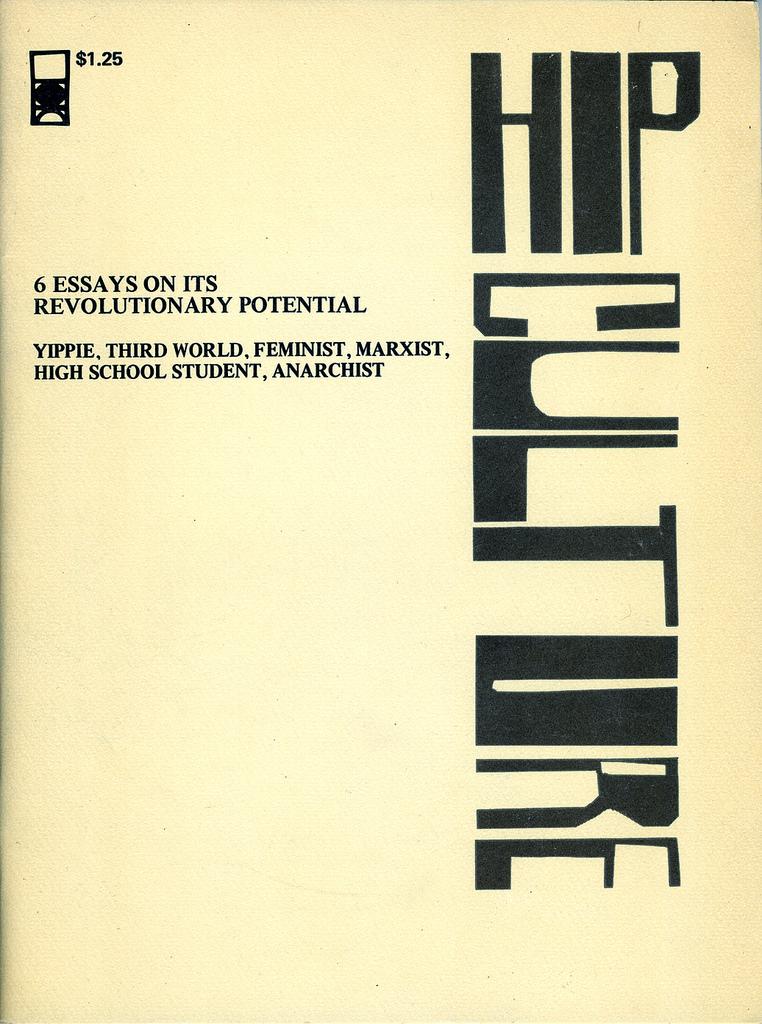
Hip Culture
6 Essays on Its Revolutionary Potential; Yippie, Third World, Feminist, Marxist, High School Student, Anarchist
And I Danced in the Mud and the Blood and the Beer
You Got To Think About Killin’ the Beast
LOVE Is Just a Four Letter Word
The Great Middle-Class Cultural Revolution
Counter-Culture or Counter-Revolution
Is the ideology of Hip Culture the essence of self-determination, of the universal right of the individual to control her/his everyday life; the harbinger of the end of domination, authoritarianism, hierarchy and power? Is Hip Culture making demands that cannot be accommodated by the system and will thus bring about the end of the capitalist era?
OR
Is “do your own thing” the slogan of hip middle-class, white men who continue to do their thing, as their straight counterparts have always done, by dominating and exploiting women, the Third World and working people? Will today’s energy of discontent merely be channeled into the making of a groovy drug/rock sanctuary for the disenchanted inheritors of capitalism’s overabundance?
Times Change Press
Times Change Press has been created to contribute to the American people’s accelerating awareness of the capitalist social system that is destroying us and the rest of the world in its efforts to maintain itself past its time; to provide information and ideas with which to topple the American Empire and to help prepare the way for a new consciousness—one based on a collective approach to human survival, an ecological approach to man and nature and a libertarian approach to life in a post-scarcity abundance based on the rational use of technology.
It is time for a world socialist society, free of sexual, racist, ageist and class oppression—free of all forms of domination—in which individuality will develop out of, not in opposition to, the collective whole.
Times change and with them their possibilities;
TIMES CHANGE AND WITH THEM THEIR DEMANDS
Our material is copyrighted to prevent reprinting by establishment publishers for their profit. We readily give permission, when possible, for its use by people whose purpose is similar to our own.
To help correct existing discrimination in communications, we especially seek material from women, the third world, youth, working and poor people.
We need your criticisms, suggestions, manuscripts and graphics, and will relay correspondence to specific authors when requested.
Copyright © 1970 by Times Change Press
Printed in U.S.A.
First Printing
Times Change Press
1023 Sixth Ave., New York, N.Y. 10018
SBN 87810-010-5
Contents
YIPPIE! “‘George Metefsky”
Right On, Culture Freeks!
THIRD WORLD Pablo “Yoruba” Guzman
You Got To Think About Killin’ the Beast
FEMINIST Lower East Side Women’s Liberation Collective
LOVE Is Just a Four Letter Word 32
MARXIST Irwin Silber
The Great Middle-Class Cultural Revolution
HIGH SCHOOL STUDENT Paula Marcus
Nothing New
ANARCHIST Murray Bookchin
The Youth Culture: An Anarcho-Communist View
Stanzas of .... And I Danced in the Mud and the Blood and the Beer, a poem by Jon Grell, are interspaced throughout the essays.
1
well, it’s two days after i split from woodstock and the mud is still caked heavy on my boots and my pants below my knees are still shit brown, four days of constant tripping has still left an acid reality in my head and, yeah, goddamnit, i wish i was still the fuck up there instead of coughing my lungs out from too much carbon monoxide here in good old new york city.
Right On, Culture Freeks!
George Metefsky[1]
Why Cultural Revolution?
To believe that revolution is possible in this country without destroying the psychological stranglehold of middle class culture upon the workers, as if revolution could be made by the 3rd World poor alone, is a delusion. The vast majority of Americans are indeed working class; but the whole thrust of their culture, which is capitalist, has been to repress that class identity. They think of themselves as white, American, taxpayer, home-owners—not as workers. To bring about real revolution, it has always been necessary to raise the consciousness of the greater mass of the people to the point where they see the need for the revolution and identify with it. This means that the worker’s middle class identity, and culture supporting that identity, must be seriously weakened before they can identify with the revolution.
To avoid this hard fact, many leftists are fond of arguing from the revolutionary experiences of Russia, China, or Cuba, that a capitalist ‘crisis’ will sooner or later reduce the middle class worker to poverty, forcing him into revolutionary consciousness. They ignore the concrete lesson of the Great Depression of the 1930’s, when workers’ struggles were contained by the middle class “liberalism” (and the CP. Popular Front), and channeled into purely economic reforms within the system. The people of Russia, China, or Cuba shared not only common poverty, but a common consciousness and folk culture that was quite distinct from the bourgeoisie. It was but a short step to class or national consciousness of common discontent of the fact that they had nothing to lose through revolution.
For a useful parallel to the U.S., we must go to the abortive revolution in France, May ’68. Only with France do we find the same middle class majority, and the same economic grievances: constant, irritating inflation. France showed that it will not be bureaucratic unions which are the vanguard of the revolution in the imperialist mother country, but students and young workers who are not yet totally sucked into the hyperworker/superconsumer role, who find a rebellious (if commercialized) identity in their “youth culture.” Even if the most advanced workers join the revolution out of plain economic dissatisfaction, reactionary union bureaucrats will oppose them, while the majority of the middle class continues to support reaction.
Imperialism supports a huge middle class within the mother country. There is far less revolutionary working class tradition in this country than in France, and workers are trained to shy away from it. To awaken them, middle class culture itself must be smashed.
Middle class culture is vulnerable. While people identify themselves as “middle class,” they have merely exchanged working class discontent for a more diffuse middle class dissatisfaction, not just with the war, rising prices, and frozen wages, but with the whole game of accumulating plastic and hating people. Their dissatisfaction breaks through the officially approved consciousness in a million ways. For instance, the middle class with its taste for folk music, and the lower middle class with their country and western, seek to identify with a real, soulful folk culture which middle class life excludes, in which they can be free participants rather than passive consumers. No one can identify with a Hollywood orchestra the way you identify with Johnny Cash. The system never really succeeds in repressing people’s common humanity—the ‘3rd world within’—and this conflict finally reduces the middle class to passivity and cynicism, driving them to the extremes of local reaction, or rebellion. Come a healthy people’s culture, and middleclass culture tends to collapse like a sick balloon.
The most advanced part of the middle class—mostly young workers and students—are in fact beginning to break out of work-accumulation-status addiction. The very material affluence and leisure time which previously led only to endless accumulation, also gave people time to think. And young people, in spite of the fact that public education and the mass media aim to imbue them with standard middle class ideology, are moving beyond middle class cynicism to question the basic attitudes and values of this society: “Wait a minute ... Do I really want a new car? I already have last year’s model. Why should I work overtime so that somebody else can get rich?” The coincidence of mass education and free time gives people a chance to free their consciousness from the mindless accumulation, the stifling totality of middle class culture, so that they can explore the alternatives.
Alternative Cultures
The three alternative cultures in this country which, though partially co-opted by the power structure, exist as vigorous, independent people’s cultures, are the Appalachian, black, and hip. Repressed and materially impoverished by the all-consuming bourgeois mass culture, these cultures survive and flourish in the non-material attitudes, perceptions, values, ways of interacting, and in their unique psychological flavor-things that are the soul of a culture. This unique and alien soul, with its special perspective on middleclass life, is precisely what the disaffected middleclass finds itself lacking. Cultural revolution-the liberation of consciousness and the humanizing of values—begins as people move to explore these alternatives culture. But the liberatory potential of these alternatives varies.
Applachian culture belongs to the country poor. It contains tnuch folk wisdom about rural capitalism, much good Christian ethics, and even—at the source—some populism and primitive communism. Radicals dig it because they see it as the source of the culture of the great middle reaches of America. But the lively backcountry folk culture has been mass-reproduced for consumption by mid-America only because it is perfect material for the capitalist exploiter, only because it can be co-opted. It is ethnocentric and racist. It is rural. For a creative, revolutionary culture capable of displacing middleclass culture within the urban pressurecooker, Appalachia can only be one source.
Within the U.S., the culture of the black colony everywhere has taken a vanguard role in the cultural revolution. Just as the special intensity of their oppression has forced blacks to the vanguard of the political struggle, surviving 400 years of constant persecution and exploitation has forged a black culture whose perceptions and values are completely subversive of the status quo. For instance, the Blues appeal to everyone in our society, because the 3rd World in everyone cries out for some expression of their loneliness, frustration and despair in the face of capitalism. No matter how many people exploit it, black culture is a revolutionary people’s culture, because it developed in opposition to and bitter knowledge of capitalism, and because it enabled blacks (unlike the American Indian) to survive cultural imperialism and grow as a cultural entity. The bourgeois have had to segregate black and white, because middleclass culture can’t bear to confront black awareness of the brutally repressive bourgeois regime. Nor can it compete with ghetto brotherhood and soul. The culture of black and white together—of the white who felt free with his black brother—has always been almost as suspect and hated. These were the original hipsters, and today’s hippies.
The word “hip” comes from the black culture. “He’s hip to that” means “He’s aware; in terms of a particular scene (or scenes) he knows what’s happening enough to avoid the worst and flourish.” A worker is hip to the factory when he sees the work is pointless, learns the shortcuts, and settles down to get his pay from the boss for the least work. But he may be hip only to the factory scene, and unhip to politics, if he voted for Wallace. Some one is truly hip when he always looks for the factors behind facts, the historical process behind everything, and develops a conscious response (praxis) relevant to social reality as a whole.
Obviously, according to this definition many visible freeks are not very hip while many hip people aren’t visible. But in common usage, “hip” also refers to a definite cultural group, consisting broadly speaking of those who smoke pot and possess the characteristic style and culture, who are identified by middleclass society as “hippies.” Social identification leads to self-identity: by isolating and discriminating against the “dirty hippie,” middleclass society forces him in self-defense to strengthen his identity by reaching beyond externals to the perceptions and attitudes which are the unitary core of hip culture. These common perceptions and attitudes, however incompletely grasped by most freeks, project a conscious mass response to society—a movement toward liberation from adrenal, middleclass culture.
Hip culture is widespread among the same students and young workers in this country, who formed the vanguard in France, May ’68. They see that the scarcity-based puritan-work ethic is obsolete, that the middleclass complusion to do meaningless work is enslavement, that neurotic accumulation-for-status is the same slavery. They consume for gratification. They would rather have the free time to reach out and build a classless, eclectic culture, whose roots range from Black America, to Appalachia, to India and the whole world. The hip movement represents the efforts of a good part of the white youth and workers to liberate themselves from repressive middleclass culture.
The key value of hip culture is free consciousness. All the religiosity, the psychedelic experimentation, represent efforts to free awareness from middleclass culture, to get to the Now which is the source of all pleasure and pain. But even more, freeks are trying to break out of the passive consumer role this society lays on us, past total openness, past a vision of the present as part of the whole historical process, to an active, conscious response to that process. A creative, unalienated response: “Do it now!”
Their desire for liberated sensitivity and creative response explains the emphasis hip people place on love and sexuality. To be creative, we have to love what we are doing and the people we are working with. Now the normal job in this society conditions the worker to fear, to block out his distracting awareness and compress his free activity into complusive routine. The truly hip respond by demanding either meaningful work or marginal employment, and by reducing their property, and ownership fears, to a minimum. Free from the role of hyperworker/super consumer, they begin to act out of sexuality. All of a sudden, “thing” no longer refers to dead fragments of a world opposed to man by his completely adrenal reaction, following the model of commodities, the alienated products of his labor. “Thing” becomes the process, the unity of man and his work; freeks “do their thing.”
Although ‘plastic hippies,’ who possess the material style without seeking liberation, use “doing their own thing” as an excuse for doing nothing—bullshit passive consumption of culture-packages—the original meaning of the expression was definitely liberatory. My thing is not the Man’s thing. It becomes our thing, a common awareness and interaction which is alien, and subversive of bourgeois mass culture. The change from “doing your thing” to “doing your own thing” shows how the rapid spread and commercialization of hip culture has deformed its more overtly subversive values. Still, freeks are only the visible edge of a much larger mass of people in this society who are moving toward free consciousness and sexuality.
The practices of ultrademocracy and communism—almost equally important for breaking out of middleclass culture—tends to be restricted more to the real freeks, who reject all class and ethnic lines in search of the “good people” they see as the supreme value (rather than God, Country, etc.). Most freeks are still ultra-democratic, although class lines have re-appeared between the rich, self-righteously “religious” plastic hippie, and the poor majority he excludes from his private scene. All freeks are anti-racist. Many also practice communism, both because they value and like to live with other people, and to free time, because practical communism is cheaper. They share rent on a common house, the cost of food, and deep involvement in one another’s heads. The living commune demands almost familial compatability, and participatory democracy (a real encounter group) to keep it together. Sometimes lessons learned in living communes lead to work-communes, and people’s parks.
Even taken alone, the living commune shows that alienated middleclass life, based on “jobs” and private property, tends to collapse in the face of material abundance into a culture based on sharing. That hip culture has only slowly developed a communist politics shows the tremendous anti-communist brainwashing in this society. But freeks have made the massive rejection of repressed behavior for free activity—of capitalist accumulation in favor of consumption “by each according to his needs.” Fittingly, the “hip entrepreneur” who is busy making money off the hip thing has no prestige among freeks—a mere greedhead. Deformed through it is by the surrounding capitalist society, hip culture is the closest thing in this country to a revolutionary people’s culture.
Some leftists reject it because it lacks an explicit ideology, because it isn’t “political,” because it’s “middleclass.” They forget that most whites in this country are middleclass. For the middleclass it is initially far more important to reject endless plastic for the free time to think and experiment, than to be perfectly politically “correct.” China needed a political revolution simply to establish the pre-conditions for cultural change: order, material security, the 8-hour day. Here this economic base already exists.
This is not to say that we can complete cultural revolution without political change. We are faced not just with the inert resistence of an all-pervasive capitalist culture, but with a society that wages active genocide against deviant cultures. Hip sensitivity and sexuality, under-employment and under-consumption strike directly at work accumulation-status addiction and the expanding domestic market. To see people even in far off Vietnam as higher values than God, Country and Flag undermines imperialism. To reject middleclass ethnic and class prejudices, reaching out to 3rd World culture within the U.S., subverts the fascist horde. And no matter how innocuous practical communism may seem, it consolidates the theft of man-hours from capitalism. U.S. cultural imperialism must smash any cultural movement, no matter how deformed, whose growth blocks the capitalist exploitation of human existence.
When the police beat on people for playing music in the park, or for making a park, they plant the seeds of their own downfall. They reveal themselves as agents of the pig. Freeks have no choice but to take the offensive, to transform their culture into a cultural revolutionary movement, spreading over the economic base of the old society, our cultural revolution is already providing people with a revolutionary identity, which is the key to future political change.
Hip Politics
The danger facing freeks-even many so-called “cultural revolutionaries”—is that hip culture is close to a revolutionary cultural movement, but more of a lumpen middleclass culture, deformed by capitalist society, to the extent that it even preserves class-lines between the upper and lower middleclass (plastic hippie and freek). Nowhere is this deformity better shown than in the underdevelopment of hip politics. After Yippee! apoliticism is on the wane. But there is still a tendency to shirk confrontation, to avoid cultural forms and projects like the Berkeley Peoples’ Park which galvanize the people, and expose and shatter the status quo. There is still confusion about the need for a politics to protect and extend the cultural revolution; and even the naive belief that we can “change our mind instead,” as if we could change our middleclass conditioning without changing our behavior and incurring the wrath of the straights.
Most freeks realize that apoliticism is the luxury of the rich hippies who preach it. But they are also disillusioned with much of the left. Throughout the ’60’s, people in the folk, civil rights, student rights, peace bag learned that reform within the system was impossible. The problem with the left was that almost anyone could grasp the contradiction of blatantly middleclass, authoritarian groups like PL talking “liberation” while they were themselves so unliberated. How do you accept sectarianism that attacks brothers more viciously than it attacks imperialism? A paranoiac politics acting out of hatred for ‘Daddy’ rather than love (as Che counseled) for the people? Without necessarily giving up politics, people began to concentrate on the problem of finding a way of life outside of repressive middleclass culture.
They studied the writings of the small, brilliant, anti-materialist beat movement. They found not only the word, but a style and a charismatic identity figure in Bob Dylan, the first distinct hippie to emerge in the mass media. His biggest single, “Like a Rolling Stone” captured the whole fall from middleclass comfort to the sub-proletarian street: “you’ve gone to the finest school alright... Ain’t it hard, having to be scrounging your next meal ... When you ain’t got nothin’, you got nothin’ to lose.” His surreal-rock reached the mass of U.S. youth, with a revolutionary message: escape from ‘rational, liberal discourse’ into real, super-intense experience. Instead of slogans, he created poetry that people listened to again and again, straining after the seductive lyric until they freaked right out of middleclass consciousness into sudden understanding.
Dylan’s use of profit-oriented mass media to spread this revolutionary message established both the dominant pattern of hip activism, and the foremost contradiction within the hip movement. Indeed, the contradiction between liberation and the use of capitalist media is the basic problem for any cultural revolution under capitalism. Can the artist-activist escape being co-opted or censored by the media owners? Can he transcend the entertainment-package straight-jacket?
Yes, but only when his corporate master co-operates, only if his audience responds with an intense sensitivity that transcends middleclass unconsciousness. People turned themselves on through Dylan.
Meanwhile, this contradiction between capitalism and liberation has deformed the hip movement and weakened its politics completely. Because the mass media were easy to manipulate, the hip activist became a media guerrilla. The success of an Abbie Hoffman or a Ken Kesey meant that the whole movement, even those who shun the media, tended to adopt this approach, to work on the basis of flashy ‘exemplary leadership’—through the propaganda of example and deed—rather than patient education, and by organizing projects to involve new people and develop more leaders.
Unfortunately, exemplary leadership has very limited effectiveness outside the TV screen, and specific situations like street-fighting, where leadership should fall on those who show it. While many freaks have won over straights by the power of example, psychedelics and the underground press have both been far more important to the spread of hip culture. Both have involved a lot more people, a lot more intensively. Besides being a cultural bond, pot stimulates perceptual awareness (illuminating what lies outside of middleclass consciousness like a light in a darkened room), and fantasy—the imagination of the revolutionary alternatives hidden within the “normal.” The underground press follows fast behind, filling up the fantasy with specific content, inciting specific actions. Both are a lot more effective than the unfocused subversive consciousness created by a few ‘superstar’ media guerillas. Real cultural revolution means that we all exercise our imaginations, that we all break out of middleclass passivity and participate, that we all become guerillas.
Exemplary leadership and action neglects the most successful practices of the underground press—the slow education of a mass constituency, and the organization of a few others to keep on working no matter what happens to the ‘leaders.’ Purely exemplary action is often nothing but “doing your own thing” without relating to the community; and it can fail to organize the community, in spite of concrete, daily oppression. Very simply, the exemplary leader often doesn’t have a definite constituency, so that when he is unsure of himself, his leadership is weak, and when he is decisive, people say he’s on an ego trip. Becalmed between liberation and capitalism, the community sits. Real economic control of hip culture has fallen into the hands of “hip businessmen.”
From the beginning hip entrepreneurs have tried to turn hip culture into a purely moneymaking proposition. The early hip movement wanted to turn on the whole world, not to a passive drug thing, but to a total experiences of free, creative activity. Ken Kesey and the Merry Pranksters provided the direction, originating the communal lifestyle and “acid tests,” the first rock-dance-drama-light-shows. Meanwhile economic control of the San Francisco hip community was in other hands. When Kesey came up with his greatest scheme—a plan to lure the biggest fascist cops, judges and legislators in Northern California to a phony “Acid Graduation,” and secretly fed them LSD—the ‘hip establishment’ intervened to deny him a hall or a band. They used the exposure their money gave them to spread rumors that Kesey was working with the cops. In the end their effort to protect their prosperous psychedelic shops and drug dealerships didn’t matter, because the police smashed Haight anyway. But again and again the same greedheads sabotaged any leadership that arose to turn the people away from profits toward liberation. Later they opposed the West Coast Yippees.
What Is to Be Done?
The hip community continues to move against the resistance of hip capitalists toward cultural liberation, but at a slow crawl. Meanwhile we are the Jews for a fascist police-state society. The government is about to pass a law aimed at drug users, authorizing secret police and permanent “mental commitment” of anyone, without a jury trial and with no legal appeal whatsoever (Preventive Detention Bill). Our only hope as a movement is to grow like crazy. But to do this we must turn hip energies back from making money, toward cultural liberation. By word and by deed communist hippies have got turn on every freek to cultural revolution. When the whole movement lives cultural revolution, we can become the vanguard for the total cultural revolution of this society.
Cultural revolution doesn’t exclude the necessity for socio-political change. To do so is not cultural revolutionary—it does not promote revolution—but ‘cultural nationalism.’ A cultural nationalist may talk cultural revolution, but he just wants to sell you some “revolutionary” product. True cultural revolutionaries are trying to free people from passive consumerism—from the whole capitalist behavior syndrome—so people make their own culture, for revolution rather than profit. When people make real revolutionary culture, and bring their communities together to liberate the way they live and relate to one another, they are taking the line of least resistence in dealing with U.S. cultural imperialism. And these communities are natural bases for the struggle against fascism, besides giving people a chance to look at the alternative.
When we understand that the only difference between U.S. imperialism in Greece and at home is, for the people, one of privilege and degree; that this country is a neo-colony too (never really decolonized—power was merely transferred to native imperialists); then we see how close we are to fascism. This society is already totalitarian; it plays whites off against the Black Colony, wrecking total assault on the Black’s identity and robbing him of his manhood. More: in the process of regimenting whites into middleclass puppets of U.S. imperialism at home and abroad, society also humiliates white identities, assaults their psyches, and dehumanizes them to the point that they don’t perceive this society as totalitarian. Before they can be psychologically prepared to deal with the cop in the street, they have to externalize the cop in their heads. To make revolution in this country we have to provide people with the experience of our alternative—of participation in a community liberated through cultural revolution—with which the middleclass can regain their own repressed 3rd World identity.
When they find themselves hated and super-exploited aliens
within the imperialist mother country, they will be ready to join with the peoples of the world in overthrowing the oppressor.
2
it sounds kinda like that real old show on the tube, ‘naked city ’
but there were a million people together in the rock rollics of revolution in one dinky cow pasture and every life holds a different tale of what their reality was like.
3
the land was once a few hundred acres of cow pastures and woods, which for one weekend was turned into a swarthing mass of hip humanity, and i caught a glimpse of revolution.
You Got To Think About Killin’ the Beast
Minister of Information
YOUNG LORDS PARTY
Before we can go into a discussion of the so-called “hip culture”, we first have to define a few things; primarily the culture of Third World people in amerikkka mainly taken from the point of view of the street people, the Brothers and Sisters off the block. Those who have gone off into a petty-bourgeois trip, trying to integrate their minds with the plastic death non-culture of amerikkkan society,are not a part of the street scene. In fact, they are now trying to relate to what’s happening on the block in much the same manner as a white liberal. So we’re going to be talking about the scene in the urban ghettoes, and whether or not there is a Revolutionary force to be tapped from this culture.
To us in the Young Lords Party, it is not valid to speak of culture in the streets, as though this was some sort of phenomenon that could be examined apart from all other aspects of life in the Colony. There is a definite Mother Country-Colony relationship in terms of white amerikkka and colored peoples living in Babylon. The nature of this oppression on us has forced the reality of slave life to blend all aspects of human existence into one tough whole. Our politics and our culture then become one and the same thing. This is a dramatic happening. What it means is that the music, for example that oppressed people have allowed to survive over the ages, is still around because it gives us the strength to get up again each morning. It means that the way in which one is able to survive encounters on the street, either at knife point or at a party, determines the manner in which we deal at home or on the job. Most importantly, the result of living under oppression has affected our political ideology, has shaped and refined it.
This is why we will win. Our revolutionary theory comes from the experience of our people. It is not foreign to them, but rather expresses the logical extension of the struggle of Latin people, Puerto Rican people in particular. The Young Lords Party did not just pop up. We represent the struggle of our people against imperialism and for self-determination since the first Spaniard set foot on Puerto Rico. This legitimizes us in the minds and hearts of our people. What has entrenched us firmly in the Colony has been the way in which we have put our theory into practice. Our practice also follows the reality of life in the streets. Only a fool would condemn a junkie as being the cause of the drug problem that is killing us off. An idiot would go after the two-bit pusher who is also a user. A Revolutionary with the correct analysis and perspective of the problem would know that the root of the problem is the big pusher, like the mob, pigs and politicians. These creeps who run these asinine “drug rehabilitation” programs, or who work with the politicians that allow drugs to flow into the community obviously don’t know what’s happening on the street. They have no idea of the political/cultural (really one and the same) experience of the ghetto.
When the Party first began, and we had our first few rallies, we wondered why there were so few people in attendance. We checked out what we were saying, and it was OK. Perhaps the issues were vague? No, the issues were clear-cut. We couldn’t figure out what was wrong. Then, at one rally, we used a Puerto Rican flag. The people turned out by the hundreds. The rally turned into a huge march. When the pigs vamped, we saw old ladies throwing bottles. The flag was the key. We tapped an intense nationalistic fervor among Puerto Rican people. This nationalism could be used by us as a means of reaching our people. Yes, we said, most definitely, we are Puerto Rican. In this way we were able to cut across all ages and types and reached a broad segment of the population. Since the level of political awareness was not as high as it was in the Black Colony, we had no strong cultural or reactionary nationalist tendency within our people. This was a good thing; being the first progressive party to develop on a national level, we eliminated this dangerous trend by correctly developing the nationalism that was there into a Revolutionary nationalism. Revolutionary nationalism relates to whatever nationality a person is from, makes you feel strong, and moves you to off a few pigs because of it. Key to this motivation is the fact that Revolutionary nationalism is an outgoing thing; a Revolutionary nationalist embraces fellow oppressed people as equals and comrades-in-arms. A reactionary nationalist says to hell with everyone else, all power to us.
It is important to understand the aforementioned rap on nationalism, since this is our approach on organizing the people in terms of culture (remembering what I have already said about culture being a part of a whole). The view we have taken is that what is already among the people that has survived years and generations of exploitation must be built upon, since the mere fact that it has survived shows it has a revolutionary potential. That which is irrevelevant to taking state power is discarded as being useless. An example of this is the guayabera, a tropical kind of shirt. Although we in the Party may own one, ain’t nothin’ about a guayabera in and of itself that moves one to taking state power.
There is a lot of talk these days about the “hip” or “youth” culture. There is no such talk inside the Colony. The life that is led by the youth is not that much different from what our folks were doing when they were young. Our parents smoked pot, shot up, made love, danced and grooved in many ways. In fact, many of us have parents who are still swingers, or can relate to what we’re doing. True, there is much friction between parent and offspring, but this is nothing more than the usual differences found between the generations. We tend not to deal in talk of the generation gap, since it is reactionary; there is a lot to be learned from those gang members that are still alive, or older folks with certain needed skills. Life as a slave in amerikkka today is passed on from generation to generation, and the ways in which people have sought to ease the pain of oppression has not changed drastically, except for one important way. This is the generation that is making the Revolution. No other generation can make that statement. Yet this does not keep us from struggling together with our parents; whenever possible, we work together.
Music is an important part of what’s going down today. I can relate to that; there are times when I feel nothing will get me out of bed, until I hear an exceptionally powerful jam, and then look out, Jim. Yeah, I could dig offing pigs to the sound of the latest Sly record. I also believe dynamite has a music all its own. Our music in the Colony has always had some strong vibes to it. We have always been moved, since tribal days, to lettin’ it all hang out on the dance floor. The music of the youth in the mother country is making a feeble attempt to capture this soul (played out as the word has been, that’s still what it’s all about). All of the amplification, all of the drums, all of the wailing that the Who or Grand Funk Railroad go through is this attempt at striking that driving, pulsating responsive chord in the listener, that picks you up and should send you out into the street with a machine gun. As long as people can see that music should be for free, and that some jive lame is making bread off the music you dig, and that an even bigger punk is taking ten times as much in the mother country for laying down a distortion of what originally came from the Third World, then music is cool.
It is interesting to note certain differences in the way ghetto people and white youth react to the same thing. The differences show clearly the ways in which Third World groups have organized as opposed to the way white radicals have developed. Historically, white radical organizations have tended towards ultra-democracy in their collectives, thus weakening their decisions and throwing power to the winds. This results from the white middle-class youth’s rejection of authority and discipline. However, many white radicals do not realize that there is Revolutionary discipline and Reactionary discipline. That is what prompts these people to say, “How can you give me an order? That’s what they do in the pig army.” White youth in general, outside of movement circles, gets even worse. This type of cat makes the festival scene, and is disappointed when white radicals come there to try to get some political messages across. “Wow, man, you’re blowing my trip. I didn’t come here for politics.” When the Party was at the Randall’s Island rock festival recently, we were disgusted at the white youth who were trying to get into their “culture.” But we observed many things.
For instance, we dug on how white people dance. It is a freak-out; people get into their heads and lose control over their bodies. When brothers and sisters dance in the Colony though, it is a totally different thing. Our dances require a precision, a skill. A dude who looked sad on the dance floor would be laughed off the block. This mental attitude between the two groups, mother country and colony, is important. The way whites dance is almost anarchistic. There are also no national white revolutionary above ground parties based on tight democratic centralism. This leads to the proliferation of splits, tendencies and wings that prevail in the white movement. The tendency to react against all forms of authority is a reactionary one, and is also found among petty bourgeois colonialist youth. Check out “boojy niggers” or white middle class kids smoking pot sometime. They sit and nod and try to find where their inner heads are, while street niggers gig, party and goof off smoke. A street nigger knows where his or her head is: same place it was yesterday and same place it might be tomorrow, oppressed. These differences are indicative of the attitudes with which both groups approach revolution, and is the basis for a lot of the bad feelings between Babylonian Third World and white movement groups.
A question that floats around the movement at times is, “Are drugs a liberating (i.e. revolutionary) force?” There are those who say that drugs are a means of overcoming the shit that has confined middle class youth for so long, of overcoming the straightjacket of amerikkkan society. Others say that all drugs are bad, and wither away a revolutionary’s discipline. It is our feeling that the myth of marijuana leading to heroin is about as true as breathing giving you the clap. Yet we also know that one of the ways in which the pigs try to discredit all revolutionary movements is by saying we are all junkies (Communist inspired, of course). This tends to set back our organizing among the older people, most of whom believe the slaveowner’s propaganda. Therefore we have two rules of discipline that deal specifically with this drug thing. One condemns shooting up, the other states no one is to get high while on duty. Another rule goes on to say that a Young Lord is on duty 25 hours a day. Still another rule says that any Lord busted on a jive tip that the person brought down on himself (like getting busted with grass on you) can swim alone, meaning we don’t know who that fool is, and they’d better not show their face again. A Lord who can deal with all that and still get nice, well right on.
Any other drug above the level of smoke is completely forbidden. I will not go on any mission with some jerk that needs coke or acid to do their thing; later for that idiot. That kind of person puts the whole operation in danger, and is about as steady as jello. As far as we are concerned in the Colony, drugs are not a liberating force. Our eyes have already been opened, our minds have already expanded just by living daily in the hell-hole the pig calls the ghetto. Perhaps there is some truth to the fact that white middle class youth need drugs to dig on the racism of their parents; I can dig where that’s coming from. Yet, there is a point when the use of drugs is no longer needed, and a higher level is reached. This point separates the revolutionaries in the mother country from the festival freaks.
Besides music, dancing and drugs, other attributes of the so-called “hip culture” are films and newspapers, among the media categories. White underground newspapers are of two types: movement and “culture” oriented. These papers are of various types, ranging over several issues, from women’s lib to gay liberation to the weathermen to the tupamaros to the panthers to drugs. There are few underground Third World papers in Babylon; all of them tend to deal with the liberation struggle. Some say it moderately, such as El Grito del Norte, a Chicano publication; others are more direct, such as Basta Ya!, the Black Panther, Palante or Get tin’ It All Together, put out by I Wor Kuen, the Asian companeros in the Chinatown of New York. Two white papers which are strikingly different are Rising Up Angry, put out by the Rising Up Angry Organization of Chicago, and Sun/Dance, by the White Panther Party. Rising Up Angry is aimed at the greasers, or poor whites of Chicago, and effectively delivers the revolutionary message to the most ignored section of the movement. Sun/Dance gets more into that “cultural” thing, yet is attractive, and puts the word about revolution across to the freaks it’s aimed at.
Newspapers such as Palante, the organ of the Young Lords Party, because they are aimed at Third World street people, are designed to attract that audience. Graphically, our standards have to be high: neat, colorful and easy to read type. That is because we are competing with papers like the Daily News. The Daily News is simple in language and has lots of pictures. Our language is simple also (beware of the “dialectical materialism-proletarian bulwark-lumpen scar-synthesis of theory with practice” type language. If you don’t put people to sleep, they’ll have to go looking for a dictionary to find out what the hell you said).
Underground films, of the type Newsreel distributes, have been used in the Colony, yet they could be better. It is obvious that these films were made without taking the slaves into consideration. As for “establishment” films, the movies shown in theatres today are supposed to be geared to a youth market, and to a certain extent reflect that market and the society in general. Just as Allen Ginsberg’s “Howl!” poetically describes the decadency to which amerikkka is sinking, “Bob & Carol & Ted & Alice”, “The Boys in the Band”, and “Getting Straight” are saying something to the oppressors of amerikkka. A sick suburban 45 year old pseudo-hipster could only get his jollies today by watching the “Boys in the Band”, which doesn’t say a thing about the realities of being gay. “Bob & Carol” etc. is made for that same sick crowd. Yeah, amerikkka’s movies show it is dying morally, as well as physically. And the “Youth Films” such as “Easy Rider” or “Alice’s Restaurant”, show this anti-hero person, this cat who is supposed to be loved and respected because he is aimlessly violent, or brooding, or whatever, also represents sickness.
In the Colony, bro’, Peter Fonda ain’t sayin’ nothin’ to spies. What the slicksters on Madison Avenue have done though is to give us “Cotton Comes to Harlem” or “Uptight”. The former shows that a nigger pig is better than a white pig while still being the Supermasculine Menial. The latter portrays the “Black Revolution” the way someone totally ignorant of the revolutionary process sees it. Both are harmful to the people. One film that enjoyed a wide appeal in the Colony was “Putney Swope”. In one sense, the film was a rip-off, since it brought out some racist shit from Black people. When I saw it in the neighborhood (ghetto) theatres, with all Black and Puerto Rican audiences, bloods were able to dig on other things the film said that hit home. In fact, there is a whole different thing about movie theatres: the neighborhood (ghetto) theatres, away from those $3 prices, are patronized by the folk, and there is a looseness in the audience distinctly different from downtown. I was able to dig on the reaction of two different audiences for “Bob & Carol”. When I caught the film among a predominantly white audience, there was laughter at the “proper” moments, and afterwards, animated debates to the questions raised with the film. In the colony, Brothers and Sisters cracked up throughout the whole film, and died laughing after the movie was over, saying, “Yeah, that’s where white folks are at.”
On the whole, amerikkka has no culture. Amerikkka is already dead. Fact is, it never had a culture; all that it had was a rip-off from Third World people. If it can be said that amerikkka has produced a culture, it is a culture of plastic, of death, of decadency. The attempts on the part of the youth of amerikkka to build an alternative culture range far and wide. Some white youth like the yippies are sincerely trying to find an alternative to what is esentially capitalism. Most are hung up in the superficiality of what their people to the left are saying instead of digging below the surface. These young whites tend to follow the mouthings of the pigs on the right who throw festivals, sell drugs, promote records and the “peace” life style, perhaps not realizing that they are actually supporting the fascists’ advantage to keep everyone strung out on music and drugs.
The youth of the Third World, internationally, are caught up in building a revolution, hopefully including our parents, in order to set up a totally new system, socialism. We are building on what forms exist that have a revolutionary potential, as I have stated before; we are discarding those forms which are irrelevant. But more importantly, we are creating new forms to replace the old, right now, as we struggle. We are dealing with the tired, oppressive concept of machismo, of masculine domination and feminine subservience. Machismo was practically a Latino tradition. It kept our women confined to the kitchen and the bed; it forced our men to continually save face, we felt, by beating our women if they didn’t have dinner on the table when we came home. And machismo said it was hip to have women on the side. The only thing that machismo taught that was worthwhile to some extent was that in order to be a man, you don’t take shit from nobody. When attacked, fight back. This aspect of machismo kept our warriors fighting long before endless political essays were written. But now, through struggle, we see that this resilient strength is not an exclusive property of the male; in fact, it is stronger in Sisters since they have had to put up with the slaveowner and his male slave for centuries. Looking back, history shows women to be warriors. The sisters in the Party have said that they are Revolutionaries first, Puerto Ricans second and women third. Women, making up more than one half of the population, will be needed in any army that sets out to defeat the biggest imperialists in the world; dividing the ranks in any way serves no one but the energy.
Finally, on culture: culture is a gun. Culture is the revolution. There is no culture other than that of the revolution. Everything else is irrelevant and reactionary. The fight we are engaged in today is against this capitalist empire, against this death society. Our fight is a fight for humanity. One cannot be human and be a capitalist, or choose to live under a capitalist system: that is a contradiction. Capitalism deprives people of their humanity, it pits us against each other. Capitalism used fear, racism, hate, sexism, any means necessary to keep the people down. In order to gain our humanity, we are forced to wage righteous struggle against those who would destroy us. As our alternative, we are setting up socialism.
Socialism can be broken down simply. That is the society where a man and a woman can relate naturally to one another without any obstacles blocking the relationship. At present, this is impossible. Capitalism throws obstacles in the way of all human relationships. “Where were you last night?” “Where’s the rent money going to come from?” “Stop beating me!” will all become obsolete expressions. The fact that, in certain relationships, mental blocks obstruct sexual satisfaction is indicative of amerikkka.
Oppression has caused colonized people to fight one another. Too often are Brothers found dead after a Saturday night brawl. Too often are Puerto Rican families involved in cutting each other up. Our Chairman, Felipe Luciano, says it all in his poem, “Hey, you jitterbug”:
Tired of niggers asking me how to kill
You did it to your woman, princess my ass,
She ain’t nothin’ but a piece of shit to you, you fuckin’ low-life
You can kill each other, but all of a sudden
You got to think about killin’ the beast
Felipe goes on to rap about that gang thing, showing how there was a lot to the gangs that must be used in the struggle today:
Used to walk into Dragon turf with a sawed-off shotgun under your trench
Ask who was the prez and blow his fuckin’ head to smithereens Now you’re scared to even buy a piece
Got the nerve to flap your gums about gun control and how dangerous it is
Used to be guns were made everywhere
In shop class, in basements of churches when your mama was in the afternoon service or home ...
Used to be if a strange motherfucker walked through our turf He never got out ...
But now you ask me how to kill some cracker blue-belly who just slapped shit out your mama
What’s the matter, nigger, you forget how to kill?
Bet you if I punched you in your fuckin’ mouth,
You’d find a way to take me out of commission sho’ ’nuff
Not too hard to kill a street nigger
That is culture. That is politics. Simply, it’s revolution. Revolution is sweet, revolution is glorious. Also, it is serious. Oppression has taken the childhood away from our children. That is why we have 9 and 11 year old hustlers. Our younger Brothers and Sisters age overnight. That is the real “youth culture” inside the ghetto. We are not fanatics; when I say culture is a gun, that is no nihilistic call to senseless suicide. Armed struggle is the highest form our culture can take. Just like the YLP is the logical extension of the struggles of Puerto Rican people, which is also the logical extension of our culture as I have defined it, so is armed struggle the logical extension of those who today would seek to live tomorrow.
Indeed, we are madmen and madwomen. We are those who have been locked up unjustly in the prisons and jails of this disgusting society. We are those who have “lived” nodding out on the corner off the poison we shoot into our veins, hoping to escape. We are those who have sold our bodies to faceless men for a few measly bucks. We are those who have fought in the army of a foreign power, shocked to find our Brothers and Sisters staring wide-eyed at the end of our sights. We are those who have been forced to suffer daily indignities scrubbing miss ann’s kitchen.
We are those who pull loads in the garment center that oxen would fail to move. We are those who have been conned into working as fruitpickers under a broiling sun for wages that in one month amount to the boss’ chump change. We are those whose parents were thrown into concentration camps because our eyes are different. We are those whose relatives were bombed with atoms even after it was seen that we could not have continued fighting.
We are those who have signed over 500 treaties with a paleskinned invader, and had every one of those treaties broken. We are those who have been herded onto useless plots of land, when once the seas were our boundaries. We are those who have been decimated by disease brought to us by butchers who raped our mothers and wives and sisters while our men watched helplessly.
We are those who have all this as a culture.
We are those who have now taken up arms to revenge what has gone before. We are those who now want ten eyes for every one.
We are those who blow up offices, and laugh at the news the next day. We are those who snipe at swine walking cockily through our hood. We are those who rip off pieces while the fools look for us down the block. We are those who kidnap foreign representatives in exchange for captured companeros.
We are those on whom the hopes of humanity rest.
We are those who are practicing this as a culture.
And we intend to be “cultural” as a motherfucker.
THE ONLY TRUE CULTURE IS THE CULTURE OF THE REVOLUTION
STRIKE TO WIN
4
i danced in the mud and the blood and the beer, baby.
we were in one cosmic entity-our unity was our power, we were the armies of the mojo-mutated rebels, choogling down the line to zap and be zapped by ourselves and our music, we were the social revolutionaries of hip energy, realizing for once the dope entropic fantasies of post-reyolutionary/ post-scarcity society.
LOVE Is Just a Four Letter Word
Lower East Side Women’s Liberation Collective
Hip culture: be natural, be free, do your own thing, get rid of your middle class hang-ups, turn on, drop out. Groovy? But for who? Middle class white men can sometimes find individual solutions, but oppressed people can’t. Women can’t find individual solutions.
In the context of this society, escape is an illusion for both sexes. Dropping out is a game open only to middle class men—they can play at an alternative while still maintaining their class privilege in a class society. Oppressed people don’t have the chips required to play and the deck is clearly stacked against women. In a society such as ours, run by a wealthy few, and based on the control, division and systematic oppression of all other people, doing your own thing changes nothing and in fact supports that society by default. Hippy culture is not revolutionary even though that is the packaging it’s sold in.
Hippies flaunt the superiority of their life style. They can choose to live in slums, but have contempt for the people who have to live there. New York hippies have even organized tours of Queens to laugh at the straights. By these attitudes hippie women are separated from their working class sisters and straight middle class sisters who are trapped by a straight system and don’t have the option to drop out.
Straight society—the Amerikan Death Trap—is a drag. Middle class values, morals and attitudes are repressive. Women as well as men do try to drop out, but for us it’s different. We gain superficial freedoms—we can go without make-up or bras, we can smoke dope and act “unladylike.” But our real situation is basically unchanged and in some cases worsened. In a society based on male domination the balance of power does not change just because the style of dress does. Basic male-female role definitions remain the same.
A woman’s relationship to society is that of producer of children, nurturer, stabilizer. She is responsible for the basic necessities and comforts of life, ie. preparing food, creating a habitable environment and in general meeting the physical and emotional needs of men and children. Women who “drop out” are no exception. Of course human and social needs must be met—but by men and women!
There is a whole superstructure that applies to women, a superstructure of role definitions, of morality, of limited functions, and ways to relate to the outside world. This serves to keep woman in her place regardless of what her life-style is.
Take “doing your own thing.” It’s very easy for men—it’s the way they were raised. Men can choose their own responsibilities. Little kids are taught that men are people and women are mommys. Most men emerge from this socialization process with fairly strong egos. How many hip men do we meet who define themselves as artists, poets, political philosophers, musicians, messiahs. It even doesn’t matter if they can really do these things or not. They can pretend to do them and society accepts male pretentions-especially hip society.
Woman, however, is taught from birth that her main function is to relate to society through men. To serve and to decorate. Since she is defined by her sex, she usually derives her self-image by the way in which she is responded to by men and by what type men respond to her. The woman who has developed independent talents often has to either subordinate her creativity to men or face incredible odds in male dominated fields. In the struggle to assert herself she becomes separated from other women, by feeling that she is somehow better than they are;but she is still subordinate to men in her field, resented by men, or if she has been successful in a very feminine, very groovy way—she is used as an object-a sex symbol. It’s still nicer to be told you’re a beautiful woman instead of that’s a beautiful poem.
Most women are not allowed to be creative, except in terms of traditional female roles to bake bread, to decorate our bodies and to make love well. Hip women are allowed limited outlets for their creativity: non-threatening things like a theatrical life-style or home industry crafts like making pots, stringing beads, weaving, crocheting. To take any of these things really seriously or try to make some kind of living off them, is to threaten men. Our status depends on who we relate to, on his style, not our own.
A sister reading Jerry Rubin’s Do-It thought—disregarding the way he talks about women that it would be really groovy to do that stuff; but, of course, it’s Jerry and Abbie doing it—it’s an exclusively male style. Women can play only a supportive role to men who are running around and yipping in, talking back to everyone and saying all those groovy funny little things. A woman who did that would be considered obnoxious and would have to bear the brunt of male hatred.
Of course there’s dope. “It can unleash your creative potential and free you from your hang-ups.” “It’s your head that’s fucking you up, not your reality,” he says. But women don’t have hang-ups, they have political problems, and dope can’t change that reality.
Some women take dope to enjoy sex more. Some women to enjoy sex. The structure is that it’s not groovy to refuse a joint when it’s handed to you and when you’re high all the time everything appears beautiful—even though in reality things are often a real mess.
Walk down St. Marks Place, in New York City, especially around 5:30 when groovy, funky dressed men walk with their arms around their women, who, coming home from their jobs as receptionists, clerical workers, or maybe teachers are straightly dressed in oppressive stockings, high heels and restrictive underwear. These groovy, creative men can afford to write or paint, or be creatively blocked, or hang around and discuss philosophy, or do their “important” political work while their “old ladies” support them.
There are some women who have been able to escape the world of straight jobs, to panhandle instead maybe. But there are the problems of paying the rent, where the next meal is coming from and who’s going to cook it, plus the problems of birth control, or taking care of the kids. Try dropping out of that. Men can; they do it all the time. But these things are necessary to maintain life. They’ve always been the responsibility of women and hip culture offers no relief.
The hippy woman cooks, washes, cleans house, and she does it without all the modern conveniences capitalist society has produced to “lighten woman’s load.” Preparing and cleaning up from macro-biotic meals is not much different from any other full course meal, except that it is a lot harder to fix than prepared food—like an hour and a half longer. Part of the love ethic is “everybody’s always welcome,” which leaves women cooking (and buying food) for large unknown quantities of people, usually men, who, because they have no responsibilities, have more freedom to bum around. And if there isn’t enough to go around, guess who “suddenly loses her appitite” or has to run out to the health food store. Women who have moved out to country communes to be with nature and reflect on life find that almost their entire day is spent doing household chores—no hot running water makes doing dishes alone a two-hour job. Men go out to “hunt” and “chop wood”—women keep the home fires burning—literally. Women rise at 5 to start the fire and give their men a hearty breakfast just as women in the suburbs do for their executive husbands who have to make the 7:45. A hippy woman who asks for electricity, running water, a washing machine or a vacuum cleaner is considered hopelessly bourgeois and would be put down by all the men. The point is women still serve while men do the groovy work that everyone thinks of when they talk about moving to the country.
Then there’s love and sex—again be natural, be free, get rid of your hang-ups. Theoretically this is healthy and beautiful, but in a society such as ours sexual freedom and equality for women are a myth perpetuated by men. How many times has a man said, “that was beautiful,” or “the best time yet,” either being so absorbed in his own pleasure that he didn’t realize he was the only one to come—or not caring. The role of women in hip culture is to be all loving and more to the point-loving of all. The right to be possessive, jealous or hurt is given up with lipstick. Nobody wants to mess with a woman who might get “hung-up.” That’s not cool. Making demands or being emotionally vulnerable is put down as being either bourgeois or sick. This type of non-monogamy puts social pressure on women to sleep with more than one man-very few men feel responsibility to a woman who is not his possession. The “free” woman is great until she gets pregnant or needs a little emotional or financial support—suddenly she finds that she is not free in the way she thought she was. Not philosophically free, but free like “free beer on St. Patricks day.” As John Sinclair, self-styled hippy revolutionary, said in describing the society of the future we’re all supposedly working for—“There will be free dope, free food, free clothes, and free women.” “Freedom” is a male assigned role meaning one thing to women and something entirely different to men—a mean little play on words to keep us available and in our places. Real freedom implies mutual responsibility. We women are free to give—free to meet men’s needs—but not free to ask that our needs be met. Free love means that men can get it whenever they want and women have to give on demand.
For some of us non-possession means we live with a sexually free man but are his exclusive property. We never ask where he’s going or when he’s coming back. We are still giving on demand—knowing that there are other women in his life who are also capable of giving makes us feel very insecure—we feel we have to give more, give better so we won’t lose him. The result is a society of women all trying to out-do each other in meeting men’s needs—while the men sit back and manipulate what for them is a very groovy situation.
One of the basic goals mouthed by the hippy movement is the development of a human society as opposed to a technical or bureaucratic society. Yet when it comes to what we have been told is the most human of human relationships—sex—hippies have made no progress at all-even anti-progress. Hippy culture super-exploits women as sex objects. Fuck is a hate word. Paul Krassner said, “The system has to be fucked good—like a woman.” Draw your own conclusions. Or take “balling”—it’s obvious where that’s at. By the word itself, it’s clear who’s the active one-the doer—and who’s the receptical. Balling doesn’t even connote two people—there’s the bailer, he’s cool, and the bailee—the one who gets it. Women become objects that men masturbate into. Love or communication becomes totally irrelevant, and women who need and ask for love or communication are accused of being bourgeois.
Sex for its own sake is particularly oppressive—the one night stand leaves you with nothing but fantasies and the clap. Glory of sex for its own sake has also lead to the proliferation of porn magazines-SCREW, EVO, KISS, Crum comics—whose message is “all women look the same upside down.”
The concept of being natural is also often used against women. You wouldn’t think of asking him to wear a condum because it would interfere with his pleasure, so it’s up to the woman to risk the uncertain side-effects of the pill or the IUD or the less than sure protection of foam or a diaphram. That is unless he is so concerned about being natural that he won’t allow any birth control at all. It’s not the man’s responsibility if the woman gets pregnant, needs an abortion, or must bear and raise a child.
The concept of living in as natural a way of life as possible often means hip culture opposes technology and materialism. However, if we control technology it can help us survive. And, certain material things are necessary for survival, including aesthetic survival.
So what does a hippy woman drop out of? Even though she doesn’t have to wear all those straight clothes she still has an image to maintain. There may be a wider range of what’s groovy, but it has to be freaky, way out or cool looking—women are always looking for a way to be unique. Women who drop out of straight society must be prepared to buy a new wardrobe or they will not be accepted in hip society. At one point perhaps the idea was that you don’t have to waste lots of bread buying fancy clothes, but “in” clothes bells, leathers, suedes, antique velvets and hand fashioned sandies don’t come any cheaper than straight clothes. And if you wear anything over a size nine forget it! Unless of course you go Mother Earth—and that’s a whole trip in itself. There’s Mama Cass, and Mama Koit, a west coast disk jockey—big mama’s—warm, comforting, but who comforts them? At one point even Cass, rich, famous and creative almost killed herself by dieting—she literally had to be carried off the stage at a concert. She resented being a phenomenon rather than a person. It’s so important for women to be “beautiful” that we sometimes even sacrifice our health. The benefits of not wearing a bra are overshadowed by the hassles of sexist men. “Hey baby, you look fine,” he smirks, staring at your chest. Or “that’s a nice pair of tits, Mama.” And in a rapist society we get more than hassles—we get attacked. Men rationalize this, saying we tantalize them. After all, they say, hippie women are supposed to believe in free love and have intense, lusty orgasms. That is just a new style of the old excuse which puts the blame on us—that “women who are attacked ask for it.”
Hatred of women is a visible element in hip culture. You’re either “Under my Thumb,” (Stones) or “You’ve Got to Change Your Evil Ways,” (Santana)—meaning you’re asserting yourself too much. Or a number one song “American Woman,” (Guess Who)—“I’ve got better things to do than spend my time growing old with you.” Rock music is made by men for men. Women who relate to musicians are always extraneous. Groupies are prostitutes paid only by their “status.” Music by women, about women usually speaks of the pain of being a woman. Have you ever seen men digging on Janis Joplin? The concept of women in pain is sexually exciting to them. Our pain is considered a beautiful art form. “Woman is a Loser.” Women who have come to know sex and love as pain are moved by Janis, but in a different way. We’re reliving those feelings. It’s not beautiful. It’s horrible. It’s our lives. And when rock music isn’t talking about pain, it’s talking about women as though we were objects to be experienced-wise in the ways of the world, a wisdom gained through having endured suffering.
Spokesmen of the hip culture claim to be struggling in solidarity with oppressed people. There’s Abbie Hoffman (Right on?) who says, “The only alliance 1’11 make with women’s liberation is in bed.” (Right out!) Loving, openness and being natural are beautiful things, but in a society based on doublethink, beautiful and liberating concepts are used to oppress us. Just as Capitalism expands the war in the name of peace, Hip Culture imprisons women in the name of freedom and exploits women in the name of love.
5
we arrived like refugees seeking our places in the final armageddon, knowing that we would not be fucked with, arriving by any means necessary, for four days, doing it in the road was our reality, boogying to canned heat and creedence magic music was in the hearts and minds and bodies of a million warriors of the rainbow, our zonked, fumbling, dancing bodies, brought us to enter the grounds for free, we were free, and for four days our microcosm of revolution was free, anybody who sold food was ripped off. anybody who sold dope was ripped off
The Great Middle-Class Cultural Revolution
Irwin Silber
Perhaps a sense of balance is returning after all. A year ago, the subject matter of this discussion would probably have been “The Cultural Revolution,” or, with a little more modesty, “The Counter-Culture.”
Now, with a commendable judiciousness, the editors have employed a phrase which is not only more appropriate, but is absolutely intriguing-“Hip Culture.” It begins to sound as if we are coming somewhat closer to the real state of affairs.
Part of the difficulty in discussing “hip culture” is that few of its proponents/critics/creators can agree on what it really is. Thus, if one attacks some seeming ideological cornerstone of the phenomenon as elitist or racist or sexist, a whole corps of defenders rise up in righteous wrath to say, “Why, that’s no ‘hip culture’ at all. That’s just one person’s notion.”
Still, self-definition is hardly a reliable guide to the process of trying to understand a social movement. Theoretical proclamations in general, are really only of secondary significance in uncovering the social truth of any movement or cultural trend. More to the point than the manifestoes of “hip culture” is its practice—who is doing what, when and where is it happening, and under what circumstances? Then, perhaps, we can begin to understand the why of it all.
Looked at this way, the first fact which emerges is that this highly-publicized cultural and stylistic change which we are calling “hip culture” is a phenomenon which primarily involves a significant number (though by no means a majority) of white middle and upper middle class American youth. (Indeed, the number of young people who come from moderately to enormously wealthy families—$25,000 plus annual incomes on up—is a significant cut above the American average.) Why this development has assumed this particular class character is an important question, but one which must be postponed for the moment since this article is, perforce, limited severely by considerations of space. I would only suggest (as one factor among many) that the capitalist system does not require the integration of all its privileged young into the social and economic apparatus which actually rules society. (Question: How many drop-outs, “freaks” and cultural revolutionaries of various kinds, the shock troops of “hip culture,” have straight brothers/sisters still at home or functioning in a “normal” fashion?)
Unlike their black, Puerto Rican, Chicano, and white working class contemporaries, the middle class youth who comprise the “hip culture” generation do not view their oppression in essentially material terms. Quite the contrary. Having had the dubious benefits of capitalist technology and “quality” education an integral part of their lives from birth, they have become aware of the spiritual barrenness which Wonderbread America has bequeathed to its young in the age of Yankee imperialism’s hegemony over the rapidly-diminishing non-socialist world. That much abused—but still appropriate—word, alienation, accurately describes the moral and intellectual malaise which is the inevitable manifestation of such a heritage.
In a most fundamental sense, the reaction against the outmoded consciousness which is the main characteristic of America’s antiquated “acceptable” cultural patterns is a reflection of capitalism’s inability to function in a rational manner in the age of advanced industrial productivity. The contradiction between the productive process which has provided the most highly advanced material base yet in the history of the planet and the anachronistic system of relationships used to operate that process is daily more intensified. Or to put it another way, it is not possible for a highly developed system of socialized production and distribution with the complete inter-dependency of one sector on another to operate rationally on the basis of the built-in chaos of the profit system.
It is as a result of this contradiction that a significant number of those young people who, in an earlier time, might have been expected to become the country’s managers, ideologists, politicians, etc. have found that the once deeply satisfying standards of “success” in America have become meaningless. Add to this the growing self-evident hypocrisies of a government which must defend a world imperialist empire with the phraseology of a once-revolutionary heritage, and the causes of the alienation become even clearer, especially to those who have not assumed responsibility for helping run any small sector of society.
Out of the alienation and despair of this particular segment of America’s young has come that sub-culture best exemplified through the underground press, rock music of the sixties, the widespread use of dope, a kind of sexual “revolution,” a fascination with mystical philosophy and magic, the growth of communes (both rural and urban), long hair, a certain deification of the “natural” and the “primitive,” and an ocean of literature describing all of the above. It has also had a political manifestation in large portions of The New Left, most especially those sectors concerned with “life-style” revolution, “Yippie” politics and various excursions into underground and terrorist attacks on outposts of the system. (Weatherman politics can really only be understood as a reflection of the same class factors which are at the root of all “hip culture.”)
At its best, “hip culture” has generated just about the only significant art of America’s last decade—from the songs of Bob Dylan to the poetry of Gary Snyder and Alan Ginsberg. (I deliberately do not include here the new black art of this period which has been defining itself as an independent expression outside the mainstream of American culture, although clearly it has had an influence on and been influenced by—both mainstream and “hip” culture.)
As a reflection of Babylon’s agony—or at least one important aspect of that agony—“hip culture” is a tortured cry of pain to the world and to history of the ultimate moral degradation of the capitalist system. Every expression of this culture, whether as an attempt to wrench one’s self out of the social process, or through a pronouncement of ideology (as art, philosophy or politics), reveals the fact that the genocide which America has brought to Vietnam and which it has visited upon blacks and Indians for four centuries is now accompanied by the spiritual and intellectual murder of all of its own people.
But because this culture is, so far, most particularly the agony of these alienated white middle class young, it can do little more than cry out. Its attempts to change the social reality which has produced the state of spiritual despair are largely futile. History is a most cruel judge which can only be affected by social necessity. And historical change can really only be made by those productive forces whose position in society enables them to both wrest power away from those who have held it beyond their time and also to take over the responsibility for restructuring society in such a fashion that mankind can go on about the business of solving the problems of survival and growth in a manner that corresponds to the possible and the necessary.
“Hip culture,” being the reflection not of new social forces in society but of a dislocated and alienated sub-strata, while acutely alert to the inequities and cruelties of the moribund system, has only an imperfect perception of the necessary next stage of historical development. As a result, its goals are both amorphous and, for the most part, unrealizable. To the extent that it contemplates alternatives, it insists on defining its social goals in terms of a preconceived ideal of what the future should be like (the should growing out of the self-perceived needs of white middle class youth) rather than trying to understand the historical dynamic which integrates the complexity of economic, social, political, intellectual and psychological factors which will produce that society which it is possible and necessary to bring to birth. In other words, human beings make their own history not simply by deciding what they want to do, but by understanding what it is possible to do.
In proposing alternatives to the social sickness of capitalism, “hip culture,” for the most part, either retreats into outmoded solutions—religion, mysticism, primitive communism, tribalism, handicraft capitalism, etc.—or into diversionary side-paths which seem to connect with the social process but actually distort reality, such as various forms of utopian socialism. But not only are its goals unrealizable, its methodology for social change is fundamentally impractical. One can say, as some have, “the state doesn’t exist if you don’t want it to,” or in a manner reminiscent of Louis XIV, “I am the revolution,” or “You make the revolution by living it now,” or “The real revolution is in your head”—but all this only adds up to a substitution of wishful thinking for the hard and frequently tedious process of helping to bring into being that mass movement which is the only instrument capable of the revolutionary overthrow of the capitalist system and the socialist restructuring of society.
That instrument is, unavoidably and inexorably, the working class not only of America but of the entire world. It is, of course, necessary to define certain terms anew. The “working class” of modern-day industrial and electronic America is hardly the “proletariat” of Karl Marx’s time. This is not the place to explore that question further, but it is clear to me that whether the real productive forces of society consist in the labor of skilled and semi-skilled millions or in the labor of those who operate highly complex electronic and computer systems (and all of the other socially necessary functions performed by human beings operating together in a genuinely socialized fashion), it is this force, this productive force of working people which must and will take over the responsibility of organizing society for the benefit of all.
Despite the backwardness of the working class in the United States, the process is already unfolding. It is happening, as these words are being written, in all of Indo-China. It is happening in the jungles of Angola and Mozambique and in the streets of Montevideo and Rio de Janeiro. It is happening in guerilla bases throughout the Arab world, in the increasingly militant workers movement of Italy, in the clandestine movements of Spain and Greece. It is a process which, with all of its imperfections and stumblings and injustices is already on its way in China, Cuba, the USSR and Eastern Europe.
It should not surprise us that the United States of America, the last stronghold of capitalism and imperialism on the face of the earth, has not yet developed a revolutionary movement commensurate with developments elsewhere. It should not even surprise us that American workers are themselves the victims of a massively-induced unawareness or misconception as to the real source of their own oppression.
It has become almost a tenet of the faith of “hip culture” to dismiss this view of the revolutionary potential of the working class as either hopelessly romantic or blindly dogmatic. Unfortunately, it is this class-induced psychological and ideological blind spot which is at the core of that ineffectuality which is more and more becoming the emotional trade-mark of “hip culture” in the seventies.
Nothing New
Paula Marcus
It would be as hard to define “hip culture” as it would to define any culture. “Hip culture” is a natural outcome of society. “The sum total way of living built up by a group of human beings and transmitted from one generation to another” (Random House Dictionary) may be considered the culture of that given group.
My generation seems to feel the great weight of the wrongs of American society on its shoulders. We cry out for individuality, but the individual can’t possibly consider changing the challenger brought before him alone. The individual finds strength and comfort in his fellow “individuals”. This psuedo-individuality becomes a plurality of passive people accepting the “ways of living” from each other. The people then begin to build on a base not unlike the one they were rebelling against primarily. The customs of our parents seem unacceptable, however those supposedly originated by other people seem more inviting.
The New York City high schools reflect this hypocrisy. Those students who are most familiar or informed about the latest styles, ideas or relevant political occurences are considered hip. “Hey man, what’s happening?” is a greeting equivalent to “Hello, how are you?” Just as the former greeting would seem out of place among the less hip factions of society, so would the latter seem inappropriate to the hip factions.
Many of the standards set by my parents’ generation seem to have been accepted into hip culture. Women are oppressed in both cultures. Not only are hip women being oppressed by un-hip society, but also by hip men and sister hip women.
As a high school woman, I feel that the culture we are rebelling against has become so much a part of our own lives, we have not been able to wholly break away from it. We have become consumers of the fads and injustices our parents’ culture has tried and succeeded in selling us. Seeking our individuality, we have forgotten to question our identity. We have accepted our positions in life because the hip men of the hip culture movement have accepted it.
We have consumed with great fervor the products of the economic system that have continued to support the social system. The capitalist industries have made fortunes creating the products that are longed for by hip culture. Recently, Life magazine published photographs of the hip styles of high school students across the country. I think the students felt they were rebelling with their new styles of clothing. They also saw their clothing as being beautiful and new. I feel they failed to see that the money they paid for it went to sustain the society they were supposedly rebelling against.
Rat, a New York underground newspaper, published a cartoon that illustrated dissent amoung hip women towards the hip culture they have found themselves entangled in. The cartoon portrayed a conservatively dressed man, briefcase in hand, standing on his wife’s back. He told us that his wife was a good cook, a wonderful mother, took care of him always, and besides she was great in bed. Next to him was another man. Disimilarly, he wore hip styles, long hair, but also stood on his woman’s back. He spoke to us in slang, telling us that his “old lady” was a great cook, took care of him always, and besides was a great lay.
A cultural revolution necessitates a revolution in both men and women’s role in that culture. This change must come personally. The formation of Women’s Liberation groups in the high schools has shown that some high school women are dissatisfied with their “hip” roles as well as their “straight” roles. The lightening of the burden of women’s oppression can not be attained by any token change from the culture of my parents to the culture of my peers. It will come for and from those women who will be able to see themselves through both the old culture and the new hip culture, or to those who will not be a part of either.
I find it difficult to believe that many of the customs of hip culture were originated by young people. Young people are dissatisfied with many aspects of their parents’ society. War, racial injustice and political injustice created by the aforesaid generation has caused their children to reject the culture that has produced these current problems. Contrary to the intention of these young people, many of the hip culture customs have become opiates. They are stifling further action.
Drugs are liberal opiates. A sweep of anti-drug sentiment has spread through my school. A button reading “Help a junkie bust a pusher,” has become popular. Black students in particular seem concerned over the rise of drug abuse in the school. The administration refuses to have any drug counselling in the school building. Vigilante groups sprung up and decided to take the matter into their own hands. This was unfortunate. The terror tactics used disrupted drug traffic for awhile, but failed to keep drugs out of the school permanently.
Many students are aware that drugs will extinguish, and not ignite, dissent against this society and its culture. Perhaps those people in power have already realized that drugs quell dissent in the young. Drugs tend to make organized activity for change seem not so urgent. This could be a factor in explaining society’s neglect of the drug abuse disease that has spread so rapidly through the high schools.
The argument has arisen to whether or not those people who use drugs would be concerned over change anyway. Many organized disciplined youth groups have condemned the use of drugs. They feel that drugs mesmerize the user to such an extent that he is no longer willing to change those things he felt compelled to change by joining the group. When one is stoned it is sometimes difficult to get off one’s ass and work.
Hip culture condones the use of drugs. Drugs were not, perhaps, put on the market to stiffle all means of change, but that is how things have turned out. A user has fallen prey to those who wish to smother the voices of my generation and not let us be heard.
There is a so-called revolutionary philosophy that has swept through the high schools. Taking time out for school, many part-time revolutionaries have been born. The students are dismayed and disillusioned with the education and discipline of the high school. All the psuedo-revolutionaries agree on one point: there must be a radical change in the total composition of the high school. The agreement ends just about there. The students have become so factionalized that instead of having a powerful force, they have become less strong than they could be.
The New York City high school strike showed that the students have become more organized than they ever have been. The strike was effective in various schools in that it attained some of the demands the students had agreed upon. However, it seemed apparent to the heads of the schools’ administrations that the leaders of the strike were “hippie” in nature. I disagree. I feel that the students that have found interest in hip culture would not work so hard as to organize a strike. I felt bitter when I found that many of the “hippie” students as well as the apathetic students struck the school for the excitement involved. Shutting down school will not produce anything unless the students organize and work together in a cooperative change.
I do not feel that this hip culture will work to change the ills of society it so vehemently denigrates. 1 feel that the groups that have splintered out of hip culture will be the wheels of change.
Minority group coalitions in the high schools include third world and women’s groups. They are questioning the standards and sincerity of hip culture. The so-called radicals of hip culture have found discontent and opposition to their cultural way of life. It is urgent that they self-evaluate their culture and consider new philosophies.
Hip culture broke away from previously established culture. It fell into similar ruts and prejudices that exist in the former culture. If there are no changes in the structure, hip culture will eventually dissipate to the extent of non-existence. By that time I hope there will have been a true cultural revolution in America. I feel that this necessitates a personal evaluation of accepted moral and ethical standards. We have accepted dropping out of our parents’ culture into our own too quickly. We refused our parents’ culture because we felt that their society was unjust and prejudiced. If hip culture reflects what our society is becoming, it is not becoming anything new.
Fortunately, I don’t feel this hip culture reflects the future of our society. Revolution comes after hip culture. One must be willing to change oneself before one can change a culture. If new ideas do not exist, the new culture does not truly exist either.
6
yeah, baby, i saw what i was fighting for. i was with my people, like the indian gathering on the plains to celebrate an annual peyote ritual, we were a people, gathered in the greatest manifestation of our culture; our music, yeah, baby, my dope was free, and my food was free, and my clothes were free, and my shelter was free, and my water was free, and my music was free, and honey, i was free, and that’s what we’re
all about, and that’s what we’re fighting for. we saw our revolution, and we built if, and we made it, baby, and i dug it so much that id kill to make it happen forever.
The Youth Culture: An Anarcho-Communist View
Murray Bookchin
The “hip culture”-the word is really the youth culture and I will use it from now on—does not really need any “defenders”.[2] As an elemental phenomenon, its own existence and development must eventually constitute its only “defense”. What the Youth Culture does need, however, is a better interpretation than it has received up to now—and this would be impossible to achieve without dealing with its critics.
Bourgeois critics may be dismissed out of hand. Generally, criticism of this kind takes the form either of a patronizing psychoanalysis (the classical image of the “rebellious sons” slaying their “fathers”) or simply a brute condemnation directed against the “impudence” of young people. The most serious criticism, or at least the most systematic, comes from the orthodox Marxists, who usually complain that the Youth Culture is not sufficiently “revolutionary”. On close inspection the criticism from this quarter centers around the notion that the Youth Culture is “elitist”, “escapist”, “bourgeois”, “anti-rational” and should all else fail—nonpolitical.
Here, one comes up against a vexing problem. Polemics with orthodox Marxists usually appear in a false light—and for both sides of the argument. Any revolutionary who attempts to interpret the Youth Culture from a non-marxian viewpoint tends to appear like a spiritualized vapor, or “worse” (horror of horrors!), a “petty bourgeois hedonist” who is far removed from the bread-and-butter issues and oppressions of daily life. The Old Left “critic” of the Youth Culture, in turn, seems to live in an unreality of his/her own, patently ignoring the brute fact that long-hairs and students are far in advance of the workers on all the critical issues of the day. The two sides become polarized into “either... or” positions, as though oppression can be defined in only one of two ways: spiritual or material, psychic or economic, alienative or exploitative. This, or course, is pure bullshit. Both go together. They interpenetrate in varying degrees and assume different degrees of weight, depending upon the situation in question. The crisis of bourgeois society is universal’, it can no longer be boxed into the neat little compartments that the orthodox Marxists have constructed, polished, and labored to preserve for nearly a century. As women and blacks well know, every form of material oppression is marked by spiritual oppression and every form of spiritual oppression by material oppression. In the case of many white young people, material oppression may not have as much weight as spiritual, but it is nonetheless real and particularly visible on campuses, where students are processed by an “educational” system that operates along factory lines.
The most astonishing thing about the traditional Marxists is their utter inability to see how enormously the terrain of the revolutionary struggle has expanded with the development of capitalism. Marxian orthodoxy is still fighting the battle of “socialism”: a very specific historical terrain, delimited by the old coal-steel technology of the Industrial Revolution, the cry for “justice,” the killing exploitation of the “factory hand,” and a conception of revolution mediated by “transitional stages” (the “proletarian dictatorship” and “socialist state”) designed not only to deal with counterrevolution but, in the words of Marx and Engels, “to increase the total of productive forces as rapidly as possible.” In the century and more since Marx and Engels penned these words, capitalism itself has increased “the total of productive forces” to a point where even toil, not only material scarcity, is being brought into question—and these new “productive forces” could easily be extended to the Third World following a revolution in America and Europe. What the traditional Marxists can’t get into their heads is that capitalism has finally created the material preconditions for communism (libertarian communism, flttflrctocommunism), not “socialism”; for freedom, not “justice” (or what used to be called “social democracy”).
This enormous change has profoundly affected all the issues and movements of our time. Owing to the explosive tensions between “what-is” and “what-could-be,” between the potential for a post-scarcity society and the actuality of an enforced system of scarcity, capitalism and all its values now seem more irrational, indeed, more artificial, than ever before. The system seems like an immense madhouse-not so much because a mystical insight “suddenly” makes its social features intolerable, but because they become intolerable in the light of the new potentialities. Hence the remarkable fact that many social features of the system which were passively “endured” only two or three decades ago become utterly insufferable today. One has only to look at the scope as well as the growth of black liberation movements, women’s liberation, gay liberation, and high school liberation groups, indeed, the upheavels in some of the most staid professional organizations, to see how every sensibility to oppression and domination is awakened. What the present social development brings into question is domination, not only exploitation; hierarchy, not only political inequality; toil, not only material want; alienation, not only repression; psychic oppression, not only class and racial oppression; patriarchalism, not only the abuse of women; the monogamous family, not only the patriarchal family; the city, not only the megalopolis; the myth that nature can be dominated by man, not only the domination of man by man. In this universalization of issues, the social development brings into question the institutions and values of hierarchical society as these have existed for thousands of years, not only the institutions and values of capitalism.
To deal with this universalization of the issues properly, to take them from the realm of books and articles into the language and musculature of everyday life, requires a communist mentality, communist values, communist life-styles, and communist relations. In response to this problem, traditional Marxists offer a formalistic, highly schematic outlook, the most pedestrian bourgeois values and life-styles, and hierarchical modes of organization and relations. Having preconceived the revolutionary project in crassly bourgeois terms, the traditional Marxist finds it virtually impossible to understand, much less interpret, a development whose goals are inherently no n-hierarchical and non-statist. Accordingly, all of these issues and the movements which form around them are “re-interpreted” by means of categories that can no more grasp their essence than Ptolemaic theory can account for the astrodynamics of the solar system. The very limitations of the traditional approach thus place the issues and movements in a false light. It is not the reality that is distorted but the lenses through which it is seen.
We must break away from the traditional Marxian outlook, with its limited interpretation of the class struggle, of the motive forces for revolution, and of the revolutionary process, to understand the revolutionary implications of the Youth Culture. The most important feature of the Youth Culture is the most obvious one-notably, it is created by relatively affluent white middle class youth. These young people have never experienced an economic crisis, nor have they acquired anywhere near the terrifying material insecurities that shaped the mentality of their depression-haunted parents. Their rejection of commodity values, of alienated relationships, or hierarchical structures, of the work ethic, and of all the puritanical mores that fester in the bourgeois family is a function of a relative material affluence, not of severe material want. This is an extraordinary phenomenon, if one seriously thinks about it. It represents the very opposite trend that the liberals and Marxists expected during fifties; notably, that young people would become more assimilated by bourgeois and bureaucratic values as capitalism continued to “deliver the goods.” Expectations of this sort formed the basis for works like Orwell’s “1984” and Marcuse’s “One-Dimensional Man.” The incredible fact—all the dour predictions of the fifties to the contrary—is that the very opposite occurred. It was not poverty but rather relative affluence that broke the reactionary solidity of the fifties; not the proletariat but the middle classes; not the old who ostensibly were “steeped” in the “revolutionary traditions” of the thirties but the young, who have to make their own revolutionary poetry out of the future. And here we come to the nub of the issue: the sixties were a watershed in the sense that, for the first time, a youth came of age that was not completely shackled by a scarcity mentality, by the bourgeois values which the proletariat shares with its masters and the tradition-bound “radicals” with their “opponents.” Nourished by the relative abundance produced by a new, potentially revolutionary technology, young people began to develop a post-scarcity outlook—however confused, rudimentary, and intuitive its forms—that has slowly been eroding the ages-old psychic complicity between oppressor and oppressed—a complicity that had made hierarchy, domination, patriarchy, renunciation, and guilt a condition of the human spirit, not only the institutional and psychological instruments of class-rule and the state.
It is difficult to convey what a historic breach this emerging Youth Culture produced in the social desert that once was America. Let there be no illusion that the thirties was a particularly revolutionary decade. Despite the growth of the “Communist” Party, its front organizations, and especially the labor movement, the “radicalization” of the country occurred entirely on bourgeois terms. Precisely because its entire mentality was orchestrated by material want, by notions such as the “nobility of toil,” by a respect for the party hierarchy, and by puritanical values, the thirties’ generation was no more capable of basically changing the social order than of building socialism on the moon. Its very concepts of “socialism”—not to speak of its elitist notions of how to achieve it—were bourgeois to the core. They could be summed up in two demands—“nationalization of industry” and a “planned economy”—both of which, in part or whole, appear today as nothing more than state capitalism. Young people of the thirties lived completely under the thumbs of the adults, as little more than mere extensions of the past into the present. So much were adult values their values that they, the American “radical” youth of the 1930’s, would have been perfectly intelligible to young English radicals of the 2&3O’s and perhaps even young Puritan revolutionaries of the 7630’s. The institutions of American capitalism, although shaken by the Great Depression, were completely intact, indeed, the object of a mindless reverence in fairly radical, working class districts. As one who participated actively in the “radical” movements of the thirties, my own personal experiences may not be amiss here. I vividly recall how often movies of the Statue of Liberty and the flag were enthusiastically applauded in theaters of neighborhoods that were to send “Communist” representatives to the New York City Council. July 4th and the National Anthem were too sacred to question even implicitly, much less by acts of transgression—hence the stupifying shock with which most older people today respond to flag-burning. As to the “Left,” the political structures, the human relations and the format of our meetings abjectly emulated the forms of bourgeois parties-and, as we now know, the apparatus of the very state machine we were expected to “overthrow.” If one considers the pompous mein, stuffiness, and self-importance of our leaders, not to speak of the prescribed party literary style, we more than fulfilled the bureaucratic norms of bourgeois administrators. Had society fallen into our hands, it would have been a world-historical disaster.
“Life-style?”—the word was simply unknown. If we were asked by some crazy anarchists how we could hope to change society without changing ourselves, our relations to each other, and our organizational structure, we had one ritualistic answer: “ ... after the revolution.” “After the revolution ....’’—this was our magic talisman. It expressed our incredibly naive belief that merely by “abolishing” the economic relationships and institutions of capitalism we would thereby abolish the bourgeois family, the bourgeois state, and bourgeois attitudes toward sexuality, women, children, indeed toward people and life as a whole. (The gross deception here—a deception which lies at the very core of Marxism—is that changes in the pre-conditions of society and life are equivalent to changes in the conditions of society and life, a fallacy which blatantly mistakes the sufficient reason for the necessary reason.) And this “beautiful revolution” we aimed for, was to be achieved by using bourgeois methods of organization and involved bourgeois relations between people. We totally failed to recognize that our methods and relations were subverting our goals, indeed our very personalities as revolutionaries.
Could people like ourselves have made a revolution that was worth a damn? My reply is a categorical No! Not surprisingly, the history of the “radical” thirties is a massive debris of heart-sickening betrayals which began with Germany in 1932 and ended with Spain in 1939.
Not surprisingly, too, the movements of the thirties virtually disappeared by the fifties. The story exists that the decline of these movements is due entirely to McCarthy’s persecution of the “Left” and the atmosphere generated by the “Cold War.” Perhaps. But remember that the American Socialist Party, which had a very sizeable membership in the thirties and was not persecuted by McCarthy, dwindled to sect-like dimensions. I think it would be closer to the truth to say that the movements of the thirties were assimilated by the fifties—assimilated by the “affluence,” the “full employment” and the suburban life-styles that so closely approximated the thirties’ image of “socialism.” To a generation spawned by the Great Depression, the Eisenhower Era was the realization of the “American Dream.” Since traditional Marxism had no quarrel with hierarchy, domination, and patriarchy in praxis, however hortatory and resplendent its critique of these institutions in theory, it was simply irrelevant under a system of “managed” capitalism with its cornucopia of plastic commodities. In all fairness to Marcuse, “One-Dimensional Man” was painfully relevant to a generation that had experienced the Great Depression and shopped for ideologies as though they were lawnmowers.
As to the young people of the Eisenhower Era, they were even more of a disaster than their parents. No one typifies the mental and emotional equipment of the fifties’ youth more exasperatingly than Pat Boone. There was even a religious revival in those days on the spiritual dimensions of a Billy Graham. Not only were the institutions of American capitalism more intact that ever, but the political mood wafting through the universities was arrogantly conservative (“reactionary” would have been terrifyingly “extremist”). I should qualify this judgment by saying that politics, generally, was subordinate to grades, sports, panty raids, dating, and the employment applications of large corporations. Never before had the myth of the “American Dream” seemed more palpable than in the fifties, when a boy was dating his “life-time partner” at fifteen and taking on a mortgage for his “dream house” at twenty-one.
The explosion of the Youth Culture shattered this decade-long edifice and its mythology to their very foundations and, almost alone, is responsible for the massive alienation that permeates American youth today. For the first time in the history of this country, every verity not only of bourgeois society but of hierarchical society as a whole is now in question. Mere critique of the kind so endearing to the orthodox Marxists might have produced nothing more than a sense of cynical disengagement, so similar to Salinger’s young hero in “Catcher in the Rye.” But the Youth Culture went further—into the realm of positive, utopian alternatives. In its demands for tribalism, free sexuality, community, mutual aid, ecstatic experience, and a balanced ecology, the Youth Culture prefigures, however inchoately, a joyous communist and classless society, freed of the trammels of hierarchy and domination, a society that would transcend the historic splits between town and country, individual and society, and mind and body. Drawing from early rock-and-roll music, from the beat movement, the civil rights struggles, the peace movement, and even from the naturalism of neo-Taoist and neo-Buddhist cults (however unsavory this may be to the “Left”), the Youth Culture has pieced together a life-style that is aimed at the internal system of domination that hierarchical society so viciously uses to bring the individual into partnership with his/her own enslavement.
It is easy to carp at this elemental phenomenon, so lacking in “precedents,” so dependent upon youthful experimentation to find its way. Hence the continual toying of the Youth Culture with old techniques, the improvisation of new ones, the perpetual tossing and turning that characterizes its developments—and, of course, produces such condescending sneers on the faces of its critics. Yet despite the complaints of its orthodox Marxist critics, the fact remains that this culture has yet to betray the revolutionizing social forces that brought it into being. It has yet to exhibit that almost unrelieved history of treachery and desertion of principle that has distinguished the Marxist movement almost from the day it became an international social phenomenon. If a balance sheet were to be drawn between the number of hippie cop-outs and Marxist capitulators to counterrevolution, Marxism would be damned for a hypocrisy that compares only with that of Christianity. I will ignore, here, the flourishing market Marxism has generated for the publishing industry, not to speak of its insurance funds, “cooperatives,” and “labor” bureaucracies of earlier times. Isn’t it really time for the Marxists to wash their own dirty linen before they probe the undergarments of the Youth Culture for “hip-capitalists,” “stars,” and “leaders”?
Actually, Marxian predictions that the Youth Culture would fade into a comfortable accomodation with the system have proven to be false. Years have passed since the pontiffs of Marxism opined that the “love generation” would evaporate into mere “petty bourgeois escapism.” Since then the “love generation” has marched through Chicago’s streets and into the chambers of the Conspiracy trial. Years have passed since the same pontiffs opined that hippies would disappear into government-sponsored dope dens, consuming their substance in drugs, occultism, “sensitivity training,” and psychedelic art. Since then the hippies (now renamed the “street people”) have turned People’s Park into a battleground, “TDA” into a landmark on the radical calendar, and Powder Ridge (music festival) into a mockery of “hip capitalism.” The hippies of the sixties have since become the radical collectives of the seventies, perhaps the focal centers of revolutionary energy in the present period. Far from being co-opted by the rock stars and rock festivals, the Youth Culture has increasingly assimilated the stars and the festivals to its own purposes. The Youth Culture has spread from the Haight-Eastside axis into the most remote towns of the United States, areas that no radical movement in the past could have hoped to colonize, disrupting all the time-honored ties, institutions, and values of these communities. Owing to its increasing influence on working class youth, the cluture has now begun to rework the labor reservoirs of bourgeois society itself—the reservoirs from which it recruits its industrial proletariat and soldiers—until recently, perhaps the most intractable element to radical ideas and values.
One does not have to go further than Agnew to see how fearfully the bourgeois views this development. Rock festivals are being eliminated, hippie streets cleared, the “leaders” ruthlessly hounded and imprisoned. The press and media generally have never been more churlish and hostile to hippies; the hippies, in turn, are being hounded out of their districts and jailed. Fortunately, the Youth Culture has gone too far to be contained, at least by the present political framework. Its base has widened into high schools and elementary schools, its perimeter is already beginning to touch the factory gate and the barracks wall. Youth, in effect, has become the “class,” more properly the “non-class” of revolutionaries that may well achieve in real life what Marx, in theory, assigned to the industrial proletariat.
If a “class-based” analysis is needed by the Marxian pundits, it may be well to remind them that just as capitalism began with a lumpen class, from which it created its proletariat, so it may end with a lumpen class, from which it may create its executioners. This lumpen class will include not only “street people” but young workers who no longer respect the factory hierarchy, industrial discipline, and work ethic that tamed their social progenitors into obedience. It will also include millions of black people, brown people, and in large numbers, red and gay people. Cutting across the traditional class lines, it will recruit not only the young of the bourgeoisie, petty bourgeoisie, and proletariat, but also “their” women. So the dialectics of reality will mock the “dialectics” of theory, perhaps rehabilitating the broader class analysis of a Mikhail Bakunin than the narrower class analysis of a Karl Marx.
To speak quite bluntly, I am now convinced that one of the greatest obstacles to the unfolding of this historic dialectic is the Neanderthal “Left.” Infiltrating the Youth Culture, these cavemen have detoured thousands of young people into Bolshevik-type organizations and satrapies, manipulated by ego-tripping “ministers,” “general staffs,” and ministerial “cabinets.” That the organizational models are borrowed directly from bourgeois society makes it all the easier for the more naive kids to dress themselves in “revolutionary” apparel without changing any of the hierarchical and macho habits into which they have been socialized by the family, the school, and the state. More than ever, the Youth Culture needs the consciousness and self-confidence to withstand the Neanderthal elements that threaten to block is historic work of de-institutionalization, so indispensable to a revolutionary development in America. More than ever its intuitive hostility to hierarchy and domination must be firmed up by insight and self-awareness.
The most hopeful development that could promote this consciousness, self-confidence, and soundness of intuition is the women’s liberation movement and, to a lesser degree, the nascent radical ecology movement, which between them speak to the need for entirely new, unalienated human relations and for utopia. As to Marxian orthodoxy—it has woefully overstayed its time. If the revolution comes, it will be in spite of this threadbare ideology, not because of it. The magnificent achievements of Karl Marx—his contributions to dialectical philosophy, his theory of historical materialism, his superb analysis of the commodity nexus—are imperishable. They now belong to the revolutionary project as a whole and certainly need no “movement,” much less a lumbering horde of Neanderthal cavemen, to litanize the advances Marx scored in social theory. We are all “Marxists” and together with Marx we can rightfully repeat the words he so scornfully uttered against his “disciples” in the closing years of his life: “Je ne suis pas une Marxiste!” (“I am not a Marxist!”) The time has come to bury the hierarchical elements of the ideology together with the society from which it emerged.
Salud!
7
monday morning coming down off six or seven tabs of acid, just finished making it with a chick by the swimming hole, and it was almost dawn, and jimi hendrix was just coming on and i stood with my arm around my old lady for an hour and foxey lady brought up a psychedellic sun to a now garbage strewn and almost empty cow pasture, and hendrix played and played and electronic bolts of universal dope energy brought up the sun to a full clear day. and hendrix jerked off his guitar for hours and around ten hey joe brought in dark clouds from the west and the clouds gathered and it rained and people left to ‘hey joe, where you goin ’ with that gun in your hand?“and people trucked back to hip community and job and school, but they know and they feel, and it’s down so deep in their heads that, baby, this is where it’s at, and they’re gonna fight to see it in their lives, and they ’re gonna make it happen. and one day soon, hendrix will play and no one will leave, and we will be one for the rest of time.
JON GRELL
[1] This article was edited from one part of a 4 part installment in the New York Herald Tribune (high school underground newspaper), which appeared there under the title “Youth International Party.”
[2] The term “hip culture” is confusing because it includes a pseudo-bohemia of well-heeled “in-people” who have always parasitized the external features of rebellious cultural trends. By the Youth Culture I refer to the drop-out youth whose culture forms an organic whole, not a detachable compendium of cultural traits. Moreover, the Youth Culture is marked by different levels of commitment, each of which overlaps and passes into the other. My concern in this article is with the most advanced and committed level-the level which directly or indirectly orchestrates the others.