
W. H. Banfill
How “Old Man Coyote” Created the Earth
Crow Indian Mythology Offers Absorbing Field of Study for Those Interested in Ethnological Research
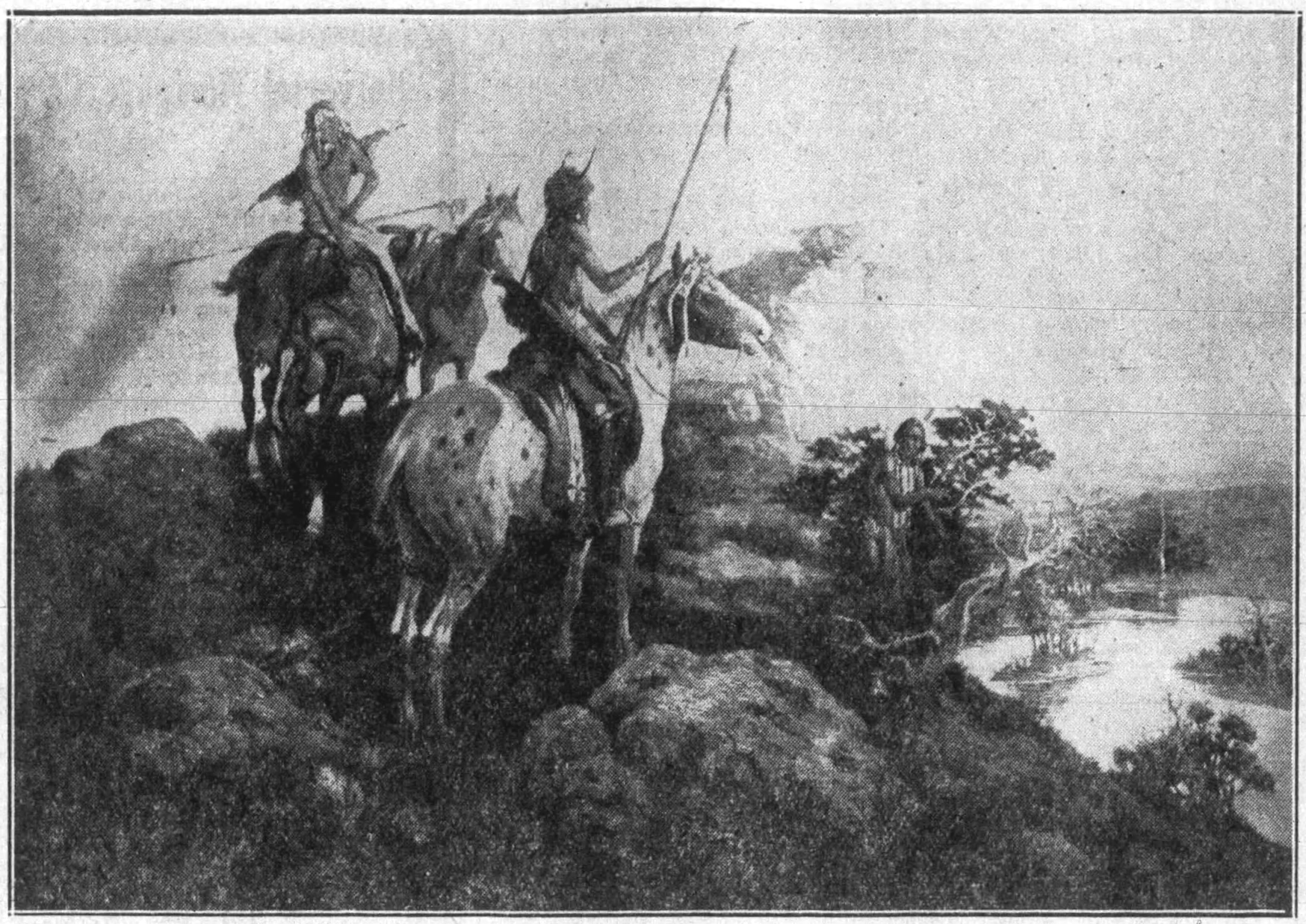
INDIAN tribes of Montana and the I northwest have many curious legends, myths and superstitions which provide an interesting field of study for those interested in ethnology and comparative religion and which contain theme ideas for American music, art and literature, only slightly touched upon at the present time.
While sifting again and again the old stories of Greek, Roman and Norse mythology, writers and artists have made no effort to use the almost untouched stories of Indian tradition. There are some exceptions to the rule, however. David Lieurance, who spent a year on the Crow reservation about 20 years ago, has made good use of the song motifs of various tribes and Frank Linderman through his “Indian Why Stories” has done much in bringing Indian folk lore to popular attention.
The various Indian tribes have their creation and deluge stories, many of which closely parallel those of Semitic origin with which we are familiar. Students have been able to trace tribal relationships quite as much through the similarities of their myths as through physical or lingual similarities.
According to one of the Crow creation stories, the world originally was covered with water. Old Man Coyote, a god who personified to many tribes the principle of wisdom and craft and who often took the form of a coyote, sent down a duck to earth. The duck dived under the water and kicked up some mud and Old Man Coyote took this and formed the land. Then he molded out of mud, the various animals. Finally he took another piece and with more than usual care, sculptured the shape of a man.
Gives Him Eyes
He placed the mud man against a tree to dry. Then he thought that of all the things that he had made, there was none that understood the wonderful work he had done. So he picked up a stick and punched a couple of holes in the man s head and these became eyes and because of his extra care, the man could see and understand beyond any of the other animals.
The Mandan Sioux have a story that their tribe originally lived In a subterranean village beside a great lake. There was a great tree reaching to the upper world and the tribe determined to climb up to the surface. They all got up safely but one very fat woman who broke the root by which they were climbing and then they were never able to return to their former home.
The Crows have a story that has a certain likeness to this tree story of their kindred. The sun fell in love with a certain Gros Ventre woman because she was such a big eater. The Gros Ventres are a branch of the Crows which seceded not long before the coming of the white men. They have been the butt of good-natured ridicule from the Crows for their reputed eating proclivities from which has come the name Gros Ventres, which Is French for “Big Bellies.” The Indian name for the tribe is Hidatsa.
Sun Steals Woman
The Gros Ventre woman of the story started to climb a tree after a fat porcupine which had climbed to the topmost branches. The sun watered the tree and caused it to grow until its branches reached the sky. Then the sun seized the woman and made her his bride. The moon was their son.
After a time the woman grew tired of her celestial abode and wished to return to the earth. To prevent this, the sun closed up all the openings of the sky. But the moon punched holes in the sky and these became the stars. Still his mother was not content with peeping through these holes to see the earth. Finally the moon took a great arrow and shot it through the roof of the sky but as he did so, he lost his balance and fell through the opening. His mother tried to save him and she, too, fell from the sky. There is a great rock near the Big Horn river with two indentations upon it. This is where the moon and his Gros Ventre mother struck when they fell.
Some of the Legends are used to explain various facts of nature, others to account for unusual landmarks. The Kiowa Indians told Gen. Hugh L. Scott a legend of the famous Devil’s Tower in northern Wyoming of this nature. A band of Indians were camped on a stream where there were many bears. Once seven little girls were out gathering berries when some bears chased them. The bears were about to catch them when they managed to scramble on a low rock. “Oh, rock, save us, save us,” they cried. The rock began to stretch out longer and longer. The bears jumped up at the rock, scratching against its sides and the marks can still be seen on the rock. The children were pushed up to the skies where they, became the seven stars of the Pleiades.
Legends of Tragedy
There are many legends among different tribes of sacrifice and of tragedy. One of these among the Crows which may have had a historical basis is connected with the cliffs of the Yellowstone river near Billings. A large band of Indians, encamped near the river, were attacked by an epidemic, probably of the smallpox, and many died. Finally, as the disease showed no signs of abating, a council was held and some way of assuaging the anger of the spirits who had caused the plague was discussed Finally, three young braves offered themselves as a sacrifice. Blindfolding their horses, they rode off the high cliffs and perished with their steeds on the rocks below. The heroic deed of the young warriors had the desired result and the remnant of the band escaped the disease. The point was known until after the coming of the whites as “The Place of Skulls.”
Common among the Indians are legends about the procuring of fire. According to one story, the fire was at first guarded by a frightful witch, so that none of the Indians dared to take any of it. Finally Old Man Coyote, who was often the benefactor of the Indians, offered to get them a brand of fire with the aid of the other animals. He stationed them along the wav to the home of the witch, first the frog, then the squirrel, the deer, the elk and the horse while Old Man Coyote went to the witch’s home. When the witch wasn’t looking, he grabbed a brand of fire and ran with it while the witch closely pursued.
Frog Loses Tail
Just as the witch was about to grab Old Man Coyote, he reached the horse, who snatched the brand and with fresh strength, the horse ran until he too was almost exhausted when he passed the fire to the elk and so on from animal to animal. In those days, the frog was much like other animals with a tail and a furry pelt. But when he received the brand, he had hardly started when the witch was upon him. He gave one great leap into the midst of the Indian camp with the brand but he left behind him in the witch’s hand, his tail and furry pelt and ever since his eyes have bulged out from the fright he received.
Animal life is closely associated with both the legends and the religion of the Indian. Bear claws, eagle talons and feathers and parts of other animals and birds are great fetishes and “medicine.” Many of the Indian dances are dramatizations of animal life and most of the powers of nature are represented by beasts. Thus the thunder bird whose power is greatly dreaded, causes the thunder by the vibration of his wings. To the Siouan tribes, the thunder bird was the sign of victory. In the olden times, the Indians believed that the snake had legs and was very wise. They also tell of a bug so large that when it ran along a trail, it raised a cloud of dust like a horse or* buffalo.
Dreams played an important part in the life of an Indian and many important decisions were based on their Interpretations in which the medicine men played an important part. Young Crows in the rites of puberty often went to Cloud peak in the Big Horns to fast until in the delirium of long abstinence from food, they saw strange visions. There is an Indian who is called Maricota, or “Woman Jim” who attires himself as a woman and has red and white ribbons on his tepee because as a youth he dreamed that he was dressed as a squaw.
Home Land Held Best
The Crow, as perhaps other tribes and certainly many white nations, believes that his land is the best land and that he is a special favorite of the Great Spirit. Father S. J. Palladino in “The Indians of the Northwest;” tells of a chief named Iron Bull who told another priest that the Great Spirit made the Crows first. “Then he made the Flatheads, Sioux, Piegans, Snakes, Assinni-boines and other tribes and placed them all about us. The Crows were in the middle of the earth because they were the best Indians. They fought with the other Indians and took away their horses and women.”
The old religious customs and beliefs are still adhered to by most of the older people of the tribe and they undoubtedly still have a strong hold on many who do not openly follow them. As one of the younger leaders expresses it: “The old people are wise people. They have long memories. The Indians did not write, but they heard the stories at the campfires from their fathers and remembered them. The white man’s truth is best for him, and the Indian’s truth for him. The old customs were the best for the Indian but they are no longer good because he must live in a new way.