Ziwei Yan
Jouissance of the Paranoiac Machine
Posthumanism and Futuristic Bodies
Posthumanism and the Dissolution of Boundaries
On the Correlation between Paranoia and the Posthuman: A Case Study of Norbert Wiener’s Cybernetics
The Posthuman Tendency in Lacan: Is There a Crossroad between the Pragmatic and the Utopian?
Chapter 1. Jouissance of the Paranoiac Machine: Pynchon’s Convoluted Posthuman Cosmology
Historical Background and Pynchon Criticism
Pynchon Criticism: From Paranoia to the Posthuman
A New Materialist Reading of Pynchonian Paranoia
The Affect of Things: Mud into Flesh
A Lacanian Re-examination of Pynchonian Paranoia
Paranoia and the Posthuman Body
Jouissance of the Paranoiac Machine
The Appetizer: A Posthumanist Reading of “Colony”
The Main Course: Without the Animal, I Cannot Speak About My Desire
The Salad Course: Holding the Last Ring of Your Paranoiac Sinthome
The Dessert: The Affects and Politics of the Blade Runner Movies
Blade Runner Soundtrack: Enhanced Empathy toward the Nonhuman and Aesthetics of the Failed Utopia
Chapter 3. The Vertigo of Nachträglichkeit: Paranoia and Black Agency in Kindred
Prelude: To Celebrate or Not to Celebrate, That is the Question
A Review of Kindred: Southern Gothic, Trauma Narrative, and Black Agency
Masters’ Paranoia and Bodies in the Impossible Place
The Vertigo of Nachträglichkeit: Can Black Agency Emerge Without a Pessimist Frame?
Endnote: Dana, Lacan, and the Whale
“Baudelaire de Dieu!” or, Shall We Meet Again at ein anderer Schauplatz?
Bio-jouissance: The Fear and Charm Associated with Bioengineering
Aesthetics, Paranoia, and Ecology: The Posthuman Convolution of the Monstrous Beauty
“I See the Marriage of the Rabbit and the Carp in My Dream”
Portals to ein anderer Schauplatz: Behemoths, The Ant, The Butterfly, and Leviathans
Jouissance of the Paranoiac Machine:
Posthumanism and Futuristic Bodies
by
Ziwei Yan
M.A., Peking University, 2018
B.A., Sichuan University, 2015
Thesis Submitted in Partial Fulfillment of the
Requirements for the Degree of
Doctor of Philosophy
in the
Department of English
Faculty of Arts and Social Sciences
© Ziwei Yan 2025
SIMON FRASER UNIVERSITY
Summer 2025
Copyright in this work is held by the author. Please ensure that any reproduction or re-use is done in accordance with the relevant national copyright legislation.
Declaration of Committee
| Name: | Ziwei Yan |
| Degree: | Doctor of Philosophy |
| Title: | Jouissance of the Paranoiac Machine: Posthumanism and Futuristic Bodies |
| Committee: |
Chair: Matthew Hussey Associate Professor, English Clint Burnham Supervisor Professor, English Carolyn Lesjak Committee Member Professor, English Margaret Linley Committee Member Associate Professor, English Paul Kingsbury Examiner Professor, Geography Russell Sbriglia External Examiner Associate Professor, English Seton Hall University |
Abstract
Jouissance of the Paranoiac Machine argues that despite the rise of posthumanism and new materialism in recent decades, paranoiac sentiments about the loss of boundaries between humans and nonhumans still exert considerable influence on our subjectivity. Drawing on Jacques Lacan’s theory, this dissertation argues that paranoiac symptoms demonstrate a lack of a stable Name-of-the-Father in our societal and discursive constructions surrounding the boundary between humans and nonhumans. This lack is a form of negation, but it is precisely this negation that gives positivity to human existence. The epistemological and ontological breakdown of boundaries, either through theoretical conceptualizations or advanced technologies, engenders Lacanian “jouissance”—a form of enjoyment that involves pain. Jouissance testifies to the lack embedded in human subjectivity and our Symbolic world, functioning as a “cut” in our fantasy of autonomy. Arguing for the “extimate” nature of human subjectivity, this dissertation prioritizes a topological understanding of human-nonhuman boundaries. It also draws attention to the tension between paranoia and posthuman symbiosis, maintaining the idea that paranoia against boundary dissolution is inevitable due to our fundamental lacking nature, but, at the same time, deploying aesthetics as a counterforce to paranoia. Chapter 1 showcases how the characters in Thomas Pynchon’s novels experience jouissance erupting from their cyborgian bodies and how nonhuman creatures can function as an (imaginative) alternative to paranoia. Chapter 2 focuses on the lacking subjects in Philip K. Dick’s novels and their pursuit of (animal)object of desire as a stabilizer for their paranoiac psyche, demonstrating how this pursuit paradoxically leads to the realization that the nonhuman has always already been a part of the human body. Chapter 2 also uses Theodor W. Adorno and Fredric Jameson’s theories of autonomous art to analyze the music and politics of the Blade Runner movies by Ridley Scott and Denis Villeneuve. Chapter 3 deconstructs the paranoia of the masters in Octavia Butler’s Kindred, arguing that the aesthetics in Afrofuturism can function as a form of politics against racism and that the protagonist’s agential, (impossible) posthuman status performs an alternative to the melancholia in Afro-pessimism. Chapter 4 underscores the aesthetics of Monstrous Beauty in Jeff VanderMeer’s Southern Reach Trilogy, associating paranoia with the rise of bioengineering and the emergence of bio-jouissance, arguing that the novel series can facilitate an ecological understanding of the Lacanian topology.
Keywords: paranoia; posthuman; jouissance; psychoanalysis; topology; aesthetics
Acknowledgements
This dissertation was completed on the unceded and traditional territories of the Tsleil-Waututh (səl̓ilw̓ ətaʔɬ), Kwikwetlem (kʷikʷəƛ̓ əm), Squamish (Sḵwx̱ wú7mesh Úxwumixw) and Musqueam (xʷməθkʷəy̓ əm) Nations. I appreciate that Simon Fraser University has taught me the importance of the land to the Indigenous people and the difficult truth about Canadian history.
I want to thank my supervisor Dr. Clint Burnham, for giving me the opportunity to study at SFU. When I first arrived at SFU in 2019, I was overwhelmed by the daunting research projects and the new environment in North America. But Dr. Burnham has been very patient with me and has taught me everything about being a Lacanian scholar, guiding me through all those difficult tasks with his tremendous knowledge, expertise, and unique humour. Many ideas in this dissertation came from the dialogues between me and him. Just like the extimate nature of the unconscious, the arguments in this dissertation are also “sliding” on the Möbius strip, whose tangential point of “cut” is marked by Dr. Burnham’s published scholarly works. And thank you to my committee members, Dr. Margaret Linley and Dr. Carolyn Lesjak, for showing me the fascinating world of new materialism and the Frankfurt school, for examining my work with the most scholarly rigour and precision, and for giving me insightful ideas to fix the problems related to logic and argumentation.
Since I arrived at SFU in 2019, I have been intellectually challenged by the excellent courses offered by the English Department. I am grateful to Dr. Mary Ann Gillies, Dr. Paul Budra, Dr. Stephen Collis, Dr. Matthew Hussey, Dr. David Chariandy, Dr. Nicky Didicher, Dr. Orion Kidder, and Dr. Kandice Sharren. I did not attend all of their graduate-level courses. Still, even in the undergraduate courses I took as a teaching assistant, I have seen what it means to be an inspiring scholar and teacher. Thank you, Dr. Nicolas Fillion, from the Philosophy Department, for allowing me to join your summer course in 2020 and teaching me the history of logic with great patience and humour. I also want to thank the executive and administrative team: Dr. Diana Solomon, Simardeep, Lynn, Tara, and Rebecca, for their diligent work and care for the students.
From 2019 to 2025, I have received support from many fellow graduate students from the English Department at SFU: Michelle, Ishanthi, Isabella, Alois, Rawia, Adrian, Hannah, Yiwen, Wen, Rachel, Dana, Miyona, Scott, Renan, and Saba. Thank you to the students from my course, “Paranoia and the Posthuman,” for helping me find a method to convert the dissertation into a course that people can understand. Thank you to my friends from the Computer Science Department, for keeping company and forcing me to think about the practicality of psychoanalysis: Rachael, Pengxiao, Flora, Helen, Tangzheng, Fuyang, Ruanyue, and Shitao. Thank you to my friends Eva, Felicia, Yuanyuan, Jingru, Taoran for your encouragement and support.
Thank you to the people at the Lacansalon. Dr. Hilda Fernandez-Alvarez, I feel lucky to have listened to you explain Lacan with those interesting case studies. Thank you, Alma, Ted, Désirée, Juan Luis, and Mandana, for creating the lively discussions.
Thank you, Ritchie, my BJJ trainer, for teaching me martial arts and how to be a brave fighter. Thank you, Sahiba, for the training, encouragement, and Jiu-Jitsu jokes. Thank you to my brothers at the Infighting Training Centre, Tsavo, Darshan, Derek, Alec, Vince, Chris, Jason, and Kevin, for keeping me grounded and sane. Thank you, my sisters from the SFU Judo Club, Ned, Kassy, Sara, and Hazel, for our fun time together.
Most of all, thank you to my family for tolerating my free, adventurous spirit, for leaving you to study for six years on another continent, and for being supportive this whole time about me “digging into some obscure Lacanian project” that you “don’t understand.” And thank you, Christina, for being such a good listener and my best friend.
List of Figures
Figure 1: A Klein Bottle made in the glass shop at SFU, reference number PIRA 8C20.10
Figure 2: Sunrise on the Saguenay, Cape Trinity. 1880. Courtesy National Gallery of Canada.
Figure 3: The Sinthome is visualized by the fourth black ring.
Figure 4: Visualization of the pitch range and dynamics in “Memory” from Blade Runner 2049 and “Memories of Green” from Blade Runner
Figure 5: “Theory of the Four Formulae: A Talk at Saint-Anne”
Figure 6: Revised illustration of Nachträglichkeit
Figure 7: Slavers Throwing Overboard the Dead and Dying, Typhoon Coming On (1840)
Figure 8: Make Do and Mend 2017
Figure 9: Hypersymbiont Dress (2013–17)
Figure 10: A Klein Bottle made in the glass shop at SFU, reference number PIRA 8C20.10
Figure 11: Screengrab of the documentary from Apple TV
Introduction
“Too paranoid for you?”
“Not me, paranoia’s the garlic in life’s kitchen, right, you can never have too much.”
—Bleeding Edge (2013)
Imagine these expeditions, and then recognize that they all still exist in Area X in some form, even the ones that came back, especially the ones that came back: layered over one another, communicating in whatever way if left to them. Imagine that this communication sometimes lends a sense of the uncanny to the landscape because of the narcissism of our human gaze, but that it is just part of the natural world here. I may never know what triggered the creation of the Doppelgänger, but it may not matter.
—Annihilation (2014)
In November 2018, the Chinese biophysicist He Jiankui claimed that two babies, Lulu and Nana, who were genetically modified by his research team to grant them immunity to the human immunodeficiency virus (HIV), were born. It was the first time scientists claimed to have conducted gene editing on human embryos, thus sparking heated debates about the unstable ontological border between humans and nonhumans in the era of bioengineering. This event also sparked a new wave of paranoia about the impact of biotechnology and the power of profit-driven corporations when they are involved in academic research. During the COVID-19 pandemic, similar paranoiac feelings about the technological breakdown of human-nonhuman boundaries were also intensified. Because some patients experienced cardiac arrhythmias (Pari et al.) after the administration of the COVID-19 vaccine, conspiracy theories about the vaccine have been created and ramified, such as the theory that the vaccine was made by Big Pharma to sterilize people or that there is a microchip in the vaccine which can modify, monitor, and manipulate the population. These paranoiac feelings have also been mixed with narratives about secret government agencies controlling citizens, breeding a new wave of anti-communist, anti-government sentiments in the public’s mind.
Not only does biotechnology trigger paranoiac feelings, but nuclear technology also induces fear about the increasingly porous boundary between the human and the nonhuman. For example, the Fukushima nuclear accident in 2011 caused tremendous panic in Asian coastal countries. Even though scientific evidence proves that the “tests of samples taken from the first batch of released wastewater showed radioactivity levels well within safe limits” and that the UN’s atomic watchdog and the International Atomic Energy Agency (IAEA) have approved “the plan” (Hawkins and McCurry) to release wastewater into the sea, many people in China still hoarded huge boxes of salt out of panic, in the hope of “ward[ing] off radiation poisoning” (“Chinese Panic-Buy Salt”) as rumours claimed that iodized salt could defend the body from radioactive particles.
Despite claims by some scholars that we may have moved toward a “postparanoiac stage” (Chetwynd 36), it is evident from these examples that paranoiac fear against the loss of agency and human-nonhuman boundaries still plays a vital role in our contemporary life. During the sixties, Richard Hofstadter wrote a famous article, “The Paranoid Style in American Politics,” which analyzes the paranoid style of mind in US history. He summarized that the word “paranoia” has been entrenched in the debates about the Puritans’ fear of persecution from the European Catholics, the Cold War and right-wing politics amidst the threat of communism. His argument on how the paranoid mindset is “afflicted not only by the real world, with the rest of us, but by his fantasies as well” can be applied to the cases of paranoia about Big Pharma and radioactive particles invading human bodies. Nowadays, people are paranoid about AI takeover, bioengineered transhuman bodies, and the complete mechanization of the human. As bioengineering, computational, and robotic technologies are rapidly developed and applied in people’s life, many literary and filmic works thus attempt to capture this paranoiac feeling about the dissolution of boundaries between humans and nonhumans in society.
Within this broader social context, my dissertation spotlights the representations of paranoia in the novels from the 1970s to the present that feature bodies which do not fall into traditional ontological categories, particularly regarding categories of the human and the nonhuman (such as machines, cyborgs, animals, subhumans, and inorganic matter). I underscore the representations of paranoia in Thomas Pynchon’s Gravity’s Rainbow (1973), Philip K. Dick’s Do Androids Dream of Electric Sheep? (1968), Octavia Butler’s Kindred (1979), and Jeff VanderMeer’s Southern Reach Trilogy (2014). I argue for a causal link between the prevalence of paranoia in these novels and the existence of bodies that manifest the dissolution of boundaries. Timothy Melley, in Empire of Conspiracy: The Culture of Paranoia in Postwar America (2000), has extensively analyzed how the increasing paranoiac sentiment during the post-war era was closely related to the emergence of postmodern subjectivity (I will elaborate on his stance in the chapter on Pynchon). In my dissertation, I want to further his claim and contextualize paranoia with the emergence of posthuman bodies.
Although many thinkers aligned with posthumanism tend to treat the fluid boundaries between humans and nonhumans as a scientific fact (Cary Wolfe, Katherine Hayles, and Karen Barad) or embrace the dissolution of boundaries (Donna Haraway), the novels I analyze in this dissertation do not take a straightforward stance on whether this dissolution positively affects the characters. Instead, these novels are structured around a tension between paranoia and posthuman symbiosis—between the fear of boundary breakdown and the desire to embrace human-nonhuman blending. The first epigraph at the beginning of this Introduction— “paranoia’s the garlic in life’s kitchen” from Pynchon’s Bleeding Edge—reflects the paranoiac register, while the second epigraph regarding the narcissism of the human gaze from Annihilation indicates a desire for posthuman symbiosis.
I use the French psychoanalyst Jacques Lacan’s theory to analyze the representations of paranoia in these novels. My thesis is that the paranoiac symptoms exhibited by the characters in the novels and the responses evoked through the act of reading demonstrate a Lacanian lack of a stable Name-of-the-Father in our societal and discursive constructions surrounding the boundary between the human and the nonhuman. Paranoia bespeaks humans’ anxiety over an epistemological shift that questions the ontological border between these two categorical existences. This posthuman shift brands the subject not as separate from the nonhuman but as embedded and relational to it. In the novels, the epistemological and ontological breakdown of human-nonhuman boundaries engenders a form of enjoyment that involves pain. In the Lacanian framework, this enjoyment is called “jouissance.” Jouissance characterizes the bodies that do not fall into traditional categories, testifying that the Ideal Human image (rational, autonomous, disembodied, superior to other beings) is an impossible object of desire that can never be reached. While pursuing this object of desire, the subjects in these novels realize that they can never find the ultimate proof to testify to their “Human” status and that the things they attribute as “nonhuman” have always been a part of their “Human” body. The lack in our Symbolic system is a form of negation, but it is precisely this negation that gives positivity to human existence. Drive emerges from this lack, and actions are initiated by the desire to fill this unfillable lack both in the subject and our Symbolic system. Paranoiac feelings demonstrate that, in response to the fundamental lack which characterizes the human psyche, some humans will find it hard to embrace this traumatic reality and thus choose to live in the certitude built around a fantasy. This fantasy structures the subject’s desire and sustains meaning.
Machinic conceptualization of humans in certain posthuman theories may be empirically right regarding the ontological boundary between humans and machines. However, the dissolution of boundaries (between humans and nonhumans) in certain posthuman epistemologies is inherently paranoia-inducing. Since some posthuman theorists (for example, Cary Wolfe and Katherine Hayles) consider cybernetics as the precursor of posthumanism, I will mainly use the writings of the famous cybernetician Norbert Wiener to demonstrate how the discourse of cybernetics tends to trigger paranoiac sentiments. In addition, some posthumanist theorists utilize the inherent paranoiac tendency in human subjectivity to promote their ecological agenda (Stacy Alaimo). This paradox in posthumanist politics demonstrates that there is a remnant of the desire for traditional human agency and autonomy.
When examining the novels (and the movie adaptations such as the Blade Runner series derived from PKD’s novel), I put Lacanian theory and the literary texts in dialogue with other philosophical frameworks such as posthumanism (Cary Wolfe), ecofeminism (Donna Haraway), new materialism (Jane Bennett, Karen Barad, and Stacy Alaimo), cybernetics (Norbert Wiener), Marxism (Fredric Jameson), the Frankfurt School (Theodor W. Adorno and Max Horkheimer), Afro-pessimism (Christina Sharpe and Saidiya Hartman), and Afrofuturism (Mark Dery). For my understanding of Lacanian theory, I am influenced by theorists such as Slavoj Žižek, Clint Burnham, and Stijn Vanheule. My argument on the paradox in the posthumanist political agenda is influenced by the functionalist approach of William James. Apart from Lacanian theory, I also borrow Sigmund Freud’s methodology of analyzing the unconscious and the mechanisms of repression in speech.
I use Jacques Lacan’s theory as the main methodology for my dissertation on paranoia and posthumanism because, first, paranoia can be considered a psycholinguistic phenomenon. Paranoiac sentiments are often associated with discourses surrounding the invasion of bodies or thoughts. Both Freud and Lacan have done extensive research on the mechanism that gives rise to paranoia, particularly in terms of this phenomenon’s relationship with language, desire, and fantasy. Freud, in Psychoanalytic Notes on an Autobiographical Account of a Case of Paranoia (Dementia Paranoides), defines the paranoia experienced by Dr. Daniel Paul Schreber as a result of the repression of his homosexual desires, analyzing how Schreber constructs narratives and fantasies to express his repressed psychic libido. Lacan, in his doctoral dissertation, also focused on the mechanism of paranoid psychoses. In Écrits, Lacan further develops his theory from Freud’s case study of Schreber, arguing that Schreber’s fantasy—that he will be God’s wife and bear children with God—is a result of the defence mechanism against the void generated from the breakdown of the signifying chain. For Lacan, symptoms of psychosis, such as paranoia and delusions, are caused by the foreclosure of the Name-of-the-Father. For “psychosis to be triggered, the Name-of-the-Father— verworfen ... must be summoned to that place in Symbolic opposition to the subject” (Lacan, “On a Question” 481). This means that, in the unconscious, there emerges a need for stabilization, and the Name-of-the-Father is called upon to stabilize the Symbolic chain. In clinical contexts, “foreclosure” means that in the Other (the discourse of the patient who explains their predicament), the analyst could not excavate a stable representation of lack. In other words, paranoia is closely related to an unstable Name-of-the-Father (the master signifier) that fails to function properly to shield the subject from panic, disorientation, and hallucinations.
Besides his focus on the correlation between language and paranoia, Lacan’s development of concepts such as “objet petit a,” “sinthome,” and “jouissance” also allows me to put this theory in dialogue with the newly emerged posthuman philosophy because these concepts indicate Lacan’s tendency to “move away from a language-oriented philosophy” (Burnham, Does the Internet Have an Unconscious? 71), and thus beyond anthropocentrism. In the last section of this introduction, “The Posthuman Tendency in Lacan,” and Chapter 1 on Pynchon, I use both posthumanism and Lacanian psychoanalysis to analyze novels to examine these theories’ similarities and divergences. I argue that Lacan both is and is not a posthumanist.
The tension within Lacanian psychoanalysis—the desire to maintain the focus on the function of speech when examining the human psyche and the desire to move beyond the linguistic domain through topology (thus beyond the human register)— mirrors the tension in the novels I analyze (namely, the tension between paranoia and posthuman symbiosis). For instance, the dissolution of the boundaries between humans and machines, consolidated by technological inventions such as TVs, computers, robotics, the Internet, and AI, has increasingly undermined the traditional notion of free will and autonomy. However, this posthuman dissolution of boundaries is mixed with a lingering paranoiac sentiment. In Chapter 1, I draw a parallel between the paranoia of the Unabomber, Ted Kaczynski, and that of the characters in Pynchon’s novels to showcase this tension surrounding the breakdown of human and nonhuman boundaries. I argue that, like Kaczynski, Pynchon shares a critical view of the cyborg figure. Pynchon often presents that the dissolution of boundaries between humans and nonhumans does not bring forth a utopian vision but rather a dystopia where the technological manipulation of bodies is justified in the name of behavioural studies, scientific progression, and the accumulation of wealth and power. In this sense, Pynchon is not totally aligned with Haraway, who embraces the “pleasure in the confusion of boundaries” (A Cyborg Manifesto 7). Pynchon’s argument on technology always manifests with internal tension, as shown by this statement in Gravity’s Rainbow: There are two rockets— “a good Rocket to take us to the stars, [and] an evil Rocket for the World’s suicide, the two perpetually in struggle” (Pynchon 741). The tension in Pynchon’s text can also be seen in the animal imagery and the narratorial strategy, which indicate an attempt to break free from the anthropocentric register of paranoia.
The overlap of desires between these literary texts (novels published from 1968 to 2014) and Lacan’s theoretical framework (which was developed from the 1930s to 1970s) allows me to formulate the hypothesis that the emergence of the posthuman bodies and posthuman epistemology in the late twentieth century and early twenty-first century has causal relations with the representations of intensified paranoiac feeling. I argue that the tension within Lacanian psychoanalysis (particularly surrounding the paranoiac “extimate”[1] ontology) can function as a middle ground between the utopian ideal embodied in posthumanism and the pragmatic approach of humanism. Both new materialism (Barad) and psychoanalysis (Lacan) acknowledge the fluid boundary between humans and nonhumans, but Lacan deviates from posthuman philosophy in that he maintains the registers, such as the unconscious, fantasy, and a structured rather than diffused topology. In Chapter 1, I focus on the different registers of paranoia in psychoanalysis and new materialism. In the traditional Freudian-Lacanian sense, paranoia is a structure of subjectivity, a symptom of social and linguistic disjunction, whereas, for new materialists, paranoia is an affect, a bodily reaction triggered by the reality of human embodiment.
Each of the novels bears historical relevance to the current debates on paranoia and the fear associated with bodies which do not fall into specific gender, racial, and species categories. Gravity’s Rainbow was published in 1973 during the Cold War, a time of great uncertainty in which regional wars and conflicts broke out (the Korean War, the Cuban Missile Crisis, and the Vietnam War). Amidst these uncertainties, government agencies started to implement policies and develop new technologies to enhance the surveillance of citizens. And the anxiety to distinguish “patriotic citizens” from “communist enemies” was at a peak. Gravity’s Rainbow’s allusion to the Space Race through narratives about World War II and its comments on the entanglement of rocket technology with human bodies by secret research organizations can serve as solid materials to examine the paranoia about technological infiltration. The historical time when Gravity’s Rainbow was produced parallels the current social milieu. Nowadays, people are also paranoid about being manipulated by profit-oriented research organizations such as Big Pharma or the hidden “microchip” in the COVID-19 vaccine. In Chapter 1, I parallel the famous case of the Unabomber Ted Kaczynski with Pynchonian Paranoia. My argument is that characters in Pynchon’s novels, such as Oedipa Maas and Tyrone Slothrop, have similar experiences with Kaczynski in that their paranoiac fear of the “system” is not so much of a mental illness that requires treatment but rather a symptom of the anxiety towards the increasing dissolution of the epistemological boundary between humans and machines as well as the ontological entanglement of these two realms of existence due to the inventions of technology.
Similarly, Philip K. Dick’s Do Androids Dream of Electric Sheep? was also produced during the uncertain time of the Cold War. This story incorporates similar paranoiac sentiments about the infiltration of technology and the nonhuman into the human body. In Chapter 2, I elaborate on the historical relevance of this novel with PKD’s paranoia about the surveillance by the CIA and FBI. Following the tense ideological conflicts between the USSR and the US—in the post-civil rights era—Butler’s Kindred situates paranoia with the anxiety surrounding racial boundaries and the impact of trauma due to transatlantic slavery. This novel can also function as a tool to examine today’s paranoiac sentiments about race, both for the White subjects (who are paranoid about Black “criminals”) and the Black subjects (who are paranoid about being unfairly treated by other races or victimized by white police). In addition to racial boundaries, I include the Southern Reach Trilogy to reflect on the current debate about species boundaries and bioengineering. Chapter 4 explicates the mechanism that generates the paranoiac sentiment about biotechnology. This chapter examines how posthuman thinkers and writers utilize paranoia and aesthetics to advocate ecological agendas.
These novels all seek to address the impact of the dissolution of boundaries between the human and the nonhuman. In Pynchon’s Gravity’s Rainbow, the materials that compose the rockets are used to conduct experiments on the main character Tyrone Slothrop, making his sex life and his body entangled with the mechanisms of the rocket technology; in PKD’s Do Androids Dream of Electric Sheep?, the androids are made so life-like that humans cannot distinguish the androids’ empathy and desires from their own; in Butler’s Kindred, the main character Dana (as an educated Black woman living in modern America) travels back in time to the Antebellum South, to the plantation owned by her ancestor who was a white master, only to discover that the trauma of slavery has to be confronted. Her uncanny existence destabilizes the boundaries between the human and the “subhuman,” uncovering the deadlock in the phantasmagoric racial hierarchies. In VanderMeer’s Southern Reach Trilogy, Area X transforms bodies, producing a sublime, terrifying organism that contains both human and nonhuman DNA. VanderMeer’s novel series combines aesthetics and mysticism to advocate an ecological understanding of the relationship between humans and nature. All of these texts manifest a causal relationship between paranoia and posthuman bodies. However, they also differ in terms of whether they advocate a posthuman ecological and ethical agenda. While posthuman philosophy firmly questions anthropocentrism and human-nonhuman dichotomy, the novels hold a much more complicated attitude towards this loss of boundaries. At this point, it is necessary to explain the term “posthuman” so as to understand the correlation between paranoia and the posthuman.
Posthumanism and the Dissolution of Boundaries
Posthumanism is a newly emerged philosophical framework in the late twentieth century that questions the ontological and epistemological border between humans and nonhumans. The word “nonhuman,” in the Aristotelian or the Enlightenment framework, categorizes a group of existence that does not belong to the human species, such as nonhuman animals and organisms, machines, and the natural environment. Despite resorting to diverse critical approaches, most posthumanists regard the ontological border between humans and nonhumans as provisionary and unstable. Having inherited the philosophy of deconstructivism from postmodernism, posthumanism often exhibits a Dionysian celebration of the genealogical excavation of traditional categories; its political commitment is to undermine anthropocentrism, seek social justice and raise ecological awareness. It is a discourse that aims to promote humans’ coexistence with rather than dominance over other life forms. In academia, this philosophical framework strongly aligns with the leftists’ desire for Utopia.
According to Cary Wolfe, the term “posthumanism” can be traced back to “the Macy conferences on cybernetics from 1946 to 1953” as well as the emergence of systems theory to designate a theoretical model that “remove[s] the human and Homo sapiens from any particularly privileged position in relation to matters of meaning, information, and cognition” (xii). In literature studies, posthuman thoughts can also be traced back to Mary Shelley’s Frankenstein (1818), a story that questions the hierarchy between human and nonhuman intelligence. In addition, posthumanism problematizes the subject-object relation as manifested in humans’ interaction with the nonhuman. Since the traditional Enlightenment conception of the human and the nonhuman are accessed through the lens of science and empiricism, humans are often positioned as the subjects while nonhumans are treated as the objects to be observed or modified. This one-directional epistemology, however, has been questioned by posthumanists.
For instance, Karen Barad, in Meeting the Universe Halfway: Quantum Physics and the Entanglement of Matter and Meaning (2007), argues for the idea of “agential realism” and the power of matter, demonstrating how “Bohr’s philosophy-physics poses a radical challenge not only to Newtonian physics but also to Cartesian epistemology and its representationalist triadic structure of words, knowers, and things” (138). For contemporary scholars equipped with basic knowledge of chemistry and physics, it is not difficult to conceive the world as a process of agent particles interacting with each other. For Barad, what is revolutionary about Bohr’s theory, however, is that it radically destabilizes the status of language—the representationalist medium that has been prioritized as the “transparent” (97) measurement for the world ever since the 17th century. The complementary nature of wave and particle behaviours of light, for example, signifies that “the nature of the observed phenomenon changes with corresponding changes in the apparatus” (Barad 106), testifying to the interactivity embedded in the “subject-object” dynamism. The transparency of language in the process of constructing phenomena—a crucial consensus behind the “Enlightenment culture of objectivism” (Barad 107)—is thus questioned. Barad concludes that “the primary ontological units are not ‘things’ but phenomena —dynamic topological reconfigurings/entanglements ... of the world” (141). The primacy of words is replaced by “material-discursive practices through which (ontic and semantic) boundaries are constituted” (Barad 141). Therefore, the nonhuman is not a static object to be captured by human language but initiates “intra-activities” (Barad 141) with the human in their endless becoming. Posthumanism under this category of new materialism thus underscores the agency of the nonhuman and the epistemological entanglement between matter and meaning. In Chapter IV, I will put Barad’s new materialism in dialogue with VanderMeer’s Southern Reach Trilogy, to argue that the sublime materialdiscursive entanglement in the novel functions as a counterpart to the paranoiac register ingrained in anthropocentrism.
Apart from the subject-object dichotomy, many posthuman theorists in the twentieth century have also attempted to undermine the centrality of human consciousness in the discussion of meaning and ethics. They argue that the capacity to experience consciousness should not be the sole variable to determine how humans should ethically interact with the nonhuman. For instance, Katherine Hayles claims that we have entered a “postconscious age” (280), stating that the strong ties between consciousness and selfhood should be scrutinized due to the conceptual changes concerning the boundaries between the human and the nonhuman. Drawing on cybernetic theories, Hayles points out that the more “consciousness is seen to be the product of multiple coding levels, the greater is the number of sites where interventions can produce catastrophic effects” (279). Therefore, human consciousness is vulnerable and unstable; it is always subject to interventions from nonhuman sources. Posthumanism is thus a theory that underscores the “fragility” (280) of consciousness. Emphasizing the state of emergent rather than categorical consistency, posthumanism unwires the connection between consciousness and “the existence of the self” (Hayles 280), proposing an anxiety-triggering hypothesis that the “self” may not even exist as a stable ontological entity.
In What is Posthumanism?, Wolfe also shows his concern about humans’ preoccupation with self-consciousness and specifically spends one chapter criticizing cognitive scientist Daniel Dennett’s approach to the hard problems of consciousness (questions such as “What makes a thing conscious?”, “Whether consciousness is embodied?” and “Whether we can know what it is like to be someone else?”). According to Wolfe, understanding the correlation between the nature of consciousness and the moral implication thereof purely through a functionalistic approach, asking questions such as “[W]hat can it [consciousness] do?”, is problematic because “the prosthetic nature of the human permanently destabilizes the boundaries between ‘our’ thinking and anyone—or more radically, anything—else’s” (35). This disagreement between Wolfe and Dennett signals a more significant philosophical problem concerning the issue of agency and responsibility at the posthuman turn. To use a simple analogy, the root cause for this disagreement can be traced back to how one perceives Heraclitus’ theory of flux: are things constantly changing, or can there be moments of stability? Can we step into the same river twice? Am I the same person stepping into that river at two different moments?
For posthumanists, human-nonhuman boundaries are not stable precisely because of the constant flux in the universe and the intra-activities between particles; for functionalists like Dennett, ethics and the legal systems are predicated on the assumption of selfhood and autonomy, even though these concepts are constructed by language rather than something transcendent and ontologically constant. The radical posthuman interpretation of the boundary between the human and the nonhuman thus poses challenges to the humanist, functionalist ethical and legal system. In the judicial system, a murderer would be held accountable only under the presupposition that the murderer has free will. The entire human judicial system is predicated on the idea that individuals have the autonomy to decide which action should be taken in life and, thus, should take responsibility for their actions. Individuals would be punished in the form of imprisonment or the death penalty if they commit crimes. However, the posthuman idea of “intra-activities” indicates a shared dynamic responsibility and in the judicial system, it is hard to implement the theory of dynamic responsibility.
For example, most notable in Barad’s theory is the indeterminacy in quantum mechanics in regard to material becoming— “intra-actions always entail particular exclusions, and exclusions foreclose the possibility of determinism, providing the condition of an open future” (177). Without a concrete, solid definition of “absolute exteriority or absolute interiority” (176), then “causality and agency” become “an ongoing reconfiguring of both the real and the possible” (177). In the case of the famous serial killer Aileen Wuornos (whose story was adapted into the Oscar-winning movie Monster, directed by Patty Jenkins), should Aileen be responsible for the deaths of those victims? Should her early traumatic childhood (being raped, assaulted, and abandoned) exempt her from the responsibility associated with her behaviours when she grew up? For new materialists, “agency is a matter of intra-acting; it is an enactment, not something that someone or something has” (178). Following this line of thought, should those who induced trauma in Aileen also be accountable for the consequences of her behaviours? Was Aileen merely “enacting”? Or rather, the particles in her body were “enacting” “intraactivities” when the crimes happened? How do we account for the act of lethal injection when Aileen is subject to the death penalty? How do we understand “death” and “ethics” derived from this “intra-activity”? In Barad’s book, the ethics of new materialist philosophy is that one should be more “attentive” “to existing power asymmetries” in introducing the “cut” among different “material-discursive apparatuses” (217). Yet, despite our attentiveness to the asymmetrical power that shaped Aileen’s life, how can we implement this “attentiveness” in the judicial system? Should those who traumatized Aileen be arrested and sentenced, too? And where do we put a stop to the expansion of accountability in delineating the impact of “intra-activity” in her case? The example of Aileen Wuornos thus showcases the difficulty in implementing new materialist epistemology in the judicial system, revealing potential gaps between theory and social practice.
Posthumanists’ promotion of embodiment and dynamic materialism has also encountered challenges regarding the ethics and responsibility towards animals, particularly in the food industry. For instance, both Dennett and Wolfe acknowledge the embeddedness of consciousness, yet they disagree on the animal question.[2] Dennett thinks that ethical systems are predicated on mutual recognition, consensus, and applicability. Yet, it is difficult to decide how much consensus can be reached between humans and animals. Regarding this challenge, posthumanists advocate the idea of interconnectedness rather than perceiving the human body as exceptional. For Wolfe, the argument that animals are outside the ethical system due to their inability to “materialize” (98) similar status of “[Althusserian] subjection” cannot solidly justify the exploitation of them if humans start to understand this co-evolution and identify with animals as mortal, vulnerable beings sharing the same planet. In a similar but more radical way, Haraway claims that she is “a compost-ist, not a posthuman-ist” (“Anthropocene” 161). In this way, she problematizes the illusion that humans are progressing toward the posthuman era. Being a “compost-ist” means that humans are always embedded creatures and that the rhetoric surrounding questions of ontology should not encourage fantasies of transcendence or disembodiment. Promoting the idea of “companion species” (Haraway, The Companion Species Manifesto 50) rather than categorical stability, posthumanists seek to reveal the troubling nature of human’s relation with animal companions in evolutionary history, arguing for an “alertness to otherness-in-relation” (Chthulucene 50), for the willingness to “stay with the trouble” (10). Drawing our attention to the fact that we are living in a post-industrialized capitalist system where the food industry has turned animals into slaves whose situation is comparable to that in concentration camps, posthumanists underscore the idea of interconnectedness, arguing that harming nonhuman animals through technological inventions such as plastics in the ocean and industrial chemicals in the river will also harm humans.
The application of these posthuman thoughts in social praxis has generated heated debates. The demonstrations of environmental and animal rights activists can cause misunderstandings among the people working in the fossil fuel and meat industry, who may consider blockade protests “extreme” rather than something subject to negotiation. This issue of practicality in relation to animal rights often puts posthumanists in an awkward place: Asking for a complete change of human diet in this global capitalist system so that animals are not exploited demands a utopian solution in terms of the production and distribution of food; it may also sound totalitarian as this solution would undoubtedly require a massive implementation of government policy. Conservative media, such as Fox News, often appeal to people’s paranoiac fear of collective government policy and paint environmental activists as either hysterical or prone to communism. The root cause of the fissure between environmental and animal rights activists and the conservative workers in the fossil fuel and meat industry is that most of the working class is preoccupied with surviving in the capitalist system. Even if they have time for self-reflection or entertainment, these “relaxing” moments are also framed, as Adorno and Horkheimer have presented in Dialectic of Enlightenment, by the logic of consumer capitalism—the ideology designed to prepare them psychologically for the next round of work in the cycle of reproduction and the accumulation of wealth. In this sense, posthumanists who advocate animal rights are, in essence, idealists; they, like Dolores in the HBO series Westworld, have a poetic mind against the machine of capitalism and exploitation. In comparison, the working class in the fossil fuel and meat industry are conservative pragmatists in the sense that the idea of “capitalist realism” (Fisher 78)—that capitalism is the only viable solution despite the fact that it causes unpleasant pollution and exploitation—has been ingrained in their mind through markets and means of production and reproduction.
Regarding this tension between idealists and pragmatists on the issue of animal ethics, some scientists have resorted to the method of bioengineering to solve the problem of animal cruelty, such as using technology to create lab-grown meat. In recent years, this technology has been closely associated with a subdivision of posthumanism—transhumanism, which advocates unrestrained technological enhancement of human bodies. For instance, the application of the CRISPR-Cas9[3] technique to rebuild the genes of human embryos by the Chinese scientist He Jiankui can be categorized as a transhuman event. He borrowed the method of CRISPR-Cas9 from Jennifer Doudna and Emmanuelle Charpentier, two Nobel laureates in biochemistry and genetics, and removed the protein CCR5 from the subject embryos’ genomes in the hope of stopping HIV from using the chemokine receptor CCR5 to infect immunological cells in the subjects. The genetically modified babies were then created through IFV (in vitro fertilization). He Jiankui’s desire to make genetically advanced babies echoes the transhumanist agenda to promote a techno-utopia. Treating the boundary between humans and nonhumans as provisional, transhumanists seek the ultimate cyborgian experience of human-machine, human-animal blending. The newborn babies are transhuman; their existence showcases that human bodies are malleable and prosthetic. Their bodies are synthetic products of bio-engineering technologies, thus challenging the traditional demarcation between the “natural” and the “artificial.” In Chapter 4, I examine Annihilation’s exploration of posthuman bodies and how VanderMeer utilizes the current paranoiac sentiments surrounding biotechnology and transhuman bodies to promote an ecological agenda.
Even though nowadays the public has seen more real-world projects that echo transhuman thoughts (like the implantable brain-computer interface by Elon Musk’s company Neurolink), some posthumanists doubt whether transhumanism can withhold the epistemological and political agenda advocated by posthumanism. For instance, Wolfe criticizes transhumanism as an “intensification of humanism” (xv) and Cartesian Dualism because of its aspiration for the perfection of humans and disembodiment through technologies. The idea of uploading consciousness into machines or downloading consciousness from machines still tastes like humanism rather than a decentralization of humans’ semiotic system. In comparison, some critics consider that the benefits of this term (such as the advocacy of a utopian agenda) outweigh its problematic entanglements with consumer capitalism and technology (Haraway; Pilsch). In Transhumanism: Evolutionary Futurism and the Human Technologies of Utopia Posthumanism, Andrew Pilsch argues that transhumanism’s “utopian rhetoric of technology” gestures towards the notion of “evolutionary futurism ... [which] rhetorically situates technology as exerting mutational, evolutionary pressures on the human organism” (3). Compared to the branch of posthumanism which centers “solely on the dispersion of agency and the dissolution of all human institutions” (176), transhumanism at least proposes a utopian possibility that could lead to social practice. The negation of humanism should be accompanied by “a theory of the positive, something to sift out of the ashes of the Enlightenment” (176). Even though my dissertation underscores some of the novelists’ caution against the complete dissolution of human-nonhuman boundaries amidst the entanglement of technology and corporatization, I do think that we should preserve a desire for positivity out of posthumanism’s negation of traditional human autonomy.
Even though I will focus on the dystopian application of the transhuman agenda whereby the scientists seek out the ultimate blending of humans and machines in Gravity’s Rainbow, I will also apply psychoanalytic theories to argue that texts such as Kindred and Annihilation express a dialectical, topological understanding of agency and autonomy amidst the technological blending of human and nonhuman bodies. In addition, despite the gap between theory and social (judicial) practice in regard to new materialist theory, in Chapter 4, I will use VanderMeer’s Southern Reach Trilogy to illustrate how writers seek to respond to this posthuman philosophy through imaginative performativity. I argue that this novel series not only echoes Lacan’s “extimate” topology but also the new materialist ways of restructuring concepts such as agency, autonomy, death, and responsibility.
On the Correlation between Paranoia and the Posthuman: A Case Study of Norbert Wiener’s Cybernetics
Many posthuman theorists regard the emergence of cybernetics as the foundation for posthumanism (Wolfe, Liu, and Hayles) because the cybernetic framework interprets humans as systems similar to machines, which interact with the world through feedback loops such as inputs and outputs. In this section, I argue that the posthuman, machinic conceptualization of humans grounded in cybernetics is fundamentally paranoia-inducing. The paranoiac sentiment manifested in the science fiction produced in the US in the second half of the twentieth century is not only a reaction to the Cold War tension but also a symptom of humans’ anxiety over this epistemological shift that breaches the human-nonhuman boundary. To give an example of how the discourse of cybernetics tends to trigger paranoiac sentiments, I analyze the writings of the famous cybernetician Norbert Wiener. Hayles, in How We Became Posthuman: Virtual Bodies in Cybernetics, Literature, and Informatics, has already demonstrated that, in Wiener’s writings, there is a “tension between [his] ... humanistic values and the cybernetic viewpoint” (86). The traditional humanistic values promote the idea that humans are autonomous beings and have free will, while theories of cybernetics conceive humans as systems that operate under information flow, namely, that the choices we make are not our choices but a result of complex information exchanges that render the boundary between inside and outside, between the human and the nonhuman unstable or even obsolete. Wiener’s writing reveals his attempt to “reconcile” (Hayles 86) the two seemingly contradictory conceptions as cybernetics “functioned as a source of both intense pride and intense anxiety for him” (107). Based on Hayles’ observations, I will further analyze the rhetoric of cybernetics. With Lacan’s analysis of the mother and daughter’s case of paranoia in Seminar III and Écrits, I explain why cybernetic, posthuman bodies breed paranoia.
In Seminar III: The Psychoses (1955–1956), Lacan elaborates on the mechanism that gives rise to paranoia. Here, for the sake of the argument, I will briefly summarize the case of the mother and daughter’s paranoia. Both women developed paranoiac fear of one of their neighbours—a woman who had a relationship with a married man. The daughter, in this case, ran into the married man one day in the hallway, and during their exchange of greetings, she said to the man: “I’ve been to the butcher’s ...” (47). However, she later recalled that the addressed man said a “dirty word” in response— “Sow!” (Écrits 448). “Sow” means a female swine, and the daughter and her mother thus started to have paranoiac fear about the woman, thinking that the woman and her lover must hate them for noticing their affair. For instance, they would feel that the woman would “invad[e]” their space, “always com[ing] ... and knock[ing] at their door while they were at their toilet or just as they were dining or reading” (Seminar III 50). Lacan in Écrits added the background information that the daughter was actually on a break, that she “suddenly” took “leave of her husband and her in-laws” and somehow was convinced that her husband, who was from the “countryside” (448), was planning to “carve her up piece by piece” (448). There are a few important arguments Lacan makes in Seminar III about the daughter and her mother’s paranoiac hallucinations that he later expands on and specifies in Écrits (in the seminar “On A Question Prior to Any Possible Treatment of Psychosis”). Here, I will list a few points that are useful for my analysis.
First, Lacan underscores that “defense” is at the “origin of paranoia” (Seminar III 144). There is a form of aggression, a “feeling of being intruded upon” or being “watched” (Écrits 447) in the mother and the daughter’s paranoid psychosis. The hallucinations formulated in the patient’s speech can fend off the chaos created by the problem in the signifying chain. In Écrits, he further explains that this defense mechanism is aimed at “stabiliz[ing]”(481) the structure that holds the signifier and the signified even though for the paranoid patient, this newly emerged signifying structure is based on a “delusional metaphor” (481). Next, Lacan puts stress on the concept of Verwerfung, regarding it as the “fundamental” mechanism that lies at the “basis of paranoia” (Seminar III 150). “Verwerfung” is a German term borrowed by Lacan from Freud to explain the condition of the psycho-linguistic phenomenon where “the primordial signifier [is rejected] into the outer shadows, a signifier that will henceforth be missing at this level” (150). In Écrits, he further solidifies the theory, defining Verwerfung as “foreclosure” (465), specifically the foreclosure of the primordial signifier—the “Nameof-the-Father” (465). In the example of the mother-daughter situation, the signifying chain is “broken” (449) when this foreclosure happens. Stijn Vanheule notes that for Lacan, the crucial moment of change for the daughter is that when she speaks the sentence “I’ve been to the butcher’s,” she “fails to communicate who she is in relation to the man in the corridor and what her position is vis-à-vis his affair” (“On a Question” 171). Therefore, what is “missing” is the coordinates that can ground her identity in relation to the neighbour in question. The symbol “I” for designating the “speaking subject” is left in an “oscillating” stage, creating “uncertainty” (Écrits 448) in her mind. Thus, the hallucinatory word “sow” comes into the broken Symbolic chain to cover the “place of what has no name” (448); “the discourse” (448) itself (the signifying chain) “manage[s]” to “realize its rejecting intention in the hallucination” (448). Here, Lacan restates his two central arguments: 1) the unconscious is like a discourse, that language speaks through us; 2) there is a form of lack, a repressed entity un-sublimated by signifiers in the patient’s speech that keeps propelling the subject to continue the act of enunciation (namely, repetition compulsion). The daughter thus takes the new delusional metaphor “sow” (or “pig”) as a reference to herself, as a cover for that lacking place. In addition, Lacan underscores the process of repression as the onset of paranoia. In the mother-daughter case, the symbol “I” is left in suspension when the signifier to designate the relation to the daughter’s neighbour is repressed. Lacking specific coordinates to ground herself, the subject wonders, “What am I there?” (459), thus encountering her “contingency in being” (459), namely, that the symbols crafting her identity are contingent rather than permanently stable.
So, how do these arguments about paranoia help illustrate the psychoanalytic ramifications of cybernetics and, in turn, the posthuman theories that derive from it? Let’s look at the rhetoric in Wiener’s Cybernetics: Or Control and Communication in the Animal and the Machine (1948) and The Human Use of Human Beings: Cybernetics and Society (1950). The first main argument in Cybernetics is that living organisms share many traits with mechanical machines—both categories of existence operate under the same logic of information exchange and communication (inputs and outputs). The neuronal networks and nervous systems in living organisms are compared to the circuits and mechanical loops in machines. Wiener calls them “feedback systems” (113) and considers humans as responding to, for instance, the anti-aircraft systems and car systems rather than ontologically separated from those systems. He defines interactions between different systems as the result of a “method of control ... by informative feedback” (113)—a mechanical process shared by both living organisms and machines. Just like how Gregory Bateson blurs the epistemological boundary between humans and nonhumans by asking the question whether “a blind man’s cane is part of the man” (qtd. in Hayles 84) because “the cane funnels to the man essential information about his environment” (Hayles 84), Wiener underscores the codependency between humans and machines.
For instance, when humans drive cars, the former’s control of the latter is dependent on the constant information flow between them:
Our entire conduct of driving depends on a knowledge of the slipperiness of the road surface, that is, on a knowledge of the performance characteristics of the system car-road. If we wait to find this out by the ordinary performance of the system, we shall discover ourselves in a skid before we know it. We thus give to the steering wheel a succession of small, fast impulses, not enough to throw the car into a major skid but quite enough to report to our kinesthetic sense whether the car is in danger of skidding, and we regulate our method of steering accordingly. (Wiener, Cybernetics 113)
The rhetoric in this paragraph typifies the flux of information. The phrases “a succession of small, fast impulses” and “report to our kinesthetic sense” reveal that Wiener underscores the constant interaction between humans and nonhumans. System theory does not endorse stable Symbolic solidification that categorizes humans as agents who give orders or signals while nonhumans as pure receivers of orders. Instead, it downplays this one-directional epistemology and renders the boundary between humans and nonhumans fluid and unstable. The word “accordingly” designates a flattened ontological status based on information flow rather than a process of one-directional control.
Wiener also uses mathematical diagrams to illustrate the binary feedback loops in both human and nonhuman systems (Cybernetics 114), revealing their paralleled structures of existence. In Wiener’s cybernetics framework, one senses the uncertainty in relation to boundaries, and the crucial question Lacan observes that will likely trigger paranoia— “What am I there?” (Lacan, Écrits 459), cannot be answered affirmatively in Wiener’s writing. This “absence of Bejahung [affirmation]” (465) in regard to the coordinates of human existence—the locality of “I” and its designated space (the signified)—is fundamentally missing. In this epistemological and ontological flattening of all systems, the centrality of humans in the semiotic system—the liberal humanist idea of autonomy, agency, and rationality—is undermined. If everything can be defined as engaging in constant information flow, then do humans have a stable, ontological existence? Are humans controlling the machines, or are the machines controlling humans? Or, more radically speaking, is it scientifically valid to say that no one controls anyone but that we simply use language to carve out a fantasy/illusion of control?
This lack of consolidation either of the human-machine boundary or the agency of humans is further revealed in Cybernetics, where Wiener uses the discourse of science to explain the human body:
Even the grosser disorders such as paresis may produce a large part of their effects not so much by the destruction of tissue which they involve and the alteration of synaptic thresholds as by the secondary disturbances of traffic—the overload of what remains of the nervous system and the rerouting of messages—which must follow such primary injuries. In a system containing a large number of neurons, circular processes can hardly be stable for long periods of time. (147)
Words such as “traffic,” “overload,” “rerouting of messages,” and “circular processes” frame human bodies as identical to mechanical machines. Humans and nonhuman machines are scrutinized under the same logic of mathematics and communication engineering; both the human and the machine are systems under the law of thermodynamics, and the prospect of “homeostasis” (Cybernetics 115) drives the information flow between them.
This parallel between humans and machines is all good, even when Wiener proposes to examine certain neurological or mental illnesses through the cybernetic perspective in the chapter “Cybernetics and Psychopathology.” However, in his subsequent book, The Human Use of Human Beings: Cybernetics and Society (1950), Wiener starts to express concerns about the ethical and moral responsibilities of those who advocate cybernetic theories, namely, the “social consequences of my point of view” (“Preface”)[4]. The way he organizes the chapters in his book is very interesting. Even though he spends quite an amount of time reinforcing the idea that there is a parallel between humans and machines, he starts the first chapter, “What is Cybernetics?” with a tone not unlike that of the Unabomber Ted Kaczynski in Industrial Society and Its Future[5]:
[As cybernetics develop and expand, we] are thus in an immediate need of discussing the powers of these machines as they impinge on the human being, and the consequences of this new and fundamental revolution in technique.
To those of us who are engaged in constructive research and in invention, there is a serious moral risk of aggrandizing what we have accomplished. (Wiener 1)
After stressing the distinction between what scientists observe (what is) and the moral implications of their observations (what should we do about it) and stating that the idea of control and communication in cybernetics should not promote the exploitation of humans, Wiener starts to occupy himself with the anxiety-inducing question “What exactly is a Human?”, calling the problem appertaining the definition of man an “odd one” (2). He teases the “Aristotelean impulse to classify” (78) with jokes about those who would define humans as “featherless biped,” pointing out that other animals, such as “a plucked chicken, a kangaroo, or a jerboa” (2), could also fit into this category. He does not think that the definition “man is an animal with a soul” (2) can satisfy him, either. The text almost speaks out the Lacanian truth about the paranoiac subject when Wiener, after presenting the disagreement between Christianity and Buddhism in regard to the human soul, resorts to the (almost cliché) argument that “man is a talking animal” (2), namely, that we are humans due to our unique ways of communication through language.
From the psychoanalytic point of view, Wiener’s desire to return to the “essential” (The Human Use of Human Beings 3) human traits showcases that the primordial signifier no longer withholds its supreme status but rather functions as an unstable (anxiety-provoking) element for Wiener. Just as the signifying chain is broken when the daughter “fails to communicate who she is in relation to the man in the corridor and what her position is vis-à-vis his affair” (“On a Question” 171) in Lacan’s case study of paranoia, Wiener’s cybernetic theory destabilizes the chain that solidifies humans’ existential status, creating anxiety and uncertainty. Hayles thinks that when advocating the “celibate” (112) separation of science from humanities while using metaphors to circumvent the illusive nature of autonomy, Wiener constructs an “erotic fantasy” (109) to “control the flow of information rather than be controlled by it” (109). One could not help but discern the thinly veiled disappointment in Hayles’ narrative when she analyzes Wiener’s desire to keep the master signifier “Human,” along with the appendix of agency and autonomy. What seems to be lacking in Hayles’ book, however, is an understanding of why the illusion of free will is vital for Wiener. On the surface, The Human Use of Human Beings bears the intention to reach out to “layman” to promote the concept of cybernetics without frustrating them with complex “mathematical symbolism” (Wiener, “Preface”); yet Wiener’s narrative testifies to the anxiety towards a future where traditional human agency will be lost and that cybernetics will be used by bad people to manipulate others. For the early Lacan (before he invented the knot theory and the idea of sinthome), humans are not wired to be at ease when the Symbolic chain gets disrupted; humans tend to feel anxiety when we lose our ontological coordinates. If the old master signifier is foreclosed, then, like the daughter who has “just been to the pork butcher’s,” we would “hallucinate” a new one to fix the void in the Symbolic chain, even though the void is fundamentally unfixable.
Three years after the initial publication of Cybernetics (1948), Wiener added two supplementary chapters (published in 1961) to this book. The first chapter is called “On Learning and Self-Reproducing Machines,” in which Wiener circles back to the question of agency, presenting three anxiety-provoking tales whose ethical concerns are not unlike those in Shelley’s Frankenstein. The tales are all about the unintended consequences of magical tools—the broom in Goethe’s “The Sorcerer’s Apprentice” that fetches too much water, which nearly causes the apprentice to be drowned; the genie in the jug in the Arabian Nights tale which almost kills the fisherman who picks it up; and the magic monkey’s paw which grants wishes in W. W. Jacob’s talisman story where the paw unexpectedly brings death and horror to the person who uses it[6]. For Wiener, the moral argument in these stories is that self-learning machines are like these magic tools; they are “literal-minded” (177). He says, “If we program a machine for winning a war, we must think well what we mean by ‘winning’” (177). Wiener’s enunciation of his anxiety about the loss of agency and autonomy in the face of the “self-propagating” (178) machines bespeaks the Lacanian truth about humans’ predicament: technology and science allow us to see with greater detail the “flux” of life, that the Symbolic construction of identities and free will is an illusion. However, humans need that illusion to orient themselves, giving their life a sense of purpose and meaning; the alternative is paranoia. The ramifications of cybernetic theory—its exciting but also paranoia-inducing power— can be discerned in Philip. K. Dick’s Do Androids Dream of Electric Sheep? (1968). In Chapter 2, I will further elaborate on this correlation between cybernetics and the mechanism of paranoia, using the example of the protagonist Deckard and his wife Iran in Dick’s novel.
In this dissertation, I demonstrate that, unlike some posthumanists (such as Haraway and Wolfe) who inherited the cybernetic viewpoint from Wiener, novelists such as Pynchon and Dick hold a less “positive” (Hayles, How We Became Posthuman 291) view of the posthuman future. The trend back in the 50s and 60s, which promoted cybernetics’ expansion to other disciplines, such as the “social and humanist fields” (Hayles 85), left great unease for many writers. Their cautious attitude is shared by Wiener, whose writings showcase anxieties towards this trend: “Where should the cybernetic dissolution of boundaries stop? At what point does the anxiety provoked by dissolution overcome the ecstasy?” (Hayles 85). In Wiener’s words, some of his colleagues manifested “an excessive optimism, and a misunderstanding of the nature of all scientific achievements” (Cybernetics 162). From Wiener’s writing, one can discern two important lessons in regard to the psychological and political implications of cybernetic theory: first, we should acknowledge the anxiety associated with the lack of a stable primary signifier and the paranoia induced by the dissolution of boundaries; second, his warning about the dynamic of power in society—not only about the power of technology as in the case of the three tales (the broom, the jug which contains the genie, and the magic monkey’s paw) but also the monopolization and instrumentalization of technologies by some humans to gain power over others.
Interestingly, cybernetics itself is just like the monkey’s paw for Wiener. As Hayles observes, the kind of cybernetics which Wiener envisioned as an “enhance[ment]” of “human freedom” gradually mutated into voices which tell the “stories” of the “cyborg” in ways that are “very different from the narratives that Wiener struggled to authorize” (112). One of these “stories” famous for the advocacy against traditional notions of autonomy is A Cyborg Manifesto, in which Haraway celebrates the confusion of species boundaries and the breakdown of binary categories such as “agent/resource, maker/made, active/passive” (60). The dissolution of boundaries thus functions as the basic argument for Haraway to construct a narrative that criticizes the traditional notion of autonomy as a discourse that promotes the dominance of “masculine” (59) traits and phallocentrism. Another example of the “monkey paw effect” is that the Lacanian theory of subjectivity also absorbs ideas from cybernetics. As Lacan gradually develops the theory of the objet a, the knot, and the sinthome, the human subject seems to increasingly lose clear boundaries between interiority and exteriority, between Self and Other, to the point where Lacan’s diagrams and frames suggest that the human psyche is inherently a paranoiac “extimate” ontology.
The Posthuman Tendency in Lacan: Is There a Crossroad between the Pragmatic and the Utopian?
In the previous section, I explored the relatively anthropocentric dimension of Lacanian theory. I used his understanding of language and subjectivity to demonstrate that the posthuman, machinic conceptualization of human-nonhuman bodies (as espoused by Cybernetics) tends to induce paranoiac feelings. However, in this section, I experimentally push the Lacanian theory into the posthuman domain. This means that, instead of treating posthumanism or the posthuman bodies as an object under the Lacanian framework, I also position posthumanism and Lacanian psychoanalysis as two different theories that engage in a dialogue with each other. This section aims to illustrate that the tension within Lacanian psychoanalysis (particularly surrounding the paranoiac “extimate” ontology of humans) can potentially function as a middle ground between the utopian Ideal embodied in posthumanism and the pragmatic approach of humanism.
There are two propositions I want to state in regard to the contradiction and overlapping grounds between Lacanian theory and posthumanism:
1) If posthumanism advocates that, philosophically speaking, there is no solid, clear, stable ontological boundary between the human and the machine, then Lacan is a posthumanist.
2) If posthumanism proposes that humans can act and proceed in social life while consciously and consistently recognizing that the unstable boundary between humans and nonhumans is a scientific fact, then Lacan is not a posthumanist.
*
In recent years, Lacan’s seminars on subjectivity and the function of language have been interpreted by scholars as gesturing toward cybernetics and robotics. The basic argument is that for Lacan, the subject is always a subject for the Other (the language system); the liberal humanist subject who possesses autonomy and can experience transcendence over the material confinements is always in conflict with the Lacanian subject as characterized by lack, repetition compulsion, and unpredictable ruptures. Lacan’s statement that “the unconscious is structured like a language” is also taken up by many scholars as an axiom for analyzing the border between humans and machines. If the subject is determined by its relation to the Other (language), what makes the subject different from the machine—an entity that is defined by its relation to the coding system?
Lydia Liu approaches this question by examining the relationship between digital media, cybernetics, and the development of psychoanalysis. In The Freudian Robot: Digital Media and the Future of the Unconscious, she argues that Lacan’s interpretation of Freud can be regarded as gesturing toward the future of the “cybernetic unconscious” (185). Humans’ tendency to produce nonsense and Freudian slips manifests the existence of the unconscious. But “the machine is just as likely to produce gibberish as it is to make sense” (Liu 184). Referring to Warren McCulloch and Walter Pitts’ paper on the correlation between neural systems and semiotics, Liu underscores that for the cyberneticians, the “human brain is a cybernetic machine” (185), that the neurons are “inherently propositional” (185). Through the example of Lacan’s analysis of Edgar Allen Poe’s “The Purloined Letter,” Liu explains that Lacan could be promoting the idea of the “psychic machine” (190)—an entity that bears the structure of “Cybernetician’s neural nets” (191). In this sense, the ontological boundary between humans and machines is unclear. Liu’s interpretation of the Lacanian theory of language is fundamentally “materialistic” (193). In her book, she argues that the mechanism that governs the machines and the humans is subject to the law of thermodynamics and the power of entropy.
The way Liu frames Lacan’s theory of the human psyche shares some traits with Barad’s new materialist approach. They are both grounded in scientific interpretations of the mechanisms that propel actions and communications; they also convey that under these scientific frameworks (for Liu, the frameworks are cybernetics and thermodynamics; for Barad, it is the quantum theory), the human-nonhuman boundary exhibits a dynamic materialist nature. It is in this respect that Lacan can be a posthumanist. However, Liu maintains the idea of the unconscious and the register of repression when connecting psychoanalysis with cybernetics. In her work, there is a mechanization of the human and a humanization of the machine (as implied in the term “cybernetic unconscious” (185)). Liu argues that Lacan’s cybernetic view of language suggests that we are all “jam[med]” (Liu 185) machines. “Jammed” means there are always obstructions and repressions in the domain of linguistic representations, and in this process, there is jouissance. In addition, the way Lacan disrupts the traditional notion of the human-nonhuman boundary is always grounded in a topological understanding of language, as manifested in his “extimate” Borromean Knot theory and the theory of the sinthome. In comparison, new materialism does not rely on topology to advocate its argument that the human-nonhuman boundary is unstable.
Unlike the utopian undertone of posthumanists, the Lacanian theory is tilted towards a functionalist approach. Lacan utilizes the word “sinthome” to designate the subject’s relation to the three realms of existence: the Symbolic, the Imaginary, and the Real. “Sinthome” is an old way of spelling “symptom,” chosen by Lacan (along with his Borromean knots) to visualize the human condition where the subject struggles to stabilize itself within the Symbolic but is never quite able to. Psychoanalytic symptoms such as anxiety, hysteria, obsessive-compulsive disorder, and paranoia are different manifestations of this struggle. Lacan thinks that humans need to cling to our symptoms for a sense of meaning and purpose in life, and the symptom is the gateway for us to understand our awkward, traumatic encounter with the Real—that which is beyond the frame of language; the sinthome is also the ontological nucleus where drive emerges and changes into a form of agency. In this sense, Lacan also deviates from the posthuman philosophy represented by Barad’s new materialism because the psychoanalytic topology still bears a structural nucleus, even though this nucleus does not have a solid core.
In contrast, Barad’s new materialist theory questions the subject-object/humannonhuman relations in psychoanalytic theory, particularly regarding repression and the unconscious. In “The Ontology of Knowing, the Intra-activity of Becoming, and the Ethics of Mattering,” Barad uses the example of the brittlestar’s “entangled practices of knowing and being” (379) to indicate that the register of trauma and repression in the psychoanalytic framework may work differently if we adopt a new materialist idea to treat loss or lack as a form of material embodiment within apparatus:
For a brittlestar, being and knowing, materiality and intelligibility, substance and form, entail one another. Its morphology—its intertwined skeletal and diffuse nervous systems, its very structure and form—entails the visualizing system that it is. This is an animal without a brain. There is no res cogitans agonizing about the postulated gap (of its own making) between itself and res extensa[7]. There is no optics of mediation, no noumena-phenomena distinction, no question of representation. (375)
For Barad, the entire premise of “repression by the Symbolic realm” and the gap between phenomenon and noumena would not even exist in the brittlestar’s constant material enactment:
A brittlestar can change its coloration in response to the available light in its surroundings. When in danger of being captured by one predator or another, a brittlestar will break off the endangered body part (hence its name) and regrow it. The brittlestar is a visualizing system that is constantly changing its geometry and its topology—autonomizing and regenerating its optics in an ongoing reworking of its bodily boundaries.
After asking a series of questions regarding the ontology of brittlestart’s lost limb in moments of danger by predators (“Is the connection between an ‘offspring’ regenerated from a fragmented body part and the parent brittlestar the same as its connection to a dead limb or the rest of the environment?” (377), Barad suggests that symptoms like “lost limb memory trauma” (377) may be interpreted in a new way. Suppose we accept Barad’s new materialist positivity (in contrast to the negativity associated with the idea of trauma in psychoanalysis). In that case, loss or lack may not be “traumatic” at all, but simply is an active ongoing materialization.
Through quantum theory, Barad recognizes that the split between phenomenon and noumenon is a construction and a fantasy. Yet, she does not punctuate how her observation and analysis of the brittlestar are also partially based on fantasy. Barad exposes the “fantasy” (396) in T. S. Eliot’s question, “Do I disturb the universe?”—the fantasy that humans can hold an “exterior position” to “disturb the universe” or that the “contemplation” (396) of such action itself is separate from the universe. Nevertheless, when describing the brittlestar’s agential ontoepistemology, Barad runs into the same problem posed by Thomas Nagel in the famous article “What Is It Like to be a Bat?”. Barad states:
Brittlestars are not fixated on the illusion of the fixity of “their” bodily boundaries, and they wouldn’t entertain the hypothesis of the immutability of matter for even a moment. Dynamics aren’t merely matter in motion to a brittlestar when matter’s dynamism is intrinsic to the brittlestar’s biodynamic way of being (375).
Barad psychologizes the brittlestar species, using words and phrases such as “fixated,” “illusion,” “wouldn’t entertain the hypothesis” to anthropomorphize them and fantasize about the intention of brittlestars, despite the fact that Barad does not have the physiological structure of a brittlestar. This paradox has been delineated by Nagel, who pinpoints the epistemological dilemma that researchers in animal studies are still facing today: without changing the fundamental physical structures of our body, how could we know the consciousness of a bat as the bat experiences it? The gap between the “physical operations of [an] ... organism” and “the true character of experience” for that organism (Nagel 442) seems irresolvable. The facts associated with an animal’s subjective experience are likely to be the facts “beyond the reach of human concepts [schemes of representation]” (441).
This conundrum of new materialism thus paves the way for my second proposition: If posthumanism proposes that humans can act and proceed in social life while consciously and consistently recognizing the unstable boundary between humans and nonhumans as a scientific fact, then Lacan is not a posthumanist. In other words, Lacan does not believe that humans can function in society and communicate with each other properly without entertaining fantasies about our independent actions and identities. Borrowing the Lacanian distinction between the act of enunciation and the enunciated, Matthew Flisfeder questions the applicability of posthumanism: “Who will do this tearing down? Who is the agent of this opposition to the dictatorship of human beings?” (“From Posthumanist Anaesthetics to Promethean Dialectics,” 161). In the context of Barad’s analysis of brittlestar, I would ask similar questions: “Who is imagining that the brittlestars have or have not ‘fixations’? Who is fantasizing about the brittlestars’ will to ‘entertain hypothesis’?”.
A similar problem can be detected in the narratives of those scholars who want to prioritize the power of the nonhuman in the discourse of Lacanian psychoanalysis. Raul Moncayo argues that for Lacan, it is possible that the ego could make an “autonomous choice” (109), but the subject is always under the “heteronomy of the signifier” (109) because it is the Other (language) which speaks through the subject. This argument reaffirms the posthuman negation of a stable, autonomous self and echoes David. S. Marriott’s statement that “slavery is at the heart of what Lacan perceived to be our identification” (5). These rhetorical delineations of the subject’s relation with the Symbolic thwart the traditional notion of human agency and autonomy. However, like the debate between Wolfe and Dennett, these rhetorical negations (words such as “heteronomy” and “slavery”) also pose a similar problem pointed out by functionalists: how to relate this negativity to the posthuman political agenda, such as the advocation of environmental awareness and the ethical problem appertaining to intelligent machines in the future (as in science fiction such as Westworld and Ex Machina)? These agendas require the notion that humans can positively resort to actions, such as implementing policies and setting up legal procedures in social praxis, which, in turn, require the idea of traditional human agency.
Regarding these paradoxes of posthumanism and the difficulty of enclosing Lacan fully in the posthuman domain, I have two points to make. First, we need to understand that the root cause of this inherent dilemma of posthumanism is similar to the one which gave rise to the debate between Wolfe and Dennett: the key is how we perceive Heraclitus’ theory of flux. Indeed, we should acknowledge that words are just Symbolic projections of the constantly changing states of existence, and many philosophers agree that the debate surrounding human-nonhuman boundaries (whether there is a clear distinction between these two realms of existence) pertains to the fundamental limitation of language to capture this mobile state of being. In the field of psychoanalysis, Lacan points out that language functions to formulate identity, but it also instills a “cut” into our identity. This means that through the identification of images and symbols, we achieve the illusion that “I” represents the subject as consistant and coherent, while in fact, we are forever in disjunction with this Symbolic identity, that there is always a residue in the process of identification. In daily life, we think our unconscious is internal, and there is a clear differentiation between our bodies and the technology we use, such as computers and cell phones. However, the border between humans and machines is fundamentally unstable as nowadays, the “Internet qua big Other” has become “our unconscious” (Burnham, Does the Internet Have an Unconscious? 13). Our daily interaction with emails, online websites, and pop-up ads signals a “spatialization of the unconscious” (10) in the cybernetic realm. The Lacanian topology indicates that the subject is an “extimate” being whereby the inside and the outside are not ontologically separate from each other and that the absolute stabilization of our Symbolic existence is an illusion.
However, to cope with this “intra-active” reality, humans have to resort to fantasies and illusions to orient themselves. Even though there is always a fissure between this flux of life and our Symbolic representations, words such as “I,” “self,” “do,” and “think” remain a necessary tool in the transmission of information in a society. Many posthuman theorists have tried to downplay the centrality of language, subjectivity, and the unconscious. For example, in Barad’s work, the centrality of language and the unconscious are questioned; in Wolfe’s work, the importance of human subjectivity is undermined. Yet, people would not function properly if they only resort to a philosophical pondering of the fluid nature of human-nonhuman boundaries. From the example of Barad’s psychologizing and imagining of the intention of the brittlestars, it can also be seen that to communicate the philosophical question, one has to return to the position of the subject of enunciation.
Lacan’s attitude towards the fissure between the Real and the Symbolic—his understanding of the human condition, where we are perpetually in a struggle between an idealistic merging with the nonhuman and our pragmatic retreat into the Symbolic (the consolidation of our identity as the agential humans) is that life is absurd and comical. Burnham proposes an interesting argument about the relationship between psychoanalysis and materialism—Lacan is and is not “OOO[8] friendly” (71). The sinthome is “a signifier” (71), a functional symbol for identity, but this word also punctuates the “enjoyment brought into the signifier” (71)—jouissance, a mixture of pleasure and displeasure. Here, I propose that Lacan both is and is not a posthumanist. As JacquesAlain Miller writes on the back cover of Lacan’s seminar on sinthome (Book XXIII), psychoanalysis is a theory that uncovers the absurdity of life: “Smirk then, my good fellows! Be my guest. Make fun of it all! That’s what our comic illusion is for.” Our illusion of seamless identification is a fantasy, just like the notion of free will and the traditional notion of one-directional agency. But this fantasy is required to orient us in society. This playfulness and lightheartedness in Lacan (and Lacanian scholars) also distinguish this theory from new materialism, where the latter often assumes a rather serious tone due to its commitment to social and environmental causes.
Secondly, despite all the challenges raised against posthumanism, their methodologies have considerable merit. In the chapter on Pynchon, I argue that there is a form of new materialist paranoia in Gravity’s Rainbow, which functions to initiate environmental politics. New materialism’s utilization of the liberal fantasy to initiate paranoiac fear about “intra-activity” (Barad) “cultivate[s] the [reader’s] ability to discern nonhuman vitality, to become perceptually open to it” (Bennett 14). This paranoiac affect[9]—a bodily response to the “intractive” and embodied nature of reality (the fear of micro and nanoplastic, or mercury and lead in the ocean), in Lacanian terms, has its roots in the fundamental traumatic aspect of human life—the fact that our existence is mediated by language. New materialists magnify this paranoiac nature of human life and draw our attention to the material entanglement of bodies. Through the paranoia affect, new materialists can advocate “ecological” and “materially sustainable modes of production and consumption” (Bennett ix).
However, it should be noted that this paranoiac feeling exists precisely because there is a remnant of the traditional conception of human agency and autonomy in the reader. We can engage in practical environmental politics through new materialist paranoiac affect only under the conditions that: 1) humans tend to live with the fantasy of being autonomous as well as the illusion that we are seamlessly coherent with our Symbolic identities; 2) the receiver of the new materialist message must assume the place of the traditional human agent in the end. Otherwise, they cannot make conscious decisions to implement environmental agendas. My focus on Pynchon’s deployment of different modes of perspective (first and second-person narrations), for instance, stresses the reader’s paranoiac responses to the text and their potential function as political agents—a positive, posthuman stance out of negation. In this sense, my analysis of Pynchon echoes Flisfeder’s idea that perhaps we still need a “dialectical” humanism as “a form of ultimate collective freedom ... and responsibility” (161). Paranoiac “intra-active” extimacy (in new materialism and psychoanalysis), I argue, is the crossroad that connects the idealistic and the pragmatic approaches to our condition. The paranoiac affect embedded in the new materialist politics indicates that humans cannot engage with the world outside the humanistic framework (despite the advocacy by Bennett and Barad to obliterate hierarchy and anthropocentrism altogether). The idealistic interpretation of human-nonhuman boundaries has to go through a humanistic channel (the paranoiac fear) in order to be put into social praxis.
Chapter Breakdown:
In Chapter 1, I start with a historical account of the parallel between the paranoia in Gravity’s Rainbow and that of the Unabomber Ted Kaczynski, showcasing paranoia as a symptom of the anxiety towards the increasing dissolution of the epistemological and ontological boundaries between humans and machines. Then, I put Lacanian methodology in dialogue with the current posthuman turn of Pynchonian studies. I borrow the Lacanian lens to look at the limitation of language as represented by the text and the political implication of that limitation—to see whether the early Pynchonian paranoia overlaps with the more recent “new materialist paranoia.” To examine psychoanalysis and new materialism when approaching the issue of paranoia, I also treat them as two equally valuable theories rather than only treating new materialism as an “object” of study under the Lacanian psychoanalytic framework. Thus, I can investigate their overlapping grounds and divergences concerning the subject-object relation. Pynchon’s text exhibits a new materialist tendency but differs from Bennett’s vitalist materialism in that the paranoiac sentiment depends on the hierarchical order between the human and the nonhuman. Pynchon sometimes anthropomorphizes the nonhuman in order to demonstrate the latter’s vitality. In contrast, Bennett is suspicious of anthropomorphism and tries to eliminate the hierarchy between humans and nonhumans. Pynchon’s text is thus less radical than vitalist materialism in the representation of the nonhuman, focusing on the tension surrounding new materialist paranoia rather than trying to do away with that tension.
Furthermore, the topological dimension of paranoia in Pynchon is another focus of this chapter. According to Euclidean geometry and Aristotelian logic, the inside and the outside, the human and the nonhuman, are categories of opposites. However, the convolution of the inside and the outside in the Pynchonian cosmos creates a posthuman subjectivity that is inherently paranoiac. The symptoms exhibited by the characters and the responses evoked through the act of reading demonstrate a Lacanian lack of a stable Name-of-the-Father in our societal and discursive constructions surrounding the boundary between the human and the nonhuman. Regarding the tension between human autonomy and posthuman symbiosis, there is a residual influence of the humanist notion of agency and autonomy that fuels the posthuman political agenda. Lacan’s theory of jouissance also helps me explain the paranoiac nature of the posthuman body and the fetishization of the cyborgian body in a technologized society. In comparison, Pynchon’s postmodern narration and his playful depictions of animals work to subvert paranoia, reflecting a tension between the fear of boundary dissolution and a desire for total immersion with the nonhuman. For instance, the image of the octopus, as famously depicted in Gravity’s Rainbow, functions not as a symbol of control and power but as a positive representation of interconnectedness, thus suggesting a new materialist ocean ecology.
In Chapter 2, I focus on PKD’s Do Androids Dream of Electric Sheep?. This chapter will apply Lacanian psychoanalysis to the interpretation of this novel and the Blade Runner movies, particularly regarding the inherent (paranoiac) anxiety and incommensurability in the process of identification. It will first explain the function of the nonhuman in the emergence of the paranoiac psyche. Lacan’s understanding of the anxiety embedded in the claim— “I declare myself to be a man for fear of being convinced by men that I am not a man”—can be applied to the situation of the human characters in these stories where the unstable categorical boundaries between humans and androids provoke paranoiac feelings. Borrowing the Lacanian concepts such as “Unglauben,” “objet petit a,” “sinthome,” and “excess” to explain the human-nonhuman relation in these literary and filmic representations, this chapter demonstrates that paranoia is not only historical but also ontological. In a society that transitions from perceiving the border between humans and nonhumans as fundamental and essential to regarding this border as unstable and provisionary, a foreclosure of Name-of-the-Father emerges. The master signifier “Human,” along with its attributes such as agency, autonomy, and transcendence, functions as the Name-of-the-Father, designed to stabilize the anthropocentric framework that helps humans cognize and organize their relations with others. However, with the advent of the epistemological and ontological transition facilitated by the development of science and technology in the twentieth century, this signifier can no longer be sustained in the social-symbolic realm. I also present how the existence of the female androids enhances the paranoiac feeling—they embody the dialectic of desire in the Lacanian topology, attracting Deckard but also repelling him. In the process of figuring out the fundamental reason why he feels empathy towards Luba and Rachel, Deckard encounters not only the core of the androids’ desire but also his own. He realizes that he is also an embodiment of lack as he attempts to anthropomorphize himself through the acquisition of real animals.
Aside from the novel, Chapter 2 also examines the Blade Runner movies by Ridley Scott and Denis Villeneuve, focusing on how these works utilize the soundtrack to trigger the audience’s emotive responses and how these mechanisms manifest the movies’ different political agendas. I argue that the Blade Runner soundtrack by Vangelis enhances the audience’s empathy toward the androids and reduces the paranoiac feeling induced by the blurred line between humans and nonhumans. While the novel indicates an agnostic attitude toward the existence and knowability of android consciousness, only posing the question about the androids’ desire from Deckard’s point of view, Scott’s Blade Runner eases the audience into the androids’ perspectives and their subjective worlds. Drawing on Adorno’s and Jameson’s theories of autonomous art, this section argues that the soundtrack in Scott’s Blade Runner expresses an aesthetics of the failed Utopia, staging a theatrical platform of catharsis and sublimating the death of the androids. At the same time, it advocates a posthuman future through negation, reminding the audience of the deadlock in the fantasy of longevity and absolute autonomy. Compared to the soundtrack of Scott’s Blade Runner, Hans Zimmer and Benjamin Wallfisch’s 2017 version showcases the waning of affect. The application of irony in the movie disrupts the audience’s identification with K, creating a fragmented theatrical experience. Blade Runner 2049’s atonal soundtrack also creates a detached experience of paranoia, resulting in the waning of empathetic affect towards the androids. The 2017 version demonstrates a fissure between a humanist depiction of the androids and a soundtrack that discourages a deep affective connection between the audience and the androids. However, the waning of affect can be taken as a component of the larger cautionary tale against environmental dystopia. In this sense, the 2017 version adheres to the politics of environmental consciousness evinced by the original novel.
The third chapter focuses on Octavia Butler’s Kindred, which, I argue, can help address the tension between Afro-pessimism and Black agency. I first explain the cause of the master’s paranoia and the Lacanian notion of “impossibility,” showcasing the significance of Lacan in helping us examine the current paranoiac sentiments surrounding the posthuman bodies which do not fall into traditional categories. A Lacanian analysis of Kindred helps us understand the mechanisms of our fantasy and lacking status: to see how paranoiac emotions towards a certain body are often generated out of our entanglement with the Symbolic structure, with the perpetual struggle with our own negativity. In the process of confronting the trauma of slavery, analyzing the mechanism that generates the master’s paranoia allows us to recognize that there is a desire for stability, order, and absolute grounding in the human psyche, even though the nature of this psyche is inherently antagonistic and inconsistent. To confront the trauma in the novel is also to apprehend how the desire for the absolute (Name-of-the-Father), if unexamined and unchecked, can lead to tragedies.
Another important element I want to examine in this novel is Kindred’s genre and pedagogical utility, for instance, whether it falls into Afro-pessimism or Afro-futurism. I argue that time travel in this novel embodies the notion of Nachträglichkeit in the context of transatlantic slavery. Nachträglichkeit is a term used by Sigmund Freud to denote the psychic phenomenon that the original event (such as abuse, harm, and shame) which happened in the past will only become traumatic after the onset of the second event that entails structural relations to the first event. The latent, non-signified unconscious energies of the first event will erupt through conscious recognition by the second event, causing a strong emotional or physical reaction. In Kindred, time travel functions to bring forth this traumatic experience of transatlantic slavery for modern Black people. Despite sharing the desire to unveil trauma with Christina Sharpe’s “wake work,” Kindred leans toward the genre of Afrofuturism rather than Afro-Pessimism because Dana’s agency is incompatible with the exhibition of melancholia in Afro-Pessimist theories. Dana occupies a peculiar place as she bears what Denise Ferreira da Silva calls “the unpayable debt” of slavery (since she has to keep Rufus alive until Alice has given birth to his children) as well as the responsibility to exhibit agency as a modern Black woman (she would kill Rufus once her autonomy is threatened). Through a comparison to J. M.W. Turner’s painting Slavers Throwing Overboard the Dead and Dying, Typhoon Coming On (1840), I argue that unlike Blade Runner, which embodies the aesthetics of the failed Utopia, Kindred entails alternative Black empowerment through its Afrofuturist politicization of temporality, initiating a therapeutic process key to the Freudian notion of “remembering, repeating, and working through” rather than a perpetual attachment to the negativity of the Black signifier.
The last chapter is experimental both in terms of content and form. I blend aesthetics and dream analysis with topology when examining the novel series’ exploration of the “extimate” nature of the human body (its intertwinement of the inside and outside). I argue that with the disruption of human-nonhuman boundaries and a reenchantment of the nonhuman, VanderMeer’s novel series can facilitate an ecological understanding of the Lacanian topology, promoting an affective “posthuman practice” (Kortekallio 58) initiated by aesthetics and paranoia. This ecological practice is enabled by humans’ innate propensity for paranoia in an age of bioengineering and environmental uncertainties. The uncanny and weird phenomena in Area X not only draw attention to the condition of “intra-activities” (Barad), but also reveal the eruption of the Lacanian jouissance in the artificial breakdown of species boundaries through bioengineering. The blend of dreams and reality, the Boschian delineation of the landscape, showcases a mythologization of the nonhuman. The text’s allusion to Charles Baudelaire’s The Flowers of Evil (1857) plays with the traditional dichotomy between divinely Ideal and hellish Decay, demonstrating an aesthetics of the Monstrous Beauty through a convoluted topology. The paranoiac register allows the text to evoke a new materialist political agenda—to make the reader attentive to the agential reality, while the aesthetic framework enables the novel series to attract the reader to the idea of being in a symbiotic state with the nonhuman. The paranoiac register and the aesthetic framework thus both aim at the same ecological goal, but they hold a tension in between.
VanderMeer’s novel series pushes Baudelaire’s aesthetics to the ecological domain. In this sense, aesthetics in the Southern Reach Trilogy can function as a form of political force similar to the aestheticization in the previous three chapters: in Chapter 1, I argued that Lacan acknowledges that the uncanniness of the octopus’ body is a source of nonhuman aesthetics which connects humans and the sea, suggesting a new materialist ocean ecology; in Chapter 2, the aesthetics of the failed utopia in Scott’s Blade Runner initiates the audience’s empathy towards the androids, preserving the posthuman politics of emancipation in the modernist fashion; in Chapter 3, the aestheticization in Afrofuturism echoes the same gesture of Turner, provoking political debates on race and injustice; in Chapter 4, aesthetization of the posthuman bodies promotes ecological agenda. Therefore, all of the aesthetics in my chapters have political functions: they work as a counterforce to the anthropocentric register of paranoia.
Finally, this dissertation demonstrates that despite posthumanism’s advocacy of the unstable boundary between the human and the nonhuman, the paranoiac register will continue to exert an influence on the human psyche. Through Lacanian psychoanalysis, we can understand that the paranoiac fear about the bodies which do not fall into specific gender, racial, and species categories manifests in social discourses along with a form of excessive enjoyment. Psychoanalysis allows us to realize that the traditional notion of human status as autonomous is based on language and fantasy. At the same time, the annihilation of this fantasy is not something that everyone can bear. The dialogue between Lacanian topology and new materialist philosophy in the appreciation and analysis of literary and filmic representations of the posthuman bodies showcase the tension between two desires: firstly, the desire to maintain the anthropocentric grounding of stability despite the fact it revolves around a fundamental lack; secondly, the desire to transcend this lack and negativity, into a performative, positive annihilation of boundaries.
Chapter 1. Jouissance of the Paranoiac Machine: Pynchon’s Convoluted Posthuman Cosmology
Introduction
In both Thomas Pynchon in Context (2019) and The New Pynchon Studies (2019), the critical theories used to engage with Pynchon’s texts have primarily shifted from deconstructionism and paranoia-centred symptomatic readings to new materialism, posthumanism, post-colonialism, feminism, and digital studies. As Ali Chetwynd suggests, we may have moved toward a “post-paranoiac stage” (36) since, in Bleeding Edge (2013), even Pynchon himself has responded to paranoia’s “changing cultural conditions” and “their explanatory limits” (Chetwynd 35). These cultural conditions not only include the geopolitical shift from the Cold War dynamic between the US and the USSR to the rising conflict between the US and the Islamic military organizations in the Middle East, such as Al-Qaeda, but also point to the tightened global networks through the development of the internet. Bleeding Edge’s resort to “supernaturalism” (Chetwynd 42) when it comes to the explanation of all the data associated with the event of 911 suggests a form of mental exhaustion with paranoia: “to believe a single conspiracy can operate through the scale and obscurity of infrastructures such as the internet requires positing a consciousness beyond anything one secular paranoid could consider a peer” (42).
This fatigue with paranoia (or symptomatic readings) has also been captured by Rita Felski, who, in “Suspicious Minds” (2011), “redescribe[d]” (221) the “hermeneutics of suspicion” (namely, symptomatic reading) as a method driven by a desire similar to that of a detective who seeks to unveil the false consciousness and the implicit ideology that is “guilt[y]” (219) of disguising and repressing. The Freudian “schemata” of “exposing incoherence, omissions, absences and transgressions” (Felski 223) have, to some extent, been routinized in the field of certain literary studies. Therefore, the challenge for psychoanalytic thinkers nowadays is to maintain the “novelty” and “political boldness” (215) of this theory. What’s more, the act of revealing the hidden structure of meaning has been questioned by scholars as ineffective in the process of pursuing political agenda: what is the use of symptomatic reading or the act of “‘unveiling hidden violence’ when there is plenty hypervisible violence offered as spectacle” (Sedgwick 140)? The tendency to do away with paranoia in the recent publications about Pynchon not only suggests a desire to distance oneself from these awkward questions but also signals an adaptation to the newly emerged conceptual frameworks that challenge the anthropocentric viewpoints surrounding paranoia.
As Joanna Freer points out, the first wave of Pynchonian studies in the 1970s and 80s was predominantly concerned about “the post-structuralist emphasis on the epistemological limits of language” (3) while the second wave since the 2000s has been attempting to move beyond the “abstract ideas of order and disorder, meaning and its lack” (3)—to seek out “the real-world implications of such plural systems” (5). My intervention in this field is to borrow the Lacanian lens to look at the intersection between the “abstract” and the “political,” for instance, to see whether the early Pynchonian paranoia overlaps with the more recent “new materialist paranoia.” From publications such as Thomas Pynchon in Context (2019) and The New Pynchon Studies (2019), I find the new materialist (or posthuman) sentiments still hold some “paranoiac truths” (if we are to jump into some Lacanian jokes). To examine psychoanalysis and new materialism when approaching the issue of paranoia, I also want to place them as two equal theories rather than only treating new materialism as an “object” of study under the Lacanian psychoanalytic framework. Thus, I can investigate their overlapping grounds and divergences concerning the subject-object relation.
As to the layout of this chapter, I will first give some historical background information about Pynchonian paranoia. I will parallel the characters in Pynchon’s novels with the Unabomber Ted Kaczynski. My argument is that characters such as Oedipa Maas and Tyrone Slothrop have similar experiences with Kaczynski in that their paranoiac fear of the “system” is not so much a mental illness that requires treatment but rather a symptom of the anxiety towards the increasing dissolution of the epistemological boundary between humans and machines. Then, I will present literary criticisms of Pynchon on the issue of the cause, symptoms, and functions of paranoia, demonstrating how the paranoiac register in Pynchon can help us examine the current political debates on body boundaries. I demonstrate that, despite moving towards a posthuman, antianthropocentric direction, recent new materialist criticisms of Pynchon still holds some “paranoiac” truths. After the criticisms, I will present both a new materialist reading and a Lacanian reexamination of Pynchonian paranoia.
The key questions structuring this chapter are: 1) What is paranoia (historically and ontologically) as depicted in the novels of Pynchon?; 2) What is paranoia for new materialists?; 3) How can we contextualize paranoia with the posthuman turn of Pynchon studies? With these structured questions, I will focus on the topological dimension of paranoia in Pynchon. In the traditional Euclidean geometry and Aristotelian logic, the inside and the outside, the human and the nonhuman, are categories of opposites. However, the convolution of the inside and the outside in the Pynchonian cosmos creates a posthuman subjectivity that is inherently paranoiac. This paranoiac condition is called “extimacy.” This term not only defines the state where the exterior is intimate to the subject but also signals the “looping process” where “people’s intimate feelings, thoughts and beliefs” are transferred “on to an external object,” and at the same time, this external object also triggers “people’s inner feelings, thoughts and beliefs” (Kingsbury 245). The story about Slothrop’s paranoid existence, particularly concerning the scene where the psychic space is convoluted, reveals the subject’s inherent impotence to manage the condition of “extimacy” in the post-industrial society where bodies and matters have mingled into a posthuman “jam[med] machine” (Liu 185)—a cyborg corporality where jouissance erupts and exudes through death and sex in a dystopian reality. The symptoms exhibited by the characters and the responses evoked through the act of reading demonstrate a Lacanian lack of a stable Name-of-the-Father in our societal and discursive constructions surrounding the boundary between the human and the nonhuman. Paranoia thus bespeaks humans’ anxiety over an epistemological shift that questions the ontological border between these two categorical existences—a shift that brands the subject not as separate from the nonhuman but as embedded and relational to it.
Furthermore, this shift also centres around the idea of human agency. In the traditional humanistic tradition, agency means that humans possess free will and that we can exert power and influence over others (such as nonhumans). The existence of free will means that we can make choices not determined by divine predestination, “the laws of physical causality,” or “fate” (“Free Will, N., Sense 2.”). However, the newly emerged posthuman discourse promotes another relational understanding of agency that puts humans and nonhumans on the same ontological strata and sometimes even underscores humans’ subjection to the agency of the nonhuman. Paranoia in the Lacanian sense thus manifests the loss of the master signifier in this increased entanglement of human and nonhuman agencies. In the context of Gravity’s Rainbow, for instance, we see paranoia as a manifestation of the subject’s impotence to separate the objet a[10] from himself in the triad of Slothrop-Rocket-IG—a state of perpetual struggle with his extimate being amidst the fast advancement of technology in the twentieth century.
When analyzing Gravity’s Rainbow, Leo Bersani contends that “paranoia is a necessary product of all information systems” (102), that “[a]ll the paranoid thinking in the novel is probably justified, and therefore—at least in the traditional sense of the word—really not paranoid at all” (101). New materialism is justified because many of their concerns about industrial and technological erosion of Nature[11] are grounded in scientific studies about the movements of the particles and atoms amidst the increasing pollution on the planet. Emphasizing the chemical and atomic “intra-activities” (Barad 140) while recognizing the “culture of life as an assemblage of human and nonhuman actants” (Bennett 88), new materialists destabilize the liberal notion of autonomy and agency, introducing a sense of the uncanny and the eerie, suspending the subject to the whirlpool of ongoing change and mutation. However, the new materialists’ preoccupation with agential objects is still a form of paranoia because the fantasy involved in these discourses about human embodiment doubles the pain and enjoyment in the communal acknowledgement of the global environmental crisis. As Hofstadter says, “We are all sufferers from history, but the paranoid is a double sufferer, since he is afflicted not only by the real world, with the rest of us, but by his fantasies as well” (“The Paranoid Style in American Politics”).
In the traditional Freudian-Lacanian sense, paranoia is a structure of subjectivity, a symptom of social and linguistic disjunction, whereas for new materialists, paranoia is an affect, a bodily reaction triggered by the reality of human embodiment. The affective response induced by the discourse that concentrates on the permeability of the human body will thus be my focus when I look at the exhibition of new materialist paranoia in Pynchon. “New materialist paranoia” is a paradoxical term—a self-contradictory experience because the bodily responses of fear and anxiety induced by this discourse are possible only if there is a preexisting liberal notion of the subject. To push the argument to the extreme, a fully committed new materialist would not feel discomfort or fear of our embodied condition. Only those under the residual influence of the traditional conceptualization of human-nonhuman boundaries could experience new materialist paranoia. This paradox is exemplified in Pynchon’s representation of the nonhuman, where we can see a residual force of the traditional humanistic idea of agency and the idea of binary opposition in the initiation of paranoia. Pynchon’s text exhibits a new materialist tendency but differs from Bennett’s vitalist materialism in that the paranoiac sentiment depends on the hierarchical order between the human and the nonhuman. Pynchon sometimes anthropomorphizes the nonhuman in order to reveal the latter’s vitality. In contrast, Bennett is suspicious of anthropomorphism and tries to eliminate the hierarchy between humans and nonhumans. Pynchon’s text is thus less radical than vitalist materialism in the representation of the nonhuman, focusing on the tension surrounding new materialist paranoia rather than trying to do away with that tension.
This tension is also manifested in the narratorial techniques deployed by Pynchon to amend the limitation surrounding his centralization of (human) paranoia: first, the application of second-person narration, which indicates that the narrator (like Bennett’s) is also among the assemblages of nonhuman bodies; second, the farcical representation of animals. Through second-person narration, the narrator creates a conversational scenario with the reader, thus allowing us to imagine that he shares the paranoiac sentiment of not being in control. At the same time, however, this conversational vibe also introduces a farcical tone, creating a self-reflexive textuality and thus downplaying the affect of paranoia. The animal imageries in Gravity’s Rainbow function as a counterforce against paranoia due to Pynchon’s playful rendering of their material excess. This residual excess cannot be fully enclosed in the Symbolic realm. For example, in my analysis, I parallel both Pynchon’s and Lacan’s representations of the nonhuman to offer a new reading of the image of the octopus—an animal symbology previously interpreted as a negative force of evil and manipulation. In “On the Rejection of a Primordial Signifier,” Lacan questions the traditional cultural association of the octopus’ slimy body with monstrosities when discussing the Freudian definition of psychosis. Lacan believes that the uncanniness of the octopus’ body is a source of nonhuman aesthetics, a connection between the human and the sea. Juxtaposing Lacan and Pynchon’s portrayals of the octopus, I thus argue that the image of the octopus, famously depicted in Gravity’s Rainbow, functions not as a symbol of control and power but as a positive representation of interconnectedness, thus suggesting a new materialist ocean ecology.
Historical Background and Pynchon Criticism
First, the Unabomber
Most people have heard about the radical anti-technology terrorist Ted Kaczynski who orchestrated a series of anonymous mail bombs between 1978 and 1995, resulting in three people’s deaths and twenty-three people’s injuries. In 1995, he also demanded that his manifesto, Industrial Society and Its Future, be published in The New York Times or The Washington Post so that his criticisms about technology could be distributed to a broader public; otherwise, he would not stop the bombing. The police did not suspect him until his own brother saw the manifesto published in The Washington Post. His brother recognized Ted’s writing style and reported to the FBI that Ted Kaczynski might be the anonymous bomber. In that manifesto, Kaczynski detailed his reasons for conducting those bombings: to draw people’s attention to the technological erosion of human freedom and dignity as well as the destruction of nature by industrial development. He was named “Unabomber” because the victims of his bombing attacks were mainly related to technological research institutions or were the executive leadership in universities and the airline industry. In this section, I want to start with Kaczynski and his critique of modern society so as to introduce some historical background information about the relationship between paranoia and the important technological developments in the twentieth century. My argument is that characters in Pynchon’s novels, such as Oedipa Maas and Tyrone Slothrop, have similar experiences with Kaczynski in that their paranoiac fear of the “system” is not so much of a mental illness that requires treatment but rather a symptom of the anxiety towards the increasing dissolution of the epistemological boundary between humans and machines as well as the ontological entanglement of these two realms of existence due to the inventions of technology.
Kaczynski’s life has a few interesting overlaps with the plot in Gravity’s Rainbow: first, Kaczynski’s student life at Harvard parallels Slothrop’s infant stage because both have been subjects of scientific experiments that are deemed unethical. As a mathematics prodigy, Kaczynski attended Harvard at the age of sixteen. While at Harvard, he participated in an experiment by Harvard psychologist Henry A. Murray. The experiment was later reported by the media as “a series of purposely brutalizing psychological experiments ... that may have confirmed ... [Kaczynski’s] still-forming belief in the evil of science” (Chase 41). In Murray’s experiment, the project researchers “administer[ed] the stressful dyadic confrontation” where the subjects faced questioning or attack on their beliefs and ideas in their essays. Kaczynski’s experience at Harvard (1958–1962) where he was under the impact of unethical scientific experiments, parallels the story of Slothrop who was “sold [by his father] to IG Farben like a side of beef” so that the company can sponsor Slothrop’s “Harvard education” (Pynchon 290–1). In Gravity’s Rainbow, Pynchon depicts how Slothrop as an infant was used by Dr. Jamf to conduct a series of experiments on the correlation between his penis (whether he can have an erection) and the material IG, a crucial synthetic element for the creation of the rocket. Both Dr. Jamf’s and Murray’s experiments have roots in behaviourism which thrived in the twentieth century as a way of observing and modifying human behaviours.
Paranoia about the entanglement of bodies, technology, and hidden funds related to scientific research is also referenced in Gravity’s Rainbow as Dr. Jamf receives grants from “the National Research Council” which runs a program “of psychological study which had begun during the World War, when methods were needed for selecting officers and classifying draftees” (85). Perhaps one of the controversial research projects in real life that is most related to Slothrop’s childhood experience at the hands of Dr. Jamf in Pynchon’s fiction is Alfred Kinsey’s study on human sexuality. After gaining his ScD degree from Harvard University in 1919, Kinsey worked as a sexologist at Indiana University. Kinsey founded the Institute for Sex Research in 1947, devoting his time to research entomology and human sexuality. Despite his achievements in developing theories of human sexuality (he was on the cover of Time in 1953), Kinsey’s academic work Sexual Behavior in the Human Male (1948) has since sparked wide debates about the ethical guidelines for academic research because the book contains charts which document the orgasms of children, some of whom were under eleven months old (such as Table 31 and Table 34). Even though Kinsey states in his book that “All data [were] based on memory of older subjects, except in the column entitled ‘data from other subjects’” (175), it is questionable as to whether these data were obtained ethically. For instance, for the orgasm of the subject under eleven months old, it is highly likely that those data were collected from people who had sexual experiences with minors rather than from those subjects who had orgasms when they themselves were eleven months old because there is a well-known phenomenon called “infantile amnesia” which means that people normally would not remember things happening to them when they were infants[12]. Near Table 31, Kinsey himself also acknowledges: “Better data on pre-adolescent climax come from the histories of adult males who have had sexual contacts with younger boys and who, with their adult backgrounds, are able to recognize and interpret the boys’ experiences” (176–177). Kinsey and his team also collected data from prison inmates who had sexual experiences with minors. Even though Kinsey did not conduct experiments directly on children, the tables in his book documenting the sexual activity and orgasm of children resemble that of Dr. Jamf in Gravity’s Rainbow. In contemporary society, Kinsey’s case has been used by conservative commentators such as Matt Walsh in his propaganda documentary What is a Woman? to trigger and intensify paranoiac sentiments toward gender-affirming surgery and transgender people. The case of Dr. Jamf in Pynchon’s fiction and the case of Dr. Kinsey in real life thus pose another question: from where do we draw the line between legitimate fear of manipulation by profit-oriented organizations and excessive paranoia that is built on fantasy?
This question is difficult to answer. What we can be certain of is that Pynchon’s critique of the system that binds technology, science, and the state apparatus which regulates and maintains power is shared by the Unabomber Kaczynski. In his manifesto, Kaczynski expresses his concerns about the danger of technology, the infiltration of the “industrial-technological system” (Kaczynski) in human life, and the damage done to nature since the Industrial Revolution[13]. In this system, the desires and needs of humans are compromised for the needs of the machine, and the system continues to cause psychological problems such as depression and anxiety due to issues such as crowding and noise in cities and the lack of communities that can provide support and meaning. Within this system, “human beings and many other living organisms” are reduced “to engineered products and mere cogs in the social machine.” Kaczynski underscores that technology has been so entangled with humans’ pursuit of sex, love, and power that the autonomy and freedom of humans have been rendered impossible in highly industrialized societies.
Kaczynski’s manifesto, which seeks to radically resist the technological system, often makes the public wonder whether he suffers from paranoia. For instance, Chase notes that Kaczynski is often considered a mathematic genius who suffered from “paranoid schizophreni[a]” (42), and many regard Kaczynski’s choice—to live in the woods as a hermit or a “recluse” (46) so as to avoid technology—an indication of his delusional thinking on modern society. Chase disagrees with this argument, stating that Kaczynski’s attorneys portrayed him as a “paranoid schizophrenic” (46) because they could, in turn, present an “insanity defense” (43). In addition, Chase thinks that people wanted Kaczynski’s ideas to be a madman’s nonsense rather than something to be taken seriously because the alternative would be too “frightening” (47) to bear. What this means, in the typical Žižekian fashion, is that people wanted to maintain the fantasy that the technological society had given them opportunities and provided convenience rather than making them “cogs” (Kaczynski) in the machine. They did not want to admit that their desire for certain products was regulated by “advertisements” and “propaganda” (Kaczynski). Like Adorno and Horkheimer who criticize the entertainment culture which gives people the illusion of autonomy and happiness, Kaczynski also points out that “mass entertainment is a means of escape and stress-reduction on which most of us have become dependent.” Some of his criticisms are not that “extreme” or paranoiac. For instance, his argument that modern society has “abnormal conditions”— “excessive density of population, isolation of man from nature, excessive rapidity of social change and the breakdown of natural small-scale communities such as the extended family, the village or the tribe” (Kaczynski)—is not paranoiac. These examples of his argument demonstrate that treating Kaczynski’s manifesto as solely the product of a mad mind is a convenient way to avoid the truth about the infiltration of technology and thus to live as if we have the illusion of freedom. It can be seen that the desire to cling to the fantasy of autonomy was and maybe still is vital for humans.
To paint Kaczynski’s manifesto as a product of an insane mind is thus an easy way to dismiss what otherwise would be considered the truth about technological infiltration in the twentieth century. It is possible that the critiques of scientists’ “meddling with another man’s mind” (Pynchon 85) in Gravity’s Rainbow were an indication of how experiments similar to Murray’s were prevalent before and after WWII. During this time, manipulating the mind was a popular method to extract information from spies or agents. Chase states that Murray’s experiment could have been involved with the CIA’s attempt to learn new methods for interrogation. Based on the fact that Murray has been associated with the study of Timothy Leary who was the “leading ... [figure] in the 1960s counterculture and culture of psychedelic drugs” (“Timothy Leary”), Chase suspects whether the subjects in Murray’s experiment were “given the hallucinogenic drug LSD without their knowledge, possibly at the request of the CIA” (56). These claims may sound paranoiac or even prone to conspiracy theory, but the undeniable fact is that Kaczynski had undergone some form of transformation at Harvard. Whether it is because of the curriculum of the “Gen Ed” which features an “anti-technology message and ... [a] despairing depiction of the sinister forces that lie beneath the surface of civilization, its emphasis on the alienation of the individual and on the threat that science poses to human value” (Chase 52), or as because of Murray’s unethical experiment, Kaczynski emerged out of the academia as a person who would spend his remaining life on the radical agenda to broadcast what he deemed as the negative impact of the Industrial Revolution and technological infiltration in human life. Targeting universities, the Unabomber made his point that the scientists in academia and “psychiatric establishment” (63) are “compromised servants of the ‘system’” (63). Like Pynchon, Kaczynski did not believe that scientists were pure and innocent in their pursuit of knowledge when, in fact, many of their experiments operated at the price of other people’s autonomy and dignity.
There were two famous cases where institutions used psychedelic drugs such as LSD and mescaline to alter subjects’ behaviour, which could be contextualized with Kaczynski’s life at Harvard where he might have been given psychedelic drugs during Murray’s experiment—the Harvard Psilocybin Project and Project MKUltra. Led by Timothy Leary and Richard Alpert, the Harvard Psilocybin Project (1960–1962) was designed to use psilocybin to study how drugs can alter the human mind. As a “polarizing cultural figure” (Giffort 6) in the 1960s, Leary “actively promoted the use of consciousness-altering substances as a vehicle for spiritual growth”[14] (Giffort 6) and executed his belief that the researcher should also take the drug applied to his subjects.” Similar to Leary’s but more controversial is the MKUltra project conducted by the CIA between 1953 and 1973. Directed by Sidney Gottlieb, the project was designed to study methods of interrogation and mind control, such as hypnosis, torture, electroshock, and chemical interference. One of the subprojects was to research whether LSD and other psychedelic drugs could help extract information from subjects, a form of “truth serum that could get Cold War enemies to reveal their secrets” (Giffort 57). The subjects in these experiments were often dosed without consent. The application of psychedelic drugs in psychological and behavioural experiments was so common back in the 1950s and 60s to the extent that Pynchon even parodies these events in The Crying of Lot 49 (1965).
In this novel, Oedipa Maas has a “shrink or psychotherapist” (8) Dr. Hilarius who always wants Oedipa to be the subject of his experiment about the “effects of LSD-25, mescaline, psilocybin, and related drugs” on “a large sample of suburban housewives” (8). Pynchon makes fun of the hallucinogenic effect of LSD used by Dr. Hilarus. For example, Oedipa rejects his recommendation to take the “pills” (8) to help with her insomnia and anxiety: “I am having a hallucination now [because you called me at 3:00 am in the morning], I don’t need drugs for that” (8). The name “Hilarius” indicates that the shrink is an amusing character, as this word is similar to “hilarious.” Dr. Hilarius, later in the novel, is revealed to have worked for the “Literal SS circles” (112). According to Hilarius, these “SS circles” intended to develop methods to induce “insanity” (112) in the Jewish people, making them “catatonic” rather than “dead” (112). The irony surrounding this amusing therapist is that he gives his patients pills to reduce their paranoia, yet he later turns out to be a paranoid person himself because he is afraid that the police[15] will come for him due to his participation in the anti-Jew experiment back in “Buchenwald” (111). He even chooses Freud instead of Jung to be his theoretical guidance as a form of “atone[ment]” (112) because Freud is a “Jew” (112). While confronting the police, he makes a very interesting statement to Oedipa, who wants him to “talk ... [her] out of a fantasy[16]” (113):
“Cherish it!” Cried Hilarius, fiercely. “What else do any of you have? Hold it tightly by its little tentacle, don’t let the Freudians coax it away or the pharmacists poison it out of you. Whatever it is, hold it dear, for when you lose it you go over by that much to the others. You begin to cease to be.” (113)
In Hilarius’ words, the paranoiac fantasy—that the system always tries to get at you—is the last anchor around which a person finds her identity. Losing it means losing the grounding for existence. Komorowska thus argues that in The Crying of Lot 49, paranoia functions as “a means of gaining control over” one’s life (163). It is through the paranoiac fantasy that Oedipa learns how to desire—to walk out of the “restrictive” (208) but comfortable life as a middle-class Californian housewife and to take on a more active role in the process of uncovering the truth about the Tristero mail system. Paranoia helps her see through the reality of the disillusionment under post-war affluence and consumerism and subsequently negotiate a path toward “independence and empowerment” (163). In the context of Pynchon’s novels, some of Kaczynski’s fear of manipulation by the system can be justified, given that projects like MKUltra and the Harvard experiments under Leary were prevalent during the Cold War. In this sense, Oedipa, Slothrop, and the Unabomber’s paranoiac fear of the “system” is not so much of a mental illness that requires treatment but rather a symptom of the “immanent blockage” and “antagonism” (Žižek, The Sublime Object 143) in society. This antagonism emerges as a prominent phenomenon because of the dissolution of the epistemological boundary between humans and machines.
Apart from this shared concern about scientific experiments on humans, both Pynchon and Kaczynski were concerned about the impact of the airline industry and the invention of aircraft. Pynchon studied engineering physics at Cornell and later worked as a technical writer for Boeing. In Gravity’s Rainbow, Pynchon depicts a surreal cyborg existence where the human body is interconnected with the rocket due to Dr. Jamf’s behavioural experiment. His perception of the application of aerospace engineering is conflicted, and his argument on technology always manifests with a sense of tension, as shown by this statement in the novel: there are two rockets—“a good Rocket to take us to the stars, [and] an evil Rocket for the World’s suicide, the two perpetually in struggle” (Pynchon 741). This judgment is a more moderate view compared to Kaczynski’s. It attributes more agency to humans because “good” and “evil” are human traits. These attributes presuppose free will, indicating that humans’ choices are still the reasons behind technological changes. Kaczynski, instead, did not think that humans could be autonomous once immersed in a technological society. He was radically against the airline industry, designing bombing events to target airlines and engineers at universities. The invention of aircraft and spacecraft fueled the public’s imagination of space travel, but Kaczynski regarded this idea of technological progress as an illusion.
The way Kaczynski framed technology or technological society in his manifesto reveals that he treated them as agential, almost like something that possesses a will. He states: “The system does not and cannot exist to satisfy human needs. Instead, it is human behavior that has to be modified to fit the needs of the system.” The needs of the system encompass the interests of large organizations and the necessity to invent new things so as to boost infrastructural changes that can bring investment and higher efficiency. Kaczynski was thus paranoid only in the sense that he did not believe that humans can maintain the entanglement with machines and technology and still be free from the “manipulation or supervision” from any person or “a large organization” (Kaczynski). It is thus interesting to contrast Kaczynski’s “paranoid” mindset with Haraway’s attitude towards human-machine entanglement and her advocacy against the notion of autonomous bodies. While Haraway sees the “pleasure in the confusion of boundaries” (A Cyborg Manifesto 7), Kaczynski develops a rather critical view of the loss of ontological and epistemological boundaries in industrial society.
In the section “Jouissance of the Paranoiac Machine,” I will present how Pynchon shares a similar critical view of the cyborg figure. However, I also intend to spotlight the tension within his work on the issue of boundary dissolution. Nowadays, critics tend to push Pynchon to the posthuman domain and claim the fatigue of paranoia. But my stance is that the paranoiac register still functions to help us understand the nature of human-nonhuman boundaries, even when we contextualize Pynchon with posthumanism. In contemporary society, the dissolution of the boundaries between humans and machines, consolidated by technological inventions such as TVs, computers, robotics, the Internet, and AI, has increasingly undermined the traditional notion of free will and autonomy. The parallel between the story of the Unabomber and those characters in Pynchon’s novel showcases that the breakdown of human and nonhuman boundaries through technology often does not bring forth a utopian vision but rather, a dystopia where the technological manipulation of bodies is justified in the name of behavioural studies, scientific progression, and the accumulation of wealth and power. In the next two sections, I will demonstrate how the paranoiac register in Pynchon can help us examine the current political debates on body boundaries and how the new materialist criticisms of Pynchon, despite moving towards a posthuman, antianthropocentric direction, still holds some “paranoiac” truth.
Pynchon Criticism: From Paranoia to the Posthuman
When engaging with Pynchon’s literary world, previous critics often focused on the following questions: “Who is paranoid and what are they paranoiac about?”. Bersani, in his seminal 1989 article, argues that Pynchon’s characters are paranoid about the “invisible interconnectedness” (105) in the era of information technology. The infiltration of corporate power and the increasing scale of massive data collection destabilize the liberal conception of free will and agency. What is interesting about this article is Bersani’s analogy between theology and computer technology:
Information control is the contemporary version of God’s eternal knowledge of each individual’s ultimate damnation or salvation, and both theology and computer technology naturally produce paranoid fears about how we are hooked into the System, about the connections it has in store for us. (103)
The analogy, to some extent, forecasts the paranoia that Maxine Tarnow feels in Pynchon’s 2013 novel Bleeding Edge in which personal devices and online networks enable companies and crime organizations to control and manipulate individuals’ behaviours around the time of the event 911. When comparing Ulysses and Gravity’s Rainbow, Bersani exemplifies the difference between modern and postmodern literature: whereas the former resolves an interpretative deadlock through the reader’s identification with Joyce’s “cultural consciousness” (106), the latter is determined to “infect us with the paranoid anxieties of its characters” (107). The primary anxiety initiated by Gravity’s Rainbow is “ontological rather than epistemological” (Bersani 107). This statement is later echoed in Brian McHale’s “Pynchon’s Postmodernism” (2012) where he announces that whereas “modernism was a poetics of epistemology,” “postmodernism is a poetics of ontology” (102).
As the pioneer of postmodern literature, Pynchon mainly addresses the aforementioned ontological anxiety through his representation of the border between humans and technology. To give an example of the criticism before the 2000s (which primarily focused on deconstructionism and the lack of objective meaning in Pynchon’s fiction), Hanjo Berressem’s Pynchon’s Poetics : Interfacing Theory and Text (1993) offers a systematic Lacanian-Baudrillardian interpretation of the subject’s relation with language as mediated by technology. Berressem argues that paranoia is initiated by the “specific formation of the ego during the ‘mirror stage’ which defines, on a visual, prelinguistic level... the phantasmatic and libidinal character of the human perception of both self and others” (17). This interpretation seems to neglect Lacan’s important lessons on psychosis—the foreclosure of the Name-of-the-Father. Berressem’s work is informative and philosophical, but I noticed that when addressing Pynchon’s topography, even though he deploys the Lacanian Möbius strip to investigate the conflation of the “psychic and geographic” (Berressem 121) space, he does not provide many examples concerning the correlation between paranoia and the posthuman. Topography is about geographical shape, while topology is a mathematical concept that Lacan borrows to elaborate his argument on the relation between the subject, the signifier, and the unconscious. I will thus push Berressem’s argument further and contextualize this “paranoiac knowledge” and the eruption of the Real in the current debate about the human-nonhuman boundary. I will re-examine the texts and look at how the nonhuman functions politically (or ethically) in the Lacanian topology of lack. For instance, I argue that the animal imagery in Gravity’s Rainbow is deployed as a source of humour, irony, and farce so that the text downplays the paranoiac feeling. Specific animal imagery even signals a celebration of the “confusion of [species] boundaries” (Haraway 7). Animals such as the owl and the octopus showcase an alternative to paranoia. Through the Lacanian notion of “not-all,” I contend that the animals in Gravity’s Rainbow function as a challenge to systemic mechanization because they exhibit a form of material excess— the little piece of Real that cannot be adequately incorporated into our technological grid and humans’ cognitive machinery.
In the context of the overarching global networks of communication that breed paranoiac sentiments, the effort to counter them can also be seen in Bleeding Edge. Pynchon’s postmodern treatment of paranoia can best be illustrated, if compared to the recent conservative documentary The Greatest Lie Ever Sold (2022) by Candice Owens. Timothy Melley, in Empire of Conspiracy: The Culture of Paranoia in Postwar America (1999), coins the term “agency panic” to designate an “intense anxiety about an apparent loss of autonomy, the conviction that one’s actions are controlled by someone else or that one has been ‘constructed’ by powerful, external agents” (Preface vii). In light of this definition, the current conservative voices, such as those in Matt Walsh’s documentary What is a Woman? (on transgender pronouns and bathroom issues) and those in Owen’s The Greatest Lie Ever Sold (about the BLM movements), are also a reflection of “agency panic.” There are awkward similarities between the documentary The Greatest Lie Ever Sold and what Maxine experiences in Bleeding Edge. For instance, Owens conducted a series of research about the organizations related to Black Lives Matter (such as the income tax record of the Black Lives Matter Global Network Foundation) and claimed that a large sum of the money collected by the Foundation (roughly 80 million dollars of donation) was distributed by one of the leaders Patrisse Cullor for personal use such as buying million-dollar properties in California and hiring her family members with huge payments. In comparison, Maxine, as a fraud examiner in Bleeding Edge, also conducts investigations into the expenses of the computer company hashslingrz before the attacks on September 11th. She finds out that:
Hash totals that don’t add up. Credit-card numbers failing their Luhn checks. It becomes dismayingly clear that somebody’s taking money out of hashslingrz and starbursting it out again all over the place to different mysterious contractors, some of whom are almost certainly ghosts, running at a rough total to maybe as high as sixes, even lower sevens.
…
[Even after the payees went bankrupt or disappeared,] all these huge fuckin payments still going to the operating account, which somebody at hashslingrz has naturally been taking steps to conceal. (Pynchon 42) However, it is crucial to notice that Pynchon, unlike Owens, does not offer a resolution near the end of the story to affirm paranoiac assumptions. Unlike Owens who concludes that the non-profit organizations behind Black Lives Matter movements are “frauds” who appropriate the George Floyd case for personal profit, Maxine, in the end, gives up on her investigation and focuses on her children instead. This contrast showcases that many conservatives like Owens still adopt the modern Enlightenment framework and beliefs out of the necessity to establish categorical boundaries and a sense of stability, while Pynchon prefers to go “meta” (if one is allowed to make a pun about Facebook), that is, to seek the “beyond and above,” situating his narrative as a fiction constructed and at the same time postulating a question mark for the detective Maxine who initiates the investigation out of the desire for a modern closure. The dissipation of paranoia near the end of Bleeding Edge, where Maxine watches her sons Otis and Ziggy walk to school rather than worry about their safety, thus reveals an alternative to the totalizing framework about human agency in the information age—a way out of the grand (and admittingly, attractive) narrative that could lead to conspiracy theories.
The comparison between Candice Owens and Maxine Tarnow also works to demonstrate my argument that social events such as BLM and the new bathroom policies provoke paranoiac sentiments from the conservative media precisely because these events initiate the Lacanian jouissance through the disruption of liberal fantasies. The conservatives’ fear of criminals taking advantage of the new bathroom policy is legitimate in the sense that there are bad people in the world who would try their best to fulfill their sadistic desires. But one should not forget about the communal experience of jouissance—the mixture of pleasure and pain—based on the fantasy of “transgender child molesters” from the media propaganda machine: this communal fantasy generates pleasure because the media news confirms the assumption that those who are transgender are “truly mentally ill” while at the same time it also creates pain—it is fearful and anxiety-provoking to think that there are indeed invisible hands manipulating the whole medical and education fields to “convert” “normal” kids into transgender persons. The logical fallacy behind this paranoiac reaction can be detected in many other areas concerning race and gender. For instance, some wealthy Asian speculators would purchase a large amount of real estate in Vancouver. I am an Asian living in Vancouver, but I am not one of those people. It would be unreasonable to label all the Asians in Vancouver as “greedy investors” who spare no effort to disrupt the market and make housing prices unbearable. However, a logical deduction is not what guides public opinion. Instead, it is the provocation of jouissance that dominates the political discourses and their propaganda about race and gender. This paranoiac sentiment surrounding race will be further elaborated in Chapter III about Octavia Butler’s Kindred where jouissance is provoked by bodies that disturb categorical boundaries and the liberal notion of agency.
Melley demonstrates that agency panic could be understood as “a nervous acknowledgement and rejection of postmodern subjectivity” (15). It is a response to theories that “have reimagined the subject in relation to discursive and social systems” (41)—for instance, theories like cybernetics which challenge the idea of the individual as enclosed and agential. One could add gender studies or the concept of gender fluidity to the “theories” that can trigger paranoiac “responses.” Building upon Melley’s stance, I thus bring in the Lacanian and the posthuman frameworks to further explore the mechanism that gives rise to this anxiety about autonomy. In the chapter devoted to Pynchon, Melley exemplifies how the individual, when confronted with the threats of mass control, can transfer attributes such as autonomy and motivation to the “System” so that he can maintain a sense of personhood. For him, conspiracy narratives in the post-war era do not arise from a “specific historical development” (Melley 11), such as Watergate or the assassination of John F. Kennedy, but from a desire to make sense of a world that has lost “grand explanatory schemes” (8).
In comparison, I maintain that the Pynchonian paranoia should be contextualized with historical and political events, such as the tension surrounding the Cold War and the intense technological expansions, but it is also structural due to the inherent layout of the Symbolic and the Real. I share with Melley’s doubt about the proclaimed “death of the subject” as he points out that if postmodern writers such as Pynchon and William S. Burroughs were committed to an egoless subject, then they would not have used paranoia as a device to gravitate their “schizophrenic texts” (Melley 185). In the context of the recent “new materialist paranoia,” I thus argue that there is a paradox in terms of the effectiveness of new materialist (posthuman) thinking. If it weren’t for the residue of the liberal subject, new materialists’ political agendas, such as initiating environmental consciousness and agency panic, would not have been possible (I have briefly demonstrated this argument in the introduction to this dissertation, but I will elaborate on it more in this chapter).
Echoing both Jameson’s and Žižek’s arguments concerning the formulation of desire and fantasy in the postmodern capitalist society, Patrick O’Donnell in Latent Destinies: Cultural Paranoia and Contemporary US Narratives (2000) explains that paranoia functions as the “last refuge of identity” while we, with increasing speed, approach “the commodification and virtualization of temporality” (11). Paranoia in this post-industrial context thus provides an escape from the closed door “of what Jameson calls the totality of late capitalism” (O’Donnel 11). O’Donnell’s work underscores the idea of the Lacanian sinthome. Sinthome, an old way of spelling for symptom, was a term used by Lacan in Seminar XXIII to designate the signifier that sustains the subject by knotting together the three realms (the Imaginary, the Symbolic, and the Real), maintaining the “continuity” of the four (Lacan 41). O’Donnell points out that paranoia is closely tied to the subject’s “libidinal investment in a free self” even though this freedom is always regulated and circulated under “the overarching framework of late capitalism” (19). The paranoid identification of a certain race, gender, nationality, or sexuality is saturated with enjoyment, like the Lacanian sinthome, and is always realized in the form of “overidentification” (O’Donnell 17). Compared with Melley’s approach, O’Donnell’s methodology concentrates more on the postmodern conception of history as a construct of narratives. Thus, he chooses to treat paranoia as a “narrative process” rather than a group of symptoms. This method, at first sight, may seem contrary to Lacan’s approach to paranoia. Yet, O’Donnell does refer to the Lacanian points de capiton to illustrate how cultural identities are always “latent destinies” (21) due to the retroactive attribution of meaning to previous traumatic events (such as the assassination of JFK). Specifically, for The Crying of Lot 49, O’Donnell contends that paranoid anxiety springs from “the absence of a semiotic origin or mat(t)er” (80) that is partitioned and diffused within commodities, bodily constructions, and knowledge productions. O’Donnell’s Marxistpsychoanalytic approach allows him to draw the conclusion that cultural paranoia is not about the “repressed homoerotic relation between men but [induced by] a displaced relation to the maternal that manifests itself as desire for semiotic wholeness (‘the Truth’)” (81)—a desire to purchase control when the subject is (dialectically) engaging with the “triangulations of the Cold War, late capitalism, and postmodernity” (31). His focus on the absence of semiotic wholeness aligns with my argument that paranoia in the posthuman context is a symptom of the lack or foreclosure of the master signifier “Human.”
Prioritizing the female experience in Pynchon’s novel The Crying of Lot 49 (1965), Katarzyna Komorowska’s book Dreamland Paranoias: Californian Quests for Feminist Orders in Thomas Pynchon’s and David Lynch’s Works (2020) contends that paranoia initiates Oedipa Maas’ desire to walk out of the “restrictive” (208) but comfortable life as a middle-class Californian housewife and to take on a more “active” role in the process of uncovering the truth about the Tristero mail system, even though under the postmodern condition, “the Truth” may never be found. Paranoia helps her see through the reality of the patriarchal society and subsequently negotiate a path toward “independence and empowerment” (163). Following O’Donnell’s suggestion that one should focus on the idea that history is constructed by both grand and minor narratives, Komorowska argues that Pynchon expands paranoia to characters that do not usually fall under the category of “the paranoid”—namely, those who live in the beautiful, warm, sunny dreamland of California “untouched by the atrocities of World War I and II” (204). Through her journey to execute her ex-boyfriend’s will, Oedipa discovers the illusory nature of the Californian Dream, realizing that there is a “different kind of war” (204) where ordinary people are subject to what Adorno and Horkheimer have called the massive deception by the entertainment culture and consumerism. Paralleling the symptom of paranoia with the postmodern condition, Komorowska demonstrates that Pynchon’s representation of consumer culture and real estate expansion suggests a Baudrillardian critique of the blurred line between simulation and reality. In a sense, paranoia functions as “a means of gaining control over” one’s life (Komorowska 163). Komorowska’s focus on the condition of women in the 1960s (and the second feminist movement) provides an interesting take on the often phallic-centred Pynchonian texts and criticisms. She also mentions that certain scholars would interpret Oedipa’s name as a possible reference to Lacan’s theory of “the Name of the Father” (145). Another critic, Richard Olehla, shares this observation, attributing Oedipa Maas’ and Slothrop’s paranoia to the lack of a paternal figure and the ambiguous relation between the subject and the divine (65). My analysis differs from Olehla’s. I argue that the foreclosure in Pynchon’s texts gravitates toward the lack of the consolidation of “Human” rather than “God.”
Moving on to the critical dialogues initiated by the recent developments of posthumanism and new materialist theories, The New Pynchon Studies (2019) features articles underscoring the nonhuman and ecological aspects of the Pynchonian world. Since I intend to look at how the Pynchonian paranoia overlaps with the recent “new materialist paranoia” regarding topological roots and political visions, I will give an example of how the current new materialist readings interpret Pynchon’s political stance. In “Pynchon and New Materialism,” Martin Paul Eve acknowledges that in the representation of nonhuman consciousness, such as the story of “Byron the Bulb,” one can discern a new materialist tendency in Gravity’s Rainbow. Similarly, in Bleeding Edge, the DeepArcher Network, a virtual space “that is other and integrated at the same time” (Eve 64), engenders an uncanny topology reminiscent of Barad’s. The “ontoepistemology” of new materialism is present in Pynchon’s works but Eve points out that if one approaches Pynchon’s treatment of sex and gender through the idea of the opposites, one discovers that his breakdown of binary opposition between the inside and the outside “appears limited to certain more traditional, philosophical areas of dualistic thought, rather than to the biologism, or otherwise, of new materialist feminisms” (65). This conclusion thus raises interesting questions for me when I compare the feminist agenda extracted from Komorowska’s work and the new materialist tendency presented by Paul Eve. Is there any new materialist agenda present in Pynchon? If so, does it manifest through paranoia towards the nonhuman? What are the differences between the Pynchonian paranoia and the new materialist paranoia? Given that in the contemporary political debates concerning race and gender, one can still discern a residual force of paranoia, I contend that the paranoia register is helpful for us to understand the anxiety associated with the dissolution of categorical boundaries in the posthuman discourse. Despite the claimed “fatigue,” paranoia still functions as a framework to gravitate the characters’ desires to seek the “Truth,” no matter whether they eventually choose to give up on that fantasy (of Truth).
A New Materialist Reading of Pynchonian Paranoia
The Affect of Things: Mud into Flesh
In “Forces of Things” Jane Bennett exemplifies how the debris we see everywhere, every day, can exhibit an “energetic vitality” inside them, a “singularity” that cannot be “reducible to the contexts in which (human) subjects set them”—a force that is “never entirely exhausted by [humans’] semiotics” (4–5). The dead rat “repelled” her, and the litter “dismayed” her, yet these random nonhuman materials also “struck” her with their ability to “make things happen, to produce effects” (5). Bennett’s new materialist agenda is to reposition humans not as the “ontological center or hierarchical apex” (11) but as an amalgamation of materials, each of which is “lively and self-organizing” (10). One can discern a new materialist tendency in Gravity’s Rainbow, for instance, when examining the narrator’s description of the affect the nonhuman triggers in the body of the humans. When Slothrop arrives at Berlin around the time when the Russians have gained some sectors in this region, he follows the clues left by Säure to continue searching for his identity. He walks on the street at night, hearing the songs sung by the Russian troops in their “billets” and the “accordion music” (441) in the air. In this scene, the nonhuman objects exhibit signs of vitality that overshadow the humans: “Mud occupies some streets like flesh. Shell craters brim with rainwater, gleaming in the lights of midwatch work crews clearing debris” (441). The vibrancy emanating from the mud and shell craters undermines the traditional perception of nonhuman objects as dead and inanimate. This image also calls to mind William Carlos Williams’s imagist poem “The Red Wheelbarrow” (1923), where the wheelbarrow is “glazed with rain water” and leaves a lasting impression on the reader due to its vitality. Pynchon’s narrator, merging with Slothrop’s consciousness, then gives an account of the debris scattered on the street in a manner similar to Bennett’s description of the dead rat and the plastic bottles:
Shattered Biedermeier chair, mateless boot, steel eyeglass frame, dog collar ... wine cork, splintered broom, bicycle with one wheel missing, discarded copies of Tägliche Rundschau, chalcedony doorknob dyed blue long ago with ferrous ferrocyanide, scattered piano keys ... the Black and amber eye from some stuffed animal ... The strewn night ... The smoothfaced Custodian of the Night hovers behind neutral eyes and smile, coiled and pale over the city, humming its hoarse lullabies. Young men spent the Inflation like this, alone in the street, no place to go into out of the Black winters. Girls stayed up late on stoops or sitting on benches in lamplight by the rivers, waiting for business ... (441–2)
The close-up of debris in this quoted passage arguably signals Pynchon’s criticism of war—how civilization is turned into a ruin, that “Rocketman” Slothrop lands here to “tour” “the high-desert traces of an ancient European order” (443). However, my new materialist reading gives the object its due vitality. The mud is not an inert object but something that exuberates life, like flesh on a body. The mud occupies the street where Slothrop sees the debris that mingles the human and the nonhuman. The debris sits at the border between these two ontologies: on the one hand, they are made of seemingly “inanimate” materials—dye, steel, wood, tar, and plastic and are deemed as remnants of human activities such as consumption, transportation, and communication; on the other hand, the narrative also juxtaposes debris with characters without a distinct identity, thus both humans, “the smooth-faced Custodian,” the “young men,” and “girls,” and the nonhuman are placed on the same ontological level. The shell craters and mud seem to catch the reader’s attention in front of the debris. If there were a camera to record this scene, the focus would first be on them, then the camera would pull back, and we see the humans reduced to little dots on the screen. Thus, the narrative reverses the hierarchical focus that we usually place on humans and the nonhuman, punctuating that things have “a strange, impersonal life of their own” (Bennett 3). In this sense, the text presents an irony on humans’ desire for power, possession, and domination in the war because things (even if they are broken down) are exerting affects on humans—they exceed our grasp and reside long-lastingly on a planetary scale. Their vitality is independent of humans. They reject our desire for assortment, accumulation, and compartmentalization in the capitalist system.
The vibrancy of matter is later enhanced by the anthropomorphism of the arches on a street named “Jacobistrasse”—a clue left by Säure inside a chess piece in the shape of a horse’s skull. The arches are perceived by Slothrop as something alive, in the shape “like the entrance to the Mittelwerke” (444), an underground factory built by Germany in WWII. The arches are morphing into:
an open mouth and gullet, joints of cartilage receding waiting, waiting to swallow ... above the mouth two squared eyes, organdy whites, irises pitch Black, stare him down ... it laughs as it has for years without stopping ... But the pain, the twenty, twentyfive years of pain paralyzed back in that long throat ... waiting the years out, waiting for vulnerable saps like Slothrop here to expose itself to, laughing and crying and all in silence ... (444)
Mittelwerke is essentially a slave prison that recruited forced labourers from the Mittelbau-Dora concentration camp to manufacture armaments such as V-2 ballistic missiles and V-1 flying bombs. Comparing the arches on Jacobistrasse to the entrance of a slave factory creates the paranoiac feeling that “They” follow Slothrop everywhere as if each object he encounters has a purpose—maybe for the maintenance of the War Machine or just to play a prank on him. The text’s undermining of human agency through a paranoid reaction to objects coincides with the new materialist agenda to “cultivate the ability to discern nonhuman vitality, to become perceptually open to it” (Bennett 14). However, there are differences between Pynchon and Bennett as well. The contingency of Bennett’s encounter with the “singularity” of debris enlightens her to the fact that “forces of things” are everywhere; yet in Gravity’s Rainbow, it seems that humans are often blinded by excessive rationality and the desire for control, or in Pynchon’s own words, by humans’ “celebration of the markets” (107). The irony is that it is only when war and technology have brutally rendered humans as debris, as insignificant objects, that humans will come to the awareness of this new materialist reality. In addition, if scrutinized under Bennett’s philosophy, Pynchon’s anthropomorphism of the nonhuman has limitations. For Bennett, anthropomorphism can be a “valuable” (120) tool to reveal nonhuman vitality, but this method still positions humans or the organic as more agential than matters. Anthropomorphism needs to be balanced by the notion that the matter “resists full translation and exceeds my comprehensive grasp” (Bennett 120).
Furthermore, it should be underscored that Pynchon differs from Bennett in that the former seeks to reverse the hierarchical order between the human and the nonhuman, while the latter intends to do away with the hierarchy altogether. Bennett’s narrator constantly engages with the nonhuman in the text, positioning herself as part of the assemblages of the nonhuman; but in Gravity’s Rainbow, the narrator takes the perspective of the characters when presenting a posthuman outlook. Thus, the narrator’s embodied existence is represented indirectly. In the passage where Pynchon’s narrator gives an account of the debris scattered on the street where the “mud” turns into “flesh,” the narrator assumes the consciousness of Slothrop, filtering the image of the debris as the latter sees it. In this case, Pynchon’s narrator is less direct when advocating the framework of vitalist materialism. Pynchon’s text does not present a clear stance as to whether the story is produced by an embodied entity—we are not sure that the author is also among the “heterogeneous monism of vibrant bodies” (Bennett 121).
Despite this difference compared to Bennett’s unambiguous amalgamation with the nonhuman, Pynchon’s text offers two narrative strategies to amend this limitation. One is through the direct address to the reader, namely, the application of secondperson narration; the other is through the farcical deployment of the animal imageries (which I demonstrate in the section “Animals as Counter-Paranoia”). Oftentimes, the Pynchonian narrator presents a postmodern tone of irony, using second-person narration to address the reader, whom he thinks is similar to Slothrop regarding the prevalent comical state of being paranoid and not in control. For instance, when Slothrop discovers that he has been “sold to IG Farben like a side of beef” (Pynchon 291), the narrator first uses second-person narration to address Slothrop: “Nice way to find out your father made a deal 20 years ago [to sponsor your] ... Harvard education” (290–1). Then, when describing Slothrop’s dream of being trapped as a life-long lab rat under the name of the leading scientist “JAMF” (291), the second-person narration abruptly turns to the reader: “Perhaps you know that dream too. Perhaps It has warned you never to speak Its name. If so, you know about how Slothrop’ll be feeling now” (291). In this way, the narrator creates a conversational scenario with the reader, thus allowing us to imagine that he shares with us the paranoiac sentiment of not being in control. At the same time, however, this conversational vibe also introduces a farcical tone, creating a textuality that is self-reflexive, thus downplaying the affect of paranoia. This farcical tone is different from that in Bennett’s text, which is not playful and has a clear political agenda: to advocate “ecological” and “materially sustainable modes of production and consumption” (Bennett ix).
Apart from the paranoiac feeling induced by the vitality of matter, Pynchon embeds in his text the new materialist notion that the human body is also a “nonhuman” entity, that human power is also a “thing-power” (Bennett 4). Yet unlike Bennett’s theoretical vision and “utopian imagination” (15), Pynchon’s understanding of humans’ nonhuman quality is always tainted with a paranoiac fear of the loss of agency. For example, throughout Gravity’s Rainbow, Pynchon seems to underscore that this nonhuman vitality is often hammered down into our consciousness through the brutal machine of war rather than a concept that humans can naturally assume. This argument can be exemplified through one of the most aching and disturbing scenes in the story of Pökler and his daughter Ilse around the time when Camp Dora was deployed to create missiles for the Nazis. Pökler, the engineer who was manipulated by Blicero into his rocket project and who can only see his daughter a few days each year, walks to Camp Dora after Germany begins to retreat:
He was not looking for Ilse, or not exactly. He may have felt that he ought to look, finally. He was not prepared. He did not know. Had the data, yes, but did not know, with senses or heart ...
The odors of shit, death, sweat, sickness, mildew, piss, the breathing of Dora, wrapped him as he crept in staring at the naked corpses being carried out now that America was so close, to be stacked in front of the crematoriums, the men’s penises hanging, their toes clustering white and round as pearls ... each face so perfect, so individual, the lips stretched back into death grins, a while silent audience caught at the punch line of the joke ... While he lived, and drew marks on papers, this invisible kingdom had kept on, in the darkness outside ... all this time ... Pökler vomited. (440)
It would be insensitive to say that there are still vibrant chemicals and organisms among these piles of inanimate bodies. Instead, the affect of this scene felt by the reader is triggered precisely by the contrast between the body as animate (such as Ilse’s body before she joins the camp) and the body as broken down into dead materials during the camp. The human bodies are “stacked” like meat and it reminds the reader of how animals are killed in the meat industry and how meat is rotten and wasted. This scene’s ethical dimension depends on the demarcation between the animate and the inanimate, between living bodies and dead matter—a distinction which Bennett wants to abolish. This dependency upon binary opposition between the organic and inorganic, between life and dead matter, thus reveals the tension within Pynchon’s text: the desire to embrace human-nonhuman blending and the desire to keep the paranoia about the collapse of the human-nonhuman boundary. It also showcases that the posthuman ethics derived from the paranoiac affective response relies on the residual force of the traditional notion of binary opposition and the liberal notion of agency.
This argument on the paradoxical nature of the paranoiac affect provoked by vitalist materialism thus poses ethical challenges for posthumanists: if we do not distinguish between humans and nonhumans, then there would be no “moral grounds” (Bennett 12) to criticize the human-human instrumentalization. Bennett’s answer is that new materialism prefers “physiological over moral descriptors” (12) because, despite the occasional amelioration of human suffering, the subject-object framework and the “Kantian imperative to treat humanity always as an end-in-itself” (12) cannot avoid the instrumentalization which bases its theoretical justification on the ontological hierarchies. Instead, vital materialism “can inspire a greater sense of the extent to which all bodies are kin in the sense of inextricably enmeshed in a dense network of relations. And in a knotted world of vibrant matter, to harm one section of the web may very well be to harm oneself” (13). New materialism as a theory underscores a utopian agenda and the power of a new cognitive framework, while Pynchon, as a (dystopian) writer, is more focused on humans’ propensity for evil or, from a psychoanalytic point of view, the inherent aggressivity in the ego. On the “Orpheus” journey in the war-torn underworld, the Styx/Acheron flows to the sea, carrying bodies of humans and nonhumans alike—wine bottles, dead girls, used bicycles, the remnants of the rockets—and the viper that has bitten Eurydice is now turning into an ouroboros snake made of benzene compound.
In the following section, I will focus on how Pynchon maintains his dystopian viewpoint on the cyborgian melting of the human-nonhuman boundary while exploring the nonhuman quality of humans through the provocation of jouissance. The Pynchonian paranoiac structure is in accordance with the Žižekian-Lacanian dialectic of the opposites. In Euclidean geometry and Aristotelian logic, the inside and the outside, the human and the nonhuman, are categories of opposites. However, the convolution of the inside and the outside in the Pynchonian cosmos bespeaks the posthuman condition of Lacanian “extimacy.”
A Lacanian Re-examination of Pynchonian Paranoia
Paranoia and the Posthuman Body
To follow Lacan’s teaching in “On A Question Prior to Any Possible Treatment of Psychosis,” I think the representation of paranoia in Pynchon’s texts not only aims at critiquing the manipulation and objectification introduced by the state, institutions, and technologies. This phenomenon also serves as a manifestation of our troubled relationship with language. For Lacan, symptoms of psychosis, such as paranoia and delusions, are caused by the foreclosure of the Name-of-the-Father. For “psychosis to be triggered, the Name-of-the-Father—verworfen ... must be summoned to that place in Symbolic opposition to the subject” (Lacan, “On a Question” 481). In clinical contexts, “foreclosure” means that the analyst could not excavate a stable representation of lack in the Other (the discourse of the patient who explains their predicament). In other words, paranoia is closely related to an unstable Name-of-the-Father (the master signifier) that fails to function appropriately to shield the subject from panic, disorientation, and hallucinations. In the context of Pynchon, the symptoms exhibited by the characters and the responses evoked through the act of reading thus demonstrate the lack of a stable Name-of-the-Father in our societal and discursive constructions surrounding the boundary between the human and the nonhuman. Therefore, I argue that paranoia bespeaks humans’ anxiety over an epistemological shift that questions the ontological border between these two categorical existences—a shift that brands the subject, not as separate from the nonhuman, but as embedded and relational to it. In this sense, I echo Melley’s claim that paranoia is a response to (postmodern)theories that “have reimagined the subject in relation to discursive and social systems” (41).
It should also be clarified, on the theoretical level, that Lacan’s understanding of the structure and mechanism of psychosis changed over time. According to Stijn Vanheule, after the 1960s, Lacan modified his theory, proposing that it is not the foreclosure of the Name-of-the-Father but the “non-instalment of a belief in the Other as a guarantee” (The Subject of Psychosis 136) that has triggered the symptoms of psychosis whereas, in neurosis, this belief is granted. This change means that previously for Lacan, in comparison with neurosis, psychosis is marked by a more fundamental lack in the Symbolic. Yet after the 1960s, Lacan underscores more “in terms of how the Symbolic is used” (Vanheule 137), rather than how it is composed. Both Vanheule and J. A. Miller think that Lacan later differentiates the positive and negative connotations of psychosis’ lack of belief in the Other: “Characterized negatively, foreclosure of faith in the Other implies that the Other is not the kind of safe haven in which the neurotic trusts; characterized positively it implies that the psychotic remains relatively protected from being duped by a naïve dependence on the Other” (Miller, qtd. in Vanheule 137). This argument is crucial for my research concerning the ethical implications of paranoia in literary representations. I argue that Pynchon intentionally deploys the paranoiac characters to critique humans’ unreflective dependence on the Other (the Symbolic realm). The paranoiac is the one who refuses (or is unable) to live in the fantasy of seamless identification with the Symbolic. If for the neurotic, the residue of ideological interpellation is the “very condition of [full submission]” (Žižek, The Sublime Object 43), then for the psychotic, even the basic illusion of ideological interpellation is impossible.
Vanheule’s interpretation of Lacan’s theory on objet a (the unattainable object), the Other (Symbolic order), and jouissance (the enjoyment tainted with death and pain) is also useful for my understanding of the correlation between paranoia and posthuman subjectivity. Vanheule demonstrates that in psychosis, the objet a fails to separate itself from the subject:
... while in neurosis reality takes shape by separating the objet a from the body and situating it in the field of the Other, such extraction does not take place in psychosis ... in psychosis the objet a is not an external element that fuels desire in the subject, but a strange internal element the subject has to manage. To characterize this Lacan says that the subject in psychosis “has its cause in its own pocket” (Lacan, 1967), which is to say that it is confronted with an overwhelming non-signified excitation [emphasis added] that manifests itself from within. (137)
Contextualizing this interpretation with the literary representations of paranoia in Pynchon, I thus argue that due to the posthuman condition, the objet a emerges as a “strange internal element” already entangled with the composition of the subject’s body. In other words, the thing that the subject pursues does not function properly to represent the lack in the Symbolic—it cannot sustain the structure of their desire. In this case, the “non-signified excitation” manifested from within signals the return of the Real and the condition of embodiment. In Gravity’s Rainbow, since the technicity and malleability of Slothrop’s body mirror those of the rockets designed and managed by the state, Slothrop thus experiences the synchronicity of the eruption of jouissance in both his sexual encounter and the explosion of the missiles.
Jouissance of the Paranoiac Machine
Lacan in Book XX defines jouissance as a “negative instance” (3), an “impasse” (9). It is a bodily response caused by the onset of the signifier (24). It happens when the body “bumps into something,” when it “gets hurt” (Book XIX 193). When new materialists seek out evidence to flatten out the hierarchical structure between the human and the nonhuman, a Lacanian would often see the Real oozing out of the structure like coal tar in the form of jouissance. In Gravity’s Rainbow, the rocket is elevated into the Rocket, consolidating and quilting its “Rocket state-cosmology” (Pynchon 741). The strong ties between sex and the explosion of the rockets are repeated throughout the novel, like a war-time Art of Fugue, only that the tonic key is displaced by the shrinking blast and the screaming amidst orgasm and death. Slothrop and many other characters in the novel turn from humans into paranoiac cyborgs for whom the non-signified exultation surrounding the designator “Human” can no longer be pinned down or sublimated. What is a “Human” exactly? If it is those who have free will, then it seems that Slothrop is not a “Human.” Like “every young man growing up in England ... [they are] conditioned to get a hardon in the presence of certain fetishes, and then conditioned to feel shame about his new reflexes” (Pynchon 73). For new materialists, the preference for “physiological descriptors” (Bennett 12) is designed to level the ontological difference between the human and the nonhuman so as to promote the vitality of the latter, yet in Pynchon’s novels, humans’ sadomasochist nature and our desire for control and profit have utilized physiological descriptors to manipulate and exploit both the human and nonhuman bodies—which can be seen in Pointsman’s reference to Pavlov, who believes ultimately “in a purely physiological basis for the life of the psyche [:] No effect without cause, and a clear train of linkages” (Pynchon 90).
The sexualization of the rocket reveals Pynchon’s recognition of the jouissance of the machine—the eruption of the Real from the automatons of the body. For Lacan, the subject can only seek out the opposite sex through the Symbolic web, through the big Other. It is with this unavoidable mediation through language that the impasse in jouissance is revealed. In Gravity’s Rainbow, the locations on the map where Slothrop has had sex with his girlfriends coincide with the “rocket strikes on Roger Mexico’s map of the Robot Blitz” (Pynchon 87). When Slothrop is having sex with Darlene, for instance, she suddenly sees the “white light” outside the window, hearing the “loud blast,” her heart “pounding very fast, palms and fingers in fear’s pain” (122). Likewise, in The Crying of Lot 49, the eruption of jouissance is prompted by the paranoiac posthuman existence fueled by the collapsing of the boundary between humans and communication devices such as TV, radios, and telephones. When making love with Metzger, Oedipa experiences the synchronicity of “her climax and Metzger’s” with “every light in the place, including the TV tube, suddenly going out, dead, Black” (30). As Berressem argues, Metzger and Oedipa’s sex scene—the “meeting of human and machine jouissance” (86)—indicates what Baudrillard calls the “collusion between images and life” (qtd. in Berressem 85). In Gravity’s Rainbow, the blurred line between the human and the machine has rendered the ultimate desired Rocket as the objet a without whose distortion of perceptual views the characters could not construct a fantasy to mobilize desire (McGowan, “History and Theory of the Objet a”). The Rocket, in turn, permeates the unconscious as it has entered into “many things” and “must answer to a number of different shapes in the dreams of those who touch it—in combat, in tunnel, on paper” (Pynchon 741). Thus, during his journey to find the mysterious weapon Schwarzgerät, Enzian, the leader of the Schwarzkommando (a group of African soldiers who fought for the Germans during WWII), has a surreal “wet dream where he coupled with a slender white rocket” (301) and sees in his dream the wall-paintings transform into “dioramas on the theme ‘The Promise of Space Travel’” (302). Technological devices and weaponry thus facilitate humans’ extension into the posthuman state—the paranoiac cyborg existence. To quote from Marshall McLuhan, humanity has morphed into the “sex organs of the machine world” (qtd. in Berressem 86).
Not only the image of the sublime Rocket itself but also the materials that compose the rockets function as the jouissance provoker in Gravity’s Rainbow. The Imipolex G (abbreviated as IG), “an aromatic heterocyclic polymer” (Pynchon 252), was developed as a plastic material that can endure temperatures “up to 900 °C” (252). Pynchon ironizes the industrial promotion of plastics as the representation of the “virtuous triad of Strength, Stability, and Whiteness” by linking it with the “Nazi graffiti” (253). This material plays a vital part in triggering Slothrop’s paranoia because as a posthuman cyborg, Slothrop has his “cause in [his] own pocket” (Lacan, qtd. in Vanheule, The Subject of Psychosis 137). What this Lacanian joke means is that the subject cannot separate himself from the things he pursues. For paranoid psychosis, “the objet a is not an external element that fuels desire in the subject but a strange internal element the subject has to manage” (Vanheule 137). Under the year-long experiment and surveillance of the IG company, Slothrop’s body is intricately connected with material IG, which is also a component of the V-2 rocket. Therefore, on his journey to pursue the mysterious Rocket—the objet a as a “strange internal element” has already entangled with the composition of his own body. This inseparability between the objet a and the subject leads to an ambiguous identification that breeds chaos and confusion. In the postmodern world, the subject’s identification with a specific group is characterized by a mishap—it is either too little or too much. In the first case, the subject develops a paranoid suspicion of his autonomous self; in the second case, the subject’s identification is saturated with a jouissance caught between death and sex.
An example of the second case of overidentification could be seen in the text’s narration of how plastics such as IG are fetishized by the industry to provide an illusionary amendment to what Lacan calls “the impossibility” of “sexual relationship” (Seminar XX, 9). Lacan defines this “impossibility” as a result of the unavoidable mediation of human relationships through language. For Lacan, “sexual jouissance is marked and dominated by the impossibility of establishing” the “sole One” (7). It means that sexual enjoyment is based on the fantasy of being the supreme, unique object that can suture the fundamental lack in existence. The novel presents us with a raw description of the uncanny, perverse existence of the cyborg who relies on IG to stage sexual fantasy and achieve orgasm:
“Forget leather, forget satin,” shivered Drohne. “This is Imipolex, the material of the future.” ... The moment it touched them it brought my nipples up swollen and begging to be bitten. I wanted to feel it against my cunt. Nothing I ever wore, before or since, aroused me quite as much as Imipolex. They promised me brassieres, chemises, stockings, gowns of the same material. Drohne had strapped on a gigantic Imipolex penis over his own. I rubbed my face against it, it was so delicious ... There was an abyss between my feet. Things, memories, no way to distinguish them anymore, went tumbling down through my head. A torrent. I was evacuating all these, out into some void ... from my vertex, curling, bright-colored hallucinations ... (Pynchon 496)
In this passage, Imipolex G helps stage a fantasy of uncastrated sexual experience, as if the subject can access enjoyment without the blockage of the Symbolic world. The connection between lovers is built on the merging of human sexual organs with nonhuman objects/tools made out of IG. “Leather” and “satin” are regular objects, but IG, due to its stability (can endure temperatures “up to 900 °C” (252)), is raised to the point of the sublime object. In addition, because IG is used to build the rockets that explode— the machinic agent which destroys life— IG can endow sexual partners with an excessive amount of enjoyment. In Freudian terms, IG allows these characters to act “beyond the pleasure principle”—to bring back the repressed reality of death covered by the pleasure of sexual reproduction.
Furthermore, from a new materialist viewpoint, this passage can be contextualized with Stacy Alaimo’s notion of “trans-corporeality.” In Exposed: Environmental Politics and Pleasures in Posthuman Times, Alaimo raises the concept of “trans-corporeality” to challenge the idea of self-containment and anthropocentrism in humanistic discourse, providing an effective account of the material entanglement between the human and the nonhuman. Transcorporeality is manifested through the fragility of ocean ecology where the “uncanny ... ordinary human objects” [such as plastics] and the mercury and lead residue from factory waste become “the stuff of horror and destruction” (130), for not only birds and fish but other mammals such as dolphin and whales. In her book, Alaimo borrows Katrin Peters’ video “Plastic Seduction” to spotlight the nature of transcorporeality, staging the danger of self-aggrandizing consumerism, arguing against the ideology that connects the capital investments in the food industry with humans’ fantasy of sex and romantic love. What was described in Peter’s video is similar to Pynchon’s narration of the IG sexual fantasy because both scenes position plastics as the locus where jouissance is provoked. The intensity with which the IG plastic arouses the character’s desire (like a “torrent” (Pynchon 496)) in Gravity’s Rainbow parallels that in Peters’ video, where plastic products create a perverse erotic aroma for the two lovers:
The couple’s dreamy mood suggests the power of plastic to seduce us all into a blissfully ignorant consumerism ... [T]here is evidence to suggest that nearly all “seafood” humans consume has been contaminated by the staggering amount of plastics that have invaded the oceanic food webs ... The crunchy, colorful plastic pieces become metonyms of—not foils for— the actual seafood on the plate. (Alaimo 135)
However, what differentiates these two representations is that Peters’ video provokes more uncomfortable feelings than the scene in Gravity’s Rainbow. The repulsiveness triggered by the juxtaposition of plastics and seafood functions to upset the reader to the maximum degree while the initiation of jouissance through IG in Greta’s sexual scene with Drohne and the two men focuses more on the intense, blinding, torrent of ecstasy. The commingling of human bodies and plastics in Gravity’s Rainbow generates a portal towards the Lacanian Real as Greta describes that “[t]here was an abyss between my feet ... I was evacuating all these, out into some void ... from my vertex, curling, bright-colored hallucinations ... (Pynchon 496). If new materialism allows us to perceive the entanglement and permeability of matter which formulates our transcorporeal body, then from a psychoanalytic perspective, the void toward which the ecstasy pours into is a stark manifestation of the fundamental traumatic fissure between our social reality and the “ecological symbiosis of human and nonhuman parts of the biosphere” (Morton 19) within which the subject is always already extended into places beyond his own imagining.
On the other hand, this passage in Gravity’s Rainbow also showcases how the IG material initiates an ecstasy that breaks the boundary between “things” and “memories,” between the outside and the inside. Along with the dreams about the Rocket mentioned in the previous paragraphs, this scene presents how the posthuman subjectivity is an “extimate” entity, “a portmanteau of exterior and intimate” (Millar 5). It is “exterior” because it manifests itself through the things and discourse related to the Rocket. The ecstasy of the posthuman body is initiated by the “brassieres, chemises, stockings, gowns” (Pynchon 496) made out of IG material; the posthuman body is also “intimate” because the discourse related to the Rocket speaks through the human body and reveals its significance and permeability through the “dreams of those who touch it—in combat, in tunnel, on paper” (Pynchon 741). The exterior-intimacy cannot be severed in a linear logical structure where A leads to B and B leads to C. Furthermore, subjectivity is in a perpetual negotiation with the (elusive) nature of the unconscious as the latter has undergone a process of “spatialization” (Burnham, Does the Internet Have an Unconscious? 10). As Millar illustrates, for Lacan, the unconscious (as the discourse of the Other) is “an extroverted interiorization,” visualized by topological spaces such as the Klein Bottle and the Möbius strip. This nature of the unconscious also indicates that “the very materiality of the speaking body in its relation to” technology “should [also] be understood as extimate” (Millar 6). Given the Lacanian idea that the unconscious, the body, and technology are intermingled in a topological rather than Euclidean structure, in the context of Pynchon, the convolution of the inside and the outside thus bespeaks an inherent paranoiac nature of the posthuman subjectivity.
In the section on the literary criticisms of Pynchon, I mentioned that in Berressem’s book, the Lacanian Möbius strip is deployed to investigate the conflation of the “psychic and geographic” (Berressem 121) space. Berressem illustrates how the Möbius strip topology can facilitate our understanding of Pynchon’s convolution of the inside and the outside (121) as well as the amalgamation of Thanatos and Eros. Here I push his argument into the posthuman realm via the Lacanian Klein bottle (and perhaps with the help of Žižek), providing an analysis of the topological structure of paranoia. The story about Slothrop’s paranoiac existence, particularly concerning the scene where the psychic space is convoluted, can be understood as a revelation of the subject’s inherent impotence to carve out the distinction between the inside and the outside in the postindustrial society where bodies and matters have merged into a posthuman cyborg corporality. One of the most visual examples of Pynchon’s topological convolution of the human and the nonhuman lies in Slothrop’s dream about “the penis he thought was his own” (219):
Not that Slothrop is really aware of it now, while it’s going on—but later on, it will occur to him that he was—this may sound odd, but he was somehow, actually, well, inside his own cock. If you can imagine such a thing. Yes, inside the metropolitan organ entirely, all other colonial tissue forgotten and left to fend for itself, his arms and legs it seems woven among vessels and ducts, his sperm roaring louder and louder, getting ready to erupt, somewhere below his feet ... maroon and evening cuntlight reaches him in a single ray through the opening at the top, refracted through the clear juices flowing up around him. He is enclosed ... red flesh echoing ... (477–8)[17]
The Klein bottle thus serves as a vivid illustration of the subject’s conflation with the objet a in this scene.

For Lacan, the Klein bottle, “which has neither inside nor outside” (qtd. in Greenshields 208) visualizes “the impossibility of it absolutely containing or excluding anything” (208). Yet out of this impossibility to contain, there arises the possibility of an extimate being. Žižek, in Sex and the Failed Absolute, brings forward an axiomatic premise of his theorems on the three unorientables—one of them is the Klein bottle—claiming that “things ex-sist ... out of their own impossibility—their condition of impossibility, the obstacle which prevents the full actualization of their potentials, is their condition of possibility” (219). Following Žižek’s dialectical interpretation of the radicality of the subject, Slothrop’s impossibility is that the answer to his pursuit of the Absolute(Rocket) lies within the excess produced by this pursuit. When Slothrop is “enclosed ... red flesh echoing” (Pynchon 478), he precisely arrives at the point of a “circular closure” (Žižek 222) inside the Klein Bottle. What I mean by this structure is that for Slothrop to reach full actual closure, he has to experience the excess of his own prosthetic extimate body, the “Hegelian Spirit” of the nonhuman IG as embedded within, just like how Choang-tsu sees the nonhuman butterfly in his dream (as Lacan explains, the butterfly functions as the Gaze for Choang-tsu[18]). This retroactive becoming as a disturbance of the line between “essence and appearance, cause and effect” (Žižek 224) is also similar to the paradoxical situation of Master Shifu in Kung Fu Panda where it is precisely Shifu’s anxiety and effort to protect the village from the evil forces of Tailung that contingently causes the release of Tailung, thus turning contingency into necessity.
Slothrop’s paranoia thus illustrates the Lacanian truth about the fantasy and jouissance of being a human in the post-war, post-industrial society. In the cross-cap and the Klein bottle, Žižek sees that “the shift from being to essence is the shift from continuous convoluted passage to pure/impossible difference that separates the two strips” (224). To push this argument to the posthuman realm, Slothrop’s identification with the signifier “Human” is always a misidentification, its process bespeaking an inherent antagonism. Throughout his journey, Slothrop discovers that the objet a cannot be detached as an element outside his subjectivity, that his existence is fundamentally extimate. Dr. Jamf’s Pavlovian conditioning, which creates a binary coding mechanism between his penis and the rocket (or IG), has rendered the objet a a source of frantic excessive internal materiality. Slothrop starts from the un-belief (disbelief) of the legitimacy of the Name-of-the-Father, namely, the capitalized “Human” which signifies an autonomous enclosed subject, and then throughout the pursuit of the objet a (either the Rocket or the mysterious IG) his body becomes saturated with jouissance due to the inherent fracture and cut of the human “ex-sistence” (Lacan, Book XXIII 25). The Klein bottle not only visualizes Slothrop’s body as “propositional” (Liu 184) and materialistic, embedded in and relational to the nonhuman entity; it also structures the posthuman body as inherently paranoiac, since on the surface of the topo, “‘castration is everywhere’ and even more frustratingly, nowhere” (Greenshields 164). From here, psychoanalysis and new materialism convolute on the question about paranoia—they both doubt the existence of the transcendent subject and criticize the industrial and corporate erosion of bodies: from a Lacanian topological reading, we see paranoia as a manifestation of the subject’s impotence to separate the objet a from himself in the triad of Slothrop-Rocket-IG, as an inevitable result of his “extimate” condition; from a new materialistic reading, we see in Alaimo’s trans-corporeal oceanic space—the paranoiac affect towards the “invasion” of plastics and pollutants from the industrial waste—is utilized to promote awareness of humans’ embeddedness in the atomic (cosmic) wave of un-dying.
Animals as Counter-Paranoia
When discussing the recent nonhuman turn of Pynchonian studies, I also focus on the signification of animal imagery in Gravity’s Rainbow. Pynchon differs from other writers such as Octavia Butler and Jeff VanderMeer in terms of his narratorial strategy surrounding paranoia: the animal imagery in the novel is deployed as a source of humour, irony, and farce so that the text downplays the paranoiac feeling. Certain animal imagery even signals a celebration of the “confusion of [species] boundaries” (Haraway 7). Animals such as the owl and the octopus showcase an alternative to paranoia. While previous criticism regards Pynchon’s frequent analogies between animals and humans as an example of his critique of utilitarian control and technological manipulation, since animals and humans share the same fate of mechanization, I underscore the Lacanian notion of “not-whole” (in French “pas-tout”) (Seminar XX 7)—a female position that Lacan believes to be evasive to the total castration of the Symbolic—arguing that the animals in Gravity’s Rainbow function as a challenge to systemic mechanization because they exhibit a form of material excess—the little piece of Real that cannot be adequately incorporated into humans’ cognitive machinery. In this sense, Pynchon maintains the tension between the two registers of knowledge: paranoia and posthuman symbiosis.
In Seminar XX: Encore, Lacan invents the idea that “women” as a concept is a “bar[red]” (72) concept in that, as a set, the symbolic category itself cannot include all women. In comparison to men who are subject to the phallic function (the fact that men will go through the castration complex and acquire a symbolic identity), women have an alternative relationship with the Symbolic realm and its castration/phallic function. Lacan states: “There’s no such thing as Woman, Woman with a capital W indicating the universal” (72). Here, Lacan indicates the difference between his philosophy and the Aristotelian philosophy. The Aristotelian philosophy is for the purpose of cognizing and categorizing things, subtracting shared characteristics about a certain phenomenon so as to use words to define the universals or the particulars. For Lacan, however, this cognizing process always experiences “fracture, break, or interruption” (11). “No predicate suffices” to define “being” (or existence) as any words composing the predicates, universals, and particulars are within the Symbolic realm, while “being” is always entangled with the Real realm. In the context of posthuman studies, it can be said that Lacan’s claim—“There is no such thing as Woman”—means that “Woman” as a universal category is not sufficient to enclose women’s symbiotic relation with the nonhuman. This status of “not-whole”—not fully enclosed by the Symbolic law—is embodied in the animal imagery in Gravity’s Rainbow.
Like the owl in Philip K. Dick’s Do Androids Dream of Electric Sheep?, the owl Wernher in Gravity’s Rainbow plays an interesting role in setting up (or should I say, upsetting) the stage of desire and fantasy. In Dick’s novel, the artificial owl owned by Rosen Association triggers Deckard’s desire, reminding him that he needs “a real animal” (Dick 37). In Gravity’s Rainbow, however, the owl functions as a comical initiation of jouissance during the onset of paranoia. The owl is possibly named after the scientist Wernher von Braun, whom Pynchon ironizes in the first epigram of this novel by contrasting the scientist’s claimed “pure” pursuit of science with what the scientific products—the V-2 ballistic rockets—have done to the people in WWII. The “owl scene” is placed near the beginning of Part III with the famous epigram “Toto, I have a feeling we’re not in Kansas any more” (Pynchon 283). In this scene, Geli Tripping, the witch, meets Slothrop, enticing him with “rocket-talk” and wanting to have sex with him. The text builds up the paranoiac feeling that Slothrop is running into another insidious plot where everyone around him knows that he is looking for the mysterious Rocket 0000 and keeps seducing him with information about S-Gerät. Yet the paranoiac atmosphere is undermined by Geli’s owl, who crashes “down onto the small of his back, bounces off triggering him” (Pynchon 299) with its claws while he has sex with Geli. It turns out that the owl mistook Slothrop for Geli’s lover Tchitcherine—another “rocket maniac” (Pynchon 294) who often plays this sex game with Geli. The meta-commentary by the narrator—“it’s a plot it’s a plot it’s Pavlovian conditioning!” (299)—not only enhances the irony on society’s coronation of behaviourism but also undercuts the paranoia both Slothrop and the reader experience in this scene. The owl thus works as a disruption and a cut, as a form of nonhuman “knowledge of jouissance” (Lacan, Or Worse 148) that illustrates humans’ castrated condition.
Apart from Wernher the owl, the octopus Grigori must also be familiar to Pynchon scholars. It has been interpreted mainly as a simile for the infiltration of corporate control since an octopus can spread its tentacles to a wide range to capture its prey. Fabienne Collignon thinks that for Pynchon, the octopus is linked to the IG industry’s global (or even cosmic) impact as in Gravity’s Rainbow the system of circulation, facilitated by the “octopus IG” (Pynchon 288) “spreading outward its tentacles of ‘special Death’ from Europe to America, and from America back to the old metropolis, begins anew in outer space” (Collignon 64). In a similar vein, Ralph Clare compares The Crying of Lot 49 with Frank Norris’ The Octopus: A Story of California, demonstrating that the octopus is a metaphor for both the Southern Pacific Railroad Corporate control as well as “the realestate developer Pierce Inverarity’s ‘incorporation’ of America” (14). Here, I want to offer an alternative Lacanian-New Materialist reading that underscores the octopus’ duality. What I mean by “duality” is that, like Pynchon’s Rocket, the octopus also embodies both positive and negative traits. The narrator in Gravity’s Rainbow states that there are two rockets—“a good Rocket to take us to the stars, [and] an evil Rocket for the World’s suicide, the two perpetually in struggle” (Pynchon 741). Likewise, I think the image of the octopus also entails both good and evil attributes. Unlike previous critics who mainly focused on the evil qualities of the image of the octopus, I will focus on the positive implications, suggesting that the octopus also functions as a source of farce and irony to counter the paranoiac feeling in the novel. I will also demonstrate how Lacan treats the image of the octopus in his works on psychoses and identification. Lastly, I think that the positive aspect of Pynchon’s octopus, namely, its representation of the idea of “interconnectedness” points to a new materialist ocean ecology.
In “Like An Animal: A Simile Instead of a Subject,” Todd McGowan demonstrates that we humans adopt animal similes because they allow us to “disavow the trauma of subjectivity’s excess” (178) through naturalization. The animals are not subject to the “law of the signifier” (182), thus, though they can be “extreme” (182) (such as being hungry), they are not prone to excessive enjoyment. In Gravity’s Rainbow, the octopus simile (that the military-industrial control is like the octopus) also functions as a cover or excuse for humans’ excessive enjoyment derived from the transgression of humannonhuman boundaries. Only humans can derive excessive enjoyment from implementing massive, strict regulations and manipulation through technology and corporations. Although some may argue that animals such as lions and wolves also prefer ordered hierarchical structure within their groups, these animals cannot extract the kind of excessive enjoyment Dr. Jamf or Pointsman have during their year-long experiments to manipulate the behaviours of other human and animal bodies, or that of Blicero, the Nazi officer and rocket engineer who eventually merges with the rocket. The irony is that the real octopus—whom Pynchon anthropomorphizes as Grigori—was conditioned by Pointsman and Dr. Porkyevitch to trigger Slothrop’s “heroic” endeavour to save Katje at the famous beach scene. Far from being powerful and omnipresent, the animal’s corporeality is reduced to a prop for the scientists’ drama for power and control. However, instead of being depicted as a victim within the Pavlovian System, the octopus is like the Fool in King Lear, providing amusement for Slothrop but also reminding the reader of the latter’s connection to the oceanic nonhuman such as the “gull” (183, 502, and 505) and the “albatross” (635). Slothrop hits the octopus’ head with a “wine bottle” (188)—surely, we could extract a reference to our current environmental concern about pollution in Pynchon—yet after it gets the crab, the octopus also “frisks happily in his special enclosure” (191). There are two levels of narrative staging in this comical scene: first, the octopus is part of Pointsman’s plot to trick Slothrop into believing in Katje; second, the animal is deployed by Pynchon to stage the whole scene as if it is an episode of an artificial TV comedy set at a beach in San Francisco. Right before this scene, the epigraph for Part II writes: “You will have the tallest, darkest leading man in Hollywood—Merian C. Cooper to Fay Wray” (181). The “leading man” in this scene is Slothrop, while “Fay Wray” is Katje. These allusions and irony contribute to the octopus’ undermining of the paranoiac feeling brought about by the System’s manipulation of Slothrop as well as the reader’s paranoiac fear for the text’s indication of our embeddedness in the world controlled by other humans who want to consolidate their power through propaganda, corporations, and technology.
Pynchon is not the first to comment on scientists’ experiments with octopuses for studies of conditioned stimuli and the human psyche. Lacan, in Seminar III: The Psychoses (1955–1956), also mentions psychologists’ interest in the octopus. In “On the Rejection of a Primordial Signifier,” Lacan uses the image of the octopus as an example to showcase his understanding and modification of Freud’s argument on the memory that is “completely inaccessible to experience” (153). I have extracted three points from Lacan’s teaching in his seminar. First, he says: “The octopus. It’s the most beautiful animal there is. It has played a fundamental role in Mediterranean civilizations” (152). In traditional Western culture, the octopus’ slimy body is often associated with monstrosities such as the Kraken in ancient Norse mythology, Scylla in Homer’s Odyssey, the two-headed octopus in Joyce’s Ulysses, and the monster in Jules Verne’s Twenty Thousand Leagues Under the Sea. In contrast, Lacan acknowledges that the uncanniness of the octopus’ body is a source of nonhuman aesthetics and functions as a connection between humans and the sea; second, he proceeds to explain that octopuses are often chosen by psychologists to examine the correlation between memory and neurons. The octopus’ “memory functions like a little machine, in that it’s something that goes round in circles” (Lacan 152), while human memory, from a materialist point of view, also “goes around in circles” (152). This argument suggests that Lacan accepts human and nonhuman animals’ shared embeddedness in this world—our materiality and machinic nature; third, Lacan distinguishes the human from the octopus by saying that human memory is “made up of messages ... it’s a succession of little signs of plus or minus” (157). Because of the “little letter” (157), we are impotent compared to the octopus, not only in terms of how our prosthetic body always experiences glitches through misspellings and Freudian slips due to the mechanism of repression as we attempt to cognize the boundary between humans and the nonhuman through the symbolic world. Furthermore, as Alessandra Capperdoni underscores, “[W]e [humans] are at a loss when addressing the question of the animal” (162). We can only access the existence of animals through our perception—even the claim that nonhuman animal bodies do not experience glitches of “plus or minus” is derived from our fantasy.
Another point that is related to the notion of psychosis, as elaborated by Lacan in this seminar, is that he restates Freud’s hypothesis that the repetition compulsion gravitates towards a suppressed signifier in the Symbolic chain:
There are some that are never extinguished and continue to circulate in memory. In the name of the pleasure principle, they cause the human being to recommence the same painful experiences, in cases in which things are connected to one another in memory in such a way as to persist in the unconscious ... There Freud makes an essential revision to the distinction he had drawn between neurosis and psychosis, saying that in the psychoses[,] reality is reworked, that a part of reality is suppressed, and that reality is never truly scotomized. Ultimately, and you will see this from the context, it’s to a deficiency, to a hole in the Symbolic, that he is referring ... (157)
In this passage, Lacan underscores that the things that “persist in the unconscious” prompt repetition compulsion—the drive to repeat uncomfortable experiences. Freud has debated with the French psychiatrist and psychoanalyst René Laforgue over the phenomenon of “scotomization.” It was originally meant by Laforgue as the “eras[ure]” or blockage of an unpleasant or traumatic “perception” (The Penguin Freud Reader 91) by the subject. However, Freud, in the paper on “Fetishism,” argues that in the case of fetishism, the blockage of an unpleasant or traumatic experience (such as discovering that females do not have a penis and thus is “castrated”) by the male subject should be categorized as “denial” as this term maintains the meaning of “repression” (The Penguin Freud Reader 91). In the context of this specific paragraph of Lacan in Seminar III, Lacan used this term “scotomize” to underscore that the traumatic reality for psychotic patient is never “blocked” from consciousness but rather sustains as a residual force. And it is the lack of the Symbolic world that induces the deficiency of verbal articulation.
For Lacan, the octopus’ alien quality is also associated with the “maternal womb” (Identification 41)—an image that symbolizes chaos, symbiosis, and the origin of life in the ocean. In Seminar IX: Identification (1961–62) (translated by Cormac Gallagher), when illustrating the function of the unary trait—a term he adopts to signify the symbolic entity that stabilizes the “One” (which fills the hole of the signifying chain), Lacan asks: “Why have the imagos discovered by us been in a way banalized? Is it only through a sort of effect of familiarity? We have learned to live with these ghosts, we are shoulder to shoulder with the vampire, the octopus, we live and breathe in the space of the maternal womb at least metaphorically” (41). The unary trait is a critical element in the formation of identity, as it serves as a point of identification that distinguishes the individual from others and allows them to develop a sense of self. In psychosis, we see the trait is suppressed as a non-signified element in the psyche; in neurosis, the unary trait is idealized or obsessed with by the subject. Here, I think Lacan suggests how our artificial construct of nature, of life, by images and representations in the form of objet a, has stripped Nature of the power to suspend the ego. When the entertainment culture has repeatedly created animated nonhumans (projecting representations of them on the screen or making products in the image of (cute) animals), we lose connection to the raw uncanniness associated with the nonhuman, with the goriness of the “maternal womb” (think about how little Hans is afraid of encountering the horror and abyss of the maternal jouissance, as Lacan discusses in Seminar XIX). The merchandized production and reproduction in modern industrial society solidify the epistemological divide between the subject-object and the human-nonhuman. But Lacan thinks that we should be aware of this artificial familiarization. Near the end of this passage, he also mentions that the painting, The Great Masturbator by Salvador Dalí, carries with it the “primordial images of analytic revelation” (41). In Dalí’s painting, the images of the conch and the beach are juxtaposed with the dreams of sex. It suggests how the ocean participates in the “spatialization of our unconscious” (Burnham, Does the Internet Have an Unconscious? 10). The illogical positioning of stones and the conch (defying gravity), the “alien” animal monster on the human face, and the merging of the characters with the body, suggest the ultimate visualization of the paranoiac posthuman extimacy—the inhuman monstrosity is always entangled with and embedded within us.
Similarly, Pynchon shares the idea that the octopus’ fundamentally alien quality should be cognized by humans. Not only is the octopus an alien being, but the human body is also alien to us. As Žižek argues, it is not just that the “subject identifies with its symptom in order to avoid its own ontological crisis ... to supplement its lack of a firm ontological support”; instead, the “subject is in itself ontological crisis, a crack in the ontological edifice of reality” (Sex and the Failed Absolute 356). For Pynchon, nonhuman animals like the octopus embody a material excess that refuses to be incorporated into the paranoid mindset of humans. In one of Slothrop’s weird dreams, the image of the octopus is mingled with both the human and the nonhuman: “[F]rom out of her body streams a flood now of different creatures, octopuses, reindeer, kangaroos” (454). In this scene, we not only see the collapse of the human-nonhuman boundary but also the disintegration of the self. Slothrop adopts the perspective of a woman walking her dog and then through the sound of the dog barking, the woman discovers that she has turned into the dog herself. The image of the woman copulating with “a multiocolored mongrel” (Pynchon 454) later in this dream seems to echo Haraway’s celebration of the confusion of species boundaries. Haraway argues that the cyborg figure emerges where the “boundary between human and animal is transgressed” (11). The myth of the cyborgs advocates “disturbingly and pleasurably tight coupling” (11). Its politics are the “struggle for language” and are against the “central dogma of phallogocentrism” (57), insisting on “noise” and the “pollution” for “perfect communication,” “rejoicing in the illegitimate fusion of animal and machine” (57). The inter-species copulation described above could metaphorize Haraway’s utopian agenda to thwart the attempt to maintain the perfect species categorization. But Slothrop’s dream also signals a radical reversal of the human-nonhuman hierarchy:
She feels shame, but is helpless, driven now by a need to go out and find other animal species to fuck ... Out in a barren field near a barbed-wire fence, winter fires across the clouds, a tall horse compels her to kneel, passively, and kiss his hooves. Cats and minks, hyenas and rabbits, fuck her inside automobiles, lost at night in the forests, out beside a water hole in the desert. (454)
It should be stated clearly that the human-animal copulation is only a fantasy inside Slothrop’s dream. Assuming that Pynchon would agree with applying such acts in real life would be ridiculous. However, the fantasy nature of these literary imaginations of human-nonhuman fusion does speak loudly to the utopian quality of posthumanism. The whole process where the woman in Slothrop’s dream gets pregnant by different species and then drowns “at the bottom of the water” (454)[19] indicates a utopian breakdown of species boundaries: “All forms of life filled her womb” and the creatures left her womb “took their way/ Each to its proper love/ In the height of the afternoon/As the peaceful river went ...” (455). The dream stages Slothrop’s unconscious desire for embodiment and rebirth as a form of nonhuman life rather than a lacking, paranoiac human subject. “This dream will not leave him” (455) and it foreshadows Slothrop’s eventual disintegration near the end of the novel: “[A]nd there ought to be a punch line to it, but there isn’t. The plan went wrong. He is being broken down instead, and scattered” (752). The “albatross of the self” (635) is plucked. The nonhuman animals in Gravity’s Rainbow thus point to a new materialist ocean ecology that celebrates transcorporeality.
Conclusion
From Maxine Tarnow—the Jewish fraud investigator on the Upper West Side in New York City—we hear the typical Pynchonian commentary about American life: “Paranoia’s the garlic in life’s kitchen, right, you can never have too much” (Bleeding Edge 11). In Bleeding Edge, paranoia permeates every aspect of Maxine’s life but in the end, the desire for the unfolding climactic moment of revelation is replaced by Maxine’s care for her children. Pynchon centralizes paranoia to gravitate his characters, but his texts also deconstruct the paranoiac feeling. This inherent tension surrounding Pynchon’s work echoes the Lacanian teaching that the subject is always in disjunction with themselves and with their desire. Contextualizing Gravity’s Rainbow with the current posthuman turn, this chapter thus demonstrates that there is a “paranoiac truth” at the heart of the current debate surrounding human and nonhuman boundaries: the foreclosure of the Name-of-the-Father. The lack of a solid Symbolic grounding for humans’ existence propels us to use technology and capital to enhance our bodies—to seek the illusion of absolute sovereignty, stability, and autonomy. Yet Pynchon tells us that this desire to seek the absolute is often tragic and, at times, farcical. Despite the advocacy by scholars to “do away with paranoia,” this chapter showcases that the “paranoiadigm” may continue to stick with us for a while in a self-reflexive and contradictory manner. In the political realm, the conservative media utilizes humans’ inherent tendency for paranoia to trigger reactions about bodies that do not fall into specific categorical frames, while the (leftist) new materialists seek to promote an environmental agenda through our paranoiac responses to the reality of embodiment. Perhaps we can only find momentary solace—an alternative to paranoia—in our imagination of the nonhuman, in the octopus’ slimy body: a (phantasmagoric)body free from the perturbation of jouissance.
Chapter 2. From Do Androids Dream of Electric Sheep? to the Blade Runner Movies: Paranoia at the Nonhuman Turn “Are You A Closet Communist?”: Lacan’s “Logical Time” and the PhilDickian Paranoia
Unlike Pynchon’s life which largely remains a mystery due to his reclusive nature, Philip K. Dick’s upbringing and personal relations with paranoia have been widely documented in his biographies and subsequently speculated upon in various biographical fiction. Two of the major factors singled out by critics in the past which contribute to the paranoiac sentiment in his novels include the death of his sister Jane and Dick’s amphetamine consumption. In How We Became Posthuman: Virtual Bodies in Cybernetics, Literature, and Informatics (1999), Katherine Hayles argues that both Dick’s relationship with his mother and the trauma of the death of his sister Jane have resulted in his obsession with the “dark-haired girl/ schizoid woman” (171). Kyle Arnold also treats the death of Jane as a crucial traumatic event that later shaped the theme of paranoia in many of his works. Arnold argues:
This story of Jane’s death is Dick’s psychological origin story. Dick retold it again and again, in interviews, personal conversations, letters, and journal entries ... its key narrative arc— inhumane authority figures who want you dead, a deadly doubling, and a miraculous yet equivocal rescue—recurs throughout Dick’s life and stories. (11)
Aside from the impact of the family narratives surrounding Jane, Dick’s amphetamine consumption has been noted both by Arnold and by Dick’s well-known biographer Lawrence Sutin. In The Divine Madness of Philip K. Dick, Arnold traces Dick’s writing style to his consumption of Speed, arguing that “it was his excessive use of amphetamines that most likely led to paranoia” (5). Sutin’s biography Divine Invasions: A Life of Philip K. Dick (1989) also backs this claim, documenting that “Phil was abusing amphetamines-Dexedrine, [and] Benzedrine” (424). These biographical accounts have shed some light on the permeating paranoia in Dick’s stories. But novels are creative. Treating the text solely as a reflection of the writer’s life would be insufficient. Other critics thus have tried to approach the paranoiac register in Dick’s stories through the historical and political backgrounds around the time of the Cold War.
For instance, paranoiac questions from Dick’s novels such as “What is the nature of realities?” and “Is there a stable boundary between the self and the other?” have been regarded by critics as a reaction against the state surveillance during the turbulent political climate around the fifties and the sixties. As documented in Sutin’s biography, one of Dick’s Berkeley friends recalls that “There was a general paranoid cosmologyfaces in the clouds, government, FBI ... It was like he [Dick] was holding the fort against the forces of evil” (Sutin 298). Although Dick seldom attended the events at Sather Gate—a place for political persuasions (mostly left) in the 1950s where his friend Kleo was a regular attendee, Dick was most likely to be aware of the Cold War surveillance in the “McCarthy-era Berkeley” (215). When Dick started to learn how to drive, one of his coaches turned out to be an FBI agent who was “investigating his and Kleo’s possible Communist ties” (215). Later, as his consumption of speed increases the frequency of hallucinations, Dick would be “ranting and raving about the CIA” even to his housemaid (448). In one of his stories Eye in the Sky (1957), Dick explores this anxiety about unstable political identities in the Cold War era. The character McFeyffe—“the McCarthyesque agent” (Sutin 224) who is in charge of investigating civilians’ communist ties and who causes innocent characters such as Marsha’s husband to be fired by California Maintenance Labs—eventually turns out “to be a closet Communist” (Sutin 224). The “twist” in the story concerning the identity of McFeyffe plays with the paranoiac fear of communism in a way that is reminiscent of Lacan’s critique of anthropocentrism in Écrits.
In “Logical Time and the Assertion of Anticipated Certainty: A New Sophism,”[20] Lacan indicates his awareness of the inherent anxiety in the anthropocentric framework. He states that in the examples of classical logic such as: 1) “A man knows what is not a man; 2) Men recognize themselves among themselves as men; 3) I declare myself to be a man for fear of being convinced by men that I am not a man” (174), we discover the inherent anxiety and incommensurability in the process of identification and categorical demarcation. In order to illustrate this argument, Lacan first uses the prisoners’ game[21] to demonstrate how this anxiety and incommensurability are tied to the interdependency of the signifiers—how each prisoner’s assumption about his identity (either the “black” or the “white” signifier) is dependent on the other prisoners’ reactions in the game. Furthermore, Lacan underscores the temporal dimension of identification. The prisoner can walk to the door (if he has guessed his colour) and then halt suddenly to test his fellow inmates and examine their actions—to check whether his assumption about his own identity is true. Lacan concludes that the crucial value in the prisoner’s hypothetical game is revealed in “a verificatory movement instituted by a logical process in which a subject transforms the three possible combinations, [namely, two blacks and one white, two white and one black, and three whites] into three times of possibility” (166). The suspended motions (by the halt) are internal to the logical deduction rather than external experiential data. Namely, the temporal suspension is constitutive of rather than external to the process of identification.
Lastly, the anxiety inherent in the prisoners’ game is also derived from the fact that the subject’s initial assumption about a specific identity is consolidated by the assurance later from other subjects’ actions. In this case, meaning is retroactively established. The initial assumption of an identity is provisionary and ontologically unstable, while its meaning—how it anchors on the Symbolic realm—is solidified belatedly. Lacan calls the prisoners’ solution “a new sophism” because the conclusion about the prisoner’s identity is not solely based on facts and logic but on judgments that may not necessarily be sufficient. Thus, in the last section, titled “The Truth of the Sophism as Temporalized Reference of Oneself to Another: Anticipating Subjective Assertion as the Fundamental Form of a Collective Logic,” Lacan reemphasizes the difference between his logic and the classical Aristotelian logic, stating that the truth of the sophism (paradoxically) depends on a tendency (or desire) that aims at the truth. This paradoxical and retroactive notion of truth calls into question the traditional notion of time as a linear process in the formation of the subject’s identity. This is why Lacan introduces this seminar “Logical Time” with an indirect reference to the Freudian notion Nachträglichkeit[22]: [This seminar] “demonstrates that the after was kept waiting so that the before could assume its own place” (162). Nachträglichkeit, which means “afterwardness” or “belatedness,” is a term used by Freud to explain the retroactive attribution of meaning to a previous nonsensical event. A Freudian example of Nachträglichkeit would be that the infant or the child, if seeing the parents engaging in coitus, would not be consciously aware of what was happening at first. Yet, later, when he learns to speak and becomes part of a broader society, knowing the rules of the adult world, he would be consciously aware of the traumatic effect of that earlier event, namely his castration. From nonsensical to sensical, meaning is realized in a reverse chronological order. The “after” was kept waiting so that the “before” nonsense could assume its own place in the Symbolic realm. But unlike Freud, Lacan puts more emphasis on the belatedness of the signifier rather than some primal Oedipal castration. For Lacan, anxiety is more associated with language rather than the primal scene (of parental coitus).
This chapter will contextualize this inherent (paranoiac) anxiety and incommensurability in the process of identification with the analysis of Do Androids Dream of Electric Sheep? and the Blade Runner movies. It will first focus on the function of the nonhuman in the emergence of the paranoiac psyche. Lacan’s understanding of the anxiety embedded in the claim—“I declare myself to be a man for fear of being convinced by men that I am not a man”—can be applied to the situation of the human characters in these stories where the unstable categorical boundaries between humans and androids provoke paranoiac feelings. Borrowing the Lacanian concepts such as “Unglauben,” “objet petit a,” “sinthome,” and “excess” to explain the human-nonhuman relation in these literary and filmic representations, this chapter demonstrates that paranoia is not only historical but also ontological. In a society that undergoes the transition from perceiving the border between humans and nonhumans as fundamental and essential to regarding this border as unstable and provisionary, there emerges a foreclosure of Name-of-the-Father. The master signifier “Human,” along with its attributes such as agency, autonomy, and transcendence, functions as the Name-of-the-Father, designed to stabilize the anthropocentric framework that helps humans cognize and organize their relations with others. However, with the advent of this transition, the signifier can no longer be sustained in the social-symbolic realm.
In the novel Do Androids Dream of Electric Sheep?, humans experience paranoia when the objet petit a—the embodiment of the essential human trait that distinguishes humans and nonhuman beings—cannot be separated from the human subject due to the merging of human and nonhuman bodies through biological and computational modifications. In contrast to the anxiety derived from the unstable categorical boundaries, the “excess” embodied in real animals functions to stabilize the paranoiac psyche emergent from the techno-capitalist world, allowing humans to construct a fantasy wherein they can resist full enclosure by mega-corporations. The novel’s manipulation of perspective situates the reader in the mindset of Rick Deckard and John R. Isidore, perpetuating a paranoiac feeling of uncertainty. The existence of the female androids enhances the paranoiac feeling, but they also embody the dialectic of desire in the Lacanian topology, attracting Deckard but also repelling him. In the process of figuring out the fundamental reason why he feels empathy towards Luba and Rachel, Deckard encounters not only the core of the androids’ desire but also his own. He realizes that he is also an embodiment of lack as he attempts to anthropomorphize himself through the acquisition of real animals.
Aside from the novel, this chapter also examines the Blade Runner movies by Ridley Scott and Denis Villeneuve, with a focus on how these works utilize the soundtrack to trigger the audience’s emotive responses and how these mechanisms manifest the movies’ political agendas. The Blade Runner soundtrack by Vangelis enhances the audience’s empathy toward the androids and reduces the paranoiac feeling induced by the blurred line between humans and nonhumans. Paralleling the poignant and nostalgic tone of “Blade Runner Blues” with Zhora and Pris’ struggles against exploitation and death, the movie propels us to identify with the androids’ point of view rather than the humans’. The melancholic and nostalgic tone in “Memories of Green” strengthens the audience’s empathy toward Rachel’s feeling of loss, enabling the audience to understand Rachel’s subjective state. While the novel indicates an agnostic attitude toward the existence and knowability of android consciousness, only posing the question about the androids’ desire from Deckard’s point of view, Scott’s Blade Runner eases the audience into the androids’ perspectives and their subjective worlds. The Director’s cut of the movie also indicates that Deckard is a replicant and, therefore, undermines the categorical boundary between humans and androids. Drawing on Adorno’s and Jameson’s theories of autonomous art, this section argues that the soundtrack in Scott’s Blade Runner expresses an aesthetics of the failed Utopia, staging a theatrical platform of catharsis and sublimating the death of the androids. At the same time, it advocates a posthuman future through negation, reminding the audience of the deadlock in the fantasy of longevity and absolute autonomy.
In comparison to the soundtrack of Scott’s Blade Runner, Hans Zimmer and Benjamin Wallfisch’s 2017 version showcases the waning of affect. The application of irony in the movie disrupts the audience’s identification with K, creating a fragmented theatrical experience. Blade Runner 2049’s atonal soundtrack also creates a detached experience of paranoia, resulting in the waning of empathetic affect towards the androids. This detachment in Blade Runner 2049 differs from the strong empathetic and nostalgic feelings initiated by “Blade Runner Blues” in Scott’s Blade Runner. The 2017 version demonstrates a fissure between a humanist depiction of the androids and a soundtrack that discourages a deep affective connection between the audience and the androids. On the one hand, this split textuality, if taken as a symptom, can be understood as a manifestation of the movie’s troubled relationship with the market. The movie’s performativity reminds the audience that its appeal to the revolutionary discourse is a replication within the entertainment industry that has produced other movies and TV series about machine rebellion. In this sense, the movie is self-conscious of its artificiality and its status as a consumer product that needs to cater to the Other’s desire. On the other hand, if approached from a functionalist point of view, the split textuality can be regarded as a method to upset the audience with this detachment and flattening of affect. The waning of affect can be taken as a component of the larger cautionary tale against environmental dystopia. In this sense, the 2017 version adheres to the politics of environmental consciousness evinced by the original novel.
Previous critics’ posthuman interpretations of Dick’s novels and the Blade Runner movies have laid some groundwork for my understanding of subjectivity and paranoia. One of the articles that inspired my argumentation about the relationship between paranoia, lack, and fantasy is Calum Neil’s “Do Electric Sheep Dream of Androids?: On the Place of Fantasy in Consideration of the Nonhuman.” In this article, Neil borrows Lacan’s formula of fantasy to explicate that in Blade Runner, the characters’ predicament of uncertainty mirrors back the reader’s experience of lack in the Symbolic realm, informing us of our desire. Paraphrasing Lacan, Neil underscores that, in terms of the question surrounding the human-nonhuman boundary and the nature of (posthuman)subjectivity, “all we can do is posit ourselves in fantasy” (222). He points out that humans tend to “anthropomorphise the other” through “analogy” in the hope of seeking a commonality among things and beings, but this effort is always marked by a failure due to our entanglement with language. His argument that “as we anthropomorphise the nonhuman other, so too do we anthropomorphise the human other and so too do we anthropomorphise ourselves” (222) helps me construct my argument about Deckard’s paranoia and empathy towards Luba.
Hayles’ analysis of Dick’s novels has also provided useful information for this chapter. Hayles juxtaposes the PhilDickian paranoia with the rapid development of cybernetics in the fifties and the sixties, suggesting that the writer turns “our relationship to the character” from “inside out”—“the textual world is rendered so as to make our perceptions work as if they were part of ... [the character’s] internal world” (169). Hayles’ argument echoes a Lacanian-topological delineation of subjectivity where the Möbius strip and the cross-cap are deployed to visualize that the border between inside and outside, between human subjectivity and nonhuman technicity, is not stable and always subject to information flow. In the Lacanian topology, the relationship between time and identification is non-linear, and identity formation is retroactive. In my chapter, this non-orientable topology also helps reveal Deckard’s paradoxical attitude towards female androids such as Rachel and Luba.
In “Logical Time,” Lacan expresses his dissatisfaction with the “spatializ[ation]” (167) in Aristotelian logic, where things are ordered chronologically. Instead, he thinks that the prisoners’ game makes the “temporal, not spatial, structure of the logical process prevail” (166). His proposed new “logic” is a logic about the unconscious, about the non-orientable topology where the lines between self and other, between the inside and the outside, are difficult to draw. In the section titled “Value of the Suspended Motions in the Process,” Lacan states: “It is precisely because my sophism will not tolerate a spatialized conception that it presents itself as an aporia for the forms of classical logic” (166). “Aporia” means “an irresolvable internal contradiction or logical disjunction,” by which Lacan underscores that, unlike what is proposed in classical logic, identification in his psychoanalytic framework is fraught with fissures and discontinuity. Classical logic is preoccupied with things that can be “seen all at once” (166), while his logic is concerned about what we “do not see” (166). In other words, classical logic is about how the Symbolic attempts to capture the world and structure it in an orderly manner, while Lacanian logic is about how the unconscious always escapes this structure, as demonstrated in his famous lines in Écrits: “I think where I am not, therefore I am where I do not think” (430). In the novel, the thing that grounds Deckard’s empathy toward the androids is repressed in the unconscious, elusive and ungraspable. He is not supposed to feel empathy toward Luba and Rachael, but still, he experiences this feeling. The narration, which manifests the elusive unconscious that gives rise to Deckard’s empathetic thoughts, allows the reader to see how humans construct their ontological status through the Symbolic realm and thus inevitably encounter the deadlock of desire and the illusion of anthropocentric fantasy.
The Appetizer[23]: A Posthumanist Reading of “Colony”
Dick wrote many stories that centralize the anxiety inherent in humans’ anthropocentric projects, such as space exploration and colonization. In his short story “Colony” (1953), Dick portrays the fear of uncanny objects—those that cease to be inanimate—with a chilling narrative about space colonization. “Colony” concretizes Dick’s definition of paranoia: The ultimate in paranoia is not when “everyone is against you but when everything is against you. Instead of ‘My boss is plotting against me,’ it would be ‘My boss’s phone is plotting against me.’!” (qtd. in Sutin 195). Set in the backdrop of future technological singularity[24] where the Earth is overpopulated and humans need to expand to other planets for survival, “Colony” tells the story of a group of scientists who, under the leadership of Commander Morrison, land on a new planet that seems habitable enough to be considered a new colony, only to find that the objects on this planet turn out to be a group of intelligent carnivorous species. As a singlenucleus life form that constantly morphs its shape, this species imitates objects such as towels, belts, rugs, gloves, chairs, microscopes, and even cars, with the intention of devouring other animals and humans like a large Venus flytrap. In the end, all the crew members take off their clothes and climb into a spaceship which they think was sent from their headquarters, only to be devoured by the “silent blackness” within (Dick 389). “Colony” can be interpreted from both historical and posthuman (or decolonizing) points of view.
The fear of inanimate objects coming to life signals anxieties about the collapsing boundaries between private and public space amidst the spread of telecommunication technologies in the Cold War era (even foreshadowing the 1972 Watergate scandal or Edward Snowden’s disclosure of the US government’s surveillance programs in 2013). The phone on the office desk, the towel in the washroom, and the shoes at the front door are all regular objects in our life, yet when used as devices for state surveillance, these objects pose a threat to individual privacy. The uncanny mirror reflection by the unknown species also suggests anxieties about unclear political identities—anyone can be an enemy, a spy from the communist USSR. This interpretation aligns with the Cold War paranoiac sentiments featured in Sutin’s biography. But there are some limitations with this historical interpretation: first, it presupposes the existence of “private” and “public” space. From a pragmatic viewpoint, the categorical demarcations between the self and the other, between the private and the public, and between one nation and another have utilitarian functions such as regulating power structure and avoiding exploitation or invasion by unwanted forces. Yet, a posthuman (Utopian) framework would consider these demarcations as “provisional” (Haraway, “When We Have Never Been Human” 153). Critics like Hayles, Haraway, Bennett, and Barad have tried to redefine the nature of realities and subjectivity, reminding the reader that the idea of enclosed private autonomy is phantasmagoric and that our cyborgian body (with its daily connection to the computer, cell phone, and the digital world) keeps trespassing the fine line between the private and the public space.
A posthuman reinterpretation of “Colony,” in comparison to a historical reading, spotlights the text’s subversion of anthropocentrism and colonial ideology. The story plays with the public’s fear of reverse colonization[25], centralizing the nonhuman and the uncanniness associated with nature. The text does not specify whether the carnivorous lifeform is a native species or comes from another planet, yet in the language of the HBO series Westworld (2016), one could call the human explorers the “newcomers.” In “Colony,” paranoia is about the invasion of the autonomous human body by native inhabitants in the disguise of inanimate objects. Compared to Bram Stoker’s Dracula (1897), which also plays with the reader’s fear of reverse colonization, “Colony” does not satisfy the reader’s desire to recenter human agency, nor does it give us a certain level of narrative closure. In the beginning, the scientists regarded the land to be highly resourceful and thus ideal for settlers to explore freely:
… Commander Stella Morrison tapped on the big control map with the end of a slim plastic pointer:
“This long flat area is ideal for the actual city. It’s close to water, and weather conditions vary sufficiently to give the settlers something to talk about. There are large deposits of various minerals. The colonists can set up their own factories. They won’t have to do any importing. Over here is the biggest forest on the planet. If they have any sense, they’ll leave it. But if they want to make newspapers out of it, that’s not our concern.” (Dick 375)
The narrative frame from this passage initially sets the tone of the space colonization as progressive, steady, predictable, and lighthearted. They explore resources, cognize the geography, biodiversity, and weather conditions, then draw maps and eventually bring more new settlers. The characters describe the new world as “harmless,” like the “Garden of Eden” (Dick 373). The new planet is an “attractive sight”— “[r]olling forests and hills, green slopes alive with flowers and endless vines; waterfalls and hanging moss; fruit trees, acres of flowers, lakes. Every effort had been made to preserve intact the surface of Planet Blue”[26] (373). The narrative initially presents the land aesthetically as if the colonial expansion is harmonic with the native environment here. One can see another typical aestheticization of colonial-industrial expansion in Lucius R. O’Brien’s Sunrise on the Saguenay, Cape Trinity (1880):

Featured in the Turnerian style, Sunrise on the Saguenay depicts nature as full of wonder and awe. It also offers a story of harmony and hope about the relationship between the land and the new Canadian settlers. The trees, blended with the grand mountain cliff, bespeak their uncontaminated pre-colonial state. At the same time, the yacht and rowboats safely harboured in the bay exhibit a sense of tranquillity in the face of this natural grandeur. In the distance, the steamboat and ships are heading towards the new land veiled by this mountain under the exuberant sunlight. With the steamboat symbolizing the Industrial Age, the painting thus expresses the artist’s desire to reconcile the tension between settler exploration and nature conservation. As Ellen L. Ramsay argues, Sunrise on the Saguenay was “a product of a profound psychological remapping of the land into a pictorial form,” an “insignia” to the “permanent historical alteration of natural geography” (156). However, this romantic rendering of the new land attracts not only art lovers but also agents working for the tourist industry. According to D. M. Bentley, due to O’Brien’s famous Picturesque Canada series, he was “commissioned to do illustrations for the Canadian Pacific Railway in 1883” for the purpose of advocating “the mountains as a tourist destination” (3). The railroad and tourist industries, therefore, appropriate art as a form of propaganda, advertising Canada as a “‘newly accessible resource’ of sublime scenery and ‘boundless national wealth’ (Reid, qtd. in Bentley 3).
In comparison, Dick’s “Colony” offers an entirely un-romantic representation of nature and the nonhuman. Paranoia about the animate objects is initiated to undermine the settler colonial ideology. Nature on this new planet has a “pure,” “unsullied” (374) quality that makes Lieutenant Friendly stop being a “picnicker”— “I can’t smoke or throw papers around” (374). This representation first echoes the traditionally commercialized interpretation of nature as a healing force against the decay of the metropolitan city. However, it turns out that this “pure” quality of the nonhuman is associated not with harmony and tranquillity but with horror and the uncanny. Amidst the background of accelerating space competition between the US and the Soviet Union during the 1950s and 60s, the public’s attention was distracted from issues on Earth, such as the civil rights movement, to problems in space, such as the explorations of the moon and beyond. The twist in the ending—that the uncanny objects devour all the human agents—thus thwarts the reader’s romanticization of space colonization, underlining the vitality of nature and the nonhuman in the universe. At the same time, the story also showcases increasing anxiety about the power dynamics between humans and the objects they explore and possess—that self-conscious humans turn into blind objects (the scientists cannot trust their eyes because they cannot distinguish the everyday objects from the deadly organic species) while nonhuman beings arise as a higher-level intelligent species which consumes the human bodies.
From a Marxist viewpoint, the story also reveals the schizophrenic nature of postmodern consumer life. “Schizophrenic” in the sense that the consumer products are purchased by humans, yet when the latter are subject to the impact of commodity fetishism, the products thus become overwhelming for humans. “Commodity fetishism” was first raised by Karl Marx to designate the quasi-religious transformation of products into something mysterious and sublime when they enter the market from the factories. In the process of transaction (buying and selling), the value of the workforce imbued into the products, as well as the social relations of production (such as who made that product), are momentarily hidden, while the products seem to possess an independent value in the economy. This independent value gives the products a sense of mystery and unique quality. Similar to the fetish objects used by ancient tribes as worshiping tools, commodity objects entail the dual aspect of 1) being magical things that empower humans and 2) being ordinary objects used in daily life. In the capitalist system, the social relationships among individuals in the market are replaced by the relationships of commodity objects, hence a sense of alienation. Carl Freedman contends that in capitalist society, “we are psychically constituted as paranoid subjects” because our subjugation to the interpellation system is predicated on this mysterious relationship between the “objects-commodities” (18). The capitalist system of reproduction, commodification, and consumption not only evades the truth of the subject (which is divided and failed) but also engenders a Lacanian “Unglauben” (Freedman 17)—a lack of belief. Lacan specifies that the feeling of “Unglauben[27]” (Book XI 238) engenders paranoia. It does not mean “not believing in it” but designates “the absence of one of the terms of belief, of the terms in which is designated the division of the subject” (238).
In this context, “Colony” thus functions as a cautionary tale against the triumph of the consumer society. Instead of using the objects as tools, the human subjects are killed and consumed by the mysterious objects, such as clothes, microscopes, belts, towels, chairs, guns, and cars. In the story, the objects occupy the central stage of humans’ attention. They (the organic species) entail the dual aspect of 1) being an ordinary object and 2) being a mysterious, powerful, animate being whose mechanisms and origins are unknown to humans. This mysterious quality parallels how commodities are mystified in the market, where the relations of production are hidden. However, instead of nulling the reader with a sense of ease around the objects, Dick frames the mysterious power of the objects as dangerous and uncanny. The species can mirror the way ordinary objects are used by humans. They also learn and imitate human behaviours, making “duplicates” (Dick 380) so as to disguise themselves and kill humans. For instance, when Dodds wears the wrong pair of gloves, the “gloves” lifts his blast gun from the holster, “pointing it at his chest”:
“I’ll be damned,” Dodds said.
The fingers squeezed. There was a roar. Half of Dodd’s chest dissolved. What was left of him fell slowly to the floor, the mouth still open in amazement.
…
“Who is it this time?”
“An officer dissolved. All but a few buttons and his blast pistol—Lieutenant Dodds.” (Dick 385)
In another scene, Dick presents a gory image of the encounter with the mysterious “objects”:
“He began to scream. The soldiers grabbed frantically at the mat. Fulton fell, rolling and twisting, still screaming. At last[,] the soldiers managed to get a corner of the mat loose from his feet. Fulton’s feet were gone. Nothing but limp bone remained, already half dissolved.” (Dick 386)
The species’ mysterious power induces fear and paranoiac feelings among the humans. In the story, the character who encountered the truth behind the ordinary objects was initially deemed by others as insane. For instance, after Commander Morrison listens to Major Hall explaining how the microscope attacked him, she demands that Hall be “confined”: “Unless you can prove any of your story, we’ve got to assume it’s a psychotic projection on your part. And the planet isn’t well enough policed for us to allow a psychotic to run loose” (Dick 384). Only when they discover many unexplained deaths and disappearances do the crew members realize that the objects have hidden something behind their appearances[28]. As Hall explains to the Commander: “Maybe half the things in this room are not what we think they are… It’s bad when they attack us. It would be worse if they didn’t [because they might hide within our ship and travel back to our system]” (384). To put these words in the context of commodity fetishism, the commodities are not what we think they are. It is bad when we encounter the truth about the commodity—after seeing through the fantasy of the independent, mysterious value of the objects, we experience a sense of illusion, knowing that we are duped by the market system. Yet it would be worse if we do not see through it. In that case, we would stay in a state of numbness and be subject to an ideology while unaware of how it manipulates our behaviours. In this sense, “Colony” can be considered a cautionary tale of humans’ paranoid state in the capitalist system. The organic species breaks the boundary between the inanimate and the animate. It disorients the human characters, disrupting their agential status and cognitive capacity. In Lacanian terms, the species induces a state of “Unglauben,” where humans lack the hermeneutic and technological tools to orient themselves as the explorer and the colonizer.
This state of paranoia is also prevalent under the current epistemological and ontological dissolution of boundaries between the human and the nonhuman. In Do Androids Dream of Electric Sheep?, Deckard, along with the other bounty hunter Phil Resch, is troubled by “Unglauben” when the condition for belief in the essence of humanity is undermined. This condition includes a list of human traits that can distinguish humans from nonhumans, such as autonomy, agency, reason, empathy, and morality. They gravitate and solidify the master signifier “Human” in the Symbolic realm. However, these human attributes are historically specific, geographically and socially contingent, and highly variable in meaning. For instance, for a long time, humans were regarded as rational beings compared to animals, which only possessed perceptual and instinctual qualities. During the Enlightenment movement, reason, rationality, and consciousness were prioritized as the tools to navigate the world. These traits set us apart from animals deemed instinctual, impulsive, or mechanical. In addition, rationality was regarded as ontologically different from emotions and feelings. However, contemporary neuroscience and cognitive science studies have demonstrated that what people thought of as reason, rationality, and morality are emergent phenomena from the sensory and perceptual mechanisms in the body. Therefore, the line between reason and feeling is not that distinct[29]. In Do Androids Dream of Electric Sheep?, empathy, rather than rationality, is prioritized as the standard to distinguish humans and androids. The rational aspects of human behaviours are often questioned as unhuman as technology has enhanced machine intelligence to the extent that androids can even surpass humans in terms of rationality and reason. In other words, too much rationality makes you an “andy.” For instance, when describing the android Polokov, Resch says: “[He] struck me as cold. Extremely cerebral and calculating; detached” (Dick 103). The androids are capable of rational calculation and often do not act emotionally or impulsively. The novel thus blurs the boundary between the human and the nonhuman, revealing how the master signifier “Human” has been destabilized when androids also show signs of autonomy, agency, reason, and morality. A state of paranoiac “Unglauben” thus emerges due to the inadequacy of belief in the uniqueness of humanity.
The Main Course: Without the Animal, I Cannot Speak About My Desire
In Do Androids Dream of Electric Sheep? Deckard expresses his desire for a real animal because taking care of an animal means that a person is empathetic. Empathy towards animals constitutes a major difference between a human and an android (the Boneli Reflex-Arc test and the bone marrow test are not mentioned as often as the Voight-Kampff Empathy test in the novel). The condition for the belief that he is a human thus paradoxically lies in his relation to the animal. Due to these moral and existential dimensions of the human-animal relationship, real animals have become the desired objects for humans. Even though the novel is centred around humans’ efforts to retire the target androids and earn a real animal, the narrative presents a Lacanian dialectic of desire, positioning real animals as mobilizing forces instead of inert entities purely subject to instrumental use or exploitation. This dialectic of desire is thus different from the subject-object dynamic in the short story “Colony,” where scientists and explorers treat the objects as inert yet eventually find out that they are the objects being captured and devoured by the native species.
The function of real animals in the Lacanian dialect of desire can be seen in the scene where Phil Resch experiences the state of “Unglauben”—the lack of belief in the essence of his humanity. After Resch kills his superior, Garland, he asks Deckard to perform a test for him. The dreadful possibility is that he has been “impregnated with a false memory system” (Dick 111). “Suffused now with growing torment,” Resch’s face twists and contorts “spasmodically” (112). The interesting thing about this scene is how the text arranges Resch’s enunciation of his anxiety and how this anxiety is tied to his relationship with the animal. The word “impregnation” suggests that at this point, Resch has unconsciously suspended his human identity and assumed the android identity, thinking of his body as an incubation site for humans to inject data, conduct research and test for new technologies. The word “impregnate” also indicates the action of conceiving a new life as a female—to reproduce. In this sense, Resch momentarily loses his masculine status as a bounty hunter. Resch further articulates his anxiety: “It’s not just false memory structures ... I own an animal; not a false one but the real thing. A squirrel. I love the squirrel, Deckard; every goddam morning I feed it and change its papers—you know clean up its cage—and then in the evening when I get off work I let it loose in my apt and it runs all over the place ...” (112). Resch’s enunciation of his emotional attachment to the squirrel, in comparison with his previous rational analysis of his past working history with Garland (“Then at one time an authentic Garland existed ... And somewhere along the way got replaced” (111)), seems rather abrupt and out of place, given the fact that from Deckard’s point of view, Resch is an even better coldblooded bounty hunter than he is. The narration itself testifies that the navel of Resch’s unconscious is not “false memory structures,” namely, how his own body is composed (whether it is artificial or not), but instead his squirrel. Upon the suspension of his human status, Resch is frustrated and puzzled at the same time. The animal functions as the support for his authentic human image as seen by others. As Deckard’s neighbour indicates at the beginning of the story, not taking care of an animal is considered “immoral and anti-empathetic” (10), which equates to being nonhuman. Yet, at this moment of suspension, he cannot believe that even though he has devoted so much energy to caring for his real squirrel, he could still be an android. From this scene, we first see that the novel underscores the relationality among things and the power of the nonhuman. Secondly, Dick also emphasizes the importance of fantasy as associated with nonhuman objects and our unconscious relation to them.
The animal as the desired object works to support Deckard’s ego ideal—the image “that from which the subject will see himself ... as others see him,” “from the point of view of love” (Lacan, Book XI 268). The human subject and his mirror image (the ideal ego) are marked by misidentification, yet it is precisely this failure of identification that gives rise to the condition of desire. As Lacan elaborates: “It is through the pathway of a specific gap in his imaginary relationship with his semblable [the image in the mirror] that he has been able to enter into this order as a subject” (Écrits 40). After hearing his neighbour speaking about the social convention that a person should own a real animal—a demand issuing from the Other asking the subject to present his ego ideal— Deckard becomes aware of a desire as mobilized: “The bounty from retiring five andys would do it... A thousand dollars apiece, over and above my salary. Then somewhere I could find, from someone, what I want”—a large animal, a sheep, or a cow, or a steer, or a horse (Dick 11). The animal thus allows humans to articulate their cravings for the ultimate objet petit a, namely, the essential, sublime, authentic trait that imbues the ideal human image as loved and treasured by others. Lacan defines objet petit a as a surplus, a remainder in the process of the subject’s splitting:
[it is] a privileged object... emerged from some primal separation, from some self-mutilation induced by the very approach of the real. (Book XI 83)
The objet [petit] a is something from which the subject, in order to constitute itself, has separated itself off as [an] organ. This serves as a symbol of the lack... of the phallus... it must, therefore, be an object that is, firstly, separable and, secondly, that has some relation to the lack. (103)
Animals allow humans to express their desire for the ultimate objet petit a which is something that has been separated from humans in the form of a loss. The text’s ambiguous treatment of the essential trait, however, testifies to the Lacanian definition of objet petit a as ungraspable and unable to be pinned down by language. Even though the narrator initially designates empathy as the standard criterion to determine who is human and who is android, the text questions this presupposition from time to time, especially when depicting Rachael Rosen and Luba Luft in the second half of the novel. For instance, it is unclear whether Rachael’s intention to block Deckard’s mission to kill Pris is derived from her empathy or selfishness:
“... You know what I have? Towards this Pris android?”
“Empathy,” he said.
“Something like that. Identification; there goes I. My god; maybe that’s what’ll happen. In the confusion, you’ll retire me, not her. And she can go back to Seattle and live my life. I never felt this way before. We are machines, stamped out like bottle caps. It’s an illusion that I—I personally— really exist; I’m just a representative of a type.” She shuddered. (Do Androids Dream of Electric Sheep? 165)
Likewise, even though Luba may not pass the Empathy Test, both her occupation as an opera singer (who so skillfully plays the character in Mozart’s The Magic Flute) and her desire to collect Munch’s Puberty at the museum give Deckard the impression that she “had seemed genuinely alive; it had not worn the aspect of a simulation” (123). These glitches in the text’s narration about the essential human trait that can distinguish humans from androids indicate the phantasmagoria and ambiguity inherent in the categorical demarcation between humans and nonhumans. Unlike the desired object (such as the real animal in the form of a commodity), which can be obtained, “the objet petit a lacks any substantial status and thus remains unobtainable” (McGowan, The Real Gaze 6).
The text dramatizes the unattainability of the essential human trait (the objet petit a), staging Deckard’s goat—the support for his ego ideal—as something akin to Eurydice, whom the hero spends so much time and effort to retrieve yet due to his mistake (or a fatal weakness) is tragically lost. The narrator spends almost the entire book delineating Deckard’s journey to retire the fugitive androids and gain the bounty to buy the goat. However, right after Deckard earns the goat, Rachael (possibly out of her revenge for the other androids’ deaths) comes to his apartment and kills it. Deckard “made the wrong decision” (Dick, Do Androids Dream of Electric Sheep? 208) when he followed Resch’s advice and went to bed with Rachael to test himself (to see if he can kill androids after sleeping with one). After he discovers the death of his goat, he regrets his empathy towards Rachael, thinking: “If I had killed you last night my goat would be alive now” (208). Without the real animal as proof of his human status, Deckard is thus again thrown into a state of paranoia.
In this sense, the text presents a suspicion that from an epistemological point of view, we may never be able to verify our supreme status as human beings and achieve perpetual dominance over the nonhuman. It also testifies to the Lacanian notion of “failure” and “impediment” (Lacan, Book XI 25) in the subject who pursues knowledge. Indeed, we can terminate the androids like Deckard does in the novel; we can ask bounty hunters to “stand between the Nexus-6 and mankind” as “a barrier which keeps the two distinct” (Do Androids Dream of Electric Sheep? 124). However, as the text so skillfully eases us into Deckard’s and John R. Isidore’s consciousness while keeping us at a distance from the androids’ minds (it never uses free indirect discourse to present android consciousness), it suggests that we may never have direct access to androids’ subjective mental state and probe into their understanding of empathy to see clearly whether there is a fundamental difference between us and them. This lack of access thus also creates the reader’s paranoia, as we are left with a sense of uneasiness about our human identity. The question that Luba asks— “This test you want to give me ... Have you taken it?” (Dick 89)—may linger, not just on Deckard’s mind, but on ours as well.
The Salad Course: Holding the Last Ring of Your Paranoiac Sinthome
Although Freedman has demonstrated that paranoia in Dick’s novels functions as a heuristic framework to critique commodity fetishism in a capitalist society, in this section, I want to argue that paranoia in Do Androids Dream of Electric Sheep? is also a symptom of humans’ anxiety over an epistemological shift that questions the ontological border between the natural and the artificial, between the human and the nonhuman. Even though the Aristotelian philosophy, as well as its descendent Enlightenment project, has been trying to stabilize it from the moment the category “Human” was invented, the anxiety associated with humans’ identification within the Symbolic realm only reached an observable large-scale societal and cultural crisis in the twentieth century. In the literary world, this crisis can be traced back as early as Mary Shelley’s Frankenstein (1818). As I have explained in the introductory chapter of this dissertation, this anxiety develops and expands along with the fast advancements in cybernetics, artificial intelligence, and biotechnology, as well as the development of poststructuralism in the twentieth century. Technologies like robotics and bioengineering have disturbed the epistemological and ontological borders between real animals and artificial machines, between humans and androids.
This posthuman shift in the twentieth century creates the historical condition of paranoia in the novel. Whether it is the sheep owned by Deckard at the beginning of the story, the owl offered as a bribe to Deckard by the Association or the toad discovered in the desert—all are artificial animals disguised as the real. I have mentioned Lacan’s definition of psychosis in Chapter I. Here, for the sake of the argument, I will briefly restate his theory. For Lacan, the psychotic patient “has its cause in its own pocket” (qtd. in Vanheule, The Subject of Psychosis 137), which means that when paranoia is initiated, the objet petit a is “not an external element that fuels a desire in the subject, but a strange internal element the subject has to manage” (Vanheule 137). In contrast to neurosis, for whom the objet petit a has been separated from the body and placed in the field of the Other, psychosis is characterized by an “overwhelming non-signified excitation that manifests itself from within” (Vanheule 17). In the context of Deckard’s story, the foreclosure of the Name-of-the-Father happens when the essential sublime human trait is unable to emerge as a clear sign in the Symbolic chain. The shared “technicity and materiality” (Wolfe, “Intro” xxv) as revealed by corporations’ manufactured android and animal bodies renders the objet petit a too opaque for the subject, engendering a psychotic model rather than a neurotic one. The non-signified excitation points to the elusive nature of the essential trait as pursued and desired by humans, indicating that “being [namely, existence] also poses a problem” (Vanheule, The Subject of Psychosis 138). What’s even worse for the paranoid mindset is that when humans raise electric animals as if they are real, the “inauthenticity” of electric animals mirrors back the “inauthenticity” of humans.
Within Do Androids Dream of Electric Sheep?, in contrast to the anxiety surrounding the ontological border between the human and the android, the “excess” embodied in real animals functions to stabilize the paranoid psyche enmeshed in the techno-capitalist world. Deckard’s investment in the “excess” of the objects—his fantasies and enjoyment associated with the nonhuman—can be parsed out with the help of Lacan’s knot theory. In Book XXIII, Lacan adopts the Borromean knot to visualize the structure of subjectivity, outlining the relationship between the sinthome and the three realms (the Imaginary, the Symbolic, and the Real). Sinthome, an old way of spelling for symptom, was a term used by Lacan to designate the “ex-sistence” (31) that sustains the subject by knotting together the three realms (41). The symptom is that which harbours the “real kernel of enjoyment,” persisting as a “surplus” (Žižek, The Sublime Object 74); it is “a particular, ‘pathological,’ signifying formation ... an inert stain resisting communication and interpretation, a stain which cannot be included in the circuit of discourse, of social bond network, but is at the same time a positive condition of it” (82).

The “excess” embodied in real animals functions to weave the last (the fourth) ring in the Lacanian topology of lack. It builds up the fantasy of humans, providing the quilting point for the Symbolic realm that delineates the ontological demarcation between authentic living beings and mechanical constructs. This is why the human characters develop obsessions with real animals. For instance, Deckard spends all the bounty received from the police department on his new goat. Although the price “appalled him” (Dick, Do Androids Dream of Electric Sheep? 148), he reassures himself, saying that “I have to get my confidence, my faith in myself and my abilities back. Or I won’t keep my job” (148). In a world where media technology and biotechnology are deployed to distribute instant gratification and false promises of emancipation, real animals thus provide fuel for humans’ fantasy of resisting full enclosure by megacorporations like the Rosen Association—as Rachael says to Deckard: “You love the goat more than me. More than you love your wife, probably” (Dick 177). Real animals entail what Lacan calls the thing that is “in you more than you” (Book XI 263), providing access to “the other satisfaction” located “at the level of the unconscious” (Lacan, Book XX 51). From the real animal to the impossible essential human trait, the text delineates Deckard’s path to search for excessive enjoyment at the beyond-of-language, for the possibility of seamlessly identifying with his ego ideal.
In his biography of Dick, Sutin summarizes two important questions underlying Dick’s works— “What is Human?” and “What is Real?” (287). The representations of the paranoiac subject-object relationship in Do Androids Dream of Electric Sheep? epitomize Dick’s exploration of these two themes. In the story, not only does the animal occupy the position of the object, but also the female androids, such as Rachael Rosen and Luba Luft. Yet, unlike real animals, female androids, as a category of organicmachine compound, function to provoke rather than stabilize. Their position is not unlike that of the cyborg envisioned by Donna Haraway: Gesturing towards “noise and ... [categorical] pollution, [towards enjoyment] in the illegitimate fusions of animal and machine” (Haraway, Cyborg Manifesto 57), the cyborg represents “dangerous possibilities” (14). Previous critics have commented on how the android figure in Dick’s novels has disturbed the boundary between humans and nonhumans. As Hayles observes, the imagination of androids in science fiction demonstrates concerns about the “unstable boundaries between self and world” (160). Crossing the liminal border as human-like beings, the machines rewrite the subject as “a system to be assembled and disassembled rather than an entity whose organic wholeness can be assumed” (Hayles 160). The provocative position of the android triggers paranoia and questions the subject-object dichotomy. As Neil has demonstrated, staging the subject’s encounter with the lack of the machine (in the form of desire as revealed through language), Dick allows us to see not only the lack of the protagonist but also our own lack in the process of conjuring up the fantasy of being a human.
Deckard’s attitudes toward Rachael and Luba, for example, reveal a psychic dynamism in accordance with what Žižek calls the “coincidence of the opposites” (Žižek, Sex and the Failed Absolute 223). This idea of two antagonistic forces convoluted with each other is derived from topological models such as the Möbius strip and the crosscap. In Seminar IX: Identification, the Möbius strip was used by Lacan to explain the relationship between the subject and the Other (language). Unlike geometry which maps out the relationships between lines, dots, and angles, topology’s focus on holes and shared surfaces helps Lacan demonstrate that in the process of enunciation, there is a structural cut which flees from us and escapes us (Seminar IX 187) and which at the same time also sustains the subject. As Jack Stone clarifies, this ontological cut can be visualized as the twist on the surface of the Möbius strip—the twist which causes the two opposite sides to merge yet which is unable to be “pinpoint[ed]” (qtd. in Greenshields 48)—a structural paradox whose nature is not unlike the “false hole” of the Borromean knot which “possesses something that imagination fails to grasp when it gets close to it” (Lacan, Book XXIII 30). In other words, Lacan deploys the paradox inherent in these models to explicate the obstacles we must encounter when we attempt to comprehend desire and the real.
This paradox is exhibited in Deckard’s relationship with the androids. Deckard is attracted by both Luba and Rachael, yet he is repelled by androids as a general type (similar cases also happen in Octavia Butler’s Kindred where the white master Rufus considers Black people as inferior yet is attracted by and in love with the Black servants Alice and Dana). In chapter four of Do Androids Dream of Electric Sheep?, the raccoon and the owl owned by Rosen Association remind Deckard that he needs “a real animal” (Dick 37). This need triggers his antagonistic attitude toward the machine: “[W]ithin him an actual hatred once more manifested itself towards his electric sheep” (Dick 37). “The electric animal ... could be considered as a subform of the ... robot [while] the android could be regarded as a highly developed, evolved version of the ersatz animal. Both viewpoints repelled him” (Dick 38). However, as Lacan questions in Book XI: what “does not wanting to desire mean?” (235). It means that following the Möbius strip Deckard will “come back mathematically to the surface that is supposed to be its other side” (Lacan 235)—the side where he eventually discovers his desire for the machine: “he had found himself physically attracted by several, and it was an odd sensation, knowing intellectually that they were machines but emotionally reacting anyhow” (Dick 84).
What do these mixed feelings of attraction and repulsion towards the androids tell us about the Lacanian truth of the human-nonhuman boundary? In Luba’s case, for example, what is the structural cut that convolutes the two antagonistic feelings? In chapter 12, Deckard realizes the difference between himself and Resch: unlike Resch, he “is capable of feeling empathy for” (Dick 124) Luba. Although Resch tries to brush it off, explaining that Deckard’s empathy is due to sexual attraction, Deckard nonetheless experiences a strong sense of self-doubt— “for the first time in his life,” he has started to “wonder” (Dick 126). After this event, Deckard becomes so paranoid that he uses all the bounty to buy an expensive real goat. He tells his wife Iran, “Something went wrong, today. Something about retiring them. It wouldn’t have been possible for me to go on without getting an animal” (149). So what went wrong exactly?
There are two points I want to address about the crisis induced by Deckard’s empathy. First, his empathy challenges notions of normality in society. Deckard assumes that his empathy towards Luba “could be an anomaly” (Dick 125) and may have something to do with his “feelings for the Magic Flute” and Luba’s “career as a whole” (125). This “anomaly” is contextual when thinking about the flattening of affect prevalent in the post-apocalyptic society, where people electronically control and generate emotions. “Normal” humans would use technological devices such as Penfield mood organ and empathy box to manage their emotions, feel connections, and even get rid of negative thoughts. This mechanization of the body is normalized, yet it also produces a feeling of simulation, inauthenticity, and ennui. As Deckard’s wife Iran says: “But then I realized how unhealthy it was, sensing the absence of life [due to the technological manipulation of feelings] ... [and this] ‘absence of appropriate affect’” (3). In order to experience authentic life, Iran even sets up a schedule to feel “despair” (3) because she thinks one should spend “a reasonable amount of time to feel hopeless about everything, about staying here on Earth after everybody who’s smart has emigrated” (3). In this sense, the text questions the normalization of the mechanical lifestyle and the flattening of affect in society by centralizing Deckard’s empathetic feelings towards Luba, staging this feeling as one of the driving forces for his subsequent (paranoid)self-questioning of his human identity.
Secondly, his empathy towards Luba is not, as Resch says, purely due to sexual attraction (since later, Deckard has no trouble killing Mrs. Baty, who is also a female android) but rather a result of his encounter with Luba’s desire. The novel never clearly states whether the androids have turned from objects to subjects but instead constantly poses this question from Deckard’s perspective. In the case of Luba, Deckard not only accepts Luba’s request to buy her Munch’s Puberty at the museum; he also questions the necessity of retiring her: “I can’t [do it] any more.; I’ve had enough. She was a wonderful singer. The planet could have used her. This is insane” (Dick 119). Right after Resch retires Luba, Deckard burns the gift Puberty as if it belonged to a deceased person. Then he asks Resch the question that reappears (although in an altered form) in Denis Villeneuve’s movie Blade Runner 2049: “Do you think androids have souls?” (Dick 118). This question touches upon the traditional dichotomy between humans and nonhumans, where the former is often accredited with something transcendent and immaterial and thus treated as a higher form of existence. Having a soul means this entity is alive and thus is valuable and worthy of humans’ empathy. The free indirect speech applied throughout Chapter 12 also builds up the psychological tension, twisting the reader’s perspective so that we can easily identify with Deckard’s anger towards Resch for killing Luba as well as Deckard’s enduring state of paranoia, suspension, and uncertainty. From the narrator’s description of Deckard’s consciousness, we see his obsessional search for a reason to explain away his empathy toward Luba. However, his inability to locate the exact rationale troubles him:
... Empathy towards an artificial construct? he asked himself. Something that only pretends to be alive? But Luba Luft had seemed genuinely alive; it had not worn the aspect of a simulation ...
... it could be an anomaly, something for instance to do with my feelings for The Magic Flute. And for Luba’s voice, in fact her career as a whole. Certainly this had never come up before; or at least not that he had been aware of. Not, for example, with Polokov. Nor with Garland ... (Dick 1235)
The ungraspable reason as encircled, glimpsed, and then slipped away from Deckard’s consciousness can be understood through Žižek’s argument about the function of the structural cut in psychoanalytic treatment. The Möbius strip topology demonstrates that in psychoanalysis, we should not only move from “external contingency” to “meaningful symbolic structure” (Žižek, Sex and the Failed Absolute 228), such as from the Freudian slip to the Symbolic interpretations. We should also proceed from the Symbolic back to the contingency because the key moment of psychoanalysis is to encounter the traumatic real—the cut on the Mobius strip. In the case of Luba, Deckard’s encounter with Luba’s desire is his encounter with the traumatic cut. Luba’s desire subjectifies her. It is a desire not so different from his own, a desire to be a real human, “to be wanted” (as Joi says in Blade Runner 2049). From Deckard’s point of view, she also appeals to the demand of the Other and internalizes the hierarchy between androids and humans. Although the narrator does not apply free indirect discourse to ease us into Luba’s consciousness, her speech nonetheless is a representation of desire:
“I really don’t like androids. Ever since I got here from Mars my life has consisted of imitating the human, doing what she would do, acting as if I had the thoughts and impulses a human would have. Imitating, as far as I’m concerned, a superior life form.” (117)
Instead of trying to possess a real animal as Deckard does, Luba anthropomorphizes herself through learning and performing high art because, from her point of view, high art is a symbol of humanity while manual labour is for the android slaves on the colony (this punctuation on the class-oriented dichotomy of art and manual labour is downplayed in Ridley Scott’s movie where Luba’s corresponding character is changed into a strip dancer named Zhora). Seeing Luba’s elaborate design to anthropomorphize herself reminds Deckard that he, too, is artificially covering his lack. This lack is what cuts his desire.
Firstly, it is the lack induced by the gap between the Real and its Symbolic representation. In Deckard’s case, it would be the gap between his body and the signifier “Human.” The signifier “Human” cannot self-legitimize, as technology has enabled androids to look like humans. Based on observations of androids’ behaviours in daily life, it is hard to distinguish them from humans. From Deckard’s point of view, the androids also exhibit signs of reason and self-awareness. The signifier “Human” needs other signifiers such as “empathy (towards animals),” “having a soul,” and “Boneli Reflex-Arc test” in order to maintain its quilting function in the moral framework of his society. This lack is characteristic of the Symbolic realm, of the language system that humans use to delineate and cognize the ontological demarcation between humans and androids. The lack also means that when Deckard attempts to identify with the image of a human, he has to encounter a fissure, a failure; secondly, Deckard lacks proof that he belongs to such a category of superior humans (he does not have a real animal), hence, the possibility that he may be terminated[30] because an android who only has four years of lifespan. In this case, he suffers from a fate that predetermines his actions and desires where he does not have sovereignty over his body but rather is subject to the law of entropy.
My argument on Deckard’s two lacks is inspired by Lacan’s definition of the subject’s two lacks in Book XI: 1) alienation caused by the onset of the signifier, of the moment when the subject enters the Symbolic realm as a castrated subject and leaves the objet petit a in the realm of the Other; 2) separation, due to the nature of sexed reproduction and the fate of every living being—death[31]. The key point about the “Luba event” is that the rationale that can explain away Deckard’s empathy toward Luba does not (in the Lacanian sense) exist in the domain of “meaning” (Lacan, Book XI 211). Rather, the ungraspable nature of the rationale itself points at the “non-meaning” (211), at the void underlying the signifier “Human” and the emptiness which supports the line between “empathetic humans” and “killer machines.” In other words, it is not that Deckard should somehow cure his “anomaly” (Dick 125) and not feel empathy toward Luba. Instead, his empathy toward Luba is normal and does not require any justification. It is the demand from society, from the human species, to repress this empathy for the sake of order and survival that needs to be addressed as an issue. As Deckard remembers the moment when he was in the elevator with both Resch and Luba, he realizes that he is “required to feel” (125) in a certain way. Experiencing “the android as a clever machine” is “in his conscious view [rather than in his unconscious feelings]” (123). The truth he has to confront is that instead of feeling empathy towards the “authentic living human” Resch, his feelings are the “reverse of those intended” (125)— namely, his unconscious directs him to feel empathy for the “humanoid constructs” (125) Luba.
The repression of humans’ empathy toward the androids and, subsequently, the eruption of the unconscious can be seen throughout the story. For instance, in Chapter 11, when Resch refers to the next target, Luba, he at first uses the word “her” but instantly corrects himself, changing the word into “it”:
“... You realize, don’t you, that you’re going to have to double back to the opera house and get Luba before anyone here has a chance to warn her as to how this came out. Warn it, I should say. Do you think of them as ‘it’?”
“I did at one time,” Rick said. “When my conscience occasionally bothered me about the work I had to do; I protected myself by thinking of them that way, but now I no longer find it necessary ...” (Dick 110)
Resch’s slip of the tongue allows us to see that the encounter with the Real is always a lost encounter. As Lacan says, the analyst is like Orpheus while the unconscious is like Eurydice— “twice lost” (Book XI 25). In Dick’s novel, humans label the androids as objects so that they will not consider themselves cold-blooded killers when they retire the androids. The act of naming (android as an object, as “it”) functions as a defence mechanism. Deckard’s conscience bothers him because he sometimes catches a glimpse of the desire of the hunted, and in his unconscious, there are “occasional” (Dick 110) encounters with the lack that I have demonstrated above. Even though Deckard tells Resch that he no longer needs this wordplay to reify the machine and justify his killing, the narrator shows us that this is not the case. Right after this conversation, Deckard witnesses Resch’s outbreak of paranoia and his “nonsensical” narration about his squirrel Buffy. At this point, due to Garland sowing discord, Deckard is convinced that Resch is an android. Together they go to the museum to hunt down Luba, and when Deckard thinks about Resch, he now refers to him as “the thing beside him” (Dick 113). The novel thus presents these contradictions to showcase that Deckard’s anxiety is circling something “ex nihilo” (Lacan, Book XX 40)—around the effect of “nothing” (41). The text’s manipulation of perspectives also allows us to experience Deckard’s paranoia, pushing us to confront our lack. In the case of Deckard, we are drawn into his subjective world, into his perception of the unstable human-nonhuman boundary. As Dick questions at the Vancouver Science Fiction Convention in 1972: “Do they [androids] have souls at all? Or, for that matter, do we?”[32] (“The Android and the Human” 25). Reading the story, we gradually understand that Deckard’s paranoia is our paranoia, that we too “anthropomorphize the human other and ourselves” (Neill 222). We assume that we know Deckard’s mind, but this “knowing” is always mediated through our imagination, fantasy, and language and, therefore, is tainted with alienation.
The Dessert: The Affects and Politics of the Blade Runner Movies
Blade Runner Soundtrack: Enhanced Empathy toward the Nonhuman and Aesthetics of the Failed Utopia
Ridley Scott’s Blade Runner did not gain popularity when it was first released in 1982. Yet in subsequent years, through the spread of video cassette recorders, DVD reproduction, and Blu-ray versions, it has become a cult film[33]. In comparison with Dick’s 1968 novel, Blade Runner enhances the audience’s empathy towards the nonhuman through Vangelis’ synthesized soundtrack, which in turn ameliorates the paranoiac atmosphere of the novel.
I choose to analyze three pieces of the soundtrack to demonstrate this point. Vangelis uses a Yamaha CS80 analogue synthesizer to mimic the sound of glockenspiel, brass, and horns, creating a poignant and nostalgic tone. “Blade Runner Blues” is played during the scene when Zhora is shot by Deckard and when Pris hides in the garbage in order to trick J. F. Sebastian. Specifically, the music evokes a tragic feeling when Zhora is shot multiple times by Deckard while she is on the run. On the visual front, the scene is shown in slow motion, allowing the audience to focus on her body during the first climactic shot—a close view of her transparent plastic coat is synchronized with the dreamy distant sound of glockenspiel so that her first fall is depicted as if she is a wounded dragonfly or a plastic angel falling from the sky. The music reaches another climactic note during her second fall when the blood all over her upper body is contrasted with the synthetic snow swirling down in the mannequin store. The neon light and the broken glass are blurred as if she is part of the man-made materials in the background. The variant reoccurrence of the key in “Blade Runner Blues” echoes the movements of Zhora, while the final emotional climax parallels the last drop of tears on her face when she is dead. For a moment, the boundary between the human and the replicant is breached in that the audience empathizes with Zhora the hunted instead of with Deckard the hunter. In this sense, the movie’s soundtrack borrows from the original novel’s plot surrounding Luba, whose singing occupation and her performance of Mozart’s Die Zauberflöte move Deckard, triggering his empathetic response to her.
Similarly, the scene where Pris meets Sebastian is also designed to initiate the audience’s identification with the android’s struggle in a world that denies her freedom. The poignant and nostalgic tone of “Blade Runner Blues” parallels Pris walking on the streets of the dystopian city. We see a close shot of her face when she looks up at the overwhelmingly dark, humid city, full of skyscrapers and flying cars. The camera then shifts to the object of her gaze—the giant advertisement car flying slowly above her head with flashy neon lights and a billboard saying “Off World.” The audience is thus eased into Pris’ perspective upon seeing the gigantic dystopian city. The irony is that the glamorous intergalactic colonial project is based on the toil and exploitation of android slaves like Pris. The falling papers on the street, the garbage in which she hides, and the shabby clothes she wears—all indicate a bleak outlook of the fugitive’s lonesome rebellion against the system. The distant sound of the glockenspiel enhances the contrast between the individual’s effort to fight against death and the universe’s vastness and indifference. In this scene, paranoia—either derived from the fear of being persecuted or from the blurred line between the human and the nonhuman—is undermined by the empathetic feeling toward the android’s will to participate in a game[34] that she (inherently, by design) will not win. Unlike the story “Colony” whose ethical and political dimensions (its posthuman and decolonial agenda) solely rely on the paranoiac affect, Scott’s Blade Runner grounds these dimensions in our identification with androids’ heroic but tragic struggles, using music to strengthen the empathetic relationship between the androids and the audience watching the movie.
Unlike the 1968 novel, Scott’s movie delineates a more positive picture of Rachel and Deckard’s relationship, articulating strong empathy toward the androids’ failed rebellion. The novel, in contrast, not only paints a darker relationship between Deckard and Rachel but also evinces an ambiguous attitude towards the death of Roy and Pris. In the novel, Rachel, who acknowledges her replicant status and works as an instrument for Tyrell, is manipulative and seductive, while Roy is not endowed with a “poetic mind.”[35] In the movie, however, Rachel is portrayed as more vulnerable and experiences the transition from not knowing to knowing—from being an instrument of false consciousness to a subject of lack. The soundtrack “Memories of Green” is played both when Rachel discovers her false memories and when she stays at Deckard’s place after she helps him kill Leon. The melancholic tone and ambient effect strengthen the audience’s identification with Rachel’s reflection on a memory that is lost yet has never existed in her life before. This feeling of loss is similar to Lacan’s definition of the loss of the primary signifier and the retroactive trauma therein because the primary signifier (or in the case of the early development of a child, the phallus) is fueled with imagination and fantasy, and its psychological impact is retroactively attributed by the subject. Rachel is “hystericized” when her fundamental fantasy fails, leading to her questioning of “her identity in the eyes of the big other” (Flisfeder, “Object Oriented Subject” 126). Compared with the novel, which only approaches the existence and knowability of android consciousness from Deckard’s point of view, the movie actively helps the audience understand Rachel’s subjective state through the melancholic and nostalgic tone of the piano. In the novel, the reader is not given direct access to Rachel’s or Luba’s subjective world because the narration is mainly presented through Deckard’s or Isidore’s viewpoints (free indirect discourse or third-person narration). However, the director’s cut of Blade Runner deletes Deckard’s voiceover, rendering Deckard’s mind and that of the androids equally inaccessible. In the movie, close-ups and background music thus become the tools to initiate empathy and identification.
This difference between the novel and the movie concerning how the audience can identify with the android characters is also revealed in the depiction of Roy. The mechanical rendering of his body in the novel— “John almost laughed because he hallucinates about the circuits and batteries of Roy” (Dick, Do Androids Dream of Electric Sheep? 139) can be contrasted with Scott’s presentation—one of the most famous sci-fi monologues in history—Roy’s “Tears in Rain.” The sound of the electric piano accompanies the monologue while the voice of the glockenspiel creates a distant, cosmic feeling, reminding the audience of the stars at night burning in the universe, of dreams that are lost yet forever yearned for. After Roy dies, the synthesized music changes to the sound of horns, mimicking a eulogy at a soldier’s funeral. There is a punchline when the pigeon slips through his hand and flies to the dystopian sky—a sublimation of the death of the android who crossed the galaxy to search for the meaning of life and fought for his freedom. In contrast, the novel only briefly mentions Roy’s “cry of anguish” (Dick 197) when he learns that his partner Irmgard Baty was shot dead by Deckard. When Roy dies in the novel, there is no sublimation, only a businesslike demeanour and a short summary from Deckard who watches the reflex “circuits” in the “corpse” “twitch and flutter” (197) and says, “Okay, you loved her ... and I loved Rachael. And the special loved the other Rachael” (197). This comparison between the novel and the movie demonstrates the latter’s radical posthuman (and utopian) rendering of the “android soul.” The novel allows us to view Deckard’s momentary encounter with Luba’s desire and eventually annuls this question by delineating Deckard’s point of view about the toad—that “electric things have their life, too.” In other words, the novel indicates that it does not matter whether they have souls regarding the ethical question of how to treat them. The movie pushes this posthuman agenda to a more radical domain in the sense that it uses music to ease the audience into androids’ desire multiple times in the story (Zhora’s, Pris’, Rachel’s, and Roy’s), presenting the android’s desires as a punchline for the movie (both in terms of Roy’s soliloquy and Deckard’s unicorn dream). In this sense, the soundtrack of the movie, in contrast to the depictions of androids in the novel, evokes an aesthetics of the failed Utopia, provoking the audience’s empathy, functioning both as a source of catharsis and a poignant reminder of the deadlock in humans’ phantasmatic pursuit of longevity and eternal life.
The movie’s advocacy for the aesthetics of failed rebellion testifies to Theodore Adorno’s argument that autonomous music, in its dialectic relation with social reproduction and dissemination in the marketplace, preserves the possibility of emancipation by way of negation rather than “abstract affirmation” (Introduction to the Sociology of Music 223). The word “autonomous” does not mean being uninfluenced by any forces outside the process of creative production but designates the state where the production of music is not dictated by the market. In addition, autonomous art does not conceal consumers’ reified consciousness. In comparison, “consumed music” (entertainment popular music) plays an ideological role of “distraction” (39). Entertainment music “confirm[s], repeat[s], and reinforce[s] the psychological debasement ultimately wrought in people by the way society is set up” (225). Although one can be critical of Adorno’s elitism in his way of appreciating art, his warning against the “enjoyable things” (39) inherent in “consumer music” is worth noting. Designed to hinder people’s reflection on themselves and their immersion in the entertainment culture, consumer music encourages individuals’ “monodological seclusion” (Adorno 50). Autonomous music, on the other hand, refuses to tell us “the lie that Utopia is here now” (Adorno 224). Although Adorno is critical of Jazz, arguing that the unconventional rhythm of Jazz—originally deployed to embody African slaves’ rebellious spirit—has been commercialized to the extent that the rhythm has lost its emancipatory power, I think the (electric) Jazz in Blade Runner does not strictly fall under Adorno’s categorization of “consumer music” (46) because the soundtrack is deployed to negate Utopia rather than affirm it, namely, the android fugitives’ rebellion tragically fails in the end.
This negation on the part of autonomous music echoes Fredric Jameson’s explanation about the “hermeneutic gesture” (Postmodernism 13) in modern art. In contrast to postmodern art, modern art withholds a “semiautonomous space” and a “utopia compensation” (Jameson 12). Jameson uses the paintings of Van Gogh and Andy Warhol to demonstrate this distinction. For instance, Van Gogh’s “A Pair of Boots” provides the viewer access to the “initial situation” (7) to which this work of art intends to respond—the hardship of agricultural life and the “whole rudimentary human world of backbreaking peasant toil” (7). In the “willed and violent transformation” of the peasant life into “the most glorious materialization of pure color,” the artist reserves a “Utopian compensation” despite its involvement in the replication of the labour in “capitalist life” (7). Jameson calls this understanding of the transformative process the “hermeneutic gesture” (8). It means that the viewer can take the art as a clue or a symptom for “some vaster reality which replaces it as some ultimate truth” (8). In comparison, Andy Warhol’s Diamond Dust Shoes (in which the shoes function as a fetish for the consumers) does not give the viewer the contextual information which will help them extract some deeper understanding of this art object. In Diamond Dust Shoes, the shoes manifest a sense of depthlessness. The viewer is stationed in front of the art object as passive and nonreflective, while the reality of commodification in the everyday life of capitalist society is left unexamined. Jameson thus doubts the potential of art in the “postmodern period of late capital” (9) as art’s political and critical dimensions are so intertwined or dependent on the market that it lacks the “semiautonomous space” for reflection.
In this context, Vangelis’ soundtrack for the replicants’ storylines—either about Rachel, Zhora, Pris, or Roy—functions to evoke an aesthetics of the failed Utopia, advocating a posthuman truth of shared struggle against death, exploitation, and the ultimate annihilation in the universe. The director’s cut of Blade Runner adheres to Adorno’s categorization of modern art in that not only do we witness the failure of android rebellion and the poignant death of Roy and its sublimation—we are also left in a suspended state where we do not know for sure whether Deckard and Rachel succeed in escaping the persecution. The aestheticization of the toil and suffering of the androids by Vangelis’ soundtrack and its accompanied cinematic shots of Zhora’s death and Pris’ lonesome rebellion in front of J. F. Sebastian’s building thus constitutes a “glorious materialization” (Jameson 7), similar to that in Van Gogh’s “A Pair of Boots” because both works entail an interpretive depth and a desire to sublimate—to carve out a space for countering the exploitative capitalist economy. In this sense, Blade Runner also materializes the political appeal of music in PKD’s novel which regards Luba’s singing occupation as a potential triggering element for Deckard’s empathy.
Waning of Paranoia and Empathy: Is There a Political Agenda in Blade Runner 2049 and Does the Movie Adhere to It?
The waning of affect is defined by Jameson as a psychic-cultural phenomenon in a postmodern society where cultural products exhibit a sense of depthlessness and flatness, unable to provoke emotional intensity or profound engagement with the world. Jameson contrasts Van Gogh’s painting “A Pair of Shoes” with Andy Warhol’s Diamond Dust Shoes, showcasing the impact of technological simulation and consumer culture in late capitalist society. Unlike Van Gogh’s modern painting, Diamond Dust Shoes “does not really speak to us at all” (8). Jameson contributes this waning of affect to the prevalent commodification in a society where people are constantly visually and auditorily bombarded with sensational images and sounds, yet the information embedded in these products is fragmented, without a unified narrative about some “ultimate truth” (8).
In Do Androids Dream of Electric Sheep? this waning affect is, firstly, induced by the depressing environmental disaster. After “World War Terminus” (8), the Earth is always covered in heavy dust, without much sunlight, and the plants are mostly dead:
The morning air, spilling over with radioactive motes, gray and sunbeclouding, belched about him, haunting his nose; [Deckard] ... sniffed involuntarily the taint of death. Well, that was too strong a description for it, he decided as he made his way to the particular plot of sod which he owned along with the unduly large apartment below. The legacy of World War Terminus had diminished in potency; those who could not survive the dust had passed into oblivion years ago, and the dust, weaker now and confronting the strong survivors, only deranged minds and genetic properties. (8)
In this environment where anybody can turn into a “special” (namely, lose cognitive capacity due to the contamination of the radioactive motes) “any month” (8), many humans are left in a state without hope. Like the bombardment by sensational but empty images described by Jameson, the residents on Earth in Dick’s novel are overwhelmed by “posters, TV ads, and government junk mails” urging them to move to the new colony: “Emigrate or degenerate! The choice is yours!” (8). But the irony is that Deckard does not have a choice to immigrate because his job as a “crude” cop hunting fugitive andys confines him to this land of “omnipresent dust” (8).
Secondly, the waning of affect in the novel is also induced by the cybernetic mechanization of the body (I have showcased cybernetics’ description of the human body in the Introduction to this dissertation). When describing behavioural patterns, Wiener’s works often place humans and machines on the same ontological level, using terms to present human bodies as mechanical and the movements of bodies and cells as information flow. In Do Androids Dream of Electric Sheep?, the humans are also portrayed similarly. The opening of this novel delineates the relationship between humans and machines as following the feedback loop, and the human bodies are systems that can be controlled and monitored with qualitative precision:
A merry little surge of electricity piped by automatic alarm from the mood organ beside his bed awakened Rick Deckard ... he rose from the bed, stood up in his multicolored pajamas, and stretched. Now, in her bed, his wife Iran opened her gray, unmerry eyes, blinked, then groaned and shut her eyes again.
“You set your Penfield too weak,” he said to her. “I’ll reset it and you’ll be awake and—”
“Keep your hand off my settings.” Her voice held bitter sharpness. “I don’t want to be awake.”
…“If you set the surge up high enough, you’ll be glad you’re awake; that’s the whole point. At setting C it overcomes the threshold barring consciousness, as it does for me.” (Dick 1)
In this opening scene, the protagonist is portrayed as machinic. The feedback loops foreclose the locale of agency. Even though it is the characters who “set” the time and how awake they should be, when Deckard is about to go to work, it is the “schedule” (2) that tells him what to do. Both machines and humans operate under the same logic of information exchange. For Wiener, “the brain is in some sense a control and computation apparatus” (Cybernetic 197). In both human and machine systems, the use of “clock” and “gating” is beneficial as it helps monitor the messages being “stored,” “controlled,” and “carried” (197). But in the novel, this foreclosure of agency, this inability to locate desire, creates a sense of ennui and the lack of affects for Iran.
However, it should be noted that this waning of affect is not manifested in a unified fashion in the novel. The female character, Iran, exhibits signs of depression, while the male human characters exhibit both waning of affect and paranoia. Iran wants to counter this waning of affect, as she refuses to use mood organs to make her feel better because she wants to preserve spontaneous feelings towards the environment— “I can’t dial a setting that stimulates my cerebral cortex into wanting to dial! If I don’t want to dial, I don’t want to dial ... and wanting to dial is right now the most alien drive I can imagine” (4). Feeling the desire to do something and consciously making a choice gives her a sense of autonomy; as everything in her life can be controlled and monitored by machines, she tries to preserve a sense of free will by refusing to use them. This is what Wiener has worried about—the ramifications of cybernetics, where the boundary dissolution erodes the autonomous self. The male characters (especially the bounty hunters) in the novel, on the other hand, experience a different kind of waning of affect. They wake up to a lack of feeling and a deep connection to this world. But they develop paranoid feelings precisely because of this disconnection. The reader is enticed to identify with the paranoiac human register through the novel’s free indirect discourse (as I demonstrated in this chapter about the novel’s narrative strategy regarding androids’ subjective world) and is immersed in the narrative framework. The bounty hunters’ incapacity to solidify their Human status in the signifying chain induces anxiety in the reader who identifies with Deckard and Isidore. When one of the androids Luba asks: “This test you want to give me ... Have you taken it?” (Dick 89), the human (reader) is left in a status of paranoiac suspension.
Blade Runner 2049, in comparison, demonstrates the postmodern waning of affect through irony, creating a detached rather than immersive theatrical experience. This is one of the major differences between 2049 and the novel and Scott’s version (the latter two both try to immerse the reader/audience in the narrative frame). Unlike “Blade Runner Blues” in Scott’s Blade Runner, which is designed to express the feeling of sadness and nostalgia for the androids’ rebellion, Frank Sinatra and Julio Iglesias’ “Summer Wind” in Blade Runner 2049 brings out a sense of irony toward K’s relationship with Joi. In this scene, K returns home and prepares his unenticing synthetic meal, while Joi simultaneously operates in the paralleled virtual universe, with her fastidious care for the cooking process in the kitchen—how she should have marinated the beef longer, the sound of the frying pan, her clean hair and nice dress, and finally a plate of delicious steak and fries. The contrast is served with the background Jazz of “Summer Wind,” creating a split experience for the audience. At first, the lyrics picture a nostalgic atmosphere in which the romantic love object is lost in the fickle summer wind:
The summer wind, came blowin’ in from across the sea.
It lingered there to touch your hair and walk with me.
All summer long we sang a song and then we strolled that golden sand,
Two sweethearts and the summer wind (Sinatra).
We first participate in what Žižek calls the act of disavowal in our identification with K. Fantasizing about the romantic relationship with Joi is only possible when both we and K momentarily forget about the fact that Joi is a product of Wallace and does not have free will. Yet the movie does not allow us to indulge in this disavowal. The constant reminders of the artificial nature of their relationship—the perfect hologram meal, Joi’s suspension of movements when she switches to the emanator, and the abrupt phone call from Lieutenant Joshi—not only interrupt K’s fantasy but also create a fragmented theatrical experience for the audience. The nostalgic feeling of “Summer Wind” is thus undermined by a strong sense of detachment and irony.
In the previous section, I demonstrated how Vangelis’s electric jazz enhances the audience’s empathetic bonding with the androids while reducing the paranoiac feeling induced by the unstable boundary between the human and the nonhuman. In the following paragraphs, I argue that Blade Runner 2049’s atonal soundtrack creates a detached experience of paranoia and results in the waning of empathetic affect toward the androids. For Adorno, atonality allows the music to not have a single dominant key that repeats itself or governs the other sections of the music. For those who are not musicians, atonal music often sounds chaotic, and the theme is also difficult to detect. Helen Daynes demonstrates that qualitative and quantitative research on the emotional and perceptual responses toward atonal and tonal music showcase that “participants found it more difficult to identify the musical structure of the atonal pieces than the tonal pieces; emotional responses to the atonal pieces were lower than those for the tonal piece, and these effects were greatest for non-music students” (468). Her research also reveals that listeners’ emotional response to music is correlated to the range of the pitch contour and their familiarity with the music. Comparing participants’ separate responses to the music pieces of Muzio Clementi, Arnold Schoenberg, and Luciano Berio, Daynes finds that “decreasing dynamics were also noted as a trigger of decreases in emotional intensity” (Daynes 487). In comparison, a wide pitch range or rising pitch, as well as repetitive “motivic features” (487), can increase emotional intensity.
In the context of Blade Runner 2049, the soundtrack is predominantly atonal music, with a narrow pitch range. For example, if we use an equalizer to visualize the two “memory” pieces— “Memories of Green” in Blade Runner and “Memory” in Blade Runner 2049, we could see that “Memory” has a narrower pitch range and fewer dynamics.

The initial plot of Blade Runner 2049 seems to encourage the audience to identify with K’s paranoia (his doubt that he might be a replicant born by Rachael rather than a manufactured “skinjob” and, as a result, he will be hunted down). However, the soundtrack accompanying K’s remembrance of childhood— “Memory,” with its atonal, machinic droning effect throughout the movie—discourages a deep emotive connection, obstructing the audience’s identification with K. My proposition that “Memory” in Blade Runner 2049 triggers less emotive affect is based on Daynes’ research result that “emotional responses to the atonal pieces were lower than those for the tonal piece, and these effects were greatest for non-music students” (468). The setting of the childhood memory (originally thought to be of K’s) is an abandoned industrial waste disposal field, which reminds the audience of the sweatshops in third-world countries. In comparison, Rachael’s “Memories of Green” is played while she is in Deckard’s apartment—a domestic place where there is a piano (in popular culture, a typical representation of the middle class or bourgeois). In contrast to “Memories of Green,” which evokes the nostalgic feeling of loss, “Memory” in Blade Runner 2049 discourages the audience’s identification with the working-class child, staging the whole scene as a detached event in K’s life rather than something that is deeply connected with the audience. This detachment in Blade Runner 2049 is different from the strong empathetic and nostalgic feelings initiated by “Blade Runner Blues” when Zhora is shot dead and when Pris hides in the garbage in Blade Runner.
Another example of Blade Runner 2049’s waning of empathetic affect can be felt in the scene when Deckard (Harrison Ford), in his old age, meets the copy of Rachael created by Wallace (Jared Leto). Here, the soundtrack and staging of the scene do not trigger the audience’s empathy toward the androids. Deckard’s encounter with the copy of Rachael is similar to the scene in the finale of Westworld Season 1 (2016), where Dolores meets the old William. In Westworld, the scene presents a sharp contrast between eternal machinic life and transient human life: time has stopped for Dolores, who, due to her memories being constantly wiped out, still thinks of William as the young, innocent, nice guy, while over the years William has grown old, wrinkled, sophisticated, ruthless, and cynical. In comparison to Westworld, Blade Runner 2049 does not initiate a cathartic response in the audience. The movie depicts Deckard as an old man (even though he is a replicant). Not only has he aged over these years like a human being, but he has also fathered a child with Rachael. The copy of Rachael created by Wallace remains young and beautiful. However, this preservation of beauty, unlike that in Westworld, is painful to watch given the fact that the original Rachael has already died and Deckard’s response— “Her eyes were green”—cautions the viewer that no amount of technology can reverse time and stop death. Unlike that in Westworld, the reunion in Blade Runner 2049 was made without a poignant soundtrack. Right after Deckard’s words, Luv puts a bullet in the copy’s head and kills her. This brutal execution, however, did not initiate the audience’s empathy towards the copy because the whole scene is presented as a failed business transaction devoid of emotions or psychological depth.
Paralleling the soundtrack with the plot, the movie thus presents a distinct fissure between an “all too humanist” (Žižek, “Blade Runner 2049” 47) rendering of the androids (where we see the androids can reproduce like humans) and a soundtrack that discourages a deep affective connection between the audience and the androids. So, how do we grapple with this waning of affect and the narrative rupture? Historically speaking, Zimmer has created soundtracks that can trigger strong emotions and memorable keys[36] so the waning of affect in Blade Runner 2049 can be considered as intentional and strategic. Is this flattening out of emotions a symptom of something larger, or does it have a (political) function?
I propose two interpretations of this rupture that correlate to the political dimensions of this film. These dimensions include revolutionary discourse and environmental consciousness. The revolutionary discourse follows the basic logic of binary oppositions, such as humans versus androids or the oppressor versus the oppressed. The central question to ask is: Does the movie promote a (utopian) emancipatory agenda as espoused in Scott’s Blade Runner? The soundtrack and the staging of Blade Runner 2049 demonstrate schizophrenic textuality—the plot of the movie appears to initiate the audience’s identification with K, humanizing the androids and advocating empathy toward their revolutionary discourse; however, the soundtrack and the staging undermines this emotive connection, revealing doubts about its commitment to the revolutionary discourse. If understood as a symptom, this split textuality can be taken as a manifestation of the movie’s troubled relationship with the market. In other words, it reveals that under the condition of what Mark Fisher calls “capitalist realism,” the subculture of revolutionary discourse has been commercialized or even routinized to the extent that it runs the risk of turning into cliché. As Flisfeder precisely asks: “How is subversion possible once subversion itself has become the norm?” (Postmodern Theory and Blade Runner 26). In this case, the split textuality can be understood as an indication that the revolutionary discourse may lose its social impact if its rebellious spirit is subsumed by the market. The movie struggles with its own political agenda to advocate emancipation because the movie itself is a product of the entertainment industry and thus has to negotiate with the market economy.
For example, the audience can see a glitch in the movie’s representation of the revolutionary force in the scene where Freysa asks K to kill Deckard: after Freysa tells K that the baby delivered by Rachael means that “we are more than just slaves” (02:05:3602:05:40), that “we are our own masters” (02:05:42–02:05:45), a group of android army starts to gather from behind the scene as if to echo Freysa’s statement about the upcoming revolution. Yet this sudden appearance of the army seems too staged, like a well-prepared theatre performance. The audience can easily sense the artificiality of this scene. The awkward staging functions as a metacommentary to undermine the audience’s commitment to the revolution and the movie eventually reveals this doubt through the “conservative-humanist” (Žižek, “Blade Runner 2049: A View of Post-Human Capitalism” 47) ending—that K exempts Deckard from the brutality of both the state and the android rebellion. The movie’s performativity reminds the audience that its appeal to the revolutionary discourse is a replication (within the entertainment industry) of other movies and TV series about machine rebellion, such as Blade Runner, Ex Machina (2014), and Westworld (2016). In this sense, the movie is self-conscious of its artificiality and its status as a consumer product that needs to cater to the Other’s desire.
However, if we approach the question about the theatrical rupture from a functionalist point of view, there is another layer of meaning. For instance, the soundtrack’s droning effect can be understood as a method of intentionally flattening out of emotions. It serves the function of making the audience feel uncomfortable. In this case, the movie adheres to an environmental agenda whose purpose is similar to that of Katrin Peters’ video “Plastic Seduction” (which I mentioned in Chapter 1): to upset the audience with this detachment and flattening of affect, to showcase how depressing it would be to live in a dystopian society. The waning of affect in the movie can thus be taken as a warning against the possible future when humans lack deep emotional connections and when the world suffers from devastating environmental pollution. To further explain this argument, I want to refer to an online discussion thread from Reddit concerning the effect of this soundtrack.
Questions about the Blade Runner 2049 soundtrack have been raised by other viewers online. For instance, one commentator “Piccolo_Bass” started a thread in 2021 on Reddit, asking “How has the film affected you? Do you think it works well? If you like the score, what about it made it so effective for you? I’d love to hear your thoughts, within cells interlinked.” In terms of the effectiveness of the soundtrack, the reviewers are divided. For those who argue that the soundtrack has not left a memorable impression, they focus on how Vangelis’ 1982 soundtrack stands out as a masterpiece, while the one in the 2017 version does not provoke varied emotions. One reviewer (“TheOtherHobbes”) says: “The 2049 score wasn’t [a classic]. It mostly didn’t leave much of an impression, apart from a few cues which jarred.” Another reviewer (“MaxChaplin”) comments:
I didn’t find it to be anything special. Vangelis’ soundtrack is breathtaking, innovative and varied — a marriage of futuristic ambience and smoggy blues, wonder-filled synth lines set ironically against an urban hellscape, the fragile piano of “Memories of Green” plinking there like the last lament of nature and authenticity, some oriental exotica to reflect LA’s multiculturalism. Zimmer did a homage to the first film’s opening piece and its CS80 wails alright, but the rest of the BR2049 soundtrack is just your regular cinematic ambient aural mess. No Blues, no gentleness, no playfulness, just heaviness, heaviness, heaviness.
One should acknowledge that music taste is subjective. Some may find the soundtrack engaging, while others may not[37]. But it is interesting to see that the reviewers (who think that the 2017 version disappoints them) can extract multi-layered feelings from Vangelis’s soundtrack, using vivid language to interpret the contextual meaning, yet when it comes to the 2017 version, they often use a one-dimensional adjective to express their feelings such as “heaviness” and “underwhelming.”[38] These reviews support my argument that there is waning of affect in the 2017 version.
However, reviewers on the other side of the argument state that the soundtrack is effective (despite the waning of affect) because it enhances the dystopian atmosphere, particularly in terms of delineating the apocalyptic climate. One reviewer (“Metabohai”) comments:
One time I was driving we got into a thunderstorm and everything looked yellowish/ orangeish. So I started blasting the Soundtrack. It was magical I tell you. Some titles may be a bit boring but the opening theme and wallace theme are magic. I love that soundtrack.
“Piccolo_Bass” responds:
Oh, yeah! I love listening to this soundtrack in bad or bizarre weather. It almost seems like a kind of spiritual hymn for climate change.
Besides these two comments, another reviewer, “GuggGugg,” also spotlights that the soundtrack vividly captures the dystopian environment and its “atmospheric nature,” suggesting that the music makes “the film itself seem more like a collage of impressions of the world it’s set in.”[39] In this sense, the 2049 soundtrack provokes thoughts about environmental pollution in an unsettling way. Personally, I can relate to the reviewers’ comments about the environment and the climate. When Blade Runner 2049 was released in Beijing in 2017, I was a graduate student at Peking University. Back then, the weather in Beijing had started to get cold. There were concerns among citizens about whether the winter smog was going to hit us again. As a fan of Scott’s Blade Runner, I excitedly bought a ticket and went to see the movie. The apocalyptic environment in LA, where immense sculptures of women eerily pierced through the orange smog, left a huge impression on me. The atmosphere reminded me of the first winter I spent in Beijing in 2015 when the city was constantly submerged in strong industrial smog, just like what was portrayed in the movie. However, I also sensed the lack of deep emotive connection in this new movie in comparison to Scott’s Blade Runner, which had strongly appealed to my empathy towards the heroic android rebellion. Both the reviewers’ on Reddit and my experiences of the soundtrack showcase that Blade Runner 2049 echoes the original novel Do Androids Dream of Electric Sheep? in the sense that both works utilize the waning of affect to present a cautionary tale about environmental dystopia. In the novel, Dick portrays how the characters use the “empathy box” to boost strong emotions and build connections with the others. In the apocalyptic environment, merging with Mercer allows people to feel with others, sharing their joy as well as suffering. Dick’s narrator lends a cynical tone to Deckard, his consciousness revealing the idea that humans are also animals: “A herd animal such as man would acquire a higher survival factor through this [empathy]; an owl or a cobra would be destroyed [if they have empathy for those being hunted by them]” (Dick 27). Blade Runner 2049 thus corresponds to the novel’s critique of the loss of affects in a technologized late capitalist society where the earth is under drastic pollution and humans are disconnected from others and themselves. Perhaps the political agenda that the movie adheres to, and with which it does not experience schizophrenic identification, is the urgent appeal against environmental dystopia.
Chapter 3. The Vertigo of Nachträglichkeit: Paranoia and Black Agency in Kindred
Prelude: To Celebrate or Not to Celebrate, That is the Question
In an interview with Hamza Yusuf, Roger Scruton commented on the difference between the progressive and the conservative, stating that for a typical conservative, when “he looks around, he finds the things that he loves and he thinks that ‘those things are threatened; they are vulnerable. I’ve got to protect them’” (00:10:48–00:10:54). In comparison, it is not often that “you would find someone on the left who looks around and finds things that he loves ... it’s always something that’s gone wrong, something that’s even hateful. And you’ve got to mobilize against it” (00:11:05–00:11:10). His analysis of the conservative and the progressive instantly calls to mind the image of commentators like Ben Shapiro and Candice Owens and the protest movement of Black Lives Matter. As someone who values reason, tradition, and logic, Scruton regards philosophers such as Michel Foucault, Jacques Derrida, Jacques Lacan, and Slavoj Žižek as proponents of a “nonsense machine” (174) and “meta-dogma” (168). However, in his interview, Scruton did not address why the leftists’ discourses often underscore the irreducibility of trauma, namely, how trauma haunts individuals’ lives. Nor did he recognize that the leftists’ desire to mobilize against a specific system is precisely because they think that system threatens their life. In his book Fools, Frauds, and Firebrands: Thinkers of the New Left, Scruton only briefly mentions “trauma” five times[40] and never deeply expands on this topic when discussing the leftist (revolutionary) discourses. One of the prominent differences between Scruton and the leftists he criticizes is their subjective stances toward social constraints and institutions. For example, while Foucault spotlights the structures of domination and power dynamics in institutions such as “the family, the school, the law, and the nation state” (Scruton 3), Scruton considers these structures as “instruments of civil order” (3). The word choice— from “domination” to “civil order”—reveals that Scruton and Foucault have different emotional and bodily responses toward the impact of social structures.
I think these different perceptions and affective reactions towards social structures further indicate that we should consider the effect of trauma when attempting to understand those on the left and the right (along with their political and theoretical agendas). Indeed, at first glance, the leftists always seem to be busy questioning the established norms. For some rightists, the leftists, in their attempts to seek revolutions, sometimes even created “totalitarian havoc,” such as the massive deaths in China during the ramification of the Anti-Rightist Campaign and the Cultural Revolution. However, as Yusuf elaborates in the interview, the revolutionary discourse or the idea that the solution is to tear down things is “tempting for many people” because “the world is so troubling” and “so many people suffer in this world,” while for many liberal leftist thinkers, what they tend to rely on is this “sense of indignation that idealistic people [would] feel [when they witness suffering]” (00:02:17–00:02:41).
From a psychoanalytic point of view, a lot of what Scruton criticizes as the “nonsensical” abstractions in the theoretical works of the leftist thinkers such as Louis Althusser and Žižek (as well as their Hegelian “labour of the negative” (00:03:17)) are, in fact, articulations of a psycho-societal trauma inherently caused by: 1) humans’ fraught relations with their desire for dominance hierarchy and absolute (fundamentalist) stability both in the linguistic domain and in society; 2) the establishment of the global capitalist economic system in the hope of maintaining that social structure, stability, and order. Within this complicated, multilayered system of order and hierarchy, there was the slavery system in the US, whose residual traumatic impacts on the American people can still be perceived long after the Abolition in 1865. Scruton was right to point out that while promoting revolutions, either at the linguistic level, as in the case of Derrida, or at the socio-economic level, as in the case of Foucault and Althusser, many leftist thinkers fail to provide a concrete, practical long-term solution as to how to organize the society after the revolution. However, what is crucially lacking in Scruton’s work is a therapeutic understanding of why the New Leftist discourses have been absorbed and developed so quickly in academia since the 1960s.
For instance, Scruton ponders: “The influence of these [Lacanian] seminars—34 volumes of which have been transcribed and also translated—is one of the deep mysteries of modern intellectual life ... Lacan discovered the infinite power of the meaningless, when the meaningless is used to exert a personal charisma” (177). Indeed, the popularity of Lacan is a mystery for the typical conservative intellectual who prioritizes rationality, logic, and order, and above all for those who do not feel the irreducible “kernel” (Žižek) of the Real. My understanding of this dispute between the leftist and the rightist is that the former’s endeavour to continue their “labour of the negative” showcases a desire to sublimate the irreducible into the Symbolic system even though the trauma of the insolubility of capitalist exploitation cannot be alleviated entirely or fully articulated in words. Even though Scruton agrees with Theodore Adorno that the only solution that guarantees absolute equality lies in “Utopia” (280), he does not share with the leftists the desire for sublimation. As Mari Ruti argues, sublimation “undermines the seamlessness of social reality” (152). In this process, “the objects we endow with the Thing’s nobility contain a trace of the real, [therefore,] they automatically challenge the notion that the Other’s reality principle is all we have got” (Ruti 152). In alignment with Alenka Zupančič, Ruti thinks that there is a “crisis of sublimation” (155) in our society in which we “adopt a wholly pragmatic approach to our lives,” which could result in us becoming “more and more tightly enslaved to already existing ideals” (155).
The question as to whether we are “enslaved” or “enlightened” by certain ideals is a thorny philosophical issue. A cynical person would say: “We are all enslaved by our ideals, whether new or old, progressive or conservative.” This form of logic is based on the idea that free will is an illusion and that our sense of freedom in modern society is subjective. There was actual enslavement in terms of physical confinement, such as slavery in the Antebellum South in the US and slavery in China before 1949. However, “enslavement to ideals” is a rhetoric nowadays often used to describe a subjective mental state that features blindness or narrow-mindedness. Contrary to the cynic, certain progressives and conservatives tend to deploy this phrase to cast the other side as the mouthpiece of the “ruling ideology” that “brainwashes” the public to follow its political agenda and political parties, persuading his reader to think that there is a veil behind the puppet show, that there is a “big hand” that controls everything (the tone is similar to that observed by Hofstadter in “The Paranoid Style in American Politics”). In politics, whether it is the pragmatists or the idealists, they are aware that the public does not want to be cast as the “unfree” and the “blind”—the public wants to stay paranoid to maintain the prospect of freedom. They want an enemy or master to help them stage the fantasy screen for their desire. Ruti argues that the Lacanian approach to the crisis of sublimation is that we need to understand that the pragmatists and the idealists have different relations to the Symbolic and Real: for the former, “too little of the real leads to existential blandness,” while for the latter, “too much of it interferes with our ability to access a workable social identity” (161). The question as to whether we are “enslaved” to a particular ideal depends on how we access jouissance. If “the quilting points that connect us to social sites of meaning are too fragile—we feel terrorized by the overproximity of jouissance” (Ruti 161). This is how most conservatives would feel when they encounter progressive political reforms related to racial and gender issues.
“The crisis of sublimation” in society and “the labour of the negative” in academia thus present a fissure between learning and practice for students, most of whom will be employed workers in the capitalist system after graduation. The former stance reveals a desire to keep order or lower risks in the social-economic system, while the latter demonstrates a request for the recognition and alleviation of the trauma that results from the system that perpetuates power domination (Foucault), racial injustice (Fanon), and class struggle (Marx). The “nonsense” in the leftists’ theoretical discourses could be manifestations of the existential, psychological (trauma), and cognitive impact made by what Mark Fisher termed the condition of “capitalist realism[41].” Instead of using “postmodernism” as proposed by Fredric Jameson, who described the condition of capitalism in the 80s in Postmodernism, or the Cultural Logic of Late Capitalism (1991), Fisher thinks “capitalist realism” can better capture the “deeper, far more pervasive, sense of exhaustion, of cultural and political sterility” in contemporary society (ch1.). Besides the abandonment of the redemptive spirit in modernist art and the commercialization of modernism, Fisher also notes that in the age of capitalist realism, capitalism has succeeded in absorbing externality to the extent that there is little opportunity left for its ongoing colonizing project. These manifestations of “exhaustion” are synchronized with how students (particularly those in the Humanities who adopt the Marxist approach to social issues) feel disoriented after graduation when facing the neoliberal economy. The conservative interpretation of capitalism is that not everyone will reach Utopia but that sacrifices must be made to allow things to happen (better living conditions, water, food, etc.). Capitalism is a form of necessary means or a necessary evil. Due to the condition of capitalist realism, the progressives’ desire for Utopia is often cast by the conservatives as “patronizing” (Žižek, Living in the End Times 270) elitism with a “thinly” disguised “indifference” or even “contempt” for the “blue-collar workers” (270). However, progressive critics would ask questions to the advocates for this kind of “sacrifice”: “Who gets to choose who should be sacrificed? What if you are among the group of people whose village must be relocated to another region because of capital investments in the real estate market?”.
The split between the left and the right and the fissure between Utopia and pragmatic economic reality are the background against which this chapter is set to intervene. The prelude to my analysis of Octavia Butler’s Kindred— “To Celebrate or Not to Celebrate, That is the Question,” thus refers to the typical reactions from the conservative and the progressive when it comes to the existence of Canada Day or American Independence Day. Under the current political climate, a conservative might consider American Independence Day as a way for people of different races and classes to unit together and celebrate what Scruton considers as the “wonderful things we have inherited ... [such as] the rule of law” (00:11:31–00:11:43). Yet for a person who is leftleaning and who has done some research into racial injustice, the fourth of July tastes of irony when he thinks about the situations of Indigenous people and Black people in American history, such as those referenced by Fredrick Douglass in his 1852 speech “What To The Slave Is The Fourth of July?”. In this speech, Douglass stated the disparity between the living state of the Black people and those who were “included within the pale of glorious anniversary”:
The rich inheritance of justice, liberty, prosperity, and independence, bequeathed by your fathers, is shared by you, not by me. The sunlight that brought light and healing to you, has brought stripes and death to me. This Fourth of July is yours, not mine. You may rejoice, I must mourn. To drag a man in fetters into the grand illuminated temple of liberty, and call upon him to join you in joyous anthems, were inhuman mockery and sacrilegious irony.
The conservative may argue that slavery has already been abolished, that nowadays, it is not beneficial to cling to the past by constantly referring to the segregation and racial hierarchy that happened nearly 200 years ago because it may reinforce a victim mentality that does not help promote Black agency. However, this chapter will use Kindred as an example to demonstrate not only the necessity of talking about history in modern society as a way of confronting trauma but also how to approach the history of slavery without dampening Black power. From Kindred, we can learn that “The past is not dead. It’s not even past” (Faulkner, Requiem for a Nun) and that the history of slavery, unexamined, will impact modern Black people’s lives. In addition, from a psychoanalytic point of view, Dana’s experience in the novel embodies the Freudian notion of the therapeutic “remembering, repeating, and working through” rather than a perpetual attachment to the negativity of the Black signifier. Thus, her story offers an alternative to what the conservatives often criticize as “the danger of self-victimization” in Critical Race Theory.
Published three years after the United States Bicentennial, Kindred is a book that embodies the leftist “labour of the negative.” The US Bicentennial was a series of celebrations and events for the “nation’s 200th birthday,” culminating on July 4th, 1976— the day which marked the “200th anniversary of the signing of the Declaration of Independence” (Babbitt et al. 2021). The Bicentennial is “noted for the feelings of patriotism and nostalgia,” directing the country to “recover after the unstable period that included the Civil Rights Movement, the Vietnam War, and the Watergate crisis” (Babbitt et al. 2021). Kindred’s “negative labour” thus unfolds amidst this background of patriotism and celebration. It stages the onset of a modern Black woman’s time travel to the Antebellum South in 1976, the year of her twenty-sixth birthday. For Butler, the proclamation in the Declaration of Independence— “We hold these truths to be selfevident, that all men are created equal, that they are endowed by their Creator with certain unalienable Rights, that among these are Life, Liberty and the pursuit of Happiness” (“Declaration of Independence: A Transcription”)—has not been equally applied to Black people on the US soil who were enslaved before the end of the Civil War.
Furthermore, the novel functions as a revision of the official narrative, as an attempt to articulate the residue of the trauma of transatlantic slavery in modern America. The unexplained science behind the onset of Dana’s time travel, as well as the disruption of the linear time frame, may seem “nonsensical and illogical.” However, like how in a dream, we are often thrown back in time and suddenly “transported” to a place of a distant past or in the middle of nowhere, only to discover the unresolved anxiety or longing that has been ignored or suppressed by consciousness, the reader, along with Dana and Kevin, is also “transported” to the Antebellum South to confront the unresolved past. Time travel could be understood as a form of literary imagination for the writer to stage what Christina Sharpe calls the “wake work” (In the Wake 22)—to live “the history and present of terror, from slavery to the present, as the ground of our everyday Black existence” (Sharpe 15). Instead of simply presenting us with objective data about slavery (such as the one that Dana sees in the local newspaper about Rufus’s death, the fire, and slaves being sold), Butler uses the first-person narrative and the device of time travel to provoke the dreadful feeling of being a slave.
This chapter is organized into three parts: the first section will comment on critics’ reviews of this novel, focusing on the gothic genre and trauma narration, raising concerns about the tension between Afro-Pessimism and Black agency. The second part will focus on the cause of the master’s paranoia and the Lacanian notion of “impossibility” in Kindred, showcasing the importance of Lacanian framework in helping us examine the current paranoiac sentiments surrounding the posthuman bodies which do not fall into specific gender or racial categories; the third part will address how time travel in Kindred embodies the Freudian-Lacanian notion of Nachträglichkeit in the context of transatlantic slavery. Nachträglichkeit is a term used by Sigmund Freud to denote the psychic phenomenon that the original event (such as abuse, harm, and shame), which happened in the past will only become traumatic after the onset of the second event, which entails structural relations to the first event. The first event’s latent, non-signified unconscious energies will erupt through conscious recognition by the second event, causing a strong emotional or physical reaction. In Kindred, time travel functions to bring forth this traumatic experience of transatlantic slavery for modern Black people. My last section argues that despite sharing with Sharpe’s “wake work” the desire to unveil trauma, Kindred leans toward the genre of Afrofuturism rather than AfroPessimism because Dana’s agency is incompatible with the exhibition of melancholia in Afro-Pessimist theories. Echoing what Roy Batty says near the end of Blade Runner— “Quite an experience to live in fear, isn’t it? That’s what it is to be a slave,” Kindred allows us to travel with Dana to encounter the traumatic residual impact of the Antebellum South in modern America. However, through a comparison to J. M.W. Turner’s painting Slavers Throwing Overboard the Dead and Dying, Typhoon Coming On (1840), I argue that unlike Blade Runner, which embodies the aesthetics of the failed Utopia, Kindred entails alternative Black empowerment through its Afrofuturist politicization of temporality, initiating a therapeutic process key to the Freudian notion of “remembering, repeating, and working through” rather than a perpetual attachment to the negativity of the Black signifier.
A Review of Kindred: Southern Gothic, Trauma Narrative, and Black Agency
Butler explores the critical elements of the Southern gothic genre in Kindred. One could see the influence of William Faulkner and Edgar Allen Poe, for instance, in her portrayal of the double, such as Dana and Alice, Kevin and Rufus, the old house at the plantation, and the modern house in California. In “Recovering (from) the Double: Fiction as Historical Revision in Octavia Butler’s Kindred,” Sarah Eden Schiff argues that the temporal, spatial, and psychic doublings in the novel function to retrieve the “repressed historical narrative” and to recover “from repressed traumatic memories” (108). Her article offers brilliant insights into the psychoanalytic reading of this novel. Referring to Freud’s theory of the uncanny, Schiff treats the doubles in the story as a vehicle to express the “disorienting” and “potentially therapeutic” (109) experience of writing and reading. Specifically, the image of a home both at the plantation and in California evokes the Freudian notions of heimlich and unheimlich (Schiff 109) as scenes of violence and subjugation gradually unfold. Home has always already been an unheimlich place for the slaves and Dana. Butler’s “two-pronged and paradoxical technique of” revisioning “master narratives” and relying on “archives” not only showcases a state of “dissociation” induced by “post-trauma, Du Boisian double consciousness” but also signals the return of repressed memories “in the service of national mythmaking” (Schiff 110).
As a text that engages with the prevalent singular official narrative about American history, which, like the purpose of the Bicentennial, aims at celebrating the American identity rather than examining it, Kindred thus unfolds its latent meaning through the eruption of the Lacanian Real. The violent, intense experience at the plantation is contrasted with the peaceful, mundane life of modern California, metaphorically designating how the Real can disturb the facade of the Symbolic. This contrast also showcases that the American identity, solidified by the celebration of July the Fourth and elevated as a symbol of union, is regarded in the novel as a myth that requires sacrifices and collective forgetting, whereby the Real is repressed yet cannot be annihilated.
Todd McGowan argues that in modern societies, the act of sacrifice provides the subjects with access to enjoyment through the voluntary loss of the object. This sublime object, according to Lacanian psychoanalysis, has “no substance” and can never be an “empirical object of desire” (McGowan, “The Appeal of Sacrifice” 29). This object is “constitutive” (29), meaning that it functions to sustain the formation of the subject’s identity. In the context of Kindred, the Black subjects embody the abstract sublime object and are sacrificed in American society both voluntarily and involuntarily, depending on who is the one doing the sacrificial act: involuntarily, in the sense that Dana (as the object) is forced to travel to the past while the Black history of the Antebellum South is sacrificed by the American society in order to achieve a collective sense of identity; voluntarily, in the sense that Dana (as the subject) also participates in the collective forgetting of the racial problems handed down from the slavery system, thus voluntarily sacrificing her Black history in order to assume the American identity and to build her interracial marriage with Kevin. However, these acts of sacrifices and collective forgetting, if unaddressed in official (public) discourses, will come back in the form of the Lacanian Real to disrupt and unsettle people’s life. In 1980—one year after the publication of Kindred—we see a similar critique of the American identity myth and the return of the repressed Real in Stanley Kubrick’s horror mystery The Shining, at the end of which the mark— “July 4th”—is again deployed to punctuate the irony associated with the colonial expansion and the genocide of the Indigenous people in the construction of the grand (but haunted) house in American history. Through the encounter with the Real, these gothic texts thus exemplify how sacrifices and collective forgetting need to be addressed when we examine the maintenance of the American identity.
The celebration of the Fourth of July implies a voluntary sacrificial act by the American people that elevates the violence in the past as something obscure and potentially sublime, allowing themselves to conceal the nothingness behind the American identity. This nothingness in the Lacanian framework denotes the part of existence where language cannot capture and thus is unable to be comprehended by humans. In Žižek’s words, this void is the “lack of the Other” which makes the Symbolic order “perforated, inconsistent” (The Sublime Object of Ideology 222). The nothingness means that the American identity assumed by the subjects cannot self-sustain: it must rely on the sublime object to stabilize itself, to solidify itself in the Symbolic order. Not only is the American identity dependent on other national (potentially inferior) identities to underscore its unique status, but the people who try to assume this American identity also experience glitches and fissures in the process of identification. As McGowan explains, modern societies conduct “sacrificial rituals in order to allow subjects to experience and enjoy the social bond through an encounter with the nothing that they hold in common” (“The Appeal of Sacrifice” 149). For instance, sacrifices of Black history in the Antebellum South allow the public to unite under the banner of the American flag. However, the gothic genre of Kindred, like that embodied in Jordan Peele’s Get Out, singles out the predicament of the Black subjects under the impact of this dominant ideology, which sacrifices their history and their bodies in order to achieve a sense of unity and stable identity. In this sense, Kindred proposes a re-examination of this sacrificial act. At the same time, through the kinship between Dana and the white master Rufus, Kindred also indicates that the American identity is fraught with an unresolved past that needs to be confronted and worked through rather than a stable signifier that can be easily glossed over.
Allowing Dana and Alice to “personify” (Schiff 117) the uncanny and “traumatic experience of dissociation” of the Black subject, Butler thus encourages the reader to recognize that America is an “unhomely home” (Schiff 130). We see the evocation of this idea in many other literary and artistic representations, such as the painting American Gothic (1930) by Grant Wood and Alfred Hitchcock’s Psycho (1960). The psychic “doubles” in the gothic genre are not just about the mirror reflections of characters but also about the architectural style. In Living in the End Times, Žižek defines “parallax” as “the apparent displacement of an object ... caused by a change in observational position that provides a new line of sight” (244), raising the concept of “architectural parallax” to elucidate how the different positions given to observe a specific object can manifest an inherent “antagonism” (245) in the subject-object relation. In the context of Kindred, the parallax is demonstrated by Dana’s change of “observational position” through time travel in her view of the American home. Žižek, borrowing Hegel’s understanding of the subject-object relation, argues that “the subject and the object are inherently ‘mediated,’ so that an ‘epistemological shift’ in the subject’s point of view always reflects an ‘ontological’ shift in the object itself” (Living in the End Times 244). In the novel, Dana’s time travel thus functions as this epistemological shift of viewpoint. Consequently, it induces an ontological shift in the building where she lives: from the modern house of California in 1976, which is safe and comforting, to the gothic house at the plantation in 1819, where she is beaten and tortured by the slave masters. The wall in her house works in a similar way as the uncanny objects (living creatures that eat humans) in PKD’s “Colony” in that both induce an experience of vertigo and disorientation for the humans. The parallax gap in architecture reveals that the “spatial” is always linked with the “temporal” (Žižek 245). In this sense, Kindred is like a Cubist painting, “condensing” the “temporal extensions” into the “same spatial surface” (Žižek 245). Furthermore, this parallactic, Cubist shift in the novel also demonstrates the text’s capacity to politicize temporality—a prominent characteristic of Afro-futurism (which I will further elaborate on in the section “The Vertigo of Nachträglichkeit: Can Black Agency Emerge without a Pessimist Frame?”). Temporality helps the reader realize that even though the modern house (which represents the contemporary American life) appears to be a “gentle,” “convenien[t],” “luxur[ious]” (Butler, Kindred 191) home with technology such as a “stove” and “television set” (191), it can also, through the parallactic time travel, become an unhomely place of exploitation and torture where a Black slave woman is beaten “until the baby came out of her—dropped onto the ground” (191).
Although some critics spotlight the agency of the haunted house in gothic literature, considering it as a device to capture the protagonist and to symbolize the return of the past, Sarah Gilbreath Ford takes a new perspective, focusing on the idea of reverse haunting in the analysis of Kindred. Butler positions Dana and Kevin as “ghosts” (Ford 162) from the modern world that haunt the past. Even though Dana could not alter history or save Alice by “reversing the direction of haunting,” she “claim[s] the property of the past” to “combat the power dynamics of slavery” (Ford 174). Ford interprets Dana’s killing of Rufus as reclaiming “forgotten history” (188). Dana rewrites Alice’s story, “thus claiming ownership instead of being claimed as property” (188). This line of interpretation enhances the power and agency of the Black subjects. But here, I want to mention that the novel also suggests a radical annihilation of the notion of ownership, similar to what we see in Bennett’s new materialist attempt to do away with humannonhuman hierarchy altogether (as shown in my analysis of Pynchon in Chapter 1). The notion of property ownership is interrogated in the novel through Alice’s and Dana’s attempts at suicide. It is a radical gesture in the sense that the structure of the ownership—master and slave—will crumble if the slave is dead. After Rufus hits her when she tries to dissuade him from selling Sam, Dana, feeling angry and betrayed, demonstrates her rejection of ownership through death: “[I]n the warm water I cut my wrists” (Butler, Kindred 239). Similarly, Alice hangs herself, thinking that Rufus has sold her children. These radical annihilations of the subjugated bodies through the slaves themselves also mirror what happened during the Middle Passage, where real slaves committed suicide in an attempt to reject the structure of ownership.
Nonetheless, Ford’s article provides useful guidance as to how to approach stories of trauma in a way that is not debilitating for the protagonist because, traditionally, treating the characters as victims of trauma can deprive them of agency. The question of agency and autonomy has preoccupied scholars specializing in slave narratives and the Middle Passage novels. In Lacan Noir: Lacan and Afro-Pessimism, David. S. Marriott raises a radical notion based on Lacan’s teaching of the relation between the signifier and the subject, arguing that “regardless of the rhetoric used [in the description of the mathemes and knots], slavery is at the heart of what Lacan perceived to be our identification” (5). This means that Marriott deploys the rhetoric to underscore that in the Lacanian framework, we humans are “enslaved as speaking subjects” (4), that language speaks through us rather than the other way around.
However, I think in the context of Kindred, the agency of Dana has a complicated relationship with the idea of enslavement as espoused in Marriott’s framework. For Marriott, Afro-Pessimism criticizes the “survival” of the “harmonies between terms that should be opposed to one another (such as Blackness and civil society, Blackness and humanism)” (142). This branch of theory not only spotlights that Blackness is reproduced as “a principle of antithesis” (142) but also insists that theories that focus on the subject and its position in the world are often inadequate to understand Blackness because “the Black subject position is ‘not that of a subject position’” (133). This branch of thinking has a problem: it takes the social-linguistic system that produces Blackness as an antithesis to be the foundation of how a Black subject functions as an ethical being. It entails a melancholic mindset that does not open space for individual freedom and agency. From a philosophical standpoint, even though free will is an illusion (as Henry James so famously demonstrates in his novels such as The Ambassadors and The Golden Bowl), we still need that illusion to function in society, to think that our actions have consequences, and to take responsibility for that. In the section “The Vertigo of Nachträglichkeit and Black Agency,” I will further argue that Dana exhibits a form of Black power untainted by the melancholia in Afro-Pessimism and that there is a tension between Black agency and Afro-Pessimism. Even though we are barred subjects and the symbolization through language is never complete, the psychoanalytic teaching of both Freud and Lacan is that the purpose of remembering and repeating is to work through the trauma. Dana’s time travel, the repetition of the slavery experience, and her remembering of the cruelty in that historical time—all formulate a test to strengthen her power to counter the residual impact of trauma. Instead of identifying with the idea that we are “enslaved” to the signifier, the subject is to identify with the perpetual struggle with his inherent negation. That is why Lacan says: “Ne pas céder sur son désir.”
Kindred’s association with trauma narrative has also led critics to examine the text through the notion of “postmemory”—a term used by Marianne Hirsch to describe how the children of Holocaust survivors often experience their ancestors’ memory as if those memories are their own, even though they have not personally participated in those traumatic events. Hirsch observes that postmemory of the past “is not mediated by recall but by imaginative investment, projection, and creation” (qtd. in Emara 130). It is a “structure of inter-and trans-generational transmission of traumatic knowledge and experience” (qtd. in Emara 129). According to Maha. A. M. Emara, Kindred can be categorized as “a collective postmemory” (129) as Dana’s “body becomes a living archive in flesh” (Emara 131) through which the reader is thrown into a state of disjointed temporality and spatiality. Emara acknowledges that for the phenomenon of postmemory, the “memories of one” will often “haunt and infect the other” (130). An important ethical question to ask about these “haunting” and “infecting” traits of trauma narratives is thus whether the narratives will lead to the reader’s (especially the Black subject’s) empowerment or self-negation. When I say “self-negation,” I mean a feeling of “deprivation, subjugation, and low self-esteem,” while “empowerment” means the experience of agency and the capacity to make a difference. Some conservatives argue that emphasizing the elements of racial inequality in the educational system could lead contemporary Black students to internalize a sense of victimhood or even cause them to behave in a self-destructive manner. Once Black students regard themselves solely as victims of a daunting system, they could harbour a feeling of hopelessness or even resignation. What’s more, the spread of reductionist claims such as “success means being white” as well as the Smithsonian Museum incident (where The National Museum of African American History and Culture used a graphic to equate “Hard work, selfreliance, respect of authority and ‘the nuclear family’” with “Whiteness” (McGlone)) reminds us that it is important to discuss the “haunting” trait of trauma narratives and the appropriate methodologies to approach the issue of race so as not to dampen Black agency. In the following two sections, I will further contextualize the novel with conservative criticisms of Critical Race Theory to argue that Kindred’s trauma narrative does not produce a self-negating logic nor encourage a victim mentality. Depicting Dana’s struggle with trauma through the Afrofuturist frame, the novel offers a selfconscious, reflective, and powerful medium for addressing Black history in a pedagogical setting.
In “‘There Was Sense in That’: Making/Having ‘Sense’ in Octavia Butler’s Kindred,” Misty L. Jameson adopts the Lacanian model to explain how people who benefited in the Antebellum South can exploit the need to “make sense” of the world so as to justify violence and subjugation in the plantation economy. M. Jameson is right to point out that making sense through language is fundamentally inadequate for the slavery experience, as the trauma of the Real would always resist symbolization. Dana attempts to “master” the slavery experience via language, such as using visual and sensual descriptors (“I could see,” “I could smell,” and “I could hear”) (M. Jameson 52). Yet as the narrative progresses, the idea of “having or showing sense” becomes complicated or even “paradoxical” (53) because it is often employed as “a tool of oppression, a means of keeping the slaves in line and of maintaining a sense of ‘correctness’ in the overall system of slavery” (55). Throughout the multiple time travels, Dana must confront the “traumatic (Lacanian) Real of American history and the ‘logic’ of slavery” (50). Reason, logic, and the capacity to make sense of the world are the necessary cognitive components for humans to survive and function in society. Yet Butler tells us that one needs to be cautious with the “long slow process of dulling” (Butler, Kindred 182) associated with structural knowledge. M. Jameson’s critique of Butler’s concerns about the fine line between “acting” and “being” also calls to mind the Stanford prison experiment conducted by Philip Zimbardo in 1971. How the “guards” can adapt to the environment of the simulated prison and act abusively to the “prisoners” while the “prisoners” also internalize their inferior status echoes Dana’s commentary on the “slave games” (Butler, Kindred 99) played by the “children of the field hands” at the plantation: “I never realize how easily people could be trained to accept slavery” (101).
Although Kindred has often been interpreted as a response to both the civil rights movement and the implementation of neoliberal policies in the 70s, due to the text’s crossing of boundaries, recent critics have tried to contextualize it with posthuman studies. Some even go so far as to consider Dana as a “cyborg” (Czerniakowski 130). However, there is a distinction between the cyborg as envisioned by Haraway and the breakdown of racialized bodies in Kindred. In Haraway’s Cyborg Manifesto, the cyborg has a positive connotation—a revolutionary force to break free from shackles. Yet Butler has revealed in the ending of Kindred that this merge—if we can call it a “cyborgian” merge—is a forced event by the “machine of the plantation” (Gunkel and Hameed 33). Furthermore, Dana—the “subhuman”[42]—reverses the Uncle Tom role and kills Rufus to protect herself from being raped while the wall of her house—a symbol for the big machine of slavery—functions as a “cold,” “nonliving” (Butler 261) thing that rips off her arm. Dana’s killing of Rufus is a willful action that ends in the death of the master and, if the narrative indeed weaves a vision for Utopian symbiotic co-existence (such as Dana constantly saving Rufus’ life to protect the family line, Rufus sending his mixed-race children with Alice to his mother for protection and nurture), it is these moments of the eruption of the Lacanian Real that manifest the novel’s dystopian tonality. For posthumanists like Haraway, symbiosis undermines the subject-object relation and promotes a future of cohabitation. However, Dana’s act of killing out of the willful determination to survive singles out that the idea of posthuman symbiosis may not work for a text like Kindred. I suggest that if contextualized with Afrofuturism rather than the idea of symbiosis, Dana’s posthuman liminal body could reveal a more empowering argument about Black agency (which I will further elaborate in the section on the experience of vertigo).
In an interview with Randall Kenan, Butler said that she wrote the novel as a “reaction” to the militant 1960s when many young people “were ashamed of, or more strongly, angry with their parents for not having improved things faster” (496). Adopting a first-person narrative of the violent and systemic exploitation of African Americans in US history, Butler enlightens the reader to the fact that Black people like Sarah, who endured and sacrificed rather than resorting to an open revolt, did everything they could to survive in the slavery economy. The novel’s attempt to revisit the trauma of slavery allows us to understand why people would react in a certain way under each circumstance. The social environment back then was harsh, and many young people in the 1960s did not fully grasp how difficult it was to fight against the system. For example, in the novel, Dana comments:
How amazing that Weylin had sold her children and still kept her to cook his meals. How amazing that he was still alive. I didn’t think he would be for long, though, if he found a buyer for Carrie [Sarah’s daughter]” (Butler, Kindred 76).
There are two things to highlight in this passage. First, it describes the slavery system’s capacity to force Black people to accept the unacceptable action (selling their children). Sarah could only work as slave labour in that system due to her lack of education and the law that deprived her of freedom. For a young person in the 1960s, people like Sarah may appear too complicit or too obedient to the system. But Butler gives the background information about the power of the system in the story, thus presenting a more sympathetic view of people like Sarah. Second, regarding the novel’s critique of “common sense,” this passage also expresses Butler’s warning of structural knowledge. Butler uses “amazing” twice to denote how the “common sense” in the Antebellum South disrupts the notions of common sense in Dana’s world in 1976. The power of structural knowledge and the ideological apparatuses as laid out by Althusser and Foucault can be seen in this novel, where temporality works as a deconstructionist magnifier that showcases how “common sense” is a notion built to maintain the subject’s position and function in the system. It was common sense for the master to sell the slave’s children, and the plantation system enabled the maintenance of this economic structure.
Therefore, in writing this novel, Butler politicizes temporality in order to interrogate the relation between individuals and the structural knowledge around them. The text thus encourages the reader to understand the traumatic legacy of the racebased slavery system, which enabled the powerful to exploit Black subjects and accumulate wealth and private property. In the context of the current US political climate, where the conservative media have often portrayed Critical Race Theory as “debilitating” for Black subjects, this chapter thus asks: Does the novel Kindred embody a victim mentality when addressing the traumatic history of Black people in the US? How should we (as readers in the twenty-first century) understand the novel’s pedagogical and therapeutic function? What is the novel’s relation to the genres of Afrofuturism, AfroPessimism, and posthumanism? I argue that due to the novel’s politicization of temporality through the device of time travel, it is vital to use the Freudian-Lacanian framework to understand the therapeutic power of this novel. Not only can the psychoanalytic theories of Freud and Lacan help us contextualize Kindred with the rise of paranoiac sentiments surrounding the debates about race and gender in contemporary society, but the notion of Nachträglichkeit can also help us extract the novel’s political agenda to assert Black agency through the trauma narratives about slavery.
Masters’ Paranoia and Bodies in the Impossible Place
“You think you’re white! You don’t know your place any better than a wild animal” (Butler, Kindred 164), says the white master Rufus Weylin to Dana Franklin when she refuses to be an accomplice in Rufus’ plan to have sexual relationships by force with another Black slave Alice. What is a Black woman’s (ontological)place exactly in this novel? And how does one perceive the wild animal analogy? I argue that from a psychoanalytic view, Dana occupies a posthuman “impossible” place that challenges the racial hierarchy and linearity in the capitalist slavery system.
In this scene, Dana is insubordinate. So, acting as a White person in the Antebellum South means this person does not take orders from their masters. “Whiteness” in the plantation economy means “being an autonomous human.” The white identity is to tame the “wild animal,” keep order and maintain a strict hierarchy in society. But Dana’s existence as an educated modern Black woman challenges the Southern Plantation epistemology that the Black identity means being uneducated, illiterate, and subjugated. She occupies the impossible place of sounding “too [W]hite” and at the same time of being “too Black” (Butler 255), as Rufus and his father Tom Weylin have concluded. She “sound[s] too white to the field hands—like some kind of traitors” (255) because she speaks without a strong African accent and possesses ample knowledge about medicine and literature. Yet, Dana is also “too Black” because, for the masters, “she watches and thinks and makes trouble” by knowing “too many white ways” (255)— she represents the rebellious Black spirit. Namely, she embodies the type of Black people who can secretly subvert the system. Rufus “never know[s] how to treat” [Dana] because she “confuse[s] everybody” (255). In the old master Tom’s words, she is “dangerous” (255).
In the following paragraphs, I will analyze Dana’s ontological place in light of Žižek and Lacan. The Lacanian-Žižekian framework underscores the fissure between the Symbolic and the Real as a mechanism that generates the subject’s misidentification with their imago. It also spotlights the function of fantasy in the process where the subject projects its lack and fissure to the other. In the novel, the master’s incapacity to place Dana in a fixed category—that her body occupies the impossible place— showcases how the master projects his own fissure and anxiety onto Dana’s posthuman liminal body. The Lacanian-Žižekian framework can thus help us understand the master’s paranoia towards the impossible posthuman place where Dana resides.
In The Sublime Object of Ideology, Žižek argues that society’s “paranoid construction of the ‘Jew’” (143) as the “profiteer,” “schemer,” possessing “a secret power,” “anti-Christian,” “seducer of our innocent girls”—is a manifestation of the society’s own “antagonistic nature,” of its own “immanent blockage” while the image of the “Jew” functions as a screen to project the society’s “internal negativity” (143). For Žižek, paranoia against the Jewish people is a symptom of the social-symbolic order in perpetual disjunction with the Lacanian Real. Quoting from Joel Kovel’s White Racism, Žižek tells how in Nazi ideology, the “Jew,” unlike any other “inferior race,” has “no proper place,” functioning as “a hidden master,” “a counter-image of the Aryans,” “a negative, perverted double” (143). His analysis of antisemitism is in accordance with Lacan’s argument that paranoia is closely related to an unstable Name-of-the-Father (the master signifier) that fails to shield the subject from panic, disorientation, and hallucinations. The unstable Name-of-the-Father or the “non-signified excitation” (Vanheule, The Subject of Psychosis 137) within a society under the guise of a totalizing ideology, therefore, constitutes the very logic of the society’s own antagonism and instability.
In the context of white racism in the Antebellum South, Dana’s “ex-sistence” (as Lacan elaborates in Book XXIII) dwells on the overlapping ground of the Lacanian Venn diagram as the “non-meaning,” as both a human and subhuman. “Ex-sistence” is a term developed by Lacan to designate the subject’s relation with the Symbolic, the Imaginary and the Real. The prefix “ex” means two things: first, the Lacanian subject marks a departure from the traditional notion of subjectivity as autonomous and noncontradictory; second, it denotes how the subject is entangled with language as a topological structure that does not have a clear cut between the outside and the inside, between the human and the nonhuman realm of existence. Dana “ex-sists” because, first of all, she is a “Human” in the sense that she is a subject; however, she is also a “subhuman” in the sense that she is a quasi-slave “owned” by her husband (according to the perception of Rufus). In the slavery economy, a subhuman must be denied a legitimate status in the Symbolic realm, the place of meaning.
Dana’s “confusing” status for the paranoid white master is a reflection of the latter’s own inability to possess a stable master signifier to ground his master identity. Literacy, a certain kind of accent, basic modern knowledge about medicine—those are traits that can be acquired by the masters and the slaves alike (if the latter is given the opportunity). They cannot function as solid nails to stabilize the phantasmagoric edifice of racial-class hierarchy. The paranoid masters, Tom and Rufus, have tried to forbid the slaves from learning how to read and write. For example, when Tom Weylin discovers that Dana teaches Nigel how to read, he gets furious and whips Dana to the point that she thinks she will die. “I treated you good,” Tom says, “and you pay me back by stealing from me! Stealing my books! Reading!” (Butler 106). His anger is derived from an economic reason based on chattel slavery, on denying another person their basic autonomy—if slaves learn how to write, they might forge free papers and escape, thus damaging his plantation economy. In addition, Tom’s desperate fury also testifies to the nature of his paranoid existence—that in his unconscious, he knows that the line between the social category White and Black, between master and slave, is built on a fantasy.
As D. S. Marriott comments on Lacan’s influence on Frantz Fanon, the delusions about the deformations of bodies in Black Skin, White Masks demonstrate that in paranoia, the “narcissistic structure of the self is disturbed, besieged, fragmented, torn apart by the imagoes of the Black other” (100). This scene in Kindred thus also echoes Žižek’s argument in Tarrying with the Negative about stolen jouissance or “the theft of enjoyment” (205). The Black body, in stealing the books, also takes away the master’s enjoyment. But this surplus enjoyment is built on a fantasy, too. What is unbearable for the master is the idea that the slave enjoys reading in some secret manner inaccessible to him. The truth is that when the master projects the theft of enjoyment onto the Black body, he conceals the “traumatic fact” that he “never possessed what was allegedly stolen from [him]” (Žižek 203). For instance, in the novel, Master Tom does not have the same level of education as Dana. Other slaves conclude that Tom does not talk like highly educated people: “He [Tom] don’t want no niggers ’round here talking better than him” (Butler 74). Similarly, Rufus’s mother also does not understand why Rufus loves hearing Dana read stories to him. Even though they do not enjoy reading, the masters imagine that they once had this enjoyment, and now the pleasure has been “stolen” by the slave Dana.
Dana’s body occupies the posthuman liminal dimension of warped space-time, transgressing the racial-temporal boundaries and provoking the jouissance of the narcissistic master ego. The posthuman is a form of existence that refuses rigid symbolic designation. Dana thus occupies this posthuman space, challenging the hierarchy between the human and the subhuman. Like the android women in Do Androids Dream of Electric Sheep?, Dana, through her “whiteness”—the way she speaks and her education—attracts the master but also repels him. Residing at the impossible place of both a human and a subhuman, she disrupts a fixed categorical boundary. “You don’t know your place any better than a wild animal” is just another way of enunciating how the masters have created a screen for his jouissance when he willingly abides by the law of racism. As McGowan argues, “animal metaphors play a vital role in the disavowal of the excess that results from the human-animal’s subjection to the law” (“Like a Simile” 194). This means that the master uses animal metaphors to deny what was originally a part of their own body, the desire to transgress the social and moral law. After the fiveyear temporal separation during which Dana has been transported back to modern California, Dana’s husband Kevin realizes Rufus’s desire for Dana:
“Do you remember what he said just before he tried to shoot you?”
“No, I had other things on my mind.”
“I had forgotten it myself, but it’s come back to me. He said, ‘You’re not going to leave me!’”
I thought for a moment. “Yes, that sounds about right.”
“It doesn’t sound right to me.”
“I mean it sounds like what he said! I don’t have any control over what he says.”
“But still ...” He paused, looked at me as though he expected me to say something. I didn’t. “It sounded more like what I might say to you if you were leaving.” (Butler 245)
Rufus’s jouissance is doubly castrated in the sense that not only is he a barred subject and can only access the other through the objet a but also the object is forbidden, and his feelings are strictly repressed by social law. Rufus has sold Sam because he thinks Sam wants Dana. Yet the pathetic thing is that he can never directly express his erotic desire for Dana due to social constraints:
“Sam didn’t do anything,” I said. “You sold him for what you thought he was thinking.”
“He wanted you,” Rufus repeated.
So do you, I thought. No Alice to take the pressure off any more. It was time for me to go home. I started to get up.
“Don’t leave me, Dana.” (Butler, Kindred 256).
As Marriott argues, Fanon’s “nègre represents a signifying position which can be read as the exception that embodies the mythical belief in a jouissance that is uncastrated and that enjoys without limit” (78). Rufus’s castrated master jouissance is provoked by what he imagines as Dana’s (mythic) jouissance, as best elucidated by Lacan in Book XIX: Or Worse.
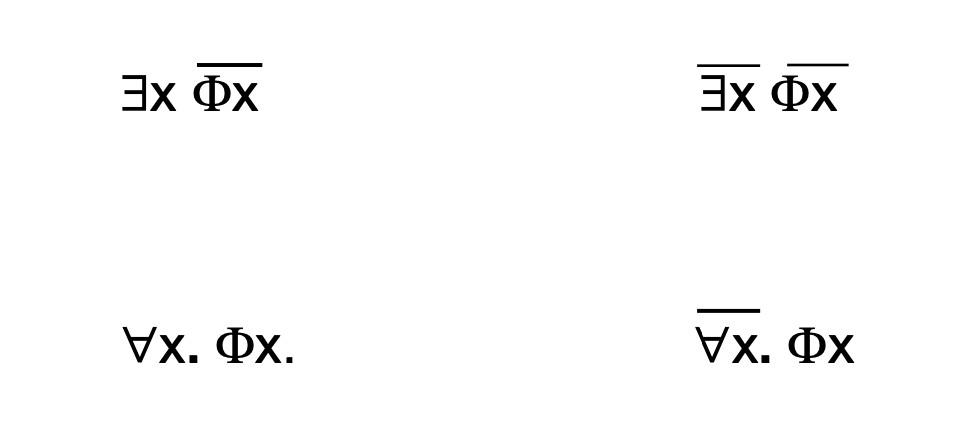
The left side of the rectangle designates the male position: the upper left means that there “exists one who does not [subject to the phallic function]” (Lacan, Or Worse 183), while the lower left depicts the universal claim that all men are subject to the phallic castration function. This castration function means that, due to our use of language, we are barred from the raw existence of being. The phallic function is necessitated by the fact that humans can only access the world through language, while we are all marked by the negativity of the signifier. The exceptional male figure who is not subject to castration only exists outside society as an Ideal or a fantasy (the upper left side of the formulae). In comparison, the right side signals the female position: the upper right denotes a negative expression that “there is not one who is not [subject to the phallic function]” (183). It is impossible to have a universal Ideal female jouissance that can avoid the negation of the signifier. However, the lower right triangle means there could be an exception for the female position—it is contingent and mysterious, just like the ecstasy of Saint Teresa—a form of jouissance which is indescribable and resides at a place of “extra.” To explain the uncertainty and non-existence associated with the Woman Ideal, McGowan provides examples of the opposite images of woman ideals, such as Marilyn Monroe and Saint Mary, the former is the embodiment of sexual desire and attraction (“the sex object” (00:15:19–00:15:22)), while the latter represents “innocence, compassion” (00:15:00–00:15:03), virgin, holiness, and abstinence. Therefore, in Lacan’s formula of sexuation, the (mythical)impossible existence of enjoyment (the upper right side) without any limit is only conceivable through fantasy.
In the context of white racism at the plantation, for the paranoid master ego (Rufus and Tom), there thus exists an X that occupies this impossible place. Dana’s body, which disappears into the future from time to time, enjoys her husband Kevin’s white body (“You filthy Black whore!” she shouted: “This is a Christian house!” (Butler, Kindred 93)). Her body is not wholly subject to the Symbolic rules in the Plantation system, and thus functions as the enigmatic X that transgresses racial and gender boundaries (“You were wearing pants like a man—the way you are now. I thought you were a man” (Butler 22)). She is “white” because of her education and accent, yet she is “Black” because of her skin colour and her secret sabotage of the racial hierarchy by teaching other slaves to read. As a phantasmagoric figure that haunts and disturbs the social-symbolic structure, she is the screen through which the white master encounters his own Lacanian Real, namely, his own negativity and the deadlock of the racist social economy. The Lacanian framework of fantasy and the paradox of desire thus allows us to see another dimension of racism apart from the Marxist viewpoint of economic exploitation.
Contextualizing the master’s paranoia in the Antebellum South with the current paranoiac sentiments surrounding Black bodies, this section thus demonstrates the importance of Lacanian theory in helping us understand how the posthuman liminal bodies always tend to trigger anxiety and fear in those who seek to acquire an absolute stable Name-of-the-Father. Unable to fit into the exact categorical framework of certain genders, races, and ethnicities, the posthuman bodies initiate jouissance in the paranoiac subjects and are utilized as a screen to project fear and desire, to deny the universal phallic function[43]. Jonathan Haidt, in his book The Righteous Mind: Why Good People Are Divided by Politics and Religion, argues that people’s political stances are often shaped by intuition rather than reason, that our divisions in terms of ethics and morality depend more on gut feelings rather than reason and logic. Haidt observes that the subjects in his moral psychology experiments would work “quite hard at reasoning,” but “it was not reasoning in search of truth; it was reasoning in support of their emotional reactions” (ch1, location 537). Borrowing ideas from David Hume, who thinks that reason is “a slave of the passions,” Haidt argues that “moral reasoning” is often “a servant of moral emotions” (ch1, location 537). A Lacanian analysis of Kindred thus helps us understand the mechanisms of our fantasy and lacking status and see how paranoiac emotions towards a certain body are often generated out of our entanglement with the Symbolic structure, with the perpetual struggle with our own negativity. In the process of confronting the trauma of slavery, an understanding of the mechanism that generates the master’s paranoia allows us to recognize that there is a desire for stability, order, and absolute grounding in the human psyche, even though the nature of this psyche is inherently antagonistic and inconsistent. Confronting the trauma in the novel allows us to face the reality that the desire for the absolute (Name-of-the-Father), if unexamined and unchecked, can lead to tragedies. In the following section, I will move from this dimension of understanding to the novel’s potential to initiate Black empowerment and agency through the encounter with the traumatic Real.
The Vertigo of Nachträglichkeit: Can Black Agency Emerge Without a Pessimist Frame?
In Visual Cultures as Time Travel (2021), Henriette Gunkel and Ayesha Hameed beautifully present the correlation between time travel in Kindred and Christina Sharpe’s idea of “in the wake,” unveiling the novel’s environmental critique of Plantationocene[44]. While engaging with their arguments on the Black subject’s experience of vertigo, I argue that Dana’s experience of disrupted temporal-spatiality can also be interpreted as a metaphor for what Freud and Lacan describe as the traumatic experience of Nachträglichkeit. This modern-day (postmemory)trauma is caused not only by the fact of slavery in the past but also by the retroactive impact of the racial signifiers—namely “Black body” and “white body”—which continue to bring forth the original encounter with racial hierarchies, violence, and economic exploitation. Gunkel and Hameed state that Kindred embodies the Afrofuturist approach whereby a futuristic scenario is envisioned to stage the “afterlife of the middle passage” (11). Instead of focusing on the technology which leaves “the past behind in an accelerated turn towards the future” (11) “as in Marinetti’s Futurist Manifesto,” Kindred treats the Black body as a new form of technological device to think about what Haraway calls the age of “Plantationocene” (Gunkel and Ayesha 11). Engaging with Gunkel and Hameed’s arguments, this section argues that Dana’s agency is incompatible with the pessimism and melancholia in Sharpe’s wake work and functions as a revision for Afro-Pessimist theories. Dana’s experience embodies the Freudian notion of the therapeutic “remembering, repeating, and working through” rather than a perpetual attachment to the negativity of the Black signifier.
Nachträglichkeit is a term developed by Freud to designate the psychic phenomenon (typically in hysteria) that the original event (abuse, harm, shame, etc.), which happened in the past, will only become traumatic after the onset of the second event. The latent, non-signified unconscious energies of the first (event) will be triggered to express or erupt through conscious recognition, causing a strong emotional or physical reaction. It changes “the subjective interpretation of the past, in such a way that this altered memory causes new and unexpected effects in the present” (Bistoen, et al, “Nachträglichkeit: A Freudian Perspective” 674). In “On the Psychical Mechanism of Hysterical Phenomena” (1893), Freud and Josef Breuer illustrate how the repression of memory can cause hysterical symptoms. Cases of hysterical patients whose past psychic trauma has been “suffered in silence as a ‘motification’” (13) anticipate a Lacanian theory of un-signification. The stimulation arising from the initial traumatic memory will be manifested in a displaced bodily discomfort, such as insomnia, anorexia, or phobia. Freud and Breuer regard hysteria as the result of “incompletely abreacted psychical traumas” (13). In the novel, there is a process of “mortification” in modern American society concerning the legacy of transatlantic slavery: the collective forgetting of the cruelty of slavery and a willingness to turn a blind eye to racial reality. The stories of Antebellum slavery learned from the education system in modern American society, as well as her encounter with racism in her daily life, would become traumatic for Dana only when she encounters the second event (first-hand experience of slavery) through time travel and retroactive learning.
One important characteristic of Nachträglichkeit is that this psychic mechanism unmakes the “intuitive notion of linear time” (Bistoen, et al, “Nachträglichkeit: A Freudian Perspective” 674). The latent content at event “T1 only becomes ‘explosive’ through a retroactive investment at T2” (Bistoen, et al, “Nachträglichkeit: A Freudian Perspective” 674). This retroactive learning process parallels Kindred’s non-linear narration, where the story starts with Dana explaining how she lost an arm on her “last trip home” (Butler 9). An example of Nachträglichkeit in Kindred from Dana’s point of view is her changed understanding of modern-day racism. In an environment where the US identity myth is achieved partially through collective forgetting, she and Kevin initially ignored their racial reality, “avoiding the subject” and not talking about “how his [family] would react” (Butler 109) to her and hers to him. Furthermore, before Dana’s time travel event, they also did not “read ... too much into” (Butler 100) the racism they experienced in modern-day America, such as how “the woman from the agency” said to her with “typical slavemarket candor that he and [Dana] ... were the ‘weirdest-looking couple’ she had ever seen” (Butler 57) or how their families have rejected their marriage. Kevin’s sister did not want to meet Dana and kept saying “clichéd bigotry” (Butler 111) to Kevin for wanting to marry her. In reaction to racism, Dana’s aunt thinks that Dana is “a little too ‘highly visible’” (111) because of her dark skin colour, while her uncle feels betrayed as a result of Dana marrying a white man. If contextualized with the graph of the logic of Nachträglichkeit by Bistoen and his team, it can be said that these events, coupled with Dana’s initial knowledge about the history of Antebellum South, situate themselves on T1. It is only when Dana encounters the Real at T2 that these events and knowledge become traumatic.
For a typical case of Nachträglichkeit, those distressing events at T1 mostly undergo a state of what Lacan would call “non-signification” “at the time of its occurrence because the subject lacks the necessary symbolic means for it” (Bistoen, et al, “Nachträglichkeit: A Freudian Perspective” 676). However, Dana’s case differs slightly from the typical repression of memory as shown in hysteria. In modern-day America, she understands that those events at T1 are a result of racism; what she lacks at T1 is a first-hand empathetic experience of those events, particularly in relation to the archives of transatlantic slavery. In Kindred, the third register of time (marked as T3), namely the time of Antebellum slavery, functions as the missed encounter that generates the knowledge of jouissance—the painful but enlightening knowledge about the truth of slavery. T3’s function is to induce a new subjective understanding (T1’) of T1:
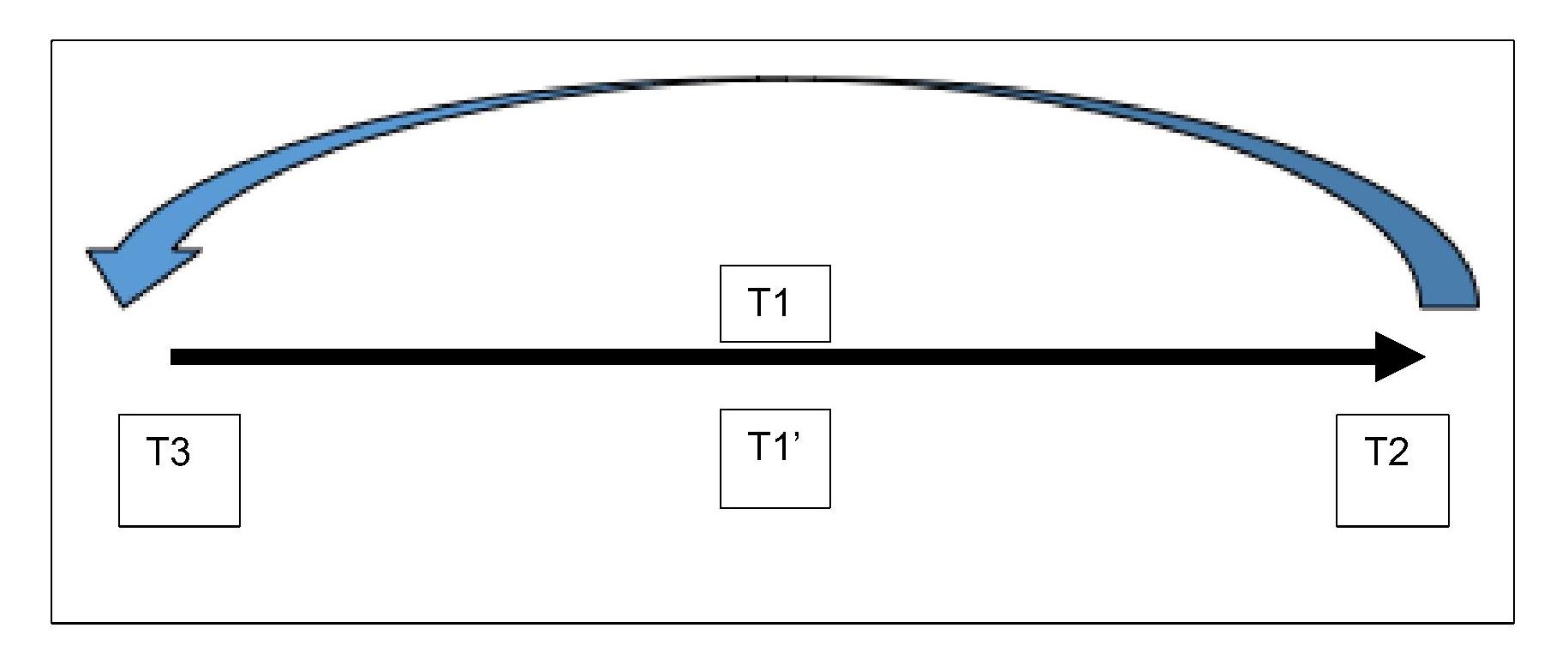
In this modified graph, the events of the Antebellum South, as experienced by Dana at T3, enable a subjective experience unfiltered by what Freud terms the “censorship” or “defense mechanism” through the ego and the social (superego) constraint. For example, Dana recalls witnessing the whipping of slaves:
I had seen people beaten on television and in the movies ... But I hadn’t lain nearby and smelled their sweat or heard them pleading and praying, shamed before their families and themselves. I was probably less prepared for the reality than the child crying not far from me. (Butler 36)
Although in the context of “postmemory,” Dana’s subjective experience of these events could be understated by some critics as events out of imagination. However, studies of neuron activities have shown that imagining a certain movement (playing tennis, for instance) can give us the experience of that movement (Cuddy-Keane 00:09:5200:10:15). Mentally visualizing an image can give us the experience of that image—its correlated somatosensory stimuli and neuron transmission. Therefore, even if we distance ourselves from Butler’s time-travel setting and regard the events at T3 as “imaginations,” it is still difficult to measure whether the postmemory of Dana as imagined by her is less “authentic” than the original slave experience at the plantation back in history. What Butler has presented instead is a dream-like encounter with the Real that demands a suspension of logical thinking and scientific rationality. Through this process, the experience of vertigo by Dana can also be synchronized with the experience of the slaves both at the plantation and on the ships across the ocean. As I will further explain in the following passages, Kindred can thus be categorized as an Afrofuturist novel because it initiates bodily affects through the device of time travel, politicizing temporality to challenge the traditional “objective” (and detached) narrative about the Antebellum South.
Both in The Pervert’s Guide to Ideology and Looking Awry: An Introduction to Jacques Lacan through Popular Culture, Žižek spotlights the psychoanalytic dimension of Alfred Hitchcock’s movie Vertigo (1958), which I believe shares some narrative and thematic truths with Kindred (1979). First of all, both works evoke the structure of the double. In Vertigo, Judy functions as the double for Madeleine, who intends to incarnate Carlotta. In Kindred, Dana functions as a double for Alice, who Rufus initially loves. The double speaks to Freud’s notion of the uncanny, creating a feeling of estrangement and enhancing the experience of paranoia. Secondly, in both works, the condition of free fall symbolizes a psychic disorientation induced by the return of the repressed. In Vertigo, the repression could, on the one hand, originate from the “bad mother” (or “abject mother”) Carlotta, who is “melancholic” (Oliver and Trigo 108) and whose “other” (Spanish) ethnicity poses a threat to the “proper borders of the self, especially the borders of Madeleine’s white-American identity” (108). The repression, on the other hand, also points to the return of the dead as disguised in beauty. Žižek argues that Vertigo presents beauty as a veil for the obscene and the “nightmare” (such as “shit, decay, and worms”) (The Pervert’s Guide to Cinema 1:00:03–1:00:10). In Kindred, the feeling of vertigo signals the return of the repressed history of transatlantic slavery in modern Americans’ life. Suppose one looks closer at the beautiful modern house in California where Dana’s neighbour tends to her “flower garden” (Kindred 115) in the morning. In that case, one discovers the gothic horrifying house in the Antebellum South, which sends Dana into a state of vertigo, “vomit” (107), and convulsion. The psychic disorientation of Dana is always accompanied by physical violence. Her “fungib[ility]” (Hartman 94) is manifested not only in the way she has been involuntarily teleported to the Antebellum South (and later as a replacement for Alice) but also through the embodiment of the pain at the hands of the master—the whip comes “like a hot iron across my back, burning into me through my light shirt, searing my skin ...” (107).
There is one important difference between Vertigo and Kindred, however. Both works present the psychic disorientation of the protagonists. But Dana does not suffer from melancholia. In contrast, the melancholic feeling in Vertigo is strong and contagious, transmitting from Carlotta to Madeleine, Scottie, and then to Judy. Unlike what Saidiya Hartman categorizes as the Black people who were “fungible, disposable, surplus, and not quite human” (94), Dana’s relation with fungibility is complicated rather than straightforward. She possesses an agential excess that counteracts this fungibility, demonstrated through her capacity to negotiate and resist the plantation system. In the following paragraphs, I will elaborate on this argument by comparing the melancholia in Sharpe’s “Wake Work” and the exhibition of Afrofuturism in Kindred.
Gunkel and Hameed argue that “the narrative cut and its lack of an in-between space,” the feeling of nausea and dizziness in Kindred, “points to what Sharpe understands as being ‘in the wake’” (63). They specifically reference the experience of vertigo as initiated by J. M.W. Turner’s painting Slavers Throwing Overboard the Dead and Dying, Typhoon Coming On (1840) and quote Sharpe’s reference to whale fall to demonstrate the link between free fall in the ocean and the free fall experienced by Dana. These connections that centre on the vertigo experience also call to mind Hitchcock’s movie Vertigo (1958). Here, I want to present two arguments inspired by Gunkel and Hameed. First is the controversy surrounding Turner’s painting and the issue of aestheticization in the development of Afrofuturism. In his chapter “Black to the Future”: Interviews with Samuel R. Delany, Greg Tate, and Tricia Rose” in Flame Wars: The Discourse of Cyberculture, Mark Dery develops the term “Afrofuturism” (210) to designate the “speculative fiction that treats African-American themes and addresses African-American concerns in the context of twentieth-century technoculture—and more generally, African American signification that appropriates images of technology and a prosthetically enhanced future” (180). Dery spotlights the overlapping ground between the experience of the Black subject and the protagonists within science fiction, asking “Why do so few African Americans write science fiction, a genre whose close encounters with the Other—the stranger in a strange land—would seem uniquely suited to the concerns of African American novelists?” (180).
Dery’s argument that African Americans are “descendants of alien abductees” (180) echoes Dana’s involuntary abduction by Rufus’s life-threatening scenarios through the portal of the wall. Dana’s experience of vertigo parallels what Dery defines as a “scifi nightmare” in which “technology is too often brought to bear on Black bodies (branding, forced sterilization, the Tuskegee experiment, and tasers ...)” (180). Isiah Lavender shares a similar notion of Afrofuturism, defining it as a “narrative practice that has given expression to the spatial and temporal dislocation of the African diaspora throughout literary history” (qtd. in Hassler-Forest 10). Afrofuturism functions as a reaction to science fiction’s previous tradition of centring on themes of expansion, colonialism, and expeditions through technology.
A crucial element in Afrofuturism is to politicize temporality. Hassler-Forest argues that in comparison with traditional sci-fi such as Back to the Future (1985) where “Marty McFly time travels from the 1980s to the 1950s to discover there a more innocent time of fun, excitement, and free-spirited adventure,” Afrofuturist works tend to underscore the racial gap between the White and the Black experience of temporality: “Now try to imagine how different Marty’s trip to Jim Crow–era Hill Valley would have been if he had been Black, and you instantly grasp how racial identity has an impact on time as a force of politics” (16). Dana’s nightmarish time travel also functions to deromanticize the feeling of nostalgia, challenging the ideology that “America was better in the old days in comparison to it now.” The novel politicizes temporality to spotlight the racial gap between Black people and White people, showcased by how Dana and her white husband experience the Antebellum South differently. The novel’s deployment of temporality also undercuts key space-time logics of capitalism and colonialism. Concepts such as causality and linearity, as exemplified in the accumulation of wealth, land, and private properties in the colonial-capitalist framework, are undermined by Dana’s experience as her body disrupts the perceptual time frame of both people at the plantation and those in modern America. Considering these views, Kindred thus can be categorized as an Afrofuturist novel which not only restages how “Africans were first abducted by slavers and projected from their own lifeworld into the abstract space-time of Capital” (Fisher, “Afrofuturism and Hauntology” 46) but also asserts the agency of the Black people to challenge this involuntary “abduction.” The novel embodies the politicization of temporality in Afrofuturism, representing a new way of engaging with trauma and history.
However, there are debates concerning how much Afrofuturism can function as a political force to counter racism. In “25 Years of Afrofuturism and Black Speculative Thought: Roundtable with Tiffany E. Barber, Reynaldo Anderson, Mark Dery, and Sheree Renée Thomas” (2018), Dery and Barber debate about whether aestheticization could dampen Afro-futurism’s political agenda. Dery comments:
“Aestheticizing is the first step to depoliticizing. Now, I love aesthetics. But aestheticizing politics is the cornerstone of fascism, as Siegfried Kracauer states in The Mass Ornament [1927] with regard to the Third Reich, which has never been more popular than it is in our current moment. People shouting “Heil Trump”? You can’t make this stuff up! Talk about living in a science fiction reality. So, we have to be mindful of this and push back against the aestheticizing of Afrofuturism.”
However, Barber disagrees, thinking that often “Black aesthetics has functioned as Black politics.” If we take Turner’s painting as an example, the tendency to aestheticize in Afrofuturism can be regarded as a political and psychological negotiation strategy. The painting was based on an event in 1781 on a ship called Zong. When they ran out of drinking water on the route of the Middle Passage, the crew of that ship ordered that more than 130 African slaves be thrown overboard into the sea so that afterward, the crew could collect insurance money. Instead of giving a realistic depiction of how horrible the murders happened, Turner aestheticizes the story, using fine brushstrokes to underscore the impressionist effect of light, minimizing the slaves’ figures on the canvas while transferring the violent emotions embodied in that event to the natural environment such as the vehement waves on the sea before the typhoon coming and the “bloodsoaked” sky where the fierce wind distorts the light of the setting sun. The viewer of this painting can first grasp Turner’s criticism of slavery through its title—Slavers Throwing Overboard the Dead and Dying, Typhoon Coming On, but the beauty embodied in this painting functions as a veil for the violence it contains. The painting requires the active engagement of the viewer, who is left with the question: “Where exactly are the slaves’ bodies?”. The beauty of the painting thus functions to entice the reader to actively find the slaves in the painting, to see through its veil the gory reality that the fish in the sea are eating the bodies of those in the shackles.
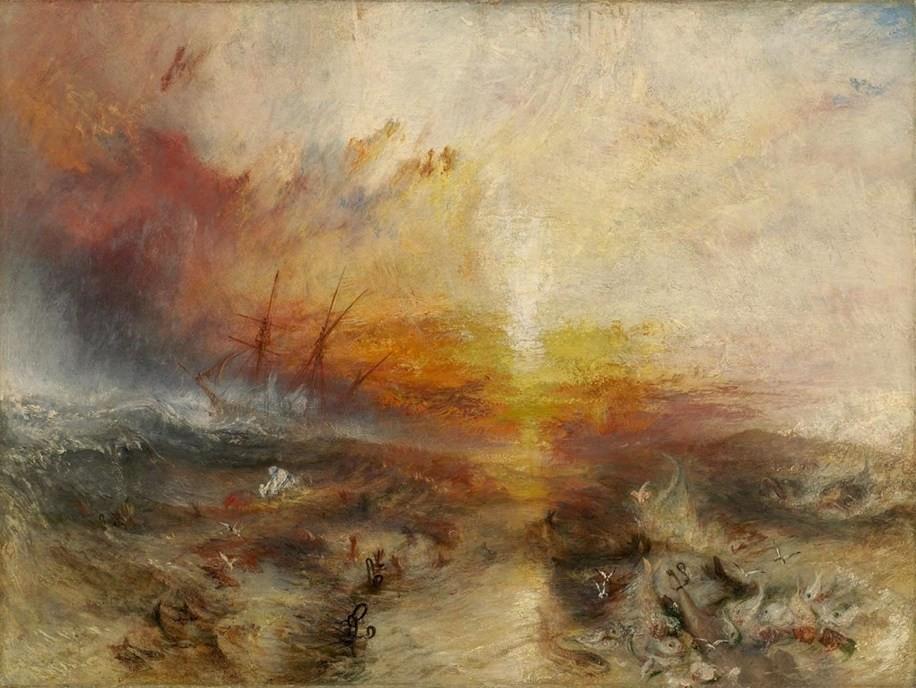
The painting’s indirect critique of racism is initiated out of a desire to provoke debates without being censored by authority or rejected (out of emotional distress) by those who have never witnessed the violence and brutality of slavery, like how the Chinese writer Liu Cixin embeds criticisms of the disastrous communist Cultural Revolution by telling a science fiction The Three-Body Problem that involves alien invasion of the Earth rather than directly documenting the brutal reality of the Revolution. Likewise, when Turner created the slave-ship painting in 1840, across the ocean, on US soil, the Civil War had not started yet. Even though Britain abolished the slave trade in 1807, those in the colonies “were not freed until 1838” (“1807 Abolition of the Slave Trade”). Turner’s aestheticization of the tragedy may have resulted from his negotiation with the colonial economy, which still possessed (global) influence across the sea. In comparison to not discussing abolition, Turner chose to stage a screen to unveil the problems and debates surrounding slavery. As Paul Gilroy argues, Turner’s painting of the slave ship “remains a useful image not only for its self-conscious moral power” but also for “the striking way that it aims directly for the sublime in its invocation of racial terror, commerce, and England’s ethic[al]-political degeneration” (16).
In this sense, Turner’s aesthetic gesture can also be paralleled with Butler’s politicization of space-time: both utilize the events that happened in the past to initiate discussions in their contemporary society about slavery, revealing how the past and the present are intertwined with each other. They also seek to engage with the reader/viewer in an active style: Kindred adopts the first-person narration of time travel so as to give us an immersive experience of slavery, while Turner’s painting hides the slaves within the beauty in order to entice us to find the violence behind the veil). Recalling Žižek’s argument that Hitchcock’s Vertigo presents beauty as a veil for the obscene and the “nightmare” (such as “shit, decay, and worms”) (The Pervert’s Guide to Cinema 1:00:03–1:00:10), I argue that the aesthetics in Turner’s painting and the device of time travel in Kindred both exemplifies how Afrofuturism politicizes temporality, concealing behind a “veil” its critique of racism and the slavery economy.
Aside from these political concerns of power dynamics and censorship, from a pedagogical view, the tendency to aestheticize in Afrofuturism can be perceived as an important strategy for counteracting excessive melancholia in the process of implementing Afro-Pessimism (such as in Sharpe’s “wake work”). I argue that despite sharing the state of vertigo with the experience depicted in Sharpe’s work, Dana exhibits a form of agency devoid of Afro-Pessimist melancholia. There is not much aestheticization in Kindred, but the novel shares a strong sense of black power with contemporary Afrofuturist movies, despite the fact that the protagonists must carry with them the weight of the past. For instance, in Jordan Peele’s engaging survival narratives Get Out (2017) and Nope (2022), both protagonists have a background story featuring sadness and loss. In Get Out, Chris is haunted by his childhood memory of letting her mother die in front of her house due to a car accident because Chris was shocked and paralyzed by the abrupt violence. His photography career—the media to express his acute observation of the mixture of beauty and sadness in everyday life—manifests the lingering influence of his childhood trauma. Similarly, in Nope, OJ and his sister were brought up by a single Black father who struggled to maintain the family business in the Hollywood industry. The father’s sudden death by the coin dropped by the UFO adds another layer of emotional burden to OJ. The poverty (as in Chris’ childhood), the deaths (of the mother in Get Out and the father in Nope), and the struggle toward success (for the Haywood family whose legacy in the film industry was unrecognized) demonstrate the “afterlife of property” and “a past that has yet to be done” (Hartman, “Venus in Two Acts” 13).
However, both protagonists in the movies hold the capacity to turn the negative impacts of trauma and loss into self-empowerment by encountering fear and death through the Freudian experience of repetition. In Get Out, Chris was initially hypnotized and paralyzed by Missy, who took advantage of Chris’s guilt towards his mother’s death. Through this painful process, he revisits the trauma. Yet eventually, Christ uses the cotton in the sofa to block hypnotization and breaks Missy’s tool—the teacup, overcoming the burden of his guilt in the past. Likewise, in Nope, OJ’s flashback to his time with his father allows him to devise a new strategy to deal with the UFO. He remembers his father telling him: “You hear that? Ghost out there. Acting all territorial. I guess some animals ain’t fit to be trained” (0:51:57–0:52:18). OJ thus realizes that the UFO could be an animal rather than a ship. His team, in the end, adopts another training method and successfully captures the “Oprah” shot. Thus, the Black legacy of the Haywood family gains the opportunity to be finally recognized by the public.
In a similar vein, Dana’s ancestorial history in the Antebellum South is full of violence and trauma, yet she demonstrates her strength and agential excess through determination and actions, such as teaching the slaves how to read and trying to persuade Rufus to understand the modern concept of equality even though it is hard for her to counter the system entirely. During the confrontation with Rufus, she says to herself: “I could accept him as my ancestor, my younger brother, my friend, but not as my master, and not as my lover” (Kindred 260). She undermines the power dynamics between the master and the slave, raising “the knife” and sinking it “into his back” (260), eventually killing Rufus. Refusing to pay the debt of her existence to the white master Rufus (who is one of her fraternal ancestors), she undercuts the logic of the slavery system. Instead of following the “aesthetics of the failed rebellion” typified in Blade Runner, Kindred and Peele’s movies demonstrate that melancholia in Afro-Pessimism may not be suited for Black empowerment.
In comparison, Sharpe says: “They, we, inhabit knowledge that the Black body is the sign of immi/a/nent death” (In the Wake 71). When I read the violence, dispossessions, and tragedies in Sharpe’s In the Wake, I could not help but feel sadness (a depressive weight) and think about whether the Black subject will be perpetually trapped in the insidious loop of racism. First, transatlantic slavery and discrimination against Black people have largely caused poverty and a high crime rate in certain Black communities. Next, the judicial and law enforcement facing those crimes would develop an impression that the Black body constitutes a threat to society. The loop experiences fissures and eruptions like George Floyd’s murder and then circles back to Black poverty. Even as someone who is an Asian and thus does not identify as Black, when I read Sharpe’s work, I could feel a strong sense of contagious melancholia whose political aims I can only understand through the lens of Adorno. For Adorno, by refusing to promise individuals emancipation from consumerism and corporate exploitation, the modern artist retains the Utopia of autonomy through pessimism and negation. However, it is one thing for a writer to express her traumatic experience of racism as well as the postmemorial reflection of transatlantic slavery, yet it is another thing for a teacher to teach the trauma narratives and theoretical works to students. This is why I am concerned about the Black subject in a pedagogical setting, especially those under 18. The conservative criticism of Critical Race Theory could have been generated out of the paranoiac fear of reverse colonization or out of the desire to not being disrupted in the capitalist system which values high efficiency[45]. However, some of their responses to Critical Race Theory do make me think about the tension between Black agency and the melancholia associated with Afro-Pessimism. As someone whose family members have experienced lynching and murder during the Land Reform Movement and the Five-Anti Campaigns in China back in the 1950s and 60s, I find Kindred and books like Yeomi Park’s In Order to Live more empowering than In the Wake. In both Kindred and In Order to Live, the female protagonists have survived violence and hardships and achieved a renewed subjectivization through “remembering, repeating, and working through” rather than descending into a state of perpetual melancholia.
Another important issue regarding the tension between Afro-Pessimism and Black agency is the melancholiac representations of the Black bodies disposed on the Middle Passage in certain Afro-Pessimist theories. These representations refuse categorical boundaries to the extent that even an illusory sense of selfhood and individuality is unattainable. For instance, one can see the radical annihilation of boundary in Sharpe’s In the Wake which correlates the whale fall in the sea and the slave ship in the Middle Passage. Gunkel and Hameed take Sharpe’s idea and argue for a correlation between the free fall in Kindred and whale fall in the ocean since both can be contextualized with the violent disposal of Black bodies in the Middle Passage. Sharpe in her chapter on “The Ship” states:
There have been studies done on whales that have died and have sunk to the seafloor. These studies show that within a few days the whales’ bodies are picked almost clean by benthic organisms—those organisms that live on the seafloor. My colleague Anne Gardulski tells me it is most likely that a human body would not make it to the sea-floor intact. What happened to the bodies? ... through the ocean ... the atoms of those people who were thrown overboard are out there in the ocean even today ... And what happens to the energy that is produced in the waters? It continues cycling like atoms in residence time. We, Black people, exist in the residence time of the wake. (In the Wake 40–1)
Both Dana’s body and the bodies of the slaves in the ocean are subject to the violence of the “machine of the Plantation” (Gunkel and Hameed 33). Sharpe’s melancholic mourning of Black bodies thrown over slave ships like Zong can be interpreted as a result of the unresolved traumatic Real which keeps erupting through racial signifiers that still confine Black subjects today. The social construction of “Race” (unlike those corresponding biological registers) is a peculiar signifier that the Black person cannot disguise or evade in daily life. Despite understanding the trauma narratives and the process of continuous mourning in In the Wake, I still want to critique the porous cognitive framework that characterizes this delineation of the Black body. Based on the “atom” theory of the Black body and its impact on contemporary Black subjectivity, it could also be said that the atoms of the dinosaurs still reside in the bodies of humans today. Furthermore, every living organism (no matter humans, animals, or plants) should be characterized as cannibals because we all consume the atoms from the bodies decomposed in the past, of humans and nonhumans alike. The absurdity of my previous deduction of universal cannibalism showcases that Sharpe’s representation of the world and the subject may well function as a powerful device to reconnect, as a framework that helps the subject express the trauma of the Real. But what Freud teaches us is that we should be cautious about the line between mourning and melancholia. Sharpe’s narration of the “atom theory” of the Black body in the ocean signals a lack of a specific lost object in melancholia as demonstrated by Freud. The melancholic patient:
…cannot consciously grasp what he has lost. Indeed, this might also be the case when the loss that is the cause of the melancholia is known to the subject, when he knows who it is, but not what it is about that person that he has lost. So the obvious thing is for us somehow to relate melancholia to the loss of an object that is withdrawn from consciousness, unlike mourning, in which no aspect of the loss is unconscious. (Freud, “Mourning and Melancholia” 312)
In a pedagogical setting, the porous boundaries at the atomic level imagined in Sharpe’s framework run the risk of inducing melancholic emotions in Black subjects who might take these descriptions of the Black bodies as scientifically verifiable rather than treating them as a poetic trauma narrative. “Scientifically verifiable” means that if we are really to mourn for the atoms decomposed from the slaves’ bodies in the Middle Passage, then we have to first mark those atoms in the body like we would mark protein with the fluorescent flags in molecular biology, and then detect whether those atoms are “there in the ocean even today.” In addition, Sharpe’s description and feelings about the permeating atoms from the Black bodies are derived from her imagination. Feelings about exploitation are social rather than atomical. Atoms do not feel (And if they do, they operate under a register inaccessible to us). It is the narrator in In the Wake who imagines that her body is interconnected with the atoms from the slaves’ bodies and thus feels the lingering impact of transatlantic slavery. This line of thinking without boundaries follows the logic of the new materialist paranoia as delineated in my first chapter on Pynchon, where the emotional intensity experienced by the paranoid subject is doubled (as Hofstadter says) not just by the reality of the atomical entanglement but also by the fantasy of that entanglement. Indeed, the atoms in this world are entangled. But should the Black subjects in the pedagogical setting engage in a perpetual selfreflection about their entanglement with the bodies of the dead people in the past? Does this line of pessimistic thinking leave enough space for Black agency? I thus share my concerns about the possibility of the spread of melancholia—one of the symptoms of which (as delineated by Freud) is “an extraordinary reduction in self-esteem, a great impoverishment of the ego” (Freud, “Mourning and Melancholia” 313)—in the implementation of Afro-Pessimist theories.
In comparison, I think Sharpe’s recent work Ordinary Notes (2023) works as a more appropriate medium for a pedagogical setting due to its less melancholic portrayal of Black subjects and a more intentional assertion of Black power. The book continues to address the issue of racism and structural violence against Black people, but adds another layer of empowerment through the depiction of personal relationships and love between Sharpe and her family and friends. In one note, she writes about how her mother helps her through school life, giving her advice about a Black girl’s (dating) situation in the “almost all-white Catholic elementary school” (17). These tiny details might seem “ordinary,” but Sharpe concludes that the strength emanating from personal relations among Black people can forge a transition from quantitative change to qualitative change: “My mother wanted me to live in spaces where I would be reflected back to myself without particular distortions. She spared me tremendous pain. This Black note changed the course of my life” (17). Furthermore, through her mother’s love—her “beautifully ornate script” (80), “her old pedal-operated Singer sewing machine” (82), which she used to make Sharpe clothes, and “every Black book” (85) that she gave to her—Sharpe discovers that beauty is a method that could “break open, rupture, make possible and impossible” (79). Her promotion of the “attentiveness to a Black aesthetic” (86) that “escaped violence whenever possible—even if it is only the perfect arrangement of pins” (85–86) aligns with Turner’s aesthetics as demonstrated in his slave-ship painting where possibility is opened by raising awareness through beauty and sublimation.
Acknowledging the “desire to see Black lives in all their complexity,” Ordinary Notes punctuates the “complex representational terrains in which we move and on which we struggle” (97). In the notes on “Untranslatable Blackness,” Sharpe spotlights how Western philosophy, on a large scale, still functions as the dominant thinking framework that may not encapsulate the Black subjects. For instance, many of the “entries” for the Dictionary of Untranslatables: A Philosophical Lexicon “would need to be rethought or unthought if one considered Blackness and Black people” (Sharpe 234). Her example of Chinua Achebe’s critique of Conrad’s The Heart of Darkness vividly illustrates “the power of stories to shape realities—to shape how we see each other and ourselves” (93). As an Asian who majors in English, I can relate to Chinua Achebe’s experience of going to school and studying Western literature, “thinking I was of the party of the white man” (qtd. in Sharpe 94). Like Achebe, after I came to Canada, I started to realize that I was not completely “in the boat with Marlow sailing up the Congo River” looking at the “prehistoric” men with “horrid faces” on the shore (94). There seems to be a split in my experience of identification: within academia which promotes diversity and inclusion, I can take the viewpoint of Marlow as a purely intellectual exercise, reading The Heart of Darkness as a way to understand Conrad’s exploration of human consciousness and his criticism of colonialism; outside the university, in my daily life, on the street of downtown Vancouver, I am still the exotic Asian (and possibly a dangerous body during the pandemic because of my race’s association with the coronavirus and bat soup). Reminding the reader of the “danger of a single” representation, Sharpe argues how certain “misperceptions” of “Africa”—the single story of Blackness as “catastrophe, selfinflicted, utterly beyond reason”—can result in the generation of “pity” (95), a detached feeling from a position that is “in the boat” rather than “on the shore” (95). This argument can be extended to my concern about Black agency: can there be a narrative about Blackness that acknowledges the structural violence inflicted on the body but also maintains the strength and power of the Black subjects without initiating pity or melancholia? I think Kindred could provide an answer.
Endnote: Dana, Lacan, and the Whale
Lacan reminds us that agency is achieved through recognizing our struggle with the negation of the signifier. Dana negotiates with the “debt,” the irresolvable, irreconcilable past that haunts her existence, rather than succumb to a perpetual state of mourning and mental stagnation. She occupies a peculiar place as she bears what Denise Ferreira da Silva calls “the unpayable debt” of slavery (since she has to keep Rufus alive until Alice has given birth to his children) as well as the responsibility to exhibit agency as a modern Black woman (she would kill Rufus once her autonomy is threatened). Technically, she owes her existence to the white master Rufus who raped Alice (her maternal ancestor), but she refuses to pay this existential debt when Rufus wants to force himself on her. She chooses not to yield to the logic of the slavery system which is predicated on the idea of debt and ownership. Her involuntary time travel may symbolize how the trauma of slavery can disrupt modern Black people’s life in America in a way that is unexpected, abrupt, and violent. However, her capacity to confront the violence and exploitation in the past through the repetition embedded in the time travel exemplifies her agency and strong will. Understanding Kindred’s wake work in light of Lacan and Freud via the notion of Nachträglichkeit thus offers a revision of AfroPessimism, aligning the novel with the Afrofuturist frame.
With so many connections drawn by previous scholars in terms of whale fall and Dana’s free fall during time travel, one might be surprised to find that Lacan also mentions the whale’s body in “On a Question Prior to Any Possible Treatment of Psychosis”:
[If we think about Schreber’s case, then]…we will be able to consider as having been exceeded the limits at which the native and the natal give way to nature, the natural, naturism, and even naturalization; at which virtue turns into vertigo, legacy into league, and salvation into saltation; at which the pure verges on the evil realm; and at which we will not be surprised if the child, like the apprentice sailor of Prévert’s famous catch, sends packing (verwerfe) the whale of imposture, after having, according to the wit of this immortal piece, seen right through the pop [percé la trame de père en part]. (Écrits 484)
Here, Lacan offers his revision of Freud’s theory of paranoia when discussing Schreber’s memoirs. The syntax and meaning of this small passage, however, are difficult to unravel as the English translation is literal—there seem to be very few alterations of words so that a more coherent meaning could be produced. I suggest two interpretations that are related to my analyses of Kindred. First is Lacan’s emphasis on the sliding of the signifying chain and the contingent landing of a specific signifier when the paranoid subject attempts to figure out what constitutes the Name-of-the-Father when the latter has “vanished.” In the case of the paranoid mother and daughter in Lacan’s Écrits, due to the lack of the master signifier at that crucial moment of encounter, the subjects hastily connect the signifiers of “pork” and “the butcher” to “I” thus creating a paranoid conception of their relationship with the neighbours. In this passage, Lacan plays with the randomness of the signifiers on the sliding chain: native and natal to naturism and naturalization—words that only share the initial syllables but have different meanings. Since Marriot contextualizes Lacan’s discussion of the black and white tags on the prisoners’ back in “Logical Time” with issues of race and Afro-Pessimism, I believe here we can also contextualize Lacan’s discussion of virtue and vertigo with Kindred. For instance, it might be interesting to look at these examples through the lens of “wake work”—how “virtue” can turn into “vertigo,” namely, how a supposedly “virtuous” transatlantic system that promises economic stability and prosperity can turn into a hell of “vertigo” for the Black subjects. How the path of “(Christian)salvation” (both for the Black subjects at the Door of No Return and for those Indigenous children sent to the residential schools) can turn into “saltation” which, according to OED, means:
-
“Leaping, bounding, or jumping; a leap”;
-
“Dancing; a dance”;
-
“An abrupt movement, change, or transition”;
-
Physical Geography. “A mode of transport of hard particles over an uneven surface in a fluid stream (as a wind or river), in which they progress in…”;
-
“Pulsation or spurting forth (of blood)”;
-
“Biology. A mutation, esp. one with marked effects on several characters”;
-
“Biology. Change of phenotype occurring within a fungal colony.”
Sharing the trait of “abrupt movements or changes,” these connotations of “saltation” can thus be connected to the vertigo experience of the slaves on ships like Zong as well as the involuntary time travel of Dana. “Wake work” in this context thus establishes a chain of signifiers, reminding us of how the signifying chains resemble the chains of slavery as elaborated in Marriott’s book. In addition, studies have shown that the event of transatlantic slavery induces possible genetic mutations. In “Mutilation and Mutation: Epigenetics and Racist Environments in Octavia Butler’s Kindred and Salman Rushdie’s The Satanic Verses,” Josie Gill argues that Butler and Rushdie adopt the “fantastical modes” to explore how “experiences of racism [can] become biologically embodied” (126). Dana’s deformed body and the scars on her head symbolize the possible “biological inheritance” (Gill 132) handed down from the racialized slavery system. Indeed, due to the uncertainty surrounding epigenetic findings, we should be cautious about “grand claims” such as “‘Post-traumatic Slave Syndrome and Intergenerational Trauma: Slavery is Like a Curse Passing Through the DNA of Black People’” (Gill 123). However, the literary representations of a “post-genomic novel” (Gill 127), such as Kindred, allow the reader to reflect upon the contingent turning of “White salvation” to “Black saltation.”
The second argument I want to make out of Lacan’s little (opaque) passage is that his reference to Jacques Prévert’s poems about the whale reveals the mechanism of the emergence of paranoia. He did not specifically say which “whale” poem he was referring to. I think it could have been the one called “The Whale Hunt” (La pêche à la baleine) because the story’s shift of perspective from the father hunting the whale to the whale itself could have relations to how Lacan understands the vanishment of the master signifier in Schreber’s case. In the poem, the narrator first adopts a third-person perspective, quoting the father: “Off to catch a whale,/ we’re off to catch a whale,/ Said a wild man to his son,” while the son replies in a typical Freudian fashion: “Why should I go and catch a fish /That never troubles me? Father, go and catch the whale/ Yourself, you’re sure to like the sail. /I’d rather stay at home with mum /And cousin Anthony.” After a few days, the boy starts to regret not going, and it is at this moment that the father returns with the captured whale. Out of exhaustion, the father asks the son to “carve it up,” yet the boy shows hesitations: “But little Ernest stands up straight/ And looks in the whites of his father’s eyes,/ In the whites of his father’s bright blue eyes/ As blue as the eyes of the blue-eyed whale:/Why should I carve a poor old fish /That never troubles me? /I don’t want my share.” At this point, the poem reaches a climax:
He throws the knife up in the air
But the whale has grabbed its handle
And attacked the wild old man
And stabbed him through his middle
It would be cliché to simply conclude that the poem embodies the son’s intention to kill the father and possess the mother by letting the whale fulfill his unconscious desire. Instead, I think Lacan’s “Whale of Imposture” could mean that the sudden replacement of the father with the whale signals the transference of the repressed psychic energies to the contingent new signifier. Both the father and the whale have “blue eyes,” similar to how “virtue” and “vertigo” share the same initial syllable. Then, the narrator takes the perspective of the whale:
And the whale, with tear-stained eyes, looks around the
Shabby wreck
And sobs:
Whatever made me kill that wretched silly ass?
Now all the rest will chase me in their motor-boats and cars
And exterminate my race and my family tree
Then, bursting into laughter in a strange and frightening
Way,
It swims to the door.
This is what it had to say
As it glided past the window:
For the whale, be polite,
Say it’s just gone out to bask.
Tell them to be comfortable,
Tell them not to go,
Tell them I’ll look in again in fifteen years or so[46] ...
After supplementing the Father’s place, the Whale expresses a paranoiac feeling that the humans will hunt it down. This change of tone by the narrator echoes the mother and the daughter’s paranoia after the emergence of a new connection between the ego and the signifiers “pork and butcher,” as mentioned by Lacan. Could it be that the Black bodies on the ship, those thrown over the ship, that of Dana, of those toiling in the plantation fields, abducted, subjugated, sucked into the tornado of vertigo, are also, like the Whale, the supplement of (the lack of) the Father?
Chapter 4. Topological Anomaly and Monstrous Beauty: Paranoia and the Ecology of Posthuman Aesthetics in Jeff VanderMeer’s Southern Reach Trilogy
“Baudelaire de Dieu!” or, Shall We Meet Again at ein anderer Schauplatz?
In “On a Question Prior to Any Possible Treatment of Psychosis” (abbreviated as “On a Question”) in Écrits, Lacan develops his psychoanalytic formula of the unconscious while revising Freud’s theory on psychosis. In the section “With Freud,” Lacan underscores that those psychic phenomena such as “Desire, boredom, confinement, revolt, prayer, wakefulness ... and panic” (Écrits 457) are not “mere moods” (458) but “evidence of the dimension of this Elsewhere” (458). “Elsewhere” signifies the elusive place of the unconscious, both in terms of how, through verbal and written language, the unconscious escapes our conscious, logical measurements but also of how, on the topological surface such as the Möbius strip and the cross cap (which Lacan uses as visual demonstrations of his theory), this “Elsewhere” is a point that we never reach—it always seems to locate on the other side. As Stijn Vanheule suggests, human subjectivity is made up “as such” precisely because our “conscious control” cannot grasp those “subjective phenomena” (“On a Question” 178). Lacan seeks to unveil the nature of this “Elsewhere,” referencing how Freud designates the “locus of the unconscious” as “ein anderer Schauplatz” (Écrits 458). The German word “Schauplatz” means “scene or showground” (“Schauplatz”), while “Platz” means “room, space or place” (“Platz”) according to the Cambridge German-English Dictionary. The geographical connotations of this word are important for my argument about Jeff VanderMeer’s Southern Reach Trilogy, where the “spatialization of the unconscious” (Burnham 10) in Area X has a causal connection with the emergence of paranoid psychosis.
One of the most critical geographical components in Area X is the tower (or the tunnel), categorized by the scientists in the Southern Reach as the “topographical anomaly”[47] (Authority 92–3). I argue that with the disruption of human-nonhuman boundaries and a re-enchantment of the nonhuman, VanderMeer’s novel series can facilitate an ecological understanding of the Lacanian topology, promoting an affective “posthuman practice” (Kortekallio 58) initiated by aesthetics and paranoia. This ecological practice is enabled by humans’ innate propensity for paranoia in an age of bioengineering and environmental uncertainties. The uncanny and weird phenomena in Area X not only draw attention to the condition of “intra-activities” (Barad), but also reveal the eruption of the Lacanian jouissance in the artificial breakdown of species boundaries through bioengineering. The blend of dreams and reality, the Boschian delineation of the landscape, showcases a mythologization of the nonhuman. The text’s allusion to Charles Baudelaire’s The Flowers of Evil (1857) plays with the traditional dichotomy between divinely Ideal and hellish Decay, demonstrating an aesthetics of the Monstrous Beauty through a convoluted topology. In this sense, aesthetics in the Southern Reach Trilogy can function as a form of political force similar to the aestheticization in the previous three chapters: in Chapter 1, I argued that Lacan acknowledges that the uncanniness of the octopus’ body is a source of nonhuman aesthetics and functions to connect humans and the sea, suggesting a new materialist ocean ecology; in Chapter 2, the aesthetics of the failed utopia in Scott’s Blade Runner initiates empathy towards the androids, preserving the posthuman politics of liberation; in Chapter 3, the aestheticization in Afrofuturism echoes the same gesture of Turner and functions to provoke political debate on race and injustice. All of the aesthetics in my chapters have political functions: they work as a counterforce to the anthropocentric register of paranoia.
*
The title of the introduction to this chapter refers to Lacan’s wordplay on the French expression “Bordel de Dieu!”. “Bordel” originates from the Latin word “bordellum” which means “brothel.” In the French context, “Bordel” can take the meaning of “mess” or “chaos” and is commonly used in the expression “Bordel de Dieu!”—a profanity meaning “God damn it!”. While explaining the intricate and elusive dimension of the “Elsewhere” in the section “With Freud” in the seminar “On a Question,” Lacan argues:
There is no longer any way, therefore, to reduce this Elsewhere to the imaginary form of a nostalgia for some lost or future Paradise; what one finds there is the paradise of the child’s loves, where—baudelaire de Dieu!—scandalous things happen. (“On a Question” 458)
“The lost or future Paradise” refers to the complete union with the primary caretaker as fantasized by the subject. It can be perceived in the child’s imagination that there is an ideal state where he and his mother/caretaker have not been separated—a state of harmony, satisfaction, and pure happiness. Lacan does not think that the psychic energies gathered around the place of the “Elsewhere” (unconscious desire) can be interpreted solely as a compulsion or yearning for the caretaker-child paradisal union. Rather, the “child’s love” is staged in a “scandalous” fashion, such as in the Oedipus Complex, where the union not only entails a sexual and erotic dimension but also involves a certain level of aggressivity, such as jealousy and hate for the other person who distracts the caretaker. The expression “Baudelaire de Dieu!” (or “Bordel de Dieu!”) thus designates the “dark” side of the psychic life—the element often categorized by the superego as indecent or shameful, such as incestual desire and curses involving sex and excretion. In the posthuman context of the Southern Reach Trilogy, the “scandalous things” (458, “On a Question”) which the (human)superego finds unacceptable is the shared materiality in Area X where the human-nonhuman boundary collapses in the forms of the Crawler and the creatures with mixed DNA from different species.
Lacan’s pun on Baudelaire also enacts the sliding of the signifying chain, where the signified and the signifier are never properly aligned with each other. For example, “Bordel” can turn into “Baudelaire,” who wrote scandalous poems about prostitutes. Lacan’s reference to Baudelaire also stages the eruption of his unconscious thoughts when he delivered the talk on psychosis. Lacan had previously addressed Baudelaire’s translation of Edgar Allen Poe’s “The Purloined Letter” a few times in his “Seminar on ‘The Purloined Letter’,” stating that Baudelaire has “nevertheless betrayed Poe by translating his title... as ‘La lettre volee’ (the stolen letter)” (Écrits 20). The original English word “purloin” contains the meaning of “mettre de côté (to set aside)” and “Mettre à gauche (to put to the left side ... and to tuck away)” (Lacan, Écrits 20), thus the French word “volee” does not convey Poe’s intention to underscore the letter’s state of being “detoured,” “awaiting delivery or unclaimed” (21). The image of the letter whose “trajectory has been prolonged” (20) allows Lacan to showcase the mechanism behind the subject’s compulsion to repeat (or in the Freudian term “Wiederholungszwang”):
This is what happens in repetition automatism. What Freud teaches us in the text I have been commenting on is that the subject follows the channels of the symbolic ...
If what Freud discovered, and rediscovered ever more abruptly, has a meaning, it is that the signifier’s displacement [emphasis added] determines subjects’ acts, destiny, refusals, blindness, success, and fate, regardless of their innate gifts and instruction, and regardless of their character or sex; and that everything pertaining to the psychological pregiven follows willy-nilly the signifier’s train, like weapons and baggage. (Écrits 20)
Lacan defines the relationship between the subject and the symbolic chain as being in a disjoint state. Yet, it is precisely this “displacement” that propels the subject’s actions in life—his “destiny, refusals, blindness, success, and fate”—namely, his behavioural patterns that formulate the map of his life. Furthermore, the story of “The Purloined Letter,”[48] in which the letter is transferred from one character after another (the queen, the minister, Dupin), enables Lacan to demonstrate how the subjects, “caught up in their intersubjectivity,” “line up” and “model their very being on the moment of the signifying chain that runs through them” (Écrits 21).
This posthuman, machinic conceptualization of subjects subverts the Cartesian cogito, portraying the latter as an entity that is inscribed rather than the one doing the inscription. VanderMeer’s Southern Reach Trilogy echoes this posthuman interpretation of the human mind. The novel series starts with the story of the scientists who are deployed to investigate the origins of the topographical anomaly in a place named Area X. The members[49] of the Southern Reach organization embark on the journey to unravel the cause of the shimmering border surrounding the area as well as the abnormal mutations in animals and plants, only to find that their own subjectivity and sanity are under scrutiny. In the second book, Authority, after encountering the “famous twentysecond clip”—the one that documents how the “camera [possessed by a mysterious nonhuman agency] flew above the glimmering marsh reeds, the deep blue lakes, the ragged white cusp of the sea, toward the lighthouse ... With what seemed like a horrifying enthusiasm. An all-consuming joy” (VanderMeer 197), the leader Control experiences the breakdown of the signifying chain:
Predictable lunch to follow, in the cafeteria. Stabilizing lunch, he’d thought, but lunch repeated too many times became a meaningless word that morphed into lunge that became lunged that became a leaping rabbit that became the biologist at the depressing table that became an expedition around a campfire, unaware of what they were about to endure. (199)
From “stabilizing lunch” to the frantic screaming rabbits used to test the shimmering border of Area X, then to the members of the previous expedition who have either been “erased” (191), become amnesic, or gone mad, the narration of Control’s thoughts reveals the power of Area X to instigate repetition compulsion. Control, as a character who imposes authority (as the title of the second book, Authority, suggests), uses human cognition to manage and understand the weird phenomenon in Area X. However, as this paragraph demonstrates, the “stabilizing” effect of the routine (having lunch) cannot be sustained. The narration about the failure of stabilization serves as a metaphor for how the entire symbolic cognitive framework is built on a sliding signifying chain. The “signifier’s displacement” (Écrits 20) is represented by the uncanny transformation of words (lunch-lunge-lunged). From words such as “lunch” and “lunged” to “a leaping rabbit” and then to the “biologist at the depressing” table—this stream of consciousness in Control’s narration demonstrates how (the agency of) language speaks through the body. The camera flying with “a horrifying enthusiasm” as if experiencing an “allconsuming joy” (VanderMeer 197) echoes the Lacanian idea that jouissance erupts when the signifying chain breaks down. Jouissance is a “negative instance” (Lacan, Book XX 3), an “impasse” (9). It is a bodily response caused by the onset of the signifier (24). It happens when the body “bumps into something,” when it “gets hurt” (Book XIX 193).
Area X’s uncanny existence[50] not only disturbs the facade of the symbolic realm but also undermines the effectiveness of the scientific methodologies deployed by Control and his team. The scientists discover that their paranoiac pursuit of objective knowledge eventually leads them to a void that fundamentally eludes human cognition. The biologist, upon seeing the “enormity” of the Crawler, concludes that “the very idea of gun now seemed as pathetic and useless as the word sample. Both implied aiming at something. What was there to aim at?” (VanderMeer, Annihilation 179). Due to its quasigravitational force to distort the boundary between the human and the nonhuman, Area X imposes substantial psychological and physical impacts on the explorers in each expedition. In the trilogy, we see the tension between paranoia and acceptance, between the subject who attempts to maintain the authority of the primary signifier and the subject who is open to the dissolution of ontological and epistemological boundaries.
There are two kinds of paranoia operating in the story: the first arises from the traditional quasi-Cold War scenarios where the characters are afraid of being followed and spied upon. We see manifestations of this kind of paranoia in Control, for instance, when he discovers “twenty-two bugs in his office” (VanderMeer, Authority 42) or when he discovers the “squashed mosquito on the inside of his windshield” (144), leading him to suspect that someone might have searched his cars, that they “want him to know he was being watched” (144). The second type of paranoia refers to the case when the subject feels that his thoughts are being intruded upon by the other. In the context of the Southern Reach Trilogy, this form of paranoia co-emerges with nonhuman agency. The first book Annihilation spotlights this paranoiac feeling through the biologist’s first-person narration. For instance, while exploring the tunnel, the biologist experiences the sensation that the wall is closing in on her. She describes: “[A]s we climbed back up, I had a moment of vertigo despite being in such an enclosed space, a kind of panic for a moment, in which the walls suddenly had a fleshy aspect to them, as if we travelled inside of the gullet of a beast” (27). Similarly, in the tower, she feels that the wall “was breathing” and “carried the echo of a heartbeat” (41). The “tower-tunnel” experience is described in a quite Boschian manner as she concludes: “I don’t know if I can convey the enormity of that moment in words. The tower was a living creature of some sort. We were descending into an organism” (41). After this encounter, the biologist becomes afraid that her secret contamination by the spores on the wall will be discovered by the psychologist and that the latter will know her mind. As the story progresses, nonhuman agents keep pushing both the character and the reader into a paranoiac state:
... I set up my microscope on the rickety table ... The cells of the psychologist, both from her unaffected shoulder and her wound, appeared to be normal human cells. So did the cells I examined from my own sample. This was impossible. I checked the samples over and over, even childishly pretending I had no interest in looking at them before swooping down with an eagle eye.
[Yet] I was convinced that when I wasn’t looking at them, these cells became something else, that the very act of observation changed everything ... I felt as if Area X were laughing at me then—every blade of grass, every stray insect, every drop of water (159).
The idea that the act of observation “changed everything” (VanderMeer, Annihilation 159) echoes Karen Barad’s argument that quantum mechanics revolutionizes our (Cartesian) epistemological framework. The complementary nature of wave and particle behaviours of light reveals that “the nature of the observed phenomenon changes with corresponding changes in the apparatus” (Barad 106), testifying to the interactivity embedded in the “subject-object” dynamism. In this scene quoted from VanderMeer’s novel, the biologist experiences paranoia because the boundary between the observer and the apparatus she observes breaks down. The supposedly “objective,” “detached” observer is presented as enclosed in the apparatus as well. Furthermore, the samples on the table (the objects being examined by the human subject) seem to possess a form of agency—that it “knows” the biologist’s mind and will act accordingly. This is why she “pretend[s]” to have no interest in them—she wants to eliminate this “intra-activity” so that she can make scientifically detached conclusions about the samples. However, it turns out that she cannot because the nonhuman samples and the apparatus are always initiating “intra-activities” with the human subject. She discovers that the materiality of “the moss and the fox” is entangled with the human body—that they “were composed of modified human cells” (VanderMeer, Annihilation 159). The novel’s allusion to quantum mechanical “intra-activities” (Barad 141) is also demonstrated in its representation of the light from the Crawler. By the end of this section, where she confirms the “unnatural” “transformation” (VanderMeer, Annihilation 160) on this land, she starts reading her husband’s journal and experiences “the brightness” washing over her “in unending waves” and connecting her “to the earth, the water, the trees, the air” as she “open[s] up and [keeps] on opening” (160).
Apart from this new materialist reading, this scene can also be approached psychoanalytically. The rejection felt by the biologist—that Area X is laughing at her—is similar to how Lacan felt when he encountered the sardine can at sea. Lacan recounts this experience in Book XI while explaining the nature of the gaze. In the story, Lacan was still a young intellectual at that time, trying to “throw” himself into something “practical,” “something physical” (95) rather than some office work. One day, he was on a small boat in Brittany with some fishermen, one of whom was named Petit-Jean. At one moment, Petit-Jean pointed out a floating sardine can on the sea and said to Lacan: “You see that can? Do you see it? Well, it doesn’t see you!” (95). Petit-Jean found Lacan’s existence quite amusing because for the working class who earn their living “with great difficulty, in the struggle with what for them was a pitiless nature,” Lacan “looked like nothing on earth” (96). He was “rather out of place in the picture” (96). This feeling of displacement, of being disjointed in the scopic field, is shared by the biologist when she feels that Area X is mocking her effort to keep scientific objectivity. Yet for Lacan, the subject’s awareness of this displacement paradoxically grounds him in the picture—in a sense, the can “was looking at me, all the same” (95). Lacan allows us to realize that we are essentially in a “non-relation” (Burnham and Kingsbury., Lacan and the Environment 4) with not only the sea and the nonhuman but also with our own bodies. Both Lacan and the biologist are exposed to the situation of “not fitting in” (McGowan, “Lacan’s Gaze” 00:20:30–00:21:00) and thus realize their awkward, lacking states. Instead of rearing “back from the microscope in shock” (VanderMeer, Annihilation 160), the biologist thus “contented” herself with “quiet cursing” (160), overtaken by “a perverse sense of relief” (160). She realizes that within Area X, it is impossible to maintain a clear ontological boundary between the human and the nonhuman, that both categories of being are continuously morphing and transforming. Her paranoia thus gradually recedes along with her acceptance of this posthuman epistemology.
Previous critics have associated the paranoiac feeling in the Southern Reach Trilogy with posthumanism’s ecological agenda. Comparing Annihilation with Timothy Morton’s Hyperobjects, Kaisa Kortekallio argues that both works utilize the first-person narration to create a “twofold move of intimate engagement and cognitive estrangement,” advocating “an environment-oriented sense-making process” that grounds in an “enactive approach” (62) of defamiliarization. Nonhuman agents in the novel correspond to Morton’s “hyperobject”— “a system or a process that escapes human sensory perception and cognitive capabilities, but still has the power to transform human existence” (qtd. in Kortekallio 65). Weird phenomena such as the living walls and the brightness within the biologist are manifestations of the “psychedelic” or the “psychotic” (Kortekallio 63). They showcase the “fearful tension” in the body, enhancing the “experiential contrast between scientific objectivity and more-than-human entanglement” (64). In this chapter, I want to push Kortekallio’s argument in the psychoanalytic and aesthetic dimensions, arguing that VanderMeer’s novel series can facilitate an ecological understanding of the Lacanian topology, promoting an affective “posthuman practice” (Kortekallio 58) initiated by paranoia and aesthetics. This ecological practice is enabled by humans’ innate propensity for paranoia in an age of bioengineering and environmental uncertainties.
Bio-jouissance: The Fear and Charm Associated with Bioengineering
VanderMeer’s novel series alludes to the rapid development of bioengineering in the late twentieth and early twenty-first centuries. I argue that the fear and charm associated with bio-engineered bodies testify to the eruption of a jouissance that showcases the limit of our Symbolic world. I call it “bio-jouissance” because it categorizes an era that features bioengineering as the leading technology that disrupts the notion of human autonomy. Our mixed feelings of fear and excitement towards this transhuman phenomenon demonstrate the enjoyment that borders on the limit. Biotechnology (particularly the CRISPR-Cas9 technique), amidst the ongoing destabilization of the category “Human,” brings the “foreclosure” of the Name-of-theFather to the surface. The paranoiac feeling toward the dissolution of human-nonhuman boundaries demonstrates that humans are inherently prone to the fantasy and illusion of free will; these elusive Symbolic facades allow humans to have an imaginative solidification of the signifying chain even though, by its nature, the chain is unstable and fundamentally lacking.
*
The light of the Crawler in the Southern Reach Trilogy can be understood as a reference to contemporary scientists’ application of fluorescent proteins in the biomedical and bioengineering fields. Fluorescent proteins are designed to track “gene expression in bacteria and the sensory neurons of the nematode C. elegans” (Kremers et al.) or to mark specific cells in mammalian species. In the novel, the light or “flame” from the Crawler is transmitted to the biologist when she visits the dark tunnel, her skin glowing in response to the “bioluminescence of the words on the wall” (Annihilation 170). The word “bioluminescence” means the “emission of light by an organism or by a laboratory biochemical system derived from an organism” (Rafferty). This phenomenon is often found in “bacteria,” “fungi,” “insects,” “marine invertebrates,” and “fish,” but has not been found to “exist naturally in true plants or amphibians, reptiles, birds, or mammals” (Rafferty). In the novel, the biologist initially thinks that the Crawler is a type of fungi but eventually discovers that not only does the Crawler contain human brain cells, but the “flame” from the Crawler also breaks species boundaries by transmitting the light to her human body through the spores she inhales. This breakdown of species boundaries through light, as manifested by the shared bioluminescence in human and nonhuman bodies, creates a sense of paranoia in the novel, alluding to how scientists in contemporary society use fluorescent proteins to create new bioengineered species that cross categorical boundaries.
One of the famous cases of genetically modified animals containing fluorescent proteins is the “glow-in-the-dark rabbits” created by researchers from the universities of Istanbul and Hawaii. Scientists “injected jellyfish DNA into a mother rabbit’s embryos,” and then the “altered embryos” (Holpuch) were placed back into the mother rabbit. The image of the genetically modified rabbits glowing in the darkroom echoes the phenomenon in VanderMeer’s novel where the bioluminescence in Area X is manifested as light in the darkness, echoing the Crawler’s script that “the sun [is] shining at midnight” (Annihilation 50). The tunnel where the biologist initially gets “contaminated” by the Crawler is described as descending into the earth, into darkness. But the bioluminescence of the Crawler inside the tunnel functions as the uncanny guidance for the biologist, introducing her into the posthuman ontology where the categorical boundary between the human and the nonhuman is rendered as a fantasy.
Aside from the allusion to researchers’ application of fluorescent proteins in bioengineering, the novel also comments on how biotechnology, especially the CRISPRCas 9 technique, triggers a form of bio-jouissance in society. Through the delineations of the Crawler’s mimicry and its capacity to blend different species’ DNA, the novel presents bioengineering as a paranoia-inducing technology. The CRISPR-Cas9 technique, a gene editing technique famous for its simplicity, precision, and high efficiency, was invented by scientists Jennifer Doudna and Emmanuelle Charpentier. The essential feature of CRISPR-Cas9 is that it imitates bacteria’s immune system, which allows the host to replicate the genomes of the enemy, namely, the invading bacteriophages, incorporating viral genomes into the host’s body. The next time the same bacteriophage invades the bacteria, the latter will produce the counter-RNA to destroy the invader’s replicating system. The critical components in the CRISPR-Cas9 technique are Cas9—the DNA-cutting protein, and the guide RNA molecule. The Cas9 protein locates the genome of the bacteriophages, and the guide RNA can unwind part of the double helix, allowing the Cas9 protein to subsequently break the targeted DNA. In the natural environment, once broken, the invader’s DNA will suffer from mutation or mismatching, resulting in the termination of its replication within the bacterial host. The CRISPR-Cas9 technique, therefore, allows scientists to locate and subsequently knock out or change a specific sequence of genes.
The mechanism of Area X mirrors that of the CRISPR-Cas9 technique because Area X also mimics and replicates any “invading” DNA and uses that replication to assimilate other organisms into its ecosystem. The difference is that it is not just bacteria that Area X is defending itself against but all the creatures coming into it, including the humans. For instance, the Crawler’s spores inhaled by the biologist make her “immune to the psychologist’s hypnotic suggestions,” turning her into a “conspirator against” (Annihilation 34) the mission of the Southern Reach organization. The previous expedition members, being replicated or absorbed by Area X, also “abandoned” (35) their missions. Area X does not decompose the human bodies and make them particles (the natural decomposition we know of). Rather, it works in a similar way to the Cas9 protein. It locates the genome of humans, unwinds the double helix, then blends it with other species’ DNA. That is why the biologist sees dolphins with human eyes and discovers samples that contain both human and nonhuman cells. What’s more, Area X’s defence mechanism is based on mimicry, just like the CRISPR process in the bacterial host. It creates Doppelgängers, such as Ghost Bird (the replication of the biologist), to disrupt the expeditions sent by the Southern Reach organization.
With this replicating process similar to the CRISPR-Cas9 technique, Area X triggers a feeling of paranoia and the uncanny. The attraction of Area X and the horrifying discovery within testify to the jouissance which borders on the limit of the Symbolic world. Bioengineering products break the fantasy of autonomy, disrupting the illusion constructed by the Other that we are a supreme species, reminding us of the particles and molecules that compose every organism on our planet, and reducing humans to a tiny range on the infinite species spectrum in the biosphere of the universe. In this sense, bioengineering is like cybernetics; it levels the hierarchy between humans and nonhumans, staging the human body as emergent and malleable, yet it also initiates the foreclosure of the primordial signifier (the master signifier “Human”). Provoking the feeling of bio-jouissance, the existence of bioengineered species bespeaks the fundamental (traumatic)truth about our relationships with the Symbolic world—it is through this world that we build morality, ethics, order, hierarchy, social structure, and, ultimately, meaning. Yet, our connection with the Symbolic is fraught with fissures and inconsistency. The human genome experiment (genetically modified babies) and the cross-species experiments (glowing-in-the-dark rabbits) generate a sense of pleasure because these experiments are targeted at a future of perfection—a transhuman singularity where we will not be afraid of deadly diseases and can achieve longevity; at the same time, it also induces pain in the sense that the experiments reduce humans to mere prosthetic materiality, to pure objects. Without the transcendent realm of existence, such as the soul, we are no different than lab rats, subject to the capitalist machine of exploitation and manipulation. The alteration of DNA and, subsequently, of the protein and organs of the human species brings forth the prioritization of matter in the course of human history, introducing a paradoxical situation where humans are displaced into “an imaginary bifurcation in which the subject objectifies itself as a part of a larger material network and simultaneously occupies the site of the all-seeing subject” (Roof 28). This entanglement of the inside and the outside, of the subject and the object, creates the condition of paranoia.
The CRISPR technique’s capacity to provoke bio-jouissance and paranoia can also be found in the works of contemporary bioartists. For instance, created by Anna Dumitriu and her colleagues in 2017, Make Do and Mend is an installation referencing the “75th anniversary of the first use of penicillin in a human patient in 1941 ... [ taking] the form of an altered antique wartime dress” (“Make Do and Mend”). The suit has the British Board of Trade’s utility logo CC41 (Controlled Commodity 1941), symbolizing the government’s “austerity regulations” (“Make Do and Mend”)[51] on the use of material goods. Dumitriu mends the dress with the silk, onto which she grew E. coli bacteria, the antibiotic-resistant genes of which had been knocked out and replaced by a new fragment of DNA encoding the phrase “Make do and Mend” (“converted via ASCII code”). This alteration of the bacteria genomes was achieved by using the CRISPR technique. The artwork belongs to the series “The Chemistry of Biology: The Alchemy of DNA” (2017) which echoes the alchemical desires to transform matter into new forms, to “create panaceas to cure any disease, or to find the secret of immortality” (Dumitriu, “The Chemistry of Biology”). The combination of historical narratives and gene editing technology reveals the artist’s attempt to “deconstruct what DNA is and what it means to us” (Dumitriu) in a world where the discourse of matter seems to dominate and where technology seeks to re-mystify life (Zaretzsky 521).
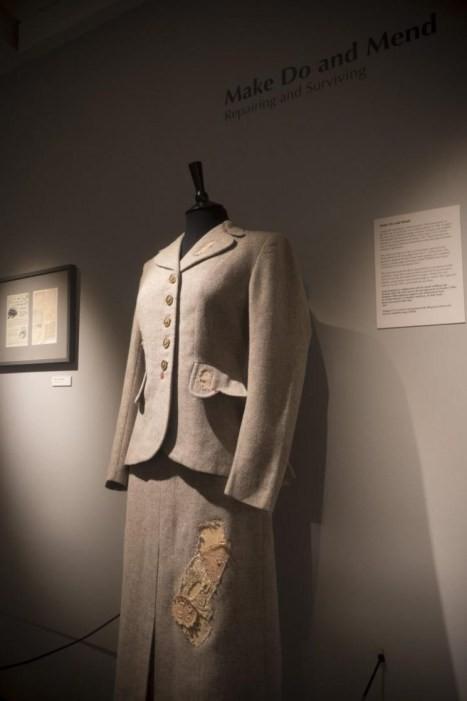
Lacan in Seminar XX states that the signifier is the cause of jouissance. “Without the signifier, how could we even approach that part of the body? Without the signifier, how could we center that something that is the material cause of jouissance?” (24). Make do and Mend showcases the body “enjoys itself” through “corporizing” via the Symbolic (23). It introduces the uncanny feeling that species boundaries are provisionary and unstable, that the signifier “Human” and the “nonhuman” are floating signifiers whose anchor on the symbolic chain cannot be found. The anxiety stirred inside the viewer reflects how the artwork plays with our fear of contagion; it also reflects the artist’s desire to capture the jouissance of the body. The harmless strains of E.colia bacteria have been living inside us for millions of years, producing vitamin K2 and helping us balance the micro-environment in our intestines. This symbiotic state can never be fully captured by signifiers. Making the CRISPR technique a medium to reveal the coexistence of human and nonhuman life forms, the artist thus plays with our paranoiac human status where we create fantasies of autonomy to stabilize the meaning in the symbolic chain. Our mixed feelings of fascination and repulsion towards genetically modified organisms, therefore, is a testimony to a residue, of what is “in DNA more than DNA.” In combination, the dress and the genetically modified bacteria confront our category-fixed political imaginary of the “Human,” bespeak the radical vitality in the symbiotic real, signalling our move closer to the cyborg “ex-existence.”
While playing with our paranoiac fear of the dissolution of boundaries, bioart also allures us to what Hayles has envisioned as the “positive” (How We Became Posthuman 291) aspect of the posthuman future. Another of Dumitriu’s works—Hypersymbiont Dress[52] seeks to alleviate the paranoiac fear by appealing to viewers’ desire for aesthetic pleasure (I argue that the same gesture can be found in VanderMeer’s Southern Reach Trilogy). The concept of this artwork is derived from “genome sequencing technology and synthetic biology” which “allow humans to understand symbiotic bacteria and find possible ways to drive our own evolution at a cellular level” (Dumitriu, “The Hypersymbiont Dress”). The dress is “stained with normal environmental bacteria from a Winogradsky Column” (a self-sustaining bacterial ecosystem), “Mycobacterium vaccae (a soil bacterium that enhances cognitive function by increasing serotonin levels, tested and proved in rats), MRSA (which can interface with the human nervous system and affect how we feel pain), and Bacillus Calmette Guerin,” a form of “attenuated Bovine Tuberculosis” (“The Hypersymbiont Dress”). The video mapping on the dress is made from a film featuring the artists’ own blood battling “an infection with BCG” (“The Hypersymbiont Dress”).
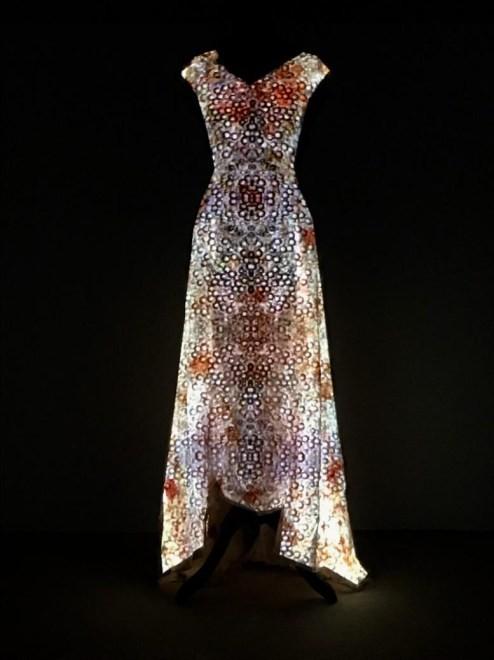
The video of this dress spotlights the futuristic hybridization of multiple species, bespeaking how bioart centers around the “pain and sacrificial slaughter as well as the joy of being alive” (Zaretsky 520). The mesmerizing effect of the mapping demonstrates the artist’s attempt to re-enchant life as “morphological joy to be part of, to take apart and to remix, while falling apart and becoming raw material for the next round of folding, generative, and omni-directional seeping” (523). The dissolution of the boundaries demonstrates the posthuman or transhumanist imagination of a body that refuses the confinement of the categorization “Human.” The beautiful amalgamation of bacteria and pathogens, along with the images of the artist’s own blood cells fighting with infection, embodies the spirit of the Sublime as both alluring and terrifying. The “battle” within the body is aestheticized via the light and shadow on film, yet the fact that the dress is stained with bacteria still leaves us in a suspension, initiating a play with the intersection between the vitality of life and the certainty of death. We as the viewer are more mesmerized rather than frightened. The fluidity of human-nonhuman boundaries in this artwork manifests how the sublime object always comes too close to us, leaving no space for us to contemplate, to symbolize, or to frame it in a safe, comfortable zone. Instead, the sublime traps us. It forces us to confront not only our own lack (the subject as lacking) but also the lack in the Other (the symbolic web that sustains human civilization). In this dress, we sense the symbiotic Real in its totality as both “the real of the subject and the real ... exterior to [us]” (Lacan, Seminar VII 146). Hypersymbiont Dress, therefore, initiates the bio-jouissance that is “extra (en plus)” (Lacan, Seminar XX 77)—an enjoyment that points at “ex-sistence” (Seminar XXIII 25). The mesmerizing power is the medium through which the artist indulges us with a momentary forgetfulness about the foreclosure of the master signifier, luring us into the posthuman, symbiont realm of intermingling. This mesmerizing aesthetic strategy is also adopted by VanderMeer when he writes Annihilation. The effect of the Hypersymbiont Dress is similar to that of the symbiotic tower in Area X, where the “walls minutely rose and fell with the tower’s breathing. That the colours of the words shifted in a rippling effect, like the strobing of a squid” (48). The tower (or the tunnel), “head[ing] straight down” with its “enthrall[ing]” (23) bioluminescent light and mystical words, initiates a “twinned sensation of vertigo and ... fascination” (Annihilation 14).
Aesthetics, Paranoia, and Ecology: The Posthuman Convolution of the Monstrous Beauty
The initiation of paranoia in the Southern Reach Trilogy aims at an environmental consciousness that centralizes the embodiment of humans and nonhumans. Yet it is important to note that within the story, there is a constant tension surrounding the experience of embodiment: at one point, the agential quality of the nonhuman and the blending of human and nonhuman bodies are presented as monstrous and terrifying yet at other times, these phenomena also exhibit qualities of the beautiful. This tension is manifested, for example, in the text’s constant allusions to Baudelaire’s The Flowers of Evil. The script written by the Crawler is first revealed in Annihilation as a quasi-religious text that triggers affects of fear and disgust typically associated with the monstrous:
Where lies the strangling fruits that came from the hand of the sinner I shall bring forth the seeds of the dead to share with the worms ... that gather in the darkness and surround the world with the power of their lives ... (467)
Worms are traditionally associated with decay and transience as often evoked by poets to showcase the contrast between life and death, between light and darkness, such as in Andrew Marvell’s (1621–1678) To His Coy Mistress:
But at my back I always hear
Time’s wingèd chariot hurrying near;
And yonder all before us lie
Deserts of vast eternity.
Thy beauty shall no more be found;
Nor, in thy marble vault, shall sound
My echoing song; then worms shall try
That long-preserved virginity,
And your quaint honour turn to dust,
And into ashes all my lust;
Marvell adopts the image of the worms to manifest the dark side of human life—corpses turning into rotten meat, decay, oblivion—so that his “coy mistress” will agree to seize the moment (Carpe Diem!). In David Lynch’s Blue Velvet, the image of underground insects at the movie’s beginning also serves as a sign of corruption, rotten morals, decay, and decomposition. However, in the context of the Southern Reach Trilogy, death and decay paradoxically entail the power of regeneration and enlightenment. After the narration of “worms,” the tone of the script by the Crawler starts to change into something mystical, touching upon the idea of reincarnation even though we later realize, through the biologist’s investigations, that the renewed bodies grown out of “the seeds of the dead” are uncanny, monstrous mixtures of the human and the nonhuman. The Crawler writes that:
... in the black water with the sun shining at midnight, those fruits shall come ripe and in the darkness of that which is golden shall split open to reveal the revelation of the fatal softness in the earth ... (Annihilation 50)
The notion of a “sun shining at midnight” is weird. At best, one could imagine scenes in Christopher Nolan’s Interstellar where the spacecraft glides away from the enormous black hole whose accretion disk glows blinding light due to electromagnetic radiation. However, if we contextualize the Crawler’s script with Baudelaire’s poems in The Flowers of Evil, VanderMeer’s paradoxical juxtaposition of darkness and “sun” becomes easier to understand. I argue that the convolution of the opposite categories (heaven and hell, light and darkness, life and death) in the form of Monstrous Beauty in the Southern Reach Trilogy pushes Baudelaire’s aesthetics to the ecological domain, acting as a counterforce to the novel’s utilization of the paranoiac register.
In “Hymn to Beauty,” Baudelaire convolutes the heavenly Ideal with hellish decay, presenting a form of beauty that stems from horror and death, evocating the notion of the sublime:
O Beauty! do you visit from the sky
Or the abyss? infernal and divine,
Your gaze bestows both kindnesses and crimes,
So it is said you act on us like wine.
…
Beauty, you walk on corpses, mocking them;
Horror is charming as your other gems,
And Murder is a trinket dancing there
Lovingly on your naked belly’s skin.
You are a candle where the mayfly dies
In flames, blessing this fire’s deadly bloom.
The panting lover bending to his love
Looks like a dying man who strokes his tomb.
What difference, then, from heaven or from hell,
O Beauty, monstrous in simplicity?
If eye, smile, step can open me the way
To find unknown, sublime infinity?
Angel or siren, spirit, I don’t care,
As long as velvet eyes and perfumed head
And glimmering motions, o my queen, can make
The world less dreadful, and the time less dead. (45)
In this poem, Baudelaire subverts the notion of beauty traditionally characterized as serene, elevating, and heavenly (as in Dante’s Divine Comedy). Instead, Beauty holds the duality of both the divine and the infernal. In the fourth stanza, elements traditionally associated with disgust and repulsion, such as “corpses” and “murder,” are considered as prerequisites for the generation of beauty. “Horror” is like gems glittering in the dark. Personified “Murder” not only exhibits the joy of dancing but also celebrates its connection to eroticism. In the fifth stanza, the forces which cause the death of life are characterized as “blessing[s]” and “bloom” like a flower. The last two stanzas convey a radical breakdown of the dichotomy between good and evil.
The idea that there might not be a fundamental difference between “heaven” and “hell”, “Angel” and “Siren,” calls to mind the Lacanian Möbius strip where “love” and “hate,” “desire” and “not wanting to desire” are found to be on the same surface. In the Lacanian topology, such as the torus and the cross cap, distinct, polarizing categories can merge on a tangential point—a singularity. Some theoretical physicists’ definitions of singularity echo the Lacanian topology. For instance, Erik Curiel argues that “Singularities in some way signal a breakdown of the geometry of spacetime itself, but this presents an obvious difficulty in referring to a singularity as a ‘thing’ that resides at some location in spacetime: without a well-behaved geometry, there can be no location.” Singularity gives rise to “a fundamental existential bewilderment” (Ruti, The Singularity of Being 4). In the psychoanalytic setting, singularity “resides within the shadowy interstices of the enigmatic region that (barely and inconsistently) separates life-giving vitality from the deadliness of the drives” (22). In the case of Baudelaire and VanderMeer, this singular, tangential point is the Monstrous Beauty. We see it in The Flowers of Evil, where modern banality, pain, ennui, and the disgusting are wrapped in “the tradition of Renaissance and Baroque love poetry” (Culler, “Introduction” xx) to achieve “an aesthetic of bizarre combinations” (xxvi). While Baudelaire perceives a monstrous vitality in modern Paris, with its rapid industrialization, chaos, and the prevalence of prostitution, VanderMeer discovers a form of Monstrous Beauty in Area X where the dissolution of boundaries between human and the nonhuman only seems “uncanny because of the narcissism of our human gaze” (Annihilation 192). Following Baudelaire’s radical undermining of opposite categories, VanderMeer thus deploys the singularity of Monstrous Beauty to demonstrate the narcissism of anthropocentrism, indicating the radical ecological idea that decomposition and death may not be a horrible thing and the breakdown of species boundaries may not be uncanny at all if we entertain the idea that the human and the nonhuman materialities are always already entangled with each other.
In the second book of the Southern Reach Trilogy Authority, the allusion to The Flowers of Evil becomes more prominent in the Crawler’s script. We see that following the narration of the strangling fruit, the script says: “[T]he shadows of the abyss are like the petals of a monstrous flower that shall blossom within the skull and expand the mind beyond what any man can bear ...” (VanderMeer 96). The idea of a “monstrous flower” echoes Baudelaire’s fusion of the beautiful and the monstrous, of life and death. In The Flowers of Evil, the controversial poem “A Carcass” presents a culminating blend of flowery beauty and monstrous death:
Remember, my love, the object we saw That beautiful morning in June: By a bend in the path a carcass reclined On a bed sown with pebbles and stones; … And the sky cast an eye on this marvellous meat As over the flowers in bloom. The stench was so wretched that there on the grass You nearly collapsed in a swoon. … --And you, in your turn, will be rotten as this: Horrible, filthy, undone, O sun of my nature and star of my eyes, My passion, my angel in one!
Yes, such will you be, o regent of grace, After the rites have been read, Under the weeds, under blossoming grass As you moulder with bones of the dead.
Ah then, o my beauty, explain to the worms Who cherish your body so fine, That I am the keeper for corpses of love Of the form, and the essence divine! (29)
It should be noted that in Annihilation, VanderMeer exempts his posthuman aesthetics from the sensual qualities of the Baudelairean Beauty. In other words, the original eroticism associated with death and decomposition in The Flowers of Evil is transformed into what Georgie Newson-Errey called “the mysticism of the unhuman” (368). In “A Carcass,” the constant collision of blossoming flowers and disgusting corpses functions to upset and provoke the reader. The rough twist from the monstrous to the divine, from “filthy” to “angel” and “star,” leaves the reader no time to adjust to the poem’s destabilizing frame. However, in the Crawler’s script, the juxtaposition of flowers with the dead skull does not evoke the affect of disgust. There is no description of the smell of rotten meat, nor does the script refer to any feelings of the erotic. By the time the biologist arrives at Area X, the objects that initiate the experience of the Monstrous Beauty have undergone a process of “cleans[ing]” (VanderMeer, Authority 303) as the narrator(s) constantly refers to Area X as “pristine” (VanderMeer, Annihilation 12). This cleansing process thus indicates that the first book, Annihilation, advocates that from an ecological standpoint, the beauty of life (as embodied in blossoming flowers) and the monstrosity of death are natural processes in Area X. Area X transforms the religious connotation of death (as a return to God and therefore does not evoke disgust or paranoia) to an ecological materialist interpretation of death as a homecoming to the universal embodiment state.
This transformation by “cleansing through light” (as if the light from the Crawler speaks through the biologist and the land) is similar to how the sensual quality in the sculpture Ecstasy of Saint Teresa is elevated to the religious domain. In “God and Woman’s Jouissance” from Book XX: Encore, Lacan refers to the mystic Hadewijch d’Anvers and this sculpture of Saint Teresa by Gian Lorenzo Bernini to explain that there is a form of enjoyment correlated to our lacking position in the symbolic. Lacan asks: “Doesn’t this jouissance one experiences and yet knows nothing about put us on the path of ex-sistence? And why not interpret one face of the Other, the God face, as based on feminine jouissance?” (77). In the Lacanian formula of sexuation, the female jouissance denotes a form of enjoyment that cannot be encapsulated by the phallic function and is “beyond” (76) symbolic representations. “Woman” is a signifier, yet the paradox is that “it is the only one that cannot signify anything” because “she is notwhole” (73). Lacan suggests that the female position is one with multiplicity and cannot even be subsumed into a singular Ideal like the male (phallic) position. In the context of Annihilation, the Monstrous Beauty initiates a form of “unhuman” enjoyment similar to the feminine jouissance. Just like we “cannot talk about Woman” (Lacan, Book XX: Encore 73), we cannot talk about “Human” in Area X. The signifier “Human” (the symbolic representation) and the signified (the idea of “Human”) are never properly aligned with each other; the referent and the signifier are also not in perfect alignment, either. The idea that the signifier “Human” can encapsulate the entire human species as the detached observer is a fantasy. The weird transformations in Area X remind the reader of this symbolic disjunction, of our universal embodied condition. Confronting “with the unhuman—the alien, the animal, the divine”— “is itself an unhumanising process” (Newson-Errey 372). As Newson-Errey beautifully demonstrates, merging and coalescing three different experiences—“religious revelation, alien encounter, and sublime communion with the natural world” (369), the Southern Reach Trilogy promotes a mystical ecological awareness that is grounded in the proposition “there is no such thing as uncontaminated humanity” (377).
In contrast to the cleansing in Annihilation, there seems to be a residue of the sensual and erotic quality of the Baudelairean Beauty in the second book, Authority. There are cases where we can still see the blend of eroticism with the monstrous and the disgust. This residue could have resulted from the difference between the biologist and Control: the former embraces the annihilation of the Self, while the latter still wants to hold on to the roots of paranoia—an autonomous ego. For instance, right after Control sees Whitby’s painting on the wall, he encounters Whitby in a weird and horrifying manner:
Someone was breathing, behind him.
Someone was breathing on his neck. The knowledge froze him, froze the cry of “Jesus fuck!” in his throat.
He turned with incredible slowness, wishing he could seem like a statue in his turning. Then saw with alarm a large, pale, watery-blue eye that existed against a backdrop of darkness or dark rags shot through with pale flesh, and which revolved into Whitby. (VanderMeer, Authority 276)
The monstrousness and disgust associated with Whitby’s “incubating” (276) body are blended with eroticism in this scene. Control is so close to Whitby that he “could have leaned over and bit his nose or kissed it” (276). The way Whitby’s “hand came to rest on the back of his head,” and “palm flat against Control’s hair” (276) exhibits a form of physical intimacy. Whitby looks like a living “waxwork corpse” (Authority 276). Yet his fingers “spread like a starfish and slowly moved back and forth,” “petting Control’s head,” “caressing it in a gentle, tentative way” (276). In VanderMeer’s Authority, the “corpse” is agential while Control remains inert. Control’s experience of paranoia because of the agential quality of the nonhuman (in contrast to the biologist’s eventual annihilation of the Self in the first book) thus demonstrates how the novel series maintains the tension between (humanist)paranoia and posthuman symbiosis. The paranoiac register allows the text to evoke a new materialist political agenda—to make the reader attentive to the agential reality, while the aesthetic framework enables the novel series to attract the reader to the idea of being in a symbiotic state with the nonhuman.
The tension between Control’s paranoia and the biologist’s acceptance of symbiosis can also be seen throughout the Southern Reach Trilogy. The function of Control’s paranoia can be understood from a psychoanalytic point of view. The association of “bit” and “corpse” in this scene of Authority where Control is so close to Whitby that he “could have leaned over and bit his nose or kissed it” (276) is reminiscent of the provocation of jouissance in Baudelaire’s poems “Carcass” and “To One Who Is Too Cheerful.” The poem “Carcass” was criticized for its beautification of necrophilia, while “To One Who Is Too Cheerful” was “banned by the court” (Culler, “Introduction” xxi) for its celebration of sadism. Lacan, in Book XI, defines sadomasochism as a transgression of the pleasure principle during which the “subject will realize that his desire is merely a vain detour with the aim of catching the jouissance of the other” (183). It can be argued that while identifying with Control’s fear and paranoia, we also experience a masochistic jouissance by designating “the return” of “the departure and the end of the drive” through our body (Lacan 183). We, like Control, “shudder” (VanderMeer, Authority 276) at the symbiotic state of Whitby, who has merged with the nonhuman. The painting of monsters with human faces made Control’s “skin prickle with sudden chills” (276), and when the reader identifies with Control’s disjointed position, this symbiotic state also unsettles the reader’s fantasy of autonomy. Humans prefer to “know that his hopes and desires and impulses were all definitely his own hopes, desires, impulses” (VanderMeer, Authority 238). But Lacan tells us that our desire is always entangled with language, with the Other, and thus we are “extimate” beings.
Near the end of Annihilation, the biologist documents her most intense encounter with the Crawler. This experience can be categorized as evoking the Baudelairean Monstrous Beauty. It echoes the idea of the modern sublime, emphasizing the experience of failure when humans try to comprehend the world through sense perception and language:
The enormity of this experience combined with the heart-beat and the crescendo of sound from its ceaseless writing to fill me up until I had no room left. This moment, which I might have been waiting for my entire life all unknowing—this moment of an encounter with the most beautiful, the most terrible thing I might ever experience—was beyond me. What inadequate recording equipment I had brought with me and what an inadequate name I had chosen for it—the Crawler. (VanderMeer 178)
The shapeshifting light emanating from the Crawler overwhelms the biologist’s perceptual framework and induces immense pain in her body. Her “five senses are not enough” (178) to comprehend the nature of this “complex, unique, intricate, aweinspiring, dangerous organism” (179). At the same time, when the light drowns her as if she is submerged in a sea, she undergoes tremendous agony, “as if a metal rod had been repeatedly thrust into ...[her] and then the pain distributed like a second skin inside the contours [of her outline]” (181). The Crawler transforms her through a process of mimicry, her “skull crushed to dust and reassembled, mote by mote” (181). Her encounter with the Crawler echoes the modern definition of the sublime. The word “sublime,” according to OED, has multiple origins, partly from the French word “sublime,” and partly from the Latin word “sublīmis” which means “uplifted, lofty, exulted, and elevated.” The Roman-era Greek work On the Sublime (usually attributed to Longinus) situates the sublime within aesthetics, deploying the word to categorize writings that elevate the soul. The sublime writing or speech elevates the soul to the point that the ideas seem to have been generated by the readers themselves rather than the texts. Triggering joy and pride, sublime writings always “please and please all readers” (Longinus, “VII”), acting “with an imperious and irresistible force, [swaying] every reader whether he will or no” (“I”).
However, modern definitions of the “sublime” lose this touch of enjoyment and lean towards pain: “Whatever is fitted in any sort to excite the ideas of pain, and danger, ... [or] terrible ... or operates in a manner analogous to terror, is a source of the sublime; that is, it is productive of the strongest emotion which the mind is capable of feeling” (Burke 35–6). This sensation of terror and pain also holds the key to the Kantian sublime. According to Žižek, the Kantian sublime characterizes a moment of suspension when the subject is forced to confront the fragility of his imagination in the face of the natural environment. His symbolic world is marked by the inherent lack that shows the limitation of the human mind. The sublime thus gives us both pleasure and displeasure: displeasure in terms of the revelation of our inadequacy and pleasure because it manifests the “true, incomparable greatness of the Thing [the Kantian Ding-an-sich], surpassing every possible phenomenal, empirical experience” (Žižek, The Sublime Object of Ideology 229). In the passage quoted from Annihilation, the biologist thus describes the encounter with the Monstrous Beauty, a sublime nonhuman singularity that reveals the inadequacy of the human mind. Her experience with the indescribable in Area X thus initiates the “contamination of the self” (Newson 376), amenable to the biologist only because she has gradually “renounced her faith in human sovereignty” (377).
The evocation of the sublime is closely tied to the biologist’s suspicion toward scientific objectivity. Early on, despite being trained in science, she is revealed to be critical of the notion of pure objective research. She understands “how hopeless this pursuit, this attempt to weed out bias, was. Nothing that lived and breathed was truly objective—even in a vacuum, even if all that possessed the brain was a self-immolating desire for the truth” (VanderMeer, Annihilation 8). Despite the recognition of bias, the biologist still tries to hold on to the scientific mission in order to keep her sanity. She consciously stabilizes her psyche by fending off the paranoiac feeling that the nonhuman samples or animals she observes are looking back at her: “I had to fight against the sensation because it could overwhelm my scientific objectivity” (30). However, the first contamination from the “golden spores” (25) when she collects samples from the script marks a definite change of attitude toward scientific objectivity. She admits: “I was steadily, irrevocably, becoming estranged from the expedition and its purpose” (34). As she gradually encounters more and more weird phenomena, she eventually realizes that “Area X broke minds” (119), and that the “objective knowledge” they pursued is “useless knowledge” (119). The text reaches a climactic moment of suspension during the biologist’s final encounter with the Crawler:
As I adjusted to the light, the Crawler kept changing at a lightning pace, as if to mock my ability to comprehend it. It was a figure within a series of refracted panes of glass. It was a series of layers in the shape of an archway. It was a great sluglike monster ringed by satellites of even odder creatures. It was a glistening star. My eyes kept glancing off of it as if an optic nerve was not enough. (176)
This overwhelming yet indescribable aspect of the Crawler is reminiscent of the Lacanian unconscious, which always eludes our grasp. Area X symbolizes the Freudian “Schauplatz,” staging humans’ anxieties about our ontological place in the modernized, polluted, late-industrial environment—a world that “we have altered so much” (VanderMeer, Annihilation 193). As the story goes on, we realize that even time dilates in Area X, like in dreams, where our experience of an event can be prolonged. Logic does not work here, or from a Lacanian point of view, there is a different kind of logic operating in Area X. For the biologist, the traditional logic of categorizing things through sets and names is destabilized, and the cognitive framework that works to make sense of the world is shattered. Despite “being assigned a place in the taxonomy—catalogued, studied, and described,” the nonhuman is “irreducible down to any of that” (VanderMeer, Annihilation 175). The position of the subject (who observes and analyzes) is thrown into a state of uncertainty. Area X thus stages a dreamy, Boschian “Schauplatz” where “ontological anxiety ... does not arise in life-threatening situations, but when our anticipation of meaning fails” (Hoens 18). This failure, however, paradoxically holds the potential to generate a new materialist ecology.
“I See the Marriage of the Rabbit and the Carp in My Dream”
The French idiom “Le mariage de la carpe et du lapin” can be translated in English as “the marriage of the carp and the rabbit.” The expression is used to describe two things that do not mix. It signals a mismatched union, an odd or incompatible pairing. In “Psychoanalysis and Its Teaching” in Écrits, Lacan plays with this idiom, changing the phrases into “Ils en sont venus à baptiser carpe du don oblatif le lapin de la copulation génitale,” meaning “they ended up confusing the apple of genital copulation with the orange of the oblative gift” (Fink, “Translator’s Endnotes” 803). Lacan uses this phrase to criticize how certain analysts have followed the trend of positivism and “have confused a mundane, specified act (genital copulation) with a symbolic act, [namely] the oblative gift (a Roman Catholic ritual symbolizing a gift given to God)” (J. Miller 86). The first half of the seminar “Psychoanalysis and Its Teaching” is preoccupied with the tension between the Société Française de Psychanalyse (SFP) and the Société Psychanalytique de Paris (SPP) concerning the teaching method of psychoanalysis. SFP intends to maintain the relevance of the humanities such as “Greek mythology, medieval philosophy, or renaissance painting” (J. Miller 68) to the psychoanalytic framework, while SPP wants to push the discipline towards a more medicine-psychiatric based knowledge that promotes “objective empirical investigation of human behaviour and cognition” (68). Lacan shows his concern about how his contemporaries have “internalized” the “shame” of not being “scientific” (J. Miller 85) when conducting psychoanalysis. Circling back to the mismatch of genital copulation and oblative gift, Lacan thus rejects the idea of reducing everything to “object relations and emotions” (J. Miller 85), restating the importance of language, particularly in terms of how the unconscious and the symbolic engage in dynamic negotiations.
There is an interesting parallel between this seminar on psychoanalytic teaching and the Southern Reach Trilogy. Firstly, the image of the rabbit appears in both texts to evoke a bizarre situation. In Authority, the white rabbits[53] used to test the border disappear into nothing. The subsequent expedition found no “evidence of white rabbits, dead or alive” (VanderMeer 57). The experiment was to achieve a “simultaneous or near-simultaneous breaching of the border by so many ‘living bodies’” so that it might “‘overload’ the ‘mechanism’ behind the border” (55). The description of the violence involved in the experiment also spotlights the bizarre nature of humans who would use other animals as objects of scientific study rather than simply for food: the “humans looked weirdly like anonymous white-clad riot police, holding long white shields linked together to form a wall to hem in and herd the rabbits” (56). The rabbit’s sudden disappearance also alludes to the white rabbit’s guiding role in Lewis Carroll’s 1865 book Alice’s Adventures in Wonderland. We see a similar allusion in the Wachowskis’ The Matrix (1999). The white rabbit thus functions as a lead to a mysterious portal, which the protagonist will cross over in order to achieve a new understanding of the world around her. It occupies a place where time and space are convoluted into a singularity. Secondly, both Lacan and VanderMeer express their suspicion of scientific objectivity. For instance, right after his comments on the mistake of the analysts who confuse the “carp” with the “lapin,” Lacan adds his critique of ego psychology which considers “the analyst’s ego as the elective means by which to reduce the subject’s straying from reality” (Lacan, Écrits 375). Yet Lacan thinks ego psychology requires a “paragonized relationship to reality,” neglecting “the glaringly obvious, conscious biases they have about the world they live in” (375). Similarly, characters in the Southern Reach Trilogy, such as the biologist, also acknowledge how “hopeless this pursuit” to “weed out bias was” (VanderMeer, Annihilation 8).
The title of this section, “I See the Marriage of the Rabbit and the Carp in My Dream,” reveals my desire to connect the Lacanian topology with the topographical anomaly in Area X through the singular “portal” of the nonhuman rabbit. To see the weird merge of the rabbit and the carp in dreams entails two layers of meaning: first, we see the weird, the surreal, and the monstrous in Control’s dreams prominently appear at the beginning of major sections such as “Incantations,” “Rites,” and “Hauntings,” suggesting a structural(topological) pattern for the second book Authority. It is in his dreams that Control encounters the missed reality of his paranoid human existence—his embodied state of being. Second, as a literary work, the Southern Reach Trilogy is a fantasy, a dream world. It is thus through the dream world of fiction that we encounter the truth about our embodied existence and gain access to “the knowledge of jouissance” on the “fringes of civilization,” at “its discontent” (Lacan, …Or Worse 148). The rabbit and the carp may not match in our social reality, yet in Area X, species do merge through the manipulation of “genome,” “miracles of mimicry,” and “biology” (VanderMeer, Authority 80). In the Southern Reach Trilogy, we see the monsters in Control’s dream manifest in his social reality and the line between the dream world and the social world gradually becomes unstable or even obsolete.
This convolution of the two separate domains of existence echoes the topological structures of the Klein Bottle.
Topological Rendering of the Realms That Are Thought to be Separate:
Subject—the Other
Dream—Social Reality
The Tunnel—Area X
Human—Nonhuman
The image of the Klein Bottle was originally used by Lacan to showcase the “extimate” nature of the subject. But in the context of the Southern Reach Trilogy, it also helps to visualize how Area X as a geographic scene—ein anderer Schauplatz—twists the boundary between the inside and the outside. We see the geographic entanglement, for example, in the transformation of the lighthouse keeper Saul Evans. The tunnel which the scientists descend into turns out to be a living organism developed from Saul’s body (particularly his brain tissue). Yet the shimmering border surrounding the entire Area X seems to be made from Saul’s cell membrane as a result of his effort to contain Area X (as the “Event Two”). The tunnel developed from Saul’s body is like the thin tube within the Klein Bottle, while the border surrounding Area X resembles the bulk round shape outside. This topology illustrates how the mysterious forces in Area X have broken down the categorical framework that clearly distinguishes the human from the nonhuman, the inside and the outside. I argue that the animal imagery in the novel functions as the portal to ein anderer Schauplatz—the symbiotic (missed)reality in Area X. Walking on the surface of the Lacanian topology, the reader experiences how Area X undermines the border between the Self and the Other, between inside and outside, between dream and reality.
Portals to ein anderer Schauplatz: Behemoths, The Ant, The Butterfly, and Leviathans
Authority starts with section “000” which describes how in Control’s dream, he was staring into an abyss from a cliff, seeing “the ocean Behemoths gliding there,” “the size of them conveying such a sense of power that he can feel the havoc of their passage even from so far above” (VanderMeer 3). Behemoth is a giant creature from the Book of Job. Critics vary in their views on whether Behemoth is a natural or a mythological animal. The word has been used to describe large animals like hippopotamuses or elephants. An interesting textual phenomenon is that “Behemoth” is a hapax legomenon in the Book of Job, that is, it only appears once in the text. As Allan Dyssel explains:
Behemoth בְֵּהֵמוֹת ... is a hapax legomenon only mentioned in (Job 40:15). Because of this subordinated presence in the Hebrew Bible, many interpreters through the ages, have been mystified as to what Behemoth actually represents, as concluded by Watson (2005:363), that the ‘... origin and identity of Behemoth is far more opaque, since clear allusions to this creature are otherwise lacking.’ (6)
In the Southern Reach Trilogy, the word “behemoth(s)” only appears thrice. Apart from the ocean Behemoths at the beginning of Authority, the other two are used figuratively on page 43 of Authority and page 305 of Acceptance to denote the meaning of “one of the largest” (“Behemoth, N”). For instance, it appears when Control discovers a lot of bugs in the director’s office: “The behemoths of this sort were bulging, belching metal goiters when set next to the sleek ethereal pinheads of the modern era” (VanderMeer 43). It can be argued that similar to the Behemoth in the Book of Job, “Behemoth” (in the capitalized form as to designate the mythological animal) is also a hapax legomenon in the Southern Reach Trilogy. Therefore, Behemoth can symbolize how the navel of Control’s unconscious is elusive and opaque. Yet at the same time, its power to create “havoc” in the sea within Control’s dreams bespeaks the quasi-gravitational force of the Lacanian Real. Behemoth in the Book of Job is described as an ox that eats grass, possessing great strength in his loins and belly. The animal is also embedded in the context of the marsh and the river: “He lieth under the shady trees, in the covert of the reed, and fens” (Book of Job, 40:21). In Authority, the marsh or swamp often holds the power to trigger Control’s childhood memory. It initially symbolizes forces of the dark, the negative, and chaos. For instance, the swamp near the headquarters “had a weight, a presence” (VanderMeer 31) at his back, as if it is “another kind of enemy” (31) that reminds him of his parents’ divorce and his father’s slow death, of the fact that that he may not be in control. His job requires him to repress memories associated with his personal life, demanding him to occupy the symbolic role of the Law (giving orders, taking control, and managing the Southern Reach agency). Thus, he “hoped to never see a swamp again” (31). However, as he gradually gains more information about the biologist’s duplicate Ghost Bird who “cast spell” on him through the interviews (as the title “Incantations” suggests), the swamp starts to take up a neutral tone, triggering memories of him and his father canoeing when he was a teenager. He remembers he is “John Rodriguez again, ‘Control’ falling away” (81).
Even though at the end of “Incantations,” Control consciously reinforces the idea that “when morning came, he would rise as Control and that he would go back to the Southern Reach,” at the beginning of the next section, “Rites,” he suddenly experiences a major existential crisis. The first chapter of “Rites”— “005: The First Breach”—begins with Control’s paranoiac dream:
What is it? Is it on me? Where is it on me? Is it on me? Where on me? Can you see it on me? Can you see it? Where is it on me?
Morning, after a night filled with dreams from atop the cliff, staring down. (85)
These questions echo what he is about to encounter in his social reality—the woman in the parking lot who does not know that there is an ant on the back of her neck. Control carefully helps the woman get the ant off her neck and places it into “the fringe of vegetation lining the parking lot” (VanderMeer 86). After a detailed description of how the ant finds its way into the trees, the narrative switches to free indirect discourse, revealing Control’s thoughts: “Was he the woman with no clue where the ant was or the ant, unaware it was on the woman?” (86). The metaphor first intends to spotlight Control’s paranoiac suspicion that Area X might be “on him” (86), namely, that there is a purpose or agency behind all the weird phenomena. The dreadful feeling arises from the possibility that Area X controls and manipulates his behaviours. At the same time, the ant metaphor is associated with Control’s ontological and symbolic position, which can be compared to the position of Choang-tsu as explained by Lacan in Book XI. In dreams, the philosopher Choang-tsu turns into a butterfly and he is uncertain whether it is he who dreams of being a butterfly or that “it is the butterfly who dreams that he is Choang-tsu” (Lacan 76). Just like how Choang-tsu “sees the butterfly in his [social] reality as gaze” (Lacan 76), Control sees the ant as the “First Breach” (VanderMeer, Authority 85) of his symbolic position. The “fall of the subject” (Lacan, Book XI 76) happens to Choang-tsu since he understands he is not “absolutely identical with” his symbolic name. Similarly, the ant as the gaze thus hints at Control’s futile attempt to be an omniscient observer in Area X—the “authority” as the title suggests—and functions to illustrate the mismatch between the signifier and the signified, between the disembodied “Human” and the embodied entity in symbiosis with other beings.
Similar to how the marsh or swamp connects to the unconscious and embodied, water plays an essential role in forming Control’s dreams. Specifically, water is often tied to the notion of drowning, a turbulent experience that extends dreams into social reality. Ghost Bird initially formulates a connection with Control by sharing her experience of “drowning” (26) at the time she was found in Area X. The fear and paranoia associated with falling “from a cliff” (3) and drowning beside the sea monsters constantly appear in Control’s dreams. Upon hearing Ghost Bird’s story of drowning, Control at first feels that her experience “had thrown him” (27). Yet later, it also gives “him an odd sense of secret sharing between them. As if she had gotten into his head and seen his dream, and now they were bound together” (27). In the third book, Acceptance, we learn that Control and Ghost Bird travel to Area X through the lake portal and experience actual drowning and physical intimacy together. During this event, the line between reality and dreams is blurred. Control sees the manifestation of his dreams in the original Lowry’s body, which has now turned into a giant fish. This underwater portal scene is described as suffocating, disorienting and chaotic:
Only when a true leviathan appeared did his oxygen-starved brain understand that they had emerged into a roiling school of some kind of barracuda-like fish now being disrupted by a larger predator. There came an awful free-falling[54] emptiness ... the quickly closing space where the enormous shark had sped through the vortex, annihilating fish in a crimson cloud. A megalodon of a kind. Lowry yet in another form ... (74)
The visceral experience in this whole scene where the human and the nonhuman bodies are entangled together—where Control’s face “slid half raw against its gills” while the “expulsion of water roaring,” “the huge yet strangely delicate eye away to his left staring into him” (74)—enacts the posthuman deconstruction of anthropocentrism. The claustrophobic effect is triggered when the subject (who sees) is caught up in the mesh of bodies, blood, and seawater. The text of Acceptance spotlights the estranged feeling of not being in control, being reduced to an object, trapped, tossed around, and losing autonomy. For instance, when Control is about to be pulled up by Ghost Bird out of the lake, he feels like “a hanging victim ... his body buffeted by a hundred smooth-rough snouts as he rose, as he backed out amid the torrent of upward-plunging bodies, the rough rebuke of continuous flesh that formed one wide maw from which he might or might not escape” (75). This scene disrupts humans’ status as the controller of nature, levelling our ontological status in the world.
The word “Leviathan” appears multiple times in Authority and Acceptance, often associated with Control’s paranoiac dreams where the creature stares at him or when he feels the “endless falling into the bay” (VanderMeer, Authority 141), into their giant maws. In this sense, Leviathan works as a portal to ein anderer Schauplatz—the other scene where Control brings the reader to experience the breakdown of the line between the dream world and social reality. Most of the time, the sea monsters are portrayed as the daunting other, exerting a threatening force in the characters’ unconscious[55]. Yet there are exceptions. At the beginning of the section “Hauntings,” there is a sub-section “000” which repeats Control’s “cliff” dream at the start of the novel. It offers a complete twist of perspective. In this dream, Control stands on the other side. Instead of standing on the edge of the cliff, looking down, he “stares from the water up at the cliff far above him” (225):
He can see the silhouette of someone peering down at him from the top ... While he lies in wait, there, at the bottom of the cliff, swimming vast and unknowable among the other monsters. Waiting in the darkness for the soundless fall, without splash or ripple. (225)
Compared to the ant incident, this bizarre dream echoes Choang-tsu’s butterfly dream even more and thus can be called a “Second Breach” experience. Like the Leviathan he has constantly feared, Control becomes predatory in this scene, enacting the monstrous stare. This twist of desire can be interpreted in three ways: first, the silhouette of someone peering down at him indicates how Area X might have been “some kind of slow incubator” (297), which mimics and replicates the humans who enter it while turning the original subjects into nonhuman creatures. We see this transformation in pairs, such as the biologist (who turns into a marine creature) and Ghost Bird, the biologist’s husband (who changes into an owl) and the returned replicant, Lowry (who turns into a giant fish) and the replicant Lowry who serves as a spy for the forces of Area X; second, the scene is a topological breakdown of the setting of dreams. Instead of looking at the monster at the edge of his dream, Control becomes the monster at the centre of the stage, desiring to catch others; third, drowning with the sea monster could symbolize the annihilation of the Self, yielding to the notion of embodiment and embracing death and rebirth. These gestures of resignation are dangerous for Control as well as for the mission of the Southern Reach. Thus, initially, the sea monster was daunting and scary for him. However, as he becomes more and more familiar with Ghost Bird, she gradually exerts a force on him, almost like converting him to the side of Area X. She tells him that she is not the biologist, that there is a “brightness” (222) inside her. The rainy scene where Control and Ghost Bird get soaked in nature also paints a moment of bonding between them. Ghost Bird allows Control to be receptive to the force of Area X. Therefore, after his conversations with her, he temporarily loses the human perspective in his dream, renouncing his symbolic position as the authority. It is in dreams that he encounters “another reality” (Lacan, Book XI 58) other than the social. In social reality, the fantasy of being a human allows him to have a “Second Recovery” (VanderMeer, Authority 225) from the truth of the missed reality—that humans are essentially embodied, extimate beings and that we can never exert absolute authority.
Mythology of the Nonhuman: Between Paranoia and Acceptance
Destabilizing species boundaries, the Southern Reach Trilogy evokes paranoia of uncertainty, presenting a mythological picture of the human and the nonhuman where time ceases to be linear and where death partakes in the celebration of rebirth. When Control checks the cafeteria previously frequented by Whitby, he discovers the wall painting he left behind. At first sight, this painting seems to originate from Whitby’s wild imagination—a “vast phantasmagoria of grotesque monsters with human faces” (VanderMeer, Authority 273). Yet later on, we learn that the details in this painting bear clues as to what happened and what will happen to the management and expedition members in Area X. Within the painting, Area X is encircled in the belly of a “two-headed monster,” while the border of the whole picture is “a ring of red fire” (273). Even though the text does not specify the name of the monster, it may allude to the god Agni in Vedic mythology of ancient India or Janus in ancient Roman mythology. “Agni” in Sanskrit means “fire.” Agni is “ruddy-hued and has two faces” (Britannica Encyclopedia of World Religions 23). He is thought to be the origin of the fire in the sun, “lightning,” and the “hearth” (23). He is usually placed at the southeast corners of the Hindu temples. As the god of fire, he holds the power of sacrifice and serves as “the mouth of the gods, the carrier of oblation, and the messenger between human and divine” (23). It can be said that the original scientists sent into Area X are sacrifices both for the Southern Reach organization and for Area X. The organization discourages using their names and treats them as instruments, while Area X “sacrifices” the original expedition members and uses their DNA to create doppelgängers. Control sees the sharp contrast between the duplicate who returns from Area X and the original psychologist from the eleventh expedition: Dying from cancer, the duplicate says that “it was quite beautiful, quite peaceful in Area X” (274) while the latter (the original) is depicted as having “utter, uncomprehending anguish ... [with his] mouth open in a perpetual O” (274). This mythological interpretation of the monsters in Area X enhances the paranoiac feeling felt by both Control and the reader. Instead of being studied by humans, Area X reverses the power dynamics and has been studying humans.
In addition, the two-headed monster can refer to Agni’s power to kindle light in both the human and the nonhuman, a force to connect with and transform every living organism. In this sense, the text’s mythological allusion echoes Barad’s new materialist theory, which advocates the intra-activity in all apparatuses. Agni’s power to kindle light in every entity can also be connected with Barad’s theory, which draws inspiration from the dual nature of light (particle and wave). The Oxford Companion to World Mythology notes that Agni “is a hidden god—the divine fire in plants, in the earth, in animals, in the elements, in humans; he is the divine light by which we see, by which we are conscious.” In the Southern Reach Trilogy, light is a conceit. It is agential and has many forms: it is the “spiral of light” (VanderMeer, Acceptance 25) in the plant that pricks Saul’s thumb; it is the Crawler, a “glistening star,” “a great slug-like monster” (Annihilation 176); it is the “brightness” (Authority 222) inside Ghost Bird that creates the portal outside Area X; it is the “life” from the “moldering bones,” from the “eye sockets” (Acceptance 37) of the moaning creature.
The difference between Agni and the light in Area X is that the latter breaks down the dichotomy between the divine and hell, between life and death. It “contaminates” other things through mimicry and genomes, disrupting species boundaries and thwarting humans’ desire for categorization through language. In Whitby’s painting, we see the human, the animal, and the plant are all entangled together: a “creature that had the form of a giant hog and a slug commingled, pale painted skin mottled with what was meant to be a kind of mangy light green moss” (274). The painting hints at what would happen or has happened to the members of the Southern Reach: “The director had been rendered as a full-on boar, stuffed with vegetation; the assistant director as a kind of stout or ferret; Cheney as a jellyfish” (274). In this painting, Control is turned into a wild hare around which there is a “grey-blue sea monster, a whalelike Leviathan” (274). This transformation alludes to his previous drowning experience with Ghost Bird. It indicates that Control might eventually become a hare and assimilate with the nonhuman rather than possessing the symbolic role of authority. In Area X, the death of the human means the start of transformation as the mysterious force utilizes the decomposed particles from dead bodies and makes new life forms. In this way, Hell can be Heaven, and death can lead to regeneration. Area X thus undermines the notion of progress and accumulation through time in the logic of capitalism. Yet this posthuman interpretation should also be compared with Control’s paranoiac feeling during this whole scene: that death and decomposition are indeed horrifying for humans. Only those who have relinquished the idea of human sovereignty (such as the biologist) can experience the pure and transformative power of Area X as serene.
However, if we contextualize the two-headed monster with Janus, the ancient Roman god, Area X could be interpreted as a doorway connecting the past and future. According to the Greenhaven Encyclopedia of Greek and Roman Mythology, Janus has a head with “two faces looking in opposite directions” (101). The first month of the year— January, was named after him. The statue of Janus is often placed at the entrance or exit of a building. He represents forces of transformation. The painting Control sees on the wall thus signals how Area X transforms the humans and the landscape. It is a threshold to a realm other than the social reality, an “elsewhere” that disrupts the linear perception of time. Based on the Encyclopedia of World Religion, the “most famous Janus in Rome was the Janus Geminus,” “a shrine of Janus at the north side of the Forum.” In ancient Rome, the doors of this shrine were open during times of war and closed in peace. In Ovid’s Fasti, the door of Janus is described as having the capacity to pour out waves of water to help Romulus defeat the enemy. The temple of Janus “is a house from which the military divinity of the state goes out to overcome the enemy through his capacity as weather-god, in particular with floods as at Mount Tabor” (Brown 239). Macrobius describes the forces from the gate of Janus as “a great wave of raging water broke out in torrents” (qtd. in Brown 239). The allusion to Janus in Whitby’s painting thus can relate to how the light in Area X often comes in the form of water, such as tides and waves. Light originates from the lighthouse near the sea. It overwhelms the biologist by drowning her in the experience of the sublime; it erupts like a tide below Saul’s body as the director meets him in the tunnel. It is “impossible flowering light,” “fluctuating, shifting, turning into something else” (58). Area X in the “belly” (VanderMeer, Authority 273) of the two-headed monster, therefore, can signal how the region is a portal to the Freudian oceanic feeling where the ego and the self are not formulated, where the torrents of light “break down” (271) species boundaries and categories. Area X is a threshold where the past and the present merge. That is why the narration in the Southern Reach Trilogy is often not linear, particularly in the third book, Acceptance, where polyphonic narratives allow each character to speak about the varied experiences in Area X. The biologist says: “Someday the fish and the falcon, the fox and the owl, will tell tales, in their way, of this disembodied globe of light and what it contained” (Acceptance 156). The characters’ experiences are fractured, just like the fractured light observed by Saul. Seeing and cognizing the phenomena in Area X is like “staring into a kaleidoscope” (25). The Kantian noumenon always lies beyond. As a doorway to singularity, Area X breaks categories of understanding.
Endnote
In The Weird and The Eerie, Mark Fisher argues that the weird “is that which does not belong” (10). Although the weird and the eerie share with the Freudian unheimlich the capacity to evoke affects, the former two are different from unheimlich in that they “allow us to see the inside from the perspective of the outside” (10). This intertwinement of the inside and the outside suggests that the Lacanian topology can also be called an eerie philosophy. The Lacanian idea of “extimacy” explains the mechanism of paranoia, but in the context of the Southern Reach Trilogy, Lacanian theory itself can also be categorized as an eerie, paranoiac epistemology that functions to promote an ecological understanding of the human-nonhuman boundary. Fisher adds that the eerie is “fundamentally tied up with questions of agency” (11). In VanderMeer’s novel series, the characters’ paranoiac experience with nonhuman agency testifies to Fisher’s claim that the weird often causes “breakdown and psychosis” (16).
There is a constant tension concerning how the characters react to the weird phenomena in Area X, manifested in VanderMeer’s choice of narrative frameworks for each book. In Annihilation, the biologist’s first-person narration showcases a transition from paranoia to the “mystical annihilation of the self” (Newson 386). In Authority, Control resists the mystical annihilation. Thus, paranoia accompanies him throughout the story. The third-person narration in Authority gives the reader an impression of objectively recording Control’s story, yet the insertion of free indirect discourse disrupts this detached representative mode, constantly leading us to identify with Control’s paranoia. In the third book, Acceptance, we see a polyphonic narrative framework with a weird second-person narrative voice for the sessions about the Director. It breaks down the boundary between fiction and reality, introducing a more “enactive” mode of reading (Kortekallio 58).
In addition, when characters encounter the weird blend of human and nonhuman bodies or the agential quality of the nonhuman, the script about the “strangling fruits” would abruptly be inserted in the narrative, functioning as a side commentary on the plot. It signifies how the Crawler’s message has not only entered the unconscious of the scientists but also of the narrator—like the omnipresent Rocket in Gravity’s Rainbow, which “answer[s] to a number of different shapes in the dreams of those who touch it—in combat, in tunnel, on paper” (Pynchon 741). The way the Crawler’s messages transgress boundaries to showcase the interconnectedness of everything echoes the Lacanian notion of the extimate nature of bodies. Yet the weird thing about the message of the Crawler is that in Area X, human language is transformed into a “pipeline, the highway,” “a conduit only” (VanderMeer, Authority 106) for the light. “The real core of the message, the meaning, would be conveyed by the combination of living matter that composed the words” (106), namely, the real message is the “ink” (106). From a psychoanalytic point of view, this weird structure mirrors the Freudian topology of the “manifest content” and the “latent content” in dreams—the manifest content is the mystical words about “sun shining at midnight” and the “latent content” is the alteration and fusion of different species DNA through the light. From a new materialist point of view, the idea that “real message as the ink” echoes Barad’s argument that quantum theory allows us to see how language is not a transparent medium but a material practice. What we perceived previously as inert matter is initiating endless activities with the human body, and the human body itself is also a part of these ongoing intraactivities. It is worth noting that in the first book, Annihilation, all the other expedition members who preserved the paranoiac register died. Only the biologist who renounces the idea of the autonomous self survives. Perhaps this paradoxical surviving strategy signals a new way of engaging with the world, a form of new materialist performativity that starts from paranoiac affect but ends in the acceptance of human-nonhuman commingling.
Conclusion
Near the end of his book Empire of Conspiracy: The Culture of Paranoia in Postwar America, Timothy Melley comments on Ihab Hassan’s statement about posthumanism, suggesting that while we move towards a new age of boundary dissolution, we should also be aware that “many of our most radical encounters with the decentered subject are presented to us in the mode of panic, by terrified characters and worried cultural critics” (201). Hassan’s first proposition, “that the human form—including human desire and all its external representations—may be changing radically, and thus must be re-visioned” (843), is widely acknowledged by critics; however, my dissertation offers a cautionary stance against his second proposition, that “five hundred years of humanism may be coming to an end, as humanism transforms itself into something that we must helplessly call posthumanism” (843). From a theoretical point of view, the examples of Wiener’s anxiety-driven narratives about his own cybernetic theory as well as how new materialist theorists such as Bennett and Alaimo utilize the inherent paranoiac tendency in the human psyche to promote their ecological agendas, prove that the anthropocentric (or humanist) register—the traditional notion of human agency— still serves a function in the posthuman discourse, despite the fact that the absolute, stable, ontological boundary between the human and the nonhuman is built on a fantasy. In addition, we should not be negligent of the inherent aggressivity in the human psyche when it comes to the desire for the big Other.
In Subject Lessons: Hegel, Lacan, and the Future of Materialism, Russell Sbriglia and Slavoj Žižek clarify that the subject in Lacanian psychoanalysis is not the transcendent, autonomous bourgeois ego but “the unconscious subject” or “the subject of the unconscious” (8). In comparison to new materialism’s decentering of the human, psychoanalysis still maintains the register of the subject, even though the subject has undergone radical materialization and expansion into the nonhuman realm. Referring to Georg Wilhelm Friedrich Hegel’s statement— “everything turns on grasping and expressing the True, not only as Substance, but equally as Subject” (qtd. in Subject Lessons 10), Sbriglia and Žižek seek to demonstrate the dialectical relationship between the subject and the (material)object, arguing that “the subject is indeed an object, as the new materialists and realists claim, but a very particular, very peculiar kind of object, a strange object, that, insofar as it is in the subject more than the subject itself, is constitutive of subjectivity as such.” (11). What this means is that apart from the question of enunciation (“Who is advocating new materialist theory?”) and the question of fantasy (“Who is imagining the fluid boundary between the human and the nonhuman?”), posthumanists also have to confront the issue of lack (and its dialectics). Lack is a negative force, manifested as the objet petit a, yet paradoxically, it also initiates desire and agency (“We should advocate new materialism so that we can implement environmentally friendly policies.”). The unending political debates between the Right and the Left when it comes to the issues of race, gender, and the environment showcase that the bourgeois autonomous ego and the posthuman ontology are both fantasies that stage the eruption of jouissance, continuing to fuel our desires.
Three keywords characterize the differences between psychoanalysis and new materialism regarding the relationship between paranoia and the posthuman:
jouissance, fantasy, and topology. Lacanian psychoanalysis allows us to see that the inherent lack in the human psyche can be magnified and manifested in the form of paranoia and jouissance as we enter the era where the phantasmagoric nature of the ontological and epistemological boundaries between the human and the nonhuman become prominent via technological and theoretical inventions. Both Lacanian psychoanalysis and Barad’s new materialism acknowledge the unstable boundary between the human and the nonhuman—that the autonomous ego is an illusion. However, Lacan does not think that humans can function properly in society without a fantasy of autonomy. This inability to bypass the desire for the big Other is epitomized in his analysis of the mother-daughter’s case of paranoia, where the foreclosure of the Name-of-the-Father prompts a hallucinatory signifier to stabilize the signifying chain.
In the psychoanalytic framework, paranoiac fear is a symptom of the lack in the signifying chain and a reaction to the phenomenon of “extimacy.” In Chapter 1 of my dissertation, I analyzed Thomas Pynchon’s Gravity’s Rainbow. In this novel, the character Slothrop starts his journey to uncover the secrets behind the mysterious Rocket in a paranoiac state because the military-industrial complex, with scientists’ experiments about the material IG, has rendered the object (namely, the rockets) inseparable from his human body. Along this journey, jouissance erupts in the paranoiac, machinic body, revealing the “extimate” nature of human subjectivity. In Chapter 2 of my dissertation, I focused on PKD’s Do Androids Dream of Electric Sheep? and the Blade Runner movies by Ridley Scott and Denis Villeneuve. Deckard’s paranoia about his human status is initiated when technology blurs the ontological boundary between humans and androids, making the master signifier “Human” and the other signifiers which support it (such as “empathy,” “morality,” “organic,” and “aliveness”) unstable. This paranoia is intensified and his psychic structure becomes unstable when he realizes that Luba’s “android desire” is not so different from his own. However, the “excess” embodied in real animals stabilizes the paranoiac human psyche, demonstrating the coexistence and codependence of the human and the nonhuman in the post-apocalyptic world. Chapter 3 of my dissertation addresses the issue of trauma and race in Octavia Butler’s Kindred. I demonstrate that the white masters experience paranoiac fear of the slaves because Dana, as a modern-day black woman who travels to the plantation, occupies the posthuman liminal space-time that disrupts the racialclass hierarchy. Her “ex-sistence” resists the rigid Symbolic designation of the big Other and destabilizes the signifying chain of the master. In the process of transgressing racial-temporal boundaries, Dana provokes the jouissance of the narcissistic master ego and uncovers the deadlock of the racist social economy. In Chapter 4 of my dissertation, I examined Jeff VanderMeer’s Southern Reach Trilogy. In this novel series, paranoia besets the biologist and the other expedition members who enter Area X because Area X blends human and nonhuman DNA, creating dolphins with “painfully human” (VanderMeer, Annihilation 97) eyes. Undermining the binary opposition and power dynamics between the subject and the object, the nonhuman agency in the Southern Reach Trilogy questions Cartesian and Newtonian epistemologies in the same way as quantum theory does, triggering paranoiac affects in the human subjects. The convolution of the inside and the outside, of the dream world and the social reality in Area X, facilitates an ecological understanding of the Lacanian topology. In this sense, the Southern Reach Trilogy epitomizes how Lacanian psychoanalysis and new materialism could “shake hands” with each other at the “crossroad” of the paranoiac register.
Despite this agreement, Lacanian psychoanalysis differs from Barad’s new materialist onto-epistemology because the former prioritizes a structure which gravitates toward lack (the topology of the torus, the Borromean Knots, and the cross-cap), while the latter is a diffused ontology marked by “the space of possibilities opened up by the indeterminacies entailed in exclusions” (Barad 182). Both Lacan and Barad undermine the traditional notion of causality, punctuating the illusory boundary between the inside and the outside, and between the human and the nonhuman. Yet, Barad’s emphasis on “performativity” spotlights the constant (intangible)flux of “reconfigur[ing]” and “rework[ing]” of “interior” and “exterior” (181), while Lacan’s logic of the unconscious still adheres to a tangible, spatial structure/stage (as in the example of Nachträglichkeit) onto which the (paranoid)subject can project a momentary fantasy. For Barad, “agency is a matter of intra-acting; it is an enactment, not something that someone or something has” (178). In this way, new materialism annihilates the unconscious and the fantasy (of the subject). In Chapter 1, I present how difficult it is for Pynchon to embrace the new materialist annihilation of the subject-object hierarchy, despite his effort to implement this posthuman epistemology in Gravity’s Rainbow. In contrast, VanderMeer’s Southern Reach Trilogy completes this new materialist “enacting.” In Annihilation, all the other expedition members who kept the humanist paranoiac register died because of their panic, suspicion, and desire to maintain the boundary between the Self and the Other. Only the biologist who renounces the paranoiac register survives. This causal connection between survival and the willingness to embrace human-nonhuman commingling demonstrates radically Utopian new materialist performativity.
In all the novels and movies examined in this dissertation, there is always a tension between paranoia and posthuman symbiosis. In Chapter 1, I present that both the second-person narration and the animal imagery (the octopus and the owl) in Gravity’s Rainbow function as a source of humour, irony, and farce to counter the paranoiac feeling. In addition, Lacan shares with Pynchon an interest in the image of the octopus. When illustrating the mechanisms of repetition compulsion and paranoid psychosis, he appeals to the aesthetics of the octopus’s body to draw our connection to nonhuman life in the sea. In Chapter 2, the aesthetic quality of Blade Runner’s soundtrack and the melancholic portrayal of the androids’ failed rebellion provoke the audience’s identification with and empathy toward the nonhuman, undermining the paranoiac feeling in PKD’s novel. In Chapter 3, I use Turner’s painting Slavers Throwing Overboard the Dead and Dying, Typhoon Coming On (1840) to demonstrate that Kindred entails alternative Black empowerment through its Afrofuturist politicization of temporality, initiating a therapeutic process key to the Freudian notion of “remembering, repeating, and working through” rather than a perpetual attachment to the negativity of the Black signifier. The aesthetic appeal of Turner’s painting counteracts the paranoia about the enslaved black bodies, demonstrating how beauty can initiate political debates about race and exploitation. In Chapter 4, the Southern Reach Trilogy deploys the aesthetics of the Monstrous Beauty to undermine the humanist paranoiac register, upsetting the binary opposition of life and death, of subject and object, and luring the reader into the new materialist realm of constant intra-acting. Through first-person narration, the biologist strengthens the reader’s identification with her encounter with the nonhuman, revealing the lack of our human epistemology: “This moment, which I might have been waiting for my entire life all unknowing—this moment of an encounter with the most beautiful, the most terrible thing I might ever experience—was beyond me” (Annihilation 178). The sublime encounter with the Crawler’s aesthetic traits effectively initiates radical posthuman politics: the annihilation of the Self and the renouncement of the big Other.
The same strategy of deploying aesthetics as a form of politics against paranoia can be seen in the filming of the documentary Paris is Burning (1990). Directed by Jennie Livingston, this documentary “provides a vibrant snapshot of the 1980s through the eyes of New York City’s African American and Latinx Harlem drag ball scene” (“Paris is Burning”). In the face of the paranoiac sentiments about people who do not fall into the traditional racial and gender categories, this film stages the beauty of the drag culture in order to appeal to the audience’s understanding and empathy toward poor Black and Latin LGBT people. Out of all the stories in this documentary, the narrative about Venus Xtravaganza, I argue, embodies the politics of aesthetics similar to that in Turner’s painting and in Blade Runner.
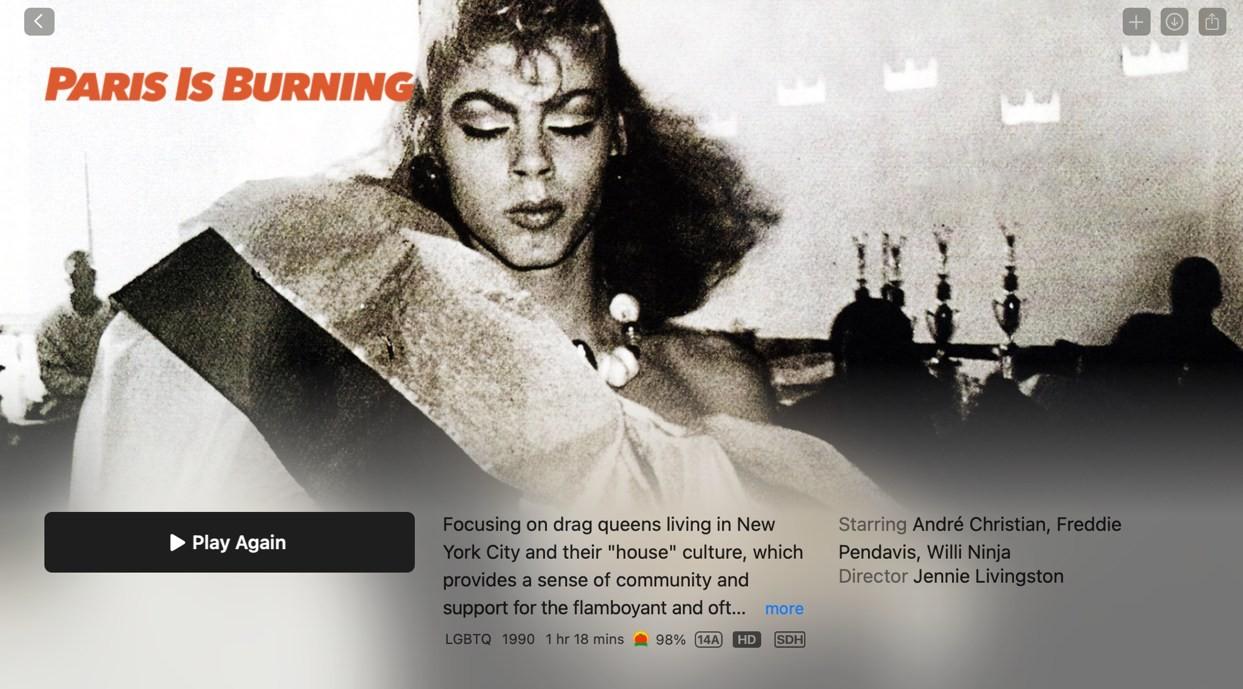
Instead of using the theatrical release poster presenting the joyful, flamboyant community, the Blu-ray documentary on Amazon and Apple TV only features Venus Xtravaganza in the middle of a performance. In the documentary, Venus is portrayed as cute, fragile, and soft. She said: “I would like to be a spoiled rich white girl. They get what they want, whenever they want it. They don’t have to really struggle with finances, nice things, nice clothes, and they don’t have to have that as a problem” (00:23:0000:23:21). We, like Deckard, who sees Luba’s desire, encounter Venus’ desire through the narration. Behind the aesthetic tranquillity of this face, however, there is the horrifying reality of her unsolved murder—death by strangulation. Doesn’t this beautiful, gorgeous image of hers function in the same way as Turner’s painting of the sunset on the sea, as the Lacanian Gaze that disrupts (paranoiac)desire?
Bibliography
“1807 Abolition of the Slave Trade”. UK Parliament, https://www.parliament.uk/about/living-heritage/evolutionofparliament/2015-parliament-in-the-making/get-involved1/2015-banners-exhibition/maria-amidu/1807-abolition-of-the-slave-trade/ Accessed 22 Feb 2025.
“Agni.” Britannica Encyclopedia of World Religions, edited by Wendy Doniger et al. Encyclopaedia Britannica, Inc., 2006, pp. 23.
Adorno, et al. Philosophy of New Music; Translated, edited, and with an Introduction by Robert Hullot-Kentor. University of Minnesota Press, 2006.
Adorno, Theodor W. Introduction to the Sociology of Music, translated from the German edition by E.B. Ashton. Seabury Press, 1976.
Alaimo, Stacy. Exposed: Environmental Politics and Pleasures in Posthuman Times. University of Minnesota Press, 2017.
Arnold, Kyle. The Divine Madness of Philip K. Dick. Oxford University Press, 2016. ProQuest Ebook Central, https://ebookcentral-proquest-com.proxy.lib.sfu.ca/lib/sfu-ebooks/detail.action?docID=4545361 Accessed 23 Feb 2025.
Babbitt et al. “American Bicentennial Celebration.” The Gerald R. Ford Presidential Digital Library, Feb 2021.
https://www.fordlibrarymuseum.gov/library/exhibits/bicentennial/bicentennial.asp Accessed 29 April 2024.
Barad, & Alice, F. Meeting the Universe Halfway: Quantum Physics and the Entanglement of Matter and Meaning. Duke University Press, 2007.
Barber, Tiffany E., et al. “25 Years of Afrofuturism and Black Speculative Thought: Roundtable with Tiffany E. Barber, Reynaldo Anderson, Mark Dery, and Sheree Renée Thomas.” Topia (Montreal), vol. 39, 2018, pp. 136–44.
Baudelaire, Charles. The Flowers of Evil, translated by James McGowan, Introduction by Jonathan Culler. Oxford University Press, 1993.
“Behemoth, N.” Oxford English Dictionary, Oxford UP, June 2024, https://doi.org/10.1093/OED/3969110292 Accessed 23 Feb 2025.
Bennett, Jane. Vibrant Matter: A Political Ecology of Things. Duke University Press, 2010.
Bentley, D. M. “Charles G. D. Roberts and William Wilfred Campbell as Canadian Tour Guides.” Journal of Canadian Studies, vol. 32, no. 2, 1997, p. 79.
Berressem, Hanjo. Pynchon’s Poetics: Interfacing Theory and Text. University of Illinois Press, 1993.
Bersani, Leo. “Pynchon, Paranoia, and Literature.” Representations, no. 25, 1989, pp. 99–118. JSTOR, doi.org. Accessed 23 Feb 2025.
Bistoen, Gregory, et al. “Nachträglichkeit: A Freudian Perspective on Delayed Traumatic Reactions.” Theory & Psychology, vol. 24, no. 5, 2014, pp. 668–87, https://doi.org/10.1177/0959354314530812 Accessed 23 Feb 2025.
Blade Runner 2049. Directed by Denis Villeneuve. Warner Bros., 2018.
Blade Runner: Director’s Cut. Directed by Ridley Scott. Warner Bros., 1992.
“Bordel.” Cambridge French-English Dictionary, Cambridge University Press & Assessment, 2025, https://dictionary.cambridge.org/dictionary/french-english/bordel?q=Bordel Accessed 22 Feb 2025.
Breuer, J., and Sigmund Freud. “On the Psychical Mechanism of Hysterical Phenomena (1893).” International Journal of Psychoanalysis, vol. 37, 1956, pp. 8–13.
Brown, John Pairman. “The Ark of the Covenant and the Temple of Janus.” Israel and Hellas, II, Sacred Institutions with Roman Counterparts, vol. 276, Walter de Gruyter GmbH, 2000, pp. 235–72.
Burke, Edmund. A Philosophical Inquiry Into the Sublime and Beautiful. Oxford University Press, 2015.
Burnham, Clint. Does the Internet Have an Unconscious?: Slavoj Žižek and Digital
Culture. Bloomsbury Academic, 2018
Burnham, Clint. Fredric Jameson and The Wolf of Wall Street. Bloomsbury Academic, an imprint of Bloomsbury Publishing, Inc., 2016.
Burnham, Clint, and Paul Kingsbury. Lacan and the Environment. 1st ed., Springer
International Publishing AG, 2021, doi.org.
Butler, Octavia. Kindred. Beacon Press, 2003.
Capperdoni, Alessandra. “Does the Animal Desire?” Lacan and the Environment, Springer International Publishing, pp. 155–76.
Chase, Alston. “Harvard and the Making of the Unabomber.” The Atlantic Monthly (1993), vol. 285, no. 6, Atlantic Media, Ltd, 2000, pp. 41–65.
Chetwynd, Ali. “Pynchon after Paranoia.” The New Pynchon Studies, edited by Joanna Freer, Cambridge University Press, 2019, pp. 33–52.
“Chinese Panic-Buy Salt Over Japan Nuclear Threat.” The Guardian, 17 Mar 2011, https://www.theguardian.com/world/2011/mar/17/chinese-panic-buy-salt-japan Accessed 23 Feb 2025.
Clare, Ralph. Fictions Inc.: The Corporation in Postmodern Fiction, Film, and Popular Culture. Rutgers University Press, 2014.
Curiel, Erik, “Singularities and Black Holes,” The Stanford Encyclopedia of Philosophy (Summer 2023 Edition), edited by Edward N. Zalta & Uri Nodelman, https://plato.stanford.edu/archives/sum2023/entries/spacetime-singularities/ Accessed 22 Feb 2025.
Collignon, Fabienne. “The Arc of the 0(0000).” Configurations (Baltimore, Md.), vol. 19, no. 1, 2011, pp. 49–71.
Comyn, Joshua. “V2 to Bomarc: Reading Gravity’s Rainbow in Context.” Orbit (Brighton, England), vol. 2, no. 2, 2014, doi.org.
Cuddy Keane, Melba. “Beyond Habit: Narrative, Neuroscience, and Flexible Minds.” YouTube, uploaded by Cuddy-Keane, 11 June 2018. https://www.youtube.com/watch?v=vJAxKGuZia4&t=623s Accessed 23 Feb 2025.
Culler, Jonathan. “Introduction.” The Flowers of Evil, translated by James McGowan, Introduction by Jonathan Culler. Oxford University Press, 1993.
Czerniakowski, Maciej. “Posthuman Transgression of Boundaries in Octavia Butler’s
Kindred.” 3L, Language, Linguistics, Literature, vol. 27, no. 1, Universiti Kebangsaan Malaysia, 2021, pp. 129–41.
David Leeming. “Agni.” The Oxford Companion to World Mythology, 1st ed., Oxford University Press, 2005.
Daynes, Helen. “Listeners’ Perceptual and Emotional Responses to Tonal and Atonal Music.” Psychology of Music, vol. 39, no. 4, Oct. 2011, pp. 468–502.
“Declaration of Independence: A Transcription.” National Archives, https://www.archives.gov/founding-docs/declaration-transcript Accessed 21 Feb 2025.
Dery, Mark. “Black to the Future.” Flame Wars: The Discourse of Cyberculture, edited by Mark Dery. Duke University Press, 1994, pp. 179–222.
Dick, Philip K. Blade Runner: (Do Androids Dream of Electric Sheep). Ballantine Books, 1982.
Dick, Philip K. “Colony.” The Collected Stories of Philip K. Dick: Vol. 1. Preface by Philip K. Dick, Foreword by Steven Owen Godersky, Introduction by Roger Zelazny. 1st ed., Carol Publishing Group, 1990, pp 372–389.
Dick, Philip K. “The Android and the Human.” SF Commentary, issue 31. 1972, pp. 9–26.
Douglass, Fredrick. “What To the Slave Is The Fourth of July?”. Smithsonian, https://nmaahc.si.edu/explore/stories/nations-story-what-slave-fourth-july Accessed 21 Feb 2025.
Dumitriu, Anna. “The Hypersymbiont Dress.” Annadumitriu.co.uk, https://annadumitriu.co.uk/portfolio/the-hypersymbiont-dress/ Accessed 23 Feb 2025.
Dumitriu, Anna. “The Chemistry of Biology.” Annadumitriu.co.uk, https://annadumitriu.co.uk/portfolio/the-chemistry-of-biology/ Accessed 23 Feb 2025.
Dyssel, Allan. “Behemoth, Beast of the Negev? A Fusion of Animals, Mythical Beasts and Monsters in Isaiah 30:6.” Pharos Journal of Theology, vol. 99, 2018, pp. 114.
Emara, M. A. M. “Octavia Butler’s Kindred: A Study in Postmemory and Trauma”. The International Journal of Humanities & Social Studies, vol. 4, no. 11, Nov. 2016, pp. 129–138.
https://internationaljournalcorner.com/index.php/theijhss/article/view/127134 Accessed 23 Feb 2025.
Eve, Martin Paul. “Pynchon and New Materialism.” The New Pynchon Studies, edited by Joanna Freer, Cambridge University Press, 2019, pp. 53–68.
Faulkner, William. Requiem for a Nun. Distributed Proofreaders Canada, 2019, https://www.fadedpage.com/showbook.php?pid=20190243 Accessed 29 April 2024.
Felski, Rita. “Suspicious Minds.” Poetics Today, vol. 32, no. 2, 2011, pp. 215–34, doi.org.
Ferreira da Silva, Denise. The Unpayable Debt. Sternberg Press, 2022.
Fink, Bruce. “Translator’s Endnotes.” Écrits: The First Complete Edition in English. W. W. Norton, 2006, pp. 759–850.
Fisher, Mark, and Library Stack, distributor. Capitalist Realism: Is There No Alternative?. Zero Books, 2009.https://www-librarystack-org.proxy.lib.sfu.ca/capitalist-realism-is-there-no-alternative/?lbry=sfu Accessed 23 Feb, 2025.
Fisher, Mark. “The Metaphysics of Crackle: Afrofuturism and Hauntology.” Dancecult, vol. 5, no. 2, 2013, pp. 42–55.
Fisher, Mark. The Weird and the Eerie. Repeater Books, 2016.
Flisfeder, Matthew. “From Posthumanist Anaesthetics to Promethean Dialectics: Further Considerations on the Category of the Hysterical Sublime.” Rethinking Marxism, vol. 35, no. 2, 2023, pp. 158–179.
Flisfeder, Matthew. “Object Oriented Subjectivity: Capitalism and Desire in Blade Runner 2049.” Lacanian Perspectives on Blade Runner 2049, edited by Calum Neill, Springer International Publishing, 2021, pp. 121–38.
Flisfeder, Matthew. Postmodern Theory and Blade Runner. Bloomsbury Academic, 2017.
Ford, Sarah Gilbreath. “Claiming the Property of History in Octavia Butler’s Kindred and Natasha Trethewey’s Native Guard.” Haunted Property: Slavery and the Gothic, University Press of Mississippi, 2020, pp. 154–190.
Freedman, Carl. “Towards a Theory of Paranoia: The Science Fiction of Philip K. Dick (Vers Une Théorie de La Paranoïa: La SF de Philip K. Dick).” Science Fiction Studies, vol. 11, no. 1, 1984, pp. 15–24.
Freer, Joanna. “Introduction: Pynchon Studies in the Twenty-First Century.” The New Pynchon Studies, edited by Joanna Freer, Cambridge University Press, Cambridge, 2019, pp. 1–14.
“Free Will, N., Sense 2.” Oxford English Dictionary, Oxford UP, December 2024, https://doi.org/10.1093/OED/3166353930 Accessed 23 Feb 2025.
Freud, Sigmund. “Mourning and Melancholia.” The Penguin Freud Reader, edited by Adam Philips, Penguin Books, 2006.
Giffort, Danielle. Acid Revival: The Psychedelic Renaissance and the Quest for Medical Legitimacy. University of Minnesota Press, 2020.
Gill, Josie. “Mutilation and Mutation: Epigenetics and Racist Environments in Octavia
Butler’s Kindred and Salman Rushdie’s The Satanic Verses.” Biofictions: Race, Genetics, and the Contemporary Novel. Bloomsbury Publishing Plc, 2020, pp. 121–144.
Gilroy, Paul. The Black Atlantic: Modernity and Double Consciousness. Verso, 1993.
Greenshields, Will. Writing the Structures of the Subject: Lacan and Topology. 1st ed., vol. 15116, Springer International Publishing AG, 2017.
Gunkel, Henriette, and Ayesha Hameed. Visual Cultures as Time Travel. Sternberg Press, 2021.
Haidt, Jonathan. The Righteous Mind: Why Good People Are Divided by Politics and Religion. Pantheon Books, 2012. Kindle edition, Amazon, location 537.
Haraway, Donna and Nicholas Gane. “When We Have Never Been Human, What Is to Be Done?: Interview with Donna Haraway.” Theory, Culture & Society, 23(7–8), 135–158. doi-org.proxy.lib.sfu.cahttps://doi-org.proxy.lib.sfu.ca/10.1177/0263276406069228 Accessed 23 Feb 2025.
Haraway, Donna Jeanne. Staying with the Trouble: Making Kin in the Chthulucene. Duke University Press, 2016.
Haraway, Donna Jeanne. The Companion Species Manifesto: Dogs, People, and Significant Otherness. Prickly Paradigm Press, 2003.
Haraway, Donna. “Anthropocene, Capitalocene, Plantationocene, Chthulucene: Making Kin.” Environmental Humanities, vol. 6, 2015, pp. 159–165.
Haraway, Donna. A Cyborg Manifesto: Science, Technology, and Socialist-Feminism in the Late Twentieth Century. U P of Minnesota, 2016.
Harman, Graham. Object-Oriented Ontology: A New Theory of Everything. Pelican Books, 2018.
Hartman, Saidiya V. Wayward Lives, Beautiful Experiments: Intimate Histories of Social Upheaval. First edition., W.W. Norton & Company, Inc., 2019.
Hartman, Saidiya. “Venus in Two Acts.” Small Axe: A Journal of Criticism, vol. 12, no. 2, 2008, pp. 1–14, https://doi.org/10.1215/-12-2-1 Accessed 23 Feb 2025.
Hassan, Ihab. “Prometheus as Performer: Toward a Posthumanist Culture?” The Georgia Review, vol. 31, no. 4, 1977, pp. 830–50.
Hassler-Forest, Dan. Janelle Monáe’s Queer Afrofuturism: Defying Every Label. Rutgers University Press, 2022.
Hawkins, Amy and Justin McCurry. “Fukushima: China Accused of Hypocrisy over Its Own Release of Wastewater from Nuclear Plants.” The Guardian. August 25, 2023. https://www.theguardian.com/environment/2023/aug/25/fukushima-daiichi-nuclear-power-plant-china-wastewater-release Accessed on September 3, 2023.
Hayles, N. Katherine. How We Became Posthuman: Virtual Bodies in Cybernetics, Literature, and Informatics. The University of Chicago Press, 1999.
Higgins, David M. Reverse Colonization: Science Fiction, Imperial Fantasy, and AltVictimhood. University of Iowa Press, 2021.
Hoens, Dominiek, et al. “Logical Time and the Assertion of Anticipated Certainty: A New Sophism.” Reading Lacan’s Écrits, 1st ed., Routledge, 2022, pp. 6–26.
Holy Bible: King James Version. Christian Art Publishers, 2016.
Hofstadter, Richard. “The Paranoid Style in American Politics.” Harper’s Magazine. 1964. https://harpers.org/archive/1964/11/the-paranoid-style-in-american-politics/ Accessed 23 Feb 2025.
Holpuch, Amada. “Scientists Breed Glow-In-The-Dark Rabbits.” The Guardian. 13 Aug 2013. https://www.theguardian.com/world/2013/aug/13/glow-in-dark-rabbits-scientists Accessed 23 Feb 2025.
J. Miller, Michael. “Psychoanalysis and Its Teaching.” Reading Lacan’s Écrits : From
“The Freudian Thing” to “Remarks on Daniel Lagache.” Edited by Derek Hook, Calum Neill and Stijn Vanheule. Routledge, Taylor & Francis Group, 2020, pp. 67–103.
Jameson, Fredric. Postmodernism, or, the Cultural Logic of Late Capitalism. Duke University Press, 1990.
Jameson, Misty L. “‘There Was Sense in That’: Making/Having ‘Sense’ in Octavia Butler’s Kindred.” English Studies in Africa, vol. 62, no. 1, 2019, pp. 50–57, https://doi.org/10.1080/00138398.2019.1636526 Accessed 23 Feb 2025.
Kaczynski, Theodore John. Industrial Society and Its Future. The Washington Post, 22 Sep 1995, https://www.washingtonpost.com/wp-srv/national/longterm/unabomber/manifesto.text.htm Accessed 21 Feb 2025.
Kenan, Randall. “An Interview with Octavia E. Butler.” Callaloo, vol. 14, no. 2, 1991, pp. 495–504, https://doi.org/10.2307/2931654 Accessed 23 Feb 2025.
Kingsbury, Paul. “The Extimacy of Space.” Social & Cultural Geography, vol. 8, no. 2, 2007, pp. 235–58.
Kinsey, Alfred. C. Sexual Behaviour in the Human Male. W. D. Saunders Company, 1948. Internet Archive Python library, https://archive.org/details/in.ernet.dli.2015.187552/page/n1/mode/2up Accessed 23 Feb 2025.
Klein Bottle PIRA 8C20.10. Department of Physics at SFU, https://www.sfu.ca/physics/demos/demos-experiments/klein-bottle-burnaby.html Accessed 21 Feb 2025.
Komorowska, Katarzyna. Dreamland Paranoias: Californian Quests for Feminist Order in Thomas Pynchon’s and David Lynch’s Works. Universitat de Barcelona, 2021.
Kortekallio, Kaisa. “Becoming-Instrument.” Reconfiguring Human, Nonhuman and Posthuman in Literature and Culture, 1st ed., Routledge, 2020, pp. 57–75.
Kremers, Gert-Jan et al. “Fluorescent proteins at a glance.” Journal of Cell Science vol. 124, 2011, pp. 157–60.
Lacan, et al. “On the Rejection of a Primordial Signifier.” The Psychoses, translated with Notes by Russell Grigg. Routledge, 1993, pp. 143–157.
Lacan, et al. The Psychoses: The Seminar of Jacques Lacan. Book III, edited by Jacques Alain-Miller, translated with Notes by Russell Grigg. Taylor & Francis, 2000.
Lacan, Jacques. …Or Worse: The Seminar of Jacques Lacan, Book XIX, edited by Jacques-Alain Miller, translated by A. R. Price. Polity, 2018.
Lacan, Jacques. “Logical Time and the Assertion of Anticipated Certainty.” Écrits: The First Complete Edition in English. W. W. Norton, 2006, pp. 161–175.
Lacan, Jacques. “On A Question Prior to Any Possible Treatment of Psychosis.” Écrits: The First Complete Edition in English, translated by Bruce Fink in Collaboration with Héloïse Fink and Russell Grigg. W. W. Norton, 2006, pp. 455–488.
Lacan, Jacques. “Psychoanalysis and Its Teachings.” Écrits: The First Complete Edition in English. W. W. Norton, 2006, pp. 364–83.
Lacan, Jacques. “Seminar on ‘The Purloined Letter’.” Écrits: The First Complete Edition in English. W. W. Norton, 2006, pp. 6–50.
Lacan, Jacques. Identification: The Seminar of Jacques Lacan, Book IX (1961–1962), translated by Cormac Gallagher. Unpublished.
Lacan, Jacques. The Ethics of Psychoanalysis, 1959–1960: The Seminar of Jacques Lacan, Book VII. Routledge, 1992.
Lacan, Jacques. The Four Fundamental Concepts of Psychoanalysis: The Seminar of Jacques Lacan. Book XI, edited by Jacques-Alan Miller. W. W. Norton & Company, 1998.
Lacan, Jacques. The Seminar of Jacques Lacan: Book XX. W. W. Norton & Company, 1998.
Lacan, Jacques. The Sinthome: The Seminar of Jacques Lacan, Book XXIII, edited by Jacques-Alain Miller. Polity Press, 2016.
Lewis, Pericles. “Virginia Woolf and the Disenchantment of the World.” Religious Experience and the Modernist Novel, Cambridge University Press, 2010, pp. 142–69.
Liu, Lydia He. The Freudian Robot: Digital Media and the Future of the Unconscious. University of Chicago Press, 2010.
Longinus. On the Sublime, translated by H. L. Havell, with an Introduction by Andrew Lang. Macmillan, 1890. https://www.gutenberg.org/files/17957/17957-h/17957-h.htm Accessed 23 Feb 2025.
“Make Do and Mend.” Museum of the History of Science, 2018, https://www.mhs.ox.ac.uk/bioart/make-do-and-mend/ Accessed 23 Feb 2025.
Manzocco, Roberto. Transhumanism—Engineering the Human Condition: History, Philosophy and Current Status. 1st ed. 2019., Springer Nature, 2019.
Marriott, David S. Lacan Noir. Springer International Publishing AG, 2021.
Marvell, Andrew. “To His Coy Mistress.” Poetry Foundation, https://www.poetryfoundation.org/poems/44688/to-his-coy-mistress Accessed 22 Feb 2025.
Matviyenko, Svitlana, and Judith Roof, editors. Lacan and the Posthuman. The Palgrave Lacan Series. Springer International Publishing, 2018.
McGlone, Peggy. “African American Museum Site Removes ‘Whiteness’ Chart after Criticism from Trump Jr. and Conservative Media.” The Washington Post, 17 July 2020, https://www.washingtonpost.com/entertainment/museums/african-american-museum-site-removes-whiteness-chart-after-criticism-from-trump-jr-and-conservative-media/2020/07/17/4ef6e6f2-c831-11ea-8ffe-372be8d82298_story.html Accessed 22 Feb 2025.
McGowan, Todd. “Formulas of Sexuation.” YouTube, 23 Apr 2020, https://www.youtube.com/watch?v=Km-JQnebWt0 Accessed 22 Feb 2025.
McGowan, Todd. “History and Theory of the Objet a.” YouTube, 25 Feb 2023, https://www.youtube.com/watch?v=vTmVUiR7wfk Accessed 21 Feb 2025.
McGowan, Todd. “Lacan’s Gaze.” YouTube, 18 Feb 2024, https://www.youtube.com/watch?v=M1hWIOBHflI Accessed 22 Feb 2025.
McGowan, Todd. “Like an Animal: A Simile Instead of a Subject.” Lacan and the Nonhuman, Springer International Publishing, 2018, pp. 177–98.
McGowan, Todd. “The Appeal of Sacrifice.” Enjoying What We Don’t Have. 1st ed., UNP — Nebraska Paperback, 2013, https://doi.org/10.2307/j.ctt1ddr7nv.%20pp%20143–66 Accessed 23 Feb 2025.
McGowan, Todd. The Real Gaze: Film Theory after Lacan. State University of New York Press, 2007.
McHale, Brian. “Pynchon’s Postmodernism.” The Cambridge Companion to Thomas Pynchon, Cambridge University Press, 2011, pp. 97–111.
Melley, Timothy. Empire of Conspiracy: The Culture of Paranoia in Postwar America. Cornell University Press, 1999.
Millar, Isabel. The Psychoanalysis of Artificial Intelligence. Springer, 2021.
Moncayo, Raul. “The Symbolic in the Early Lacan as a Cybernetic Machine, as Automaton and Tyché, and the Question of the Real.” Knowing, Not-Knowing, and Jouissance. Springer International Publishing, 2018. pp. 99–126.
Morton, Timothy. Humankind: Solidarity with Nonhuman People. Verso, 2017.
Nagel, Thomas. “What Is It Like to Be a Bat?” The Philosophical Review, vol. 83, no. 4, 1974, pp. 435–450.
Nardo, Don. “Janus.” The Greenhaven Encyclopedia of Greek and Roman Mythology, edited by Barbette Spaeth, Greenhaven Press, 2002, p. 101. Gale eBooks, link.gale.com/apps/doc/CX3205200295/GVRL?u=sfu_z39&sid=bookmarkGVRL&xid=3c99078d. Accessed 13 Dec. 2023.
Neill, Calum. “Do Electric Sheep Dream of Androids?: On the Place of Fantasy in Consideration of the Nonhuman.” Lacan and the Nonhuman, edited by Gautam Basu Thakur and Jonathan Michael Dickstein, Springer International Publishing, 2018, pp. 213–25.
Newson-Errey, Georgie. “Weird Horizons and the Mysticism of the Unhuman in Jeff VanderMeer’s Southern Reach Trilogy.” Cambridge Quarterly, vol. 50, no. 4, 2021, pp. 368–88.
O’Brien, Lucius R. Sunrise on the Saguenay, Cape Trinity. 1880. National Gallery of Canada, https://canadianart.ca/features/lucius-r-obrien-sunrise-on-the-saguenay-cape-trinity/ Accessed 23 Feb 2025.
O’Donnell, Patrick. Latent Destinies: Cultural Paranoia and Contemporary U.S. Narrative. Duke University Press, 2000.
Olehla, Richard. “The Quest for the Holy Word: Lacan’s Name-of-the-Father, Paranoia and Possible Madness in The Crying of Lot 49.” Litteraria Pragensia, vol. 18, no. 35, 2008, pp. 58.
Oliver, Kelly, and Benigno Trigo. Noir Anxiety. University of Minnesota Press, 2003.
Oxford English Dictionary. “Saltation.” Oxford English Dictionary, 3rd ed., Oxford University Press, 2023.
Pari, Bavithra et al. “COVID-19 Vaccination and Cardiac Arrhythmias: A Review.” Current Cardiology Reports vol. 25, 9 (2023): 925–940. doi:10.1007/s11886-02301921-7.
“Paris is Burning.” Janus Films, https://www.janusfilms.com/films/1913 Accessed 20 Feb 2025.
Paris Is Burning. Produced and directed by Jennie Livingston. Off-White Productions, Inc., 1990. Apple TV.
Peters, Katrin. “Plastic Seduction.” YouTube, 6 Apr 2012, https://www.youtube.com/watch?v=G4JvMwem7mc Accessed 21 Feb 2025.
Piccolo_Bass. “Let’s Talk about the Blade Runner 2049 Soundtrack.” Reddit, 2022, https://www.reddit.com/r/LetsTalkMusic/comments/q3xvm2/lets_talk_about_the_blade_runner_2049_soundtrack/ Accessed 21 Feb 2025.
Pilsch, Andrew. Transhumanism: Evolutionary Futurism and the Human Technologies of Utopia. University of Minnesota Press, 2017.
“Platz.” Cambridge German-English Dictionary, Cambridge University Press & Assessment, 2025, https://dictionary.cambridge.org/dictionary/german-english/platz Accessed 22 Feb 2025.
Prévert, Jacques. “The Whale Hunt.” Translated by Stanley Chapman. Lyrics Translate, uploaded by Valeriu Raut, 06 Mar 2017, https://lyricstranslate.com/en/la-p%EAche-%E0-la-baleine-whale-hunt.html Accessed 22 Feb 2025.
Pynchon, Thomas. Bleeding Edge. 2013. Penguin Books, 2014.
Pynchon, Thomas. Gravity’s Rainbow. 1973. Penguin Books, 2006.
Pynchon, Thomas. The Crying of Lot 49. 1965. Harper Modern Classics, 2006.
Rafferty, John. P. “Bioluminescence.” Encyclopedia Britannica, 2024.
https://www.britannica.com/science/bioluminescence Accessed 23 Feb 2025.
Ramsay, Ellen L. “Picturing the Picturesque: Lucius O’Brien’s Sunrise on the Saguenay.” RACAR, vol. 17, no. 2, 1990, pp. 150–57.
Roof, Judith. “From Law to Code: Posthumanism as Sinthome.” Lacan and the Posthuman, edited by Judith Roof and Svitlana Matviyenko. Springer International Publishing AG, 2018, pp. 27–45.
Ruti, Mari. “The Ethics of Sublimation.” The Singularity of Being: Lacan and the Immortal Within, Psychoanalytic Interventions, Fordham University Press, 2012, pp. 14867. doi-org.proxy.lib.sfu.ca. Accessed 8 Jan. 2024.
Ruti, Mari. The Singularity of Being: Lacan and the Immortal Within, Fordham University Press, 2012.
Rutsky, R. L. “Technologies.” The Cambridge Companion to Literature and the Posthuman, edited by Bruce Clarke and Manuela Rossini. Cambridge University Press, 2017, pp. 182–195.
“Schauplatz.” Cambridge German-English Dictionary, Cambridge University Press & Assessment, 2025, https://dictionary.cambridge.org/dictionary/german-english/schauplatz?q=SchauPlatz Accessed 22 Feb 2025.
Schiff, Sarah Eden. “Recovering (from) the Double: Fiction as Historical Revision in Octavia E. Butler’s Kindred.” The Arizona Quarterly, vol. 65, no. 1, Johns Hopkins University Press, 2009, pp. 107–36.
Schuster, Joshua. “The Vegan and the Sovereign.” Critical Perspectives on Veganism, edited by Jodey Castricano and Rasmus R. Simonsen. Springer International Publishing, 2016, pp. 203–23.
Scruton, Roger. Fools, Frauds and Firebrands: Thinkers of the New Left. Bloomsbury, 2015.
Scruton, Roger and Hamza Yusuf. “Roger Scruton: Why Intellectuals are Mostly Left.” YouTube, 26 Mar 2019, https://www.youtube.com/watch?v=FYo4KMhUx9c Accessed 21 Feb 2025.
Sedgwick, Eve Kosofsky and Adam Frank. Touching Feeling Affect, Pedagogy, Performativity. Duke University Press, 2003.
Sharpe, Christina Elizabeth. In the Wake: On Blackness and Being. Duke University Press, 2016.
Sharpe, Christina Elizabeth. Ordinary Notes. Knopf Canada, 2023.
Shelley, Mary Wollstonecraft. Frankenstein; Or, The Modern Prometheus, edited by D. L. Macdonald and Kathleen Scherf. Broadview, 2012.
Sinatra, Frank. “Summer Wind.” YouTube, 12 Dec 2018, https://www.youtube.com/watch?v=8DopzOCeKJc Accessed 23 Feb 2025.
Sutin, Lawrence. Divine Invasions: A Life of Philip K. Dick. 1st ed., Harmony Books, 1989.
The Pervert’s Guide to Cinema. Directed by Sophie Fiennes, performance by Slavoj Žižek, Mischief Films and Amoeba Film, 2006.
“Timothy Leary,” Department of Psychology at Harvard, https://psychology.fas.harvard.edu/people/timothy-leary Accessed 21 Feb 2025.
Travaglia, Alessio, et al. “Infantile Amnesia Reflects a Developmental Critical Period for Hippocampal Learning.” Nature Neuroscience, vol. 19, no. 9, 2016, pp. 1225–33.
Turner, J. M. W. Slavers Throwing Overboard the Dead and Dying—Typhon Coming On. 1840. Museum of Fine Arts, https://en.wikipedia.org/wiki/The_Slave_Ship#/media/File:Slave-ship.jpg Accessed 23 Feb 2025.

VanderMeer, Jeff. Acceptance. First Edition., Farrar, Straus and Giroux, 2014.
VanderMeer, Jeff. Annihilation. First Edition., Farrar, Straus and Giroux, 2014.
VanderMeer, Jeff. Authority. First Edition., Farrar, Straus and Giroux, 2014.
Vanheule, Stijn. “On a Question Prior to Any Possible Treatment of Psychosis.” Reading Lacan’s Écrits: From ‘The Freudian Thing’ to ‘Remarks on Daniel Lagache’, edited by Derek Hook, Calum Neill and Stijn Vanheule, Routledge, Taylor & Francis Group, 1st ed., vol. 1, Routledge, 2020, pp. 163–205.
Vanheule, Stijn. The Subject of Psychosis: A Lacanian Perspective. Palgrave Macmillan, 2011.
Weisenburger, Steven. “Gravity’s Rainbow.” The Cambridge Companion to Thomas Pynchon, edited by Inger H. Dalsgaard et.al. Cambridge University Press, 2012, pp. 44–58.
Wiener, Norbert. Cybernetics: Or Control and Communication in the Animal and the Machine. The MIT Press, 1961.
Wiener, Norbert. The Human Use of Human Beings: Cybernetics and Society. The Riverside Press, 1950.
Williams, William Carlos. “The Red Wheelbarrow.” The Poetry Foundation, https://www.poetryfoundation.org/poems/45502/the-red-wheelbarrow Accessed 21 Feb 2025.
Wolfe, Cary. What Is Posthumanism?. University of Minnesota Press, 2009.
Zaretsky, Adam. “Axioms on Art and Gene Action: Pathways to Expression.” The Routledge Companion to Biology in Art and Architecture, 1st ed., Routledge, 2017, pp. 515–28.
Žižek, Slavoj and Russell Sbriglia. Subject Lessons: Hegel, Lacan, and the Future of Materialism. Northwestern University Press, 2020.
Žižek, Slavoj. “Blade Runner 2049: A View of Post-Human Capitalism.” Lacanian Perspectives on Blade Runner 2049, edited by Calum Neill, Springer International Publishing, 2021, pp. 41–51.
Žižek, Slavoj. Living in the End Times. Verso, 2010.
Žižek, Slavoj. Sex and the Failed Absolute. Bloomsbury Academic, 2020.
Žižek, Slavoj. Tarrying with the Negative: Kant, Hegel, and the Critique of Ideology. Duke University Press, 1993.
Žižek, Slavoj. The Sublime Object of Ideology. London: Verso, 2008.
[1] I further explain this concept in Chapter 1. “Extimacy” is a term coined by Lacan in The Ethics of Psychoanalysis (qtd. in Millar, The Psychoanalysis of Artificial Intelligence 5) that characterizes the topological, mobius-like entanglement of interiority and exteriority.
[2] The questions related to animals and consciousness include: “Whether we should be responsible for the animals on earth?”, “Whether we should be vegan?” and “Whether possessing consciousness is vital for setting ethical guidelines towards nonhuman beings?”.
[3] CRISPR is the abbreviation for “Clustered Regularly Interspaced Short Palindromic Repeats.” Cas9 is a protein in a host bacterium that can cut the DNA of invading bacteriophage.
[4] Geoffrey Hinton, the “Godfather of AI,” has also undergone a similar reversal of opinions in regard to the impact of intelligent machines.
[5] In his manifesto, Kaczynski expresses his concerns about the danger of technology, the infiltration of the “industrial-technological system” in human life, and the damage done to nature since the Industrial Revolution. In this system, the desires and needs of humans are compromised for the needs of the “machine,” and the system continues to cause psychological problems such as depression and anxiety due to issues such as “crowding,” “over-copulation” in cities, and the lack of communities that can provide support and meaning.
The manifesto was originally published in The Washington Post in 1995. See works cited page for the source.
[6] The story about the monkey’s paw is very interesting, and the uncanniness and dread associated with the story have inspired Jordan Peele to name his company “Monkeypaw Productions.” In Chapter 3, I will discuss his Western sci-fi horror film Nope (2022).
[7] “Material substance” in the Cartesian ontology.
[8] Object-oriented ontology is a branch of theory developed since the late 1990s. It prioritizes the independence of objects from human beings. Graham Harman states that the properties given to objects by humans are not entirely aligned with the objects themselves—they have “a tense relationship with those properties” (9). One of the principles of this theory is the “withdrawal or withholding of things from direct [human]access” (7).
[9] I expand on this idea in Chapter 1 on Pynchon and new materialism.
[10] Objet a in the Lacanian framework is the unattainable object that perpetuates the subject’s desire and drive.
[11] See Kate Soper’s What is Nature?: Culture, Politics and the Non-Human for a more extensive research on the problems appertaining to our reference to words like “Nature” and “nature.” Raymond Williams’ Keywords: A Vocabulary of Culture and Society also lays out the complexity of the word “nature.”
[12] Studies have shown that infantile amnesia could be related to “the increased rate of hippocampal neurogenesis during this stage of development, which would interfere with memory consolidation, the process that mediates long-term memory persistence and storage” (qtd. in Travaglia et al.1225).
[13] I want to underscore that the purpose of this section is not to promote the violence advocated by Kaczynski but rather to provide background information as to why concerns about the involvement of technology in human life have increased and why the fear of technological erosion of human freedom has intensified.
[14] In recent years, there has been a revival of research on the benefits of psychedelic drugs. Some researchers “have reported that the shifts in brain dynamics facilitated by LSD and psilocybin can produce lasting changes in people’s belief systems, including increasing tolerance of others’ perspectives and feeling more connected to nature while decreasing authoritarian political views” (Giffort 151–2).
[15] In the novel, the police come to Hilarius’ office after his assistant calls them because she is worried about his mental condition. Before that, Hilarius “locked himself in the office with ... [a] rifle” and tried to shoot at “half a dozen people” (Pynchon 108). The novel never states clearly whether the police arrive at his place with a secret agenda of arresting him for his involvement with “SS circles” (112).
[16] Namely, the fantasy associated with the possible scheme surrounding the Tristero system in Oedipa’s life.
[17] See also videos of SFU glassblower Lucas Clarke’s work: https://www.reddit.com/r/simonfraser/comments/z3sxv2/sfus_klein_bottle_maker_lucas_clarke_was_featured/
[18] I will explain this story more in Chapter 4 about the Southern Reach Trilogy.
[19] This scene also calls to mind the ancient mythology about vegetation deities, referenced in Jesse Weston’s From Ritual to Romance, T. S. Eliot’s The Wasteland and Francis Ford Coppola’s movie Apocalypse Now. The part of the myth which stands prominent in this scene in Gravity’s Rainbow is the idea that the spirit of the old king endowed by the deity must be transferred to the new king through a ritualistic killing and sacrifice so that the land governed by the king will keep its prosperity. In GR, the passage which describes that “out of her body streams a flood now of different creatures, octopuses, reindeer, kangaroos” (Pynchon 454) borrows this mythological idea and changes it into a new materialist manifestation of bodies as morphed, transformed, and blended through a vibrant transgression of species boundaries.
[20] The seminar was delivered in 1945 and later in 1966 was included in the volume Écrits.
[21] In this game there are three prisoners and five tags (two blacks and three whites). Each prisoner will be assigned a tag attached to his back, but the prisoners do not know what colour they have. For a specific prisoner A in this game, the other two prisoners can see A’s tag just as he can see theirs. They could not speak to each other so can only deduct their own identity (their colour) through logic and observation of the other two’s behaviours. In order to be released from the prison, they have to deduct their own identities through non-verbal reasoning. What adds to the prisoner’s anxiety is that it is only the first one who deduces the colour of his own label will be released.
[22] I thoroughly explain this term in Chapter 3, where Nachträglichkeit plays a vital role in my analysis of Dana’s time travel in Butler’s Kindred.
[23] The title of each section in this chapter echoes the sequence of traditional Western full-course dinner. It plays with the indication of veganism in Do Androids Dream of Electric Sheep?. J. Schuster argues that the novel showcases that in a world of “hermeneutical instabilities and uncanny kinships” (210), there is a “test drive” (Ronell, qtd. in Schuster 210) among vegans to question “others and self-question” (Schuster 210). The word “test drive” refers to the fact that in the novel the bounty hunters would use machines to test others to see if they are androids, namely, whether they are empathetic toward animals. The word “drive” denotes that the action to self-identify as well as to identify others in the post-apocalyptic world is tied up with a desire that drives the body. This desire is grounded in a relationship with nonhuman animals. Even though, the fact that the humans in the novel are all vegans is more of a result of inevitability (due to the scarcity of animals) rather than conscious moral choice, it is interesting to think about the novel from this angle of posthuman veganism, hence, the play of words.
[24] I use “technological singularity” to denote a futuristic scenario when artificial intelligence reaches the level of human consciousness. The word “singularity” was first raised by John von Neuman to designate the future where technology alters human life so drastically that we approach a point in history “beyond which human affairs, as we know them, could not continue” (qtd. In Manzocco 227). In “Colony,” the robots for psychological testing and the spacecraft facilities such as robot doors have reached the level of consciousness. They can conduct independent research and respond to human characters in an intelligent manner. For instance, when Hall answers the test, the machine responds “peevishly,” saying “It’s illegal to hold back information during a psyche test ... If you do that you deliberately distort my findings” (Dick 374).
[25] “Reverse colonization” means that the colonizers are colonized or overpowered by forces originally thought to be weak or by those who were subject to the colonizers. In this story, the human scientists are the colonizers. The native organic species, instead of being driven away by the human colonizers, eventually eat all the humans. The novel also hints that the species will hide in the new spaceship that comes to pick up the crew (like the last scene in Ridley Scott’s Alien where the alien hides in Ripley’s spaceship), and potentially, this species will arrive on Earth and then continue its killing. According to David M. Higgins, reverse colonization narratives were popular during the 1960s. These narratives tend to “switch the roles of perpetrator and victim (in a variety of imaginative contexts) to provoke audiences to identify with (or as) colonized victims” (1). Higgins argues that this form of science fiction genre has profound impact on contemporary conservative and reactionary culture and politics because “imagining oneself as a colonized victim often serves as the ideological core of imperial fantasy for those who benefit the most from modern-day conditions of empire” (1).
[26] Within the story “Colony,” “Planet Blue” is the name of the new planet discovered by the expedition crew. In some sense, it anticipates the famous utopian “Blue Marble” photographed in 1972 from Apollo 17.
[27] In the introduction to my dissertation, I have mainly used the theory of paranoia that Lacan developed in Écrits which was published in the 1960s. The idea of “Unglauben” adheres to the idea of “the lack of the Name-of-the-Father” in Écrits but punctuates more the instability of the symbolic designators that solidify the supreme status of the master signifier.
[28] Dick’s design of this species could have provided inspirations for Jeff VanderMeer’s Annihilation which I will discuss in Chapter 4.
For instance, both stories underscore the uncanny notion of mimicry. In “Colony,” Hall tells the Commander: “Their mimicry is perfect. Of inorganic objects, at least. I looked through one of them, Stella, when it was imitating my microscope. It enlarged, adjusted, reflected, just like a regular microscope. It’s a form of mimicry that surpasses anything we’ve ever imagined. It carries down below the surface, into the actual elements of the object imitated ... We assume they’re some sort of protoplasm. Such malleability suggests a simple original form—and that suggests binary fission. If that’s so, then there may be no limits to their ability to reproduce. The dissolving properties make me think of the simple unicellular protozoa” (Dick 382). In Annihilation, the mysterious Area X can also mimic and duplicate humans.
[29] See Antonio Damasio’s The Feeling Of What Happens: Body and Emotion in the Making of Consciousness (2000). For studies on how moral judgements are grounded in feelings, see Jonathan Haidts’ The Righteous Mind: Why Good People Are Divided by Politics and Religion (2013).
[30] The difference between (human) “death” and (robot) “termination” is a thorny philosophical issue. Here I use “termination” because Deckard faces the possibility that he is a robot and thus will be terminated. For more discussions on this subject, see Siobhan Lyons’ “Introduction: Can Robots Die?” in Death and the Machine. https://doi.org/10.1007/978-981-13-0335-7_1.
[31] The novel indicates Deckard’s identity as a human being even though the character himself often doubts his human status. The evidence is that the novel only uses free indirect discourse when depicting Deckard’s and John Isidore’s consciousness but never uses this narrative technique when describing the androids. This epistemological gap indicates that both Deckard and Isidore are humans whom the narrator and the reader can identify with. While the reader could imagine the androids’ subjective world through Deckard’s point of view, the novel as a whole presents an agnostic attitude towards android consciousness. In this case, I use the Lacanian model of two lacks to explain Deckard’s predicament: his alienation and the possibility that he will die.
[32] The novel offers a rather agnostic attitude to the question of the “android soul”— if the “soul” is just a (discursive) phenomenon embodied and manifested by feedback (as in cybernetics), then both humans and androids have souls. But the android soul is agnostic in the sense that humans do not share the same biological and mechanical components, thus may only imagine how an android feels.
[33] I will mainly discuss the director’s cut in this section, but it should be noted that all the soundtracks analyzed here are included both in the 1982 version and the director’s cut.
[34] This game is designed by humans, like the creature which was designed by the scientist Frankenstein in Mary Shelley’s novel. In the movie, the rules of this game are set by humans, as the androids only have a four-year lifespan.
[35] A phrase used by Bernard to describe the revolutionary leader Dolores who sacrifices herself in Westworld Season III.
[36] For instance, in Gladiator, the affects of grief and sadness are prominent in the scene where Maximus finds out that his wife and son were killed. Similarly, there are strong affects of wonder and excitement in Interstellar when Joseph Cooper and his children Murph and Tom chase the drone in the cornfield.
[37] Under this thread, both sides acknowledge the effect of “Sea Wall.”
“Piccolo_Bass” states: “‘Sea Wall’… hit my emotions and awe as much as Beethoven’s Ninth Symphony.” Even for those who consider the soundtrack as unimpressive, they still appreciate “Sea Wall.” For instance, the reviewer “MaxChaplin” spotlights: “ ‘Sea Wall’ is cool though.”
[38] Comments from another reviewer named “fastmeza.”
[39] “GuggGugg” also makes an interesting point about the soundtrack’s interaction with the storyline: “Hans Zimmer, instead of composing an actual soundtrack for a movie, rather puts together sort of a ‘sonic carpet’ for the movie to unfold on top of … Hans Zimmer, in this case and Dune, anyways, succeeded in creating something that resembles a sonic color palette rather than a standalone theme or score!”, to which “Piccolo_Bass” responds: “Wow, that’s really cool! I see exactly what that means. And in all honesty, 2049’s main theme is basically four notes, repeating.”
The metaphor “sonic color palette” echoes my argument that the soundtrack in Blade Runner 2049 is mostly atonal because on a color palette, the colors are equally distributed, without any specific color dominating the others. “Piccolo_Bass”’s observation that “2049’s main theme is basically four notes” also resonates with my argument that this soundtrack has a narrower pitch range and less variation compared to Vangelis’ piece.
[40] Two times for describing the life of the British historian Eric John Ernest Hobsbawm who experienced the trauma of Hitler’s rise to power (on page 20), one time for mentioning the trauma of WWI on the writer Drieu la Rochelle (on page 72), one time for emphasizing the impact of Napoleon’s invasion on the German people, and one time for criticizing Lacan’s comparison between Kant and Sade (on page 265).
[41] As Fredric Jameson famously states, “It is easier to imagine the end of the world than the end of capitalism.” According to Burnham, this phrase has been modified many times ever since Jameson first mentioned it in Archaeologies of the Future: The Desire Called Utopia and Other Science Fictions. It has now turned into a “particular meme” (Burnham, Fredric Jameson and the Wolf of Wall Street 87) as if we could use it to cover our embarrassment under the condition of capitalist realism. But following Jameson’s “dialectical” stance, the “lack of resolution” (Burnham 87) is precisely what sustains the desire for Utopia.
[42] The word “subhuman” was derived from “under-man,” a term first used by the American author and Ku Klux Klan member Lothrop Stoddard. Stoddard wrote a book called The Revolt Against Civilization: The Menace of the Underman in 1922 to promote his theory of eugenics based on race. Later, his popularity was spread to Nazi Germany, and the book was taken by the Nazi party to promote racial hierarchy where the “Untermensch” were deemed as undesirable due to certain measurements of intelligence, appearance, or race. In this chapter, when I use “subhuman” to categorize Dana, I intend to reveal how the masters in the slavery system try to treat her as inferior and less than a human. But sometimes, I also use “posthuman” to categorize Dana when her ontological status confuses other people.
[43] It should be noted, however, that paranoiac feeling has two dimensions: realistic groundings and fantastical components. There was real communist infiltration in the US government during the Cold War, but people back then also fantasized about how communism would take over the world in a totalitarian manner.
Likewise, some refugees commit crimes, but not all refugees (or immigrants) are criminals. See how CBC News and Vancouver Sun report the same case of Marrisa Shen’s rape and murder case in Vancouver. The title of CBC’s news does not spotlight the suspect’s ethnic background, while Vancouver Sun does.
https://www.cbc.ca/news/canada/british-columbia/sentencing-ali-murder-victims-1.7228494
https://vancouversun.com/news/local-news/police-to-share-significant-update-in-murder-of-burnaby-teen-marrisa-shen
[44] In her seminal essay titled “Staying with the Trouble: Making Kin in the Chthulucene” (2016), Haraway undertakes a profound exploration of the intricate interplay between human and nonhuman entities against the backdrop of the Anthropocene—a proposed geological epoch characterized by the discernible influence of human activities on Earth’s geological and ecological realms. Haraway’s formulation of the “Plantationocene” posits a critical interrogation of the allencompassing Anthropocene concept which tends to homogenize human agency in its environmental impact. Instead, she advocates for the discernment of historically specific structures of power, subjugation, and resource exploitation, particularly evident in the plantation systems that have moulded landscapes, economies, and societal structures in the colonial and post-colonial timeframes.
[45] See commentary from Foxnews: https://www.foxnews.com/media/new-guide-helps-parents-protect-kids-against-woke-ideologies-schools
I have discussed the idea of reverse colonization in Chapter 2 on Do Androids Dream of Electric Sheep?. It is important to acknowledge that fear of the unknown is universal, and the discourse in the conservative criticisms of CRT often appeals to the paranoiac fear of being brainwashed or controlled. In addition, from the news report here, it seems that the conservative commentators are cynical about the purpose of CRT, thinking that the “general public” (namely, the working class outside the academia) are “tiresome” of the focus on race because “the public” can see that these movements are also profit-oriented rather than out of a selfless desire. The comments on the “anti-fossil fuel” movement in this interview also testify to the condition of “capitalist realism” (Fisher, Capitalist Realism).
[46] I did not use the normal Blockquote format so that I can arrange the poem in the shape of a whale.
[47] Throughout the novel series, most of the characters use “topographical anomaly” to describe the tunnel. However, when Control imagines his grandfather’s reaction towards such categorization, there is a Freudian displacement. In his mind, his grandfather changes “topography” into “topology”: “Topological anomaly? Topological anomaly? Don’t you mean witchcraft? Don’t you mean the end of civilization? Don’t you mean some kind of spooky thing that we know nothing, absolutely fucking nothing about, to go with everything else we don’t know?” (VanderMeer, Authority 93).
[48] In Poe’s story “The Purloined Letter,” the queen receives a secret letter from her lover, but the minister catches this scene. Then, the minister switches this letter with an unimportant letter (because the queen’s secret letter was delivered to her in public and thus could not be opened by the queen) and uses this incident to blackmail the queen. The queen thus hires the detective Dupin to help her find the letter. The minister hides the letter in his apartment, and Dupin eventually finds the letter and switches the secret letter with another note of his own, thus playing the same trick to the minister.
[49] In the first book, Annihilation, the text intentionally uses vague names such as “the psychologist” and “the biologist” to designate the characters rather than their real names. This produces an effect of universality similar to that in Cormac McCarthy’s The Road. In The Road, the characters, without real names, symbolize the predicament of all humans in the postapocalyptic environment.
[50] Area X cannot be properly framed in humans’ cognitive and language systems. Therefore, according to Lacan’s theory, Area X resides in the overlapping grey area between Being and Meaning. See this diagram in Chapter 3 about Kindred, where I discussed Dana’s “impossible place” in the section “Master’s Paranoia.” In this sense, Area X’s existence is “ex-sistence.”
[51] The website of the History of Science Museum at Oxford offers an introduction to this title:
“Make Do and Mend was originally a leaflet published by the British Ministry of Information in 1943 during World War II. It advised readers on how to be fashionable under clothes rationing. It contained economical patterns and advice on upcycling old clothes. The leaflet became a vital handbook for housewives. Specifically, the leaflet gave readers hints on creating attractive decorative patches to mend holes in worn-out garments.”
[52] For a better experience of this art, see the video at: https://vimeo.com/242357755 or go to Dumitriu’s website: https://annadumitriu.co.uk/portfolio/the-hypersymbiont-dress/
[53] The image of the rabbit is also on the cover of the second book, Authority, published by HarperCollins Publishers Ltd. 2014.
[54] In Chapter 3, I also elaborated on the vertigo experience of free fall in Butler’s Kindred.
[55] The reference to Leviathan in this passage is worth unpacking. In the Hebrew Bible, Leviathan is a sea serpent representing chaos. In Isaiah, this sea monster is supposed to be slain by God: “In that day the LORD with his sore and great and strong sword shall punish leviathan the piercing serpent, even leviathan that crooked serpent; and he shall slay the dragon that is in the sea” (King James Version, Isaiah 27.1).
In his famous political philosophy Leviathan (1651), Thomas Hobbes uses this animal imagery to represent the sovereign state or the commonwealth where people resign their power to the law in order to achieve peace and order. Hobbs argues that because each individual has different desires and interests, the public has to endure a certain level of authoritative aspects of the sovereign state in order to maintain peace rather than overthrow the government whenever they feel unsatisfied about it.
In the context of Control’s encounter with the sea monster (either in his social reality or his dream world), Leviathan can symbolize the unconscious force, functioning as a portal to the dream world.