Agnes Callard
Practical Reason
If Abe wants just one thing and sees that the only way to get it is by φ-ing, it is reasonable to suppose that he will, unless prevented, φ. This supposition is reasonable because people are reasonable – we do not act in just any which way, but rather, we act in order to achieve what we want. Indeed, one might draw a distinction between what can properly be called action, and the innumerable other ways in which human bodies move or are moved. Movements such as spasms, seizures, sleepwalking, or ones resulting from physical coercion fail to count as actions precisely in virtue of not being, in the relevant respect, reasonable.
But in another sense it might have been completely unreasonable of Abe to φ. It might have been unreasonable of him to want what he wanted, or to believe that φ-ing was the way to get it. We might grant that what Abe did was reasonable or rational in the light of his desire and belief while leaving open the question of how rational the desire and belief themselves were. We should, therefore, distinguish two senses of the word “reasonable” or “rational”: the conditional or internal sense I described in my first paragraph, and the unconditional or external sense in which the beliefs and desires themselves are evaluated as rational. My topic is internal rationality. The “theorist of practical reason,” for the purposes of this chapter, adopts Abe's point of view and tries to see what rationally follows from it, setting aside questions of the (unconditional) reasonableness of having that point of view in the first place. Consequently, I will also set aside both the question of what external or unconditional rationality consists in, and the question of the connection between the two senses of rationality. This last question is taken up, in different ways, in Williams (1980), Quinn (1995), Korsgaard (1997), and Kolodny (2005).
1. Three Degrees of Complexity
If all our points of view were as simple as Abe's, the theory of practical reason would not be much to trouble oneself over. The theory would look like this:
Figure 1:

This theory says that wherever you have a desire and a belief about what action will satisfy it, these will produce an action, and wherever you have an action, you will find it has been produced by two things in the agent, namely, a desire and a belief to the effect that this action satisfies the desire. The problem with the theory l am representing with Figure 1 is that it presupposes you only have one belief and one desire – or at any rate, only one belief and desire that fit together so as to potentially give rise to an action. If I have more than one belief–desire pair, this picture could have me performing conflicting actions at the same time, and that is something I cannot do.
What complicates the theory of practical reason is that we all want and believe many things. The agent must sort through or resolve this complexity to come out with a single action. The problem of complexity comes in three degrees of difficulty. The first is mere multiplicity of desire and belief, what I'll call overmotivation. The second is when that overmotivation occasions conflict between belief–desire pairs, so that at a given time, we are pulled in the direction of incompatible actions. And the third is when that conflict is resolved in favor of one action but the agent nonetheless performs the other action (weakness of will,[2] akrasia, acting against your better judgment). Each of these three stages is a species of the one prior to it; more precisely, each stage picks out the most problematic arena of its genus.
Unconflicted overmotivation is so unproblematic as to be able to be handled by the simple theory I sketched earlier. Overmotivation can be “unconflicted” for any number of reasons. I will single out a few to serve as a sketch of the territory. (1) Of two (or more) desires, only to one does there correspond a belief as to how it might be satisfied by immediate action: so, I desire X and believe that I can get it by φ-ing, and I desire Y, and do not have a belief as to how to get it. (2) Of two or more beliefs, only to one does there corresponds a desire. (3) There is one desire to which corresponds two beliefs, but one of the beliefs clearly “trumps” the other. For instance, if I desire X and believe that I will get it by φ–ing and I also believe that I will get it more easily, cheaply, nobly, and so on by ψ-ing, we can say that I effectively have only one belief desire pair. (4) There are two desires, to each of which there corresponds a belief, but the one desire “trumps” the other. If I desire $100 and I also desire $200, the prospect of satisfying the latter desire will blot out the import of the former. The idea of “trumping” here should be understood more broadly than commensurability: it might be that the one desire is conditional on the other, or is so trivial as to be negligible in the presence of the other. (5) There are two desire–belief pairs that fortuitously converge on the same action. (6) Two belief–desire pairs converge on two actions that can, fortuitously, be performed at the same time.
In a case of unconflicted overmotivation, the agent cannot be described as “torn” between different actions. In (5) and (6), the agent has more than one belief–desire pair, but her action(s) can be fully explained by Figure 1, so long as we are prepared to deploy it (and in the case of (5), the action) twice over. In (1)–(4), multiple beliefs or multiple desires (if they are present) respectively fight it out among themselves for claim to the relevant slot, and the agent effectively has only one belief–desire pair. Though there is some kind of “conflict” present in (3) and (4), it is not one which the kind of rationality that is our topic can adjudicate. If we ask, “Which of two beliefs or desires should rationally ‘trump’ the other?”, this is a question of what I have called the external or unconditional rationality of our beliefs or desires themselves. One thing that is worth noting about (3) and (4) is that they reveal the conceptual independence of belief from desire. Cases in which one belief trumps another (or one desire outweighs another) show us what is wrong with a picture even simpler than Figure 1, in which an action is produced directly by a belief-infused desire to do that very thing.
But if more than one belief–desire combination emerges as relevant to my situation, and if I am thereby pulled two different directions, we have a kind of conflict that cannot be handled by the view from Figure 1. What we seem to need is a psychic power or act that will adjudicate between the recommended actions to pick between them. On the Figure 1 view, the very combination of desire and belief produces an action, which rules out the possibility of bringing together the relevant beliefs and desires without acting on them, as part of the process of figuring out which to act on. Hence, as part of introducing multiple belief–desire pairs into our story, we also introduce an element of judgment between the two steps of our simple picture:
Figure 2:

The judgment combines belief and desire into a thought that is not yet an action.
But of course the point of this picture is not to depict the simple case where there is only one belief and desire – for that, the simple model worked just fine. We want to allow for multiple belief–desire pairs, and so each will need its own judgment, and then those two judgments will be resolved into a single, better judgment that then gives rise to one of the two actions.
Figure 3:

I have subscripted the action to indicate which desire it corresponds to. But I have left the question of the relation between the better judgment and judgment1 and judgment2 unanswered. Is the better judgment that produces action1 identical to judgment1? That is to say, by “better judgment,” do we mean the better of the two judgments, judgment1 and judgment2? Or is the better judgment yet a third judgment, which is better than judgment1 (and, of course, also better than judgment2)? I will take up this question in Section 2, but we can set it aside for now.
The important advance here is that beliefs and desires produce not actions but judgment. This is an advance because, while only rarely are two actions coperformable (as in the case of the fifth kind of overmotivation), almost all judgments are cojudgeable. If I judge p, and I judge q, I can judge “p and q.” Our new account of action says that beliefs and desires produce judgments, and judgment cause action – either in virtue of the fact that there is no other judgment (Fig. 2), or in virtue of combining to produce a single better judgment (Fig. 3). The cause of action is the singular practical judgment, and practical judgments are either singular because of lack of conflict (Fig. 2), or because conflict has been resolved (Fig. 3).
The addition of judgment to the story might have sufficed to explain psychic complexity, were it not for the fact of weakness of will. In weakness of will, we have something like this:
Figure 4:

This is psychical complexity at its most deeply entrenched. We have two desires (1 and 2) that are fully active and motivational (in the sense of having beliefs to combine with) and are fully present all the way through the action. We might say that what is characteristic of the nonakratic conflict depicted in Figure 3 is that one of the two desires does not “last” – that once we get to the point of the better judgment in favor of action 1, desire 2 becomes as practically irrelevant as a desire that does not have a belief to combine with. (As in my first kind of overmotivation; see earlier this section) But in weakness of will (incontinence), these supposedly “dead” desires come to life, and move us to act. And yet the other desire is still active as well, in producing our judgment about what to do. Weakness of will forces upon us the most difficult form of the problem: How is it possible to want to do more than one thing?
The difficulty facing the theorist of practical reason is to explain how anything we do can be reasonable in the light of our point of view when that point of view is itself plural. The problem of accounting for weakness of will is at the heart of the theory of practical reason, since it offers up for our examination the deepest kind of disunity in a point of view – it is the most “lasting” form of conflictedness.
2. The Partitioned Model
You may have been thinking for a while that it is simplistic to lump together all “desires” into one single family. There are obvious difference between kinds of desire that are important to the understanding of what it is like to be conflicted. Most philosophers have thought likewise – the standard way to understand conflictedness is to invoke some system for speciation of desire. And desires do seem to fall into types. There are appetitive desires, desires of the body, which can in turn be classified into desires for food, drink, sex, and so on. There are desires that are inherently social, dependent on caring about what others think: desires to avoid shame, to do what is moral or honorable, to have power or fame or renown, to maintain one's pride or self-respect, and desire for privacy. Then there are outliers, desires that seem to fall into their own category or are hard classify: desires to be moral or act morally, desire for wealth or prudence, and the desire for knowledge.
Perhaps desires that cause conflict always differ in species: the one desire pulls me in one direction, the other in another. The conflict be motivationally “lasting” because it itself represents a basic way in which we are divided up. The speciation of desire is the contemporary name for the partitioning of the soul. I will call any model of practical reason that tries to understand akratic conflict by speaking of kinds of desire a “partitioning model” and the person who advance such a view a “partition theorist.”
The theory of practical reason Donald Davidson (1970) offers in his paper, “How is Weakness of the Will Possible,” is distinctive in that it attempts to account for conflict without partitioning. It is, for this reason, instructive to begin by looking at the partitioned theory to which his theory must be contrasted: how does a divided-soul picture of practical reason seek to accommodate conflict and weakness of will?
There are two general ways to partition the soul: morally or psychologically. The moralistic partitionist is committed to there being exactly two partitions, namely one for moral and one for nonmoral desire. The psychologistic partitionist can partition in any number of ways, and into any number of partitions, depending on the psychological theory to which he ascribes. He might, for instance, group together hunger and sex as “bodily desires” or he might think that sexual desire deserves its own category and needs to be grouped together with artistic desire and ambition. I will try whenever possible to discuss partitionism in abstraction from this difference, since it is unimportant to the contrast with Davidson. I will take as my example a conflict between hunger and reluctance to take the food of another, because such an example could be a case for either view.[3]
The shared starting point between Davidson and the partition theorist is the abandonment of Figure 1. All parties agree that desire conflict forces us to bring judgment into our picture of practical reason.
So let us return to Figure 2:
A question we failed to ask is, how do the belief and desire produce a judgment? Recall that our interest here is in how your point of view can reasonably lead to action. The reasonable production of a judgment is just the drawing of a conclusion – which means that in order to understand Figure 2, we need to show how belief and the desire could be premises from which a judgment might be drawn as a conclusion.
We can represent the desire as the major premise of the syllogism (Ma) and the belief as its minor premise (Mi) and the judgment as the conclusion (C). Take a case of hunger for our first such syllogism:
Syllogism 1:
Ma 1 If something is food, I ought to eat it.
Mi 1 This is food.
C1 I ought to eat this.
Syllogism 1 is a natural way of understanding what it means for hunger and the perception of some food to come together to produce a judgment that might, in turn produce an action. But as soon as we move to the conflict case, the problem with syllogism 1 becomes apparent. Suppose that the agent knows that “this food” belongs to another, and that he has moral scruples. He is conflicted, and so we will need to add another syllogism.
Syllogism 2:
Ma 2 If something belongs to another, I ought not eat it.
Mi 2 This food belongs to another.
C2 I ought not eat this.
But no one can simultaneously conclude C1 and C2, because they form a contradiction!
We can now revisit the problem hidden in our Figure 3:

As we noted earlier, the reason for abandoning Figure 1 and introducing judgment is the possibility of combining in thought what cannot be combined in deed. But it looks as though judgment1 and judgment2 constitute precisely the one kind of judgment pair that cannot be combined even in thought.
The divide between appetite and morality seems to provide a way of rewriting our syllogisms to produce judgments that are noncontradictory. We might suppose that the difference between appetite and moral desire infects the ought judgment it produces: if something is sweet, I appetitively ought to eat it; if something is yours, I morally ought to not eat it. If we substitute “appetitively ought” for “ought” in syllogism 1, and “morally ought” for “ought” in syllogism 2, we eliminate the contradiction. There is no problem with believing both that I appetitively ought to eat this, and that I morally ought not eat it. It is at this point that we see how the speciation of desire has become integrated into the theory of practical reason, for it is the difference between kinds of desire that colors the ought-judgments and thereby insulates them from one another.
So judgment1 and judgment2, instead of contradicting one another, are like ships passing in the night. This raises a new problem: how do we move forward from there? How can the judgment that I appetitively ought to do this, and that I morally ought not, come together to produce anything further?
Given that they pull me toward different actions, they only way for them to come together to produce an action is for the one to supersede or win out over the other. Both of them are sources of action (this is clear from Fig. 2 – in the absence of the other, either could cause action) – but one of the two is more of a source of action than the other. We need to find a way to make the two judgments comparable – we need, in some way, for one to be greater or stronger or better than the other.
But it seems that there are two ways in which a judgment could have “strength.” One is as a judgment and the other is as a motive. By strength as a judgment, I mean something like rational superiority, being the better of the two judgments. Spelling out what it means for a judgment to be better than another will be a task for the partition theorist – and at this point the difference between moral and psychological partitionism cannot be overlooked. The former simply identifies the agent's better judgment with the judgment produced by the moral desire – for the moralist, rational and moral superiority are one. The psychological partitionist will have to say that the superiority of a judgment is simply rational, stemming from its status as a higher order evaluation. Reason is an impartial observer, and does not preemptively take the side of one kind of desire over the other. Thus, for the moralistic partitionist, the better judgment will simply be identical to whichever of judgment1 and judgment2 corresponds to the moral judgment; for the psychologistic partitionist, it is not identical to either judgment, but is a third judgment occurring at a higher level of abstraction.
Both kinds of partitionist will agree on what motivational strength is: whichever judgment does in fact lead to the action is motivationally stronger. One might have been tempted to equate motivational strength with strength as a judgment (what is usually called, “evaluative strength”) were it not for weakness of will. We can now see how partitionism offers a way of understanding our confusing Figure 4. Judgment1 and judgment2 can jointly produce a better judgment, and, independently, judgment2 can motivationally produce an action. We might depict this by representing the evaluative element using dotted arrows and the motivational one using a dashed one:
Figure 4:

We should note that the moralist in fact offers us the possibility of a simplified version of this picture, so long as we specify ahead of time which of the two desires is the moral one:

This simplification is possible because the moral partitionist has to partition only once, into moral versus, nonmoral motivation, whereas the psychological paritionist must partition twice – once into species of desire (desire1 vs. desire2), and then into evaluative versus motivational production.
Either way, partitionism takes the lesson of weakness of will to be that no theory of practical reason can do without the distinction between evaluative and motivational strength.
3. Davidson's View
Donald Davidson demurs. Where the moralistic partitioner makes one distinction (between moral and nonmoral desires) and the psychologistic partitioner makes two (between species of desire and between evaluative vs. motivational strength), Davidson makes none.
Davidson (1963: 3) holds that all desires can be assimilated as “pro-attitudes” of some kind or another. When we desire something, that thing is appealing to us, and it is the fact that that thing is appealing, rather than the fact that it appeals to us on moral or prudential or appetitive grounds, that is important in understanding the structure that makes action intelligible. He likewise eliminates the distinction between a judgment, such as C1 and C2, and an action.[4] Intentionally φ-ing is not distinct from thinking, “I ought to φ.” Motivation just is evaluation. He does not think that we need to differentiate flavors of ought-judgment, or between lower and higher-order ought judgments, or between ought judgments that originate from moral sources and those that do not.
For Davidson, both desire and motivation must be understood to have a basic unity. Or rather, they must be understood that way for the purposes of a theory of practical reason.
Davidson does not deny that one can distinguish between moral and prudential and appetitive and perhaps many other kinds of desires; as well as between the various “flavors” of motivation – but he holds that such distinctions are the province of psychology and not important for the theory of practical reason.
We ought at this point be puzzled. If moral desires and prudential desires do not produce different “flavors” of ought-judgments, how is it that they do not produce contradictory ought judgments? And worse yet, since the ought-judgments correspond to actions, how is it that the agent is not left doing two contradictory things?
Recall our syllogism 1:
Ma 1 If something is food, I ought to eat it.
Mi 1 This is food.
C1 I ought to eat this.
This bit of reasoning culminates in the judgment, “This ought to be eaten.” This is a feature of syllogizing quite generally – we draw conclusions by detaching the last line from the premises as an independent thought. So the person who syllogizes in the way I have just described, cannot also at the same time syllogize in the manner of our syllogism 2:
Ma 2 If something belongs to another, I ought not eat it.
Mi 2 This food belongs to another.
C2 I ought not eat this.
The reason these two syllogisms are incompatible is that someone cannot believe, at one and the same time, that this ought to be eaten and this ought not to be eaten. C1 and C2 form a contradiction, and no one can hold a contradiction. The desire speciation view solved this problem by substituting “appetitively ought” for “ought” in Ma 1 and C1, and “morally ought” for “ought” in Ma 2 and C2. But Davidson rejects this move, and suggests a more radical solution.
Consider this hypothetical claim, a relative of our first syllogism:
Hypothetical 1 (H1): If this is food, I ought to eat this. (If Mi 1, then C1).
Certainly someone could believe H1, and also at the same time believe that
Hypothetical 2 (H2): If this belongs to others, then I should not eat this (If Mi 2, then C2).
Why is it that H1 and H2 are compatible but C1 and C2 are not? The answer is that, although C1 and C2 appear inside of H1 and H2, they do not appear detached from the larger context. If we paired H1 with Mi 1, and H2 with Mi 2, then we once again have a contradiction, because the detachment of C1 from the former, and C2 from the latter, would be entailed. But from H1 and H2 themselves, no contradiction follows.
Suppose there were connectives like “If … then,” but which did not rationally entail detachment of the consequent even when the antecedent was satisfied. Davidson follows Hempel in claiming that probabilistic “If … then's” are such connectives.
Consider:
Hypothetical 3 (H3): If it is snowing, it is probably winter.
Hypothetical 4 (H4): If it is August, it is probably not winter.
And now suppose there is a time at which it is true that:
Mi 3: It is snowing.
Mi 4: It is August.
We need not conclude either:
C3: It is probably winter.
or
C4: It is probably not winter.
Here, it looks as though we can hold all of H3, Mi 3, H4 and Mi 4 without a contradiction. We can say something like, given that it's snowing, it's probably winter, but given that it is August, it is probably not winter. Or: the snow makes it probable that it is winter, but the fact that it is August makes it probable that it is not. Which is it? Is it more probably winter, or more probably not winter? We do not know. We need not draw any conclusions shorn of “given that's” from probabilistic evidence. We might, for instance, be waiting to hear more about what part of the world we are in.
Davidson thought the same was true for practical judgments.
So, what follows from Ma 1 and Mi 1 is not C1 but rather:
CEJ 1 (Conditional Evaluative Judgment): Given that (if something is food, I ought to eat it and that this is food), I ought to eat this.
We can paraphrase CEJ 1 as follows: The fact that food should be eaten and this is food rationalizes my eating of this.
CEJ 1 is compatible with the conditionally evaluative judgment that is the conclusion from Ma 2 and Mi 2, namely:
CEJ 2: Given that (I should not eat what is yours, and this is yours), I ought to eat this.
CEJ 1 is not as committal as C1 – for CEJ 1 does not say that this food ought to be eaten, or that it is rational for me to eat it. CEJ 1 must, indeed, be compatible with its not being rational for me to eat this food, with it being the case that I ought not eat it. But CEJ 1 is more committal than H1 – for it takes into account the truth of Mi 1. CEJ 1 supposes, as given, a fact that H1 treats only as a hypothesis, namely, that this is food.
Let us grant Davidson that CEJ 1 is all that is entailed by Ma 1 and Mi 1. We have, then, solved the problem of how we can have conflicting desires. But the solution to the contradiction problem raises the same question here as it did in the case of the partition view (Section 2): how do we move forward from the position of having formed our two conditional evaluative judgments, CEJ 1 and CEJ 2? Davidson (1970) describes reasoning that stops at something like CEJ 1 as “practical only in its subject, not in its issue” (p. 39). This is because for Davidson, it is only unconditional evaluative judgment – a judgment such as C1 or C2 – that count as practical. For it is the unconditional judgment that indicates the presence of the corresponding action. But that deepens the puzzle: if beliefs and desires only get me to conditional evaluative judgment, and if actions involve unconditional judgments, how is action possible?
Here is a picture of our question:

Davidson's answer is that there is nothing there where I have the question marks. Our picture should look like this:

C1 does not follow from CEJ 1, but that is not to say that CEJ 1 cannot produce C1. It is only prevented from doing so if C2 has already been drawn as a conclusion, in which case the agent would already be performing action2. All that is required for the performance of action1 is the presence of CEJ 1. This is another way of saying: we cannot act without reasons. An agent who forms a conditional evaluative judgment that she ought to eat that, given that it is food, is in a position to act. She will do so by forming the unconditional judgment that she ought to eat that. Davidson's claim is that action is produced by way of the detachment of the consequent of a CEJ. We might call this, the “act-by-detaching” principle.
In standard (nonpractical, nonprobablistic) thinking, someone who reasons from the fact that if p then q and the fact that p ought to conclude that q. He is rationally required to detach the consequent. Someone who forms a CEJ can but need not detach the consequent. Davidson's account of practical reasoning offers a new conception of what it is for reasoning to be practical by offering, at a more general level, a new conception of what it is for thinking to be reasoning. Reasoning is the legitimate movement of thought from a given starting point to an ending point. A species of reasoning is syllogizing, which we might define as the forced movement of thought from a starting point to an ending point. In calling reasoning “forced,” I allude to Aristotle's definition of the syllogism: “a deduction (syllogismos) is an argument (logos) in which, some things having been posited, something different from them results by necessity from their being so” (Aristotle 1964: Prior Analytics 24b20). In practical as in probabilistic reasoning, the relevant endpoint (the action, the belief as to whether it is winter) is not necessitated by the premises; hence they are nonsyllogistic forms of reasoning. Two people, engaging in probabilistic or practical reasoning from the same premises, can reason their way to different conclusions.
Is this not possible in standard theoretical reasoning? Consider these three propositions:
(1) If p, then either q or r
(2) p
(3) r
Could not someone reason (mistakenly) from (1) and (2) to (3)? We say that just insofar as he does so he is not engaging in reasoning but failing to; we might describe him as “jumping” to a conclusion – to contrast that act with reasoning one's way to a conclusion. Whereas in the practical/probabilistic case, both conclusions are, equally, reasoned to.
This is not to say that practical or probabalistic reasoners can conclude however they like. One is not allowed, in probabilistic reasoning, to draw conclusions on no evidence, nor, in practical reasoning, to do something for no reason (i.e., without the relevant CEJ). The unconditional conclusion depends on its conditional premises.
This account of practical reason does not have trouble allowing for cases of conflictedness, or any of the various actions that might arise from such conflict. In fact, so little is ruled out that that might seem to be the problem with the account. Once again, the phenomenon of weakness of will points us to the trouble spot. It looks as though the agent who is conflicted can, consistently with the structure of practical reason, safely go the way of any of her CEJ's. Why do we sometimes say that the way that she went was a mistake, or weak-willed, or irrational?
The answer is that not all CEJs are created equal. There is a particular CEJ in which any conflicted agent will take an interest, namely, the one taking into account all her pro-attitudes and beliefs, taken together. So, first let us suppose that we have identified that total set of attitudes that comprises all the things that the agent has to take into account in deciding what to do. This set will include Ma 1, Ma 2, Mi 1, and Mi 2, and any other considerations she deems relevant – such as, perhaps, the fact that she thinks being moral is more important than pursuing pleasure.
The question she must then ask herself is: given all these considerations, what ought I do? Davidson labels the judgment that is the answer to this question the agent's “all-things-considered judgment.” It boasts superiority to the agent's other CEJs in the relative completeness of the set of things it takes into account, but it is nonetheless still conditional – every all things considered judgment is itself a CEJ. And so it might appear as though we have made no progress, since we have not arrived at anything like C1 or C2, and that is what action is a matter of. C2 no more follows from the judgment that all things considered, I ought not eat this, than it follows from CEJ 2. For all things considered judgment, is like CEJ 2, a conditional evaluative judgment with C2 as its (undetached) consequent.
It is at this point that Davidson invokes a principle that “the rational man will accept in applying practical reasoning,” namely, “perform the action judged best of all available relevant reasons.” This “principle of continence” tells the agent to detach the consequent from his all-things-considered judgment. It instructs him to reason from (given all things, C) to, simply, (C). The principle of continence specifies the best road from conflictedness to action. But it does not specify the only possible road. One could, despite judging that (given all things, C2), fail to conclude C2 and instead, on the basis of CEJ 1, incontinently conclude C1. Concluding C2 is what one ought to do; it is what the maximally rational, that is, continent, person will do, but it is possible to be rational enough to act without being rational enough to be continent.
Davidson must hold that the principle of continence is a rational principle that is not itself definitional of practical reasoning. We might contrast it with the principle I mentioned earlier, the “act-by-detaching” principle. One simply cannot act without a reason, that is to say, without having formed the relevant CEJ. One can but shouldn't act against one's all things considered judgment. Compare: it is definitional of playing soccer that one plays a sport as a member of one of two teams, runs around on some kind of field with the goal of getting the ball into the other teams goal while preventing them from doing the same. Whoever is not following these definitional rules is not playing soccer. But there are other non-definitional rules for playing soccer such as: stay within the boundary lines drawn, do not touch the ball with your hands unless you are the goalkeeper, do not charge/strike/push an opposing player, etc. These are rules which the violation of which does not imply that the violator is not playing soccer. The indication of this is that they incur penalties, such as a penalty kick. The opposing teams allotment of a free kick is only a punishment to someone who is playing the game. If someone cuts across a field on her way home, interrupting a soccer game that happens to be in play she does not “violate” the rules of the game. There would be no way to “penalize” her within the game of soccer. Definitional rules are non-violable: one cannot break or violate them because it is only to the extent that one is following them that one is engaging in the activity in question. The principle of continence is violable; the act-by-detaching rule is definitional.
Here is how Davidsonian practical reason depicts weakness of will:

I use a bulb-ended arrow to mark the place where the akratic agent violates Davidson's principle of continence. Here, the Davidsonian picture of the nonweak willed (“continent”) action:
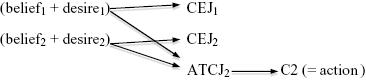
The weak-willed agent follows one rule of rationality, namely, the rule that action must come from detachment of the consequent of a CEJ; the continent agent follows two rules of rationality, namely the action-by-detachment rule and the rule not to act against his all things considered judgment.
It might seem as though the only way for a theory of practical reason to allow for desire conflict generally, or weakness of will, specifically, is to introduce species of desire, and thereby to differentiate the way in which different classes of desire act on us. Davidson avoids this route – instead, he introduces speciation into rationality itself. There are, for him, two kinds of rules of practical reason, the kind that can be broken and the kind that cannot. The first rule marks out the space of possible actions, which is also the realm of desire conflict. The second rule picks out from that space the action, the nonperformance of which counts as weakness of will.
At the outset of our discussion, we set aside a sense of the word “reasonable” in which a belief or desire itself might be externally “reasonable” or “unreasonable.” As theorists of practical reason, our interest is the sense of “reasonable” in which an action is reasonable in the light of an agent's point of view, irrespective of whether it is reasonable for the agent to have that point of view. But Davidson thinks we need to make another distinction within the sense of “reasonable” that is our proper topic, what I have called internal reasonableness. He thinks that an action can be fully internally reasonable by satisfying the principle of continence and the action by detachment principle, or satisfy only the latter principle, and thus be only partly internally reasonable.
Davidson's view raises the question of whether a violable rule can be exceptionless: can there be cases in which one is called upon by the very standards of success at the activity in question to break its (violable) rules? This seems to be the way it goes with soccer. Nothing rules out in principle that there be an occasion in which the benefits to be gained by a rule-violation outweigh its associated penalties. Such occasions would have to be rare, since the distinction between definitional and nondefinitional rules collapses when we consider large scale violation. If everyone were touching the ball with their hands and hitting one another, it would not be a game of soccer. But, given that the game of soccer survives the occasional rule-violation, it looks to be possible that there could be a situation in which someone would be called upon to break a rule. Although perhaps not: perhaps excellence in soccer is not a matter simply of doing what it takes to win the game, but of winning by conforming to (all) the rules?
I leave open the general question of whether violable rules can admit exceptions, since detailed discussion of it would take us far afield, but I want to briefly look at what would follow if the principle of continence had exceptions. What would follow is that weakness of will would not always be irrational. And this, I suggest, might not be an unwelcome result. Jonathan Bennett (1974) put under the spotlight a form of weakness of will in which the weak action is the right one. Huck Finn, judging that he has a duty to return runaway slave Jim to his owner, cannot bring himself to do it. He acts against his better judgment, but he acts well. Indeed, one might, under the influence of philosophers who have developed Bennett's arguments in this direction (Arpaly 2000; Jones 2003; McIntyre 1990), even conclude that he acts rationally. Because perhaps we want to allow that his gut instinct is more rational than that judgment that bears the imprint of a racist education. It is a special feature of Davidson's account of practical reason that it demotes the principle of continence to secondary rational status; this feature might be exploited by those who want to insist on the possibility of rational cases of weakness of will.
4. Final Thoughts: Why Not Partition?
Davidson takes it for granted that if he can come up with a theory of practical reason that allows for “desire” and “motivation” to be used unambiguously, that is itself a strike against partitioning. But there is at least one obvious independent disadvantage of a partitioned view: it cannot allow for conflict within any given species of desire.
In the case of the moralistic partitionist, I focus on intramoral conflict, since he might be thought to have a point in denying intra-appetitive conflict. (It is not clear that being, e.g., both hungry and cold is really anything more than overmotivation of the fourth type.) As Davidson points out, moral conflict seems to be a fact of life: “The situation is common; life is crowded with examples: I ought to do it because it will save a life, I ought not because it will be a lie” (Davidson 1970: 34). The question of whether one moral principle can really conflict with one another is of course a topic in ethics. The utilitarian, for instance, will deny the possibility of a conflict between principles, since he thinks there is only one principle (do whatever maximizes happiness). But even the firmest defender of a univocal morality would have to allow that moral principles can seem to conflict. The moral partitionist must, therefore, say that one of the two “feelings” only appears to come from moral desire. And we have reason to resist both such a rewriting of our experience, and a theory of practical reason that generates substantive ethical commitments of this kind.
The psychological partitionist has a corresponding problem not with morality, but with conflict within whatever partitions he creates. But he also has a way out: he can create partitions in response to his conflict. He can, for instance, divide moral desire into potentially conflicting regions of morality (desire not to lie, desire to save lives). The problem is that it looks as though no partitioning will be safe from the discovery of a further conflict. The desire-to-save-lives itself gets “torn apart” when I need to decide whose life to save. And the desire-to-save-Bill's-life needs to get further subdivided when I face the choice between saving his life painlessly but riskily, or painfully but safely. And so on. The only way to ensure that the desire is not subject to further conflict is to bottom out in particular instances of desiring. But then we lose the generality that says this very desire could have combined with some other belief (or no belief at all) to produce a different (or no) action. Indeed, we lose the distinction between belief and desire, and with it, the very category (desire) within which the partitioning in question was supposed to be taking place.
Davidson's diagnosis of the failure of moral and psychological partitioners is that they bring in some external fact – be it morality or psychology – to solve what is a problem within practical reason. He makes no such distinction between kinds of desire, and therefore is not pressured to place any restriction on which desires can conflict with one another. But his solution does involve distinguishing, at a later stage of the process of practical reason, between forms or kinds of rationality. One might think that in a certain sense Davidson is also partitioning the mind – and he in fact acknowledges this feature of his view in his later paper, “Paradoxes of Irrationality.” (Davidson 1982: esp. 180ff.)
In that paper, he divides the mind not into kinds of desire, but into sets of reasons. One partition corresponds to a set of beliefs and desires (reasons) that, taken together, satisfy the continence principle: “to constitute a structure of the relevant sort, a part of the mind must show a larger degree of consistency or rationality than is attributed to the whole” (Davidson 1982: 180). Globally, the mind must follow the basic principle of practical rationality, the act-by-detaching principle. But locally, each partition is also required to follow the principle of continence. So, in the case of someone who akratically φ-es, we would have one partition containing the unconditional judgment (the conclusion, C) and the CEJ from which it is detached, and another partition for the agent's all-things-considered judgment. Davidsonian partitioning is “flexible” in a number of respects: the partitions will vary from person to person, change over time, can overlap one another, and Davidson does not have anything to say about how many there are, or whether there need be any of them at all. Nonetheless, it is a form of partitioning, creating “spheres” of rationality that can operate with some independence from one another.
Davidson's contribution to the theory of practical reason should, therefore, not be understood as opposition to partitioning of the mind, but opposition to the invocation of psychological or moral distinctions into the theory of practical rationality. What is distinctive about his account of practical reason is that he understands it as autonomous, functioning according to rules it does not borrow from without.
References
Aristotle. (1964). Analytica Priora et Posteriora. Oxford: Oxford University Press.
Arpaly, N. (2000). On acting rationally against one's best judgment. Ethics 110:488–513.
Bennett, J. (1974). The conscience of Huckleberry Finn. Philosophy (London, England) 49:123–134.
Davidson, D. (1963). Actions, reasons and causes. In Davidson (1980), pp. 3–19.
———. (1970). How is weakness of the will possible? In Davidson (1980), pp. 21–42.
———. (1978). Intending. In Actions and Events. Oxford: Clarendon Press (1980), pp. 83–102.
———. (1980). Actions and Events. Oxford: Clarendon Press.
———. (1982). Paradoxes of irrationality. In Philosophical Essays on Freud, R. Wollheim and J. Hopkins (eds). Cambridge, UK: Cambridge University Press.
Jones, K. (2003). Emotion, weakness of will and the normative conception of agency. In Philosophy and the Emotions, A. Hatzimoysis (ed.). Cambridge, UK: Cambridge University Press.
Kolodny, N. (2005). Why be rational? Mind; A Quarterly Review of Psychology and Philosophy 114:455.
Korsgaard, C. (1997). The normativity of instrumental reason. In Ethics and Practical Reason, G. Cullity and B. Gaut (eds). Oxford: Clarendon Press.
McIntyre, A. (1990). Is akratic action always irrational? In Identity, Character, and Morality, O. Flanagan and A. Rorty (eds). Cambridge, MA: MIT Press, pp. 379–400.
Mele, A. (1987). Irrationality. New York: Oxford University Press.
Quinn, W. (1995). Putting rationality in its place. In Virtue and Reasons: Philippa Foot and Moral Theory: Essays in Honor of Philippa Foot, R. Hursthouse, G. Lawrence, and W. Quinn (eds). Oxford: Clarendon Press.
Watson, G. (1977). Skepticism about weakness of will. Philosophical Review 86:316–339.
Williams, B. (1980). Internal and external reasons. In Moral Luck: Philosophical Papers 1973–1980. Cambridge, UK: Cambridge University Press (1981), pp. 101–113.
[2] Assuming we allow that it is possible. Denial of the phenomenon is one philosophical option that Davidson does not consider; it has a pedigree dating back to Plato's Protagoras, but also seems a position of desperation. There certainly seems to be weakness of will. For discussion of this point, see Watson (1977).
[3] As a bibliographical note, Davidson's (1970) paper itself focuses on the moral partitionism of Aristotle, Aquinas, Mill, and so on specifically (see esp. pp. 29–37), whereas psychological partitionism, as a theory of practical reason, came into existence as a response to Davidson's paper. The most extensive development of psychological partitionism is to be found in Mele (1987).
[4] This is, at any rate, the position of 1963 paper “Actions, Reasons and Causes,” in which “intention” is not an entity or state. The function of the word, he claims, is rather to “generate descriptions of actions in terms of their reasons” (Davidson (1963), p.8). In “Intending” (Davidson 1978), he changes his mind on this point in order to allow for the phenomenon of intending without acting, “pure intending.” The issue does not come up in Davidson (1970), and in any case (as is clear from Davidson (1978) and his return to the topic of weakness of will in Davidson (1982)) Davidson does not want to exploit the gap he opens up between intention and action to explain cases of conflictedness. For this reason I set the issue aside as tangential to our topic.