James A. Beckman & Eric Merriam
Crimes against the State (Preview)
Sedition, Rebellion, and Treason since America’s Founding
Timeline of Major Events Involving Crimes against the State
Greathouse, United States v. (1863)
Hanway, United States v. (1851)
BLOOMSBURY ACADEMIC
Bloomsbury Publishing Inc
1385 Broadway, New York, NY 10018, USA
50 Bedford Square. London, WC1B 3DP UK
29 Earlsfon Terrace, Dublin 2. Ireland
BLOOMSBURY. BLOOMSBURY ACADEMIC and the Diana logo are trademarks
of Bloomsbury Publishing Plc
First published in the United States of America 2024
Copyright © Bloomsbury Publishing Inc, 2024
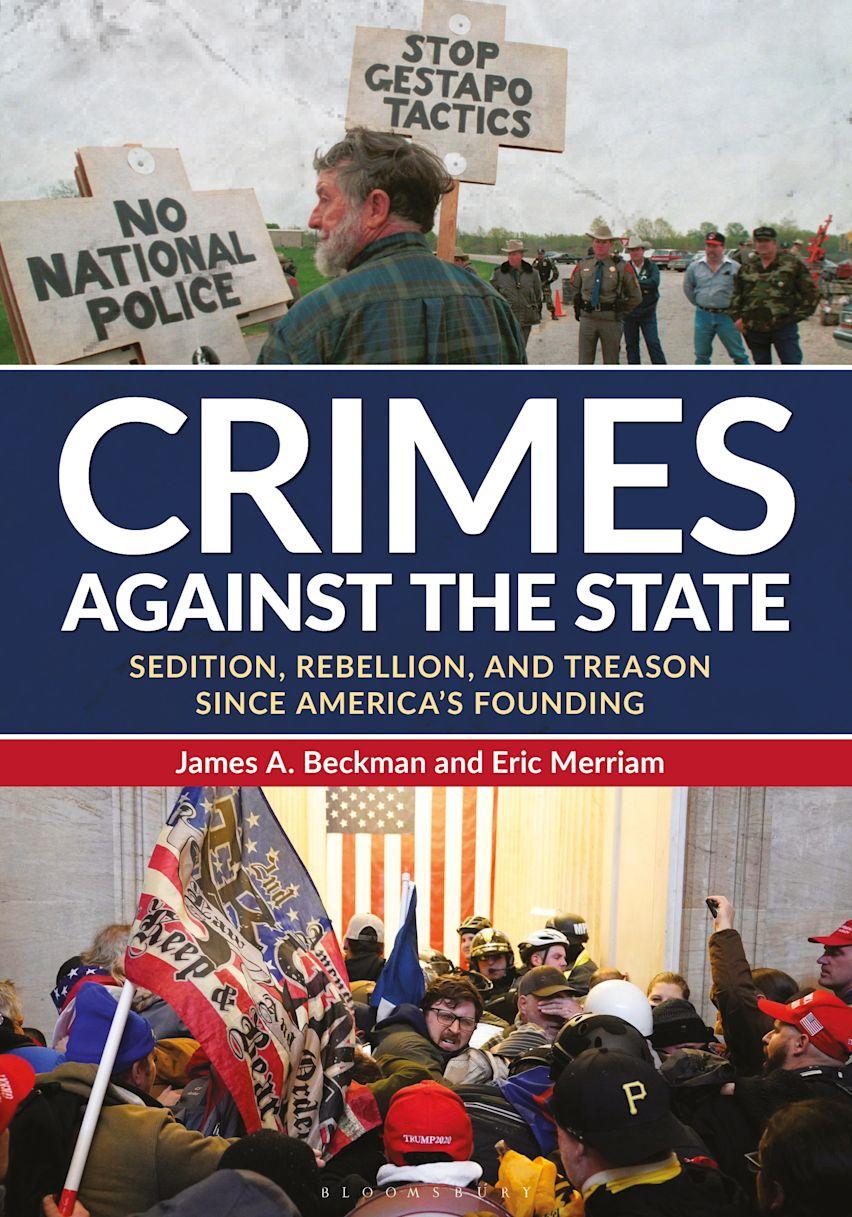
Cover images: (Top) Waco, Texas, March 1993. A protester denouncing what he calls
heavy-handed police tactics against the Branch Davidians. (Bottom) Protestors storm the
Capitol building during a joint session of Congress in Washington, DC on Wednesday, January 6, 2021.
© Bob Daemmrich/Alamy Stock Photo; Sipa USA/Alamy Stock Photo
All rights reserved. No part of this publication may be reproduced or transmitted in any form or by any
means, electronic or mechanical, including photocopying, recording, or any information storage
or retrieval system, without prior permission in writing from the publishers.
Bloomsbury Publishing Inc does not have any control over, or responsibility for. any third-party websites
referred to or in this book. All internet addresses given in this book were correct at the time of going to
press. The author and publisher regret any inconvenience caused if addresses have changed or sites
have ceased to exist, but can accept no responsibility for any such changes.
Library of Congress Cataloging-m-Publication Data
Names: Beckman, James A., author. | Merriam. Eric, author.
Title: Crimes against the state : sedition, rebellion, and treason
since America’s founding / James A. Beckman, Eric Merriam.
Description: New York : Bloomsbury Academic, 2024. |
Cases — Crimes/crime prevention — Events — Individuals — Laws — Movements/orgamzations.
Identifiers: LCCN 2024006299 (print) | LCCN 2024006300 (ebook) | ISBN 9781440879074 (hardback) |
ISBN 9798765124123 (paperback) | ISBN 9798216171188 (epub) | ISBN 9781440879081 (ebook)
Subjects: LCSH: Political crimes and offenses-Law and legislation-United States-History |
Sedition-Law and legislation-United States-History. | Treason-Law and
legislation-United States-History. | Terrorism-Law and legislation-United States-History. |
Civil disobedience-Law and legislation-United States.
Classification: LCC KF9390 B43 2024 (print) | LCC KF9390 (ebook) | DDC 345 73/023l-dc23/eng/20240411
LC record available at https://lccn.loc.gov/2024006299
LC ebook record available at https://lccn.loc.gov/2024006300
ISBN: HB: 978-1-4408-7907-4
ePDF: 978-1-4408-7908-1
eBook: 979-8-2161-7118-8
Typeset by Integra Software Services Pvt. Ltd.
To find out more about our authors and books visit www.bloomsbury.com
and sign up for our newsletters.
Contents
-
Alphabetical List of Entries
-
Topical List of Entries
-
Acknowledgments
-
Introduction
-
Timeline of Major Events Involving Crimes against the State
-
A-Z Entries
-
Index
Alphabetical List of Entries
Abel, Rudolf Ivanovich
Abrams v. United States (1919)
Aid and Comfort (Aid to Enemies of the Slate)
Al-Arian, United States v. (2005)
Alien Act (1798)
Alien and Sedition Acts ( 1798)
Alien Enemies Act (1798)
American Civil War—Amnesty and Pardons
American Civil War and Treason
American Revolution and Treason
Ames. Aldrich Hazen “Rich”
Anarchy, Criminal
Anthrax Attacks (2001)
Anti-Terrorism and Effective Death
Penally Act (1996)
Arnold, Benedict
Assassination
Axis Sally (Mildred Gillars)
Bacon’s Rebellion (1676–7)
Battle of Athens. Tennessee (1946)
Battle of Liberty Place ( 1874)
Booth, John Wilkes
Boston Marathon Bombing (2013)
Brandenburg v. Ohio (1969)
Brown, John
Bundy Standoffs (2014–16)
Burr. Aaron
Burr, United States v. (1807)
Capitol Insurrection on January 6, 2021
Chin, Larry Wu-Tai
Christiana Revolt (1851)
Civil Disobedience and Crimes against the State
Civil Rights Movement and Crimes against the State
Clear and Present Danger Test
Colfax Massacre ( 1873)
Communist Control Act (1954)
Conspiracy, Criminal
Cook, John E.
Copeland, John Anthony, Jr.
Coppoc, Edwin
Corruption of Blood
Cramer v. United States (1945)
Crimes Act of 1790
Criminal Syndicalism
Cruikshank. United States v ( 1876)
Cybersecurity
Davis, Jefferson
Debs v. United Slates (1919)
DeJonge v. Oregon (Wl)
Dennis v. United Stales (1951)
Disqualification Clause
Dorr’s Rebellion (1841–42)
Enforcement Acts (including the
Ku Klux Klan Act) (1870–71)
English Treason Statute of 1351
Espionage
Espionage Act of 1917 and Sedition Act of 1918
Eufaula Election Massacre and Spring
Hill Riot (1874)
Ex Parte Bollman ( 1807)
Ex Parle Milligan ( 1866)
Ex Parte Quirin (Ì942)
Ex Pane Vallandigham (1864)
First Red Scare and the Palmer
Raids (1919–20)
Flag Disrespect as Crime against the State
Fries’s Rebellion (1799)
Fuchs, Klaus
Fuerzas Armadas de Liberacion
Nacional (FALN)
Gabriel’s Rebellion (1800)
Gadahn, Adam Yahiye
Gillowv.New York (1925)
Greathouse, United States v. (1863)
Green Corn Rebellion
Green, Shields
Greenwood, New York, Insurrection ( 1882)
Hamdi v. Rumsfeld (2004)
Hanssen. Robert Philip
Hanway, United Slates v (1X51 )
Hasan, Nidal
Haymarket Adair (1886)
Hazlett, Albert
Hess v. Indiana (1973)
Hirabayashi v United Slates ( 1943) Hiss, Alger
Homeland Security Act (2002)
Hoxie, United Stales v. (1808)
Insurrection
Insurrection Act
Intelligence Identities Protection Act Internal Security Act of 1950 Jefferson, Thomas
John Brown’s Raid (1859)
Kaczynski. Theodore (“Unabomber”)
Kawakita v: United Stales (1952)
Keyishian v. Board of Regents (1967)
Korematsu v. United States ( 1944) Leaks of National Defense Infonnation Levying War
Lincoln Assassination ( 1865)
Lindh. John Walker
Luther v. Borden ( 1849)
Martial Law
Material Support Crimes
McKinley Assassination (1901)
Militia Movement (Modern)
Mitchell, United Slates v. (1795)
Monti, United Stales v. (1949) Mumford. William Bruce
Near v. Minnesota (1931)
New York Times v. United States (\97})
New York v. Lynch (1814)
O ‘Brien, United States v. ( 196X)
Oklahoma City Bombing (1995)
Padilla, United States v. (including Rumsfeld v.
Padilla and Padilla v. Hanft) (2004–2014)
Pelton. Ronald William
Pennsylvania v Nelson (1956)
Pentagon Papers and Trials of Daniel Ellsbcrg and Anthony Russo
Pcijury. False Statements, and
Obstruction of Justice
Pollard, Jonathan Jay
Pottawatomie Massacre ( 1856)
Prize Cases ( 1862)
Puerto Rican Nationalist Party Revolt
Radio Traitors and Anti-State Propaganda during the Second World War
Rebellion
Riot and Incitement to Riot
Rosenberg. Julius and Ethel
Ruby Ridge (1992)
Rudolph, Eric Roberts
Sabotage
Sacco-Vanzetti Case (1921)
Salazar. Hipolito
Schenck v. United Stales (1919)
Second Red Scare (McCarthyism)
Sedition
Sedition Act of 1798
Seditious Conspiracy
September 11,2001
Shay’s Rebellion (1786–7)
Smith Act
Sovereign Citizen Movement
Speech as Crime against the State
Stevens. Aaron
Surratt. Mary E.
Terrorism
Texas V White (1869)
Threats against Government Officials
Tokyo Rose (Iva Toguri D’ Aquino)
Treason
Turner. Nat
United States v. U.S. District Court (1972)
USA PATRIOT Act
Vesey’s Rebellion (1822)
Virginia v. Brown (1859)
Waco (1993)
Walker. John Anthony. Jr.
War of 1812 and Treason
Weapons of Mass Destruction
Weather Underground
West Virginia Coal Wars
Whiskey Rebellion
Whitneys v. California (1927)
Wilmington Insurrection of 1898
Wolverine Watchmen
World Trade Center Bombing of 1993
Yales v. United States ( 1957)
Year of the Spy (1985)
Zcngcr, John Peter
Topical List of Entries
Cases
Abrams v. United States (1919)
A I-A han, United Stales v. (2005)
Brandenburg v. Ohio (1969)
Burr, United States v. (1807)
Carlisle v. United States ( 1872)
Cramer v United States ( 1945)
Cruikshank, United States v. (1876)
Debs v. United States (1919)
DeJonge v. Oregon (1937)
Dennis v United States (1951)
Ex Parte Bollman ( 1807)
Ex Parle Milligan ( 1866)
Ex Parte Quirin (\942)
Ex Parte la Ilandigham (1864)
Gitlow v. New York (1925)
Greathouse, United States v. ( 1863)
Hamdi v. Rumsfeld (2004)
Hanway. United States v. (1851)
Haupt v. United States ( 1947)
Hess v. Indiana (1913)
Hirabayashi v. United States (1943)
Hoxie, United States v ( 1808)
Kawakita v. United States (1952)
Keyishian v. Board of Regents ( 1967)
Korematsu v. United States ( 1944)
Luther v. Borden (ÌM9)
Mitchell, United Stales v. (1795)
Monti, United States v. ( 1949)
Near v. Minnesota (1931)
New York Times v. United States (1971)
New York v. Lynch (1814)
O’Brien. United States v. (1968)
Padilla, United States v (including Rumsfeld v. Padilla and Padilla v Hanft) (2004 14)
Pennsylvania v. Nelson (1956)
Price Cases (1862)
Sacco-Vanzetti Case (1921)
Schenck v. United Stales (1919)
Texas v. White (\M>9)
United States v. U.S. District Court (\912)
Virginia v. Brown ( 1859)
Whitney v. California (\921)
Yates v. United States (1951)
Crimes/Crime Prevention
Aid and Comfort (Aid to Enemies of the State)
Anarchy, Criminal
Assassination
Civil Disobedience and Crimes against the State
Conspiracy, Criminal
Criminal Syndicalism
Cybersecurity
Espionage
Flag Disrespect as Crime against the State
Insurrection
Leaks of National Defense Information
Levying War
Material Support Crimes
Mutiny
Perjury. False Statements, and Obstruction of Justice
Rebellion
Riot and Incitement to Riol
Sabotage
Sedition
Seditious Conspiracy
Speech as Crime against the Stale
Terrorism
Threats against Government Officials
Treason
Weapons of Mass Destruction
Events
American Civil War—Amnesty and Pardons
American Civil War and Treason
American Revolution and Treason
Anthrax Attacks (2001)
Bacon’s Rebellion (1676–7)
Battle of Athens. Tennessee (1946)
Battle of Liberty Place ( 1874)
Boston Marathon Bombing (2013)
Bundy Standoffs (2014–16)
Capitol Insurrection on January 6. 2021
Christiana Revolt (185!)
Colfax Massacre (1873)
Dorrs Rebellion (1841–2)
Eufaula Election Massacre and Spring Hill Riot (1874)
Hirst Red Scare and the Palmer Raids (1919–20)
Fries’s Rebellion (1799)
Gabriel’s Rebellion (1800)
Green Com Rebellion (1917)
Greenwood, New York, Insurrection (1882)
Haymarket Affair ( 1886)
John Brown’s Raid (1859)
Lincoln Assassination ( 1865)
McKinley Assassination ( 1901 )
Oklahoma City Bombing (1995)
Pentagon Papers and Trials of Daniel Ellsbcrg and Anthony Russo
Pottawatomie Massacre ( 1856)
Puerto Rican Nationalist Party Revolt
Radio Traitors and Anti-State Propaganda during the Second World War
Ruby Ridge (1992)
Second Red Scare (McCarthyism)
September 11,2001
Shay’s Rebellion (1786–7)
Vesey’s Rebellion (1822)
Waco (1993)
War of 1812 and Treason
West Virginia Coal Wars
Whiskey Rebellion
W’ilmington Insurrection of 1898
World Trade Center Bombing of 1993
Year of the Spy (1985)
Individuals
Abel, Rudolf Ivanovich
Ames, Aldrich Hazen “Rich”
Arnold, Benedict
Axis Sally (Mildred Gillars)
Booth. John Wilkes
Brown, John
Burr, Aaron
Chin, Larry Wu-Tai
Cook, John E.
Copeland, John Anthony, Jr.
Coppoc, Edwin
Davis. Jefferson
Euchs, Klaus
Gadahn. Adam Yahiye
Green. Shields
Hanssen. Robert Philip
Hasan, Nidal
Hazlett, Albert
Hiss, Alger
Jefferson. Thomas
Kaczynski. Theodore (“Unabomber”)
Lindh. John Walker
Mumford. William Bruce
Pelton. Ronald William
Pollard. Jonathan Jay
Rosenberg. Julius and Ethel
Rudolph, Eric Roberts
Salazar, Hipolito
Stevens, Aaron
Surratt, Mary E.
Tokyo Rose (Iva Toguri D’Aquino)
Turner, Nat
Walker, John Anthony. Jr.
Zenger, John Peter
Laws
Alien Act (1798)
Alien and Sedition Acts ( 1798)
Alien Enemies Act ( 1798)
Anti-Terrorism and Effective Death Penalty Act (1996)
Clear and Present Danger Test
Communist Control Act (1954)
Corruption of Blood
Crimes Act of 1790
Disqualification Clause
Enforcement Acts (including the Ku Klux Klan Act) ( 1870–71 )
English Treason Statute of 1351
Espionage Act of 1917 and Sedition Act of 1918
Homeland Security Act (2002)
Insurrection Act
Intelligence Identities Protection Act (1982)
Internal Security Act of 1950
Martial Law
Sedition Act of 1798
Smith Act
USA PATRIOT Act
Movements/Organizations
Civil Rights Movement and Crimes against the State
Fuerzas Armadas de Liberacion Nacional (FALN)
Militia Movement (Modern)
Sovereign Citizen Movement
Weather Underground
Wolverine Watchmen
Acknowledgments
This book would not have been possible without the guidance and support of several key individuals and institutions. First, the authors are incredibly grateful and appreciative of the support of ABC- CI.IO Bloomsbury Publishing in recognizing the potential of a book of this nature and seeing this book through to publication. Without ABC-CLIO/Bloomsbury. and regardless of the independent importance of the topic and arguable merits of the work, this book simply would not have been possible. Likewise, from the very earliest point in the process more than two years ago, Senior Acquisitions Editor Kevin llillstrom recognized the value of this project, offered essential guidance and support in getting this project off the ground, and provided inspiration and patience in keeping us on track to complete this manuscript. For his invaluable assistance, we are appreciative. We are also grateful to Development Editor Nicole Azze for all the recommended revisions and improvements to the draft manuscript, which undoubtedly resulted in a much-improved final version.
The authors also extend thanks and gratitude to the University of Central Florida (UCF) in allowing its professors the leeway to pursue scholarly projects of merit and in providing resources to complete a book project of this magnitude. The authors were aided by several UCF students who enthusiastically offered assistance and helped us formulate our thoughts on several entries. Those students included Noah Galper. Sebastian Delgado, and Jan Soto.
Finally, the authors are deeply grateful for the enduring and essential support of their spouses. Maria Beckman and Dr. Erica Merriam.
All views expressed in this book arc those of the authors alone, and not those of UCF. the State of Florida, or the United States government. Every effort was taken to ensure this book was free from errors. But to err is human, and any remaining mistakes are the authors’ sole responsibility.
Introduction
In the days after the Capitol Insurrection on January 6, 2021, countless questions were raised regarding the legality and legal consequences of the day’s events. These questions have been debated repeatedly on social media, news programs, talk radio, print media, in Congressional hearing rooms, in courts, and at dinner table conversations around the country. Did those who stormed the Capitol threatening to “hang Mike Pence,” “stop the steal,” or enact “regime change” commit treason? Sedition? Insurrection? How do these differ? What about those who attended the rally and called for actions to keep Donald Trump in the White House but did not engage in any such speech? Does the Constitution not protect citizens and permit them to participate in such activities? Where does the Right of Assembly or Free Speech under the First Amendment end and the right of the government to protect itself begin? Docs the First Amendment protect the conduct of President Donald Trump in imploring his supporters to march on the Capitol?
Long before January’ 6, 2021, historian Bill Coate (2007) wrote, “a fear exists that America may be losing its memory—that our shared collective consciousness may be fading” and that it is as if Americans “have been afflicted with a kind of historical amnesia” (IX). To understand and make sense of an event like January’ 6 requires knowledge and understanding of similar events in the nation’s past. As Coate urged, “a common understanding based upon some common knowledge of our nation’s past is imperative. It draws people together. It gives us a common, civic identity. Indeed, the promise of America is premised on the need for an educated citizenry” (IX). This is perhaps what Thomas Jefterson meant when he wrote that “if a nation expects to be ignorant and free, it expects what never was and never will be” (Coatc 2007, IX). A collective understanding and knowledge of our past undoubtedly helps us make sense of the present and provides a roadmap to navigate problems in the future. As ancient religious texts remind us, “The thing that hath been, it is that which shall be; and that which is done is that which shall be done: and there is no new thing under the sun” (Ecclesiastes 1:9). As the reader of our modest book will realize, “there is nothing new under the sun” when it comes to crimes against the state.
Indeed, the history of the United States is replete with examples of insurrection, rebellion, treason, espionage, sabotage, mutiny, and other crimes committed against the government. The American Revolution was itself a treasonous rebellion against Great Britain, and its leaders were traitors. Benedict Arnold was one of the first traitors against the United States, before the nation even came into existence. The nation’s third vice president. Aaron Burr, was the subject of one of America’s earliest treason prosecutions after he attempted to split the country. The United States was faced with other early acts of rebellion, collective disobedience, and treason prosecutions in events such as the Whiskey Rebellion and Fries’s Rebellion. State governments dealt with numerous rebellions and insurrections and treason in the antebellum era. from Nat Turner’s Slavery Insurrection in 1831 to Dorr’s Rebellion in 1842 to John Brown’s Raid in 1859. Over 150 years ago, the American Civil War constituted the largest single act of treason and rebellion in the history of the United States. During the First and Second World Wars, the country witnessed hundreds of prosecutions ranging from seditious speech to espionage and treason. Though the events involving the Capitol Insurrection on January 6.2021, may appear to be a new low in American history, reviewing entries in this book on topics ranging from the American Civil War to the Colfax Massacre, the Eufaula Election Massacre and Spring Hill Insurrection, and the Wilmington insurrection of 1898 will sadly illustrate otherwise.
“Crimes against the state” traditionally include criminal offenses like treason, sedition, seditious conspiracy, sabotage, espionage, mutiny, assassination, and conspiracies to harm the government, among other things. Indeed, the primary factor that distinguishes crimes against the state from other crimes is that the intended “victim” of a crime against the state is the sovereign. That is, such crimes are intended to injure the government in some way. In announcing the decision to impose the death sentence in the Second World War treason prosecution of Tomoya Kawakita (Kawakita v. Uniled States, 1952), the presiding trial judge made an observation that is helpful in understanding how crimes against the state differ from other crimes. The judge stated:
As I view this matter, it is not a question of whether the defendant kicked some American prisoner of war or a dozen of them. His crime might be briefly put in two sentences. [The defendant] said that from 1943 on he did everything he could to help the Japanese Government win the war [and tjhc jury found that he owed a duty of loyalty at that time to the United States. So. his crime cannot be considered ... in terms of beating up someone, no matter how brutal. His crime is a crime against the country of his birth. His crime is not against a few American prisoners of war. His crime is against the whole people of this country where he was born and where he was fed and where he was educated. Throughout history treason has always been the crime most abhorred by English-speaking peoples. The traitor has always been considered even worse than a murderer. And the distinction is based upon reason: for the murderer violates at most only a few, while the traitor violates all the members of his society, all the members of the group to which he owes his allegiance.
Stating it somewhat more succinctly, in commenting on why he would not commute the death sentences of Julius and Ethel Rosenberg for committing espionage by providing nuclear secrets to the Soviet Union, President Dwight D. Eisenhower said that the “nature of the crime for which they have been found guilty and sentenced far exceeds that of the taking of the life of another citizen; it involves the deliberate betrayal of the entire nation and could very well result in the death of many, many thousands of innocent citizens” (Eisenhower 1953). Crimes against the state are those offenses that target the sovereign and in so doing aim to impact the entire society.
This book is a study of crimes against the state in the United States. In most nation states under a unitary system of government, the “state” is the national government as all the power resides in a central government. So too, in the United States, crimes against the state arc primarily considered to be crimes against the national government, where continued existence of the nation itself, or at least its existence under the current form of government, may be jeopardized. Indeed, when one considers crimes like treason, sedition, insurrection, or espionage, one naturally thinks of a national government as the target. By contrast, one does not typically think of spying against Massachusetts or sedition against Florida. Yet. unlike in a unitary system, some offenses directed toward state or local governments (as opposed to the national government) may also constitute crimes against the state. And state governments may protect themselves with laws to the extent those laws arc intended to protect the state government (and not the federal government).
In Pennsylvania v. Nelson (1956). the United States Supreme Court held that states could not criminalize sedition against the United States because the federal government already had outlawed such speech and activities. But the Court took care to observe that it was not declaring state sedition laws Io be unconstitutional when the state government is the target of seditious activity or speech. The Court explicitly explained that states could protect themselves. So. under the United States’ federalist system of dual sovereigns where the federal government and each individual state are sovereign, “crimes against the state” include offenses where cither the federal government or the state government is the intended victim. For example, state criminal anarchy, criminal syndicalism, and sedition laws can be constitutional to the extent the state government is endeavoring to protect itself rather than the national government (and consistent with the Supreme Court’s jurisprudence regarding speech as crime against the state).
Given state sovereignty and police powers over citizens, attacks against state governments take on a character quite like crimes against a national government. Indeed, as detailed in this book, several of the most significant crimes against the state in United States history were crimes against a state or subsidiary local government, rather than against the federal government. An early example of this was Dorr’s Rebellion, an attempt to overthrow the government of Rhode Island by force and install a shadow government. In the subsequent prosecution of Thomas Wilson Dorr, the court decided that prosecution for treason against Rhode Island was appropriate because Rhode Island had a right to protect itself as a sovereign. Another example includes Virginia v. Brown (1859), where John Brown was charged with treason against the Commonwealth of Virginia, even though Brown’s crimes targeted both the federal government’s arsenal and armory and the state government’s slavery policy. Often, crimes against both the state and federal government are intermingled. For instance, other early examples include the West Virginia Coal Wars, where local government was the victim of the mine workers’ insurrection, but the insurrection was quelled in part by federal military forces, and Untied Stales v Cniikshank (1876), where the federal government attempted to prosecute individuals under federal law for the Colfax Massacre, a violent insurrection that overthrew local government officials.
As the book title suggests, and the Timeline of Major Events indicates, the book covers the period from America’s founding through the present. Thus, the book covers a lot of ground. The reader will find notable laws, concepts, cases, people, and events in American history. Included in this book arc discussions ranging from treason and rebellion in the American Revolution and the Civil War. to how antebellum rebellions like Dorr’s Rebellion in 1842 and John Brown’s Raid in 1859 were handled, to twentieth-century events like Ruby Ridge, Waco, and the Oklahoma City bombing. The book attempts to address the root causes of these events, and the legal and constitutional constraints on the government’s reaction to such events. As William Faulkner once argued, the reading and study of historical events is not the study of “was,” but rather the study of “is.” Thus, this book is the study of crimes against the United States in 2024. even if the entry at issue in the book originally occurred with an event, person, or law in the 1800s or 1900s. Analyzing these events is important to understanding events happening in the United States in 2024.
A few comments about topic inclusion and exclusion are appropriate. Some malevolent individuals like Eric Rudolph. Timothy McVeigh (Oklahoma City Bombing), and Ted Kaczynski (the “Unabomber”) are profiled in this book, while other notorious mass murderers, bombers, or shooters are not. For instance, the heinous and deplorable criminal behavior of individuals like serial killers Ted Bundy and Jeffrey Dahmer is not covered. Bundy and Dahmer were not motivated to attack the government, but rather by the perverse gratification they got from killing their victims. As heinous and repugnant as their actions were, they were not crimes against the state. On the other hand, the violent actions of individuals like Rudolph. McVeigh, and Kaczynski were directed at the government as the intended victim. For example, Eric Rudolph’s views about the government, coupled with his violent actions directed toward the sovereign state, transformed his “ordinary” criminal law offenses of abortion clinic bombings and the 1996 Olympic Bombing into what we classify as a crime against the state. A bombing or killing to stop a government policy or law (in this instance, government policy in support of early-stage abortions) is ultimately directed at injuring the state itself, not merely effecting policy change. On the point of prompting changes in government policy alone, readers may wish to consider the entry on Civil Disobedience and Crimes against the State, which includes our conclusion that traditional civil disobedience is not a crime against the state because government policy (only) is the target, not the government itself.
Another example illustrating this methodology of topic inclusion/exclusion can be seen with presidential assassinations. The crime of assassination is a classic crime against the slate and has its own entry in this book. Additionally, there are entries in this book on the specific assassinations of Abraham Lincoln in 1865 and William McKinley in 1901. Yet, for purposes ofthis book, assassinations or attempted assassination plots are not considered a crime against the state if the perpetrator attempted the assassination for personal reasons independent of a desire to harm the government or the nation (i.e., the sovereign). For example, John Hinckley, Jr., attempted to assassinate Ronald Reagan not to harm the government, but rather in a misguided attempt to impress actress Jodie Foster, with whom Hinckley had become infatuated. Similarly. Lynette “Squeaky” Fromme. who was associated with the Manson Family cull, attempted to assassinate President Gerald Ford in 1975. Fromme’s crime was clearly a violation of federal law and subject to prosecution and conviction, but Fromme was not apparently motivated by the goal to attack the government. Rather. Fromme’s actions were driven by her devotion to Manson and the Manson Family’s ideologies. Conversely, the Lincoln assassination is a textbook example of a “crime against the state.” The perpetrators of the assassination plot contemplated decapitating the entire upper echelon of the federal government, including killing the president, vice president, Secretary of State, and the commanding General of the Union Anny, with the goal ofchanging government policy toward the South. Similarly, the McKinley Assassination was committed by an avowed anarchist, who sought eradication of the government. As such, the Lincoln and McKinley Assassinations are included in this book, while the assassinations of President John F. Kennedy and James Garfield arc not.
The concept for this book is to provide the reader with a reference to explore crimes against the state throughout US history. While it is primarily a reference work, individual entries can be read selectively to learn about a discrete topic, event, law, person, or concept. To the extent possible, this volume is intended to be a dispassionate exploration of its subjects rather than a commentary. The authors have attempted to avoid editorializing the various issues addressed in the pages herein, in the hope that sufficient information on the given topic to allow the reader to draw his or her own conclusions or pursue further inquiry. The entries/essays in the book are arranged alphabetically. If the reader has a particular topic in mind (c.g., treason or seditious conspiracy or why people were not prosecuted for treason for the American Civil War), the reader can turn directly to that entry in the book. Thus, individual topics can be read selectively based upon the reader’s individual interests and intellectual curiosity. At the end of each entry, a “See Also” section directs the reader to related entries, allowing for appreciation of a broader topical context. Each entry concludes with a “Resources” section that both identifies sources we used in creating the entries and suggests further reading for the reader’s independent research and inquiry. Finally, the detailed index at the end of the book is another way in which entries and topics arc cross-rcfcrcnccd, and further allows the reader to find topics, theories, persons, concepts, events, laws, and other details mentioned in the text, but that may not have their own separate entry. These various aids should help the reader to connect the dots on sometimes seemingly unrelated topics and lo find a host of information on interrelated topics.
In discussing Plato’s Laws, Harvard Law Professor Mary Ann Glendon once noted Plato’s observations on the value and wisdom of learning from the successes and failures from the past and from other rulers (and other Greek City States). Glendon wrote, “since the city [Athens, a Greek city-state] must constantly be re-examining and revising its laws, its Guardians [i.e., rulers] would do well, he [Plato] advises, to send out mature citizens to study especially good laws elsewhere, and to seek assistance from wise persons wherever they may be found, even in ill-ordered cities” (Glendon 1987,6). This is what is attempted here. Though we do not travel from city to city or seek out “mature citizens to study especially good laws,” we do engage in a sort of time travel in this book, visiting different episodes of American history, and studying the laws—good and bad—as they have evolved over time, sometimes even conversing with the dead. It is not only a study of what laws and practices appeared to have worked, but also those that did not.
Discussions of contemporary’ events like the Capitol Insurrection on January 6, 2021, or the indictment of former President Donald Trump for violating the Espionage Act of 1917 (the first indictment of a president in US history) inevitably lead to broader questions beyond the specifics of that event. Prosecution of some Capitol Insurrection participants for seditious conspiracy invokes questions about the difference between treason and seditious conspiracy and why treason has not been prosecuted more frequently in US history. How far docs the freedom of speech and to protest the government extend? In a time of peril, can speech and actions be curtailed to protect government institutions or even the nation itself? What laws has the government put into place to protect itself against further attacks on its sovereignty? Did January 6th have historical analogs? And why did former President Trump’s mere possession of classified documents after he left office lead to an indictment for violating the same federal statute under which notorious spies like Aldrich Ames and Robert Hanssen have been prosecuted?
For readers wishing to understand contemporary actions against the government and how the government may lawfully respond, this book provides relevant historical and contemporary illustrations. As such, the goal of this book is to arm the reader with information that will “cut through the noise” of the internet, social media, and broadcast media, and help the reader to ( I ) learn how to differentiate between sedition, insurrection, treason, domestic terrorism, espionage, and other acts meant to injure or overthrow the government: (2) gain a deeper understanding of laws, policies, and events that have aroused violent or nonviolent opposition; (3) better comprehend the perspectives and motivations of those who commit crimes against the state; and (4) evaluate various state responses to these challenges and threats, from martial law-style crackdowns to new laws and reforms. We hope the study of crimes against the state in our nation’s past—whether it is a study of persons, concepts, events, laws, or judicial cases—will help protect and presele the state in the future.
Resources
Coate, Bill. 2007. Shocking Secrets & American History . New York: MJF Books. IX.
Eisenhower. Dwight. 1953. The White House: Statement by the President. Dwight David Eisenhower Presidential Library. February II. 1953. Accessed October 30. 2023. https://www.eisenhowerlibrary.gov/sites/default/files/file/Rosenberg_3a.pdf.
Glendon, Mary Ann. 1987. Abortion and Divorce in Western Law: American Failures, European Challenges. Cambridge, MA: Harvard University Press. 6.
Timeline of Major Events Involving Crimes against the State
Note: See individual entries for an in-depth description of those events.
| 1676 | First major armed rebellion or insurrection by American colonists against their own government in New World occurs in Bacon’s Rebellion. The leader of the rebellion, Nathanial Bacon, is one of the very first people accused of treason in the New World. |
| 1735 | The trial and acquittal of John Peter Zenger for charges of seditious libel illustrate early American intolerance of seditious libel as a crime against the state or an act punishable by the state. |
| 1775 | First shots of the American Revolution are fired on April 19, in Lexington. Massachusetts. In June 1775. British General Thomas Gage announces that all colonists in arms arc “rebels and traitors, and as such to be treated.” During the years of the Revolution ( 1775–83), tens of thousands of colonists commit open hostility and levy war upon Great Britain and are thus guilty of treason, though few if any arc prosecuted by Great Britain. Likewise, thousands of individuals who remain loyal to the Crown find themselves in a position of committing treason against the revolutionary colonies, and during the Revolution scores of such persons are prosecuted for treason by the colonies. The American Revolution and the American Civil War constitute two monumental events involving hundreds of thousands of acts of treason. |
| 1776 | American Colonics formally assert independence by delivering to King George a Declaration of Independence, penned by Thomas Jefferson, Benjamin Franklin, John Adams. Robert R. Livingston, and Roger Sherman. |
| 1780 | Benedict Arnold engages in an espionage and treason plot for the British government. Arnold commits one of the most notorious acts of treason and espionage against nascent United States by conspiring to sell the fortifications of West Point. New York, to the British. |
| 1786–7 | Shay’s Rebellion takes place. It is the first of three major anti-taxation rebellions in the United States following independence (see also Whiskey Rebellion in 1794 and Fries’s Rebellion in 1798 9), but the only major anti-taxation rebellion to occur before the adoption of the United States Constitution. Shay’s Rebellion is the first instance wherein hundreds of Americans are charged and convicted of treason for a single series of events. |
| 1789 | Ratification of United States Constitution, Article III of which detailed the elements and proof required for treason, the only crime specified in the Constitution. The ortense of treason was not previously delineated in the Articles of Confederation (1781–8). |
| 1790 | The first Congress passes the Crimes Act of 1790, officially titled “An Act for the Punishment of Certain Crimes Against the United States.” It was the US government’s first codification ofcrimes, including crimes against the state, including treason, perjury, bribery, and counterfeiting federal securities or money. |
| 1791 | Ratification of the Bill of Rights as the first ten amendments to the United States Constitution, including the First Amendment’s guarantee of freedom of speech and of the press and the right to peaceably assemble and petition the government for redress. |
| 1792 | Under Congress’s Article I, Section 8, power to “provide for calling forth the Militia to execute the Laws of the Union, suppress Insurrections and repel Invasions,” Congress first enacted the Militia Act (significantly amended and renamed as the Insurrection Act in 1807). |
| 1794 | Government uses military force to suppress the Whiskey Rebellion. The Whiskey Rebellion is the second of three major anti-taxation rebellions in the United States following independence (see also Shay’s Rebellion in 1786–7 and Fries’s Rebellion in 1798–9), and the first instance of treason convictions under the new United States Constitution. Congress calls out the Army under the recently enacted 1792 Militia Act. |
| 1795 | A federal trial court discusses the treason indictment of one of the defendants stemming from conduct occurring during the Whiskey Rebellion in United States v Mitchell. |
| 1798 | Congress passes four separate laws all dealing with national security of the new nation; these four laws collectively become known as the Alien and Sedition Acts. Among other things, the laws allow for the immediate deportation of aliens deemed “dangerous” to the United States or an “enemy” of the United States and make it a crime to criticize the government, make any statement that would bring the Congress or the President “into contempt or disrepute.” |
| 1798–9 | Fries’s Rebellion lakes place. Fries’s Rebellion is the third major anti-taxation rebellion after Revolutionary War (see also Shay’s Rebellion in 1786–7 and Whiskey Rebellion in 1794). Participants arc indicted and tried for treason, and other crimes including sedition, insurrection, and rioting. It is the second incident (after the Whiskey Rebellion) where the federal government convicted individuals of treason since the ratification of the constitution in 1789. President John Adams invokes the Insurrection Act and the Militia is again called out to quell the rebellion. |
| 1800 | Gabriel’s Rebellion, sometimes referred to as the Virginia Plot of 1800. is thwarted. Gabriel’s Rebellion involves a plot of thousands of enslaved Black Americans to overthrow the institution of slavery in Virginia and institute a new government in Virginia. |
| 1801 | The Sedition Act of 1798 expires as Thomas Jefferson takes office as President. Jefferson pardons all convicted under the Sedition Act during the John Adams administration. |
| 1807 | Former Vice President Aaron Burr and his accomplices are put on trial for treason. See United States v. Burr (1807). See also federal trial court’s decision regarding accomplices in Ex Parte Bollman (1807). |
| 1807 | Congress enacts the Insurrection Act (an amendment to the earlier Militia Act of 1792), authorizing the President to use federal military’ forces to suppress insurrections or rebellions. Though amended several limes, the Insurrection Act is still in cfi’cct today. |
| 1808 | Federal trial court decides United States v. Hoxie, an important early case describing limitations in the application of the “levying war” provision of the Treason Clause in the United States Constitution, and also in dismissing attempts to inculcate the English concept of constructive treason” into American law. The Hoxie case establishes that even armed resistance to the authority of the federal government, without treasonous intent, does not amount to the act of “levying war” and treason. |
| 1812 | The War of 1812 is the United States’ first war after the ratification of Constitution and therefore is the first instance of the country grappling with whether dissidence during wartime might constitute treason. Unlike the American Revolutionary War. which itself constituted treason against Great Britain, the War of 1812 occurs between sovereign nations. Some New England states contemplate secession or entering into their own peace treaties with Great Britain. |
| 1814 | In New York v. Lynch, New York prosecutes defendants for treason against the state government, stemming from conduct that took place during the War of 1812. |
| 1822 | The second of four plots to overthrow the institution of slavery in North America prior to the American Civil War takes place in Vesey’s Rebellion. (See also Gabriel’s Rebellion in 1800, Nat Turner’s Rebellion in 1831. and John Brown’s Raid in 1859.) |
| 1831 | Nat Turner’s Rebellion takes place in Virginia. Nat Turner’s Rebellion is the third of four major slave rebellion plots in North America prior to the American Civil War (see also Gabriel’s Rebellion in 1800, Denmark Vesey’s Rebellion in 1822, and John Brown’s Raid in 1859). |
| 1837 | John Brown begins his campaign to end slavery, an effort that reaches its apotheosis in his 1859 raid on the United States Armory and Arsenal at Harpers Ferry. Virginia. |
| 1841–1 | Thomas Wilson Dorr unsuccessfully attempts to supplant the government in Rhode Island that had been in existence since 1663 and seize the Rhode Island state arsenal in an uprising called Dorr’s Rebellion. Dorr’s Rebellion marks the first instance of a successful prosecution and conviction for treason against a state government (Rhode Island). In 1849, in Lulher v. Borden, the United States Supreme Court upholds Rhode Island’s right to use military force to suppress rebellion against it. |
| 1847 | The federal government exercises extraterritorial jurisdiction over Mexican citizen Hipolito Salazar and prosecutes, convicts, and executes him for treason against the United States. |
| 1849 | Henry David Thoreau pens his famous essay On the Duty of Civil Disobedience. |
| 1851 | The Christiana Revolt occurs, leading to the unsuccessful attempted federal prosecution of dozens of individuals for treason for failing to adhere to the federal Fugitive Slave Act of 1850. The Christiana Revolt is a violent confrontation between citizens, fugitive slaves, slave catchers, and a deputized federal marshal. The incident also gives rise to an important judicial pronouncement by a federal trial court on what constitutes “leying war” against the United States in United States v. Hanway. |
| 1856 | Radical abolitionist John Brown leads several abolitionists to question several settlers near the Pottawatomie River in Kansas regarding their views on slavery. Brown and his men gruesomely murder several men. in what becomes known as the Pottawatomie Massacre. |
| 1859 | John Brown and a band of twenty-one men attack the United States Armory and Arsenal at I larpers Ferry, Virginia, attempting to destroy the institution of slavery in Virginia. Virginia prosecutes John Brown and six accomplices for treason against the Commonwealth of Virginia, murder, and insurrection. John Brown’s Raid constitutes the last of the major slave rebellion plots in North America prior to the American Civil War (see also Gabriel’s Rebellion in 1800, Vesey’s Rebellion in 1822, and Nat Turner’s Rebellion in 1831). |
| 1861–5 | Southern states secede and hundreds of thousands of Southerners take up arms against the federal government between 1861 and 1865 in the American Civil War. |
| 1861 | Congress criminalizes seditious conspiracy for the first time, making it a lesser alternative to a treason charge. |
| 1862 | Military trial and execution of William Bruce Mumford for a minor infraction/ violation of the prevailing martial law in New Orleans, Louisiana. |
| 1864 | Supreme Court decides Ex Parle Vallandigham. The Court determines it did not have jurisdiction to review an appeal from a military commission. The Supreme Court’s decision is momentous in ensuring the military’s ability to try and sentence civilians and military members without appellate review, though the Court later reverses itself on that question. |
| 1865 | John Wilkes Booth. Mary Surratt, and others attempt to overthrow the federal government through an assassination plot. The conspiracy involves assassinating the President, Vice President, Secretary of State, and the General-in-Chief of the Union Army. President Abraham Lincoln is assassinated. |
| 1865 | The American Civil War ends with the South’s defeat. President Andrew Johnson issues the first of multiple presidential pardons providing amnesty to large segments of the population who engaged in the Civil War against the federal government. |
| 1865 | Confederate veterans seeking to use intimidation and violence to prevent exercise of civil and political rights by newly freed Black Americans form the Ku Klux Klan, the first of several such organizations created to preserve White power and privilege in the South. |
| 1866–8 | Attempting to hold Southerners legally accountable for the American Civil War. the federal government unsuccessfully prosecutes the Confederacy’s highest-ranking official, ex-Confederate President Jefferson Davis, fortreason against the United States. |
| 1866 | The Supreme Court decides Ex Parle Milligan. The Court addresses two fundamental legal issues: (I) whether a civilian has the right to seek review of his military detention through the principle of habeas corpus; and (2) whether the President has authority to detain noncombatants as part of a war effort. |
| 1867 | President Andrew Johnson issues second presidential pardon providing amnesty to those engaged in hostilities against the federal government during the Civil War. |
| 1868 | President Andrew Johnson issues final proclamation providing “a lull pardon and amnesty for the offences of treason against the United States, or of adhering to their enemies during the late civil war” for all persons. |
| 1868 | Fourteenth Amendment ratified. Among other provisions, the Fourteenth Amendment guarantees equal protection and due process of law to all and provides for the disqualification for federal office of anyone who takes an oath to support the Constitution and then engages in insurrection or rebellion against the United States (Disqualification Clause). |
| 1869 | In Texas v. While, the Supreme Court holds that state governments lack the legal authority to unilaterally withdraw from the Union. |
| 1870–1 | Congress passes three “Enforcement Acts,” also known as the Force Acts, one of which is known as the Ku Klux Klan Act. to enforce the Civil War Era Constitutional Amendments (i.e.. Thirteenth, Fourteenth, and Fifteenth Amendments). |
| 1872 | In Carlisle v. United Stales, the United States Supreme Court holds that an alien resident (non citizen) could commit the offense of treason against the United States. |
| 1873–4 | In the wake of dissatisfaction with Reconstruction and the results of the 1872 election, attempts to overthrow duly elected government officials with large-scale violence occur throughout the South. One of the violent confrontations results in the Colfax Massacre (1873), which culminates in the “Battle of Liberty Place” (1874). See also Eufaula Election Massacre and Spring Hill Insurrections (1874). The Eufaula Election Massacre and Spring Hill Riot are perpetrated by armed White supremacists determined to retake control of government. The White supremacists’ success in violent insurrections aimed at the electoral process leads to the domination of state and local government and decades of Jim Crow laws throughout the South. |
| 1876 | In United States v. Cruikshank, the Supreme Court overturns the convictions of several individuals involved in the Colfax Massacre. The Court takes a very narrow view of the Enforcement Acts and the Enforcement Clauses of the Thirteenth and Fourteenth Amendments. |
| 1886 | Pro-labor and anarchy forces clash with police in Chicago, Illinois, in an event called the Haymarket Aff air. |
| 1898 | White supremacists violently overthrow the elected government of Wilmington. North Carolina, in the Wilmington Insurrection of 1898. |
| 1901 | Assassination of President McKinley by an anarchist, who is subsequently tried, convicted, and executed. |
| 1903 | The Militia Act of 1903 formally organizes militias under state control into what are today known as state Army National Guard and Air National Guard units. |
| 1912–21 | The West Virginia Coal Wars, a series of labor disputes between miners and mining companies from 1912 to 1921. Multiple West Virginia governors declare martial law to address the breakdowns of local government during the hostilities. The fighting culminates with the Battle of Blair Mountain, which requires the mobilization of 2,500 troops from two infantry divisions of the United States Army to quell and is the largest (by number of participants) insurrection in United States history other than the American Civil War. |
| 1917 | The United States enters the First World War (1914–18). American involvement in the First World War brings thousands of anti-war protestors, dissidents, and anarchist protestors on the home front. Congress passes the Espionage Act of 1917. The Espionage Act criminalizes obtaining, conveying, transmitting, receiving, or failing to protect information relating to national defense with intent to injure the United States or aid a foreign nation (any foreign nation, not just enemies). |
| 1917 | Green Corn Rebellion takes place in Oklahoma. Anti-conscription, anti-war, and prolabor individuals protest and rebel against the draft and the war and meet with violent resistance from town. In the aftermath, nearly 500 protestors rebels arc arrested, and 192 federally prosecuted. The protestors are initially charged with treason, but officials at the Department of Justice in Washington convince the prosecutor to instead test the prosecutorial viability of the recently enacted Espionage Act of 1917. |
| 1918 | As the First World War wages on. Congress passes amendments to the Espionage Act that arc sometimes informally referred to as the Sedition Act of 1918 (Sedition Act). As has been the case with the Sedition Act of 1798 (one of the Alien & Sedition Acts), the Sedition Act of 1918 is intended to suppress wartime dissent and is Congress’s first foray into this area since it enacted the Sedition Act of 1798. In addition to criminalizing anti-war speech. Congress criminalizes disrespecting the American flag or displaying the flag of an enemy. |
| 1919–20 | In the wake of the successful Bolshevik seizure of the Russian government in 1917 and end of the First World War, many Americans transfer their First World War distrust of Germans to a distrust of Communists, Bolsheviks, and anarchists after the war in a period known as the “First Red Scare.” The First Red Scare leads to rampant civil rights abuses, including the Palmer Raids. |
| 1919 | During the First Red Scare, the Supreme Court upholds the conviction of socialist leader Eugene Debs for charges brought under the Espionage Act of 1917 and Sedition Act of 1918 in Debs v. United States and upholds government authority to limit critical speech in other cases such as Schenck v. United States and Abrams v. United States. |
| 1921 | Nationwide attention on the successful state prosecution of two anarchists in the Sacco and Vanzetti case. |
| 1925 | Supreme Court decides Gitlow v. New York. It is the first time the Supreme Court holds that the First Amendment of the United States Constitution restricts state government, not only the federal government. Gitlow is another case in which the Supreme Court upholds the ability of government to “protect itself by restricting speech that might undermine security or the existence of government itself. |
| 1927 | Supreme Court decides Whitney v. California, in which it rejects the argument that California’s criminal syndicalism statute violates the defendant’s rights to free speech, expression, and association. In a concurring opinion. Justice Louis Brandeis authors an impassioned defense of a more libertarian view of free speech rights that is vindicated four decades later in Brandenburg v. Ohio (1969). |
| 1931 | In the case of Near v. Minnesota, the United States Supreme Court sets forth for the first time the doctrine that the First Amendment docs not permit prior restraint or censorship of speech or publications by the government except in exceedingly rare circumstances. |
| 1937 | Supreme Court decides DeJonge v. Oregon, holding that “peaceable assembly for lawful discussion cannot be made a crime.” |
| 1940 | Supreme Court decides Minersville School District v. Gobilis, upholding a local school board’s requirement that all students salute the national flag as part of a daily school exercise (see Flag Disrespect as Crime against the State). |
| 1941–5 | American involvement in the Second World War. Dozens of treason prosecutions take place, including radio propagandists from both the European and Pacific Theatres. |
| 1942 | In Ex Parte Quiriti, the Supreme Court allows the execution of German saboteurs caught in the United States. The Supreme Court affirms the President’s authority for military tribunals under the Articles of War and the international law of war. |
| 1943 | The Supreme Court reverses course from its 1940 Gobilis opinion, ruling in West Virginia State Board of Education v. Barnette that states cannot compel school children to salute the flag. |
| 1943 | In Hirabayashi v. United Slates and Yasui v United Stales, the Supreme Court upholds the constitutionality of a curfew imposed only on persons of Japanese ancestry, regardless of United States citizenship. |
A-Z Entries
Greathouse, United States v. (1863)
United Stales v. Greathouse (1863) is a treason ease arising from the American Civil War. The Greathouse case set forth the important principle that acts of rebellion or hostility against one’s own government can only be treason if those acts themselves amounted to levying war. The court in Greathouse held that aiding others in acts of rebellion against the United States cannot be treason under the Aid and Comfort Clause, as the Clause is only applicable to foreign adversaries who are engaged in open hostilities with the United States. Those rebelling against their own governments are not foreign adversaries under the meaning of the Treason Clause in the Constitution.
On March 15, 1863, United States officers seized a schooner named the J. M. Chapman in the harbor oil the coast of San Francisco, California. The J. M. Chapman was fitted out as a privateer and received a letter of marque and reprisal from Confederate President Jefferson Davis (see Davis, Jefferson). Letters of marque and reprisal were written authorizations from the government to vessels to prey on the commerce of foreign adversaries, and privateer vessels were merchant vessels fitted with armaments needed to attack other vessels. The leaders of the J. M. Chapman were attempting to interfere with “the commerce of the United States” by intercepting mail shipments. There were also plans to capture the federal military installation at Alcatraz. Ridgeley Greathouse and multiple other sailors on board the J. M. Chapman were charged with committing treason. The indictment against the defendants alleged:
(I) The existence of a rebellion against the United States, their authority and laws; (2) That the defendants traitorously engaged in. and gave aid and comfort to, the same; (3) That in the execution of their treasonable purposes, they procured, fitted out and armed a vessel to cruise in the service of the rebellion, on the high seas, and commit hostilities against the citizens, property and vessels of the United States; and that the vessel sailed on such cruise.
Supreme Court Justice Stephen Johnson Field, acting as a Circuit Justice, instructed the jury that defendants charged with treason for assisting others in rebellion against the United States should only be charged and. if appropriate, convicted, of levying war against the United States, and not adhering to its “enemies, giving them aid and comfort.” Justice Field held that a treason charge based upon providing aid and comfort to an enemy of the United States only applies if the aid and assistance was rendered to a “foreign power in a state of open hostility” with the United States. Justice Field ruled, in part, as follows: “(t]hc term enemies, as used in the second clause, according to its settled meaning, at the time the constitution was adopted, applies only to the subjects of a foreign power in a state of open hostility with us.” Justice Field indicated that the Aid and Comfort Clause in treason cases “does not embrace rebels in insurrection against their own government. An enemy is always the subject of a foreign power who owes no allegiance to our government or country.”
In a separate opinion rendered by federal district court judge Ogden Hoffman, presiding alongside Field, the judge instructed the jury that he concurred with Justice Field’s analysis and that Justice Field’s opinion should be “exclusively received as the opinion and instructions of the court.” However, Judge Hoffman also made clear that, in hearing the evidence, his “individual opinion” was also that the second clause of the treason provision in the Constitution should “apply only to cases of adhering, and giving aid and comfort to, foreign public enemies. Il was therefore held that an indictment charging the defendant with having given aid and comfort to domestic rebels was bad, and that the acts should be charged as a levying of war against the United States.”
See Also: Aid and Comfort (Aid to Enemies of the State); American Civil War and Treason; Davis, Jefferson; Insurrection; Levying War; Rebellion; Treason
Resources
Jackson, Stephen. 2019. “Treason in the Age of Terrorism: Do Americans Who Join ISIS ‘Levy War’ against the United States?” American University National Security Law Brief*): 155–221.
United Slates v. Greathouse. 26 F. Cas. 18 (C.C.N.D. Cal. 1863).
Hanway, United States v. (1851)
Castner Hanway was indicted for treason against the United States for his involvement in the Christiana Revolt of 1851. The Christiana Revolt involved a bloody confrontation between several slave catchers, a deputized federal marshal, and a few escaped slaves and members of the underground railroad. During an attempt to capture several alleged escaped slaves, the chief slave owner (Edward Gorsuch) was killed. During the ensuing melee. Castner Hanway, a neighbor of the house where escaped slaves were staying, arrived unarmed on horseback. According to multiple accounts. Castner Hanway attempted to convince the slave catchers to leave and even shielded some of these men from violence. During this process, Henry Kline, the deputized federal marshal attempting to enforce the Fugitive Slave Act of 1850 (and a man the federal court went out of its way to describe as “not a person of the best character for veracity”), pleaded with Hanway to assist them in subduing the runaway slaves and argued that Hanway was obligated to help Kline and his slave catching party under the terms of the federal Fugitive Slave Act of 1850. Hanway refused, telling Kline that the African Americans “had a right to defend themselves” and that “it was none of your [Kline’s] business.”
Thirty-eight individuals were indicted by the United States Attorney for treason in resisting the attempted enforcement of the Fugitive Slave Act. Despite Hanway’s non-central role in the direct aiding and harboring of runaway slaves, committing no acts of violence, and even showing up to the property once the confrontation between the opposing groups was already underway, the prosecutor made the unconventional decision to prosecute Castner Hanway first. The treason charge against Hanway was based upon Hanway’s refusal to participate in the execution/enforcement of the Fugitive Slave Act of 1850. More specifically, the bill of indictment fortreason charged Hanway with “wickedly intending and devising the peace and tranquility of the United States to disturb, and prevent the execution of the laws [the Fugitive Slave Act] ... [and therefore] wickedly and traitorously intend[ed] to levy war against the United States.” Hanway’s charged act of treason was that he, along with a larger group of persons, refused to help a deputized federal marshal (Klein) enforce the federal law, and that Hanway was in a crowd of people, some of whom were armed and violently resisted Kline’s efforts. Hanway was not armed and there was no evidence he committed any act of violence against any federal official.
The legal case itself had several interesting details. First, the case was heard in United States District Court in Philadelphia, which at that time was then holding court on the second floor and above Independence Hall, where American Revolutionary War delegates to the Continental Congress famously debated and asserted the Declaration of Independence, which posited that “all men arc created equal.” Second, the jury pool was summoned by United States Marshal Anthony Roberts, who owed his position to radical abolitionist and antislavery politician Thaddeus Stevens. This prompted at least one legal historian to write that “southerners would later argue that the entire process of jury selection had been tainted” in favor of the abolitionists (Larson 2020, Chapter 6). Additionally, Marshal Roberts was responsible for securing the presence of two prominent African American witnesses, “who mysteriously escaped and never heard from again” (Larson 2020, Chapter 6). Finally. Thaddeus Stevens himself would serve as Castner Hanway’s chief defense attorney.
The federal prosecution of Castner Hanway began on November 24, 1851. It was a jury trial and presided over by two federal judges, United States Supreme Court Justice Robert Grier (hearing the case as part of his circuit duties) and United States District Court Judge John J. Kane. Despite the chaotic and riotous events that took place on September 11, 1851 (which became known as the Christiania Revolt), Castner Hanway’s role in the event was not subject to much dispute. Violence and refusal to adhere to the Fugitive Slave Act had certainly transpired, and one man lay dead and several injured al the end of the confrontation between the opposing groups. But the prosecution of these types of events typically is handled through more run-of-the-mill criminal law charges like murder, battery, obstruction of justice, etc. Yet, Hanway was charged with treason because, according to the prosecutors, his presence at the scene and his refusal to assist in the enforcement of the federal law constituted “levying war” against the United Stales.
The prosecution rested its case on the premise that resisting the Fugitive Slave Act with the intent of making it inoperable is equivalent to “levying war” against the United States. Thus, the case was more about the meaning of federal law (i.e., the Treason Clause and the concept of “levying war”) and less (or not at all) about questions of fact. After the testimony of witnesses and the closing arguments of both sides, Justice Grier issued his jury instructions. On the crucial issue of how io define treason. Justice Grier stated that “the better opinion there at present seems to be that the term ‘levying war’ should be confined to insurrections and rebellions for the purpose of overturning the government by force and arms.” By this meaning, Hanway’s refusal to help the slave owner and the federal marshal enforce the Fugitive Slave Act. absent additional facts, simply could not be treason. As a result. Hanway was acquitted after only fifteen minutes of jury deliberation.
The Hanway prosecution also resulted in a federally reported judicial opinion which is quite valuable for readers and scholars interested in learning more about the evolution and changing connotations of the term “levying war” as contained in the Treason Clause in the United States Constitution. After the first seven pages of the decision (dealing exclusively with issues of jury qualifications to sit on treason cases), and after a recitation of the facts leading up to the prosecution, the second half of the federal decision delineates the historical origin, evolution, and changing meaning of the “Levying War” Clause for purposes of treason law. In its decision, the court admitted that in England, which also defines treason in pail as “levying war” against the government, that “many of the English cases, then considered good law and quoted by the best writers as authorities, have since been discredited, if not overruled.” The older meanings attributed to “levying war” against the government equated the disobedience or violent resistance to the law as being akin to treason, which the court stated should “perhaps now be treated merely as aggravated riots or felonies.” The court said the better approach is that ‘“levying war’ should be confined to insurrections and rebellions for the purpose of overthrowing the government by force and arms,” and not merely a refusal to follow or adhere to the law. The court concluded that “when the object of an insurrection is of a local or private nature, noi having a direct tendency to destroy all property’ and all government, by numbers and armed force, it will not amount to treason” (emphasis added).
See Also: American Revolutionary’ War and Treason; Christiana Revolt (1851); Insurrection; Levying War; Perjury, False Statements, and Obstruction of Justice; Rebellion; Riol and Incitement to Riot; Treason
Resources
Larson, Carlton F. W. 2020. On Treason: A Citizens Guide to the Law. New York: Ecco, an imprint of HarperCollins (Kindle Edition).
Slaughter. Thomas P 1991. Bloody Dawn: The Christiana Riot and Racial Violence in the Antebellum North. New York: Oxford University Press. United States v Hanway. 26 F. Cas. 105 (1851).
Hasan, Nidal (1970-)
On November 5. 2009, Nidal Hasan, a service member assigned al Fort Hood, Texas, yelled “Allahu Akbar” (Arabic for “God is Great”) and opened fire on people at a Readiness Center (where soldiers and their families prepare for serviccmembcr deployment), killing thirteen people (and an unborn child), and injuring more than thirty other individuals. It was the worst mass murder to occur on a US military base. In a subsequent report by the United States Senate, Hasan’s murderous rampage was described as “the worst terrorist attack on United States soil since September 11,2001.” Hasan’s mass murder is a crime against the state and distinguishable from other horrendous mass murders because Hasan’s intention was to injure and wage war against the United States. At his criminal trial (court- martial) on August 6, 2013, Hasan stood up in court and told the jury panel that he “switched sides” and viewed himself as a Mujahideen waging “jihad” (waging a holy war) against the United States.
Hasan was a physician (psychiatrist) in the Army and held the rank of major immediately before his murderous rampage. Some early red flags of his radicalization as an alleged adherent to the teaching of radical Islam were missed by authorities because Hasan claimed that he was doing research to relate to his Muslim sen-ice member patients who were allegedly struggling with being a devout Muslim and yet fighting wars in Afghanistan and Iraq. Thus, when the Federal Bureau of Investigation (FBI) initially flagged e-mail communications with the late Iman Anwar al-Awlaki. a radical Islamic cleric with tics to Al-Qaeda, the FBI determined (before the shooting) that the communications were part of Hasan’s professional research to help him better understand his patients. Intelligence agencies monitoring radical Islamic websites believe Hasan posted under the screenname “NidalHasan.” and posted about suicide bombings. But these postings were never acted upon by the FBI or other government agencies.
Throughout his early military career. Hasan’s colleagues described him as extremely difficult to work with, and workers often complained about his instability and emotional outbursts. His coworkers described him as frequently agitated, often arguing with soldiers. His last officer evaluation before arriving at Fort Hood indicated “poor performance” in his job. Soldiers reported that Hasan often made bizarre comments during public presentations. For instance, in a talk entitled “The Quranic World View as It Relates to Muslims in the U.S. Military” at Walter Reed. Hasan argued that Muslim soldiers should be given conscientious objectors status and that the failure of the military to do this could lead soldiers to snap and refuse deployment, commit acts of espionage, or kill fellow soldiers.
Some suggest Hasan’s final breaking point was when he received orders to report to Afghanistan on November 28. 2009. He told acquaintances that he did not want to deploy, which would require him to fight or kill fellow Muslims. On November 5, 2009, Hasan decided to lake his war against the United Stales lo innocent soldiers going about their daily business on post at Fort Hood. Thanks to the heroic actions of two Army police officers (Kimberly D. Munley and Mark Todd). Hasan’s murderous rampage was slopped after about ten minutes. But for the actions of Munley and Todd, the death toll would have been much higher. Munley was shot in the leg twice as she continued to distract Hasan, and Mark Todd shot Hasan and then kicked the gun out of Hasan’s hand and handcuffed him.
At trial (a military court martial), Hasan insisted on representing himself. Hasan was charged with thirteen counts of premeditated murder and thirty-lwo counts of attempted murder. After months of pre-trial haggling between the government lawyers and Hasan’s advisor counsel, the first day of trial commenced on August 6, 2013. Representing himself, within hours, Hasan had admitted that he was the attacker and killed the victims, that “he switched sides,” and that he was waging “jihad” against the United States. Despite Hasan’s multiple admissions of guilt, the prosecutors presented a
Haymarket Affair (1886)
The Haymarket Aflair. also known as the “Haymarket Riot,” occurred on May 4,1886, in Chicago’s Haymarket Square. Initially, the incident began days before when thousands of workers across the country went on strike and attended rallies to demand an eight-hour workday. On May 3, Chicago police killed several workers striking at the McCormick Reaper Works. Labor leaders quickly called for a rally the following day, with one well-known labor leader, August Spies, distributing a flier exhorting workers: “Workingmen Arm Yourselves and Appear in Full Force!” Multiple leaders associated with the pro-labor anarchy movement at the time, including August Spies, addressed the rally attendees while standing on a hay wagon. The event was sufficiently peaceful that the mayor of Chicago, who had attended the rally hoping that his presence would help keep the peace, left early. However, as the rally was nearing its conclusion, a large group of Chicago police officers arrived to disperse the crowd. An unidentified individual then threw a bomb into the group of police officers. The bomb exploded, killing at least one police officer and wounding at least sixty. In the ensuing gunfire, several more police officers and a few civilians were killed.
Eventually, eight men who were members of the International Working People’s Association and labeled as anarchists were charged with the bombing and indicted for murder. Many observers have suggested their subsequent trial, which resulted in all eight being convicted of murder on less than clear evidence of their connection to the bombing, was biased and unfair. This allegation was in part because of the fear of anarchists and the labor movement that had swept the country. Moreover, much of the evidence offered by prosecutors was made up of the defendants’ pre-event speeches and writings. In denying the defendants’ subsequent appeal of their convictions, the Illinois Supreme Court, in Spies v. Illinois (1887). upheld this use of speech as evidence, concluding “It was a question for the jury, whether, with the evidence before them, the attack upon the police at the Haymarket ‘was so connected with the inflammatory language used, that they can not be separated by time or other circumstances.’” Seven of the eight defendants were sentenced to death. Four were hanged, one committed suicide on the eve of his scheduled execution, and successive Illinois governors pardoned, or commuted the sentences of, the remaining defendants.
The Haymarket Affair had wide-ranging consequences. The killing of police officers was widely portrayed in the national media as the result of violent, pro-labor, anarchists, dealing a blow to the general labor movement, causing widespread fear and suspicion of anarchists, and leading to the First Red Scare. In fact, the violent incident was one of several around the turn of the twentieth century that led to criminal anarchy statutes, which were ultimately upheld as constitutional by the United States Supreme Court in Gillow v. New York (1925). By contrast, the incident, including the perceived injustice of the subsequent trial in which eight men were convicted for the bombing, is said to have inspired some to join the anarchy movement, including important anarchist leaders Emma Goldman and Alexander Berkman. The international “May Day” movement, which celebrates workers’ rights every May 1st. was largely inspired by the Haymarket Aflair.
See Also: Anarchy, Criminal; First Red Scare and the Palmer Raids (1919–20); Gitlow v. New York (1925)
Resources
Avrich. Paul. 1984. The Haymarket Tragedy. Princeton. NJ: Princeton University Press.
Foner, Philip S. 1986. “The First May Day and the Haymarket Affair.” In May Day: A Short History of the International Workers’ Holiday. 1886 1986. 27 39. New York: International Publishers.
Green, James. 2006. Death in the Haymarket: A Story of Chicago, the First Labor Movement and the Bombing That Divided (Hided Age America. New York: Pantheon Books.
“Haymarket Riot.” History.com. May 1, 2020. Accessed November 19. 2023. https://www.history.com/topics/19<sup>th</sup>-century/haymarket-riot.
Hazlett, Albert (1837–60)
Albert Hazlett was a mystery man, at least to Virginia authorities in 1859. Hazlett was one of the group of men that participated in John Brown’s Raid. While only four or five of the twenty-one who attacked the United States Armory and Arsenal had escaped, there was a general fear that other Brown supporters might be lurking about in the area. Virginia encouraged vigilantism by offering an award of SI,000 (a value of approximately S36.000 in 2023 currency) to anyone who could identify any of Brown’s surviving men, escaped or otherwise. Hazlett was able to escape the “perfect steel trap” of Harpers Ferry (Frederick Douglass’s words [Villard 1910,413]), on October 18, 1859, only to be captured in Pennsylvania on October 22. He was using the alias William Harrison and was pulled off a train in Carlisle, Pennsylvania, four days after the military defeat of John Brown at Harpers Ferry some eighty miles away. He was ordered extradited back to Virginia on November 5. and arrived on November 8. less than a month after the attempted treason and insurrection.
Hazlett was born on September 21, 1837, and was just thirty-three when he joined John Brow n’s Provisional Army. Like many passionate Northern youths of that era. Hazlett had volunteered to go to “Bleeding Kansas” (a term referring to a period during which there were violent clashes over whether Kansas would be a free or slave state) to wage war against the dreaded pro-slavery Border Ruffians. He was just twenty when he joined a militia company. In the latter half of 1858, Hazlett joined John Brown and his men and participated in a raid organized by Brown in Missouri, helping to free an enslaved family. In early 1859, with a bounty on the head of old Captain John Brown. Hazlett went to Ohio for work and then back to his home stale of Pennsylvania. In September 1859. Hazlett had joined Brown’s Provisional Army (as it was called) and spent the month of September and the first half of October in the Kennedy Farmhouse, a building in Maryland about five miles outside of Harpers Ferry’. Broum’s men w aited at the Kennedy farmhouse for recruits, money, and arms to arrive.
Despite being a man of sleight build and muscle, Hazlett was tall at five feet, eleven inches tall, and described by Annie Brown (John Brown’s daughter) as “a bright, kindly, obliging young man.” On the evening of October 16 and morning of October 17. Hazlett was tasked to take and guard the United Stales Arsenal along wilh Edwin Coppoc, Shields Green, and Osbourne Anderson. Anderson would be the only one of these three men to escape Harpers Ferry, survive the American Civil War. and live until 1871. When mililia and United States forces began outnumbering Brown’s meager “army,” the Hazlett. Coppoc. and Anderson saw- their chance to escape and took it. Coppoc was captured several days later in Chambersburg, Pennsylvania, and I lazlett in Carlisle. Shields Green decided to stay in Harpers Ferry and fight with Brown as Brown made his last stand at the Armory Engine house/Fire station (now called John Brown’s Fort).
As the most high-profile defendant. John Brown was tried first and executed on December 2. 1859. Next came the trials of Edwin Coppoc. John Copeland. John Cook, and Shields Green, all found guilty and executed on December 16. 1859. This left just Aaron Stevens and Hazlett in custody. Aaron Stevens was being held in jail while negotiations were ongoing as to whether he w’ould be turned over lo the federal government for treason charges and for wider federal subpoena power to learn about Brown’s famous Northern supporters. Hazlett was held in pre-trial confinement for 140 days, not as a bargaining chip (like in the case of Stevens), but because Hazlett claimed he was William Harrison, and authorities could not prove, beyond a reasonable doubt, his identity. Finally. Hazlett was tried in March I860 and even then, the government could conjure up only one witness that Harrison was Hazlett. The witness, Joseph Barry, lived through John Brown’s Raid and the Civil War in Harpers Ferry, wrote about his experiences, and became the town’s first chronicler and author. The […]
John Brown’s Raid (1859)
In October 1859, John Brown and a band of twenty-one men entered Virginia with the goal of attacking the United States Arsenal and Armory at Harpers Ferry. Virginia (now West Virginia), to seize weapons and cause a widespread slave rebellion. Brown’s plan was to seize the weapons from the United States Arsenal and Armory where tens of thousands of muskets and rifles were stored, free enslaved individuals from local plantations willing to join his “army,” and flee to the adjacent Blue Ridge Mountains with his new recruits and weapons to wage war on the institution of slavery. Brown’s plan hinged on arming the enslaved individuals he was convinced would rally to him in Harpers Ferry, telling Frederick Douglass that he needed Douglass to “hive the bees” when “they came swarming.” Then, with arms and men. Brown’s plan was to use the mountains as his base of operations to engage in guerilla warfare throughout Virginia and the South, swooping down out of the mountains to raid and attack plantations and liberate the enslaved. Brown drafted a new provisional constitution for the United States meant to govern his new state, a constitution devoid of slavery. Brown’s men came from all walks of life, including freed slaves, a schoolteacher, a lawyer, two Quaker brothers, a couple of college students from Oberlin College, and a former United States Army Dragoon.
Calling the event “John Brown’s Raid” is a bit of a misnomer. The term “raid” is a curious tenn to describe the violent attack resulting in the deaths of at least fourteen people (and six more in subsequent executions by Virginia). People began using the term raid in the twentieth century to describe the incident, perhaps to downgrade the significance of the event. At the time, however, the event was not commonly called a raid, a term which connotes a minor incursion. Within a month following the attack, a Baltimore newspaper had a bevy of articles about the Virginia violence at Harpers Ferry. “The most common words were ’insurrection,’ ‘rebellion,’ ‘uprising,’ and ‘invasion.’ Further down the list appeared ‘war,’ ‘treason,’ and ‘crusade.’ There were twenty-six terms [utilized] in all. ‘Raid’ was not among them” (Horowitz 2011,4). Southerners viewed Brown’s attack as nothing short of war or rebellion. Generations of Southern whites had lived in fear of another slave rebellion like those that occurred in Virginia in Gabriel’s Rebellion (1800) and Nat Turner’s Rebellion (1831), and Vesey’s Rebellion (1822) in South Carolina. Many in Harpers Ferry recalled the bloodletting that took place in Nat Turner’s Rebellion, which occurred just twenty-eight years before Brown’s attack.
Brown had funding to take “his war to Africa” (as he called the Harpers Ferry attack) from some of the most well-known Americans of the nineteenth century. Called the Secret Six, his supporters included Gerrit Smith (largest landowner in America), educator Samuel Gridley Howe (husband of Julia Ward Howe—noted abolitionist in her own right and author of the Battle Hymn of the Republic), well-known abolitionist and minister Theodore Wentworth Higginson, clergy member Theodore Parker, reporter and author Frank Sanborne. and industrialist George Sterns. Brown also met and spoke somewhat frequently with civil rights leaders like Frederick Douglass (and even stayed in Douglass’s house while Brown drafted his “Provisional Constitution for the United States”), Harriett Tubman. and Martin Delaney (medical doctor and first Black officer in Army during the Civil War) and tried unsuccessfully to convince them to join in his attack. Of all the leaders of the antebellum slave rebellions. John Brown was best funded and best known across the country. Many abolitionists in the North deferentially referred to Captain John Brown (although he never held that military’ rank or served in the military) or Osawatomie Brown, in reference to his defense of abolitionists in “Bleeding Kansas” (a period of violence in the fight to determine whether Kansas would be a free or slave state), including his role in the Pottawatomie Massacre. Of Brown’s army of twenty-one at Harpers Ferry, sixteen were white and five were Black.
After secretly encamping at the Kennedy Farmhouse about five miles outside of Harpers Ferry from July I to October 16, 1859, waiting for reinforcements, equipment, and money to arrive from the “Secret Six,” Brown determined it was finally time to act. Late in the evening of October 16, Brown and his men proceeded to Harpers Ferry, leaving several behind to guard supplies. The attack initially went well. Brown’s men seized the bridges spanning the Shenandoah and Potomac Rivers that surround the town on two of the three sides, rounded up hostages (including a relative of George Washington), temporarily “freed” several of the hostages’ slaves, and successfully seized all the major government works, including the Arsenal, the Rifle Factory, and the Armory. One of Brown’s men even began carting weapons away from the Armory to a storage area a few miles away.
Then things started to go awry. The first person Brown and his men killed on their war to liberate the country of slavery was Hayward Shepherd, a free Black man living in town. Only a handful of slaves joined John Brown, and Brown was convinced they just needed more time. The lack of participation by the local Black population was likely because the date of the attack was kept secret. Brown had also changed the date of the attack on at least two occasions, leaving the local population confused as to when the rebellion was to take place.
By far, Brown’s biggest mistake was that he lingered in town too long. Brown could have left and declared victory with the few individuals who had joined him and a cache of additional weapons. (Brown was already well-stocked with Sharpe Rifles and 1.000 pikes to arm the newly freed individuals.) Brown’s delay left time for militias to arrive from neighboring towns, retake the bridges, and cut off Brown’s modes of escape from the town. More catastrophically for Brown, he left time for a contingent of Marines (sent by President James Buchanan) to travel from the Washington, DC, Naval Yard and arrive at Harpers Ferry by the evening of October 17. 1859. Thus, when Brown and his surviving men looked out over the armory grounds through the haze of the morning mist in the early morning hours on October 18, they saw the glistening bayonets and blue uniforms of ninety United States Marines, commanded by Lieutenant Colonel Robert E. Lee. At that point. Brown was trapped, and Harpers Ferry turned into a “perfect steel trap ... that once in he would never get out alive” that Frederick Douglass had warned Brown about just two months prior, in August 1859 (Villard 1910,413).
Throughout the day on October 17, local militias took pot-shots at Brown’s men, killing several, and Brown’s men killed several townspeople, including the mayor. Then on the morning of October 18, Lee ordered Lieutenant J.E.B. Stuart to demand Brown’s unconditional surrender. When Brown refused, Stuart gave a pre-arranged signal, and a detachment of Marines stormed the Armory Fire Engine house (today called “John Brown’s Fort”) where Brown and his men were making their last stand. The first Marine into the Engine house. Private Luke Quinn, was killed and is buried in Harpers Ferry. Another Marine was seriously injured. But the Marines were able to make quick business in the capture of Brown and his few remaining men. The Marine Lieutenant in charge of the stonning party. Israel Green, attempted to run his sword through Brown’s chest. But in an ironic twist. Green forgot to exchange his parade sword for his combat sword before leaving for Harpers Ferry. When the flimsy dress sword struck something in Brown’s breast pocket, the sword doubled in half. So Brown survived, and Green had to subdue Brown by beating him over the head with his bent and damaged sword. Had Brown died on the Engine House floor, he might not have become the martyr to the North (and the world) that he became as a result of his profuse letter writing from jail and his public statements made during his trial (see Virginia v. Brown), both reported in papers around the globe. […]
[…] City Bombing; Pottawatomie Massacre (1856); Rebellion; Stevens, Aaron; Treason; Turner. Nat; Vesey’s Rebellion (1822); Virginia v. Brown (1859)
Resources
Documents Relative to the Harpers Ferry Invasion. 1859. His Soul Goes Marching On: The Life and Legacy’ of John Brown. West Virginia Archives and History. Accessed November 1,2023. http://129.71.204.160/history/jbexhibit/virginiadocuments.html.
Douglass. Frederick. 1881. John Brown: An Address by Frederick Douglass at the Fourteenth Anniversary of Storer College, Harpers Ferry. West Tirginia. May 30. 1881. Dover. NH: Morningstar.
Horwitz, Tony 2011. Midnight Rising: John Brown and the Raid that Sparked the Civil War. New York: Henry Holt & Company.
McGinty, Brian. 2009. John Browns Trial. Cambridge. MA: Harvard University Press.
Oates, Stephen B. 1984, To Purge This Land with Blood: A Biography of John Brown. Second edition. Amherst: The University of Massachusetts Press.
Villard. Oward Garrison. 1910. John Brown: 1800–1859: A Biography Fifty Years After. New York: Houghton Mifflin.
Kaczynski, Theodore (“Unabomber”) (1942–2023)
When Theodore “Ted” Kaczynski’s acts of violence and terrorism first came to the attention of the Federal Bureau of Investigation (FBI), he was given the code name “Unabomber” because of Kaczynski’s penchant for targeting universities and airlines. (The “UN” in Unabombcr referenced universities, the “A” referenced airlines, and the rest of the code name was “bomber.”) In time, most of the country would know Kaczynski better by his code name than his given name and refer to him as such. Kaczynski’s goal through a decades-long campaign of bombings was to overthrow the industrialized and technologically reliant United States and do so through violence, killing, and revolution. Kaczynski’s attack on universities and airlines was part of an eflort to bring about a revolution in the United States not only against industry and education, but the state itself which supports and enables this technology. Kaczynski’s campaign of violence was meant to cripple the government by striking at its educational and technological base. Ultimately, he was for the rejection of any government that supported, enabled, or relied on industrialization and technology. In Kaczynski’s view, nothing short of a revolution against the government was needed. The entire system (education, technology, industrialization, and government) needed to be eradicated and a new system set up in its place.
Kaczynski terrorized the country for seventeen years (1978–95) with sixteen separate bombings spanning the continental United States. Had all these bombings succeeded as planned, Kaczynski would have been one of the deadliest terrorists and serial killers in the US history. For instance, in one of his sixteen bombings, Kaczynski planted a bomb on American Airlines Flight 444 on November 15, 1979, with seventy-two passengers and six crew members aboard. The bomb did not cause as much damage as anticipated, and the plane was able to safely land without any fatalities and with only twelve passengers suffering from smoke inhalation. Numerous other bombs were planted at universities and could have also involved a great loss of life had they exploded in a crowded room as opposed to a secretary or faculty member’s office. Fortunately, in Kaczynski’s sixteen bombings spanning seventeen years, the fatality count was amazingly low at three, but at least twenty-three others were seriously wounded. Kaczynski’s terrorism plans entailed the sabotage and disruption of businesses and universities, and caused the complete closure of Los Angeles International Airport (LAX) on June 28. 1995, due to the fear of a Kaczynski-planted bomb on a plane. Kaczynski was not interested in peaceful advocacy for change or civil disobedience. In his published manifesto, Kaczynski unambiguously stated: “in order to get our message before the public with some chance of making a lasting impression, we’ve had to kill people” (Thomas and Weiser 1996. Al).
Kaczynski was an unconventional candidate to become one of America’s most violent and dangerous terrorists. He finished high school in three years and earned a full academic scholarship to Harvard in 1950 at sixteen. With a recorded IQ of 167, Kaczynski excelled academically, and upon graduation from Hazard, enrolled as a doctoral student at the University of Michigan, studying Theoretical Mathematics. He completed his Ph.D. in just four years (1962–6). Kaczynski then accepted an assistant professor position at the University of California at Berkeley in 1966 but resigned in 1972 to move to a small cabin in the rural area of Lincoln. Montana. When his department chair asked why Kaczynski was throwing his academic career away. Kaczynski reportedly responded that he stayed in the position just long enough to earn enough money to buy a small cabin and land and that he never believed all the “crap” being dispensed at universities. Kaczynski rejected the industrial-technological culture that he believed had ruined America, and he felt that corporations and the government had too much power over the lives of American citizens.
During the first few years living as a hermit in a ten-by-fourtcen-foot cabin with no electricity, Kaczynski began plotting how to overthrow the current system by revolution. He began keeping a secret coded journal that would eventually grow to over 22,000 pages. During this period, Kaczynski stated he “was working at paying back the system. Revenge” (Traub 2023, Al). He also engaged in local criminal acts of sabotage by destroying his neighbor’s sawmill machinery by dumping sand and dirt into it. After being upset by noise made by another neighbor. Kaczynski took an axe and destroyed the inside of the neighbor’s cabin.
Kaczynski despised modern corporate and industrialized America, staling that “the main thing is to get rid of the industrial system by whatever means may be necessary.” Kaczynski believed that “the system could not be reformed in such a way to reconcile freedom with technology, the only way out is to dispense with the industrial system altogether” (Engelhart 1998). He clearly condoned and encouraged violence saying “it would be better to dump the whole stinking system and take the consequences. We therefore advocate a revolution against the industrial system” (Unabombcr Manifesto 1995). He also desired to set the standard for others saying, “if I could be used as a symbol for promoting revolutionary activity, that’s fine with me” (Slade 2022a).
Kaczynski began his decades-long bombing campaign in 1978 when he planted a bomb at Northwestern University in Chicago, which detonated on May 25. 1978. A year later, on May 25, 1979. he again bombed an office at Northwestern University. In his secret coded journal, he noted after this bombing that “I had hoped that the victim would be blinded or have his hands blown off or be otherwise maimed” (Slade 2022b).
Kaczynski also had a fascination with plans to blow up a plane in flight or at least target selected airline executives. Thus, six months after his second bombing at Northwestern University, Kaczynski had a bomb placed in mail aboard American Airlines Flight 444. The bomb was designed to denote when the plane reached a certain altitude. The bomb detonated in flight as planned, blowing a small hole in the outer shell of the plane. Fortunately, the plane landed safely despite the damage caused by the bomb. Perhaps out of frustration. Kaczynski’s next target was an executive at United Airlines, with a bomb placed in a hollowed-out book and sent to the victim at his residence in Lake Forest, Illinois. The bomb detonated on June 10. 1980, injuring its target. It was Kaczynski’s fourth bombing in two years. Kaczynski never gave up on his plans for sabotaging airplanes. Much later, on June 28, 1995, Kaczynski sent a threat to local newspapers saying that he was planning to blow up an airliner in the next six days. His threat (and some intelligence leads) caused Los Angeles International Airport (LAX) to be completely shut down for an entire day while airport personnel scrambled to ensure no bombs were planted on board a plane al LAX.
Over seven years after his second bombing of Northwestern University in 1980. Kaczynski planned and planted eight separate bombs. Of the eight, seven detonated and seriously injured or killed people, while one of the bombs was successfully defused before exploding. Bombs were sent to the University of Utah (1981), Vanderbilt University (1982), the University of California at Berkeley (1985), a psychologist’s office in Salt Lake City, Utah (1985), a business executive in Ann Arbor. Michigan (1985). and another business executive in Salt Lake City (1987). Kaczynski’s 1987 bombing was significant in that an eyewitness saw a man with a sweatshirt hoodie and wearing aviator sunglasses place the bomb by the business. The sketch artist rendering of Kaczynski was circulated nationwide and the sketch became ubiquitously associated with the Unabomber.
By 1987–8, Kaczynski became one of the most wanted men in America. The FBI launched one of the largest task forces in its history to identify and capture the culprit with 150 FBI agents assigned to the case. It was described as the largest fugitive hunt in American history and one of the most expensive investigations in FBI history, costing approximately fifty million dollars. Perhaps because of the intensive nationwide attention, Kaczynski was dormant for about five years, with some believing the suspect had died or been imprisoned on unrelated criminal offenses. However, Kaczynski reemerged in 1993–4, with three additional bombings.
On June 22, 1993, Charles Epstein, one of the country’s foremost geneticists (specializing in advanced studies in attempting to find a cure for Down’s Syndrome), was significantly injured when a letter bomb from Kaczynski was delivered to Epstein’s office at the University of California at San Francisco. Only two days later, on June 24, 1993, another letter bomb detonated in the office of computer science professor at Yale University, seriously injuring the professor. Finally, this wave of bombings ended with the bombing and killing of a senior public relations executive at Exxon. The victim, Thomas Mosser, opened the package in his kitchen, and the bomb was so powerful that, according to Mosser’s widow, only the victim’s two feet were identifiable after the denotation. Despite the horrendous nature of Mosser’s murder. Kaczynski recorded in his secret journal that the bombing was a “totally satisfactory result” (Johnson 1998, Al). Before his capture. Kaczynski’s last two bombings occurred on April 24. 1995, and April 26, 1995. The first bomb was sent to a timber/ lumber industrial lobbyist, seriously injuring the victim. The second was sent to an executive with the Timber Association of California, killing the victim.
In addition to the 22.000-page journal of his ramblings, Kaczynski also produced a separate 35,000- word manuscript intended to be distributed to newspapers around the country, and subsequently known as the Unabomber Manifesto. Kaczynski wrote two letters to the New’ York Times (1993 and 1995) indicating that the bombings and killings would continue if the newspaper did not print his manuscript “advocating the destruction of the worldwide industrial system.” In these letters. Kaczynski claimed to be a member of the “Freedom Club,” which he claimed was a group of economic anarchists. Six major newspapers published Kaczynski’s manifesto in full and without any editing. Ironically, the publication of this manifesto was what led authorities to Kaczynski as the culprit.
Largely based on suspect profiling techniques, the FBI developed a list of 2,417 individuals who might meet the characteristics of the bomber, and amazingly, Kaczynski was the second last (“suspect number 2,416”) most viable name on the list. It was the published manifesto that tipped off Ted Kaczynski’s brother. David Kaczynski, and subsequently made Ted Kaczynski the FBI’s prime suspect. At the time. Kaczynski’s mother was ill, and in cleaning out his mother’s house, David Kaczynski found a twenty-three-page document Ted Kaczynski had sent to his mother years earlier. Comparing the language in the document with the Unabomber Manifesto. David Kaczynski realized that the wording was similar (and sometimes verbatim) between the two. David Kaczynski immediately called the police, and Ted Kaczynski was finally arrested on April 3, 1996.
Kaczynski was indicted on ten separate criminal counts, including three counts of homicide. Kaczynski’s defense lawyers wanted to raise the insanity defense on his behalf, but Kaczynski refused, arguing that he wanted the world to know that he was sane, and that it was the world that was insane in its embrace of technology and industry. Kaczynski’s rejection of the insanity defense brought comparisons with radical abolitionist John Brown, who rejected the insanity defense in Virginia v. Brown because he did not want those who were against slavery and acted against the institution to be viewed as insane. However, the comparisons between Kaczynski and Brown end there. Kaczynski engaged in indiscriminate murder and violence, while Brown eschewed violence when possible and advised his men on the eve of John Brown’s Raid to take life only when necessary to defend themselves or when fired upon and to hold “the lives of others as dearly as you hold yours.” When Kaczynski was asked about the comparison, he reputedly responded that he did not know about John Brown, did not care about him, and was not influenced by him.
After Kaczynski’s lawyers indicated that they would not represent him absent the insanity defense, Kaczynski tried to fire them and represent himself. The trial judge denied the request and ruled that it was too late in the process to switch attorneys and represent himself. That night, Kaczynski tried to kill himself in his jail cell. Later. Kaczynski went into court and pleaded guilty, resulting in multiple life sentences. His guilty plea was conditioned on the avoidance of the death penalty. He received eight life sentences to be served at the federal supermax penitentiary in Florence. Colorado. Early in his incarceration. Kaczynski made friends with Ramzi Yousef (perpetrator of the 1993 World Trade Center Bombing) and Timothy McVeigh (perpetrator of 1995 Oklahoma City bombing).
Throughout his writings. Kaczynski expressed a complete lack of remorse for the deaths and maiming of individuals. The re-occurring theme in his pages was “anger and revenge.” Indeed, it has been argued that several of the targeted individuals may have had some previous interaction with Kaczynski, and that Kaczynski may have remembered and targeted them. Attacks based on anger and revenge have little to do with his claimed goal of ushering in a revolution that would cast off the country’s reliance on technology and industry. Regardless. Kaczynski seemed to justify his blood lust in that it allowed him to force the publication and furtherance of his views.
While in prison. Kaczynski continued to write and publish his anti-technology and anti-industrial viewpoints and declare the need for a revolution. At one point. Kaczynski suggested that like-minded anarchists in the United States should consider joining forces with terrorist groups like Al-Qaeda. Kaczynski has been depicted in popular culture in songs, clothing, movies, and television shows. Much more troubling, “he has influenced many other radical actors and movements” in recent years (Fleming 2021. 207). and individuals inspired by Kaczynski continue to embrace appear in nihilist, anarchist, and eco-extremist movements (Richardson 20)8. 63). Kaczynski committed suicide in his prison cell on June 10. 2023.
See Also: Anarchy. Criminal; Brown. John; Civil Disobedience and Crimes against the State; John Brown’s Raid (1859); Oklahoma City Bombing (1995); Sabotage; Terrorism; Virginia v. Brown ( 1859); World Trade Center Bombing of 1993
Resources
A Chronology of the UNABOM investigation. 1998. Cornell Law Accessed March 23. 2023. https://www.law.cornell.edu/background/unabom/history.html.
Engelhart, L. Kurt. cd. 1998. “Unabombcr Manifesto (Condensed).” Accessed November 1, 2023. http://lkengelhartassoc.org/unabombr.htm#:~:text=The%20only%20way%20out%20is,in%20the%20nature%20of%20society.
Fleming, Scan. 2021. “The Unabomber and the Origins of Anti-Tech Radicalism.” Journal of Political Ideologies</em> 27, no. 2: 207–25.
Johnson. David. 1998. “In Unabomber’s Own Words. A Chilling Account of Murder.” The New York Times, April 29, 1998, A1.
Mello. Michael. 1998. “Raising Holy Hell: John Brown’s Trial Lawyers (and Ted Kaczynski’s Lawyers) and the Politics of the Insanity Defense.” Criminal Law Bulletin 34: 279.
Richardson. John H. 2018. “Children of Ted Two Decades after His Last Deadly Act of Ecotcrrorism, the Unabomber Has Become an Unlikely Prophet to a New Generation of Acolytes.” New’ York Magazine, December 11, 2018. Accessed March 23, 2023. https://nymag.com/intelligencer/2018/12/the-unabomber-ted-kaczynski-new-generation-of-acolytes.html.
Slade, Theo. 2022a. “Does the Unabomber Have Any Relevance to Anarchism?” The Ted K Archive. Accessed November 1, 2023. https://www.thetedkarchive.com/library/does-the-unabomber-have-any-relevance-to-anarchism.
Slade, Theo. 2022b. “Ted Kaczynski’s Journal of Early Crimes.” The Ted K Archive. Accessed November 1, 2023. https://www.thetedkarchive.com/library/ted-kaczynski-s-journal-of-early-crimes.
Thomas. Picrra. and Benjamin Weiser. 1996. “Reputed ‘Manifesto’ Recovered.” April 13. 1996. AOI.
Traub, Alex. 2023. “Ted Kaczynski, ‘Unabomber’ Who Attacked Modern Life, Dies at 81.” The New York Times, June 10, 2023, Al.
Unabomber Manifesto. 1995. “The Unabomber Trial: The Manifesto.” The Washington Post, September 22, 1995 (special section published at direction of FBI).
Wiehl, Lis. 2020. Hunting the Unabomber: The FBI, Ted Kaczynski, and the Capture of America’s Most Notorious Domestic Terrorist. Nashville. TN: Nelson Books.