
John Zerzan
Often in the Right Place (Preview)
The Education of an Anarchist
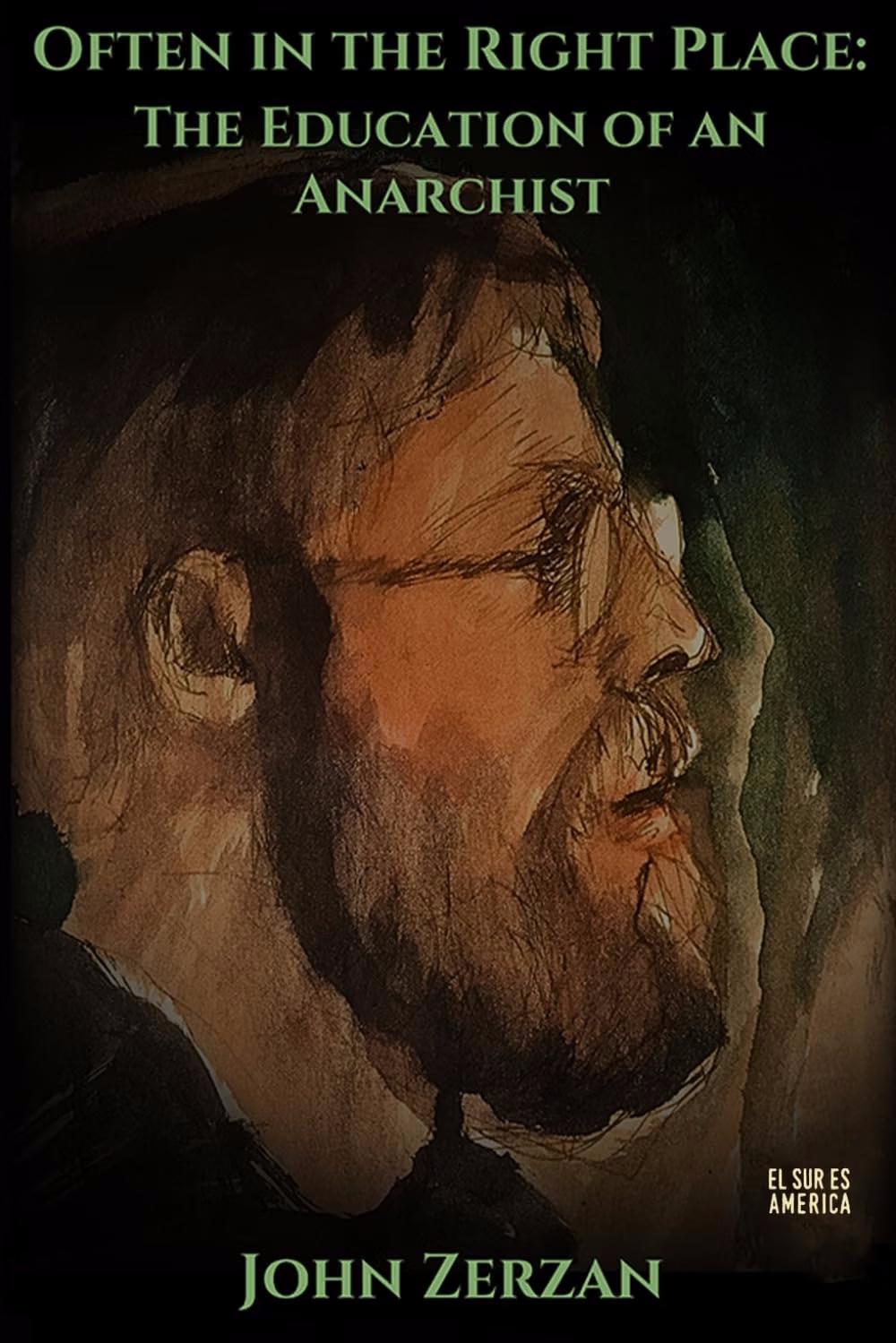
These are the memoirs of John Zerzan, a radical thinker who has been reflecting, writing, and building a major body of essays for several decades—the central focus of which is a critique of civilization. Since his earliest essays, written in the 1970s, he has questioned technology and domestication relentlessly. His influence on green-anarchy and anarcho- primitivist philosophy has been fundamental in guiding the anarchist debate toward a critique of industrialism and technological society. This has made him a prominent figure in the anti-civilization debate. Indeed, reading Zerzan allows us to understand why the civilizational project is self-destructive and not viable even in the medium term. It is precisely from his anthropological readings that he concludes that the turning point that brought an end to the world where human beings lived a full life in communion with nature was the emergence of domestication. His thought, however, is not pessimistic. Faced with the civilizational project of annihilating life. Zerzan proposes a future primitive. Zerzan’s work has developed along these lines over the last few decades, but his essays also reflect on the many sources of alienation that cause humanity’s current isolation and profound existential crisis.
Jesus Sepulveda, 2025
Often in the Right Place: The Education of an Anarchist
by John Zerzan
Cover illustration by Suzanne Downs
Cover design: Khalil Lascar Harris
First Edition
All rights reserved.
Copyright © 2026 John Zerzan & El Sur es America.
Library of Congress Control Number: 2026938649
ISBN: 979-8-9890395-8-6
Editorial El Sur es America, LLC
Urbana, Illinois, USA.
ElSurEsAmcrica@gmail.com
www.EditorialElSurEsAmerica.com
Table of Contents
| Introduction | 9 |
| Preface | 13 |
| Chapter 1: Family Ties | 15 |
| Chapter 2: My 1960s | 21 |
| Chapter 3: Surviving the’70s | 41 |
| Chapter 4: Return to Oregon | 53 |
| Chapter 5: Things start to get interesting | 67 |
| Chapter 6: The heyday of anarchy in Eugene | 79 |
| Chapter 7: Pushback and Repression | 89 |
| Chapter 8: On the Road and Back Home | 97 |
| Chapter 9: Book talks and travels | 121 |
| Chapter 10: Anarchy in India | 145 |
| Chapter 11: Anarchy at Home and Abroad | 159 |
| Chapter 12: Archives, Speaking Tours, and Podcasts | 177 |
| Chapter 13: Looking Forward | 185 |
Introduction
Jesus Sepulveda
These are the memoirs of John Zerzan, a radical thinker who has been reflecting, writing, and building a major body of essays for several decades—the central focus of which is a critique of civilization. Since his earliest essays, written in the 1970s, he has questioned technology and domestication relentlessly. His influence on green-anarchy and anarcho-primitivist philosophy has been fundamental in guiding the anarchist debate toward a critique of industrialism and technological society. This has made him a prominent figure in the anti-civilization debate. Indeed, reading Zerzan allows us to understand why the civilizational project is self-destructive and not viable even in the medium term. It is precisely from his anthropological readings that he concludes that the turning point that brought an end to the world where human beings lived a full life in communion with nature was the emergence of domestication. His thought, however, is not pessimistic. Faced with the civilizational project of annihilating life, Zerzan proposes a future primitive. Zerzan’s work has developed along these lines over the last few decades, but his essays also reflect on the many sources of alienation that cause humanity’s current isolation and profound existential crisis.
Zerzan’s work has earned him international recognition both within the anarchist milieu and in philosophical and academic circles, as well as provided him with some media attention. His work enjoys widespread dissemination and has been translated into several languages and reprinted in numerous countries.
Such renown stems from the fact that John Zerzan’s thought is not only radical but also original. Of course, originality is partly shaped by a lifetime of readings and collaborative dialogues. It is no coincidence that Often in the Right Place bears the subtitle The Education of an Anarchist, for it is precisely in these memoirs that Zerzan recounts the network of relationships and life experiences that have shaped his worldview. In Often in the Right Place: The Education of an Anarchist, there is, in addition to his philosophical reflection on his development as a thinker, a narrative voice that was only hinted at in some passages of his earlier writings. Indeed, in his memoirs—brief for the genre—Zerzan recounts his own life experience from a political and, therefore, ethical perspective. These memoirs are not a simple collection of anecdotes, but rather an account of how a child from Woodburn, Oregon became an anarchist and how an anarchist—or more accurately, an anarcho-primitivist—lives in a world permeated by technology, social misery, ecological devastation, and total alienation.
In the chapters of Often in the Right Place, Zerzan gradually establishes a chronology encompassing his early years, his university experience (first at Stanford, and then at San Francisco State, and the University of Southern California); the counterculture of the 1960s; his return to Oregon; his life in Eugene; his association with Ted Kaczynski; the anti-globalization movement of the late 1990s and early 2000s; his travels and talks in North America, Europe, Brazil, Russia, and India; his affiliation with anarchist circles; his relationship with his family and, particularly, with Alice Parman, with whom he has shared his life for over forty years. Within its pages, we also learn of his disagreements with Noam Chomsky and Derrick Jensen, his closeness to Ward Churchill and Kevin Tucker, his admiration for Fredy Perlman, his visit to Arundhati Roy in India, and his brief correspondence with Jacques Derrida, among other notable interactions.
Zerzan is not only a thinker. He is also an activist and promoter of radical ideas. His contributions to magazines such as Green Anarchy, Fifth Estate, Oak Journal, just to mention a few, and his twenty-five-year run on Anarchy Radio, are proof of this. In these pages, the reader will find memorable anecdotes, such as that of the anonymous benefactor who waited for Zerzan in the bathroom of KWVA radio station on the University of Oregon campus on a Sunday night to give him several thousand dollars for Green Anarchy, which reached 25 issues in 2008 before its closure. The memoirs also recount in detail the many talks and presentations Zerzan gave around the world and the atmosphere surrounding them, listing those who shared his anarcho-primitivist ideas and others who did not. It is interesting to learn that Zerzan was even invited to a transhumanist conference to offer a counterpoint to the official program focused on technological singularity. But this book is not neutral. As he narrates, he names the different stripes of the political spectrum while expressing his opinion and political judgements; his tone turns militant, demonstrating he is not in an ivory tower, but in situ of the social and ideological struggle.
Towards the end of his memoirs, Zerzan recounts how he and his partner Alice sifted through years of stored correspondence and materials to piece together his life and undertake this autobiographical project. This search in personal archives is not insignificant. It is an opportunity for the memorialist to comment on the ephemeral and disposable nature of electronic communication, remarking that “holding these artifacts was a striking reminder of how communication has been steadily deteriorating in the technosphere.”
The thirteenth and final chapter of these memoirs might be the most moving, as it reveals a subjective dimension to which Zerzan’s readers are not accustomed. There, he elaborates about pain and loss. He knows personally the psychological effects of this world in ruins, which in 2023 compelled psychiatrics to declare a new illness called “prolonged grief disorder.” In this context, he questions whether anarcho-primitivism is not, in fact, spiritual, since the “desire for a deep connection or communion with the earth, an unmediated state of being, wholeness, presence” is indeed a spiritual dimension.
Zerzan’s ideas have deeply resonated with contemporary thinkers and align with the ancestral wisdom that Indigenous peoples have preserved and passed down through generations. Faced with the emergence of the age of digital control and the gradual collapse of life on Earth, humanity’s desire to reconnect with nature in the planetary garden is a way to heal the original wound inflicted by civilization. Only in this way will healing be possible. And this is something Zerzan seems to want to emphasize in these pages.
The cultural dimension of our time is now defined by the technological world. This is a recurring theme throughout Zerzan’s work. But the temporality he inscribes in these memoirs is marked by the recollection of his direct experiences during his education as an anarchist. This is the central axis of Often in the Right Place— the narration of a lived learning experience; a consciousness that becomes aware of itself by remembering and writing about how it was shaped. And Zerzan is aware of this. For this reason, he points out in one of his chapters that visiting India gave him an “education in every sphere of life,” complementing all his life’s education.
Perhaps the corollary of this learning process is summarized in the final sentence, concluding that, in the face of technological temporality, it is time to change everything. Perhaps knowing about the events in Zerzan’s life will help readers understand better the author of titles such as Elements of Refusal, Future Primitive, Running on Emptiness, Twilight of the Machines, and A People’s History of Civilization, among his many publications. Perhaps the time has come for readers to abandon their complacency. Perhaps readers may also now acquire an anarchist education.
Preface
This is more a political memoir than a personal one. Something of an overall history too, when historical memory seems to be at a premium. Our collective recall has been through the debilitating effects of postmodern culture, among other vicissitudes.
It has been my very good fortune to have been present at some times and places at highly interesting points in recent history.
Certainly, my take on these times or events is personal. Some, no doubt, see the same things differently, bringing their own experience to their perspectives, within a generally shared anti-au- thoritarian context.
My “So... How Did You Become an Anarchist?” appeared in Running on Emptiness (2002) and brings my tale up to 1999. I have included it, with slight changes and additions. The rest of the memoir covers the quarter century since, bringing us to a most troubling and challenging juncture, when civilization is visibly failing across the board.
Check out this odyssey and do feel invited to contribute your own.
John Zerzan, 2024
(End of preview)