Mari Väina and Taive Särg
Expressions and Impressions (Preview)
Personal and Communal Aspects of Traditional Singing
From Folk Songs to Singing, Singer and Community
Preface: some personal words before the introduction
A glimpse into the history of the terms ‘folk song’ and ‘traditional music’
Acceptance of various points of view in the discourse of music
Singing as community tradition: Impressions and expressions
Why singing instead of a song?
Traditional singing and music revival
Why study and practice traditional singing?
About the content of this volume
Second case: “Definitely not folklore”
Table of Contents
Taive Särg and Mari Väina
From Folk Songs to Singing, Singer and Community 7
Section I. Interaction between Singing and Research
Tiiu Jaago
The Singer and the Song from the Folklorist’s Perspective 43
Ginta Pērle-Sīle
The First Folk Song Collections
People, Influences, and the Attitudes Behind Them 65
Mari Väina
Regional Variation in Finnic Runosong Based on Word Form Usage Statistics 84
Jelena Jovanović
Life With Bourdon
Vocal Practices of Church and Folk Singing in Serbia 100
Section II. Creating Communities: Voicing the Self and the Collective
Janika Oras, Andreas Kalkun & Liina Saarlo
Collaboration, Nationalism and Individual Creativity
The Political Uses of Traditional Song in the Performance
Practices of Stalinist Estonia 119
Liina Saarlo
Feodor in the Shadow of “Wonderland”
The Singing Tradition of the Räpp Family 135
Savannah-Rivka Powell
Ainu “Self-craft”
The Process of Becoming, from Yukar Musical Epics to Contemporary Transnational Indigeneity 147
Michele Tita
Pizzica Songs and Music from Southern Italy
Healing, Recreation and Heritage 162
Section III. From Heartbeat to Song: Affect, Participation and Traditional Expression
Aušra Žičkienė
“I Created a Song”
Author, Community, Creative Freedom and Tradition 173
Susanne Rosenberg
Heartbeat and Breath
Mapping a Folk Singing Style 193
Tiiu Ernits
Communication with Flowers, Birds and Animals
Nature Poetics in Estonian School Songbooks 218
Taive Särg & Helen Kõmmus
The Bagpipes are Singing
Labajalg Dance Songs from the Island of Hiiumaa 232
List of Contributors 272
Abstract 275
Subject Index 276
Index of Names and Places 286
From Folk Songs to Singing, Singer and Community
Taive Särg
https://orcid.org/0009-0009-7868-790X
Mari Väina
https://orcid.org/0000-0001-5309-2357
Preface: some personal words before the introduction
Traditional vocal music exists as a living, communicative and evolving practice, rather than as a fixed collection of songs. Within the present book, we focus on the rich variety of forms and styles of traditional singing and its diverse functions and importance in people’s lives. The emphasis is on the personal and participatory aspects of singing which allow people to express themselves in direct interaction in various contexts. Finally, the book discusses the multiplicity of ways in which traditional singing can be approached within research, working both in the field and with archive material.
While we were preparing the manuscript, the world began to change in unexpected ways that dramatically affected all of us. Although the plan was to start this book with a strictly scientific introduction and definition, life made some corrections and it now feels more important to reflect on some of the personal and moving experiences of joint singing. In 2019 the first wave of the COVID-19 pandemic spread across Europe. We were able to follow online Italian people singing together on their balconies during the first quarantine. This communication, created through song and eye contact, expressed solidarity, an affirmation of the wish to continue living. Due to the restrictions on in-person communication, the COVID pandemic made people invent online options to support each other with music: they gathered behind computers to sing in choirs or ensembles, inviting others to join them, and artists gave online concerts and uploaded podcasts. The folk musician Jon Wilks writes: “Folk music in 2020 may have been battered by the devastating effects of the COVID pandemic, but there were great things to be heard, and fascinating changes to the traditional landscape that will prove well worth holding onto.” (Wilks 2020)
Another event, although it primarily concerned the Estonian editors and researchers, points to a more general situation within the humanities, as well as demonstrating once again the power of singing as a means of protest and resistance, this time expressed by the Estonian folk music community[1]. During the preparation of this book, the funding for Estonian humanities had decreased to such an extent that the sustainability of the Estonian Folklore Archives (EFA) at the Estonian Literary Museum was in question. In this difficult situation, Estonian musicians who are using the archival materials as a source for their music compositions spontaneously organised a support concert in 2020 to draw attention to the importance of the research work performed at the archives in the development of contemporary culture. The work of researchers is necessary to turn the piles of material in the archives into common knowledge, for example people could own communally sung or artistically elaborated and performed repertoires as part of the world’s music treasures as well as a mark of their cultural identity. Whether solely because of this concert – which later became known as the EFA Song Festival – or other fortunate circumstances, we at the archives are now able to continue our activities. Above all, the event clearly highlighted the importance of the study of traditional culture to wider society.
We hardly had time to rejoice about this, when a terrible tragedy began with the war in Ukraine. In addition to giving humanitarian and military aid, people of various nations started learning and singing Ukrainian folk songs and sharing Ukrainian scores and recordings on social media to show their support for Ukrainians and to add hope and fighting spirit.
These dramatic events are not directly reflected in this book, the compiling of which began in 2018–2019. But for our ideas about the essential role of traditional singing, the events that followed were a reality check.
This book was compiled and edited at the Estonian Literary Museum, and published by the Finnish Literature Society. The writers are mainly associated with Northern and Eastern Europe, and the topics extend to such far-flung peoples as the Ainu. However, overall the volume is somewhat biased towards the Baltic States because the initial impetus came from a conference on traditional singing held in Tartu in 2018. Michele Tita from Italy and Savannah-Rivka Powell from the US were studying at the University of Tartu at the time.
We are thankful to editor Karina Lukin for her constant support and help. We also thank our English language editor, Daniel Edward Allen, for his diligent and patient proofreading. The compilation and editing of the publication were supported by research projects IUT 22–4 and PRG1288 (funded by the Estonian Research Agency), the Centre of Excellence in Estonian Studies (TK 145, funded by the European Union through the European Regional Development Fund), and the Estonian Roots Centre of Excellence (TK 215, funded by the Estonian Ministry of Education and Research).
What is traditional singing?
By ‘traditional singing’ we mean the practice of vocal music that takes place in a specific community, group or network, where skill is at least partly transmitted through participation, listening and memorising via directly sung communication. Traditional singing denotes a type of communication that genuinely belongs to premodern society, defined in its mutual interdependence with modern (e.g. Giddens 1991; Anttonen 2005). It is perceived as having continuity with the past. However, we use the term to encompass colloquial singing as a habit and participatory practice in various societies and music systems, including those of revival and post-revival contexts. It is also possible to sing alone in the traditional style, and outside the original context, while maintaining a relationship with the community through this singing. In the continuum of music and its discourse, traditional singing is broadly outlined by the terms ‘traditional music’, ‘folk music’ and ‘folk song’, while ‘traditional song’ is less commonly used. Traditional and folk music have been variously defined and used synonymously, separately, and overlapping each other. The consensus of music researchers as represented in the Grove dictionary has not seen the necessity for an entry on ‘traditional music’, but rather on ‘folk music’ (Pegg 2001). The collective opinion as reflected in Wikipedia, uses ‘traditional music’ synonymously with ‘traditional folk music’ (Folk Music 2024). Both the fields of folk and traditional music were constructed through an opposition to Western art music culture, highlighting distinctive features such as oral transmission, autonomous aesthetics, and its use in more activities and functions than just listening and pleasure.
The editors chose the term ‘traditional singing’ to combine the experiences of folklorists and ethnomusicologists, and to focus on basic vocal communication. The word ‘traditional’ was preferred to ‘folk’ to avoid firm associations with rural ethnic groups or various political groups,[2] emphasizing ‘singing’ as a process and practice rather than the objectified result of it. Like spoken communication, sung communication can take place in any era and place, it can have different purposes but always with more or less artistic ambitions and aesthetic qualities. This book proceeds from the context-based concept of traditional singing, which, in addition to the words and melody considers the communicative, performative and behavioural aspects of singing.
The researchers have discussed the ambiguous meaning of ‘traditional’ and the static and dynamic perceptions of tradition[3] (e.g. Hobsbawm 1983; Hall 1996; Bronner 2000; Ó Giollàin 2000; Schippers 2006; Strohm 2018; Morgenstern 2021). In the present book, ‘tradition(al)’ as it relates to singing is not used with an emphasis on immutability, but rather in connection with the community, as well transmission through direct communication, which imparts the skills of vocalising, behaving and performing in a way that makes singing native to a group. Tradition is seen as the ongoing process of constructing intersubjectivity in a community through shared experience acquired from predecessors (authorities) combined with the experiences and expectations of other community members in a contemporary live singing context. (On intersubjectivity, see Chandler & Munday 2011.)
A glimpse into the history of the terms ‘folk song’ and ‘traditional music’
Singing-related terms are the musical, linguistic and social agreements of various social groups, which change together with circumstances while retaining something of their previous associations. Discussions of musical terms have often been valueladen and ideological as music is primarily defined through its aesthetic qualities, a culture-specific category. Along with music, the categories for analysing and describing it are at least partly culture-specific. Aesthetic preferences and theoretical ideas develop in specific sociopolitical contexts, which means that the ideas and values of more powerful groups tend to have greater influence on these processes. In Western discourse, the aesthetic value of music was associated with the developmental level of society. This is expressed, for example, in Johan Gottfried Herder’s viewpoint that all peoples have the capability to develop valuable folk song culture, but only those living in such beneficial natural conditions as some European nations have achieved it (Duchesne 2017–2018). Consequently, discussions about music often intertwine social circumstances and aesthetic conceptions, relating the value of music to the developmental level of its community in terms of human cultural evolution. Group ideologies and power relations have contributed to ideas about music as well as terms, definitions, values and theoretical constructs.
The study of traditional singing falls primarily within the scope of folkloristics and ethnomusicology. However, because traditional singing itself is an interdisciplinary phenomenon, it can be approached from various research perspectives and using various methods, such as linguistics and poetics, ethnography and anthropology, psychology, religion studies, and more.
European folk song (the term Volkslied was used in German scholarly literature) became valued by the intelligentsia (e.g. Rousseau, Herder) in the 18th century as a prospective source of native cultures that wanted to develop an artistic, but not too narrow or elitist, music and literature. The focus was on the musical and word texts of folk songs, through which the ‘essence’ of an idealised folk would have transmitted to written culture in order to add national and ethnic originality, natural vitality, ethics and the aesthetics of rural people, who were imagined to live in harmony with the world. Although the idealised folk and its oral tradition were valued, it was considered a lower stage of biological-social evolutionary development, a culture that had to develop into a literary culture in order to perpetuate. Therefore, in folk music, the features specific to oral culture, for example methods of oral transmission, (re)creation, performance style, were not of special interest to literary composers or poets, who adapted folk songs to written culture during the first folklore revival.
In scholarly discourse, folk song and folk music were initially defined as firstly the products of oral tradition of European country people. At the root of defining folk music were questions “about the identity and identification of the ‘folk’, the delimitation of musical repertories, how these repertories are transmitted and the assessment of sounds”. (Pegg 2001) However, the meaning of folk music expanded in the 20th century, firstly due to the broadening of the forms of re-use of this music in Europe and America, and secondly because it was used interchangeably with the close term ‘traditional music’ and covered its content as well.
In 1955, the International Folk Music Council (est. 1947; from 2023 the International Council for Traditional Music and Dance) defined folk music as “the product of a musical tradition that has been evolved through the process of oral transmission”, and is considered uninfluenced by other musical styles (Pegg 2001). Such a definition may have helped to promote and protect older folk music styles during changing times. The definition of folklore established by leading specialists of that time in Bergen in 1986 includes “even written and mass media forms of folklore to the extent that variations occur” (NIF 1986: 21).
The notion of folk song highlights singing tradition beyond the mainstream of a literary culture, and seeks to join past and present, rural and urban, in order to recreate cultural identity. Folk songs are crucial for supporting the continuation of language and culture, especially of minority groups and small nations, because of the link to group identity.
In many Northern and Eastern European contexts, such connections between song traditions and group identity are linked to what is locally called national consciousness (cf. Est. rahvuslus, Fin. kansallistunto, Lat. nacionālā apziņa), a concept that often carries positive associations with cultural heritage, language preservation, and community continuity. This usage differs from the English term nationalism, which in international academic discourse frequently has strongly political or negative connotations.
The term ‘traditional music’ was developed in Britain in the mid-19th century to refer to the music of various peoples of the world which had broadly the same characteristics as folk music (Morgenstern 2021). By the end of the 19th century the study of musical expressions and practices of non-Western cultures emerged as a subfield of comparative musicology in Austria and Germany, as well as of anthropological studies in North America. These studies constructed their subject through opposition to Western music, including folk music and folk songs. Researchers of non-Western music began paying attention to the singing context, related activities, and the insider’s point of view, as they were essential to the understanding of alien musical cultures.
During the 1950s and 1960s, the term ‘traditional music’ for non-Western music was more widely adopted after the exclusion of previously used terms because of their connection with various shades of inferiority (for example ‘primitive music’) or overly specific social features (for example ‘tribal music’)[4] (Nettl 1964). At the same time, discussions on what kind of music should be covered by this term emerged.
In 1950 the Dutch researcher Jaap Kunst introduced the new term ‘ethnomusicology’ (cf. Ger. Musikethnologie) for earlier ‘comparative musicology’ and defined its study object as “traditional music”, including “tribal and folk music, and every kind of non-Western art music” (Kunst 1969 [1950]: 1). The Archives of Folk and Primitive Music at Indiana University was renamed the Archives of Traditional Music in 1965. However, dispute over the term’s appropriateness and the music it should refer to persist (Morgenstern 2021).
During the 20th century the boundaries between various kinds of music, and the research disciplines of folk and traditional music, diminished as on the one hand more information on archaic European folk song styles not much influenced by modern music entered scholarly discussion, and on the other hand most singing cultures had interacted with various forms of global modernity. The discourses of folk and traditional music became globalised and international scholarly cooperation expanded, largely through the work of the International Council for Traditional Music.
Several older singing traditions faded with modernisation and globalisation, but endured longer in the peripheries of the global West (and the modern lifestyle promoted by it), while the songs, once collected and stored in archives, reappeared in institutional as well as informal revivals. Vernacular singing practices persisted in various groups, modernising the old styles and acquiring new ones from other nations and popular culture. The previous situation – in which features of ‘folk music’ such as rural group traditions, aural learning, historical styles – no longer exist together, causing theoretical confusion. Various conceptions of authenticity emerged to delimit what counted as a legitimate tradition, such as the authenticity of the result (i.e. the degree to which the style corresponded to the original), of the community (the singers as legitimate representatives of the tradition), or of the process (whether it was correctly learned and followed). (For more detail see Ronström 2014: 46–47.)
In addition to the terms ‘folk music’ and ‘traditional music’, which have been useful to distinguish their subject from ‘art music’ and ‘popular music’ from the Western perspective, since the 1980s and 1990s the new terms ‘world music’ and ‘roots music’ have come into usage and an acceptance of various music traditions and points of views developed.
Terms related to traditional singing depend on local disciplinary traditions and are not directly translatable across languages or cultures (Pegg 2001). Many languages lacked a native general term for ‘music’, but had words for song, singing and instrumental music, as with Baltic, Slavic and Finnic languages. The terms ‘folk song’ or ‘traditional song’ have also been adopted in most languages along with modern culture, though nuances in meaning differ. In English, ‘old’ or ‘traditional folk music’ distinguishes oral tradition from revival, called ‘new folk music’, while in Finnish and Estonian the terms ‘old folk song’ and ‘new folk song’ designate older and newer styles of oral tradition.
Acceptance of various points of view in the discourse of music
According to the principles of ethnomusicology as an intercultural and comparative discipline, developed during the 19th and 20th centuries in the Western scholarly context, many world music cultures were represented through outsiders to the culture (see for example Nettl 1983: 3–15, 149–160; Myers 1992; Witzleben 1997; Rice 2013). Rice has admitted that: “Today’s ethnomusicology, at least that branch of it that has ethnomusicologists from North America, Europe, Australia, New Zealand, and Japan traveling the globe to study the music of other people, has some of its roots in colonialism and imperialism.” (Rice 2013)
The paradigm change in the humanities and social sciences during the second half of the 20th century from the predominant Western researcher’s viewpoints and methodologies in forming ‘objective’ knowledge on the world, to a multitude of viewpoints and ontologies, was marked by several ‘turns’, such as the postmodernist, post-structural, reflexive, ontological and posthuman.[5] Questions arose about the validity of global, universalising perspectives and attention turned to the truths embedded in the local, everyday, variable, and contingent aspects of music, as well to the role of the individual. (Duckles et al. 2001)
Scepticism about the supremacy of Western music, which had for a long time been taken for granted, evolved during the 20th century and influenced several musical cultures, including those of the European folk singers whose style did not conform to its aesthetic criteria. If all music was valued, at least in theory, there was justification for keeping various native traditions alive without feeling ashamed that its difference from the mainstream might reflect a community’s ‘underdevelopment’.
The study of traditional music has significantly contributed to the acceptance of diverse viewpoints within anthropology. Researchers aspiring to understand the music and musical perception of the human race had to acknowledge alternative aesthetics as a foundational aspect of their field. Theorists of comparative musicology in the late 1890s introduced the ideas of cultural relativism, positing that the musics of various cultures cannot be treated according to common aesthetic values or ranked objectively. Erich M. von Hornbostel wrote that music can evolve in different directions, for example while in Western art music was complex polyphony, in much non-Western music a “superiority in rhythmic capability” was found: “…in music comprised of one-voice song, on the other hand, rhythm was able to develop freely to a level of complication which is totally unknown to us: rhythmic constructions which can not be fitted into a system of beats; polyrhythm, which means several contrasting rhythms working together or rather against each other” (Hornbostel 2000 [1911]: 93).
Acceptance of manifold viewpoints, developed along with research into how cultures conceptualise themselves from within, was strongly influenced by American anthropologist Franz Boas’ works, who also wrote about traditional music (for example The Central Eskimo, 2013 [1888], On Certain Songs and Dances of the Kwakiutl of British Columbia, 1888, see also Boas 1989 [1974]), and theoretically conceptualised by American ethnomusicologist Alan Merriam, summarised in his Anthropology of Music (1964). Boas’ attempt to understand American culture “as it appears to the Indian himself” and analyse it as commensurable with Western cultures, has been interpreted as an early form of “symmetrical anthropology” and precursor to the later reflexive (or ontological) turn in anthropology in the late 20th century. From the perspective of ontological anthropology, the goal is not to establish a common truth about all people, but to uncover how people from different cultures interpret and represent the world. (Rodseth 2015; Kim 2019; Latour 1993) Jeffers Engelhardt, a researcher of religious music, has paralleled the researchers’ advances and “epistemological limits” on both sides: secular outsiders lack authentic religious experience and strive to empathise with the community’s views, while the inside researchers adapt the language and paradigms of secular critique (Engelhardt 2012: 302–303).
Singing as community tradition: Impressions and expressions
Singing as a shared tradition belongs primarily to smaller communities or face-toface groups, where close communication and immediate sensory perception are possible. The smaller group with its tradition can be part of a larger real or imagined community (network), or it might represent a different, alternative, song community. Singing and music are intertwined with other group attributes, such as identity, ideology, lifestyle, language and customs.
The concept of traditional culture in folkloristics and anthropology was initially formed on the basis of relatively compact, socio-economically similar groups, although when the scope of anthropological studies expanded, the social structure that was involved in folk/traditional music began to encompass a wider range of groups (Elbourne 1976: 23; Dundes 1980; Ben-Amos 1983; Slobin 1993; Ó Giolláin 2000: 9). We prefer to use the term ‘community’ because it is not strictly defined as relating to any social structure, in English it primarily means a group of people more closely related to each other, the possible characteristics of which are the spatial proximity of people and the existence of similar interests, values and dynamic relationships (Cobigo et al. 2016).
Sociobiologists consider the communal way of living of humans to be very ancient and trace its origin back to the group living of primates, therefore they also assume that the structure of the human brain and the fundamentals of social behaviour and communication, such as dominance, leadership, submission, courtship, evolved long ago, and speech and songs play an additional role among other earlier forms of communication (e.g. Mazur 1985; Gladwell 2002: 177–181). The group has been a primary human social environment that has fulfilled communication and cultural needs, shaped identity and relationships with society, and provided necessary wellbeing through positive relationships (e.g. Tajfel & Turner 1986; Hall 1996; Umberson & Karas Montez 2010; Turner & Reynolds 2012).
Traditional singing, as far as it developed in the course of joint social activities, and functioned as an instrument of group communication, might embody in its structure and style merits that facilitate members’ interaction, building and maintaining a group. Leea Virtanen has written that many folk songs, dances and circle games develop a way to offer joy primarily to participants through the enjoyment of one’s own voice, creativity in melodic variation, and the joint feeling of the power of the performance. As contemporary modern music is meant for listening it demands from singers a special effort to capture the audience’s attention. (Virtanen 1991: 22) Ethnomusicologists have demonstrated in numerous works that singing contributes to community life because it helps to create a social cohesion by connecting with important phenomena, shared by group members, such as interests, values, representations, past events, ethnic and social background. (Merriam 1964; Bartleet & Higgins 2018, etc.) For example, Anthony Seeger (2010) demonstrates how Suyá singing (re)creates society, repositions the individuals within it, and (re)structures their cosmos in specific and significant ways. People also express their feelings through traditional song, such as unspoken sadness, anger, joy, etc. (ibid.).
The study of singing – as part of musicology – has dealt with a lot of aesthetic, value and stylistic aspects, while singing as self-expression and communication has received less attention. The perspective of musicology expresses the needs and values of society, where the experience of the listener or consumer is of primary importance. From a similar point of view, in the case of traditional singing, aesthetics and style have primarily received attention, for example, in the effort to prove to someone that a certain musical tradition and the group carrying it are valuable.
In this collection, we focus on traditional singing as a social activity in the past and present in various cultural contexts. We highlight some characteristic features of traditional communal singing that are also evident today, such as 1) recurring singing situations; 2) roles in group singing and intersubjectivity; 3) oral tradition, at least partially; 4) connection with a distinct tradition and style.
1. Traditional communal singing developed according to recurrent patterns based on the cycles the of year and human life, each with its own rituals. Any way of life without abrupt changes will give rise to recurrent typical situations. Accordingly, traditional, and at the same time flexible expressions in word and melody, were suitable for use through the generations preserving relevance in the community. Through the creative re-application of traditional songs, people could find an outlet for their personal experiences with, at the same time, the song tradition providing a framework that guided people on how to feel, act, and express themselves in specific situations. In modernising society, with more rapid changes, people have sometimes found a way to express themselves in traditional singing. In this collection, Särg and Kõmmus, and Tita, analyse the function of song and dance in traditional activities of the group.
2. The collective experience of singing materialises and renews in every instance of joint singing, which benefits from good collaboration and an appropriate division of roles. The consonance between individual and collective in traditional singing can be achieved through intersubjectivity, that is, fellow singers adjusting to each other, relying on mutual perception and mental representation. Intersubjectivity, defined as “the process and product of sharing experiences, knowledge, understandings, and expectations with others” (Chandler & Munday 2011), helps us understand how singers’ emotions and impressions transform into traditional vocal expressions in communal singing practice. Ian Cross, and numerous other studies of group singing, highlight how music gives people a collective intuition and understanding of each other: “Music at the supracultural level appears as a communicative medium optimal for mobilising shared intentionality per se” (Cross 2012: 96).
According to Thomas Turino’s classification of the social organisation of music, traditional singing often belongs to participatory music, where there is no strict distinction between artist and audience, and the musicians of widely varying skills have a freedom – depending on the character of the tradition – to produce various sounds in a game-like practice. (Turino 2008) In a historical community-based culture, a large part of singing was joint activity in which, according to situation and habit, the people sang together or in turns, for example by changing the role of the soloist, lead singers, choir and emotionally supportive listeners.
Popular music and art music have evolved towards ever greater distance between the performer(s) and audience: where once choral singing or rhythm and blues were participatory music, today the composer and interpreter often differ according to their specialisation. The interpreter performs in front of an audience or in the studio, alienated in space (or in both space and time); voices and instruments are amplified, while larger ensembles, music and sound recording are also utilised. Developments in capacity and size have also taken place, on the one hand with larger and larger audiences and concert venues, and on the other with the wish to increase the influence of music, using volume and the effect of massed voices, which can also demonstrate power. At today’s major music events, such as Estonian or Latvian song festivals or rock concerts, there is, however, also the tendency to create ‘communality’ by initiating consolidating activities, for example when performer and audience sing well-known songs together, or when the audience dances or ‘throws fingers’ in front of the stage, in effect forming a smaller community that is physically cohesive and closer to the band.
Today, when several traditional cultures with their participatory music traditions have decayed under modernisation and urbanisation, a ‘community music’ movement has arisen that identifies itself through the practical goal of contributing to community life with joint music making. (Bartleet & Higgins 2018; Cottrell & Impey 2018; Yi & Kim 2023) In this book, the chapters by Saarlo, Oras et al., Powell, and Žičkienė explore the creative singer’s relationship with the community and with tradition, touching on the boundary between individual and social.
3. Traditional singing, rooted in oral tradition, is strongly based on memory and creativity, and is realised in the interaction between individuals and the community. There is often a lead singer (or singers) and a re-creator who restores a song from a mental state to a physical state of sounds. The whole group can contribute to the creative performance through repetition, textual or melodic variations, adding verses and comments, etc. This kind of singing often took place in the context of ordinary activities and events, was situational, and presupposed a shared cultural knowledge (a ‘store’ of means of expression). Developments in human and social sciences indicate a growing awareness of the role of the individual in the community’s creative processes, in the relationship between individual and society, and between past and present. (Nettl 1983; Rice 1987, 2017; Nooshin 1996, 2016)
Oral tradition causes variation at all the levels of expression, leading to gradual changes in folk song style and repertoire. This regional variation is studied in Finnic runosong by Väina in this collection.
4. In today’s modern society, various forms of traditional or participatory singing are continued or (re)invented. Several religions still use traditional singing as part of their rites (see Jovanović’s chapter in the current volume). Traditional singing also continues to be practiced by many ethnic communities and families. Traditional music is not distinguished from other types of music by a rigid boundary for two reasons: firstly, all music is based on a tradition, and secondly, different types of music come into contact and influence each other. (Cf. Morgenstern 2021)
Traditional singing is today often considered specific to ethnic communities and is differentiated on the basis of an established historical style. For the singers’ communities, traditional singing meets their needs and skills, and is often associated with a pleasant group atmosphere and group-related memories. There has been a de- and recontextualisation of songs when they moved from their immediate local community (directly or through records) to modern contexts, where they were used for professional stage performance and institutionalised participatory activities, taught in music schools, or used as inspiration for new music, the singing style serving as the identity marker (see Rosenberg in this volume). Newer styles can adapt to community singing; sound and video recordings and/or written sources can be used as auxiliary means. New contexts can develop, but singing might still be considered traditional if the community (or its members) practices singing and the way of singing is shaped together. Today, the role of oral-auditory learning is more important for melodies than for lyrics, because literacy is more widespread than musical literacy.
Given that traditions are of different ages, specific to various groups, and often ‘impure’ in real life, we use the concept of traditional singing with a wide meaning to cover both Western and non-Western, ‘folk’ and ‘traditional’ (if distinguished) music, including their changes and transitions, revivals, contemporary group traditions (for example subcultures) and participatory singing practices, congregational and choral singing, and other similar phenomena with their associated terms. Traditional singing does not include the activity of professional choirs and groups in the realm of art music and popular or rock music. Traditional human singing also includes singing alone or in interaction with a non-human, for example an animal, nature or an imaginary subject. The expressions of such singing are rooted in the community because they are acquired through interaction with others (see for example the chapter by Tiiu Ernits in the current volume).
Why singing instead of a song?
Our collection of articles is focused on the singing traditions of various communities, covering different historical and contemporary practices, styles and contexts, singers and groups, as well as the collection, research and publication of folk songs. As the contributors approach the subject from diverse perspectives and employ different techniques, the volume also offers an overview of a range of research methods. Singing due to a connection with the singer’s physical body and voice is primary, as compared to its written or sound recorded products which have allowed the song to be separated from its performer.
Traditional singing exists as a process of communal expression with melody and lyrics. Vocal music in its broader meaning can also include non-linguistic syllables, shouts, musical onomatopoeia, speech-song and other areas with vocal sounds. The main founder of Estonian folk music research, Herbert Tampere, has written: “Text, melody and performing traditions: in real life they constitute one whole and should be studied as a whole” (Tampere 1934: 30). This concise summary reflects both a new ethnological research paradigm, which was developed at the Estonian Folklore Archives in the 1920s and 1930s in connection with extensive fieldwork (Hiiemäe 2018), and the expanding influence of German and Austrian ethnomusicology in Europe.
Hornbostel’s writings of the early 1900s brought into scholarly discourse the idea of a tight connection between melody and performance in traditional music. He used the example of Indian ragas to demonstrate that oral music exists outside the performance merely as “melodic schemes”. In addition, he noted, that in music for one voice, “the method of performance (Vortragsweise) is of great significance” because the melismas, glissandos, squashed voicing, empathetic inhalation, etc., together with rhythm and melody only form a song (Hornbostel 2000 [1911]: 87).
Folk song had been abstracted from its performance in order to convey it to a written culture that was seen as a higher stage of civilisation in the framework of evolutionary thinking Europe of the 1700s and 1800s. The characteristics of the performance were hardly recorded at that time, perhaps because the skill of performing was considered self-evident and/or unnecessary by the literati. As the researcher of Scottish tradition Silke Stroh (2017: 9) mentions, folk song collecting revealed both “attraction and reluctance” to the Other. Despite the rhetoric of valuing the old and the special, the interest in folk songs was shaped by European modern thinking and romantic aesthetics. Thus, people interested in folk song were not attracted by its syncretic whole, and the neglected features were often related to performance, for example, the speech-like singing style, a peculiar timbre, a loose melodic and rhythmic structure, etc.
Live singing traditions with features other than those found in Western art music was, viewed from the evolutionary perspective of social development, were considered signs of an evolutionary backwardness that had to be abandoned. The singing style was not highlighted in early folk song collection, publication and research. Therefore, when the revival of various singing traditions began in the second half of the 20th century, there was not always enough information about the performance and style.
Modern interest in folk songs underwent a shift in the 20th century from a product (the song) to a process (singing), being reflected both in studies and revived singing practice. “Another clear tendency can be found in a change in terminology from nouns to verbs, that is, from object-oriented to process-oriented terms…” wrote a Swedish ethnomusicologist Owe Ronström (1996: 6; cf. Ronström 2014). In the mid-20th century new generations started a discussion between, on the one hand, adaptation of folk music for artistic ends, and on the other hand, ‘authentic’ performance. The ideal of the ‘authentic’ folk song in the context of the folklore revival was initially its faithful historical performance, which practice developed together with theoretical studies from the accurate reproduction of the source towards a traditional re-creation process, with further developments taking into account singing according to one’s gut feeling (Hill & Bithell 2014: 23; cf. Ronström 2014: 46–47).
A traditional ‘song’ does not exist as a finished piece of vocal music, but as a working practice, which realises as a unique performance in a specific situation (cf. Slobin 1993: 10). An essential feature of traditional music (or musical folklore) is variability, initially seen by researchers rather as an unconscious process of forgetfulness and errancy and later as part of artistic expression (Harker 1982; Honko 2000). There is an extensive history of structuralists, semantics, generative linguistics, ethnomusicologists and neuroscientists treating music as a special language, with a classical work on this subject by John Sloboda (2008 [1986]).[6] The creative representation of oral tradition is modelled in the Oral-Formulaic Theory, founded by Milman Parry and his student Albert Lord by juxtaposing Homer’s epics and the South Slavic oral epic singing tradition, which was still alive in the 20th century (Lord 1960). Foley characterises oral song culture as a particular customary interactive language, in which poetic language, melody and rhythm participate (Foley 2002: 123–141).[7] The creative performance of instrumental music is also compared to language (e.g. Berkowitz 2010; Zadeh 2012). Laudan Nooshin writes of Iranian classical music: “In considering the kinds of compositional principles and strategies deployed in performance, one finds a highly structured and formulaic practice, also suggestive of parallels with other areas of human creativity such as language.” (Nooshin 1996: 52, 2016)
A singer is both a (re)-creator and interpreter who combines the mental forms, text and melodic motifs (the body of knowledge is seen as a “store” (Honko’s term)) and creative practices. (Honko 2000; also Finnegan 1977) Oral song culture is characterised by the re-creation of text into an existing metre and musical formula. Melodies were created and changed from time to time, although this was less rare than the creation of texts (Särg 2009). In traditional singing, people were sometimes unable to separate text and melody: “For them [singers] the text and melody represent such an inseparable unity that they never recite the words alone and they find it difficult to do so.” (Abraham & Hornbostel 1994 [1909–1910]: 442). In the Estonian tradition, melody was also called the hääl ‘voice’, or mõnu ‘pleasure’, of the singing.
The question of whether ‘folk’ create folk songs and tunes has been essential in the context of the construction and deconstruction of the cultural Other. One of the main differences between Western art music and ‘other’ musics was seen in their modes of creation: “in the former, music was created by a known individual, usually using notation, whilst in the latter, musicians simply interpreted an anonymous oral tradition which had been passed down over many generations” (Nooshin 1996: 28–29, Nooshin 2016; cf. Nettl 1983: 26–35). Mythical and often sacred qualities were associated with musical creativity and were attributed both to folk singers and Western composers. It was not until the 1950s and 1960s that understanding of human cognitive processes led to a demystification of creativity and its situation within the realms of social practice (Weisberg 1986; Nooshin 2016).
Sophisticated art makes the process of composition into something quite conscious and stresses the innovations brought to form and subject by the individual artist. Folk composition, on the other hand, is oriented more strongly toward the continuity of a tradition and is created by those who are much less conscious of the aesthetic principles under which the folk performer or creator is working. (Abrahams & Foss 1968: 4; cf. Gibbs 2018: 4).
Sometimes it is difficult to determine objectively the birth of a song because the texts and melodies, and combinations thereof, vary and old material is used to create new. In this collection, Aušra Žičkienė analyses creation between oral and written culture and asks: “What could a breakthrough in creative freedom mean, and what is determined by the norms of tradition?”
Traditional singing and music revival
Today, research on traditional vocal and instrumental music is increasingly carried out in terms of revival,[8] which covers cases of unbroken oral tradition when adapted to contemporary contexts, as well as the resurrection and arrangement of traditional music (Hill & Bithell 2014: 8, 15–17): “A music revival comprises an effort to perform and promote music that is valued as old or historical and is usually perceived to be threatened or moribund” (ibid.: 3). Music revivalists often position “themselves in opposition to aspects of the contemporary cultural mainstream” (Livingston 1999: 66). During the process of revival, traditional music has become widespread in new performance contexts and hybrid styles that have often become part of institutional and professional (folk) music and have sometimes been adopted by mainstream music (Hill & Bithell 2014: 28–30).
If traditional singing is revived, it is usually performed to an audience as ‘presentational music’, i.e. for education, entertainment, ideological and aesthetic purposes. The change of the social aspects is an implication of revival, explained as concomitant with it though not claimed in the definition. Accordingly, the abundant research into revivals deals with public performances and new music based on old elements. (See for example The Oxford Handbook of Music Revival 2014; Krekovičova 1992; Šmidchens 1996; Ramnarine 2003; Rüütel & Tiit 2005, 2006; Hill 2007; Pärtlas & Oras 2012; Haapoja 2017; Stavělová & Buckland 2018, etc.)
Although traditional singing also has a presentational aspect, the situation of performance is changes in revived presentational music, and communication between performers and audiences becomes less direct. An audience from a different cultural context does not always understand the original content of singing, for example a foreign audience does not understand the language, or people of the same nationality may have difficulty understanding ancient dialect or the poetics of the text. Thus, an audience may observe and enjoy slightly different, more surface-level qualities of the performance than in the traditional performance; nor is the audience able to react like a traditional community. The main goal of the multifaceted process of revival has not been to revitalise the community-based musical tradition, but to re-use elements of that musical tradition within the social structures of contemporary modern music. Similarly to the usual reduction in the participatory and communal aspects in revived traditional singing, these aspects remain in the background in the study of traditional singing.
With cultural globalisation, the ‘alien’ in music anthropology becomes questionable. An international community of scholars is emerging around the world whose educations, interests and perspectives are somewhat similar in origin: for many young people in the late 20th and early 21st centuries, ‘their’ music is international rock music, the revival movement, and world music (cf. Hill & Bithell 2014). The study of revival was initiated by musicians and folklorists who were themselves involved in the process of reusing historical music. They sought to bring recognition to this old unrecognised music and field of study, symbolically expressed through assimilation into Western music. Signs of this recognition included being introduced to a wider audience, songs being adapted to instruments, ensembles and other means of expression of art and rock music, and traditional music being officially taught, as well as being brought to the public and featuring in scholarly discussion.
Sometimes the social participatory practices of traditional music were also revived, especially in the realm of folk dance, which was traditionally occasionally combined with singing.[9] In addition to traditional practices, participatory activities have been adapted from various modern events and situations, such as the music festival, the jam session, the workshop, and audience involvement, all of which aim to foster community spirit. The importance of participation is also increased by the general tendency of modern arts to provide more sensual, physical experience and participation.[10]
The folk music revival of the 20th century was often part of social movements against commercialisation, urbanisation or other changes, and espoused country life, ethnic identity and a sense of community (Gemeinschaft) (Bröcker 1996; Ronström 1996; Livingston 2014). Ronström claims that in many countries the second revival of the 1970s was opposed to the first, “and was rather aimed at making the folk traditions again a part of everyday life, ‘the little tradition’” (Ronström 1996). In Soviet and Eastern Bloc countries[11] the second revival, called for example the “neo-folklore movement” in Latvia, was against the appropriation and adaption of folklore for the dissemination of Soviet ideology (Klotiņš 2002).
The participatory aspect of revived music is discussed predominantly in a cosmopolitan context by Tamara Livingston, who sees instrumental music as more suitable for the purpose (Livingston 2014: 68); similar ideas pertain to fiddle jam sessions, according to Alan Jabbour (2014) and Ronström (2014). There is less information about revived participatory singing. In Ronström’s experience, the wordbased traditional genres are in general of less interest today: “A third tendency is that verbal traditions disappear, and instead forms based on sound, sight, and taste occupy a place apart” (Ronström 1996: 14).
One of the reasons for the wide spread of traditional instrumental music could be the need to accompany the folk dances that were an active form of the revival. In Estonia and other parts of the former Soviet Union, some folk instruments had been taught in music schools since after the Second World War, and folk music orchestras were also common. Instruments are often played together at today’s international traditional music events because there are no language barriers, and folk jam sessions follow the example of jazz and rock music.
The secondary role of singing, especially in recitative styles, in the revival movement might reflect the revival’s globalisation and orientation towards spectacular performance. It is possible – especially in the new context – that certain local lyriccentred song genres seemed less attractive. For example, the ancient tradition of Ukrainian epic singers (called bandura players as the singing was always accompanied by the bandura) was passed on to modern Soviet society mainly as an instrumental form (Berezutska 2020), while performance of Chinese traditional songs became a spectacular entertainment (Xiao 2017). However, there are also examples to the contrary in which some song genres, such as Irish sean nós or Portuguese fado, have become widely known. Revived folk songs, both in presentational and participatory practice, are very much loved in the local Baltic traditions. Revival has created some new group singing habits that are partly influenced by traditional singing – for example New Age rituals – that have various traits of traditional singing or natural voice singing (Bithell 2014; Natural Voice 2024).
Informal joint singing is not much documented or studied. In Estonia during the 1970s the composer Veljo Tormis started to promote regilaul style for informal participatory singing, a practice that became popular: “In practice regilaul would be a communal song form attainable by all.” (Tormis 2007 [1972]: 53) Some information of these events can occasionally be found in the archives of public media, but there are ample possibilities to collect the memories of the initiators and participants. For example, it was said of the meeting between Estonian folk group Leegajus and Lithuanian group Sadauja that the “two folk groups became good friends after their first meeting in Vilnius, in 1976. After the concert they had dinner, they sang Lithuanian and Estonian songs, and later decided to climb Gediminas castle hill and sing there until midnight.”[12] Some researchers have analysed participatory traditional singing in the Baltic countries. For example Šmidchens (2014) has shown the role of folk songs during the Singing Revolution while Klotiņš has described how Latvian folklore groups created folk communities and made singing part of their lives (Klotiņš 2002). For Estonia and Finland ‘semi-spontaneous’ situations of participatory singing at festivals have been analysed (Särg 2014, 2023; Kõmmus 2023).
Although several original features of oral singing styles have been highlighted and revalued by today’s revivalists, the same tendency of preferring some features of more modern music persists, for example participatory singing is not often used by today’s revivalists and might be considered old fashioned. In studies of the revival, questions of style, form, genre and aesthetics seem to hold less importance than social aspects. Ronström has seen this approach as “highly questionable, especially since, for many of the participants in revival movements, aesthetics is what matters above all” (1996: 6). In the present book, questions of the aesthetics of revived songs form one of the recurrent topics (see Rosenberg, Jovanović, Oras et al.).
Why study and practice traditional singing?
Traditional singing is the original form of singing. It has been a human activity for most of our history and the cognitive traits that have thus developed exist in various ways in contemporary culture. The universality of singing suggests that it fulfils some basic human needs[13].
Research into traditional singing can shed light on unique aspects of human expression, such as communication through singing; psychological, pragmatic and other functions of singing; the role of individuals and the collective in the transmission and recreation of songs; the mutual adaptation of melody, lyrics and concomitant activities in the course of live performance; the concepts and behaviours related to singing; the differences between singing communities in terms of musical and social features, including contemporary multi-layered societies, etc.
One of the reasons to study singing is to gain an insight into the ‘musical mind’, i.e. in cognitive processes that take place during performance, the perception of singing, and their correlates in the human brain. The amount of research into music performance and perception has increased, and has shown that music – like language – is related to memory, attention, and other cognitive functions (e.g. Sloboda 2008 [1986]; Peretz & Zatorre 2003; Koelsch 2011). However, investigations within the field of cognitive neuroscience, especially the growing study of the specific emotions that music induces, have been focused more on Western instrumental music (cf. Slobin 1993: 20). There is even reported to be resistance to incorporating scientific procedures into emotional responses to musical listening among ethnomusicologists (Penman & Becker 2009: 50). More variegated research material might give a more reliable picture of the musical mind. Especially as some results have shown that instrumental music, speech and singing activate different parts of the brain, and how training and musical background affect the aesthetic experience of music (Brattico et al. 2013; Schön et al. 2005; Eerola & Vuoskoski 2013). There are, however, a number of studies of musical pleasure and perception that focus on the benefits of contemporary music, which share some features with traditional singing, such as singing together, developing singing skills, aural learning, and using the natural voice in group singing (e.g. Berger 1999; Pawley & Müllensiefen 2012; Bithell 2014; Dingle et al. 2019; Camlin et al. 2020).
In terms of (dis)pleasure, traditional singing is touched upon by ethnomusicologists, who ask why it has declined in modernising society. Various social factors have been shown to contribute to changes in people’s participation and perception of traditional singing, so it might be that the music has become unsatisfying (e.g. Bayard 1955; Letts 2015; Kloet et al. 2019; Zaimi 2020). The Chinese researcher Wen Cuiyan asks why the strong contemporary interest in traditional narrative singing is “accompanied by controversy and dissatisfaction due to the ‘boring’ experience of traditional practices, especially when compared to modern popular culture?” (Wen 2019: 79)
The classics of ethnomusicology have formulated some central questions to help us understand music, such as “what is music?” (Hornbostel 1907, 2000 [1911]) and “how musical is man?” (Blacking 1973), to which should be added something like “how does music evoke emotion in listeners?” (Eerola & Vuoskoski 2012). Ongoing research in various singing cultures would provide an essential contribution to the understanding of these well-known but still relevant questions.
Singing is inherently syncretic and it is often closely related to other genres and activities, such as dance, instrumental music, drama, customs, religion, etc. Thus, singing has permeated various art forms and presumably activates many senses.
Folk song provides excellent material for the study of variation, a central concept in folklore studies. Taking into account different layers of folkloric variation poses a considerable challenge when studying large data corpora. Research on musical variation and its perception is relevant in connection to the central cognitive process of music, i.e. musical expectation (e.g. Louhivuori 1988; Krumhansl et al. 1999, 2000; Thompson & Stainton 1998). How text and melody vary and adapt to each other during the process of singing has been of interest to numerous Balto-Finnic runosong researchers (Laitinen 2004; Särg 2006; Oras 2010, 2019; Oras et al. 2021; Oras & Sarv 2021).
The connections between singing and other vocal sounds have received particular attention, for example specific intermediate styles have been analysed (musikalisches Geheul, parlando, recitative, rhythm-speech, etc.) as well as archaic genres that have features of singing and speaking, such as spells, chants, runosong, vocal sound imitations (Hornbostel 1905: 88; Stumpf 1911: 51; List 1961, 1963; Bright 1963; Rosenberg 1970; Strathern 1995; Ross 1992; Ross & Lehiste 2001; Rüütel 1998; Pruett 2002; Griffiths 2001; Gerhard 2001; Atherton 2007; Cummins 2020, etc.).
Traditional singing as an oral culture can also be compared to written expression, for example, by asking what the differences are, how creation takes place, what the specific features of memorised and fixed song traditions are (Lach 1925; Ong 1982; Lord 1960; Lotman 2004; Foley 2002; Spitzer 1994; Shanahan & Albrecht 2019). Some researchers have asked whether human mental abilities have changed with the dominance of literacy, because memory and creativity are more active in oral traditions (Sachs 1962: 47). Some features of oral culture can also be found in written culture, for example the persistent tendency to re-create and imitate existing songs and poems, although written culture sometimes despises this as epigonism.
Traditional singing as a group activity is significant as a specific method of mutual communication. Singing helps group members express themselves, build relationships and shape identities. “All societies and cultures are the results of individual’s attempts to express their inner experience and transmit them and share them with others, all musical expression comes from within each individual, either in solitude or in community.” (Blacking 1969: 69–70) In the second half of the 20th century, music researchers’ interest turned from musical works and composers to participants and social interaction: the singer, the percipient, and the researcher (e.g. Merriam 1964; Berger 1999; Keil & Feld 1994; Lortat-Jacob 1995; Barz & Cooley 1997; Turino 2008; Malloch & Trevarthen 2009). The relationship between the traditional community and the individual, as expressed by their activity, is different from the situation in modern society, in which both the individual and the community are strongly involved in external cultural influences, especially through education and the media. All the members of a community can have multiple identities and belong to several different communities. Group traditions, as the essential part of more general cultural processes, are also analysed in works that touch upon other performances of verbal arts (e.g. Noyes 2016; Fine 2018).
After the reflexive turn in the social sciences, ethnomusicologists started to pay more attention to the role of individuals. The works of Ruskin and Rice (2012) and Levi S. Gibbs (2018) examine how previous studies reflected interaction between individual and tradition and concluded that “the spectrum of possibilities extends from descriptions of anonymously-populated traditions ‘not dealing at all with individuals’ to works ‘dealing exclusively with one individual’” (Gibbs 2018: 3–4). Among scholarly works that deal with individuals and traditions, Gibbs outlines three major approaches: 1) studies of particular traditions based on observations of individual actors within them; 2) studies that focus on an individual, attempting to place that individual within the tradition; and 3) studies that emphasize how the two categories – individuals and traditions – mutually transform each other. Gibbs also highlights the topic of the individual’s intentionality, i.e. his or her agency, asking how much the individual influences culture taking into account the fact that their aims are not always fulfilled. Overall, researchers emphasize the mutual interaction between the individual, and traditional influences. (Gibbs 2018: 5–6, 11)
In the present issue two sides, personal and communal, are both touched upon, although community might not necessarily represent ‘tradition’ more than the individual today. The communities (or societies) under observation in the chapters of the current volume are not homogenous, rather they include both historical environments (for example Stalinist-era Soviet society) and contemporary groups (for example a Serbian church congregation). The relations between individual and collective, the questions of intention and fulfilment, as well the reasons for human actions, are basic human questions, and pervade our book.
The chapters of the present volume examine various methods of personal and communal interaction in society. Jonathan Stock (2001) is of the opinion that writing on singers and their communities contributes to their image, therefore mosaic representations would be appropriate. Traditions are mosaic indeed, even if they seem homogenous, for example Finnic runosong is a huge mosaic built from song variants, each performed by an individual singer. The tradition of singing is seen in this volume from different perspectives: Mari Väina looks at a body of archived song variants while Janika Oras et al. look at the individual singer; Ginta Pērle-Sīle studies the collector; Susanne Rosenberg reflects on the tradition through her own teaching experience; Savannah-Rivka Powell describes how communality and the participation of the audience works in a traditional situation, even in an individual performance. The authors try to give life to folk singers, musicians and collectors through their own interpretative voices and methods, with many of the chapters based on archive research.
Singing in one’s own group can be a source of mental and physical wellbeing for a person, the reasons for which might be found in the distant past. Specifically, music and singing have been hypothesised to be a unique human evolutionary adaptation that plays a role in selection and formation of a coherent community (e.g. Stumpf 1911; Clayton 2016; Levitin 2006; Martinelli 2002; Ventzislavov 2014; Mithen 2006; Huron 2003). The activists of ‘community music’ initiate joint music making for social well-being (Bartleet & Higgins 2018) and there are claims that the value of ethnomusicology and anthropology can be measured by the way they help us to shape human habits and visions of the world creatively (Dudley 2009: 157, 158).
The effect of traditional community singing on modern man has not yet received a great deal of study. However, the effect of related phenomena, such as singing together, has been increasingly studied, especially in relation to ageing and the aims of music therapy, particularly among vulnerable groups (e.g. Livesey et al. 2012; Skingley et al. 2016; Daykin et al. 2017; Williams et al. 2018; Irons et al. 2020; Dawudi 2023; Polden et al. 2024; Good et al. 2025). The positive emotional effects of listening to and participating in choral singing in the general population have been studied, for example, by Kreutz et al. (2004), Unwin et al. (2002), Grape et al. (2002), Stewart & Lonsdale (2016), Moss et al. (2018), Shim & Shim (2020) and Han et al. (2025). Comparative approaches have found that singing lifts the mood more than listening to music; choral singing also modulates mood and bodily indicators (Fancourt et al. 2015; Boyd et al. 2020). Several works synthesise the benefits of group singing found in earlier studies. For example, Camlin et al. (2020) presents the results of experimental study that prove that participating in music generates positive emotions and helps to build a sociable group, which Camlin et al. call “the ‘ideal’ community”. Tragantzopoulou & Giannouli (2025), when reviewing studies of the effect of singing on cognitive health in aging populations, find improvements in verbal fluency, executive function, and episodic memory. Bowling (2023) aims to summarise and rationalise the biological principles that serve as a basis of music therapy. Empirical and qualitative studies that directly measure or report on the negative effects associated with group singing predominantly focus on vocal strain and its symptoms in amateur/professional choirs (e.g. Kreutz & Brünger 2012; Levett & Pring 2023), while evidence of exclusion or social harm (Thrane 2021; Palkki 2022; Agersnap et al. 2023; MacGregor & Pitts 2025) is more limited.
About the content of this volume
The present book tells us about human self-expression through the traditional singing. The researchers belong to the community of singers or are closely related to these communities. The authors of the chapters in the present volume are ethnomusicologists, musicologists and folklorists mainly representing emic viewpoints, which is quite typical of traditional culture research and ethnomusicology in Eastern and Northern Europe. Savannah-Rivka Powell’s chapter complements the volume with an outsider’s viewpoint, aiming to understand a foreign, in this case Ainu, culture. Thus the main perspective stands apart from the Western centre–exotic periphery axis that has often dominated ethnomusicology. Behind the research is an interest in the musical tradition of specific groups in their historical contexts, and interpretations of existing sources including from personal experience.
This volume represents, above all, the research traditions of Northern and Eastern Europe, which have been less represented in the discourse of ethnomusicology (see Slobin 1992). Traditional music and its study in several European countries is related to the (re)creation of national identity, with researchers being participants in the same cultural processes. Many of these peoples have undergone abrupt historical changes during the past one- or two-hundred years, for example the Finns and Estonians have developed from ‘nature people’ into nations with written culture, education and science in their own languages. Several peoples in East Europe, such as those in the Baltic states, experienced recurrent colonisation and decolonisation through the 20th century that intensified the need for cultural identity.
In this context, it is perhaps inevitable that much of the scholarship in the volume approaches music traditions within the frameworks of national and cultural identity. We regard this not as an uncritical essentialism, but as a scholarly perspective shaped by specific historical, political, and cultural circumstances. Such an approach is also relevant for communities whose languages and cultures have been marginalised or suppressed, including minority and indigenous peoples for whom cultural research and documentation form part of broader efforts toward cultural continuity and revitalisation.
During the process of modernisation several European peoples succeeded in collecting and preserving large archives of their folklore which later became the foundation for both the study and the revival of folk music. Among them were several East and North European communities whose scholars could work in their native languages, giving them deep knowledge of their singing traditions and enabling them to move between emic and etic, insider and outsider perspectives. This makes it possible to combine an intimate understanding of local cultures with a commitment to present them as objectively as possible to broader audiences.
In the countries of Northern and Eastern Europe, unique consistent oral traditions are relatively well preserved. For example, in Lithuania, the custom of lamenting at funerals persisted until the 1990s (see Žičkienė). There are recordings of illiterate people in Lithuania who had compiled their own laments: “It is obvious that this songwriter’s environment still has people lamenting at funerals – she hears these laments and they are commonplace for her” (Žičkienė).
Based on the chapters presented in this book, we can conclude that current research in traditional music within the Nordic and Baltic regions is characterised by:
1. the analysis of older music styles rooted in researchers’ own ethnic or kin groups;
2. in-depth knowledge of the language, texts, cultural, and scientific traditions of the song culture being studied;
3. an emphasis on the reproduction and revival of songs and singing, as well as research on these subjects;
4. practical experience in traditional singing;
5. a keen interest in features of performance, such as variation, and recreation;
6. a context-based approach to defining folklore, with a focus on social aspects and functions of singing;
7. a strong connection between earlier studies and folk song archives;
8. the incorporation of new research methods, such as digital sound analysis and large dataset research, into the study of old collections.
In the book, songs are analysed using various methodologies from a broader perspective comparing a larger number of ethnic traditions, and from closer observation of smaller thematic groups, regions and individuals. We find the computer methods of formal linguistic analysis used on song texts (Mari Väina), a content analysis method used on lyrics (Tiiu Ernits), analysis of connections between singing style, voice use and language (Susanne Rosenberg), musical analysis (Susanne Rosenberg, Jelena Jovanović, Taive Särg and Helen Kõmmus), source-critical and discursive analysis of historical sources (Tiiu Jaago, Liina Saarlo, Ginta Pērle-Sīle), methods of social science and text analysis in the study of the ideology and worldview of performers or collectors (Janika Oras and Andreas Kalkun and Liina Saarlo, Savannah-Rivka Powell), text, context and function analysis (Michele Tita, Taive Särg and Helen Kõmmus) and others. The collection is divided into three sections each dealing with the different stages and problems of the tradition researcher’s work.
Section 1 “Interaction between Singing and Research” deals with researchers’ various relationships with singing tradition, specifically the problems of delimiting and collecting song tradition as an object of research from the period of the emergence of interest in folk songs to the present day. In doing so, scholars participate in constructing and sustaining communities. In her chapter “The Singer and the Song from the Folklorist’s Perspective” Tiiu Jaago, from the University of Tartu, analyses how historical research on folk songs in Estonia went through the paradigm of literary research, excluding singing itself, and how this stage affected results and future perspectives. Along with the development of research paradigms that became more oriented to the context and performance in international folkloristics as well as in Estonia, the folk music researcher Herbert Tampere claimed in 1934 that melody, lyrics and performance are equally important components of folk song.
Ginta Pērle-Sīle, from the Latvian Folklore Archives (at the University of Latvia), talks about the relationship between archival material, past local singing traditions and the stories and interpersonal relationships of folklore collectors with the aim of understanding how folklore collections formed. Mari Väina, a runosong researcher from the Estonian Folklore Archives (at the Estonian Literary Museum), gives an overview of the Finnic runosong tradition by applying the methods of word statistics (stylometry and keyness analysis) to the materials available in the Finnish and Estonian runosong databases. Väina’s work is an example of quantitative study, made possible by generations of earlier collectors whose contributions are stored in the archives. Väina’s study detects five distinct runosong regions on the basis of frequency pattern of word form use, and briefly analyses the most prominent word forms in each group. The chapter also discusses the strengths and flaws of these methods when applied to highly varied folksong texts in a language that is archaic and which has not yet been successfully automatically lemmatised. Jelena Jovanović, from the Institute of Musicology of the Serbian Academy of Sciences and Arts, highlights the emotional significance that bourdon, used in Serbian traditional secular and spiritual singing, has for contemporary singers. Jovanović’s research is partly based on her own and her co-singers’ immediate singing experience, so her paradigm is close to artistic research. Jovanović also analyses the language used for bourdon and demonstrates how the pleasure and sense of security created by the sound of a bourdon is reflected in vernacular terminology.
The chapters in Section 2 “Creating Communities: Voicing the Self and the Collective” discuss the role of traditional songs in creating and maintaining ethnic groups and political communities. The chapters observe how the themes and performances of traditional songs interact with various historical and cultural contexts, world views and ideologies, including situations in which conflicting ideologies and world views meet. Researchers from the Estonian Folklore Archives (at the Estonian Literary Museum) Janika Oras, Andreas Kalkun and Liina Saarlo discuss the ideological exploitation of singers and songs, filling a gap in the history of Soviet Estonian folklore. The activities, choices and ideological concessions of Estonian singers during the Stalinist period (and to a lesser extent throughout the Soviet era) are analysed in their joint chapter “Collaboration, Nationalism and Individual Creativity: The Political Uses of Traditional Song in the Performance Practices of Stalinist Estonia”. The topic is important because, in addition to many aspects of purely scientific and social interest, Soviet-era singers and people are vulnerable to outsiders who know little of the historical context. Discussing this complex and painful subject the authors conclude that the singer needs to perform in public regardless of the governing power. They also point out that the singing of folk songs in the traditional style could itself be perceived as resistance in difficult times.
Liina Saarlo, from the Estonian Folklore Archives (at the Estonian Literary Museum), uses archive material as the basis of her discussion of the self-censorship of collectors, and possibly also performers. Her chapter “Feodor in the Shadow of ‘Wonderland’: The Singing Tradition of the Räpp Family” analyses the communication between a folklorist and a village family, based on writings and sound recordings.
In her chapter “Ainu ‘Self-craft’: The Process of Becoming from Yukar Musical Epics to a Contemporary Context of Transnational Indigeneity”, Savannah-Rivka Powell, a PhD student at the University of Tartu, examines how the process of “becoming” Ainu has taken various forms from the time of oral singing tradition to contemporary musical expression. She demonstrates how the indigenous modernity expressed by Ainu musicians presents alternative perspectives that are founded in ancestral traditions, yet are relevant to their contemporary experiences.
The final chapter in Section 2 focuses on a local ethnic practice of collective music therapy that is still practiced in village communities. Based on his fieldwork Michele Tita, a PhD student at the University of Tartu, writes in his chapter “Pizzica Songs and Music from Southern Italy: Healing, Recreation and Heritage” about the use of music, specifically the pizzica, to treat suspected tarantula bites in southern Italy.
Section 3 “From Heartbeat to Song: Affect, Participation and Traditional Expression” focuses on how shared singing tradition enhances participation and interaction, fulfilling peoples’ need for emotional communication and thus fostering collective identity. The chapters also highlight how, for an effective group, singing is essential in order to share knowledge of the musical and performative aspects of singing. Aušra Žičkienė, a researcher at the Lithuanian Folklore Archives, observes in her chapter “ ‘I Created a Song’:: Author, Community, Creative Freedom, and Tradition” how participatory singing is a continuation of tradition, giving examples of songwriters and their stories. Žičkienė also explores the boundaries between creativity and tradition in Lithuanian contemporary tradition and analyses what makes music traditional for Lithuanians today.
Susanne Rosenberg writes in “Heartbeat and Breath: Mapping a Folk Singing Style” on teaching traditional singing, which in turn is closely related to the stylistic and regional peculiarities of the songs. Based on her experience as a singer and teacher at the Royal Swedish Academy of Music, Rosenberg has developed a methodology of teaching Swedish traditional singing that does justice to the difficult-to-capture decorations and nuances, allowing the sound of singing naturally to blend with the sound of the language. She points out that without special instruction people often do not notice how ‘simple’ folk songs, with only bare melodic and rhythmic schemes, have the characteristic subtleties of performance, giving the singing style character and colour.
Tiiu Ernits, from Tallinn University, analyses the value space characteristic to society, based on Estonian- and German-language school songbooks (published between 1860 and 1914). Computerised linguistic analysis shows that one of the most common themes was being in nature and communication with nature objects. Both Estonian- and German-speaking children were introduced to the same values, such as getting up early and going out into the natural landscape.
Researchers from the Estonian Folklore Archives (at the Estonian Literary Museum) Taive Särg and Helen Kõmmus analyse labajalg dance songs from Hiiumaa island in the Baltic Sea, western Estonia. The song melodies, texts, instrumental accompaniment and performance situations are analysed in order to understand what the specific local generic features of the dance are and its music and functions, drawing parallels with similar dances and song genres elsewhere in Europe.
References
Abraham, Otto & Erich M. von Hornbostel 1994 [1909–1910]. Suggested Methods for the Transcription of Exotic Music. Ethnomusicology 38(3): 425–456.
Abrahams, Roger D. & George Foss 1968. Anglo-American Folk Song Style. Hoboken: PrenticeHall, Inc.
Agersnap, Anne; Lea Wierød Borčak, Thomas Husted Kirkegaard & Katrine Frøkjær Baunvig 2023. Danish Communal Singing Culture in the 2020ies: A Survey of Singing Habits among Adult Danes in Denmark. Grundtvig eStudies Pamphlets 2. Unit for Song Studies, Center for Grundtvig Studies, Aarhus University. Accessed 10 August 2025. https://grundtvigcenteret.au.dk/the-grundtvig-estudies-pamphlets
Anttonen, Pertti J. 2005. Tradition through Modernity: Postmodernism and the Nation-State in Folklore Scholarship. Studia Fennica Folkloristica 15. Helsinki: Finnish Literature Society.
Ashcroft, Bill, Gareth Griffiths & Helen Tiffin 2007 [2000]. Post-Colonial Studies. The Key Concepts. Second edition. Abingdon: Routledge.
Atherton, Michael 2007. Rhythm-speak: Mnemonic, Language Play or Song? Proceedings of the Inaugural International Conference on Music Communication Science 5–7 December 2007, Sydney, Australia. Penrith, NSW: University of Western Sydney, 15–18.
Bartleet, Brydie-Leigh & Lee Higgins (eds.) 2018. The Oxford Handbook of Community Music. Oxford: Oxford University Press. https://doi.org/10.1093/oxfordhb/9780190219505.001.0001
Barz, Gregory F. & Timothy J. Cooley 1997. Shadows in the Field: New Perspectives for Fieldwork in Ethnomusicology. Oxford: Oxford University Press.
Bayard, Samuel P. 1955. Decline and “Revival” of Anglo-American Folk Music. Midwest Folklore 5(2): 69–77.
Ben-Amos, Dan 1983. The Idea of Folklore: An Essay. In Studies in Aggadah and Jewish Folklore. Issachar Ben-Ami & Joseph Dan (eds.). Folklore Research Center Studies VII. Jerusalem: The Magnes Press, 11–17.
Berezutska, Maryna 2020. The Development of Bandura Music Art between the 1920s and 1940s. Journal of Ethnology and Folkloristics 14(2): 44–66.
Berger, Harris M. 1999. Metal, Rock, and Jazz: Perception and the Phenomenology of Musical Experience. Hanover, London: University Press of New England.
Berkowitz, Aaron 2010. The Improvising Mind: Cognition and Creativity in the Musical Moment. New York: Oxford University Press.
Bithell, Caroline 2014. A different voice, A Different Voice, a Different Song: Reclaiming Community Through the Natural Voice and World Song. Oxford, New York: Oxford University Press. https://doi.org/10.1093/acprof:oso/9780199354542.001.0001
Blacking, John 1973. How musical is man? Seattle & London: University of Washington Press.
Boas, Franz 2013 [1888]. The Central Eskimo. Sixth Annual Report of the Bureau of Ethnology to the Secretary of the Smithsonian Institution, 1884–1885. Washington: Government Printing Office, 399–670. The Project Gutenberg eBook of The Central Eskimo, by Franz Boas. Louise Hope and the Online Distributed Proofreading Team (produced by). Salt Lake City: Project Gutenberg Literary Archive Foundation. Accessed 4 June 2024. https://www.gutenberg.org/files/42084/42084-h/42084-h.htm
Boas, Franz 1888. On Certain Songs and Dances of the Kwakiutl of British Columbia. The Journal of American Folklore 1(1): 49–64. https://doi.org/10.2307/532887
Boas, Franz 1989 [1974]. A Franz Boas reader: The Shaping of American Anthropology 18831911. George W. Stocking, Jr. (ed.). Chicago: University of Chicago Press.
Bourdieu, Pierre 1989. Social Space and Symbolic Power. Sociological Theory, 7(1): 14–25. https://doi.org/10.2307/202060
Boyd, Melanie, Kristin M. von Ranson, Colleen Whidden & Nina Frampton 2020. Short-term effects of group singing versus listening on mood and state self-esteem. Psychomusicology: Music, Mind, and Brain 30(4): 178–188. https://doi.org/10.1037/pmu0000266
Bowling, Daniel 2023. Biological principles for music and mental health. Translational Psychiatry 13(374). https://doi.org/10.1038/s41398-023-02671-4
Brattico, Elvira, Brigitte Bogert & Thomas Jacobsen 2013. Toward a Neural Chronometry for the Aesthetic Experience of Music. Frontiers in Psychology 4(206). https://doi.org/10.3389/fpsyg.2013.00206
Bright, William 1963. Language and Music: Areas of Cooperation. The Boundaries of Speech and Song. Ethnomusicology 7(1): 26–32.
Bronner, Simon J. 2000. The Meaning of Tradition: An Introduction. Western Folklore 59(2): 87–104.
Bröcker, Marianne 1996. Folk Dance Revival in Germany. The World of Music 38(3), Folk Music Revival in Europe: 21–36.
Camlin, David A., Helena Daffern & Katherine Zeserson 2020. Group singing as a resource for the development of a healthy public. Humanities and Social Sciences Communications 7(60). https://doi.org/10.1057/s41599-020-00549-0
Chandler, David & Rod Munday 2011. A Dictionary of Media and Communication. Oxford, New York: Oxford University Press.
Clayton, Martin 2016. The social and personal function of music. In The Oxford handbook of music psychology. Oxford library of psychology. Susan Hallam, Ian Cross, & Michael Thaut (eds.). Oxford, New York: Oxford University Press, 47–59.
Cobigo, Virginie, Lynn Martin & Rawad Mcheimech 2016. Understanding Community. Canadian Journal of Disability Studies 5(4): 181–203. https://doi.org/10.15353/cjds.v5i4.318
Cottrell, Stephen & Angela Impey 2018. Community Music and Ethnomusicology. In The Oxford Handbook of Community Music. Brydie-Leigh Bartleet & Lee Higgins (eds.). Oxford, New York: Oxford University Press. https://doi.org/10.1093/oxfordhb/9780190219505.013.12
Cross, Ian 2002. Music, Cultures and Meanings: Music as Communication. Empirical Musicological Review 7(1–2): 95–97. https://doi.org/10.18061/1811/52986
Cummins, Fred 2020. The Territory Between Speech and Song. Music Perception: An Interdisciplinary Journal 37(4): 347–358. https://doi.org/10.1525/mp.2020.37.4.347
Dawudi, Milad, Arthur Schalla, Valentina A. Tesky & Johannes Pantel 2023. The Psychosocial and Physiological Effects of Choir-Singing in People with Dementia. GeroPsych 37(1): 3–13. https://doi.org/10.1024/1662-9647/a000323
Daykin, Norma, Louise Mansfield, Catherine Meads, Guy Julier, Alan Tomlinson, Annette Margaret Payne, Lily Duffy, Jack Lane, Giorgia D’Innocenzo, Adele Burnett, Tess Kay, Paul Dolan Stefano Testoni & Christina R. Victor 2018. What works for wellbeing? A systematic review of wellbeing outcomes for music and singing in adults. Perspectives in Public Health 138(1): 39–46. https://doi.org/10.1177/1757913917740391
Dingle, Genevieve A., Stephen Clift, Saoirse Finn, Rebekah Gilbert, Jenny M. Groarke, J. Yoon Irons, Alice Jones Bartoli, Alexandra Lamont, Jacques Launay, Eleanor S. Martin, Hilary Moss, Katie Rose Sanfilippo, Matthew Shipton, Lauren Stewart, Samantha Talbot, Mark Tarrant, Liesbeth Tip & Elyse J. Williams 2019. An Agenda for Best Practice Research on Group Singing, Health, and Well-Being. Music & Science 2: 1–15. https://doi.org/10.1177/2059204319861719
Duckles, Vincent, Jann Pasler, Glenn Stanley, Thomas Christensen, Barbara H. Haggh, Robert Balchin, Laurence Libin, Tilman Seebass, Janet K. Page, Lydia Goehr, Bojan Bujić, Eric
F. Clarke, Susan McClary, Jean Gribenski, Carolyn Gianturco, Pamela M. Potter, David
Fallows, Miloš Velimirović, Katy Romanou, Gary Tomlinson, Gerard Béhague, Masakata Kanazawa & Peter Platt 2020 [2001]. Musicology. In Grove Music Online. Oxford: Oxford University Press. https://doi.org/10.1093/gmo/9781561592630.article.46710
Duchesne, Ricardo 2017–2018. Johann Gottfried Herder: Advocate of European Perfectionism, Opponent of Multiculturalism. The Occidental Quarterly 17(4): 3–26.
Dudley, Shannon 2009. Review of Music as Social Life: The Politics of Participation, by T. Turino. The World of Music 51(2): 157–158.
Dundes, Alan 1980. Interpreting Folklore. Bloomington: Indiana University Press.
Eerola, Tuomas & Jonna K. Vuoskoski 2012. A Review of Music and Emotion Studies: Approaches, Emotion Models, and Stimuli. Music Perception 30(3): 307–340. https://doi.org/10.1525/mp.2012.30.3.307
Elbourne, Roger P. 1976. The Question of Definition. Yearbook of the International Folk Music Council 7: 9–29. https://doi.org/10.2307/767586
Engelhardt, Jeffers 2012. Music, Sound, and Religion. In The Cultural Study of Music: A Critical Introduction. Second edition. Martin Clayton, Trevor Herbert & Richard Middleton (eds.). New York, Abingdon: Routledge, 299–307.
ENM Fairytale exhibition 2023 = Fairytale exhibition ‘Once upon a Time’. In Exhibitions. Travelling exhibitions. Tartu: Estonian National Museum. Accessed 29 July 2024. https://www.erm.ee/en/content/fairytale-exhibition-once-upon-time
Fine, Gary Alan 2018. The Folklore of Small Things: Tradition in Group Culture. Western Folklore 77(1): 5–27.
Finnegan, Ruth 1977. Oral Poetry: Its Nature, Significance and Social Context. Cambridge: Cambridge University Press.
Foley, John Miles 2002. How to Read an Oral Poem. Urbana and Chicago: University of Illinois Press.
Folk Music 2024. In Wikipedia. Accessed 18 July 2024. https://en.wikipedia.org/wiki/Folk_music
Gerhard, David B. 2001. Perceptual features for fuzzy speech-song classification. Submitted to IEEE ICASSP 2002. Accessed 29 July 2024. http://www2.cs.uregina.ca/~gerhard/publications/dbg_icsp.pdf
Gibbs, Levi S. 2018. Faces of Tradition in Chinese Performing Arts. Journal of Folklore Research 55(1): 1–19. https://doi.org/10.2979/jfolkrese.55.1.01
Giddens, Anthony 1991. Modernity and Self-Identity. Self and Society in the Late Modern Age. Stanford: Stanford University Press.
Ó Giolláin, Diarmuid 2000. Locating Irish Folklore: Tradition, Modernity, Identity. Cork: Cork University Press.
Gladwell, Malcolm 2002. The Tipping Point: How Little Things Can Make a Big Difference. Boston: Little, Brown & Co.
Good, Arla, Alexander Pachete, Sean Gilmore & Frank A. Russo 2025. Comparing the biopsychosocial impact of group singing and yoga activities in older adults living with Parkinson’s disease. Scientific Reports 15: 26713. https://doi.org/10.1038/s41598-025-09200-x
Grape, Christina, Maria Sandgren, Lars-Olof Hansson, Mats Ericson & Töres Theorell 2002. Does singing promote well-being? An empirical study of professional and amateur singers during a singing lesson. Integrative Physiological & Behavioral Science 38(1): 65–74. https://doi.org/10.1007/BF02734261
Griffiths, Paul 2001. Sprechgesang. In Grove Music Online. Oxford: Oxford University Press. https://doi.org/10.1093/gmo/9781561592630.article.26465
Haapoja, Heidi 2017. Ennen saatuja sanoja: menneisyys, nykyisyys ja kalevalamittainen runolaulu nykykansanmusiikin kentällä. Suomen Etnomusikologisen Seuran julkaisuja 22.
Helsinki: Helsingin yliopisto ja Suomen Etnomusikologinen Seura.
Hall, Stuart 1996. Introduction: Who needs identity? In Questions of Cultural Identity. Stuart Hall & Paul du Gay (eds.). London, Thousand Oaks, New Delhi: Sage Publications, 1–18.
Han, Rong, Vicki Bos, Fiona Wiebusch, Mary C. Broughton & Genevieve A. Dingle 2025. The Impact of Choir Singing on International Students’ Sense of Belonging, Loneliness, and Wellbeing: A Controlled Evaluation of UQ Voices. Behavioral Sciences 15(5): 575. https://doi.org/10.3390/bs15050575
Harker, Dave 1982. May Cecil Sharp Be Praised? History Workshop Journal 14(1): 45–62. https://doi.org/10.1093/hwj/14.1.45
Hiiemäe, Mall 2018. Folkloristika rahvusvahelise teaduse ja rahvateaduse vahemail. In Eesti Vabariigi preemiad. Teadus. F. J. Wiedemanni keeleauhind. Sport. Kultuur. Tarmo Soomere (ed.). Tallinn: Eesti Teaduste Akadeemia, 22−37. Available at: https://www.akadeemia.ee/publication/eesti-vabariigi-preemiad-2018/
Hill, Juniper 2007. “Global folk music” fusions: The reification of transnational relationships and the ethics of cross-cultural appropriations in Finnish contemporary folk music. Yearbook for Traditional Music 39: 50–83. https://doi.org/10.1017/S0740155800006664
Hill, Juniper & Caroline Bithell 2014. An Introduction to Music Revival as Concept, Cultural Process, and Medium of Change. In Oxford Handbook of Music Revival. Caroline Bithell & Juniper Hill (eds.). New York: Oxford University Press, 3–42. https://doi.org/10.1093/oxfordhb/9780199765034.013.019
Hobsbawm, Eric 1983. Introduction: Inventing traditions. In The Invention of Tradition. Eric Hobsbawm & Terence Ranger (eds.). Cambridge: Cambridge University Press, 1–14.
Honko, Lauri 1990. Folkloreprosessi. Sananjalka 32: 93–121.
Honko, Lauri (ed.) 2000. Thick Corpus, Organic Variation and Textuality in Oral Tradition. Helsinki: Finnish Literature Society.
Hornbostel, Erich Moritz von 1907. Über den gegenwärtigen Stand der vergleichenden Musikwissenschaft. In Bericht über den zweiten Kongress der Internationalen Musikgesellschaft zu Basel vom 25.–27. September 1906. Leipzig: Breitkopf & Härtel, 56–60. Available at: https://archive.org/details/berichtberdenzwe00inte/page/56/
Hornbostel, Erich Moritz von 1905. Die Probleme der vergleichenden Musikwissenschaft. Zeitschrift der Internationalen Musik-Gesellschaft 7(3): 85–97. Available at: https://archive.org/details/ZeitschriftDerInternationalenMusikgesellschaft071905-06/page/84/
Hornbostel, Erich Moritz von 2000 [1911]. Die Erhaltung ungeschriebener Musik. The Preservation of Unwritten Music. Translated by Rosa Riggs. In Das Berliner Phonogramm-Archiv 1900–2000. Sammlungen der traditionellen Musik der Welt. / The Berlin
Phonogramm-Archiv 1900–2000. Collections of Traditional Music of the World. Artur Simon (ed.). Berlin: VWB-Verlag, 90–95.
Huron, David 2003. Is Music an Evolutionary Adaption? In The Cognitive Neuroscience of Music. Isabelle Peretz & Robert J. Zatorre (eds.). Oxford: Oxford University Press 57–75. https://doi.org/10.1093/acprof:oso/9780198525202.003.0005
Irons, J. Yoon, David Sheffield, Freddie Ballington & Donald E. Stewart 2020. A systematic review on the effects of group singing on persistent pain in people with long‐term health conditions. European Journal of Pain 24(1): 71–90. https://doi.org/10.1002/ejp.1485
Jabbour, Alan 2014. A Participant-Documentarian in the American Instrumental Folk Music Revival. In Oxford Handbook of Music Revival. Caroline Bithell & Juniper Hill (eds.). New York: Oxford University Press, 116–132. https://doi.org/10.1093/oxfordhb/9780199765034.013.021
Johansson, Mats & Ola K. Berge 2014. Who Owns an Interpretation? Legal and Symbolic Ownership of Norwegian Folk Music. Ethnomusicology 58(1): 30–53. https://doi.org/10.5406/ethnomusicology.58.1.0030
Keil, Charles & Steven Feld 1994. Music Grooves: Essays and Dialogues. Chicago: The University of Chicago Press.
Kelomees, Raivo 2007. Jagatud autorsus: kunstniku hajumine elektroonilistel väljadel. Kunstiteaduslikke Uurimusi 16(3): 46–81. [Summary: Shared Authorship: Dispersal of the Artist in Electronic Fields, 82–84.]. Available at: https://ktu.artun.ee/articles/2007_3/ktu_16_3_046-081_kelomees.pdf.
Kim, Hwansuk 2019. Decolonization and the Ontological Turn of Sociology. Journal of Asian Sociology 48(4): 443–453. https://doi.org/10.21588/dns.2019.48.4.001
Kloet, Jeroen de, Chow Yiu Fa & Lena Scheen (eds.) 2019. Boredom, Shanzhai, and Digitisation in the Time of Creative China. Amsterdam: Amsterdam University Press. https://doi.org/10.5117/9789462984745.
Klotiņš, Arnolds 2002. The Latvian Neo-folklore Movement and the Political Changes of the Late 20th Century. The World of Music 44(3): 107–130.
Koelsch, Stefan 2011. Toward a Neural Basis of Music Perception – A Review and Updated Model. Frontiers in Psychology 2(110): 1–20. https://doi.org/10.3389/fpsyg.2011.00110
Krekovičova, Eva 1992. The Symbiosis of Spontaneous and Organized Forms of Folklore’s Cultivation. In Folklore, Folklorism and National Identification. The Slovak Cultural Context.
Gabriela Kiliánová & Eva Krekovičová (eds.). Bratislava: Institute of Ethnology, Slovak Academy of Sciences, 64–73. Available at: https://ekniznice.cvtisr.sk/uuid/uuid:6652ffebb7ca-474f-9ba4-69588c67bb9b
Kreutz, Gunter, Stephan Bongard, Sonja Rohrmann, Volker Hodapp & Dorothee Grebe 2004. Effects of choir singing or listening on secretory immunoglobulin A, cortisol, and emotional state. Journal of Behavioral Medicine 27(6): 623–635. https://doi.org/10.1007/s10865-0040006–9
Kreutz, Gunter & Peter Brünger 2012. A shade of grey: Negative associations with amateur choral singing. Arts & Health 4(3): 230–238. https://doi.org/10.1080/17533015.2012.693111Krumhansl, Carol L., Jukka Louhivuori, Petri Toiviainen, Topi Järvinen & Tuomas Eerola 1999. Melodic Expectation in Finnish Spiritual Folk Hymns: Convergence of Statistical, Behavioral, and Computational Approaches. Music Perception: an Interdisciplinary Journal 17(2): 151–195. https://doi.org/10.2307/40285890
Krumhansl, Carol L., Pekka Toivanen, Tuomas Eerola, Petri Toiviainen, Topi Järvinen & Jukka Louhivuori 2000. Cross-Cultural Music Cognition: Cognitive Methodology Applied to North Sami Yoiks. Cognition 76(1): 13–58. https://doi.org/10.1016/S0010-0277(00)00068–8
Kunst, Jaap 1969 [1950]. Musicologica: A study of the nature of ethno-musicology, its problems, methods and representative personalities. The Hague: Martinus Nijhoff.
Kõmmus, Helen 2023. How to Participate in Participatory Music Making at a Contemporary Folk Music Festival: Runosong Nests at the Viljandi Folk Music Festival and Pelimanni Evenings at the Kaustinen Folk Music Festival. Folklore: Electronic Journal of Folklore 91: 141–164. https://doi.org/10.7592/FEJF2023.91.kommus
Lach, Robert 1925. Das Konstruktionsprinzip der Wiederholung in Musik, Sprache und Literatur. Akademie der Wissenschaften in Wien, Philosophisch-historische Klasse. Sitzungsberichte 201(2). Wien: Hölder-Pichler-Tempsky.
Laitinen, Heikki 2004. Anni Tenisovan Marian virsi. In Kalevala ja laulettu runo. Anna-Leena Siikala, Lauri Harvilahti & Senni Timonen (eds.). Suomalaisen Kirjallisuuden Seuran toimituksia 958. Helsinki: Suomalaisen Kirjallisuuden Seura, 157–193.
Latour, Bruno 1993 [1991]. We have never been modern. Translated by Catherine Porter. Cambridge, Massachusetts: Harvard University Press.
Letts, Richard 2015. Global perspectives: The IMC Report on Forces Affecting Music Sustainability. the world of music (new series) 4(1). Sound Futures: Exploring Contexts for Music Sustainability: 89–102.
Levett, Jo & Tim Pring 2023. Amateur choir singers – Does good vocal health matter? The International Journal of Language & Communication Disorders 58(4): 1286–1293. https://doi.org/10.1111/1460-6984.12863
Levitin, Daniel J. 2006. This is Your Brain. The Science of a Human Obsession. New York: Dutton.
List, Georg 1961. Speech Melody and Song Melody in Central Thailand. Ethnomusicology 5(5): 16–32. https://doi.org/10.2307/924305
List, Georg 1963. The Boundaries of Speech and Song. Ethnomusicology 7(1): 1–17. https://doi.org/10.2307/924141
Livesey, Laetitia, Ian Morrison, Stephen Clift & Paul M. Camic 2012. Benefits of choral singing for social and mental wellbeing: qualitative findings from a cross-national survey of choir members. Journal of Public Mental Health 11(1): 10–26. https://doi.org/10.1108/17465721211207275
Livingston, Tamara 2014. An expanded theory for Revivals as Cosmopolitan Participatory
Music Making. In Oxford Handbook of Music Revival. Caroline Bithell & Juniper Hill (eds.). New York: Oxford University Press, 60–72. https://doi.org/10.1093/oxfordhb/9780199765034.013.018
Lord, Albert B. 1960. The Singer of Tales. Cambridge, Harvard University Press.
Lortat-Jacob, Bernard 1995. Sardinian Chronicles. Translated by Teresa Lavender Fagan. Chicago Studies in Ethnomusicology. Chicago and London: The University of Chicago Press.
Lotman, Juri 2004. Culture and Explosion. Marina Grišakova (ed.), translated by Wilma Clark. Semiotics, Communication and Cognition 1. Berlin, New York: Mouton de Gruyter. https://doi.org/10.1515/9783110218473
Louhivuori, Jukka 1988. Veisuun vaihtoehdot: Musiikillinen distribuutio ja kognitiiviset toiminnot. Published doctoral dissertation. Acta Musicologica Fennica 16. Jyväskylä: Suomen musiikkitieteellinen seura.
MacGregor, Elizabeth H. & Stephanie E. Pitts 2025. ‘I don’t care who joins my choir’: Investigating attitudes to diversity and inclusivity in lower- and upper-voice choirs in the United Kingdom. International Journal of Community Music 18(1): 69–91. https://doi.org/10.1386/ijcm_00119_1
Malloch, Stephen & Colwyn Trevarthen (eds.) 2009. Communicative Musicality: Exploring the Basis of Human Companionship. Oxford: Oxford University Press. https://doi.org/10.1093/oso/9780198566281.001.0001
Martinelli, Dario 2002. How musical is a Whale? Towards a Theory of Zoömusicology. Acta Semio tica Fennica XIII. Approaches to Musical Semiotics 3. Helsinki: Semiotic Society of Finland.
Mazur, Allan 1985. A Biosocial Model of Status in Face-to-Face Primate Groups. Social Forces 64(2): 377–402. https://doi.org/10.1093/sf/64.2.377
Merriam, Alan 1964. The Anthropology of Music. Evanston: Northwestern University Press.
Mithen, Steven J. 2006. The singing Neanderthals: The origins of music, language, mind, and body. Cambridge, Massachusetts: Harvard University Press.
Morgenstern, Ulrich 2021. In Defence of the Term and Concept of Traditional Music.
Musicologist 5(1): 1–30. https://doi.org/10.33906/musicologist.913512
Moss, Hilary, Julie Lynch & Jessica O’Donoghue 2018. Exploring the perceived health benefits of singing in a choir: an international cross-sectional mixed-methods study. Perspectives in Public Health 138(3): 160–168. https://doi.org/10.1177/1757913917739652
Myers, Helen 1992. Ethnomusicology. In Ethnomusicology: an Introduction. Helen Myers (ed.).
Norton/Grove Handbooks in Music. New York: W. W. Norton & Company, 3–18.
Natural Voice 2024 = Natural Voice Network. Accessed 4 June 2024. https://naturalvoice.net
Nettl, Bruno 1964. Theory and Method in Ethnomusicology. New York: Free Press of Glencoe.
Nettl, Bruno 1983. The Study of Ethnomusicology: Thirty-one Issues and Concepts. Urbana, Chicago: University of Illinois Press.
Nooshin, Laudan 1996. The Process of Creation and Recreation in Persian Classical Music. Thesis submitted for the degree PhD. London: University of London. Goldsmith’s College.
Nooshin, Laudan 2016. Iranian Classical Music. The Discourses and Practice of Creativity. SOAS Musicology Series. Abingdon, New York: Taylor & Francis.
Noyes, Dorothy 2016. Humble Theory: Folklore’s Grasp on Social Life. Bloomington: Indiana University Press.
Ong, Walter 1982. Orality and Literacy: The Technologizing of the Word. London: Metheun & co.
Oras, Janika 2010. Musical Manifestations of Textual Patterning in Estonian Regilaul. Journal of Ethnology and Folkloristics 4(2): 55−68. Available at: https://ojs.utlib.ee/index.php/JEF/article/view/18918
Oras, Janika 2019. Individual Rhythmic Variation in Oral Poetry: The Runosong Performances of Seto Singers. Open Linguistics 5(1): 569−581. https://doi.org/10.1515/opli-2019-0031
Oras, Janika, Žanna Pärtlas, Mari Sarv & Andreas Kalkun 2021. The Metrics of Seto Choral Laments in the Context of Runosong Metrics. Studia Metrica et Poetica 8(1): 40–98. https://doi.org/10.12697/smp.2021.8.1.02
Oras, Janika & Mari Sarv 2021. Metrics of Runosongs of the Border Area: Quantity and Broken Lines in Seto Songs. In Versification: Metrics in Practice. Frog, Satu Grünthal, Kati Kallio & Jarkko Niemi (eds.). Studia Fennica Litteraria 12. Helsinki: Finnish Literature Society, 218–233. https://doi.org/10.21435/sflit.12
Palkki, Joshua 2022. “It just fills you up”: The culture of monthly community singing events in one American city. Research Studies in Musical Education 44(3): 475–490. https://doi.org/10.1177/1321103X221078534
Pawley, Alisun & Daniel Müllensiefen 2012. The Science of Singing Along: A Quantitative Field Study on Sing-Along Behaviour in the North of England. Music Perception: An Interdisciplinary Journal 30(2): 129–146. https://doi.org/10.1525/mp.2012.30.2.129
Pegg, Carole 2001. Folk music. In Grove Music Online. Oxford: Oxford University Press. https://doi.org/10.1093/gmo/9781561592630.article.09933
Penman, Joshua & Judith Becker 2009. Religious Ecstatics, “Deep Listeners,” and Musical Emotion. Empirical Musicology Review 4(2): 49–70. https://doi.org/10.18061/1811/37474
Peretz, Isabelle & Robert J. Zatorre (eds.) 2003. The Cognitive Neuroscience of Music. Oxford: Oxford University Press.
Polden, Megan, Thomas Faulkner, Carol Holland, Kerry Hanna, Kym Ward, Faraz Ahmed, Heather Brown, Hazel Barrow, Jeanette Main, Stella Mann, Steve Pendrill & Clarissa Giebel 2024. The effects of singing interventions on quality of life, mood and levels of agitation in community-dwelling people living with dementia: A quantitative systematic review. Dementia 24(4): 738–766. https://doi.org/10.1177/14713012241273837
Pruett, David B. 2002. A Response to Younkin’s “Sing We and Chant It: Revisiting Some Musical Terminology”. Discourses in Music 4(2). Accessed 30 July 2024. http://library.music.utoronto.ca/discourses-in-music/v4n1a3.html.
Pärtlas, Žanna & Janika Oras 2012. Seto traditsioonilise laulmismaneeri jäljendamise eksperimendist. Res Musica 4: 22−43. Available at: https://resmusica.ee/wp-content/uploads/2017/04/rm4_2012_22-43_P%C3%A4rtlas_Oras.pdf
Quigley, Colin 2014. The Hungarian Dance House Movement and Revival of Transylvanian
String Band Music. In Oxford Handbook of Music Revival. Caroline Bithell & Juniper Hill (eds.). New York: Oxford University Press, 182–204. https://doi.org/10.1093/oxfordhb/9780199765034.013.025
Ramnarine, Tina 2003. Nationalism, Globalization, and the Changing Soundscapes of Finnish Folk Music. Chicago, London: The University of Chicago Press.
Rice, Timothy 1987. Toward the Remodeling of Ethnomusicology. Ethnomusicology 31(3): 469–488. https://doi.org/10.2307/851667
Rice, Timothy 2013. Ethnomusicology: A Very Short Introduction. New York: Oxford University Press.
Rice, Timothy 2017. Modeling Ethnomusicology. New York: Oxford University Press. https://doi.org/10.1093/acprof:oso/9780190616885.001.0001
Rodseth, Lars 2015. Back to Boas, Forth to Latour: An Anthropological Model for the Ontological Turn. Current Anthropology 56(6): 865–882.
Ronström, Owe 1996. Revival Reconsidered. The World of Music 38(3). Folk Music Revival in Europe: 5–20.
Ronström, Owe 2014. Traditional Music, Heritage Music. In Oxford Handbook of Music Revival. Caroline Bithell & Juniper Hill (eds.). New York: Oxford University Press, 43–59. https://doi.org/10.1093/oxfordhb/9780199765034.013.012
Rosenberg, Bruce 1970. The formulaic quality of spontaneous sermons. Journal of American Folklore 83(327): 3–20. https://doi.org/10.2307/538778
Ross, Jaan 1992. Formant frequencies in Estonian folk singing. The Journal of the Acoustical Society of America 91(6): 3532−3539. https://doi.org/10.1121/1.402842
Ross, Jaan & Ilse Lehiste 2001. The Temporal Structure of Estonian Runic Songs. Berlin, New York: de Gruyter.
Ruskin, Jesse D. & Timothy Rice 2012. The Individual in Musical Ethnography. Ethnomusicology 56(2): 299–327. https://doi.org/10.5406/ethnomusicology.56.2.0299
Rüütel, Ingrid 1998. Varafolkloorsetelt vokaalžanridelt lauluni. Mäetagused 8: 80–94. https://doi.org/10.7592/MT1998.08.ing
Rüütel Ingrid & Ene-Margit Tiit 2005, 2006. Pärimuskultuur Eestis – kellele ja milleks. I, II. Tartu: Tartu Ülikooli Kirjastus.
Sachs, Curt 1962. The Wellsprings of Music. Jaap Kunst (ed.). The Hague: Martinus Nijhoff.
Särg, Taive 2006. Does melodic accent shape the melody contour in Estonian folk songs? 9th International Conference on Music Perception and Cognition. Alma Mater Studiorum University of Bologna, August 22–26. ICMPC Proceedings. Mario Baroni (ed.). Bologna: Bononia University Press, 1304–1309.
Särg, Taive 2009. Context-Related Melodies in Oral Culture: An Attempt to Describe Wordsand-Music Relationships in Local Singing Tradition. Journal of Ethnology and Folkloristics 3(1): 35–56. Available at: https://ojs.utlib.ee/index.php/JEF/article/view/18938
Särg, Taive 2014. Regiviisid 21. sajandi algul laulutubades ja -pesades. [Summary: Melodies Used in the Early 21st century Spontaneous Regilaul Tradition in Estonia.] In Regilaulu kohanemine ja kohandajad. Janika Oras, Andreas Kalkun & Mari Sarv (eds.). Eesti Rahvaluule Arhiivi toimetused 31. Tartu: Eesti Kirjandusmuuseumi Teaduskirjastus, 39−88, 289–291.
Särg, Taive 2023. The Institutionalisation of Participatory Singing since the 1960s in Estonia. Traditiones 52(2): 71−86. https://doi.org/10.3986/Traditio2023520207
Sárosi, Bálint 1986. Folk Music: Hungarian Musical Idiom. Budapest: Corvina.
Schippers, Huib 2006. Tradition, authenticity and context: the case for a dynamic approach. British Journal of Music Education 23(3): 333–349. https://doi.org/10.1017/S026505170600708X
Schön, Daniele, Pascaline Regnault, Sølvi Ystad & Mireille Besson 2005. Sensory Consonance: An ERP Study. Music Perception 23(2): 105–117. https://doi.org/10.1525/mp.2005.23.2.105Seeger, Anthony 2010 [1997]. The Sound of Music: Suyá Song Structure and Experience. Cultural Survival 20(4): 23–28. Traditional Music in Community Life. Accessed 4 June 2024. https://www.culturalsurvival.org/publications/cultural-survival-quarterly/sound-musicsuya-song-structure-and-experience
Shanahan, Daniel & Joshua Albrecht 2019. Examining the Effect of Oral Transmission on Folksongs. Music Perception 36(3): 273–288. https://doi.org/10.1525/mp.2019.36.3.273
Shim, In Hwa & In Ok Shim 2020. A Study of the Experience of Working Adults on Regular Choral Activities: Applying Focus Groups. International Journal of Environmental Research and Public Health 17(23): 8860. https://doi.org/10.3390/ijerph17238860
Skingley, Ann, Anne Martin & Stephen Clift 2016. The contribution of community singing groups to the well-being of older people: participant perspectives from the United Kingdom. Journal of Applied Gerontology 35(12): 1302–1324. https://doi.org/10.1177/0733464815577141
Slobin, Mark 1992. Micromusics of the West: A Comparative Approach. Ethnomusicology 36(1): 1–87. https://doi.org/10.2307/852085
Slobin, Mark 1993. Folk Music: A Very Short Introduction. New York: Oxford University Press. Sloboda, John. 2008 [1986]. The Musical Mind: The Cognitive Psychology of Music. New York: Oxford University Press.
Spitzer, John 1994. ‘Oh! Susanna’: Oral Transmission and Tune Transformation. Journal of the American Musicological Society 47(1): 90–136. https://doi.org/10.2307/3128837
Strathern, Andrew 1995. Chant and Spell: Sonemic Contrasts in a Melpa Ritual Sequence. Ethnomusicology 39(2): 219–227. https://doi.org/10.2307/924426
Stavělová, Daniela & Theresa Jill Buckland (eds.) 2018. Folklore Revival Movements in Europe post 1950. Shifting Contexts and Perspectives. Prague: Institute of Ethnology of the Czech Academy of Sciences. Available at: https://www.eu.avcr.cz/export/sites/eu/.content/files/Folklore-Revival-complet-webO.pdf
Stewart, Nick & Adam J. Lonsdale 2016. It’s better together: The psychological benefits of singing in a choir. Psychology of Music 44(6): 1240–1254. https://doi.org/10.1177/0305735615624976
Stock, Jonathan 2001. Toward an Ethnomusicology of the Individual, or Biographical Writing in Ethnomusicology. The World of Music 43(1): 5–19.
Stroh, Silke 2017. Gaelic Scotland in the Colonial Imagination. Evanston: Northwestern University Press. https://doi.org/10.26530/oapen_628779
Strohm, Reinhard 2018. Tradition, Heritage, History: A View on Language. In Musicological Brainfood 2(1): 6–10. Available at: https://brainfood.musicology.org/vol-2-no-1-2018/tradition-heritage-history
Stumpf, Carl 1911. Die Anfänge der Musik. Leipzig: J. A. Barth.
Šmidchens, Guntis 1996. A Baltic Music: The Folklore Movement in Lithuania, Latvia and Estonia, 1968–1991. PhD Dissertation – Indiana University, Folklore. Bloomington: Indiana University. Accessed 30 July 2024. https://hdl.handle.net/2022/20479
Šmidchens, Guntis 2014. The Power of Song: Nonviolent National Culture in the Baltic Singing Revolution. New Directions in Scandinavian Studies. Seattle & London: University of Washington Press; Copenhagen: Museum Tusculanum Press.
Tajfel, Henry & John C. Turner 1986. The social identity theory of intergroup behaviour. In Psychology of Intergroup Relations. Stephen Worchel & William G. Austin (eds.). Chicago: Nelson-Hall Publishers, 7–24.
Tampere, Herbert 1934. Mõningaid mõtteid eesti rahvaviisist ja selle uurimismeetodist. In Eesti muusika almanak I. Tallinn: Eesti Akadeemiline Helikunstnike Selts, 3–12.
Tartu New Theatre 2018 = Hingede öö. Ruumirännak ühele Karl Ristikivi romaani ainetel Tartu Ülikooli muuseumis. Tartu: Tartu Uus Teater. Accessed 30 July 2024. https://www.uusteater.ee/lavastused/hingede-oo
The Oxford Handbook of Music Revival 2014. Caroline Bithell & Juniper Hill (eds.). New York: Oxford University Press. https://doi.org/10.1093/oxfordhb/9780199765034.001.0001Thompson, William F. & Murray Stainton 1998. Expectancy in Bohemian folk song melodies: Evaluation of implicative principles for implicative and closural intervals. Music Perception 15(3): 231–252. https://doi.org/10.2307/40285766
Thrane, Nanna Cæcilie 2021. Fællessang som samklingende eufori eller social dissonans. [Abstract: Group Singing as Harmonic Euphoria or Social Dissonance.] Sang 2(1–2): 40–56. https://doi.org/10.7146/sang.v2i1-2.137221
Tormis, Veljo 2007 [1972]. Rahvalaul ja meie. Folk Song and Us. Translated by Mimi S. Daitz, Ritva Poom; Triinu Ojamaa (ed.). Tartu: Eesti Kirjandusmuuseum.
Tragantzopoulou, Panagiota & Vaitsa Giannouli 2025. A Song for the Mind: A Literature Review on Singing and Cognitive Health in Aging Populations. Brain Sciences 15(3): 227. https://doi.org/10.3390/brainsci15030227
Turino, Thomas 2008. Music as Social Life: The Politics of Participation. Chicago: University of Chicago Press.
Turner, John C. & Katherine J. Reynolds 2012. Self-categorization theory. In Handbook of Theories of Social Psychology 2. Paul A. M. Van Lange, Arie W. Kruglanski & E. Tory Higgins (eds.). London: SAGE Publications Ltd, 399–417. https://doi.org/10.4135/9781446249222
Umberson, Debra & Jennifer Karas Montez 2010. Social Relationships and Health: A Flashpoint for Health Policy. Journal of Health and Social Behavior 51(S): S54–S66. https://doi.org/10.1177/0022146510383501
Unwin, Margaret M., Dianna T. Kenny & Pamela J. Davis 2002. The effects of group singing on mood. Psychology of Music 30(2): 175–185. https://doi.org/10.1177/0305735602302004
Ventzislavov, Rossen 2014. Singing Nonsense. New Literary History 45(3): 507–522. https://doi.org/10.1353/nlh.2014.0024
Virtanen, Leea (compiled by) 1991. Kansanviisauden kirja. Helsinki: WSOY.
Weisberg, Robert 1986. Creativity: Genius and other Myths. Oxford: W. H. Freeman.
Wen, Cuiyan 2019. Combating the Boredom of Traditional Performing Arts? The Case of Muyuge. In Boredom, Shanzhai, and Digitisation in the Time of Creative China. Jeroen de Kloet, Chow Yiu Fai & Lena Scheen (eds.). Amsterdam: Amsterdam University Press, 77–100. https://doi.org/10.2307/j.ctvqr1bnw.7
Williams, Elyse, Genevieve A. Dingle & Stephen Clift 2018. A systematic review of mental health and wellbeing outcomes of group singing for adults with a mental health condition. European journal of public health 28(6): 1035–1042.
Wilks, Jon 2020. Folk Music in 2020: Things I’ve Loved in a Mad, Mad Year. In Jon Wilks. Writer and folk musician, 13 December 2020. Accessed 30 July 2024. https://jonwilks.online/folkmusic-in-2020
Wiora, Walter 1959. Der Untergang des Volkslieds und sein zweites Dasein. In Das Volkslied Heute. Walter Wiora (ed.). Musikalische Zeitfragen 7. Kassel und Basel: Bärenreiter-Verlag, 9–25.
Witzleben, Lawrence J. 1997. Whose Ethnomusicology? Western Ethnomusicology and the Study of Asian Music. Ethnomusicology 41(2). Special Issue: Issues in Ethnomusicology: 220–242. https://doi.org/10.2307/852604
Zadeh, Chloe 2012. Formulas and the Building Blocks of Ṭhumrī Style—A Study in “Improvised” Music. Analytical Approaches to World Musics Journal 2(1): 1–48. Accessed 30 July 2024. https://journal.iftawm.org/wp-content/uploads/2022/02/Zadeh_AAWM_Vol_2_1.pdf
Zaimi, Zamira Najla Binti 2020. The Survival of Traditional Music and its Current Appeal in Central Thailand. Lakon: Jurnal Kajian Sastra Dan Budaya 9(1): 35–42. https://doi.org/10.20473/lakon.v9i1.19835
Xiao, Fang 2017. The Predicament, Revitalization, and Future of Traditional Chinese Festivals.
Western Folklore 76(2). Special Issue: Intangible Cultural Heritage in China: 181–196.
Yi, Soo Yon & Aimee Jeehae Kim 2023. Implementation and Strategies of Community Music Activities for Well-Being: A Scoping Review of the Literature. International Journal of Environmental Research and Public Health 20(3): 2606. https://doi.org/10.3390/ijerph20032606
“I Created a Song”
Author, Community, Creative Freedom and Tradition
Aušra Žičkienė
https://orcid.org/0000-0002-4940-7835
Introduction
The object examined in this chapter is the amateur-written songs that are currently spreading throughout Lithuania (although the phenomenon seems to be on a much greater scale). The authors of melodies, often without even thinking about it, create music drawn from their environment reusing well-known musical motifs, hence such works are easy to recognise and learn. They spread rapidly and begin to vary because the melodies are often learned orally. Such songs are very closely related to various modern cultural and sub-cultural communities, and become a key component of modern traditions and rituals. Therefore, they are charged with a symbolic meaning that they then convey. Due to these features and functions, as well as their tendency to lose authorship, amateur-written songs can easily be placed in the category of modern folklore. In addition, they have very much in common with naïve literature and art, as well as having features of pop culture, from which they draw inspiration. Therefore, the modern writing of amateur songs is hybrid in nature, although we shouldn’t doubt that at the same time they are also a continuation of local song traditions. Nevertheless, the issue of the theoretical definition of amateur songwriting is problematic.
In this chapter, we focus on four specific examples and analyse the melodies of songs, as well as the circumstances of their creation and dissemination. These cases show that the song tradition still thrives spontaneously and is a well-integrated and perfectly adapted part of modern culture. In other words, contemporary amateurwritten (or naïve, or popular, or folk) songs show us how people think through (in/ with) tradition. This is a different part of song tradition, alongside the traditional song heritage, institutionally entrenched and supported through deliberate efforts.
Initial settings
Let us begin with the author’s personal experience. During field research in the 1980s in Lithuania, it was still possible to find local people, illiterate or barely literate, able to read only a prayer book, who had never travelled anywhere, and were born in the 19th century. More than once such person would say that they were inspired by some event to create a song. And then they would sing a seemingly completely traditional, classical, well-known folk song. Now it is clear that this is a case of when creative freedom, a moment of inspiration, coincides with the norms of inherent tradition. This is a part of the aesthetics of identity – what is recognisable and what is in line with the personal sound environment is seen as being lovely, acceptable, understandable, it is dispersed, learned, adapted (cf. Lotman 1992). One might think that traditional song culture does not limit the creative act: it is unclear when a new song is born, it slowly, imperceptibly, arises from existing songs, creating variations. Tradition holds that individuals do not ‘invent’ something yet unheard, unexpected, unusual. All changes in traditional song culture take place very slowly.
However, in fact, the question of how traditional music, transmitted through community practices, relates to the knowledge of compositional principles and the conscious process of creation has long been debated, often noting that repetition, creativity, and the flow of tradition are closely linked in both pre-industrial and (post-)modern communities (Merriam 1964; Bohlman 1988, etc.). For example, Allan Merriam, summarising previous research and delving into the field of illiterate cultures, observes that musicians from traditional non-Western cultures are certainly no strangers to the principles of composition (Merriam 1964: 165–184). He notes: “One of the most frequently mentioned techniques of composition is that which involves taking parts of old songs and putting them together to make new ones” (Merriam 1964: 177). We will return to this universal idea again and again as we look at the creation of songs and their existence in community practices in Lithuania in the late 20th and early 21st centuries.
At first glance, it might seem that currently the cultural situation has changed, and that there is a break. People often associate tradition with something old or obsolete, gone or disappearing, something that has to be protected and cherished. Or simply forgotten. They are literate, travel a lot, listen to and sing songs popular around the world, while author work is understood today as presenting something new unheard of. However, leaving behind the pop scene and the music played by commercial music channels, and looking deeper into the local environment, we see a different scene.
In this chapter, the aim is to reveal what processes take place prior to and until the moment when an ordinary person, an amateur creator, thinks or even says “I created a song”. Analysing four examples from modern Lithuanian amateur songwriting, we can show how the breakthrough of individual songwriting is hindered by the musical environment where the creator is formed; or, in other words, how the music of a person’s youth forms a source of the author’s creative ideas. This creativity principle results in these ideas spreading within the community. Thus, our research object is the works of amateur authors that become part of living singing culture and community musical practice while at the same time arising from them. The presented examples illustrate the gradual evolution of the song tradition, its transformation, and its wonderful adaptation to new conditions of existence. Here we talk about the musical practices of mature people, or at least adults, i.e. those who have gained cultural experience[14], and we limit ourselves to examining the case of Lithuania. Nevertheless, Lithuania’s song culture is not hermetic, therefore it is only natural that this is the starting point from which to assess significantly broader links. A song is perceived as a phenomenon, as part of the community’s communication system and so we use a diachronic viewpoint. Therefore, the period under discussion begins today, but covers our parents’, our grandparents’, and great-grandparents’ life horizons.
It is quite difficult to describe the place that amateur songwriting holds in society, to define the typical cultural area where such creativity is located, from where it becomes part of a community’s life. The creator’s self-consciousness, the field of cultural belonging, and scale of sophistication are very broad as well as the scale of education from primary (sometimes only very limited literacy), to higher, technical, scientific, or even humanitarian, agricultural education, resulting in a factory worker, farmer, teacher, cultural worker, lawyer, university professor or journalist. Today, someone who writes songs can either be a retired elderly person or a young student. Nevertheless, it seems that the songs are most actively written by middle-aged or older women (as noted by the people recording songs in as early as the 19th century in Lithuania, such women were always the greatest supporters and promoters of song culture), often members or heads of amateur performing collectives, while men were participants in stylised wedding bands, hired wedding musicians, musicians for other family holidays. However, consumers of amateur songs make up a large part of society, thus we can boldly claim that these songs truly thrive in Lithuania today.
Amateur songs as a phenomenon
The key environment where amateur songs thrive are groups of people or communities. Such songs, rising from community musical practices and becoming part of the living singing culture, are theoretically rather tricky to define. It is expedient to relate their totality first with continuity and dynamics, and therefore with folklore. Applying the definition by Martha Sims and Martine Stephens, these pieces doubtlessly can be included in the definition of folklore:
Folklore is informally learned, unofficial knowledge about the world, ourselves, our communities, our beliefs, our cultures and our traditions, that is expressed creatively through words, music, customs, actions, behaviours and materials. It is also the interactive, dynamic process of creating, communicating, and performing as we share that knowledge with other people. (Sims, Stephens 2005: 8)
The existence of songs, constantly (often subconsciously) reshaping, updating, combining, compiling the musical material and recreating, adapting, parodying the texts, also allow us to identify the principles of folklore (Särg 1999, 2001a, 2001b, 2009).
In the opinion of Reimund Kvideland, all songs, if they are not performed on stage by a professional and do not belong to academic culture, should be accepted as being part of the pop song tradition and studied at the moment of their existence, as an outcome of cultural expression and cultural activity, i.e. by watching singing (Kvideland 1989: 169–170). Therefore, songs that exist in a community and become part of that community’s rites and rituals, expressing other important meanings, connecting and strengthening the community, are a means of giving meaning to the world, part of the community’s communication, belonging to both folklore and pop culture.
It is important to add that amateur songs are not part of cultural industry, in large part they are created not for profit and not for glory, albeit today they are inspired by and thus closely related to pop music hits, the recording industry and therefore opportunities for public dissemination via the Internet (cf. Särg 1999, 2001a: 1110).
However, the aim of songwriters to be famous, publicly known, individuals contrasts with their untrained creative skills, lack of creative self-reflection and inability to follow accepted principles of academic creativity, in other words their “dilettantism of discourse” (Lur’e 2001; Neklyudov 2001), brings these songs closer to naïve literature and naïve art. In amateur songwriting, we can see a basis in naïve poetry.
As in songwriting, which we discuss here, naïve literature and naïve art come from folk art. Naïve authors are usually recognised by their work not changing style or giving in to any influences. Their work is usually formed under the influence of youth or childhood experience impulses and remains this way with very little change. Amateur creators often reveal themselves when they are of a mature age. Their talent is continuous in the sense that usually no stylistic periods or divisions can be detected in their work (Bernhard 1998: 363, 468). As in works of folk art, the technical measures required for academic art are seemingly ignored – perspective, proportions, composition, control over light and shadow. In amateur songs, too, there is a naïve bringing together of the text’s emotional colour and music of an entirely different connotation (for example an elaborate waltz in a funeral hymn or a loud schlager melody in a town anthem). In contrast to academic composition, stylistic requirements are ignored rather than absorbed. Naïve painters like exceptionally bright, pure colours rather than subtle halftones (Britannica Editors 2013; Mulevičiūtė et al. 1999: 265), while in songs, a bright emotional colour is expressed without nuance.
These features encourage us to see the hybrid nature of modern amateur creative work. Nevertheless, there is no need to doubt that as a hybrid phenomenon this work is still part of the area covered by the category of tradition. Having carefully examined this category, Simon J. Bronner sees tradition as a fully functioning way of thinking, of cultural communication, of creating harmonious social relationships and recognising the world. Without tradition we could not imagine culture today (Bronner 2013; 2016). He says: “Being a cultural resource at hand, tradition represents everyday processes of social control and expression, and these processes are often set in contrast to modernization associated with standardization, commercialization, discontinuity, and artificiality” (Bronner 2013: 186).
The presented examples of songwriting and uninterrupted existence in community practice clearly illustrate Barre Toelken’s ideas that
Tradition is a compendium of those pre-existing culture-specific materials, assumptions, and options that bear upon the performer more heavily than do his or her own personal tastes and talents.… Generally speaking, the performers of traditional expressions do so because they want to or must, and usually their audience is made up of participating members of the same group in which the dynamic exchange of traditions through the years has formed the matrix out of which the performer operates. (Toelken 1996: 37)
Today it might be commonplace to believe that tradition and creativity belong to different poles of the cultural field; however, as can be seen through analysis of our selected cases, through transmission and reproduction of cultural practices, they are inseparably intertwined (cf. Bronner 2013: 187).
The cases of amateur songwriting analysed here (presented in chronological order) encourage us to pay attention to the dynamics of the relationship between the local and the global. The first case (in the initial settings section) is that of illiterate songwriters identifying with a local song tradition. Subsequent cases demonstrate how amateur songwriting both emerges in the local song tradition and gradually loses the musical qualities that it has helped to shape, and is thus disconnected from the local place, hybridised. At the same time amateur songwriting is engaged in a reverse process whereby localities and communities are newly re-expressed through songs and songs are incorporated into modern (post-modern) ceremonies and rituals and are made part of the local anew. One could argue that these cases illustrate processes of globalisation, deterritorialisation, hybridisation, etc., and their aftereffects, as formulated by cultural theorists John Tomlinson (1999), Anthony Giddens (1991), Néstor García Canclini (2005 [1990]) and others.
First case: funeral song
The song was written by a woman (let us call her Aldona), born in 1941, leader of a small village’s funeral song singing group, a songwriter.
Until a few years ago, Catholic funerals in Lithuania were rarely held without traditional live singing during the funeral and wake, and later during the one-month, half-year and one-year anniversaries of the funeral. A traditional cycle of religious songs and prayers performed during the funeral (live rather than recorded) of a person who was Catholic is even now considered a necessity, especially in provincial settlements. Each parish has at least one (and usually more) group of funeral singers. Singing, according to representatives of the funeral business, remains one of the most popular services. This isn’t church liturgical singing, but is rather a folkloric repertoire that has a special status and is part of a certain type of inter-cultural communication (Garnevičiūtė 2014; Račiūnaitė Paūžuolienė 2014; Masoit et al. 2013).
Aldona heads a group of singers who traditionally sing for the deceased. They know exactly in what order and when something should be sung. Throughout Lithuania it is now acceptable to diversify the repertoire of funeral songs with new songs, as well as honouring the deceased with special songs dedicated exclusively to them. This woman songwriter writes down the texts of the songs, and they are copied by other singers. The melodies have to be such that the group of singers could easily sing them together.
She wrote one song upon the death of her own mother (in 1990):
Example 1. Aldona’s Song. LTRF cd 1478, recorded in 2008.
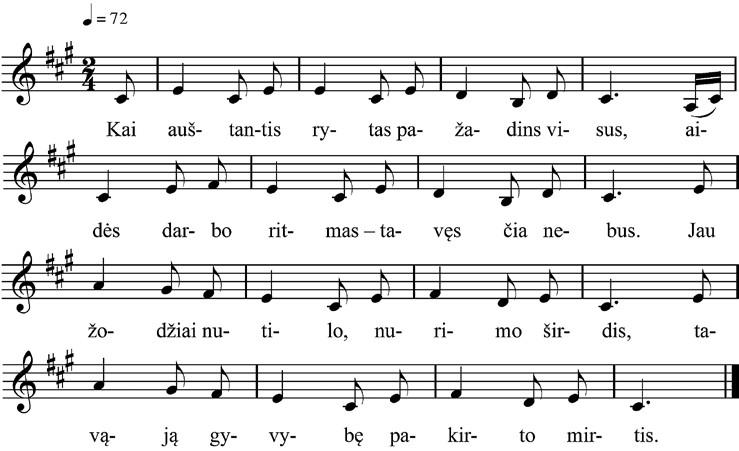
|
1. Kai auštantis rytas pažadins visus, Aidės darbo ritmas – tavęs čia nebus. Jau žodžiai nutilo, nurimo širdis, Tavąją gyvybę pakirto mirtis. 2. Kaip tamsūs šešėliai žemelę apgaubs, Veltui mūsų širdys tavęs grįžtant lauks. Nedegs žiburėlis. Tavoji ranka, Ji amžiams nusviro kaip ledas šalta. 3. Tave palydėt susirinkom visi: Giminės, kaimynai, visi artimi. Tu, mūsų brangioji, kam mus palikai, Kodėl į mūs šauksmą nebeatsakai? 4. Nupynėm vainiką rožančiaus giesmių. Uždegsim žvakelę, kur ilsėsies tu. Tau – žydinčios gėlės, tau – mūsų malda. Tavęs neužmiršim niekad, niekada. 5. Užžels tie takeliai, kuriais vaikščiojai, Išblės ir žodeliai, kuriuos pasakei. Prabėgs daugel metų tamsiam ilgesy, Tavęs nepamiršim, minėsim visi. 6. Ilsėkis ramybėj žemelėj šventoj, Čia, po Kristaus kryžium, kapų tylumoj. Tegul tavo sielą globoja dangus. Mum tik atminimas paliko brangus. |
1. When the breaking dawn wakes all, The rhythm of work will echo – but you won’t be here. Words are silent, quiet heart, Your life has been cut short by death. 2. Like dark shadows covering the earth, In vain our hearts shall wait for your return. The lantern will not glow. Your hand, Dropped, cold as ice. 3. We all gathered here to see you off: Relatives, neighbours, all those who were close to you. Why, our dearest, did you leave us, Why do you no longer answer our call? 4. We wove a wreath from our rosary prayers. We will light a candle where you shall lie. For you – blooming flowers, for you – our prayer. We will never, ever forget you. 5. The paths where you once tread will grow over, The words you once said will fade. Many years shall pass in dark longing, We will not forget you, all will remember you. 6. Rest in peace in the sacred earth, Here, under Christ’s cross, in the silence of the graves. May your soul be cared for in Heaven. All we have left is our dear memories. |
This song holds all of the daughter’s love, and pain, something that is communicated by subconsciously using the most acceptable, most moving form following the songs from her childhood and youth. It is easy to recognise word combinations that are prevalent in the early 20th century Lithuanian tradition of love songs (romances), for example “breaking dawn”, “quiet heart”, “cut short by death”, “dark shadows”, “cold as ice”, “deep longing”, etc. However, several lines are reminiscent of the traditional figures of old, pre-Christian funeral laments: “why did you leave us”, “the paths will grow over”. It is obvious that this songwriter’s environment still has people lamenting at funerals she hears these laments they are commonplace for her. The song, as is common and as the Catholic funeral tradition seems to demand, includes fragments of a religious nature, which can be seen at the end of this song. Therefore, the text of the created song is naturally taken over by this woman, a complex style alloy of inherited tradition. The melody is adapted from other songs sung in this region, and is widespread throughout Lithuania. There seems to be no attempt to step outside the boundaries of the tradition of funeral songs, but rather to renew and adapt it. Such a song, “the likes of which there had never been before”, in truth is an example of traditional norms and creative equilibrium.
If we wish to find this equilibrium, we should research in more detail for the melody of the song created by this woman because the story of its origin shows what kind of broad interfaces of time and space can be determined by the formation of local tradition. Here we can find examples of strong author impulses and spontaneous development.
The starting point of the journey of this tune, going back to the Lithuanian traditional repertoire of funeral songs, might seem unexpected as it came from the Covent Garden Opera House in London and the 1823 premier of Clari, or the Maid of Milan by composer Henry Rowley Bishop (1786–1855). “Home! Sweet Home!”, from this opera, quickly became incredibly popular. In part, Bishop himself contributed to this sudden popularity by giving the song a parlour form:
Example 2. Melody from “Home! Sweet Home!” (Home [after 1823]: 1–2).
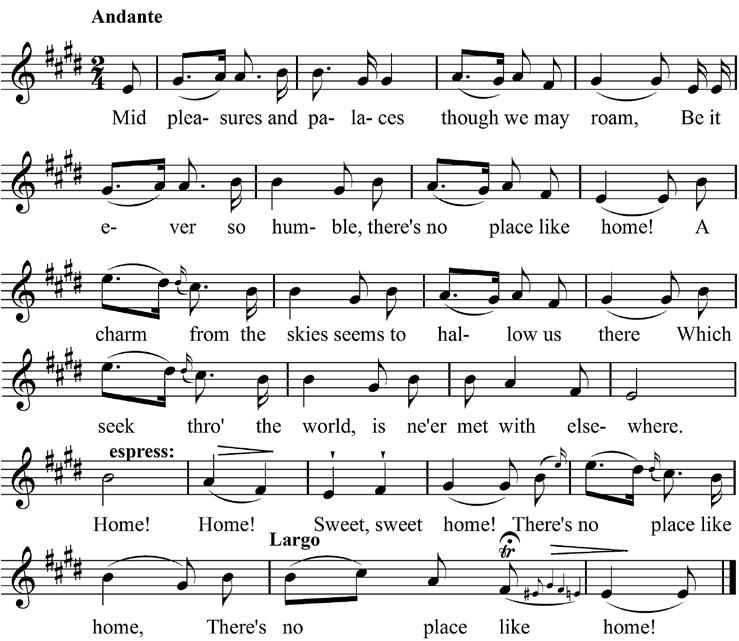
With the dawn of the 20th century, the song gradually became a symbol of various associations with popular culture in Europe and the USA, being used in movies (even in silent films), advertisements, the print media, literature and elsewhere, while the title itself became an idiom. This ‘English’ melody, popularised by H. R. Bishop (with the additional refrain “Home, home, home, sweet, sweet home!”), seems to have been mixed with some older German[15] songs. This new combination was already spreading in several variations in German culture in the 19th century:
Example 3. Melody from Gesänge für Sonntag-Schulen. Mit ausgewählten Melodieen und Liedern. Freundlich gewidmet allen deutschen evangelischen Sonntag-Schulen (Heppe 1866: 116).
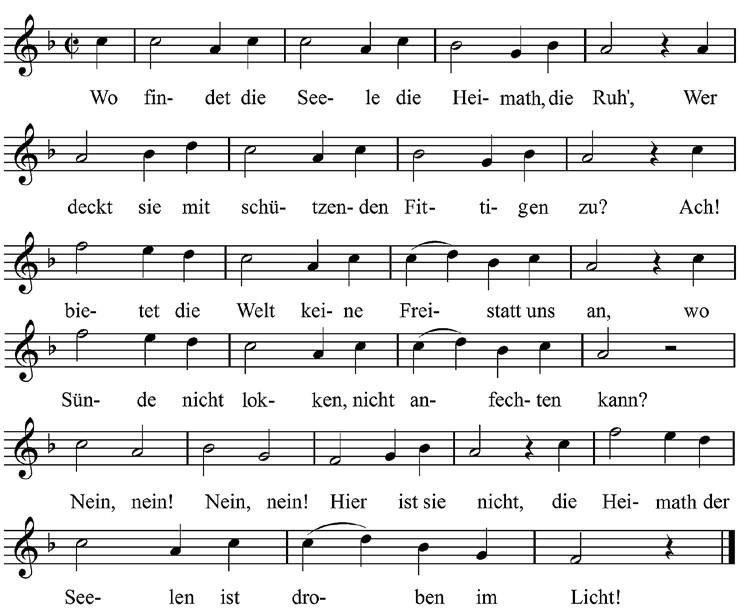
Example 4. Comparison of ‘English’ and German melodies, similar to those indicated in Examples 2 and 3. (Adapted from Underwood 1977: 39, 42–47).
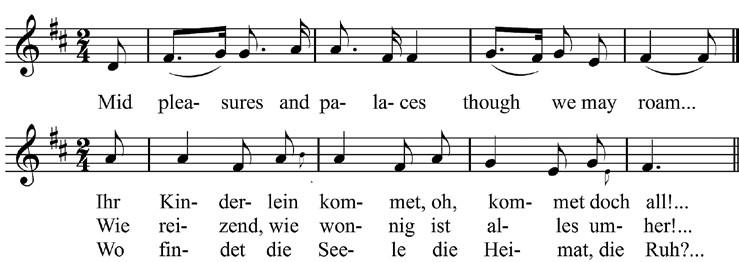
The tune reached Lithuania at the end of the 19th century and spread, in one direction through East Prussian Lutheran culture as a funeral hymn along with some variations of the text, while at the same time spreading in another direction as a Catholic hymn honouring the Virgin Mary, but also becoming part of funerals. It could have reached Lithuania through Poland together with the fashion for parlour music that flourished during the rule of Tsarist Russia in the salons of cities and manors as well as in a Catholic church environment. However, it may be that after 150 years this British parlour song spontaneously, naturally, and logically turned into a modern funeral religious song and became part of the traditional complex of funeral songs.
It is no surprise that the melody of the 20th century song “Home! Sweet Home!” caught on in Lithuania as part of the love song aesthetic, and to this day[16] mixes with Protestantism, Catholic hymns, romance, amateur songwriting and possibly other texts. The song written by Aldona is in line with the old, established traditional norm as it doesn’t change enough as to be unrecognisable[17]; thus, the melody can be used more than once, while the text fragments will disseminate and variations appear in songs by other authors. In essence, authorship disappears as the song spreads: it is of no significance in the scale of tradition. Authors are not forgotten, although their names are remembered only because songs and hymns are written down and published. Authors are also not forgotten thanks to folklore studies, literary science, music history (as in this case of “Home, Sweet Home”). General cultural tradition also demands a song’s authorship, which has become an ethical norm. There is a constant invisible battle between authorship as the result of a creative breakthrough, and tradition as a normative, equitable, universal process in which individuality does not mean uniqueness.
We should just imagine that this song is simply one example of many, illustrating how the mechanism of author creativity and its inclusion in traditional song culture, becoming tradition, updating tradition, works.
Aldona, who grew up after the war, no doubt surrounded by romances and antiSoviet resistance partisan songs[18], as well as the archaic sounds of funeral laments, continues tradition, supporting and updating it. After some thinking, Aldona says that not only is the melody not entirely her own creation, neither is the text. She says that often she hears something somewhere, adds or changes something, or creates something new. In her work, a traditional funeral hymn cycle, the ancient tradition of laments (a relic from the previous generation) and popular songs from her own youth spontaneously come together. All of this harmoniously mixes and settles until later generations will again slowly renew and slightly change the musical and poetic form of the songs.
Second case: “Definitely not folklore”
A slightly younger woman (b. 1945), an intellectual whom we shall call Dalia, sings a religious hymn with a unique story. Dalia moved from her home village to Vilnius at the age of 18, graduating university in classical philology and remaining in the capital city. For many years, she sang in a famous folklore ensemble. Upon her retirement, she decided to move back to a village, but not in the region where she was born. Having joined the local community’s activities, she began to sing at funerals, and write poetry and religious hymns. She had written poetry at school (some poems were published in the regional newspaper), but she later stopped. She started her creative work again only after leaving her job. When a folklore researcher visited her, Dalia remembered a Catholic hymn sung by her grandmother. She talked about her life and noted that her parents were musically inclined, good people, while her mother in particular rallied the community. This woman, through her participation in the folklore revival movement, had a very clearly formed understanding of what old, authentic folklore is, i.e. valuable heritage, and what is low in value, innovative, or simply not even folklore. She sang, according to her, a hymn she wrote herself, religious in nature, noting that it definitely wasn’t folklore:
Example 5. Dalia’s song. LTRF cd 144–160, recorded in 2008.
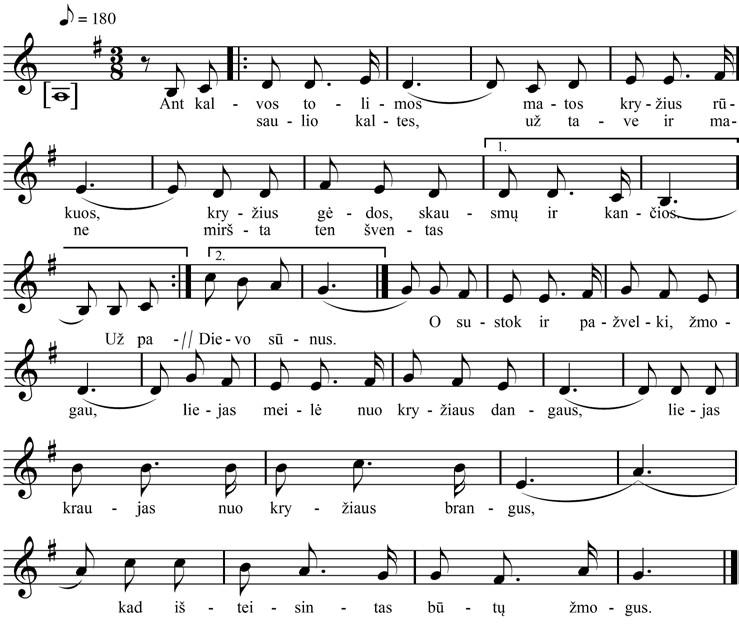
|
1. Ant kalvos tolimos matos kryžius rūkuos, Kryžius gėdos, skausmų ir kančios. Už pasaulio kaltes, už tave ir mane Miršta ten šventas Dievo sūnus. Priedainis: O sustok ir pažvelki, žmogau, Liejas meilė nuo kryžiaus dangaus, Liejas kraujas nuo kryžiaus brangus, Kad išteisintas būtų žmogus. 2. Nusidėję visi, nėr nei vieno teisaus, Laukia teismas rūstus ir baisus – Kas galės išstovėt prieš jo sostą šlovės, Kas prieš jį pasiteisint galės? Priedainis: … 3. Dievo meilė kantri, amžina ir stipri Nusidėjėlį gelbsti tik ji. Dievo sūnų tikėk, atgailauk ir mylėk Jis gyvenimą amžiną duos. Priedainis: … |
1. On a far-off hill a cross in the mist, A cross of shame, pain, and suffering. For the fault of the world, for you and for me The holy son of God dies there. Chorus: Oh, stop and look, dear man, Love flows from the cross of Heaven, Blood flows from the cross so dear, For man to pass judgement. 2. All are sinners, none are right, Judgement so cruel awaits – Who will stand before His throne of glory, Who will justify themselves? Chorus: … 3. God’s love is patient, eternal and strong Sinners are saved only by Him. Believe in God’s Son, repent and believe He shall give you eternal life. Chorus: … |
In truth, Dalia’s work is a Lithuanian version of the hymn, written (or rather shaped – ‘put together’) in 1912–1913 by the American Methodist preacher George Bennard (1873–1958). This hymn, called “The Old Rugged Cross”, was first published in 1915. It was widespread in the United States and Europe, while today it is still favoured by musicians and can be heard in films and plays; it is often sung by believers. No doubt in living tradition there haven’t been questions about its authorship for a long time. This emotional romance-style piece is so entrenched in the communities that it unintentionally flows from people’s memory during moments of creative inspiration.
It is interesting to note that Dalia’s musical creative work arises not from many years of cherished, newly revived folklore tradition, which is accepted as being valuable and worthy of preservation (although untouchable and unchangeable, restored only in “the most authentic manner”). This deliberately cherished tradition, for Dalia, remains something to be performed on stage only, it seems to skip over several generations and is not directly adopted and doesn’t become a source of creative inspiration. Dalia’s music probably echoes the romance-style music she heard in her native village. Upon moving back to a village, albeit not the same one she grew up in, Dalia seems to return to her innate musical environment and once again enters a world of familiar sounds. She says that the song she wrote is known by all the locals and they sing it together. Dalia did not come up with the melody herself as she isn’t a musician and can’t write musical notation. According to her, the melodies perhaps come in part from other songs which she sometimes forgets but then remembers again. To summarise, we can say that Dalia’s musical creative work is regulated by the romance music tradition that is related to pop culture, while any older layers of tradition that are present cannot be directly traced.
Third case: town anthem
The third example is of a cultural worker (b. 1955, we shall call her Regina) from a small town of 1,000 people in northern Lithuania who in 2005 created a song based on the lyrics “Šiaurės Lietuvą debesys glosto” (‘Clouds Caress Northern Lithuania’), written by the town’s elder (b. 1950). The song became the town’s anthem, a musical symbol of the community. This song could be called a hybrid as it consists of layers of text that stylise folk speaking mannerisms and a simply structured melody, the musical fabric of which is stylistically complicated. In the text, stylisation is used deliberately as a sign of the tradition, of longevity and of experience. Meanwhile, the melody’s style is a spontaneous hybrid, matching something well-known and at the same time modern. The following components should be listed:
1) motifs from a song that in the pre-war period was patriotic and encouraged people to take up arms and go to battle. After the war it did not disappear, but rather became an incredibly popular wedding and family celebration song, inviting people from all of Lithuania to come together, sit at the table, raise their glasses, and sing;
2) final motif common to the Soviet-era pioneer camp song repertoire (possibly a legacy of previous musical activity);
3) pop-style instrumentation, voice timbres (the anthem is often performed by a children’s pop choir accompanied by an electronic keyboard);
4) Latin American dance (syncopated) rhythm as an accompanying background[19].
They clearly show in what musical environment that woman matured and how she updates her creative experience. The town’s anthem was adopted, gained all the attributes of a normal anthem, it actively thrives in the community: sung during celebrations, ceremonies, before important events or at key moments; it is sung by everyone at once, standing up, holding hands[20]. This means that the composer completely settles into the norms of local musical identity.
Example 6. Town anthem. LTRF cd 605–14, recorded in 2005.
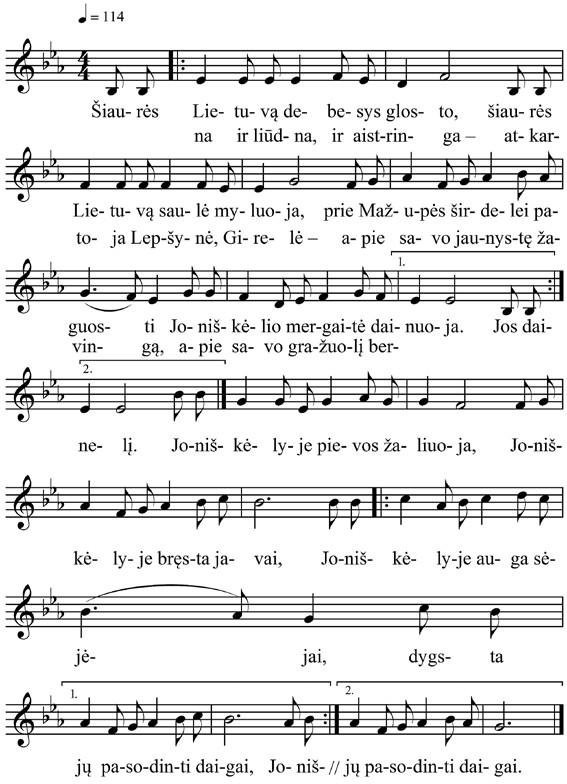
|
Šiaurės Lietuvą debesys glosto, Šiaurės Lietuvą saulė myluoja, Prie Mažupės širdelei paguosti Joniškėlio mergaitė dainuoja. Jos daina ir liūdna, ir aistringa – Atkartoja Lepšynė, Girelė – Apie savo jaunystę žavingą, Apie savo gražuolį bernelį. Priedainis: Joniškėlyje pievos žaliuoja, Joniškėlyje bręsta javai, Joniškėlyje auga sėjėjai, Dygsta jų pasodinti daigai. |
Clouds caress northern Lithuania, The sun shines on northern Lithuania, By the river, comforting the heart, A maiden from Joniškėlis is singing. Her song is both sad and passionate – Repeated by the forests – About her charming youth, About her lovely boyfriend. Chorus: In Joniškėlis the meadows are green, In Joniškėlis the wheat matures, In Joniškėlis do sowers grow, Their seedlings sprout. |
Fourth case: instrumental songs
Nevertheless, today we can already talk about how consciously fostered folklore heritage, a revived form of tradition, can become the music of one’s youth, which spontaneously becomes a continuation of living tradition, the engine for its revival. Such a tendency can be observed in Žemyna Trinkūnaitė’s (b. 1967) kanklės (Lithuanian plucked string instrument (chordophone))[21] compositions. Her CD Devynstygės kanklės – septyniolika kompozicijų (Nine-string Kanklės – Seventeen Compositions, Trinkūnaitė 2013) found its way to the top 11 of the most surprising music albums of Lithuania. In this chapter, we will take a closer look at this first publicly released audio recording, the compositions on which have taken a very long time to mature, and have been carefully thought out and felt. Later, encouraged by her success, Žemyna began to write, perform and publish much more intensively[22]. At present, her creative style is undergoing a noticeable change, and she has boldly embarked on experiments in poetry, singing, and various forms of ensemble music-making. However, it was the first audio recording which popularised her work to a great extent.
As stated by the Music Information Centre Lithuania,
Žemyna Trinkūnaitė got the first taste of Lithuanian folk music in the house of her parents, well-known enthusiasts of Lithuanian folk music. Later she learned to play kanklės at the Balys Dvarionas Music School. Having joined folk bands …, she sung, played kanklės, and began to create compositions for this instrument.… Žemyna has given concerts in Poland, Czech Republic, United States of America, Sweden and Russia. Although her compositions are original, they are based on the motifs and harmonies of Lithuanian folk music. Trinkūnaitė does not notate her compositions and performs them from memory, thus every time they sound differently. (Trinkūnaitė 2019)
Žemyna decided to release her compositions after long hesitation, as she has been creating music since around 1998. The author is a member of the generation that experienced a break in musical culture, the generation that no longer has a direct link to village culture. She is a true city dweller, and did not inherit or take over the tradition of the romance style. Žemyna’s music was born from the folklore movement, from the ‘aged’, secondary, recovered, urban tradition. But this is a lived-in, no longer museum tradition. She isn’t overwhelmed by other inherited music from her youth. The folklore movement was, first of all, a song movement, as singing set in motion what had been a cultural stagnation, setting into motion political processes as well. Such an amalgamation of artistic experience and conscious recognition of own tradition gives birth to a new socially active, forming, influential activity, a new quality that can be described by applying through analogy Betsy Peterson’s definition of folk-art:
Folk arts include a constellation of artistic activities and cultural expressions in community life that are informal, often popular in orientation, amateur, voluntary, and occurring in myriad social contexts. As expressions of deep cultural knowledge, creative expression, activism, cultural durability, and community values, folk and traditional arts can be tools for community empowerment and social change. (Peterson 2011)
Žemyna’s creative work does truly influence the people who surround her. On the one hand, she often performs on stage and is appreciated by the public. On the other hand, she is often invited to participate in various rituals such as weddings, funerals, christenings, ceremonies, etc. Sometimes these concerts are planned, while at other times completely spontaneous. Her music is played at key points during rituals (i.e. during wedding ceremonies). In addition, she also actively propagates kanklės music, has written exercises based on motifs from her compositions, teaches, organises camps and is one the founders and administrators of the Kanklės Facebook group (Kanklės 2013). Yes, her pieces aren’t songs, but, in truth, this music is entirely born of songs rather than instrumental music. Therefore, they can be called kanklės songs.
We should stop for a moment to consider what in Žemyna’s music could mean a breakthrough of creative freedom, and what is determined by the norms of tradition. Her compositions are, no doubt, authored. This composer studied at a music school, majoring in kanklės, therefore she is well-versed in this instrument and her playing is exceptionally clean technically. On the other hand, she isn’t quite able to write down her own musical notation, thus her compositions are, every time, reproduced from memory like the works of classical folklore. She ‘interacts’ with her compositions. A certain frame of expression is provided by the traditional instrument itself as its sound is recognisable as Lithuanian, traditional.
The compositions don’t have titles. There are no images, no words, only pure sound. The author is unique in that she doesn’t base her songs on text. The way she sees her world and its symbolic coding is based on sound, on music. Sound is awakened by living experiences from her personal life, from interaction, nature. This artist bravely uses polyphony and syncopated rhythm. The tuning of her kanklės isn’t standard and constantly changes. It is interesting to note that the forms of the compositions are spontaneously developed (often it seems that this isn’t done consciously, but completely spontaneously, slightly chaotically), seemingly attempting to break out of the frames of modest, ascetic song forms (such as in “Composition XVII”). But, in truth, traditional songs often dictate the form of Žemyna’s compositions (the question-and-answer style, the construction of the stanzas). And not only the form.
For example, in the CD mentioned above Žemyna often uses a triple metre. However, it could not always be recognised as a waltz rhythm (despite this being what we might expect from traditional kanklės music), but rather as a specific song rhythm. In “Composition I”, which is in verse form and has a triple metre, we can recognise direct inspiration from the song “Mano tėvelis senas būdamas, oi, nori nori saldaus miegelio” (My old father wished to sleep sweetly), characteristic of southeastern Lithuania. However, the old regional melody is only implicit, it actually sounds like her kanklės are accompanying it, with an added Lithuanian–Latvian–Polish dance cadence. Another thing that incorporates the melody of this regional song into the late 20th and early 21st century world of music are the abundant, intense syncopated jumps into sounds and chords.
In “Composition III”, one can hear echoes of kanklės music from Latvia’s folklore revival. This is not surprising as Žemyna was active during the Singing Revolution, the Sąjūdis political movement, as a participant in the Baltica festival, which rotated each year between the three Baltic States from 1987.
“Composition VIII” reflects the invented tradition – created by the folklore group that Žemyna was a part of for many years – of accompanying songs recorded in Veliuona region in the 19th century with the kanklės. But, once again, the necessary time stamps are inserted – the aforementioned syncopated jumps – into the following chord.
Žemyna herself talks about the inspiration for “Composition XVII”: “Once in Latvia I heard Vladimir Povietkin, the famed Novgorod gusli player, playing a Latvian wedding song. Therefore, this impression can be a considered a small episode in Baltic and Slavic music” (Trinkūnaitė 2018).
To summarise, we can claim that her music reflects an entire musical world, the world that formed her. Therefore, this music resonates incredibly widely and seems close to those who lived with similar music forming them: it feels good to identify with it, it calms one down, provides comfort.[23] The generation that was an active participant the folklore movement (which the author of this chapter was also part of), recognise their youth’s (not the old musical tradition’s) music, the aural environment that might have been the music of their youthful rebellion or the result of conscious preservation of heritage, which became a new tradition, or, perhaps, simply as a factor that contributed to identity formation. The sound (musical) basis of the folklore movement, i.e. the repertoire, already formed the preconditions for the formation of a living tradition, an incredibly important transformation in song culture.
It is very likely that Žemyna’s creative work will spread not only in the form of learned and repeated pieces, but also in fragments as inspiration for new work, since the author is not only actively involved in disseminating her own work online, and kanklės music in general, but has also recently self-published a small edition of sheet music for her compositions (Trinkūnaitė 2021). Such dissemination is for her own benefit so that her work will not disappear. But her efforts have a significantly greater impact. From video methodological materials online, from published sheet music, and via listening by themselves, teachers will teach children, giving the music a powerful place in forming future generations’ creativity. It is possible that eventually tradition will take over Žemyna’s uniqueness. Perhaps someone will say “I created a song”, and we will hear in it echoes of Žemyna’s kanklės music.
Conclusion
All of the aforementioned cases illustrate the process by which the musical environment of one’s youth forms a bank from which to draw future creative ideas. In this way the community member’s individual songwriting breakthroughs are in one way or another limited by the community’s musical identity. These cases can help form the assumption that for a person who can hear it is probably impossible to be born into a silent, empty world, devoid of musical sounds, i.e. they cannot be born somewhere without a musical tradition. A musical environment inevitably shapes us, and over time we learn to recognise the melodies that feel truly our own – those we find acceptable, precious, and familiar. These melodies become intertwined with certain people, places, and events, contributing to the formation of our identity and sense of belonging. The cases we analysed also show clear differences between generations, with each one bringing its own small change in the general course of a song tradition. When the author realises, or even says “I created a song”, local tradition takes on its most common work: it censors and adapts new musical and poetic text ideas, allowing the piece to live for a long or short time, allowing fragments to remain in other works or to disappear without trace. Tradition regulates the freedom of songwriting in living culture.
Creative ideas circulate in broad trajectories of space and time, but in communities there is constant site-specification through the song itself and through singing. The most important thing is that this process continues indefinitely. The laws for the existence of folklore have not ended. They continue in the form of techniques of composition according to which new songs are created by putting together fragments or motifs from well-known songs, direct dissemination of songs through singing, creation of songs without written melodies, anonymity or unimportance of authorship, repetition and variation, constant recreation and adaptation, a song’s symbolic meaning in rites and rituals, subconscious identification with inherited song tradition in creating one’s own songs. These factors persist on the road of living songs fuelling the engine of change in tradition, constantly providing it with power. Sitespecificity and locality today are powerful counteractions to the effects of globalisation and standardisation, providing new life to collective forms of self-awareness.
References
Sources
Archival sources
LTRF. Folklore Archives of the Institute of Lithuanian Literature and Folklore, audio recordings.
Web Sources
Kanklės 2013. Facebook group created 17 July 2013. Accessed 7 June 2022. https://www.facebook.com/groups/kankles/about/
Myliu gyvenimą 2011. In YouTube, posted 19 August 2011. Accessed 7 June 2022. https://www.youtube.com/watch?v=grfAfF7zugw
Nijolei Stepulienei 60 2015. In YouTube, posted 13 October 2015. Accessed 7 June 2022. https://www.youtube.com/watch?v=e123kGs_d_o
Trinkūnaitė, Žemyna 2013. Devynstygės kanklės – 17 kompozicijų. Record company: Mano lietuviški namai. Accessed 7 June 2022. https://www.pakartot.lt/album/devynstyges-kankles-17-kompoziciju
Trinkūnaitė, Žemyna 2018. XVI kompozicija (Latviška daina). In YouTube, posted 18 November 2018. Accessed 7 June 2022. https://www.youtube.com/watch?v=oh6duqHd5Zg&list=PLw3JVCY7FUVS9Mp14XAgJ_a3hghAxuGDq
Literature
Britannica Editors 2013. naïve art. In Encyclopedia Britannica. Accessed 18 December 2022. https://www.britannica.com/art/naive-art
Bernhard, Marianne 1998 [1995]. Universalus meno žodynas: nuo seniausiųjų laikų iki dabarties. Translated by Osvaldas Aleksa, Jurgis Kunčinas & Laima Veršulienė. Kaunas: Šviesa.
Bronner, Simon J. 2013. The “Handiness” of Tradition. In Tradition in the Twenty-First Century: Locating the Role of the Past in the Present. Trevor J. Blank & Robert Glenn Howard (eds.). Logan: Utah State University Press, 186–218. https://doi.org/10.7330/9780874218992.c08
Bronner, Simon J. 2016. Toward a Definition of Folklore in Practice. Cultural Analysis 15: 6–27. Available at: https://www.ocf.berkeley.edu/~culturalanalysis/volume15/pdf/bronner.pdf
Bohlman, Philip V. 1988. The Study of Folk Music in the Modern World. Bloomington: Indiana University Press. Available at: https://publish.iupress.indiana.edu/projects/the-study-offolk-music-in-the-modern-world
Flauers, Inga Nora 2019. Apie druską, meilę, gintarą ir muziką. Alkas.lt. Accessed 7 June 2022. http://alkas.lt/2019/01/16/i-n-flauers-apie-druska-meile-gintara-ir-muzika-video
García Canclini, Néstor 2005 [1990]. Hybrid Cultures: Strategies for Entering and Leaving Modernity. Translated by Christopher L. Chiappari & Silvia L. López. Minneapolis, London: University of Minnesota Press. Available at: https://monoskop.org/images/0/0f/Canclini_Nestor_Garcia_Hybrid_Cultures_new_ed_2005.pdf
Garnevičiūtė, Rimutė 2014. Catholic Funeral Rites and Customs in Lithuania (in Late 20th and Early 21st Century). Summary of Doctoral Dissertation (Humanities, Ethnology). Kaunas: Vytautas Magnus University. Accessed 12 July 2024. https://hdl.handle.net/20.500.12259/124517
Giddens, Anthony 1991. Modernity and Self-Identity: Self and Society in the Late Modern Age. Stanford: Stanford University Press.
Heppe, C. J. 1866 (ed.). Gesänge für Sonntag-Schulen. Mit ausgewählten Melodieen und Liedern. Freundlich gewidmet allen deutschen evangelischen Sonntag-Schulen. New York: Amerikanischen Traktat-Gesellschaft. Available at: https://archive.org/details/gesngefrsonn00hepp/page/38/mode/2up
Home [after 1823] = Home! Sweet Home! London: Goulding, D’Almain & Co.
Kvideland, Reimund 1989. Folk Ballad and Folk Song. In Nordic Folklore: Recent Studies.
Reimund Kvideland, Henning K. Sehmsdorf & Elizabeth Simpson (eds.). Bloomington: Indiana University Press, 165–172.
Lotman 1992 = Лотман, Юрий 1992. Каноническое искусство как информационный парадокс. In Избранные статьи в трех томах, том I: Статьи по семиотике и топологии культуры. Таллин: Александра, 243–247. Available at: https://psv4.userapi.com/s/v1/d/nhYy9YvLbt7yjSNDX1Hi1vV_1YC9EPvjX5G4GWTdA1iw0uC4EeZa4k7FxmK9Ks_eF-7OXbsUea8YaVsvFc5yNllXBnGspi6K-RD_hrVErRFHBTus/Lotman_Yu_M_Tom_1_Izbrannye_stati_1992_g.pdf
Lur’e 2001 = Лурье, Михаил Л. 2001. О феномене наивного сочинительства. In “Наивная литература”: исследования и тексты. С. Ю. Неклюдов (ed.). Москва: Московский общественный научный фонд, 15–28. https://www.ruthenia.ru/folklore/luriem43.pdf
Masoit, Irena, Kristina Syrnicka & Aušra Žičkienė (eds.) 2013. Vilniaus krašto lenkų laidotuvių giesmės: antologija / Polskie pieśni pogrzebowe na Wileńszczyźnie: antologia. Vilnius: Edukologijos universitetas.
Merriam, Alan P. 1964. The Anthropology of Music. Evanston: Northwestern University Press.
Mulevičiūtė, Jolita, Giedrė Jankevičiūtė & Lijana Šatavičiūtė 1999. Dailės žodynas. Vilnius: Dailės akademijos leidykla.
Neklyudov 2001 = Неклюдов, Сергей Ю. 2001. От составителя. In “Наивная литература”: исследования и тексты. С. Ю. Неклюдов (ed.). Москва: Московский общественный научный фонд, 4–14.
Peterson, Betsy 2011. Folk and Traditional Arts and Social Change. In Americans for the Arts. National Arts Administration and Policy Publications Database (NAAPPD). Accessed 27 November 2025. https://www.americansforthearts.org/by-program/reports-and-data/legislation-policy/naappd/folk-and-traditional-arts-and-social-change
Račiūnaitė Paūžuolienė, Rasa 2014. Lithuanian Funeral Customs During the End of the 19th–21st Centuries: From Tradition to Innovations. In Dying and Death in 18th–21st Century Europe, Volume 2. Marius Rotar, Adriana Teodorescu & Corina Rotar (eds.). Newcastle upon Tyne: Scholars Publishing, 39–59.
Särg 1999 = Сярг, Тайве 1999. Современный фольклор и песни молодых писателей г. Тарту. Accessed 7 June 2022. http://www.suri.ee/etnofutu/3/doc/taive-ru.html
Särg, Taive 2001a. Tänapäeva folkloor ja Tartu noorte kirjanike laulud, I. Akadeemia 6: 1009–1116. Available at: http://www.akad.ee/2001/06/15/akadeemia-nr-6-2001
Särg, Taive 2001b. Tänapäeva folkloor ja Tartu noorte kirjanike laulud, II. Akadeemia 7: 1416–1430.
Särg, Taive 2009. Covers and Folklore: Contra’s Songs. In Media & Folklore: Contemporary Folklore IV. Mare Kõiva (ed.). Tartu: Estonian Literary Museum, ELM Scholarly Press, 347–389.
Scott, Derek B. 2001 [1989]. The Singing Bourgeois: Songs of the Victorian Drawing Room and Parlour, 2nd ed. Aldershot: Ashgate.
Scott, Derek B. 2004. The Musical Soirée: Rational Amusement in the Home. In Interdisciplinary Nineteenth-Century Studies Conference. University of Iowa, April 1–4, 2004. Accessed 7 June 2022. http://www.victorianweb.org/victorian/mt/parlorsongs/scott1.html
Sims, Martha C. & Martine Stephens 2005. Living Folklore. An Introduction to the Study of People and Their Traditions. Logan: Utah State University Press. Available at: https://bpb-us-e1.wpmucdn.com/wordpressua.uark.edu/dist/b/596/files/2016/05/Living-Folklore-2nd-Ed.Sims-Stephens.pdf
Toelken, Barre 1996. The Dynamics of Folklore. Logan: Utah State University Press. Available at: https://www.thetedkarchive.com/library/barre-toelken-the-dynamics-of-folklore#toc2
Tomlinson, John 1999. Globalisation and Culture. Chicago: The University of Chicago Press.
Trinkūnaitė, Žemyna 2021. Žemynos Trinkūnaitės kūriniai devynstygėms ir dešimtstygėms kanklėms Vilnius: s.l.
Trinkūnaitė, Žemyna 2019. Žemyna Trinkūnaitė. Accessed 7 June 2022.https://www.mic.lt/en/database/folk/composers-artists/zemyna
Underwood, Byron Edward 1977. The German Prototype of the Melody of “Home! Sweet Home!”. Jahrbuch für Volksliedforschung 22: 36–48.
[1] The concept of a folk music community is used for a group of people who are engaged in different activities related to folk music and who self-reflexively form a community, such as musicians, dancers, audiences, organisers, etc. (Johansson & Berge 2014: 31).
[2] Theoretical literature on folklore has established that ‘folk’ can denote any group of people (Dundes 1980), but in the terms ‘folk song’ and ‘folk music’ it still has a strong connotation of a rural ethnic group or nation. As mentioned above, these terms, propagating in time and space, become loaded with certain ideas.
[3] ‘Tradition’ comes from Latin tradere (trans + dare), ‘hand over’. Ó Giolláin, discussing historical meanings of the ‘traditional’, concludes that in English the initial meaning of ‘delivered teaching’, ‘instruction’ strongly implies ‘respect’, ‘obligation’, with the general meaning inclined towards ‘primeval’, ‘pristine’, ‘ceremony’ (Ó Giolláin 2000: 8).
[4] The developments in anthropology in the 1950s and especially postcolonial discourse that emerged in the 1980s made people seriously think about the loaded nature of scholarly language (see for example Bourdieu 1989; Ashcroft et al. 2007 [2000]). Helen Myers admitted that ‘conscientious ethnomusicologists’ have lost their working vocabulary over the last several decades. “In the kingdom of exiled words live the labels condemned as pejorative: the old-timers, ‘savage’, ‘primitive’, ‘exotic’, ‘Oriental’, ‘Far Eastern’; some newcomers, ‘folk’, ‘non-Western’, ‘non-literate’, ‘pre-literate’; and recently ‘world’. ‘Traditional’ survived the trial of the 1970s, leaving ethnomusicologists with an important concept that refers, in the world of music, to everything and therefore nothing.” (Myers 1992: 11)
[5] Anthropological research gradually became conscious of its epistemological limits. Inherent to Western science was the structured division of the world, as part of which Other cultures were seen as generally outside and inferior. The ‘truth’ about them was based on, and transmitted through, subjective mediums, to which were attributed objectivity in the framework of a positivist rational worldview and power relations.
[6] It is supposed that there was once “a communication system that had the characteristics that are now shared by music and language, but that split into two systems at some date in our evolutionary history” (Mithen 2006: 26).
[7] Foley describes the oral tradition as a process, where singing takes place within tradition and tradition lives through performances; for listeners the connection to tradition for understanding is also important; an essential part of oral tradition is repetition and variation at every level; and for meaningful performance, old songs must be placed in the right context (Foley 2002: 123–141).
[8] The reproduction of folk songs began more than a hundred years ago, for example in 1906 the teaching of folk songs at school became compulsory in England, and in Austria the revival of alpine songs (Restaurationsbestrebungen) began in the 1930s and continued after the war. A clear distinction between old and revived tradition was made by Walter Wiora (1959: 10–11) when he introduced the concepts of the first and second life of a folk song (erstes, zweites Dasein). Lauri Honko (1990) extended the terms first and second life to folklore, while Hans Moser (1962) distinguished folklore, adapted in a new presentational context from folklore in continuous oral tradition in its initial context. Walter Ong calls the spread of recordings of traditional music, and the spread of listening to them, “secondary orality” or “the sort of ‘false orality’ coming from electronic media”, which, however, has the effect of inspiring a sense of community (Ong 1982: 133).
[9] A revival of folk dance was cultivated by societies established in several countries around the turn of the 20th century, in dance clubs and houses, and has been much studied (e.g. Sárosi 1986; Bröcker 1996; Quigley 2014). The movements aimed both to preserve folk dances in live tradition, and to revive them as presentational and as participant activities. For example, in Germany the first Society for Folk Dance Cultivation (Gebirgstrachten-Erhaltungsverein) was established in order to foster the living tradition in 1883, changing it gradually to staged dances and tourist attraction; and in 1896 the Wandervogel movement started, which encouraged young people who had no direct connection with tradition to revive country life together with folk song and dances. (Bröcker 1996)
[10] In contemporary Western culture there has been a growing interest in participation in the search for innovation in art, and increasing interest in the fact that participation, and sensory and physical experiences, can be marketed. Thus, more and more cultural fields, including museums, visual arts events, theatre and others offer opportunities for participation and co-creation in reality and virtually (see for example Kelomees 2007; Tartu New Theatre 2018; ENM Fairytale exhibition 2023, etc.). Beside this emerges a new tradition of community singing. (Bartleet & Higgins 2018)
[11] The first revival was reflected in many East European countries in terms of “national music” in the meaning of national art music.
[12] The leader of Sadauja, Edita Meškuotienė, told this to Austė Nakienė from the Lithuanian Folklore Archives. A personal correspondence between Austė Nakienė and Taive Särg, 2021.
[13] Huron estimates that singing originated about 150,000 years ago. He cited the example of the Mekranot Indians, who spent roughly two hours per day singing. (Huron 2003: 64, 65)
[14] The musical practice of children and teenagers is a wide-ranging and complex subject that should be discussed separately, considering that young people do not yet have enough experience of community culture to enable them to share, change and continue traditions.
[15] According to Byron Edward Underwood, H. R. Bishop was influenced by an old German melody written by the composer Johann Abraham Peter Schulz in 1790 (“Wie reizend, wie wonnig”, ‘How charming, how pleasant’, or “Der Morgen im Lenze”, ‘Morning in Lenze’, lyrics by Wilhelm Gottlieb Becker, see Underwood 1977: 39). It seems that the process of influence might be reciprocal: while this an old German melody inspired Bishop’s song, that song then latter became extremely popular in German and gained some new variations.
[16] As mentioned by Derec B. Scott, one of the most famous researchers of popular music history and parlour songs, what mattered most to bourgeois middle-class 19th century song authors was to transfer noble goals related to society, religion, politics and morals in an emotionally sensitive way. According to this researcher, the song “Home! Sweet Home!” was probably the first to establish a standard of sentimentality, which was used as inspiration by many parlour song writers later on (Scott 2001: 12–15, 2004).
[17] It is worth mentioning that Aldona’s melody is shorter. It doesn’t have the refrain created by Bishop, although this isn’t a unique trait as variants without this refrain are common among Lithuanian funeral songs.
[18] Partisan songs were partly based on the musical and poetic arsenal of romances, thus extending and enriching it.
[19] This ‘exotic’ syncopated rhythm is what updates and makes more relevant the anthem’s rhythmic melody, characteristic of Lithuanian folk songs. The syncopated rhythm of this often-performed anthem is sometimes heard only in the accompaniment, while sometimes it diversifies the main melody. To this should be added the more general observation that amateur songwriters born in the 1950s usually make active use of syncopated rhythm, creating both syncopated and traditional, even-rhythm melodies. The previous generation, in their creative work, did not use syncope, while the later generation composes only syncopated melodies.
[20] See for example Myliu gyvenimą (‘I love life’, 2011), 2 mins 19 secs from the beginning of the recording: the event’s moderator asks everyone to stand and for the children’s pop choir on stage to begin the town’s anthem; as it sounds, the evening’s personality is presented. Also see Nijolei Stepulienei 60 (‘Nijolė Stepulienė’s 60th Birthday’, 2015), 1h 30 mins 22 secs from the beginning of the recording.
[21] The Latvian kokle, Estonian kannel, Finnish and Karelian kantele, and the Russian gusli also belong to the same family of traditional east Baltic instruments.
[22] Despite the fact that she has been making music, performing on-stage and releasing recordings for some time now, Žemyna considers herself a self-taught amateur and enjoys the opportunity to express her creative ideas with complete freedom, as she doesn’t need to make a living from this activity.
[23] Impressions of a listener (also an active participant of the folklore movement) of Žemyna’s playing: “We can all recognise within it our melodies, we recognise intervals, just as in life we recognise friends and follow words” (Flauers 2019).