
Randy Brown
The Inside Story of Columbine
Lies. Coverups. Ballistics. Lessons.
April, 1998. A Moment in Time.
A Note to the Brave SWAT Team Members at Columbine.
May 5, 1999. 15 days after Columbine.
Thinking back to Before Columbine
To the future Eric and Dylan’s of the world… an open letter:
Columbine High, the abusive parent.
Info to Kieran, a reporter at the Denver Post
Threat Review: The Public Safety Review Board for schools.
State Championships in Football
The Litmus Test for Your School.
I Had a Talk with My Dad Today
Inconsistencies with His Statement
A Letter to Deputy Gardner (Mailed 4/23/00)
The Lesson of Columbine: Change Your Heart
Judy finds: Is This the Sheriff’s Guy?
How many children does it take?
The heroes and courage of Columbine
“Submitted by Regina Huerter. December 1, 2000
Governor’s Commission: Afternoon Session:
Teacher testimony at the Commission continued:
The Lessons They Learned from Columbine
Picking up the Search Warrant.
The Search Warrant is finally released.
The Governor’s Commission Report.
Jefferson County Attorney Tuthill, Kate Battan, Sheriff John Stone, D.A. Dave Thomas
The causes of Columbine and the lesson we must all learn
People and Fire Department and Police of New York City
The Rohrbough Parent Protection Kit
The Cowards at Columbine. Part 2
The Release of the El Paso Report.
A new release of search warrants:
A Challenge to the New Sheriff
The Littleton Cemetery and Suicides
A critical editorial about me.
The Police and the first Rescue
TO ALL COLUMBINE FAMILIES… A CALL TO ACTION
There is an investigation into the report from 1997.
Press conference at the Fairgrounds
The Attorney General’s release.
Report on missing DFAR’s/ The Coverup.
Broken Hearts, Broken promises
The Disbarment Effort. Filed with the State Bar Association.
Mr. Charles Mortimer, Jr., Esq.
Mr. Charles E. Mortimer, Jr., Esq.
The Supreme Court Counsel Decides.
An open letter to the families,
Dave Thomas is getting an award.
An Open letter to the CRTF site.
The basement tapes… are they dangerous?
Columbine Documents that are being hidden by the Sheriff and the Killers Families:
The Sheriff of Jefferson County is wrong
The Last School Board Meeting in Jefferson County
Isaiah Emon Shoels: The Memorial
Columbine the book. March 22, 2009
A Book on Columbine. March 26, 2009
My speech to the School Board.
How do we prevent school shootings?
Columbine Records Review Task Force.
The School Board and Dave Thomas.
Notes on the Arapahoe School Shooting.
Who was responsible for Columbine?
Explaining the videos of Eric and Dylan threatening people:
Why wasn’t Erickson given Subpoena power?
Why didn’t Eric kill Brooks outside the school?
Why do I keep saying that bullying was the cause? What evidence do I have to prove that?
The Day before the Twenty-Year Anniversary.
In the library, our library, there is a little black notebook, from April 20th, 1999.
The Library Tape and Assault Rifles.
How to handle school shooting drills in schools.
This book is about the 20-year search for the truth, and the process, and hard work, it has been to try to discover the truth. That process was made much more difficult by an active conspiracy to conceal information by the Sheriff’s Department, the District Attorney, the Court System, the Supreme Court of Colorado, the Governor of Colorado and countless others. This book is about the efforts of a few people: a few of the victims’ families, some reporters, my wife and myself, and our fight to find out the truth about Columbine.
If you think you know the story about Columbine, you are wrong. If you think you know the whole story, you are really wrong. We still do not know the whole story, but we know enough to finally write the book, and explain this complicated crime, conspiracy and coverup.
This book was written for one reason: We wanted the truth told so that other people can learn the lessons of Columbine. This book, and all of this work, has been to honor the children murdered at Columbine High School.
It is for the children, and it always has been.
The Inside Story
Of Columbine
Lies. Coverups. Ballistics. Lessons.
With a Bonus Chapter:
How to Stop a School Shooting.
By: Randy Brown
A Columbine Parent
Copyright © 2020 Randall Brooks Brown.
All rights reserved. This book or any portion thereof may not be reproduced or used in any manner whatsoever without the express written permission of the publisher except for the use of brief quotations in a book review.
Printed by Amazon, Inc., in the United States of America.
First printing, 2020.
Randy Brown
P.O. Box 271471
Littleton, Co. 80127
Dedication
This book has taken over 20 years to finish. I have so many people to thank. I know where to start, but I will regret leaving anyone out.
Dedicated to: My Wife, Judy. My sons, Brooks and Aaron. All of the friends who helped and supported us over the years. All of the clients I have had who worked with me through these difficult times. All of the reporters who wrote such courageous stories, especially Lynn Bartels, Kevin Vaughan, and Alan Prendergast. Brian, Lisa, Rich, Sue, Joe, Ann, Al, Phyllis, and others. Don and Dee. Paul Mones, Gavin DeBecker, Lonnie Athens and the other authors who wrote such incredible books. Sheri and Debi. Senator Ken Salazar. Sheriff Mink. Meagan. Peter Boyles. Mike and Mike. John Temple. Westword and Patricia Calhoun. The Rocky Mountain News. Reta. Linda. Celine.
With special memory: Joe Stair. John Hoggins. Ben Kune. Greg Barnes. Austin Eubanks. Paul Roasberry. Chief Justice William Erickson. Tim Roche. PJ Paparelli. Al Velasquez.
To honor the innocent children lost at Columbine.
Introduction
8/22/2019
Understanding it is the key.
You must have an in-depth understanding of the environment at Columbine if you are ever going to understand what happened on April 20th, 1999. You must understand the society, the school, the children, the lives of the shooters, and the victims. This is the purpose of history. If you don’t understand why, and how, you cannot relate it to your life, your circumstances, you won’t know what to watch for, what to fight, what to try to prevent.
It isn’t enough to know that these boys shot 40 children. You can’t do anything about random violence. You can, however, do something about boys like Eric and Dylan, the environment they lived in, and an abusive school.
That is the purpose of this book. The children here are already dead. Nothing we ever do can change the permanence of the death of these innocent children. We can, however, tell you why it happened, how it happened, and how it has changed all of our lives, so that you can learn from it. The pain is too great, the sorrow too deep. Please learn from this book and stop the next Columbine.
I am Randy Brown. My family and I were involved in the Columbine Tragedy more than two years before April 20th, 1999, the day of the actual murders. We are the people who reported Eric Harris to the police in 1998. We are the family that Eric Harris threatened to kill. We are the family who Eric Harris listed, in his diary, to be killed on the morning of April 20th, 1999, before he and Dylan Klebold would go to the school. We were friends with the Klebolds, Dylan’s parents and family. My children were at Columbine High School on April 20th, 1999: Aaron in the cafeteria and Brooks in the school, and then later, outside in the parking lot. My son Aaron was sitting two tables from the bombs placed in the cafeteria, and was shot at as he ran through the school, making his escape. My son Brooks is the boy that Eric “let go” in the parking lot. My son Brooks is the boy that was falsely accused of being a suspect, by the now disgraced Sheriff John Stone. My wife and I attended almost every meeting of the Governor’s Review Task Force. My wife and I are probably the two most knowledgeable experts about Columbine in the world. We have studied the released information, talked to students, and teachers, and parents, and investigated the Columbine Tragedy and cover-up, for years. We were there for the release of the Basement Tapes, and watched them. We were there when Attorney General Salazar revealed the conspiracy through the little-known “secret meeting” Investigation. I was, through the efforts of some of the victim’s families, on the Columbine Records Review Task Force, under the control of the Attorney General of Colorado. We knew the Klebolds, and we have become friends with some of the victim’s families. We have been involved in almost every phase of the tragedy. We have lived the Columbine Tragedy since 1997, and we have been immersed in the details and investigation since April 20th, 1999.
That is why I have written this book. This is a complicated crime and cover-up. The facts are known and understood by only a few people. This has been our life, and now we want you to know the truth.
This book is about the efforts of a few people: Brian Rohrbough and a few of the victim’s families, some reporters, my wife and myself, and our fight to find out the truth about Columbine.
If you think you know the story about Columbine, you are wrong. If you think you know the whole story, you are really wrong. We still do not know the whole story, but we know enough to finally write the book, and explain this complicated crime and conspiracy.
This book, and the years of work, and sadness, and depression, and anger have all been for one reason: We wanted the truth told so that we can all learn the lessons of Columbine. This book, and all of that work has all been for one reason: To honor the lives of the children murdered at Columbine High School.
It is for the children, and it always has been.
This book is complicated. It is taken from my writings and notes over the last 20 years. The order is not specifically chronological. I did not always write about something when it happened. Some things I did not write about for a number of years, because of the trauma and sadness involved. I will admit that my perspective has changed on a number of items. I believed something in the year 2000, that I do not believe now. There are many examples of this. I cannot correct those chapters, or the book would be false. When I discovered something, I wrote about it. Many items were based on what I knew at the time, and that changed. It would have to change. This tragedy involved many lies. It was only on learning the depth of those lies, that we learned the truth about certain situations. This book will seem to be confusing, at times. That is the confusion we dealt with, and lived with, for many years. If you are patient, you will see why. The learning process is complicated. It is always complicated in real life. I have not rewritten any of the chapters, or changed any of the words, to make it look like we figured something out before we actually did. The confusion and complications are part of the story, and they remain as written, from the year and date they were written.
I am often unkind in my remarks about certain people. Those were my beliefs at the time. I have left those remarks in the book as written. There has been no editing that would make me look smarter, or better. Those were my beliefs at the time. They stayed as written. I will leave it up to you, the reader, to decide if the anger I felt, and the disappointment I felt, was valid and real. The book is real, and honest.
I am leaving out of the book the crime scene photos and other items that would hurt the families of the children involved, injured, or murdered. There is no need to include those. They are nothing that will help you understand this tragedy. The book is my beliefs and my opinions, and the facts, as best as I can remember it. I hope that it is a learning situation for you, and I hope it shows you this tragedy from the inside.
My real hope is that you will learn from this book. I hope with all of my heart that you will read the parts about stopping suicide and school shootings, and understand them, and believe them. They are the purpose of this book. I want you to know how to stop a school shooting. I want you to stop a school shooting. That is the only way I know of to honor the innocent children who died at Columbine. It is the only way to honor all of the children who have died in school shootings since Columbine. I believe these deaths are preventable. I hope, with all of my heart, that you will believe that too, after you have read this book. That is the only reason that my wife and I have spent so many years learning and studying this tragedy. It has been about honoring the innocent children killed at Columbine. It is about that only. It always has been.
It is about stopping the next school shooting.
With love, and hope.
Randy Brown
The world will never be perfect, but you can give people a chance to be heard, and a peaceful, non-violent method of protesting injustice.
R. Brown
A disclaimer
A disclaimer: This book is the truth as I know it. I have not softened the writing, or held back on the writing that was in my journals. This is the story, as I lived it.
Yes, I am certainly biased. Yes, I certainly see things a certain way. I wrote things that were too comprehensive in their criticism. It is certainly unfair to say that all of the SWAT team members were cowards. There may be SWAT members who were not cowards, although I did not see one of them act in a courageous way on April 20th, 1999. Their behavior on the day of Columbine and, in my opinion, on every day after Columbine, shows that they are cowards. There are, of course, exceptions. Lt. Burch and Lt. Black showed great courage in trying to tell the truth about the failures. I know of other policemen who were not there, at Columbine, who, I believe, more, I know, would have gone into that school to stop the killing. I know of one policeman in the school, during the Arapahoe High School shooting, who was unarmed, and still ran to the sound of the shooting, willing to die to stop the killer. Rod Mauler, you know it is true. You are a brave policeman, and would have gone into the school on April 20th, 1999, regardless of your orders, or fear. Unfortunately, that behavior was not common. In fact, we have seen officers stand outside and listen, afraid to enter schools, since the Columbine tragedy. This happens far too often. Even though the strategy has changed for first responders, some still stay outside the school, and do not enter, despite the advantages they have, as a trained policeman, over the untrained and foolish school shooters that are in the school. You only need to read about school shootings, and see, as in the Florida killings at Marjorie Stoneman Douglas High School, that not all policeman have courage. That is a sad lesson for us all, and it shouldn’t surprise us. Not all soldiers in wars fight. Some are afraid. Others fight without fear, or by controlling their fear.
In fact, the most important thing I learned from the Stoneman Douglas High School killings, is the comment by the police chief. He actually said that their job was to mitigate the damage. Mitigate. Not stop, not prevent, but to mitigate the damage. That should send a chill up the spine of every parent who reads this. If it does not, you should look up the word mitigate, and see how it can apply to a school shooting situation.
I have criticized teachers and administrators, sometimes without apparent compassion. I may be correct on that subject, or I may be wrong. I can only write what I believe.
In this case, in this book, in this situation, telling the truth was the most important thing. I did that in this book. I have told my story, my belief, my opinion, as best as I possibly can. That was needed for this book. Too many of the books on Columbine are full of lies. They are lies to make some people look good, and to tell a story. The truth in this book is for one reason: I needed you to know what happened, what we lived through, what we learned, and, I needed you to live through the learning process.
Innocent, kind and loved children died at Columbine. They died for no reason at all. They died because some adults are clueless to the pain of bullied children, and the pain of school abuse. I needed to write the truth, as I see it, as I have learned it, so that you can learn, and stop the next school shooting.
Nothing else matters.
Many of the liars of Columbine have lied for years, and continue to lie. In fact, many of their lies keep changing, making them more heroic every day. One administrator locked 10 girls in a closet, and then left the building, leaving the girls behind. That person now tells a story about how they faced down the killers, and their shotguns. They become more heroic every day. It is easy to change one lie into another lie.
That did not happen in this book. These chapters were, and are, frozen in time. I did not go back and make myself look better. I corrected spelling and punctuation. The journal was written when it happened. I am not a hero. I did not write, and I am not writing that I am a hero. In fact, I admit having some of the blame for this tragedy. I live with that every day of my life. It is part of me. I have accepted my blame and my failures, and my part in this tragedy.
I watched the police, who were at Columbine, get commendations for their involvement. I watched them get medals for their courage. Some of them even wear it, a simple Columbine pin, on their uniforms. It must be an interesting thing to do, to wear a commendation for a failure like Columbine. I cannot imagine the needed hypocrisy.
But I am straying from the disclaimer. I apologize if I have hurt your feelings. I am sorry if you disagree. This is my story. This is my book. I know what I know, and what I have learned.
To those of you who are reading this book to learn about school shootings, I am sorry if I seem to be angry, or unforgiving. I am. I am angry and I am unforgiving. It is not my place, nor would I ever attempt to show forgiveness, or compassion, to those responsible for this tragedy. That is up to the parents of the children killed at Columbine, and at other school shootings after Columbine. Because, it is a fact, that many of those deaths could have been prevented if the police, County, Attorneys, killers’ parents and others had simply told the truth from the beginning. The coverup of the truth at Columbine has cost hundreds of innocent children their lives, in the many school shootings since Columbine. Only the truth about a tragedy like this can prevent another one. Only the truth can save lives in the future.
So, please continue. You can read the story of Columbine as I know it. And, please, learn from it.
March 18, 1998
Case Report 98–5504 Written out of sequence, and time, for background:
Brooks told us about some threats posted on the internet. He and Aaron got on the internet, and found their way to the website. They showed it to us, and printed the pages for us.
They had to do this for us. I knew very little about computers. I used them for work, a little bit, but rarely went on the internet. The kids were good at it.
After a serious discussion, we decided, as a family, to call the police.
Deputy Miller came to our house, and he was really nice. It was 5:20 at night. We showed the printed pages to him, printed up other pages, and showed him the site on the internet. He made notes, and filled out a report. He told us, very honestly, that he didn’t know what to call the report, as it was on the internet, and he wasn’t even sure if it was a crime.
He put my name and Brooks’ name on the report, even though Aaron had helped, and Judy was there too. We saw him fill out the form, and he told us there was no place to sign it, even though we were filing a formal complaint. There is no place on the form to sign. He left to take the form to the Sheriff’s Department to give to a Detective. The Deputy told us that he was reporting it as a “Suspicious Incident,” because he didn’t know what else to call it.
The pages we gave him were full of writings by Eric. He stated that he had built pipe bombs, detonated them, and had been running missions. The test pipe bomb, named Pazzie, was ¾ inch by 5 inches, that it had blown a hole in a creek bed when he tested it, and he described it as: “Flipping thing was heart-pounding gut-wrenching brain-twitching ground-moving insanely cool!” He wrote that other pipe bombs were 1 ¼ inches by 6 inches, and they were powerful. He stated that he got the powder to make them from some fireworks they had, and that he and Dylan were making them together.
He wrote all kinds of odd rants about racists and Iraq and Iran, and flag-burning and the rich snobby people of Denver. There was a full page describing a mission that he, Dylan and another friend went on. It was not Brooks, so there is no need to disclose his name. In that description, they described setting off fireworks at the houses of a few people, and sneaking out of his house at night. There were a lot of rants that did not make a lot of sense, and some very important admissions. He was building pipe bombs. He and Dylan built them and detonating them. Then he clearly threatened my son’s life. There are pages of very small print, and lots of writings.
He wrote: “My belief is that if I say something, it goes. I am the law, if you don’t like it, you die… all I want to do is kill and injure as many of you pricks as I can…”
And: “I will rig up explosives all over a town and detonate each one of them at will after I mow down a whole fucking area full of you snotty ass rich mother fucking high strung godlike attitude having worthless pieces of shit whores. I don’t care if I live or die in the shootout, all I want to do is kill and injure as many of you pricks as I can…”
It would take a psychiatrist with great skill to review these writings. They were, to me, very threatening, very childish, but full of anger. They were certainly full of anger.
We gave them to Deputy Miller, and he took them with him.
We followed up on the 26th, of March, and drove to the Sheriff’s Department, but the Detective could not find our report. A little upset, we left, and came back on the 31st of March, with our own copy of the pages from the internet. We were going to be sure something was done. We were insistent, and pretty upset. Eric had threatened our son’s life, and the police were being pretty casual about it.
We met with Detective Hicks. Judy remembers the first meeting vividly, from the way he walked down the stairs to meet us, and the shirt and tie he had on. He took us up the stairs to a small room, and we reviewed the pages and the threats. He brought in the bomb squad team, and they showed us what pipe bombs look like, using a wooden board with pipe bomb examples wired to it. A visual aid for pipe bombs.
Judy talked to the bomb squad team, while I talked to the Detective, and we talked, and told them that we wanted to pursue this. The bomb squad team said that they had reports of bomb activity on the South side of town, and that the bombs listed sounded like the reports. They told us that the gunfire that most people hear, is actually a pipe bomb. Pipe bombs are much louder than a gunshot, and the sound travels further. I asked that they not go directly to Eric, and say: “Look what Mr. Brown gave us.” That seemed reasonable. Eric was already threatening my son. They had it in writing. I asked, when it was almost over, where I was supposed to sign the complaint. This was a meeting with a Detective. I thought we would need to sign the complaint. He told us he had this kid, and that we don’t sign a complaint. That is the job of the police. He would pursue it, and he told us he had them.
We left, thinking that we had taken care of it.
April, 1998. A Moment in Time.
One year before Columbine.
A background chapter.
Judy went to King Soopers, our local grocery store. This was after we had received the death threats from Eric, after we had turned him in to the police.
When she was leaving the store, she saw Eric Harris in the express lane. This was in the old days, when there were actually checkers, and a line. As she walked past him, he slapped a magazine down on the counter. Judy stopped, and backed up a step, and read the title. She was careful not to let Eric see what she was doing. Shotgun Magazine? Rifle Magazine? Judy doesn’t remember the exact name, but it was a gun magazine.
Judy was very upset. Of all the people in all the world, Judy knew that Eric was dangerous. Judy could read him. She sensed the danger. She felt it. We had already had serious problems with Eric. Judy had seen his anger, and his behavior.
This was a new problem. We had no knowledge, at that point in time, that Eric was interested in guns. Judy was upset, and afraid.
She told me about it, and we decided she had to call the police. She called Detective Hicks, again, and left him a message, telling him that Eric was now interested in guns.
She said: “Detective Hicks, this is Judy Brown. Regarding Eric Harris. I was at the grocery store, and saw Eric buying a magazine about guns. You have to call me back. Jonesboro is going to happen here. He is into guns now. Judy Brown. 303-972-0602.”
For those of you who don’t remember, Jonesboro, Arkansas, was the site of a school shooting on March 24th, 1998, that left five children dead. This was one year before Columbine, and only six days after we had reported Eric and Dylan to the police, for the death threats and bomb making activity. Certainly, the Detective had heard of Jonesboro. We had already met with him, reported the death threats, reported the pipe bombs, and given him all the information he needed.
Judy was always worried that Eric would shoot Brooks. But now she was worried about Eric in general. She waited for Hicks to call back, and he did not. Not that day, not by noon the next day. We talked, and I teased her, sort of, that he wasn’t calling back because she was a woman. I said, with bravado, that I would call. He will call me back.
I called and left a message too. Surprise, he did not call me back either.
That is the moment in time when this could have been stopped. That precise moment. If the Detective or investigating officer had listened, and put that info together with the pipe bombs, and death threats, this tragedy could have been averted.
Eric and Dylan were on probation. They would have gone to jail for a weapons charge. They would have been stopped if that call had been investigated. No search warrant was needed at that time, because they were already in the diversion program. Think about it. One investigation. One stop at the house, and a 10-minute tour of the house would have stopped this entire tragedy. They didn’t need to go to a Judge. They just needed to knock on the door, and say they had a complaint.
As a note, it was at this time that Eric and Dylan were pulled out of class. Brooks saw this, and told us. We knew that they were in big trouble for something. We thought that we had succeeded. We thought that we were the cause of their problems. We were extra cautious for months, hoping that they were never told who had turned them in to the police. We were wrong. Eric and Dylan were in trouble for breaking into a van, not for our report. We made the assumption that we had never heard anything because of the privacy laws, and the fact that they were both under the age of 18. Again, in our defense, the Detective had actually told us that. When we sat down with him, in a meeting room at the Sheriff’s Department, on our report in 1998, he had told us that he couldn’t let us see the file, or tell us about it, since they were minors.
We had called the police over many problems, including death threats, bomb making, bomb detonating, vandalism and other things, and the police failed to respond correctly.
These are the memories we would be glad to forget. They bring nothing but sadness, sadness and regret. I should explain that I have lived with this guilt for over 20 years. It is still there, gnawing at my gut and my heart, every day. We did everything that a family should do, and it did not work. Brooks had the courage to tell us about Eric’s web site, that Dylan told him about. Aaron figured out how to access it and printed it for the police. We gave it to the police, risking our sons’ lives and possibly our own, and we watched Eric and Dylan, and reported everything we could. We did this, knowing the danger. We did this, after talking about it, because we knew the danger. We did everything possible, in retrospect, that we could. Judy warned Sue Klebold, her good friend, to keep Dylan away from Eric. She warned her directly and specifically. Sue ignored her. We told Brooks to stay away from Eric. We lived with this for over two years before Columbine, and it still didn’t do any good.
Meeting Arun Gandhi
Feb. 1999. Two Months before Columbine…
Forgiving came easy, at the time.
We met Arun Gandhi 2 months before Columbine, and he taught me, and the entire audience, about forgiveness.
We saw an ad in the paper that Mr. Gandhi, Mahatma Gandhi’s grandson, was going to speak at the Mile Hi Church, on Alameda. He was traveling the country trying to stop violence. Even though we never did stuff like this, we went to the church and listened. This was an incredible man. He told stories about his grandfather and father that demonstrated non-violence and his grandfather’s teachings, and of a wisdom I wanted to learn, I wanted to know. Judy and I went to see them, and then we took the kids the next night. He was an excellent speaker.
In one story his father had gone to a movie and was late picking up the senior Gandhi (his father was very young at the time). When he arrived, late, to pick him up, Mahatma asked him where he had been, and Arun’s father lied, with some flimsy excuse. Mahatma was upset, because he knew his son had lied, and decided that he was not a good father. He decided to walk home (13 miles) to contemplate what he had done wrong as a father.
Arun’s father had to follow him in the car for the entire 13 miles, driving 3 miles an hour, and learning a great lesson.
This man (Arun) was wise and strong, and gentle at the same time. We listened carefully.
He told of the story where he, Arun, had gone to prison to meet the person who had killed his grandfather. The audience was spellbound. Arun went to the prison to try to understand why this man had killed his grandfather, and could not understand, even after talking to him at great length. Arun said he forgave him, and left the prison.
I was dumbstruck. This made no sense. Didn’t he want revenge? How could he not hate this man who had done this awful thing? I sat deep in thought while his speech went on, but I couldn’t reconcile this concept in my own mind. I would want revenge. Was Arun telling the truth? Had he genuinely forgiven the man who killed his grandfather?
After the talk we stayed in our seats, and Arun and his wife stayed, and signed some books and autographs for a few people. We walked up to him to thank him for his speech, and I politely told him that I didn’t understand. How could he forgive that man? I didn’t get it. He explained that he knew that this man had killed his grandfather. He also knew that there was nothing he could do, now, to change that, that to hate this man would do no good, only bad, for it would keep hate in Arun’s heart. Once the act was done, there was no way to undo it, so forgiveness was called for. Keeping hate in your heart only damages you, so forgive and go on with your life. It was like a light went on in my heart. I understood this concept for the first time in my life. My heart softened and I understood. Forgiveness isn’t for the wrongdoer, it is something you do for yourself, for your own soul.
Arun Gandhi and his wife taught me about forgiveness.
April 20th, 1999
Written a few years later.
A reference.
It is a work day. Aren’t they all. I am in the Tech Center, over East of where we live, around I-25 and Orchard Road. I am at a closing. In real estate, when a property is sold and the loan is approved, the parties involved go to the “closing” to finalize the paperwork. That is how it works in Colorado.
I drove to the Tech Center, and was sitting at the closing, in a really great closing room. The building has an atrium, and there are trees and a small stream, and the closing room sits right next to it, with a solid glass wall. It is a beautiful setting.
My phone rings. This is not normal. At the time, I didn’t get the thirty calls a day that I would get later on, so I answered. “Hi.” It was Brooks. He said: “Dad, there’s been a shooting at the school.” I was quiet. I said: “Is it Eric?” He said he didn’t know. I asked “Where are you?” He told me he was in the neighborhood, by the school, in a friend’s car. He told me where, and I told him I would be right there.
I didn’t run out the door. I sat back down for at least a minute. What could I do? This is a closing, where my attendance is required. I sat for a minute. In shock. Then I stood up, and told the people at the table that I had to leave, it was an emergency, and I ran out the side door to my car.
I broke the law. I raced down c-470, in excess of 100 miles per hour, in excess of 120 miles per hour. The car was safe at any speed, as it was the 400e, and it was made for high speeds. I was careful about traffic, and slowed down when needed, but there was very little traffic. On the way, Aaron called me on my cell phone, and I answered. I have had a cell phone for years. He said there was something going on at the school, and he was home, safe. I told him to stay there. I called Judy at her class, and told her: “The kids are ok. Did you hear me.? The kids are ok. There has been a shooting at the school.” She asked if it was Eric? I said: “I think so.” She turned on the tv at the class and watched, while I stayed on the phone. She told me a few things while I was driving. I listened, paying attention to the highway. She told me not to go home, as the news was reporting that the shooters may have escaped into the nearby neighborhood. I told her I had to go home. Aaron was home, waiting for me. I ran the two lights on Pierce to get to the school, driving way too fast, concentrating and being careful.
I pulled up to the lone policeman stopping traffic at Coal Mine and Pierce. I got out and told him I needed to get through, and he refused. I thought about knocking him down and driving right through, but I didn’t. I went back to my car, and drove around him to the West, going the back way to get to Columbine. I knew these neighborhoods very well. Driving up to the entrance to Woodmar Square, I raced to find Brooks where I had told him to meet me. He was there, in a friend’s Jeep, on the phone to the police, when I pulled up. I told the driver to follow me, and I led them out of the neighborhood to Wadsworth, avoiding the road block, going home.
When I arrived home, it was crowded with kids. Aaron had friends over. They were all watching tv, looking for other friends, to see if everyone was ok. I went up to the bedroom and got my pistol. I tucked it in the back of my pants, untucked my shirt, and pulled my shirt over it, so that it would not alarm the kids that were there. I stood at the end of the hallway. It gave me a perfect view of the front and back door, and I prepared to shoot Eric or Dylan, if they showed up. I know, we weren’t sure that they were involved, but I knew in my heart it was Eric, and I couldn’t take any chances. I would be careful, but I had to mentally prepare to shoot them if I saw them, if they were threatening at all. A man came to the door, I waited. He was a father of one of the boys that was there. Other kids came in and out. Steve was there, and the kids from up the street, in and out, watching tv and yelling when they saw someone they knew, glad they were alive, yelling out the names. The tv was playing Columbine non-stop,
The news started repeating the same videos, running them in a loop, so we saw the same kids over and over again. And we watched. It took ages.
After an hour or more, Brooks was on the phone to Judy, who had gone down to the Klebold’s house to help.
Judy arrived at the Klebolds, and drove through the open front gates. She parked, and saw Tom and Sue, and Stephanie, the tenant, who lived in the small rental house on the property. Byron was there too. The police wouldn’t let anyone in the house, because they said there might be bombs. Tom insisted there were no bombs, but they kept them out of the house anyway. The policeman was sitting in Tom’s office, right by the front door. Everyone else was standing on the little patio in front of the door.
Tom said he needed to call the lawyer. Judy asked him why? They didn’t know if Dylan was even part of it. There was no cell phone reception, but there was a land line, with a portable phone to the house. The battery was low, so they were trying not to use it. Poor cell phone reception wouldn’t have mattered much anyway, Judy didn’t have a cell phone. Judy called our house to see if there was any news, and Brooks answered. Brooks was watching the tv, as we all were, and Dylan’s name was on the screen, and Brooks told her. She asked: “Are you sure?” And he said “Yes, Mom.”
Judy told everyone: “It’s Dylan.” She told them that the tv had named Eric and Dylan. The policemen who was there at Tom and Sue’s house was indignant. He said they would know before the tv, but there it was, on national tv: Eric and Dylan. They were the shooters.
Judy stayed at Tom and Sue’s house to help. She talked to them and helped them think about the things they would need to take from the house. Tom and Sue were allowed in to get a few items, accompanied by one of the policemen standing there, before the house would be sealed as a crime scene. Judy drove her car out of the area last, blocking the media from following Tom and Sue. They were going to come to our house, and I had arranged with Mary Ann, our neighbor across the street, to have us stay there, and have Tom and Sue stay at our house. It was the kind of things friends do for each other in difficult times. On the way to our house, Tom remembered that they had an Aunt who lived in Lakewood, and they went to stay there.
When Judy got home, we talked, and she talked to the kids. Everyone was trying to figure out what was going on. The kids left to go to friends’ houses. We knew where they were going. They were safe. Then her sister Teresa called and said that Lance had been shot several times. Lance was Lance Kirklin. He was on his way to Denver General Hospital.
Judy, when she was a young girl in Englewood, had lived next-door to the Kirklin family. She babysat Mike and his twin brother, Mitch, when they were younger. They were friends, long-time friends. Judy’s parents, and the Kirklins, lived next door to each for over 20 years. Mike Kirklin, who Judy used to babysit, was Lance’s father.
We talked to the kids, and they said to go. They were ok. They were going to be with their friends. There was safety in numbers, and comfort.
Judy and I raced down to Denver General, in Denver, and found Ramona and Mike. Lance had been shot four or five times. One shotgun blast had been at close range, into his face. He was hanging onto life by a thread. I was with Mike when we got to see him, from just outside the operating room. Lance did not look good. His face was swollen and he was unrecognizable. I had never seen wounds so serious. I knew for sure that he would die that night.
We stayed with Mike all night, just talking, and being there, for support. We ended up sleeping at the hospital, in a small conference room, on the concrete floor. It was hard and cold, and we were exhausted. We slept, off and on. I tried sleeping on the floor, on the table and in a chair. It just wouldn’t work. There was no way to get comfortable.
Lance survived the night, and we found water and snacks. A friend, Bruce, brought down a case of water for everyone, as Lance’s family was there, sitting and waiting.
We went home around 10:00 the next morning.
The next day was a madhouse at our home. Brooks had called a reporter, Ward Lucas, and he had interviewed with him, without our even knowing it. Then it came undone. National reporters were there. Tom Brokaw interviewed Brooks, in the back yard. I watched, listening, ready to step in if he said something he shouldn’t have. He kept saying that Eric saved his life, by not shooting him. I corrected Brooks, and we had an argument. I was saying that he hadn’t saved it, he just hadn’t killed you. He was in shock, and couldn’t see the difference. Mr. Brokaw was nice, nicely teasing Brooks about smoking, and promising him a jacket if he would quit. He was reasonable and fair, and being careful with his interview. It was obvious that Brooks was traumatized. Mr. Brokaw showed a great deal of caring in his interview. He knew he was dealing with a traumatized young man.
The next few days were overwhelming. Katy Couric called, and many other reporters. Judy wouldn’t interview with anyone. She wanted to talk to certain reporters, ones who were attorneys, like Dan Abrams. She liked him, and interviewed with him. Dan’s assistant made copies of the web pages for us, to give to anyone who asked.
There was a great reporter named Art Harris too. I think he was with CNN. He and his assistant helped a lot.
I know this sounds odd, but I still went to work. I had appointments, and things that I had scheduled. I couldn’t just not show up, and I guess I was in shock too, not realizing how important this was, and what role we would play in it. I had made arrangements to buy a car from Gary, our mechanic, for Aaron, and I did that. I came home, after going to work and checking on a few details, to see trucks all over the place, and limousines. Our family room furniture was in the living room, and lights were set up for the tv cameras. There was a camera crew for one of the networks in our family room and kitchen. I walked by it all and went upstairs to change. I was tired, running on fumes. I was exhausted. I didn’t say a word to them.
Judy was doing an interview with Dan Abrams. I changed my clothes and didn’t participate. I couldn’t even talk about it. I didn’t understand completely what had happened. I was in shock. I watched, and couldn’t think at all.
And that was the beginning.
Chapters from my journals.
These are in the order they were written:
Dylan’s Funeral
April 24, 1999
Sue and Judy were talking on the phone. Sue had left almost all of her clothes in the house on Cougar Drive. The house was still a crime scene, and they had no access. She mentioned to Judy that she didn’t have a jacket to wear to Dylan’s funeral. Judy told her she had a blue wool blazer, and that she would loan it to Sue.
We were late going to the funeral. We had to be sure the kids were ok. Aaron and Brooks were with friends. We were pretty sure that Brooks was going to Rachel’s funeral. It was scheduled for the same day.
I got home from work, to pick up Judy. Her friend Marsha was there. She was an art teacher at ACC, one of the local community colleges, where Sue Klebold worked. She had delivered a bunch of letters for Sue, leaving them with Judy to take to Sue. We realized that we were going to be late. Judy asked the friend to deliver the letters to Sue, and told her where the funeral was, and Marsha left early. It was ok to do that, because even though the funeral location was being kept a secret, this lady was also a friend of Sue. Marsha took the letters, and drove to the funeral home.
Judy and I drove over to the location for Rachel’s funeral on Coal Mine Road. I stopped out front, and she went inside to look for Brooks. There were hundreds and hundreds of people there. Cars were everywhere. She came back out after a few minutes, and said she couldn’t find him, and we could go. He was with a friend. We knew he was ok.
I raced over to the Horan McConaty Funeral Home on Parker Road. It was quite a drive, but it went quickly. We got there late, and walked in.
It was very quiet. We were escorted to a room, with about 10 people sitting on chairs, in a large circle. Some of the friends of Dylan were there. Well, I should say the parents were there. No kids or friends were there at all. Zach’s Parents, Nate’s parents, Tom and Sue, Judy’s friend, and a few other people were there, already seated.
The minister was there. His name was Don Marxhausen. He had been a strong voice for compassion over the last few days, asking for understanding for the Klebold family. There had been a lot of anger, and very little compassion, during those few days.
We sat down, and watched, and listened. The parents were telling stories about Dylan. Stories about his childhood, memories of him when he was a nice, shy little boy. Tom’s eyes were swollen and red. He had obviously been crying a lot. Judy told a story about Dylan, and then Marxhausen gave a nice eulogy. Marsha asked if she could sing Amazing Grace. Judy asked Sue, and she said it would be fine.
Marsha sang, and it took a long time, because she was crying so hard, she was having trouble completing it. She sang beautifully. She cried the whole way through the song. It was heartbreaking, and confusing. This was the ceremony, the funeral for Dylan. Everyone in the room had loved him, and had known him. Everyone in the room was confused over this situation. He was now a killer. A killer of innocent children. We were all having trouble facing that fact. We didn’t know how many he had killed, or how he had been killed, or when. A boy we had all loved and cared for had killed innocent children, with guns and bombs. We didn’t understand. We didn’t understand. It was a quiet ceremony, solemn and calm. We all knew Dylan. The stories made it clear how much everyone cared about him.
The funeral director told us that it was time for the viewing. I was surprised. I didn’t think, in this case, they would have a viewing, with an open casket.
There was a curtain hanging in the doorway, and we walked up to it. Judy stayed back, and I walked through the curtain, and up to the coffin. It was cardboard, and barely large enough for Dylan. It looked like he was in the cardboard coffin at an angle, shifted to the right. That is the type of coffin they use when someone is being cremated. He was laying there, with a very thin white shirt on. It was almost, to my memory, translucent.
It was Dylan. I looked for signs of injuries, bullet wounds, or anything that would show how he had died. Nothing was visible. I stood by his side, even with his shoulder, and stood there for a long time. He was so thin, so pale. It was Dylan. I reached out my hand, and put it on his right shoulder, and said quietly to him: “God rest your soul.” He looked so thin, so frail. His hair was longer than I remembered, and thinner.
Judy walked over to see him, after a minute or two. We stood there, silent.
In the hallway after the viewing, we talked to a few of the people there. It turns out that a few of Sue’s attorneys had showed up. Whether that was to control the crowd, if there was one, or to pay respects, was hard to tell. The funeral had been kept very secret. We had all kept it away from the press. There were no cameras or tv trucks, or reporters.
Judy talked to Tom, and she told him, during some small talk, that her tongue was swollen. Tom said, half-jokingly: “Then quit talking.” We had been defending them in the press, and to everyone we talked to, telling everyone how nice Dylan was, and that we knew the parents, how they did not know what was being planned. We had been defending them to everyone. Trying to tell the truth about Dylan. We had defended them on tv and in the papers, because we knew them, and we knew Dylan very well.
Sue was wearing the blazer that Judy had loaned her, and it had a ribbon on it from Columbine. Some Columbine decoration that Judy had picked up in the last day or two.
Judy was talking to one of the attorneys, and she told him that the FBI had asked Brooks to do a lie detector test. The police were asking all of their friends to do lie detector tests. She told him that the FBI had said they would make it very easy, so we didn’t have to worry. He told us not to do that. He gave Judy the name of a guy they use, who was trustworthy, and would keep the entire process confidential. I wrote it down.
What Report?
April 25th, 1999
We told the news media and the Sheriff’s Department, that we had turned Eric and Dylan in to the police in 1998. We told them about the pipe bomb building, and the death threats, and the missions that the two had run. We told them about the death threats against Brooks. We told them how we had taken that information to the police, and filed a report over a year ago. The police denied it all. The police denied that we had been there. They denied that we had filed a report. They denied that we had reported anything. What was going on? Why were they doing this? We weren’t making it up. We were trying to explain, trying to figure it out. We weren’t blaming the police. We were just telling the truth. They called us liars. They told the press we were lying. They told the press not to trust us.
A Note to the Brave SWAT Team Members at Columbine.
April 27, 1999
I wanted to write a chapter about the brave SWAT team members who were injured or died trying to rescue some of the innocent children in Columbine High School on April 20, 1999.
Oh, that’s right.
There weren’t any.
You cowardly incompetent bastards.
Whatever official results you come up with, whatever excuses you tell to try to make us believe, I know, we know, and you know you didn’t do your job.
May 5, 1999. 15 days after Columbine.
Some ribbons to my friends
After a few weeks had passed, and I could think at all, I had some ribbons made. My secretary, Fran, had them printed and she bought the little angels to send with them. I mailed them to everyone I could. The saying came from my heart with no thought, no consideration as to what I was doing. It just came out of nowhere.
I wrote:
Forgive: Because to keep hate in your heart is wrong. Hate caused this evil deed… hate will not help it or cure it. Forgive with all your heart.
Remember: Remember the compassion and love you felt for the victims when you heard of this. Remember to keep that love in your heart forever. Remember the love, not the sadness. Remember the love.
Learn: Learn from this. We can all learn from this. We can make our lives better, we can all show more love, and we can make the world better.
With love, Randy
The ribbons were blue, with a Columbine flower on the top, with the letters CHS (for Columbine High School) in the middle, and the words Forgive, Remember, Learn on the bottom. The angel pin was attached in the center on the top, and I mailed it with the ribbon and the letter. It was as if my deepest feelings about the murders had been printed and mailed. I still do not know where that came from or why. I guess I wanted some good to come from this mess.
Forgiving came easy, at the time.
Lie Detector Test
May 11, 1999
The murders at Columbine were over two weeks ago. We are struggling to function, and to work. We are under a great deal of stress. The Sheriff is calling us liars.
It’s May 11th, 1999. We drove over to a building off of Wadsworth, near Jewell, and we are in the waiting room. We are sitting in the polygrapher’s office waiting for Brooks to finish his test. Sure, we believe that he is telling us the truth. We know he is telling the truth, but we have to prove it to the FBI. The Sheriff has been saying that Brooks was involved. The Sheriff said that on National tv. They have said we are lying about reporting Eric and Dylan to the police. They have interviewed us, and we have told them the truth, but the lies still continued. They have requested a lie detector test. The problem with the polygraph tests is they are not perfect. Sue’s lawyer told us that there are a thousand reasons you can fail. It was actually Sue Klebold’s lawyer who suggested to us to get an independent lie detector test. We didn’t even know that we could do that. The FBI requested that we take a lie detector test. They even told us that they would make it easy, and that he would pass. That sounded so disingenuous that I was immediately doubtful. “They would make it easy?”
We need to make sure Brooks is cleared. We are paying to have him take a lie detectors test, so that we will have one. Everything depends on this. He has been named as a possible suspect in the Columbine shootings, because he was a friend of Dylan’s. He says he was a friend of both killers, and he believes it, but I sincerely doubt that Eric considered him a friend. There will always be that haunting question: Why did Eric let him go? The Sheriff has told family members of the victims that Brooks was involved, without any proof. We are in shock, and confused. We are waiting for the test results.
Thinking back to Before Columbine
May 14, 1999
I have been trying to remember details. I am having trouble focusing. We had been very concerned about Eric, and his death threats. I had talked to a number of policemen I knew. I had contacted a few of them, before Columbine, in 1998.
I remember talking to a Denver Police Sergeant, who was a customer, about Eric, and his threats in 1998, and what we could do. He had suggested a few things, but couldn’t do anything himself, because he worked for Denver.
We had talked to Judy’s cousin, Mike, who was a policeman in Lakewood. We talked about Eric, the threats, and how to handle them. We were worried, and cautious.
I had a great customer who was a manager at ADT security, and I talked to him about putting cameras on the garage, and a security system. We never did it. At the time it just seemed like too much. Too much of an overreaction.
I talked to an investigator we knew at the Englewood Police Department. We had known him a long time. He listened, and was helpful, but he said, essentially, that we had done everything we could by turning Eric and Dylan in to the police.
All of these policemen were helpful, concerned, and supportive.
We had never lived in fear. We were cautious, and watched, but we didn’t live day to day, hiding in our house. We were just cautious, and careful. In retrospect, we had everything to fear, but were fooled by so many things. We trusted Dylan. We never thought he would hurt us, or anyone. Never. We thought the police had handled the danger. We thought that we had taken care of it.
I thought that the police had handled it. I was wrong.
To the future Eric and Dylan’s of the world… an open letter:
May 15, 1999
Okay. You are excited. It is cool to be planning stuff like this. It is exciting. You have been building pipe bombs and shooting guns: real guns and real bullets. You have been blowing-up pipe bombs and thinking about getting even with your parents, or the school, or the church. You hate the school or your church or something. They have damaged you. You want to get even.
But remember: your parents love you. If you do this they will be forced to live in hell. They will be hated and investigated and sued and reviled. They will get hate mail, death threats and bomb threats. They will be accused of being awful parents. They will want to die. They may try to take their own lives. They may succeed. They will feel guilty for their entire lives: Were they bad parents? Why did you do this? They loved you. How could you do something like this? Why didn’t you talk to us? We wanted to see you one more time.
Your uncle, and your family, and your brother and sister will feel the same way. Your friends will feel the same way. People who love you, who you don’t even know, will feel the same way.
You must imagine this: You have shot someone. They may not die, but they will never breathe right again, or they may never walk again, or have children, or see, or talk, and you will have done this. You will have put them in a wheelchair. You may kill somebody, and their parents will be without a son or daughter, who you have killed. They will forever mourn the loss of their son or daughter. They may hate you for the rest of their lives. Some may forgive you, but they will always feel the pain. You will ruin people’s lives and marriages and happiness, and condemn them to a life of perpetual sadness. You will take your own life, or end up in prison for the rest of your life. You will see blue sky once a day, if you are lucky, and you may live in a virtual hell. You will be responsible for all of this. Whatever grave injustice you think has given you the right to create this much sorrow and emptiness, I revoke it. You do not have the right. You do not have the right, no matter what injustice you have suffered, to create this much evil and sadness and pain.
Here are your options:
-
Talk to someone. Tell them your frustrations. Work to correct the problem. If your principal stinks, picket the school. If you hate the unfair treatment, tell the press, document it, put it on 20/20. Embarrass the bullies, and you can make a difference.
-
Leave. Walk out now and move to L.A. or Hawaii or Canada. Find the world that fits you. Don’t be stuck in that little world you were born into, find the world that suits you. There are villages in India that you would love. There are places in the world that are perfect for you, find them. Write your parents when you get there.
-
Wait six months or a year. Maybe, just maybe, you are on the wrong track. Maybe you are confused and mad, and maybe you are thinking wrong. You are confused. Maybe this is true. Maybe you are mad or are going overboard just a little. Step back for one minute and calm down. Wait for 6 months, or a year. Talk to your friends. Talk to a priest. Talk to an attorney. Review items 1 and 2 and think about it for a while. Enjoy the sunshine. Enjoy the quiet of a walk in the mountains. Cool down and wait. Maybe, just maybe, you shouldn’t be quite this mad. Maybe things will look a little better tomorrow, or the next day. Remember that life cycles. The good things come and go. The bad times come and go. Sometimes you have to endure the good times to be able to enjoy the bad times. Someday, maybe, you’ll be married to a beautiful person, with two great kids, and you’ll be walking down this quiet country road, covered with leaves that have fallen from the red, gold, and green trees on the side of the road. On that someday, you may look back on the problem that you have now, and think to yourself that it wasn’t really that bad. You may not even remember the name of the person you hate so much. It may not matter anymore. Wait and see.
-
This is the last resort. Please read items 1, 2 and 3 again. Make one of them fit, but, if you can’t, then this is your last option: Start over at option 1 and figure it out. If you are not going to understand that you do not have the right to cause so much damage, to cause so much pain and sorrow, if you won’t talk to someone (anyone) to get help or counseling, if you won’t wait 6 months or a year, then start all over. Don’t inflict this pain on other people. Write a long specific letter telling everyone your reasons for so much anger, and name the transgressors names, and then decide on one of the options listed above. But, do 1,2 or 3 first. Try them first.
But do not, and I repeat, do not go and kill children. You do not have the right. You do not have the authority. You do not have the wisdom.
Chuck Green
5/29/99
Chuck Green, a great writer in the Denver Post, had written a very critical editorial about the Principal, and I wrote him this letter:
My thanks to you for your honest appraisal of a very bad principal: Frank DeAngelis. I am a parent of Columbine and I have been sickened by the self-serving political drivel that the school system and Mr. DeAngelis have been releasing to the press.
As usual Mr. DeAngelis’ agenda is directed toward the school district and himself and not to the children.
These people are not educators. They are bureaucrats protecting their positions.
Mr. DeAngelis’ front page article, 5/28/99, was obviously prepared by a P.R. person for the Jeffco School District.
It is refreshing to see an article, your article, that stands up to the lies and tells the truth.
The truth as I see it is that Mr. DeAngelis failed us. He failed to create an environment of safety and respect in our school. He failed to respond to complaints of threats and taunting and physical abuse, he failed to proactively take measures to create a healthy environment in Columbine, he was never visible in the school prior to April 21, he was unresponsive to complaints, he has told teachers to be quiet and not talk to the press for fear of their jobs, he favored the athletic departments over academics, and he showed no initiative in learning about protecting our children or in protecting the few, or many, beleaguered students that had no voice, no protection.
The more we learn about these violent boys the more we understand that much of this situation was caused by the environment of the school, and the responsibility for that falls clearly on Mr. DeAngelis. That was his job. He has failed in performing this job. He has failed our children.
Sincerely,
Randy Brown
A Columbine Parent
Judy called Sue.
May 1, 1999
Judy talked with Sue every day. They talked about Dylan, and Judy would tell her what we had found out. There was new information every day.
Judy told her who had purchased the guns for Eric. Judy told her it was Robyn Anderson. Sue was surprised, and said that Robyn was a friend of Dylan’s, of course, and that she had visited, at the house, just yesterday, and had brought them some flowers or some photos.
The girl who had purchased the weapons for Eric and Dylan had visited Sue, and had not mentioned anything about her involvement with the killings, or the weapons. Judy warned her to be careful who she talked to. She didn’t know who she could trust.
The Oprah Show
May, 1999
We got a call from the Oprah Show, about doing an interview. Judy said no. We weren’t interested, and we certainly didn’t want to leave. It was too unsettling. They called back, and Gavin DeBecker insisted that we be on the show. He explained about the books he had written, and how that message was needed. How Judy was a great example of someone who had listened to the voice in her head, that warned her of Eric and the danger that he represented. He said that he wouldn’t do the show without us. After a great deal of convincing, Judy said ok. We flew to Chicago and stayed at the hotel they had reserved, and we all did the show. Oprah was great. She understood the problem, and she did a great interview. She has a good heart. Gavin DeBecker was amazing. He met us the night before the show, and talked to us. He listened, and he understood what was going on right away. He told us: the institution was covering up, and blaming us, to protect themselves. His advice and knowledge really helped us understand what was going on. He understood it right away, and he helped us understand what the police were doing. It was worth the trip, just to get his advice and to meet him. What a good person.
After the show, we stayed in Chicago and wandered around. Judy was tired, from the show, and Brooks was worn out and looked sad, just sad. It was a difficult time.
We were in front of the House of Blues, in Chicago, and it started to rain. Not being used to Chicago weather, we were not prepared for rain. A lady, standing near us, saw us, and said she had watched us on the show. She had been in the audience. She gave us her green umbrella. We refused, but she insisted. We took it, and used it while we walked around.
It was such a nice gesture, so generous, and heartfelt, and kind. It meant a lot to us. She was warm and friendly, and told us that she was sorry for what we were going through, and she cared. She gave us her green umbrella.
Lie Detector Test
June 3, 1999
We called Ward Lucas, the tv reporter. He had interviewed Brooks before, and was very nice. He met us, with his camera guy, and we went through, at our house, the lie detector test. Brooks had passed it. We wanted to share that with everyone, because the police have been calling us liars, and saying he was involved. This was a way to show the public that the police were lying.
Ward was great. He protected us. He masked out the things on the report that people should not see, like our address, phone numbers, and other details. That had not occurred to us. He did the report for his station, and then an article came out in the Rocky Mountain News. At least we had that info out to the public. We still don’t understand the police. They are still calling us liars, and saying that we never reported Eric and Dylan.
Police Reports
July, 1999
Looking back, the complications are confusing. We had filed a police report about Eric breaking Brooks’ car windshield. We had turned them in to the police for threatening Brooks’ life, and for building and detonating pipe bombs. We had turned them in to the police for shooting out a window in our garage with a paintball gun.
This, and more.
The police have denied that we did this. They called us liars. They could not find our reports in their police files, at all.
Then, in going through my Day-timer, I found the case number: 98–5504. This was the case number from the death threat and pipe bomb report. When I found this, Art Harris from CNN said that they have to give us a copy of the file. He said it was the law. He asked if he could do it. We said yes. We got a call from the police, an hour later, asking if it was ok for them to release our file. Art was at the Sheriff’s Department, asking for the file. We said yes. Art Harris picked it up, and brought it back to us. We didn’t know you could do this. We didn’t know police protocol. The Sheriff’s Department found the file, and gave him a copy. We didn’t have one.
I know. It is weird. We didn’t have a copy. When the police take a report from you, and when you meet a Detective, they do not give you a copy. They keep everything. They did not give us a copy. I know, it is weird.
Once we had the copy, it was difficult, heck, it was impossible for them to deny that we had turned Eric and Dylan in. They still denied that we had met with the Detective, and that we had met with the bomb squad. They said we had never done that, and that we were liars. That was very confusing for us. Of course, we had met with the bomb squad, and the detective. They knew we were there. There were three policemen in the room. Are they all going to deny it? How could they deny it? How could we prove it?
We were telling the truth, and trying to help the police. They need to find the rest of the file.
Judy and I remember the meeting with the Detective very well. His name was Hicks, and he talked to us, left for a minute, and came back with a file. He left it on the desk, and then left the room again. He left it for us to look at. He left it so that we could see the file on Eric and Dylan, but we didn’t look. He didn’t say he was leaving it for us to review, but looking back it is obvious. He left it on the table, with no one else in the room, and left for a few minutes. He was giving us the chance to see Eric’s file, and we didn’t realize it. We didn’t look. It didn’t seem to be a very honest thing for us to do.
It was a moment in time that I regret. If we had looked, and reviewed it, we would have known what was in Eric’s file.
When he came back to the room, the bomb squad guys came in and sat down, and we reviewed pipe bombs, detonations, shapes, sizes, and what to look for. They brought in a little wooden board with examples on it. We were surprised, and learned the different types. They are made of plastic pipe, cast-iron pipe, and co2 cartridges. We got a free lesson on pipe bombs. The bomb squad guys said there had been pipe bomb activity in the area we mentioned. The detective said he had this kid, and we left, thinking that it would be taken care of.
At my office
July 13, 1999
I’m at my real estate office, working. It is July 13, 1999. I’m filling out some forms and my hand just stops. I have this urge to cry, to break down, but I don’t. I have realized that maybe life isn’t as precious as I thought it was. I have always lived my life thinking that life, all life, is precious and worth valuing. I have loved many people, and I still miss the ones that are gone.
I killed a bird once, when I was about 7 years old, and I have lived with the sorrow of that stupid act of innocent violence for my whole life.
But, not everyone values life. Dylan and Eric didn’t. They took innocent lives without any apparent thought or remorse. Then they took their own lives. They didn’t value life. I do. Is that the big difference?
Dylan has always been the problem for me. I may never understand Dylan and his actions. I know Eric was angry, and I know he kept grudges, but Dylan? He spent many days at our house, playing with my children. He was not violent. He was not angry, at least not as a child. He was sensitive and shy. Dylan killed children? Dylan killed innocent children in cold blood?
I just sit here, in my office, and I wonder how this all happened, and why. And, I stop myself from crying. It isn’t the place.
I sit here for a long time. No one comes in to see me.
To start your school year
July, 18, 1999
At the beginning of the year you need an assembly. You state: “Everyone respects everyone in this school. There is to be no bullying, no malicious teasing, no making fun of other students because they are fat, or thin, or short, or tall, or smart, or not so smart. Every student in this school is an individual and deserves respect, deserves fair treatment and deserves to be treated with kindness. That is our policy. That is how this school is run. We, the teachers and students, are here to be sure that is how you are treated. If you see malicious teasing, you tell me, and I will stop it. If you are teased, you tell me, and I will stop it. If you can’t tell me, tell any teacher, tell any other student, and I will stop it. When you are in my school, you will learn. You will show respect to everyone, and you will be safe. We allow no threats, intimidation, bullying or harassment. We do allow friendship, comfort, happiness, and learning. I am your safeguard, your help and your mentor. You come to me when you have a problem. That is my job. No matter who is picking on you, you come to me and I will solve it, and I will assure you that you will be safe. This is my house. This is my school. This is also your house, and your school. You will treat everyone in it with consideration, love and respect or you will not be here. Those are the rules.” Those words were never heard at Columbine High School, before or after the tragedy. Think about that for a while.
It Doesn’t Matter
7/30/1999
It doesn’t matter anymore. Fifteen people are dead and it doesn’t matter anymore. The cars. The house. The jobs. The money. The stuff. The dream. It is all gone. Fifteen people are dead and the dream is gone. We knew there were things wrong before the murders, but we didn’t think that it was this wrong. Wrong enough to hate, wrong enough to kill? Wrong enough to kill, to kill indiscriminately, to kill themselves? How could their lives, their school, be this bad? How could it lead to this? This bad? This undermines everything. The sand is weakened away from the foundation of our lives. If it can be this wrong, is it worth the struggle? All of the people I see are living their normal lives. Don’t they know that it isn’t worth it?
Why?
7/30/99
I’m off the St. John’s Wart and Kava Kava pills I have been taking since the murders. I can think again. They acted like Prozac, an antidepressant, and kept me calm but also kept me from crying. It has been 100 days since the murders at Columbine. 100 days of complications and confusion and incredible sadness. I have cried five times and not for long. I cried the first time while waiting in line at Taco Bell, after the shootings. It was a few days after the shooting. We had hardly eaten anything, for days, and I ran over to get dinner. I was the third person in line, waiting patiently. I just started crying for no reason at all. Tears ran down my face, and I faced the pop machine, and tried not to be noticed. A couple in line saw me and didn’t say anything. The rest of the people in line simply ignored me. They knew. Everyone in the town knew. Crying was common and accepted. Crying was everywhere. The sadness, and the pain, were everywhere, in everyone’s faces, in everyone’s actions.
The second time I cried was driving to an appointment, and the song: “I hope you had the time of your life” played on my song list. This was the closing song they played at graduation. I think the disparity between its upbeat theme and the true sadness we were living was too much for me, even with the St. John’s Wort and Kava Kava. I can make myself cry, even now, just by thinking about the song. It reminds me of Brook’s graduation: the cushy seats, the lack of celebration.
I cried when Aaron showed me a note in his junior yearbook, that Rachael Scott had written to him. Rachel was dead now. She’d been killed by Eric and Dylan, outside the school. She was a really nice little girl. They killed her.
How could they do such a thing? How could Dylan do this? We loved Dylan. We would have helped Dylan. We will always miss Dylan.
Dylan, why?
That is the purpose of these journals. I don’t care if it hurts your feelings, or breaks your heart. We want the truth. You need to know the truth so you can stop this from happening to you. Oh, the last time I cried was when I wrote these pages. It is very hard to think about this. It is going to be very hard to write about it. Fifteen people are dead and so is our American dream.
Columbine High, the abusive parent.
July, 1999
Columbine High School was a school of cliques. Because it was so big, 1900 + students, students were lost in a crowd of nameless faces. The jocks stuck together and picked on the smaller kids. Not all of the jocks did this, but enough did, to create a separate class of students. One small group of 8 or 9 jocks was the worst. They were the “bully core” of the football team. They were hardcore. They were tough and mean. They were strong. They were terrifying. Stories circulated, some of them true, about beating up girlfriends, about a stabbing, about trashing someone’s apartment, about power, and money, and expensive cars, and steroids, and drugs, and drinking. No one challenged this group, no one dared. Some of them would actually ride around in their cars, looking for other kids to get in fights with. That is a fact. They would harass the other students. The coaches encouraged this group. It made them a better team, and nothing mattered more than the team, and winning. The principal, DeAngelis, was a former coach. His focus, like the principal before him, was success at sports. Jocks were given special treatment, better grades. It was standard and accepted.
Other cliques were known and accepted: preppies, druggies, smokers and others. You joined in to have a group to belong to, or, you didn’t fit in, and you were an outsider. To teenage boys and girls, being an outsider was hell. Nothing mattered more at that age than friends, acceptance, and validation. If you ended up with friends who were smokers, you smoked. The rules your parents set up took second place.
Some of this was to fit in, and some of it was for safety. There was safety in numbers. Safety was important, because there was no protection from anyone else. The teachers didn’t protect you. The principal didn’t protect you. You were alone, or you were in a group. The group afforded you some safety in numbers.
“You faggot.” “You asshole.” Pushed into lockers. Spat on. Ketchup squirted on you at lunch. Knocked down in the halls. Threatened. Bottles thrown at you when you smoked a cigarette on the corner. These were commonplace. These were accepted. These went unanswered. You were unprotected.
Many students hated Columbine; not all, but many. Where you stood on the social ladder, and on the “abuse” ladder, determined your attitude. You didn’t know any better. If you picked on kids, your parents didn’t know, or didn’t care, and the school didn’t stop it. It was normal at this school. Hell, you figured it was normal everywhere. Athletes were strong and revered. Everyone else was fair game. Beat up your girlfriend; even hit her while in school, and no one would do anything. You were the star. It was the school’s obvious unwritten policy. When the “team” went to lunch, they all cut in line in the cafeteria. It was ok. They were the leaders. The teachers saw them do it and did nothing, so it was obviously ok. In fact, it must have been encouraged. Your leader (well, one of them) told a Jewish kid: “I’m dreaming of a white Christmas and you’re going to be in an oven.” He did this, and bounced a ball off of the kid’s head, every time he would say it. This was a little over the line, but apparently not too far, because the football player played in the next game. He told a Jewish kid he was going to put him in an oven, and he played in the next game. There were no rules here; there was a pecking order.
Kids hated this school. They hated the injustice, but they kept quiet. They were afraid and they followed the code: You don’t go crying to your parents, they would tell you to quit being a baby and tough it out. They wouldn’t understand. It was considered a rite of passage.
Some 3,000 kids or more were in that school for some of the four years along with Eric and Dylan. That includes the seniors leaving, and the freshmen entering the school, over the four years. They all bullied, watched bullying, or were bullied. Two students couldn’t live with it and got even. They took out their rage on everybody, with few exceptions. They killed innocent children, didn’t kill four or five good targets, and tried to kill many more. The bomb in the cafeteria was designed to take out the football team, along with anyone else in the cafeteria. Just like an abused child getting revenge, they waited for the least expected moment, and then they attacked with a vengeance. They attacked with indiscriminate violence and with cold-blooded anger. They executed, they spared, they played with the lives of innocent children. They believed they were God. They had, in the end, turned the tables on the bullies. In the end, they were the greatest bullies. They killed with the same cruelty they had been bullied with. When they accomplished their mission, they took their own lives.
They had lived a life of fear and injustice. They got even. They died as the king bullies. That showed them.
If you think this is an exaggeration, you don’t know Columbine. It isn’t one example that created Columbine, it is hundreds of episodes of bullying and injustice that created Columbine. After being afraid for the thousandth time, Eric launched the plan: he would get even.
Dylan became part of the plan, at some point, and they planned together. Every small episode of bullying enraged them further and strengthened their resolve. The abusive parent in their lives was the school, the bullies in the school, and the students in the school, who watched and did (or could do) nothing. In the killer’s minds they had nowhere to turn. The injustice was everywhere around them, almost every day. They were abused children, but by proxy: they were abused by the unrelenting torment of a school made in hell. Thousands of little incidents: sneers, name-calling, and physical abuse, made them hypersensitive to the school’s injustice. They noticed everything. How could other people not see it? Why wouldn’t someone stop it? The principal wouldn’t. He was useless. He was invisible. The coaches encouraged it, either through their attitude, or their apathy. If this was society, if this was the paradigm, the lifetime example they had to live with, now and in the future, they didn’t want to live. They wanted to change it. They wanted to stop it. They wanted revenge. They wanted to kill. And they did.
If you want to stop this from happening again, you have to stop it at the beginning. You have to stop the endemic bullying. You have to stop a high school that allows such levels of injustice. You have to protect everyone in the school.
Why, I ask, would a student in high school have less protection and fewer rights than anyone on the street? Why would they have fewer rights than any worker in an office?
Imagine being at your office, and for four years people have called you a faggot, spit on you, knocked you down, terrorized you; and you could do nothing. Your company and the police won’t protect you. You are going to be afraid and angry. You are going to think about revenge.
You have to fight injustice everywhere, so that everyone has hope.
That is how you prevent another Columbine.
The Dylan Factor.
Before the Prom. April 16, 1999
We know that on Friday (one day before the prom) Eric came over to Dylan’s house at about 10:00 P.M. He had a duffel bag with him. Tom and Sue saw him and the duffel bag. This was fairly normal behavior. All the kids carried backpacks, filled with their junk, and food, and video games. In retrospect this was a big event: Eric brought pipe bombs and weapons to Dylan’s house, four days before the murders. But, at the time, it was barely worth noting. What happened that night? What was the course of events that kept Dylan involved, that ended up with Dylan parked outside the school, in his own car, with weapons and bombs, and the intent to kill? Tom has theorized that Dylan was forced by Eric to participate, and that is a possibility, with the threat of Tom and Sue’s safety, or life, or the killing of the entire family. Is it possible that Dylan was forced into his participation?
Let’s remember that Dylan had a future. He was going to college. He had friends. He knew his life was just beginning. And let’s not forget Eric didn’t have a future. Not then, not in the microcosm of the mind of an 18-year-old who couldn’t get into the Marines. Eric was stymied at all fronts, and Dylan was going off to college. Eric had a way to end it, on April 20th, but I believe Dylan didn’t.
As a background you need to know that Dylan was the expert at Duke Nukem and Doom. He would make Aaron look like a beginner. Aaron at age eight, was runner-up in the Nintendo World Championships in Denver. He beat 40-year-old men, and did it playing a game he didn’t even know. Aaron was incredible. Aaron was unbeatable. It was too frustrating to play Aaron at any game. He would take Doom and play his friend, and wouldn’t even use a weapon, and Aaron would win. And Dylan could beat Aaron at Duke Nukem, so easily, that Aaron told us Dylan was cheating. But Dylan wasn’t. He played it all night. He was the undisputed king, and he was so desensitized to killing, and murder, that it didn’t mean anything to him. Remember he had played Duke over the Internet with Aaron, and other kids, and literally killed them with bombs and guns and shooting, thousands of times. It is not a very long stretch of the imagination to see how Dylan had been desensitized by this game, and others like it.
Once you get Dylan in the school with a gun, the killing is easy to understand. With insight, we can see that Dylan was just “living in the moment,” and doing the killing he had been trained to do, by the thousands of hours of first-person shooter games.
We know that prisoners in Vietnam improved their golf games by practicing in their heads. Dylan was “trained” to kill by thousands and thousands of hours of killing, on somewhat realistic video games.
But what got Dylan from the house with his loving parents, to his car, outside the school, with bombs and guns?
Dylan was on diversion. This is essentially at-home-probation, with Eric. Dylan knew that if he screwed up again, he might get jail time or serious punishment, so Dylan became secretive. He started keeping more and more inside, at the same time spending more time with Eric Harris. The tension at school was never ending. Their mutual hatred of the jocks and bullies and the “in crowd” grew every day, as they talked about it and lived it.
My theory is: little by little Dylan’s involvement grew to a level that he couldn’t turn back, like a businessman who gets involved with organized crime. You are involved at such a level you can’t call the police. At some point, you are organized crime. I believe Dylan, through this forced association with Eric, got so involved that he couldn’t see a way out.
Why didn’t he tell his parents? If Eric had threatened their lives, this was not an option, or, Dylan was a willing participant. Or, Dylan was so deeply involved that there was no way out.
We know that Dylan went, with Eric, to plant the two diversion bombs in our very neighborhood. Our mail-lady saw them, and told us, after a few weeks. Did he do this under duress, to prove to Eric that he was totally committed? But why didn’t Dylan stay in his car, or kill Eric? Killing Eric in the parking lot seems such an easy way out. Didn’t Dylan think of it, or was he a willing participant?
I loved Dylan. My family loved Dylan. Tom, Sue, and Byron loved Dylan.
I am slowly coming to the realization that Dylan wanted to do this. He hated this school and the people in it. He was a willing participant.
Let’s remember that Dylan tried to stop this. Dylan gave the web page info to Brooks long before Columbine. That was a warning. This was to protect Brooks. This was probably long before any plans had been made about the school. When Dylan saw that nothing happened from trying to report these threats, Dylan must have felt helpless. Dylan knew we had gone to the police with the info. Dylan knew nothing was done. I think that Dylan had given up. Dylan was involved, way too far, and was resigned to his fate.
Let’s not forget the hatred, and rage, that Dylan and Eric felt towards this school. This hate had been internalized by both of them. They turned all the abuse into anger and rage, that they held in their hearts, and magnified by the constant harassment, and their talks about it. They had no moderating force: the school didn’t protect them, they were too ashamed to tell their parents, they couldn’t go to the police, their friends and most of the school knew the situation and couldn’t or wouldn’t stop it. Dylan and Eric were powerless except in one way, the way they chose: revenge. Their revenge, their justice.
Subjected to continued harassment, with no source of redress or protection or justice, Dylan and Eric got their own justice. As cruel and awful and evil as it may seem to you, to them it was a fair and learned response. When you understand this, you understand the mind of these two angry killers.
My son understands too. Aaron said with great wisdom for a 17-year-old, “Dad, if Eric and Dylan can do this, we all can do this. We are all capable of something like this.”
Aaron is right. We are all capable, if given the right circumstances. Maybe not as extreme, maybe not as horrific, but we are capable. This is why justice for all must exist. This is why justice matters. This is why we all should be protected and feel safe. This is the purpose of the police, and the government, and the school administration, and the parents. All of these systems failed these two boys, and this school.
As a note: Yes, I mean all of the parents. The parents who failed the most are not Dylan and Eric’s parents, but the other parents: the parents of the children throwing the bottles and calling the names.
These parents, the parents of the children who formed the cliques of the athletes and abusers, created this problem, because they did not teach their children the golden rule. They did not teach their children to protect the underdog, to fight for the downtrodden, to protect the weak. They taught them to be bullies: to be superior, to taunt, to harass, to belittle, to tease, to spit, to hate. These parents of the bullies created this environment. The police failed to respond. The school failed to intervene. Dylan and Eric got their “perceived justice,” however wrong, evil, horrible and misperceived it was.
The Time Magazine had the headline “The Monsters Next Door.” I ask you, who were the monsters?
In a Christian community like this there was little compassion, little love. There was, however, an arrogance, and an environment that could create, foster and empower the hatred that surfaced in Eric and Dylan on April 20th.
Don’t get me wrong. I am not condoning or approving of their actions. I am trying to show you that they did not act in a vacuum. There was, and is, a society here, that was partially responsible for creating the evil that was Eric and Dylan, on that horrible day.
I will propose that one good detective, one good counselor, or one good administrator could have made a difference here. Maybe, just maybe, if one teacher had stood up for these boys, in front of the jocks, and stopped the constant harassment, maybe they would have had hope. Maybe they would have had a sense, that somewhere, there was justice they could find. Maybe they would have made their “response” to this school a little more controlled. Maybe that hope for protection, and a glimmer of “perceived justice” would have calmed the anger and rage, just enough to stop this.
If you will stop and think of the archetypal images, we all have, from Superman, to Batman, to Elliot Ness, to cartoons. The good guy always wins. The hero fights for the underdog, the police protect the weak and the innocent.
That was not this environment.
Children are not stupid. They see things and get upset over things that we, as parents see, don’t like, but can understand and accept. Children see the bullying, the unfairness, and the incompetence, and some of them hate it.
We fight for justice for ourselves and our families because we can, because it is right. The fringe benefit is that the underdog sees this fight, and knows that justice exists.
It is my fault, and our fault, and our society’s fault, that Dylan and Eric never saw this, never felt this.
They had no hope. We didn’t give them any.
Dylan, why? Didn’t you know we loved you? Didn’t you know your parents loved you? Your brother? Your friends?
Were you threatened by Eric with some awful fate if you didn’t participate? Was it your parent’s lives? Did Eric threaten their lives? Or did you simply hate the school, and these people, so much that nothing else mattered? How could you hate this much, and not let it show? How could you hate this much, and not know it was wrong?
Dylan was quiet. Dylan was gentle and soft spoken. Dylan was a little boy who played at our house, with my sons. I never saw him mad. I never worried about him being a danger. He came from a nice caring family and a good home. He had a car. He had college. He had a future.
Dylan. Why?
The Library
1999 An imagined scenario:
“The killing was new. The killing had just started. The killing was exciting, like the video games except real, three dimensional, with taste and sound and sensation. The training paid off. The guns worked well. The killing was easy and unopposed. The ‘God mode’ in Doom was in full force. No damage to the shooters. Defenseless targets. The rage and anger and hatred came out in an uncontrolled unexpected wave of hate. Taunt and kill. Taunt and kill...kill...kill...kill. Eric was hurt, hit in the face with the recoil from his shotgun. No matter. Take over. Hate. Kill. Don’t stop to think, don’t take time to feel. Get revenge. Show your hate. Become your hate. Power is mine now. Revenge and retribution are mine. The power is mine. I control your life. I decide if you live or die. In the end I am in control. I am the decider. Hate is easy now. Killing is easy. Hate is easy. The anger comes out in waves. There are no rules. Kill. Shoot. Wound anyone. At my whim. The hate comes out in waves. Damn you all. Damn you to hell. I will send you there. I will kill you. Killing is easy. Now it is my school. Now I am the boss. Now it is my turn. We walk around and throw bombs and shoot some more.
I didn’t know I could hate this much. I didn’t know I could kill.
I didn’t know I hated this much.
The mission is almost over. We try to set the bombs off, but they won’t go, so we go back to the library to finish it. The mission is over. It felt good. It felt right. It felt like justice, it felt like revenge. Now we finish it. The mission is over. One more shot. In control one more time. The mission is over.”
I wrote this scenario. I thought about it while I was on a long hike in the foothills. Remember it.
The Catalyst
1999
I believe that some precipitous event drove Eric to carry out these murders. Something pushed him over the edge.
We know that he was turned down from the Marines, and that he knew that Dylan was going away to college, and that in itself may have been enough. But I believe that something else triggered the event.
As a point, it did not have to be something serious. In his hyper-vigilant state, it could have been a very minor occurrence: getting cut off in traffic by one of his tormentors, a slight by a girl he liked, or maybe something serious, like physical abuse by one of the jocks. One small thing, added to a thousand insults, pushed him over the edge, and decided him on his course of action: revenge.
Are you out there? Are you reading this? Are you the one that pushed Eric over the edge? Do you even remember, or was it such a small thing to you, that you didn’t even save a small thought to remember it?
FBI Interviews, or threats.
July 29, 1999
The FBI came to our house again. The two agents, Holstlaw and Estep called and set an appointment. Don Estep and Mark Holstlaw. One was an FBI agent, and the other worked for another agency. I forget which.
They wanted Brooks to do a polygraph. Their polygraph. They were really insistent. They told us that every other friend of the killers has done one. They really want this test. They threatened us, in subtle ways. They said that we should be careful, not to take this to the point where they charge Brooks. It will damage his reputation. They reminded us of the “Jon Benet Ramsey” situation, and how this situation could get worse. They threatened us with ruining his life.
Judy said: “How could it get worse? The police are lying about us, and people hate us. How could it get worse?” Judy has a lot of courage. She doesn’t like to be threatened. I think she surprised them with her response. That response took a lot of courage. She let them know that we weren’t going to be pushed around.
The agents went so far as to say, that if we take the test, and Sheriff Stone says it is a fake, that they will rebut him, and say it is real. The FBI will defend us if the Sheriff lies again? What? These guys had the nerve to tell us that they would defend us, if the lying Sheriff accused us of faking the test. The god damned nerve.
Estep said that they would release the results if Brooks’ passed, and keep it silent if he didn’t. They said they would set the test up to be easy. They adjust the machine to let the kids pass. They will ask the questions carefully.
They told us that they had Brooks’ backpack, and that they have copied everything, but did not enter anything as evidence. They copied it and didn’t enter it as evidence?
How could I believe this stuff? It was ridiculous. The FBI and this other agent are “working us,” using the Sheriff’s Department’s lies as leverage. Is this how it works? They are lying about us at the Sheriff’s Office, and the FBI is using those lies to get us to do what they want. And we are the ones who told the police about Eric and Dylan in the first place, long before they killed children at Columbine.
Judy and I became more and more determined to find out what was going on, and why we were being treated like criminals. We learned, at that meeting, that we were on our own.
Steve and Brooks
8/5/99
A phone call woke me up at 8:05 in the morning. It was Steve, one of Brooks’ good friends, and he really needed to talk to Brooks. He sounded really upset. I went to the basement and woke Brooks up. Brooks had been sleeping in the basement for a few days. It was dark and quiet.
Steve wanted to talk; he had been up all night. Brooks left immediately for IHOP, one of their favorite meeting places, which is about two miles from our house, and just a mile past Columbine High School. Something was wrong. Something more than normal was wrong.
I got dressed and drove to IHOP. They weren’t there. I drove to Perkins, and my son’s car and Steve were out front. I asked where Brooks was, and Steve told me he was still in the restaurant. I told Steve we loved him, and that no matter what the problem it can be worked out. I told him we knew a good counselor, and that he could stay at our house. He told me it wasn’t that bad. He had just been up all night. He was quiet, sad, and distant.
Brooks came out of the restaurant. We talked, and I told them I loved them, and to call me if they needed anything. They drove off. I didn’t get an explanation. It wasn’t a time for explanations. It wasn’t a time for questions.
I called Steve’s house about an hour later. I was going to talk to his folks, but there was no answer. I was getting a little worried. Judy and I had been very careful to pay attention to signs of suicide and despair, and this was one of those times.
I called back, and Steve answered. I asked if he was ok, and he said yes and put Brooks on the phone. I told Brooks to call me if it got bad.
Brooks told me: “Dad, it’s Rachel’s birthday.”
I couldn’t talk. I tried to respond and my throat wouldn’t work. My eyes teared up. Rachel was murdered at Columbine. Rachel was Steve’s girlfriend. Rachel was his friend. Rachel was dead. It was her birthday. Brooks said: “Dad?’
I managed to say: “Be a good friend. Stay there. Call me if you need me.”
I put the phone down and cried quietly to myself.
These poor kids. This pain. No one should have to live through this. The pain and sorrow flows, like waves, through all of our lives.
Public Schools
Aug. 8, 1999
As a parent you need to be aware that choosing public schools is probably not the best option. You need to investigate catholic schools, home schooling, private schools, etc. We have been brainwashed, for years, that public schools are best for our children, and we have blindly accepted that idea, with no investigation, no research, no questioning.
It is time to question. It is time to reevaluate. We spend more time looking for a good mechanic than we do selecting our schools. We investigate our cameras, televisions and computers to death, and we don’t even go to the school and see if the principal is an incompetent buffoon who doesn’t care at all about his students.
We all need a paradigm shift: Why public schools? Why not Jesuit schools, private schools, home schooling or Christian schools.
The most important thing in our lives, and we abrogate their education to an incompetent bureaucracy like Jefferson County Schools. What are we thinking? What are we doing?
The Vacation
August 1999
I went to visit my parents in August. I didn’t really want to leave the house, but I needed to see my parents. My dad is dying of Leukemia, he is 71. It is a secret which only I and my mother know. They didn’t want the other kids to worry. I don’t even know how bad it is; they are pretty secretive about this stuff.
My brother and his wife and three great kids were visiting too, and I took them some gifts. We had a nice time. Some wax spilled, on the kitchen floor, from an art thing we were doing with the kids, and my dad got angry. I had just gotten off the St. John’s Wart and Kava Kava, and I was pretty upset most of the time. My dad made some angry comment, and I got in his face and yelled at him. My feelings just swelled up inside and came bursting out. I yelled at my father, who is dying of Leukemia. What was I doing?
I was standing in the driveway, in Michigan, waiting for my cab. My brother had to come out and talk to me, and settle me down, and convince me to stay. I will have to be stronger.
Eric’s Wild Ride.
Aug. 22, 1999
This is one simple explanation for Eric and Dylan:
Eric was diagnosed for obsessive-compulsive disorder and treated for the same. In truth he had bipolar mood disorder (schizophrenia). He had a split personality and he was crazy. He hated, and he planned, and he plotted. Dylan hooked into this behavior, and followed, and didn’t question, and planned and plotted and killed. This assumes that Dylan was a mindless follower with no ego or self-image.
I can’t believe that theory.
This is my theory: I have thought about Dylan and his actions for months. Today on my hike I had an epiphany. I understood why and how and it makes sense. It fits and it makes sense. Read it all and you will see.
Dylan and Eric hated the school. They had been abused and teased for years. Together they plotted revenge. Plotting revenge was an escape for Dylan, a release of the anger, to some degree, and a campaign for Eric. Eric was serious, but Dylan was goofing around. Role-playing like this was a mental exercise for Dylan, like his video games. Role-playing was harmless; it was fiction and was not reality. Eric was planning. On one level it was play, but on another deeper and darker level it was a real plan, a real campaign. Some part of Eric’s soul knew he was going to do this.
Oddly enough, at this time, Eric needed Dylan, but Dylan did not need Eric. Dylan had friends. Dylan had a future: college, computers, parents, a brother, home, prospects.
Eric had the Marines. Eric had little else. Eric had his revenge. Eric had the medicine, Luvox, that enabled him to function at a more competent and consistent level. Eric had Dylan, another “enabler” that let him think his plans could happen. Dylan supported the ideas. Separately they were ok, but together they had an added power. Together Eric believed they could carry out the plans. Dylan was just goofing. Eric was serious.
Eric was exciting to be with; his plans for revenge, his sense of purpose. The guns and the shooting were all for fun in Dylan’s mind, but were part of the plan for Eric. They were training exercises for Eric, and just a kick, and exciting, for Dylan. Guy stuff for Dylan, and training exercises for Eric. Eric knew this, and Dylan didn’t.
Eric saw the end coming: no Marines, Dylan going away to college, Dylan in Arizona. Eric would be without his helper. It was now or never.
Dylan is at the prom. Eric is still talking revenge, but Dylan is growing away from it. Computers, girls, a future, and college. They were calling him away.
Eric instituted the plan.
On Friday night Eric came over to Dylan’s home with a duffel bag. As innocent as this seemed, this was the deciding moment.
Eric told Dylan they were going to do the plan on April 20th. Dylan was taken aback. These were fictional and imagined plans of revenge. These were for fun. Sure, he had meant them, but not for real. They had been a relief, a pressure valve, and a way to blow off some of the steam, some of the anger of the awful days of Columbine. He didn’t really want to do it. He didn’t really want to die.
Eric did. Eric was serious. Simply put, Eric let Dylan know that this plan was going to happen. Eric let Dylan know that Dylan’s parents (in the home) and Dylan wouldn’t live through the night, if Dylan didn’t cooperate. Dylan knew Eric. Eric would do it. Eric would kill them all. Dylan half-heartedly acquiesced, thinking this would buy him some time. Dylan hoped a way out would present itself. This was only half-real for Dylan anyway. These fantasies with Eric were akin to the video games he played so much. Reality and fiction were blurred to some degree, with the games, and with Eric.
Dylan went to the prom. He had fun. He set aside Eric’s threat as part of the fiction of his life, and decided he could deal with it later. Dylan had fun. Dylan considered, occasionally, that he and Eric were planning to blow up the school and kill 500 kids, but he hated the school and he hated most of the kids and it was a fantasy anyway, and maybe, even though it was a fantasy, maybe there was no way out. His partner was Eric. He knew Eric’s rage. He had seen Eric’s dark side. Inside, Dylan was afraid of Eric. Very afraid. He had tried to stop Eric a year ago, when he told Brooks about the web pages, but nothing happened. Why had he stuck with Eric so long? It was almost too late to get out. There was no way out. This was Eric. He and Eric had planned these murders, planned this revenge, only in theory, but that didn’t matter now. Now it was a real mess. Eric would kill his parents and do it anyway. Dylan had to make a deal.
Eric needed Dylan. Eric hoped that Dylan didn’t know this. Without Dylan, Eric wouldn’t be able to do it. It was too hard for one person. He needed Dylan’s presence and help. He needed the “enabler.” He needed the synergism that Dylan provided. Besides, one person is too easy to overcome. Two shooters with guns are a unique and profound threat. All Dylan had to say was no, and it was off. Eric had to make sure that doesn’t happen. Eric tells Dylan how serious he is. Eric tells Dylan the whole plan.
We kill the Browns. Two backpacks full of pipe bombs at their house. That diversion will leave the school wide open. We detonate the cafeteria bombs. That kills the jocks. Then we shoot as many as we can, and get out of there. The plan goes on into Eric’s fabricated madness, with absurd delusions, that Dylan has seen before. The absurdity of these delusions was one of the reasons that Dylan felt safe, to some degree, with Eric. No one really is that evil. No one really wants to kill thousands. It was absurd, to such a level that it gave his ranting a fictional quality, that Dylan knew could never happen, would never happen.
Dylan makes a deal. Dylan stops Eric from killing the Browns, and from killing Dylan’s parents, and from any of the preliminary attacks planned before the school. I hate the school. I want to start at the school. They decide to plant bombs at the park in the Brown’s neighborhood, and set them off as a diversion. It accomplishes the same thing, and Eric sees that this makes Dylan happy. Eric needs Dylan. Dylan is stuck in Eric’s madness.
Dylan saves his parents, who he loves. Dylan saves Mrs. Brown who Eric hates, but who Dylan remembers as a very nice lady. He knows his mom liked her. Dylan saves his brother. Dylan saves the Harris family. But Dylan can’t do anymore. Dylan goes along and gets involved. There was no way out anyway. He had tried to get help. Eric was sneaky and treacherous and invincible. Eric and Dylan hated the school. They would get revenge. Eric got his enabler in Dylan, and Dylan made the deal.
Dylan knew the deal was not perfect, but he knew he couldn’t do anything. He couldn’t warn anybody. If Eric got wind of it, he and his family were dead. He told Eric not to kill Zach, who would be in the choir room, and Dylan knew he would try to not kill his friends, but now that the deal was made, he became a part of it. He did share the same inner rage that Eric had. He hated this school, and the jocks, and the kids in it, with a passion unequaled in his life. The fantasy took over. Years of kill-em video games blurred the line between fantasy and reality. He had made the deal. Let’s go get ‘em.
They walked together to set the bombs in the park. Dylan wondered if Mrs. Brown would know that their location was no coincidence. Their park, where he and Aaron and Brooks had played for years, in the stream. Would she know that they could have killed her just as easily? Would she know that he had saved her life? Would anyone realize that it could have been a better diversion to leave the bombs at the Conoco station two blocks away? That would have obviously been a better diversion.
Dylan hoped that Mrs. Brown would know. He hoped his mom and dad would know. This was his deal: Bombs in the park, and get the school.
Eric knew the bomb should be placed better. Damn. Damn Dylan for insisting on this. Eric was cautious around Mrs. Brown, because she saw right through him. If she saw Eric place the backpack on her porch, like they had planted the fireworks a year ago, she would call the police. The school was the priority. It was a small concession, sparing Mrs. Brown, and Dylan’s parents, and his own parents. The school was the priority: ground zero.
Dylan and Eric went to the school to carry out the fantasy.
Their fantasy.
Our reality.
I don’t know if this is true. This is speculation. We are trying to figure out what would make Dylan kill innocent children. We are hoping he was forced to do it.
Judy
Aug. 26, 1999
My wife has a heart of gold. I knew that she was a great person, but I never knew how wonderful she was until this tragedy happened. She has courage, compassion, heart, and a caring soul.
She has cried every day of the four months since the Columbine murders. Some days she can barely function at all. Other days she is arranging interviews for Lance Kirklin, or worrying about the victims, or Sue Klebold. Judy worries about Sue all of the time. She doesn’t know how Sue can stand it. Judy cares so much. She hurts so much. I admire her, I love her, but I don’t know how to help her through the pain. I have my work to take my mind off of the sadness, but Judy is home. She is home where the phone rings, all day, about Columbine. She won’t go to art class. She is home and she is so sad. I can just try to be nice, every day, and make her go on walks with me, and hope that the pain slowly goes away.
The Dying Children in the Library
9/99
Ten children were shot and killed in the library.
Don’t forget they didn’t die instantly.
Some of them bled to death on the floor, waiting for help to come.
It never came.
The SWAT team knew there were injured students in the library, they knew that the killers were in the library, but they elected to enter the school at the opposite end of the school, and to secure the school as they went. They broke down every door with a ram, and made sure no shooters were inside. In the three hours it took to do this (it is a big school) all ten children in the library died. Dave Sanders died too. Dave Sanders, the man who may have saved my son’s life in the cafeteria, was left alone, to bleed to death, in a small room off the science room.
And here is an interesting detail. A completely unpublished detail: There are three doors into the library. There are the main doors to the hallway, and the door to the outside that opens by the West doors of the school, and one other. There is another door that opens to the hallway. There were three doors available for the police, the school resource officer, and the Swat Teams to access the library. The Swat teams fired into the door that opens to the outside, by the West door of the school. They didn’t access the other doors.
Sept. 99
180 Days
This is a public service announcement: some laws need to be changed and it is too late to change them once something like Columbine happens. The 180-day-law is a real injustice in a situation like Columbine.
Here is the rule: You must file intent to sue within six months of an occurrence. That may seem reasonable, if you are in a car wreck. You would have family members or friends who are not immediately involved, and they can help you get an attorney to sue for damages. That did not work in this case and here is why: at Columbine everyone was involved. Everybody was traumatized. Everybody was affected by the pain and the grief. My mother cried, and she lives in Michigan. My aunt cried, and she lives in Pennsylvania. Every family member of a victim was profoundly affected, and very few could function effectively. A kind of ‘mass mourning’ took over the Columbine community. It will be a long time before some of the parents can have a ‘normal’ day. Adding to the sadness, is the misinformation. The Sheriff (Stone) has spread misinformation and little hints that Brooks might be involved, and that my wife and I know more than we are telling. These lies have made it very difficult for the victim’s parents to contact us, so they don’t know about the web pages, or the other times we went to the police over Eric Harris. Through Stone’s efforts at muddying the facts, very few of the victim’s families actually know any of the truth.
If you think I am paranoid about Stone, that information actually came from two different reporters. They are the ones who told us that Stone and Davis had been to the papers, TV stations, and the victims, and had spread little comments that undermined our position with the victim’s families. We did not know about it, so we couldn’t fight it. We did wonder why none of them had contacted us.
With misinformation being distributed by the Sheriff and his cronies, and the grief that the parents feel (but the Sheriff does not), it is obvious that the 180 days has passed, without victim’s families being fully informed. My wife and I have been on The Peter Boyles Show, The Dan Caplis Show, Oprah, Leeza, The Today Show, and local TV stations trying to get the word out, but inevitably, we have only been successful with the face to face interviews. Only the meetings with Dale Todd and the Rohrbough’s have actually been “productive.” In a way we understood this. My wife and I didn’t read the paper or watch TV, for a long time after April 20th, and we certainly didn’t think clearly or objectively. We just told the truth on the shows, and hoped people would listen.
Without the threat of major litigation, and serious financial loss, a school district or Sheriff’s Department has no motivation to do their job correctly. The only thing they understand is money.
Let’s face it, both are businesses. They hide under the auspices of public service (to serve and protect) and education, but they are multi-million-dollar businesses. The same rules and guidelines that control businesses, should control the schools, and police. They have no motivation to change. Remember that these government jobs are filled with benefits, and seniority, and retirement plans. They don’t get fired. They get promoted. But, if you could sue them for 10 million, they might pay attention.
How Many Do We Grieve For?
9/3/99
How many do we grieve for? Twelve innocent children were murdered. I am so painfully aware of that sorrow, and loss, that I can only think about it in short little bursts, kind of like testing a burner on a stove with your hand. Short, quick thoughts are all the pain I can handle.
Mr. Sanders was shot and died. It is very probable he saved Aaron’s life. He was the teacher who alerted everyone in the cafeteria, and who was murdered by Eric and Dylan. I owe this man. I owe this family. A debt I can never repay in full. What a brave man.
But Eric and Dylan are dead too. Do I grieve for them?
I forgave Dylan at his funeral. I told him “Got rest your soul” to his face and I forgave him. He was gone. He was in his paper coffin waiting to be cremated. Even then I knew he was a victim.
Wait. I am not a bleeding-heart liberal. I think people who commit crimes belong in prison. But I knew this boy. I knew his gentle nature. I knew his heart. Whatever caused him to do this was not in his heart as a child, or as a young man. Whatever caused him to do this was put there. I knew his loving family and his laugh, his smile.
A series of events had to take place, to allow Dylan to do something this awful. Those events were a combination of little moments in his life, his environment, that created hate, created anger, created rage. The video games, the school, the bullying, the fear, his association with Eric, his shyness. These, and more, combined to make Dylan a killer.
Someone with courage
9/3/99
Do you know who showed courage in this big damn mess? My sons.
Brooks told us about the website, after Dylan told him it was there. Brooks and Aaron said, right away, to go to the police, without a thought of the danger. They told us to call the police, just because it was the right thing to do.
Through all of this they grieved, went to funerals, and tried to get the truth out about this awful tragedy, and about their friend Dylan, who had taken part in the murders of 13 people.
Brooks and Aaron showed a lot of courage.
The “George” Article
9/3/99
The article in George came out today. It was pretty good. Amanda Robb wrote it, and it gave her viewpoint on what had happened after the murders. I hope people can read between the lines of the article and see what an awful environment Columbine High School really was: Mean, cliquey, hopeless.
She spent a lot of time with us. We took her to a school board meeting. It had been held a month or more before her article, and she went with us. At this meeting, the first one after the Columbine killings, there was a birthday celebration. I kid you not. A birthday celebration, with an Elvis Presley impersonator, singing to the birthday girl, one of the board members. I know. It is hard to believe. If we had not been there, and if Amanda had not been there, no one would believe that this board could be that insensitive. Elvis, in full costume, singing a song to the birthday girl, one of the School Board members, during the first school board meeting after Columbine.
The Real Lesson
10/9/99
It is the most beautiful day in Denver. It is a perfect 65 degrees with the slightest breeze. The leaves have just started to change color, on the trees. They are a bright yellow-green and yellow and red. The sky is perfectly blue, different shades of blue from the horizon, and up.
Eric and Dylan, why didn’t you wait,? If you had just graduated and waited you could have enjoyed this incredible day. There were other ways to fight your battles, there were other ways to right the wrongs that you saw, that you lived through.
The violent and fatalistic way you handled your problem was not the right way. You made things worse. You created even more sadness than you had to live through.
If you had only waited and found another non-violent way, you could have changed the world without all the pain, and you would have enjoyed this beautiful day.
That should be a lesson for all of us.
There is so much sadness in the world, don’t add to it. Find a non-violent way to change the world. Don’t add to the pain. It is a very tough, sad world out there. Don’t add to the sadness.
Try to show love. Try to care. Try to be nice. Try to understand other people’s pain.
Don’t add to the pain.
Meeting the Families.
1999
Where to start? We were hated. The police have been telling the papers, and anyone who would listen, that we were liars, and that Brooks was involved. They didn’t have any evidence, but they told that lie to many people. In fact, they told “the Families.” “The Families” is the term we use to describe any family of a murdered child. That term encompassed all of them. The Families.
I knew some of them. I knew Rich Petrone from real estate. I knew Sue Petrone from real estate. She had worked at the Van Schaack office when I worked there, with Betty, and Ed Feist. They knew me, because I was one of the brokers in that office.
I tried a number of times to contact them. I called Rich and left messages, and was ignored. I kept trying. When Aaron and I went up to the school, Columbine, and picked up his backpack, that was laid out in one of the long rows in the gym, I saw Rich and I told him that we needed to talk to him, that we had important information to share with them. I told him they were being lied to, but he wouldn’t believe me. He was not interested. I kept trying, and called and called.
He finally responded, and asked us over to his house in Governors Ranch, to talk. Judy and I went. We went fully prepared. We took copies of the police report, and the web pages that we had given to the Sheriff’s Department. We took everything. We wanted them to know what had happened, because the 6-month deadline to sue was coming up, soon. It was our chance to show them that we had reported Eric and Dylan, and that we weren’t lying. We got there, and talked a little, and the doorbell rang. It was Brian Rohrbough. Brian was the father of Danny, who was killed in the school. Sue Petrone was the mother. Rich was the stepfather.
Meeting Brian was very difficult. He had a presence, a very serious nature. We sat down at the table, sitting across from Brian. We talked to him, and told him everything. He asked some very smart questions, and we told him everything we knew. He understood the police report and the web pages, and he listened. He listened intently. Judy said: “Listen. I know the police are saying Brooks was involved. You can meet him and talk to him. We won’t bring a lawyer, and we’ll let you ask anything you want.” Then he asked us to meet Brooks, and do “the walk.” We told him that he could meet him anytime, and that we would let him talk to Brooks, without us being present, and without an attorney, if he would try to be kind to Brooks. We explained that Brooks was traumatized, and very sad. He agreed. But more, he believed us. He knew we were telling the truth.
We met Brian, Sue, Rich, Al and Phyllis Velasquez, Jim Hatfield, and other members of the group at Columbine, in the South parking lot of Columbine. There were around ten people. Brooks took them on “the walk.” We call his leaving the school, and his trip down to talk to Eric, and then to Pierce, then through the neighborhood, “the walk.” He has never done the walk for anyone before, not even us. The police did not ask him to do it, and we hadn’t either.
He was going to retrace the events of what happened on April 20th, with Brian and the families. And he did. He started in the parking lot of the school, told about the meeting with Eric, how he watched him drive in and park in the wrong parking spot. What Brooks said to him, what he said, what he took out of his car, and where Brooks went next. He took them down the parking lot, down to the greenbelt with the electrical box he sat on, and told them about hearing construction noises. Gunfire, to many people, is mistaken for house construction, and there were two houses being built across the street. Brooks thought it was nail guns, or nailing. Then he heard an explosion, and knew it was more.
Brian and others asked him questions the entire time. We kept quiet, and listened. Brooks told of his going up the walking path, and then knocking on doors, trying to use the phone. No one would let him. He asked at the Hatfield house. Then he saw two teachers in a car, and told them not to go to the school, there might be a shooting. He wasn’t sure, but he warned them anyway. Then Brooks saw a woman he knew. She had a daughter at the school. He tried to borrowed her phone. She said: “My daughter is at the school.” He went through the entire walk, answering every question that Brian or anyone else had.
For the entire walk, Brian kept asking: The police never had you do this walk? He asked it four or five times. He was curious about that, like I was. The police should have had Brooks do this walk. They never did. How could they accuse Brooks, without having him do the walk, and tell them what had happened? It was absurd.
Brian believed him. Brian understood, and realized then that the Sheriff was lying to him, and to everyone.
Just like that, Brian believed us. He became our ally.
While we were on the South side of the school, a friend of Brooks came up and said hi. He told us that he had seen Eric and Dylan walking on the side of the school on the 20th, in their trench coats, at 10:18. He remembered the time, and had told the police this. They told him it didn’t happen, and didn’t even write it down. This kid knew them. He was sure. The police didn’t even write it down.
We all went to Perkins after the walk, and had dinner, or dessert. This was difficult. We didn’t know these people, and their children had been murdered. Eric and Dylan did this, and we knew them, and had reported Eric and Dylan to the police. They now, were starting to believe what had happened. They had some dark humor about the shootings. It was a difficult dinner. We were there with the families of the children that Eric and Dylan had killed. Friends of Brooks had killed their children. Even though we had gone to the police, we still weren’t sure who believed us. But this was a beginning.
Sue Petrone told us, a few weeks later, that the police had all but put the gun in Brooks’ hand. That is how much the police had tried to implicate him. All to try to keep us quiet.
We never had a lawyer. Brooks never even asked for a lawyer. He told the truth, and he told them what had happened, and they believed him. They believed us.
It was the beginning.
Dylan Didn’t Know
10/9/99
Sometimes when I write, I cry.
Sometimes I feel that Eric or Dylan are there telling me what to say.
Sometimes when I write, I write for the murdered children, so that their lives will have a purpose.
Sometimes when I write, I write for Mr. Sanders who saved Aaron’s life, and then I cry some more.
I think I am saddest when I realize that this is all of our faults. We didn’t watch out for them. We didn’t see their pain. We didn’t teach them that non-violence, and love, and civil-disobedience are the true way to effect change.
We only showed them the violence of our world, the pain, the killing. We showed them war, and murders, and hate, and anger. They saw it on the news, and in movies, and in video games, and in their school.
They never saw the love. They never felt the love. They never believed the love.
Dylan didn’t know we loved him. He felt alone.
He didn’t know we loved him.
My wife told him.
I wish I had. I showed him. I showed him by encouraging him, and by kindness. But I never told him.
The Piano
October 9, 1999
This was an interesting day. I got home early around 4:00, and Aaron played the piano for us. Aaron is an incredible piano player, he is doing a nine-minute song by Chopin which is incredibly difficult, playing it from memory.
As I listened, I realized that we are lucky he is alive. If the bomb in the cafeteria had gone off, Aaron and a few hundred other kids would be dead. My son would be dead, and we would never hear him play the piano again. This soul, this talent would have been stopped and destroyed. My eyes teared up, but I sat and listened to the music, and breathed deep breaths.
I realized that 13 families weren’t as lucky as we had been, that they will never hear their children play the piano, or laugh, or talk again.
It is an odd perspective. Appreciating your son and his life, and being sorry for the innocent victims who have died.
We are both glad just to see our children every day. We know how close we came.
Threat Assessment
Sept. 9, 1999
Before April 20th, 1999 I had never heard the phrase “threat assessment.” Threat assessment is what a good policeman does in evaluating whether someone is an actual threat or danger. Threat assessment is what we all do to decide if a situation is safe; whether a person is a danger to you or your family. It is also a job. There are specialists in threat assessment. These people make their living evaluating the dangers of other people.
Gavin deBecker is one of these people. I strongly recommend you read his books: “Protecting the Gift” and “The Gift of Fear.” They will give you some insight into this field, and will give you some idea as to what you should consider threatening behavior.
If I had, if my family had read these books prior to being threatened by Eric Harris on his web site, we could have stopped this entire tragedy. I would have taken Eric much more seriously, and my wife, who knew Eric was dangerous, would have had more support from me, and confidence in her instincts.
I should mention that my wife has told me many times, that I have forgotten how afraid we were of Eric. We went to the police. We risked Brooks life, and our own, in turning him in to the police, and we knew it at the time. I have just minimized our attempts, and our role in trying to get Eric put in jail for the threats against our son. My guilt, over having failed to prevent Columbine, has made me think less of our efforts, and our fears at the time. It is a normal reaction, caused by guilt.
We went to the police many times over Eric, but I would have done more if I had read the books. I was especially uneducated in this field. Apparently, the police, including Detective Hicks, were uneducated too.
That is one of the biggest lessons to be learned here. Don’t assume that the police are experts, or know their jobs, or have any more knowledge than you. Kojak is a mythical character, and so is Sherlock Holmes. So is Dirty Harry, and every genius competent detective you have ever heard of. Real detectives are working stiffs who go home to their families, and have boats, and get drunk. The television archetypes are false. Police do not stop crimes. Police do not have to protect you. Police rarely have the genius they need, or even the education they need, to protect your family.
You are on your own. Protect yourself. Use your common sense, and instinct, and observation to avoid dangers. Cross the street when hoodlums are approaching. Get the hell out of there if you are dealing with a danger like Eric Harris. If you are faced with a similar situation, then move out of state. If you can’t move, then hire Gavin de Becker or his company. Hire an attorney with an investigator, and a threat assessment expert, and do your own legwork. Then, have the attorney make the incompetent police do their job.
Does this sound extreme to you?
We had the deputy over to our house and physically showed him the web site in which Eric threatened my son’s life. Eric spoke of blowing up pipe bombs, killing people, ground zero, and hate. We took this information to the police on four separate occasions and they did nothing. We called and pleaded and continued to call. They did nothing. Nothing. My advice isn’t that extreme; it is logical, and smart, and may save your life or your child’s.
We were lucky. My two sons were lucky. You may not be so lucky.
Read the books.
When you are presented with a situation that is life threatening, you may have enough knowledge to save some lives.
Trying to set up interviews
September 9, 1999
We met Barbara Walters today. She was in town to interview Sean Graves and Lance Kirklin. Sean is in a wheelchair and Lance was the boy shot in the face, with a shotgun. Barbara came by to see Judy, because Judy and I had helped arrange the interviews for them.
Two months ago, we went down to Craig Rehabilitation Hospital, where Sean was undergoing physical therapy. Craig Rehabilitation Hospital is known worldwide for its excellence in the physical therapy field. We met the Hochhalter’s and the Graves (both Columbine High School shooting victims) when we were down there, and we tried to talk them into doing the interview. At the time they had been so brainwashed against the media that they didn’t want to do any interviews. We tried to show them how it could help them to raise money for Craig Rehab and the Christopher Reeve Charity, but they were pretty set against it.
Judy tried to be nice (she is anyway) and help them understand, and I was kind of blunt about it.
Apparently, the Graves got it, and agreed to do the interview, but the Hochhalter’s still refused.
Barbara seemed very nice, but we knew she wanted the big interview with the Klebolds, or the Harrises. Judy made it very clear, before they came out, that the Klebolds weren’t ready, and that we didn’t know the Harrises well enough to ask them.
Judy and I both believe that both parents should come out now, and go public, and tell their story. We believe that they were good parents. They tried. Does that surprise you? If it does you don’t have a teenager. With a teenager you can only do so much. They are strong willed and stubborn and sometimes don’t listen. Both parents should tell their story. Maybe it will help people understand that this can happen anywhere, and even to good parents.
As Aaron said back in April: “If Eric and Dylan can do this, anyone can do this.”
He is right. Given the right circumstances, this can happen again.
No celebration
Sept.10. 1999
Tomorrow is going to be the saddest day in Sue Klebold’s life. Sue is the mother of Dylan Klebold. She was a great mom. She is kind and sensitive and caring.
Tomorrow is Sept. 11, 1999.
Wait a minute. You ask me why April 20th, 1999 wasn’t the saddest day in her life? Because we were all numb. We didn’t believe that it had happened. It was not possible to believe that Dylan or Eric had gone to the school, with guns and bombs, to kill people. We heard the reports, we watched the T.V., but it had a surreal sense to it. None of it was actually real. We were in shock, in confusion, in denial, in disbelief.
To believe that Eric could have done such an awful thing was difficult. It was too horrendous. But, to believe that Dylan could have done this was impossible. Not little Dylan. Not shy, quiet, reserved, gentle Dylan.
That was an awful day, a day of trauma, of shock, of courage, of surviving the moment, of immense sorrow and grief.
Tomorrow will be worse for Sue. Tomorrow would be Dylan’s 18th birthday. Tomorrow all of the hopes, and memories, and joys, and happiness, and potential, are destroyed.
Tomorrow, Sue doesn’t get to celebrate her son’s birthday. He is dead. He has committed suicide. He has murdered innocent children. He is gone. The good memories get pushed below the surface, and the reality of what he did will be at the forefront.
Whatever his reasons, his involvement in this crime takes away the innocence he had. It takes away the innocence of his birthday. Sept. 11 will have a new meaning to Sue from now on. The potential of a life, and the memories of little Dylan, are gone.
In their place is the agonizing memory of April 20th, 1999 and lives taken and lives wasted.
Tomorrow is Dylan’s birthday.
The Klebolds
Sept. 11, 1999
We stopped by the Klebold’s house at 6:00 pm. Sue answered the door. She had been out for a few hours, at a drawing class. Tom didn’t want to see anybody. He didn’t open the door, say hello, or wave hello. The depression had set in. He has lost his best friend, his son: Dylan.
I am worried about him, but there is nothing I can do. We were not that close before. He is not going to welcome me into his world now. The pain is too great, the sorrow, and probably the mistrust, have grown. The guilt he feels is tremendous. His son has murdered innocent children at the high school. One of these might have been, with any change in the fortunes of that day, one of my children. He knows that. It is a terrible thought to have to live with, a terrible weight to carry every day of your life.
Does it matter to him that we don’t hold him responsible, that we are not mad? Probably not. Tom is smart and independent. Nothing we say is going to make a difference in his opinion on what happened.
So, we watch, and try to help, and hope.
We hope that he won’t do something drastic, like take his own life.
The support for the Klebolds is a very small group of people: Their neighbors, the Goods, her friends at work, and Judy. I haven’t been much help. I wish I could be, but we are all trying to not be too invasive.
If Tom won’t invite us into his life, he is on his own. Maybe we all are, and we just don’t know it.
Sept.13, 1999
A Bad Day.
I’m having a really bad day today. It’s one of those days, where I am so upset, I could cry at any problem. This is not like me. I feel like the Columbine tragedy is bubbling to the surface, and I can’t control it. I have to constantly divert my thoughts away from this awful sadness.
Damn the sheriff for not doing his job. Damn Detective Hicks. Damn the inefficient legal system that let these kids slide through. Damn the principal for being so incompetent. Damn Eric and Dylan for doing this.
Damn. I’m crying at lunch again. I’ve got to be stronger.
Walking Wounded
Sept. 27, 1999
It is 1:15 in the morning.
I’m sitting in Brooks’ room writing. Brooks has moved out. He is staying with Jason, a friend he met while working at Perkins. Brooks has officially become a victim of Columbine. He is one of the walking wounded. No, he wasn’t shot, but he has been emotionally damaged.
Brooks’ friends did this. That has shaken his world from the bottom up. He liked them. He cared for Dylan, and then Eric and Dylan planned this and carried it out, right under his nose. They kept it a secret from him, in their interactions in school. (He had little to do with them outside of school.) In all their talks, in all the philosophic discussions in Philosophy class, they kept this from him. Then they killed children. They killed children he knew and cared about. This deception and violence has shaken his trust in everyone.
The Sheriff named Brooks on National TV. We didn’t know about it. Dan Abrams came over, with a video tape, and showed us the interview with Sheriff Stone. We gave Dan an interview about it. It was ridiculous. We gave responses to the papers too. The quote in the Rocky Mountain News was: “The Sheriff is an Idiot.”
The Sheriff (Stone) named Brooks as a possible suspect. Out of all of the kids that they knew, out of all of the kids that knew about pipe bombs and guns, this idiot sheriff names only Brooks. To clarify: Zach and Nate, and others, knew about the pipe bombs. The manager at the pizza place and probably a dozen employees knew about the pipe bombs, Robyn Anderson knew about the guns, other people knew about the guns, and the sheriff names only Brooks, the only boy who had the courage to go to his parents, and to the police about Eric and his potential danger and threats. He names Brooks, the only boy to turn Eric and Dylan in to the police, as a possible suspect. He names Brooks, who told Eric’s mom everything Eric was doing (prior to the web-site threats). He names Brooks, who never participated in the pipe bombs, shootings, planning, midnight missions or any of the threats. He named Brooks without even an investigation. This level of injustice is a very serious problem for anyone, but especially for an 18-year-old teenager who has just had his life spared by a murderer.
Brooks is getting too much attention. Initially everyone wanted to interview him, promised him the world, paid unending attention to him. This is too much for an 18-year-old who has lived through one of the most tragic events in U.S. history.
He went into a severe depression following the shootings, and has just barely managed to function since then, and we are both sincerely worried about Brooks and how he is going to adjust and handle life from now on.
There are many “walking wounded” from Columbine. Most of them, like Brooks, are struggling to move on, struggling with the pain, and the memories. It will be years before we know the price, we are all going to pay, for Columbine.
Not all scars are on the surface. The pain, and the sadness, and damaged mental health of all of our children will take years to overcome.
15 Trees and forgiveness
Sept. 28.1999
13 or 15? That is the question of the day.
The church on West Bowles planted 15 trees in memory of the dead at Columbine. This raises the big question: Do you remember 15 or should you only remember 13? 13 people were murdered by Dylan and Eric: Cassie, Steven, Corey, Kelly, Mathew, Danny, Dave, Rachel, Isaiah, John, Lauren, Kyle and Dave. These 13 should always be remembered as the innocents. They deserved more. They deserved to live. We should remember them.
I believe we should remember Dylan and Eric too, but not in the same way. A memorial to the 13 should not include Dylan and Eric. Dylan and Eric were victims too, but they were not innocent. They killed. They planned the killings. They carried them out. They should be remembered for their errors, for the innocence they once had, for how they were corrupted by this society and school system, for how they were bullied and wronged and belittled, but not as innocents.
Believe in forgiveness. Believe in forgiving. But you don’t need to include the murderers in the memorial. It is one thing to forgive; it is another to include the murderers in an honorarium to the innocent. Or, I may be wrong. If I am to forgive, if we are to forgive these two lost souls for the awful things they did, don’t we have to acknowledge the loss of their innocence, of their lives, of their love? They were children, loved by their parents, brothers and friends. We knew Dylan as a little boy and as a young man. This was a beautiful little child with no hate in his heart, with no evil in his soul. This was a shy, quiet, nice, loving young man. He had a gentle soul. I saw it. I know. What evil in the world could have changed this innocent little heart into the heart of a murdered? I’m no bleeding-heart liberal, but it doesn’t take much to realize and acknowledge that something happened to permanently damage this human heart that was Dylan Klebold.
I know too that it was not his family. They loved him. They cared. It had to be the school and the years of consistent teasing and tormenting. From the “hell school” of Ken Caryl Junior High to the living hell of Columbine, Dylan’s soul was inexorably changed from the innocent little boy that I knew, to the angry murderer who walked the halls of Columbine with a gun. Can’t we call him a victim, a victim of abuse by the school and the bullies, a victim of his society: a society of anonymous Internet relationships, a society of Internet pornography and desensitization, a society of guns, a society with a cold uncaring heart to innocent souls in need of help, a society of violent movies and TV, a society of violent hateful music, a society of incredibly violent murderous video games, a society where evil and hate and violence is sold at every computer store and record store in the mall, a society of no rules and easy access to evil.
The Internet is full of this type of material, and computer games that show murder, dismemberment, and killing are commonplace. This is the world we let our children live in, and the world they have access to.
Eric and Dylan are murderers. Eric and Dylan were also victims. We probably should not honor their lost souls, but we can acknowledge them. They had parents. They had family. They are gone. They are victims.
Yesterday the church on Bowles planted 15 trees as a memorial.
Today someone cut down two of them. Now there are only 13 trees as a memorial to the 13 innocent victims who died at Columbine.
This is a repeat of the situation with the crosses on the hill. A carpenter from Illinois put 15 crosses on the hill, overlooking Columbine High School, just after the murders. Mr. Rohrbough (Danny Rohrbough’s father) and Rich Petrone (Danny’s stepfather) took two of them down and destroyed them. They took down Eric’s cross and Dylan’s cross. My wife and I were so numb when this happened that we didn’t know what to do, we didn’t know what was right. Their son had been killed, but do you take down and destroy the crosses? Do you have that right? I can’t answer or even judge, because my sons weren’t killed, but I hope that they both find it in their hearts to forgive.
Could I destroy the cross of my son’s murderer? Could you? Would you?
These are the questions we deal with every day. We deal with them, and the victims’ families deal with them.
Could I take down Dylan’s cross and destroy it? No, I couldn’t. I couldn’t, even though I knew that Dylan and Eric would have killed my son Aaron, in the cafeteria, if the bombs had gone off. I know that Eric would have killed Brooks, in the parking lot, if it wouldn’t have messed up Eric’s plan. My wife and I were two chances away from losing both our sons in the space of one minute, and we were lucky, they were lucky. Do I hate Eric and Dylan for this? From the bottom of my heart, I don’t know. I don’t hate Dylan. I knew Dylan, and it is barely possible to believe that he could have been involved. I have forgiven Dylan. I am mad at Eric. I will never understand the hatred, and rage, that let Eric do this.
A Zen Moment
Oct. 3, 1999
I learned this year that the glass is not half full, or half empty. I learned that the glass is already broken.
This is a Zen teaching designed to show you that nothing is permanent, that all things break and change. That life is change.
Today I learned more.
I took the mountain hike by myself. It was about 5:00 and I had to get some exercise, so I drove to the path and started out. About 50 yards up the path, 6 deer ran across the path. I stopped and waited, and about 20 seconds later 2 bucks crossed the path. They looked at me cautiously, and walked down the hill.
I ran some of the way up the mountain. I needed the workout. It was a quiet day. The Broncos were playing, and almost everyone was watching the game. I was walking and thinking and enjoying the day. It was sunny, 50 degrees, with crisp clean air. There is one place on the path that is really narrow, and a bike screeched to a stop behind me. I yelled at him: “It isn’t a bike path, it’s a hiking path.” He was riding a mountain bike, recklessly, on a path that was for hikers only. It is clearly marked at both ends of the path. The path is only 2 feet wide. I really lost my temper, then I let him by. He had really scared me. I hadn’t heard him because I was crying again. This time I didn’t know why. I was refusing to wipe the tears away, letting them dry on my face. This crying was weird, it came in short bursts and I couldn’t stop it. The biker’s friend came up behind me, and I told him (nicely) that this wasn’t a bike trail. He said his friend was probably behind him, and I said no, he had already been by. I told him that I had yelled at him because he had scared me. He rode by too, probably glad to get away from me.
I stopped on the path and looked to be sure I was alone, and I looked to the West. I tried to memorize the sunset, with the silhouette of the evergreen trees and the sun’s rays so strong they made the next valley look like it was full of fog, and the scrub oak trees with their mixed colors of green and brown and a muddy red. I was standing about 200 feet above the canyon floor, and it occurred to me, a Zen moment, that the sun will come up tomorrow, it always does, but that sometimes, something so awful can happen in your life, that you don’t care. The sun will come up tomorrow, and you don’t care. Sometimes you have such a sadness in your life that it seems that nothing matters, that the sunrise is for other people and not for you. I wasn’t suicidal, it was just a realization, a Zen moment. It’s hard to explain but those moments change everything. They cause a paradigm shift, that changes the way you perceive the world. At that point in time I understood the immense sadness that life can hold, and I cried again. What a sad sight, a six foot three, 230-pound man, standing alone, facing the sun that has just set over the mountains, crying to himself and by himself. I guess I am in need of some counseling. That seems pretty obvious.
I continued the walk, and saw the two bikers in the parking lot. The first one apologized, and I said that it was my fault, I was sorry, and to forget about it, that “I was just having a really bad day.” I touched his arm as I walked by, and when I got to my car, I said quietly to myself: “If you only knew.”
Talk about unwritten codes of behavior: No one, not my wife, my sons or my family was ever told this story. We certainly keep our pain hidden deep inside. I wrote down this verse to a song when I got to my car.
Who’ll save the innocent children.
Who’ll tell the world what they know.
As they sleep in the dark,
As they sleep there forever,
In the land where the Columbines grow.
A verse to a song. Written on the mountain. 10/3/99
Suicide
10/99
I’m thinking about committing suicide. I am sure that this is part of the depression I’m going through, and it appears to be a natural part of this grieving process.
Why would I be thinking about suicide? I should be glad that my kids are alive, that we survived. But the emotions and the vague guilts that I should have done more, should have known more, should have been more aware, keep boiling up to the surface, and they take my thoughts to places they shouldn’t go. There is so much death to deal with, and so much sadness, that is overwhelming, and it almost becomes a force of its own.
I have thought about ending this pain almost in a casual way. It doesn’t have any big message, or anger, or rage, it’s a calm reflection that just shows up, at times, during the day. It is not to get attention, because I haven’t told anyone, not even Judy. I don’t think that she would understand and I don’t want her to worry.
Most of this comes from my idea of competency. I should have, as the dad, seen this coming. I should have done more, as the dad, to protect my children. I have been so over-protective their whole lives: seat belts, protection from strangers, worrying about every little petty thing that could go wrong, and I missed the big one. I didn’t stop Eric. I should have read up on kids and learned more, but I was blindsided. I worried so much about work and supporting my family and protecting them, that I missed completely the big red flag that was Eric.
I can intellectually understand that this is the only one perspective, and that to see Eric as a mass murderer, with a plan to kill 500 innocent kids, would be paranoid on my part. No one thinks like that, and I am not paranoid or psychic. I thought, at the time, that Eric was maybe a little crazy, but most likely just a teenager being a jerk. I hadn’t read Lost Boys or When a Child Kills or Protecting the Gift. I was an innocent to real evil, and I didn’t see it in Eric. My wife did, but I didn’t. I also trusted the police. My only experience had been with local deputies and the police shows I watched on T.V. There they did their jobs and they cared and they were smart, which I now know is fiction.
I was not informed enough or wise enough to see the evil in Eric. I let my family down. I let these other families down. I am not sure that I can bear that thought for the rest of my life. I feel like I’m rationalizing, like I’m lying to myself when I convince myself that I wasn’t at fault, and that is when my thoughts turn to the dark side, and suicide.
It is hard to be so human with so much pain and so much guilt. It is something I have never had to live with before.
I suppose I will have to see how strong I really am. I will have to accept the biggest error of my life, and live with that knowledge, forever.
The leaves are gone from the ash tree outside. It isn’t actually sad, they were beautiful before they fell to the ground, and the tree isn’t dead. It is just waiting for spring.
I just need to wait until spring. I hope it’s an easy winter.
Paul Mones Called
1999
Paul Mones called today. He called just to check in. This is the author of the incredible book: “When a Child Kills.” I told him that I had read his book and that I thought it was wonderful, and that I thought the work he was doing was something he should be very proud of.
In July, Judy and I drove the 50 minutes to DIA, the airport, to meet him. We drove there to see him during a stopover, he scheduled, so that he could meet us. He stopped to see us because we had faxed Gavin DeBecker a letter, asking for help. We had felt trapped and alone, and called on Gavin DeBecker. He asked Mones to talk to us.
We told Mones everything, and he listened, and told us he would check on the Colorado laws, but basically said we couldn’t sue, and would have a tough case fighting the government (sheriff) or school district.
This is a great man. He has spent his life defending children who have killed their parents (or a parent). He is a proponent of mental health programs, and understands better than anyone the “abused child” syndrome in the U.S. You must read his book: “When a Child Kills.”
The point is that DeBecker helped us, with no concern for monetary gain, and so did Paul Mones. He took time away from his family, to drink airport coffee, and sit on a hard chair in an empty airport restaurant, to listen to two total strangers tell their story. Then he cared enough to call us back, in two months, just to check up.
There are good people in the world. Gavin DeBecker, Paul Mones, James Garbarino and his wife, Oprah, and more, who care more about doing the right thing, than about making money.
That is the real wisdom.
I saw it in action in all of these people.
Those are the real heroes in the world, not Donald Trump or Bill Gates, but people like Mones, DeBecker, Garbarino and Oprah. People who care.
The Symbiosis
10/9/99
This incident is an incredible collection of coincidences, and decisions, and circumstances. This was a blend of so many odd circumstances.
Eric moved here from New York and unfortunately, moved into the Columbine Sports area. Eric liked to play baseball, but the highly competitive and exclusionary aspect of Columbine Sports made it harder to fit in. He may have found it hard to adapt to the cliquey attitudes of all the Columbine Sports teams. I’m not talking about the high school sports, but the area sports program called Columbine Sports. They have established teams and it is hard to break in, and fit in, especially for a shy kid who had traveled a lot. Perhaps the slight ostracism he felt, on trying to fit into these exclusionary teams, contributed to his feeling of being an outsider. It is tough enough for a shy kid to fit in, but it is extremely tough to break into Columbine Sports and to be accepted. To a sensitive, shy kid who doesn’t know anybody, this must have made the transition to Littleton very difficult.
It is tough moving to a new town in 9th grade, but moving into Columbine Sports and trying to fit in would be beyond his understanding. He wouldn’t understand why he wasn’t accepted. He wouldn’t understand the dynamics behind this society and this city. He wouldn’t understand that the type A parents and engineers that live in this area would control the sports programs, and that they would run these tax-free programs like a business. Let’s be clear that not all parents in Littleton/ Columbine are like that, but a few on each team can change the entire program. He wouldn’t know that other, friendlier options were available, like Y baseball and Y basketball. Communication in the suburbs is limited, so he turned to the computer.
I would drive by their home on Elmhurst every single night, and I would see him in the study, working on the computer.
The computer became his refuge. It is impersonal, but it doesn’t reject you.
With my weird schedule, I would drive by his home at all kinds of odd hours: 4:00 P.M., 6, 8, 9:30 or 10:30. At the time, he lived on the entry street into our neighborhood, so driving by his house was a normal and everyday occurrence. It was rare not to see him in the study, with his eyes in front of the computer screen. Hours and hours of computer time means no interaction with real people on a real level, further alienating Eric.
The biggest shock was probably Columbine High School. It is hard enough to move in ninth grade, but to move into Columbine, with its cliquey sports programs, and its cliques, and its sports oriented, uncaring administration, must have been a major insult to the fragile ego of a shy ninth grader. Here he was bullied by the same groups (the athletes) that wouldn’t let him be a part of their world (the baseball team). This is a double injustice that hurt him to his very core. It is one thing to be excluded by the attitude at the Columbine Sports program, and by the tight knit teams, with their predetermined rosters. It is another thing to be bullied and afraid of the other athletes. Let me make it clear that he was afraid. A lot of the kids in the school were afraid. This was a badly run school and school district with no protection for the weak. You were either a jock, a victim, or unaware of what was going on.
Eric saw this injustice every day, and it angered him. The administration didn’t do anything, and Eric wasn’t tough enough to do anything. No one was. The bullies in this school could kill you in 10 seconds if they wanted to. They were strong and violent and they didn’t have any constraints. In fact, the administration supported this attitude through favoritism toward the jocks: lower or no punishments, marching bands for the team, assemblies for the teams, announcements about the teams, etc. You would think our society in Littleton was a breeding and training ground for pro athletes, and that education was barely even part of the curriculum. This “jock culture” was created without conscious choice, accidentally. In the area of Columbine Sports, a strong principal would be required to hold back the jock culture. Instead we had a weak, ineffective principal (DeAngelis) who was a former coach. DeAngelis epitomizes the Columbine Culture. Here is a man 5’2” who was a baseball and football coach. This man was never an athlete. He didn’t have the physical capabilities to even try out, but he was a coach. He is common in our society: parents and coaches who live their untalented lives vicariously, through their children, and their teams. They never know the damage they do to thousands of kids who are just learning sports, who try out for teams and are ridiculed, and belittled, and ostracized by these untalented wannabee fat old men.
Don’t misunderstand, I have coached teams. I coached baseball and basketball. I played both. I was an athlete. My brother was a great athlete. I love sports. But coaching should be about teaching, and tutoring, and encouraging, and teaching values and friendship, NOT about winning. If winning is placed at the highest priority from third grade and up, very few kids can benefit from sports programs. They are excluded from participation by the aspirations of their fat stupid coaches. Yes, the football coach at Columbine is fat and stupid. You parents who think that athletics builds children’s hearts and self-esteem are probably right, but, get them in a program like Columbine’s, and the wrongness of the program will break their spirit and cause them to hate the unfairness of sports. Be careful what program you let your children be involved in. Go to the practice and watch. If the coach calls a player fat, or gay, or if the coach belittles one kid, you have a problem. If the coach doesn’t even watch the players as they run their drills, you have a problem. I witnessed this.
That lack of attention means that their team is already selected, and the player with heart, who is new to the team, is not even getting looked at. Do you know that is some years Pro Football coaches will try out 50 kickers? The best one gets the job, but they look at them all. At Columbine they don’t even watch the drills, I know, I watched. I saw them. It is easier to use the established players, that have been groomed in the minor leagues, at the Columbine Sports program, than it is to teach a talented athlete, and develop him as a player. Watch out for, lazy, uncaring coaches, who want to win more than they want to develop the athlete, in spirit, and strength.
This is what Eric moved into. In sports that are subjective, like baseball or football, the coach has all the power. In objective sports, like golf or tennis, someone wins or loses. It is an objective, measurable result. As long as you get to try out, it is hard to deny participation.
Eric found it hard to break into Columbine Sports, and because of the inherent unfairness, and injustices, resented it and never forgot. Adding to that unfairness, was the constant bullying and unfairness in and out of the school, with no protection by the adults in authority.
You can’t blame the parents for this. We move into areas, all of the time, with the blind faith that the schools will be good, and the sports teams will be fair, and the police will be competent, and the local government will be competent. The Harrises didn’t know that this area was exactly what Eric didn’t need. In retrospect, it was contraindicated in just about every way. With the alienation of the students, the isolationist attitude, the school cliques that had developed by the year-round coach system in the schools, the exclusionary and powerful Columbine Sports program, the environment at the high school with the bullies, and cliques, and the jock culture, the Harrises could hardly have picked a worse environment to bring a shy, intelligent, potentially athletic boy to. How would they know this? How could they investigate this? How would they know that an inner-city school would have been a better choice? We couldn’t tell them. We were living in this society. It never occurred to me that our society was this wrong. I only had my experiences, as a boy, to go by. I trusted the schools and the environment. I knew things were wrong. I knew Columbine Sports Association was a powerful group. I knew the school was mean and cliquey, but I hoped my kids would adapt, and, it was a safe environment, away from the shooting and the gangs, and the drugs of the city schools (or so I thought).
If the Harrises had asked me, I would have told them we loved living here. The neighbors weren’t overly friendly, and the school district was really big, but these were minor, seemingly unimportant events. These problems, which we accepted and understood as adults, were beyond understanding to Eric. No wonder he felt like an outsider. No wonder he didn’t fit in. Columbine was a cold, uninviting place for a shy teenager, who had just moved in from New York. No wonder he hated it. He saw it for what it was. He saw that the priority should have been the children, and it wasn’t. Bureaucracy, and sports, and egos ran our society.
Does this sound too idealistic for you? If it does, I question why. And I ask you how you, a highly intelligent 14-year-old boy with no friends, would have perceived our society. My wife and I have seen so many smart boys in Columbine drop out, or turn to drugs. It is hard to fit in, it is hard to cope, with a society like this when you are 14, smart, idealistic and alone.
Dylan moved.
In fifth grade, Dylan and his family moved, from the middle of a subdivision full of kids, to a beautiful home out in the country. Unfortunately, this isolated Dylan. It was no longer convenient to just drop by. It was dangerous, in our minds, to take the drive to Dylan’s house. It was a windy two-lane road, with blind curves. We were too paranoid to drive it, and too polite to tell the Klebolds why, so we drifted apart. Dylan and Brooks drifted apart. Dylan was isolated from his other friends too. This isolation led to more computer time, and video game time.
Hey parents, you may want to live in the country, but your kids don’t. They want friends next door, or down the street, and they want them there all the time. They are kids.
Dylan got accepted into CHIPS. Chips, a special program by the Jeffco schools, is an acronym for Challenging High Intellectual Potential Students. The concept was to have the gifted students take advanced classes and special programs, to encourage them. The end result was quite different. The first thing that happened, after the program was started, after the smart kids had tested superior, and had been made a part of the class, was that the Type A pushy parents felt left out. They demanded that their kids be included. Other parents demanded it too, and the school district caved in to their demands. Ego became the requirement for admission. If your child didn’t test high enough, you took them to the University of Denver for additional tests and, of course, they qualified. The Chips program was distorted from its original concept, to include unqualified children, and problem children. The classes were a mess. Ritalin kids, problem kids and smart kids were mixed together, in a school located across town. To make it worse, they had, as is common in a new program, unqualified and awful teachers. These teachers were pitiful. We know. Both Brooks and Aaron were in the Chips program, and we hated it so much we pulled them out, and enrolled them in a regular school.
The second problem with the Chips program, was its lack of a home. Classrooms were found all over south Jeffco for the Chips program. Chips kids were the outsiders at every school they were at. Not only were they smarter, maybe, they didn’t know anybody, and the children at these schools considered them outsiders. Unwelcome and different, they never fit into the normal school programs, and their classroom time was so unstructured, and divisive, that they had no sense of belonging. This contributed to Dylan’s shyness, and social awkwardness, in many ways. It really didn’t help when Brooks dropped out of Chips (our decision) and went to Shaffer. Why Shaffer? Only one reason, the only reason you pick a school. Shaffer had DeGuire as the principal. He was great. He cared and he demanded the best from his teachers and staff. If you have a great principal (DeGuire) you have a great school. If you have a bad principal (DeAngelis) you have an awful school. It is that simple.
I guess I should make it clear about the Chips program. It was an honor to be selected. They took the 20 or 24 smartest kids from each grade and put them in a special gifted program. Conceptually it was a good idea. The alienation and isolation that it created was, in reality, the worst thing any of us could have done for our children.
The program was only for grades 1–6, and did not continue for 7–12. The benefits did not even come close to equal the many negatives. It was our mistake, as parents, to let our children be involved, and our children paid for it. Isolated in the Chips program, it was hard to have neighborhood friends, hard to have lasting friendships, and more difficult to develop social interaction skills. If you have a gifted child, don’t be fooled by this type of program. When it is all said and done, your child is going to have to live in the real world, no matter how smart he is. He/she is also going to learn very little in 1–6 grades, certainly not enough to justify the problems with a program like this.
Let’s revisit Dylan. Dylan was a highly intelligent, sensitive, extremely shy boy. He was gentle, and loving, and nice. You just ached to tell him you cared, and to hug him, and sometimes you did. Dylan had friends. Dylan had people who cared about him. But Dylan had trouble with the world he had to live in. Dylan needed to be accepted. Thanks to the Chips program and the isolation it caused, and to moving to the country, and to Dylan’s extreme shyness, Dylan had trouble socializing and believing that people were his friend. Then Dylan met Eric, and the bond formed.
Dylan and Eric — The Symbiosis
Let’s be very clear. Dylan and Eric were not gay. They were not physically abused by their parents, as far as I know. They were very smart, isolated, lonely and abused by their school, and terribly afraid of some of the students in the school. This was their common bond. They understood each other. Eric’s strong personality meshed perfectly with Dylan’s compliant shyness. They were a team. I do not believe that they were planning the Columbine murders for as long as people think, except maybe theoretically, hypothetically.
I do believe that Eric, being denied involvement in the Marines, and Eric’s knowledge that Dylan was going away to college, along with another precipitous event, were the causative factors in Eric carrying out his plan. I believe that Dylan followed, partly out of fear, possibly because of threats, and partly because of loyalty to Eric. Dylan had also lost hope. He had tried to stop Eric by giving Brooks the web pages, and he had failed. He was alone and had no help. He went along.
This is not to say that Dylan didn’t willingly participate. He did. He hated this school, and the jocks, and the cliques, as much as Eric. This school had taught Dylan that he didn’t fit in the real world, as had the Chips program and its isolation.
Two outsiders met. They were both loners, and shy, and did not fit in at all to the Columbine society that they could not comprehend, or understand. They formed a bond, cemented by one’s authority and the other’s shyness and compliance, and suffered together through the thousand insults that were inflicted on them, by the school that was and is Columbine High School. They internalized that rage, that anger, that injustice, and they struck back with violence, and hatred, and rage, and cold-blooded overkill. They killed the abusive parent: their school.
They found “justice” through the planned murders of students, 400–500 or more. If they couldn’t be a part of the school, if no one would let them, then they would destroy it. In their minds they were freedom fighters. They were the downtrodden, they were the rebels.
They were taught, in history class, that some things are worth dying for, and worth killing for. We showed them that soldiers are just pawns in political games, whether it be in the oil fields in Kuwait, or political problems in Bosnia. They just followed what they were taught, by a civilization with no standards, no ethics, no morality. So, they killed.
That is the school “mascot”. A rebel, a minuteman with a black powder rifle on his arm. Columbine Rebels.
Choir Concert
10/11/99
We went to a choir concert tonight. Aaron is in concert choir at Columbine. It is the first time Judy and I have been to a school function, since the murders.
The concert is in the auditorium, and so is Dylan’s ghost. I don’t mean literally, but in concept. We sat in the front row and I could see the stage of the auditorium, and I remembered filming Dylan, and watching the videos of Dylan walking across that stage from “Frankenstein,” a play they staged in the fall of 1998. Dylan ran the lights at the play, and we would see him in the light booth, at the back of the auditorium. I remember Dylan walking by me, as I took photos at the dress rehearsal for Frankenstein. I remembered saying hello, and smiling at him. Dylan’s memory was everywhere.
We sat in the first row. We got there early to get good seats. Then, oddly, no one sat next to us. There were two empty seats on either side of us, and the row behind us was empty. No one wanted to sit next to us, or near us. The auditorium was full, and no one would sit near us. The campaign by the Sheriff and his cronies was working. We were hated. We were being ostracized. We were being kept at arms-length. What was really odd about it, was that, two rows behind us was one of the kids who had gone on missions with Eric and Dylan. We knew him, and that he had been on those missions, but no one else did. For this concert no one sat near us. It was standing room only, and the seats around us were open, unmarked and unused.
We were hated for telling the truth. We were hated for saying that bullying was the cause. People believed the Sheriff. The Sheriff, and others, had been saying we hadn’t reported Eric for the death threats, and that we were just trying to get our 15 minutes of fame.
We watched the choir concert.
Aaron was on stage with the school group called Freight. This is an odd reference to “Excess Baggage”, which is what some of the people in the group might be. This is the “fun” part of the concert. They sing songs like “Surfin’ USA,” and lighten the mood. They were very good. Drew did a solo of “Duke of Earl” that was really great.
Judy told me that she and Sue Klebold sat in the seats next to us, when they stayed late, on the back to school night, a few days before the Prom. They had talked about Brooks, and Dylan, and school, for two hours.
Aaron sang in concert choir and he did the last four songs. This is the best choir and they sounded really good for high school. Sergio, from debate, did a solo, and he was excellent.
On April 20, Aaron’s escape route was through the back of this auditorium. He ran through here and paused, not knowing which way to go. The gunshots echoed down the halls, and there was no clear route out of the school. In this auditorium, less than six months before, my youngest son made decisions that saved his life. Children in the school were being killed and being shot, and Aaron, through his calmness and through luck, made it out of the auditorium, and the school, with his life.
The concert was over and we applauded, and waited for the crowd to thin out. No one said hello, no one smiled. We didn’t feel like we belonged at this school anymore. I hated it. How could we ever enjoy anything at this school again, knowing that Dylan and Eric had murdered 13 people here. That memory taints every moment we are near the school. It filters out any joy that we should be feeling, and leaves this vague sadness, this vague unhappiness that won’t go away.
On the way home, Judy told me she hated Columbine.
I agreed.
There is nothing good left to salvage from Columbine. It is inherently flawed to me now. I can no longer pretend that this is a good school, or a good environment for my son, or for my family. This high school will be forever stained by the 13 murders, by my knowledge of the environment that caused them, and by the sad memories of Dylan, Eric, and April 20th.
I hate this school.
Aaron wants to finish school at Columbine. He is a brave young man. His friends are there. He is a Junior. It is going to be a very long two years.
Virginia Records Department
10/12/1999
Judy contacted Virginia regarding the Brown complaints against Eric Harris and Dylan Klebold. Virginia was not able to find case 98–5504 (2 different complaints). She looked under Eric Harris. She did, however, find both of the complaints under Dylan Klebold.
She could not locate, anywhere, a report pertaining to the cracked windshield incident (sometime 1997 or 1998). The Browns had a deputy dispatched in the spring, on two different occasions, regarding Eric Harris. Once for cracking the windshield, and once for Eric Harris threatening Brooks Brown. Eric was angry the Browns had called the police regarding the windshield.
Judy Brown wanted Virginia to verify these findings. Judy Faxed her a chart to fill out. When Judy called Virginia to see if she got the FAX, someone named Mary answered the phone, and said that Judy was no longer allowed to talk to Virginia, per the instructions of Lily Oeffler. The chart Judy sent was intercepted by Lily Oeffler, and returned without being filled out. This happened on 10-19-99. Judy Brown thought this was odd, because she was asking only for information that was perfectly legal for Virginia to give her.
At no time did Judy Brown ask for anything that Virginia felt was inappropriate. Judy questioned Virginia about that because she did not want Virginia to get in trouble.
Earlier, in September, Judy Brown called Virginia regarding the meeting between the Browns and Detective Hicks, the actual meeting date of 3-31-98. She asked Virginia if her department kept records of the Detective schedules.
Virginia checked to find out what she could about the meeting. She called me back at 3:50 on 9-23-99. She told me the JCSO answer was: “There was not an official meeting. There was a phone call only.”
Limited information, and lies, were all that we were going to get from Jefferson County.
October 12, 1999
It has been a tough year.
I had skin cancer this year. The murders at Columbine happened this year. My dad almost died of Leukemia this year. And, the worst part of the entire year, my entire life, is that my wife is at home crying, because she is so sad that she can’t move past Columbine.
What am I going to do? She is very close to Sue, Dylan’s mother, and she knows that Sue will never get over this. Sue’s life will never be normal. Judy is so sensitive and cares so much that she is having trouble living with this. She is living the hell of Columbine, the sadness of the deaths, the threats against our son, the false accusations against our son, and more.
And I am powerless to make it better.
Liability
10/12/99
Here is an odd perspective of the world we live in:
I am a real estate broker, and have been for over 20 years. I worry every day about being sued. Many brokers have been sued, and some for ridiculously small details. We are so regulated that we can be fined $10,000 if we fail to use a form called a lead-based paint disclosure. This form is a way of informing a buyer that lead-based paint may exist on a house built prior to 1978. This is such an important and supposedly dangerous subject that you can be sued if the C.O. (certificate of occupancy) says 1978, and the county said 1979, when it represented the year it was built. If you go by the county records, and assume 1979 is correct, and it was in fact 1978, you are liable. There is no room for error, and, even though no one may have been hurt, or even damaged, you have liability. Because we (brokers) are independent business people, the government has thousands of technical rules that we have to follow.
The police force does not.
In Colorado, you cannot sue the police department for their errors. If they fail to follow up on a complaint, they have no liability at all. We cannot sue the police even though they are directly responsible, though laziness and negligence, for the deaths of 15 people. Even though they failed to follow up on our reports, even though Detective Hicks didn’t do his job, even though they didn’t inform the judge or the diversion officer about the death threats by Eric, even though they didn’t take action against Eric when we showed them documentation stating that Eric had built and detonated pipe bombs (a class IV felony), even though they didn’t go in the school after Eric and Dylan, even though they let wounded children die on the library floor, even though they took three hours to get to the library after Eric and Dylan were dead, we cannot sue them.
The police have a job that involves life and death. If they err, they should be held accountable. The police should have the same liability as doctors. Like it or not, a doctor who kills a patient through negligence is liable. A policeman who kills someone through negligence is not. This policeman can be grossly incompetent. He can ignore death threats and pipe bombs because he is busy, or because he doesn’t believe that they are serious. That’s kind of like your doctor saying: “I didn’t think it was really cancer, or a heart attack.” Your doctor would be liable, why isn’t the incompetent policeman?
Why? Because the courts make the laws. Police are not held accountable. Counties are not held accountable. The school district is not held accountable. This means that these incompetent bureaucrats win. They take the cush lazy jobs and get the great benefits, and the great retirements, and they have no liability or responsibility if they stink at what they do. They probably get promoted, and then retire.
Do you think that this is cynical? Here is proof: Not one school board member resigned over the Columbine murders. The school board director, Jane Hammond kept her job, even after saying that it would cost 50 million dollars to fix Columbine. Note: The figure was absurd, and she said it before the victims were even buried. Money was the only thing on her mind. The principal of the school, DeAngelis is still there, and in line for a promotion. The coaches at Columbine, who supported the attitude of the athletes, are all still there. Sheriff Stone, who had so many miscues in his reporting of what happened at Columbine, that he was told to stay out of it, is still the Sheriff.
Nothing changed.
The bureaucrats are firmly entrenched in their jobs of political service, and the kids are dead, and no one is to blame.
Welcome to America.
No Countdown
10/12/99
I talked to Patti Nielsen today. I reached her by accident, and she told me who she was, and told me the story.
Patti was shot at by Eric and Dylan, and ran to the library to call the police. She is the teacher who called from the library. You may know her story from the news and the papers, but there are two details you may not know.
First: Eric and Dylan did not count down 3-2-1, and then commit suicide. That is fictional. Patti heard one loud shot, probably the shotgun blast, when Eric blew the top of his head off, but she never heard them count down. This is important because it leaves open the possibility that it was not a double-suicide, but was a murder-suicide. Eric may have killed Dylan, and then killed himself. Dylan, a left-hander, was shot in the left temple.
The second point: This is the brave lady who was shot, ran to the library and called 911, and stayed on the phone for 20 minutes, or more. Now listen carefully: The police dispatcher said: “Stay there, help is on the way.”
They never rescued her.
After it was over, two school aides, who were also in the library, had to convince her that it was safe, and walk her out of the library. The Swat team didn’t even rescue her from the library after Eric and Dylan were dead. Not for hours. Not ever.
She had to walk out of the library on her own, and walk past the carnage, and then the Swat team told her to put her hands behind her head, and marched her out past the dead body outside the cafeteria.
The rescue never came.
Never.
This brave woman risked her life to keep the police informed, and to call for help, and the police left her there for over three hours. Traumatized, afraid and alone, for hours. They knew where she was, and left here there.
The rescue never came.
Never.
Racism at Columbine
10/12/99
I am not black. I could never understand how hard it must be to be a black person in America. I believe that it would change completely the way I look at the world, with the sad history of slavery, the constant struggle for equality, and the sense of unfairness.
Mr. Shoels lost his son. I did not. He has every reason to be angry and to find out why this happened. He has also been right about many things, such as the unfair way the United Way split up the donations to the victims. (Money was siphoned off to totally irrelevant projects.) I admire his courage for speaking up about many of the injustices he sees. Mr. Shoels is angry. He should be.
We know now that Eric and Dylan called Isaiah the “N word” in the library. They called him that name before they killed him. He has every right to be angry. But I hope he remembers: The parents of the other murdered children are suffering the same pain. No one in this country understands what you are going through better than the other parents who lost children at Columbine. You should be with them. You share a common bond. The saddest common bond ever.
I am very sorry about Isaiah. I am very sorry that you, and your family, lost your son.
One Stage of Grief
10/17/99
Tom won’t talk to us. Tom is mad. Tom Klebold, Dylan’s dad, is angry at my wife, and at me, because we didn’t warn him about the threats by Eric, and the website, that involved Dylan.
Our perspective is simple. If we had told them, they would have told Dylan, who would have told Eric, and Eric would have killed my son, or our whole family. We have sufficient evidence to substantiate that belief. Eric did kill innocent kids at the school.
Instead of telling Tom or Sue, we took the information to the police, and asked them to arrest Eric. The police did not. They didn’t follow up, or investigate. The police are the professionals, and the ones who should be experts on threat assessment, and violent boys, and they didn’t do their job. That was what we thought we should do, and even that course of action placed our lives at risk.
Tom, I know you are mad, but Dylan made his own decisions. Dylan killed. If you want to be angry, be angry at Dylan.
But I’m sorry anyway. I wish we could have found a way to tell you.
One Chance.
10/17/99
Here is a short note to all of the fathers out there. (I’m not writing it to mothers, because I think that they already know this).
You have one chance to be a good father. You have one chance to be a loving dad.
It starts every day when you wake up, and ends every night when you go to sleep.
Idolize your children. Love them. Spend time with them. Listen to them. Hug them. Hold them. Care about them. Tell them, and show them, that you love them.
Work doesn’t matter. Money doesn’t matter. Success doesn’t matter.
Your children matter. Show them.
The Movie: Bullitt
10/17/99
I went to a meeting at the Jung Society last night, to listen to a special speaker. She was supposed to be a learned instructor, but I left rather disappointed. The Jungian theory (based on Carl Jung, a German psychoanalyst) is that we strive for individualism, and according to this lecturer, the violence and crime we see doesn’t affect us.
I asked her “What about the movie Bullitt by Steve McQueen? When I leave the theatre, do I drive fast just by accident?” As you probably know, Bullitt is the movie where Steve McQueen drives his mustang through the streets of San Francisco. It is probably the greatest car chase scene ever filmed. Every man I know who has seen this movie drives faster and imagines he is McQueen, racing his car through the streets.
As for the speaker at the Jung Foundation, she had never heard of the movie Bullitt, so she didn’t get the question at all, even after an explanation.
As an aside, I do find it inexplicable that this speaker, a 60-year-old woman, had never seen the movie Bullitt, or The Terminator, or the Matrix, and had never played Doom or Quake or Duke Nukem. Jung died a long time ago. If psychiatry isn’t willing, as a profession, to keep up with our changing world, how can they help the people that have to exist inside of it. If this lady is unaware of these incredibly negative influences, how can she be speaking about Columbine and its causes? How can this woman even pretend to understand the anger/rage and violent nature of two 18-year-old boys?
I personally believe that what you read, what you eat, what you watch, what you listen to, and your environment, can change who you are. I know, I know, I read Viktor Frankl’s “Man’s Search for Meaning,” and I understand that some people have the courage to stand up to the worst possible situations, and survive, and have meaning in their life. But, some people can’t. Some people die in a POW camp. Some give up.
Some kids at Columbine thrived. Some kids got by. Some kids hated it and couldn’t understand it. Two kids, out of thousands, hated it so much they tried to kill it.
Somewhere in this miasmic mess of mental health problems, psychological theories, psychotropic drug responses, environment, and behavioral issues is the real truth behind Columbine. We are still looking for it.
It may have died with Eric and Dylan.
Lance
October 19, 1999
People are tired of it.
People don’t want to talk about it.
They are tired of hearing about Columbine, and rightfully so. It is on the news almost every day, and unless you are involved, really involved, you just want to get back to normal and forget about it.
What makes it tough to forget, is the sheer numbers of kids and parents involved: 1,900 kids, with almost 4,000 parents, 16,000 neighbors, and 200,000 friends. This is a lot of people, but it is a big city, and people are tired. It has been six months.
But Columbine isn’t over for some people. The dead children will never be back, and their parents will never forget. Never. The injured are still in pain. The injured, like Lance Kirklin.
Lance was shot five times by Eric and Dylan, and he lived, barely. It is now six months later, and after enjoying some football games as a guest of the Broncos, and some charity concerts, Lance is facing the reality, and the pain.
Life after Columbine.
Lance went in on October 18 for the first of five more surgeries. It took courage for him to even go to the hospital, because he knew what he was facing. He had already had the bullet removed from his chest, and leg, and one entire bone removed from his leg. No, you don’t need both of them, below your knee. Now they are going to take a bone from his hip, a very painful procedure, and graft it onto his jawbone, that was rebuilt, so that they can have bone to attach his teeth to. Painful. Horrible.
Lance is on morphine as a pain killer, and the morphine makes him agitated and upset, and that upsets everyone, especially his dad and uncle.
His face has a tube in it for drainage, and he goes in and out of a light sleep. I tell him, “We love you, and be nice to your dad,” and I hold his hand for a few seconds. Then he is asleep again, with his cousin Anthony in the room with him. Anthony has been there since four in the afternoon. Anthony cares. Mike cares. Ramona cares. Lots of friend’s care. And Lance is asleep again. The nurse Laurie is great, well, they all are. All of the doctors and nurses are great. So are Mike, his dad, and Mitch, his uncle.
Mike tells me that Lance will be on liquid food for four to six weeks, that even eating a French fry could damage his jaw. No solid food. Scars. This poor kid. He’s been spoiled, pampered, traumatized, shot and saved from death, and it isn’t over. There are at least four more surgeries to go, just for this treatment.
Mike tells me that the surgeon decided to leave the bullet in his knee, because it may be in the bone, and it would probably cause more damage to remove it than it was worth. The bullet in his foot is still there too. The scars are still there. Scars on his chest, his hip, his leg, and his face.
There are small pellets from the shotgun blast trapped in Lance’s veins. They move around and then get stuck. It is a pretty hazardous situation. Lance has a small vial of shotgun pellets that the doctors removed from his body. He showed it to me.
To be fair I should point out that Lance isn’t perfect. He is kind of spoiled by all the attention and fame. What would you expect from a 16-year-old teenager who has had Shania Twain, Aerosmith, the Broncos and Celine Dion pay him visits and sing him songs? (No, the Broncos didn’t sing.) That is too much for a 16-year-old, and it did go to his head a little. But tonight, lying in the hospital bed, groggy from the medication, you could see the real Lance, the kid with an indomitable spirit, the nice kid, the boy facing more surgeries and pain and fear, the boy with the great attitude, Mike’s son.
Tonight, he wasn’t on The Today Show, or being interviewed by Dan Abrams or Barbara Walters. Tonight, he was recovering by himself in a hospital bed, with a steady stream of friends from school stopping by. Tonight, he wasn’t on the Bronco sidelines watching the game. Tonight, he is lying in bed, on morphine, with a tube coming out of his face. Tonight, the legacy of Columbine is real.
The next time you see Lance on the sideline of a game, and you think to yourself: What is the big deal with this Lance guy? When you think he’s getting way too much attention, please pause, and remember the fear and the pain that he lives through every single day. Fear of the operations, and pain from the operation, every day. Bullets still in his bones, bones removed from his leg and hip, skin grafts, tubes, sutures, infections, shotgun pellets moving through his bloodstream, morphine reactions, vomiting, and pain, all are the reality of Lance’s life, the reality of Columbine.
I think he deserves some of the nice things that people do for him, not because he got shot five times, but because he has to struggle with the incredible effort of getting better.
Thank You
10/20/99
Aaron is playing the piano. It is beautiful, Chopin, I think. It might be Rachmaninoff, some Prelude. I don’t know the works, and he plays them from memory, so there is no sheet music on the piano to reference. He is playing the difficult piece, so easily, on the piano that Kochanski actually helped select. It is warm and beautiful. Beautiful.
Aaron is alive. Aaron is playing the piano. Thank you. Thank you.
Brooks is alive. My children are alive. Thank you.
Eric could have killed Brooks. Thank you.
Signs We Don’t See
10/23/99
We sure missed the signs. Everybody but Judy missed the signs about Eric. The detective, the counselor, his parents, the diversion counselors, and the leader of the anger management group all missed the signs.
Mrs. Hockhalter committed suicide yesterday. She drove to a pawn shop in Englewood and put a bullet through her head with a borrowed gun. There must have been signs, there must have been, and we didn’t see them.
Dylan participated in the murders at Columbine, and no one saw the signs. No one. Not the Klebolds, not his friends, no one, except maybe Eric.
We are all obviously blind to some traits of human nature. Why can’t we see the dark side? Why can’t we see the depression and the pain?
Why? Because people hide the pain and depression too well. We are trained from birth to hide the pain and the sadness, deep inside. Don’t cry. Don’t be sad. Don’t be afraid. Don’t cry. Don’t worry. What a crybaby. What a baby. What a coward. Be a man. Don’t cry. What a weakling. Don’t cry.
We don’t see the signs because we have been taught to bury the sadness, and the pain, very deep inside our souls. The pain is hidden from everyone. The sadness isn’t available for anyone to see. By training ourselves, and our children, to push the pain and sadness of our humanity below the surface, we have made it very difficult to observe, very difficult to notice the depression and sadness, even when it is pushing at the surface in forms of madness, and severe depression, and uncontrollable grief.
Perhaps we have been trained to hide it for so long, that we don’t recognize it, because we won’t acknowledge it in ourselves.
Is our inability to recognize sadness, in other people, like a mass hysteria. As a society, as a race, have we learned not to see the signs that are in all of us? Have we learned not to see the pain and sadness, because to see them in others is to acknowledge them in ourselves, and we can’t, as humans, bear the knowledge of their pain and our pain, our collective pain, at the same time?
We can’t see the signs.
Or, we won’t see them.
I, for one, wish I could.
Judy
Oct. 24, 1999
The stress got to Judy today. Okay, it got to me too.
We had heard about Mrs. Hochalter committing suicide, and I was telling Brooks about it, and Judy interrupted with some advice, and I yelled at her and told her that I was doing this. It was a stupid argument caused by the stress of Mrs. Hochalter’s suicide.
This suicide at 6 months after April 20th (about 6 months) hit us really hard. We were bewildered, and confused, and tremendously sad. The first thing I thought is that I should have seen her sadness, when we met her at Craig Hospital. She was so removed and distant, but we didn’t know her, so we didn’t know if that was normal or abnormal behavior for her. Then I imagined that I could have stopped her, as if I could have been aware of her actions, or accidentally been at the pawn shop where she took her life, but that is obviously a fantasy and ridiculous. I just wished I could have stopped it. I wished that I could have known. I blamed myself for not seeing it, for not reading her behavior, and then all of the guilt and sorrow came back. It came back to me, and it came back to Judy. Judy has a great heart. She cares. She is a wonderful caring person, but she was overwhelmed. This was the final sadness that pushed her over the edge. The dead children, the parents of the children, the injured, their parents, the hidden victims (all the kids at school), their parents, Sue Klebold and her unending sorrow, Lance Kirklin and Mike and Ramona and the surgeries, that damned school, that damn school board, and now Mrs. Hochalter takes her own life. She killed herself in a pawnshop with a borrowed gun. She actually brought two bullets with her. She fired the first one into the wall, and then used the second one to take her own life. Her daughter Anne Marie had just started to move her legs. She had seen some beginning to a recovery, after being shot at Columbine. They had just had a ranch style home remodeled for them. There was hope, and she killed herself.
Judy was too sad to think. She had to get away. I tried to reason with her, stop her, talk to her, and she wouldn’t listen. She packed a bag and got in her car and drove off. I asked her not to. I told her I loved her. I stayed out of her way and let her go.
She was dealing with so much. She was trying so hard, and she couldn’t deal with this final pain. Mrs. Hochhalter had killed herself.
As I write this, tears are filling my eyes. We didn’t know Mrs. Hochhalter, I am not even sure of her first name, but we shared, to some degree, a common thread. We had suffered through Columbine. Didn’t she know how much everyone cared? Didn’t she know, or didn’t it matter? I remember my writings on suicide from a week before, and I wondered how close I had actually been to doing what Mrs. Hochalter did. In depression you can’t control some of the things you do. I understood that, and now Judy had driven off, and I didn’t know where, or if I would see her again, or if she would be different, changed, when and if she came home.
This is life after Columbine: grown men crying, brave women crying, incredible stresses on your marriage, and your beliefs, and your family, and your children. Your children.
I can barely stand the thought that my son Aaron goes to Columbine High School every day. Wonderful talented Aaron with a courageous heart, who can play the piano more beautifully than anyone else I have ever heard, is in that damn school.
And Brooks is one of the walking wounded, dealing with emotional scars, and thoughts of his past, that no 19-year-old should ever have to deal with.
And there is Judy, trying to help Sue Klebold, and the Kirklins, and trying to get the truth out about Columbine. Judy, depressed and crying, rolled up on the bed, and on the couch, in a little ball, without energy or motivation to even move.
This is life after Columbine.
Judy came home that night around 9:00 pm., and she sat out front in the car. Brooks and Aaron, and I, went out and sat in the car, and we told her we loved her, and that we know there’s a lot of stress, and we would all try to make it easier, and be nicer.
She was better. She talked. She listened. We talked for over an hour and she pulled the car into the garage and came inside. After a while she fell asleep on the couch.
I think it was the helplessness she felt about Mrs. Hochalter. Judy kept saying “Poor Anne Marie.” Another victim, again.
It is just too sad.
This is life after Columbine.
And she left the suitcase in the back seat of the car until the next day.
I didn’t mention it.
Eric and Dylan are everywhere
Oct. 24, 1999
Judy and I said this, at about the same time: Eric and Dylan are everywhere.
We can remember them both at so many places that it is a never-ending reminder of April 20th. When we drive up the street, Judy can see Eric, in his car, looking straight ahead, trying to ignore her. I can see Dylan on the stage at the choir concert, because I photographed him, on the left corner of the stage, talking to Mrs. Caruthers. I can see him in our family room at the cast party, laughing and having fun.
Judy remembers Dylan playing down at the park or at Raccoon Creek, playing with Brooks and Aaron in the stream, catching crawdads and leaches.
I can see him in the light room at the top of the auditorium, working the lights and sound during the plays. I can see him playing the drums in the kid’s jazz band in 6th grade. Playing in the library, so shy that we had to encourage him for 20 minutes, to give him confidence.
There is the school, the pizza parlor, the auditorium, our house and other constant reminders. If these memories don’t go away, we may be forced to move away from here.
We need streets with no history of pain. We need a fresh start.
Five Options and the Miasmic Core
Oct. 26, 1999
The combination of Eric and Dylan is one of the big keys of this entire mess. We’re not talking about a lone shooter here, or even a lone shooter and a boy who foolishly helped him. We have two killers: two middle class, white, intelligent killers. I have thought for hours about the combinations that could have been involved, and how those combinations change the meaning of Columbine. Here are a few of them:
Eric was in a manic state of behavior and Dylan followed. We know that Eric was on Luvox. This can create, in teenagers, a manic state full of confidence and energy and purpose. Perhaps Dylan sensed this confidence, felt Eric’s sense of purpose and was drawn to it through Eric’s personality. This is the same mindset for Dylan as troops following a leader into battle. He pushed doubts aside, and followed Eric. Confident Eric. Self-assured Eric. Powerful Eric. Suspend self-control and self-determination, and follow Eric on his mission.
Eric was in a manic state and Dylan was forced. We know that Eric came over to the Klebold house before April 20th with a large duffel bag. Was this guns, bombs or video games? My guess is the first two. Eric told Dylan that he would participate in the plan or he, Eric, would kill Dylan and his parents. In his manic state, Eric was believable and powerful. Dylan may have been overcome by the power and the imminent threat, and agreed to participate, without reservation. Once Dylan made the “deal with the devil” there was no turning back. This option makes some sense, because there was no reason for Eric to bring a backpack full of weapons to Dylan’s house. None of the weapons had ever been made there, and transporting the weapons had a certain risk factor involved, that Eric would have considered. He was, after all, the leader. There must have been a valid reason to transport the weapons to Dylan’s house, risking discovery by police and Dylan’s parents. There must have been a reason important enough to outweigh the obvious risks. We know that it wasn’t to build them; this was done at Eric’s house. Why drive them ten miles to Dylan’s and carry them through the front door, in front of Tom and Sue, and risk discovery, unless it was either really important, or to be used as a tangible “I am in your home” threat against Dylan. Note that Tom and Sue were not stupid. They were almost always home. The risk of raising curiosity about a large black bag was reckless, if it was not absolutely necessary. Logically it would be necessary if some last minute “perfections” were required, or if it was needed by Eric to insure Dylan’s full participation. It may have accomplished both.
Eric and Dylan were both crazy. This is the easy option. If this is true, we can all sleep better, and worry less. Eric and Dylan were crazy, and they happened to find each other by accident, and their paranoia and madness matched and meshed to create the killing team of “the monsters next door.” The odds of this happening again would be astronomical. Two crazy boys who hated the school and went there to kill children without motivation: They were crazy. It’s easy. I just don’t believe it. Eric may have been manic-depressive; he may have even been psychotic at times, but Dylan was not. Dylan came from loving, non-abusive parents, and had a very nice childhood. Dylan was shy, Dylan was quiet, but I will never believe that Dylan was crazy. Dylan was shy and normal, and was planning his future, with his parents, and his friends. Knowing Dylan as a little boy, and knowing his family, this option is the least likely. Was Dylan changed by the video game violence? Certainly. Was he able to kill because of the desensitization? Certainly. Was he confused and angry and did he keep it all inside? Certainly. Did he hate Columbine High School? Certainly. Was he crazy? I don’t believe it. It is the easiest answer, but I believe it is wrong.
Eric and Dylan were full of hate. Through four years of living in an “abusive school” and four years of observing unfair preferential treatment, which favored athletes and the elite, and punished the “unwashed,” Eric and Dylan learned to hate Columbine High School. Years of small abuses with no redress, no justice, created a state of hypervigilance that enhanced, in their minds, the perception of wrong and evil. Like the abused children in Paul Mones’ book, Eric and Dylan killed the thing that they were most afraid of; they exacted their revenge on the evil that was Columbine High School. In the days immediately following Columbine (April 20th) we heard many students tell similar stories about abuses by the football players, favoritism, and unfair treatment by the administration, and how there was no way to stop it, no one to turn to. With no chance at redress, with no justice, Eric and Dylan were left to their own devices and methods of dealing with the situation. After being called asshole, faggot, gay boy, after being publicly humiliated by certain jocks, after seeing unfairness after unfairness, Eric and Dylan grew together and grew to hate the atmosphere that was Columbine High School. After four years of this treatment of living in “their world” of injustice and persecution and humiliation, they got revenge. This is the most difficult perspective to understand. Think about the movie the “Burning Bed.” Once you understand the motivation that caused this woman to murder her abusive husband, in bed, while he slept, the crime, however awful, is at least understandable. We all understand the vigilantism in “A Time to Kill” and “Death Wish.” In Eric and Dylan’s minds their act was one of vigilantism, of justice. This is an awful thought. Of that I am well aware. It makes me ill to write it, but it is, to some degree, true.
When you read Paul Mones’ book “When A Child Kills,” you will see how abused children are pushed to a psychological limit, and they take action, and sometimes kill their abusive parent. Change the names and you have Columbine. Eric and Dylan were abused, in an environment that had them afraid, and bullied, and tormented every day. Some of the jocks were so powerful that Eric and Dylan and others were afraid for their lives, every day. Some of the stories about the jocks may have been apocryphal, but some were very real, and to teenagers, there may have been little difference in the reality and the myth. Eric and Dylan witnessed, and endured, the physical abuse, the mental abuse, the taunting, the favoritism, the special privileges and the complicity by the administration. There was nowhere to turn. There was no justice, and Eric couldn’t live with that. Apparently, neither could Dylan.
They were full of hate. They got revenge.
We are left to face the awful truth that it is our society, and this school system, that created this hate. This realization shakes all of us to our core, and that is why this is the option that everyone hates. In the same way that you hate your friend for telling you a truth that you don’t want to hear, that gut response may be the proof that this option is the most viable, the real reason.
Eric and Dylan were being stupid. I know this sounds absurd, but it is possible. There is a recent case where 4 or 5 kids were setting fires and then killed a teacher. They were being stupid immature kids. There was no big plan or deep psychological reason; they were just being stupid. They were immature kids with too much time and no common sense, and very little judgment.
Is it too unreasonable to think that a 17-year-old boy is not very mature, and could do something beyond logic, just because they were “being stupid?” Add into the mixture the violent video games and the altered perceptions, and it is at least a possibility. I will admit that it is not my favorite option, but with all the drinking, unwanted pregnancies, and burglaries by teenagers, we have to acknowledge that they were immature young men, who may have been lost in a teenage act of stupidity or fantasy, and may not have had the perspective or reality needed to realize the results of their actions. It is, at least, an option, however weak.
The epiphany that I had on my hike in August, that Eric forced Dylan into this, and then Dylan acquiesced, and then fully participated, is still the option that I believe in my heart.
Logically, I believe that both Dylan and Eric acted together, and hated this school enough to “kill it.”
Does the epiphany win or does logic win?
Logic does.
Until. Until I hear that Dylan said to Eric while reloading: “I haven’t killed anyone with a knife. Should we try it?” Then my logic goes away and I am back at the miasmic core and none of the options fit, none of them work, and I am left with the painful reality that Eric and Dylan did this, that Dylan did this, and that I may never know why, because they might not have known themselves, the reason.
Why do you kill? Why did they kill?
Brooks told me he thought it was because “they had no reason not to.” We were talking and we were trying to figure out how they could have done this, and Brooks said: “they had no reason not to.” His belief was that Eric and Dylan didn’t have the moral philosophy that Brook had learned in debate, at home, and through reading. Eric and Dylan didn’t have philosophy, or ethics, or religion.
They had no reason not to kill.
That is the most terrifying option of all.
Eric and Dylan had no reason not to kill. They had not learned, through example, that love is right, and hate is wrong. Those lessons they learned at home, if there were lessons at home, were subverted by this unforgiving environment at school. The lessons in philosophy didn’t stick. The teachings in religion were too vague, or ignored. They had no sense of right and wrong. They had no hope for a future that could carry them through this adversity. Their egos were so damaged by the years at Columbine High School, that they didn’t value anyone, or anything. Their selves were so damaged that they had no self-image. The archetypal rules of humanity had been washed away by the world of violent video games and the years of “school abuse,” and they had no reason not to.
My son is very smart. My son was in Columbine High School when these boys were. My son was not like them; he was too independent and had a strong sense of self-value, but he understood them. His words echo in my head, and they fill me with the greatest sadness of my life. I realize what they mean. I realize what it means about our society, and our future, and the violence to come.
“They had no reason not to.”
Please, please give your children a reason not to kill. Give them a reason to respect life, all life. Change your habits and your lives to accomplish this. Take away the violent video games, the violent movies, the impersonal and evil Internet, the cold computer, and give them religion, or philosophy, or a sense of life. Give them love. Teach them love. Protect them from a school like Columbine.
Give them a reason not to kill.
The Police or the Parents
October 26, 1999
Judy was on CNN Talkback Live and she argued with an attorney. This attorney said that Judy (Judy and I) were just as responsible as the police for the murders at Columbine, because Judy and I did not go to the parents. We were responsible because we went to the police, and not the parents.
Judy was angry. She called the station, read this guy the riot act, and a housewife from Littleton made an attorney look stupid on National TV.
But it did get us thinking about it. Did we do the right thing? Here are some ideas to think about if you are ever in the same position:
The first option is to call the parents and call the police. Sure, it sounds great that you will do both. Let’s say we would have called the Harrises, and told them that Eric had threatened our son’s life, and was building pipe bombs. Their son was in diversion at the time, and they would have known that another felony would have put him in jail. They would have begged us not to turn him in to the police. If we had agreed, and failed to report it, we would have hidden a felony from the police, and we would bear some of the responsibility for 15 deaths. (That number would be 16 if you count Mrs. Hochhalter, she was a victim too.) Note that we would not have known that Eric was in diversion, and we would have easily settled for anger management classes and psychological counseling, which were court mandated already, and obviously had no effect. By going to the parents, and not going to the police, we would have failed in our moral and ethical obligations to the community.
Option two is going to the parents and then to the police. The parents would have hated us, and Eric would have been enraged, and would probably have killed my son, or my sons, or all of us. We certainly have ample evidence that he was capable of that level of violence.
We believed that something this serious had to go to the police. Eric had threatened my son’s life, and had published those threats on his web site, along with evidence that he and other friends (Eric, Dylan and another boy) were building and detonating pipe bombs. This was so serious to us that we decided (after a lot of discussion) to go to the police. We knew that we were turning Eric in for death threats and pipe bombs, and Dylan, for pipe bombs, and we knew the risk involved.
Judy and I talked to Brooks and Aaron about the danger, and they both agreed that we should go to the police. We did so at great risk to our sons’ lives and to our lives, but it was the right thing to do.
We didn’t know we were dealing with the Keystone Cops. We didn’t know that the detective would dismiss these valid terrorist threats as vague and unsubstantial. We didn’t know the reality of an incompetent police department, at the level of detective, and above.
It is clear that the option for you is either the police or the parents. If you choose the parents, you take a great risk that they will say that they will take action, and will not. You will share some of the blame for future crimes. If you go to the police, the authorities, you will make the parents, and their delinquent children hate you, but you will have fulfilled your obligation. You bear no responsibility if the police fail to act. They are the professionals. Their incompetence or indifference is beyond your control. Sixteen people may die, but at some point, in your guilt and grieving, you will realize that you did what you were supposed to do, and you are not responsible.
We didn’t consider one detail, back in March of 1998. We were turning Eric in for death threats and pipe bombs, and Dylan was being turned, in at the same time, for pipe bombs. This is a felony in Colorado. Dylan would have gone to jail. We would have sent Dylan to jail. Tom and Sue would have hated us. I never considered this. We just turned them over to the police. We risked our sons’ lives and ours. It was the right thing to do.
Murder threats. Terrorist threats. Building and detonating pipe bombs. The detective did nothing. Not exactly like the shows you see on TV.
After the Pain
November 3, 1999
After all the tears, after all the sadness, you would think I would be left with a revelation as to the beauty of life, or a reason to be happy, but that is not true. All I am is tired.
I want to sleep. I want to take six months off. I am tired.
The house I loved feels like a hotel room. The house is still physically here, but it is devoid of meaning, empty of value.
The car I had to have, is now just a car, transportation. I’m glad it runs, but the music the stereo plays just doesn’t seem as good.
Only three things matter: My wife, Judy, and my two sons: Brooks and Aaron.
I have grown to hate the world we live in, with the lying police, and the inept FBI, and the politics and bullshit, and learned to love the things that matter: my family.
But, today, it isn’t a feeling of passion or energy. I am just too tired. After the pain, after the sadness, comes exhaustion. After all the tears comes a time when you don’t cry anymore, not because you can’t, but because the pain is as numb as any happiness you may have. You are just too tired to acknowledge the sadness.
Reality
11/4/99
Judy and I dropped Brooks off, and we went to breakfast. Well, I actually went to breakfast, and she went along for some tea, since she has a bad cold or the flu.
We ate at the LePeeps in Bergen Park, and it was great. Nice people, great food, great mountain views. We talked for an hour. We talked about Brooks and how our lives had changed. Judy said that it wasn’t fair, we hadn’t done anything wrong. Eric and Dylan did this. We had tried to stop them the best way we knew how, and it hadn’t worked. We didn’t create the awful situation at the school. We didn’t stop the police from doing their job. But we were in a mess. Our lives had changed forever. The perfect life we had was gone, and in its place was this life full of sadness, confusion, worry, and loss, that we see continuing forever. We talked about moving to Tucson or over to Arapahoe County so that we would be away from Columbine, but we knew that this would have to wait until Aaron graduates next year. It was kind of like saying goodbye to the lives we used to have. By admitting to each other that we knew our old life was over; it was an acknowledgement that we had to accept that loss and move on.
All of those great years. The house, the remodeling. The vacations. The kids. The hikes. The music. The dreams. The happiness. The hopes. All of this was history now. It isn’t as much a part of our lives now, it is the past, the good old days. Now we are living the post-Columbine era with the memories of death and murder and the upcoming trials and the sadness, and the questions.
Our innocence is lost just as clearly as the innocence of all those children, and all the other parents’ innocence is lost too. Lost forever.
We are still alive, our children are too, but the sunsets are grey now, not red and yellow and orange. To see the color in the sunset is to acknowledge the life in the sky, the beauty, and to recognize the beauty is to remember the beauty that existed before, and that brings back the pain, and the sadness.
If the sunsets are grey, the loss is less, and the pain is less.
I miss the beautiful sunsets.
Well, at least I know that I can still cry.
We met a customer on the way home, to look at a house. Mr. Lininger and his wife are such nice people, and he is dying of cancer. He is older, and getting weaker before my eyes.
Remember that it is a world full of sadness.
Threat Assessment
11/4/99
Here is a bold statement.
Parents have the right to be informed, to make an intelligent informed choice about their child’s safety.
You don’t think that this is bold, cutting edge? Just wait until you tell that to your principal, or the school board. You have entered their world. You are asking for input in their world, you are messing with their power. They will not like you. On November 1, 2000, a few years too late, I sent the following letter to Mr. DeAngelis, the principal at Columbine High School.
It was a version of the letter that Gavin DeBecker had in one of his books. It told the school that we demand the right to be informed about the safety of our child in the school. Mr. DeBecker prepared it in his book, and we used it. We had met him while doing the Oprah Show. He was quite an amazing person. Impressive. He saw immediately what the police were trying to do to us, and was very helpful. Since then I have read all of his books.
On November 4, Mr. DeAngelis called me on my cell phone, thanked me for the letter, told me that it had a lot of good information, and told me he would put it in the file.
I was, to say the least, surprised at the call. Why did he call? Was it because I sent it certified mail? Did his attorney, the schools, tell him to acknowledge it? Was he serious or playing games? Is he setting up Aaron? Only time will tell the answers to these questions, but one thing is sure, he got the letter.
The letter puts them all on notice: they have liability if they don’t contact me when threats occur. It gives me the right to pursue him, for failure to perform by my written instructions, regarding the safety of my child. This is a first. They are on notice. It is in writing. Perhaps this will make a difference.
The Police Let Us Down
11/5/99
T.V. is fake. The competency, interest and care that the police show on T.V. is bullshit. Here is what we did to report Eric and here is how the police let us down.
In approximately January of 1998, yes 1998, we reported Eric to the local sheriff department twice. Each time we reported him, the sheriff’s deputy is supposed to fill out an incident report. This report is supposed to be entered on the computer with Eric’s name, my name, my wife’s name, and Brooks’ name. This way, if another incident happens, the police can easily find the past incident, and be aware of crimes, repeat offenders and patterns of behavior. This is the purpose of computers in the police business. A deputy can pull up your license plate, and know who you are, where you live, and what your driving record is, instantly. This way they know if you are a threat, live in the area, or are a chronically bad driver. They also can find out if you haven’t had a ticket in years. This is standard police work all over the country. The same methods are used with reported crimes.
The sheriff department did not put our names on the computer for either phone call or visit with the local deputy. Twice, in approximately January, 1998, they did not follow standard police procedure. We know this because Judy called the sheriff department, and two of the clerks, we’ll preserve their names to try to preserve their jobs, looked up the files under the following names: Randy, Judy, Brooks, Eric. The January incident on the broken windshield does not show up at all. Judy and I cannot remember the exact date because it was about 18 months ago, but we remember the incident, both visits, and the conversations. Not reported at all. No computer entry.
Why? Did the deputies fail to follow protocol? Did Mr. Harris talk them out of following protocol? Did the report get lost during the data entry process into the computer?
In early 1998 Eric and Dylan broke into a van. We didn’t know this until after April 20, 1999. We weren’t involved in this incident.
Note: When we reported Eric and Dylan to the police in March of 1998, we were told by the Detective that they were in trouble for breaking into a vehicle. We didn’t know details. We didn’t know it was a van.
This incident does show up under Eric’s name, and of course, not under our names, as we had not been involved in that crime. This report was processed and entered into the computer properly, and Eric and Dylan were put into a diversion program.
Diversion is an interesting concept: The theory is that a juvenile, on diversion, is at a heightened state of prosecution. If there is any other violation or crime, the diversion is violated, and the juveniles go before the judge again, and probably to jail. This is the reason for the computer, and the reason all reports are supposed to be entered by all names. Any incident involving Eric and Dylan would involve a deputy’s report and therefore an entry on the computer, and therefore a violation of diversion, or at least an investigation.
On March 18, 1998, yes 1998, we filed a report with the local deputy. In it we stated that Eric had threatened to kill my son Brooks, in writing, and that Eric was building and exploding pipe bombs. We had the deputy over to our house to show him these threats on our computer, on Eric’s website. We wanted the deputy to see that the threats were real. We printed these threats, and all of the website information, for the deputy. Actually, my sons printed them up, because Judy and I were pretty much computer illiterate at the time. I rarely used the internet, and had never been on the web, neither had Judy. Our kids were really good at the computer, we were not.
After we printed the information, the deputy filled out his report. They fill out their own reports, so I didn’t edit it or make suggestions. We were complete novices in the police procedure, and still are. The deputy told us very nicely, and honestly, that this was beyond his experience level, and that we would need to take it to a detective. He wasn’t sure if the death threats were a crime, can you believe it, because of first amendment rights, freedom of speech. I guess you can’t yell fire in a crowded theatre, but you can write and “publish” three or four times that you want to kill my son, hundreds of other people, and that you are building and detonating pipe bombs. I have often wondered how seriously the Sheriff’s Department would have taken these threats if they had been made against the Sheriff, or Mayor, or Governor. I believe they would have acted immediately. This is a great example of the double standard in law enforcement: the people with political power get attention, and the little people get ignored.
This report, the one dated March 18, 1998, was entered in the computer under Eric’s name and Judy’s name. Read the report and you will see that Judy’s name isn’t even written down. My name is, and Brooks’ name is, and Eric and Dylan’s name are.
I gave them Eric and Dylan’s names and addresses. I gave them their code names of Reb and Vodka, and their parents’ names and addresses and phone numbers. I did get Eric’s address and number wrong, because he was not a friend of Brooks, and we looked it up in the phone book. As a further note, the police never corrected my error. They never looked it up to even correct my mistake. This lack of attention will be incredibly outrageous in a few paragraphs. To be very clear, the handwritten page, with Eric and Dylan’s name and addresses and phone numbers, is in my handwriting. Eric and Dylan are labeled in the police report as Reb and Vodka, although this was entered later by an unknown party. Note that I told them that Eric and Dylan were Reb and Vodka, in the handwritten note.
This report, which they called a “Suspicious Incident” should have violated their diversion from March 18, 1998 on. At any time from March 18,1998 forward, this should have violated their diversion . It was on the sheriff department’s computer under Judy’s name and Eric’s name. It never violated their diversion! Not that day, not one month later, not six months later. It was on the police computer.
Let me point out that Judy, and I, and Brooks, and Aaron, had talked about it and made a decision to turn Eric in to the police. We did this a great risk to our lives and personal safety. You will not understand how serious it was until you look for pipe bombs in your yard, in your mailbox, under your car, and around your house, for a year. We were afraid for our lives. We went to the police. They screwed up and didn’t care.
On approximately March 26, 1998 we went to Golden to talk to a detective. We had an appointment, a logical requirement, because it is about a 35-minute drive to the Sheriff’s Department. You don’t just drop in. When we arrived, the detective could not find the file, or the web pages. We were upset and left. Incompetent jerks.
On March 31, 1998, in the morning, we went to the Sheriff’s Department in Golden, again. We met with a Detective Hicks and two bomb squad members. Despite a long meeting where they all reviewed the web page, told us that it was real, and serious, and showed us what pipe bombs look like, this meeting was never posted on the computer. Never posted under Randy’s name, Judy’s name, Brooks name, Aaron’s name, or Eric’s name. Neither Detective Hicks, or the two bomb squad members, followed protocol. No computer entry. No follow up. No arrest. No anything.
Was this a glitch? Was this influence by the parents? Was this absolute incompetence? Why did all three fail to do their job? Is there no review of policy or performance? Whose job was it?
As a note, Detective Hicks left the room for a few minutes. He had said: “I think I know that name.” He came back with a file and said, “I have a file here on an Eric Harris. He broke into a car (my memory). He is a juvenile, so I can’t tell you if it’s the same Eric Harris.”
We now know that it was Eric, since the clerks told us there was no other Eric Harris in the system. No follow-up. No proper procedure. No computer entry. No follow-up on the “real file” that Hicks brought into the room. Nothing. Why didn’t Hicks make one call and violate the diversion? Why?
In 1998 we filed another police report with the sheriff. This was a death threat sent as an email. Brooks filed it, with me, and Judy, against Eric. We have the written incident report. This was never entered into the computer against Randy, or Judy, or Brooks, or Eric. No data entry. No follow-up. No violation of diversion.
In July, 1998 I called and filed police report about the paintball incident. This is the incident where Eric and Dylan shot out the window in our garage with a paintball. I told the policewoman about the open file and the problems, and she or someone else entered this incident into the computer under my name and Eric’s. Not Judy. Not Brooks. My name and Eric’s. It was entered into the computer, and yet there was no diversion violation. No follow-up. No investigation. Nothing.
Every day of 1998, the report from March 18, 1998 could have, and should have raised a red flag and violated diversion. Any detective or probation officer could have seen it and followed up. Any professional could have used the computer and found it, and obtained a warrant to search Eric’s house, violated his probation, or contacted the parents or us for more information.
They did nothing.
It actually doesn’t matter now how they change the computer records. They can’t win. They can’t explain this. There are three written police reports, and only two show up in the computer files. There are seven total reports, that we initiated, and only two show up on the computer records. If the police show them all, that is, if they add them to the computer, then they will appear to have failed to violate diversion six times. If they leave it like it is, then they failed to follow protocol, and to violate diversion. All they can do is to try to discredit us. That is why Stone named Brooks as a possible suspect with no evidence. They are backed into a corner, and once the real story gets out, they are going to be sued by everybody. Add to this the absolute incompetence of the SWAT team and their negligence in letting many children and one teacher die, and the Sheriff’s Department in Jeffco may never recover credibility or trust.
They did nothing. Children died.
Read Every Word
11/5/99
Here are the rules for this chapter. You must read every word of this chapter from beginning to end. Get immersed in the words and be a part of them. Imagine you are 15, 16, 17 or 18 years old, a boy or a man, and impressionable. Read every word in order. Don’t think. Don’t guess as to what it is. Focus for five minutes and read. Read fast and be involved.
Read every word. Concentrate. Go:
“I pick up the ammo. In my hand is a .45. A pistol. I kill the figure in front of me. He falls to the ground. Blood is everywhere. I shoot the next person eight times. He is on the ground. Dead. I’m walking through a maze, down hallways, peering around corners, looking for more people to kill. Damn. This one shoots at me. I am hit, but I don’t feel any pain. I kill him. I’m in the bathroom. I kick open the stall, and I shoot this one with the shotgun. He dies on the toilet. I kill another one with the shotgun. The pistol is back. I go down another hall. I shoot the next one 10 times. Reloading, I shoot another figure eight-times. There is an elevator. It opens. I kill the person inside with my shotgun. He falls to the floor, bleeding, dying. A voice in my head says: “Damn, I’m good.” I hear gunfire and screams in the background. Lots of gunfire. Lots of screams. I can see the figures shooting at me. I can feel the impacts. I groan when they hit, but I go on.
I grab a pipe bomb and throw it over the short stone wall in front of me. It clinks when it hits the ground. I throw another. It clinks. I detonate them both. Screams. Death. Two figures are in front of me. I throw a pipe bomb. Clink. Detonate. Explosion. They are dead.
I have the shotgun again. I kill two more. The voice in my head says “cool.” I’m in an office. I have two auto pistols. I kill three more. The voice in my head says: “Let’s Rock”.
I’m in a library. I’m breathing heavily. I’m shooting through the windows. The word INNOCENT is written on the outside wall. I shoot at it just for fun. I kill a single person. The voice in my head says, “Go ahead, make my day.” I kill again. The voice says, “Who wants some.” I shoot. They die. They groan. They scream. They bleed. They fall to the ground.
I get shot again. I groan and turn around and kill the shooter. The voice in my head says: “Yeah Baby.” I search in the maze of halls for someone to kill. A helicopter flies over my location. I kill again and again. I have a keycard. I open the doors. The screams are in the background. The gunfire is constant. I hear the voice again: “I ain’t got time to bleed.”
Shoot. Reload. Shoot. Kill. Kill. Reload. Shoot. Screams. Gunshots.
I throw a pipe bomb. I detonate it to kill two. The voice in my head says: “Hail to the king, baby.”
Shotgun. Shoot. Kill. Shoot. Kill. Reload. I am planning. I am killing. I am the king.”
Okay. Enough.
That is five minutes of a video game called “Duke Nukem.” The voice you were reading is the voice of the game. I wrote it down for this chapter, words and action, exactly.
There is no exaggeration in that story. In fact, it is much worse. You read my transcription of it. The children who play it, actually live it. It is real to them. It is reality to them. It is real.
Pause for a moment. Take a deep breath. Now think back. Have you ever read anything that violent in your life before? Unless you are a Vietnam vet or a survivor of Columbine, the answer is probably no. Surprise: your children have. If they have played this game, or a similar “first person shooter game,” they have lived through this and worse.
Now imagine that you played this violent game for hours and hours. Imagine eight hours straight. Dylan did. Eric did.
Now tell me that this didn’t program them. Tell me it didn’t make killing easier. Tell me it didn’t change their souls and freeze their hearts and harden their compassion.
Now tell me why?
What purpose does this game serve?
The answer is none.
We have allowed a totally violent video game with no purpose, no “saving grace,” to be brought into our homes. We bought these games. We allowed our children to use them. We are fools.
The argument you will hear is that it doesn’t cause every child who plays it, to kill. But, since it has no other value, no saving grace, that argument holds no water. If it causes one child out of 10 million to kill, and has no other purpose, no other value, then it is totally evil and should be stopped.
The reality is that these games create violent tendencies in our youth, and should be stopped.
Use your logic, your intelligence. Imagine playing that game for six hours. Isn’t it logical that the game would change your acceptance, and tolerance, of violence? Now imagine that you are impressionable 17-year-old. Is it so hard to imagine that killing would be easy? Couldn’t you kill without thought, without conscience, without fear? Wouldn’t you become, in time, a killing machine, like Eric and Dylan? Wouldn’t the ease of killing and lack of pain and consequences make killing seem easy, and painless, and fun?
Yes, it would.
Yes, it did.
Dylan killed thousands in this game.
Killing is easy. No pain, no consequences.
Living is hard.
Dylan and Eric took the easy path. They killed. They killed themselves. No consequences to them, they were dead. It is the natural progression of the game. If you think like a 17-year-old, you can get it.
Now think like an adult. Destroy these games. Tonight. Rethink this. Destroy the video that you have let your children visit, for hours. Get them back to reality.
Remember: In the video games killing is easy. Dying is painless. There are no consequences to violence, and murder.
Killing is easy.
If I could have one wish
11/6/99
If I could have one wish for my whole life, one thing that I could wish to do over, wish to change, I would wish to go back in time to April 20, 1999 at 10 A.M. I would be there, and I would know what was going to happen and I would stop it. One wish.
I would trade everything for it: my life, my soul, my future. It isn’t fair that children died and I didn’t. I am older. I’ve had a great life. I would gladly give it up for this one wish.
And when I open my eyes, I am still here, and they are still dead.
One wish, please.
I am lying on the couch and it is 1:15 in the morning, and I cried the hardest I have cried in 20 years. Deep painful cries and sobs. I am helpless to change what happened. No matter what I do, nothing is going to change it. I cried, silently holding in the sound, crying into my arm. I can’t let Judy hear. I can’t wake her up, especially by having her hear me cry.
The Task Force
11/9/99
I’m going to the local task force meeting tonight at the library. This is the public library in Clement Park, because the school library is still closed in and off limits. This local task force was formed by Judge DeVida and a few other people, to try to figure out what happened. Judge DeVida was the Judge who placed Eric and Dylan in the Diversion Program in 1998. Judge DeVida is friends with Frank DeAngelis and John Stone. He told us so.
I tried this before, going to one of these task force meetings, and I ended up telling them off, and yelling at them. They had tried to break up into committees, which would have the obvious result of diffusing their power and weakening their statement, which it did. They would not listen.
The community task force turned into a joke, with no recommendations of any value. They came up with lame ideas, like dress codes, which accomplish nothing. At the first meeting I went to, the judge was there. The Judge, Mr. DeVida, who sentenced Eric and Dylan for the van break in.
He was great. He identified immediately that the problem was bullying at the schools. I backed him, but no one wanted to listen. All of the members then went off on their own tangents and their own agendas to try to fix the problem. They didn’t even know what the problem was. I told them that they were walking away from the one chance to make an impact: to go to the school board and demand that bullying be stopped, and that they enforce their zero-tolerance policy toward bullying and harassment. I yelled at them and told them to follow DeVida, and then I left. They obviously did not. Here it is 6 months later and they have accomplished nothing. They missed the wave, and had to swim ashore, by themselves, with no voice.
Tonight, I am going to try again. I’m going to calmly try to give a speech about the “letter” (DeBecker’s letter to the school system/principal) and about the idea I have: The Parent Safety Protocol. I don’t think they will listen, but I’m going to try. Maybe, just maybe, it will plant a seed and they will in time, be able to shift their paradigm away from the things that don’t matter. Maybe they’ll concentrate on the things that do. At the very least some of them will use De Becker’s letter, and that may be all that’s needed to change this mess.
We have signs that warn of fire danger, so that people won’t start a forest fire. We have traffic alerts, so you won’t get stuck in traffic. We have smog alerts, so that old people, or sick people, won’t go outside on a high pollution day. We have warned people about ozone depletion and the danger of skin cancer. But we don’t inform parents of the danger in their schools, to their children. It is too hard and too damning to our society to admit that this is necessary. That is the paradigm shift that is needed.
The Community Task Force.
11/9/99
Judge DeVida.
Here is a quick review of my notes from this ridiculous task force, run by the locals in the Columbine area.
The subcommittees report:
1. Media Subcommittees:
Managing your child’s media diet.
They’ve been trying to set up a web site for 6 weeks. No progress.
2. Violence Subcommittee:
Judge DeVida:
Felt that more laws were not necessary, but thought they should review existing laws. Gun locks, safety, access, etc. were discussed. Police should not be selling confiscated guns. Video games discussed and their effect on ease of killing. Firing rate was 20–25% or less. Video games used to make killing easier. Does it make sense for these to be free and accessible to our community?
They are going to study the warning signs. How can we improve the communication path?
One guy said to read: Real Boys and Lost Boys.
Judge Devida says that boys not in athletics are looked down on. You must bully-proof the schools. Warning signs we are looking for are on the Internet, etc. Hours of discussions and ideas that ranged without any logical direction. Everybody had an idea.
None of these ideas went anywhere. In the end, the results of all of these meetings were never even released to the public. The community task force, all of the recommendations, and all of the ideas, went nowhere, and were given to no one.
The Smile on People’s Faces
11/12/99
After Columbine I learned many things. Probably the biggest lesson is that we are not alone in our grief and sadness. Everyone shared the awful horror at Columbine, and some carried more of the pain, those who had lost children, or had paralyzed children. We understood that immediately. Never before had we dealt with such grief and sorrow.
And then the calls started coming in. Calls from people everywhere. A broker I know called to say her son was in jail, and she was sorry about what we were going through. Another man in my office called, whose parents died when he was only 9 years old. A friend has cancer. One of Judy’s good friends died at the age of 42, and left her young son and daughter without a mother, and more, and more, and more.
People, please consider the obvious: That bad driver on the highway might be a bad driver, or he might be having trouble driving, because his mother just died and he can’t see through the tears. We need to realize that we are part of a world full of sadness, and treat each other accordingly. We are rushing to work and honking at each other. We need to realize that we need to show more compassion and love. We quickly finish our appointments and take care of business, but deny the personal relationships that could be built. We have let money be far too important in our lives. We accept the smile on people’s faces as being authentic, and we try not to investigate further, because we really don’t want to know. We see the smile on people’s faces, and avoid the pain in people’s eyes, or the sadness in their hearts.
We need to realize that it is a world full of sadness, and treat each other accordingly: with love.
Info to Kieran, a reporter at the Denver Post
Nov. 1999
Kieran. Here is some preliminary info from the newly released pages and 911 tapes.
-
These tapes are highly edited: 1 hour is deleted from first 1:45 of Channel 1 tape 2. That is one hour deleted! (one hour out of a 1:45 hr. tape)
-
At the Commission the police representative said that the SWAT teams didn’t go to the science room because they thought it might be a trap. But: Aaron Hancey was in the science room, on the phone with 911. This was a lie by the police.
-
It is 2:00 in the afternoon. 2 ½ hours after the shooting, before command thinks of having Gardner (the school resource officer) respond to command, to give them directions into the school.
-
At approximately 2:30: Command calls for blueprints. They are told that they had been dropped off at the command post, one hour earlier.
-
911 is told of Sanders injuries and location by 12:10 p.m. They do not find him until 3:41.
-
Chris calls in and says: Eric and Dylan told him they were going to do this two weeks ago, and he didn’t believe them.
-
Pat Holloway acts like a school girl, talking to the President — giggly and excited — during the greatest tragedy in Jeffco.
-
Many interviews with the press on 911 lines: tying up all the 911 lines for 5, 6 and 7 minutes at a time. CNN, ABC, NBC, and others.
-
Stone reviews his interviews at the end of the day with Pat Holloway — saying he did Brokaw and Nightline – but not one mention of the dead children, or Mr. Sanders, lying on the floor at the school. He was already responding to the potential fame and media attention. This is on the 911 tapes.
Kieran this ¼ of what we have. If you’re interested call me.
Thanks, Randy.
P.S. Do you know that they knew who sold Eric the guns by 1:00 pm on April 20th? A witness called in.
P.P.S. Do you know that at the last commission hearing Lt. Burch from Arvada said that it was handled wrong? This has not been in the papers. This was recorded.
The Trial for Manes.
11/14/99
We are at the Jefferson County Courthouse in Golden. Today is sentencing for Mark Manes, the 20-year-old who sold the Tec-9 pistol to Dylan. We didn’t know Mark Manes, and we aren’t really involved, but we wanted to see what happened for ourselves. It is 1:30 p.m.
All rise. The judge enters. Manes is seated with his attorney on our right, the DA on the left, and four rows of victims’ families are in front of us. The victims’ families are given priority seating in the front rows. I would guess 45–50 people.
Courtroom procedures start. The media is all over the room. Mark Roberts with NPR, Brian Maass with Channel 4, The News, The Post. 10 T.V. cameras in the hall. Fortunately, no one knows who Judy and I are, except some of the reporters who have interviewed us, like Dan Abrams, NBC, sitting in the back row.
The DA starts with Kate Battan, lead investigator. I don’t trust her. She is having too good a time, laughing, and smiling, and basking in the attention. She is testifying about the video tape that Eric and Dylan made on March 15, 1999 in which they detail their plan and talk about how they did it, and why. She was discussing the Basement Tapes. Yes, that tape was used in this trial.
The questions go first to the Tec-9. Fifteen people killed at Columbine...21 wounded...Eric and Dylan did it...Eric used a Savage pump shotgun and a 9mm rifle...Dylan used the Tec-9 and a Stevens double barrel shotgun...the Tec-9 used by Dylan killed 4 and injured 2...Harris killed 4 with the shotgun and injured 7...Dylan fired 55 times...Eric fired 25 times...Eric committed suicide with the shotgun...Dylan with the Tec-9...Manes sold Dylan the Tec-9.
Manes sat quietly and sadly in his chair. He had on a jacket, and has his longer hair pulled back. He was clean shaven, and looked barely 21, and was very serious.
On January 23, 1999 Manes sold Dylan the Tec-9. Phil Duran had introduced them and Manes had the pistol (Tec-9) and wanted to sell it. He sold the Tec-9 to Dylan for $500.00, what Manes had paid for it. Manes also included a 30-round clip and a 12-round clip, along with a barrel extension (improves accuracy) and a carrying strap. Manes showed Dylan, in the bedroom of Manes house, how to clean it. Manes, Dylan and Eric went shooting with the Tec-9 and shotguns, three times.
In February, 1999, Dylan, Eric, Manes, and Phil D. went shooting in the mountains off of Rampart Range Road. They shot the Tec-9 and the high powered 9mm rifle.
On February 20, 1999, Manes, Eric, Duran and Phil A. went target shooting up in the mountains.
On March 6, 1999, Manes, Phil D., Eric, Dylan and Jessica went shooting again. This time they took all four guns, the Tec-9, 9mm rifle, Savage shot gun and Stevens shot gun. The barrels of the shotguns were sawed off making them easy to conceal, and illegal.
Manes, Phil Duran and Eric were at each target practice.
Manes did shoot the Tec-9 and the sawed-off shotguns, which he apparently knew were illegal, as he told others to keep them out of sight.
Shooting at a tree trunk and seeing the damage, Eric said “Imagine that in someone’s fucking brain.”
Eric and Dylan’s hands were bleeding from firing the shotguns. Eric said “When you saw off shotguns, bad things happen,” and spanked the shotgun.
On April 19, Manes bought 100 rounds of ammunition for Eric at K-Mart, and then called Eric to pick it up. Manes lived four blocks away. Manes asked “Are you going shooting tonight?” Eric answered “No. Tomorrow.”
The video transcript as read by Kate Battan from the Basement Tapes. 3/15/99.
Eric and Dylan thanked Manes:
Dylan: I’d like to thank Mark (Manes) and Phil (Duran).
Dylan: That is Mark John Doe and Phil John Doe
Eric: They have no fucking clue. Fucking Cops.
Dylan: Let me tell you, we used them.
Eric: If they wouldn’t have helped us, we would have found someone else.
Dylan: Don’t blame them.
Eric: Don’t arrest friends, co-workers. They didn’t have a fucking clue. (They didn’t thank anyone else).
Manes attorney to Kate:
Atty: Did Manes call you first?
Kate: No
Atty: Wait — I contacted you and Manes came in on his own.
K: Yes
Atty: Did he answer any and all questions?
K: (reluctantly) Yes.
Atty: Did he appear honest and forthright and tell the truth?
K: (reluctantly) Yes.
Atty: The police have interviewed everybody — all the friends — parents — Robyn Anderson — from all of these. Did anyone else know of the plans to murder?
K: (coldly) We have not found any evidence to any others involvement.
(Randy: What the hell was that testimony by Kate? The Sheriff and other members of the police force have told the press and others that my son was involved. Now they are saying, in court, that they have NO evidence that anyone else is involved. How does that work? We have had reporters tell us that Kiekbusch told them that Brooks was involved, and not to trust us, because we were liars. To the press they say one thing, and in court they say another.)
DA and further testimony and evidence:
Eric had called a lot of times to have Manes purchase ammo...Manes and Jessica bought that ammo and more...Jessica confirmed the story...Manes went shooting every weekend...Manes attorney is the one who requested the video transcript be read, as proof that Eric and Dylan did it themselves, and that Manes was not involved...The investigator asked Manes his age...did he assume they were 17...Manes said he thought they were 18...Manes was distraught on April 20, 1999.
They went shooting in March 99, and Manes is now charged with possession of a sawed-off shotgun, because he fired the sawed-off shotgun...he didn’t own it...Manes knew April 21...he contacted police April 30.
The victims’ families get up to speak:
Mrs. Sanders: I have fear of today and fear of tomorrow. (Mr. Sanders) He was my lover, my best friend, my life. I’ve lost a husband...a father...a grandfather.
Grandfather of Danny Rohrbough: That was my only grandson...your actions caused pain...many family’s whose lives were changed...you will receive a divine judgement...demand the maximum sentence...you knew that the sale of a pistol was wrong...Klebold killed Dan...I regret that you can’t be charged with murder...you are just as guilty as if you were there...
Sue Petrone: March 6 was Dan’s birthday. That is the same day Manes went shooting...Manes is an adult — it is his responsibility to check age...at some point you need to take a stand.
Schnurr: Uphold the laws.
Townsend: They showed a video that lasted about 8 minutes (a guess). It showed Lauren (murdered at Columbine) as a little girl, as valedictorian, as captain of the volleyball team. A valuable life. The music was “The Circle of Life” by Elton John. It was beautiful and well done and incredibly sad.
(Randy: I thought it was out of place. This wasn’t Eric and Dylan’s trial. They had killed her. This was Manes sentencing hearing. What an amazing proceeding: a kangaroo court out of vengeance against a 20-year-old kid, who sold Eric and Dylan one of the four guns. This wasn’t the killers. This wasn’t Eric and Dylan. This was a bit player. He sold them one of the guns. Where is the forgiveness? Surely one of the parents of the victims will get up and say that this is not the killer of my daughter and ask for leniency. This is a Christian community. Where is the forgiveness? But how would I feel if it was a tape about Brooks or Aaron if they were gone? Would I be forgiving? I am sitting here listening to them condemn this kid for selling one of the guns, and Judy and I both know that the police are more at fault than Manes. The police, and the court system, and the inefficiency, and the incompetent Detective Hicks are all more at fault.)
Ann and Joe Kechter: Our son Matt… and what he meant to us.
(Randy: More families. More stories of lives lost. Valuable lives that are ended, over, done. This is a little different from the video games that Eric and Dylan played. People died in this game. Families suffered. People bleed. Video games don’t, at least not real blood. Death is real here, and permanent. There is no reset button, no extra life. Permanent and painful.)
Mrs. Hoby: for Mr. and Mrs. Shoels: “Every day brings a new set of tears. We are speaking out against violence and hate. We hurt. The defendant should never be on the street again.”
Mr. Mauser: Dan Mauser’s dad — “Dan was killed in the library. Consider that we lose 13 lives to gun shots every day...through suicide or murder. I don’t mean to diminish the 13 lives lost at Columbine High School. Ask the questions: How do they get the guns? Some get them from their own home. Others are stolen. Some are sold or peddled by someone else. Manes said “I didn’t know it was going to happen.” But Manes bought the ammo. He knew they couldn’t. He knowingly broke the law. Make a statement...not probation...not 2 years. Selling guns and ammo to minors must be punished harshly. Let’s show the world that Columbine was a wakeup call...lets impose a serious sentence.”
Mrs. Sanders daughter: “My daddy won’t walk me down the aisle...he won’t see me. You took this from me.”
Assistant D.A.: People require sentencing for an appropriate length of time.
Assistant DA: We look at: 1. Magnitude of damage caused. 2. The defendant’s criminal history. The magnitude of damage requires a prison sentence. At Columbine 13 people were murdered by gunfire. The Tec-9 gun was fired 55 times. The shotgun was fired 25 times. The Tec-9 killed four and wounded two. The shotgun killed four and wounded seven. Look at the loss and suffering. Manes did not commit these crimes, but his callous disregard for the law helped. For $500.00 he sold the Tec-9 to a 17-year-old Dylan Klebold. The integrity of our law was worth $500.00. He provided two ammo clips, 12 plus 30, plus a carrying strap. He purchased 100 rounds of ammo on April 19. Manes provided instructional training on three occasions and went with them. They were ready on April 20th. Dylan thanked Mark and Phil, “Very cool, you helped us do what we needed to do.” Sentence him based on the damage he caused.
(Randy: Remember that the first four rows of the court are victim’s families. You can feel the anger. They have all spoken against him. They have all shown their anger. Not one forgave him. Not one showed forgiveness. Not one asked the judge to be lenient. Not one.)
DA: Fair and reasonable sentencing. Consider the harm of the Tec-9 in the sentencing. The defendant’s actions directly facilitated the actions of Eric and Dylan. Eric and Dylan shooting holes into trees: “Imagine that is someone’s fucking brain.”
DA: Mark didn’t report anything to law enforcement. It is a duty to report suspected crimes. Had the defendant reported them than the crimes might have been prevented. The sins of silence make cowards of men. It may be argued that Eric and Dylan would have gotten the guns some other way. If someone else had provided them, then they would have been prosecuted. The first weapon supplied was from Manes.
(Randy. I can’t help but notice the complete absurdity of that statement. We had reported Eric and Dylan to the police, many times, and the police are the ones who failed to act. But here, in this court, it is all Manes’ fault. The absurdity of the DA, saying that it is this kid’s fault, belies the failure of the Police and the DA. We did report them, and the crimes were not prevented.)
Mr. Townsend: Did he pull the trigger — no. Was he part of it — yes.
DA: Maybe if he hadn’t helped, it would have slowed them down. Six of Townsend’s eleven wounds came from the Tec-9.
Manes Criminal History
DA: He was arrested six times as a juvenile. Trespassing — with a BB gun — used rocks to smash windows, accused of harassment — two separate petitions of delinquency dismissed. He challenged another boy to a fight. Taunted another student, threatened to harm him with a cigarette. Confessed in 1995 — he was 17 years old. The police were called to Southglenn Mall on a sale of marijuana. He had brass knuckles, an illegal weapon. They found drugs, paraphernalia. Sold THC and marijuana to friends. Put on probation. In 1993 — he was 16 — arrested for possession of alcohol as a minor. He was arrested nine separate times. As a juvenile he was a bully and a thug. BB gun, metallic knuckles — convicted four times of underage possession of alcohol. Then he ignored the age restrictions and supplied a juvenile with a gun.
He used THC, cocaine, LSD, mushrooms. He dealt drugs, THC, marijuana, amphetamines. Had a habit of $80 to $140 a day to support — sold $800 a day to support it.
The defendant’s character and criminal past earned him a sentence.
Sentencing him to prison will be a deterrent. Laws are meaningless unless enforced. He must be sentenced to the department of corrections. A prison sentence creates our best chance of deterring similar crimes.
(Randy — Laws are meaningless unless enforced, he is absolutely right. Does this bastard bother to mention that this law is never enforced? Manes will be the first conviction and sentence ever in Colorado. What good is law that is never enforced? None. If people don’t know it’s a crime, if it is never pursued, what value is it? This leads us back again to the inefficiency and illogic of the laws in this and any other state. Inconsistent enforcement only leads to resentment and political enforcement of the law, that is, enforcement when it is politically necessary or expedient, as in this case. Does the D.A. mention that the son of Dave Thomas, the head D.A.’s son, owned a Tec-9? What age was he? Did he obtain it legally? Yes: Dave Thomas, the DA’s son, owned and sold a Tec-9. Dave Thomas told us that himself. What a sick, messed up political mess.)
The Defense Attorney
Defense ATTY: As I listened to Jensen (D.A.) talk about Manes character, I became upset and blood started to boil. He has mischaracterized this man. You must understand the truth about Mark. Manes did throw a rock. He didn’t have a BB gun. Was he a bully? No. He was threatened, and soaped the windows of a car. That’s it. You need to know what he was going through. His parents, fine people, adopted a boy. When they found out the boy’s brother was up for adoption too, they did the right thing and adopted him too. These boys turned out to be very difficult. 30–40 interventions a day were required. They were a full-time job. Mark was young. Mark was the Manes normal child, but he was psychologically neglected...he appeared well adjusted...lost in the process… withdrew… became angry… acted out… no attention to his needs… hospitalized… close to suicide.
Here is a letter from Mark’s mom:
“We have a nation full of violence, where even adolescents have a plan for murder. Years ago, Mark reached rock bottom — he turned his life around...continued in therapy...dedicated himself in school...gave up drugs...went to college.”
The president of Data Corp wrote Mark a letter. “Mark had been employed since 1997 in systems administration: he is an excellent employee...hard worker...a responsible and trustworthy employee...good and loyal employee.”
Letter from Jessica:
“Mark’s best quality as he is too trustworthy, and has an unusual optimism about people. He was shocked, dismayed, grief stricken when he heard about Columbine. He thinks about it all the time. He’s an honest person. Mark told everything to the probation people...that’s how they knew it all.”
Atty for Mark: “He was emotionally neglected. He had confused adolescent identity and depression. He responded very well to intense pressure.”
Atty for Mark: “Along with the sadness comes intense anger from the victims’ families — anger that needs to be directed. Eric and Dylan were the lone killers, but they robbed this community of the ability to punish them. Mark Manes is the only one left to punish. That casts a shadow over what is right.”
“The facts are clear: He did not know. Mark would be a witness against Eric and Dylan, if they were alive today. No one knew. If Mark had done something different, would the tragedy have been avoided? No. They had guns. It was not what was put in their hands, it’s what was put into their minds, and Manes had nothing to do with that. Nothing he did should lead to prison. You can’t get to prison from here, unless you go through a dark tunnel of misunderstanding and anger.”
“We could have tried the case. The law said he had to know their age. He went with them to a gun show, where you had to be 18 to enter.”
“Why did he plead guilty? We gave up a lawyer’s constitutional dream: violation of civil rights.”
“The D.A. had a conflict of interest. Matt Kechter’s dad is an employee in the D.A.’s office. We plead guilty because Mark felt bad...his family was distraught...his honest feeling was for the victims’ families. They needed him to plead guilty, to take the high road, the path of integrity. Punishment! He has already been punished severely. He told the truth and he gave all the details!”
“Then the D.A. added the shotgun charge, another felony! People who commit this crime with intention to harm don’t go to prison. Manes had no intention to harm. Eric and Dylan fooled therapists, diversion officers, the Sheriff’s Department...they all had the opportunity to stop it. Who is responsible...we are, for the movies, for the video games, the violence? Mark had no intention to do harm, he made an honest mistake. The probation officer recommends probation. The fear was that hysteria and anger could lead to prison, so three high level professionals all agreed. Then it was sent to the Correction Board, and they recommended, all of them, including three judges, they recommended probation. The message, it is really clear — guns are bad — killing is bad. Sending this kid to prison sends the message: if you are angry — strike back. That’s what Eric and Dylan did! And the message: Don’t tell the truth...don’t come forward and tell the truth — that is heard loud and clear. Manes did the right thing.”
Manes: “Your honor. There is no way I knew this would happen. I will regret it the rest of my life.”
The Judge:
“The advocacy system worked well here. The truth lies somewhere between the two arguments. If we focus on the conduct, selling arms to a juvenile. The harm that the statute is meant to prevent, which is putting firearms into the hands of a juvenile. The harm is almost too great to comprehend, and you cannot divorce the two. The statute provides a brief checklist. We should, in relationship the seriousness of the offense, and to have fair sentencing with no disparity. To promote rehabilitation. Is probation appropriate? Yes, unless the severity of the crime and the perpetrators history say it is not. Will probation send a message that undermines the respect for the law? The defendant said he didn’t know. If he had known he would have been a complicitor. Nothing we do today will comfort the victims. Don’t patronize violent entertainment. The Community Corrections Board recommended probation. I directed them to deal with this case like any other case. The defendant has a history of ignoring the rules, some of them minor, alcohol, drugs. These indicate a habit of ignoring rule of the law.
Mark did not intervene. We have a moral duty to intervene. It would be too easy. I will do my best to apply the law.”
After 20 minutes:
The Judge: “It is a felony crime. What would be the worst possible situation? This situation created the maximum harm. Don’t think forward, think backward. Count 1: 6 years Count 2: 3 years to run concurrently.” Concurrently means that the sentences are served together.
And Manes stood up, and Judy cried.
Randy: So, this is what we learned. Justice by anger. Justice by politics. I am beginning to wonder if there is any part of our system that is not corrupt. Corrupted by money or corrupted by politics.
This Judge is a coward. He chose the political, expedient verdict and gave this boy who has turned his life around, and made a mistake, 6 years. 6 years for selling a gun to Dylan. He placed the burden of verifying age, in a private transaction, on Mark Manes. He ignored the hundreds of sales to minors at gun shows, and on the street every day. He ignored Robyn Anderson, who bought three guns for Eric and Dylan. She didn’t even get charged.
Where is the compassion? Where is the fairness? Where is the justice? Apparently, you can’t find it in Jefferson County, Colorado. You cowardly judge. Would it have hurt your career to give this kid a 6-month sentence? Or probation? Why did you ignore the recommendation of the parole board? Why? I know. This decision was made before you even got here. If you can assign 6 years of blame to this kid, then maybe the pressure comes off the Sheriff’s Department, and the District Attorney’s Office, and the Judge who gave Eric and Dylan probation, and their absolute failure to do their job. A scapegoat. This is not justice.
This is however, our legal system. If you think the D.A. is protecting us you are wrong. They are protecting the worst possible cowards, the police, and asking for an unfair sentence. Damn them all. Damn politics. Damn political justice.
What we needed was a brave Judge, who would have set his career evaluation aside, and would have meted out justice in a fair and impartial manner. We didn’t get it.
The police didn’t do their jobs. A crime happened. A bit player goes to jail for 6 years. The police have no liability. The detective is still at his job. The principal is still at his job. The football team still runs the school. Nothing has changed. There is no fucking justice.
That is why Judy cried.
Free Mark Manes. He is a political prisoner in Jefferson County. I think we all are.
Only time will tell, but I am sure that, in time, people in Colorado will be saddened by this judge’s decision. People have a sense of fairness and judgement. When the anger about the killings subsides, a sense of unfairness will develop, and we all know that this kid got sentenced in anger, unfairly, as revenge.
What saddens me the most is that this shakes one more belief to the core. I have always believed that justice was handed out fairly, by a legal system that had wisdom, and a just perspective. I was wrong again. This decision is based on anger, and retribution, and the faces of four rows of victim’s families that wanted vengeance, however small and impotent.
A true kangaroo court.
A lynch mob without a rope.
Angry and vengeful, with no mercy.
I lost respect for them all. You must maintain a sense of reality, of fairness in even your worst anger, and that was lost here.
One parent could have stood up and said, “Eric and Dylan are dead. I will never forgive them for the pain they caused. But this boy was an unknowing participant, who played a very minor roll. Too minor a roll to justify prison.”
One parent could have said that. The Judge should have said that.
Detroit.
11/14/99
Life, Death and the Love that Lies in Between.
I got to the hospital, in Detroit, at 4:00. My dad looks pretty bad, thin, covered in red blotches, weak, unshaven, tired. I hold his hand and say hello. He is glad to see me. I have on a mask and gloves and I say: “It’s me behind the mask — Randy.” He knew. We talked for a couple of minutes and he had to go to the bathroom. He tells me to unplug the dispenser (medicine dispenser) and I do. I say: “Gees, only here fifteen minutes and I’m already pulling the plug.” We both laugh. He liked that one. That’s my dad, brave enough to laugh at a joke like that, at a time like this.
The Marine Captain is hard to see. I know he’s in there, but he’s hidden behind a mask of illness and old age. He used the bathroom and got back in bed. I tucked him in, this frail man of 71 years, and told him I loved him, and let him sleep for a while.
I sit here, in the chair. Watching, thinking, writing.
Remembering.
I’m at dinner now, at the Ram’s Horn, a few blocks away, diverting my eyes away from other customers, and trying to control my emotions. I’m starved and it’s still hard to eat anything.
This has been a pretty rotten year, but this is the human condition. Life, death, and the love that lies in between.
Life, death, and the love that lies in between. I never realized what a connection there is from father to son, from mother to son. Perhaps it is selective memory, but when I look back at my entire relationship with my dad, I realize that it was always a loving relationship, even with the problems and the arguments. The love, and the wanting the best for the ones you love; in a strong-willed family that is going to cause conflict. Conflict means love in some situations, and that little mystery seems clear to me now. Maybe a lack of conflict means a lack of concern, and a lack of love. Sometimes.
Life, death, and the love that lies in between. Life is a given, if you’ve been born, and so is death. It is the life that lies in between that is a variable. Choose to show love, a much as you can, as often as you can. It is the only variable; the only thing you can change, the only difference you can make.
I’m going back to the hospital to see my dad. It may be time to unplug him again. I stay in the room for a long time. He asked for a blanket, and I got him one. He slept. I stayed there, quietly thinking. Remembering.
Thinking about Eric and Dylan
11.14.1999
I keep thinking about Eric and Dylan, and why they didn’t show love, or know love, or forgiveness. I guess I blame this on the school and the kids in the school. The jocks bullied them and gave them no chance to grow, or to feel safe. Eric and Dylan learned to be afraid and learned to hate. It is awful easy for me to preach about love and caring, when I am safe and protected. Eric and Dylan were not. When you are afraid, it is a natural reaction to fight back, to defend yourself. Once again, we are back to the root cause of this problem: Eric and Dylan were bullied at school. They were afraid. The hatred they showed was created by the jocks and bullies, and that is what they reacted against. They lived a life devoid of compassion from most of the students in the school. So why would we expect them to be superior in wisdom, and to respond to abuse with love? They responded to abuse with hate, and vengeance. The school administration’s preoccupation with the jock culture, and the jocks resulting feelings of superiority, created the school environment that created Eric and Dylan. Life and death and all the hate that lies in between. You reap what you sow. It’s life, black and white, right and wrong, good and evil. What a philosophy.
Perhaps we are programmed in some way, to meet hate with hate, and love with love.
Think of the difference in Columbine, if Columbine had been a loving, caring, safe environment. Would Eric and Dylan have been different? I think so. Would they have killed at Columbine? I think not.
Create love, not hate.
This may be more profound that I realize. Note: The environment we create determines, to some extent, the people around us. We must, therefore, be careful about the environment we create. An environment of violence, war, pornography, dishonesty, injustice and hate will create more angry and vengeful people than an environment filled with ethics, morality, honesty, and love. An amoral society will create more amoral people than a moral society will. Every time we break down our standards, and allow in more killing, violence etc., we make it easier for the fringe element in our society to take the road toward evil. We need examples of honor, and ethics, and courage, not examples of murder and hate. We need Cyrano de Bergerac, Jean Valjean, and Superman, not Pulp Fiction and the Matrix.
I used to have a saying on the wall at home that was attributed to Robert Kennedy. It says: “Each time a man stands up for an ideal, he sends out a ripple of hope.”
We must learn the opposite is true! Every time a violent movie, violent video, injustice or evil is allowed, it sends forth a tiny ripple of hate. Every act of bullying sends forth a tiny ripple of hate. Soon that turns into the tidal wave of hate that was Eric and Dylan.
The Secret
11/14/99
Every day we find out more information. It does appear that Eric and Dylan planned the murders at Columbine for at least four months. It also appears that Dylan was involved in the planning. Whether they learned it at one of the militia sites on the internet, or whether they thought it up on their own, they decided to keep it entirely to themselves.
On the Internet, one of the new guidelines on the militia web sites is a small group. A group of two, three, or four is too small for an outsider to infiltrate. This method was used in the Oklahoma City bombings, and it is possible Eric and Dylan adopted that method for Columbine. The main power Eric and Dylan had was secrecy. Their power, their life’s meaning, came from the secrecy they shared. Their mission, their plan, was theirs alone.
Think of the first day when Eric asked Dylan if he’d like to get even for real, if he’d actually like to blow up the school. Their excitement was incredible. All of the years of repressed anger and fear, and all the hate, now had a purpose: revenge.
Their secret gave them power. Best friends didn’t know. The website was down. They decided that no one had believed that the writing on the web page was serious, and it was down, so no one could see it now anyway.
Dylan knew that he had told Brooks about it, and probably never told Eric, for fear of Eric’s temper. Eric felt invincible and secure: no one knew about their plans except Dylan. Dylan knew he had told Brooks, but since no action had been taken by the police, or the Browns, (so he thought) he was taking a reasonable risk in assuming no one knew. He and Eric were placed in diversion together, and had actually been brought closer together by the van break-in.
If you stop and consider this, both parents allowed their sons to drive together to counseling and diversion after the van break-in. In retrospect it seems obvious that separating these two boys, after the commission of a crime, would seem to be a pretty obvious plan of action for the parents. Even though they trusted them, and even though the two boys were putting up such a good front, separating two boys who committed a crime would be a logical act. Did the parents think it was an accident? There was obviously a “bad influence” somewhere, and the parents should have permanently separated the two boys. To do anything less is to promote the possibility of further escalating crimes. Both parents were too easy and too trusting, and that left Eric and Dylan free rein to plan the attack.
I know that it is difficult to control teenagers, if not impossible, but an effort should have been made to keep them apart.
Instead, diversion brought them closer together. They drove together. They fooled the counselors in the same way. They laughed about it in the car. They formed a bond and the secret gave them power.
These two boys were picked on, tormented, helpless, and then they had the secret. It snowballed in its import. Every day they talked about it and developed it further. None of their friends knew. Even the slips they made: “kill the school,” were echoed by their friends, but with a shallower meaning. Their friends said it, a lot: “Blow up the school, damn jocks, I’d love to kill that bastard,” but it was a release, a venting of frustration. To Eric and Dylan, it was real. The bond between Eric and Dylan became stronger and more secretive every day. Their friends and half the school agreed with them, they heard it every day: the injustice, the unfairness, the hatred toward the jocks and the school, and life in general. They became the heroes in their own little world. Everyone else complained, and hated the unfairness, and were cowards. Big talk — no action. They would take action. They would be the heroes. They alone, out of all the victims, out of all the whiners and complainers, they would take action. Their hatred grew as “the secret” grew. They became more and more isolated. They were trying to implement the plan, and everyone else was following a different course. The shared deceit separated them, isolated them. Dylan had to pretend to be interested in college, in dorm rooms, in the prom, while he was planning to kill 500 people. As the plan became more concrete, they began to realize that they would be “famous,” like Hitler or McVeigh. Fame became a byproduct of the revenge. The plan, “the secret,” was the method they chose as a redress to all the injustices, and then it took on a life of its own. The plan, “the secret,” became an end to itself. It created its own energy, and evolved to the point where the redress was buried underneath layers and layers of complicated and controlling influences. They were smart, very smart, don’t forget it. Their fantasies were primed by video games, and painted by movies, and colored by that imagined super-hero avenger status. Mixed into the paintings were hundreds of colors, from hundreds of places: the hatred of the school, the jocks, one jock in particular, the schoolmates they hated, their separateness, their friends who they couldn’t connect with, the world they didn’t fit into, the world they were afraid to compete in, their spoiled lives, Eric’s madness, Dylan’s shyness, Dylan’s lack of self-confidence, their inferiority, their fear, their fear at school, their imagined cult status, the fame they would have, the power of hate, incidents of retaliation that had been successful, the power of the crime they were planning, the power of “the secret,” the adventure, the revenge, the excitement, the madness, the coldness of killing, the stupidity of the other students, the guidance they received from the Internet, movies, video games, the examples they saw in the movies, the violence, the songs they heard, the threats and tormenting they received, the violence.
Not only was this their world, their reality, it was the real world. They had not heard the words: “non-violence.” They had not been told why they should not kill. In fact, in our violent society, with murders on the news every day, with the killing movies, with the killing video games, with the violence at the school, with their hypervigilant state, it appeared to them that their solution was the world’s solution. Our government sent kids to Bosnia, Kosovo and Iraq, sometimes to fight for oil, sometimes for no reason at all. Killing everywhere. No value for life, anywhere. No love except the love in their own homes. It was a home with love, and a world with violence and hate. They adapted to their environment. They hated. They planned to kill.
The secret didn’t seem to be insane. On the contrary, it was supported by almost everything in their lives.
Who were the heroes in the movies? Bruce Willis, as the loner cop who didn’t fit in, fighting terrorists. He could see, but nobody else could. Van Dam and others, who could fight the “bad guys” because the police were corrupt, or unable to help. The loner, who used violence to save the world, was the archetype of the 90’s. There were hundreds of movies about using violence to obtain justice. From Star Wars, to The Matrix, to Commando, to James Bond, the message is the same: It is o.k. to shoot, to kill, to use violence if you are on the side of good. Unfortunately, the side of good is a subjective viewpoint, even in the movies. Sometimes the cops are bad, sometimes everyone else is, and always the hero decides who to kill. No judge, no jury, no legal system, just the quick and perfect justice of violence. Quick and perfect. The hero never shoots the wrong guy, or an innocent bystander. The hero never misses. The hero never gets shot (well not injured), and if he does, he is still able to function at greater than human levels.
But one thing we never see is the family of the innocent victim. We never see a bystander shot, and never feel the waves of pain that affect every brother, sister, mother, relative, neighbor or friend. We don’t feel the pain, the power of the crime they were planning, the power of the secret, “the adventure,” the revenge, the excitement, the madness, the coldness of killing, the stupidity of the other students, the guidance they received from the Internet, movies, and video games.
In Pulp Fiction we even watch the hero quote some passages from the Bible. Cool and calm, with a gun in someone’s face, the “hero” quotes biblical passages. Painless killing, guiltless killing, with the Bible as the background.
If you are doubting this in anyway, then you are like that ignorant Jungian class instructor, you don’t know the world that our children live in. It is a world without God, with hatred, and violence, and murders, and killings. It is a world devoid of philosophy, devoid of humanity, devoid of the love, security, and protection children need.
Eric and Dylan fit right into this world. They plugged their anger into their angry world and received positive input in every direction. To the world of an immature 17-year-old, the outside world is 95% your life, and the safe haven, that is your home, is 5%. They had 5% security and love, which they didn’t understand, they were too immature, and 95% violence, hate, killing and murder. Their violence matched the world, and was nurtured, and fed, and taught by the “reality” that they encountered every day.
In video games they killed thousands without pain. In school they saw the bullies and cowards, and they were the avengers. “The secret” gave them power, the reality of the world gave them approval. They weren’t crazy, they weren’t misguided. In their eyes, they were simply doing what needed to be done, in the movie they were living.
The secret sustained them. It was closely guarded, religiously guarded, and guarded without error, ever since Dylan warned Brooks about Eric, in March, 1997. They had dodged that bullet, and knew it, and were more careful in the future. Eric and Dylan presented the perfect facade to the world. Polite, studious, hopeful about their future, while all the time they were planning to kill hundreds of people.
This was not madness to them, just a response to their environment. Their perceptions, and their immature understanding of their world, led them to their actions, and nothing in their world was strong enough to slow it down, or stop it.
In the world Eric and Dylan lived in, there was more than enough instruction and example to support their actions. In a violent world, violence is logical. In a violent world, violent actions are obvious and supported. In a violent world, violence is normal and sane. In a violent world, violence is appropriate. In the world of Eric and Dylan, the police are enemies, the system is stupid. In their world, where the school administration doesn’t protect them, where physical violence by the jocks goes unabated and unpunished, where movies idolize killing, where video games make killing second nature, where injustice is everywhere, their plan and their actions didn’t seem insane. They seemed idealistic. They believed they were the heroes.
The world they lived in, outside of the home, supported their misperceptions and “the secret” gave them the power they needed to carry out their plans.
The next time someone tells you that the violence in our society doesn’t affect them, please realize that it does. We are a product of our violent world. Our children are a product of our violent world. If our world is violent and corrupt, some of our children will be too.
Our world is teaching our children to kill, to kill easily, and it shouldn’t be allowed to do this.
These tenets of violence and hate have to be replaced with the ideals that made America great: honesty, integrity, truth, self-sacrifice, bravery and love. Yes, love. We need to teach the non-violent methods of Gandhi to everyone, especially in our schools.
In a healthy society, Eric and Dylan would have organized a sit-in, or protest, against the injustices they suffered. That is the society that we need to create. A society of love and understanding, and non-violent redress. A society without painless killing. A society where murder is horrible, and frightening, and obviously full of pain.
Eric and Dylan had their secret. They had a bond which kept them together, and gave them strength, and gave them power.
Seven Months
11/20/99
The seventh month anniversary is today. Just seeing the date on my watch, and in my day timer, raises my sadness level
Our family is still together, although the strain is incredible. I now know why financial troubles, and the like, break up marriages. It is hard to keep loving, and show love, when you are preoccupied with life’s problems. The constant stress and sadness caused by Columbine affects every part of our lives. Brooks stays up all night, and can’t sleep. He’ll watch movies and videos all night. This is a tough thing for a 19-year-old. He has few friends: Josh, Jason, Steve and Trevor. We are thankful for them. The rest are gone. Gone because of the false accusations about Columbine, and because Columbine changed Brooks. He is moody, and much harder to get along with. I think in his mind he is living in a world without love, without hope. That is tough for a 19-year-old.
Aaron seems to be doing o.k. He is still in school and still working out. He has lots of friends, and keeps busy. In spite of the “front” he uses, I know he is upset but won’t talk about it, and won’t go to a counselor.
Judy is doing a little better, although she has stopped going to her art class. That worries me, because that was her therapy. She won’t go to see a counselor, so the art class was an outlet. When she stopped going, I started worrying more.
I’m doing o.k., but not great. I try to go to work, but I’m not very motivated, and I don’t get a lot done. It’s a slow season anyway, and my lack of drive isn’t helping. I worry about Judy when I’m at work, and it is hard to take the time to show houses, when you know your wife is at home, and depressed. I’ve had some really bad luck at work, having lost four good buyers in a row. I’ve tried to determine, objectively, if it was my fault, but I know that it is hard to see through the haze of sadness and depression I am living in.
Some of my customers have been incredible in their patience. The Twining’s, the Maxwell’s, the Browns, Dick and Char, Mike and Bob Cooper, Marv and Sarah, and others like them. There are a lot of great people in the world.
Columbine won’t go away.
Ghosts
11/22/99
It snowed today. Ten inches of soft, light, white snow. The first snow of the year.
Brooks was home, and I asked him to shovel the driveway and get the mail. I watched him open the mailbox, and he said “What is this?”, and pulled out a cylinder with white ends that was about ten inches long. I tightened up, it looked like a pipe bomb. It wasn’t. Sara had mailed something from California in a cylinder-like package, but it wasn’t a pipe bomb. Eric, and his threats, are still with us.
We can’t seem to lose him.
Judy and I went to Belleview Lanes to price bowling balls for the kids for Christmas. All Judy could think about was that this was where Eric and Dylan bowled on Saturdays, and in class. She got so upset that we had to go home.
No, we don’t actually see a ghost, it’s just that he is, or has been, just about everywhere.
He worked at the Tortilla Wraps by my office. He worked at the Chili’s by my office. He worked at the Blackjack Pizza up on Pierce. He lived on Elmhurst in our neighborhood, and we used to see him in the window of the study, on the computer.
He used to drive next to Judy, by coincidence, going down Pierce. Judy would see his grey Honda Prelude on Pierce and on Elmhurst when she went to the store. He was at the school. So was Dylan. Dylan was at the park, playing with our kids. Dylan was at our house. Dylan ate at our table. Dylan played in our yard. But Dylan is different. We only knew the good Dylan, the young Dylan who was shy, quiet, and loving. Dylan hid his evil from us. We knew Eric. We knew the evil in Eric. Judy knew it better than anyone. Eric’s presence is still around. His evil is still in the area. Eric is dead and we still sense him, still fear him.
We still worry about pipe bombs in the mailbox.
The Evil Isn’t Gone
11/25/99
I read a book today about Columbine. What a stupid book. I actually got mad at some parts, because of the complete inaccuracy. I know that these misstatements don’t really matter in the long run, but some of them need to be corrected.
The most important one was about a fireman in the school, who, when interviewed, said that he didn’t feel the “evil” in the school when he went through, that it had “died” with Eric and Dylan.
I ask you how this fireman can go in a school with 13 dead bodies inside, 2 dead bodies outside, blood all over the floor, bullet holes in the ceiling, walls and doors, and not feel the evil. I went in the school, before the cleanup, and I felt the evil. I felt overwhelming hate and evil throughout the entire school. If you couldn’t feel the “evil” in this school, you are cold, and in denial.
There is, however, more to it than that.
Anyone who can say that the evil died with Eric and Dylan, is assigning all of the “evil” and wrong to Eric and Dylan. They are saying that Eric and Dylan were evil, and that they alone are responsible for these awful murders and shootings, and that denies the real truth of Columbine.
Eric and Dylan murdered and shot innocent children. They made the decision to do this. They did not, however, live in a vacuum. This school, these children, this society created, to some degree, the evil that became Eric and Dylan.
This school, and the school administration, allowed the jocks to live above the rules. They allowed the constant harassment, bullying, threats and physical abuse, that caused Eric and Dylan to hate, and to want revenge. This school, and some of the teachers, and all of the administration looked the other way when these two boys, and hundreds of other children, were taunted and abused by other more dominant students. This school administration has not changed. The principal is still the principal. The bullying and targeting still goes on. The environment at the school, that was a major factor in creating the evil that was Dylan and Eric on April 20th, is still there.
The children at the school still tease and taunt. Not all of them, but enough to create an atmosphere in the school that is similar to the atmosphere that helped create Eric and Dylan. Yes, it is hard to accept, but some of the children in the school, some of the athletes, some of the arrogant students, some of the “superior” students, are to some degree responsible for Columbine. And so are their parents.
When a student in a moving car throws a bottle at another student standing on a street corner, that student is showing a total lack of respect for humanity, for other students who are “different.” This expression of hatred, throwing the bottle, creates hatred on the receiving end. These violent children don’t live in a vacuum. They influence the children they pick on, and they are influenced by their friends and parents. Arrogance and superiority are started at home. I personally believe that the football team, and the football team’s parents, have had no introspective moments caused by Columbine. I doubt that Coach Lowry, in his effort to win State, has had a talk with his team about harassment of non-athletes. The coaches even walked out of a session by Jackson Katz, on teaching athletes to be leaders, and not bullies. They walked out of the meeting in anger, refusing to understand the lesson. This a powerful negative example that is taught by these coaches to their athletes, and their athletes teach it, at a different level, to the non-athletes, through bullying and taunting. The food chain of high school.
Yes, I recognize the apparent hypocrisy of my statements. Why are the parents and the coaches responsible for the bullying, and the Klebolds and Harrises are not responsible for Dylan and Eric? There is a major difference. The bullying and taunting is encouraged by the “superior” attitude of the coaches, supported by the teachers ignoring that behavior in the halls and lunch room, and is, should be, blatantly obvious to any parent involved. I ask you, if the debate team was given a special assembly after every meet, was allowed to cut in line for lunch, couldn’t get in trouble no matter what they did, and was kowtowed to by the school administration, wouldn’t you expect me to notice? I would have to. I would know that it is unfair, just like I know that sexual harassment is wrong. The parents of athletes, administration and coaches seem to accept this level of favoritism as their due, just like professional athletes in the adult world. This failure to assess the unfair privileges they have, and enjoy, gives them all a share of the guilt.
The bullies were aware of their actions, the bullies’ parents were, or should have been, aware of the favored status that the athletes enjoyed, and enjoy. The coaches not only encouraged it, they enjoyed it, and so did the administration. I ask you: why should a principal care if his team wins first in an athletic event? Is he or she there to develop athletes or students? At Columbine the answer is and was: athletes.
The signs are obvious, to the athletes, teachers, coaches and administration.
The Klebolds and Harrises were kept in the dark by Eric and Dylan because of the boys’ code: Eric and Dylan were embarrassed to say that they were being bullied. It would have taken unusually perceptive parents to ever see past the screen that Eric and Dylan put up, to see into their secret lives.
The parents of the athletes were enjoying the benefits, scholarships, attention, the wonderful athletic department at Columbine, while Eric and Dylan were living the abuse, and watching the injustice that the privileged few enjoyed, every day.
My contention is that the school district, and “privileged few” in the district, were aware of their privileged status, and enjoyed it. Their awareness, their knowledge of their own privileged status, and acceptance there, makes them complicit in the evil that was Columbine. Some of their children followed their example, by showing their “superiority” and arrogance over other students, by bullying and taunting.
This is the evil that is Columbine. How can the fireman say the evil is gone? The evil is still there, it permeates the school and the atmosphere. The fireman just doesn’t recognize it. This evil will never go away, until the school administration changes its attitude. When every student is treated fairly, when every student receives the same amount of attention, when sports stars are treated the same as a chess club member, when justice exists, then the evil will be gone.
The injustice, the ignorance, the arrogance, the ineptitude will trap the evil in Columbine forever, and it will wait for two more kids to infect, and they will get their revenge too.
The evil is waiting for the opportunity, for the right circumstances.
We are sitting idly by and letting the evil live. We feed it by encouraging the “sports centered” society, by allowing violent video games, by allowing the injustice at the school, and by allowing it in our everyday lives.
We allow it to live.
It’s easier than doing something about it.
Thanksgiving
11/25/99
It’s Thanksgiving. Sue Klebold is home sick with the cold that everyone (almost) in Denver has had. It’s called the Colorado Crud by my doctor. It’s like the flu and a cold at the same time. Her son Byron is home, and so is Tom. There’s a turkey in the oven, and a quiet sadness all through the house.
Judy told Sue about her dream. Judy dreamt that she was helping Sue walk down a path. Sue kept falling and Judy helped her up and they kept on walking. This continued, and then Sue started walking on her own.
This obviously represents Judy’s letting go, just a little. Judy has tried to help Sue from the beginning. Sue was, and is, such a good friend. They understand each other. Judy has tried to be Sue’s voice, to defend Sue and to tell the truth. Sue never asked Judy to do this. In fact, they have asked us not to speak, on their attorney’s advice, but we couldn’t let the lies go unanswered. The lies about the swastikas and the hate, and the lies that they were bad parents. We knew the truth, and we had to speak out.
Now Judy is letting go. She feels that Sue is strong enough, and she is stepping back and letting her walk on her own.
Where is our apology?
11/26/99
Sheriff Stone, ignorantly, and stupidly, named our son Brooks as a “possible suspect.” He was the only one named as a “possible suspect.” There was, and is, no evidence he was involved in any way. There was no testimony that he was involved in any way. He cooperated with the FBI for hours to try to help find the truth. He passed an independent lie detector test. In fact, he was not considered a serious suspect, as the police did not seize our computer, search our house, or search his car. The police never even had him do the “walk,” outside of the school, to review where he saw Eric, and when. There is no evidence at all. In fact, Brooks is the one person of all of Eric and Dylan’s friends and acquaintances, who turned them in to the police. His name is next to mine on the police report. He turned them in to the police in 1998. He is the one person, of all of Eric and Dylan’s friends, that told Eric’s parents about his problems. He is the only one of Eric and Dylan’s friends that had his life threatened by Eric.
Sheriff Stone foolishly named Brooks a “possible suspect” without factual information. He now knows better. I ask this cowardly buffoon to respond: Where is our apology?
Apologize to my son and my family for your irresponsible, uncalled for, unprofessional remarks. Sheriff Stone named my son as a “possible suspect” on national T.V. The least he can do is publicly apologize for his ignorant remarks.
He foolhardily named our son and made erroneous statements about my son and our family.
Apparently, Sheriff Stone believes he can destroy our son’s reputation on national T.V. and believes he has no obligation to apologize, or set the record straight, when he has learned the truth. Apparently, we have another politician, Sheriff Stone, who has no ethics, moral guidance, or sense of justice.
Where is our apology?
You have essentially corrupted your investigation. You, and the C.B.I., and the Jeffco Det. and the FBI, have thousands of hours of time invested in the search for the truth about Columbine. You have seen the tapes made by Eric and Dylan, read their diaries and listened to the “Nixon Tapes” and the basement videos. You have stated that no one else was involved in the planning, or instituting of the Columbine murders.
It is time to apologize.
Through your comments, you have damaged my son’s reputation and caused my son and my family uncounted pain. It was hard enough to struggle through the awful sadness at Columbine, with the loss of so many innocent children and the immense sadness that we all feel as survivors, without your false accusations.
My wife and I cried many hours over this incident, with so many families and lives affected. The added stress that you placed on my son and our family made this time almost unbearable. We couldn’t find solace with the community, because you had raised suspicions about our son, so we were left to bear the stress and horrible sadness on our own, while we tried to help some of the victims we knew, like the Kirklins. This was incredibly unfair of you. You have placed an incredible amount of pressure on my family, and especially on my children, especially on Brooks.
You need to set this right. You cannot undo the pain of the last 7 ½ months, but you can help my son now. You can publicly apologize to my son Brooks Brown, and to my family for the pain you have caused us.
Did you ever consider that my son knew some of the murdered children? He was in debate with Rachael, and he was Danny Mauser’s mentor in debate. He knew a lot of them. My son never hurt any of them. Your comments ostracized him, and made it impossible for him to be a part of the grieving and healing. Your comments made him another innocent victim.
He deserves your public apology. So do my wife, and other son. So, do I.
We are waiting. You coward.
Social Discipline
11/26/99
The concept is relatively simple, but it does require some explanation.
We have to first understand the collective unconscious of a society. Every society has a collective unconscious. This is a Jungian term used in psychology, and for our purposes refers to the established norms and beliefs of a society which we acknowledge on an unconscious level. For our society, we all acknowledge that we will wear clothes, wear shoes, drive cars to work, wear our hair above our collars, be relatively polite in public, etc. This is our norm. If we wore bright green clothes, swore at everyone we met, and rode a horse to work in the city, we would be outside the norm. I know that the Jungian meaning is more complicated, but this simplified definition works well for our purposes.
Our collective unconsciousness, our norm, affects us every day. This collective unconscious is a changing, non-static standard that evolves as years go by. Our collective unconscious was quite different in the 1960’s with peace, love, psychedelic prints and long hair. It is very different today from what it was five years ago. Certain behaviors and circumstances have changed it, and on certain levels, changed it completely. The Internet has created the greatest source of information ever in history, and it also produced the largest rumor mill and source of misinformation in history. A lie goes around the world in three seconds. Instant news means instant news, and instant false reporting. Violent movies are so standard, and acceptable, that we don’t even notice them, while 20 years ago a movie like “The Wild Bunch” received major attention and criticism.
Our collective unconscious has evolved to a level that is uncomfortable, but acceptable, to most adults. Those adults in the know will acknowledge that there is too much violence, too much nudity, too much pornography, too much evil, but they feel capable of handling it. Adults simply process it and avoid it, or ignore it as best they can. If we find a concept offensive, such as the movie Pulp Fiction, we will either avoid the movie (one method of consumerism) or see the movie and try to process it with our adult level of maturity. Whether we are aware of it or not, these changing standards affect our lives. We are influenced, even with our adult maturity, by the violence of our society. As the collective conscious changes, so do we.
As an individual, we will become more peaceful in a society with a peaceful and kind collective unconscious. We will also become more violent in a society with a violent collective unconscious.
The collective unconscious influences us by our existence in it. It is like swimming in a river. It is, simply, easier to swim downstream, and we are moving downstream, even when we don’t know it. You think you are in the pond, floating, not being influenced by the current, but you are in fact floating downstream with the collective unconscious.
The problem is, that while we are floating in the river, or slowly swimming upstream, some of our society is swimming downstream as fast as they can. Normally the youth of a society will swim downstream, as they are more curious and adventurous. What happens then is that the youth arrive at the destination first. In the 60’s they created the love generation, because they swam downstream, toward the destination of love and hope. In the 90’s, our river is flowing a different direction. Violence, and hate, and weapons, are the river, and some of our youth are there, violent and ready. The river, the collective unconscious, runs in between us without our knowledge, and it influences impressionable, immature youth more than we know.
A 17-year-old that sees Pulp Fiction 15 times, or plays a violent video game for hundreds of hours, is taking a motorboat down our river, to a place of hatred and violence that is well ahead of the collective unconscious.
We are influenced by the collective unconscious.
What we have never acknowledged is that we can control, to some degree, the collective unconscious.
Using the analogy of the river, let’s review the course it’s taking. With the violence, the hatred, the violent movies, the anonymous Internet, the desensitizing video games, the amoral politicians and business leaders, the over-emphasis on sports heroes, we are headed for some very steep rapids. The ride in the future is going to be rough. The rocks will shake the boat. The whitewater is dangerous.
But, if we can change the course, if we can make some overall changes now, that will modify the course of the river, the content of the collective conscious, we may be able to alter the course of the river, and have it flow into a peaceful valley, without whitewater.
This is where Social Discipline comes in. Social discipline is not an imposed set of rules by the government. It is similar to self-discipline in that it comes from the individual. Social discipline comes from an individual choice, that lets a person, his family, and his community modify his/their behavior. An individual acknowledges his part in the collective unconscious, realizes that his/her behavior effects the collective unconscious, and makes a conscious effort to modify his/her behavior in ways that will positively affect the collective unconscious.
Look back in history and you will see, if you think about it enough, that almost all of our great leaders acted on this premise. Jesus Christ saw the evil in the world and taught some simple lesson that changed the collective unconscious for the good. “The greatest of these is love” and “The Sermon on the Mount” changed the collective unconscious for 2,000 years. Gandhi changed the collective unconscious of the world, through his civil disobedience and teachings. Martin Luther King Jr. changed the collective unconscious in America, with his words and his dreams.
The collective unconscious is evolving. We can change it. In the same way that violent video games changed the collective unconscious for the worse, we can, through boycotting and protesting such games and movies, change the collective unconscious in a positive way.
“Every time a man stands up for an ideal, he sends forth a tiny ripple of hope”. Stevenson or Kennedy said this, and it applies. If one person like Eric Harris can change the course of the river towards the rapids, then someone else, like Oprah, or Mother Teresa can change the flow towards the open fields. Every one of us can work on changing the flow of the river. We just have to remember it is a big river, and that change is slow.
O.k. Enough theory. Now what can we do?
We put into effect the idea of social discipline. We put into our lives self-discipline designed to, as an example, get more sleep. We impose on ourselves reasonable rules that let us change our behavior. To get more sleep I might not drink caffeine after 5 P.M. I might try to exercise more. I would read books at night instead of TV. All of these would enable me to get to bed earlier and sleep better. Simple self-discipline.
Social discipline follows the same simple rules. Let’s say I wanted to make the world less violent. I would use my self-discipline to attain the social goals I am looking for, or social discipline. I would never again go to a violent movie, not at a theatre, not even rent one. I would exercise my consumerism by not giving them my money, thereby withdrawing any support of violent movies. I would not play, buy, or condone violent video games. I would be polite in bad traffic, and not yell at anyone, or give some driver “the finger.” I would modify my behavior to encourage love and discourage violence. I would stop watching violence on TV, and write letters to the shows and sponsors letting them know why.
I know that this will make very little difference, and by going against the collective unconscious, I might be labeled a kook or an eccentric. But what if there are two of us, or eight of us, or six million of us? Is it possible that we could affect the flow of the river?
Let’s analyze one single item: movies.
Imagine that “chick flicks” started making 10 times as much money as violent films like “Die Hard.” I know that this is a different behavior modification. I liked the “Die Hard” movies too, but I think the price our society pays in the damage to our society, and our collective unconscious, far outweighs the enjoyment I get from seeing one movie. So, I start going to see movies like “You’ve Got Mail,” and “The Sixth Sense” and the like.
If thousands of us do the same thing, the Hollywood elite will make more movies like that.
Eventually they may stop making violent movies. They will stop making them if they stop making money. Using social discipline, we have changed the course of the river. We will have changed the social unconscious for the better.
This is actually easier than you think. It has already started. You can join M.A.D.D. You can participate in “The Season of Non-Violence” put on by churches and Arun Gandhi. Find the group that fits your philosophical goal, and join. Modify your behavior with the goal of improving the collective unconscious. Be honest. Be ethical. Be proactive. Use your voice. Get a bumper sticker. Write your friends.
Be a Gandhi on a small scale. Be a Gandhi on a large scale.
Your life will have more meaning, you will have helped change the collective unconscious, you will have made the world a better place for your children.
I know. What a long speech. It is an idea worth thinking about.
Threat Review: The Public Safety Review Board for schools.
Here is the plan: Threats are reviewed by the PSRB as they are reported to the school and/or the police. The police are to be notified of the existence of the PSRB and the police and FBI are to notify the PSRB of any threat against the school or a student in the school. The school will be obligated to notify the PSRB of all threats.
The PSRB will evaluate each threat using established threat assessment measures as established by Gavin DeBecker or other established sources.
As a note: The PSRB members will be required to take classes and study threat assessment. Classes will be given to the PSRB, and PSRB members will give seminars to other PSRB members, and the public, when they learn something new and valuable.
Upon notification of a threat the PSRB will have 5 options:
-
Vote to take no action. If the threat is deemed false or not serious by the PSRB.
-
Notification of teachers and administration, for minor in-school problems.
-
Notification of all parents, if a threat is deemed valid but not serious.
-
Notification of all parents and expulsion of a student. If a valid threat is made this is mandatory. Additional police protection and notification of all parents, if there is a valid threat.
-
Close the school if the threat assessment shows imminent danger.
Status of a school’s safety can be made to all parents by the posting of the appropriate number on the school sign out front. Inconspicuously posted in the corner of the board, a 1–5 would inform parents of the PSRB status of that day.
If that method is unacceptable, all parents would have to be notified when the PSRB establishes level 3 or higher.
A web site can be established that parents can check daily. This web site will state if any threats have been received. What they were (without specific names of course) and what the PSRB had to say about it.
All of the threats and meeting minutes will be open to the public, so that all parents can be informed. The website will state the status level.
This will keep parents informed.
The Solution Was Not Violence
11/28/99
Eric and Dylan were wrong. They were so lacking in their understanding of the world, and its options, that they chose the worst option of all: they killed to get justice.
They were abused at school by certain jocks. They were not protected by the administration. They developed a perceived injustice, and they reacted. But they reacted the wrong way. Because all of their examples for living were from the movies and video games, they reacted with violence. They could have reacted differently.
Imagine that non-violence was the way of life in America. Imagine that Martin Luther King was the hero, that Gandhi was the example.
Eric and Dylan would have staged a sit-in. They would have asked their fiends to join them. Their friends and their parents would have been reluctant, but, when they had their consciousness raised, to understand Eric and Dylan’s plight, they would have joined in. We’d be sitting on the floor of the entrance to the school, with signs and without weapons, asking for strong and immediate changes to the school, and the administration. Other parents would have become aware of the situation and environment at Columbine. They would sit in too. Others would talk to their kids, and tell them not to bully the kids that are different. The press would be there. DeAngelis would have been fired. The bullying would have been stopped. Real change could have been affected. Eric and Dylan could have been heroes. They could have changed the things they hated.
No one would have died. No one would have been shot. Instead of pain we all could have been involved and changed the world for the better. What a difference. A non-violent solution with a good result, instead of a violent solution with a tragic result.
But Eric and Dylan were programmed to have a violent reaction. If every subtext of our culture has a violent solution, we will have children that react violently.
We need examples like Jesse Jackson, Martin Luther King, and Gandhi, and we need to start seeing this non-violent method of curing the ills of society in practice in the real world.
Program your children, program yourself to have a non-violent reaction.
If you want to change the world, make Gandhi your hero.
Sleep
11/28/99
I’ve discovered one of the ways the body has of handling depression, and stress. Sleep.
Brooks is sleeping 15 and 16 hours a day. He slept 19 straight hours 2 days ago, and was up for 4 hours, and then slept another 6.
I am doing it too. I slept until 2:00 P.M. today, Sunday, and still had no energy all day.
The problem is that this sleep is not restorative. It doesn’t recharge my batteries; it is a withdrawal. It is all I can do to not go back to bed and sleep for 10 more hours.
I’m beginning to wish I had documented all of the stages of depression and trauma that we have all been through. It has been awful. I am okay and Judy is depressed and then those roles reverse, while we both worry about Brooks and Aaron, and the victims’ families, and the Kirklins, and the Klebolds. It’s a cycle of depression and worry that builds on itself, like a snowball rolling down a mountain, until it is overwhelming. I’ve learned that it is okay to cry in your car, alone. Judy has too. I’m sure my kids have. That is the weirdest thing to me, that the barriers that people have, are going back up. It is no longer acceptable to cry, or to hug. Life outside this little world we live in is returning to normal.
And me? I’m just tired. I just want to sleep.
Reality
11/28/99
Judy and I realized last night that the Klebolds are going to have a tough time at the trials.
We know that they were good parents, (better than most) and that they tried. We know that they loved their sons, that they loved Dylan. We know that they went to the school conferences, and showed Dylan love.
But the reality is that Dylan drank, snuck out at night, smoked pot, bought guns, built pipe bombs, shot guns, detonated pipe bombs, went to gun shows, planned, for some undetermined amount of time, to kill 400–500 students at Columbine, and took part in 13 murders.
This is the reality of Dylan’s history.
As much as they loved Dylan, as much as we loved Dylan, he did a lot of very bad things. The Klebolds are going to look very bad in court. Any good attorney can make them look foolish, and a good attorney will make them look irresponsible.
Let’s start with the basics.
If we thought the Klebolds (Dylan’s parents) had known about this or Dylan’s violent behavior, we wouldn’t have defended them. Their son did, after all, try to kill our sons. He tried to blow-up Aaron in the cafeteria, and Brooks, since he couldn’t predict where Brooks was going to be. Their son tried to kill our sons, and did kill 13 people, acting in accordance with Eric. If we had thought for one second that they knew, or had any guilt, we wouldn’t have defended them. We knew they didn’t know about Dylan. We knew without asking and without questioning. We were sure.
Dylan is responsible for the choices he made, including befriending Eric Harris. Dylan did, however, make other good choices, which confuse the issue and contradict his other actions. Dylan had a job, he got fairly good grades, he was planning on going to college and was accepted in Arizona, he was not violent, he appeared nice, sensitive, shy, and gentle. All outward appearances with Dylan contradict his involvement in the Columbine murders.
This is the Klebold’s defense.
Dylan’s behavior showed a boy on his way to becoming a man, growing, maturing, planning his future life. This was the Dylan that the Klebolds knew, that we knew.
Here is the question: Are you responsible for the behavior of your wife, husband, child, or friend, if you have no evidence, no clues as to their evil intentions?
If a wife doesn’t know that her husband is going to rob a bank, does she go to jail?
If a husband doesn’t know that his wife is stealing money from the credit union, is he guilty?
I believe the answer is no.
If someone commits a crime, and you are totally unaware of the plans, are you responsible? No.
If you knew, if you had previous knowledge, and didn’t report it to the police, or attempt to stop the crime, you have culpability. If not, you have none.
The parents of Dylan Klebold were unaware of any of the clues to Dylan’s violent plans. The bombs were built at Eric’s house. The guns were kept at Eric’s house, or in his car. The web pages were on Eric’s computer. The Klebolds weren’t given a clue to work with. Dylan acted in secret and on his own. If the diversion counselor couldn’t tell, and his teachers, friends and counselors in school couldn’t tell, it is not too much of a stretch to believe that his parents didn’t know.
Liars
11/29/99
We are in Rich’s basement in Governors Ranch: Brian, Lisa, Rich, Sue, Judy and me. We are all reading and studying and trying to learn. There is a lot of information to read and understand. We have spent the last six day studying the police reports. Over 10,800 pages of new information. This includes witness testimony, police interviews, SWAT team interviews, and lots of confusing facts. I could write 50,000 pages about what we have found.
It is obvious that thousands of pages are missing. The police have obviously deleted interviews and information and testimony. We know this because our testimony is not there. Our 9 hours of FBI interviews are conveniently missing. I believe, without any reservation, that the police have edited this info to protect themselves. We know that they have over 100 volumes of information. They have released one tenth of that. How can you trust them when they release edited files, when they release partial files? The families are suing the police, and the police are withholding information to help their lawsuit. I believe this is criminal behavior.
The FBI or Justice Department should immediately step in and confiscate all the files and allow the families to review them. Only then will the victim’s families have an idea of the truth. Unfortunately, in this political and phony world we live in, this release of full information will never happen.
The police are liars. In Jefferson County the Sheriff’s Department is the criminal. They are denying information to the families of murdered children. Worse, no one cares. It is obvious that the families are on their own.
Again, I am reminded that the heroes on TV, the integrity we see, is purely fictional. We live in a world run by power and money. Integrity and truth don’t exist in our political arena.
The police reports show that Dan Rohrbough was alive when the police got to him. He was blue in the face, in the final stages of dying (anoxia) when the SWAT team member saw him. They didn’t feel a pulse, so they left him on the sidewalk. They left him there, where he died, for 36 hours. They left him there during the cold April night, by himself, dead, with a blanket over him, with a policeman standing guard, forgotten by the sheriff and the politicians, but not forgotten by his mother, and father, and step mom, and step dad. The police wouldn’t have left him there if he had been a policeman.
The police reports show a Dylan, and an Eric, who were cruel, and evil, and heartless. Cold blooded killers without hearts. Arrogant cowards who killed innocent children. The casual coldness with which they executed frightened children, who were hiding underneath tables, is disturbing to read. It truly would have been better if these two boys had never been born. The evil that they brought into this world is without justification.
They shot children at point blank range with shotguns. They killed, with their 9mm rifle, a teacher who was a father and husband. Whatever the cause, they had no right to do this. I am frightened because this violence is contagious. It is so easy to think about using violence to get revenge against the sheriff or the cowards on the SWAT team or the school system. Eric and Dylan have “broken the ice” by introducing violence into my world, and it takes self-control to keep it in check. When the frustration levels build to unreasonable levels, it is easy to think of resorting to violence. If I can never expect justice, then the standard of justice I have lived with my whole life is negated, and justice becomes subjective and self-serving. A strong belief in eventual justice is needed to control the frustration and anger.
The police reports show that a number of people knew about the impending attack. Chris said he knew. He states that Eric and Dylan told him, but he didn’t believe them. It is also fairly easy to read into some of the interviews, and make a pretty valid guess, that other people knew.
The police reports show the incredible incompetence of the investigative officers. Other than Arvada and possibly Lakewood, the questions are absurd. The questions will show some evidence or statement that is profound, and the investigating officer won’t even follow up on it.
I am in the process of trying to piece together their movements on that day. The eyewitness testimony places them in different places during the day, and during the shootings. This is going to take a lot of work.
During all this Brian Rohrbough is strong and involved, and tries to understand everything. Lisa works hard but she is still under the weather. Rich is full of energy, and Sue Petrone is still too sad and depressed from the loss of her son to help much. She tries, but you can tell her heart isn’t in it. Her heart is with Danny. Judy has been incredible. She reads, and catches things, that everybody else misses. She sees details, and little convoluted clues, that no one else sees.
We’re trying. We’re studying. We’re reading.
They Are Not Heroes
11/29/99
Eric and Dylan are heroes to some people. These are actually web sites dedicated to them. Some people think they were brave, and heroic, and deserve praise and fame.
I know that they do not.
Some people think that they struck a blow for the downtrodden and outcasts. I know that they did not.
I have just finished reading the 10,800 pages that the Sheriff’s Department has released about April 20th, with the witnesses from the library, and cafeteria, and science rooms. This “10,800 pages” is missing thousands of pages of information, and is carefully edited to try to make the police look good, a very difficult job to do.
This report teaches us many things. We learn that the police lie. We learn that they willfully withhold testimony that is damaging to themselves. We learn that they were absolute cowards on April 20th, and we learn that they, the police, are generally incompetent. These items are no surprise, they only reinforce what we already knew. The lesson that is hidden in between the lines is a difficult one.
Eric and Dylan were cowards.
They were bullied and teased for years, but they did nothing to stop it. They didn’t fight back at the bullies. They didn’t fight the bullies. They hid in fear, from the fight, and then they became bullies themselves. They didn’t shoot the biggest bully. They didn’t fight the football players. They obtained guns, and bombs, and killed innocent children who had never hurt them in any way.
They were incredibly cold and cruel in the library, killing capriciously and enjoying it. They shot little Danny Mauser, and the other children, in cold blood. They shot children in the chest, or in the head, with a shotgun, at point blank range. They murdered defenseless children.
These boys are not heroes.
They should not be idolized. They should be remembered with loathing and hate.
I know that people loved them. I loved Dylan, as did my wife, and his parents. That love is not irrelevant, it is not lost. It just never reached Dylan’s soul. If it had, Dylan could never have done this. That coldness, that inability to accept the love you are shown, or the failure to recognize it and believe in it, are not reasons to idolize these two.
You can feel sad. You can regret that they couldn’t feel love, only hate, but you cannot make them heroes.
If you do, you are praising, and worshipping, the worst in all of us. You are praising coldness and hate. You are worshipping the inability to love, to care. You can’t really want to live in, or create a world, where coldness and evil are admired.
If you must remember them, remember the young Dylan: shy, quiet, sensitive. Remember that something twisted that soul and made it capable of killing. It is alright to honor or remember the innocent soul of Dylan before he changed, before he decided to kill. But, even when you remember the shy, innocent Dylan who cared and loved, even then you must remember the lives of the innocent children that Dylan took. They were pure and innocent and did not deserve to be murdered.
It is alright to honor the innocence of all of them. It is not alright, ever, to honor the evil souls that Eric and Dylan became.
If you think that it is, you are wrong. I knew Dylan. My wife and I cared about him. I don’t honor what he became. I simply find it sad.
If you honor evil, you will become evil.
They are not heroes.
The Two Dylans
12/2/99
I’m watching the tape again. It’s an old tape of Brooks, Aaron, Ty, Neil and Dylan playing some jazz music in our library. These kids are incredible. Just watching the tape gives me hope and makes me laugh. Aaron played the piano, he is great. He keeps the rhythm, and the tune, all at the same time. Ty and Neil play the trumpets, and Brooks played the sax. Dylan was new to the group, and played the drums. They practiced this song for a couple of hours. They laughed, they had fun, and then laughed some more. They enjoyed each other and the music, no matter how bad it sounded. When one of them would goof-up, they would all stop and laugh, and try again. There was no anger, no hate, no meanness. There was only friendship.
Dylan was new to the group, and probably 11 or 12 years old. Brooks, Ty and Neil were the same age, and Aaron was 2 years younger. They were playing songs taught to them at Shaffer Elementary, by Mr. Stugart. Every school in the country should have a music teacher like Mr. Stugart. He was nice, funny, talented, great at his job, and incredibly patient. He taught children who had no experience at all, to be good musicians. It was an amazing process, to watch his class go from no musical sound at all, just noise, to playing pretty good music. More important, they had fun, and they learned.
Everyone but Dylan had learned the songs from Mr. Stugart, and Dylan was doing his best to fit in, and to play the drums, because he was just learning. The “group” was really trying to help him fit in. They had asked him to play, so that they would have a drummer for the talent show, their last at Shaffer. The sixth-grade talent show.
They practiced, and laughed, and fooled around, and played, and played.
These were great kids. Nice kids. Loving kids.
They came from loving supportive families. Middle-class American families that worked hard and cared for their children. Not perfect families, but better than average. They lived in nice houses, drove nice cars, bought their kids nice things, and spent time with their children.
This was 1993, at our house. This was Neil, Ty, Brooks, Aaron, and Dylan.
Neil moved away. So did Ty. Brooks and Aaron were brothers, but, very different. They got along pretty well with each other, and pretty well in school. They drifted apart from Dylan, as young friends often do.
Dylan changed, not on the surface but underneath. Dylan grew to be full of hate.
From this shy, friendly, loving young man, Dylan grew up to kill, along with Eric, 13 people. Why? What can change such a nice little boy into a young man full of hate, so full of hate and rage, that he could kill?
That is the question we need to answer. That is the question that has to be answered, so that we can avoid another situation like Columbine.
Is it madness...is it the bullying from the jocks...is it the failure of the administration at a school to protect...is it drugs…is it video games...is it movies...is it the violence in our society...is it our lack of religion...is it our failure to teach our children the right philosophies, the right rules…is it our aloneness...is it guns...is it our failure as a society to care for our children?
Yes, it is.
Dylan was two different people. He was the young boy who laughed and was shy and loving and kind. He was also the killer that planned and carried out his share of 13 cold blooded murders.
Something changed Dylan. Something changed Dylan into a killer.
The easy answer is that he was abused at home, but we know that is not true. We know there are no easy answers. We know this because we lived it. We lived Columbine and knew Dylan, and the Klebolds, and Eric, and the school, and the sports programs. We lived it and we know there are no easy answers.
I’m watching the tape again. I’m watching it because I’m making a copy for Tom and Sue Klebold, so they will have some way to remember the young, innocent, Dylan. Dylan is dead. Tom and Sue now know awful things about Dylan, that no parent should ever know. They know he killed. They know he planned to kill. They know this, because he left them a videotape. That video tape describes their plans, their suicide plans, their hate, and their reasons for killing.
The world doesn’t know about that tape, but the Sheriff’s Department does, and they have shown it to the Klebolds, and the other victim’s families. That tape destroyed any illusions that Tom and Sue may have been desperately holding onto, that Dylan may have been forced into the murders, may have not intended to kill. It erases all doubt, and shows Dylan’s a cold-blooded murderer. It erases all innocence.
The tape I just made for Tom and Sue is, hopefully, going to restore just a little of that innocence. It will remind them of the other Dylan, and a happier, more innocent time.
Since there were two Dylan’s, they should be allowed to remember them both. They should try to remember the young Dylan, the boy laughing on the video.
The tape is ready. It makes me happy to watch it. I remember making it, it was a great afternoon.
I hope Tom and Sue like it. I hope they understand. I hope it is the right thing to do.
I hope it helps. I hope they watch it and remember the Dylan on this video, and try to forget the Dylan on the other video.
Teenagers
12/2/99
Raising a teenager is hard. So is being a teenager. They don’t want a curfew. They want to stay out until 2:00 A.M. They want to have fun. They want to drink beer. They want to take the car out in the middle of a blizzard. They forget to call. They eat your food. They wreck your car. They drive you crazy. Aren’t you lucky? They are alive. They are safe in your home. Hug them. Tell them you love them. Tell them you love them until you embarrass them. Tell your friends you love them until you embarrass them too. Life is very fragile and very precious. Tell them that you love them. 15 families at Columbine would gladly trade places with you.
How to Be a Bully
12/3/99
There are many ways to be a bully.
Being a bully is exercising power over someone else.
The first level of being a bully is picking on a smaller, weaker kid. You can harass him, tease him, physically or mentally abuse him, or simply make fun of him. Through his fear he does not fight back. Power exists. You are bigger. You are picking on a little kid. Don’t you know you are being a bully? Maybe you have some self-awareness and realize that you are being a jerk, but power is intoxicating, power is exciting, power is justification. Maybe it is all you have been shown at home. Maybe you are bullied by your father, or brother, or uncle, or neighbor. Maybe you don’t have any guidance in ethics, or morality, or human behavior. Maybe your parents are pushing you, and act superior and arrogant, and uncaring. Maybe you have no self-awareness and can’t recognize the pain you are inflicting.
For whatever reason, you are a bully.
Wait, there is a problem. The weak victim is fighting back.
Oh, problem solved. You and your friends pick on the smaller, weaker kid. This is easier. This is safer: power in numbers. Power exists. Your group is bigger, and stronger, and picking on the little kid is easy.
Picking on the little kid and his friend is easy, very easy. Picking on these two kids is easy. Picking on everybody is easy. Your group of eight kids is strong and united and powerful. No one stops you. Power exists. Power grows. You “own” the school. No one is aware of you except the victims, the weak little cowards. They won’t tell anyone, they are afraid. All of the signs of aggression and arrogance are ignored by the adults. You don’t know why. You don’t care. Power exists.
A victim cannot fight against bullies who have this much power. The victim is afraid. The victim has no source for redress, for protection, for justice. The victim has no power.
But wait...
The victim buys a gun. Power exists. The victim can get revenge. Power is intoxicating, power is exciting, power is justification. Revenge has overcome any sense of morality, or ethics, or human empathy. Power exists. The victim can get revenge. The victim instills fear. The victim gets revenge. The victim kills.
The victim becomes the bully.
Power exists.
Eric and Dylan became the bullies they hated. No one stopped them.
I am in no way saying that the revenge was justified, or that guns are justifiable. I am merely trying to explain to you what I believe happened at Columbine. There are many ways to be a bully. In the civilian world, guns are the highest form. That is a paradigm we have to change at every level of our society. Physical force cannot be allowed. Non-violent methods of conflict resolution must be developed and taught to everyone at every level. Martin Luther King, Jesse Jackson, Mahatma Gandhi and Arun Gandhi should be our heroes.
Power exists. Let’s make sure it is the power of non-violence and peace.
The Sidewalk
12/3/99
Danny Rohrbough died on April 20, 1999, outside, at Columbine High School. He died on the sidewalk outside of the cafeteria doors, and he lay there for a long time, photographed by the news media, and helicopter cameras, for most of the day.
This area at Columbine has been remodeled. The area has been totally redone with new stairs and landscaping. The sidewalk where Danny died is no longer there. It is in Danny’s mom’s backyard.
Danny’s mom is Sue Petrone. She and her husband Rich Petrone live in Governor’s Ranch, a suburb located about two miles from Columbine High School. They brought the sidewalk home, as a way of remembering Danny. It sits in their backyard, in front of a swing.
How sad, how strange does life have to get when you bring home the sidewalk that your son died on. It is a way of remembering him, remembering the innocence, remembering the innocence lost.
I think I can understand. It makes them feel close to Danny, a way of touching Danny’s last moments, a way of saying to yourself: I will never forget. Sue loved Danny. Rich loved Danny. Brian Rohrbough loved Danny. Danny will forever be with them.
The sidewalk in the back yard is just a reminder.
Critical People
12/99
We watch the Oprah show a lot now. It is nice, and uplifting, and has a heart. When it’s over, we read the comments on her website. Half the comments are critical. Criticize, criticize, criticize. They have criticized Oprah over how she pronounces Columbine. Let’s everybody take a step back and look at the big picture. Oprah has done a lot of good. Does it really matter how she pronounces Columbine? It doesn’t to me. I remember the line from Elvis’ song “Clean up your own backyard.” If you haven’t done as much good as Oprah, don’t criticize, get to work. It’s easy to criticize from your own living room. Get out and do what you can, however small. Maybe then you’ll appreciate people like Oprah, Jimmy Carter, Jesse Jackson, Martin Luther King Jr., Rosie O’Donnell, Mahatma Gandhi, Arun Gandhi and the like. Moreover, how could you or anyone judge us, or these parents, or the Klebolds? You weren’t here. You didn’t live this. It is easy to solve the mystery, to predict the train wreck, after the book is over, after the movie is over. This was real life.
State Championships in Football
12/5/99
This was a confusing week in Littleton. Columbine played for the State Championship in football.
I had mixed emotions. I wanted the team to lose, because the coach (Lowry) and the principal (DeAngelis) wanted so badly to win. I believe these two men were responsible, in large part, for the pro-athlete attitude that was prevalent at Columbine for the last two years. They led the charge for the athletes, established and encouraged the ‘sport is king’ attitude, and through their failure to set proper role model standards, created the environment that led to the bullying of Eric and Dylan. Yes, only a few of the athletes were involved. They comprised only six or seven of the bullies that I’m talking about, and I do blame them, but I blame Lowry and DeAngelis more. They were supposed to be the leaders, they were supposed to set the rules for these kids. Instead, they placed winning in football ahead of everything else. They placed it ahead of the well-being at the school. They placed it above the well-being of any other student. It was their priority. Football was and is more important than academics, debate, scholastic achievement and everything else. This blindness at wanting to win at football permeates the school. Under the guise of ‘school pride’ the athletes are given preferential treatment. The marching band is maintained for the sole purpose of half-time entertainment. The principal has his office lined with sports trophies. There are trophy cases for sports all over the school and one little case for academics. You are what you worship, and this principal and coach worship football. This allowed a few jocks to bully anyone with impunity. This allowed a few jocks to run Columbine, and created the environment that created Eric and Dylan. The principal and coach didn’t do this consciously. or even on purpose, but with negligence, and incompetence, and self-aggrandizement, as a motive. These two, short (small in stature) men needed this ‘football victory’ for their self-image. In the same way a parent lives his life vicariously through his children, and makes them play soccer or football or whatever, these two lived vicariously through the school’s football team. In a world gone mad, in a world where sport is our priority, these men seemed normal. ‘Go Columbine Go.’ The ‘jock culture’ that they created at Columbine is in many schools and cities in our country. I ask you: how many kids are alienated because a few coaches/principals need to feel important? I also ask, since football is a career that only one person in 200,000 can pursue as a profession, why is it important to the administration at a school at all? Academics and associated skills should be the priority for a school. Specialized individual attention for each student should be the priority for the school. Equal attention to all talents, and enjoyment of individual students, should be the priority for a school. Few people at Columbine know what the tennis team, volleyball team, debate team, or various teams did, but they sure know about the football teams.
The cost for this championship is a school split in two, fifteen dead and thousands traumatized forever. I hope it was worth it for you Mr. D.
Let me be very clear. Only a few athletes were very aggressive bullies, and the football team wasn’t responsible for this mess. I believe that the school administration is. When you create the jock culture, you create all the unfairness, and hate, and envy, and injustice, that goes with it. A school can only serve one master: in Columbine’s case it was football.
A prerequisite for a high school, for you, should be: If they have a lousy football team and they don’t really care about sports, sign me up. Maybe I’ll learn something there.
Congratulations to the Columbine players. They showed great courage, great strength of spirit. They should be proud.
My heart goes out to Mr. and Mrs. Kechter. Their son Matt was killed by Eric and Dylan. He was #70, and the season was dedicated to him, as was the championship game. I’m glad they won, just for the Kechters.
What a confusing mess this is, hoping they won’t win, hoping they do win, realizing it is not just a stupid game, realizing that it means a great deal to the players, and the Kechters.
Here is the final analysis, the final test:
If the trophy is at Columbine, in the trophy case, or in Mr. D’s office, the victory was worthless, no one learned anything. If the trophy is in the Kechters’ home as a tribute to Matt, and then stays there forever, then it was a victory for Columbine.
Mr. DeAngelis, where is the trophy?
As a note: It is March 21, 2000. The trophy is sitting in the math office, in the window, for all the world to see. Sitting in the math office at Columbine High School, State Football Champs.
The Cure
12/7/99
Imagine again that one teacher would have stopped a jock from picking on Eric, and had expelled a jock (and only a jock) for knocking Eric down in the hall. Eric would have been dumbfounded. This would have taken him aback, he would have had second thoughts, he might have canceled ‘the plan.’ If two teachers had come to his aid, he might have felt protected. If the principal had been proactive and stopped the bullying, abuse, and preferred treatment, Eric’s hatred would have been diffused. “Perceived injustice” is defenseless and overpowered by real justice. Let me explain that important thought. I perceive that I am being bullied. Then the Principal steps in, stops the bullying, and does something about it. I now have a real situation that shows me that I am protected, I am being protected. I no longer can believe my perceived injustice status. I have real proof that I am receiving justice. I am being protected. I believe it. It is real. I have no reason to be angry or get revenge. Columbine would never have happened.
I can still hear you thinking. You’re saying I’m overreacting, that your high school wasn’t like that. Neither was mine. The difference is my high school had 600 kids, total. Columbine High School has approximately 2,000. Large schools are like large companies, alienation is easier. The world has changed.
You can disarm future killers like Eric and Dylan by listening to all the students. Protect them all. Find the value in all of them.
This should be easy. They all have value; you don’t have to look very hard. You just have to look, and let them know you are looking and that you care.
O.k. I know. It is a Pollyannaish point of view. This may not stop every shooter. There are people you can’t get to, and insane people you can’t help. But I ask you, shouldn’t these students be treated like this anyway? Isn’t this a reasonable standard, and a reasonable goal, for every student in every school?
At Columbine the school board doesn’t care and neither did the administration. The ‘black hole’ of complaints, the school board, doesn’t listen to anyone. They actually have a policy where they listen to your complaint one meeting, and are supposed to respond at the next meeting. When you go to the next meeting, they don’t respond at all, but listen to the next set of complaints. Imagine a business run like this. It would be bankrupt in two months.
We need to change the paradigm from that of a ‘business that doesn’t care’ to that of a ‘business that serves its customers’ (the students). Then we will have a proactive way of dealing with all students.
Every customer (student) should be marketed to. Make the customer (student) happy. It’s an easy concept.
In this respect, Columbine is a dinosaur of a high school. In their minds the student doesn’t matter, only the arrogant egos of the school board and administration matter. I believe the students and the parents should matter. Apparently, a lot of parents agree with me, as Charter schools and Private schools are growing in popularity every day. Charter schools are schools run by the parents. They have a vested interest in taking care of all students.
The cure: In your school and at home: Listen. Care. Embrace them by caring. Validate them by listening. Even the few you cannot reach will know that being alienated, or alone, is their decision. They will know, that when they are ready, they will be loved, appreciated, recognized and encouraged. They will know you care, and the school cares, and they can be accepted at any time.
They will have no hate. They will have no reason to kill.
Plan Ahead
12/9/99
Here is something to plan for. Think about it and be ready.
If and when there is a shooting near you, here is what you should do, immediately and without thinking.
Women and children: run, hide, get away. The further the distance between you and the shooter the better. Accuracy diminishes geometrically with distance. Run, hide, keep going away from the sound.
Men under 40: If you are close to the shooter(s), try to stop them (him). If you are not in the immediate vicinity help everyone you can get away. Think and plan the escape route. You have to be calm and brave and help people get away.
Men over 40: Run toward the gunshots. Stop the shooter(s). Use your body as a shield, as a weapon. Get in the way of the shooter. Give your life. You have lived the best part of your life, and the guilt you will feel, by escaping, will haunt you the rest of your life. After the shooting is over, you will wish you had died for any one victim, black or white, young or old. You will be haunted by the permanent knowledge that you could have given your life to save a child, a student. Run at the shooter, throw yourself at the shooter, hurt them, stop them. You may save 5, 10 or 20 lives. This is not heroic, this is logical. You have, probably, 15 to 20 years left in your life. You can trade these 20 years for 100 or 200 years of other people’s lives. If you save six children, with 50 years left in each life, you have traded your 20 years for 300 years of their lives. This is dying with honor and courage.
If you think that the guilt you will feel will go away, you are wrong. I wasn’t at the school when the shooting started and I still feel guilty. Imagine if I had been at the school, and run away.
Here is the plan: Promise yourself that, in the event of a shooting at a school, library, or restaurant, that you will charge the shooter, and try to stop him. Don’t tell your wife, she will argue with you. Don’t tell your kids, they will think you’re crazy. Just be ready and do it.
Judy’s Dream
12/10/99
“Judy’s in class, the phone rings, they guy next to her answers it. It’s Randy. Judy: it’s the end of the world. What do you mean? Two bombs went off and it’s the end of the world and I can’t get to you. It’s over. It’s coming your way. I hung up. She didn’t say goodbye. She’s alone. I’m gone. The kids aren’t with her. She’s walking down a hall and it’s the end of the world.”
That was Judy’s dream last night. It is seven months after Columbine and she still thinks about it every day, and dreams about it every night. Columbine won’t go away.
Judy won’t go to a counselor. She keeps saying she can handle it on her own, or by talking to friends. The problem is she is isolating herself from her friends. She is alone at the house most of the time. I find myself worrying about her so much I come home a lot. I get home at 2 or 3 in the afternoon and she is lying on the bed, or on the couch, all curled up in a little ball. I know, I should make her go to a counselor, but she won’t. I can’t make her go. It is a damn mess. Judy is strong, but I don’t know how strong, and I don’t want to make an assumption now that could have tragic consequences. She tells me she isn’t suicidal, and I believe her, but at the same time I know that I haven’t told her about my thoughts on suicide, they are too private.
Eric and Dylan have certainly left behind a tragic legacy of victims, victims’ families, and depressed barely functioning people. Their terror has carried far beyond April 20th into thousands of lives. Then the theory stops, and the analysis stops, and it is my wife, Judy, curled up on the couch all by herself, crying over the 13 murdered children, crying over Sue Petrone, and Sue Klebold, and Lance, and Pat Ireland, and everyone. The sadness won’t go away. We talk and I hug her and keep my hand on her shoulder and she seems to be a little better and then the next day it starts all over. She has stopped going on the hike with me, because it is too icy and cold. I am still going, and it helps me a lot, the exercise and the quiet, but when I get home, I feel better and she is the same. I don’t know how you make her see a counselor, especially if she is sure it won’t help her.
She is making progress. She is drawing again, and she’s going to take a class starting next week. These are good signs.
Brooks is another problem. He is sleeping all day, staying up all night, and obviously depressed. He has lost all of his friends, partly because of Sheriff Stone and his accusations, and partly because he is so hard to get along with that he alienates the few friends he has. Eric and Dylan really messed Brooks up. Eric and Dylan planned the murders for a year, in secret. They hid it so well, that Brooks is now having trouble trusting people. In addition, Brooks was made a suspect by the sheriff, and now many people still suspect him, or wonder whether he was involved. This makes tenuous relationships impossible to sustain. Even though he has been cleared, people still doubt. It is easy to doubt. It is easy to suspect. I’m glad he is living at home, and making progress. At least he’s working and trying to do better. It is a good sign.
Aaron is doing well. He was messed up for two months, but he is working out and playing the piano, and is doing very well. I’m sure he would prefer that Judy, and Brooks, and I would all shut up and quit doing interviews on Geraldo Live and Fox News. We make it harder for him, because he is still in that damn school. He still goes to school there, at the school that Judy and I hate: Columbine.
Columbine: The phony, fake, football school that is all show and no depth. All fake, all pomp, all facade, the school that doesn’t care about our children.
This is life after Columbine.
A day of Opposites
12/13/99
We knew about the “basement tapes” a week ago. Tim Roche from Time told us, in confidence, that he had seen them. We interviewed with Tim, and found him to be a great reporter, smart, and interested in the truth. When he told us about the videos, we were dumbfounded, and saddened. These tapes will be awful for Tom and Sue. These tapes will bring up all of the memories before Christmas. This was bad timing.
There was a big furor in the news media. Why had Time Magazine seen them? Why had anyone seen them? They were supposed to be kept secret. What purpose did this serve?
We got a call from a source telling us that there was a media showing of the tapes at noon. They told us where, and when. We got in the car and drove over to watch the tapes. We drove to the showing in the Dakota Building.
When we arrived Judy and I followed the signs down the steps to the room, walking past all of the restrictive signs, and policemen. It was about 1/3 full with reporters from local T.V. stations and papers, and we took a seat in the back of the room. There were two T.V. monitors in the front of the room, one on each side. No cameras or recording going on at all. Everyone was ready to take notes.
A plain-clothed policeman asked us for our press I.D. We said we don’t have one. He said we had to leave. I told him we had as much right to be there as the press. He asked us to come out in the hall, and after a few more exchanges, we followed. Unfortunately, the cameras and reporters in the hall took notice. The detective, a Sergeant Webb, was very nice. He told us that this meeting was for media only. I asked if it was public or private, and told him that I had as much right to be in there as anyone. I asked him if he was going to arrest me if I go in the room. He said he didn’t want to consider that. I asked him again. He said no. I pushed my way through the T.V cameras, and the group of policemen, with Judy tugging on my sleeve to stop me. I went into the room and sat down, feeling like a rat for leaving Judy in the hall by herself, and waited for a police-escort out the door. It never came.
The videos started.
First came the school’s surveillance videos from the cafeteria. Four different cameras and then a composite of the four, running in order. I saw Dave Sanders run up the stairs, on his way to being killed. I saw the children running up the stairs and down the halls, to what they hoped was safety.
Judy came into the room and sat on the floor up by the left monitor. Sergeant Webb gave me her water bottle and said “Watch her. This is going to be hard to watch.” I thanked him, and I meant it. He was a nice guy in the middle of a mess.
I looked for Aaron in the video. We know that Aaron, my youngest son, ran in the crowd (I couldn’t see him) right in front of the camera, toward the stairs where Mr. Sanders had run. Mr. Sanders was shot twice, out of the view of the cameras, after he had gone up the stairs. Aaron and the other children were lucky.
There was nothing on the tapes for a few minutes, then Eric and Dylan appear. Fires erupt in the cafeteria. They don’t kill anyone in the cafeteria, and there are six kids hiding under tables. Eric has a gun belt and ammo holders all around his waist. He is armed to the teeth. Dylan has the Tec-9 in his left hand, and a one-inch strap runs up over his left shoulder and is attached to his belt. At 12:00 noon they walk up the stairs toward the library for the last time.
Then Kate Battan puts in another tape. This is the so-called Basement Videos. Eric and Dylan are talking about why they hate people. Dylan because his brother picked on him, and so did kids at the school. Crazy talk. Stupid teenager talk. Hours of this. Eric gives a tour of his room with the shotgun shells, and pipe bombs, and shotguns, and crickets, and timers for bombs. It is ridiculous. There are pipe bombs hidden almost everywhere. It’s an armory, an arsenal. His parents are going to be in trouble over this part of the video. Where were they? These two kids have a full-dress rehearsal, trying on the ammo belts and Tec-9 with the trench coat, and showing off the 9 mm rifle with the laser sight. More, and more, and more hate. More plans. Plans to kill. Plans to be famous. Eric held the camera up to his eye and held the Tec-9 in front of him. He sighted down the barrel with the camera. It looked just like the doom game they played, just like the video game he played for hours, killing people, sighting down the barrel of the rifle.
More videos. More videos.
It’s over.
I lose control and I say very loudly, “Why didn’t you wait until after Christmas to report this? What purpose does this serve? What purpose?” It was directed at all of the reporters, and I knew it was stupid. Very stupid. It wasn’t their fault. It was the Sheriff’s fault. And it was too late, but the pain this was going to cause to the victims was intolerable and unnecessary. Why release this 12 days before Christmas? Why? Thanksgiving had been tough enough. Why ruin Christmas?
I got Judy and we left, well, we tried to leave. We were surrounded by cameras and reporters. Webb took us into a backroom. We waited. I thanked him for being so nice, so did Judy. Judy was visibly, shaken. She had just seen “little Dylan” talk casually about murder, and their plans to kill “at least 250” at Columbine. Their plans to kill their friends, and their enemies, and Aaron, and Brooks. Dylan.
We leave out a back door and the press sees us, and follows us. We walk to the car, and I’m wishing I had kept my mouth shut, and had kept a low profile. Now, it’s a media mess.
We get to the car and Judy says to the press: “It was hard to watch. I loved Dylan,” and we leave, and she cried with her head in her hands.
On the way home we talk quietly about the tapes: about how they will devastate Tom and Sue, about the Harrises and the arsenal in their basement, about Dylan, about how awful they were to watch, about little details.
We found out later that Tim Roche, the Time journalist, was so upset by the tapes that he had to go to a counselor. They were hard to watch, chilling and true.
It’s 1 ½ hours later. We’re at Columbine in the auditorium. It is Friday, and it’s the Christmas Choir Concert. Aaron sings in concert choir, and he plays the piano on the last song. He’s also in “unchained freight,” the all-boy comic-relief part of the concert.
They sing “Rudolph the Red Nosed Reindeer” and it’s funny. In the second verse they don’t say the word reindeer, but put their hands to their heads to imitate reindeer antlers. That’s not the funny part. The funny part is that the little kids, singing along, sitting on the floor in front of the stage, being little kids, sing “reindeer” when the “freight” group doesn’t. It’s too comical and innocent to be planned. Freight leaves out the words, and these five little kids sing and fill them in. It was genuinely funny and priceless.
The choir was beautiful, and Aaron played the piano while they sang. They can sing and he can play the piano.
We’re sitting there together, watching Aaron and enjoying it. Then we remember, and we’re watching Aaron, and worrying about Brooks (he isn’t there). Brooks is confused, upset, damaged by Columbine. Aaron is too. We all are. Sad, tired, damaged, in pain, on edge all of the time.
We listen to the Columbine Choirs, all six of them, sing Christmas songs.
The tapes were forgotten for a few moments, and we enjoyed the music. For a few moments it was okay.
Then you remember that Rachel performed on this stage. That Dylan stood, the last time I saw him alive, on the steps leading up to the stage, right in front of me. That there are parents that aren’t here because their children were murdered here, at Columbine.
Then they sing Silent Night.
Then they sing the school song, and we go home.
The End of Innocence
12/14/99
We watched the basement tapes yesterday. Dylan and Eric, in Eric’s family room. Video tapes they made just before the murders.
Eric and Dylan talked about the hate they had built up over the years, about wanting to kill 250 kids, about the bombs, and the guns, and the knives. They practiced putting on the ammo belts, and told who they wanted to kill, and maim. They let their hate show, without conscience or denial. They took away all illusions.
It was the end of innocence.
Gone was the little Dylan we knew and loved. Gone was the shy little boy, who played so well with Brooks and Aaron. Gone was the little boy we knew.
Dylan had changed. Through bullying and abuse he had changed into a cold-blooded killer, who was going to kill, and then die. Gone forever is the memory of Dylan’s childhood, and Dylan’s smiling face, and the hope that was reflected in it.
Impossible to believe. Impossible to comprehend, but the evidence was there to see: Dylan on the tapes in his own voice, wanting to kill, and die.
Let me explain: Dylan’s innocence was gone when he shot the first person. This isn’t the innocence that is lost. It is our innocence that is lost.
Our innocence is lost.
Never again will I see the smiling face of a young man, without knowing that hate and evil can grow there. Never again will I see a young boy, without understanding in my heart, that, given the right set of circumstances and environment, a killer can be created.
I see it when I go to the store. People are smiling. They are happy. I am walking through the store, ready to cry. It is the innocence that has been removed, the knowing, to a certainty, that people are good, and loving, and kind. It is gone. I walk through the supermarket seeing these people, and I think about the pain they are living, and the sadness in their lives. I wonder if anyone else sees it. It is such a change in perception. I see the little baby in the cart, and I still see the smile and the beauty, but in the back of my mind is the realization that Dylan was cute and beautiful at 3, 5 and 10 years of age. So was Eric.
It is so odd to walk through the store and see people in such a different way, like putting x-ray glasses on. I now realize the sadness in almost everyone’s lives, the heartbreak, and the potential for hate and violence. Eric being able to kill, I could write off as an anomaly, a random violence. Dylan is a different story. If Dylan can kill in cold blood, it is possible for any of us. This violence lies dormant in all of us, and the right set of circumstances can activate it.
It isn’t whether we are all good, or all evil, it is that we are good and evil at the same time. We have the possibility of violence, and hate, and possibly murder, inside of us, waiting.
As you can see, it is my innocence that is lost, my faith in humanity that is shaken.
A simple, beautiful child, was changed into a cold-blooded murderer. Is there hope for a civilization that can let this happen? Is there hope for a civilization where this can happen at all?
I don’t know if Judy feels this way, but I’m noticing it more and more when I’m out in the world. My innocence is lost. I’m seeing the reality of the world.
The innocent little boy we knew became a cold-blooded killer, and I’ll never see the world the same way again.
It is the end of innocence.
The Ketchup Incident
12/14/99
The precipitous event, the event that lit the fuse. Possibly, it is the ketchup incident.
Eric and Dylan were sitting at lunch with their friends, and a verbal exchange started between them and the jocks. The football players surrounded them and sprayed them with ketchup, lots of ketchup, “sprayed” from little ketchup containers.
No one stopped it.
No one stepped in.
No one protected them.
Humiliated, they spent the rest of the day at school, ketchup all over their clothes.
They went home that night with ketchup all over their clothes. No comments. Just hidden anger and hatred, and a new resolve to get even with the bullies. This hatred eventually grew to include everyone at the school.
Remember, no teacher protected them, no student protected them. They were abused by a cold uncaring school that didn’t even acknowledge their existence. They weren’t star athletes. They were picked on by the athletes. They were afraid. They got even.
To them, the school was their enemy.
The Smart Kids
12/20/99
One of the oddest things about being smart, is that most really smart people doubt their intelligence. It is easy to know that you are the best at the 50-yard dash, the time tells the whole tale, but intelligence is hard to measure, unquantifiable. Did you get a good grade because the test was easy? Most of the work is easy, too easy, and you understand almost all of it without a lot of thought, or work. But, some of it is difficult to understand. You either have to work really hard, or it simply stays out of your grasp. This makes you feel damaged, defensive, stupid. Everything else comes easily, and some things are incredibly hard. You also don’t understand how some things work. The best example for me was the incline plane studies in physics. You would measure the force necessary to move a block down an inclined plane. The formulas were simple, but they were too simplistic. Certainly, the roughness of the block and the plane would affect the measurements drastically, but that was never factored in. Humidity would affect it, but that was never factored in. It seemed that density and weight could affect it too, but that wasn’t factored in. At some point you questioned the validity of the experiment and formula, and became mired in the confusion of not having enough answers. You over analyze until you can’t even do the simple problem, because you know it is a fake answer anyway, based on a too simplistic formula/experiment.
Possibly the best example is the fly and the train. A fly is hit by a train going 1,000 mph. When you graph the fly’s speed, you know the fly has to stop to change direction. You know that, to the human eye, the fly is hit so hard that it changes direction immediately, so your graph would reflect that, if it were true. It is obvious to you that it is not true. If you could film the fly at 10,000 frames a second, you would actually see the fly (the front of the fly) stop when it hits the train, and change direction. Then the middle of the fly would stop, and change direction. It is obvious that the fly has to stop to change direction. Just because you can’t see it happen doesn’t mean it doesn’t happen. When the teacher says your graph is wrong, you don’t understand. You will think about it for years, and not understand. The other kids will accept the teacher’s answer, and answer with corresponding test answers, and get an A. You will not get it, and get a B. You will think about it for years. The fly becomes a philosophical bench mark: How do we actually know what we think we know? What “facts” and “theories” can you accept at face value? Unfortunately, there are few answers, and very few teachers who want to take the time to explore questions at this level.
This is the non-functioning world of the gifted child.
Thinking about the sun, and chlorophyll, and turgor pressure, he is asked to color the drawing of the tree inside the lines, and to be sure his punctuation is perfect. All he/she cares about are the ideas, the thought, the theories. All he/she is graded on are the margin and tab spacings, and the spelling.
Gifted children are also much more self-aware and self-doubting. When they make a mistake, it is devastating to their self-image, and often embarrassing. They understand, better than anyone in the class, the embarrassment and telltale stupidity of their mistakes. They know better. To be wrong is an affront to their fragile egos, and a brake on their developing confidence.
Schools like Columbine, cruel schools, are incredibly damaging to the gifted child’s fragile self-image, and often turn them into underachievers and outcasts. There are dozens of examples from Columbine, and my wife and I noticed them, and were confused by them. Why are the gifted children of today’s generation so alienated, so outcast?
Certainly, the “jock culture” plays a part. The favoritism is frustrating to gifted children.
Certainly, the size of the school plays a part. With 2,000 students it is hard to recognize them at all, let alone recognize their gifts, and talents, and genius.
But something more is at work here. The behavior is almost one of not achieving on purpose, as if achievement had no meaning. The gifted kids we know, don’t seem to care. They are not inspired, they aren’t involved, they are disaffected, and outcast, and they don’t care.
I believe that the frustration they have dealt with from first grade on, and especially in Junior and Senior High, has permanently damaged their confidence and self-image. Once again, it is easy to know that you are fastest in the 50-yard dash, but very difficult to be sure how smart you are. Greater intelligence creates greater self-analysis and doubt, and, without a great deal of encouragement by caring teachers, these gifted children are left without the confidence they need to thrive in the real world.
When you have a genius like Carl working in a gas station, after dropping out of school, you have a problem. When this is commonplace, you have a serious problem of epidemic proportion. We cannot afford to lose the Jason’s, and the Carl’s, and the Brooks’ of the world. They are a necessary part of our society, but they are ignored, badly taught, badly encouraged and unappreciated.
Genius is the rarest commodity of the human race, and it is given the least attention. Especially at Columbine.
But man, those guys can play football.
The Walls
12/21/99
I’m starting to hide again, and I know it. The walls that I lived with for years are coming back. They were gone after Columbine, after April 20, but they are slowly resurfacing. I don’t let myself cry at all. I don’t let the feelings show. I’m working, and watching a lot of TV, and sleeping a lot. I know this is a way of hiding, but I can’t stop it, it just takes over.
It’s a defensive strategy my mind uses, when this whole mess becomes unbearable. It’s 2:00 A.M and I’m on the couch in the family room, and it is easy to put my head back on the pillow and close my eyes and listen to the clock above the door click away the seconds. There isn’t a thought about the dead children, or injured children, or the sadness that is everywhere I look. There isn’t a thought about Brooks, not home yet, and how he hasn’t called. A snowstorm, and icy roads, and no call. There isn’t a thought about how I watched T.V. all night, and didn’t spend time with Aaron, or how I laid on the couch and watched Judy put the tinsel on the tree by herself. Just the sound of the clock ticking, and the quiet of the house at 2:00 A.M.
Walls are easy. Sleep is easy. Watching T.V. is easy.
Life, and dealing with the pain and sorrow, is hard.
Sheriff Clears Brooks Brown
12/22/1999
Lynn Bartels wrote the article in the Rocky Mountain News:
“Sheriff Clears Brooks Brown”
“Columbine parents Randy and Judy Brown got the present they wanted most this week. Vindication that their son Brooks had nothing to do with the Columbine shootings. “There is no evidence that suggests Brooks Brown was in any way involved in these murders,” Undersheriff John Dunaway said Monday.”
There was more to the article, of course. We demanded that the Sheriff admit that we had met with the Detective and the bomb squad guys, which they had denied, and were still denying. And there was much more. It was an excellent article by Lynn Bartels. It meant a lot to us.
This was the best of the Press. The best thing they could do: Getting the truth out to the public about a Sheriff who had lied, and clearing an innocent boy.
A World Without Love
12/25/99
Today Judy said if she had to do it over again, she would adopt. She wouldn’t bring kids into this world. It is too sad. There is too much pain and sadness.
This is an incredible statement for her to make. She was a great mom. She loved her children. She loves her children. She was a very positive person and rarely depressed. Judy was full of love and compassion all of her life, and being a mother was one of her biggest priorities and dreams. She lived for her children.
What could have changed her way of thinking so drastically? Obviously, Columbine.
Columbine has caused us to reevaluate everything we believe in. In Judy’s case, it has apparently caused her to think that the world is too tough and evil a place to raise children.
I don’t believe it. I still think there is hope, and I still believe that good will win.
If Columbine has broken my wife’s heart, that will be the one of the saddest things for me to live with. Judy had a heart of gold, and courage to match. I hope this sadness hasn’t changed her forever.
The Library
12/25/99
“The killing was new. The killing had just started. The killing was exciting, like the video games, except real, three dimensional, with taste and sound and sensation. The training paid off. The guns worked well. The killing was easy and unopposed. The “God mode” in Doom was in full force. No damage to the shooters. Defenseless targets. The rage and anger and hatred came out in an uncontrolled unexpected wave of hate. Taunt and kill. Taunt and kill, kill, kill, kill. Eric was hurt, hit in the face with his shotgun. No matter. Take over. Hate. Kill. Don’t stop to think, don’t take time to feel. Get revenge. Show your hate. Become your hate. Power is mine, now. Revenge and retribution is mine. The power is mine. I control your life. I decide if you live or die. In the end, I am in control. I am the decider. Hate is easy now. Killing is easy. Hate is easy. The anger comes out in waves. There are no rules. Kill. Shoot. Wound anyone. At my whim. The hate comes out in waves. Damn you all. Damn you to hell. I will send you there. I will kill you. Killing is easy. Now it is my school. Now I am the boss. Now it is my turn. We walk around and throw bombs and shoot some more.
I didn’t know I could hate this much. I didn’t know I could kill.
I didn’t know I hated this much.
The mission is almost over. We try to get the bombs off, but they won’t go, so we go back to the library to finish it. The mission is over. It felt good. It felt right. It felt like justice, it felt like revenge. Now we finish it. The mission is over. One more shot. In control one more time. The mission is over.”
I wrote that. That is not from Dylan or Eric, or their writings. I took a long hike, and wrote down what I thought they were thinking. Yes, it is speculative. Yes, it is fiction. Yes, that is what has been going through my mind, trying to understand their motives.
Suicide
12/30/99
You’ve got nothing to lose.
You’ve got nothing to gain.
If in this world you sadly remain.
With no hope in your heart, with no tears left to cry.
If you’re broken in two,
Then you might as well die.
This is a poem I wrote when I was 17. It explains suicide very well, and it makes sense, but it is wrong.
I am now 30 years older and I will freely admit I was wrong. I was wrong. If I had ended my life then, or anytime since then, I would have missed so many wonderful things.
I would have missed the joy of meeting, and falling in love, with my wife. I would have missed the awful sadness and emptiness I feel when we don’t get along, because she means so much to me now. I would have missed seeing my two sons born, and the love, like no other love in the world, I now feel for my two children. I would have missed the eagles, and the whales, and the sunsets. I would have missed the incredible sunrise at the Black Canyon. I would have missed the hikes in the mountains, and the perfect blue sky, and the missile launch in Florida. I would have missed the few priceless minutes in the hammock, in the back yard, under the maple tree.
I was wrong at 17.
If you are thinking about suicide, you are wrong too.
All you have to do is wait. Wait one month, or two, or six. Wait and keep trying.
If you are thinking about suicide, think all you want, but don’t act on it. You have to always remember that life is full of ups and downs, highs and lows, ebbs and flows. Never make a decision at a down, or a low, or an ebb, that will affect your entire life, or end it. Never.
If you are thinking about suicide, and you’re planning it, you have to learn that you do not have enough wisdom to understand life. You must learn more, live more, gain more wisdom. Then, you will know that suicide is not an answer: life is. Live, love, suffer pain, enjoy the happiness, suffer the boredom, but live.
If you don’t, you will miss seeing the whales in the cold Atlantic ocean, you will miss seeing the eagle fly over the Rockies, you will miss the wonderful moments of solitude when you are standing on a mountainside, trying to catch your breath, looking at the soft red sunset, with the snow and the evergreen trees all around you.
There is so much to live for.
Give yourself time to learn that one truth.
You have not learned all there is to know. If you had, you wouldn’t be thinking about suicide.
Give yourself some more time.
That’s an order.
I know, I have been where you are, and I was wrong.
There are some things you can only learn through time, and experience, and this is one of them.
Live with the pain, but live.
Dan Rohrbough
I was told today that Sean Graves saw Dan Rohrbough die.
He saw one of the shooters lift Dan’s head off the ground This was after Dan had been shot outside the school. The shooter lifted his head off the ground and put a bullet in his brain, execution style.
Dan Rohrbough
16 years old
Innocent. Young.
Brian Rohrbough’s only son.
Executed.
Who were these killers?
How could they hate so much?
It turned out later that this wasn’t true. I called Brian and told him this, and he told me that Dan hadn’t been shot in the head. So, this boy, shot and traumatized, remembered something incorrectly, or, it was misreported by the person who told me. Totally understandable.
Brian wasn’t upset at all. I think he appreciated the fact that I told him what I had heard. Information in this tragedy is needed. It is best to learn everything, to disclose everything, and then determine what is true. That is how we can arrive at the truth.
That is the courage of Brian Rohrbough.
Sunday
1/2/00
The snow is beautiful. I’m on “the hike”. It is Sunday and there are very few cars in the parking lot, and the path isn’t crowded at all. I put on the small ice-cleats, crampons, so that I wouldn’t slip on the icy trail. I’m taking the hike by myself.
It’s too cold for Judy, something like 30 degrees. She drove with me to the trailhead, and was going to sit in the car and draw while I hiked. We saw Sue, Dylan’s mom, walking near the park, and Judy decided to walk with her, and talk. They walked together, on the local roads, while I continued up the mountain. There hasn’t been anyone on the path for the last half mile, probably because it’s cold and icy. Without the cleats I would have fallen a dozen times. I keep checking the path ahead to see if it’s clear. At the top of the mountain I stop, and I cry. I’m bending over, with my hands on my legs for support, and I’m crying into the snow. My dad died today.
There’s no sound except my pain. I can see my blue hiking boots surrounded by the white snow on the path, and some branches from the scrub oak. I keep checking the trail. There’s no sense in letting someone see me like this, why ruin their day. Can you imagine coming up on some big guy, in the middle of the path, crying. They’re out to have fun, to take a walk. I’m out to be by myself, and say goodbye.
I loved my dad. He was tough, and strong, and brave, and sometimes selfish, and smart. He is gone. He died about two hours ago. I talked to him like he was there.
I apologized for all the times I was mean to him. I told him he was a great dad. I told him I loved him. I said goodbye.
It’s the same mountainside where I cried for the Columbine kids, months ago. I have really brought a lot of sadness to this mountain. The mountain can handle it. I can’t.
I go through a lifetime of memories, crying into the snow, most of them good, some of them bad. My dad would understand, now. He had changed in the last few years. He became nicer and more understanding. He got it. He finally got it. That’s what makes it hard to say goodbye. Now I will miss him.
I’m in the Detroit airport, waiting for my brother-in-law to pick me up. I’m writing with my back to the window, and I feel my dad’s presence, like he’s trying to talk to me, like he can read the words on the page, and he’s not being judgmental or critical, he’s reading, and understands.
I love you dad. You were a brave, strong man, and you had a heart. I will miss you.
It’s raining in Detroit. It was raining in Colorado months ago. It’s like God knew how sad these days would be, and let it rain, just to help, a little.
My mom cried a lot when I was there. I had to go into the laundry room once when I heard her sobbing, and I had to go sit on the side of her bed at 1:30 in the morning. She was crying. This was my mom. I don’t think I had ever seen her cry before. Her husband of 50 years is gone. She’s going to have a hard time getting by, when I have to go back to Littleton. My brother Bobby, and my sister Lynn, were there, and they, along with Lynn’s husband and family, were a great help.
I saw my dad in the funeral home. He looked thin, and old, and tired. I told him goodbye again, even though I knew he wasn’t there.
This has been the oddest week. I didn’t lose control, or cry, or find the pain unbearable. Columbine had taken care of that. The pain of Columbine put almost everything in life in a different perspective. Losing a child to murder, like the victims’ families, was so tragic, that losing my father to Leukemia, at age 71, didn’t seem so unbearable. He had lived a good life. He left us with dignity, and without pain. He left knowing he was loved by his family. He left with children, a wife, and grandchildren that will miss him. All of these were denied the children at Columbine. In an odd way, my dad’s death gave me a new resolve to try to stop another Columbine. I guess almost everything in life is a matter of perspective. To think that I could ever lose my father, and not be totally devastated. My father’s death is a measurable pain, an expected sadness. The deaths at Columbine are without measure, without control.
My dad would understand. He knew I loved him, and I knew he loved me. We told each other so many times.
I’ll miss you dad.
I will always remember.
The Lesson?
1/6/00
Is there a lesson here? I hope so. The first thing I have learned is you cannot do enough nice things for the people you love. When you look back on your relationship with your father or mother, you will reflect on the pain and trouble you caused them. Then you will try to remember the nice things you did, kind of as a way of balancing the ledger. It is very important to have a lot of nice things on that side of the ledger, especially if you caused your parents or loved ones a fair share of trouble.
The second thing: Children come first. The safety, happiness, comfort and security of your children, is far more important than you or your job.
Third: A loving house is probably the most important thing to a child. Work hard at giving your child that advantage.
Fourth: A loving, caring school is probably the second most important thing to your child’s self-image and mental health. These do exist.
Eric and Dylan: The Suicide
1/6/00
Eric and Dylan were going to commit suicide. They were depressed and had given up. Dylan didn’t like his life, he said so. Years of being ridiculed and abused by Jefferson County School and the mean attitude the schools allowed had broken Dylan’s confidence and spirit. Schools like this break the spirit and kill the hope of many children, that is why there are so many teenage suicides, thousands and thousands every year. We don’t know about the suicides because they are not published. In fact, it is a rare news report that makes any reference to a suicide.
The reporting of Carla Hochhalter’s suicide was the only suicide I have ever heard reported on T.V., unless it was a suicide involving a murder/suicide. Since this information is kept from us, we are all functioning without all of the information we need to make proper decisions. Wouldn’t it be helpful to know that there were 12 student suicides in Jeffco, 8 in Cherry Creek and 6 in Littleton schools? (These are fictional numbers.) Wouldn’t a parent be alarmed to find out that the suicide rate is higher in Jeffco? In fact, wouldn’t that be the most important factor, more important than S.A.T. scores or class size? That was obviously a rhetorical question: of course, it would. A school district, with a high suicide rate, is a mean district that is not responding to the emotional needs of the students. Without the information we have no way to measure this, even on the simplest levels. As a society we have ignored some of the real indicators that could and should be available to us, that could be used to analyze schools and jobs and our own safety. The incidence and prevalence of suicide is an indicator of an unsafe environment and a possible murder/suicide environment, relevant information in today’s world. It is time to stop hiding our heads in the sand and face the reality of today.
One reality is that Eric and Dylan were going to commit suicide. Their self-images were so damaged by the environment of Columbine that they were going to end it. In doing so, they decided to take some of the “enemy” with them.
When you make a decision like this, where you know the end result is to take your life, other matters, and other lives become unimportant. It doesn’t matter who you kill or why, if you are going to die in five, or ten, or thirty minutes. Humanity and compassion and sympathy are set aside. The life of someone else means nothing to you, if your own life means nothing. Read that sentence again, it is the basis for all of the evil that happened at Columbine, it is why we should acknowledge suicide and seek to understand it.
When you belittle me, and abuse me, and “teach” me that I am worthless, and you “teach” me this so well that I believe it, I lose the sense of value, the humanity, that gives me purpose and hope. When this is gone, suicide is easy. When suicide is easy, murder is valueless and without penalty, and easy. Therefore, by belittling me, by teasing me, you are making it easy for me to kill you. By telling me that my life has no value, you are telling me that your life has no value.
Perhaps you should realize that, before you bully your next victim, before you physically and mentally abuse someone weaker than you. The end result of your harassment, may be a threat to your safety.
This is what I believe happened to Dylan. The school environment damaged his fragile ego, so much, that he lost the sense of value for his own life. This made it possible for him to make the great leap of committing murder. The school beat the soul out of Dylan, and he found it possible to kill. Why not, he had no value, no soul. That was Dylan’s lesson from Columbine.
Eric’s lesson was different. Eric was small and frail and weak, but Eric was angry. The abuse didn’t take away his soul, it angered it. Eric fought back by becoming the biggest bully. He killed his mentors with guns, Eric’s lesson was revenge. Revenge on the bullies, and the jocks, who pushed him into lockers, and on everyone who even looked at him wrong.
What is our lesson from Columbine?
We need to treat all children and people with respect and love. Everyone has a value. When we learn that simple lesson, there will be no teasing, no abuse, no killing, no suicide. The shyest student in the school will find encouragement and hope, and he/she will find that they are valued and loved, and suicide will not be a factor. A future Dylan won’t be devalued to the level where killing is meaningless, and a future Eric won’t need to get revenge.
Think about this: Why it would ever be necessary for me to have to propose such a simple concept? Why would I have to suggest that we treat all people with respect? What kind of environment have we created for our children?
The Litmus Test for Your School.
1/8/00
Do you know what a litmus test is? It is a simple test for acidity or alkalinity in chemistry. Here is one for your school:
Go to their school. Go unannounced. Get a pass and walk around, and pay attention. Is the office friendly? Does the principal come out and say “hi” and talk to you about your child, or something meaningful related to the school? Are the halls friendly? Is the school full of love?
Yes. I am a guy. Yes, I said full of love.
I had the opportunity to visit my niece’s school in Michigan, and this school was incredible. The principal came out, said hello, told my sister about the death of another parent, how she, the principal, had notified some parents, and then led my sister to her daughter’s class. She knew who my sister was, and she knew where my niece was. This is a good school.
Our principal in elementary school was like that. Dr. DeGuire knew everything that was going on. He cared.
Walk the halls. Feel the school’s heart.
If it is a mean school, then get your child out of there. A mean school breeds anger, and alienation, and pain. Why would you ever put up with that? Why should your child?
Tell the principal, and then tell the school board. If you have a mean school, none of them are doing their job.
Children need security, then love, then support, in order to learn.
If your school doesn’t provide that, then it is time for you to be a proactive parent and find one that does.
If you can’t, then teach them at home.
Kids Need Support
1/8/00
Kids need support from outside the family. Judy brought this up the other day, and it is very true. It is wonderful if you support your children, praise them, dote over them, love them, but it is not enough. Kids take compliments from their parents with a grain of salt. What do their parents know?
Kids need support from friends, and other adults.
Look back to your childhood. Do you remember that teacher that said, “Your poems are beautiful,” or “nice job on that test, you’re really doing great this year?” Those are the comments you remember.
It’s like a third-party testimonial on an ad. We believe it when our friend Bob says he likes Wheaties, but we would ignore it if Wheaties made the same claim.
Kids need encouragement from other adult: teachers, coaches, parents, uncles, friends of the family.
If you want to make an impact, start looking for genuine compliments you can pay to other people’s children: Nice jacket, hey your hair looks great like that, that working out is really working, great golf swing, great job in the play.
Do you know the moment I regret with Dylan? He was doing lights in the play, or sound, and I was taking photos. It was full dress rehearsal and the play was over, and Dylan was walking around coiling up some of the cords. I didn’t say hi. I didn’t talk to him. I didn’t go “Great job on the sound, Dylan.” What if I had? What if I had connected with some positive remarks and a slap on the back or a hug? Would he have realized how much I cared, how much Judy cared, how much he was loved? This is a missed opportunity I will never get back, and maybe, just maybe it could have changed things.
That same opportunity is waiting for you. Tomorrow, and the day after, and the day after that, some very small and seemingly insignificant opportunity will arise. Be ready. Let down your guard and show some kid that you love them, that you think they are great. Make it a habit.
Maybe that small gesture will be enough to stop a suicide, or depression, or a Columbine. If you don’t try, you may have reason to regret it all your life, like I do.
Never miss a chance to encourage a child. Do it from your heart, and mean it. Tell them they have value, and worth, and that you love them. Tell your own children, and tell other children. Your own children will ignore you, but they will hear it. Other children need to hear it, it gives them value.
$40
1/15/00
You need a little background on this to fully understand it.
When Eric and Dylan carried out the murders/suicide on April 20th, 1999, the school was full of students. Almost all of these students kept their books in backpacks. The ones in the cafeteria left them on the ground when they ran out of the school, and the fire system soaked them, and they sat in water for days. The backpacks and the contents, books, school supplies, etc., were moldy, wet and ruined. We picked up Aaron’s backpack. He was in the cafeteria, and it was soaked and ruined. We threw out the books and other material in the backpack. A few of these were school books. The school district received insurance money for the books and the damage to the building.
That is the background.
On January 14, 2000, 8 months after the killings, we received a call from Mrs. Hazelwood. She was Aaron’s math teacher last year (April 1999).
She informed us that Aaron had failed to turn in his math book from April 20, 1999. Judy was, to say the least, surprised, and told her that we had thrown it out. Mrs. Hazelwood informed Judy that she didn’t think we had thrown it out, and that we owed the school $40.00 for the lost book. Judy tried to be nice, and said that we had thrown it out with everything else in the backpack. Mrs. Hazelwood asked if we remembered specifically throwing out the math book, and Judy said no. Judy asked if Mrs. Hazelwood had remembered asking Aaron for it and she said no. Mrs. Hazelwood asked us to ask Aaron about it, with the hope that the question “would trigger some memories.” Judy was upset and told her: “No, we would not be doing that.”
“Trigger some memories.” Can you believe the callousness of that suggestion?
Memories, like 15 dead. Like running through the school, with two killers chasing you with guns. Memories of murder, and death, and the loss of friends, and the loss of your feeling of security.
All of this for a $40.00 book! How insensitive is this teacher? How insensitive is this school to bring up a $40.00 used math book that was ruined during the murders, to a child, and a parent of child, who had been in the cafeteria. This teacher risks bringing up flashbacks of Columbine, in an attempt to track down a used math book. Forty-dollars-worth of a used book is the value to this teacher of my son’s mental health.
This is how bad a school Columbine is and was.
I called Mrs. Hazelwood and left her a message to never call my house, my wife or my son again. I gave her my business phone. I was not nice about it.
Oh, I forgot.
The school wouldn’t give my son his report card on Thursday, because he had an outstanding debt to the school. You guessed it; the $40.00 math book.
I hate this school.
Millions of dollars and 15 (16) lives were lost in the Columbine murders, and this teacher (obviously under the orders of Jeffco schools) is calling my house, and upsetting my wife and son, over a used math book.
They won’t let my oldest son in the school to finish his senior year. They have no heart. They have no soul. They have no common sense. They created the environment that created the murders. They never take responsibility, and they want their $40.00.
I hate this school.
They need their $40.00 so much that they would call traumatized women and children and take a chance on reopening the wounds, ignoring post-traumatic stress syndrome and depression and suicidal tendencies.
All for $40.00.
There is no excuse.
God’s Place in This
1/16/00
I have always looked at the bad things that happen to people, as God’s will. I like to think, some would say rationalize, that God let this beautiful daughter of a friend die, six years young, in a car accident, because he knew that in six months, or a year, she would have been horribly murdered. This made her accidental death in a car a merciful act. God used his wisdom to save her from the horrible death, by having her die without pain in a car accident. It seemed like the kind of thing a wise God would do.
Now, I have a problem.
Columbine was the horrible death. Twelve children were murdered horribly and died in pain and fear. My theory of a merciful God is gone. These deaths could not have been more horrible, more tortured, more painful. What could God have possibly saved them from that would have been worse, that could have been so evil that it would make Columbine look merciful. I can’t come up with a scenario. Not one example. Not one.
That leaves two options. I was wrong, and there is no God, or God had a different reason.
Perhaps, just perhaps, God wanted to make a statement. Was this a wake-up call that is designed to show us that we are on the wrong path, that we need to modify out behavior and lifestyle, and change our lives for the better? Was it a big sign placed on the road, designed to show us that we are not following the wisdoms about loving your fellow man, and charity and generosity and humility? Is this a lesson?
I keep searching for answers, for a truth.
Perhaps only God knows.
Perhaps the lesson is that there is no God, and that we need to turn to rational thinking to run our lives, that we need to progress to a level beyond religion, a level of logical, moral laws that we can follow without needing the mysticism of religion.
Perhaps the lesson is that evil exists, and it is not God’s job to be stopping it, it is ours.
I keep searching for answers.
Eventually we will have to be in charge of our own destiny. Perhaps it is time.
Violence
1/16/00
Violence is an easy response. It takes no thought, we just let the emotions and our reptilian brain take over and we respond with violence. It’s easy, and it has worked for over 10,000 years. It just doesn’t work now. We need to change.
Violence is an outlet for our repressed anger, a way of letting off steam and controlling our anger, or, violence is an encouragement, a self-sustaining fission-like entity that keeps itself going. Either way it is still wrong.
Perhaps we just need to learn to be non-violent. Let’s try suppressing our violent tendencies, in spite of the warnings from the Jungian psychiatrists, and let’s stop the fission-like growth of violence and anger, and just learn to be non-violent. We have examples: King, Gandhi. We know it can be done. Why can’t we just learn to be non-violent, non-aggressive, and live with assertiveness and peace.
They Didn’t Kill
1/18/00
Eric and Dylan didn’t kill their parents. Unlike Kip Kinkel and other children who were killers and abused, Eric and Dylan didn’t kill their parents. This is a very telling fact.
They killed what they hated. They planned it for a year and carried it out with a vengeance. They shot more than 20 kids and killed 13 (12 children and Mr. Sanders). They hated this school so much that they tried to kill 500, but they didn’t kill their parents, and they could have. A bomb, or some bullets, would have been easy, with unsuspecting parents asleep in their beds. But they didn’t hate their parents. They didn’t want them dead. They didn’t blame them.
They blamed Columbine. They hated the students at Columbine. They blamed the jocks and the administration. They hated almost everything about the school. That’s why they went there to kill.
This is the strongest point about Columbine, that you have to understand. Eric and Dylan cared about their parents. This school turned them, and changed them. They hated this school so much they wanted it destroyed.
To understand Columbine, you have to understand that fact.
Brooks
1/19/00
Brooks moved out yesterday, and not under good terms. Living with Columbine and the memories and the pain, living with the stress and the pressures of our house, all of this was too much. He is smoking a pack and a half a day, staying up all night, sleeping all day, being mean to Judy, mean to me, and generally being hard to get along with. We’ve had trouble with him since he started high school, but it has escalated in the last month. Brooks is messed up. He is so confused and changed by Columbine. He was so near the murders, so confused by the betrayal and coldness of Eric and Dylan. Kids who were supposed to be his friends, planned and carried out their plans to murder. Brooks thought he was close to them. He thought he knew them. He thought he was like them. He was wrong. They were killers. Brooks was not, and is not, like the killers. Brooks is verbally aggressive, but non-violent. Brooks hated the school and the injustice, but he would have never killed. He would have never planned to kill or injure.
Now he is 19 and confused to the point where Judy and I are worried about his health, both physical and mental. Unfortunately, there is very little we can do about it. He is 19. He is gone. We don’t know where. Both Judy and I are having trouble sleeping, we are worrying so much.
3.1 Million Dollars
1/21/00
They are raising money for the new library.
“They” are the parents of the murdered children.
The school district “allowed them” to raise the money. They, the school board, didn’t contribute any money. They just allowed them to raise the money on their own. They, the school district, spent 9 million dollars on a new football stadium, and didn’t contribute at all to the rebuilding of the library. Not a dime. Not a penny.
The main story here is the courage of the parents of the murdered children, Mrs. Tomlin, Mr. Rohrbough, and the rest.
They have so much heart, so much character. They are acting out of love, acting from their hearts. They are 54 families who don’t know anything about raising funds, who are not rich, who may have lost a child, and who are on their own in raising 3.1 million dollars. They are not whining, they are not begging, they are not afraid. They are acting with faith and trust and hope. That is the name of their group — H.O.P.E. — Healing of People Everywhere.
This is bravery. This is courage. This is hope. This is the best America has to offer. They have lost a child, or had one injured, and they are joining together to raise money for a new library for their school. A new library, so that no one will ever have to go into the old library where their children were shot and murdered. A new library, to stop the photo opportunities, and the tourists, from going to see where the killings had taken place. A new library, for the new students, to protect them from having to sit in the same chairs and room where children had been killed. Their children. What incredible parents. What incredible people.
It gives me hope. It strengthens my soul.
The Library
1/20/01
There is more. There was an open house, a month or so ago, at the public library, a few hundred yards to the West of the school. In the meeting room they had all of the swatches for the wallpaper and paint they were going to use to redecorate the library in the school. Yes, the school district was going to redecorate the school library where the killings took place. A new coat of paint, some new carpet without bloodstains, and the school library was going to be as good as new. Patch a few bullet holes, and everything will be fine. That was the solution from the school district. I know. I went to the decorating meeting. I brought home the decorating brochures, almost in shock, thinking that I just didn’t understand the world that I live in. So confused that people, and the School Board is made up of people, could be that cold and that callous to the sadness of others. It confuses me to this day.
A Note to Carla Hockhalter
1/21/00
Carla,
Now I understand.
It was easier to die than to live with the sadness and the pain. The sadness, and the pain, and the tears won’t go away. Every day you cry. Every day you remember. Every day you have to stop what you are doing and look out the window, in reflection, to stop from crying. Every day. It won’t go away.
But you have to keep going on. You have to keep trying. You have to learn to enjoy the sadness, enjoy the tears. They mean that you are alive. They mean that you care. They are a tribute to those who were injured and killed. They are a reminder to you and your heart that you need to do something to make the world better.
The tears, the sadness, mean that the pain is overwhelming your hope. The only way to overcome this is to shift the balance, to give more hope by helping and forgiving. This will shift the balance, and ease the pain. You have to tell the truth, correct the problems, and try. You also have to forgive.
Dying is the easy way. It is much harder to live with the pain.
But it is better. Live with the pain.
Just the Way You Are
1/24/00
Thinking about suicide? Thinking about murder? Thinking that life is a waste? You are thinking these things because you don’t know something that is very important.
For everyone, even for you, there is someone who will love you just as you are. There is someone who will look past your faults, your idiosyncrasies, your odd behaviors, and love you just as you are.
Before you get depressed, think about this. All of the time you are spending thinking about the problems you have, the girl/ boy you just broke up with, or how lonely you are, all of this time is wasted.
You should be spending it looking for your true love.
There is someone, somewhere, who will love you just as you are.
Put down the gun, and go look for them.
The Cause of Columbine
28 Cookies
1/29/00
If you have read the books by Garbarino, Mones and DeBecker, you will be familiar with the term hypervigilance.
Hypervigilance is a heightened sense of awareness about abuse, injustice, wrong doing, or actually anything that you care to pay attention to. Someone who is neurotic about tailgaters, while driving, would be hypervigilant, and would overreact to any tailgating. Hypervigilance is caused by a perceived threat, or danger. The key word here is perceived. The hypervigilant driver might get angry over someone 10 car lengths back, and might even brake to warn them off. Their perception is that the driver is tailgating, even though they may not actually be tailgating. After his 50th “tailgater,” with the threat of a possible accident, it is easy to become hypervigilant. After all, those “tailgaters” drive recklessly and never get ticketed. Perceptions become truth.
Hypervigilance is a product of a world without justice. Without justice you must get your own justice, you must get your own revenge.
This was Eric and Dylan’s world at Columbine. To their perceptions, the jocks received unfair favorable treatment, and they received unfair, unfavorable treatment.
The ketchup incident is a prime example. Some jocks squirted ketchup on them at lunch and ridiculed them. They were humiliated in front of the entire cafeteria. No one stepped in to help. They had been bullied and humiliated. In their hypervigilant state this was a major affront, a major episode.
The marijuana incident is another prime example. Someone turned Dylan in for marijuana use. It was not true, but the school searched his locker, and car, and violated his rights. In their hypervigilant state this was a major affront, a major episode. The searchers found nothing.
The bullying and physical abuse in the school was another. Constant humiliation without intervention created fear, and anger. Hypervigilance escalated these injustices to a higher level. Rather than being simple high school problems, they escalated these injustices to a level and a meaning that justified killing. It is not logical, but it is almost understandable.
Imagine a class of 30 children, and a teacher who gives out 28 cookies a day. If there is random distribution, two kids each day won’t get a cookie, and 28 will. It will be a different two kids every day. The kids won’t like it, but the consistency and shared unfairness will make the injustice (I didn’t get a cookie) easier to bear.
Now, imagine that the same two kids don’t get a cookie every day for four years. These two kids will be angry. The cookies will matter to them, and at a greatly elevated level. The cookies will be all they can think about.
Now imagine that 5 of the other 28 kids get cookies with icing. Now the 2 kids who don’t get cookies really hate those 5 kids. Now imagine that the 5 kids that get a cookie, with icing, spit on the 2 kids who don’t get a cookie.
That was Columbine.
If you want to stop another Columbine, you must establish a sense of fairness and justice. Distribute the cookies fairly, and with consideration, for every student. Everyone wants a cookie. Every student wants to be acknowledged, and validated, and honored for his/her special value. If you save all of the honors for one special group, in Columbine’s case, the athletes, you create unhappiness, unfairness and a sense of injustice. The one-sided attention paid to athletes at Columbine, and the physical and mental abuse that Eric and Dylan received from the athletes, and the mental abuse and lack of support they received from the administration, created the perfect environment for Eric and Dylan to grow into their hypervigilant state, where revenge was, to them, a reasonable response. It is not logical, but it is understandable.
Step back and take a look at your school and society. Are they environments like Columbine? Is there injustice without recourse? Is there physical abuse without protection? Is there mental abuse and cruelty, without intervention? If so, perhaps your school or workplace is a petri dish, waiting for the germ of hypervigilance to escalate the response of an injured party to the level of killing.
You can stop this.
Fight for justice. Stop injustice. Step in when something is not fair. Stick up for the underdog. Protect the weak. Stop the teasing when you see it. Intervene.
The world will still be full of injustice. People will still be angry. But you may give some hope to that disgruntled student who was becoming hypervigilant, and potentially dangerous. You may be the one source of light, of justice, he sees, and it may be the one thing that shows him there is hope, there is fairness, there is no reason to kill.
I Had a Talk with My Dad Today
1/31/00
It was 3:20 on the hike and I felt his presence. I said “Hi, Dad,” and he said “hello pal.” I heard it. Well actually I felt it. I told him what was going on, and that I missed him, and I kept hiking. He’s been gone for almost a month, and it’s starting to sink in that I won’t see him anymore, or talk to him, or listen to him on the phone. He’s gone.
I kept hiking and felt his presence around me as I hiked. He was just there, enjoying it with me. I loved my dad.
It’s odd to think that a 47-year-old man would be so emotionally attached to his father, or maybe it isn’t. This is the kind of thing that “men” don’t talk about. “Men” keep this inside and hide the pain from the world. It is something I had never understood before, the immense sadness and loneliness over the loss of a parent. I had never experienced it, and never talked about it.
My brother called, from the desert, where he is on maneuvers with the Army. He is a Lt. Colonel and tough as nails, and we both were in tears when we talked about our father, and our mother. Our mother is alone now, after 50 years of married life. This will be tough on her, and we’re all trying to help. I’m pretty lucky through all of this. I knew he loved me and he knew I loved him. I told him so. We said our goodbyes when he was in the hospital the last time.
I don’t have many regrets, maybe not any, and that is the lesson for you. You can never do enough nice things for the people you love. You can never say “I love you” too many times.
One day they’ll be gone, and it will be too late.
Inconsistencies with His Statement
2/3/00
Inconsistencies with his statement. That is what we heard from the Sheriff and the FBI about Brooks. I never understood what they were talking about. I had been, after all, at every single interview. I listened very carefully to every word Brooks said, and every question the FBI asked. I was worried that they would try to frame Brooks. It would have been a great way to “make a career” as a police officer. I heard every word, and every answer. I paid close attention. There was not one discrepancy, not one meaningful variation.
I will admit that he didn’t have memorized statements, that the length of each answer was different and that there were different words used. He would give the “short version” to some questions, and then give the “long version” if needed.
Did you go to class: “Of course, I went to my first four classes and then went out for a cigarette,” would be the short version. The long version would take 10 minutes. Never did I hear any inconsistencies. I listened. I wanted to know too. There was never a pause to think, never a pause to think up an answer. He answered quickly and brutally. Some of his answers made me cry. They make me cry now, just thinking of them. Yes, he was bullied. Yes, he was physically abused. Yes, he was belittled, and tormented, and afraid. Yes, he was afraid of the bullies and the football gang. Yes, he had been betrayed by Eric and Dylan. Yes, Eric had saved his life.
Saved his life?
I argued with that one. Eric had spared his life, not saved it. He got mad at me, but I think he understood the distinction.
Yes, he was afraid.
My son was afraid to go to school. It cuts me to the heart when I write it. Where was I? What was I doing that was so damned important that I didn’t protect my son? I failed him. I failed my other son. I failed Eric and Dylan and the other tormented children. I failed the bullies too. If no one stands up to them, they never learn. I will never fail them again.
The words hurt me to the core, they tore at my self-image and my father image. They showed me as a failure, a coward, a man too busy to protect his children. I sat quietly and listened. I listened carefully. We didn’t have an attorney. We just told the truth. He didn’t have an attorney. He just told the truth.
Brooks did pause once. He hesitated on an answer. Brooks had told them that Eric and Dylan had keys to the school. The FBI agents asked him how Eric and Dylan got them, and Brooks hesitated. He said “I don’t want her to get in trouble.” I told him to answer the question, to tell the truth. He did. He told them that Eric and Dylan got the keys from Mrs. Caruthers. Dylan had borrowed them, and had copies made, without her knowledge. Brooks told them that he and Mrs. C. had caught Eric and Dylan on the catwalk over the auditorium. Brooks told them the numbers on the keys that Eric and Dylan had. He had paused because he hadn’t wanted to get Mrs. C. in trouble.
I was there. I heard every word, every question, every answer. What did they mean by “inconsistencies in Brooks statement?”
I found out today.
The police did it. They reported interviews incorrectly.
They had the inconsistencies, not Brooks.
Here’s what happened:
Investigator Muse wrote a report, that stated that he had been told by agent Lichtenberg that she had interviewed Brooks, and that Brooks said that he was in the corridor of the school, in the school, and saw Eric with a duffel bag.
The police report states (p.9086): “This statement was inconsistent with that referred to above, as well as to two subsequent statements given by Brown (Brooks) to Agents Holstlaw and Estep.”
The investigator goes on to say that they checked this out, and found out that it was their mistake. Agent Lichtenberg admitted to never having interviewed Brooks. She told Muse what two other people had said. She got it wrong, and that was written down incorrectly.
They screwed up. They goofed up. They wrote it down wrong.
They released this information to the press, and, even though it was wrong, they never retracted it, or corrected it. They just let Brooks hang out there as an accused liar with inconsistent statements, when they knew it was their mistake, their inconsistent reports.
They are: Agent Muse, Agent Lichtenberg, and the cowardly Sheriff Stone.
When you are a policeman, and you accuse someone of lying, through your own error, and you don’t correct it, you are a disgrace to the badge, the uniform, and to all officers everywhere.
Some Hearts
2/3/00
John Hoggins committed suicide. He was a student at Chatfield, a neighboring school.
His parents are heartbroken, his friends are too.
I wanted to write them a letter. I wanted to tell them it isn’t their fault.
Some hearts are simply too sad to go on.
It isn’t a way of saying that he didn’t love you. It isn’t a slap in the face. It is a decision, based on wrong information, and depression, and a deep sadness, but it is a decision. It is a decision that says that it is better, easier, to sleep than to continue. It is a decision based on an overwhelming sadness, and loneliness, and an understanding of the meaningless of life. It is a decision that ignores the love you are shown, that doesn’t believe the overtures of friendship you are given. A decision of blackness, to blackness. A decision to believe in a lack of hope.
No matter how much love you are shown, if you don’t believe it inside your soul, it doesn’t count.
Some hearts are simply too sad to go on.
And if you are thinking this, I beg you to realize that you are probably wrong. Maybe, just maybe, some of the people, even one of them, that tells you they love you, means it. They really mean it.
Maybe, just maybe, someone you haven’t met will love you, and you will love them. It can happen.
It is this maybe, this possibility, that should stop you.
A chance of love, a chance you are loved, a chance you will love is better than taking your own life. When you take your own life, you have no chance at all.
Take the chance. Believe that someone loves you, or will love you.
Wait.
Endure the pain.
Live with the loneliness.
Keep the sadness in your heart, and live with it.
Some hearts are simply too sad to go on, but if they endure, they can find happiness and joy.
This is a promise.
There is someone in the world, somewhere, who will love you just as you are. This I promise. Endure the pain, it will be worth it.
February 3
2/3/00
Life is a mess again.
We started the process to recall Sheriff Stone, and the phone is ringing off the hook.
Aaron is in school at Columbine and we’re having some minor problems with a teacher. It’s hard to blame the teacher, she is living with the stress of Columbine, but so is our son. I feel sorry for anyone in the school, including our son.
I’m busy at work, very busy. I’ve got a new condo project in progress, and lots of customers, and not enough time.
The recall is the biggest problem. We don’t know if anyone will support it, we don’t know if they care. I don’t know where we will find the time or energy to do this. We have never been politically involved in anything before. Our lives have certainly changed. Busy, busy, busy.
And it is a good thing. If we stop for a minute we cry. This is still too sad to think about, too sad to reflect on. How are these parents who have lost a child handling every day, how can they go on? My heart goes out to them every day. I am so sorry they lost a child. I am so sorry they have to live a lifetime with the pain.
You will see the poster below that was one of the ones we created for the recall effort. This one was a parody of the Time Magazine cover that Stone and Dunaway posed for, with the weapons used by Eric and Dylan. They had to pose for this picture twice. The first time they posed, the film was red. It was unusable. They had to take the weapons out of the evidence vault, glove up, and pose again. Yes, if you will look closely, you will see that Stone’s mustache and hair are a little different from the original photo in Time. Somehow, and I am not sure how, they were darkened in the making of this poster. Dunaway is holding the Hi-point rifle, and Stone is holding the Tec9 and a sawed-off shotgun.
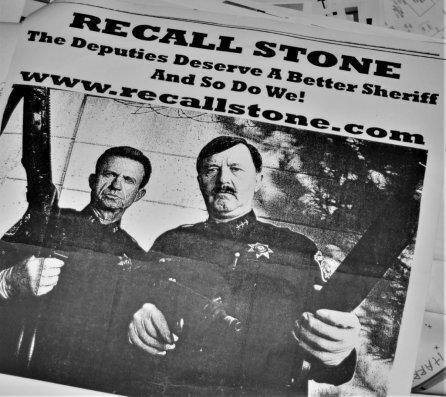
Arun Gandhi Visits Columbine
Feb. 4, 2000
It is February 4th, 2000. Almost a year after the killings at Columbine. Arun Gandhi is going to speak at Columbine High School. I went over to watch, and to try to learn. This man is full of wisdom and knowledge, and he is a great teacher. I learned a lot from him last year, before Columbine, and I need to learn more, so I took the morning off, and went to listen.
I have to check in at the main office, and get a visitor’s pass. Even parents, to walk through the school, have to get a visitor’s pass. I exchanged my driver’s license for the pass, which I hung around my neck, and followed Mr. Gandhi and his entourage to the auditorium, with the idea that I would sit way in the back. I didn’t want to bother any of the students.
Arun Gandhi didn’t recognize me, I had only met him once before, but he stopped on his way up the steps and shook my hand. We talked for a couple of minutes. I told him I liked the beard (he was sporting a full grey/white beard) and that I was glad he was here, that his message is excellent. He was very gracious, and calm, and soft spoken, and said he was glad to be here, and that the beard comes and goes. He mentioned that he had trouble with this school, they didn’t seem to want him here, and he thought it was because so many speakers had offered to come in that they were overloaded. I didn’t say a word. It wouldn’t have done any good. Here was this great man of the world, and his wife, trying to talk to Columbine High School, and finding themselves not welcome. He is trying to teach peace and help these children and teachers recover, and he is not welcome. I knew why, but the answer wouldn’t do Mr. Gandhi any good, so I kept quiet. I told him his message was wonderful, and that he had taught me a lot, and I wished them both well. Mrs. Gandhi was still talking with the teachers.
The students slowly filed in, 2, 5, then the rest, and he began.
He told a story, a parable, about a young man. This young man was disorganized, didn’t wash clothes, didn’t wash dishes, and lived in a pigsty. He met a nice young lady, and they dated. This young lady gave him a rose. He took it home, and wanted to put the rose in a nice vase, but couldn’t find one. He found a grimy vase, cleaned it, put the rose in it, cleaned a spot on the table, and looked at it. He noticed that the table was beautiful, but the surroundings were filthy. He cleaned up the kitchen, then the whole house. He did this because of the gift of the rose, the gift of love. The gift of love changed his entire attitude.
Arun continued: the choices we make determine what we do. If we give love, we get love back. If we give hate, we get hate back.
Arun was beaten by white youths as a child because he was black, and beaten by brown youths because he was too black. That is not a typo. In his home country there is discrimination on the darkness of skin.
He said: “All of us get angry, every day. We don’t have to act out when we are mad. Anger is a wonderful thing, if we use it intelligently. We need to channel anger into good uses, to use it for positive results.”
He said that he corresponds with many people who have been violent, some of whom are in jail. They would all go back and undo it if they could. We need to channel anger.
“We do physical exercise, but we seldom do mental exercise. As I am speaking thoughts are going through your mind. You must learn to focus and pay 100% attention.”
He gave a simple exercise: Sit alone in a room and put in front of you an object that brings you pleasure, and focus on that object. See how long you can keep that image in your mind’s eye. When you can keep that image for a long time, then you are in control. Learn this, and use the energy of anger in a positive way.
Non-violence is not a political strategy, he went on, it is about our own attitude and relationships. We must understand violence first. Draw a family tree of violence. Violence is the grandparent. Physical violence and passive violence are the offspring. Passive violence is when we don’t use physical force: name calling, teasing. This generates anger and this explodes into physical violence. We have to cut off the fuel, and cut off passive violence.
This was incredible to hear. Arun Gandhi was saying the same thing Paul Mones said in his book “When a Child Kills.” In essence, little acts of passive violence and little acts of physical violence lead to an angry retaliation of physical violence. These two different men, from different countries and backgrounds, reached the same conclusion. Great minds do think alike. This is profound.
Mr. Gandhi continued: “Little things we do are acts of violence. We are all interrelated and interdependent. Everything you do affects somebody. Relationships today barely exist. They are based on self-interest. This is at all levels, and the cause of much of the violence today. Build your life based on respect and understanding. We are the most intelligent animals, and the most ignorant. We don’t know our role in the world. We must reach this understanding and ignore labels: philosophy, religion. We don’t need labels. We must identify people as human beings. We must have a bond with each other. We (he and his wife) feel that there is a relationship between all people. That is why we are here.”
I can’t help but admire this man. He is so calm and wise, and gives so freely of himself and his life. I understand now how the apostles felt when Christ was on the earth. There are people who are wiser and greater than I am, by far. I would follow this man. I would travel the world and help teach his lessons. I believe in them.
He continued: “Think positively, think lovingly, think with respect toward each other, road rage is aroused by our self-centeredness, we are thinking about ourselves, and we will therefore clash with other self-centered people. We need to realize we are being self-centered, and act with love.”
Arun Gandhi gave a second presentation to another group of students with other stories and advice.
Arun said: “Learn to control and channel your anger, and build relationships, we are interdependent.”
Then he told a great story about a young man who couldn’t eat sweets (sugar). He ate sugar every chance he got, and it was making him sick. The mother brought him to grandfather (M. Gandhi. Yes, The Mahatma Gandhi), and grandfather said to bring him back in 15 days. When they returned, in 15 days, grandfather spoke to him for just 15 seconds, and the boy agreed to give up sweets. The mother was amazed. How had he done this? Grandfather answered: “I gave up sweets for 15 days, and I told the boy I wouldn’t eat them again until he could.” This impressed the boy, he understood, and gave up sweets. M. Gandhi taught by example. Live what you want your children to learn.
Arun Gandhi said: “The more violent we become the more we lose our humanity.” And, “You can’t eliminate injustice by ignoring it.”
These lessons were incredible. Most of the kids seemed to get it, and some of the teachers did too.
What a great lesson, what a great message for Columbine. If any school in the world needed this, it was Columbine, the school of teasing, and hate, and passive and physical violence.
I guess I should mention that there are about 2,000 kids in Columbine, and that they weren’t invited to either speech. Of the 2,000 students, only a few were invited to attend. About 80 students listened to the first speech, and 115 listened to the second speech. I counted. Yes, I counted every student.
Here is possibly the greatest living proponent of non-violence in the world, talking about respect, and love, and understanding, and “Columbine” doesn’t feel that it justifies a school wide assembly.
Imagine if Michael Jordan or John Elway had offered to speak, the school would have had every seat full, and would have invited the media. But Arun Gandhi gets the back seven rows of the auditorium. He gets to stand in the aisle that separates the last seven rows. No, he is not even on the stage. He is standing below the students, in the aisle, at the back of the auditorium. He gets to speak to one tenth of the school population. This message of respect, and wisdom, and non-violence, isn’t worth, to the administration, having an assembly for all of the students, or clearing the stage, for this great man.
This is the real Columbine High School. I wonder if Arun Gandhi realized that he had been anathema to the administration, that his message wasn’t worthy of a “full-school” assembly.
If he did, he didn’t show any signs. He was gracious, and soft-spoken, and he spoke from the heart.
Eighteen-hundred of the students at Columbine never even knew he was there.
Mr. Curnow
2/9/00
Mr. Curnow called today. He wanted to say hi to Brooks. He was worried about him.
He and Brooks judge debate at the school and at other debate meets, and Brooks hadn’t shown up last Saturday. Mr. Curnow was worried about him. Worried about him enough to call and make sure he was okay.
Eric and Dylan killed Mr. Curnow’s son on April 20th at this school, and he is there judging debate.
Eric and Dylan killed his son at Columbine, and he is calling our home because he is worried about Brooks.
I talked to him for almost 20 minutes and told him I was sorry about his son. He told me not to feel guilty, he knew that survivor’s guilt was something many people were going through.
Courage after Columbine is everywhere! What a nice man.
Rachel’s Grave
2/9/00
Brooks went to Rachel’s grave yesterday. She was a friend from debate. He cried and cried. Rachel is gone.
She symbolizes to Brooks the good that was killed at Columbine. She represents all of the innocent children. Visiting her grave is his way of saying he cares. He goes there once a week, sometimes at midnight or a little after, so he can be alone.
I have been there, but only once. I haven’t visited the other graves. It is too much to bear. The wounds are still too fresh and too painful. It is unfair to say it is only Rachel’s grave. Corey is buried next to her, in the beautiful memorial off of Colorado Boulevard. Corey, the brave little boy that, we have been told, fought back against Eric and Dylan in the library, kicking a chair at them.
But I do think about the parents, and brothers, and sisters, that visit the graves, and about my son, at Rachel’s grave, at midnight, crying, by himself. In the dark.
This is life after Columbine.
Sadness and pain, that I couldn’t even imagine a year ago, are simple, sad realities.
The Lesson Was Too Hard
2/9/00
Christ taught us 2,000 years ago to love one another. I guess the lesson is too hard, since we have obviously not been able to follow it to any meaningful level. Millions of people have been killed in wars, millions have been murdered and millions have starved. We obviously have trouble with the concept, since we can’t even love one another on a personal level. The divorce rate is at 50% or more.
Maybe we need to make the rule, the lesson, something we can follow. Maybe “love” is too esoteric, too undefined to be a followable ideal.
Let’s change it.
Let’s make it: Respect one another. You don’t have to love our neighbor, but you do have to respect your neighbor. You don’t have to loan him your car or give him money, but you do have to show him respect.
Let’s take this lesson to Columbine, and just imagine that the students in Columbine had respected each other. The jocks respected the nerds for their computer skills, who respected the theatre group for their talents, who in turn respected the jocks for their athletic ability.
With respect there is no hate, there is understanding. With respect there is no bullying, there is acceptance. With respect there is no harassment, there is cooperation.
The jocks would not have bullied Eric and Dylan. Eric and Dylan would not have hated the jocks. Everyone could simply have lived in the school with mutual respect for everyone else’s talents and interests.
Simple respect.
Hey, maybe this could work for countries and religious and adults.
Maybe it was just translated wrong. Maybe Christ said we should respect one another.
Maybe this would work.
It is obvious that the “love one another” concept is not working.
Let the Snow Fall
2/12/00
Life is just like a hike in the mountains. If you’re walking fast and making a lot of noise, you don’t see or hear anything. You see the path in front of your feet, but you miss the sky, and the trees, and the mountains.
When you slow down or stop, and let the snow fall, and you listen. You can hear the squirrels fighting, the blue jays, the deer, the water running in the small half-frozen stream, the sound of the bird’s wings in the thin air, the hawk’s cry in the distance. You can see, and sense, and feel the life around you, the beauty around you.
Then when you start walking again and making noise you are deaf and blind to most of the world around you.
This was my life prior to April 20, 1999. I was so busy doing my job, being “the best broker” I could be, that I never slowed down and stopped and listened. I never saw how evil the school was. I never realized how lonely and sad Dylan was. I left Eric’s problems up to Eric’s parents, when I could have tried to help. I never knew, never saw, how truly bad the school district was, or how corrupt the government was. I was busy walking and making noise.
It is time to stop and think, and observe. Time for all of us to do this.
Imagine you are standing on a path that leads through your life. Stop in the middle of the path, plant your feet, and look around. What is there? What is wrong? What can you fix? What should you leave alone?
Stand there and reflect on your life, on your children’ lives, on your home, your police, your government, your world. Do you like your neighborhood? Do you like yourself? Is this your dream? Are you going in any direction?
Turn in place, and look and listen to your whole world. Listen with your mind. Now pick three things (write them down) that are wrong, that you are going to work on. Now pick a new path toward that goal and start walking, but this time, in a few weeks, stop on the path again, and plant your feet, and listen to the world you live in.
If you don’t stop and listen every once in a while, you don’t really know what life you are living. You don’t really see the sky, and the trees, and the mountains.
You don’t see the beauty, and you can’t see the evil. You won’t see the circumstances that become a Columbine Tragedy, and you won’t be able to stop it.
One Phone Call
2/13/00
I need to set this one up just a little bit. You remember that we had a meeting with Detective Hicks and two bomb squad guys in March, 1998, a year before the killings. You remember that the sheriff department first said the meeting was unofficial, whatever that means. They then said that it never happened, essentially calling us liars and saying we made the meeting up. The responses from the Sheriff painted us as absolute liars.
Well, we got a phone call.
We received two messages from a man named Sylvester. He said he had talked to us before, and he hoped we remembered him.
We sure did. Sylvester was the bomb squad expert who was in the room with Judy, and me, and Detective Hicks. Hicks has said the meeting was unofficial. Kiekbusch then said meeting never happened.
Sylvester called to say that it had happened. He was there. He will testify to it. He will not lie. He told them he will not lie.
This is courage.
This policeman has such integrity that he will tell the truth and stand up to his boss and the sheriff and everyone. He won’t lie. His character and his honesty mean too much.
With people like this in the world, and people like Dave Sanders, there is hope.
What courage. What integrity.
It is the most amazing phone call I’ve ever received.
And, if he tells the truth, the police are screwed. Their lies will be evident to everyone.
What a brave policeman.
Deputy Sylvester. You know your name.
He should be Sheriff. Heck, he should be the Attorney General.
We never used this call. We have never named him, not even in this book. Judy and I actually made up a code name for him that we used whenever we talked about him. (His name is not Sylvester. That is his code name.) It was too dangerous for him. He was an active policeman. He had to rely on other policemen to protect him. We have all see the move Serpico, where Serpico’s life was put in danger for his actions. We couldn’t risk this man’s life. We kept quiet. We knew he was there, if the truth never came out. We knew he was in our corner. There was no reason to endanger his life, or cost him his job. We respect his courage too much.
There is a Difference
2/14/00
I remember when Eric’s autopsy was released. I read it with a cool detachment and a near scientific analysis. It was interesting. It seemed badly done and not nearly thorough enough, but it was something that I needed to read.
Now, something interesting has happened. The judge, in his limited wisdom, has released Dan Rohrbough’s autopsy. I write his name as Dan, because that is what his mom’s and dad’s (two loving parents and two loving step-parents) called him. Danny is the name used by the media. Dan’s autopsy is released, and I haven’t tried to see it. I haven’t called. I haven’t tried to get a copy. I don’t want to.
I don’t know if I can bear the tragedy, the knowledge, that Dan is dead and his autopsy is completed. Dan should remain invisible, untouched, as the innocent teenage victim that he was. I know that he wasn’t perfect. I know that all of the apotheosizing that is going on is a way to sell newspapers. I don’t want to make a hero out of Dan. As much as I hope he was a hero, I don’t want to make his life, or his death, mean more than it should. It is enough that he was Brian and Sue’s child. It is enough that Rich loved him too. It is enough that Lisa loved him too.
It is enough that he is gone. He had value. He should not have been murdered. He was innocent of the bullying that Eric and Dylan hated and tried to kill.
There is a difference.
Eric’s autopsy is something you can read with a clinical eye, looking for clues, trying to search for reasons. Was there Luvox? Was there a tumor? How did he die? What can we learn?
Dan’s autopsy holds none of these details for me. It is enough to know that he was murdered by Dylan, that he was an innocent victim, and that he was loved. The details of the bullet wounds won’t take away the sadness, or the injustice, or the heartbreak, for his family. Dan’s memory should be simple and pristine, kind of like looking back at old family pictures and remembering that one moment in time, when everything was okay, and the memories are good and untainted.
I won’t be looking at Dan’s autopsy.
There are some things I don’t want to read, don’t want to know, don’t want to remember.
2/14/00
Two More Murdered
Two Columbine students were murdered last night at a Subway store, located very close to the school. They were shot and left to die behind the counter. No one knows why, at this point in time, but rumors and speculations are everywhere. The theories are drugs, robbery, a jealous boyfriend, or a continuation of Columbine. Any of them could be true, we don’t know. The murders took place around midnight, a quarter mile from Columbine High School, in a well-lit parking lot where Judy and I shop for groceries. This is a safe area. Judy goes there five times a week.
This is getting to be like living in a war zone. Two kids, a boy,15, and a girl,16, were murdered in a safe suburban shopping area. I am beginning to get a taste of what living in a high crime area is like. We are just happy when our kids get home from school. How do parents deal with this every day of their, and their children’s, lives?
The news was released Monday morning. I went to the school on Monday to make sure Aaron was okay. I went to the attendance office and they sent for him. As I stood waiting in the hall, all of the memories of Columbine came back to me. The tears, the crying children, the pain, the numbness, all came to the surface, but I held on and maintained my composure. Leaning against the wall of the attendance office, I watched the crying children, the concerned parents, the crying parents, as they met in the lobby of this crummy school, met and hugged, and then left together. Mostly girls were crying. They would hug each other and cry, then go to their mother who was picking them up, and cry and hug some more. The mothers, with their eyes red from crying, would sign out their daughter, and they would leave together.
How can these children live through this sadness, how can these parents?
I waited and watched, not letting myself cry.
Aaron and two of his friends appeared in the hall, and I took him aside to tell him who it was: Stephanie and Nick. He knew her, but didn’t know him. I asked him if he wanted to leave, and he said he’d rather stick around. He was handling it pretty well, and he thought he could help some of the other kids get through it. I told him that it was his choice, and he knew he could leave anytime he wanted, and that we would call him in as excused.
I hugged him and went to work.
I was showing Ken and Shelley properties up north, and they didn’t seem to notice that I was distracted. They probably could tell, and were too kind to mention it. What nice people I am working with.
What a day. Aaron at Columbine, with a thousand re-traumatized children, Judy at home alone, and I’m showing homes.
Judy called and reminded me that Brooks had told the FBI about that Subway, and how there was drug dealing going on. It was too much to even think about it, or get mad.
The school was empty that afternoon. No one in class and an empty parking lot. Aaron had gone home about 11:00 A.M. He stayed with his friends up the street. There appears to be safety in numbers, and some comfort from being with the group.
Our American dream is getting more and more damaged.
We can’t protect our children.
Sanctuary
2/16/00
I had an epiphany today. I finally figured out why Brooks was so involved in debate: No violence, No bullies, No intimidation.
Brooks is a smart kid, a talented kid. He has always disliked Columbine High School. He would ditch class, not turn in homework, smoke in forbidden areas, and generally refuse to be involved in sports or any part of Columbine. But he always loved debate and drama. I now know why.
The debate kids are generally the intellectual types, or, in the case of forensics, the ones that are talented, sensitive and unique. The kids in drama are talented, and both shy and extroverted, depending on the student. All of them were nice. All of them were intelligent and more sensitive than most.
None of them were bullies.
Debate and drama were the havens away from the jocks, and bullies, and the “mean school.” Mrs. C. (Caruthers) was such a character that all the kids liked her. She allowed them to be themselves, unique and different, by being unique and different herself. Even Dylan cared for Mrs. C. I saw it in his actions, and I saw it in the videos Brooks made as a gift for Mrs. C. They teased her, they joked about her, and with her, but they loved her. She let them be who they really were: talented, gifted, shy, outgoing, intelligent, sensitive and different. All just by being herself. She was tough, and nice, and accepting.
And, there were no bullies.
This was their refuge, their sanctuary from the pushing and shoving and taunting and fear.
They gained a common bond, the actors, the crew, the stage crew, everyone involved. Certainly, there was jealousy and infighting and politicking. But there was no violence.
This was certainly Brooks’ sanctuary from this school, this school that did so much damage to his psyche and self-image. This school that has persecuted his logic and self-awareness and perspective. This evil, mean school.
Mrs. C. was the refuge. So was Paula, the debate coach, in a totally different way. Paula allowed these gifted and talented children to argue, to talk, to think, to perform. Intellectual excellence, and performing talent, were admired and rewarded. They were allowed to excel without threat or teasing. In debate or forensics, talent was rewarded without shame, without belittlement. Don’t get me wrong. I didn’t like Paula. She made illogical decisions regarding Brooks. She wouldn’t leave him in Lincoln Douglas, because he had too many points. How does that make sense? But she was a good coach for debate.
The school was a difficult environment. The jocks and “being cool” ran the school. Talent except in sports, was ridiculed and suppressed. “Sports” was king. “Sports” is still the king.
Welcome to Columbine High.
How did these parents, most of them talented, intelligent, and mature, allow this to happen? Some of the answer is in the society we live in, where jocks get away with murder, where celebrities can be rude and self-centered and still be admired. A society on the wrong path.
Most of the answer is in lack of time. Through our busy schedules we have blindly abdicated the education and safety of our children to a cold uncaring school system. We wrongly made the assumption that our children would be respected and taught and protected at our high school. We wrongly made the assumption that our children would tell us if there were serious problems, ignoring their lack of wisdom, and the boys code, that protects the bullies.
We made it through high school. Little has changed. Our children will make it through. Logical but wrong. Much has changed. The world is different. Our children are living, and dying, in a much different world than we knew. We failed to notice, failed to react, failed to fight the injustice and bureaucracy, and our children paid the price.
All schools should be a sanctuary, a place of un-ridiculed learning and acceptance.
Is yours? Does your child have a sanctuary?
Isolated
2/17/00
Eric and Dylan were first and foremost isolated.
They were not welcome at Columbine. The treatment they received at Columbine made them distrust relationships, and doubt their own value. They were ostracized.
The video games became a separate world that substituted for the real world. They respected its consistency, its integrity, its logic, and they were pulled into the games for hours and hours and hours. They were alone and didn’t have interaction with real people. They were separate.
They planned, and thought about things, and suffered humiliations together. They bonded, but they became more isolated than ever.
Eric’s anger kept him alone. Dylan’s isolation was both geographical, once he moved into the foothills, and mental. They distrusted friends and relationships and any overture at friendship, because their self-images were damaged by this mean school. If you have no value, and you believe it, why would anyone want to be your friend?
First and foremost, Eric and Dylan were isolated. They were alone.
The necessary social interaction, needed to develop their personalities and confidence, had been denied them. The teasing and cruelty devalued them in their own eyes, and made it easy for them to hate and devalue others.
And it is not their families. A parent can tell a child, all day, that he is smart or cute or naive, but without validation from outside sources, your parent’s praise becomes nothing but an expected and required accolade. Of course, your mother says she loves you. What else could she say?
Isolated by cruelty from the world, they never learned that other people shared their same doubts and fears. They never learned that they, and other people, are human and flawed and in pain. Without knowing this, it was easier to kill.
Without the isolation, it would have been much harder for them to kill, or hate.
You can be alone in a crowded school. You can be isolated.
Who do you know that is alone? Talk to them. Connect with them. Let them know that you care.
There Was No Gunfight
2/17/00
Here is a simple short perspective on Columbine.
Eric and Dylan didn’t go into a gunfight. They went to kill and then commit suicide. The suicide was the end result.
There was no shoot-out with the police, no dramatic showdown. Eric and Dylan went in the school to commit suicide. The killings were just the statement they made on the way.
This was a statement against bullies, injustice and the school. The fact that they shot and killed innocent children was peripheral, and unimportant to them. Make the statement, then commit suicide.
This was a suicide pact with a plan attached.
Stephanie and Nick
2/19/00
We went to a funeral today. They held the service for Stephanie Hart and Nick Kunzelman at the same time. These two Columbine sophomores had been murdered at the Subway shop, at the corner of Pierce and Coal Mine, a quarter mile from Columbine High School. Nick was working and Stephanie came to pick him up, and somehow, they were shot and left to die behind the counter.
The service was sad. Two more children were dead, and their families were there and in pain. The church, a converted K-Mart, was full. These poor people, this poor community. How much can we bear before we all break down and give up.
The Flemings were there. Their daughter Kelly had been murdered at Columbine. Brian and Lisa Rohrbough were there, his son Dan was a murder victim of Columbine. Sue and Rich Petrone were there. They shared the grief with Brian and Lisa, as Dan was her only son. Dan was Brian’s only son too. These brave people showed up to support the families. They knew that being there would bring up the pain and memories they had lived through over the last 10 months. They knew, and they showed up anyway, to offer their support. They live every day with the immeasurable sadness that is the loss of their daughter or son, and they function. But these parents, these loving human beings, do more. They still show love. They aren’t living in a closed house with the blinds drawn, feeling sorry for themselves. They are trying to help others. They get up and go to the church to support these grieving families. How much I admire them, and their courage.
Mike Kirklin and Lance were at the funeral too. Lance was, as you should remember, the boy who was saved by the paramedics, after he had been shot five times (once in the face with a shotgun). Lance knew Stephanie, and came to pay his respects. Mike had to leave about halfway through the services, he was too upset to be there or hear any more. He waited in the car, for Lance to come out, so they could go home. Mike has had a lot to deal with. The surgeries, the medical problems, a divorce, custody of Lance and his daughter, money and much more. I can understand his waiting in the car.
The funeral was okay. The grandfather made a beautiful speech about love and caring. One of the friends made a short speech, somewhat angrily, about how this has to stop. That we need to change our society, and stop murders and hatred. I agreed with him. He spoke from the heart, and he was right.
There was a short period where the minister invited the friends of Nick and Stephanie to come up front, and light a candle, in remembrance. About 30 kids did, but another 25 or so were stopped by the ushers. They were told to take their seats. They had run out of time. Judy and I both noticed this, and we were angry. What a crummy church. What a sad commentary on this funeral. The kids weren’t allowed to go up front. Why? The parents and family would have loved it. It would have shown that many children cared. They have the right to grieve too.
This church is just like Columbine High School, phony and without depth. Everything that came from the church was full of meaningless religious platitudes, and everything that came from the families was about caring and love. I guess we have the wrong principals and the wrong ministers. I’ll never go near this church again. These families would have been just as well off to rent a memorial hall, and leave out the insincerity. It wasn’t their fault. It was just the church.
We met Brian and Lisa, Rich and Sue Petrone, and the Flemings outside the church as the large black funeral limousines were driving off. Sue and Lisa were crying, and so was Judy. They hugged, and we hugged, and everyone shared a little moment of comfort mixed with sadness. Everyone had on their Columbine pins: Sue had one with a heart, Mr. Fleming had a heart with a teardrop in it. I had a small Columbine pin. Brian and Sue and Rich had the “Never Forgotten” pin.
We left at 12:30. We had to pick up Aaron for a master’s class recital. That’s where I am now, at the recital, writing during the songs. We are constantly reminded of how different our lives are from the victim’s families. Brian and Sue’s son is dead. They will never see him again, and Judy and I drive across town to hear Aaron play Rachmaninoff. The music brings tears to my eyes, and I know we’re lucky, and I want to make Brian, and Lisa, and Sue, and Rich, and the Fleming’s life better, but I can’t. It is the greatest sadness of my life, that I know I can’t make it better. I think we are all aware of our position in this mess, and hopefully the people on the outside looking in appreciate their luck, and hug, and love their children more every day.
Hopefully.
Look at those Clothes
2/26/00
“Do you believe how these kids dress? Big baggy pants and no belt and studs in their tongues and earrings. They are just asking for trouble.” That was a rough paraphrasing of a comment one of the school bullies made, about the outcasts.
It is not how you dress.
It is not what kind of car you drive.
It is who you are inside.
From my experiences with the kids of Columbine you cannot tell anything by their exterior. There are great kids, like Jason, with rough exteriors, and scary kids (no names here) who dress in preppy clothes, and look like the perfect child. Despite all the media misinformation, Eric and Dylan looked like the preppy, perfect kids most of the time. Don’t judge a book by its cover, don’t criticize kids because they don’t fit your ideal image.
It is who they are inside that matters.
For the Rest of My Life
2/26/00
It was a dry day. A boring day. I barely got above the level of just being awake. I went through the motions, worked, went to a stupid movie, ate dinner, watched T.V. and now it’s midnight.
Then my heart woke up, and my mind did too, and I realized: I’m going to miss my dad my whole life. I’m going to miss my dad for the rest of my life. How brave he was. How tough he was. How much I loved him, and how much he loved me.
The rest of my life.
It is starting to sink in too, that Eric and Dylan killed 13 people at Columbine. The deaths were so traumatic that they didn’t seem real, they were there, but weren’t acknowledged. It is no movie. It is not a play. The 13 murdered are dead. They were alive, and full of promise, and now they are gone forever. Gone forever from the people who loved them. Gone for the rest of their lives. The rest of their lives. Tell the people you love that you love them. Tell them now. Tell them now.
Police Priorities
3/1/00
It’s very simple.
The police are doing their job wrong, and so is the legal system.
They concentrate on non-violent crimes. They give tickets to speeders. They put marijuana smokers in jail. They harass normal citizens for little insignificant errors.
They should be preventing violent crime. Armed robbery should be the highest priority. So should murder. So should any crime that involves violence. Let’s fill the jails up with criminals that are dangerous to others.
I know these crimes are harder to solve, and don’t produce revenue. I know they are a financial drain on the legal system. I don’t care.
It is simple. Ask yourself which crime is more important: A teenager going six mph over the speed limit or a reported bomb threat? A proper police department should investigate the bomb threat first. Lives are priority.
Mr. DeAngelis
3/10/00
We had a meeting scheduled with Mr. DeAngelis today. We, Judy and I, are complaining about a teacher who was harassing students. He had made a couple of girls cry and had Aaron really mad. Aaron observed it, and was upset about it. He talked to us and we went to do something about it. We talked to the teacher at parent/ teacher conferences and we thought we had it all straightened out, and then found out that he has been talking to other teachers, telling them that Aaron was a problem kid. He bad-mouthed Aaron because we talked to him about our concerns. That did it. I wrote a letter to Mrs. Mikesell telling her we wanted to file a formal complaint against Mr. Fleenor.
If you will remember, we had already sent a no-harassment letter to the school, that clearly said we would have no harassment from students or teachers. This was clearly harassment, and we were unhappy. Heck, we were mad.
We met in DeAngelis office: Mikesell, Vice Principal, Judy, DeAngelis and me. This was a very odd appointment. I listened, and Judy told Mr. DeAngelis what she thought of the school and the coaches and the football team (the 6 or 7 bad seeds that poisoned the whole school) and most everything else. DeAngelis seemed seriously concerned and I began to believe that he really cared. Then I remembered that he had lied about no drugs, had lied, saying that the tapes said: “don’t blame the administration,” and had lied, saying he didn’t know who the trench coat mafia were.
This was weird.
He believed every word he said: “These were his kids, why did Brooks hate him, he was trying at Columbine.” He genuinely believed that he was a good principal.
Then I understood.
Even people who are crummy at their jobs think they are good. DeAngelis, the worst principal in American history, in my opinion, believed that he was a good principal. He believed it. It didn’t matter that he had allowed the football team to run the school. It didn’t matter that he didn’t know that physical and mental abuse, and harassment, were a regular part of his student’s lives. He believed he was a good principal.
What an epiphany.
What did I expect? Did I think that he would know he was a crummy principal? That he would acknowledge it? That he would be aware of his performance?
Of course not. We all think we are great at our work. This principal thinks he is good at his job, despite the evidence to the contrary. The outcasts, the deaths, the abuse, the harassment, and the favoritism are overlooked and invisible, because he has to concentrate on those things he can do: Sports teams, paperwork, Political meetings.
The sheriff is the same way. He must believe he is a good sheriff, despite all of the evidence to the contrary. His department is in disarray, but he has new paint jobs on his patrol cars. He let children die in the library and let Mr. Sanders bleed to death, but he has traveled the country giving speeches about Columbine. He believes he is doing his job.
Judy is in the other room, talking to Angela Sanders on the phone, Mr. Sander’s daughter. Her father is dead because the sheriff didn’t do his job, and the sheriff can’t mentally acknowledge it. I guess this is how we all keep our sanity.
I wonder what it is that I am not seeing about myself, or my life, that I don’t want to. What am I blind to?
I have admitted to myself that I was not a great father, that I should have been more involved, that I was too busy at work, but I wonder, is there something larger, something I can’t see, like DeAngelis or like Sheriff Stone, something that I could not live with if I had to face it.
Perhaps there are secrets we keep from ourselves because we have to.
When we look in the mirror, do we really see who we are? More than perception, do we have the courage to look at ourselves, and see our faults and failures, and acknowledge them?
A Simple Question
3/14/00
Does life matter? Does it matter if we kill?
I was thinking today that this may be the main difference in myself and Eric and Dylan, in my son and Eric and Dylan. I respect life. Brooks respects life. Eric and Dylan did not.
If you don’t respect life, then it is easy to kill. If you don’t respect life, then killing a human is no different than killing a bug.
Why did they think like this? Why did they grow up not valuing human life?
Here is why:
They grew up in a society that sends soldiers to fight for Kuwait, because there is oil there, and not in other killing fields, because there is/ was no oil. Risking soldiers’ lives for oil, and not risking it for humanitarian purposes, devalues life everywhere.
They grew up in a society that believes in the death penalty. No matter how you analyze this justice, it is still a mixed message. This devalues life.
They grew up in a society that ignores, to a large degree, its poor and homeless members. That ignores its mentally ill and its weak members. Those that are not strong enough are left to live on the streets. This devalues life.
They grew up in a society full of wealth and riches, that spends $80,000 on a car and $300,000 on a house, while they watch starving children on the news. If it makes us uncomfortable, think of how it may have influenced their perceptions.
They grew up watching thousands of murders, in the reality of the news, and the fiction of prime-time T.V. shows. Murder is murder, and it devalues life.
They grew up killing hundreds and thousands of human-like and human-shaped figures on video games. They did this for years in their own reality of cyber-murder and cyber-killing. This devalued human life.
They lived in a school that didn’t value them, that didn’t validate or acknowledge their self-worth. Without self-worth you cannot have compassion for others.
They lived in a world where police killed people without punishment (Truax and Mena), where McVeigh killed over 160 people to make a political point, and where the Branch Davidians, and their children were slaughtered by the F.B.I. and police. Analyze these incidents any way you want, they devalue human life.
They saw murder and killing everywhere, and they saw little justice.
These were two smart kids. What did we teach them? Did we teach them that all human life has value?
No. I’m afraid not.
I believe we taught them that killing, and murder, are a part of everyday existence. That is what they were taught. They learned the lesson well.
We never showed them the pain that happens after a murder. We never showed them the horror, the depression, the tears, and the horrible emptiness. They were only taught the first part of the lesson. No one showed them the pain.
In Doom, the video game, you kill and kill and kill and kill and kill. Never once do you pause to look down and see the body lying at your feet. Never once do you look down to see the face of the person you have killed. Never once do you see the children of the mother or father of the dead figure at your feet. Never once do you see the humanity.
Does life matter? Not in the life Eric and Dylan saw. Not in the T.V. shows or the movies or the video games or the world they lived in.
Welcome to their world. Welcome to our world. You tell me that life matters. Prove it to me by the world you can see in America, in our lives. Money matters. Cars matter. Expensive houses matter. Life doesn’t matter. If it did, there would be evidence, there would be proof. Show me the proof. Prove to me that we care about human life. Prove it to me with empirical evidence. Prove it to yourself. You’d better teach your children the second half of the lesson, the important half, before it is too late.
Life does matter, that is the lesson.
Stone Gives a Speech.
Date unknown. 2000?
This is just a little story, and the exact date is not really important. Stone was scheduled to give a speech. I read about it, and went to the hotel to listen. It was some conference about school safety or school shootings. It happened to be in the paper. This was located way East, in Aurora. I drove over to attend.
When I got there, I looked around, waiting to see him, and to attend the speech. I was early, as usual. Yes, I was planning on confronting him. I was going to be heard, and to yell at him. It seemed like the right thing to do. I was tired of his lies. It was being held at a big hotel, in their largest conference room. There were hundreds of seats.
As I walked around, I saw the message board in the lobby. There was a very large piece of orange paper, with printing on it. It said that he had cancelled his appearance. In very large print. It was a notification for everyone, that he was not going to speak.
I took the announcement, folded it up, and put it in my file of papers. I went over to the other info board and did the same.
Everyone who showed up was still expecting him to speak. They were all asking about it. No one knew who I was at that time, and I was enjoying it. He stood them up. With my help, no one knew about it.
I did listen to a few of the speakers, and then they split into groups. It turned out that Kiekbusch was there, giving a presentation in one of the rooms. I walked in on him, before anyone was in the room, and introduced myself, and told him that his lies would be exposed someday. I was going to see to it.
I left that room and saw a reporter I knew. I showed him the sign, and told him what I had done, and he laughed. He told me that there was a meeting for the press, and police, up on the next floor, and he invited me to go. We got on the elevator, and before the door closed, Kiekbusch got on the elevator. I was surprised. The doors to the elevator closed. Here he was, a captive audience. I yelled at him, on an elevator full of the press and other people, packed in, with no room to move: “Hey Kiekbusch. I am Randy Brown. Want to say I am a liar now? Want to say it to my face? Want to lie to my face? You know the truth! Tell the truth!” I was yelling at him in an elevator full of the press, going to the press meeting. He didn’t say a word. Neither did anyone else in the elevator. This was not normal behavior. I was challenging these people. That behavior wasn’t normal. I was supposed to be polite to the man who had lied about my son.
The doors opened, and he got off. The guard at the door denied me entrance to the press meeting. Security escorted me from the building. I went without an argument. None of this was the security guard’s fault.
I still have the signs, the ones saying that Stone had cancelled. The ones I stole from the information board. They are in my files.
Yes, it does make me laugh, a little bit, in a dark and sad way.
Justice
3/15/00
My wife doesn’t understand this point of view. I think it is the difference in the way men and women think. After you read this you may want to discuss it with your spouse and your friends.
Imagine someone has bullied you relentlessly for four years. Bullying isn’t the exact description. Let’s call it bullying and humiliation. You have lived with the abuse and you have grown to hate that person. You hate them with every fiber of your being. You decide to get revenge and kill them. You plan the murder, buy the gun and kill them. This is not madness, this is revenge. This is premeditated murder. In your mind you have balanced the scales of justice, you have rid the world of evil. You haven’t done anything evil. You have attained justice for yourself and the other people this bully preyed on. To you, in this situation, murder was justified. It is a cold perspective, but it is true, to you, at that time.
That is the background, here is the point:
Not once, not ever, did you think about the bully’s family, or parents, or friends. Those people are irrelevant to your decision-making process. You did not consider them once. You did not think of the pain it would cause them, or how sad they will be when the bully is dead. Your justice exists independently of the sadness that will occur afterwards.
So, the next time you ask how Dylan could have killed without thinking about the families or the pain it would cause or about his own parents, remember that he didn’t think about it at all. He was on a mission of revenge, of justice (in his own mind). That he blurred the focus and killed absolutely innocent children was irrelevant to him. He didn’t think about the pain, the depression, the families, or the injustice of murdering innocent children. He thought about the revenge, the justice of striking back at an evil school and the evil bullies and the expression, and statement, of the hatred he felt.
We are the same way.
Could we kill soldiers in Vietnam if we thought about their families at home?
Could we drop the bomb on Hiroshima or Nagasaki if we thought about the children playing in the streets?
Could we condemn a killer to death and execute him if we thought about his mother or sister, and the pain they would feel the rest of their lives?
We can and we do.
The flaw in this, that we all need to face, is that a system based on subjective justice and subjective morality, where it is okay to kill in war, and by using the death penalty, will lead to subjective justice being enforced upon us.
A system based on subjective justice and subjective morality, will lead to subjective justice being enforced upon us.
Look at Timothy McVeigh. Do you think for one minute he didn’t believe in what he was doing? He believed that his attack was against an oppressive government and was totally justified in his own eyes.
Don’t you believe that Hitler believed that his actions were a response to the “evils” of his time?
Don’t you believe that Eric and Dylan were responding, in their own minds, to the injustices that they had endured at Columbine High School?
They were all wrong.
But we are wrong too. We allow the death penalty, and killing in wars. These are forms of subjective justice.
The question then becomes: In a world of subjective justice, who decides when killing is okay? The government: in wars and the death penalty. Police: in shootouts. State Law: in defense of property.
Eric and Dylan decided it was okay for them to kill, and they were wrong, but, in a world of subjective justice, Eric and Dylan believed they were free to decide on their own, and they did.
Is this the reason the Bible teaches that “you shall not kill?” This is an edict, an instruction. It is not subjective. It is a commandment.
Perhaps we should consider having a similar rule. No matter what, killing is wrong. Put the murderer in prison for life without chance of parole, but do not execute him. We will not kill in war anymore. Are these rules we can live by?
Should a truly civilized society stop killing of any kind, or should we have subjective justice, which we practice now, and realize that this will lead to revenge killings and incidents like Columbine, that, however wrong and illogical, represent justice to the killers involved?
Now let’s get back to Columbine for a final thought. This is a chilling thought, and I apologize for it in advance.
We live, now, in a world of subjective justice. Eric and Dylan saw it and you can see it if you look for it.
In a world of subjective justice, we need to be ever vigilant in identifying and correcting injustice of all kinds.
When we see a bully picking on a smaller child, we need to step in and explain that behavior like this is not acceptable. We need to set the bully straight, before they grow into a permanent bully or criminal. But, far more important, is the need to show the smaller child that they are protected. That they are safe and not subject to constant harassment and physical harm. If we don’t, the smaller child will reach a point, under continued harassment and injustice, where they will decide to obtain justice on their own. The abused child will get revenge on the bully, and possibly on us, for allowing the injustice to occur, thus obtaining their own subjective justice.
This model holds for every part of our life and society. If free people do not believe that justice exists, they will, eventually try to achieve it on their own. With that standard, a government that does not maintain a sense of justice for all its citizens is a breeding ground for anger, hatred and revenge.
So is a school
So was Columbine High School.
Another Interesting Day
3/17/00
Judy called at 1:30. I’m showing homes in Aurora and she called to tell me that the school (Columbine) had thrown Brooks out today, but you need some background to know what is going on.
It is spring break, and Friday. No school. Brooks has already graduated. The State Debate Tournament is at Columbine. Brooks, who went to Nationals in debate last year at Columbine went to the school to see some of the team and walk around.
To be very clear, this is common behavior for ex-debaters. They love the memories and the camaraderie. Remember that debate was Brooks’ refuge from harassment. Debate tournaments are a place for all of the debaters to meet and say hello. Some of them judge. Some of them just watch.
To be very clear, there is no security. The school has two security people, Nate and Tony, but they never ever stop people and ask what they are doing. Debate meets are chaos, with judges from 20 different schools, independent judges, parents, coaches, students and friends walking around and going in and out all day. I know. I have judged at debate meets, and there is no security. It is sometimes hours between rounds, so the kids entertain themselves, go for a smoke, go for snacks, practice in empty rooms, and generally socialize.
Brooks went to say hello.
Brooks is stopped by Nate as he comes in the door, bad luck because there are ten doors and Brooks just happened to walk in the door Nate is standing at.
Nate, who knows Brooks (who he is: debater, graduate, former star of the debate team, and ex friend of Eric and Dylan) asks Brooks (and only Brooks) as he comes in the door: “Do you have official business here?”
Brooks said, “Well, not really.” He had no official business there. He wasn’t judging, he was just stopping by to say hello. “Official” obviously implied some school sanctioned event or National Forensic League sanctioned status. Nate said, “Well, there’s the door.”
Nate kicked Brooks out.
Nate kicked Brooks out of the school. He had been the best debater in years at Columbine, the kid who went to Nationals for Columbine, and he is kicked out of the debate meet at Columbine.
The kid that should be welcomed with open arms, the debate hero, is unceremoniously asked to leave.
He is the only kid stopped out of hundreds. He is the only kid asked to leave.
I hate this school.
Judy called and said, “What should I do?” I said to go over there with him and read them the riot act.
Judy went back to the school with Brooks. They saw one of the janitors in the school who had a walkie-talkie. Judy asked where Nate was. The janitor called up and said, “Nate, you’ve got a visitor.”
Nate replied, “Who is it?”
Janitor: “It’s a surprise.”
Nate was quiet for a moment then said, “No, really, who?”
Janitor: “I’ll have them meet you at the front door.”
Apparently, the janitor had an idea what had happened, and was enjoying the moment.
Brooks and Judy rounded the corner of the long hallway, the one Eric and Dylan had sprayed with the 9mm’s before going to the library, and saw Nate at the end of the hall. Nate’s face got red. He knew what was coming. Brooks and Judy walked down the hall.
Nate made excuses. He had been caught being a jerk, and he wasn’t sure what was going to happen. He said he knew Brooks, and knew he was on the debate team, and that Brooks should have spoken up. What a lame excuse for harassment.
The truth is that Nate knows the football coaches, and they had told Nate that Brooks was involved in the murders, like the cowards they are, and Nate, like the jerk he is, believed them. He had exacted his level of revenge, his own measure of justice, by harassing the “suspect.”
Judy explained to Nate as much as she could, explaining the web pages and threats and Brooks being named by the sheriff incorrectly. She didn’t yell at him. She was nice and talked to him. She told him that Brooks’ name was on the police report that turned Eric in to the police in 1998. It probably didn’t do any good.
Judy stayed and walked around with Brooks to make sure he was okay and they left together.
It is now midnight, and I just talked to Brooks. I asked if he wanted to go back on Saturday and he said no, there isn’t anything there for him.
One more cruelty by this cruel uncaring school
I hate this school.
I hate it for what it did to Eric and Dylan. I hate it for what it did to hundreds of students who were traumatized and mentally ruined by its jock culture. I hate it for what it has done and is doing to Brooks.
There is no honor here at Columbine. No honesty. No justice. No fairness. No compassion.
Only Columbine.
Only football.
It is hard to “forgive with all my heart” when they are still harassing my son, while they are still inflicting unfair mental cruelty on an innocent boy.
As a note, they haven’t learned a thing. Nate judges Brooks from comments by the coaches. Brooks has a great soul, and Nate couldn’t see it, so Nate decided to be cruel. That is ignorance. That breaks my heart.
I couldn’t let it rest. The next day I took a hike, and thought about it for the entire two hours. Then I drove to the school. Nate was in the hall and I told him I wanted to talk to him. He said he wanted an administrator present, so we walked to the office. DeAngelis was there, and we sat down in Mr. Patrick’s office, DeAngelis, Patrick, Nate and me.
I told them I wanted them to know the results of his actions. Brooks is depressed, possibly clinically, and Judy is home crying. These are the results of Nate telling Brooks he has to leave. I tried to think like Arun Gandhi. I told him (Nate) that he needed to be careful with these kids: the suicide rate is up and one innocuous remark might be the remark that sends a kid over the edge. Did he want to live with this the rest of his life?
Nate seemed nice. He didn’t seem like he had done this maliciously. What was going on?
Mr. DeAngelis spoke up and said that Brooks is welcome at Columbine anytime.
I said “That sounds great, but I have empirical evidence, yesterday’s incident, that that is not true.”
Mr. DeAngelis again said to have Brooks come in, that he is welcome.
I asked Nate, “Let me ask you, if this was the football championship, and last year’s quarterback came to the game, would you have stopped him?”
Mr. DeAngelis said “That is a good point.”
I told Nate thanks for listening, shook everyone’s hand, and left.
I imagine they talked about it for a while, and I hope it did some good. I, at least, feel a little better.
Judy is still depressed.
So is Brooks.
Some small victories are meaningless.
Gone with the Wind
3/17/00
Take a few minutes. Relax.
Put on a movie.
Put on “Gone with the Wind” with Clark Gable. It is a great movie. It will help you to relax. Watch the entire movie. I know, it is a really long movie.
There is a point to this, so you have to watch the entire movie.
Okay. Did you watch the entire movie?
Finished. Good. That is how long it took the SWAT team to get to Mr. Sanders. He was in a room, identified by a red shirt, with a sign in the window saying “Help, 1 bleeding to death,” and people in the room were on the school phone, and their cell phones, to the police. They were told to stay there. Help was on the way. Help was on the way.
It was, right after “Gone with the Wind.”
And that is why Angela’s father died.
Now tell me that the SWAT teams did their job. If you want more proof, I’ll be glad to rent you the movie. Do you have the time?
Mr. Sanders didn’t.
Liaison
3/19/00
We had a cheap dinner with Brian and Lisa Rohrbough last night at Perkins. They are very nice, and Brian is incredibly organized. He has tapes of hundreds of conversations and interviews, and he has been investigating his son’s death and circumstances. This is a very smart man, trying to figure out a very complicated mess. The Sheriff’s Department has lied to him so many times that he no longer trusts them, so he is investigating on his own.
When we meet, all we do is talk about Columbine. We tell him anything we find out, and he shares the interesting stuff with us. We have shared all of the Freedom of Information requests and results, copied him thousands of pages of police reports and files, and shared lots of other information. He told us last night, in confidence, that the Sheriff’s Department had tried to get a search warrant for the Harris home after our complaint, but that someone higher up stopped it. He agrees with us, that Harris knows somebody in the Sheriff’s Department, and that is why they didn’t act on our complaint in March, 1998.
Brian and Lisa asked us to talk to the Klebolds. They want Sue to meet with the families, just to hear her say she is sorry. They are worried, and we are too, that people will start to hate Tom and Sue if they don’t come out and apologize, and soon.
This morning I called Sue, and told her that Brian wants her to speak to the families. Judy got on the phone, and she and Sue talked for about half an hour. Sue cried. Judy cried.
Sue had a bad week. She heard about the Richard Castaldo interview on “Dateline” and she was heartbroken. She cried for two straight hours at work, and the people at work had to intervene. This is more guilt and pain than one person can handle. Sue had been thinking that she should come out and talk to the families and the press for a week, so this call may actually help her do that.
She is going to think about it.
We left Brian a message.
Time will tell. It is a great opportunity. It is a chance for Tom and Sue to show they are human, and that they care.
Her attorney said no.
The Anniversary is coming
3/23/00
It is March 23, 2000. It is 1:30 in the morning.
I can’t sleep again. As a matter of fact, it is becoming a habit. Last night it was 3:30, and the night before that it was about 2:30. I feel empty. I feel lifeless. I’m working and going through the motions but I can feel it coming. I can feel April in the distance, and that means April 20th, the anniversary.
Aaron won’t be in school on the 20th, or the 19th, or the 21st for that matter. We are keeping him out on the 19th because that was the day Eric and Dylan originally planned for the murders. The school is closed April 20th, and the schools are closed April 21st for a workshop. Aaron doesn’t want to have anything to do with Columbine on the 20th, so he will be away from the school with friends.
Brooks and I are planning to be visible on the 20th. It is a great opportunity to show everyone that he is not afraid of ashamed, and was not involved.
Most of the murdered children’s families will be out of town, so the news media won’t bother them. April 20th. You can feel it. It is a weight on my shoulders that gets heavier every day.
Don’t Be Fooled
3/24/00
There are two types of attorneys. The first is a Feiger type: Lots of flash, lots of media attention, lots of headlines. They get noticed. They get press. People know their names.
Feiger signed up to represent the Shoels family nearly ten months ago. I think it’s great. I think the Shoels family should sue. I think all the families should, if they think it will get them some sense of justice.
Here is the interesting thing. Feiger or his investigators, or law firm, or assistants, have never contacted us. We think that this is odd. We are their best witness. We reported Eric to the police. We know they failed. We have been outspoken about the school’s involvement. We know lots of people. And yet not one call. What is Feiger doing? He is not investigating. He is not building a case. He has gotten all the media attention and yet hasn’t worked on the case at all, at least, as far as we can see.
The second type of attorney is Peter Grenier. He is Angela Sanders’ attorney. He has sent his investigator to Littleton three or four times. The investigator, Jim, has interviewed us, has interviewed friends of Eric and Dylan, has video-taped the school, has talked to Rohrbough and Marjorie and lots of people. Through us and the contacts we have given him, and through his own research, he has a knockout case against Jeffco and the school. He knows the police lied. He knows that a search warrant for the Harris home was issued and denied. He knows we met with the detective on March 31, 1998, because one of the bomb squad guys told him so. Sylvester, our police contact, told him it was true! (Sylvester has guts). He knows that the 911 operator told the kids in the science room to stay put. Marjorie told him. This is the most important testimony for their trial that they could ever get: the 911 operator told the students to stay there. She told them this happened, while Angela’s father bled to death. The investigator knows this because Marjorie is brave and because we gave him Marjorie’s name.
Grenier has flown out to Littleton and met with us. He is quiet and concerned and he cares. He is so good that his case will be settled out of court for millions, because Jeffco will not want the info to get public.
This attorney is working for his client quietly, behind the scenes, and professionally.
Don’t be fooled.
Glitz is not what you want. You want an attorney like Peter Grenier: Doing his job for his client.
When it is all over, the solution of money and settlements and lawsuits won’t really matter. Money is not the answer. Money won’t bring back Rachel or Danny or Isaiah or any of the murdered children. It is far more important that we learn what went wrong, and try to correct it.
The lives that are saved in the future are what is important. Screw the money. Learn what happened and let’s stop it from happening again. And, then when there is another tragedy, learn what happened there, and correct it. We should concentrate on correcting the problems, not paying the victims, but, since nobody, not the county, state, or federal government actually wants to correct the problem, we are condemned to simply throwing money at the people in pain.
I think a better answer is correcting the problems, in the name and memory of the victims. Then their deaths would have some value.
We simply have the wrong solution to our tragedies.
Getting By
3/26/00
I see the face of a young boy, and I start to cry. I hear the sound of voices in the basement, my son and his friends having fun, and I start to cry. I hear the sound of a piano, played softly and quietly but with feeling and love, and I start to cry. I see my wife and I see that she is surviving and getting better, and I start to cry. Everything reminds me that luck let my children live that day, and hundreds more. Everything reminds me that I have been so lucky. Everything reminds me that other children died, and that other parents weren’t lucky, and that I don’t know why and I will never know why. So, I cry.
I am so sorry for the children who died. I am so sorry for their family and their parents. I am so sad that they have suffered, that some are gone. So, I cry.
It is all that I can do to put on the pretense that the world is okay, when I see my son’s friends as they come up the stairs. “Drive carefully,” I say, when what I mean is be careful, and live long, and I love you, and be glad you are alive.
The house is dark and the T.V. is off and I am getting by day by day. I’m tired and I sleep a lot, and I am getting by.
Paintings
3/27/00
You don’t realize a lot of things as days fly by, and you don’t appreciate some of the best thing in your life.
My theory is that life is like a man, or woman, stuck in a room with no windows, but with paintings by Rembrandt, van Gogh, and Michelangelo, hanging all over the walls. After a few months they are not masterpieces, they’re just a bunch of old paintings.
Then, something happens to help you appreciate the paintings, and you realize what you have been overlooking for so long.
Appreciate the paintings.
After Religion
3/30/00
You are a god-fearing family. Religion has been handed down from generation to generation for as long as you can remember. The lessons have, for the most part, been taught well, and learned well. This generation wasn’t taught as well. The Vietnam war caused an awakening of doubt throughout the country, and that doubt, that cynicism, spread into many parts of our lives. We didn’t teach our children that our country was right, without question, because we didn’t believe it. We now believe that we should evaluate our country’s actions objectively and with critical analysis. The wrong that was Vietnam taught us that. We are skeptical of the Kuwaiti action, the Bosnian action, and more. We didn’t teach our children many of our values, because we have lost some of the blind faith, and unquestioning belief, that they require.
Religion is one of these lost faiths. Many of us have no blind adherence to old religious beliefs. We have seen the wrong that blind religion and faith can do: Jonestown and the Cool Aid suicides are a good example. We have seen the Catholic Church change stances on eating meat on Friday and other technicalities. The old joke “I’m going to spend eternity in limbo for eating a bologna sandwich” has shown us the absurdity of some dogmatic beliefs.
We are cynics. We are skeptics. We have lost the convictions of our faith.
And, because of that, we have neglected, consciously or unconsciously, to teach religion to our children. In doing so we think they will be more intellectual, freer, and less subject to control by ministers and priests, who have shown themselves to be far less than perfect.
We didn’t neglect religious teachings because we were lazy, we actually thought it would be better for our children to be less brainwashed by formal religion, and to be more independent.
Then we dropped the ball. Since we didn’t teach them religion, they were left with a large philosophical hole in their understanding of the world. We failed to fill this hole with a replacement value. No religion means no rules. No rules, means: no rules. No rules, means: you can kill.
Brooks wasn’t like this, but Eric and Dylan were. Brooks substituted objectivism, Ayn Rands philosophy, for the “no religion” void. Eric and Dylan didn’t. Eric and Dylan created their own justice from the injustices they lived, and, with no philosophical or religious base to work from, decided that revenge by killing was acceptable.
I have no study to back this up, but I will bet that if you go to the last 15 shooters, you will find the common thread of a philosophical and moral void in their lives.
As our civilization either falls apart, or evolves, depending on your point of view, we are going to have casualties like this. Angry young men, who have no moral structure to know, without question, that it is wrong to kill.
Certainly, the corrupt politicians we are living under are contributing to this moral or philosophical void.
The president can cheat on his wife and make excuses. We go to war to protect mother oil and not to save lives. Greed is good. Unfair legal benefits to the rich. Poor people starving. All around us the inequities and unfairness of life are glaringly obvious, especially to two boys as bright as Eric and Dylan.
With no philosophical or religious foundation, these boys can “follow the river” wherever they want it to lead them.
And the point of all this?
If you are going to ignore religion, its teachings and value, you had better substitute something in its place that will give these confused and lost souls some direction that respects life, some direction that teaches them not to kill.
Without a basic philosophy of life that teaches them to respect all life, these troubled souls will collect pieces of confused life-lessons from everywhere in our computerized information-filled society. Without a guide, only they can determine where those pieces will lead them.
In this case, the evil of the internet, the evil of violent video games, and the abuse they received from the bullies at school, led Eric and Dylan to a logical fluid decision to kill.
This is the price we pay for a lack of religion, for a lack of philosophical teachings that show that life matters.
Our children are not born knowing everything we know. We assume that they share our beliefs, our values, our respect for life. We assume incorrectly.
If we don’t teach them, they will not learn these truths from us. They will learn lessons they see on X-files or The Simpsons, on their computers, and on video games.
Those are dangerous lessons. They will learn, sometimes, the wrong lessons.
Give your children a foundation of honesty, integrity, courage, respect, kindness, and more. Teach them, however you need to, through religion or philosophy, to respect life.
DeAngelis Meeting
4/3/00
Present: Fleenor, DeAngelis, Judy, Randy
Mr. Fleenor has been harassing and bullying students. Aaron confronted him, and he went to Aaron’s next teacher and said that Aaron was a trouble maker. We talked to that teacher, Mrs. Herring, and she confirmed it. Fleenor is a jerk, and needs to be corrected.
Our Goal is simple.
-
We want a Permanent report in file. We must verify it.
-
We want Monitoring of Fleenor’s class.
-
How will we be sure? Is there a class? What is the policy?
Are they denying that we talked to Herring?
Mr. DeAngelis: Met with Mr. Fleenor regarding cameras. Met with Aaron. Policy: They evaluated all the time. Pulled Mr. Fleenor’s file — reviewed evaluations. Mr. DeAngelis visits classrooms both semesters. Talks to students. Mrs. Mikesell called in 15–20 students. Randomly got opinions. She’ll explain that.
I asked him to get to the point.
He said that they had talked to these students, a diversified selection, and no one had anything to say bad about Mr. Fleenor. He said that Fleenor and Aaron had a disagreement. He admitted that Fleenor had talked to Herring, and had made disparaging comments about Aaron. He said they weren’t going to do anything.
I got mad. This meant he was blaming Aaron, finding no fault with Fleenor for the school harassment of other students, and that they were not going to discipline Fleenor for the harassment or his telling Herring that Aaron was a problem. The bullshit continues. I stood up, angrily said the meeting was over, told Judy we were leaving and slammed the door on the way out. I yelled at DeAngelis before we left, something like, you didn’t do what you said you would to.
What did I expect? This is an awful principal, a clown.
I called the district. I left messages that we have a complaint.
I have never heard back.
An Idea
4/6/00
Judy called me from home. She was crying. I talked really softly to her and got her to talk to me.
She’s at home, alone, crying about the lost children of Columbine.
She had an idea, a great idea, and she couldn’t stop crying.
Her idea: April 20 shouldn’t be Columbine Day. It should be a Never Forgotten Day. We should use it to remember all of the lost and murdered children everywhere. She had been thinking about Nick and Stephanie, the two children murdered at the Subway store, and how her dad said that in two months no one would remember. Judy wants them to be remembered.
This is how the idea for “Never Forgotten Day” was born.
What a good heart she has.
Bobby called from the “Larry King Show,” and we scheduled a dinner with him and the Rohrbough’s. I typed up the idea for Bobby to give to Tipper Gore. Bobby promised he would get it to her.
This is a great idea. I hope it works.
Never Forgotten Day — April 20th.
I tried the idea today. I have a friend, Tom M., whose son died of an epileptic seizure in 1997, on March 20. I sent him one of the new Columbine pins with a note.
“I bought this in your name for your son. He should never be forgotten either.” I felt connected too. I had let him know that I cared. I had overcome my own fear of the acknowledgement of death and the fragile life we lead, and I had let him know that I cared.
The pin is a silver ribbon with the words “never forgotten” molded inside. The Velasquez family designed it to raise money for the new library. I bought a bunch of them.
This may be one of the most heartfelt things I have ever done.
Never Forgotten Day — April 20th.
Nothing ever happened from this, but it seemed like a really good idea.
Dylan’s Lesson
4/7/00
I’m finished with my hike. It is about 50 degrees and slightly windy, and it was a great hike.
I talked to Dylan on the hike. He wasn’t there, but I talked to him as if he were. I talked to his spirit. I know that sounds ridiculous, but I did, or at least I tried too. I opened my mind, walked slowly, and asked him to talk to me. I wrote down what I thought, and I hoped it was what he wanted me to write. Now I know this sounds crazy, and I am not sure that I believe in psychic messages, but I did it anyway. I think it is okay, because even if it isn’t Dylan, I identified with him. I was painfully shy and “embarrassed” child. I think I understand how he thinks:
My imagined Dylan thoughts:
“I love my parents. I just had to do this. It was the right thing to do. Now I know better, but it was the right thing to do. Eric made it easy, he believed in it so much. I’m sorry I hurt my parents. It was just so obvious at the time. Life didn’t mean anything to me. It was fun — I hated them — I hated them all. I hated them because I was worth something too, and they wouldn’t acknowledge it. I didn’t deserve to be treated like this. I had value. I was afraid.”
What is the lesson here? Dylan knew he was right, but he was wrong. It seems obvious that you need to learn more before you make such catastrophic decisions.
Dylan needed to take a “life view” of his problems, not a “snapshot.”
He based his decision on what he knew at the time, on the life he had lived. He hadn’t lived enough, and he didn’t take a “life view” attitude. Being in high school and being bullied was too important to him. His “snapshot” of the wrongs being done to him were blown completely out of proportion. A “life view” would have made the bullying at school and the awful administration seem unimportant. If he had only known that, someday in the future, he wouldn’t even be able to remember the bully’s name, or the principal’s name. What was so important today wouldn’t even be remembered in 15 years.
Think back. Can you even remember the name of your principal, or the girl that stood you up on a date, or the school bully? Is it even remotely important now? Would the worst transgressions of those people have merited killing them?
The answer is obviously no.
Dylan didn’t know this.
As for Eric, I believe that he had a paradoxical reaction to Luvox that created extreme rage and hatred. The drug that was supposed to cure him, made him worse.
Eric’s drug induced anger, and Dylan’s lack of perspective on life, made them a lethal combination.
We keep trying to figure out what happened and why.
Just Glad
4/7/00
Aaron was getting his license back. In the middle of all this junk going on, Aaron had lost his driver’s license for speeding. It’s more complicated than that, but that is the general overview.
We have spent the afternoon getting his license renewed. Two hours at the driver’s license bureau and now we’re in line at the license issuing office on S. Wadsworth. We’re standing in line, and the one clerk, the only clerk, goes on break.
My reaction today is quite different from my reaction any other day of my life. I don’t even care. I am actually glad, happy, to be waiting in line with Aaron to get his license. I am actually smiling. Aaron is alive. I am with him. I am just glad to be here.
I am crying as I write this. Crying because I know he could have been killed at Columbine. Crying because it took that tragic event to change me, to make me realize how lucky I am, and to appreciate the most important things in life, my sons and my wife, my family.
So, the next time you’re upset over waiting in line, or being late for a plane, or some stupid inconvenience, remember how lucky you are.
Be thankful your family is alive and with you. Enjoy the moment.
Just be glad you have someone to wait in line with.
Cowards
4/9/00
The SWAT team members that were at Columbine are cowards. I can prove it.
They took three and a half to four hours to get to Mr. Sanders and to the children shot in the library. Sure, you can give them excuses like their boss said not to go in, or it was loud and noisy and there was water on the floor. Sure, you can say it was smoky in the school. You can give them all the excuses in the world, but some of those children could have been saved, and Mr. Sanders would have been saved.
But that isn’t why they are cowards.
They are cowards because it is almost one year since Columbine, and not one of them has had the courage to stand up and say “We screwed up,” or “We didn’t do our job.”
They have all kept the “blue wall” shiny and pure, and they are all damnable cowards.
Every one of them.
It is one thing to make mistakes and let innocent people die, innocent people you are sworn to protect.
It is quite another to remain silent for a year without telling the truth.
Cowards.
Every one of them. Kevlar helmets...body armor...superior weapons...crack shots...well trained…macho...tough...mustached…experienced.
Cowards.
Yes, you could say I am angry. I read an article today about the SWAT team in a trade magazine. It was full of double-talk and lies, and it said they were heroes. The author called them the “Super team.” It showed some of the standing side-by-side in a photo. These supposed heroes, who let children die. Yes, you could say I am angry.
There were no SWAT team heroes on April 20th, only cowards.
Dylan
4/9/00
Do you want to know who Dylan was? I’ll tell you.
Do you remember the football team at your school? Remember the athletes that were cool, and the cheerleaders that dated them? Good. Now remember the equipment manager for the football team. Remember how nerdy and needy he was, always trying to please and getting ignored most of the time.
No, that wasn’t Dylan. He was lower in the caste system than that.
Think back on the school plays, in the Theatre program, the boy behind the scenes that wound up the cords and stayed in the background. That was Dylan.
Dylan’s self-image was so low that he essentially became the equipment manager for the plays.
He would run the sound and lights, and after rehearsal, stand quietly, almost invisibly in the background, winding up cords and watching. Too shy to take an active part, he would play a passive part and be the sound man. Too shy to be in the play, he would stay on the edges of the activity.
Was he secretly longing to be a part? Was his self-image so low and his shy personality trait so ingrained that he couldn’t break out of the mold he had established. I believe so.
How easy would it be for a strong personality like Eric to influence Dylan.? How easy.
Eric was physically small and physically weak and had conviction and power. Eric believed. Eric had confidence, and a plan, and a Luvox supported mania, and a hatred that wouldn’t stop. Eric was full of hate, and confidence, and answers.
Dylan latched onto this and held on for dear life. He was excited by the intensity and empowered by the strength of Eric’s personality.
Dylan didn’t know that Eric was crazy. Dylan didn’t know that Luvox was driving Eric into levels of hatred, and anger, and mania, that would lead to murder and suicide.
Dylan followed the power, and Eric needed the support.
Together the symbiosis became more powerful than they ever imagined.
Eric planned and spouted hatred, and gave Dylan a power he had never known, and Dylan gave Eric a supporter, a fan, an accomplice.
Eric was angry, and Dylan followed, and the school gave them a goal. They both had the common bond that they hated the school. The school was so easy to hate, and Eric never stopped hating, never forgave anyone.
Eric was angry, and Dylan followed, and the school abused them, until they decided to get even.
The simple formula for Columbine.
Two Kids
4/9/00
If two kids hate enough to kill, there is something wrong with the world they live in.
Think about it.
April 20, 2000
4/20/00
The anniversary. April 20th, one year later.
I was kind of numb, and went through the motions, but I felt detached and kind of lonely
Judy did Good Morning America (Today Show?) at 5:00 am, and I went with her for support. As she was doing the interview, Steve Davis, the spokesperson for the Sheriff’s Department, was in the tent right next door, doing his P.R. Job. It was weird to see this man, who works for the sheriff, standing 15 feet away, in real life.
Judy and I went home and took a nap.
Brooks stopped at 8:20 am and we all (Judy, Meagan, Mike, Brooks, and myself) drove up to the park for another interview. When we got there the police wouldn’t let us in. The show’s producer tried to talk to them, but the head guy named Sylvestor was a jackass and wouldn’t cooperate. While we were waiting Mr. and Mrs. Scott drove up. The Sheriff’s Department wouldn’t let them in either. They had lost a daughter at Columbine and the deputies (Sylvestor) wouldn’t let them drive into the park for a T.V. interview.
I parked the car across the street, while Brooks and Judy walked in to the interview.
The deputies said “Hi” as I walked back in, and said “Sorry.” They knew Sylvestor was being a jerk.
After Brooks’ interview, we were mobbed by TV and the press. We talked to them for about 20 minutes, telling them how the school hasn’t changed and how the Sheriff’s Department hadn’t done its job before, during, or after April 20th.
We all walked over to the steps where Brooks used to smoke with Eric and Dylan and Nate and we observed the minute of silence at 11:20. A man was taking photos of us from across the street. No one cried. We just sat there on the steps while people drove by and walked by, quiet and alone.
On the way back to the car, we had to walk past the entrance to the school parking lot, and a police car stopped. The deputy waved. It was Gardner, the School Resource Officer from Columbine. He got out to say hello, and we all walked up to see him. Judy and Brooks shook his hand, and I hugged him. I told him: “We will never forget what you did.” “We are on your side.”
He was crying. You could see the emotion on his face, and the tears below his glasses.
I’ve never hugged a policeman before. Gardner’s actions had probably helped save Aaron’s life. As you will remember, Gardner was the deputy who traded gunfire with Eric at the back door to the school. He was shooting at Eric while Eric was shooting at him. There were bullets in the cars where Gardner was standing, fired by Eric from his rifle. He had distracted Eric while some of the kids escaped. This meeting was much more complicated now, because, the day before, Gardner had been named in some of the lawsuits, and one of the lawsuits charged one of the deputies with killing, by accident, Danny Rohrbough.
We knew that this probably meant Neil Gardner.
Gardner knew it, too.
I think he appreciated our support.
What a mess.
This deputy, who helped save many lives, is being sued because he may have killed Dan Rohrbough with a stray bullet. That is a tough job.
This was a long day, but not as tough as I thought it was going to be. Anniversaries are a joke. There would be days ahead that would be much worse.
A Letter to Deputy Gardner (Mailed 4/23/00)
4/21/00
I am writing to express the feelings of my entire family.
We want to thank you.
You risked your life to save our son’s life and other lives.
We will never forget you or your bravery.
It would be easy to say that you were just doing your job, but that would not tell the whole story.
We know that you have a family you love, and we know that you risked your life at Columbine. This shows tremendous courage. We all appreciate your courage. We have told many people of your bravery, and we have supported you through the last year. Thank you again.
We are worried about you. Please keep that inner courage in your heart as you go through the next year or two with the lawsuits, and the stress you will be facing. Please remember that you saved many lives that day, and that many people remember you and support you and care about you.
If you ever need someone to talk to, or if we can ever help you, please call us. We will be there.
Randy, Judy, Brooks, Aaron
We sent him that letter, and we stopped by his house too, to talk to him and let him know we supported him. We talked to him about the report we had filed, whether he had seen it, and whether the web pages we provided were attached to it.
Village Inn
4/29/00
Judy and I met the Rohrbough’s at the Village Inn. They called at 9:00 P.M, and Judy and I ran up to meet them. We were talking to them almost every day. There was always some detail we had found to review with Brian.
We hadn’t bothered them all week because the “training video” had been released on Monday. This was the horrible video that the attorney’s made the sheriff release. We got a copy on Monday and watched it. I watched it Monday night at 1:00 in the morning, and I kept rewinding it and, couldn’t stop. It was so sad. It was horrible. I wanted to watch it so many times that it would be burned into my eyes, burned into my brain, so that I could never forget it. It is. It is, and I am sorry it is, and I am glad it is. It is horrible.
The tape shows a policeman dragging a victim’s body by the legs along the field and sidewalk, roughly, coldly, without care, with her head bouncing on the ground and being scraped over the sidewalk. It shows another victim lying dead on the sidewalk, motionless, alone, murdered. It shows the police standing outside for hours, while some children were murdered, and some victims bled to death inside the school. It shows the greatest cowardice and ineptitude I have ever seen by the police on the scene. It shows the library with name tags where children died, with large puddles of dried, clotted blood, as a memory of a murdered child.
It is set to music.
The fireman who produced it made it into a kind of amateur music video.
It is the saddest thing I have ever seen.
It is real.
It is death.
One of the victims was Brian’s son. He had seen the same videotape.
We hadn’t called him all week. I was too upset, and so was Judy, and we didn’t have the strength, but when they called, we were glad, and we went to meet them.
As usual, we talked about Columbine and the new things we had found out. It is still a release to talk about it with someone who cares. We can’t let go and they can’t let go. Danny was Brian’s only son. The truth matters to him.
While we were there Richard Castaldo and some friends came in. Richard is a great kid, now in a wheelchair because of the shooting.
After dessert we got up and said hi.
This is the weird part of life after Columbine: Richard Castaldo in his wheelchair, and Brian and Lisa Rohrbough, who lost Brian’s son (Brian Rohrbough and Sue Petrone were the parents) and Judy and I with our involvement, all meeting by accident at 11:30 at night, at The Village Inn.
Richie drives off in his wheelchair van, and his friends to go midnight bowling. Brian and Lisa go home to try and sleep. Try and fail. Judy and I go home, sharing the sadness that is now our life after Columbine.
Aaron is home. He wonders where we have been. He came home and the popcorn was ready and waiting, and we were nowhere to be found.
Aaron is home safe. Richie can’t walk. Brian will never see Dan again.
We are all living the life that remains after April 20th.
We are all getting by.
The Real World
4/30/2000
I’m working today. I have to meet an agent at some new condos that Mike Cooper built on Lehow. Because the people know me, and my involvement in Columbine, they have opened up to me and shared the problems in their lives.
The other agent, Tom, had a son who died in March 1999 from an epileptic seizure. He and his wife are still dealing with that tragedy.
The carpet lady, Peg, lost her son in January 2000 in a motorcycle accident in Texas. She is barely functioning.
My father died in January.
Columbine is 10 miles away.
The lesson, the real lesson, is that sadness and tragedy are all around us, everywhere, we just don’t know it. We are demanding that some little imperfection be made perfect, and people around us are suffering great losses, and enduring great sadness.
Learn this. Know this. Be kind. Be nice.
Respect the tragedy and the sadness of the world.
15 Years old.
5/9/2000
Imagine you are 15 years old. You have lived a very sheltered life. You have not seen death or murder. You have lived the safest life your protective parents can establish for you. Your world has love, and kindness, and ethics, and honesty. You expect those standards.
Imagine you are now enrolled in Columbine. As the year goes on, you find out that the principal is invisible. He doesn’t protect you, or care about you. You find out that this is the true about the vice principal and many of your teachers. The few who care, a counselor named Susan, and a few great teachers, have nowhere to go for help. They are controlled by the principal, the boss who doesn’t care. Then the harassment starts. Students, students in your own grade, start to pick on you. They harass you and assault you. They abuse you every day.
Teachers see this happen and do nothing.
Other students see this happen and do nothing.
A few of the athletes, from the football team, do the abusing. They are treated like a special class with different rules. They receive no punishment. They abuse you, they receive no punishment, and they receive accolades and attention. The principal and the coaches worship them, they use them to win trophies, and they let them run the school.
You see injustice after injustice, unfairness after unfairness.
You hear stories of abuse, rape, felonies, drinking, weekly fights, parents buying off other parents of victims, and more.
No one is protecting you. You are bullied every day. Mentally you are afraid. Physically you are bruised. This continues unabated. Your friends are living the same hell.
Soon your discussions lead to fictional revenge: let’s blow up the school, let’s burn it down, let’s kill the bully. But you know it’s all talk. You notice the bullying, every day.
Then, after the 15th time or the 20th time you are knocked into a locker and called a faggot, you realize it is no longer talk. The plans for revenge have become real.
The oppression you have lived with for so long has become attainable. Like Rambo, or Schwarzenegger, or Keanu Reeves in many of the archetypal images of your day, revenge is allowed and expected. They are all your enemies. They all deserve to die.
War is war.
Who do you blame Columbine on? Blame it on the principal who lost control of his school. Blame it on the jock culture that let a few jocks physically and mentally torture their weaker classmates without punishment. Blame it on every teacher who saw that behavior and looked the other way. Blame it on a 20th century code of justice that taught two boys that killing is an acceptable behavior in the right circumstances. Blame it on the parents who blindly abdicated the education of their children to a horrible school system. Blame it on the worthless bureaucrats that allowed the atmosphere at Columbine to get so out of hand. Blame it on our jock culture that reveres the athlete. Oh, and don’t forget, blame it on Eric and Dylan. They were wrong to kill. Very, very wrong.
Greg Barnes
5/5/00
Greg Barnes committed suicide today. He was a student at Columbine. Aaron knew him. Aaron walked home with him in eighth grade.
He was a real nice kid. Quiet. He played basketball.
Greg Barnes makes 17 victims of Columbine, 15 dead on April 20, Mrs. Hockhalter on Oct. 20, and Greg Barnes on May 4.
The sadness continues unabated, and the question is why.
This school created so much hatred and evil, that Eric and Dylan decided the only option was to kill. This triggered the immense sadness that lead to Carla’s suicide. The problem didn’t go away. The school ignores the problem and still hasn’t addressed it, for over a year. They hide their heads in the sand and don’t talk to the kids, they don’t address the problem, they don’t acknowledge the problem, they don’t care.
You probably think I am angry or exaggerating, but I am not. This school doesn’t care. They didn’t care that Eric and Dylan were bullied and tormented every day for four years. They didn’t care about the 13 murdered students. They showed this through their responses. They didn’t care about anything but liability and lawsuits. They didn’t care about the 10 students murdered in the library, which they proved by making the parents raise the money to build a new library, and tear the old one down. The school district spent 8 million dollars on a new football stadium and wouldn’t spend 3.1 million on a new library. They didn’t care about Dave Sanders. They raised no money for his family. They named a freaking softball field after him. Big deal. They don’t care about the kids in the school, or they would have admitted their error, corrected the bullying, and dealt with the kids in the school who were suffering incredible sadness and stress.
The truth is that at Columbine the kids don’t matter. The facade matters, the phoniness, the media front matters, but the kids don’t matter.
The Two Front Rows
5/9/00 Written later.
Another funeral today. Greg Barnes was buried.
I keep noticing the place of honor afforded the grieving family. They get the front two rows of the church. It is reserved for them. The get to come in last, cry, and leave first. I watched it again today. Mr. Barnes and his wife, and remaining son, in the two front rows. He couldn’t control his tears. It was too sad to watch. His son had committed suicide, and he was overwhelmed with the reality of the forever loss of his son Greg.
His wife sat quietly, almost still next to him. She was in shock, motionless, one step beyond understanding the pain.
An awful day.
Why did Greg do this? He left no note. This was as complicated as Eric and Dylan. Greg’s best friend was one of the worst jocks in the school. His friend beat up kids, stalked girls, took steroids, and had the reputation. By all accounts Greg was a quiet kid who cared about everyone. How had these two met and become friends?
Was Greg’s suicide a response to bullying he had seen? Was it because of self-awareness he obtained? Did he feel responsible? Was it a reaction to being pushed too hard to be a great basketball player, in a world filled with sadness and death? Was it a thoughtless spurn, or a moment’s response to the sadness of Columbine, the pain that won’t go away?
We will never know. Greg is gone, without a note or a message.
His family is left behind to grieve, and to try to cope and understand.
There is, however, one message that everyone should learn: It is not an honor to be in the front two rows. I have been there. I know.
The Failure
5/13/01
Eric Harris died a coward and a failure.
It is obvious that he died a coward. He murdered innocent unarmed children. He murdered children who had never hurt him in any way. Coward. Absolutely.
Now think of his last few minutes on the earth. He is walking around the school, trying to get revenge for the bullying and the torment he has received at Columbine. He has failed to achieve his main objective. The only thing he could do was shoot up an empty office. Frank was gone. He has failed to blow up the parking lot. The timers on the bombs have failed. These two cars that are full of gas cans and napalm and propane tanks do not explode. He has failed to blow up the school. The timers on the propane tanks in two separate duffel bags with propane bombs do not work. No big explosions. No mass destruction. No Oklahoma City. He murders in cold blood, and at close range, unarmed children, but is too afraid to engage the police in a firefight. No courage. No dying in a blaze of glory. Nothing but cowardice, again.
He failed in every way.
Yes, I believe that his murdering innocent children was his greatest failure. He didn’t make the statement he wanted to make. He didn’t make things better. He didn’t stop the bullying. He actually became the greatest bully. He became what he hated the most.
Eric died a bully and a coward. Eric died a failure. I hope, in the end, in that few minutes before he took his own life, that he understood this. I hope that he knew that he was a failure in every respect, in every way. It would be some small sign of justice for Eric to carry into eternity the knowledge, the real truth, that he had, despite all of his bravado, lived and died as a coward and a failure.
If you are going to take anything away from Eric and his life, take away that lesson. He was bullied, and tried to get revenge, and in doing so, he became the exact thing he hated. He created more sadness than he ever experienced. He became the thing he hated the most: a bully and a coward. Don’t become the thing you hate. Become the thing you love. Become the thing you admire. Stand up against injustice. Stand up against the bullies, but do it in a peaceful way.
This is a great lesson for those students who want to be like Eric. Why? You should find someone who is a real hero, someone who deserves your respect and admiration. Eric certainly does not.
I Just Didn’t Know the Rules
5/16/00
I thought when your life was threatened, you went to the police for help. I didn’t know they were too busy. I didn’t know that they didn’t care. I was wrong. I didn’t know the rules.
I thought when innocent, defenseless, unarmed children were being slaughtered in a school, the police would intervene. I thought they would risk their lives, even give their lives for the children. I was wrong. I didn’t know the rules.
I thought the sheriff should be honest, would be brave, would protect the citizens, would give his life to protect us, would never lie. I was wrong. I didn’t know the rules.
I thought we didn’t carry guns because the police did, and they would protect us with their lives. I was wrong. I didn’t know the rules.
Now I am wiser. I know the rules. Now you do too.
Your children are expendable, worthless. You are too. You are defenseless, you, your wife, and your children. You are unprotected. Now you know the rules. Good luck.
Just a Bunch of Choir Wimps
5/19/00
Judy and I went with Aaron to the choir award dinner at Columbine. This was a very informal affair, ten pizzas in the cafeteria. All of the choir members and parents had been invited and the team of Mr. and Mr. Andres (father and son) were handing out the letters (yes, you “letter” for choir).
Very few people showed up. I would estimate 30 students, and 10 parents.
It was odd to begin with. We are in the cafeteria, casually laughing and taking photos. This is the same cafeteria where children were shot at, where bombs were set to detonate, where hundreds of lives could have been lost. The cafeteria with the low walls in a semi-circle, with large windows to the outside, that any policeman could have seen Eric and Dylan through. These kids and these teachers are used to it, they are here every day. Judy and I are not. We are still uncomfortable in the school.
I’m looking at these kids, the choir members, and I’m thinking how thin they look, how frail. They are only 16, 17, and 18 years old. These are the kids the athletes considered wimps, considered weak, nonchalantly calling them gay.
They start to give out the letters, and I start to recognize some of the faces. Aaron is there, of course. So are Sally and other kids we know. Drew is there with a shaved head: he is playing Daddy Warbucks in a school play, and shaved his head for the role. Drew is a great kid.
Mr. Andres Sr. calls out the names of kids getting their letters. Aaron Hancey and Adam Hancey are both called. One of them was in the science room with Mr. Sanders. He and another boy gave him medical treatment, and support, during the three hours or more that it took Mr. Sanders to die. With shooting all around, they stayed with Mr. Sanders until the SWAT team made them leave. They resisted, but were forced out by the SWAT team. These are brave kids. Braver that the Swat team.
Sam is there. Sam sings in the choir. Sam was trapped in the kitchen with other students on April 20th. He held the doors shut with his feet while the massacre was going on. He had two other kids behind him with their feet on his shoulders, as he lay on the floor with his feet against the bottom of the door, keeping Eric and Dylan out of the room. His calm courage saved lives.
These are brave kids. These are amazing kids. These are the heroes of Columbine, the quiet children who calmly faced death and kept their cool and control. Sometimes we look at the world in the wrong way. We see these choir kids, and the football team, and we assume the football team is courageous and strong, and the choir kids are weak and wimps. That is wrong. These choir kids have incredible courage. Courage and spirit are inside a person. It doesn’t depend on muscle or size. It is in the heart. These kids have heart.
It was chilling to hear Sam tell his story: In the cafeteria smoke, and the fire, trapped in the kitchen area. He told it so casually, without a lot of drama. This boy had survived an event as bad as being in a war, and he calmly told the facts. He told about seeing Dan Rohrbough dead on the side walk. He told about seeing Rachael Scott at the top of the steps, about how he had to step over her.
Brave children. All of them.
Not exactly a “bunch of choir-wimps.” Exactly the opposite.
A phone call to Tom
5/23/00
Judy called Tom Klebold to let him know the stuff we found out at the Sheriff’s Department. During the explanation Tom says to Judy: “Dylan was building pipe bombs?”
Tom, as of 5/23/00 still doesn’t understand what happened.
Mr. Harris
6/27/00
I have hesitated in writing this chapter. We know the Klebolds so well, and we know that they were unaware of Dylan’s depression and dark side. This has made me reluctant to criticize any of the parents. However, the more we think about Mr. Harris, the more this chapter needed to be written.
If you are a parent with a problem child, you must be more vigilant, more effective.
Here is what we know about Mr. Harris, and the events leading up to the tragedy:
In January 1998, Eric broke into a van.
In March 1998 (March 8 we believe) he was told that Eric had broken my son’s windshield. He was told that Eric had responded violently to my wife, chasing her car down the street, hanging onto the door latch. He had been told that Eric was sneaking out at night drinking alcohol, and vandalized a house.
Mr. Harris had found a pipe bomb built by his son and he detonated it, with his son, in a field near their house. I don’t know the date for this, but the story has been told by a number of friends. Since there is no testimony by Mr. Harris, it is hard to pin down the time frame.
Mr. Harris found a pipe bomb that his son had made, and kept it in his closet.
On March 27th, 1998, Mr. Harris went to the sentencing for the van break in, with his son. He didn’t bring any of this information up to the judge. He let it go, thinking that this was wild but reasonable behavior for a teenage boy. He kept this information from the Judge, keeping him in the dark.
If you look reasonably at this situation, Mr. Harris may have reacted fairly reasonably up to this point, but this is where he fails: After these problems, he did not monitor his son well enough.
Mr. Harris had Eric in counseling. He knew that Eric had some emotional problems. He knew that Eric was on Luvox.
Mr. Harris should have read up on Luvox and studied it. He could have easily learned about the side effects and paradoxical reaction that is possible when Luvox is administered to teenagers.
He could have been involved in the control of this mind-altering drug. He should have monitored Eric. He should have questioned the raising of the dosage of the drug.
And the odors. Have you ever filled the lawnmower with gas, in your garage? It smells for a few days. It is on your hands and the smell can stay in your clothes. Eric and Dylan prepared napalm mixtures at the Harris’s home. They built pipe bombs using powder from fireworks, that they had to disassemble. They fired weapons, which also leaves some telltale odor. Is it possible that all of these smells went unnoticed at the Harris’s home? How could they not notice the pipes, cast iron plumbing pipes, that were cut to length? The broken glass used as shrapnel? Did they build these weapons in a vacuum?
He should have searched Eric’s room frequently. Once you have a child that has built a pipe bomb, you have one hell of a red flag. Monitoring Eric’s room would have prevented Columbine. Checking Eric’s car may have done the same. If you don’t know, pipe bombs, guns, knives, fuse wire, bomb making kits, and gunpowder were hidden everywhere in Eric’s room. This was Mr. Harris’s responsibility, as a father, and as a member of the community.
I agree with protecting your children, but there comes a point where a parent must acknowledge that they have a problem. Involve the police. Involve a private detective. Admit to yourself that something is abnormally wrong, and control it. Mr. Harris, instead, blindly defended his son, and hid serious transgressions from the authorities.
Mr. Harris also shares a major error. He didn’t go to the school and intercede on his son’s behalf. If he had been actively involved, he could have helped, and Eric might have had more faith in our society.
The real question for Mr. Harris is: Did he intercede with the police? We know that records and reports were missing. Did Mr. Harris use influence to get a friend on the Sheriff’s Department to “lose” records? We know that the windshield incident does not show up anywhere, not on the dispatcher’s report, not on any file. This is either a major error by the clerks, or interference by a friend of Mr. Harris, or a very confusing decision by a detective.
We know that the pipe bomb threats were not in Eric’s file until March 31, 2000, when they were added. That is convincing proof of a cover up.
If Mr. Harris did use his influence with a friend in the sheriff’s department, then Mr. Harris is directly responsible for the tragedy at Columbine, and so is his friend.
Here is another lesson for parents and police: Covering up a crime may seem expedient and helpful at the time, but be aware that the end result of such tampering may be the worst tragedy you can think of.
Mr. Harris. It is time to come out and tell the truth. What happened? We need to know.
As a postscript: Imagine that Mr. Harris had read ‘Real Boys’ in 1997 and had handled this mess better. The entire scenario would have been different. It is our lack of education as parents that let Columbine happen. Be involved.
Good News
6/28/00
For three months I have been stressed to the limit. Along with Columbine and worrying about Brooks, and Judy, and the recall election, I have been dealing with the worry about cancer, again. A lesion underneath my left side-burn and a growth at my belt line had me worried. The one under my side-burn is inches from my last surgery, and is very likely a growth that was deep beneath the skin. This would require MOHS surgery, again, but this surgery would be disfiguring. It is located right next to my eye, and possibly extends up to the top at my eyebrow, where a roughness of the skin is a probable sign of precancerous growth.
This is really bad timing. Our health insurance company is bankrupt and being handled by the state. Just extra stress. The recall isn’t working. Volunteers aren’t getting signatures, and I may have cancer again.
The nurse called at 3:00 P.M. No cancer. Nothing to worry about.
Good news. That takes some of the stress away.
The Lesson of Columbine: Change Your Heart
6/28/00
It isn’t the money you have. It isn’t the cars you drive. It isn’t the pain you carry with you every day. It is the love in your heart and the way you show it to your friends, your family and the world. Change your heart. Live with love.
Open up your heart to caring, and trust, and the pain it can bring. Everyone is living, or will be, with the pain of loss and death and loneliness. I am slowly understanding the lesson. Life is short. Life is full of pain, but we should enjoy the joy and love and happiness. We should revel in the joy and love, embrace it without fear or caution. Trust the ones you love, open yourself to risk by enjoying life and being happy. The pain will come anyway. Enjoy the times of happiness. Change your heart.
That is one of the lessons from Columbine.
The Library — an Update
6/29/00
This is the stuff you don’t hear about on the news. This is one of those behind the scene, little battles that no one hears about, but that mean so much.
A little background: You remember of course that 10 children were murdered in the library. The children’s parents fought to keep the library closed. They had to raise three and a half million dollars to build a new library and make an atrium out of the old one, as a way of honoring the memories of their children and of protecting the other children from the awful memories. They did this without any help at all from the school board, school district, government or public funds. Three and one half million dollars... delivered on time.
As a note, the committee was short quite a bit of money. I remember them being short of the needed funds by around $130,000. One person stepped up and paid this money. One person. He paid the money anonymously, and I asked, and someone told me his name. I will not reveal it here. He opened up his heart and paid that shortage, to allow the library to be built. If he wants to remain anonymous that is his choice. I certainly admire him for that.
The details are interesting. Tearing down the old library, inside the school, was done by contractors under the control of the School System. They volunteered all of the costs and labor to tear down the old library, and open up the floor plan to the atrium that it is now. Even though the school district paid no money, they kept control of that demolition. That is where it got complicated.
The parents had children who were murdered in the library. They knew exactly how their child died, and where. They saw the bloodstains on the carpet, the congealed blood, the evidence of a violent death. That place on the floor is important to them in a way no other place in any building can be. That is why they wanted them removed. That is why they raised the money for a new library.
Last week a glitch occurred. The architect for the school had left one place in the library intact, to be used as an office. It was square footage to him. It meant more, to the parents. This was the spot where Kyle Velasquez died.
The Velasquez’s demanded a change. The architectural committee said no. Then, all of the parents got involved. They again bonded together to fight this school board, and they won. The place where Kyle died will be removed too. The memories of the library will exist only in memory. The reality, the rock and stone, will be gone.
Kyle deserved at least that much.
But imagine, if you can, an architect or a committee or a school board being cold enough, uncaring enough, to want to leave the floor where Kyle was murdered. Is this the level of humanity we are dealing with? Is this caring for our children? They can’t even use the excuse of it being about money, as the cost was paid for by the families, and generous donors.
Imagine, if you can, that you have lost your son, and you, and you alone, have to fight one more fight to honor his memory. This kind of stress should have been spared the Velasquez family. Shame on the people that knowingly hurt them.
To Honor my Father
6/29/00
I went hiking today at 11:00. I was relaxed, unfocused, and enjoying the day. It was sunny and hot.
About half way through the hike I started thinking about my dad. He will be gone for six months, on July 2, this coming Sunday. I started crying on the hike, and I talked to him.
For much of my life my dad had been tough on me. Very critical. He was demanding and strong, the quintessential Marine Captain, and that is what I remembered the most. Every time I would hear his compliments, I would hear his criticism too, and it was hurting me. Today I decided to change that.
I decided today, that, to honor my father, I would honor the father I knew at the end. I would honor the great, caring man he became at the end. I would forcefully, consciously, not hear the criticisms, the negative remarks. I would choose to hear only the nice things. I would accept his love, his concern, his compliments, his praise without question, without the normal comments or restrictions that accompanied them. I would accept the love that I knew he felt at the face value, without questioning or doubting. I would change the inner voice. These comments were, after all, just the voices and responses in my head. My dad had died almost six months ago. I decided to honor him by changing the inner voices.
I knew my dad loved me, but now I have decided to accept the inner voices at face value. He loved me. He was proud of me. He cared about me. He knows that I’m doing the best I can. He is proud of what I am doing. He knows that I am trying. He forgives me for those things I did wrong.
I am 47 years old. I have had cancer, lived through Columbine and the incredible sadness that has caused, and nothing in my life took the pressure off of me like this realization. I can just hear the inner voices that I want to hear. I can hear him calling me Randrew, and pal, and hear him telling me he loves me, and I can accept it without question. I know that my dad would want it that way.
I promise, from now on, that I will only hear the good comments, I will only feel the love. I will also remember only the good memories. I will remember the love.
Thanks dad. I really like it this way. I love you too. Nice to have you around.
Getting Signatures
7/02/00
Recalling Sheriff Stone
It has been 35 minutes. Two people have signed.
I calculate that at this rate it will take about 134,000 hours to get enough signatures. That calculates to 5583 days, or about 15 years. I will be 62 years old by then. John Stone will have had a heart attack and I will be retired, and no one will care. The main similarity, at this time, is that no one cares. They walk by, and look the other way, and avert their eyes. I guess they don’t want to be involved, or bothered. I understand. I was that way before Columbine. It is easy to live in a shell and ignore the world and the problems in the world. It is actually easier, much easier, to live in your own little world and be unaware, blissfully unaware, of the problems going on around you.
It has been another 20 minutes, and no one has stopped to sign.
I think the spirit that made America great is dead. Is there any hope for a country that doesn’t care, that only cares about money?
Signatures — Part 2
Okay. A man named Brad just stopped and signed. His son watched.
Maybe America isn’t dead, just really sick.
I must admit that the people who have stopped have been very passionate about doing the right thing. They care.
It’s June 17, 2000, and Judy and I set up directly in the front of the parking lot at Columbine High School. The traffic isn’t as heavy as on Wadsworth, but we thought it would be a great place to get signatures, and recall the sheriff.
We set up signs on both sides with big bright yellow and red posters that said, “RECALL SHERIFF STONE.” We had a card table with a sign, and petitions were ready to go. After about 10 minutes and a few hundred cars we got some attention. A football player (white Columbine hat) in a truck flipped us off. He actually stuck his hand out of the little back window of his truck, and gave us the finger for a hundred feet, while driving down the street. Then a family drove by and honked. Then a family drove by and honked and gave us the thumbs up sign. O.K. Words of encouragement.
A few hundred more cars drove by, and no one stopped. What is the problem here? We have big signs. It has to be obvious what we are doing. We have been on T.V. promoting this, and yet no one stops.
Are they all too busy? Don’t they care? Doesn’t it matter to them anymore?
Do they support the sheriff?
We don’t know, but it starts to get kind of funny. I tell Judy about my calculations the other day, and we start to laugh, and figure today’s forecast.
By now four people have stopped and signed. Four out of the three hundred or more, right at Columbine, in the parking lot of the tragedy.
In the heart of Columbine, at the site of the tragedy, only four people stop. They are very nice. They give their thanks and encouragement. I thank them and wait, and wait, and wait. We are sitting in the parking lot of Columbine High School, easily visible from Pierce Street. We didn’t ask permission. We just set up the table.
Four signatures in thirty minutes. That equates to 8 in one hour, or 64 in one 8-hour day. That requires 937 days to get enough signatures. We don’t have time for this production level. We call it a day.
What are we going to do? It seems that few people care, or at least care enough to stop and sign the petition.
The recall is probably doomed to failure. I have always suspected that this would be the case, figuring that this was a quixotic plan, tilting at windmills and all that. But I must admit that, in the back of my mind, I believed to some degree, that it would work. I believed that people cared. I believed that almost everyone would care. I was wrong. It is, apparently, ok to be incompetent. It is ok to keep the Swat team and officers out of the school while children are being killed. It is ok to lock your keys in your car and fail to make decisions. It is ok to say that 25 children are dead. It is ok to lie and conceal the truth. It is ok to name an innocent boy as an accomplice, and to conceal the truth from the public. As long as the economy is good, and there is reasonably priced gas for the SUV’s, people go on with their lives.
People are happier to stay in their own little world and be self-centered, self-oriented, and selfish. They are happier watching T.V. and having a few beers, and watching football on T.V. It is easier. I agree. I understand.
I wonder what’s on T.V. tonight.
Nothing Has Changed
7/10/00
Judy is in the sun room drawing. I am out on the deck writing.
We are both glad to be doing something we love, and glad to be diverted, for a moment, from the sadness of Columbine. It is an ever-present sadness now, because we both know that nothing has changed. The school is the same: cruel and heartless. We know it will ruin more and more children, with unsuspecting parents. The sensitive boys will be the worst hit. They will be ruined and traumatized for a lifetime, like Brooks. The parents are the same. Money still matters the most, well, except maybe football. The county is the same. Corrupt and uncaring and politically cold. Little Napoleons and their little domains.
Very little has changed.
The families of the murdered children have changed, forever. Judy and I and Aaron have changed.
For the rest, however, at least for most of them, life goes on. They are back in their bubbles, back in their routines, and back in their uninterrupted lives. No lessons have been learned. Nothing has changed.
This is the saddest part of Columbine.
What will it take for us to learn this lesson?
Commission Hearing
7/17/00
We went to the second meeting of the Governor’s Commission on Columbine today. This was a fascinating day.
The security chief for Jeffco Schools spoke first. Two hours of absolute bullshit. This man and woman are bureaucrats in every sense of the word. Her specialty was using complicated phrases to say simple things, kind of a government double speak. She was well trained in the art of saying nothing in complicated, meaningless sentences. She used terms like “utilize the system” and with the “technological intervention method given her.” These are worthless. She is well trained.
What she did say, after you waded through all the junk, was that videos don’t help. They only record the event, for review after it is over. She said that dress codes are probably ineffective and unconstitutional. She said that none of the suggestions made so far would have helped. She conveniently left out of her testimony (it isn’t under oath) the glaring fact that an armed policeman was at the school. She didn’t mention his failure. We know, and they know, that he followed a consistent pattern during the day. Eric and Dylan knew where he would be. They knew that he ate lunch in his car, nearly every day, in the upper parking lot. They knew he was out of the building during lunch. They monitored the lunch room for numbers of students, and they monitored this deputy’s actions. His regular pattern allowed Eric and Dylan to plan their attack, knowing that the deputy would be out of the school, in his car, during the first shots. They walked around the school at 10:18 to verify the location of his car.
We have all seen the movie where the burglars watch the night watchman. They time his walks. They know that it takes eight minutes to walk the seventh floor. The watchman is predictable, and the burglars plan their crime around him.
This is what Eric and Dylan did. They planned their crime around the deputy.
Let me be very clear. I don’t hate this deputy. He probably saved my son’s life. I have given this deputy a hug, and told him we are behind him in any way we can help. This is certainly normal behavior for a deputy in a suburban high school, to be somewhat complacent, to not expect students, like Eric and Dylan, to be planning a murder. This is a management problem. A sheriff, lieutenant or sergeant should require random movements, random behavior, and random assignments. You should have a policy that your squad car is parked in different places, that the deputy arrives at different times, eats lunch at different times and at different places. Assignments should change so that boredom is lessened. This should be policy. You should think about it for your schools and businesses.
The other item the school personnel never brought up was the cause of Eric and Dylan’s hate. The school caused it. The bullying and harassment made them hate, made them hate enough to kill, yet the school personnel never even brought up the subject. Eric and Dylan didn’t live in a vacuum. They lived their lives in an abusive school environment. Cure that environment, give them redress, and justice, and safety, and they wouldn’t have killed. That is the answer to school security in a case like Columbine. If Eric and Dylan had been given a voice, been given a loving, caring environment at school, they would not have hated enough to go there and kill. I believe this with all of my heart. You can’t take away their weapons, but you can take away the hatred. I do understand that this sounds Pollyannaish and idealistic, and I do agree that it won’t help in many crimes. I just believe it would have stopped this one.
Next at the commission a Dr. Paprock spoke. I am unsure of the correct spelling of his name. I was expecting more of the same junk, and was surprised. He spoke calmly, quietly, and said that most crimes in school were theft, bullying and harassment. That schools need to supply physical and emotional security.
This man gets it. Finally, the commission is hearing the truth and this guy is on the commission.
Maybe there is hope, for a change.
The next speaker was an FBI agent. He wasn’t at Columbine. He had been sent by the FBI to read a typed memo and timeline. This timeline showed that the FBI leader Fuselier, was on scene at Columbine in less than 40 minutes. Their SWAT team delayed entry into the school until 2:45 P.M. They arrived at the school at 1:45 P.M. They waited one hour to enter a school with children bleeding to death on the floor. Somehow, I don’t think this response and lack of bravery will be a movie of the week.
The next speaker was Lt. Burch. This guy has guts. He was a SWAT team leader on scene at Columbine. After 30 minutes or more of testimony, he said that he would have handled it differently. He would not have established a perimeter: “He would have gone in immediately.” “When shots are going off, the response depends on the courage and will of the participants on scene.”
He would have gone in! He told the truth!
This is the first policeman (other than Randy Patrick from Arvada) to have the courage to say it was handled wrong.
You could have heard a pin drop in the room. Those present who were still listening were shocked. I wanted to stand up and scream: “Finally, the truth.”
I admire this policeman for his bravery and honesty. This was a bombshell, an earthquake, a major event. He had the courage to tell the truth to the Governor’s Commission, risking his career and future. What courage.
His honesty, his statement, wasn’t even reported in the paper the next day. Not a word. Not one paper, or tv station, even mentioned his comments.
One brave policeman told the truth about Columbine, and not one reporter in the room wrote about it. Not one tv reporter. Not one newspaper reporter.
I was depressed all day.
The Last Priority
7/20/00
This is a disturbing chapter. It is sad and full of pain. It is about the death of Dave Sanders. I should begin by saying that Dave Sanders, the teacher who was murdered at Columbine was not perfect. I don’t want him to be apotheosized into some mythical hero. He was a man with flaws and imperfections who did the right thing, the brave thing, when he needed to.
This is a retelling of an eyewitness account by someone we know. I won’t give you her name, but she is brave and honest. Mary, yes, let’s use that name.
Mary is taking a test in science, and they hear what sounds like rocks against the window. Their science teacher Mrs. Miller runs in and says that there are boys, downstairs with guns. The children in the room are frightened and scared.
Mr. Sanders comes into the room, helped by Mr. Friesen and Mr. Johnson. He has been shot. He is bleeding from his back and from his mouth. Mr. Friesen takes off his shirt and tried to stop the bleeding, and Mr. Johnson made a sign: “1 bleeding to death.” He put this in the window immediately. The time is about 10 minutes to 12.
There were about 25 students in the class. They open the wall between the rooms and join the two science class rooms. The desks are tilted up to hide them, and they stay down, and against the walls.
Kevin Starkey and Aaron Hancey are giving Mr. Sanders first aid, compressing the wounds and trying to stop the bleeding. They are Boy Scouts, and know what they are doing.
They all hear shooting for 15 — 20 minutes, confusion in the halls. Aaron and Kevin see two figures in black uniforms run past the door.
Aaron calls his dad on the cell phone and his dad does a 3-way call with 911 operator. Smart! Brave! Calm.
They hear and feel a loud boom, an explosion. Eric and Dylan have dropped a pipe bomb into the storeroom. Mrs. Miller ran into that area to put out the fire.
Mr. Sanders was talking, almost shouting. He was panicked, afraid. He said, “Tell my girls I love them.”
A student started to stand up. Mr. Sanders yelled, “Get Down.”
He was aware. He knew what was going on.
He yelled. “I’m not going to make it.”
Aaron is on the phone to 911 (through his dad). They are aware of the situation.
The children wait in terror for the SWAT team rescue.
They wait some more.
They ask to break a window. 911 says no, that might alert the shooters.
Someone thinks of hanging a red shirt on the door.
The door isn’t locked. A red shirt would be like a sign saying: “Come in and shoot us, we’re in here” to the shooters. Mr. Sanders life is at risk. They hang the shirt on the door.
911 says they are 15 minutes away. The girls are crying.
911 says they are 15 minutes away. The boys are afraid.
911 says they are 15 minutes away. Where are they?
At 3:30 P.M. the center door burst open and three or four figures dressed in black shout at them, “Get up. Stand up. Do as I say.”
After a minute, they realized that this was the police. The SWAT sign is on the back of their uniform.
“Put our hands on your head,” the SWAT team shouted.
They were led out the door to the stairs of the cafeteria, past a bucket and sponge on the floor. There were soap suds on the floor, someone had tried to clean up the puddle of blood. Who? Why? A beige bucket and a yellow sponge and a dark red puddle of blood were in the hall.
The students stood on the landing, not knowing they were 20 yards from an unexploded propane bomb in the cafeteria, yet to be discovered by the police.
They were ushered out. Mrs. Miller puts her hands down for a second and is yelled at: “Get your hands up.” The SWAT team has their weapons aimed at their feet, in case one of them has a gun.
They lead them out past the bombs in the Cafeteria, past Dan Rohrbough’s lifeless body on the sidewalk, past Rachel Scott’s lifeless body on the upper sidewalk.
The police searched them, and took them to the nearby library for questioning.
They put them on buses for Leawood, where they had them go up on a stage and say their names.
Oh, and before they left the hallway, she saw a man carry a backboard into the room for Mr. Sanders. He was still alive when they left.
The report states that he was moved into the atrium room, and then he was left there. That is where he died. Mr. Sanders, the last priority for the police that day, bled to death, forgotten by the SWAT team, command and police, but not forgotten by Mary, or Aaron or Kevin, or Mrs. Miller, or anyone in the room.
But this is what I don’t get. Students are trapped in the room, Mr. Sanders is bleeding to death, and someone gets out a beige bucket, and yellow sponge, and soap, to clean up the blood. Explain that to me. This is crime scene, students are not even evacuated, and someone is cleaning up a puddle of blood, with a beige bucket and a yellow sponge.
Explain that to me.
Mr. Sanders bled to death, on the floor, in the small room next to the science room, forgotten, and alone, thinking of his children, after hours and hours of waiting for assistance.
The 911 Tapes
7/27/2000
The 911 tapes of April 20th have been released to the public. If you could hear these you would be so angry you would want to scream. Judy and I have listened to every one of them, and made pages of notes. Here are a few examples. Remember that these are recordings of the 911 lines into the Jefferson County Sheriff’s office, and other police departments, on the day of the murders. These are not the police # 303-277-0211, the regular number. These are calls placed to the emergency 911.
1. A man calls in, says that they need ambulances at the south entrance to the park, at Caley and Yukon. He has wounded children and they have set up a triage area. The 911 operator gets him quickly and rudely off the line without asking for a phone number. She then transmits that she needs ambulances at “Kelly” and Yukon, at the south entrance to the park. “Kelly” is of course “Caley” — pronounced “Cally” in our area. She didn’t know how to pronounce the street name, and didn’t take a number so she could call the man back. She didn’t know that there was a south entrance to the park, and didn’t have a number to call back. This dispatcher could have cost innocent, wounded, children their lives, by not listening and not doing her job. Children at Caley and Yukon might have been left without medical care because that operator was incompetent.
2. On the 911 line, the news media calls in many times (150 times or more) in a 6-hour period. The operators sometimes gave interviews that lasted for five minutes or longer. This ties up the 911 lines. This is not the dispatcher’s job. This is gross negligence of duty. To make matters worse, the dispatcher would often switch the call to a deputy, or County Commissioner, in the room, who would do an interview and give out totally wrong information like “there are 25 dead.” Ms. Holloway, a county commissioner, actually did her interview with President Clinton on the 911 line, it is recorded for everyone to hear. She giggles like a school girl going to the prom. It is pathetic and sad that she would be so excited over her political future in the face of such an awful tragedy. Let’s not forget that she tied up a 911 line, busy and ringing off the hook for 5 precious minutes, while she talked to President Clinton.
3. Brooks calls in with information on three separate occasions. He tells them the name of the shooter, gives a description, and tells the 911 operator who they are, and what he thinks they might do. He is curtly told thank you, and is not contacted by a deputy or detective at all. Remember that this was sorely needed information, and could have helped. In truth, a squad car or detective should have contacted us immediately. Information has a life span. This might have helped in the early stages of the tragedy.
4. Sheriff Stone, our bumbling incompetent politician who calls himself a sheriff, had to call 911 to have a deputy bring him his extra set of keys, as he had locked his in his car. The deputy and the dispatcher laugh about it, and say it wasn’t the first time. During the Columbine tragedy, one deputy was spending his time getting the extra set of keys for the Sheriff, because the buffoon had locked his keys in his car.
5. Mr. Curnow calls in. He is Steven’s father. He asks about his son, and if there is any news. He has called a few times, worried, stressed. He is dealt with rudely, as an annoyance. He is dismissed and they get him off the line, quickly, dismissively, rudely. His son was missing, and they didn’t have the courtesy to give him a moment of their time. His son died in the library.
6. The diversion bombs went off. Two addresses given. From tape #1. They did include the diversion bomb call on these tapes.
7. Aaron Hancey’s dad is on the phone with him, and 911, at the same time. They are all on the phone, and Aaron is in the school, in the science room. The dad tells him, to tell the teacher, that he is on the phone with 911. 911 had full contact with the boy in the room helping Mr. Sanders, in Science room 3. Before Noon.
8. Mrs. Sanders calls in, a number of times. They are rude to her, and dismiss her, without helping. She is looking for her husband Dave Sanders. Then the 911 operator spends 4 ½ minutes of time trying to forward a media call, tying up the 911 lines.
9. Good Morning America calls, and wants to talk to Sheriff Stone:
Steve Davis: “Sheriff, do you want to go on Good Morning America?”
Sheriff Stone: “Where’s it at…”
Steve Davis: “We’ll be happy to do interviews… 5 am, 6 am, or 7…”
911 Operator: “How about tonight?”
Steve Davis: “Well tonight we’re on scene. Tell them to come to the scene. I’ll do on camera…”
They are scheduling their TV appointments using the 911 phones.
10. From the Edgewater 911 Tapes: The 911 operator is being recorded, and after she hangs up, she is laughing. She says: “Someone wanted to send money to the families.”
11. Edgewater 911 tapes: “John from CNN. Who is John Stone? Did he say as many as 25 dead?”
911: “Not 25.”
CNN: “Not 25?”
911: “That was a mistake.”
12. On Tape 12: “Sent units to all three houses. 3 Units went to 3 houses… one is unsecured…” (tape is cut off.) (What do they mean 3 houses? What three houses?) (We only have information about 2 houses.)
13. Over and over again, the Sanders family calls. Linda, then Wendy, then Linda: “I was sent to Swedish Hospital. He is not there. Do you know where he is?”
911: “Media call for John Stone…”
Sanders: “Do you know where he is?” They call over and over again.
14. On Tape 14: Rick Sheehan from Jefferson County Schools does an interview, on the 911 lines. “I talked to the District Attorney… I talked to the Principal… They said they were not aware of any kind of situation that could blow into this kind of magnitude… they knew that these two were rambunctious… were keeping an eye on them… no way we had the manpower to do that…”
15. On Tape 17 at 51:47: Linda Sanders: “Where is my husband? What Hospital? He was shot twice… no one knows where he is at…” 911 puts her on hold. The call is not continued on the tape…
16. Tape 17 at 80:23: Linda Sanders: “I sat at Swedish for hours… Trying to find Dave Sanders… They told me he was not there…” 911: “Call them again.”
(A note: Just to be clear, Mr. Sanders was still in the school, on the floor of the little room, off of the science room. He had never left the school.)
17. Sheriff Stone reviews his interviews at the end of the day with Pat Holloway — saying he did Brokaw and Nightline – but not one mention of the dead children, or Mr. Sanders, lying on the floor at the school. He bragged about his interviews, and relished the fame.
There is more. Much more. It makes me sick. It would make you cry. It would make you angry.
Judy finds: Is This the Sheriff’s Guy?
7/28/00
Judy is listening to the last 911 tape: Tape 5. (We didn’t go in order). There is a conversation between two officers: Lieutenant Baldwin and Jeff Milsap. They are talking about one of the shooting suspects in the school. The lieutenant tells him about the shooter, wearing black, and Jeff asks. “Is that the Sheriff’s guy?” There is a medium length pause, and the Lieutenant says: “Yes… Okay. Call me on a land line.”
What could this mean? Is that the sheriff’s guy?
Is that Stone’s guy? Is that the previous Sheriff’s guy?
What could Sheriff Stone have had to do with the shooter in the school. Stone had NOTHING to do with Eric or Dylan on that day. He wasn’t in the school.
Judy figures it out.
Is it possible that Stone, or the previous Sheriff, Ron Beckham, knows who Eric is. Is Stone the one who intervened in 1998 to keep Eric out of trouble? These two officers knew it. That’s why he is: “the sheriff’s guy.”
Is it possible, that in 1998, when Eric got in trouble, his father pulled strings to keep him out of trouble? Did his father get to Stone, who was a commissioner, or the previous sheriff, to suppress the additional charges? Did Stone used his influence with the department and Kiekbusch to suppress evidence? Did these officers and others know about it?
Everything fits into this scenario.
This is why Kiekbusch moved up so quickly in the Sheriff’s Department. This is why Kiekbusch was in records, to change the files. This is why the cover-up at the sheriff’s office is so complete. The windshield dispatch calls are missing. Eric’s file was cleared and then corrected.
We now know that Eric sold a pipe bomb to a girl, before Columbine, she was arrested, a juvenile, and got probation. She told the police that Eric sold her the bombs and they did nothing. We reported him to the police a number of times, for weapons and pipe bombs.
The search warrant for Eric was stopped, and Columbine was the result.
What does this conversation really mean? Is that the Sheriff’s guy?
Baldwin: “Just so you know Rich, while you are driving down there, our suspect that is supposed to be in the school shooting people, is an 18-year-old wearing all black, uh, that’s all we have at this time.”
Milsap: “Is this the Sheriff’s Guy?
Baldwin: “Yes. OK.”
Milsap: “OK.”
Then he asks him to call him on another phone line.
As a note: Baldwin was one of the officers involved in case 98–3365 regarding a pipe bomb found in a field, on Feb 15th, 1998.
Complacency
8/22/00
Complacency by the police was a major cause of Columbine.
Imagine that you are Deputy Gardner, a School Resource Officer (SRO). You have been an SRO for a number of years. You are a very competent, brave policeman who has been assigned to be an SRO at a high school. It seems absurd behavior to treat Columbine like a war zone. You don’t train every day. You don’t carry a shotgun around the school. You don’t wear a bulletproof vest. If you did the principal and the parents would think you were crazy. You learn to go with the flow. You learn to relax a little. Unfortunately, you become complacent.
This complacency, this case of circumstance, permeates your behavior. Despite all of your good intentions you relax.
You develop repetitive habits, eating lunch at the same time in the same place every day. You let your guard down just a little, failing to qualify with your pistol, seeing little need to become a marksman or SWAT team member or expert. You don’t read the current books on school shootings. You don’t wear your prescription glasses. You don’t read about threat assessment. Logic and your circumstances dictate that you relax and enjoy your life. Even when you are faced with a threat by one student toward another student, you are only given limited information, information that leads you to believe that this was a low level typical high school threat. You don’t ask for more information, even though you are a policeman and protecting children at the school is your job. Complacency is pervasive. It clouds your judgement. Complacency leads you to the greatest error of your life. You miss the signs. You don’t see the danger of the environment, because you have accepted the safety and security of the environment. You would have given your life to save one child in this school, without a second’s hesitation, and you are denied the opportunity through the error of becoming complacent.
It is little consolation, but this brave deputy was not alone. His boss was incompetent. The deputies and detectives on this force were complacent and fooled beyond any reasonable standard of competence. The school officials, the deans, the principal were all fooled and caught flatfooted.
My guess is that being competent, being involved, is not cool.
At the time, April 15th or April 3rd, we would have laughed at Gardner if he had walked through the school with a vest on, carrying a shotgun. We would have worried about his sanity.
Imagine him walking around the school with a shotgun and a vest. Eric and Dylan would have freaked out. The principal would have called the sheriffs’ department and had him relieved of duty. Some parents would have demanded his dismissal for overreacting. He could have stopped Eric and Dylan, and been fired the same day for his aberrant behavior.
We need to stop criticizing preparedness and conscientious behavior. We need to applaud it.
If one detective had done his job, Columbine would not have happened. If the sheriff had been a diligent, hard driving task masker, Columbine would not have happened. If one person in the diversion department at Jeffco had done his job, Columbine would never have happened. Yet, we make fun of the conscientious and diligent.
My brother is in the Army. They drill, and practice, and train, and run alternate scenarios, and have back up plans to back up plans. That is their job.
Why weren’t the police in Jeffco doing their job? Incompetence, complacency, Laziness?
This is the lesson for all policemen who read this. Your job matters. You must treat your job like the military: train, plan, be ready.
You must vary your schedule at the schools and in the neighborhoods, to avoid the “night watchman” syndrome. (The proverbial night watchman who always checks in at each station at exactly the same time, allowing the crooks to “rob around him,” since they know his exact schedule.) You should train for the worst. You should memorize the school, in the dark. You should have floor plans available, and emergency plans in place. You should be a marksman. You should make your presence known in the school as a competent alert officer. You should have a bullet proof vest and helmet available at all times. You should review your school with every other S.R.O. in your area, and you should know the other schools almost as well as your own, in case you are needed. You should have a monthly meeting with the S.R.O.’s to plan and brainstorm.
Get to work. Now.
Complacency is waiting for you. It will ruin your life.
Deputy Gardner, I am sorry this chapter seems to reflect on you. I know you are brave. I know you saved many lives that day. I am sorry if this chapter hurts you, but I know that you are brave, and I know you would want me to say these things. We are both thinking about the other lives that can be saved. They are what matter now.
I want to be very careful to not paint a picture where Deputy Gardner appears to be the main problem here. He is not. He did his job. He risked his life. He saved lives.
Could he have done more? Maybe.
Should he have done more? Yes.
With proper training and a boss who was demanding and competent, he would have been better trained. The failure here is not with Gardner. The failure here is with the sheriff and his administrative staff. They are incompetent, unqualified and complacent. They failed us. Sheriff Stone failed us.
But we elected Sheriff Stone, so this charge of complacency goes full circle. The citizens of Jeffco did not find out who the candidates for Sheriff were. They didn’t find out that Ted Mink was a well-respected police professional. They didn’t find out that Stone was an incompetent, power hungry politician with very little police experience.
The voters’ complacency elected Stone, who allowed Columbine to happen, through his inexperience and incompetency.
We are at fault.
Our complacency as voters caused Columbine.
Live with that for a while.
Always a Reason...
8/29/00
Every day we keep hoping that we will be less depressed and that life will get back to normal. Every day we find out that it isn’t going to.
Today we had an appointment with Dave Thomas, the D.A. from Jefferson County. Brooks and Meagan and Judy and I drove out to his office at 10:30. We had the normal fight when Brooks came over. I got on him because his beard looked awful, and he reacted badly. When things settled down, we left in my car. His car still had expired plates and no emissions sticker, a sore spot between us for a month, since the car is still in my name.
When we arrived in Golden at the D.A.’s office, Brooks and Meagan had a cigarette, and we went in to see him. He and his assistant Kathy (Assistant D.A. and an attorney) met us in his office. This was his first-time meeting Brooks, and the meeting went well. We talked about the C.B.I. investigation of Brooks. What had happened, how he had handled it.
The C.B.I. had investigated Brooks for a joke he made to a friend at a party. He acted like a Mafia member and said “You want me to bump him off for you”? or “You want me to take care of him?” when a girl was complaining about her boyfriend. The girl laughed, and no one was offended. The girl didn’t make a big deal of it, since it was a joke. The girl didn’t leave the barbecue and everyone had fun.
The girl actually said that she knew she could get Brooks in trouble by reporting that comment, but everyone there knew it was a stupid joke, and didn’t think she would.
Unfortunately, the girl imagined that Brooks might have been serious, and she called the Jeffco Sheriff. They referred her to the C.B.I., who sent their senior investigator on the case. After 30 or more hours of investigation, after following Brooks and his friends to a bowling alley, and watching them bowl, and writing down their scores, after 10 interviews which were taped, after staking out our house for a week, this investigator turned the file over to Dave Thomas.
While it was in Dave’s possession, a reporter, Charlie Able for the Post got a copy from the C.B.I. under the open records act. Charlie told us it was pitiful. It was obviously an innocent joking remark made at a party, and the report was way overboard for such a complaint.
Dave Thomas read the report and issued a declination (decline to prosecute) which ended the process. This was, in his opinion, an over-investigation of a simple joke at a party. He did not believe that a law had been violated, and he said he had nothing to prosecute, so it ended there.
The irony is that we turned in Eric for death threats against Brooks, and for saying that he made and detonated pipe bombs, and the Jeffco Sheriff didn’t investigate this at all. An investigator from the C.B.I. wasn’t around for that one. What a difference it makes when you are a friend of the sheriff, or an enemy.
Dave Thomas seemed genuinely interested in Brooks and us. I think he is a good person who knows that Brooks got screwed by the system and by Sheriff Stone. He made it pretty apparent that he didn’t like Stone, and that he had campaigned against him and endorsed his opponent.
We talked for an hour and a half. I asked him who was responsible for forming a grand jury, and he said that he was. Judy and I told him about our theory about Stone’s involvement in the cover up, and that we had documented proof that computer records had been tampered with by the sheriff’s department. He listened and didn’t say much. When we were finished, he said he would review the information if we turned it in to him. We told him we would.
Brooks, Meagan, Judy and I went to lunch at a Chinese restaurant nearby, and ate and talked. There is always tension in the air when we are with Brooks. I think he knows that I am mad at him for being so lazy, or so messed up, whichever it is. I want him to grow up and get a job, and be more responsible, and he won’t. It is hard to turn away from being a dad and just be a friend. It is so discouraging seeing his wasted potential, and knowing I can’t do anything. Brooks has to do it. He is 20 years old. He doesn’t live at home. It is up to him.
Now if I could only believe that and accept it. These would certainly be less tension.
Brooks and Meagan had a cigarette halfway through lunch, and another after lunch.
We drove home, and they left right away.
Judy and I were exhausted. She lay down on the couch, and I worked for a while and then did the same.
I left to show homes at 3:00 and worked until 8:45.
When I got home, Judy was doing laundry. We talked for a while and then she went upstairs to read. We talked about Brooks, of course. Aaron was at work at Abercrombie until 9:00.
At 9:30 the phone rang. It was Angela Sanders. She and Judy talked, and I watched T.V.
Judy came to the stairs and told me all excited that Angela was going to become a nurse. She has taken the tests and starts in a month. I was so excited for her, that I called her back and told her how proud I was of her. I think I told her five times. I think she started to cry the last time and I did too. We both knew it was her dad who should be saying this to her. We both knew I was being the surrogate father, replacing the one who was murdered at Columbine. Her dad should have been the one to say he was proud of her, that she was getting it together, that she was doing great. I told her all those things. I did the best I could.
Even in a victory, even in a triumph like this of a very nice girl straightening out her life, there is the bittersweet memory of the losses of Columbine. Dave Sanders never got to see his daughter dream of becoming a nurse.
Later as I listened to Aaron play the piano, I put my head back on the couch and let the tears come into my eyes. It is so easy to cry. There is always a good reason. Angela’s sadness, the death of Dave Sanders, Brooks and his problems, Aaron’s beautiful music, the pain that Dawn Anna is starting to realize, there is always a reason.
Always a Reason Part 2
I forgot. Well, maybe I forgot. In truth, I am embarrassed about this story, but I don’t want to leave it out.
When they were investigating Brooks, for his stupid remark, we knew about it. A green Taurus had been parked up the street. It was obviously an undercover police car. Somehow, we found out the name of the investigating detective. He was with the CBI. I got upset over it, and I called to talk to him. He did not answer his phone, so I left him a very angry message, telling him, in very strong language, to leave us alone, that my son hadn’t done anything, and that he was way off base.
He called back on our home phone the next day. Judy answered, and talked to him for a long time. She told him that we knew he was investigating, and that he was staking out our house, and she explained the remark that Brooks had made, and told him it was only a joke.
At about that time, with Judy being really nice to him, I came home from work, and walked into the kitchen. I heard her say something about the green Taurus parked down the street, and I knew who it was. Judy was sitting there, talking to him, and said: “Randy. You’re home. This is the detective doing the investigation. He has some questions…”
I took the phone, and told him with a really loud voice: “Fuck You.” And then I slammed the receiver down.
No, I don’t know where that came from. No, it was not normal. But the idea of that guy calling and talking to Judy, bothering her, adding to her stress, adding to her concerns, pushed me over the limit. I had been pushed to the limit. We are good people. We did not deserve any of the treatment that we had received. Not any of it. And this detective had pushed it too far.
A few years later, a freedom of information request, we put in, caused the release of this tape. A reporter we knew got a copy, and talked to us, and told us that he had heard the “F--- You tape.” I was very surprised, and a little embarrassed that he had heard it. He was very nice, and did not put it in the paper, and I thank him for that.
How many children does it take?
9/2/2000
Here is the most important question: How many students does it take, at a school, to report that there is bullying, before it is true?
Is your answer 3? 5? 30? I have thought about this a lot.
My first answer was one.
I believe that if one student reports that bullying is going on, then there is probably bullying.
I was wrong.
Do you want to know the real answer?
The real answer is zero.
Yes, zero.
There is bullying and humiliation going on in every school. In every school.
It does not have to be reported to exist.
Bullied and humiliated children do not speak up. They do not report their pain and humiliation to the school. They internalize it and keep it a secret. They live with it and it changes them. It ruins lives and self-images, and tears at them until they cry, or commit suicide, or get angry and decide to get revenge.
The number is zero. There is bullying and humiliation at every school. To deny that is absurd.
How do you go on?
9/3/2000
I’ve been wanting to write this down for a long time.
How do you go on with your life? The pain is everywhere and in everything. Your moments of joy are crashed to earth when you realize that Rachel and Danny and others are dead. The joy you find in life from your own children, from your wife, from the kindness of the world, is nullified by the memories of Columbine, by the knowledge that other people’s lives are ruined forever, by innocent children’s deaths.
I know how. You wait. You cry. You wait. You cry.
Eventually the pain does diminish. Eventually the sadness is lessened.
Wait and cry. Then wait some more.
It will get better.
I Hate Columbine
9/12/00
If you ever wondered why Eric and Dylan hated Columbine so much, I will explain. I hate it too. I believe the principal and the coaches should all be fired (Football coaches). I believe they have created an environment of hate, and intolerance, and fear that everyone is afraid to challenge.
We learned today that Mr. Andres Jr. initiated a conversation about Columbine with two students. He bragged about saving students’ lives with his quick thinking on April 20. He also called Brooks a liar.
This little jackass doesn’t know my son. He doesn’t know my family. He has no concept of what we have been through in dealing with Eric Harris prior to Columbine, and with the Sheriff and other ignorant people after Columbine. He is just a football coach who arrogantly thinks he is a hero, who without any information, thinks that Brooks is a liar.
But that isn’t why I hate Columbine. One ignorant football coach is irrelevant.
I hate Columbine because I know I can’t do anything about it. Aaron is still in school. Anything I do or say will reflect on him. If I file a complaint with the school, Andres will know about it, and Aaron will suffer.
I have no redress.
I have no justice.
That is why I hate Columbine.
I am an adult, and if I could, I would blow that damn school off the map. I would burn it down for the evil that it is, the evil that it represents. I wouldn’t kill people, but I would love to blow up that damn school.
I am an adult and I feel that way. I feel that way because of the principal who is a liar (he has lied directly to me), because of the ignorant coaches, because of the football team bullies, because of the unfairness, because of the bureaucratic coldness, and because there is nothing I can do.
The hatred for this school is never dissipated, never alleviated, because I am powerless. I am an adult and I am powerless.
Now imagine that I was 17, and hated the school this much. Imagine I had been bullied and tormented and no one would help me. That was Eric and Dylan.
I understand why they hated.
It is the hate of tyranny. It is the hate of injustice. It is the hate of unfairness. It is fear. Fear of the bullies and of physical violence. It is the depression of powerlessness and never, never is there any hope.
The bullies win. I guess I’ll have to live with that. Eric and Dylan couldn’t.
One Brave Policeman
September 12, 2000
Judy talked to Sylvester today. Sylvester, the policeman with courage and honesty. He talked for two hours. Yes, that is his code name, not his real name.
He told us: The Sheriff’s Department is a mess. The bomb squad is disabled. There is no order, no discipline. The department is falling apart. Stone and Dunaway are being invisible, and no one is leading the officers.
Sylvester told her that the sergeant from Internal Affairs had not even contacted him. How can you investigate what happened without talking to Sylvester? He was in the room when we talked to Hicks. If they didn’t talk to him, they didn’t investigate at all. The truth may never come out.
Sylvester had told us that there was going to be an awards ceremony on Thursday for the Sheriff’s Department. Can you believe it? They are getting awards for letting children die. Medals of honor and medals of valor for all of the cowards and failures.
I got so mad when Judy told me this, I called six or seven news men to tell them. Irene O’Conor, Ward Lucas, Alan Prendergast and others. The news media is the only way to expose absurdity like this.
They were interested, but the ceremony is closed to the public so there isn’t much they can do. Maybe they’ll do a story. Maybe they don’t care.
Medals of honor, for cowardice.
Is this the country we expect it to be? I don’t think so.
Alan told me to read Westword (a great underground newspaper in Denver) tomorrow. The ‘missing minutes’ from the 911 tapes are the subject. If you will remember, we discovered hours missing from the tapes, when we listened to all of the 911 tapes. We kept track of the time stamps that the dispatchers used, and compared it to the times on the tapes. Hours had been deleted. When we discovered it, I called Alan and he did his own verification and wrote this article about it. I doubt we’ll get credit for it, but we did find it. I remember, when I found it, being so excited in my library that I could barely control myself. This is proof that the police withheld evidence and did not follow the court order. This is a big deal.
Now, will anyone get it? Time will tell.
Oh, and yesterday would have been Dylan’s birthday. Tom didn’t want to see us. We called and tried. Judy had some mail for them, and a plant, but Sue wasn’t home and Tom wouldn’t let us come over.
His son was dead. His son was a murderer. His son was his best friend. His son’s birthday was yesterday, and Tom spent it alone, without friends, without help, deep in the sorrow of his life.
Sue is working all of the time. That is her way of handling this tragedy. Working and taking long walks, and sleeping.
Dylan, you should have thought of the pain you were going to cause. I know you hated the bullies and the school, but you should have considered the pain you would cause. You killed innocent children like Danny Mauser, and Dan Rohrbough, and Rachel. You left your parents in a living hell, second guessing their decisions and lives. Dylan: it wasn’t worth the price you paid. It wasn’t worth the price everyone else had to pay.
Rules
9/18/00
We live in a society of conventions, of rules. Everyone follows them to some degree.
One of the rules or conventions we follow is the rule of dominance. In our schools the biggest kid is the dominant one. In our schools the football team and athletes are dominant. They physically abuse other children through fear, and threats, and size. This is an unwritten rule that we all follow, to some degree.
Eric and Dylan didn’t play the game. They didn’t accept the rules. They didn’t accept as a rule that the bullies on the football team should be able to beat them up without any reprisal. They believed they had value.
They didn’t follow the rules, they fought back. They got even. They responded to their own rules.
If there was no justice at Columbine High School, they would get some on their terms.
This was a simple statement by Eric and Dylan to bullies and teachers who ignore bullying everywhere: Watch out. We don’t play by the rules. You have no right to bully us. We will get even.
If you want the real profile you should watch for, here it is: Watch for the very intelligent, outcast student who is bullied who has a high self-image, who believes in his own worth. That is the kid who will kill you just to make a point. He believes he has that right.
He is, of course, wrong.
But, so are the bullies. So are the teachers that watch and do nothing. So are the school administrators that refuse to see the problem.
To be perfectly clear, let me reiterate that Eric and Dylan had no right, ever, to harm a student at that school.
The problem is that they believed they did.
The bullies taught them this lesson, and we have all paid the price, some much more than others.
The problem with bullying is that eventually you reach the greatest bully, the one with the gun who doesn’t mind killing. Eric and Dylan became the “greatest bullies” at Columbine, at least in the end.
I am writing this short chapter on Judy’s desk. It is covered with letters from people from all over the world, letters written to us during the last 16 months. Judy is answering them. All day today she reads letters, and writes a thank you note.
These letters are from people who were bullied in school, people who are sad, people who care. Every letter makes me sad, so I know that every letter makes Judy cry. These are all people who care, the sensitive souls of the world. They sent notes, and three-page letters, and cards, and books, and handmade angels. They sent their love in an envelope.
Judy is sending them a short note in return.
This is how my brave wife spends her day, while I am at work. She is reading letters, crying, and writing them back.
The pain of Columbine is a long way from being over.
I had such a nice day today, and then, for no reason at all I thought about Dan Rohrbough and Danny Mauser. I started crying in the house I was in. I sat on the counter and looked outside and I cried. I think of Brian and Lisa, and how Dan is gone. Then I think of Danny Mauser, and how he was killed in the library.
Everyone wants to forget and move on, and I am crying in the kitchen of some stranger’s home. I wonder if it is ever going to be better.
Oh. I forgot to mention. In all the letters, in all the cards, there is not one that says: “I was a bully, I was wrong.” Not one.
The Most Important Moment
9/23/00
You probably think you have your life in control, that you know the important moments as they happen. I did too. The most important moment in my life went by without even being noticed. As smart as I thought I was, as aware as I thought I was, I missed this moment completely.
Paul Mones states in his book: “When a Child Kills,” a book which I had never heard of until after April 20, 1999, that, “Adolescents are often pushed beyond the breaking point by the failed attempt of private individuals or public agencies to intercede effectively on their behalf. The situation becomes particularly acute if the child herself instigated the intervention; the effect of such a failure is hopelessness and despair.”
In Mones’ book this applies to children who are abused by their parent/parents, and try to get help.
Even though Dylan was not abused at home, he was abused at school. Dylan was also involved with Eric in a risky and bizarre plan to kill children at Columbine.
Dylan asked for help, and didn’t get it.
Dylan turned to our family, in a subtle way, to ask for help: He told Brooks about the web page, that threatened Brooks’ life, which clearly stated that Eric was building pipe bombs. Brooks did what he was supposed to do, and told us, and we did what we were supposed to do, and went to the police. Their failure to follow up, and our belief that they had, left Dylan in a more hopeless state than before.
Imagine Dylan’s situation. This plan to attack Columbine was just in the beginning stages when Dylan told Brooks about the web page. It is possible that in March of 1997 the plan to attack Columbine had not even been formulated. Eric was manic, and angry, and crazy. Dylan was involved, and abused by the school, and painfully shy. Dylan knew that Eric had to be stopped. Dylan told Brooks. Dylan told argumentative, assertive, outspoken Brooks about the web page. Dylan asked for help. Brooks did what Dylan had hoped, he went to his parents, but Dylan never knew this. His cry for help, his asking for intervention, went unanswered.
This caused Dylan, according to Mones’ analysis, to retreat further into his world of hopelessness and despair. In Dylan’s eyes the bullies were worse every day. The school administration not only ignored the bullying, they encouraged it. The teachers wouldn’t help. His attempt to get help didn’t work. He gave up hope. He followed Eric’s lead. He joined Eric in his crusade.
At least Eric had an answer. At least there would be some retribution. Hopeless people take what they can get.
Do I need to state again that I don’t agree with what they did? In Mones’ book the children have killed their parents (or parent). I don’t agree with it, but I do understand it. They are abused. They are without hope. They are afraid. They do what they do in a twisted, convoluted form of self-defense. Eric and Dylan were not very different. This abusive school took away their security and hope, and made them afraid. They feared for their lives every day. Through hypervigilance they lived in fear. They acted-out their plan with the cold-blooded revenge of two victims, getting revenge in what they believed was a valid noble cause.
And this could have been stopped.
When Dylan told Brooks about the website, and Brooks told us, we asked him who had told him about it. He wouldn’t tell us. He said that whoever had told him was afraid of Eric. Out of respect we didn’t make him tell us.
I always assumed it was Zach. Zach had already distanced himself from Eric, and had moved on to other things. If I had known it was Dylan we would have reacted in a totally different way. We would have gone to Dylan’s parents. We knew we could have trusted them. This entire mess might never have happened.
So, here is what it boils down to: When Brooks told us that a student at school told him about the web page, if I had demanded to know who had told him (I did ask about five times but he wouldn’t tell me out of loyalty to his word), I could have stopped Columbine. Judy would have talked to Sue Klebold, we would have had a meeting. The future would have been changed.
One moment in time, and I didn’t even see it go by, and 13 people were murdered.
It seems like such a trivial detail, until you remember that 13 people were murdered by Eric and Dylan.
I sit on the porch and listen to the rain running down the down spout, and I feel that the words that I am writing are so dry, so without meaning. I’m not crying when I write these words. They are almost one step separated from my heart, from my soul. I think I am trying to objectively, empirically, figure out if this is all my fault. I wonder if I should have known about threat assessment and Eric’s bi-polar behavior. If I had watched less T.V and read more I would have been more informed about Jonesboro, about Kip Kinkel and others. Perhaps I would have seen the signs and followed up on my own, if I had been more involved, more concerned.
I’m not trying to find fault with myself, but I don’t want to absolve myself of blame without a full examination. If I screwed up, I want to know. Can I look at one moment in time and blame myself? Should I blame myself for my failure to watch Eric, and take his threats more seriously, over the ensuing months before Columbine happened? Is that too high an expectation? I am after all, a real estate broker, not a policeman. Threat assessment is not my business. Where does my responsibility for Columbine end? I have always believed that going to the Sheriff’s Department and filing the complaint, and following up, fulfilled my responsibility, but does it? I think back on the child abuse case I witnessed after Columbine and reported to the police. I know that the deputy didn’t do anything except talk to the father. I know the father lied to him. I know that I haven’t followed up. Am I condoning the child abuse by not proceeding further?
Yes, I probably am.
Could I have done more to stop Columbine?
Yes, I could have.
I could have demanded more from the Sheriff. I could have investigated by myself. I could have stopped the bullying at the High School. I could have killed Eric. I could have helped Eric and Dylan understand that their reason to hate was short term and inconsequential.
I could have done more.
I live with that, every day.
Letters
9/25/00
Greg Brown has a beautiful song that says: “I tried to hide, but sadness sent me a letter every day, saying, there’s no place away.” I think he’s trying to say that you can’t get away from the sadness of the world. He is right.
Every day the pain of Columbine is obvious and present. The sadness sends us a letter every day. The idea is to not open the letters, but you have to open them eventually, and then you have two, or three, or four letters of sadness to handle. It is better to open them when they arrive, read them, and throw the letter away.
Judy is at home today. Depressed, crying, discouraged. She is writing notes to the people who have sent us cards and letters over the last year and one half.
Every time she reads their notes it brings back some part of Columbine. She reads the notes, they tell her how sorry they are, or how they were bullied in school, and she writes them a short note in return. Every card is full of love and caring. Every card shows the great separation that exists between the love that people feel, and the hatred and evil that existed when Eric and Dylan did this. It is the great separation that makes it worse. These people love so much, they care so much, and Eric and Dylan hated so much that they killed. In a strange way, every letter of love makes the sadness worse by pointing out the sadness of Eric and Dylan’s lives, and the hate they lived with. If only Eric and Dylan had known the love that exists in the world, perhaps they wouldn’t have hated so much and wanted to kill. That they didn’t know this or see it is the saddest thing about Columbine.
Judy is home writing notes to people and crying. Writing notes and crying.
If only Eric and Dylan could have known that love like that exists in this world. If only they could have seen Judy writing the notes and crying, or the love that the parents feel for their murdered children, or the love in the letters that Judy is reading.
Eric and Dylan just chose to look at the wrong side of the world. They saw the evil and the bullies. They didn’t see the love. Their world was the world of the victim at the school. They were so attuned, by the bullying, to see the hate, that they couldn’t see anything else. Where was the love for Eric and Dylan, where was the protection?
I know this is a rambling letter, I just don’t want to let it stop. When it stops then I have to think about my wife at home, writing letters by herself, crying in an empty house.
Bullies
9/2000
I should clarify a few things.
Not all of the athletes were bullies. Not all of the football players were bullies. In truth, there were only a few bullies, that we know of. In talking to many, many, children, and asking tough questions, it is fairly apparent that there might have been 4 or 5 bullies. They were a few of the Jocks, the real bullies. However, there were 30 or more children, including girls, who would watch the bullying and laugh, and not stop it. This is not their fault. Without some kind of leadership, stopping one of the true bullies would be a very hard thing to do. It would not be physically possible to stop a few of the bullies. They were physically superior, and aggressive. They were threatening, and had a reputation for violence and angry behavior. It was part of their mystique. It was part of their reputation, and it was well earned. Steroid use was obvious, and the use of ephedrine for games was common knowledge. High School athletes don’t develop muscles like this, or aggression like this, without steroid use.
So, not all of the athletes were bullies. Obviously. But there were bullies who created an atmosphere of intimidation and fear. That was the school. That was described to us by many children with completely different backgrounds and positions in the school. There was bullying. There was nothing that any child could do to stop it. It would have required an effort by the administration and teachers, and all of the athletic teams to stop it. It would have required all of the athletes to act, in concordance, to be the defenders of the school.
That is the method that many successful anti-bullying programs use. They enlist and engage all of the athletes to be sure that bullying is not a part of a school.
I’m starting to understand
9/29/00
Judy talked to Sue today. We had called a few times and they hadn’t called back, so we were worried. It turns out their answering machine was messed up.
They talked about Sue’s art classes and her work and things in general. Sue told her that she will never feel joy again. She just goes through the motions, but she can’t laugh and she can’t be happy. Tom doesn’t want to see anybody. He is turning into a hermit.
I try to imagine how they feel. Their son was one of the killers in the worst school massacre in U.S. history. I can imagine not ever feeling joy or happiness, ever again. Their youngest son Dylan, who they loved and who they were very close to, is a murderer. They are devastated. They are heartbroken. They have internalized the pain and guilt. They have accepted that they are responsible.
They don’t know that they are wrong.
Dylan was almost 18. He was almost old enough to be in Vietnam, or Kuwait, in the Army and kill. He was an adult. He made his own decision. They are not responsible.
You probably think that this is wrong or just an excuse, but I know the truth.
I know they loved their son. I know they were and are good parents. I know they were not abusive parents. I know they were supportive and loving and caring. I know that it didn’t matter to Dylan. The environment he lived in outside of the home made him what he was. The relentless bullying, the relentless teasing, the fear, the despair, the hopelessness all changed Dylan into a person who hated enough to kill. All of the love at home was erased and made inconsequential by the school environment. Dylan’s shyness and introversion and Eric’s influence created a different world.
It is very easy to say it is Dylan’s insanity or Dylan’s family that caused this. It is very easy, but it is a lie. There have been enough lies about Columbine, we must face the truth. It is our society that caused this.
We are all busy: working, racing cars, playing golf, drinking, etc. We were not involved enough in our children’s lives. The school was awful, and we knew it, but it was too hard a battle to fight. We had learned that you can’t change this school district — it is too big and bureaucratic and unchanging. We found out very quickly that they didn’t care, and we let it go. We figured our kids would get through it. We were wrong. Just because we were willing to live with the injustice that was and is Columbine doesn’t mean that everyone is willing. Eric and Dylan were not. They saw the evil. They lived it. They were bullied. They were not protected. They retaliated.
What did you expect them to do? Violent video games teach that violence is the answer. The school taught them, through their general indifference, that life didn’t matter. It taught them, we taught them, that we didn’t care about their plight, or we would have done something to help them.
Life doesn’t matter. Killing is painless and easy. Revenge is obvious, required and easy. Eighteen-year-old men don’t think about the ramifications or death or pain. If they did, we wouldn’t be able to have wars or soldiers. Eighteen-year-old men are immature and immortal. Life doesn’t mean much to them given the right circumstances.
That is our biggest lesson. Life doesn’t mean much to them, but it does mean a lot to us. Ask Mr. Rohrbough how much the life of his son Dan means to him. Ask Sue Petrone. We value life. We value the lives of our loved ones and our friends.
Eric and Dylan were taught, through video games, movies, school and the bullying, that life does not matter.
They were taught that their lives and feelings and hopes didn’t matter. If their lives are worthless, if their pain is worthless, then everyone’s life is worthless, everyone’s pain is worthless.
Read that again. Read it again.
If my life is meaningless then so is everyone else’s life.
From that perspective it is very easy to kill and destroy.
My son Brooks, has always said that Eric and Dylan did this because “they had no reason not to.” Now I think I finally understand what he is trying to tell me.
We never gave them a reason not to kill. In fact, we took away the reason not to kill. We taught them that their lives didn’t matter. We taught them that our lives didn’t matter. We taught them that their lives, and accordingly, our lives have no value, no meaning.
And then, in an odd way, they taught us that we were wrong. Life has value. Their lives had value. The lives of the children they murdered had value.
Have we learned this lesson? Does life matter to you?
Does all life matter to you? Does all life have value?
Do you defend every life? Do you defend every justice?
If you don’t, if you allow death, murder, bullying, and injustice, then you are teaching more children the lessons taught to Eric and Dylan. Is that a lesson you want to teach? Is that a legacy you want to leave behind?
Martin Luther King said: “Allowing injustice anywhere is a threat to justice everywhere.” What a wise man.
Commission on Columbine
10/2/00
Evidence tampered with:
Why we believe someone interfered with investigation of Eric Harris:
-
We called the police twice over the windshield incident. Deputies came to our house twice. None of this shows up in the police files.
-
File 98–5504 was not in Eric Harris’s records until after May 23rd, 2000 — two years after it was recorded.
-
File 98–5504 was in Dylan Klebold’s file.
-
Detective Hicks had Eric’s record in his left hand and our complaint in his right hand, and did not complete an investigation. Note: Eric and Dylan were mentioned in both. He had a pattern, established and ready to be investigated.
-
There are no notes in Detective Hicks files. This is not proper police procedure.
-
A search warrant was started and stopped (for Eric’s house) by a superior officer.
-
Kiekbusch publicly stated that we did not meet with Detective Hicks. Why would a supervisor lie about this? How could he know. He was not there. We were.
-
The death threats we received through Eric’s web page show up under Judy’s name on the sheriff’s computer, but not under Eric’s name. 10/5/99.
-
The email death threat shows up under Dylan’s name and Judy’s name, but not under Eric’s name. 10/5/99. No reference was ever made to Dylan. How did it get in his file?
-
The original complaint we took to the sheriff department was lost. We had to replace it with a new file.
-
On May 23, 2000, Eric’s file contained reports 98–14325 (paintball) and 98–2218 (van break-in). On May 31, 2000, Eric’s file contained reports 98–14325, 98–2218, and 98–5504. 98–5504 had been added, but it was till an incomplete file, with missing pages, no notes, no supervisor’s initials.
-
Similar errors exist in Dylan’s records.
-
We filed an internal affairs complaint on July 3, 2000. We know that this was never investigated because we have an insider in the department.
Covering Fire:
I would like you to bring the SWAT experts back. Ask them the question you failed to ask: When is cover fire, by the police, using automatic weapons, rifles with high penetration power, ever allowed in a school full of children? I have watched the training tapes with you. Never once did anyone say to use cover fire. What level of incompetence are you willing to accept? I believe that any officer who used his weapon for cover fire in the school should be charged with reckless endangerment.
The heroes and courage of Columbine
10/10/00
Almost every student is brave. They have lived through an awful time and they have lived with the fear and the memories and they have survived. Many of them felt guilt over their behavior, before and after April 20th. Some of them were the bullies, and they certainly weren’t heroes. They are the worst kind of cowards. But there are real heroes. Aaron Hancey and Kevin Starky are heroes. Boys who, on the edge of the killings, risked their lives to save Mr. Sanders.
The kids who helped other children, the innocent ones who survived with nightmares and fears, the kids who left school and the kids who stayed in school, they are brave because they are trying.
Marjorie and Sally are heroes. Brave girls who were there and lived through it and had the courage to go on.
I believe Judy has shown great courage. She has bravely fought for the truth for a year and a half. Crying every day but still fighting. She has courage.
Patti Stevens, the only teacher to come forward, as of this date, and tell the truth has courage. She cares about the kids.
Brian Rohrbough, and Lisa, and Sue, and Rich, and Kyle, and Tom Mauser all have courage.
Lynn Bartels at the News is a hero. She won’t think so, but she is. She told the truth and recognized the real problems.
John Curtis and Jay Gallentine are heroes. They were two of the bravest people at Columbine on that day. They worked at the school, and showed incredible bravery during the killings. Incredible.
I believe Brooks has courage. Twenty years old and emotionally wounded by this nightmare, he still sees some of the truths that need to be told.
Aaron has courage. He had been friends with Dylan. He knew Dylan. He saw his brother accused of being involved. He went to the funerals. He is still at the school doing his best: running cross country, singing in the choir, being involved, trying to make children in the school laugh.
Justice Erickson and Bill Ritter have courage. They are actually going to get some of the truth out and make things better.
Deputy Sylvester has courage. Out of all of the police he is the only one to contact us and to tell us he wouldn’t lie. Lt. Burch is a hero. He told the commission that the police screwed up on April 20th.
There is a pretty good list of people involved who showed courage.
There is Hope
10/11/00
What a strange day today was. I got up late, since my first appointment was at 6:00 that evening. The phone rang at 7:15 and 8:00 and 8:15. I ignored it and so did Judy. We were tired. Too many days of worry, and Columbine, and sadness, and death. Too many sad days. Too many days with no hope, full of frustration and discouragement.
The phone rang again at 9:30 and I answered it. It was Chief Justice Erickson. He told me that the commission has come up with an idea on how to get people (students and teachers) to testify about the bullying at Columbine, without being afraid. He would have an investigator do the interviews, the people would have complete anonymity, and the investigation would report to the commission. They would find out the truth and no one would have to be afraid.
We talked for just a minute. and I told him I would talk to Judy, but that I thought it was a great idea. So many people had told us about bullying, and the awful school, but they were afraid to talk. They didn’t want their children affected. They didn’t want to be hated, like we were. They didn’t want to be hated by their neighbors, or the teachers. They still have children in the school, like we do.
Judy and I took the hike up to the foothills. We were excited about the idea. Finally, finally, the truth would come out about the school. Finally, people would understand and have to face the fact that bullying was behind this awful tragedy. Finally, there was some hope.
We both knew that this was only half of the battle, that the police were going to get off the hook. They had effectively stonewalled the commission and had given no testimony. The commission was without subpoena power, and in effect was without any control over the police. Their day would have to wait. The lawsuits would bring out the truth in that case. But now we knew that the truth would come out about Columbine. The bullying, the harassment, and the sexual abuse would be made public, and our community would have to face the truth. At least for the schools, the lies would end, and DeAngelis, and the administration, and the jock culture would be exposed for everyone to see, and to learn from.
DeAngelis had testified that no bullying existed. Now the world would know that it did, and they would learn why Eric and Dylan hated so much. Perhaps they will learn and listen. Perhaps this will be the end of bullying in the schools, and without knowing it, the future Eric and Dylan’s will be disarmed by removing the reason they had to hate.
It is a beginning.
There is hope. Finally.
Erickson want to know about the bullying and the school. They have decided to have two of the Bill Ritter’s investigators, from the Denver D.A.’s office, investigate and find out the truth. He gave me their names and numbers and pager numbers and asked us to get started immediately. Regina Huerter is the contact. Now the work begins. But who will talk to her? Everyone is cautious. Everyone is very concerned about speaking out against the school. It is like a mass hysteria. The school was perfect. The Principal said so. What can be gained by blaming the school? What can be gained by blaming anyone or anything? Just forgive. It is the Christian thing to do.
The Things You Say
10/31/00
The most amazing thing about being a teacher is: The things you do, the things you say, can affect a student forever. Unfortunately, this holds true for the bad teachers as well as the good teachers.
If you know a bad teacher, mail this to him, and underline the “bad teachers” part. Maybe he will get the hint.
Or, you could be more obvious and add at the bottom:
“You are one of the bad teachers. Remember that before you open your mouth.”
The Seasons Change
10/31/00
I don’t know why I did this.
I opened some film packages I got from King Soopers, and looked through them. There was a beautiful photo of the hiking path, that I had taken a week earlier. It had aspen trees, bright yellow, on each side and aspen leaves on the path. The aspen leaves formed an archway. It was delicate and soft. It was beautiful. Then, for no reason at all I drove over to the cemetery and left it on Rachel’s grave. The rain had stopped, it was cloudy and wet. The sky was solid clouds, low to the ground. There were puddles in the gutters and the streets were wet.
There was a photographer there, and I waited until he left.
Then I sat in my car and cried.
The kids, walking home from the Jr. High, walk past Rachel’s grave, and Corey’s grave, and the 13 crosses, so I can’t just stand there and cry. I sat in my car.
The last time I was here the black marble benches were burning hot from the midday summer sun.
This time they are cold and wet.
The seasons change. The sadness doesn’t.
Racism at Columbine
10/31/00
Okay. I am ignorant. If you had told me that racism and hatred existed at Columbine, I would have told you that you were full of it.
I was wrong again. The special education kids were teased and made fun of. Isaiah Shoels was called the N Word. He was ridiculed because he was black. A Spanish girl was harassed and made fun of. A Jewish boy was teased with remarks about “burning in an oven” and Hitler references. He was afraid because he was Jewish. It is true. All of it.
It is also true that this racism was only a small part of the teasing and hatred created in the idyllic suburban high school. We ignored it all, and that is the lesson. I didn’t get it, and now I do. We should fear racism because it represents unfairness, and bullying, and injustice.
If the school will allow racism against a Jew or a black person, they will allow racism, and injustice, and unfairness against anyone in the school. Racism is the litmus test. If your school allows racism against a Jew, who is going to stand up for your rights. If a society allows racism against a black person, who is going to protect you.
Justice is justice. Injustice is injustice.
A society that will allow injustice against any member of that society is allowing injustice against all members. If there is injustice for one person, there is injustice for all people.
If you fail to stand up and fight for a black person, or a Jewish person, or a special education student, you are allowing injustice, and you diminish the value of justice for everyone.
When you look at a society, observe how it treats the lowest, weakest member of that society. Then you will see if justice matters.
When you look at a school, follow the same rules.
Columbine failed miserably.
Racism is the litmus test. If you can’t or don’t protect the minorities, the majority loses its freedoms too.
Current Events
11/4/00
It is Bronco Sunday. The Bronco fans are having fun. I think they are beating the Jets, but I don’t really care. The outside world is fine and goes on, and it doesn’t notice, or know about, or care about the real lives and the truth of the world.
Mike Kirklin is in the hospital. Mike is Lance’s dad. As you remember, Lance was shot a number of times outside of the cafeteria. Once, in the face, with a shotgun. Mike had a heart problem last night and serious indigestion, and called Mitch (his brother) and us to help.
We were both too far away, so he called 911. We arrived a few minutes after they did, and Mike was stable and in pain. His chest hurt so badly he couldn’t talk on the phone. Mike has been depressed. He cries and sleeps, and sleeps, and sleeps. His son Lance is still recovering from the wounds from Columbine. Lance has a surgery in late November of this year to install the dental work into his jaw. They will have to cut his face open the entire length of his jaw and neck and lay the skin back, while they work on this. The doctors are going to take some fatty tissue from his stomach and use it to even his face out. Mike knows this, and he is depressed. Every surgery re-traumatizes them both. Mike is depressed.
Mike has lost about 30 pounds. He weighed 133 pounds. He looks pretty bad. His diabetes is acting up, his teeth are giving him problems, and he can’t get on track. We were at the hospital with him last night, Swedish Medical Center, until about 2:45 A.M. It looks like he will be in until Monday. They are running tests and monitoring him full time.
Richard Castaldo finally called back. I have called him about three times suggesting he take a tour of the Red Rocks and Arapahoe Community College. He called and wants to schedule it this week. I called my friend Bruce Walthers and he said he would arrange a tour. This is good news. I guess my bugging him about it might actually pay off. This is the same Bruce Walthers who bought water for the families, and a computer for Lance. A very good person.
Brian was home when I called. He had seemed depressed on the phone, when Judy had talked to him Friday. We kind of knew what had happened. I think I have told you, but if I haven’t, Lisa was pregnant and in the hospital. she has high blood pressure and toxemia, and this was a high-risk pregnancy. The baby was only 23 or 24 weeks old. That is too young, according to most doctors.
The baby was delivered Saturday, and lived for a day. Poor Lisa. Poor Brian. I told him our prayers were with them, and that we think about them all the time.
They are going to have a quiet funeral without any news media there. They have kept this secret from just about everybody. They will suffer the loss of this boy without the news media ever knowing.
Dawn Anna had heart surgery a week ago. Delicate surgery, but she is o.k. No one knew.
That is a short list of current events. More sadness in the lives of these people who have suffered so much.
For everyone else life goes on as before.
It is, after all, Bronco Sunday.
I am tired.
11/5/00
I may be done. I may be over it. I have stopped crying. I am tired, but I don’t cry.
To keep writing about Columbine is to keep tearing open the emotional scars that make the pain strong enough that I have to write. I am tired of reliving the pain. I am tired of tearing open the scars.
Perhaps it is time to put away the book and move on. I have my work. I have my family. I can’t change a world that doesn’t want to change. It wasn’t my son murdered. It wasn’t my son paralyzed. The murdered children are gone, they will sleep forever. The people with power who could change things do not care. But I do.
I am just tired.
Stress
11/7/00
This is a short chapter to give you an idea what our life is like now, one year and six months after Columbine.
For 10 days, or more, we have been trying to get people to talk to the investigator, Regina Huerter, for the Governor’s Commission on Columbine. The investigation is secret, and has actually been misreported in the newspapers, so we have to be especially careful about who we tell. If the press gets hold of this, it will be major news and would be stopped.
Judy has had most of this pressure. She is home and she is great on the phone with people (because she is so nice, and has a good heart, and likes to listen). She is on the phone sometimes the entire day. Some people say yes, and some say no. Most have been glad to have the opportunity to speak, and tell the truth.
No break for Judy. It is “Columbine” all day, every day.
On Saturday Mike Kirklin was in the hospital. We were there until 2:30 in the morning.
Judy knows Mike really well, and so do I. We know the dynamics of the family, and his problems with diabetes, and the problems with Lance. We know that Lance has a surgery coming up in two or three weeks.
Today we met with Jim Cederberg, Richard Castaldo’s attorney. He is investigating what happened before April 20th to try to make a case for Richard. As you may remember, Richie was shot and paralyzed at Columbine. He was shot by Eric or Dylan and then dragged across the ground, and a sidewalk by the police, by his feet. This certainly caused collateral damage and some of the paralysis, but the police have so much legal protection in Colorado that it may not be possible to do anything about it.
We talked to him about what we knew for three hours, going over details and trying to explain what happened. We think that this attorney understood. We will see.
We found out tonight that the funeral for Brian and Lisa’s baby is tomorrow. We are invited. We will go. Their son is being buried next to Danny in the Littleton Cemetery.
I don’t know if I am able to do this. It is just too sad. We lost two babies due to miscarriages. This reminds me of those days. I know that it is different, that ours didn’t make it to 25 weeks, but it is still a sad memory that I have been able to push beneath the surface. Now it is on the surface again.
In addition, this is where Nolan, Mike’s son who committed suicide, is buried.
Tomorrow is going to be a very sad day.
That is our last two weeks. Sadness. Stress. Worry.
And, we are the lucky ones. Our kids are alive.
What a strange life we are living
Joshua
11/8/00
Brian and Lisa buried the baby today, in the Littleton cemetery next to the grave that holds Danny. The brothers are together. Even though they never met each other they will be lying next to each other forever.
Brian and Lisa gave beautiful heartfelt speeches at the church.
Lisa said that, when she held the baby, she knew with an overwhelming sense of comfort and security that Joshua was in heaven. She talked of feeling him cold to the touch, and knowing that he wasn’t cold, that he was in heaven, and warm, and with Jesus. She said Jesus instead of God. I’m not sure why.
Brian said that many people in the church have lived through an awful tragedy, and that tragedy is a matter of perspective. Joshua didn’t feel pain or sadness. His parents were with him every minute of his very short 28 hours of life. He said that, at least, he got to say goodbye.
This broke my heart. His other son was murdered outside of the school, and Brian didn’t get to say goodbye. Danny died alone on the sidewalk, killed by Eric and Dylan, or by a stray policeman’s bullet. Danny died alone, and Brian, and Lisa, and Sue, and Rich didn’t get to say goodbye. Little Danny Rohrbough, just on the edge of becoming a man.
That was the real tragedy. This was awful, their losing this baby. This was too sad to deal with, but, the greater tragedy is not being able to say goodbye.
That is one of the lessons from today. Tell the people you love that you love them, every day.
Judy and I had a big fight today. The stress of the last two weeks caught up with us. We were getting the food ready to take to Brian and Lisa’s house, for the get together, after the funeral, and we had a stupid fight over where to get the food, and how. I don’t know if we can live with the stress of Columbine for much longer.
At the funeral a girl sang: “Yes, Jesus Loves Me” in a beautiful child-like voice. It rang of innocence and a childlike belief in God. It was nice to hear.
DeAngelis showed up at the funeral. I was mad when I saw him, but it wasn’t up to me. Someone must have invited him, although no one at Brian and Lisa’s house knew who had invited him. We figured he thought that there was going to be press there, and he wanted to be seen with the family. I know I shouldn’t dislike him so much, but I do. He epitomizes what is wrong with Columbine: Phoniness, facade, fake, nothing genuine.
Judy said that maybe, just maybe, that this baby came down for just one day to say good bye. That this baby, came down as Dan, or as Dan’s soul, or for Dan to say good bye to everyone. It is very odd, but Brian, and Sue, and Lisa, and Rich were all there to see him. They all told him they loved him. They all felt his tiny little hand wrapped around the end of their little fingers. They all loved him and said so, and said goodbye.
I hope it is true. I hope this was Dan’s soul saying goodbye. At least then his mom and dad and those who loved him got to say goodbye. I hope it is true.
Goodbye Dan, goodbye Joshua, as you lie next to each other in your little graves in the Littleton Cemetery.
The Real Columbine
11/16/00
This is a long chapter. You must read it to understand Columbine and Jefferson County. Perhaps it will help you take a look at your county, your school board, your life.
Aaron and his friend Scott and Judy and I were sitting in the kitchen when the phone rang. The schools automated calling system started to leave a message. Aaron picked it up. It was a message from the school. It stated that Ben Kune had died at his home, and Aaron said that Ben Kune, a sophomore at Columbine, had committed suicide. This was no great stretch of logic or detective work, the school wouldn’t call to say that someone had died. They would only call if it was a suicide. They called, with the automated calling system, to leave a message.
Children are at home alone. Children listen to messages when they get home. Students heard this message in the privacy and loneliness of their homes, with no parents, no counsellors, and no help available. Children picked up the phone to hear the message, and in some cases, heard that Ben Kune was dead.
Imagine receiving a call, from a message machine, telling you that your uncle or nephew had died, on your answering machine. No family member could be that cold. No one who cared could ever leave a message like that, ever.
I remember these calls, these sad moments. I remember my grandfather, and grandmother, and my father. I remember those phone calls. They are in person, they are made with sadness, and caring, and love. They are made with compassion.
They are not made by a machine, leaving a message, on an answering machine.
This, however, is what the school did, in this case.
Imagine the emotional impact on a friend of Ben Kune, imagine the sadness. Ben is dead, at his house, oh my god, he killed himself, Ben, my friend, why, how?
Imagine you are 15, and in the house by yourself, and you get this call.
This was wrong. I had to do something.
I called DeAngelis. I asked him why he did this, if he had considered that this was ill advised, that children could have heard it they were home alone?
He is a phony, I got nowhere.
He told me that my idea of a “bank of parents” who could make calls wouldn’t work because the school would have liability if they said the wrong thing. Liability! Liability! Liability? They don’t care about the children, only the liability.
I called his boss: Sally Blanchard. She was rude and testy. She knows, as does Frank, that we have complained about T.J.’s release of confidential material to the press. That makes me the enemy. Never mind that they were wrong and violated federal law, I am the enemy.
Sally asked me what I would suggest. I brought up the “bank of parents” idea again.
To be honest I hadn’t thought of a solution. First, it isn’t my job, and second, I never thought they would listen to a solution from me. This is their job. They should figure it out. Can you imagine a doctor saying, “Well, what do you think I should do?”
Sally Blanchard told me that we can’t use parents to call, because of FERPA rules. The first defense of a bureaucrat is to quote federal rules that the citizen is, of course, not familiar with. I was quiet and didn’t say anything. In my mind was the image of a book passed out by the school in Junior High. A book of parent’s names and addresses and phone numbers. Was I imagining this? (I asked Judy later and she confirmed that the school passed these out.) Were there different rules for Jr. and Sr. High Schools. While I thought about this Sally got snotty, and I told her I didn’t like the way she did her job. That ended that conversation.
Then I called Sally’s boss, Dr. Stevenson. I talked to her secretary and explained the problem. The secretary listened. You could tell she cared. I left a long message and never heard from Dr. Stevenson, ever.
I couldn’t drop this.
I went to the school board meeting on Thursday night. My T.V. addicted mind warned me I would miss E.R., but I figured I could tape it.
I arrived in Denver West, a 35 -minute-drive, for the school board meeting at 6:25. It is a requirement that anyone who wants to speak has to sign in, and I wanted to be sure to be the first. I remembered, all too well, the way they had buried me as the 30th speaker when I went to the last meeting. I signed in and went in.
They had started at 6:00 P.M. with students invited from schools all over the county. They were asking them what the district can do to help them be better citizens. If you were an outsider you would be impressed. They care. They are listening. I am not an outsider. I know what is going on. This is a P.R. (public relations) stunt. They are filming this. A professional cameraman was wandering around taking videos, mostly of the school board. The members of the board were all hooked up to portable microphones. They acted concerned, but they are fake. They don’t care. It is all for the cameras. The kids seemed nice, and they were trying, but it was mostly typical teenage stuff: get involved in sports, do community service, etc. There was one really smart kid who said that the students needed a Students Bill of Rights, just like the adults have a bill of rights. I would have loved to have discussed this with him. Didn’t he realize that students have the same rights as their parents? Why would they need any other rights spelled out? If he wasn’t in debate he should be. If he doesn’t become a lawyer it is our loss.
I listened for 45 minutes. These kids were trying, and some didn’t get it at all.
The one point none of them got, none of them ever brought up is the real problem for the outcasts. All of the solutions required involvement in sports or clubs or programs, and the outcasts hate school, they don’t want to be involved. I’ll repeat: they hate school and don’t want to be involved. The school should leave them alone, and teach them, and protect them from harm. They don’t want to belong to your stupid club. Leave them alone. Tell them you love them, teach them, protect them, and leave them alone. The board members gave nice speeches. Phony speeches. Speeches lacking depth, and understanding, and wisdom. Speeches devoid of genuine thought, or caring.
The meeting with the students was over. The cameraman packed up. The commissioners took off their microphones and got out of the chairs they had set up on the main level, and moved up to their raised area behind the big wooden wall with the four inches in added height. They moved back to their positions of power.
Later, at home, as I am writing I glance over to the photos on my desk. I see Rachel’s grave. I stop and look away. This is not the time to cry.
As the students are leaving, I watch 150 people file into the room. There are noises of lots of little kids in the hall.
The meeting agenda says that there is an approval of a charter school after the open meeting. This must be the parents. They have a tough battle. This board doesn’t like charter schools. They are too independent.
DiStefano, the head of the school board, starts to talk about hearing the charter schools.
This is interesting.
The meeting agenda says that I am next. Open meeting. I am next.
I wait.
He continues to talk about hearing the charter school input.
I wait.
A policeman materializes to my left. Is this a plan? DiStefano will ignore me? I will speak up and get kicked out, or am I just being paranoid.
I wait.
DiStefano says it is time to hear from those who have signed up to speak.
He calls my name.
I move up front and sit at the little desk in front of the microphone.
Now I have a problem. I am here to talk about suicide, and the failure of the school to intercede, and there are children in the audience.
I turn and look. They are mostly parents, and a few teenagers.
I tell them that I am going to talk about a very sensitive topic, and they should leave with their children, or discuss it privately, when they get home.
All I need is to bring this up in front of a teenager at risk, and have them commit suicide.
I wait. No one leaves.
I give the speech. I read it:
“Members of the school board:
On Saturday November 11, Columbine High School used the automated voice calling system to notify parents about the death/ suicide of a student at the school.
These messages were left on answering machines and voice mail, and were, in some situations, answered by children at the house.
I believe that this is inadvisable, and should be stopped.
Would you like to receive a message that your aunt, or friend, or mother had died or committed suicide? This is callous and insensitive beyond reason. This also places children, who heard this message at risk, unnecessarily, and without benefit.
I called Mr. DeAngelis and expressed my concern. I asked him whether he had consulted psychologists, or counselors, before he sent out this message. He assured me that he had. I asked him if it had occurred to him that this message might be listened to a student who is home alone. He said it had not.
He asked me what I would suggest. I said a “bank of parents” could make these calls. He said that the school can’t do this because of liability, the parents could say the “wrong thing.”
I called Sally Blanchard. She was rude to me and dismissive. She asked me what I would suggest, and after I brought up the “bank of parents idea”, she stated that it is against FERPA rules to release names of parents, even though I know this is done at the elementary and Junior High level in Jeffco.
This is two different excuses from two different administrative. If you’re going to be incompetent, at least be consistent. Regardless, you need to address the egregious behavior and modify it. Perhaps you should have Dar and Dale Emmee, the yellow ribbon people, the experts on suicide, come in and counsel the school, and come up with a plan for dealing with this in the future. You have amazing resources available. Why not use them?
I look at this as a failure of this board: a failure to address an obvious problem, a failure by leaving people like DeAngelis, Blanchard, Hammond in their post, a failure to have a working emergency plan in place, a failure to think of and protect the children.”
I was very careful to say loudly, and repeat, that this was my opinion. I don’t need to get sued for slander.
DiStefano was livid. He told me that I had finished, then he read a statement. He had prepared a statement. He had been warned that I was upset. In general, it said that Frank DeAngelis was a wonderful, caring, principal and that no one could have been more sensitive. When he said this, three or four people behind me and to my right actually applauded.
I asked DiStefano if that was his response, and he told me that I had said all I was going to say.
I said into the microphone that: “Your defending Frank, and this decision, shows your lack of sensitivity to the children.” I stood up and handed my suggestions to the clerk on the side of the room. It was quiet. No one would look at me. Were they being quiet because they knew they couldn’t get the board mad at them and get their charter school approved? Did they think I was a lunatic? Did they agree? Did they feel sorry for me?
I was by myself in a room of 150 people, the school board, one reporter, and one policeman. I walked by them, looking at their faces, and left the room.
As I left, the little kids were sitting on the floor outside the door.
I rode down in the elevator with the cameraman, and asked him if he was doing a P.R. piece for the board. He wasn’t offended, he said they hired him to tape the meeting with the students. I thought about asking him how he could work for such evil people, but I decided it was a waste of time. He was just taking videos.
On the drive home I kept thinking about the meeting. Maybe I have lost it. Maybe it is time to quit.
Then I thought about the real problem. Was it the school board? No. They are nobodies. Pitiful little politicians wasting their lives in the pursuit of political power. A meaningless game in a meaningless life. Was it DeAngelis? No. He is just a bad principal. Incompetency is everywhere. Was it that the school board was fake and really didn’t want to hear from parents? No. That was wrong, but that wasn’t it.
Then it occurred to me, like someone opening a door. I saw the real problem.
I was the only parent there complaining.
Nineteen hundred students and their parents had received the message. That is 3800 parents (more if you count divorced parents) and not one was upset. Not one other parent had shown up to tell them they were upset. Not one other parent had shown up to call them to task, to criticize, to suggest. That is what is wrong with Jefferson County. That is what is wrong with Columbine. Two million of you will watch the football game. Three million will watch the playoffs. Not one of you will demand accountability and protect your child. Where were you? Traumatized, depressed, scared, sensitive children received a phone call stating that Ben Kune died at home. Nearly every one of them knew he had committed suicide. Nearly every one of them was forced to deal with the pain of death, the realization of suicide, the suicidal thoughts that many of them have, the re-traumatization of Columbine memories, and they are 13, and 14, and 15, and 16, and 17 years of age, sensitive, susceptible and sad.
And I am the only parent there with a complaint.
This is the real Columbine.
The Regina Huerter Report
12/1/2000 You have heard about it. Here it is. The report issued by Regina Huerter to the Governor’s Commission on Columbine. All of it:
“Submitted by Regina Huerter. December 1, 2000
The Culture of Columbine
SCOPE OF WORK:
On October 6th I was asked to conduct some interviews of past and present students of Columbine High School for the Governor’s Columbine Commission regarding the school culture. Within the first week of this assignment, I was also asked to include adults who wished to talk, but, as with the students, maintain their anonymity. It is important to acknowledge that I conducted these interviews as interviews and not as an official investigation. This report is a summary of the information given to me. Whenever possible I have tried to include information that I could verify. There are obvious limitations to this process. I had to rely, in large part, on the students and adults contacting me and being willing to speak with me. The individuals I spoke with are not a scientific sampling, nor necessarily a representation of all points of view. However, I do believe, in spite of these limitations, I received input from a broad cross-section of adults and students. Based upon my interviews, I feel comfortable in making the following report as representative of the culture of Columbine High School.
Between October 14th and November 29th, a total of 34 interviews occurred with a total of 43 interviewees. Fourteen interviews were held in person; 20 were held over the phone. A total of 28 adults and 15 current of past students were interviewed. Approximately fifty-two hours of interview were conducted. The time frame was established in order to provide a time-limited process which was necessary for the Commission to move forward in its efforts. In this report I have tried to maintain the confidentiality of those I spoke with. The focus of my interviews was not specific to any one incident, person(s) or issue. My interviews were not about Eric Harris or Dylan Klebold per se. The interviews were about students’, faculty members’ and parents’ perceptions and experiences with Columbine High School and its culture. The culture of the school, including bullying behavior and how it was responded to, was the major focus. In addition to interviews, I also undertook the following research: I conducted a search of articles on the Internet; I researched the Constitution of the Colorado High School Activities Association for information on eligibility to play sports; I read the Jefferson County Public School Conduct Code and Related Policies: A Guide For Parents and Students, Fall 2000 edition. (It is my understanding that this was revised for the 2000 school year); and I called and spoke with South Jeffco Sports Association. All Court-related information was verified through ICON, BLACKSTONE or the Jefferson County Sheriff Department.
Due to the broad cross section of people interviewed, this report may seem to be somewhat middle of the road. This does not negate the experiences and perceptions of those who felt the culture was not supportive or positive. Unless otherwise noted, the information presented is based on people’s memory, experiences and perceptions and not necessarily on a factual account or full information. Wherever possible, I have tried to verify or present both sides of the information.
Is there evidence of bullying behavior? According to the interviews conducted the answer is yes. However, the degree of which bullying was taking place is unclear. Two adult interviewees reported that there were no problems with bullying. However, as one would suspect, they weren’t able to give any specifics, as they never experienced anything negative with their children at Columbine. All students with whom I spoke, independent of their status at school, acknowledged there was bullying. 1) Perhaps most telling about why there are different perceptions of the bullying problem at Columbine is the interview of the family who has had two students attending Columbine. One student experienced very traumatic behaviors including bullying and ethnic intimidation, while the other sibling has had an extremely positive school experience that did not involve bullying. As the family stated, “if we hadn’t had our experience with one child, we would believe this was a great school for our children to attend.”
2) One who admitted to being a bully stated that name calling occurred, and admitted to involvement in one assault, but he would not admit to other activities such as shoving, pushing people into lockers, cutting in line, blocking hallways (several people linking arms), and throwing bottles and other items. All of those who reported being the victim of bullying identified the behaviors listed above. Many people stated that they believed “white hats” were worn by “jocks”, those bullying others. Some disagreed with this being used as a symbol. There was clear distinction made by several people that there were “jocks” who were involved in bullying, and there were “athletes” who were not.
3) There were several accounts of physical “assaults” involving shoving, pushing and throwing items. Other assaults of a more serious nature were also reported. Those involved being “thrown” or “slammed” against lockers and walls and body “twisters” (a form of pinching and twisting the skin). Other forms of bullying included cutting in line, and a variety of verbal insults. The verbal assaults were the most common and involved the use of derogatory terms (i.e. faggot).
4) Of those I spoke with, only a few physical assaults were reported to Administration. In at least one case, the report resulted in an arrest of at least one student, and a 3- (or 5-) day suspension depending on who was recalling the event. The perpetrator was a football player who was said to have been suspended from two games the next football season. I was not able to verify this information. The vast majority of physical assaults related to me went unreported.
5) The term “Trench Coat Mafia” has been used to identify a group who wore “trench coats” and, depending on whom you asked, or what articles you read, were involved in a variety of behaviors, some negative and some positive. According to those I interviewed, they described “trench coat” as a group of friends, some of whom were given trench coats for Christmas, started wearing them, and then were labeled “mafia” by some of the “jocks”. (There are several other versions of how the name was created). I spoke with some of those who were involved as Trench Coat Mafia. They talked about not being picked on as a group, but about individuals being picked on when they were separated. Specifically, females remembered being called “sluts” and “Nazi lesbians” by jocks. Other times there were accounts of members being shoved, thrown into walls, pushed and on at least one occasion having a bag of ice water thrown onto a Trench Coat Mafia member by a table of “jocks.” On this particular occasion the jocks and the Trench Coat Mafia were in the cafeteria, the bag was thrown, words were exchanged, and both groups got up to go outside and fight. “Sid,” a security personnel, intervened and escorted those in the “Trench Coat Mafia” to administration. The “Trench Coat Mafia” members were suspended for 3 days while none of the “jocks” were taken to administration nor received any apparent disciplinary action. Members of TCM admit to responding to insults with returned insults. One interviewee stated that she tried to not make eye contact with the jocks--hoping they would leave her alone and let her pass without any hassle. She said she was “scared to death of them.” TCM members acknowledged Dylan and Eric were friends of many TCM members but not actual members themselves. However, they acknowledged that Eric and Dylan were often recipients of torment by the “jocks.”
6) There were repeated allegations of steroid use by “jocks” including a nickname of “steroid poster boy” used to describe one particular person. No one I spoke with admitted to using steroids: however, some close to the “jocks” acknowledged their use. In addition, there were stories of orders being taken for alcohol during school with the alcohol available in a car in the parking lot. There was alleged use and sale of cocaine, pot and ephedrine. Ephedrine was said to have been used by some “jocks” before games and before fights. One interviewee described the “jocks” “fighting clothes” as Khaki pants and a gray ribbed shirt. One interviewee discussed a “jock” getting caught for using pot resulting in his suspension. He was caught again, and to their knowledge was only suspended again where, according to the Conduct Code book, he should have been expelled.
7) Eight interviewees identified drugs and alcohol as problems at the school. Alcohol use was the most widespread, followed by marijuana. Members of all different types of cliques were identified as using alcohol. Some stated, “even those you think are totally straight, like the brains, are drinking.” In addition to pot and alcohol, heroin, and cocaine were identified. It is impossible to say, from the limited number of interviews I conducted, how widespread the use of steroids or ephedrine were by “jocks” at Columbine. However, from these interviews there appears to be widespread belief that some limited number of “jocks” ingested steroids and/or ephedrine. The reason this is mentioned at all is that it contributed to, at the very least, perceptions of why “jocks” were bullies.
8) One identified the unwritten rules of survival in the school as: “don’t screw with anyone who can beat you up, don’t look at jocks in the eye, bump them or hit on their girlfriend and don’t walk in the wrong area, especially the math hall.”
Who was aware of bullying behavior? Overwhelmingly, the sense was that teachers only responded to what they saw, or wanted to see. If they didn’t witness verbal or physical abuse, nothing was done. One question that cannot be answered here is how much was seen but overlooked. There were reports that at times, and when certain parties were involved, teachers overlooked incidents they witnessed. It is important to note here that we are again dealing with perceptions that no action was taken by administration. It is a real possibility that, in some instances, action was taken, but students and parents were unaware of it. It is however, a situation where the adage, “perception becomes reality,” holds true.
9) In one particular, well-documented case, it was reported that Mr. DeAngelis was notified of threats and harassment a female student was undergoing. This harassment took place over a 6-month period of time during which the family tried to work with the male student’s family and the school. Over time the male’s behavior, as is often the case in domestic violence, became increasingly intense until the relationship was broken off, at least from the perspective of the female. The male involved didn’t want to let go and continued to pursue her. Prom was around the corner, the male invited the female, and she declined. Several of the coaches inquired of the young lady if she was going to go with him. At one point, the male student went to the graduate center where she was working, grabbed her arm and confronted her. He had been warned several times prior to this to stay out of the graduate center when she was working. A counselor saw this and laughed, until the female convinced him she wasn’t playing. The counselor intervened and sent the male out of the center. The conflict continued to escalate and ultimately the female obtained a restraining order. The female’s parents reported keeping Mr. DeAngelis apprised of the situation, including the fact there was a Temporary Restraining Order (TRO). The day after the restraining order was issued, it was violated. The school said they weren’t sure they could honor the TRO. It was suggested that the administration could have her followed around school. That wasn’t satisfactory so it was decided that she would stay home for the rest of the year without penalty to her grades. This took place on May 6, 1999. Timing may have played a large part in the administration’s decisions; this was the first week Columbine students were going back to school after the shooting. The problem was heightened because the male involved was allowed to remain in school, and he reportedly said disparaging things about the female student like she was sleeping around and that she was a slut.
10) The issues in the above-mentioned case continued into the next year. A shop teacher told a student, in front of the victim’s brother, that the “whole thing was bull @#%$." It should be noted that the females’ mother was told by another parent that Columbine staff members were talking about her daughter being passed around the football team. The young male in question went on to play football at a university. The president, when challenged about having this young man playing on scholarship for that university, stated in a letter that his staff had received strong endorsements from Columbine staff about this young man. The University President’s letter also stated that he was told from staff at Columbine that the young man “had never been charged with any wrongdoing, that the allegations against him were never substantiated and, while there was briefly an ex parte restraining order filed against him, it was dropped for lack of evidence to support it.”
11) In another case two years prior to the shooting, a 15-year-old was being bullied by two students. This had been ongoing for a period of weeks (approximately 6 weeks) before it became physical. At one point during this time, the bullies took and destroyed the young man’s hat. This was reported to school officials and those involved were made to replace the hat. Physically, while in PE class, the victim was repeatedly subjected to “twisters” a form of pinching and twisting the skin. Although the class was in session, the teacher didn’t acknowledge knowing what was taking place. Another form of bullying against this student, a practicing Jew, involved racial slurs and ethnic intimidation, including threatening by the bullies to “build an oven and set him on fire.” Each time a basket was made during P.E. Basketball, the bullies would state “that’s another Jew in the oven.” They also wrote a song to torment the victim. The victim eventually told his father who immediately called his son’s school counselor. The school brought the bullies in, and confronted them. After the students admitted their involvement, the police were called and the juveniles were arrested. Unfortunately, this did not end the torment. For the next one and a half years, the issues continued. The father reports that both he and his son continued to call Mr. DeAngelis and the counselor. The counselor would bring the bully in to question him, the bully would deny the behavior, and they would let it go, telling the family “we’re doing everything we can.” The victim states that “they (administration)” did everything but call me a liar.” Finally, the victim told his parents he wanted out of school. At that point, the dad called the school board and that night remembers getting a call from Assistant Principal Pat Patrick. the next morning a meeting was held with Dad, his son, the AP, Principal and the bully. During this meeting they talked and resolved the issue. The solution given by Mr. DeAngelis was to have the two boys stay away from each other. Dad disagreed. He wanted the two to acknowledge each other and say hello as if they meant it. This was decided on. There were no further issues.
12) During one football game a player didn’t ride with the team, instead relying on his parents to bring him. The player had been released from jail and missed the bus. When he arrived at the stadium, the coach told him to tell everyone why he was late. He was told he couldn’t play the first half of the game. However, he was sent in during the second quarter. One player didn’t have all his gear, missing his mouthpiece and without it he couldn’t play. Instead of having the latecomer give up his mouthpiece, another player was asked to do so, making him ineligible to play but still allowing for the latecomer to enter the game. Team rules, set by the individual coach, provide for issues of transportation, conduct, etc. Without going into more detail, the entire incident left people believing that favoritism existed where some “jocks” are concerned, and that no consequences flowed from their bad behavior.
13) In another incident, a female student reported wanting to say something to a girl friend of a well-known “jock”. The student called out the girl’s name, but the boyfriend confronted her, saying “if you need to say something-talk to me.” The “jock” cornered her against the stairs by the school store, and he continued to yell, cuss and call her names with his fists clenched. One male friend tried to help. The male was physically thrown off by the “jock.” Finally, two other students (“jocks”) came by and got him off. The young woman who reported this story remembers two teachers who were at least present and who did nothing.
14) Another student, a female, reported talking to Dylan Klebold her freshman year (1997–98). After their conversation was over, one of the notorious bullies slammed her against the lockers and called her a “fag lover.” Many students were in the area but no adults. She did not report this to the administration. When I asked her why, she said that everyone told her “it wouldn’t do any good because they wouldn’t do anything about it.” she went on to explain about this particular bully’s demeanor in the hall. She said he wouldn’t move and if you didn’t, he would shove you.
15) Seven of those I interviewed knew Dylan and Eric. Everyone described them as loners and often the brunt of ridicule and bullying. Although no one had specifics about when and the degree of bullying they received, most often it was about shoving, pushing, and name calling, especially “faggot.” It was also noted by several people interviewed that Eric and Dylan (especially Eric) were “no angels.” They were often identified as rude and mean.
How was bullying behavior handled by school administration?
1) A son reported to his father what he felt was extreme rough play in a PE class. The class was filled with a group of soccer players, who, according to the student, were ganging up on him. The son told his parents he didn’t want to go back to school. After hearing this, Dad called the school and had a meeting with Coach Place (Dean of Students at the time), Brad Butts (counselor), and Peter Horvath. Pete Horvath (teacher of the class and also the soccer coach) said he would talk to the players and make sure it wouldn’t happen again. From the parent’s and student’s perspective, nothing changed. They didn’t hear back from Mr. Butts or anyone else.
2) Parents reported an incident where two weeks into the 1997–98 school year, their son, a senior, came home and said, “Dad, I’m not going back.” He reported 4 or 5 football players shoving and pushing him, harassing him verbally and following him to his car. He was scared. Dad placed calls to Andy Lowry, Brad Butts, and Frank DeAngelis but no one answered their phone. Dad left messages for each person. The family didn’t receive a call back until the end of October, about six weeks later, from Mr. Lowry. Dad was out of town at the time so Mom took the call. Mom reports that Mr. Lowry was very short and rude on the phone. The family immediately pulled their son out of Columbine and enrolled him in Heritage, where he did well. The son reports that, to this day, he won’t cross over Pierce Street.
Regarding the above situation, Dad also wrote a letter to Superintendent of Schools, Jane Hammond, in January 1998, telling her of his son’s situation. He received no call back but did get a letter from the South District Area Superintendent who said they “needed to take care of this issue at the building level.” Dad called to follow-up but was never allowed to talk with Jane Hammond, even on the phone.
3) A former student, who had been suspended from school after he had intimidated and assaulted a juvenile at school was allowed to complete 40 hours of his community service at the school with the wrestling team. One of those interviewed said they had questioned Mr. DeAngelis about this, but he denied knowing this former student was back in the building.
4) Another father reported during his son’s junior year (1997) his son was being picked on. Dad called Mr. De Angelis who the next day convened a meeting with the juniors and seniors and told them that rude behavior wasn’t going to happen here-and that was the end of it.
5) Also, as it related to perceptions of favoritism for “jocks,” and how it relates to a perception of less accountability for “jocks,” is a side issue regarding student parking. It was reported to me and found in several newspaper articles (6/12/1999 Washington Post and others) that one student had special parking privileges allowing him to park his car, a Hummer, in special areas. the stories varied from a) all day in a fifteen-minute parking space. b) a handicap parking space in the teachers’ parking lot. C) or in a yellow stripped area closest to a school entrance. I don’t know exactly where the vehicle was parked, but it is clear that this has contributed to the perception of differential treatment for some students, in this case a “jock.” In checking this out with the school, they insist it is the size of the vehicle that dictates the parking spot. Safety and not blocking the flow of traffic are at the center of the rationale. While visiting the school, I observed several other large trucks parked in a variety of spaces that I believe would also work for this car. It may be of interest that the younger sibling of the student in question currently has his Hummer in the same spot. As a side note, it was reported to me that another student was given a ticket for not having a parking permit in his father’s car when he had driven it to school. He had forgotten to put the permit in his father’s car. Although he explained the situation, he was made to pay the ticket for parking without a permit.
What perceptions were held? In this section I have identified perceptions and/or experiences reported to me that I believe lead to perceptions of favoritism for athletes. Included is any information I have to support or challenge them. As noted, some of the information presented is based on my personal experiences.
1) There is one perception that Columbine is run by “jocks,” and if you weren’t a “jock you didn’t fit.” After spending several hours at Columbine I’m not sure I would agree. I base this on several observations. Because Columbine has had a winning football season, I expected to find an abundance of “go football” posters. This wasn’t the case. In fact, if anything the school was bare except for the commons area where a few banners were hung. I thought maybe this was because the school was trying to downplay the “jock” image. After talking with several people, I found this was not the case. In fact, posters are limited and pep rallies or assemblies are only held if the team wins. I had heard that the winning forensics team, band and theater were not put in the spotlight. While I believe there is a strong emphasis on sports, after reading three editions of “Rebline” the school’s bulletin, all types of successes were noted. I only read editions written in 2000, so I don’t know how they were written in the past.
2) In spring of 1998, Coach Lowry called a meeting of the football team. He said he had received a letter from the district — they weren’t bringing enough people to the games to use the larger Jeffco stadium — so they were going to have to use Trail Blazer stadium. Coach Lowry stated that he wanted all team members to treat everyone with respect in order to increase attendance. It was reported that several students had gone to Lowry questioning why they should attend the games when members of the football team were harassing students.
3) There was a strong perception from nearly everyone I spoke with that there was “no reason to say anything about the bullying--no one was going to do anything. Some students were just “untouchable.” The problem this presents is that it perpetuates bullying. If a school administration is unaware of bullying, then it cannot address it. If it doesn’t address it, it will continue and perhaps even worsen.
4) Several students reported a lack of visibility of Administration in the halls. It is my understanding that each administrator, including the Principal have a set day to be in the halls where they are responsible for the 15 or so teachers who also have “hall duty”. It is my understanding this rotation has been in place for several years. 5) Several people noted that Deans, Assistant Principals and Principals were often, if not always, coaches, or had a coaching background. This feeds a further perception that athletes are given preferential treatment by those deans or AP’s.
6) Dakota Ridge, Heritage and Jeffco Open School were noted by six interviewees as being very good schools. (Several parents had children attending more than one school). In general, interviewees viewed the school environments at those schools as welcoming, warm, friendly and diverse. It was noted that Dakota Ridge promoted all extra-curricular activities at “back to school night,” visibly displaying art, music (band) and sport-related trophies. Jeffco Open School was seen as fostering critical thinking skills, independent thinkers and a place everyone fits. A broad array of interviewees described Columbine as sterile, impersonal, stuffy, institutional and superficial. One interviewee noted that Columbine students she interacted with during the 1998 school year were the most difficult class she has had when trying to engage them and get them to take risks.
7) One former student, part of the “in crowd” discussed her past and present view of Columbine. While she was a student, she felt the cliques and bullying were just part of being in school. She doesn’t believe that now. Two things have changed her mind. First, her younger sister entered Columbine last year and went from a straight “A” student to failing. No one from the school called to let her parents know for several months until finally a physics teacher called. The sister reported being unhappy. They pulled her from Columbine and enrolled her in Dakota Ridge. Her sister is again flourishing. Her sister told her that everyone at Dakota Ridge is friendly no matter which clique they are part of. The other experience this former student has had involves her current job. She supervises teens from a variety of schools. As they talk about their school experiences it has become apparent that bullying is not present in all schools-at least not to the degree she witnessed at Columbine.
8) I was told by adults working in the district that they were afraid to speak up about school issues, including school culture and bullying behavior, because they feared losing their jobs. All said bullying behavior was going on, that they did tell AP’s, and nothing was done. Some faculty interviewed said they were told to not discuss the shooting or Columbine. They were told by school administrators that when there was a bomb scare following the shooting they still had to stay at school. After reporting concerns about particular students’ state of mind, faculty reported that they were not taken seriously. Faculty also reported that input from all levels of faculty are not treated the same. When Greg Barnes committed suicide, they were told to not tell the students. They said the communication is not better than before the shooting--just more controlling. The number of faculty interviewed was fairly small. However, their comments related above were very consistent.
9) Parents reported that if they did make a report about a teacher’s behavior toward their child, they were told that it would be handled. However, the parents received no verification or follow-up. They also stated that teachers and administration have told them that if you don’t like the teachers or policies: “you can leave and go to another school.”
Conclusions and Recommendations: In light of the limitations I mentioned above, it is difficult to say with scientific certainty what is reality regarding bullying at Columbine and what is only perceived as being real. Even with respect to perception, it is also difficult to say with certainty how widely held the perceptions are. What is not in doubt is that bullying occurred at Columbine, that in some instances the school administration reacted appropriately, and in other instances the school administration’s reaction is unclear or altogether unknown. Among the people I interviewed, the vast majority believed that bullying existed at Columbine and that it was part of the school’s “culture.” Some interviewees based their perceptions on incidents that involved only one or two “bullies” and others based their perceptions on the involvement of a larger group of individuals, and different levels of harassing behavior over an extended period of time. Finally, it should be clear that from my perspective nothing in this report that indicates the presence of bullying at Columbine either justifies or explains the behavior of Eric Harris and Dylan Klebold on April 20, 1999. The scope of this report was only meant to look at the issue of bullying. I do not draw any conclusions regarding the causal relationship between bullying at Columbine and the outrageous devastation wrought by Harris and Klebold during the Columbine shooting.
Recommendations:
1) Schools should develop policies regarding how, what, when and under what circumstances information regarding disciplinary action can be released. This may be in place at Columbine, but I did not find it in the Conduct Code. I believe people, especially victims, have a right to know what has happened in a case, rather than simply hear, “I’ll take care of it.” The Policy should be part of the District guide given to all parents and students. At the very least there should be protocol regarding follow-up of any situation.
2) The State of Colorado should create an academy/training for School Resource Officers or Community Resource Officers. This would provide statewide uniform training for SRO’s/CRO’s about adolescent development, crisis management, basic platform (teaching) skills, substance abuse, youth subcultures, etc. Law enforcement can be an invaluable asset to a school. However, a poorly trained officer can do more harm than good. I am not saying this because I believe the CRO at Columbine acted inappropriately, but because CRO’s are critical to school safety, and proper training will only increase their effectiveness.
3) In situations where an individual student is notoriously disruptive, action must be swift and certain. according to the Conduct Code (although some parts pertaining to suspension and expulsion were adopted in 1997 and revised in 2000), a habitually disruptive student is anyone suspended twice in one year or calendar year for causing material and substantial disruption while on school property, at a school sanctioned event.
4) Different interviewees, both students and adults, suggested that staff and administration evaluations should be undertaken and input should be sought from parents, students, and other staff members. This could be done on a regular interval with a random sample of students and parents. It is my understanding that there is a survey that is done at least every other, or every three years, called “Make Your Voice Heard” that is completed by students and parents.
Students are the “consumers” at schools, and their impression of how faculty and counselors perform should be sought out.
5) It is of great concern that people who were trying to work within the “sight-based management” system felt so helpless. On more than one occasion, parents indicated they turned to the district after repeated tries to resolve issues at the local school building level. Not only was there untimely response, but often no response. Those interviewed only turned to the district after no and/ or inadequate response from the local level. Each time they talked to the North or South District Superintendent, they were told that the Superintendent’s office trusts the local building administrator’s decisions. I understand there is a formal grievance policy under Public/Concerns and Complaints (pg.62). the policy seems somewhat vague, but implementation seems to be the issue. The policy states there is a 20-working-day turn around post conference at the local administration level. If not satisfied, a written request for an appeal can be sent to official designees. The policy does not state that the local building or the district level response has to be in writing. I would guess that currently it does not. Once the district makes a decision it is final. In speaking to the interviewees, it was clear that there was little or no satisfaction in most instances where this policy was or should have been implemented.
6) Perhaps utilizing the Advisory Board of the Safe Communities — Safe School program that Dell Elliott and Attorney General Ken Salazar have formed, create a pilot program that focuses on increasing students trust in reporting negative behavior.
7) Ensure that all Team Rules are in writing and distributed to all students and parents. Copies of all rules should be kept in a notebook in the Athletic Director’s Office. In one assault case that was prosecuted, two years lapsed between the incident and prosecution. The offense occurred on Nov 1, 1996, the arrest on Oct 15, 1997, and the plea on Jan 21, 1998. Personally, I find this inexcusable.
I want to thank and acknowledge all of those who took the time and were willing to speak with me. Many did so with reported fear for their jobs and safety of their children. I also want to thank the commission for allowing these people the opportunity to be heard. They relayed to me that they were grateful for this opportunity.”
There. That is the complete Regina Huerter Report. Note: The underlining is by me. In reading it, you need to understand the environment it was researched in. This was after Columbine. The School was getting some bad press. At the time, many people were angry about any mention of bullying. Many people were afraid to speak up, and afraid to say that bullying existed. It took courage to even be interviewed by her, and the parents and children who spoke to her had to trust her, and the scope of the work. It took courage to talk to her, and even more courage to tell the truth. I commend all of the parents and children who had the courage to tell Ms. Huerter the truth. I commend Justice Erickson and Bill Ritter for their integrity and courage in carrying out such an important study. But I really need to thank Regina Huerter and her fellow researcher. It was a difficult task. It was fraught with hazards and political undertones, and could have ruined her career. They did an admirable and thorough job, with courage and integrity.
Governors Review Commission
12/1/2000
Regina Huerter, And the “Columbine is perfect” Teachers
We arrive at the hearing and read the agenda, and it is quite a surprise. The morning session is Regina Huerter. She is the investigator that we helped, for three weeks, investigate the bullying at Columbine. The afternoon session is for Columbine parents, teachers and faculty.
No one knew about the afternoon agenda. I guess I should say that the public didn’t know about the afternoon agenda.
Regina will go over her well-researched report in the morning, and then the teachers get to come in and give their side. Who is going to speak for the teachers? Is this going to be the school’s version, the slanted one-sided perfect school, with their story that there is no bullying? Are they actually going to come in, and tell this committee that there was no bullying? Are they going to say that, after Regina reviews her report, which everyone on the Commission has already read, and has had time to review in-depth? Do they have the nerve? Are they that much in denial?
Justice Erickson states that Regina Huerter is an investigator for the Denver D.A. and for Partners. She runs the Juvenile Diversion program in Denver, and is a member in education, and teacher for Metro State College. She has a written report. Erickson, and others, have reviewed the report.
This is a real surprise for the School District and the Teachers. They didn’t know about this. They didn’t know about this at all.
The report tells the story that the teachers don’t want to hear. It tells about the bullying.
Erickson came up to me, while we were seated, and told me that if we had anything else to get to them, to call him. It was an acknowledgement, in front of everyone, that we had been involved. It was a small way of thanking us. This was his way of thanking us for all of the help we gave Regina. The truth is that Judy did it, not me. She would have the courage to call the boy or girl or parents, and talk to them for hours, and get them to talk. This was a very difficult task, as almost everyone was afraid to speak up about bullying. To speak up meant you were telling the truth about a High School that other parents were saying was perfect. Many parents would tell her all kinds of bad things, but would refuse to talk to the investigator.
Here is my rough transcript of the testimony. It has some errors, but is pretty close to what happened. This takes place after the document was presented. This is the period where they asked her questions:
Regina: “Team rules are set by individual coaches. Bullying is not limited to Columbine. No. Bullying was going on everywhere, that is not the issue. There was one, maybe two bullies at the center of this. It was not a large group, but a core group.”
Erickson: “Supervisors were blind to activity?”
Regina: “That was the perception of the people I talked to. The administration was not aware of what was taking place.”
Erickson: “Several of the individuals were the primary cause? It wasn’t all members of the jock clubs?”
Regina: “Absolutely. That’s why people were careful to distinguish between athletes and jocks. All of them were involved in sport.”
Erickson: “One was suspended?”
Regina: “One was.”
Erickson: “Were Eric and Dylan suspended?”
Regina: “No knowledge.”
Regina: “There does not appear to be a favoritism toward jocks now. The Rebline covers all aspects of the school. The school Deans were often, if not always, coaches. Dakota Ridge, and Jeffco Open School have an open, welcoming background. A former student said there were cliques. Bullying is at all schools. Her sister went to Columbine. Her grades started to fail. They switched schools, and she thrived. They put her into Dakota Ridge, and she thrived. That is where Dylan would have gone if they hadn’t open enrolled him in Columbine. Teachers and faculty members stated they were afraid to speak up.”
Epp. Commission Member: “Frank testified. Said TCM was a myth.” (Trench Coat mafia)
Regina: “Talked with two members of TCM. They indicated that Mr. DeAngelis did know about their existence. Perception and activities may be in question. They had conversations with Mr. DeAngelis, however it was not clear whether Frank knew they were called TCM.” (Trench Coat Mafia.)
Epp: “TCM was a defense to bullying?”
Regina: “No. A group got the trench coats in 1996 or 1997 for Christmas. Five kids. They had been friends prior to this.”
Question: “In your interviews, could you determine if there is a respect for the faculty? Do they respect students?”
Regina: “I didn’t ask that question. My perception would be that you would have to look at the cross-section of people. These critical of the school would say no. Those in the middle would say yes. In my walk, through the school, it appeared that there was a sense of respect.”
Erickson: “You received full cooperation from Frank and faculty?”
Regina: “I didn’t talk with the school until late. My perception was that I would not get a warm reception.”
Regina: “Nothing changed. Behavior hadn’t changed. These are interpersonal conflicts. They need to be resolved face to face.”
Regina: “Knowledge of steps taken and sense of follow up would help.”
Bill Ritter: “These are things that could be said about other schools.”
Bill Ritter: “Is bullying present at most other schools?”
Regina: “Yes. Bullying takes place at most environments. Most bullying is done by a small group of people, and done in private. Most often, when it is brought to the attention of the administration, it is handled.”
Bill Ritter. Commission member: “Do most people not report bullying?”
Regina: “Absolutely.”
Bill Ritter: “Use of drugs. Pot, alcohol. steroids and Ephedrine: is that unique to Columbine?”
Regina: “That is not unique to Columbine. This is the biggest problem in the school. Alcohol is found in all systems. Pot is the same, mainstream. Steroids, I have no factual basis. A small reporting. Steroids is a gateway drug. Not pervasive through students. Some of the behavior was explosive. This may have been due to steroid use. Methamphetamines. She has seen it come and go. Drugs are a common part of adolescent culture. Everyone uses pot, if you are in the drug culture. Ephedrine use was reported, by a wide cross section, as used by the jock culture.”
Erickson: “Is there an absence of school spirit? Who runs the school?”
Regina: “Absence? A difficult one to respond to. Those in school have a great sense of pride about being there, achievement of band, theatre, sports. Go back to 1996. Part of the frustration that (she hesitated), goes back to that year. Who runs it? Bullies run the school according to some parents. In walking into the school, clearly Principal DeAngelis has a strong grasp of the school. Tradition that sports are to be kept at a low key is due to Frank DeAngelis.”
Don Quick. Commission member: “Social climate? Size of school...emphasis on sports...reporting climate...receptiveness at administrators to receive those reports?”
Regina: “Yes. I had read that literature. After talking to 43 people I am not sure. The administration didn’t respond appropriately. We don’t know the level of enforcement. The policies are there. I’m not sure the practices followed the policies.”
Regina: “The kids that left Columbine, and then flourished, did so because they wouldn’t have fit in a mature school. Jeffco Open School is an example.”
Governor’s Commission: Afternoon Session:
Faculty, Parents and Representatives of Columbine High School
Judy and Betty Shoels talked during lunch. The one thing I have learned is that Judy is just a very nice person. They talked and we learned that Isiah had been bullied, called names and much more. She had reported it to the principal, to Frank, and nothing was done. Nothing at all.
Before the afternoon session, Judy told Bill Ritter that this was a set-up, that these were selected teachers and coaches that were going to give Columbine’s side.
Back to the testimony:
Erickson: “The Sheriff’s Department has failed to show up three times to speak in front of this committee. We have received great cooperation from emergency people. Jeffco School board has been extremely cooperative.”
Kowalski. Attorney for School District: “During the Oct. 2nd meeting of this Committee, there was disturbing testimony. A group of teachers wanted to come forward. My firm is involved in the lawsuits, but this is not our doing. They asked to talk to me because they wanted to know if it was appropriate. Until one hour ago, they were unaware that Regina Huerter’s testimony was going to be presented at all.”
(My note: So, the teachers have come in, with their position and story ready, only to be blindsided by the Committee. They didn’t know about the Regina Huerter Report, that clearly says that bullying existed.)
The teachers testify:
Paula Reed speaks:
Erickson: “You have given a prepared statement.”
Paula: “Before I begin. English teacher, Forensics, teaches ACE. I’m here to address the Columbine myth: “Bullying occurs rampantly and is encouraged.” We’re no different from any other high school. Any time you bring in 2,000 students, you’re going to get your share of bullies and bigots. (She dealt with a bully in her class.)
She never saw Frank DeAngelis fail to respond to complaints about bulling. People are blaming the victim. Her greatest concern with this is the school. If we can make this out to be a Columbine problem, we’re not safe in schools, churches, highways. I understand why people want to blame Columbine. Continue the thorough examination, but I caution anyone who thinks that. This was not a school shooting. This was an act of terrorism. So much reported about our jock culture. The bombs would have killed all kinds of people.”
Erickson: “What was the cause?”
Paula Reed: “Nietzsche — Superman concept — better than other human beings.”
Erickson: “They elected to die?”
Paula Reed: “They thought they had the right to decide that.”
Bill Ritter: “Regina said Columbine is not unlike most high schools. People wanted to talk about bullying and weren’t comfortable coming forward. Columbine is not unlike other schools. Columbine is the focus. The committee is not trying to forget Columbine. The bullying issue has surfaced. Del Elliot in Colorado is doing research. We need a moment in time to look at this issue.”
Paula Reed: “What was being presented to you was pretty narrow.”
Bill Ritter: “Is there a difference in the way school administrations respond to bullying accusations?”
Paula Reed: “Being a dear, I’ve had to live with this. Their perception was that nothing was done. By law I can’t discuss any details regarding disciplinary procedures. I had confidentiality restrictions. I just couldn’t give them the details. I am controlled by FERPA — Family Education Rights and Privacy Act.”
Question by committee member: “Perception that you see of unequal execution of discipline. (by students and faculty members). Could you speak to that point? Was that a perception or reality?”
Paula Reed: “Among some people there might be that perception. From my personal experience, I was told, at another school, not to make a student ineligible. I have been asked to come down harder on athletes.”
Question: “Should we change FERPA?”
Paula Reed: “I don’t know. I would communicate more to parents that these laws exist.”
Wintersmith. Commission member: “Mr. DeAngelis came forward and said there was no bullying, that whenever we learn of it, we deal with it. You have said there is bullying. I really believe that, had he made the statement you made, we wouldn’t have paid as much attention to bullying.”
Quick. Commission member: “The truth is that there is both. There is bullying and there is denial. Nothing… just Eric and Dylan. But in their minds, this was a problem.”
Quick: “Solutions. Are you familiar with bully proofing programs?”
Paula Reed: “I’d like to see that everywhere. The witnesses have a pre-set agenda.” (my note: Very true, they want the truth.) “Dylan’s dad was irate over the suspension. The groundwork is to start young. She described her own children in grade school. It is difficult for us to deal with this, knowing it causes feelings of loss to be revisited. A parent’s complaint, even if it is wrong, will be dealt with.”
Lee Andres. Teacher. Coach: “I’m a Columbine graduate, Coach for 16 years, taught music for 6 years. Three issues: I was in the auditorium with a guitar class. Coach, somebody got a gun. I went out to the commons, saw kids flat on their bellies, loud explosion. Told the kids, get up and go. John Curtis and Jay Gallentine helped them. Sixty or seventy kids in bathrooms came out, kids rushed back in from north hall. Frank told them to get back into the auditorium. We were trapped for 40 to 45 minutes, locked the classrooms. Gallentine came and got them. Told by representative at the sheriff department.”
Bad Rap: Coach Andres testifies:
Andres: “We’ve been stereotyped as bullies. The image of kids pushing kids in halls with administration and teachers watching. That is a lie.”
“If Columbine is such a bad place why are those kids still here?”
“Bullying, physical and harassment, to teasing and throwing food, which we do not tolerate. Stories reported that have no veracity, like the ketchup story. Three problems, no one ever heard of it. It would have spread through the school like wildfire. It is claimed the administration would not let them go home and clean up. Claim by Patti Stevens standing up at a faculty meeting and alleging bullying. I have been at every staff meeting. That never happened. These comments hurt our staff. Bullies are selfish individuals that lack self-worth. The staff are heroes, not criminals. If no one tells us, how can we stop it. As for Frank, he’s been given a bad rap. The vast majority of parents and teachers support Frank. Frank has always been very responsive when you bring him a problem. He has an open-door policy. If you were not there you cannot know what it was like. It was a war. Police are not soldiers. They are police officers. If the police had been aggressive, we would be talking. Know your enemy and know yourself. They had no chance. Police had children. DiManna, etc., they would have gone in.”
Andres: “It is our belief that we shouldn’t have to come here, you should have come to us!”
Slaughter. Commission member, in response: “Thank you for coming today. We have been to Columbine, twice.”
Andres: “It was very chaotic. SWAT team had to be very careful. Such a chaotic scene. Three shooters, two shooters, small army, shooters on roof.”
Slaughter: “Would it be better to go in, or use SWAT protocol?”
Andres: “I don’t know what the police could have done. Maybe they could have gotten to Dave sooner.”
Question: “We live in a society where bullying exists. Do you not think that any school should teach social skills?”
Andres: “We have the Links program. It should start in the elementary school.”
Bill Ritter: “What do you coach?”
Andres: “Football.”
Bill Ritter: “People who perceived bullies as a limited group. They can identify who they are. Do you get a sense who might be perceived as a bully?”
Andres: “We listen to what other kids say and tell us. I tell Lowry and we work with these kids. We don’t tolerate it from our kids.”
Bill Ritter: “Is there a basis for their perception?”
Andres: “I would suppose so. No one ever talks about the kids, who are not athletes, who are bullies.”
Bill Ritter: “Are you correct in talking that on? Sacred Cows, if you leave alone a sacred cow?”
Andres: “It wouldn’t matter what we do, if we punished them, there is a second punishment that comes from the kids.”
Bill Ritter: “Have there been any effort to increase that?”
Andres: “We have to look out for our kids and have them be good citizens.”
Quick: “When I was picked on, I wouldn’t have gone to the football coach. Are there efforts being made?”
Andres: “The Links program. Talking about bringing in experts on conflict resolution.”
Epp: “FERPA rules...”
Andres: “We need to be careful about protecting privacy, and victims needs to know that something was done.”
Epp: “What happens when they don’t know?”
Andres: “A perceived injustice.”
Ortiz. Teacher: “My wife went to Columbine. She loved it. I was at Columbine, proceeded into the hall, 200–300 students. I tried to ascertain what was taking place. Pulled students out of hall. Couldn’t get help for a student shot in the leg. That day was chaotic. It is frustrating to hear complaints about people who responded that day. Things were handled very well. I am a special education teacher, Softball coach, all are welcome. My own children anxiously await the day when they can attend Columbine. Columbine has great pride.
It was reported that students with special needs were afraid of athletes. My experience says this is not true. Close relationships have been developed. They are safe and have someone to go to, we intervened before. I have never had a student inform me that he/she was afraid to come to school because of an athlete.”
(my note: He has taught there for four years and has never had anyone come to him about bullying. He is a fucking coach. Of course, they didn’t. They were the bullies.)
“Columbine is a microcosm of society. We must each reflect on our role. Bullying is used frequently. It is a very broad term; must be defined more clearly. Friends use swear words jokingly. It is difficult to ascertain bullying. It does exist, but to what degree?”
Erickson: “Baseball team called a kid a spic. He dropped out of the team.” (Justice Erickson had personally talked to this kid, and his mother. He knew that this had happened. He knew the real story behind the question.)
Ortiz: “That is the first time it has been brought to our attention. I believe that did not happen.”
Erickson: “Well, I do. What is the right definition of bullying?”
Ortiz: “Difficult to answer. Throughout history, language has changed? I don’t know. When people are trying to intimidate someone else. Nothing in the report was worse than what I went through in the 80’s. By some definition we were all bullied. How do you define it?”
(my note: It is bullying when the recipient is afraid.)
Erickson: “Bullying is peer abuse. Punching, policing, verbal, emotional, in pamphlet.”
Ortiz: “Punching, and probably could be between friends.”
Ellen Hayes: Taught 21 years in Columbine area. Taught 1980 -1982, then at Ken Caryl. Columbine, fall 1994 — present.
“I am going to talk briefly of my impressions of the staff. The image is of a school run by jocks, intimidating, teachers and staff doing nothing about it. I’ve never seen bullying occur. Bullying was never brought up at a staff meeting. I see follow up. I see changes in behavior. Sports at Columbine does much, in a positive way.”
Bill Ritter: “We have heard in public meetings and in reports that people have the perception that Columbine is a school with bullies, and no control. Do you have an idea why they have this perception?”
Ellen Hayes: “How many have that perception? Who did you talk to?”
Bill Ritter: “The public, parents talked. Then we had hours of interviews, adults, parents, 19 or so kids. They painted a picture. They have this perception.”
Ellen Hayes: “I don’t see that at all. I’ve never even heard rumors.”
Don Quick: “Lowry wanted an increase in attendance at the Football Team pep rallies. The response was: Why should we go. Was that ever brought up?”
Ellen Hayes: “I’ve never heard of it. No.”
Epp: “Clarification. You have never heard the fact that there is bullying going on, bullying was brought up?”
Ellen Hayes: “I never heard someone stand up and say that. Bullying was never brought up. NO!”
That was all I had from the meeting. I remember more, but I couldn’t find my notes.
What a fascinating day. The Regina Huerter Report says there was obvious bullying, and cites many specific examples. Yet, many of these teachers say there was no bullying, just like Frank De Angelis did, in his testimony before the world and this committee. The coach actually said that the ketchup incident didn’t happen, even though it is in the report, even though Mrs. Klebold talked about it. She saw his ketchup-stained clothes. The coach went so far as to say that the ketchup incident was a fabrication. The one Coach said that Patti Stevens didn’t stand up and complain about bullying, and we know she did. Patti Stevens was a teacher with a lot of courage. These teachers denied the validity of the report.
When I think about it, it is very obvious. Bullies don’t know they are bullies, because they are not the ones being humiliated. Not experiencing the pain of bullying, and humiliation, allows them to ignore it. Inflicting the pain and humiliation is their right, and they think it is ok. It is only the children who are bullied who notice it, because they feel the pain. They feel the pain of the bullying, the physical abuse, and the humiliation that they suffer in front of their friends and other students.
And that is Columbine High School. Bullying that was ignored, and is ignored. More so, it is not acknowledged. It is denied.
I guess I should point out that this is an amazing moment in this investigation by the committee. The entire School System, with a very rare exception, had denied the existence of bullying. Complete denial. If I talked about bullying, I was hated and yelled at. Very few people wanted to learn this. But now, it is obvious. It is obvious that bullying and humiliation existed. It will be difficult to deny bullying in the future, at least to anyone who is reasonably informed. This is how we can learn the truth. Telling the truth. Learning from it, and then fixing it. I should point out that I understand the teachers. It is hard to admit that there was bullying. They are not lying. They are telling their truth. It is the truth to them.
To them it was terrorism. It was madness. It was without a reason.
And that is the lesson: It was a response to the bullying. It was a response to the humiliation. It was a way for Eric and Dylan to correct a perceived injustice. It was the way these two boys fought back against the bullying and humiliation.
It is not justified. It was wrong. It was murder.
But it was their reason.
If you want to stop school shooters in the future, you need to identify the reason they did it. You need to identify the reason they took a weapon to the school to get revenge. It is quite irrelevant whether the revenge is valid, or imaginary. Whether it is a perceived injustice, or a true injustice. It is an injustice to the children who are being bullied. It is the reason they go to a school and try to kill the school. It is their reason, and that is what you need to understand. That is the lesson.
Teacher testimony at the Commission continued:
I found my notes.
Teacher continues: “This is getting redundant. I taught 30 years in Jeffco. Twenty-five at Columbine High School. This was not easy for any of the teachers. They perceived our silence as agreement and indifference. That hit us hard that this school was dealing with the issue of bullying, or perhaps not dealing with the bulling.” (my note: he just proved that).
Committee Member Question: “What do you think of bullying?”
Hayes. Teacher: “If bullying is where someone makes a hateful comment, that is not my definition of bullying. I think of bullying as being slammed up against a locker. My wife has broken up fights. She gets a reaction; teachers will get beat up.”
Huge question by Commission member: “If there was bullying, did that directly relate to what happened? When it’s not covered out in the newspaper, we tend to ignore it. I find some of the things you have heard disturbing. If you hadn’t brought it up today, we wouldn’t have heard it today. Is bullying the cause of terrorism? Eric deployed the bomb in cafeteria: it would have hit everyone. If we look at the journals, we see that they made plans on where to barricade themselves. (my note: Has he seen the journals! How would he know that detail?) Bullying was an underlying cause.”
Hayes : “I’m not disagreeing with that. Let me throw this back to you. Frank... I have known him for years, as a teacher, as an administrator. He has credibility with students and staff.” (my note: Unfortunately, he has already lied to the commission and been caught.)
Sheryl Mosier: Science teacher, fourth year. Married to teacher (football coach): “Saw SWAT teams moving around the building incredibly carefully. Heard voices in hall. Knew we were o.k. Guys in black with shields. They saw me, “You in the room, come out with your hands up. No talking, Keep moving”. They cleared a route for us, frisked us, hands up. A lot of 20–20 hindsight about the police that day. My father was on the state patrol. SWAT members were doing what they were supposed to do. They didn’t know where the injured were in the building. We praise the actions of law enforcement. Blame has been placed on the school. I’ve never seen an out of control situation. Athletes have been continually accused of being bullies. Why has Columbine won — award for ---of the last ---years? Columbine is not perfect but it is damn close. Observe the world of Columbine, and you will find a place better than you have heard.”
Whitehead. Commission member: “The report of this commission has not been issued. We have an extremely difficult charge. We are learning about human nature. You are responding to the manner in which an institution has been harmed. All we’re doing is listening and asking questions.”
Troy Eid. Commission member: re: law enforcement intervention and policy. “Do you think it was correct?”
Mosier: “What SWAT did is the correct way. The chaos would have been a lot more traumatizing.” (my note: Are these people that stupid? She was saved. Thirteen kids died. She hasn’t seen the training videos).
Mosier: “I think the SWAT team did the right thing.”
Troy: “We have heard from experts. Should we change it?”
Mosier: “Personally, I don’t think so. We have to check every door. There’s a lot of doors.”
Quick: “We’re making recommendations. Eric and Dylan had criminal behavior. They perceived bullying. Should we make recommendations on all these things?”
Mosier: “That is a good approach. So many things triggered this event.
Committee Member: Have you had a chance to look at executive order? Tells us to do...”
Mosier: “Aware commission is dealing with a lot of different aspects. TCM, taken as a joke. Alternative kids. Didn’t belong to a gang. Some wore trench coats. Did not roam the halls terrorizing students. Eric and Dylan were not part of the group. She helped girls with a counselor. Jocks. People looking for an easy answer. Her sons would have gone there but couldn’t. Frank is caring and supportive. She drives from out of Jeffco to teach at the school.”
Art teacher: “Kids are afraid to say they are athletes because of the negative connotation. They have a looking in… looking out program. It was planned before the shooting. Is there bullying? Probably, for our school is a microcosm of society. Why is there a perception of bullying? Who has come forward with those statements? People can say anything. There’s no way to investigate. Perceptions. Maybe their kid wasn’t cutting it at the school.”
Sandra Abbot: “English teacher. Locked in for five hours. Here is the truth of Columbine High School. Taught at Columbine since 1996. As a parent I wouldn’t send my kids there if it wasn’t safe. As a teacher I wouldn’t teach at a school like that. Under the leadership of Frank DeAngelis, we have one goal in mind: The well-being of our students. April 20 was like lightning. These were senseless acts of terrorism. We have been re-victimized. We don’t turn our backs. To say the victims, of an act of horror, were in any way to blame, is unconscionable.”
(my note: Unless it is true. Look at the abusive parents in Mones’ book. They are the victims, and the cause of the violence.)
Sally Blanchard: She has been in School Administration since 1974. “I sat and listened closely. I heard things that bothered me. I want to talk to Ms. Huerter some more.”
(my note: defensive, and a warning to those who talked)
Sally Blanchard: “Certainly, we are limited in what we can say. Who has a complaint? It would be helpful to say: here is a part of the story. On the other hand, if you are the parent of the wrongdoer… Guidelines of FERPA must be followed.”
Committee member: “I don’t believe anyone was making an effort to blame you.”
Bursaloni. Teacher: “State Championship playoff game tomorrow. She stated that there was steroid and drug use. That is one of my fears. That these people, the athletes, will be once again victimized. As I listened to the question about bullying, the staff members were trying to say to you, Patti Stevens never stood up and said there was bullying. Bullying was never discussed. Intimidation and harassment were discussed. Intimidation was talked about (at Golden High School when she was a teacher). Have I specifically been at a meeting at Columbine? No. The teachers and students are under criticism. They live under a microscope.”
Dr. Pepper. Commission member: “You’re an excellent speaker. Was there a discussion at all about bullying?”
Sally Blanchard: “Certainly. Columbine specifically and schools in general.”
(my note: How can she say this. The teacher just stated that they never talked about bullying)
“Programs have been in place for a long time in Junior and Elementary school.”
Dr. Pepper: (Former superintendent of Jeffco schools. “Should we have asked the question differently? Yes, of course.”
(my note: But it was too damn late.)
Troy Eid. Commission member: “Regarding Ms. Huerter’s report. People wanted anonymity, parents and teachers. A dominant theme is a selective application of discipline, a perception or misperception of this. Did you investigate like we did?”
Sally Blanchard: “During that time period I was principal. I was not privy to some areas. I personally followed up on everything I had heard.”
Troy Eid: “These are a substantial number of complaints.”
Sally Blanchard: “Not statistically. Three thousand to thirty-five hundred students. Fifteen feel there is a substantial problem.”
Troy: “The report, and you, could both be right.”
Sally Blanchard: “Right. I would like to be able to tell you about the rest of the story. Are athletes treated differently? It’s a tough perception to change.”
Hayes. Teacher: “I have a question: This was an opportunity for disgruntled people to air their differences. Why did they come forward?”
Kowalsky. Attorney for the school.: “I had the exact same reaction to the allegations of steroid and drug use by this football team. She was talking about 1995, ’96, ‘97 and ‘98. It was well acknowledged there was a notorious bully in the school.” (My note: He admits it, to the Commission.)
Sally Blanchard: “You have a right to face your accusers.”
Erickson: “This is not a court of law. We were given a report. We’ll be glad to pursue any information you provide us.”
My summary: There we have it. These teachers, in general, will not acknowledge that any bullying took place. They think the school is perfect. They acknowledge one big bully, from a few years ago, but deny any current bullying, even in the face of the Huerter Report. They dismiss the testimony of these people, and deny that bullying exists. This is exactly what I expected. Of course they will not admit that bullying took place. Of course. They defend the school and the principal. They will not see the obvious problem. They cannot. They are part of the bullying climate. They are part of the superior, or ignorant, mass of people who will not see the bullying and humiliation.
They have the Huerter Report, and they question her, and defend their position anyway.
This is why bullying existed in the school. It existed and exists because these teachers are a part of it. How obvious can it be? How simple.
They are defensive. They refuse to acknowledge that it might exist. Even in the face of a third-party investigation by a professional unbiased investigator, they deny that it exists. They deny that it exists, and they even fight back against the report, with the one administrator saying that she would like to talk to that investigator, and set her straight.
And, the most telling comment of all: When Sally Blanchard says that there are 3,500 students, and only a few spoke up. I find that comment to be beyond belief. Only a few stood up! They did speak up, and they are now being dismissed, by her, as a small minority. That is the whole point! If that many people say there is bullying, then it exists, and she will not even acknowledge it. And, of course, they blame FERPA, the government regulation. They blame it when anything happens.
Yes, this is not an exact transcription. It is close, but not perfect. If this doesn’t show you, an outsider, the exact environment at Columbine, nothing will. These teachers and administrators, and their attorney, refused to see the Regina Huerter Report, through their denial of any bullying at all. They were aggressive in their attitude toward the commission, being rude enough to say that the commission should have come to them. Making mild and vague threats to those people who spoke up, and even to the investigator.
It was incredible. It was the testimony that should have been filmed and distributed around the world. This was the environment that created the anger, that created the killers. It was Columbine, and the attitude of Columbine, perfectly represented.
The Secret of Columbine
12/3/00
Do you want to save a lot of time and study and sadness? This chapter will do it. Here is the secret of Columbine, simple and to the point.
Many things contributed to the evil that was Eric and Dylan: evil music, violent video games, psychotropic drugs prescribed and misused, mental illness, an incompetent Sheriff’s Department, and more, but the bullying at the school was the underlying cause.
Every school has bullying, every school has a bully. Columbine was different. Columbine had a bully, and no one did anything about it. Not one teacher stood up and demanded justice. Not one counselor stood up and protected the innocent children. Not one administrator, vice principal, principal, or dean, stood up and stopped the bully. Eric and Dylan saw this, lived it, and decided it wasn’t fair. The bullying they suffered became a perceived injustice that was directed at the entire school. Their perceived injustice was directed, in their anger and hatred, at everyone at the school, with the exception of a few other outcasts who had suffered as much as they had.
Their hatred toward everyone, their anger, let them kill innocent children. In their eyes these were not innocent children, they were the enemy, the tormentors, the bullies. It didn’t matter to them that the worst bully had graduated the year before. They hated the school, the teachers, the students, the institution. They hated Columbine.
They killed and enjoyed it because it was pure and simple revenge. This was the expression of hate they had waited for, longed for. Their perceived injustice had grown into a reality that existed by itself. These two boys: planning to blow up Columbine, planning to kill faceless students and friends, getting even.
Their perceived injustice saw a school based on athletics, favoring athletics, allowing physical and mental abuse, allowing bullying, encouraging bullying, with no redress, no help, no hope.
Their perceptions were correct. Their insight saw Columbine as it was, and as it is today. Their actions were wrong. Their actions were evil, but they did see the truth of Columbine.
You think that is cruel or cold. No. It is the truth. The teachers came to the last commission meeting, and denied that any bullying took place. They lied, they denied, they said their school was a “close to perfect as you can get.”
Did they mention the 13 murdered people? Did they show concern for their families? Did they admit that bullying may have existed?
No.
The coaches were worried that the word would get out, about the football team, and the steroid and ephedrine use that is prevalent on the team. After all, the State Championship game was Saturday. What about the team?
Eighteen months after the murders the teachers (two coaches and a coach’s wife) denied any bullying, and any possible wrongdoing, in front of the Governor’s Commission on Columbine. I know what the commission knows, and more. I know the commission knew it was not the real truth. Every one of the commission members knew it too.
Now they have seen the real Columbine. The phony, uncaring, uninterested, barren soul of Columbine.
Nothing matters but football.
Nothing.
Sometimes, perceptions are reality. Sometimes, they are the truth.
The spirit that is Columbine deserved to die.
The innocent children did not.
Look at your uncaring, soulless world. Is football all that matters? Are the athletes “sacred cows” that can do anything without retribution, without punishment. Is there justice and protection for everyone in your school? If not, change it now, before the innocent are killed at your school.
Change it in honor of Rachel, and Matt, and Dan, and Danny, and Kyle, and John, and Lauren, and Kelly, and Isaiah, and Dave, and Corey, and Cassie, and Steven and the children wounded that day.
Columbine didn’t change. Columbine won’t admit it. But you can. You can change. You can stop the bullying. You can show respect to everyone. You can be sure that every student is treated with respect and value.
You can honor them. You can change your school, your business, your life. You can give this tragedy a meaning that will be a testimony to those innocent children who were murdered.
They deserve that much.
It is complicated
12/20/00
It has been 30 days since I have written a word. It is December 20, 2000. Christmas is five days away, and I have tried to stay away from Columbine. It is so easy to let it become an obsession, all I ever think about, that I have to get away. Hiking hasn’t helped. Going to a movie hasn’t helped. Watching TV hasn’t helped. This vague feeling of unrest, of disquiet, won’t go away. I feel like I am out of phase, like I am out of time with the real world. I don’t connect. I don’t feel complete.
I always have the feeling that I have left something undone, that there is something important I have forgotten. I know what it is. I’m not writing.
There is so much to write about, so much to explain and cover, that I am falling behind. I have to write this. Who else will?
The problem is the complicated stories. The police report is full of information, and misinformation, and unreported stories. It is difficult to compile them into the real story. It is difficult to separate the fiction, and imagination, from the facts.
There is a story on page 5712 that tells of three shooters running by the front office, one wearing a yellow hat. This would be very important. Is it true? Did the eyewitness see three shooters, or did they see two shooters and one innocent kid in a yellow hat? Why doesn’t the report investigate this farther? Why are there no follow-up reports on the “yellow hat?” We know that Eric and Dylan mention “yellow hat” in their suicide video. Is it the same “yellow hat?” Is it a coincidence? Was he involved? Is “yellow hat” Zach or Nate or Chris or Robert? The sheriff department never even asks these questions. In fact, it appears that no follow-up investigation was done at all. No investigative reports were in the 10,000 new pages released. No summary, no theory, no intelligence. No Detective summaries or notes, or theories, are included in the released pages.
It appears that the sheriff department has done nothing but interview witnesses, and they did this very inefficiently. They didn’t ask the right questions, and didn’t have enough knowledge to ask follow-up questions, when presented with amazing information.
There was a report from a girl in the library which stated she saw a boy dressed in black in the hallway. This boy was acting unconcerned and looking around. This was not Eric or Dylan. (The name was deleted). She saw him in the hallway while the shooting was going on. Was he in shock? Was he an accomplice? Was he involved?
This was important. No follow-up was done. It was noted and ignored.
This is the most glaring flaw with the sheriff’s report: No intelligent investigation. I didn’t expect Sherlock Holmes, but I did expect a thorough, in-depth analysis and investigation. It is not there.
Thirteen people were murdered and we have the sloppiest investigation ever. Accident reports are written better than this.
These murdered children and their families deserve better. They deserve competent investigation and truth. They aren’t going to get it. The sheriff’s department isn’t going to do a competent investigation. They aren’t capable of it.
They were incompetent before Columbine, and they are incompetent after Columbine. What did I expect?
They let the children be murdered, they let them die, and now they are failing the families.
There is no justice in Jefferson County. No justice for the victims or their families. There is only denial, and apathy, and selfishness. No wonder I am not writing anymore. It is too depressing.
Please remember...every day
12/22/00
Through the sadness you start to see glimmers of the truth. Today I saw that there will be no justice here in Jefferson County. The parents of the murdered children are alone in their fight for truth. The Sheriff Department is hiding information, and lying to them. We have hundreds of examples of information being withheld. Since releasing the information about the Sheriff’s Department lawsuit, they are selectively releasing and editing the information: It is having the fox in charge of the hen house, and then having the fox investigate itself when the chickens have been eaten.
Judy made the point, and it is a great point, that Eric and Dylan, by killing themselves, essentially ended the investigation. No one wants to know where they got the guns, or their reasons, because the killers are dead. With no case to prosecute, the Sheriff’s Department has failed to do any in depth investigation.
Oddly, if Eric and Dylan were still alive, the investigation would be in-depth and serious. The Sheriff’s Department would investigate Mr. Stevens and would have him in jail, for contributing to the murders, and conspiracy. As it is, Mr. Stevens is not even being investigated. The attorney for the Rohrbough’s won’t even name him in their case, because they only have his last name. Mr. Stevens. Mr. Stevens. Mr. Stevens.
You son of a bitch. You counseled them on cutting off the barrels of the shotguns. You gave them tips on how to buy guns, when underage. You helped them buy guns illegally, by instructing them to bring in an 18-year-old buyer. You may have sold them one of the murder weapons.
You will go unpunished. You will not be arrested.
You can continue to sell guns to underage buyers because you can.
But you can be named. I guess it is o.k. to mention your name, because it is after all, only your last name. There are a lot of people named Stevens, so it could be any of them, or even a pseudonym.
You will have to live with the memory. I hope you live a long life, and I hope you remember it every day. Every single day of your life. Every day.
Please remember, every day.
Christmas Eve
12/24/00
It’s Christmas Eve, and I woke up thinking about Columbine.
Why aren’t you outraged? Why aren’t you angry?
The Sheriff’s Department left wounded children in the school for hours (4 ½). You can calculate it: 11:18AM to 3:41PM. They let Mr. Sanders bleed to death. They left murdered children on the sidewalk for 36 hours while they flew in a SWAT team from California to review their work. (Yes, I know that the Swat team from California may not have been flown in by Jeffco. It is still an unanswered question. But they were allowed in the school, immediately.) The Sheriff’s Department entered the school on April 20th and laid down hundreds of rounds of “cover fire,” shooting at imaginary suspects, in a school with hundreds of innocent students, and teachers, in hiding. “Cover fire,” by the SWAT team against no visible enemy, with semi-automatic rifles. The Sheriff’s Department released, by court order, tapes which they edited, deleting hours of radio communications, in order to protect themselves. The Sheriff’s Department, through a court order, released 10,800 pages of their crime reports, with thousands of pages missing, redacted, and edited. This violated the court order. The Sheriff’s Department violated the court order, and you aren’t outraged. Redactions, redactions, redactions, and children were killed.
It was our children in the school. It was our Sheriff’s Department and Swat team that failed them, and us, before, during, and after April 20th, and you are not outraged. You are not angry. You won’t speak up.
I ask you: Why hasn’t the FBI stepped in to help the victims’ families obtain the information they deserve. They are as complicit and corrupt as the Sheriff’s Department, in their silence.
The victims’ families were victimized by Eric and Dylan. They have been victimized by the Jeffco Sheriff Department, the FBI, and the U.S. (for their lack of intervention). You have stood by and watched. I guess your children and grandchildren and relatives are all alive, so it doesn’t affect you. Well, you are wrong.
Russell Means, of the American Indian Movement, said that how America reacted to the incident at Wounded Knee was a litmus test of the American people. Failure to fight for the rights of all America is a sign to the government, and the world, that America doesn’t care. They only care about money.
Every one matters. The Indians matter. The Blacks matter. The Jews matter. The atheists matter. They all have rights, and expectations of freedom, and protection, that should be honored by all. The murdered children, and their families, matter. They deserve the truth and they should be protected by all of us.
If they don’t matter to you, if the truth about Columbine doesn’t matter to you, think for one minute about the message that you are sending to your government, your fellow Americans, and the world. Our children don’t matter. Obtaining justice for their families doesn’t matter. Only money matters. So, keep those interest rates low and that stock market humming. Honor the Jeffco Sheriff SWAT team with medals. Don’t fight for the truth. Don’t fight for the victim’s families. After all, it is their problem. They lost a child, not you. It is their problem.
The obvious flaw in this selfish thought process that is full of denial is: One day, you may be the victim, or the victim’s family. Who will fight for you? It was our children. It was our children they failed.
SWAT Team review:
2001
You will never read this anywhere else. It was a review of the Swat team, by one of the Swat team leaders. It is unreleased, and has never been made public, that I know of.
Here are my notes:
A Swat team member lives two doors down from the diversion bomb. His daughter is a student at Columbine. He knows the school like any normal parent. She sings in the choir, and he has been there many times. Upon hearing of the shootings, he drove to his police station in Littleton and got his weapon, a Custom Remington 700 customized by Dan Dowling, with a Leupold Adjustable scope. A custom sniper rifle, built by a custom rifle expert. A 300 Winchester mag, fully accurized custom action with a custom barrel. On his way to the school, his daughter paged him, and told him that she was ok, she had gotten out of the school. He went to Columbine, and positioned himself 75 yards from the front door of the school. He stayed there for four hours. He knew the layout of the school, had a high-powered precision rifle, and stayed outside of the front door of the school for four hours. Watching. He knew the school, and stayed outside, watching. He stayed outside, with his custom sniper rifle.
The helicopters were flying around, noisy and interfering with the police. They talked about getting rid of them, and one commented that a fine won’t do it. It was suggested that a 110-grain bullet might do it. (A little Sniper humor.)
One of the Fire Marshalls showed up. He had on a black uniform. They arrested him. They almost shot him.
There were 8 snipers, yes, eight, from five different agencies. They had complete sniper coverage on the outside of the school.
They were notified, over the radios, that CPR was being given to someone wounded in the finance room. The students were treating him, and were able to revive him. Swat was told there would be a red, white and blue shirt tied to the doorknob, to identify the room. They talk about the guy, Mr. Sanders. They were told that he was in the finance room, on the East side by the office. The man giving the review says: “I’m not making excuses. It was difficult for the team to locate that person. I’m sure it will come out in court. His daughter is suing everybody. He bled to death.”
“Students were reporting more gunfire. We knew it was the breaching rounds being used to access some of the rooms. Then there was cover fire. We have been told it was 144 rounds of cover fire. No bullets have been found on any of the bodies of the students. Thank God.”
“The library is going to be bad as far as injuries and casualties go. Everybody in there was DRT. Dead Right There. We rescued 500 kids. There are 10,000 pieces of evidence. There are 200 3-inch binders of evidence.”
Question: Who was in command? “Everything… Lieutenant Walcher. Everything fluctuated to his command.”
“Things could have been done better. I agree. We made some mistakes. That is why we debrief, so we can learn better in the future.” Then he states that no debriefing was ever done.
Years later, and no debrief was ever done. They did nothing. They learned nothing.
Did you read the part about 200 binders of evidence? 200 Binders. At 500 pages per binder that is 100,000 pages of evidence. The iceberg we have been asking for.
And did you hear the misinformation? The lies that were told to him, that he accepted, because he wanted to? 144 rounds were fired as cover fire, and they didn’t hit anyone. With what proof is he saying that? They didn’t hit anyone? Really? What source did that come from? And the greatest lie of all: the children killed in the library were DRT. (His term) Dead Right There. Because any other possibility means that the SWAT team let children die, by not intervening or getting to them in time. He can callously say that Dave Sanders bled to death, but he has to accept the denial about all of the other victims, because the truth, the possible truth, is an unbearable truth that no one wants to hear: Children died because of their failure. The unbearable truth about Columbine. The unbearable truth.
A Tribute
1/4/01
This is a tribute to a person I don’t even know. Her name is Vivian Johnston. Vivian was the principal at Wheat Ridge High School. She was a principal with integrity. She enforced the rules for every student, geek and football player alike. Because some football players broke the rules, drinking, probably, she refused to bend the rules, and wouldn’t let them play in the big game.
Vivian didn’t fully appreciate her position. She was a great principal with one flaw: she didn’t understand that she was working in Jefferson County R1 school district. Jeffco R1 doesn’t care about grades or attendance or integrity or equal enforcement of the rules. Jeffco R1 cares about football.
Vivian was replaced after four years: Four years of increased attendance, and academic improvement, for the entire school. Vivian was replaced because the football coaches and football parents complained. Vivian was replaced with former Columbine High School Principal Ron Mitchell. I know Ron Mitchel’s agenda: he loves football.
Now all is right with the world. Vivian is looking for a job.
Lucas in The School
Jan, 2001
We were told this story by a boy from Columbine. He saw Lucas in the hall, during the shooting.
In math class a group of kids run by. He is laughing at them. He runs into the hall. He’s playing, pretending to fun fast but acting, and actually running slow. “I guess there’s a fire. Let’s run fast...oooh... a fire...”
A teacher comes up and says” “Get your ---ass moving you stupid ---. Run”.
He realizes it is serious, and runs out the door.
A story about Lucas, not knowing it was serious, clowning around in the school.
Only Dylan Knows
1/6/01
This is one of the most important questions about Columbine, and I am pretty sure I will never have an answer.
You should remember that Dylan is the one who told Brooks about the web page. I believe that to be a cry for help that didn’t work. Through interference by Mr. Harris with the investigator, or incompetence by the sheriff department, this was never followed up on. It seems obvious that Dylan had some concerns for Brooks’ safety, and possibly for our family. That was in March of 1997. In retrospect this seems to be pretty easy to understand. It is Dylan’s behavior in Jan-March of 1999 that has me puzzled.
Dylan told Brooks, in January of 1999, that Eric had changed, that Brooks should give him another chance.
Why?
If Dylan was actually involved at that time, in the plan to kill 600 kids with bombs and guns, then Dylan’s comments have an evil and sinister purpose. If he is in on the plan, and plans to go through with it, then he is setting up Brooks to be killed. He told Brooks: “Trust Eric! You can trust Eric.” (He is only planning to kill you and your brother and 600 other kids, and I am helping him.) If I believe Dylan said, and did this, with that intent, then I have to believe that Dylan planned, with premeditation, the murder of both of my children, the children he played with at our house, and at our park, his friends. To kill in anger and rage is one thing, to set up a friend for murder is another. Is it possible that Dylan would lie to Brooks, about Eric, in order to keep “the plan” protected from discovery? Would Dylan set up Brooks to be murdered? Would Dylan set up Aaron to be killed?
This level of evil goes beyond anything I can imagine. Nazi’s killed Jews because they considered them inferior. Indians were slaughtered for the same reason. Blacks were treated as chattel because they were considered as less than equal to their white owners. Those are all examples of evil, but none of those examples is the equivalent of lying to a good friend with the plan of killing him.
I know that Dylan murdered children in cold blood. I suppose it is time to acknowledge, in my heart, and mind, that Dylan was far more evil than I ever suspected. It is time to acknowledge that he lied to Brooks about Eric. He lied to Brooks with the plan, in place, that included the death of Brooks (possibly) and his brother (probably). I can’t forget that Aaron was in the cafeteria, three tables from the propane bomb. Dylan planned to kill Aaron. Dylan lied to Brooks.
Dylan was evil.
Or, there is another possibility.
Eric and Dylan decided who they would let live. We know this to be a fact. They let John Savage go in the library. They let Evan Todd go in the library. They (Eric) let Brooks go in the parking lot. Part of being God is deciding who dies and who lives. Letting children go was as much a part of the trip they were on, as killing other children. God can take a life. God can spare a life. Eric and Dylan were playing God. They can and did take lives, and spare lives.
Then, I wonder did Dylan take it a few steps farther? Did Dylan make Eric plant the diversion bombs on Wadsworth away from houses, away from our house? I believe he did. Did Dylan sabotage the propane bombs in the cafeteria so they wouldn’t go off? I believe he did. Dylan did this because he was still human. He didn’t kill his parents. He didn’t leave the bombs on our front porch to kill my wife. He sabotaged the bombs in the cafeteria because Aaron, and other people he knew, (cared about?) were going to be in there.
I know this doesn’t seem logical, but it does fit, at least in my mind. I remember the Dylan that used to play at our house. I know his parents. I don’t believe that he would kill us or his parents, or Brooks, or Aaron, or a friend. I will give him that level of humanity, however small it may seem to you.
I will even give Eric a small level of humanity: he didn’t kill his parents, or Brooks, or John Savage, or a few others. But he did kill others, those faceless children at Columbine, the anonymous, innocent children. I don’t mean to say that any of the children deserved it. They did not. They were simply there, defenseless, unprotected. They were the vehicle by which Eric and Dylan extracted their revenge on this damned school.
I guess I have to allow for my own humanity coming through, my hope that Dylan was not a cold-blooded, evil, murderer, without a soul of any kind. I probably have to believe that he had some soul. It is easier for me to believe that Dylan sabotaged the cafeteria bombs to limit the carnage. It is easier for me to believe that he made Eric put the diversion bombs on Wadsworth, instead of on our porch.
I will believe these things, probably, for me to understand this evil, to retain any understanding of the world. I don’t know if I can live in a world where a boy, like Dylan, could become so evil that he could kill his former best friend, or his best friend’s brother.
In support of this theory are the obvious facts. The diversion bombs were put in empty fields, away from houses and people, where they would explode and cause very little damage and even less confusion. I would have placed them at a gas station, at a home, or at the propane storage only two blocks away. That would have made for a far better diversion than setting them off in an empty field, behind some homes.
Think about this. Eric and Dylan were smart. Why minimize this diversion? If they really wanted a diversion, why not blow up a car, or a gas station, or a home? Please note that one of the diversion bombs did go off.
One of the diversion bombs worked. The cafeteria bombs did not. Is it too coincidental that the bombs in the cafeteria, with hundreds of children, did not work? Is it just a coincidence? Were the bombs so different in construction that the diversion bomb went off, and the cafeteria bombs did not?
Is it possible that Dylan or Eric messed with the cafeteria bombs, to stop them from working, or am I just ascribing human feeling to these angry boys?
I’m not sure.
I know that Dylan killed innocent children, with a hatred and an evil, that I have never seen, or known. I know that he showed no mercy to innocent children, some of whom he knew. I know that he killed, at point blank range, children begging for their lives, and he used a shotgun. He did this more than once. Did he spare my wife’s life by making Eric put the diversion bombs in an empty field? Did he spare lives in the cafeteria by sabotaging the bomb?
Only Dylan knows.
The question really comes down to: How evil can one person be?
I am sure that to the victims and the victim’s families this is an absurd thought. They were both evil enough to murder Rachel, John, Kyle, Isaiah, Dan, Danny, Lauren, and the others. They were evil enough to wound over 20 others. Their loss, and the loss to all of these families, is real, and evident, and permanent. A discussion on whether Eric and Dylan had any humanity would be absurd to bring up to the families, as they are faced with the reality of the incredible cruelty of Eric and Dylan.
But there is still that question to me: Given our history with Eric, why wasn’t that bomb on our front porch?
Only Dylan Knows. Part 2
1/9/01
I kept thinking about that chapter all night, and through the next day. I have left out one major point.
Dylan didn’t warn anyone.
He didn’t tell anyone to leave the school, that I know of. He didn’t warn his friends to get out of the cafeteria, or out of the school. Dylan had friends at the school. Dylan had played with Aaron for years, and they were friends, and yet Dylan didn’t caution him, or warn him. He left him in the cafeteria to be killed. He left John Savage and others in the cafeteria. I know John left the cafeteria early, but Dylan didn’t know that he would do this.
Perhaps this may be explained by Dylan’s 18-year-old perspective of selfishness and self-absorption. He didn’t think about his parents. He didn’t think about his friends. He didn’t care. Perhaps revenge and “the plan” were the most important thing to Dylan, and he didn’t care about the details, or his friends. Perhaps he was involved completely with the plan, and he and Eric put the bombs in the park, because it lessened the issue of detection and identification, and they had planned on getting away.
Only Dylan knows, and Dylan is dead.
Det. Holstlaw
1/17/01
I have reviewed many pages of the sheriff’s report on Columbine. I am writing you to let you know how disappointed I am with you.
I know that you have to lie when you interrogate suspects. You have to do this to try to get the truth. I understand how it was necessary for you to tell us that there was no laser sight, that everyone had passed the lie detector test, and more.
I believe strongly that you should have told us the truth about the “hit list.” When you finally came to our house to interview us, you denied the existence of the hit list. My son’s name was on the list. At that moment in time you did not have a comprehensive enough understanding of the crime at Columbine to know if other people were involved. Your failure to inform us of the hit list put my son and my family at great potential risk.
I would think that you, in your oath, promised to protect all of the citizens of the U.S.
I consider your lying to us about the “hit list” to be a breach of your oath, and a complete loss of your integrity. My family was innocent. You kept us in the dark about the hit list, and the potential danger we might have been facing. You had no right to do this. No legal, moral or ethical right. Shame on you for lying to us. Shame on you for leaving us in potential danger. I consider this a violation of our civil rights and a violation of your oath as a police officer.
Perhaps you can explain this to me. I would not want to harbor ill-feelings toward anyone if they are not warranted.
Det. Estep
1/17/01
I have written to Det. Holstlaw about this problem, you deserve a letter, too.
I am disappointed that you lied to us about the hit list.
At the time, you did not have sufficient information to determine that the “hit list” was not an active list. My son and my family were at great potential risk.
Your failure to acknowledge that my son’s name was on the list, especially when other students were being told they were on the list, is a lie without justification. Shame on you. This may have been a game or a joke to you, but we were dealing with the real potential of danger. Your failure to answer our questions about the “hit list” could have placed my innocent family in great danger. Everyone may be a “perp” or a “skel” to you, but my family has rights. I believe you violated our civil rights with your lie, and that you violated your oath as a police officer. You certainly failed to inform my family about a great potential threat.
You probably have the self-image of a great hero who is out protecting citizens from the “bad guys.” Remember the lie you told us the next time you look in the mirror. Does lying to innocent citizens fit your hero self-image?
Shame on you.
Listen
1/21/01
Listen to the mothers cry. Listen to the children cry. Listen to the fathers cry. Listen to the sisters and brothers cry.
Be glad that it isn’t you. But listen. And do something about it.
Holstlaw
1/23/01
Judy called Agent Holstlaw today. She wanted to ask him questions and try to clear up the missing interviews.
As you know, we did 11 to 12 hours of interviews with the FBI agents Holstlaw and Estep. These reports were missing from the sheriff’s report, and both the FBI and sheriff were unable to find them. Judy called to find out why, how, what, anything.
We expected to be lied to. We expected that he wouldn’t talk to us. We expected to catch him in a big lie, or worse. We were wrong. He was honest. He talked to Judy. He talked for an hour and a half. He told us the whole story and it made sense.
Here is his story, as told to Judy:
Brooks was never a suspect. Brooks was a witness. Brooks was never under suspicion. He and Estep would do the interview. They would go to the “analyst meeting” the next day, and review Brooks’ testimony at a table with all of the other investigators. They talked about everyone involved. Brooks was not a suspect, so they would review the information, and then listen to the other investigators. No one suspected Brooks. He was a witness. They did come back the third time to ask us to do a lie detector test. The reason he gave made some sense. He said it was being asked of all associates as a check, a precautionary measure.
Judy believed him. I do too. It is nice to know that there are “good guys” out there, policemen you can trust. He was just doing his job, objectively and professionally.
He does have notes. They were never turned in because Brooks was never more than a witness.
This does raise the following problems:
1) In an investigation that is this important, it is hard to believe that the FBI and other agencies wouldn’t all file a written report on any interview they do. As a single report it might be meaningless, but in conjunction with other information, even a seemingly innocuous report might be extremely valuable. I would expect them to write everything down. That one innocuous comment might be the missing link in the chain of evidence.
2) Stone named Brooks. We now know that he did this when no other investigator had any thought of Brooks’ potential involvement. Why would he do this? Either he is stupid, or our theory that he was involved in the cover-up is correct.
What Created Eric?
1/29/01
This is of course, an outsider’s perspective. I don’t know the Harrises, and we only had brief encounters with Eric. This is based on what I know from our interactions with him, and from what I know about the world he lived in. These comments are not in any order. Only Eric knew what made him kill.
1. Luvox
This is downplayed by almost everyone. The drug companies are powerful, and they even intimidated the FBI expert to ignore completely the role that Luvox (fluvoxamine) played in Eric’s rampage. There are many studies about Luvox, and you should read them all. I can summarize: Luvox is not recommended for children under 18. Luvox can have negative results in 4% of the people taking it. Luvox can cause paradoxical reactions: creating more anger and hatred than it stops. Luvox was a major factor in Eric’s rampage, and the liars at the drug company and the FBI, and everywhere else, won’t tell you that. Don’t let your children take Luvox or any SSRI (Selective Serotonin Reuptake Inhibitor). They must learn to deal with depression and mood swings on their own, through diet and exercise and possible holistic treatment through herbs. The risk with Luvox is too great.
I also believe that Dylan was taking the Luvox to increase his anger. The county coroner didn’t even test for this drug, and a sergeant at Jeffco stopped an investigator from testing drugs found in Dylan’s room.
We know that Eric was going on and off his Luvox, an act which increased his hatred and causes psychotic episodes. When you read the information on Luvox you will see how harmful this is.
It seems simplistic, but instead of medicating your child for manic-depressive symptoms (Bipolar condition), teach them to make the manic stages and depressive stages work for them. In severe cases, medication is needed. I will concede that, but it is unlikely that Eric had a severe enough case of Bipolar behavior to warrant the risk of taking Luvox.
2. The school and bullies
You know by now that I believe the environment at Columbine created both Eric and Dylan. These bullies that relentlessly teased and threatened Eric and Dylan, and the failure by the teachers and administration to protect them, created a sense of injustice and hatred that required revenge. Eric believed that he had value, he deserved better, and he reacted with a vengeful, violent plan.
Any justice, any fairness from the school administration would have defused his anger. I believe that one teacher, who had championed their cause, would have stopped Columbine from happening. One teacher could have stopped this. One administrator could have stopped this. There wasn’t one.
You must be at your child’s school. You must see what is going on. Stop injustice. Stop bullying. Demand fairness for every student. Watch the bullies and the teachers. Put the children first, not the football team, or the violence.
3. Societal Violence
Look around you. Eric lived in this world. He was immature but pretty smart. He saw things in black and white, like most 17 and 18-year old children. We see life in shades of grey.
Violent movies are everywhere. The hero has a gun and kills people. They fall and die.
That is a simple, often repeated message that, in a black and white world, is easy to comprehend. Injustice necessitates violence. The hero kills. The victim dies. The victim was evil. The victim had no family, no brothers, no mother, no value. The hero is morally right when he kills his antagonist, and the violence is justified.
This theme is in movies and books and video games. In a black and white world, Eric was being terrorized. He fought back and killed. The victims, without faces, without lives, without families, do not matter at all. Justice is not in a courtroom, justice is in a gun, and this justice comes without a price. The hero doesn’t feel guilty, he never shoots the wrong person, never sees the results of firing that bullet. The hero is without guilt, without remorse, without threat of punishment or retribution. So was Eric. In his black and white, 18-year-old world, he simply did what his archetypal heroes would do: kill for justice. Our society taught him this.
Schwarzenegger, Bruce Willis, Pulp Fiction, the Matrix and hundreds of other teachers taught Eric that the response to injustice is violence, violence without conscience, or blame, or guilt. He learned the lesson well, and in black and white. Be sure that your children know that violence is not the answer. Be sure they know all of the shades of grey, and the color red. The color of blood. Let them know about the families who will cry every day for the rest of their lives, missing their loved one who was murdered. Introduce them to Gandhi. Let them learn the way to fight injustice without violence. Let them learn how to change the world without a gun, without killing. There will always be injustice. Let’s teach our children how to fight it without killing, without violence.
4. Mental Illness.
I don’t believe Eric was crazy. Eric was a smart sensitive kid who was bullied and tormented and who reacted in a violent manner. His response was evil and violent and indiscriminate in its violence, but it wasn’t crazy.
Mental illness is a cop out. It is the easy way out, the easy explanation. It is easy to say that this was just two crazy kids, but it is wrong. They responded to an environment that was abusive and unfair, in a violent way. To them, and to me, this was not an insane act. Looking at the world from their perspective, they responded in a way that was suggested by the environment and society they lived in. They responded to bullying with bullying. They responded to injustice and torment in the exact way their society taught them to respond, with violence, guns, and murders. These are not insane acts. These are acts of hatred, anger, and victimization. These are hypervigilant responses to a dangerous world. In fact, the most terrifying concept of Columbine is the idea that their violent response was not insanity, but logical, based on their environment and experience. That thought should chill you to the bone. They weren’t crazy, they merely responded within the societal rules they had been shown by violent movies, violent video games, national and world wide violence, and injustice.
They were afraid. They were bullied. They hated. They retaliated. That is not insanity. Face it, and face it now: that is the world we have created. They merely responded. In a violent world full of bullying and injustice their response isn’t insane, it is a simple logical step.
It is simple: in their minds, you can be a slug, who accepts the bullying with cowardice, or you can fight back. In their minds they could either be a coward or a hero. They chose to be “heroes”. They Schwarzenegger’d or Bruce Willis’d or Dirty Harry’d their way to justice. They were wrong, they were evil. They were murderers, but, in their own minds they were justified. After all, the only way to have any power over the bullies at the school was to use a gun or a bomb, as it was impossible to be physically superior to the bullies, especially a unified group of bullies. With no protection from the school administration or the teachers, the only recourse to these two boys was violence. We certainly taught them the wrong lesson.
If you are over 45 you probably don’t get this. Your archetypal heroes are Superman, Batman, the Lone Ranger and the Rifleman. These hero archetypes never killed anyone unless the law was on their side. They fought for the underdog. They defended the weak. The “stars” of today are different. They kill indiscriminately and without guilt. Remember the Bruce Willis movie where he blows up the 747 full of bad guys. His only comment is “Yippee Ky Ay”. Do you know he killed every person on the plane: pilots, personnel, stewardesses, and villains? He alone gave the death sentence to approximately 50 people. No trial, no judge, no jury. He killed them all. No remorse. No sorrow. He was proud.
Explain to me how Eric was any different.
You don’t want to hear this, and you don’t believe it, but you are wrong. You are wrong. In a violent world, a violent reaction is not insanity, it is, according to our society, a reasonable response. We have the death penalty, we send the army to be the “police” force all over the world, we have violent movies and violent video games, and we have a school run by violence and fear.
We created them. We taught them. We gave them the environment. They simply responded. That fact, not the simple answer of mental illness, is the truth, however hard it is to face. I live with it every day. You might as well learn it now. Perhaps you can change it for the Eric that lives in your area.
5. Parents
Mr. Harris screwed up. He knew his son was having problems. He knew his son had been arrested. He knew his son was building pipe bombs, he detonated them with Eric. He knew enough to prevent this tragedy. He didn’t. He failed everyone in the community. He allowed, through his incompetence, neglect, or arrogance, his son to buy guns, build bombs, stockpile bombs, and plan and carry out an awful crime.
All he had to do was search his son’s room once, between the arrest (for the van break-in) and the murders. He would have found knives, weapons, shotgun shells, pipe bombs, bomb making kits, timers, fuse cord and possibly the plans for the murders. One search and it was over. He failed. This tragedy rests on Mr. Harris and possibly Mrs. Harris’s failure to do their job. Unfortunately, everyone else pays the price for their failure.
The correction for this is simple: search your kid’s room, check on your kids, keep them away from bombs and guns, keep them in control. Be a parent.
6. Transfers
Eric was moved a lot as a kid. This doesn’t allow a fragile 90-pound-boy a chance to develop lasting friendships. This creates a vacuum in a teenager’s life.
Remember that, to a teenager, friends are everything. Eric left friends behind at every move, and it damaged his fragile self-image. Making the situation worse, he moved into Littleton. In the Columbine area his talent in baseball was ignored. He wasn’t given a chance to develop. He quit soccer and baseball, and then was abused by some of the jocks at the school. He was, from his perspective, abused by the very athletes that he should have been a part of. It is one thing for a teenager to understand his environment. It is quite another to be physically abused, teased, and tormented by the very people that you want to be, that you believed you were, prior to moving to Columbine.
There is almost no lesson here. How can you, as a parent, know whether a transfer will help or hurt your child? You have jobs. You sometimes have to accept transfers. Perhaps you should look objectively at your child. Can he/she lose the friends of a lifetime and recover? Are they sensitive, intelligent, and introverted, and do they have a low or damaged self-image? Maybe you should turn down the transfer, for the mental health of your child.
You will not be able to see the evil that was Columbine from a three-day tour of homes or neighborhoods. The evil that is Columbine lies beneath the surface. It is hard to detect. Remember, please, that a sensitive 14 or 15-year-old will feel it and resent it long before you, in your adult world, will ever have a chance to recognize it. They are less mature, less wise, and more sensitive to every tiny influence on their fragile egos.
If you do move, watch for bullies and signs of bullies. You need to be hypersensitive and hyper-vigilant to protect your child: boy or girl.
7. My son was bullied and I didn’t know it. We know girls who were raped and sexually assaulted, and their parents don’t know. We know kids on drugs, and kids who are alcoholics, and their parents don’t know.
These kids need you. They need you to fight for their rights, their souls. In order to fight for them, you need to see and acknowledge the evil in their world, in your world. If Mr. Harris had fought for his son, I believe that Columbine would not have happened. If a teacher had fought for Eric, I believe that Columbine would not have happened. If I had fought for my son, for his rights, I believe that Columbine would not have happened.
Dylan
2/9/01
Dylan is dead. It doesn’t matter what I write, he will never read it. There is no reason to defend him. By now his parents and his brother will have read the police reports and will know the awful things he did. Even though I cared for him, and my wife cared for him, there is no reason to defend him. He killed innocent children, and then he took his own life. I can’t hurt Dylan, and I can’t help Dylan. I can tell you the truth about his life, as far as I know it.
Dylan was shy. Painfully shy. He was introverted and shy and couldn’t be outgoing. He would stay in the background and watch, and he was either too shy, or too afraid, to be involved.
His grandparents had died young, and he had a family background that led him to believe that this could happen to him. His father was sick, with painful arthritis. He and his brother did not get along. He was alone, and believed that his life would be short. All of the messages he learned led him to an understanding that his life would be short and miserable.
I believe that he was painfully shy because he had a low self-image. In school he never received the positive feedback he needed to develop a positive self-image. Take Dylan, a sensitive highly intelligent third grader, and put him in a class environment like the CHIPS program (Challenging High Intellectual Potential Students), and subject him to ridicule, bragging, teasing and the alienation from the rest of the school, add teachers that are critical and unsupportive and, in some cases, abusive, and you will end up with a highly intelligent child with a very low self-image. This boy, Dylan, was the perfect example of this. He was waiting for something to bolster his self-esteem, his self-worth, and he found it in Eric Harris. Eric taught him that he had value. Eric fed his ego with half-truths that Dylan needed to hear. Half-truths and lies about race superiority and revenge on the bullies. Dylan was a blank slate, waiting for Eric’s message and energy and direction.
If Dylan had been given a sign of hope, a defender, a good example, he would have seen Eric’s lies for what they were. Instead he needed this input, this friend, to establish an identity.
The world of violence that Dylan lived in supported Eric’s message completely. I don’t need to go over the violent video games, and the violent movies, to demonstrate or support the influence they had on Dylan. Their existence and influence, along with Eric’s lessons created Dylan, and what he became.
A world of bullies and injustice, and a lack of hope, made it all seem too logical.
In the end it all made sense to him, fitting together like a jigsaw puzzle, the jigsaw puzzle of his life.
“I have no value. I have no self-worth. I am going to die by the age of 40. If I live, I will be in pain like my father. I am bullied at school. I’m afraid and yet no one even tries to protect me. Eric says we should get revenge, we should kill them. I do hate them. It makes sense. Eric says we can start a revolution. He says we can be heroes, like in the movies, like in the video games. Eric says they will make a movie about us. Eric tells me I have value. Eric needs my help. It makes sense. None of them like me anyway. None of them care. Maybe John, maybe Brooks, but I know Eric does. I’ll be a hero. I’ll get revenge. It makes sense.”
“We can kill them. We can terrify them. We can blow up the school. We can kill DeAngelis and Place and the football players. We can blow up the school and get even and I can have value. I can be worth something. I can feel the sense of worth, the sense of purpose. Revenge is going to be great. I can kill them, with Eric, and I can get revenge and be a hero. My life will have value. I can show them all that they were wrong, wrong about my being worthless, wrong about teasing me, wrong about picking on me, wrong about ignoring me, wrong about hurting me. It makes sense. It fits perfectly everything I have been taught, everything I have seen in my life up to now. I’ll do it. It makes sense. Eric is sure that it will work, sure that we will be heroes. Eric isn’t sure that I will do it, but he is wrong. I know, in my heart, that this is my one chance to be a hero, my one shining moment. I will get revenge. I will show them that I have value. They will remember me.”
Those are the thoughts that I believe Dylan had. When you read them and understand them, I believe they make perfect sense. They let you understand what Columbine and Jeffco R1 schools did to Dylan. They will let you see what Dylan’s isolated life taught him.
I know that many psychologists will say that the school shooters actually have very high self-esteem, but I can tell you without reservation that this was not the case with Dylan. Dylan was isolated, living miles out in the country. He was isolated at home. He was alone at school, shy and bullied and teased. 6’4” and awkward, and not a great athlete, he was an easy target for the bullies and athletes. He was ostracized by the girls, who, at Columbine, revered the athletes and laughed at the geeks. We have only spoken about the bullies in a male sense, but some of them were, in truth, female. Some girls at Columbine were mean and cruel. They teased each other and ruthlessly teased the boys. A cruel school is a cruel school. The girls were not immune or innocent.
This added to the environment of isolation that Dylan felt. Even the girls who cared about him didn’t get Dylan’s attention. If you think you aren’t worth loving, and you believe it, you can’t return love.
It has occurred to me that Eric and Dylan showed signs that they were going to fight back, and we missed them. They started fighting back in small ways, challenging the jocks in a group, wearing trench coats, uniting to have some protection. These tell- tale defense methods are a sign that something is seriously wrong in a school, in a society. They formed their “gang” (group would be a better term) as a method of defense against the larger “gang” called the jocks. They formed their group initially (before Eric and Dylan were a part of it) as a defense against the near-mythical bully. That bully had such a reputation that parents were afraid of him, and his family. It took a group to have even the slightest chance at fighting him.
Dylan was eventually part of this, and learned a horrible and frightening lesson. To fight a bully, or a group of bullies, you use fear. They can be made to be afraid just like you. If your power scares them, they are human, they can be hurt, they can be bullied.
One moment in time.
2001
We were told this story by the person involved. I won’t mention her name.
She was in the car with her daughter, and another boy. She was driving. The daughter said that she was concerned about Eric. Eric had a hit list, and had just bought a gun. The daughter was upset. The boy in the back said that he was worried about Eric. The mother said that there was nothing they could do. Eric was 18. He could own a gun. She said to let it go. They did.
That situation was, of course, before Columbine, before the killings. Now, just imagine if she had called the police, and filed a report. A hit list. A weapon. Just imagine.
Liability is a motivator.
2/12/01
It is a little-known fact that the police stood outside the open doors of the Library while the students inside were terrorized and murdered. These children screamed for their lives, screamed in terror, and screamed in hopelessness. The police stayed outside and listened. Yes, they listened through the open doors, while the children in the Library cried for help, for assistance that would never arrive, and finally for mercy that would never be given. The SWAT Team, when it arrived later, fired into the school blindly, shooting their automatic weapons into the main hall, classrooms and the Library, while innocent children hid in fear.
SWAT Team Members fired into the library, into books and computer monitors in the library, while Patrick Ireland and Lisa Kreutz lay on the floor of the library, injured and bleeding. They were rescued, or rescued themselves, hours later, but others may have bled to death while the SWAT Team waited and cowered in fear.
Yes, in fear. They were afraid of something that they knew about and we did not, but we didn’t know that at the time. We would have to wait years to find out the truth, and then we would have to read thousands of pages of reports and decipher the results.
Yes, the lies were everywhere, and we didn’t even know it. Worse, we didn’t suspect the depth of the lies and the cover-ups for years.
While they wrestled the Uncle of one of the murdered children to the ground, on Pierce Street, just 100 yards from the Library, the police also were letting innocent children bleed to death inside the Library.
But we didn’t know this. All we saw was the inaction on the T.V. We saw the same scenes played over and over again, with the police getting dressed in their SWAT uniforms, parading around with the arrogant toughness they display, while they loaded their weapons and gathered their equipment, to stand there and do nothing.
Cowards one and all. Do you doubt this fact? Do you question this? It is a fact. We know it now.
At the time we were all so naïve. We trusted them. We believed they would risk their lives for us and our children.
We were wrong.
Imagine a doctor who has no liability. He lets patients die. He kills them through negligence. He never pays any settlement. He has no motive to improve.
Imagine a lawyer who accepts cases and loses them all, mishandles them all. He never gets disbarred, or censured by the judges. He still gets paid. He still collects his fees.
Imagine a factory worker who installs every third bolt in an incorrect fashion. Wheels fall off of cars, but he is never fined or reprimanded. He is never held accountable. He has no liability for the accidents or the wheels that roll wildly down the highway.
This is your police department. They have no liability. They have no accountability. I am not kidding. It is true, you just don’t know it.
The police in Colorado are immune to liability, lawsuits, and accountability, because the Colorado law says so.
They can stand outside the school for three and a half hours while children are murdered, while children bleed to death and die, and they cannot be sued. The same people (the police) who will arrest you if you carry a gun, do not have to protect you or defend you from someone else who has a gun. They have no legal requirement to defend, or protect you. They have no constitutional requirement to defend you. There is no governing authority that will fire them, punish them, or even criticize them for failing to protect you.
If you think the brave men in blue will die to protect you, then you are a fool. You were certainly not at Columbine. You certainly do not live in Littleton.
I have learned, since Columbine, that there is a reason for lawsuits, and liability, and accountability. Those three things make people do their jobs. They are the great motivator.
Yes, I know that some people do their jobs well, but when they are tired and too busy and uninterested, they start to become careless. The liability and accountability they have, in the back of their mind, motivates them.
The doctor knows that he will be sued, and so, when he is exhausted, he will still take the time to make one final check of the surgery, the chart, the medication.
The lawyer knows that he can be sued or disbarred for incompetency. He learns to do a better job because of it.
The factory worker learns that he will be fired or transferred if he doesn’t do his job. His boss will watch him, because he wants to keep his own job, and because he knows that the company has liability if too many wheels fall off.
The policeman knows that he is a powerful man in a blue suit who is without liability. He knows it, you don’t. He can shoot a man in the back and kill him, and not be charged, not even be sued. Yes, I know he is sued, but the police force or the city is responsible for the cost.
Policemen didn’t do their job at Columbine, and as a result, 15 people died. No liability. No accountability.
The swat teams and 300 other policemen stood outside of Columbine while children were murdered. The cowards in blue have no liability. They don’t have to protect you. They don’t get fired.
Now you tell me what motivates them. When they are afraid, when they are tired, when they need to risk their lives to protect or save an innocent child, what will make them risk their life? Their own courage? Their conscience? Their honor? We saw how well that worked at Columbine. Officers stood 70 feet from an open door to the library, and allowed 10 innocent defenseless children to be murdered in a leisurely manner, and they did nothing. There wasn’t one hero. There hasn’t been one hero since. Worse, there isn’t anything we can do about it. They have no liability. They can legally stand outside and let your children be murdered.
If you are a policeman reading this, and you are angry, I say tough. You know it is true. Where have you been since then? Only Lt. Burch and one other officer in Colorado have publicly told the truth. The rest of you are cowards, living in a cowardly life. You accept the blue suit and the power and honor it is supposed to represent, and yet you are living a lie. Do you think that this is an exaggeration?
Not one of you — NOT ONE — was harmed in any way at Columbine. Not a scratch. Of course, one officer did injure his own hand while working with his weapon. Not a bullet wound. A user injury. Not one officer was wounded. Not one officer died. Not one officer even sprained an ankle.
Not one of you has spoken up since Columbine, (except Burch and one other) to say that it was a failure, a boondoggle, an incredibly incompetent mistake. You know it. You are just keeping quiet.
You are cowards.
If you don’t like that comment, pick up the phone and call your local T.V. station. They would love to hear from you.
The message here is simple. Keep liability out of police work, and eventually no one will have the motivation to risk their life to save a helpless citizen.
In a war a deserter is shot. A deserter is court-martialed and hung. Even foolish young men need some motivation when facing death. The police have none. They won’t be shot for cowardice, or court-martialed.
Columbine was a war, and the soldiers had no motivation at all to risk their live. They therefore protected their own. Children were murdered. There were no soldiers, no heroes. There were only government employees, with families and pensions. They had guns. They lacked courage. They lacked motivation.
They let our children die.
A Revelation
2/14/01
There is an old saying: You can’t see the forest through the trees. This was clearly demonstrated to us today.
There was an article in the paper about a boy who was badly beaten. It brought back memories about the boy, beaten to death, because he was gay, and the man, dragged behind a truck, because he was black.
It was then that I realized that we all look at these instances in the wrong way. He was beaten “because he was gay,” or “because he was black,” is a further victimization. It is like asking a rape victim what she was wearing, or where she was walking. The problem is not the rape victim, it is the rapist. The problem is not the boy being gay or being black, the problem is the bully. The problem is that a boy, any boy, was beaten by a bully.
We concentrate on the victim and we forget the criminal. Every case of gay bashing or hate crimes has one thing in common. The bully (the criminal) did the beating.
Headlines need to read: “Bullies beat up student” or “Criminals beat up boy.” Let’s place the blame on the criminal.
Bullying is a crime. It is an act of violence. Since rape is an act of violence, the correlation that bullying is similar to male rape is very easy to make. I know it is not the same thing, but it is similar. They are both acts of violence, of dominance.
At Columbine, girls were abused by some of the jocks. These same jocks are the ones who bullied and harassed the weaker male students. The abused girls and abused boys share a similar humiliation, degradation, and victimization. They are victims of the same crime: physical abuse by a more powerful adversary. They have both been molested and abused. They suffer similar damage to their psyche.
It is time to recognize the bullies, and the criminals, for their crimes against both sexes. I am contending that there is, to a teenager or adolescent, a similarity in the psychological damage between a girl who has been sexually assaulted and a boy who has been physically abused. Both have been physically abused by someone stronger, both have been mentally damaged, both have been victims of violence. It is time to recognize that the girl and the boy are both victims, often times by the same person. Aggressive physical superiority forced on a girl or a boy is a similar crime. It is time to defend them both equally. It is time to stop treating the molested girl like a criminal, and it is also time to stop treating the abused boy like a criminal. They are both victims, yet the perpetrator of one crime is called a rapist or molester, and the perpetrator of the other crime is called a bully. Bully is far too innocent a term. The term itself seems to condone the physical violence, as a normal part of growing up. The behavior should not be allowed. Why should a bully be allowed in a school, and not at your workplace? Imagine, having a bully at work that called you a fag, that knocked you down when you were getting coffee, or making copies.
We have allowed, as a society, bullying to be condoned and allowed as a normal maturation process. We construe it as a natural selection process, that lets children learn their place in our society, while still in school. If you are a wimp, you should learn it in Elementary school or Jr. or Sr. High School. Learning your place, while you are young, will teach you about life, about having courage, about your “place” in our society. Bullying and its acceptance has become a part of our society, and it must be stopped.
Would you allow your daughter to be groped and sexually or physically harassed at school? No. Then why is it o.k. for your son to be bullied and tormented and abused while at school?
We can’t see the forest through the trees.
Bullying is physical and mental abuse. It is a crime. Your child, male or female, has the same civil rights and expectations of equal protection, through the law, that we all do.
Bullying is a crime. It is called assault or assault and battery. Bullies are not heroes, they are criminals.
The next time your son or daughter is bullied, call the police and have the criminal arrested. Bullies are criminals.
Wake the hell up.
Bullies are criminals. Have them arrested, or you are abrogating the civil rights and legal protection of your child.
An Important Reminder
2/15/01
We were under incredible stress when this first happened. We interviewed with the press from local stations (Brian Maass and Ward Lucas and others) and with the national shows (Tom Brokaw, etc.). We did hours of investigative interviews with the FBI, and the CBI (Colorado Bureau of Investigation).
We never had an attorney. We just told the truth and let them write it down.
That was a mistake.
The FBI and the CBI take notes with the slant of a policeman. They can slant and misconstrue the statements, answers, and body language. At best they will get it right, but it is more likely that they will misinterpret the statements. It is also very possible that they will lie.
While they are listening, they edit your comments. They can leave out an explanation, and make your statement weaker. They can leave out entire conversations. They can change what you say to make it mean what they want.
You have no control over what they write down.
We have one example from a CBI tape of Brooks where Brooks clearly says the words Taco Bell. They were going to Taco Bell to meet someone. The CBI agent wrote down that Brooks said: “want to kill.” “Taco Bell” became “wants to kill” in the policeman’s report. There is quite a difference in those two.
The point is this: Either video tape every interview or don’t say anything.
With a video tape of the interview you can prove what you said. Then the police can’t misinterpret or lie.
The only other option is to have your attorney present, and to video tape the meeting.
Don’t ever trust the police or the CBI or the FBI. They don’t care about you. They will lie about you. They will lie to you. Don’t believe me?
In the middle of the investigation on approximately April 26, 1999, both FBI agents in our home told us that there was no hit list. My son had been threatened by Eric, and they told us that there was no hit list. We had heard there was a hit list. There was a hit list. Eric had our son’s name on the hit list. We were at risk if there were other shooters, and they lied to us.
The FBI agents lied to us, and risked our lives, and the lives of our children.
The FBI lied to us. Don’t trust them. Tape them.
It Is Worse for Your Wife
2/25/01
I’m at work. I am busy. I have contracts and contingencies and dates and deadlines and customers to worry about. Work is consuming and full of pressure, but it does take my mind off Columbine.
My wife isn’t so lucky. She deals with Columbine every day.
Today she was putting photos into albums. She got to the graduation photos from 1999, and started to cry, and kept crying. She had to see the photos of Brooks, haggard and depressed, at graduation. One photo brought back all of the memories of the shootings, the funerals, the damned school, and Brooks being hated, and named by the sheriff. We had to fight to get him to graduation, and I went ready to fight for him and defend him and protect him. I went to the graduation, ready to fight anyone. Ready to go across the tops of chairs, if one person said anything about my son. This is not an exaggeration. I went to the graduation ready, alert. I went to defend my son against anyone, any stupid comment. I went to defend my son.
During the procession, at graduation, one of the moms held up the graduation gown for her murdered daughter.
One photo brings it all back, and Judy is home, alone, going through photos, trying to organize our life.
Remember, you may be at work and busy, but your wife is home, trying to live with the constant memories of the tragedy, that is over, but won’t go away.
The Musical
2/25/01
The musical will explain Columbine to you.
They did “Guys and Dolls” this year. The musical was incredible. Aaron played Sky Masterson, one of the leads, and he was great. The other kids were incredible too. Steve was funny and creative. The girls sang beautifully. It was funny and a great show. What a set. What costumes. What actors.
That is what the audience sees. That is what the parents see. They see the glitz, the facade, the stage show.
They don’t see the reality.
They don’t know that the Andres’ (music teachers) are mean and abusive and yell at the kids. They don’t see this teacher yelling, and losing his temper. They don’t know that he has yelled at them so much, that some kids quit, and the rest have learned to ignore him, or be afraid of him
They don’t hear Mr. Andres Sr. tell them that “he will split their head open like a watermelon” if they make a stage call, in advance of Mr. Andres. They don’t hear the yelling, the anger, the bullying. I heard it. My wife heard it.
They don’t see the intimidation, the bullying, and abuse by these teachers.
The play, the “end result” is great. The methods of getting there are sad and uncalled for.
You don’t have to teach with anger, and threats, and yelling.
You have a great bunch of kids here. They give their all. They practice long hours and give up their jobs and free time to do this play. They want your encouragement.
Why are teachers like this? Why are they allowed to teach like this? We know that the administration allows it, and won’t intercede if a parent complains. We have tried.
We know that parents won’t and can’t complain, because these teachers will make it worse for their child. Once they are out of the school, the parents don’t have a voice. While they are in the school, they can’t let their voice be heard, because their child will be punished for it. No one speaks up. They keep quiet to protect their children. The end result is that the teacher’s bullying, and harassment, goes unchecked, and therefore, it escalates. Without a system of checks, these teacher bullies who abuse our children become more entrenched and more secure, and more protected.
Mr. Andres has been at Columbine for 20 some years. His son for 8. Because no one stopped them, they have become entrenched in their jobs, and empowered by the ignorant or pretend accolades they receive. They are like the abusive boss in a privately owned company. No employee will say a word, because they will be fired. The customers see only the end result. They are unaware that people hate working there, until one day someone shoots 10 people. Then he is called crazy and things return to normal. The boss, totally unaware of his arrogance, continues his behavior. There is no self-realization, no epiphany. There is only momentum. Things go back to normal and the abuse continues. That is how I see Columbine.
You probably think I am exaggerating, but imagine: You are at work, and, in front of all the employees, your boss calls you lazy and stupid and yells at you. He yells at everyone. He is arrogant and cold and unencouraging. How long would a man in the office, with a high self-image of himself, take the abuse? How long would a man in the office, with a low self-image, take the abuse? Would it surprise you if they quit? If they told the boss to go to hell? If they responded with violence?
It is just a school musical, but it tells the situation at Columbine. Abuse is subtle and at every level. Ninety percent of the parents ignore it or are unaware of it. The ten percent that see it are powerless.
Look at yourself. Look at your school. Is this abuse going on? Are you aware of it? Are you ignoring it?
Are you willing to live with the potential dangers of school abuse? School abuse by students or by teachers, can have the same results that parental abuse can have. In rare situations, the parentally abused child will kill his parents. In almost all situations, the parentally abused child will grow up to abuse his children. In rare situations, the “school abused” child will kill students or teachers at his school. In almost all situations, the “school abused” child will grow up to promote or condone violence at his school or work.
We often talk about breaking the chain of violence that follows children abused by their parents. It is now time to break the chain of violence that follows children from the abuse they receive in school.
It is very simple: Bullying is not okay. Mean teasing is not okay. Physical or emotional abuse by another student or a teacher is not okay.
This can be changed in one generation, if we will educate everyone. We must teach the children that bullying, in any form, is unacceptable and should be stopped. We must teach the administrations that bullying, in any form, is unacceptable and must be stopped. We must teach the teachers that, without knowing it, they are a part of an abusive environment, that some of them promote, and some of them condone, and some of them are unaware of, but that they are all responsible for.
We must teach the parents that bullying exists, and that they cannot contribute to it by letting their child be the bullied, or the bully.
We have taken great strides toward eliminating parental child abuse. It is now time to acknowledge that school abuse is pandemic, and must be addressed and stopped. The end result, if we fail to do this, is too painful and tragic to consider. The end result, if we fail to do this, is another Columbine. We must break the cycle of violence, and bullying, now.
The Lessons They Learned from Columbine
3/11/01
There was another shooting. Of course. This one was in California. The boy shot 13 students and killed 2 others.
We went into shock for two days. Without even a word, the old feelings surfaced. The fear, the sorrow, the sadness, and more, remind you that innocent children are dead. Innocent children are dead. Two days of little sleep. Two days of anxious worrying and horrible imaginings and horrible memories. Two days of being on the edge of tears, for no obvious reason.
The poor families in California. Welcome to our world.
Then there is a newspaper article, talking about what Santee, California learned from Columbine. I sat down to read it, hoping it would have something valuable to say.
I was stunned. Columbine had taught them lessons.
Here is what they had learned:
-
Control the press.
-
Clean up the school immediately to get the reporters and camera crews inside. Remove the blood. Patch the bullet holes. Paint the walls. Be organized. Talk to the press right away.
That was it.
That was the lesson they learned. Clean up the blood. Patch the bullet holes. Get back to normal.
No mention of the bullying, or the environment that led the killer to hate. No mention of the parents, crying at home, helpless.
No. We wouldn’t want to upset anyone. After all, it was only two dead children.
Clean up the blood. Patch the bullet holes. Move on.
The administrators, and the Sheriff at Columbine, taught them well.
The Hidden Cause of Columbine
3/13/01
Let’s face it. There are violent people out there. The police, and the mental health professionals, and the district attorney are supposed to, when notified of a dangerous situation, protect us.
When they fail, it should be noticed.
In this case, they failed miserably, and it has been kept a secret from almost everyone.
You will remember that Eric and Dylan were arrested for a felony in early 1998. They were arrested and placed in the District Attorney’s Office Diversion Program. Our D.A. Dave Thomas, started this program, and has received awards for its implementation.
This “award-winning program,” with its major flaw, allowed Columbine to happen. In truth, its existence was one of the major factors that let Eric and Dylan get away with so much, and go undetected.
Let me explain.
Juvenile offenders are a drain on the judicial system. Their normally petty crimes are rarely serious, and rarely justify the juveniles being placed in the adult jail, with adult criminals. Rather than have juveniles on probation, with serious long-lasting criminal records that would follow them for years, the juvenile system places them in a “diversion” program. They are “diverted” from their evil ways, into correct behavior, through counseling and supervision. That’s the theory.
Eric and Dylan were in this program. They received counseling, monitoring, anger management classes, and supervision. The program itself was actually reasonable and well run.
But there is a major glaring flaw: The D.A. had no cooperation from the Sheriff’s Department. None.
Eric and Dylan were arrested in January, 1998, for the van break-in. They were in the diversion program when we reported them (Eric) for threatening our son’s life. The sheriff never told the D.A. or the diversion program. I repeat: The Sheriff’s Department never told the D.A., the juvenile system, or the diversion program about the death threats and pipe bombs.
We turned him in, and the diversion program never found out about it.
In addition, the school counselors had been informed about the death threats, and other death threats, and they never notified the diversion office.
Now, I may be naive, but wouldn’t you think the diversion office should be looking for other crimes, other offenses. Shouldn’t they be looking for a “pattern of behavior” from troubled teenagers. How can they look for these patterns, when the sheriff never tells the diversion office or the D.A. about subsequent crimes?
It is so simple.
When they pull you over for a ticket, the officer pulls up your driving record on his computer, or calls dispatch and they inform him over the radio. They know if you have a D.U.I. or six speeding tickets. They are even taking away some licenses for failure to pay child support. The links are easy. The communication is simple. This is the computer age.
Yet they failed.
The D.A. missed the most basic, fundamental, obvious component: communication from the police.
He established a program that would take a juvenile offender out of the criminal justice system and place him in the juvenile diversion program, with no input or updates from the police. This juvenile offender could go all the way through the program and “graduate,” while having two, or three, or four arrests, and five complaints filed against him. None of these would trigger a red flag. The juvenile offender would literally disappear into the system. The Sheriff’s Department would not be required to report any other crimes to the diversion program. Only a conviction would alert the diversion program, and convictions sometimes take six to eight months or more (up to two years).
No “pattern of behavior” could be established, because no behavior was reported.
The failure of the Sheriff’s Department to report to the diversion program, and the failure of the diversion program to require regular updates, allowed Eric to continue his criminal behavior undetected, and graduate from the diversion program with a positive report.
They know that you have two speeding tickets, but they have no idea that a juvenile offender, with a felony on his record, has made death threats, and is making and detonating pipe bombs.
This is a major flaw and a major failure, and no one has even mentioned it in the press. Only my wife and I have mentioned it in the Governor’s Commission on Columbine.
Remember that, on the Governor’s Commission, there is a D.A., a police chief, many attorneys and a chief justice. They obviously see this flaw, and won’t mention it because it is the screw-up of fellow D.A. Dave Thomas. They are all good old-boys, and they don’t want to blame Dave Thomas for this. They don’t want to point out his flawed program to the media, and the media is too lazy to figure it out for themselves. The flaw in this program is so obvious that every member of this panel saw it before I did, and not one of them has even mentioned it.
Imagine if we treated drunk drivers like this. They could get a drunk driving ticket, be arrested and released. Then while out on bail, they could get another D.U.I, and another. Do you think this would go unnoticed? Would there be a public outcry if it did? These are rhetorical questions. The answer is absurdly obvious. Yet, Dave Thomas’s flawed system, that didn’t mandate information updates on juvenile offenders in the diversion program, goes completely unnoticed. And worse: We talked to Kathy and her assistant after the last commission meeting. We asked her about this problem and whether they (D.A.) had fixed it. She said they were aware, and that no it had not been fixed. Twenty-two months after Columbine and the cause, the enabling error, has not been repaired. This means that it could happen tomorrow, again. This means that lives are still at risk. This means that the 13 victims died in vain.
Now, I ask you. Do you have a juvenile diversion program? Do the police communicate with the D.A.? Do they establish a pattern of behavior on the juvenile offenders? Do you know?
You had better find out. Your children’s lives are at stake.
The Choir Concert
3/15/01
This is no great in-depth chapter, but this is important for you to know.
It is March 14, 2001, almost two years after the murders.
We’re at a choir concert at the school. The auditorium is packed. The kids are beautiful. They sing beautifully.
Their eyes are sad.
I watched them for the entire concert. Their eyes are dead, lifeless, joyless, without happiness. They sing some of the songs in such a depressed way I can barely stand it.
Sure, some are o.k., some of them smile and look happy. Maybe they are. Most of them look so sad that they seem to be living a life without joy.
It is nearly two years, and many of these kids aren’t over it. They are sad. They are shell-shocked. They are just getting by. The news media and the papers say that things are going just fine, but you can tell it isn’t true, if you look in the eyes of the children. Maybe that knowledge will motivate you just a little bit when you are fighting to stop the bullying, or fighting to make your school safe.
The saddest faces, and beautiful songs.
In Court
3/19/01
I’m waiting in the Taj Mahal (Jeffco Courthouse) for Brian and Lisa Rohrbough and Judy to show up. 60 Minutes is demanding to know where the missing files and reports are. Their attorney is meeting with the judge, and they are going to talk about the files and info.
At question are some of our files.
We completed four interviews with the FBI for over 12 hours of testimony. This mostly involved Brooks.
The Judge says: “I see some familiar faces,” looking at the county attorneys.
The Judge says: “How is your golf game?” to Kate Battan, the Sheriff’s Office investigator.
Harris interveners filed to intervene. Klebold interveners filed a response.
CBS wants info. Needs info.
Alan has dug into 11,000 pages. He came up with a list. CBS wants to intervene.
Harrises and Klebolds have filed responses, but have not opposed.
Does anyone oppose letting CBS join this case?
Sheriff’s Attorney: Lily: “Original case and request have been completed. We are confused. We see this as a second records request.”
Judge, to Sheriff’s attorney: “I’m not excited about these cases either, although it is nice to see you”.
Motion to intervene is granted.
Judge: Let’s talk about the requests.
CBS lays out an exchange of correspondence — exhibits A, B, C, D, and E. It appears on the face that the County has not been in fulfillment of the statute — 72 hours — County didn’t comply. Application made Feb. 22, 2001, Feb 27th. Response not in 72 hours and provided no grounds. Twenty-five days since then. I don’t know what has occurred.
CBS:
1. After reviewing 11,000 pages, Alan prepared a list of documents. 2. Evidence books — never produced or reviewed by court. 3. Documents in evidence vault that haven’t been produced.
What has been worked out between counsel?
Suggestion that county is withholding documents. Contradictory to Tuthill’s statement. It wasn’t this judge who decided what to review. The county decided what to review.
Looked at 200 backup volumes. Once they had been culled through there were 40. That was what was requested.
Tell me what did happen…
Attorney: Open request probably asked you. They spent an exorbitant amount of time. Battan spent 16 hours reviewing the request.
Judge: Start with history. You’ve heard my opinion.
Judge: You’re telling me that you didn’t consider the balance of the report. (leading)
Attorney for county: We have no problem producing them.
Judge: Have you?
Attorney for county: Well, we have brought it but we can’t come to an agreement or redactions.
Judge: The Sheriff and I wouldn’t agree on redactions.
Judge: Where are these two volumes? They keep changing, when people get evidence returned.
Judge: What about evidence vault?
Attorney: I’m a little confused by that designation.
Judge: What is the vault?
Attorney: A locked room holding evidence for every crime.
Judge: What’s in the room?
Attorney: Evidence from case, autopsies, video tapes.
Judge: Of What?
Attorney: The autopsies. Bullets, bombs, original info by (Eric and Dylan) Klebold and Harris.
Judge: Have I seen them all?
Attorney: No.
Judge: Where are the suicide videos?
Attorney: Not in there.
Judge: Where are the Texaco, Shamrock and 7–11 surveillance videos from gasoline purchase. Photo lineups, evidence property report, clothing, furniture, computers, blood, anything in school we secured. Guns. BMW is not there?
Attorney: No. We returned it.
Attorney: Items from school that had bullet holes — backpacks.
Judge: Autopsies
Ginsburg: No.
Judge: Videos? No. Audio tapes? No. Writings, No. Videos from school projects, No. Media videos, No. Videos of Texaco etc., No. Photo lineups, No. Furniture/clothing etc. No.
Ginsburg: We want criminal records, books, tapes, recordings.
Judge: What do you want in the vault?
Ginsburg: Crime scene diagrams, page four, still photos from surveillance tapes, audio tapes by critical incident team of interview of officers. Judicial branch has done its job. Now the executive branch has to do its job. Loeffler’s response, that we could not agree, was based on Harris and Klebold info being included. I don’t know what the problem is.
Attorney: Boatright — documents in library. We asked for them months ago. Loeffler to Tuthill, all info on Columbine tragedy. Statements 11 months ago. It was asked for and never delivered. Very discouraging to the families.
Rouse: Videos, ballistics mapping, Boatright report, whatever that is, critical incident team. Received pages that had been inadvertently left out of 11,000 pages.
Mr. Danford: Judge, what about the Prendergast list? (Why not the Prendergast, Rohrbough, Brown, Petrone list — we did work too).
Mr. Danford: Where is time line? Affidavit of probable cause. Search warrant (our search warrant), Brown complaint file?
Judge: Harris and Klebold...you got what you want?
Harris Attorney: Rejected CBS or Rouse from getting any videos.
Harris Attorney: We don’t want to encourage copy cats.
Judge: You simply want to keep private information private.
Klebold Attorney: No additional requests.
Ms. Authberg (county atty): Every time there’s a request we would be in violation of the 72 hours. There are notebooks auxiliary to Columbine. Reports not used to write the report.
Judge: On the table now is the list of things, three things, Prendergast, evidence vault,
Attorney: Ten diagrams that are there — ten? Huge diagrams. Graphic drawing of victims.
Judge: Still photos.
Attorney: Tape was released. FBI made still photos. We have no negatives. We’ll give the Xeroxes.
Judge: Audio tapes of interviews.
Attorney: I am puzzled by this request. We have spent an enormous quantity of time. I did find transcripts from all 12 individuals. Critical Incident Team are highly honored from all over the country.
Judge: Chief of Police from Bowmar responded
Attorney: We thank him.
Judge: Then surely you have no problem. Gardner’s transcript was not in the report. We were able to find that Boatright interviewed Gardner.
Judge: I redacted the other tapes. It will be easy to review these. Produce the audio tape.
Attorney: They received Gardner’s report on FRIDAY!
Attorney: There is a lot of personal info on Gardner. Marbenelli ruling is brought into play.
Attorney: Audio tapes: Smoker, George Gray SWAT, Thomas O’Neill SWAT -no transcript made, Gardner — received Friday.
Attorney: We’re not preventing anyone from reading the transcripts.
Ginsburg: Manwaring has transcripts and yet have no tape.
Attorney: I believe we just have transcripts. No tape exists.
Attorney: Your honor, this wasn’t our investigation! We’re not sure who was taped.
Judge: If anything ever happens in this case, that shows someone is hiding something, the papers will have plenty to write about.
Ginsburg: Detailed timeline of Eric and Dylan, started months before, has been recreated. Stone wrote a letter.
Judge: What did they do with it, shred it?
County Attorney: Certainly.
Re affidavit for search warrant:
County Attorney: Brown material was unofficial as part of Columbine. (fumble...fumble...)
Judge, advising the County Attorney: “Maybe the best thing to say is — very little.”
Seriously. The Judge says, in Open Court, to Jefferson County employees: “How is your golf game?” “It is nice to see you.” “Maybe the best thing for you to say is… very little.”
In Open Court, the Judge clearly showed his favoritism. He isn’t even upset, or concerned, when they tell him that they have shredded and destroyed documents. There is no Justice here.
Ask the Question
The Last Governor’s Commission Meeting
3/20/01
This is it. The last commission hearing. There are no more chances. There will be no more input. This is our last chance.
60 Minutes is there. They are filming everything. I was nervous thinking about that, but I soon forgot, for a number of reasons. You will see why.
Schallmoser spoke first. He took a few hours to review with the commission his history. He had been hired by Jeffco R1 schools to develop security. He did this and was ignored by the school district. They didn’t listen to him. They didn’t integrate his program. They ignored him, and then Columbine happened. He quit. He was mad. He came and told the commission that Jeffco decided to ignore him. This man risked his job, his future, and his family’s security to tell the Commission the truth. Did they listen? I hope so.
When he was done speaking, I went out in the hall and shook his hand. I told him that he had been very brave, and that what he had done took a lot of courage. I thought he was going to cry. He looked genuinely touched and thankful. I guess if you are going to “go public” with the truth and risk your job, you want to be appreciated. Maybe he was just glad to be acknowledged. What he said did take courage. He told the commission that he had done his job, had been ignored by the school board, and that children had died because of it. This had obviously touched him deeply. I suppose he felt some of the guilt that I felt, and still feel. If we had only done more.
I shook his hand and told him that he had courage.
He walked down the hall with his wife. No applause. No cameras. No responders. Just the two of them, with the Jeffco school “group” watching through the windows of the meeting room. He had dealt them a serious blow, and I am sure they resented it.
There were other speakers. Schweitzberger presented his little book called “40 points of light,” points of view with no insight and little understanding.
The Deputy D.A. talked about the diversion program.
Kathy, the deputy D.A., kept skirting the issue. She talked about the program and what they had learned. Her only insight was a criticism that they had let Eric and Dylan attend the counseling sessions together. As you will remember, Eric and Dylan drove together to meetings. They drove together. This was her only criticism! No mention of the main glaring error! Not one mention about the failure of the police department to notify the diversion officer of any other crimes committed by Eric and Dylan.
We had learned that no arrests or complaints about a juvenile on the diversion program are communicated to the diversion officer. It is possible and normal for a juvenile offender to “graduate” from the diversion program with other complaints of arrests on his file. The Sheriff’s Department doesn’t notify the diversion officer, and the diversion officer doesn’t ask. This is ridiculous to us.
To make matters worse, it has not been corrected in the 23 months since Columbine.
I started to get mad. My blood pressure went up.
Kathy stated that there were no red flags, and I blurted out: “Good Lord!” The room got quiet. Erickson looked around, without looking at me, but didn’t say anything. He knew it was me. I had spoken up before. He is patient, gives me some leeway, and lets me express myself.
I waited.
No one was going to ask the question.
I waited.
No one.
I wrote on the back of my legal pad: “ASK THE QUESTION.” I used full size capital letters, and filled the back of the pad.
I held it up for Bill Ritter to see. I tapped it with my index finger. I kept it in the air. He saw it.
I am only about 25 feet away, and he read it. He shook his head, quickly, back and forth, about four times, saying no.
I tapped it again and pointed at him. You: ask the question. Then I made the “prayer sign.”
Bill Ritter leaned over, and talked to the man next to him, paused, and asked the question.
Now let me make this perfectly clear. My writing pad said: “ASK THE QUESTION.” It didn’t say what question. We had not talked about this. I knew that he knew, and every other member of the commission knew, what the question was.
“ASK THE QUESTION.”
He did. He asked her how they could have been in diversion and had these other complaints, and the diversion program failed to pick it up. He knew the question. He asked it, without me telling him what the question even was. He knew. The flaw in the system is that obvious.
Kathy was obviously upset, but she answered. She told him that they don’t have the time and the manpower to follow up. That the Sheriff’s Department won’t inform them. She was visibly upset that he had asked, but she answered. She clearly acknowledged the failure.
This is the equivalent of saying that drunk drivers can be arrested for drunk driving, and it won’t matter that they are arrested again, the next day, for the same offense. The police don’t put it on your record until you are convicted, and they don’t let anyone know that you have been arrested, again and again, for drunk driving. This is a glaring screw-up. She acknowledged it.
The diversion program is flawed. Seriously flawed. Every commission member knew it, and none of them wanted to ask the question. Ritter asked, when pushed. What kind of report will this be, if they won’t ask the most obvious questions? Dave Thomas’s diversion program is seriously flawed. It is missing the vital element of communication from the police to the diversion officer and juvenile court. No pattern of behavior can be established because the diversion officer and the juvenile court are never informed of complaint or arrests, only convictions.
Note that the diversion program is for a set period of one year. Note that a crime, an arrest and a conviction can take up to two years. This allows a juvenile in the diversion program to commit a crime, be arrested, graduate with “honors” from the diversion program, go to trial, and be sentenced for the second crime. As an odd twist, he will be sentenced by the judge with a clean record in front of him, because graduating from the diversion program purges your record as a juvenile.
This is a case of “commit the crime” and get a free ride. Then commit another crime and get a free ride. It is actually possible to be a repeat first offender, more than once. If you start at a young enough age, you could “repeat your first offense” four or five times.
The failure is serious. The chance for the juvenile system and the courts to establish a file, a “pattern of behavior,” on juvenile offenders is completely lost. This irreparably damages the ability of the police department to identify repeat juvenile offenders and intervene.
What a mess.
No one would ask the question.
It makes you wonder whether they really want to get at the truth.
During lunch Ron Aigner gave me some pages from a web site. In it were some remarks by a weirdo who said he was watching us, and that he would be at the commission meeting to “keep us in check.” This, combined with the stress of the day, had me really tense when I spoke. Now it was my turn. I couldn’t even read the statement I had prepared. I told the commission about the 11 hours (9? 11?) of our testimony that were missing from the sheriff’s report. I told them the sheriff had lied to them.
Then I read them three things from the police report.
The page that says that the investigators had made inconsistent statements, and not Brooks.
The Page that referred to the 9 hours of interviews. Interviews that are not there, in their files, anywhere.
The page that tells about death threats by T.C.M. members in November 1998 (five months before Columbine) and how they had been reported to five people at Columbine High School. I told them that the school had lied. You could hear a gasp from the Jeffco school “group” behind me.
I sat down, nervous and angry at myself for talking too fast, and being so upset.
Judy spoke. She told them that the worst lesson here is the lack of integrity. The principal was lying. No police had come forward in 23 months to admit the failure. That we needed to set a better example for our children.
She was eloquent. She spoke from the heart. It was beautiful. The day was over. That was our last chance. We had tried.
Now we will see if it will make any difference at all.
Dylan
3/25/01
Brooks came over today. We talked. We talked about Columbine, about Eric, about Dylan. Brooks told us some things that we had forgotten. Things about Dylan. We have been remembering two different Dylan’s. The innocent boy who was painfully shy, and the hateful boy who killed innocent children. Brooks reminded us that there was a connection, a continuum between the two.
In second and third grade Dylan and Brooks were great friends, but there were problems. Here is what Brooks remembered: When Brooks would go over to Dylan’s house, Dylan and his brother would refuse to share the video games. They would play, and Aaron and Brooks would have to watch. Dylan was never taught to get along with his brother. They never had to share toys. When Brooks and Dylan would play wall-ball (kind of like kid’s handball), Dylan would get angry and push Brooks or Nick when he was tagged. Brooks considered it a violent reaction. When Brooks and Nick would play tether-ball, Dylan would have an overly violent response if he lost. Brooks once put his hand on Dylan’s shoulders from behind, and Dylan over-reacted and stood up and knocked Brooks down. They were friends after this, but Brooks was more careful. Dylan would lose at a video game at our house, and would throw the controller on the ground or at the TV. He broke a special controller, that Brooks had received as a present, on Brooks’ birthday. Aaron and Brooks and Dylan and Judy and Sue K. were down at the ditch (the stream in the park) when Dylan slipped into the stream. They had been having fun and had been getting muddy for an hour. Everyone laughed (in fun) when he fell in, and he had a fit. Sue had to take him to the car to calm him down. Dylan was shy. He was deathly afraid of being embarrassed. He had a quick temper.
Let me explain.
None of these are serious red flags. These are traits found in millions of children. It is possible that a psychologist will say that these were signs of a sociopath, but I don’t agree. I believe these to be reasonable behaviors that should have been addressed, and controlled, and modified. These traits only became serious and problematic when a boy like this is placed in an abusive environment like Jeffco schools, the Chips program, and unfair competitive sports.
Jeffco schools are cold and uncaring. There is no attempt to stop bullying, and the kids tease and torment at will. The kids (some of them) are meaner than in a normal school because of this environment.
The Chips program for gifted children was a class of aggressive, loud, mean and problem children. Teasing was everywhere, every day. They were alienated from the other classes, and a clique that you had to be a member of, or you were a member of nothing. When Brooks left the Chips program, Dylan stayed behind, and Dylan suffered for it.
Tom put Dylan into Apache baseball. Apache baseball is highly competitive, and Dylan was slow to mature. He was not as coordinated as the smaller kids, and couldn’t compete with that level of talent. He was, after all, still growing to his eventual height of 6’4”.
Dylan’s personality conflicted completely with the environment outside the home.
He was painfully shy, in a world of arrogance, bragging, and bullies, and mean teenage girls.
He was quick tempered, in a world of bullies and jocks, that were far too intimidating to fight.
He was gangly and somewhat awkward, in the highly competitive sports programs of Apache Baseball and Columbine sports.
Intimidated, Lonely, Shy, Quick-Tempered, Intelligent, Ostracized, Bullied, Teased, Belittled. The combination created the Dylan who hated enough to kill.
Why did I write this? I hated it. I didn’t want to tell all of this stuff about Dylan. His parents will hate it. Judy will hate it. I am sorry to even write it down, but there is a purpose, a reason.
Look at your child. Is he like this? Is he slow to mature? Is he shy? Is he painfully shy? Does he have a temper? Is he sensitive at a very high level?
If he (she) is, be careful. Protect him. Keep him out of an abusive school situation. Get him counseling. Work with him. Be sure he knows that he is loved. Be sure he understands that he may be a late bloomer. Be his friend. Protect him from bullies. Protect him from an abusive school.
He will grow up in time. He will have more confidence, and his talents will develop.
Tom and Sue were good parents. They weren’t perfect, but they were good parents. They didn’t see the danger with the bullying, meanness, and teasing that existed in Jeffco schools. They didn’t know it was there. This was a lesson that no one knew. Dylan killed because of it.
Now you can learn the lesson before it is too late. A good home life is not enough. You must be sure that the school environment is safe and productive for your child.
You must be sure. Lives are at stake.
The Difference
3/25/01
Aaron is in England, on a trip for A.P. (Advanced Placement) English. Brooks is across town in an apartment. Our children are still alive. They will be coming home to visit, and live. The victims’ families don’t have that luxury. Their children will never come home again.
That is the difference in our lives.
Just a Little Bomb Threat
April 4, 2001
Brooks and I went for a hike this morning. We did the short route, up the steep side and down the easy way. It was only 2.8 miles, but it was a good workout and a nice time. We talked and got along really well.
After the hike we went to IHOP for breakfast. I had a chicken fried steak and Brooks had shrimp. Yeah, I know, shrimp for breakfast.
My phone rang and it started all over. Judy was on the phone. She was panicked. Aaron had called. There were six cop cars at the school. Aaron said he thought it was a bomb threat. Aaron was at the mall, and was waiting there.
Brooks and I ran from the restaurant and got in my car. We drove to the school, talking to Judy on the way. When we got there the street was open. No police were visible. I pulled into the lower parking lot. Two Jeffco Sheriff cars were leaving. I did a U-turn and honked at the last one. I ran up to his door and asked him what was going on. He said nothing, just normal traffic checks. If I wanted more information I should go to the office. I did. Brooks saw three Jeffco Sheriff cars in the park, and walked over to watch. I went toward the school. There is a car with two deputies in it parked on the north side of the school, and two more parked in front. Normal traffic my ass. The deputy had lied. The two cars in front are empty. By this time, I’m walking pretty fast and I’m getting pretty concerned.
I go into the main office, and overhear the secretary explaining to someone on the phone that they had received a threat. A lady standing there tells me that she talked to the girl who reported it. A student answered the phone and a voice said, “You’re all going to die,” and more. The student was upset, and she told the secretary who told DeAngelis, who told the school resource officer. This officer was Deputy Guerra. If you will remember, Guerra was one of the bomb squad members who, way back in March of 1998, was in the room with Groves, Hicks, Judy and me. This is one of the infamous meetings that the sheriff department says never took place. Guerra is the deputy.
I ask him, “Why six police cars?” Now, please remember, I am upset and getting angry. I know I’ve been lied to, already, by the deputy in the parking lot. Guerra tells me to settle down.
I demand, quietly, “Why six police cars!” I am pretty loud anyway.
He tells me to settle down again. He instructs me that he will talk to me as an interested parent, whatever the hell that means.
I say: “As a parent, why are there six police cars here?”
Guerra: “We received a threat. I called for back-up.”
He tells me more, and I calm down. I ask him to come with me. He follows me out to the hall. I tell him I know he was in the room with Hicks, and that I know he hasn’t lied, and that he is o.k. with us. I thank him for the extra police presence. I told him I thought it was a good idea.
I go back in the office and ask to see DeAngelis.
His secretary tells me he’s busy. I say: Now.
I’m waiting for him, and I see him come out of his office, see me, and turn around immediately. I am across the room in five steps, and I follow him into his office.
He offers me his hand as a handshake and I take it. I shake his hand. Damn, that felt bad. Why would I accept a handshake from this awful person?
I ask him what is going on.
He tells me they received a crank call.
I interrupt and say: “Are you a Threat Assessment Expert? You are just a principal in a damn high school. You’re not a threat assessment specialist. Don’t tell me it was a crank call.”
He sits down, playing me. That is one of the methods they teach to calm down an angry parent. He tells me he just wants me to listen.
DeAngelis: “You never give me a chance to explain. Talk about bullies.”
Randy Brown: “I’m a bully? You’re the man in power who is not doing his job. You’re a bully by omission. You’re incredible. Your lack of self-awareness is incredible. I’ll be quiet, you go ahead.”
DeAngelis: “We had a call. We have procedures. I called the S.R.O. He called the sheriff department. If we dismissed classes every time a call came in, we’d never be in session.”
Randy Brown: “We notified you we wanted to be notified.”
DeAngelis: “I’ll do a phone message tonight.”
Randy Brown: “And leave my son in school all day with a potential threat!”
DeAngelis: “I have six policemen here telling me it isn’t a threat. Who should I listen to?”
Randy Brown: “That’s a good question.” I left. I told him that I give him the respect he deserves, and I left. At least I didn’t shake his hand on the way out. I signed Aaron out of classes for the day.
Brooks was waiting by the car. He told me to drive through the park.
A fire truck and an ambulance were staged, waiting, up by the baseball fields. Four more cop cars were parked above the library.
Then it dawned on me. The report, from a few days ago, of 10 police cars at the nearby high school called Dakota Ridge, was a response to a bomb threat too. The sheriff’s department is lying to us.
We don’t have the right to know if our children’s lives are being threatened! That is what they believe. Our children’s lives! We don’t have the right to know.
Brooks and I drove back through the parking lot and took a photo of the two cop cars out front. Then we drove back to the park, and found Aaron. I told him what was going on and that I had signed him out of school. We drove him to his car in the student lot and drove off together. As we left, all the other kids were coming back to school, unaware and uninformed. They came back to this hell school. Their parents will not even know what happened.
Brooks and I had to drive back to IHOP to pay the rest of our check. We had run out of the restaurant in a hurry. I hadn’t paid for breakfast. Then we went home.
What a day.
Judy served dinner for the school senate that evening, twenty-two kids from Columbine. Our house was the dinner stop for a progressive meal. She made spaghetti.
I went to work until 8:15. It is now midnight. I just listened to the messages. No message from Frank. No message from the school. No notification. What did I expect? There was my discussion with Frank, taped from my cell phone that I had left on, and recorded by Judy. There was also a call by Judy to the Sheriff’s Department. She recorded this too.
Judy: “I called about Columbine. I was told two officers responded. Now I am told it is six.”
Deputy: “We were investigating a complaint or a threat. We don’t have very good information.
Judy: “I wish there was better communication.”
Deputy: “That’s the school’s job.”
Judy: “No communication. It’s a bad situation.”
Deputy: “We don’t have a lot of information either.”
What did I expect?
After the Interviews
4/8/01
I did an interview with Channel 7 for last night. Hendrick Zybrandy. He was great. It was a nice simple interview about the release of the search warrant. “60 Minutes” made them release it in court, and it comes out Monday or Tuesday.
You probably remember the search warrant from 1998. The one, created from our report, to search Eric’s house for the pipe bombs. The one that was stopped by someone high up in the department.
Channel 2 just left. It was another interview, about the search warrant, with Tyler Lopez.
They’ve left. I wanted to explain how weird it is.
You have to be up for interviews. It is really tense and stressful. If you say the wrong thing, you look like an idiot. If you say the wrong thing, you can be sued. If you say the right thing, but they put a bad spin on it, or misuse it, you can be made to look really bad.
But you have to do the interviews, because it is important to get the truth out, it is important that Brian and Sue have help in this fight. They can’t be left to do all the interviews themselves. These families need help.
Judy is there. We do them together or we do them separately. There is so much to tell.
It looks so glamorous.
But remember: after they leave, after the reporter is gone, you are left with the worry about what you said. Will everyone think you are a glory hound, a publicity hound. Will they go after Brooks again, or Aaron, or us? Will I get stopped for “driving too slow” again? Yes, I had been stopped, by the police, for driving too slow, due to high winds. Will it get some lunatic mad at you?
You worry.
Then, you remember.
You are doing this because children were murdered. You are doing this because the police left Mr. Sanders in a room, and forgot about him, while he bled to death. You do this because Dan, Rachel, Matt, Isaiah, Corey, Danny and the others will never come home again. You do this because their lives mattered.
At the end of the day you are left with the memory, the knowledge that these children are dead, and that it should have been, could have been prevented. Prevented by you, prevented by the police. Prevented.
There is no victory, no excitement. There is the awareness, down deep in your heart, that these children are gone. They have been murdered by Eric and Dylan. That no press interview or moral victory can bring them back. That their parents will forever live with the loss of their treasured child.
There is no victory. There is only the constant sadness that is Columbine.
The knowledge is there, every time you close your eyes, that you could have done more, you should have done more. The knowledge that you failed these parents and these families through your lack of knowledge, your lack of performance. If you had only read DeBecker’s book “Protecting the gift” in 1997, if you had some foresight, some insight.
After the interviews, you are left with the reality of your life. The reality that you have learned these lessons too late. Too late to make a difference.
It is a darkness that just will not go away.
The 60 minutes connection
4/14/00
This is a strange and convoluted story, but it is true.
This is how “60 Minutes” and Ed Bradley came to Littleton, to do their one-hour documentary on Columbine.
A month after Columbine, we received a book in the mail. Gavin de Becker, who we had met on the Oprah show, had mentioned our name to a publisher he knew. The publisher sent us a copy of a book called “Gone Boy.” This was a very sad but interesting book about Greg Gibson’s son, and his murder at a campus on the east coast. This was one of the original school shootings, and we had never heard about it. We received the book in the mail. It was a prototype. The pages weren’t even numbered. I read it in one night. It was sad. It was wise. It explained the pain that Greg Gibson, and his wife and family, had lived through, after their son’s murder.
I told Judy she had to read it, it helped me understand the pain of what we had just gone through. She tried, but couldn’t finish it, and set it on the growing pile of Columbine material that had taken over half of the bedroom.
Three or four weeks later Judy walked into the pile, in the dark, and knocked half of it over. She straightened it up and went back to sleep.
In the morning she saw “Gone Boy” sitting on the floor all by itself, missed in the dark from the night before.
When she picked it up, she was thinking that she had to call this publisher. They had put a note in the book asking us to call, and we hadn’t had the time, or the energy.
As she picked up the book, the card with the phone number, and name, fell out onto the floor.
Judy called the publisher. They were going out of business, and Judy called as she (the publisher) was literally walking out the door for the last time.
They talked, and the publisher gave her Greg Gibson’s home phone number.
Judy called.
They talked. They talked for hours. Greg told her about his son Galen, and Judy told Greg all about Columbine. She told him all about it. Greg listened. He was stunned, and interested, and he listened. Greg thought, just like everyone else, that Columbine was a simple story, and that it was over. Judy explained it all, in depth. She told him about the school bullying, about the death threats, about the pipe bombs, about the sheriff and the lies.
Judy and Greg became friends. They would talk every two or three weeks and keep each other updated on new events. It helped them both, being able to talk about the tragedies, and understanding the sadness.
Six months later, Greg Gibson was having lunch with an old college friend in New York. The subject of Columbine came up, and Greg Gibson filled the friend in on the information that Judy had given him.
Greg’s friend was David Gelber, the associate producer of “60 Minutes.” David couldn’t believe it. There was a hidden story here, and no one was reporting it.
David called Judy. Judy told him everything. They talked for hours.
They did a short investigative visit, and then they went to work. Kyla and Michael came to Denver full time. They talked to people. They networked. They interviewed us for hours. We gave them a lot of information. They investigated. They hired attorneys to ask for records from the Sheriff’s Department. They hired the incredible researcher, and writer, from Westword, Alan Prendergast, to work with them.
They spent three months in Littleton. They found out the truth.
We interviewed with them, at a very old mansion down in the Denver Country Club area. They had rented it, and filmed the interviews in different rooms. Ed Bradley was nice, and the crew was excellent.
They uncovered the hidden affidavit for the search warrant. They exposed the lies of the Sheriff’s Department. They did this with the help of Alan Prendergast from Westword. They did this with the help of Brian Rohrbough, and Lisa, and Rich and Sue Petrone.
They did this because a card fell out of a book, and Judy got to talk to Greg Gibson.
Timing
April 2001
One of the oddest things that happened was the timing of the information on the search warrant. I had sent a FOI (Freedom of Information) request to Dave Thomas at least six weeks earlier. In that request I had asked for a copy of the search warrant affidavit, and, like normal, despite the possible fines and the law, they had not answered.
“60 Minutes” was cutting the show, and they were going to have to leave out the search warrant information completely, because they had not been able to verify that it even existed. We were really disappointed about that, because we knew it existed, but we could not prove it. No one would talk about it.
Then, the mail came, and there was a letter in the mailbox from the DA, Dave Thomas. It was a response from Dave, from the Freedom of Information request that I had sent six weeks earlier. In the letter he mentioned the existence of the search warrant. We could not believe the timing. The letter came in around noon, and Judy immediately called the producer and told him about it. We faxed it to them. That was all the proof they needed. Now they had 2 sources, and they put it into the show. The synchronicity of that moment was crazy. The day we needed the proof, it arrived in the mail, from Dave Thomas, the District Attorney.
Picking up the Search Warrant.
April, 2001
It has been almost two years since Columbine happened. With the help of “60 Minutes” and other people, the search warrant for Eric’s house from 1998 is finally being released. Since we have been hated and lied about for almost two years, I was very anxious to get a copy, and read it.
I was at the Taj Mahal in Golden early. I waited, and then went in to the County Attorney’s office when they opened. I asked for a copy of the search warrant, and waited while they fooled around for ten minutes, and finally gave me a copy. Reading it, I walked away from the window, and slammed it down on the counter. I had Judy on the phone, and I yelled into the phone: “I have it. It says they met with us. It proves they were lying. They are liars!” I am sure everyone in the office heard me. I didn’t care.
It has been two years. They have lied and lied about us. Saying we made it up. Saying we hadn’t reported them. Saying that we never met with the bomb squad. Now we had proof.
It says that Judy met with Detective Hicks and Deputy Grove from the bomb squad. They confirmed it.
I know. They leave me out of the search warrant. Guerra, who wrote it, lists Judy, Grove and Hicks. That is strange, but it doesn’t matter. Here it is. Proof that we have been telling the truth for two years, while the police have been lying.
Proof.
The Search Warrant is finally released.
4/13/01
We have been telling people about our meeting with Detective Hicks, Guerra and Grove on March 31, 1998. We told the press that we believed Hicks was interested and was going to pursue it.
The Sheriff’s Department has always denied that the meeting took place. Their first response was that it was not “an official” meeting. Then Lieutenant Kiekbusch (who works for the sheriff) stated that no meeting ever took place. He would yell and rant at the media during press meetings that: “The Browns are liars. Don’t believe a word they say. Their son is involved.” They made the press think we were liars. And, people believed them. They lied about us, and many people hated us. They believed the police. We had been branded as liars by the sheriff. The media didn’t believe us. The people in Littleton thought we were making it up, trying to be famous. They accused us of trying to get our “15 minutes of fame” from this tragedy.
Then “60 Minutes” obtained a copy of the affidavit for the search warrant. It is the first draft of the search warrant for Eric’s house, from March of 1998, to look for bombs and weapons. It clearly states that a meeting took place. It clearly states that Groves, Guerra and Hicks were in the room. It shows that they took us seriously and tried to obtain a search warrant for the Harris residence, a year before Columbine had happened.
In an instant the story changed. Now they believed us. Now there was written proof that the Sheriff’s Department had lied, and withheld information, for 22 months after the Columbine tragedy. They lied for 22 months.
Now the police, and the D.A., were the liars. Now the media was mad. They had been lied to. Now they finally understood. Columbine never had to happen. The police screwed up. Someone, possibly, had intervened in the investigation of Eric Harris. The Sheriff’s Department was lying. The floodgates opened. The media turned. Article after article, editorial after editorial, news show after news show condemned the Sheriff and the Sheriff’s Department for lying, for covering up the mistakes, for their failure before, during, and after Columbine. Now the public knows. At least, now, they know the truth.
I am not sure that you understand. It was a search warrant for Eric’s house, and would have allowed the police to search the home at 8276 S. Reed Street, Jefferson County, Colorado. It listed death threats and the making of pipe bombs. It used a pipe bomb placed in the field at Garrison and Field Street, which was an unexploded pipe bomb, as part of the evidence. The bomb squad guy rendered that device safe, and determined that the gray, flaky powder found inside was the same type material found in the commercial fireworks that Harris described as components of his explosive devices.
If approved, the police would have searched Eric’s house. They would have found the pipe bomb making material, the red fuse cord, and the pipe bombs in varying stages of production. He was making them at the time. The pipe bombs were in his room. Eric would have gone to jail.
The search warrant was prepared by Deputy Guerra, in March or April of 1998, one year before the killings at Columbine.
The murders at Columbine would have never happened.
Your Son is in Jail
4/14/01
Just imagine...
Your son is arrested for threatening a kid at school. Damn. He is already in trouble for stealing a car last year. Now he is really going to be in trouble.
The D.A. nails him. No leniency is offered. He goes to jail for six months. He has a record. How could it be any worse? Just imagine...
Now imagine your son is arrested for stealing a car. After his arrest you find out that he has threatened a kid at school. You beg and plead the officer to keep him out of jail, and he agrees. Your son only gets in trouble for stealing the car. You saved his reputation.
Then he goes to school and kills 12 children. It is now worse.
This is a difficult perspective to gain as a parent or as a policeman. Protecting him might be the worst thing you can do. If your child is in trouble, perhaps you should let him suffer the consequences. This is how we learn. This is how we grow. Every time we get in trouble, we learn to modify our behavior. We learn from our mistakes. If we are always protected from our mistakes, we cannot learn. You have heard the stories of the rich boy, whose father always kept him out of trouble. This boy learned nothing. His bad deeds escalated until he killed, or raped, or became amoral. A monster was created through privilege and interference. This boy needed the road blocks, the punishment, as lessons for his life and behavior.
Now imagine that Eric had been caught with the pipe bombs. He would have gone to jail for a while. But the timeline would have changed. Columbine, would never have happened. Thirteen people and Greg Barnes and Mrs. Hochhalter would probably be alive today. Eric would have had a chance to change his life. He may have changed his behavior.
Instead he has killed innocent children, and will be remembered as one of the worst criminals in history. It’s a matter of perspective.
Crime must be followed by punishment, or no lesson is learned. If no lesson is learned, no behavior is changed. Be glad your son got caught. Be glad he is in jail or in juvenile hall. Hope he learns his lesson well. The alternative is far worse.
If you don’t believe me, call Wayne and Kathy Harris. They will be glad to explain it to you. Nothing would make them happier, now, than to have their son in jail, and to have averted the tragedy and sadness of April 20. 1999.
The Missing Interviews
4/18/01
Interesting. Today, the missing interviews were found. Do you remember that we were asking for the missing FBI interviews? We have been asking for years. Where did they go? Who hid them? Well, they showed up today, with the biggest bullshit letter you have ever read.
They were faxed from the FBI to Division Chief John Kiekbusch at the Jefferson County Sheriff’s Office. Faxed from the FBI, today, April 18, 2001.
The FBI says that the interviews, because of our request, were found in the FBI files. The memo states: “It appears that the interviews were not forwarded through an administrative oversight associated with the sheer volume of reports…” It continues: “The court has no reason to suspect and does not suspect that the Sheriff’s Department either possessed or concealed the FBI interview memos…”
It turns out, in a complicated way, that FBI Supervisor Dwayne Fuselier had read an article, that said that we had mentioned the missing interviews. He followed up, and the agent who did them told him that he had written two reports. The dates were 4/22/99 and 4/29/99, and they had been: “Inadvertently not provided to the Columbine Investigative Task Force and therefore were not included in the Investigative Files.”
The investigator, Agent Holstlaw, said that he had interviewed us, and Brooks, and that the interviews were in his records. They say: “Since they were in his work folder, the case agent believes they were printed in May, 1999. Since it appears that copies of these reports were not in JCSO’s file…”
Are they kidding me? These interviews by an FBI agent, with my family and my son, possibly the most important and relevant interviews, were left out of the files. Almost two years after the murders, the FBI figures out that they have our interviews.
Are they kidding me? They even say, in the memo, that both documents were created on 5/2/1999. “Created” means printed, and delivered.
That means they were delivered to Jeffco, and lost, or deleted.
More and more cover-up of our files, and lies to accompany them.
Not a cover-up by the FBI, at least not an obvious one. But this is certainly the FBI saying that they did the interviews, and that they were delivered to Jeffco, and that Jeffco did not have them.
This raises some obvious questions. If I give Jeffco the benefit of the doubt, and believe that they were sent the interviews, and lost them, then they are an incompetent police force. They lost an important FBI report.
But that is not the truth. The FBI agent gave them to Jeffco on May 2, 1999. The Jeffco Sheriff’s Department didn’t want that information given to anyone. They didn’t want it placed into the permanent records of this investigation. They were calling us liars. They were saying my son was involved. They were saying we never went to the police in 1998. They were saying that there had never been a search warrant. They wanted these files to disappear too. So, they disappeared them. They left them out of the files.
The Search Continues.
April 23, 2001
The amount of work and time put into this search for the truth has been incredible. So many people have worked on it. Alan Prendergast has a four-page letter dated today, listing the complete failure of the Sheriff’s Department and Jefferson County in meeting the requirements of the open record laws of Colorado. He lists the Search Warrant affidavit, the Boatright memorandum and Critical Incident Team Tapes, and the missing FBI Interviews. Hours and hours of work, investigating a County that is trying to hide information. Alan is detailed, thorough and has experience in this type of cover-up. What a great reporter. What an amazing effort.
He expresses: “my dismay at the excessive delays, contradictory responses and chronic noncompliance with the terms of the Open records Act demonstrated by your office,” and shows a clear grasp of the lies and apparent cover-up. Without reporters like this the effort would be incredibly difficult. The power of the press is involved, and we are glad it is. Thanks to him and David Gelber of “60 Minutes,” Attorney Zansburg, Patricia Calhoun of Westword and every other reporter involved.
Before the Last Commission Meeting
4/27/01
I’m going to the Governor’s Commission meeting. It is in the main Jefferson County government building, the one the residents call the Taj Mahal, because it is so absurdly expensive and ostentatious. When you get inside the Taj, you turn left, past the coffee stand, and go to a back hallway. Then you have to go down in the basement, go through a fire door with an alarm, and go down a hall to the Buffalo Bill Room. You couldn’t find it if you didn’t know where it was. Its accessibility may not matter. No one shows up anyway.
I’m worried about Brooks. He didn’t call this morning. He was going to come with me. Every time he fails to show up, and I can’t reach him on the phone, I worry that he might do something stupid, like take his own life. His depression is pretty serious, and I know he is making progress (vitamins, eating better, working out) but he is still depressed. The stress he has been through is a lot for a 20-year-old. I know it is unlikely, but it is still something I worry about.
Judy is downtown at the trials. She went to support the families. I feel bad because I let her go by herself. I would normally drive, but this time she has to drive downtown and park without me. The families are going to hear today about their lawsuits. They can be dismissed at any time. It seems that the Sheriff’s Department and the schools have no legal obligation to protect children, stop crimes, or risk their lives to save children. These are laws that we never knew existed. They need to be changed, as do some of the other laws. Six months to file a lawsuit is unfair. In the case of these families, with this overwhelming grief, the families were still in a state of shock at six months. Two years to file a Federal lawsuit is also unreasonable. In this case the Sheriff’s Department withheld information for two years. A two-year statute was voided by the sheriff’s department and their lies. And I’m sitting here waiting for the meeting to start and I realize the futility of this effort. Dan, and Rachel, and Isaiah, and John, and Danny, and Lauren, and the others are still dead. Nothing done here will change that.
The Last Commission Meeting
4/27/01
It is April 27, 2001, more than two years after the murders. I am sitting in an empty conference room at the Taj Mahal (Jefferson County’s main building). I arrived early, too early. It is 8:45 and the meeting starts at 10:00.
Mr. Slaughter walked in and put his bag down. He left.
Judge Erickson came in. “Mr. Brown, it looks like a lot of the things came true that you recognized before anyone else. Our report won’t be a whitewash. You will like it. It won’t be 10 pages — it will be 150 pages. I’d have given anything for a subpoena.” I told him: “Justice Erickson, I Respect you a great deal, thank you.” I always showed him that respect, that deference. He had earned it. He left to get breakfast.
Here I am, writing by myself in the room and I want to cry. Judy isn’t here. She is downtown with the families, waiting to hear about the lawsuits. I’m by myself. I can’t tell her. There is hope. Erickson told me we would like the report. This man has honor. That means that the report will tell the truth. Maybe some good will come out of this. Maybe they will tell the truth, and the world can read it, and learn.
Commission Hearing.
These are my notes. I kept track as well as I could. They are not perfect:
4/27/01
The agenda for today:
10:00 — Announcements — remarks
10:20 — Jane Hammond
10:45 — Nicoletti
11:10 — Conclusion
Epp: “Reading all this stuff brings it all back — doesn’t it”. He has a notebook… about 200 pages in a blue binder… is this the report?
They announce: Fifteenth meeting of the Columbine Review Commission. September 28, 1999. Governor approved the commission. Thanks to the work by the members. One hundred percent attendance and served without compensation.
They are: Archuletta – Pueblo, Susan Meuser — F.B.I. -Co., Ari Savaris — Department of Safety. Robert Miller — Greely trial lawyer. Gale Norton — Secretary of Interior — left a long memo of things to include. Dr. John Pepper – Aurora. Bill Ritter — DA Denver. Dr. Wintersmith!! — Civil Rights. Ray Slaughter. Bill Pitzi — teacher criminal law. Member: Sheriff George Epp
The reports have been largely completed. Epp added two amendments… he revised completely. Report is done.
The Governor wanted us to cover police, safety at Columbine, evacuation techniques, and key factors leading to the tragedy. We are not trying to condemn. No supreme power. We are to make suggestions to stop another Columbine, and tell how agencies could better serve their purpose. We started out, and thought we’d have the cooperation of the Sheriff. Stone said no, because the investigation was ongoing, and should be off record. He had two deputies talk to us. The F.B.I was cooperative. The C.B.I was cooperative. As we looked at it further, Dylan and Eric had broken into a van, they were in Diversion program to try to bring about rehabilitation. They misled Jeffco Diversion and planned the attack, garnered weapons, bragged about efforts and went on their website. We discovered bombs — not pursued — report on essay by teacher — no action — We can’t very well say it was a surprise. Shortly after 11:00 Gardner exchanged fire with Harris. He was under gunned. A decision was made to create a perimeter. They went to the library — shot and killed — 10 dead. One teacher shot 11:26 — not able to get to him until 3:30. After contact was made, no effort was made to find Eric and Dylan. Standard procedure is to find and contain. SWAT arrived at 12:06 — timely. One thousand law and medical personnel at scene. Chaotic situation. Officer said there had never had a worse situation. Forty-six minutes? Eric and Dylan killed in library.
There have been a number of school shootings where police confronted the shooter in a matter of minutes.
Nicoletti has written a book — there is leakage — there was leakage. Students — Eric and Dylan were better than average students and had backgrounds that showed they had been bullied at Columbine. Used school camera equipment to take pictures of weapons. Threat against one of the Brown children. Brown was told to leave, even though he’d been threatened. Chaotic. Stone said 25. Total was 15. At 12:08 by reports, we have suicide of Eric and Dylan. Since we couldn’t get to the sheriff’s department — lawsuits pending. Some settled. In the case there was discovery — that produced 11,000 pages — valuable to us in preparing report. Then Jackson ordered 2,000 pages released — timeline had been shredded — fortunately we will have a chronology, almost complete, prepared to date.
Report will be in parts — Section on Eric and Dylan.
Chronology — Recommendation on what can be done. SWAT teams, rapid deployment by officers, students pleading for their lives. Eric and Dylan had guns. Eric and Dylan planted two propane tanks in the cafeteria. Death toll could have been 900 — 1,000 per our experts. We commended medical assistance and EMT. Six catalogued for receipt of patients. Every wounded person survived who was taken to a facility — not one died. This is a tribute to the hospitals. Evidence demonstrated that many had been ? — most reacted well. We’re grateful that Jane Hammond will address commission. She will be covering what has occurred since April 20th, and Nicoletti will speak.
Every school has ? from ? that ? from Columbine. We don’t need metal detectors — but ? has to be made to — Jeffco had plans prepared. They tried to plan for this — it is always difficult to predict.
Jane Hammond:
JH: “We are obligated to help. I’m the seventh person from the school district to come to you. Two issues:
-
Bullying has been a part of your discussion. We recognize that bullying is a problem in Jeffco. We recognize that it is there. I’m a little concerned for those that might believe that it is o.k. to bully at Columbine. It is not. We expect them to stop it. We train for it.
-
Red Flags and warning signs — leakage. People, give us signals. What did we know? Eric and Dylan are mass murderers. Video was a red flag. He was a teacher -If I had reacted to every violent video, I’d have reacted to every one.
I’m most frustrated by the realization that I can’t guarantee safety of our children. I can’t guarantee my own safety. We have the ? to do everything in our power to ? this safely. We become more and more vigilant. We need the help at ?. We need a ? model to deal with threats. If we do it wrong, we ? chaos. We need support at the state level.
We have enhanced crisis management. We could sit in central office. What have the changes done? They asked principals.
What has changed:
1. Change in threat vigilance around these issues. A change in the culture of our schools.
We have taken seriously any threats. Work closely with parents. Schools have students sign. Fall of ‘99 every teacher trained to identify at risk behavior. Principals report that at almost every staff meeting safety is an issue. At risk behavior is discussed — Schools have tightened security -it is a challenge to monitor key access -access to only one door — monitor, every school has a violence prevention program — you can choose which one but you must use one. Del Elliot’s program is used. (my comment: BLAH BLAH BLAH.)
Training in bully prevention etc. — training.”
Nicoletti: “Thanks for having me back.
Nicoletti: Lessons learned from Columbine and other places. The protectors. Three phases:
Detect signals-? System and where is the breakdown. Children know first. How do we get them to repeat that — face to face, anonymous? Develop a vortex. Info ? to collect at one point — info flows to this point — then we need timely action. In San Diego they had notice and didn’t react. Policy development falls on the shoulder at the administration — reporting falls on the children. The must be ? to. Parents need to take an active role too. Responsibility for vortex and action falls on administration in school. Should be able to detect and intervene. The longer we wait the harder it gets. They get invested in the crime. Other side — We’re over reacting. We must investigate. The road block may be too big at the time — but we need to do it.
Responding -We didn’t intervene. Process…
There is violence. There is no rapid notification system. The sound of gunfire — that is too late. We need to focus on how to notify everyone.
A P.A. system? Notification process in the school with redundant notification methods. How do you notify. Code Blue — as substitute may not notice. We need an alert tone. What kind of delays are there to slow down the shooter? Lock downs help but don’t work if the doors don’t lock. Locked doors help. We need to initiate delays that are easy to implement.
Next is response — what do they do. Safest response is to run — or barricade yourself. These are the high survivability responses. Fight or flight is a response. some people respond by running toward the shooter. Some people are immobilized. Neutralization: You have to stop this person. We know time works against us. L.E. is the primary neutralizer. Secondary is from people actually in building. A Wrestler jumped Kip Kinkel. That’s not a requirement for students, it falls on Law Enforcement Interruption — Once you interrupt you aren’t sure if you interrupted. Like in Ft. Collins, you aren’t sure what you interrupted.”
My Notes:
Those are my cryptic notes. I wrote them down as fast as I could. The report will be delivered May 17th.
And no, the irony is not lost on me. They both said that children and parents need to be involved, and intervene. We did. We went to the Dean at the school. We went to the police. They have belittled us and hated us from the first moment, because we are the reminder that we did that, and that they failed. It is maddening. They are stating that the solution is us. The solution is for parents to report threats, which we did. They say we are the solution, but never say our names, like we don’t even exist. Like it never even happened. We told them. They ignored us.
But there is no need to wait. That response by Hammond and Nicolleti is a joke. I heard nothing new. That is the best they can come up with? Waiting for the sound of gunshots is too late!! No kidding.
They had no new ideas, no solutions. Now we wait for May 17, to see the report.
The Governor’s Commission
4/28/01
When the Governor’s Commission on Columbine was first set up, we thought it had promise. It gave us hope. This judge, these people, would find out the truth about Columbine and tell the world. They would investigate and find out all of the errors.
The commission was quite diverse: a judge, school representatives, district attorneys, a police chief, attorneys, etc. They would know enough about the system, to figure out what happened. These were famous, powerful people. Judge Erickson, a retired Chief Justice from Colorado. Gale Norton, soon to be Secretary for the Interior under President Bush. Bill Ritter, the Denver D.A., and more. With all of this knowledge and experience, it seemed that they could get to the truth.
What we failed to realize is that they are diverse, they know a lot, but they also know a lot of people. Their connections hurt the investigations. Ritter, even though he is a smart and a great D.A., knows Dave Thomas at Jeffco. Ritter isn’t going to come out publicly and say that Dave Thomas screwed up in his diversion program. You don’t roll over on a friend or co-worker. Ritter, the D.A. from Denver, knew better than anyone the error of Thomas’ diversion program. It would be absurdly obvious to such a skilled District Attorney. Yet, because Thomas is the D.A. in a neighboring county, Ritter was obviously reluctant to throw Thomas to the wolves. Don’t get me wrong, I like and respect Bill Ritter. It is just asking too much for a professional to ruin another professionals career in such a public case.
There is the problem.
How are these people going to put the blame where it belongs: on Stone, Thomas, incompetence, favoritism, a failed legal system, and bullying in the schools. They all have political careers and political aspirations. They would have to be skilled politically to make it this far, and to be selected for the commission. It would be the end of their political careers to come out and say that the system was flawed, or that Stone screwed up. These things are simply not done.
You see on T.V., on “The Practice,” where the lawyer yells at the judge, tells him off, and makes him/her look foolish. Don’t believe it. This doesn’t happen. That lawyer would see that judge a hundred more times. The judge would never forget, and the lawyer would lose cases for other clients. The lawyer can’t afford to do this. It would be legal suicide, career suicide. The lawyer has to play the game, to a degree that keeps him in good standing with the judges and clerks and D.A.
There is the flaw in the commission. These men and women are part of the system. They aren’t going to come right out and say that Stone is a fool or that Dave Thomas screwed up or that the detective was either incompetent or stopped by a senior officer. They can’t.
They will make a statement that will say these things, but it will be deeply buried between the “committee” phrasing and political expertise.
It is possible that other politicians will understand what it says, since it will be in “political speak,” but it is unlikely that the man on the street will be able to translate: “Certain communication inefficiencies were found” will be translated into “The commander was an idiot.”
But there is still hope. It isn’t over. There are a few wild cards.
Erickson is an unknown. He is retired, so he has nothing to lose, and he has integrity. He could have incredible courage and tell the truth without the political crap. He might do this. It is possible.
Ritter is an unknown too. He is smart. He has guts. He may decide that these 13 victims deserve better than a whitewash.
Don Quick is a variable too. He understood what was going on. He, and some of the others, may be too smart, or too honest, to let this injustice live.
We will see. The report will be out soon.
In Court in Denver
4/27/01
Attorney for Mr. Sanders:
Massacre — two stages —
-
Shooting — 11:20 A.M to 12:10 P.M.
-
Several hour period after shooters were dead. Their affirmative acts caused Mr. Sanders to die. Sanders wounds were treatable and survivable. Failure. — repeated false assurances made. Land, and live, and cell phone — 10 minutes — ordered them not to leave the room. Sign put in window. Additional facts further strengthen the case. Allege that by restricting him from acting, they put Sanders in serious and proximate harm. A teacher tried to get help — was shoved back in school and made to go to another room by SWAT. Citizens tried to break window. Ordered not to do that. At the same time they did this, they failed (obstructed) the public, EMT etc. to aid Mr. Sanders. If police had gone in at 1, 2 Sanders would be alive. Defendants acts (in response) endangered, they chose to block resources from Sanders.
We have alleged the facts sufficient.
Conscience shocking. There were eyewitnesses, ear witnesses. They watched, and observed a man bleed to death for hours, and they lied to the people in the room providing help.
Need to show intent. Where the state has the luxury to consider their inaction is sufficient to shock the conscience. Step back and view all of this conduct or a whole.
Duran case — occurred in 1993.
Babcock — by stating in 2001 that the law was clearly established in 1993.
There are constitutional duties on police to react when they respond. In Bryson the police did nothing to make things worse, and they were still held accountable.
Sanders was in ‘police custody’ and that gives rise to constitutional violations. (Case after case where a person reasonably believed they were in ‘custody’).
A motion to discuss. The people will show that they were effectively confined and kept in the school
Jones: A policy maker — Stone — was involved. Claims are directed at him.
Judge Babcock: We may have to face at a later time, whether county commission are liable to be named. See the effect that has on the pleading rules. This is a motion to dismiss. Court has to take all the allegations as true. Sheriff department actually found bombs. It establishes they knew Eric and Dylan were engaged in bombs. Threatened criminal conduct. Hacked into computer system. Second fact: School said they didn’t do anything because sheriff told them this is for your information and we’re investigating. This took away the school involvement. School made a deliberate decision to violate its own policy. Constitution deals with the large concerns of the governors and governed. This case does involve their interests. Defendants position is that Eric and Dylan could have done anything and school and L.E. would have no obligation to protect. That cannot be correct.
Attorney: We claim they had a duty to act in an appropriate action to threats. Sheriff department says that we are saying that they had a supervisory duty. We say they had the opportunity.
(The attorneys watch and listen. They are sizing up the competition.)
Cedarburg: What the sheriff did: Had website, took this to Gardner. Id’d the school as a target, told them they were investigating, drafted search warrant, abandoned. Told Judy Brown they were going to investigate. Radio communication between sheriff and shooter. S.R.O is in a partnership with the school. By turning their back on web page, they neglected a cry of help from Dylan. School errors. Action...inaction.
Rueggsegger Attorney:
911 operator told someone that Eric and Dylan were in library shooting students. She relayed it. It is on the tape. Orders: “Set up a defensive perimeter.” Orders: “Do not go into that school.” Orders: “Stay there...help is on the way...” Made a decision to prevent further injury to officers. Help wasn’t on the way. Officers weren’t on the scene. They were near the scene.
Sheriff: If we had gone in with guns blazing that would have placed innocent children at risk.
The Command Decision:
by Stone: choices:
-
Wait — less liability.
-
Intervene — risk of killing students.
A decision was reached based on liability.
Ruegsegger Attorney:
Police are trained. Students are not. It was a custodial relationship. The kids were told to stay down. They did what they were told to do. This is conscious — shocking. The effect of dismissing these complaints: Support them: Support police officers’ ability to use measured deliberate procedures. This means, in an identical situation, the officers can do what they did April, 1999. What effect would that have on school safety.
Judge: It may say that you must then act in a prescribed way.
Attorney: Discretion is always going to be required. Officers were prepared and were ordered not to.
Grenier: (Kirklin and Graves). Filed motion in Washington D.C.: striking qualified immunity defense by depriving us of knowledge. Crimes were known. It is ironic. Supreme Court ruled.
Thirteen months previously, Eric and Dylan were arrested, detained, given probation, released to us. There is a clause about explosives, it allows sheriff to investigate without a search warrant. Death threats to Brooks Brown.
John Pfeiff: Says no reasonable police officer under these circumstances would have let this go. It is a Federal crime! Pipe bombs. Police officers dropped the ball. I’ve never had such a solid case, where they described killing Brooks Brown. They were handed over by the Browns. This continued through 1998, on probation. Tested the bombs. Police had the bomb.
They didn’t need the search warrant. They were on probation. They didn’t need a search warrant.
Court said you cannot invoke qualified immunity when you cover up.
I know the A.T.F. would get an indictment. We had two terrorists here. More evidence than McVeigh. Pfeiff said a reasonable officer would not do that.
(Reads web page, with the rantings and threats)
The School knew about it.
Didn’t tell the probation officer he didn’t need a warrant.
Will the truth die. They always say be responsible for your own actions. It’s time for the police to be responsible. It’s an admission that the school board didn’t adhere by their own policies.
We have an action on an admission by the school board. Every month these children were crying out to be caught.
Rereading this: Something is rotten here. Six crimes, Internet, phone, interstate death threat. We have the bombs and there’s no case. It’s outrageous. Something is rotten in Jefferson County.
Hasbury vs. Deutch: April 6, 2001. A cover-up voids qualified immunity. New case.
Limited discovery has been given in some cases.
Their houses and cars could have been searched without a search warrant. They were on Probation. (Walter Gerash, the attorney, was great.)
Rouse – plaintiffs:
Specific group. Yes, in the library. Sheriff knew.
Conduct: Sheriff conduct put them at risk of substantial harm. YES.
Risk known: not a hostage situation. Never a hostage situation at Columbine.
Act recklessly: State knew of no risks and proceeded by disregarding danger.
Attorney (deaf).: SWAT team on site within minutes. Advised to not enter.
There were choices besides doing nothing and going in guns a blazing. They could have evacuated the library.
Defense Attorney: The immunity act is there to protect the police when they act, not when they willfully refuse to act. This doesn’t open up the flood gates. The police still have immunity when they do their jobs. They shouldn’t have it when they don’t do their jobs.
Tuthill: Take allegations as true. When you do you get Bryson. In the Post Office… we knew there was a safe access. The officers were instructed not to aid. Officers had misclassified it as a hostage situation. That is precisely the allegations we have here. We could look back and do April 20th better.
The Supreme Court has ruled. Dan Rohrbough placed himself in dangers way by looking to see what happened. Police officers need to be able to do what is right. Gordon judicated that promises were made. Court says promises do not breed special relationships, custody does. Custody is the crux of the special relationship rule. Grenier, re Sanders, allows repeated false assurances. Insufficient to establish special relationship.
Tuthill. Grenier said specific order given. Telling someone to stay, and letting them die, cannot possibly be something that wouldn’t create a special relationship. A case from Illinois: Mr. Calgill died of a heart attack. No time to think...
Judge: You had time to think in the third hour!
Judge: The hard cases are everyone else (besides Sanders).
Judge: Why should they not seek a search warrant?
Tuthill: Answer is allocating resources.
Judge: Oh really. You don’t have enough resources?
Tuthill: It’s reported they were allocated elsewhere.
Judge: Gross reckless disregard for the constitutional rights of these plaintiffs.
Tuthill: The constitution does not require the police to protect citizens.
Tuthill: (They blame the order to stay on the floor on Patti Nielsen.) Eric and Dylan took lives at Columbine. There is a desire to point the finger. This is not just a lawsuit against the government, this is a lawsuit against real people. They are protected by the law against these lawsuits. I ask you to reject these claims.
Stellar (school): This is a “failure to predict the future” case. The GA prohibits a negligence claim against the schools.
I know that was very cryptic. I could not take notes quickly enough. The main point is this: The police nor the school have any liability if they don’t protect the children in their care. And more: The Judges will act like they are considering the case, when in truth they have their minds made up. They will not rule against the government, or the police. This is a legal show with the end result already decided.
The last school board meeting
5/3/01
This is, of course, not the last school board meeting. They will continue forever. These phony politicians who only care about money and power will always have their phony meetings. They will pretend that they care. I know that they don’t. That is why this is my last school board meeting. I can’t stand the pretense any longer.
We were running late, as usual. Whenever Judy goes, we get there at the last minute. I was a little worried about being late, so I drove too fast on the rainy highway. We arrived at the Denver West office park, where the school district has their opulent offices. When we arrived at the fifth-floor board room, we see a room full of people. There is a children’s choir singing in the room. I initially think that we have missed the meeting, but then I notice that the sign-up sheet is still on the table in the hallway. I guess we’re not late. I wait for two kids to sign up, very impatiently I might add, and then sign in. Judy doesn’t. She knows it is a waste of time, and she doesn’t even bother.
We sit down.
There are 250 people in the room. The choir is singing. They are so cute: young, happy. The board isn’t here yet.
This is how rude the school board is. This choir of fifth graders arrived early, and performed songs for the crowd, and the board didn’t even have the courtesy to show up.
At 7:00 DeStefano and the rest of the board walk in. The choir is done, and leaving. He asks them to sing one more song, and they do. They sing the song “Goodbye” from the Sound of Music. You remember, the one that the Von Trapp family sings as they leave the stage. It is cute and pretty good. They get a standing ovation.
Then 200 people leave. They were here to see the choir.
The board starts. They review minutes and budgets and paperwork. Then they start the public input part of the meeting.
Here are the rules:
-
You get three minutes to talk.
-
If there are five speakers on a topic, you all get only ten minutes.
-
Be respectful.
-
No applause.
There are now 20 people in the room. I am the third speaker. I read my prepared statement:
“Jane Hammond, Mr. DeStefano, School Board members.
I have come before you tonight with three complaints/suggestions.
1. On April 20th of this year you made an arbitrary decision to keep my son and other students at Columbine High School, out of the school on the anniversary of the Columbine murders. I know that they are in the school every day, and that it might not seem necessary to you, but April 20th is the anniversary. My son and others were in the school on April 20, 1999. If a student who was in the school on April 20th, or a parent of a student, wants to be inside the school on April 20th, to remember, to pay their respects, or just to cry, you have no right to say no. You had no right to keep my son, his friends, or any Columbine family out of the school on the anniversary.
2. There have been bomb threats at Dakota Ridge (in March) and at Columbine High School (April 4, 2001). Despite a certified letter to the principal, my wife and I were not notified of this threat, and parents have the right to be notified about threats made to a school, especially a threat that creates a response of six police cars, a fire truck and an ambulance.
It is two years after Columbine and you do not have a reasonable and comprehensive plan to deal with a bomb threat, the response, and notification of parents.
You do not have the right to deny us this information.
Imagine how you would feel if there were bomb threats at your office or your spouse’s office, and “the boss” decided not to tell the employees. Then “the boss” says there are “rumors” of “traffic control.”
The world has changed. I have a right to know if my child is in danger, or potential danger. I have a right to know if the school my child attends is receiving bomb threats.
You must update your policies so that I receive these notifications.
3. I was distressed to hear at the Governor’s Commission on Columbine on April 27, 2001, that the school board of Jefferson County, according to Jane Hammond’s testimony, is going to wait for the State of Colorado to come up with guidelines for threat assessment. It is two years after the Columbine murders, and despite existing models for threat assessment teams, suggested by the FBI, Nicoletti and authors such as de Becker, you have still done nothing.
I propose that you, we, do not have the luxury of waiting one or two or three years for the state to come up with a plan. You must be proactive and develop your own.
Protecting the Gift — p.187/The Gift of Fear
FBI — Paper — Threat Assessment Response
I would suggest a multi-disciplinary team comprised of counselors, parents, administrators and police — all trained in threat assessment.
Our children are at risk. You must take proactive steps to protect them.
I will soon be out of this school system, that I dislike so much.
As a parent’s perspective, for your information, I have never felt “listened to,” “respected” or “included” in Jeffco schools. I believe that the district makes a concerted effort to make parents and their input unwelcome. You are too large. You are uncaring. You are a big corporation that, in my opinion, doesn’t care about your clients, the children.
In addition, I believe that this board, and Jane Hammond, have been remiss in their duties. You have failed to protect our children. You failed to acknowledge the bullying in these schools (until April 27, 2001, when Ms. Hammond finally admitted it), and you have failed to respect me, and my children. You have also failed to provide me with reasonable notification when my child is in potential danger.
Of all the school districts in all of the world, you have learned the least from the tragedy of Columbine.”
At 2:30 into the speech they hold up a sign that says “30 seconds left”. At 2:50 they hold up a sign that says “time is up.”
I finished five seconds too long.
No response.
No reaction.
Not a sound. Not a comment. Silence.
Judy and I get up and leave.
It is now 7:40. We are in the car and heading home.
It doesn’t matter that people heard it, or that they listened. No one on the board heard it, and they didn’t listen. What matters is that I said it, and here is why: There are 90,000 kids in this school system. 90,000! That equates to 180,000 parents and 25,000 step parents and 360,000 grandparents. There are about half a million people that should have some direct interest in this school board.
Twenty-two people showed up for this meeting.
Only one other parent from Columbine was there. The other 19 people were protesting the banning of a book from the grade schools.
I know that apathy is widespread, but look at the power that this apathy gives to these seven people. They can make decisions, and no one complains. They can decide to spend millions of dollars, and no one oversees their budgets. They have almost absolute power, because the decisions are not reviewed or questioned by the public.
So, who is responsible for this awful, corrupt, uncaring school system?
The people of Jefferson County are responsible, because they allow it to happen. The people of Jeffco say they love their kids and that education matters, but only 22 show up at a school board meeting. Twenty-two out of approximately 200,000. They watch their TV, and drink, and party, and go to work, and in doing so they allow the corrupt, wanna-be politicians, run their schools and county. That is what is wrong with Jeffco. That is what is wrong with America.
As a note, I never heard a response from the school board. They did not send a note. They did not call. They ignored me. Exactly what I expected.
Two High School Kids
5/4/01
They are as different as can be.
Brooks is cerebral, and verbal, and loud, and 6’4” tall, and he has a beard as thick as Lincoln.
Aaron is deep and musical, and creative, and confident, 5”10” and muscular.
They both went to Columbine.
Brooks was the star debater at Columbine. He was the first student to get over 1,000 points in his high school career, in years. He starred in the school plays. He was Mortimer in “Arsenic and Old Lace,” and Frankenstein (the monster) in “Frankenstein.” He was great. He was talented. He was ignored.
Brooks wouldn’t play the games. He was who he was. He hated the school and the bullying, and the unfairness. It was wrong, and he saw it, and he wouldn’t participate. He was an outcast. He learned to smoke. He learned to defend himself verbally. He learned to protect himself by using his verbal skills. This made him unpopular.
His talents were unappreciated, generally unrewarded, and generally ignored. The girls loved the football players. The school idolized the football players. The football players — some of them — were drunk, on steroids, and bullies. Some of them raped girls, beat up girls, bullied everyone. Brooks was smart and saw everything. He saw Columbine as it really was, and he chose not to participate. He became, by conscious choice, a friend of the oppressed, and outcast. It seemed fair, and just, to him. He became friends with the smokers and the druggies and the outcasts. They accepted him, and he accepted them. Brooks could tell that they were, down deep inside, the nice people, the caring people. They never bullied him. They let him be a friend. They all needed friends in that environment.
Brooks was brave. He fought back with the bullies as much as he could, verbally. You couldn’t fight them physically. They were football player bullies on steroids. I am 6”3” and 240 pounds and these kids scared me. It is as much the attitude of aggression, as it is the physical prowess, that gave them the power of fear. Keep in mind that they were backed by the school, the coaches, the principal and the community. Fear resided at Columbine: Fear of physical violence, fear of this bully, fear of another bully, fear of the jocks and the bullies.
Brooks, and Eric, and Dylan, and their other friends, lived in fear. They saw the bullying, saw the bullies. They lived with it on a daily basis. Brooks retreated into philosophy, and acting, and speech, spending days and nights at the school working on the plays, spending all day Saturday at debate meets. Brooks adapted and lived with the injustice. Other kids did not adapt, and decided to get revenge. They plotted to kill and blow up the school. Brooks, unaware of the plans, went to some classes, skipped others, and immersed himself in acting, debate and philosophy. Never once did he respond to the fear and violence with violence. Never once.
Think about that. Brooks lived in that violent school, with the intimidation and threats, and he never retaliated, or planned revenge. This shows the courage and integrity of this young man.
Yes, he skipped classes and smoked cigarettes. Yes, he didn’t turn in his homework assignments. Yes, he disliked some of the teachers, and he hated the environment in the school. Yes, he hated the bullying and the injustice. Yet he still was the best debater in the school, going to Nationals in debate. Yes, Nationals. He was still one of the star actors in the plays. He still showed his talents, wherever anyone would let him, wherever he could be accepted and acknowledged.
Think of the courage this took. Think of the strength he showed, going to debate, when his teacher wouldn’t let him use his own best arguments. Going to debate, and being teased, in school, by the mean girls and arrogant boys. Never getting recognition that equaled his accomplishments. Seeing the football team, with the steroid use, bullying, and drinking, get the accolades and praise.
Brooks plugged away. He starred in the things he cared about, and he stopped toying in the others. He stopped caring about grades. They weren’t valued by his peers. He stopped trying. This school broke some of his heart, it broke some of his resolve, but it didn’t break his spirit.
Aaron responded differently. He had more confidence. He played the piano and wrote amazing songs, and had the independent perspective of a person who believed in himself. He didn’t play the game, but he didn’t fight it either. He was nice to everyone. He was funny, friendly, talented, good looking, confident and nice. You could be jealous of him, but you had to like him. Aaron lifted weights, a little bit, so he was “buff.” He knew Aikido and kick boxing and Brazilian Jujitsu, so no one wanted to fight him. He was mature and confident, so he didn’t ever pick on anyone, or start a fight.
Aaron was in the oddest position in his senior year. He was the brother of Brooks Brown, the kid who some people still thought was involved in the murders. They were wrong and uninformed and stubborn in their ignorance. He was our son. We had openly and vocally criticized the school for its bad principal and jock-culture attitude. Kids would come up to Aaron and say, “Your folks sure hate the school.” Our views were well known from the T.V. and radio shows we had been on. Yet these kids never held it against Aaron. They even elected him Prom King his senior year. This speaks volumes. It shows that the kids hated the school too. It shows that they knew that they were all in this together, the students fighting the bullshit administration. It shows that these kids could tell that Aaron was talented. It shows that these kids could tell that Aaron was, simply and genuinely, a nice person.
It may actually be that simple. These kids could tell that Aaron was, and is, a nice person. He wasn’t a bully. He wasn’t arrogant. He didn’t brag. He was nice.
I agree with them. Aaron is far nicer than I am. He was in the school April 20, 1999. He was shot at. He was lucky, and escaped with his life. He handled it with maturity and calm and sensitivity, and he handled it without hate, or anger. Maybe he represented to these other students an example of how to act, how to be. Aaron was in the middle of the storm, and calmly faced the pain and criticism and tragedy. He let his parents go on TV, and let his parents try to recall the sheriff, and yell at the school board, without a word. He just went to school and had fun and helped other kids smile.
I know that almost all of the children at Columbine have courage. They went back to school there, after the murders. I know they are brave. I just wanted to point out that Brooks and Aaron were both incredibly brave, in their own way. They both lived with this awful reality. They both survived the storm with courage.
I am proud of them both.
The best story about Aaron, to show his attitude, is a simple one. He was playing a Chopin piece in the talent show. It is 10 minutes long and complicated, as all Chopin pieces are. He has it memorized. About half of the way through the song the pedal on the school piano started to squeak. Every time he used the pedal, a loud squeak went through the auditorium. Aaron kept playing. The pedal squeaked, loudly. After the 4th or 5th time, he turned his head toward the audience, while he kept playing, and smiled and shrugged his shoulders. He kept playing, without even a pause, until he finished the song, and for the first time I can remember, got an instant standing ovation. People actually jumped to their feet. They were applauding the song, but they were standing because he had kept going through the squeak, and possible interruption, and he had “made light” of it. Instead of storming off the stage or being flustered, he had simply accepted the squeaky pedal, and finished the song, and finished it beautifully. I think this represented the courage and attitude of Aaron, and all of the other students. It symbolized their accepting the situation, and making the best of it, smiling while they did it. Common courage from uncommon children, in the saddest of situations.
I must mention that the choir director, Mr. Andres, was angry with Aaron after the pedal incident. Mr. Andres was mad that Aaron had looked at the audience, and made light of the situation. He made it a point to get on Aaron for his behavior, criticizing his reaction. Mr. Andres was a jerk.
Uncommon bravery from students, and bully teachers. The students deserved better.
There is another story about Aaron that I have never told. Here it is:
At the first anniversary, he was at the school. The students were denied access to the school. Aaron was on Pierce, with a few friends, and he was told to get off of the property by the deputy. Aaron was on the sidewalk outside the school, on Pierce Street. Aaron told the policeman that he had been inside the school when the shooting started, and taunted him, a little, by saying: “Where were you? I was inside the school. Where were you?”
The policeman said: “Aaron, please don’t go on the property.”
Aaron jumped on the sidewalk, and teased him even more, saying: “I’m on the property, I’m off the property, I’m on the property, I’m off the property.” As he said this, he was hopping onto the sidewalk, and then off the sidewalk. Back and forth.
The policeman was nice. He asked Aaron to pray with him. The Policeman was Deputy Guerra, the bomb squad guy from our meeting at the Sheriff’s Department, from years before. He knew who Aaron was. He was trying to be nice, and was being nice.
Aaron was one tough kid. He had been in the school. He had been friends with Dylan, and knew Eric. And here he was, teasing, taunting, the Deputy, on the Anniversary.
Guerra was nice, and he defused the situation. Aaron wasn’t mad, just annoyed. He had, after all, been in the school on April 20th, 1999. He had been in the cafeteria. He had seen the bullets hitting the ground. To keep him off of the property on the Anniversary was a ridiculous rule.
Sheriff Stone...again
5/10/01
Today was not a remarkable day. I worked. I fought the depression that is starting to take me over again. I fought the sadness and the darkness. I went to work. I tried.
I talked to Dennis Greco for an hour. His wife was in the school, on April 20th, trapped in the teacher’s lounge. I told him things he didn’t know, for an hour. Things like the SWAT team guy shooting through the west doors at nothing, risking the lives of anyone inside by firing a semi-automatic rifle into a hallway, firing blindly and without aiming. Firing while not being fired upon. I told him about the difference in pistols, and magnums, and rifles, and why police carry pistols. He was upset, startled, angry and surprised. I told him about ballistics mapping and why it was so important, and why the sheriff’s office won’t release it. I told him about the bomb threats at Columbine, and the failure of the school to call the parents. I told him how the school had lied to Erickson, and how that was a bad idea: you don’t lie to a judge. They don’t like it. It felt good to go over some of the problems at Columbine.
After dinner, Judy and I went over to one of the condos we rent. It was a relaxing evening. At 9:40 Betty called. (Isaiah’s aunt). She told us that Stone was going to be on TV.
Stone on TV. This is the man who hasn’t done an interview for over a year. He refused to speak to the Erickson Commission. He has refused to talk to anyone.
He is going on Channel 4 with Brian Maass.
We had just met with Brian Maass, a great investigative reporter, over some info he had on a pipe bomb arrest, and assault rifle arrest, at Chatfield High School in October, in 1998, six months before Columbine. I had just faxed the affidavit for the search warrant to him last night. In the interview, Stone said his dream job is ruined. He might run for office again. He said he showed the search warrant to the D.A. on approximately April 24, 1999.
Sheriff Stone said he showed it to D.A. Dave Thomas just after Columbine.
This means, if that statement is true, that he knew, for two years, that we had turned Eric in. He knew that we had met with Detective Hicks. He knew that we had been telling the truth. Yet, during this entire time he had kept quiet, and let the world think we were liars. He had allowed (on instructions) Kiekbusch to tell the press that we were liars, and that we had never met with Hicks.
Stone had withheld information for two years. Stone had put my family through this hell on purpose. That son of a bitch.
Why?
That was an interesting interview.
Not a Hero
5/13/01
There is a girl on the Columbine web page who thinks Dylan is a hero. She adores him. She defends him. From some of the things she has written, it is possible that she knew him.
It seems that it is time to review Dylan, his life and his actions. Yes, Dylan was shy. He was painfully shy and introverted. Yes, he was fairly smart. Yes, he was a very cute little boy.
He changed. The school and its abusive attitude changed him. The cruelty he lived while he was at Columbine High School changed him. Columbine changed a lot of kids. It made the aggressive children bullies, it made the weaker children victims, it made the smart ones drop out, in one way or another. Columbine was a bad school, and a bad place to be a sensitive, shy young man. Columbine, however, is no excuse for what Dylan did.
Dylan planned the murder of 900 children. He worked with Eric to build propane bombs. He planted these bombs in the cafeteria, with the plan of killing 450 to 500 students at one time. Dylan turned his car into a bomb. He had propane tanks, gas tanks, gasoline and napalm, set to detonate and kill innocent children as they escaped from the school, and to kill police and anyone else who was near his car. Dylan practiced with the shotgun and the Tec-9. He practiced shooting so that he could shoot defenseless children. Dylan built this arsenal for a year, working with Eric on the bombs and plans. Dylan sat in the school he hated and made notes in the cafeteria, over a period of 10 days, to determine when would be the best time to detonate the bombs in the cafeteria. He coldly planned the murder of 900 children. Dylan threw bombs at children, and into classrooms.
Dylan murdered innocent children at close range. He shot and killed unarmed children at point blank range, using a shotgun, with lead slugs in it, and a tec-9 pistol that fired 9mm bullets.
I should take a moment and explain lead slugs. Most shotgun rounds are made of pellets, like bb’s. They are little or big pellets, and they spread out after they leave the barrel of a shotgun. Lead Slugs are a solid piece of lead. These carry incredible mass, and do not spread out. They are one of the most violent rounds that anyone can use, and do a great deal of damage to whatever they hit.
Dylan shot innocent children with lead slugs. Then he laughed about it. Dylan laughed.
Dylan was not a hero. Dylan was a coward. Dylan was a failure. Dylan was a lost soul who became worse than the bullies he hated.
He was not noble or brave or a hero. He was a coward.
Dylan should be pitied, not admired.
Oh, I see you aren’t convinced.
There is a final point I can leave you with.
Dylan murdered children, and wounded children, and planned to blow up the school. Then he reportedly committed suicide. You have forgotten his final cruelty, his final selfishness.
He left behind his brother, and his father, and his mother.
He left them behind, to live with the horror and the unending sadness, and the aftermath.
He left them behind to answer questions, and to be hated, and to live with the ever-present guilt, and doubt, and blame.
And they loved him. His family loved him, and he left them behind to face the accusations of the world. He left them behind, to be hated, and sued, and threatened. He left them behind to live with the pain and sadness.
These are not the actions of a hero. They are the actions of a coward.
You don’t agree.
It is Mother’s Day. 5/13/01.
Why don’t you call Mrs. Klebold and ask her? The number is 303-972-1105. Ask her if her son is a hero. She knows the answer.
Now you do too.
No “hero” murders innocent children. Ever.
That is the correct phone number from 1999. It is no longer correct.
The Failure
5/13/01
Eric Harris died a coward and a failure.
It is obvious that he died a coward. He murdered innocent unarmed children. He murdered children who had never hurt him in any way.
Coward? Absolutely.
Now think of his last few minutes on earth.
He is walking around the school, trying to get revenge for the bullying and the torment he has received at Columbine. He has failed to achieve his main objective: he didn’t kill Frank DeAngelis or the bullies. The only thing he could do was shoot up an empty office. Frank was gone. Even though he and Dylan went to the main office first, they missed him. They shot up his office, with a lot of bullets, and the office area in general, and then went back down the hall. He has failed to blow up the parking lot. The timers on the bombs have failed. Their two cars, that are full of gas cans, napalm, and propane tanks, do not explode. He has failed to blow up the school. The timers on the propane tanks, in two separate duffel bags with propane bombs, do not work. No big explosions. No mass destruction. No Oklahoma City.
He murders in cold blood and at close range, unarmed children, but is too afraid to engage the police in a firefight. Sure, he and Dylan fired out the windows blindly, at the people below, but there was no firefight, no combat. No courage. No dying in a blaze of glory. Nothing but cowardice, again.
He failed in every way.
Yes, I believe that his murdering innocent children was his greatest failure. He didn’t make the statement he wanted to make. He didn’t make things better. He didn’t stop the bullying. He actually became the greatest bully. He became what he hated the most.
Eric died a bully and a coward. Eric died a failure.
I hope, in the end, in that few minutes before he took his own life, that he knew that he was a failure, in every respect, in every way. It would be some small sign of justice for Eric to carry into eternity the knowledge, the real truth, that he had, despite all of his bravado, lived and died as a coward and a failure.
This is a great lesson for those students who want to be like Eric. Why? You should find someone who is a real hero, someone who deserves your respect, and admiration.
Eric certainly does not deserve your admiration.
Eric killed innocent children. Eric was a coward.
The Duffel Bag
5/14/01
It is the Friday before prom, April 16, 1999.
The Klebolds are home. Dylan is home. It is a quiet evening. It is 10:00 P.M.
The doorbell rings and Eric is standing there. He has a duffel bag. It is about four feet long, and obviously heavy. He and Dylan go up to Dylan’s room. Tom and Sue see them. They see the duffel bag, and they go back to what they were doing.
Let’s review this.
Tom lets Eric in. Eric has a large, heavy black duffel bag.
This is Eric Harris, at 10 o’clock at night. This is the Eric Harris who broke into a van with Dylan, about a year ago. He and Dylan are still friends. They drove to diversion together. They drive to school together. They are always together. This is the Eric who committed a felony, who Tom saw in court, who nearly went to jail, and nearly took Dylan with him. This is the Eric who my wife, Judy, warned Sue about, telling him that he was dangerous, and warning Sue to keep Dylan away from him.
Tom doesn’t ask: “What’s in the bag?”
Tom doesn’t question seeing Eric at their home for the first time in three weeks, and at 10:00 P.M. on a Friday.
Where is Tom’s radar? Where is Tom’s sixth sense? Where is Tom’s curiosity, authority, sense of fear, sense of protection?
Dylan and Eric go up one flight of stairs to Dylan’s room. Undisturbed, they try on the gun holsters and cartridge holders. Undisturbed, they pull the 9mm rifle, and Tec 9, and pipe bombs, and shotguns out of the black duffel bag. Undisturbed, they fool around with the laser site, and shotguns, and pipe bombs. They lay the pipe bombs out in a long neat row, and drag the tip of the shotgun over them as they walk across the room. Undisturbed, they film it on the video camera, in Dylan’s room, on April 16th, 1999, four days before they kill 13 people and then themselves.
Dylan doesn’t sleep in his bed that night. His mother finds that out in the morning, when she checks on him. Eric and Dylan spent most of the night in the lower level, drinking whiskey and talking quietly about the revenge they were going to get, on Tuesday.
They filmed this too.
Tom and Sue were asleep upstairs.
They never saw the black duffel bag again.
Eric was the armory. He carried the weapons. If Tom and Sue had checked Dylan’s room at any other time, they would have found some fireworks in a paper bag. This wouldn’t have seemed very suspicious, since Dylan worked at a firework stand. This night was different. This fateful night, where they were given one small chance to intervene, one small chance to check the black duffel bag, they failed.
Tom and Sue trusted Dylan. They loved him. They believed, as I did, that Dylan had a good heart.
Even Judy trusted Dylan.
Judy, who saw the danger in Eric, trusted and loved Dylan.
Judy saw Eric’s evil side. She warned me about it, and we warned the police. Judy warned Sue about Eric. Judy made a special effort to tell Sue that Eric was dangerous, and to keep Dylan away from him. Judy knew Eric’s soul from the first time she met him.
Yet, about a month before Columbine, (March, 1999), Dylan came to our door to pick something up. Dylan, 6’4” tall, in a black trench coat, an Australian duster, and black pants and black boots. Judy welcomed him in, hugged him, told him she was glad to see him. She loved Dylan, she cared about him. Even Judy couldn’t see the dark side of Dylan.
Love blinds the senses. Love obscures the truth.
This is what happened to Judy, this is what happened to Tom and Sue.
This is what happened to Brooks, and Aaron, and all of Dylan’s friends. Not one of them could believe that Dylan would kill. Not one of them could believe that Dylan could be evil. Even after they would read the reports in the library, that would tell how cruel Dylan had been, they couldn’t believe it. And he was cruel. They would shake their heads, and try to match this cruelty to the Dylan that they loved, and they would fail. All they could remember was the good soul that they believed Dylan to be, the shy, quiet little boy that they knew and loved.
Love blinds the senses. Love obscures the truth.
Dylan, who we loved. Dylan, that sensitive caring little boy, was a murderer. He was a cold-blooded killer. We couldn’t sense it, feel it or see it in his eyes. The evil that was Dylan was invisible.
I don’t blame Tom and Sue for missing it. I missed it. His friends missed it. Even Judy missed it.
That is the oddest thing about all of Columbine. This boy, Dylan, who was so loved by so many people, became a murderer. If only he had known how many people cared about him, perhaps it would have made a difference.
There is a problem, though.
If I can understand how Tom and Sue missed Dylan’s evil side, I have to give the same understanding, in some degree, to the Harris family.
They loved Eric. They cared about Eric. Love blinds the senses. Love obscures the truth.
I guess I have to understand. If they loved Eric, then it is possible that they simply did not see the evil side of Eric. Perhaps they loved him, and hoped that he would grow out of his violent stage. Perhaps they didn’t see it at all. It is possible.
After all, we loved Dylan, and we never saw this dark side, this side that could murder and kill.
We never saw it. Not ever. Not before Columbine.
The Governor’s Commission Report.
May 17, 2001
Judy and I drove down to the Capitol Building, downtown. We wanted to see the report when it was released. It was upsetting. It was enough to make both of us angry. It was not what we expected.
It was a blue notebook style report. I have a few copies. It is 175 pages, with additional pages in the back. It was a waste of time. It is a joke.
What a failure. What a travesty.
Judy and I were standing in the crowd, and the report was handed out. We got a copy each, and I tried to review it quickly, because the press was there, waiting for a response.
After reading for a few minutes, I was upset. I was disappointed. I was angry. I looked over, and saw Governor Owens standing there, with Justice Erickson, and I wanted to throw the report at them. I wanted to yell, scream, get angry, but I didn’t. Erickson had been a good person. He had tried. I didn’t want to embarrass him.
If Owens had been by himself, I would have torn the report in pieces and thrown it at him.
Everything I read, everything I could read in that short amount of time, showed that they made excuses, and found no blame.
It was obvious that the report had been recently modified. It was written and approved, and then the commission found out about the search warrant. They found out that the police had lied, and they added that into the report, using footnotes. Some of the pages were half full with the footnotes, hastily added into the document, after the fact.
It is 175 pages of double-spaced bull. It was not at all what I expected. It was not at all what I had hoped for. This report failed to tell the truth. It failed to get to the truth.
All of this time… all of this work… all of the phone calls and effort, and this is what they come up with. I could write 500 pages on my complaints and critique of this work, but you would be bored, and I would be depressed. And, it is done. Complaining isn’t going to make the report any better.
But, we did learn some things we did not know. Apparently Undersheriff John Dunaway and Division Commander John Kiekbusch of the Jefferson County Sheriff’s Office appeared in front of the Commission at a closed hearing. They provided only a minimal description of the sheriff’s response to the events. No record was made of that hearing.
Frank DeAngelis has also reportedly made an appearance at a closed hearing.
This report also has Gardner firing his pistol at Eric Harris, standing by the West Doors. Not Dylan, but Eric, contradicting one of the versions of that story.
The report lists “Chaos” as an excuse for the failures at Columbine. Chaos.
There is a disclaimer, fairly obvious, about the Sheriff and the Governor. The statement, in the report, page 8, is as follows: “When the Governor assigned the Commission its duties, he did not anticipate that information would be withheld which would assist the Commission in completing an accurate and analytical review of the events…” The report states that the (Jefferson County) Sheriff’s Office and Denver Police Department did not cooperate with the investigation. The Governor is admitting that he did not receive cooperation, and still failed to issue subpoenas, and did not decide to withhold the report. What a joke. He could have issued subpoenas, instead of releasing a false report, with lies by the Sheriff’s Department. He could have cancelled the report.
Here are a few excerpts for you to consider. Here is the quote from the report: “The website pages seethe with suicidal anger and rage. Unfortunately, however, the complaints from the Browns about the disturbing website “fell through the cracks,” in the words of John Kiekbusch, the Division Chief in charge of investigations in the Jefferson County Sheriff’s office. Not only was the complaint not pursued; the van break-in and the threats to kill were seemingly treated as unrelated incidents and were never correlated by that department. There was no further pursuit of an application for a search warrant in the matter.” (P.92)
Seriously. The affidavit for the search warrant had just been released. We know that Kate and Kiekbusch worked on it, with Guerra, in 1998. And yet this report uses old, disproved information in the footnotes. Kiekbusch worked on the affidavit with Guerra, and in this report he denies it. He denies the fact that Detective Hicks knew about the death threats and pipe bombs. He denies that fact that no correlation was needed. They had the complaint, which included the death threats and the pipe bomb building. It was in our report from 1998.
In the Commission report, it states that Mr. Harris did receive a call from Green Mountain Guns, telling him that his clips were in. He did receive the call. And did not pursue it. (p. 92) It also mentions that it was a message left on their answering machine.
They dismiss our efforts in reporting Eric for threatening our sons life, and ignore our visits to the Sheriff’s Department. They know about them, but ignore them. The report actually says: “A most disturbing aspect of the tragedy at Columbine High School was the fact that many people had pieces of information about perpetrators Harris and Klebold well before they launched their attack, but that information was never acted upon, in part because no protocols or procedures were in place that would have allowed all of the pieces of information to be assembled in one place and evaluated.”
Are they kidding me? We gave the information to the Detective. In person. We gave them written documentation and our testimony. Protocols? We filed a police report. That is all they needed. You don’t need to establish a protocol to arrest a criminal. The protocol is to investigate and arrest the criminal. They just failed to act on it.
The report by the Commission is a complete failure. A joke. A laughable joke. Governor Owens failed us. Justice Erickson failed us. Everyone on the Commission failed us.
It is worse than a joke. It is a travesty. In the additional pages in the back of the report is a newspaper article about Frank DeAngelis. It is favorable, and tells his story with genuine caring and forgiveness. It is a heartwarming story. Here is one quote from it, by Frank: “This harassment by athletes on Eric and Dylan that has been printed time and time again — I never received a call indicating that these people were harassing them. At no time did Eric and Dylan walk into my office and say, ’Mr. DeAngelis,’ I’m concerned.” They include that article in the report, with no reference to the Huerter Report. They include it for posterity, confirming that no bullying took place in the school, with the excuse that Frank would have known. The bullied children would never report bullying to the Principal, a former Football and Baseball Coach of 14 Years. Never.
Yes, it is frustrating and sad. It is a betrayal of the children killed at this school. This Commission owed them the duty, the courage, the mandate, to tell the truth, no matter who it hurt, no matter what.
This was a failure of monumental proportions. It is full of lies, misinformation, planted misinformation, and errors.
On the last page of the report, is a headline from a newspaper article. I quote: “In the two years since Columbine, America’s schools have been plagued by new attacks. Other plots were quashed as students took threats more seriously.” They use, as an example, the foiled school shooting in Elmira, N.Y. There, a school shooting was stopped because a friend was passed a disturbing note, and he turned the boy in to the police. The boy had a rifle, a shotgun and pipe bombs. He turned that boy in to the police. Yes. Yes, Yes, almost exactly what we did. We turned Eric and Dylan in to the police. We did the same thing. Does this report acknowledge that?
Do they say that? No. We are invisible. The lies by the Sheriff’s Department, and behind-closed-door-testimony are all that matter.
This report by the Governor’s Commission is a monumental failure.
I Just Can’t Let It Go.
5/17/2001
I just can’t let it go. It is such an important detail. With all of the testimony, with all of the interviews, there are a few people that the Commission should have interviewed, in depth. They should have called us. They should have called us in, and asked us questions about everything we knew. We are the family that reported Eric and Dylan to the police in 1998. We were there at the meeting with the Detective and the bomb squad, in 1998. We knew what happened.
Why didn’t they call us? Why didn’t they ask us what happened? We knew. We lived it. We lived every moment of it.
With just a little time, they could have learned the complete background for this tragedy.
That is not a rhetorical question, it is serious, and needs an answer. If they wanted to get to the truth, why didn’t they ask us what we knew?
They must have been told not to. They must have been instructed not to give us the voice, and the chance to tell the truth. The truth was too damning for the Sheriff’s Department, and for police everywhere.
Give that some thought. They had the family who was there for almost all of it, available with just a phone call, and they didn’t even ask us. That was planned. That was decided ahead of time, just like the failure to supply subpoenas. This was selective testimony, selected by the Commission. This was controlled testimony, controlled by the Governor, and his decision not to give Erickson subpoena power.
This Commission was never meant to get to the truth.
The report itself is perfect proof.
Graduation Day
5/19/01
It’s over.
Aaron graduated today.
We are officially and finally through with this damned Columbine High School.
Graduation was at 9:00 A.M. We arrived at Fiddlers Green, a large-venue amphitheater in the Denver Tech Center at 7:45 A.M. to get a good seat.
With 500 plus graduating seniors, the graduation exercise is simply too large to have at the school. I went ahead of Judy and her parents, to get seats. Since we had been here when Brooks graduated, I knew the layout, and we were in the second row. The first row was reserved, and no one was sitting there.
We were right up front, in the second row, perfect for photographs, and to watch the people on the stage.
There are a thousand details I could go into, about the rude guards from Columbine, about the phony principal Frank DeAngelis, about how no one applauded when he gave his phony speech, and more. They are all secondary. They are all almost unimportant.
There were five children who didn’t make graduation from this class.
Their names are on the printed brochure.
Kelly Fleming. Matthew Kechter. Daniel Mauser. John Tomlin. Kyle Velasquez.
These are the names of the children from this class, the class of 2001, that Eric and Dylan had murdered.
They won’t be at graduation. We are all aware of it. We are all still here, because our children are alive, because our lives did go on, and have to go on.
We are all here.
The parents of Kelly, Matt, Danny, John, and Kyle are not. They were invited. There is an empty row of seats in front of me where they would be sitting, and none of them are here.
I spent most of the two hours thinking about them, and why they weren’t here. I’m sure it would be too sad for them. I’m sure they thought it would be too sad for us. I’m sure they didn’t want to “ruin” our graduation day. These kids, like their families, have been through so much. I’m sure they considered this, and were being thoughtful by not being here.
But there is more. It is awkward.
It is awkward and uncomfortable to be with them.
Their children have been murdered. They are buried in the ground. Our children are alive, and are moving on with their lives; lives that have been denied their children, these families.
Their pain must be unbearable. For them to see our living children growing, and graduating, and throwing their hats in the air, might be too much to bear. My heart breaks just thinking about it. I am crying just writing this down.
And that is what makes it awkward. How do I ever reconcile my happiness with their endless sadness? I know they miss their children. I know they are in pain, yet we are at graduation, and we are celebrating. We are celebrating our luck, that our children are alive. We are celebrating the continuation of our children’s lives, and they can never, ever, celebrate this.
I am so proud of my son, of both of my sons. They are strong young men. I am lucky. They are alive.
It is graduation day.
We no longer have to worry about our children being in that awful school.
Yet, in the celebration, in the joy, is an empty row of seats, reserved for the parents of the murdered children, parents who, out of consideration for our celebration, and out of the existence of their never-ending sorrow, decided to stay home or take a walk, or stay home and look at pictures of their child. Pictures that they can look at, and remember the life that they valued so much.
My heart is with them.
I wish they had come to the graduation. It would have been nice to let them know how much I cared, how much, I hope, we all cared.
My dad missed the graduation too. He passed away in January a year ago. He would have been so proud of his grandson.
Is this how people think? Do they ruin every beautiful moment with memories of the loved ones who aren’t there to share it? Is this just happening to me because it is all so recent? Is this a sign of depression?
I don’t know.
I do know that I appreciate more, every day, Aaron and Brooks and Judy and the rest of the family.
The loss that has been sustained by others, and my own recent losses, have made me understand that life is short, and precious, and valuable.
The row of empty seats is a clear reminder.
May 28, 2001
5/28/01
Yesterday was the saddest day, and I wasn’t sure why. As I thought about it, I realized why. My mom had called, and she mentioned that the 23rd was my dad’s birthday. He has been gone for over a year. The reminder changed my mood for a while. He is gone.
I was listening to Eva Cassidy songs on the C.D., and I remembered her story, how she died at the age of 33, and left behind these beautiful songs. She is gone.
Tomorrow is Memorial Day, and I was thinking that I should drive by Rachel’s and Danny’s and Corey’s graves and leave something. They are gone.
I was reading a beautiful book, “My Grandfather’s Blessings.” It is full of wisdom and beauty, but it is so sad. She deals with the death of cancer patients, in her work as a counselor.
The world is full of so much sadness and tragedy. The world is full of death and pain, and we are supposed to ignore it, or look past it, and be happy and laugh.
Some days I just can’t do it. Some days I think about the Rohrbough’s (and Petrone’s) and how they go home to an empty home with nothing but a photo of their son on the wall, and I don’t see any hope, any love, any humor.
Some days I think about the families, and the wounded, and the sunlight won’t make it through the clouds. This happens, even though I know I am so lucky, my children are alive, my wife is wonderful.
I would love to end this with a wonderful moral, something from Victor Frankl about Logotherapy, and how we must see the hope and the best in every situation, but I can’t.
I think that some days it is simply okay to be sad. This sadness clears the mind. It is reality in some sense, since the world is truly sad, and full of death and problems.
It is to Pollyannaish to say that the sun will come out tomorrow, or any absurdly optimistic perspective. These sad days are reality, and I think that they are a great motivator. When we see the sadness that is all around us, we can be motivated to change this world into something better.
The sun will come out tomorrow, but will you like what you see? If not, you had better change it.
Kacey Ruegsegger
5/28/01
We were told this in confidence, but it isn’t anything bad, and this type of confidence request has a statute of limitations.
Kacey Ruegsegger was shot at Columbine. She was seriously wounded. Seriously wounded.
While she was in the hospital recuperating, Peter Forsberg went to visit her. He was one of the star players for The Avalanche, Denver’s pro hockey team.
He stopped in at the hospital, was horrified by the wounds, and the pain, and the required recovery, and talked to her. That was a pretty nice thing to do, back in 1999, after Columbine. That is not the whole story.
Peter Forsberg, a famous hockey player, had his spleen ruptured during the playoffs this year. They removed it during emergency surgery, and he will probably miss the rest of the season.
Kacey heard about it, as did everyone else, and called to wish him well, and to ask if she could come up to see him. The P.R. person told Kacey that no one was seeing him. He was sick and no one was allowed to visit. No one. Emphatically. No one.
Two hours later Kacey got a call. Peter wanted to see her. They met for a while.
This is different from 1999 after Columbine. This was kept quiet. This was kept secret. This was real caring and compassion, and something else. This was Peter Forsberg drawing some strength from Kacey. She had survived a horrible tragedy. He could survive this surgery and the disappointment of missing the playoffs. This was caring and humanity at its best. Peter showed Kacey she wasn’t alone, then Kacey showing Peter he wasn’t alone. It was understanding the sorrow, at many levels, and reaching out to help a friend. And, of all the people that he wouldn’t see, to let Kacey come and visit, because she needed to “return the favor,” showed great heart and kindness, and it showed it from both of them.
Mr. Andres
5/28/01
Mr. Andres Sr. sent me a thank you note for taking photos of the musical and the choir, and giving them to the students and school. I took hundreds of photos at a few of the events, making many extra copies, and delivered them to the kids to distribute. I had a great Nikon film camera, and I took the photos in low light, with special film and settings, so as not to disturb the practices. I had the printer make multiple copies. It was fun. I thought they might like them.
Now I am confused. I don’t like Mr. Andres. I consider him to be abusive, and I don’t believe he should be teaching at Columbine. He has been abusive to my son and other students. He yells. He criticizes. He makes racial remarks. He has gone out of his way to belittle my son in totally unnecessary ways.
Yet, he did spend a great deal of time working with all of these kids. The results are wonderful, but are they wonderful because of his work, or because of the talent these children have?
Do the ends justify the means? Is it OK to be abusive to the choir kids, and the actors, if it creates a great song or musical? No. No, it is not. Not in high school. Being nice and nurturing is more important that the quality of the production. I will throw the card away, and forget about him.
The mean letter I was going to write won’t do any good, and any note from me would be disingenuous. There is a message here: Are you a teacher? Remember this: The most amazing thing about being a teacher is that the things you do, the things you say, can affect a student forever.
Unfortunately, this holds true for the bad teachers, as well as the good teachers.
I Make a Fool of Myself
2001
I remembered this last night. I had to write it down. It was during one of the Governor’s Commission meetings at Jeffco.
They hold them over at the Taj Mahal, the nickname for the expensive county building that holds their offices and courts. Such an absurd show of wealth. Just being there is upsetting.
The meetings are not promoted, are almost invisible, and are held in the basement. Literally, they are held in the basement of this expensive building. We walked through the doors, down the steps, through the door, and down the corridor, and sat in the room and waited. We were always early. We would talk, and think, and talk some more.
Judy and I would watch the Commission file in, Erickson and others, and try to figure out who we could trust, who would help us.
This was a meeting that let people ask questions, and a lady was speaking.
She was asking if the kids had suffered. Meaning the kids in the library at Columbine.
She asked the question, and there was silence. It hung in the air for what seemed forever. No one would comment. Silence. And then I blurted out: “They didn’t suffer. They didn’t suffer,” with no real conviction.
No one else responded, and, after a few moments, the meeting continued.
It was stupid, and I said it because I wished it was true, I hoped it was true, I wanted it to be true, but I knew it wasn’t.
The children in the library were tormented for 30 minutes. They were teased, and shot, and shot again. Some died quickly, and others did not. Others, who did not die, lay on the floor of the library for hours, waiting to be rescued. One boy climbed out of the second story window, shot in the head, and was pulled to the side of a waiting truck, bleeding, brain damaged, courageous.
They suffered.
And I said they didn’t. I just couldn’t bear the reality of that moment. I just couldn’t take the silence. I was too afraid to hear the real answer, not in public, not for the world to hear. They suffered, and Eric and Dylan were as cruel as any murderers could ever be. They suffered, for 30 minutes, and the police stood outside listening to the screams and then the shootings. The police listened to the screams, and shootings, that came in waves, subsided, and then increased again. Wave after wave, screams after screams. And they did nothing.
That was the truth, and I had to say they didn’t suffer. What a fool.
Your Children are not Safe
6/4/01
You must read this chapter again and again until you believe it.
You are in denial. You are not safe. Your family is not safe. Your children are not safe. You must be ever vigilant against the dangers of the world. Today, tonight, as I write this, there is a boy planning a school shooting. He has guns. He has ammunition. He has propane bombs and dynamite. For whatever reason, he is going to go to school and kill. This is happening right now; you just do not know about it. You are uninformed. You are misinformed. On purpose. The schools don’t want you to know about the bomb threats, because it reflects badly on the schools. The police won’t notify you, because they believe that this information causes repeat copycat incidents. The government doesn’t want you to know, because they endorse public schools and don’t want them vacated in a public panic. Before you think I am paranoid, let me inform you.
On April 4, 2001, there was a bomb threat at Columbine High School. This was the third such threat that we have been aware of. We reported the first one directly to the FBI, found out about the second one, and I personally witnessed, recorded and photographed the third one. None of these have been reported to the public. None. Zero. Zilch. None.
On April 4, 2001, the Sheriff’s Department responded with six squad cars, a fire truck and an ambulance. At Columbine, the sheriff’s deputies called it crowd control. No media coverage ensued. No public notification was made. It was kept completely quiet.
I witnessed it. I recorded it. I photographed it. It happened.
Now, let me ask you: In the microcosm that is Columbine, where every little thing is reported, how could this not be a national story?
The Denver Post and the Rocky Mountain News didn’t report it. Channel 2, 4, 6, 7, 9, 12, 20, and 31 didn’t report it. Westword didn’t report it. Why?
No, this is not a conspiracy. This is an agreement.
The media will not cover incidents like this for the same reason they rarely cover suicides. It does, according to studies in the 70s, lead to copycat threats and more suicides.
This is an agreement for the public good.
There is a problem with that agreement. You remain uninformed. You are not told about the suicides, school bomb threats and/or threats against a school that could endanger your child. You are not told, because it is for the “public good.” On April 4th the deputies lied to me. They told me it was “traffic control.” Six police cars for traffic control. The deputies lied to protect the agreement. It was only when I went into the school, and into the office, that I found out what was going on.
You are not safe. Your children are not safe. Until your rights as a parent and rights of your children, which should be equal to yours under the constitution, take precedence over the “public good,” you are being lied to, and will continue to be lied to by the authorities. It is very simple: If they cared about your children, they would tell you about the threats.
Oh, I forgot. You live in a nice suburban neighborhood and there are no threats or bullies or guns or danger. Your school cares and your principal will tell you anytime there is a danger. Aren’t you lucky? You are wrong. You are betting the life of your child on the integrity of the bureaucracy in your city or town. It is a bet you should not be making.
Now you are informed.
It doesn’t help. The bureaucrats are still bureaucrats. They still have a policy that will keep you uninformed. But now, you can change it. Change it. Fight it. Fight them. Inform the parents. Inform the children. Then and only then will you and your neighbors realize the ever-present danger, and do something about it.
OK. What do you do? Simple: 1) Schools must have caller I.D. and must block any unidentified call. When a threat is received, the police are sent immediately to that phone number’s location. Do this 3 times and you will virtually eliminate any crank calls. Prosecute anyone who calls to the fullest extent of the law. 2) Establish a threat assessment team that is comprised of parents, school administrators, psychologists, a policeman and a threat assessment expert. Threat assessment training is mandatory for every participant. 3) Establish a method of notification. A phone with a code that you enter to find out the status of the school on that day. Level 1 is safe — Level 5 is a serious threat. I know that you think this is way overboard, but you are wrong. Your school is already receiving threats; you are just not being told about them. 4) Be in the school. This is the most important. School administrators don’t want you there. If you are there you will hear and see what is going on. You will see the bullying by the athletes; you will see the incompetence of the administrators. You will see the smoking and the drugs. You will be informed. Remember, they want you to be uninformed. An uninformed parent is an easy parent. An informed parent is a problem parent. They are your children. You have a right to be informed. You have a right to know. They are lying to you.
Now you know it. Do something about it.
Why Stone Accused Brooks
6/05/01
The investigation was young. The Sheriff’s Department was under great stress and pressure to find any and all possible accomplices. In this mix were hundreds of conflicting reports by students and eye witnesses and teachers: Two shooters, three shooters, etc. Note that these were after the fact, 2 and 3 weeks later. Few of the reports that day listed anything but 2 shooters. Perry and Eric were ID’d, in error, then Eric and Dylan.
Confusion reigned.
I do blame the confusion on the senior officers that day. Well-trained professionals with courage could have handled Columbine. These egotistical jerks couldn’t even decide who was in charge. There were literally shouting matches over radio frequencies, and jurisdiction, and control. They did a very bad job that day.
Back to the subject.
Brooks was named for the following reasons:
1) He was a friend of Eric and Dylan’s and an outcast. With no evidence whatsoever, Brooks was assumed guilty by association. There is an old adage: You suspect what you don’t understand, and these police and teachers had lumped every outsider and outcast into the guilty pile, and had, of course, assumed that every jock was a hero and innocent.
2) Sid Keating named Brooks. Sid “gave up” Brooks immediately, saying he was involved. We know in hindsight that Sid had totally confused Brooks and Nate, so in fact, Sid gave up Nate, but called him Brooks. She knew so little about the kids she dealt with, that didn’t even know Brooks from Nate. Sid stated, incorrectly, that Brooks had just stopped wearing his trench coat. This was an error, because we knew for a fact that Brooks didn’t own one, ever. We knew every bit of clothing he owned, and he never owned a trench coat, or anything like one. It is quite impossible to stop wearing something you don’t own, and have never worn. Nate owned one. Nate wore it to school. Dylan did too. Sid stated, as a damning testimony, in her mind, that Brooks had dyed his hair. Now, I don’t see how this implicates him in any murder, but Sid thought so. She didn’t know that he and Charlie Simmons dyed their hair for the school play: “Oklahoma.” Charlie was Judd, and Brooks was the trader Ali Hakim. If Sid had really known Brooks, she would have been aware of this. Sid Keating named my son with no evidence, no knowledge, and no reason. She misidentified him. Worse, her statement was accepted by the investigators.
3) A policewoman accused Brooks of making conflicting statements. These notes are in the 10,800 pages, on Page 9086. In her report, she says that Brooks said: he had seen Eric in a hallway, carrying a duffel bag. That contradicted the reports by Holstlaw and Estep, which said Brooks saw Eric drive his car into the Junior Parking lot, and then get out of his car.
On page 9025 and 9086, Jon Watson, an investigator, contacts Lichtenberg on June 1, 1999 to verify her statement. Watson is told by her that “she did not actually speak with Brooks Brown.” This contradicts her previous report, and shows her confusion and unintentional misreporting of the relevant facts. On page 9086, you will read in paragraph 2 that Muse actually wrote the report, and that this investigator, Gary Clyman, called Lichtenberg on May 12, 1999, when she told him that she had not met with Brooks Brown. Muse screwed up. Clyman found that out May 12th! Watson had to find it out again on June 1st, approximately 2 weeks later. They found out the same thing on May 12th and June 1st, yet didn’t communicate it to the investigation analysts. No communication here. It makes one pause, and consider the efficiency, and validity, of the entire investigation.
Then, to make matters worse, they didn’t correct the lies they had told. The Sheriff and others had publicly stated that there were inconsistencies in Brooks’ statement. When they found out that this was untrue, and that the inconsistencies were with their investigative reports, they never corrected their statements, or admitted their error. They slandered my son on national T.V. and never corrected it, even when they knew the mistake was theirs and only theirs. They were inconsistent. They had misreported. Then they kept it quiet.
My son is innocent and was not involved. They knew it. They let the lie live on. Don’t trust the police. Don’t trust the FBI. Don’t believe them. They will lie to you. They will lie about you.
They don’t care about you. They proved it by the way they treated my family and my son.
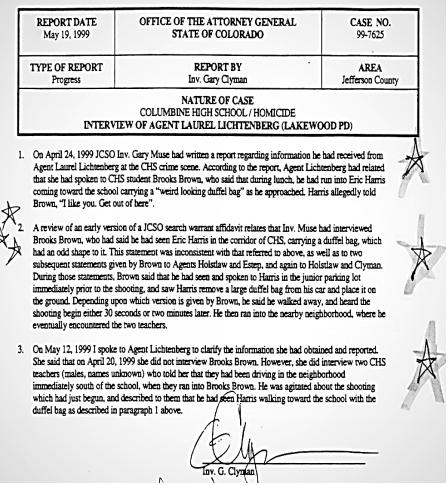
But there is more to this story. Did you pick up on it? The police referenced Holstlaw and Estep’s reports, with Brooks, on page 9086. They used the FBI Interviews, that they said they did not have, in their investigation. They used them, said they did not have them, and that they did not exist. This is, again, absolute proof that the police have released doctored reports and only some of the investigative files. In this instance, it is the very reports that Jeffco said the FBI had not sent to them. They used those “missing reports” in their own investigation. They used the FBI Interviews that they said they did not have.
That is a very telling problem. If you will remember, Fuselier saw the article in the paper, and called his agent. He found the interviews, and said that they had inadvertently left them out of the files, and had not sent them to Jeffco. Well, he actually said that he had transmitted them. Jeffco had them. They left them out of the released pages, even though they used them in their investigation. The complications and possible cover-up from that situation alone are almost too complicated to review, but it appears that the FBI lied to cover up for Jeffco’s initial lie. The Sheriff’s Department had those reports the entire time. The photo shown above is a copy of page 9086. Yes, it is confusing, but it shows it was their confusion. Their mistake. Notice in Par. 2 the reference to Holstlaw and Estep, the FBI interviews that they said did not exist. They had the interviews. They used them. They just denied it
A Fax to Dr. Laura
6/05/01
Dr. Laura,
I was disappointed to hear your comments about teasing, bullying and Columbine, on June 5, 2001. Teasing at a young age or bullying at any age is not acceptable, or a rite of passage, or something that a child must learn to live with. Incessant teasing and bullying is child abuse by other children. It is harmful. It is abuse. It ruins lives. Are you teased at work? Are you bullied at work? No. You would not allow this behavior because you have respect for yourself, and because you are protected by laws and the norms of our society. Why would your child deserve less? I must assume that your son goes to private school, or that he does not communicate with you over the bullying, and his everyday fears, or that he is in one of the rare public schools that doesn’t allow bullying. Very rare. Columbine was a complicated tragedy caused by many factors, one of which was bullying. Your summary and comments were completely wrong and irrelevant. You are obviously misinformed as to the Columbine tragedy. I would like to think that you have enough integrity to either research the facts about such a serious issue, or leave it out of your future discussions.
Thank you,
Randy Brown
A Columbine parent from Littleton, CO
P.S. The point the caller was trying to make was that his daughter had been teased by the Coach’s daughter. This was “teasing with power.” What could he do? Talking to the coach would hurt his daughter, so he could not talk to the coach. “Live with it” was a callous and flippant remark. You say you put “children first.” I don’t believe that “toughen up” or “live with it” is respectful to children.
700 New Pages
6/21/01
On June 19. 2001 the Sheriff’s Department released another 700 pages. I won’t bore you with details, there is a lot of new information in these pages.
The first thing about this release, is the Press. The pages are released, and we get, immediately, questions about what they contain. The Press asks me that when I pick them up. It is odd. I have just brought the box out of the Sheriff’s Office, and I get asked what is in them. I haven’t even read them. I don’t know. It will take three or four days to read, study and figure out how these 700 pages relate to the rest of what we know. Expecting results when I pick them up is kind of unreasonable. It is a lot of work, and it takes time. I’m not complaining, it is just odd.
Some ballistic mapping is included. The mapping shows that the deputies or SWAT team members fired into the school, which we already knew, and where the bullets ended up.
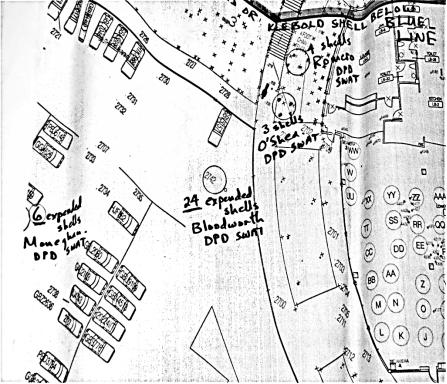
As you may know, rifle bullets are high powered and high velocity. They will hit an object and go through it. They will ricochet and go in an entirely different direction. This is one reason policemen carry pistols, because their lower velocity makes them a little less dangerous to innocent bystanders. These new pages make it quite clear that over 80 rounds of high-powered rifle ammunition were fired into the school by the SWAT team members. Three in particular, Gray, Bloodworth and O’Shea, fired into the West door of the school with their semi-automatic weapons.
Please note: They fired at nothing. They had no target. They had no one firing at them. They had no reason to fire.
The police and Swat Teams fired semi-automatic weapons into the school, filled with innocent teachers and children, as cover fire. They fired to protect themselves from an unidentified, unlocated enemy. They fired blindly into the main hallway. They fired blindly into the library. Their bullets ricocheted off the wood and were embedded in walls. The bullets went through computers and computer monitors and embedded themselves in door frames, metal door frames, books and walls. Semi-automatic weapon fire by the police, into a school full of innocent children and teachers, is irresponsible.
As of this date we do not know if anyone was hit by these bullets. There is some evidence that one of the victims has some police bullets in him, but no investigation has been done. The bullets are, according to the police, unidentifiable, but we do know that they do not match Eric and Dylan’s weapons. The other item of major importance is the missing information from Team 6. Team 6 is the team at Columbine that was supposed to investigate the outside shootings: Rachel, Richie, Dan, etc.
The report is not in this release. This is very damaging to the Sheriff’s Department, because that is the reason this Freedom of Information request was done in the first place. Mr. Rohrbough’s lawyer, Rouse, demanded this information, and it was omitted. There is a tab labeled Team 6. There is nothing behind it. There are no pages included. The file is empty. The department has again withheld valuable information. They did it in the most arrogant way. They included the label of the file folder, and then did not put anything in the file folder in the release.
The last major item was some of the evidence on Eric and Dylan. They supposedly committed suicide at the same time. The evidence, in these books, completely refutes that theory.
Dylan’s fatal wound (only wound) was from left to right. He was shot in front of the left ear and the bullet exited in front of his right ear. (note, there is some confusion here. He may have been shot in the left temple.) This was a “through and through” shot. He was shot in front of the left ear and the bullet exited in front of the right ear, according to the written reports. Dylan was left-handed, so shooting himself in the left ear or temple makes sense.
But Dylan fell on the gun when he died. He fell with his right leg on the Tec 9, and it was held in his right hand, per the coroner and deputy on scene. The very clear photos of him on the floor of the library show the weapon, held in his right hand. They actually had to pry the gun out of his right hand.
A suicide is now impossible. You cannot physically shoot yourself in the left ear/temple, with a Tec 9 in your right hand, and have the bullet exit in front of your right ear.
Eric shot Dylan in the left ear with his High Point Carbine. The bullet was high powered and went straight through his head. Dylan had the Tec 9 in his right hand and fell on it.
This is obvious. This is so obvious it is absurd. It doesn’t take a criminologist or forensic expert to figure this out. Eric and Dylan had only two 9mm weapons. Each of them had one. The real question is: Why did the sheriff department lie about it? Why did they come up with the suicide scenario that doesn’t fit, in any way, the evidence?
Let’s look at what this means. Eric killed Dylan. Dylan fell on his side, and then, later, it is possible that Eric rolled him over to see if he was dead. The blood evidence supports that theory. This means that Eric was alive after Dylan was dead. He was alone in the school with the exception of some SWAT and a few hundred children. What did he do? Did he travel around the school, did he stay in the library?
Is this to protect the Sheriff’s Department from a lawsuit by Dylan’s parents? If Eric killed Dylan, and the Sheriff’s Department was negligent in the previous investigation, then the department may have liability over his murder.
Whatever the reason, we now know that the department lied, again, about the circumstances of that day. Eric killed Dylan. Eric was in the school, by himself, after he killed Dylan.
What did he do? Why was it lied about? What motive do they have?
Songbirds
7/1/01
I’m out in the backyard lying on the hammock. There is this book by Naomi Remen I am reading, and it tells a short, two-page story about a man’s father dying.
I am lying in the hammock, remembering my father and the day he died. It was more than a year ago. I was remembering the phone call.
A small bird flew into the locust tree next to me, and started to sing, and I wondered, for the first time in my life, if that the bird wasn’t just singing, it was singing because it knew that I was sad. It was singing because I was crying.
Birds sing for many reasons, but sometimes, do they sing because they can see, or feel, or hear, that you are unhappy? I wonder if that is true, do they sing because they understand your sadness?
Never has the song of a bird sounded more beautiful.
Jefferson County Attorney Tuthill, Kate Battan, Sheriff John Stone, D.A. Dave Thomas
7/7/01
It has been two months since my written requests for the release of specific information regarding the Columbine case.
It has been two years of waiting for responses to Open Records/Freedom of Information requests.
You have not supplied me with the requested information.
I am charging Sheriff John Stone and all members of his staff with racketeering, conspiracy, conspiracy to alter police records, conspiracy to withhold information violating state and federal laws, and the felony of tampering with police records.
If the people charged with upholding the law are allowed to violate the laws without penalty, we live in a corrupt state, with no public confidence in our elected officials.
As a specific example: El Paso asked for and received the time stamped 911 tapes within seven days of their request. Jefferson County has refused to release these to myself, and other parties, for approximately two years.
It is obvious that Jefferson County will not police itself. I am requesting a full investigation into these conspiracy charges against Jefferson County by the Attorney General of Colorado. I am requesting that the State of Colorado seize and protect and distribute to the public all of the files, maps, tapes, documents and records now held in violation of state and federal law by Jefferson County.
Sounds good, doesn’t it? It is all true.
But I did not get the records. Ever.
The causes of Columbine and the lesson we must all learn
8/6/01
I have been asked so many times what the real cause of Columbine really was. Why did it end up with such a violent solution?
There are many causes:
Eric was angry. He was violent and the Luvox made him worse. The bullies at the school were relentless and cruel and terrifying. The school was mean, with no heart, no soul. Football was king, and the football players had no controls. The big bully had no controls, and was not only violent and strong, he had a wealthy father with power. The administration at school was weak and ineffective. Violent video games fueled Eric and Dylan’s violence, and desensitized them to violence and murder. Guns were readily available. The Sheriff’s Department failed to intervene many times. The diversion program missed a critical communication link between the Sheriff’s Department and the district attorney’s diversion counselors, failing to notify the counselor of new infractions. Dylan was particularly shy and isolated, just like Kip Kinkel, from the mainstream school. Eric’s parents failed to intercede when they allowed him, through lack of supervision, to carry out his plans for more than a year. The detective that we went to either mishandled the case or was instructed to drop the case by a superior officer, due to (we believe) influenced by Mr. Harris, or a friend of Mr. Harris.
These are all factors, but not the main cause.
I believe the main cause is frustration created by an environment that gives the downtrodden, the bullied, the weak, and the hopeless, nowhere to turn.
When people are without hope, without a chance for justice or redress, they look for options. Some will try religion, using the complete immersion in a belief as a way of feeling empowered and protected, as a way of finding solace and a feeling of comfort. Some will drink, or use drugs. Some will lose themselves in books or the television drug or the Internet drug. Some will fight back.
Eric and Dylan lived with the bullying and oppression and fear for six years (Jr. and Sr. High). With no protection, with no hope for justice or redress, they planned revenge. They simply took the examples they had already been given, with Kip Kinkel and the other school shootings, with violent video games, with violent solutions to movies, with Timothy McVeigh’s revenge against the government, and blended them into a violent school shooting, with bombs and justice, and murder. Truly a product of their environment, they didn’t create this solution, they simply pieced it together out of the world they lived in.
McVeigh taught them that killing innocent victims was merely “collateral damage.”
The rebel figure with a musket in the hallways of Columbine, in a glass case in the main hall, taught them that violent insurrection is acceptable and even heroic.
Movies taught them that violence is an acceptable solution. Video games taught them that killing was easy and without consequences.
But the reason they killed is because they were without hope. Terrified every day by the jocks, tormented by an uncaring school, teased by the mean girls at Columbine, and abused by the administration, they had no one to turn to, no chance for justice.
The legal system not only didn’t catch them for their crimes, it wouldn’t protect them from the assault and battery, and fear, that they lived every day, in and out of Columbine High School. Yes, they were bullied and afraid when not in school. The jocks would actually drive around looking for someone to fight. Yes, it is true. I know if for a fact. Beatings by the jocks happened at the local subway, and nothing ever happened to the bully.
With no redress, with no hope for protection or justice, they fought back.
This is, by the way, the reason that there are Eric and Dylan memorial web sites and Eric and Dylan fans. The bullied, the helpless, the outcasts, have identified Eric and Dylan as heroes because they fought back. These outcasts are responding to their own helpless and hopeless situations, by making Eric and Dylan heroes, in the same way that some people think McVeigh was a hero, for the Oklahoma City bombing. They see his act of terrorism as an act of patriotism, as a redress for the injustice the government perpetrated at Ruby Ridge and Waco. This is, after all, a part of our history. We killed the British in the Revolutionary War, killed women and children in Vietnam, killed thousands at Nagasaki and Hiroshima, and killed thousands during the Gulf War. Murder and killing is nothing new to America or American History. Why would it surprise us, in a violent society, that two boys would resort to violence?
Think for a moment. Have you ever taught your child a non-violent solution to an injustice? Have you ever seen, except for the civil rights movement, an example of non-violent protest to an injustice? Are our heroes Gandhi and Martin Luther King, or are they John Wayne, Bruce Willis, and Arnold Schwarzenegger? Does history teach us about wars and conquests and nationalism, or does it teach us about Gandhi and his life?
There, finally, is the real cause of Columbine.
Two boys are bullied and terrorized with no chance of justice, hope or redress. They obtained their own revenge, using extremely violent methods, which they were taught, and which were reinforced by the society they lived in.
The solution is simple, and twofold.
First, give everyone a chance for justice, for redress, for hope. Schools cannot favor the football teams, or the chess teams. Everyone should be guaranteed equal rights and protection under the law. That includes children, the children and residents at Waco, and the residents at Ruby Ridge. That right exists under our Constitution, and yet it is not being supported by law enforcement. Protect everyone equally, as required by the Constitution. Give everyone a chance for justice, a chance to fight oppression.
Second: Teach and encourage non-violent Gandhi-like solutions as a way to fight injustice. Imagine this scenario: Imagine that Eric and Dylan had organized a sit-in protest of the bullying and the school administration. Imagine that children would have joined in, along with parents and the press. Imagine that this peaceful protest had changed the school. Eric and Dylan would have stopped the torture. They would be empowered. They would be alive, and so would their victims. Eric would be a computer programmer and Dylan would be in college. If only they had been taught the correct way to fight injustice, 13 lives and 40 injured children would have been saved.
Of course, we wouldn’t want to make Gandhi a hero, he is from India. Martin Luther King is black. There is no white proponent for non-violent attainment of justice, so our white dominated culture resorts to the existing archetypes, John Wayne, etc. We taught them that violence is not only a solution, but the only solution. Why are we surprised that they resorted to violence? We should be surprised when someone doesn’t resort to violence. You should never be surprised again, when one of our violent children kills another child. We created the violence. We taught it to them.
In the last century the adage was “You can’t fight city hall.” The new adage is “You can’t fight city hall, but you can blow it up.” We need to rethink this. We need to learn and to teach our children that, “You can fight city hall, it just takes time, and truth.”
You can fight city hall with the truth, and without violence.
Teach your children peaceful civil disobedience. Teach them to attain justice without violence. Teach them to attain justice without violence.
That is the real lesson of Columbine. Teach them that Eric, and Dylan, and McVeigh and others were wrong when they resorted to violence. Teach them to change the world through non-violence. If that is the only lesson you learn from Columbine, you will have learned enough.
The world will never be perfect, but you can give people a chance to be heard, and a peaceful non-violent method of protesting injustice.
Stone
8/07/01
Today was a very interesting day. At about 2:00 pm I drove to the sheriff’s office to pick up some files we had requested. Using the Freedom of Information Act, we requested the files of Detective John Hicks. They were ready.
I was waiting for Virginia in the records department to get my receipt, when Sheriff John Stone walked down the steps and out the main door. He said hello as he went by, in my direction, but I think he actually said hello to the guy next to me, who had a baby in a stroller. I laughed to myself as he went by, very surprised to actually see him.
You may remember that I had only seen him once before, when we surprised him at the Ken Caryl meeting.
After he went outside, the deputy at the report desk looked at me and said, kind of chuckling: “I don’t think he knew who you were.” I said “Probably not.” He said “He’ll figure it out about halfway through the parking lot. Do you know that he hasn’t used those stairs 10 times in 2 years?”
I told him that I was surprised how I handled it. That I had always wondered how I would react when I met him for the first time. I thought I did pretty good. The policeman at the desk was very nice about it.
Virginia had my papers ready, and I left. Virginia and Lenore had been great. They supplied us with what we asked for without complaint. Very nice and competent.
As I left, I saw Stone talking to an older couple that had just gotten out of a car.
I called out “Well, if it isn’t the liar John Stone.” I should point out that I can be loud, very loud, by nature. When I said this, I projected it louder than normal.
I walked up to him, he was smiling, so was the elderly couple, and he held out his hand to shake my hand. He didn’t recognize me. He had called my wife and myself liars for two years, he had accused my son of being a suspect, and he didn’t recognize me. I think he thought I was a cop, who was teasing him.
I took his hand. I said, directly in his face: “My name is Randy Brown, and you are a lying son-of-a-bitch.” I repeated it again. Then I let go of his hand. Then I walked to my car.
He didn’t say a word.
This was too weird. I was so pumped and full of adrenalin I turned and yelled: “Have you disciplined yourself yet?” as he entered the doors to the Sheriff’s Department. I think that was a reference to a comment he had made in the paper, about disciplining any deputy who had lied. It was a stupid comment. Yes, I know it didn’t make any sense. Not a word in response.
Did he know who I was? Did he know I was serious?
What a strange bizarre meeting.
I called Judy and told her. She wasn’t mad. I called Brooks and told him. He laughed.
I wonder what the lying son-of-a-bitch thought.
I was glad I hadn’t hurt him. I had 75 pounds on him, and he wouldn’t have been a challenge, but I didn’t get physical. I don’t even actually hate him; I just think he is pitiful.
I said what I said because of what he tried to do to my son and family.
He deserves worse. This liar. This coward. This fool with the power of his office and the ridiculous immunity that it grants him.
He deserves worse.
Shooting Pistols
9/7/01
You won’t believe this day. This was a strange one.
I went to work, and the sky was perfectly clear. Perfectly clear. I called Judy and we went to the mountains and hiked and took photos, and then ate lunch at our favorite restaurant, The Country Road Cafe in Kittridge.
Then we went to the range. The target range, to shoot guns. This is the most bizarre thing we have ever done. Judy had never fired a gun before, although I had. You see, we have signed up for a gun safety class on Saturday. This is an eight -hour class, and is required for us to get “concealed carry permits.” Yes, we are going to apply to Jeffco, and Sheriff Stone, for a concealed carry permit. We are going to be able to legally carry a weapon, assuming Stone approves the permit. I guess I should explain how this all came about.
Judy and I were sitting in Federal Court, listening to Tuthill present his case to Judge Babcock. Tuthill stated that the police have no responsibility to protect you. They have no legal liability to protect you. They have no liability, even if, for example, you call 911, and they say they will be there in three minutes, and they never show up. No legal liability. No constitutional requirement to protect you. Now, it is true that if they establish a “special circumstance,” they may have some liability, but that would be decided in a court of law, and you would already be dead. Up until Tuthill’s statements and my ensuing discussions with attorneys about this issue, I always thought these statements were venting by the militia members in Montana or Michigan, or by right-wing zealots with an agenda.
I was wrong. It is the law. We have actually been waiting for over four months for Judge Babcock to decide about whether a “special circumstance” was established at Columbine.
O.K. This is the law. The police do not have to protect you. It is true.
Well, my kids were in Columbine. That answer is not good enough for me.
The only answer left is to protect yourself. We are going to. We went to the range to fire the pistol so that Judy could be ready for the class. We went down the stairs to the indoor range, with our safety glasses and head gear, and we bought 50 target load 38’s, and we went to the stand, and I showed her. It was quiet at this time, and I showed her how to stand, and how to hold the pistol, and how to aim.
I shot the first six. She shot the second six. Then she cried. The shots were loud in this underground indoor range, even with the headsets on. The gun kicked, the target moved, and she cried. She stood at the range and cried, thinking about Dylan and the cruelty, and the murdered children, and the injured children, and the children who were in the school, who listened to gunshots from shotguns, and a Tec-9, and a 9mm rifle, and police machine guns. She has a good heart. I knew this was going to be hard for her. Funny, I don’t ever remember a .38 being so loud. I don’t ever remember looking at a target with little holes in it, a silhouette target, and feeling so sick, so sad. This is what it has evolved into. The police won’t protect us, so we have to use these violent weapons to be able to protect ourselves.
I guess if we hadn’t lived with Eric’s death threats, with the fear of pipe bombs, with the awful realization that our children were lucky not to have died, at Columbine, on April 20, 1999, with the realization that the sheriff has lied to us, and about us, and that no one with power was ever going to be willing to help, and with the death threats we have received lately, we would be happily going to work, and not thinking about life and death situations and protecting ourselves.
I guess our perspectives on life have changed.
The real question is, why haven’t yours?
You are living in the same world I am. The police don’t have to protect you either. They don’t have to protect you at home, in your car, or in your school. You however, have the right and ability to protect yourself. The next time someone tries to rape you, shoot him and kill him. The next time someone is in your school shooting at your children, go in the school and shoot the person with the gun. The police won’t.
There are bad people out there, and you are unprotected, you just won’t admit it to yourself. Judy and I have. We know the truth.
The training class is tomorrow at 9:00 A.M. I am sure this will be a stressful, traumatic day. My wife, all 5’7” and 110 lbs. of her, is going to get trained in the use of a firearm. Then she will at least know how to defend herself and her children if she ever needs to.
Welcome to America. Where the police worry about liability. Where they allow innocent children to be murdered. Where the courts don’t care.
Welcome to America.
Editing the releases
9/07/01
I have been tired lately. Working too hard and too many hours. It has been hard to write, but I am going to try.
I have been researching CALEA violations and reading the maps and new FBI release for about three weeks. CALEA is the Commission on Accreditation for Law Enforcement Agencies. They are going to review the Sheriff’s Department, and I am going to complain to them. The FBI review is time consuming too. This is tiring and complicated work, and mentally draining. The last thing I have energy for, after studying this map for four hours, is writing a chapter that I don’t think anyone wants to read. When I lose hope, I stop writing. I face it, sometimes. The people of Littleton don’t care. The T.V. reporters stopped reporting a long time ago. They don’t report on the map, or the withholding of information, or about anything that needs to be reported, like the bomb threats at the school that were kept secret. I know about them, Judy knows about them, but few other people do, and they should know. The problem is that no paper or T.V. station will report it.
Take April 4, 2001. You probably remember my telling you about this. Well, it was real. I have the case number for the incident. People have a right to know this kind of thing, and it is being denied them.
Sorry, back to the subject at hand: The Maps.
This is extremely complicated, but I will try to explain it. Jeffco hadn’t released any team six or eight information. These were the teams that did the investigation outside the school. and inside. This was the FBI. These reports, although labeled in a file by Jeffco, were missing. a Freedom of Information Request made them release some partial information by team six, a CD Rom with two massive files. These were CAD drawings reduced to a JPEG file, and were almost impossible to print. We burned up the computer at Copy Max just opening the file (a Mac G-3). Then a professional printer stayed up until 5:00 A.M. printing the maps: 3’ x 3’ in color. He said it was the worst mess he had ever worked on. That was a very nice thing for him to do.
I took these home and studied them until 3:00 A.M. I was obsessed. I had to see what was in them, and what was left out. This was a complicated process, as I had to cross-reference the evidence numbers by Jeffco with the evidence numbers by the CBI, and then use an eight-power loop to read the map, and look for the evidence numbers. This eight-power magnification loop made them legible.
Here are the two major items I found that night:
1. Rachel was missing. Her body was not on either map. All of the other victims were there. Eric and Dylan were there. Sanders was there. Rachel was not. Now, without sounding absurd, how could the FBI, our nation’s finest law enforcement officials, complete a detailed map of the crime scene, take photos, document every single tiny piece of evidence, and miss the body of a victim? In their report they photographed her, gave evidence numbers around her, and even labeled her as victim #14. But they left her off the map.
This was impossible. Obviously, someone was lying. Obviously, there are more maps. Obviously, the sheriff department is withholding information. Or, the FBI is incompetent or complicit in this cover up.
2. The law enforcement ballistics are missing. Not one bullet that these bastards fired into the school, as cover fire, is marked as evidence. Here are some of the numbers: 2174, 2232, 2709, 2730, 747, 748, 755, 757, 758, 759, 763, and on and on.
Not one number shows up.
As a side note, the spent shells are there, on the map, in little red numbers. Piles of them, located outside the double doors of the school. Shells ejected from the automatic weapons, the SWAT teams sub-machine guns, that were used to spray the doorway with bullets, as cover-fire, against an enemy that had (according to the police timeline) already committed suicide. Those piles of spent shells were there, and the bullets had magically disappeared.
There is another map, or they have been deleted.
Why?
You already know.
Do you think the FBI of the sheriff wants you to know what happened that day? Do you think they want you to see the hundreds of bullets fired by law enforcement personnel into a school full of innocent children? It is bad enough that these cowards stood outside with their weapons and let innocent children be murdered. Imagine the public disillusionment when the public finds out that the police stood outside, after Eric and Dylan were already dead (according to the police timeline) and fired into the school with their god-damned sub-machine guns.
That is why the ballistics evidence is missing. They have something to hide.
No, this has not been in the papers. No, this has not been on T.V. No, this has not been reported on by anyone. Why? The map is too hard to open. It takes a lot of work to figure it out, and no one cares.
Now do you know why I stopped writing? If the truth is edited by everyone, it no longer exists. There will be no chance that anyone will want to read, or print, what I have to say, so I stopped.
I am going to try and keep writing, at least it makes me feel better. A little better.
Turn the Other Cheek
9/16/01
Turn the other cheek was the teaching of Jesus. It may be true. it may also be possible that the world has changed since his time, or that he was wrong.
Turn the other cheek. Let’s discuss this.
There are evil people in the world. There are murderers. Eric and Dylan murdered innocent children in cold blood.
When you are confronted with evil, when it threatens you, you have a right to fight back. When your life is in danger, when your children’s lives are in danger, when your spouse’s life is in danger, you have a right to defend yourself.
Given the situation at Columbine on April 20, if you had a weapon, you had a right to use it. You had a responsibility to use it. Turning the other cheek, showing understanding, showing love, was, on April 20, irrelevant. Eric and Dylan would have killed you anyway. They would have shot you at point blank range with the Tec 9 or shotgun, and you would be dead. They were murderers. On that day, they were cowards and killers.
You have the right to meet violence with a reasonable response.
If, as an example, you would have shot them both, and killed them, that reaction would have been totally justified. You would have prevented further deaths. You would have saved lives. You cannot, in this situation, meet violence with understanding. You cannot protect yourself with kind words of love.
There are violent people in the world. You must be armed to protect yourself from them. If someone tries to rape you, you defend yourself.
Are you having trouble accepting this? Let me ask: Is it a Christian act to be raped by a rapist? No, it is not. It is an evil act to rape someone, and defending against that evil is your right. The next time you hear of a woman being raped, ask yourself if it was necessary. If she had been armed, could she have stopped it? It is simply our conventional beliefs, and the society we live in, that makes the 20-year-old college girl walk around unarmed and defenseless.
The world has changed. The police are not going to protect you. They cannot protect you from a rapist or murderer. However, you can protect yourself.
Yes, these instances are rare, until they happen to you. As I write this there are five unsolved rapes at a Colorado College. The campus and city police can’t stop them. Yet, the girls go to the school and come home unprotected, living in fear, because that is what our society teaches them.
Well, here is a lesson: take a firearm class. Get a concealed carry permit. Carry a weapon. Shoot the rapist when he breaks into your apartment. That is today’s world. Or, I suppose you can passively accept the fact that the police can’t protect you, won’t defend you, and that you should accept this rape without protest. Evil should win. Evil should control you. You don’t have a right to stop a rapist or defend yourself.
That is wrong.
You have the right to protect yourself. Your right as a citizen. It is in the Constitution. You have the right to life, liberty and the pursuit of happiness. It is not life if you are murdered by the rapist. It is not liberty if you live in fear behind closed and locked doors. It is not the pursuit of happiness once you have been violently raped.
You are simply being denied your constitutional rights by allowing this evil to control you.
Stop living in fear. Protect yourself.
This has been about rape, let me take it to the next level.
You have the right to protect your family against evil. If we had established that right prior to Columbine, 50 parents would have entered that school with weapons to defend their children.
Instead, we passively waited outside, trusting the police to protect our children.
They did not. In fact, according to the law, and the attorney for Jefferson County (Tuthill), the police have no constitutional obligation or legal requirement to do anything. They do not have to do anything. I believed that they had an obligation to risk their lives to defend our children. I was wrong. If you believe that, you are wrong. Ask an attorney. Ask a judge. We were wrong.
Police have “qualified immunity,” a doctrine that stops them from being sued if they try to do their job and screw up. If they had gone into Columbine and shot a teacher or student by accident, they would technically have no liability. This is actually a reasonable rule. Everyone is going to make a mistake. Everyone, including policemen. If they make a mistake, when they are trying to do their job in good faith, we shouldn’t, under reasonable circumstances and review, hold them liable. Without this immunity, they would be frozen between wanting to help and the fear of lawsuits and liabilities.
This, to me, gives them a greater responsibility. Once they are freed from the fear of lawsuits, they are then required to act and perform their duties. You don’t give them “qualified immunity” for an error when they do something wrong (in good faith) and then allow them to stand outside while children are murdered. “Qualified immunity” protects them from liability, but demands that they act. “Qualified immunity” mandates action. I am sure that you are well aware that the police did nothing to save the murdered children at Columbine.
The end result is this.
The police don’t have to protect you. They don’t have to risk their lives for you. They have no responsibility for your safety, either legally or civilly. You can’t make them, you can’t sue them if they stand and watch while you are raped or murdered, or while your children are murdered. That is the current status of law enforcement in America.
You are unarmed sheep, who should go to work, make a lot of money, and accept the fact that you are defenseless against evil.
No. Don’t believe it. Protect yourself.
Point 2.
You have no right to ever physically harm someone except in self-defense. You have no right to shoot someone, threaten them, blow them up, beat them, or physically harm them. If you try to physically harm someone, and the police won’t stop you, be prepared to be stopped by an armed citizen.
Let’s look at the example of the abused wife. She is beaten up, hurt, abused, frightened. She gets a restraining order. Her abusive husband has to stay back 100 yards. We know, of course, that they are not enforced, or enforceable. We hear time and again that these women are murdered by their husbands, and we shake our heads and we lament the world we live in.
But, did you ever think of this solution. Make the abused wife take a pistol class, and get her a laser sighted Smith and Wesson, that she carries every minute of the day. Show the abusive husband the permit, and warn him to stay away. Show him a few of the silhouette targets that the abused wife used during the pistol class, especially the one with the bullet holes in the head, or the crotch. Warn the husband. Arm the abused wife. Problem solved. She won’t need a restraining order. He will move out of state and go find another woman to abuse.
We promote the tragedies in our lives by accepting our victim status.
We have abrogated our right to protection and safety to a police force that won’t protect us. Wake up. Get a gun. Protect yourself. Or, you can be the abused wife with a restraining order, unarmed, and defenseless against evil.
Point 3
Protests against injustice must be non-violent.
There is always something wrong with the world. There are always problems. The neighbor’s dog barks too much. The neighbor works on his car until 2:00 A.M. The school has bullies. The teachers are mean. The principal is a jerk. Fine. But you do not have the right to make a violent response. You cannot shoot anyone. You cannot blow them up. You cannot burn down their house, or school, or city hall. You can protest, but it must be in a non-violent way. Read Gandhi or Martin Luther King. Learn this non-violent way of protest.
You do not have the right to harm innocent people.
“Turn the other cheek.” I understand the concept behind it, and I acknowledge the concept of meeting anger with love, of meeting hatred with love, of meeting the world with an open heart. You must understand that the evil that exists in the world cannot always be controlled with an open heart and love. Some evil must be destroyed. Some evil must be stopped. We all have a right to protect ourselves.
Why are we afraid to stand up and demand that right? Why are you afraid to carry a gun to protect yourself? Evil is out there, and you are unarmed.
The Blue Road
9/27/01
There is, on the wall of my office, a beautiful painting by Frank Francese. It is a subtle painting, with a blue over wash, with just a few areas lit by the sun. It is beautiful, and a little sad. I wrote a poem about it, and it is taped to the wall next to it:
“Your grandfather is going to die. Your grandmother is going to die. Your father is going to die. Your mother is going to die. You are going to die, and your wife and your children and their children are going to die. All of the things you have worked for, that you have toiled for, that you have earned, will be scattered and traded and lost. It is a blue road full of sadness and loss and sorrow. In the end the only things that will matter are the long walk down the blue road, with the sun on your shoulders, and the home you are walking toward. You must enjoy the walk, enjoy the sun, and enjoy the home. You must make a conscious decision to enjoy the life you have, to enjoy the walk down the blue road. That decision to enjoy your life is really all that you have.
It is the answer to your sadness.”
The World in a grain of sand
10/3/01
I found a newspaper clipping from 1998. Yes, 1998, a year before the Columbine killings. Let me explain:
It is from March 25, 1998. There is a small article in our local paper, called The Community Courier. It states simply the following:
“Classmate Making Death Threats on Internet
A man reported that his son goes to school with a boy who has his own web page. Recently, the man told a deputy, that boy has made death threats against his son on that web page. The father downloaded and printed 10 pages in which the boy threatened his son three times. The boy also explained how to make pipe bombs and use them against people. The father said he was concerned about his son’s safety and that he wanted someone to look into the matter. The case has been turned over to investigators.”
Please read this again. Note the date, a full 13 months prior to the Columbine murders.
13 Months before Columbine happened.
This was an article under “Sheriff’s Calls” in the local Littleton paper.
This was real. This was about Eric. This was about Brooks. I am the father listed in the article.
One year before Columbine, this was in the local paper. Printed for everyone to see.
The local paper had picked up the story, in 1998, from the police reports. This article exists, in the local paper. Now, give that some thought for just a minute. I remember the article. It was after we had reported Eric and Dylan to the police, and I was worried that Eric would see it. Really worried. He did not. But please see what else it tells you. The report we filed about Eric, that the police denied the existence of, was written about in the local paper, when it had happened, a year before the killings. There is an old saying, that a wise man can see the world in a grain of sand. In a sense, this small article was the prelude for everything that followed. A wise man could have predicted the end result. And, it was absolute proof that we had reported Eric to the police. It had been reported in the local paper a year before Columbine.
Now I Understand
10/10/01
A very funny thing happens when you die.
You don’t think about your life, or your failures or successes.
You think about all of the loved ones that you will never see again, that you will never say goodbye to.
As life merges into death and you learn your future, infinite emptiness or heaven, it is that regret that you think of. All of the loved ones you leave behind.
All of the loved ones who you will never see again.
People and Fire Department and Police of New York City
10/11/01
I am so sorry for the tragedy you have lived through. I do understand, believe me.
My heart goes out to the innocent victims, the police and firemen who died.
It will be little solace to the policemen, firemen and other heroes and their families, but I wanted them to know how much they were admired and that their courage will always be remembered.
Perhaps this bravery will be a shining example for police and firemen and citizens everywhere. I hope so.
As for me, I will never see a New York fireman or policeman without thinking of their bravery.
Consider the Advantages
10/11/01
You have been a deputy sheriff for 10 years.
Every day when you get up to go to work you take out your Glock45 or Sig Sauer, check the safety and magazine, and place it in its holster. You know this weapon. It is a friend. It is a part of you. You carry it every day, in its holster, locked and loaded. One flip with your thumb, and the safety is off, and you can fire. It is heavy to carry around all day. It is a weight. It is a burden, but it is part of you and your job.
The bullets are 9 mm or .45s. They fly faster than 800 miles per hour, and are hollow point bullets, for extra stopping power. Some of your friends put in two standard rounds, then two hollow point, then two more brass rounds. This gives them greater effectiveness in stopping a felon, as hollow points can be stopped by layers of clothing, but you use hollow points only. Not that there are any rules, you just want to use the best bullets when you are on the street.
Your pistol holds 9 bullets in the magazine and one in the chamber. With your two extra magazines, you can fire 28 shots at the bad guys. And you can shoot. You have qualified as a marksman for the last 3 years. You can hit a pie plate at 50 yards. You should be able to, you have practiced on the department’s dollar for thousands of rounds. You have been trained. You know about bullet proof vests. You have one. You wear it all day. It was issued by the department. It is Kevlar, not too heavy, and very effective. Custom fit. You have fired shotguns and AR 223’s in SWAT training. You can shoot the eyes out of a rat at 50 yards. You know that your biggest advantage is your training. Weapons are loud and powerful and dangerous. As a deputy you are so used to them, the sound, the kick, the safety, that they are a part of you. You know that some robber or burglar has probably never even fired his gun, and probably isn’t trained, and rarely, if ever, is a marksman with a pistol. Especially with that piece of crap, 15-year-old revolver he is using. You know that the sound, and kick, and loudness will spook many bad guys, and you know that you are used to these sounds. You are a professional.
You have training, and skills, and a .45 caliber Glock with two back-up magazines, and a back-up gun on your leg. You have spent the last ten years carrying this pistol, feeling its weight, getting used to the authority and power it gives you.
Trained. Tough. Powerful. Accurate. A killer. A policeman.
Now, explain to me how you stand outside of Columbine High School with your pistol in your hand, with your bulletproof vest on, trained and ready, while you listen to unarmed children being murdered mercilessly in the school, 20 yards away. And you stay there.
Explain that to me. Explain cowardice. Explain “failure to do your duty.” Explain the delay. Explain your reasons. “I have children at home. My wife loves me. I’m a cop. These kids should respect me. I have to follow orders. I left my vest in the trunk. I didn’t shoot marksman this year. I could shoot an innocent kid, I have betrayed everything I stand for, I am nothing but a fat, lazy, poorly trained traffic cop, I am out of my league, I am a coward.”
OK. This was too cruel. You are right. Then you explain it to me. Explain cowardice to me. Explain it to the parents of the children you allowed to be murdered. Explain it to me.
“I was afraid of those two punk kids.”
OK. Now I understand.
Bullies. One solution
10/16/01
I guess I am suffering from depression. Even though I am working and functioning at a pretty moderate level, I am always tired, and my sleep patterns are a mess. It is 1:20 in the morning, and I am in the back bedroom, writing this. I guess I am suffering from depression.
Every day we learn a little more about Columbine. It has been almost two and a half years, and we have a lot of information now that we didn’t have before.
Now we know that they had eight 20-pound propane tanks. Two in each of their cars, and one each in two duffel bags in the school. In their cars were the following: Four 16 oz. propane tanks, four 20 lb. propane tanks, 30 gallons of gasoline, and incendiary devices and timers. Add that to the gas in the gas tanks, and their cars were prepared as serious bombs, placed in strategic locations, to kill police and children in the parking lot.
Imagine how much planning it took to prepare for this day. Imagine buying and storing 8 propane tanks, 19 gasoline cans, four weapons, and about 100 pipe bombs. Imagine the hatred it took to make this seem necessary. Imagine how afraid you must be to take this kind of action, all because of the bullies.
And that is the subject for tonight: Bullies.
What do you do when your son or daughter is being bullied? My dad taught me to fight back, and, after some timid responses, I finally did. Then I changed schools and had to fight again. And fight I did. I got kicked out of school for a week, defending another kid in my school. I never liked fighting. I didn’t want to get hurt, or hurt someone else, and violence always upset me. Other dads teach their children to be passive, to turn the other cheek. Some dads don’t talk about it at all. Most moms don’t.
Here is a novice approach, a simple idea: They are all wrong. Call the police. Bullying is assault, or assault and battery. Call the police, have the bully arrested on the spot. Press charges. If there is further retaliation of any kind call the police again. Press charges. If the police won’t do anything, sue the bully and his/her parents for mental cruelty and damages. This simple approach will teach everyone. The bully will learn that there are laws and consequences. You will learn that the police can protect you. Your child will learn that he/she has constitutional rights, and the right to be free from threats, or physical abuse, from any bully. Call the police. Press charges. In most cases this will be the magic bullet you need. In a few serious cases you may need to protect your child yourself. Get a gun. Get trained. Carry your own magic bullet. If the police won’t protect your child, it is your job. It is that simple.
I really hate to suggest a violent option. This situation is complicated. I am second guessing everything.
Body #15
10/18/01
“Coroner’s office and John Cline, Jefferson County Coroners’ Office, were allowed on the scene to recover body 15. Upon examination of the body, a Columbine School Identification Card with the name of Daniel Rohrbough, 9th grade, was found in a pocket.”
An excerpt from the FBI report. Page 15635.
The reality of Columbine.
Dan is dead. Body #15.
Rachel is dead. Body #14.
Now they are numbers, numbers on a report, a report that tells us a lot of interesting things.
Body #15 was identified by his ID card at approximately 11:30 a.m. on April 21, 1999. Body #15 lay on the ground overnight outside the school on the sidewalk. Cold and alone, lifeless and alone. A policeman was posted there for the night, to be with him.
(The parents of Body #15 found out that he was there by seeing a photo in the paper.)
Spaced around Body #15 were 12 shell casings (9 mm), 4 shell casings (.223 Rem.), 1 shotgun casing, some live 9 mm rounds, and 1 bullet fragment. Body #15 was shot 3 times, possibly by a policeman. It will be difficult to determine because the bullets are missing. Convenient, don’t you think?
Found next to Body #15 is a Dr. Pepper can. I know the father of Body #15. Brian Rohrbough. I guess he is Father #15. He likes Dr. Pepper too. Mother #15 doesn’t. She likes iced tea or water. They both miss Victim #15 very much. They loved Body #15. They would have died for him. They would have protected him, but they didn’t know he was in danger, because I failed them. I had the evidence. I saw the warning signs. I took it to the police and then I let them drop the ball. I should have been demanding. I should have been more aware. I should have demanded action. But I didn’t. I screwed up. Mother and Father #15 know it. I know it. I am responsible for the death of their son. I am so very sorry. I would give my life to undo it, to have had the foresight to stop it. But I didn’t. Their child is dead because of me.
Yes, I can rationalize that I took it to the police many times. That I reported to the police the paintball and the email threat, and the firecrackers on our porch, and the window that Eric broke. That we called Detective Hicks over and over again, but in my heart, I know they are all excuses. I could have done more. I didn’t. I screwed up. Body #15 is there because I screwed up.
Those are the things you won’t see in the F.B.I. report.
Gardner’s Bullets
11/4/01
This is a long and complicated story. Please be patient and read it all.
It is November 4, 2001. A few days ago, I finally found one of the biggest lies in the Columbine tragedy. Let me explain:
You remember Neil Gardner. He was the school resource officer for Columbine when the tragedy happened: April, 1999. In his testimony, page 8067 and 11235 of the report, he stated that he fired 8 rounds at Eric, when Eric was standing by the west doors of the school. Eight rounds. No more. Fired, in two bursts of 4 rounds each, at the west doors of the school. He clearly states that, and remembers it.
Now, let me make it clear. I admire Gardner. He, at least, engaged Eric with gunfire. I have told him that I believe he may have saved my son’s life by doing so. I hugged him outside the school. I considered him a hero. Then, later I read conflicting statements made by Gardner about knowing Eric and Dylan, about knowing about the web page threats, about interacting with Eric and Dylan. This was confusing. I never wanted to say he was lying, but he wasn’t telling the truth. He may have saved my son’s life, he may have been a hero, but he had lied. What was the real story about Neil Gardner, Jeffco Deputy Sheriff?
Then it got worse.
In his testimony he says he fired eight times, all at the west double doors. The CBI didn’t find all of these bullets, bullets fired from Gardner’s .45 caliber Sig Sauer semi-automatic pistol. One bullet, evidence #2238, is found by the west doors. Four are missing.
Three of those bullets are in the library. Yes, in the library. Evidence items, 746, 940 and 998 are all in the library. Located in a nearby perfect direct line from where Neil Gardner was standing in the parking lot, approximately 250 feet (80 yards) away, are 3 bullets from Deputy Gardner’s pistol that shouldn’t be there. According to his statement, he never fired into the library. These three bullets should not be there, but they are.
I discovered this two nights ago at about 2 A.M., when I found the first bullet. Using the new maps that had been released of the school, with the evidence numbers printed on them, I located it in the wall by window 15, on the south side of the library. I was shocked. My hair stood on end. This meant everything. Gardner was lying. Here was solid documented evidence supplied by the CBI and FBI. Proof.
Let’s be clear.
Gardner had never fired his pistol in the line of duty before. He fired it, according to his statement, eight times on April 20th. This is something you don’t forget or confuse. You remember where you fired your pistol. You remember if it was the west doors of the school.
You remember.
Here are the four identified bullets that are on the maps I have:
Bullet #184 (2238) is found where he said he fired it, in front of the West Entrance, on the ground, or buried in the ground.
Bullet #940 was found in the Library, by a chair next to Steven Curnow, dead on the library floor.
Bullet #998 was found in the Library, under a table next to Cassie Bernall, Matt Kechter and Isaiah Shoels.
Bullet #746 was found in the Library, in a wall, behind 3 book cases full of books.
The first thing I thought was that Gardner had been in the library, and fired his weapon. It didn’t seem likely that he could have placed bullet #746 in the south wall from anywhere but inside the room. Bullets don’t go through bookshelves.
The problem with that thought, was that no testimony had Gardner ever entering the school. In addition, the evidence grouping #2720 was in the parking lot, straight out the west doors. This evidence number was eight shell casings, that were identified from Gardner’s pistol. They were all located outside on the ground, in essentially the same location, and shared the same evidence number. This meant that he had fired all eight rounds from the same place, in the parking lot, if we are to believe the evidence. I must admit that after so many lies it would be easy to believe that the shell casings were a plant, and the entire testimony was a complete lie. But, to doubt all of these items, and the testimony of all the kids and police on the scene, would not be reasonable. Gardner was in the parking lot. He fired his pistol at least eight times. At least three of these rounds were fired into the library. Gardner forgot or Gardner lied. Or Gardner was told to lie. Police aren’t stupid. In a shooting, they know that their bullets can be traced. They know about ballistics and trace analysis and microscopic examinations. Every bullet fired has their signature on it, it is left there by the striations in the barrel of their gun. Yet Gardner reported something different.
Did he forget? Did he simply not remember firing at Eric in the library window? Was he so panicked that he didn’t know where he was shooting? I suppose that is possible, although I find it improbable. We are talking about aiming and firing a .45 caliber pistol. The kick, the process, the result, is not something you could forget.
It is more likely that he was told to lie. It is more likely that he was told to lie, that he would be protected. That no one would find out. That it would be kept secret. It is possible that Gardner shot, accidentally, one of the victims in the library. Corey was directly in line with Gardner’s other 3 bullets found in the library. The fatal bullet, that killed Corey, was not found until August, 1999, in Corey’s backpack. It was not checked against Eric and Dylan’s weapons, but against 4 policeman’s weapons. I am surmising that it was not a 9mm (Eric and Dylan’s weapons) but a larger caliber. I am surmising that it was the obvious size and weight of a .45.
If you don’t know bullets, let me tell you simply that a 9mm and a .45 are like a baseball and a softball to an expert, or to a policeman. They can tell the difference from 10 feet away. The .45 is much larger and much heavier. The difference would be obvious to a CBI agent gathering evidence, or to any officer on the scene. More information needs to be discovered about this problematic bullet.
Why the police would lie about that, is an answer I haven’t discovered yet. Did the police kill Corey, and others, in the library, and they want to keep it secret? Did they kill two or three of the victims? Did they not shoot anyone?
Now the question is: Why lie? They have qualified immunity. Even if they killed everyone in the library, they have no liability. If they are trying to do their job, they are immune from lawsuits. Oh. Yes. Maybe Gardner can be sued civilly, for wrongful death. Maybe this is all to protect Neil Gardner, a fellow policeman.
Why lie? Poor Gardner. If he killed a student he is living in torture. Regardless, he is living a life he didn’t expect, lying and withholding the truth. What a sad life for a policeman.
There is more: The Sheriff’s Department and investigators have known about the bullets in the library for about two years. They have withheld its disclosure. They have made it nearly impossible to discover. They have hidden this information from the public and the victim’s families for two years. To complicate this situation, is the interview with Gardner on April 20th, 1999. In the interview, it is obvious that the interviewer is “leading” Gardner, with questions and even suggestions about answers. It becomes apparent when reading it for the 2nd and 3rd time, that this is not the first interview. It is obvious that this is a follow-up interview. The interviewer is Russ Boatright, a detective, and he does a fairly thorough interview. Here are just a few examples of leading questions in the interview: On page 11,204, Boatright introduces a comment about the Principal, that Gardner has not mentioned up to that point. Then, on page 11,209, Boatright sums up Gardner’s statement, again including the Principal, who Gardner has not mentioned at all. Gardner responds: “Right.” Then on page 11,210, Boatright actually says: “Before you, ok, now, you say he came to the, uh, you said he came to the doors. He hasn’t come out yet, right, you’re just seeing somebody at the door, at the doors?” That is the question from the interviewer. It is confusing and troubling. Anyone reading this will question the process. It may be totally innocent, or it may be leading and instructive. 94 pages of interview, with a lot of open questions and confusing discussion. Anyone reading it will have concerns about the interview, the leading questions, and the investigation in general. The leading questions and the “suggestions” are sometimes subtle, and sometimes blatantly obvious. So, we have the second, or possibly third interview with Gardner, placed into evidence under the representation that it is the first interview. That is quite disturbing.
There is more: We have been told that Gardner dealt with Eric and Dylan. As the School Resource Officer, he had been advised of the bomb building and death threats. He dealt with them, and the interview with Boatright leads him clearly in a different direction. It leads him away from knowing Eric, to the point where Boatright actually says: “But you wouldn’t know Eric Harris, Correct?”
Here is the conversation:
Boatright: “OK, so you really don’t know this kid at all.
Gardner: “I had never dealt, I had never dealt with Eric Harris.”
Boatright: ”So based on the descriptions you have given of the suspects and your knowledge of Dylan, you, based on what you saw occurring it’s your belief it was Dylan that you exchanged gunfire with…”
Gardner: “Correct.”
It is, at best, confusing. It is, at worst, a construction of lies and altered testimony.
To be found on Page 88 of 94 of the Boatright interview. JC-001-011245 in the released pages.
The hidden maps.
Nov, 2001
Eight days ago, we were allowed in the Jeffco Sheriff’s Department to see the evidence. Judy and I went over with Brian Rohrbough, Mr. Kechter, Dee Fleming, Rich and Sue Petrone, and Alan Prendergast from Westword.
The maps were on the walls at a large conference room. The maps which we had never seen, and which we had been asking to see, for eight months or more. I had received two of them from a previous Freedom of Information request.
The first two maps were the FBI maps which were on the CD Rom released in September, 2001. This is the CD Rom that was so large that it burned out the Apple G-03 computer at Copy Max, when Bill tried to open it. This is the map that cost me $150 just to get printed by a professional printer, and two maps that still don’t have the police ballistics on them. These maps on the wall could have been easily copied, legibly and in color, by Kinko’s or Copy Max, and made available to us, at the first Freedom of Information request
No. That is not how the Jeffco Sheriff’s Department works. They knew there was damaging information on these maps. They kept them from us for a reason.
I took photos. Using my Canon F1, with close up attachments, I took close ups of everything. Hundreds of photos. No one stopped me. No one said a word.
There were, by the way, many maps with a lot of information. Maps with evidence numbers that were not on the FBI’s CD Rom. Interesting maps and prepared documents that had never been released, just as we had all suspected.
The map with the ballistics mapping for law enforcement bullets was still conspicuously absent. I expected no less.
It was these photos, that I took, that I used to find the evidence numbers in question. Here is one of the photos of the police bullets that were fired into the North door of the library. Fired by a number of different policemen, they were fired into the door blindly, into books, walls, computer monitors and walls. Incredibly reckless, and incredibly dangerous.
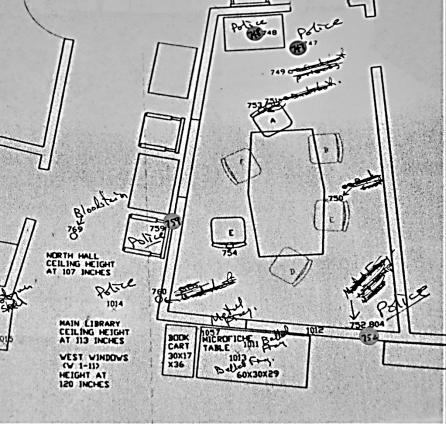
The next photo is the area outside of the cafeteria. The line drawn in dark ink was the “blue line.” No expended shells were found below that imaginary line that were ejected from Eric or Dylan’s weapons. Only police shells were found in that entire area.
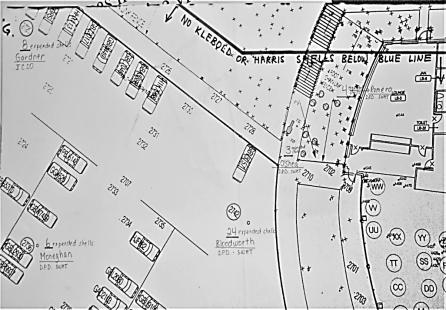
Below are some of the many photos taken by me from the unreleased police ballistics maps. These were printed out to be 8 x 10 size, or larger, to make reading them a little easier to read. Some of them have police bullets, and some do not.

This photo shows Gardner’s 8 ejected shells, all in one location, from the parking lot to the West of the school. Evidence number 2720 is the 8 ejected shells. The N.G. letters are his initials, written by one of the investigators.
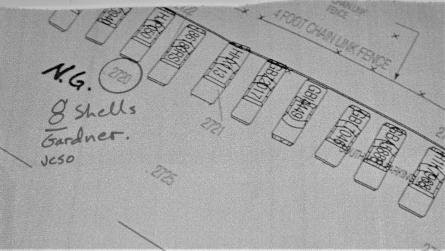
This photo shows the West entrance to the school, and has all evidence items listed, including the police bullets. Many of those numbers are from police weapons.
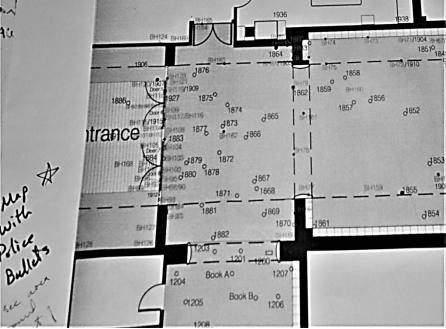
The photo below is an evidence listing in the library. I went through every item in the library, and labeled it.
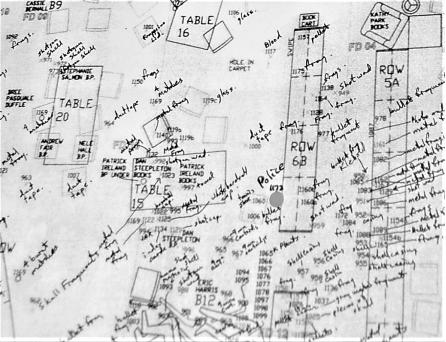
Below, the top left photos shows three of the police bulllets buried in the Front Door of the school, fired from the West doors.

Lying, secreting information, and withholding damaging information. The Sheriff’s Department is as corrupt as any in the country.
And there is more:
Where are the four missing bullets? Gardner fired eight. Four were recovered. Where are the other four? .45 caliber bullets don’t disappear. They have weight. They have mass. They exist. Where are they? He fired at Eric in front of the double doors. Did the bullets miss Eric and go into the school? Are they in the school? I will keep looking. Remember that the Jeffco Sheriff’s office has known about this evidence for over two years. Why did they not investigate it? Why wasn’t Gardner questioned again? Why did they let the lie stand, unchallenged, when further evidence existed? Why? What do they have to hide?
Judy and I gave this into Kevin Vaughan, at the Rocky Mountain News, on Friday. He is supposed to do an article this week. I hope he does a good job. These are important questions. The families deserve answers. Without the power and influence of the press we will never get the answers.
Another Lesson
11/07/01
A friend of your son vandalizes your car. It isn’t serious damage, just paint and glue, and it cleans up very easily. It is easy just to forget it, to clean off the paint and move on.
Don’t move on. Report him. Have him arrested. Be a jackass. His father will hate you. The boy will hate you. Your son might even hate you. Tough.
Here is the lesson: You are not doing a child a favor by not reporting him to the police. If you don’t report him, you enable him, you encourage him, you empower him to go further.
Imagine that I had gone to Eric’s father and screamed and yelled about Eric shooting a paintball through our garage window. Eric would have been in trouble again. He might have been watched by his father. He may have been labeled as a repeat offender and been put in juvenile hall. Instead I cleaned the paint off my car. Sure, I called the police, and I told them it was Eric, but they didn’t do anything, and I never went to Eric’s house. What if I had? Eric would have hated me. Perhaps he would have killed my sons or wife, or set the diversionary bomb by our front door. Perhaps. Perhaps he would have been in enough trouble that it would have stopped Columbine. Perhaps not. But I would like to believe that if I had, and if Eric’s father had been a good father, that Columbine would have been prevented. To paraphrase an old saying: All that is necessary for a school shooting to happen is for enough good parents to do nothing.
By the way, my car looks great. No paint marks. Of course, 13 innocent people are dead.
Be a jerk. Call the police. Demand that they do something. Contact the parents. Put out the roadblocks that will slow down or stop these problem kids.
Ballistics
11/25/01
I am sitting here at my desk for the 50th or 60th time, studying the ballistics report. I know, it is not the ballistics report. It is the “firearm identification report,” or some technical term. For this chapter, it is the ballistics report.
It is 1:40 a.m. I have studied these reports for hours, and hours, and hours. A few weeks ago, I found Gardner’s bullets in the library, where they obviously weren’t supposed to be. That was quite an interesting find. The papers even reported it. They wrote a great editorial about it last Saturday.
But there is more. To understand these reports takes hours and hours of work. They are complicated, but not for the reason you think. It isn’t the sheer number of bullets and the cross-referencing that is hard, it is the incompleteness: what is missing. If everything were there to review, an analysis would be time consuming, but relatively simple. The problem is the lack of information. I follow an item, and then its track of evidence stops. Hundreds of bullets are unidentified. Many of them are not located on the ballistic mapping. I look up a number, find its corresponding Jeffco number, and then try to find it in the ballistics maps, and the photos of ballistics maps, from the visit to the Sheriff’s Department. The JCSO number is nowhere to be found on the maps. It is frustrating. Imagine a jig-saw puzzle with two thirds of the pieces missing. That is the ballistics information they have released so far. Either these reports are incomplete and they have more information, or this is the sloppiest murder investigation in history.
Gardner states, and the testimony and investigation support, that he fired eight bullets. Only four of them are located on the ballistic map with the JCSO evidence numbers. Four of them are still missing..45 caliber bullets don’t disappear. Why are they not marked?
Eight other policemen fired their weapons that day, as far as we know. The ballistics reports and mapping do not show where any of these bullets went. Did they go in the cafeteria, the library, a student, a wall or a backpack? We don’t know. There is not, other than Gardner (4), and Gray (20), any identification of the police bullets and where they ended up.
Manwaring fired. Monaghan fired. O’Shea fired. Where did these bullets wind up? Is it possible that the police made no effort to match police bullets with police weapons? Is it possible? The police would have to identify every bullet fired, as a way to determine if the policemen were telling the truth in their statements, and to determine if anyone had been shot or killed by a policeman, at least in theory. They did not. Policemen fired into the school, and no identification or tracing of those bullets was attempted, at least according to the information released so far. Let me repeat: The investigation made no attempt to locate and identify the location of bullets fired by law enforcement.
Here is the detail: It was obvious that the SWAT info is missing from these pages. That is more important than what is included. The police ballistics mapping has been left out of all information, so far. Imagine reporting a car wreck with a police car and two other vehicles. When you read the report, no mention is made of the police car, except that an officer was driving it. The exclusion of the police car is the most important piece of information. So it is, with the ballistics mapping.
No police bullets are identified to a specific weapon except four from Gardner’s .45 Sig Sauer, and approximately 20 from Gray’s weapon. With the available information, it is not possible to trace one of O’Neill’s, Smoker’s, or Manwaring’s bullets. Not one. Police fired into a high school (occupied by children), and no attempt was made to locate, identify, chart and trace every single bullet fired by anyone and everyone. Are they fools? Or do they have something to hide?
I am going to find out.
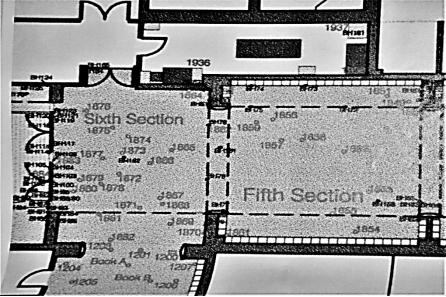
As a note, Eric and Dylan are in here. The rounds they fired, the anger they had, and the hatred they had, on display. The numbers, from a few different sources, are as follows: They fired 188 rounds total. Eric fired 25 shotgun rounds, and 96 9mm rounds. Dylan fired 12 shotgun rounds and 55 9mm rounds. They fired some of them at the police, out of the windows of the library, and some in the main office, and a few at the park to the East, and a few into the fields to the West. The rest they fired while walking through the school, and in the library, where they cruelly and mercilessly killed innocent children. Cowards with weapons. Killers of innocent children.
CALEA Decides
11/25/01
I emailed CALEA yesterday. You can look the acronym up. It stands for “something something Law Enforcement Agencies.” They accredit police departments all over the country. They are a joke.
I wanted to know if they had re-accredited Jeffco.
You may remember the CALEA hearing that I worked so hard to get ready for. You may remember that I prepared and presented to the CALEA review committee.
Well, it was all for nothing.
They approved them. They approved them on March 31, 2001.
All of their lies, all of their failures. All of the work.
CALEA didn’t care. Those bastards approved the Jefferson County Sheriff’s Department for accreditation. Corruption is everywhere. Incompetence is everywhere. CALEA accredited the worst of the worst. Public hearings are a fake. They don’t care about the input or the truth. They just want the revenue from the membership.
CALEA, you phony bastards.
Cloak and Dagger
11/26/01
We received some secret documents and photos today, on Columbine.
I had received a call from a source, saying that they had some records, from the police, that they wanted us to have. The source was not a policeman, they just had the information. They told me that they had left the information in our mailbox. I went and looked. There was a manila envelope in our mailbox. It had a disc for a computer inside. Later that day I opened the disc on my computer. There were photos of documents and photos. It opened on my computer.
The first photo is Dan Rohrbough. He is lying on his right side, with the Dr. Pepper can below his arm, with a red wound on his left chest. It is all I can do to look at the photo, blue jeans, green shirt, lifeless. It is overwhelming.
The second photo is a trench coat, two gloves and a forest green ski mask laying on the ground, where Eric removed it.
The third photo is Dylan.
Dylan. Dylan, dead on the library floor, with red flows of blood across his face, in two different directions. He has blood matted hair, and a large pool of coagulated blood behind his head. He has been rolled over onto his back for the photo.
It is Dylan. He is wearing a black t-shirt with the word WRATH in large red letters. He has two cloth-type suspenders on. No bullet wounds are visible. No entrance or exit wounds are visible, but it possible that there is an exit wound behind his right ear, based on the blood and signs in the photo.
Then there were other files and photos. Photos of the children in the library. Photos of the crime scene. Photos of papers and a diary. Photos that should never be made public. The source wanted us to have these. They are important. They trusted us with them. They are the nightmare of the library, and documents that have been kept secret. Documents that the police have lied about for years.
The photos have put me into a kind of state of shock. I can think, but I can’t feel. This is too real to comprehend, too real to understand.
There is more.
The disc has written documents, that we have never seen. There is no guide to them, but they are obvious. It is easy to figure out what they are. One is Eric’s diary. In Eric’s diary, or notebook, is a written plan, dated April 26, 1998, approximately one year before Columbine, about the murders. He states clearly, and coldly, that he is going to go to our house early in the morning, break in and kill Judy and me, then torture Brooks and Aaron, and then piss on them, and kill them. Then he outlines his plan, exactly, to attack Columbine High School.
One year before Columbine, he had his plan worked out. He had written it down. It was in his notebook, or diary. We have copies of pages that we had never seen. Pages that have never been disclosed, from one year before Columbine. One full year before the tragedy.
If the police had finished the search warrant and searched Eric’s home, they would have found this diary, and the pipe bombs.
It was preventable. It was preventable. It was preventable.
There is more.
If Eric had carried out his plan of April 26, 1998, my family would have been killed on April 20, 1999.
Stone knew that. The police knew that. They, the police, have read these files. These are their files, that I have been given. These are the files they have had from the beginning. Yet, Stone named my son as a suspect, and despite all of this evidence that proved him wrong, he never changed his story. He never said he was wrong. In fact, once he knew about this evidence, everything he said after gaining that knowledge, was a lie.
No one at the department, or the CBI, or the FBI ever spoke up either. No one.
They knew and kept quiet. This is secret information. It is not available to the public. It is hidden. They are lying, and every policeman who has this, every FBI agent who has it, is lying too, assuming that they have looked at it, and read it. And they have it. From the source, I know they have it. A lot of them have it, and they have had it for years.
I should be very clear about one point. This computer disc is not from a source we know. This is not from the policeman who told us he would not lie. This is not from our friend who worked for another agency, or from the Denver police I know. This disc was from a very vague, unknown source. I do not even know his name. I know someone he knows, and he has given us this material. He left it for us, unidentified, in our mailbox. This is one of the strange things that happens, because we have spoken out, and complained. People want to help us. They give us information to help. This is not the first time this has happened. But this leak, this information, is serious. It is confidential police files, that we were never supposed to have.
My family was in danger, and the police failed to protect us. Then, after April 20,1999, when the sheriff named my son, and called us liars, and withheld our original complaint from the public, and then withheld the 1998 search warrant information, everyone who had read these reports kept quiet. Everyone who read these reports knew that we were telling the truth. Everyone who read these documents, which the police had, and which were distributed to other policemen, knew that we were telling the truth, and that there was a coverup going on.
Cowards and liars, one and all. The CBI is corrupt. The sheriff and his investigators are corrupt. The FBI is corrupt. And, anyone on the commission who read these reports is corrupt too. That means anyone who has seen the police files, in their entirety. I doubt that any member of the Commission would lie, or that they had seen this information. But can I be sure?
Now who can I trust?
I can’t go to the press with this. It is something private. It is too horrible to share. I can’t let the families know that I have the photos of their children, in the library. I have to keep this secret. I have to protect the source. I have to protect my family.
It is my understanding that there are many copies of this disc, floating around with policemen and others. It is my understanding that copies were given out, like badges of initiation, to people involved, like the police, politicians and others. Like the Swat team from California, that was given access to the crime scene, before it was cleared. Police voyeurs. The curious people who had to see the tragedy, like Janet Reno. People who had no reason to be in the school.
They will never see these photos. I will destroy them.
But first, I will study them. That is the reason that I was given them in the first place.
These images are imprinted on my memory. I will never lose them. I will never be able to unsee them. They are painful.
No, I will never make them public. Never. Never. Never.
In the Hidden Files.
11/26/01
There is a lot of information in these hidden police files, that has never been seen by the public.
Mr. Sanders is on the floor, in a room off of the science room. We had been told that he was on a table, or gurney. He is lying on the floor. It is a very small room. It is heartbreaking.
It appears that Eric and Dylan wrote their names on the pipe bombs. They signed the ones they made, and labeled them. One, labeled “Vodka,” for Dylan. One was labeled “Atlanta.” One was labeled “Vengeance.”
It has a notation that a propane tank bomb was found in the kitchen area, on Thursday. I am pretty sure that this was a mistake. The propane bomb found on Thursday was next to the kitchen, in the cafeteria. It had been missed in the first search. They have labeled it as being in the kitchen, but it was really in the cafeteria, hidden in a duffel bag.
There is a note on one of the school drawings, with a direction arrow. It says: “HALLWAY Gunfire was exchanged with school’s police officer.” There is no punctuation, so I have not included any, but I did capitalize the word hallway, to match the drawing. This does raise a few questions. The school police officer was not in the school, so how could he trade gunfire with the killers. Upon further examination, it shows the path that the killers took through the school, and it is wrong, at least according to all of the testimony and witnesses. The path shown by the drawing is completely incorrect. It shows them entering the main door on the South, going into the cafeteria, then up the stairs, down the science hallways and around to the library. It never shows them entering the West doors, or going to the office area. It shows them going to the library, as their last location. While that last part is true, the route is incorrect. This map must be an incorrect drawing, or an early release that was corrected later. The biggest question for me, so far, is the label saying: “gunfire was exchanged with the school police officer.” That is not in any testimony, eye-witness account, or report. That is not mentioned anywhere but on this map. The words are typed in, or printed. They are not hand-written. This entire drawing may be from Time Magazine. There is a note that it is from Time Graphics. If so, that would explain the errors. But, if that is true, where did this Time Magazine graphics artist get the information about shots exchanged with the school police officer? Why would a police file have a map from Time Magazine in the police files, that is labeled incorrectly? Why would it be mixed in with all of the real crime scene photos? Everything has to be looked at and analyzed.
Are you one of the policemen who has these files? Now that you have read that short description, you know. You know that I have the files. If you are one of the policemen with the files, you know that I am telling you the truth. You know, that I know, that you and many others have lied and kept the truth from the families of the murdered children, and from us. To you, I say shame on you. You had a duty to tell the truth.
11/28/01
I can’t stop.
I am, at least today, a little crazy, burned out, upset. The judge ruled today. The police have immunity that can’t be breached, except under the most stringent rules.
I have the photo of Dan Rohrbough, dead on the sidewalk of Columbine, sitting on my desk, to the left of the yellow tablet. I look over, every once in a while, to remind me. I don’t know why I glance at it. Is it just the sadness, or the memory, or the guilt, or the anger, or the hopelessness?
It is over. We will now never find out the truth. Without “discovery” and what it would teach us, we will never find out the truth.
Green shirt, blue jeans, white socks, black shoes.
Dan Rohrbough, lifeless on the sidewalk, murdered by Eric or Dylan or an unnamed policeman. Now we will never know. The truth will stay hidden. The bad guys (Stone, Kiekbusch, etc.) win. They win.
We lose. It doesn’t matter, I guess. Dan is still dead, laying on the sidewalk. Green shirt, blue jeans, white socks. Brian and Sue’s (and Rich and Lisa) little boy.
No justice, and probably no hope for justice.
And I sit here and write, without power, without the power to make it better.
Aaron is playing the electric piano in the library.
I know. I have everything. My children are alive. My wife is alive. I am alive.
I know that I am lucky.
But I keep thinking about the families. Murdered children. Injured children.
I just want to help, to make it better. To tell them, to show them that I am sorry.
I am so sorry.
The Judge Decided
11/28/01
It is official.
Judge Babcock decided.
He threw out every case except Angela Sanders.
He ignored the lies, the misrepresentations, the withholding of evidence, and the failures.
He said that the police did the best job they could under difficult circumstances.
He betrayed justice. He betrayed the truth.
He betrayed the innocent children who lost their lives on April 20th.
Judge Babcock is a political farce.
Justice died today.
The police don’t have to protect you. They can let you die while you wait for them to save you. They have immunity. They can kill you, let you die, or go to lunch and let you wait, and wait.
Justice died today. Judge Babcock killed it. Let’s analyze his decision.
No, why waste the time.
Get on with your lives, and hope that you stay lucky and healthy. The cowardly Swat teams in their black uniforms have immunity, and you are on your own.
Good luck.
We Tell Aaron
11/30/01
The secret information we received is going to be out Wednesday, in the paper. Judy and I gave it to Alan Prendergast with Westword, and to Lynn Bartels at the Rocky Mountain News. We gave them the pages, from the secret information on the disc. We let them see some of the photos, to let them know the information was real.
The articles will come out on Wednesday.
That means we have to tell Aaron about some of the details.
We went to dinner and had a great time. We ate at El Chipotle, talking, talking about his music, talking with a lady who recognized us from television, about a shoe necklace she was wearing. We had a nice time. She was nice, and very friendly.
On the way home, I told Aaron we had something serious to talk about.
I told him about Eric’s threats, about how, in his diary, Eric wrote that he was going to go to our house, and kill us. Then I told him the rest, that Eric said he would piss on Aaron and Brooks, and torture them, and then kill them. Judy and I were worried he would be upset. As mature as he is, there is a limit.
He was quiet for just a moment, and then he laughed, and said: “Damn, I’m glad I didn’t beat the crap out of Eric when I was going to, he’d have killed us. We’re alive because I was a nice guy.”
He reminded us that when he was a freshman, he had bumped into Eric Harris in the hall. Eric had been walking down the hall acting tough, and 120-pound Eric bumped into (on purpose) 150 pound “trained in Aikido” Aaron. They gave each other a dirty look, and Eric said “stupid freshman”, and then walked off.
Aaron was mad, for a moment, and then decided to forget about it. He did, but Eric didn’t. Eric hated Aaron from that moment on. Eric put Aaron on his hit list. Eric planned revenge, and then, for some reason, didn’t carry out his revenge, at least against us, in our home.
Imagine for a moment that Aaron would have retaliated. Eric would have been more motivated. Aaron’s “turning the other cheek” was a factor in our being alive.
Well, Aaron handled it well. Eric is dead. Very dead according to his photo in the library. The articles come out Wednesday. We’ll see what happens.
In reflection, we live a very strange life.
You Don’t Understand
12/6/01
You have read some of the information about Columbine. You know a little bit about the horror and the sadness. You know a little bit about the attempts by the families of the victims, brave people like Brian and Lisa Rohrbough, and Rich and Sue Petrone, and Mr. and Mrs. Velasquez, to discover the truth, and to hold the police to a reasonable standard, but you do not understand how serious it is, and how it affects you. Their children were murdered at a school, while the police, from many different jurisdictions, stood by and listened, and watched, and did nothing. Their children were seriously, and permanently, wounded, or killed, while the police did nothing.
You do not realize that they are your children, they are your family. They are you.
The police do not have to protect you. The police have no obligation, constitutionally, legally or morally, to protect you. None at all. The attorney for Jefferson County said this. If these good families can be denied protection by the police, legal remedies by the court, and civil liberties by the government, then you can be denied these things. These families are you. They lived normal lives. They loved their children. They believed in the truth. They are you, and they are being denied every chance for justice, and hope, by the very system they believed in before the tragedy.
They are being lied to by the Jefferson County Sheriff’s Department and by Sheriff John Stone. They are being denied a chance at justice in the courts by a corrupt system, by the F.B.I.
They are you, and their loss is your loss. The freedoms they are being denied, are the freedoms you will be denied, when this happens to you.
It is time to take a stand. The police have to protect us and our children. They have to be held accountable if they fail. The court system has to allow discovery and the redress of a trial. Their freedoms are your freedoms. The death and injury of their children is the death and injury of your own, you just don’t know it yet. You are going to work, and struggling every day to make a better life for yourself and your children, and the society you live in won’t protect them, and won’t let you find out the truth when the protectors fail. It is time to pay attention to the bureaucrats, and corrupt politicians, and corrupted judges, and the incompetent policemen. The dream you are working for does not exist. It is time to reestablish the dream. Call Governor Owens. Call the Attorney General. Call anyone you can think of. Get angry. Get involved.
It is time to fight for the families of Columbine. It is time to fight for justice.
It is time to fight for your children.
Paying the Price
12/9/01
Well, we paid the price today for trying to help.
You remember, of course, our efforts to obtain the police files from the investigation. We have filed many Freedom of Information requests. You remember that the source left some information in our mailbox. Well, it came back to us today.
We were threatened by the source of the information.
This party saw it on the news, in the papers, and on the Today Show. Brian Rohrbough and Alan Prendergast did a segment with Katie Couric. This party, the source, assumed that we had sold the information to the media. He demanded that we call him, angry, threatening.
What a mess.
We can’t very well call the police. I don’t have a gun permit yet. What do we do?
It took most of the afternoon, but we diffused the situation, finally.
I wrote a letter, on the computer so it couldn’t be identified, that explained the confusion. It explained that we just wanted the truth out, that the families needed the help, and that we didn’t receive any money, at all, for anything. We gave him the letter, with a note saying thanks.
I delivered it to his friend’s house, and we left it there.
About an hour later the source called. He said he understood. At least the immediate threat is over.
But I learned a lesson. We have pushed this way too far. I have involved my family in a dangerous situation, to help the families. I can’t do that anymore. I am not a detective; I am not their attorney.
I have to stop.
I think it is enough that we were threatened by Eric Harris, that we took it, consciously, to the police, a number of times, knowing the risks. We dodged that bullet, literally.
We have been through the last two years with the sheriff, and his lies accusing Brooks of being involved, the investigations, the stealing of our trash, the police bugging our phone, the police surveillance of us on our street, the fighting to tell the truth, to a world that didn’t believe us.
We have been through the school board fights, and commission hearings, and the press conferences.
We have studied the pages, released by the Sheriff Department, until two or three in the morning, for months in a row, trying to find anything that can help the families.
We have waged a war in the press, with interviews and editorials to get people involved.
We tried to recall the sheriff, and failed.
It is time to stop.
I can’t risk my family’s safety anymore.
We are lucky we lived through Eric’s threats and Columbine. We are lucky, but we are not invincible.
It is time to stop.
I was sure to tell the source that we did not sell the information. In truth, we have never made a dime off of Columbine. We have spent our own money obtaining information. We have spent our own money, paying for, copying, and distributing thousands of pages of freedom of information requests, to many people. We have never received a dime in compensation, from anyone. How could we? It has never been about money. It has never mattered. Only the truth matters.
Another Day of Trying.
12/11/01
I know I said I would quit, but this is like an addiction. Judy and I know too much to stop.
We went downtown to meet Walter Gerash, a great attorney who represents Richie Castaldo. He is 75 years old, small, drives a big maroon Cadillac, and has fought for the truth for 50 years. We tried to explain the complexities of Columbine, the Foy report, the web pages and other details, but it was too much. Too many details in two hours for anyone to understand.
When we left, we went to see Kevin Vaughan at the Rocky Mountain News. I reviewed the new ballistics information with him. It is so complicated, 15 pages or more of legal-size notes, about bullets and ballistic matching. He surprised us by being pretty up to date on other information. He has obviously been researching again. Although I am not sure how. He doesn’t share info with us. I do know that no one has researched the ballistics release. No one.
I showed him the photos from the evidence room, and the location of the police bullets. Two rounds, fired by the police, were located in the east doors. They were fired from the West doors, the backdoor of the school, and had travelled the entire length of the main hallway (100 yards or more) and buried themselves in the doorframe of the East doors.
I showed him the police bullets in the library, buried in the computer.
I showed him Gardner’s bullets and Gray’s bullet in the hall by the elevator.
I showed him the proof that, of 142 police bullets fired, only 15 had been matched to a specific weapon.
It was obvious that the police had recklessly fired into the school, and then, to hide the fact, barely investigated their own cowardice.
There exist over one hundred unidentified bullets from the Columbine shooting. It is very possible that one or more of the injured, or murdered, children had been hit by friendly fire. It is actually very likely. When the police fire 142 rounds into the school, from outside the school, it is very likely that a few rounds would have ricocheted and hit a student. The very fact that the CBI and Sheriff’s Department failed to publicly investigate this likelihood, or release that information, is almost a guarantee that it did occur.
Remember, they were trying to establish the existence of a third shooter. This would be impossible to prove, or disprove, without a full and comprehensive ballistics study. The CBI and Sheriff Department did not do one, or they did not release it. There are over one hundred unidentified bullets, and hundreds of unanswered questions.
Remember too, that no one in power will do anything about it. No one in power will take the risk.
They simply don’t care about you.
Visiting the Graves
12/16/01
I got a glimpse today of a world that I knew existed, but had tried to forget. It is simply too painful to acknowledge. Today we went to the graves of the victims.
Judy and I met Brian, Lisa Rohrbough, Rich, and Sue Petrone in Golden, at the cemetery. Cassie Bernall is buried there. We put a small Christmas tree, that Lisa, Sue, and Judy had made, on the headstone, in the snow. Judy put a small handmade angel on the headstone. Then we drove to the cemetery off Ward Road, and did the same at Danny Mauser’s, Matt Kechter and Kelly Fleming’s graves. Then to Aurora, for Isaiah. Then to Ft. Logan for Kyle, and Steve Curnow. Then we drove to Chapel Hill to visit the graves of Rachel Scott, and Corey DePooter, and Dave Sanders. Then we drove to the Littleton cemetery, where Lauren Townsend and Dan Rohrbough are buried.
On the hillside just above the railroad tracks, with a beautiful mountain view, are the graves of Dan Rohrbough and his half-brother Joshua Rohrbough. Dan was murdered at Columbine. Joshua died a few days after being born.
We stood for a few minutes in front of the two graves, side by side on the hillside. The new Christmas trees, and the wreaths, and the little gifts left with love on the graves and on the holders stuck into the ground, gave a warmth to the area. Sue and Lisa brushed the new snow off the graves, and Judy gave the angels to Lisa and Sue, to hang where they wanted them.
Then, Brian cried.
He didn’t move. He didn’t fall to the ground. He didn’t show his sadness. He just cried. His son Dan lay in the grave in front of him. Joshua, the baby that he and Lisa lost last year, lay in the ground next to Dan. Brian, cool, calm and collected, the man who has been smart enough to tape record interviews from the beginning, the man who accepted that we were telling the truth in spite of all the lies by the police, Brian cried. His only son was murdered at Columbine. Sue’s only child. Lisa’s stepson. Rich’s stepson.
That is a glimpse of the world that I am involved in, but not a part of. The inner circle of families, of the wounded and murdered children, live a different life. Their losses are permanent and every day.
Judy and I know about it, we understand it, but we are not a part of it.
I may be depressed, and cry, and be angry, but in the end, my children are alive.
I guess I should mention that John Tomlin is buried out of state. We left him an angel at the memorial site for the 13 victims, at Chapel Hill. We pinned angels that Judy brought to all the crosses at the memorial site, using Columbine pins. We pinned his hand-made angel to his cross.
We didn’t forget him.
Photos
12/23/01
I saw more photos today. Unlike the photos of the victims in the library, murdered children lying alone and cold on the carpet, without feeling, without any pain, these were the photos of a wounded victim. These were photos of Kacey.
The shotgun was aimed at her head, but she rolled to the left when he fired. The slug from the shotgun entered her right shoulder, went through the bone, out her right shoulder, grazed her neck, and missed her head. She laid in the library for a few minutes and then had the courage and strength to leave. If she had stayed there and waited for the police she would have died, bled to death on the library floor, like some of the others. Instead she had the courage, this little girl, to stand up and walk out of the library to the waiting policemen.
Unfortunately, they didn’t want to get her blood on their uniforms, or in their squad cars, so they didn’t help her right away. She was put in one car, and they couldn’t find the keys. She was moved to another, and finally received medical help.
She lived.
She has bones from a cadaver in her shoulder. She may lose her arm. She will never be totally healthy and “normal” again.
This innocent little girl.
So, the next time you think it might be nice to go to your school and shoot some kids, think of her. Think of the unfairness, the injustice, the suffering. Think of the damage you will do to some innocent girl, or boy, who never did any harm to you. Think of the pain and the permanent injury that you might inflict. Think of the children you might hurt.
Think of the innocent children you might kill, and their families. Think of Kacey, and then stop. Put the weapon back. Put the bombs away.
You don’t have the right to cause this much pain.
No matter what your line of reasoning or logic, no matter what bullying or injustice you have suffered, no matter who you hate, and how much you hate them, you don’t have the right to wound or kill innocent children.
Stop. You simply do not have enough of a reason to cause this much pain.
Ballistics Review
12/23/01
To understand this case called Columbine you must have some explanation of the ballistics. It is important to understand how bad this investigation was, and to clearly show that the Jefferson County Sheriff’s Department has hidden, and withheld, information.
Where to begin? As an overview, the police fired 141 rounds. they consist of 9mm bullets, .45 caliber bullets, shotgun rounds, and semi-automatic weapons that fired .223 and 9mm rounds. Of these reported 141 rounds, only 15 bullets have been identified (matched) to a specific weapon. We know that one of Gardner’s bullet is in front of the SW doors and another three are in the library. Note that we have no idea, with the information released as of 12/20/2001, where his other four bullets went. We know that Gray fired into the main hall of the school, and that his bullets went as far as the East doors, and ended up as close as the library hall, by the elevator. Beyond this, we know nothing.
No other bullets have been matched.
None, except a few of Eric and Dylan’s.
Without ballistic matching of every possible bullet, it is not possible to determine who was shot by who, if policemen told the truth in their statements, or if the shootings were justified or reckless.
Corey DePooter was reportedly killed by a 9mm round. Harris, Klebold, Smoker, Davis and O’Shea fired 9mm rounds. Yet, surprisingly, the fatal bullet, #1172, was not checked against all of those weapons. It was only checked against weapon #42 - Smoker, (see p. 12,208). No testing was done on Harris, Klebold, Davis or O’Shea. No ballistics match was made. As of 12/20/2001 no ballistics match has been made on this bullet.
And there is more.
The maps released by the FBI do not have all of the evidence numbers for police bullets on them. They have been omitted. I know this for a fact in two ways. I have the current map, and it does not have all of the evidence numbers listed, and I have seen the map at the evidence room at Jefferson County. This second map, which I have photos of, does have some of the missing evidence numbers. This is absolute proof that Jeffco has failed to release all of the information that they have, and yet, the corrupt Federal Judge Babcock, the Attorney General, and the D.A. will not do anything.
And there is more.
On page 12,208, in the supplemental ballistics report, that is still incomplete, seven bullets are tested against four policemen weapons. The CBI (Colorado Bureau of Investigation) states that six of them do not match one of the police weapons listed. But that is only four of the dozen policemen who fired. What about the other eight? What about Eric and Dylan? What about the seventh bullet that is left out of the analysis?
Lies, lies, lies and more lies.
I should point out that these four weapons that the bullets were tested against are a .223 machine gun, two .45 caliber pistols, and a 9mm pistol. This should make it clear to you that they didn’t test the bullets against only 9mm’s or .45’s. They tested them against a variety of weapons. Logically, simply, they should have tested them against all the weapons. To test them against only four specific weapons is an obvious attempt to control the findings and results. That the results on the seventh bullet are missing, is an obvious attempt to hide information. They test for seven and only give results for six. This would happen only if the results are damaging to the police.
There is more.
A simple review of the maps with evidence numbers that have been released shows some earth-shattering and upsetting details.
You enter the southwest entrance of the main hall, where Rachel and Richie were shot, and turn right. Halfway to the library on the right, just past the elevator, is a bullet buried in the wall. Gray fired this bullet into the school, and it ricocheted off the cement once or twice to end up around the corner. Or, he entered the school and fired into the wall. That is completely unacceptable. Either scenario is damning. Either scenario is wrong.
This was cover fire too, according to his statement. Cover fire that may have killed an innocent student.
Is your conscience shocked yet?
There is more.
Buried in the frame of the front doors (the main entrance on the East side of the school) of the main hall are two police bullets. (#1800 and #1801). They were fired as cover fire from the S.W. or West entrance (where Rachel and Richie were shot), and travelled the entire length of the school (approximately 100 yards) where they buried themselves in the frame of the front door. As a clarification, they were fired by police into the West doors of the school, after Eric and Dylan were dead, and buried themselves, after traveling the entire length of the school, in the front doors on the East side of the school. I believe that these are two of the bullets fired by Gray or O’Shea, as cover fire, that broke the glass in the front door, when my son ran through during his escape. Whether I can ever prove this, or not, it is absolute proof that the police fired their semi-automatic weapons into the school, endangering children, teachers, and other policeman.
There is more.
Evidence number 2112.
This is a bullet on the stairs directly north of Dan Rohrbough. It is probably the bullet that killed him, based on his wounds and the direction he was running.
It has never been tested or matched to any weapon. No tests have been released of any kind. Is this the bullet that killed Dan? The police know. As of 12/23/2001, we do not.
There is more, much more.
The police are lying. The police are withholding information.
In fact, I just received a letter from the CBI stating that they will not release the CBI ballistic tests to me, regardless of the Freedom of Information Act, or Open Records Laws. They are going to keep these records sealed.
They should. They have a lot to hide.
Brian Names O’Shea
12/28/01
This is so complicated. I barely know where to start.
Judy met a lady named Celine Marquez through Eileen Parker, the mother of Scott Parker. Scott is a friend of Aarons. Judy talked with Celine about the school and the bullies and the football players. Celine interviewed with Regina Huerter, the investigator for the D.A Bill Ritter (Denver) for the Governor’s Commission on Columbine. We found Celine to be honest, and brave, and to have great courage. Courage that seemed simple, effortless, almost as if it was expected of her and her husband. They had fought the schools for allowing harassment of their daughter, and more. What a brave woman, and family.
Judy and Celine stayed friends.
Sometime later, Celine told Judy a story about O’Shea, one of the Denver SWAT officers. She told how he had told her, on April 22, 1999 (two days after Columbine), that he had been afraid that he had, “through friendly fire,” possibly shot a kid at Columbine on April 20. He was relieved, because he had just been told, on April 22, 1999, that ballistics had cleared him, and that he had not shot a student.
When we first heard this story, we didn’t think much of it. It was believable, but it didn’t make sense. How would you not know you had shot a student? It was impossible, because the ballistics tests were not back on April 22, 1999. They weren’t even submitted to the CBI until May.
We told Brian about it anyway, just like we told him everything we found out.
Brian was interested, and we met with Celine and Brian at our house to review it.
She told the same story, almost exactly. She told how O’Shea was crying and upset, how he thought he might have shot a student.
We met about three weeks later at Celine’s house. Brian, and Sue, and Lisa, and Judy, and I, and Chuck (Celine’s husband). Sue brought her laptop and we all listened to the same story. Sue typed it up, modified it until it was correct, and then printed it on her printer (which she had brought from home). Celine read it and signed it without a pause. I notarized it the next day. I knew that it didn’t make a lot of sense, and that if it were true, that O’Shea had obviously been lied to by the Jeffco Sheriff Department. I knew because I have the ballistics report. It is part of the new 16,000 released pages. On page 11,877 it states that Daniel O’Shea fired 51 rounds. I have found many of the expended cartridges on the ground. Some are south of Danny Rohrbough’s sidewalk, some are next to it, and most are by the S.W. double doors, the West entrance. But NONE, (that is correct) none, are matched. No ballistics matching exists. O’Shea fired 51 9mm rounds from his Heckler-Koch MP 5 9mm semi-automatic weapon, and not one of those bullets has been found and positively matched to his weapon.
To complicate this further, I know that ballistics evidence has been left out of the report. I am on my third request for the CBI to release this information. They have denied me everything. It is obvious that they are hiding something, because the FBI, Arvada, Lakewood, Golden and Littleton Police Departments have all released information. Yes, I have filed for those reports and received them. They have all followed (not Jeffco, of course) the Freedom of Information Act and Open Records Laws (at least as far as I know). The CBI will not release it, not any of it. At this point I don’t think they are involved in the cover-up. I just think that they know that Jeffco hasn’t released everything, and they are keeping the information from me so that I can’t catch Jeffco in the lie. I guess this is actual involvement in the cover-up.
Nevertheless, there is not at this time, any available ballistics evidence or ballistics mapping that can prove, or disprove, O’Shea’s accidental shooting of anyone. Approximately 200 9mm rounds were fired by O’Shea, Gray, Smoker, Klebold and Harris. I say approximately, because there has not been a complete accounting. A few weapons were reloaded after the shooting, which confuses the actual number. Only about 25 bullets have been positively identified. Any 9mm bullet anywhere in the area could have been fired by any of them, without an identification through specific ballistics matching. O’Shea fired 51 times, and none of them have been matched to anything.
Not one.
If someone shot Dan Rohrbough, it was Klebold or Harris, or a policeman, or a third shooter.
The wound that killed him, hit him in an upward trajectory, from the front, and probably killed him instantly. Somehow, I think “instantly” is an exaggeration to make family members feel better. Perhaps immediately is a better word.
Since Harris is never seen South of the stairs, and Dylan is never in a position to shoot Dan, the probable shooter is a policeman. I have long discounted the existence of a third shooter in a white t-shirt.
Moneghan, O’Shea, and a few other policemen were in the right position. They could have killed Dan. So could the sniper on the roof to the South, although I think he arrived later. I have always assumed that Moneghan, or maybe Gardner, or an unidentified policeman shot Dan, or that he was killed by a ricochet.
I guess I should mention that there is no bullet in Dan. The bullet that killed him went through him, and has not, according to the sheriff department been found. We don’t know if it was a 9mm, or a .223, or a .45. We don’t know.
South of Dan’s body, and North of the chain link fence, are three of O’Sheas cartridge cases. Just north of those are four of Romero’s .45 expended cartridges. Yes, Romero fired a .45 caliber pistol too. Romero was too far north, and probably arrived too late. Moneghans’ cartridges are found in the parking lot. No ballistics matching exists (or has been released) for any of these bullets.
Moneghan?
O’Shea?
Klebold?
Third shooter?
Policeman?
There are possibilities, but no proof.
Yesterday Brian dropped the bomb. He named O’Shea as the deputy who shot his son. He named him publicly, and in an appeal to the courts to hear his case and give him discovery. He named O’Shea.
Celine was dumbfounded. So were we.
Judy called Celine, and they heard it on the news at the same time. I was in the family room. We couldn’t believe it.
Was this a last chance attempt for Brian to get into court? It is possible. Brian is smart. He knows that without discovery, the legal investigation accorded him in a trial, he will probably never find out how his son died. It is a perfect strategic move. If Jeffco says they have ballistics testing that proves that O’Shea didn’t do it, Jeffco would be admitting that they lied and withheld more evidence. If Jeffco stays quiet, the accusation stands unanswered, and therefore, probably true. I understand the strategy. Brilliant.
Then I talked to Brian. It was not a strategy. He has thought that it was O’Shea for a long time. It wasn’t until he had Celine’s statement that he was sure.
And, it fits. O’Shea was wearing a white t-shirt.
He reportedly traversed the school from south to north firing his weapon as he travelled.
O’Shea might have been the third gunman.
Had he been seen as a third shooter by panicked students?
Had he fired up the stairs into the library, down the hall? Had he killed Dan? Was Brian right? Did the police know it? Had they then given a command decision to withdraw from the school and establish a perimeter. Because Dan had been shot, did the police draw back to a perimeter and allow Eric and Dylan free run of the school? They had allowed them to murder without interference, the children in the library. They had allowed them to walk around for an hour without interference. This explains so much.
That is why no policeman followed them into the school or went into the library while the murders were going on. That is why Eric and Dylan were allowed to walk leisurely around the cafeteria at 11:30 and 11:50 without even being fired at.
Command decisions kept the heroes out of the school.
Dan’s accidental shooting caused the command decisions.
This is why they discounted the third shooter that so many students saw. Was the third shooter O’Shea?
I, however, am still not sure. These are great theories, they fit, they make sense. They explain nearly everything. Without proof, however, I am unwilling to say for sure.
I need the ballistics tests, that they are either hiding, or have not completed.
I need the ballistics tests.
Lessons for Policemen
12/31/01
I am not a policeman. That should be obvious by now.
I do have some simple suggestions for any policeman who wants to read them. You can review them and discount them if you like. Perhaps you will find some value. These are not written out of hate, but from the knowledge I have gained from Columbine.
-
If you are a school resource officer, vary your schedule. We all have heard of the proverbial night watchman, who always does the same thing every night. His predictability makes his whereabouts and schedule predictable, like clockwork. The burglars merely have to watch his schedule, and they will learn the times when robbery is easy, and unprotected. At Columbine, the school resource officer was a predictable friend of the students. I believe that Eric and Dylan actually timed their attack on the S.R.O.’s trip to lunch. The S.R.O. wore a yellow shirt, and rode his bike around the park. He was accustomed to Columbine and they were accustomed to him.
Imagine a S.R.O. who was a hard ass, who was unpredictable, tough, ready, and fair. Eric and Dylan would have been on guard and much more cautious. Imagine that Gardner walked around the school one day a week with his shotgun and a vest on. Imagine if he had other officers visit randomly, once or twice a week, for an hour or two. Do you think for a minute that these two cowards, Eric and Dylan, who ended up hiding from the jocks they were afraid of, and who ended up killing innocent unarmed children, would have carried out their plan, if there was any chance of intervention by a watchful policeman? The answer is no.
-
When you are a detective, or bomb squad guy, or patrolman, follow up on the serious crimes. The following policemen knew about Eric and Dylan prior to April 20, 1999 (12 months prior): Detective Hicks, Grove, Guerra, Baldwin, Milsap, Randy West, Gardner, Miller and others. Not one of them carried through on a serious life-threatening situation. I don’t give a damn if your sergeant says to drop it. If you know about pipe bombs, death threats and the violent ravings of a psychopath, keep an eye on the file. Be a pain in the ass to your superiors. Find out why the file was dropped. Keep an eye on the perpetrators. Bring it up to the captain. Pursue it. Screw protocol. Screw being lazy. Do your job. Follow up. You may save hundreds of lives through your persistence.
-
Make your presence known. Talk to your captain. Suggest walkthroughs of your local schools at random. Walk through. Say hi to the kids. Make your presence known. The cowards who are thinking of shooting someone will notice. Random visits are far more effective than a school resource officer sitting in his/her office.
-
If and when there is a school shooting, think about your response. You should be trained in first responder or hall-boss techniques by now. Follow those guidelines and take an active role, go to the sound of gunshots. But, be prepared. You may be alone, and you are going to have a tough decision. You can be like the cops at Columbine, and stand outside while children are murdered. You can fire into the school but never enter. You can be a coward. Or, you can be like the firemen in New York. You can enter the building knowing you might die. You can do your job, and risk your life to save innocent lives. Be prepared to enter the school and to risk your life. Tell your wife you are going to. Tell your children. Enter the school and take out the shooter. You may die, but it is better than living the life of the Columbine cowards. They take their paycheck and wear their badges, guns, and bullet proof vests, and they know in their hearts that, the one time they were tested, the one time they had to decide between doing the right thing and cowardice, they chose cowardice. If you aren’t willing to risk your life to save innocent children, take off the gun and the badge right now. Find another line of work.
-
Remember the advantage you have. You, the policeman, have training. You have fired your weapon over a thousand times. You are probably a marksman. You have a bulletproof vest. You have a familiarity with your weapon. You have cleared jams and stove-pipes. You are a policeman. You are intimidating. The school shooters at Columbine were pitiful. Eric weighed 130 pounds. He had fired less than 500 rounds from every weapon, when he trained: total. He was a coward. He didn’t have a vest on. He didn’t have any training. He was such a bozo he let his shotgun recoil and hit him in the face, smashing his nose. You have an advantage. You are trained. Use it.
-
Imagine that you do a knock and talk (police slang for going to a home and talking to a suspect) on a 17-year-old. He has made rambling threats that are absurd to the point of being laughable. Threats about killing, and bombs, and killing his friend with a spoon. Yes, with a spoon. You get to this kid’s home, and the parents are home. The father is kind of mean, tough, like an army veteran. The mother is nice, and quiet, and starts crying immediately. She sobs and cries, while the father watches from a distance. They tell you about this boy. He is little. He is smart. He and had to move three times in ten years, and doesn’t have any friends. His older brother is a star, tall, good looking, an athlete. This kid is just trying to get a start. He just can’t make any friends at the school. The mother is still crying. The dad tells you that this boy broke into a car with a friend, who is a bad influence, and got arrested. He is on probation. He is grounded. He is in counseling. He is seeing a diversion counselor and a psychologist and has seen a doctor to get on a prescription drug to calm him down. Since then he has been better. He never misses school. He is getting great grades; he is going to enlist in a month. The mother is still crying. They ask you, they beg you, to let them handle it. They will watch him. They will watch him like a hawk. What do you do? Give the kid a break. His parents care. He has turned his life around. They have this under control. The mother is so nice, she is still crying. Give the kid a break. The kid is Eric Harris. You screwed up. You will be responsible for the deaths of 10, 20, 30 or maybe 500 innocent kids.
No, I am not exaggerating. I just painted you a very close scenario to Eric Harris, and what I believe happened on a day in April, 1998. You cannot afford to ever, ever, ever make a decision like this. You are not trained. You are not qualified. You do not know the whole story. You must leave decisions like that up to experts. Your judgement and experience are not good enough. You must follow the law, follow your guidelines. You must arrest him. Get a warrant. Search the house. Be understanding, be nice, but do your job. Do your job, it is the best thing you will ever do. You will have one kid who will hate you, one family who thinks you are an intractable jerk, but you may, just through luck, have saved many lives.
Giving a kid a break on a serious crime is the worst thing you can do.
If you don’t believe me, I have some parents of murdered children you should call.
If you are the policeman who did this, and you, by chance, happen to read this, I don’t blame you. You have had to live with this error for over 20 years. You have suffered enough. It is one mistake. Forgive yourself, and let it go. You cannot undo it. You cannot change it. This chapter will be enough of a lesson for other policemen. They will read it, and put themselves in your place, and consider it, and be better. This chapter is enough. Ruining your life, to tell the truth, is not needed. I was very careful not to put your name in this chapter. This chapter is enough.
If you are the other policemen reading this, learn the lesson.
The Poor Children
1/10/02
We tend to dissociate the truth when we look at murder victims. I look at the photos of Dan, Lauren, Corey and the others, and they look composed and quiet. They don’t have any feeling. They are no longer alive. They feel no pain. This, however, is not a fair or real analysis. This was not a good way to die. These children were murdered. They were shot at point blank range with shotguns or 9 mm rifles. They were shot more than once. They died in pain. They died in pools of their own blood, watching the blood collect in the carpet or on the sidewalk. They died in pain. They died with thoughts of their mother and father and families, wishing they could see them one more time, if just to say goodbye. They died amid the gunshots and the smoke and the screams. They died wishing, hoping that someone would save them. Anyone. They died instantly, or they died over an hour or two, as the blood slowly drained from their wounds, until the sounds diminished and the light dimmed and consciousness faded. They died not knowing how they had been failed, let down by the police and the cowardice, and the system. They didn’t know about the failed diversion program, or the psychologist’s failure, or the police corruption. As they lay dying on the floor the library none of that mattered. They simply wanted to be, one last time, with the people they loved. They simply wanted to be held in their mother’s arms, kissed on the forehead, and tucked in for one last, long sleep.
Innocent children, dying alone in Columbine High School.
Pick one child, and remember what that day would have been like. The terror, and confusion, and sadness, and pain, and the eventual loss of consciousness and death. Now, tell me that Eric and Dylan are heroes. Tell me that they should be admired. Tell me that they deserve even the least bit of respect or defense. They killed innocent children. They are not your heroes.
Now tell me that the police should not be disciplined, and sued, for their failure to handle our complaint and arrest Eric. Tell me that the police should have qualified immunity, which gives them no reason to work and solve crimes. Tell me that the government shouldn’t have stepped in to find out the truth, and give these families at least a sense of justice.
If you won’t fight for one of these children, you have diminished the value of every child in this country. Remember the pain. Remember the loneliness in which they died. Remember, and change the world.
Remember.
Ballistics mapping.
1/12/02
My computer wouldn’t open the files. Brooks’ computer would, but we couldn’t get anything to print except the simple ballistic map, making it too small to read. We tried getting the program Adobe to enlarge the files, but it wouldn’t work. I took the CD to a map/printing specialist. I had to talk him into it, but he agreed to print it. He worked all night on it. All night. We had been given a file, from the freedom of information request, by the police, that was nearly impossible to open. This nice man spent a night figuring out the way to open this impossible file.
When I got the map back, it was obvious that information was missing. No parking lot ballistics information was included. Rachel Scott’s body was not on the map. This was obviously not all of the maps, so I made another request of Jeffco to see the maps.
After a month or more they agreed. They arranged a time for Alan Prendergast (Westword) and the Petrones and Rohrboughs and Kechters and others to view the maps, in the map room.
We all met at the Sheriff’s Department. We were escorted to the map room.
The second we entered the room I knew that they had been lying to us. There were three F.B.I maps on the wall, right in front of us, that I had not seen. They had withheld an entire ballistic map. There were 10 other maps we had never seen on the walls, and on tables.
We went to work. I took photos with my F1 camera, using close-up lenses, of everything I could. I took 12 rolls of film, doing close-ups of areas with evidence numbers. These were developed and then enlarged. They revealed the lies. After two months, of hours and hours of researching, and comparing ballistic numbers to evidence numbers, and transposing JSCO numbers to C.B.I. numbers, it became clear why they had left out map number 3. It proved they were lying, without doubt, without question.
Some background is necessary.
The official report states that Dan Rohrbough was shot by Eric and Dylan. They first said Dylan, then changed it to Eric. It reports that they walked up to him while he was lying on the ground, and fired two rounds at close range. Brian had always questioned this, because they never found the bullets that killed him. There were no powder burns on the clothes, and there were no marks on the sidewalk that Dan was lying on.
This map proves the report to be a lie.
Dan was running down the steps from A to B, in a southerly direction. He was shot in the front at an upward angle. There are no shells from Eric and Dylan in front of him. There are no ejected shells from Eric and Dylan in that location. The 9mm rifle, and the tec9, eject shells when they are fired. The shells are ejected into the air, and then land on the ground.
Eric and Dylan were firing semi-automatic weapons: a 9mm rifle and a 9mm semi-automatic pistol. When you fire them, they eject the shell. The shell is thrown about five to six feet from the weapon. If Eric or Dylan had fired their 9mm weapons, there would be expended shells in this area. Furthermore, there is not one eyewitness testimony that states that Eric or Dylan fired from anywhere in this area. No shells. No eyewitness testimony. The evidence is fairly obvious, once the facts were obtained. I labelled every single evidence number in the entire parking lot, stairs, and outside of the school area. Not one shell exists that was fired by Eric and Dylan. Not one. There are however, forty-five police shells in the kill zone, the area in front of Dan Rohrbough, where the bullet had to come from, to hit him in the chest. Forty-five ejected police shells. No shells from Eric and Dylan.
Then, Jackie Tallman, Police Department, and Mr. Tuthill, the attorney for the Sheriff, make public statements. Mr. Tuthill states that we should look at the eyewitness testimony at Columbine to find out what really happened. Are they serious? Eyewitness testimony? They are recommending using the least reliable evidence available? I find it troubling the Mr. Tuthill would recommend using eyewitness testimony, which is commonly confused and in error, over ballistics evidence, that is factual and of much stronger evidentiary value. Ballistic evidence is not subject to trauma, or memory, or influence. It is what it is. But, let’s do what they suggest.
The eyewitness testimony has been reviewed many times. To say that it is confusing, and contradictory, would be an understatement. One report says that Dan was shot in the head. Dan has no head wound, so we can probably ignore that one. One report says Dan was shot while at the top of the stairs. Dan was shot on the sidewalk, well below the stairs, so we can probably rule that out. What is fascinating, once you discover it, is the number of reports that mention Richie, Rachel, Lance, Sean and Ann Marie, but never mention Dan on the sidewalk. There are many of these. This certainly disputes Jeffco’s claim that Dan was shot when these other children were. At the very least, re-interviews would have to be completed, with maps, and questions, and details that an eyewitness would know. The eyewitness testimony is not convincing.
Jackie Tallman stated that the ballistics evidence presented, that shows that Eric and Dylan never fired their 9mm weapons at the bottom of the hill, is suspect, because students could have kicked these shells out of the way. I will admit that these shells, if they exist, might have been kicked off the sidewalk, but I have trouble believing they would have been kicked up the steps, or up a fairly steep hill. Perhaps they blew away in the wind. Yes, I am being facetious.
It is fascinating to note, that she didn’t tell us to review the eyewitness testimony about Eric and Dylan. This would clearly state that they never fired their 9mm weapons in this location. Dylan did fire his shotgun near the bottom of the stairs, but no shell is ejected from this double-barreled shotgun, and Dan Rohrbough was shot with a 9mm, so the exception is moot. No testimony stating Eric and Dylan fired up the stairs at a student exists. None.
So, we are left with the problem of the missing shells. Eric and Dylan do not have any shells in that area. Not even remotely. Policemen, however, do. There are forty-five shells in that area, the kill zone, from which Dan Rohrbough was shot. All of them are police shells. All of them.
Tell me again that this does not require a full-scale investigation. Better yet, explain it to Brian and Lisa Rohrbough, or Rich and Sue Petrone.
Something is very, very wrong here. The proof of that: The Sheriff’s Department refuses to investigate these serious allegations. They are afraid of what they might find, or of what they already know.
To a Future Eric Harris
(Part 2)
1/12/02
You are hated. You feel alone. You are suicidal or at least you don’t care about life. You want revenge. I understand. But, let me throw out this stupid idea. You love video games. You love them. Have you thought for one minute the incredible advances in technology in the last 10 years? Have you thought about how good the games will be in 10 years? No kidding. There will be three dimensional games with graphics that are perfect. You will find yourself immersed in a perfect world created by technology, where you can fly, interact, shoot, bomb, create or destroy with nearly infinite power. Then, after hours of playing whatever game you choose, you can leave, and come back for more. The few minutes of excitement you might get by following through on your plan in this real world can be hours and hours of virtual super-reality in the future. If you play the real-life game now, the real-life version that involves guns and bullets and real people, you will be disappointed by the shortness and finality of it. It will last 5 or 10 minutes, you can only live it once, and you will either be dead or in jail when it is over. If you wait to play the virtual super-reality games, you can play them for hours. You can replay them. You can perfect them. You can create your own levels and characters. And, you will be alive when the game is over, so that you can come back and play some more.
Why don’t you wait. You will not believe the games you will miss if you decide to play the real-life game. Video games of the future, the virtual super-reality games, are worth waiting for.
Why don’t you wait. Don’t play the real-life game, don’t shoot kids.
Why don’t you wait. Wait for the video games.
The D.A.
1/24/02
Judy talked to Dave Thomas yesterday.
He made a very odd statement. He said: “Nobody sees a 40-year-old man shoot a kid.”
I thought about that for a while.
He is right. No student saw a 40-year-old man shoot a kid. He is right. No student saw a 40-year-old man shoot at all.
There is no testimony by any student that mentions a policeman firing. Not a word. Not one comment from any witness. Didn’t they ask? Didn’t they write it down?
In fact, I am sure that they purposely didn’t ask. Why would the investigators, after such a major fiasco, ask the eyewitnesses which policeman shot, and where? They didn’t want to know. In fact, I’m sure they didn’t write it down. They have systematically left out any incriminating statement, of any kind, about policemen. They didn’t mention the SWAT teams saying: “Get your fucking hands in the air.” They didn’t mention the policemen who said: “Don’t get in my car, you’re all bloody.” They didn’t mention the SWAT officers who fired wildly into the school, a school full of running and panicked children. They didn’t mention the adrenaline pumped cops who were out of control, or commanders who told the police to stay out of the school. No mention. No notes. Selective reporting of a crime by the police. They lie. They simply lie to protect themselves. I know. I have read every word of every single report they have released.
Prairie Dogs. An editorial.
1/25/02
The story on Prairie Dogs at the Rocky Mountain News received the most mail of any story in years. People love those prairie dogs.
“Westy the cat” had his day at the capital and even had a law passed in his honor. People love those cats. As a matter of fact, those prairie dogs and that cat have received continuous attention, and thousands in donations. Yet, when a reporter brings up the Columbine children and the families, people turn off the T.V. Perhaps you will even stop reading this letter because you noticed the “Columbine” word. Why do we have unlimited compassion for prairie dogs and defenseless pets, and still have the capability of coldly rejecting any emotional involvement in the tragedy of the loss of innocent children.
It can’t be that pets are innocent and that children have, because they are human, done something wrong. These children were innocent. They were not evil. They were innocent. There must be another reason. There must be a reason why so many people can harden their hearts and turn away from this injustice. You will have to look inside your own heart and find the reason, but I do have a theory. I ask that you consider the theory, and learn from it.
I think you are afraid. I think that it is a terrifying fact, with overwhelming ramifications, to realize that your children (or grandchildren) are not safe in their schools. It is frightening to face the fact that the police do not have to protect you. It is discouraging to face the truth that your sheriff and all elected officials have placed their political interests ahead of the search for the truth. It is easy to care about Westy the cat. It is terrifying to face the fact that your children, your wife, your husband and your loved ones are not being protected.
There is evil in the world. There is mental illness in the world. There is great injustice in the world. The world is, in many ways an overwhelming and never-ending supplier of tragedy and sadness. It is much easier to turn on the T.V. and watch the comedies and dramatic stories, where people are laughing and where justice is achieved in one hour in between four commercial breaks. It is easier. It is easier. It is easier. It is wrong.
These families need your help. They are fighting for the truth to honor their lost children. In doing so they are fighting for you, and for your children. They are fighting without fear because they have already lost the most important thing in the world. They have lost a child. You are afraid to help them, because it is too hard to face the potential reality that your children may be next. They are fighting for you, and your children, and you don’t even know it. Help them. Join their cause. Fight for the truth. Fight for their children. Fight for your children.
Face your fear. Join their cause.
The Girls
2/18/02
I want to be very careful and very precise about this short chapter.
Boys can be bullies. Girls can be bullies. Girls can be mean. Don’t think for one second that school shootings happen only because of male bullies. They happen because girls can be cruel and mean and hurtful. Eric and Dylan were teased cruelly by many girls in the class. Girls egged on the boy bullies. Girls participated.
Note that I am not saying that anyone deserved it, only that Eric and Dylan perceived that the girls had hated, and teased, and bullied them as much as the boys. They hated all of the students.
Cruelty is cruelty. Humiliation is humiliation.
It is Easy
2/18/02
It is easy to cry. Judy and I just have to watch a T.V. show with any sadness, or listen to a certain song, and the overwhelming feeling and memory of the sadness of Columbine comes pouring through.
I hide it most of the time. I hide it far down in my soul. I trap it there because I can’t let it control me. I hide it when I see Brian or Lisa, or when I read about the school, or a kid who has been killed. I control it by pushing it below the surface of my everyday life. I don’t share it with friends. I don’t share it with family. They wouldn’t understand, and they don’t want to hear it, they don’t want to know. Sure, I will tell them about the latest thing we have discovered, about the ballistics, or evidence, or the latest press conference, but I do not tell them my deepest thoughts, or about my depression, or about the sadness. If they don’t know about it, why would I want to ruin their day? If they don’t feel it, why would I share it with them? If they don’t recognize it, then they wouldn’t understand.
When I am with Judy, I know that she understands. She feels it too, and we both know it. I don’t even have to mention it.
When I am with Brian and Lisa, I know that they feel it. It is an underlying part of our relationship. I know that they will never get over the loss of their son, and I hope they know that I feel it too.
The other day we all looked at the library photos together. The photos that are everywhere in the police community, and nowhere in the private sector. We looked at Eric and Dylan, dead on the floor. We looked at Cassie and Lauren (all you could see was her foot). We looked at Kyle, and Matt, and Isaiah. We looked and we didn’t cry. We looked for clues, with the coldness and perceptions of a detective, thinking, not feeling. We looked at the crime scene photos, looking for the truth, asking questions, pointing out things that didn’t make sense.
In one photo was a picture of the “potato gun.” This is a piece of tubing that uses lighter-fluid to shoot a potato out of the tube. It was seen by a girl, being carried by Dylan, yet, it was found in Dylan’s car. Does this mean that Dylan carried it up to the school, and then carried it back to his car? When did he do this? When did he have time? Was he this calm? Was he this calculating and cool that he could play-act before he killed people? We discussed the possible scenarios. No one cried. No one was traumatized. This is a search for the truth and the facts. This requires a cool head and thought, not emotion. We all do what is required. We all know what is required, and we all know that the great sadness, tears, and sorrow must be kept in control, and under control.
Even at night, when Judy is in bed and asleep and I am sleepless on the chair or the couch, even then, I keep it in control, mostly by watching T.V. and keeping my mind occupied. If I think about the kids, or the injustice, or the bastard politicians, I get depressed. If I think about any one of the children, by themselves, then I cry.
If I think about Judy or Brooks or Aaron, and how much we have been through, and how lucky we have been, simply to be alive, then I cry. It is easy to cry. Very easy.
The Rohrbough Parent Protection Kit
2/18/02
Judy and I have talked to Brian Rohrbough time and time again about this.
Brian needs to prepare a recording kit for parents. It would consist of a recording kit like the one he uses, and like the one he built for us. He used a digital mini-disc, and hid the microphone in the end of a pen. No, I am not kidding, in the end of a pen. To use it you cut a hole in your pocket, thread the wire through the hole and attach it to the mini-disc. You leave the pen (microphone) exposed and in plain sight, in your pocket. You, of course, carry two pens, and you only ‘loan’ the real one to anyone who asks. Set on manual, those discs will record for three to four hours.
Imagine if I had one of these when I first went to talk to DeAngelis. I would have recorded all of his lies. I would have proof of the meetings and the conversations. Imagine if, before we went to see Detective Hicks, we had used this tape machine to record the meeting. We would have proof of the meeting and everything that we had talked about. Imagine that your son or daughter could take this mini-disc to school and record the racist remarks, the threats, the bullying. Imagine playing that to the school board or for a radio/TV station. I think that the bullying would be over. Nothing stops the bullying like a recording. Nothing stops the liars like the cold and indisputable truth of a tape recording.
As a parent, you could tape everything: The teachers, the bullies, the racist remarks, the lies of the politicians. You would have proof. It would be hard for the school board, or principal, to deny a bully calling your son a fag, or the “N word,” or a Jew who needs to burn in an oven, if you could simply play the tape.
If you are a parent, and you don’t have a Rohrbough Parent Protection Kit, you are simply not doing your job.
Two Miles to the North
2/18/02
Two miles to the north of my home, two children were murdered in a Subway store. It is fairly common knowledge that the killer used a gun. About five miles to the east, three innocent people were murdered in a bowling alley. The killer used a gun. Two- and one-half miles to the north, two killers murdered 13 people at a school. They used shotguns and a rifle and a Tec 9. Two of these crimes remain, at this point in time, unsolved. These crimes were committed by criminals. They have weapons. They carry guns. They kill people. As criminals, they do not respect the law. They do not respect human life. These murders are proof of that. These criminals have access to illegal guns. I am concerned.
You should be concerned. These crimes are everywhere. There are multiple murders in Aurora, shootings in Denver, rapes at our local colleges, and shooting on the north side of town. There are literally thousands and thousands of guns, and criminals. What can we do? I am searching for an answer.
It would seem logical to remove all of the weapons from our society. That would certainly stop the shootings and the killings. It would seem logical, but it is not. Criminals do not care about the law, that is why they are criminals. If we make weapons illegal, we have changed nothing for the criminal: it is already illegal for them to use a weapon in the commission of a crime. Using a weapon to rob or murder is already illegal. All we will succeed in doing is disarming the rest of our society. In addition, there are thousands and thousands of weapons on the street. Confiscating or controlling these weapons would involve incredible violations of our constitutional and civil rights. The police would have to search our homes, persons, cars and businesses to be sure we are disarmed, while the criminals would still be using illegal weapons.
Arming our entire society is an equally bad idea. It is obvious that not everyone should carry a weapon. People with mental illness and abusive personalities should not have the right to carry a weapon. Yet, a single girl in a dorm room at C.U. should have the right to carry a weapon. So should any honest citizen in Colorado, if they are trained and meet a reasonable standard of proficiency.
What is the solution? How can we compromise on this volatile subject?
A proposal: Any interested citizen can sign up for the Colorado Concealed Carry License.
Requirements would be as follows:
1. Twenty-one years of age. 2. Pass a C.B.I. background check. 3. Take an N.R.A sponsored safety class. 4. Take a N.R.A. sponsored advanced safety class with rigorous training and simulation training. 5. Practice sufficiently to achieve a skill rating with a specific weapon that would prove a certain level of proficiency. As an example: Marksman. (If you can’t drive, you shouldn’t have a driver’s license. If you can’t shoot, you shouldn’t have a concealed carry permit.) 6. Take a mandatory anger management class.
Upon completion of these six items, a license for a concealed weapon would be issued. It would be up to the license holder if he/she would actually carry a concealed weapon, but they would be able to, legally.
Imagine the future. Criminals would still have weapons, police would still have weapons, and we would have thousands of skilled, and trained, honest law-abiding citizens with weapons. The law-abiding citizens are not a threat to the police or each other, except in extremely rare circumstances. The criminals, however, would not have the distinct advantage of knowing that only they have a weapon. They would be more careful. They would be afraid of the law-abiding citizens.
Much more important, however, is the simple change in reality: An honest, law-abiding citizen will be able to protect himself/herself. In the violent world we live in, with the unsolved murders that exist all around us, that seems to be a reasonable goal.
Honest, law-abiding citizens will be able to protect themselves.
El Paso Detectives
2/19/02
The El Paso detectives came to the house at 10: A.M. this morning. They came to interview Aaron. Aaron was in the cafeteria when the shootings were taking place, and he witnessed some of it. These are the detectives who are investigating the death of Dan Rohrbough, for Sheriff Anderson of El Paso County, at the request of Sheriff John Stone. They arrived on time, and Aaron did a 30-minute interview. He told them what he saw from the windows of the cafeteria. He told them about the dirt that flew in the air, when he looked out the cafeteria windows. The dirt that flew into the air, from bullets striking it, at high velocity. Little plumes of dirt, thrown into the air. He told them about the two students that he saw fall to the ground. He only saw two, and could remember that one had on a green shirt. Dan Rohrbough had on a green shirt.
Did he see Dan on the ground? He was unsure, but thought that he had. This is so confusing. Dan Rohrbough was shot from the front, from below, and the killers were behind him, and above him. How did this happen? The ballistics and forensics evidence show that Dan Rohrbough was shot from the front, and fell forward. Yet, Eric and Dylan were not in front of him, they were behind him.
Then, Aaron says he saw Dan on the ground. Eyewitnesses say one thing, and ballistics and forensics say another.
In addition, there were two or three kids on the ground, shot: Lance, Sean and possibly Dan. Did Aaron see Sean and Lance (two kids) and is this being misinterpreted as Dan and Sean? If Aaron saw Dan and Sean, where was Lance? This is three years later. Does he remember? Can he remember? I guess this isn’t for us to figure out.
These detectives will have to take all of these statements, and the ballistic and forensic evidence, and try to make sense of it. It probably doesn’t matter anyway. I won’t believe whatever result they came up with.
How could I? They are policemen. They lie.
The National Enquirer.
May, 2002
Photos released.
Someone released a few of the crime scene photos to the National Enquirer. No, it was not me. I would never, ever, do that. I did hear that they got paid for it, and that is confusing. Who would do this and get paid for it? There have been rumors that some tv stations, and other shows, have paid for videos. There have been rumors that a few kids have sold videos to some of the shows, and have been paid. We were told that one kid received $15,000 for a video of Eric and Dylan.
The photos released are of Eric and Dylan, in the library. They are gruesome. They are the real photos. There are others, that apparently have not been released to the press.
This is interesting. Tracking these photos down, which the police have now promised to do, is impossible. We know, for a fact, that many copies of these photos exist, and that almost all of them are in the hands of the police. They will need to contact every Jefferson County Policeman, every policeman from Arvada, Lakewood, the CBI, The FBI, Arapahoe County and other districts. There are copies all over. This will obviously go nowhere. They cannot investigate this, without telling the world that there are hundreds of copies, in the hands of policeman and voyeur policemen all over the country. Imagine how upset the families would be, when they find this out. Imagine the outrage in the press.
It is an embarrassment. It is a violation of human decency. Voyeur policemen sharing the crime scene photos, so they can feel included and important.
A chapter about Dave Thomas from the task force meeting.
3/2/02
A letter I wrote to him:
Dave Thomas,
I am so disappointed in you that I am about to give up. Your behavior and comments at the Task Force hearing were cruel and unreasonable. In the audience were four parents of victims from Columbine. Your constant reference to autopsy photos, and naked autopsy photos, that you are considering releasing, is an awful thing to do. It was far outside of the boundaries of human decency. You were threatening them, in a very obvious way, that the autopsy reports will be released, if these families continue to fight for the truth. Imagine, for one moment, the D.A or Judge from the case, involving your murdered sister, discussing the release to the public of your dead sister’s naked autopsy photos. Imagine it. Dave Thomas, you should resign your position today. You have been corrupted by this corrupt county and their corrupt positioning. Can you believe that you could say such a thing to the families of innocent victims?
Shame on you.
Randy Brown
The explanation: I witnessed a horrible event today. I witnessed District Attorney Dave Thomas apply, what I believe, was pressure, to the families of the innocent victims of Columbine.
Despite the fact that autopsy photos are almost never released to the public, despite the fact that no one has asked to see these autopsy photos, despite the fact that autopsy photos are not covered under the open records act as an item that could, or should be released, I heard the district attorney use the possible release of these permanently sealed photos as a threat. He rambled on and on about the possible release of autopsy photos, naked autopsy photos, of innocent murdered children. Why bring this up? The reporters in the room won’t even run the leaked crime scene photos of Eric and Dylan. They would never use an autopsy photo. They would never even ask for them.
I believe that there is only one reason: an obvious and powerful threat. I believe he was saying: “Be careful how much you push this. The evidence we have withheld will hurt us, but we can hurt you back. We have autopsy photos of your murdered children.” I was horrified.
To my left, sat four parents of children murdered at Columbine. The mention of the potential release of these horrible and private photos must have cut like a knife through their souls. Pursuing the truth means further humiliation for their children, further pain and unbearable sadness for them. I might have walked away, in their position. Cruelty like this in the face of their permanent loss would be unbearable. How can anyone fight such coldness, such cruelty? But they stayed. They stayed.
I have seen courage before, from my wife and my sons. I have seen courage before, but this was more. This was a simple resignation, by these parents, that the truth was more important than these threats. This was courage. This was courage that no one would see, or ever know about.
The district attorney is supposed to be a good man. He is a Mason, and therefore he is supposed to stand for honesty, integrity, and truth. I have seen the Masonic emblems and displays at his office.
I am a Mason too. I wear my grandfather’s ring. It is about 80 years old, and he left it to me in his will. It means a great deal to me. It has never left my hand. But today I quit. I took off the ring and I put it in the drawer of my desk. If a Mason can be something like this, like this district attorney did, I will not be a Mason. I will wear the ring in my heart, next to the Columbine pin.
Damn you Dave Thomas. Damn you forever.
The Date: March 2, 2002
3/2/02
I had a very nice morning. I showed Dan and Roberta homes. They are very nice people, and it was just fun to be with them.
Then, on the way home, I started to cry. It seemed like there was no reason. I had a great morning. The sun was out. But I knew something was wrong. I had this strange feeling of dread, of sadness all morning. I kept it under control until I dropped them off at their house, and then it took me over. Driving down Yale Ave. I am crying and wiping the tears from my face. I know it is Dan Rohrbough’s birthday. I know it, and I can’t hide from it, can’t deny it, anymore. One of the guys on the CRTF web site posted it a couple of days ago, and it was a painful and real reminder of the reality of this mess, and of the sadness that is always there, just under the surface of our lives. I called Judy, and she was depressed. We hadn’t talked in four hours, and she felt the same way I did.
Other people go to hockey games, or go bowling, and seem to forget about the tragedy. For us it is always there, just under the surface, waiting for a comment or a phone call or an email to bring it right back to the surface. It seems pretty obvious that we are too involved in this tragedy. We need to distance ourselves from it for our own good, for our own mental health, but we just can’t seem to make that leap.
We talk to Brian, and it starts all over. We read the article by Dee Fleming in the paper, a touching and beautifully written article about her daughter, and the police failure, and it starts all over. This tragedy that won’t end. This sadness, that is everywhere we look. We just don’t know how to stop feeling the pain and the sadness. We don’t know how to leave this behind us. I wonder if I will ever again be able to look at the world with the innocent outlook of a child? Is it a corruption of the beauty of the world, that now I can see the pain, injustice, and sadness, that is everywhere? Is it a corruption, or a blessing? I am almost 50 years old, and I now truly believe that I can see the world with a greater sense of truth than ever before. It is a sadder world, with great sorrows and great joys, but it is, finally, the real world. I see the pain. I see the sorrow. I see the racism, hatred, and hopelessness. Then I see the happiness, friendship, compassion and hope. All of these things blend together, and it is the world as it really is. I keep remembering a thought I had a while ago, that, if my dad is in heaven looking down, he would want me to be happy. He would want me to be happy. I am trying very hard to learn that lesson. It is difficult to be happy on Dan Rohrbough’s birthday.
The world will never be perfect.
3/4/02
The world will never be perfect, but you can give people a chance to be heard, and a peaceful non-violent method of protesting injustice. If that peaceful method can eventually provide a fair solution, people will not need to resort to violence to achieve justice.
The Cowards of Columbine
3/8/02
It has been a long two and a half years. We have seen the families of the victims of Columbine ask for help in every possible venue. They have pleaded for justice with hope and bravery and passion. They have been turned away every time by the true cowards of Columbine: our public servants and elected officials.
To assure that time and history will remember these people, I have drawn up the names of those ‘public servants’ that I believe comprise the list of cowards.
They are: Sheriff John Stone, District Attorney Dave Thomas, U.S. Attorney John Suthers, Attorney General Salazar, Governor Bill Owens, Judge Babcock, Judge Jackson and all of the elected officials, at the State Capitol, who turned down the Columbine Review panel. They are such little, worthless, politicians, that it isn’t even worth the trouble of listing their names.
I suppose that this seems cruel or unfair to some of you, and I must admit that I might have that same perspective, if I had not seen these politicians stonewall and cruelly ignore the cries for justice, and truth, from these families.
Every one of these politicians has placed their career, political aspirations and political agenda ahead of the lives and safety of innocent children. Stone refused to even talk to them, and then he lied. Thomas was involved in the cover-up and protected his diversion program’s failures. Suthers reached a conclusion with totally insufficient information. Salazar failed to call a grand jury investigation. Owens failed, by forming a political panel with no subpoena power, and failed to respond when the sheriff refused to give a statement. Babcock and Jackson made rulings politically, instead of with courage, even failing to allow limited discovery, when they both knew that the police had all of the available evidence. The legislative panel disallowed an investigation for many complicated political reasons, failing to listen to the most compelling words they would ever hear: Mr. Velasquez asking simply and from the heart: “Help us.” A simple request. Simple courage.
The Cowards of Columbine. That is how I believe history will remember them. I hope you, every one of you, remember them at the next election. Remember them because they chose to ignore, to rebuff, to turn away the heroes, the families of Columbine.
The heroes, these families, have fought this legal system, and this corrupt county, and this uncaring government, with dignity, and courage, and hope. They fought this hopeless battle without help from the public. They fought this battle while enduring and suffering the greatest conceivable sadness: the loss of a child. They fought with dignity and courage, and no one in political power helped them.
I believe that this is how history will remember Colorado’s response to Columbine: with cowardice that started with Sheriff John Stone, and spread like the plague through every politician it touched.
It was not their finest hour. It was not our finest hour. Our children and Colorado are hurt by this failure, by our failure to demand that these politicians do the right thing.
Remember Mr. Velasquez’s simple plea: “Help us”.
They did not. Cowards.
The Cowards at Columbine. Part 2
3/9/02
It would be so easy to list the cowards of Columbine. I would start with the police on scene, then move on to Sheriff Stone, D.A. Dave Thomas and Governor Owens. The list of public officers who are cowards would be long and agonizing. That would be, unfortunately, only half the story.
The real cowards of Columbine are the citizens of Colorado who were, and are, afraid to face the truth. These citizens, afraid to face the truth and the sadness about Columbine, have stayed silent and have pushed, not for the truth, but for the end of the controversy. They, some of the citizens of Colorado, allowed Owens and Thomas and Stone to get away with window dressing and cowardice, because the citizens failed to take a stand. These citizens stayed silent. They didn’t demand the truth. They wanted to hide rather than face the hard and painful truths of Columbine.
It is easy to think that your children are safe in their schools. It is not true, but it is easy. It is terrifying and upsetting to realize the truth, that children are in danger in every school, because of the violent society we live in, and the reckless SWAT team policies that we were shown at Columbine.
It is easy to close your heart, to have a cold and uncaring and critical attitude toward the families of the victims, somehow feeling that they deserve to be in their position, in a vague undeserved “blame-by- circumstances” attitude. It is very hard to open your heart and allow the immense emptiness of their loss to penetrate into your soul just a little, just enough to understand the great sadness and loss.
It is easy to watch your T.V. or hockey game or football game, enjoying the pseudo-heroism of professional athletes. It is very hard to join the fight of these families, to look them in the eye and realize that their fight is your fight, that their loss is your loss.
It is easy to ignore them. It is very hard to help them. Imagine, for one minute how different the Columbine aftermath might be. Imagine, that after the massacre, people had been outraged and angry at the performance of the sheriff and the police and the SWAT teams. Imagine that, instead of hiding from their fear, thousands of parents had demanded answers. Imagine that a politician who failed to speak, or to help, or to be involved, had received 50,000 phone calls a day from angry constituents. If that had happened, Columbine would be a memory, a sad, painful memory. These families would not have their children back, but they would have the truth. They would know what happened at Columbine. Sheriff Stone and D.A. Dave Thomas would be out of their jobs. Policemen would have been disciplined. SWAT policies would have been reviewed and corrected. We could all be on our way to healing, in the best way we can.
Instead we have lies and cover-ups and cowardice, and an open wound that may never heal. Why? Because of the cowards of Columbine, the citizens of Colorado, who just want it to go away, despite the lies, and injustice. They remain silent. Is it too late? No, but it is getting close. Today you must call Governor Owens and demand justice for the families of Columbine. Don’t be nice. Don’t be tactful. Scream, yell, beg and plead. Demand accountability. Remember, the truth is very simple: those children murdered at Columbine are your children, or grandchildren, or nieces, or nephews. If you won’t fight for them, who will fight for you.
It is your choice. Call Owens now, or remember, the next time you look in the mirror, and you are thinking about the cowards of Columbine, you may be closer to one than you think.
I believe that Sheriff Stone is protecting himself, that District Attorney Dave Thomas is protecting himself and his failed diversion program, that Suthers and Attorney General Salazar are along with Governor Owens, protecting their political positions.
I have one simple question for you: Who is protecting the children?
I believe that history will judge Stone, Thomas, and Owens as the cowards of Columbine, because they have placed their political careers over the lives of innocent children.
You have a choice today. You can be added by history to that list, or you can stand up for truth and integrity. You can find out what happened at Columbine, and you can correct it.
Please remember: It is very possible that today, somewhere in Colorado, a boy is preparing for another school shooting. Until the truth is known about Columbine, until the mistakes that were made are corrected, until school-shooter-response policies are set with mandatory training by police departments, until there is a penalty for a sheriff who lies, until bullies are prosecuted for assault and battery, until school systems are held accountable for egregious failures, until students are given the same constitutional rights as their parents, until Denver’s reckless SWAT team policy of “cover-fire to protect policemen first” is changed, until these victims’ families are told the truth, other children, and teachers, and citizens are still at risk.
Strange Bedfellows
3/19/02
This was very depressing day. Judy and I went down to Federal Court and listened to Jim Hooper and the firm he works for on a hearing before Judge Coan. Yes, that is C-O-A-N, she is very particular about the spelling. She spelled it out for the audience. How pretentious she is. Hooper represents the drug company that manufactures Luvox, and they are being sued for millions of dollars by the Taylors, Linda Sanders and others. We had completed a deposition with Jim Hooper, Andy, and one of the other attorneys, telling how we have already seen the “basement videos” at the Dakota Building. We just came to the hearing today to listen.
On the plaintiff side, suing the drug company, were attorneys for the school district, the Sheriff, the Harris family, the Klebold family, and the attorney for Kevin Albert. They were all there for the same purpose, the same goal: Keeping information from the public. The Harris’s attorney was trying to keep Eric’s journals, and writings, from being released. The Klebold’s attorney was trying to keep Dylan’s school records and autopsy from being released. The attorney for Dr. Albert was trying to keep his files from being made public, insisting on doctor patient privilege rights, even though Eric is dead. Damn you Kevin Albert. The school district attorney was there to keep the school records confidential. The sheriff’s attorney was there to keep their documents confidential. No, I’m not kidding, the killers’ parents have the same motivation and agenda as the sheriff, and why? Very simple.
If the Harris school reports, and his personal writings, are released for this lawsuit, the school will be implicated. If the Klebold’s info is released, it is possible that the school and some counselors will be involved. If the school districts records are released, it will involve them in the lawsuits, as there is a great deal that they have hidden. The same is true for the psychologist, and the Sheriff’s Department. They are all mired in this complicated tangled web of lies, and they all rely on each other’s silence and cooperation.
Lawsuits make for strange bedfellows. It is awful, it is corrupt, and it is sad.
But there is something worse: The judge, Judge Coan, C-O-A-N, ruled that almost everything should be kept confidential, flying in the face of logic and truth. Here is an example: One of the attorneys has already given Eric’s medical records to their expert witness, for review. This expert has reviewed them and has already written a report on it, preparing for court. The judge would not allow the defendant to see these same files. The plaintiff has them and has given them to their expert, and the judge has denied the defendants their right to see these same files. This is obvious unfair advantage. This cannot be acceptable to any thinking person, but this judge stuck by the decision.
Another example: The “basement tapes”, made by Eric and Dylan, in Eric’s basement. These tapes have been shown by Sheriff Stone to Tim Roche from Time Magazine. They have been shown to the Rocky Mountain News, The Denver Post, the national media, to myself and my wife, to victim’s families and friends, and many other people. Despite those facts, this judge ordered that these tapes may only be viewed by the defendant’s experts and attorneys, in a private room, without recording devices, or the ability to take notes. How, exactly, does she think the experts can review them and make a professional diagnosis, without time and study, and notes. This judge is, in essence, punishing the defendant because the sheriff was stupid enough to release the tapes to Time Magazine and others. Remember too, that these video tapes are essential to the defendant’s case. This is a subversion and corruption of our legal system. Eric and Dylan murdered innocent children. They should forfeit their rights to confidentiality and privacy. They are dead. The victims’ families have a right to know the truth. This information should be made public, and it would be, if it wouldn’t damage the position of the school district and the sheriff’s office. This system is corrupt at every level. The government protects the government, at all cost. They defend themselves, with the same zealous fervor, that they prosecute and convict the little guy. Justice is dead in Colorado. The system has corrupted itself by trying to protect itself.
Don’t get me wrong. I am not for this giant pharmaceutical company. I just want to know the truth. I expect to see justice and integrity, and all I see is corruption and self-serving politicians.
The new motto for Colorado is: The buck doesn’t stop here. It doesn’t stop anywhere.
There is one further thought. I know why the Harrises are hiding the truth. They have a lot to hide. So does the psychologist, Kevin Albert, who treated Eric and Dylan. They have carefully kept their names from the public view. Imagine being a patient of Eric Harris’s psychologist. I know what the police have to hide, and the school district, but what are the Klebolds hiding? They are spending a fortune on attorney fees, to stop the release of any information on Dylan: “Don’t release his autopsy. Don’t release his school records. Don’t release his papers.” Why?
It is becoming more and more apparent that the Klebolds have something to hide. Logically, if they are innocent, they would not go to these great lengths to protect this information. If this is true, that means that we have been wrong this entire time. They are not the innocent, unknowing parents. They have screwed up. They knew that there were problems. They knew that there were problems. They hid them. They ignored them. Possibly, they enabled his behavior. This would account for their silence. This would account for the phone call to the attorney on April 20, 1999. They called their attorney first, even before the police. Did they know Dylan’s dark side? Was Dylan in counseling for his rage, for schizophrenia, for depression? Are the Klebolds actually innocent and unknowing, or are they as culpable as the Harris family? Only time and the release of documents will tell.
Copycats
3/20/02
As the Sheriff of Jefferson County argues with the courts over the ‘basement tapes’ made by Eric and Dylan, the expressed worry is about copycats. Well, that is their excuse. Will these sealed tapes entice, upon their release, other children to copy Eric and Dylan?
With the violent movies and extremely violent video games that many children have instant access to, I have trouble believing that impressionable children will find these “basement tapes” very interesting. Childish and pathetic would better describe them. I have seen the tapes. They are upsetting, but they do not make heroes out of the killers. They show them as immature and cowardly. There is nothing to copy, or admire, or emulate in these tapes.
I do agree, however, that we should be worried about copycats, but copycats of a different kind.
We should worry that other sheriffs will copy Sheriff Stone’s shameful and embarrassing behavior. We should worry that other counties will conceal information from the public. We should worry that other district attorneys will hide from the truth and refuse to investigate criminal charges. We should worry that other school districts will follow Jefferson County’s example, and selectively hide the truth from the public. We should worry that other legislators will follow the behavior of our Colorado legislators who voted 7–2 to deny an investigation. We should worry that other Governors will stand by and watch while a great injustice, such as this, goes without a champion. We should worry that our children will copycat the apathetic response of those citizens of Jefferson County, and Colorado, who failed to get involved in the fight for the truth.
And, we can hope. We can hope that our children will copy the behaviors and courage and dignity of people like Brian Rohrbough, Dawn Anna, Don and Dee Fleming, Al and Phyllis Velasquez, Sue Petrone and the other brave families. People who have withstood the pain and lies and loss, with such courage, are worth copying.
Your children are not blind to the truth. They are painfully aware of the world around them. They learn by examining the world and the people around them, their courage, and their cowardice. Let’s hope that they observed the pain and horror that the two cowards named Eric and Dylan caused. Let’s hope that they learned that this is never the path to follow.
Let’s also hope that they learned, from the victim’s families, about courage and strength in the face of corruption and cowardice. Let’s hope they copy the courage they have seen from those families.
The Release of the El Paso Report.
4/08/02
Brian had named Sergeant O’Shea as the shooter who had killed his son. It created quite an uproar. The Sheriff of Jefferson County couldn’t investigate himself, especially after all of the problems and the lack of trust that existed. They decided to have the El Paso Sheriff do their own investigation. That report was released today.
It is fascinating. Here is some of the information from the report:
They start with quite a few witness statements. They have varying stories, with very little consistency, as you would expect from eye-witness testimony. Some of the people knew Dan Rohrbough, and some did not. Mr. Kritzer, who had been injured in the cafeteria by a cricket (a small pipe-bomb the size of a co2 cartridge) that Eric and Dylan had thrown, was being treated outside for his injury, and he went to Danny and moved his arm to see if he could recognize him. If you remember the guy in the cafeteria video that did a sort-of cartwheel, that was Mr. Kritzer. He was injured in the school. Other witnesses see three kids shot, others two kids, and in different places.
One comment that appears more than once, is that O’Shea, the Swat team guy, had fired his weapon on a fully-automatic setting. I had witnessed that, in reviewing the videos at a local tv station. The video clearly showed him firing his weapon at the wall of the school, and into the school. Those videos are guarded and access is never allowed, but one reporter let me watch them, for three hours. I saw this first hand. A full-automatic setting is a very aggressive and dangerous thing to do. It was never brought up before this, so it does lend some credibility to this new investigation.
Northglenn SWAT officers reported that they saw .223 and mp5 shells inside the school. SWAT Officers would certainly be able to identify the ejected shells that were on the floor. These shells are ejected from the weapons as they are fired. These can only be rounds fired by the police. They reported that the police, from that evidence, had fired from inside the school. This was something new. This was something never mentioned before. The SWAT Team had fired their weapons from inside the school. This was the “cover fire” that we had heard about but that had never been reported. After Eric and Dylan were dead, the Swat teams had gone through the school, and discharged their weapon, shooting at nothing. They were laying down cover fire, with live ammunition, in a school full of innocent children and two dead killers.
The investigators were given cd’s, video tapes, documents and photos of the scene, from different sources, including the FBI, that had not been released to anyone. They were given this information by the Jeffco Sheriff’s Department.
There is an interview with Lance, stating that he was rescued, not by SWAT, or even policemen, but by para-medics. He actually names them. These are the para-medics who drove their ambulance in to rescue Lance and Sean during the gunfire exchange with Eric and Dylan and the police on scene. They drove into the gunfire, and rescued them. Monty Fleming and Jerry Losasso were very courageous that day, risking their lives during the short gunfight with Eric and Dylan, to rescue Lance and Sean. What incredible courage. Lance also states that he saw them check Dan, and they left him, because they knew he was dead.
They determined that the bullet that killed Dan was fired from Eric’s rifle, the Hi-point rifle. It has different lands and grooves, and came from the Hi-point rifle. The bullet next to Dan was not conclusively identified.
Gardner, the school police officer, says that O’Shea fired his weapon on fully automatic setting, at the school. He says that O’Shea fried 10–15 rounds, on full-automatic.
O’Shea states the following, regarding firing his weapon: “he passed a window where he fired one burst of fire in an upward direction through the window… as he passed a pedestrian doorway, he fired one more burst of fire into the wall… a co2 cartridge came out of the building… he looked up into the hallway, he observed three rings of fire. He related it was dark in the hallway and did not know who was shooting… he fired three to five bursts of fire through the door… he fired his weapon through the double doors into some lockers… they went down the embankment… there was a window leading into the teacher’s lounge… he fired one burst of fire through the window into the floor.” The report continues: “Sergeant O’Shea indicated he told Atzmiller and Marquez he fired his weapon several times because he was trying to stop Klebold and Harris from shooting and injuring other people. It was his biggest fear that day of harming an innocent person… he was faced with an impossible choice.”
This is incredible. We are learning that he fired into the school with no identified targets. He fired blindly into windows. He states he has an impossible choice, and he is right. If he doesn’t fire, the killing will continue. If he fires, he takes a chance on killing innocent children. Firing into a school full of innocent children, to stop two school shooters: an impossible choice.
He is then told that he could not have shot a child, because all of the wounds are from within three feet, or closer.
This is a real problem. I know that that last line is not true. I know it is not true, and so does everyone who has seen the library crime scene photos. It is not O’Shea’s lie. He has been lied to.
Officer Romero says that he fired his weapon into the teacher’s lounge, on the main floor, next to the cafeteria. Romero says he saw O’Shea firing from the upper level, into the library. Romero fired his ar15 into the school, and the weapon was not collected for testing for ten days.
El Paso interviews O’Shea’s wife, and she confirms the comments by O’Shea, that he was: “afraid he may have hit an innocent student.” That confirmed exactly what Celine Marquez had said. Exactly. Celine and her memory had related exactly what O’Shea had said, and they have vilified her for it. They ruined her career because she told the exact truth.
Officer Gray fired his weapon, an MP5, into the West doors of the school. He fired 28 rounds. He states: “He and O’Shea were concerned that an innocent person could have been shot because of shooting into the school.”
El Paso Report
Continued:
The report shows the actual ballistics testing for the bullet that killed Dan. It is clear and simple. What is confusing is that this bullet had apparently not been tested against the weapon at an earlier date. It had not been tested by Jefferson County, or this test would not have been necessary.
Dan was shot twice. First by Eric, and then Dylan walked down and shot him again. He was also shot in the leg, but that bullet is not identified.
Gardner fires at Eric, and then Smoker fires at Eric, inside the West doors. The two killers then walk to the office and shoot up the office and the lockers. Coming back down the hall, they see Mr. Sanders, who turns away, and they shoot him. Eric and Dylan stop in the hallway outside the library, and throw pipe bombs and crickets into the cafeteria. They shoot randomly at lockers and into the walls. They walk to the West side of the library, firing as they go, and shoot from the windows, down at the police. Then approximately 10 minutes after they have entered the school, they start to shoot children in the library. After that episode, they leave the library, and go to the Science hallway, where they look in rooms, make eye contact, and do not shoot anyone. They fire into empty classrooms. Then they go to the cafeteria, and fire at the propane tanks. Dylan walks over to the propane tank in one of the duffel bags, and opens the valve. He walks away, and he throws a pipe bomb at the tank. It ignites, but does not explode.
The operator for 911 disconnects Patti’s call to them, at approx. 11:52.
They reportedly go back to the office and shoot in the office area, again. Then they reportedly go back to the cafeteria and look at the bombs and the situation. They go back to the library. While they are in the library, four para-medics risk their lives to save children. Monty Fleming, Mark Gorman, John Aylward and Jerry LoSasso rescue Anne Marie, Sean and Lance. (Lance had not remembered all of the names.) They check to see if Dan is alive. While they are doing this, Eric and Dylan again open fire from the windows of the library, one floor directly above them. They are firing down on them. Gardner fires three rounds at them with his .45. Deputy Walker fires at them.
A boy is arrested on the West side of the school with an unloaded .22 caliber rifle. He had come to help.
At 12:11 the Heating and Air Conditioning repairman is removed from the roof.
No more firing from Eric and Dylan is heard from approx. Noon on.
The SWAT Team rescue begins at 12:34. Wounded students are evacuated and taken to hospitals. Natural gas is smelled in the school. An entry into the cafeteria reveals the smell of natural gas. The SWAT Team led by Williams evacuates the kids in the kitchen area. They are told about Dave Sanders, but do not assist. They are told where he is, and they do not go to his aid. There is more evacuation of students. There is a notation saying the Eric and Dylan killed themselves, with no set time.
There is a letter from Ken Salazar, suggesting that the investigation needs to be done correctly, and that all the information should be released.
There is a letter from me, along with pages of maps that I have given them, showing the location of the police shells from the hidden FBI maps. They show Monaghan’s shells in the outside parking lot, from his pistol. Six 45 caliber shells. They show Gardner’s shells by the car. There are eight of them. Yes, I did notice that they said Gardner fired three rounds into the library. Yes, that is a heck of a big mistake. He fired eight rounds. Four at the West doors, and four into the library.
In the pages there is an incredible letter from Brian Rohrbough. He clearly shows why he thinks Jeffco lied, and he makes very solid and strong points to back it up. What a father. What courage it took to fight this department and challenge the lies.
El Paso Report. Continued.
Book Three.
Mr. Stevens is mentioned. It went nowhere, because he had his attorney with him, but he was mentioned. He did sell a Winchester shotgun at the Tanner Gun Show. If you remember, Eric and Dylan thanked him in the basement videos.
The report shows that, on Dec. 18, 1998, Eric went into Green Mountain Guns and ordered Nine firearm magazines for the Hi-point rifle. He was 17 years old at the time. He paid cash. The clerk ordered them. The clerk picked him out of a line-up of photographs. Dylan was not with him. The cost was $143.51. They have his name, address, phone number and info.
There is an interview with a Columbine student, in which he says that he and Eric went to a location off of Wadsworth near Chatfield, and detonated a cricket. This is close to the location that the bomb squad guys had told us about in the bomb squad meeting, back in 1998.
The report reviews gun purchase details, ammunition purchases, straw buyers, videotaping the shootings near the National Forest, and more. Some of Eric’s friends knew about the weapons, black powder, pipe bombs, crickets, gun purchases and more. As a note, Brooks is not even mentioned in this investigation. Many other kids are. One tells how Eric’s father had found one of the pipe bombs, and had it in his closet. His father had one of Eric’s pipe bombs in his closet. An eight-inch-long pipe bomb.
The report lists Hartman, and Washington, from Colorado Springs as the dealers involved in the sale of the shotgun to Robyn, with Dylan by her side. She purchased it, and he picked it up and carried it. Hartman sold it to her. She showed her id, verifying she was 18 years old. The shotgun cost $245. She paid cash, mostly in 20’s. Yes, it was that easy. Yes, it was that easy. As a note, Tom Mauser has been fighting this problem, the ease of sales at gun shows for years. It appears he is right.
In the last part of the report are a few questions for some of the people involved, and a very interesting problem. The pages are re-numbered for this report. The pagination from Jefferson County begins with a different number. Very confusing. Very problematic.
So, what did this long and complicated report tell us? That answer depends on who is going to answer it. To the police, this report showed fairly well, that Eric and Dylan both shot Dan, and that is it. To Brian, and to me, it may not say that. Was this report done by policemen to protect policemen? The bullet found in Dan is proof, possibly, that Dan was shot by Dylan, if it is an honest ballistics test. Can we assume that? At this point, I am not sure. Salazar had the courage to tell the truth, but does El Paso?
The biggest problem is the trajectory of the bullets. Eric was 10 feet above Dan, on the top of the hill, when he shot him at the bottom of the hill, and the trajectory is wrong. The wound path traveled upwards. How do you shoot down at someone and have the wound path travel upwards? Brian made that point over and over again, and it was ignored. Dylan reportedly shot Dan from a relatively close range, and that wound path could make sense. It was a thorough investigation. But do we have the truth? I am still not sure. I will never be sure.
Jefferson County obviously released information to El Paso that has not been made public. There are certain items that raise serious questions. As an example, El Paso says that Gardner fired three rounds into the library. We know, from my ballistics research, that it is four bullets. Why did they name only three? These are .45 caliber pistol rounds. Why did they miss one? I am not complaining about the possible error, I am pointing out that Jeffco must have given them this information, and El Paso accepted it as true. Either a mistake was made, or an in-depth investigation was not completed.
Another big problem is the identification of the bullets. Originally, Jeffco did not identify either bullet. Now they have identified both of them. Admittedly, one is in too bad a condition to match the ballistics. It raises serious questions. Jefferson County has lied for years about this information. Are we to believe the information that they release, now, to El Paso, is honest and correct?
Let’s not forget one of the things we learned here. O’Shea and other SWAT members and other police officers fired into the school, into the library, into lockers, into the main hall of the school, into the library, into the teachers’ lounge in the cafeteria, into the West doors of the school, using semi-automatic rifles and pistols, as cover fire, into a school full of innocent children, after the killers were dead. SWAT members fired their weapons inside the school, at nothing, as cover fire. It is a fiasco. It is a failure. It is a blatant failure of SWAT and police protocols and performance. It is dangerous. It is maddening.
Confusing Testimony
5/1/2002
You have just read, in the El Paso report, that Gardner fired at Eric by the West Doors of the school.
That contradicts Gardner’s previous interview given on April 20th, 1999. In his interview he says that he did not know who Eric was. That he fired at Dylan, because Dylan was taller than Eric. He says he had never dealt with Eric Harris. How would he know Dylan was taller, if he didn’t even know who Eric was? In this interview on April 20th 1999, he says he fired at Dylan, and also said he did not know who Eric was. P. 11,245.
The Sheriff’s Department stated in 1998 that “Deputy Neil Gardner was briefed as to the information by Investigator Mike Guerra. Deputy Gardner with this knowledge occasionally engaged Harris, and Klebold, along with several of their friends and associates in light conversation. Deputy Gardner made no observations of inappropriate behavior and has stated that Harris and Klebold treated him with appropriate respect.” That is from the Press Release written by Schrader, as a response to our claim that we had reported Eric and Dylan to the police, and the release of our file number: 98–5504, obtained from the Sheriff’s Department by Art Harris of CNN, with our approval.
These two versions completely contradict themselves. He knew Eric. He didn’t know Eric. He knew Dylan was taller. He didn’t know them. He engaged both of them in casual conversations. He fired at Eric. He fired at Dylan.
All of these statements cannot be true.
The Beleaguered Sheriff Stone
John Stone has received a bad rap. He has been unfairly maligned by the press and by certain evil members of the community.
Stone was a new sheriff when Columbine happened. He had only been “on the job” since January. His inexperience as a lawman cannot be blamed on him. He was a county commissioner for years. It is unreasonable to expect a man with such limited law enforcement experience to be prepared for such serious circumstances. It is not Stone’s fault that he had spent the last decade running Jefferson County, instead of honing his skills as a police officer. His lack of qualification and integrity are not his fault.
Stone failed to handle the incident on April 20, 1999, the Columbine tragedy, but we shouldn’t blame that on him. He was on scene, but the chaotic nature of this tragedy should absolve him of any wrong doing or error. No one but a highly qualified professional law enforcement officer could have been expected to be prepared and calmly handle the chaos, and we know that Stone does not have those qualifications, so he cannot be held responsible. He relied on the qualified policemen, and his appointed division chiefs that were under his direct command to perform professionally, and handle the situation. We cannot hold him responsible for the failure of his command staff, even though he appointed them. He was expecting them to do their job in a professional manner. Their failure is no reflection on Sheriff John Stone.
Sheriff John Stone recklessly named an innocent student as a suspect on national T.V. This is not an error. In fact, Stone can name anyone as a suspect, and, because he is an elected official, have no liability of any kind. It doesn’t matter that this violated any level of decency. His motivation for naming this student may be suspicious, even criminal, but no liability or lawsuits were created, so he obviously did his job. It would be unreasonable to criticize Sheriff Stone for any reckless action such as this, since April 20 was such a chaotic and overwhelming situation for a city councilman, excuse me: sheriff.
Sheriff Stone withheld the existence of the search warrant for Eric Harris’s home secret for over two years. Should we criticize him for this? No. We should praise him. His withholding of this condemning document probably saved Jefferson County millions of dollars. Imagine the outrage, the media, the lawsuits, if this information had come out in 1999. Withholding this information for two years was an incredible and wonderful strategy. It allowed for the destruction of other documents and for further damage control that, although it has tragically and permanently hurt many people, saved the county millions of dollars in lawsuits. Don’t forget that the sheriff’s job is not to tell the truth or to protect innocent families, but to stop the county from being sued by vengeful parents, whose children were murdered, with absolutely no fault by the Sheriff’s Department. Condemn Sheriff Stone for lying. No. We should applaud his deception, and the collusion by District Attorney Thomas. They knew that we were more concerned with money than the truth.
Sheriff Stone has refused to discuss the events of April 20, 1999, and he has been roundly criticized for this. He has been criticized for travelling to California and many other States, to talk about Columbine, while he refused to even speak to the Governor’s Commission on Columbine. Criticized! Incredible! This is another masterful decision. John Stone can go to California and tell them the lesson he has learned. No one in California can sue him. If John Stone were to speak in Colorado, and reveal any of the command decisions or command failures, or his reasons for staying out of the school for three hours, these greedy families of the murdered children would be calling their attorney’s with John’s recorded statements, and Jefferson County would be immersed in lawsuit after lawsuit, wrongful death claim after wrongful claim. Don’t criticize John, praise him. Our taxes would double or triple if he gave one of these greedy families the chance to know the truth. The awards from the lawsuits would be in the millions. John knows that those children are dead. He has accepted that simple fact. Nothing will bring them back. Why should he, through disclosure of his errors, raise taxes for all the other families of Jefferson County, just because these greedy families want to know what happened? Criticize, I think not. Praise him for his foresight and deception.
In summation, John Stone has done his best to protect the citizens of Jefferson County from the massive potential lawsuits of these greedy families. If those families, and every other bleeding heart would just realize that those children are dead, and those families should move on, then life could get back to normal in Jefferson County. I for one find it incredibly self-centered and selfish that these families want justice, want the truth. Children are expendable, as are citizens, as are taxpayers. There is, however, only one John Stone.
We should be proud that he is our sheriff.
John Stone for Sheriff. You can always have more children.
Yes, I am angry.
Yes, obviously, sarcasm. Damned angry sarcasm.
A new release of search warrants:
5/10/02
I am sure you remember that the sheriff, and his staff, had maintained, for two solid years, that my wife and I had never actually met with the detective over our complaints about Eric Harris. That old search warrant affidavit, the 1998 search warrant, procured by Zansberg, the attorney for “60 Minutes,” proved that the sheriff and his staff had lied for two years.
These new search warrants were even worse.
The Denver Post forced the release of the April 20, 1999 search warrants today, May 10th, 2002. It took their attorneys, and a year of legal bills, to force the release, but it was worth it, at least to us. This is the release of the search warrants written on April 20th, 1999, for the Harris house, Klebold house, and other locations.
These newly released search warrants, for the Klebold and Harris homes on the day of the killings, had been sealed by Judge Jackson in a very controversial and unusual decision. In Colorado, search warrants are rarely sealed. These were, and we had always wondered why.
I picked them up at 11:00 am from Judge Jackson’s clerk. She gave me about 20 pages, and told me to copy them on the first floor, and bring them back. There was a line of people waiting at the copier on the first floor, so I said screw it and left with the originals. There was a chance that the redactions would be fresh, and I could read the redacted names, so I left with the originals. They weren’t fresh, but real copies of the pages. You may remember that we obtained “fresh” redactions from the Jeffco D.A., and were able to read the name of the counsellors for Eric and Dylan. No luck in this case, these were xeroxed, with no clues as to the redacted names. It seems that the next person will receive the “fresh” redactions, when the clerk has to replace these missing pages. Unfortunately, they will probably not realize that they can “read through” the black magic marker, used to cross out names.
These newly released search warrants were full of damning information for the sheriff department. These were the search warrants used and signed by Judge Nieto, that gave the Sheriff’s Department legal permission to enter the homes or Eric and Dylan: search warrants signed by the judge, on April 20, 1999.
These warrants use our information from 1998. They use our complaint, from March of 1998, and the pipe bomb information included in those pages, to get these warrants.
I was dumbfounded.
The warrants, prepared by the Sheriff’s Department, used the information from our complaint in 1998, to prepare the warrant on April 20, 1999, at the same time that the sheriff and his cronies were denying that our information existed at all. They were, in April, 1999, saying that we were liars, and at the same time, using our complaint to document a search warrant, an instrument that the preparing officer has to sign, as being a true statement, under penalty of perjury.
While they were lying about us, they were using our report to prepare search warrants. The report they said did not exist.
The judge read the search warrant affidavit, and signed it, on April 20, 1999.
This means that the Judge knew the content of the warrant and kept quiet for three years. In fact, Judge Nieto, who signed the search warrant, is the same judge who sealed it, later in 1999, from public review. He sealed the search warrant to protect himself and the Sheriff’s Department.
And it gets worse. This means that, on April 20, 1999, when the warrant was being prepared, amid the chaos, and confusion, and incompetence, our information was freely available and known to officers in Jefferson County. They had it available. They could easily access it. They considered it valid. They knew it was worthwhile and serious. They used it as legal grounds to obtain a search warrant for Eric and Dylan’s house. In this case, on April 20, 1999, Deputy Zimmerman created the warrant. In the warrant she uses information and statements from me, as well as printing from the website supplied by my family and the web-pages we gave them. The very same information that they have denied even existed. That is no fault of hers. But this does show the level of corruption and coverup, from Noon, on April 20th, 1999, and on.
They knew.
They knew, and then they lied. They lied about my son and my family to the world for three years. These documents proved it, again, beyond a shadow of a doubt.
They knew our complaint was real, and yet they did nothing. Eric Harris’s death threats, bomb threats, psychotic rantings and plans to kill were reported to them in 1998, and they did nothing.
Then, they lied.
The judge helped them. The Judge kept it from the press and the public.
And what is the penalty for this corrupt department, Sheriff and Judge?
No penalty. No sanctions. No lawsuit.
Just an article in the paper, and a little public embarrassment for them. Business as usual in Jefferson County and Colorado.
I guess I should mention that Kate Battan and John Kiekbusch were involved in the preparation of the search warrant, back in 1998. That is a very interesting detail.
The Ballistics Information
July 2002
The story about getting the report is a little funny. I had told Mr. Salazar that the CBI refused to give me the ballistics info. The CBI head guy had actually told me, directly, that it would be a cold day in hell before he would ever give it to me. I told Mr. Salazar this, and two days later I got a call from the CBI, saying the ballistics info was waiting for me at their front desk. I drove over immediately to get it. Located at 710 Kipling, it was an easy drive. I picked up the box, a large “banker’s box,” and carried it to my car.
As I remember, it was released April 24th of 2002.
Then the fun stopped.
What a complicated mess. What a sad and discomforting document.
There were a few thousand pages, maybe more. They were filled with photos and descriptions of the weapons used, the bullets, DNA testing, blood samples, and so much more.
So much more. It is not possible to give a detailed description of the bullets located and the trajectory of those bullets in this journal. The report itself is 3,224 pages long. I know, because I had to number them by hand. There is a page number, hand written by me, on every page. That, in itself, is an interesting detail. These pages were never bates stamped by Jeffco, so they are not in the Jeffco files or report, or it was in their files and never bates stamped. This is a very sad and upsetting report. It describes the wounds of the victims. It gives a very detailed analysis of details that I wish I did not know, and that you do not want to know.
Let me try to summarize:
This report shows the violence of Eric and Dylan. Eric and Dylan were killers in the worst sense of the word. They were brutal, cruel, horrible, miserable rotten kids that killed without regard to humanity. I hate them for their actions. They deserve that hatred, a hundred and a thousand times over. They deserve that hatred forever. They do not deserve forgiveness, pity, or care. They deserve to be remembered as cowards and killers, of the worst kind. This report takes the theoretical shootings in the library, and turns them into killings beyond understanding, and deserving of hate and anger. Take any thought of excusing these two killers, and wipe it from your mind. Yes, we can try to figure out why they did this, but we can never, ever, justify what they did. This report shows things beyond understanding, and beyond what you want to know.
In truth, you do not want to know more than that. I will not write more than that. It is beyond me. It is beyond what I can do, or want to do. It is not something I can write about. It is not something that I should write about. If I did, someone might read it, and believe me, you don’t want to read it, or know it. No matter how curious you are, you would be sorry that you learned this part of the Columbine tragedy. I will not write it. I will not tell you that part of the story. I ask you to learn that lesson from these words alone.
There are certain items which should be pointed out:
Item 1) There is evidence taken from a third house. It is an address of one of their associates. It is not our house. This item is very important, because it shows that the police, again, used our report from 1998 to obtain search warrants for a third person, named in our 1998 report. They could only have known about this person through our report.
Item 2) As one specific example, there are 15 rounds fired into the library from the North door of the library. These are all police rounds, fired after Eric and Dylan are dead. Yes, that sentence is perfectly exact, and means exactly what you think it means. On page 419, using my hand written numbers as a guide, is written documentation that the police fired into the school, and that their bullets scattered all over the library. They ricocheted into a map cabinet, computers, computer monitors, books, walls, drywall and more.
Item 3) They reference photos of “trajectory rods” inserted into bullet holes, that show the trajectory of the fired bullet. The photos are listed, but no photos are provided. No trajectories are provided. The reason is quite obvious: The rounds fired from outside the school into the library, and from outside of the school into the north door of the library, are all police bullets. That is a display that they would not allow. The world would have been shocked by that reckless failure.
Deciphering the rest is complicated.
Jeffco evidence numbers were used, and then switched to CBI numbers. I am sure this was to confuse things. It was such a fight to get this info, that I knew they were making it hard. Any roadblock they could come up with, they used.
Here is an example:
O’Shea’s weapon was a 9mm H&K. APC 868. (Australian Precision Rifle.) The CBI number was 908, but the Jeffco number was 10220. I had to cross reference everything. For bullets, I had to find it on the map, find the number in the CBI book, and then find it in the Jeffco book to find out what it was.
I was obsessed. I worked on it for months, in the late evening, often until 2 or 3 in the morning. There were so many numbers. So many details. It was complicated. There was the weight of buckshot. #1 buckshot weighed 40 grains, and was approx..300 in diameter. #0 Buckshot was 48.2 grains and was approx..32 in diameter. #00 buckshot was 53.8 grains and .33 in diameter. They varied in size due to malformation, and the weight was often very wrong, due to some of the bullets being broken, and in pieces. The 45’s that O’Neill and Moneghan shot weighed around 12 grams. There were left and right grooves, 6 right for the Tec9. 8 right for the 9mm. 6 right for Gray and O’Shea. 6 left for Gardner’s Sig Sauer.
That is the smallest taste of this process. But I did it. I looked at every photo and map, enlarged as much as I could, using a jeweler’s loop. I identified everything. It took months. I found the police bullets. I found Eric and Dylan’s bullets. The CBI or Jeffco had played a little game. They purposely left out a lot of info. It was probably on other maps that we had not seen. In the end, it was like putting together a jig saw puzzle with a quarter of the pieces missing. Frustrating. Frustrating. Remember, I didn’t know how many pieces were in the puzzle. I didn’t know that some were missing.
There were odd things, that I tried to figure out. An example: When the police did the testing on 4 weapons, police weapons, they put 4 pistols in the same group, and called it item #0. They consolidated the weapons of O’Neill, Smoker, Gardner and Manwaring into one test number. Why would they do that? It made no sense. They put a 45, a 9mm pistol, an AR 223 and a Sig Sauer 9mm into one evidence number for testing. The result would, therefore, be indeterminant if they found a bullet. It would show that it came from one of the 4 weapons, but not which weapon. That was crazy.
I found Gardner’s bullets in the library, where they were not supposed to be. According to the evidence report, one of them was unfired. That would happen if his pistol jammed, and he had a stovepipe, and had to clear it from his weapon, and then cleared another bullet, to be sure it would work. But he was never in the library. That wasn’t possible, with the testimony that he had given. Then, in following it further, the bullet description changed from an unfired bullet to a fired slug. Convenient. And, such an odd mistake for a technician to make when collecting evidence.
There were many subtle references. The ballistic expert would call a bullet a “large caliber” when he found it. This was an easy way to find the bullets that were .45 caliber, fired only by policemen. They were trying to disguise it, by calling it a large caliber, which was too obvious a disguise. An expert can tell a .45 round from a 9mm round, just by looking.
I found other police bullets, fired by officers, buried in the front door of the school. The police had fired them from the back door of the school, and they had traveled all the way through the school to the front door, and buried themselves in the casing around the door. Despite some reports, the fire doors on the upper floor did not close, and the bullets were free to travel the entire interior length of the school.
The police had fired into the library from the side exit door, with their bullets burying themselves in computer monitors, and books, and walls. They had been reckless, firing blindly, at nothing. They had fired without identifying targets. They had fired blindly, without looking. They had fired rounds into the school, and into the library, after Eric and Dylan were dead.
All of Gardner’s ejected shell casings were in a small area in the parking lot, so he had fired his .45 Sig Sauer pistol, from the parking lot, at the back door of the school, and into the library. It was madness. A .45 is not that accurate from that distance, and he didn’t have his prescription glasses on, and he fired 4 bullets into the library, from much too far a distance.
The Jeffco number for all police rounds was 10220. Except O’Neill. He had two numbers: 10126 and 10220. They had separated his shots into two evidence numbers. The police separated his APC 868 and his 45 Glock. He had fired both into the school. The APC 868 is a Police or Military rifle. I know, if you try to find that exact model number it doesn’t show up. But that is what they have written down. It was an APC 868, Australian Precision Chassis. Essentially an assault rifle, in appearance.
They never identified the bullet that killed Dylan. The shotgun round that killed Eric didn’t need to be identified, as the damage the round caused could only have been from his shotgun.
As it stands, the police fired into the school. The police who fired were Romero, Drajem, Bloodworth, Gray, O’Shea, O’Neill, Moneghan, Gardner, Manwaring, Kraemer, Smoker, Walker, and O’Neill again, with another weapon. They fired rifles and pistols. They never hit Eric or Dylan. In fact, of the 167 rounds that I counted, many of them were fired after Eric had killed Dylan, and himself. The police fired at shadows, at their own reflections, and into the library at unidentified targets. Eric killed Dylan with the 9mm rifle, and then took his own life with the shotgun. There was not another bullet hole in them. Some small shrapnel entries, sure, but no bullets. 167 rounds fired into the school, by police, without hitting Eric or Dylan, even once.
Now, I ask you: Is it really possible to fire that many rounds into a school full of children, and not hit one of them? Is it?
There is a police bullet in the shirt of one of the murdered children. Doesn’t that seem to be the most likely scenario? That they hit one of two children by accident?
To be honest, I couldn’t look. I didn’t want to know, so I stopped. It was more than I could emotionally do, to check the forensics info for the children who were injured or killed, to see if one was a police bullet. I could not make myself do it. It was more than I could bear. I could try to do it now, but it is more than I can do. I just can’t.
Moneghan fired his .45 and his Christensen Arms TFN 9037 (rifle) into the school. At what, I am not actually certain. But it took him two weapons to miss the killers.
Kraemer fired his shotgun, using breaching rounds to blow off the locks to enter classrooms. The classrooms, that he fired at, were a long way from the library or cafeteria. Again, long after Eric and Dylan were dead on the floor. He only did it a few times, so they apparently figured out that it was not a good idea.
Walker fired his 12 Gauge shotgun too. I would guess he fired it at the shooters in the library window, early on, when there was an actual exchange of gunfire between the police and the killers. That detail is from memory. It isn’t worth the time to look it up.
That is enough. I could write for hours about this, and make it so complicated that even I would get bored with it. It is enough.
It is enough to know that they fired all of these rounds, Denver Swat, Jeffco Swat, Sergeants, Experts, Marksman, SWAT Experts, and never hit Eric or Dylan. Not once. They fired like absolute amateurs, firing into hallways, down empty hallways, into doors, at reflections, firing, firing, firing, firing. Firing after Eric and Dylan were dead.
What is the lesson? The lesson is simple and obvious. In a stressful impossible tactical situation like this, even the experts fail. Arming teachers, or staff, or a guard, is a really bad idea. Don’t agree? Really? After all of that info?
After all, 167 rounds were fired, by Swat, foolishly into a school, missing Eric and Dylan every single time. Every single time. They hit walls, doors, books, computer monitors, bookshelves, ceiling tiles, door frames and locker doors. Their bullets ricocheted down hallways and ended up on the floor.
Experts. Failing every single time, with every single round they fired.
That is the lesson.
Why? Rule number one for firing your weapon: Don’t shoot unless you have a target, with a safe background. Don’t fire unless you can hit your target, and, if you miss, there is a wall or solid surface to stop your bullet. Bullets go right through walls. Bullets go right through drywall, and partitions. Bullets deflect off of brick. There were children in the library, and behind the partitions, and behind the walls.
I should mention that the Swat team members, at Columbine, who never fired their weapons, are actually the ones who acted properly. They showed training and restraint. They didn’t have a target to shoot at. They didn’t fire. They did their job. I thank them for that restraint. That restraint probably saved lives. I know that statement will confuse some people. Not firing is the best thing to do? How can that be? Answer: If you don’t have the target in sight, you should not fire. You should not fire into a school full of children, while they are hiding in closets, barricaded in school rooms, hiding beneath tables, hiding behind walls, and hiding in cabinets unless you can identify your target, and you are certain it is a threat. The SWAT members, or policemen, who did not fire are to be commended. At least that applies to the ones who arrived after 12:10 pm. That is when Eric killed Dylan, and then himself.
No, this is not how we fight wars. In a war, soldiers will fire at a window of a house, shooting at the window, at the wall, and shooting rapidly.
That is not an acceptable practice for a school. The innocents in a school are not a threat. You must identify the shooter, and eliminate the shooter. You must identify him before you fire your weapon. If you don’t, you should not be firing into the school with a weapon.
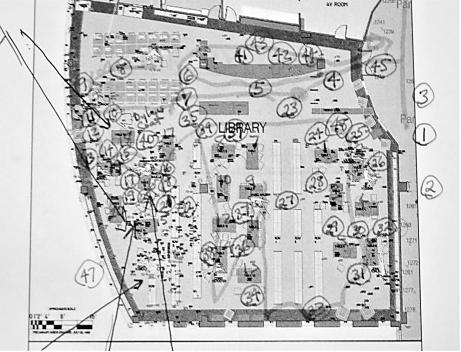
A Challenge to the New Sheriff
7/7/02
Cowardice. Lies. Withholding information. No answers. Hiding in the office. Hiding the truth. That is the behavior we have seen from Sheriff John Stone for over three years. Fortunately, Stone is not running for office, and is reportedly moving to Florida. (Disneyland security, according to a very reliable source).
Give the office of Sheriff of Jefferson County some dignity and respect. Tell us what happened at Columbine. Release the information. Tell us what the Jeffco SWAT policies are today. Tell us what to expect when we call 911. Tell us where we stand.
Tell us the truth about the mistakes at Columbine and tell us how you are going to fix these mistakes. Tell us the truth.
We are the citizens of Jefferson County. We deserve it. We can handle it.
Columbine: the atmosphere.
7/7/02
Judy and I ate lunch the other day at a local restaurant. The waiter was a really nice kid, a former athlete at Columbine. He told us stories about the bullies, and atmosphere, and the “players,” that confirmed everything we knew about the environment at the school before April 20, 1999. He talked to us for a long time. He told us a lot. This was an honest young man, with inside information on Columbine. He told us stories, and told us about Columbine. We had heard it before, but this was from one of them. He admitted it. He showed incredible courage, while he told us, in a matter-of-fact way, about Columbine. He even said he had apologized to many kids in the school. What a really good young man. What a brave young man. What an honest young man.
He is the overview of what he said, and what we have learned from other kids who have talked to us:
Before 1998, there were athletes at Columbine. They, as a group wouldn’t allow bullying. They, generally stopped it when they saw it. They were athletes, but they had a sense of fairness and controlled themselves. They did this on their own, without input or guidance from the coaches, school, or administration.
Then, the group of bullies entered. One notorious bully, who we will call Bully 1, set the tone.
From a wealthy family, on steroids, brutalized at home, taught to win at all costs, big, strong, aggressive, without limits or boundaries, this bully entered Columbine. He created the atmosphere.
The coaches, caring only about winning State Championships, didn’t interfere. They encouraged the aggressive and dominating behavior. It was, after all, conducive to winning football games.
The principal, caring only about winning state championships, didn’t interfere. A small man, he lived his athletic life vicariously through the school and the athletes. He had never been trained to detect bullying, or trained in threat assessment. This was truly the “Peter Principle” at work, promoted to his maximum level of incompetence as principal of a 2,000-student high school.
The select bullies ruled the school
They would knock people down in the hallways, beat up their girlfriends, rape innocent girls, take steroids, lift weights, get drunk on Saturday nights, cut in line at lunch in the cafeteria, and were the beneficiaries of special privileges.
One would make kids do his homework, or beat them up.
One would pay a kid to do his homework fifty dollars, he had so much money.
Privilege, money, power. They led to abuse.
The school environment became the abuser, picking on the weak and fragile and timid, with no one to defend them.
Not one coach or administrator stepped in.
If a teacher tried, like a special education teacher, with a heart, they were spurned, ridiculed and ignored.
The bullies loved it. Sex, beer, rapes, football, steroids. That was life at Columbine for the select few. It worked too. State Championships were getting to be expected. Ephedrine use and cocaine use and steroid use were common and almost required. Winning was everything.
The coaches loved it. Coach of the Year! State Champions! Winning!
The administrators loved it, or remained quiet.
The teachers, some of them, knew there was a problem.
The athletes and cheerleaders and bullies loved it, at least those without any self-awareness.
Some of the kids hated it. The kids who were bullied, the kids who saw bullying, hated it. The bullied knew it was going on. They watched. They watched and felt helpless. The bullied kids hated the school They hated the “jocks”, the jocks with white hats, the bullies. They, the weak ones, the outcasts, had nowhere to turn for help. If they did, they were cowards. If they did, they were bullied even worse. If they did, they were ignored. The outcasts, the bullied, learned to live with the injustice. They hated it, but they lived with it, in a constant state of “below the surface” fear. Everyone, except the loosely knit group called The Trench coat Mafia. They fought back in little ways. They gained back some self-respect through their refusal to be bullied. They showed two shy outcasts the way to fight back. These two kids wouldn’t live with it. They planned to get revenge against the jocks, then the school, against everyone.
In a world without protection, in a world ruled by bullies and physical force and jocks, these two boys created their own misguided sense of justice and decided to kill the jocks and the principal, and everyone else.
They decided to become the ultimate bullies. They bought guns and built bombs. They killed.
The ultimate bullies.
Guns and bullets beat physical threats and fists every time.
I don’t support them. I don’t agree with them.
I just wanted you to see that this was a natural progression of bullying and hatred. The natural progression. Now you understand why they did it. I never said you would like their reasons.
Look at your school. Look at your place of business. Is there an attitude of hopelessness? Is there an environment of bullying? Bullies can be jocks with power. Bullying can be rigid rules that are unfair to a select few. Bullying can be favoritism, or injustice, with no chance of redress or fairness. Identify the environment and fix it! Make it fair for everyone. Give everyone a fair chance to be heard, and valued, and protected. Create an environment where bullies do not exist.
Stop the next Columbine.
Paralysis
8/5/02
I’m sitting at my desk. It is 6:05 P.M. I am paralyzed by the workload, there is simply too much to do.
I have to analyze the ballistics and chart the police bullets. No one else can do this. No one else understands it. No one else has the maps. It will take weeks and weeks. It takes a lot of time. I go to work, come home, prepare for work the next day, and then sit down and work on Columbine. I work on Columbine until 2 or 3 in the morning. I drink coffee, and red bull, and I am pushing myself well past the levels of exhaustion. I work on Columbine almost every night. I use red bull and caffeine and I never stop.
I have to review and respond to the 73 responses from the sheriff department and D.A., to my 73 questions. These were submitted through the Task Force, and they must be addressed before the next meeting, which, thankfully, has not been scheduled. This will take hours of research and thought.
I have to organize this mess. There are files and piles of paper all over the room. There are 64 notebooks of released information on the shelves. They are all interrelated and I don’t think I am smart enough to review, and remember, and relate all of this information into the truth.
Too much paperwork. Too many convoluted lies. Too much work, and too much sadness.
I glanced at some of the crime scene photos: Eric, Dylan, John Tomlin, Dan Rohrbough. Their presence brought back the sadness and the depression. I realized that it is painful to work on this. It is painful to think about. I am only human. This is painful to me. It hurts. It makes me cry, and yet I have to do this, because no one else can, or will.
The families can’t. They don’t know enough and they can’t emotionally handle it (except probably Brian). The police won’t. They don’t care and don’t want to find the truth. The reporters won’t. They have other stories, and they do not have the time or the knowledge. And, I know too much. And, so does Judy.
We have read everything, all 64 volumes. Some of them we have read only once, because they have no information, and others we have read a number of times, because there is too much information. Thousands of pages have yellow sticky notes on them, placed by Judy, and by me. There are a thousand notes, with references, to make them easier to find. I have seen the crime scene photos, which have been carefully guarded by the police. I have seen the “basement tapes” made by Eric and Dylan, now under court ordered lock and key. I have seen the diversion files, which only the diversion officer, the police, and the members of the Task Force have seen. I was at almost every Erickson Commission meeting. I have studied the ballistics and the maps and the CBI files. I have studied this for hours, and hours, and hours. In my office, by myself. I know too much. I can’t stop now.
There are truths here, there are lessons here that must be discovered, that must be learned. I know too much to stop now. I guess I will have to accept the fact that this will be painful, and do it anyway. I guess I have to. No one else can.
The Diversion Files.
10/10/2002
I saw the diversion files as part of the Attorney Generals Records Review Task Force. I was put on this committee after some of the families demanded that I be on it. They wanted someone who was an outsider on the committee. It turned into a lot of work. Now I had the responsibility of making sure that everything that could be released, was released, and some things would be kept confidential. It was difficult.
I was really good about keeping everything confidential, except for one thing.
I was given access to the Diversion Files at District Attorney Dave Thomas’ office. They wouldn’t let me copy them, but they let me take notes. Well, I did. I wrote down every single word in the files. There was no time limit, so I took my time.
All the while I was in his office, I could hear Dave Thomas bragging and talking loudly. What a buffoon. He said that one attorney had complimented him on doing so well in cases. Then he said, boastfully, that he settled almost all of his cases. It was a surreal scenario. I’m in his office, copying, word for word, the confidential diversion files, and listening to Dave Thomas bullshit his secretary.
When I went through the files, there were notes and writings that were really upsetting. Eric said he was Suicidal, and Homicidal. He listed it on his entry form. He also said, in response to the question if he drank alcohol: “Not much, only Everclear.”
I didn’t know what that was, so I looked it up. Apparently, Everclear is one of the strongest liquors made.
So, Eric was playing with the admission guy. He was playing him. This counselor didn’t look at, or read, the answers. That is the only excuse I can come up with, because otherwise, the answers were completely ignored.
“I am Homicidal. I am Suicidal. I drink Everclear,” and other comments. These were red flags for this counselor, and he missed them.
One reporter knew that I had seen the diversion files. He called later that night, and asked me about them. I said they were confidential. He said: “Really?” He then proceeded to quote, word for word, the files, and what was in them.
He already had a copy. He was calling me as a second source. This was a good reporter. He always had a second source, or an irrefutable source. I told him it was true. Everything he read to me, that was in the files, I confirmed.
I know. It was wrong. I know. I had made a promise. But sometimes the truth is more important. Some information needs to be released, no matter what.
It was in the paper the next day, and caused quite an uproar.
The judge threatened him with jail, for refusing to reveal his source, and I was one of those two sources. It was a mess. He even called me and told me that the attorney for the paper had told him that I should not attend the hearing. They think that they might imprison us both.
He took his toothbrush to the hearing. I listened to their attorney, and didn’t go.
Mr. Salazar, if you ever read this, know that I am sorry. But you knew me. You knew that I would tell them. It was pretty obvious. You knew that nothing mattered to me except the truth.
10/18/02
Diversion File overview
Eric went through intake with the Diversion Program on March 19, 1998, a little over a year before Columbine, and only a few days before the police closed our complaint against him, without our knowledge. The file is interesting.
Andrea Sanchez was the intake Counselor.
The report reviews his van break-in, and the details. He broke into the van on Jan. 30, 1998. It tells that he is on Zoloft, and is feeling better. He and his parents spell it Zorloft. He tells that he was grounded because of the break-in, and couldn’t see Dylan for a month. He says that the break-in was Dylan’s idea, and that he doesn’t drink or use drugs. He does state that he has considered suicide. In the notes are referenced some interesting details: He was suspended for hacking into the school computer, and he punches walls when he is very angry. There are a lot of typical government form details, that mean nothing. His contact for the diversion program at the High School is Frank DeAngelis, the Principal. He has been seeing Kevin Albert at the Colorado Family Center since March 2, 1998. The forms list a ticket he received in Dec. of 1997.
In the notes he says he never drinks, and then, later, he says that he drinks Aftershock and Tequila. He states that his dad yells at him, and he and his brother yell at each other. Then, he says that he has a good dad, and gets along with his brother.
His drug test from Sept. 17, 1998 was negative for Amphetamines, Barbiturates, Cocaine, Opiates, and Marijuana.
He met with Andrea Sanchez, the Diversion Counselor on: 4/16/98, 4/30/98, 5/14/98, 6/2/98, and 6/24/98. His case was transferred to Kriegshauser on 7/10/98, at which time he told Kriegshauser that he was on 100mg of the drug he was taking, an increased dosage. Eric saw Kriegshauser on the following dates: 7/10/98, 8/3/98, 8/24/98, 9/17/98, 10/15/98, 11/3/98, 12/1/98, 12/21/98, 1/19/99, and 1/20/99. During this time, Eric built dozens of pipe bombs, ran missions vandalizing houses, built explosive crickets, fired sawed-off shotguns, purchased a shotgun and a rifle, and more.
In the paperwork, they ask Eric to answer a question, describing “disorderly conduct.” Eric writes: “Rob and his ak-47 go downtown and he fires off a few shots while yelling “Let’s Fight.” Other answers to a few questions are interesting. He checks boxes that say: he is depressed, mixed-up and confused, thought about committing suicide, told a lie, had gotten angry, been unhappy, broken the law, and cried or felt sad. All of these are interesting comments from a 17-year-old boy.
I know. Reading this chapter, it is not very obvious that he is a killer. Remember that I have picked certain items out of many, many, pages. Reviewed quickly, with other files of real criminals as the reference, this file probably looked pretty normal, except for the suicidal and homicidal comments.
He is released early from the program by Counselor Robert Kriegshauser, with a fairly glowing review.
Because he completed the Diversion Program, albeit an early release, the charges were dismissed by the District Attorney on Feb. 9, 1999.
Columbine would take place 10 weeks later, on April 20th, 1999.
Brooks Had a Good Day Today
10/19/02
Michael Moore was in town for the Denver Premier of “Bowling for Columbine” at the Denver International Film Festival. We had all met with Michael Moore before, while he was doing background work on his movie. We had given him a lot of information about Columbine. Brooks called him, and got a VIP pass, and we went to the movie. I had already purchased five tickets in advance, so Aaron, Meagan and Judy and I went with him. The movie was great, a thought provoking, sad, funny and interesting movie. A work of genius. A world changing movie.
Brooks was in the movie. He was in the filming of the K-Mart “challenge.” In the movie Richie Castaldo, Mark Taylor, Brooks, and Michael Moore went to K-Mart headquarters and demanded that K-Mart stop selling handgun ammunition. As you probably know, Manes bought some of the ammunition, for Eric and Dylan, at K-Mart.
Brooks was in the filming, and had been instrumental in introducing Mark and Richie to Michael Moore.
After the movie, Michael had Richie, in his wheelchair, Mark and Brooks up on the stage, for the sold-out theatre to applaud. And applaud they did. Standing ovation. These poor kids.
It was sad but nice. We went to the party afterwards, and were invited upstairs to be with Tom Mauser, and Richie, and Mike, and Brooks, for food and drink.
Michael asked us questions about technical stuff. When did the police enter, etc. We filled him in on SWAT policy and some ballistics and other details, mentioning how the police rescued Depew’s son before anyone else. He told us we were brave for fighting for the truth and trying to find out what happened. That was very nice, but I told him we were just doing what we need to do. We certainly never felt brave, or thought we were.
Then he tried to help Brooks with interviews, asking him questions like an interviewer. Michael Moore was so nice to Brooks. He cared about him. He gave him advice. He listened. He and his wife were absolutely amazing. I know a few people don’t like him, but I can tell you that he is a great person.
10/23/02
Brooks is in New York. He did the Donahue show. Donahue held up Brooks’ book and talked about it. As he walked out of the Donahue show he got a call from Jim Kelly, one of the producers from Oprah. They want him on next week.
Jim Kelly had just called us. I told him about Brooks and his interview on Oprah in 1999, and his involvement in the movie with Michael Moore. The Oprah Show is about Michael Moore, and is taping next Thursday. They asked if Brooks would do it. I gave him his phone number.
Columbine is everywhere
11/6/02
I was daydreaming. I was looking at the collage on the wall of my study, looking at my children, when they were young.
Brooks riding the little bicycle. Brooks playing baseball.
Aaron with green finger-paint all over his hands and arms.
I was remembering. Enjoying.
Just below the collage is the ballistics overview for Columbine. The names of Bloodworth, Gray, O’Shea, O’Neill and others, the policemen who fired into the school on April 20th. The serial numbers of their weapons. The caliber. The CBI evidence numbers, the JCSO evidence numbers. The weight of a .00 Buck pellet (50 grains, 3.23 grams)
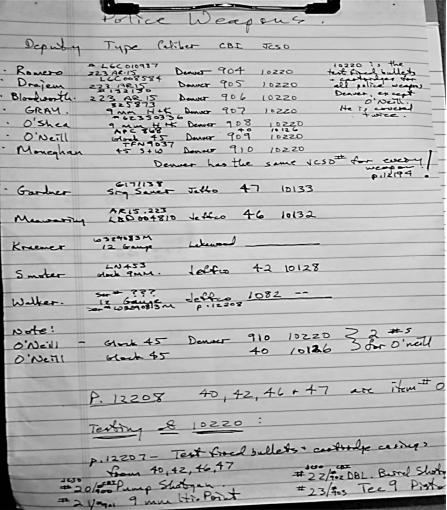
Columbine is intertwined with my life now. There is almost nothing that doesn’t reference it or bring it up in some way or another. This isn’t a bad thing. It is just a reality. Just a reality.
Abused children?
11/17/02
Eric and Dylan were not abused children. Specifically, not abused children. They had relatively loving homes. Eric’s father was stern and autocratic. His mother was loving and kind. Dylan’s father was somewhat cold and slightly distant, but a good father. His mother was caring, and yet not fully connected emotionally with her son. What mother of a teenager is? As far as I can tell, neither boy was physically abused at home. They were loved. Oddly enough, this is a factor in the Columbine tragedy.
If they had been abused, they would have suffered from the common personality traits of an abused child. They would have had low self-images. They would have lacked the confidence to act, lacked a sense-of-self that would allow them to deny persecution at the hands of the jocks. They would have been accustomed to subjugating their feelings, to hiding their rebellious nature. Instead, because they were loved at home, they had enough self-image to realize that they had value. The love they received at home allowed them to respond to the bullying at the school.
This is one more piece of the puzzle.
The Littleton Cemetery and Suicides
11/27/02
Judy went to Ali Meyers funeral today. I had to work.
Ali was hit, 18 months ago, by a car driven by our next-door neighbor. She was 14. She died in her sleep on Friday.
Her parents were inconsolable. They couldn’t even go to the graveside service at the Littleton Cemetery.
I met Judy there for the service. She had gone to the funeral with the Rohrbough’s, and Fleming’s, and Dawn Anna. She met me at the Littleton Cemetery. As we walked together by Ali’s prepared grave, we talked and remembered this place. This was where Mike Kirklin’s son was buried, after he committed suicide. This is where Josh and Dan Rohrbough are buried, together, next to each other in their tiny little graves. Josh was only a few days old when he died, and Dan was murdered at Columbine.
A man pulled up in a white pick-up truck with a tool box. He was tall, wearing a leather jacket. As we watched he walked over to Greg Barnes grave and sat down on the granite bench. This was Greg Barnes’ father. His son committed suicide after Columbine. We talked to him. He wanted to talk. He told us that his son didn’t leave a suicide note. He told us that his son, one of the best Columbine basketball players ever, had been offered a full scholarship to D.U., a five-year full-ride scholarship.
Greg didn’t leave a suicide note. He came home in the morning. His father found him when he came home for lunch. He didn’t leave a note. Instead, he left his father, mother, and younger brother with a lifetime of pain, and no warning, no explanation.
Mr. Barnes told us that there were other suicides in that section of the cemetery. He pointed a few of them out. A 12-year-old who had committed suicide over some bad grades, who had hung himself in the backyard of his home. A 20-year-old who took his own life. Another boy just a few graves away.
We had heard that this was an epidemic. Depression and suicide among the young people of our area. Ben Kunz had taken his life with a rifle just after Columbine. Greg Barnes. Why? Why don’t we hear about it? Why don’t we do something?
I know that the media has an unwritten rule: They won’t talk about suicides, because they believe that it leads to more suicides. They don’t mention it on the T.V. or radio. It is rarely mentioned in the paper. It is very difficult to get statistics on the problem, because the government has them and won’t release them.
What can we do?
I want to talk to these kids. I want to give them the perspective they need.
They are looking at their lives from a “snapshot in time,” concentrating on the depression, or the math test, or the sadness that seems overwhelming. They need to see the potential for their entire life, the 70 years of joy and sorrow and happiness and tragedy, that becomes the story of an entire life. They need to learn to live through the moments of heartache and the deep sadness of depression, in order to make it to the moments of laughter, and love, and joy. They need to learn hope. They need to learn patience. They need to learn that suicidal thoughts are normal, but that they shouldn’t act on them.
Then I think about Eric and Dylan, and how they were different from Brooks. Eric and Dylan killed children and then one of them committed suicide, because they had no hope. Brooks fought the system and the school and never thought of murder, or suicide, because he had hope. He had hope. We need to give these kids hope. They need just enough hope, and laughter, and strength, to make it past those impulses of suicide. Just enough to make it past the impulse, the idea, that suicide is the answer. Suicide is not the answer, just like killing is not the answer.
It seems obvious. Few people stop a suicide attempt because they are thinking about the sadness they would leave behind, or the pain it will cause their mom or dad. They are depressed. They aren’t thinking about their family. They are contemplating ending their own life. This is the ultimate form of selfishness. It is self-generated and independent of consideration for others. We can only stop suicides by giving that person an internal reason to live. If they have a sense of hope, a sense that things will get better, a sense that their life will improve, they will wait until tomorrow. They may cry, they may be sad, but if they have some hope, they will wait.
We don’t teach it in the schools. We don’t talk about it in public.
The epidemic continues, and some of our sensitive children end their lives, without any warning or any apparent reason.
We are afraid to talk about it, so some of them die.
We owe them more.
We should give them the chance to live a full life. A chance to succeed and fail and laugh and cry. A chance to paint the entire painting, the entire work of art that their lives are meant to be.
Instead, we have parents who are at gravesites, crying. I have heard it. I have heard one of them, crying the most painful cries I have ever heard. Crying for his lost son.
To whom it may concern:
Dec, 1, 2002
Mr. Tuthill, Ms. Oeffler, Jefferson County Sheriffs Dept., Judge Nieto, Judge Jackson
We are requesting immediate release of the Search Warrant and associated paperwork for evidence number 10252 as listed on page JC-001-011863 of case number 99–7625.
This is the search warrant for the backpack of Brooks Brown, seized by the Jefferson County Sheriff’s Department in 1999. We have never been served with this search warrant, and request immediate release of this document to either Brooks Brown or Randy or Judy Brown, his legal guardians and parents.
This backpack was seized from the car of his friend, without Brooks’ knowledge, and was searched, and materials were copied by the Jefferson County Sheriff’s Department without the service of a search warrant, and without the knowledge or permission of the legal owners.
This backpack was returned to us on July 19, 1999 by a member of the Jefferson County Sheriff’s Department. No copy of the search warrant, or mention of same, was delivered at that time.
The Jefferson County Sheriff’s Department released information obtained from this backpack to the public without the permission of the legal owner of the backpack.
This backpack is our property. We are requesting a copy of the search warrant and all associated paperwork related to the search and seizure of this backpack, along with the return of any and all copied material.
PLEASE NOTE: This search warrant pertains to personal property seized from Brooks Brown. We are not asking for the court to overturn its ruling regarding the sealed warrants with regard to case 99–7625. We are simply asking for a copy of the search warrant used to seize and search this backpack, belonging to the requestor.
Thank you,
Randy and Judy Brown
They don’t remember
12/20/02
It’s finally over.
It has been three years and eight months, and today we knew it was over.
The press doesn’t care anymore.
Well, to be precise, the press really cares, it is the audience that doesn’t. They can’t write about it or run it on the news if people don’t care.
We knew it was over through a conversation with Kate Battan. She replied to three of Judy’s question with the new stock answer: “They don’t remember.”
That is how this will all end, with the police and detectives and the liars simply “not remembering.”
Evil Didn’t Win
12/20/02
It will be four years in April, just a few short months away.
We still don’t know what happened on April 20, 1999. No testimony has ever been given in a courtroom, under oath, by any of the people involved. In truth, with 3 ½ years gone, we may never know the truth about April 20.
We may never know the truth about the investigation of Eric Harris prior to April 20, 1999.
Sure, we know that the Sheriff’s Department lied and withheld information and then lied some more (or have you forgotten the lies and the search warrants). We know that the district attorney assisted in withholding information, and withheld the diversion files and their “bright red warning-sign flags,” for years.
We don’t know what SWAT policy is, or what the school district knew, or who was in charge, or who decided to let Mr. Sanders bleed to death. We don’t know. We don’t know why those 13 innocent people were murdered.
We don’t know these things because the judges of Jefferson County wouldn’t let it go to court. The judges placed the welfare of the County over the value of the lives of innocent children. They denied these families their day in court.
There were no protests, no marches, no outrage. There was only silence and passive approval. Corruption vanquished the truth and hope and righteousness, with barely a sound from the hundreds of thousands of residents of Jefferson County or Colorado. Evil didn’t win, not in the Columbine tragedy, at least not all by itself.
The evil of Eric Harris and Dylan Klebold, exhibited by their cowardice in the killing of defenseless children, was only the first battle.
The corrupt Sheriff’s Department with their lies and cover-up and incompetence was the second.
The county commissioners with their corruption, and active defense of a corrupt sheriff, was the third.
The corrupted court judges of Jefferson County, Nieto and Jackson, who placed the interests of the County, over the value of the lives of murdered children, was the fourth.
But those were merely skirmishes. The war was lost because of the greatest enemy to hope and truth and freedom: Apathy. The apathy of the people of Jefferson County, and Colorado, let evil win. Never forget this one immutable truth: Evil won. The apathetic citizens of Colorado let it win. You don’t like it, but it is true. Now, go back to your lives. Watch your football and hockey games. Don’t pretend to care. You know that you don’t. Take down the “We Are Columbine” stickers. Take the forgotten pins off of your jackets from where you left them 3 years ago. (“Never Forgotten” pins might be a sore reminder of this point). Don’t pretend to care. You proved that you didn’t.
Evil won. It wasn’t even a contest.
Judy!
12/27/02
Judy told me this today, and it was a profound statement. I wrote it down: “Any police intervention would have altered the time sequence. Police intervention may or may not have prevented it, but it would have changed it. It could have made it better. It could have made it worse, but it would have changed it.”
Just like George Bailey, in the movie “It’s A Wonderful Life,” where his failure to intercede changed a whole town, so did the failure of the Sheriff’s Department, to intercede at any point along the time line, allow this to happen. One point of intervention, one courageous act, one search warrant would have changed everything. Argument. Closing argument!
This gives the jury the reason they need to “damn” the police department, and their response. People understand causality.
A critical editorial about me.
4/8/03
It is 11:28 P.M. I am in my room writing a response to another editorial that criticizes me for my involvement in Columbine. This lady, T. Miller, keeps writing editorial letters to the local paper. She thinks I am crazy. She says so in the editorials.
Perhaps she is right.
I am sitting at my desk, cluttered with pages of notes, pages of responses from open records requests, and about 30 files of work in progress. On the shelves to my right are about 88 volumes of Columbine reports, bound in white binders, and blue binders. Each page has highlights and sticky-notes and has been read more than once. The CBI files are there. The FBI files are there. The Task Force notebook, filled with agendas and notes is there too. There are thousands of pages of reports.
In front of me are two wooden file cabinets, full of pages and notes about Columbine. The maps lay on the floor, strewn about in random piles. On the wall is the search warrant prepared for the Harris home in 1998 (we still don’t know what date). There is an enlargement of the ballistics evidence map, used to demand that Jefferson County investigate Dan Rohrbough’s shooting. There is an award for Brooks from Columbine High School, and the Red Flag (I am suicidal, I am homicidal) we prepared for the release of the diversion files. There is more.
This room possesses me. It challenges me to find the truth. It haunts me, it demands that I come in, and sit down, and study, and learn, and try to put together this great big “million-piece” puzzle with half of the pieces missing. It is a black hole that I can’t escape from. It is sadness, and grief, and horror, and pain, and guilt, and sorrow, all in one room.
How will I ever make sense of this without all of the files, without all of the information? I have worked, as an example, on the ballistics information. Thousands of hours of work, only to find the labyrinth of complications and numbers that dead-end without a trace. There are some examples pinned to the wall on my left, that I am not even sure that I can explain, they were so hard to trace in the first place.
Behind me is a beautiful painting by Frank Frances, a blue painting of a farmhouse. Below it is an enlarged map of the upper floor of Columbine, with a few police bullets marked in blue. Next to the map are some video from news shows, and photo copies of the “cafeteria video,” showing Eric and Dylan in the cafeteria. The Dylan that was my son’s friend. The Eric who threatened our lives. And I read and study and try to discover what happened and why.
Maybe she is right. Maybe I am crazy. Maybe this room makes me that way.
The Smoking Gun
7/28/03
Okay. There is no actual “smoking gun.” This is an expression, referring to solid proof that Jeffco has withheld information that is damning to them, information that proves without a doubt that they were involved in major errors prior to April 20, 1999 that were major contributions to the tragedy.
I found it. I found it. Let me explain.
You will remember that we turned web page addresses in to the police in March of 1998, over a year before the murders.
The Jeffco Sheriff Department used these two websites to create the search warrant for the Harris home in 1998. The 1998 search warrant.
So far, the information released has no details, about the warrant, in the file. We have been told it doesn’t exist. We have asked for this file from Hicks or Guerra or Grove or anyone, for years. No response.
Then, in June of 2003, because of open records requests we filed, the judge ordered the release of the search warrants used to investigate Columbine, from April 20th, 1999. They were released to the public in June of 2003. (June 9, 2003).
In these search warrants, the 1999 Search Warrants, are many revelations. The search warrant for Brooks backpack is in there, first in line of course. They placed it at the front to embarrass us. One more dig at us, from the corrupt police force. That was commonplace from the Sheriff’s Department. The person releasing the files would put anything about us as the first page of the release. Anything that could possibly reflect on us. It was intentional.
The search warrant for the Harris home is included too. It lists four web sites. Four. This is, you should know, a sworn affidavit from an officer, that this information is correct. In that warrant is the smoking gun. Smoking, the smell of gunpowder, the barrel of the gun, burning hot.
They have four web sites.
We only gave them two, in our 1998 complaint.
How, at 2:30 in the afternoon, on April 20, 1999, did they get two more web sites? Eric’s site wasn’t active. They were not on-line.
Two of the sites were not to be found on April 20, 1999. The police had not interrogated Nate or Chris.
The police had not served a search warrant on AOL on April 20,1999. They wouldn’t for six days, according to the FBI.
They didn’t make up these sites!
They had them in their files.
This means that they had already investigated Eric Harris. They had already used a warrant to investigate his AOL accounts. They had the file with his threats and journals, and all of his websites, prior to April 20, 1999.
They had them. They investigated. They dismissed them.
Columbine never had to happen.
Of course, it isn’t quite that simple. To verify this, I need the search warrants for the AOL accounts. This will prove that the smoking gun belongs to Jeffco.
If the warrants are dated April 21 or later, then the sheriff department did not have the information prior to preparing the April 20, 1999 search warrant for the Harris and Klebold homes. Then Jeffco has to explain where they got the two new websites they used in the warrant.
If the warrants are dated prior to April 20, 1999, then Jeffco is culpable. That would mean that they had served a warrant on AOL, from our complaint in 1998.
They had verified the existence of the accounts, and therefore, Eric Harris as the source of them. They had no excuse for failing to arrest Eric for death threats and pipe bomb felonies.
The only way Jeffco can get out of this, is if they served AOL on April 20, 1999, and received the information AND used it in the search warrants for the Harris and Klebold households, within 30 minutes of the shootings.
Of course, the AOL search warrants are not in the search warrants released on June 9, 2003. They should have been released. They are not.
I am now in my fourth attempt of a FOI request with Jeffco to get them.
I have asked Attorney General Salazar and Gilbert to help. They have refused.
I have asked Judge Jackson, directly, to release them. He has not responded.
They have much to hide. I think we have discovered one of the most important items.
It Started Today
7/28/03
The lawsuit started today. Well, the depositions
Judy is being deposed. We are at the judge’s conference room at 901 19th St in downtown Denver. We have both signed a confidentiality agreement for the judge. We went into the room with Brian Rohrbough, Don Fleming, Dawn Anna, and the Harrises and Sue Klebold. Mr. Harris looked 60, with all his grey hair. Mrs. Harris looked 40, with short brown hair. Sue looked tired and thin.
9:20 A.M. start time. Of course, after the reading of names, I was asked to leave. I am not a party to the lawsuit, and I am being deposed next week.
The protective order we both signed is very comprehensive, but I asked the clerk of the Court Kathy, and Barry Arrington, Brian’s attorney, if it prevented us in any way from talking about anything we already knew. They both assured me that it didn’t.
So, here I sit, on the floor at the end of the hall, waiting outside the room, in case Judy needs me. She is, after all in the room with the parents of Eric Harris, the mother of Dylan Klebold, the father of Danny Rohrbough, and the parents of Lauren Townsend. This will be a day where she will be sad: remembering all of the sorrow, fear, and horror of the lost years.
Do we hate Mr. and Mrs. Harris? I don’t know. I don’t think so. Did they screw up? Of course. Are they at fault? Of course.
It isn’t that they raised a murderer, that was not intentional. It is that they didn’t watch him and check his room. They simply didn’t do enough to keep him under control.
The protective order is attached. You should read it and see how well protected these families are. The killers’ families and the killers have been protected better than the victims. They have been shown more deference and respect by the court than any victim.
As an example: There are three autopsies covered by the protective order: Eric Harris, Daniel Rohrbough and Isaiah Shoels. Two victims and one killer. Dylan’s has never been released to the public.
Pictures of Dylan are protected, while the photo of Danny on the sidewalk was on the front page of every paper in town.
The protective order is fascinating. What it is telling me, so far, is that the Harrises and Klebolds have a lot to hide. Apparently, Eric and Dylan tried to buy gunpowder, and weapons, and body armor, for a long time prior to Columbine.
Lots to hide. Lots to questions. I’m waiting for Judy.
It is 1:07. She has been in the deposition since 9:20 with 1 hour for lunch. the limit is 7 hours. She will be finished at 5:20 or I am going in to get her and we are leaving.
She is a little upset by the questions they are asking. They seem to be very detailed and specific, and she is having trouble remembering a lot of the details. Mrs. Harris and Mrs. Klebold are sitting directly across from her, behind their attorney. They stare at her, obviously trying to influence Judy, to pressure her. This is making Judy a little angry. She doesn’t understand why these people haven’t come forward and told the truth. They have had four years.
The questioning is confidential, covered by a court order.
During lunch we saw Lynn Bartels and a photographer out front. They took pictures of Sue, and Wayne, and Kathy for the Rocky Mountain News. They were the only press there.
Cowards
8/17/03
Cowards. Cowards. Cowards.
All of them.
It has been over four years since the tragedy at Columbine. There have been so many people who have hidden from the truth, concealed the truth, subverted the truth.
Governor Owens had the golden opportunity and failed miserably. His lack of leadership and lack of courage are legendary, with regard to Columbine. His powerless commission didn’t arrive at one correct assumption about the tragedy, and his silence, since then, has created a void of integrity that no one else has tried to fill.
Attorney General Salazar has made an attempt to release information but he has apparently seen the “political writing on the wall,” and has done nothing for a year to get information released.
The Colorado legislature decided not to fund an investigation, after being lobbied by the corrupt Jefferson County officials.
Then we come to the unholy alliance of 5: The Harrises, The Klebolds, the Jefferson County Sheriff Department, Jeffco Schools and the Court system. Joining forces, they have fought every attempt to learn the truth.
The Harrises have kept quiet for four years and three months, apparently placing their own interests above the interest of the public, and the truth.
The Klebolds have kept silent too. Four years and three months. Not a hint of what they know. Not a word to the families, or the public, or other parents about the lessons they learned, the mistakes that they made, that could educate others and possibly prevent another tragedy.
Money is king. Protect that money. Hide in your homes and protect your money. Hide forever, until, that is, there might be some profit from a book or a movie deal.
The Sheriff’s Department, all three of the acting Sheriff’s (Stone, Cook and Mink) have placed themselves first. Stone lied, and Cook and Mink have, so far, continued the deceit without interruption. What do they know? Could this information save lives? Release the files, tell the truth. But no, corruption always wins in Jeffco and in government.
The school district knows a great deal. They have even completed their own in-depth investigation into the tragedy: the warning signs, the information, the failure, the missed red flags. This was completed, with taxpayer money, and yet it sits, unread and private, in the safe at Jeffco. Our money, our schools, our children, and the report is secreted away.
The judges. It is simple. They do not have courage. They are cowardly politicians in robes, protecting the government and the status quo. There are, obviously, no mirrors in the judges’ quarters in Jeffco, or in Colorado. They never have to see the corrupt cowards they have become.
This is what the victim’s families have been fighting. They have had to fight, with private attorneys, against the power of Colorado, and Jefferson County, and the Harris and Klebold insurance companies. They have had to fight this corruption with very little help, with very little information. There are secret files that they can’t see, and secret information that they can’t know. They have had to fight this corruption after their child was murdered, at a time when their worlds were shattered, they were grieving, they were barely functioning.
This is the time when Owens, Salazar, Suthers, Stone, Cook, Mink, the legislature and many others should have been helping, should have been on their side, leading the fight.
Instead, the families were alone, left to their own resources, during this horrible tragedy.
It is very reasonable, given the behavior during the last four years, to make the following assumptions:
-
One or more innocent children were shot or killed by policemen on April 20, 1999. Missing police bullets and a concerted effort by Jeffco and the FBI to conceal the relevant information makes this a very reasonable assumption. Remember: They only lie when they have something to hide, and they are really making an effort on this subject.
-
Command decisions were given on April 20, 1999 that consciously and purposefully sacrificed the lives of innocent children, rather than risk the lives of policemen.
-
The Jefferson County School District knew a great deal about Eric Harris and Dylan Klebold, and their violent potential.
-
Mr. and Mrs. Harris knew about the potential for violence, and failed to control their child.
-
Counselor Kevin Albert failed to identify serious problems with Eric Harris.
-
Dave Thomas’ diversion program was grossly incompetent in handling information regarding Eric and Dylan.
-
An attitude of violence and bullying existed at Columbine High School prior to April 20, 1999.
-
A cover-up of valuable information has been in effect by the Jefferson County Sheriff Department, Jefferson County, and Jefferson County School District.
Judy is still giving her deposition. I’m writing. I sit on the floor in the hallway for an hour. I pace up and down the hall. I stretch. I walk. Then I notice that there are cameras watching, so I sit and wait. I eventually move into the vacant juror room in the hall, behind a locked door.
Date of the FBI release.
9/4/2003
The SWAT Team, and the FBI Report.
I wanted to write a chapter on the brave SWAT team members who died trying to save some of the innocent children in Columbine High School on April 20, 1999. Oh, that’s right. There weren’t any. Whatever official results you came up with, whatever excuses to try to make us believe, I know, we know, and you know you didn’t do your job. It is a little-known fact that the police stood outside the open doors of the Library, while the students inside were terrorized and murdered. These children screamed for their lives, screamed in terror, and screamed in hopelessness. The screaming came in waves. The police stayed outside and listened. Yes, they listened through the open doors, while the children in the Library cried for help, for assistance that would never arrive, and finally for mercy that would never be given. The SWAT Team, when it arrived later, fired into the school blindly, shooting their automatic weapons into the main hall, classrooms and the Library, while innocent children hid in fear.
Swat Team Members fired into the library, into books and computer monitors in the library, while Patrick Ireland and Lisa Kreutz lay on the floor of the Library, injured and bleeding. They were rescued hours later, but others may have bled to death, while the Swat Team waited and cowered in fear. Yes, in fear. They were afraid of something that they knew about, and we did not, but we didn’t know that at the time. We would have to wait years to find out the truth, and then we would have to read thousands of pages of reports, and decipher the results. We wouldn’t find out for years that they fired into the school, and that they may have wounded or killed one of the students. Yes, the lies were everywhere, and we didn’t even know it. Worse, we didn’t suspect it. We wouldn’t suspect the depth of the lies and the cover-ups for years.
While they wrestled the Uncle of one of the murdered children to the ground, on Pierce Street, just 100 yards from the Library, the police were letting innocent children bleed to death inside the Library. But we didn’t know this. All we saw was the inaction on the T.V. We saw the same scenes played over and over again, with the police getting dressed in their Swat Uniforms, parading around with the arrogant toughness they display, while they loaded their weapons and gathered their equipment, to stand there and do nothing.
Cowards one and all. Do you doubt this fact? Do you question this? It is a fact. We know it now. At the time we were all so naïve. We trusted them. We believed they would risk their lives for us and our children. We were wrong.
The FBI release of documents, after freedom of information requests, was released Sept. 4, 2003. Now we know. The police, and the SWAT teams, were warned about a danger that we didn’t know about. They were warned about a danger that turned out to be completely false. Now that the thousands of pages from the FBI have been released, we know. They were told that there might be, could be, bombs in backpacks. This delayed everything. Having active bombs in backpacks was a serious problem. There were hundreds and hundreds of backpacks, strewn all over the floor of the school. There were, possibly 1800 backpacks all over the school. They were where children dropped them, they were in lockers, they were in piles in rooms. They were almost everywhere. Now, when you see the indecision, and the caution, you know why. It wasn’t true, but it was the reason. The warning froze many of the commanders and police. It made them hesitate. They stayed outside the school and watched, out of caution, out of fear.
Now, this does not, of course, apply to all of them. Not everyone knew it. But that is what the commanders knew, and why they told the SWAT and others to stay outside. Some police stayed outside because they were afraid. Some were following orders. Some stayed outside because they had a family at home that they wanted to go home to. Who can blame them? Who can blame them? But it wasn’t true. There was not one bomb in a backpack in the entire school.
There were the two separate duffel bags in the cafeteria, that the SWAT team, later, led the children past on their way out of the school. There were those two bombs, in the large duffel bags. There was the small carry bag that Eric had, with crickets and pipe bombs in it. The blue bag. But there was no backpack bomb. There was, in reality, no backpack with bombs in it, anywhere. The warning is in the FBI report. You can read it if you want to.
Since it is incorrect information, I do have to wonder where it came from. Did someone see Eric and Dylan carry the bombs into the cafeteria, and they told the police, and that information has been kept from us? Was it a 911 call that they have deleted? With all the missing 911 calls, that could make sense. Why did they protect the caller, or the source? Was it from Mr. Harris? Did he tell them, and it has been kept secret? What is the source of this information, that was so important, and so critical? It kept the police out of the school for a day or more. It is the reason they left the murdered children on the floor of the school, and outside, for such an unnecessary length of time. The police were afraid of bombs in backpacks, in a school filled with backpacks. They were everywhere. This erroneous information cost children their lives, and cost the murdered children some dignity. It is the reason their bodies were left in the school for so long. This information, proven wrong, cost innocent children their lives. It delayed the entry into the school. It was an overwhelming problem, and situation. It required incredible courage to ignore it, and to send police into the school, and that courage was not there, on that day, from those leaders.
And, just for your information, it was not reported in any other release. This information is not mentioned, in any way, prior to the FBI release on Sept. 4, 2003. It is not mentioned in the Jeffco releases, in the CBI release, in the El Paso release, in the Arvada release, or any other. It is not in any other report released. I know. I have them all, and have read them all. This truth has been hidden from all of us. Just like all of the other reports from the police, the truth has been left out, edited, and ignored. I guess the FBI didn’t get the memo. They put it in their report, hoping no one would notice.
The Police and the first Rescue
2003
This is interesting, and few people know about it. A policeman’s son was in the cafeteria when the shooting started. He was on the phone to Denver dispatch. No names are needed here. There is no need to embarrass him. He didn’t do anything wrong.
Finding out that a policeman had a son in the cafeteria, brought a different response from the police and Swat Teams. If you watch the videos of the day closely, you will see it. Do you remember the entry into the school from the window just to the left of the cafeteria? It was the lower floor, on the left, left of the doors to the cafeteria. Remember all of the police lined up, crouching, breaking through the window, on the ground floor, and then entering the school. There was a door right there, and they entered through a window. That is the real first-entry into the school. Go ahead. Go find the videos, and refresh your memory. I will wait.
The police, very early on, made entry into the school, and rescued some kids, and a teacher, and a few other people, from a room next to the cafeteria. Yes, a small room in the kitchen area, right off of the cafeteria. None of them were injured. None of them had been shot. The injured and dying children were in the library, on the floor almost directly above them. This entry was an earlier, unreported rescue.
If you will think back, and see the entrance into that window, and the resulting rescue from the lower level, which is the cafeteria, you will probably not realize that that is the West side of the school. The official first entry came from the East doors, not the West doors, according to the reports and police. But that is not the truth.
The West rescue was the first, a long time before they went into the East doors. In the East entry, they used shotguns to breach doors, and cleared every room. They took a long time.
The West rescue was earlier. It is a distinctly different entry into the school. The police, I believe it was Denver Swat, or an ad hoc team put together at short notice, went in the West side, on the lower level, the cafeteria, and went to the kitchen area, and rescued the people trapped in the room off of the kitchen. They went in, without orders, and rescued the policeman’s son and everyone else in the room. None of them were injured. None of them had been shot. Yes, it is true.
Anyone who knows the school, and watched the tv, has seen that rescue on tv, and wondered about it. There is your answer. The Police Sergeant had a son in the school, and the police went in to get him, right away. They went in to rescue him, and the others in the room off of the cafeteria, while children were bleeding to death, and dying, in the library. They went in to rescue him, and others, while Mr. Sanders bled to death in the room on the second floor. They went in and got those people in the kitchen out of the school first, while Lisa Kreutz was bleeding and hoping not to die, one floor above. They evacuated those people, while Patrick Ireland lay on the floor of the library, shot and bleeding.
A policeman’s son was in danger, and the police acted differently when it was “one of their own.” The SWAT Team went into the school and rescued a policeman’s son, while children were bleeding to death one floor above, while Mr. Sanders bled to death in the little room next to the library, on the second floor. Yes, located one flight of stairs up, almost directly above them.
It is true. Watch the tapes. Be offended. Be very offended.
Al and Phyllis
2003
I don’t remember the exact date, and it probably doesn’t matter. Judy and Phyllis were talking, which they did, a lot. Phyllis and Al Velasquez are the parents of Kyle, who was killed in the library. On this day they were talking about going down to meet Mr. Salazar, the Attorney General of Colorado.
Mr. Salazar was considering putting me onto his task force for the Columbine Records Review.
Kevin Vaughan, the reporter for the Rocky Mountain News, had written a few articles about that demand. Some of the family members had asked for Judy or me, to be put on the task force. Judy had declined, and I had teased the Attorney General, in the paper, saying he wouldn’t ask me. I think the direct quote that Kevin printed was: “They won’t ask.” It had placed Mr. Salazar in a very odd position. He was trying to get to the truth, and he didn’t know if we were trustworthy. It was a tough problem.
Mr. Salazar called Al and Phyllis down to his office. Al worked at the Coors Brewery, and was involved in politics, just a little, through Coors. Mr. Salazar wanted his support.
At the meeting, after some small talk, Mr. Salazar asked Al and Phyllis what they thought about the Browns. Phyllis said: “They are like family to us.”
That created a problem for Mr. Salazar. Now he had to decide what to do with us. He called us both down to talk to him. We met with the Solicitor General first, and he kept us waiting for a long time. We talked, and discussed details, and then Mr. Salazar came in, on the phone to his family, and walked around. He was testing us to see if we could get along with him, and to see how volatile we were. We talked, and got along fine.
We heard a few days later that I was being put on his task force, and that was all because Phyllis and Al had recommended us. Mr. Salazar wanted to keep them happy. These families were doing things behind the scenes to get to the truth. It took a lot of courage for them to keep fighting, to keep asking for the truth. It took a few articles by Kevin Vaughan, raising public awareness, and a personal recommendation by Al and Phyllis. That is the behind the scenes story of how I got to be on the Columbine Records Review Task Force.
Al did one other thing to help that I will never forget. We were doing the “Recall the Sheriff” effort, and I had a press conference at the main building, the Taj Mahal. Two families showed up to support the effort. Brian was there, and Al Velasquez showed up too. Al never did this. He didn’t attend things like this, but he showed up to support the effort. That really meant a lot to me. I don’t think he said two words while he was there, he was always so quiet. But he showed up. He made the effort.
TO ALL COLUMBINE FAMILIES… A CALL TO ACTION
OCT. 2, 2003
We are very close to losing any chance to see the complete files and finally learn the truth about Columbine. It is very unlikely that the depositions will ever be released to the public. The lies and the secret files of the Jefferson County Sheriff’s Department may never be revealed. The errors and involvement of the Jefferson County School District will probably remain locked in their attorney’s office forever.
We know that the release of this information will not make the reality of our lives any better, but it will save the lives of other innocent children and teachers.
The information that is being withheld can help parents, teachers, doctors, psychologists, police, diversion officers, school officials and threat assessment experts all over the country. This information will save lives by preventing, through awareness and knowledge, another school shooting. This information will save the lives of innocent children. We ask that all of you join the fight to get these files released. Without your help, without your combined and cooperative help, this will not happen.
The proposed guidelines for the release of information would be: 1) No release of autopsy or autopsy photos of any victim. 2) No release of crime scene photos of any victim. 3) No release of medical records of any victim. Every other document would be released.
We would suggest a few methods to make these demands heard: 1) A press conference on the steps of the Capital, demanding that Owens and Salazar and Babcock and others get on your side and demand the release of this information. Demand it for the innocent children. Public pressure can make the difference. 2) The Attorney General’s Columbine Records Task Force meets Oct. 14th at 10:00 a.m. at 1525 Sherman St. If all of you were there to demand the release of the records it would be very powerful. Demand access to the files. Demand that Salazar deputize specific people to review the hidden documents. Demand a Grand Jury with a mandate that a full report on the findings be issued.
If you have input or ideas, you can contact us at 303-972-0602.
Your children matter. The innocent children, who will be murdered over the next 10 years because this information has been kept secret, matter.
This information, these files, will save the lives of innocent children.
Please help.
You can reach Attorney General Salazar at 303-866-3052 or e-mail Attorney General Salazar at VELINA.WALLICK@STATE.CO.US.
Get involved. Call your friends. Have them call and e-mail. The Columbine community deserves the truth.
The Inventory
10/20/03
As part of the Columbine Records Review Task Force’s responsibilities, Attorney General Salazar decided to do an inventory of the records and files being held at Jefferson County. I am sure that you are aware that these files have long been a point of contention. I have accused the Sheriff office, many times, of hiding information. I have done this to Mr. Salazar, in the press, and at Task Force meetings.
The original idea was to let myself, and Judy, and Brian, and others into the evidence room. Let us look at the 300 books of evidence and the rest of the files, and let us tell Salazar that it was there, or if it was tampered with. Yes, there are 300 books of evidence. A photo of Kiekbusch, with the evidence files shows it, and he stated that there were that many. Since Brian and Judy and I had all signed the confidentiality agreement imposed by the federal court, we could review it and still maintain confidentiality. No one else liked this idea, for obvious reasons. They knew that we would probably leak any important information, after all, they want to hide it, and we want to release it to the public.
The answer was no, to our reviewing the files.
Instead, Attorney General Salazar sent Mr. Gilbert, Mr. Goodbee, and Mr. Jones to do an inventory. Just an inventory. You need to understand how ridiculous this was. There are approximately 50,000 pages in binders with other reports and pages under separate headings. This doesn’t even include the FBI reports, the CBI reports, the Arvada reports, the El Paso report, the Arapahoe reports and others. My wife and I have “lived” these reports for 4 ½ years and we would need a month to do a complete analysis. At the very least. It would be an incredibly complicated task. To be honest, I am not sure that we could do it, because it would be an incredible test of memory. None of these files are computerized. They are written, in binders and folders. It might take 6 months. They completed this inventory in 7 days. Seven total days.
Preposterous, and yet they released their inventory on October 10, 2003.
There are, however, two major problems. (Please note that the following identified problems are a simplification of the actual detail.)
Problem 1: Mr. Goodbee states that in Book 3 (the most important book of the 3 volumes) George Gray’s report is not numbered in October, 2003.
Problem 2: Mr. Goodbee states that, in Book 3 p. 18,550 there is a “detention management report”. Page 18,588 is some “weird photos.” Pages 18,592 thru 18,593 are pages referring to “health care.”
But in Book 3, released in 2001, these pages, all of them, are the Gardner report, labeled JC-003-18,550.
Two different pages with the same numbers. Two different sets of books with two obvious errors, after 3 1/2 years of time to correct. (3 ½ years after the report by Jeffco was issued.)
Jefferson County released doctored information to the Attorney General.
Please note that Goodbee said that in his analysis of the paperwork, he saw that this was a detailed and flawless investigation. How does he reconcile that statement with the two flaws in this report? And remember, he didn’t even know what he was looking for. He didn’t investigate or read, he only inventoried. As much as I respect him, he did not have enough time to determine if his statement was true.
Jefferson County released doctored and manipulated information to the Attorney General. After 4 ½ years they must be fairly certain they wouldn’t get caught. The Attorney General did say, quite emphatically, at the last task force meeting, that there would be no Grand Jury investigation.
Why should Jeffco worry? Lie and lie some more. Nothing will be done about it.
I turned in these problems to Mr. Goodbee on Monday, October 27, 2003.
Now we will see what answers he can come up with.
Attorney General Salazar
September 26, 2003
Important information is about to be destroyed.
We are aware that you have inventoried some of these items, but we are requesting that you and Solicitor General Gilbert read the existing depositions given by Mr. and Mrs. Harris, Mr. and Mrs. Klebold, Judy Brown, Diversion Officer Kriegshauser, Dr. Cram, Dr. Breggan and Dr. Marks, and that you review (in depth) specific evidence items that are referred to in these depositions.
Upon your review of this information, we believe that you will realize that much of the information, with particular attention to evidence currently in the possession of Jefferson County, would be invaluable to counselors, investigators, police, diversion officers, teachers, and parents throughout the country. Public release of this information will save lives. The benefit to the public and public safety created by the release of this material far outweighs any claims to privacy, especially since this information is already in the police files.
We would point out that partial releases and, in some cases, public releases, of some of the information has already occurred. As an example, “The Basement Videos” have been reviewed by members of the press, victim’s families, friends of families, and members of the public. Other journal pages have been partially released by the Jeffco Sheriff’s Department.
We are certain that, upon your review of these items, you will agree that the public will be served by the full release of this secret information.
We then request that you, as Attorney General, lead the fight to secure this evidence, and make every possible effort to obtain the public release of this information to further public safety.
Thank you,
Randy Brown
An emergency meeting
10/28/03
An emergency meeting was called.
This is a first.
6:00 P.M in the evening and we are notified that the families are asked to come to an emergency meeting. We are going to invite ourselves. It is at the Taj Mahal at 7:00 A.M.
This is big.
This is a first.
What could this be about?
Judy and I are up almost all night, thinking, guessing, speculating, upset and unable to sleep, we guess everything imaginable: The notebook, the secret diaries, school paperwork, new information?
Emergency meeting…
October 28, 2003
Brian called at 8:30 at night. He asked if I had heard about the emergency meeting call for 7:30 in the morning.
Attorney General Salazar and Sheriff Mink had called and told the families of wounded and murdered children to be at the “Taj Mahal.”
This was unheard of. This was unprecedented. Calling at 5:30 at night, to have a meeting at 7:30 the next morning. Something big was up, but what?
Judy and I called Al and Phyllis. They didn’t know. We called Keith Coffman, and Alan Prendergast, and Rick Sallinger with Channel 4. Rick was interested. We called Betty Shoels and Darcy Ruegsegger and Brian again. Talking, thinking, trying to think of what it could be. We called Kevin Vaughan at the Rocky. We called Lynn Bartels at the Rocky. Rick Sallinger called back. He had called Attorney General Salazar at home. Salazar said it was about the National Archives. When pressed he said “no comment.” Rich also called Jim Shires at home. Shires is the new police spokesperson. Shires told him there was a meeting at 7:30, and a new release of information at 9:00 A.M. This was not another tape. (Just last week the Rampart Video was released.) This was paperwork.
Judy and I both think it is going to be the Harris’s Journal. We had been told that Mr. and Mrs. Harris kept a journal, from 1997, to the day of the shooting. They kept track of Eric, his violent outbreaks, his medication, his crimes, his pipe bomb building. They kept records about his breaking our son’s windshield. They kept a record of finding a pipe bomb, that Eric had built, and blowing it up in a field. They kept records about how his medication had been raised from 50mg, to 100mg, to 150mg, to 200mg of Luvox, without even seeing an actual doctor. They wrote about worrying that the medication wasn’t working. They had a record of the snowball incident, how Eric put a rock in the snowball, his violent temper, his violent outbursts, on and on. And, all the while, they had to ask him to get permission to search Eric’s room, which they did after the van break-in, but never again. It is a journal that shows they withheld information from the police, and the school, and that they consciously protected Eric over anyone else. The proof is in the murders at Columbine.
The meeting:
We gathered in the conference room 2 at the Jefferson County building, The Taj Mahal it is called, because it is so extravagant. Joe Kechter, Don Fleming, Al and Phyllis Velasquez, Judy and I and Betty Shoels.
The release.
10/29/2003
We get there and the meeting is in the large conference room. Families only, no press. We go in and sit down. Bruce Beck is there. Al and Phyllis Velasquez are there. Joe Kechter, Alan Gilbert the Solicitor General, Mike G., a deputy, Attorney general Ken Salazar, Jacki Tallman, and Jim Shires are all there.
Something serious is going on in here.
Attorney General Ken Salazar starts: “I have done this because families have questions, and we want to learn as much as possible, the families are a part of that legacy, law enforcement has lessons to learn, we as a community have lessons to learn.”
My notes aren’t very good. I am taping the meeting, so I can play the tape to find out exactly what he says.
“Ted Mink has been going through and putting together evidence: a document has just been discovered.”
They handed out some copied pages. I read “1997 documents” on the cover of one set. Then they explained. These have just been discovered, in a training notebook, that a deputy turned in to Ted Mink.
The bottom fell from the room. I saw what they were and I was overwhelmed.
Someone turned in the web pages to the police in 1997: Eric’s web pages.
Someone else had turned Eric and Dylan in to the police. They had been warned by someone else! Columbine never had to happen.
They were warned even before we told them. August 7, 1997. They were told about Eric running missions. The 1997 pages had missions, they were numbered, they spoke about breaking Brooks windshield.
Oh my God. Someone else had turned them in.
Everyone (every family member) in the room cried quietly. They knew what this meant. It was another missed chance for this tragedy to be prevented.
There were a few pages attached to the web page print-out. One of them was a small hand written note with Eric’s web addresses on it. Three were listed. One said “secret page.”
Who did this?
Someone else knew. Someone else turned Eric in to the police. Who?
Mink told us that this was an anonymous report filed at the S.W. Plaza Mall substation on August 7, 1997. The deputy couldn’t remember who turned it in. They told us that Ted Mink has asked the Attorney General of Colorado to do an independent investigation.
We drove over to the press conference at the Sheriff Department just a few blocks, dumbfounded, upset, confused, curious.
All of the T.V. stations and reporters were there: Channel’s 2,4,7,9,31, Alan Prendergast, Kevin Vaughan, Keith Coffman, Rick Sallinger, all waiting, wondering.
Mink told them.
I have to mention, now, the courage that this took on Mink’s part. He could have hidden the report. He could have, simply, done nothing. Releasing it to the public, the families and the press, immediately, was an act of uncommon courage and integrity. This Sheriff is a good Sheriff.
After the press conference we talked to the reporters and did interviews. So did the families. Brian hadn’t come to this meeting.
Judy mentioned that the note, that they had, looked like Brooks and Aaron’s handwriting. We were sure it was, and we told the reporters that we thought the police had confused the 1997 anonymous report with pages from the 1998 report we had filed. Kevin Vaughan put it in the Rocky Mountain News the next day.
We told the press that we hadn’t filed a report in 1997. Someone else did and we didn’t know who.
They are going to do an investigation.
They are going to investigate the 1997 and 1998 reports and find out what happened. There is some hope that the truth will come out.
There is an investigation into the report from 1997.
December 2003
Judy gets very little credit for all the hours she has spent studying and thinking about Columbine. A lot of what she does is behind the scenes. She speaks up at the meetings and has questions, but people don’t know, and don’t appreciate, how much work she has done, and at what cost.
Judy is not cold hearted. Judy cares. She has a great heart, and she has had to put up with the sadness at Columbine, and the hopelessness, and the depression. It is not easy, I know. But I am a guy. I can turn off my emotions, sometimes. Judy can’t. She is sensitive and cares so much about the kids and the parents, I don’t know how she carries on. I don’t.
She spent six days getting information together for this investigation. I didn’t help. I was burned out. She did it, by herself. She researched every cop involved, she looked up their reports, she wrote down how they were involved, and what they might know. This way, when the investigators from the attorney general’s office come over, she can just give them the pages, and they will have an idea where to start. She gave them 40 pages of typewritten information. Information on Kiekbusch, Baldwin, Milsap, Gardner, Groves, Guerra, Hicks, Walsh, Healey and others. Six days she worked getting this ready, and no one even knows about it. She is working behind the scenes, getting no credit, but fighting for the truth. What a brave woman. She is ready for the investigators, whoever they are. She has the 40 pages of research. She has the unedited raw footage from the press conference of late April 1999, where Kiekbusch, Dave Thomas, and Steve Davis lied and slandered our son. We copied this tape for them. We aren’t supposed to have the raw footage tape, but a friend from the Network gave it to us. Raw Footage from the Network is never supposed to be shared. She has the “Is that the Sheriff’s Guy” on a CD for them to listen to. Aaron put it on a CD, and then cleaned up the sound, so that it would be very easy to understand. He took out all of the background noise and made a very clear copy. There is no doubt it says, in the coded conversation between Baldwin and Milsap: “Is that the Sheriff’s Guy?”
She is ready. Now we will see how good they are.
Now we will see what they are going to do.
We meet with the investigators. Detective McIntosh and Detective Jones. Judy gave them the 40 pages of research. We talked to them. We showed them the raw footage of the press conference. They were at our house for three and one-half hours: 10:00 A.M. to 1:30 P.M. and we talked and filled them in.
They listened.
McIntosh worked for internal affairs. He is from Adams County. Jones seems to be a good investigator. He works for the Attorney General, Ken Salazar. This is an independent investigation. They are going to find out what happened. This is probably the last chance. Soon, there will be no task force. There will be no other investigations.
We are hoping they do their job.
The 1997 Report Investigation
12/24/03
Last week the investigators, McIntosh and Jones, did a handwriting analysis on Brooks and Aaron. It was necessary to prove that they were officially the ones who wrote the handwritten page that was with the 1997 report. It was, of course, their handwriting.
They, Brooks and Aaron, were really funny at the interview. They sat down in front of the detectives, Brooks with a bandana and Aaron with a knit cap, both looking like gang members. We asked Aaron about it later, and he told us that he wore the hat on purpose, to look tough for the cops. Brooks asked them about their jobs, and told them: “No offense, but I hate cops.” Nothing like being honest.
They took the handwriting test, which consisted of two or three pages of writing sample sentences, over and over. Brooks wrote each sentence 10 times. Aaron wrote each sentence once. He was obviously finished with the test before Brooks, and we all gave him a hard time for not listening to the directions. Not in a mean way. Kind of a light hearted teasing. Everyone thought it was funny.
It was very obviously their writing on the note, as they have very distinctive styles. The test was just to verify it, officially. It would be very easy, of course, for them to simply say that we filed the 1997 report, and stop the investigation, or to say that my kids were lying and it wasn’t their note. Regardless, it was now too complicated to simply dismiss anything. They needed to be thorough.
Judy and I have speculated on the 1997 report. Who made it? Why haven’t they come forward? Are they afraid? Judy thinks it is Zach’s father. She is fairly certain that he found the website and turned Eric in to the police, without telling Zach or his wife. That might be a reason to keep quiet. Our friend Noel, a psychiatrist, believes that it was Dylan who turned it in. That is what I believe too. Dylan can’t come forward and say that it was him because he is, obviously, dead. I have told Judy that, whoever it is, they may have stayed silent because they saw what the police did to us. I have called whoever it was a “chickenshit” for remaining silent. We have speculated that they have moved out of state. Who is it? Why won’t they come forward? We are about to find out. The detectives called. They want to meet us.
Because of our past experiences with the FBI (they didn’t take notes, denied they interviewed us, lied in their reports) I taped this interview. I videotaped it with a camera placed in the corner, hidden on a bookshelf with the glowing red dot taped over, so you couldn’t see it. I also used Brian’s digital recorder to tape the sound. This recorder sat in a basket on the counter behind us. It was not visible to the detectives.
I didn’t tell them that I was recording it. They should just assume they are being recorded. It is legal in Colorado.
They sat down with Judy and I at the kitchen table.
They told us they knew who filed the 1997 report.
Judy leaned forward to Jones and said: “Who? Who?”
He said, “You.”
We were dumbfounded.
I didn’t believe it. They proved it.
On August 7, 1997, someone went to see Deputy Burgess in the sheriff’s office at the Southwest Plaza. That deputy then sent another deputy, Deputy Huner, to our house. Where he met with two adults who told him about Eric Harris and the “missions” he was going on. They gave him web pages that clearly showed Eric’s activity. These two adults told him that the vandalism to the house was at Nick Baumgart’s house. The deputy wrote “Nick Baumgart’s house” on the web pages. They have talked to the deputy. He remembered it. They did a handwriting analysis and it is his handwriting. They have the dispatch reports to prove it.
It was us.
Damn.
How could we not remember this at all? We were shaken. Judy was confused. I asked if the dispatch reports could have been faked by Jeffco. They said no.
It was us.
We turned in Eric in August of1997, and we had forgotten about it.
The deputy remembered it. He even told his sergeant that we had been to our house about web pages and Eric Harris. He remembered the front porch and sitting in the kitchen at our kitchen table. He did not pursue it because we had always said it was Deputy Mark Miller who had come to our home. Miller did come to our house, but for the 1998 report. Deputy Huner didn’t come forward because he thought it was possible that he was putting himself into the Columbine tragedy, taking a role that would make him important, like Deputy Taylor had done with Brian Rohrbough. It was a small incident. It had been a year earlier. He remembered it, but we had always said it was Mark Miller, so he remained silent. Now he can talk. They have proven that he did come to our house. It is his handwriting on the 1997 web pages. He was there.
We filed a complaint on Eric Harris in August of 1997.
What a mess.
This proves that the windshield incident happened in early 1997 a year before we thought it had happened. This proves that we knew about Eric’s website in August 1997. It proves it, and we can’t remember it at all.
I try to place myself at the mall, talking to a deputy, giving him the info, driving home to meet him to review the web pages, but I can’t. I have thought about it so many times that I am now imagining that I did it, making up the scenario and the event, but it never seems real. I just don’t remember. I vaguely remember telling people, just after Columbine happened, that we had turned in an anonymous report a year before, but I’m not even sure about that. It is December 2003. We are trying to remember something from August 1997. That is over six years ago. It was part of our continuing problems with Eric Harris. It is forgotten.
The August 1997 raises another question: If we turned this in on August 7, 1997, the windshield incident had to be in the spring of 1997. We know the August 7, 1997 date is correct because Huner was dispatched to our home on that date, and his handwriting is on the report. Yes, they had him do a handwriting analysis too. Brooks’ windshield on the 300D was broken in the spring of 1997, but it was not repaired until March of 1998. We are sure of this date because we have called the repair company. They have no repairs or replacements for us in 1997, but they do have the 300D and 300E replaced on the same day in March of 1998.
How can we reconcile these dates?
We remember that Eric broke Brooks’ windshield (300D) and then broke Judy’s windshield (300E) within a week of each other, and I would never wait a year to fix two broken windshields. I am too neurotic about cars and repairs and cracked windshields. A “pitted” windshield can wait. A broken windshield cannot. I would never wait a year. In addition, we didn’t buy the 400E until July of 1997, so the 300E wouldn’t have been parked outside until after that date. (Eric couldn’t break it in the garage, it was broken while parked outside overnight.) Everything points to 1998. But the facts are the facts.
I must have had Brooks windshield repaired, and Eric must have broken Judy’s windshield in 1998. We have just, because of the passage of time, put the two windshield incidents next to each other in time, even though they were a year apart. I had both windshields replaced on the same day in 1998, but Brooks had a cracked windshield for a year.
It makes sense, I guess. I don’t remember this, but it makes sense, and it fits the investigation.
The anonymous Report
August 7, 1997
We filed the 1997 report anonymously.
This is weird. The Jeffco Sheriff Department has always said that we filed an anonymous report, but they were referring to the 1998 report. We had filed an anonymous report, in 1997. I guess I should point out to them that this 1997 report is what an anonymous report looks like. Perhaps people will understand, finally, the lie they have been telling for years, that the 1998 report was anonymous. It was not. We had them to our home, we went to the detective, we told them we would be involved. We did ask them not to go directly to Eric and say, “Look what Brooks Brown gave us” because we were afraid Eric would kill Brooks. We never told them we wouldn’t be involved. I remember distinctly asking Detective Hicks where we sign the complaint, when we were at the sheriff’s office, on March 31, 1998. He stated that there was no complaint to sign, that they would investigate and get back to us. He had the bomb squad guys do research, and he had Eric’s files.
The investigators, McIntosh and Jones, are still working on the investigation.
Judy asked them, nearly crying, desperate, if they were going to stop the investigation. She knows that this is probably our last chance to find out what happened. You could hear the sadness and hopelessness in her voice. They said no. They said that the Attorney General Salazar has authorized them to completely investigate everything that happened prior to April 20, 1999. They assured us that we will get the answers to what happened.
What was this? Attorney General Salazar is continuing the investigation? He has nothing to gain, and yet he is going to continue.
They go to see Detective Hicks in South Carolina on Wednesday.
48 Hours.
1/19/04
This week we met with Lisa and Sarah from “48 Hours.” They are researching an anniversary show, and we shared a lot of information with them. They were very nice, and we spent a lot of time going over files, notebooks, and information. They needed the background, so that they can do a show about the right subjects. We’ll see how it turns out. This is the oddest time for us. Judy and I know the pages so well, that we can turn right to almost anything we want to find. If they have a question about the weapons, we know the page number, and the evidence numbers that go along with them. We have read them so much that we know them, almost by heart. It makes helping these reporters much easier.
Sunday night.
January 19, 2004
Actually 12:30 A.M on Monday.
Where do I start?
The investigation by McIntosh and Jones is over. They completed it and presented it to the Attorney General, on Thursday at 2:30 in the afternoon. Then, on Friday, Attorney General Salazar met with Ted Mink, the Sheriff of Jefferson County. We don’t know the results, or what was said. We are in the dark.
A meeting was scheduled for Tuesday morning, with the families and the Sheriff and the Attorney General. It has been cancelled.
What did McIntosh and Jones find?
What is next?
Judy and I have taken four or five walks, trying to figure out, to guess, what they have found.
We should know in a week, maybe two.
Now We Know the Dates
1/20/2004
The investigation continues.
We met with Brian Rohrbough at the D.A.’s office at 9:00 A.M. The recorder was set. We waited in the car for a few minutes and went in.
This meeting had been cancelled, according to Joe Kechter. The sheriff told him it was cancelled last night. We showed up anyway.
Dave Thomas came down and told us that Ted Mink and Ray Fleer (the undersheriff) were on their way over.
This is the power that Brian has. The meeting is cancelled, and since no one called him, he shows up anyway, and they have a meeting. I guess that they don’t want to upset him. He is the official, or unofficial, spokesman for the families, and he proved with the Taylor case that it is better not to take him lightly.
Mink told us that the investigation isn’t finished, they have more out of state interviews. Who could this be: Kiekbusch, Walsh, Dunaway, Hicks or an unknown party? No clues were given by Mink. He doesn’t know the results of Salazar’s investigation. Salazar has kept McIntosh and Jones quiet. He doesn’t want any leaks.
The meeting lasted about 45 minutes. We taped it. I blasted (very politely) District Attorney Dave Thomas for knowing about the affidavit for the search warrant, and keeping quiet. It was kind of an evil pleasure, embarrassing him in front of the sheriff. The D.A. deserved it.
Later, in the afternoon, Salazar issued a press release. The investigation will be released February 26 of this year. We don’t know what it will say. We have to wait.
No Lessons Learned
1/21/2004
Who is responsible? I have that question written on a yellow sticky note, stuck to my computer monitor.
It is simple.
Bully the outcasts. Ostracize them. Teach them that there is no recovery or redress and you will eventually have another Columbine.
It is not the innocent children who are responsible, although they are the ones who will be injured and murdered.
It is the bullies who are responsible. It is the school bullies, the bullies’ parents, the administration and the coaches who are responsible. All share the blame.
That is the lesson.
When will the bullies learn this lesson?
Their arrogance makes them blind.
1:00 A.M.
January 22, 2004
Tomorrow there will be an article about the diary. Kevin Vaughan and Lynn from the Rocky Mountain News called us to tell us.
This is a serious problem.
The article states that there is a diary by Mr. Harris, that the sheriff confirmed that it contains writings about problems with Eric, and about contacts with the police prior to Columbine.
This is information that is confidential. It is covered by the court order and the confidentiality agreement. This will make the Harris’s attorney, and the Judge, very angry. They will want to sue whoever is responsible.
They know that we know this information. Everyone else who was in the depositions and evidence room knows about it too: The Kechters, Brian and Lisa, Rich and Sue, and others. Many policemen know about it too. They will want to blame us, or Brian.
This is a serious problem.
Uninvited
1/27/2004
Nothing much going on today. There is an office meeting at work to discuss office plans, and then Judy calls me crying.
Ted Mink, the sheriff, had called her. He basically uninvited us to the February 25 meeting. If you will remember, this is the February 25, 2004 meeting of the victims’ families, that he had told us, last week, that we could attend.
It turns out that, according to Ted, some of the victims’ families don’t want us there. They wouldn’t be comfortable with us in the room.
Judy cried. How could they not want us there? Do they still think, after almost five years, that Brooks is involved? Do they hate us?
Please understand that we have spent the last five years fighting the lies, and helping get the truth out. We have filed many Freedom of Information requests, and written editorials defending the families, demanding that Salazar and Owens and others listen to them, and honor them. We didn’t do this to get attention or make money or to be famous, we did it because we care. We took our egos out of it and we did it because it was the right thing to do, because we hoped that someone would help us in the same way, if we ever needed it. We don’t expect thanks, we really don’t. In fact, when the Kechters, or the Fleming’s, or the Velasquez’s tell us thanks, it makes us sad, so sad we want to cry. Why should they tell us thanks? They lost a child, we did not. I tried to stop Eric, and I failed. We don’t deserve thanks. Well, maybe Judy does.
It is true, this last five years has really cost us. We are much older, and tired. We are functioning, but in depression. My business is half of what it used to be. We haven’t been on a vacation in years. We are beaten and tired and often without hope, but we keep trying. We keep trying for the families, and for the wounded, and for the images that will be with us forever, of murdered children lying on the library floor. These images rob us of happiness, and hope, and of a normal life.
Eric, that little bastard, was right. He said that what he was going to do would drive people crazy. He was right. He was talking about us. Even some of the families have moved on, at least publicly. I don’t know what happens, late in the evening, when they are alone.
I called Ted Mink. Politely, but in a strong and assertive manner. I asked him if it was true, that we were being told not to go to the meeting. He told me that a third of the families have expressed a desire that we not go to the meeting.
By this time, Judy had called some of the families: The Ruegsegger’s, Brian, Betty and others. No one had even been talked to, about our attendance. This meant that, either this was fabricated as an excuse, or that some of the families went out of their way to ask that we not be there.
This is our report that they are going to hear. The report on the 1997 and 1998 complaints, and why they were not acted on by the police.
If we are not being invited, if we are actually uninvited, then it is possible that the Attorney General’s Report is going to blame us. It is a distinct possibility. We don’t know the results. They could say it was all us, we wanted to remain anonymous, we refused to cooperate. That would be a lie, but “they” have lied before.
I called Solicitor General Alan Gilbert. He didn’t know anything about the meeting. He is such a nice person.
I was mad.
I told Ted Mink, civilly but without question, that I was going to that meeting. “I am going to the meeting. We will be there. One of two things will happen. I will go into that meeting or you can arrest me. You can think about it.”
The day was a blur of phone calls. Judy called Brian. I called Joe Kechter. Lynn Bartels, from the Rocky Mountain News, was informed. Judy was upset, angry then crying. What do we do now?
Michael Goodbee from the Attorney General’s office called me at 3:30. I told him that I was going to the meeting, repeating what I had told Ted Mink. I told Michael that we had been lied about before, that I trusted him, but that they are not going to discuss this report, without us present to defend ourselves.
He told me that he would see what was planned for the 25th, what the meeting agenda was.
An hour later Lynn called. The meeting with the families was still on, but they moved any discussion of our report to the public meeting on the 26th.
This is weird.
Now the families won’t get to find out before the press. They won’t have time to get used to the report, and its findings.
I came home.
Judy and I had a nice quiet dinner.
Then Lynn called and talked to Judy about the story. She read us some of the quotes, how Don Fleming supported us, how Beth Nimmo supported us, and more. Why would these people have to be bothered with this? It seems so unfair. It was nice of them, and it made us sad too.
Judy talked with Phyllis Velasquez. They are friends. Phyllis is very nice. Her husband Al, is so quiet, and has a great heart.. Still, when we are with them, I see the photos and the painting of Kyle on the wall, and I remember Kyle sitting on the floor of the library. Their son was murdered, and they are such nice people. It is the same with all the families: Brian, Lisa, Rich, Sue, Joe, Ann, Don and Dee. Too many.
We talked to Brian. He had some ideas on what to do. He thinks we should release the information now. Disclose that McIntosh and Jones actually named Kiekbusch, and then let them deny it. Brian knows we have that statement on tape.
Brian knows that, this way, his way, if they burn us, we can burn them right back. Judy and I are confused. If we do this it violates our promise to McIntosh and Jones, and especially to Ken Salazar. We don’t want to do that. We trust them. Damn.
This was supposed to be a nice quiet day.
I called Don Fleming and talked to him about it. I explained what we knew, and that we had recorded the interview, and told him what Brian had suggested. He thought about it, and told me that he thought we should wait. Let the process work. I listened to him, and took his advice. We’ll wait.
Wednesday
1/28/2004
The article by Lynn Bartels came out today. It was very well written. It told the story about our being uninvited to the February 25 meeting. The Velasquez’s and Fleming’s and Brian (of course) came to our defense. We found out that 9 families have asked us not to attend. 9.
In the end it is okay. It is not about us anyway. It was and is about the children. Kyle, Kelly, John, Danny, Isaiah, Rachel, Lauren, Matt, Dan, Cassie, Corey and Steven. Mr. Sanders too. The wounded children too: Brian, Richie, Lance, Sean, Patrick, Kacey, Jeanna, Lisa, Mark and the many others.
They matter. The other children, traumatized at the school, matter. The children, who will be injured in the future, matter.
We don’t matter.
It is okay.
It isn’t about us anyway.
Mr. Salazar called at about 5:00. He talked to us. What a gentleman. He told us not to worry about the report. We “would not be disappointed” in the results of his investigation. He certainly didn’t have to do that. We are nobodies. We don’t influence voters, at all. He was just being kind. His call showed a kindness, a respect. It was kind of him.
We trust him. We will wait.
A Letter to Ted Mink.
Jan. 29. 2004
I wrote this letter to Ted Mink, the Sheriff of Jefferson County. We had been asked not to attend a meeting, by one or more of the parents of the murdered children. I had called him, and I had been very forceful, and I regretted it. So, I wrote him this letter:
Sheriff Ted Mink,
My apologies if I seemed overly angry on the phone. I am occasionally too loud and too abrupt.
Thank you for your integrity, honesty, courage and patience.
My wife and I do not want to upset any of the families. If any of them do not want us at the meeting on the 25th, we will not attend.
Randy Brown
I delivered it to his office on the 29th. We had capitulated. Despite the fact that we had been studying the information for years, we didn’t want to upset the families.
A Change
Mink and Salazar changed the plans. They decided to wait until the 27th to release the report on the 1997 and 1998 investigation. I actually think this was Salazar’s idea. He knew it was wrong to release it without our being present.
So, we wait.
25 days...I tell Judy when we wake up.
24 days...
20 days...
12 days...
8 days…
6 days…
The waiting is driving us crazy. We are kind of teasing about it, mentioning it every day, but it is still a daily tension, a daily stress.
The release is tomorrow.
Evidence release:
February 26, 2004
Judy and I are being crazy together. Today there is a meeting of the families, and Sheriff Mink, and Attorney General Salazar at the Jeffco fairground. We are not invited.
We have, as you know, been uninvited.
The families are going to meet with Mink and Salazar and Goodbee, and then get to walk through the evidence, which, we think, is going to be on display in the large warehouse-type area of the fairgrounds.
Judy and I are there. Not in the meeting. We are sitting in our car, in the parking lot, watching, wondering, talking.
We are here, and we’re not sure why.
We had to be. We couldn’t stay away.
We had told Brian and Phyllis to call us if the police say anything bad about us, but we didn’t think they would. Salazar was there. Brian was there. We can trust them.
Betty Shoels called us in the car. She was, as usual, lost, and funny. We guided her in, and waved to her as she drove by. What a character she is. She has a heart of gold.
It was funny, when we pulled in, the policeman stopped us and said: “You aren’t supposed to be here until tomorrow.” He had been briefed. He had been told we would try to crash the meeting. We told him we just wanted to sit in the parking lot. He called his sergeant, and they let us in.
And we sat.
We just had to be there.
It makes me realize what a great team we are.
I don’t have to sit here alone. Judy wants to be here too.
As we waited, we got a call from Rick Sallinger, Channel 4. We told him we were watching. He asked to do an interview. We agreed and met him at the hotel just to the East, and did an interview standing outside. Rick has fought for the truth, through this whole mess. He tries.
Then a couple other reporters that we knew, saw us, and we talked. Keith Coffman said hello. All nice people.
We didn’t do any more interviews, and then we left about 5:30 or 6:00.
We didn’t know that Betty would come out looking for us, and walk right into all the news people and cameras. She was very upset over seeing the evidence, and was upset that we weren’t there. We didn’t know that she would look for us.
Tomorrow we get to hear the report, and see the evidence.
Press conference at the Fairgrounds
February 27, 2004
The press conference is at 8:30. We are there, taping it and ready.
The usual. Dave Thomas is taking credit, then the report.
They say that we were the source of the 1997 report. They actually say that it was Aaron. We laugh under our breath, and sort of smile. Aaron wouldn’t do this. They release the report and the investigation. The printed pages state that there were approximately 17 contacts with the police about Eric. At least 10 of them are from us, the report from March 1998 being the most important.
The report states that Kiekbusch had actually reviewed the search warrant affidavit before it was stopped. Kiekbusch! Kiekbusch had reviewed the search warrant in 1998, one year before Columbine had happened. One year before the killings.
It states that the file, our file, from March 1998, is missing.
It states that the file did exist, and that it was taken off of Guerra’s desk in 1999, after Columbine, and then replaced two days later.
It existed. It was on Guerra’s desk when Columbine happened. It was taken and returned. Now it is completely missing. Someone has taken our file and hidden it, or destroyed it.
The report states that Detective Hicks told Randy West, his supervisor, that lies were being told, by policemen, and that the meeting was interrupted and then never rescheduled.
Detective Hicks just became one of the good guys. He tried, at least.
The report states that the police logged into Eric’s AOL account and looked up his profile. They distinctly remember that Eric wanted to be a marine.
They had previously said that they were unable to access Eric’s web page. Now they admit to accessing his AOL account.
Hicks was interviewed in South Carolina, with his attorney and a private investigator present. What? Why would he have a John Pearson, a retired FBI agent and private investigator, present for his interview?
Hicks said he never even started a file. We thought he started the file when he was in the room with us. I remember the original file folder he had, but that may have been the original file from the van break-in.
During Columbine, on April 20, Hicks was ordered not to respond, but told to stay at the office by Lt. Kiekbusch. Why? Kiekbusch kept him away from the crime scene.
Randy West states that he remembers Hicks coming to him, after Thomas and Kiekbusch had made statements at the press conference, saying that the information Kiekbusch was putting out was wrong. Hicks told West he had a meeting with us before Columbine. He told Randy West that we had met him, and the bomb squad.
Randy West knew it, and did nothing. Hicks had the courage to speak up, and they blew him off. So, Hicks was a good guy. Detective Hicks did try to do his job, but he was stopped.
The investigators, Mike McIntosh and Michael Jones, used The Harris Diary to confirm many of the incidents. Mr. Harris kept a diary of Eric’s behavior, and the police collected it from the Harris home on April 20 or 21, 1999. The police had this in their possession, knew that it corroborated our story, and still the Sheriff kept quiet. Kiekbusch, who had reviewed the search warrant in 1998, not only kept quiet, he had traveled to reporters, to tell them we were liars. Kiekbusch may have been the main source of the cover-up.
There is much more, but it didn’t matter. I was angry. Salazar would not say there was a cover-up. He wouldn’t say it. He just wouldn’t say the words. I have to give him credit though. He didn’t have to do this much. He went far beyond anything I expected, and anything anyone else had done. This was an amazing act for this man. He showed courage. He did the right thing.
Just as he finished, I stood up and went to the front, and stood by the table. One of Salazar’s men scoffed at me when I stood there. He gave me a look of disgust and anger. We had words, quietly. I shouted to the press, when Mr. Salazar was done, not to move. I had a statement. The deputy was upset, and didn’t know what to do. Mr. Salazar came over. I told Mr. Salazar that I wouldn’t embarrass him.
I walked to the middle of the presentation area. Then I spoke:
“This is an example of what happens when the police lie. The truth is hidden. Only one thing matters now: to honor the children, and to give these families the truth.”
As I said these families, I pointed to Ann Kechter, standing behind the tv cameras. I was really upset. No one had any questions.
B Footage
4/2/04
Dateline comes over tomorrow to do what they call “B footage.” We interviewed with them a few weeks ago, and they need some footage of the Columbine Room and of Brooks to complete the shooting. “B Footage” is a real annoyance. After the interviews that you do, the producer wants B footage, that is used as filler when they are doing voice overs. It makes me fool foolish. We have to pretend to talk, or walk up and down the street. It is a very odd thing. We acquiesce, because they ask us to, and we need them to tell the story.
The anniversary is in three weeks.
Always there
4/13/2004
I don’t write as much anymore.
The sadness has gone away. No, that is not true. The sadness has become a part of me. It is part of who I am and what I know. It is no longer unique or interesting. It is just there. Always.
Just like the depression is always there. Constant, unbearable, sadness.
There is very little joy in my life, very little fun. There is work and Columbine. There is Judy and Columbine. There is always Columbine.
Uninvited, Again
5/3/04
To the outside world Columbine is invisible.
Of course, there are articles in the paper, editorials, and an occasional political cartoon.
What people don’t see is the real Columbine, the never-ending ins and out and happenings that are never reported.
Today is a great example.
Judy and I had the weekend off. But today, Monday, we were back in the mess, back in the depressing downward-spiral world of Columbine.
At 11:00 Brian called. He asked if I knew about the meeting. I didn’t. What meeting? About what? He told me that Salazar has called a meeting of the families for tonight at 5:30 at his office, at 13th and Sherman. The families were notified Thursday. No one told us.
Brian asked if we would go in his place. I said we would. I went home and got the recorder ready, the one with the hidden microphone, so I could tape it for Brian. I called Judy. She was upset all day. Very upset.
“Why weren’t we told?”
“Why didn’t Al and Phyllis call us?”
“What was this secret meeting about?”
Judy asked all of these questions and more. She was upset. We wanted to go and find out what the meeting is all about.
Judy called Dawn Anna and talked for a while. Dawn Anna knew about the meeting but she couldn’t go (a neighbor had died). She wanted us to go. Since Brian had asked us to go in his place, we called the Attorney General’s office and talked to Alan Gilbert. He told us that, despite Brian’s request and Dawn Anna’s, that we were not invited. Salazar and he did not want us there.
Now the situation is upsetting. Since only a few families will show up, they will have input and knowledge about this meeting, and we won’t. This meeting may even concern us. In addition, these few families, the Kechter’s, the Flemings, the Bernall’s and the Velasquez’s know some of the facts, but they do not know enough about intricacies and details to be fully informed. We don’t blame them for this. They lost children. They needed time to grieve. It is just a fact.
We call Joe Kechter, he is going to go. He won’t record it for us because he doesn’t want to do anything to upset Salazar.
I call Rich Petrone. He isn’t going to go.
We can’t get in, and we can’t find out what it is about.
Joe promises to call us when the meeting is over.
We sit around and wait and wait.
Joe finally calls.
Salazar is telling them that there is only a 20% chance that the secret documents, these seized in the search warrants from the Harris and Klebold home, the videos and the depositions, will be saved. He is telling them that they will be destroyed by the courts, that there is an 80% chance that the court will order them to be destroyed. He has a compromise. The Harrises and Klebolds will release their information to Del Elliot and his group of experts. They will talk to them. Then, possibly, the records may be destroyed, or placed in the Colorado Archives.
The families that were there are considering it.
This is not a good idea. We had just read an article in the New York Times by David Brooks about Columbine. It seems that FBI Agent Fuselier talked to a psychiatrist named Ochnard, and they, according to Dave Cullen and David Brooks, say that Eric wasn’t bullied, that Eric and Dylan were not outcasts, and that Eric actually felt “superior.” What fucking idiots. David Brooks has no idea what he is doing, and does not know the least bit of the available info about Columbine. He is listening to Fuselier, who has a dog in the fight. Fuselier should have recused himself at the very beginning.
Eric felt superior! To who? 5’7”, 130-pound Eric with a hole in his chest from a childhood deformity, felt superior! Bullshit.
Dylan felt superior? At 6 foot 4 inches and weighing 150 pounds. Superior to who?
This is what “experts” do. They look at the evidence, and arrive at their own conclusions, to sell books or to get on the speaking tours. This guy will be travelling the country giving speeches as an expert on Columbine, and we’ll be here living it.
We called Brian and told him what was going on. He said it didn’t matter, he was never going to drop his lawsuit to stop the destruction of the records. He will never agree to this idea.
Again, Brian showed us that he cares about the truth. He even said that this is about the kids in wheelchairs, and the injured, who will want to know what happened. It’s about preventing another Columbine. That is courage.
I call John with Dateline. He had told us last Friday that Dateline was interested in getting involved in the lawsuits to stop the destruction of records. I filled him in on what had happened. He said that they were still interested and that they would try to take action right away. NBC and Dateline getting involved in the lawsuits would be great. Public pressure is the key to making changes.
That was today in our little world. Back to Columbine. Back to the sadness and depression. Back to the things that matter: stopping the next school shooting.
The January Incident
5/29/04
I understand Eric’s hatred now. Finally, after five years I understand why he hated so much.
The January Incident was the incident he kept referring to. This was supposed to be the arrest for breaking into the van.
This has never seemed like a valid reason for killing, but it is, if you will take the time to understand.
Eric was arrested for breaking into the van. This involved him with the police and Dave Thomas diversion program. Part of this program was mandatory counselling with Kevin Albert, a counselor, not a psychologist or psychiatrist, recommended by Jefferson County. Through Kevin Albert, Eric was put on Zoloft, and then on Luvox. These seem like small and insignificant events at the time, but they would be magnified beyond reason in about a year.
Eric is bullied at school. His manhood is threatened. He is threatened. His ex-military father is hard to please. Eric plans revenge against the school and the bullies, with one possible exit strategy, the Marines.
Eric has a way of saving his self-image, at saving his manhood, by joining the Marines. He would be tougher than all of them. Tougher than the bullies, tougher than his dad, the toughest of all, if he was allowed to join.
But, his mother told the Marine sergeant that Eric was taking mood stabilizing drugs. They won’t let him join the Marines if he is on mood stabilizing drugs. Joining the Marines is no longer an option.
Now he hates his mother for her innocent or stupid disclosure. He hates the police for arresting him and involving him in the diversion program, and Kevin Albert, and the treatment. He carries out his plan. It is the only way for this bullied and harassed 5’7”, 130-pound boy with a caved in chest to prove his manhood, to save his self-image. There are no other options.
Revenge and murder became the only way to end his life.
Suicidal, with his perceived justice of murder and revenge, this was the last chance for Eric to salvage any sense of value for his life. This is just a theory at this point. I have been looking for that one circumstance that triggered his violence, that was the tipping point for this hatred.
And yes, I know. His chest problem has been surgically repaired. It is fixed. But don’t think for one second that he doesn’t remember it, and how embarrassed it makes him feel. The caved in chest was always a part of him.
Dr. Colwell
June, 2004
What a sad day.
What a risky day.
Judy and I risked a lot today. We trusted Dr. Chris Colwell.
Dr. Colwell is the doctor who, on April 20, 1999 pronounced all the 15 dead in (and outside of) the school. He pronounced Dan Rohrbough dead, Dave Sanders, Rachel, Dan, Steven, all of them.
We went to meet him at his office down at Denver General.
We took the maps with us. The one that showed the bodies laid out in the library. We took the crime scene photos of the kids’ photos, that we are not supposed to have. We took them down to his office to find out if the bodies had been moved. To find out if one was “sitting in a chair” as reported on April 21, 1999. This had been reported in the Rocky Mountain News. I needed to know. Had the police moved the bodies? Had they altered the crime scene? Had they shot a student in the hall, and moved him into the library?
The article created many questions. The only way to answer them was to talk to Dr. Colwell.
He took us into a conference room and closed the door.
I could see in his face, and his mannerisms, that he was sad, still sad, after almost five and a half years.
I thanked him for meeting with us. He questioned why we were there, but only it seemed, out of curiosity. He was not defensive or even protective. He was open and honest. We liked this doctor immediately.
I told him that this was not an official visit, and that it was based on the statements, in the article, of one body found in a hallway, and one sitting in a chair. Was this true?
He said that none of them were in a chair. The police had asked him if any could have been sitting in a chair, and he tried to guess, for them, which ones it might have been. He was sure that most had been hiding, not sitting in a chair.
I showed him the maps, with the sketches of the library and the drawings of the bodies. He seemed receptive, and I asked if he could handle looking at the photos. He said yes.
As I showed him the photos, he became very quiet. He remarked that it came back to him very quickly, like it was yesterday. He was visibly upset.
This brave emergency room doctor was still upset by these images, by this memory.
I got to thinking about how he is only human, and not hardened to the reality of Columbine. Then it occurred to me that Judy and I, civilians and without counseling, had been living with this horror, this reality, these photos, for years. This must be taking a toll on us that we aren’t even aware of.
Dr. Colwell looked at all of the photos, except Dan Rohrbough and Rachel’s. I hadn’t brought those two. They had been killed outside of the school. He said this was how he remembered them. The body in the “hallway” was Dave Sanders. The room he was in looked like a hallway. Nobody was in a chair.
He didn’t know names.
I said, this is Steven Curnow. He didn’t know names. He remembered them all, not clinically, but as an indelible memory of sadness, a nameless sadness that was now fresh in his mind and heart.
It was quiet.
He said he hadn’t talked to any of the families. He didn’t think they would want to talk to the doctor who pronounced their child as deceased.
We both told him that this wasn’t true, that the parents would want to talk to him. That it would help them.
Then he told us that Eric and Dylan had been moved. The pictures we showed him were distinctly different from his memory of the scene. He remembered them in different positions, closer together, with room to walk around them.
Then he said that he remembered police telling him the library looked like a war zone, glass, bodies and blood. He hadn’t understood those comments. He thought the library looked normal, and as if nothing had happened at all, until he walked in and saw the glass on the floor and the bodies under the tables.
This was the same impression I had when I looked at the library photos. It was too normal, too undisturbed, to be the center of the killings at Columbine.
Judy and I thanked him. We shook his hand and told him how much it meant that he would meet us, and be honest.
We drove home together, dazed and quiet, living again with the memories of the children Eric and Dylan murdered.
September 15, 2004
Wednesday Afternoon
I’m working.
Judy calls. She tells me that Alan Gilbert, the Solicitor General, has called and invited us to a meeting at 8:15 tomorrow morning.
Just like the last bombshell meeting, this is very short notice. We try to guess what it is: The Task Force, the 97/98 report (the second half), or the Grand Jury?
Mr. Gilbert told Judy that it wasn’t anything earth shattering, they just had something they wanted to review.
I called Brian. He hadn’t heard of any meeting. Judy called Joe Kechter. They were meeting Salazar at 8:00 A.M. Al Velasquez had called him. Apparently, Al had not called Brian to tell him about the meeting.
The Attorney General’s release.
9/16/04
Judy and I were up at 7:00. We drove to Denver, parked in Gary’s parking space, and walked to the Attorney General’s office. Judy didn’t want to tape this meeting, so we didn’t have the recorder.
Mr. Gilbert was in, and we sat down at the little round table in the front of his office. What a nice man he is, so polite and caring. We both like him. It is our understanding he gave up an extremely lucrative law practice to work for Mr. Salazar. That action speaks very well for both of them.
He said that he had two items today: small items: First, the release of the second half of the 97/98 investigation. He gave us this and I started reading. He was talking, I was trying to read, and I was trying to listen at the same time. He went over to his computer and opened a file, and clicked on it to print. Someone brought in some papers, and he gave us the results of the investigative report.
This report I scanned and read in a few minutes. I turned the pages to an interview with former Undersheriff Dunaway. I saw a statement by him that basically accused Brooks of being involved in the shooting.
I showed Judy, and then I got angry. I said: “That fucking Dunaway, named Brooks, again.” Judy started crying. I read some more, very quickly. I read the entire report, scanning, absorbing, and thinking. I was so angry I had to stand up. The report stated that there had been a secret meeting, in the first few days after Columbine, where the people present: Sheriff John Stone, District Attorney Dave Thomas, Lieutenant Kiekbusch, Guerra, Holliday and as many as 15 others had decided to keep the existence of the search warrant a secret. The 1998 search warrant for Eric’s house.
They had a secret meeting and decided to cover-up this information, and lie to the world.
They lied about the affidavit. They had a secret meeting.
They lied about my family. They made a decision to lie. Dave Thomas, County D.A., Frank Huftless, the County Attorney, Tuthill, Sazak, Stone, Kiekbusch and others decided to withhold information from the victims’ families, the press, the public, and the world. They decided to lie because the liability was too great, the exposure too serious.
And lie they did. It had been 5 ½ years since the massacre, and this is the first time we have ever heard of this.
They have lied for more than five years.
I interrupted Mr. Gilbert, and told Judy about the secret meetings. I was so angry that I left Mr. Gilbert’s office without Judy. I walked out of the room without saying a word. I thought I was going to explode. I could barely hear Judy when she grabbed at my shirt. She said something, but I went out the door. I sat in the waiting room, after checking in my security badge, and read some more, and made notes. The press was waiting downstairs, and I was going to tell them, everything.
Judy was back in the room with Mr. Gilbert. She said to him that we were going to go after Dave Thomas for these lies. Mr. Gilbert said to her: “I’m sorry to hear that.” She told him that we would not say anything bad about Mr. Salazar.
Judy and I walked to the elevator, and went down to the first floor.
We walked out and stood on the steps of the building. As I stood there my right leg was shaking in anger. I told the press.
I said: “This is very important. You need to listen. We have been telling you for years that there has been a cover-up at Columbine. Here is proof. The County high ranking officials held a secret meeting at the Jefferson County Open Space Building, and decided to keep the existence of the search warrant affidavit secret. John Kiekbusch shredded Columbine documents. This has been a cover-up from the beginning.”
I was angry. I paused and went over every note I had written, and then I accused the D.A. and others of a criminal conspiracy. I was shaking. I was so upset I could barely think.
Judy talked. She was nearly crying. We told them what we had learned.
To be honest, I was so angry I barely remember what I said.
These bastards had a meeting and agreed to lie. On April 20th, while we were grieving, they were planning to lie to the families of the murdered children. We couldn’t eat, and they were conspiring to conceal information. Kiekbusch shredded Columbine documents. Kiekbusch, who had worked on the original document in 1998, had conspired to keep it secret in 1999.
Everything that we had been saying for five years was proven to be true: conspiracy, lies, corruption. It was in writing. It was in the written report from the Attorney General and his investigators. Salazar had the courage, and did the right thing. He exposed the coverup. He and his investigators figured it out, and told the truth.
While we were standing on the steps, telling the press what we had just learned, some of the families came out of the building. They must have just finished meeting with Mr. Salazar. I saw them walk by and get in their cars. They were quiet. They didn’t say anything. I didn’t understand. Why weren’t they angry. Did they get the same report? Had they read it?
Kevin Vaughan from the Rocky Mountain News was there. So was Rick Sallinger, and many other reporters. We explained what it meant. They filmed and listened. They made notes.
The reporters appeared interested, but not upset. I was confused. How could they not be upset? They had been lied to, by these people, for five years. They should be livid.
We found out later, that the reporters were angry. They had been lied to, for years, daily, by the D.A. and Kiekbusch and others. Now the truth was coming out, and the truth was astonishing.
Twenty members of Jefferson County, high ranking officials, had met secretly and conspired to withhold information. They had done this only a day, or a few days, after the tragedy. They had kept the secret for over five years.
Damn them all.
They had put us through hell. They had called us liars, they had blamed us and accused Brooks. They had lied and conspired, and they had taken the chance that it would never be revealed.
Now we know the truth.
Now we know the truth, thanks to Ken Salazar. He followed up on this coverup, with no chance of political gain. He followed through on his promise, with nothing but political problems as a result. What integrity he has.
This is why Dave Thomas would never investigate.
This is why they called us liars.
This is why they named Brooks as a possible suspect.
This is why Dave Thomas had an assistant D.A. in court on April 24, 1999, four days after the tragedy, trying to get the judge to seal the search warrants for the “Public Good.”
This is why Dave Thomas had stated at the press conference, a few days after Columbine, that: “There is no need to look back, that won’t do any good.”
This is why Jefferson County officials lobbied the State Legislature to stop any investigation into Columbine.
This is why Huftless, the County Attorney, quit when the affidavit was released.
This is why the County Attorney Tuthill was helping the Klebolds and Harrises in court.
This is why the Judges would never let a case go to trial.
This is why they had fought every open records request.
You only lie when you have something to hide.
What else are they hiding? It must be something big.
These people held an illegal meeting, in a secret location, and decided to lie about the affidavit.
Why?
They have immunity. They have no liability. They can’t be held responsible. The law clearly protects them.
Yet, they decided to lie. They shredded documents. They altered criminal records and the county computer files. They did this for five and a half years.
They all kept this secret for five-and-one-half years.
They must have something very big to hide, bigger than this affidavit.
It must be something that this affidavit leads to.
The affidavit was worked on by Guerra for seven days. It was worked on for over a month in total time span, back in 1998.
He must have taken it to the D.A., and the D.A. stopped it.
The Harrises must have known this. That is why they were protected. That is why there was no interview with them, ever.
The D.A. must have stopped the search warrant, violating the diversion rules, with the knowledge and approval of the Harrises.
Is that a big enough liability to justify this lie?
We did T.V. shows and Channel 31 on Thursday, and the Peter Boyles radio show on Friday afternoon.
These shows were, and I hate to say this, kind of a guilty pleasure. We got to blast Governor Owens for failing to give Erickson subpoena power. We got to blast Dave Thomas for his lies, calling him a liar, a coward, and corrupt. We thanked Ted Mink and Attorney General Salazar. We blasted Mike McPhee of the Denver Post for writing a horrible, un-researched article about Brooks.
It was easy.
Who was going to call in and defend Dave Thomas? He is running for Congress, and he was now a proven liar. He couldn’t call the radio station. He was in a totally indefensible position. The District Attorney for Jefferson County, the head law enforcement officer for the County, had attended an illegal meeting, and had agreed to conspire to withhold information from the families of murdered children. His career was over. “Do Nothing” Dave was done.
There are good days, and there are bad days.
On Thursday we cried because more of the truth came out, and we were reminded that these children didn’t need to die.
On Friday we vented on the radio, damning Governor Owens and D.A. Dave Thomas for their failures.
It is such a small victory. The children are still dead.
Brian’s son, Danny, is still dead. So are all of the others.
It is such a hollow victory. Yet, it still is the truth, more of the truth than we knew before.
That is something.
We went to dinner with Brian, Rich, Lisa, Sue and the two beautiful adopted children, Isaac and Rachel. Johnny Carino’s was a nice place to meet. We ate and talked about what had happened. Rich and Sue thanked us for what we were doing.
Dan Rohrbough is still dead. Their son, and he belonged to all of them, was still gone. But, in some odd way, finding out more of the truth did help.
A day later, and it meant nothing. There is a term, a Pyrrhic victory. It describes a victory that costs so much that it is barely worth the trouble. This was not a victory. The children were still dead. The lies had been told years ago.
All this was, was the truth.
The Secret Revealed
9/24/04
It has been the strangest week.
Judy and I have talked about how it changes everything: the secret meeting. We have a partial list of who was there, 14 names so far. We are working on the complete list of who attended the secret meetings.
Sheriff Stone was there. Well, he says he wasn’t, but Dunaway says that he was, with his own attorney. District Attorney Dave Thomas and Assistant D.A. Kathy Sazak were there. County Attorney’s Huftless and Tuthill and Lily Oeffler were there. John Dunaway was there. John Kiekbusch was there. Lt. Jeff Shrader was there. He even wrote the official press release, that was a lie, and he is now a Division Chief at the department. Deputy Gerlach was there. He did our Internal Affairs investigation. Deputy Guerra was there. John Hicks was there, and so was the County Manager Ray Holliday. Police spokesperson Steve Davis was there.
More people were there, we just don’t know who, so far.
This list of names is the list of most of the players. They were in charge of the media and releases. They were in control.
Kiekbusch controlled the crime scene and the investigation.
Stone was the sheriff.
Dunaway was the Undersheriff.
Hicks was an investigator, and the detective we took our complaint to.
Huftless, Tuthill and Oeffler were the county attorneys, and they reviewed and answered all of the Freedom of Information requests, from us and from the press. They knew what they were hiding, the entire time. They were conspirators, without question.
The D.A. Dave Thomas and his head assistant were there. He refused to investigate our allegations of criminal wrongdoing.
Steve Davis was there. He had made accusatory statements in a press conference, years before.
These people had lied about my son, my family, and had covered up the truth.
For five and a half years they had lied, and they nearly got away with it forever.
Attorney General Salazar and his investigators stopped them. Jones, McIntosh, and Goodbee stopped them.
Report on missing DFAR’s/ The Coverup.
Sept. 16, 2004
Some of the details are so complicated that I am not even sure how to write about them. This report is one of them.
Attorney General Ken Salazar had his investigators follow-up on the missing DaFr’s and DaSr’s from our report in 1998. DaFR is the Daily Field Activity Report, and the DaSR is the Daily Supervisors Report. A Daily Field Activity Report is what a policeman is supposed to fill out, every day. It tracks his activity and his progress on a case. It is basic record keeping.
Yes, this is an Attorney General with courage and integrity. The results are complicated, and fascinating. Not in any order, here are the results of that investigation:
Detective Hicks does not have us listed anywhere in his reports. He denies meeting us. So does every other report. We are not mentioned, or listed on a DaFR or DaSR. According to police, that means we never met with anyone. We don’t exist. We never went there to report Eric and Dylan.
On his first interview, Guerra, the bomb squad technician, doesn’t remember the meeting with us.
But, Guerra worked on the affidavit for the search warrant, using our report, between April 2, 1998 and April 16, 1998. He spent 10 hours working on the search warrant affidavit.
Kiekbusch remembers nothing at all prior to Columbine. Then he says that he did receive a verbal briefing from Guerra prior to Columbine.
A Deputy, Tonya Williams, completed a supplemental report to 98–5504, our report. It was not included in the investigative material.
Sheriff Stone was interviewed by the investigators, and was angry and upset. Sheriff Stone stated that: “He refused to speak with the (Governor’s) Columbine Commission because he felt it would open his deputies up to liability by somehow voiding their indemnification.” According to the investigators, they were: “unable to ask Stone any questions or have any meaningful dialogue regarding our investigation due to his apparent state of agitation.”
In a follow-up interview with Guerra, he remembers a meeting with Hicks, Judy Brown and Grove. He does not remember being in the meeting. Later, he drove by the Harris home to get a physical description for the search warrant. He went to Columbine High School to talk to the SRO, Gardner, who told them that Harris and Klebold were: “misfit kids that weren’t a problem to anyone.” He thinks he found out what kind of car Harris drove. He discussed the affidavit with Lt. John Kiekbusch. He thinks he also showed the affidavit to Kate Battan and Tom Maturno. He does remember, on the day of the shootings, Kate asking him: “Weren’t you working on a warrant for this guy?” And he told her: “Yeah.” Kate remembered the search warrant from a year earlier.
Then he, Guerra, was summoned to the Open Space Meeting, where they passed around his file, or gave copies, to everyone. He was told not to discuss his affidavit with anyone outside of the County Attorney’s Office. He doesn’t say who told him that. He describes the meeting as: “kind of one of those cover your ass meetings I guess.” The investigators write: “His opinion of the meeting was the liability that the office could incur as a result of the affidavit.”
Then the investigators write: “About a year after Columbine, Dunaway called him (Guerra) into his office. Dunaway had a folder that contained the Harris web pages and several documents he did not recognize. He said Dunaway asked him several questions that at the time he thought were very odd, but he does not remember the content other than some of the questions were about his affidavit. He mainly remembered that ‘the conversation seemed a little weird to me.’ ”
That is the best overview of the DaFR review that I can give you. It is complicated, and certainly shows confusion and an effort to hide information.
It does show that Guerra tried to follow-up on the search warrant affidavit, but did not complete it. He was silenced, after Columbine, by the County Attorneys at the secret meeting in the Open Space Building, across the street from the Sheriff’s Office and the District Attorney’s office. You remember: the oval office building with 20 different doors, so that a meeting can be held without attracting any attention from the media. A secret meeting, to conceal the truth from the families of the murdered children. He was told: “Not to discuss his affidavit with anyone outside the County Attorney’s Office.” A clear and provable effort to hide information. A secret meeting to hide information.
What is going on?
2004
I am trying to understand this. The police prepared a search warrant for Eric’s house in 1998, before Columbine, based on our complaint and information from the bomb squad. They failed to act on it. They decided to keep the preparation of that search warrant, the affidavit for a search warrant, a secret, after the Columbine killings.
Then, a few years later, thanks to “60 Minutes” and their attorneys, that affidavit for the 1998 search warrant was released. This showed that the search warrant existed, and verified that we were not liars, and that we had turned Eric and Dylan in to the police. It proved that we had filed a report.
Then, years later, when the search warrants prepared for the April 20, 1999 killings were released, they showed that the police had actually used our complaint, from 1998, to prepare the search warrants used on April 20, 1999. They had used our file, which they would later deny even existed, to prepare the search warrant affidavits on April 20th, 1999, the day of the killings.
Then, after an investigation by the Attorney General of Colorado, years later, in 2004, a secret meeting is discovered, that many police and attorneys from Jefferson County attended, and conspired to keep the search warrant affidavit from 1998 a secret, back on April 20th, 1999. They kept the secret meetings confidential for 5 years.
This is an incredible amount of effort. This is using as great deal of time and money to conceal information. This required the participation and absolute silence of those people involved.
What is going on here? This is a long-term complicated concealment of information, that could ruin careers and lives. Why did they do this? What were they hiding that could possibly make this level of cover-up necessary? What are they hiding?
It is obvious that the cover-up started on April 20th, 1999, at the police mobile headquarters, in front of Columbine. Our full report had been delivered to that location, and the players were all there. Kiekbusch and others, who had been involved earlier, in 1998, with our report, were the leaders on-site that day. Kiekbusch had already started controlling the scene. Kiekbusch had instructed a detective, Hicks, to stay at headquarters, and to stay away from Columbine. (He had kept him away from the site.) The leaders on-site knew about Eric and Dylan. They knew about pipe bombs and death threats. They had known about it for over a year, possibly longer. This must have complicated the response and decisions at Columbine. It must have confused the decision-making process. Kiekbusch and others knew about the pipe bombs that Eric and Dylan had built. This is one reason they kept policeman and Swat out of the school. They knew about the dangers. They knew about the pipe bombs. They protected policemen, instead of trying to save the lives of innocent children. They knew about the pipe bombs.
What could be so serious, so damning, that they would make the effort to lie about our report? And they lied, immediately. They lied and covered it up from the first notice of the killings. They started planning and implementing these lies in the mobile headquarters. They were using our search warrant and complaint from 1998, to create new search warrants for Eric and Dylan’s homes, on April 20th, 1999, during the killings, and they were covering it up. They were immediately lying, and saying that we had not even filed a complaint.
Think about that. Think about that for a moment.
Instead of thinking about how to save children, instead of thinking about how to stop the shootings, instead of taking action to enter the school, they were spending some time planning the cover up and concealment of information.
Does that mean that children died in that school, because the commanders were distracted, and pre-occupied?
Of course, it does.
The “in absentia” interview
9/24/04
I was driving home from work at 5:30 today and I heard Dan Caplis talking to Craig Silverman on the radio. They have a great radio show. They were discussing Columbine, and Dave Thomas’ role at the “secret meeting.”
You must understand that Dave Thomas is running for Congress, and is in a very close race with some republican candidate.
The DNC (Democratic National Committee) is saying that Dave wasn’t involved in the cover-up. They are saying that his opponent is engaged in a “whispering campaign” to discredit Dave. A whispering campaign? I don’t remember ever whispering. It was a shouting campaign, by me. A Whispering Campaign?
Since I had called Dave Thomas a liar, and a coward, on the front steps of the office of the Attorney General, I guess they were talking about me.
Dan Caplis and Craig were going to do a “pretend interview” with Dave Thomas. It seems that Craig had talked to Dave for 20 minutes today. They were friends. Dave had told him, on the record, that he didn’t agree to conceal information at the meeting, he only offered legal advice on whether the affidavit was valid, and that he didn’t stay for the whole meeting.
Yesterday Dave was on Channel 2, saying that he had told the group, at the secret meeting, that they should release this information, about the affidavit, right away, and not conceal it.
Now he is telling Craig, in a private interview, that he didn’t ever hear any discussion about concealing evidence.
I called in. I told Dominick, the producer, that, if they are going to interview D.A. Dave Thomas “in absentia,” that I should be able to ask the questions.
I was angry. I was driving home with the phone on speaker phone. I raced home and pulled in the driveway, honking at Judy so she would come out. I told her to listen to 630 AM. Dominick told me I had a few minutes, so I went inside and called them back on their private line.
Then, I asked Craig Silverman questions, as if he were Dave Thomas.
This was too weird.
I was angry, I had notes. I was ready.
But first, Craig Silverman apologized to me, and to Judy, and to Brooks, for comments he had made a few years ago. If you remember, he accused Judy of being as responsible as the police for the tragedy at Columbine. He did this on a national T.V. show. He did this because the police had convinced him that we were liars. Now that the truth was out about the secret meeting, and the conspiracy to conceal information, he publicly admitted he was wrong. This took courage and integrity. Judy and I both thanked him. That admission was a very brave thing to do.
Then I interviewed Dave Thomas (in absentia) by asking Craig Silverman questions.
I started: “First Dave, you are a liar and a coward. You have a conference room below your office, the sheriff’s department has many conference rooms. The Taj Mahal (the main Jeffco office building) has large conference rooms. But you, you snuck off to a secret meeting (I think I use the word clandestine) at the Jeffco Open Space Building. The oval building near your office, with 50 different doors. You violated the law by holding a secret meeting, then you conspired to withhold information. The big lie is about the affidavit. It doesn’t matter if it was valid or not. What matters is that you concealed it. This violates the sunshine law. This is obstruction of justice. This violates the Ricoh Act. You are a liar and a coward.”
Silverman, taking the place of Thomas, is telling me that he didn’t know what the meeting was about. That it was up to the county attorneys as to what they were going to do.
On and on.
I blasted him. I ranted. I was merciless.
Now, it is 1:00 A.M. and I kind of feel sorry. Dave Thomas is a Mason. He seems so nice. I accused him of being a liar and a coward. I tried to hurt him.
I told Judy this earlier today, and she said, “He is a liar and a coward. Don’t forget, he lied about our son.”
What kind of people are these? They can lie and accuse an innocent boy to protect their career, and then run for Congress. What kind of person can do this?
Have they no soul? Is power that important?
Dave is running for Congress.
Sept. 2004
I don’t have the date on this chapter, but it should be easy to look up. Dave Thomas was running for Congress, and he was having his election kick-off meeting. It was at a strangely-designed round concrete building just off of Wadsworth, maybe Kipling, near Sixth Avenue. I went to the meeting. But first I went to Copy Max. I printed up fifty flyers and a poster, on bright yellow paper. They were pretty amateurish, and told about Dave Thomas. They said something like: “Dave Thomas lied to the families of murdered children. He will lie to you.”
I went to Dave’s meeting and walked around, putting the flyers on the car windshields, tucking them in behind the windshield wipers. I did every car in the parking lot, and area. Then I walked into the building, and started to hand the flyers out. After a few minutes, a few guys saw me, looked at the flyer and asked me to leave. They escorted me out of the building, and asked me to leave. I went politely, and they were not rough or physical. They asked me to leave, very nicely.
I was going to Office Max, to get the poster framed, and I called Judy to let her know what I was doing. I was going to take it to Dave, at the meeting. She told me to come home, kind of laughing, but strongly saying that I should come home. I listened. I went home.
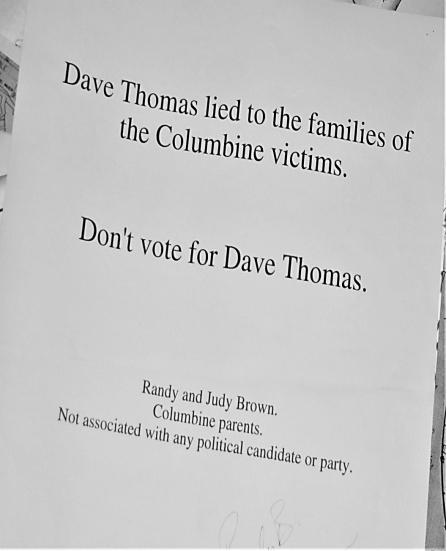
We Have Compiled the List.
October 2004
We have compiled the list of who was at the meeting, the secret meeting. We know a few of them.
We now know that Sheriff John Stone brought his attorney to the meeting.
Who else was there?
Fuselier from the FBI? Holloway?
Sheehan? (county commissioner)
A representative from the Governor’s office?
Someone from the CBI?
Here is the list of the people who attended the Secret Meeting.
They went, in separate cars, to the Open Space Building. That particular building has many doors. It is Oval, and very large, so that you can’t see all of the doors from one location. It allowed easy access from all of the separate doors. It was a perfect place to hold a secret meeting, out of the watchful eyes of the news media. Remember, it was the day after the murders. There was news media everywhere. Everywhere.
Here is the list of who was there:
Sheriff John Stone.
Undersheriff John Dunaway
District Attorney Dave Thomas
Assistant D. A. Kathy Sazak.
County Attorney Frank Huftless.
County Attorney Bill Tuthill.
County Attorney Lily Oeffler.
Lieutenant John Kiekbusch.
Deputy Dennis Gerlach.
Detective John Hicks.
Deputy Guerra.
Lieutenant Jeff Shrader.
County Manager Ron Holliday.
Undersheriff Ray Fleer.
Captain Dan Harris.
Police Information Officer Steve Davis.
These people, all employees or elected officials of Jefferson County, had attended the secret meeting. They had all, without fail, kept that meeting secret from the press, the public, and everyone.
They kept the meeting, and the discussion of the search warrant and our file, a secret from the families of the murdered and injured children, and their attorneys.
It had taken a third interview, and a serious investigation by the Attorney Generals investigators, to get one member of the group to tell the truth. Under threat of arrest, on the third interview, Deputy Guerra told the truth. He told the investigators that he had been ordered to go to the meeting. He had been forced to participate by these powerful people at Jefferson County, and then he was told to keep it confidential.
Imagine Deputy Guerra, and his position. He was doing his job, and then told to keep silent. It took an investigation by the Attorney General of Colorado, by two tough investigators, Mike and Mike, to get him to tell the truth. That how much he was worried about all of these other corrupt, and powerful people. He finally told the truth.
There were other meetings of the group. They were held at Kiekbusch’s house in the mountains. They would have a meeting, and no one would talk about it. No other information was provided about the other meetings, or what they discussed.
These people were no better than conspirators in a crime. They attended the meetings, and kept them secret. These public servants. These attorneys. These policemen. These County officials. It was a crime against the families. It was a crime against decency. It was a crime.
October 2004
The SWAT Team
Doug Mauler, according to John Hicks in the investigative tapes released by the Attorney General, wrote a report.
This report was about the Denver SWAT Team firing their weapons, as cover fire, while in the hallways of Columbine.
There is an official report on it: “Excessive force by the Denver SWAT Team.”
They fired in the hallways. They used their weapons to fire Cover Fire after the killers were dead.
I have been asking for four years for the missing ballistics evidence, 100 missing bullets. 100 bullets, missing.
We have never seen or heard of this report. Deputy Mauler had written it, and it has been kept secret too.
Let’s not forget that Dave Thomas cleared the SWAT Team, on his own, a few days after the tragedy. He cleared them before any ballistics information had been obtained, returned, or reviewed.
This coverup extends to that report too. Denver did a review of the SWAT performance, and the investigator clearly says that they fired their weapons as cover fire, in a school full of innocent children. How embarrassing for them. How dangerous.
Let me speak!
October 5, 2004
It is Tuesday morning. I drove down to the County Commissioners meeting held at the “Taj Mahal.” I am going to ask if they, the County Commissioners, were at the secret meeting on April 23, 1999. I wanted to ask them if they approved of Huftless, and Tuthill, and Oeffler being there. I wanted to ask if they approved of County Manager Ron Holliday being there.
They wouldn’t let me speak. They have no public input time during their meeting, so, after they gave an award to the budget committee, I walked to the front of the auditorium and interrupted, demanding three minutes of their time.
They refused.
I asked again, saying I needed to ask them some questions and I wanted to complain about Tuthill and malfeasance.
They still refused.
I told them that there was something wrong with a County that didn’t let its citizens speak, and then, because the deputy was coming toward me from the right side of the auditorium, I left, and walked outside.
These corrupt people.
These cowards. Their manager and attorneys had attended the meetings, and they were still keeping out of it. What is wrong with the officials of this county, where they allow this corruption and say nothing?
I met Mike Zinna, and former Senator Jim Congrove while waiting outside. They were nice.
The Commissioners are still there.
I never did get to ask my questions.
The County Commissioner’s fired Tuthill on Thursday.
Lunch at the Café de France
October 2004
We have requested a grand jury investigation by John Suthers, a Federal Grand jury. He is the U.S. Attorney for this area. We requested it in writing, using the investigation by Salazar as the necessary proof.
No response from Suthers. No response at all, ever.
In the past he had written a response to the families, citing the reasons he wouldn’t do a grand jury investigation. The main reason he used was the lack of any evidence that a conspiracy had taken place to cover up the information.
I sent him the Attorney General’s report, that clearly proved that a conspiracy to cover up information had taken place.
He ignored it.
No response. None.
Justice doesn’t matter to John Suthers, U.S. Attorney.
I’m having lunch at Cafe De France. It’s a little restaurant in Highland Ranch. There is a woman, with two boys, and her mother, sitting at the table in front of me. They are laughing and having fun. Joking, laughing, having fun, and I am sitting here thinking about the sadness of the world. Thinking about the murdered children, the dead soldiers, the sadness, that this woman and these two boys will soon know.
I am trying not to cry. They shouldn’t see me crying when they are having so much fun.
Is this depression, or is this reality?
I listened to Rush Limbaugh today: the arrogance. How easy it is to support the war in Iraq when it is not your life, or your brothers’ life, or your sons’ life that is in danger. How easy to be patriotic and hawkish when it is other people’s children who are dying.
I know the philosophy. I have read it all. I know that this is my existential angst surfacing, that this is the human condition. I was just happier when I didn’t know it, when I wasn’t aware of the sadness.
Lessons for policemen
12/2004
The lesson of Columbine for all policemen and politicians:
Lie. Lie well. Lie for a very long time. Lie with everyone else. Keep the lie a secret until no one cares. Protect your career, and your fellow officers, and your power. Money matters. Children do not matter.
That is the lesson of Columbine.
Releasing the investigation
Dec. 2004
This is complicated. The Solicitor General, Alan Gilbert, released the investigative material from Mike and Mike. They released all of it. They released the recorded interviews, the recordings of those interviews, the notes and the investigation.
We had been interviewed during this investigation, and so had many other people. We told them everything we knew, without reservation. We wanted the truth to be discovered. Other people did the same.
When Judy found out that the material was being released, she was upset. She remembered that we had told them things that were, and are, sealed by the Judge under a Federal Court order. We had told the investigators everything we knew. It was an investigation by the Attorney General of Colorado. We told them everything.
She called Mr. Gilbert, and told him she was worried, and she was afraid that the Judge would sanction us, or we would be arrested, or sued. We had revealed confidential information. Mr. Gilbert said: “We all have to pay the price sometimes.”
Judy was taken aback. We had helped in the investigation, and now we could be sued, or go to jail. She was really upset, crying and worried, and now she had been abandoned by the very people who had helped us.
She called one of the attorneys we had helped in the beginning, for the lawsuits the families had filed. She called the attorney, in Washington DC, and told him what had just happened. He was concerned, and asked Judy if the investigators had told us that the investigation was confidential. She said they had. We had been told that a number of times, and we had asked if we could tell them certain items, and they had said yes.
The attorney laughed, and said we were ok. It was the Attorney General who is in trouble. They should not release those interviews. It was very serious, but not our problem.
Judy and I talked, and then she called Mr. Gilbert. She told him what she had learned, and he got off of the phone, fairly quickly.
A few hours later, we received a request. The Solicitor General was requesting a return of the interviews, and files. A new issue would be made, without the court protected interviews.
We had, of course, already picked up a copy of it. We had requested the release, along with other people.
They exchanged the recordings for modified ones, that did not have the “Court-ordered” confidential information on them.
We kept our originals.
It was a really stressful day, especially for her.
It was very disappointing to have been dismissed and written off by the Solicitor General, when it was a serious problem for us, and then to have them correct it, immediately, when it affected them.
Once again, it showed us that we would always pay a price for the things we have been trying to do. We are nobodies. We are expendable. We do not have power or political pull. We pay the price, and that is to be expected.
How disappointing.
And how nice of that incredible attorney, that we had helped before, to take the time out of his day, and call Judy, in Littleton, over a serious crisis. He could have ignored us. He did not.
Broken Hearts, Broken promises
January, 2005
At 11:18 on April 20th, 1999, when the shooting started at Columbine High School, we knew that our lives, their lives, would never be the same. We witnessed the failures by the police, the incompetence of the commanders, the lies by the attorneys, the conspiracy by Jefferson County and the sadness of the families. Mostly the sadness. These families lost children. Their lives will never be the same. Never. They have, just like us, broken hearts.
Then we heard the promises: “We will help. We will never forget. We will find out why this happened.” Governor Owens promised. Jefferson County promised. District Attorney Dave Thomas promised. The State Legislators promised.
Then, one by one, they all faded into the political fog.
There has been no justice, no investigation to reveal the truth. There has been only one politician who even tried to do the right thing, and he, Mr. Salazar, is now in Washington. Everyone else has broken their promise to help, to find out the truth. That, or they have simply refused to get involved, like former U.S. Attorney (now appointed Attorney General) John Suthers, more interested in his political career and protecting the Governor, than the truth.
The broken hearts will never heal. They are a part of life that the families will live with forever.
The broken promises could be repaired, but that would require courage and integrity from a politician in Colorado. Both traits are very rare in the political world.
It has been six years and we still don’t know the truth. Without the truth, no one can learn the lessons from Columbine, that need to be learned. Children will continue to die in other school shootings, because the causes of Columbine, and the failures, will never be revealed to other policemen, school districts, diversion officers, judges and parents.
Broken hearts and broken promises. That is the legacy of Columbine.
A Champion of the people?
Jan, 2005
My presentation to the selection committee at the State. They were deciding who to select as the new Attorney General for Colorado. John Suthers was there, as the candidate, sitting next to me, when I read this to the committee. Before I started, I handed him a copy, suggesting he read along.
John Suthers was sitting at the same table, facing the committee. He was only a few feet away, sitting to my right. I handed him one of my copies of this statement, and asked him to read along. Yes, I know it was aggressive. Yes, I know it was kind of rude. But I felt he deserved it. I read this statement to the selection committee. It is in the record of the hearing.
“On Jan. 31st, 2002, U.S. Attorney John Suthers wrote a response to a request for a Federal Grand Jury, made by families of five of the murdered children from Columbine. He refused to investigate. He refused a Federal Grand Jury.
One of his reasons for refusing the Grand Jury, and I quote: “the allegations, of lies by law enforcement, have been carefully scrutinized and, in the opinion of the U.S. Attorney, they do not offer credible evidence of a criminal conspiracy between two or more persons to subvert due process.”
In light of the new revelations that show, without question, that approximately “20 high ranking officials” from Jefferson County held secret meetings to hide evidence from the families of murdered children and their attorneys, it would seem that his instincts and analysis were seriously flawed.
It is now painfully obvious that any valid investigation by U.S. Attorney John Suthers would have uncovered this conspiracy, and other serious wrongdoings, by officials of Jefferson County, in 2002. It is now obvious that Mr. Suthers’ refusal to hold a Federal Grand Jury in 2002 has led to years of continued pain by these innocent families, and to years of continued cover-up by these officials.
Mr. Suthers failed us.
And it gets worse: A new request for a Federal Grand Jury was made on Oct. 12th, 2004, citing the new evidence obtained by Attorney General Salazar, and his excellent investigators. We responded to a one-page letter from Mr. Suthers with a three-page letter on October 25, 2004. Since that time, we have not had a response. Not a letter. Not a phone call. Silence.
And it gets worse: In the newspapers on Dec. 16th, 2004 Mr. Suthers stated that, if he is confirmed as the new Attorney General: “No person in Colorado will be beyond the reach of the law, and every person will have the protection of the law.”
The reach of the law is very short, if the U.S. Attorney has his hands in his pockets. Protection is a hollow promise, if he sits in his office and does nothing.
We need, as Attorney General, a person who will have the courage to stand up and fight for the truth and for the powerless citizens and victims. In a state that has examples of wrongdoing like the Truax, Mena, and Lobato shootings, and the Columbine cover-up, the Attorney General has to be a champion of the people. The A.G. has to be proactive and courageous. We need a champion of the people. We do not need an Attorney General who will refuse to investigate, who will sit quietly by while families are in pain and need a defender. Based on Mr. Suthers history regarding Columbine, his words about “justice for all” ring hollow and untrue. Actions speak louder than words, and Mr. Suthers’ reluctance, and error, in not holding a Federal Grand Jury into the Columbine cover-up, speaks volumes about his lack of qualifications for the position of Attorney General of Colorado. We request that you do not approve Mr. Suthers as Attorney General.
We would also suggest that any candidate recommended by Governor Owens is simply not acceptable. Governor Owens is responsible for the failed Governors Commission Report on Columbine issued in May of 2001. This report, completed without subpoena power, failed to expose many of the lies and failures of the police, the school district, and the District Attorney of Jefferson County. Any investigation that reveals more truth about Columbine, is done at the political expense of Governor Owens, because it exposes the failure of the Governor’s Commission. Therefore, any candidate for this position is under political pressure not to investigate the Columbine tragedy and cover-up.
For this reason, we would hope that you would independently choose a candidate that will finally find the truth. We need an Attorney General that will continue the work of Mr. Salazar, and expand upon it. There are lessons, that can be learned from Columbine, that will save the lives of other children, but not until the cover-up is exposed and all of the truth is known.
Randy and Judy Brown”
I finished, and there were no comments. Nothing. There was no response, so we left. I let Mr. Suthers keep the copy of the speech. If nothing else, there might be a chance that he would save it, and read it again later. Maybe it will make him a better person.
A Complaint to the Sheriff
2005
Dear Sheriff,
I would like to take this opportunity to notify you about the actions of one of your deputies. I believe that this deputy has acted in a dishonorable manner, and has lied to the citizens of Colorado.
If you will remember, Deputy Steve Davis was the P.I.O. for Jefferson County during the Columbine tragedy. During his tenure there, he attended a secret meeting during which the main topic of discussion was the existence and concealment of a draft for a search warrant affidavit. I have no actual knowledge of his participation in this meeting, other than the simple fact that he attended it.
I do have knowledge of his behavior after the meeting, when he read a false press release to the public during a nationally televised press conference. I have this press conference for you to review. He reads from a document prepared by another Jefferson County deputy, which he must have known to be untrue. He had just attended a meeting about the draft for the search warrant, and could not have possibly been unaware that the draft for the search warrant was left out of the press release.
This, however, is not my main complaint with Deputy Davis.
During this same press conference, Mr. Davis apparently editorialized, or added, some information that was not on the written press release. This comment was in violation of the Policies and Procedures of Jefferson County, and I believe that it also violates the Witness Protection rules of the State of Colorado.
I believe that you should be aware of this behavior, as it may reflect on you and your department in the future.
I will be glad to bring you this information for your review. I would sincerely like to review this with you and with Deputy Davis in person. It would be valuable for me to understand this situation and to hear his point of view.
Sincerely,
Randy Brown
The Disbarment Effort. Filed with the State Bar Association.
Jan, 2005
In our efforts to get to the truth, we tried to get the Lawyers, who attended the secret meeting, disbarred. They had withheld information. They had lied. They had participated in a lie, and a coverup. This is some of that paperwork. There are hundreds of pages of submissions and evidence. Hundreds of pages of convincing evidence. Here are a few examples. Please read these, all of them. There are many more, but I think that, if you read these complaints, a lot of the cover up and the details will be very obvious. To prepare these complaints, Judy and I listened to the hours of investigative recordings from Mr. Salazar’s investigation, and read everything. These complaints are accurate and detailed, and, I believe, irrefutable.
Charles E. Mortimer, Jr., Esq.
Jan. 9, 2005
Mr. Mortimer,
Re: Investigation request #04-03741.
We find nothing in the response by Mister Truman, acting as attorney for Kathy Sasak, that would be cause for us to modify our complaint in any way.
We stand by our original complaint.
We will be glad to submit additional information in support of our complaint if necessary.
Thank you,
Randy Brown and Judy Brown
Charles E. Mortimer, Jr., Esq.
Jan. 17, 2005
Re: Frank Huftless and the request for investigation Case#04-03738
Thank you for forwarding the response by Mr. Huftless and his attorney Gary Blum.
We would like to thank him for supplying his resume. With that much experience and training he must be aware of the rules.
Mr. Huftless states that we alleged that he attended a “secret meeting.” In that the existence of this meeting was kept a secret from the public, the attorneys, the victims’ families, and everyone else except those in attendance, we believe that the term “secret” is perfectly applicable. There were in fact secret meetings (plural). The meetings were held at clandestine locations far from the eyes of the press or any interested reporter. The main subject of these meetings was to keep the draft for a search warrant secret. The end result of these meetings was that the draft affidavit was kept secret for two years until exposed by a lawsuit. Those in attendance kept the existence of the meetings secret, for a period of over five years. It appears that the purpose of the secret meetings was fulfilled. Mr. Huftless was, at the time, the lead counsel for Jefferson County. Is it credible for him to state that he was unaware of the purpose and end result of the meetings? Is it credible for him to state that he did not realize for a five-year period that the secret meetings and the resulting concealment of the draft affidavit were not tantamount to withholding material evidence?
There are many other points of contention that we have with the letter from Mr. Huftless, but the one that should receive the most attention is his statement: “that document was apparently not hidden because it was known to Columbine plaintiffs well before their civil claims were barred. For example, it was referenced in the Rohrbough civil lawsuit of April, 2000 against the County.”
This statement is incredible. It is misleading in and of itself. It shows an intention to mislead.
Here are the actual facts about the draft for the search warrant being mentioned in the Rohrbough case and other cases:
We have a very reliable source that told us about the existence of the draft for the search warrant. This source risked a great deal to disclose to us the existence of this draft affidavit. It was only mentioned in these lawsuits because we had knowledge of it and we told Brian Rohrbough and others about it. These families believed us and trusted our source. That is the only reason we knew about the draft in April of 2000. That is the only reason it is mentioned in the lawsuits by some of these families. It is most certainly not because of the honesty or forthrightness of this or any other party who attended the secret meetings. We would ask Mr. Huftless to display the date and time and method of his or his department’s disclosure of the draft for a search warrant prior to the court case of Mar. 19, 2001.
Let us remind everyone that even the existence of the secret meetings was kept inviolate by everyone in attendance until one of the attendees was forced into revealing their existence. This occurred 5 years and 4 months later, under the pressure of an investigation by the Attorney General.
Let us remind everyone that the draft was not officially released until a lawsuit forced its release in April of 2001.
Mr. Huftless is using the fact that the existence of a document was disclosed by a third party as part of his defense for being involved in the cover up of that very same document. This is incredible on the part of Mr. Huftless.
In addition, I would like to comment about the statement by Mr. Huftless that there were no complaints filed against him regarding open records requests. This is, as far as we know, true. It is, however, laughable at best. The fight that we have had with Jefferson County and their evasiveness and unreasonable delays and false denials is well documented. That is not the purpose of this complaint before the Judiciary Review Committee, although a complaint regarding violation of open record laws is a great idea. We would like to mention that the initial release by Jefferson County was approx. 10,800 pages. That was supposed to be all of the files. We are now at over 30,000 pages, and we are certainly not in receipt of every document held by Jefferson County. The Attorney General’s Columbine Public Records Review Task Force is still in the process of obtaining thousands of undisclosed pages and files and reports. We do speak with some knowledge of this subject, as we are very involved in the work of the task force. Again, that is not a part of this complaint.
As further proof that the draft for the search warrant affidavit was not released to anyone by Jefferson County, we would like to provide the Attorney Regulation Counsel with copies of two lawsuits filed in District Court against Jefferson County named defendants. Please review these and the attached letter by Attorney Stephen Wahlberg, which clearly show that the search warrant had not been disclosed by Jefferson County as of Feb. 16, 2001.
Apparently the “non-secret meetings,” which Mr. Hutfless attended, were very successful. It appears that everyone else at the secret meetings understood how important it was to keep the draft for a search warrant a secret. Despite his protests to the contrary, it should be noted that Mr. Hutfless, as lead counsel for Jefferson County, kept the draft a secret until it was released by a court order. He also kept the existence of the “non-secret” meetings a secret for over five years.
As a final comment, we now have two of the five attorneys in attendance at the secret meetings denying any knowledge of the alleged cover up. They are both acknowledging attendance, but state, essentially, that they had no knowledge of the purpose of the meetings and had no part in the cover up of the draft for a search warrant.
We would suggest that this is even greater cause to have a full investigation into this matter. It may be possible that some of these attorneys had no part in the cover up. It may also be possible that they are all involved. Only a full investigation by your committee will find out the truth. We certainly don’t want any of these attorneys to be falsely accused of involvement in such a serious violation. We also do not want any of the attorneys who may have been involved to get away with such a serious violation.
We look forward to the results of your full investigation.
As always, we are available for further questions at your convenience.
Sincerely,
Randy and Judy Brown
Mr. Charles Mortimer, Jr., Esq.
Jan. 22, 2005
Attorney Regulation Counsel,
We would like to add this summary as additional information for you and your investigator. We would ask that you also consider these statements in your decision.
Five of the five named attorneys have now responded. While their letters have given us further insight into the secret meetings, all of them have denied any involvement in the cover-up and the withholding of the search warrant affidavit from the victims’ families and their attorneys.
For clarification purposes please note the following items:
1) Deputy Guerra said, after five years of imposed silence, that the affidavit was the only reason for the meeting.
2) Deputy Guerra’s entire file was passed around. A file that included complete investigative material.
3) The meeting was, despite protestations to the contrary, held at a secret location.
4) Deputy Guerra was asked to bring his complete file, which was reviewed by another deputy before it was taken to the secret meeting.
5) At one of these meetings, an attorney told them not to discuss the search warrant or the meeting outside of the County Attorney’s Office for liability purposes, per Deputy Guerra’s direct testimony.
6) Jefferson County Sheriff’s Department Division Chief Jeff Shrader states that the primary purpose of the secret meeting was to discuss the search warrant affidavit. He states that one of the County Attorneys said that this was to be considered an attorney client privileged meeting.
7) The search warrant affidavit and the file were reviewed at one of the meetings.
8) The file consisted of DFARS, notes, investigative material, computer records, the search warrant affidavit and other items.
9) The search warrant affidavit was mentioned in the lawsuits from 2000 because its existence was made known to the Browns, who told the families and their attorneys and investigators.
No release was made by Jefferson County of the search warrant despite many requests for all of the files and documents related to Columbine, the Brown Family and case 98–5504. The search warrant was caused by case 98–5504. Let’s not lose track of the importance of the search warrant affidavit. It clearly proved that Jefferson County had lied about many significant items. Jefferson County had denied that the Browns met with Detective Hicks. Jefferson County had actually denied for a time that the Browns had filed a report. Jefferson County had stated publicly that the Brown complaint was handled properly, despite the fact that Jefferson County had withheld most of the information about the file. Jefferson County lied about there being no “red flags.” They lied about the meeting with the Browns and the bomb squad. They concealed this information from the public, the families and their attorneys who were involved in the preparation of lawsuits.
1) The search warrant affidavit proved that all of these statements by Jefferson County were lies.
2) Despite all of the denials and protests to the contrary, the search warrant affidavit was not officially released to the public by Jefferson County until April 10, 2001. This is information obtained from the official Jefferson County site and a list of available documents. Please review the attached reference page. Any statement by any party that the search warrant affidavit was released by Jefferson County prior to this date should be subjected to the greatest scrutiny.
3) The existence of the secret meetings was kept secret for 5 years and 4 months from everyone, except those in attendance.
4) All parties at the meeting were very aware of the significance of the search warrant affidavit. It proved them liable. It proved them negligent. We believe it exposed a felony that would have opened the county to millions of dollars in potential lawsuits.
5) All five attorneys have now denied any involvement. We would ask that they supply us with the name of the sixth attorney who was present, who concealed the search warrant affidavit and instructed all of the parties present to keep this information from the opposing attorneys and the families of murdered children.
There is sufficient cause to investigate this matter. One of these attorneys, at a minimum, is responsible for giving the instructions to conceal the search warrant affidavit from the families of murdered children and their attorneys. One of these attorneys, at a minimum, is responsible for giving instructions to keep the meeting a secret.
We do not want to have an innocent attorney accused of this breach of ethics and regulations. We do not want an attorney guilty of this infraction to get away with it. It is now obvious that an informed investigation will reveal the parties at fault.
What is unacceptable is to allow these five attorneys to collectively deny any involvement in the cover-up and withholding of items of potential evidentiary value, the search warrant affidavit, when, without question, the document was concealed from the public and withheld from attorneys representing the families of murdered children.
We would like to add one additional quote: “The procedure of the adversary system contemplates that the evidence in a case is to be marshalled competitively by the contending parties. Fair competition in the adversary system is secured by prohibitions against destruction or concealment of evidence, improperly influencing witnesses, obstructive tactics in discovery procedures, and the like.”
A direct comment from the annotations of Rule 3.4. Fairness to Opposing Party and Counsel.
Sincerely,
Randy and Judy Brown
Mr. Charles E. Mortimer, Jr., Esq.
Jan. 27, 2005
Attorney Regulation Counsel
Response to Attorney Lee Foreman re: William Tuthill. Case# 04–03737
Mr. Tuthill’s recollection of the events at the secret meetings and the recollections of other parties at the same meetings are quite dissimilar.
Deputy Guerra states that the meeting was a “cover your ass” meeting. He states that the main subject of the meeting was the search warrant affidavit. The main subject was the liability that the county would have regarding this document and the Brown File (case 98–5504). Other parties in attendance have made similar statements.
Mr. Tuthill denies that this is the case.
Other parties at the secret meeting have stated that they were told not to discuss the existence of the search warrant affidavit outside of the County Attorney’s office.
Mr. Tuthill states that he did not give anyone this instruction. Is it conceivable to believe that, as one of the County Attorneys, he was unaware of such an instruction, even though he was in attendance at the same meeting?
Mr. Tuthill states that the existence of the search warrant affidavit appeared in a civil complaint dated April 19, 2000. While this is true, it is not due to Mr. Tuthill’s efforts. In fact, this release of the existence of the search warrant affidavit was due to a very reliable source who informed the Browns about the existence of the search warrant. If Mr. Tuthill is now stating that he was involved in the release of the information regarding the search warrant, we would ask that he provide the date, time and method of his disclosure of this important evidentiary item prior to the lawsuit dated March 19, 2001.
Please review the attached letter from Attorney Stephen Wahlberg relating to the release of the search warrant affidavit.
In fact, the search warrant was released by Jefferson County to the public on April 10, 2001, according to the official site maintained by Jefferson County. This is, of course, subsequent to the court case by the Denver Post and CBS.
It is also fascinating to read from his written response that he “has seen the document many times on various occasions during the years since.” It is nice of him to acknowledge that the document was important enough for him to remember out of the approximate 40,000 pages of documents in the Columbine files. This makes it quite difficult for him to claim no knowledge of the significance of this document.
Mr. Tuthill attended the secret meetings. He was, at the time, one of the County Attorneys for Jefferson County. He kept the knowledge of the search warrant affidavit a secret for over two years. He kept the existence of the secret meetings a secret for over five years. He kept these secrets with his full admission that he was aware of the document and the fact that it was discussed at the secret meetings. (Please review his written response for confirmation of this last statement.) He kept these secrets and withheld this evidence from the families of murdered children. He kept these secrets while he publicly made statements against my family and against the search for the truth. He actually denounced the families for trying to find out the truth, accusing them of retraumatizing the victims of Columbine.
We see nothing in the response by Mr. Tuthill that would cause us to modify our complaint in any way. In fact, his response creates more suspicion as to his involvement in this cover-up. We ask that the Attorney Regulation Counsel continue with a full investigation of our complaint.
As a final comment, we now have all five attorneys in attendance at the secret meetings denying any knowledge of the alleged cover-up. They are all acknowledging attendance, but state, essentially, that they had no knowledge of the purpose of the meetings and had no part in the cover-up of the draft for a search warrant.
We would suggest that this is even greater cause to have a full investigation into this matter. It may be possible that some of these attorneys had no part in the cover-up. It may also be possible that they are all involved. Only a full investigation by your committee will find out the truth. We certainly don’t want any of these attorneys to be falsely accused of involvement in such a serious violation. We also do not want any of the attorneys who may have been involved to get away with such a serious violation.
We look forward to the results of your full investigation.
As always, we are available for further questions at your convenience.
Sincerely,
Randy Brown and Judy Brown
Charles E. Mortimer, Jr., Esq.
Jan. 27, 2005
Response to Lily Oeffler. Case # 04–03740
Comments on the response by Attorney Gary Jackson regarding Lily Oeffler:
We would ask the Attorney Regulation Counsel to please review the attached document. This transcript from March 19, 2001 is from a district court hearing in Jefferson County.
We would like to submit this document as further evidence showing the deceit and planned cover-up by the named attorneys. Please go to page 36 and begin reading at line six.
This transcript clearly states that the draft had not been released with the Brown file. This court date is March 19, 2001. This date is almost two years after the Columbine incident. This is absolute proof that the file was not produced in full by the county as of this date. In fact, this court case caused the release of this draft affidavit.
We ask that you go to page 74 and begin reading at line six. We would ask the investigators to review these passages, and then reflect on the current knowledge that Ms. Oeffler and all of the other attorneys involved were aware of the existence of the draft for a search warrant on April 22, 1999. Ms. Oeffler had knowledge of this document, attended multiple meetings regarding the disposition of this document, and feigned a lack of knowledge of the same document in open court.
This is the level of duplicity that we have been facing since the tragedy occurred.
This document was important enough to engender a number of secret meetings. Certainly, these attorneys were aware that this document was conspicuously absent from every release of public documents. Certainly, they were aware that this document and the secret meetings were an inviolate secret, as they kept this secret for over five years.
If these attorneys, or those specific attorneys involved in the cover-up, are allowed to get away with this cover-up, the lesson to all attorneys in Colorado will be very simple: Lie… Lie for a long time and continue to lie… there is no penalty for withholding information.
We would also like to mention that a timeline existed for the Columbine tragedy. This was mentioned in open court. Please review those relevant pages in the enclosed transcript. It should be noted that this time-line was shredded. It contained information about the search warrant affidavit and the actions of Eric Harris and Dylan Klebold in the years prior to April 20, 1999. This timeline included the meeting with Detective Hicks, the search warrant affidavit and other damning information. This information existed and was shredded by members of the Jefferson County Sheriff’s Department, or by this attorney. This is another example of the destruction of evidence that cannot be refuted by this attorney. In fact, this destruction of evidence is acknowledged clearly in the enclosed transcript. Ms. Oeffler acknowledged the existence of the timeline, acknowledged the shredding of this same document, and then cannot account for the simple fact that this information was not in the pages released by Jefferson County.
In response to the absurd statement by Attorney Jackson that the draft was public knowledge on page three of his response, we would like to remind the Attorney Regulation Counsel that this draft was only named in the lawsuits filed by Mr. Rohrbough and others because we had a very reliable source who supplied us with the knowledge that a draft for a search warrant existed. Ms. Oeffler did not, in any way, supply this information. None of the named attorneys supplied this information.
We would like to ask Ms. Oeffler to supply the date, time and method by which she disclosed the existence of the draft affidavit prior to approximately March 21, 2001.
Her statement: “that the attorneys for the initial plaintiff’s lawsuit involving Columbine, Arrington and Rouse, were aware of the existence of the search warrant affidavit at the time of the filing of their lawsuit” is true, but is certainly not due to any disclosure by Ms. Oeffler of any other named attorney. In truth, the knowledge of the search warrant affidavit was in spite of every effort made by one or all of these five attorneys. We would like to thank Ms. Oeffler for finally calling the document a “search warrant affidavit.” It has been mislabeled by these attorneys and others as: notes, a draft for a search warrant, work product and other euphemisms. It is nice to see this document finally labeled as a search warrant affidavit.
In summary, this weak response by Ms. Oeffler has done nothing to cause us to modify our original complaint. We do believe that her response has shown an attempt to mislead the Attorney Regulation Counsel by supplying misinformation regarding the release of the search warrant affidavit. Please review the information we supplied regarding Mr. Hutfless, and the lawsuits from other parties. Please note that even the official timeline released by Jefferson County has the date of the release of the search warrant affidavit as April 10, 2001. (Please see the attached printout.) Ms. Oeffler is fabricating an imaginary disclosure of the search warrant affidavit as part of her defense.
Ms. Oeffler is using the fact that the existence of the search warrant affidavit was released by a third party as part of her defense for being involved in the cover-up of that same document. This is incredible on the part of Ms. Oeffler.
As a final comment, we now have three of the five attorneys in attendance at the secret meetings denying any knowledge of the alleged cover-up. They are acknowledging attendance, but state, essentially, that they had no knowledge of the purpose of the meetings and had no part in the cover up of the draft for a search warrant.
We would suggest that this is even greater cause to have a full investigation into this matter. It may be possible that some of these attorneys had no part in the cover-up. It may also be possible that they are all involved. Only a full investigation by your committee will find out the truth. We certainly don’t want any of these attorneys to be falsely accused of involvement in such a serious violation. We also do not want any of the attorneys who may have been involved to get away with such a serious violation.
We look forward to the results of your full investigation.
As always, we are available for further questions at your convenience.
Sincerely,
Randy Brown and Judy Brown
Mr. Charles E. Mortimer, Jr., Esq.
Jan. 27, 2005
Attorney Regulation Counsel
Response to Attorney Martinez re: the complaint against District Attorney Dave Thomas
Case # 04–03739
Thank you for your time in reviewing this information.
To reiterate, our complaint is based on rule 3.4 Fairness to Opposing Counsel. It is our belief that District Attorney Dave Thomas violated this rule by causing material of evidentiary value to be concealed. We also remind the Attorney Regulation Counsel that we are not attorneys, and would ask that the counsel review the compliant and determine any and all other violations of the rules and regulations that have been violated.
In response:
They claim that we have “lumped law enforcement officers, elected county officials and Mr. Thomas into one broad category.” This is true. We have lumped them into the category of those who attended the secret meetings of April 22, 1999 and other undetermined dates. Mr. Thomas attended these meetings. He kept the purpose and existence of these meetings a secret for over five years. It is possible and very probable that he was involved in the decision to keep the search warrant affidavit secret. We are asking that you determine if that is the truth by holding a full investigation.
They quote from the findings of the grand jury that: “the grand jury cannot determine whether the absence of all original official records… is tied to a particular person.” There is quite a difference between no determination and no evidence. The grand jury found substantial and significant evidence that documents were destroyed, hidden and withheld. This is the reason and the cause of our complaint. It is up to the investigation and hearing to determine if Mr. Thomas was actively involved in the cover-up.
They state that Mr. Thomas was not ever the custodian of the records in question. We believe, and it is proven by documentation and Mr. Thomas’ statements, that Mr. Thomas was actively involved in the investigation of the events of April 20,1999. His investigators were active participants. He was the key player in the Diversion Program that both Eric Harris and Dylan Klebold were involved in. He was a participant in the press conference dated approximately May 1, 1999, at which the Brown complaint was reviewed and the lies began. He involved himself in clearing the Denver SWAT Team just a few weeks after the murders. He involved himself in the Attorney Generals Records Review Task Force. He involved himself in the investigation by the El Paso Sheriff’s Department regarding potential police involvement in the death of Daniel Rohrbough. He was responsible for the sealing of the search warrants on April 22, 1999. He attended the secret meeting. He was actively involved in the secret meeting in his position as District Attorney of Jefferson County. He gave legal advice at the secret meetings. He gave legal opinions at the secret meetings.
Mr. Thomas cannot deny his participation in the secret meetings. It is the level of his participation that we are asking you to investigate.
They state that we have made inflammatory and baseless statements regarding Mr. Thomas. We believe that Mr. Thomas is a liar. We believe that, as District Attorney of Jefferson County, he lied and withheld information from us, from the public, and from the families of murdered children. Apparently, we are not alone in this belief, as many newspapers and media spokespersons have made similar and worse statements regarding the veracity of Mr. Thomas. Craig Silverman, a former associate of Dave Thomas, actually accused him of “hugging the families (of the Columbine tragedy) with one hand while he was stabbing them in the back with the other.” It is possible that we are correct in our beliefs that Mr. Thomas was involved in the cover-up of important documents. As of this date, we have seen nothing from Dave Thomas that would cause us to modify our statements or our complaint.
Dave Thomas attended the secret meetings as District Attorney of Jefferson County. We believe that, in addition to the requirements that are involved by his standing as an attorney at the secret meeting, there are also special requirements that are required of him as the District Attorney. We believe that this investigation into the cover-up of the search warrant affidavit should continue based on the evidence that we have supplied.
As a final comment, we now have four of the five attorneys in attendance at the secret meetings denying any knowledge of the alleged cover-up. They are all acknowledging attendance, but state, essentially, that they had no knowledge of the purpose of the meetings and had no part in the cover-up of the draft for a search warrant. This is troubling, since some members of the police department who were in attendance at these same meetings are very clear about the purpose of the meetings, which was to keep the search warrant affidavit a secret from the public and the press.
We would suggest that this is even greater cause to have a full investigation into this matter. It may be possible that some of these attorneys had no part in the cover-up. It may also be possible that they are all involved. Only a full investigation by your committee will find out the truth. We certainly don’t want any of these attorneys to be falsely accused of involvement in such a serious violation. We also do not want any of the attorneys who may have been involved to get away with such a serious violation.
We look forward to the results of your full investigation.
As always, we are available for further questions at your convenience.
Sincerely,
Randy Brown and Judy Brown
Supreme Court of Colorado
Feb. 8, 2005
Attorney Regulation Counsel
Mr. Charles Mortimer, Jr., Esq.
Regarding our complaints against the attorneys involved in keeping the search warrant affidavit a secret:
We would like to ask that all of our responses and supporting information be applied to every complaint. We want to be sure that every file contains the same information.
We request that cases 04–3737, 04–03738, 04–3739, 04–3740 and 04–3741 all have the same attachments and accompanying paperwork. This would include the letter of summary dated Jan. 22, 2005, civil case 00-B-1613, the list of attendees at the secret meeting, the Grand Jury report dated Sept. 16, 2004, the Report of the Investigation into Missing Daily Field Activity and Daily Supervisor Reports dated Sept. 16, 2004, the 17 Recordings of the investigation into the missing 1997 report, the DVD of the Dave Thomas press conference dated approx. April 30, 1999, the letter from Attorney Stephen Wahlberg dated Jan. 14, 2005, the transcript of the District Court hearing dated Mar. 19, 2001 which is case # 00CV884, the Modification and addition to the complaint, the copy of the Official Jefferson County page with the release of the Search Warrant Affidavit of April 10, 2001 and any other information we have supplied.
We are requesting this in order to be consistent with our filing, and to be sure that no attorney has a file that is incomplete. Any complaint about any of the attorneys should be consistent and complete, as we are still convinced that they acted in collusion and full agreement on the charges covered in our complaint.
As always, we are available at your convenience to provide detailed and additional information regarding these complaints.
Thank you,
Randy and Judy Brown
Sheriff Ted Mink,
Feb. 8, 2005
Jefferson County Sheriff’s Department,
We would like to remind you that we have requested to see our original official complaint dated Mar. 1998 on case 98–5504.
This report was available to the investigators for the Attorney General, and we would like to review it in person, along with any accompanying paperwork.
Please call us at your earliest convenience to schedule this. You, of course, do not need to be present for our appointment. We just want access to our original file for review.
Thank you,
Randy and Judy Brown
As a note, we were given our original complaint, with a very interesting note from Kate Battan. To explain, in the days when this file was completed, emails were not being used. In many offices, a “routing envelope” was used. A routing envelope was a large envelope, with signatures lines all over the front. When you wanted to send something to the DA. you wrote the name of the person the envelope was going to be delivered to, and it was delivered, by hand, to that party through an interoffice delivery service. So, if you wanted to send something to the sheriff, you would write that on the envelope, and it would be delivered. Then when he wanted to send it to a Detective, he would write the Detectives name on it, and it would be delivered. This kept track of the file, and showed, very clearly who the file had been sent to. It was a paper trail that could not be argued with.
When Kate gave us our file, she told us that the routing envelope had been destroyed. She went out of her way to be sure that we knew it had been destroyed. They had taken away any chance of verifying that the file had been to the Sheriff, DA, Detective, Sergeant, or anyone else. They had covered their tracks. Destroying the routing envelope was destroying evidence.
Charles Mortimer, Jr.
Feb. 16, 2005
Colorado Supreme Court
Attorney Regulation Counsel.
In response to your letter dated February 14, 2005:
With reference to your request about: “other parties stated they were told not to discuss the existence of the search warrant affidavit.”
Please remember that the investigation by the Attorney General was a limited investigation, which was for the specific purpose of finding out the reason why the ’97 file was missing. No attorney or policemen was asked who instructed them to keep the affidavit a secret. Any statement regarding this item was purely voluntary. You will not find it in every statement, because it was not a question asked by the investigators. We would hope that you and your investigator would call Deputy Guerra, Deputy Harris, Deputy Shrader, Undersheriff Fleer, Deputy Gerlach and all other participants at the secret meetings to ask them that exact question. You should ask them who called the meeting, who told them to keep the meeting a secret, and what was discussed at the meeting. It will take a great deal of investigative skill to wade through all of the different answers and determine the truth. The number of disparate stories is obvious from listening to the investigative tapes that you already have in the file. You will have to determine who is telling the truth and who is lying. We do have, at this moment in time, a number of people who have told the truth about this single item. Please review the following notes:
You need to listen to Disc 15, sections 1 and 2 in their entirety. Deputy Guerra states clearly that everyone was there, they were all Captain rank or above, they were there for the purpose of liability, the D.A. made a statement, and that the affidavit was the only reason for the meeting. It was clearly stated by Deputy Guerra on the discs. He states that he was told not to discuss this (the affidavit) outside of the County attorney’s Office. Since it appears that Deputy Guerra was the first one to reveal the existence of the secret meeting, and that he did so under great pressure from the investigators, we can logically determine that he was, at the time of this statement, telling the truth. We acknowledge that it took three meetings to get him to this stage, but we believe that this statement was truthful. We do not believe that it was all that he could have said. We would like to ask him which attorney told him this, and which other attorneys were present or aware of the order. That, however, was not the purpose of the investigation by the attorney general. This information was obtained peripherally, but is still relevant, valid and convincing.
Detective John Kiekbusch states on disc 12, track 1, that he believed that the information should have been released, but that the county attorneys decided what to release. At 26:06 on this disc he states that the County Attorney had a role in reviewing and releasing information. He states that the County Attorney decided what to release. In that the affidavit was not released for two years, and then only under a court order to do so, it seems obvious that instructions were given and followed.
Detective John Hicks states during his interview on track 2 at 20:40 that “everyone was told not to talk. We were told not to talk to the press.”
Then, on disc 11, track 3 at 14:27 he states: “I think they (the county attorneys) were still trying to evaluate what should be released and what shouldn’t. I don’t believe that it (the affidavit) was released right after Columbine.”
Detective John Hicks states on disc 10, track 2 at 15:31 the following:
Question: “Did they ever tell you to lie?”
Answer by his attorney: “He knew he couldn’t tell the truth.”
Answer by Hicks: “I took the cue: You’re supposed to lie for us.”
In an interview with Division Chief Jeff Shrader with the Jefferson County Sheriff’s Department on Nov. 19, 2004, Mr. Shrader stated that: “One of the county attorneys said this was to be considered an Attorney-client privilege meeting.” He made this statement to us in regard to the secret meeting. Since Mr. Shrader is reportedly an honest policeman, we are sure that he will make this same statement to you. It is to be noted that Mr. Shrader was the policeman who took notes for the press conference that you have seen, and no mention of the affidavit was made, even though it was the main purpose of the meeting, according to Deputy Guerra and others.
Obviously, someone is lying. The question you have to ask yourself: Is it the attorneys who were present in the secret meeting, who kept the affidavit a secret for two years and the secret meeting a secret for five years, or was it Deputy Guerra and Detective Hicks who lied to the attorney general, while under serious scrutiny and pressure to tell the truth. You cannot believe that Division Chief Shrader, currently employed at Jefferson County by the Sheriff’s Department would lie in November of 2004. His attorney was present in the room. He certainly had nothing to hide.
We believe that you will easily find the truth when you investigate these allegations. Under oath these people will tell the truth. With the knowledge that they will not lose their jobs these policemen will tell you who told them to lie. We believe that the investigative tapes clearly tell you this. Remember that these officers made these statements without the question being asked. They wanted to tell the investigators. They were tired of the lie. These five attorneys are not. They began the lie. They conspired to conceal information. They still have something to lose.
Please note that most of the names listed above are currently employed by the Jefferson County Sheriff’s Department. The phone number is 303-277-0211. Ask for Sheriff Ted Mink. Please be advised that two of the named attorneys are currently employed at Jefferson County and represent the Sheriff in legal matters. Will they be allowed to counsel Sheriff Mink to stop these deputies from talking to you to protect themselves?
With regard to your second request:
It is irrelevant who our source was. The five attorneys in question cannot provide any documentation of any kind that the warrant was disclosed prior to the court ordered release in April 2001. They attended the meeting with the sole purpose of keeping the affidavit a secret. They did so. It should be incumbent upon them to show evidence of any date of release of the search warrant affidavit prior to April of 2001. Please have them document the time, date, location and method by which they disclosed the existence of the search warrant affidavit. We hope that you have noticed that not one of them was able to disclose any date, time or method of release of the affidavit prior to the court ordered release in April 2001.
What difference can it possibly make who our source was. We knew about the affidavit. We can supply documentation that we told the victims families’ attorneys about the affidavit in 2000. We will be glad to supply this information. We will sign notarized statements under oath that we were informed of the existence of the affidavit, and that we were the source of that release to the attorneys of the victims’ families.
In fact, we have a number of ways of proving that we were the source of this information.
1) Our Internal Affairs request to the Sheriff’s Department in 2000 contains this statement. It was recorded by the Sheriff’s Department when we filed the complaint. We have a copy of this tape if they will not provide it to you.
2) We have an interview from May 9, 2000 with one of the investigators sent by one of the attorneys of one of the victims’ families in which I tell the investigator that we knew about the search warrant because we had a very reliable source who told us about it. This is a court document and can easily be confirmed by the attorney.
3) We notified Brian Rohrbough that it existed and that is the reason it was in the lawsuits. Mr. Rohrbough will confirm this.
4) There is no evidence in existence that can prove that the affidavit was released by Jefferson County prior to April 2001.
We will not release the name of our source to you at this time.
We may consider releasing it to you if an investigation is held, and we can be assured that it will be protected.
This source could suffer retribution from Jefferson County and these attorneys. This source could lose his/her job. This source could be in danger if their name was revealed.
Please remember that Jefferson County and its information officers stated publicly that we never met with Detective Hicks. They could have never made this false statement if the affidavit had been released, as the affidavit clearly stated that we did meet with him. They stated this for two years. They lied about citizens of Colorado. They tried to blackmail us with threats against our son. They tried to blackmail us by releasing, illegally, the name of our son and his “possible involvement” in this horrific crime. They had no evidence to make that statement. They have never officially retracted that false allegation. They released our son’s name and our address and phone number to the public in violation of the judge’s orders. They lied and exposed my family to death threats and the hatred of an entire community to protect themselves. They lied to the families of murdered children by telling them that our son was involved in the tragedy. These attorneys cannot be trusted. We will not trust them with the name of our source. We will not be responsible for the potential harm that could occur to our source by revealing their name. This person showed the greatest courage by telling the truth. We will not reward that by betraying him/her.
If you need to verify that others knew about the affidavit, just ask Kate Battan, the lead investigator for Jefferson County. She was, according to the testimony given to the Grand Jury and the Attorney Generals Investigators, aware of the affidavit in 1998 and 1999. She worked on it with Deputy Guerra. She even asked about it on April 20, 1999. Please note that she left this information out of the Official Release by Jefferson County.
According to the testimony given, Dave Thomas was aware of it in the Command Center on April 20, 1999. Mr. Dunaway states that he discussed the affidavit with Dave in the Command Center while the incident was taking place.
The secret meetings and the ensuing cover-up make it appear that other people were unaware of the search warrant affidavit, but that is simply not the case. This affidavit was in a number of files and locations. We are sure that you have determined this by listening to the investigative tapes. The name of the person who revealed the existence of the affidavit to us should not be material to your investigation. Releasing this name would subject that person to the same vilification by Jefferson County that we have been subjected to. That is not something that we are willing to do at this time. We believe that this is an unnecessary request. Please notify us if you would like to discuss this in person.
We will state for the record that it was officially not one of the five named attorneys who told us of the existence of the search warrant affidavit. Any statement with greater detail than that should have no bearing on our allegations. It should suffice that none of these attorneys gave us this information. They cannot use that as a method of defense for their lies.
Thank you for continuing this investigation. We appreciate the effort and the integrity. We realize that this is a very complicated complaint. As always, we are available to meet with you to provide further assistance and information at any time. We do have additional names that we can provide you as suggestions for interviews by you and your staff.
Sincerely,
Randy and Judy Brown
It should be obvious by now. If you have read the previous pages, the responses to Mortimer, the responses by the Attorneys involved from their attorneys, it should be obvious. They lied. They know they lied. They are playing legal games with the hearing officer. This hearing officer, by the way, was sure we had them. It is a clear violation for an attorney. Withholding evidence is a clear and simple violation. They are all guilty. It is obvious. Denying it is laughable.
Now, I must admit that we did this on our own, without an attorney. It was a lot of work. It took a lot of time. But the arguments are solid, and their lies, are obvious.
County Commissioners: My Public comments:
February 22, 2005
Thank you for allowing some time for public comment. I hope that this is the beginning of a more open county government.
I am sure that you are aware that this county has been involved in the concealment of important documents regarding the Columbine tragedy. You are aware, according to the interviews by the Attorney General, that your lead attorney was present when the secret meetings designed to conceal this information were held. You are aware that other county attorneys and employees were present. I have the interviews available for your review if you want to know more.
As a citizen of Jefferson County, I was very upset that you decided to hire Mr. Hutfless back. I believe that he is involved in the cover up. As lead attorney for the county, it is difficult to believe that he was not aware of the concealment of such important documents, especially since he attended at least one of the secret meetings. It is my strong belief that he was involved in the cover up. Perhaps he was completely unaware of the cover up. Either choice would mean, in my opinion, that he is not a good candidate for the position of lead attorney.
That, however, is not my reason for being here. I have come to ask your help. You are new to this problem. You were not involved in the mistakes of the past. You can change things without harm. It is over five years since Columbine. The lawsuits are over. We have a new Sheriff with integrity. We have a new District Attorney. Things can change. You can lead the way to the release of the truth.
You may not be aware that approx. 61 students have been killed in school shootings since Columbine. I believe that the information still being kept secret about the Columbine Tragedy by the Sheriff’s Department, the District Attorney’s Office, the Diversion program, and the School District can save the lives of innocent children.
You can affect that release. You can lead the way by notifying the Sheriff’s Department, the District Attorney, and others that it is time to release the truth.
I am asking you to instruct your attorney to give full access to all files regarding Columbine. Tell them to notify the judges involved that you want all of these files released: all videos, all paperwork and all information. Make it clear to these judges and to all of your employees that you want this information released. Take a proactive position and notify the judge, Sheriff Ted Mink and District Attorney Scott Story that you believe that it is in the best interest of the county to release this information to anyone interested. Have them investigate these failures and prepare an honest release for other departments all over the country. Release it to counselors, to parents, to psychiatrists, to psychologists, to other counties, to policemen, to authors… to anyone. Let the truth out. Let them learn from these mistakes so that they can be corrected. Let them learn so that other innocent lives can be saved by this knowledge.
Imagine a scenario: Imagine that we learned from reading the journals of Eric or Dylan the real reason they did this. Instead of speculation by thousands of uninformed people, we would know the real truth. Don’t you think that this could change the dynamic in one school or one family or one home in a way that it might prevent another shooting or another suicide?
I am asking that you contact Sheriff Ted Mink and support him in the release of all information. He has integrity; he will do the right thing. Do the same with the district attorney and the diversion program and the schools. Try. Ask them. Tell them.
I am asking that you do this to try to save the lives, through prevention, of other children. I am asking that you do this to honor those children and Mr. Sanders who were murdered at Columbine. We will never learn the lessons of Columbine until we know the truth about what happened.
Randy Brown
Del Elliot…
April 19, 2005
It is a little thing. It doesn’t even hit the papers, that I know of.
Del Elliot, the psychologist who had the right to review all of the documents and info from the tragedy, including the police reports, psychologist notes, and other info, has decided not to release any of the findings of his work. If you will remember, he is the Expert who the Harrises and Klebolds were going to talk to. Or so it was promised. It was the last effort by the Judge to stop the complaining. He would keep the records secret, but we would learn the truth after Del Elliot reviewed it.
The Klebolds and Harrises refused to interview with him, and therefore he decided that it was not worth releasing anything. What a joke. What a waste of time.
They bring in the “expert,” and he doesn’t do a thing. It was just another diversion.
The cover-up continues…
An editorial, and a letter to John Suthers.
August 2, 2005
I found Mr. Bellipanni by accident. I happened to see his name in an article about a plea bargain with Cade Lee, in the paper, on July 27, 2005. Michael Bellipanni was the Assistant Attorney General, newly hired by the new Attorney General, John Suthers, who was under criticism for bargaining a sweetheart plea deal for a man who had reportedly defrauded investors out of a few million dollars. I was very familiar with the name Michael Bellipanni. He was the Assistant District Attorney who handled the Diversion Program entry and prosecution for killers Eric Harris and Dylan Klebold in 1998, one year before the murders at Columbine. He has never spoken publicly about his involvement in the Columbine Tragedy, remaining “below the radar” for over six years. He has never been publicly interviewed or questioned about his involvement and knowledge about the tragedy, the cover-up, and the failures. His files have been released, forced out by now Senator Ken Salazar, so Mr. Bellipanni has no reason to hide. He has no legal reason or restrictions to remain silent, except to protect his own reputation or the reputation of other politicians who have something to hide, but he may have a great deal of information about the circumstances and failures in 1998 and 1999. He should certainly have a moral obligation to reveal what he knows about the tragedy. Children were murdered, and he has knowledge of the reasons and the failures.
I tried to contact him at the Attorney General’s Office. After six phone messages, I decided to repeatedly call until I could actually talk to him. His associate told me that Mr. Bellipanni has been instructed not to talk to me by his superiors: Jeanie Smith and, apparently, Attorney General John Suthers. The Attorney General has instructed his assistant not to talk to me? How cowardly is this? What do they have to hide? What does he have to hide?
I am still a member of the Attorney Generals Columbine Records Task Force. I have been actively involved in the pursuit of information about the real truth about the Columbine Tragedy. I can, from experience, understand and appreciate the reason that Jefferson County does not want information released, but I cannot understand why the Attorney General of Colorado would deny me an interview with one of the key players of the tragedy, who is now on his staff.
Mr. Suthers: I challenge you to help in discovering the truth. Make the people and the information accessible to those who care. You should be leading the fight to find out the whole truth about Columbine, in order to protect other children from being murdered or injured in similar preventable circumstances. If you do not help, you are part of the cover-up. Sadly, your actions over the last few years, both as U.S Attorney and as the appointed Attorney General, have made it clear that you do not want the public to know the truth.
Cowardice is alive and well in the Office of the Attorney General of Colorado. The cover-up of the truth continues.
Randy Brown
Charles Mortimer, Jr.
March 2005
Mr. Mortimer, You have asked us to supply you with information about past open records requests and the failure of the Jefferson County Sheriff’s Department and others to complete these requests.
Some explanation is necessary.
Please remember that we are not attorneys. We are layman who trusted the Sheriff’s Department and their personnel. We originally asked for our records through a reporter for CNN who was also an attorney. He asked us if we would like to get a copy of our report. We were not aware, at that time, that the police were required to supply us with this report. This reporter went to Jefferson County to get the report. We received a call from an employee of the District Attorney, asking us if we wanted our report released. We of course said yes. District Attorney Dave Thomas was involved in the initial release of file 98–5504 in 1999. This report, as well as every copy we received of our complaint, was incomplete and had very important items omitted. The police lied about the report in general, first saying that it did not exist. After we gave them the case number, they provided the edited report, in partial and incomplete form. They denied that we had ever met with Detective Hicks. They never mentioned the existence of a search warrant. They never mentioned that an investigation had been carried out as a result of our report, and that this search warrant had been started. They never mentioned that they had obtained the AOL files for Eric Harris and Dylan Klebold. They never mentioned the pipe bomb case, which was involved in the search warrant. They never revealed the existence of the “Guerra file” which was reviewed at the secret meeting. They lied.
We have been trying to get to the truth of this lie for over five years. We have never seen a court case go to discovery. We have had to fight this department for information for years.
When we would go to the records department and ask for a file, we would be given a file with a statement attached which would say that it was a true and complete copy of the file. On some occasions Lily Oeffler would be present, in the records department, when we made these requests. She would have to approve what was released. She stopped the records department from releasing the complete files. She even told the records clerk that she could not talk to us anymore. County Attorney Lily Oeffler interceded in our search for records. The files that we were given were not complete.
After a year or more of this we started to ask for records through the open records method, using written requests through the county attorney. The responses to these requests have been obtuse, evasive and designed to delay our search. Unfortunately, the open records law is very weak, with minor penalties. We have become so used to the deception of the County Attorneys, that we only ask for items when we are fairly certain they cannot deny their existence, and they still do. They play semantic games and use legal language to postpone and frustrate our attempts.
We will supply you with some of our requests, but we do not expect you to understand the level of lies that we have been dealing with.
We do expect you to appreciate the information that we have already given you. The Attorney General’s report and the investigative tapes clearly state without question that these five attorneys attended a secret meeting, the purpose of which was to conceal the search warrant affidavit. If you do not have enough information at this time to proceed with a hearing, it is certainly not because you, or your investigator, are lacking proof of the meeting or the concealment. We believe that to ask for more details and absolute proof is unfair. You would be setting the standards for proof at an absurdly high level. They would be impossible for any layman, or citizen, to attain. Worse, is the lesson it would teach these five attorneys, and all other attorneys in Colorado. This is the lesson it will teach them:
“Lie. Lie together. Lie about citizens. Conceal information. Postpone the release of the truth until the public no longer cares. As long as you lie and keep the lie a secret, nothing will happen. Lie with impunity. There are no rules. Keep that evidence a secret. Innocent children do not matter. The truth does not matter.”
Do you really want to teach your fellow attorneys that lesson?
We are supplying you with copies of files obtained from the Jefferson County Sheriff’s Department Record Section. These were obtained through written requests to the Sheriffs Records Division with, at times, the presence of Lily Oeffler. To us, the Sheriff’s Department and the County Attorney were one and the same. Since the County Attorney represented the Sheriff’s Department in this case, it appears that the County Attorneys also believe that they were the legal representatives of the Sheriff’s Department. We are also supplying you some open record requests and the accompanying responses. Please note that our complaint is not about violation of the open records law, unless you have found some serious violations. We of course do not want to limit your investigation. Our complaint is about the concealment of the search warrant affidavit and the “Guerra file” by these five attorneys. We put the “Guerra file” in quotes because even that name is a subterfuge by the lawyers and the police. The file is on case 98–5504, which is our file, the Brown file.
We are also confounded by the inquiry as to who we made open records requests to. Are we required to submit an open records request to every employee of the county? Are we required to submit a request to the Sheriff, the Under Sheriff, the District Attorney, the deputies involved and other unknown parties? This would seem to be quite unfair to the party making the open records request. We were not even aware of the names of many of the important parties, as they were not released to the public. The County Attorney was involved in the responses to our requests to the Sheriff’s Department Records Division. They should have supplied us with true and accurate copies of our file. They did not.
Are we also to request a list of a thousand documents, listing file folders and dfars and notes and drafts of search warrants and files we are not aware of? This would seem absurdly cumbersome, and unfair again to the requesting party. An open record request should incorporate without explanation all reasonably related documents. Anything less puts an unfair burden and a requirement of omniscience on the requesting party.
Please do not forget the findings of the Attorney General. The meeting that these five attorneys attended was held to conceal the search warrant affidavit. Remember that it took a court case by a major newspaper and a television network to get this warrant released. It should be sufficient for you to have their admission that they were at the meeting. They have admitted this already. All that is left is for the hearing to determine what their level of involvement was.
The search warrant was of obvious and primary evidentiary value. It should have been released. It was not released or even disclosed, due to the actions of these five attorneys and others. At the very least, its concealment was done with the approval and knowledge of some of these five attorneys. That is a clear and blatant violation of your rules and regulations.
Please remember that it took a lawsuit by a major newspaper and a major television network to force the release of the search warrant affidavit.
Please remember that it took the Attorney General of Colorado and some of his best investigators to finally reveal the existence of the secret meeting.
Isn’t five years of concealment and lies enough to warrant an investigation of these five attorneys?
Doesn’t the lie itself, and the ensuing cover up and the damage done to these families of innocent murdered children, mean anything?
Please review the attached pages. We look forward to meeting with you and your investigator to review these and other items.
Thank you again for all of your efforts.
Randy and Judy Brown
The Supreme Court Counsel Decides.
April 13, 2005
We hear about our complaint against the Attorneys who attended the secret meeting.
We received a letter today, from Mr. Gleason. Mr. John S. Gleason, the head of the Colorado Supreme Court Attorney Regulation Counsel. He is Mr. Mortimer’s boss. He tells us, very simply, that the complaint is over, and that they are not going to pursue it. Over. Done.
That was a little disappointing.
We were certain, from our many discussions with Mr. Mortimer, that our complaint was valid and serious. He was sure the we had made a valid and solid complaint. Unfortunately, his boss stepped in and intervened. Mr. Gleason decided to support the attorneys who had attended the secret meeting, and had kept it a secret for years. He supported the corrupt County, Sheriff, Attorneys and the Judges. No surprise. There is no justice in this situation. Just corruption.
It Isn’t Hate
7/18/05
I would kill them. I would kill them without a second’s thought. I would give everything I own to kill them. I would give everything I own for one chance to be on the steps of the school, with a pistol, at 11:10 A.M. on April 20. 1999. I would kill them, and stand, and wait for whatever else would happen. I would kill Eric and Dylan in cold blood, before they had the slightest chance to harm anyone.
It isn’t hatred, it is pragmatic.
They caused so much pain. They killed innocent children with shotguns, firing heavy weight slugs. They killed and enjoyed it, and ruined hundreds of lives.
I wouldn’t talk to them. I wouldn’t try to reason with them. I would kill them.
I would be proud to.
It isn’t hatred, it is the witnessing of the horror, and sadness, and lies, and corruption. It is preventive violence.
Everything I own.
I would give my life to have that brief one-minute opportunity.
That is one of the lessons I have learned about myself in the last six years.
It is 2005.
Columbine was six years ago, and then some.
Since then, my life, our lives, have been full of sadness, and tears, and learning, and awareness.
I sit among the thousands of pages of evidence, and I remember all of the interviews and reporters, and I realize how much I have learned, how much I have grown as a person.
I know, you read the first part of this chapter and you don’t see how that can be true. I would agree with you, but the first part of the chapter is like a summary of the truth, an encapsulation.
If I could go back to April 20, 1999 at 11:00 A.M., it would be too late to reason with them, too late to try to help. The risk would be too great. I would only have the option of a quick and final solution.
If I could go back to April 1998, I would talk to them and tell them we care. I would help them fight the bullies, and that awful high school. I would also have them arrested for the bombs, and the weapons. It would be difficult, knowing that they would, in less than a year, kill innocent children, but I would try. I would try.
Then, to be sure, I would be waiting in the parking lot on April 20, 1999, anyway. Waiting to see if anything had changed them.
One chance is all I ask. I am never going to get that chance. The children are dead. Mr. Sanders is dead. It has already happened. It is over.
My only option now is to write this book, to explain to anyone who reads it what we did to try to stop it, how we failed, how the police failed, and how to stop the next school shooting.
Please, take that message from this book. Please read this and be critical of us, and the police, and others. Learn from our mistakes. Learn, and stop the next school shooting. Please.
You see, I am the person most responsible for letting Columbine happen. Yes, me.
I failed to protect my children, who, with a great deal of luck, survived Columbine.
Eric spared my oldest son outside of the school. The bombs in the cafeteria failed to ignite, and my youngest son was spared. It was luck, it was fortune, it was chance. It should never have gone that far, but my failures let it.
Now, I am not stupid. I know that the police, and the diversion program, and counselors, and the Harrises and Klebolds deserve a great deal of the blame. I know that there is survivor’s guilt, and I am incorporating the great sadness of this event into my own guilt, and my failing to prevent it. I know. I know. It just doesn’t help.
Depression is a part of my everyday life. Thoughts of suicide come, and thankfully go away, every single day. Accepting the truth is not that hard, it is reality. The truth is simple: I should have stopped this tragedy. It is the truth. Nothing will ever change it. Remember that when you read this book.
The Motorcycle
2005
Those of you who have really investigated Columbine will find this interesting.
Do you remember the testimony from a few kids in the school, about the motorcycle? It is a fairly unreported phenomenon. A few kids mentioned the sound of a motorcycle. Everyone ignored it, because it made no sense. No one, obviously, rode a motorcycle through the school during the shootings, or afterward. What was that sound? It was reported by the kids in the kitchen area.
I think I know. Dylan threw a Molotov cocktail toward the propane tank. He had turned the valve open, and the gas was escaping. When he threw the cocktail, it ignited the gas, but it did not explode. Like a rocket, the gas ignited, and, under high pressure, made a sound like a motorcycle, exploding in small bursts as the gas was released. Just like a liquid rocket engine. Just like the rocket engines that I have heard in Florida, but on a much smaller scale. This is the noise that was reported.
Yes, that is an example of how complicated this research has been. That may or may not be true. I would need to light a propane tank on fire to verify it, and I am not going to do that. But it does show, when you read everything, and study it, and remember it, the things that you can learn become quite detailed. You can, if you study it enough, really figure out what really happened. Some of it, of course, is speculation. The reason for the motorcycle sound is speculation, based on my reading and research.
More Details.
2005
Ok. Do you want to know some other details that you have probably never heard of? These are verified, and factual, from different resources, about the happenings at the school on April 20th, 1999. All of these are provable and verified. Don’t be shocked.
The sniper on the roof of a house, at approximately 12:12 pm, less than an hour after the shootings started, saw a figure in a field East of Clement Park, and took aim. The figure was in a black coat, like a trench coat. The sniper advised the Command Trailer, and was given a green light to shoot and kill the target. The sniper was authorized to kill the target. The sniper decided, on his own, not to shoot, and the police approached the target and took him down, with their weapons drawn. The “target” was a fire chief, directing the landing of a helicopter. Do I need to repeat that? The Command Center gave authorization to kill an unidentified figure in a black coat. The police approached, with weapons drawn, and took him down, to find out it was a Fire Chief in a dark, soot covered fire coat. I repeated it anyway. It is a fact.
Live and active explosive devices were found at Eric’s house. It appears that they were left as active booby traps. There was also a strong smell of gas. The bomb squad had to be called in. Houses on all sides had to be evacuated. Eric, apparently, had left active explosive devices at his home, and had turned on gas lines, for his parents, or for police. Only Eric knows the reason, or the target. The bombs were rendered safe and the house was cleared.
Two bombs were found at the approximate intersection of Wadsworth and Chatfield, just West of Eric’s house. We had always heard there were two diversion bombs, but we could only verify one of them. Two were found. One had detonated, and the other had apparently not detonated. That last detail is still unconfirmed.
The Sheriff’s Department lied to FEMA, in their report. The Sheriff’s Department, Dunaway, or Walcher, or an unnamed party, told them that two cars were breached while looking for explosives. The police said they found two cars in the parking lot, and used explosive charges to disarm them, and open them. They said it was two cars. We know, for a fact, that it was three cars. The police told FEMA that it was only two. Now, you ask, why was it three cars? We gave them the names, in our 1998 report, of three kids running missions and detonating bombs. They breached the cars of all three. But they told FEMA it was only two. The coverup started that day, the minute the shooting started. A small detail, but if you are looking for the truth, it is the small details that make a difference. The police had something to hide, so they told them it was only two cars. Without our report, they had no information on the third kid, or the third car. The only way they could have identified the third car, was from our 1998 report.
Another sad detail: The Doctor, the brave and heroic Doctor, who decided to go into the school, to be sure the kids were all dead and beyond medical treatment, was denied entry. He was told not to go in, and he was criticized for his attempt. He formed a team with three paramedics, and went in anyway. He risked his life to check on these children, to be sure that they were beyond help. Imagine the courage that took. Imagine entering the school amidst the fear of the police and firemen, with unexploded bombs and the obvious danger, to check on these kids. At a little before 5 pm he entered the school, to be sure that they were beyond medical care. What a great Doctor. What courage. One of the paramedics had PTSD from that entry, and was treated for it. And the Doctor was criticized for his actions. You must know that, at this time, the police knew about the diversion bombs on Wadsworth, and had been notified of that fact. They actually noted, in their comments, that there were suspicious backpacks in the entry, and other locations. That is one of the reasons they kept rescue personnel out of the school. They were afraid that the backpacks were motion-sensitive bombs. It is not in the Jeffco reports, or in the Jeffco release, but that is the reason. Dr. Colwell, thank you. You are a brave man, and a brave Doctor. Thank you for your humanity. Thank you for your courage.
Each of the classrooms had lockable doors and a telephone. Just a note for anyone who thinks that locking doors might be a solution for preventing this from happening again.
Natural gas odors were noted a number of times, from a number of locations in the school. It appears that Eric and Dylan opened gas lines, or damaged them, to allow the gas to escape. The final solution for this was not disclosed in anything that I have read. The gas line turn-off was in an inaccessible area during the time of the shootings. There were comments that this gas smell was from the propane released, from the propane tanks, that the killers placed in the school. It is still a little unclear.
A local radio station announced that ambulances were needed at the school, and they were sent. Too many were sent. They ended up with a traffic jam of ambulances. These ambulances had not been ordered by command. They were mentioned by a radio host. People were doing anything to help.
At a little after 3:30pm, it was reported that there were three officers and two suspects down in the school. This heightened the stress level for everyone. Three officers and two suspects dead. The reports of the officers killed, or injured was, of course, an error.
And then, at a little after 3:30 in the afternoon, it was reported to command that the last injured student was removed from the library. Then, at 3:40 pm, the SWAT team reported that there were no survivors left in the school. At 3:41 pm, a wounded teacher was found, reportedly in the library. It was in a room next to the library. A small, closet sized room, with Mr. Sanders in it. He had died. This was a little more than 4 hours and 20 minutes after the shooting had started. A little more than 4 hours and ten minutes after he had been shot. And it was just after that, at around 4:45 pm, that the Doctor went into the school, without approval, to be sure that the Swat team was correct. He risked his life to be sure that no one left in the school could be saved. A brilliant and compassionate display of courage.
So many details.
An open letter to the families,
August 2, 2005
As you know, my wife and I have spent years fighting to find the truth about what really happened at Columbine. A great deal of the information is being kept secret. We have come across an interesting circumstance that we believe will answer a lot of the questions about the killers and some of the errors that happened before April 20th, 1999.
Specifically: A man named Michael Bellipanni was the Assistant District Attorney who was in charge of the prosecution of Eric Harris and Dylan Klebold in 1998–1999. His files have been released, but he has never spoken publicly. You may have seen his name in the recent plea bargain deal for Cade Lee (July 27, 2005- both newspapers). Michael has brokered a plea bargain for a man who bilked investors out of 2.3 million dollars. Michael Bellipanni has brokered this plea bargain as a newly hired member of Attorney General John Suthers staff. Yes, the same man who has never spoken publicly about his actions or involvement in the incredible failure to properly sentence Eric and Dylan for their threats and pipe bomb building activity has received a promotion to the Attorney General’s Office. It is, when you look back, an incredible feat to “stay below the radar” when you were such an important player in such a great tragedy.
It is my understanding that he may be the son of a former judge in Colorado, and this may have something to do with his being protected from the press. It may also be that he has courage and was unwilling to lie like the D.A. and others. We do not know because he has never given a statement and has never spoken publicly about his involvement in the tragedy of Columbine.
Please note that the prosecutor’s files were released through the efforts of Attorney General Salazar. These files are now public record, and are not confidential. We can supply you with copies of them at any time. Mr. Bellipanni has no legal reasons or restrictions to maintain his silence regarding these files.
We do have, at this time, a chance to get a statement from him, but it will require your involvement.
I have attempted numerous times to talk to Mr. Bellipanni. Michael Bellipanni has been ordered not to speak to me by his superiors. This would include his immediate supervisor Jeanie Smith and, I would assume, Attorney General John Suthers. You may remember John Suthers: he is the man who refused to investigate the Columbine Tragedy both as U.S. Attorney and as Attorney General (after his appointment by Governor Owens). We have a lot of questions for Mr. Bellipanni. We would like to be given the opportunity to ask them. With your help we believe that we can answer a lot of the important questions about Columbine.
We would like you to be present at this meeting. We will brief you on the questions we are going to ask, and why. You will understand before the meeting why this is so important and the role that this man and a few others played in the tragedy of Columbine.
The purpose is not to place blame. The purpose is to discover the truth and the real causes, so that other D.A.s and Diversion Counselors can learn from them.
You may also want to contact Governor Owens. As you remember he promised to find out the lessons learned when he held his miserably failed Columbine Commission. It may again interest you to know that the Governor’s Commission never interviewed Michael Bellipanni.
You need to call the Attorney General. His name is John Suthers. You need to call him and demand that you and the other families be allowed to question Michael Bellipanni. This is a reasonable request. Mr. Bellipanni is an employee of the State of Colorado, and has never spoken publicly about his role in this tragedy. It is time.
Mr. John Suthers: 303-866-4500 or 303-866-3557.
Tell him that you want to be able to ask Michael Bellipanni some reasonable questions, at a meeting with other family members and the Browns. Tell him it is important to you. Demand a meeting. Be insistent. Be relentless.
We, my wife and I, cannot do this without you. We need your help. If you want to know the truth, you need to help us.
There is another reason. If you do not help us now, it is a very likely scenario that Mr. Suthers will be Governor, and Mr. Bellipanni will work his way up the bureaucratic ladder to some other higher position. By failing to act you will, possibly, see the man who failed to properly prosecute Eric and Dylan as a permanent member of the Attorney General’s Staff, or worse, as the Attorney General.
Please note: the contents of this letter are solely our opinions and conclusions after years of reading and research. It may turn out, from the results of this meeting, that Mr. Bellipanni will have sufficient information to prove that he had nothing to do with the tragedy at Columbine. We, however, do believe that he has a great deal of the information that is needed to finally understand why and how this happened. This will help you, we hope, to understand and come to terms with the failures and causes.
Please call Attorney General John Suthers now.
Attorney General John Suthers: 303-866-4500.
You have a right to know the truth.
Sincerely,
Randy and Judy Brown
Call anytime with questions.
Dave Thomas is getting an award.
Sept. 2005 An editorial.
Just when you think that Columbine is over, just when you think that the hypocrisy and absurdity cannot possibly get worse, Dave Thomas comes out of his forced political retirement.
You should remember Dave. He was exposed by Attorney General Ken Salazar as a participant in the secret meetings, held just after the Columbine murders. Dave attended the meetings, and kept their purpose, and existence, secret for over five years. Only through the Attorney General’s investigation did his involvement and silence become public. Then, to his discredit, he refused to admit his involvement. He even created the odd scenario where he refused to talk publicly, and, on a local radio show, was debated in absentia. He had his former colleague act as his stand-in, and tried to argue, through Mr. Silverman, that he wasn’t aware of the serious nature of the secret meetings. Even Craig Silverman said, after the interview, and after the secret meetings were exposed, that “Mr. Thomas was hugging the victim’s families with one hand, while he was stabbing them in the back with the other.”
This is former D.A. Dave Thomas. Former Congressional candidate Dave Thomas. He lied and perpetuated a lie for five years. He withheld information that was serious and that proved, without question, that Jefferson County had withheld information from the families of murdered children. He withheld the truth from the families of murdered children.
It is not necessary now to reveal all of the other failures and lies of this former D.A., but one more won’t hurt. Dave Thomas cleared, officially, the Denver SWAT team from any wrongdoing during the Columbine police response. He did this before the ballistics investigation was completed. He did this without a review of the videotapes that clearly show the Denver SWAT team members firing weapons, into Columbine High School, after the murderers were dead. He cleared them, despite the fact that excess force is a law that applies to policemen, as well as civilians. He did this even though, months later, a police bullet was found buried in the shirt of one of the murdered children. I have a copy of the letter.
What does this matter now?
It matters, because Dave is getting an award. Former D.A. Dave Thomas is being honored by the Jefferson County Democratic Party with their highest award. He is receiving the Eleanor Roosevelt Award. On September 25, 2005, Dave will receive the award, and Eleanor Roosevelt, that brave woman who fought for the weak and the poor, will weep tears of sadness and betrayal in Heaven.
There is an old saying: “It is better to not have awards and deserve them, than to have them and not deserve them.” Dave, out of respect for Mrs. Roosevelt and her integrity and heroic humanism, could you just not accept this award? Could you just have the flu on Sept. 25th? When they mail it to you, refuse to accept the package. You don’t deserve it.
Randy Brown
The Pin
September 2005
It started out as an idea that Judy and I had, on one of our long hikes into the mountains.
A Columbine Memorial pin.
It seemed perfect. People love pins and symbols. After all of this time, people, all of us, needed something to end this never-ending sadness. The memorial pin might just be that small thing that would help us all let it close, let it come full circle. This is hard to describe, sorry.
We had the idea of the pin, and we talked about it for a long time.
The memorial was still not built. They hadn’t even started. “No money” was the problem. This was not financed by the government. They, the families, had no federal money, or grants, or help, with the memorial. Just like the library, which the parents of the murdered children fought for and raised the money for, the memorial was up to them.
Well, the Flemings came by to borrow a few brochure boxes for the sign on Rebel Hill, for the memorial, and we told them about the idea.
I really pushed it. I told them that Judy could design it. She was doing graphic arts on the G5 we just bought her. A pin didn’t seem to be a problem. She just loves it when I volunteer her for projects.
I told them: Get President Clinton on the Today Show, with Katy Couric, and with them, and ask them to help sell the pins, with all the profit going to the memorial, and they could raise the 1.8 million dollars they need. At 10 dollars profit per pin that is only 180,000 pins. They would sell that many in two days. I told them that nationwide, thousands and thousands of people would order the pin. They could pay for the memorial.
They liked the idea.
Judy designed the pin. Dee created the card that would go with it.
It was beautiful. It broke my heart. It was beautiful.
It said Thank You for caring. It had all of the victims’ names on it, the murdered victims.
Don and Dee Fleming were incredible.
They didn’t even put their names on the card, they didn’t take any credit for all the work they did, for finding the printer, the pin company, the design. They selflessly took no credit.
They called us over to their house, to show us the prototype.
The manufacturer was incredible. The company’s designer had left more gold in the middle, and it was gorgeous.
After a few weeks, they received the first order. We bought 25.
Then they received the “numbered pins”, number 1–300. We bought 10 pins. They were $25 each.
They let the families choose the ones they wanted: Joe Kechter got #70, Matt’s football number. Others took birthdays, or other special numbers.
They gave #13 to Al and Phyllis Velasquez, as a way of saying they care.
They gave 25 pins to Dawn Anna to take to the Emmy’s to promote the idea. Her movie, “Dawn Anna” was up for an award.
Then they did something we never expected.
They gave us the #1 pin.
I was speechless. I was afraid I was going to cry, so I walked out back to be alone. I stood on their deck, overwhelmed. I looked at their beautiful yard, with the garden full of angel statues, dedicated to their daughter Kelly. I tried to understand what this meant.
How do you thank someone for such an incredible gesture? They have lost a daughter. They were lied to, about us, for years. Then, after all of this tragedy, they acknowledge what we have done, what we have been fighting for, what we have been through, by this one simple gesture.
Judy was overwhelmed. So was I.
We have the pin and the card on the mantle. Every time I see it, it brings forth a flood of emotions and feelings.
Judy designed it.
It may help build the memorial, finally.
Ruth, their neighbor, has raised money for the memorial for years. That pin should be hers.
Don and Dee should have kept it for themselves.
They should have given it to Ken Salazar.
On and on. And yet, we kept it. We accepted it graciously, and with thanks.
To me, it means so much. It means that this family, who lost a child at Columbine, has accepted us and what we had tried to do. It means they have acknowledged that we tried to stop Eric and Dylan, and that we have been trying to find out the truth for years.
But, more, it means that they don’t hate us. They don’t blame us.
I am so sorry for the loss of their daughter, and for the loss of Dan and Matt and Kyle and all of the others. I still think about it every day, my mistakes, my failure, my failure. I still live with the depression. But, now, I know that at the very least, they don’t blame me.
The pin means a lot.
The Memorial Pins.
Oct. 3, 2005
Dear Mr. Carroll,
It has been over six years since the Columbine Tragedy changed our lives forever. The sadness will always be with us. We have seen such sadness and we have seen, from some people, incredible courage and strength. The caring and effort that some people showed, and the courage it took to tell the truth and to try to understand and help, is a very rare thing.
You are one of the people who helped. You are one of the people who cared. You are one of the people that we need to thank.
We are giving you one of these numbered and limited-edition pins for the Columbine Memorial.
Your efforts and your editorials made a great deal of difference.
We offer this pin, as a gift, with our thanks for your courage and help through this tragic time. Your efforts and your caring have meant a great deal to us. Please accept this pin as our way of saying thank you.
Randy and Judy Brown
Oct. 3, 2005
Dear Mr. Salazar,
It has been over six years since the Columbine Tragedy changed our lives forever. The sadness will always be with us. We have seen such sadness and we have seen, from some people, incredible courage and strength. The caring and effort that some people showed, and the courage it took to tell the truth, and to try to understand and help, is a very rare thing.
You are one of the people who helped. You are one of the people who cared. You are one of the people that we need to thank.
We are sending you one of these numbered and limited-edition pins for the Columbine Memorial.
We offer this pin, as a gift, with our thanks for your courage and help through this tragic time. We are sure that you know it, but your investigations and integrity were a great help.
We thank you for being one of the few politicians with the courage to stand up for the truth. You and your staff had courage. You deserve to be a Senator, although we wish you were still back here in Colorado. It was nice having an Attorney General with integrity and courage.
Your efforts and your caring have meant a great deal to us. Please accept this pin as our way of saying thank you.
Randy and Judy Brown
P.S.- If you have to declare this pin’s value, it was obtained, by a charitable donation, from us, to the Columbine Memorial committee. The cost was $25. The sentiment and meaning behind it is from our hearts.
That was two examples. We sent pins to quite a few people. We wanted them to know that they were appreciated. We thanked them.
President Clinton
President Clinton came out twice to raise money for the Memorial. He showed great generosity and caring. He contributed his time and money to the Memorial. Here is a photo I took of him at the memorial, wearing the pin Judy designed, and the pin that Al Velasquez designed.
A Beautiful Sunny Day.
11/1/05
I dropped the bulk mail off at the post office today. The man behind the counter, Jerry, was really nice. So was the lady, but I can’t remember her name. On the way out I told the postmaster how nice they were.
Then I got in my car, and, as I was driving away, I started to cry. I pulled over in the parking lot of a park next door, and cried.
I’m not even sure why.
Was it because they were so nice? I have been so sad lately, with the memorial we attended for the 35 soldiers who died under my brother’s command in Iraq, with the knowledge that my brother has been in Iraq, fighting, with the recent suicide of Paul Mahoney’s son, with the Columbine memories, with all of the corruption and sadness in the world.
Mahoney told me yesterday at lunch about the details of Ian’s suicide. I listened and tried to help, but what could really help?
At the memorial for the soldiers I didn’t even cry. I sat stoically in the folding chair while I heard the names being read. I sat and I watched these grieving parents and children, and I kept my emotions in check. Perhaps that is why I cried today, remembering those young men who died in this stupid war. Even writing about it I am crying again. This damn war. This sad country. These heroes, these soldiers, these children.
Like the children of Columbine, they left behind brothers, sisters, parents, families.
There is so much sadness in war, in the world. It is more that I can live with. It is more that I can bear. I suppose that is why I parked and cried. On this beautiful sunny day, I sat in my car and cried.
I am going to have to distance myself from the sadness of Columbine. It has been over six years, and it is still a crippling and permanent sadness that will not let me go.
The Supreme Court:
11/10/05
The Supreme Court ruled. They said that the videos and diaries are criminal records, and subject to review and release from open records requests.
Ted Mink, the sheriff, has 14 days to decide what to do.
I wrote an editorial for the local paper, about releasing all of the information.
Just before thanksgiving the Harrises filed an extension, asking for time to protest the decision by the Supreme Court. It was granted, immediately. Now, exactly who are they going to appeal this to? It was a unanimous decision by the Supreme Court, with not one dissenting vote.
The Harrises must really have something to hide. Unbelievable.
Today the Governor of Colorado, Bill Owens, appointed Lily Oeffler as a district judge in Jefferson County. It made the papers, and Brian and I were quoted in the article. Judy heard about it first, and she was so angry she could barely talk. This Lily Oeffler. This attorney who attended the secret meeting, who kept the secret meeting and cover-up a secret for five and a half years, is going to be a judge. She had attended the secret meeting, and was there when they decided to keep the information away from the families of murdered children, and she is going to be a judge. What a corruption of our legal system.
I was depressed for two straight days. I wrote the governor a short letter, and tonight I wrote a letter to John Gleason, and Mortimer, from the Judiciary Review Committee of the Colorado Supreme Court, letting them know how their failure to have a hearing about these attorney’s has had serious ramifications. Judge Lily Oeffler. Unbelievable.
Supreme Court
September 13, 2005
The Colorado Supreme Court hearing was today at 1:30.
I worked all morning, and picked up Judy and Maggy, our puppy, at 11:45. We drove down and dropped off the puppy at her parents’ house, and went to downtown Denver. We parked behind Gary and Georges’ shop and walked the two blocks to the Supreme Court.
We went through the metal detection, and started to go upstairs to the fifth floor. We met Jeff Kass from The Rocky Mountain News coming out of the elevator. He had 46 pages of the filing, so we went to the basement to copy it. $9.60 later (expensive copies), we had our copy and we went upstairs to wait while Jeff went to lunch.
Judy and I went up to the fifth floor and waited. There were a couple of young girls there, and I asked if one was Jana from the CRTF site. She said no, but that she did post on the site and her name was Leslie.
Judy and I were going to meet Brian down there, but he was running late.
The door opened at 1:00. We went in and sat down in the front row in the center. It felt uncomfortable, but we stayed there.
Montgomery, the Harris attorney, and Patterson, and the Klebold attorney were there early. Other people filed in, reporters and newsmen. Channel 4 was there, Rick Sallinger. He is great. He has tried to cover Columbine even though his station is not very interested. He is the only television reporter there. Dave Cullen, the writer is there. Alan Prendergast from Westword, Jeff Kass with the Rocky, Howard Pankratz with the Post, Keith Coffman with Reuters, Hendrick Zybrandy with Channel 7, and others.
Then, to my surprise I saw a man that looked like Mr. Harris. From the view I had, from the back and the side, I wasn’t sure. Judy looked and she wasn’t sure. Then he looked in my direction and I was sure. I walked over and told Keith he was here. When Rick came over to say hi to Judy, she told him. It was a little funny. She said, “We think it is him.” I said, “I am 100% sure.” He said “Well, I’ll settle this”, and he walked over and introduced himself and asked if he was Wayne Harris. Mr. Harris said yes, and then the attorney he had brought with him came back and interceded. Later Rick would try to interview him outside, and Mr. Harris refused. Of course.
The judges came in, and it started.
Each side gets 30 minutes to present their case.
Lily Oeffler started. She is an assistant county attorney for Jeffco.
Now this is fascinating for me.
Here is Lily Oeffler, who attended the secret meeting of April 22, 1999, who we had tried to get disbarred for her involvement in the coverup, and who is, without question, a co-conspirator and one of the greatest obstacles to obtaining information, speaking before the Supreme Court, defending her position and justifying the county’s position. This attorney, who lied and kept secrets for years, is making a presentation to the Supreme Court.
Do they know who she is? Do they know about the lies and the cover-up? Do they know about the destruction of evidence?
She presented her case pretty well. She is well spoken and smart. The position of the county, if I can summarize it, is that these records, the journal, the basement tapes, and other documents are not criminal justice records. Even though they were secured with a search warrant, and used in the investigation, they were not used in a trial, because there wasn’t one. She omitted the fact that the basement videos were used in the Manes trial. They were played at the trial, and the transcripts were entered into evidence.
Her contention is, if you allow these to be released under the open records act, then anything left at a Sheriff’s Department is subject to the open records law.
Now, I should point out that this is the purpose of the open records act, to allow the public to see records, that the sheriff department and other government agencies have, in order to ensure honest government and honest proceedings. But I obviously have an opinion about these records.
I should also point out that some of the public has seen the basement videos, including Judy and myself. It is an absurd legal point of view that would contend that these tapes were shown to Time Magazine, The Denver Post, The Rocky Mountain News and to reporters and families and the public are now not available to the rest of the public.
Lily Oeffler used 29:30 minutes of the allotted 30 minutes, leaving Montgomery only 30 seconds to comment.
Zansberg, the attorney for the Denver Post, made his case. Logical, intelligent, and based in the existing case law, he covered many points. I thought that his arguments were intelligent, cogent, and valid. Of course, they don’t care what I think. It only matters what these judges think.
Do they care that Zansberg is representing the Denver Post and freedom of the press and an attempt to discover the truth? Do they care that Lily Oeffler represents the corruption of Jefferson County?
Do they remember the complaint that was filed with them, the Supreme court? Does it disgust them to see this liar and conspirator in front of them, arguing the law?
We will have to wait to find out. There is, of course, no decision today. There is, if fact, an indefinite time period for them to decide... two months... six months... we will see.
In the end, it is truly a ridiculous spectacle: Mr. Harris, the Supreme Court, Lily Oeffler, Mr. Tuthill sitting so arrogantly in the first row. Why should these people, any of them, decide this? Judy and I should decide. The families should decide. We are the ones who care about the truth. We are the ones who have lived this sadness and these lies. They have been a part of our lives. They matter to us. The legal distractions and arguments are bullshit. Some of the truth is buried in these documents and videos, that the murderers’ families and a corrupt Sheriff’s Department want to be kept secret. It is not justice to keep it secret, it is a continuation of the lies and the cover-up.
The truth should matter.
The truth should be paramount. And we wait.
Broken Promises.
2005
John Suthers was appointed as Attorney General of Colorado by Governor Owens.
Part of the promises made by former Attorney General Ken Salazar and Governor Owens were that Mr. Suthers would complete the work started by Mr. Salazar.
Words, to politicians, are cheap. Apparently fulfilling promises made is even less expensive.
As a member of the Attorney Generals Records Review Task Force, I must express my frustration and disappointment. The task force is essentially disbanded. There are no meetings, no communications, no progress. Requests for meetings go unanswered, and we were not finished.
Despite many failed open records attempts and many unanswered questions, including an accusation, still unanswered, that Jefferson County purposely released false information to the Attorney General, nothing is being done. And, in truth, nothing will be done by Mr. Suthers. Anything he would find would embarrass Governor Owens, by reminding the citizens, once again, that Governor Owens failed Governors Commission on Columbine failed to uncover any of the real lies.
The Columbine task force is now a joke. The members use it on their resume, but do not participate. They do not even respond to requests for new meetings. They should resign in shame.
Governor Owens should be ashamed.
Former U.S. Attorney John Suthers, now the Attorney General, should be ashamed. He failed to investigate as U.S. Attorney, and now is refusing to get involved.
Former Attorney General Salazar should be ashamed of this task force. He should learn that you can’t trust Governor Owens. He probably knew that already.
Broken promises to the people of Colorado and to the families should not go unreported or unnoticed.
The sign of a great government is reflected in the way it treats the least powerful of its citizens. There is no better example than the failure in this Columbine tragedy. Do you remember the promises made by the Governor to the victims’ families?
“We will support you. We will help you.”
We now know for a fact that a group of fifteen high ranking Jefferson county officials and policemen and their attorneys conspired to conceal information from the families of the murdered victims. They conspired and they succeeded. Now, exposed, they face no retribution or accountability at all. Politics is more important than the truth. Protecting the county and government is more important than the loss of innocent children.
People criticize Governor Owens for his comments about the Ramsey’s, for his comments about the State being on fire, and for his comment about natives being restless, but in truth, his greatest failure is his lack of integrity and leadership during and after the Columbine tragedy. His failed Governors Commission did not discover the truth, because he failed to give Justice Erickson subpoena power. Governor Owens failed us. Now, sadly, Attorney General Suthers will fail us by refusing to pursue the truth because it leads in directions he does not want to go.
We are left with broken hearts, broken promises, and the knowledge that the truth could have been discovered but was too politically painful.
That is the legacy of Columbine. That is the sad truth that these politicians hope you never realize: You do not matter. Your children do not matter. Only politics and power matter. That is the truth.
There, that is my last editorial about the Columbine tragedy. It has been almost six years. When the anniversary comes around in a few days, take a moment and reflect on the cowardice, and failure, of so many elected officials. Remember that when you vote next time. Take a moment, and reflect on any one parent of a child who was murdered at Columbine. Absorb and reflect on the pain that this one parent feels. Remember the sadness and the moment you heard about Columbine. Now realize that it was preventable. Realize that the complete truth is not known. Realize that police and attorneys conspired to keep the truth from this parent. Realize that your elected officials turned their heads to the corruption and the lies. Realize that the lessons to be learned have not been learned, and that you and your children are in greater danger because of these lies.
That is the legacy of Columbine. The cowardice of our public officials.
That, and the courage and strength that these families have shown in the face of this injustice and tragedy.
Two sides to the lasting legacy of the Columbine tragedy.
An Open letter to the CRTF site.
Jan, 2006
The Crtf site was an on-line discussion board about Columbine. I was sent the site, and posted on it for years. CRTF stands for Columbine Research Task Force. I found it to be interesting, and I wanted the researchers on the site to have information that was real, and from someone who was involved. There were so many theories, and so many ideas, and many of them were wrong. I really tried to give them the best info I had.
After a while, the site got way out of hand. It was full of fighting, and anger, and threats.
I got so tired of trying to explain details, that I gave up. This is the last post I made on the site. It was my way of signing off.
“It should be obvious, by reviewing the last few pages of postings, that this site has lost its relevance. I suggest you read some of the available books out there, and especially read all of the fine work by Alan Prendergast of WESTWORD. His writings are the best work on Columbine. You can find it on the Westword web site. I also have found the articles by Lynn Bartels and Kevin Vaughan of the Rocky Mountain News to be accurate and valuable. The Denver Post has some good articles too. An article by Amanda Robb in GEORGE was good, as was an article by Gail Rusticoff in the Washington Post.
In particular, give very little credence to any work by David Brooks (I hope I remembered that correctly) from the NY times. He is uninformed and simply wrong.
Other than that, to find out the truth about Columbine, look at some of the earlier posts on this site. Most sites, and books, have an agenda about Columbine. Normally it is about religion. Books with an agenda do not tell the entire truth, even though some of them are a good read.
I suggest you read the now-proven-to-be-a-rotten-investigation Governors report on the Columbine shootings. It is on-line. It will show you the depths of the cover-up, and the effort made to keep the truth a secret, especially in light of the new revelations about the secret meetings revealed by Attorney General Ken Salazar. The Regina Huerter report, that was a supplement from the governors failed investigation, is also very valuable reading. “No Easy Answers” by Merrit/ Brown is also a very honest book about the murders, without an agenda. It is the painful truth. Thanks for being interested, and keep searching for the way to stop this from ever happening again. Stop the bullying. Don’t let policemen lie. Create an attitude of acceptance and caring in your local schools. Teach non-violence. Search you son’s room. Tell your children you love them and will defend them from bullies. Hire a principal who cares about children and not sports.
Good luck, and I hope that you can do something that will prevent another tragedy like this one.
Randy Brown”
Cowardice or Honesty?
February 9, 2006
Should the information that the Sheriff’s Department has been keeping secret, about the Columbine Tragedy, for almost seven years, be made public? That seems like a complicated and thoughtful question, but is it really? This information has been hidden partially to protect the parents of two murderers. Obviously, the Harris family and the Klebolds do not want this information released. It is embarrassing at the very least, and it may reveal that they knew far more than they have admitted to. It is logical and reasonable to assume that they have had enough of this tragedy. They, of course, want it to go away. Releasing this info and these tapes will only embarrass them further, and possibly subject them to more criticism. That is unfortunate, but it is not unwarranted for the parents of two children who became mass murderers. It is, in fact, a very sad statement about both sets of parents, that they have not come forward on their own, and told the world about their parenting methods, and the lessons they have learned, or should have learned. Doing so could have benefited the parents of other children, and possibly saved some lives, in other school shootings, which continue across the country. Instead they chose to remain silent, and actually fight the release of this information. In doing so they have cost the lives of other children in other school shootings. That statement is irrefutable: You cannot prevent another tragedy unless you know what happened the first time.
The Sheriff Department’s role in this cover-up is another story. Their reasons are simple: self-preservation. They lied. They covered up the facts and the truth. They lied to the families of murdered children, and lied about other innocent children. They have a role in this that should have, and still might, lead to lawsuits against the County. The court ordered counseling that assigned Eric Harris to Counselor Kevin Albert, and the failures of that relationship, as well as the failures of Robert Kriegshauser and Andrea Sanchez in their role as Diversion Counselors, are serious potential disclosures. The role of District Attorney Dave Thomas and his reported relationship with the Harris family before Columbine cannot be ignored. Despite the County’s admission that they have already destroyed documents, and the revelations by the Grand Jury that other documents were destroyed, under the orders of Lieutenant John Kiekbusch, the remaining documents that have not been shredded are still important to the truth.
The Movie no one gets to see.
April 5, 2006
I drove home from Chatfield High School, alternating between tears and anger. I had just viewed a forty-minute movie about students in school today. The Sheriff, Ted Mink was there. The new District Attorney Scott Storey was there. Others deputies were there. The movie affected me, it saddened me, it taught me, and it made me think. You see, this movie had some of the lessons from Columbine, hidden in its frames. It talked about constant bullying and the damage it does, and the lessons we can learn from it. It talked about drinking and the ramifications of bad decisions. It talked about depression, and sadness, and suicide, and about getting help, about talking to someone. These are all incredibly valuable lessons for our children and for us. These should be taught at every school in Jefferson County. This movie should be viewed once or twice a year in every school in Colorado.
It is not easy being a young person in school these days. The world has changed. We are all aware of that, or we should be. This movie, supplied free by the Colorado Crime Stoppers, the Attorney General’s Office and others, is available free of charge for all schools everywhere. It discusses the problems, a few of them, in an honest and caring manner, and it leaves you breathless. Sure, your kids will be snickering at the Inside-Outside message for the first few minutes, but they will not be making fun of it for long, and they will leave the auditorium better people and more aware of the world around them. Bullying and Drinking and Suicide are real everyday problems that cannot be solved by hiding from them. They can be prevented by an open and honest discussion.
So why am I angry? The sheriff, Ted Mink, was there. He was doing his job. So was the District Attorney. So was Susan Payne from the Attorney General’s office. They are trying. The only one not there was you. There were twelve people in the audience. Ok, maybe the number was 14. It was hard to differentiate from the employees, the presenters and the public. You were not there to see this, and you needed to be. Your children were not there to see this, and they should be.
And worse, much worse, this movie about bullying, and helping others, and making the right decisions, is not being shown in our school system. The Principal and others stated that scheduling is the problem. They can’t find 45 minutes, per class, per year, to show this movie. This movie is incredible. It will change your children. It will help your children. The school system will find the time if you demand it.
It is time for you, all of you, to stop being apathetic, and demand from your indifferent school system that this movie be shown immediately. At the very least find a representative group from your school and go see this movie the next time it is shown. Let them tell you how great it is, and how much it is needed in every school in Colorado. Your children need to see it, as do the bullies, and the kids who drink, and the kids who are depressed and lost. It will help. It will give them a hope that they do not have. They need this hope and they need these lessons.
E-mail Susan Payne at susan@safe2tell.org and ask her for the date of the next presentation. You can, by being proactive, make a difference. Or call Sheriff Mink and ask him what you can do: (303)-277-0211. Call 1-719-272-SAFE and ask for Susan Payne. Call the D.A. and ask for his help.
Call your school district and demand to have this movie made a standard presentation every year. Or, I guess you can hide from the reality of the life your children live in school, and just ignore the bullying, and drinking, and depression, and loneliness, they are living through. We all should remember the last time parents acted like that. It was about seven years ago.
The movie is called: “Inside-Outside” and it is available if you will only ask for it. Please, please ask for it.
My compliments to Sheriff Mink and D.A. Storey for their incredible proactive stance. That is leadership.
Randy Brown
Release the information.
June 22, 2006
So, what does it matter? The Sheriff of Jefferson County is going to keep some of the evidence a secret. He is going to continue the lies and cover-up that started on April 20, 1999. Yes, that is when the lies started. Attorney General Salazar’s investigation proved that fact beyond any question. The old Sheriff lied to us in 1999, and the new Sheriff is going to continue to conceal the information. What does it matter?
Of course, I can say that it is wrong for a Sheriff to withhold the truth from the public. That seems absurdly obvious. I can say that the truth matters. It should. But why?
Let me tell you why. Eric and Dylan had reasons for the things they did. They had motivating factors. They had environmental and psychological motivators and stressors that led them to their course of action. Let us speculate that they had, each of them, an abusive parent, and a parent who was emotionally absent – distant and cold. They had been abused at school. They had emotional and developmental problems. They had low self-esteem and a highly developed fear of bullying. Let’s further assume that they had been abused by some bullies at school and had developed a trait called hyper-vigilance, which left them highly susceptible to the perception of bullying. They were afraid of girls. They were dealing with questions of sexual identity and confusion. They were influenced by violent videos and movies and a society they perceived as violent and unjust. They played one violent video game for hundreds of hours. They were depressed and suicidal. They drank alcohol and were on anti-depressant medication. They watched the movie “Natural Born Killers” 15 times.
Let’s assume all of these things.
Each of these traits can be used to help establish an accurate profile of a potential school shooter. If we can identify these in Eric and Dylan, we can use that information to identify it in other lost and confused and potentially violent children. These traits can be used in profiling by professionals. They can also be used as indicators by parents, teachers, diversion counselors, and others, to help identify these deeply troubled children. We can use the things that we learn to prevent the next school shooter from becoming so alienated, from becoming so angry. We can, with some care and some time, prevent some other lost boy or girl from becoming suicidal and deciding to kill other students. We can disarm them before they buy the guns. We can disarm their hatred and their suicidal rage. We can prevent another school shooting with the knowledge we can gain from analyzing these two killers.
It is possible to stop a school shooter before he even buys the weapons, with the knowledge we can gain from knowing the truth, and all of the truth, about Eric and Dylan. We can only learn these lessons if we know all of the truth.
The truth is often painful. It is often embarrassing. In this case the truth will raise further questions about the actions of Jefferson County before April 20th, 1999. But the truth is the only way to find the causative factors and correct them. Without the information we can learn from the tapes, the hidden documents, and all of the hidden material still being held by the Jefferson County Sheriff, the Jefferson County Attorney, and the Jefferson County School System, we will be left trying to stop a school shooter when he is standing on the steps, armed and ready, at some other school. It is simply too late to stop a school shooter when he has bought the weapons and is standing outside a school. We need to disarm them, by disarming their anger, before they buy the weapons and before they have made that fatal and awful decision to kill innocent children, and themselves.
Sheriff Mink, you must release all of the information. Let those people who care, study it and analyze it, for the truths and lessons that can be learned.
The choice is simple: We will be armed with knowledge and insight into the school shooter, and we may be able to intervene and prevent another act of violence, or the school shooter will be armed and standing on the steps of another school, and we will be helpless, again.
The basement tapes… are they dangerous?
July 1, 2006
I have seen the “Basement Tapes” made by the killers from Columbine. They are videos by two immature teenagers acting cool and pretending to have great bravado. These tapes show these killers to be two lost and confused boys about to commit a terrible crime. They talk and drink. They hide in the basement, afraid of waking up their parents.
There are so many things in our world that are much more violent. The movie “The Deer Hunter” is violent and portrays a behavior that none of us would ever want to see our children or friends involved in, and it was on TV yesterday. The movie “Pulp Fiction” is violent and disturbed. There are video games with killing, violence, rapes and death. There are books about the same subjects. There are so many violent sites on the Internet that we all have to be careful not to access them by accident.
These are all fiction. They have no saving grace. They exist in our world, are suffered by many, and have no real value. We allow them to exist because to restrict them or prohibit them would restrict our freedoms. We allow these things into our world and they are fictional. They are not real.
The basement tapes, however, are real. They exist in reality. They hold real and valuable lessons for parents, teachers, counselors, psychologists, psychiatrists, policemen, students, and others. The reality, the insights, and the truths they can teach us about these two killers are invaluable. They will teach us why and how, and they will teach us how to stop this from ever happening again.
These tapes and records are not the danger: they are the answers.
I have seen these tapes. They are not the danger. They hold valuable lessons that will teach us how to prevent another tragedy. The viewing of the information in the secret files and the “basement tapes,” and the lessons we can learn from them will save lives.
Court TV and Craig Scott
July 10, 2006
After the release of the new documents, I got a call from Court TV. They wanted me on the show, for comments. I told them that Judy and I would be glad to do the show, and they said great. It was never fair that I got asked to do the show, when Judy knew as much or more than I did. We were scheduled for 2:30 the next day, I think it was July 7, 2006. The show was Court TV with Katherine Crier. We got there and found out that they had asked Craig Scott to be on the show. His perspective was against releasing the documents, and they wanted to be fair. I sat out, waiting in the studio sitting in the chair, listening. Judy did great.
Craig started out, telling how he had stopped 8 school shootings with the program they have called “Rachel’s Challenge.” Exactly how they came up with that number is a mystery to me. How would they identify the shootings they had stopped? It is a good program, using his sister Rachel, who had been murdered at Columbine, as an example of a good and nice person. They teach compassion, and looked at the good side of Rachel’s life. Then Judy came on and they asked her for her opinion. She told them that it was important to get the truth out so that we could all learn the lessons of Columbine, and that releasing the new pages was a step in the right direction. She made some great points. The host then asked the expert, an F.B.I. profiler, what she thought, and the expert said politely that she liked what Craig had to say, but that she agreed with Judy Brown.
In truth this is the only logical response. How can anyone say not to look at the evidence and learn from it? It would be an absurd perspective. We look at every tragedy and accident and try to learn from the mistakes. That is what detectives do, and that is what profilers do.
After the show, we talked to Craig for a while. Judy knew him very well from when he was a young boy, playing with our kids at our house, over the summer. Craig is convinced that his way is the only way. He asked us: If you had only one book to read, would it be the story of Ann Frank or the story of Hitler. He said that he wanted to present the good side, and that “he would read the story of Ann Frank.” Judy and I were both too polite to argue with him too much, in deference to the death of his sister, and the tough times we knew that he had in the last few years, but it was a wrong question. Why would you only read one book? If you want to learn about the holocaust, you would read all of the books, so that you could understand it. We just want the truth out, so that the knowledge can prevent another school shooting. It is interesting, though, how very reasonable people can have such different perspectives.
Some of it made me a little mad. He said that, in the presentation about Rachel, they use the photos of Eric and Dylan, and they certainly explain that it was the Columbine Shooting. They use the tragedy for their speeches, but they don’t deal with the truth or the real facts of the tragedy, since it is more the story of Rachel. I must explain that Rachel was a great girl. She was kind, and compassionate, and very nice. Are they right to honor her name, to present their program, when they do not actually know, or want to know, anything about the real truth, about the tragedy? It is confusing to me.
Then Craig told us the story that D.A. Dave Thomas told him. He told us that Eric, when he shot Cassie, was hit in the face or the nose with the shotgun, and it stunned him. Dave told him that Eric, bought to his senses by the taste of his own blood, then didn’t kill anyone else, and Dylan did the rest of the shooting. This didn’t make a lot of sense to us. How would Dave know what Eric had been thinking? How would Dave know exactly what happened and what was going through Eric’s mind at the time? Judy did not let it go.
When we got home, Judy looked up the library team review, and found that the story was total fiction. Eric did shoot Cassie, but then he went over to the table where Matt and Isaiah were hiding, and killed one of them. Eric then continued to kill other children in the library. There was no truth to the story. How exactly does the D.A. get to the point where he tells a victim’s brother a complete lie? For what reason? How does it get to the point that he tells him this lie, and no one checks on it to see if it is true? The lies have been so rampant with Columbine, and the truth so hard to come by, that these victim’s families believe anything told to them. They are so desperate for a story, a last moment, a truth about their sister, or son, or daughter, that they will accept almost anything. This is, of course, not true of everyone, but is true about some of the families, and who can blame them. They are looking for any glimmer of hope that their sister’s death, or their son’s death, was not alone and in terror, on the floor of the library.
The truth is that this is the way most of them died. They died a violent death, alone and scared on the floor of the library, waiting for the police to rescue them.
I guess the D.A. can’t tell them that story. It would make them angry.
They might want to learn the real truth.
Dylan’s Essay
July 2006
This is complicated, and important. This is the essay Dylan wrote for an English class, with the teacher Mrs. Kelly. I suggest that you read the entire essay, think about it, and then read the notes that she hand-wrote on the essay. There are a number of different versions of this. One is graded. This one is not. This was the copy found in his BMW. I have typed my notes as it was written, with the mistakes. This report was page 26,522 — 26,523 of the released pages. The same essay is found on pages 10,467–10,468, and pages 16,016 -16,017. Read the essay, and think about the violence that is clearly displayed, the hatred and anger. This was written by Dylan, in February 1999, less than two months before the killings.
Dylan writes: “…fueled by some untold purpose, what Christians would call evil.” “He stood about six feet and four inches and was strongly built.” “A group of college preps, about nine of them, stopped in their tracks… You still want a fight huh? I meant not with weapons, I just meant a fist fight…cmon put the guns away, fucking pussy…nice trench coat…dude, we were jus messing around the other day chill out man…I didn’t do anything, it was all them…you wouldn’t shoot us, were in the middle of a public place.” “I heard a faint, yet powerful explosion, I would have to guess about 6 miles away…these were diversions, to attract the cops.”
Dylan foretold the plans to kill the bullies. He wrote about weapons, knives, killings, killing a policeman, having two automatic weapons, clips, ammunition, and the diversion bombs in the park. He wrote about the bullying and revenge. He used the movie Mad Max in his story, referencing the violence and revenge of that movie.
Now review her notes. She is upset over the profanity. She even noted that she stopped making corrections because of the profanity. The notes from her are fascinating. After reading this horribly violent story, she makes the following comments: “Dylan, to make this more readable, Double Space… consider a larger font.” “Great details. Well done.” “Capitalize: Mad Max.” “I’m offended by your use of profanity.” “You are an excellent writer, storyteller, but I have some problems with this one.” “Quite an ending.”
On the graded copy of the essay, he received three grades: A-, A, and an F because of the profanity. There is an arrow drawn from the F to the swear words halfway down the page.
And this is where it gets complicated. This was from a different time. Teachers weren’t looking for school shooters. She read this, and then she turned it over to the Dean. That was her job. Her job was to give it to the Dean at Columbine, and the Dean was supposed to handle it, and follow up. Was he supposed to turn it over to the SRO, or to the diversion contact? Was he supposed to call Mr. and Mrs. Klebold and schedule a meeting? Should an essay this violent cause a reaction by the Dean? Mr. Butts or Mr. Horvath were, as far as we know, the Deans. Did they give this to Gardner, the Deputy who knew about our report? Did they give this to Frank DeAngelis, the principal, the contact listed for the Diversion Program? Is this why Mr. Horvath reportedly stood up at a meeting after Columbine, and yelled at DeAngelis, accusing him of failing to react to the violent behavior of Eric and Dylan, that he had warned him about? We have been told that story by more than one person, but it has never been confirmed by DeAngelis. Was it turned over to the school psychologist? Yes, there was a school psychologist.
We know that Mrs. Kelly didn’t make a special appointment to review this violent essay. She didn’t even bring the essay to the parent-teacher meeting that Tom and Sue attended. I think that would have been appropriate, and reasonable. We know that she brought it up, saying that it was concerning, and it gave her a “visceral” reaction. But she didn’t review it with them. She didn’t refer them to the Dean. She didn’t refer them to the school psychologist. Tom and Sue never even saw the essay. They had no reference. They were never shown the essay.
The version that Mrs. Kelly tells, and the version that Sue tells in her book, are slightly, but not drastically, different. The main points are still there: No one took it too seriously. The teacher, the Dean, and whoever else saw this essay, were not upset, not worried, not prepared to take serious action. Despite its incredibly violent story and descriptions, despite the obvious first-person story aspect of it, no one was too concerned. Despite the violent and planned murders told in the story, no one took it too seriously. The school did not contact Tom and Sue to review the essay, or discuss it. They never gave them a copy.
To give some historical background, Jonesboro, the school shooting in Arkansas, had happened a year before. My wife knew about it. I knew about it. Even Eric knew about it, and had included it in some of his writing. So, school shootings were not unheard of, they were just not common. Yet, somehow this school did nothing with this paper. The Dean saw it, and let it go.
This is a nearly perfect example, to show that a threat assessment expert is needed as an asset for schools. A review of this essay, by a threat assessment expert, would have had an immediate intervention and action. It would have necessitated a response. It would have mandated something a little more than her writings on the paper: “consider a larger font. This is difficult to edit!” Yes, Mrs. Kelly used an exclamation point when she wrote that note, on this violent paper written by Dylan Klebold. “Difficult to edit!”
Can I find fault with either party? What was the protocol? Where did the responsibility lie? Who missed this?
It was a moment in time, missed by everyone involved, to stop the Columbine killings.
Here it is for you to read:
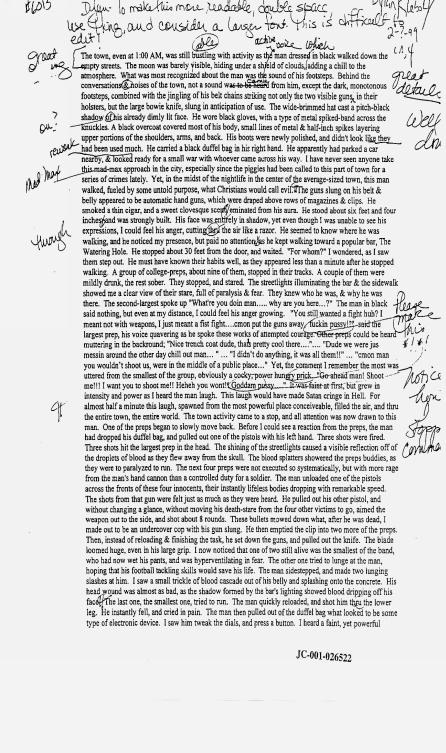
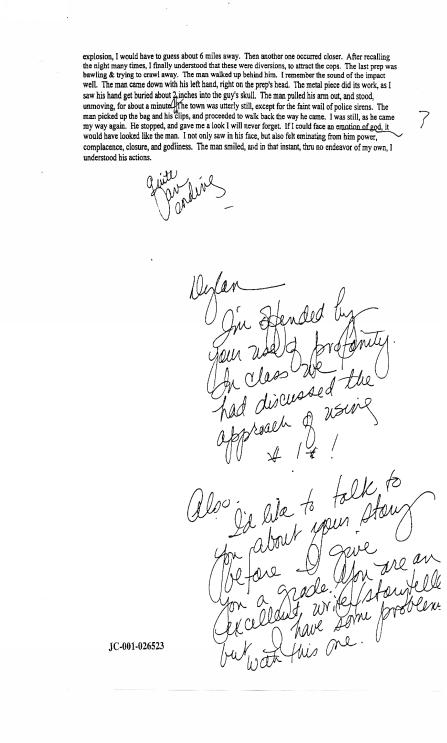
Notice the “leakage” on the first page, six lines up from the bottom, with the clear reference to “football tackling skills.” Notice the killing of one policeman. Yes, that is the level of analysis that you have to use, sometimes, to look at these writings and understand them. That is how you need to intellectualize this research.
Now, one more time, read the essay, from the standpoint of what it says, and not how badly it is punctuated. Ignore the spelling errors. It is written very well. No, not technically, but the message is clear, and vivid. It is angry. It is violent. It is a warning. It is a clear portrayal of this boy’s violent anger and his planning for revenge. It is stunning.
This essay was corrected for spelling and editing, and was not seen as a red flag and the first step in an intervention, and that was a failure of the highest magnitude. Can you see it? Are you so ignorant of the pain in humiliated children, that you don’t see it, even in this most obvious example.
If you had felt his pain, it would have made you afraid. It would have made you cry.
Read it again.
Dylan’s Essay: a final note.
2006
There is more, and it may not be very apparent. If you haven’t read Mones, or Athens, or Gilligan, you may not have seen it. This essay was a decision. It was a declaration. It was Dylan saying, to himself, and to the world, that he had decided to be violent.
In the process of violentization, there is a point that violent criminals, or violent children, reach. It is the point where the humiliation they have suffered is enough. They have had all they are going to take. It is the point in the process of violentization where they decide, consciously, to be violent. This was that point for Dylan. This was that decision. This was that declaration.
He declared it to his teacher, to the world, and admitted it to himself. Now I will get revenge. Now I have decided to get revenge.
That is what I believe this essay is.
Those are my thoughts. I would ask you to read it again, from that viewpoint, and give that some thought. In the future, perhaps we will see a story, an essay, a declaration, or even a verbal threat, in a clear enough way that we will see the decision behind it: The decision to be violent. This was a declaration of the intent to be violent, in response to the bullying. It is the next to the last stage in the process of violentization, created by the humiliation.
It is not the fear. That is part of the process. It is not buying the guns. That is part of the process. It is not building the pipe bombs. That is part of the process.
It is the decision to be violent that is the most important stage.
The final stage is the violent act itself.
This was the killing declaration, the suicide declaration, written a few weeks before the murders. This was the letter, telling everyone why he decided to kill. They are the same thing. To the humiliated child, or boy, they are the same thing. Suicide, or murder, or both, this was Dylan admitting it to himself, and telling us. And we missed it.
Eric’s Writings
July, 2006 release.
This is a typed copy of some of the writings from Eric’s diary:
Page 26,002: A list of people, completely redacted, from Eric’s Journal. The writing says: **“*Class of 98, top of the should have died list***.” Eric had a list of students from the 1998 graduating class that he wanted to kill. Note that this is a list of students from the year before, the previous graduating class. The source of his hatred was from the year before. The class of ’98 was the beginning of the humiliation.
Page 26,012: Eric writes: “It will be very tricky getting all of our supplies, explosives, weaponry, ammo, and then hiding it all and then actually planting it all so we can achieve our goal. But if we get busted any time, we start killing then and there, just like Wilks from the Aliens books, I ain’t going without a fight.” Written sometime between July 29, 1998 and October 23, 1998, this shows the level of planning he was doing, and how far back it was. Another interesting reference is his naming a fictional character from the Alien books, a marine named Wilks, as his hero. Everything this boy did, involved violence: his books, his movies, his reading, his video games. Violence, in everything. He was planning to die like a fictional character in a violent science fiction book.
Page 26,013: “I feel like talking about lies, I lie a lot. almost constant, and to everybody, just to keep my own ass out of the water. and by the way, side note, I don’t think I am doing this for attention, as some people may think. Let’s see, what are some big lies I have told; “yeah I stopped smoking” “for doing it not for getting caught” “no I haven’t been making more bombs” “no I wouldn’t do that.” This is a fascinating page. Eric is telling us that he was caught making pipe bombs, obviously by his parents. He says that he has lied to them, telling them he is not making any more bombs. He wrote that on November 1, 1998. They didn’t check his room, where all of the pipe bombs were stored in drawers, closets, boxes and in the window well area that his parents knew about. He was caught building them, continued to build them, was questioned about building them, and they didn’t check his room. If you could see the basement tapes this would anger you. His room was a veritable arsenal, with bombs and bomb making equipment everywhere. His parents questioned him about pipe bombs, and they argued about it, but they never searched his room to verify it.
Page 26,014: “Everyone is always making fun of me because of how I look, how fucking weak I am and shit, well I will get all you all back! Ultimate fucking revenge here. You people could have shown more respect, treated me better, asked for my knowledge or guidance more, treated me more like a senior, and maybe I wouldn’t have been so ready to tear your fucking heads off. Then again, I have always hated how I looked, I make fun of people who look like me, sometimes without even thinking sometimes just because I want to rip on myself. That’s where a lot of my hate grows from, the fact that I have practically no self-esteem, especially concerning girls and looks and such. Therefore people make fun of me… constantly… therefore I get no respect and therefore I get fucking pissed. As of this date I have enough explosives to kill about 100 people, and then if I get a couple bayonets, swords, axes, whatever I’ll be able to kill at least 10 more, and that just isn’t enough!
Page 26,015: Guns! I need guns! Give me some fucking firearms! 11/12/98 As a note, Eric still had 4 more appointments with his diversion counselor when he wrote that. Four more months of meeting with his diversion counselor, before he was given an early release and a favorable review.
Page 26,015: “I’m showing too much of myself, my views and thoughts, people might start to wonder, smart ones will get nosey and something might happen to fuck me over, I might need to put on one helluva mask here to fool you all some more. Fuck fuck fuck it’ll be very hard to hold out until April. If people would give me more compliments all of this might still be avoidable… but probably not. Whatever I do people make fun of me, and sometimes directly to my face. I’ll get revenge soon enough. **Fuckers shouldn’t have ripped on me so much huh! Then again it’s human nature to do what you did… so I guess I am also attacking the human race. I cant take it. Its not right… true…correct…perfect.”*** These writings tell the story fairly clearly. Humiliation is a very large part of his anger. But that is not the whole story. In addition, there are references to Nazis, killings, and sex, and all kinds of rants and diatribes on many subjects. They are not clear. They are random, and full of hate, and anger, and violence.
He writes about buying the guns, at the gun show on Page 26,016: “Well folks, today was a very important day in the history of R. Today, along with Vodka and someone else who I won’t name, we went downtown and purchased the following; a double barrel 12ga. Shotgun, a pump action 12 ga. Shotgun, a 9mm carbine, 250 9mm rounds, 15 12ga. Shotgun slugs, and 40 shotgun shells, 2 switch blade knives, and a total of 4–10 round clips for the carbine. We… have… guns! We fucking got em you sons of bitches!” This is clearly the purchase of the guns with Robyn. The purchase of three weapons and over 300 rounds of ammunition. No charges were ever filed against Robyn. Eric and Dylan were both underage, and they took a straw buyer, Robyn, with them to purchase the weapons and ammunition, and the gun dealers sold it to them. The gun show had no age requirement for entry. In the case of one shotgun, Robyn bought it, and Dylan took it directly from the gun dealer. It never even touched Robyn’s hands. Isn’t there some question about Robyn at this point? Doesn’t it make you question her observational abilities, judgement and intelligence. These two boys took her to a gun show, with an age limit to buy the weapons of 18 Years-of-age. They had her buy three weapons and enough ammunition to go on a killing spree, and she didn’t think anything of it. Is it possible to believe that she was completely unaware of the excitement of Eric and Dylan? Is it possible that she was completely unaware of their intentions? Is it reasonable that she could remain unaware of any danger, buying these two boys shotguns, a rifle, and three hundred rounds of ammunition? Is it possible?
Page 26,017: “Yesterday we fired our first actual firearms ever. 3 rounds from the carbine. taught that ground a thing or 2. I even had 2 clips in my pocket talking to vodkas dad about senior ditch day… im gonna still try and get my calico 9mm. just think, 100 rounds without reloading….hell yeah!” Undated, but written some time before 12/3/98. Yes, a reference to a “calico,” the 50 or 100 round magazine that is a special-purpose high-capacity magazine for a 9mm rifle. It is a bit unclear, but this entry was made sometime between Nov. 22nd 1998 and Dec. 3rd, 1998, and that is of incredible importance. The first time these two killers actually fired their weapons was between 11/22/98 and 12/3/98, less than five months before the killings. It would have been winter in Colorado. They would have had little practice time with their own weapons. Rampart Range Road, where they went to practice, was closed most of the time in the winter. It closes from December 1st thru April, depending on the weather. They had nowhere to practice. They were amateurs, rank, pitiful amateurs with their weapons. The police, with their thousands of practice rounds, were far better trained, far better prepared. Never lose track of that important detail. On approx. December 2nd, 1998, less than five months before the killing, they fired their firearms for the first time.
There are more writings, complicated writings, with some obvious mental health issues. How much of this mania is from the Luvox, the SSRI drug that Eric was taking, and his ever-increasing prescribed dosages, his self-withdrawal and then self-administration of the drug to increase his anger, and how much is Eric, is very difficult to tell. That drug can cause this reaction in people under the age of 18, so that might be the cause.
I am adding these notes, to try to be fair. It is my contention that bullying and humiliation were the cause of Columbine, and that is definitely supported by Eric’s writings, the bullying that happened, and their comments when they committed the murders, but, some of his writings are wild and full of hate. I wanted to make it clear that there may be other reasons, that a psychiatrist or good psychologist, might be able to learn from these writings.
I find the following statement to be a profound and clear statement supporting my ideas as to the cause of Columbine: “shouldn’t have ripped on me so much… it’s human nature to do what you did… so I guess I am also attacking the human race.”
In other words: You humiliated me, that is the world, and I hate you all.
That does match, perfectly, the concepts we have been reviewing: Humiliation, Hypervigilance, and violentization.
As a side note, in these writings, Eric names his shotgun ‘Arlene,’ based on a character from the Doom books. His words: **“*I dubbed my shotgun ‘Arlene’ after Arlene Sanders from the Doom books. She always did love the shotgun.”*** He is mixing the fantasy world of “Doom,” the levels on “Doom” that he created, and the reality of the shotgun. A mixing of fantasy and reality. Now, tell me again that violent video games don’t change the mind of a teenager. He named his shotgun Arlene.
Yes, there are more writings. Many pages. That is enough. I have made the writings in bold script so that you can see them and differentiate them from my own writing. I had to put these in the book. I know that some of you will hate it. But I had to. There are so many false stories out there, so many lies, that I needed to put these in the book, so that you can see the reasons, in his own words. That is enough.
Well, that was almost enough.
August, 2006
Dylan wrote too. Dylan had writings that were childish, that, except for their violent nature, could have been written by a 12-year-old. They were childish and immature.
But, upon analysis, the writings support very well the concepts of humiliation, hypervigilance and then violentization being the underlying cause of these killings. To understand that motivation, you need to read his writings, and then think about what caused them. Dylan wrote, on page 26,241: “NBK will be the ultimate revenge, to our shitlists, the pigs, everyone!”
Do you see it. “NBK” is natural born killers, the code name they shared for the upcoming killings, where they will become the ultimate bullies through violence and killing. Yes, based on the absurdly violent movie Natural Born Killers, which is full of cold-blooded killings.
“Ultimate revenge” for the humiliation, slights and bullying. The end game.
“Shitlists” for the lists of the bullies that they made in school, the jocks who bullied them, and others. Both Eric and Dylan had “hit lists.”
“The pigs” for the police and the injustice they felt for being arrested.
And finally, “everyone” for everyone in the school, teachers, students, administration, and everyone else. None of those people defended them or helped.
I am not saying it is rational, but the humiliation they received, the violence they lived with, the irrational thinking and motives created by the process of violentization, led to these killings. It is not rational. But now we can understand it. He is saying it clearly in his immature writings.
When he writes these things, in his large hand-written notes, he is telling himself, and us, the reasons he had for the killings. The police did not read these pages and understand the meaning. Very few people have read these pages, and almost everyone missed the clues. He is telling us that he was bullied, he is angry, he wants revenge, and he is going to get it. And he is telling us why, if we will just read it and learn.
He wrote: “NBK will be the ultimate revenge, to our shitlists, the pigs, everyone!”
Let me translate: “Our upcoming plans to kill everyone in the school will be the ultimate revenge for you people who have bullied us for years. We will get revenge on everyone listed on our shitlists , who bullied us, on the police, for arresting us, and on everyone, because none of you stood up for us or helped.”
Humiliation creates the embarrassment and then the anger. Hypervigilance magnifies the humiliation and anger. Violentization leads to a decision to be violent.
Did you want to learn about the reasons for Columbine? There it is, a simple explanation for you, written by Dylan, at the end of his junior year.
I have to add a disclaimer to this chapter. The writings I am referring to are on released page 26,241. It is a little unclear, even after hours of review, if this is by Dylan or Eric. My gut tells me Dylan, and so does everything about it, but there is the remote possibility it was written by Eric. The police have mixed in pages from both killers.
Can you believe this?
November, 2006
The new Governor-elect Bill Ritter, through a Democratic spokesperson, is considering appointing former District Attorney Dave Thomas, to the position of Head of the Department of Safety of Colorado.
I am astonished, angry and quite bewildered. Doesn’t the new Governor remember that Dave Thomas lied to the families of murdered children: The Columbine Families? Doesn’t the new Governor remember that Dave Thomas was involved in a cover-up of the truth about Columbine for over 5 years? Doesn’t the new Governor remember that it took an investigation, by then Attorney General Ken Salazar, to expose the lies and the deception, finding that District Attorney Dave Thomas attended a number of secret meetings designed to keep the truth from the public and the victims? Certainly, the new Governor remembers the Columbine tragedy. He was on the failed Governor’s Commission on Columbine. He was part of that laughable attempt to get at the truth, and one of the Commission members, who sat there and listened to lie after lie, and then recommended new radios for the Police, as an absurd solution to a much greater problem. Certainly, the new Governor is reasonably informed about the results of the investigation and the exposure of Dave Thomas and his corruption and cowardice.
Then, the question remains: Why would the Governor-elect even consider a ridiculous appointment like this? Is it that District Attorneys in the Denver area, a list including Bill Ritter, protect each other and support each other over the interests of the citizens? Is it that Bill Ritter owes Dave Thomas a great political favor for concealment of the truth for some investigation in the past, involving Bill Ritter’s office? Did D.A. Dave Thomas review some very sensitive case for D.A. Bill Ritter, such as the Mena, or Lobatto, or Truax case, or some case we have not heard of? Is this payback for clearing the Denver SWAT Team after the Columbine fiasco? A task Dave Thomas did without even reviewing the ballistics information, or interviews.
There is either a great deal of stupidity behind this possible appointment, or it is simply political payback for a past favor. It makes me wonder what Mr. Ritter’s advisors are thinking. Do they want to ruin his career before it is even started? Are they on the Republican payroll?
Or maybe Bill Ritter is smarter than I am. Perhaps former corrupt District Attorney Dave Thomas should be appointed to a position in public office, under the new Governor. I have been thinking of the title:
Head of the Office of Corruption and Cover-up? Freedom of Information Act Subversion Officer? Head of the Department of the Denial of the Constitutional Rights of Citizens? Manager of the Department of Cover-up with Impunity? Chief Liar to the Families of Victims of Violent Crimes? Chief Counsel to the “I’ve Got A Secret and you won’t find it out for Five Years” Department.
That last one is probably it. That would put us past the next election for Governor, and Mr. Ritter will be term limited at that point. Then I guess Dave Thomas can run for Governor. The Democratic Party obviously thinks that our memories of past transgressions are very short.
What the hell, let’s just start the campaign now:
DAVE THOMAS FOR GOVERNOR…
INTEGRITY DOESN’T MATTER.
THIS TIME HE WILL LIE FOR YOU!
Governor Elect Bill Ritter: Tell us it isn’t so.
Columbine Documents that are being hidden by the Sheriff and the Killers Families:
Nov. 2006
It is fascinating to watch. Brian Rohrbough and a few of the families keep fighting in Court to get the hidden files from Columbine released. They are fighting even though their children are dead. They are fighting for your children, and other children, across the country and across the world. They want the hidden files released to the world for one reason: To try to prevent future school shootings.
The only way that we can stop future killings is to read, analyze, study and understand the motivations of killers, like Eric and Dylan.
We need to understand that they were not crazy. They killed for a reason, and we need to learn that reason. Those reasons are in the hidden documents.
It should anger you all that the Sheriff of Jefferson County is supporting the Harris and Klebold Families in the suppression of this evidence, and is using your tax money for that perverted purpose.
It should sadden you all that the Klebold and Harris families lack the humanity to try to help in this goal. Their children killed, and they want the reasons kept secret. They can’t even see that releasing the information could stop another school shooting, and might prevent another family from going through the pain of their own current situation.
The worst and most embarrassing point of all is that 11 Attorneys General from varied States across the country have joined with Mr. Rohrbough and the other families to support the release of the truth. Eleven other Attorneys General have now joined the fight to release the information, and our current Attorney General, and our Governor and legislators, cower in the darkness and don’t say a word.
Our State is an embarrassment. Our State is hiding the truth, and other politicians and attorneys from around the country have realized that this information is important and will save the lives of innocent children. Doesn’t it break your heart to see the Attorney General from Virginia asking for information that could have, might have, prevented the murders at Virginia Tech.
There is simply a greater-good here. The embarrassment to the Sheriff and his department will be great. The sadness and pain for the Harris and Klebold family will be immediate. Those facts are a given. But the truth will save lives.
Shame on Ted Mink. Shame on the Harris and Klebold families. Shame on them for allowing innocent children to die for their self-preservation and self-interests.
My thanks to Brian Rohrbough and the other families who are fighting for the release of the truth. They have shown great courage.
Look at this brave man, Brian, who has nothing to gain but the hope that he can save an innocent life by preventing another tragedy like Columbine. You need to realize that this man is a hero, as are the other victim’s families involved in this fight. They deserve your respect and admiration. They are fighting to save the lives of your innocent children.
Weary.
Nov. 2006
I grow so weary of people that refuse to learn. I read an article about the man who shot 5 people in a Wendy’s, and one of the comments was that he had no motive. He just snapped. He went crazy. That is not the truth. If we have learned anything from most of the shootings in this country, and from the terrorists overseas, it is that these people have a reason for their violence. People are not evil. They do not kill people for fun. There are rare exceptions to that statement. Killers have a reason. They have been bullied like the Columbine Killers, and they had no chance at redress or justice. They have been ostracized and marginalized like the Virginia Tech killer. They are on psychotropic drugs like the NIU Killer. These people are often suicidal, and without hope. They feel unloved and alone. Many of them have statements they want to make, and we simply are not listening.
Then the politicos in charge decide to enact gun laws, school lock-downs, and give the campus police automatic weapons. They are fools. They haven’t learned a thing from the past. We cannot prevent school shooters from killing, once they are on campus with their weapons. We would need a policeman, ready and armed to kill, on every corner of every school, in every city. That is a task the National Guard could not accomplish. We need to disarm the killers before they buy their weapons, before they are disenfranchised and alone. We need to take away their anger. This is true with our school shooters, our home-grown terrorists, and the terrorists overseas. If you listen to them and give them a reason to hope, they will not want to kill you. If you show them love, and show them that you care, they will not want to kill. We need to reach out to the lonely, and the children in despair. If they are on the brink of suicide, they are one step from murder, and then suicide. Look for those lonely alienated souls, and offer them your time and love. Offer them a voice that will listen to them. Offer them hope.
It seems to be such an idealistic point of view. We can help the world. I would suggest that we give it a try. The other methods of police intervention, and a stronger police presence, are not working. We should of course, listen to threats, analyze them and respond to them immediately. We should react to any threat of violence against a school or public building. But we should first pay attention to those who are on the fringe. Listen to them. Just because they are dressed in odd clothing, are shy, or are depressed, does not mean that they have no value. They have value. Show them that you care.
If we can give people a way to correct injustice that will eventually bring about a positive change, they will not be angry, they will not want to kill. They will have hope in the system, and they will keep trying.
If we can give people a way to correct injustice that will eventually bring about a positive change, they will not be angry, they will not want to kill. They will have hope in the system, and they will keep trying.
Yes, I repeated that twice. Read it again and learn.
Every one of these killers has reacted to a perceived injustice, and we are not listening.
We should listen, we should give them hope. If we show them justice, and fairness, many of them will simply lose their anger. They will not want to kill.
Face in the Rocks. The book.
2006
People handle tragedy and sadness in many ways. Some go to church and pray, some drink, some drive fast cars and some find unique ways to handle the strain.
We would deal with the unending sadness, and the loss of life, and the pain. It took its toll on our lives.
We started hiking in the mountains near our home, to get away from the depression, but we would talk about the murders, and the reasons, while we hiked, so it was not actually time away. Then we started taking photos of rock formations, that we would see while we hiked. These rock formations looked like faces. We would hike and look for faces. It was an escape from the sadness. It would get us out into the blue sky and the mountain air, and it would make us think about finding these faces. For an hour or two we would be free. We would be in the beautiful mountains, with the deer, and the sun, and the views of Colorado valleys and peaks.
We would go to the mountains, and hike, and look for faces. We would take their photos and wait for the film to come back from the developer, and laugh and try to find the faces we had photographed.
It was time away. It was fun.
We would laugh, and Judy would tease me for taking too many pictures. She would admonish me to only take photos of the faces that were at least a seven, on a scale of ten. I rarely complied. It was fun. I took over 5,000 photos, and most of them are not up to Judy’s standard.
Then, the next day, we would deal again with the awful tragedy of Columbine. Then, the next day, we would be back in the great sadness and the overwhelming complications of the murders, the police response, the cover-up, and the search for the truth. We would attend Commission hearings, talk to the press, study ballistic reports, and file for the release of hidden documents. We did this for over seven years.
We looked for “faces in the rocks” for over five years. The search for the faces saved us. It gave us humor. It gave us time away. It gave us an odd sense of normalcy in a world full of tragedy.
These faces in the rocks are our friends. They have given us strength.
Judy spent three years or more putting the faces into the book format, researching the quotations, and being sure that they match the face, made of rock. In doing so she created a unique work of art, combining the faces made of rock, and the sayings of great people, to create a synergism of depth and meaning.
The book is called “Faces in the Rocks. A Spiritual Journey.” Putting it together was a great experience. It kept us from the sadness of Columbine. It led us out to the mountains and the foothills, taking us into the fresh air, with the deer and the blue Colorado sky, and the beauty of the mountains.
We found the faces together. I took all of the photos in the book with a really great 35 mm camera with Zeiss lenses. Then Judy did all of the work putting the book together. It was a great partnership, and a lot of fun. What it really turned into was an escape. We were away from the phones and the tv and the Columbine tragedy. It was therapy. It saved us.
The Sheriff of Jefferson County is wrong
April, 28, 2007
Sheriff Mink went to court to keep the files on Eric and Dylan secret. He is saying he did this to stop copycats, but let’s analyze that statement to see if it is true.
First: Keeping these files secret maintains Eric and Dylan as “heroes” to some lost children, because it retains the mystique of their lives. They appear, to these lost and alienated children that idolize them, as martyrs and brave tough guys. If you release the information and the tapes it would be obvious to everyone that they were scared and ridiculous, acting with a false bravado and a pretense of courage. Show them as the cowards and the scared boys that they really were, and the copycats will not want to emulate them. They would be ashamed of the cowardice. They would be heroes no more. They would be revealed as the cowards they were.
Second: These tapes are not, as Sheriff Mink states, a blueprint for another shooting. I have seen them. They are not a blueprint for anything. They are a glimpse into the thoughts of two boys who have been bullied and are out for revenge. These tapes will be an instruction manual for schools in how not to treat children, and will make us all aware of the failures of the parents, schools, police, and district attorneys in the past. That is how we learn, by correcting past mistakes. Sheriff Mink just doesn’t want us to learn the lessons, because they will upset some people. That is how we learn. Lessons aren’t painless.
Third: Mink says that his fear of copycats is the reason for keeping this information secret. In fact, the school shooters have been copying the act for years. There are copycats now. They copycat the act itself, not the details released months or years later. If the school shootings we have had all over the country are not copycats of Columbine and other school shootings, what are they: Original ideas? Mink’s objection is therefore spurious. There are already copycats.
Fourth: The school shooters have learned from the past. The most recent one has the shooter sending his tapes to the media, so that the local police can’t selectively release only those items which do not implicate them. This brings up an interesting point: The shooters are learning from the past, but, because we cannot see the information or learn from it, we are not. They are learning from the previous school shootings, but we are not. They become more efficient, and we are not informed about how to stop them. The school shooters are learning from the details released on the news, but we are kept in the dark about the real causes. We don’t know the family dynamics, the causative effects, the motivating factors, because Sheriff Mink has gone to court to keep them secret. Sheriff Mink and the killers’ families have gone to court to keep them secret.
Whose side are you on Sheriff Mink? Tell the killers’ parents you are sorry, but you have to release the tapes. You have an obligation to save the lives of other innocent children by releasing all of the information. We need to learn the lessons of Columbine, no matter how painful they are.
The Basement Tapes.
My notes on the videos after watching them.
April, 2007
-
Eric’s house — talking
-
Tour of Eric’s room
-
Dylan’s room — dress rehearsal.
-
Goodbye from Eric’s house
1. They are talking, want to get revenge for four years of bullying, revenge for the ‘January Incident.’
Eric: “I moved a lot, always starting over. Love my parents. I hate to do this to them, but “war is war.”
Dylan: “Yeah. My family is awful. My aunt is so stuck-up. I hate my brother. He is always mean to me.”
2. Eric’s Room
Dylan is filming Eric.
Eric: “Oh, hi mom, come on in”. (Giving a tour like it is to his mom. Dylan is working the camera.)
Six to eight red shotgun shells are on the shelf at eye level when you walk in.
The room looks normal. Eric starts to show the bombs. He pulls a few things out of the way, and pipe bombs are clearly visible. He opens his desk drawer, “Here are clocks I used for timers.” There are six of them in various stages of disassembly.
“Oh, if you move these Cd’s”. He moves a small cd rack and pulls out a 12 to 14-inch long 3 ½ to 4-inch-wide pipe bomb with duct tape on the ends. (wrapped in duct tape). There are three of them, you can see the ends.
“Here is my bomb making kit”. He shows a fishing tackle box, opens it up and shows fuses, a syringe, tape, wire and various items.
“Here are the crickets.” He opens a box and there are co2 bombs, about three inches long, with duct tape. Says, “You wrap nails in them”. There are probably 20 or so in a box. I remember three boxes.
“And here is...” He opens a box and pulls out a 12 to 14-inch-long knife. He opens a BB gun box and shows the shotgun. I think he had a name for it.
Shows a coil of blue “wire” on the wall, hanging on the wall in a two-foot diameter coil. Says it is fuse.
There are no big pieces of PVC or pipe laying around, none visible, no cut pieces, no six-foot pieces.
3. Dylan’s room
Friday night at 10:00 P.M., just before prom, and four days before April 20, 1999.
Eric has a big black duffel bag. They unload pipe bombs, guns, ammunition clips, ammunition holders, all laid neatly on the floor.
Everything came out of the duffel bag, nothing from the room.
Dylan tries on a belt, and the Tec 9, which runs on a strap over his left shoulder. It is too short.
Eric puts on a “vest,” a gun and ammunition strap system. It is mostly straps. He has on a t-shirt and looks like he weighs 90 pounds.
Dylan puts the trench coat on over the Tec 9 and a shotgun, which goes in a holder on his right side. He has shotgun shells in knee clips on his left leg.
He drags the end of the shotgun over the pipe bombs on the floor.
Dylan’s room is on the second story of their home, away from the master suite. They are not making a lot of noise. Dylan occasionally looks toward the door. There are no Nazi insignias or swastikas or anything. Two of the walls are painted black or very dark blue.
Eric gets the 9mm rifle. It has a laser scope. He aims it at the camera. The red-light shines into the camera. It is not an attached laser, but a laser light taped to the barrel.
Dylan can’t remember how to clear the shotgun. Eric tells him how to fix it.
Then, they sit in Dylan’s basement, on a couch, and talk and drink whiskey from a bottle, small sips.
They talk about ‘religious stuck-up bitches’ and school. About how they hate school.
4. They are in Eric’s house, April 20, 1999 in the morning. They say goodbye to their parents, on the tape. They seem to want to stop, but they cut off the emotion and say goodbye and leave.
There is an odd moment, kind of a pause, and they leave for the school.
April, 2007
Did you cry?
Did you cry for the families of Virginia tech? Did it upset you when you found out about the loss of more innocent lives? Did it upset you on Thursday when you found out that the same mistakes had been made at VA tech that had been made at Columbine? Well, I told you. I begged you to help make the Sheriff, and the killers’ families, release the information that has been kept secret. I begged you, and received an immense wall of silence. Only Brian Rohrbough and my wife, and my son, spoke up, and very few other people.
Now we know that most of the lessons of Columbine have not been learned. We know this because Virginia Tech made the same mistakes, and actually made them worse. Eric called out for help, but his calls were subtle. He told his diversion counselor that he was suicidal and homicidal. He threatened lives, and was ignored. He didn’t receive the intervention and mental health treatment that was indicated. We find out now that the Virginia Tech shooter tried to get help. He went to mental health facilities four times, and was reported, by his teacher, more than once.
The parents of the killers at Columbine, and the Sheriff of Jefferson County, have tried to keep the files secret. The remaining files are in fact going into the National Archives for 20 years of continued secrecy. Think, just think, about the lessons that could have been learned if we had known all of the facts. Think about the lives that would be saved, if we would just listen, and learn the lessons.
Stop the bullying. Help these children when they ask for help, and get them the mental health treatment they need. Value every child, not just the athletes. Listen to the teachers when they raise a voice of warning.
When will we pay attention, when will we listen?
The Last School Board Meeting in Jefferson County
2007
There are approximately 90,000 children in Jeffco schools. That equates to 180,000 parents, 20,000 step parents and 720,000 grandparents. There are about one and a half million people that should have some direct interest in this school board.
Twenty-two people showed up for the last school board meeting. Only one other parent from Columbine was there. The other nineteen people were protesting the banning of a book by the school district.
I know that apathy is wide spread, but look at the power that this apathy gives to these seven people (the school board).
They can make decisions and no one complains. They spend millions of dollars and no one oversees their budgets. They have absolute power because their decisions are not questioned or reviewed by the public.
We all expect someone else to go to watch and control these bureaucrats. Guess what? No one is watching them. Everyone is letting someone else do this job. Let’s do the math. If there are 180,000 parents with children in Jeffco schools, and only one percent of the parents show up, there should be 1,800 parents there. 1,800. 1,800 parents would be 1% of the possible parents.
Yes, I know. I have been to enough meetings to be disgusted too. I know it is pitiful to watch and hard to stomach. I know that, but we still have to be represented.
One percent attendance equals 1,800 parents at a meeting. Three percent attendance equals 5,400 parents at a meeting. Ten percent attending equals 18,000 parents at a meeting.
Find out when the next meeting is scheduled. Set the V.C.R. Go and listen and learn. Take your children. Al least they will learn something for their involvement in Jeffco schools, and perhaps you will learn who should be replaced during the next election.
Randy Brown
One tiny ripple of hate…
June 10, 2007
There were bullies at a local school. The school became more violent. The children in the school noticed. They saw the atmosphere in this school change to one of fear, bullying, and arrogance. One boy grew, through the bullying, to become hypervigilant toward bullying. Hypervigilance is the state that exists when a boy has been repeatedly subjected to abusive behavior from a source, any source. If he has been bullied 3 times, maybe 4 times, he becomes afraid, in advance, of the 5th time. He begins to see bullying behavior in the actions of everyone. He is afraid of them. A glance in his direction is interpreted as a threat. The mere fact that others do not defend him, or stop the bullying, makes him hate them and himself. In the end he is afraid of many people, angry at most people, and angry at himself for being a victim.
In the young mind of a teenager, this hypervigilant state creates great anger and fear, and a great self-loathing. “What is the matter with me?” “Why am I so different?” Many times, a bullied child becomes suicidal. Some become angry and take other lives before they commit suicide. It is not logical, but not every reaction to violence is logical. These are defensive reactions, and sometimes irrational.
Child abuse leads to bullying, that leads to hyper-vigilance, which can lead to suicide or murder suicide. It is the natural progression of things. After this teenager has been humiliated and bullied without a chance for justice or redress, he acts out. He plans revenge, buys guns and plans to kill students. These students are not innocent in the killer’s eyes. They did not defend him. They did not stick up for him. They did not even know he was there. They did not love him. They are therefore, in his mind, part of the problem. This student kills other students and a teacher. He then kills himself.
Another boy sees this, a boy in college, and he understands. He follows the example of the killer, and he too kills. Lives are lost all over the country, needlessly. The second killer calls the first killer a martyr. We do not understand that comment, but the second killer does. He knows the reasons for that killer’s anger: Loneliness, depression, hopelessness, anger, mental abuse, physical abuse, humiliation and bullying. These boys are part of the same club. They suffer the same pain. We do not even see the pain, and they are living it. They are suicidal. They will kill before they commit suicide, and our children will be their targets.
In the end, innocent children are murdered, and the public does not understand. “Why?” The answers are obvious to the hypervigilant boy who has been bullied and humiliated for years. The answers are so obvious that he cannot understand why no one else can see them. We must learn this lesson. We must learn to see the bullying and humiliation for what it is: a cause for these school shootings.
We must learn to see where it starts. It starts with the first bullies who changed the first high school, and filled it with fear and humiliation, with no love for the boy who was too small to defend himself. He grew to hate. The bullying made him hate. The bullies created all of this pain, and sorrow, for so many innocent people. These bullies were the source of all of these killings. This pattern of abuse was the cause for all of this pain and suffering. These bullies sent forth this tiny ripple of hate, and abuse, that has caused so much pain, with our innocent children caught between the bullying and the revenge.
Love your children. Don’t abuse them. Don’t belittle them. Teach them to be kind. Teach them not to be a bully, and don’t abuse your children.
Find out if your son is being bullied and defend him. Help him. Protect him. Don’t laugh at his fear. Don’t make fun of him because he is afraid. Don’t tell him to “toughen up.” He is afraid.
Find out if your son is a bully. If he is, talk to him, help him. Stop him.
If you are being bullied, find a non-violent way to let other people know. Find a non-violent way to be heard. Maybe now, after all of these deaths, we will listen. Maybe now we will listen.
That is one of the lessons of Columbine.
Lessons we need to learn:
Bullying and abuse by a School is unacceptable.
July, 2007
As a society we have learned, and are still learning, to stop the “cycle of violence” of parental abuse. Grandfathers beat their children who, later, beat their own children. These children have been educated to break this cycle, and in many cases child abuse by parents has been stopped in one generation. It was hard for a father to admit that he was being physically or mentally abusive. It was hard for the abusive father to face, hard to admit, and hard to change, but the change was necessary.
It is time to take the next step, to learn the next lesson. School bullying is no longer a rite of passage. It is physical and mental abuse of children that occurs in a school environment. Bullying is not innocent, it is cruel. It is child abuse enacted by other children and, in some cases, by teachers. School bullying, “school abuse,” must be stopped. Just as the abusive parent had to face a difficult reality, so must the school administrators and teachers. They must break the cycle of school violence. They must act together to report “school abuse” of any kind, and to involve the police and social services whenever it is found. It will be hard to turn in a bully. It will be hard to turn in an abusive teacher. “School abuse” will be hard to face, hard to admit, and hard to change, but the change is necessary.
It is the only way to stop the next school shooter. We cannot disarm them, but we can disarm their hatred. We can take away the injustice they perceive, the abuse that exists.
A child abused, physically or mentally, is a child abused. The source of the abuse is never an excuse. The fact that ‘school abuse’ is pervasive throughout Colorado, and this Country, is something that we all need to acknowledge. If your principal and teachers are denying that school abuse exists at your school, they are hiding from the truth. Unfortunately, it is your children who will pay the price. They will be the bullies, or the bullied. They will remember these torments and these injustices for the rest of their lives, or worse.
“School abuse” can be stopped in one generation. It can be stopped in one month if the school board, the school administrators, the teachers, the parents and the students will admit that it exists, that it is wrong, and that it must be stopped.
Stop the “school abuse.” Stop the bullying. Now. Stop it to honor the memory of the victims of Columbine. Stop it to protect your children, before it is too late.
Isaiah Emon Shoels: The Memorial
July, 2007
Betty: Betty wasn’t responding to the Memorial Committee. She was very hard to reach. The committee needed to have her compose the verse, or writing, on the stone tablet that would be in the memorial. I finally got her on the phone, and she was so nice. She asked me to help get it ready. I told her that I couldn’t do it. It wasn’t my place. I can’t write well enough to do it justice. She insisted. I talked to her about it a lot, and then she sent me a long list of bible verses that she wanted to use. There was a limit on the number of words. She was only allowed so many words, and she couldn’t scale it back. She asked me to do it, and insisted I finish it.
I worked on it for a few days. I read everything she sent over, and tried to figure out what she really wanted to say. I prepared it, and sent it back to her. This is the one she picked:
Isaiah Emon Shoels
The love of God was first in Isaiah’s life. The love for his parents, Vonda and Michael, was the highlight of his life. His close relationship with his Grandmother Bessie showed in his respect for others. He loved sports, playing and joking with his family, and was taught to love others no matter how they treated him. Isaiah died in a room filled with hate and darkness. He now lives in a beautiful heavenly room filled with light and beauty. He would want you to look up and see the light, to put away the guns, hate, prejudice, and pride, and see the great light that is love. He is one of the beautiful flowers God has picked for his Heavenly Garden, to shine and to be an everlasting light.
Isaiah, we will always miss you. We will always love you. With love from your Family and friends.
Stop doing wrong, learn to do right. Isaiah 1: 15–17
Maintain justice and do what is right. Isaiah 56: 1–2
Those who walk uprightly enter into peace. Isaiah 57: 1
Isaiah, I love you, Aunt Betty
I noticed, and I remembered too, that the committee left off the bottom part. The part she put in that said: “Isaiah, I love you, Aunt Betty.” They left it out of the passage. I remember being pretty upset about it, but there wasn’t anything I could do. I remember too, that Betty didn’t mind. She loved Isaiah. It was obvious.

“To put away the guns, hate, prejudice, and pride, and see the great light that is love.”
That is beautiful.
I heard the news today that Joe Stair committed suicide.
Sep. 15, 2007
Didn’t he know that we cared about him? Didn’t he know that we admired him? He was so brave and so honest. What a courageous young man. What a nice young man.
A survivor of the Columbine High School tragedy, he was one of the students that knew Eric and Dylan. He was not involved in any way in the shootings, and was such a courageous young man after the tragedy, telling the truth and being brutally honest about his life at Columbine, despite the unfair persecution he received.
I will miss you Joe. I talked with you and liked you. I remember that I told you that, and how great I thought you were. You should have believed me. You were a great young man.
For anyone out there who is thinking of suicide, please don’t do it. There are many people that love you and care about you. Many that you don’t even know. You may not know it, but many people love you and care about you. We just don’t tell you enough.
If you are thinking about suicide, please, please, think of another alternative. If you hate your life, move to Australia or England. If you hate your friends, find new ones. If your wife leaves you, be patient and live with the sadness. You will find another love or repair the first one. If you are depressed and there is no hope, call and get help, or wait until the sun comes up. Wait and find a reason to live. Whatever the sadness or tragedy, there is another day and another beautiful sunset, or sunrise, that you need to see. Please, please don’t make the wrong decision now. Please tell someone that you are depressed and that you are suicidal. Please tell someone and let them help you. You will be amazed at how your life can change for the better if you will just give yourself some time.
If you are thinking about suicide you can call the Yellow Ribbon Program at 1-800-273-8255. There is someone there who will talk to you. If you can’t get them on the phone, call a friend or a family member and tell them the truth about your thoughts. Thoughts are nothing to be ashamed of. It is ok to think about it, it is just not ok to do it. Tell them that you are thinking of suicide and let them help you.
Joe, if you had called me, I could have told you that I cared for you, that I valued your soul and your life. I could have helped. Any of your friends or family would have helped. They will miss you. I will miss you.
This death reveals a forgotten component to the Columbine Tragedy. We have the murdered, the injured and the broken. Remember the broken ones too. They need your help. They need your love.
I still have his cell phone number in my phone. I can’t bring myself to delete it.
Columbine the book. March 22, 2009
My review of Cullen’s book:
To a Columbine insider this book is full of errors and speculation. It is as if a complete outsider decided to do a book on Columbine, with a few notes and very little research. I was very upset at the number of glaring errors and the total lack of research. But it is the pure speculation and the imagined responses and emotions he ascribes to Eric Harris that I find so disturbing. They are absurd. Unknowing people will read this book and accept it as fact, and they will be sorely mistaken. The psychological profile reached in the book is based on so little information it should be an embarrassment to the investigator. This book is a joke to anyone who knows many of the truths about Columbine. A joke. A sad, full of misinformation, joke. The final verdict, according to the book, is that Eric and Dylan were not bullied. I guess the writer has never heard of the Regina Huerter Report, or read the many accounts of bullying from students.
Oh well, let’s just rewrite history. It is much easier than telling the truth, and much less painful. If Eric was crazy, as the book contends, no more questions need to be asked. If he was not crazy, and his reactions were a response to the bullying and resulting hyper-vigilance, then we need to change ourselves. Crazy as an analysis is so much easier.
I hate this book. If you read it, remember that it is a fictional account of Columbine. Learn your lessons accordingly.
A Book on Columbine. March 26, 2009
My second review of Cullen’s Book:
The author has a responsibility.
I have just read the book by Dave Cullen on Columbine. I was angry at first, and then just disappointed.
I read it knowing that this was not a novel, not fictional, but a story about a real tragedy, with real people involved. I read it knowing that the story is so complicated that some errors are expected. I read it with the expectation of imperfection, but with the assumption that the author would research his story, and try to get as close to the truth as possible.
What I have found is just the opposite. The author relied on two main sources for his book, a police officer from Jefferson County and the lead FBI Agent for the investigation. Both are not reliable sources without some corresponding research into the other facts that exist, and they both certainly have a biased agenda.
The police officer and the FBI Investigator both have slanted agendas, biased by the Law Officers point of view, and both should have been kept out of any objective story about Columbine. At the very least they should have been interviewed, and their interviews weighted with the real facts as they were revealed years later. I am not saying they are dishonest, just that they have such specific agendas that the story shouldn’t rely on their input for its soul. Unfortunately, it does.
The bullying, which is such a large part of Columbine, is dismissed by the FBI agent and the author, and that glaring omission changes the story of Columbine to a work of fiction. So many students from the school have told us about the bullying, and so many interviews by the police during the tragedy mention the bullying that it is inconceivable to me that this was left out of the book and dismissed in its entirety. There is actually a report made during the Governors investigation with Chief Justice Erickson that mentions and explains the bullying, from the constant fear to the persecution of a Jewish student by the school athletes. Perhaps the author should have read the Regina Huerter Report. To leave this major part of the tragedy out of the story is to rewrite history.
That is what this book is, a revisionist version of the Columbine Tragedy, which leads the reader to believe so many falsehoods that, upon completion of the book, I even questioned all of the things I know to be facts. I even questioned my knowledge of Columbine, and I lived it. In fact, I not only lived it, I researched it for years. This book, and the stories in it, will change the way people look at Columbine, and it will forever confuse researchers and lead them down false paths that are not the real truth.
Yes, I know that some truths can be perceptions, and can be discussed by experts for many years. I understand that some theories are going to vary about the two killers, and about the way Columbine is perceived.
As an example, the failure of the police to go into the school for hours is seen by many as cowardice. It is the glaring example of the failure of the police to protect children and citizens, and the failures at Columbine led to drastic and serious changes to first responder methods. That is basically a truth. But the book makes light of this failure, and doesn’t clearly show the terror and the abandonment of the children left alive in the library, that were rescued many hours later. The name Lisa Kreutz is barely a footnote, and she is the best example of the failure of the Sheriff’s Department. Ignored are the wounded children who may have died while waiting for the police. Ignored is the complete absolution of the SWAT team by the D.A. before the ballistics report was returned from the CBI, a most questionable and suspicious situation.
In addition to the failure to police mistakes, is the absurd way he gives the two killers emotional responses and feelings of regret, when no evidence exists to support this. It is akin to a WW2 reporter saying that the Nazis were sorry, and that they didn’t really mean it. Really?
As a Columbine parent, I find this book repulsive, for the main reason that it rewrites the Columbine tragedy.
The author doesn’t owe me anything, even though I was interviewed for the book. The author owes the public an attempt to tell the true story about Columbine, not an agenda influenced version, based on the stories of two policemen, and some incomplete research.
I am disgusted, discouraged, and disappointed, and sorry that this book fails the people of Columbine in so many ways.
I am mostly sad that some reader will read it in 3 years or 25 years, and think that this is the truth. They will be very wrong.
The people who lived through Columbine know parts of the truth. Everyone knows a different story, and every story is painful and sad. It is better not to tell the story of Columbine if the truth about bullying, the environment at the school, and the causes for the murders are diminished by pseudo-experts who use the tragedy to further their own career or to rewrite history to make the police look good.
Anyone who watched the police response at Columbine for hours, and saw staging but no activity, knows the truth about the police response. It is described in one word: Failure. In fact, the police failed us before, during and after Columbine. In their defense, the new first-responder policies are a direct result of brave policemen watching the failure at Columbine and correcting the problem with new policies designed for a quick, direct and effective response to a school shooter situation.
But, the biggest problem I have with the book is the easy summary that the author and his expert arrive at: There was no bullying, Eric was just crazy. That is so easy it is banal. That is so easy and so convenient.
If the one of the killers was crazy, then we can all relax. It is beyond our power to change it. It is an act of God, and craziness stands as the panacea for all of the worried parents.
“Crazy” means that we do not need to acknowledge our part in this tragedy. We do not need to acknowledge our violent world, the environment of bullying and humiliation in the school, the alienation, the loneliness, the depression, the failures of the psychologists and counselors before Columbine and the pain. We do not have to change. We do not have to try to stop the next school shooting, because you can’t stop “crazy.”
Crazy is easy. Self-analysis and acknowledging our failures is very difficult, and very painful.
How will we ever learn from this, and stop the next school shooter, if crazy is the final analysis? That is the source of my disgust. This is a revisionist story about Columbine that does not acknowledge the many truths about the Columbine tragedy, which actually dismisses the real cause of the tragedy, in print for the parents, principals, psychologists, counselors and others to read. This Columbine story, told by an outsider without the complicated and multiple causative factors explained, leaves the reader with a misconception that will last forever.
It was a real tragedy. If the author can’t tell the truth, he should have written a fictional novel.
Randy Brown
A Columbine Parent
The Cancelled Oprah Show.
Tenth Anniversary Show. April, 2009
We saw the promo on tv. It was a preview of the show, which they ran during the Oprah Show, or maybe at another time. The preview made me really angry. It showed Dave Cullen, laughing, and having a good time, on the show, talking about the cafeteria videos. He was laughing and obviously excited, as he talked about them. He said that they were installed to watch the kids see who littered or left their tables without cleaning up. I was upset. I was having trouble understanding how that would be funny. There is very little that is funny about the Columbine tragedy.
Then, Kate Battan was on the show, all dressed up, with full makeup. Then Frank De Angelis was there, on the screen. Then it showed the lead FBI agent, Fuselier, on the screen. The same one who should have recused himself from the investigation. If you will remember, his son had made, in one of the video classes, a video of blowing up the school. Yes, it is true. It was, of course, irrelevant, but the mere existence of that video meant that the father should have immediately recused himself from the investigation. It is certainly unacceptable to be the lead investigator, when your son attended the school, and had made a video about blowing up the school, regardless of the import of that video.
I fumed. I called Brian and told him. We watched, and saw it again, and Judy got to see it. We got on the phone. We called and left messages for Oprah’s producers, and we were not happy.
The next day I called, and talked to the producer for 45 minutes. I know it was that long, because I kept a client waiting in front of a house for that long, while I ranted and talked to this producer about the upcoming show. I paced up and down the street, talking into the phone, letting him stand there, waiting. It was rude, but it was necessary. Thankfully, he was very patient, and didn’t mind. I told the producer everything I knew about the cover-up, the people on her show, and the lies that some of them had told. I help nothing back. Having those people on a follow-up show about Columbine was an insult to the families, to me and to my wife, and to the world. Brian called too, and talked to them for a long time. He told them that he would sue them if he used his son’s name in the broadcast, at all. He did not want them to use Dan’s name. Dan, of course, was the boy killed outside the school on the sidewalk.
I am certain that Brian knew that he couldn’t stop that. There is no way to stop someone from using the name of his child in the news. It was already released. I am certain he knew, and they knew, but he said it anyway.
Other families called the show, and communicated their feelings about the show.
Judy called too, and talked to the producer for a long time. She explained the situation, and the reality of having those people on the show.
It was a few days later, as I remember, and the show was delayed, then cancelled. They never said why. They never explained it, but they never ran it.
In truth, it is a very nice thing that she did, cancelling the show. It cost them a lot of money. She, Oprah, never ran the show, out of respect for the families of the murdered children. Oprah showed a great sense of justice and humanity by cancelling the show.
I certainly respect her, and her staff, for that, and for listening. That was a real act of courage, and integrity. True integrity and heart. My thanks to her, and her staff.
April 19, 2009.
The Tenth Anniversary.
Life after Columbine can be very bizarre.
In the Denver Post, today, there is an article about the tenth anniversary. It is touching, and very well done. There is an article about Anne Marie Hochhalter, about her struggles and courage. Paralyzed and in a wheelchair, she is a courageous young woman. I remember meeting her, and being amazed at her strength, her courage. She had a pickup truck at the time, and she swung her wheelchair into the back of the truck using a pully system. It amazed me and broke my heart at the same time. What a brave young girl.
Richard Castaldo is also featured. He is in a wheelchair. He lives in Los Angeles, and is working. Paralyzed, and doing the best he can. I have met him too, a few times, and always liked him. He has a great smile. Sean Graves is mentioned too. He has regained the use of his legs and is walking. Amazing.
All of that is brave and sad at the same time. The paper paints them to be doing well, and they are smiling. But we know the difficulty. We know the sadness when the crowd is gone, and they go home, and live with the pain and problems.
That is normal. The pain of the reality of Columbine.
What I cannot stand is the photo of Frank on the cover of the section a few pages back. “Guardian DeAngelis” is the headline. What the hell. Seriously, what the hell. Guardian? Frank? The paper has bought, completely, the act that Frank is using. He stands there looking thoughtful, with his hand under his chin, with half of the page dedicated to him. Why? He wasn’t injured. Who gives a damn about Frank? Not me. There is no mention of his failure to stop the Columbine tragedy. No mention of his failures, or his creation of the bully atmosphere that led up to the killings. In fact, it is a puff piece by Kevin Simpson, telling all about how wonderful he is. It makes me sick.
I know what he did. I know the truth about the Columbine tragedy, and the bullies and humiliation that were created, and allowed, under Frank De Angelis’s leadership. I should say lack of leadership. But this is the local story. This is the myth continued. This principal is a hero in this school and this county.
That is the level of knowledge and understanding that exists in Jefferson County.
It is so easy to accept the lies, ignore the bullying, ignore the testimony, ignore the causes of Columbine, and to give Frank accolades for his leadership.
So easy for people. But, not for me.
In the same paper, on the same day, on page 27A, there is an article with the heading: Bullies Still Lurking in School Halls, by Colleen O’Connor. In it, Del Elliot states that “Bullying is still a significant problem in Colorado Schools and schools nationally.” The article states that bullying is down from 67% to 58%. Verbal bullying is down from 75% to 65%. It is stated by one school administrator that: “Parents were probably the most resistant. They didn’t want anyone telling them what to do.” That was a reference to the response to the anti-bullying programs used. That was in the same newspaper, on the same day. The bullying is down to 58%!
Am I the only one that can see this? Am I the only one who thinks that Frank is part of the problem? That leaving him as principal in that school is one of the worst ideas ever? I guess I am. I even know some of the families of the murdered children, and some of them like him. Some of them love him.
It is, at best, confusing, and at worst, disappointing.
My opinion doesn’t count for much in this County. I have accepted that. I have a hard time accepting the illogic of making a hero of the man, who was the Principal at the school, that was the source for the hatred, that led to the killing of innocent children.
Hidden heroes.
Jan 23, 2011
Invisible Columbine Heroes.
You have a great idea. You want to build a Memorial for the saddest thing that has ever happened in Colorado. You and a friend named Ruth, go to the 4th of July fireworks with a tin cup, and you start asking for donations.
After a few hours you are tired, but you have raised $75. That was the beginning.
This is not an easy project. It is a very sad event, and many people don’t want to even think about it. A lot of people say they want to help, and many try, but the process is difficult, and raising public money is difficult. You keep trying. You hold fundraisers, a Golf Tournament at Columbine Country Club, silent auctions, a 5K run, and you set up booths at all of the local festivals.
Your name is Kirsten Kreiling, and your friend is Ruth Feldman. You have a family, a beautiful family, and they support you. You run a printing business on Coal Mine by the Post Office, and you care. You don’t even know anyone directly involved in the tragedy, but you get involved. You want to build the Memorial.
You are well aware that the families of the murdered children and teacher spent all of the money they had raised to tear out the old library at Columbine High School, and build the new one. You know that all of the demolition was done by contractors volunteering, and without any money from the Jefferson County School District, and you are aware that, when the library was done, the money the families had was gone.
Yes, the library at Columbine High School was built by the families of the victims. They didn’t have any money left to build a memorial, and the County wasn’t offering to participate in any way. Neither was the State.
So, you, Kirsten, decided to do this on your own.
You had help. Many volunteers spent hours and hours trying to raise money, and found out how hard it was. People were unsure, and kept waiting for a big money donor to pay for it, but the big money donor never came. So, you and your volunteers and others raised money. You and the Columbine Community raised money by selling paper Columbines, selling Memorial Pins, by working hard and by never giving up. You and Ruth and the local Dairy Queen and others raised several hundred thousand dollars to build the Memorial, almost all of it small donations by the Community of Columbine. People who had opened their hearts and had contributed one “paper Columbine flower” at a time. In the end, there would be two generous donations by President Clinton, effort by many others, and a contribution from almost all of the Columbine Community. A paper flower here, a Memorial Pin there, and hours and hours and hours of work, and the volunteers slowly made progress. Families of the victims had helped too, and others helped in the ways they could. The Memorial Web Page has the long list of contributors. Then an anonymous donor, a very nice man who is not rich, but who cared, gave another $50,000 to the Memorial fund, and the task was done, or so you thought.
In fact, the task for you was just beginning. You, Kirsten, succeeded Bob Easton as the President of the memorial committee.
Now it was up to you to find a way to maintain the Memorial. The project was scaled back, but it required private donations for maintenance, as the County and school district wouldn’t fund any of the costs.
One of the family members I spoke to said that you were not just the President, but the General, Captain, Sergeant and foot soldier. You spent hours and then years working on this, frustrated by the problems and the bureaucracy, while running your business and raising your family. You paid a serious price to accomplish your goal. You asked, sometimes begged, donors to help. You were behind Home Depot, and Pavestone, and other contributors, and you kept them working and helping for years. You arranged and made sure that local groups like the Columbine Kiwanis had clean-up days, and that the Girl Scouts and Boy Scouts did the same.
What cost the government $500 Million for a smaller Memorial in Shanksville, Pennsylvania, for the 9/11 Memorial, you accomplished for peanuts. Small, inexpensive peanuts. And it worked. The Memorial is beautiful, and visited by thousands of people, and very few, if any of them, even know your name. You have been almost invisible in the process, except for the people that saw you do the work. You have stayed behind the scenes, along with your great friend Ruth, and others, and worked, with little if any recognition.
Your friends know why. You didn’t do this for yourself, and neither did any of the other volunteers. You did this to honor the children and the teacher lost that day. You did it to honor them, and to be sure that people remember them: Cassie, Matt, Dan, Daniel, Steven, Kelly, Kyle, Lauren, Isaiah, Rachel, Corey, John, and Dave.
You did your job, and most people don’t even know who you are. That is a beautiful thing. You helped. You were good friends to the people who lived across that street. The people who lost a daughter at Columbine. You have just resigned as the President of the Memorial Committee, and people need to know: You are Kirsten Kreiling. Thank you for your years and years of work. Thank you for your years and years of courage. Thank you, Kirsten Kreiling and Ruth Feldman.
And thanks to all of the volunteers, contributors, contractors, other Committee members and other unnamed people that spent time to raise the money for the Columbine Memorial. Because of the hard work of all of these people, it is a place of remembrance, and healing. Kirsten has resigned as President of the Memorial Committee, and she is going back to her family and a normal life, after more than ten years.
Thanks Kirsten. Thanks Ruth. Thanks to all of the other incredible volunteers.
My speech to the School Board.
Feb 3, 2011.
Dave Thomas was essentially out of politics. He was out of the election because of his involvement with the secret meetings and the cover-up. Then, he ran to be a school board member. In Jefferson County, being on the school board is a stepping stone to getting elected to other positions. It is kind of a foot-in-the-door position. He ran for the school board, and ran unopposed. He put his name on the ballot, and no one ran against him. He was elected to the school board.
I read this speech to the School Board and all of the parents sitting and waiting for other school business. Dave Thomas is now the head of the School Board.
“Citizens have responsibilities. I believe I have a responsibility as a citizen to inform you about Dave Thomas.
It is a proven fact that Dave Thomas and other officials from Jefferson County lied to the citizens of Jefferson county. It is a fact that they withheld information from the families of murdered children, proven by a grand jury investigation and incredible police work by two of Attorney general Salazar’s excellent investigators. I worked with them in their investigation. I dealt with Dave Thomas during this tragedy. Dave Thomas withheld information for five years. So did 20 other Jefferson County Officials. He has still never revealed his part or the depth of his involvement, or the truth about Columbine. Did he call the meetings? What else was concealed?
Who decided to conceal the truth? What is the truth?
He did this when he was the District Attorney for Jefferson County.
He withheld information from the Sanders family, from all of the other families, injured, murdered, emotionally damaged.
He lied about me, my son, my wife and my family.
He lied to the world, and freely participated in one of the greatest lies in this country’s history.
If he will lie, withholding information is a lie, especially when you have the high standard of being the district attorney, the highest-ranking law official in the county. If he will lie to the families of murdered children, he will lie to you.
He lied to the families of children who went to Jefferson County Schools, where some of you teach. He lied to the family of Dave Sanders, a teacher who was a member of your union.
If you can allow that, abide by that, excuse that, then I ask you: Who are you and what do you stand for?
Dave:
3 things...
Resign as president.
Don’t run again.
Write a “white paper” revealing all that you know about the Columbine tragedy, so that we can try to use that info to prevent more school shootings.
my name is randy brown.”
How do we prevent school shootings?
Feb 2011
First, let’s remember that they are not all caused by the same problem, so let’s discuss them by category.
Category 1: Suicide in a school: to be remembered. This covers the Platte Canyon shooting and the shooting in Lancaster Pa, and many other school shootings.
A) Suicide is a lonely act that is very rarely reported on. Greg Barnes, Hunter Thompson, and a few other suicides are covered in the news. Most, because of the fear that reporting on suicides will create more suicides, are not reported on. In fact, the large number of suicides are not known to most people for this reason. To commit suicide and be remembered is now an easy task: Commit suicide in a school with other victims. This was the situation in Platte Canyon and in Lancaster. We know Mr. Morrison’s name, because he did this in a public school. He won’t be remembered, like Eric or Dylan, but we know his name. This is, as a choice for a suicidal person, a far better action than a lonely death at a campsite along the Platte River. One has a photo in the paper, and the other is invisible. This is a motivating factor for some suicidal people. This motivating factor is also a part of some other school shootings. Teens, in their sadness and depression, can see this as a way to commit suicide and make a point. It is better than dying in anonymity.
This is easy to stop, although it will take a while. We simply stop printing the name of the shooter. When the “I will be remembered” or “I will be famous” aspect is removed, this problem will slowly disappear. We should, of course, try to reach these people who are suicidal through outreach programs and mental health programs. We should value their life, and try to help them understand that suicide is not the answer.
B) Eric and Dylan (yes, I used their names for this example) were revenge killers. They were humiliated, depressed and bullied. They enacted a revenge killing on the school that didn’t protect them and that allowed them to be bullied. During this suicide/ murder they killed without direction. They did not even kill the students who bullied them, although they did try. They killed any student that was available, playing God, by letting some children go, and killing others. This was their way of becoming the biggest bully. To them, their position as God made them the biggest bully.
Eric and Dylan can be stopped by many methods.
Stop bullying. Stop exclusionary groups in high schools from ostracizing other students. Stop exclusionary religious groups, exclusionary sport team groups, and others. Give every student a chance to be recognized and valued, and give every student a voice that will let them be defended, from bullying and harassment, by anyone in the school. Take away the bullying and the humiliation that these students suffered at this abusive school, and you will take away the motivation for revenge.
Gun control won’t work: There are literally millions of weapons for a suicide killer to use, ranging from pipe bombs, automobiles, natural gas lines, fire, propane tanks and pistols and rifles.
Metal detectors won’t work: Secure the school and the shooter will just get a rifle with a scope and kill from the top of the hill. Do you remember Jonesboro? That is what those killers did.
School cameras are useless: All they will do is give us better photos of the killers after the fact. They are not a preventative measure to a suicidal killer. They don’t prevent bank robberies.
School Resource Officers won’t work: There was one at Columbine and Platte Canyon. One tried to intervene, and the other was off campus on an assignment. In truth, to a school shooter, given the element of true surprise, a School Resource Officer is just a way to get another weapon.
Teachers with weapons won’t work. To a motivated school shooter, they would just become the first targets, and teachers cannot be vigilant enough to always be ready to respond to a threat. The example we have with the school resource officers proves that.
Then what will work:
1) Attentive students, that will tell a teacher or policemen, about any signs of danger or threats, and an appropriate method of handling those threats. A threat assessment expert must be involved. A threat assessment team, that involves trained parents, is a great idea.
2) Fairness in all of the dealings between a student and a school. You can eliminate almost all of the hate, if there is a sense of equality, fairness and justice for all in the school environment.
3) The Yellow Ribbon Program created by Mr. and Mrs. Emme. This program to stop suicides should be required in every school district.
4) De-emphasize school sports. If you don’t like this idea, then you must have the athletes be the examples that will stop bullying. If they are the bullies, you have the correct recipe for a school shooting.
5) Stop all cliques. You must teach students to accept and encourage each other, regardless of the individual student’s social status. They must feel that everyone at the school is on their side, and is going through the same type of problems that they are.
6) Parents must be at the school and must be accepted by the school authorities. They can observe and correct problems, through communication with students and teachers.
7) Teachers must be actively involved in stopping all bullying and harassment. No one should be humiliated. Humiliation leads to hatred and violence.
8) Teach non-violence to all students. Gandhi and Martin Luther King and their philosophies, and examples, must be explained and taught. If violence is the only option, we will get more violence.
9) Realize: If one student is bullied, all students are at risk. One student being humiliated creates an environment of anger, and hatred. Any student witnessing that “one student” being bullied or humiliated can incorporate that unfairness and mistreatment into their own perspective of the school. You don’t have to be bullied to hate bullies and unfairness. We must teach all students to accept, respect, encourage and protect each other.
I am sure that there are other very important factors to consider. I strongly recommend that you have a meeting of parents, students, faculty, administrators and police to discuss this in depth. Please remember to listen to every voice that has the courage to speak.
I hope you can come to a decision that involves some of these suggestions.
Columbine Records Review Task Force.
March, 2011
Should the photos of the victims be released? It is a difficult question. We faced this question many times during the Columbine tragedy and the aftermath. Do the papers show the photos of the victims? Should these photos be released?
As a reminder, one of the families of Columbine had no choice. Their son, Dan Rohrbough, was shown laying on the sidewalk by the school thousands of times, in many TV and Newspaper views. Remember the body all alone on the sidewalk, as other children ran by him? It is nothing they wanted, and the press never asked them. The Rohrboughs were reminded many times of their son’s tragic death without a question or consultation.
Then when the photos of Eric Harris and Dylan Klebold were leaked to the National Enquirer, many people refused to buy the paper. It was boycotted in many stores. The photos of Eric and Dylan dead on the Library floor were violent and gruesome. Eric and Dylan are dead, and the photos were permanent, non-heroic proof of the end result of the violence of a school shooting.
Then, when the Families of the victims of Columbine started demanding answers from the Police, the D. A. at the time actually threatened them with an ultimatum, that if they weren’t careful, the photos of their children’s autopsies would be released. He blackmailed them into silence. It was one of the cruelest things I have ever seen. These photos are powerful.
This is obviously a serious question, and as one of the members of the Columbine Records Review Task Force. I have given this a great deal of thought.
The Columbine situation, with the police lying and covering up information, made it even more difficult. If the Sheriff could hide the photos, he was essentially hiding the truth. Which was more important, the truth or protecting the families of the murdered children? At Columbine, the Sheriff and the staff used this to cover up many other facts about the crime, which have been placed into the National Archives for another 15 years, making it quite impossible to learn the entire truth about the Tragedy. I am sure that the same situation is going on in New Town, with the police only releasing the items that they want to. It is such a natural occurrence for the police to protect themselves first. I am sure they are withholding information from the families of the victims, either to protect the Police, or to save the families the pain of the truth, of the awful way their children died.
I did it too. I remember well telling a woman who asked about how the children died in the library, and if they suffered. I lied to her, saying it loudly in front of everyone, and told her what she wanted to hear. I told her they had not suffered, and I knew it was wrong. It just did not, at the time, seem appropriate to tell her that the children in the library at Columbine were taunted, and killed with great uncaring violence, and that they did suffer and they died frightened and in pain. I can say it now. I could not say it then, because I was afraid of the truth too.
So, when I hear Michael Moore tell the world that the photos should be released, I understand. I admire his courage, and I agree with him. He is right. The photos should be released so that the world can see the real truth: the pain, the horror, the painful truth of the death of children by gunfire. I would agree with him if it were a photo of my child. I am lucky it is not.
But, can I ask for the release of these photos if it is not my child? I do not believe so. The families of the victims have some rights, and deserve some consideration and care. It should be up to the individual families. It is their child, and out of love, out of respect, and out of a sense of humanity, we should allow them to make that decision. The pain and memory of this tragedy will stay with them for the rest of their lives. We should not add to that great overwhelming sadness by releasing crime scene photos of their innocent children, and ruin the memory of those innocent children forever.
Would it be better for the World? Would it be better for the Country? Yes, of course. It would be better for everyone if they could see the violence, and the truth of the bodies of innocent children laying on the ground. The reality of that, the incredible sadness, would overcome the arguments, and we might actually do something effective and valid that would stop shootings like this. It might make everyone, just for a few minutes, set aside their ridiculous agendas and find the real cause of these shootings, and do something to stop them.
In the meantime, out of respect for the families of the victims, leave the photos alone. Remember the children with love.
A call from Eric.
Oct. 24, 2011 9:30 pm
A normal evening. I am sitting in front of the tv, watching the World Series. St. Louis against Texas. It is October 2011.
The phone rings, my cell phone.
A voice asks: “Mr. Brown? Mr. Brown...”
I answer “Yes, this is Randy.”
The voice continues: “Is Brooks there? This is Eric.”
I laugh, and don’t say anything because Judy is right there, sitting next to me. I just say: “No, it isn’t,” laugh, and hang up. I don’t want Judy to hear the call or the reason. It wouldn’t do any good.
It is a little funny, and the way life is.
Columbine never goes away.
This guy thinks he is being funny, or he is obsessed with Columbine, or he is sitting down the street in his car. I don’t know, and I will never know. The number is blocked. BLOCKED.
I answered my cell phone, which is my work number. I can’t avoid these calls.
What that dumb kid doesn’t know, is that I know for a fact that he is not Eric. Eric is dead. I have the photos that prove it. I have the crime scene photos, and I know that Eric is dead. His brains are all over the ceiling of the Library at Columbine, and his face is hanging off of his skull in a weird amorphous mask that is still, oddly, recognizable. It is Eric. He is dead. This dumb kid on the phone isn’t Eric.
Eric is dead, on the floor of the library, where he killed himself, after he killed Dylan. Dead.
That is the darkness of Columbine. That is the sadness. That and the worry about this guy who called. The call was blocked. It has been more than 11 years since the murders, and he still thinks he can call me and tell me he is Eric. Where is he? Who is he? Are we safe? Is he another Eric?
I will have to be careful, very careful for the next few weeks. Maybe the next month.
Damn.
I guess I will tell Judy. She should know.
Damn.
The School Board and Dave Thomas.
Dec. 2011
These are the weirdest scenarios. I go to the school board meeting, and sign in to speak at the meeting. They give me three minutes. That is their rule. Dave is on the board. He is sitting in the middle seat on their raised platform, behind the raised counter, in the position of power. I am standing in front of the microphone, with a few parents and kids sitting on the seats behind me. A very small crowd.
I give my speech:
“I have not heard from this board on my complaint from the last meeting.
Having Dave Thomas, the disgraced former district attorney from Jefferson county, as the spokesperson for the board is completely unacceptable. His misrepresentations during the Columbine tragedy make him forever an unreliable source for information. I will remind Mr. Thomas about my requests made last week.
I want you out of the position of president, and off this board. You have proven to the people of Jeffco that you do not belong in a position of trust.
I do ask, for selfish reasons, that you resign, as campaigning about your failures, and campaigning against you on the next election will be quite time consuming for me. And believe me Dave, I will be there. You won’t run in an unopposed election next time.
In fact, I welcome a response from Dave on his betrayal of the Columbine families during the Columbine tragedy. I would love to hear how staying silent and betraying the families of the children murdered at Columbine is a benefit to the public.
As this board sits here, with its power base of the school unions, and Dave and Cindy getting along so well, I was also wondering about the priorities of this board. You are all so concerned with establishing your little power base: School board, teacher unions, budgets, and the like, that I believe you have missed the most obvious problem: If your unions love you, your teachers love you, and you keep the public uninformed due to your policies of muting the elected representatives, the only ones who lose are the children. Uninformed parents, who are assuming that you care about the children and are doing what is best for them, will never know what you are doing.
I was quite ashamed, as a citizen, at the behavior of this board at the last meeting. You and your unions can ruin the school system, and our school system continues to lose students, and lose its quality of education.
How can that be good for the children?”
As a note: Within a few weeks, Dave Thomas resigned from the School Board.
Some notes from the experts.
Everyone should have an understanding of the early warning signs that help identify students who may be headed for trouble.
U.S. Department of Education. August 1998. Early warning signs:
√ Social withdrawal. √ Excessive feelings of isolation and being alone. √ Excessive feelings of rejection. √ Being a victim of violence. √ Feelings of being picked on and persecution. √ Low school interest and poor performance. √ Expression of violence in writings and drawings. √ Uncontrolled anger. √ Patterns of impulsive and chronic hitting, intimidating and bullying behaviors. √ History of discipline problems. √ Past history of violent and aggressive behavior. √ Intolerance for differences and prejudicial attitudes. √ Drug use and alcohol use. Affiliation with gangs. √ Inappropriate access to, possession of, and use of firearms. √ Serious threats of violence.
And there is this, from the FBI.
The School Shooter: A Threat Assessment Perspective.
Mary Ellen O’Toole PhD FBI. 1999.
Prong 1: Leakage. (Revealing clues) Low Tolerance for frustration. Poor coping skills. Lack of resiliency. Failed love relationship. Injustice Collector. Signs of Depression. Narcissism Alienation. Dehumanizes others. Lack of Empathy. Exaggerated sense of entitlement. Attitude of Superiority Exaggerated or Pathological need for attention. Externalizes blame. Masks low self-esteem Anger management problems. Intolerance. Inappropriate Humor. Seeks to manipulate others. Lack of trust. Closed social group. Change of behavior.
Prong 2: Family Dynamics. Turbulent parent child relationship. Acceptance of pathological behavior. Access to weapons. Lack of intimacy. Student rules the Roost. No limits on T.V. or Internet.
Prong 3: School Dynamics. Student is detached from school. Tolerance for disrespectful behavior. Inequitable discipline. Inflexible culture. Pecking order among students. Code of silence.
Prong 4: Social Dynamics. Media, entertainment, technology. Peer groups. Drugs and alcohol. Outside Interests. The copycat effect.
My comments: The above writings are good for you to know. They give some of the ways that a threat assessment expert might look at a potential threat. Review them, for your own information. Study other sites and read everything you can.


Did you notice that almost all of the notes from the FBI are about the student and his problems? His failure to cope. His low self-esteem. There is only the most subtle mention of the exterior factors, like bullies, humiliation, and a need for revenge. This expert showed a complete lack of understanding, or simply doesn’t get it. She left out the environment that can exist, that can create, a killer. In her opinion, the blame rests on the killer, and there was no cause, no causal relationship, that would create the killer. That is absurd. This is why I strongly suggest that you read the following books: “Violence” by James Gilligan, “When a Child Kills” by Paul Mones, “Why They Kill” by Richard Rhodes, “Creation of Dangerous Violent Criminals” by Lonnie Athens, “Lost Boys” by James Garbarino.
If you want to understand school shootings, and the causes, you need to identify the environment that creates the killers. They do not exist in a vacuum. Read these books and learn.
What did Columbine teach me?
Not in order:
1. Don’t worry about the small things. The ones you do worry about will probably not be the ones that you should worry about. 2. Your house doesn’t matter, your cars don’t matter, money doesn’t matter. 3. Your family matters. Your children matter. Your friends matter. 4. There is anger and revenge in the world. 5. Be happy with your simple life and the simple pleasures. 6. The media only publishes or prints what it wants to. The truth is rarely seen. History is only one person’s version of the past. 7. Life is very short, very fragile and can be very, very sad. 8. Never miss a chance to tell someone you love them. 9. The people around you have tragedy and sadness and pain in their lives, they just don’t show it. 10. We are all human. 11. If Dylan can do this, anyone can, given the right set of circumstances. 12. Mental illness is all around us, on the streets, with our friends and neighbors, in the people we love and maybe in ourselves. 13. T.V. is fake. Movies are fake. They do not represent the real world. There are few Bruce Willis’s in real life. 14. The police are not protecting you. 15. Don’t count on the SWAT team to save you. 16. Innocent people die. 17. The world is full of caring, loving people, and you must learn to let them into your life. 18. Politicians run your city and county. They are really insignificant and inconsequential. Let them waste their lives with their foolish rules. Live your own life. Be happy. Ignore them. 19. Read all the valid books you can. 20. Public school may not be the best option. 21. There is no justice in the justice system. 22. The greatest of these is love.
Threat Assessment.
January, 2011
A solution to the current problem with school shooters.
The killings have not stopped. Everyone has watched the memorials on tv, and read about the failures of the police and the fear of the friends of the killers. The police cannot stop these killers because they need a crime to be committed before they can act. We have seen that the crimes of a school shooter or mentally ill shooter are often not serious enough to get that person arrested. The friends know that something is wrong, but they find out quickly that a call to the police is met with blank stares and no action. How can this situation be fixed?
We need a threat assessment team that can review reported threats and mentally ill shooters, and decide if the situation is serious enough, valid enough, to act on.
Most cases will find that the student was just angry. “I will kill you” is not a real threat if made in anger and if there is no way to act on that threat. But a few reports will lead to a person who meets the threat assessment teams recommendation for action. When the threat is serious, when the subject has weapons, has a violent web site, has real and tangible methods of acting on the threat, the team can recommend action. A mental health hold can be enacted. Investigators can be assigned for surveillance and follow-up. Activity can be noted and kept for future investigators. Pipe bomb explosions can be investigated. Additional interviews can be made to determine if the subject is a true and valid threat.
A threat assessment team would have found every shooter in the last ten years to be more than an idle danger. There are patterns and profiling guidelines that many of the shooters match. There is also always a sad after-shooting review during which all of the shootings reveal information known earlier that was never accessed or reported. With a threat assessment team, we would have early reporting of red flags. With a knowledgeable and trained team, we could review the information, develop it and act on it prior to the killings.
Colorado has a great anti-bullying and student threat hot-line. It has saved many lives and stopped school shootings since its inception. It is called Safe2Tell.
We need to take the next step and have a professional threat assessment team that can take reports, assign investigators and develop files for all possible dangerous threats before the plans are developed. An expansion of the successful existing program to include public threats makes a lot of sense.
It is true: there are always signs. There are always comments made to friends, postings on the internet, preliminary crimes and fairly predictive actions that can show who a school shooter is. Almost always.
Given a method to report “red flag” behaviors to the threat assessment team, we can stop some of these killers before they start. If one call from a friend, saying: “I know that he bought a gun yesterday, and he has written really awful things on his website” can lead to a professional threat assessment expert’s interest and follow up, we would have a good chance of saving innocent lives. The key is reporting to an agency that can follow up on the dangers. Police will not, and do not, follow up at this time, because they are restricted through funding and current laws.
This will take planning and work. It will take some planning by some of our Congressmen. It will take a team of parents, teachers, policemen, attorneys and a few judges. They will need to meet and learn about threat assessment and the warning signs. There are many resources for these lessons, with many people with great experience who will be willing to help. Threat assessment experts can be hired for training. These people do exist. They existed at Columbine but they were ignored.
Threat assessment teams and training are the next step in preventing these killings, and it has not even been considered. It is time to stop waiting for the killers, and prepare to defend ourselves from them with information and training.
A Threat Assessment team for Colorado is the next step. Other States will follow our lead.
Armed parents in the schools.
July, 2012
Seriously? After watching the travesty at Columbine and the failure, in recent years, of armed guards at other schools, who could possibly think that this is a good idea? We saw trained SWAT Members at Columbine so out of control that they fired into the hallways blindly, at no targets, after the cowards, Eric and Dylan, were already dead. It is true. They fired at shadows and reflections. They fired down the long hallways of the school, blind, reckless, and after the cowards Eric and Dylan were dead. These were trained SWAT team members. They fired into the library after the cowards, Eric and Dylan, were dead, shooting into books and computer monitors. These were highly trained SWAT Team members. It is a fact. Still, some people think that arming teachers is a good idea.
Let’s try it. Let’s set up every teacher with a paint ball gun, and have a theoretical school shooting. No shields. No protective glasses. No Plan. Just paintball guns and 500 children and 2 pretend shooters. Now imagine how these teachers would react when the paint balls start flying. Imagine the fear, the adrenaline, the absurdity. There would be children with yellow paint all over them, and teachers, and walls, and ceilings, and windows, and tables, and chairs, and, well you get the idea. We would have new statistics to analyze: How many killed by police, how many killed by teachers, and how many killed by the two cowards trying to kill innocent children.
There is “friendly fire” that accounts for deaths in almost every battle. Even trained soldiers are killed when they are handling loaded weapons. Accidental discharges happen at ranges and at shooting competitions every day, and those are experts. Do you really want to bring that to our schools? Do you really want to be the teacher that kills a child by mistake, by failing to clear your line of fire? Do you want an untrained teacher, so intent on getting the shooter, firing, and killing more children to accomplish his goal?
OK. I know that currently, in a defenseless school, this appears to be an option that will save lives. It is better than nothing, maybe. But shouldn’t we look at other options before we arm untrained teachers and put them in a school with our children?
I have been in a gun shop, and noticed that the owners of the gun shop carry their weapons on their belts, loaded, chambered and cocked, ready to fire. I asked them why? The answer: If they get robbed, they do not have time to get their weapon, chamber a round, and get ready to fire.
Wouldn’t the school scenario be the same? Wouldn’t a teacher in a school have to be ready? A weapon in a desk is worthless when someone starts shooting at you. Worthless. They would eventually be in a “ready to fire” mode. After all, they are protecting the most valuable thing we have. Eventually we would all carry, every day, all of the time, wherever we go. Ready to defend our children and our lives.
Is that the America you want? It is the vision of America that Wayne La Pierre has. It is really good for the gun business. But we, the citizens need to think about it before we act on such an idea.
America: Armed Policemen with Automatic Weapons at our schools, armed teachers, armed Soldiers at the Airport, and the local Mall, and the 7–11, protecting ourselves from our worst fears.
Is the solution worse than the problem? Think about it.
Denver Post Editorial
Dec. 14, 2012
HOW DO WE STOP THE NEXT SCHOOL SHOOTING?
I am so tired of reading the comments from people who don’t know the answer to this very complex question: How do we stop a school shooting?
Gun control… Arming teachers… Officers in the school… all are absurd. And they always ask the same question: Why? Do you want to know the answer? Here it is:
You have a boy who has been abused and bullied for years. He buys guns, and builds bombs. It is easy to build them, because the instructions are all over the internet. It is easy to buy or steal or borrow the guns, because they are almost everywhere. And yet, a proposed solution to stopping school shootings is this: Stop them when the shooter is at the school, when he drops his duffel bag and takes out the rifle or shotgun. Then an armed teacher can stop him.
Let’s look at that solution: An armed teacher, untrained, without SWAT training, and scared, is going to fight a school shooter. The teacher has probably only fired his weapon in a class, and has not taken a combat class, and has certainly not been involved in a gunfight to develop his skills.
In fact, the trained SWAT officers at Columbine were a complete failure, and worse. They fired blindly into the school at reflections and shadows. They fired an automatic weapon set to fully automatic into the side of the school which put Officers in danger, through their own lack of control. They fired their weapons into the school, firing through the back door, with their bullets traveling the entire length of the school before burying themselves in the doors and wall by the front office. These are trained SWAT officers. Heavily trained, and they failed in every single way.
Imagine a teacher, his adrenaline pumping, unable to even hear over his excited state, with his raised heartbeat, and with tunnel vision. He will shoot at the shooters, if he manages to control himself, but he will have tunnel vision, and will not see the 100 innocent children behind the shooter. Innocent children will be killed by teachers who simply cannot handle the stress of the situation. They will all think they are Dirty Harry before anything happens, and find out they are Barney Fife after the incident, as did the SWAT team at Columbine. Yet some people suggest that teachers be armed and carry weapons in the school, expecting them to respond in a more professional way than a SWAT officer. It is absurd.
Next option: Put armed officers in the school.
Again, absurd. There was an armed Officer at Columbine. The shooters knew his every move, and, in fact, if they had wanted to, or had the courage, they could have killed him to get his weapon. Place 2 or 3 officers in a school, and that is a possible scenario. The shooters will kill them to get their weapons. It is simply not possible for a school resource officer to maintain a vigilant and protective stance is a school full of 99.99% innocent and friendly children. It is not possible to be eternally vigilant and instantly ready to respond. These officers are human. School resource officers cannot maintain enough of a varied schedule, and keep their activities clouded enough to stop a shooter from knowing their schedule and actions. And, besides, the killers at Columbine were relying on bombs in duffel bags and, the police thought, in backpacks, to kill the most children they could. What is a school resource officer going to do with 2,500 children carrying backpacks and duffel bags? What will they be able to defend against?
OK, next option: Take away all of the guns. In America. Are you kidding? There are millions, yes, millions of weapons all over this Country. Even if you wanted to dispose of them all, there would be millions of weapons hidden in safes and basements. And the struggle to obtain this goal would probably lead to battles over the Constitution, and angry militant citizens. The cure would be painful, and would tear this Country apart. OK… You are saying, I have heard enough of your arguments. What I have not heard is any single solution from you. Very true.
Here is part of the solution: When a parent sees a child in their home being abused, either physically or mentally, that parent must intercede. That parent must defend the child at all costs. Step in, stop the abuse, protect the child, and put the interest of the child first. When a coach see the jock athletes picking on a child, any child, the coach must step in and defend that child, and punish the bullies. That coach needs to teach leadership methods that will prevent bullying, and make the athletes the leaders who will protect everyone, and ridicule no one. When a teacher sees a student pushed into a locker, that teacher must step in and protect that child. Bullying leads to resentment and hatred, and violence against the bullies. When a teacher takes a complaint about bullying, that teacher needs to take that complaint to the Principal and demand intervention, that will stop the bullying and protect the child. None of these interventions ever happened at Columbine, and that is why the two shooters hated the teachers, coaches, principal and the school.
There are reasons for this. In the book Violence by Gilligan, it is humiliation that creates violence. In the book When A Child Kills by Mones, it is continual mental and physical abuse that leads to an emotional state called Hypervigilance, that leads the child to eventually kill his parents. It is a sad book, but full of wisdom.
At Columbine, and with most shootings, the shooters hated the abuse and their situations so much that they hated the entire school. They hated almost every student, while still identifying with the other school-abused children that they knew personally. They, in essence, killed the school, and still let some of their friends live. The shooters at Columbine stopped, in the middle of the murders in the library, to let one of their friends leave. They took the time to wait, before they killed the next student, to let one of their friends, who was subject to the same abusive atmosphere at Columbine, run from the room.
When a parent sees that their child is being bullied, the parent needs to file criminal charges and enforce the laws we live with. Abuse is assault, and it is a crime. When the bullies in High School are arrested, there will be no more bullying.
But mostly it falls to the Principal. The failure to monitor and prevent bullying, to allow for a better Football and wrestling team was the cause of Columbine. I am certain that every school shooting has roots in this hypervigilant revenge, as a reaction to incessant bullying. Do you want to stop the shootings? Stop the bullying and humiliation, and protect the children who are being bullied. It is that simple. You cannot disarm the student when he has drawn his weapon, but you can disarm his anger, by protecting him from abuse. Protect him and stop the abuse, and the anger will go away. Take away their anger, and their humiliation, before it becomes a case of hypervigilant revenge.
And here is the second part of the solution:
When a boy makes threats, he may be a threat. When a boy displays “red flag” behavior, he may be a serious threat. We need to have proactive responses to these school boys who are angry, bullied and a danger. The police let Eric go, and could have put him in Juvenile Hall for having multiple offenses. The same was true for Dylan. In fact, the same is true for almost every school shooter. They exhibit “red flag” behavior. They make threats. They draw maps, they build bombs. They buy weapons. They study how to build bombs on the internet. They make death threats. They threaten other students. And we basically ignore them.
A boy threatening students must be dealt with proactively. His home may need to be searched. His parents need to be talked to.
The authorities need to proactively follow and investigate these threatening students.
We can no longer call the school or talk to the parents. We need to assign a trained threat assessment expert to every single student who is a threat. That expert needs to follow up, like a parole officer, watching for signs of escalation. They need to monitor the school, talk to the student and his friends, and intercede and interrupt the plans of the student making the threats.
This is so obvious it is painful. Every school shooter so far has given warning signs, made threats, and has essentially been left to their own devices to plan and then kill innocent people.
One shooter ordered the weapon and ammunition on the internet, and had it delivered to his dorm room. One student was reported by other parents many times for exhibiting threatening behavior toward their son, and nothing was done by the police. These students tell their friends what they are going to do. They broadcast it to their own network, and it sits there to be remembered in the next few weeks after they have acted on their plan. We know of one parent who was told, by her daughter, that Eric Harris had a “hit list” and had purchased a firearm, and the parent did not even report it. We need to have everyone report it, and also have the police respond.
There may be 1,000 of these threats that are reasonably valid in the US in a year.
A simple response by a trained threat assessment expert and a diligent follow up on those threats would prevent 99% of the killings. Take one or two policemen off of the regular duties they perform, and have them work these cases. We will get a few less tickets for speeding, and a much smaller incident of school shootings. Why has no one realized that a proactive response from the police prior to the killings would be an effective deterrent? It is so obvious, simple, and effective.
And there it is. The real way to stop School Shootings. Easy to follow guidelines that will identify the school shooters, create roadblocks for their violence, and proactively work to prevent them from acting.
And here is the last lesson, that none of you will listen to and none of you will even hear. We need to take the violence out of our Society. We, as a Country, respond with threats and violence to almost everything. We start wars, we encourage wars, and we keep wars going for years. It is a part of our economy, a vibrant, sad and ubiquitous part of our Society. Take that response out of our world, and introduce the teachings of Martin Luther King and Gandhi. Teach non-violence, and eventually our children will learn to respond with non-violence. But, unfortunately, no one reading this wants to learn that much of the truth. It is far too difficult to admit that violent children who kill innocent children are just following our example.
There, that is the truth.
Now how does it feel.
The Thirteen Families Movie.
May, 2012
13 Families... A Movie Premiere.
This was not your normal movie premiere. We were invited by a friend, and we went to the theater. There were no cameras, no fanfare, no press.
This was a private showing, at the Elvis Theaters on Kipling. The owners of the theater let the production crew use the theater for free. It was by invitation only. This is a new film about the parents of the murdered children from Columbine, the 13 families. In fact, that is the name of the movie: “13 Families.”
It was made by four devoted filmmakers, who worked on it, with little money, and with very few resources, for four years.
These four young people met the families during the filming of a television show, and were, collectively, unhappy with the results. They decided to do their own film, and do it their way. They contacted the families and worked with them for a long time, getting to know them and care about them. They have created a sensitive and caring masterpiece. It is incredible.
There is no fiction here. There is only the truth, the real truth about how families deal with a tragedy. There is wisdom, love, caring, sadness, and the closeness of a friend, talking with a friend, telling their story with care.
I have never witnessed anything like this. We learn how these families dealt with the loss of the life of their child. We see the stark reality, displayed with truth and love. We see and feel the sadness and healing and learning to live again. We see it, and we learn. We are, through these stories, healed just a little bit, of the pain and memories of the awful day and time of Columbine. After all, these families have survived. They have learned to live. They have learned to live with the memories and the sadness. They have, as we see many times, displayed wisdom and courage and love.
We see Tom Mauser walking a neighborhood handing out flyers. He is trying to support a candidate who will do something about the gun loopholes. As I watch, I admire his efforts and tenacity. He is honoring his son Daniel. We see Joe and Ann Kechter and their daughter, riding horses in the mountains. We listen to them as they have a conversation rarely captured by a film crew. A conversation of truth, and reality, and hope. A revealing conversation about the lives of a family from Columbine after ten years. We watch Craig Scott as he talks about life after Columbine, and we cry as we listen to this nice young man, as he talks about the sadness of his world, and the reality of the memory of a sister lost forever. We see his father giving speeches all around the country, and watch him trying to make the world better, one school at a time. We see Lauren Townsend’s step-mom show heart and love by befriending another Columbine victim, and we cry again, and admire, and reflect.
We are given an amazing look at the lives of the other families, up close and intimate and full of truth; truth that involves love and sadness and pain. It is sad. Any movie about Columbine has to be sad. It is, however, much more. It is a glimpse into the sadness, healing, love, and world of these families, and the friendship they share, the love they share, and the loss they share. It is sad, but that is not what you will walk away with. You will remember something unique. You will remember that we all share the same sorrows and sadness in life. You will see how they have dealt with it, and you will see your friends, or your family, in them. You will learn something unique and fascinating about yourself and about these families.
When you can, go and see this movie. It is a movie you will never forget, and it will help you heal, just like it helped me heal, just a little.
Why Not Call Them Cowards?
Jan. 2013
We have names for them now. We call them crazy, school shooters, killers. Unfortunately, none of these names stick. After a week, it is always Eric Harris, or Wayne Cho, or one of the many killers that have changed our lives forever. We tend to aggrandize them. The press adds a level of mystique to their names, a kind of power of fame, and we all allow it because we are not sure what to call them either. There are even people who idolize them, and create websites in their names, and want to be like them. Most of us do not want to be like them, but we do want to try to understand them. We want to understand their reasons, their hatred. And, in doing so, we have forgotten the most basic of lessons. We need to clearly state that we disapprove of them. We need to make it very obvious that what they have done is wrong. No matter the reason, no matter the cause, no matter their mental health problems, no matter the drugs their Doctor put them on or their bullied status or the absurd knowledge that their mother gave them access to weapons they used to kill: they are wrong. We need to make it clear that what they did is wrong. They took weapons and planned murder. They took weapons and went to a school of innocent unarmed children, and killed some of them in cold blood. That is the act of a coward. It is the act of a coward to arm yourself and go to a theatre and kill innocent people. I suggest that we all use the term coward when we refer to them from now on. There is no political correctness here.
They used weapons to kill innocent children. They are cowards.
Eric Harris was a coward. Dylan Klebold was a coward. Wayne Cho was a coward. Adam Lanza was a coward. Charles Andrew Williams was a coward. Kimveer Gill was a coward. James Holmes was a coward. We need to be clear about what these people are when we talk about them, and print articles about them. Our children and other people need to know that we do not admire these acts of cowardice.
If these people want to make a difference, they need to learn to do it in a non-violent way. That is what takes courage: fighting for what you believe without violence, without murder or anger, without ruining other lives, or taking other lives.
Martin Luther King had courage. Bobby Kennedy had courage. Gandhi had courage.
It is changing the world, through non-violent methods, that takes courage.
Shooting innocent, unarmed, people is simply cowardice.
School shooters are cowards. All of them.
Notes on the Arapahoe School Shooting.
Jan. 2014
I just finished reviewing the report on the Arapahoe School Shooting in the Denver Post. What a tedious and ridiculous report. These so-called experts wrote pages of technical garbage, all designed to try to help, but in fact saying nothing, and masking the issue.
Here is the truth:
This school, School District, and these professional educators failed the Davis family, and every student at Arapahoe High School, every step of the way.
The problem actually starts with the ridiculous report, put out by Justice Erickson and Governor Owens, after the Columbine Tragedy. That report missed the truth completely, and that has led us down this ridiculous road that would allow another school shooting, that was completely and entirely preventable. Failing to provide the truth 15 years ago, implemented by the Sheriff’s Department and Jeffco Schools, has perpetuated the Columbine tragedy with this additional killing. A plan to stop school shootings cannot be built on a defective report and investigation. Lies continue tragedies.
Note that any report about the behavior of this shooter, to a threat assessment expert would have, should have, triggered an immediate response from the police regarding Karl. Why, you ask? Because his behavior mirrored in a dozen ways the history of Eric Harris. Any report to any competent teacher, or psychologist, would have been the biggest red flag in the history of school shootings. The missed signs are so obvious that anyone would have seen the parallel development of these two killers. It astounded me when I read the similarities in the report.
Karl, who had been removed as the Captain of the Debate Team, where he had reportedly gone to Nationals to compete, said that he was going to kill the debate teacher. This was reported and known. Doesn’t anyone know what it means to go to Nationals? Doesn’t anyone realize that he was obviously a skilled debate competitor, and that the loss of that position would be important. Are you kidding me? Doesn’t anyone understand, that to a bullied student, the removal from the debate captain status would be a life changing event? All of this in recent history, just 10 miles from Columbine High School, with no lessons learned, because the lessons were never taught.
Bullying and humiliation are the causes of violent behavior. A perceived injustice can lead to a violent response.
Those are the biggest red flags that Karl could hold up. He raised them, not intentionally, and they were ignored. He threatened to kill a teacher, and nothing was done. He had a hit list. He purchased a shotgun. He researched weapons on the internet, and more.
So many things that a simple call to Safe to Tell should have had a policeman on his way to the school in 30 seconds. A call to any knowledgeable policeman, or threat assessment expert, would have brought about an immediate response. It was like reading the history of Eric Harris.
This school district and these “professionals” are at fault.
The death of this little girl was unnecessary. Her name was Claire Davis. I wish the Davis family had sued the district. More truth would have come out about this incident than was achieved by this ridiculous report. My heart goes out to them for their tragic and unnecessary loss.
And yes, one call to Safe to Tell would probably have prevented this.
Safe to Tell: 877-542-7233. Call and report any threatening behavior immediately. They, at least, are doing their job. My compliments to the Attorney General for keeping this program alive, and to Susan Payne, for her continued efforts and hard work. They have prevented many killings. If only one of these fools had called them.
My compliments to the brave Security personnel at the school, at Arapahoe, for their unheralded bravery under the greatest threat. The courage of two of those men is a story that should someday be told. But today, the day after the release of the report, we should concentrate on the complete and utter failure of this School, School District and the people involved who failed to act on obvious red flags. And we should remember that these failures are, in part, due to the years of lies, told by Jefferson County Schools and the Jeffco Sheriff’s Department.
Shame on them.
Problems with Eric and Dylan 1997–1998
Before Columbine. This chapter is out of chronological order. An overview.
This is a bit complicated. We had problems with Eric. He was a threat. We had minor problems with Dylan, as he was Eric’s best friend, and our friend too.
It is all interwoven. An overview of 1997 and 1998:
Eric and Dylan set off a bunch of firecrackers on our front porch. They were not little firecrackers, and were loud, and they left black marks on the concrete. It is true, we are not sure it was them, as we did not see them, but we never had any problems with anyone else.
Eric threw a large piece of ice at the front window of Brooks’ car. It cracked the glass, and it escalated. Brooks was upset, and told Eric’s mom about the things Eric was doing: running missions, drinking, staying out late at night, and the storage area in the window well. While that was going on, A friend of Brooks had picked up Eric’s backpack, and put it in Judy’s car. Judy drove away with it, and Eric chased her, holding on to the door handle, and refusing to let go. He was angry and raving mad. Judy took the backpack to his house, and gave it to his mom. Eric was concerned because of what was in the backpack. If we had opened it and looked, we might have seen his plans for the killings at the school.
It was reported that, before Columbine, Eric and Dylan worked at a fireworks’ stand. They were paid with the leftover fireworks, the unsold fireworks, when the stand closed, after July 4th. They came back to their homes with boxes and boxes of fireworks, which is where they got the powder to make the pipe bombs. We didn’t know about this, but other friends did.
Eric used caulking or super glue to seal the trunk latch on Brooks’ car, and put it on the trunk lid too.
As on odd thing, we found out later that Eric and Dylan went to the High School, very late at night, and they superglued the door locks to the school. I obtained a video of the security tapes for that night, but they were so dark all that I could see was the car pulling into the lot. Again, I am surmising that this was Eric and Dylan, as it was too dark to see them.
Eric and Dylan went to a friend’s house, superglued the locks, and set fire to a bush in the yard. That parent actually accused Brooks of this vandalism. It wasn’t until we told her who it was that she realized she was wrong. And she never called the police.
Eric and Dylan shot out a window in our garage door with a paintball gun. A red paintball. The paintball went right through the window, and flew all over the garage in a weird tiny-red-dot mist. I cleaned it off my car, and cleaned some of it off the walls. In the morning, when we saw it, after I cleaned it up, Judy and I took a drive around the neighborhood. Going West we saw nothing. But, when we went to the East, we saw other houses with paintball marks. In the brick of one house. On the siding of another. There were 7 or 8 houses that had been shot with paintballs, and they led us right to Eric’s cul-de-sac. We reported this to the police, but they couldn’t do anything, since we didn’t actually see them do it.
You have to realize that this was not in one day. This was over the course of a year or two. These events are spaced randomly in that period, so they were not as alarming as they seem to be in this telling.
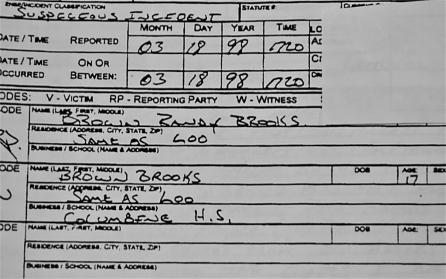
We reported Eric and Dylan and a friend of his to the police in 1997, for making pipe bombs and detonating pipe bombs. We did give the police the actual web pages from Eric’s site, with all of the info they needed to identify Eric. Aaron printed it up for the police, and gave them instructions about how he accessed it. We reported Eric and Dylan and a friend to the police in 1998. This friend separated from Eric and Dylan right after this report, so we are very sure he was not involved in the killings. The police had his name, and they investigated him too. They must be sure he was not involved too. As a note, the names on that police report, case #98-5504, are mine and Brooks. It is our names used on the police report, when we reported Eric and Dylan for building and detonating pipe bombs, threatening Brooks’ life, and running vandalism missions in the neighborhood. That detail is important, because, later on, when the police say Brooks might have been involved, it makes no sense at all. Why would Brooks be reporting them to the police, with me and Judy, if he were a co-conspirator? That is a really stupid concept for the police to come up with. Here is a photo of the first page of report 98–5504. You can see that Brooks’ name is on the front, as one of the complainants.
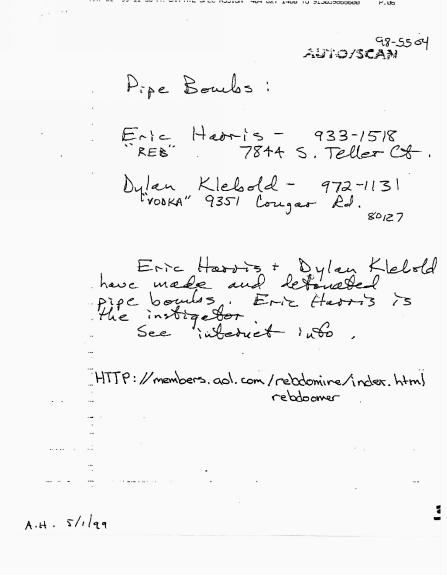
You can also see the hand-written note, by me, giving the addresses and information about Eric and Dylan. This clearly states that they were building and detonating pipe bombs. This should have been a fairly difficult thing for the police to ignore.
Another interested detail is that the police used that report, #98-5504, on April 20th, 1999, during the killings. They used it, and we know it. We know it because they broke into three cars in the parking lot. Eric’s, Dylan’s and the other friend’s car. There was no reason to break into the other friend’s car without the information from our police report from a year earlier. None. They had our report in the Command Vehicle, on the day of Columbine, at 12:30. They used it to prepare their search warrants for Eric and Dylan’s houses. They used it to search the other friend’s car. They used it as the background for their search and warrants, while they were, at the same time, planning on naming Brooks, calling us liars, and planning the secret meeting in the Open Space Building, where they would conspire to keep the information secret from everyone, which they did, for Five years.
We went to the police in 1997, and 1998. We called the police other times too, reporting some of the things I have just reviewed.
Judy saw Eric at the local grocery store. He was buying a Rifle magazine. Judy called the Detective we were working with and left a message about it. He ignored her. I called and left a very mean message. He didn’t return my call either.
We lived in fear of Eric. Not “hiding in our house” fear. We lived knowing he was a problem, that he might be dangerous. We lived on edge. Not every day, but often enough that we knew it, every day. I remember one night, after the firecracker incident, that Aaron was sitting on the front lawn, in the dark, with a baseball bat, waiting for Eric and Dylan to come by. He was waiting for them. I went out and sat with him. We were hoping they would come back. They did not.
Judy would see Eric a lot, driving down Pierce Street in his Honda. He would never look at her, but would stare straight ahead. It was odd.
I should mention that Eric and Dylan had problems at school too. They broke into the school computers, stole the locker combos, made copies of the school keys, stole a laptop, threatened the life of a student, and acted out in many ways. We were told by a lady who worked in the office that the disciplinary files on both of them were as thick as any in the school. They were acting out, and showing that they shouldn’t be bullied. That is one of the stages of the process of violentization.
Sue told Judy that Dylan would wear his Duster and sunglasses when they went out to dinner, and she asked him to take them off. He would not. He liked intimidating other people with his growing, threatening persona.
I saw Dylan “act out” in theatre too. He bumped into a kid, by accident, and was threatening in his response. I have it on video, and I have watched it many times.
The question is, in retrospect, was this enough for the police to take action against them?
Before Columbine they made a video, in the national forest, of them shooting weapons. It was edited at the school, and they used school equipment to make it. Other kids saw it. It was in this same class that they made the videos of themselves in the school, carrying fake weapons, and pretending to be hit men.
Is that enough to show they were dangerous?
Eric had a hit list, and so did Dylan. A few kids knew about it, and talked about it, but no one did anything. One girl told her mother that Eric had bought a pistol. She told her mother that Eric had a hit list, and hated kids in the school. The mother, while riding in the car, said that there was nothing illegal about that. He was 18 years old. She dismissed the warning.
Their boss and others at the pizza place where they worked knew about the pipe bombs, and actually saw them. Their boss actually told them to take one bomb off of the property. They had pipe bombs and co2 soda bombs at work. They set up a booby trap on the fence behind the pizza store, and were told to take it down.
It has been reported, and confirmed by a few of Eric’s friends, that Eric built a pipe bomb, that his dad found it, and they detonated it, in a field in the country. And, after that, his dad gave him back his pipe bomb building kit, and equipment. His dad found a pipe bomb, and kept it in his closet, until he could figure out how to get rid of it, and then he gave Eric back his bomb making kit. All, of course, before Columbine. If this had been a friend, or a roommate, the kid would still be in jail. But nothing happened to Mr. Harris. He never even gave a statement to the police.
We took the info we had at the time to the police. We went twice. We met with the bomb squad. We met with the Detective, who told us: he had these two kids. We knew he had the info he needed. We did that.
It was stopped somewhere after that point. Our file was closed. Our info was put away. The two boys were put into the diversion program, and we were left in the dark.
And here is the point I want to make. When I got home, after the killings, and things had settled down just a little, Judy told me that she had seen the police down in our park, at the bottom of the hill. There were twenty of them, walking through the park, looking for bombs. She knows, because she stopped, and asked them what they were doing. She asked, and they told her. The diversion bomb had been set, in the park, two blocks from our house, and had detonated. They told her there were two of them. When she relayed this to me, we went out front and looked for pipe bombs. We knew what they looked like. The bomb squad guy had shown us, a year before. We went out front and looked for pipe bombs. We looked under the cars, and around the house. I looked in the mailbox. Yes, I know, that was stupid. I opened the mailbox and looked. No bombs. No bomb.
We had turned Eric and Dylan in to the police, and the police had ignored us. And then, after Eric and Dylan had killed people, the police used our report, that they denied even existed, to prepare the search warrants on April 20th, 1999. Then the police left us to fend for ourselves. We were never told we were on the Hit List. We had to look around our home for pipe bombs. Police were only a block away. Six houses away, to be precise, and they did not even look. Not then. Not the next day. Not a week later. Not ever. We had reported Eric and Dylan to the police for building and detonating pipe bombs, and, after Columbine, when Eric and Dylan used pipe bombs and propane bombs at Columbine, and after the police used our report and web pages to prepare the search warrants, the police never came to our house to check, to protect us. They had knowledge of the danger, after Columbine, and ignored the danger to us.
P.J. Paparelli and Columbinus.
2015
We first met PJ when he was with Brooks. This was sometime in late 1999. Over the years he grew to be one of our best friends. What a talented young man. What a character. He worked for the American Theatre Company in Chicago, running it and producing plays. He was talking to Brooks, about Columbine, as he developed his play “Columbinus.” Judy and I were interested too, and we worked with him for a number of years, supplying him information and giving him access to our research, and our time. We were glad to do so. We liked him. He was creative, and he was interested in telling the truth about Columbine. He had no predetermined agenda. He just wanted to know the truth. We worked with him a lot, sharing things that we probably should not have shared. We let him see all of our research, including a few of the library photos, and all of the thousands of pages of released documents. Judy and I answered questions for hours, and we talked about the school, and put PJ in touch with a lot of people.
We went to a reading of his play at The Curious Theatre in Denver, where actors read the play without movement or backdrops. We went to a performance in Chicago, and we were allowed up on the stage, after the performance, to answer questions and tell what we knew. It was emotional and difficult, and worth every moment.
PJ worked on it for years. The end result was an incredible play, a work of absolute genius. We went to Chicago to see it, and we went to Chicago for a few workshops too. We always paid our own way. It was a labor of necessity for us. We wanted the truth out, and PJ was going to tell it. And he did tell it, with depth and a heart.
I remember the opening day, in 2013, in Chicago. It was a really small theatre. The American Theatre Company, as I remember, and I believe it is gone now. I will have to check on that. We sat in the audience, and watched and were overwhelmed. I sat next to the critic for the big Chicago paper, and I flinched during some of the scenes, and cried during others. His name was Chris Jones, and he was moved, and wrote great reviews about the play. That meant a lot to PJ, as he had really worked on this project. We met all of the actors, and thanked them for their incredible work. Eric Folks played Dylan, and the actor who played Eric, Matthew Bausone, was so convincing it was frightening. He looked and acted so much like Eric that we were actually upset by it. He portrayed that same darkness. Eric, Matthew, Sadieh, Kelly, Rob, Jerod, Tyler and Leah were amazing.
It deserved the great reviews. It was a work of pure genius. It told the story with heart, insight, and brutal honesty. It was shocking, and brutal, and honest, and genius. There was one scene during the play, with Eric and Dylan pounding on a blackboard, where every pounding sound represented the firing of a weapon. It was loud, and timed to recorded sounds that were like gunshots, or loud sharp noises. Each sharp gunshot-like sound corresponded to the pounding on the blackboard. It was powerful. It was genius. The sounds of gunshots, the pounding on the blackboard. Violence displayed without a weapon in sight. It left the entire audience overwhelmed, and completely silent for minutes. It was the end of the second act, and no one moved or applauded. We were stunned into silence, and sadness, and awareness.
PJ had added a third act, along with his co-writer Stephen Karam, and the play took on a completely different depth. It told the entire story, with humanity. We will always be indebted to PJ for his work, and for letting us be involved.
PJ was killed, in Scotland, by a reckless driver, in 2015. We lost one of our best friends. I can remember him making homemade spaghetti at our house. He and Judy laughed for hours over the mistakes that they made, making the homemade noodles. I remember his generosity, letting us stay at his place in Chicago, sleeping on the couch, or on the bed in the sunroom. His kindness and friendship are lost to us. He was a good friend. It is a great loss.
What a heart. What a talent. What a good person.
We will always miss you PJ.
THE MYSTERIES OF COLUMBINE.
Jan, 2017
OK, Let’s try a new quiz. This one is called:
QUESTIONS THAT NO ONE MAY KNOW, THAT WE SHOULD KNOW, AND THAT WE MAY NEVER KNOW:
1) What were the command decisions made on April 20, 1999? Who made them? Did they actually tell police to stay out of the school? How much did the awareness by people in the Jeffco command center of the failures of the police to stop Eric before this day have to do with their delays? How much did Dave Thomas influence the command decisions by being in the command trailer? Why were the doors to the command trailer closed for a period of time for a private conference? Why has this information never been released? Why have the command center tapes never been released?
2) Where was Gardner for the entire morning? He was in his car, then outside of the Southwest entrance, then he disappears for about three hours. Where was he? Why wasn’t he used, as the school resource officer, as a source of information? Why did he fire into the library and cafeteria and yet give another story? Why was there never an investigation as to where he really fired once the incorrect information was revealed?
3) Who was first into the school, as a first responder? Was Depew in the library? Which swat team entered first, and where did they go?
4) Were Eric and Dylan alive when Gray and O’Shea fired into the school? Did they really see them, or did they fire at a shadow? If they were alive, why did the police lie about their time of death?
5) Bruce Tow? Did he fire his weapon as reported? Why was it not collected for ballistics research?
6) How many rounds did O’Shea really fire? His reports list 5 or 6 different numbers of rounds, and he reloaded his weapon, making it difficult to determine without a true investigation. Yes. After the incident was over, he reloaded his weapon and magazines. Interesting, don’t you think?
7) How many pages of reports are there? 30,000? 40,000? 120,000? Why have these been hidden? Who are they protecting?
8) Did a policeman shoot a student? Wound a student? Kill a student?
9) Did Dylan commit suicide or did Eric kill him? How did Dylan shoot himself in the left temple with a tec9 held in his right hand? The answer to this one is easy, if you look at the crime scene photos and drawings. Dylan had the tec9 in his right hand. Committing suicide with that weapon in his right hand, and shooting himself in the left temple is impossible. Eric killed Dylan.
10) What was important enough for the 20 people at the secret meetings to keep secret that it would be worth risking their careers, and lying to the families of murdered children? What did they know on April 22, 1999, that would require such a drastic step? Why are these people being rewarded with promotions, judicial appointments and possible appointments to the Colorado Supreme Court?
11) Why were some policeman told not to file reports, even though they were on scene? Hicks was told not to go to the scene. Moore/ Miller was told not to file a report. And more.
12) What could the sniper, on the roof of a house in the bordering neighborhood, see? Did he have a shot? Was he told not to shoot? Where is his report? Who gave him the green light to fire, when they had identified a figure in the field in a black coat?
13) Why was an evidence item, listed by four people as an unfired round, changed to a fired round? This bullet was found in the library, and belonged to Gardner.
14) Were the police firing in the school after Eric and Dylan were dead, as cover fire to protect themselves? We know they fired into the school, but were they in the school, firing, after Eric and Dylan were dead?
15) Why were no charges filed against the policemen who fired into the school with automatic weapons, after Eric and Dylan were dead?
16) Why did Governor Owens refuse to give Justice Erickson subpoena power? It was a major embarrassment to Owens, yet he still refused. What would stop a Governor from giving such an elemental investigative tool to the man heading up his investigative commission? Why did Erickson accept such an assignment without subpoena power? Stone never testified before the committee. Neither did anyone else who didn’t want to.
17) Why did the Governor’s Commission on Columbine fail to discover any of the lies and cover-up, leaving the investigative work to “60 Minutes” and the local reporters?
18) Why did Ken Salazar, and Ted Mink, with no chance of political gain, do the right thing and investigate some of the corruption, and eventually expose Dave Thomas? Was this truly an act of integrity and honesty? Is it possible that there is a politician with integrity? I believe the answer is: Yes.
19) Why did Jeffco lie to Brian Rohrbough? Did they tell the truth in the El Paso report, or is that flawed, and another lie? How did an unidentifiable bullet from Jeffco become a perfect match for the ballistics expert hired by El Paso?
20) Why are the maps of the scene, including ballistic maps by the FBI, still being hidden by Jeffco? Why have they not been released to the public?
21) Why have the FBI ballistic maps and computer info been hidden from the public? Why have the “blue-rod” round locater photos and results never been released?
22) Where is the investigation by the school system, and why will they not release it? It was paid for with taxpayer money, and kept secret by the District.
23) Where are the files on Eric and Dylan that were in the school, maintained by Gardner? Why have they never been released?
24) Why is there no mention, to the parents or the public, about a police bullet found, blood soaked, on the shirt of one of the victims?
25) Why doesn’t anyone care that the police fired their weapons on fully automatic setting, into a school with innocent children inside? Why doesn’t anyone care that this is actually Denver swat policy?
26) Where are the other videos taken that day, and why won’t the police release them, despite a number of FOI requests?
There are hundreds of other questions. This is not a quiz. It is an examination. An examination into the world of corruption, and lies, that is Columbine. Perhaps you should just post a list of the unanswered questions that you have about Columbine. At least they will be written down for others to review.
Sept. 8, 2018
Editorial for Westword.
Should armed teachers be in our schools? Sep. 8, 2018
My background is a factor, so let me tell you in advance that I have a concealed carry permit, and believe in the Second Amendment, which is the Constitutional right to bear arms. I have a long history with this subject, as I was involved in the Columbine tragedy on many levels. I am the father of the family that turned the shooters into the police in 1997 and 1998. I have researched and studied school shootings for years, including Columbine.
There is currently a group in Colorado, called Faster Colorado, that is promoting training teachers to carry concealed weapons in a school. There are approx. 30 hours of training involved, and then these teachers will carry concealed weapons in a public school for the purpose of defense of that school. There are currently armed teachers in some schools in Colorado. The school boards for those schools have approved this. They believe that a teacher with 30 hours of training can be skilled enough to defend a school from a school shooter.
Let’s review the concept: Bob the Biology teacher buys a short-barreled pistol. Because long barreled pistols are difficult to conceal, a short-barreled pistol is needed to conceal-carry. This is the beginning of the problem. A pistol with a 3 or 4-inch barrel is incredibly inaccurate. Imagine a cone coming out of the end of the barrel. The cone widens as it gets further away from the barrel, and it widens quickly. The pistol can hit anything in the imaginary cone. At 4 feet from the pistol, the cone has expanded to 2 feet. At 20 feet away, the cone has expanded to 10 feet. At 50 feet, the cone has expanded to 20 feet or more. The farther from the pistol the target is, the more inaccurate the pistol is. Logically, and practically, this means that firing a short-barreled pistol at a target more than 10–15 feet away is very dangerous for other people in the line of fire. In fact, this places many people in the cone of fire.
To a weapons expert these numbers will seem larger than reality. But that is using a non-stressed shooting situation. In a range situation, in an indoor firing range, a pistol is very accurate. In a school shooting, a pistol is not. And, in truth, a skilled marksman with a pistol would be afraid to be in a room with an amateur with a pistol. The amateur is so bad with pistol control, and muzzle flashes everyone with the muzzle of the gun. They would certainly prefer not to be in a combat situation with an amateur, or even in the same room.
You have all watched Dirty Harry Callahan fire his .44 magnum pistol at the bank robbers in the Dirty Harry movie. The model 29 Smith and Wesson he fired has a 6 1/2-inch barrel, certainly not one that a teacher could carry as a concealed weapon. He fired it 6 times in the famous movie shootout, and he missed 2 times. Even he missed twice. He fired a high-powered pistol on an open street full of citizens in San Francisco, and he missed twice. Yes, it is a movie. Yes, it is imaginary. But this is the scene that many people remember, and Bob the Biology teacher remembers it well. It looks heroic. It looks brave. It is a false paradigm. It is a ridiculous unattainable goal.
In truth it is absurd, and dangerous. Harry should have been fired for being so reckless. He instigated the firing of weapons. He fired into backgrounds filled with citizens and with no concern for the safety of citizens. He missed twice. Where did those bullets go? His bullets were powerful enough to go through walls, windows, car doors and more. Did he shoot an innocent bystander? Of course not. This is a movie. But Dirty Harry was an idiot for that firing sequence and situation. His pistol is so powerful that it can shoot through one person and kill someone else. It can shoot through 6–10 layers of drywall.
But Bob the Biology teacher doesn’t think so. He remembers the movie. In real life, this shooting could have had serious and dire consequences, but movies don’t show that side of a shooting. Sure, the bodies lie on the ground, but they are all bad guys. No innocents are shot or injured in the movie.
I strongly suggest that you look on YouTube at police shootings. There are hundreds of videos. They show policeman, trained professionals, firing their semi-automatic pistols, 8–10 rounds, in rapid fire, while their partner is running through the line of fire. “One shot and then wait” is not reality. 8 rounds can be fired from these pistols in just a few seconds, and that is the standard-issue pistol, without modifications.
But, back to Bob the biology teacher. In a comment made by one of these armed teachers in training, one man said that he could hit a 6-inch target from 50 yards. 50 yards. A 6-inch round target. That is possible. With the right pistol, and a lot of practice, one of these teachers might be able to hit a 6-inch circle at that distance. But, given a school shooting situation, with smoke alarms, fire alarms, sprinkler systems, screaming children, sirens, and adrenaline rushing through his veins, that 6-inch target is an unattainable goal. And Bob will not realize that. He will remember the movie, and his 300 practice rounds fired at the range, and he will fire. Being the hero is too hard to resist. And the casualties of innocent children killed by friendly fire will live with us all forever.
This is where the truth needs to be factored in. In a school shooting scenario, the police and teachers will be outgunned. They will be at a distinct disadvantage. School shooters have, historically, used rifles, shotguns and semi-automatic weapons. They can fire without any worry of hitting someone, because that is their plan. A teacher has to be careful to fire only at the specific target. Using a short-barreled handgun against a rifle is a distinct tactical disadvantage.
Now would be a good time to review one school shooting incident. Let’s review Columbine. The highly trained SWAT team members at Columbine fired 167 rounds into the school. Some of these were fired while in a short exchange of gunfire with the shooters, but most of them were fired after the shooters were already dead. The Trained SWAT team fired into doorways, at shadows, into the library, and into monitors and books in the library. They actually fired down the main hall of the school from the back door of the school, with their bullets ending up buried in the front door of the school. During this fiasco, they did not hit the shooters one time. It is possible they did hit innocent children. This is the best that fully trained SWAT members could do. SWAT Officers with thousands of hours of practice. They even remarked, after the shooting, that they were lucky they didn’t shoot each other. Their bullets buried themselves in walls, ceilings, doors and ricocheted down hallways. This was a response from a highly trained SWAT team. Do you really think that a teacher armed with a pistol and 30 hours of training is going to do better than this?
A teacher, or a SWAT team member, can fire his weapon and the bullet will go through a wall, into the next room. This is dangerous. This adds to the chaos. Note that there are frangible bullets, that will break up when they hit a solid object. They are sold in California, but they are not used in this training, or by SWAT teams in Colorado. Their use could eliminate a small percentage of collateral damage.
When a teacher fires his weapon, he is adding bullets at high speed to an already chaotic situation. He is adding the sound of gunfire to the school, which echoes off of the walls, and which will confuse anyone in the school. Where do you run when the gunfire is all around you?
It seems very obvious to me that a school shooter will identify the armed teachers, and plan for their movements, like the shooters did with the School Resource Officer at Columbine. When they identify the concealed carry teachers, they will become the first targets. Killing a teacher who is armed will be relatively easy for a school shooter with a rifle, and that can supply one more weapon to the shooter’s arsenal.
We have not even discussed the many other problems that will arise.
Bob, the Biology teacher, decides that he doesn’t like the weapon he is allowed to use. He decides to select his own weapon, and load his own rounds, to allow for more penetrating power and greater stopping power. Bob will be carrying a very hot .357 magnum, or a .45 caliber semi-automatic. Bob thinks he needs the added firepower.
Let’s discuss this.
A 6 shooter, or a common revolver, has no safety. There is no safety, I repeat, there is no safety on a revolver. Anyone who picks it up will be able to fire it. That feature makes the weapon an active weapon, until it is recaptured or runs out of bullets. Remember that. There is no safety on a revolver.
Now, going to the semi-automatic .45 that he carries, they are complicated, but there is normally a safety. Unfortunately, there are three ways to carry that pistol, to let it be used as a weapon.
Method 1: Carried with bullets in the magazine, and no bullet in the chamber. This requires racking the weapon to load a round.
Method 2: Carrying the weapon with a full clip and a round in the chamber, but not cocked. This requires pulling back on the hammer to fire in single action mode, or using the trigger to fire in double action mode, after you disengage the safety.
Method 3: Carrying the weapon with a bullet in the chamber, a full clip, and the hammer cocked. This allows immediate defensive firing, after you disengage the safety. It is also a very risky way to carry a weapon, as it allows inadvertent discharges.
Does that sound a bit complicated? Well, it is, and here is the real problem.
With a semi-automatic, you may train and keep your weapon in one of the above methods. But, when the shooting starts, and you are facing an instant life or death situation, will you remember precisely the way your pistol is set? You have had this pistol in your concealed carry holster for 4 months. When the first bullet sound echoes down the hall, will you remember to release the safety? Will you remember that you have a round in the chamber and a full magazine? Do you have a round in the chamber? Will you freeze and forget? This training has to be exact and precise, or you will become the first victim.
SWAT teams train on these details for hundreds of hours, and they have failed us miserably in every school shooting so far. All of the bravado, all of the body armor hasn’t saved one child yet. Not one.
And that brings up the best point of all. Once the school shooter enters the school, the damage is done. At Arapahoe High School, the shooter walked in and shot a young girl within ten seconds. No teacher was there. The guards were across the school. In fact, nothing could have been done at the Arapahoe Shooting after the first ten seconds. It was over. While the young girl lay on the floor, the shooter walked into a room and took his own life. The very brave guards, some of them unarmed, ran toward the sound of the gunfire, showing great courage. But it was to no avail.
We have two windows of opportunity to stop school shootings. The first is a two to three-year window, where we can stop the bullying, defend the bullied children, identify the mentally ill children, and be proactive in finding these angry and bullied children. If you take away their anger before they walk into the school with a gun, there will be no school shooting.
The second window is the 1 to 10 seconds when an angry young man or woman walks into a school with a weapon. The 1 to 10 seconds before he kills an innocent child. After that it is too late.
Which window of opportunity do you think we should be concentrating on? 2–3 Years, or 10 seconds?
Many of you are unaware of the new attitude by the police, as demonstrated and publicly stated in the Parkland Shooting: Mitigate the damage. Yes, it is true. Mitigating a shooting to lessen the body count is not an acceptable goal You may not have heard that comment, but it was there. Mitigate the number of dead! That is an ongoing tactic.
I believe that one death is too many.
Other serious problems with arming teachers:
Police officers have qualified immunity if and when they shoot an innocent student or teacher. Will your armed teachers have that same immunity? Who will pay the millions in costs from the lawsuit, when Bob the Biology teacher shoots and kills a child, or two? Who will pay the costs when Bob shoots another teacher, or a policeman? Who will pay for the lifetime of therapy he will need to deal with that error? Are frangible bullets going to be made a requirement? At whose expense? What weapons will be allowed for the teachers to use, for concealed carry? Will qualifying at a range be required? Combat classes?
Who will review the accidental discharge situation? This will happen. It has, in fact, already happened. A teacher giving a class on gun safety fired a round into the ceiling a few months ago (2018). An FBI agent, dancing at a club in downtown Denver, did a backflip, dropped his weapon, picked it up, grabbed the trigger, and shot a man in the leg (2018). And that was a real, highly trained FBI agent, carrying a concealed weapon. He violated so many rules of carrying a weapon, it is laughable. This “trained” FBI officer let the weapon, a semi-automatic pistol, fall from his holster, and then picked it up by the trigger, firing one round into the leg of a bystander. If you do not know that, it is because it has been left out of every article about the shooting. Weapons do not fire themselves. Someone has to pull the trigger. Someone has to disengage the safety, or never had it on to begin with, and in this case, it was the FBI agent. Foolish, amateurish, and dangerous. In fact, negligent. The details of that failure have not been released. If it was a Glock, the accident may have happened because most Glock pistols do not have a safety. Yes: semi-automatic pistols that do not have a safety. Regardless, the FBI Agent pulled the trigger.
Who will be responsible when the teacher goes out drinking, does a backflip, drops his weapon, and shoots an innocent bystander by picking it up the wrong way? Who will pay for the liability cost when a teacher leaves a concealed carry weapon in his desk or classroom closet, and the weapon is used without his knowledge? Who will be responsible when the school shooter kills the teacher first, and takes his concealed carry pistol? A pistol allowed on school property, by a School Board. How does a SWAT member know if the teacher is a school shooter or school defender? Will that question make him delay his fire, and either cost him an opportunity to take down a shooter, or cost him his life? We have already seen the scenario in Aurora where a policeman shot and killed an innocent homeowner in his own home. Remember the Vietnam vet who was killed in Aurora (2018), by an Aurora policeman? Killed in his own home. Killed by the policeman, from outside his home, while he stood inside his home. Repeating that scenario in a school will be easy to do.
As a summary: Adding weapons into a school that is chaotic, filled with smoke, sprinkler systems and screaming children, is a bad idea. Pay for extra deputies. Pay for Deputy training. Pay for better weapons for Deputies. Have a rule where a Deputy has to be within 4 minutes of a school, and add deputies until you can do that. Buy door blockers for the doors, that can be installed to secure a door by teachers and students. Install more exit doors and secure them. Teach children to run.
But first: Stop the bullying. Stop creating the hate that makes the bullied children hate the school. Stop the reason for hypervigilance and hypervigilant revenge. Defend every child in a school from bullying and abuse and humiliation, every day, every hour, every minute. Take away the main reason that these angry children take a weapon to school.
Support SAFE2Tell Colorado, the program that is already in place. Increase the funding and expand the program. It is effective. Assign extra deputies when needed. Spend the money for trained policeman.
Let’s hold a brainstorming session and think of options. I will contribute every bit of knowledge that I have. But don’t arm teachers. Don’t arm amateurs. Don’t add to the chaos and the death. Don’t add more dangerous weapons into an environment filled with chaos, weapons and innocent children. The results will eventually be tragic and full of pain. Don’t add to the tragedy. Don’t add to the pain.
My thanks to Patricia Calhoun for putting this very long treatise in Westword.
Friends of the Klebolds
Dec. 2019
It has been a very confusing situation.
We have defended the Klebolds from the beginning, not being able to believe that the little, gentle boy we knew, Dylan, could ever kill anyone. I know. You hear that from everyone. “My neighbor was such a nice person! He would never hurt anyone.” But, in this case it was true. Dylan was a shy gentle kid. He played with our sons, at our house, hundreds of times. He spent a lot of time in the summer at our house, and down at the local park with the kids. He was nice. He was shy. He was fun. He smiled a lot. He was not mean. He was a shy, nice, quiet little boy.
We defended him, and the Klebolds, for a long time after Columbine. We stuck up for them in interviews. We defended them. We were their friends. We knew them well. We liked them. We defended them to the families, and to Brian and Lisa. We knew them well enough that we trusted them.
Prior to Columbine, April 20th, 1999, Judy was a close friend with Sue Klebold. We played Pictionary and Trivial Pursuit with them, when the boys were younger, at both of our houses. It was a regular thing.
On the day of Columbine, Judy went down to their house to help. She and Sue were such good friends, that she left me, and our house, to drive the 20 minutes to their home, in the country, to be with them. It was ok that she left. Both our sons were safe, and I was there, at our home, protecting them. She was a good friend, going to spend her time supporting the two of them, but especially to help Sue. Judy stayed until after dark, supporting them, talking to them and being there. The police were at Sue’s house when Judy arrived at the Klebold home. While she waited, she was on the phone with us at the house. We were watching the tv, looking for information. It was posted on the tv, later in the day, that the killers were Eric and Dylan. Judy verified it with Brooks, and then she told Tom and Sue. She told them that the police have named Eric and Dylan. Dylan, their son. They were quiet, and there were not a lot of tears. Just quiet. Confusion. Tom had already called his attorney.
Judy and I talked, and in her conversations with Tom and Sue, she had discovered that they had nowhere to stay that night. The police were not going to let them back into their house, or the little house that sits next to it on their estate property. They had nowhere to go. Judy offered our house. She told me this over the phone. I arranged with Mary Ann across the street to stay at her house. We would let the Klebolds stay at our house. No one would bother them at our house, and we could just keep it a secret.
Before they left, Tom remembered that he had a relative in Lakewood. They called and decided to stay there.
When they drove away from their house, Judy left last, in her own car, and drove away slowly, so that the press, which was everywhere, couldn’t follow.
Looking back, it was a bad idea to have them stay at our house. We were mobbed with media too. Brooks did interviews with Ward Lucas and Tom Brokaw and many other news people, telling them how he had been “let go” in the parking lot. He told the truth on every interview. It was a madhouse.
The next day, Tom and Sue called. They needed a few things, and we helped. I took them the cash we had, a few hundred dollars. They gave me a check as repayment.
I went and filled a prescription for her. It was very odd at the time, giving her name at the pharmacy for the prescription. When I said Susan Klebold, one or two people in the line looked over, but I don’t think they figured it out.
A few days later, I met Tom, to pick up a photo for them to use in Time Magazine. Time was doing an article, and Tom and Sue wanted to use his senior photo, with the red rocks in the background, not the photo that the press had been using. I picked this up very late at night, and watched to see if I was being followed. They did not want the press to find them. No one followed. I was in the same 400e, the very fast car that I had raced home in when the shooting started. I met Tom to pick up the photo, in an envelope, at a Burger King in Lakewood. I delivered the photo to the Time representative.
We went to Dylan’s funeral, at a Mortuary over off of Parker Road. We were one of the ten or so people invited. That was a very sad afternoon.
We visited Tom and Sue many times, after they were allowed back in their house. We sat by the pool and talked. That sounds so entitled, but it was not. They bought the house, and it had a very small pool, and the pool had red stained water in it, from the red rocks in the area. It wasn’t used. We talked about Columbine, and Dylan, and Eric, and killing, and school shootings. We talked about Dylan. At the time we didn’t know very much, and neither did they.
Judy talked with Sue almost every day. Judy would tell Sue the things that we had learned, and update her on other information.
I went with Sue to pick out a set off of clubs for her other son, Byron. He is taller than most kids, so we went to the golf store and found a set long enough to work for him.
A few months after Columbine, Judy was going to an art show with Sue, and, while talking, Judy mentioned that Eric and Dylan had built pipe bombs before the killings. Sue was taken off guard. So much so, that she almost lost control of the car she was driving, and went onto the shoulder of the road. Sue, even after Columbine, did not know that Eric and Dylan had built pipe bombs. It showed how little she had been told about Columbine, and it really showed how little she knew about the dark side of Dylan, and his activities with Eric. What it really showed, to us, was that she had not been told about the pipe bombs prior to that conversation. That was further verification to us, that she and Tom had not been contacted by the police before Columbine, about our complaint. They had been left out of the loop. They had not been contacted about the web page threats and the building of pipe bombs. This was very clear. The pipe bomb building and the death threat were in our report in 1998, and Tom and Sue had not been presented with that accusation. They had been left out of the loop.
We didn’t tell them because we thought the police had handled it, and we thought they knew about it, from the police contact. The police had never contacted them. They were left completely in the dark.
During all of this time, Judy and Sue were friends. They would talk on the phone for hours. They would discuss the details of the complicated life that we were all living. They talked about Dylan. They talked about the attorney for the Klebolds, Gary Lozow. Sue was kind of intimidated by him. He was older and very strong, and she decided, early on, to follow his advice without questioning it.
Lozow kept the Klebolds away from the press and the victims’ families, actually making Sue afraid of them. He was a very smart and manipulative attorney. He made her afraid of the families, even to the point of saying that they might harm her. In defense of the attorney, something could have been said that would have really hurt Tom and Sue in the lawsuits which were coming, and Lozow knew it, so he wanted us to be quiet, and he told Sue not to talk.
Unfortunately, Sue and Tom missed a really good opportunity to meet with a few of the families, and show that they were human. By remaining distant and silent, it made Tom and Sue appear cold and uncaring to the families, and everyone else. That was her attorney’s fault.
Lozow is the one who stopped Sue from talking to the families when they offered it. Using Judy as the contact, the families asked to meet Sue, and Sue wanted to. She wanted to tell them about Dylan. But Lozow said no. Lozow did everything he could to cause problems with that meeting, and with the friendship of Sue and Judy. Lozow was, in my opinion, a horrible influence on them. He created fear. He kept them silent. He made them afraid of the families, when all the families wanted was to be told the truth. Lozow kept the Klebolds away. He planted thoughts in Tom and Sue’s minds that made them afraid.
And then, at some point, we were no longer friends.
It happened, and we weren’t even aware of it. We didn’t go down to see them as often. We stopped talking on the phone as much. I remember calling Tom, and telling him that I was sure, from the research we had completed, that Eric Killed Dylan. I explained it, just a little, and he said he didn’t want to know. It was a very short and difficult conversation. That was a point of view I didn’t really understand. I wanted to know everything. Why wouldn’t Tom?
Then Sue told Judy that Tom was mad at us. He was upset that we had gone to the police and reported Dylan and Eric, and that we hadn’t gone directly to them. We tried to explain that we couldn’t. If we had, they would have tried to tell us to keep it to ourselves, that they would handle it, and we couldn’t take that chance. We had to report it to the police. It was too serious to be handled any other way. Eric was too dangerous to leave it up to the parents.
Then we grew even more distant. Tom and Sue realized that we were sharing what we learned, from our research, with Brian, and that turned them against us. We never told Brian anything that Tom and Sue had told us. They knew that. We were loyal. We defended them to everyone. We only wanted the truth. It didn’t matter where it led. It didn’t matter who it hurt. We needed the truth to find out what had really happened, and to do something about it. The only way to honor the murdered children was to try to stop this from ever happening again, and the only way to do that was to find out the truth.
Tom didn’t want that. I don’t know if he couldn’t face the truth about Dylan, or if he was tired, or if it didn’t fit with his self-image of himself, admitting that he was the father of a killer. We have not talked in a long time. He is not the only friend that I have lost because of Columbine. Although that is definitely an overstatement. Tom was never really a close friend. He was an acquaintance, the father of a boy my kids knew. We had never gone to lunch, or met for coffee. We had only shared the sadness over Dylan.
Tom and Sue did fight the release of information. They joined with the Harris family and the police in wanting everything to be kept from the public. They had their attorney fight everything.
Judy lost Sue as a friend. They haven’t been in touch for a long time. Looking back, I get it now. To Judy and I nothing mattered but the truth. It ran our lives. It controlled what we did. It still does.
The only way to honor these murdered children is to find out what caused this, and to tell the world so that it can be stopped again. That has been our search from the beginning, even before we could explain it. We spent thousands of hours researching and talking to people. I read dozens of books about killing, violence, killers, and weapons, all to learn more about this one problem. For about seven years we were obsessed with this search. We both read every single page of the 70,000 released pages, and listened to every tape and read every article. 70,000 pages is, of course, an estimate. There are now over 90 notebooks full of reports. There are thousands of pages sitting next to me in the library. I haven’t counted them all. That would be a waste of time. Reading them and learning from them is the goal. Learning everything that can be learned. We were obsessed.
After the investigation by Salazar, and the exposure of the lies and coverup by the police and Jefferson County, we were both tired. Very tired. Then Judy started doing her art project, and I went back to working more hours. But I continued the search. I was on the CTME Website, answering questions for a few years about the Columbine Tragedy, trying to tell any person interested about what we had learned. I have recently been to the Statehouse and talked about School Shootings, and violence, and how to stop them. I do not know if it has done any good at all, but I can’t stop trying.
This is a weird chapter. I am writing this just to blow off some steam, and to tell the story, a little bit, about Judy and Sue.
It has really bothered me about Sue and her book. She came out with a book a few years ago. I read it and was really upset. It was not the truth. There, plain and simple, it was not the truth. She makes light of the warnings that Judy gave her about Eric Harris. Judy told her that he was dangerous, and to keep him away from Dylan. Judy warned her, very clearly, as a friend. Sue ignored her. Sue was warned, and chose to ignore it. And, after Columbine, we told them that Eric killed Dylan. Yet Sue keeps talking about Dylan as a suicide victim. Dylan was killed by Eric. That is a fact, without question. The photos and the autopsy leave no doubt. Yet she keeps saying that Dylan committed suicide. Sue is working on a suicide prevention program. Her son was killed, and her son murdered innocent children with a shotgun and Tec9. He is not a suicide victim. He is a killer. Sue cannot completely face that fact. She is using the story of suicide to keep her sanity. It is a falsehood. Her book is so full of lies that I was quite upset over it. In it, she says that Judy was not even a friend. She leaves out details, like the fact that we were invited to the funeral, and all of the other things we did with them and for them, as friends. This doesn’t get to the truth. This doesn’t help. Her book tells people things that are not true. That won’t help stop the next school shooting.
This is the problem I have with almost every other Columbine book out there.
Dave Cullen wrote the book Columbine. It is laughable, despite its tragic nature. It talks about Eric having as much sex as the football players, which is absurd. He told the story using the police as his source, taking the side of the police and the FBI. He told one story based on a false witness, who had claimed to be Eric’s girlfriend, which was a complete fabrication. There is a note in Eric’s journal that says he needs to “get laid” before Columbine. A pitiful and sad note to himself. He died a virgin, and Cullen wrote about him being a “player.” There is very little truth in that book, and it is the best-selling book on Columbine.
Other books about Columbine have the same problem. The author would contact me on the internet, or by phone, come into town, and I would talk to them for hours and hours, and give them information, give them access to our volumes of investigative material, and put them in touch with other people who would tell them the truth, and they would leave and write a book based on their own ideas and their own agenda. It was not what they had learned. It was based on their agenda. It was as if they didn’t hear a word that I said, or that anyone else said. It was as if they didn’t believe a word that they read, from the pages they reviewed.
If the writer had a theory that Eric and Dylan were gay, that would be the focus of their book. The book would say that they were gay. If the writer thought that the bullying and humiliation were not the cause, that is what they would write. They would ignore everything they were told, and write what they wanted to. It was a way of changing history. It was changing history by telling their own version of Columbine, changed to meet their agenda and beliefs. It is pretty obvious that all books are written like this. All history books are. I guess that this book is written like that too. The difference is that I lived it. I have written about what happened, the pain of it, the truth of it, without an agenda. I wanted to know the truth. I still do. I believe that I have looked at everything I have lived through, everything I have learned, everything I have read, and every single bit of research, to find the truth. I believe that I have a way to stop school shootings. That is the last chapter in the book. I know that sounds presumptuous and arrogant. It is not meant that way. It is what I have learned after living with this tragedy, and studying it, for over 20 years. It is why I wrote this book.
Back to other books. I worked for months with Langman on his book. He ignored almost everything I said, and everything I sent to him. We talked to Cullen before he wrote his. We told him a few stories about Dylan and Columbine, and then he wrote a book denying, completely, the existence of bullying and humiliation. He even states that Eric and Dylan were bullies. It is a laughable pretext. That was the police story, based on the lies of the school district, and he followed their lead.
There are incredible books that you can read about children and killing and violence. They are mandatory reading. Here are a few of them:
“Why They Kill” by Richard Rhodes. This is the story of Lonnie Athens, a genius psychologist who studied criminals. His work is groundbreaking and perfectly applicable to school shootings. Richard Rhodes won a Pulitzer Prize for other works, and he is an incredible writer. He thought so much about Lonnie Athens’ book that he wrote a book about Lonnie Athens. That is the book named “Why They Kill.”
“Creation of Dangerous Violent Criminals” by Lonnie Athens. The original book by Lonnie Athens, that Richard Rhodes retold in his book. Again, perfectly applicable and informative. It is a very hard book to find.
“When A Child Kills” by Paul Mones. A book by attorney Paul Mones. It tells about children who are abused who kill their parents. A simple analogy to school shootings. Children bullied and abused by their parents decide to kill their parents. What a lesson. What an author. This attorney actually stopped in Denver, on a flight to another city, and waited for us at the airport, so that we could talk for a few hours. What an amazing person. This book is out of print, but may be available as a used book.
“Real Boys” by William Pollack. A really good book to read for any parent.
“Comprehending Columbine” by Larkin. Interesting and scholarly.
“Columbine: A True Crime Story” by Jeff Kass. Accurate and detailed.
“Lost Boys” by James Garbarino. Not about Columbine, but mandatory reading. A fantastic author and person. He and his wife are amazing.
“Our Guys” by Bernard Lefkowitz. Not about Columbine, but very pertinent. It will open your eyes to the world of high school and bullying. It will show you that the parents of bullies live in arrogance and ignorance.
“Violence” by James Gilligan. Excellent and pertinent. A must read. Incredible.
“Evidence Ignored” by Rita Gleason. A very in-depth look at details from Columbine based on the first 10,800 pages released. Accurate and analytical.
“The Gift of Fear” by Gavin DeBecker. A great book about listening to your inner voice and instincts about danger, and acting on them. We met Gavin at the Oprah show. He was very smart, and understood what was going on at Columbine from our first meeting. What a gentleman. What a good person.
There are others, and videos, and internet sites with all kinds of information. I have read every book I could find about violence, and school shootings, and criminals.
The two books I disliked were “Columbine” by Dave Cullen and Sue’s book, whatever it is called. I know, it is called: “A Mother’s Reckoning.” I even hate to reveal the title. Oddly, it borrows some of the title from Mein Kampf, which was also “a reckoning.” I am sure that was an oversight, albeit an odd one, since Sue is Jewish. I found it a bit odd that her publisher wouldn’t know the former literary use of that phrase. Both books are disappointing and misleading. Cullen wrote from the point of view of the police, and with information from the police. That is discrediting to his book, as the police lied through this whole thing. His book is based, to a large extent, on the lies the police told for years. Sue told her story, and she did not tell it all. The truth is simply too painful for her. She has a long way to go before she accepts her part in this, and before she understands Dylan, and his violence. I can completely understand that.
I had, personally, the oddest experience with Sue’s book. I ordered it the second I heard about it, and waited for delivery. And waited, and waited. I read it the day I received it, without stopping. During the reading I would yell over to Judy: “Listen to this.” She would be downstairs or somewhere in the house, and I would tell her what Sue had written. It was ridiculous. So many lies and omissions. Judy finally told me to not tell her about them, it was making her depressed. I started highlighting anything that I thought was wrong, so that Judy could review it. The book is full of highlighted pages. It was almost laughable. Then, when I was finished, Judy said she didn’t want to read it, so I put it aside. A few months later, Judy decided she wanted to read it, so she ordered the audio book. And this is what was weird. Judy would be up in the bedroom, listening to the audio book, that Sue read, in Sue’s own voice. I recognized Sue’s voice, of course, and I would be sitting in the family room, listening to Sue read her book, in her own voice, while Judy listened to it upstairs. It was a bit surreal. This lady we knew had written a book, and I was listening to her read it, while my wife, her best friend, listened to it.
The other book I recommend is “No Easy Answers” by Brooks Brown. He is my oldest son. His book is fairly short, brutally honest, and without pretense or guile. It is an honest overview of Columbine and the tragedy, from a very intelligent boy, who was in the school.
This entire chapter started out to be a comment on the friendship between Judy and Sue. It has certainly strayed from that singular point.
Our friendship with Tom and Sue ended when we became involved with Brian Rohrbough and the families, in the long battle to find out the truth about Columbine. “The Families” is the term I use, and many people in Jefferson County use, for the families of the murdered children. That search did nothing but cause Tom and Sue pain and discomfort. It always covered touchy subjects, and, despite our defending Tom and Sue, it always brought up their names, and Dylan and Eric, and the tragedy. It was more than they could handle. Their attorney interfered too, telling Sue not to talk to Judy, telling Sue to tell Judy to stop talking. We drifted apart, and I must say that I regret that. Talking to Tom and Sue was like talking to family members who have been through a shared tragedy. We shared the same love for Dylan. Well, I should say we shared the same love for the young Dylan. We shared the same confusion over the old Dylan, the murderer and cruel killer of innocent children. We shared the same curiosity about Eric. The discussions we had while walking, and while sitting outside of their house, were full of honesty and truth, and sadness. We loved Dylan too. We were as troubled by his actions as they were.
I have had two very odd meetings with Sue, after the friendship ended.
I was at a coffee shop, way out by the Airport, thirty-five miles from Littleton, and I was having coffee before an appointment, and Sue was there, having a cup of coffee too. This is an hour from our house, and far away from anyplace I would ever expect to see her. I said hello, and asked her to call us. She never did.
Then, a few months later, I was in Diamond Hill, a business area near Denver, and Sue walked in to that coffee shop too. That was a very odd meeting, as I had never been to that area or shop before. I again told her to call us, suggesting dinner. She never did.
I must admit, I don’t blame her.
After those accidental meetings, there was a big push to forgive the Harris and Klebold families. I wrote an editorial which ran in the Denver Post, pointing out all of the things they had done to keep the information about Columbine from the public. It was not kind. It was the truth.
I was not the best of friends. I realize it now. I cared more about the truth. If they didn’t want to know the truth, then their friendship became less important. Children had died. It had not mattered to me, or Judy, about the money, lawsuits, protecting ourselves, or anything else. We had never hired an attorney, and ignored the advice we received from a few attorneys. Children had died, and the truth mattered. The truth was the only thing that mattered. That was the only way to find out what really happened, and to stop it from happening again. I have always tried to honor the murdered children. Always. That is why the truth mattered. If the search for truth ended the friendship, so be it.
The Green Umbrella
Dec. 2019
A note to the very nice lady that gave us her umbrella while we were in Chicago. I mention it now, because it is sitting in our hallway. Over 20 years later, we still have her green umbrella. I want to thank her, but we have no information to contact her. So, thank you. Your gift, and your caring meant a lot to us at that very sad time in our lives. We still have it, and we remember, every time we see it, your generosity and compassion. It is a reminder that people can be kind, and caring.
Questions on Columbine:
Dec. 2019
You probably have questions. I can possibly answer them.
The problem is that I am not sure what they are. Let me try:
Who was responsible for Columbine?
That is a note I have, written on a yellow sticky pad, pasted to the edge of my monitor. I think about it every day. After 20 years, any answer is, of course, speculation. Here are some possibilities:
Mr. and Mrs. Harris are probably the most responsible. They had clear signs of trouble, and ignored them. The simple fact that Mr. Harris found a pipe bomb, and then took Eric out into a field to detonate it, after all of the trouble that they had with him, is pretty damning evidence. We know about this from friends, who told that story a number of times. One of them even told it on National Television. Ignoring the fuse cord that was in his bedroom, giving him back his pipe bomb building kit, and failing to do more, when so many signs were there that this kid needed help, are all signs that they failed miserably. When Mr. Harris received the call from Green Mountain Guns telling him his “clips” were in, he should have paid attention. He was in the service. He knew what that meant. A simple question would have meant a great deal. “What clips are you talking about? Clips for what? Why would I order clips for a Tec9?” Those questions could have changed this scenario instantly. Or, did he actually ask those questions? Did he ask them, and then talk to Eric, and then still fail to do anything? We do not know, because they have never been interviewed, or told the truth. Mr. Harris, in his notebook, blamed us for being the problem. At some point, it is necessary to have the courage to look in the mirror, and admit that the problem is in your own family. He failed to do this. Certainly, they share a great deal of blame for this tragedy. It is a shame that they did not simply tell the truth.
In retrospect, his failure to tell the truth may be understandable. Imagine, if you would, that a 25-year-old roommate had seen everything that they did, and had failed to act on it. That 25-year-old roommate could still be in jail, as an accomplice in a mass murder. After all, Manes went to prison for one act that had nothing to do with the killings. Mr. Harris knew a lot, and failed to act on it. He kept everything he knew from the Judge and diversion counselor, when Eric was sentenced for the van break-in. That is a very serious omission. Again, some of this is speculation, as they never testified publicly, and fought to keep any testimony from the public.
Next on the list is, in my opinion, Frank DeAngelis. He was the Principal at the school that created the bullying, and the humiliating atmosphere, that created the hate that caused Columbine. That is so obvious to me, and I am sure of it. Now, do we blame him for his ignorance, or the school board for allowing it, or the parents of the bullies for enabling it, or the teachers for failing to stand up to him? That is another discussion, but I blame him for his failure. He allowed the acceptance of humiliation and bullying. His poor performance allowed the humiliation and bullying. Without him, or a principal like him, Columbine would have never happened. If you take away the bullying and humiliation, the hatred that Eric and Dylan felt would not have been there, and they would have had no reason to hate the school. Cause and effect.
Eric and Dylan. Of course, they are responsible. Taking into account their undeveloped teenage minds, their immaturity, their lack of perspective, and their out-of-reason anger, they are still responsible. They acted like cowards, developing a plan to kill innocent children. That is cowardice. That is not logical. They became, in that violent act, the very type of person they hated. They became the greatest bullies. They became what they hated. What an ignorant thing to do. What a tragic decision, that caused pain for thousands of people. What a selfish ignorant act. There is no defending them. As much as I now understand why they did it, it is not defendable. It is not appropriate. It is the wrong act, the wrong decision. It is killing. It is cowardice.
Me. Yes, I am responsible. I should have done more. I know it. I am learning to live with it. I regret it every single day. Every single day. I should have done more. When the Detective blew us off, I should have gone to the Sheriff’s office and screamed and yelled. I should have demanded action. I know, those of you who know the situation, will say that we thought the Detective had done something, and that is true. We had turned them into the police many times, and they did get in trouble. We did think that the police had acted on our reports. But I didn’t verify it. I should have. The lives lost at Columbine are, to some degree, my fault. I know it. I think that there was a point where I said to myself: OK. We have reported them to the police for the ice incident, for the firecrackers on our front porch, for threatening Brooks’ life, for shooting out our garage window with a paintball gun, for pipe bomb building, for detonating pipe bombs, for buying the gun magazine which showed Eric had an interest in weapons, for running missions, setting fire to bushes, and super glue and other acts of vandalism. That is enough. The police have enough information. More is becoming obsessive. I trusted the police to do their job. That was my failure. That was my mistake. Yes. Complicated, isn’t it?
The unnamed party: Someone at the Sheriff’s Department covered-up for Eric Harris. We know this from all of the police reports that were missing, and for our file being closed out, without our knowledge, when it was still active and outstanding. The password use was FELTKL. Was that Kiekbusch’s password? LTK is a pretty good indication that LT. Kiekbusch might have done this. LTK and LT. Kiekbusch. Was he instructed to do it by Dave Thomas? Or by Judge DeVida? Or by someone else? We still do not have the answer to that. We do know that someone closed out our file and our complaints, that involved building and detonating pipe bombs and death threats, without our knowledge, the day that Eric and Dylan went to court over the van break-in. According to the police records, our file was closed out on March 26, 2018, by someone with the password FELTKL. That was only 8 days after we had filed it. They did this without our knowledge and without informing us. How can a policeman close out a file or complaint that is only 8 days old, which involved threatening my son’s life, and building and detonating pipe bombs? How?
Someone did Eric or Dylan a favor, which kept them out of jail. Someone did one of their families a favor, to keep them out of jail. Or, someone closed out our file for no reason at all, and kept most of the information, including the death threats and bomb building, from the judge involved. Who? I do not know for sure. They know. I hope they remember, every single day.
Dr. Kevin Albert. You are probably not familiar with the name. He is the psychologist who Mr. Harris sent Eric to, for counseling. That was a bit of a complicated issue, because we think that Mr. Harris did that based on a referral from Jefferson County, and possibly a direct referral from Dave Thomas. It is not clear. What is clear is that the prescription for Luvox, which was prescribed by the family doctor, and the problems associated with it, were ignored by this counselor. His counsel was obviously not very good, and missed the hate and anger in Eric. He did a crummy job. He did a very bad job in relation to the $100 an hour fee he received. I will agree that other people made mistakes too, like the diversion counselors Andrea Sanchez and Robert Kriegshauser. They all missed incredible red flags that a professional should have caught. Let’s not forget that, on the diversion intake forms that Eric filled out, he said he was suicidal and homicidal, and that he only drank Everclear. Everclear is a 100-proof alcohol drink. It is such an obvious hint. He didn’t say he was drinking beer, or whiskey. He said he was drinking Everclear. He was laughing in the face of a counselor that couldn’t read the obvious signs. He wrote, in his intake form: “I am homicidal. I am suicidal.” Ignorance. Failures by all of them. Tragic failures. If you doubt that, look up Everclear on Google. It is the strongest alcoholic drink made in America. If Andrea Sanchez or Robert Kriegshauser or Dave Thomas or the Detective had looked this up, the lie would have been obvious. Eric was messing with them, and they missed it. They missed it, along with Eric’s disclosure that he was homicidal and suicidal.
And, finally: The Parents of the bullies. Sure, your children grew up physically superior to other children in the school. At least for now, with the early growth advantage, they are bigger and stronger. That matters to you. Their superiority at the age of 13, 14, 15 and 16 gives them a distinct advantage, and the ability to be bullies. You did not teach them to be nice and care for other people, because many of you are bullies yourselves. You don’t care about other people. You care about being physically superior, and about football, and being a bully, and being superior. You care about winning. You do not have the perspective you need. Not one person has said: “I was the bully at that school.” Not one. Not one person has said: “I was the parent of a bully at that school.” Not one. You exist. You are just ignorant. You are the parent of a bully who bullied and harassed and humiliated other children in a High School. A pitiful 2,000 student High School in a reasonably prosperous subdivision. And you are proud of that.
Not one of these children went on to play Pro Ball of any kind. There was not one Pro-Level Football or Basketball player from this school. Not one. A number of the players went to Wyoming, a second-rate school, and did not distinguish themselves at all. The biggest bully went on to martial arts, and found that he was a small, nothing player, in a martial arts field with really tough players. He quit after a few fights. Yes. True. Even the biggest bully in the school couldn’t cut it in the real world full of tough guys. He couldn’t compete in the world of martial arts. Imagine if he had gone into the service and found out how tough some of the marines and army guys were. Some bully. As parents, you reveled in the pitiful achievements of your children, winning the State Football Championship, and playing football. As parents you loved it. As parents you ignored the damage your bully children did to thousands of other children. Damage that you ignored, because your children, superior physically for a few years in High School, were not taught how to be polite or human. You failed as parents. Yes, you did. You failed to teach your children to treat other children in a kind and respectful manner. When those football players used to drive around, looking to beat up kids in other cars, and looking for a fight, you were at fault. When those bullies pushed a kid down, in the school, and threatened them, you were at fault. When your children bullied others in the school or at the drinking parties they attended, you were at fault. You were bad parents. You, and your children, created the fear at Columbine. You and your children wanted to win football games and drink and brag. You, and your bully children are at fault. Yes. It is true.
Let’s not forget the bullies, and the teachers that watched them abuse children at Columbine. The teachers and the coaches and the administration.
Did I hurt your feelings? Are you upset? Good. You are responsible, to some degree, for the hatred and fear at Columbine, that created these two killers. Live with it. You deserve that memory and knowledge.
Questions continued:
What about the basement tapes?
Yes. The basement tapes are important. As you remember, the tapes were made by Eric and Dylan at their houses. They were filmed at different times at their houses. In the tapes, they showed the weapons, the pipe bombs, the shotguns, the fuse wire, Eric’s room, Dylan’s room, and the lower level at Dylan’s house. They talked about why they hated the school, and what they were planning to do. The Sheriff, Sheriff Mink, decided not to release these tapes to the public, in order to prevent copycats. In retrospect, that was a joke. Copycats have been all over “Columbine” without the tapes. The “imagined” reasons that other school shooters have come up with, are far more damaging than the real reasons would have been. School shooters worship Eric and Dylan. They imagine why they did this, and the misinformation, given out by the police, does nothing to stop them. The misinformation actually encourages the other school shooters. It adds to the conspiracy theories. It adds to the curiosity. It adds to the mystique. I know. I have been on-line with many of them, on the CRTF site. Lies make them curious. Lies interest them. Lies anger them. A much better tactic would have been to tell the truth. Tell the public the reasons, and then do something to prevent them from happening again. But the Sheriff hid the reasons given on the basement tapes, and in the “Nixon Tape,” and gave no answers. It was easier. To give answers would have been to acknowledge police mistakes, and bullying, and a failure by the police. That would have required courage. They had none.
The basement tapes were fascinating. They showed Eric and Dylan being stupid kids, bragging, planning revenge, pretending bravado and courage. They showed them to be exactly who they were: Immature boys trying to get revenge for the humiliation they had been subject to for four years, the years of high school. There is a transcript for the basement tapes. It is, from memory, reasonably accurate. There is also an enactment of the tapes on line. Again, I found it to be very accurate. It does not, however, show the two boys as killers. After watching it, I felt that they were way out of their league, almost pretending to be tough and preparing for murder. It was surreal. Why these tapes were destroyed is a really interesting question. It is my belief that there was information on the tapes that, after watching them a few times, would incriminate a policeman or other party. Some comment that would become clear after they had been studied. But we will never know, as they are not going to be released. The actual tapes were transcribed. They are in the released pages: Pages 10,374 to 10,383. Here are the transcripts from the police for your review. All redactions are by the Sheriff’s Department.
Pay attention to a few of the following details:
P. 10,374: Note the mention of Green Mountain Guns, and that they did call Eric’s father. Eric knows about it. That means that his father asked him about it. How else would he know they called? Note that the camera used is a camera from Columbine High School. It is in the evidence vault, retrieved from Eric’s house. Stolen, or borrowed, by Eric or Dylan, from Columbine.
P. 10,375: Eric mentions the bunker outside of his window, in the window well. That is the same bunker that Brooks told Mrs. Harris about, when he told her about Eric drinking, way back in 1997. That is where Eric hid his alcohol. Note that Mr. and Mrs. Harris have obviously never searched it since that time in 1997, or they would have found it to be full of pipe bombs.
P. 10,376: A reference to Mr. Stevens: “Thanks Mr. Stevens.” “He knew I was fucking buying it.” A reference to the shotgun purchase, and the uninvestigated Mr. Stevens.
P. 10,377: Eric says: “I’m sorry I have so much rage, but you put it in me.” Note the reference again to “Your clips are in.” But in this video they say it was from the answering machine. It is possible that Mr. Harris did not hear the message. This is conflicting information, as we have been told Mr. Harris took the call from Green Mountain Guns.
P. 10,378: The song “Wilder Wein” by Rammstein. That means wild wine, savage wine, or Virginia Creeper, in English. You can find it on the internet. The English translation of the song does not seem relevant.
P. 10,379: Eric hid his shotgun in a BB Gun box. His parents took his pipe bomb and pipe bomb making kit away from him, and then gave him the pipe bomb making kit back. They returned it to him. There is a box clearly labeled: “Explosives.” You can read the details. There is the lone reference to a “swastika” on this page.
P. 10,380: They discuss leaving the diversion bombs on a path by Wadsworth, a few blocks from where Eric used to live. That is the path, 2 blocks from our house, where they placed them on April 20th. Note that they are still using the wrong address for Eric. They are still using the address that I gave them, incorrectly, in my hand-written notes from 1998, when we filed our report. No, I am not kidding. They are still using the incorrect address I gave them, in my hand-written notes, when we reported them in 1998. Unbelievable. An interesting reference to: “Mrs. X-Y-Z, who bought our guns.” Who is that? That is an odd code name for the girl who did buy them three of their four guns. They went to unusual lengths to protect Robyn, coming up with such an odd code name. Was there another buyer? “Mrs. X-Y-Z” is such an odd pseudonym.
P. 10,382: They are seen, on the video, by the Army Surplus Store down in Englewood, where they bought some of their supplies. The policeman, familiar with the store and location, took care not to mention the store.
P. 10,383: Do not miss the subtle reference to “Calico’s” four lines down on this page. A Calico is a high-capacity, cylindrical, helical-fed magazine for a rifle, that carries 50 or 100 bullets. That would have increased their firepower by a factor of ten. It is a good thing that this was not available to them. Yes, these weapons manufactures have lost their minds.
But there is more: Please read these pages carefully. Note the omission. Note what is missing. There is not one comment about: “We are going to be famous! We are going to be in a Movie!” This policeman never mentions it. The way it has been described, by the Sheriff’s Department, is that “being famous” was their main reason for the killings. It is not in these transcripts. I remember them saying it, when I heard the tapes, but it is not referenced here. I bring this up to show you how the police have used anything they can to cloud the truth, to take the issue away from bullying, and attach some fake or exaggerated meaning to the real reasons. These two kids weren’t talking about being famous, not as the main reason for this violent act. They were talking about hatred, revenge, and getting even. The reasons were clear. The reasons are clear. The information put out by Kiekbusch and others was propaganda. It was meant to protect Jefferson County, the Sheriff’s Department, the Harrises and the school.
Please note too, the lack of any reference to Nazi’s, or Hitler, or Hitler’s Birthday, or anything like that. Eric does show the knife he bought for $15, that has a swastika on it. There is, in this transcript, no reference to Hitler or Nazi’s.
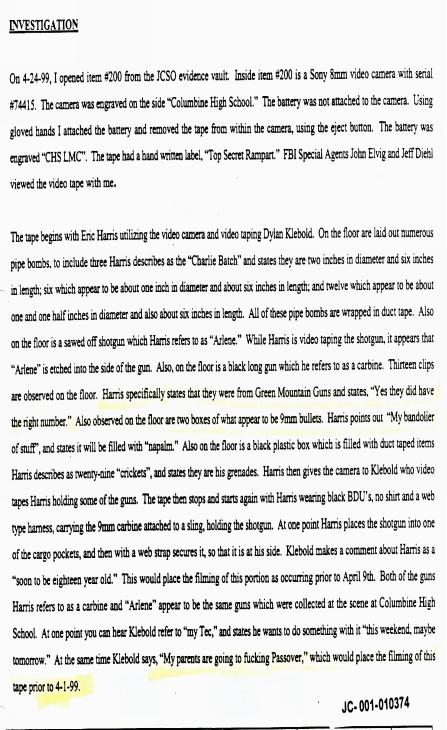
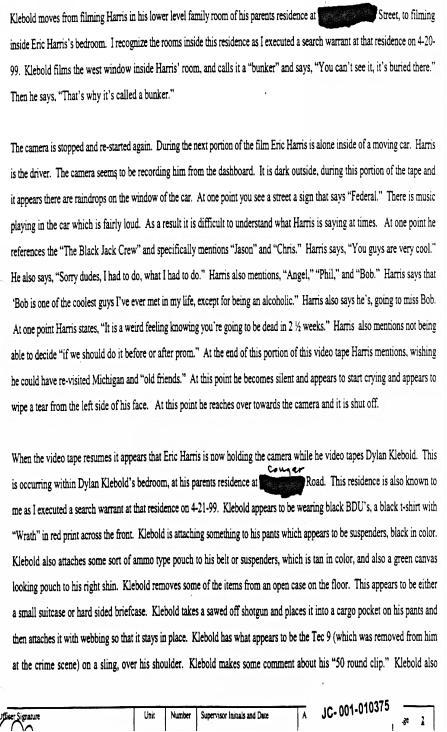
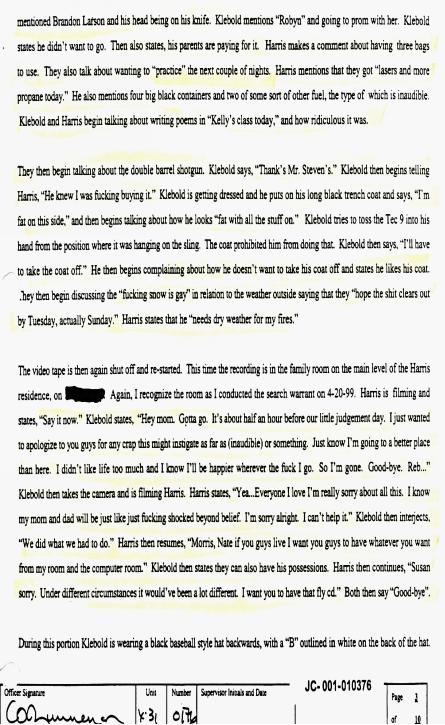
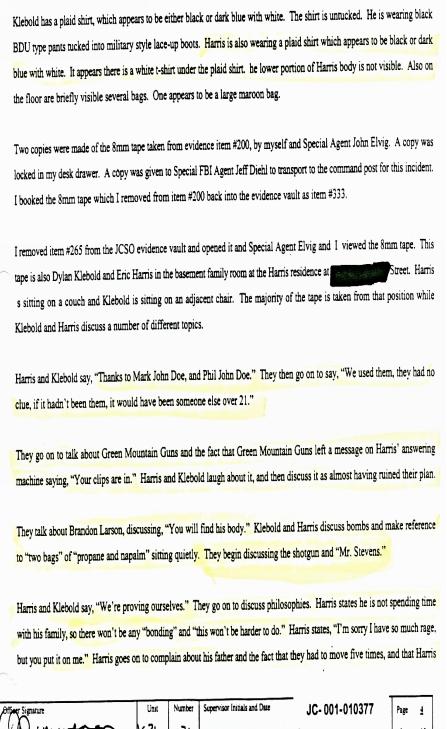
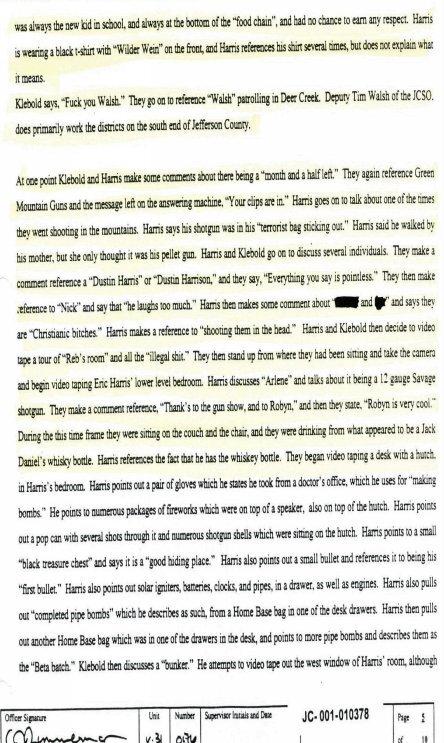
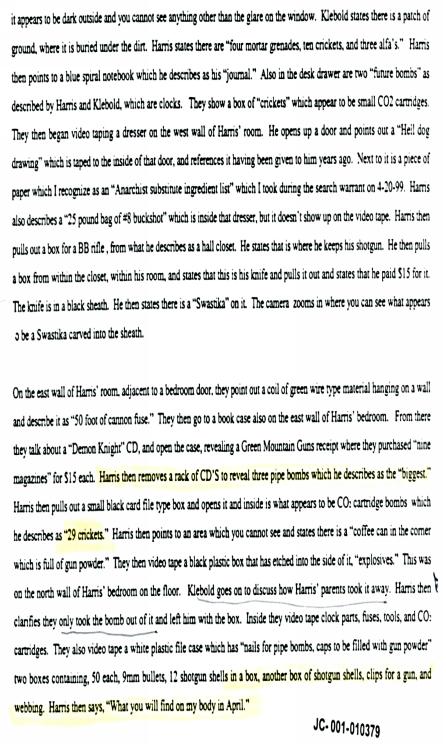
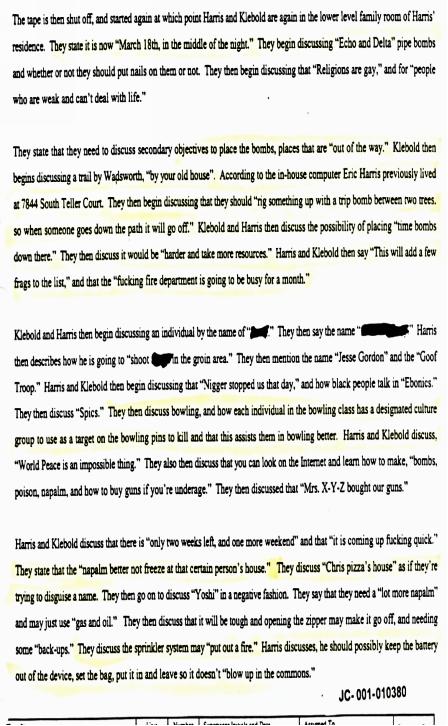
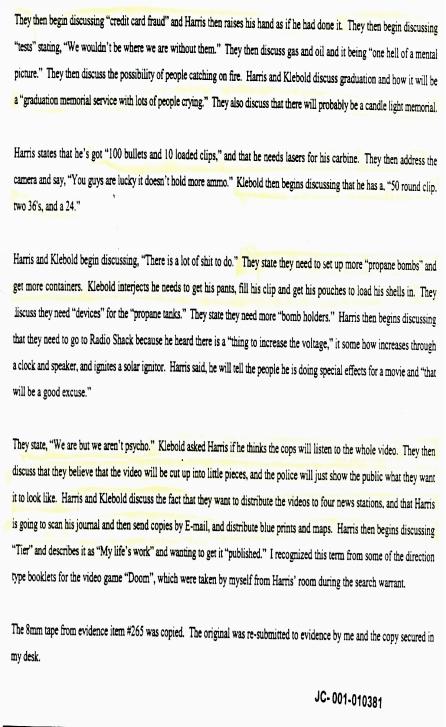
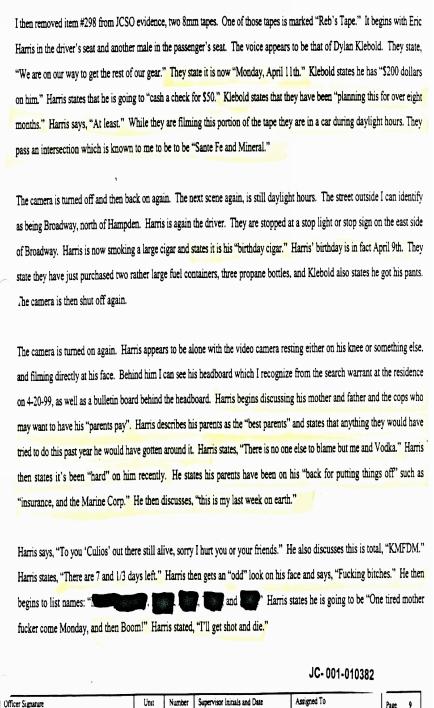
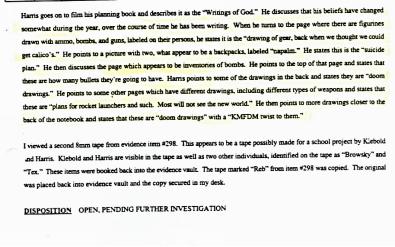
Basement Tapes. A few extra notes:
Did you notice? Did you notice that there is no mention at all of Brooks in all of these tapes? There is no mention of him. Not a word. Eric and Dylan mention their friends, and a few children they hate, but there is no mention of my son. I would ask, again, why the Sheriff would name my son as a possible accomplice, if he is not mentioned in any of these tapes. You know, by now, the reason. The Sheriff and others were covering up our report, and their failures.
As an additional note, we know, from these videos, that Eric’s room was an arsenal. He had pipe bombs, fuse wire, explosive crickets, a shotgun, a rifle and other weapons stored in his room. He built pipe bombs in the house for almost a year. He secreted pipe bombs, explosive crickets and a can of black powder in his room. He made pipe bombs, napalm, explosive crickets, and stored weapons and explosives in this house for more than a year. That is one of my clearest memories of these videos. His room was an arsenal. How is it that Mr. and Mrs. Harris didn’t go to jail? They kept information away from the judge during the diversion process. They gave Eric back his pipe bomb building kit. Mr. Harris detonated, with Eric, a pipe bomb in a field. They knew about the bunker, to store the pipe bombs. They didn’t search their son’s room. Any other roommates, with this level of involvement, would probably have gone to jail for years.
Do you remember the DA saying that there is a duty to report crimes like this, in the Manes Trial? He used that law to condemn Manes, and to ask for a longer sentence. Do you remember: “DA: Mark didn’t report anything to law enforcement. It is a duty to report suspected crimes. Had the defendant reported them than the crimes might have been prevented.”
That duty apparently doesn’t not apply to parents. That condemnation, apparently, does not apply to Mr. and Mrs. Harris.
Explaining the videos of Eric and Dylan threatening people:
Do you remember seeing these videos? The ones where they were being filmed, walking toward the camera, yelling loudly. Screaming at the camera, angry! Violent!
Eric yells something like: “You little worthless piece of crap…”
They looked vicious and crazy. But, did you get to see the entire video? They were goofing around. They were acting.
At the end of the video, which was often deleted, they would actually laugh, making fun of themselves, embarrassed at the absurdity of their acting and the role they were playing. They made this video for a class project, called: “Hitman for Hire,” for a class in school. It was not real. It was a lark for them. They were acting and being stupid. This video, out of context, is very misleading.
I only mention this to show you, that some of the things you have been shown are not what they seem. This video, of both of them, is not at all what it appears to be. If you are really curious, search for it on-line. Find the ones that don’t have the ending cut off. It will be obvious.
If you do find it, review Eric’s tape a few times. I have, and I noticed that it is the way an abused child would yell, mimicking the parent who belittled him: “You little worthless piece of crap.” That is just an observation. Just an observation, but I am sure, in my heart, that those words, by Eric, are a reflection of the verbal abuse he received at home.
What about the “Nixon Tape?”
During the search of Eric Harris’s house on April 20th, or the following day, a tape was found. It was a cassette tape, and the policeman who listened to it said that it had the reasons that the two did this, spelled out for everyone to hear. But it was never released, never transcribed, and the police never made any further comments about it.
Yes, I find that curious. Yes, I find that absurdly suspicious. Yes, I find that criminal. What could this tape have on it that would require the police to keep it secret? What could it possibly say? And people wonder why the Columbine tragedy is still full of unknowns and mystery and lies. Why wonder? The police had something to hide. Why else would they hide a tape that told why these boys killed? Why? There is no logical reason other than that. The police had something to hide.
The mention of the tape is not easy to find. It is mentioned once, on page 10,409 of the released pages. The Deputy, Deputy Moore, writes: “On the micro cassette tape the male voice indicates reason why these things are happening.” It was given to Kate Battan, and we have never seen it again, or heard about it, or received a transcript.
It has, by the way, nothing to do with Richard Nixon, the President. It was a name Eric put on the tape, when he interviewed some guy named Nixon for a class paper. You can find that on page 26,660 released in July of 2006. In the notebook, with all of these pages, are other school writings by Eric. They are average papers, with some interesting insights. There is a paper he wrote about Guns, and guns in schools. Yes, Guns in Schools. He writes: “In conclusion, metal detectors and more police officers are a great start to the fight against guns in school.” Seriously. He was writing about it before Columbine. He was aware of the problem, and of school shootings, while the police, who had him in their system, ignored the same problem. I don’t need to mention that all of Eric’s school papers were written before Columbine. He was writing about school shootings and guns in school, while the detectives at Jeffco were blissfully unaware of the danger. He was studying it while the police were ignoring it.
There are complete pages that have been redacted. One is a song or poem called Guilty by Gravity Kills. This is apparently a song lyric by Gravity Kills, a musical group. There are approximately 32 lines redacted, and 32 lines in the words to the song. You can look it up on-line. There is no particular meaning to the lyrics. No real foreshadowing of the violence to come.
Why this was redacted I have no idea. It appears to be the words from the song, although it is a complete redaction, so that is guesswork. It was recorded in 1996. It is on page 26,643 in the released pages.
An odd detail: Gravity Kills is part of a video game: Call of Duty. There is a Gravity Kills Trophy in that game. Call of Duty is a very violent video game, but it was not released until 2003, so Eric certainly never played it, or even knew about it. He happened upon a song that was later used in a violent video game. This song may have been used in Mortal Kombat too, released in 1992, so it is possible that Eric knew it from that video game. Or from Test Drive: Off Road. Regardless, it appears to be a song lyric, written down, and then redacted. I know this is a small detail, but it is this type of info that can give some insight into Eric and who he was. This is certainly something that a good researcher could take and investigate. Why redact it?
In the hundreds of pages in this release, there are lots of papers that Eric wrote, and other items. If these had been released earlier, instead of in 2006, they would have been a valuable resource for experts to review. Their release in 2006 was too late for them to garner any interest, or provide any value to researchers.
Eric has a number of school papers in the 2006 release. There is a school paper about guns in schools. There is one about playing in the woods in Phillipsburg, where he grew up. There is a story about the Nazi culture. They would be interesting reading for anyone researching Eric, but most people don’t even know about them.
There is a page that is interesting. Page 26,803 lists the pipe bombs that Eric made. They are listed by batch, size, powder load, shrapnel load, date made, total made and rating. Yes, he rated his bombs, and listed the manufacture date. The dates range from October 1998 to April 14th, 1999. He made 63 of them, according to this list. Yes, he documented his first pipe bomb in October, 1998. According to the page, this list of bombs was taken off of the school server. Oddly, it is dated 4/19/99. This shows that he was manufacturing pipe bombs, in his parent’s house, for 7 full months before the Columbine killings. Seven months of undetected pipe bomb building, in his parent’s house, during which time he was in the Diversion Program.
Page 26,801 is the list he made of his napalm tests, and their effectiveness. Yes, he documented those in detail. Again, taken from the school server, dated 4/19/99.
On page 26,767 is a list of articles he used for research on a paper for school. One of the articles is: “Weapon Carrying Among High School Students” from 1991. A rather odd source for a school paper.
Page 26,802 is Eric’s list of things left to do, dated 3/22/99. It lists buying ammo, propane tanks and more. This is also printed from the school server, dated 4/19/99, at 8:40 am. Yes, Eric took his files to the school on April 19, 1999, one day before the killings, and loaded them on the school server.
On page 26,856 he tells how they will smuggle the bombs in the duffel bags into the cafeteria. He says they will carry them in, and give an excuse: That it is for a science, Band, or an English project. Is this how they actually did it? Can it be that simple? Did they carry them in, acting all casual, and leave the duffel bags on the floor, and no one noticed?
And, what is this info that the police retrieved from the school server. That is from the server at the school? These are pages retrieved from the school server, at Columbine. What? Were they completely unsupervised in the school? Did Mr. Long or Tolacco not monitor anything? It was rumored that Mr. Long sued the school, and received a settlement of over $650,000 from the suit. Was that related to this? What are the details? We may never find out, because it is all protected by the school and their privacy rules. Something is certainly rotten in Denmark. Denmark being, obviously, Columbine.
We did have a teacher pull us aside, while we were in the school for a walkthrough, and she told us that the disciplinary files on Eric and Dylan were thick. That they both had extensive complaints and problems. None of this was ever released or even talked about. There is a lot of information in the pages. A lot of information for the researchers.
And what is the most important line that Eric ever wrote, in my opinion? On page 26,832, Eric Harris wrote the following line: “I have learned that thousands of suggestions are worthless if you still believe in violence.” In the back of my memory is the same phrase, somewhere, written by Dylan. It may be that this phrase was confused by the police, and put in two separate locations.
I nearly forgot. Page 26,856 is the page from Eric’s journal, where he goes over his plan for the day of the killing, where he says he is going to go to our house, before they go to the school, and kill and torture us. I almost forgot that detail. That page, that the police had on April 20th, 1999, and then kept secret for years. I will give them some credit. At least they didn’t redact it. As a note, we had a copy of the original, given to us a few years after Columbine, so we knew about it before the release of these pages. They had that information, while they were lying about us, and falsely accusing my son.
Who knew about Eric and Dylan at the school?
This is a difficult question, and very complicated. I can only guess, as so much of this information has been kept from the public. In fact, a great deal of effort has been made to keep it secret. Frank DeAngelis, the Principal, testified before the Governor’s Commission on Columbine, but he did so behind closed doors. Not a word of that testimony is available. Frank was the Diversion Contact for the school, but it is unclear whether he actually did anything in that capacity, or if he was just named, and had no role. We will never know his involvement. He has never discussed it.
So, let’s start with what we do know. Sally Blanchard, a District level administrator, admitted on “60 Minutes” that she knew about the pipe bombs and pipe bomb building. That was a fascinating admission. First, that disclosure certainly violates the confidentiality laws, and second, it means that the District knew. The School District knew about the pipe bombs. The School District, in Golden, had been informed about the pipe bomb building by Eric and Dylan prior to the killings. That had to be information obtained from our police report in 1998.
We know that Deputy Gardner, the in-place School Resource Officer, knew, as he is named on our police report as one of the people that our file was sent to. He was given the file, but not the web pages. We know that from a conversation we had with him at his house. He never saw the web pages, but he was given the report about building pipe bombs and threatening my son’s life. He knew about Eric and Dylan and the death threats and pipe bombs.
We know that Mr. Horvath, a Dean at the school, knew about the violent side of Eric and Dylan, although he is never questioned by the police as to his knowledge of the Pipe Bombs and death threats. Horvath suspended Eric and Dylan in the fall of 1997 for breaking into the school computers. At a staff meeting immediately after Columbine, Horvath put his head in his hands, sobbing. He yelled at Frank: “I told you to do something about that kid. Why didn’t you do something about that kid?” Someone in the room, who witnessed this, told us this story. They are a completely reliable source.
Mr. Horvath stated, to the police, that he was not actually shocked that Dylan and Eric did this, because in his dealings with them he saw the potential for an “evil side.” It is not logical to assume that he saw this “evil side” only from Eric and Dylan hacking into the school computer. Then he says he had no other dealings with them. Then, later, he says that Dylan got into trouble for scratching something into a freshman’s locker. That Dylan told him that he was upset with the way Columbine handled people, to include the people that picked on him and others. Then, while waiting for Dylan’s father to pick him up, Dylan began cussing at him, although it wasn’t directed at him. The police never ask about the pipe bomb and death threats. They are not discussed. Dr. Reschke, Mr. Horvath’s superior, did say that Mr. Horvath told her: “Eric Harris is on the edge of losing control.” That is a lot of knowledge from one incident at the school, concerning only hacking into the school computers.
Students saw, in class, the video of Eric and Dylan shooting weapons in the rampart Range area. This was edited in school, and students saw the film and the editing while it was in progress. Mr. Talocco was the teacher, and students say he had to know about it. Did he see the videos?
Mrs. Kelly states that she did give the violent essay that Dylan had written to Mr. Butts, the school Dean.
We were told by a staff member that the files on Eric and Dylan were thick, and that they had been in trouble a lot.
FERPA Regulations have kept the rest under lock and seal.
But, I can’t let that go. I just can’t. The administration knew about the pipe bombs, and they didn’t do anything to control or watch these two violent children. The administration in a large school district was notified that two boys were building and detonating pipe bombs, and they, with resources and millions to spend, took no action. In fact, the school security expert, that they had hired a few years earlier, warned them about security and issues, and he was ignored.
Would that be called a major failure by this school district?
Was there a third shooter?
There are a few eye-witnesses who say they saw a third shooter. Every one of them can be attributed to the confusion of eye-witness testimony. Eric took his trench coat off at the top of the hill, and that caused a lot of confusion, by making it appear that there were three people at the top of the hill when the shooting started. If you will remember, Eric took his trench coat off at the top of the hill, outside of the school, and laid it on the ground. I have the photo of the trench coat, on the ground. (Dylan took his off in the library, by table 18.) A review of those reports makes it very clear that some children were seeing Eric, with and without his trench coat, outside of the school. The police, in their panic and confusion, heard comments about other shooters, but there is no reliable eye-witness testimony that would support those comments. I have read everything. I have watched the videos, and searched through every piece of ballistic information and evidence I can find. There is no evidence to support a third shooter theory, or even an accomplice. Of course, there are the reports of police firing their weapons, but not in the original releases.
Was the handling of the scene completely incompetent? Yes, of course. Was the investigation incompetent and flawed? Yes, of course. Did the police conceal information and lie to cover up their failures? Yes, of course. Did the police and the County lie to conceal information? Yes, of course. But, in all of the releases, in all of the evidence, there is no hint at anyone participating with Eric and Dylan in this crime. There is no evidence to support that idea.
This was a two-man team of killers, who worked alone.
Yes, they had help buying the weapons. Robyn purchased three of them, and they purchased one in a private transaction. They collected their own explosive powder from the fireworks stand they worked at, and purchased their own propane tanks. They purchased their own gas cans and made their own napalm. They built their own pipe bombs, and crickets, and detonation devices in Eric’s basement and garage, using the bomb building kit that Mr. Harris returned to Eric.
Their diaries mention their friends and the people they used. They left this information for the police, even wanting to make copies for the local stations. In their diaries they had no secrets. They even took special care to refer to the girl who purchased three of the weapons as “Mrs. X-Y-Z.” They knew that their diaries would be examined. After the fact, after the release of the files, it is very obvious. Eric and Dylan acted alone, without any other involvement from any of their friends.
Could this have been stopped?
Was there “leakage?” Of course. Leakage is the term, used by psychologists, to refer to information leaked out by the killers before the crime. Dylan leaked the web-page info to Brooks in 1997. He told us and we took it to the police. Other friends heard them talking about blowing up the school, but that was not an uncommon occurrence. The FBI lead investigator’s son made a video about blowing up the school. Technically, that is not leakage, that is a warning about the existence of an abusive environment, that the school failed to recognize. Other children knew that Eric had bought a weapon, and had a hit list. Eric had asked other children to buy him a weapon. Eric and Dylan brought pipe bombs to the pizza place where they worked. Dylan wrote an extremely violent essay, and Eric essentially warned the Diversion Counselors of his violent and suicidal tendencies. There was leakage. There was a lot of Leakage, it was just not acted upon by the police. The police and school failed to act.
And what was the closest they ever came to being caught? Two times, they could have been stopped. Two times, without question:
First, was our police report to the Jefferson County Sheriff’s Department. We reported them for building and detonating pipe bombs, and death threats. That investigation was closed by someone, without our knowledge. The second time was the entire year before Columbine, at the Harris house. For a year, or more, Eric and Dylan built pipe bombs, prepared napalm mixtures, snuck out at night and tested bombs, ran missions, built explosive crickets, prepared timers for bombs, and collected weapons and ammunition. They did all of this in the Harris family home. Then there was the phone call from Green Mountain Guns, telling Wayne Harris: “Your clips are in,” and he, with awareness from his military background, knew what that meant, and did nothing. It would be unfair to leave out Wayne Harrises failure to stop Eric from building pipe bombs, when he knew about them, and even detonated one with him. Mr. Harris knew about the pipe bombs.
There were times when this could have been stopped, without question, without even an argument. There is no debate needed, or even possible, on that subject. This crime could have been stopped. No, not by all of the kids in the school who heard mild and vague threats. No, that would be asking too much. This crime should have been stopped by the Sheriff’s Department on March 31st, 1998, when we filed our report, and later by Wayne Harris, when he received the call that the clips were in for his semi-automatic weapon, a weapon that he didn’t own, and that he did not know that Eric owned, and when he detonated a pipe bomb in a field with his son. Those are red flags and crimes, and children died.
A note about Eric and his violent life.
As I read this information, and think about it, and sleep and then wake up thinking about it, certain points become important. This is not a question. This is an observation. Look at Eric’s life. You know quite a bit about it by now. I certainly do. Eric’s life was full of violence. He played violent video games for thousands of hours. In the games he watched the killing, he did the killing, he heard the killing. He watched violent movies. He read violent books. He was bullied in school. He was humiliated in school. He fought with his parents. He lied to his parents, and argued with them. He wrote about anger, racism and hatred. He referred to NBK over and over again. NBK is Natural Born Killers, an incredibly cold and violent movie from 1994. He wrote about government scandals and conspiracies. He read and wrote about Nazis and wanting to kill mankind. He built pipe bombs. He blew up pipe bombs. He fired weapons. He fired weapons, pretending to kill people, imagining the damage it would do.
His entire world was violent. Everything.
Eric took every violent thing in our world, concentrated on it, and kept building on it, until that was what he became: Violent.
In our violent world, does it surprise you that a boy like Eric, fascinated by every aspect of violence, indoctrinated in it by the humiliation in the school, and seeing the violence in the world around him, does it surprise you that he became violent? Does it?
How could it surprise you? Open up your eyes to this violent world we live in.
Why does it surprise you that some of our violent children kill some of our innocent children?
Why does it surprise you? How can it possibly surprise you?
It is the world we have created.
Why wasn’t Erickson given Subpoena power?
In the Governor’s Commission investigation of Columbine, the Governor refused to give Chief Justice Erickson subpoena power. That was a very odd thing to do. We talked about that, privately, with Justice Erickson. He was upset about it, but he couldn’t do anything. He was given a very difficult task, and he was an honest man. He was a courageous man, but he was limited by the politics, and controlled by the Governor. The Sheriff and others simply refused to testify, and he was helpless in their refusal. The lack of subpoena power was outside of his control. I did ask him how he felt, on Oct. 22nd, 2000, about the order by the Governor that he couldn’t have an investigator ask, and investigate, whether bullying had caused the murders. He told me: “Every step I take tells me there is a problem with the administration of justice in Jefferson County.” I wrote it down when he told me that. Those were his exact words. He was being honest. I think he was trying to tell me that he was beginning to suspect that there was more to Columbine than he knew, and he was letting me know he cared, and was on our side. Justice Erickson is dead now. Judy and I went to his funeral. He died after the Commission was over. He died frustrated and upset over the investigation. He had been lied to, and he discovered that on his own. Then, when the Commission was over, no one would even take his calls. They wanted him out of the way. This brave man, with a great deal of integrity, died knowing that he had failed on the Commission. He had failed to get to the truth. It was, from my conversations with him, the greatest failure of his life. A Supreme Court Judge who had his career ruined by the politics of Columbine.
In my dealings with this man, I found him to be tough, fair and demanding. He wanted information he could use. Facts. He called me many times, with questions, and to get information. I was upset sometimes, because he would time his phone calls, by accident, to be at a moment when I was hiking in Deer Creek Canyon. The reception is bad, so I would need to walk to the edge of the mountain and stop, looking for a good signal. I would stand there in the heat or the cold, and listen and think, and tell him what I knew about whatever detail he was asking about. This happened quite a few times. Then I would be so involved, in what he had asked about, that I would think about it for the rest of the hike. Getting away from the sadness of Columbine was hard to do.
I really liked him. In the end, I felt sorry for him: he had been used by the political hacks, and he figured out, a little too late, that they had used him. We talked, a number of times, after the Commission results had been released. He was upset, but he couldn’t do anything. I would see him before some of the Commission hearings, and we would acknowledge each other. He said few words at the hearings to me. He was very kind to me. He would know when I spoke out of turn at a Commission meeting, and he would look around the audience, knowing it was me, and then let it go. The conference room had seating on the side, and I would be there, the only person in the area, and he would ignore my comments. He would listen, know it was me, and not admonish me for them. That was amazing behavior for a Judge of his caliber. He did thank me once, before the meeting started, before anyone else had arrived. That meant a lot to me. I understood his reserve. He didn’t want to be seen listening to me, or talking to me. He had to maintain that appearance of fairness.
So, why wasn’t he given subpoena power by the Governor? Isn’t it obvious? The Governor didn’t really want to get to the truth. He wanted Columbine to go away. The Governor’s Commission on Columbine was a way to show that the Governor had made the effort. The Governor lived with the embarrassment of Sheriff John Stone telling him to kiss off, and still did nothing. He didn’t really want answers.
I miss you Justice Erickson. I appreciated you and your work. You were a friend. You were a brave man. Given a free rein, and subpoena powers, you would have discovered everything.
Why didn’t Eric kill Brooks outside the school?
If you will remember, Brooks saw Eric drive in to the school parking lot, and Eric parked his car in the wrong lot. Brooks went down the hill to see him, and to ask why he had missed the test in a class. Why didn’t Eric shoot him at that time?
I have thought about this a lot, especially after the shooting. Brooks had walked out of school on the 20th to have a cigarette. Smoking was allowed in the smoking pit, on the North side of the school, but Brooks was such a contrarian that he wouldn’t smoke there. He also needed a permission slip from us to use the smoking pit, and we wouldn’t give it to him. He would walk out onto Pierce to have a cigarette. It was closer to the school. It was easier. As long as he was not on school property, the school couldn’t stop him from smoking.
On the 20th, Brooks went out to have a cigarette, and saw Eric drive in really fast, and then park in a space in the junior lot, that was not his parking space. Brooks walked down the embankment to Eric’s car, and asked why he had missed class. Eric said: “Get out of here. I like you.” Brooks, a little confused, walked down to Pierce. Smoking was his priority.
Why did Eric let him go? I have been asked that many times, by many people. I, of course, do not know for sure, as only Eric knows, and he is dead.
But I do have a few theories.
If Eric had shot Brooks in the parking lot, the plans were over. I believe that the bombs had already been planted, and Eric was going to walk up and meet Dylan to start the killing. Eric’s car was a bomb. He had two propane tanks and napalm and bombs in it, with a timer. He had parked in the lower lot to add to the confusion when the bomb in his car went off. They were set to a later time than the ones in the library. We know that from the investigation reports. Killing Brooks would alarm too many people. They had to be secretive before the bombs in the school went off, and shooting someone in the parking lot simply did not work. In addition, Eric had grown to like Brooks a little bit, since Brooks had made up with him in a class. While sitting in a class, Brooks had heard Eric’s voice behind him, and had decided to “bury the hatchet.” Eric had, possibly, realized that Brooks was not one of “the enemy,” and had let him go, just like he and Dylan let other kids they liked go free. They let a few kids go in the library, and Eric let Brooks go in the parking lot. I should point out, as an important detail, that Brooks’ brother Aaron was in the cafeteria. There was certainly no thought by Eric of letting Aaron go, or anyone else. But, when the whim stuck him, it was probably fun for him to decide on life or death. That leaves Brooks on the sidewalk on Pierce having a cigarette, and his brother in the cafeteria, sitting 2 or 3 tables away from one of the two duffel-bag bombs. That is certainly something you should consider, if you still have questions about Brooks. His brother, who he was very close to, was in the cafeteria, and would have been killed if the bombs had gone off. Brooks would never have let that happen, if he had been involved. Never.
Yes, we were very lucky that day. Eric let Brooks live, and both of the duffel-bag bombs failed to explode, saving the life of our other son, who was in the cafeteria. Both of the bombs in the cafeteria failed to ignite and explode. Yes, there were two duffel bag bombs. The explosions would have consisted of 2 propane tanks, napalm, gasoline, pipe bombs, shrapnel and other explosive devices. Aaron still had to escape, going through the school, through the auditorium, up the stairs, and out the main front door, narrowly missing Eric and Dylan as they walked the main hall. We were very lucky that day. Other families were not.
Were Eric and Dylan Bullies?
I have read this, and heard this, from so many sources. It is ridiculous. If you had seen them, you would laugh at that comment. Eric was little and skinny and frail. He was a jerk, sure. But he couldn’t pick on anyone, unless he had a weapon. He was 5’ 7” tall and 130 pounds. Yes, when he was in the school on April 20th, he was a bully, shooting innocent children. But before, in the school, and faced with the few real bullies, he was a coward. He couldn’t fight back. It was physically impossible. Dylan was 6’ 3” inches tall and weighed 150 pounds. (Yes, I know that there are different numbers for his weight. His driver’s license says 180, but that is a stated weight, and not verified. His autopsy says 150.) He was outweighed and out-steroided. He was tall and weak. Dylan was not a fighter either. He was tall and lanky, but not strong, and certainly no match for any of the bullies.
Then what do people mean, when they accuse them of being bullies? If you will read Lonnie Athens book, you will see it spelled out very clearly. When boys are humiliated, they go through a process called violentization. They are bullied. They are humiliated and abused. They eventually react. They will act out, and try to fight back. They will make attempts to fight back, acting tough, dressing in black, wearing dark sunglasses, and finding little ways to get back at the bullies. They will still be afraid, but they will talk back, or push back. They will do this just enough to feel a little better about themselves. They will not actually fight the physically superior bully. That would be foolish. They will not fight back until they can. They will fight back, but they will do it incrementally, one small step at a time. First, they will talk back, then glue the doors shut to the school, then refuse to move over when the jocks would walk into them in the hall. This is the process of violentization. It is the development of their responses to the violence they were subjected to. It is this acting out, this bluster, this pretense at fighting back, that people saw. It is a very serious red flag behavior. Yes, they appeared to be bullies, at times, but that was a response to the humiliation and bullying they received. That is what people saw. It is absurd to interpret it any other way. The real school bullies were strong, violent, and steroid driven. They were unbeatable. Eric and Dylan were afraid of them. Then Eric and Dylan imitated the bullying behavior, fighting back in little ways. It was one step in the process of violentization. Then Eric and Dylan became the biggest bullies, with weapons, deciding to kill. That is the end stage in the process of violentization. That is one of the lessons here: When a bullied child starts to fight back, a developmental point in the violentization process has occurred. This is a tipping point. This is the beginning of a violent response. What is the old saying: You can kick a dog around only so long? That is the tipping point. When these two bullied kids began to act out, to fight back, they became dangerous. Their humiliation turned into violence.
Humiliation creates violent responses. It is a very easy to understand concept. Bullying and humiliation lead to a violent response. Not every time. Not for every child who is bullied. But it will happen.
Why do I keep saying that bullying was the cause? What evidence do I have to prove that?
Feb. 2020
That is a good question.
There are multiple sources that prove that the bullying and humiliation were the real cause of Columbine. We have talked to many students at Columbine. Many of them have described the bullying and talked to us about it. These stories are very hard to listen too. Children describe being pushed, knocked down, frightened and harassed. They report certain football players simply walking to the head of the line in the cafeteria, and other times arrogantly doing what they want. It was common. It went uncontrolled.
There is the story about the boy who was harassed, by the bully bouncing a basketball off of his head, with the bully saying: “Another one in the oven.” There is the student who was harassed so much by one of the football players, that she got a restraining order against him. He was allowed to stay in the school, and the administration actually asked the girl to transfer to another school. She refused, and the restraining order was not enforced.
We know of the bullying our son saw, and his reaction to it.
Enough of the general stories.
Here are some specific statements, from the police investigation, from actual students interviewed by the police. These are all separate interviews of different children:
Page 10263: “He knew that these kids got picked on all the time, and that most of it was done by the football team. Then stated that Eric and Dylan were talking about blowing up the school, because it was the big rumor for two years.”
Page 10264: “I asked him if he knew why he would have made the “98 should have died list. He stated that he had been relentless in his abuse of Eric during gym. I asked what he meant, and he stated that he had teased him about being bad in sports because he wasn’t very good, but he wasn’t the only one, other kids teased him too.”
Page 10265: “I interviewed redacted. Redacted had no explanation why his name would be on the list. Stated that he had friends redacted and redacted who would taunt Harris at school. Redacted said he never participated in the taunting.”
Page 10273: “He had spent most of his time in a gym class he was in with Eric Harris, making fun of him. Eric had a big head on a very skinny body so he just teased him all the time.”
That is enough of the pages. I had to reference only one section, of one book, of the reports to find those pages. The remarks are everywhere. You must remember that these are very short police interviews. Some police pursued the bullying questions, and others never even brought it up. It was such a poor investigation. These deputies went to many different kids with different questions.
And here is the main reason that we believe that bullying was the cause of Columbine.
Eric and Dylan told us so. When Eric and Dylan went into the library, with weapons ready, Dylan shouted: “This is for all that you have put us through for the last four years.” And “All Jocks stand up… with a white baseball hat.” The jocks wore the white hats. It was their identity. It showed their superiority. It showed who they were. It distinguished them from all of the other students, who were not allowed to wear white hats.
In his journal, Eric clearly states that this revenge is for the continuous humiliation he received. Dylan complained about it too, to a Dean in the school.
The cause is obvious. There are many reports like this. My repeating more of them doesn’t accomplish anything.
Bullying was the cause. Bullying was the main cause.
Were there other reasons? Of course.
But bullying and humiliation in the school were the main reasons that Eric and Dylan hated this school so much.
To deny it, as the Sheriff’s Department and the school have done for years, is ridiculous.
Will taking away guns help?
That is a tough question. I believe that the answer is no.
There are millions of guns. Yes, millions.
There are rifles, pistols, semi-automatic weapons and firearms all over this country. I do not believe that it is possible to take away all of those weapons.
In this country, owning a weapon is part of our history. It is, at its core, the way that we can keep the government in control. An armed citizen base is pretty difficult to push around. The military could do it, but the casualties would be very high, and armed citizens, at this point, are our protection from that government. That is why it is in the Constitution.
Sure, we can modify that, but is that the right thing to do? Most citizens use weapons to protect themselves. Sure, it is an inefficient and dangerous system, but it is part of being a citizen and having rights.
I own weapons. I do not want to give them up. I have needed them to protect my home. Am I willing to give up that right because a few, very few, people have used weapons to kill people? Not yet.
There are other ways to kill people. If the guns are taken away, there are cars, trucks, propane bombs, gas line explosions, gas, napalm, pipe bombs and many other ways to kill. Remember the guy who drove his car through the crowd of protesters? Remember the truck that the man drove through the crowded pedestrian area? Remember the propane bombs that were made incorrectly at Columbine?
It is not possible to eliminate all of the ways to kill people.
It is, hopefully, possible to eliminate most of the hate, that causes the desire to kill people.
That is the cure for this disease we call violence.
I hope you have learned that from the pages of this book.
Who carried the Propane Bombs into the school?
That is a really good question. We know that Eric and Dylan were seen walking around the school at around 10:30. There is evidence that they purchased three of the propane tanks that morning.
So, at some point that morning, Eric and Dylan must have carried the propane bombs, in the duffel bags, into the school.
Here is the problem with that theory: They are much too heavy for one of them to carry. I know. I tried it. We filled a duffel bag with a propane tank, some gas in a container, and the other items listed in the police inventory, and I lifted it and put it on my shoulder. It took all of the strength I had, and I could barely walk with it on my shoulder. To believe that Eric or Dylan did this, and carried the two large duffel bags into the school without being noticed, is really stretching it. I am much stronger than both of them. The weight of that bag would be very difficult to carry.
Anyone seeing them struggling under the weight of these duffel bags would have noticed, and no one noticed. There is not one report of them doing this. There are no videos of this happening.
To be precise: there is one report of a boy who saw Eric carrying a heavy bag into the school. The bag was 18–24 inches long, and 12 inches wide. Yes, that is an excellent and detailed observation. Eric was carrying it at approximately 11:15 am, walking from the East to the West. But this bag is too small to hold the propane tank and other items. You can look it up, on page JC-001-004787. The statement doesn’t include him seeing Eric carry it into the cafeteria. It is my best guess that this is the bag used to carry the ammunition and pipe bombs, that was carried to the library. This was also, according to his very detailed testimony, just 3 minutes before the shooting started.
So, where did the large duffel bags come from?
I can guess. Could they have been secretly carried into the kitchen or cafeteria before school? We know they had keys to the school. Could they have been hidden in a locker? We know that they had the locker combinations for all of the lockers. Could a friend have carried them down to the cafeteria for them? And, yes, I know that there are photos of them carrying a small bag into the cafeteria. That bag is much too small to be the pipe-bomb duffel bag, and they carry it much too easily.
Since they are much too heavy for one person to carry, it would have required both of them. The bombs were too big to put in one locker, without requiring assembly at the school. That would have been too obvious. And the size propane tank they used would not have fit into a school locker.
So, where did they come from, and how did they get placed right in front of the tables?
Eric and Dylan must have carried them in, either before school or during school, and no one noticed. That is such a weak answer. It lacks logic, but it is the only option I can think of. It is the weight of the duffel bags that make this such an interesting detail. In Eric’s writings, there are notes, telling how they planned to do this. He wrote that they would act all innocent, and carry them into the school, and say they were for a school project. Can it be that simple?
No, it can’t be. If the propane tanks purchased that day are the propane tanks that were used in their cars, as bombs, with timers, then the propane tanks in the duffel bags in the school could have been purchased earlier. They could have been purchased earlier, and left in the school, and moved on the day of the killings. That makes sense. Eric, the planner, would not wait for the school bombs to be carried in on the morning of the killings. He would have figured out another way. The propane tanks purchased that day must have been the ones in their cars.
This then, is a question that I can’t answer. We are told that the bombs are placed in the cafeteria in the morning, when the video tape is being changed, approx. 11:14 a.m. Did they have a helper, who carried the bombs into the cafeteria, or did they place them there? How could this activity not have been seen by anyone? There simply was not enough time for them to carry the large duffel bags into the cafeteria, based on their arrival time at the school. And there were two of them. Two large duffel bag bombs, each with a propane tank and napalm and gasoline. One of them, the maroon duffel bag, was seen in the basement videos. Was it full and ready to go, or was it half empty, waiting for the propane tank they were on their way to buy that morning? Am I supposed to believe that both Eric and Dylan carried a large and heavy duffel bag into the school, left it by a table in the cafeteria, and then went back to their cars, with the timer in the duffel bags set for 11:17, three minutes later, and no one saw them?
If there ever was an example of a scenario that needed to be reenacted, this is it. I would have to go to the school, drive in and park, carry in the duffel bag, walk back to the car, and see if the timing is possible. It would be an easy test, but they won’t, obviously, let me try.
Are there more questions?
There are hundreds and hundreds of detail questions. Who killed which student? Why did the bombs not go off? Why did Eric kill Dylan? And there are hundreds more. We have the answers to many of those questions, but did not put all of them in the book. Some of them, like why the bombs did not go off, should remain confidential. Some are unnecessary and painful. Do we really need answers for everything? Once we are at this stage, isn’t it enough that we know why they did it, what caused it, and how it can be prevented from happening again? Isn’t that enough? I am beginning to believe that it is. That is what I set out to learn, and I believe that I have studied it, lived it, and researched it enough to be sure that I have arrived at the truth. It has been more than 20 years. More depth is for the curious people that want to know every little detail. If I did that, this book would be 5,000 pages long. It is already long and complicated. I think that this is enough.
The last chapter, the bonus chapter, is about how to stop this from happening again.
I hope you read it, and understand it, and I hope that we can change.
Untold Story about Columbine.
June 1999
I was stopped at the traffic light in front of Columbine. It was in June of 1999. I was in my black Mercedes, sitting at the light, upset, and very unhappy. I looked over at the school, and I had this desire, this overwhelming desire, to drive my car through the front door of the school. I sat there, through the light, thinking about it, about how to do it. I thought about ducking as I drove through the front door, as I rammed through the doors, about turning in the front hall, as I turned to crash into the office. I thought about the crash, whether I would survive it, and was frozen in thought.
I drove home, a little afraid of the thought, and the anger. A little afraid of hating the school that much. I hate Columbine.
Illness
July , 2017
I have been sick for a few years. I have been very weak, and have no strength. I was showing a house, got into the crawlspace to look at a structural issue, and couldn’t get out of the crawlspace. I literally did not have the strength to get out of the crawlspace. This exhaustion, this weakness, was something new for me, something completely alien. I decided to retire, because I didn’t have the strength to work.
Then it got worse. I had a DVT, Deep Vein Thrombosis, in my left leg, and was hospitalized. I had developed a blood clot that was almost three feet long. It was serious. A very skilled Doctor, Dr. Spencer, saved my leg and my life. That is no exaggeration. It was so bad that Judy flew the kids out to see me. She flew them out, overnight, to say goodbye. I must have been worse than I thought. Then, after getting out of rehab, I got sepsis, twice, and was even worse. I was really sick, and weak. I was sick. Really sick. Without Judy, and her love and care, I would not have survived.
It is not relevant to Columbine, but I wanted you to know why this book took so long. It has been, essentially, written for a long time, but I did not have the strength to work on it, to finish it.
Working on this book is very difficult for me. It brings back all of the pain, all of the troubles, and all of the depression. There were many times that I thought I would just give up, and forget about it. Fighting the fatigue and other illnesses, and then going to work on the book, was just too difficult to do. Even when I am reasonably healthy, working on the book is very depressing.
I finally discovered, for myself, the reason to work on the book, and that is why I am trying to finish it. People need to know the truth about Columbine, to prevent it from happening again. And, the last chapter, the chapter about stopping school shootings, is very valuable to everyone. Please read it and think about it. That chapter, and the realization of that knowledge, is what gave me the strength to finish the book.
April 19, 2018
At the Memorial.
This was a very difficult year. This was a very difficult day. April 19th. We went to Clements Park at around 4:00. The Anti-gun movement was having a presentation. We went to watch and learn.
This protest, the day before the Anniversary, was a mess, and disappointing.
The kids from Parkland spoke first. These are the kids from Marjory Stoneman Douglas High School in Florida. There were only two of them. They were pretty well spoken. They started out with a bizarre claim: “Columbine had dropped the ball 19 years ago, and they were going to pick it up and run with it.” That was a bit edgy to me. It was actually cruel. They were blaming us. They were blaming the kids and parents of Columbine. The kids and parents of Columbine had been so upset 19 years ago. They didn’t know what had really happened, due to the lies of the Sheriff Department. No one knew the real story. The failure to have done more can’t be blamed on them, and yet, these students are blaming them, and us. No one would know the truth, for years. For the parents and children to reach a conclusion, at the time, would have been impossible. Fairly good proof of that speculation would be the simple fact that the kids at Parkland haven’t figured it out either. They have centered on gun control as the cure, in their naivete and innocence. They have latched onto an agenda that the liberal left has had for years: Gun Control. And that is not the answer. Some of this book is meant to show you that there are other reasons, aside from the availability of weapons.
Then four kids spoke about black on black violence. How that is part of the Columbine debate, is difficult to see. It is relevant in Philadelphia and Chicago, with all of the black on black violence, but not here. Yes, it is relevant to gun violence, but not to Columbine. Then ten ministers spoke, all with the same tired old platitudes that we have heard for years. All talk, no meaning. They have had 2,000 years to get their system to work, and it hasn’t worked in all of that time. Why would it work now? So, the visit to this program was a complete waste of time.
Even worse. When we sat down on the grass and listened, a few people sat around us. We didn’t know them. We hardly knew anyone. Two reporters we knew were there. Keith Coffman from Reuters, and Kieran Nicholson from the dying Denver Post. We talked to them for a few minutes and they wandered off. We aren’t newsworthy anymore. We talked to the people around us. One guy was a real jerk. He was saying how: “He is Columbine.” I indulged him and asked him how that was? He informed me that he was the principal prior to Frank. This made him former Principal Mitchell, the man who I believe had recruited, and allowed the great bully into the school, and who had promoted the Jock atmosphere at Columbine. I stood up and told him I had to leave, because I hated him and his school. I moved 30 feet away and stood in place, a little upset, and thinking of how this jackass, who is Columbine, was at this program, ignorant of his part in this awful tragedy, still thinking he was a big man and a person helping children. What a joke.
After the speeches and the music, we left, very tired.
The next day, the anniversary, we stayed in the house all morning, and then met Joe and Ann for a late lunch at the 49th, a local restaurant. We ate and talked, very aware that it was April 20th, the anniversary of their son’s death and the beginning of the endless pain. The food was good. They were in pretty good spirits, considering the day and all of that.
After we left them, I had to drive over to a house. When I was there Sheri called, and talked to Judy on the speaker phone while I was out of the car for ten minutes.
Sheri mentioned a kid on the internet, Judy recognized the description, and told Sheri her story:
A few years ago, Judy had been threatened by a kid on the internet. We get that a little bit, harassment and death threats, mostly vague and nondescript. This threat bothered Judy. It was a threat against her, on her website. It was a site that had nothing about Columbine, only Judy’s art. This guy had tracked her down and found her, among all of the thousands of art websites, and posted a threat. He posed in it, looking like, imitating, Wayne Cho, the University of Virginia shooter. You remember the photo: two pistols showing, and a lot of pistols in the background. She was not sure about what to do at the time. It was not an easy decision. Gavin DeBecker, one of the leading authorities on the subject, and an author of many books on the subject, says to make yourself invisible. Never contact the person threatening you. Never. The strategy is to ignore them and let them calm down, forget about you, and move on. Most threats are not valid. Most people posting threats will move on.
Another line of thought is to report them immediately, and let the police intervene. We did that with Eric and Dylan, and we have done that on many other threats and school shooting threats that we had heard about. Many times.
What the best thing to do in this situation, however, was not clear. We didn’t know who he was, or where he lived. Colorado? California? Not a clue. So, Judy changed her site. She deleted references to Littleton, Columbine, and anything that would lead him back to us. She lived in fear of this kid for about three years, being cautious, and watching for another threat. He faded into the background, and she didn’t get any more threats.
When Judy was talking to Sheri, Sheri told her about the new school shooter in New Mexico, who used Wayne Cho’s name. It turns out this kid was the same one that had threatened Judy. They talked about it, and Sheri knew a lot about him. Sheri is an amazing investigator and computer expert. This same kid, who had posted a threat, to Judy, on Judy’s site, was the killer in New Mexico. He had killed 2 students, and then himself, at a High School in New Mexico, the State directly below us, about a 6-hour drive to the South. This kid had been reported to the Police and the FBI, and investigated, and they didn’t consider his threats valid. It would not have mattered if we had reported him or not, probably. But we will never know that.
So, we had reported Eric and Dylan in 1998, and the police failed to do their job. We decided not to report this kid, in 2018, and the police had failed to arrest him, or take his threat seriously. This kid had killed children too.
When I look at it now, a few days later, I am still not sure how to handle this situation. It certainly is a brief glimpse into our lives, receiving information about a threat, 19 years after Columbine. I think of all of those rude people, back in 1999, who accused us of wanting our 15 minutes of fame, by trying to tie ourselves to a tragedy. You can keep your 15 minutes, and your 19 years. It has been almost nothing but sadness and pain, crying and depression, and thinking about the innocent children who were murdered. It has been almost nothing but sadness. It was certainly nothing we ever asked for, or wanted.
That was our April 20th, 2018.
Al Velasquez
Feb. 19, 2019
Al Velasquez passed away from kidney disease. He was a quiet man, and a good man. I respected him and liked him. He had, through this entire ordeal, acted with kindness and courage.
Controlling the Narrative.
March 16, 2019
Selective news coverage prior to the Columbine anniversary.
We found out about the “Media Day” on Wednesday, a few days before it was scheduled. We had heard nothing about it, at all, despite having a number of people we know who are very involved in Columbine. We called a good friend, one of the family members of a murdered child from April 20th, 1999, and she had not heard about it either. She called the Memorial contact, and told them she would like to attend. They told her that would be fine, but that she could not bring us with her. That seemed odd to her, and to us. It was made clear that it was media day for the parents of the murdered children, and that no guests, or anyone else, was allowed. We understood, and still made arrangements to drive her, as we have many times in the past.
She was ill on the Saturday it was held, so she cancelled, and we stayed home. Then we found out that it was not, as she had been told, only for the victim’s families. The Principal Frank De Angelis was there, along with other children from the school. The committee had controlled who could come to Media Day, to control the narrative. This year, it is going to be positive, with no complainers or naysayers. This year the comments, at least those filmed by the media, were going to be controlled, and restricted.
I called around, and found that a number of media outlets didn’t even know about it, and more, that the tv stations involved had agreed, in writing, with the Memorial Committee, that no reporting would be done about “Media Day,” at all. No mention of it was going to be made by the News stations prior to March 23, 2019, Saturday, Media Day. In fact, I watched for the news and could find almost no mention of it anywhere. It was in a newspaper in Utah, and there was a mention on Facebook, but no others that I could find. Now please understand, I could care less if I am invited. I did not lose a child during the Columbine tragedy. I am glad I am not on the list. But the students at the school who attended, and the Principal, were not parents of murdered children. I am confused and concerned that our local tv stations, and tv networks, will agree to a private interview of the selected few for their Network coverage. That is controlling the dialogue. That is censorship. That is not Freedom of the Press, or open news reporting.
The press colluded with the committee to limit input and to limit the message. Pro school and pro Jefferson County interviews are fine, but no one was invited who was informed, or has anything bad to say. It is quite obvious that the people who were invited were favorable to Jeffco and to the Principal.
It is a little thing, but you need to know, that when you are watching something on tv, even the news, it is censored and controlled. You are not seeing the truth. You are seeing the news, that, in this case, the memorial committee wanted you to see.
I called one of the reporters I know very well, and asked him. He called me back after checking on it, and said that this was the agreement, and that he couldn’t do a thing, and that he couldn’t report about it. They had agreed to the policy. He was surprised that it existed, and that he had not even heard about it. The Networks even kept it from their own reporters.
As to the parents involved, you can do no wrong, and did nothing wrong. You are innocent victims of Columbine, and innocent people involved in selective news coverage of a tragic event.
When you watch the Memorial on tv, just remember, some of the taped interviews for April 20th, 2019, are from March 23rd, and were by invitation only. Remember that the truth about Columbine is certainly not in those 20 recorded videos. There is much more that you have not heard, and that you will not hear about, adding censorship to the tragedy. We have all had to live with this pain and this memory, but only the friends of Jeffco were invited to Media Day.
Channels 4,7, 9, and 31. You sold your souls, and that is a mistake. Shame on the committee. Shame on the television stations that sold their souls to be sure they were invited to the early Media Day.
The Denver Press Club
April 17. 2019
The Denver Press Club Fiasco. April 17, 2019
On April 17th, we attended a presentation, about Columbine, at the Denver Press Club.
We learned about it on Facebook, and bought tickets. It looked like it would be interesting. The Press Club is an interesting place. Lots of character, and pillows on the couch with the First Amendment literally sewn into the covers. There are at least three of those pillows. The First Amendment, the one about freedom of speech, and freedom of the press.
We noticed that Kevin Simpson, the writer from the Post, would be on the panel. He is an excellent reporter. Janet Reeves, the former editor from the Rocky Mountain News was going to be there, as was Jerry Bell from KOA radio. These three people had been major reporters and had in-depth involvement in the coverage. They all have great reputations and credentials.
We noticed that Steve Davis was going to be on the panel. Steve Davis is the former PIO for the Jefferson County Sheriff’s Department. PIO stands for Public Information Officer. We knew of him, as he had been very involved with the Columbine investigation, in the early stages. We had seen him give remarks at a press conference, from very early in the chaos and confusion, making innuendos about our son. False and misleading innuendos. We also knew that he had attended the Secret Meetings at the Open Space Building, next to the Sheriff’s Office, on the day after the tragedy. That is the round building with 40 entrances, so that entry could be made, without a crowd going in one door. The Secret Meeting.
If you will remember, that was the meeting where Dave Thomas the DA, and about 15 other officials from Jeffco met, and planned, and conspired to keep information from the families of the murdered children. They met, discussed files, and reports, in depth, handing them around for review, and decided to withhold that information. They kept that information from the public, the attorneys, my family, and the families of the murdered children at Columbine. This lie, these lies, were kept inviolable for 5 years, when, an investigation by then Attorney General Ken Salazar exposed them to the world. Five solid years, where these liars kept secret the information that would have shown the truth about the failure of Columbine.
During one of the greatest tragedies in Colorado, these people had conspired to keep the truth from the public. They conspired to lie about my family. They conspired to keep information from the families of the children murdered at Columbine. They did this to protect the Sheriff’s Department, and Jefferson County, and their own reputations. They did this while the rest of us were in shock and grief. They lied. They lied, and without Attorney General Ken Salazar, the lies would never have been revealed. The story of exposing the lies is far too complicated to review now, but it was revealed by one participant under questioning by investigators.
This revelation led to the end of Dave Thomas’ political career. It led to anger and disbelief, and created a void in trust with police departments all over the country. What a lie. What nerve. What a conspiracy of cowards.
And here we are, going to the Denver Press Club to listen to Steve Davis, long time policemen, and PIO for Jeffco, and other jurisdictions. Medal award winning Steve Davis, who had attended the secret meeting. What in the world can he say? What will he say?
During the presentation, he stated that he was proud of his work. That he had no regrets. That he told the truth. That he slept well at night. He said he could report what he was told, or not. It was his choice. That he slept very well at night.
We listened, and grew more upset with every word. We had watched his press conference, from almost 20 years ago, earlier that day. We had listened to the incredible lies, and the misleading statements he made at the press conference in 1999. We knew he had attended the Secret Meeting, held the day after Columbine, and possibly the other meetings, held at Kiekbusch’s private residence. This man had lied, about our son, during what may be the biggest tragedy in Colorado. He had lied to the families of the murdered children from Columbine. He had attended the secret meeting, during which approximately 20 officials of Jefferson County agreed to hide information from the world, from the Press, and from us.
When the question and answer period came, we tried to be nice. My wife told him what he had done to our family, by the misinformation he told about our son. She explained how much damage he had done, as the spokesperson for the Police. While she was trying to tell this emotional story, she pointed at him, and then was admonished for pointing. She was admonished for pointing at him!
PIO Steve Davis was being defended by Kevin Vaughan, a reporter that we had worked with for many years. That, in itself was confusing, as we thought Kevin knew that Steve had been to the secret meetings.
As PIO, Steve Davis had lied to the world, and has had no repercussions from that lie for the past 20 years, and we are getting scolded by the mediator for pointing at him, after Davis said that he had no regrets, and slept very well at night.
Then it escalated. I asked him if he had attended the secret meeting, and he said he had, even trying to be cute, by being more specific about the location of the meeting. He had the nerve to audaciously say it was in the Open Space Building. He was making fun of my question, and was shoving it right back at me. He was letting me know that it was at the Open Space Building. Saying it like the meeting meant nothing. Making light of it.
I had reached the limit of my control, and I spoke out of turn, and quite angrily, accusing him of being a liar and a fraud. He is a liar and a fraud. And he had been asked to speak at the Denver Press Club, on the platform, with reporters, and prize-winning photographers, who have grappled with the tragedy of Columbine for years.
To us, the fact that Steve Davis attended the secret meetings is an inexcusable act, when related to Columbine.
I let him know that, in no uncertain terms.
Yes, I lost my temper. Yes, I was angry. Yes, I yelled at him. He had lied about me, my family, and my son, and he had lied to the parents of the victims of Columbine.
And he had carried these lies for 20 years with no ramifications, no inner regret, no regret at all. He could sleep at night, no problem.
So, if you think the Columbine tragedy is all fine, and no one is upset, and the truth is known, you are mistaken.
Here is one of the people involved in the cover-up, who has never spoken about it publicly, and he is a featured speaker at the Denver Press Club. A speaker listened to, and respected, by the people in attendance. Listened to, and respected, by all but two of those people.
We spoke up. We informed the crowd that this man was part of the cover-up. If you can’t tell the truth at the Denver Press Club, where can you tell it? I mean, they do have those pillows with the First Amendment spelled out, sitting on their couch. There are three of them. Pillows with the First Amendment on them, promising Freedom of The Press and Free Speech.
We were told to leave, and we did. I somehow think that we will not be allowed back. And that is their loss, not ours.
I am sorry that the people who attended the Press Club meeting that night witnessed my anger. I try to be a civilized person, but this scenario, and a few others in my life, have caused me to get very angry.
But, in truth, this man deserved this.
Lying to the families of murdered children is not ok. Not by a policeman. Not by a politician. Not by anyone.
But Steve Davis doesn’t care. He is sleeping just fine. His conscience is clear.
The Day before the Twenty-Year Anniversary.
April 19, 2019
It is the day before the 20th anniversary. A crummy day. We are tired. We do not know if we want to go to the Memorial tomorrow. We have been talking to Betty, Isaiah’s Aunt, to see if she wanted to go. Judy and I have always kind of protected her. We give her rides to events, and we talk to her when she needs to talk. We try to help, and we like her. She has a good heart. She wanted to go, and I agreed to meet her. We are planning on meeting her tomorrow.
Then, I got a message in the early morning, over the internet, warning me of a threat against the Anniversary. I sent the person a message back, asking for more info, and more proof. The initial threat was a little vague, and I needed more info before I felt comfortable calling the police. The person sent photos, and written documentation, and then sent a video of the potential threat, with a pistol, at a gun range. After viewing that video, I became very concerned. I told Judy about it, and told her I had to call the police. She was very upset. This brings the possible threat into our lives. It is one of those difficult situations. Do I report it, or ignore it? The threat was valid enough, from what I could see, so I reported it. That was not an easy thing to do.
Now, to put this in perspective, I am sort of known at the Sheriff’s Department. I have criticized the Sheriff for years, and we are sort of known, locally, from Columbine. I expected to call, and tell them who I am, and expected that they would pay attention. I called the FBI first. They played a phone game with me for three phone calls. Asking repetitive questions, being purposely obtuse, and pretending not to even know what Anniversary, or Memorial, I was talking about, they refused to act on the report. I finally got frustrated, gave up, and hung up. Then I called the CBI. They were not open, and did not even answer their phones. The Colorado Bureau of Investigation doesn’t even answer their phones on the night before a serious event like the Columbine Anniversary Memorial. I finally gave up, and called the Jefferson County Sheriff’s Department. After two phone calls, with my attempting to get a policeman to come to our house, with no progress, I called and yelled at them. I told them that I needed a deputy to come by my house immediately. I told them we had received a valid threat against the Memorial the next day, and “they needed to come over Now!” I told the lady on the phone that she needed to call that jerk Sheriff Schrader, and tell them it is me. He will know me. Tell them that it is urgent. We waited.
Sheriff Schrader certainly knows who I am, as I actively campaigned against him when he ran for Sheriff. I went to some of his speeches, and spoke out against him, telling the crowd that he had attended the secret meetings. I had not been kind in my remarks.
A half hour later, after dark, we got a knock on the door. I opened the door and no one was there. As I stood in the doorway, a sheriff’s deputy walked out into the light, and another one stepped into the light, from around the corner of the garage. That deputy, a girl, unfastened the safety strap to her pistol. That was a bit alarming. They were staying away from the door. They were being cautious. There were two deputies, a man and a woman.
I opened the door and invited them in. They were completely defensive. That alone made me a little upset. I am 67 years old, and I have been really sick for three years. How much of a threat to them can I be? They entered cautiously, holding back. They didn’t identify themselves. They didn’t give us their names. They didn’t even say hello. I asked them into the kitchen and showed them some of what we had: the photos, the videos, and sites on the internet. We had printed almost everything, and had the video ready. After about 5 minutes, they realized that it was a serious, and valid, threat. I am being nice. It actually took them ten minutes to acknowledge that it was a valid threat.
When they finally read the posts, and the comments, and looked at the videos, they changed. They finally realized that it was a valid threat. They started sending info to the command center. We forwarded the videos and threats, and as much info as I could. They would then communicate with the command center, asking about facial recognition and other questions.
The final straw was in two of the videos. One showed the “possible threat” firing a weapon, a pistol. The “possible threat” was highly skilled, and obviously trained. Any person who has been to a firing range would be able to tell this, immediately. Both deputies saw it, immediately. A person, highly trained with a pistol, has certain practice movements built into their routine. This person showed that routine, very clearly. They were a trained shooter. The other video that really got their attention was the “possible threat” taking a video of himself, in the dark, that night, at the Columbine Memorial site. That really got their attention. He was there, then, taking a video of himself, and had posted it on-line.
It was now later in the evening. They sent the info to the task force, using facial recognition to try to identify him, talking to the investigators. They told us that there were 30 people at the task force, all looking at photos, and reviewing other potential threats. That many reports of threats, and no info was given, at all, to the tv stations or papers. They were keeping it quiet. This was obviously a policy decision.
I must say that these two cops never warmed up. They were never nice, or polite, or thankful. Even after they realized the threat was serious, and valid, they remained distant and cold. They took the info, refused to give us a card, their names, or a report, and left. I do have their info, because I emailed a lot of the stuff directly to one of them. The only actual proof I have that they came to our house are the videos and emails that I had to forward to them. They treated us like we were criminals.
So, this is the reality. It is the night before the 20th Anniversary, and we are trying to report a valid threat to the police, about the Memorial that is taking place tomorrow. I have to demand that a policeman come to our house. We have to coerce them into taking the report. Then it is not reported to anyone other than the police. The tv, radio and papers are left out of the loop.
They do not give us their names, or a card, or a copy of the report. That is the level of pitiful police work this Sheriff is giving the citizens of this County, and the citizens never even find out about it.
I was upset half of the night. We had reported it, and they had, at least, acted on the info and sent it to their task force. That is all we can do.
No, the irony of that is not lost on me. We lived through turning Eric in to the police. We have received death threats, and threats, and anger, from so many different people, for those actions. And here we are again, doing the same thing.
We went to the memorial the next day. I had a Lyft car pick up Betty, and deliver her to our friend Linda’s house. Linda brought her to our house. That saved a lot of driving. Driving across town was still too difficult for me. Then we went to the Memorial and listened. It started around three, and it was the worst. Three different principals spoke, including DeAngelis and the former Principal, Ron Mitchell. It was sickening. It was all about the school and the Principals, and not about the memorial. I really dislike these people.
Sean Graves gave a really good speech. He had been shot, 20 years ago, while outside the cafeteria, and was paralyzed. But he regained the use of his legs, and was doing better. He gave a really good speech, and showed a lot of honesty and courage.
We stayed with Betty. I even went with her when she had to walk to the back of the area, to have a cigarette. I am still sick, and not very strong. It is all I can do to walk that far, and to be by her side. It is important to support her. She is alone otherwise, and that is no good.
That was the 20th Anniversary. What a pitiful display. How phony. How disingenuous.
We had a really nice meal at the local Mexican restaurant, and then we all went home.
I called the Lyft car and it took Betty home from Linda’s house, checking a few times on the app to make sure she arrived, and then texted her to be sure she was ok. Then we went home to sleep.
We have not heard from the police, the FBI or the CBI about our report. There has been no follow-up, nothing. Not a phone call. Not a letter. Nothing.
We did hear, from the source of the information on the threat, that the threat had been addressed. We have never heard from the Sheriff’s Department about the report. Not one word. There was not one follow up call. Nothing.
And this is the price we pay. There is no “thank you.” We get to live with the stress, and the emotional turmoil, and the rude treatment by the police. Nothing but hate toward us, for our saying that bullying caused Columbine. Nothing but hate for us, for telling the truth about the failures of the police, before, during and after Columbine. And we don’t even get enough respect from the police, that they will pay attention when we report a valid threat.
April 20, 2019, the 20-year anniversary.
In my office.
Jan 9, 2020
Yes, I am still working on the book.
As I was cleaning out the office, I found hundreds of relevant files. Hundreds. This will take another 6 months.
Cleaning out the office was awful. It was sad, I cried, and got angry, and then upset, and then depressed. I found two large file boxes full of old notes, editorials, and other items. In the bottom of one box was Brooks’ backpack, with his notes from 1999. It was like opening a time capsule: his notes from a few classes, the books he was reading, and more. It was in an evidence bag. The police had seized it without a warrant. He had left it in the back of his friend’s jeep, and the police seized it without a warrant, or any notification. I looked through it all, and tried to see if there was anything in it that was the least bit incriminating. There was not. Nothing. The books he was reading at the time show a young man with great curiosity. The list is as follows:
“Man’s Search for Meaning” by Viktor Frankl. “The Way of Chuang Tze” by Merton. “The New Left” by Ayn Rand. “Harvest of Rage” by Dyer. “The Naked Ape” by Morris. “Anthem” by Ayn Rand. “Les Misérables” by Hugo. “Tao Te Ching” by Mitchell.
That is the list. Not exactly the reading material of a killer. As a note, a few of those were my books, that he had borrowed to read, I guess while waiting for debate meets. He did have a voracious appetite for learning, and reading. “Harvest of Rage” was mine, as was “The Naked Ape.” The police seized this backpack without a warrant, and never even came to us to review it, or its contents. Seeing the backpack, in an evidence bag with numbers on it, really made me angry. These policemen had done everything they could to try to connect Brooks to this tragedy, and the lead investigators knew that was a falsehood. Brooks had turned these two killers in to the police, in 1998. His name was on the report in 1998, a year before Columbine. The investigators knew that. They just let the lie hang out there, for years. On purpose.
Aaron’s backpack is in the corner of my office. It isn’t wet anymore, of course. It sits there with a few damaged papers in it, reminding me that he was in the cafeteria. The sprinkler system did activate in the cafeteria, soaking the books, and floor, and everything. The water ran out of the side entrance, in a flow, toward the student parking lot on the South side of the school. If you will remember some of the photos and television images of Columbine, you will remember the water that flowed out of the double doors, and onto the wide sidewalk, on the South side of the school. The backpack reminds me of the teacher, who called to have us pay for the damaged math book, that was in the backpack, that was ruined in the cafeteria, because the fire sprinkler system had gone off and flooded the cafeteria. We were lucky that Aaron had escaped, and this teacher wanted the $40 for the math book.
The Library tape is in the pile too. The tape of the kids screaming in the library, begging for their lives. It is horrible. It is a nightmare that I wish I had never heard. Waves of screaming and then a shot, silence and then more screaming. A nightmare.
The crime scene photos are in the office are too. The crime scene photos from the library and the school. The crime scene photos from the library. I had printed a few in my research, and they are in an envelope with a nondescript name on it, designed to keep it from curious eyes. They are sad. They are final. They are another nightmare. They are cold. I will be destroying them in a few days. I cannot take a chance that they would get discarded by accident. They have been a closely guarded secret for years and years. They will stay that way. Many people want to see them, and I cannot let that happen. If they are ever released, it will not be from me. Many of the FBI agents and Police have copies of them. Their morbid curiosity made them copy it. It was like a badge of honor to have them. They were handed out like a morbid door-prize to lots of policemen.
In addition, there are hundreds of files, filled with pages that I will need to review. Pages about investigations, freedom of information requests, letters to the Supreme Court Judicial Review Board, notes, and subjects that I had completely forgotten about. It is far too much to review, or even make notes about. Hours of work, waiting for me to review it, and write about it.
The recording device that Brian Rohrbough gave to us is still in the box. The microphone is there too. There is a letter to Sheriff Mink, from us, asking for info about a Deputy and about the secret meetings, that he never responded to. So many letters, editorials, and details.
I found a complete copy of the CBI ballistics information. It is an extra copy I had printed, and then couldn’t find anyone to give it to. It fills a banker’s box. It is printed on both sides of the page. I have my own copy, in notebooks, in our Columbine library.
Our Columbine library. We have, in the library, over 90 notebooks full of police reports, FBI reports, CBI reports, and hundreds of pages of information. So much information. A rough estimate of the number of pages in the research files is over 80,000. The 90 volumes have approx. 800 pages in each notebook, and there are thousands of pages in files and boxes.
Here are a few photos of the library so that you can see the resources that we have compiled and read. We have studied these volumes for years.

This office, this collection of Columbine info, was my safety net. It gave me enough material to research, and find out what had really happened. Now it is a weight, almost a burden. I can’t get rid of all of this information, it is too rare, too valuable. It is the source for the truth that Jeffco has destroyed. It is proof. I am going to have to find a library, or a college, to keep this information. I am sure that researchers, in the future, will want to access it.
Here is an example of one of the notebooks in our library. Note the sticky notes hanging out from every page. Judy and I have read these pages a number of times. We have notes, highlites and sticky notes to identify points of interest. This is one of around 90 different notebooks.
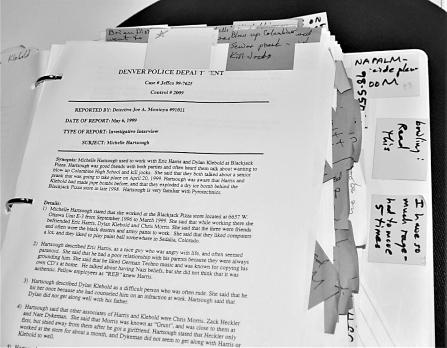
Here is a photo of the notebooks on the shelves. They are numbered, and consecutive, with the year of the release written on them.

You can see some of the maps folded on top of the notebooks, and some of the files and reference pages stacked on the shelves.
These files include the CBI files, FBI, Arapahoe County, Arvada, Jefferson County, El Paso and other many other reports from other jurisdictions. This is the information we used to investigate this tragedy. Some of the most interesting books are compilation notebooks, prepared by Judy for the Attorney General’s investigators. She was very thorough in her preparation, and gave them a great deal of complicated and well researched information.
There is an entire art folder full of maps from the ballistics research and map research, along with a few hundred photos of the maps in the Jefferson County evidence room.
Some of the information I used is from unknown, or rarely seen, reports by SWAT Teams and Fire Departments that were on scene. It is a wealth of information, and an excellent resource.
In the library, our library, there is a little black notebook, from April 20th, 1999.
In it are reporters phone numbers and notes, in chronological order, from April 20th. On page 1 of that notebook is a small yellow sticky note. It is in Judy’s handwriting. It says: “GBP2613. Honda-Prelude. Dark Gray.” This was the note from our refrigerator. Judy had given a copy to all of the neighbors, about a year before Columbine, in 1998. It is the license number and description of Eric’s car. Judy had written it out, and given it to the neighbors, asking them to keep an eye out for this car. She wanted them to know that Eric was dangerous, and asked them to keep an eye out for it, and to let her know if they saw it. It is a memory of the worry and fear we felt at the time, a year before the killings. She told them about Eric, and asked them to watch for him, and the car.
Page 3: Lance is in surgery today. For 6 hours.
Page 6: Aunt Mary’s phone number. Tom’s Aunt. Tom Klebold’s pager number.
Page 7: Phone number for Brian Moss. A local reporter. Misspelled Moss. It is Maass.
Page 8: Tom Brokaw’s home number. He wanted to be sure we called him back, and could reach him in the future.
Page 9: Today Show info. USA Today contact person and number.
Page 10: Lynn Bartels. Her card for the Rocky Mountain News. With her phone number. She must have come by to see us.
Page 11: CNN request.
Then, on the following pages, cards from every news agency of the time. CBS, NBC, CNN, Boston Herald, The Denver Post, Newsweek, The Washington Post, Bobby from the Larry King Show, Art Harris, John Miller, Dan Abrams, Ward Lucas, and many more.
To say we were overwhelmed would be an understatement.
Then there is a call from a Ryan Collins. He told us that he was from Jeffco Schools, and that he was concerned for Brooks safety. They didn’t want him to go back to school.
Lisa called from the Oprah Show. They wanted Sue’s number. We didn’t give it to her. We were protecting them at the time.
The Library Tape and Assault Rifles.
JAN. 2020
I listened, again, to the recording of the teacher in the library who called 911 and then set the phone down. It is a poor-quality recording. It is a little hard to hear the words spoken, and the other sounds. It is the recording of the library. No, not the one you know about. This is the rest of the tape, the recorded of the killings in the library. The tape from the library is the saddest thing I have ever heard. The greatest sadness of my life. The worst thing I will ever hear.
I would be remiss, in my duty to tell the truth, if I did not mention one very obvious fact: The weapons, during the killings, were fired as single shots. There was very little semi-automatic fire. There would be a single shot, and then nothing for a few seconds, 10, 15 seconds or longer. Then another shot.
This was not a madhouse. This was a calm and collected killing. The shot would be loud in the room, and then nothing. The police outside could hear the shot, and a long pause, and then another shot, and a long pause, and then another shot. They stayed outside, held back by their own fear. They were certainly not held back by the withering automatic weapons fire from the library.
I know, it is an awful detail, but it is kind of important. The portrayal of this as an overwhelming gun battle, and chaos, was a lie, an excuse. There was no excuse. Any of those policemen could have walked in and taken on these two cowards. Any of them. If they had just gone into the library. If they had just intervened. It is important for all of us, civilians and police, to acknowledge that simple fact. There were no automatic rifles used in this shooting, at least not as you imagined, not as you were led to believe. There were shots fired slowly, deliberately, and with a lot of time in between them. There are single rounds from weapons, fired at a slow pace, relishing the killing. Eric and Dylan took their time, and they enjoyed it. The delays, the time, match very well with the comments, the “wahoo’s” and excitement of the killers. Eric and Dylan enjoyed killing innocent defenseless children, and the police, outside of the open doors, and outside of the shattered windows, listened, and stayed where they were. They stayed outside, and let these children be killed.
No. These killings are not like you have imagined, or have been led to believe. They are slow, and methodical. The police, outside, stayed there, outside, and let these children be killed, listening to the sound of gunfire and screams, slowly taking place, slowly unfolding, like the nightmare it was. While Eric and Dylan walked around, in between the bookshelves, protected from the police, the police failed to enter.
And that is the reason that the police never released this tape: They wanted to hide the single-shot scenario. They wanted people, and the press, to think it was a gunfight, a wild automatic-rifle gunfight, with chaos and sirens and noise and smoke. That is all a lie. The water was downstairs in the cafeteria. There was never a fire in the library. The sprinkler system never went off in the library. The tables are dry. The floor is dry. The clothes of Eric and Dylan are dry. One tabletop has ashes on it from a fire Eric tried to start. The Library was dry, with no water, not a drop. The library was dry. The chaos defense is a false one. There was no chaos. There was a systematic killing of innocent children. There was plenty of time to intervene. This loss of life could have been prevented.
It is worth noting, that you would not notice it the first time you listen, it is too upsetting to comprehend the first time. You would not notice it the second time. But, on the third time, or the fourth, you hear it, and it takes on a different meaning.
As a note: the killings outside of the school, that happened first, could not have been prevented. Once the killers were at the school, the chance to intervene was over. Eric and Dylan opened fire without warning. Once they were at the school, it would have been pure luck to have had Gardner, the school resource officer, standing there at the West entrance, with his weapon drawn. Barring that improbable scenario, the shooting of the first children, once Eric and Dylan were at the school, armed, would have been hard to prevent. Rachel and Richie, and Dan, and Anne were shot before anyone had a chance to react, before anyone had a chance to raise a defense. No one can react in 5 seconds, or 15 seconds. They were shot outside the school, with no warning. But, once in the school, and in the library, there was time, and there was opportunity to raise a defense.
If you will remember, Gardner shot his .45 pistol at Eric, before Eric actually went into the school, at the West entrance. Eric spun around, and Gardner thought he had hit him. He was wrong. He knew he had fired at Eric, who was crouched down, and he missed. He missed four times. (Yes, there are a few different versions of this part of the incident. They contradict themselves in some of the important details. In one version Eric is crouched, and spins as he is fired at. In another version, Eric is inside the doors, resting his rifle on the door frame. In another version Gardner is firing at Dylan.) Then Eric and Dylan walked through the school, shot up the main office, and walked back down the hall to the library. Gardner fired at them in the library, with 4 more rounds, from outside, in the parking lot, and so did other policemen. These rounds, fired by the police, are all over the library, in walls, books, and in the ceiling of the library. Then, Eric and Dylan, not immediately, started killing children in the library. This was a fiasco. This was the failure. And that is probably the reason the police never released this tape of the library killings.
This tape removes any doubt about the cowardice of these policemen. It removes any doubt that, if any of these policemen had tried to stop these killings, they could have. One brave policeman walking into that school, into the library, with his weapon drawn, could have intervened. Oh, yes, they might have died in the attempt. Yes. I acknowledge that. And I also acknowledge that not one of them did. Not one.
I know. I know. It is in retrospect. It was 20 years ago. But the details and the timing make it pretty clear what happened here. As does the audio tape.
Now you know all you need to know about the audio tape of the killings in the library. That is all you need to know. Be glad that you have never heard it.
The police failed, and it appears that I hate them. But that is too strong a word. It is a disappointment, a sorrow, that they failed in so many ways. And yes, an anger. An anger at these men for not knowing what their job was, and for letting these children die. Their job isn’t to give you a ticket for speeding. That is not their job. That is not their first and most important job. Their job, first, is to protect innocent people from violent criminals. Their job is to protect innocent children from violent children.
Do you think that is too critical? Do you? Then you should listen to the tape of the killings in the library. Then I am wrong for not releasing it. If you still think that they did not fail, then the tape of the killings should be released for everyone to hear. Then you should listen to the tape, and be forced into learning the truth. Then you might get it. Then you might understand, by listening to this tape. Then you would know that the police on tv, the heroes that are competent and risk their lives for civilians, are a myth. Imaginary. A falsehood. Then you might know the truth. I know the truth. I have listened to the tape.
How to handle school shooting drills in schools.
Jan. 2020
I received a call from Judy’s sister today, from South Carolina. Her grandson had been given the school shooting preparation drill. They rounded up the kids, and used a number of different methods to scare them, and teach them to be quiet, or they might be killed. One teacher told the kids: “If you make noise you will get killed. If you make noise, I will throw you out of here.” When confronted about this, he denied it. Of course. There are so many instances of abuse with the way they teach kids how to handle school shooting drills. In one fairly well-known instance, during a training session, four teachers were shot, with an air gun, in the back of the head. They were traumatized. They were traumatized, and children are traumatized, for no reason.
Let’s review a few ideas:
First, school shootings are ridiculously rare. I suggest that you do some research on this. You will find that there are mass shootings, but the ones that take place in a school setting are actually very rare. There are shootings in every city, and every location. We have a violent society, with gun deaths that are not reported or covered fairly. They happen, but we ignore them. A school shooting scenario is rare, but we pay attention to it. The killing of innocent students by other students raises our fears, and is confusing.
The problem is how we are responding to it. We terrorize children with the training. We traumatize children with the drills. We should keep the lessons simple, and teach the children to follow the instructions of the teacher. But don’t terrorize them. That fear, and the damage it will do to them for the rest of their lives, is causing more damage than the rare school shooting.
Let children be children. You don’t need to be taught how to put out a fire, you need to be taught how to walk calmly, out of the school, when the fire alarm goes off. You don’t need to be taught how to disarm an armed shooter. You just need to leave the area.
You can’t tell by looking…
Feb./ 2020
I have looked at their photos for hours. I have looked at Dylan’s photos, and remembered him, as much as I can. I have looked at Eric’s photos. I didn’t know Eric very well, but I have looked at his photos and the videos, hundreds of times.
There is one thing I have learned. Are they a killer? Can you see it in their face? It is not obvious. It is not evident. A killer is hidden, behind a normal face. There is no way to look and tell if someone is a killer. There is no way to look at a photo, or a face, or a video, and discern that the person you are looking at is dangerous.
The danger, the evil, the hatred, and the anger are inside. They are located in their heart, or mind. They are not evident from the outside.
The lesson: Look at their past. Look at their behavior. Look at the abuse they have received. Look at the amount of humiliation they have received. That is the only way of discerning danger.
You cannot look at the face of a person and tell whether they are dangerous. I have tried.
The end of the book…
March 22, 2020
And that would be the end of the book, if it had not been for a phone-call I received from a 36-year-old girl from California. Over a month ago Lance had talked with her, and he gave her my phone number. She had called right away, and we had talked for more than an hour. I suggested some books to read, and tried to answer questions about Columbine. She had listened, we had talked, and she had learned.
She called again last night. She told me that reading the books, that I had recommended, brought back the memories of her high school days, and the humiliation she had received as a girl. She was crying. She had been taken back to all of those memories, and the sadness and depression of high school. And that is why the book is not over.
In this entire book, I have tried to illustrate the damage that humiliation does to boys, because Eric and Dylan, and their motivations, are important to understand. But, bullying and humiliation, or simply humiliation, is not just a “boy” problem. I have also tried to show the results that humiliation will create in all children, and how it can lead to suicide, and depression. That process is not exclusive to boys or girls. There is more. Humiliation is a problem for girls, boys, men and women.
Humiliation leaves scars. It leaves lifelong scars in all of us. It leaves sadness, and pain. Please remember that. Please remember that detail: The children that have been humiliated, are damaged and hurt, and grow up into adults. They are frail, and in pain. Some have been suicidal. All have been affected. As a society, we allow this humiliation, bullying, teasing, cruelty and hatred as a part of living. We allow it as part of a normal life. We need to learn that it is wrong. It is simply wrong.
We need to stop the humiliation at every level. We need to care about each other. We need to show respect to each other. We need to step in and intervene when this humiliation is taking place.
We all need to live with respect for each other.
As you have learned about this tragedy, violentization, and hypervigilance, some of that pain may have come back to you. It can be difficult to process. It will bring back the pain. Learning about violentization, humiliation, hypervigilance, and the process that creates school shootings can be a very difficult experience. It can bring back very sad and serious memories. It can be depressing. I know. Believe me, I know. But it is necessary.
It is part of the learning process.
It is part of the healing process.
It is the price you pay for wisdom.
Thank you for calling. I needed to say this, and you reminded me.
With love, Randy
Seriously? Did you think I was finished. There is more:
May 25th, 2020
A girl name Misha sent me a message on facebook. She had tracked me down, and had a few questions about Columbine. I answered her, and we communicated for a while. She was very nice. She had questions about some writings by Dylan posted on a website. The writings she sent to me didn’t make sense. I thought that the source of the writings had made a mistake. In the pages that have been released, the police mixed up the writings of Eric, Dylan and another kid who had submitted some fake emails. In some places it was very difficult to tell who had written what. Her questions made me curious, and I read the pages for a few evenings. I was really looking for the word “halcyon” in Dylan’s writings. She had sent me a typed version, and I couldn’t believe that Dylan would ever use that word in his writings. It was simply too educated for him, in my opinion. Well, I was wrong. He did use the word. After I found that, I looked over the writings for a few more hours, and found this entry on page 26,404. Yes, I had read it before, but I had dismissed it when I read it, knowing that the dates didn’t make sense, and that I knew he hadn’t been caught for pipe bombs. I think that is called confirmational bias. I knew it wasn’t true, so I ignored it. But, this time I read it, and then I read it again. I read it again, and I figured it out. Here is the answer:
The real cover-up
May 25th, 2020.
A Disarming notation, and what it means.
This is a very disturbing chapter. It may change everything. It does change everything.
Here is what Dylan wrote on page 26,404:
“I’ve been caught in most of my crimes- xm drinking, smoking, & the house vandalism & the pipe bombs. If, by fates choice, “redacted name” didn’t love me, I’d slit my wrist and blow up atlanta strapped to my neck.” 2-2-98
I have included the entire page for your review. It is included below. Take the time to review it. It is from the released pages. I have enlarged it slightly, and I underlined the comments, so that you can find them easily.
I have reviewed the pages around it, and Eric’s writings too. This is genuine. It matches other writings on the previous and following pages, and matches Dylan’s writings.
Let me transcribe it for you:
“Existence… to understand.
Well well… so much changes… like existence. I understand almost everything now… so close to my love- redaction — The runes have shown it, she has shown it, I have felt it. I know the meaning of each life: To be loved by yer love, & to be happy in ones self. Only for the gods though (me, redacted etc.)The zombies and their society had to get her and try to destroy what is superior what they don’t understand & are afraid of soon… either ill commit suicide, or ill get her redacted it will be NBK for us. My happiness. Her happiness. NOTHING else matters*. I’ve been caught in most of my crimes- xml drinking, smoking, & the house vandalism & the pipe bombs*. If by fate’s choice redacted didn’t love me, id slit my wrist & blow up atlanta strapped to my neck. It’s good, understanding a hard road since my realization, but it gets easier. BUT IT DOESN’T! That’s part of existence. Unpredictable. Existence is pure hell and pure heaven at the same time. I will never stop wondering, the lost highway will never end, the music in my head will never stop… Totall part of existence. The half will never end. The love will always be here. God, I love her. It is so good to be”
That is the best I can do transcribing it. Some of those words may be wrong.
Here is the full page for your review, copied from the released information.
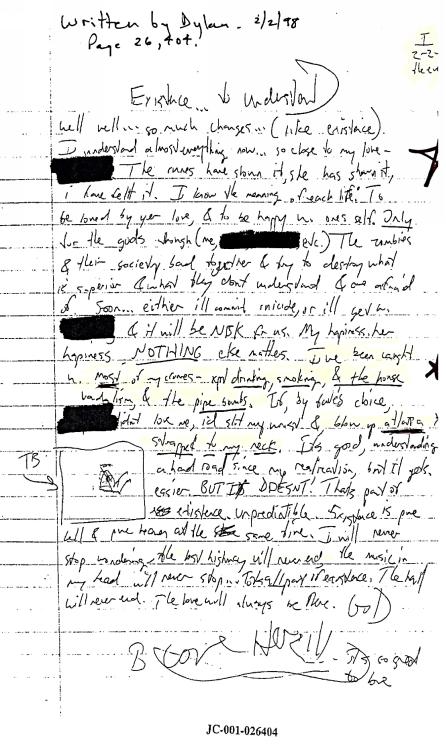
This could not be more confusing to me. Dylan wrote that he had been caught for most of his crimes. He listed pipe bombs and vandalizing houses as a few of those crimes. He wrote this on February 2nd, 1998, three days after being arrested for the van break-in. That is problematic in many ways. We did not turn them in for the pipe bombs until over a month later, on March 18th, 1998. Dylan was never caught for pipe bombs. Never.
Or was he?
What if we have been lied to from the very beginning. What if Eric and Dylan were caught for detonating pipe bombs from our report in 1997. What if part of the diversion program agreement in March of 1998 allowed them to skate on the pipe bomb charges, and charged them only for the van break-in. Think about it for a minute. If that is true, the cover-up by the County, Sheriff, Harrises and Klebolds makes complete sense. Eric and Dylan were caught committing multiple crimes. What if part of the agreement with the DA was to forget about the vandalizing houses and pipe-bomb-building? These two kids promised to stop, take a plea deal, and enter into the diversion program, with the vandalizing houses and pipe bombs waived from prosecution. The DA and the Sheriff’s Department and the parents were in on it the entire time. It was an agreement, involving everyone. That is why the Detective would not call us back: An agreement had already been reached with the DA. That is why Kiekbusch closed the file: It was normal procedure, the “agreement” by the DA had already been reached. Then when Columbine happened, they were caught flatfooted. They could not reveal that they had dismissed the pipe-bomb-building in 1998, a full year before Columbine, because it was a felony, and would have made the County, Police, DA, Klebolds and Harrises responsible for the killings, as one complicit group. Think of the outrage. That is why there was a cover-up. That is why the Harrises, Klebolds, Police and County were working together. No one could ever reveal that truth. Can you imagine: “We all knew about the pipe bomb building, but we let it go because we put them in diversion.” That would have brought down the house of cards. That is why Bellipanni, the Assistant DA involved, never talked, or was allowed to talk. That is why the secret meetings were held. That is why the Judges and every other politician except Ken Salazar and Ted Mink kept quiet. That is why Suthers refused to investigate. That is why the State refused to investigate. This was a big enough problem to justify all of the lies and cover-up. There were six skilled attorneys in the secret meeting, counting John Stone’s personal attorney, and they all covered this up and kept it a secret. This is a big enough problem that it justifies this extreme level of corruption. It makes complete and total sense. If this is true, the Harrises lied, the Klebolds lied, the District Attorney lied, and they all agreed to lie together.
The District Attorney had been informed about the pipe bombs in 1998, before the sentencing. Our report from 1997 included vandalizing houses and pipe bomb building. That is what Dylan referenced in his writings on Feb. 2nd, 1998. Dylan had been caught, Eric too, and the Sheriff’s Department knew about the pipe bombs. The District Attorney rolled it into one charge.
For Dylan’s statement to be true, “Atlanta,” the pipe bomb, had to be built and ready to go on February 2nd, 1998. Is that possible? Eric lists the pipe bombs that he had built, starting in Oct, 1998. But, we know he was building them in March of 1998, because he had already detonated some of them. That was in our report from March of 1998. And, here were his writings from 2-2-98, that name “Atlanta,” so that is confirmation. In their web pages they name Atlanta as one of their pipe bombs. Yes, that date works. In fact, everything about it fits, perfectly.
Well, almost. To believe this, Judy and I have to believe that Tom and Sue lied to us, immediately. We would have to believe that all of the conversations we had were real, but that Tom and Sue kept back that important detail, and they knew about pipe bombs the entire time. Can we believe this? Can we believe that they would lie to us, to the world? Backed into the corner, with their son a killer, a mass murderer, would they conceal this from us? Perhaps a better question is: Backed into a corner, knowing about the settlement agreement with the diversion program in 1998, and knowing that their son had just killed children at the school, would they volunteer this information to us, or anyone? The answer is obvious.
This theory exposes the cover-up perfectly. The clues to the cover-up were not in the files, all except for this one very difficult to read note by Dylan. In all of these pages, there is only this one reference. They missed this one hand-written note, because it was difficult to read, and probably because the person who released it was not in on the cover-up. It was complicated. A Deputy reviewing this statement would have missed it, or might have simply not even seen it. It was missed in the volumes of released reports.
There have been subtle clues to this throughout my research. When Eric wrote that he was tired of lying to his dad, saying that he was not building any more bombs, I had noted that and kept it in a safe place in my memory. That meant that they had discussed the pipe bombs, and that he was being asked about it by his parents. This new find gives that statement a very different meaning. Monitoring pipe bomb building was part of the agreement.
Now it becomes clear why the Harrises were never charged, or interviewed. The District Attorney couldn’t let that happen. The Harrises knew about the plea deal. If the Harrises go down, they would take the District Attorney, and everyone else involved, with them. Why? Simple: The Harrises relied on the District Attorney for the psychologist, the diversion program counselors, and the management of the crime by the diversion program. Every failure would come to light, and the burden of the failure would fall on the professionals who failed, not on the Harris family. They were, after all, the amateurs in this situation. The blame would fall on the District Attorney, the County, and the Diversion program. They were the professionals. It was their offer and decision to put these two boys into the diversion program, in violation of their own rules. They had violated their own guidelines. The County had to be protected.
Think about it. That is why the people involved have been given better jobs, higher positions, Judgeships, and more. That is why Erickson wasn’t given subpoena powers. That is why the secret meetings were kept secret. That is why there is not one mention of pipe bombs in Mr. Harrises journal. Those pages were removed, or he was smart enough to leave it out of his journal.
This was a good enough reason to risk everyone’s career.
Imagine this headline a week after Columbine:
“Pipe Bomb Charges Against Killers Waived in 1998”
“Sheriff’s Department, District Attorney, and Judge ignored pipe bomb building by the Columbine killers in a sweetheart plea deal, one year before the killings. Killers sentenced to a lesser crime, violating the Diversion Protocols and sentencing guidelines. Pipe bomb charges were waived by the DA. Killers would have been in jail.”
That would have been be a powerful headline.
It makes perfect sense. I believe that this is the cover-up.
Now, whenever I review documents, I see them through this window. It changes almost everything.
The Harris family, the Klebold family, the Sheriff’s Department, the District Attorney and his assistant, the Judge, and anyone who was involved in the “plea bargain agreement” to combine the van break-in and the house vandalism/ pipe-bomb-building charges knew about the real cover-up, the cover-up of the real failure. An agreement was reached, before they were put in diversion in March of 1998, to dismiss the house vandalizing/ pipe-bomb charges, and put them in diversion for the van break-in only. It was a simple agreement. They already had them for the van break-in. That was a solid case. A slam dunk case. The policeman had caught them red-handed. Why not just forget about the other crime, roll it into this agreement, and put them into the newly developed Diversion Program. It was a good result for everyone. They could just ignore the 1998 report, and the Detective, because it was already taken care of. The decision had been made. It was, as with many sentencing decisions, a compromise, a double secret probation, to make it easy to get an agreement, and to move forward. What can be the harm? The pipe bomb issue had already been addressed in the 1997 report, they had already discussed it, and the DA and the parents had already reached an agreement. It was decided. Simply tell the Detective, Detective Hicks, to let it go. He will be upset. He can be angry. He can go home and take the rest of the day off, which he did. We are the DA and the powers that be. We can decide stuff like this. What can be the harm? The DA does plea deals every day, and those agreements are not subject to the approval of the Detective, or anyone else.
Did you want to know why this happened, from the side of the County and the Courts, and the District Attorney? Now you know.
The bullying and humiliation are the source of the hatred and anger, but this decision is the failure, the absolute failure of the Court System, Parents, District Attorney and everyone else involved.
This plea-deal agreement was the reason for the cover-up, the lies, the conspiracy, the secret meetings, and the failure. Children died because of this agreement.
This is why they lied.
This is why they held the secret meetings.
The District Attorney’s office worked out a plea agreement with Eric and Dylan, in 1998, knowing that they were building and detonating pipe bombs. The District Attorney’s office worked out a plea agreement with Eric and Dylan, in direct violation of the rules of Juvenile Diversion, sent them into Diversion instead of jail, and then failed to monitor them, giving them an early release from the Diversion Program, with favorable reviews. While in Diversion, supervised by the Diversion counselors and parents, Eric and Dylan built more pipe bombs, detonated pipe bombs, purchased weapons and ammunition, purchased propane tanks, prepared napalm, and planned to kill 1,000 students at Columbine High School.
Revealing this after the murders at Columbine would have opened Jefferson County to millions of dollars in damages. It would have been the end of their careers. It would have made them look like fools.
Instead, because of that decision, because of their mistake, they lied to the families of murdered children, to you, and to the world.
Finally, the mystery is solved.
Now I know the truth.
Bonus Chapter
How to Stop School Shootings.
January 22. 2020.
These killers are not crazy. They are getting revenge. They are getting revenge for a perceived injustice, or a true injustice. They have been bullied for years, and that humiliation has grown into a hatred of the bullies, the teachers, the faculty, students, and the school.
Let me explain:
To begin with, bullying is a word used so often that it has lost its meaning. The word bullying should be accompanied by the word humiliation. Bullying and humiliation are the problem. A number of great authors have covered these issues.
Paul Mones wrote, in his book: “When A Child Kills,” about children who are abused by their parents, and then kill their parents. Through constant abuse, from their parents, these children become hypervigilant, paying attention to every threat, however small, until they kill their parents to protect themselves. Yes, it is a horrible crime, but, after you read his book, and learn, you begin to understand.
At Columbine, the abusive parent was the school. An abusive school was the source of the bullying and humiliation.
In the school, when I knock you down in the hallway, you are hurt. You are upset. You are angry. When you see who I am, the biggest kid in the school, or the meanest kid, you are helpless. The next time I knock you down, you are afraid. You begin to look for me in the hall, and avoid me. The third time I see you in the hall, and knock you into your locker, you are still afraid, but you are also looking around for help. You cannot believe that no one defends you. No one protects you. You notice that, and it stays with you. The next time you see me in the hall, you have learned to be cautious. You are afraid. You watch for me and stay away from me. That is hypervigilance. Everything I do, and every incident you see, or hear, about me, raises your fear level, and you become hypervigilant. You are afraid. You notice every threat. This state of hypervigilance changes you. You are on edge. You are more aware of the threat. You are afraid. The humiliation continues, and you notice it. You notice every single detail. You have become hypervigilant, and the humiliation continues.
You are continually humiliated and bullied.
Humiliation creates anger, and violent responses. It is the underlying, but rarely explained, cause of violent responses. When a person is humiliated, when they are humiliated to the point of tears, and fear, and anger, violence can be the result.
Yes, many children who are humiliated will commit suicide. Yes, they will start drinking and using drugs. Yes, they will withdraw, questioning their courage, talent and self-image. Bullying and humiliation will do great damage to children and their fragile egos. Some children will withdraw. They will become depressed. They will consider suicide. They will commit suicide. They will run away. They will be embarrassed, and hide, by taking drugs, and taking part in risky behaviors. Most of these damaged children have been subject to humiliation, and it has broken their hearts. The criticism, embarrassment, and humiliation are more than they can bear, and some of them take their lives. But, some of these humiliated children will become angry, and make a conscious decision to fight back. That is the creation of school shooters. That is one of the first steps in the process of violentization. These humiliated children decide that they should fight back. They start in small ways, and escalate the violence, as they embrace the process and increase their level of violent response.
Eric Harris and Dylan Klebold, in their hypervigilant state, were so humiliated that they decided to fight back. Rather than withdraw, rather than hide, they decided to fight back against the bullies, against the humiliation. This was a conscious choice.
It is this process of developing violent behaviors that creates killers. Embarrassed, humiliated, and bullied to their limit, and unable to find justice anywhere, they decide to be violent in return. It is a decision they make, and everything they see confirms it. It is a decision that many people make, to react violently to humiliation. Every slight, every act of bullying, substantiates their decision. That is how the process of violentization changes them from innocent children, to humiliated children, to violent children who decide to kill. It is through this process of violentization that school shooters are created.
Giving it some thought, it becomes easy to see why many bullied and humiliated children in schools have found the Columbine killers to be their heroes. Yes, there are many young adults who idolize these killers. The humiliated children of the world, looking for a hero, have latched on to the violent behavior of these two killers, and others, using it as a way to give them some courage, some sense of power. They believe that these two killers fought back against the humiliation. This accounts for all of the fan clubs and followers they have. That is a very difficult point to understand, and very difficult to accept. Their fans believe that Eric and Dylan took a stand, standing up for them, against the bullies. They are idolized by some children and young adults.
The saddest thing about that perspective is that the shooters, through adopting violence as their method of retaliation, become the very people they hate. The shooters become the biggest bullies. They create the greatest injustice. They become, through their violence, the bullies that they hate the most. They become the worst bullies of all. They become killers.
Eric and Dylan were subject to humiliation in this school for four years. One of the best examples is the ketchup incident. During lunch period, in the supervised and packed cafeteria, the jocks and their girlfriends threw ketchup coated Tampons at Eric and Dylan. OK, maybe a few jocks threw them, and the girls only watched, and laughed. Yes, the girls laughed. Teachers watched, and ignored it. Other children watched, and no one did a thing. No student could do anything. The bullies were a few of the big, arrogant, and dominant, football players, and Eric and Dylan were helpless, and defenseless. Eric was small and weak, and Dylan, despite his height, could not fight, especially against these bullies. Eric and Dylan were called fags, and gay, and were humiliated by the throwing of the ketchup-soaked tampons. With ketchup-stained shirts and slacks, they were not allowed to go home and change. They stayed in school the entire day, with their humiliation on display for everyone. When Dylan went home that night, his mother saw the stains, and asked about it, and he said nothing had happened. This constant humiliation created anger. Humiliation and fear create anger. And, sometimes, humiliation creates a decision to be violent. Having been bullied and humiliated for almost four years by the football jocks, and with no protection from friends, or the school, they grew into violent, angry boys. They decided to get revenge, their revenge, for this perceived or real injustice.
Through humiliation, some children commit suicide. Some children withdraw and play video games, or chess, or read. Some use drugs or drink. Some children withdraw into video games, and that empirical, logical world. Some children become violent. They decide to subject everyone in the school to the pain, and humiliation, that they are feeling.
Now that you understand the situation, that humiliation creates violence, the solution should be obvious.
Every student should be protected. Every student should be valued. No student should be humiliated for any reason.
Humiliation should be stopped.
If you stop bullying and humiliation, you take away a great deal of pain, and you let children know they are valued. That rule must apply to all children. That rule applies to all children, and all men, and all women.
Take away the bullying and humiliation, and show all children that they will be defended and protected, and you will stop school shootings. If you take away their anger, they will have no reason to kill.
If you take away their anger, they will have no reason to kill.
If you take away their anger, they will have no reason to kill.
Yes, I wrote the same line three times. It should be so obvious. Can you see it?
If you take away their anger, they will have no reason to kill.
You also get the added benefit of fewer suicides, fewer lost and broken children, and happier children.
If Eric and Dylan had never been bullied and humiliated, they would not have hated the school, and they would have had no reason to kill.
If you take away their anger, they have no reason to kill.
There are two windows of opportunity to stop school shootings:
The first one is to be outside of the school with a pistol, and to stop the school shooter as he enters the school, before he has killed an innocent child. That is a ridiculous and unattainable goal. The timing would have to be perfect, and would require the greatest stroke of luck. That window of opportunity is absurdly small, and lasts about 15 seconds. Once they have entered the school it is too late, as any loss of life is unacceptable. The shooter, at the Arapahoe High School killing, entered the school and shot a girl within 15 seconds, and killed her. Any loss of life is unacceptable.
The second window of opportunity is the four years before the student makes a decision to kill. Take away their anger, with justice. Take away their anger by giving them a sense of justice. Stop them from being bullied and humiliated. Stop the humiliation and they will not be angry, and they will have no reason to go to school, with a gun, to get revenge. Take away their anger, and they will have no reason to kill. That window of opportunity exists, for three or four years, before the school shooter goes to school with a weapon.
Fifteen seconds, or four years. That is the lesson you need to learn.
If you want to stop a school shooting, that is the lesson.
Randy Brown
A Columbine Parent
With love and hope.
OK. That was too complicated. I get that. Let me try again:
If you bully and humiliate children in a school, sometimes, one of them will become angry enough to fight back. They will develop anger, and develop violent responses to the perceived injustice. If the bullying continues, the violent responses will increase in intensity, and the child will become more violent. The humiliation has created anger, and the continued humiliation will create a violent response. The bullied child will decide, very rarely, as a conscious decision, to get revenge. They will buy a weapon, or build a bomb, and try to get revenge. That revenge may be directed at anyone in the school, as everyone in the school is a part of the bullying, humiliation, and perceived injustice. To the bullied child, everyone in the school is either a contributor or passive witness, and no one has helped him. No one has stopped the bullying. No one has stopped the humiliation. No one has defended him.
The easiest, and best way to stop this violence, is to stop the humiliation before the child becomes angry. Stop the bullying and humiliation, and the child will not become angry, and will not become violent. There will be no need for revenge. The child will not be angry. Stopping the humiliation eliminates the need for the violent revenge.
There. Anger addressed. Anger defused. Violence stopped.
Yes. It is that simple.
Take away their anger, and they will have no reason to kill.
Ok, let me try again:
If you bully and humiliate children in a school, sometimes, very rarely, one of them will become angry. They will decide to be violent, as a response to the bullying and humiliation.
Stop the humiliation, and you take away their anger, and there will be no need for revenge.
Yes. It is that simple.
Take away their anger, and they will have no reason to kill.
The world will never be perfect, but you can give people a chance to be heard, and a peaceful, non-violent method of protesting injustice. If that peaceful method can eventually provide a fair solution, people will not need to resort to violence to achieve justice.
and they will,
Stand in the rain.
Let the rain overwhelm you.
Stand in the rain,
Learn to cry,
Learn to feel,
Become one with the pain.
Then you can heal.
Stand in the rain.
by Randy Brown
1